| Exhibit 15.1 contains the excerpts of the pages and section of TotalEnergies SE’s Universal Registration Document 2025 that are incorporated by reference into the Annual Report on Form 20-F (1). References in Exhibit 15.1 to TotalEnergies’ Consolidated Financial Statements presented in chapter 8 are to TotalEnergies Consolidated Financial Statements presented beginning on page F-9 of this Annual Report. (1) Where information has been deleted from TotalEnergies SE’s Universal Registration Document 2025, such deletion is indicated in this exhibit with a notation that such information has been redacted. |

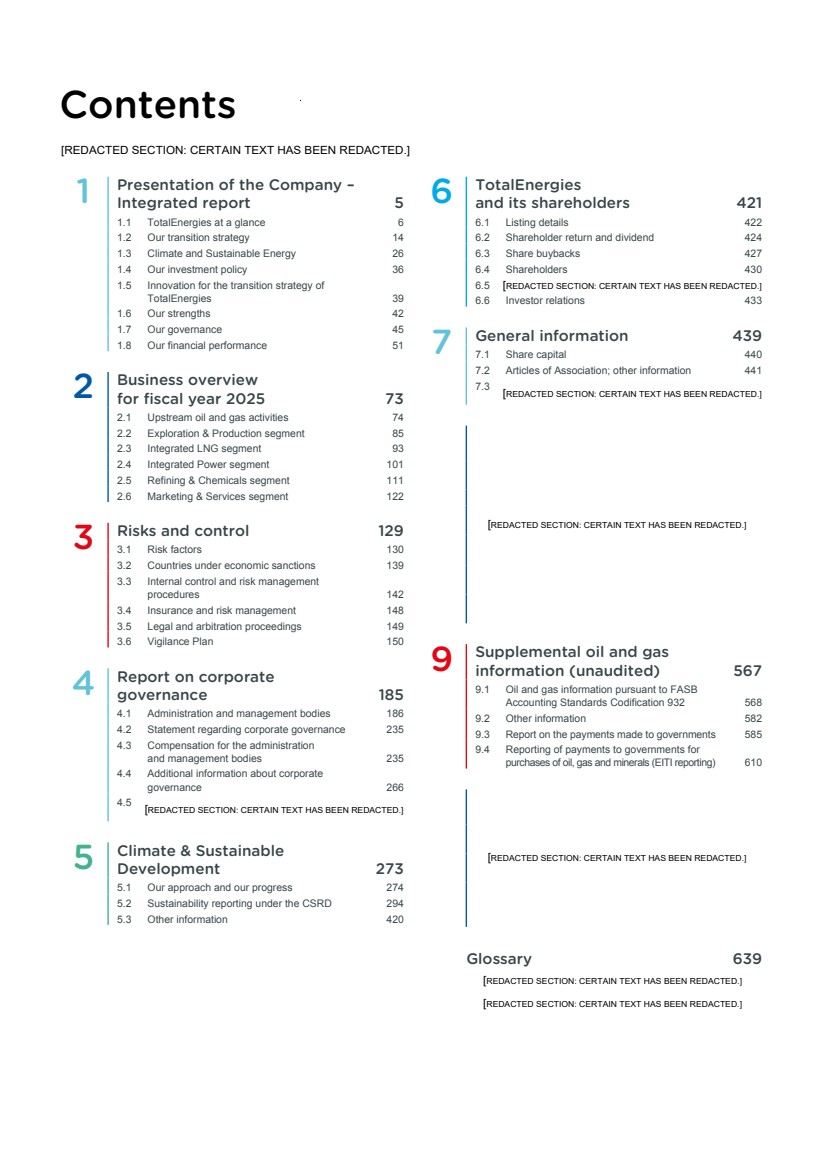
| Contents 1 Presentation of the Company – Integrated report 5 1.1 TotalEnergies at a glance 6 1.2 Our transition strategy 14 1.3 Climate and Sustainable Energy 26 1.4 Our investment policy 36 1.5 Innovation for the transition strategy of TotalEnergies 39 1.6 Our strengths 42 1.7 Our governance 45 1.8 Our financial performance 51 2 Business overview for fiscal year 2025 73 2.1 Upstream oil and gas activities 74 2.2 Exploration & Production segment 85 2.3 Integrated LNG segment 93 2.4 Integrated Power segment 101 2.5 Refining & Chemicals segment 111 2.6 Marketing & Services segment 122 3 Risks and control 129 3.1 Risk factors 130 3.2 Countries under economic sanctions 139 3.3 Internal control and risk management procedures 142 3.4 Insurance and risk management 148 3.5 Legal and arbitration proceedings 149 3.6 Vigilance Plan 150 4 Report on corporate governance 185 4.1 Administration and management bodies 186 4.2 Statement regarding corporate governance 235 4.3 Compensation for the administration and management bodies 235 4.4 Additional information about corporate governance 266 4.5 5 Climate & Sustainable Development 273 5.1 Our approach and our progress 274 5.2 Sustainability reporting under the CSRD 294 5.3 Other information 420 6 TotalEnergies and its shareholders 421 6.1 Listing details 422 6.2 Shareholder return and dividend 424 6.3 Share buybacks 427 6.4 Shareholders 430 6.5 6.6 Investor relations 433 7 General information 439 7.1 Share capital 440 7.2 Articles of Association; other information 441 7.3 9 Supplemental oil and gas information (unaudited) 567 9.1 Oil and gas information pursuant to FASB Accounting Standards Codification 932 568 9.2 Other information 582 9.3 Report on the payments made to governments 585 9.4 Reporting of payments to governments for purchases of oil, gas and minerals (EITI reporting) 610 Glossary 639 [REDACTED SECTION: CERTAIN TEXT HAS BEEN REDACTED.] [REDACTED SECTION: CERTAIN TEXT HAS BEEN REDACTED.] [REDACTED SECTION: CERTAIN TEXT HAS BEEN REDACTED.] [REDACTED SECTION: CERTAIN TEXT HAS BEEN REDACTED.] [REDACTED SECTION: CERTAIN TEXT HAS BEEN REDACTED.] [REDACTED SECTION: CERTAIN TEXT HAS BEEN REDACTED.] [REDACTED SECTION: CERTAIN TEXT HAS BEEN REDACTED.] [REDACTED SECTION: CERTAIN TEXT HAS BEEN REDACTED.] |
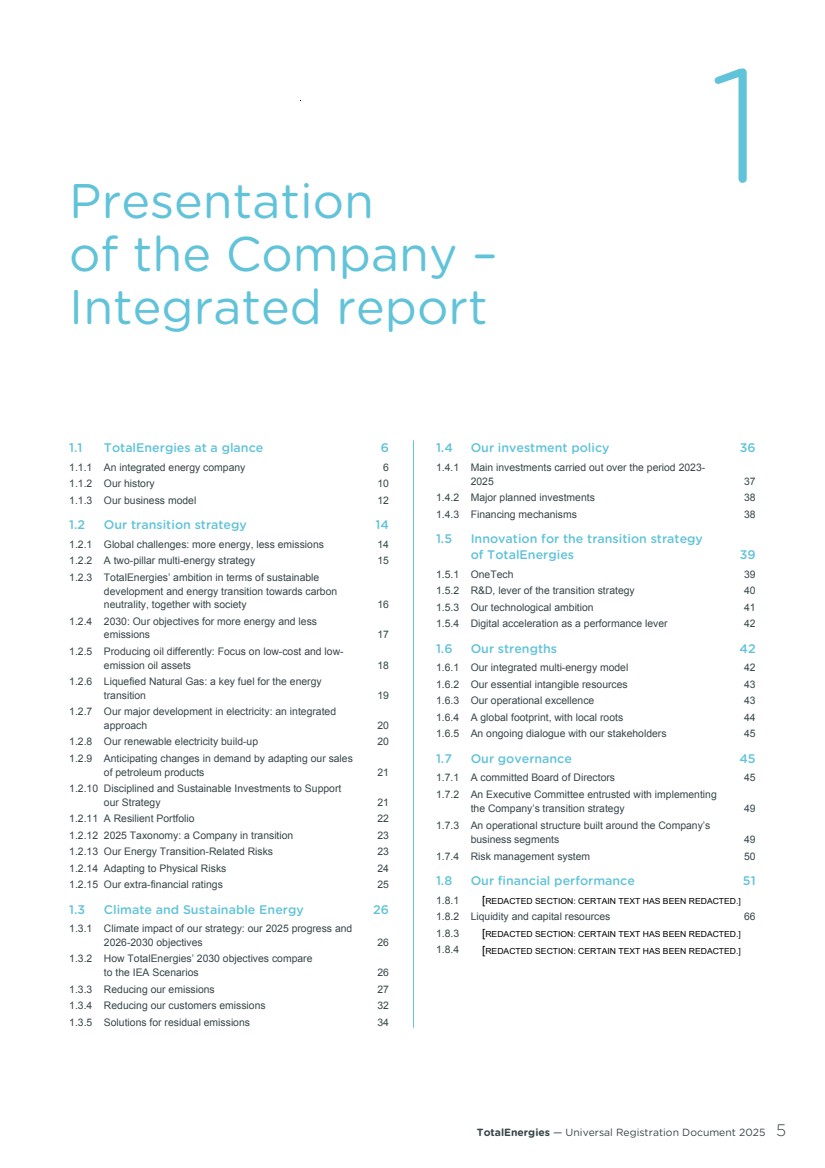
| Presentation of the Company – Integrated report 1 1.1 TotalEnergies at a glance 6 1.1.1 An integrated energy company 6 1.1.2 Our history 10 1.1.3 Our business model 12 1.2 Our transition strategy 14 1.2.1 Global challenges: more energy, less emissions 14 1.2.2 A two-pillar multi-energy strategy 15 1.2.3 TotalEnergies’ ambition in terms of sustainable development and energy transition towards carbon neutrality, together with society 16 1.2.4 2030: Our objectives for more energy and less emissions 17 1.2.5 Producing oil differently: Focus on low-cost and low-emission oil assets 18 1.2.6 Liquefied Natural Gas: a key fuel for the energy transition 19 1.2.7 Our major development in electricity: an integrated approach 20 1.2.8 Our renewable electricity build-up 20 1.2.9 Anticipating changes in demand by adapting our sales of petroleum products 21 1.2.10 Disciplined and Sustainable Investments to Support our Strategy 21 1.2.11 A Resilient Portfolio 22 1.2.12 2025 Taxonomy: a Company in transition 23 1.2.13 Our Energy Transition-Related Risks 23 1.2.14 Adapting to Physical Risks 24 1.2.15 Our extra-financial ratings 25 1.3 Climate and Sustainable Energy 26 1.3.1 Climate impact of our strategy: our 2025 progress and 2026-2030 objectives 26 1.3.2 How TotalEnergies’ 2030 objectives compare to the IEA Scenarios 26 1.3.3 Reducing our emissions 27 1.3.4 Reducing our customers emissions 32 1.3.5 Solutions for residual emissions 34 1.4 Our investment policy 36 1.4.1 Main investments carried out over the period 2023- 2025 37 1.4.2 Major planned investments 38 1.4.3 Financing mechanisms 38 1.5 Innovation for the transition strategy of TotalEnergies 39 1.5.1 OneTech 39 1.5.2 R&D, lever of the transition strategy 40 1.5.3 Our technological ambition 41 1.5.4 Digital acceleration as a performance lever 42 1.6 Our strengths 42 1.6.1 Our integrated multi-energy model 42 1.6.2 Our essential intangible resources 43 1.6.3 Our operational excellence 43 1.6.4 A global footprint, with local roots 44 1.6.5 An ongoing dialogue with our stakeholders 45 1.7 Our governance 45 1.7.1 A committed Board of Directors 45 1.7.2 An Executive Committee entrusted with implementing the Company’s transition strategy 49 1.7.3 An operational structure built around the Company’s business segments 49 1.7.4 Risk management system 50 1.8 Our financial performance 51 1.8.1 1.8.2 Liquidity and capital resources 66 1.8.3 1.8.4 TotalEnergies — Universal Registration Document 2025 5 [REDACTED SECTION: CERTAIN TEXT HAS BEEN REDACTED.] [REDACTED SECTION: CERTAIN TEXT HAS BEEN REDACTED.] [REDACTED SECTION: CERTAIN TEXT HAS BEEN REDACTED.] |
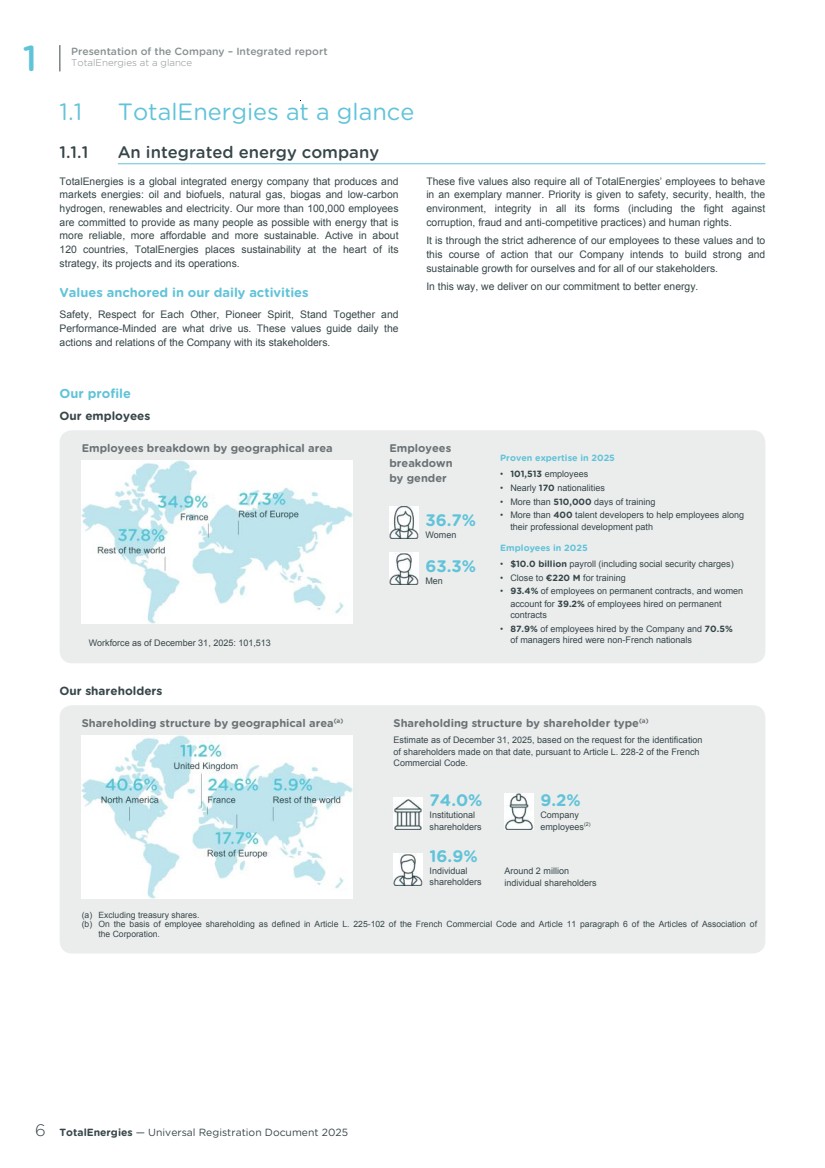
| 1.1 TotalEnergies at a glance 1.1.1 An integrated energy company TotalEnergies is a global integrated energy company that produces and markets energies: oil and biofuels, natural gas, biogas and low-carbon hydrogen, renewables and electricity. Our more than 100,000 employees are committed to provide as many people as possible with energy that is more reliable, more affordable and more sustainable. Active in about 120 countries, TotalEnergies places sustainability at the heart of its strategy, its projects and its operations. Values anchored in our daily activities Safety, Respect for Each Other, Pioneer Spirit, Stand Together and Performance-Minded are what drive us. These values guide daily the actions and relations of the Company with its stakeholders. These five values also require all of TotalEnergies’ employees to behave in an exemplary manner. Priority is given to safety, security, health, the environment, integrity in all its forms (including the fight against corruption, fraud and anti-competitive practices) and human rights. It is through the strict adherence of our employees to these values and to this course of action that our Company intends to build strong and sustainable growth for ourselves and for all of our stakeholders. In this way, we deliver on our commitment to better energy. Our profile Our employees Our shareholders Employees breakdown by geographical area Workforce as of December 31, 2025: 101,513 Employees breakdown by gender Proven expertise in 2025 • 101,513 employees • Nearly 170 nationalities • More than 510,000 days of training • More than 400 talent developers to help employees along their professional development path Employees in 2025 • $10.0 billion payroll (including social security charges) • Close to €220 M for training • 93.4% of employees on permanent contracts, and women account for 39.2% of employees hired on permanent contracts • 87.9% of employees hired by the Company and 70.5% of managers hired were non-French nationals 36.7% Women 63.3% Men Shareholding structure by geographical area(a) Shareholding structure by shareholder type(a) Estimate as of December 31, 2025, based on the request for the identification of shareholders made on that date, pursuant to Article L. 228-2 of the French Commercial Code. 74.0% Institutional shareholders 9.2% Company employees(2) 16.9% Individual shareholders Around 2 million individual shareholders (a) Excluding treasury shares. (b) On the basis of employee shareholding as defined in Article L. 225-102 of the French Commercial Code and Article 11 paragraph 6 of the Articles of Association of the Corporation. 1 Presentation of the Company – Integrated report TotalEnergies at a glance 6 TotalEnergies — Universal Registration Document 2025 |
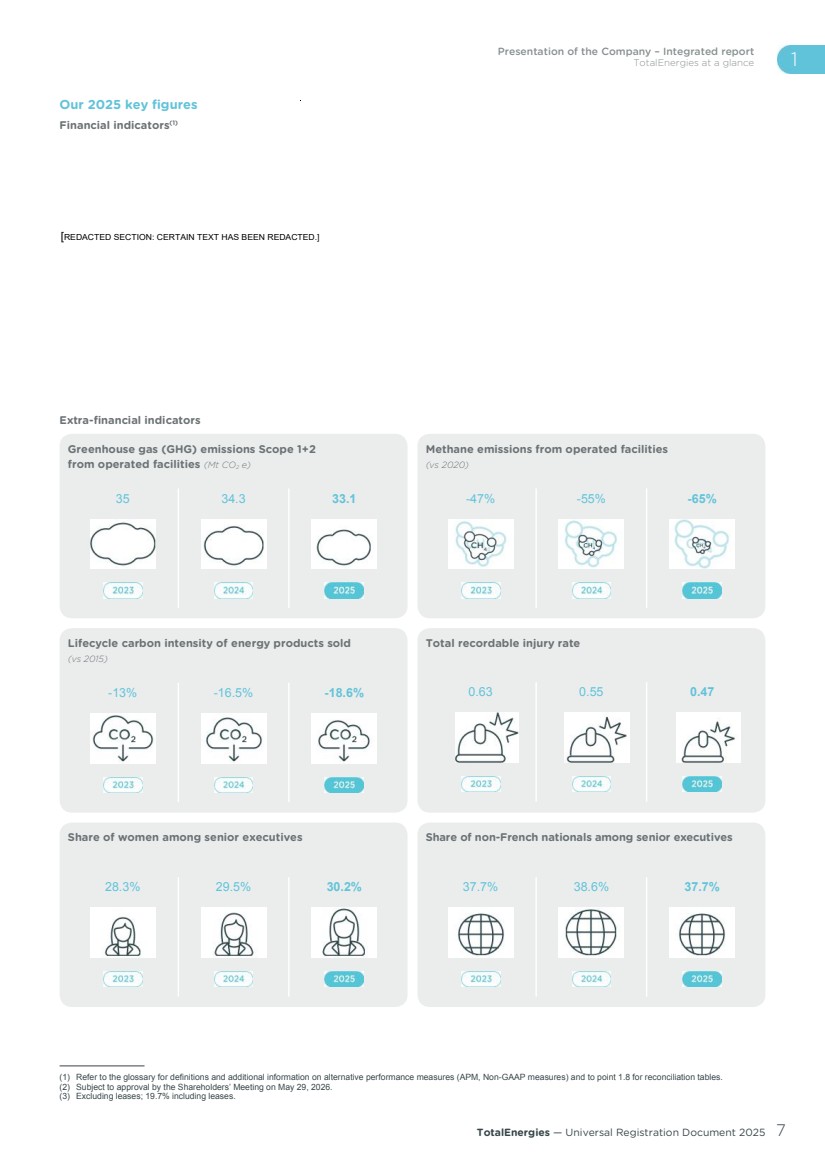
| Our 2025 key figures Financial indicators(1) Extra-financial indicators (1) Refer to the glossary for definitions and additional information on alternative performance measures (APM, Non-GAAP measures) and to point 1.8 for reconciliation tables. (2) Subject to approval by the Shareholders’ Meeting on May 29, 2026. (3) Excluding leases; 19.7% including leases. Greenhouse gas (GHG) emissions Scope 1+2 from operated facilities (Mt CO2 e) 35 34.3 33.1 Methane emissions from operated facilities (vs 2020) -47% -55% -65% Lifecycle carbon intensity of energy products sold (vs 2015) -13% -16.5% -18.6% Total recordable injury rate 0.63 0.55 0.47 Share of women among senior executives 28.3% 29.5% 30.2% Share of non-French nationals among senior executives 37.7% 38.6% 37.7% Presentation of the Company – Integrated report TotalEnergies at a glance 1 TotalEnergies — Universal Registration Document 2025 7 [REDACTED SECTION: CERTAIN TEXT HAS BEEN REDACTED.] |
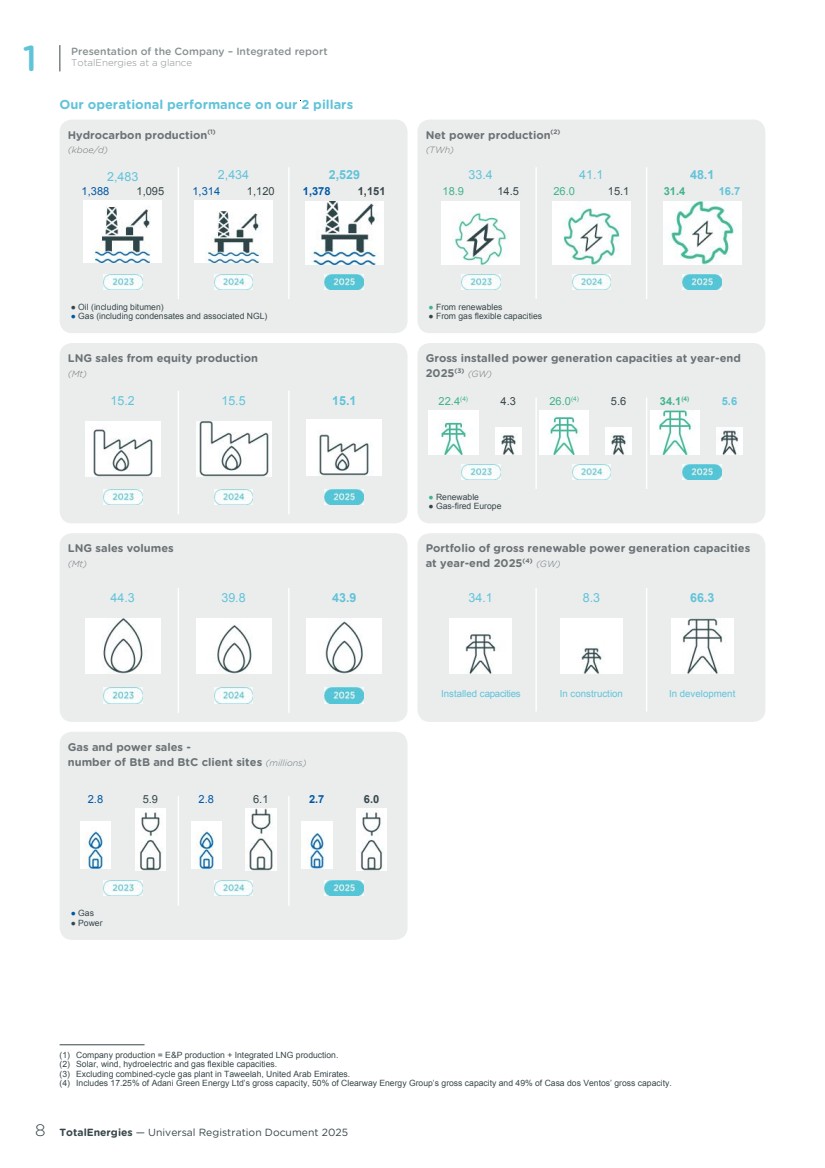
| Our operational performance on our 2 pillars (1) Company production = E&P production + Integrated LNG production. (2) Solar, wind, hydroelectric and gas flexible capacities. (3) Excluding combined-cycle gas plant in Taweelah, United Arab Emirates. (4) Includes 17.25% of Adani Green Energy Ltd’s gross capacity, 50% of Clearway Energy Group’s gross capacity and 49% of Casa dos Ventos’ gross capacity. Hydrocarbon production(1) (kboe/d) 2,483 2,434 2,529 1,388 1,095 1,314 1,120 1,378 1,151 ● Oil (including bitumen) ● Gas (including condensates and associated NGL) Net power production(2) (TWh) 33.4 41.1 48.1 18.9 14.5 26.0 15.1 31.4 16.7 ● From renewables ● From gas flexible capacities LNG sales from equity production (Mt) 15.2 15.5 15.1 Gross installed power generation capacities at year-end 2025 (3) (GW) 22.4(4) 4.3 26.0(4) 5.6 34.1(4) 5.6 ● Renewable ● Gas-fired Europe LNG sales volumes (Mt) 44.3 39.8 43.9 Portfolio of gross renewable power generation capacities at year-end 2025 (4) (GW) 34.1 Installed capacities 8.3 In construction 66.3 In development Gas and power sales - number of BtB and BtC client sites (millions) 2.8 5.9 2.8 6.1 2.7 6.0 ● Gas ● Power 1 Presentation of the Company – Integrated report TotalEnergies at a glance 8 TotalEnergies — Universal Registration Document 2025 |
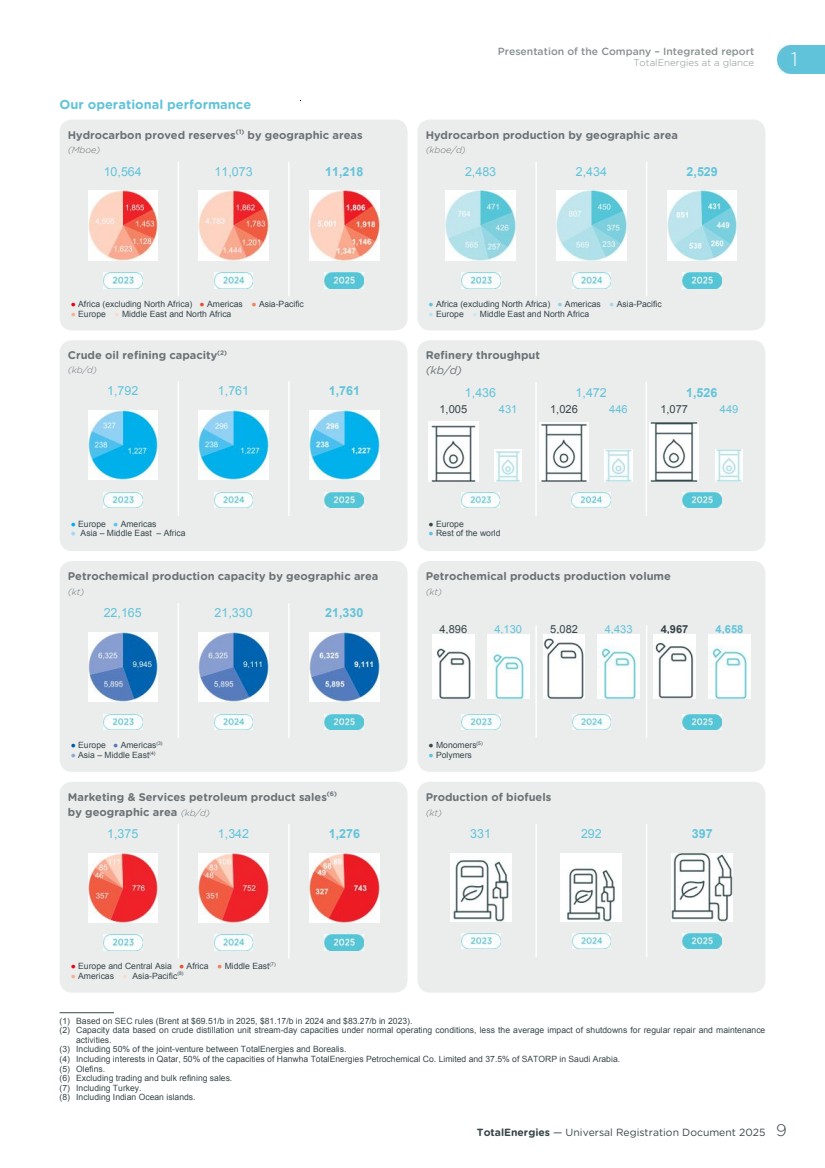
| Our operational performance (1) Based on SEC rules (Brent at $69.51/b in 2025, $81.17/b in 2024 and $83.27/b in 2023). (2) Capacity data based on crude distillation unit stream-day capacities under normal operating conditions, less the average impact of shutdowns for regular repair and maintenance activities. (3) Including 50% of the joint-venture between TotalEnergies and Borealis. (4) Including interests in Qatar, 50% of the capacities of Hanwha TotalEnergies Petrochemical Co. Limited and 37.5% of SATORP in Saudi Arabia. (5) Olefins. (6) Excluding trading and bulk refining sales. (7) Including Turkey. (8) Including Indian Ocean islands. Refinery throughput (kb/d) 1,436 1,472 1,526 1,005 431 1,026 446 1,077 449 ● Europe ● Rest of the world Hydrocarbon proved reserves(1) by geographic areas (Mboe) 10,564 11,073 11,218 ● Africa (excluding North Africa) ● Americas ● Asia-Pacific ● Europe ● Middle East and North Africa Crude oil refining capacity(2) (kb/d) 1,792 1,761 1,761 ● Europe ● Americas ● Asia – Middle East – Africa Petrochemical production capacity by geographic area (kt) 22,165 21,330 21,330 ● Europe ● Americas(3) ● Asia – Middle East(4) Marketing & Services petroleum product sales(6) by geographic area (kb/d) 1,375 1,342 1,276 ● Europe and Central Asia ● Africa ● Middle East(7) ● Americas ● Asia-Pacific (8) Hydrocarbon production by geographic area (kboe/d) 2,483 2,434 2,529 ● Africa (excluding North Africa) ● Americas ● Asia-Pacific ● Europe ● Middle East and North Africa Petrochemical products production volume (kt) 4,896 4,130 5,082 4,433 4,967 4,658 ● Monomers(5) ● Polymers Production of biofuels (kt) 331 292 397 Presentation of the Company – Integrated report TotalEnergies at a glance 1 TotalEnergies — Universal Registration Document 2025 9 |
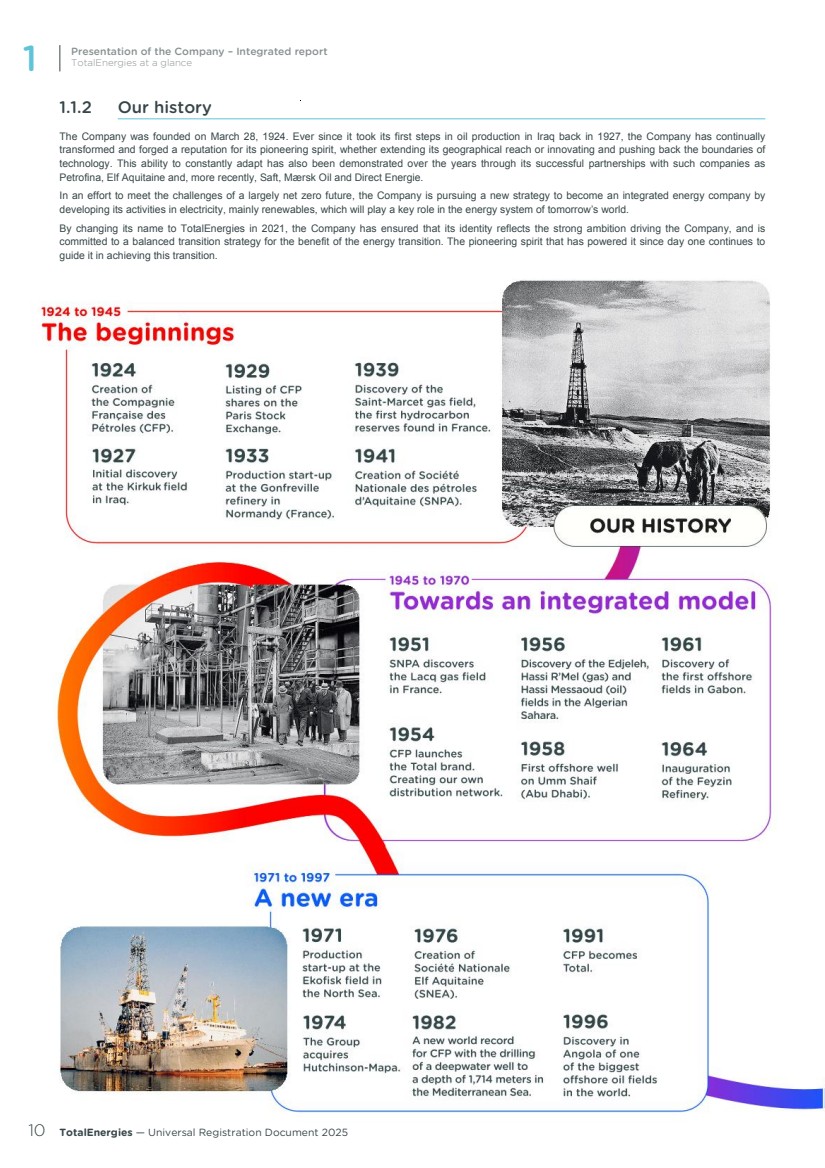
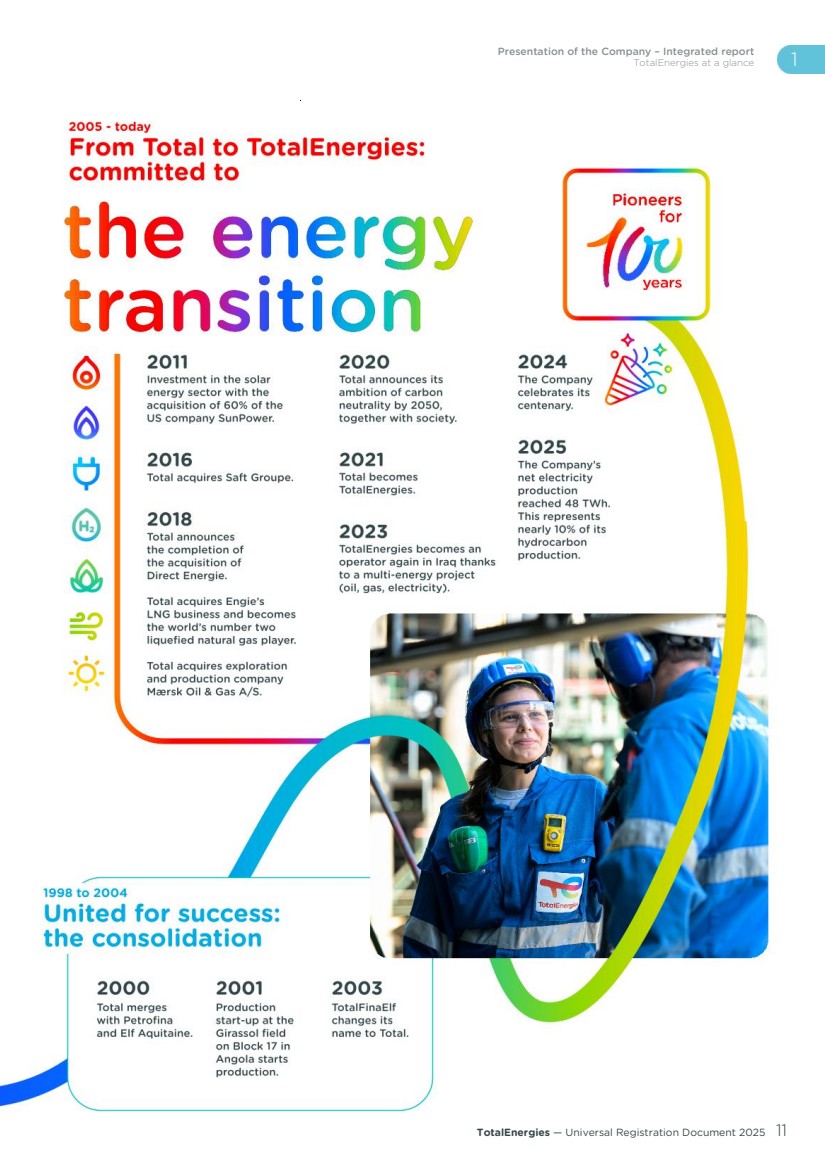
| 1.1.2 Our history The Company was founded on March 28, 1924. Ever since it took its first steps in oil production in Iraq back in 1927, the Company has continually transformed and forged a reputation for its pioneering spirit, whether extending its geographical reach or innovating and pushing back the boundaries of technology. This ability to constantly adapt has also been demonstrated over the years through its successful partnerships with such companies as Petrofina, Elf Aquitaine and, more recently, Saft, Mærsk Oil and Direct Energie. In an effort to meet the challenges of a largely net zero future, the Company is pursuing a new strategy to become an integrated energy company by developing its activities in electricity, mainly renewables, which will play a key role in the energy system of tomorrow’s world. By changing its name to TotalEnergies in 2021, the Company has ensured that its identity reflects the strong ambition driving the Company, and is committed to a balanced transition strategy for the benefit of the energy transition. The pioneering spirit that has powered it since day one continues to guide it in achieving this transition. 1 Presentation of the Company – Integrated report TotalEnergies at a glance 10 TotalEnergies — Universal Registration Document 2025 |
| Presentation of the Company – Integrated report TotalEnergies at a glance 1 TotalEnergies — Universal Registration Document 2025 11 |
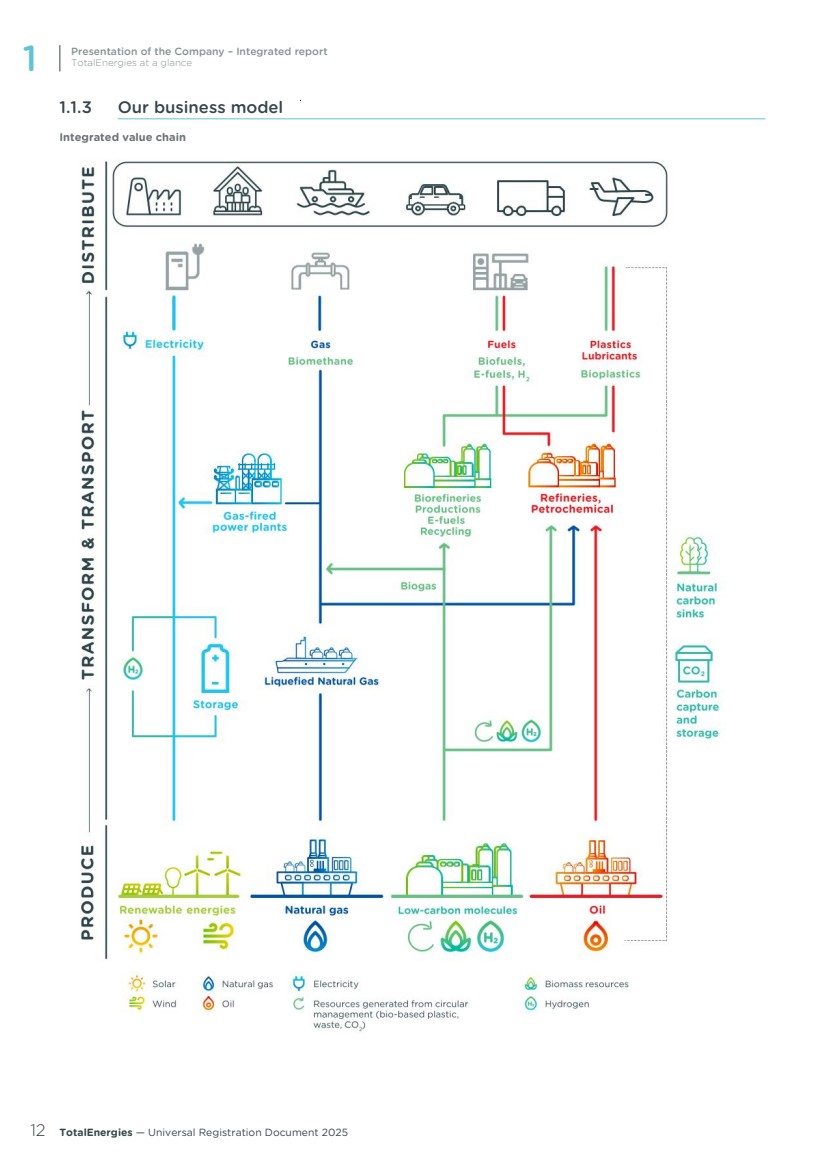
| 1.1.3 Our business model Integrated value chain 1 Presentation of the Company – Integrated report TotalEnergies at a glance 12 TotalEnergies — Universal Registration Document 2025 |
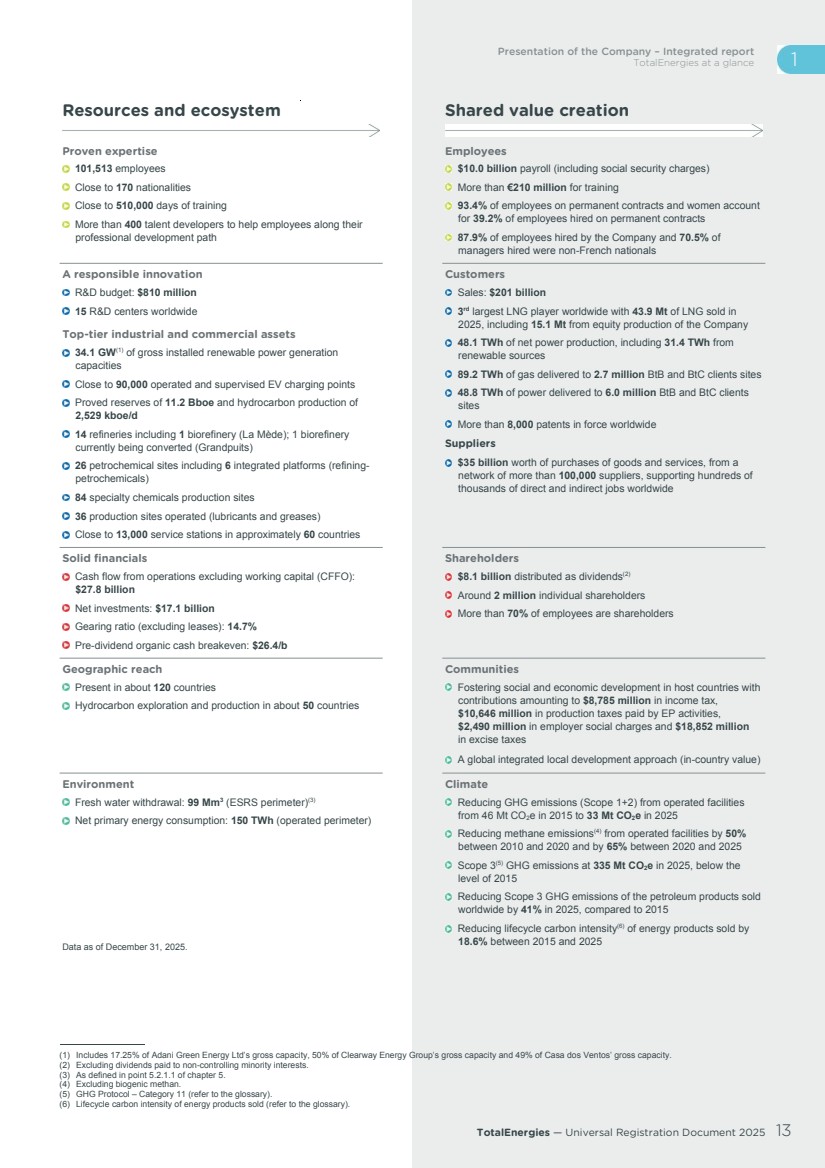
| Resources and ecosystem Shared value creation Proven expertise 101,513 employees Close to 170 nationalities Close to 510,000 days of training More than 400 talent developers to help employees along their professional development path Employees $10.0 billion payroll (including social security charges) More than €210 million for training 93.4% of employees on permanent contracts and women account for 39.2% of employees hired on permanent contracts 87.9% of employees hired by the Company and 70.5% of managers hired were non-French nationals A responsible innovation R&D budget: $810 million 15 R&D centers worldwide Top-tier industrial and commercial assets 34.1 GW(1) of gross installed renewable power generation capacities Close to 90,000 operated and supervised EV charging points Proved reserves of 11.2 Bboe and hydrocarbon production of 2,529 kboe/d 14 refineries including 1 biorefinery (La Mède); 1 biorefinery currently being converted (Grandpuits) 26 petrochemical sites including 6 integrated platforms (refining-petrochemicals) 84 specialty chemicals production sites 36 production sites operated (lubricants and greases) Close to 13,000 service stations in approximately 60 countries Customers Sales: $201 billion 3 rd largest LNG player worldwide with 43.9 Mt of LNG sold in 2025, including 15.1 Mt from equity production of the Company 48.1 TWh of net power production, including 31.4 TWh from renewable sources 89.2 TWh of gas delivered to 2.7 million BtB and BtC clients sites 48.8 TWh of power delivered to 6.0 million BtB and BtC clients sites More than 8,000 patents in force worldwide Suppliers $35 billion worth of purchases of goods and services, from a network of more than 100,000 suppliers, supporting hundreds of thousands of direct and indirect jobs worldwide Solid financials Cash flow from operations excluding working capital (CFFO): $27.8 billion Net investments: $17.1 billion Gearing ratio (excluding leases): 14.7% Pre-dividend organic cash breakeven: $26.4/b Shareholders $8.1 billion distributed as dividends(2) Around 2 million individual shareholders More than 70% of employees are shareholders Geographic reach Present in about 120 countries Hydrocarbon exploration and production in about 50 countries Communities Fostering social and economic development in host countries with contributions amounting to $8,785 million in income tax, $10,646 million in production taxes paid by EP activities, $2,490 million in employer social charges and $18,852 million in excise taxes A global integrated local development approach (in‑country value) Environment Fresh water withdrawal: 99 Mm3 (ESRS perimeter)(3) Net primary energy consumption: 150 TWh (operated perimeter) Data as of December 31, 2025. Climate Reducing GHG emissions (Scope 1+2) from operated facilities from 46 Mt CO2e in 2015 to 33 Mt CO2e in 2025 Reducing methane emissions(4) from operated facilities by 50% between 2010 and 2020 and by 65% between 2020 and 2025 Scope 3 (5) GHG emissions at 335 Mt CO2e in 2025, below the level of 2015 Reducing Scope 3 GHG emissions of the petroleum products sold worldwide by 41% in 2025, compared to 2015 Reducing lifecycle carbon intensity(6) of energy products sold by 18.6% between 2015 and 2025 (1) Includes 17.25% of Adani Green Energy Ltd’s gross capacity, 50% of Clearway Energy Group’s gross capacity and 49% of Casa dos Ventos’ gross capacity. (2) Excluding dividends paid to non-controlling minority interests. (3) As defined in point 5.2.1.1 of chapter 5. (4) Excluding biogenic methan. (5) GHG Protocol – Category 11 (refer to the glossary). (6) Lifecycle carbon intensity of energy products sold (refer to the glossary). Presentation of the Company – Integrated report TotalEnergies at a glance 1 TotalEnergies — Universal Registration Document 2025 13 |
| 1.2 Our transition strategy 1.2.1 Global challenges: more energy, less emissions Since the Paris Agreement in 2015, states have made a joint commitment “to strengthen the global response to the threat of climate change, in the context of sustainable development and the fight against poverty, including by containing the rise in global average temperature to well below 2 °C above pre-industrial levels and continuing action to limit the rise in temperature to 1.5°C above pre-industrial levels.” TotalEnergies supports the objectives of the Paris Agreement and is deploying a strategy to meet the needs of both development and energy transition: more energy and less emissions. More energy to fuel human development Energy access is essential to human development The United Nations Human Development Index (HDI) measures well-being in terms of health, education and living standards (GDP). HDI increases dramatically with energy access for low levels (below ~70 GJ/cap). Above 240 GJ/cap incremental energy does not significantly improve human development. Access to energy is essential for human development. The figure above, adapted from the work of energy historian Vaclav Smil, shows that the human development index increases with the energy available per capita. The available energy must exceed the threshold of 70 GJ/capita to reach an index level deemed sufficient. Today, around 4.6 billion people live below this threshold. Getting them there today would require a 3-fold increase in the energy available to them. By 2050, taking into account the demographic growth of these populations, the energy available will have to be multiplied by 4. Recent history shows that such an increase is possible: between 2000 and 2022, China increased its available energy per capita by a factor of 3, from ~40 to ~120 GJ/capita, lifting ~800 million people out of poverty. This historic economic and social development resulted from the massive exploitation of coal, an abundant and often cheap source of domestic energy. The challenge of the energy transition is therefore twofold: (i) to decarbonize the “mature” energy systems of developed countries, and (ii) to increase the energy available in the Global South and India by fuelling economic and social development with low-carbon electricity rather than coal. Less emissions Global anthropogenic GHG emissions in 2023 (Gt CO2e) Available technologies to reduce GHG emissions and their potential impact (a) “Methane from fossil fuels”, includes methane emissions from the production and transport of fossil and bioenergy fuels. (b) Including heat combined with power. (c) Includes energy sector own use, transport losses and energy transformation. Sources: IEA, Enerdata, UNEP, CITEPA, EDGAR, TTE analysis. 1 Presentation of the Company – Integrated report Our transition strategy 14 TotalEnergies — Universal Registration Document 2025 |
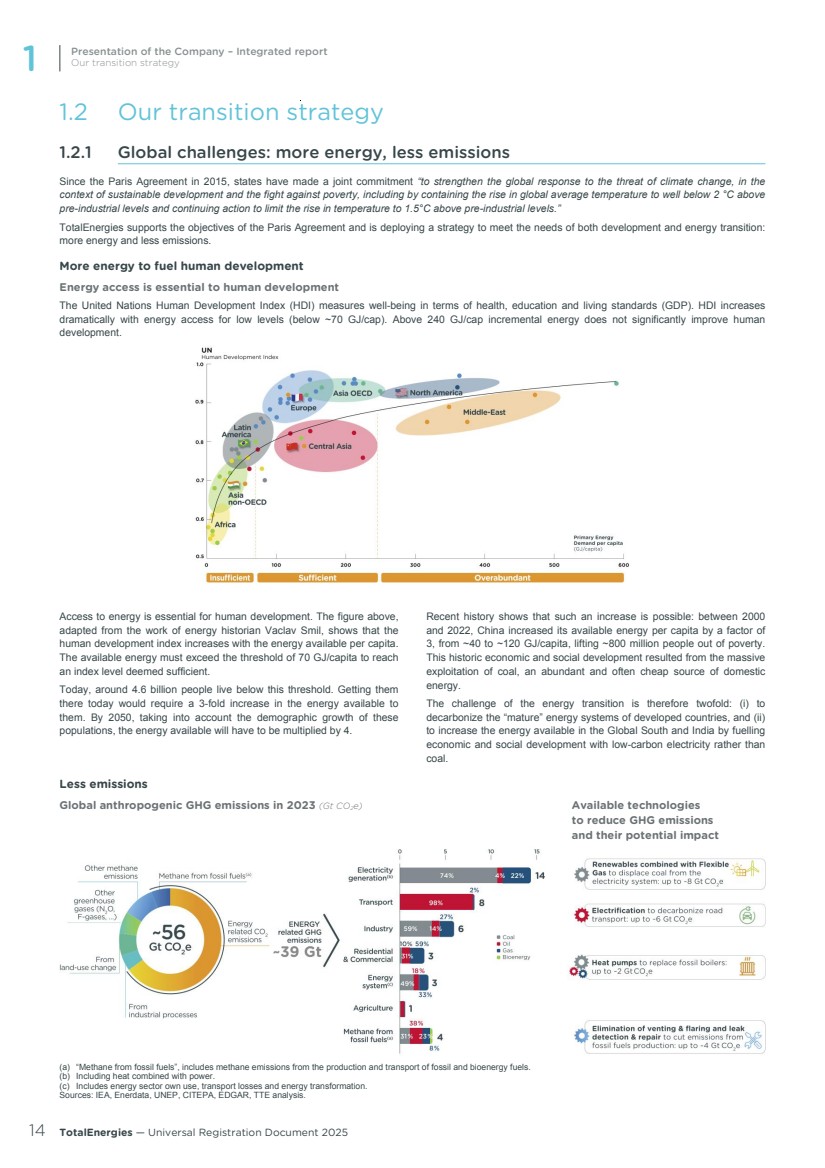
| In 2023, GHG emissions from the energy system accounted for 39 billion tonnes of the 56 billion tonnes of anthropogenic GHG emissions. Burning coal to produce electricity is the biggest contributor, at around 10 Gt CO2, followed by using oil for transport, at around 8 Gt. Since 2023, the decoupling between global energy demand and CO₂ emissions from the energy system has been clearly widening. Already observable since the Paris Agreement (with annual emissions growth limited to +0.9%, compared with +1.6% for energy demand), this trend has strengthened: between 2023 and 2024, primary energy consumption increased by 2.2%, while the associated CO₂ emissions rose by only 0.8%. The decline in the carbon intensity of the global energy system has become clearly measurable. The global deployment of mature and competitive low-carbon technologies would make it possible to eliminate around 20 of these 39 Gt: – solar and wind – and natural gas to ensure the long-term balancing of the system – to produce electricity; – electric vehicles and heat pumps to use it, and – technologies to reduce methane emissions in the energy system. Reconciling economic and social development with the fight against climate change requires a pragmatic approach to deploy low-carbon technologies at a global scale, taking into account their cost (cost merit curve) and technological maturity. While real progress has been made since the Paris Agreement, experts now consider the goal of limiting global warming to +1.5 °C by 2100 to be out of reach. Achieving it would require, in particular, significantly strengthened international cooperation and massive financial support to enable developing countries to accelerate their decarbonization well beyond current trends. 1.2.2 A two-pillar multi-energy strategy TotalEnergies stays the course of its balanced integrated multi-energy strategy... TotalEnergies reaffirms the relevance of its balanced integrated multi-energy strategy considering the developments in the oil, gas and electricity markets. Anchored on two pillars, oil & gas, notably LNG, and electricity, the energy at the heart of the transition, the Company plans to increase its energy production (hydrocarbons and electricity) by +4% per year between 2024 and 2030 and is in a very favorable position to take advantage of energy prices evolution. Thanks to the refocusing of the oil & gas portfolio on assets and projects with low breakeven and low greenhouse gas emissions, and to the diversification into electricity, notably renewable, through an integrated strategy from production to customer, the Company is implementing its transition strategy while ensuring an attractive shareholder return policy. ... responsibly producing low cost, low emissions oil & gas... While drastically lowering the emissions of greenhouse gas from its operations, TotalEnergies plans to grow its oil & gas production by around 3% per year over the next five years, predominantly from LNG, thanks to its rich low cost, low emission project portfolio which has been the subject of major investment decisions in 2025 to ensure its medium‑term growth. The Company will put more than ten projects into production by 2030 starting from 2025-2026, in oil in the United States, Brazil, Iraq and Uganda and in gas in Argentina, Nigeria, Malaysia, Qatar and Mexico. In 2027 and 2028, the start-ups of LNG projects will follow in Qatar, the United States, and Oman. At the same time, the Company strengthens its leading position in Europe in regasification and its leading LNG exporter position in the United States. The oil projects developed, like the liquefaction plant projects, are well positioned on their respective merit curves, enabling them to generate value for the Company, even in a low-price scenario. The key indicator of its progress on this pillar is the reduction in Scope 1+2 emissions of its oil & gas assets because its first duty as a producer of hydrocarbons is to reduce the greenhouse gas emissions linked to their production. ... and developing a profitable and differentiated Integrated Power model to create a future cash engine of the Company. TotalEnergies is replicating its integrated oil & gas business model into the electricity value chain to achieve a profitability (ROACE(1)) of ~12% for the Integrated Power segment, equivalent to Upstream oil & gas ROACE at 60 $/b, above the returns of the traditional Utilities model. The Company is building a world class cost-competitive portfolio combining renewable (solar, onshore wind, offshore wind) and flexible assets (CCGT, storage) to deliver low-carbon electricity available 24/7. In particular, TotalEnergies is leveraging its scale effect in equipment purchases and digital to lower its operational costs in its renewable assets. TotalEnergies also uses the strength of its balance sheet to increase its market exposure from 10% in 2024 to 30% in 2030, allowing it to capture additional margins in a volatile market. Finally, the last lever is the recycling of capital through farm-downs of post-development assets in order to reinvest in new projects. The Company plans to increase its annual electricity production to 100‑120 TWh (mainly from renewable sources) by 2030 by allocating a significant investment effort to low-carbon energies, mainly in the Integrated Power segment of $3 to $4 billion per year for the period 2026-2030, including approximately $1 billion per year on average over five years in shares as part of the transaction with EPH(2) . In 2025, the generated cash flow of this segment was $2.6 billion and is expected to exceed $3 billion in 2026, the Integrated Power segment becoming net cash flow positive from 2027. Additionally, TotalEnergies also invests in a targeted manner in low-carbon molecules (biofuels, SAF and biogas, as well as hydrogen and its derivatives: e-fuels) as part of an “equity light” business model with partners. The key indicator of its progress to measure our transition towards low-carbon energy products is the lifecycle carbon intensity(3) of the energy products used by the Company’s customers. The reduction in carbon intensity reflects the lower carbon content of the energy sold to our customers and the Company’s progress in implementing its transition strategy. This intensity decreased by 18.6% between 2015 and 2025. (1) Refer to the glossary for definitions and additional information on alternative performance measures (APM, Non-GAAP measures) and to point 1.8 for reconciliation tables. (2) The transaction remains subject to information‑consultation processes and regulatory approvals, with completion expected in mid‑2026. (3) Lifecycle carbon intensity of energy products sold (refer to the glossary). Presentation of the Company – Integrated report Our transition strategy 1 TotalEnergies — Universal Registration Document 2025 15 |
| 1.2.3 TotalEnergies’ ambition in terms of sustainable development and energy transition towards carbon neutrality, together with society 1) TotalEnergies’ Climate Ambition TotalEnergies supports the Paris Agreement, with its call to reduce greenhouse gas emissions in the context of sustainable development and poverty eradication, and its overarching goals to limit planetary warming to well below 2 °C by 2100 compared with pre‑industrial levels. Climate change is a reality and requires the collective mobilization of all stakeholders. The 2015 Paris Agreement significantly raised the awareness of the need to tackle climate change and prompted an enhancement of collective action to start transitioning the global energy system. A massive transformation of the world’s energy systems is needed to achieve the Paris goals. The dual challenge of “more affordable energy for all and less carbon emissions” is a challenge for society as a whole, where governments, investors, companies and consumers all have important roles to play. In 2020, TotalEnergies outlined for the first time its ambition to aim for carbon neutrality together with society. The adoption of this ambition was supported by the strategy to become a broad-based energy company, expanding from oil and gas to low carbon electricity and other low carbon energies. It was also part of a shareholder dialogue process with Climate Action 100+ (CA 100+), a coalition of investors committed to the energy transition. This ambition set out three steps for TotalEnergies to get to Net Zero together with society: net zero for TotalEnergies’ global operated emissions (Scope 1+2), net zero covering direct and indirect emissions (Scope 1+2+3) in Europe, and a 60% reduction in the average carbon intensity of energy products sold to our customers (CI) globally by 2050 compared to 2015. In 2021, as a result of a continuous dialogue with some shareholders, the Board of Directors broadened the net zero ambition together with society so as to cover direct and indirect emissions (Scope 1+2+3) on a worldwide basis. Within the framework of its first corporate sustainability report (CSRD) published in March 2025 as required by the EU, TotalEnergies characterized its “together with society” approach by underlining some dependencies and uncertainties: “The energy transition requires the participation of all stakeholders, from regulatory authorities to end customers and industrial players. TotalEnergies is deploying a strategy that supports this collective transition and will enable our Company to adapt to the various scenarios that may materialize depending on developments in low-carbon technologies (speed of penetration, cost reduction), geopolitical relations, international trade, and consumer behavior.” 2) TotalEnergies’ energy transition strategy supporting the Ambition As part of this Ambition, the Company has defined and consistently implemented a balanced transition strategy based on two pillars: – An Oil & Gas pillar centered on low cost and low emission projects: the Company continues to invest in existing fields and new oil and gas projects, and plans to increase its production of hydrocarbons – mainly LNG, a key energy source for the energy transition – by 3% per year on average until 2030, so as to meet growing energy demand and fight the natural decline of oil and gas fields (averaging 6-7% per year for the industry according to the 2025 IEA report). In parallel, TotalEnergies has published a roadmap to reduce emissions from its operations: it aims to achieve a 40% net reduction in its operated emissions (Scope 1+2) in 2030 compared to 2015, and an 80% reduction in its operated methane emissions in 2030 or sooner compared to 2020. – An Integrated Power pillar: the Company is building a competitive portfolio of renewable (solar, onshore wind, offshore wind) and flexible assets (CCGT, storage) to provide its customers with low-carbon electricity available 24 hours by 7. We plan to increase our electricity production to more than 100 TWh by 2030, which would represent 20% of our energy production by that date. In addition, we are investing in low-carbon molecules, particularly biofuels and sustainable aviation fuels (SAF). A key measure of our contribution to the transition of our customers and the global energy systems is the life-cycle Carbon Intensity of the energy products sold to our customers (CI). The decline in our CI reflects our progress in implementing our transition strategy, since it means that the carbon content of the energy products we sell to our customers is decreasing, on an energy unit basis. In 2025 our life-cycle Carbon Intensity was down by more than 18% compared to 2015. By 2030 we target a reduction of 25%. Our 2025 earnings demonstrate that our differentiated strategy built around these two pillars is delivering best in class returns, thereby creating long term value for our shareholders while supporting our climate ambition. 3) Ten years after the Paris Agreement: Confronting Net Zero ambitions to realities While the Company’s transition strategy is based on solid market fundamentals and will be consistently pursued, the Company notes that the context in which its Ambition was adopted has evolved. a) Ten years after the Paris Agreement, the global energy system has progressed by enabling the continued development of emerging economies while reducing the carbon intensity of the energy mix. Affordable low-carbon technologies have experienced spectacular growth, for example solar panels or, in some parts of the world, electric vehicles. Yet the share of fossil fuels in the overall energy mix has hardly moved (from 82% to 80%) because the cleaner energy sources have not eliminated traditional energies but have mostly been added to the existing system as population and energy demand continue to grow steadily. Since 2015, economic and geopolitical conditions have shifted, with rising interest rates making transition finance more expensive and the weaponization of energy putting energy security at the top of every country’s agenda. States have to balance the energy trilemma between energy reliability, energy affordability and sustainability. Non-State actors have had to balance these competing priorities too. Our societies and economies have initiated an energy but the global economy is not yet achieving the pace of change required to meet the Paris Agreement objectives. Against this backdrop, at COP30 in Belem in Nov. 2025, there was a common finding – by UNFCCC, UNEP and the international community – that the updated Nationally Determined Contributions for 2035 provided by the States fall behind what is needed to reach the Paris goals. 1 Presentation of the Company – Integrated report Our transition strategy 16 TotalEnergies — Universal Registration Document 2025 |
| b) The current scientific consensus now emphasizes that the goal of limiting global warming to 1.5°C above pre-industrial levels is out of reach. Climatologists, including ones contributing to the IPCC work, and scientists have explicitly shared these views with the media and the public at large in 2025. Similarly, the International Energy Agency states in its 2025 World Energy Outlook report that “It is now all but certain that 1.5°C of warming will be exceeded within a decade or less, and that pathways that limit this overshoot of 1.5°C to low levels have now slipped out of reach.” These scientific findings are closely linked to the inertia of the energy system, which still relies on fossil fuels for nearly 80% of its energy: despite the massive deployment of solar and wind, coal still plays a dominant role in electricity generation and accounts for three-quarters of the 14 billion tons of CO2 emitted each year by power plants; the penetration of low-carbon technologies to electrify and decarbonize uses is hampered by cost considerations and sometimes by technological maturity constraints. c) The legal and regulatory framework applicable to sustainability and climate has evolved. For European companies, the corporate sustainability reporting directive (CSRD) and associated reporting standards (ESRS) in force since 2025 have established a legally binding framework: targets using the words “net zero” require the adoption of “transition plans” (as defined by the regulations), and companies that adopt such plans must explain how these plans are compatible with a warming trajectory of 1.5°C by 2050 — which we know the scientific consensus now considers out of reach. Based on the current state of scientific knowledge, in light of the growing heterogeneity of energy pathways at the global level, the reliance by forward‑looking scenarios on assumptions that may not materialize, and the ongoing uncertainties regarding the evolution of global energy demand, worldwide GHG emissions and the effective pace of deployment of low‑carbon technologies, the Company is not in a position to adopt a transition plan as defined by the European reporting standards and, as a result, cannot formulate “Net Zero” targets in the meaning of these standards. 4) The pathways to our carbon neutrality ambition together with society will need to be reassessed and adapted over time In order to take these realities into account, particularly the legal framework created by the European corporate sustainability reporting directive regarding “Net Zero” taxonomy, TotalEnergies has no choice but to evolve the wording and to precise the dependencies of its carbon neutrality ambition, together with society. “More Energy, Less Emissions, Fully engaged in our transition strategy” TotalEnergies is fully engaged in its balanced, value-creating, transition strategy based on 2 pillars: an oil & gas pillar and an integrated power pillar. This transition strategy supports TotalEnergies’ ambition for carbon neutrality, together with society, within the framework set out by the Paris Agreement’s objectives. We acknowledge that our ability to achieve carbon neutrality is linked to our own efforts and to society’s broader progress in this area. Therefore: – TotalEnergies aims to achieve carbon neutrality for its global operated emissions (Scope 1+2) by 2050 – The Company works proactively with its customers to help execute their own energy transition strategies and puts on the market a mix of energies with a lower carbon intensity year after year. Our ability to do so depends critically on the pace and affordability of technical innovation, on public policies and on consumers’ behavior. This is what is encapsulated in “together with society”. Without the right policies and enough cost-efficient innovation, carbon neutrality by 2050 will remain out of reach – for society and for TotalEnergies. As a result of these dependencies, the pathways to our carbon neutrality ambition will need to be reassessed and adapted over time. On the way to its ambition, TotalEnergies confirms its targets set for 2030 for reducing emissions worldwide: a 40% net reduction of its Scope 1+2 operated emissions compared to 2015, an 80% reduction of its operated methane emissions in 2030 or sooner compared to 2020 and a 25% reduction of its life cycle carbon intensity (CI - Scope 1+2+3) of the energy products sold to its customers compared to 2015. 1.2.4 2030: Our objectives for more energy and less emissions Over the decade 2020-2030, TotalEnergies’ energy transition strategy based on two pillars is reflected in the production targets shown below. TotalEnergies plans to increase its energy production (oil, gas and electricity), overall by 4% per year between 2024 and 2030. In 2025, its electricity production accounted for nearly 10% of its hydrocarbon production. Its objective is to increase it to 20% in 2030. At the same time, the Company is pursuing its trajectory of reducing its emissions (Scope 1+2 CO2 and methane) from its operated facilities with the view to reducing net emissions(1) by 40% by 2030 compared with 2015 and to reducing its operated methane emissions by 80% in 2030 or sooner compared to 2020. The growth of its electricity sales allows the Company to target a 25% reduction in the lifecycle(2) carbon intensity of its sales by 2030 compared to 2015. (1) The calculation of net emissions includes nature-based carbon sinks projects as of 2030. (2) Lifecycle carbon intensity of energy products sold (refer to the glossary). Presentation of the Company – Integrated report Our transition strategy 1 TotalEnergies — Universal Registration Document 2025 17 |
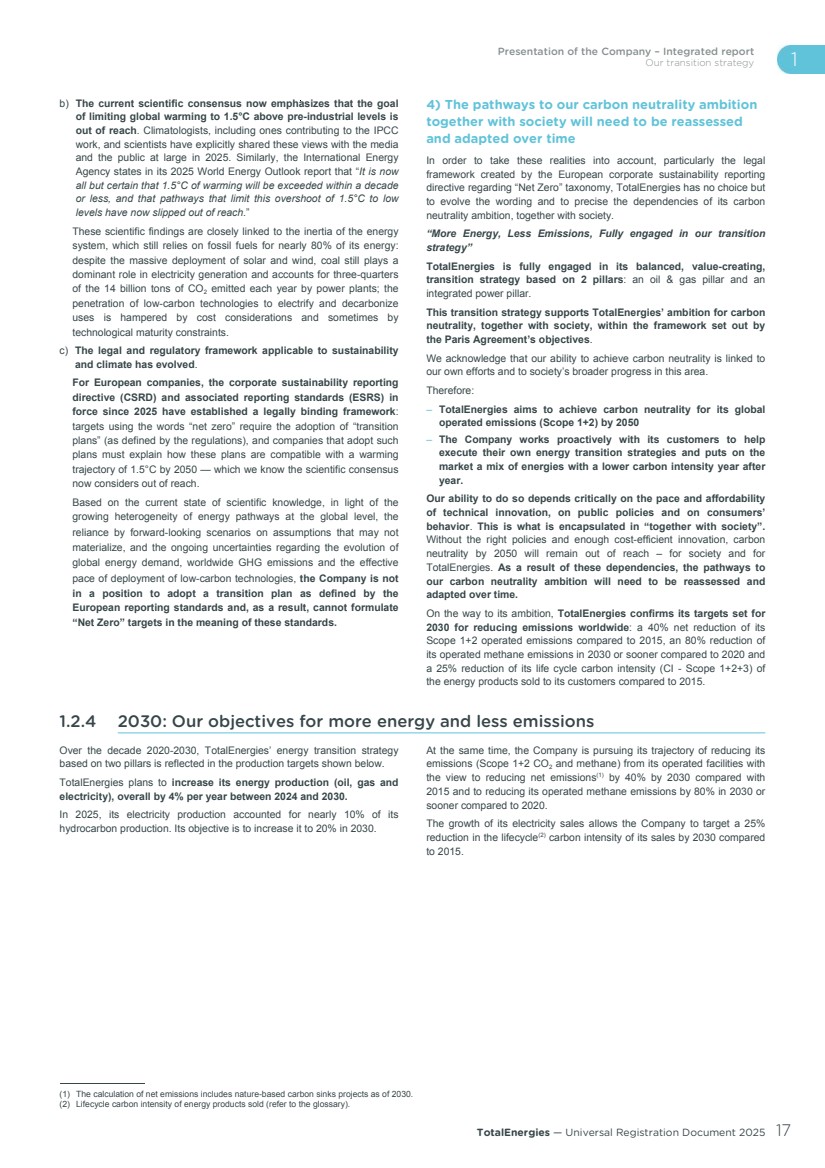
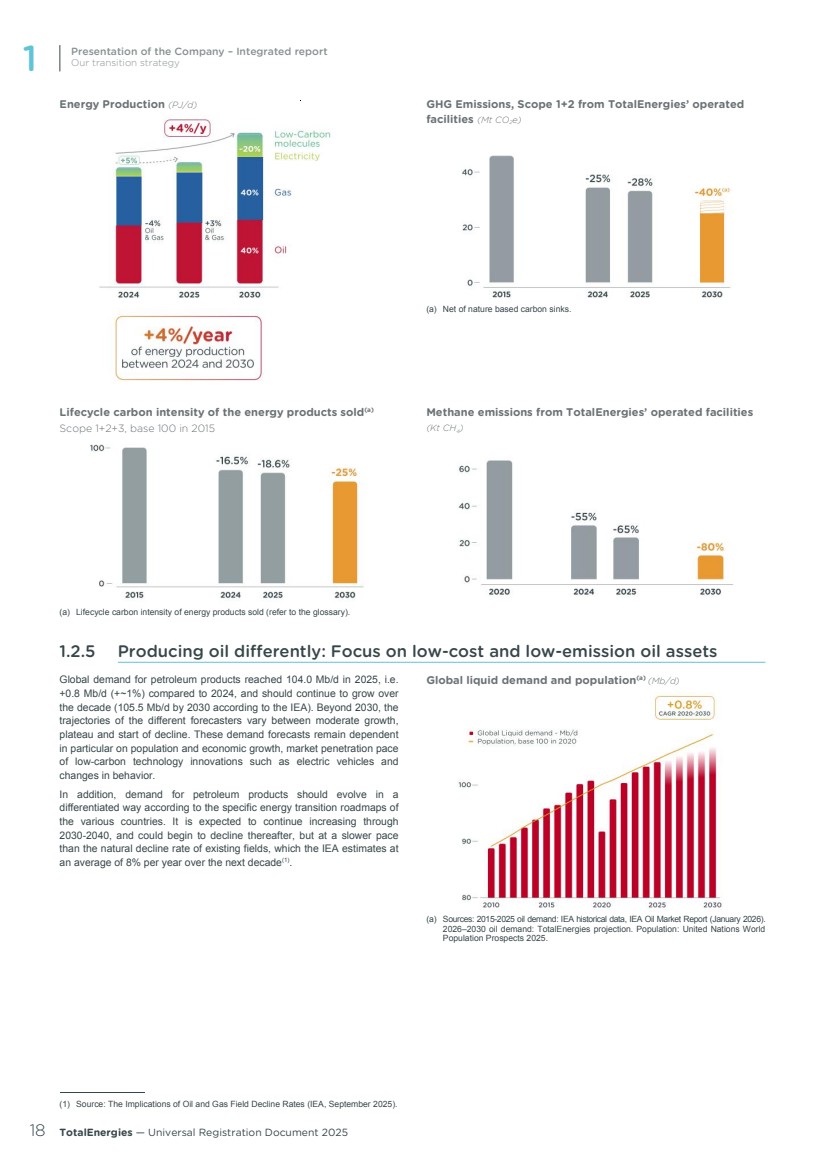
| Energy Production (PJ/d) GHG Emissions, Scope 1+2 from TotalEnergies’ operated facilities (Mt CO2e) (a) Net of nature based carbon sinks. Lifecycle carbon intensity of the energy products sold(a) Scope 1+2+3, base 100 in 2015 (a) Lifecycle carbon intensity of energy products sold (refer to the glossary). Methane emissions from TotalEnergies’ operated facilities (Kt CH4) 1.2.5 Producing oil differently: Focus on low-cost and low-emission oil assets Global demand for petroleum products reached 104.0 Mb/d in 2025, i.e. +0.8 Mb/d (+~1%) compared to 2024, and should continue to grow over the decade (105.5 Mb/d by 2030 according to the IEA). Beyond 2030, the trajectories of the different forecasters vary between moderate growth, plateau and start of decline. These demand forecasts remain dependent in particular on population and economic growth, market penetration pace of low-carbon technology innovations such as electric vehicles and changes in behavior. In addition, demand for petroleum products should evolve in a differentiated way according to the specific energy transition roadmaps of the various countries. It is expected to continue increasing through 2030-2040, and could begin to decline thereafter, but at a slower pace than the natural decline rate of existing fields, which the IEA estimates at an average of 8% per year over the next decade(1) . Global liquid demand and population(a) (Mb/d) (a) Sources: 2015-2025 oil demand: IEA historical data, IEA Oil Market Report (January 2026). 2026–2030 oil demand: TotalEnergies projection. Population: United Nations World Population Prospects 2025. (1) Source: The Implications of Oil and Gas Field Decline Rates (IEA, September 2025). 1 Presentation of the Company – Integrated report Our transition strategy 18 TotalEnergies — Universal Registration Document 2025 |
| TotalEnergies therefore believes that new oil projects are still needed to meet this demand and to keep prices at an acceptable level in order to create the conditions for a just transition that gives people time to adapt their energy use. In 2025, TotalEnergies produced 1.4 Mb/d of oil, equivalent to its 2019 level, representing around 1.5% of world production. TotalEnergies’ first responsibility as an oil producer is to produce differently, by reducing emissions to the minimum. To that end, it approves hydrocarbon projects on the basis of performance criteria, notably technical costs and carbon intensity (Scope 1+2). The Company operates its fields in accordance with strict requirements concerning safety, emissions reduction and environmental impact. The cash flow generated by these Oil and Gas activities contributes to financing its investments in renewable energy. 1.2.6 Liquefied Natural Gas: a key fuel for the energy transition In the gas markets, TotalEnergies focuses on Liquefied Natural Gas (LNG), which can be shipped everywhere in the world and thus contributes to energy security, as it has been the case in Europe where pipeline deliveries of Russian gas have sharply declined since 2022 and fell further with the halt of transit through Ukraine at the end of 2024. The growth of renewable electricity, intermittent and seasonal by nature, will require an increase in flexible power generation resources. The dispatchable generation of gas-fired power plants helps secure electricity supply against weather variability affecting renewables, while also responding to fluctuations in demand. In addition, natural gas plays an essential role in reducing emissions from power generation as a replacement of coal, emitting half as much GHG for the same amount of electricity produced(1) . It is particularly the case in Asia where coal still accounts for a very large part of the electricity mix of many countries (e.g., 60% in China, 70% in India) (2) . With diversified positions, and in particular a leading position of exporter from the United States – over 19 Mt in 2025 – TotalEnergies is the world’s 3 rd largest LNG player, with 44 Mt sold in 2025. In 2025, the Company also signed various LNG sales contracts with major Asian customers, particularly in South Korea and India. In line with its balanced multi-energy strategy, TotalEnergies intends to consolidate its integrated position across the entire LNG value chain. Between 2025 and 2030, LNG volumes (from equity and long-term third-party purchases, excluding Russia after 2027) are expected to grow by 50%. TotalEnergies intends to focus on improving the flexibility and resilience of its LNG portfolio by investing in low-cost liquefaction projects, which are best positioned on the merit curve, and to continue growing its Brent-indexed sales in Asia. A growing, diversified and flexible LNG portfolio Reducing the carbon footprint of the LNG portfolio TotalEnergies aims to gradually reduce GHG emissions of the LNG value chain, from gas production to end use. In addition to its efforts to reduce methane emissions, initiatives are being implemented throughout the whole chain. The electrification of liquefaction plant processes is helping to reduce LNG’s carbon footprint today, and tomorrow this reduction will be reinforced by CO2 capture and storage projects. Thus, the average carbon intensity of the Company’s LNG liquefaction portfolio reached around 28 kg CO₂e/bep(3) in 2025. It ranges from 22 to 26 kg CO₂e/bep for new plants and can be reduced to less than 3 kg CO₂e/bep when the facility is electrified and powered by carbon-free electricity, as it is the case in the Marsa LNG project. TotalEnergies is also working to reduce shipping emissions by renewing its fleet of chartered LNG carriers with modern, high-performing vessels. (average age of the fleet under long-term charter: 7 years versus 11 years for the global fleet of LNG carriers(4)). All LNG carriers chartered by TotalEnergies use LNG as fuel. Furthermore, TotalEnergies actively supports the industry’s efforts to reduce “methane slip” (emission of unburned methane in engines) and joined the MAMII (Methane Abatement in Maritime Innovation Initiative) in February 2024. (1) Source: IEA Emission Factors Package - 2025. (2) Source: Enerdata. (3) Source: TotalEnergies, calculations based on the plants in which TotalEnergies holds an interest and on the principles presented by the IEA in its report “The Oil and Gas Industry in Net Zero Transitions” (2023). (4) Source: S&P. Presentation of the Company – Integrated report Our transition strategy 1 TotalEnergies — Universal Registration Document 2025 19 |
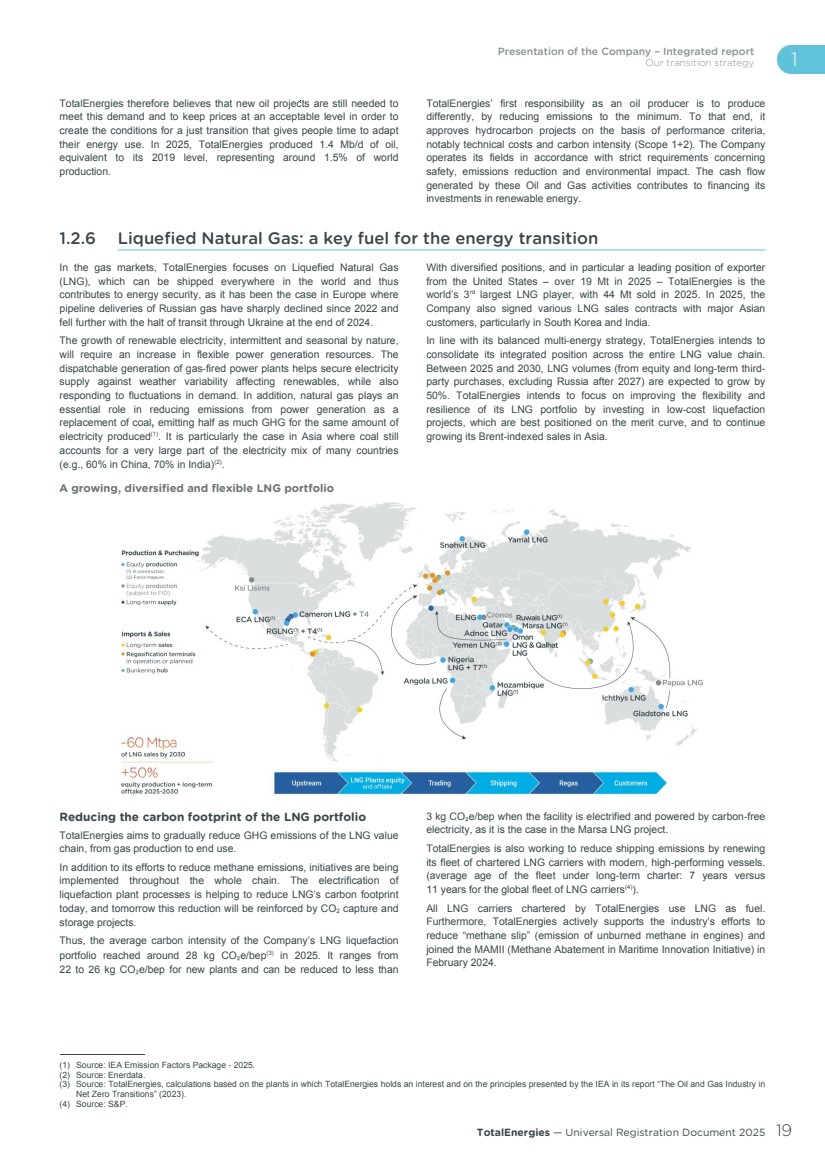
| 1.2.7 Our major development in electricity: an integrated approach Electricity demand, which is essential to the success of the energy transition, is expected to grow sharply(1) , as decarbonization is at the heart of the roadmaps of countries committed to carbon neutrality by 2050. In response, Integrated Power, the second pillar of the Company’s strategy, is developing an integrated model encompassing the entire value chain, from power generation to sales and trading activities, with a profitability target of around 12% ROACE(2) . By 2030, TotalEnergies aims to achieve net electricity production of 100-120 TWh, mainly from renewable sources. As part of its transformation into an integrated multi-energy company, TotalEnergies is building a competitive portfolio of renewable (solar, onshore and offshore wind) and flexible (CCGT, storage) assets to provide its customers with an increasing share of carbon-free electricity available 24/7. In deregulated markets, TotalEnergies deploys its integrated model across the entire value chain, from electricity generation based on renewable and flexible assets to sales and trading activities. This strategy focuses on three key areas - Europe, the United States, and Brazil - which are expected to account for around 70% of its production volumes. In regulated markets, TotalEnergies is implementing a targeted growth strategy in renewables. In oil and gas producing countries, TotalEnergies supports the local energy transition by developing renewable electricity projects that contribute to the reduction of emissions of its oil and gas projects. This model enables renewable projects to be financed through revenues generated by oil and gas activities. In the rest of the world, TotalEnergies is pursuing selective development of renewable projects, focusing on markets large enough to benefit from economies of scale (such as India and South Africa) and through strategic partnerships with local players. The Company’ levers to grow with a return on average capital employed of around 12% are selectivity in its choices of projects; integration across the entire electricity value chain; cost control using its project management and offshore development skills; mobilizing external financing at competitive rates and farm-downs to accelerate cash flow generation and diversify its portfolio’s exposure. Power generation by 2030 1.2.8 Our renewable electricity build-up TotalEnergies is executing its roadmap in renewables, which is part of the Company’s objective to reach 100-120 TWh of gross electricity generation by 2030. At the end of 2025, TotalEnergies has reached a gross installed production capacity of 34 GW of renewable electricity and is actively pursuing the development of these activities to bring this capacity to 80 GW by 2030, a level that should make it one of the world’s top five producers of renewable electricity (wind and solar), Chinese producers set aside. Gross installed capacity of renewable electricity generation(a) (GW) (a) Including 17.25% of Adani Green Energy Ltd’s gross capacity, 50% of Clearway Energy Group’s gross capacity and 49% of Casa dos Ventos’ gross capacity. In GW Solar Onshore wind Offshore wind Storage and hydroelectricity Total France 1.4 0.9 0.0 0.2 2.5 Rest of l’Europe 0.7 1.7 1.1 0.3 3.8 Africa 0.3 0.0 0.0 0.4 0.7 Middle East 1.3 0.0 0.0 0.0 1.3 North America 7.3 2.3 0.0 1.0 10.6 South America 0.6 1.8 0.0 0.0 2.4 India 9.7 0.6 0.0 0.0 10.3 Asia-Pacific 1.8 0.0 0.6 0.0 2.5 Total 23.1 7.3 1.8 1.9 34.1 (1) Estimated average annual growth of nearly 2.5% between 2023 and 2050. Sources: Enerdata, TotalEnergies internal analysis. (2) Refer to the glossary for definitions and additional information on alternative performance measures (APM, Non-GAAP measures) and to point 1.8 for reconciliation tables. 1 Presentation of the Company – Integrated report Our transition strategy 20 TotalEnergies — Universal Registration Document 2025 |
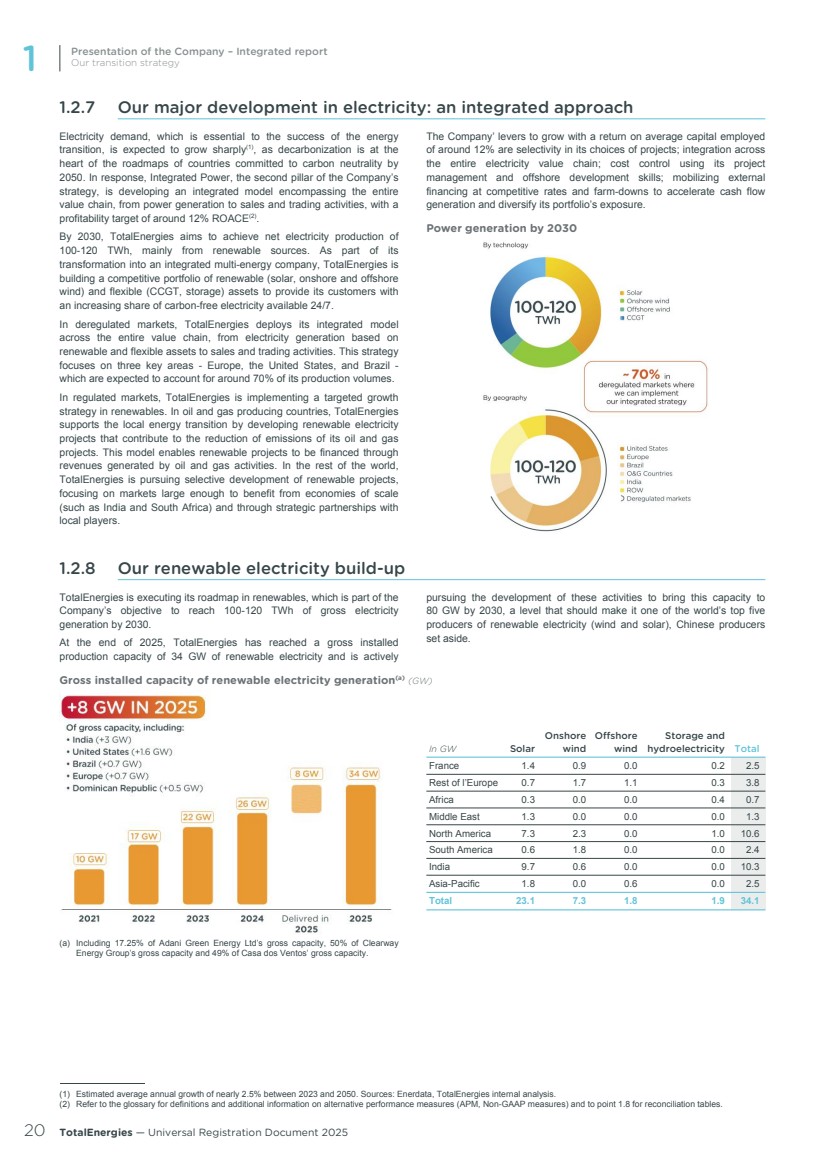
| 1.2.9 Anticipating changes in demand by adapting our sales of petroleum products TotalEnergies’ downstream business has been a steady contributor to the Company’s results, while transitioning and adapting its activities to focus on high value-added markets. The Company is addressing the sustainability challenges of its downstream activities through 3 levers: – lowering the breakeven point of its refining-petrochemicals assets in a cyclical industry; – reducing GHG emissions from its operations; – offering customers low-carbon mobility solutions. In Refining & Chemicals, TotalEnergies is continuing to develop its biofuels business. It is capitalizing on its existing assets by implementing SAF production by co-processing raw materials from waste and residues (used cooking oils and animal fats), excluding first generation 1G biomass (in competition with food consumption) in jet units in operation or by converting existing refineries into biorefineries (La Mède since 2019 and Grandpuits from 2026). For the Marketing & Services, TotalEnergies executes a three-fold Value over Volume strategy: – Network: focusing on geographies where it has a competitive advantage, such as France, Africa and certain niche markets, in order to adapt to the evolving demand for petroleum products, particularly in Europe as part of the implementation of the “Fit for 55” program; – Lubricants: differentiating ourselves through high value-added, high-margin products and developing more sustainable products to meet growing demand for circular products (RRBO(1)); – Electric mobility: align its investments with the pace of electric vehicle adoption by users, develop its positions in high-power charging in Europe and deploy a low-equity business model (partnerships and leverage). Oil production, refinery throughput and petroleum product sales (Mboe/d) 1.2.10 Disciplined and Sustainable Investments to Support our Strategy TotalEnergies’ annual capital expenditure target is $14 to $16 billion per year over the 2026-2030 period. TotalEnergies consistently maintains a significant level of investment in low-carbon energies, mainly in low-carbon electricity, with an investment effort in the Integrated Power segment ranging from $3 and $4 billion per year over 2026-2030, including around $1 billion per year in shares over five years as part of the transaction with EPH. In 2025, TotalEnergies invested a total of $17.1 billion, including around $3.5 billion in low-carbon energies, mainly in the Integrated Power segment (around $3 billion). In 2026, the Company plans to invest $15 billion, including $2.5-3 billion of net investments in the Integrated Power segment, representing a total investment effort of $3.5 to $4 billion when factoring in around $1 billion in shares as part of the transaction with EPH. Consistent with our commitment to build a multi-energy Company, we have begun publishing financial indicators for the Integrated Power segment from 2023. Continuing to invest with discipline In a global economic context marked by a high level of uncertainty, it is essential to maintain our investment criteria to ensure the profitability and resilience of our portfolio. Each material investment project is assessed taking into consideration the aims of the Paris Agreement on the basis of the following criteria: ● project profitability is analyzed in a hydrocarbon price scenario compatible with the Paris Agreement objectives of limiting temperature rise to well below 2°C and with a carbon price of $100/t (or the prevailing price if higher in a given country); ● for new oil & gas projects (greenfield projects and acquisitions), the intensity of Scope 1+2 greenhouse gas emissions is compared, depending on their nature, to the intensity of the average greenhouse gas emissions of Upstream production assets or that of various Downstream units (LNG plants, refineries) of the Company. For Upstream projects, the threshold has been lowered to 16 kg CO2e/boe, as of 2026, versus 17 kg CO2e/boe previously – evidence of the effectiveness of our criteria. For additional investments in existing assets (brownfield projects), the investment will have to lower the Scope 1+2 emissions intensity of the asset in question. The goal is for each new investment to contribute to lowering the average intensity of the Company’s Scope1+2 greenhouse gas emissions in its category; ● for projects involving other energy and technologies (biofuels, biogas), GHG emissions reductions are assessed based on the amount by which they will reduce the carbon content of our sales. (1) Re-Refined Base Oils. Presentation of the Company – Integrated report Our transition strategy 1 TotalEnergies — Universal Registration Document 2025 21 |
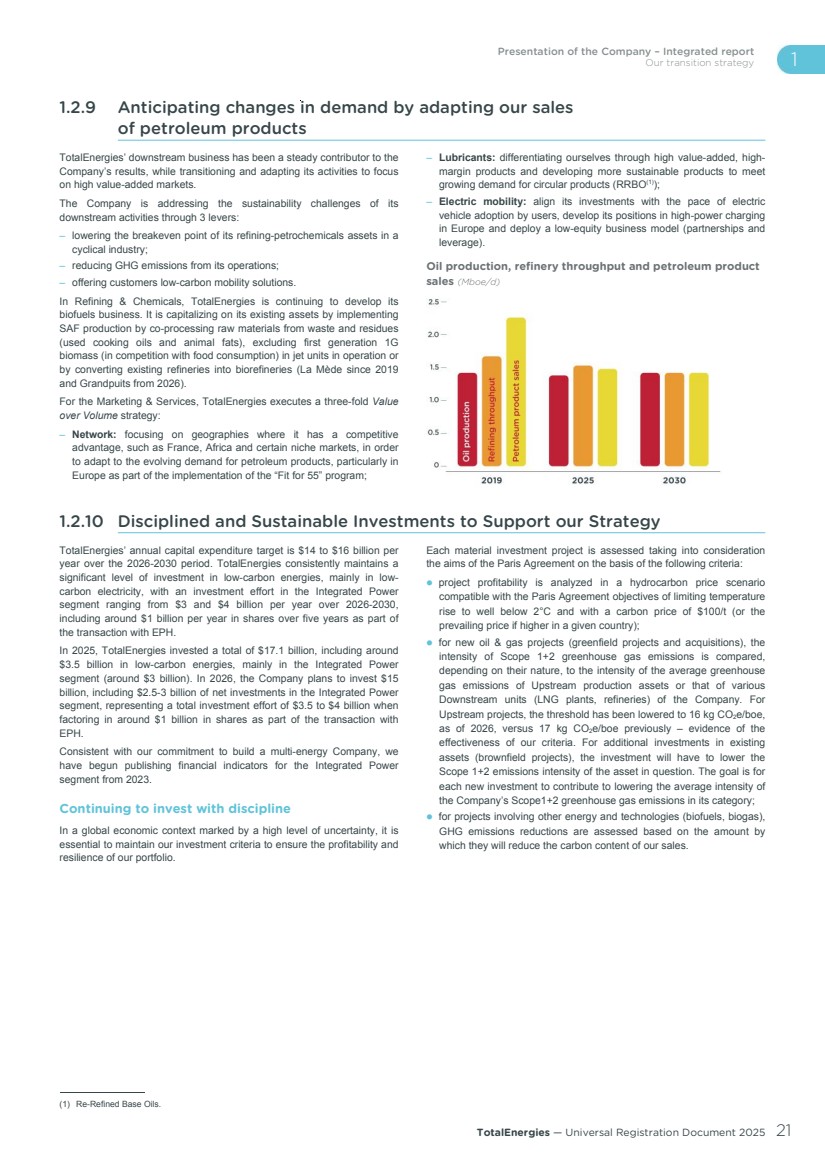
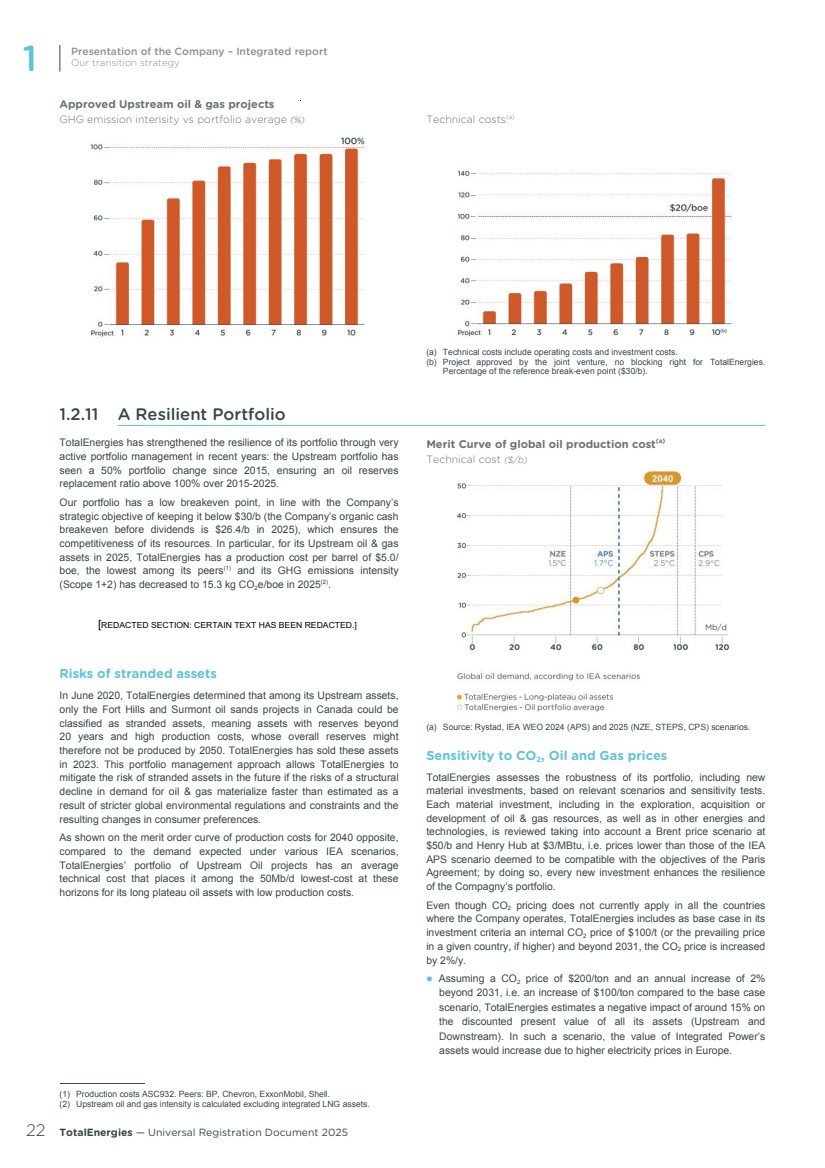
| Approved Upstream oil & gas projects GHG emission intensity vs portfolio average (%) Technical costs(a) (a) Technical costs include operating costs and investment costs. (b) Project approved by the joint venture, no blocking right for TotalEnergies. Percentage of the reference break-even point ($30/b). 1.2.11 A Resilient Portfolio TotalEnergies has strengthened the resilience of its portfolio through very active portfolio management in recent years: the Upstream portfolio has seen a 50% portfolio change since 2015, ensuring an oil reserves replacement ratio above 100% over 2015-2025. Our portfolio has a low breakeven point, in line with the Company’s strategic objective of keeping it below $30/b (the Company’s organic cash breakeven before dividends is $26.4/b in 2025), which ensures the competitiveness of its resources. In particular, for its Upstream oil & gas assets in 2025, TotalEnergies has a production cost per barrel of $5.0/ boe, the lowest among its peers(1) and its GHG emissions intensity (Scope 1+2) has decreased to 15.3 kg CO2e/boe in 2025(2) . Risks of stranded assets In June 2020, TotalEnergies determined that among its Upstream assets, only the Fort Hills and Surmont oil sands projects in Canada could be classified as stranded assets, meaning assets with reserves beyond 20 years and high production costs, whose overall reserves might therefore not be produced by 2050. TotalEnergies has sold these assets in 2023. This portfolio management approach allows TotalEnergies to mitigate the risk of stranded assets in the future if the risks of a structural decline in demand for oil & gas materialize faster than estimated as a result of stricter global environmental regulations and constraints and the resulting changes in consumer preferences. As shown on the merit order curve of production costs for 2040 opposite, compared to the demand expected under various IEA scenarios, TotalEnergies’ portfolio of Upstream Oil projects has an average technical cost that places it among the 50Mb/d lowest-cost at these horizons for its long plateau oil assets with low production costs. Merit Curve of global oil production cost(a) Technical cost ($/b) (a) Source: Rystad, IEA WEO 2024 (APS) and 2025 (NZE, STEPS, CPS) scenarios. Sensitivity to CO2, Oil and Gas prices TotalEnergies assesses the robustness of its portfolio, including new material investments, based on relevant scenarios and sensitivity tests. Each material investment, including in the exploration, acquisition or development of oil & gas resources, as well as in other energies and technologies, is reviewed taking into account a Brent price scenario at $50/b and Henry Hub at $3/MBtu, i.e. prices lower than those of the IEA APS scenario deemed to be compatible with the objectives of the Paris Agreement; by doing so, every new investment enhances the resilience of the Compagny’s portfolio. Even though CO2 pricing does not currently apply in all the countries where the Company operates, TotalEnergies includes as base case in its investment criteria an internal CO2 price of $100/t (or the prevailing price in a given country, if higher) and beyond 2031, the CO2 price is increased by 2%/y. ● Assuming a CO2 price of $200/ton and an annual increase of 2% beyond 2031, i.e. an increase of $100/ton compared to the base case scenario, TotalEnergies estimates a negative impact of around 15% on the discounted present value of all its assets (Upstream and Downstream). In such a scenario, the value of Integrated Power’s assets would increase due to higher electricity prices in Europe. (1) Production costs ASC932. Peers: BP, Chevron, ExxonMobil, Shell. (2) Upstream oil and gas intensity is calculated excluding integrated LNG assets. 1 Presentation of the Company – Integrated report Our transition strategy 22 TotalEnergies — Universal Registration Document 2025 [REDACTED SECTION: CERTAIN TEXT HAS BEEN REDACTED.] |
| ● Compared with the reference scenario used to evaluate investments (Brent at $50/b), TotalEnergies evaluated the impact on the present value of its assets (Upstream and Downstream) of using the NZE price scenario published by the IEA(1) in 2025. Such a scenario would reduce the present value of all of the Company’s assets (Upstream and Downstream) by around 10% compared to its reference scenario used to assess its investments. Impairment of Upstream assets In addition, to ensure robust accounting of its assets in the balance sheet, the Company calculates the impairment of its Upstream assets on the basis of an oil price trajectory that remains sustained at 70 $2025/b until 2030, then decreases linearly to reach 50 $2025/b in 2040, and then decreases from 2040 onwards to the price adopted in 2050 by the IEA’s NZE scenario, i.e. 25.7 $2025/b. Gas prices retained in Europe and Asia decrease to 6.5 $2025/MBtu and 7.5 $2025/MBtu, respectively, in 2029/2030, before rising to 8 $2025/MBtu and 9 $2025/MBtu and stabilizing at these levels through 2040, i.e., at lower levels than current market prices; the Henry Hub remaining at 3 $2025/MBtu over the period 2027-2040. They then all converge towards the prices in the IEA’s NZE scenario in 2050. 1.2.12 2025 Taxonomy: a Company in transition In accordance with European Union regulations, TotalEnergies publishes the share of eligible and aligned activities based on CapEx (2) indicator for the scope of the entities controlled by TotalEnergies, as well as a proportional view, proposed by the delegated regulation of July 6, 2021. This proportional view includes the contribution of jointly controlled companies and those over which TotalEnergies exercises significant influence, accounted for by using the equity method. Controlled Scope - Proportional view Given the size of the Company and its partnership-based development model across the integrated electricity value chain, the proportional view is more relevant than the controlled perimeter. Eligible or aligned CapEx represents 31% and 27% respectively of the Company’s investments in 2025 in the proportional view - confirming the momentum initiated since 2020. Main eligible activities at TotalEnergies In electricity and renewables: ● activities related to renewable energy (wind, solar and hydro-power), as well as battery manufacturing; ● activities related to new energy infrastructure for low-carbon mobility (charging points for electric vehicles, hydrogen refuelling stations); ● power generation from natural gas (portfolio of combined-cycle gas turbine power plants, CCGT). In biofuels and chemicals: ● activities related to the manufacturing of biofuels for transportation and certain petrochemical activities, including the production of biopolymers and the mechanical or chemical recycling of plastics. The Company’s other key eligible activities are: biogas production through anaerobic digestion of organic waste and activities related to carbon sinks (carbon capture and storage of CO2, nature-based carbon sinks projects). Eligible and aligned CapEx(a) Proportional view(b) (a) CapEx refers to the taxonomy standard. A reconciliation table is provided in point 5.2.2.6 C. of chapter 5. (b) Proportional view, in accordance with EU Delegated Act 2021/2178 of July 6, 2021. A reconciliation table is provided in point 5.2.2.6 C. of chapter 5. 1.2.13 Our Energy Transition-Related Risks The risks posed by climate change are included among the risks analyzed by the TotalEnergies Risk Management Committee (TRMC). TotalEnergies ranks its risks by nature and gravity. In 2025, the TRMC updated its risk mapping and submitted the results to the Board of Directors in early 2026. In the table below, TotalEnergies’ risks are positioned in correspondance with the generic risks, identified as per the recommendation from the Taskforce on Climate-related Financial Disclosure (TCFD). The TRMC also ensures the use of appropriate risk management tools. When necessary, complementary action plans can be established. Audits are conducted to ensure that existing risk reduction and control measures are effective. Personnel from multiple disciplines, segments and businesses may collaborate in carrying out these action plans and audits. The Audit Committee of the Board of Directors monitors the effectiveness of the internal control and risk management systems established by senior management in light of identified risks and aiming at fulfilling TotalEnergies’ objectives. (1) Source: World Energy Outlook 2024, Table 2.3 Wholesale fossil fuel prices by scenario. (2) CapEx refers to the taxonomy standard. A reconciliation table is provided in point 5.2.2.6 C. of chapter 5. Presentation of the Company – Integrated report Our transition strategy 1 TotalEnergies — Universal Registration Document 2025 23 |
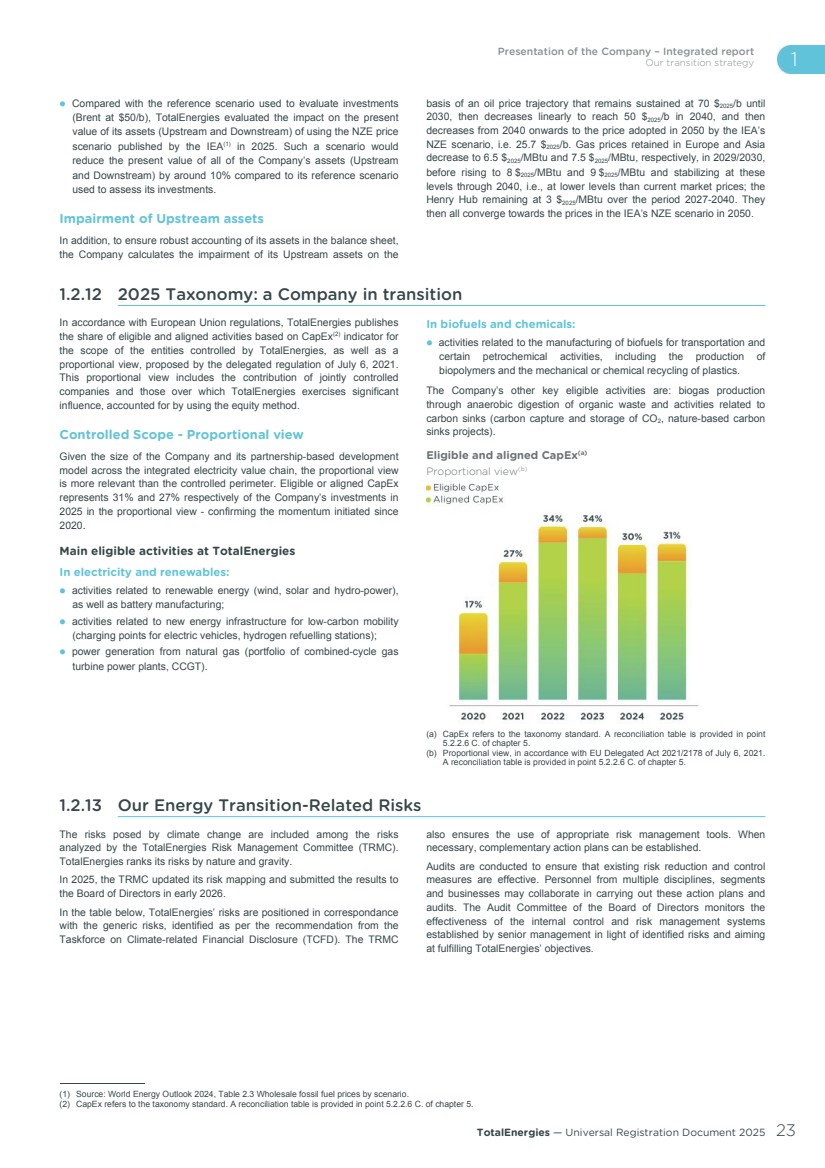
| Extract from TotalEnergies risk mapping Following the recommendation of the task force on Climate-related Financial Disclosures Transition risks Physical risks Policy and legal risks Technology risk Market risk Reputation risk Acute risk Chronic risk Pace of the energy transition deployment, evolution of the demand ✓ ✓ ✓ Risk of legal action and regulatory developments ✓ Financing of oil and gas reserves ✓ ✓ Operational risks related to the effects of climate change and extreme events ✓ ✓ ✓ ✓ Reputation risk ✓ Skills management and transition of the Company ✓ ✓ 1.2.14 Adapting to Physical Risks In 2025, using a modeling tool provided by a third-party expert (Jupiter Intelligence), TotalEnergies reviewed the assessment carried out in 2024 of the potential impacts of the effects of climate change on around 300(1) assets in its portfolio, including all operated industrial sites classified as Seveso (and their equivalents outside the European Union). The climate data used for this assessment are based on models from the IPCC’s 6 th Assessment Report of 2021. The climate scenario considered is a high emissions scenario: IPCC SSP5-8.5(2) , as recommended by the European standard ESRS-E1, for which the global warming is estimated at 4.4°C by the end of the century. In addition, sensitivity tests were carried out for the SSP2-4.5(3) and SSP1-2.6(4) climate scenarios (for which global warming at the end of the century is 2.7°C and 1.8°C respectively). The climate hazards analyzed were selected for their relevance to the nature of the Company’s portfolio and the state of available scientific knowledge. The main acute risks selected cover precipitation, flooding, drought, heat waves, cold, hail, strong winds, significant wave heights and wildfires. These include the main chronic risks which are temperature change, water stress and sea-level rise. Certain climate hazards have not been considered due to the nature and location of the Company’s assets (such as avalanches or glacial lakes outbursts), or to the unavailability of suitable climate risk assessment tools (as is the case for saline intrusion). The results of the assessment reviewed in 2025 for our onshore and offshore assets for the SSP5-8.5 scenario are presented in the graphs opposite and on the following page. For the selected offshore sites, strong winds and wave heights are the two most severe hazards for this type of asset. As shown in the graph opposite, the majority of our offshore portfolio, which includes the Exploration & Production asset groups in Africa, South America and the Middle East, is subject to a relatively low physical risk in the current climate, and also a limited potential change between now and 2050. Offshore assets in the Integrated Power segment, comprising wind farms, are subject to a higher current physical risk due to their location (North Atlantic and South China Sea), but a low potential risk evolution. Offshore portfolio exposure to climate-related physical risks (scenario SSP5-8.5(a)) - based on the most prevalent risk Results of the evaluation conducted in 2024 and reviewed in 2025 for TotalEnergies’ offshore assets. Bubble size is proportional to net book value. (a) SSP5-8.5 is a pessimistic scenario that assumes, among other things, high ghg emissions linked to heavy dependence on fossil fuels. According IPCC, the “best estimate” in global surface temperature change associated with SSP5-8.5 is +4.4°C [3.3-5.7°C] over 2081-2100. (1) Operated and non-operated. (2) SSP5-8.5 is a pessimistic scenario that assumes, among other things, high GHG emissions linked to heavy dependence on fossil fuels. According IPCC, the “best estimate” in global surface temperature change associated with SSP5-8.5 is +4.4°C [3.3-5.7°C] over 2081-2100. (3) SSP2-4.5 is an intermediate scenario that assumes, among other things, the continuation of current emissions until 2050, followed by a reduction. (4) SSP1-2.6 is an optimistic scenario involving strong reductions in GHG emissions, net zero in 2080, compatible with the Paris agreement to limit global warming to below +2°C by 2100. 1 Presentation of the Company – Integrated report Our transition strategy 24 TotalEnergies — Universal Registration Document 2025 |
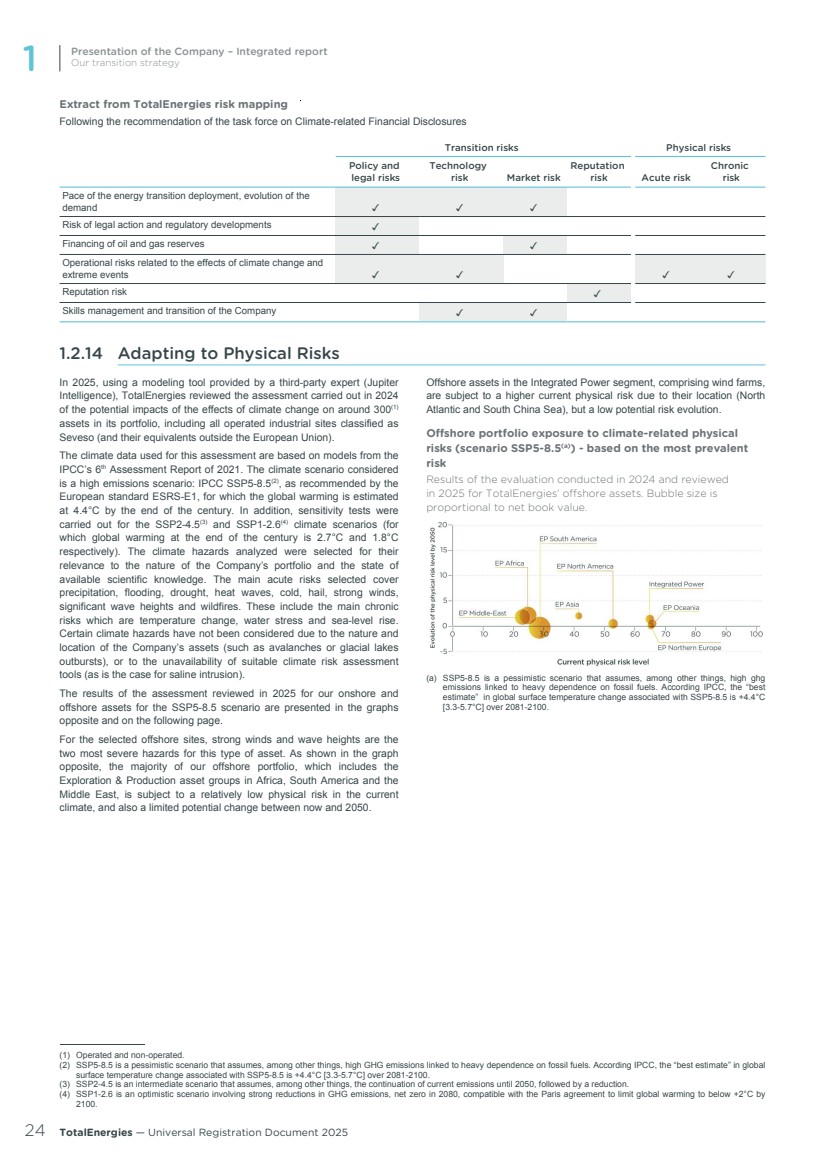
| The results of the study of physical risks at onshore sites are presented below. Today, our refineries and petrochemical plants are comparatively more at risk from climate change than assets in other sectors, due to their general dependence on water resources in water-stressed areas and their greater vulnerability to flooding (as in the case of the Refining-Chemicals sites in North America, including the Port-Arthur site, for which mitigation measures have been put in place Onshore portfolio exposure to climate-related physical risks (scenario SSP5-8.5(a)) - based on the most prevalent risk Results of the evaluation conducted in 2024 and reviewed in 2025 for our onshore assets. Bubble size is proportional to net book value. (a) SSP5-8.5 is a pessimistic scenario that assumes, among other things, high ghg emissions linked to heavy dependence on fossil fuels. According IPCC, the “best estimate” in global surface temperature change associated with SSP5-8.5 is +4.4°C [3.3-5.7°C] over 2081-2100. For most of the assets studied, we have identified limited potential evolution of physical risks linked to climate change between now and 2050. Following an assessment of the exposure of our operating sites to climatic hazards, we carry out additional studies where necessary to ensure that the consequences do not affect the integrity of installations or the safety of people. We also take climate risk into account in the design of our facilities. 1.2.15 Our extra-financial ratings Today, TotalEnergies is recognized by the main extra-financial rating agencies as a benchmark in its sector for its strategy and actions in favor of the energy transition, its consideration of environmental issues, its requirements in terms of social responsibility as well as its governance and high level of transparency. In 2025, TotalEnergies maintained its presence in a number of extra-financial indices such as the FTSE4Good index, as well as the MSCI Europe Screened, MSCI World Screened, MSCI Europe Filtered and MSCI ACWI Select Screened indices. Other evaluations Ranking conducted by the IEA, EDF (Environmental Defense Fund) and UNEP With a total of 21 points, TotalEnergies ranks among the top positions in the “Progress 2025: An Assessment of Transparency of the Oil and Gas Industry” ranking, which assesses the 116 largest global O&G companies on the basis of 25 indicators divided into 3 categories: i) Targets, ii) Strategies for implementation, iii) Disclosure & reporting. The average score is 9 points. WBA (World Benchmarking Alliance) In 2025, TotalEnergies obtained the highest score for the “Just Transition” theme, both in the overall ranking (out of nearly 2,000 companies) and within the oil & gas sector (where 94 companies were evaluated worldwide). TotalEnergies also obtained a good score for the “Social” theme, ranking 15th out of 2,000 companies evaluated. VBDO With a score of 69.2, TotalEnergies is ranked 5ᵗʰ out of 30 companies in terms of biodiversity in the first Business & Biodiversity Benchmark of the VBDO coalition, published in November 2025. This score places TotalEnergies among the best of its peers. Notably, the quality of our biodiversity action plans is highlighted as a good practice example in the report accompanying the ranking. Ecovadis In the 2025 Sustainability Rating, TotalEnergies obtained Platinium status for TotalEnergies Électricité and Gaz France SA (with a score of 87/100, placing it within the top 1% of the highest‑rated companies). TotalEnergies also received Gold status for its subsidiaries Hutchinson (84/100), Saft (82/100), TotalEnergies Marketing Services SAS (82/100) and TotalEnergies Raffinage Chimie SAS (81/100), placing them within the top 5% of the companies evaluated in this ranking. Britain’s Most Admired Companies In 2025, TotalEnergies received the Britain’s Most Admired Companies award in its category, based on non-financial criteria such as commitment to reducing environmental impact and diversity & inclusion. TotalEnergies’ extra-financial ratings (a) Peers: ExxonMobil, Shell, BP, Chevron, ENI, Equinor. Presentation of the Company – Integrated report Our transition strategy 1 TotalEnergies — Universal Registration Document 2025 25 |
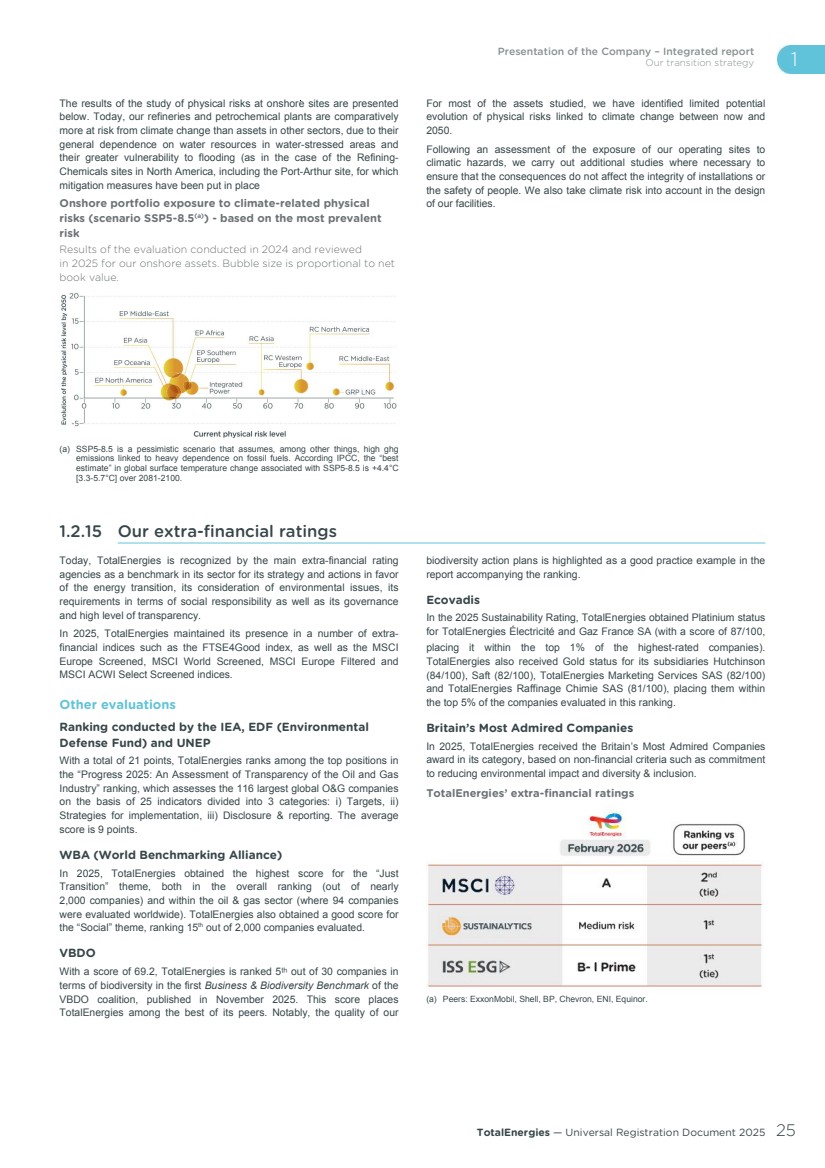
| 1.3 Climate and Sustainable Energy 1.3.1 Climate impact of our strategy: our 2025 progress and 2026-2030 objectives 2015 2024 2025 2026 2030 Objectives Realizations Objectives Scope 1+2 Operated (100%) (Mt CO2e) Oil & gas Facilities vs 2015 46 -36% 29.4 -38% 28.4 CCGT 0 4.9 4.7 Scope 1+2 Emissions 46 34 <37 33.1 <34 25-30(a) >-40%(a) Methane Operated (100%) (kt CH4) vs 64 kt in 2020 -55% -60% -65% -70% -80% 29 22.5 Lifecycle Carbon Intensity Energy Products Sold(b) (Scope 1+2+3) (g CO2e/MJ) 73 -16.5% >-17% -18.6% ~-19% -25% Scope 3 (Category 11) (Mt CO2e) 410(c) 342 <400 335 <400 (a) Net emissions, including Nature-based carbon sinks from 2030. (b) Lifecycle carbon intensity of energy products sold (refer to the glossary for the definition). (c) In 2015, Scope 3 category 11 was published at 410 Mt CO2e. The Company keeps this reference to assess the evolution of its Scope 3. If the Scope 3 category 11 for 2015 had been recalculated according to the IPIECA value chain methodology (published in 2016) on the gas value chain, as introduced in data disclosures from 2021, then the Scope 3 category 11 of 2015 would have been 465 Mt CO2e, including 344 Mt CO2e for the oil value chain and 121 Mt CO2e for the gas value chain. 1.3.2 How TotalEnergies’ 2030 objectives compare to the IEA Scenarios Reducing GHG emissions of the operated facilities (Scope 1+2) is key to TotalEnergies’ ambition to supply more energy while curbing GHG emissions. The objective of cutting net Scope 1+2 emissions from our operated activities by 40% is consistent with the reduction targets of the European Union’s “Fit-for-55” program (a 37% decrease between 2015 and 2030) and the IEA’s 2025 Net Zero Emissions (NZE) scenario (a 23% decrease between 2015 and 2030). TotalEnergies’ targets for lowering the lifecycle carbon intensity(1) of energy products sold (a (~-19% by 2026 and a -25% by 2030) put the Company on a trajectory close to the Announced Pledges Scenario (APS) in the IEA’s World Energy Outlook 2024, which assumes that the States parties to the Paris Agreement fulfill all their net zero objectives. An independent third party (Wood Mackenzie) has audited the calculations made as well as the associated trajectories for Scope 1+2 emissions and Carbon Intensity(2) . At the end of 2025, the NGO Transition Pathway Initiative (TPI) assessed the Company’s lifecycle carbon intensity(3) trajectory (“Carbon Performance” (4)) and considers it as aligned with a below 2°C scenario in 2050. Net Scope 1+2 emissions TotalEnergies operated perimeter World CO2 emissions (all sectors) - IEA Scenarios (WEO 2024 and 2025(a)) In % relative to 2015 (a) Based on the IEA World Energy Outlook 2024 and 2025, License CC by 4.0. Worldwide CO2 emissions from energy combustion and industrial processes. For TotalEnergies, emissions exclude the COVID-19 effect in 2020 and 2021, and take into account nature-based carbon sinks projects from 2030. Lifecycle carbon intensity of energy products sold(a) IEA Scenarios (WEO 2024 and 2025) In % relative to 2015 (a) Lifecycle carbon intensity of energy products sold (refer to the glossary for the definition) and evolution of the carbon intensity of world energy, calculated as the ratio of worldwide CO2 emissions from fossil fuels (Mt CO2) to total primary energy supply (EJ) in the IEA World Energy Outlook 2024 and 2025. The electricity production from renewable sources (wind, solar, hydro) included in these scenarios is reduced to the same fossil base, taking into account a substitution factor of 2.63 (38%) to make them comparable with the lifecycle carbon intensity of the energy products sold by TotalEnergies. (1) Lifecycle carbon intensity of energy products sold (refer to the glossary for the definition). (2) Lifecycle carbon intensity of energy products sold (refer to the glossary for the definition). (3) Lifecycle carbon intensity of energy products sold (refer to the glossary for the definition). (4) The evaluation of TotalEnergies by the Transition Pathway Initiative (TPI) is available on TPI’s website. 1 Presentation of the Company – Integrated report Climate and Sustainable Energy 26 TotalEnergies — Universal Registration Document 2025 |
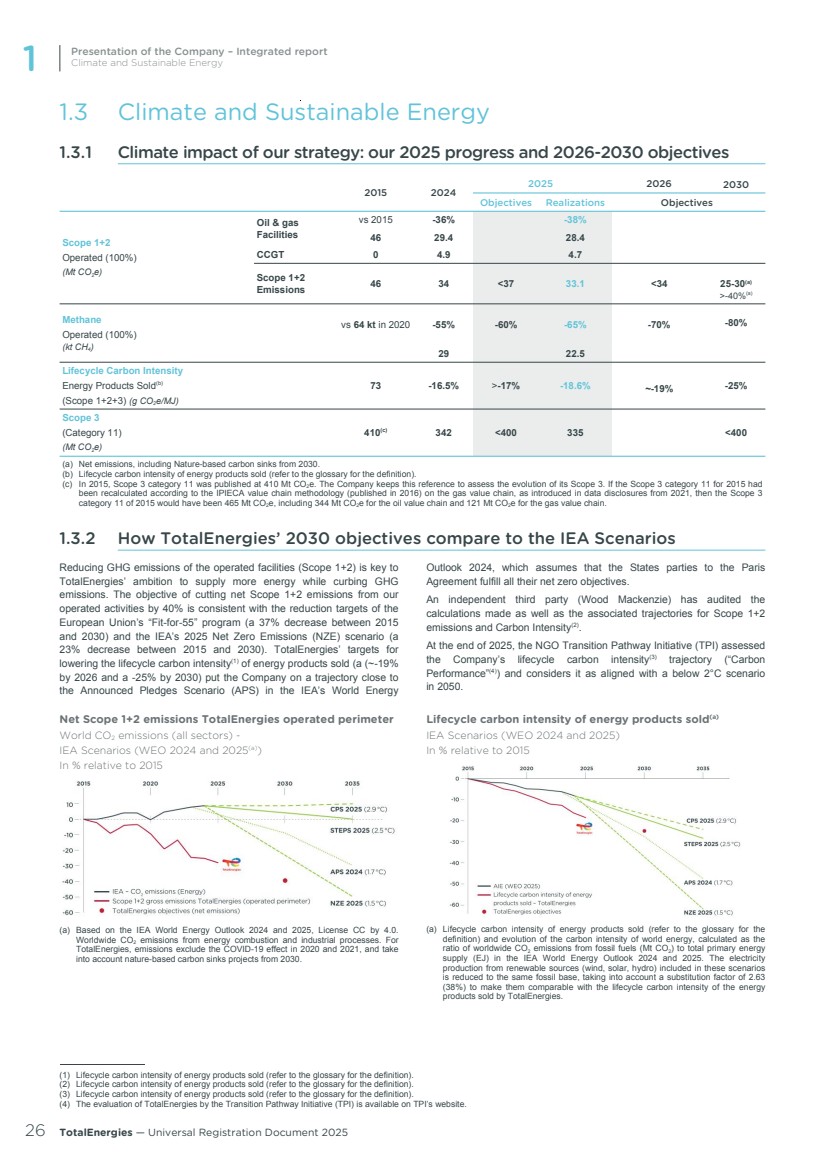
| 1.3.3 Reducing our emissions 1.3.3.1 Reducing our Scope 1+2 Emissions by 2030 The primary responsibility of TotalEnergies as a producer of fossil fuels is to reduce emissions on its facilities. In 2024, the Company launched the “Our 5 Levers for a Sustainable Change” initiative, which supports the commitment of all employees to improving energy efficiency and the use of low-carbon technologies in TotalEnergies’ operations. Our progress in 2025 TotalEnergies is resolutely continuing to reduce emissions from its operated assets. Thus, within the scope of its oil and gas facilities(1) , emissions from assets operated by the Company fell by 38% compared to 2015 levels. In 2025, with more than 85 GHG emissions reduction projects coming to fruition, TotalEnergies reduced its emissions by 0.7 Mt of CO2e across its operated assets. At the same time, emissions related to flexible power generation decreased by 0.2 Mt CO2e due to changes in the operated portfolio and lower utilization rates of CCGTs in the United States. As a result, the Company’s overall operated emissions have decreased by 28% compared with 2015. These ongoing reduction efforts have made it possible to reduce the Scope 1+2 intensity of the Upstream oil & gas operated assets, from 21 kg CO2e/boe in 2015 to 15.3 kg CO2e/boe in 2025(2) . These results put TotalEnergies among the top performers of the industry when it comes to carbon intensity. In support of the unchanged target of a 40% reduction in Scope 1+2 net emissions, the trajectory for the operated oil & gas segment suggests a 50% gross reduction in Scope 1+2 emissions in this sector by 2030. Our objectives Given the progress made towards achieving its interim targets, in 2025, TotalEnergies stepped up its ambition to reduce GHG emissions from its operated assets and has set the target for 2025 at 37 Mt CO2e/y, compared with 38 Mt CO2e/y previously. This target was achieved in 2025 with 33.1 Mt CO2e/y, down 1.1 Mt CO2e/y compared to 2024. TotalEnergies has set itself a 2026 target of reducing GHG emissions from its operated assets at 34 Mt CO2e/y. TotalEnergies reaffirms its target to reduce emissions from its operated assets, which aims to reduce its net Scope 1+2 emissions(3) by 40% by 2030 relative to 2015, after mobilizing around 5 million credits from nature-based carbon sinks projects. This offsetting will start only from 2030 for residual emissions on the basis of a consumption of approximately 10% per year of the stock of carbon credits of the Company. Scope 1+2 emissions from operated facilities(a) (Mt CO2e) (a) Net emissions, including nature-based carbon sinks projects from 2030, at a level of approximately 5 Mt/y of carbon credits. Until 2029 included, net emissions are equal to gross emissions (no use of nature-based carbon sinks projects before 2030). Scope 1+2 from operated facilities: levers to reach the -40% target in 2030(a) (Mt CO2e) (a) Net of nature-based carbon sinks. (b) NBS credits will be used from 2030. 1.3.3.2 Improving the energy efficiency of our sites: Implementation of the 2023/2025 action plan Saving energy used in the Company’s operations is beneficial in several ways: it contributes to the collective campaign for energy efficiency, and it helps to reduce the TotalEnergie’s GHG emissions and lowers its costs. In September 2022, TotalEnergies launched a plan to accelerate energy efficiency improvements at its sites worldwide. This plan has enabled the Company to accelerate the actions undertaken for several years in its operating sectors, with a total of more than 140 projects completed by 2025, including more than 100 initiatives for Exploration & Production, more than 40 for Refining & Chemicals and more than 5 for Marketing & Services and Integrated Power. At the end of 2025, these investments amount to more than $1 billion, as planned in this initial energy efficiency improvement plan: they have reduced emissions by more than 2 Mt CO2e/y and realized energy and CO2 savings of $200 M/y following the investment plan carried out over the 2023-2025 period. Taking into account the efficiency projects reported by the teams at the industrial sites, a second energy efficiency improvement plan is rolled out over the period 2026-2028, for a total of $1 billion. Energy efficiency realizations The Refining & Chemicals sites achieved a total reduction in greenhouse gas emissions of more than 1 Mt CO2e over the 2023-2025 period thanks to the energy efficiency improvement plan. In 2025, the turnaround of the Antwerp refinery provided an opportunity to roll out seve projects representing an investment of around $40 million, enabling an annual reduction of around 50 kt CO₂e. The main areas for improvement focused on furnace optimization, preheater optimization, electrification, and heat exchanger performance. These projects will permanently reduce the carbon footprint of the Antwerp site. (1) Upstream and Downstream oil & gas activities (excluding CCGT). (2) Operated oil & gas Upstream intensity is calculated excluding LNG plants. (3) The calculation of net emissions includes nature-based carbon sinks projects as from 2030. Presentation of the Company – Integrated report Climate and Sustainable Energy 1 TotalEnergies — Universal Registration Document 2025 27 |
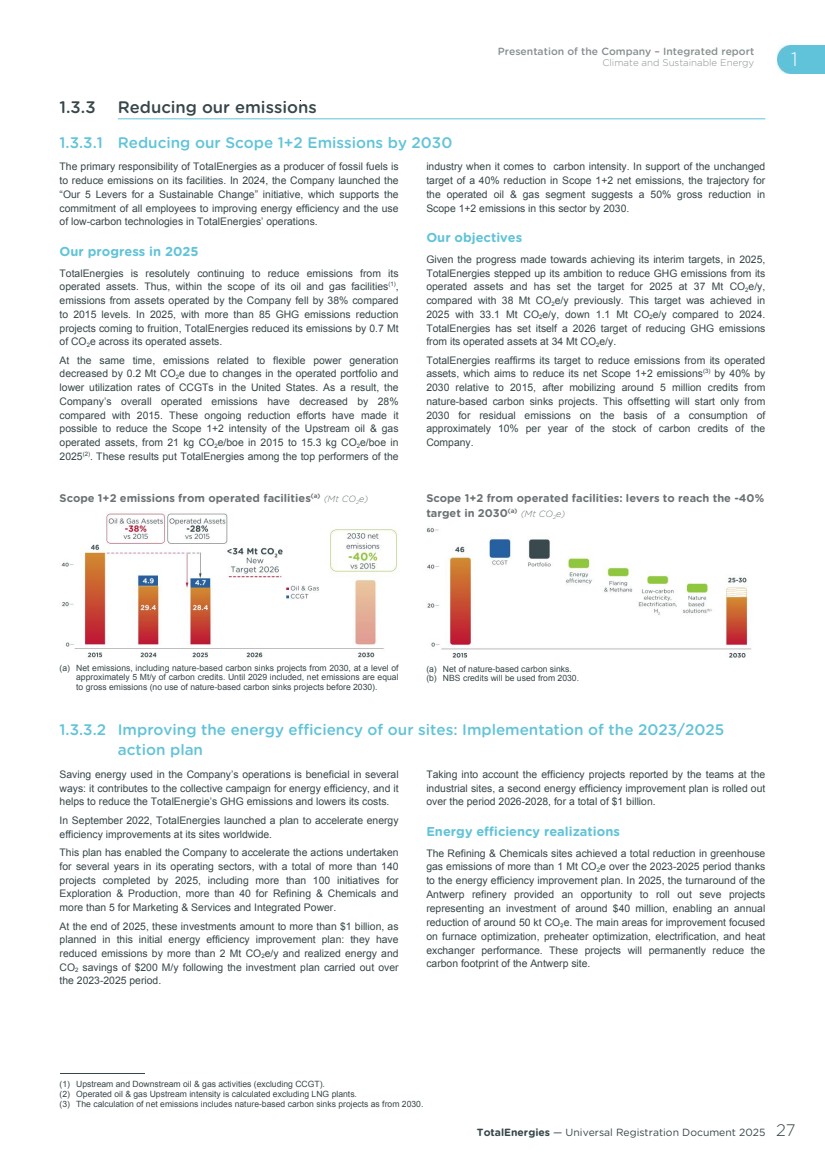
| Also in 2025, during the turnaround of the steam cracker at the Normandy refinery, energy efficiency improvement projects resulted in an annual reduction of approximately 35 kt CO2e/y, mainly through the implementation of new technologies to optimize furnaces and heat exchange equipment. Operational excellence In Exploration & Production, on Block 17 in Angola, the installation of mobile filtration units to keep the lubricating oil for rotating equipment clean improves reliability and reduces burning by minimizing downtime. Cleaner oil prevents premature wear and failure, ensuring continuous compressor operation and avoiding production interruptions that typically lead to burnout. This approach not only supports environmental performance with a reduction of 13 kt CO2e/y, but also improves operational efficiency by extending equipment life and reducing maintenance costs. In 2025, the Netherlands subsidiary of Exploration & Production optimized the export compression system at the K5CC field by replacing two low-pressure compressors with a single compressor while maintaining identical or even better production profiles. Following the implementation of this project in June 2025, only two export compressors and turbines are required instead of three, resulting in savings of around 5 Mm³/y of gas, equivalent to the consumption of more than 5,000 Dutch households. This represents approximately 13% of the gas consumption of the K5CC field and contributes to a reduction of ~10 kt CO2e/y. Adapting the design of the facilities In Exploration & Production, by 2025, GHG emissions linked to gas compression at the Aguada Pichana Este plant in Argentina were significantly reduced thanks to better use of the reservoirs’ high natural pressure. This operational improvement led to an annual reduction in direct emissions from the plant of around 65 kt CO2e. In the combined cycle power plants (CCGT) of the Integrated Power segment, the reduction in GHG emissions is based in particular on improving energy efficiency and turbine performance. In 2025, train 8 of the Saint-Avold power plant was modernized with the installation of an ATEP (Advanced Turbine Efficiency Package). This performance upgrade involves replacing key turbine parts with more efficient components (more resistant materials, better aerodynamics, improved cooling, and reinforced sealing). These modifications aim to increase efficiency, reduce gas consumption, and thus decrease CO₂ emissions through improved combined cycle efficiency. 1.3.3.3 Decarbonizing our operated sites through low-carbon electricity supply and electrification Low-carbon electricity supply In Refining & Chemicals, TotalEnergies’ ambition is to provide its facilities in Europe and the United States with a 100% low-carbon electricity thanks to its Go Green initiative. In this respect, up to 5.2 TWh/y will be supplied to the Refining & Chemicals industrial assets in Europe. This electricity will come partly from the European renewables portfolio, of which 1.8 TWh/y is in operation and 3.4 TWh/y is under development, as well as from the Company’s portfolio of guarantees of origin. In the United States, around 1.2 TWh/y will be supplied to the Refining-Chemicals assets from the renewable portfolio in Texas. The Danish and Myrtle assets, which are already in service, will supply around 1 TWh/y. The supplement will be provided from the Company’s portfolio of renewable projects in the United States starting in 2026. This action to supply low-carbon electricity illustrates our “Lever 2 for a Sustainable Change” which aims to use low-carbon technologies in our own operations and will enable a reduction in emissions of more than 2 Mt CO2e/y on the Refining & Chemicals segment’s Scope 2 compared with 2015. In Argentina, at Exploration & Production, to meet the electricity demand of the Rio Cullen and Cañadon Alfa onshore sites, TotalEnergies designed a hybrid power generation system, including an 8.4 MW wind farm coupled with 9.2 MWh of batteries, along with an increase in electricity transmission capacity between Cañadon Alfa and Rio Cullen. This project, which takes advantage of the region’s wind potential, was commissioned in January 2026 and is expected to reduce emissions by 36 kt CO₂e/y by lowering fuel gas consumption to power the site. At the Neuquén asset, the Aguada Pichana Este plant was connected to the national electricity grid through the implementation of a large-scale electrification project comprising a 132 kV substation and a 43 km transmission line. A 14 MW solar power plant was built and, to manage intermittency, a long-term power purchase agreement was signed to supply mainly renewable energy (80 to 100%). This project reduces fuel gas consumption and flaring, while increasing availability and reducing emissions at the site by ~46 kt CO₂e/y. Also in Exploration & Production, in Nigeria, the OML 58 site has installed a solar power plant combined with batteries to reduce the energy required by the gas turbines that generate electricity. To connect the site to the solar power plant, a 6 kV electrical cable with a length of approximately 1km has been installed. The energy generated by this solar power plant reduces the fuel gas consumed by the gas turbines, thereby cutting emissions by around 13 kt CO2e/y. In the Integrated Power segment, as part of a multi-year program, the Bayet CCGT plant has installed photovoltaic panels on the roofs of buildings, on the ground, and on parking shade structures to produce electricity for self-consumption. This initiative aims to improve the efficiency of the facility by reducing the power demand of auxiliary equipment when the plant is in operation. It also aims to limit the site’s electricity consumption during periods when the unit is shut down. Electrification of facilities Between 2023 and 2025, the Marketing & Services segment carried out several electrification projects, including the electrification of refueling trucks for the aviation sector in France and the Beverwijk project in the Netherlands. At the Beverwijk lubricants plant, the process—initially based on a boiler providing heat from the combustion of natural gas—now uses an induction system powered by renewable electricity. Since the completion of this project in 2024, greenhouse gas emissions per ton of lubricant produced have fallen from 38 kg CO2e/ton of lubricant to 1.6 kg CO2e/t, and energy consumption has fallen from 200 kWh/t to 120 kWh/t. 1.3.3.4 Aiming for zero methane emissions With a warming potential 30 times greater than CO2 and a short lifespan in the atmosphere(1) , methane is a greenhouse gas whose rapid reduction is considered one of the most effective levers for having a short-term impact on global warming. The Global Methane Pledge, launched at COP26 and signed by more than 150 countries, aims to reduce methane emissions by 30% across all sectors (agriculture, waste, energy) by 2030 compared to 2020, and experts estimate that a reduction of this magnitude would have an impact of -0.2°C on the global average temperature by 2050(2) . (1) Around a dozen years, compared to several hundred years for CO2. Global warming potential of around 30 over 100 years (source: IPCC AR6). (2) Refer to Global Methane Pledge official text. 1 Presentation of the Company – Integrated report Climate and Sustainable Energy 28 TotalEnergies — Universal Registration Document 2025 |
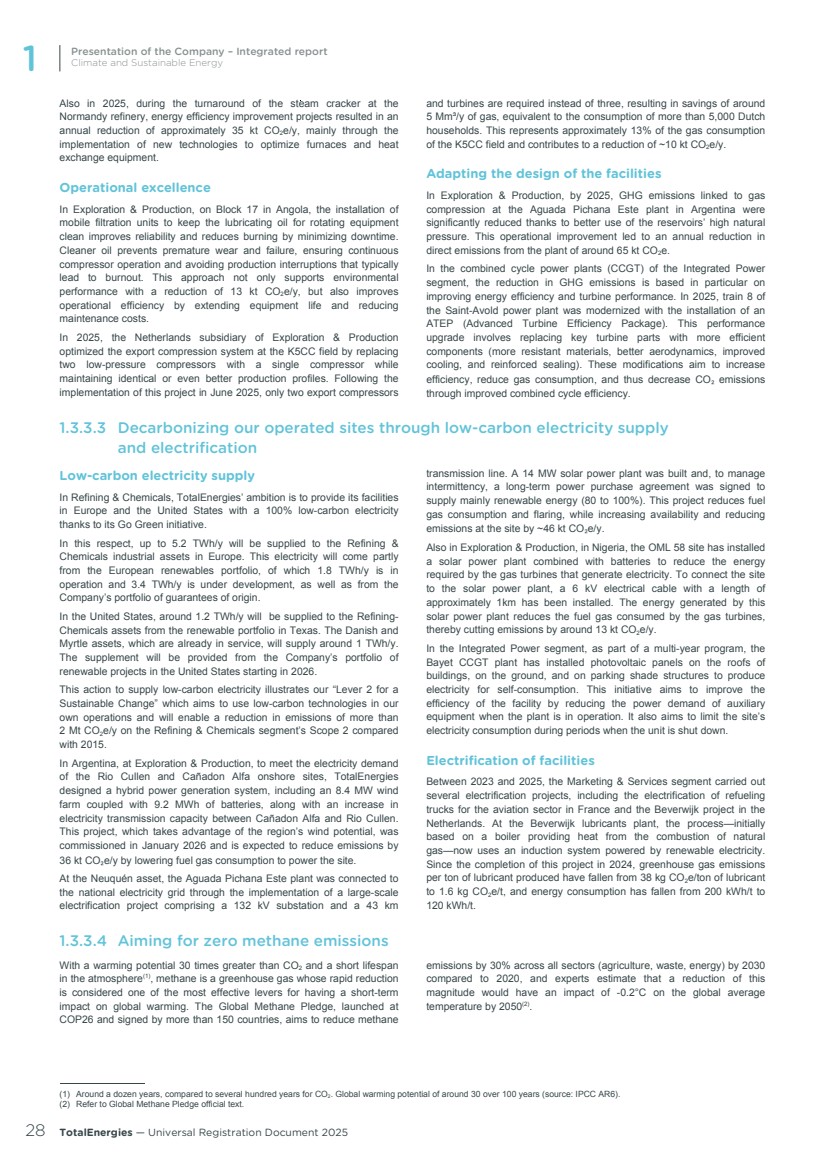
| The oil and gas sector has the technologies, technical expertise and operational capabilities to act quickly on methane emissions from its operations. TotalEnergies believes that it is the sector’s responsibility to reduce its methane emissions to near zero by 2030 and intends to maintain its leadership role in the industry on methane. Progress since 2010 Between 2010 and 2020, TotalEnergies reduced methane emissions from its operated assets by nearly half. These emissions then fell from 64 kt CH4 in 2020 to 22.5 kt CH4 in 2025, a reduction of 65%, exceeding the target of a 60% reduction between 2020 and 2025. TotalEnergies has set a new target of -70% in 2026 and is on track to achieve its goal of an 80% reduction by 2030 or sooner, compared to 2020. In terms of methane intensity(1) from operated oil and gas production, TotalEnergies reached 0.07% in 2025, thereby already achieving its 2030 target of falling below the 0.1% threshold. Methane emissions operated facilities (kt CH4) Pioneers in methane emissions detection and measurement In 2022, TotalEnergies deployed AUSEA(2) drone technology at its upstream sites, complementing the annual leak detection and repair (LDAR) campaigns. Mounted on a drone, the ultra-lightweight dual sensor simultaneously detects methane and CO₂ with high accuracy and is now considered an international benchmark technology and one of the best drone technologies for methane detection(3) . All of the Company’s upstream sites are currently subject to an AUSEA detection campaign at least once a year, and TotalEnergies has shared this technology with several industry partners (including Petrobras, Socar, Sonangol, NNPC, ONGC, Oil India), and more recently in 2025 with Veolia in the waste and wastewater treatment sector. In 2025, 560 days of AUSEA operations were carried out on TotalEnergies’ operated assets, nearly 100 on non-operated assets, and nearly 50 on third-party assets. In 2025, as announced at COP29, TotalEnergies took a new step forward in identifying methane emissions in real time, whether related to leaks or sub-optimal operational processes, and in immediately implementing corrective measures. This continuous detection plan relies on 13,000 sensors deployed across all operated Upstream assets and uses proven technologies such as IoT sensors(4) , infrared cameras, flow meters, and predictive emission monitoring systems placed at combustion sources. In 2025, a Methane Tracking Center (MTC) was set up in Pau to centralize and consolidate data from various detection means worldwide, whether periodic or continuous and in real time. Using digital tools and the expertise of a team of around ten experts, the MTC analyzes data, alerts operators, and provides support when needed. The technologies used at TotalEnergies’ operating sites have been tested and validated in advance on the internal TADI (TotalEnergies Anomalies Detection Initiative) platform, located in Lacq, which is one of two testing platforms in the world along METEC(5) at Colorado State University in the United States. In April 2025, TADI and METEC co-published(6) an international protocol for evaluating methane detection and quantification technologies, illustrating the Company’s commitment to promoting international collaboration for the harmonized evaluation of methane emission measurement and detection technologies. Reduction actions by methane emission sources TotalEnergies has long been committed to reducing its methane emissions by taking specific actions on each of the four sources: flaring, vents, stationary combustion and continuous real-time detection to identify any fugitive emissions. Actions on flaring During flaring, gas combustion at the flare is incomplete, and around 2% of the gas sent to the flare is not burnt, the rest (98%) being transformed into CO2 after combustion. The actions to reduce flaring described below therefore directly reduce methane emissions. Eliminating routine flaring is a priority for reducing methane and CO2 emissions. TotalEnergies has been committed to eliminating routine flaring for new projects since 2000. A founding member of the World Bank’s “Zero Routine Flaring by 2030” initiative since 2014, the Company is committed to ending this type of flaring by 2030 and to achieve this goal, has implemented several large-scale projects at its sites. In Nigeria, the OML100 asset accounted for 57% of global routine Exploration & Production flaring in 2020. The end of routine flaring on the OML100 offshore block became effective in 2023. This was the last TotalEnergies asset in Nigeria with routine flaring by design (initial design, facilities commissioned in 1993). Significant modifications were made to the facilities to send the gas produced to the Bonny LNG plant for upgrading instead of being flared. The total reduction in greenhouse gas emissions is around 330 kt CO2e/y, including 1.3 kt CH4/y of methane. In Congo, at the Moho site, the elimination of routine flaring reached its final phase in 2025 with the recirculation of low-pressure flare gas to the process and the recommissioning of the low-pressure gas compressor. These measures have made it possible to permanently eliminate routine flaring on the Alima FPSO at Moho Bilondo and reduce emissions from the site by ~8 kt CO2e/y. The gas previously flared – a volume of around 7,000 m3 /d – is now used as lift gas in wells or exported to the Nkossa asset. TotalEnergies is also seeking to reduce other forms of flaring. In Gabon, at the Anguille and Torpille assets, the safety flaring system has been improved with the installation of a new flare tip with a flame stabilizer, an automatic ignition system, and a camera. The volume of gas flared has been significantly reduced, resulting in a reduction of 3.2 kt CH4/y in methane emissions, or 100 kt CO2e/y. In Denmark, flaring has been reduced at the Gorm site thanks to the installation of an ejector to recover gas from the low-pressure separator that would normally be flared. The commissioning of this ejector in April 2025 also led to a slight increase in gas production thanks to the reduction in pressure in the low-pressure separator. This project reduces methane emissions by 0.2 kt CH4, or 6 kt CO2e. (1) Intensity of methane emissions: refer to glossary for the definition. (2) Airborne Ultralight Spectrometer for Environmental Application. (3) Stanford & IMEO study: Controlled release testing of multiple European methane measurement technologies. (4) Internet of Things. (5) Methane Emissions Technology Evaluation Center. (6) Controlled Test Protocol Version – Emission Detection and Quantification Protocol Version 1.2 April 2025. Presentation of the Company – Integrated report Climate and Sustainable Energy 1 TotalEnergies — Universal Registration Document 2025 29 |
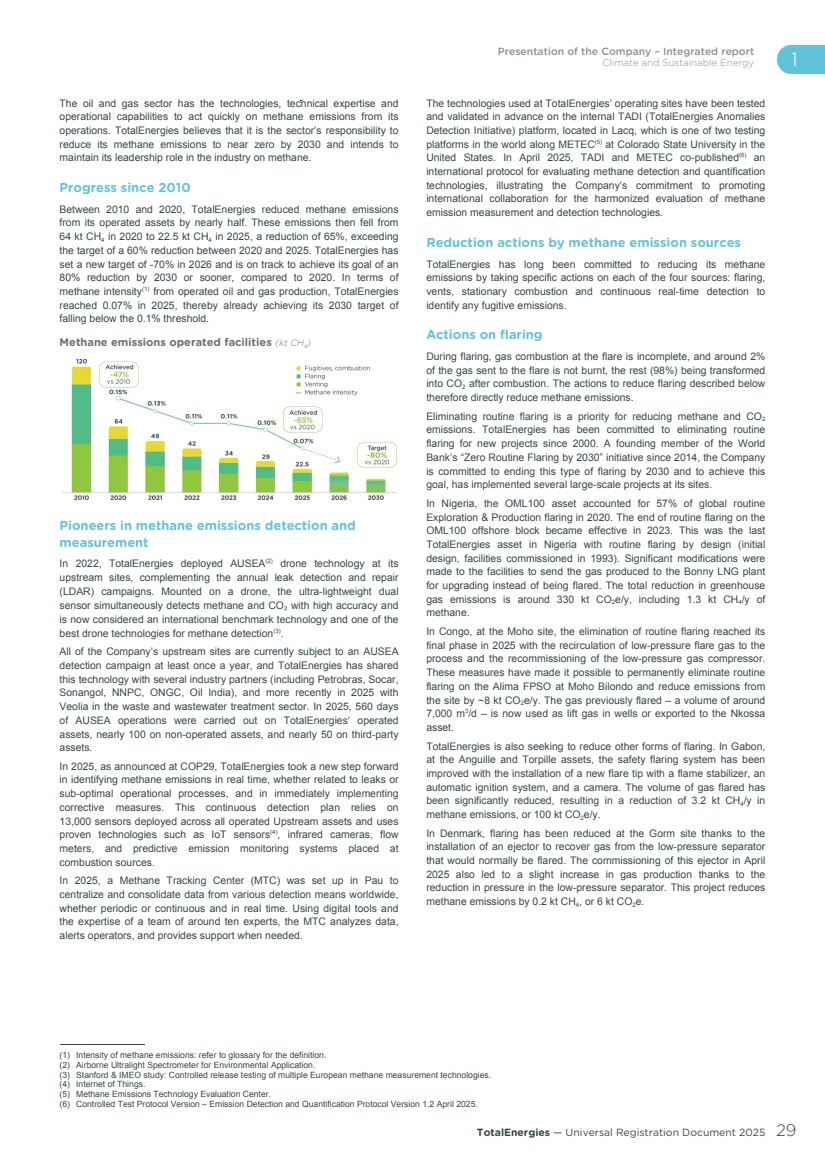
| TotalEnergies is also launching projects to modify facilities with closed flares. Closed flare systems recover and treat residual gases, reducing the volume of flared gas to emergency situations only. In 2024, the first closed flare was installed at the Tempa Rossa site in Italy, resulting in a reduction of 1.3 kt CH4, or 40 kt CO2e. These residual gas recovery systems are now installed in all new projects, such as the Egina FPSO in Nigeria when it came on stream. Beyond actions taken on each of these sources, all new projects include strict design criteria to avoid methane emissions: no natural gas for pneumatic equipment, no continuous cold vents and systematic installation of closed flares. Actions on vents Venting is the release of methane into the atmosphere without combustion. TotalEnergies has reduced its vents since 2020 by rerouting the gas going to the vents to the gas export system or to the flare. Some equipment – such as pneumatic actuators – also uses methane as an instrumentation gas, and the replacement of this equipment with solutions using compressed air instead of methane has allowed to significantly reduce venting. In the United States, at the Barnett site, instrument gas has been replaced by compressed air on 400 pads between 2021 and 2024, reducing emissions by 7.5 kt CH4/y, or 225 kt CO2e/y. Currently, nearly half of the natural gas that was previously used in equipment is recovered and exported. Another source of venting is the cover gas in storage tanks, which can be combustible gas, ensuring the safety of the facility by maintaining pressure in the storage tanks. In December 2024, in Nigeria, the combustible gas used as cover gas was replaced by an inert gas, nitrogen, resulting in a reduction from 5.2 kt CH4/y to 0.35 kt CH4/y or equivalent to a decrease of 150 kt CO2e/y. Actions on incomplete combustion on certain equipment Certain equipment running on natural gas (engines, furnaces, turbines) also emits methane through incomplete combustion. In Argentina, at the Neuquen site, connecting the Aguada Pichana Este plant to the national power grid through the construction of a 43 km power line and a high-voltage substation has made it possible to stop local electricity production from gas-powered engines and thus eliminate methane emissions from this equipment. Maintaining our leadership within the industry Over the years, TotalEnergies has acquired robust know-how and significant technical expertise in reducing methane emissions. TotalEnergies has successfully developed and deployed innovative technologies for detecting and measuring methane emissions. TotalEnergies strives to deploy this know-how and these technologies at its non-operated assets, as well as with its partners and other companies in the oil and gas sector, notably through the Oil & Gas Decarbonization Charter. TotalEnergies also promotes the OGMP 2.0 (Oil & Gas Methane Partnership), the reference framework created in 2020 and piloted by the United Nations Environment Programme (UNEP) for methane reporting in the oil and gas sector. This framework encourages companies to continue improving the completeness and accuracy of their emissions reporting, for both operated and non-operated perimeters, in order to focus on reducing the most significant emissions. To date, more than 150 companies are members across the value chain. TotalEnergies has been awarded Gold Standard OGMP 2.0 certification in 2025 for the fifth consecutive year(1) . 1.3.3.5 Building low carbon hydrogen supply for our refineries in Europe by 2030 To reduce the carbon footprint associated with the production, transformation and supply of energy to its customers, one of the levers identified by the Company is the use of low-carbon hydrogen to decarbonize its European refineries, which would reduce their direct CO2 emissions by up to three million tons a year by 2030. In September 2023, TotalEnergies launched a call for tenders to use up to 500 kt/y of low-carbon hydrogen in its European refineries from 2030. The call for tenders generated considerable interest within the industry, attracting a wide range of local and international players. In this context, TotalEnergies has already contracted for more than 200 kt/y of low-carbon hydrogen. These volumes are intended for the La Mède, Grandpuits, and Normandy sites in France, as well as those in Leuna, Germany; Antwerp, Belgium; and Zeeland, the Netherlands. However, achieving this ambition of using up to 500 kt/y of low-carbon hydrogen in its European refineries from 2030 onwards depends on the implementation of national tax and regulatory frameworks that effectively support the reduction of the carbon footprint. TotalEnergies is rolling out four types of projects: – renewable hydrogen production in TotalEnergies biorefineries; – green hydrogen production by TotalEnergies and its partners; – tolling agreements; – long-term green hydrogen supply contracts. The first volumes of low-carbon hydrogen are expected in 2026. Renewable hydrogen production in TotalEnergies’ biorefineries In La Mède, a 25 kt/y unit is under construction and will be operated by Air Liquide. The €150 million investment will reduce emissions by 130 kt CO₂e/y as from 2028. In Grandpuits, Air Liquide is building a unit with a capacity of around 20 kt/y, equipped with Cryocap™ technology, enabling to avoid 150 kt CO₂e/y to be avoided. Green hydrogen production by TotalEnergies and its partners In 2024, TotalEnergies acquired 50% of the OranjeWind offshore wind farm (795 MW) in the Netherlands. Together with Air Liquide, a joint venture will develop a 250 MW electrolyzer at the Zeeland refinery site, producing up to 30 kt/y of green hydrogen from 2029. The investment amounts to €600 million and will reduce CO₂e by up to 300 kt/y. The project entered the engineering and design phase in 2025 and is targeting a final investment decision in 2026. In France, the Masshylia project, led with Engie, plans an initial 20 MW phase in 2029 to reduce the carbon footprint of La Mède and the Fos-Berre area. In 2025, TotalEnergies and Engie created the “Masshylia Hydrogen” joint venture to develop the project. In the same year, the project obtained grants under the European IPCEI(2) programme. Tolling agreements TotalEnergies will supply renewable electricity to dedicated electrolysis capacities, operated by partners, which will in turn produce green hydrogen. This model has been the subject of long-term tolling agreements signed with Air Liquide to reduce the carbon footprint of its sites in Antwerp and Normandy. (1) Refer to the UNEP report “An Eye on Methane: 2025 Report”. (2) IPCEI Important Project of Common European Interest. 1 Presentation of the Company – Integrated report Climate and Sustainable Energy 30 TotalEnergies — Universal Registration Document 2025 |
| In Antwerp: Air Liquide will dedicate 130 MW of a new electrolyzer to the production of 15 kt/y of green hydrogen. TotalEnergies will supply renewable electricity from the OranjeWind project. In 2025, the final agreements were signed and the project reached its final investment decision. In Gonfreville: Air Liquide will dedicate 100 MW of a new electrolyzer to the production of 15 kt/y of green and low-carbon hydrogen. The first volumes are expected in 2026. Long-term green hydrogen supply contracts In 2024, TotalEnergies and Air Products signed a 15-year contract for 70 kt/y of green hydrogen starting in 2030, produced from green ammonia, enabling TotalEnergies to reduce its emissions in Europe by up to 700 kt CO₂e/y. In Germany, an agreement signed in 2023 with VNG provides for the supply of approximately 4 kt/y from a 30 MW electrolyzer, enabling us to reduce our emissions by up to 80 kt CO₂e/y by 2030. The first volumes of green hydrogen are expected in 2026. An agreement signed in 2025 with RWE covers 30 kt/y of hydrogen produced by a 300 MW electrolyzer in Lingen, delivered by pipeline in Germany, enabling us to avoid 300 kt CO₂e/y of our emissions from 2030 onwards. TotalEnergies is actively contributing to the development of the H2 pipeline infrastructure in Germany. 1.3.3.6 Actively working with our partners on non-operated assets TotalEnergies’ Scope 1+2 emissions based on equity share from sites operated by its partners in 2025 represent 24 Mt CO2e, of which 11 Mt CO2e are included in Scope 1+2 of the ESRS(1) perimeter. TotalEnergies is working to mobilize its partners to reduce emissions from the assets they operate. At Exploration & Production, a dedicated team is tasked with sharing best practices with partners at non-operated assets, such as deploying an emission reduction roadmap that includes an energy assessment, reduction of methane venting and routine flaring, and improving energy efficiency, particularly for gas turbines and compressors. The projects conducted at the Company’s operated sites are used to illustrate ways its partners can reduce their Scope 1+2 emissions and encourage uptake. In addition to the existing collaboration with its partners on each of its non-operated assets, TotalEnergies has been a very active contributor to the Oil & Gas Decarbonization Charter (OGDC) initiative since its creation at the end of 2023. More than 80%(2) of TotalEnergies’ non-operated production is operated by partners who are members of initiatives of which the Company is an active member (OGDC and OGMP 2.0). The vast majority of its partners are therefore committed to reducing methane emissions and eliminating routine flaring by 2030. TotalEnergies industry leader through the Oil & Gas Decarbonization Charter At COP28, a major initiative between national and international companies was launched to reduce the industry’s GHG emissions: the Oil & Gas Decarbonization Charter (OGDC). Through this initiative – which for the first time brings together international oil companies (IOCs) and national oil companies (NOCs) – the companies are committed to achieving net-zero operations by 2050, aiming for near-zero upstream methane emissions and eliminating routine flaring by 2030, as well as measuring and reporting progress towards these goals. Dr. Sultan Al Jaber, CEO of ADNOC and former President of COP28, is the driving force behind this initiative, which is being led by two other CEO Champions: Amin Nasser, CEO of Aramco, and Patrick Pouyanné, Chairman and CEO of TotalEnergies. This initiative now brings together 56 companies representing nearly 40% of global oil and gas production. On November 14, 2025, during COP30 in Belém, the OGDC published its second report, entitled Implementing Action, which highlights rapid progress and sustained momentum. Two years after its launch, the OGDC has established itself as a multilateral platform for action aimed at accelerating the decarbonization of the oil and gas industry, a key sector of the global economy. In 2025, for the first time, signatories reported emissions calculated according to the OGCI reporting framework, paving the way for consistent reporting among the 56 signatories. This second report highlights that ambitions are being translated into action: 42 signatories, covering 94% of OGDC production, have set ambitions to reduce Scope 1+2 emissions by 2030, and 36 of them have formalized corresponding action plans. This reflects tangible progress since the “Baseline Report 2024”, with six more companies setting targets and seven new companies developing action plans for methane and flaring. Skills development remains central to the OGDC’s progress. Peer exchanges, regional partnerships, and technical workshops have helped to build capacity, while work with the OGCI, the United Nations Environment Programme, the World Bank, and many other partners is helping to scale up concrete solutions tailored to the sector. At the company level, the OGDC helps to set up targeted and specific training programs. More than 2,000 professionals from 50 companies have already taken these courses through the “Collaborate & Share” initiative, ten times more than last year. (1) Scope 1+2 GHG emissions within the ESRS scope correspond to 100% of emissions from operated sites, plus the equity share of emissions from non-operated assets that are financially consolidated, excluding equity-accounted companies. Scope 1+2 emissions from non-operated and non-financially consolidated assets, on an equity basis, are reported in Scope 3 category 15. (2) Based on 2025 SEC production from all non-operated assets and membership as of end 2025. For the purpose of this calculation, ADNOC-led operating companies in the UAE are considered OGDC members, given ADNOC is championing OGDC; also when the operator is a joint-venture that is not directly an OGDC or OGMP 2.0 member, it is treated as OGDC member if 100% of its partners are OGDC members, and as OGMP 2.0 member if 100% of its partners are OGMP 2.0 members. Presentation of the Company – Integrated report Climate and Sustainable Energy 1 TotalEnergies — Universal Registration Document 2025 31 |
| 1.3.4 Reducing our customers emissions 1.3.4.1 Being a partner in our customers’ carbon neutrality The Company is ambitious in its targets for direct emissions (Scope 1+2), which it controls in facilities it is operating. It is also ambitious in helping its customers reduce their emissions through its multi-energy strategy, by making a wider range of energies available to customers, including low-carbon energies. Indeed, by offering its clients an increasingly decarbonized portfolio, TotalEnergies contributes to the energy transition and helps its clients reduce their emissions. It tracks progress through the lifecycle carbon intensity of energy products sold(1) – the decarbonization index of its sales – for which it has reduction targets for 2026 and 2030. TotalEnergies has been leading among its peers in terms of actually reducing the carbon footprint of the energy products sales mix since 2015. In 2025, it maintained its progress by notching a 18.6% reduction in the lifecycle carbon intensity(2) of its energy products compared to 2015 and sets a new goal of~-19% for 2026. By 2030, the Company’s two-pillar balanced transition strategy aims to result in a sales mix of energy products with the view to final use whose lifecycle carbon intensity of energy products sold would be reduced by 25%, which means: – for an equivalent quantity of energy, the carbon content of energy products would be reduced by 25% (“less emissions for same energy”); – for an equivalent quantity of emissions (Scope 1+2+3), the Company would supply 33% more energy to its customers (“more energy for same emissions”). Growth in electricity shall drive around 70% of the reduction in TotalEnergies’ lifecycle carbon intensity between 2015 and 2030. Lower emissions from the Company’s facilities shall contribute to 20% of this intensity reduction. The other reduction factors of the lifecycle carbon intensity shall be the reduction in sales of petroleum products coupled with an increase in gas production (particularly LNG) and sales of products derived from biomass. Established in 2022, TotalEnergies OneB2B Solutions assists large companies across 37 industries in fulfilling their emissions reduction roadmaps and offers low-carbon solutions tailored to their needs from various segments of the Company, such as renewable electricity, BESS solutions, biogas, biofuels, truck charging solutions, and CCS. In 2025, more than 450 large companies are accompanied in their transition through partnerships covering 700 potential projects worldwide. To date, cumulatively, about 140 TWh of low-carbon energy sales have been committed in 2030 to these industries. Lifecycle carbon intensity of energy products sold(a) Base 100 in 2015 (a) Lifecycle carbon intensity of energy products sold (refer to the glossary for the definition). Levers for reducing the carbon intensity(a) (2015-2030) (a) Lifecycle carbon intensity of energy products sold (refer to the glossary for the definition). (b) Biofuels, biogas, hydrogen and e-fuels/e-gas. 1.3.4.2 Developing electric mobility TotalEnergies develops a network of high-power electric charging stations along motorways, major roads and in urban hubs in Europe with more than 400 sites equipped with high-power charging by the end of 2025. The Company also a has a selective presence in a number of large cities, mainly in Europe, notably in Paris, Amsterdam, London or Brussels with a portfolio of around 35,000 charging points. It also supports road haulers in the electrification of their fleet with the installation of terminals dedicated to trucks along European corridors and charging services at the depot with the supply of green electricity. Lastly, TotalEnergies offers French customers who own an electric car an adapted electricity rate and an intelligent, controllable charging station for economical home charging. This offer includes a number of services such as monitoring their charges via their mobile application, repair assistance and even a 24/7 mobility guarantee. Finally, as electricity customers, they also benefit from access to a large network of charging stations at an advantageous rate for their roaming charging. From the production of renewable electricity to the operation of charging services, the Company is present across the entire electric mobility value chain. Breakdown of the 80,000 charging points operated by TotalEnergies in Europe at the end of 2025 (a) B2G: Business to Government, commercial relationship between a company and public or local authorities, or governments. (1) Lifecycle carbon intensity of energy products sold (refer to the glossary for the definition). (2) Lifecycle carbon intensity of energy products sold (refer to the glossary for the definition). 1 Presentation of the Company – Integrated report Climate and Sustainable Energy 32 TotalEnergies — Universal Registration Document 2025 |
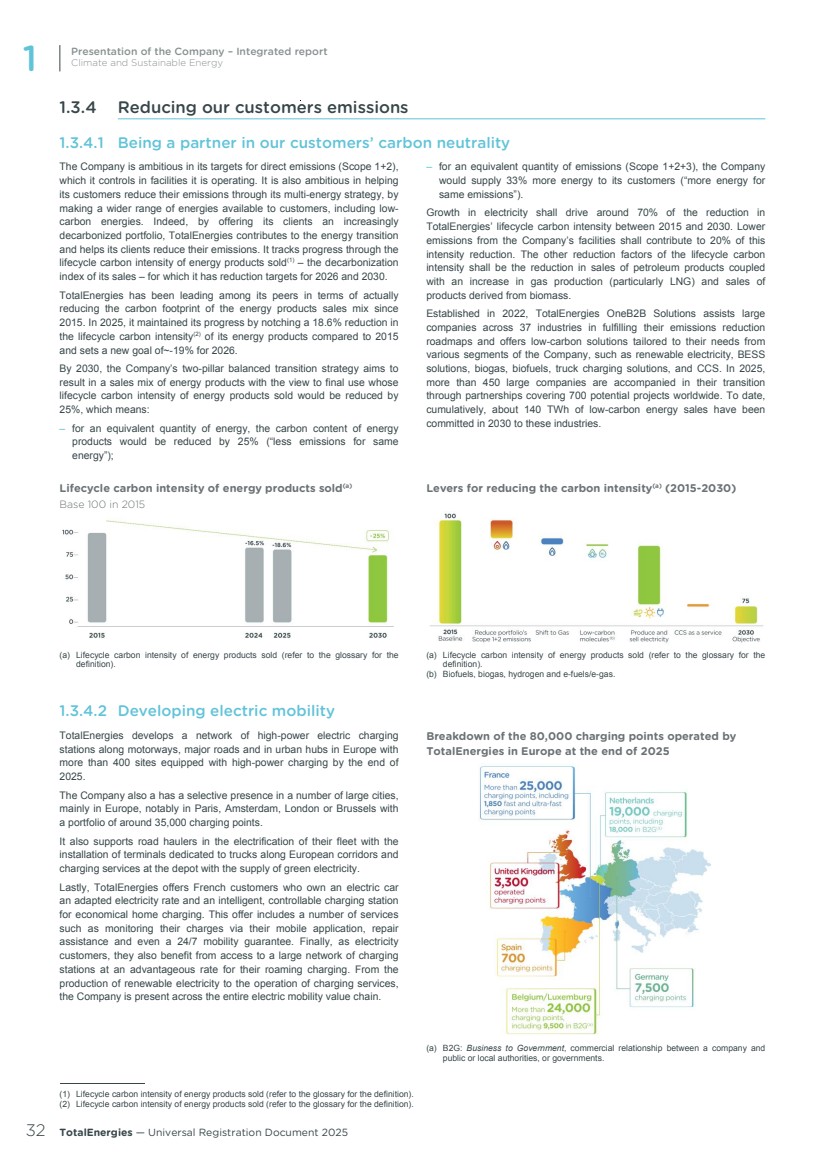
| 1.3.4.3 New low-carbon energy The energy transition also requires the development of low-carbon energy based on the conversion of biomass and waste, the use of renewable hydrogen, notably for refining or in the longer term the production of synthetic molecules (e-fuels) combining hydrogen with CO2 as a raw material. TotalEnergies is thus developing these new energies: biofuels, biogas, renewable hydrogen and synthetic fuels. Biofuels Today, biofuels emit over their life cycle more than 50% less CO2 than their fossil fuel equivalents, making them a partial decarbonization pathway for liquid fuels(1) . While demand is emerging quickly, which should lead towards a high-margin market, access to feedstocks (plants, residues, sugar, etc.) remains a barrier to growth. Among these biofuels, TotalEnergies favors the production of Sustainable Aviation Fuel (SAF) to decarbonize the aviation industry. To avoid conflicts of land usage, TotalEnergies is developing solutions based on primarily food industry waste and residues (used oils, animal fats). As of 2024, the Company increases the share of circular feedstocks to more than 75% to produce biofuels. Biogas Biogas, produced from the decomposition of organic waste, is a renewable gas. Injected into gas networks in the form of biomethane, it contributes to the partial decarbonization of natural gas uses. TotalEnergies’ gross production capacity continued to increase in 2025, reaching 1.4 TWh/y eq. of biomethane. The Company now intends to pursue its development through growth, mainly in Europe and the United States. Transforming our industrial sites to produce low-carbon energaround 1.3.4.4 What are the Relevant Indicators for Reducing GHG Emissions Worldwide? TotalEnergies produces and sells liquified natural gas, which is a necessary transition fuel for building a reliable, low-carbon power system, complementing renewable energies that are intermittent by nature. Moreover, gas helps to reduce emissions from power generation in many countries, since burning gas rather than coal to produce electricity emits half as much CO2 for the same amount of energy produced. In this respect, setting objectives to drastically reduce TotalEnergies’ global indirect emissions (Scope 3)(2) in absolute value, without an evolution of the overall structure of energy demand, is in reality not relevant to reduce global GHG emissions. Most of the emissions reported under Scope 3 by TotalEnergies correspond to the direct emissions (Scope 1) of the consumers of these products: the use of these products depends on their decisions and needs. In this context, an absolute reduction target for Scope 3 for a company like TotalEnergies, without any change in energy systems and therefore without the reduction of the corresponding Scope 1 of energy users, would lead to a shift of this demand towards other suppliers, notably the national oil companies of producing countries which account for more than 70% of the world market (compared with around 1.5% for TotalEnergies). This strategy would have no effect on lowering global greenhouse gas emissions, and therefore no positive impact on climate, and would be contrary to the interests of our Company and its shareholders. This strategy could be counter-productive for TotalEnergies’ customers, as the Company has set as a goal to ensure their energy supply security while supporting them in their own emissions reduction journey. Reminder: under Scope 3, since 2016 TotalEnergies has reported Category 11 emissions related to the end use by its customers of products sold i.e., linked to their combustion to obtain energy. Since 2023, TotalEnergies has published an estimate of indirect emissions related to the other Scope 3 categories, in accordance with the classification used by the GHG Protocol and Ipieca. We are also implementing action plans to reduce the emissions of the other categories. (1) According to the European Directive 2018/2001 named RED II. (2) Scope 3 GHG emissions (GHG Protocol – Category 11). Refer to the glossary for the definition. Presentation of the Company – Integrated report Climate and Sustainable Energy 1 TotalEnergies — Universal Registration Document 2025 33 |
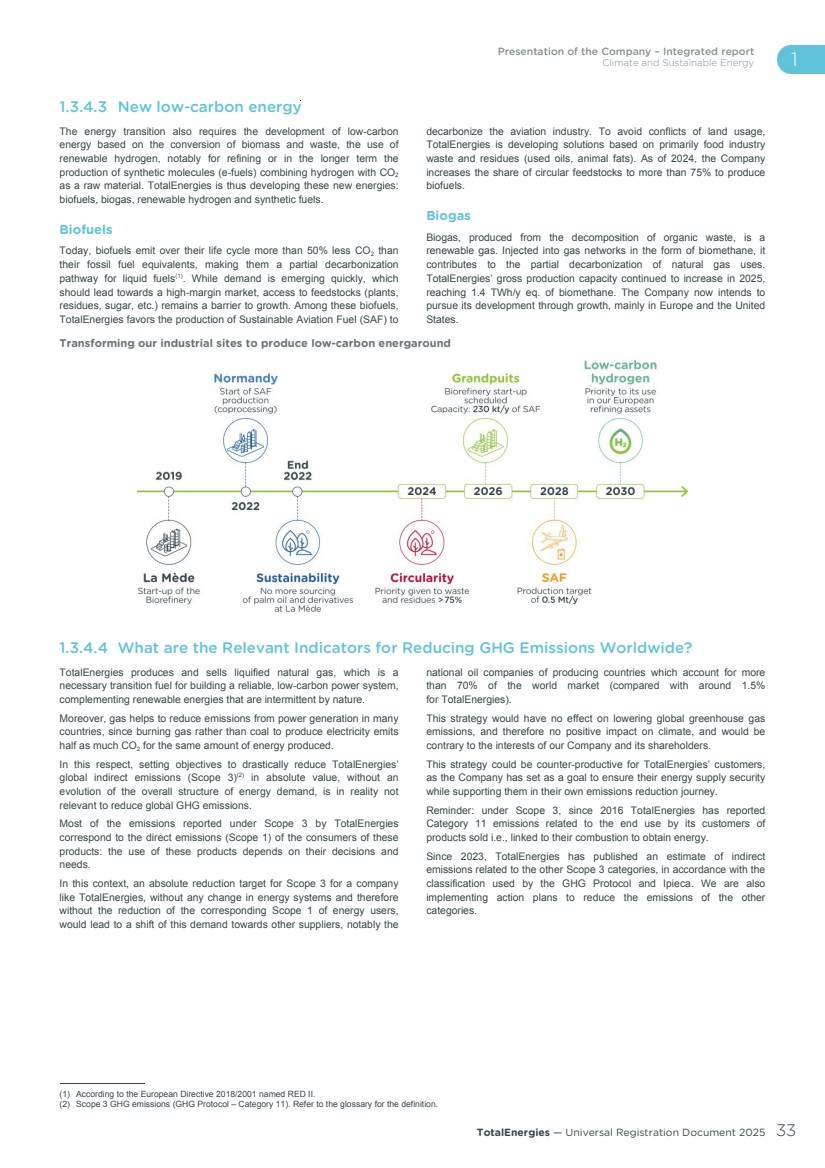
| 1.3.4.5 Enabled emissions reductions Estimated enabled emissions reductions from LNG sales Gas-fired power plants are a flexible mean of power generation and can be mobilized quickly, so they offer a secure backup for grids which are supplied by a growing share of intermittent renewable sources. CCGTs emit half as much GHG as coal or fuel oil-powered power plants(1) , that still account for the majority of power generation capacity in some countries. Globally, coal covers 35% of production and 74% of GHG emissions associated with electricity, and gas covers 22% of production and 21% of emissions respectively(2) . LNG, which can be shipped by sea, can flexibly supply a large number of power plants. A large part of the gas sold by the Company goes to the electricity sector. Given the positive role of gas in the transition, TotalEnergies is aiming to increase its share in its sales mix by 2030, and has made the decision not to set a gas Scope 3 (3) reduction target on this value chain. When fuel-oil or coal-fired power generation is replaced by gas-fired power generation, GHG emissions fall, whereas TotalEnergies’ gas Scope 3 increases. The Company has estimated the enabled emissions reductions(4) to which its 2025 sales of LNG may have contributed. The calculation is based on generation mixes and emission factors, published by Enerdata and the IEA(5) , for each country or region(6) and generation mean. TotalEnergies estimates that its customers’ use of LNG has enabled emissions reductions by about 78 Mt CO2e in 2025. These enabled emission reductions are accounted for separately from Scope 3 GHG emissions. Estimated enabled emissions reductions from renewable electricity generation A similar approach has been taken to estimate the enabled emissions reductions by renewable electricity generation: the methodology compares the emissions of the country’s alternative non-renewable mix to those from solar and wind generation. The applied emission factors (published by the IEA) cover the entire life cycle of power generation(7) . Non-renewable generation mixes are based on historical data published by Enerdata(8) for each country or continent(9) . TotalEnergies estimates that its renewable power generation has enabled emissions reductions by around 22 Mt CO2e in 2025. Estimates for 2030 By 2030, the enabled emissions reductions could amount to 160 Mt CO2e (around 110 Mt CO2e for LNG sales and around 50 Mt CO2e for renewable production), compared with a Scope 3 maintained below 400 Mt CO2e. These enabled emissions reductions that will result from the customers’ decision to substitute carbon-based energy products (fossil fuels, in particular coal) with less carbon-intensive energies (natural gas and renewables) will contribute to a reduction in global GHG emissions. 1.3.5 Solutions for residual emissions 1.3.5.1 Developing carbon capture and storage to reduce our emissions and those of our customers The IEA’s NZE scenario(10) includes the use of CCS(11) for up to 6 Gt/y CO2 in 2050, in order to reduce some of the emissions from residual oil and gas consumption, as well as from other industrial processes (cement, lime, steel, etc.) This capacity is more than 100 times greater than the global capture capacity currently in operation, which is around 60 Mt CO2 per year(12) . TotalEnergies’ CCS strategy gives priority to reducing emissions of its activities, to reduce Scope 1+2 emissions from Upstream oil & gas activities, as well as refining and LNG plants. For example, at Snøhvit liquefaction plant in Norway, where the Company is partner alongside Equinor, around 9 Mt of native CO2 have been stored since 2008. Similarly, the separated native CO2́ in the new NFE and NFS LNG liquefaction trains, currently under development in Qatar, will be stored by QatarEnergy. Finally, for our Ichthys LNG asset in Australia, the Company is studying a native CO2 storage solution for start-up beyond 2030. The study of CCS solutions for its assets therefore complements the already mentioned efforts to reduce emissions, including electrification, energy efficiency and flaring reduction. The Company also invests in CO2 storage projects for large industrial emitters (“Storage as a Service”) which can thereby reduce their Scope 1 and secure the future of their activities. TotalEnergies is investing around $100 M/y in this business, with models that enable us to benefit from leverage. This investment will be sustained in order to contribute to the development of a gross storage capacity of 10 Mt/y CO2 by 2030. Carbon storage projects in Europe (1) IEA 2025; Life Cycle Upstream Emission Factors 2025. (2) The rest of the electricity production is provided by hydroelectricity (14%), solar and wind (15%), nuclear (9%) as well as by fuel oil and other renewables. Figures for the year 2024 detailed in the IEA’s WEO 2025. (3) Scope 3 GHG emissions (GHG Protocol – Category 11). Refer to the glossary for the definition. (4) Refer to the glossary for the definition. (5) Production mix for the year 2024 provided by Enerdata (data published in January 2026) and emission factors for the year 2023 provided by IEA (data published in 2025). (6) For this calculation, Germany, France, Belgium, Luxembourg and the Netherlands have been considered as a single electricity and gas system. For France, the emission factors published by RTE have been considered. (7) Combustion-associated emission factors and upstream emission factors published in 2025 by the IEA for the year 2023. (8) Enerdata data published in January 2026 for the year 2024. (9) For this calculation, Europe has been considered as a single electrical network. (10)IEA 2025, World Energy Outlook 2025, Licence CC by 4.0. (11) Carbon Capture & Storage. (12) Global CCS Institute 2025, Global Status of CCS 2025 (updated on October 9, 2025). 1 Presentation of the Company – Integrated report Climate and Sustainable Energy 34 TotalEnergies — Universal Registration Document 2025 |
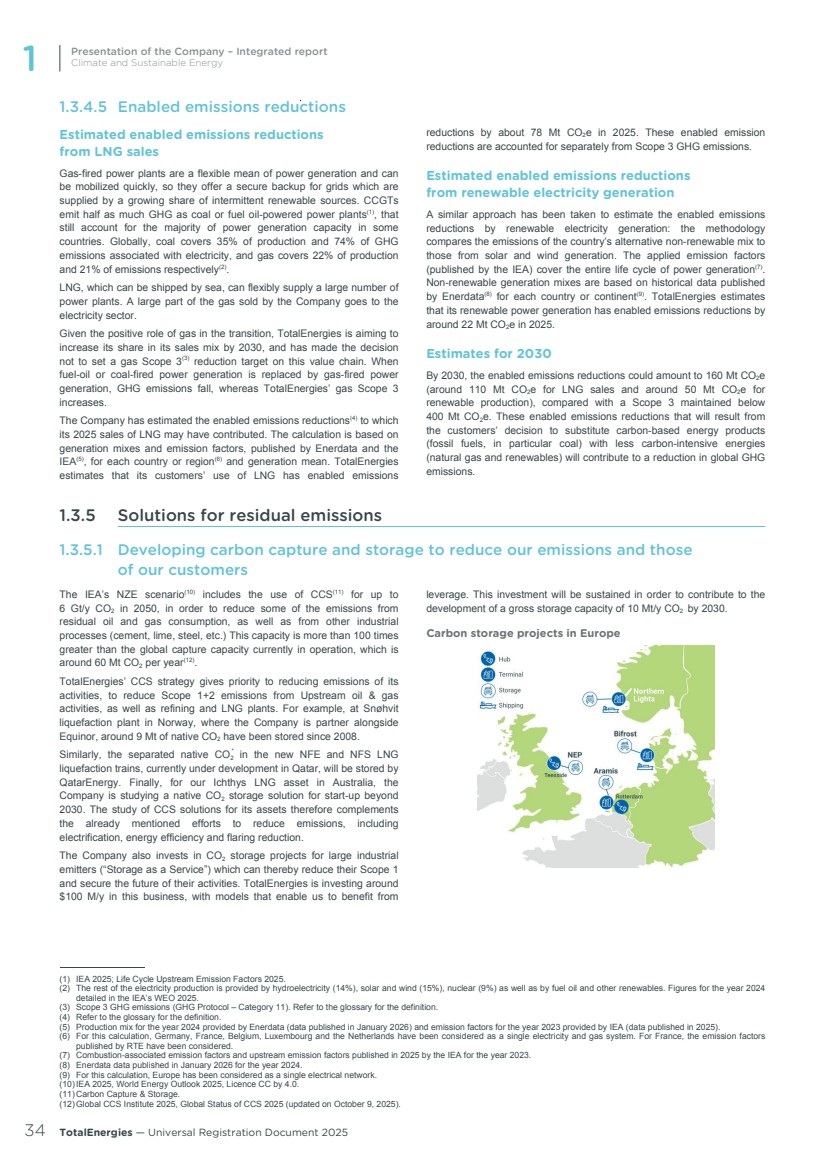
| Europe is at the heart of this CCS strategy. TotalEnergies is an historical operator in the North Sea, with recognized operational and geological expertise in the area. The United Kingdom, Norway and the European Union have set objectives and regulations and have provided significant financial support to promote a cross-border deployment of CCS. The Company is currently developing four projects in the North Sea that will provide CO2 storage solutions for its own assets and those of its customers. The Company has entered the United States CCS market in 2024, with a 25% stake in the Bayou Bend project in Texas. Finally, TotalEnergies is studying the development of CO2 storage in Malaysia, for local and regional markets, with its partners Petronas and Mitsui. TotalEnergies is also studying the utilization of carbon in various forms (CCU(1)), such as in reaction with renewable hydrogen, to produce fuels or synthetic methane. In particular, the Company signed an agreement for the development of the Live Oak synthetic methane production project in the United States. 1.3.5.2 Offsetting residual emissions with nature-based carbon sinks Natural areas preservation and restoration can be a lever for achieving net zero emissions worldwide by 2050. Only in 2030 will TotalEnergies begin voluntary offsetting its residual emissions via NBS (Nature Based Solutions) carbon credits and will offset only Company’s Scope 1+2 residual emissions. TotalEnergies is working to build a high-quality portfolio and is paying close attention to the integrity and permanence of the emissions reductions and sequestration achieved by the activities financed in this way. The Company is in favor of strengthening a global framework of trust to further reinforce robust and recognized voluntary crediting mechanisms. TotalEnergies is investing in forestry, regenerative agriculture and wetlands protection projects. Its strategy aims to combine and balance the value of people’s financial revenue from agriculture and forestry and the value of the benefits to soil, biodiversity, the water cycle and the production of carbon credits. When that approach is successful, the local standard of living improves and degradation of the land diminishes – as do emissions. This search for balance among different practices makes a just transition possible. At 2025 year-end, the Company’s stock of credits stood at 17.9 million carbon credits certified by the main international standards such as Verified Carbon Standard (VCS) from Verra, ACR (American Carbon Registry) or ANREU (Australian National Registry of Emissions Units). Cumulated carbon credits generated by the end of 2025 (million credits) The annual budget allocated to these projects is $100 million. The cumulative budget committed at the end of 2025 for all concluded operations amounts to more than $650 million over their cumulative lifespan, for a cumulative volume of verified credits expected at 37 million by 2030 and 51 million over their lifetime. The final quantities of carbon credits obtained will depend on the effective completion of the projects, methodological revisions for certification, and technical updates. Between 2026 and 2030, TotalEnergies will continue to develop new projects in order to build up a stock of carbon credits of around 50 million by 2030. In this context and based on a consumption rate of 10% of the stock per year from 2030, TotalEnergies would consume around 5 million credits per year from 2030 onwards. 1.3.5.3 Innovating to accelerate the energy transition To prepare for the future, the Company invested each year more than $1 billion in R&D, industrial innovation and digital developments. R&D at TotalEnergies In support of its transition strategy, TotalEnergies has significantly reoriented its R&D in recent years. Compared to 28% in 2017, TotalEnergies devoted 72% of its 2025 R&D budget(2) to low-carbon energy (renewables, biomass, batteries, etc.) and to reducing environmental footprints through CCUS and sustainable development programs The creation of the OneTech branch in September 2021 illustrates the dynamic generated by general management to mobilize teams and respond to the new challenges facing TotalEnergies as part of its transition strategy. OneTech’s mission is to provide all the technical and R&D expertise that TotalEnergies needs to implement its strategy. One of the missions of the OneTech branch is to provide solutions for reducing the carbon footprint and improving the energy efficiency of our projects right from the design stage, and to anticipate innovative technologies together with our partners. By putting Digital at the heart of OneTech’s organization, the Company is extending its digital transformation to all its business sectors by deploying digital solutions to improve the performance of industrial operations, reduce their environmental footprint and provide new services to its customers. Our technological Ambition Mastering the key technologies for the energy transition must be a source of differentiation. TotalEnergies has identified 6 technological areas in which the company wants to develop its excellence, focus and expand its research and technology (R&T) efforts through Strategic R&T Programs (SRTPs), with the aim of building competitive technological advantages. Accordingly, in September 2025, the Company adopted six Strategic R&T Programs: – two in the field of Sustainability Development: Digital for HSE and CO2 Techno Hub; – two for Projects and Operations: Digital Plant and NZE Plant (Near Zero Emissions Plant); – two for New Energies: Integrated Power Modelling and BioHub. (1) Carbon Capture & Utilization. (2) Excluding Hutchinson. Presentation of the Company – Integrated report Climate and Sustainable Energy 1 TotalEnergies — Universal Registration Document 2025 35 |
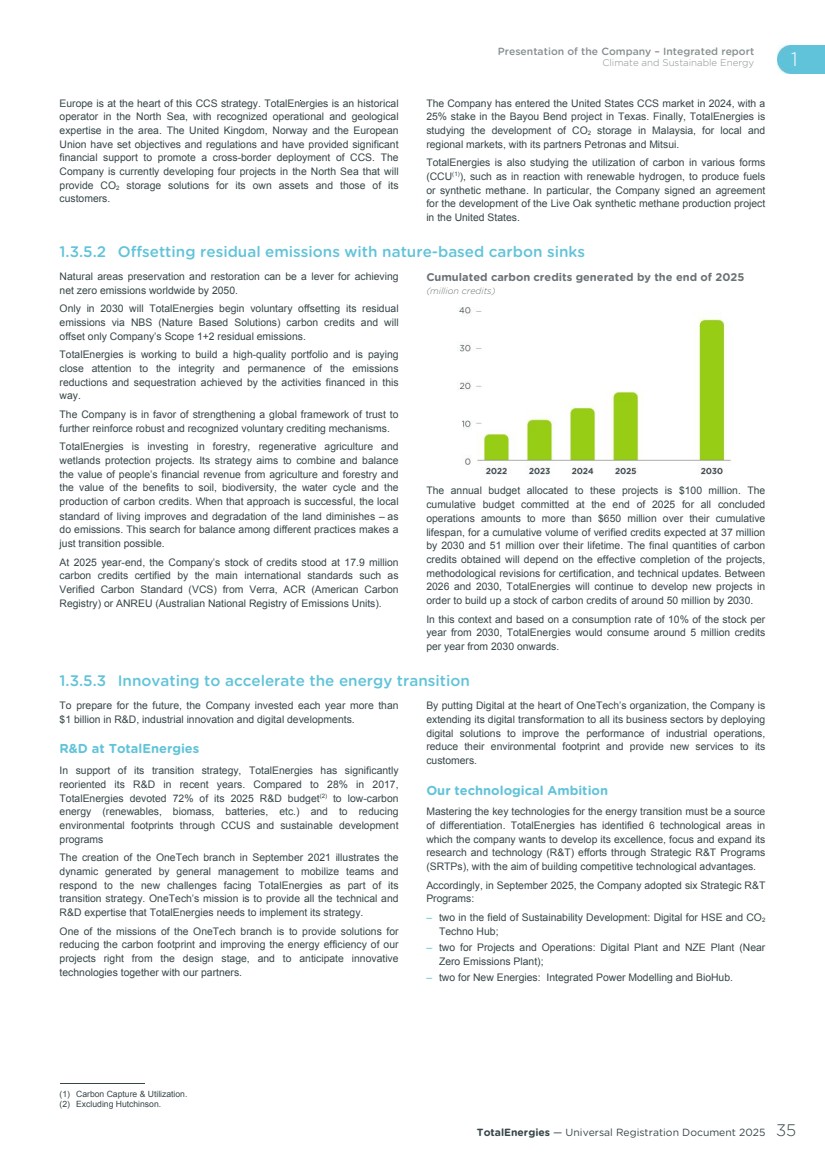
| Reducing our emissions through digital technology In September 2025, TotalEnergies reinforced its Digital Technology Ambition through two Strategic R&T Programs: Digital for HSE and Digital Plant. Digital for HSE aims to develop digital solutions to: – identify, anticipate, and manage technological risks; – improve workplace safety; – detect and prevent pollutant emissions. For example, STORM (Safety Tool for Operators and Remote Monitoring) is a digital product that illustrates the Company’s efforts in digital technology for sustainable development whose deployment was initiated in 2025. STORM is an innovative digital solution developed by TotalEnergies to improve the detection and continuous monitoring of methane emissions at sites operated by on-site operators and the Methane Tracking Center in Pau. By aggregating multi-source data in real time – IoT sensors, infrared cameras, acoustic sensors, weather data, and AUSEA® drone or satellite imagery – STORM provides 2D/3D visualization that enables early identification of leaks, localization of their source, and accelerated corrective action. Designed to facilitate the interpretation of multiple data sets while enhancing environmental performance, the tool aims to support the Company’s commitment to near-zero methane emissions by 2030. Gradually deployed across E&P assets, STORM contributes to transparent reporting and a significant reduction in emissions, building the foundation for future automated quantification and OGMP 2.0 reporting capabilities. Innovating with start-ups To contribute to its development in the electricity sector, TotalEnergies continues to collaborate with start-ups selected through its TotalEnergies On acceleration program, based in Paris at Station F. Today, nearly 46 start-ups have been accelerated; three of them have been acquired by the Company (Nash, Predictive Layer, DS Flow) and nearly 20 commercial contracts have been signed at the end of the 6 month acceleration period. R&D budget allocation(a) (%) (a) R&D budget excluding Hutchinson. 1.4 Our investment policy Balanced and disciplined investments to deliver energy production growth * Equivalent to 5.1 B€ over five years. ** Net Capex = organic investments + acquisitions - asset sales. TotalEnergies’ investment policy is designed to support the deployment of its balanced energy transition strategy. It is anchored on two pillars: investments for the maintenance and growth of oil and gas production, mainly LNG, on the one hand, and investments for the growth of low-carbon activities, mainly electricity, on the other hand. Firstly, in October 2025, the Company announced a $1 billion reduction in its annual capital expenditure target to $15-17 billion per year over the next 5 years, including $3-4 billion for Integrated Power. That reduction is part of the Company’s implementation of a $7.5 billion cost-saving programme (Capex + Opex) during the 2026-2030 period. The Company will remain focused on high margin Upstream projects and stay selective on low-carbon Capex, mainly for the Integrated Power business. Secondly, in November 2025, TotalEnergies announced its intention to accelerate its gas-to-power integration strategy in Europe by acquiring 50% of a portfolio of flexible power generation assets from EPH as part of a €5.1 billion all-share transaction that was immediately earnings-enhancing for TotalEnergies shareholders(1) . Due to this accelerated inorganic growth within the Integrated Power segment, the Company is lowering its annual Capex guidance by $1 billion per year to $14-16 billion per year for 2026-2030, of which $2-3 billion is for Integrated Power, while maintaining its 2030 electricity generation target of 100-120 TWh. Overall, therefore, TotalEnergies intends to maintain a material level of investment in low-carbon energies, mainly in the Integrated Power segment, where it plans to invest $3-4 billion per year in 2026-2030, including around $1 billion per year for 5 years through shares as part of the transaction with EPH. Net investments in low-carbon energies include investments in Integrated Power, low-carbon molecules (including biofuels, biogas, recycled plastic, biopolymers, synthetic fuels, hydrogen and CCS) as well as the nature-based carbon sinks projects allowing, from 2030, to contribute to reduction of the Company’s carbon footprint. Around 35% of TotalEnergies’ net investments are expected to be dedicated to developing new low-cost, low-emission oil and gas projects, contributing to the 3% growth in hydrocarbon production between 2024 and 2030. These investments are expected to be allocated in particular to strengthening its LNG production capacity and supporting its oil production, in a context of continued growth in global demand. (1) The transaction remains subject to information and consultation processes and regulatory approvals, with completion expected by mid-2026. 1 Presentation of the Company – Integrated report Our investment policy 36 TotalEnergies — Universal Registration Document 2025 |
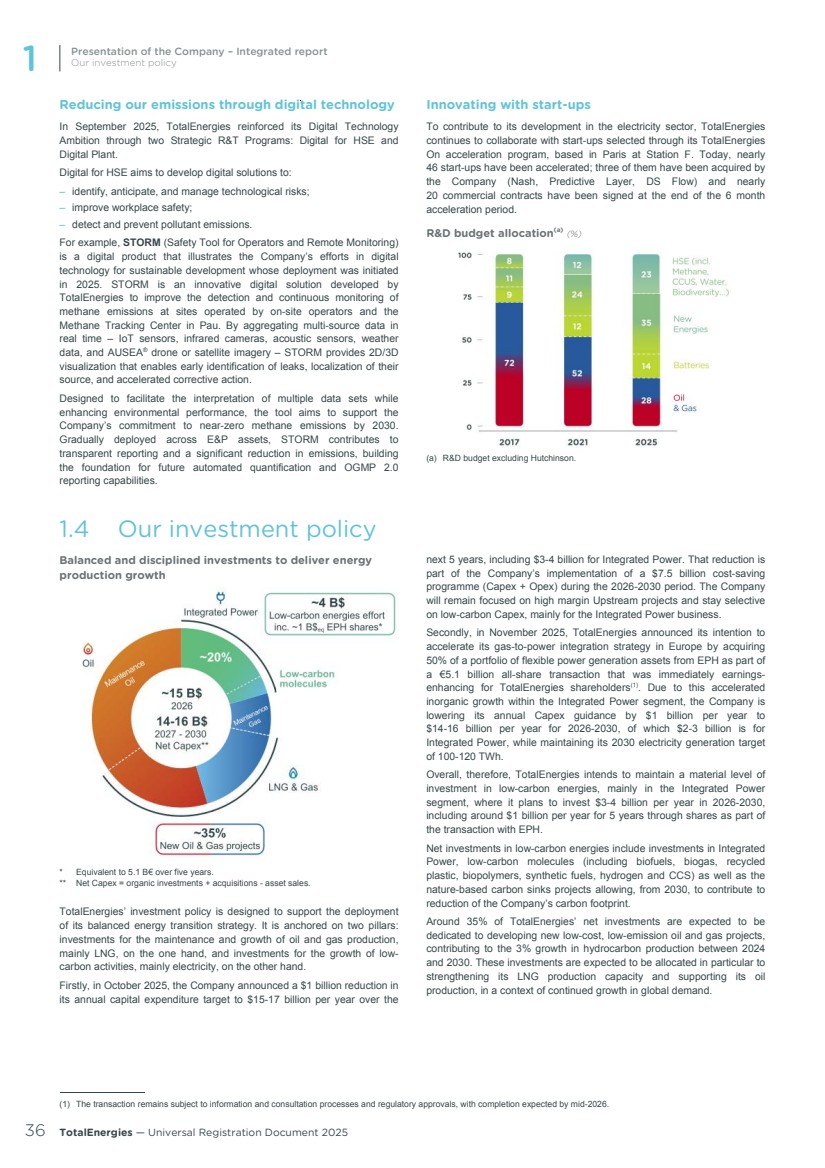
| The Company maintains a downward flexibility to $14 billion per year in case of a sharp decrease of prices, under $50/b. In 2025, TotalEnergies invested a total of $17.1 billion, including around $3.5 billion in low-carbon energies, mainly in the Integrated Power segment (around $3 billion). In 2026, the Company plans to invest $15 billion, including $2.5-3 billion of net investments in the Integrated Power segment, representing a total investment effort of $3.5 to $4 billion when factoring in around $1 billion in shares as part of the transaction with EPH. 1.4.1 Main investments carried out over the period 2023-2025 Gross investments (M$) 2025 2024 2023 Exploration & Production 10,523 9,225 12,378 Integrated LNG 3,520 3,912 3,410 Integrated Power 5,367 5,328 5,497 Refining & Chemicals 1,537 1,896 2,149 Marketing & Services 937 1,190 1,273 Corporate 316 199 153 Total 22,200 21,750 24,860 Net investments(a)(M$) 2025 2024 2023 Exploration & Production 9,259 8,853 7,526 Integrated LNG 2,734 3,536 3,159 Integrated Power 2,776 3,869 4,945 Refining & Chemicals 1,437 1,538 1,922 Marketing & Services 609 (138) (859) Corporate 276 171 144 Total 17,091 17,829 16,837 Acquisitions net of assets sales(a) (M$) 2025 2024 2023 Acquisitions 3,923 4,646 6,428 Disposals 3,644 (3,240) (7,717) Other operations with non-controlling interests – – – Total 279 1,406 (1,289) Organic investments(a) (M$) 2025 2024 2023 Exploration & Production 9,564 9,060 10,232 Integrated LNG 2,569 2,169 2,063 Integrated Power 2,187 2,355 2,582 Refining & Chemicals 1,464 1,711 2,040 Marketing & Services 775 951 1,065 Corporate 253 177 144 Total 16,812 16,423 18,126 (a) Refer to the glossary for definitions and additional information on alternative performance measures (APM, Non-GAAP measures) and to point 1.8 for reconciliation tables. Organic investments in 2025 In the Integrated Power segment, organic investments were mainly allocated to solar and wind power plant construction projects, particularly in the United States, Germany, France, Spain and the United Kingdom. In the Integrated LNG segment, organic investments mainly concerned LNG production projects under construction for which the final investment decision has been taken (such as NFE and NFS in Qatar, Rio Grande LNG in the United States and Marsa LNG in Oman), the Mozambique LNG project in preparation for the resumption of the project announced in January 2026, as well as the development of LNG projects in operation (Ichthys LNG and Gladstone LNG in Australia) and projects under study (such as Papua LNG in Papua New Guinea). In the Exploration & Production segment: – most of the organic investments were allocated to the development of new hydrocarbon production facilities, the maintenance of existing facilities, infill well projects for assets already in production as well as exploration activities. Development investments particularly concerned the Ballymore project in the United States, commissioned in April 2025, and Mero 4, which came on stream in May 2025, along with major projects under construction such as Tilenga and Kingfisher in Uganda and the associated cross-border EACOP pipeline project in Uganda/Tanzania, GGIP in Iraq, Sépia 2 and Arapu 2 in Brazil, Kaminho in Angola and GranMorgu in Suriname; – in Exploration, TotalEnergies pursued its exploration and appraisal program – in which it invests around $1 billion every year, particularly in Namibia, Suriname and Brazil – in order to continue organically feeding its project portfolio; – in CCS, TotalEnergies invested in partnership in the development of CO2 storage projects located in the North Sea and in operation (Northern Lights, in Norway), under construction (Northern Endurance in the UK) or under study (such as Aramis in the Netherlands and Bifrost in Denmark); Presentation of the Company – Integrated report Our investment policy 1 TotalEnergies — Universal Registration Document 2025 37 |
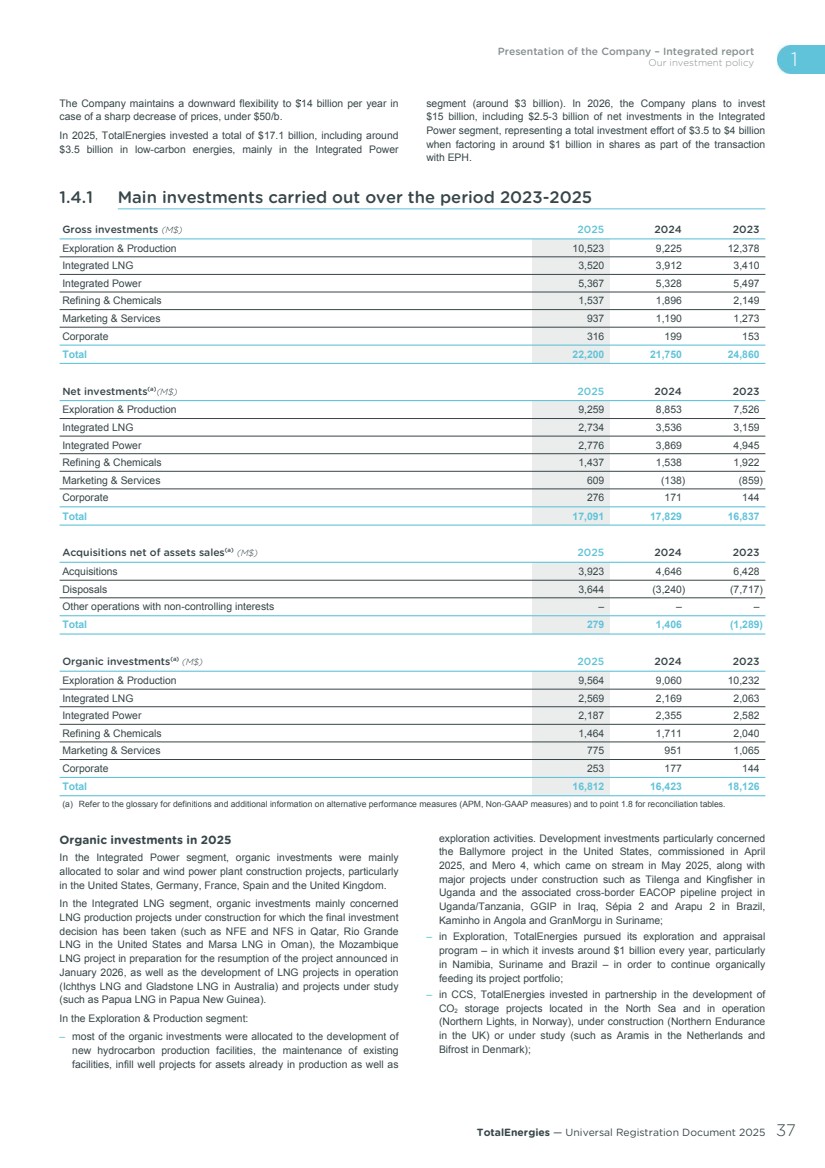
| – in nature-based carbon sink projects, the Company continued its investments, particularly in inclusive forestry and agricultural management projects. In the Refining & Chemicals segment, organic investments were dedicated on the one hand to safety and maintenance of the installations (including major shutdowns) and to the energy efficiency program and, on the other hand, to the development of new facilities. In particular, they were devoted to the construction, in partnership with the Saudi Arabian Oil Company, of Amiral, a world-scale petrochemical complex in Saudi Arabia, for which the final investment decision was taken in December 2022. They were also dedicated to projects intended to improve plants’ competitiveness, particularly in Europe, and to the further development of the project to transform the Grandpuits refinery into a zero-crude platform focusing on new energies and low-carbon activities, which is expected to represent a cumulated investment of more than €500 million by 2026. In the Marketing & Services segment, organic investments were mainly dedicated to the maintenance of the worldwide network of service stations. TotalEnergies continued to deploy charging infrastructure for electric mobility, mainly in Europe, while reducing its investment in that infrastructure by arranging partnerships and external financing. Acquisitions in 2025 Acquisitions finalized by TotalEnergies in 2025 amounted to approximately $3.9 billion (compared to $4.6 billion in 2024 and $6.4 billion in 2023). TotalEnergies continued to develop the Integrated Power segment, in particular by: – acquiring VSB, a renewables projects developer in Germany, for €1.6 billion; – acquiring stakes in renewables projects in Canada (solar), Uganda (hydroelectricity) and in the Dominican Republic (solar); In the Integrated LNG segment, TotalEnergies: – acquired gas interests in production in the Eagle Ford basin in the United States (Dorado and Constellation); – acquired stakes from Petronas in multiple blocks located off the coast of Malaysia and a block located off the coast of Indonesia, in order to carry out exploration, appraisal and development programs there. In Exploration & Production, TotalEnergies: – acquired an additional 10% stake in the Moho field in Congo, while divesting two mature assets; – acquired 75% of the Tungsten Explorer drillingship rig as part of a joint venture with Vantage (25%) for $199 million. Divestments in 2025 TotalEnergies completed asset sales amounting to approximately $3.6 billion in 2025 (compared to $3.2 billion in 2024 and $7.7 billion in 2023). They included in particular: – in the Integrated Power segment, the implementation of its capital recycling strategy, including the sale of 50% stakes in renewables portfolios (1.4 GW in North America, 604 MW in Portugal, 424 MW in Greece and 270 MW in France) and the sale of a 1.7% stake in listed company Adani Green Energy Limited(1); – in the Exploration & Production segment, the divestment of interests in two unconventional blocks in Argentina, the non-operated stake in the Bonga field in Nigeria, interests in the Nkossa and Nsoko II licenses in the Republic of the Congo and the non-operated stake in Ekofisk satellite fields in Norway; – in the Integrated LNG segment, the partial sale of an interest in block SK408 in Malaysia; – in the Marketing & Services segment, the divestment of fuel distribution activities in Brazil. After peaking in 2024, net investments thus amounted to $17.1 billion in 2025 (compared to $17.8 billion in 2024 and $16.8 billion in 2023). 1.4.2 Major planned investments In accordance with its growth strategy in the Integrated Power segment, TotalEnergies plans to continue its development in the electricity value chain. In particular, the Company intends to pursue its investment efforts, notably in solar and wind power projects in the United States and Europe, wind power projects in Brazil in partnership with Casa dos Ventos, and plans to finalize the acquisition of 50% of a portfolio of flexible power generation assets from EPH in 2026. In the Integrated LNG segment, TotalEnergies plans in particular to continue investments dedicated to major LNG production projects for which the final investment decision has already been taken (mainly Mozambique LNG, North Field East and North Field South in Qatar, Rio Grande LNG in the United States and Marsa LNG in Oman) as well as the development of LNG production projects that are in operation (notably Ichthys LNG and Gladstone LNG in Australia). In the Exploration & Production segment, investments in the development of oil and gas projects are expected to be dedicated essentially to major development projects under way for which the final investment decision has already been taken (Tilenga and Kingfisher projects in Uganda and the associated EACOP cross-border oil pipeline project in Uganda/ Tanzania, GGIP Phase 2 in Iraq, Atapu 2 and Sépia 2 in Brazil, Kaminho in Angola and GranMorgu in Suriname). In addition, TotalEnergies intends to pursue its exploration program, particularly in Namibia with an exploration well expected on PEL83 (Mopane)(2) , and short-cycle development projects, particularly in West Africa. In downstream, investments of the Refining & Chemicals segment are expected to be mainly dedicated, on the one hand, to facility safety and maintenance (including major shutdowns) and the energy efficiency program and, on the other, to the continuation of the project to transform the Grandpuits refinery (France) into a zero-crude platform as well as the construction, in partnership with the Saudi Arabian Oil Company, of Amiral, a world-scale petrochemical complex in Saudi Arabia. Investments in the Marketing & Services segment are expected to be mainly allocated, on the one hand, to the maintenance of the global network of service stations and, on the other and to a lesser extent, to the development of the European electric mobility network. 1.4.3 Financing mechanisms TotalEnergies self-finances most of its investments with cash flow from operating activities and may occasionally access the bond market. Certain subsidiaries or specific projects may be financed through external financing, notably in the case of joint-ventures. These include Ichthys LNG in Australia, Satorp in Saudi Arabia, Mozambique LNG in Mozambique, Cameron LNG and Rio Grande LNG in the United States and Hanwha TotalEnergies Petrochemical Co. in South Korea. (1) TotalEnergies held a 17.25% stake in that company as of December 31, 2025. (2) The finalisation of the transaction remains subject to the approval of the competent authorities. 1 Presentation of the Company – Integrated report Our investment policy 38 TotalEnergies — Universal Registration Document 2025 |
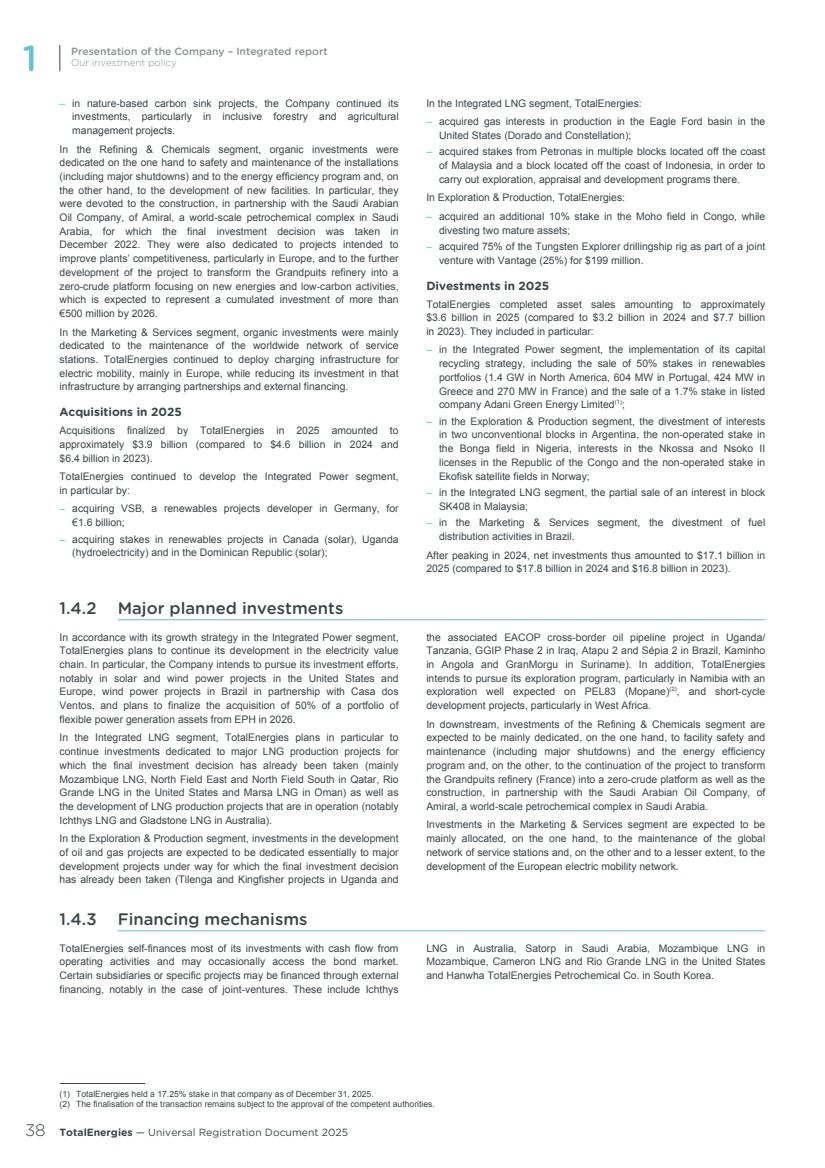
| As part of certain project financing arrangements, TotalEnergies SE has provided guarantees. These guarantees (“Guarantees given on borrowings”) as well as other information on TotalEnergies’ off-balance sheet commitments and contractual obligations appear in Note 13 to the Consolidated Financial Statements (refer to point 8.7 of chapter 8). TotalEnergies believes that neither these guarantees nor the other off-balance sheet commitments of TotalEnergies SE or any other TotalEnergies company have, or could reasonably have in the future, a material effect on TotalEnergies’ financial position, income and expenses, liquidity, investments or financial resources. 1.5 Innovation for the transition strategy of TotalEnergies 1.5.1 OneTech The OneTech branch was created in September 2021 as one of the means of execution for the transition strategy of TotalEnergies. The industrial successes and technological advances of TotalEnergies have always been based on the values of the Company, in particular on its pioneering spirit, appetite for performance and on the technical and scientific skills of its teams, which are widely recognized by its peers and partners. OneTech’s mission is to provide all the technical and R&D expertise that TotalEnergies needs to implement its strategy. OneTech supports TotalEnergies’ various activities on a daily basis towards operational excellence and innovation with more than 3,000 engineers, technicians and researchers spread over various sites in Europe (France, Belgium and Denmark) and in R&D centers internationally. OneTech pursues six objectives The centralization of teams within OneTech provides clarity for stakeholders, with easier identification of the technical or R&D contact on each subject for the entire Company. A dedicated organization With OneTech, the Company has created a cross-functional, multi-branch technical organisation that supports the Company’s technological ambition by leveraging the synergies between its skills in data acquisition and processing, modelling, construction and operation of major projects, and support for complex industrial operations. By putting Digital at the heart of OneTech’s organisation, the Company is extending its digital transformation to all its business sectors by deploying digital solutions to improve the performance of industrial operations, reduce their environmental footprint and provide new services to its customers. In September 2025, OneTech reviewed its organization, setting up a Digital line in addition to its three functional hubs: an Industrial hub, a Research & Development hub and a Support Functions hub. – The Industrial Hub consists of: – the Customer Lines ivision, the entry point within OneTech for internal customers of the operational branches, coordinates the operational and technical support of OneTech and the mobilization of the resources of the associated Technical Lines that the business segments need. It also carries out technical evaluations of new business opportunities and studies for the preparation of new developments of business unit assets. A team within this division is dedicated to the development and implementation of projects to reduce the carbon footprint of the Company’s assets. – the Technical Lines Division, which includes the areas of expertise, is the core of the technical and industrial know-how. It brings together within common teams, all the specialists and players in the same technical field, thus promoting synergies between the Company’s sites, as well as the sharing of experience, best practices, innovative solutions, knowledge and know-how. – In September 2025, the Research & Development hub consisting of the Research & Development Division was reconfigured in line with the implementation of the Company’s Technological Ambition (refer to point 1.5.3). The Digital Lines Division puts digital technology at the heart of the OneTech organization (refer to point 1.5.4). Presentation of the Company – Integrated report Innovation for the transition strategy of TotalEnergies 1 TotalEnergies — Universal Registration Document 2025 39 |
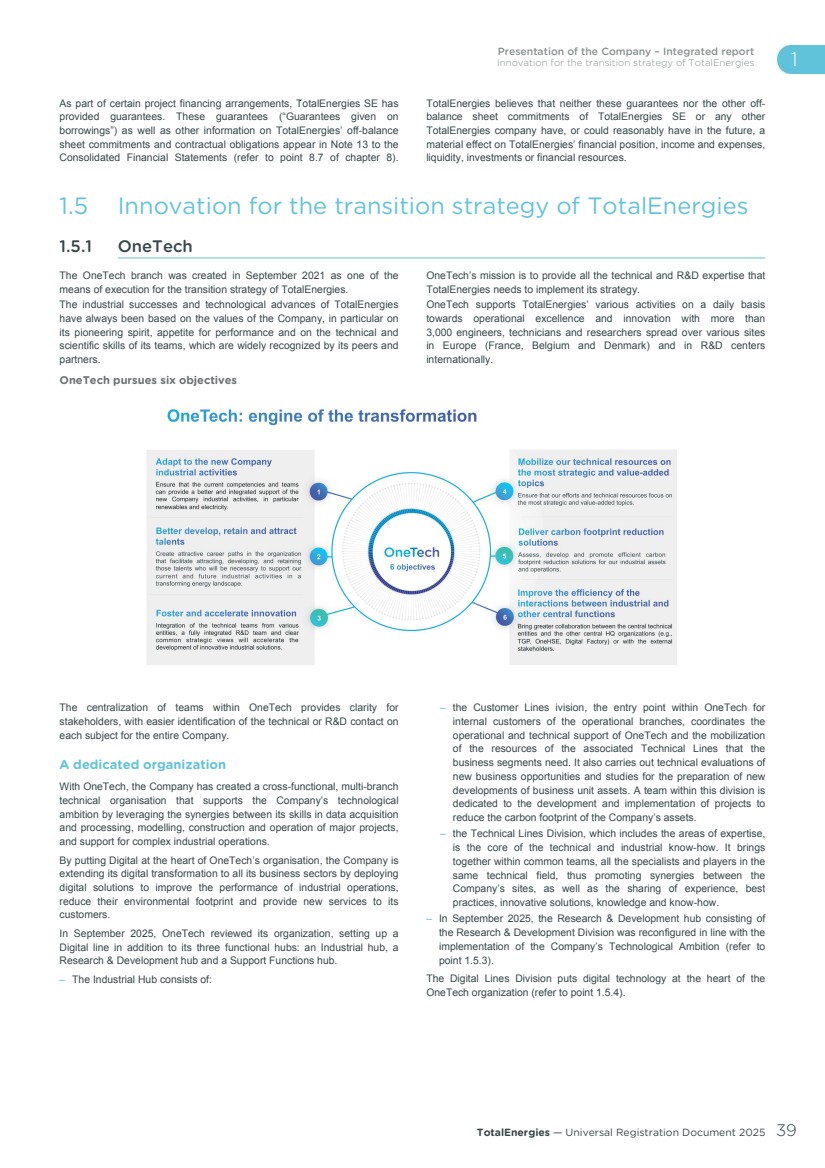
| 1.5.2 R&D, lever of the transition strategy To prepare for the future, the Company invested more than $1 billion in R&D, industrial innovation, digital developments in 2025. Within the framework of its Technological Ambition, the Company has begun its digital growth, which will account for approximately 30% of its overall efforts in 2025. As well as the large-scale deployment of proven technologies such as solar photovoltaics, wind power and biofuels, reducing carbon emissions also requires technological breakthroughs and the development of completely new industrial value chains such as hydrogen, synthetic fuels and carbon capture and storage. The Company is also investing in digital expertise and artificial intelligence (AI) through the development of solutions to accelerate its transition (refer to point 1.5.4) and that of its customers. The Company invested $810 million in 2025 in its own and its subsidiaries’ R&D (compared to $805 million in 2024 and $774 million in 2023) with a dedicated workforce of more than 3,500 researchers. In support of its transition strategy, TotalEnergies has significantly reoriented its R&D in recent years. Compared to 28% in 2017, TotalEnergies devoted 72% of its 2025 R&D budget(1) to low-carbon energy (renewables, biomass, batteries, etc.) and to reducing environmental footprints through CCUS and sustainable development programs. Beyond OneTech, the Hutchinson and Saft Groupe (Saft) subsidiaries carry out R&D specific to their activities. – Hutchinson R&D develops solutions with high technological content to meet the challenges of future mobility with an emphasis on sustainable development, lightweighting and electrification. These multi-market solutions are based on five areas of expertise: NVH (Noise Vibration Harshness), Waterproofing, Thermal management, Materials and structures for extreme conditions of use and also Power transmission. The objective is to improve customer performance in terms of sustainable development, safety, energy efficiency and comfort. In 2025, efforts on sealing materials for vehicle bodywork continued, in line with the objective of offering customers solutions containing at least 25% of renewable materials. Accordingly, the Resolutions® label was applied to 12 products, notably based on 13 new Revea® materials, all sharing the common objective of achieving a smaller final carbon footprint. In weight reduction domain, Hutchinson has succeeded in imposing itself on the future A350F (cargo version) market with composite reinforcement rods integrated into the aircraft primary structure. This first achievement on an extremely demanding application opens the door to other opportunities. In electrification, new fire-resistant materials have been developed to meet the increased requirements linked to the risks of batteries thermal runaway. Initial successes were achieved in 2025, including an order for a flexible cooling system for bus-type battery packs and a first order for prototypes of a composite-material upper cover for light vehicle battery packs In the maritime transport sector, development work is underway with Saft to supply insulating battery separators, and in the aerospace sector for composite components for a future electric engine to allow hybrid propulsion. – Saft conducts research to develop ever safer and more efficient batteries, particularly in the field of mobility and storage of renewable energies, using artificial intelligence, big data and digital twins(2) . In 2025, Saft continued to work on the development of a new type of smart battery that is more efficient for stationary and mobile storage. This technology represents a real breakthrough in the field of mobile and stationary energy storage. Furthermore, the alliance launched in 2023, supported by France 2030 and bringing together six partners from the academic and industrial worlds under the coordination of Saft, continues to develop batteries for new solid-state lithium-ion technologies for applications requiring high energy or high power, while offering appropriate safety performance. The program also takes into account issues related to lifecycle analysis and battery recycling in order to help reduce national dependence on critical materials. To accelerate the Company’s transition strategy, R&D activities are carried out relying on its talented people in its 15 R&D centers around the world and its pilot sites, all in a process of open innovation with industrial partners, start-ups and the best research and innovation ecosystems. TotalEnergies mobilizes nearly 1,000 partners per year. 15 TotalEnergies research centers around the world (1) Excluding Hutchinson. (2) A virtual replica of a physical object, used to monitor, simulate and optimize performance. 1 Presentation of the Company – Integrated report Innovation for the transition strategy of TotalEnergies 40 TotalEnergies — Universal Registration Document 2025 |
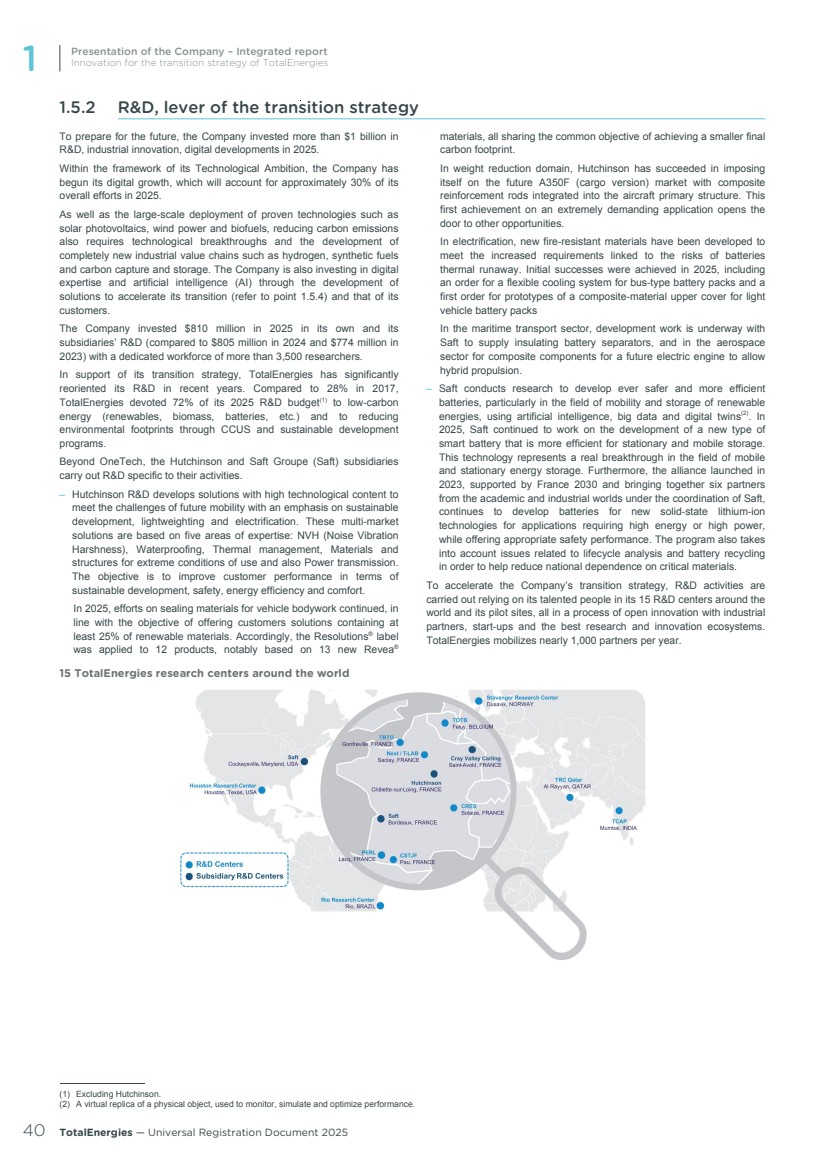
| TotalEnergies’ transition strategy requires agile R&D, committed to innovation. R&D activities thus break down according to the principles that underpin the growth strategy, the Company’s ambition and its commitment to sustainable development. Until September 2025, the R&D hub was organized along five lines and one division: – the Power R&D line focused on renewable energy production, integrated energy system design and optimization of modes of distributed operation to balance renewable energy; – the CO2 & Sustainability R&D line developed innovative and competitive technologies focusing on increasingly sustainable solutions relating in particular to the capture, storage and use of CO2 to make more sustainable synthetic fuels, along with the development of technologies that reduce environmental footprints; – the Fuels & Lubricants R&D line supported the transformation of the world of transport, new forms of mobility and industry, by developing products to increase the performance of electrical systems and combustion engines and reduce the environmental footprint of existing solutions; – the Downstream Processes & Polymers R&D line piloted and operated research work on the development of sustainable aviation fuels (SAF), the separation of polymers and their recycling with a view to the circular economy and reduction in the carbon emissions of Refining-Chemical industrial units; – the Upstream R&D line aimed to improve the operational efficiency of exploration and production activities, both in terms of reducing GHG emissions and cutting costs in line with its strategy of portfolio optimization; – transversally and in addition to the five R&D lines, the Anticipation and Portfolio Performance Division carried out prospecting activities for the Company on emerging subjects while seeking to capture technologies that could have been disruptive. This division also managed the R&D portfolio for maximum operational efficiency and value creation. 1.5.3 Our technological ambition Mastering the key technologies for the energy transition must be a source of differentiation. TotalEnergies has identified 6 technological areas in which the company wants to develop its excellence, focus and expand its research and technology (R&T) efforts through Strategic R&T Programs (SRTPs), with the aim of building competitive technological advantages. Accordingly, in September 2025, the Company adopted six SRTPs: – two SRTPs in the field of Sustainability Development: • the Digital for HSE SRTP (refer to point 1.5.4); • the CO2 Techno Hub SRTP develops new technologies in the fields of: – The use and conversion of CO2 in new value chains, in particular via “e-fuels” or “e-molecules”, possibly integrated into its industrial facilities, and also drawing on its expertise in the field of renewable electricity; – Geological storage of CO2, in depleted reservoirs or saline aquifers, drawing heavily on its subsurface expertise acquired in oil and gas production. – In terms of capture, the Company maintains an active watch in order to select the existing technologies best suited to the applications of its industrial sites. This monitoring also covers direct air capture (DAC), which will eventually be necessary to achieve negative emissions. – two SRTPs for Projects and Operations: • the Digital Plant SRTP (refer to point 1.5.4); • the NZE Plant (Near Zero Emissions Plant) SRTP is developing programs in the gas sector with the aim of developing integrated technologies and solutions for decarbonising the LNG production and liquefaction chain as well as gas-fired power stations to move towards near zero emissions. In the petroleum sector: • for FPSO, in addition to efforts to improve the efficiency of transporting fluids from the seabed to the surface, the program is deploying its expertise in the electrification of offshore processing facilities, techniques to improve energy efficiency taking advantage of offshore conditions and the pursuit of a drastic reduction in flaring; • for Cracker, the program aims to accelerate the integration of industrial solutions for energy efficiency and process decarbonisation, process electrification and all forms of heat recovery. – two SRTPs for New Energies: • the Integrated Power Modelling SRTP aims to create competitive advantages in the following areas: – reducing uncertainty in the assessment of renewable resources and deliverables, and modelling wake phenomena; – optimizing the design of renewable assets (from component to construction) and grid integration solutions; – real-time optimization of operations and predictive maintenance; – managing the flexibility of renewable electricity supply and demand through the hybridization of generation resources with storage systems. • the BioHub SRTP deploys its expertise in the following areas: – Production technologies pathways based on biomass, – Optimizing the operations of our biorefineries, – Developing co-processing in our existing plants, – Developing new skills upstream in the agricultural or agri-food chain to diversify feedstock sources. The BioHub leverages the Company’s expertise in refining and chemistry and develops new skills upstream in the agricultural and agri-food chain to diversify biomass sources. In particular, the BioHub aims to differentiate the Company in terms of characterisation and pre-treatment of new, diversified feedstocks, automated data acquisition and analysis incorporating AI, process modelling and simulation, and co-product recovery. The “Integrated Power Modeling” and “Near Zero Emission Plant” SRTPs, which are directly linked to operational sites, are attached to the Technical Line of the industrial hub. The “BioHub” and “CO2 Techno Hub” SRTPs, which are further upstream from the business units, are attached to R&D. From September 2025 and in connection with its Technological Ambition, OneTech has also been restructuring its R&D programs in response to the needs of Business Units, including the following main R&D programs: – the Fuels & Lubricants R&D line mainly develops high-performance products by promoting a circular approach (lubricants, fluids, bitumens and fuels) and an Electric Vehicle charging business to adress current and future market challenges in the transportation and decarbonized industry fields. Close collaboration with customers and stakeholders is undertaken to obtain the necessary certifications and approvals, validate products performances in real-life conditions, and anticipate future technical requirements. Experimental data are leveraged through the deployment of advanced digital solutions to optimize the product design process; Presentation of the Company – Integrated report Innovation for the transition strategy of TotalEnergies 1 TotalEnergies — Universal Registration Document 2025 41 |
| – the Pilots & Polymers R&D line pilots and operates research activities aiming to improve the competitiveness, differentiation of polymers and their end‑of‑life recycling, within a circular economy approach. More broadly, this R&D line supports the Company’s technological ambition by applying its experimental expertise (process pilots, analysis, digital) for the benefit of the SRTPs, R&D lines and the Refining & Chemicals Business; – the Subsurface R&D line prepares next generation tools, particularly by leveraging AI to accelerate the development of digital solutions for exploration, development and upstream asset operations. To achieve this, it relies on the Company’s continually increasing in-house computing capabilities. This set of tools, which combine high-performance computing, geoscience and reservoirs, complex seismic imaging and mathematical modeling, aims to improve and accelerate subsurface studies, optimize developments, as well as associated resources and reserves, and monitor fields in production, while reducing the environmental footprint and production costs. 1.5.4 Digital acceleration as a performance lever Since September 2025, the Digital Line has been coordinating the branches’ digital transformation plan, providing services and technologies in the Data & Digital fields, developing and deploying applications through the TotalEnergies Digital Factory. It leads two of the six Strategic R&T Programs: Digital Plant and Digital for HSE. To achieve these objectives of cost-competitiveness of the energy products that the Company supplies to its customers, the Digital Plant SRTP aims to: – develop and deploy digital applications to enhance the operational excellence of its industrial sites and, in so doing, making digital a lever for the energy transition; – make its extensive industrial data available and usable by all these tools - including data in real time and with access from different sites; – enable the development and use of applications using artificial intelligence in industrial contexts and in the service of safety and operational excellence; – develop or make available all the technologies for mobility, localization, connected instrumentation, industrial communications, drones and robots to support digital applications or improve operational performance. The Digital for HSE SRTP aims to develop high impact solutions for identifying, anticipating and managing technological risks, detecting and preventing the emission of pollutants into the air, water and soil, monitoring the exposure of personnel and implementing operations without human intervention. The “Digital for HSE” SRTP capitalizes on advances in digital technologies for data management, sensors, connectivity, local or remote computing capacity, image analysis, artificial intelligence and digital twins. These two SRTPs rely on the Digital Factory and Data & Digital Technologies: – TotalEnergies’ Digital Factory, which brings together around 500 digital and AI experts in France and India, develops, deploys and maintains advanced applications adressing the digital needs expressed by business units, particularly via strategic programs. It aims to develop the digital solutions that the Company needs to improve its operations in terms of both availability and cost, propose to its customers new services, particularly in managing and optimizing energy consumption, expand into new decentralized energies, and reduce its environmental impact. Since 2020, nearly 100 solutions (of which 60% incorporate AI) have been developed and are progressively being deployed within the Company’s relevant operational entities, requiring piloting over more than 10,000 live AI models; – Data & Digital Technologies provides services and develops digital solutions to collect, process and provide data by deploying data infrastructure, data acquisition equipment (Internet of Things, drones, cameras and robots) and visualization tools (digital twins, geospatial), adressing the digital needs expressed by business units, particularly via strategic programs. TotalEnergies works with Cognite to prepare its industrial data for AI and to optimize operational performance, while deploying AspenTech Inmation™ to ensure continuous, real-time collection of that data. 1.6 Our strengths The Company has many assets to implement its integrated and balanced multi-energy strategy and lead its corporate project. It relies on its integrated model, on a set of intangible resources and rationalized and efficient industrial assets, on its operational excellence, as well as on its global presence and its local roots. TotalEnergies considers dialogue with its stakeholders as an essential dimension of the responsible conduct of its activities and the taking into account of long-term sustainable development issues in its strategy and policies. It also considers that transparency is an essential principle of action to build relationships of trust with its stakeholders and place the Company in a process of continuous progress. 1.6.1 Our integrated multi-energy model TotalEnergies’ model of value creation is based on integration across the energy value chain, from exploration and production of oil, gas and electricity to energy distribution to the end customer, and including refining, liquefaction, petrochemicals, trading, and energy transportation and storage. This integrated business model enables the Company to capitalize on synergies among the various businesses while responding to volatility in feed stock prices. Thanks to this business model, the Company’s Upstream activities, which are more dependent on the price of oil, can complement its Downstream activities, which – at the bottom of the cycle – enable the Company to generate value-added untapped by the Upstream part of the business. With the integration of its operations across the entire value chain, the Company can manage the bottom of the cycle more effectively and capture margins when the market improves. TotalEnergies is applying this integrated model to the new electricity and renewables businesses within Integrated Power in which the Company has positioned itself, as the second pillar of its growth, in association with the historic oil & gas pillar. The Company can leverage those businesses with the know-how and resources inherent in its business model, including a global brand and presence, technical expertise (e.g., in offshore operations and trading) and partnerships with governments and local communities. 1 Presentation of the Company – Integrated report Our strengths 42 TotalEnergies — Universal Registration Document 2025 |
| Accelerating growth in electricity, through renewables and flexible capacities, strengthens TotalEnergies’ model of value creation and diversifies the Company’s geographical risk profile. That transition enables to cement the sustainability and resilience of TotalEnergies’ value creation model. This integrated multi-energy model based on two pillars of growth constitutes a differentiation compared to its peers in the energy sector. 1.6.2 Our essential intangible resources Our employees Our employees are at the heart of our performance. Their expertise, commitment and ability to innovate are essential to our success. We invest in the training and development of our teams to maintain a high level of competence and operational excellence (refer to point 5.2.3.1 of chapter 5). Our partnerships and our ability to establish them Almost all Upstream projects and an increasing number of projects of other business segments of TotalEnergies are carried out through partnerships (including joint-ventures) in all regions in which the Company operates. In some countries, particularly in Africa, legislation and/or authorities condition the presence of TotalEnergies on the establishment of a joint-venture with a local company. Those partnerships, such as licenses, permits and contracts under which TotalEnergies’ companies hold interests, are essential assets. Whether it is to continue to develop in LNG or in the production of renewable electricity, partnerships with States or local authorities are decisive. The Company also selectively develops projects through strategic partnerships with local players (such as the partnership with Casa Dos Ventos in Brazil). It also establishes strategic partnerships with technological leaders to develop innovative solutions and progress in the energy transition. It is thanks to the technical expertise of the women and men of the Company and their ability to manage large projects that TotalEnergies has been able to establish these trusted partnerships which are an essential resource for the pursuit of its corporate project. A strong identity TotalEnergies brand enjoys worldwide recognition and a solid reputation in the energy sector. This notoriety strengthens the confidence of customers, partners and investors, and supports the ambition of the Company which is implementing a balanced multi-energy strategy for the benefit of the energy transition. The Company is thus recognized among the best players in its category by the main extra-financial rating agencies. It is also the Major most included in investment funds integrating ESG parameters. Our ability to innovate and develop know-how and technologies Innovation is at the heart of the Company strategy. OneTech branch supports on a daily basis the various activities of TotalEnergies towards operational excellence and innovation with more than 3,000 engineers, technicians and researchers spread across different sites in Europe (in France, in Belgium and in Denmark) as well as in international R&D centers. In 2025, more than 200 patent application were filed. They complete the portfolio of patents, know-how and innovative technologies that the Company holds. The 500 developers, data scientists and other experts of the Digital Factory that opened in 2020, as well as experts from the Digital Line contribute to the emergence of these technologies to accelerate the Company’s digital transformation. Since 2020, close to 100 digital solutions, half of which integrate artificial intelligence, have been created and have been gradually deployed in the relevant operational entities of the Company to improve its industrial operations in terms of both availability and cost, provide its customers with new services, particularly in managing and optimizing energy use, or even extend its reach to new distributed energies, and reduce its environmental impact. 1.6.3 Our operational excellence Energy is an industrial sector that demands state-of-the-art know-how and complex facilities that are both flexible and reliable. Acknowledged technical expertise Thanks to the technical expertise wielded by the Company’s women and men and their ability to manage large-scale projects, TotalEnergies has been able to forge trust-based partnerships with the world’s primary producing countries and global consumers. The Company’s expertise allows it to provide convincing support to its customers and partners in even the most demanding fields, such as liquefied natural gas, electricity, offshore wind and renewables, deep offshore, refining and petrochemicals, where the Company has developed platforms that are among the industry’s top performers. High-performance industrial streamlined assets TotalEnergies boasts streamlined, high-performance industrial assets portfolio that enable its resilience in its traditional businesses. Moreover, the flexibility of those assets allows the Company to adapt to changing markets. Its refining and petrochemicals operations are structured around six major integrated complexes (Port Arthur in the United States, Normandy and Antwerp in Europe, Jubail and Qatar in the Middle East and Daesan in South Korea), which provide opportunities for synergies and enhance value creation between those two businesses. The Antwerp facility is the Company’s largest refining and petrochemicals complex in Europe. To meet a growing global demand and respond to market trends, the Company has upgraded and adapted its sites to focus production on higher-value-added products that meet the most stringent environmental standards. TotalEnergies has also invested in making its petrochemicals sites more flexible so they can use the most advantageous feedstocks. Most of those sites can now process both naphtha and ethane, to ensure a reliable, cost-competitive supply. The La Mède biorefinery aims to meet the growing demand for biofuels. Operational as of July 2019, it has a capacity of 500 kt/y of HVO-type(1) biodiesel. This hydrotreatment process is a French technology developed by IFP Énergies nouvelles and marketed by its Axens subsidiary. It produces a biofuel similar to fossil fuels that can be blended into regular fuels in any proportion and has no adverse effect on engines. TotalEnergies is ramping up its renewable electricity generation capacity – solar, wind and hydroelectricity – to satisfy the surge in electric power needs responsibly. (1) Hydrotreated vegetable oil. Presentation of the Company – Integrated report Our strengths 1 TotalEnergies — Universal Registration Document 2025 43 |
| Main sites of Refining & Chemicals at year-end 2025 * Cray Valley. As part of the Company’s strategy, the Grandpuits refinery (Seine-et-Marne), is is being converted into a zero-crude platform. Following an investment totaling more than €500 million, the complex focuses on four new industrial activities: production of renewable diesel mainly for the aviation industry, production of bioplastics, plastics recycling and operation of two photovoltaic solar power plants. Moreover, the Company is moving ahead with projects to convert its deep offshore oil production complexes into offshore wind power platforms, a strategy that is wholly aligned with its goal of profitable growth in renewables and electricity. 1.6.4 A global footprint, with local roots A global presence TotalEnergies has an industrial and retail presence in about 120 countries spanning 5 continents. Three regions in particular are the long-standing cornerstones of TotalEnergies’ strategy: Europe, the Company’s decision-making center; the Middle East, where TotalEnergies is recognized as a preferred partner among producing countries and national companies; and Africa, with its substantial oil and gas production and Company-branded service stations on this continent. The deep geographic roots of the Company and its partnerships built over time are real strengths for accelerating its operational ambitions and moving into the new businesses of renewables and electricity. Over the past few years, this historic presence has been supplemented by strong development on the American continent through its presence in Upstream in Brazil, in Suriname and LNG in the United States. In addition, TotalEnergies reinforced its presence on the American continent with major acquisitions in Brazil and the United States, as well as the signing of long-term Power Purchase Agreements notably to supply data centers in these countries. That global footprint yields the benefits that accrue from economies of scale for the Company’s industrial, marketing and retail operations, and also enables a detailed knowledge of end markets, giving TotalEnergies a competitive advantage in addressing the manifold needs of its customers worldwide. Customer proximity across the world To cement its strong bond with its customers – both businesses and consumers – the Company strives to focus on close, effective and direct customer relationships. Beyond its sales of products and services, TotalEnergies aims to draw on its retail networks to make its Company-branded service stations “true community hubs”, with a comprehensive array of services for users that encompass every form of energy and respect the environment. In its renewables and electricity businesses, TotalEnergies intends to become integrated across the entire value chain and develop direct, personalized relationships with business and residential customers alike through the use of digital technology. TotalEnergies is recognized for its know-how in customer relationship in France. It is one of the multi-award-winning brands, having received numerous customer relationship awards over the past 10 years. In 2025, TotalEnergies’ Consumer Services Division won the “Best Customer Service of the year 2026” award, for the 17th year in the category Services to motorists(1) , which makes the Company the most awarded company of this competition. TotalEnergies Electricité et Gaz France won in 2025 the Trophée Qualiweb award for digital customer relations, in the Customer service category for the 3 rd consecutive year and WHO’sWHO Trophée de l’Excellence Award in the category of services to individuals. TotalEnergies Electricité et Gaz France had won in 2024 the Customer service award of the year 2025 in the category of energy supplier for individuals(2) (3rd consecutive year). (1) Category Services to motorists - BVA study. Viséo CI. (2) BVA Xsight study – Viséo CI. 1 Presentation of the Company – Integrated report Our strengths 44 TotalEnergies — Universal Registration Document 2025 |
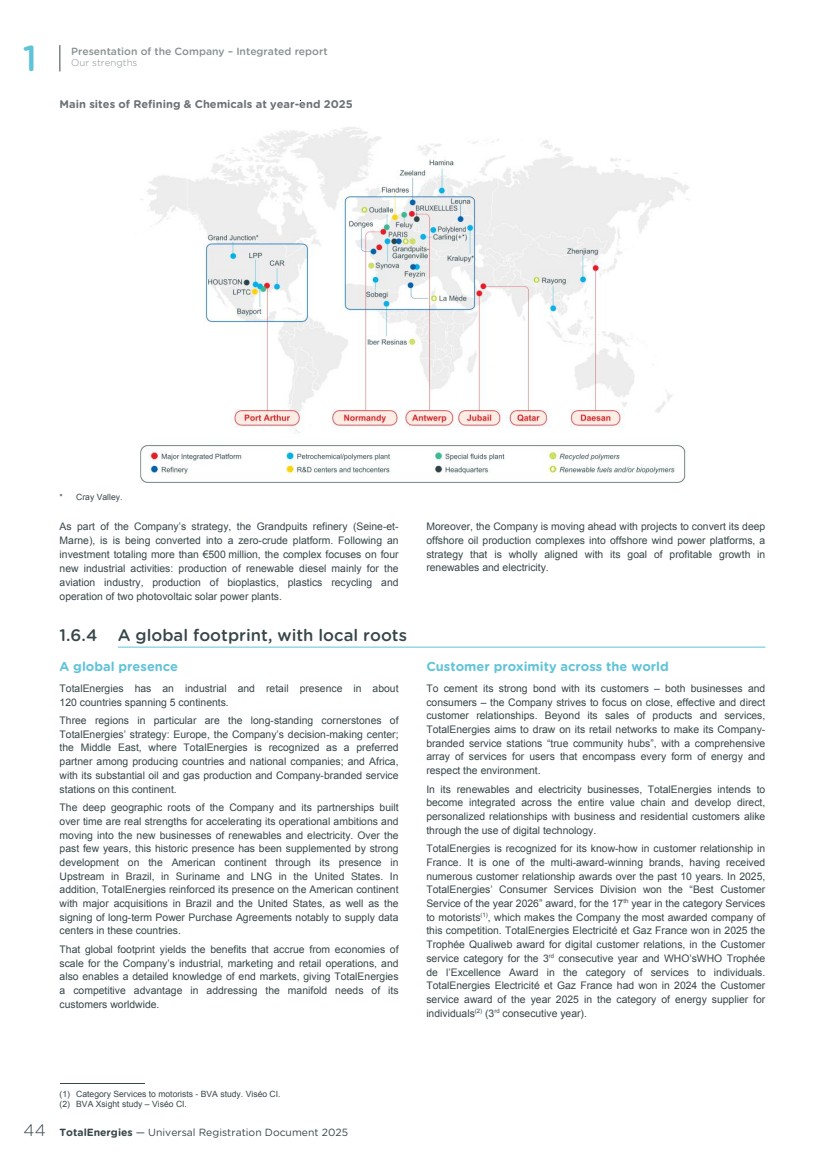
| Sustainable value creation alongside regions and communities TotalEnergies’ success in building and expanding partnerships worldwide can also be attributed to its strategy of generating value at the local level as part of its growth model. That commitment – carried out systematically and professionally – is a major competitive asset. Whether they target continued growth in LNG or renewable electricity generation, the partnerships with governments and local communities serve a critical function. The Company maintains a comprehensive, integrated policy, rooted in dialogue with communities and public and private stakeholders, for supporting local growth and in-country value. It forges synergies among the various sources of value generation for host countries (employment, subcontracting, infrastructure, support for local industry, socioeconomic development projects, education, energy access, etc.) by capitalizing on the Company’s industrial expertise. TotalEnergies intends to maintain this approach over the long term to ensure that its presence in these regions and the major projects it develops to create shared prosperity. The ability to cope with geopolitical uncertainty In the face of political and geopolitical uncertainty, including tensions sparked by war and conflict, TotalEnergies intends to conduct its operations by leveraging its skills and expertise to benefit each host country, in compliance with applicable legislation and all international economic sanctions that may be in effect. The Company also ensures that the amount of capital invested in the most sensitive countries remains at a level that limits its exposure in each country. 1.6.5 An ongoing dialogue with our stakeholders In TotalEnergies’ view, dialogue with its internal and external stakeholders is essential for the Company to conduct its business responsibly and integrate the long-term challenges of sustainable development in its strategy and policies. This dialogue contributes to the identification of the main risks and impacts of the Company’s activities, and more broadly to a better understanding of changing trends and the main societal expectations of each of the major categories of stakeholders. It is also a prerequisite to ensuring that the Company is firmly integrated in its host regions, as well as an effective tool for identifying ways to generate value at the local level. TotalEnergies believes that transparency is an essential principle of action in building a trust-based relationship with its stakeholders and ensuring that the Company is on a path of continuous improvement. For many years, TotalEnergies has been ensuring that it reports on its performance based on the various reporting frameworks commonly used in extra-financial matters. In addition, the Company publishes voluntary reportings according to the standards of the GRI (Global Reporting Initiative) and SASB (Sustainability Accounting Standards Board), and includes in its reporting the “Core” indicators proposed by the World Economic Forum(1) . The Company relied on the recommendations of the TCFD(2) (Task Force on Climate-related Financial Disclosures) to identify climate-related risks and opportunities. TotalEnergies also responds to the CDP water and climate questionnaires. Reportings are available on its website in the pages dedicated to its sustainable development approach and performance indicators are made available to all stakeholders in the ESG Databook 2025. TotalEnergies has structured its dialogue processes with its stakeholders at different levels of the Company, through relays within the organization, requirements included in internal reference frameworks, the deployment of a methodology for conducting local dialogue and a dedicated attention to the professionalization of the teams responsible for fostering that dialogue. Those measures are designed to develop a long-term, trust-based relationship founded on principles of respect, attentiveness, constructive dialogue, proactive engagement and transparency, consistent with the legitimate need for confidentiality as appropriate. They also ensure that stakeholder warnings or grievances to be gathered and addressed quickly and that potential controversial situations defused. At a corporate level, each group of stakeholders (employees, employee representatives, customers, investors, shareholders and the financial sector, government officials, suppliers, academics, NGOs and civil society, and the media) has a single point of contact at the corporate level, responsible for responding to their requests, keeping them informed and maintaining an ongoing dialogue in formats appropriate to each concern. Those stakeholder liaisons also provide advice and support to Company subsidiaries when needed. The One MAESTRO framework (Management and Expectations Standards Toward Robust Operations) provides that subsidiaries should conduct a stakeholder mapping and engage in a structured, ongoing process of dialogue with stakeholders to keep them informed, hear and address their concerns and expectations, report on mitigation actions or compensation, measure their satisfaction and identify ways the subsidiaries can improve their community outreach. This commitment to local dialogue puts special emphasis on residents and communities located near Company facilities. 1.7 Our governance 1.7.1 A committed Board of Directors A mobilized Board of Directors serving the Company’s ambition The Board of Directors defines TotalEnergies’ strategic vision and supervises its implementation in accordance with the corporate interest of the Corporation, by taking into consideration the social and environmental challenges of its business activities. It approves investments or divestments for amounts greater than 3% of shareholders’ equity and it is informed of those greater than 1%. The Board may address any issue related to the Company’s operations. It monitors the management of both financial and extra-financial matters and ensures the quality of the information provided to shareholders and financial markets. The Board of Directors is assisted by the four committees it has created: the Audit Committee, the Governance and Ethics Committee, the Compensation Committee, and the Strategy & CSR Committee. The duties of the Board of Directors and of the Committees are described in point 4.1.2 of chapter 4. (1) Measuring Stakeholder Capitalism Towards Common Metrics and Consistent Reporting of Sustainable Value Creation, White paper, September 2020. (2) From 2024, the TCFD recommendations have been taken up by the ISSB (International Sustainability Standards Board). In accordance with the requirements of the European CSRD Directive (EU) 2022/2464, TotalEnergies now publishes sustainability information in accordance with the ESRS standards (refer to point 5.2.1 of chapter 5). In May 2024, EFRAG and the IFRS Foundation published a guide to interoperability between ESRS and ISSB. Presentation of the Company – Integrated report Our governance 1 TotalEnergies — Universal Registration Document 2025 45 |
| The composition of the Board of Directors reflects the diversity and complementary of experience, skills, nationalities and cultures that are critical to addressing the interests of all of the Company’s shareholders and stakeholders. Composition as of March 18, 2026 13 administrateurs 1 Lead Independent Director 80% independent directors(a) 5.1 years Average years of service on the Board 54.5% of women(b) 5 nationalities represented (a) Excluding the director representing employee shareholders and the directors representing employees, in accordance with the recommendations of the AFEP-MEDEF Code (point 10.3). For more information, refer to point 4.1.1.4 in chapter 4. (b) Excluding the directors representing employees in accordance with Article L. 225-27-1 of the French Commercial Code. Complementary skills to meet strategic challenges of the Company The Governance and Ethics Committee conducts its work within the framework of a formal procedure so as to ensure that the directors’ skills are complementary and their backgrounds are diverse, to maintain an overall proportion of independent members that is appropriate to the Corporation’s governance structure and shareholder base, to allow for a balanced representation of women and men on the Board, and to promote an appropriate representation of directors of different nationalities. These principles underpin the selection process for directors. Skills of the directors Corporate management 9 69% International 9 69% Finance, accounting, economics 11 85% Risk management 7 54% Governance 11 85% Climate - sustainable development 11 85% Industry 10 77% Energy 9 69% Public affairs, geopolitics 8 62% The skills of directors are detailed in points 4.1.1.1 and 4.1.1.5 of chapter 4. A Board committed to meeting the Company’s strategic priorities, with dedicated and involved directors 9 meetings of the Board of Directors 99.2% attendance 1 executive session chaired by the Lead Independent Director 7 meetings of the Audit Committee 100% attendance 4 meetings of the Governance and Ethics Committee 100% attendance 2 meetings of the Compensation Committee 100% attendance 3 meetings of the Strategy & CSR Committee 100% attendance Patrick Pouyanné Jacques Aschenbroich Marie-Christine Coisne-Roquette Lise Croteau Marie-Ange Debon Valérie Della Puppa-Tibi Romain Garcia-Ivaldi Glenn Hubbard Anelise Lara Helen Lee Bouygues Laurent Mignon Dierk Paskert Angel Pobo Total Total (%) 1 Presentation of the Company – Integrated report Our governance 46 TotalEnergies — Universal Registration Document 2025 |
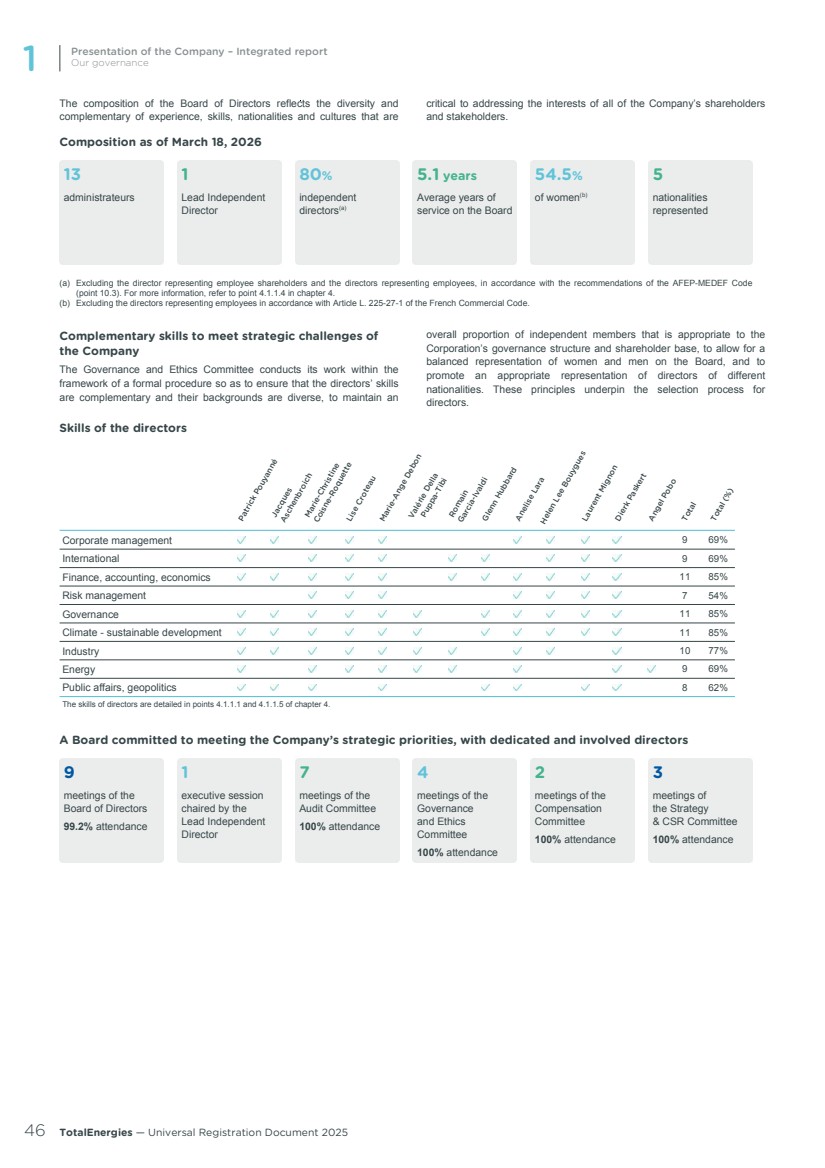
| Main activities of the Board of Directors in 2025 Risks/Audit Strategy/Climate/Environment Update on CSRD and impacts, risks and opportunities Update on the Company’s risk management system and the missions of the TotalEnergies Risk Management Committee (TRMC) - presentation of the work carried out by the TRMC Presentation of the update to the Vigilance plan and the implementation report Update on the 2024 internal audit Presentation of the 2025 health, safety and environment audit plan and review of the fiscal year 2024 Review of cybersecurity audits carried out in 2024 and the first half of 2025 Update on the call for tenders of statutory auditors and sustainability auditors whose mandates expire at 2028 Shareholders’ Meeting Climate litigation The Company’s 5-year plan Strategic outlook for Exploration & Production Strategic outlook for Gas, Renewables & Power activities Strategic outlook for Refining & Chemicals’ activities Strategic outlook for Marketing & Services’ activities The Company’s strategic environment: changes in energy markets, update of the benchmarking of major companies’ strategies and elements on utilities Resilience of TotalEnergies’ portfolio in the face of geopolitical instabilities and their macroeconomic consequences Presentation of the Sustainability and Climate Strategy to investors Sustainability & Climate – Progress Report 2025, reporting on the progress made in the implementation of the Corporation’s ambition with respect to sustainable development and energy transition and its related targets by 2030 Investor Day 2025 presentation - Strategy & Outlook Major investments/divestments Approval of the acquisition of 50% of a portfolio of flexible power generation assets from EPH(1) Governance - Business conduct Social issues and human resources Assessment of the functioning of the Board Report of the Lead Independent Director on his mandate Changes in the composition of the Board of Directors and its Committees Update on the succession plans Feedback on the Lead Independent Director’s roadshows Answers to shareholders’ written questions Review of voting results at the Shareholders’ Meeting of May 23, 2025, of the comments of shareholders and main proxy advisors, and lessons learnt Review of the Company’s ethics and compliance policy Information of the Audit Committee on compliance by relevant persons with the provisions of the Financial Code of Ethics Approval of the URD chapter on corporate governance Market Abuse Regulation - Black-out periods Review of equality policy between men and women in the workplace and in terms of pay 2025 capital increase reserved for employees 2025 performance share plan Determination of the compensation for the Chairman and Chief Executive Officer and directors for the 2024 fiscal year Compensation policy for the Chairman and Chief Executive Officer and directors for the 2025 fiscal year A unified management structure, tailored to the Company’s requirements Management of the Corporation is assumed either by the Chairperson of the Board of Directors (who then holds the title of Chairman and Chief Executive Officer), or by another person appointed by the Board of Directors with the title of Chief Executive Officer. It is the responsibility of the Board of Directors to choose between these two forms of management under the majority rules described above. At its meeting on December 16, 2015, the Board of Directors decided to reunify the positions of Chairperson and Chief Executive Officer of the Corporation as from December 19, 2015. Since that date, Mr. Pouyanné has held the position of Chairman and Chief Executive Officer of TotalEnergies SE. After his term of office as director was renewed at the Shareholders’ Meeting on May 28, 2021, and then at the Shareholders’ Meeting on May 24, 2024, for a three-year period, the Board of Directors reappointed Mr. Pouyanné as Chairman and Chief Executive Officer for the same period, expiring at the end of the 2027 Shareholders’ Meeting called to approve the financial statements for fiscal year 2026. The Board of Directors, at its meeting held on September 21, 2023, after having reaffirmed its support to the quality and the relevance of the strategy implemented, had considered that it was highly desirable that Mr. Patrick Pouyanné, Chairman and Chief Executive Officer, continues to drive this strategy’s deployment at the helm of the Company. On the proposal of the Governance and Ethics Committee, it therefore unanimously decided to propose the renewal of the mandate of Mr. Patrick Pouyanné to the Shareholders’ Meeting to be held on May, 24 2024. In the frame of the balanced governance implemented since 2015, it also unanimously decided to propose the renewal of the mandate of Mr. Jacques Aschenbroich, who has held the position of Lead Independent Director since May 2023. Unified management form The discussions held with the Governance and Ethics Committee in the best interests of the Corporation had led to a firm proposal to continue to combine the functions of Chairman and Chief Executive Officer. Indeed, this management form of the Corporation is considered to be the most appropriate for dealing with the challenges and specificities of the energy sector, which is facing major transformations. More than ever, this context requires agility of movement, which the unity of command reinforces, by giving the Chairman and Chief Executive Officer the power to act and increased representation of the Corporation in its strategic negotiations with States and partners of the Company. (1) The transaction remains subject to information and consultation processes and regulatory approvals, with completion expected by mid-2026. Presentation of the Company – Integrated report Our governance 1 TotalEnergies — Universal Registration Document 2025 47 |
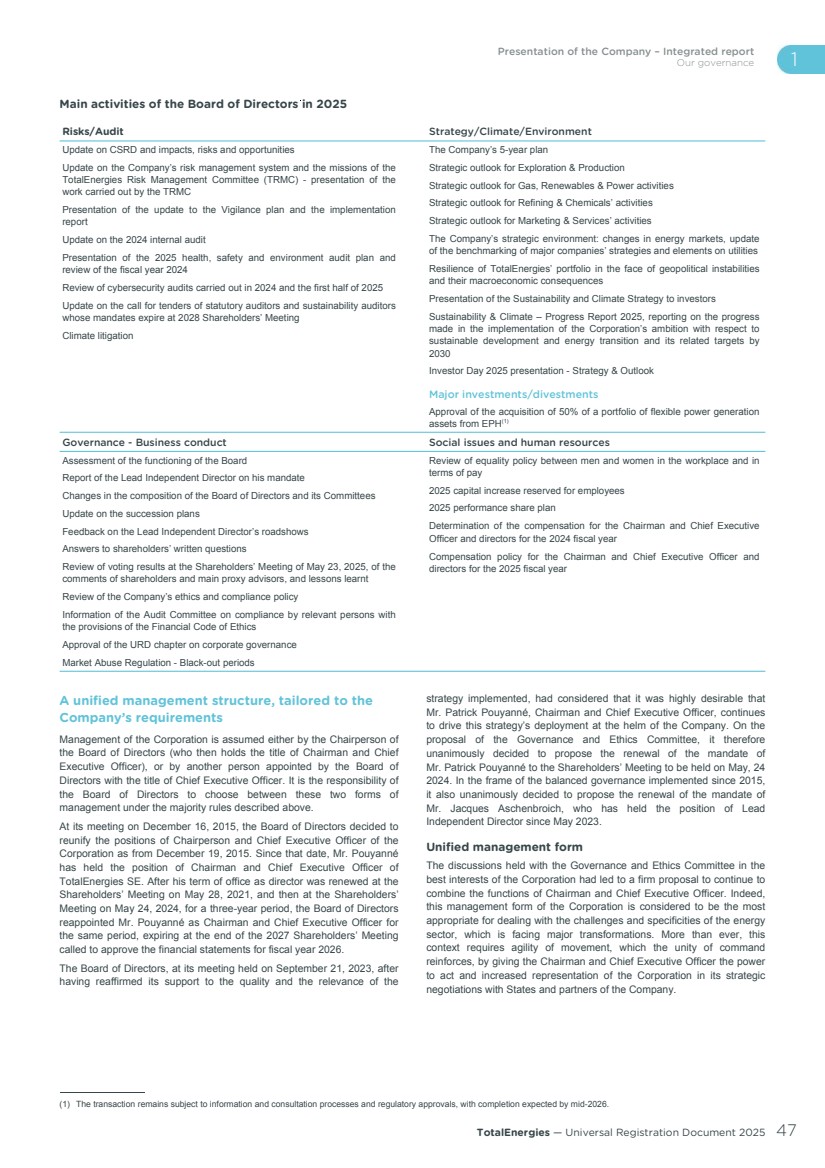
| Balance of power The unity of the power to manage and represent the Corporation is also particularly well regulated by the Corporation’s governance. The balance of power is established through the quality, complementarity and independence of the members of the Board of Directors and its four Committees, as well as through the Articles of Association and the Board’s Rules of procedure, which define the means and prerogatives of the Lead Independent Director, notably: – in his relations with the Chairman and Chief Executive Officer: contribution to the agenda of Board meetings or the possibility of requesting a meeting of the Board of Directors and sharing opinions on major issues; – in his contribution to the work of the Board of Directors: chairing meetings in the absence of the Chairman and Chief Executive Officer, or when the examination of a subject requires his abstention, evaluation and monitoring of the functioning of the Board, prevention of conflicts of interest, and dialogue with the directors and Committee Chairpersons; – in his relations with shareholders: the possibility, with the approval of the Chairman and Chief Executive Officer, of meeting with them on corporate governance issues, a practice that has already been used on several occasions. The balance of power within the governance bodies, in addition to the independence of its members, is further strengthened by the full involvement of the directors, whose participation in the work of the Board and its Committees is exemplary. The diversity of their skills and expertise also enables the Chairman and Chief Executive Officer to benefit from a wide range of contributions. In addition, the Board’s rules of procedure provide that any investment or divestment transactions contemplated by the Company involving amounts in excess of 3% of shareholders’ equity must be approved by the Board, which is also kept informed of all significant events concerning the Corporation’s operations, in particular investments and divestments in excess of 1% of shareholders’ equity. Lastly, the Corporation’s Articles of Association provide the necessary guarantees of compliance with good governance practices in the context of a unified management structure. In particular, they provide that the Board may be convened by any means, including orally, or even at short notice depending on the urgency of the matter, by the Chairman or by one third of its members, including the Lead Independent Director, at any time and as often as the interests of the Corporation require. The Lead Independent Director, reflecting a balanced distribution of power Listening to investors and stakeholders, the Board of Directors pays special attention to the balance of power within the Company. It is in this context that the Board of Directors in 2015 amended the provisions of its rules of procedure to provide for the appointment of a Lead Independent Director in the event that the positions of Chairman of the Board of Directors and Chief Executive Officer are combined. The Lead Independent Director’s duties, resources and prerogatives which are described in the Rules of Procedure of the Board are extensive: – the Chairman and Chief Executive Officer and the Lead Independent Director are the shareholders’ dedicated contacts on issues that fall within the remit of the Board of Directors. In his relations with shareholders, the Lead Independent Director has the possibility, with the approval of the Chairman and Chief Executive Officer, to meet with shareholders on corporate governance issues, a practice that has already been used on several occasions; – in his relations with the Chairman and Chief Executive Officer, the Lead Independent Director contributes to the agenda of Board meetings and has the possibility to request a meeting of the Board of Directors and to share opinions on major issues; – in his contribution to the work of the Board of Directors, the Lead Independent Director chairs meetings in the absence of the Chairman and Chief Executive Officer, or when the examination of a subject requires his abstention. He is in charge of the assessment and monitoring of the functioning of the Board, the prevention of conflicts of interest, and dialogue with the directors and Committee Chairpersons. Since 2016, the Lead Independent Director has organized executive sessions with the directors who do not hold executive or salaried positions on the Board of Directors, during which the directors may discuss the Company’s strategic challenges and working practices. The directors are also in regular contact with the members of the management team, including members of the Executive Committee during Board meetings and operational managers during Company site visits. Through those interactions between directors and managers, the directors gain a practical understanding of the Company’s activities. The duties of the Lead Independent Director 1 Presentation of the Company – Integrated report Our governance 48 TotalEnergies — Universal Registration Document 2025 Ensures corporate governance Code and Board’s Rules of procedure are respected Ensures prevention of director’s conflicts of interest Chairs the Governance and Ethics Committee May request the convening of a Board meeting with one third of the directors Chairs Executive meetings (meetings of the directors with no executive or salaried positions on the Board) Participates in relations with shareholders when necessary Lead the assessment process of the functioning of the Board |
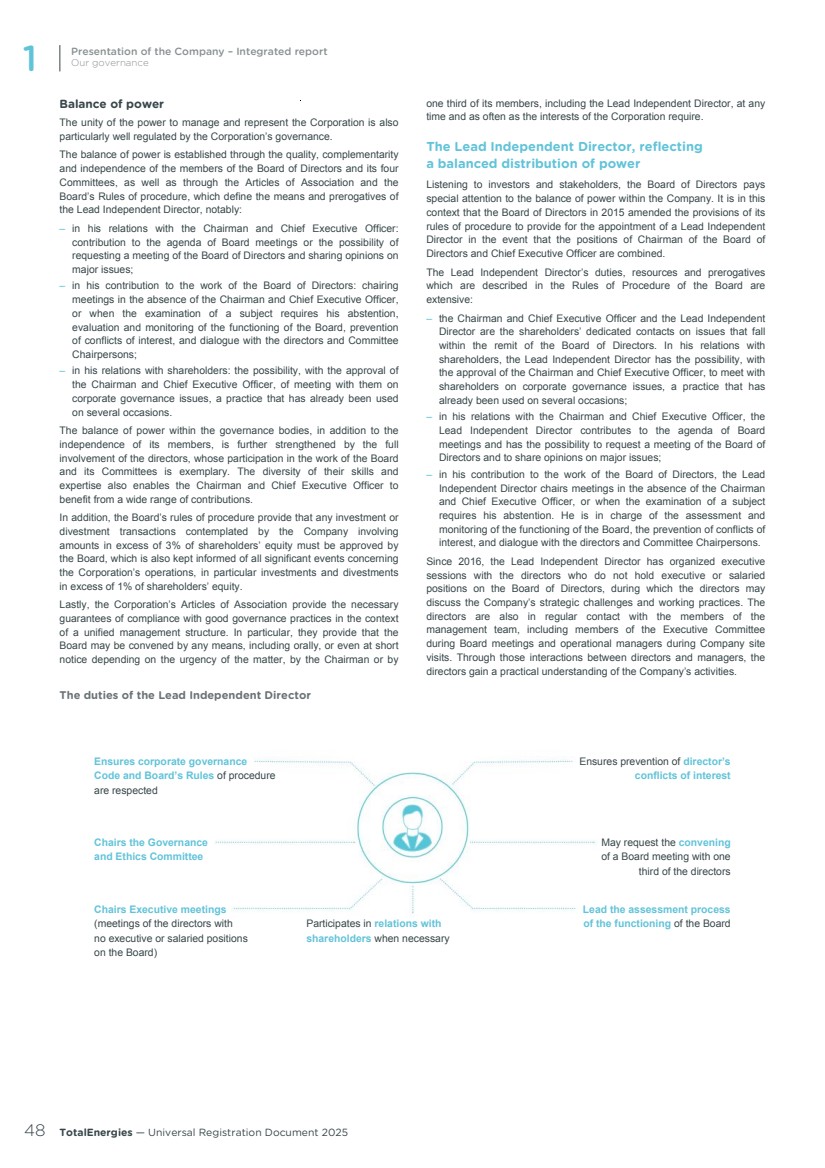
| A compensation policy of the executive director aligned with the Company’s strategic targets The compensation awarded to the Chairman and Chief Executive Officer is indexed to key performance indicators used to measure the success of the Company’s strategy. In order to determine a compensation aligned with the Company’s performance, the variable portion of the Chairman and Chief Executive Officer’s compensation takes into account both quantifiable targets (financial, Safety and GHG emission evolution parameters) and qualitative criteria (personal contribution). Conscious of the importance of climate challenges, the Board of Directors decided, starting in 2019, to change the criteria for determining the variable portion of the Chairman and Chief Executive Officer’s compensation, in particular by integrating a quantifiable criterion related to the change in GHG emissions (Scope 1+2) from operated facilities. This criterion supplements those introduced in 2016 to better take into account the achievements of Corporate Social Responsibility (CSR) and HSE targets of the Company. The granting of performance shares, a long-term component of the Chairman and Chief Executive Officer’s compensation, also includes criteria linked to the taking into account of climate issues. The criteria retained by the Board of Directors make it possible to reflect the progress of the Company in the implementation of its transition strategy. The Board of Directors has a proactive approach to this issue. Refer to point 4.3. of chapter 4. 1.7.2 An Executive Committee entrusted with implementing the Company’s transition strategy The Executive Committee, under the responsibility of the Chairman and Chief Executive Officer, is the decision-making body of the Company. It implements the strategic vision defined by the Board of Directors and authorizes the corresponding capital expenditures, subject to the Board of Directors’ approval for investments exceeding 3% of shareholders’ equity and any significant transaction outside the scope of the Company’s stated strategy, and subject to the Board’s review for investments involving amounts exceeding 1% of shareholders’ equity. The Executive Committee meets as often as necessary and generally twice a month. 1.7.3 An operational structure built around the Company’s business segments As of December 31, 2025, the Company’s organization was based on five business segments: – an Exploration & Production segment that encompasses the activities of exploration and production of oil and natural gas, as well as carbon storage activities, conducted in about 50 countries; – an Integrated LNG segment covering the integrated gas chain (including upstream and midstream LNG activities) as well as biogas and synthetic methane activities, as well as gas trading; – an Integrated Power segment covering generation, storage, electricity trading and B2B-B2C distribution of gas and electricity; – a Refining & Chemicals segment constituting a major industrial hub comprising the activities of refining, petrochemicals and specialty chemicals. This segment also includes the activities of oil supply, trading and marine shipping, as well as hydrogen activities previously reported within the Integrated LNG segment; – a Marketing & Services segment including the marketing activities in the field of petroleum products as well as corresponding supply and logistics activities. The Corporate segment includes the functional and financial activities of a holding company. The Holding’s corporate entities include in particular Finance, Security, People & Social Engagement, Communications and Strategy & Sustainability divisions. TotalEnergies SE is the parent company. It acts as a holding company and drives the Company’s strategy. The Company’s operations are conducted through subsidiaries that are directly or indirectly owned by TotalEnergies SE and through interests in joint-ventures that are not necessarily controlled by TotalEnergies. TotalEnergies SE has three secondary establishments in France, located in Lacq, Pau and Paris. The scope of consolidation of TotalEnergies SE as of December 31, 2025, consisted of 1,463 companies, including 209 equity companies. The principles of consolidation are described in Note 1.1 to the Consolidated Financial Statements and the list of companies included in the scope of consolidation can be found in Note 18 to the Consolidated Financial Statements (refer to point 8.7 of chapter 8). Corporate name: TotalEnergies SE Headquarters: 2, place Jean Millier, La Défense 6, 92400 Courbevoie, France Registered in Nanterre: RCS 542 051 180 LEI (Legal Entity Identifier): 529900S21EQ1BO4ESM68 EC Registration Number: FR 59 542 051 180 Date of incorporation: March 28, 1924 Term of the Corporation: extended for 99 years from March 22, 2000 Fiscal year: from January 1 to December 31 of each year APE Code (NAF): 7010Z totalenergies.com TotalEnergies holds interests in a limited number of companies that issue financial instruments in France or abroad or whose financial instruments are listed in France or abroad. These companies are mainly the Company’s financing vehicles (TotalEnergies Capital, TotalEnergies Capital International, TotalEnergies Capital USA) or the operational subsidiaries in its business segments, in particular in Africa, such as TotalEnergies EP Gabon(1) . TotalEnergies also holds minority interests in other companies. The changes in the composition of the Company in 2025 are explained in Note 2 to the Consolidated Financial Statements (refer to point 8.7 of chapter 8). During fiscal year 2025, TotalEnergies SE did not acquire any other interest in companies with their registered office in France representing more than one twentieth, one tenth, one fifth, one third or one half of the capital of these companies or obtained control of such companies. (1) TotalEnergies EP Gabon is a company under Gabonese law, listed on Euronext Paris. TotalEnergies holds 58.28%, the Republic of Gabon holds 25% and the public holds 16.72%. Presentation of the Company – Integrated report Our governance 1 TotalEnergies — Universal Registration Document 2025 49 [REDACTED SECTION: CERTAIN TEXT HAS BEEN REDACTED.] |
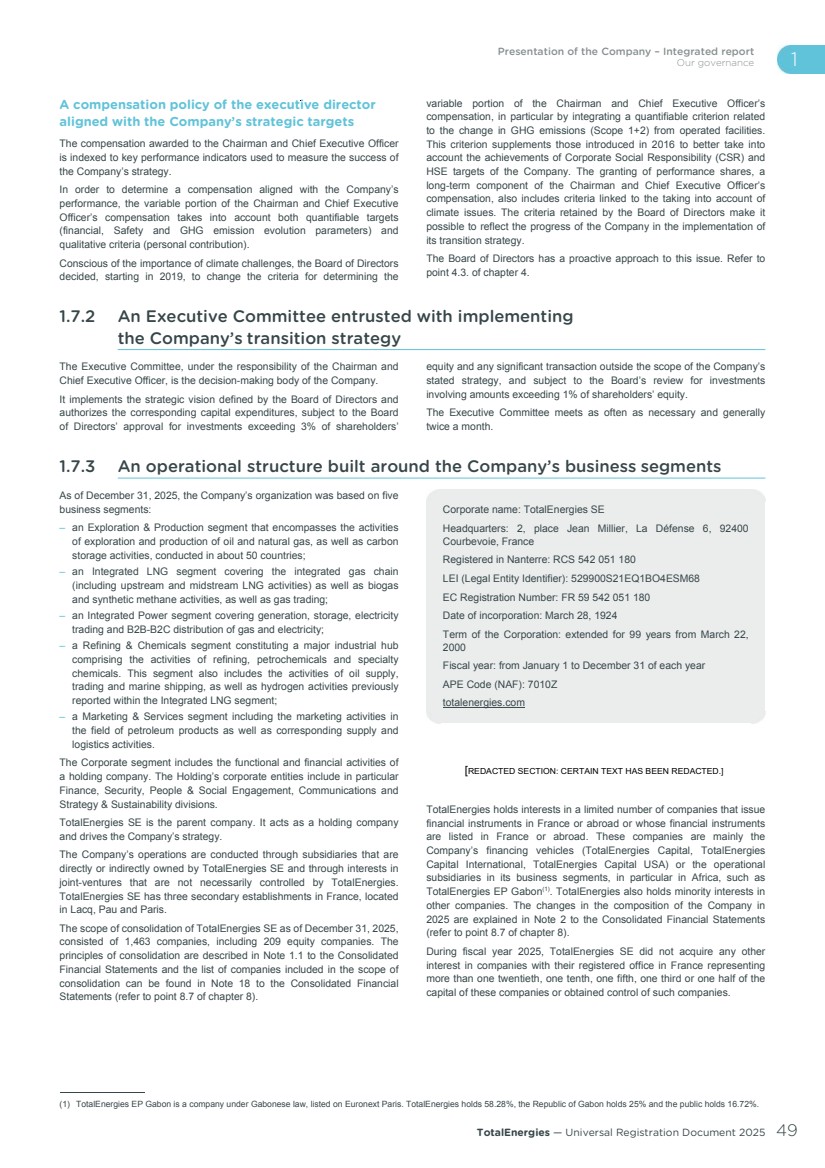
| Organisation chart as of December 31, 2025 1.7.4 Risk management system TotalEnergies implements a comprehensive risk management system that is an essential factor in the deployment of its strategy. This system relies on an organization at Company level and in the business segments, on a continuous process of identifying and analyzing risks in order to determine those that could prevent the achievement of the goals as well as the analysis of management systems. The Executive Committee is responsible for identifying and analyzing internal and external risks that could impact the achievement of the Company’s objectives. For this purpose, it is assisted by the TotalEnergies Risk Management Committee (TRMC), which makes sure that the Company has mapped the risks to which it is exposed and that efficient risk management systems are suitable. The TRMC relies notably on the work done by the business segments and functional divisions. The business segments are responsible for defining and implementing a risk management policy suited to their specific activities. However, the handling of certain cross-functional risks is more closely coordinated by the respective functional divisions. Regarding commitments, General Management exercises operational control through the Executive Committee’s approval of investments and expenses that exceed defined thresholds. The Risk Committee (Corisk) is tasked with reviewing these projects in advance, and in particular, with verifying the analysis of the various associated risks. The Board of Directors’ Audit Committee is responsible for monitoring the effectiveness of the risk management systems as well as of the internal audit. The audit plan, based on an analysis of risks and the risk management systems, is submitted annually to the Executive Committee and the Audit Committee. For a detailed description of how the internal control and risk management procedures are structured, refer to point 3.3 of chapter 3. Strategy & Sustainability Corporate Communication Chairman Ethics Committee Secretary of the Board Strategy & Markets Legal Affairs Public Affairs Health Safety Environment Audit & Internal Control Sustainability & Climate CHAIRMAN & CEO EXECUTIVE COMMITTEE President Asia People & Social Engagement Finances Finance Division Information Systems Security DOWNSTREAM ONETECH INTEGRATED EXPLORATION & PRODUCTION MARKETING & SERVICES REFINING & CHEMICALS LNG INTEGRATED POWER OneTech Gas, Renewables & Power Exploration & Production Marketing & Services Refining & Chemicals Trading-Shipping TotalEnergies Global Services Customer Lines Technical Lines LNG Flexible Power & Integration Africa New Business - Carbon Neutrality Europe, Overseas & Caribbean Lubricants Refining Base Chem Europe Polymers Crude Oil Supply & Trading Strategy & Development Research & Development Digital Line Chief Digital Officer Trading Power & Trading Gas Retail Power & Gas America Corporate Affairs Africa New Mobilities Refining & Petrochemicals Orient & Growth Hutchinson Clean Products Trading Shipping Finance & General Affairs Talents & Competencies Renewables Asia-Pacific Exploration Asia Pacific & Middle East Human Ressources & Internal Communication Refining Petrochemicals Americas Corporate Affairs & Finance Biofuels & Bio Feedstocks Fuel Oil & Derivatives Trading Saft Europe Middle East North Africa Corporate Affairs and Supply Renewable Fuels & Chemicals Human Resources & Communication Operational Excellence Strategy, Growth & Finance People & Services Strategy & Business Support 1 Presentation of the Company – Integrated report Our governance 50 TotalEnergies — Universal Registration Document 2025 [REDACTED SECTION: CERTAIN TEXT HAS BEEN REDACTED.] |
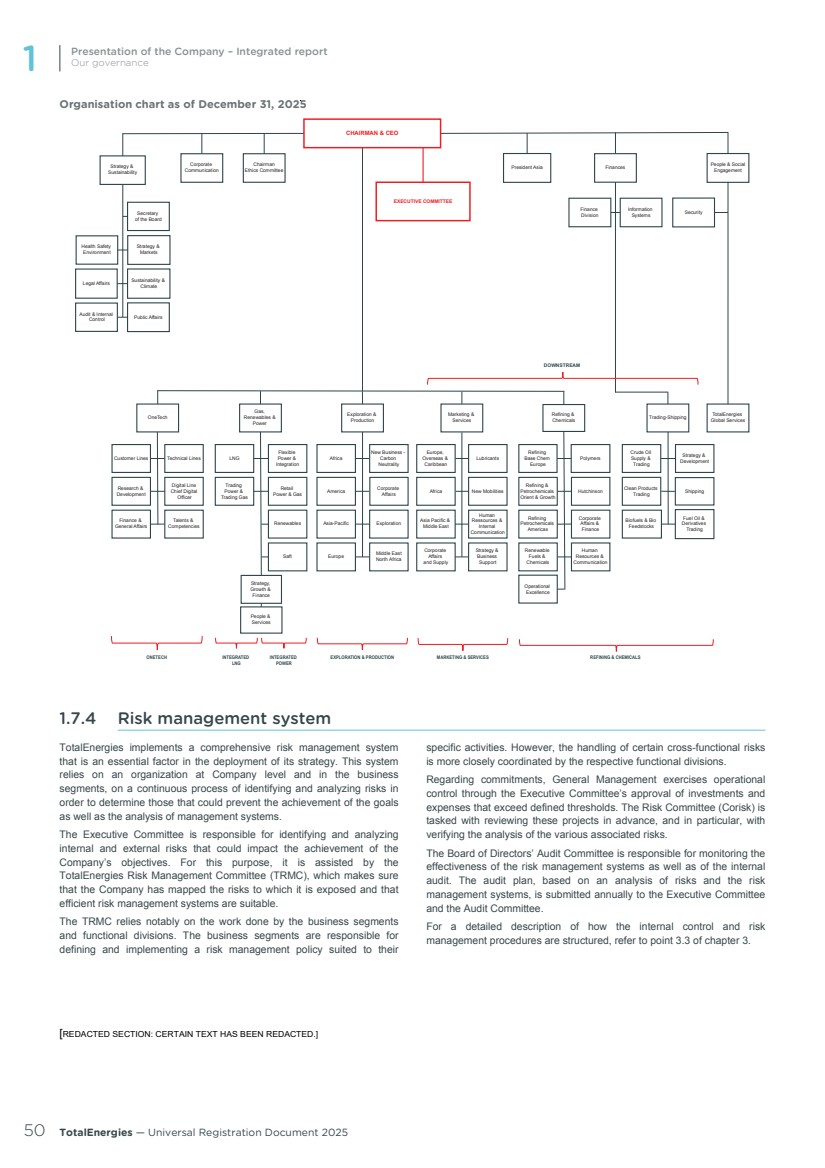
| 1.8.2 Liquidity and capital resources Borrowing requirements and funding structure The Company’s policy consists in incurring long-term debt at a floating or fixed rate, depending on its general corporate needs and the interest rate environment at the time of issue, mainly in dollars or euros. Long-term interest rate and currency swaps may be entered into for the purpose of hedging bonds at the time of issuance, synthetically resulting in the incurrence of variable or fixed rate debt. In order to partially alter the interest rate exposure of its long-term indebtedness, the Company may also enter into long-term interest rate swaps on an ad-hoc basis. Long-term financial indebtedness is generally raised by central corporate treasury entities either directly in dollars or euros, or in other currencies exchanged for dollars or euros through currency swaps at issuance, in accordance with the Company’s general corporate needs. As of December 31, 2025, the Company’s long-term financial debt, after taking into account the effect of currency and interest rate swaps, was 79% in US dollars and 22% at floating rates; as of December 31, 2024, these ratios were 92% and 25%, respectively. In addition to its ongoing bond issuance activity, TotalEnergies SE regularly issues perpetual subordinated notes in one or several tranches and also regularly launches tender offers on some of its perpetual subordinated notes as part of their early refinancing. Over the year 2025, TotalEnergies SE has fully redeemed on February 26, 2025 the residual nominal amount of €1,082 million of perpetual deeply subordinated notes carrying a coupon of 2.625%, issued in February 2015, at first call date. This issuance had already been subject of a partial buyback offer for an amount of €1,418 million on November 22, 2024. Thus, the outstanding amount of perpetual subordinated notes issued by TotalEnergies SE as of December 31, 2025, stood at €9.75 billion (amount of €10.83 billion as of December 31, 2024). The details of the portfolio of perpetual subordinated notes issued by TotalEnergies SE is disclosed in Note 9 of chapter 8, in the paragraph “Issuances of Perpetual subordinated notes”. In accordance with IAS 32 provisions “Financial instruments – Presentation” and given their characteristics (notably the absence of mandatory repayment and no obligation to pay a coupon except under certain circumstances specified into the documentation of the notes) the perpetual subordinated notes issued by TotalEnergies SE were accounted for as equity. TotalEnergies has established standards for market transactions under which any banking counterparty must be approved in advance, based on an assessment of the counterparty’s financial solidity (multi-criteria analysis including notably a review of its Credit Default Swap (CDS) level, credit ratings, which must be of high standing, and general financial situation). An overall credit limit is set for each authorized financial counterparty and is allocated amongst the affiliates and the TotalEnergies central treasury entities, according to the financial needs. To reduce the market valuation risk on its commitments, in particular relating to derivative financial instruments, the Treasury Department has entered into margin call agreements with its counterparties, in compliance with applicable regulations. Moreover, since December 21, 2018 and pursuant to Regulation (EU) No. 648/2012 on OTC derivatives, central counterparties and trade repositories (EMIR), any new interest rate hedging swap (excluding cross currency swaps) entered into by a TotalEnergies entity is now subject to central clearing. Finally, since September 1, 2021, TotalEnergies has been applying Delegated Regulation (EU) N° 2016/2251 (supplementing Regulation (EU) N° 648/2012), regarding initial margin calls on certain OTC derivatives not cleared by a central counterparty. Conditions of use of external financings As of December 31, 2025, the aggregate amount of the main committed credit facilities granted by international banks to TotalEnergies SE or some of its subsidiaries was $20,398 million (compared to $10,919 million as of December 31, 2024), of which $20,225 million was unutilized (compared to $10,779 million unutilized as of December 31, 2024). 1 Presentation of the Company – Integrated report Our financial performance 66 TotalEnergies — Universal Registration Document 2025 [REDACTED SECTION: CERTAIN TEXT HAS BEEN REDACTED.] |
| TotalEnergies SE has committed credit facilities granted by international banks enabling it to benefit from significant liquidity reserves. As of December 31, 2025, these credit facilities amounted to $19,767 million (compared to $10,353 million as of December 31, 2024), of which $19,767 million was unutilized (compared to $10,353 million unutilized as of December 31, 2024). The agreements underpinning credit facilities granted to TotalEnergies SE do not contain conditions related to the Corporation’s financial ratios, to its credit ratings from specialized agencies, or to the occurrence of events that could have a material adverse effect on its financial position. Credit facilities granted to the companies of the Company other than TotalEnergies SE are not intended to fund the Company’s general corporate purposes; they are intended to fund either general corporate purposes of the borrowing affiliate, or a specific project. Anticipated sources of financing Investments, working capital, dividend payments and buybacks of its own shares by the Corporation are financed by cash flow from operating activities, asset disposals and, if necessary, by net borrowings. For the coming years and based on the current financing conditions available in the financial markets, the Corporation intends to maintain this policy. Presentation of the Company – Integrated report Our financial performance 1 TotalEnergies — Universal Registration Document 2025 67 [REDACTED SECTION: CERTAIN TEXT HAS BEEN REDACTED.] |
| Business overview for fiscal year 2025 2 2.1 Upstream oil and gas activities 74 2.1.1 Oil and gas reserves 75 2.1.2 Exploration 76 2.1.3 Hydrocarbon production 76 2.1.4 Delivery commitments 80 2.1.5 Contractual framework of Upstream oil and gas production activities 81 2.1.6 Acreage 81 2.1.7 Productive wells 82 2.1.8 Productive and dry wells drilled 82 2.1.9 Wells in the process of being drilled (including wells temporarily suspended) 83 2.1.10 Interests in pipelines 84 2.2 Exploration & Production segment 85 2.2.1 Presentation of the segment 85 2.2.2 Management of GHG emissions 86 2.2.3 Activities by geographical area 88 2.3 Integrated LNG segment 93 2.3.1 Presentation of the segment 94 2.3.2 LNG production and liquefaction 95 2.3.3 Intermediary activities: purchase, sale, trading and transportation of LNG and natural gas 98 2.3.4 LNG regasification 99 2.3.5 LPG, ethane, petcoke and sulfur trading 100 2.3.6 Biogas and other low carbon molecules 100 2.4 Integrated Power segment 101 2.4.1 Presentation of the segment 102 2.4.2 Power generation from renewable sources 103 2.4.3 Flexible power generation 107 2.4.4 Saft 108 2.4.5 Natural gas and electricity marketing and electricity trading 108 2.4.6 Services in the field of energy efficiency and innovation in the electricity segment 110 2.5 Refining & Chemicals segment 111 2.5.1 Refining & Chemicals 112 2.5.2 Trading & Shipping 120 2.6 Marketing & Services segment 122 2.6.1 Presentation of the segment 123 2.6.2 Petroleum products sales 124 2.6.3 Service stations breakdown 124 2.6.4 Electric vehicle charging points operated and supervised 124 2.6.5 Activities by geographical area 125 2.6.6 Technical partnerships 128 TotalEnergies — Universal Registration Document 2025 73 |
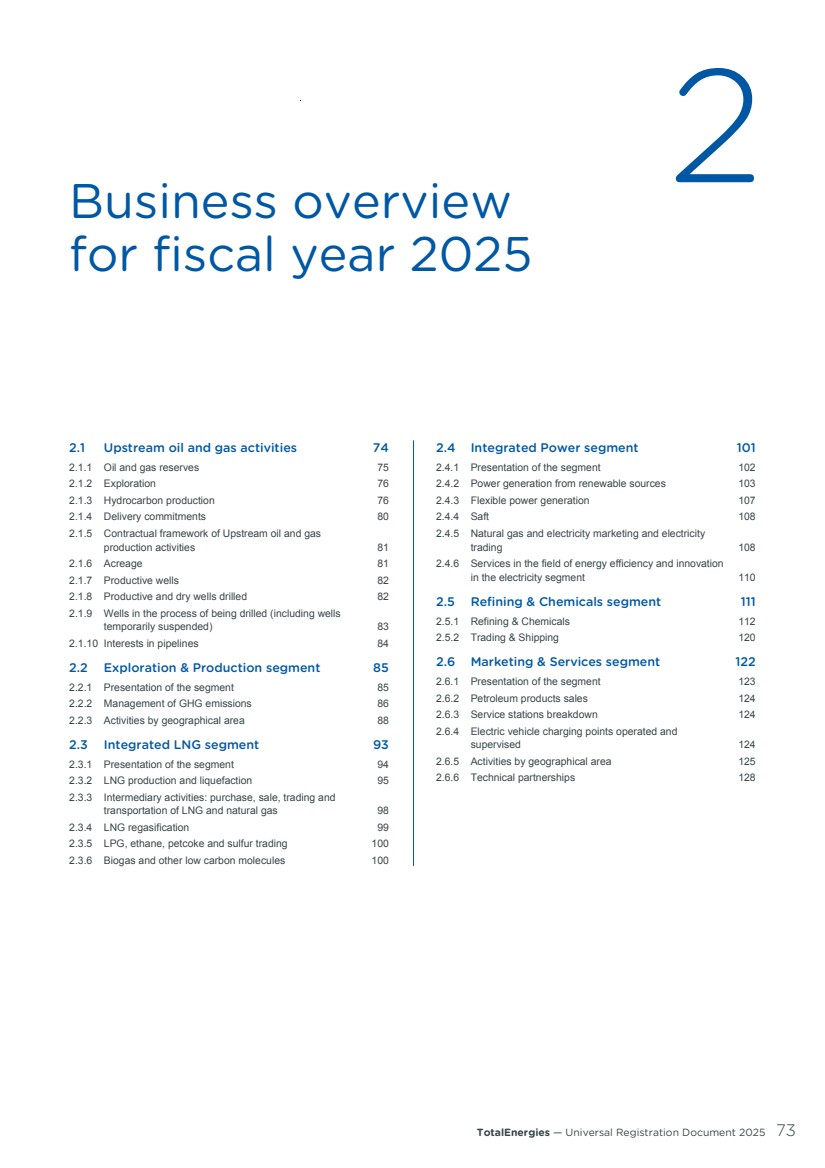
| 2.1 Upstream oil and gas activities TotalEnergies’ Upstream oil and gas activities encompass the oil and gas exploration and production activities of the Exploration & Production (E&P) and Integrated LNG segments. They are conducted in about 50 countries. Main indicators 2.53 Mboe/d of hydrocarbons produced in 2025 $5.0/boe Production costs (ASC932) in 2025(a) <16 kg CO2e/boe Intensity of GHG emissions of Upstream oil & gas activities(b) in 2025 11.2 Gboe of proved reserves of hydrocarbons as of December 31, 2025(c) >12 years of proved reserve life index Main objectives ~+3% per year between 2024-2030 Production growth +3% in 2026 <$5/boe Production costs (ASC932)(a) -80% methane emissions from operated facilities in 2030 or sooner compared to 2020 (a) Production costs for the consolidated subsidiaries, calculated in accordance with ASC 932 standards, excluding special items (refer to point 9.1.5 of chapter 9). (b) Excluding LNG assets. The GHG emissions intensity of Upstream oil & gas activities is reported on the assets perimeter operated by the Company. (c) Based on a Brent price of $69.51/b (reference price in 2025) in accordance with the rules established by the Securities and Exchange Commission (refer to point 2.1.1). Production(a) Hydrocarbon production 2025 2024 2023 Combined production (kboe/d) 2,529 2,434 2,483 Oil (including bitumen) (kb/d) 1,378 1,314 1,388 Gas (including condensates and associated NGL) (kboe/d) 1,151 1,120 1,095 Hydrocarbon production 2025 2024 2023 Combined production (kboe/d) 2,529 2,434 2,483 Liquids (kb/d) 1,533 1,468 1,550 Gas (Mcf/d) 5,402 5,211 5,028 (a) TotalEnergies production = E&P production + production of Integrated LNG. Hydrocarbon production by geographical zone in 2025 (kboe/d) Hydrocarbon production was 2,529 thousand barrels of oil equivalent per day in 2025, up nearly 4% year‑on‑year and was comprised of: – +6% from the start-up and ramp-up of projects, notably Mero‑2, Mero‑3 and Mero‑4 in Brazil, Anchor and Ballymore in the United States, Fenix in Argentina, and Tyra in Denmark, – +1% scope effect, mainly linked to the acquisitions of SapuraOMV in Malaysia and interests in gas licenses in the Eagle Ford basin in Texas, – -3% due to the natural field declines. 2 Business overview for fiscal year 2025 Upstream oil and gas activities 74 TotalEnergies — Universal Registration Document 2025 |
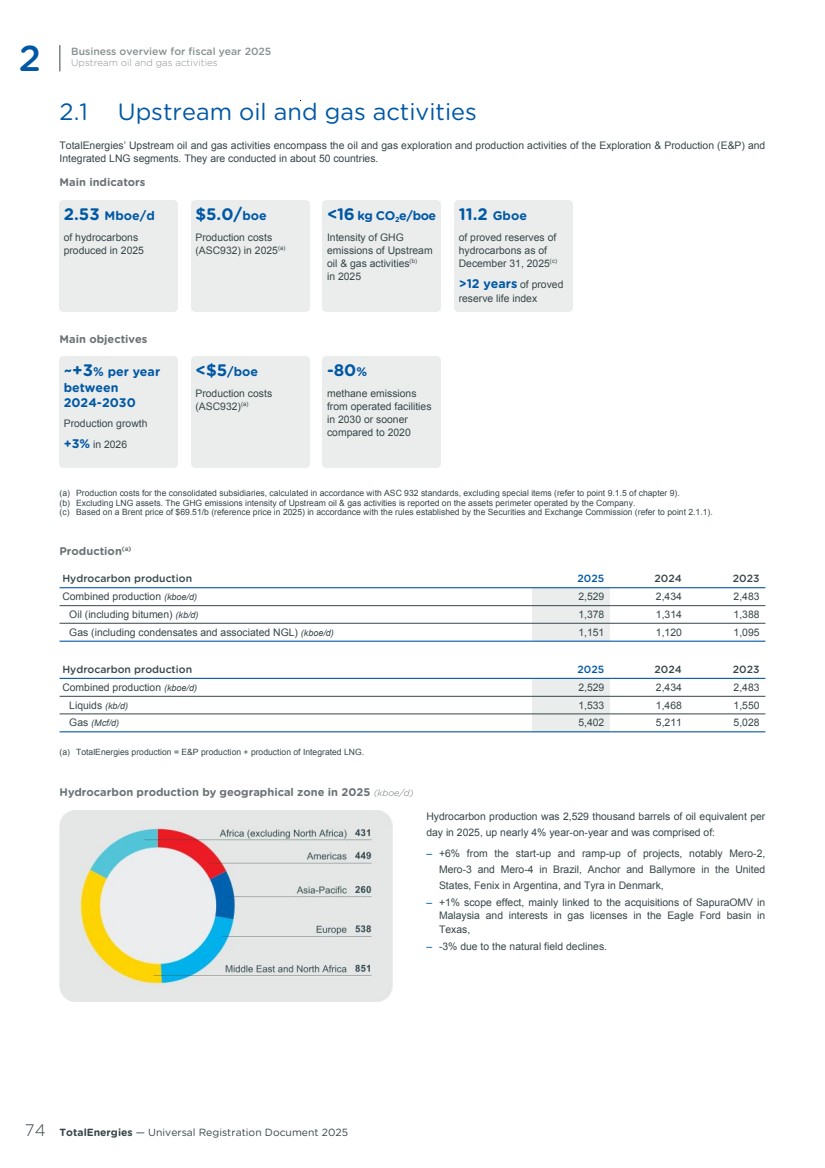
| Technical costs(a) 2025 2024 2023 Production costs ($/boe) 5.0 4.9 5.5 Exploration costs ($/boe) 0.5 0.7 0.7 DD&A ($/boe) 10.9 10.4 10.2 Technical costs ($/boe) 16.5 16.0 16.4 (a) Technical costs for the consolidated subsidiaries, calculated in accordance with ASC 932(1) standards, excluding special items (refer to point 9.1.5 of chapter 9). Production costs of consolidated subsidiaries, calculated in accordance with ASC 932(1) , amounted to $5.0/boe in 2025 compared to $4.9/boe in 2024 and $5.5/boe in 2023. Price realizations Price realizations(a) 2025 2024 2023 Average liquids sales price ($/b) 66.2 77.1 76.2 Average gas sales price ($/Mbtu) 5.72 5.54 6.64 (a) Consolidated subsidiaries. Proved reserves As of December 31 2025 2024 2023 Hydrocarbon reserves (Mboe) 11,218 11,073 10,564 Oil (including bitumen) (Mb) 5,451 5,227 4,731 Gas (including Condensates and associated NGL) (Mboe) 5,767 5,846 5,833 As of December 31 2025 2024 2023 Hydrocarbon reserves (Mboe) 11,218 11,073 10,564 Liquids (Mb) 6,164 5,980 5,487 Gas (Bcf) 27,481 27,626 27,517 Hydrocarbon proved reserves by geographical zone as of December 31, 2025 (in Mboe) Proved reserves of hydrocarbons established under the SEC rules (Brent at $69.51/b in 2025) were 11,218 Mboe as of December 31, 2025. The proved reserve replacement rate(2) , based on SEC rules (Brent at $69.51/b in 2025), was +116% in 2025 and +138% over three years. 2.1.1 Oil and gas reserves The definitions used for proved, proved developed and proved undeveloped crude oil and natural gas reserves are in accordance with the United States Securities & Exchange Commission (SEC) Rule 4-10 of Regulation S-X as amended by the SEC Modernization of Oil and Gas Reporting release issued on December 31, 2008. Proved reserves are estimated using geological and engineering data to determine with reasonable certainty whether the crude oil or natural gas in known reservoirs is economically producible under existing regulatory, economic and operating conditions. TotalEnergies’ oil and natural gas reserves are consolidated annually, taking into account among other factors, levels of production, field reassessments, additional reserves from discoveries and extensions, disposals and acquisitions of reserves and other economic factors. Unless otherwise indicated, any reference to TotalEnergies’ proved reserves, proved developed reserves, proved undeveloped reserves and production reflects the TotalEnergies’ entire share of such reserves or such production. TotalEnergies’ worldwide proved reserves include the proved reserves of its consolidated entities as well as its proportionate share of the proved reserves of equity affiliates. The reserves estimation process involves making subjective judgments. Consequently, estimates of reserves are not exact measurements and are subject to revision under well-established control procedures. The reserves booking process requires, among other actions: – that an internal peer review of technical evaluations is carried out, allowing moreover, to ensure that the SEC definitions and guidance are followed; and (1) FASB Accounting Standards Codification 932, Extractive industries – Oil and Gas. (2) Variation of reserves, excluding production: (revisions + discoveries & extensions + acquisitions - disposals)/production for the period. Business overview for fiscal year 2025 Upstream oil and gas activities 2 TotalEnergies — Universal Registration Document 2025 75 |
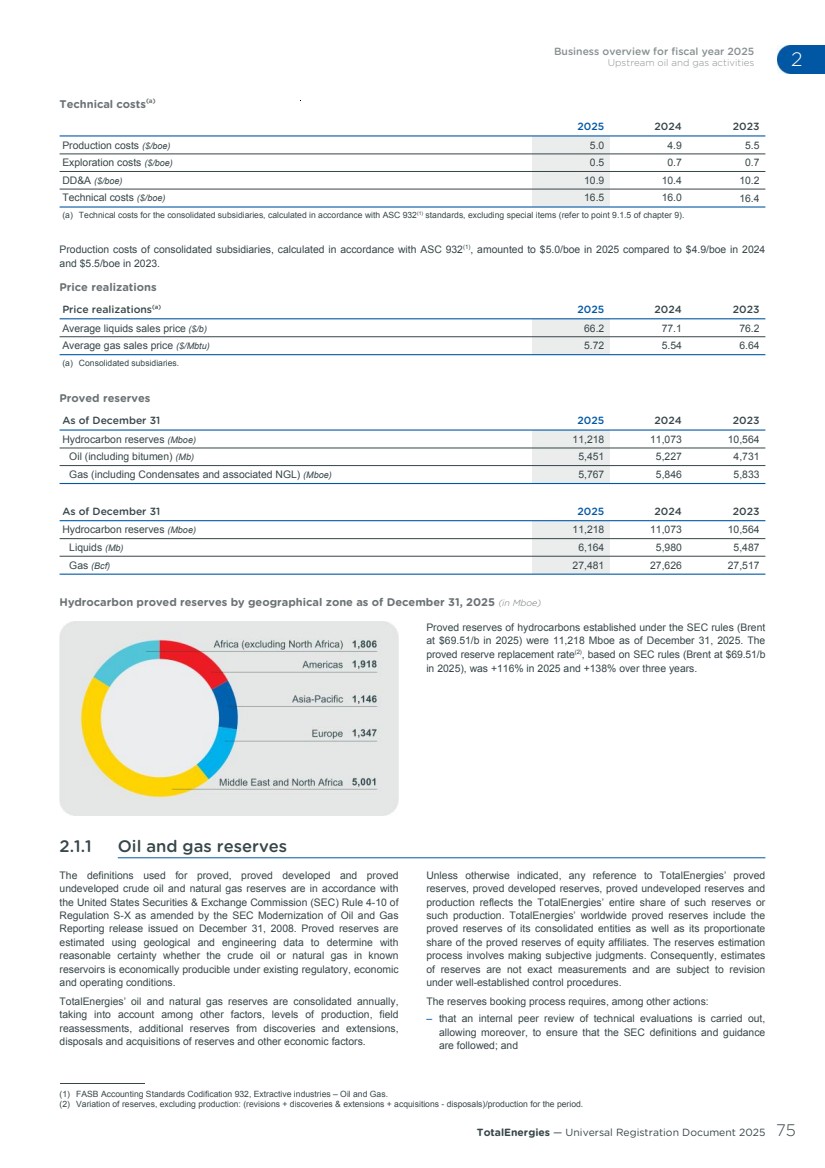
| – that prior to booking proved reserves, management makes the necessary funding commitments required for their development. For further information concerning the reserves and their evaluation process, refer to points 9.1 and 9.2 of chapter 9. Proved reserves for 2025, 2024 and 2023 In accordance with the amended Rule 4-10 of SEC Regulation S-X, proved reserves as of December 31 are calculated using a 12-month average price determined as the unweighted arithmetic average of the first-day-of-the-month price for each month of the relevant year, unless prices are defined by contractual arrangements, excluding escalations based upon future conditions. The average reference prices for Brent crude for 2025, 2024 and 2023 were, respectively, $69.51/b, $81.17/b, and $83.27/b. As of December 31, 2025, TotalEnergies’ combined proved reserves of oil and gas were 11,218 Mboe (of which 7,054 Mboe were proved developed reserves) compared to 11,073 Mboe (of which 6,965 Mboe were proved developed reserves) as of December 31, 2024. As of December 31, 2025, the reserves were located in Africa (mainly in Nigeria, Angola, Mozambique and Uganda), the Americas (mainly in Brazil, United States and Argentina), Asia-Pacific (mainly in Australia, Kazakhstan), Europe (mainly in Norway and Denmark) and the Middle East and North Africa (mainly in the United Arab Emirates, Qatar, Yemen, Iraq, Libya, Oman and Algeria). Natural gas and related products (condensates and natural gas liquids) represent approximately 51% of these reserves, and crude oil 49%. Discoveries of new fields and extensions of existing fields added 692 Mboe to TotalEnergies’ proved reserves during the three years 2023, 2024 and 2025 (before deducting production and sales of reserves and without adding any reserves acquired during this period). The revisions over the same period are +2,346 Mboe, mainly due to field performance, improved recovery projects and to the net impact of changes in hydrocarbon prices in 2023 (decrease), in 2024 (decrease) and in 2025 (decrease). Reserve sensitivity to oil and gas prices Changes in the price used as a reference for the proved reserves estimation result in non-proportionate inverse changes in proved reserves associated with production sharing and risked service contracts (which together represent approximately 30% of TotalEnergies’ proved reserves as of December 31, 2025). Under such contracts, TotalEnergies is entitled to a portion of the production, the sale of which is meant to cover expenses incurred by TotalEnergies. The greater the oil prices decrease, the greater the number of barrels necessary to cover the same amount of expenses. In addition, the number of barrels economically producible under these contracts may vary according to criteria such as cumulative production, the rate of return on investment or the income-cumulative expenses ratio. This increase in reserves is partly offset by a reduction of the duration over which fields are economically producible. However, the effect of a reduction in the duration of production is usually inferior to the impact of the drop in prices in production sharing contracts or risked service contracts and consequently lower prices usually lead to an increase in TotalEnergies’ reserves, and vice versa. Finally, for any type of contract, a significant decrease in the reference price of petroleum products that negatively impacts projects’ profitability may lead to a reduction in proved reserves, and vice versa. 2.1.2 Exploration TotalEnergies evaluates exploration opportunities based on a variety of geological, technical, political, economic (including tax and contractual terms), environmental and societal factors. In line with the Company’s strategy, TotalEnergies has increased the selectivity of its exploration investments with a greater focus on oil prospects with low technical costs, low GHG emissions and which can be put into production quickly, and on gas prospects, in areas where they can provide feedstock to existing LNG infrastructure and future LNG projects. In addition to these criteria, the Company ensures to balance its exploration investments between mature regions (35%; with a relatively low level of geological risk, situated near existing producing fields and infrastructure), emerging regions (50%; in under-explored areas but where the presence of hydrocarbons is already proven), and in frontier basins (15%; where there is a chance of making major resources discoveries). This approach has led to numerous significant discoveries since 2022, notably in Suriname (discovery of Sapakara and Krabdagu on Block 58, 50%, GranMorgu project under development), in Cyprus (discovery of Cronos on Block 6, 50%) and in Namibia (discovery of Venus on Block PEL56 (formely block 2913B), 45.25%). Discoveries were made near existing infrastructure in Nigeria in 2023 (discovery of Ntokon on license OML102, 40%) and in Denmark in 2024 (discovery of Harald East on the Danish Underground Consortium permit). In 2025, the Company’s exploration and appraisal expenditure was $0.8 billion compared to $0.9 billion in 2024 and $1.2 billion in 2023. 2.1.3 Hydrocarbon production The average daily production of liquids and natural gas was 2,529 kboe/d in 2025, compared to 2,434 Kboe/d in 2024 and 2,483 kboe/d in 2023. Gas and associated products (condensates and natural gas liquids) represented approximately 46% of TotalEnergies’ overall oil and gas production in 2025, compared to 46% in 2024 and 44% in 2023. Crude oil and bitumen represented 54% in 2025, compared to 54% in 2024 and 56% in 2023. The tables on the following pages set forth TotalEnergies’ annual and average daily production of liquids and natural gas by geographical area and for each of the last three fiscal years. Consistent with industry practice, TotalEnergies often holds a percentage interest in its fields with the balance being held by joint-venture partners (which may include other international oil companies, state-owned oil companies or public entities). TotalEnergies entities may frequently act as the operator, i.e., meaning the party responsible for the execution of technical production on the fields in which it holds an interest. For further information, refer to the table on producing assets by geographical area below. In 2025, as in 2024 and 2023, the Trading & Shipping unit of the Refining & Chemicals segment marketed substantially all of TotalEnergies’ liquids production (refer to the table regarding Trading & Shipping’s crude oil sales and supply and petroleum products sales in point 2.5.2.1). 2 Business overview for fiscal year 2025 Upstream oil and gas activities 76 TotalEnergies — Universal Registration Document 2025 |
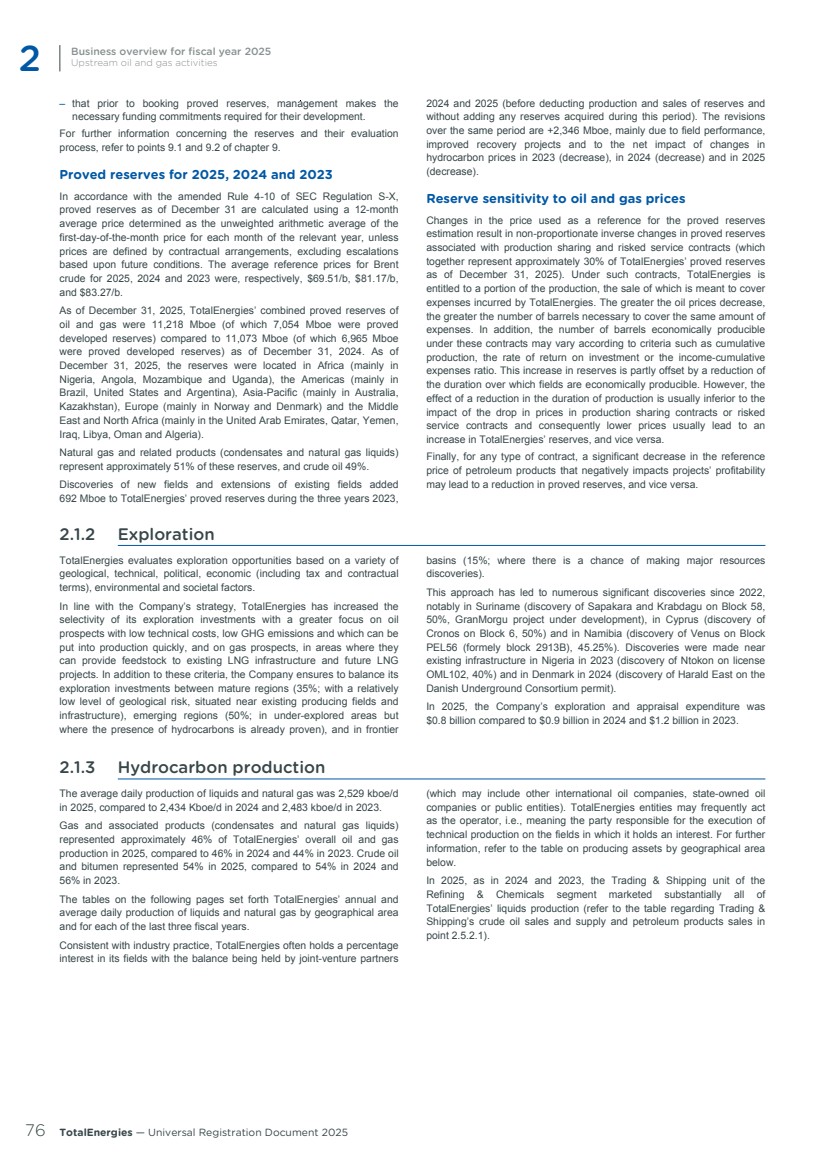
| Production by geographical zone The following table sets forth TotalEnergies’ annual liquids and natural gas production by geographical area. 2025 2024 2023 Liquids Mb(a) Natural gas Bcf(b)(c) Total Mboe Liquids Mb(a) Natural gas Bcf(b)(c) Total Mboe Liquids Mb(a) Natural gas Bcf(b)(c) Total Mboe Africa (excluding North Africa) 114 216 157 119 231 165 127 224 172 Angola 47 52 57 49 45 58 52 45 61 Gabon 6 3 6 6 2 7 6 2 6 Nigeria 37 156 69 41 175 76 45 170 80 Republic of the Congo 24 5 25 23 9 24 24 7 25 Americas 84 444 164 66 395 137 92 356 155 Argentina 2 197 38 2 182 35 3 161 32 Bolivia 2 50 11 1 58 12 2 64 13 Brazil 64 14 67 55 9 56 48 6 49 Canada – – – – – – 31 – 31 United States 16 183 48 8 146 34 8 125 30 Asia-Pacific 36 322 95 34 273 85 39 294 94 Australia 11 168 42 10 172 42 11 176 44 Brunei – – – <1 12 3 1 15 3 China <1 53 10 <1 55 10 <1 62 12 Indonesia – 1 <1 – 1 <1 – 2 <1 Kazakhstan 24 28 30 23 26 29 27 28 33 Malaysia 1 72 13 <1 5 1 – – – Thailand <1 <1 <1 <1 1 <1 <1 11 2 Europe 76 648 197 82 681 208 85 657 206 Azerbaijan 2 26 7 2 25 7 2 19 5 Denmark 10 40 17 8 21 12 8 18 12 Italy 6 1 6 7 1 7 7 1 7 Norway 46 208 85 49 223 91 50 199 87 Netherlands <1 18 3 <1 20 4 <1 19 3 United Kingdom 10 147 38 14 163 44 16 190 52 Russia 2 208 41 2 228 44 2 211 40 Middle East and North Africa 249 342 310 236 327 295 223 304 279 Algeria 8 58 19 8 56 18 8 55 19 Egypt <1 11 2 <1 15 3 <1 13 3 United Arab Emirates 140 19 143 136 14 139 127 12 129 Iraq 11 3 12 10 2 11 6 2 6 Libya 38 15 41 31 15 34 32 16 35 Oman 11 76 25 11 71 24 10 53 20 Qatar 41 160 68 40 154 67 40 153 67 Yemen – – – – – – – – – Total production 559 1,972 923 537 1,907 891 566 1,835 906 Including share of equity affiliates 58 425 136 56 416 132 55 366 122 Angola 2 37 8 1 28 7 2 28 7 United Arab Emirates 9 11 11 9 14 11 9 12 11 Oman 11 76 25 11 58 21 9 27 15 Qatar 34 93 51 33 88 49 33 88 49 Russia 2 208 41 2 228 44 2 211 40 (a) Liquids include crude oil, bitumen, condensates, and natural gas liquids (NGL). (b) Including fuel gas (142 Bcf in 2025, 149 Bcf in 2024 and 144 Bcf in 2023). (c) Gas conversion ratio: 1 boe = 1 b of crude oil = 5,424 cf of gas in 2025, (5,390 cf of gas in 2024 and 5,388 cf of gas in 2023). Business overview for fiscal year 2025 Upstream oil and gas activities 2 TotalEnergies — Universal Registration Document 2025 77 |
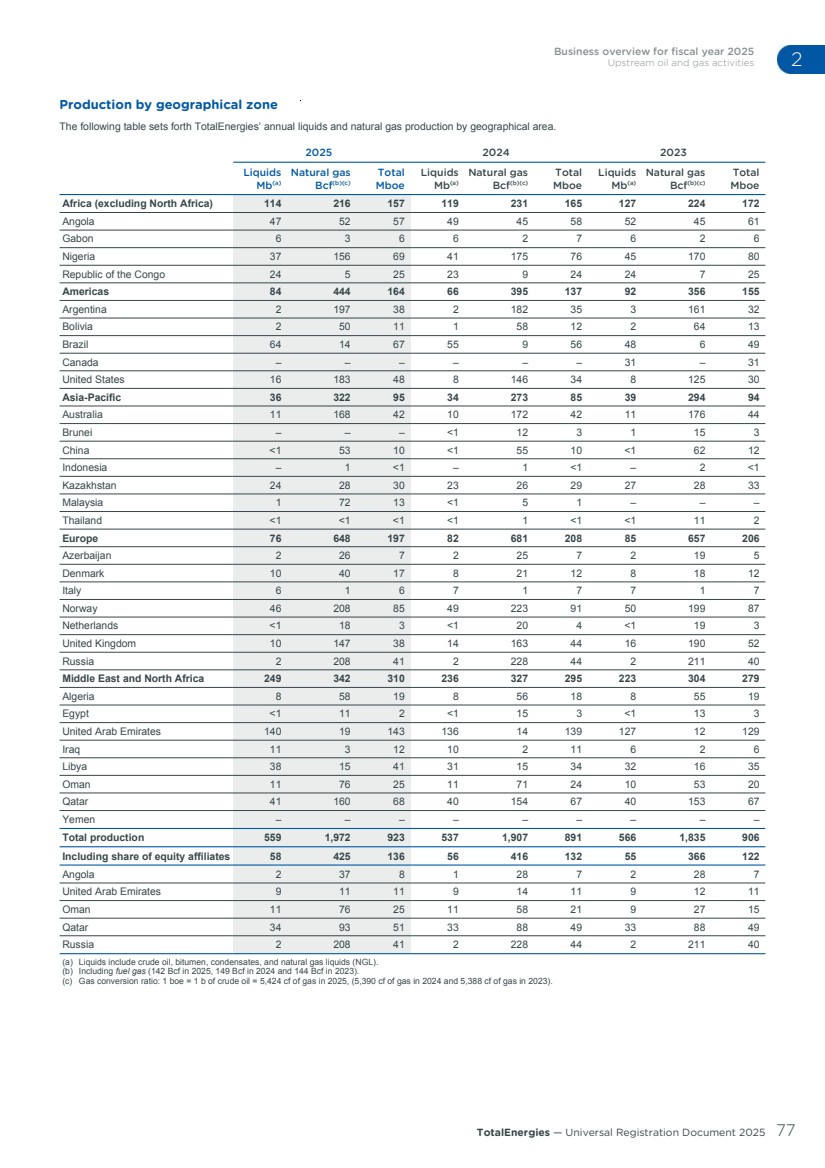
| The following table sets forth TotalEnergies’ average daily liquids and natural gas production by geographical zone. 2025 2024 2023 Liquids kb/d(a) Natural gas Mcf/d(b)(c) Total kboe/d Liquids kb/d(a) Natural gas Mcf/d(b)(c) Total kboe/d Liquids kb/d(a) Natural gas Mcf/d(b)(c) Total kboe/d Africa (excluding North Africa) 314 591 431 325 630 450 348 614 471 Angola 128 142 156 134 122 158 143 122 166 Gabon 16 9 18 17 6 18 16 5 17 Nigeria 103 427 188 113 477 209 124 467 219 Republic of the Congo 67 13 69 61 25 65 65 20 69 Americas 230 1,216 449 180 1,080 375 251 975 426 Argentina 6 540 103 5 497 95 7 442 87 Bolivia 4 136 30 4 158 34 4 175 35 Brazil 176 39 184 148 25 153 132 17 135 Canada – – – – – – 86 – 86 United States 44 500 132 23 400 93 22 341 83 Asia-Pacific 99 881 260 94 746 233 107 805 257 Australia 29 459 114 28 469 116 31 482 120 Brunei – – – 1 34 7 1 42 9 China <1 145 26 <1 150 27 <1 170 31 Indonesia – 2 <1 – 4 1 – 5 1 Kazakhstan 66 77 82 64 72 79 74 76 90 Malaysia 4 197 36 <1 15 3 – – – Thailand <1 1 <1 <1 2 <1 1 30 6 Europe 208 1,777 538 225 1,862 569 232 1,801 565 Azerbaijan 6 71 19 6 70 19 5 53 14 Denmark 26 110 47 21 57 32 22 50 32 Italy 17 2 17 20 2 20 18 2 18 Norway 125 571 231 134 611 247 138 546 239 Netherlands <1 49 9 <1 54 10 <1 52 9 United Kingdom 28 404 104 37 446 121 44 521 142 Russia 6 570 111 6 622 120 5 577 111 Middle East and North Africa 682 937 851 644 894 807 612 833 764 Algeria 22 159 51 21 154 49 24 151 51 Egypt <1 30 6 <1 41 8 <1 37 7 United Arab Emirates 384 51 393 372 38 379 347 34 353 Iraq 31 7 32 28 7 29 17 4 18 Libya 104 42 113 85 40 93 88 42 96 Oman 31 208 69 29 193 65 28 145 55 Qatar 110 440 187 109 421 184 108 420 184 Yemen – – – – – – – – – Total production 1,533 5,402 2,529 1,468 5,211 2,434 1,550 5,028 2,483 Including share of equity affiliates 159 1,165 371 152 1,135 361 150 1,004 335 Angola 4 100 23 4 77 19 4 77 19 United Arab Emirates 25 31 31 24 38 31 24 34 30 Oman 31 208 68 29 157 57 26 73 40 Qatar 93 256 138 90 241 134 91 243 135 Russia 6 570 111 6 622 120 5 577 111 (a) Liquids include crude oil, bitumen, condensates, and natural gas liquids (NGL). (b) Including fuel gas (390 Mcf/d in 2025, 407 Mcf/d in 2024 and 394 Mcf/d in 2023). (c) Gas conversion ratio: 1 boe = 1 b of crude oil = 5,424 cf of gas in 2025, (5,390 cf of gas in 2024 and 5,388 cf of gas in 2023). 2 Business overview for fiscal year 2025 Upstream oil and gas activities 78 TotalEnergies — Universal Registration Document 2025 |
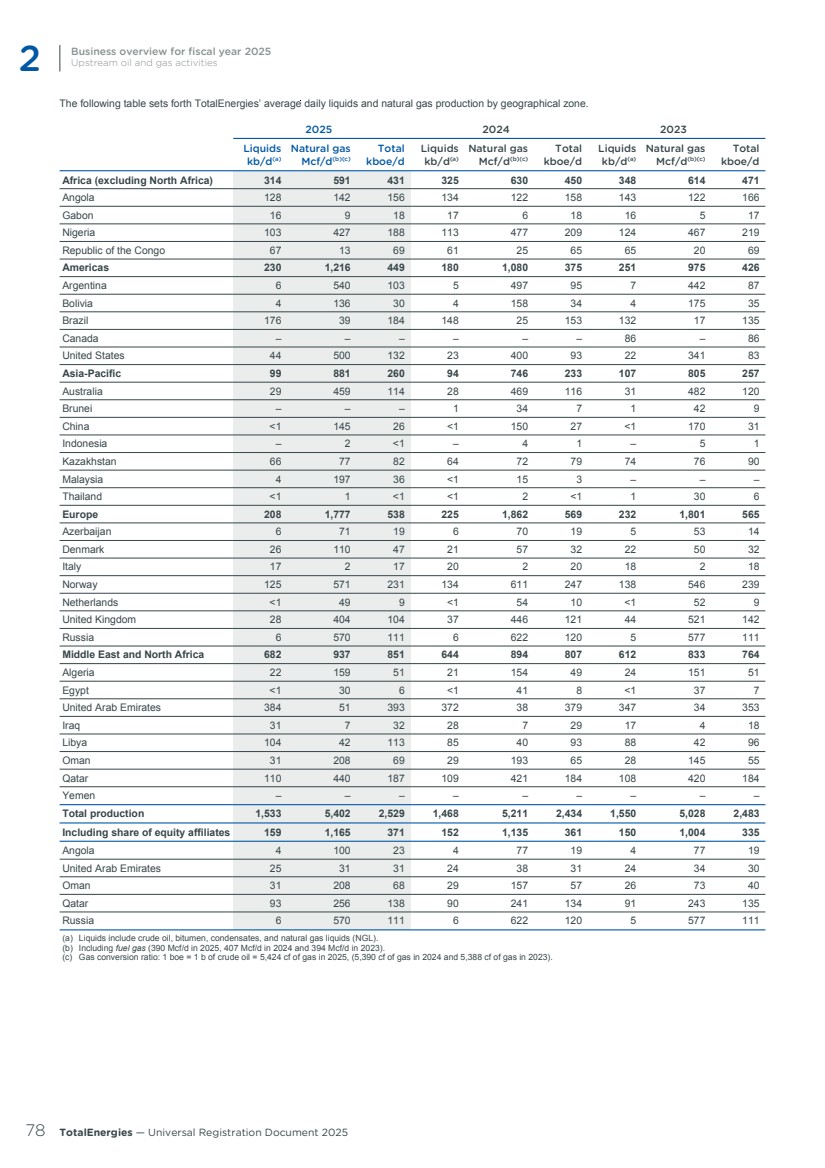
| Producing assets by geographical zone The table below shows TotalEnergies’ producing assets at December 31, 2025(1) by geographical area, the year in which TotalEnergies’ activities started in the relevant country, the interest held in the asset (TotalEnergies’ stake in %) and whether TotalEnergies operates the asset. Africa (excluding North Africa) Exploration & Production segment Integrated LNG segment Angola (1953) Operated: Girassol, Dalia, Pazflor, CLOV (Block 17) (38.00%), Kaombo (Block 32) (30.00%), Begonia (Block 17/06) (30.00%) Non-operated: Cabinda Block 0 (10.00%) Non-operated: Angola LNG (13.60%) Gabon (1928) Operated: Baudroie Marine G5-143 (90.00%), Pointe Clairette Cap Lopez G6-5 (100.00%), Grand Anguille Marine G6-16 (100.00%), N’Tchengué G6-9 (100.00%), N’Tchengué Océan G6-14 (100.00%), Port Gentil Océan G6-15 (100.00%), Torpille G6-17 (100.00%) Nigeria (1962) Operated: OML 99 Amenam-Kpono (30.40%), OML 99 Ikike (40.00%), OML 100 (40.00%), OML 102 Ofon (40.00%), PML 2/3 (ex OML 130), Akpo/Egina/Akpo West (24.00%) Operated: OML 58 (40.00%) Non-operated: Renaissance Africa Energy Consortium (RAEC JV) (13 onshore OML and 2 offshore OML) (10.00%), OML 138 Usan (20.00%) Non-operated: Nigeria LNG (15.00%), RAEC JV (OML 23, OML 28 and OML 77) (10.00%) Republic of the Congo (1968) Operated: Moho Bilondo (63.50%), Moho Nord (63.50%), Sendji (55.25%), Yanga (55.25%) Non-operated: Lianzi (26.75%) Americas Exploration & Production segment Integrated LNG segment Argentina (1978) Operated: Aguada Pichana Este – Mulichinco (27.27%), Aguada Pichana Este – Vaca Muerta (55.00%), San Roque (24.71%), Aries (37.50%), Cañadon Alfa Complex (37.50%), Carina (37.50%), Hidra (37.50%), Kaus (37.50%), Vega Pleyade (37.50%), Fenix (37.50%) Bolivia (1995) Operated: Incahuasi (50.00%) Non-operated: San Alberto (15.00%), San Antonio (15.00%), Itaú (41.00%) Brazil (1975) Operated: Lapa (45.00%) Non-operated: Libra (19.30%), Iara (22.50%), Atapu ToR Surplus (22.50%), Sépia ToR Surplus (28.00%) United States (1957) Non-operated: Tahiti (17.00%), Jack (25.00%), Anchor (37.14%), Ballymore (40.00%) Operated: several assets in the Barnett basin (96% on average) Non-operated: several assets in South Texas with ownership interests between 20.00% and 45.00% Asia-Pacific Exploration & Production segment Integrated LNG segment Australia (2006) Non-operated: several assets in the GLNG (27.50%)(a) , Ichthys (26.00%) China (2006) Non-operated: South Sulige (49.00%) Indonesia (1968) Non-operated: Sebuku (13.50%) Kazakhstan (1992) Non-operated: Kashagan (16.81%) Malaysia (2001) Operated: SK408 (West, 30.002%) (b) , SK310 (30.00%)(b) Non-operated: SK408 (East, 30.002%)(b) (a) TotalEnergies’ interest in the unincorporated joint-venture, which holds several assets. (b) SapuraOMV acquisition by TotalEnergies and followed by a divest of an indirect interest to PTTEP for SK408. (1) TotalEnergies’ interest in the local entity is approximately 100% in all cases except for TotalEnergies EP Gabon (58.28%), TotalEnergies EP Congo (85.00%) and Oman (refer to the table footnotes below). Business overview for fiscal year 2025 Upstream oil and gas activities 2 TotalEnergies — Universal Registration Document 2025 79 |
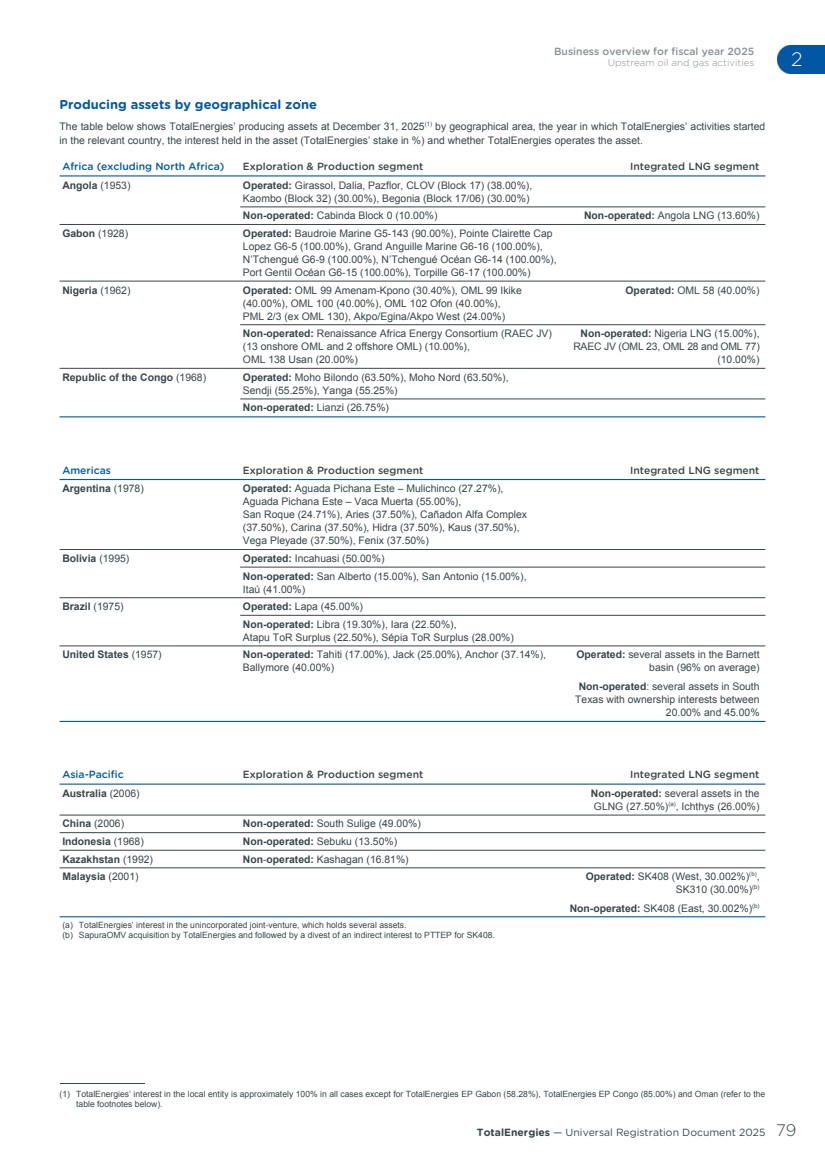
| Europe Exploration & Production segment Integrated LNG segment Azerbaijan (1996) Non-operated: Absheron (35.00%) Denmark (2018) Operated: Danish Underground Consortium (DUC) zone (43.20%) comprising the Dan/Halfdan, Gorm and Tyra fields, and all their satellites Italy (1960) Operated: Tempa Rossa (50.00%) Norway (1965) Operated: Skirne (40.00%), Atla (40.00%) Non-operated: Johan Sverdrup (8.44%), Åsgard (7.81%), Ekofisk (39.90%), Eldfisk (39.90%), Embla (39.90%), Tor (48.20%), Kristin (6.00%), Kvitebjørn (5.00%), Oseberg (14.70%), Oseberg East (14.70%), Oseberg South (14.70%), Troll (3.69%), Tune (10.00%), Tyrihans (23.15%), Tommeliten Alpha (20.14%) Non-operated: Snøhvit (18.40%) Netherlands (1964) Operated: F15a (38.20%), J3a (30.00%), K1a (40.10%), K2c (60.00%), K3b (56.16%), K4a (50.00%), K4b/K5a (36.31%), K5b (50.00%), K6 (56.16%), L1a (60.00%), L1d (60.00%), L1e (55.66%), L1f (55.66%), L4a (55.66%) Non-operated: E16a (16.92%), E17a/E17b (14.10%), J3b/J6 (25.00%), Q16a (6.49%) United Kingdom (1962) Operated: Alwyn North (100.00%), Dunbar (100.00%), Ellon (100.00%), Forvie North (100.00%), Grant (100.00%), Jura (100.00%), Nuggets (100.00%), Elgin-Franklin (46.17%), West Franklin (46.17%), Glenelg (58.73%), Culzean (49.99%), Laggan, Edradour and Glenlivet (40.00% each), Gryphon (86.50%), Maclure (38.19%), South Gryphon (89.88%), Tullich (100.00%), Ballindalloch (91.80%) Non-operated: Bruce (1.00%), Markham unitized field (7.35%), Harding (30.00%) Russia (1991) None(a) Non-operated: Yamal LNG (20.02%)(b) (a) TotalEnergies has not accounted for its 19.4% stake in Novatek under the equity method since December 31, 2022. (b) TotalEnergies’ direct interest of 20.02% in Yamal LNG. Middle East and North Africa Exploration & Production segment Integrated LNG segment Algeria (1952) Non-operated: TFT II (49.00%), Timimoun (37.75%), 404a & 208 (12.25%) Egypt (2010) Non-operated: NEHO (25.00%) United Arab Emirates (1939) Non-operated: ADNOC Onshore (10.00%), ADNOC Offshore: Umm Shaif/Nasr (20.00%), Lower Zakum (5.00%), SARB/Umm Lulu (20.00%), ADNOC Gas Processing (15.00%), Ruwais Diyab (10.00%) Non-operated: ADNOC LNG (5.00%) Iraq (1924) Operated: Ratawi (GGIP) (45%) Non-operated: Halfaya (22.50%) Libya (1959) Non-operated: zones 15, 16 & 32 (37.50%), zones 129 & 130 (15.00%), zones 130 & 131 (12.00%), zones 70 & 87 (37.50%), Waha (20.42%) Oman (1937) Non-operated: Block 6 (4.00%)(a) Non-operated: Oman LNG (5.54%), Block 10 (26.55%)(b) Qalhat LNG (2.04%) (c) Qatar (1936) Operated: Al Khalij (40.00%) Non-operated: North Field-Bloc NF Dolphin (24.50%), Al Shaheen (30.00%) Non-operated: North Field QatarEnergy LNG N(2) (ex Qatargas 2) Train 5 (16.70%) (a) TotalEnergies’ indirect interest (4.00%) in the concession through its 10.00% stake in Private Oil Holdings Oman Ltd (POHOL) which owns 40.00% of Block 6. (b) TotalEnergies’ indirect interest (26.55%) in the asset through its 80.00% stake in Marsa LNG LLC which owns 33.19% of Block 10. (c) TotalEnergies’ indirect interest (2.04%) in the asset through its 5.54% in Oman LNG which owns 36.80% Qalhat LNG. 2.1.4 Delivery commitments The majority of TotalEnergies’ natural gas production is sold under long-term contracts. However, most of its North American and United Kingdom production, and part of its Norwegian production, is sold on the spot market. Spot market trading of Russian LNG was halted at the end of 2022. The long-term contracts under which TotalEnergies sells its natural gas usually provide for a price related to, among other factors, average crude oil and other petroleum product prices, as well as, in some cases, a cost-of-living index. Though the price of natural gas tends to fluctuate in line with crude oil prices, a slight delay may occur before changes in crude oil prices are reflected in long-term natural gas prices. Some of TotalEnergies’ long-term contracts provide for the delivery of quantities of natural gas that may or may not be fixed and determinable. Such delivery commitments vary substantially, both in duration and scope, from contract to contract throughout the world. TotalEnergies expects to fulfill most of these obligations through the production of its proved reserves of natural gas and, if needed, additional sourcing from spot market purchases. 2 Business overview for fiscal year 2025 Upstream oil and gas activities 80 TotalEnergies — Universal Registration Document 2025 |
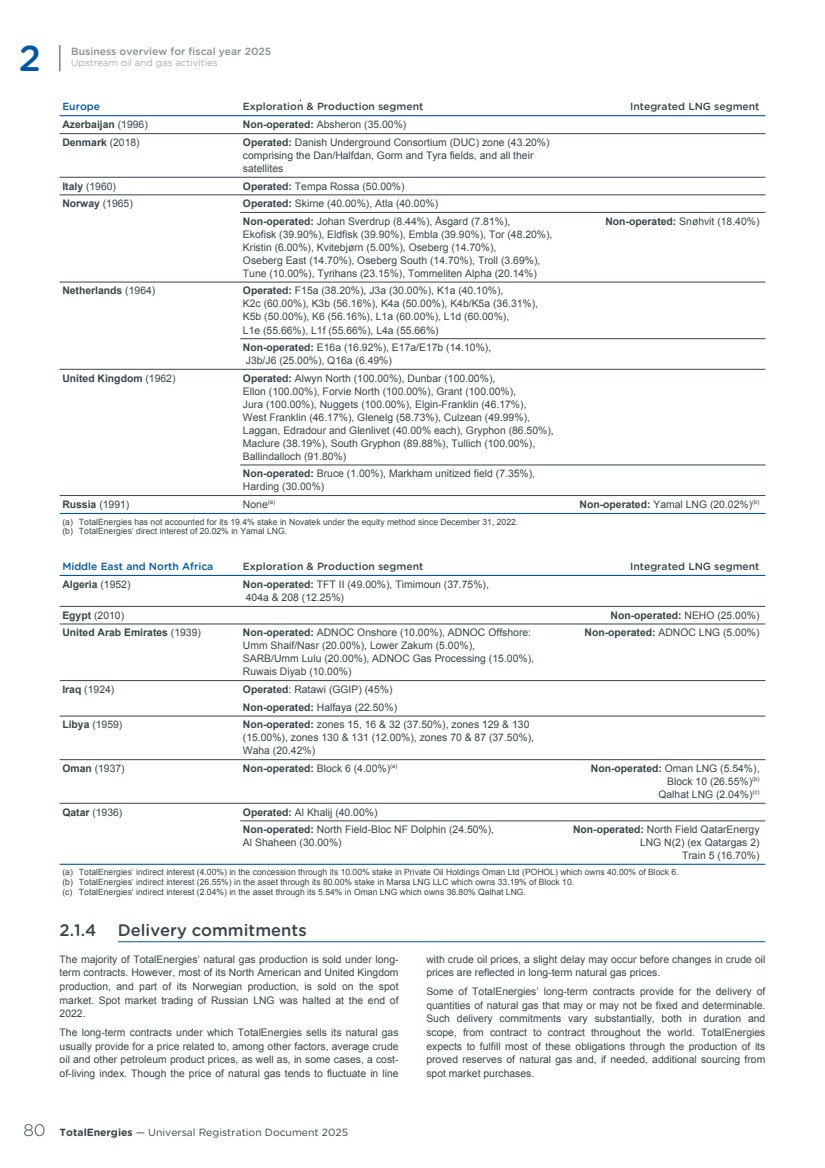
| 2.1.5 Contractual framework of Upstream oil and gas production activities Licenses, permits and contracts governing the ownership of oil and gas interests by TotalEnergies’ entities have terms that vary from country to country and are generally granted by or entered into with a government entity or a state-owned company or sometimes with private owners. These agreements and permits usually take the form of concessions or production sharing contracts. In the framework of oil concession agreements, the oil company (or consortium) owns the assets and the facilities and is entitled to the entire production. In exchange, the operating risks, costs and investments are the oil company’s or the consortium’s responsibility and it agrees to remit to the relevant host country, usually the owner of the subsoil resources, a production-based royalty, income tax, and possibly other taxes that may apply under local tax legislation. Production sharing contracts (PSCs) involve a more complex legal framework than concession agreements. They define the terms and conditions of production sharing and set the rules governing the cooperation between the company (the contractor) or consortium (the contracting group) in possession of the license and the host country, which is generally represented by a state-owned company. The latter can thus be involved in operating decisions, cost accounting and production allocation. The contractor (or contracting group) undertakes the execution and financing, at its own risk, of all exploration, development or operational activities. In exchange, it is entitled to a portion of the production, known as “cost oil”, the sale of which is intended to cover its incurred expenses (capital and operating costs). The balance of production, known as “profit oil”, is then shared in varying proportions, between the contractor (or the contracting group), on the one hand, and the host country or state-owned company, on the other hand. Today, concession agreements and PSCs can coexist, sometimes in the same country. Even though there are other contractual models, TotalEnergies’ license portfolio is comprised mainly of concession agreements. On most licenses, the partners and authorities of the host country, often assisted by international accounting firms, perform joint-venture and PSC cost audits and ensure the observance of contractual obligations. In some countries, TotalEnergies has also signed contracts called “risked service contracts”, which are similar to PSCs. However, the profit oil is replaced by a defined or determinable cash monetary remuneration, agreed in the relevant contract, which depends in particular on field performance parameters such as the amount of barrels produced. Oil and gas exploration and production activities are subject to authorization granted by public authorities (licenses), which are granted for specific and limited periods of time and include an obligation to relinquish a large portion, or the entire portion in case of failure, of the area covered by the license at the end of the exploration period. TotalEnergies pays taxes on income generated from its oil and gas production and sales activities under its concessions, PSCs and risked service contracts, as required by local regulations. In addition, depending on the country, TotalEnergies’ production and sales activities may be subject to a number of other taxes, fees and withholdings, including special petroleum taxes and fees. The taxes imposed on oil and gas production and sales activities are generally substantially higher than those imposed on other industrial or commercial businesses. 2.1.6 Acreage As of December 31 (in thousands of acres) 2025 Undeveloped acreage(a) Developed acreage Africa (excluding North Africa) Gross 59,908 923 Net 23,755 204 Americas Gross 11,565 848 Net 4,514 360 Asia-Pacific Gross 45,094 1,096 Net 21,309 323 Europe Gross 5,097 858 Net 1,604 202 Middle East and North Africa Gross 48,246 4,069 Net 9,955 710 Total Gross 169,910 7,794 Net(b) 61,137 1,799 (a) Undeveloped acreage includes licenses and concessions. (b) Net acreage equals the sum of TotalEnergies’ equity interests in gross acreage. Business overview for fiscal year 2025 Upstream oil and gas activities 2 TotalEnergies — Universal Registration Document 2025 81 |
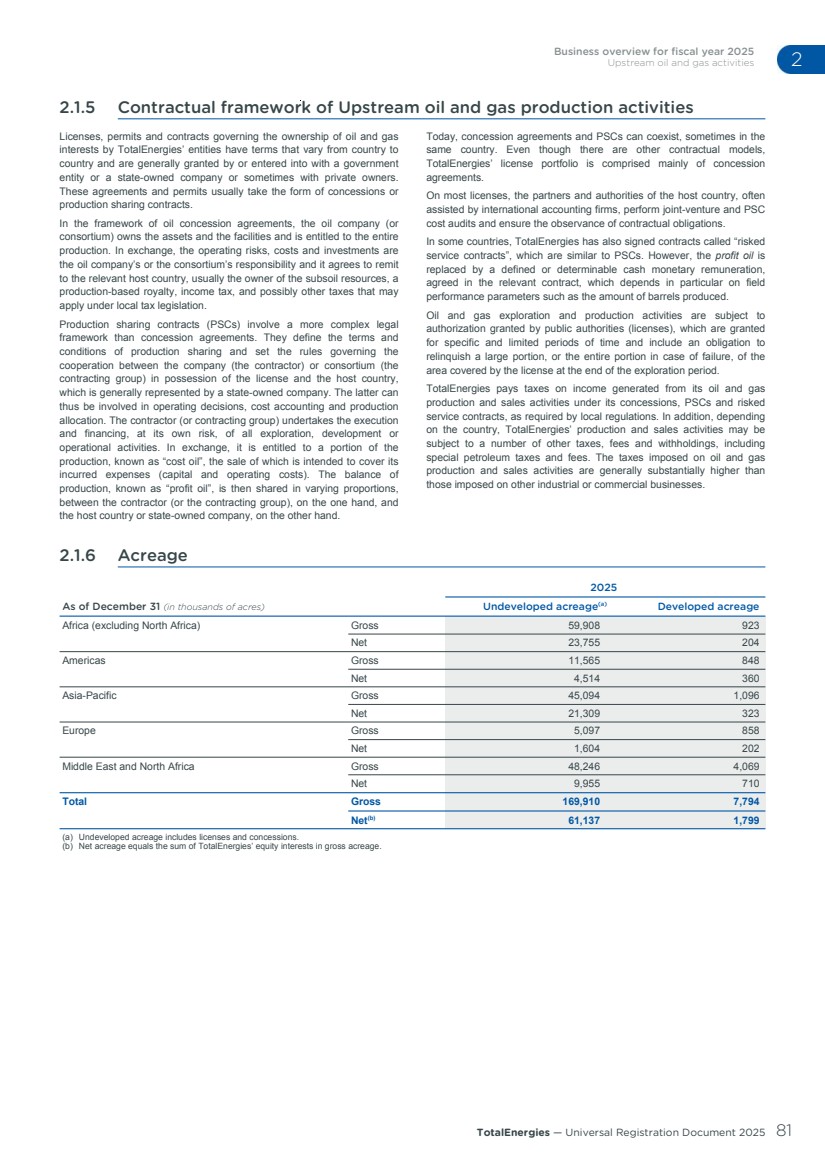
| 2.1.7 Productive wells As of December 31 (number of wells) 2025 Gross productive wells Net productive wells(a) Africa (excluding North Africa) Liquids 1,274 351 Gas 71 14 Americas Liquids 154 33 Gas 2,462 1,611 Asia-Pacific Liquids 32 5 Gas 4,650 1,465 Europe Liquids 561 182 Gas 549 147 Middle East and North Africa Liquids 14,746 1,106 Gas 233 73 Total Liquids 16,767 1,677 Gas 7,965 3,310 (a) Net productive wells corresponds to the sum of TotalEnergies’ equity interests in gross productive wells. 2.1.8 Productive and dry wells drilled As of December 31 (number of wells) 2025 2024 2023 Net productive wells drilled (a)(b) Net dry wells drilled (a)(c) Total net wells drilled (a)(c) Net productive wells drilled (a)(b) Net dry wells drilled (a)(c) Total net wells drilled (a)(c) Net productive wells drilled (a)(b) Net dry wells drilled (a)(c) Total net wells drilled (a)(c) Exploration Africa (excluding North Africa) − 0.6 0.6 1.4 0.3 1.7 2.4 0.4 2.8 Americas 1.0 0.2 1.2 − 0.7 0.7 1.6 − 1.6 Asia-Pacific − − − − − − − − − Europe 0.1 0.5 0.6 0.6 − 0.6 1.3 1.0 2.3 Middle East and North Africa 0.5 0.8 1.3 0.5 1.4 1.9 0.7 0.6 1.3 Total 1.6 2.1 3.7 2.5 2.5 5.0 6.0 2.0 8.0 Development Africa (excluding North Africa) 31.9 0.4 32.3 29.5 0.6 30.1 10.5 − 10.5 Americas 30.3 − 30.3 77.2 − 77.2 22.8 − 22.8 Asia-Pacific 106.6 − 106.6 105.5 − 105.5 138.8 − 138.8 Europe 7.9 − 7.9 12.6 1.0 13.6 16.5 0.4 16.9 Middle East and North Africa 87.7 − 87.7 76.3 − 76.3 93.5 − 93.5 Total 264.4 0.4 264.8 301.1 1.6 302.7 282.1 0.4 282.5 Total 266.0 2.5 268.5 303.6 4.0 307.6 288.1 2.4 290.5 (a) Net wells equal the sum of TotalEnergies’ equity interests in gross wells. (b) Includes certain exploratory wells that were abandoned, but which would have been capable of producing hydrocarbons in sufficient quantities to justify completion. (c) Note: service wells and stratigraphic wells are not reported in this table. 2 Business overview for fiscal year 2025 Upstream oil and gas activities 82 TotalEnergies — Universal Registration Document 2025 |
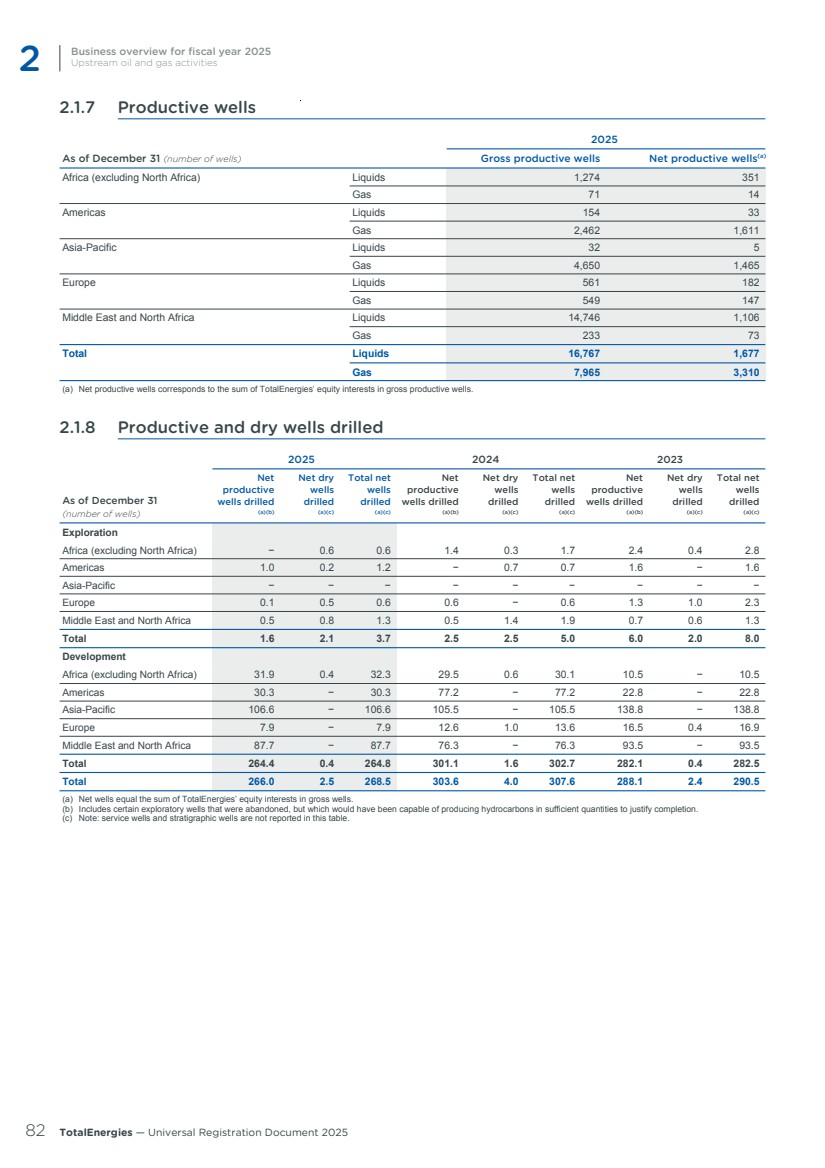
| 2.1.9 Wells in the process of being drilled (including wells temporarily suspended) As of December 31 (number of wells) 2025 Gross Net(a) Exploration Africa (excluding North Africa) 1 0.5 Americas − − Asia-Pacific − − Europe − − Middle East and North Africa 1 0.2 Total 2 0.7 Other wells(b) Africa (excluding North Africa) 258 121.3 Americas 62 26.2 Asia-Pacific 216 48.0 Europe 20 5.5 Middle East and North Africa 319 46.4 Total 875 247.4 Total 877 248.1 (a) Net wells equal the sum of TotalEnergies’ equity interests in gross wells. Includes wells for which surface facilities permitting production have not yet been constructed. Such wells are also reported in the table “Number of net productive and dry wells drilled” above, for the year in which they were drilled. (b) Other wells are development wells, service wells and stratigraphic wells. Business overview for fiscal year 2025 Upstream oil and gas activities 2 TotalEnergies — Universal Registration Document 2025 83 |
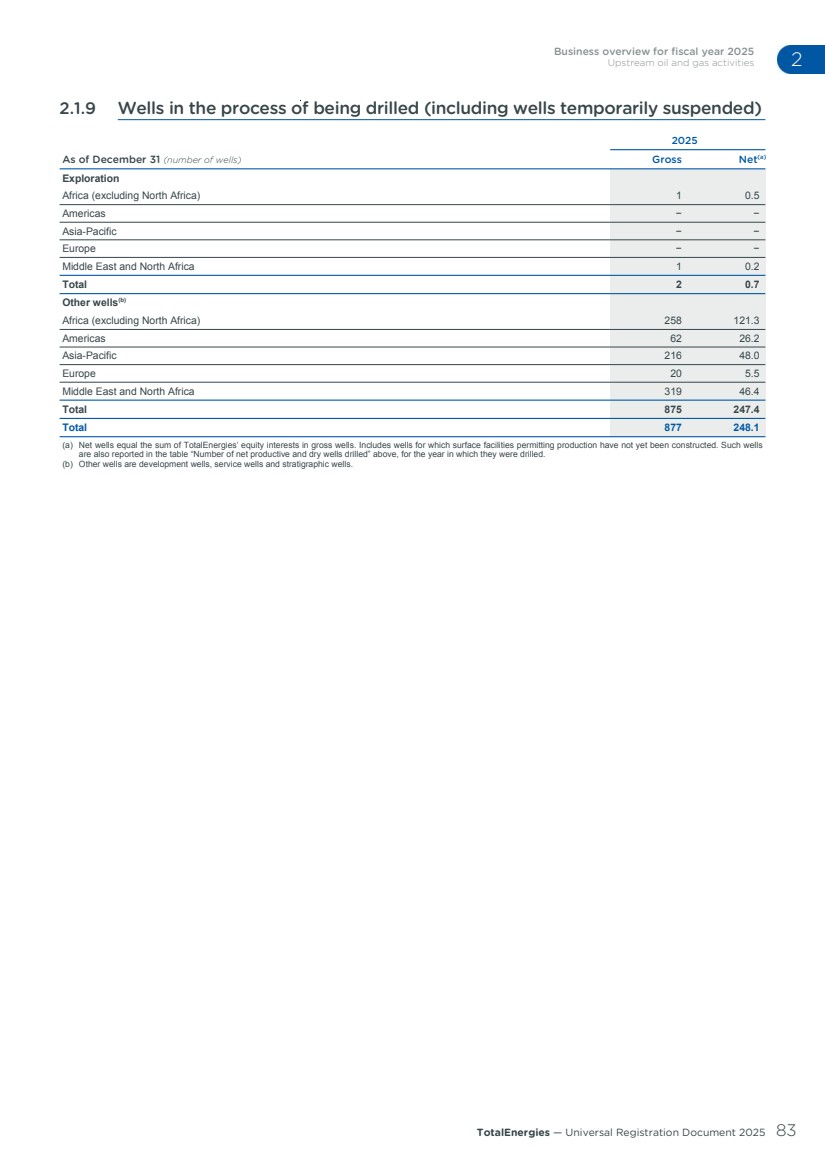
| 2.1.10 Interests in pipelines The table below shows the main interests held by TotalEnergies(1) entities in pipelines in operation, as of December 31, 2025. Pipeline(s) Origin Destination Interest (%) Operator Liquids Gas Africa (excluding North Africa) Nigeria O.U.R. Obite Rumuji 40.00 X X NOPL Rumuji Owaza 40.00 X X Americas Argentina TGM Aldea Brasilera (Entre Rios) Paso de Los Libres (Argentina-Brazil border) 32.68 X Brazil TSB Paso de Los Libres (Argentina-Brazil border) Uruguayana (Brazil) 25.00 X TSB Canoas Triunfo 25.00 X Asia-Pacific Australia GLNG Fairview, Roma, Scotia, Arcadia GLNG (Curtis Island) 27.50 X Europe Azerbaijan BTC Baku (Azerbaijan) Ceyhan (Turkey, Mediterranean) 5.00 X Norway Frostpipe (inhibited) Lille-Frigg, Froy Oseberg 36.25 X Heimdal to Brae Condensate Line Heimdal Brae 16.76 X Kvitebjorn Pipeline Kvitebjorn Mongstad 5.00 X Norpipe Oil Ekofisk Treatment center Teesside (United Kingdom) 34.93 X Oseberg Transport System Oseberg, Brage and Veslefrikk Sture 12.98 X Troll Oil Pipeline I and II Troll B and C Vestprosess (Mongstad refinery) 3.71 X Netherlands WGT K13-Den Helder K13A Den Helder 4.66 X WGT K13-Extension Markham K13 (via K4/K5) 23.00 X United Kingdom Alwyn Liquid Export Line Alwyn North Ninian Central Platform 100.00 X X Bruce Liquid Export Line Bruce Forties (Unity) 1.00 X Graben Area Export Line (GAEL) Northern Spur ETAP Forties (Unity) 9.58 X Graben Area Export Line (GAEL) Southern Spur Elgin-Franklin ETAP 32.09 X Ninian Pipeline System Ninian Sullom Voe 16.36 X Shearwater Elgin Area Line (SEAL) Elgin-Franklin, Shearwater Bacton 25.73 X SEAL to Interconnector Link (SILK) Bacton Interconnector 54.66 X X Middle East and North Africa United Arab Emirates Dolphin North Field (Qatar) Taweelah-Fujairah-Al Ain (United Arab Emirates) 24.50 X (1) Excluding equity affiliates other than the Dolphin pipeline. 2 Business overview for fiscal year 2025 Upstream oil and gas activities 84 TotalEnergies — Universal Registration Document 2025 |
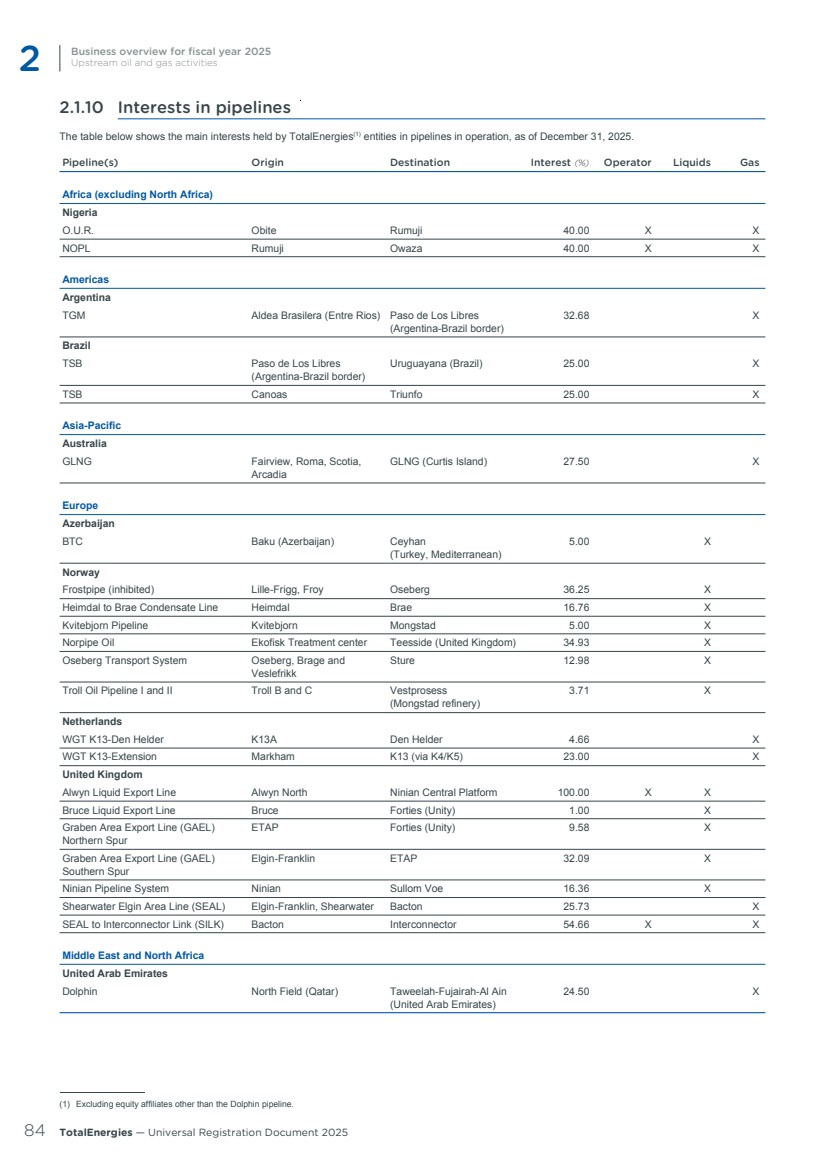
| 2.2 Exploration & Production segment The Exploration & Production (E&P) segment encompasses the activities of exploration and production of oil and natural gas, as well as the carbon neutrality activities, conducted in about 50 countries. Main indicators 1.99 Mboe/d of hydrocarbons produced in 2025 (a) Refer to the glossary for definitions and additional information on alternative performance measures (APM, Non-GAAP measures) and to point 1.8 for reconciliation tables. Production Hydrocarbon production 2025 2024 2023 E&P (kboe/d) 1,990 1,947 2,034 Liquids (kb/d) 1,467 1,408 1,492 Gas (Mcf/d) 2,794 2,880 2,900 2.2.1 Presentation of the segment To responsibly produce the oil and gas that the world needs today and to contribute to the Company’s transition, E&P articulates its strategy around the following axes: – meeting global demand for oil and gas by producing resources with low costs and greenhouse gas emissions, particularly gas, the least emitting fossil energy. Seven major projects, most of which are currently under construction are expected to start by 2030; – reducing GHG emissions to reduce the intensity of scope 1+2 emissions of its activities: – by conceiving designs that will avoid emissions on new projects as much as possible; – by implementing projects to improve energy efficiency, eliminate routine flaring, reduce its methane emissions on its operated sites by 80% in 2030 relative to 2020, reduce fuel gas consumption and capture and store emissions on its existing sites; – while placing sustainable development at the heart of its operations and projects. The safety of employees, stakeholders and facilities drives the day-to-day implementation of this strategy. E&P relies on the commitment, technical expertise and diversity of its employees, its operational excellence and its local roots in Africa, Northern Europe and in the Middle East. In order to increase cash flow generation and maximize the value of its assets, E&P is pursuing efforts to start its projects on time and within budget, maintain a high level of availability at its facilities, and retain its competitive advantage as a low-cost producer. To this end, the EP is intensifying its cost‑reduction program in order to keep its production costs below $5/boe, thereby contributing to the Company’s cash saving program (Capex and Opex) over the 2026–2030 period. In addition, TotalEnergies assesses its E&P investment projects by considering an environment of $50/b and a CO2 price of $100/t (or the price in force in a given country if this is higher) and focuses on projects with technical costs of less than $20/boe or where the break-even is less than $30/b and GHG emissions intensity (Scope 1+2) is below 16kg CO2e/boe. Business overview for fiscal year 2025 Exploration & Production segment 2 TotalEnergies — Universal Registration Document 2025 85 [REDACTED SECTION: CERTAIN TEXT HAS BEEN REDACTED.] [REDACTED SECTION: CERTAIN TEXT HAS BEEN REDACTED.] [REDACTED SECTION: CERTAIN TEXT HAS BEEN REDACTED.] |
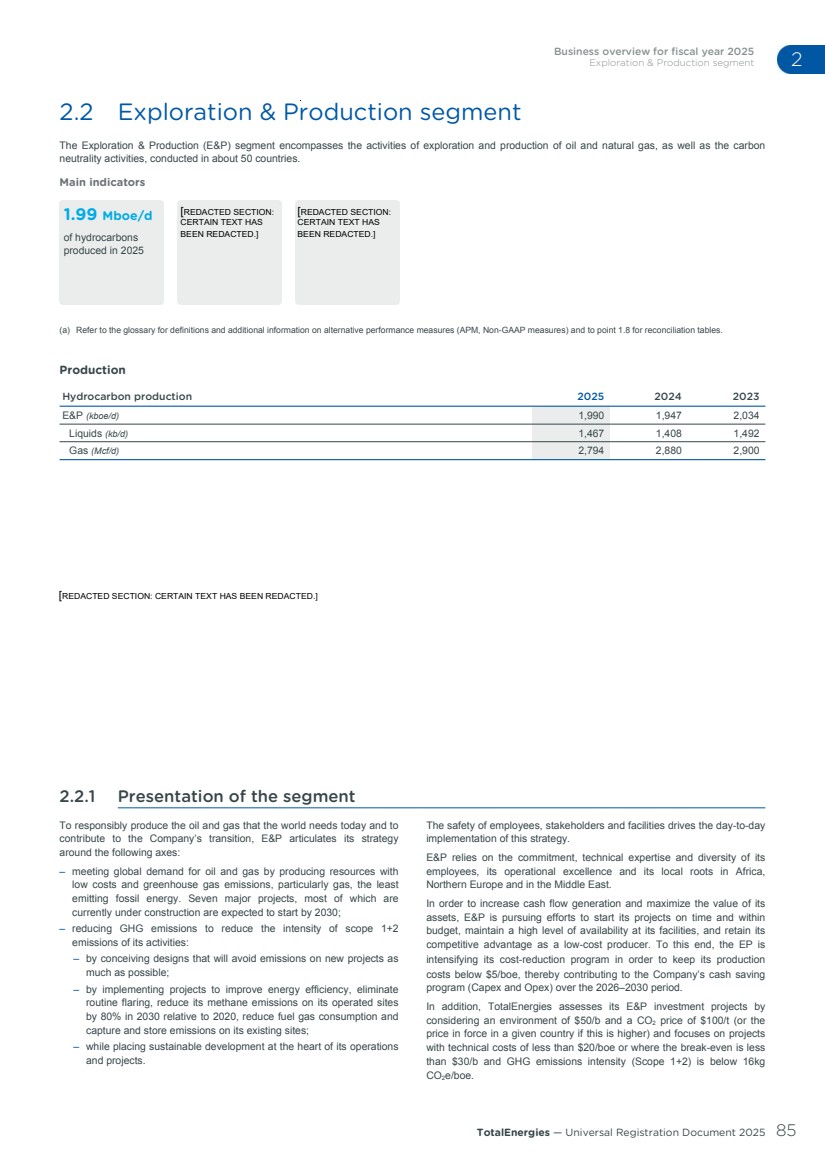
| Lastly, the Company continues to dynamically manage its portfolio by restructuring or disposing of its least-performing non-strategic E&P assets and accessing new low-cost and low-emission resources, through exploration on the one hand and acquisition of resources already discovered on the other. 2.2.2 Management of GHG emissions TotalEnergies has reaffirmed its ambition to produce hydrocarbons while reducing emissions at its facilities to as low as possible (near zero), by 2050. The goals of E&P in this area, in line with those of the Company, are based on three key elements: – avoid GHG emissions by prioritizing the production of resources with the lowest impacts in terms of carbon footprint and by designing low-carbon infrastructures and operating procedures; – reduce GHG emissions by developing and implementing a systematic approach in E&P to identify and implement the best available technologies for reducing GHG emissions (Scope 1+2) and, if necessary, storing captured CO2 underground; and – develop nature-based carbon sinks. To this end, the Carbon Neutrality Division within E&P aims to develop a global approach to generate synergies, and encompasses the following activities: – Carbon Footprint Reduction (CFR) whose mission is to reduce E&P GHG emissions; – Carbon Capture and Storage (CCS) whose mission is to reduce the Company’s GHG emissions (Scope 1+2) and its clients’ emissions by developing a transport and storage offer; and – Nature Based Solutions (NBS), whose mission is to develop nature-based carbon sinks. 2.2.2.1 Reduction of the carbon footprint The Carbon Footprint Reduction (CFR) entity manages the reduction of GHG emissions from oil & gas assets, both operated and non-operated, and consolidates the efforts made by all E&P’s subsidiaries in this area to improve energy efficiency, reduce fuel gas consumption, eliminate routine flaring and reduce methane emissions of its operated facilities to close to zero by 2030 and to capture and store emissions at its existing sites. On operated assets, the CFR entity assists the subsidiaries in implementing projects aimed at contributing GHG emissions reduction projects (Scope 1+2) from facilities in order to contribute to the Company’s target of reducing 100% operated GHG emissions to below 37 Mt CO₂e by 2025, an objective exceeded in 2025 and to 25-30 Mt CO₂e by 2030, by focusing on four main levers: – improving energy efficiency as part of the $1 billion program launched by the Company for the period 2023-2025 and the additional program announced in 2024 for the period 2026-2028, also amounting to $1 billion; – electrifying and supplying renewable energy to facilities; – reducing routine flaring with a view to eliminating it by 2030; – reducing methane emissions, to contribute to the Company’s goal of lowering them by 80% between 2020 and 2030 or sooner and methane emission intensity below 0.1% of commercial gas produced at Upstream operated oil and gas facilities, aiming for near-zero methane emissions in the Company’s operations by 2030 at the latest. In 2025, methane emissions intensity was below 0.1%. In addition, the Company achieved a 65% reduction in its operated methane emissions compared to 2020, exceeding its target of a 60% reduction. To continue progressing toward its 80% reduction objective, 11,000 fixed permanent monitoring equipment were deployed across all operated upstream assets, enabling real‑time identification of any methane leaks and the immediate implementation of corrective actions to stop them. The CFR entity also coordinates: – the communication with partners and operators in order to encourage them to also implement emissions reduction projects on assets that the Company does not operate; – the implementation of the OGMP 2.0 (Oil and Gas Methane Partnership 2.0(1)), initiative to which TotalEnergies subscribed in November 2020. In this context, in 2025 for the fifth consecutive year, IMEO – the International Methane Emissions Observatory, part of UNEP (United Nations Environment Program) – recognized TotalEnergies’ efforts in the reduction of methane emissions, confirming its “Gold Standard” status (refer to point 1.3.3.4). In addition to the numerous methane detection and measurement campaigns using AUSEA technology (Airborne Ultralight Spectrometer for Environmental Applications) on its operated assets, the Company has also deployed permanent, real‑time monitoring equipment, enabling a better understanding of emission sources and leading to mitigation actions. TotalEnergies has successfully deployed its AUSEA drones with partners in accordance with cooperation agreements with national oil & gas companies and other industrial stakeholders (Petrobras, Sonangol, NNPC, Socar, ONGC, Oil India Limited and Gladstone LNG), to carry out methane detection and measurement campaigns using AUSEA technology, thereby demonstrating the shared commitment to identify, quantify and reduce methane emissions and encouraging the entire oil and gas industry to aim for near-zero methane emission by 2030. In addition to the continuous efforts deployed on projects to reduce emissions from existing assets, E&P also deploys communication and training actions for employees and partners on climate issues and the need to reduce GHG emissions. 2.2.2.2 CO2 capture and storage (CCS) TotalEnergies believes that CCS is one of the necessary levers in the fight against climate change and therefore is developing new businesses to enable its industrial, residential and power-generating customers to capture and store their CO2 emissions. The Company’s objective is to contribute to the development of a CO2 gross storage capacity of around 10 Mt/y by 2030, for its own facilities and those of its customers. In Norway, TotalEnergies holds a 33% interest in the Northern Lights project, the world’s first commercial CO2 transportation and storage project, with a storage capacity of 1.5 Mt/y for Phase 1. The facilities in operation since August 2025 include a CO2 reception terminal, a 100 km subsea pipeline and subsea injection facilities for a permanent and secured storage of CO2 in a reservoir 2,600 meters below the seabed. The first phase, supported by Norway, aims to store emissions from several industrial sites, including a cement plant, Norcem/Heidelberg Materials (0.4 Mt CO₂/y), a waste‑to‑energy plant in Oslo, Celsio (0.4 Mt CO₂/y), and a Yara ammonia and fertilizer plant in the Netherlands (0.7 Mt CO₂/y). (1) Source: An Eye on Methane: International Methane Emissions Observatory 2025 Report UNEP (United Nations Environment Programme). 2 Business overview for fiscal year 2025 Exploration & Production segment 86 TotalEnergies — Universal Registration Document 2025 |
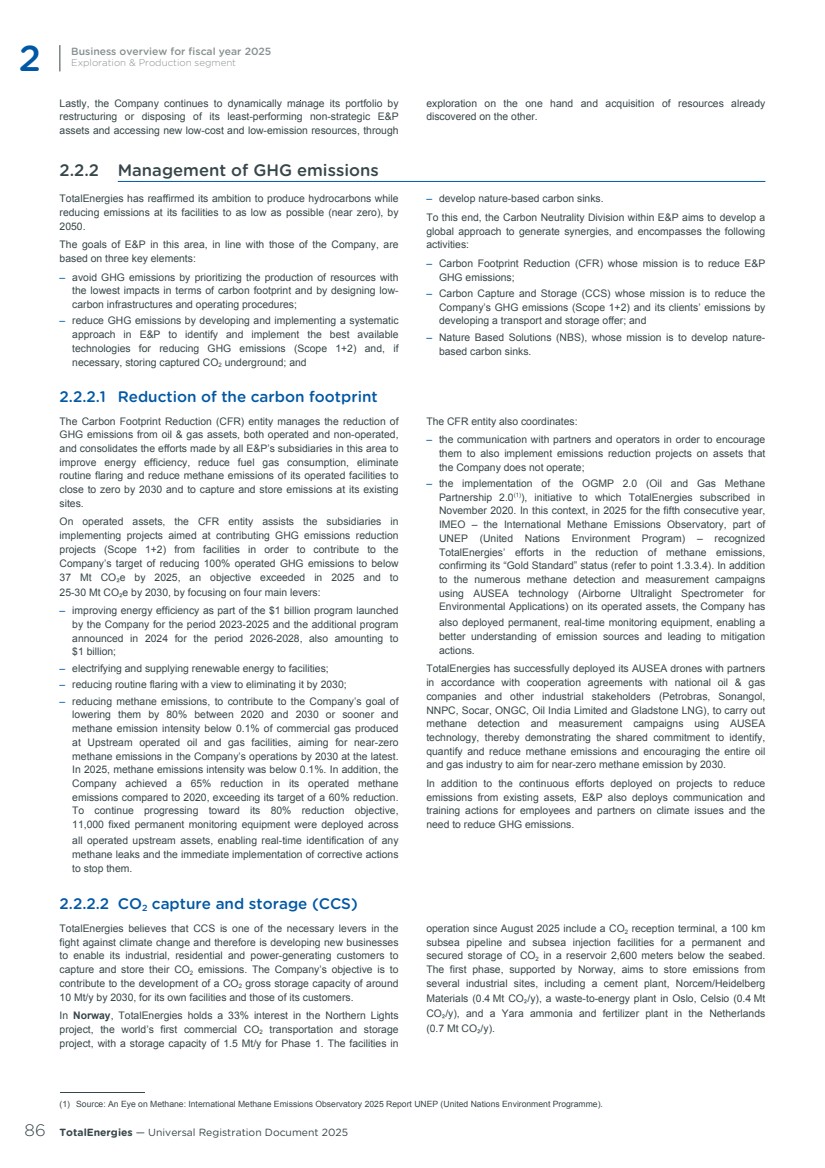
| The final investment decision for Phase 2 was taken in March 2025, and covers an additional capacity of 4.1 Mt CO₂/y, part of which is contracted to two emitters: Ørsted in Denmark (0.4 Mt CO₂/y) and Stockholm Exergi in Sweden (0.9 Mt CO₂/y). TotalEnergies held a 40% interest, since 2023, in the ExL004 CO2 storage exploration license located 120 kilometers off the coast of Bergen, in 200 meters water depth (the “Luna” project). In the Netherlands, TotalEnergies is participating in the Aramis project (60%) which aims to store CO₂ in depleted offshore gas reservoirs at a depth of approximately four kilometers thanks to new CO₂ transport infrastructure linking Rotterdam to these offshore fields. The detailed engineering studies for the Phase 1 of the project, with a storage target of 2.5 Mt CO2/y in fields operated by TotalEnergies, are in progress. This storage capacity could be further expanded up to 5 Mt CO2/y in later phases. In Denmark, TotalEnergies holds the licenses covering the Harald West prospect (a depleted gas reservoir) and the Dagny prospect (a saline aquifer). In October 2025, TotalEnergies divested a 35% interest in the licenses to a potential customer, reducing its stake from 80% to 45% while retaining operatorship (the transaction remains subject to approval by the Danish authorities). In January 2026, TotalEnergies was awarded a 65% interest and operatorship of the Inez license (saline aquifer). Subject to appraisal and evaluation works, these projects, which together constitute the Bifrost Project could ultimately provide storage capacity of more than 15 Mt CO₂/y. In the United Kingdom the Company is part of the Northern Endurance Partnership (10%). This partnership is developping a project consisting of collecting CO2 in the industrial regions of Teesside and Humberside, transporting it offshore and storing it in a saline aquifer located respectively 145 km and 85 km from the coasts. The final investment decision for Phase 1 of the project (4 Mt CO₂/y) was taken in December 2024, and construction is underway (the country’s first CCS project). In the initial phase, the project’s infrastructure will enable the collection and storage of emissions from the Net Zero Teesside Power project (power generation). The ongoing appraisal works on the offshore blocks enable the preparation of future expansion phases that could increase the project’s total storage capacity beyond 20 Mt CO₂/y. In the United States, TotalEnergies acquired in March 2024, 100% of Talos Low Carbon Solutions which held a 25% interest in the Bayou Bend project in Texas, a 65% interest in the Harvest Bend project in Louisiana and a 50% interest in the Coastal Bend project in Texas. The latter two interests were sold at the end of 2024, as the projects were far away from the Company’s assets in the region. The Bayou Bend project provides CO2 transportation and storage solutions for industrial emitters in the Houston and Beaumont-Port Arthur region, one of the main industrial hubs in the United States. Consisting of a set of permits for underground CO2 storage, both onshore and offshore, covering an area of approximately 600 km2 (232 square miles), this project targets a capacity of more than 10 Mt CO2/y. The Bayou Bend project could contribute to reducing the Company’s direct emissions in the U.S. given its proximity to the Port Arthur refinery. In 2024, the project drilled appraisal wells and applied for an injection permit for the offshore area. In 2025, the project entered the FEED study phase for the offshore area, while an injection permit for the onshore area is currently being prepared. In Australia, TotalEnergies holds a 26% interest in the Bonaparte CCS Assessment, a joint venture that has a CO2 storage assessment permit covering license G-7-AP, off the Australian northwest coast. A seismic acquisition campaign and the drilling of two appraisal wells were completed in 2024 and confirmed the possibility of storing CO2 on a large scale in the saline aquifer covered by the license. This project is part of a comprehensive action plan aimed at reducing CO2 emissions from the Ichthys LNG project. In Malaysia, TotalEnergies partnered in 2023, with Petronas and Mitsui to develop a CCS project in the Malaysian basin (Southern Hub). This project aims to develop to store CO2 in a depleted gas reservoir (Duyong) and in nearby saline aquifers. In October 2025, Petronas, on behalf of the consortium, obtained an offshore assessment permit for CO2 storage on the Duyong field. The project was selected by the Japanese government as one of its advanced CCS projects that could support the decarbonization of Japan’s industries. A MOC (Memorandum of Cooperation) was also signed in October 2025 by the Malaysian and Japanese governments with the aim of developing cross-border CO2 transportation. In 2026, the project entered into FEED study phase. 2.2.2.3 Nature-based carbon sinks While TotalEnergies’ priority is first to avoid and then to reduce its GHG emissions, the net emissions targets for Scope 1+2 take into account the contribution of nature-based carbon sink projects, that is to say sequestration projects, such as reforestation or regenerative agriculture, or conservation projects which protect environments where significant amounts of carbon are already stored. TotalEnergies plans to invest up to $100 million per year on average between 2020 and 2030 in these projects to build a carbon credit stock of around 50 Mt. If such a stock is built by 2030 and based on a consumption of 10% of the stock per year from 2030, then TotalEnergies estimates that it could consume around 5 million credits per year from 2030 to partially offset the residual Scope 1+2 emissions of the Company after the priority actions to avoid and reduce its GHG emissions have been carried out. These credits will be certified according to environmental and social management standards. Projects are designed to respect the resource regeneration cycles and contribute to provide social, economic and environmental co-benefits for local communities, on which they rely. The carbon credit stock at the end of 2025 amounts to 17.9 million carbon credits (vs. 13.7 million at the end of 2024 and 10.9 million at the end of 2023) certified by major international standards such as Verified Carbon Standard (VCS), American Carbon Registry (ACR), or ANREU (Australian National Registry of Emissions Units). The cumulative budget committed to date for all concluded operations amounts to nearly $653 million over their lifetime, for a cumulative volume of verified credits expected to be 37 million by 2030 and 51 million over their lifetime. The final quantities of carbon credits obtained will depend on the effective implementation of the NBS projects, as well as on methodological revisions for certification and technical updates. They may vary depending on the developments, as well as on any additional projects and investments that the Company may decide to undertake over these periods. In 2025, TotalEnergies entered into an agreement with NativState, a developer of forest carbon projects based in Arkansas (United States), comprising 13 Improved Forest Management (IFM) projects located in four US states (Arkansas, Louisiana, Mississippi and Tennessee) and covering around 100,000 hectares (247,000 acres). In 2024, TotalEnergies signed an agreement with Anew Climate, a North American leader in climate solutions, and Aurora Sustainable Lands, a company specialized in carbon management and forest landowner in the U.S., to contribute $100 million to the projects they deploy to protect productive forests from overexploitation and support their conversion to sustainable management practices, enhancing their ability to store more carbon from the atmosphere. In 2025, Anew Climate and Aurora Sustainable Lands developed the planned activities and delivered the expected credits. In 2023, the Company decided to invest $100 million in the Nature Based Carbon fund managed by Climate Asset Management, mainly targeting the preservation or restoration of three types of ecosystems: degraded natural forests, grasslands impacted by human activity as well as wetlands. In 2024 and 2025, Climate Asset Management managed the investments already made and continued to seek new investment opportunities. Business overview for fiscal year 2025 Exploration & Production segment 2 TotalEnergies — Universal Registration Document 2025 87 |
| 2.2.3 Activities by geographical area The information below describes the Exploration & Production segment’s main oil and gas activities by geographical area, without giving details of all of the assets held by TotalEnergies. The capacities referred to herein are expressed on a 100% basis, regardless of TotalEnergies’ interest in the asset. TotalEnergies’ average annual and daily production of liquids and gas by country for 2025, 2024 and 2023 are presented in the tables “Production by geographical area” in point 2.1.3. For information concerning TotalEnergies’ interest in each asset (share in %) and to determine whether the Company operates the asset on December 31, 2025, refer to the table entitled “Assets in production by geographical area” in point 2.1.3. 2.2.3.1 Africa (excluding North Africa) In Nigeria, TotalEnergies’ production is predominantly offshore. The Company operates 8 production licenses across the portfolio of permits in which it holds interests(1) , in particular: – in PML 2/3/4 (formerly OML 130, 24%, operator), with the Akpo, Akpo West, Egina fields in production and the Preowei field where development studies continued in 2025. In May 2023, the production licenses were renewed for 20 years until 2043; – in OML 99 (40%, operator), with the Ikike and Amenam-Kpono fields (30.4%); – in OML 102 (40%, operator), with the Ofon producing field and where, following the Ntokon oil and gas discoveries in June 2023, studies have started for a new tie-back development to existing facilities; – in OML 138 (20%), with the Usan field in production. Development studies on the Owowo discovery in OML 139 (18%), located near OML 138, continued in 2025. In September 2025, TotalEnergies was granted two offshore exploration licenses (PPL 2000 and PPL 2001) following a tender process. In December 2025, the Company signed an agreement to sell a 40% stake in those two licenses. Completion of the transaction is subject to the approval of competent authorities. TotalEnergies (40%, operator) has started preparation for drilling an exploration well under those licenses. In November 2025, TotalEnergies signed an agreement providing for the acquisition of a 50% operated interest in Block OPL 257 and the divestment of its 40% participating interest in Block OML 136. Once that transaction has been completed following regulatory approval, TotalEnergies’ stake in Block OPL 257 would rise from 40% to 90%. In November 2025, TotalEnergies completed the sale of its 12.5% stake in OML 118, which included the producing Bonga field and the Bonga North discovery. In January 2026, TotalEnergies signed an agreement to sell of its 10% non-operated interest in the 15 oil production licenses of the RAEC joint venture. Completion of the transaction is subject to approval by the relevant authorities. In Angola, the Company’s production comes from Blocks 17, 17/06, 32 and 0: – on Block 17 (38%, operator), the Company’s main asset in the country, located in deep offshore, four major hubs are in production with the Girassol, Dalia, Pazflor and CLOV FPSOs. Various infill projects and projects to extend the life of facilities are underway (the CLOV Phase 3 project started in July 2025 and reached full capacity in the fourth quarter of 2025). An exploration well (Dalia-6) was also drilled in 2024. The interpretation is ongoing; – on Block 17/06 (30%, operator), the Begonia field – the block’s first development – started production in July 2025 with a connection to Pazflor’s FPSO. Full production was reached in the fourth quarter of 2025; – on Block 32 (30%, operator), located in deep offshore, production comes from the Kaombo Norte and Kaombo Sul FPSOs. Ongoing drilling of development and infill wells (Kari Phase 1 approved in 2023) supports production. Discoveries in the northern area of the block (outside Kaombo) offer additional potential currently being assessed; – on Block 0 (10%), located in conventional offshore, in may 2023 the Angolan authorities approved the extension of the license until 2050 as well as new tax terms; The SLGC (Sanha Lean Gas Connection) project designed to strengthen supply to the ALNG plant, started up in December 2024. An exploration well was drilled in 2025; – on Block 20/11(2) (40%, operator) in the Kwanza Basin, the Kaminho project to develop the Cameia and Golfinho oilfields is in the development phase after the final investment decision was taken in May 2024. In September 2023, TotalEnergies divested a 40% stake in the block to Petronas. TotalEnergies holds exploration licenses on Block 16/21 and on Block 29. The exploration license on Block 48 (40%, operator) expired in May 2023. In the Republic of the Congo (Congo Brazzaville), the Company’s production comes from the TotalEnergies EP Congo subsidiary, owned by TotalEnergies (85%) and QatarEnergy (15%). The production operated by TotalEnergies EP Congo comes mainly from the Haute Mer permit which includes the Moho Bilondo asset composed of two fields: Moho Bilondo and Moho North. In 2024, TotalEnergies signed an agreement for the simultaneous acquisition of an additional 10% interest in the Moho permit (bringing the Company’s interest to 63.5%) and sale of its 53.5% interest in the Nkossa and Nsoko permits. The closing of this agreement took place in January 2025. In 2024 and 2025, TotalEnergies EP Congo carried out a four‑well infills drilling campaign on the Moho fields. TotalEnergies EP Congo also operates the Yanga and Sendji fields (55.25%) and holds 26.75% of the Lianzi field located within the offshore unitization area between Angola (Block 14K) and the Republic of Congo (Haute Mer permit). The final concession agreement covering the Djeno oil terminal (TotalEnergies EP Congo, 48%, operator), extending until 2044, was adopted by the Parliament of the Republic of the Congo in August 2024 and is now in force. TotalEnergies EP Congo (50%, operator), in partnership with QatarEnergy and SNPC, has obtained an exploration license in Nzombo, located around 100 km off the coast of Pointe-Noire and close to the facilities of the Moho license. An exploration well was drilled between November 2025 and January 2026. TotalEnergies EP Congo held an exploration license of the Marine XX (32.5%, operator), which expired in December 2025. TotalEnergies also divested its rights and interests in the Nanga license to SNPC in December 2023. In Gabon, TotalEnergies EP Gabon(3) operates the assets governed by the Anguille-Torpille concession agreement (100%) and the Baudroie-Mérou production sharing agreement (90%). In 2022, the Baudroie-Mérou production sharing contract was renewed until 2047, and the fiscal terms of the Anguille-Torpille concession were revised and extended until 2042. In December 2022, the Republic of Gabon acquired a 10% interest in the Baudroie-Mérou production sharing agreement. (1) Including through its stake in joint-venture RAEC (Renaissance Africa Energy Consortium). (2) In 2023, Blocks 20/15 and 21/09 were merged into a single Block 20/11. (3) TotalEnergies EP Gabon is a company under Gabonese law. Its shares are listed on Euronext Paris and at December 31, 2025 were owned by TotalEnergies (58.28%), the Republic of Gabon (25%) and the public (16.72%). 2 Business overview for fiscal year 2025 Exploration & Production segment 88 TotalEnergies — Universal Registration Document 2025 |
| Under the Hydrocarbons Code, the Gabon Oil Company (GOC) exercised its option to enter the Baudroie‑Mérou production sharing agreement with a 15% interest. TotalEnergies Gabon’s participation will be reduced to 75% once finalization of the transfer. Well interventions and surface compression reliability improvements enabled production stabilization in 2025 on both permits. In Uganda, TotalEnergies is a partner, with a 56.67% interest, in the project to develop the Lake Albert oil resources located in Blocks CA-1, LA-2 and CA-3A. TotalEnergies is also a 62% shareholder, in East African Crude Oil Pipeline (EACOP) Ltd, the company responsible for developing and operating of a pipeline of close to 1,450 km that will transport crude oil to a storage and offloading terminal in Tanga, Tanzania. The project, approved by the Board of Directors in December 2020 taking into consideration the societal and environmental challenges, targets 230 kb/d of production capacity and the joint development of the resources in Blocks CA-1 and LA-2 operated by TotalEnergies (the Tilenga project) and Block CA-3A operated by CNOOC (the Kingfisher project). It plans the drilling of approximately 450 onshore wells and the construction of two crude oil processing facilities. The final investment decision was announced in February 2022. Drilling started in 2023 and about 200 wells have been drilled by end 2025. Start of production is planned for the fourth quarter 2026. Firmly committed to transparency, the guiding principle for all its actions, TotalEnergies publishes on its website detailed information on the social, environmental and societal challenges related to this project. In South Africa, TotalEnergies operates three deep offshore exploration licenses: the ODB Block (48.6%), the DWOB Block (40% following the partial transfer of a 10% interest to Petrobras in September 2025) as well as 3B/4B Block (33% acquired in 2024). A multi-client 3D seismic acquisition program was carried out in 2024 on the DWOB Block. In 2024, TotalEnergies announced its withdrawal from Blocks 5/6/7 (40%) and 11B/12B (45%, which included the Brulpadda and Luiperd discoveries). The withdrawal is subject to the completion of the administrative processes which are still pending. In February 2025, TotalEnergies has relinquished the South Outeniqua Block (100%). In Namibia, TotalEnergies operates two deep offshore exploration licenses in the Orange basin: Block PEL91 (formerly Block 2912) and Block PEL56 (formerly Block 2913B). In November 2024, TotalEnergies finalized the acquisition of additional interests in both Blocks, increasing its interests from 37.78% to 47.17% on Block PEL91 and from 40% to 50.50% on Block PEL56. A partial cession of the acquired interests to QatarEnergy was approved by the authorities in September 2025, decreasing TotalEnergies’ stake to 42.475% on Block PEL91 and 45.25% on Block PEL56. In April 2022, following the drilling of an exploration well on Block PEL56, TotalEnergies announced a significant discovery of light oil and associated gas on the Venus prospect (the Venus-1X well). In 2023, two rigs were mobilized to evaluate the area’s potential, with positive results from the Venus-1A appraisal well and production tests from the Venus-1X and Venus-1A wells. The drilling of the Nara-1X exploration well, targeting a prospect on the west of the Venus discovery in Block PEL91, was proved unsuccessful. In 2024 and 2025, the drilling campaign continued with the drilling of two exploration wells which confirmed the presence of hydrocarbons on prospects located to the north of the Venus (Mangetti-1X and Tamboti-1X), along with an additional appraisal well in the Venus field (Venus-2A) which contributed to the reliability of development studies and a negative exploration well south of the Venus (Marula-1X). In addition, a 3D seismic survey was carried out in 2024 on the two Blocks. Development studies for the Venus field have been launched with a project’s sanction expected in 2026. In December 2025, TotalEnergies signed an agreement to acquire a 40% operated interest in PEL83 license, which includes the Mopane discovery and to divest 10% of its interests in PEL56 which includes the Venus discovery, and 9.39% interests in the PEL91 license. This agreement remains subject to regulatory approval. In January 2026, TotalEnergies signed agreements to acquire an operated 42.5% interest in the PEL104 oil exploration license, located in the Lüderitz Basin offshore Namibia. The completion of the transaction is subject to customary conditions, including approval by the Namibian authorities and the joint‑venture partners. Upon completion of the transaction, TotalEnergies would become the operator of the license. In São Tomé and Principe, TotalEnergies signed an agreement in 2024 to acquire from Agência Nacional do Petróleo (ANP-STP) a 60% interest with operator status in the STP02 offshore exploration Block. A 3D seismic survey was carried out for this Block in 2025. TotalEnergies also obtained a 3-year extension for Block STP01 (55%) and announced to the authorities its withdrawal from Blocks JDZ-7, 8, 11 in the joint development zone between São Tomé and Principe and Nigeria. In Liberia, TotalEnergies was awarded four exploration licenses for offshore blocks (LB6, LB11, LB17 and LB29 – 100%, operator) in September 2025. The four PSCs were ratified by the Government of Liberia in January 2026. A 3D seismic survey is planned for the fourth quarter of 2026. In Senegal, TotalEnergies relinquished the Ultra Deep Offshore Block (70%, operator) and the Rufisque Offshore Profond exploration license (90%, operator) in 2024. In Mauritania, in August 2023, TotalEnergies relinquished Block C-15, the last exploration Block held. In Kenya, TotalEnergies relinquished onshore Blocks 10BA, 10BB and 13T, in May 2023. 2.2.3.2 Americas In Brazil, the Company’s production comes from the Lapa (45%, operator), Libra (19.3%), Iara (22.5%), Atapu ToR Surplus (22.5%) and Sépia ToR Surplus (28%) blocks in the Santos Basin. The Libra Block, located approximately 170 km offshore Rio de Janeiro, comprised, as of end‑2025, five FPSOs: Pioneiro de Libra (capacity of 50 kb/d), which started production in 2017 and four FPSOs, each with a liquids processing capacity of 180 kb/d: Mero 1, which started up in April 2022, Mero 2, in December 2023, Mero 3, in October 2024, and Mero 4, in May 2025. A pilot unit using a pioneer high-pressure subsea technology to separate oil from CO2-rich gas (HISEP® ) and re-inject the CO2-rich gas into the Mero 3 reservoir, was approved in December 2023. The Lapa South-West project which production started in March 2026, brought the total field’s production to 60 kb/d. On Iara, the P-68 FPSO dedicated to production of the Berbigão and Sururu-West fields, reached its nominal production capacity in 2022. On Atapu (22.5%) and Sépia (28%) fields, the two production-sharing contracts (TOR-Surplus) have been in force since May 2022 and two FPSOs are in production: the P-70 FPSO with a nominal capacity of 150 kb/d on the Atapu field and the FPSO Carioca with a nominal capacity of 180 kb/d in the Sépia field. Final investment decisions for an additional FPSO on each field were taken in May 2024, and two FPSOs of 225 kb/d each are under construction. In the Sépia area, an additional oil accumulation was discovered with the drilling of the Pedunculo well in 2022. In December 2025, TotalEnergies finalized the agreement to acquire an additional 3% interest in the Lapa field, which is currently in production, bringing its interest to 48% as of January 2026, in exchange for the Company’s 20% non‑operated interest in the Gato do Mato development project. Business overview for fiscal year 2025 Exploration & Production segment 2 TotalEnergies — Universal Registration Document 2025 89 |
| In exploration, the drilling of the first exploration well on the C-M-541 Block (40%, operator), Marolo-1, ended in July 2022. The drilling of the second well, Ubaia-1 was completed in October 2023. Development studies are ongoing. TotalEnergies also holds two operated exploration Blocks (with a 50% Working Interest after the sale of 50% in early 2023) in the SM-1711 and S-M-1815 Blocks in the South Santos basin. A 3D seismic survey was carried out in these two blocks in 2024. A production sharing contract for the Água Marinha (30%) exploration Block, in the Campos basin was signed in May 2023. An exploration well (Andorinha) was drilled in this block in 2025. In addition, in September 2025, TotalEnergies and its partners relinquished to the National Agency of Petroleum, Natural Gas and Biofuels (ANP) an exploration license located in the Barreirinhas basin (50%). In 2025, as part of their strategic alliance, TotalEnergies and Petrobras renewed their agreement to promote technical cooperation between the two companies, notably in R&D and information-sharing regarding GHG emissions and the development of digital technologies. TotalEnergies sold its 40% interest in the Itaipu field on Block BM-C-32 in the Campos Basin in 2023. In Argentina, TotalEnergies operates the onshore Ara and Cañadón Alfa Complex, on the CMA-1 concession in Tierra del Fuego, as well as the Hidra, Carina, Aries and Vega Pleyade offshore fields (37.5%). In September 2024, the Company started the Fenix offshore gas field (37.5%, operator) with a capacity of 10 Mm3 /d of natural gas. In the onshore Neuquén Basin, TotalEnergies holds interests in three operated licenses. In addition to conventional projects, TotalEnergies operates a shale gas project in the Aguada Pichana Este block in the Vaca Muerta gas window. The Rincón la Ceniza (45%) and La Escalonada (45%) blocks, located in the gas and condensate window, were sold to YPF SA in September 2025. TotalEnergies has initiated the process of withdrawing from the non-operated Veta Escondida Block (45%). In 2023, TotalEnergies swapped with PanAmerican Energy and YPF its 25% stake in the non-operated Aguada Pichana Oeste and Aguada de Castro Blocks for an additional 14% in its operated Block Aguada Pichana Este (55%), in the Vaca Muerta. TotalEnergies also sold its interest in the Rincon de Aranda Block (45%) to Pampa Energia. In exploration, TotalEnergies operates an offshore license MLO 123 (37.5%), located in the Malvinas basin, on which a seismic was acquired in 2025 on which results are under interpretation. The two offshore licenses CAN 111 and CAN 113 (50%) were relinquished in July 2024. In the United States, TotalEnergies’ oil and gas production in the US offshore comes from its interests in the Tahiti (17%), Jack (25%), Anchor (37.14%), and Ballymore (40%) deep offshore fields. Ballymore, with production capacity of 75 kb/d of oil, started production in April 2025. In 2024, TotalEnergies was granted three exploration licenses with a 25% interest in the northwestern part of the Jack field: 668, 712 and 713 and relinquished by anticipation the Green-Canyon-849 Crown West B, in August 2024. In June 2025, TotalEnergies acquired stakes in 40 exploration licenses (25%) operated by Chevron, some of which are located close to the Ballymore and Jack facilities. In January 2026, TotalEnergies was awarded five exploration licenses. In Bolivia, TotalEnergies has interests in five producing licenses: San Alberto (15%), San Antonio (15%), Block XX Tarija Oeste (Itau, 41%), Aquio and Ipati (50%, operator) which include the Incahuasi field. In Suriname, TotalEnergies, operator of Block 58 (40%), took on October 2024 the final investment decision for the GranMorgu project for the development of the Sapakara and Krabdagu fields, located 150 km off the Surinamese coast. The project includes a floating production, storage and offloading (FPSO) unit with a capacity of 220 kb/d, based on the proven design of units in Guyana. Total investment is estimated at approximately $10.5 billion, with production scheduled to start up in 2028. In May 2025, Staatsolie, Suriname’s national oil and gas company, exercised its right to enter the project with a participation of 20%. TotalEnergies owns rights to explore shallow offshore Blocks 6 and 8 (40%, operator), located south of Block 58, and the rights to explore offshore Block 64 (40%, operator). In 2025, TotalEnergies drilled an exploration well in Block 64, with negative results. In Mexico, TotalEnergies holds licenses in five offshore exploration Blocks: Block 1 (33.33%) in the Salina Basin and Blocks 15 (35%, operator), 32 (50%), 33 (35%, operator) and 34 (27.5%) located in the shallow waters of the Campeche Basin. Blocks 2 and 3 were relinquished in 2023. Two exploration wells, Boox Peek and Ochkan, were drilled in 2024 on Blocks 33 and 15, respectively. As the studies concluding to a lack of prospectivity on Blocks 1, 32 and 34, the relinquishment processes began and are in the process of completion. Following the acquisition of SapuraOMV Upstream in 2024, TotalEnergies also holds a 30% interest in offshore Block 30, where the Kan discovery was made in 2023. An appraisal well was drilled in 2025, with positive results. Development studies are on going. In Guyana, TotalEnergies and its partners QatarEnergy and Petronas signed a production-sharing agreement in November 2025 relating to shallow offshore Block S4 (40%, operator). The minimum work obligation during the initial three-year period includes a 3D seismic survey covering the entire block. The seismic survey is scheduled to begin in December 2026. TotalEnergies’ interest in the Canje block (35%) expired in March 2026, upon the completion of the second and final exploration phase. The Kanuku license (25%) expired in May 2023 and TotalEnergies exited the Orinduik license (25%) in October 2024, at the end of the second exploration period. In Canada, TotalEnergies completed its withdrawal from the canadian oil sands activities in November 2023. The Company previously owned 50% of the Surmont in-situ production project and 31.23% of the Fort Hills mining project, both in the province of Alberta. In Venezuela, TotalEnergies transferred in July 2021 its non-operated minority participation of 30.32% in Petrocedeño S.A. to Corporación Venezolana del Petróleo, S.A, a subsidiary of PdVSA. In July 2022, TotalEnergies sold its 69.50% stake in the Yucal Placer field to a subsidiary of Sucre Energy Group. Together with the operator, TotalEnergies relinquished the license for Plataforma Deltana Block 4 (49%) in August 2022. Since then, TotalEnergies no longer has any assets in Venezuela (refer to point 3.2.1 of chapter 3). 2.2.3.3 Asia-Pacific In Kazakhstan, TotalEnergies’ oil and gas production comes from the Kashagan field, operated by the North Caspian Operating Company (NCOC) located in the North Caspian license (16.81%). The oil production capacity of the first phase of this field and the associated processing plant is in the range of 410 kb/d as per initial design. TotalEnergies has divested its interests in the Dunga field (60%, operator) in November 2023. In China, production comes from the South Sulige Block (49%), located in the Ordos basin in Inner Mongolia. Drilling of tight gas development wells continues. Production increased to 4 Gm3 /y, following the approval in 2022 of a new development plan. 2 Business overview for fiscal year 2025 Exploration & Production segment 90 TotalEnergies — Universal Registration Document 2025 |
| In Malaysia, as well as its interests in gas assets currently in production, TotalEnergies also holds interests in three offshore exploration licenses in Sabah state: Block SB2K (34.90%), Block N (34.90%) where the Tepat-2 exploration well was drilled in 2022, and Block SB412 (40%) following the acquisition of SapuraOMV in 2024. An exploration well is scheduled in the second quarter of 2026. In June 2025, TotalEnergies acquired stakes in 12 offshore exploration blocks from Petronas, and became the operator of five of them in January 2026. For further information refer to point 2.3.2. In Indonesia, production comes from the Ruby gas field located on the Sebuku license (13.5%). In 2025, TotalEnergies acquired a 24.5% stake in the Bobara block, operated by Petronas. An exploration well is scheduled in the fourth quarter of 2026. In Papua New Guinea, TotalEnergies holds interests in exploration licenses PPL339 (35%), PPL589 (100%) and PPL576 (50% following the sale to Petronas of 50% of its interest in November 2024) and in the PRL15 Block (37.5%). For more information refer to point 2.3.2. An exploration well in Block PPL576 is planned for the second quarter of 2026. In Thailand, the sale to PTTEP of the last block (G12/48) held by the Company was approved by the Thai authorities in June 2025. In Brunei, TotalEnergies no longer has any activities following the divestment of its subsidiary TotalEnergies EP (Brunei) B.V. completed in October 2024. In Tajikistan, TotalEnergies withdrew from the exploration license in which it held a 50% stake in May 2023. 2.2.3.4 Europe The specific context of Russia and its consequences on TotalEnergies are detailed in point 1.8.3 of chapter 1. In Norway, production comes from many fields: – Ekofisk (39.9%), Eldfisk (39.9%), Embla (39.9%) and Tor (48.2%). The production of the Tommeliten Alpha (20.14%) field, an Ekofisk satellite, started in October 2023. In December 2025, TotalEnergies EP Norge completed the divestment of its non-operated interest (39.89%) in the West Ekofisk and Albuskjell fields, as well as in its non-operated interest (20.23%) in the Tommeliten Gamma field. – Johann Sverdrup (8.44%), one of the five biggest oil fields on the Norwegian Continental shelf of which the production facilities are powered from shore resulting in very low GHG emissions – only 0.67 kg CO2e/boe; – Oseberg (14.7%), whose facilities also treat, among other fields, the production from Tune (10%). The Lambda exploration well was successfully drilled in 2024; – Troll (3.69%) and Kvitebjørn (5%); – Åsgard (7.81%), Tyrihans (23.15%) and Kristin (6%) located in the Haltenbanken area. An exploration well was drilled in 2025 (Smorbukk Midt) with positive results, and it has been connected to production facilities. Production at the end-of-life Flyndre (6.26%) and Islay (5.51%) fields ceased in 2024. The Flyndre field is in the decommissioning phase. The decommissioning of the Islay field is currently being planned. For the Skirne (40%, operator) and Atla (40%, operator) fields, which also ceased production in 2024, well abandonment and decommissioning of the production lines to the Heimdal processing platform (16.76%) is expected to be completed by the end of 2028. TotalEnergies also acquired a 35% interest in a new exploration license, PL1272, on the East Stetind prospect in March 2025. TotalEnergies also acquired a 30% interest in a new exploration license, PL1298, in January 2026. Seismic reprocessings are ongoing on these two licenses. In the United Kingdom, production comes from: – the Alwyn North (100%) and Dunbar (100%) fields in the Northern North Sea, as well as from satellites linked to them; – the Elgin/Franklin complex (46.17%) which includes the West Franklin (46.17%) and Glenelg (58.73%) fields in the Central Graben area. TotalEnergies also operates the Culzean gas and condensate field (49.99%), where production is maintained thanks to the commissioning of the CIA well in December 2025. In addition, TotalEnergies relinquished the P2215 license (where the Glengorm discovery is located) in November 2024; – to the West of the Shetlands, the Laggan, Tormore, Edradour and Glenlivet fields (40%). In June 2024, TotalEnergies signed an agreement to dispose of its interests in all its West of Shetland assets (Laggan, Tormore, Glenlivet, Edradour and Glendronach fields, Shetland onshore gas processing plant, neighboring exploration licenses). The transaction is subject to approval from the competent authorities; – in the Quad 9 area, in the Eastern North Sea, the Gryphon (86.5%), Maclure (38.19%), South Gryphon (89.88%) and Tullich (100%) fields. Following the decision to cease production of the Gryphon FPSO at the end of 2024, dismantling operations began in October 2025. In December 2025, TotalEnergies signed an agreement with NEO NEXT Energy Limited providing for the merger of their upstream activities in the United Kingdom. TotalEnergies will become the majority shareholder of the enlarged new entity, renamed NEO NEXT+, with a 47.5% interest. Completion of the transaction remains subject to regulatory approval. In Denmark, TotalEnergies operates the Danish Underground Consortium (DUC, 43.2%). Production comes from DUC’s four main fields: Dan, Gorm, Halfdan, and Tyra. Dan, Gorm and Halfdan production is mainly oil, while Tyra’s production is mainly gas and condensates. Production of the Tyra field stopped in September 2019 as part of a redevelopment project and resumed in 2024. An exploration well was successfully drilled in 2024, leading to the discovery of new gas condensate resources near the offshore Harald field. The well was immediately tied to the existing facilities, and production began in December 2024. In Italy, TotalEnergies operates the Tempa Rossa field (50%), located in the Gorgoglione concession in Basilicata region, main asset of TotalEnergies EP Italia. The new facilities being built in Taranto with ENI and partners, are expected to allow Tempa Rossa to increase crude oil export in 2026. In the Netherlands, production originates from the assets held in 18 offshore production licenses, of which 14 are operated. In Azerbaijan, the Absheron gas condensate field (35%), located in the Caspian Sea, and operated by JOCAP (Joint Operating Company of Absheron Petroleum, a company jointly held by TotalEnergies, ADNOC and SOCAR), started production in July 2023 and is currently producing 1.5 bcm/y. The second phase of development is expected to make it possible to increase the field’s production to 5.5 Gm3 /y. TotalEnergies and SOCAR finalized, in February 2024, the transfer of a 15% stake each to ADNOC (Abu Dhabi National Oil Company), thereby reducing TotalEnergies’ stake in Absheron to 35%. In Bulgaria, TotalEnergies withdrew in November 2023 from the deep offshore exploration Block Han Asparuh in which it held a 57.14% stake. Business overview for fiscal year 2025 Exploration & Production segment 2 TotalEnergies — Universal Registration Document 2025 91 |
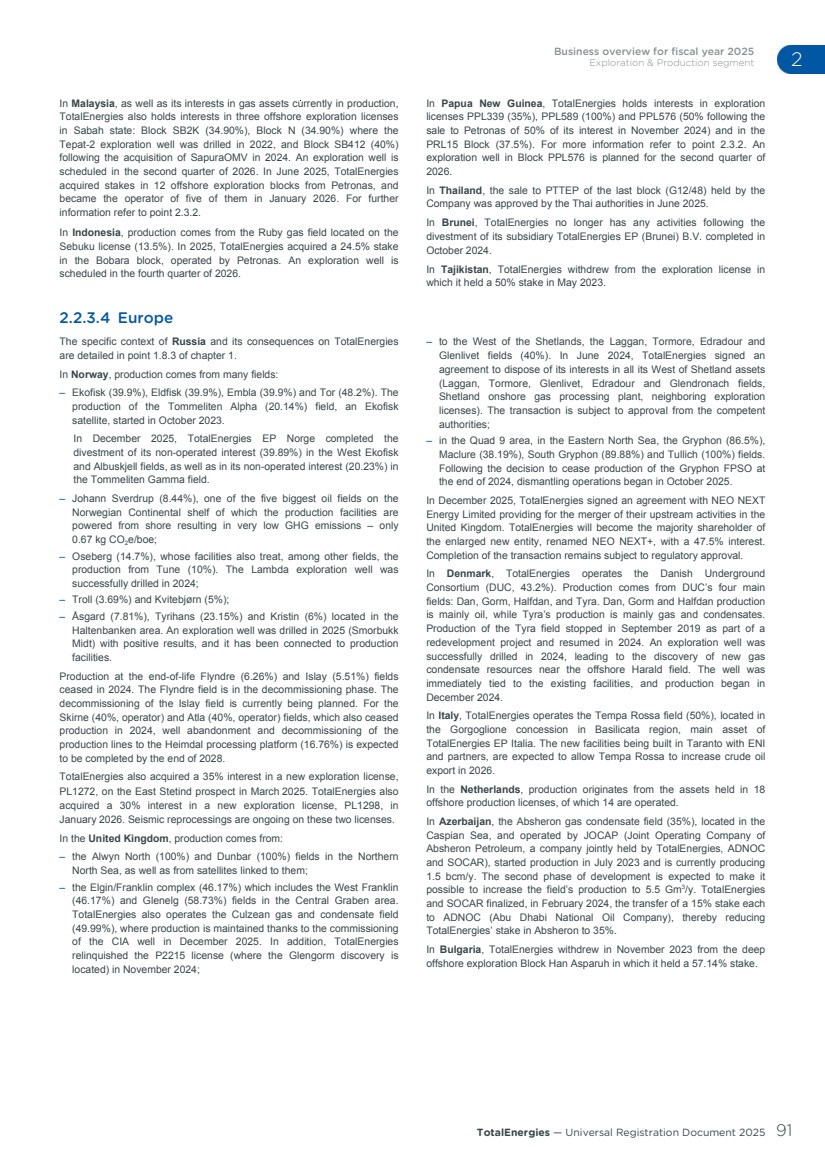
| 2.2.3.5 Middle East and North Africa In the United Arab Emirates, TotalEnergies’ production, mainly comes from the following stakes: – 20% in the Umm Shaif/Nasr offshore concession, 5% in the Lower Zakum offshore concession and since March 2023, 20% in the Satah Al Razboot (SARB)/Umm Lulu offshore concession, all three operated by ADNOC Offshore and signed for a 40-year duration to 2058; – 10% in the ADNOC Onshore concession, which includes Abu Dhabi’s 15 major onshore oil fields; the concession is operated by ADNOC Onshore and signed for a 40-year duration to 2055; – 15% in ADNOC Gas Processing, a company that processes the associated gas produced by ADNOC Onshore to extract condensates and LPG. TotalEnergies holds a 10% stake in the Ruwais Diyab unconventional gas concession, operated by ADNOC and awarded until 2063, which is currently in the development phase. TotalEnergies, which acquired a 40% stake in this partnership with ADNOC in 2018, reduced in 2023 its participation to 10% after the transfer of both operatorship and 30% interests to ADNOC. In line with the policy adopted by the United Arab Emirates government, ADNOC is implementing an ambitious strategy to increase the country’s production capacity to 5 Mb/d by the end of 2027. This momentum is being realised through the “P5” projects carried out across various assets in which TotalEnergies, a long-standing strategic partner, plays a key role. In addition, TotalEnergies holds a 24.5% stake in Dolphin Energy Ltd., which sells gas produced on the Dolphin North Field-Block NF, in the North Field, Qatar, to the United Arab Emirates and Oman. In Qatar, production comes mainly from TotalEnergies’ stakes in the offshore fields of Al Khalij (40%, operator), Al Shaheen (30%) and Dolphin Block, North Field (24.5%). Developments continue in 2024 on the Al Shaheen field, operated by North Oil Company, which is owned by TotalEnergies (30%) and QatarEnergy (70%), with a duration of 25 years starting from 2017. In 2024, the final investment decision regarding Phase 3 was taken: development activities should last for five years, and production is expected to start in 2027. In Libya, production comes from the Waha (20.42%) and El Sharara onshore fields located in Blocks 129-130 (15%) and 130-131 (12%) and the Al Jurf offshore field located in Blocks 15, 16 and 32 (37.5%). The Mabruk field (37.5%), located in onshore Blocks 70 and 87, had been shut down since the end of 2014, resumed production in March 2025 thanks to the installation of a temporary Extended Well Test unit, followed by an Early Production Facility unit put in service in March 2026. In January 2026, TotalEnergies signed an agreement that extends the Waha concessions until December 31, 2050, and sets new fiscal terms supporting production growth. In November 2021, TotalEnergies signed various agreements for the development of the country’s natural resources, in particular the construction and operation of a 500 MW photovoltaic power plant that is currently developed. The production from Libyan onshore assets was disrupted several times between 2022 and 2024, notably due to social and security issues. In particular, production at onshore Libyan assets was interrupted for several weeks in 2024 for security reasons. The year 2025 did not experience this type of production disruption. In Algeria, production comes from TotalEnergies’ interests in the TFT II (49%) and Timimoun (37.75%) gas fields and the Ourhoud and El Merk oil fields in the Berkine basin located in Blocks 404a and 208 (12.25%). In July 2023, TotalEnergies and Sonatrach agreed to convert the production contracts of TFT II and TFT Sud within the framework of the new Algerian oil law promulgated in December 2019, allowing the continuation of the investment program aimed at increasing the combined production of the two fields to over 100 kboe/d by 2027 (conversion approved by Algeria’s cabinet in October 2023). In June 2025, TotalEnergies was awarded the Ahara exploration license, with a stake of 24.5%, following the “Algeria Bid Round 2024” launched by Algeria’s national agency for the Valorization of Hydrocarbon Resources (ALNAFT), the first call for tender conducted under the hydrocarbon law No. 19-13. The corresponding contract was signed in July 2025 and the decree approving the contract was published in November 2025. In Oman, TotalEnergies’ oil production comes from its interests in the fields on Block 6 (4%) and Block 10 (26.55%, natural gas). On the onshore Block 11 (22.5%), following a 3D seismic survey in 2022, five positive appraisal wells were drilled between 2023 and 2025. In agreement with the partners, the license was relinquished in March 2025 at the end of the initial EPSA (Exploration and Production Sharing Agreement) phase. In Iraq, TotalEnergies’ production comes from its 45% interest in the Ratawi field and its 22.5% stake in the risk service contract for the Halfaya field, located in the province of Missan. On the Halfaya field, the plant treating associated gas and enabling the recovery of LPGs and condensates started operations in August 2024, resulting in a 70% reduction in flaring in 2025. In July 2023, TotalEnergies joined the Gas Growth Integrated Project (GGIP) for the sustainable development of natural resources in the Basra region. This major multi-energy project combines the redevelopment of the Ratawi field, the recovery of gas now flared on three oil fields, including Ratawi, in order to feed power plants, a 1 GW solar farm and the construction of a seawater treatment plant for injection and to maintain the pressure of the region’s oil fields. These agreements became effective in August 2023 and TotalEnergies has been operating the Ratawi field since November 2023. On this field, the AGUP Phase 1 project (Associated Gas Upstream Project), launched in September 2023, will restore the integrity and operability of the existing facilities to secure current production (around 60 kb/d) and then increase it to 120 kb/d. In a second phase, the AGUP Phase 2 project will build new processing units to increase oil production to 210 kb/d and gas production to 160 Mcf/d. At year-end 2024, TotalEnergies took the Final Investment Decision of ArtawiGas25 Project, a first processing facility for the associated gas from the Ratawi field. This facility is expected to process 50 Mcf/d of gas previously flared in 2026. In the second quarter of 2025, TotalEnergies also took the final investment decision regarding the GMP (Gas Midstream Project). This project also includes a large-scale gas processing plant, with a first phase of 300 Mcf/d that will recover gas being flared on three oil fields and supply gas to a 1.5 GW capacity power plant. In September 2025, TotalEnergies announced the start of construction work on the seawater treatment plant and phase 2 of the redevelopment of the Ratawi field. Treated seawater will replace the freshwater currently used to maintain pressure in the oil fields of the Basrah region, thereby helping to reduce water stress in the region. All four parts (natural gas, solar, oil, water) of the GGIP are now in the execution phase. In Yemen, after the sale in November 2022 of its stake in onshore Block 5 (Marib Basin, Jannah license, 15%), TotalEnergies relinquished its stake in Block 70 to the Government in May 2023. TotalEnergies retains interests in three onshore exploration licenses (Block 3, Block 71, Block 72), which have been in force majeure since 2015. In Cyprus, TotalEnergies is present in offshore exploration Block 7 (50%, operator), Block 11 (50%, operator), Block 6 (50%) and Block 8 (40%). Blocks 2 (20%), 3 (30%) and 9 (20%) were relinquished in January 2025. On Block 6, two exploration wells, Cronos-1 and Zeus-1, drilled in 2022, resulted in two natural gas discoveries. In February 2024, drilling and production testing of the Cronos-2 appraisal well was successfully completed. 2 Business overview for fiscal year 2025 Exploration & Production segment 92 TotalEnergies — Universal Registration Document 2025 |
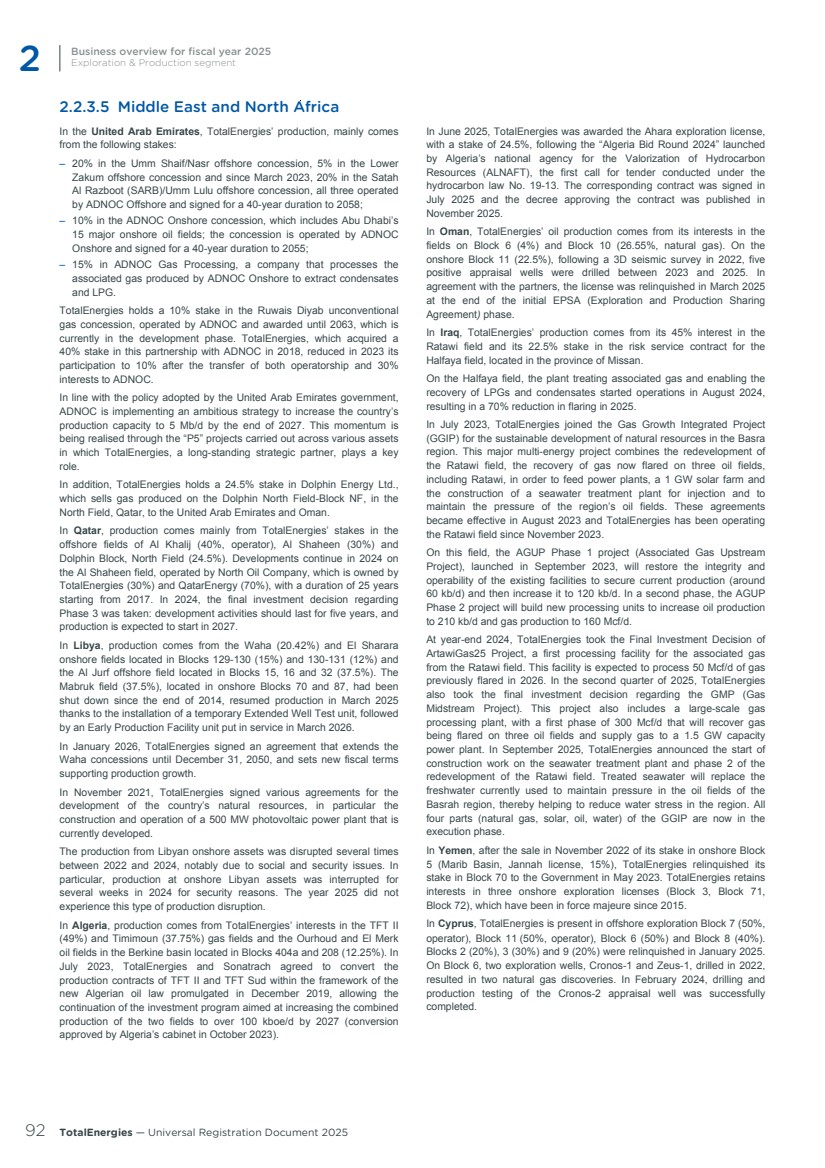
| In February 2025, the partners signed a Host Governmental Agreement with the Arab Republic of Egypt and the Republic of Cyprus, establishing a framework that allows Cronos gas to be processed via the existing infrastructure of the Zohr field, located onshore in Egypt, and then liquefied at the Damietta LNG plant, also in Egypt, for export to Europe. Several implementation agreements were signed in October 2025. The partners are working to finalize the development and production plan for Cronos in close collaboration with the Cyprus authorities. In Lebanon, in January 2026, TotalEnergies becomes operator of a new exploration license on Block 8 (35%), in partnership with ENI and QatarEnergy. TotalEnergies relinquished Block 4 in October 2023 and Block 9 (35%, operator) in March 2026, on which an exploration well was drilled in October 2023. In Egypt, TotalEnergies was the operator of offshore exploration Block 3 (35%), relinquished in June 2024. In Syria, the Company discontinued its activities connected with oil and gas production since December 2011. The Deir ez‑Zor license under PSA 88 (50%) and in the Tabiyeh Gas Service Contract (GSC) have been under force majeure since December 2011. 2.3 Integrated LNG segment Since 2023, the Integrated LNG segment covers the integrated gas chain (including upstream and midstream LNG activities), biogas and other low carbon molecules, gas trading activities, as well as starting January 1, 2026, the LNG bunkering business, previously reported under the M&S segment. In its final statement, the COP28 recognized the utility of transitional fuels. TotalEnergies shares this conclusion, which reinforces its growth strategy in gas, and particularly LNG. Gas is an energy transition which supports the development of intermittent renewables and rapidly reduces CO2 emissions through switching from other fossil fuels such as coal that emit significantly more. Main indicators 44 Mt Volume of LNG sold in 2025 No. 1 US LNG exporter with over 19 Mt in 2025 (b) 26 long-term chartered LNG carriers in 2025 19 Mt Long term regasification capacity in Europe in 2025 Main objectives and ambitions Tending toward zero methane emissions by 2030 +50% LNG sales growth between 2025 and 2030(c) >15 Mt/y US LNG exportation by 2030 30 long term chartered LNG carriers by 2030 (a) Refer to the glossary for definitions and additional information on alternative performance measures (APM, Non-GAAP measures) and to point 1.8 of chapter 1 for reconciliation tables. (b) TotalEnergies’ data. (c) Excluding Russia post 2027. Hydrocarbon production and LNG sales Hydrocarbon production for LNG 2025 2024 2023 Integrated LNG (kboe/d) 539 487 449 Liquids (kb/d) 66 60 58 Gas (Mcf/d) 2,608 2,331 2,128 LNG sales 2025 2024 2023 Total LNG sales (Mt) 43.9 39.8 44.3 Including sales from equity production(a) 15.1 15.5 15.2 Including sales by TotalEnergies from equity production and third party purchases 38.8 34.7 40.1 (a) The Company’s equity production may be sold by TotalEnergies or by the joint-ventures. Hydrocarbon production for LNG was up 11% in 2025 compared to 2024, supported by the acquisition of SapuraOMV in Malaysia and interests in gas permits in the Eagle Ford basin in Texas. LNG sales in 2025 were up 10% in 2024 year-on-year, thanks to a higher spot activity. Business overview for fiscal year 2025 Integrated LNG segment 2 TotalEnergies — Universal Registration Document 2025 93 [REDACTED SECTION: CERTAIN TEXT HAS BEEN REDACTED.] |
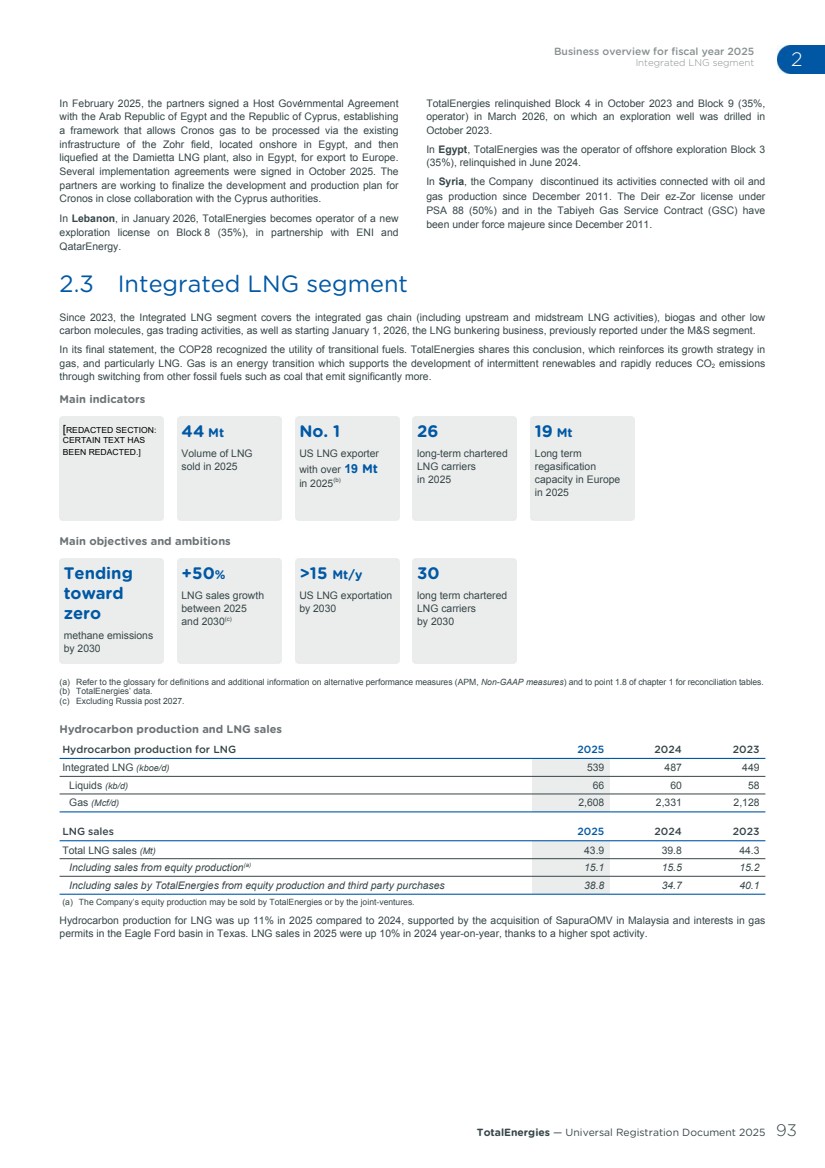
| 2.3.1 Presentation of the segment TotalEnergies is implementing an integrated strategy for profitable growth in the liquefied natural gas (LNG) segment and along the whole natural gas value chain. TotalEnergies is also involved in the trading of LNG and complementary products (liquefied petroleum gas, petcoke and sulfur) and is developing positions in low-carbon gases. Worldwide LNG market volumes grew by 6% on average between 2016 and 2025(1) , thanks to the switch from coal to natural gas. In Europe, gas imports from Russia via gas pipelines, which had already been sharply reduced after Russia invaded Ukraine, fell further when the transportation of gas via Ukraine was stopped at the end of 2024. To mitigate this, Europe has increased its regasification capacity and LNG imports. In 2025, in market conditions that remained tense, gas prices were higher than in 2024 on average. They remained significantly lower than those observed in 2022 and 2023 but still higher than pre-crisis levels. Europe (European Union and United Kingdom) imported 115 Mt of LNG in 2025 compared with 89 Mt in 2024 and 112 Mt in 2023(2) . Worldwide LNG demand is expected to continue to grow by an average of 5% or 6% per year between 2025 and 2030, driven mainly by Asia. New liquefaction projects launched in the wake of rising gas prices, mainly in Qatar and North America, are expected to generate a sharp increase in global production in the years to come. Due to its solid, diversified positions, TotalEnergies is still the world’s third-largest player in LNG(3) , with a global portfolio of 44 Mt and a global market share of about 10%(4) in 2025. The Company is the leading importer in Europe(5) . TotalEnergies’ LNG sales in EU and UK reached 18.4 Mt in 2025 compared to 13.8 Mt in 2024 and to 22.8 Mt in 2023, thanks to 19 Mt/y of regasification capacity. The Company is also the largest exporter(6) from the United States (with more than 19 Mt in 2025). In accordance with its balanced multi-energy strategy, the Company intends to consolidate its integrated position throughout the LNG value chain and its position as the third-largest global LNG player. Between 2025 and 2030 LNG volumes (from equity and long-term offtake, excluding Russia post 2027) should grow by +50%, relying on a portfolio of competitive, low-cost projects. LNG sales should thus reach about 60 Mt in 2030. The main projects under construction or development include North Field East and North Field South in Qatar, Marsa LNG in Oman, Rio Grande LNG in the United States, Energía Costa Azul in Mexico, NLNG T7 in Nigeria, Mozambique LNG in Mozambique and Papua LNG in Papua New Guinea. TotalEnergies has strengthened its presence across the entire chain, from upstream activities, thanks mainly to its interests in liquefaction plants located in the major production areas, through midstream activities, such as transportation, regasification and trading, and through distribution to end customers. In the U.S. and Mexico, the Company also confirms its status as a leading LNG exporter, with the increase of its long-term offtakes (excluding spot) over 17 Mt in 2030. It also remains one of Europe’s leading importers, with regasification capacity of close to 20 Mt/y. TotalEnergies intends to focus on improving the flexibility and resilience of its LNG portfolio, in particular by continuing to increase its Brent-indexed sales in Asia. It plans to increase its fleet of long-term chartered LNG carriers to 30 vessels by 2030. The LNG sold by TotalEnergies on worldwide markets comes in part from equity production in natural gas and condensate fields or liquefaction plants of which the subsidiaries are shareholders (refer to point 2.3.2). It also comes from purchase agreements concluded with third parties (refer to point 2.3.3). (1) Source: S&P Global LNG Waterborne Data, January 2026. (2) Source: S&P Global LNG Waterborne Data, January 2026. (3) Source: TotalEnergies data. (4) Source: S&P Global LNG Waterborne Data, January 2026, for the worldwide market size. (5) Source: TotalEnergies’ data. (6) Source: TotalEnergies’ data. 2 Business overview for fiscal year 2025 Integrated LNG segment 94 TotalEnergies — Universal Registration Document 2025 [REDACTED SECTION: CERTAIN TEXT HAS BEEN REDACTED.] |
| A growing, diversified and flexible LNG portfolio In response to the issue of methane emissions, TotalEnergies has reinforced in 2024 its target to reach a below 0.1% methane intensity by 2030 on its gas facilities, to extend it to all its upstream oil and gas operated facilities. Thanks to the efforts made, the Company has exceeded in 2025 its objective of methane emissions reduction on operated assets compared to 2020, already increased in 2024 from -50% to -60%, by reaching -65%(1) , and targets a reduction by 80% in 2030. In the low-carbon gas segment, the Company intends to develop the production and marketing of biogas, mainly in Europe and the United States, in order to meet incorporation obligations and to support its clients who wish to decarbonize their own activities. In Europe, in the context of the REPowerEU plan to end dependence on Russian gas and taking into account the support mechanisms for the development of biogas, TotalEnergies intends to develop its activities by capitalizing on its French and Polish subsidiaries and the portfolio of projects in the United States. At the end of 2025, the gross installed production capacity reached 1.4 TWh/y. 2.3.2 LNG production and liquefaction Hydrocarbon production for LNG was up 11% in 2025. LNG production growth is expected to continue in coming years thanks to liquefaction projects under construction (Rio Grande LNG in the USA, NFE and NFS in Qatar, ECA in Mexico, NLNG T7 in Nigeria and Marsa LNG in Oman) or under study. The information below describes the main development, production and liquefaction activities of the Integrated LNG segment, presented by geographical area. The capacities are expressed on a 100% basis, regardless of TotalEnergies’ interest in the asset. Africa (excluding North Africa) In Nigeria, TotalEnergies holds a 15% interest in Nigeria LNG (NLNG), whose main asset is a liquefaction plant with a total capacity of 22 Mt/y. The project to install an additional 7.6 Mt/y of capacity based on a new liquefaction train is in progress. TotalEnergies is also present in the onshore fields of the OML 58 Block (40%, operator) in the context of its joint-venture with Nigerian National Petroleum Corporation Ltd (NNPC), which has been supplying gas to NLNG for about twenty years. In 2024, the final investment decision for the development of Ubeta gas field was taken in order to supply NLNG. The OML 58 onshore fields also supply gas to the Nigerian domestic market. In addition, TotalEnergies owns a 40% stake in the Ima field, where development studies are underway to supply NLNG plant. In January 2026, TotalEnergies signed an agreement to sell its 10% non‑operated interest in the 3 production licenses (OML 23 and 28 onshore, and OML 77 offshore) of the RAEC joint venture, while retaining a full economic interest in these licenses, which mainly produce gas and currently account for 50% of Nigeria LNG’s gas supply. Completion of the transaction is subject to approval by the relevant authorities. In Angola, TotalEnergies holds a 13.6% interest in Angola LNG (ALNG), which owns a gas liquefaction plant of 5.2 Mt/y capacity, located near Soyo, that is supplied by the gas associated with the production of Blocks 0, 14, 15, 17, 18, 31 and 32. The SLGC project (Sanha Lean Gas Connection) on Block 0, which started up in December 2024, helps to strengthen gas supply to ALNG. In 2022, TotalEnergies, a partner in the New Gas Consortium (NGC, 11.8%), announced the final investment decision for the Quiluma and Maboqueiro offshore gas field development project. The project is the first non-associated natural gas project developed in Angola. It will supply the ALNG plant, thereby increasing Angola’s LNG production and the availability of domestic gas for the country’s industrial development. Production is scheduled to start in the first half of 2026. In Mozambique, TotalEnergies EP Mozambique Area 1 (TEPMA1) holds a 26.5% interest in the Mozambique LNG project (acquisition in September 2019 from Occidental Petroleum Corporation), for which the final investment decision was taken in June 2019. The project includes the construction of two onshore trains with a total capacity of 13.1 Mt/y to liquefy the gas produced by the Golfinho and Atum fields in Offshore Area 1. (1) Methane emissions from operated facilities were 23 kt in 2025 compared to 29 kt in 2024 and 34 kt in 2023. Business overview for fiscal year 2025 Integrated LNG segment 2 TotalEnergies — Universal Registration Document 2025 95 |
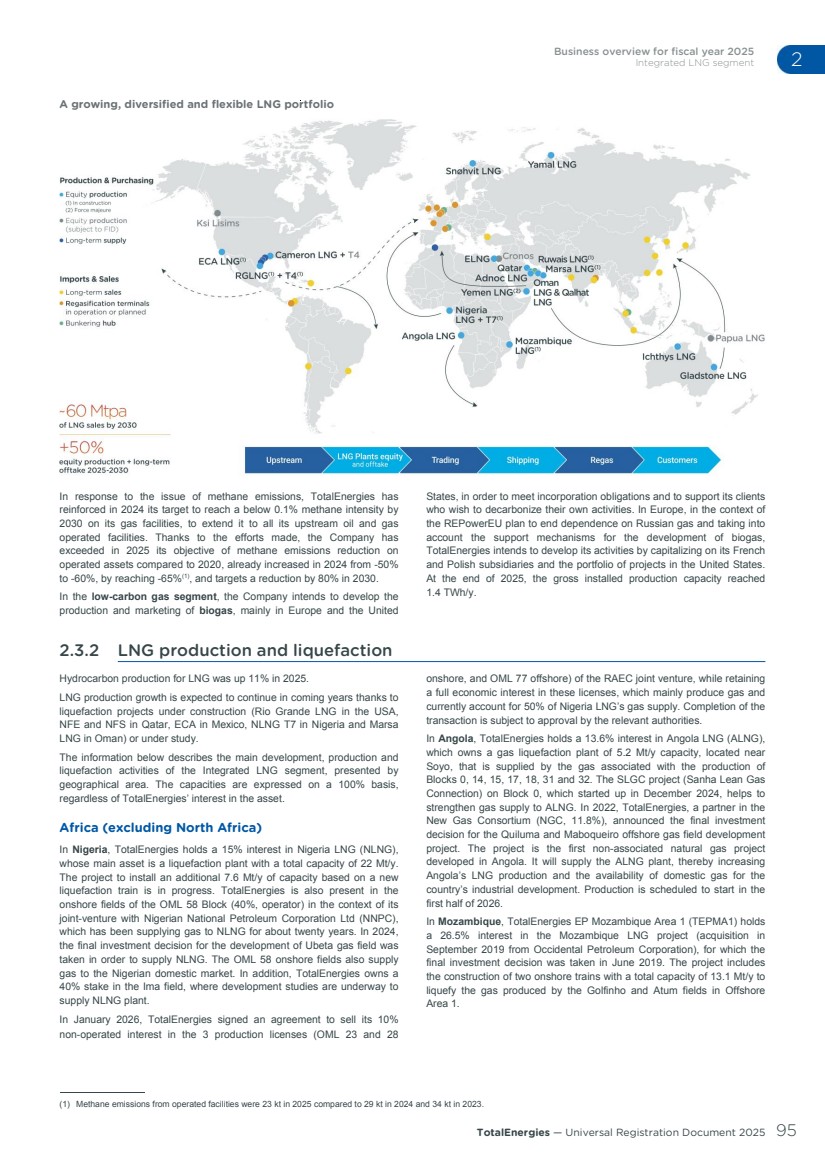
| In light of the evolving security situation in the north of the Cabo Delgado province in Mozambique, TotalEnergies announced on April 26, 2021, the withdrawal of all personnel from the Mozambique LNG project site in Afungi. Consequently, Mozambique LNG declared force majeure. In December 2022, on behalf of Mozambique LNG, the Company appointed Mr. Jean-Christophe Rufin(1) to assess the humanitarian situation in the Cabo Delgado province in the north of Mozambique, where Mozambique LNG project is located, and the socio-economic development programs undertaken by Mozambique LNG. In May 2023, TotalEnergies made public Mr. Jean-Christophe Rufin’s report, as well as the actions plan adopted by the Mozambique LNG partners based on the report’s recommendations. For further information, refer to point 3.6.8.1 in chapter 3. In 2024, Mozambique LNG conducted limited activities with its contractors, compatible with the security situation, aimed at preserving the site and preparing for the restart of the project once the conditions for lifting the force majeure are met. In January 2026, TotalEnergies and the Republic of Mozambique announced the full restart of activities for the Mozambique LNG project. This resumption of onshore and offshore activities follows the decision taken by the Mozambique LNG consortium in November 2025 to lift the force majeure declared in 2021 given the improving security situation and the measures implemented by the Government, including and the continuation of cooperation with Rwanda in this area.Construction work has now resumed both offshore and at the Afungi site. First LNG is expected in 2029 as the project progress is currently at 40% – almost all engineering and procurement of main equipments have been executed during the force majeure period. The sale of nearly 90% of Mozambique LNG future production has been secured through long-term contracts for delivery to customers in Asia and Europe. In addition, part of the gas from the Golfinho and the Atum fields is intended for the domestic market in order to contribute to the country’s economic development. Americas In the United States, TotalEnergies is active in liquefaction through its 16.60% stake in the Cameron LNG plant in Louisiana. The production of the three phase 1 trains with a capacity of 4.5 Mt/y each, began in 2019 (train 1) and 2020 (trains 2 and 3). The study to expand the plant beyond its initial capacity of 13.5 Mt/y is ongoing. In the context of the extension, an agreement has been signed with Sempra Infrastructure, Mitsui & Co., Ltd. and Mitsubishi Corporation aiming to study the development of the Hackberry Carbon Sequestration (HCS) project for the capture, transportation and storage from Cameron LNG’s site, in order to significantly reduce its GHG emissions. In June 2023, TotalEnergies acquired from the U.S. company NextDecade(2) a 16.7% stake in the first phase of the Rio Grande LNG (RGLNG) project, a natural gas liquefaction plant, in South Texas. This first phase is composed of three liquefaction trains for a total capacity of 17.5 Mt/y, and is scheduled to start production in 2027. The terms of the agreement provide for TotalEnergies to offtake 5.4 Mt/y of LNG from this first phase for 20 years. At the end of 2025, TotalEnergies held a 17.10% stake in NextDecade and will have the right to participate in subsequent phases of the project as well as in a carbon capture and storage (CCS) project planned by NextDecade to reduce emissions generated by the LNG project. In September 2025, TotalEnergies and its partners took the final investment decision regarding RGLNG’s fourth train. TotalEnergies holds a 10% direct stake in this project and a 7% indirect stake as a shareholder of NextDecade, and intends to offtake 1.5 Mt of LNG from the future Train 4 every year for 20 years. TotalEnergies operates assets (held at 96% on average) in the Barnett Shale basin, with around 1,500 active wells grouped in several sites and holds an interest in around 300 non-operated wells. An investment program including drilling and well maintenance activities is being implemented to maintain the production. TotalEnergies measures and physically reduces its greenhouse gas emissions, particularly methane, thanks to the replacement of gas instrumentation with compressed air instrumentation (all active sites equipped since March 2024), spectrometers mounted on drones (AUSEA technology), mobile sensors, infrared cameras with quantification algorithms (LDAR – Leak Detection and Repair program), fixed methane detectors operating continuously (deployment completed across all active operation sites), and fuel controllers (deployment completed with more than 400 compressors equipped). In 2024, TotalEnergies acquired interests in assets operated by third parties in the Eagle Ford basin in southwest Texas: a 20% interest in the Dorado dry gas assets operated by EOG, in April 2024 and a 45% interest acquisition in dry gas assets operated by Lewis Energy Group, in September 2024. In Mexico, TotalEnergies holds a 16.6% stake in the Energia Costa Azul (ECA) gas liquefaction project (nominal capacity of 3 Mt/y) currently under construction with start-up scheduled for 2026. The Company has agreed to offtake around 1.7 Mt/y. In Canada, in May 2025 TotalEnergies acquired a 5% stake in Western LNG, the developer, shareholder, and future operator of the Ksi Lisims LNG project. The project is fully electrified and powered by hydroelectricity, has capacity of 12 Mt/y and is located on the Pacific coast of Canada (British Columbia). TotalEnergies intends to offtake 2 Mt/y of LNG from this future liquefaction plant, subject to the final investment decision. Asia-Pacific In Australia, LNG production comes from the Ichthys LNG (26%) and Gladstone LNG (GLNG, 27.5%) projects. The Ichthys LNG project involves the development of a gas and condensate field located in the Browse Basin. This phased development includes 18 subsea wells (first phase) connected to a platform for gas production, processing and export, an FPSO for condensate processing and export, an 889 km gas pipeline and an onshore liquefaction plant at Darwin, comprising two trains with a total nominal capacity of 8.9 Mt/y of LNG. The second phase of development, including the drilling of an additional 12 subsea wells, was completed in July 2025. Ichthys LNG has reached its production plateau and various adjustments have allowed it to reach 110% of nameplate capacity. A compression project was approved in 2021, to further extend the plateau. In addition to LNG, the facilities produce approximately 110 kboe/d of condensates and LPG. In August 2023, TotalEnergies and INPEX (operator of the Ichthys LNG project) signed an agreement for the acquisition of PTTEP’s 100% interest in the AC-RL7 permit. Under the terms of the agreement, TotalEnergies acquired a 26% stake in the permit, corresponding to its share in Ichthys LNG. INPEX acquired the remaining 74% while assuming operatorship. The permit, located approximately 250 kilometers northeast of the Ichthys offshore facilities, includes the Cash and Maple gas and condensate fields. Their development is expected to contribute to the long-term supply of the Ichthys LNG liquefaction plant. GLNG is an integrated project with production from the Fairview, Roma, Scotia and Arcadia fields transported to a liquefaction plant on Curtis Island in Queensland, with capacity of 7.8 Mt/y based on two trains. TotalEnergies entered into a tolling agreement with GIP Australia (GIP) effective since January 1, 2021, whereby GIP will receive a tolling income for 15 years based on the volumes of gas (TotalEnergies’ share) passing through the downstream processing facilities. In June 2023, TotalEnergies signed an agreement with Gentari under which the partners plan to jointly develop the Pleasant Hills solar project to supply low-carbon electricity to the gas facilities of the Roma field. (1) Mr. Jean-Christophe Rufin is one of the co-founders of Médecins sans frontières and honorary president of the NGO Action Against Hunger. (2) Company listed on NASDAQ. 2 Business overview for fiscal year 2025 Integrated LNG segment 96 TotalEnergies — Universal Registration Document 2025 |
| In Malaysia, TotalEnergies finalized in December 2024 the acquisition of the respective 50% stakes of OMV and SapuraEnergy in SapuraOMV Upstream, an independent Malaysian gas producer and operator. SapuraOMV’s main assets are 40% in Block SK408 and 30% in Block SK310, both located offshore Sarawak in Malaysia. In December 2025, TotalEnergies has closed an agreement to divest to PTTEP an indirect(1) interest of 9.998% in block SK408 in Malaysia. Further to this transaction, TotalEnergies keeps a 30.002% interest in block SK408. Gas is produced in the Gorek, Bakong, Larak and Jerun offshore fields in Block SK408, located in Sarawak, and in Field B15 in Block SK310. Following a unitization agreement signed in July 2024 between the partners of Block 2E (85%) and those of Block SK318, the Block 2E has a right to 10% of the production from the Marjoram field, which is expected to start in the first quarter of 2027. In June 2025, TotalEnergies announced the acquisition from Petronas of interests in 12 offshore blocks in Malaysia, where exploration, appraisal and development programs will be progressed. The transaction was completed in October 2025. TotalEnergies holds a 50% operated interest in Blocks SK301b and SK313 (Kenyalang cluster), where significant gas discoveries have been made. In Papua New Guinea, TotalEnergies holds a 37.5% stake (operator) in Block PRL-15 following the divestment of a 2.6% stake to JX Nippon in 2023. The State of Papua New Guinea retains the right to acquire up to 22.5% stake in the license (at the final investment decision), which would reduce TotalEnergies’ stake to 29.1%. Block PRL-15 encompasses the Elk and Antelope fields. It is anticipated that the gas produced from these fields will be conveyed through a 320 km onshore/offshore pipeline to the Caution Bay site. The project includes the allocation of 2 Mt/y of liquefaction capacity in a facility operated by a partner and the construction of three additional electrical liquefaction trains with a total capacity of 4 Mt/y at the same site. In April 2019, TotalEnergies and its partners signed an agreement with the authorities of Papua New Guinea defining the fiscal framework for the development of the Papua LNG project. This agreement has been supplemented by a Fiscal Stability Act agreement, signed with the State in February 2021, and an agreement allowing the extension of the PRL15 license by 5 years until November 2026. The integrated Front End Engineering and Design (FEED) studies, also encompassing the downstream part, were initiated in March 2023. After receiving the bids in 2024, given the excessively high investment levels, it was decided to postpone the project’s launch, to revise its design, and to reissue calls for tender (which are currently underway) with an expanded pool of contractors in order to optimize costs. Europe In Norway, TotalEnergies holds an 18.40% interest in the Snøhvit gas liquefaction plant (nominal capacity of 4.2 Mt/y). In Russia, TotalEnergies holds a 20.02% direct interest in the Yamal LNG gas liquefaction plant (nominal capacity of 17.4 Mt/y). Additionally, TotalEnergies holds a 10% direct interest in the Arctic LNG 2 project (19.8 Mt/y) as well as, since July 2021, a 10% interest in the Arctic Transshipment(2) company, which was established as part of the Arctic LNG 2 project. Given the uncertainties that technological and financial sanctions targeting Russia pose on the ability to complete the Arctic LNG 2 project, TotalEnergies has ceased recognizing as proved reserves the resources associated with the Arctic LNG 2 project since December 31, 2021, and has provisioned in its accounts the value of its investments in the project as of March 31, 2022. Moreover, TotalEnergies no longer records reserves from its interest in Novatek since the end of 2022. The US Office of Foreign Assets Control (OFAC) designated, Arctic Transshipment and Arctic LNG 2 as Specially Designated Nationals list on September 14, 2023 and November 2, 2023, respectively, with immediate effect subject to temporary exceptions under OFAC-issued licenses. These designations prohibit US persons from trading with those two entities. Any non-US person is exposed to the risk of secondary US sanctions if they provide material support to these entities. Since April 18, 2023, TotalEnergies EP Transshipment has not participated in any governance body and has not paid any cash calls to Arctic Transshipment. On November 2, 2023, the Arctic LNG 2 company was placed under sanctions by the U.S. authorities. Consequently, as announced, on November 7, 2023, TotalEnergies initiated the contractual suspension procedure provided for in the Arctic LNG 2 shareholders’ agreement and the force majeure procedure for the LNG purchase contract with Arctic LNG 2. Upon notification of these procedures, TotalEnergies’ rights and obligations under these contracts were suspended (refer to point 3.2.1 of Chapter 3). TotalEnergies does not participate in, nor does it benefit, directly or indirectly, from LNG deliveries by Arctic LNG 2, which began in 2025. Middle East and North Africa In Qatar, TotalEnergies participates in the production, processing and liquefaction of gas from the North Field through its interest in: – QatarEnergy LNG N(2) (formerly Qatargas 2): TotalEnergies holds a 16.7% interest in train 5, which has a production capacity of 8 Mt/y of LNG; – North Field East (NFE) and North Field South (NFS): TotalEnergies acquired stakes in the NFE (6.25%) and NFS (9.375%) projects in 2022. These projects include four trains with a total planned capacity of 32 Mt/y for NFE and two trains with a total planned capacity of 16 Mt/y for NFS. NFE is scheduled to begin operating in 2026 and NFS in 2028. These interests are expected to add, 3.5 Mt/y of production (Company share) to the TotalEnergies’ global LNG portfolio by 2028; – The transfer of shares in the Qatargas 1 LNG plant was finalized in February 2024. In Oman, TotalEnergies holds an 80% stake in Marsa LNG LLC which holds a 33.19% interest in onshore gas Block 10 in the Greater Barik area, which started production in January 2023. The gas from this block will feed a low-GHG emissions LNG plant with a capacity of 1 Mt/y, starting in March 2028. The final investment decision for this plant was announced in April 2024(3) . TotalEnergies also produces LNG through its investments in the Oman LNG (5.54%)/Qalhat LNG (2.04% via Oman LNG) liquefaction complex, with an overall capacity of 11.4 Mt/y. In November 2023, TotalEnergies signed an agreement allowing it to extend these shareholdings beyond 2024, for 10 years for Oman LNG (trains 1 and 2) and for 5 years for Qalhat LNG (train 3), including investments aimed at reducing the site’s GHG emissions. In the United Arab Emirates, TotalEnergies holds a 5% stake in ADNOC LNG (nominal capacity of 6 Mt/y), a company that processes associated gas supplied by ADNOC Offshore to produce LNG, LPG and condensates, as well as a 5% stake in National Gas Shipping Company (NGSCO), a company responsible for chartering ships and providing logistics for ADNOC LNG’s needs. In July 2024, TotalEnergies took a 10% interest in the Ruwais LNG project including a new natural gas liquefaction plant with two electrical trains with a total capacity of 9.6 Mt/y, scheduled to start in the second half of 2028. (1) In December 2025, TotalEnergies sold 49.99% of its subsidiary to PTTEP, reducing its interest to 50.01%. The subsidiary holds a 20% interest in Block SK408. (2) Arctic Transshipment is a Russian company jointly owned by Novatek (90%) and TotalEnergies EP Transshipment (10%) at December 31, 2025. (3) The structure of the agreements between the two shareholders TotalEnergies and Oman Oil Company EP (OQEP) leads to the equity method accounting of Marsa LNG LLC from April 2024. Business overview for fiscal year 2025 Integrated LNG segment 2 TotalEnergies — Universal Registration Document 2025 97 |
| In Egypt, TotalEnergies owns a 25% interest in the North El-Hammad offshore Block, on which part of the Bashrush offshore field is located, with the other part located on the Baltim Block. A unitization agreement signed in 2022 gives the Company rights to natural gas and condensate production since June 2022. In addition, TotalEnergies holds a 5% interest in the first train (capacity of 3.6 Mt/y) of Egyptian LNG’s Idku liquefaction plant. In Yemen, the deterioration of security conditions in the vicinity of the Balhaf site caused the company Yemen LNG, in which TotalEnergies holds a stake of 39.62%, to cease commercial production and export of LNG activities and declare force majeure to its various stakeholders in 2015. The plant has been placed in preservation mode. 2.3.3 Intermediary activities: purchase, sale, trading and transportation of LNG and natural gas Purchase, sale and trading of LNG In 2025, LNG trading activities represented a volume of 38.8 Mt, compared with 34.7 Mt in 2024 and 40.1 Mt in 2023. These volumes represent sales by TotalEnergies stemming from equity production and purchases from third parties. TotalEnergies, with trading teams located in Geneva, Houston, Paris, and Singapore, develops its activities with the management and optimization of a portfolio of long-term contracts coupled with a strong presence on spot markets. TotalEnergies purchases long-term volumes of LNG, in many cases from liquefaction projects in which the Company holds an interest. New sources of LNG from plants already in operation (Oman LNG – 0.8 Mt/y for 10 years from 2025, ADNOC Gas in the UAE for three years – signed in 2023), projects under construction (Rio Grande LNG in the United States – 5.4 Mt/y for 20 years from 2027 in the first phase and 1.5 Mt/y for 20 years for Train 4 – NFE and NFS in Qatar – 3.5 Mt/y for 27 years from 2026 – ECA in Mexico, NLNG T7 in Nigeria, Mozambique LNG in Mozambique as well as volumes of LNG not sold as marine fuel from Marsa LNG in Oman from 2028) or under study, are expected to ensure the growth of the LNG portfolio in the coming years (refer to point 2.3.2). TotalEnergies also purchases long-term LNG volumes from plants in which the Company has no equity (mainly Sabine Pass, Corpus Christi, and Freeport in the United States and also from Algeria, with the extension of the 2 Mt/y supply contract with Sonatrach until 2026). In February 2026 the Company also signed a preliminary agreement (Letter of Intent) with the lead developer of the Alaska LNG project, for the long-term offtake of 2 Mt/y of LNG over 20 years, subject to the project’s final investment decision. In 2025, TotalEnergies purchased 347 shipments under long-term contracts from Algeria, Australia, Egypt, the United States, Nigeria, Norway, Qatar and Russia and 269 spot or medium-term shipments, compared with 366 and 188 shipments in 2024 and 398 and 223 in 2023 respectively. Deliveries from Yemen LNG have been halted since 2015. In addition, TotalEnergies holds several long-term LNG sales contracts, mainly in Asia (China, South Korea, India, Indonesia, Japan, Singapore, and Taiwan), but also in Brazil, Chile, Panama and the Dominican Republic. Several sales agreements and contracts were signed in 2024 and 2025, mainly with Asian entities: – in February 2024, a sales contract with Sembcorp for the supply of 0.8 Mt/y of LNG over a 16-year period from 2027. This contract is in addition to a previous contract that runs until 2029; – in June 2024, a sales contract with Indian Oil Corporation, for which the memorandum of understanding was signed in July 2023, providing for the delivery to India of 0.8 Mt/y of LNG for ten years from 2026, and a sales agreement with Korea South East Power providing for the delivery to South Korea of approximately 0.5 Mt/y of LNG for five years from 2027; – in September 2024, a sales agreement with BOTAŞ for the delivery of 1.1 Mt/y of LNG for 10 years from 2027, as well as a five-year extension of the sales contract with CNOOC, for the delivery in China of 1.25 Mt/y of LNG until 2034, and a sales agreement with HD Hyundai Chemical for the delivery of 0.2 Mt/y of LNG for seven years from 2027; – in November 2024, a sales agreement with Sinopec for the delivery of 2 Mt/y of LNG for 15 years, starting in 2028; – in February 2025, a sales agreement with Gujarat State Petroleum Corporation Limited (GSPC) for the delivery of 0.4 Mt/y of LNG for 10 years, starting in 2026; – in April 2025, a sales agreement with ENADOM (Energia Natural Dominicana) for the delivery of 0.4 Mt/y for 15 years, starting in mid-2027; – in September 2025, a sales agreement with KOGAS for the delivery of 1.0 Mt/y for 10 years, starting in late 2027. Additionally, TotalEnergies is developing LNG retail sales (by barge and tanker trucks) for industrial or mobility (LNG for marine, river or road transportation) in Europe, in the Caribbean in partnership with AES and in China via the joint venture with Shenergy Group. LNG shipping In the framework of its LNG transportation activities, TotalEnergies Gas & Power Limited (TEGPL) operates a long term chartered fleet of 26 LNG carriers at year-end 2025 (compared to 25 at year-end 2024). In 2023, TEGPL sold its last co-owned LNG carrier (50%, with the Japanese shipowner NYK). This fleet is regularly renewed to benefit from best performing and lowest environment impacting vessels. It includes two regasification vessels (FSRU), of which the first is set up in Germany and the second was positioned in France until January 2026. In addition to the long-term fleet, each year TEGPL charters spot and short-term ships to serve trading needs and to adapt transportation capacity to seasonal demand. The subsidiary TotalEnergies EP Norge charters two LNG carriers directly from the shipowners, in addition to the 26 LNG carriers chartered by TEGPL. Finally, LNG carriers are chartered through the Company’s interests in LNG production and export projects that control their own fleet, such as Nigeria LNG, Angola LNG and those of QatarEnergy. TotalEnergies uses LNG ships selected in accordance with a process detailed in point 2.5.2.2. LNG Bunkering TotalEnergies, a long-standing partner of the shipping industry, has started developing a bunkering business of LNG (including bio-LNG). LNG produces less CO2 (1) and emits less local air pollutants (NOx, SOx and fine particles) than conventional fuels. In Europe, TotalEnergies already develops a commercial offering including also bio-LNG as marine fuel, and in late 2025 had under chartering two LNG bunkering vessels – Gas Vitality, positioned in the Marseille-Fos region in France, and Gas Agility based in the Rotterdam region in the Netherlands. (1) Based on the CO2 emission factors published in the regulation (EU) 2023/1805 of the European Parliament and of the Council of September 13, 2023 on the use of renewable and low-carbon fuels in maritime transport. 2 Business overview for fiscal year 2025 Integrated LNG segment 98 TotalEnergies — Universal Registration Document 2025 |
| In July 2025, TotalEnergies formed an agreement with CMA CGM Group to develop a 50/50 joint venture aimed at developing and operating an LNG bunker supply solution at the port of Rotterdam. The joint venture is intended to offer a comprehensive logistics service to the ships of the CMA CGM Group and other companies, and plans to position and operate a 20,000 m³ bunker barge by year-end 2028. Moreover, TotalEnergies plans to supply CMA CGM’s fleet with up to 360,000 tons of LNG per year between 2028 and 2040. In Asia-Pacific and the Middle-East, this development dynamic has recently been illustrated through: – the project to establish Middle East’s first LNG bunkering hub as part of the Marsa LNG joint venture (with its partner OQEP); – the announcement of the signing of a chartering agreement in May 2025, for an LNG bunker barge named Monte Shams, at the port of Sohar (northern Oman) in 2028; – the ongoing development of an LNG bunkering supply chain in Singapore, deployed since January 2024. Natural gas trading and transportation TotalEnergies is active in the trading of natural gas in Europe and North America. It sells its output to third parties and supplies its subsidiaries. In Europe, TotalEnergies sold 806 TWh of natural gas in 2025, compared with 736 TWh in 2024 and 924 TWh in 2023. In North America, TotalEnergies sold 266 TWh of natural gas in 2025 from its own production or from external resources, compared to 263 TWh in 2024 and 282 TWh in 2023. TotalEnergies holds interests in gas pipelines located in Brazil and Argentina. 2.3.4 LNG regasification TotalEnergies holds interests in regasification assets and has signed agreements that provide long-term access to LNG regasification capacity worldwide, through existing assets in Europe (France, Germany, the Netherlands, and the U.K.), in Asia (Inwasa) and the Americas (United States and Panama). Consequently, at year-end 2025 TotalEnergies had long-term European LNG regasification capacity of 25.9 bcm/y (equivalent to 19 Mt/y). In 2023, TotalEnergies finalized two regasification projects in Germany and France to contribute to Europe’s security of supply in the context of the invasion of Ukraine by Russia. These projects involved the redeployment of two FSRUs previously operating in Asia and the Middle East. In France, the FSRU was based in Le Havre, while in Germany, it is located in Lubmin in partnership with Deutsche ReGas. LNG regasification(a) capacity in Europe at year-end 2025 Country Region/State Terminal Expiration France Provence-Alpes-Côte d’Azur Fos Cavaou ≥2030 Pays de la Loire Montoir de Bretagne 2035 Hauts-de-France Dunkerque LNG 2036 Normandie Le Havre (FSRU) January 2026 Germany Mecklenburg-Western Pomerania Deutsche Ostsee (FSRU) 2029 United Kingdom Wales South Hook LNG 2034 Kent, England Isle of Grain 2029 Netherlands Rotterdam, South Holland Gate 2029 (a) Excluding short term capacity. Europe In France, TotalEnergies has a regasification capacity of 7.7 bcm/y in the Fos Cavaou terminal, 7 bcm/y in the Montoir de Bretagne terminal, and 2.1 bcm/y in the Dunkirk LNG terminal. Since October 2023, the Company had a 2.2 bcm/y regasification capacity in the Le Havre floating terminal until. The authorization to operate was granted by the French authorities for a period of five years, in response to the emergency caused by the interruption of gas supplies by pipeline from Russia. In its decision of October 16, 2025, the Rouen Adminsitrative Court observed that the floating LNG terminal in Le Havre was no longer necessary, as the gas supply conditions in France and Europe have stabilized. TotalEnergies, therefore, demobilized the FSRU in January 2026. In Germany, TotalEnergies chartered a FSRU to Deutsche ReGas, which commissioned the Deutsche Ostsee terminal at the beginning of 2023, with a regasification capacity of 5 bcm/y in the port of Lubmin. TotalEnergies has regasification capacity of 2.6 bcm/y in this terminal. In the United Kingdom, as part of its stake in the Qatargas 2 project, TotalEnergies holds an 8.35% interest in the South Hook LNG regasification terminal which has a total capacity of 21 bcm/y and has access to 2.0 bcm/y of regasification capacity. TotalEnergies has also booked regasification capacity of 3.3 bcm/y at the Isle of Grain terminal. In Belgium, TotalEnergies held a regasification capacity of 2.0 bcm/y in the Zeebrugge terminal, the contract for which expired at the end of September 2023. In the Netherlands, TotalEnergies has regasification capacity of 1.2 bcm/y at the Gate terminal, which is booked until 2029. Rest of the world In the United States, TotalEnergies has regasification capacity of 5.0 bcm/y at the Sabine Pass terminal in Louisiana until 2029. In Panama, the Colón LNG Marketing joint-venture with AES (TotalEnergies, 50%) has capacity of 0.3 bcm/y in the terminal until 2028. In India, the partnerships between TotalEnergies and the Adani Group include several assets in the gas value chain, from LNG import facilities to gas distribution to domestic households. The Dhamra terminal, with capacity of 6.8 bcm/y, started in May 2023 (refer to point 1.8.3 of chapter 1). Business overview for fiscal year 2025 Integrated LNG segment 2 TotalEnergies — Universal Registration Document 2025 99 |
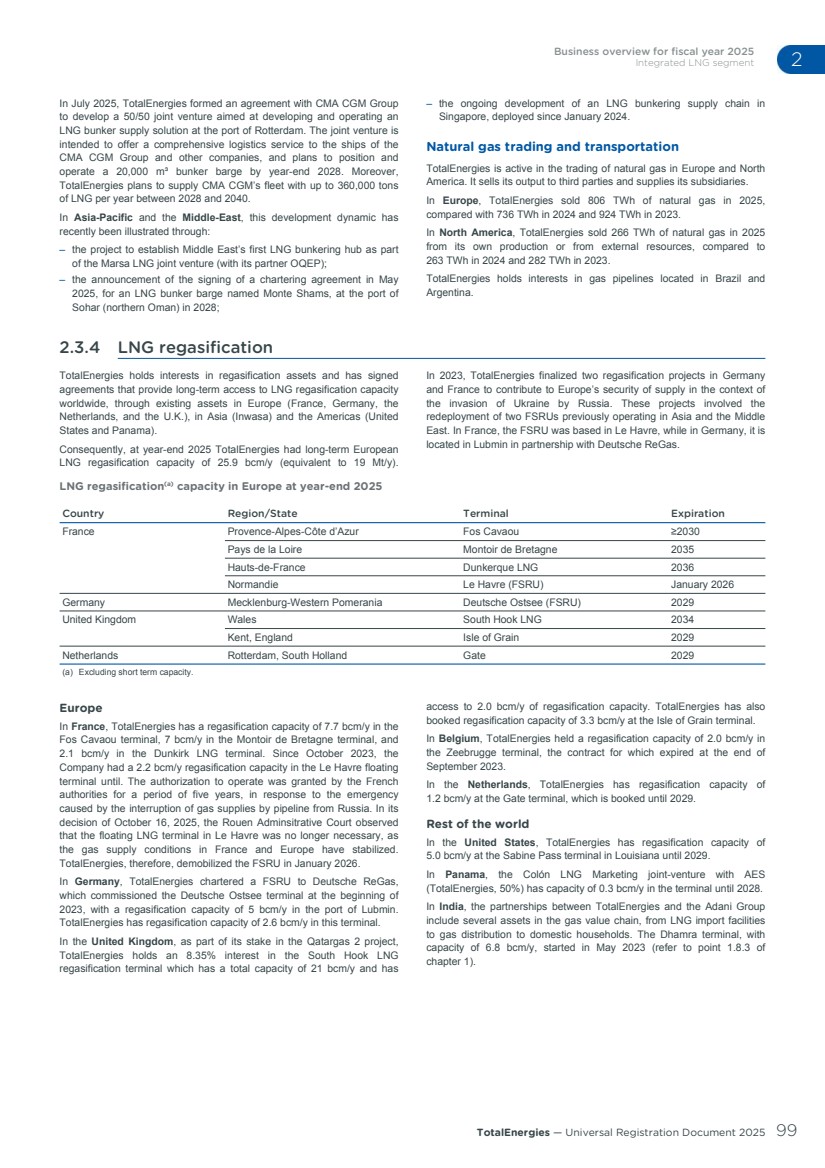
| 2.3.5 LPG, ethane, petcoke and sulfur trading TotalEnergies is also present in the LPG, ethane, petcoke and sulfur markets. In 2025, TotalEnergies traded and sold 6.6 Mt of LPG (propane and butane) and ethane worldwide, compared to 7.1 Mt in 2024 and 2023. Almost 22% of these quantities came from fields or refineries operated by the Company. This trading activity was conducted using 14 long-term chartered vessels. In 2025, 220 voyages were necessary for transporting the quantities traded, including 151 voyages by TotalEnergies’ long-term chartered vessels and 69 voyages by spot-chartered vessels. TotalEnergies sells petcoke produced by the Port Arthur refinery in the United States and the Jubail refinery in Saudi Arabia. Petcoke is sold to cement producers and electricity producers, mainly in China, India, as well as in Mexico, Brazil, other Latin American countries, and Turkey. In 2025, 4.0 Mt of petcoke were sold on the international market, compared to 3.5 Mt in 2024 and 2.9 Mt in 2023. TotalEnergies also sells sulfur, mainly from the production of its refineries and some oil and gas fields with high sulfur content. It sold 3.0 Mt of sulfur in 2025, compared to 2.0 Mt in 2024 and 1.7 Mt in 2023. In 2015, TotalEnergies ceased its coal production activities, and it stopped selling and trading coal in 2016. 2.3.6 Biogas and other low carbon molecules Biogas TotalEnergies is involved in the development and operation of biogas production units, mainly from organic agricultural and agro-industrial waste. This biogas is either used to generate electricity and heat (cogeneration) or is injected as biomethane(1) into natural gas networks. In addition, the anaerobic digestion process generates a co-product, digestate, a natural fertilizer with high agronomic value, which is used by farmers to replace synthetic fertilizers, in a virtuous circular economy scheme. At year-end 2025, TotalEnergies’ total annual gross production capacity amounted to 1.4 TWh biomethane equivalent (compared to 1.2 TWh in 2024 and 1.1 TWh in 2023). This represents the treatment of approximately 1.7 Mt/y of organic waste in order to provide renewable gas to the equivalent of 280,000 inhabitants, making it possible to avoid the emission of around 280 kt of CO2 (2) . With around 1.3 Mt of digestate, this makes nearly 48 kt/y of chemical fertilizers that are replaced by a natural fertilizer. Number of biogas production facilities and associated production capacity at year-end 2025 Country In service In construction Number of sites Equivalent biomethane production capacity (GWh/y) Number of sites Equivalent biomethane production capacity (GWh/y) France 13 771 1 32 Poland 21 480 1 22 United States 2 118 2 152 India 1 55 – – Total 37 1,424 4 206 France TotalEnergies’ combined biomethane and biogas gross production capacity in France stands at nearly 800 GWh/y. At the end of 2025, the Company had 13 production units in France for biogas used to generate electricity and heat, or purified to produce biomethane. Nine of these units run on agricultural inputs and have obtained ISCC EU sustainability certification, while the remaining four (cogeneration) are not covered by this certification. The most recent units, BioBéarn, with a maximum capacity of 160 GWh/y, and BioNorrois, with a maximum capacity of 153 GWh/y, were respectively commissioned in January 2023 and February 2025. For the latest TotalEnergies has teamed up with French sugar group Cristal Union, partner in the project and 10% shareholder, which has committed to supply sugar beet pulp as feedstock for its biomethane production unit for 15 years and to contribute to digestate utilization. Downstream in the chain, in June 2023, TotalEnergies signed a Biomethane Purchase Agreement with Saint-Gobain for 100 GWh over a 3-year period starting in 2024. The biomethane is produced by TotalEnergies at its BioBéarn site. Poland In May 2025, TotalEnergies announced the sale to HitecVision of a 50% stake in its integrated Polska Grupa Biogazowa (PGB) subsidiary, which is Poland’s leading biogas producer(3) , acquired in March 2023. At year-end 2025, PGB owned and operated 21 units in production, representing installed electrical capacity of 22 MW, i.e., an electricity production capacity of 193 GWh/y (approximately 480 GWh/y in biomethane equivalent). United States TotalEnergies and Vanguard Renewables, a U.S. company, subsidiary of BlackRock, active in the production of biomethane from organic waste, signed an agreement in April 2024 to create a 50/50 joint-venture in order to develop, build and operate farm-based organics-to-renewable natural gas projects in the United States. The agreement provides for the development of ten renewable natural gas projects, with a total annual capacity of 0.8 TWh. Of these, the first three projects, each with capacity of nearly 75 GWh/y, produce or have entered the construction phase in the states of Wisconsin and Virginia. As part of their joint-venture, TotalEnergies and its US partner NASDAQ-listed Clean Energy Fuels Corp., in which TotalEnergies had a 19.42% interest at December 31, 2025, commissioned the 40 GWh/y Del Rio methanization unit in Texas in March 2023. TotalEnergies took a 20% interest, in May 2023, in the capital of Ductor, a Finnish start-up that has developed an innovative technology for treating organic waste with a high nitrogen content, which was divested in December 2024 in exchange for an additional 25% equity interest in the Gypsum project (the first project developed in partnership between Ductor and TotalEnergies in the United States). (1) Biogas is used to produce electricity and heat via co-generation. Biogas, once purified, with the removal of carbon dioxide in particular, becomes biomethane, which has the same characteristics as natural gas. (2) Source: ADEME method. (3) Source: TotalEnergies’ data. 2 Business overview for fiscal year 2025 Integrated LNG segment 100 TotalEnergies — Universal Registration Document 2025 |
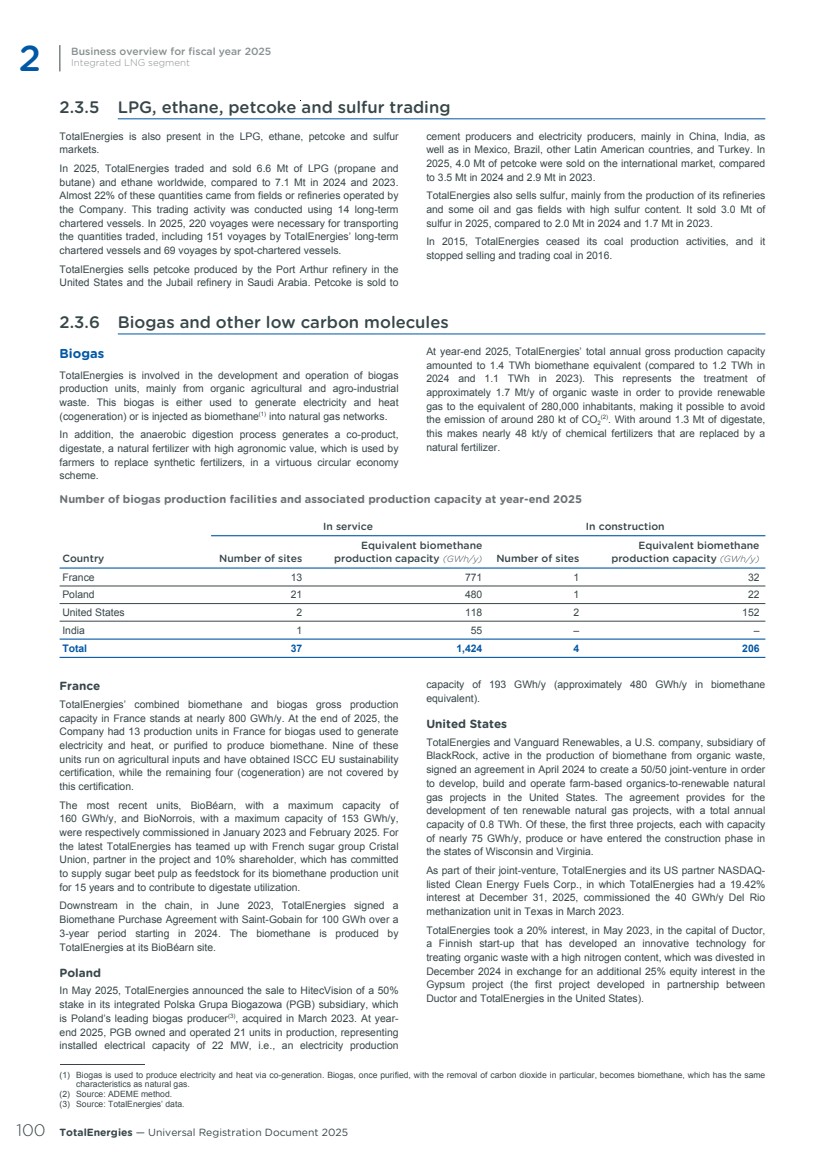
| India The Adani Total Gas Limited joint-venture (TotalEnergies, 37.4%) has started up in July 2024 a first biomethane plant project in Barsana in the state of Uttar Pradesh, with a capacity of 55 GWh/y (refer to point 1.8.3 of Chapter 1). Other low carbon molecules Activities producing hydrogen to be used in the Company’s European refineries have been reported to the Refining & Chemicals segment as from July 2025 (refer to point 2.5.1). In May 2023, TotalEnergies joined forces with Tree Energy Solutions (TES) to study and develop a project in the United States to produce synthetic natural gas (e-NG) from renewable hydrogen and CO2 of biogenic origin. TotalEnergies and TES have signed, with Osaka Gas, Toho Gas, and Itochu, a Joint Development and Operating Agreement relating to the Live Oak project, granting the three Japanese companies a combined 33.3% stake (as opposed to 33.35% each for TotalEnergies and TES), with target capacity of around 250 MW for electrolysis and 75 kt/y for methanation. Following the acquisition of the entire capital of Total Eren concluded in July 2023, some of the development activities for renewable hydrogen projects are continuing as part of a new partnership through the TEH2 joint-venture (80% owned by TotalEnergies and 20% by the EREN group). TEH2 is developing renewable hydrogen production projects in different regions, such as North Africa, South America, and Australia. In 2024, TEH2 joined forces with Verbund to develop a project in Tunisia and with CIP and A.P. Møller Capital for a project in the Kingdom of Morocco. 2.4 Integrated Power segment Since 2023, the Integrated Power segment covers the integrated electricity chain and in particular, electricity production, storage, trading and gas-electricity marketing activities to BtB and BtC customers. Main indicators 48.1 TWh Net production of electricity in 2025 including 31.4 TWh from renewable sources 43.3 GW Gross installed power generation capacity at year-end 2025, of which 34.1 GW from renewable sources Main objectives and ambitions 100- 120 TWh Net power generation in 2030 ~20% share of electricity in the energy produced by TotalEnergies by 2030 (a) Refer to the glossary for definitions and additional information on alternative performance measures (APM, Non-GAAP measures) and to point 1.8 of Chapter 1 for reconciliation tables. Production, capacity, customers and sales 2025 2024 2023 Net power generation (TWh)(a) 48.1 41.1 33.4 of which production from renewables 31.4 26.0 18.9 of which production from gas flexible capacities 16.7 15.1 14.5 Net installed power generation capacity (GW)(b) 26.0 21.5 17.3 of which renewables 19.0 15.1 13.0 of which flexible gas-fired capacity 7.0 6.5 4.3 Gross renewable power generation capacity (GW)(b)(c) 108.7 97.2 80.1 of which installed capacity 34.1 26.0 22.4 Electricity customers – B2B and B2C (millions)(b) 6.0 6.1 5.9 Gas customers – B2B and B2C (millions)(b) 2.7 2.8 2.8 Power sales – B2B and B2C (TWh) 48.8 50.7 52.1 Gas sales – B2B and B2C (TWh) 89.2 98.6 100.9 (a) Solar, wind, hydroelectric and gas flexible capacities. (b) Period-end data. (c) Including 17.25% of Adani Green Energy Ltd’s gross capacity, 50% of Clearway Energy Group’s gross capacity and 49% of Casa dos Ventos’ gross capacity. Business overview for fiscal year 2025 Integrated Power segment 2 TotalEnergies — Universal Registration Document 2025 101 [REDACTED SECTION: CERTAIN TEXT HAS BEEN REDACTED.] [REDACTED SECTION: CERTAIN TEXT HAS BEEN REDACTED.] [REDACTED SECTION: CERTAIN TEXT HAS BEEN REDACTED.] [REDACTED SECTION: CERTAIN TEXT HAS BEEN REDACTED.] |
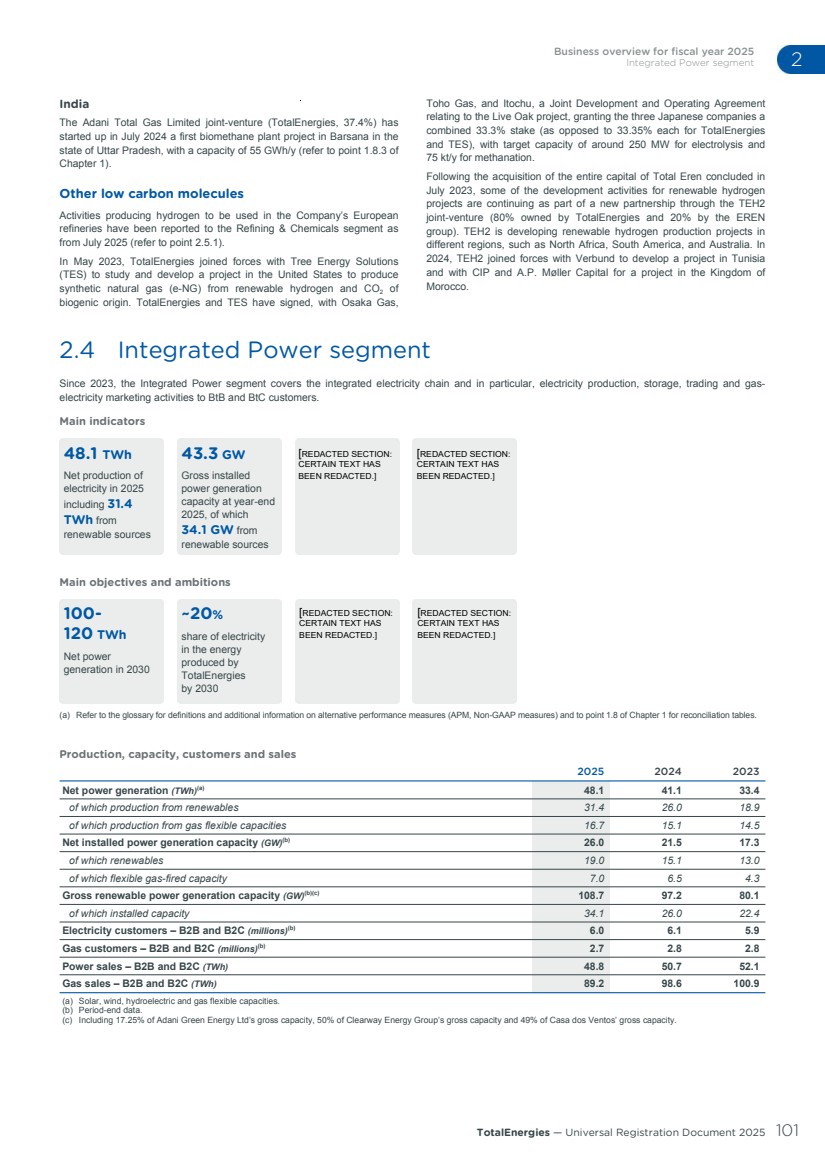
| Net power generation (TWh) December 31, 2025 Solar Onshore wind Offshore wind Gas Storage and hydroelectricity Total France 0.9 1.0 – 4.4 0.1 6.3 Rest of Europe 0.7 2.0 1.1 6.0 0.3 10.1 Africa 0.1 – – – 0.4 0.5 Middle East 1.0 – – 1.0 – 1.9 North America 4.4 2.1 – 5.4 – 11.9 South America 0.5 3.9 – – – 4.4 India 9.4 1.6 – – – 11.0 Asia-Pacific 1.5 0.0 0.5 – – 2.1 Total 18.4 10.6 1.6 16.7 0.7 48.1 Net power production at year-end 2025 came to 48.1 TWh, up by 17% compared to the previous year. Net installed power production capacity (GW) December 31, 2025 Solar Onshore wind Offshore wind Gas Storage and hydroelectricity Total France 0.8 0.5 – 2.7 0.2 4.2 Rest of Europe 0.6 1.0 0.3 2.1 0.1 4.1 Africa 0.1 – – – 0.1 0.2 Middle East 0.5 – – 0.3 – 0.8 North America 3.0 0.9 – 2.0 0.5 6.4 South America 0.5 1.2 – – – 1.7 India 6.7 0.6 – – – 7.2 Asia-Pacific 1.2 0.0 0.2 – – 1.4 Total 13.4 4.1 0.5 7.0 1.0 26.0 2.4.1 Presentation of the segment Electricity is a high-growth market in which TotalEnergies’ strategy is to develop a profitable and differentiated integrated business model, which it aims to make one of the drivers of the Company’s cash flow (CFFO(1)), alongside oil and gas. TotalEnergies plans to increase its net power production to 100-120 TWh, mainly from renewable sources by 2030. It was 48.1 TWh in 2025, compared to 41.1 TWh in 2024 and 33.4 TWh in 2023. TotalEnergies intends to replicate its integrated oil & gas model in the Integrated Power segment in order to achieve a profitability (ROACE(2)) of around 12% by 2028, equivalent to that of its oil & gas activities in a Brent price environment of $60/b. The Company’s strategy is to build a competitive portfolio of renewable (mainly solar, onshore and offshore wind) and flexible (CCGT, battery energy storage systems) assets in order to expand its electricity trading activities, provide its customers with low-carbon electricity available 24 hours a day (Clean Firm Power), and meet the growing demand from data centers. (1) Refer to the glossary for definitions and additional information on alternative performance measures (APM, Non-GAAP measures) and to point 1.8 of Chapter 1 for reconciliation tables. (2) Refer to the glossary for definitions and additional information on alternative performance measures (APM, Non-GAAP measures) and to point 1.8 of Chapter 1 for reconciliation tables. 2 Business overview for fiscal year 2025 Integrated Power segment 102 TotalEnergies — Universal Registration Document 2025 [REDACTED SECTION: CERTAIN TEXT HAS BEEN REDACTED.] |
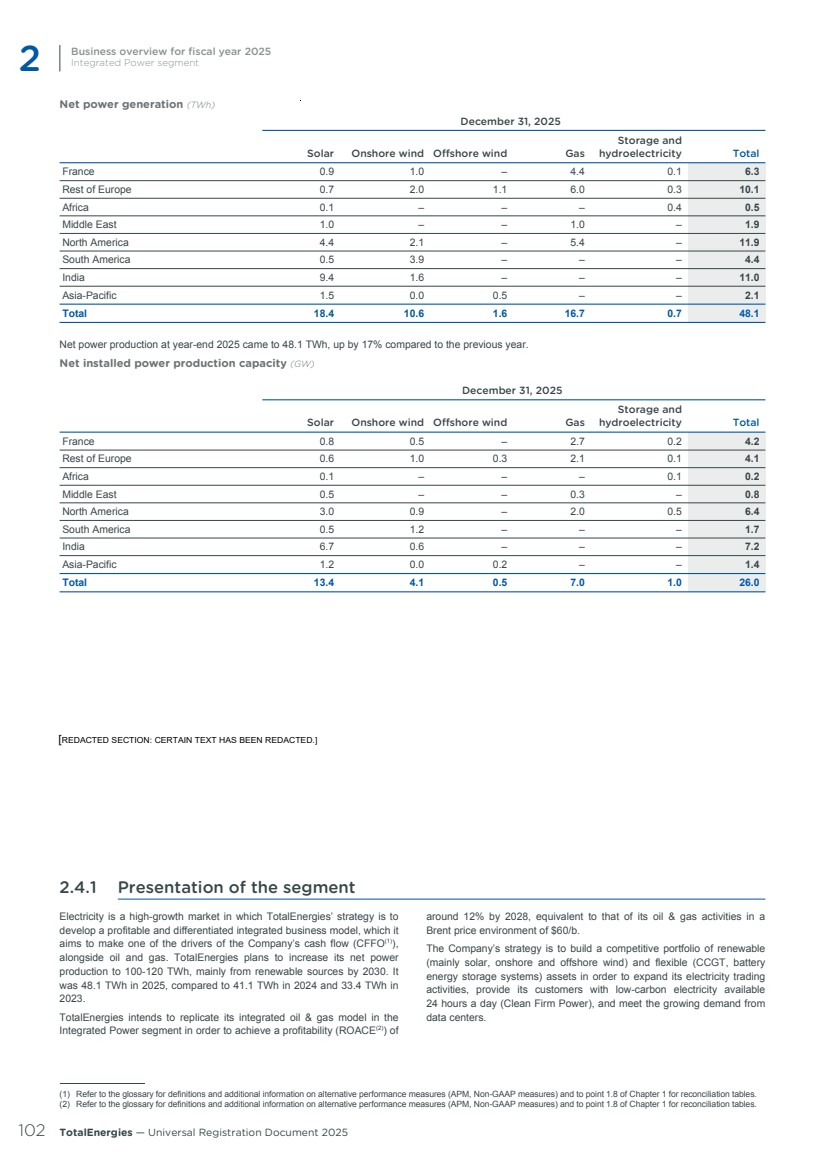
| In this context, the Company announced in November 2025 the acquisition of 50% of EPH’s flexible generation portfolio in Europe. This transaction(1) should allow the Company to target a positive cash flow (CFFO) as early as 2027, one year earlier than previously planned. In addition, this transaction reinforces the integration of TotalEnergies’ LNG value chain with its electricity production. Thus, the additional net electricity production generated, estimated at 15 TWh/y, will provide added value to approximately 2 Mt/y of LNG. TotalEnergies intends to focus its development primarily on deploying an integrated model in its key markets (Europe, the United States, and Brazil), which will represent around 70% of its electricity production. In these markets, which are deregulated, the Company anticipates sustained and volatile electricity prices, in a context of strong growth in electricity demand reinforced by data centers’ needs and tensions on the supply side. The Company implements on these markets its integrated strategy across the electricity value chain thanks to a production portfolio balanced between renewable and flexible capacities, by keeping around 30% of its electricity production exposed to market price fluctuations, in order to capture additional margins in a volatile market, and by strengthening its electricity trading activities and its sales to end customers. In this context, TotalEnergies is developing specific expertise in short‑term electricity market trading, flexibility management activities, and the Corporate PPA (Power Purchase Agreement) market. In parallel, TotalEnergies leverages its scale effect in equipment purchase to optimize its investment costs and industrialize the operation of its renewable assets using digital technology to lower operating costs. In other geographies, TotalEnergies is implementing a targeted growth strategy: – in oil and gas producing countries, to support the Company’s historical activities, reduce its emissions through renewables, and contribute to these countries’ energy transition; – in the rest of the world, by selectively developing renewable projects, particularly in markets whose size allow for scale effects (such as India and South Africa), and through strategic partnerships with local players. Finally, the Company plans to monetize renewable projects located in non‑strategic countries and to reinforce its capital allocation discipline. This refocusing aims to improve profitability, simplify the geographic portfolio, and accelerate the deployment of the integrated model in markets offering the strongest value potential. 2.4.2 Power generation from renewable sources To develop its renewable electricity generation capacity, TotalEnergies is pursuing organic growth, targeted acquisitions and a capital recycling strategy. Consequently, in April 2025, TotalEnergies completed the acquisition of the German developer VSB Group, which had over 500 MW of renewable capacity in operation or under construction mainly in Germany and France, and a pipeline of 15 GW of wind, solar and battery storage technologies, mainly across Germany, Poland and France. In July 2023, TotalEnergies finalized the increase from 30% to 100% of its shareholding in Total Eren. In line with its business model, and in order to maximize the value of its portfolio and share risks, TotalEnergies sold 50% stakes in renewable asset portfolios totaling 2.7 GW in North America and Europe in 2025. Net renewable power production reached 31.4 TWh in 2025 (compared to 26.0 TWh in 2024 and 18.9 TWh in 2023). Gross installed renewable power generation capacity amounted to 34.1 GW at year-end 2025 compared with 26 GW at year-end 2024 and 22.4 GW at year-end 2023. At year-end 2025, TotalEnergies had a portfolio of renewable power generation gross capacities of close to approximately 109 GW (installed, under construction and in development). Gross installed power generation capacity from renewables December 31, 2025 Gross installed power generation capacity from renewables (GW)(a) Solar Onshore wind Offshore wind Storage and hydroelectricity Total France 1.4 0.9 0.0 0.2 2.5 Rest of Europe 0.7 1.7 1.1 0.3 3.8 Africa 0.3 0.0 0.0 0.4 0.7 Middle East 1.3 0.0 0.0 0.0 1.3 North America 7.3 2.3 0.0 1.0 10.6 South America 0.6 1.8 0.0 0.0 2.4 India 9.7 0.6 0.0 0.0 10.3 Asia-Pacific 1.8 0.0 0.6 0.0 2.5 Total 23.1 7.3 1.8 1.9 34.1 (a) Including 17.25% of Adani Green Energy Ltd’s gross capacities, 50% of Clearway Energy Group’s gross capacities and 49% of Casa dos Ventos’ gross capacities. Gross installed power generation capacity from renewables under construction Gross installed power generation capacity from renewables under construction (GW)(a) December 31, 2025 Solar Onshore wind Offshore wind Storage and hydroelectricity Total France 0.1 0.2 0.0 0.0 0.3 Rest of Europe 0.7 0.1 0.8 0.4 2.1 Africa 0.2 0.1 0.0 0.0 0.4 Middle East 1.7 0.2 0.0 0.0 2.0 North America 0.8 0.0 0.0 0.5 1.3 South America 0.7 0.1 0.0 0.3 1.1 India 0.8 0.0 0.0 0.0 0.8 Asia-Pacific 0.3 0.0 0.0 0.0 0.3 Total 5.5 0.8 0.8 1.2 8.3 (a) Including 17.25% of Adani Green Energy Ltd’s gross capacities, 50% of Clearway Energy Group’s gross capacities and 49% of Casa dos Ventos’ gross capacities. (1) The transaction remains subject to information and consultation processes and regulatory approvals, with completion expected by mid-2026. Business overview for fiscal year 2025 Integrated Power segment 2 TotalEnergies — Universal Registration Document 2025 103 |
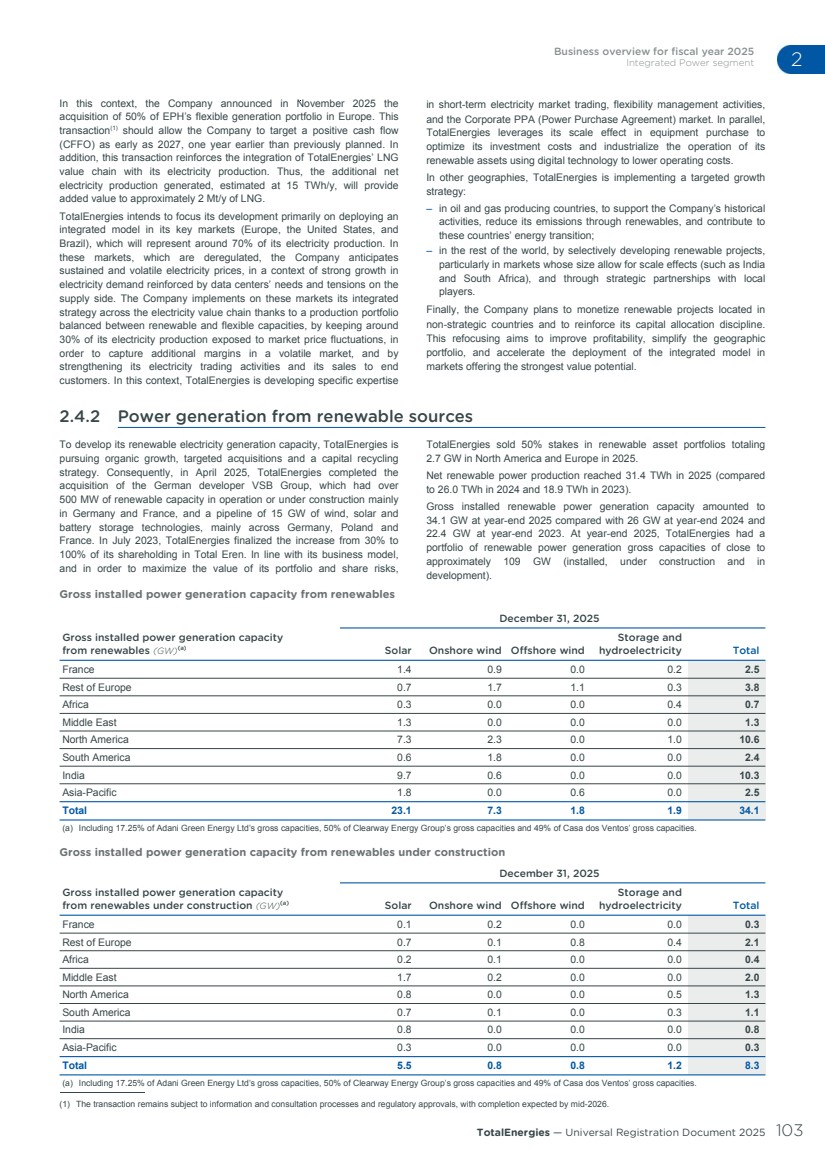
| Gross renewable power generation capacity in development Gross renewable power generation capacity in development (GW) (a) December 31, 2025 Solar Onshore wind Offshore wind Storage and hydroelectricity Total France 0.9 0.5 1.5 0.1 2.9 Rest of Europe 5.9 1.8 14.3 3.6 25.6 Africa 0.3 0.2 0.0 0.0 0.5 Middle East 1.1 0.0 0.0 0.0 1.1 North America 10.8 3.8 4.1 5.4 24.2 South America 1.3 1.3 0.0 0.0 2.6 India 1.6 0.0 0.0 0.0 1.6 Asia-Pacific 3.0 1.1 2.6 1.1 7.8 Total 24.9 8.8 22.5 10.1 66.3 (a) Including 17.25% of Adani Green Energy Ltd’s gross capacities, 50% of Clearway Energy Group’s gross capacities and 49% of Casa dos Ventos’ gross capacities. Solar and onshore wind France The Company develops, builds and operates renewable electricity generation projects. It operates more than 700 onshore wind, solar, hydroelectric and battery assets for an installed gross capacity of approximately 2.5 GW at year-end 2025, of which 2 GW in metropolitan France (compared to 1.8 GW at year-end 2024 and 1.6 GW at year-end 2023)(1) . In 2025, TotalEnergies commissioned roughly 200 MW of capacity in Metropolitan France, including a 45 MW solar facility in the Landes region in December. In 2024, TotalEnergies commissioned a 63 MW wind farm in the Marne region. In 2023, it commissioned a solar power plant with a gross capacity of 25 MW and a battery energy storage facility at its Grandpuits site, two wind farms and a solar power plant with a total installed capacity of approximately 29 MW as well as the Torrent de Gavet hydroelectric power plant, producing approximately 9.5 GWh/y. In addition, the Company develops agrivoltaic projects that respond to the challenges of the agricultural world, in particular through a partnership agreement with the National Federation of Farmers’ Unions (FNSEA) with the aim of promoting the emergence of circular economic networks, the acceptability of projects and the sharing of value with farmers. In 2023, the Company had acquired Ombréa, a leader in agrivoltaics in France enabling in particular to accelerate its development in this field. Finally, in line with its portfolio optimization strategy, in late 2025 TotalEnergies sold 50% of a 270 MW portfolio of renewable projects in France. Rest of Europe and CIS Gross installed capacity by technology and country at December 31, 2025 (MW) Gross installed capacity Solar Onshore wind Hydroelectric Total Portugal 80 526 33 639 Greece 154 265 – 419 Spain 367 – – 367 Turkey 5 277 166 448 Italy 44 41 – 85 Poland – 124 – 124 Bulgaria 14 – – 14 Europe – other countries 37 446 82 565 Uzbekistan 131 – – 131 Kazakhstan 128 – – 128 In the United Kingdom, in June 2025 TotalEnergies acquired a portfolio of solar projects under development with total capacity of 350 MW from Low Carbon. In Germany, in 2025, VSB brought into service the 106 MW Elster project. This is in addition to the two agrivoltaic projects (163 MW, 100%) acquired by TotalEnergies in 2024 and the portfolio of VSB projects in Germany acquired in 2025. In Belgium, TotalEnergies inaugurated in March 2026 a floating solar power plant with a capacity of 31 MW, located in Obourg on a former chalk quarry site that has been rehabilitated into a lake. The solar power plant produces 30GWh per year of renewable electricity, which is self-consumed by Holcim’s industrial facilities, making it the largest floating solar power plant in Europe dedicated to self-consumption. In Spain, Guillena solar power plant (263 MW, 100%) was commissioned in December 2024. Final investment decisions of the San Pedro, Basilicas and Alamos solar projects (65%) were taken, increasing the capacity of the projects under construction to 335 MW. In Portugal, in July 2025 TotalEnergies sold 50% of its 604 MW portfolio of renewable assets in production (solar, wind and hydro). In September 2025, it also started the construction of 40 MW of hybridized projects that consist in the addition of solar capacity to wind assets in production. In Greece, the construction of the Serres project (50 MW, 100%) began in March 2025. The Xirokambi solar project (70 MW, 100%) came into operation in February 2024. In December 2025, TotalEnergies closed the sale of 50% of its 424 MW wind and solar project portfolio located in Greece to Asterion Industrial Partners. The Company retains a 50% stake and remains the operator of the assets. Besides, TotalEnergies will offtake and market most of the electricity produced by these assets when they stop benefiting from the regulated tariffs. (1) Including 133 MW of BESS capacity. 2 Business overview for fiscal year 2025 Integrated Power segment 104 TotalEnergies — Universal Registration Document 2025 |
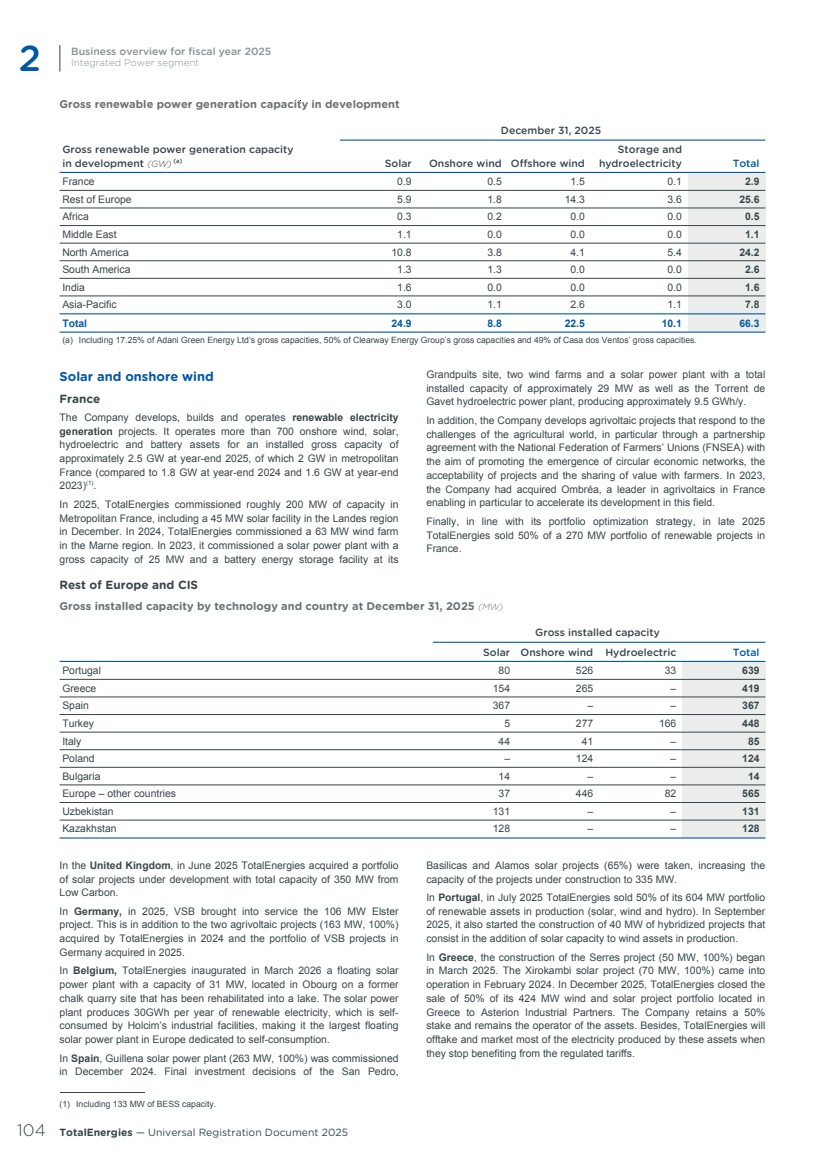
| In Poland in 2025, TotalEnergies, via its VSB subsidiary, started the construction of the Brzezinka hybrid project, which combines a 303 MW photovoltaic facility with a 106 MW battery energy storage system. TotalEnergies announced in December 2024 the acquisition of a 130 MW portfolio of onshore wind projects, adding to the acquisition of 6 solar projects under development (acquired) with an overall production capacity of 175 MW. In Turkey after finalizing the acquisition of a 50% interest in Rönesans Enerji in late 2025, TotalEnergies brought 277 MW of wind power capacity into service, bringing the total capacity in operation to close to 500 MW. In Kazakhstan, in parallel with the signing of a PPA for the totality of the electricity produced with a public purchaser in June 2023, the Company formalized the launch of the Mirny project, providing for the construction of a 1 GW onshore wind farm associated with a 600 MWh battery energy storage system. The Company is also pursuing the development of its renewable activities in the region, notably in Uzbekistan, with the development of two solar power plants with a total gross capacity of around 1.3 GW. That development was made official through a memorandum of understanding signed in November 2023 and confirmed through a new agreement in March 2025. North America In North America, at year-end 2025, TotalEnergies had a portfolio of approximately 25 GW of wind, solar and battery storage projects under development or construction, along with around approximately 11 GW in operation, including 50% of the assets of Clearway Energy Group (CEG). In 2025, TotalEnergies signed agreements with RES to acquire certain wind and solar projects under development in Alberta (Canada), amounting to a total capacity of more than 800 MW. TotalEnergies has also just closed the acquisition of Big Sky Solar, a solar facility (184 MW) located in Alberta and operational since late February. In addition, construction on the Tymochtee (162 MW), Springwater (191 MW) and Piedra PV (350 MW) projects began in July 2025. In October 2025, TotalEnergies sold 50% of a 1.4 GW portfolio of solar projects in North America to KKR, generating $950 million of cash, while remaining the operator. Construction on the Clinton (65 MW) and Brazoria (325 MW) solar projects began in 2023 and was completed in 2025, with the two assets coming into service in June and September 2025 respectively. In 2024, TotalEnergies commissioned Danish Fields (720 MW) and Cottonwood (455 MW), two solar farms with integrated battery storage located in southeast Texas. These new projects are part of a portfolio of renewable assets totaling 5 GW in operation or under construction in Texas. Danish Fields has a 225 MWh battery storage system supplied by Saft. 70% of this project’s solar capacity has been contracted through long-term Corporate Power Purchase Agreements (CPPAs) signed with industry players like Saint-Gobain, featuring an upside-sharing mechanism linked to market prices. The remaining 30% support the reduction of the carbon footprint of TotalEnergies’ industrial plants in the Texan Coast region. Danish Fields, with the Myrtle Solar plant commissioned in 2023, and Hill 1, are expected to cover the electricity consumption of TotalEnergies’ industrial sites in Port Arthur and La Porte, in Texas, and Carville,m in Louisiana. The Cottonwood project, 225 MWh of battery storage provided by Saft, was commissioned in 2025. Cottonwood’s electricity generation is contracted under long-term PPAs with LyondellBasell and Saint-Gobain, to support their efforts to reduce their carbon footprint. These PPAs are linked to market prices through an upside-sharing mechanism. In Puerto Rico, in 2024 TotalEnergies acquired 30% of AES’s shares in two projects (solar and battery storage) under construction with capacity of 546 MW. In the Dominican Republic, TotalEnergies acquired, in July 2025, a 50% stake in the AES Dominicana Renewables Energies (ADRE) portfolio. The portfolio comprises solar, wind and battery storage assets, including 482 MW of capacity in production at the end of 2025 and 315 MW under development. SunPower Corporation In 2011, TotalEnergies had acquired 60% of SunPower as part of its ambition to become a major player in solar energy. In 2022, TotalEnergies sold 50% of its stake to a partner. In August 2024, unfavorable market conditions (rising interest rates, legislative changes in California) forced SunPower to file for bankruptcy under Chapter 11 of the US Code and to liquidate its assets. This process ended in November 2024, with the cancellation of the remaining capital. As a result, TotalEnergies recognized a write-down in the value of its investment in the third quarter of 2024, in addition to the write-down announced in the first quarter of 2024. Maxeon Solar Technologies, Ltd. At the end of 2025, TotalEnergies has a stake of less than 1% in Maxeon, a company that was created in 2020 by a spin-off of SunPower. Asia Pacific In Cambodia, TotalEnergies operates the Battambang solar power plant (74 MW, 100%). To develop new renewable energy projects and other decarbonization initiatives, TotalEnergies signed a memorandum of understanding with Royal Group in October 2023 to study potential partnerships for the development of solar and wind projects. In South Korea, TotalEnergies commissioned the Parang 1 wind farm (17 MW, 70%) in October 2024. In Indonesia in 2023, TotalEnergies, under the leadership of its subsidiary Total Eren and with its partners Adaro Power and PJBi, signed a PPA with public-sector operator PLN for a hybrid wind project (including storage) in Indonesia with forecast capacity of 70 MW/10 MWh. In India, TotalEnergies is present through its partnerships with Adani and a joint venture with EDF. Following the sale of a 1.74% share of capital in the listed company Adani Green Energy Limited (AGEL) in December 2025, the partnerships with Adani include, at the end of 2025, a 17.25% stake in AGEL, which is majority-owned by the Adani family (62.4%) and represents installed capacity of 3.0 GW (solar and wind), and three joint ventures 50%-owned by TotalEnergies and acquired respectively in 2020 (3.1 GW of installed solar capacity), 2023 (1.5 GW of solar and wind capacity) and 2024 (1.5 GW of solar capacity). The joint venture with EDF is owned 50/50 by the two shareholders and has total installed solar capacity of 1.1 GW. At the end of 2025, therefore, TotalEnergies had a solar and wind portfolio with a gross installed capacity of 10.3 GW in India. In Japan, TotalEnergies has interests in four solar power plants with a total gross installed capacity of 155 MW. In Singapore, TotalEnergies and RGE (Royal Golden Eagle), through their joint-venture Singa Renewables Pte. Ltd., obtained conditional authorization from the Energy Market Authority (“EMA”) in 2024, then a conditional license in May 2025, to import 1.0 GW of photovoltaic solar energy from Indonesia. In Australia, TotalEnergies has one solar asset in operation, Kiamal (256 MW, 57.5%). Latin America In Brazil TotalEnergies’ portfolio includes the capacities of Casa dos Ventos, the joint-venture created between TotalEnergies (34%) and FIP Salus (66%). This joint venture also has a pre-emptive right to purchase all projects developed by Casa dos Ventos Desenvolvimento, which is 100%-owned by FIP Salus. Aside from that joint venture, TotalEnergies has three solar photovoltaic assets and two wind assets in operation, with a combined capacity of 300 MW. Since it was set up, Casa dos Ventos has brought into service 2.6 GW (100%) of hybrid wind and solar projects. The joint venture’s projects in operation reached a the capacity of 3.3 GW at the end of 2025. In addition, 1.5 GW of onshore wind projects and 2 GW of solar projects are under construction. Business overview for fiscal year 2025 Integrated Power segment 2 TotalEnergies — Universal Registration Document 2025 105 |
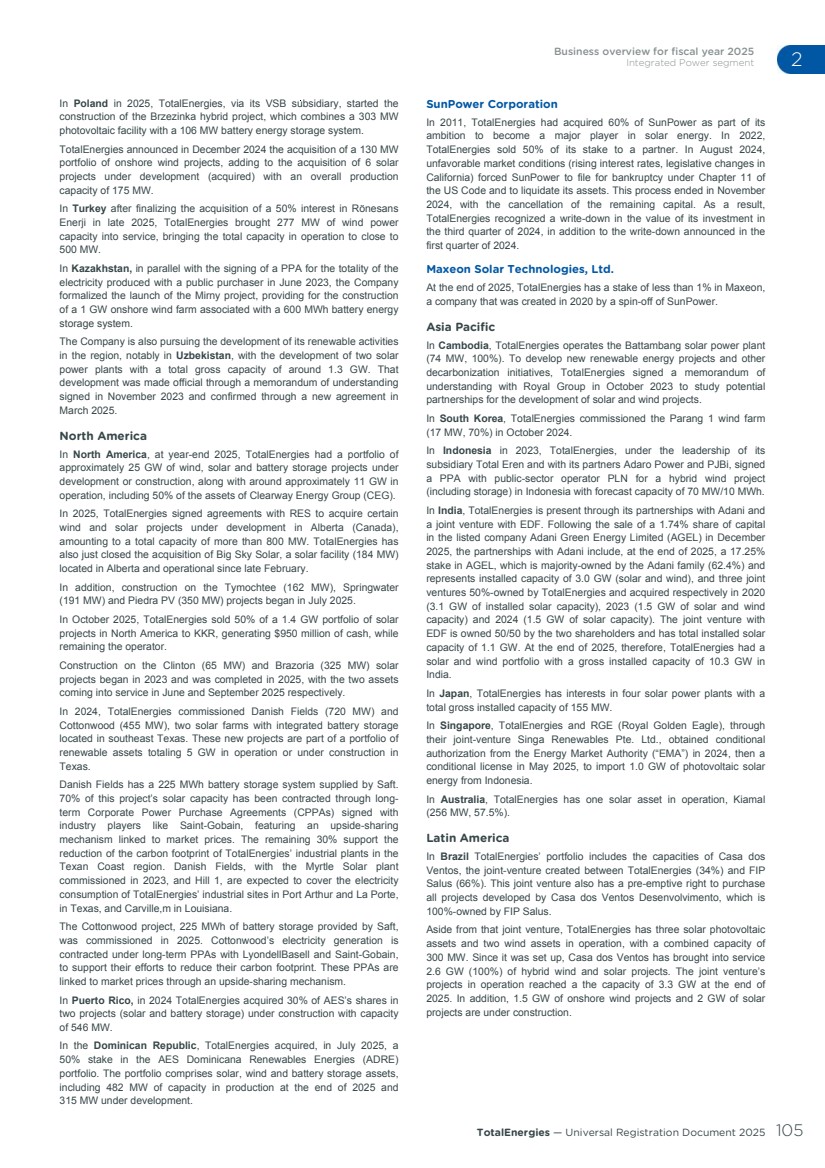
| In addition, TotalEnergies had signed in 2023 a memorandum of understanding with Casa dos Ventos and Petrobras to evaluate the prospects for joint projects in the field of renewable energies and low-carbon hydrogen in Brazil. In Chile, TotalEnergies has interests in two solar power plants with a gross installed capacity of 213 MW. In Argentina, TotalEnergies has a 100% interest in three wind farms with a gross installed capacity of 247 MW, along with two solar facilities with capacity of 44 MW. In October 2025, TotalEnergies started construction of the La Perla solar project (41 MW), whose power generation is intended to reduce the carbon footprint of Total Austral, a subsidiary in TotalEnergies’ Exploration & Production (EP) segment in the country. Finally, the project to supply wind power to an EP site in Tierra del Fuego (9 MW; 100%) was commissioned in January 2026 Middle East/Africa In the Middle East, TotalEnergies is implementing its multi-energy strategy. TotalEnergies thus has interests in two operational solar projects: Wadi Ad Dawasir (approximately 120 MW, 40%) in Saudi Arabia, and Shams in Abu Dhabi (110 MW, 20%). In addition, in December 2024, the consortium comprising TotalEnergies and Saudi developer Aljomaih Energy and Water Company (AEW) signed a 25-year PPA with Saudi Power Procurement Company for the 300 MW Rabigh 2 solar project. This project is currently in the construction phase. In October 2025, TotalEnergies and AEW signed a new PPA with SPPC for an additional 400 MW project, with a term of 25 years. This solar facility is expected to connect to the grid in 2027. As part of a multi-energy agreement with Iraq signed in September 2021, TotalEnergies is building a 1.2 GW solar power plant to supply the Basra region’s grid. Qatar Energy has taken a 50% stake in the project. In Oman, TotalEnergies is building 300 MW of renewable energy projects after signing agreements with its partner OQ Alternative Energy (OQAE) in December 2024. The electricity will be delivered through PPAs to Petroleum Development Oman (PDO), the leading exploration and production company in the Sultanate. In Qatar, TotalEnergies holds an interest in the Al Kharsaah solar power plant (800 MW, 19.6%). As the country’s first large-scale solar power plant, Al Kharsaah is 40% owned by the consortium formed by TotalEnergies (49%) and Marubeni (51%) and 60% owned by QatarEnergy Renewables Solutions. In South Africa, in February 2024, TotalEnergies and its partners started the construction of a hybrid renewable project comprising a 216 MW solar power plant (35%) as well as a 588 MWh battery storage system (35%) to supply renewable electricity via a PPA for 20 years to the national grid. In November 2024, TotalEnergies also began the construction of an onshore wind project (155 MW, 33.5%) and of a solar project (142 MW, 33.5%). These two projects are expected to enable TotalEnergies to reduce the carbon footprint of the energy supplying Sasol and Air Liquide’s industrial sites, in accordance with the Corporate PPA signed between the parties in February 2023 covering the supply of renewable electricity over a period of 20 years. TotalEnergies also owns a stake in the Prieska solar power plant (86 MW, 27%). In Angola, TotalEnergies is building the Quilemba solar project (35 MW, 51%). In Egypt, TotalEnergies owns 100% of two solar power plants in operation for a total of 126 MW. In Morocco, TotalEnergies invested in 2023 to acquire a minority stake in Xlinks First Limited, in order to develop a large-scale renewables project combining wind and solar power coupled with large battery storage to supply green electricity to the UK. In 2025, TotalEnergies withdrew from the project. In Mozambique, TotalEnergies acquired in 2024 a majority stake in the Metoro solar project (41 MW, 75%), the construction of which (suspended since 2022) is approximately 75% complete. In addition, TotalEnergies holds a 21% stake in the project company developing the 1.5 GW Mphanda Nkuwa hydroelectric project. Finally, in March 2025, TotalEnergies signed an agreement with Scatec, a Norwegian renewable energy company, to acquire 100% of its subsidiary SN Power, which holds, through its 51% share in a joint venture with Norfund and British International Investment (BII), interests in renewable hydropower projects in Africa. As a result of this transaction, TotalEnergies acquired a 28.3% stake in the Bujagali hydropower plant (255 MW) currently in operation in Uganda and minority stakes in two projects under development in Rwanda (206 MW) and Malawi (360 MW). Offshore wind As of the end of 2025, TotalEnergies has a gross capacity of approximately 2.6 GW of offshore wind projects in operation or under construction. The Company also holds a portfolio of concessions in various countries. Following a strategic review, TotalEnergies intends to refocus its development activities on Germany, the United Kingdom and France. Europe In Germany, TotalEnergies, as a shareholder of North Sea OFW One GmbH, was awarded in June 2025 the N-9.4 offshore concession. Located in the North Sea, approximately 150 km northwest of the German island of Heligoland, the N-9.4 concession covers an area of around 141 km2 and should allow the development of 1 GW of offshore wind capacity. The Company is also focusing on the development of the N‑12.1 concession, with a capacity of 2 GW, as well as on the two offshore wind projects with a combined capacity of 4 GW (concessions N‑9.1 and N‑9.2), in which TotalEnergies holds a 50% stake following the agreement signed with RWE in October 2024. In France, the consortium formed by TotalEnergies and RWE was selected as the winner of the Centre Manche 2 (AO8) offshore wind tender in September 2025. The consortium will be responsible for designing, developing, building, and operating a 1.5 GW offshore wind farm. TotalEnergies is a 20% shareholder in the Eolmed pilot project, a 30 MW floating wind farm located in the Mediterranean off the coast of Gruissan and Port-la-Nouvelle, which is scheduled to be commissioned in 2026. In the Netherlands, TotalEnergies acquired a 50% stake from RWE in the 795 MW OranjeWind offshore wind farm project in July 2024. TotalEnergies will dedicate its share of the renewable electricity production from this project to power 350 MW electrolyzer projects. These should produce about 40 t/y of green hydrogen for the reduction of the carbon footprint of TotalEnergies’ refineries in Northern Europe. In the United Kingdom, TotalEnergies holds a 25.5% stake in the Seagreen project in Scotland, following the sale in December 2023 of a 25.5% interest to PTTEP, alongside SSE Renewables (49%). This fixed‑bottom offshore wind farm, with a gross capacity of 1.1 GW, is located in the North Sea off the Angus coast. In addition, the Company is developing in England the Outer Dowsing Offshore Wind project, a 1.5 GW fixed‑bottom offshore wind farm, in a joint venture with Macquarie and Gulf Energy Development Public Company Limited (GULF), following GULF’s acquisition in March 2023 of half of Corio Generation’s initial stake (a Macquarie subsidiary). TotalEnergies holds a 50% interest in the project, alongside Macquarie (25.01%) and GULF (24.99%). Rest of the world In the United States, TotalEnergies signed on March 23, 2026 settlement agreements with the United States Department of the Interior (DOI) to relinquish its Carolina Long Bay lease (Lease OCS-A 0545) and its New York Bight lease (Lease OCS-A 0538), both awarded in 2022, along with its partners. As a result, TotalEnergies will no longer develop offshore wind projects in the United States. Under the terms of the settlement, TotalEnergies will recover the lease fees paid and will invest an equal amount in the development of U.S. Gas & Power production and exports. In Taiwan, TotalEnergies holds a 29% stake in the Yunlin project with a gross capacity of 640 MW at year end 2025. The installation of its 80 turbines was completed in 2024 and the project has been operating at its full capacity since the end of 2024. 2 Business overview for fiscal year 2025 Integrated Power segment 106 TotalEnergies — Universal Registration Document 2025 |
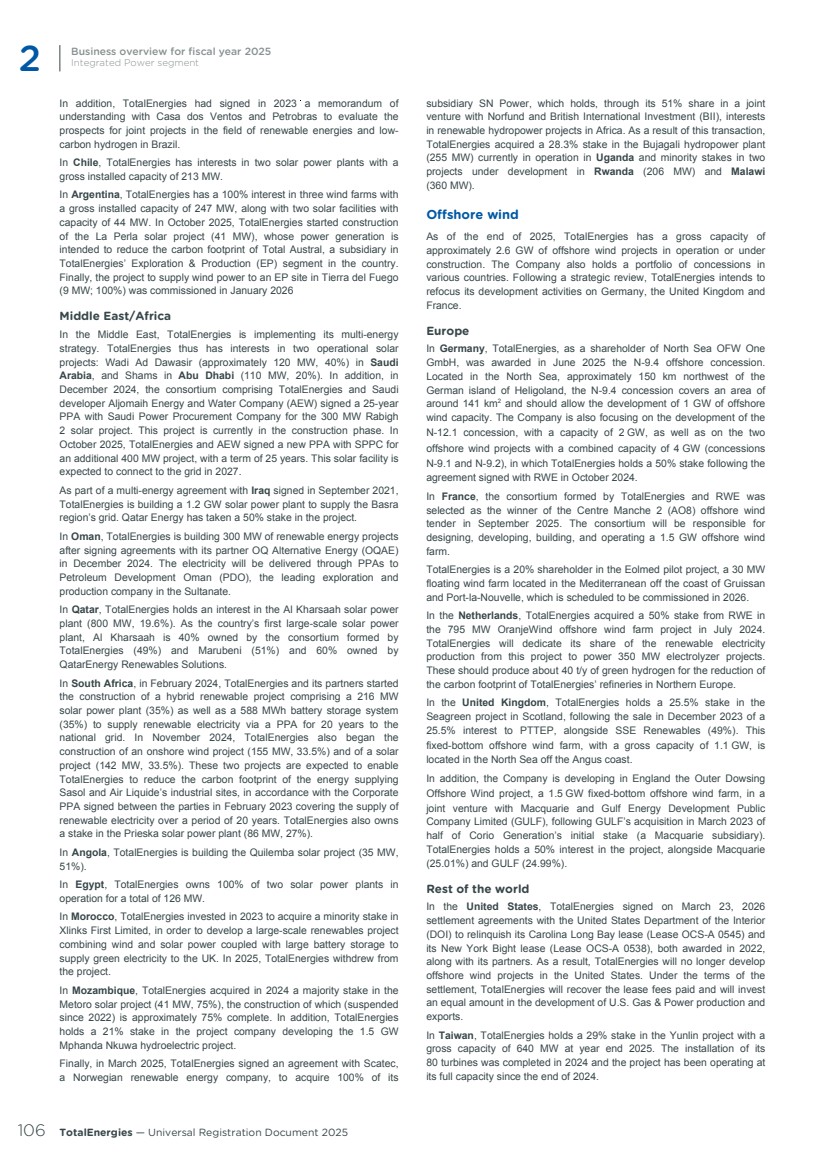
| Distributed generation In the decentralized power generation segment, TotalEnergies develops and builds photovoltaic systems, that may be combined with batteries or other means of generation installed at industrial or commercial sites for own consumption. Depending on each country’s regulations, TotalEnergies can operate those systems or lease them to local players. TotalEnergies enters into private PPAs as part of its activities. In addition, it helps to roll out TotalEnergies’ program for solarizing its own sites. At the end of 2025, its portfolio amounted to approximately 1.4 GW of gross installed capacity spread over 750 sites. In the United States, TotalEnergies has brought into operation more than 150 MW of solar and battery capacity since 2023. The commissioning of an on-site solar power generation and storage system, located in New York at John F. Kennedy International Airport (JFK), is expected in 2026. This system combines 12 MW of solar shading with a 7.5 MW BESS storage system. In September 2025, TotalEnergies acquired 11 ready-to-build solar projects in Georgia from Inman Solar, with decentralized generation capacity of 50 MW. In the rest of the world, TotalEnergies has 800 MW of gross decentralized solar capacity installed in China through its joint venture with the investment fund Cathay Capital, 300 MW in Southeast Asia (notably through its joint venture with ENEOS), and 120 MW in Africa and the Middle East. 2.4.3 Flexible power generation Power generation from natural gas TotalEnergies’ construction of a natural gas-fired electricity generation portfolio is part of its strategy of integrating natural gas and electricity value chain in Europe, from production to marketing, natural gas constituting an ideal complement to intermittent renewable power generation sources. Thanks to the flexible production from those power plants, TotalEnergies can optimize its customers’ electricity procurement costs. At year-end 2025, TotalEnergies had 16 generation units (unchanged from year-end 2024 compared to nine at year-end 2023), in Europe and the United States, with a total gross power generation capacity of 6.7 GW and 2 cogeneration units (0.4 GW capacity). Total net electricity generation from natural gas was 16.7 TWh in 2025, compared to 15.1 TWh in 2024 and 14.5 TWh in 2023. In November 2025, TotalEnergies announced the signing of an agreement with Energetický aprůmyslový holding, a.s. (EPH) for the acquisition of 50% of a flexible power generation platform (gas and biomass plants, batteries) in Western Europe (Italy, United Kingdom and Ireland, Netherlands, France), valued at €10.6 billion (enterprise value). The transaction, which covers a portfolio of more than 14 GW of gross capacity in operation or under construction, will lead to the creation of a 50/50 joint venture between TotalEnergies and EPH. This joint venture will be responsible for the industrial management of the assets and the development of the portfolio, while each of the two companies will market its share of production through a tolling agreement with the joint venture. The acquisition perimeter includes a portfolio of development projects totaling around 5 GW: – Italy: 7.5 GW, including 3.7 GW in operation, 2.4 GW under construction, notably two latest‑generation gas-fired power plants, among the most efficient in Europe, and 1.4 GW under development; – United Kingdom and Ireland: 7.1 GW, including 5 GW of existing gas and biomass plants, 0.4 GW of batteries under construction, and 1.7 GW under development; – Netherlands: 3.6 GW, including 2.6 GW of gas plants particularly well positioned to meet German market needs, 0.2 GW of batteries under construction, and 0.8 GW under development; – France: 1.1 GW, including 100 MW of batteries under construction and 1 GW under development. The agreement states that the joint venture will become the preferred vehicle for TotalEnergies and EPH to grow flexible power generation in the countries concerned. The transaction is subject to the legal process of informing and consulting the relevant employee representative bodies, as well as the approval of the competent authorities. Completion is expected in mid‑2026. Portfolio of electricity generation from natural gas in Europe and the United States at year-end 2025 Country Plant TotalEnergies’ share (%) Gross capacity (MW) France Bayet 100 420 Pont-sur-Sambre 100 445 Toul 100 440 Saint-Avold (2 units) 76 884 Landivisiau 50 446 Belgium Marchienne 100 404 Spain Castejon (2 units) 100 843 United Kingdom West Burton B (3 units) 50 1,335 United States Wolf Hollow I 100 747 Colorado Bend I (2 units) 100 601 La Porte 100 148 In France, as of December 31, 2025, TotalEnergies owned six CCGT plants (unchanged from 2024 and 2023), and one co-generation unit (Normandy refinery). Their gross natural gas-fired power generation capacity thus stood at 2.9 GW at year-end 2025. In Belgium, TotalEnergies owns the Marchienne CCGT plant and has access to its Antwerp co-generation unit’s power generation (0.1 GW). In the United Kingdom, in 2024 TotalEnergies acquired West Burton Energy, which owns and operates the West Burton B natural gas-fired power station. Located in the county of Nottinghamshire, England, it is equipped with three combined-cycle turbines (CCGT) with a total capacity of 1.3 GW. In December 2024, TotalEnergies announced the sale of 50% of its shares in West Burton Energy to EPUKI, the British subsidiary of EPH. The plant is operated by the joint-venture between TotalEnergies and EPUKI. In the United States, the Company acquired a set of three gas-fired power plants from TexGen in 2023, representing 1.5 GW of power generation capacity in Texas. The plants are respectively located near Dallas and Houston, and are connected to the ERCOT (Electric Reliability Council of Texas) grid. This 1.5 GW of additional flexible generation capacity acquired by TotalEnergies complements its renewable generation capacity in Texas, and strengthens TotalEnergies’ trading capabilities in the electricity and natural gas markets. Business overview for fiscal year 2025 Integrated Power segment 2 TotalEnergies — Universal Registration Document 2025 107 |
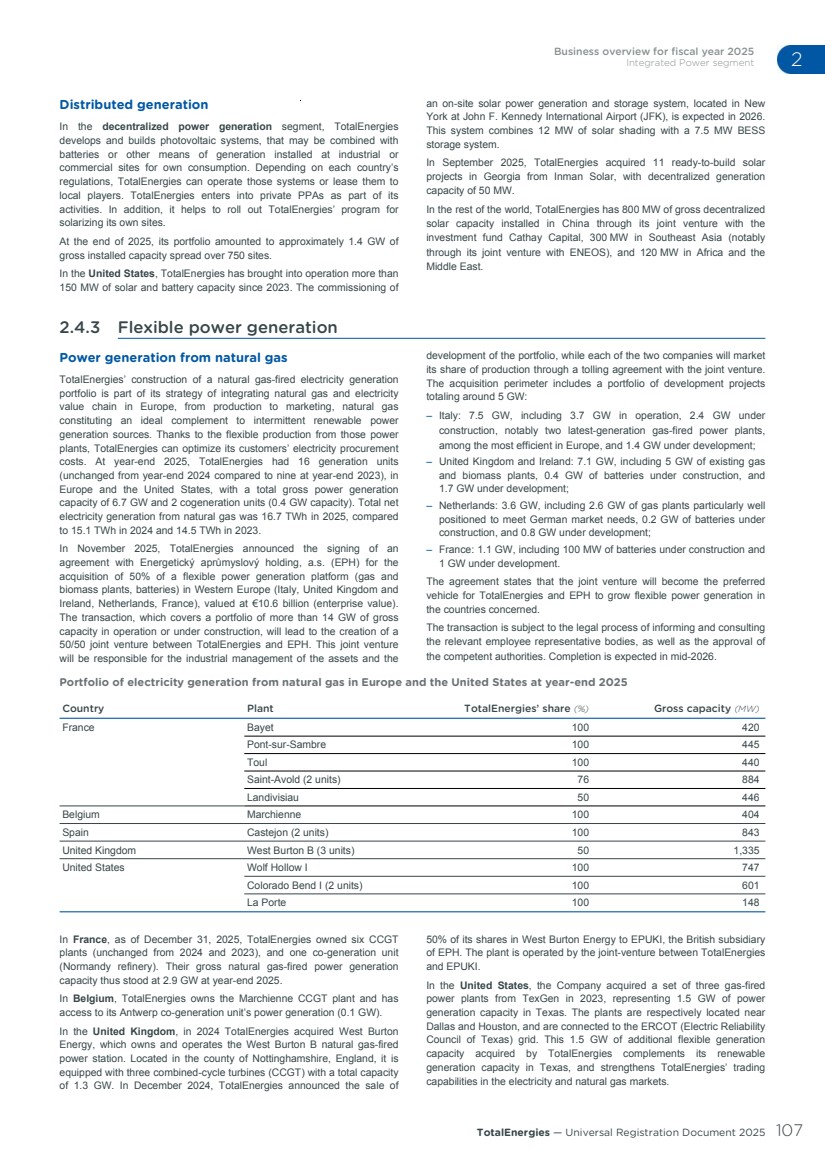
| In Abu Dhabi, the Taweelah A1 natural gas-fired power plant, owned by the Gulf Total Tractebel Power Company (TotalEnergies, 20%), combines electricity generation and seawater desalination. The plant has a gross power generation capacity of 1.6 GW and a seawater desalination capacity of 385,000 m³/day. The plant’s production is sold to Emirati Water and Electricity Company (EWEC) under a long-term agreement. Battery energy storage system Electricity storage is a major challenge for the future of power grids and a vital add-on to renewables, which are intermittent by nature. Large-scale electricity storage is essential to support the growth of renewables and ensure they can account for a significant share of the electricity mix. In Germany, the Company acquired Kyon Energy, a leading battery storage developer, from its three founders in February 2024. When acquired, Kyon Energy had developed, since its creation in 2021, 770 MW of projects, of which 120 MW already in operation, 350 MW under construction and 300 MW are ready to build. In addition, Kyon’s portfolio comprised 2 GW of projects at an advanced stage of development. In March 2026, the Company signed an agreement with Allianz Global Investors (AllianzGI) for the sale of a 50% stake in a portfolio of 11 battery storage projects with a total capacity of 789 MW – 1,628 MWh. These 11 projects, located across Germany, were developed by Kyon Energy following its acquisition by TotalEnergies and are all expected to be operational by 2028. Most of them will use next‑generation batteries supplied by Saft. TotalEnergies will remain the operator of the assets. Quadra Energy, a start-up and one of the German leaders in renewable power aggregation, acquired by TotalEnergies in October 2023, will monetize on electricity markets the flexibility provided by these batteries. In Belgium, TotalEnergies announced in April 2024 the launch of a new battery electricity storage project at the TotalEnergies Feluy depot. It will have a power output of 25 MW and a capacity of 75 MWh thanks to the 40 “Intensium Max High Energy” lithium-ion containers supplied by Saft. It is set to be commissioned in 2026. In the United Kingdom, in June 2025 TotalEnergies announced the acquisition of Low Carbon, a leading player in renewable energies whose project portfolio includes two battery storage facilities with capacity of 85 MW. The agreement signed with EPH for the acquisition of a 50% stake in a flexible power generation platform, announced in November 2025, includes 1.3 GW of batteries under construction (0.4 GW in the United Kingdom, 0.2 GW in the Netherlands, 0.1 GW in France, and the remainder in Italy) as well as 1.6 GW of batteries under development. The strong growth of renewables is changing the balance of grid operators. Consequently, TotalEnergies offers them services to manage the flexibility required to balance production and consumption. TotalEnergies has built and operates battery electricity storage systems in France on three of the Company’s sites: Dunkirk (61 MW), Carling (25 MW) and Grandpuits (43 MW), the latter having been commissioned in 2023. These systems, made up of Saft containers, are connected to the grid and allow RTE to strengthen the security of supply of the French electricity system. Similarly, the energy storage system at the Antwerp refinery contributes 24/7 to the needs of the European and Belgian high‑voltage transmission grid by ensuring daily electricity smoothing on the national network, particularly during tight winter periods, helping to maintain grid security, actively participating in national balancing reserves, and enabling greater integration of renewable electricity into the grid. 2.4.4 Saft Saft is a century-old French company that specializes in the design, manufacture, and sale of high-tech batteries for industry. Saft develops batteries based on nickel, lithium-ion and primary lithium technologies. At the end of 2025, Saft was present in 19 countries mainly in Europe, the United States and Asia, with 4,500 employees. The company is active in transportation (aeronautics, rail and off-road electric mobility), industrial infrastructure, smart meters and the Internet of things, aerospace, defense and energy storage. In 2025, Saft continued to develop its activities, particularly in the field of energy storage, notably through: – the delivery for TotalEnergies of a second energy storage system in Belgium, in Feluy, following the one of the refinery in Antwerp in 2024; – the commissioning for TotalEnergies of the Cottonwood project (Texas), a battery energy storage system with a capacity of 150 MW/ 225 MWh. This is the third project of this scale in Texas, after Myrtle in 2023 and Danish in 2024. 2.4.5 Natural gas and electricity marketing and electricity trading Corporate PPAs On deregulated electricity markets, it is possible to sign long-term sales contracts, Corporate PPAs, for the output from solar or wind assets with corporate customers. Unlike in the distributed generation business, these assets are not located on the customer’s property, but elsewhere on the electricity grid. The electricity generated by these assets is then injected into the electricity grid. These contracts are usually signed on a long-term basis with fixed prices or with limited price variations. They enable customers to buy low-carbon electricity directly from the producer, while at the same time benefiting from a stable electricity price over the long term with access to the cost advantages offered by large-scale plants. These contracts enable TotalEnergies to secure long-term electricity sales, and they support the launch of new generation assets. Corporate PPAs exist in a growing number of countries. Today, the most dynamic markets are the United States, Western Europe, or Brazil. TotalEnergies positions itself locally in these different markets to offer its customers global solutions and thus support them in their decarbonization objectives. Since the beginning of 2025, numerous Corporate PPAs have been signed totaling around 37 TWh, notably with: – long‑term renewable electricity supply contracts with a constant consumption profile (Clean Firm Power) signed with STMicroelectronics in France, SWM (a major player in the paper industry) in France, and Airbus in France and the United Kingdom; – renewable electricity supply contracts for Data4’s data centers in Spain, as well as several Google sites in the United States and Malaysia. At the end of 2025, TotalEnergies had a portfolio of Corporate PPAs amounting to 6.6 TWh/y. In addition to the companies mentioned above, these Corporate PPAs involve clients such as Saint-Gobain, Air Liquide, Amazon Web Services, Kilroy, LyondellBasell, Merck, Sasol, and Orange. Electricity aggregation and trading TotalEnergies is active in electricity trading, mainly in Europe and North America. It sells its output to third parties and supplies its subsidiaries. 2 Business overview for fiscal year 2025 Integrated Power segment 108 TotalEnergies — Universal Registration Document 2025 |
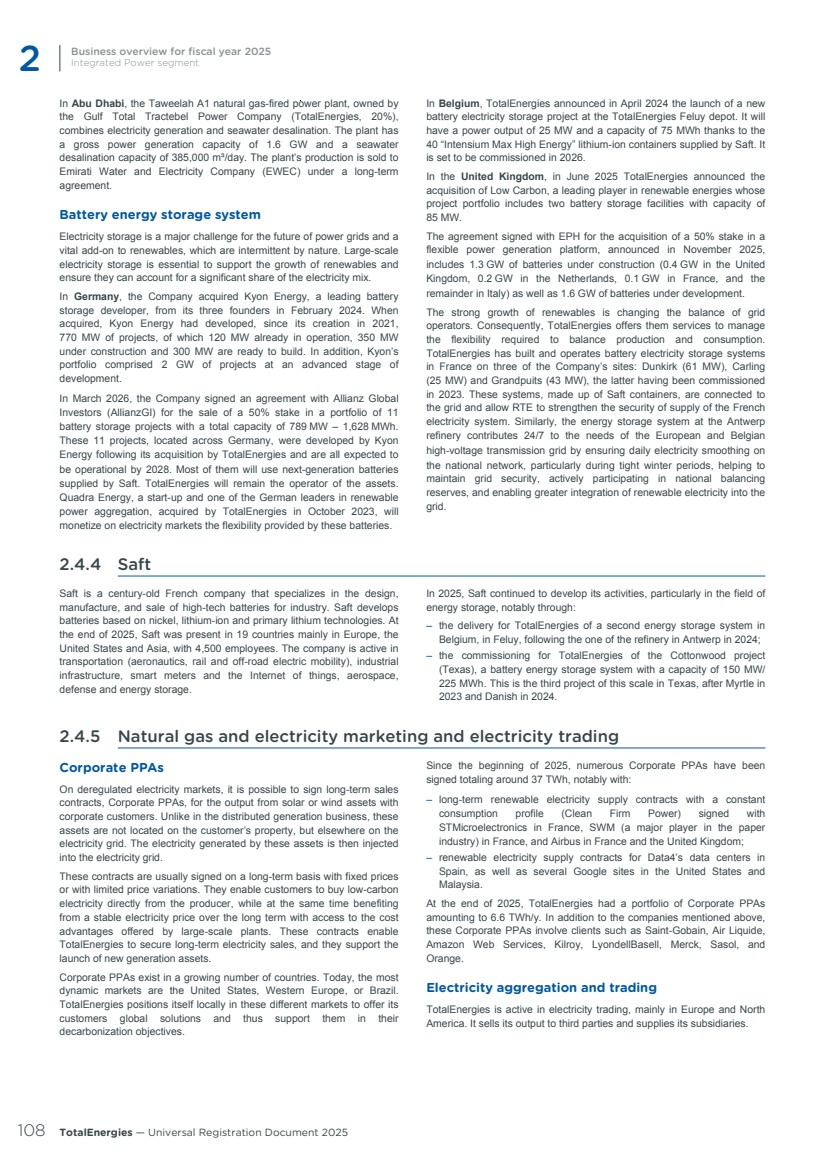
| To support its development in the field of renewable electricity, the Company has developed specific expertise in trading on short-term markets (intra-day, physical delivery), in the structured PPA-type products, in particular to transform intermittent renewable generation into the supply of continuous and constant volumes of low-carbon energy, aggregation, and flexibility management segments. In Europe, TotalEnergies delivered 72 TWh of electricity in 2025, compared to 90 TWh in 2024 and 95 TWh in 2023, mainly from external sources. European electricity trading is mainly carried out from offices in Geneva, Paris, Düsseldorf, Madrid and Liège. In Germany, TotalEnergies strengthened its electricity aggregation and trading activities through the acquisition of the German company Quadra Energy, finalized in April 2024. Founded in 2012 and aggregating 10 GW, Quadra Energy is one of the leading aggregators of renewable electricity generation in Germany. The Company leverages Quadra Energy’s recognized expertise, as well as its innovative weather forecasting platform, to expand its marketing activities in order to offer its German customers competitive contracts for the sale of low-carbon electricity available around the clock. In Switzerland, TotalEnergies announced the acquisition of Predictive Layer in December 2023. The latter’s activity consists in improving the performance of electricity trading operations, thanks to the internalization of machine learning and artificial intelligence solutions. In particular, they make it possible to make projections on energy prices, whether on physical markets or derivatives markets. In North America, TotalEnergies delivered 20.4 TWh of electricity in 2025 compared to 16.6 TWh in 2024 and 6.2 TWh in 2023. In 2025, TotalEnergies took over management of the Cottonwood storage system, after taking over in 2024 the management of three gas-fired power plants acquired in 2023, as well as the Myrtle and Danish Field battery storage systems, commissioned between 2023 and 2024. TotalEnergies has also obtained authorizations to begin electricity trading on the PJM and MISO markets, in addition to the ERCOT, SPP and CAISO markets in which the Company already operated. Natural gas and electricity marketing Europe With a portfolio of 5.6 million BtB and BtC customer sites (gas and electricity) in France, 8.7 million BtB and BtC client sites in Europe and 48.8 TWh of electricity and 89.2 TWh of gas supplied in 2025 in Europe, TotalEnergies has become a leading player in the sale of natural gas and electricity to both the residential and professional markets (commercial and industrial segments). In a context of rising electricity and natural gas prices, since November 2022 TotalEnergies has committed to support its customers by encouraging them to save energy, through the development of new offers and the broadcasting of voltage alerts on the electricity grid, while maintaining a competitive pricing position. For individual customers in France, TotalEnergies has implemented: – the “Tous Acteurs” program for winter 2025-2026, encouraging customers to reduce their electricity consumption on days of peak grid demand (PP1 days). Participants receive alerts on the day before such days and on the days themselves, encouraging them to shift energy use outside of peak hours (7am-3pm and 6-8pm), and they are rewarded if they do so. This program follows the “Conso Master” program in winter 2024-2025, encouraging customers to discover the mobile application and take control of the consumption management tools it offers, and the “Bonus conso” program introduced during the winters of 2022-2023 and 2023-2024, which rewarded customers who reduced their electricity consumption over the winter period with bonuses deducted directly from their bills; – a new “coach conso” virtual assistant that is an integral part of the TotalEnergies app, analyzing power consumption data in order to provide customers with personalized advice enhanced by generative AI. The assistant is interactive: it answers customers’ questions and makes recommendations to help them cut their consumption; – the “Zoom Conso” monthly consumption report, which enables customers to monitor their consumption relative to the same month of the previous year, and compare it with that of similar households. It gives customers direct access to diagnostic and detailed monitoring tools in the mobile app, giving them greater control over their consumption; – the “Rendez-vous Solidaire” for customers eligible to the Chèque Energie energy subsidy or Fonds de Solidarité Logement housing subsidy. A free, personalized assessment is available to provide specific support in controlling and optimizing the customer’s contract and energy consumption. In 2025, more than 5,500 appointments were made with a satisfaction rate of 90%; – the “fuel advantage” offer since September 2024 which allows all TotalEnergies residential electricity and gas customers in France to benefit from a price cap for all fuels in TotalEnergies stations, fixed for the whole year 2026 at €1.99/l, regardless of the fuel. In addition, TotalEnergies chose to subscribe to the 13 measures and best practices defined by the CRE to improve the transparency and readability of offers made to residential electricity and gas customers. By committing to respect them throughout the customer journey, TotalEnergies confirms its proactive approach to continuous improvement for the benefit of its customers. In November 2025, CRE declared that TotalEnergies was fully compliant with the first six measures. TotalEnergies markets natural gas and electricity in the residential and professional segments in France through its subsidiary TotalEnergies Electricité et Gaz France (a merger of the TotalEnergies Énergie Gaz, TotalEnergies Spring France and Direct Énergie entities), in Belgium, through TotalEnergies Power & Gas Belgium subsidiary (formerly Lampiris SA), and in Spain. TotalEnergies also markets natural gas and electricity to the professional segment in the United Kingdom. (millions of B2B and B2C sites) 2025 2024 2023 Europe 8.7 8.8 8.7 France 5.6 5.6 5.5 Belgium 0.8 0.9 0.9 United Kingdom 0.3 0.3 0.3 Spain 2.0 2.0 2.0 Business overview for fiscal year 2025 Integrated Power segment 2 TotalEnergies — Universal Registration Document 2025 109 |
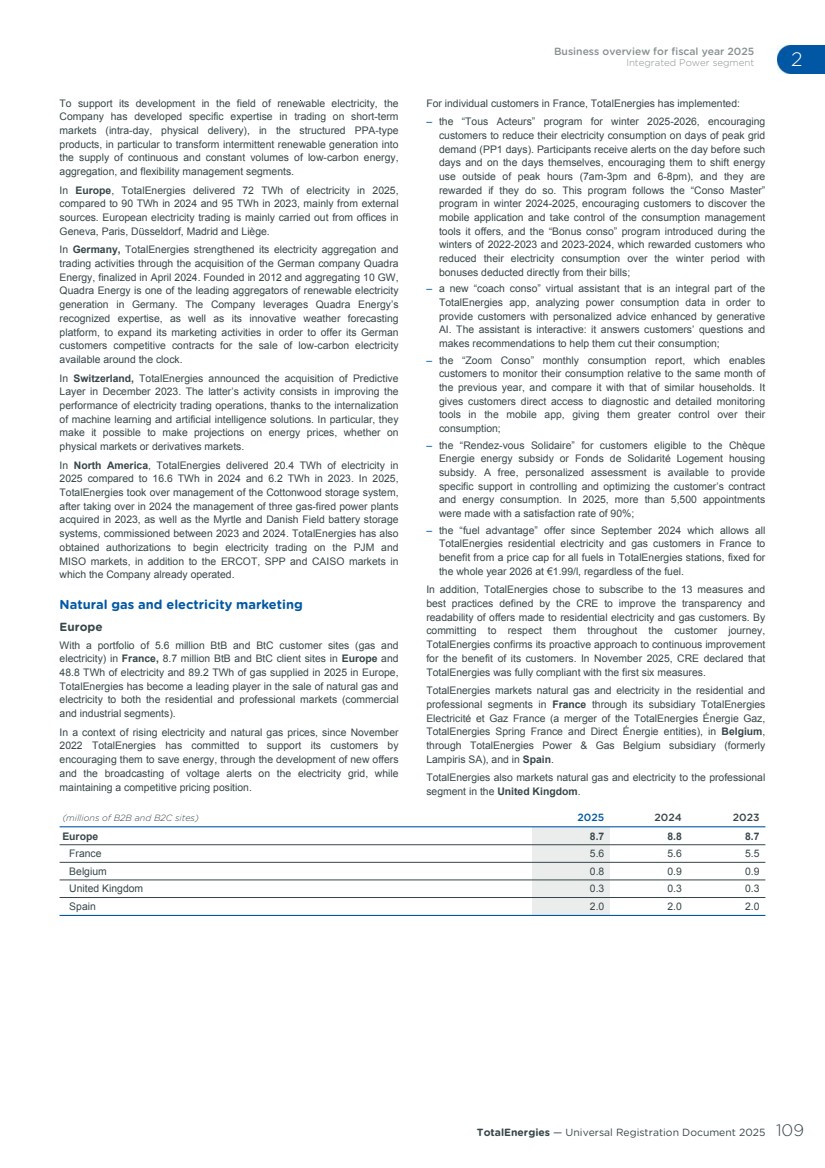
| (in TWh of electricity supplied) 2025 2024 2023 Europe 48.8 50.7 52.1 France 25.3 27.4 29.2 Belgium 3.1 3.1 3.5 United Kingdom 13.9 13.8 13.8 Spain 6.6 6.3 5.7 (in TWh of gas supplied) 2025 2024 2023 Europe 89.2 98.6 100.9 France 23.9 26.9 29.2 Belgium 7.6 7.5 7.1 United Kingdom 48.8 55.9 57.5 Spain 8.9 8.2 7.7 Rest of the world In Argentina, TotalEnergies markets the natural gas that it produces. Annual gas sales volumes reached 5.3 bcm in 2025, compared with 4.8 bcm in 2024 and 4.4 bcm in 2023. In India, since 2020 TotalEnergies owns 37.4% of Adani Total Gas Limited (ATGL), which holds 34 City Gas Distribution licenses in India (100%) and other licenses through IOAGPL, a 50/50 JV with Indian Oil Corporation Limited (IOC) (refer to point 1.8.3 of chapter 1). 2.4.6 Services in the field of energy efficiency and innovation in the electricity segment GreenFlex, a company providing services aiming at improving the energy and environmental performance of its customers, was a 100% owned subsidiary of the Company. In December 2025, TotalEnergies sold GreenFlex to French group Oteis. GreenFlex had over 800 customers at the time of the sale. As part of its transformation into an integrated energy company, in May 2022, TotalEnergies pursues, since 2022, “TotalEnergies On”, its start-up acceleration program at Station F, the world’s largest start-up campus, located in Paris. In line with TotalEnergies’ ambition, TotalEnergies On intends to support the development of new companies in the electricity and renewable energy segment. The objective of this program is to identify and support start-ups developing digital solutions in the field of electricity, whether it is renewable production, storage, trading, sales, decentralized network management, or electric mobility. Since its launch, TotalEnergies On has already supported 46 start-ups during 5 sessions of 6 months each. In December 2023, the Company announced the acquisition of three start-ups that have benefited from the TotalEnergies On program: – thanks to the acquisition of Dsflow, TotalEnergies will offer its multi-site BtB customers who consume a large amount of electricity an innovative SaaS (Software-as-a-Service) solution to manage their assets in real time and thus optimize their procurement strategy; – TotalEnergies has also decided to integrate the software platform developed by NASH Renewables in order to optimize the design and operation parameters of its renewable projects, in a design-to-value approach, taking into account the impact of the geographical specificities of the sites on the market prices effectively captured; – TotalEnergies will improve the performance of its trading operations through the in-house insourcing of Predictive Layer’s machine learning and artificial intelligence solutions. These include projections of energy prices, whether on physical or derivatives markets, as well as other tailor-made modelling of demand, supply, production, or non-commodity trading. 2 Business overview for fiscal year 2025 Integrated Power segment 110 TotalEnergies — Universal Registration Document 2025 |
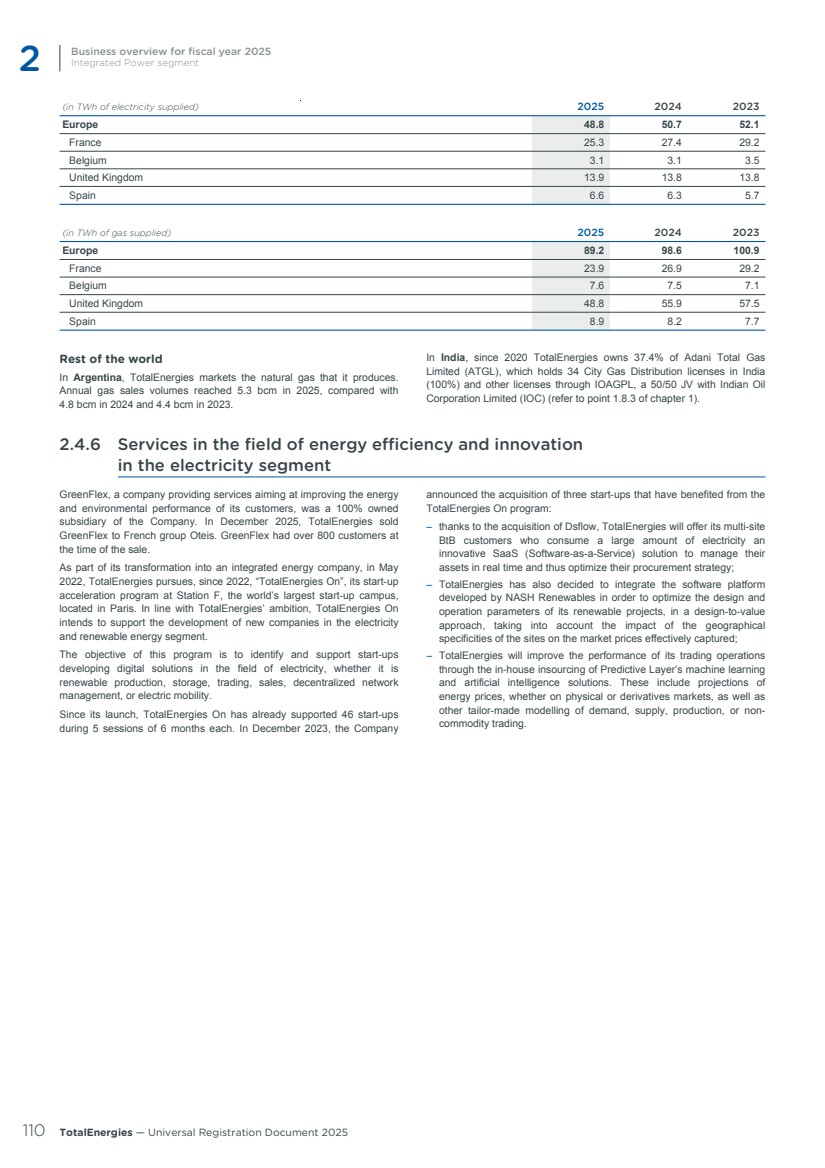
| 2.5 Refining & Chemicals segment The Refining & Chemicals segment includes the Refining & Chemicals activities described in point 2.5.1 and the Trading-Shipping activities described in point 2.5.2. Main indicators Among the world’s 15 largest integrated producers(a) based on refining and petrochemical capacities 1.8 Mb/d Refining capacity at year-end 2025 One of the leading traders of oil and refined products worldwide 40% Decrease in CO₂ emissions Scope 1+2 compared to 2015 (a) Based on publicly available information, refining and petrochemical capacities at year-end 2024. (b) Refer to the glossary for the definition and further information on alternative performance measures (Non-GAAP measures) and to point 1.8 of chapter 1 for reconciliation tables. Refinery throughput (in kb/d) Petrochemicals production capacity by geographical area (kt) (a) Including interests in Qatar, 50% of Hanwha TotalEnergies Petrochemical Co. Limited and 37.5% of SATORP in Saudi Arabia. (b) Including 50% of the joint-venture between TotalEnergies and Borealis. Refining utilization rate(a) (in %) (a) Based on distillation capacity at the beginning of the year. Production of petrochemicals (in kt) (a) Olefins Business overview for fiscal year 2025 Refining & Chemicals segment 2 TotalEnergies — Universal Registration Document 2025 111 [REDACTED SECTION: CERTAIN TEXT HAS BEEN REDACTED.] |
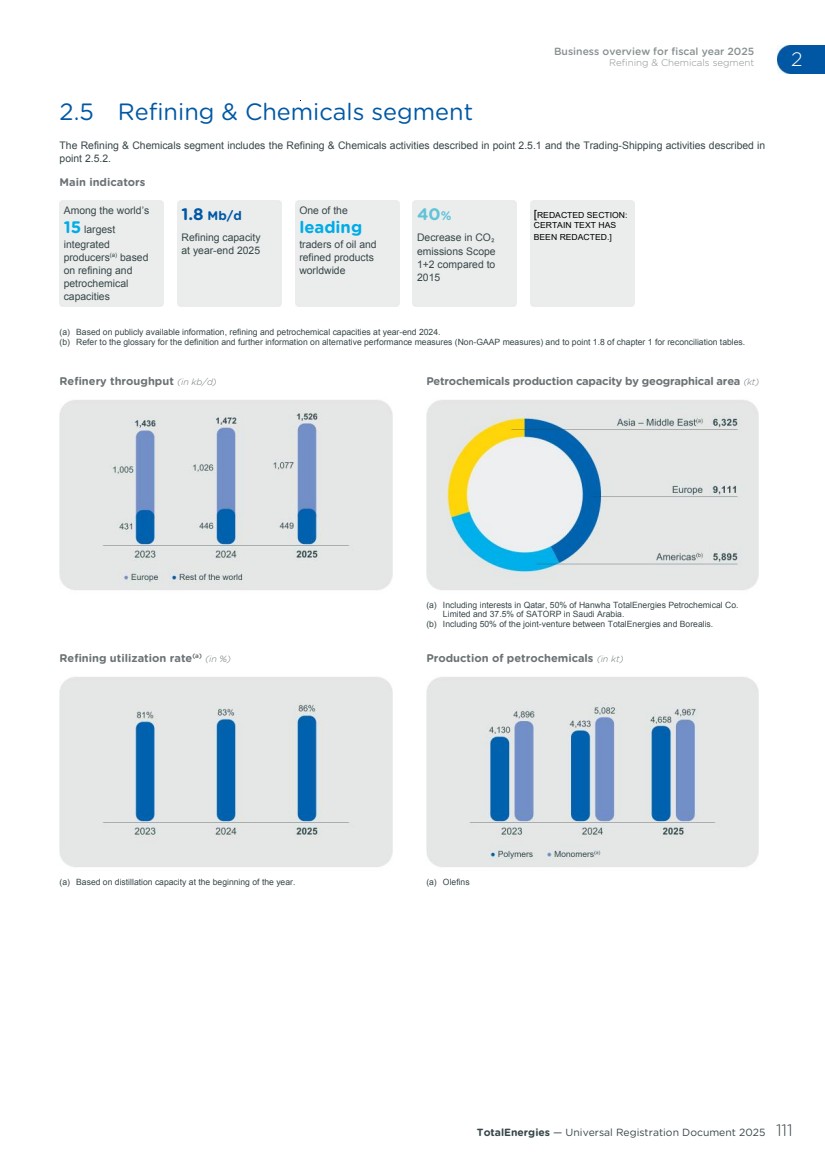
| 2.5.1 Refining & Chemicals Refining & Chemicals’ activities include refining, base petrochemicals (olefins and aromatics); polymer derivatives (polyethylene, polypropylene, polystyrene and hydrocarbon resins), including biopolymers and recycled polymers obtained from chemical or mechanical recycling, the production of biofuels from the transformation of biomass; the production of specialty fluids; and, since July 2025, the development of green hydrogen volumes intended to supply the Company’s european refineries, previously reported in the Integrated LNG segment. The Refining-Chemicals business also includes Hutchinson’s elastomer processing activities. Refining & Chemicals aims to constitute a safe, efficient and innovative industrial complex. The Refining & Chemicals strategy integrates the constant requirement for safety, a core value of TotalEnergies, and embedded the energy transition strategy of the Company. It does so through controlling its energy consumption and CO2 emissions of its operations (Scope 1+2), developing low-carbon solutions, particularly in biomass, and adapting its activities in Europe. Its strategy is based on: – continuously improving the competitiveness of refining and petrochemicals activities by making optimal use of production assets, concentrating investments on its large, integrated platforms reducing energy consumption and CO2 emissions linked to its operations; – growing petrochemicals, mainly in the United States and the Middle East, by exploiting the proximity of cost-effective oil and gas resources in order to supply growing markets, particularly in Asia; and – developing low carbon activities, on the one hand, through the short term in biofuels (in particular Sustainable Aviation Fuel (SAF)), and over the longer term, as technological costs decline, through synthetic fuels produced from CO2 and green hydrogen (e-fuels), biopolymers and plastic recycling solutions, and on the other hand in materials that help enhance the energy efficiency of TotalEnergies’ customers, particularly in the automotive market. 2 Business overview for fiscal year 2025 Refining & Chemicals segment 112 TotalEnergies — Universal Registration Document 2025 [REDACTED SECTION: CERTAIN TEXT HAS BEEN REDACTED.] |
| Biofuels Biofuels meeting European standards reduce CO2 emissions by at least 50% compared to their equivalent fossil fuels(1) and demand for these products is supported by government policies aimed at achieving carbon neutrality (net zero emissions). The growth of the biofuels market is driven by the segment covering the renewable diesel and SAF produced by hydrotreating vegetable oils or raw materials from the circular economy (animal fat and used cooking oil, etc.). The aviation sector has set itself the goal of achieving carbon neutrality by 2050(2) . Achieving this target is expected to involve the incorporation in fossil fuels of a growing portion of SAF, which is the most effective solution for reducing CO2 emissions from air transport, in the absence of an industrial alternative to liquid fuel in the short to medium term. The outlook for growth in demand for SAF is also supported by the various regulations. For example, in Europe, the ReFuelEU Aviation regulation, launched as part of the EU’s “Fit for 55” legislative package, favors the development of SAFs in the European Union with, among other things, the implementation of obligatory progressive minimum incorporation mandates: 2% since January 1, 2025, 6% (of which 1.2% synthetic fuel) in 2030 and 70% (of which 35% synthetic fuel) in 2050. The hydrotreatment of raw materials from the circular economy, including animal fats and used cooking oils (as well as vegetable oils depending on local regulations), constitutes one of the main production routes for SAF. Diagrammatic representation of production of biofuels by hydrotreatment TotalEnergies intends to become a leader in the production of SAF, relying mainly on its existing refining assets (conversion, co-processing and developments on existing platforms) and aims to achieve SAF production capacity of 0.5 Mt/y by 2028, in line with developments in demand in Europe, the U.S., the Middle East, and Asia. In Europe, in order to respond to the call from its aeronautical customers, in the context of the gradual increase in the European SAF blending mandate, set at 6% for 2030, the Company is mobilizing its Grandpuits and La Mède platforms. In parallel, the Company is developing coprocessing capacities on its Normandy, Antwerp and Leuna platforms, enabling up to 10% of SAF incorporation levels in 2030. In September 2024, the agreement signed in 2022 between TotalEnergies and Air France for the supply of 800 kt of SAF to the Air France–KLM group, was reevaluated to reach-up to 1.5 Mt of SAF over a 10 year period, through 2035, thus contributing to Air France’s objective of incorporating at least 10% of SAF on all its flights by 2030, which goes beyond regulatory obligations. In 2025, TotalEnergies produced 397 kt of biofuels (renewable diesel, SAF and ETBE), compared to 292 kt in 2024 and 331 kt in 2023, and 79 kt of other co-produced chemical biocomponents (bionaphtha, etc.), compared to 69 kt in 2024 and 78 kt in 2023, mainly at the La Mède and Feyzin sites in France. (1) According to the EU’s RED III (Renewable Energy Directive). (2) Source: IATA. Business overview for fiscal year 2025 Refining & Chemicals segment 2 TotalEnergies — Universal Registration Document 2025 113 |
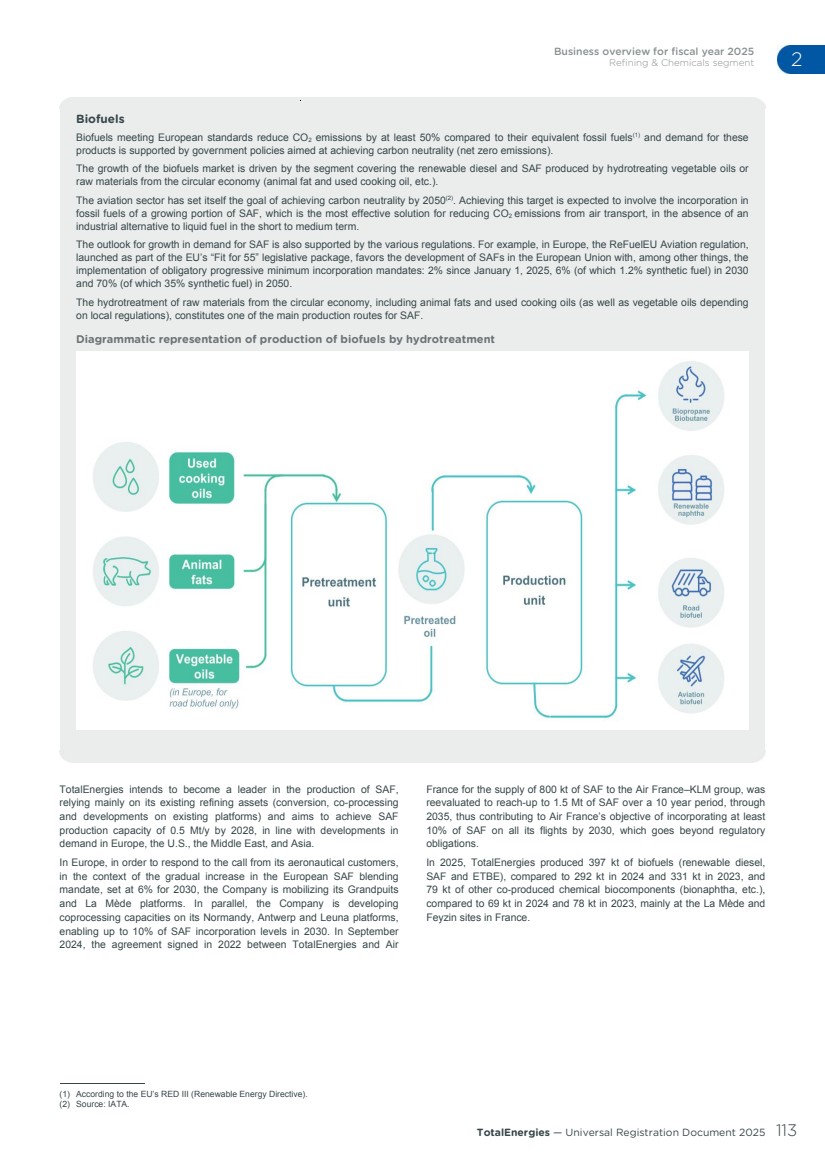
| Biopolymers and plastics recycling Biopolymers are produced either by replacing fossil feedstock in a steam cracking unit with biomass feedstock such as vegetable oils or hydrogenated residues, or directly by making low-carbon molecules such as polylactic acid (PLA) from sugar. Mechanical recycling, the technology for which is more mature than that for chemical recycling, requires highly processed feedstock and cannot be used for every application of plastic, particularly most of those involving contact with food. This technology is suited to the needs of markets such as automotive and construction. Advanced or chemical recycling, on the other hand, makes it possible to process waste that cannot be recycled mechanically and to address other markets, such as those of plastics for food use; it requires more capital-intensive technologies and is still at the stage of industrial development. The purpose of the chemical recycling process is to break down used polymer in order to return, in one or more stages, to a monomer, which is the raw material of any polymer. Plastics recycling process In order to support its customers in reducing their greenhouse gas emissions and to address the issue of plastics end-of-life, TotalEnergies has resolutely committed to the development of both biomass conversion into polymers and plastic recycling activities. It has set the ambition of producing 1 Mt/y of polymers from recycled or renewable materials by 2030. In 2025, TotalEnergies produced 95 kt of recycled or renewable polymers (including recycled or renewable base), compared to 89 kt in 2024 and 80 kt in 2023. In addition to the development of low-carbon polymers, TotalEnergies has been involved since 2019, as a founding member of the Alliance to End Plastic Waste, in an initiative to reduce the environmental impact of plastics. The Alliance, bringing together more than 80 members and project partners, aims to develop and implement solutions to reduce plastic waste in the environment. 2.5.1.1 Refining and petrochemicals At the end of 2025, TotalEnergies held stakes in 14 refineries(1) (the same as at year-end 2024 and compared with 16 at the end of 2023) located in Europe, the United States, the Middle East and Asia, eight of which are operated by TotalEnergies companies, including two biorefineries in France (La Mède, and the Grandpuits plant which is in the process of being converted). At December 31, 2025, TotalEnergies’ refining capacity was 1,761 kb/d, stable compared to the end-2024 figure and compared to 1,792 kb/d at year-end 2023. The reduction in capacity in 2024 was due to the sale of TotalEnergies Marketing South Africa’s 36.36% minority interest in the Natref (National Petroleum Refiners of South Africa) refinery and of TotalEnergies Marketing Côte d’Ivoire’s 20.35% minority interest in the SIR (Société Ivoirienne de Raffinage) refinery. TotalEnergies’ petrochemicals operations are located in Europe, the United States, Qatar, South Korea and Saudi Arabia. Being either adjacent to or connected by pipelines to TotalEnergies refineries, the vast majority of the petrochemical operations are integrated with its refining operations, thereby maximizing synergies. At December 31, 2025, TotalEnergies’ global petrochemicals capacity (olefins, aromatics and polymers) was 21,330 kt, stable compared to the end-2024 and 22,165 kt at the end of 2023. The capacity decrease in 2024 was due to the Lavéra disposal (France). For the main sites of Refining & Chemicals at year-end 2025, please refer to point 1.6.3 of chapter 1. To reduce the carbon footprint associated with the production, processing and supply of energy to its customers, one of the levers identified by the Company is the use of low‑carbon hydrogen to reduce the carbon footprint of its European refineries, which would reduce their direct CO₂ emissions by up to 3 Mt/y CO₂ by 2030. (1) The Company finalized the sale of its minority interests in the Natref and SIR refineries in December 2024 and July 2024 respectively. 2 Business overview for fiscal year 2025 Refining & Chemicals segment 114 TotalEnergies — Universal Registration Document 2025 |
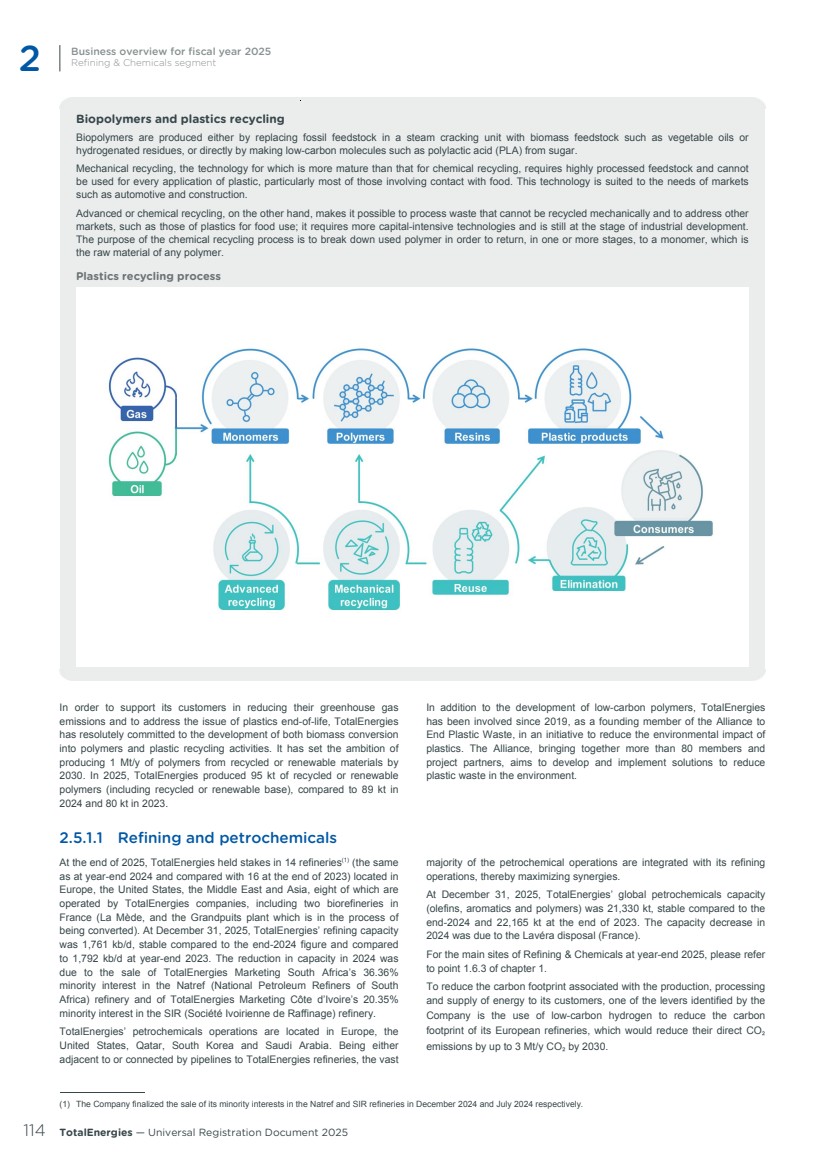
| In September 2023, TotalEnergies launched a call for tenders to supply up to 500 kt/y of low‑carbon hydrogen to its European refineries from 2030. The call for tenders generated considerable interest within the industry, attracting a wide range of local and international players. In this context, TotalEnergies has already contracted more than 200 kt/y of low‑carbon hydrogen. These volumes are intended for the La Mède, Grandpuits and Normandy sites in France, as well as the Leuna refinery in Germany, the Antwerp platform in Belgium and the Zeeland site in the Netherlands. However, achieving the Company’s ambition to use up to 500 kt/y of low‑carbon hydrogen in its European refineries from 2030 onwards, depends on the implementation of national tax and regulatory frameworks that effectively support the reduction of the carbon footprint. TotalEnergies is rolling out four types of projects: – renewable hydrogen production within the Company’s biorefineries; – green hydrogen production by TotalEnergies and its partners; – tolling agreements; – long‑term green hydrogen supply contracts. The first volumes of low‑carbon hydrogen are expected from 2026. Crude oil refining capacity The table below sets forth TotalEnergies’ crude oil refining capacity(a): As of December 31 (kb/d) 2025 2024 2023 Refineries operated by TotalEnergies companies 1,384 1,384 1,384 France Normandy-Gonfreville (100%) 253 253 253 Donges (100%) 219 219 219 Feyzin (100%) 109 109 109 Rest of Europe Antwerp (100%) 338 338 338 Leuna (100%) 227 227 227 North America Port Arthur refinery and condensate splitter (100%) 238 238 238 Other refineries in which TotalEnergies has interests(b) 377 377(c) 408 Total 1,761 1,761 1,792 (a) Capacity data based on crude distillation unit stream-day capacities under normal operating conditions, less the average impact of shutdowns for regular repair and maintenance activities. (b) TotalEnergies’ share at December 31, 2025 in capacity of the six refineries in which it has interests ranging from 0.1% to 55% (in the Netherlands, South Korea, Qatar and Saudi Arabia and two in Africa). (c) The reduction in refining capacity between 2023 and 2024 is due to the sale of TotalEnergies Marketing South Africa’s 36.36% minority interest in the Natref (National Petroleum Refiners of South Africa) refinery and of TotalEnergies Marketing Côte d’Ivoire’s 20.35% minority interest in the SIR (Société Ivoirienne de Raffinage) refinery. Refinery and biorefinery production The table below shows TotalEnergies’ net share(a) of the refined quantities produced by TotalEnergies’ refineries, by product category: (kb/d) 2025 2024 2023 Gasoline (excluding ETBE) 273 258 252 Aviation fuel (excluding SAF)(b) 159 156 140 Diesel and fuels (excluding renewable diesel) 640 623 620 Heavy fuels 59 69 70 Other products(c) 355 331 314 Renewable diesel, SAF and ETBE 8 6 7 Total 1,493 1,443 1,403 (a) For refineries not 100% owned by TotalEnergies, the production shown corresponds to TotalEnergies’ equity share in the site’s overall production. (b) Jet fuel, kerosene and Avgas (aviation fuel specially designed for piston-engined aircraft). (c) Mainly refining bases, petcoke, naphta, refinery propylene and other petrochemical bases. The difference with refinery throughput and the refined volumes is due to self-consumption of crude oil and losses during the refining process. Utilization rate of refineries The table below sets forth the average utilization rates of TotalEnergies’ refineries: 2025 2024 2023 On crude and other feedstock(a)(b) 87% 83% 80% On crude(a)(c) 86% 83% 81% (a) Including equity share of refineries in which TotalEnergies has an interest. (b) Crude + crackers’ feedstock/distillation capacity at the beginning of the year. (c) Crude/distillation capacity at the beginning of the year. Business overview for fiscal year 2025 Refining & Chemicals segment 2 TotalEnergies — Universal Registration Document 2025 115 |
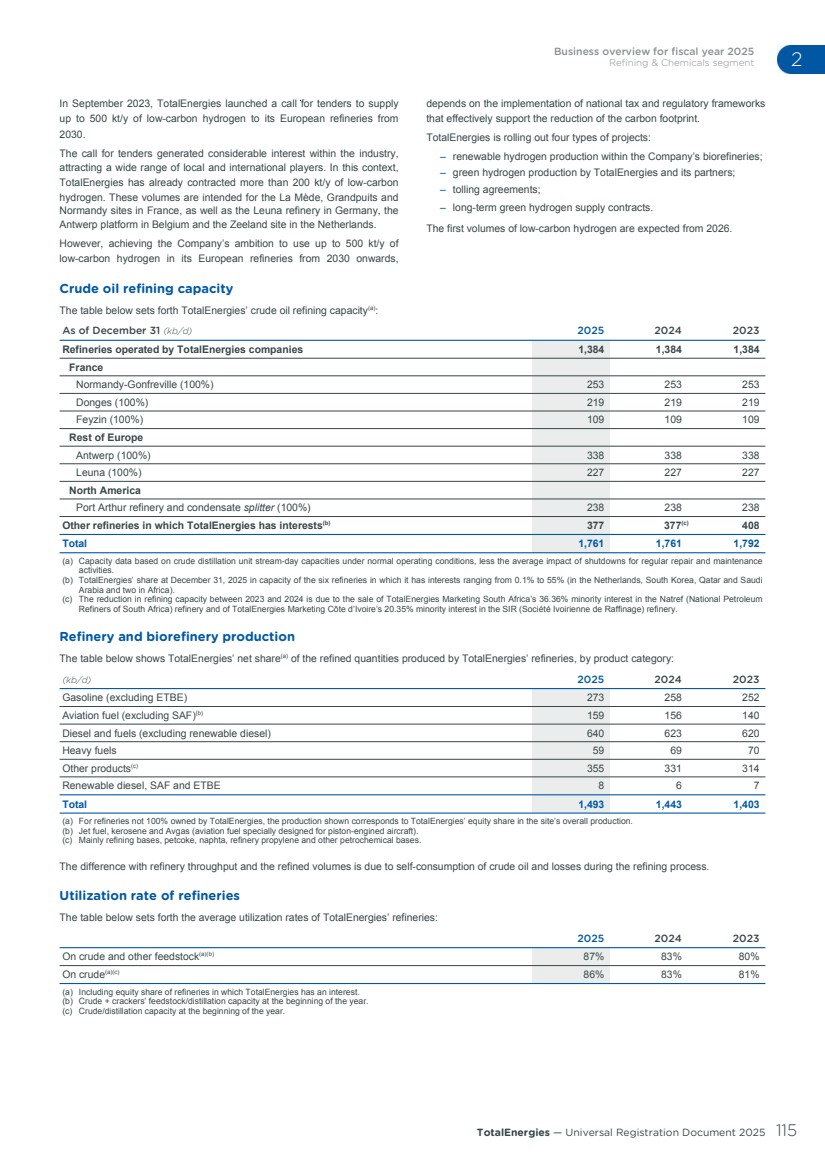
| Petrochemicals: breakdown of main production capacities As of December 31 (in kt) 2025 2024 2023 Europe North America(a) Asia and Middle East(b) Worldwide Worldwide Worldwide Olefins(c) 3,471 2,040 1,958 7,469 7,469 8,174 Aromatics(d) 2,846 1,512 2,581 6,939 6,939 7,069 Polyethylene 1,140 535 1,065 2,740 2,740 2,74 Polypropylene 1,245 1,200 605 3,050 3,050 3,050 Polystyrene 409 608 – 1,017 1,017 1,017 Other(e) – – 116 116 116 116 (a) Including 50% of the joint venture between TotalEnergies and Borealis. (b) Including interests in Qatar, 50% of Hanwha TotalEnergies Petrochemicals Co. Ltd. in South Korea and 37.5% of SATORP in Saudi Arabia. (c) Ethylene + propylene + butadiene. (d) Including styrene monomer. (e) Mainly monoethylene glycol (MEG), polylactic acid polymer (PLA) and cyclohexane. Petrochemicals production and utilization rate 2025 2024 2023 Monomers(a) (kt) 4,967 5,082 4,896 Polymers (kt) 4,658 4,443 4,130 Steamcracker utilization rate(b) 79% 79% 69% (a) Olefins. (b) Based on olefins production from steamcrackers and their treatment capacity at the start of the year. Activities by geographical area Europe TotalEnergies is the largest refiner and the third-largest petrochemicals operator in Western Europe(1) . TotalEnergies also positions itself in the production of biofuels, mainly renewable diesel and SAF, as well as ether (ETBE) produced from ethanol and isobutene for incorporation into gasoline. In Western Europe, TotalEnergies operates five refineries in Europe (one in Antwerp, Belgium, three in France, at Donges, Feyzin and Gonfreville, and one in Leuna, Germany) and one biorefinery in La Mède, France, pending the start-up of the Grandpuits zero-crude platform, and holds a 55% interest in the Zeeland refinery in Vlissingen, the Netherlands. In a context of adaptation to the demand for petroleum products in Europe, TotalEnergies has reduced its refining capacities since 2021 and continues to improve the competitiveness of its industrial assets, notably with the sale finalized in 2024, to Ineos of its stake in the Lavéra assets (steam cracker, aromatics, polypropylene) as well as part of its stakes in the pipeline and ethylene storage network in eastern France. This operation allowed the two companies to realign their ethylene production and internal consumption. TotalEnergies is thus consolidating the integration of its Feyzin and Carling petrochemical sites. In the light of the significant surplus of ethylene expected in Europe, On its Antwerp platform, TotalEnergies is also facing considerable overcapacity in the petrochemicas market. In the light of the significant surplus of ethylene expected in europe, TotalEnergies thus intends to cease operating its oldest steam cracker in Antwerp by end-2027. Indeed, the latter was historically dependent on a major contract with a third-party user of the ethylene produced, which recently decided not to renew it by end of 2027. As a result, the steam cracker, which is not integrated in TotalEnergies’ downstream polymer production, will no longer have any outlets for its ethylene production. The unit shutdown will allow the site to focus on its more recent steam cracker, whose ethylene production is entirely consumed by TotalEnergies’ industrial units in Antwerp and Feluy. To reduce the direct emissions of its European refineries, TotalEnergies and Air Products signed an agreement in June 2024 for the supply of 70 kt/y of green hydrogen in Europe for 15 years from 2030. In July 2024, the Company signed an agreement with the German renewable developer RWE for the acquisition of a 50% stake in OranjeWind, a 795 MW offshore wind farm under development in the Netherlands, with full commissioning expected in early 2028. In February 2025, TotalEnergies has signed agreements with Air Liquide to develop two projects in the Netherlands, for the production and delivery of green hydrogen, using renewable power generated mostly by this wind farm. These two projects, aimed at decarbonizing the refineries in Zeeland, Netherlands, and Antwerp, Belgium, will reduce CO2 emissions by up to 450 kt/y: – to supply green hydrogen to the Zeeland refinery, the two companies set up a joint-venture, equally held by TotalEnergies (50%) and Air Liquide (50%), to build and operate a 250 MW electrolyzer near the refinery. This project, which will enable the production of up to 30 kt/y of green hydrogen most of which will be delivered to the refinery, and to reduce by CO2 emissions by up to 300 kt/y, represents a global investment of around €600 million and has made requests for support under European and national subsidy programs; – for the Antwerp platform, TotalEnergies signed a tolling agreement with Air Liquide for the supply of 15 kt/y of green hydrogen. TotalEnergies will supply the renewable electrons produced by the OranjeWind project to be transformed into green hydrogen by Air Liquide’s ELYgator electrolyzer, located in Maasvlakte (Netherlands). Scheduled for the end of 2027, this project should make it possible to reduce CO2 emissions at the Antwerp site by up to 150 kt/y and help meet the European targets (RED III) for renewable energy in transport; – in March 2025, TotalEnergies signed an agreement with RWE for the supply of 30 kt/y of green hydrogen to its Leuna refinery in Germany for 15 years from 2030. The green hydrogen delivered by a 600 km pipeline to the gates of the Leuna refinery will be produced by a 300 MW electrolyzer built and operated by RWE in Lingen, thereby enabling to prevent some 300 kt/y of CO2 emissions beginning in 2030. Green hydrogen storage should be provided locally. TotalEnergies’ main petrochemical sites in Europe are located in Belgium, in Antwerp (steam crackers, aromatics, polyethylene) and Feluy (polyolefins, polystyrene), and in France, in Carling (polyethylene, polystyrene, polypropylene compounds), Feyzin (steam cracker, aromatics) and Gonfreville (steam crackers, aromatics, styrene, polyolefins, polystyrene). (1) Publicly available information, based on refining and petrochemicals production capacities at year-end 2024. 2 Business overview for fiscal year 2025 Refining & Chemicals segment 116 TotalEnergies — Universal Registration Document 2025 |
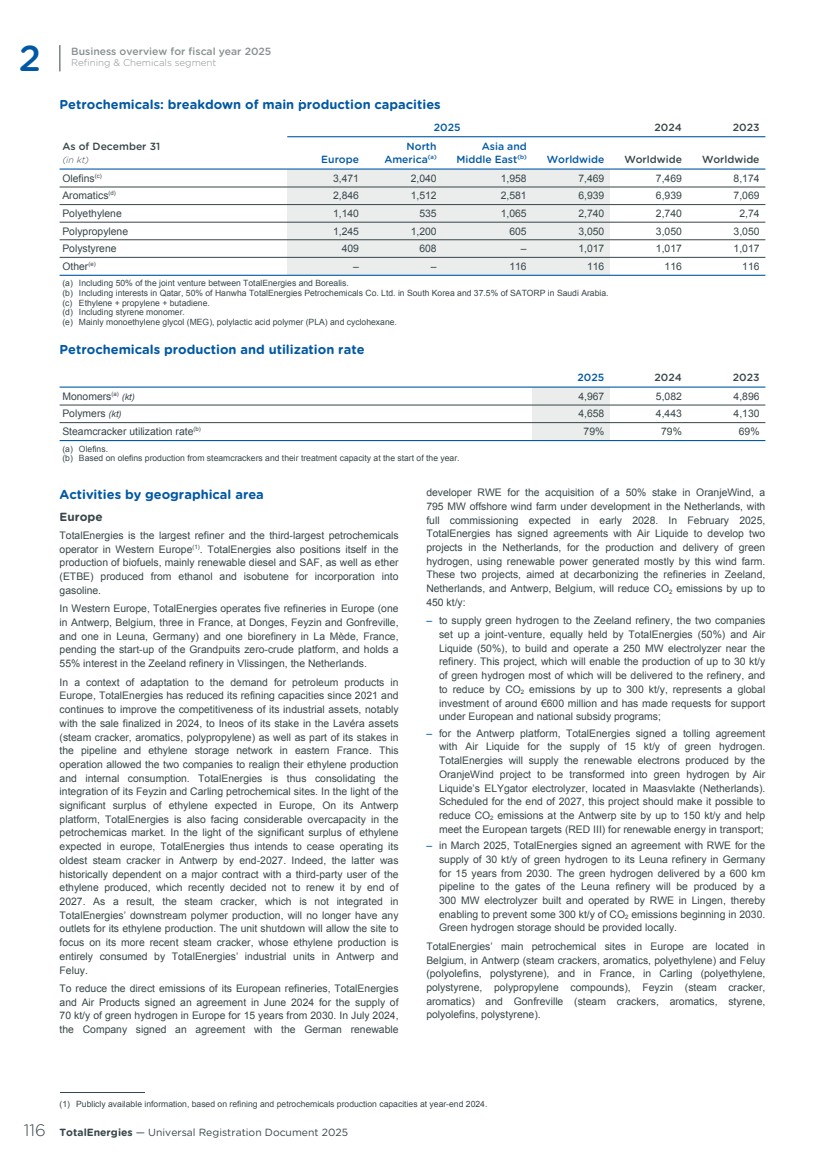
| Europe accounts for 43% of TotalEnergies’ petrochemicals capacity, namely 9,111 kt at year-end 2025, stable compared to year-end 2024 and down from 9,946 kt at year-end 2023: ● In France, TotalEnergies is continuing its development in low-carbon products while at the same time improving its operational efficiency, particularly through the conversion and modernization of assets. In June 2025, TotalEnergies and Quatra, the European market leader in the collection and recycling of used cooking oil, signed a 15-year agreement beginning in 2026, for the supply of 60 kt per year of European used cooking oil collected by Quatra and transported to TotalEnergies’ biorefineries. The deal contributes to secure the feedstock to produce biodiesel and sustainable aviation fuel (SAF). – The project to transform the Grandpuits refinery into a zero-crude platform focused on new energies and low-carbon activities continued in 2025. For the development of biofuel production activities, in 2022 TotalEnergies and SARIA (a leader in the European market for the collection and recovery of organic materials into sustainable products) signed an agreement to help secure supplies of used cooking oils and animal fats (permitted raw materials for the production of SAF). The biorefinery is expected to have SAF production capacity of 230 kt/y when it begins operations, scheduled for 2026. Under a long-term contract, committing TotalEnergies to purchase the hydrogen produced for the needs of its platform, Air Liquide plans to invest over €130 million in the construction and operation of a new unit producing hydrogen, which will partly use biogas from the TotalEnergies biorefinery, and will be equipped from the start with Air Liquide’s Cryocap™ CO2 capture technology. These innovations are expected to avoid emissions amounting to 150 kt/y CO2 compared to current processes. For the development of plastic recycling activities, in partnership with Plastic Energy, TotalEnergies has built an advanced recycling plant in France, with the capacity to process 15 kt/y of plastic waste. The plant commissioned end of 2025, will be able to convert plastic waste by pyrolysis into a recycled raw material called TACOIL™. This raw material will then be transformed by TotalEnergies into polymers with properties identical to those of virgin polymers, and in particular compatible with food use. In March 2023, TotalEnergies and Paprec, a leader in plastic recycling in France, entered into a long-term commercial agreement to develop the first French value chain for chemical recycling of plastic film waste. This agreement allows TotalEnergies to secure supplies for the future Grandpuits chemical recycling plant. TotalEnergies has also commissioned a solar power plant expected to generate 31 GWh/y of green electricity, the equivalent of the electricity consumption of 19,000 people(1) , as, well as a battery storage park with a capacity of 43 MWh, contributing to the security of supply and the balance between electricity production and consumption in France. Finally, TotalEnergies ended the biopolymer project on the site in 2023, following the decision of its partner Corbion to withdraw due to rising costs. Grandpuits site conversion project – At the La Mède site, the first French biorefinery, with a 500 kt/y capacity, has produced renewable diesel since 2019. Since 2021, part of this diesel can be processed by the Oudalle plant near Le Havre to produce SAF. To coincide with the major shutdown in 2024, TotalEnergies invested €70 million to modernize the site’s facilities and enable it to process up to 100% waste from the circular economy. In addition, in November 2024, TotalEnergies and Air Liquide launched a renewable hydrogen production project based on the recycling of coproducts from the biorefinery, which will use this hydrogen to produce biodiesel and SAF. The production unit, which will have a capacity of 25 kt/y of renewable hydrogen, is currently under construction and will be operated by Air Liquide. This new project, representing a total investment of €150 million and scheduled to start up in 2028, will be complemented by the Masshylia project, that will produce up to 10 kt/y of green hydrogen by water electrolysis, led by TotalEnergies in partnership with Engie, with the first electrolyzer due to begin production in 2030. These projects are expected to reduce CO2 emissions from the La Mède biorefinery by 130 kt/y. (1) TotalEnergies data. Business overview for fiscal year 2025 Refining & Chemicals segment 2 TotalEnergies — Universal Registration Document 2025 117 |
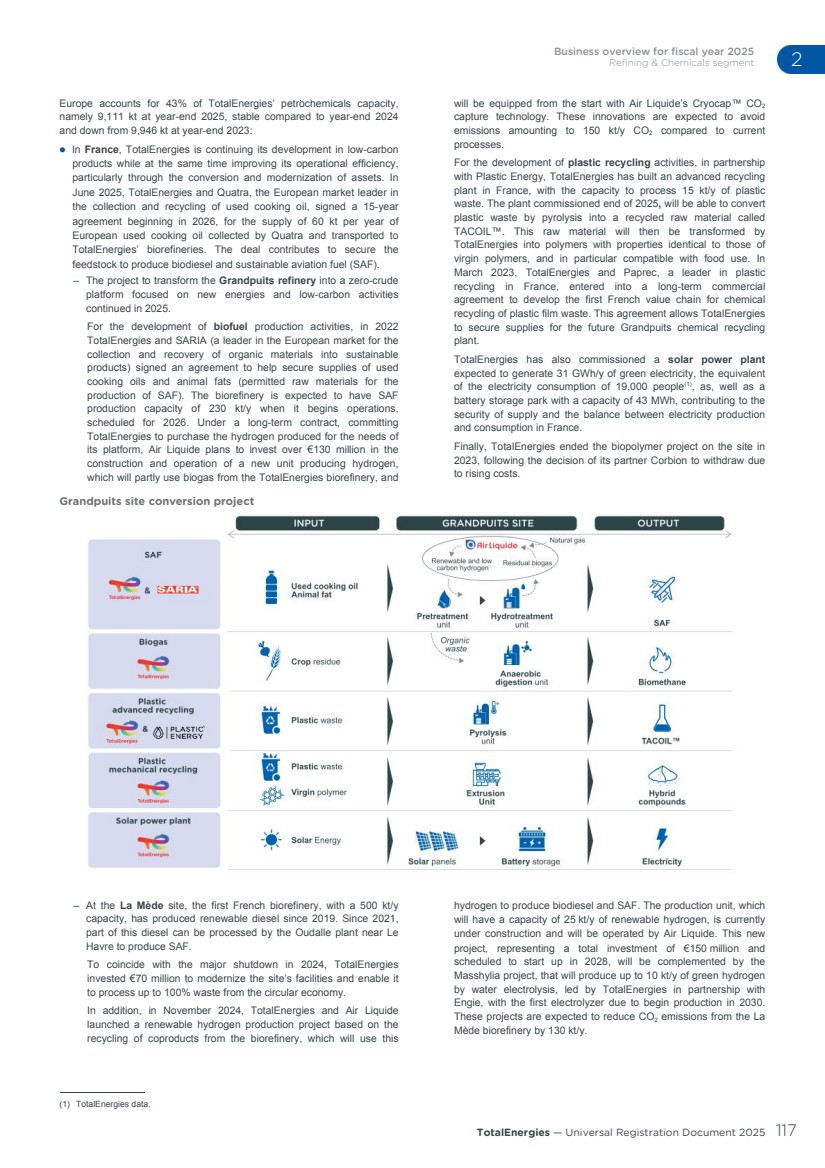
| Since September 2025, the La Mède site has also had the capacity to produce 15 kt/y of SAF. – On its integrated Normandy platform, TotalEnergies began producing SAF from co-processing of used oil in March 2022. The site’s annual production capacity is 160 kt. Following ASTM’s(1) September 2023 approval of this method of producing SAF, TotalEnergies began producing SAF by co-processing HVO, also produced at La Mède, in 2024. In addition, TotalEnergies and Air Liquide have joined forces to reduce the carbon footprint of the site’s hydrogen production and in 2022, TotalEnergies transferred the hydrogen production unit with a capacity of 255 t/d to Air Liquide, which now operates it. This cooperation between Air Liquide and TotalEnergies is part of their common ambition to contribute to reducing the carbon footprint of industrial activities near the river Seine. Studies are underway alongside other manufacturers on the Seine axis to develop CO2 capture and storage projects in Normandy. TotalEnergies and Air Liquide also signed an agreement in September 2023 for the long-term supply of the platform with 10 kt/y of green hydrogen and up to 5 kt/y of low-carbon hydrogen, which is expected to reduce the site’s annual CO2 emissions by up to 150 kt/y. The project has two components: TotalEnergies is expected to benefit from access to half of the green and low-carbon hydrogen production capacity of the Normand’Hy electrolyzer (200 MW) built and operated by Air Liquide and in return provide renewable and low-carbon electricity, intended to power the electrolyzer at a rate of 100 MW. In February 2023, TotalEnergies and the Le Havre Seine Métropole Urban Community joined forces to supply heat to the urban network of Le Havre Sud, thus actively participating in the reduce the carbon footprint and energy savings of the region. The connection to the urban heating network was officially opened in May 2025. The project recovers residual heat from the Normandy platform’s facilities and reduces the amount of gas used to heat the urban network. The project aims to heat the equivalent of 12,000 homes(2) and avoid 16 kt/y CO2 emissions. – At the Donges raffinery, the project to modernize the site, representing a total investment of more than €400 million, continues: the new section of the railway bypassing the site was commissioned in October 2022. The start up of diesel desulfurization unit, is scheduled for the first half of 2026 and is expected to improve the refinery’s competitiveness by producing fuel containing less sulfur that meets EU standards. – Synova is one of the French leaders in the production of high-performance recycled polypropylene from plastics from industrial waste, the selective collection of waste from households and automotive parts such as bumpers. Its production capacity for mechanically recycled polypropylene is 45 kt/y. – In late 2024, the Carling site opened a new production line for high-performance recycled polypropylene for the automotive industry, with a production capacity of 15 kt/y. ● In Belgium, TotalEnergies operates the Antwerp platform, comprising refining units with a capacity of 338 kb/d, flexible steam crackers that can process ethane or gases from the refining process, and polyethylene production units. On this platform, TotalEnergies also produces chemically recycled polymers, using the TACOIL™ produced by Plastic Energy, with which TotalEnergies joined forces in 2020 to build the advanced recycling unit at Grandpuits, as well as mechanically recycled polymers. In July 2025, TotalEnergies began producing SAF by co-processing HVO, also produced at La Mède, with annual SAF production capacity of 80 kt. In December 2024 TotalEnergies also commissioned a battery park project intended for energy storage with a capacity of 75 MWh, the equivalent of the daily consumption of nearly 20,000 homes(3) . At the Feluy site, TotalEnergies operates high value-added polypropylene, polyethylene and expanded polystyrene production units, as well as a catalyst production facility. ● In Germany, TotalEnergies operates the Leuna refinery. Since the end of 2022, in accordance with the Company’s announcements at the start of Russia’s invasion of Ukraine, TotalEnergies has ended supplies of Russian oil to the refinery and in close consultation with the German government, deployed alternative solutions to supply the refinery, in particular by importing oil via Poland. In June 2023, TotalEnergies and VNG, a German natural gas distribution company, signed an agreement for the future supply of green hydrogen to the refinery. Green hydrogen, which will be produced by a 30 MW electrolyzer built and operated by VNG and its partner Uniper, is expected to enable a reduction in CO2 emissions at the site of up to 80 kt/y by 2030. ● In Spain, Iber Resinas has two plants near Valencia, and mechanically recycles plastics (polypropylene, polyethylene and polystyrene) from household and industrial waste. TotalEnergies acquired a 100% stake in Iber Resinas and integrated it in 2023, and it had annual production capacity of 40 kt in 2025. ● In Finland, TotalEnergies completed in July 2024 the acquisition of Tecoil (100%), which specializes in the manufacture of RRBO (rerefined base oils). Tecoil has its own collection circuit for used lubricants from the circular economy in Europe, and currently operates a plant in Hamina, a port on the Baltic Sea in eastern Finland, with a production capacity of 50 kt/y of re-refined base oils, with properties comparable to the best virgin base oils. North America TotalEnergies’ main sites in North America are located in Texas, at Port Arthur (refinery, steam crackers), Mont Belvieu (propylene splitter), Bayport (polyethylene) and La Porte (polypropylene), and in Louisiana, at Carville (styrene, polystyrene). – At Port Arthur, TotalEnergies has, at the same site, a refinery with a capacity of 178 kb/d, a condensate splitter with a capacity of 60 kb/d as well as a 40% interest in BASF TotalEnergies Petrochemicals (BTP), which mainly owns and operates a steam cracker with the capacity to produce more than 1 Mt/y of ethylene, of which more than 85% from ethane, propane and butane, which are produced in abundance locally. On this site, TotalEnergies also operates, on behalf of the Baystar joint-venture, created in 2018 in equal parts between TotalEnergies and Borealis, an ethane cracker with an ethylene production capacity of 1 Mt/y. – In Mont Belvieu, TotalEnergies owns 33% of a propylene splitter, with a capacity of 410 kt/y in TotalEnergies’ share, which purifies propylene from the refining process into propylene for the production of polypropylene at the La Porte site. – At the Bayport site, the 50/50 joint-venture, Baystar established between TotalEnergies and Borealis commissioned its new Borstar® polyethylene unit in October 2023, with a production capacity of 625 kt/y and representing an investment of $1.4 billion. This new unit, which more than doubles the site’s polyethylene production capacity to over 1 Mt/y, completes the two partners’ integrated petrochemical project, which includes the extended polyethylene site in Bayport as well as the ethane cracker located on the TotalEnergies platform in Port Arthur. – At La Porte, TotalEnergies operates a large polypropylene plant, with a capacity of 1.2 Mt/y, which is 100% owned. – At Carville, TotalEnergies operates a styrene plant with a capacity of 1.2 Mt/y, through a joint-venture (50% with SABIC), and a polystyrene unit with a capacity of 600 kt/y, which is 100% owned. (1) ASTM International is a standards organization that drafts and produces technical standards for materials, products, systems and services. (2) TotalEnergies data. (3) TotalEnergies data. 2 Business overview for fiscal year 2025 Refining & Chemicals segment 118 TotalEnergies — Universal Registration Document 2025 |
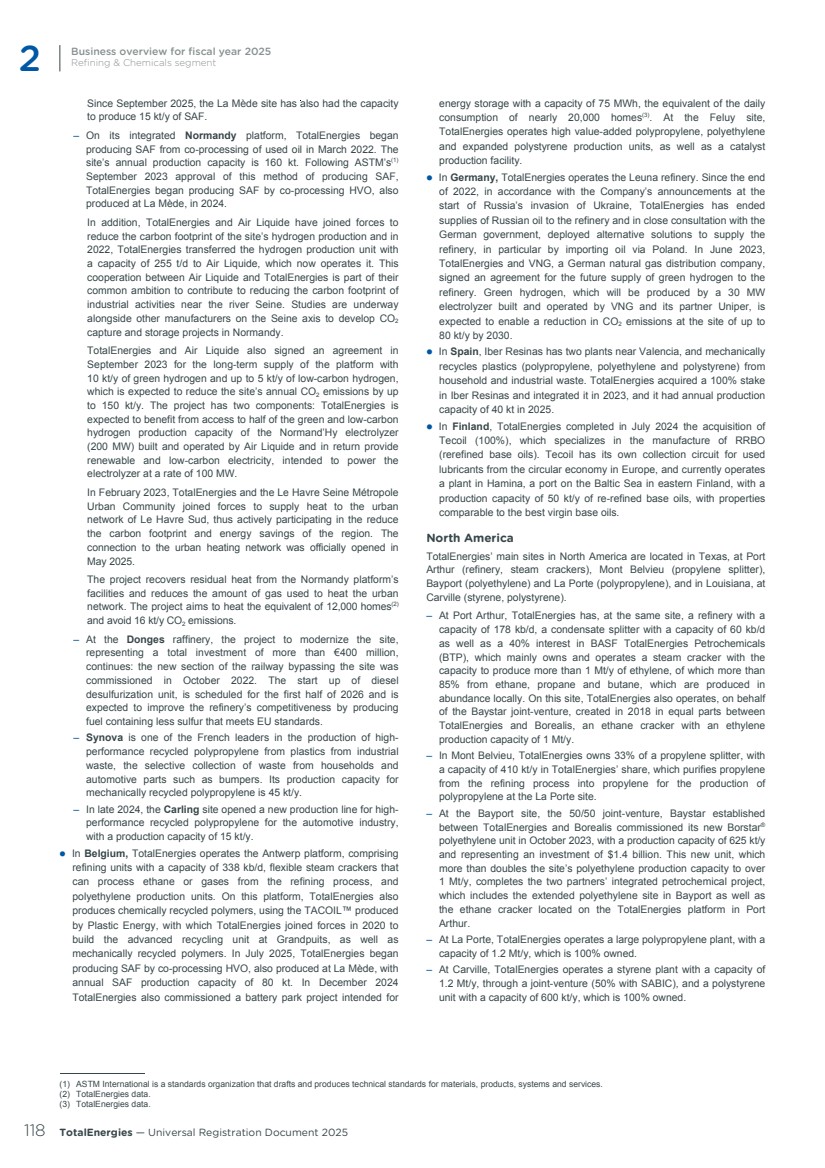
| TotalEnergies concluded in July 2023 the sale of three lines of activity of its subsidiary Cray Valley (in charge of the production and marketing of resins). The transaction covered four production sites in the United States and the Cray Valley Italian subsidiary as well as the associated customer portfolio. Asia, Middle East and Africa TotalEnergies holds interests in first-rate platforms that are ideally positioned, with easier access to feedstock under competitive conditions, enabling it to pursue its development in order to supply growth regions. ● In Saudi Arabia, TotalEnergies has a 37.5% shareholding alongside Saudi Aramco in SATORP (Saudi Aramco Total Refining and Petrochemical Company), which operates the Jubail refinery. This 460 kb/d refinery, located close to Saudi Arabia’s heavy crude fields, can process heavy crude oil and produce fuels and other light products that meet the European and American strictest specifications and are largely earmarked for export. The refinery is also integrated with petrochemical units: an 800 kt/y paraxylene unit, a 200 kt/y propylene unit, and a 140 kt/y benzene unit. SATORP is responsible for the Amiral project, for which the partners TotalEnergies (37.5%) and Saudi Aramco (62.5%) took the final investment decision in December 2022. The Amiral project is a petrochemical complex integrated with the Jubail refinery, consisting of the construction of a mixed feed steam cracker (70% ethane and refinery off-gas) with a capacity of 1.65 Mt/y and polyethylene units with a capacity of 1 Mt/y. The project represents an investment of $11 billion. In December 2025, construction of the petrochemical complex was 65% complete, in line with its initial schedule which calls for commissioning in 2027. Additionally, this project is expected to attract more than $4 billion in additional investments in various areas of industrial activity (carbon fibers, lubricants, special fluids, detergents, additives, automobile parts and tires) and create approximately 7,000 jobs, direct and indirect, in the country. In 2023, SATORP’s activity was marked by two “firsts” for low-carbon activities in the Middle East: • in July, oil from plastic waste, called pyrolysis oil, was treated at the SATORP refinery, then used as feedstock for Petrokemya (a subsidiary of SABIC) to produce circular polymers certified ISCC+ (International Sustainability and Carbon Certification). This first paved the way for the creation of a local value chain for the chemical recycling of plastics and the production of circular polymers in the Saudi Arabia; • in August, the SATORP refinery succeeded in treating, by coprocessing, used cooking oil to produce a fuel meeting all the quality criteria of the ISCC+ certified SAF specifications. This certification is expected to enable SATORP to meet the expected increase in demand for SAF in Saudi Arabia. ● In South Korea, TotalEnergies owns 50% of Hanwha TotalEnergies Petrochemical Co. (HTC), which operates an integrated platform at the Daesan site, comprising a condensate splitter, a steam cracker, polyethylene and polypropylene production units, each with a capacity of 1.1 Mt/y, and styrene and paraxylene production units with capacities of 1 and 2 Mt/y respectively. HTC is positioned on high value-added sustainable applications and specialty markets, such as underfloor heating pipes or automotive, contributing in particular to making vehicles lighter. ● In Qatar, TotalEnergies holds interests(1) in two ethane-based steam crackers: Qapco and Ras Laffan Olefin Cracker (RLOC) as well as four polyethylene lines operated by Qapco in Messaied, including a linear low-density polyethylene plant with a capacity of 550 kt/y (Qatofin) and a 300 kt/y low-density polyethylene line (Qapco). TotalEnergies also holds a 10% interest in the Ras Laffan condensate refinery, with a total capacity of 300 kb/d. Moreover, in the United Arab Emirates, after a successful test flight on the sidelines of COP28 in Dubai in December 2023, which demonstrated the potential of methanol conversion into SAF, TotalEnergies and Masdar signed a collaboration agreement in July 2024 to jointly study the feasibility of producing e-methanol and then converting it into SAF from green hydrogen and CO2. This feasibility study was launched in September 2024 and continued through 2025. In Africa, following the sale of its non-strategic interests in the Natref (National Petroleum Refiners of South Africa) refinery in December 2024 and the SIR (Société Ivoirienne de Raffinage) refinery in July 2024, TotalEnergies holds minority interests in two refineries (Cameroon and Senegal). In Algeria, TotalEnergies withdrew in 2023 from the STEP (Sonatrach Total Entreprise de Polymères) joint-venture formed in 2019 with Sonatrach (51%) to study a petrochemical project in Arzew, in the northwest of the country. R&D and partnerships As part of the consolidation of its R&D activities within OneTech (refer to point 1.5 of chapter 1), TotalEnergies has intensified its research efforts in the field of biofuels through the creation of a dedicated program. This strategic program, aimed at the development of lasting sustainable solutions based on waste, calls on a wide range of skills (modeling, agronomics, life cycle analysis, biotechnology, catalysis, thermochemicals, chemicals, industrial processes) to identify the most promising technologies. TotalEnergies develops R&D partnerships and actions in the field of low-carbon products (fuels and polymers). ● In June 2025, Avril and TotalEnergies signed an agreement to look jointly into developing a French value chain producing intermediate crops to make SAF, and thereby help to reduce the air transport sector’s CO2 emissions. The two companies intend to assess the entire value chain from the selection of crop varieties to the production of biofuels, with the aim of building a durable French value chain in which Avril will supply vegetable oils made from the intermediate crops and TotalEnergies will turn them into SAF in its French biorefineries and through co-processing in its French and European refineries. ● In May 2024, China Petroleum and Chemical Corporation (SINOPEC) and TotalEnergies signed a strategic cooperation agreement aimed at deepening their collaboration, particularly in low-carbon energies. Specifically, the two companies plan to combine their R&D expertise in the fields of biofuels, green hydrogen, CCUS (carbon capture, utilization and storage), and decarbonization. ● In February 2024, Airbus and TotalEnergies signed a strategic partnership to meet the challenges of aviation decarbonization with SAF. The partnership will cover two main areas: TotalEnergies will supply Airbus with SAF for more than half of its needs in Europe; a research and innovation programme aimed at developing 100% sustainable fuels. ● Thanks to the strategic partnership with Safran, initiated in 2021, TotalEnergies was able to formulate an SAF that is fully compatible with the fleets of aircraft currently in service, and February 2023 saw the flight of an army helicopter with this SAF, produced by TotalEnergies from used cooking oil. (1) TotalEnergies holdings: Qapco (20%); Qatofin (49%); RLOC (22.5%). Business overview for fiscal year 2025 Refining & Chemicals segment 2 TotalEnergies — Universal Registration Document 2025 119 |
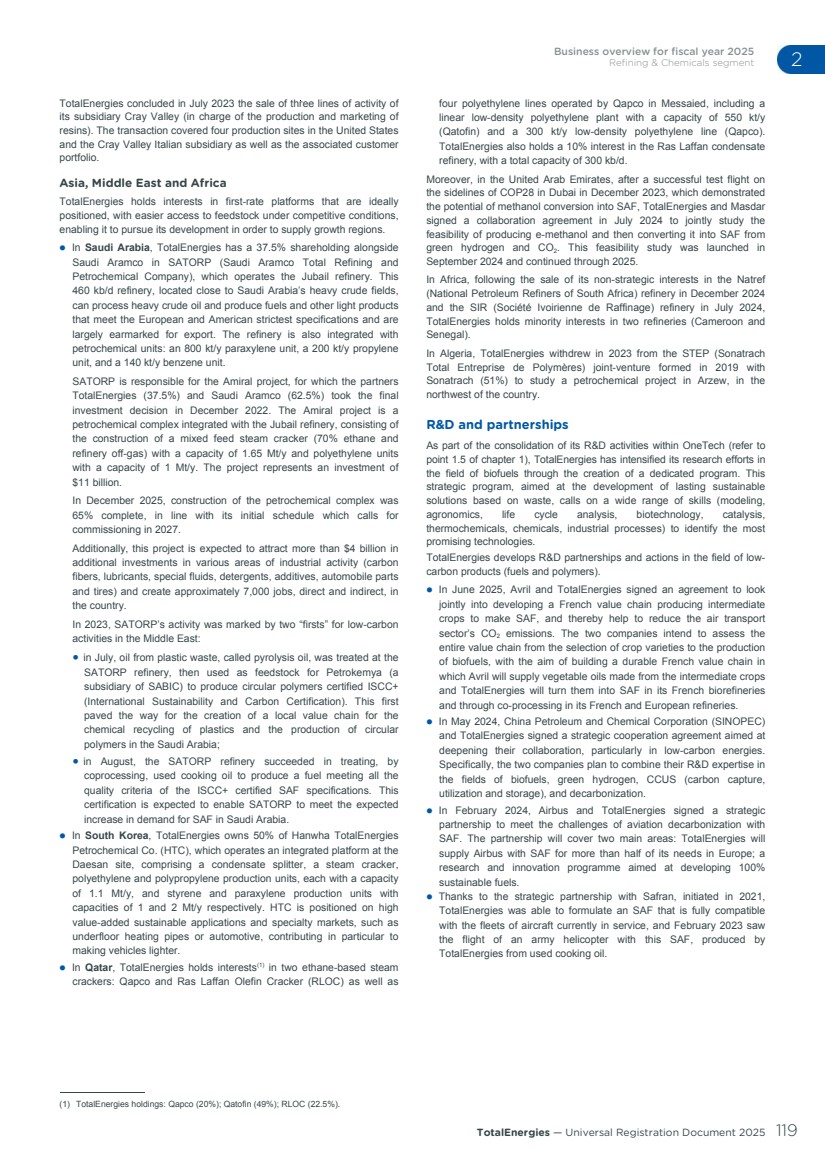
| ● The partnership between TotalEnergies and the Fédération Nationale des Syndicats d’Exploitants Agricoles (FNSEA), formed in 2022, is ongoing. This partnership aims in particular to promote solutions to produce biofuels by developing new agricultural sectors through the recovery of agricultural residues, low greenhouse gas crops or intermediate crops, and thereby support and accelerate the energy, environmental and economic transition of France’s agricultural sector. ● In October 2024, TotalEnergies and OP Mobility renewed their strategic partnership agreement signed in December 2021 aimed at the joint development of compounds based on recycled polypropylene that meet the demanding standards of automotive body parts, particularly in terms of aesthetics and safety. 2.5.1.2 Elastomer processing (Hutchinson) Hutchinson, specialized in the transformation of elastomers and composite materials is one of the world leaders in anti-vibration systems, fluid management, precision sealing and body sealing and transmission systems(1) . These solutions are used worldwide, especially in the automotive, aeronautical and industrial manufacturing sectors (energy, railroads, naval, defense). Hutchinson draws on wide-ranging expertise and leverage its know-how from the custom design of materials to the integration of connected solutions: structural sealing solutions, precision sealing, management of fluids, materials and structures, anti-vibration systems and transmission systems. After being heavily impacted by the fall in demand linked to the health crisis, its activity has returned to the pre-crisis level. Hutchinson continues its efforts to improve competitiveness in a context of inflation and lower production levels for the automotive sector, and is ramping up its aerospace activities in line with the needs of this sector. Hutchinson continues to support its customers’ transition to sustainable development and electric mobility. As of December 31, 2025, Hutchinson had 84 production sites worldwide and approximately 40,000 employees. 2.5.2 Trading & Shipping The activities of Trading & Shipping are focused primarily on serving the needs of TotalEnergies, and mainly include: – selling and marketing the TotalEnergies’ crude oil production; – providing a supply of crude oil for TotalEnergies’ refineries; – importing and exporting the appropriate petroleum products for TotalEnergies’ refineries to be able to adjust their production to the needs of local markets; – chartering appropriate ships for these activities; and – trading in various derivatives markets. In addition, with its acquired expertise, Trading & Shipping is able to expand its scope of operations beyond its primary scope of activities. Trading & Shipping conducts its activities worldwide through various subsidiaries that are established in strategically important oil markets in Europe, Asia, North America and the Middle East. The LNG and gas trading activities are reported by the Integrated LNG segment and the power trading activities by the Integrated Power segment (refer to points 2.3 and 2.4). 2.5.2.1 Trading TotalEnergies is one of the world’s largest traders of crude oil and petroleum products on the basis of volumes traded(2) . The table below presents Trading’s global sales and supply sources for crude oil and petroleum products for each of the past three years. Trading of physical volumes of crude oil and petroleum products(3) amounted to 7.9 Mb/d in 2025, compared to 7.0 Mb/d in 2024 and 6.4 Mb/d in 2023. Trading’s crude oil and petroleum products sales and supply (kb/d) 2025 2024 2023 Total of trading’s crude supply 4,972 4,298 3,973 Exploration & Production 1,258 1,264 1,372 External suppliers 3,714 3,034 2,601 Total of trading’s crude sales 4,972 4,298 3,973 Refining & Chemicals and Marketing & Services 920 1,260 1,218 External customers(a) 4,052 3,038 2,755 (a) Including inventory variations. (kb/d) 2025 2024 2023 Total of trading’s petroleum products supply(b) 2,953 2,736 2,373 Refining & Chemicals 253 680 626 External suppliers(a) 2,700 2,056 1,747 Total of trading’s petroleum products sales(b) 2,953 2,736 2,373 Refining & Chemicals and Marketing & Services 235 452 424 External customers 2,718 2,284 1,949 (a) Including inventory variations. (b) Including aromatiques volumes amounted to 115kb/d in 2025. (1) TotalEnergies data. (2) TotalEnergies data. (3) Excluding LPG volumes, which are reported in point 2.3.5. 2 Business overview for fiscal year 2025 Refining & Chemicals segment 120 TotalEnergies — Universal Registration Document 2025 |
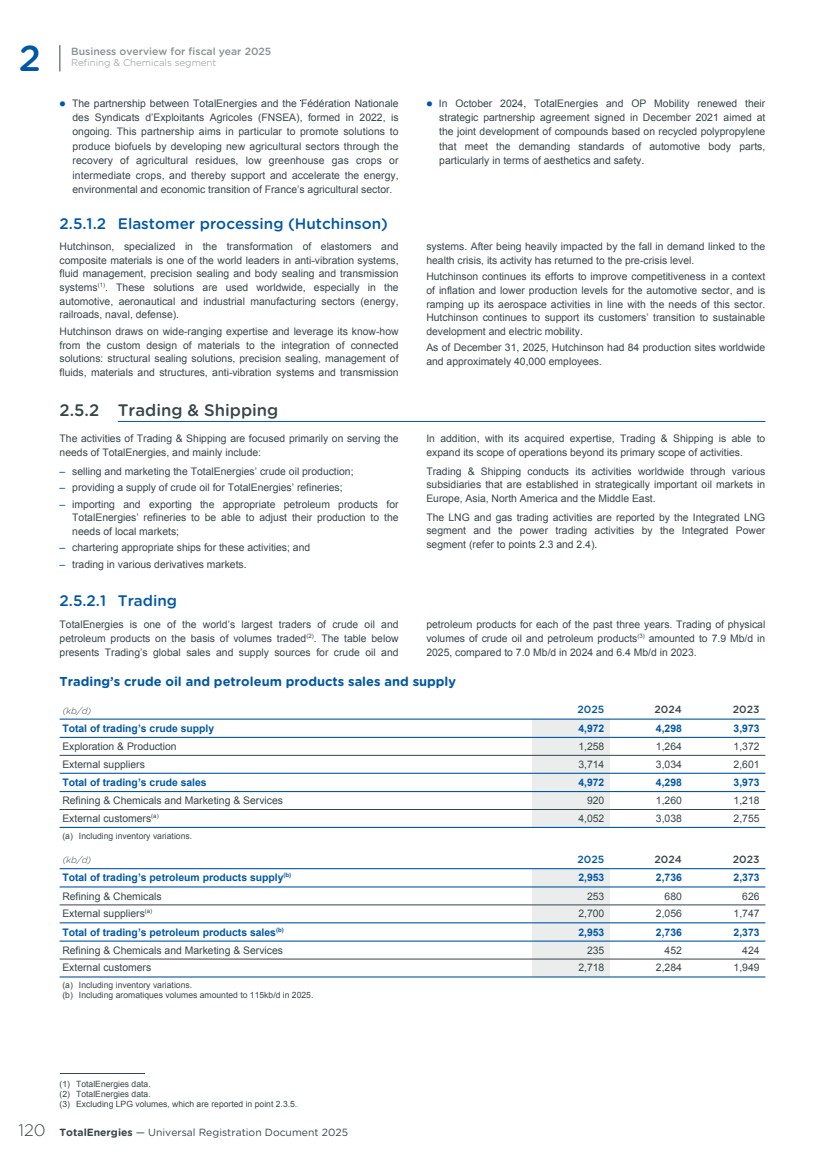
| Trading operates extensively in physical and derivatives markets, both organized and over the counter. In connection with its Trading activities, TotalEnergies uses derivative energy instruments (futures, forwards, swaps and options) in order to adjust its exposure to fluctuations in the price of crude oil and petroleum products. These transactions are entered into with a wide variety of counterparties. For additional information concerning derivatives transactions by Trading & Shipping, refer to Note 16 (Financial instruments related to commodity contracts) to the Consolidated Financial Statements (refer to point 8.7 of chapter 8). All of TotalEnergies’ Trading activities are subject to a strict risk management policy and trading limits. 2.5.2.2 Shipping The transport activities of crude oil and petroleum products as well as the transport of petrochemical products, LNG, petcoke and sulfur are grouped under a common organization, One Shipping, whose objective is to respond in a coordinated manner to security challenges and decarbonization of TotalEnergies maritime transport activities. The transportation of these products that is necessary for the activities of TotalEnergies is coordinated by One Shipping. One Shipping maintains a rigorous safety policy rooted primarily in the strict selection of chartered vessels that meet the highest international standards. Within the scope of crude oil, petroleum products and petrochemical products transport activities, the need for maritime transport is fulfilled through the balanced use of spot and time-charter markets. Excess transport capacity can be sub-chartered to third parties. The number of charters reached approximately 3,700 voyages in 2025 (compared to 3,300 in 2024 and 3,200 in 2023) to transport 163 Mt of crude oil, petroleum products and petrochemical products, compared to 150 Mt in 2024 and 148 Mt in 2023. As of December 31, 2025, the mid-term and long-term chartered fleet numbered 80 vessels (including 15 LPG vessels), compared to 61 in 2024 and 67 in 2023. The average age of the fleet of this perimeter is approximately seven years. The integration into the time‑chartered fleet of the latest‑generation vessels capable of operating with alternative fuels (LNG, LPG, methanol) continues. These new vessels, equipped with the latest technologies, display some of the lowest greenhouse gas emissions in their category(1) . Thus, TotalEnergies’ time-chartered fleet includes 10 vessels capable of operating on LNG (excluding LNG carriers), 7 vessels capable of operating on LPG, and 6 vessel capable of operating on methanol. Additionally, 7 other vessels capable of operating with alternative fuels are under construction and are expected to gradually join TotalEnergies’ time-chartered fleet in 2026. TotalEnergies is also pursuing other initiatives, particularly in favor of energy sobriety: – wind‑assisted propulsion systems: in 2024, TotalEnergies, in collaboration with its partners, deployed a pilot installation of two rotating masts on board an oil product transport vessel. The sails allow an average saving of 35 tons of fuel per month, representing 1,300 t of CO2 avoided per year. In 2025, another chemical tanker equipped with the same wind‑assisted propulsion technology joined TotalEnergies time‑chartered fleet; – TotalEnergies promotes the adoption of digital technologies among shipowners to optimize the voyages of its chartered vessels. For example, regular use of weather routing allows an average reduction of 3 to 5%(2) in fuel consumption of vessels. The use of alternative fuels that emit less greenhouse gases and the implementation of innovative technologies to improve the energy efficiency of ships are concrete actions which aim to immediately support the Company’s efforts to reduce the environmental footprint of its maritime transport activities. The Company also participates to various initiatives in the maritime transport industry aiming to contribute to the energy transition: – TotalEnergies is a signatory of the Sea Cargo Charter, an association launched in 2020 by the main shipping players to create a consistent, transparent method for measuring emissions in support of efforts to decarbonize the shipping industry. The association establishes a common baseline for determining, on the basis of defined standards, whether shipping activities are aligned with the International Maritime Organization’s climate ambitions. For the fourth consecutive year, Sea Cargo Charter published the climate alignment score of the various signatories. The Company’s 2025 score (relative to 2024 activities) is aligned with the scores of other signatories; – TotalEnergies has been a strategic partner of the Mærsk Mc-Kinney Møller Center for Zero Carbon Shipping since February 2021. This collaboration, renewed in 2024 for three years, enables TotalEnergies to work alongside leading maritime transport players to develop and promote energy‑efficiency solutions and new low‑carbon alternative fuels. To manage the economic performance of its fleet in the context of fluctuations in the maritime transport market, TotalEnergies uses financial instruments to manage the price risk of maritime freight. (1) Source: Mærsk Mc-Kinney Møller Center for Zero Carbon Shipping. (2) TotalEnergies data. Business overview for fiscal year 2025 Refining & Chemicals segment 2 TotalEnergies — Universal Registration Document 2025 121 |
| 2.6 Marketing & Services segment Marketing & Services (M&S) includes the worldwide supply and marketing activities of petroleum products and services, low-carbon fuels and new energies for mobility. It aims to support customers in their transition toward more sustainable energy and mobility, and to contribute to the TotalEnergies transition strategy. M&S has a direct presence in almost 100 countries, serving customers with a wide range of needs in terms of energy and services. It caters to professional customers (transportation, manufacturing, agriculture, etc.) and to individual customers through its network of almost 12,800 service stations and close to 90,000 EV charging points(1) , all bearing the Company’s brands. Main indicators No. 1 retail distribution network in France and in Africa(a) No. 4 worldwide distributor of inland lubricants(b) Nearly 13,000 branded service stations(c) as of December 31, 2025 Nearly 90,000 charging points operated and supervised as of December 31, 2025 Main objectives Over 300 multi-energy sites in France by 2028 (a) France: Report France Marketing and Retail, October 2025, S&P Global, based on the number of service stations/Africa: TotalEnergies data, based on the number of service stations at year-end 2024. (b) Report Global Lubricants - Company Positioning Overview 2026, S&P Global, based on 2024 estimated market shares. (c) TotalEnergies (including TotalEnergies Contact, Access, Elf, Elan, and AS24. Including service stations owned by third parties under the Company’s brands. Third-party service stations that only have terminals accepting the AS24 card are not counted. Sales of petroleum products (a) (in kb/d) (a) Excludes international (trading) and bulk refining sales. Sales of petroleum products were down by 5% in full-year 2025, reflecting the refocusing of the portfolio on higher-margin activities. (1) Operated and supervised charging points. 2 Business overview for fiscal year 2025 Marketing & Services segment 122 TotalEnergies — Universal Registration Document 2025 [REDACTED SECTION: CERTAIN TEXT HAS BEEN REDACTED.] |
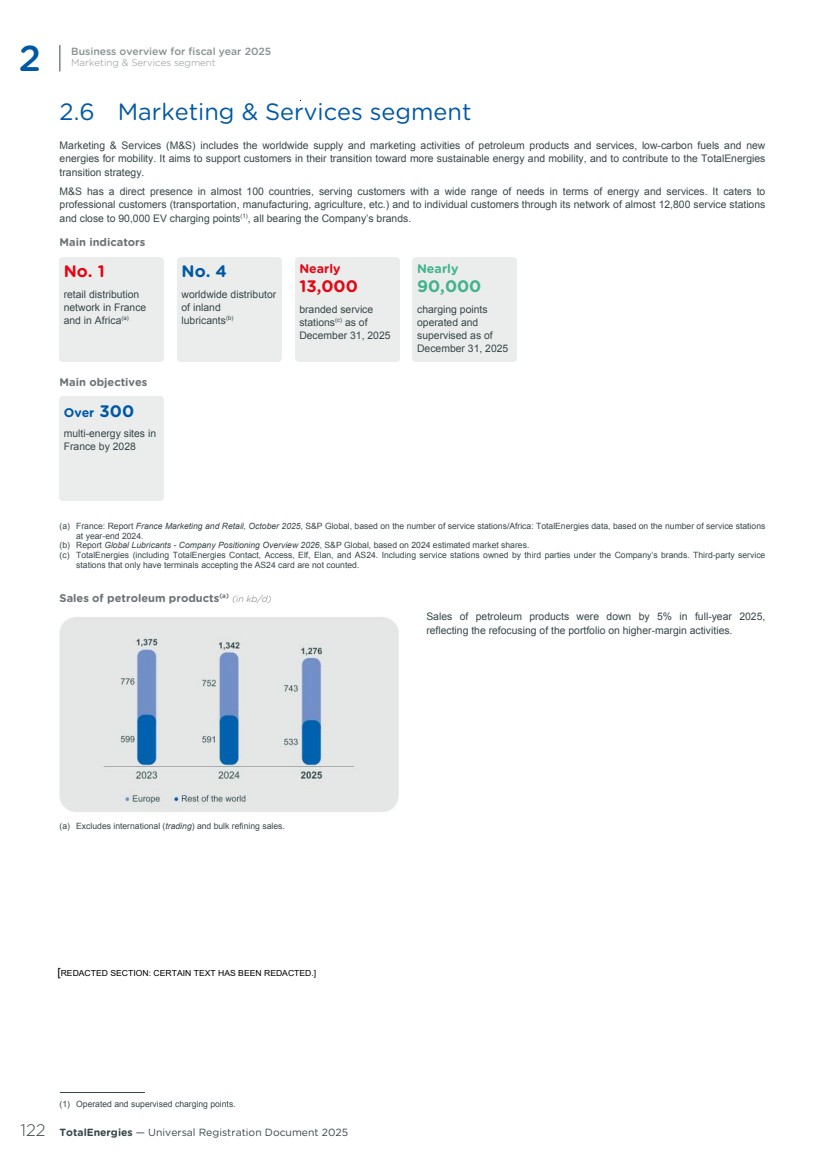
| 2.6.1 Presentation of the segment M&S formulates and markets various ranges of petroleum fuels, lubricants, and associated services, both through the service station network (shops, catering, washing, etc.) and to industrial customers. It also offers its clients new forms of energy and mobility services such as biofuels (including sustainable aviation fuel (SAF)), EV charging, natural gas, biomethane and hydrogen for road vehicles, aircraft and ships. M&S has a strong presence in Western Europe and in Africa, regions in which TotalEnergies is a leading player in the distribution of petroleum products(1) . The M&S segment’s strategy is to provide its customers with more affordable, more reliable, and more sustainable energy. As part of the Company’s integrated model regarding the petroleum chain, M&S aims to bring its sales volumes into line with the Company’s production of oil and refined products by 2030. To achieve that, M&S has been arbitraging its sales of low-margin petroleum products since 2020. At the same time, M&S’s ambition is to continue growing by developing new low-carbon energies. Market environment and trends The development of regulatory frameworks or tax incentives aimed at reducing greenhouse gas emissions promotes the development and adoption of low-carbon energies, and contributes to the markets’ transformation, with contrasting geographic dynamics. Therefore, by 2050, global energy demand for transportation is expected to have changed significantly, with different energy mixes depending on the types of use. The Company made public in November 2025 the TotalEnergies Energy Outlook 2025, which updates the scenarios of the global energy system evolution by 2050 developed by TotalEnergies, and which anticipates that: – for light vehicles, electrification will tend to become more widespread and will reduce absolute energy demand due to the better efficiency of electric motors (compared to thermal engines); – the electrification of heavy trucks will become significant, gradually replacing the use of fuels, while hydrogen may be used in niche use cases (dedicated fleets); – in the aviation and marine transport segments, the drive to reduce carbon emissions will favor a shift in the energy mix toward more sustainable fuels derived from the circular economy (such as animal fats and used cooking oils). However, these trends will be implemented at different paces depending on the geographical regions. The Company estimates that: – in Europe, oil demand for road transportation purposes should decline as the vehicles fleet electrification progresses, supported by the European Green Deal (European Union measures aimed in particular at achieving carbon neutrality by 2050); – in Africa, the pace of growth in oil demand should remain strong until 2050; – in China, demand for liquid fuels could peak around 2030 as a result of increasing electrification: more than 68% of new light vehicles are likely to be fully electric or plug-in hybrids by 2035. M&S strategy In this rapidly changing environment, M&S has adopted a “value over volume” strategy, while also seeking to reduce more quickly the carbon footprint of the products it sells. Network As regards its network of service stations, M&S intends to capitalize on its leading position in terms of number of service stations in France and Africa(2) , with the aim of: – to increase revenues from services in stations (stores branded Bonjour, washing carried by the Wash brand, catering where M&S develops partnerships with leading brands, and mobility services); – developing its network of multi-energy service stations in France, with the aim of having over 300 multi-energy sites in France by 2028; – to grow in Africa and certain other markets that offer niche positions. Lubricants As regards lubricants, which in the vast majority of cases do not generate GHGs when used(3) , the main aspects of the M&S development plan are as follows: – maintain consistent efforts to focus on more high-end products (through premium and specialty products); – focus growth efforts on high-value-added segments of the manufacturing industry (mining, metals, cement, etc.); – develop a range of circular and more sustainable lubricants with the incorporation of re-refined base oils and the use of ecodesign in new products and packagings. B2B activities In the B2B segment, M&S intends to develop low-carbon solutions for its customers. Growth in this segment is based on supporting customers in their energy transition (for example by offering them biofuels such as HVO). In aviation, M&S develops the sales of SAF, in line with the SAF mandates and its clients’ demand. New energies for mobility As regards electromobility, M&S has a selective development strategy in Europe, targeting the market segments where it can establish a strong position. For light vehicles, M&S prioritizes the following segments: – charging points of 150 kW or more in France, particularly on highways and in urban hubs; and – on-street charging, as part of financial partnerships involving external funding. For heavy trucks, M&S prioritizes road transport carriers by developing its in-depot electric charging business, which it launched in 2023 (including the supply of electricity). (1) TotalEnergies data. (2) TotalEnergies data (based on the number of branded service stations). (3) In most cases, these products are not intended to be burnt in order to produce energy. Accordingly, they are not regarded as fuels under GHG Protocol – Category 11 (refer to glossary or point 5.2.2.1 C. of chapter 5 for further details). They produce limited amounts of GHGs compared to fossil fuels. Business overview for fiscal year 2025 Marketing & Services segment 2 TotalEnergies — Universal Registration Document 2025 123 |
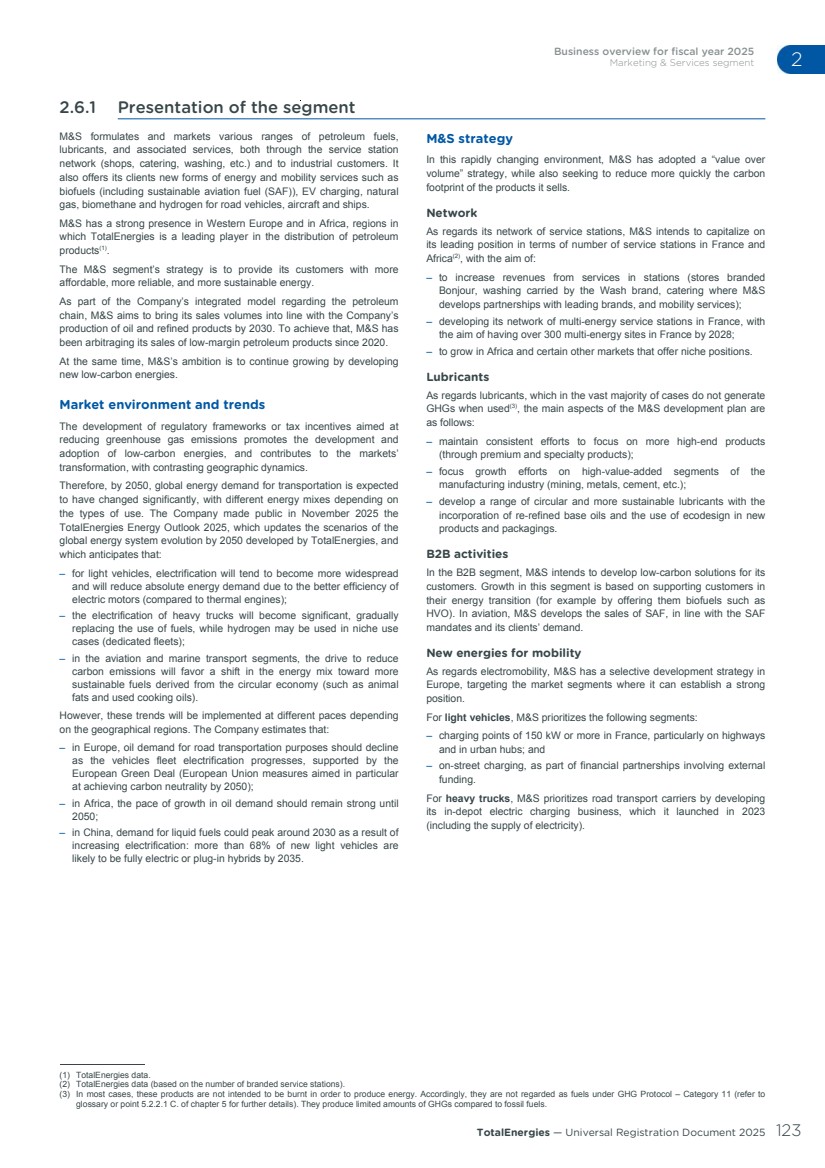
| M&S’s roadmap is based on a significant multi-year organic investment plan (approximately $0.8 billion in 2025). It is based on a balance between distributing conventional fuels on the one hand, and providing services and products which use emits little CO2 (1) on the other. In addition, TotalEnergies makes selective investments in electromobility, in line with the pace of market adoption. Furthermore, M&S pursues its digital innovation strategy so as to develop new offers tailored to different markets and to improve its operational efficiency. Finally, as part of its activities, M&S holds minority interests, through its subsidiaries, in two refineries in Africa(2) . The Refining & Chemicals business is presented in point 2.5. 2.6.2 Petroleum products sales The following table shows M&S’s(a) sales of petroleum products by geographical area as of December 31: (kb/d) 2025 2024 2023 Europe 743 752 776 France 398 401 410 Europe excluding France 345 351 366 Africa 327 351 357 Middle East(b) 49 48 46 Asia-Pacific(c) 89 108 111 Americas 68 83 85 Total 1,276 1,342 1,375 (a) In addition to M&S’s petroleum product sales, TotalEnergies’ sales include international trading (2,719 kb/d in 2025, 2,492 kb/d in 2024, and 2,173 kb/d in 2023) and bulk refining sales (361 kb/d in 2025, 384 kb/d in 2024, and 405 kb/d in 2023). (b) Including Turkey. (c) Including the Indian Ocean islands. 2.6.3 Service stations breakdown The table below shows the geographical breakdown of the Company-branded(a) service stations: As of December 31 2025 2024 2023 Europe(b) 5,309 5,331 5,568 of which France 3,256 3,279 3,319 Africa 4,287 4,521 4,501 Middle East 1,243 1,162 1,125 Asia-Pacific(c) 1,019 984 2,217 Americas 547 781 782 AS24 network (for heavy trucks) 370 369 378 Total 12,775 13,148 14,571 (a) TotalEnergies (including TotalEnergies Contact), Access, Elf, Elan and AS 24, including service stations owned by third parties and those currently being converted. Turkey is included under the Middle East region. (b) Excluding the AS 24 network. (c) Including the Indian Ocean islands. 2.6.4 Electric vehicle charging points operated and supervised As of December 31 2025 2024 2023 France 25,068 24,295 21,361 Benelux 43,411 35,669 25,575 Germany 7,567 6,969 5,210 United Kingdom 3,308 2,825 2,478 Rest of Europe 737 684 576 Asia-Pacific 9,484 7,358 4,745 Rest of the world 252 164 123 Total 89,827 77,964 60,068 (1) Services (foodservice, vehicle washing, convenience stores). Products (lubricants, bitumens, liquefied petroleum gas for cooking etc.). (2) The Company finalized the sale of its minority interests in the Natref (National Petroleum Refiners of South Africa) and SIR (Société Ivoirienne de Raffinage) refineries in December 2024 and July 2024 respectively. 2 Business overview for fiscal year 2025 Marketing & Services segment 124 TotalEnergies — Universal Registration Document 2025 |
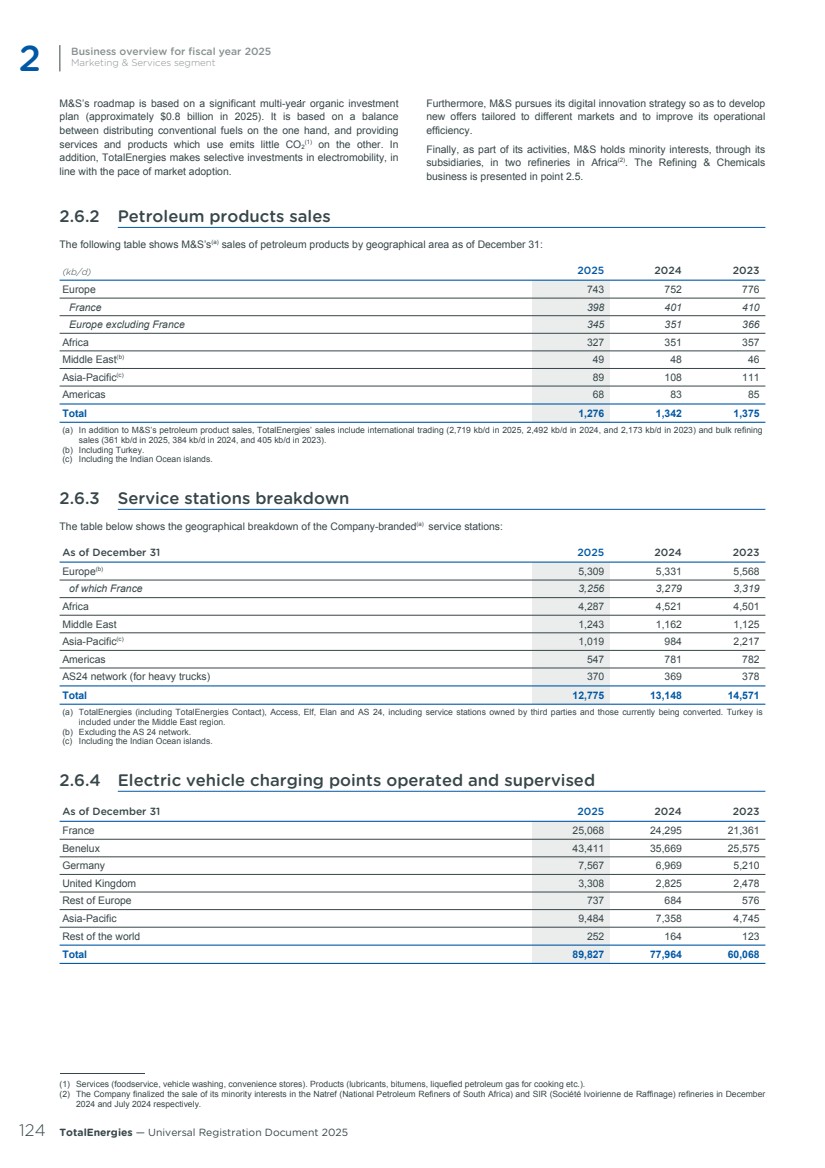
| 2.6.5 Activities by geographical area The information below describes M&S’s main activities by geographical region and main business lines. 2.6.5.1 Europe Network In the framework of the agreements signed on March 16, 2023 between the Company and Alimentation Couche-Tard (“Couche-Tard”), the Company completed on December 28, 2023, the sale to Couche-Tard of 100% of the service station network in Germany (approximately 1,200 service stations). The Company also completed on January 3, 2024, the sale of 100% of the network in the Netherlands (close to 380 service stations) and the creation of a joint-venture (TotalEnergies 40% and Couche-Tard 60%) in order to operate the networks in Belgium and in Luxemburg (more than 600 service stations). The agreements provide that these four networks will remain branded TotalEnergies as long as the fuel is supplied by the Company, for at least five years. In these countries, TotalEnergies remains present in the electric charging, hydrogen distribution, and fuels wholesale activities. At year-end 2025, the network accounted close to 5,310 branded service stations. In France, at year-end 2025, the dense network of service stations consisted of close to 3,260 service-stations, of which close to 2,400 branded TotalEnergies (including TotalEnergies Contact), more than 700 branded Access (service stations combining low prices with fuel quality) and close to 160 branded Elan (mainly located in rural areas)(1) . TotalEnergies remains the country’s leading distributor of super-ethanol E85 in the country, in number of service stations(2) with more than 950 sites offering this largely renewable fuel. In order to maintain a local service and support the development of social connections and the local economy (through partnerships), the Company has reopened 30 service stations in rural areas since August 2023. At year-end 2025, the Company had over 1,000 service-stations in rural areas, mainly branded TotalEnergies Contact or Elan. In addition, TotalEnergies recruited approximately 300 pump attendants in order to improve its customer relationships. Since 2023, TotalEnergies is committed to supporting drivers’ purchasing power by capping fuel prices in its French service stations. In March 2026, to protect them as a result of the global oil shock observed since the start of the conflict in the Gulf, TotalEnergies has announced a new measure, in place until the end of March 2026, committing to cap the price of gasoline at €1.99/l and diesel at €2.09/l in 1,830 service stations in its French network. For its electricity and gas customers in France who are registered for the “fuel benefit” program, the Company has committed to capping fuel prices at €1.99/l, regardless of the type of fuel, for the entire year 2026. In logistics, TotalEnergies holds interests in 27 storage terminals in France, including 7 operated by the Company’s companies. In heavy-goods transportation, through its AS24 brand, TotalEnergies rolls out an offer specific to this growing segment. The Company offers a fuel card accepted in a network of close to 1,850 dedicated stations in Europe. AS24 is seeking to expand its geographical presence on the major European transportation roads, mainly in Eastern Europe. AS24 supports the energy transition of the road carriers by offering NGV in several European countries (and in particular biomethane in France), and developing a multi-energy offering in its network. AS24 also offers services simplifying road carriers’ mobility, such as a satellite geolocation and payment system for the main European road tolls. Benefiting from a close proximity with its customers, service-stations carrying one of the Company’s brands meet their daily needs with a multiservice and multi-product offering (allowing them in particular to optimize their energy consumption, such as the use of Excellium® fuels allows for). Non-fuel activities (catering, Bonjour-branded stores, Wash-branded washing centers – France’s leading washing network(3) – local partnerships and cards) are growing steadily, contributing to the network’s operating cash flow excluding working capital (CFFO). New energies for mobility Electricity In the field of electro-mobility, M&S addresses the electric vehicles charging needs through a charging network adapted to different use cases. These sites allow for on-the-go charging (in the multi-energy service stations and on the charging hubs), public charging in cities, and semi-public charging in depots. At year-end 2025, TotalEnergies operates or supervises approximately 80,000 charging points, through 650 sites, in Europe. In France, since opening its first 100% electric station in 2021, the Company has installed high-power chargers (of 150 kW or more) in all its highway service stations. With close to 290 stations equipped and close to 1,850 150 kW-or more charging points installed, TotalEnergies is France’s number one player in ultra-fast(4) charging on highways and expressways(5) . Nationwide, M&S operated or supervised over 25,000 charging points at year-end 2025. In the United Kingdom and Ireland, TotalEnergies and SSE signed an agreement in July 2024 to set up a joint-venture to launch a major new player in electric charging, called “Source” to deploy 3,000 ultra-fast charging points in 300 hubs over a five-year period. In Spain, in January 2024, TotalEnergies acquired Nordian CPO, a subsidiary of the Wenea Group, which owns 200 charging sites. These sites, supplied entirely with renewable electricity, are located along major highways and in urban and peri-urban areas. In Germany, TotalEnergies was awarded, in September 2023, three regional lots under the Deutschlandnetz (“Germany network”) call for tenders to implement 1,100 charging points (up to 200 kW) across 134 urban and rural sites. In 2024, TotalEnergies was awarded the rollout of 33 fast-charging sites on freeways under a call for tender by the German federal government’s Autobahn GmbH. TotalEnergies continues to selectively develop its offering for on-street and car park charging in the main European cities, with in particular: – in February 2026, the announcement of the creation of a joint investment platform with Tikehau Capital (equally owned), to promote the development of charging infrastructure for electric vehicles in urban public spaces in Belgium and the Netherlands; – in 2025, the signature of a partnership with Banque des Territoires to create an investment platform intended to support local and regional authorities with their plans to roll out EV charging infrastructure in France; – in 2024, the award of contracts for Lyon airport (approximately 800 charging points), METPARK in Bordeaux (approximately 1,500 charging points), Sibelga in Brussels (approximately 1,400 charging points), or also the Borough of Camden in London (approximately 150 charging points); – in 2023, the award of contracts in Berlin (Germany, approximately 500 public charging points), Lille (France, close to 900 charging points), Utrecht and Amsterdam (the Netherlands, approximately 3,700 charging points), and Madrid (Spain, approximately 50 charging points). (1) In 2025, over 80 Elan-branded service-stations were rebranded TotalEnergies. (2) Metropolitan France (excluding Corsica). Source: “Superethanol-E85 data, December 2025”, Bioéthanol France. (3) TotalEnergies data, in number of wash stations at the end of December 2025. (4) With power output of 150 kW or more. (5) TotalEnergies data (based on the number of service stations at the end of December 2025). The Company’s leading position in this market segment was confirmed by a study published in June 2025 by European interoperability platform Girève, entitled “Recharge rapide sur les autoroutes en France” (“Fast charging on French highways”). Business overview for fiscal year 2025 Marketing & Services segment 2 TotalEnergies — Universal Registration Document 2025 125 |
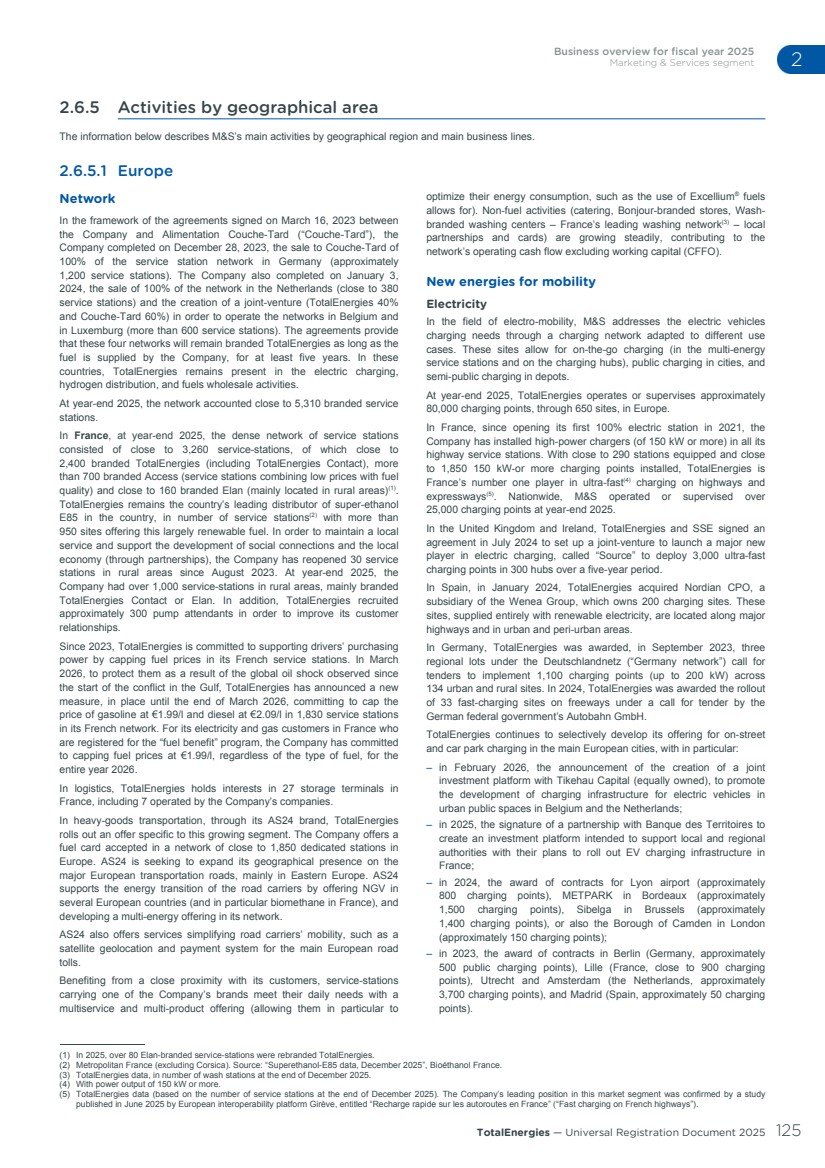
| To promote electromobility for heavy goods vehicles, TotalEnergies began deploying in 2024 dedicated charging points, mainly in logistics depots. In 2025, TotalEnergies also joined forces with Scania France, Daimler Truck France and Prologis to support road carriers in their shift toward heavy goods transportation with a reduced carbon footprint. A first semi-public depot (located at the Daimler Truck TruckStore in Gonesse) was inaugurated by the Company in November, making it easier for road carriers to use electric trucks on their regional routes. At year-end 2025, over 200 EV charging points were rolled-out by the Company in carriers’ depots. The development of this activity follows an assessment of the requirements for electric charging of heavy trucks in France by 2030 and 2035, carried out in 2023 by TotalEnergies, in partnership with Enedis, VINCI Autoroutes and six European manufacturers – Volvo Trucks, Renault Trucks, Mercedes-Benz Trucks, MAN Truck & Bus France, Scania and Iveco. Natural gas At year-end 2025, TotalEnergies operated more than 200 NGV stations in Europe (under the TotalEnergies and AS24 brands), geared to road carriers. Hydrogen In 2024, TotalEnergies and Air Liquide created TEAL Mobility, an equally-owned joint-venture, to develop a pan-European network of hydrogen stations for heavy goods vehicles under the TotalEnergies brand. The joint-venture is planning to expand primarily in Benelux, France, and Germany, on major European transport routes, as the market develops. At year-end 2025, TEAL Mobility operated 15 hydrogen stations (as opposed to 8 in 2024). In Germany, the Company holds a stake close to 12.1% in the H2 Mobility joint-venture, alongside its historical shareholders and Hy24. In France, TotalEnergies held a stake of nearly 11.6% in HysetCo at year-end 2025, which is dedicated to hydrogen-based urban mobility for business light vehicles fleets, with eight distribution stations in the Ile-de-France (Greater Paris) region. Lubricants Third-largest inland lubricants distributor(1) in Europe, TotalEnergies offers a wide range of products for motorists, automotive suppliers, industrialists and shipping companies, covering a vast spectrum of applications. In July 2024, TotalEnergies announced the acquisition of Tecoil, a Finnish company specializing in the manufacture of re-refined base oils(2) . Its integration is expected to accelerate the use of these oils in the manufacture of top-of-the-range lubricants, to meet its customers’ growing demand for increasingly high-performance and circular products. TotalEnergies relies on a direct and indirect sales presence, and on 11 operated production sites for lubricants and greases(3) (in Belgium, France, Germany, the Netherlands, Romania, Spain, Turkey, and the United Kingdom). In Russia, TotalEnergies stopped producing lubricants at the end of May 2022 in accordance with its principles of action published on March 22, 2022. Professional markets and mobility solutions Sustainable Aviation Fuel (SAF) TotalEnergies produces and distributes SAF. The SAF currently produced by the Company in France is derived from used cooking oils or animal fats from the circular economy. It enables TotalEnergies to meet regulatory mandates for the incorporation of SAF in aviation fuel (including the European ReFuelEU Aviation mandate for the minimum incorporation of 2% SAF since January 1, 2025) and to support its strategic customers in reducing the carbon footprint of their activities. As a result: – in June 2025, the Company announced that it would supply Volotea with sustainable aviation fuel at several French airports until 2029; – in July 2024, Air France-KLM and TotalEnergies confirmed their agreement for the supply of up to 1.5 Mt of SAF over 10 years, until 2035 (agreement initially signed in 2022 for the supply of 800 kt over the 2023-2032 period). The SAF is planned to be produced in the Company’s biorefineries (refer to point 2.5.1) and made available to the Air France-KLM group’s airlines; – in February 2024, Airbus and TotalEnergies signed a strategic partnership to help meet the challenges of aviation decarbonization. This partnership covers the supply of sustainable aviation fuel to Airbus to meet more than half of its needs in Europe, and a research and innovation program aimed at developing 100% sustainable fuels. At year-end 2025, TotalEnergies offers SAF, physically available at a dozen French airports. Thus, this offering participates in the shared ambition of public and private players to address a two-fold challenge: to continue decarbonizing air transportation while at the same time supporting the dynamism of regional economies and tourist industries. HVO100 In France, the Company supplied HVO100 to over 1,150 business customers in 2025. This biodiesel (consisting entirely of hydrotreated vegetable oil) does not require technical modifications to heavy-duty vehicle engines, but it needs to be approved by the car manufacturer. It enables to reduce the carbon footprint of heavy trucks, public transport vehicles, agricultural machines, construction machines and other equipment. Other Products In Europe, TotalEnergies produces and markets to professionals fuels (heating oil), bulk fuels, special fluids, bitumens, and specialty bitumens (low-temperature bitumens, recycling solutions, etc.). The Company offers its professional customers based in Europe Bitume Online, a digital platform for buying bitumen online. Mobility solutions As regards mobility solutions, TotalEnergies supports companies in managing their vehicle fleets through multi-service and multi-energy offers. – In France, the Fleet card enables to pay for fuel fill-ups, electric recharging, parking, tolls, automotive maintenance, washing, and purchases at stores within the TotalEnergies or partnering network. – The Mobility Corporate card, an international payment card available in France, enables customers to pay for all business travel expenses (including hotels, catering, transportation, vehicle rentals, taxis, as well as energy purchases, parking, maintenance expenses, etc.). – The Charge+ Business card, marketed in Belgium and Luxemburg, combines access to on-the-go, at home, and workplace charging. – The LiberT badge allows to pay for toll fees on the entire French highway network. Specific electromobility services are available through offers, including: – access to a network of over 1,000,000 charging points in Europe, – access to a mobile application to make journeys easier (geolocation of charging stations, available power, etc.), and – access to charging services at customer sites or employees’ homes. (1) 2025 Lubricants market share update report, S&P Global, based on estimated market shared in 2024. (2) In a process known as “re-refining”, used oils are treated to give them properties comparable to those of virgin base oils. These high-quality base oils are used in the manufacture of lubricants that meet customers’ expectations in terms of circularity and sustainability. (3) After the closure of a site in Spain in 2024. 2 Business overview for fiscal year 2025 Marketing & Services segment 126 TotalEnergies — Universal Registration Document 2025 |
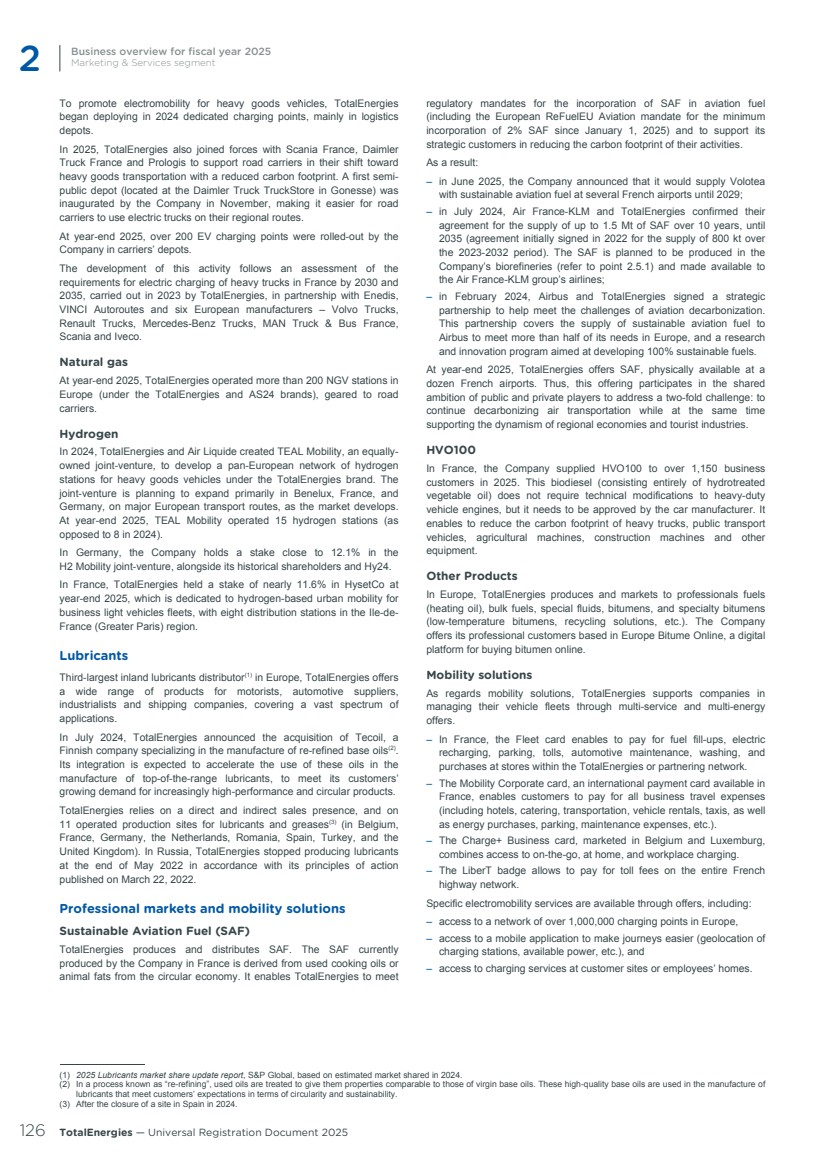
| In February 2026, TotalEnergies and RATP Smart Systems announced the creation of Rout’in, a joint venture which offers companies an innovative digital solution to simplify the management and the payment of their employees’ home-office commute. Rout’in enables to implement an efficient mobility policy through the centralization of all home-office mobility solutions programs. In 2025, as part of its selective growth strategy, M&S exited the capital of the Time2Plug start-up it took control of in 2023. In 2024, to support electromobility adoption among private customers, TotalEnergies launched the Charge+ card, providing access to a network over 200,000 public charging points in France and in Spain. Private customers who signed an electricity & gas supply contract with TotalEnergies can access the Company’s branded charging network on preferential terms. At year-end 2025, TotalEnergies remained a major player in professional mobility in Europe, with approximately 4.2 million active mobility cards and electronic toll badges. 2.6.5.2 Africa Network TotalEnergies is the leading petroleum products retailer in Africa with close to 15%(1) market share in 2025. The African network comprised close to 4,300 branded service stations at year-end 2025. Present in nearly 30 countries, M&S has a wide footprint and large retail networks (particularly in Egypt, Kenya, Morocco, Nigeria and South Africa). M&S diversifies its service stations offering and provides a range of products and services in restaurants, convenience stores and car wash sites. Lubricants TotalEnergies is the leading distributor(2) of lubricants on the African continent and pursues its growth strategy in the B2B and B2C markets. M&S relies on nine operated lubricant production sites, in Algeria, Egypt, Kenya, Morocco, Nigeria (two sites), Senegal, South Africa and Tanzania. TotalEnergies continues to provide car maintenance services in the Quartz Auto Services, Rubia Truck Services and Hi-Perf Moto Services centers. Professional markets and mobility solutions TotalEnergies is an established partner for industrial customers in Africa irrespective of their line of business: agri-food, construction, electricity generation, mining, or transportation. TotalEnergies provides innovative fuel management solutions and adds hybrid offers incorporating solar energy to its existing portfolio of products and services. Additionally, TotalEnergies is progressively developing across the continent a new payment card offering, via the Mobility business solutions and its fleet management tool. 2.6.5.3 Asia-Pacific/Middle East M&S directly markets its products and services in 20 countries of the area approximately. Network At the end of 2025, TotalEnergies had close to 2,270 service stations in the region. M&S distributes fuels through its branded service station networks in Cambodia, China, Jordan, Lebanon, Saudi Arabia, the Pacific Islands, and Turkey. In 2024, the Company sold its interests in Total PARCO Pakistan Limited and in three joint-ventures in the Philippines, illustrating a selective growth strategy in the area. New energies for mobility Electricity TotalEnergies continues to develop in the field of electric mobility in Asia: – in China, the joint-venture set up in 2021 by TotalEnergies with China Three Gorges Corporation continues to operate a fast charging network for electric vehicles in the city of Wuhan and in the Hubei province. At year-end 2025, this network numbered close to 5,600 charging points; – in India, ATEEL (Adani TotalEnergies E-Mobility Ltd), a wholly-owned subsidiary of ATGL, a joint-venture with the Adani Group in which TotalEnergies holds a 37.40% stake, has been active in the electric vehicle charging infrastructure market since March 2022 (refer to point 1.8.3 of chapter 1); – in Singapore, the Company transferred the supervision of the majority of its public charging sites to the Land Transport Authority of Singapore in 2025, subsequent to the non-renewal of its operating license past 2027. Natural gas TotalEnergies develops a network of CNG and LNG stations in India (of 675 stations at year-end 2025), through its stake in the ATGL joint-venture (refer to point 1.8.3 of chapter 1). Starting January 1, 2026, the TotalEnergies Marine Fuels LNG bunkering business is reported to the Company’s Integrated LNG segment. Lubricants The Lubricants business contributes to the growth of TotalEnergies in Asia-Pacific and the Middle East. The lubricants production capacity in this area is spread among nine operated production sites, including in China, Dubai, and Singapore. In addition, a research center in India and a laboratory in China support the Company’s products and services development for its various clients, including automobile manufacturers. As an example, TotalEnergies has been a leading lubricants supplier to Great Wall Motors (GWM) since 2012, with whom it has also been developing EV fluids since 2020, in China. The Company also develops its business line with other industries (including cement, energy, mining, and textiles) and builds partnerships with Online to Offline digital platforms (such as Tuhu and Tmall Auto Care in China, and Speedworks in Indonesia) to market its products. Professional markets and mobility solutions TotalEnergies has signed several partnership agreements with industrial customers, allowing it to extend its presence in markets such as construction and mining, in several countries in the region, notably in Australia and in India. TotalEnergies is also present on the LPG market in India, New Caledonia, and Vietnam, as well as in the bitumen specialties segment through an equally-owned joint-venture with Indian Oil Corporation Ltd. In addition, TotalEnergies markets multi-energy payment cards for its B2B and B2C customers in countries where it has developed a branded service station network. (1) Market share estimated based on volumes sold (TotalEnergies data). (2) TotalEnergies data. Business overview for fiscal year 2025 Marketing & Services segment 2 TotalEnergies — Universal Registration Document 2025 127 |
| 2.6.5.4 Americas In the network, following the disposal of approximately 240 service stations and several logistics depots in Brazil to SIM Distribuidora in March 2025, TotalEnergies had close to 550 branded service stations in the region at the end of 2025. This transaction illustrates the selective growth strategy of the Company, which focuses its fuel retailing activity in the Caribbean region. In lubricants, TotalEnergies pursues its development throughout the area. TotalEnergies has four operated lubricants blending sites in North America (Canada, Mexico, and the US) and three more in South America (Argentina, Brazil and Chile). In new energies for mobility, TotalEnergies is a shareholder (19.42% at December 31, 2025) in US-based, NASDAQ-listed Clean Energy Fuels Corp., which specializes in the distribution of natural gas for vehicles. Clean Energy Fuels Corp. had a network of close to 610 NGV service stations in Canada and the U.S. at year-end 2025. In mobility solutions, TotalEnergies also provides multi-energy payment cards for its B2B and B2C customers. 2.6.5.5 Local projects promoting access to low-carbon and affordable energy In line with SDG 7 to “ensure access to affordable, reliable, sustainable and modern energy for all”, in November 2024 TotalEnergies, bp, Equinor and Shell announced their decision to jointly invest $500 million(1) in a private equity fund to promote access to electricity (via solar home systems, micro-grids, electric mobility, energy storage and management) and improved cooking conditions, mainly in sub-Saharan Africa and in Asia. Through its subsidiaries, TotalEnergies also offers solar solutions to help people in underserved communities gain access to electricity and to more sustainable cooking solutions. Access to energy TotalEnergies Off-grid Solar Solutions teams develop and market solar solutions in nearly 30 countries (mainly in Africa). The range includes solar lamps(2) and kits to meet household needs. The teams also developed a solar streetlights offer for collective use. These solutions make it possible to provide energy access to populations living in remote areas without a connection or reliable access to the electricity grid, particularly in Africa and Asia. In 2025, TotalEnergies sold more than 380,000 solar lamps and kits through distributors and its network of service stations. Clean cooking In May 2024, TotalEnergies announced its ambition to provide 100 million people in Africa and India access to clean cooking(3) by 2030. To achieve this, the Company plans to invest in the development of LPG for cooking, and intends to develop the use of digital technologies enabling customers to pay for LPG as they use it (“pay-as-you-cook”). 2.6.6 Technical partnerships By fostering technical partnerships with car and equipment manufacturers, industries and universities, TotalEnergies develops products with a high technological content, designed to meet specifications increasingly geared to sustainable development and reduction of CO2 emissions, in addition to performance. These partnerships have given rise to ranges such as EV Fluids for new mobility applications, Quartz EV3R for motor oils produced from re-refined base oils, and Fuel Economy for conventional motor and industrial applications. In the field of motor sport, TotalEnergies has established partnerships that illustrate its technical know-how in the formulation of fuels and lubricants used under extreme conditions and constrained to reduce energy consumption. The Company is developing a similar approach to new energies for mobility, to meet the demands of tomorrow’s power trains. As such, TotalEnergies: – signed in 2021 a five-year extension to the partnership agreement with Stellantis in the areas of lubricants, R&D, motor racing and mobility; – has been the official fuel supplier to the main endurance(4) car championships since 2018, including the 24 Hours of Le Mans, through its partnership with Le Mans Endurance Management and the Automobile Club de l’Ouest, renewed in February 2024 until 2028. The Company has thereby become its multi-energy partner and intends to support its energy transition(5); – has formed a partnership to supply hydrogen to FIA (Fédération Internationale de l’Automobile) competitions, in order to support the development of a hydrogen-powered endurance car for a dedicated category in the 24 Hours of Le Mans in 2028; – supplies lubricants specifically developed for the DS Penske team in the FIA electric formula. (1) A private equity firm has been selected to manage the funds. The joint investment aims to support promising, high-impact projects, mainly in sub-Saharan Africa and in South and Southeast Asia. (2) Solar kits are made up of lamps and can include accessories such as a radio or television. (3) Meant as “improved cooking solutions”. (4) The FIA World Endurance Championship, Le Mans 24 Hour race, the European Le Mans Series and the Asian Le Mans Series. (5) This involves carrying out an energy audit of its infrastructures, installing charging stations for electric vehicles and solarizing its buildings and parking lots. 2 Business overview for fiscal year 2025 Marketing & Services segment 128 TotalEnergies — Universal Registration Document 2025 |
| Risks and control 3 3.1 Risk factors 130 3.1.1 Energy transition 131 3.1.2 Market environment parameters 134 3.1.3 Geopolitics and external threats 135 3.1.4 Risks relating to operations 137 3.1.5 Innovation 138 3.2 Countries under economic sanctions 139 3.2.1 US and European economic sanctions 139 3.2.2 Information concerning certain limited activities related to certain countries under sanctions 141 3.3 Internal control and risk management procedures 142 3.3.1 Fundamental elements of the internal control and risk management systems 142 3.3.2 Control environment 143 3.3.3 Risk assessment and management 144 3.3.4 Main characteristics of the internal control and risk management procedures relating to the preparation and processing of accounting and financial information 147 3.4 Insurance and risk management 148 3.4.1 Organization 148 3.4.2 Risk and insurance management policy 149 3.4.3 Policy on insurance 149 3.5 Legal and arbitration proceedings 149 3.6 Vigilance Plan 150 3.6.1 Introduction 150 3.6.2 Severe impact risk mapping 152 3.6.3 Action principles and organization 154 3.6.4 Assessment procedures 159 3.6.5 Actions to mitigate risks and prevent severe impacts 160 3.6.6 Whistle-blowing mechanisms 162 3.6.7 Monitoring procedures 163 3.6.8 Implementation report 163 TotalEnergies — Universal Registration Document 2025 129 |
| 3.1 Risk factors TotalEnergies conducts its business in a constantly changing environment and is exposed to risks that, if they were to occur, could have a material adverse effect on its business, financial condition, reputation, outlook, or the price of financial instruments issued by TotalEnergies SE. This section presents the significant risk factors specific to TotalEnergies, to which the Company believes it is exposed at the filing date of the Universal Registration Document. However, TotalEnergies may be exposed to other non-specific risks, or risks of which it may not be aware, or the potential consequences of which may be underestimated, or the materialization of which is not considered, at that date, to be likely to have a material adverse impact on TotalEnergies, its business, financial condition, reputation or outlook. In particular, TotalEnergies could be exposed to systemic risks, such as unexpected major disruptions (health, such as the COVID-19 pandemic, security, monetary or cyber), leading to large-scale disturbances with global human and economic repercussions. 3 Risks and control Risk factors 130 TotalEnergies — Universal Registration Document 2025 [REDACTED SECTION: CERTAIN TEXT HAS BEEN REDACTED.] |
| 3.1.1 Energy transition Pace of deployment of the energy transition, evolution of demand TotalEnergies is exposed to the implementation of the energy transition, particularly by States, and to the evolution of demand Civil society, numerous stakeholders and States are encouraging reductions in the consumption of carbon-based energy products and the establishment of an energy mix more geared towards low-carbon energies, so as to meet the requirements of the fight against the climate change, particularly in view of the objectives set by each State in the context of the Paris Agreement. The COP30, held in Belém in November 2025, adopted the “Global Mutirão” decision, calls for tripling climate finance for adaptation by 2035 and establishing a Global Implementation Accelerator to accelerate the implementation of Nationally Determined Contributions (known as “NDCs”) and decisions taken at previous COPs. In particular, the COP28, that took place in Dubaï in December 2023, concluded with an agreement enshrining the willingness of the states to “transitioning away from fossil fuels in energy systems, in a just, orderly and equitable manner” and mentioning the usefulness of transitional fuels, such as gas. The COP28 agreement sets the objectives of tripling the renewable energy capacity and doubling energy efficiency by 2030, as well as eliminating most methane emissions by that time. The COP29, which was held in Baku in November 2024, agreed a new carbon credit mechanism under Article 6 of the Paris Agreement – the Paris Agreement Crediting Mechanism (PACM) – in particular allowing the member States to transfer greenhouse gas emission reductions to meet their Nationally Determined Contributions (NDCs). This mechanism is also to be open to public and private entities. The pace of change in the energy mix of countries must, however, take into consideration their energy security challenges, energy prices, as well as the needs and ability to adapt of the various energy consumers, who expect energy players to supply them with energy that is both cost-effective and environmentally friendly. In this context, companies in the energy sector are led to deploy actions aiming at reducing their greenhouse gas emissions. They will also be able to help create solutions that contribute to reducing the CO2 emissions associated with the customers’ use of their energy products, as well as technologies and processes to capture, store and reuse CO2. Consequently, they may be led to change the energy mix of the products they offer while at the same time having to manage the cost and the execution of projects supporting the energy transition. An insufficient ability to adapt to the pace of deployment of the energy transition, as well as an inadequate anticipation of the climate or sustainability regulations, of the evolution of the demand or, of the energy cost which could be considered excessive by the populations, could affect TotalEnergies’ outlook as well as its financial position (lower profitability, loss of operating rights, loss of revenues, increased funding difficulties), reputation or shareholder value. Risk of legal actions and regulatory developments TotalEnergies is exposed to legal actions Increased pressure from stakeholders linked to climate issues relating to oil & gas activities of the Company could lead to future climate-related legal actions against it. These actions could aim to suspend or prohibit oil & gas projects being considered or under development and equally target the challenges linked to greenhouse gas emissions from projects as well as other societal aspects. In a similar way to legal actions launched in France under the vigilance duty (devoir de vigilance) against the Company or, other litigations engaged in Europe or in the United States, including against other companies, these legal actions could target the global emissions of the Company and its stakeholders as well as the objectives set by the Company for reducing its emissions, thereby obliging it to go beyond these objectives or even reduce its production of fossil fuels at a faster pace than envisaged in the current strategy. In all cases, these legal actions could have the effect of impeding the Company from achieving its medium- and long-term objectives, as well as its ability to finance the energy transition. The increasing number of regulations, and the constant developments, whether anticipated or not, in the legal and tax frameworks in countries where TotalEnergies operates, may have significant operational and financial effects, jeopardize TotalEnergies’ business model and affect the conduct of its business and its financial conditions, especially given the size of TotalEnergies and its international dimension Conducting its activities in about 120 countries throughout the world, TotalEnergies is subject to increasingly numerous, complex and restrictive laws and regulations, particularly regarding health, safety and the environment, or business ethics, which can generate significant compliance costs. In Europe and the United States, TotalEnergies’ sites and products are subject to increasingly stringent laws governing the protection of the environment (water, air, soil, noise, protection of nature, waste management and impact assessments, etc.), health (occupational safety and chemical product risk, etc.), the safety of personnel and residents, product quality and consumer protection. In some jurisdictions, the legal and fiscal framework of operations may be changed unexpectedly. The application of rights, including contractual rights, may prove uncertain and the economics of projects called into question. The legal and fiscal framework of TotalEnergies’ activities, in particular regarding exploration and production, established through concessions, licenses, permits and contracts granted by or entered into with a government entity, a state-owned company or private owners, remains exposed to risks of renegotiation that, in certain cases, can reduce or call into question the protections offered by the initial legal framework and/or the economic benefit to TotalEnergies. In recent years, in various regions of the world, TotalEnergies has thus seen governments and state-owned companies impose more stringent conditions on companies, increasing the costs and uncertainties of TotalEnergies’ business operations. This trend is expected to continue. Government intervention in such countries, which is likely to increase, may concern various areas, such as: – the award or denial of rights necessary to explore and exploit oil & gas or renewable resources; – the imposition of specific drilling obligations; – price and/or production quota controls and export limits; – nationalization or expropriation of assets; – cancellation or unilateral modification of license or contract rights; – increases in taxes and royalties, including those related to retroactive claims, changes in regulations, tax reassessments and implementation of new mechanisms of taxation; Risks and control Risk factors 3 TotalEnergies — Universal Registration Document 2025 131 |
| – the renegotiation of contracts; – the imposition of increased social and environmental responsibility requirements; – the imposition of increased local content requirements; – payment delays; and – currency exchange restrictions or currency devaluation. The development of TotalEnergies’ new energy activities and those in the electricity sector also expose it to new, essentially local regulations which may change at an unexpected pace. The increasing number of legal and tax regulations, which are sometimes not very compatible with one another, and the constant changes, whether anticipated or not, in legal and fiscal frameworks in the countries in which TotalEnergies operates create legal instability, which heightens the risk of legal proceedings and promotes an increase in the number of national or transnational disputes. They may have the effect of causing a material increase in tax withholdings and customs duties, as well as costs relating to operations, thus affecting the profitability of projects or the economic value of a number of TotalEnergies assets, or even oblige TotalEnergies to shorten, change and/or stop certain activities or to implement temporary or permanent site closures. If TotalEnergies were unable to anticipate changes in regulations and legal and tax frameworks or comply with them in time in one or more countries in which it operates, TotalEnergies could face increased litigation, be forced to modify and/or stop some of its activities, which could lead to a downturn in the profitability of certain projects and adversely affect its financial condition and reputation. Financing of oil and gas reserves TotalEnergies’ profitability and its capacity to finance the energy transition depend on its ability to finance the development of its reserves profitably and in sufficient quantities A large portion of TotalEnergies’ revenues and operating results comes from the sale of oil and gas extracted from reserves developed as part of its exploration and production activities. The development of oil and gas fields, the construction of facilities and the drilling of production or injection wells are capital intensive and require advanced technologies. In order to preserve its profitability and finance its growth levers, TotalEnergies must renew its reserves with reserves that can be developed and produced in an economically viable manner and that are compatible with compatible with the Company’s energy transition strategy aimed at supplying more energy while reducing emissions (low technical cost, low-emission reserves). Various factors may undermine TotalEnergies’ ability to discover, acquire and develop its reserves, which are inherently uncertain, including: – the geological nature of oil and gas fields, notably unexpected drilling conditions, including pressure or unexpected heterogeneities in geological formations; the risk of dry wells or failure to find sufficient quantities of hydrocarbons for commercial use; – failure to anticipate market changes in a timely manner; – applicable governmental or regulatory requirements, whether anticipated or not, that may prevent the development of reserves or give a competitive advantage to companies not subject to such regulations; – competition from oil and gas companies for the acquisition and development of assets and licenses; – disputes relating to property titles as well as increases in taxes and royalties, including retroactive claims and changes in regulations and tax reassessments; – economic or political risks, including threats specific to a certain country or region; – pressure from investors and non-governmental organizations (NGOs). These factors may impair TotalEnergies’ ability to complete development projects and to make production profitable. They may also affect TotalEnergies’ projects and facilities further down the oil and gas chain. If TotalEnergies failed to develop reserves cost-effectively, in sufficient quantities and in accordance with its energy transition strategy, its financial condition, operating income and cash flows could be materially affected. TotalEnergies could also be required to recognize impairments of assets, which could have a negative impact on its results for the period in which they are recognized. For additional information on impairments recognized on TotalEnergies’ assets, please refer to Note 3C to the consolidated financial statements (point 8.7 of chapter 8). To ensure the robustness of its asset accounting on the balance sheet, the Company uses, for the calculation of the impairments of its Upstream assets, a trajectory of oil prices which remain sustained at $202570/b until 2030, decreasing then linearly to reach $202550/b in 2040 and decreasing after 2040 towards the price retained in 2050 by the NZE scenario of the IEA, i.e., $25.72025/b. Gas prices used in Europe and Asia decrease to $6.52025/MBtu and $7.52025/MBtu respectively in 2029/2030, before rising to $82025/MBtu and $92025/MBtu and stabilizing at these levels until 2040, which are lower than current price levels; the Henry Hub remains at $32025/MBtu over the period 2027-2040. They all converge thereafter towards the IEA’s NZE scenario prices in 2050. TotalEnergies assessed the impact of using the NZE price scenario published by the IEA in 2025 on the discounted present value of its assets (Upstream and Downstream). Such a scenario would reduce the discounted present value of the Company’s Upstream and Downstream assets by around 10% compared to its reference scenario used to value its investments. Furthermore, TotalEnergies’ proved reserves figures are estimates made in accordance with SEC rules. Proved reserves are those reserves which, by analysis of geoscientific and engineering data, can be estimated with reasonable certainty to be economically recoverable (from a given date forward, from known reservoirs and under existing economic conditions, operating methods and government regulations) prior to the time at which contracts providing the right to operate expire, unless evidence indicates that renewal is reasonably certain, regardless of whether deterministic or probabilistic methods are used for the estimation. They involve making subjective judgments (particularly regarding the quantity of hydrocarbons initially in place, initial production rates and recovery rates) based on available geological, technical and economic data. TotalEnergies’ reserves estimates may therefore require substantial downward revisions should its subjective judgments based on available geoscientific and engineering data prove not to have been sufficiently conservative, or if TotalEnergies’ assumptions regarding factors or variables that are beyond its control prove to be incorrect over time. Any downward adjustment could indicate lower future production amounts, which could adversely affect TotalEnergies’ financial condition, operating income and cash flow. 3 Risks and control Risk factors 132 TotalEnergies — Universal Registration Document 2025 [REDACTED SECTION: CERTAIN TEXT HAS BEEN REDACTED.] |
| TotalEnergies is exposed to a risk of more difficult access to the financial resources that the Company needs in particular to develop its activities in the oil and gas sectors The growth and profitability of TotalEnergies depend on its ability to successfully execute development projects that are capital-intensive. A number of NGOs tend to increase the number of campaigns targeting investors and financial institutions, to encourage them to reduce their investments in projects or companies related to fossil fuels. Some of these institutions have adopted policies aimed at restricting the funding of activities related to the exploration, production and marketing of hydrocarbons, particularly non-conventional hydrocarbons, for example from shale or those produced in the Arctic region. Different actors, including in particular institutional investors and financial institutions, are also adopting investment and lending policies that take account of extra-financial criteria particularly in Europe. Regulations aimed at guiding investment flows towards sustainable activities, as well as the growing concern of civil society and stakeholders about climate change, could therefore influence investors in their investment choices and make access to external funding more difficult or costly for TotalEnergies or some of its projects. If TotalEnergies were unable to obtain adequate financing for its activities from investors, notably in the oil and gas sectors, the significant increase in the cost of financing likely to result from this could hinder its ability to undertake projects in satisfactory economic conditions, impair its financial position or shareholder value. Operational risks relating to the effects of climate change and of extreme events The effects of climate change and of extreme events may expose TotalEnergies to a cost increase and a disturbance of the continuity of its activities Climate change and extreme events (natural disasters, pandemics, etc.) potentially have multiple effects that could harm TotalEnergies’ operations. The increasing scarcity of water could be detrimental to operations, rising sea levels could harm certain coastal activities, and the increasing frequency of extreme natural or weather events could damage onshore and offshore facilities and/or the associated logistical infrastructures. All these factors could increase the difficulties to operate, as well as the costs of the facilities and adversely affect TotalEnergies’ operating income. Moreover, climate change can expose TotalEnergies to an increase in its costs. For instance, more and more countries are likely to adopt carbon pricing mechanisms to accelerate the transition to a low-carbon economy, which could have an adverse impact on some of the Company’s activities and lead to a loss of competitiveness and a cost increase. In Europe, TotalEnergies’ industrial facilities participate in the CO2 emissions trading system (EU-ETS). The financial risk associated with the purchase of these allowances on the market could increase following the reform of the system approved in 2018. This emission allowance market entered its fourth phase in 2021. The share of emissions in the EU-ETS scope not covered by free allowances increases over time from phase to phase, as in the 2021-2030 period (phase 4). At the end of 2025, the price of these allowances was about €75/t CO2, and TotalEnergies estimates that this price could reach more than €100/t CO2 in phase 4. Even if CO2 pricing does not currently apply in all the countries where the Company operates, TotalEnergies includes as a base case in its investment criteria, an internal CO2 price of $100/t (or the prevailing price in a given country, if higher); beyond 2031, the CO2 price is inflated by 2% per year. On the assumption that this CO2 price would be at $200/t, then inflated by 2%/y beyond 2031, i.e., an increase of $100/t compared to the base scenario from this date, TotalEnergies estimates a negative impact around 15% on the discounted present value of all the Company’s assets (Upstream and Downstream). In such a scenario, the value of Integrated Power’s assets would increase due to higher electricity prices in Europe. Reputational risk TotalEnergies is exposed to a reputational and media scrutiny risk that can damage its reputation The attention of many stakeholders to major industrial groups is increasing, particularly given the challenges of climate change and the support needed to be put in place in a responsible manner for a just transition. As a major energy player, TotalEnergies faces media scrutiny, mainly from NGOs. This phenomenon is amplified by the general trend toward polarization of society. In addition, the growing use of social media leads to an increased risk of disinformation/misinformation. If TotalEnergies were not in a position to adequately address the concerns of its stakeholders, the public image of the Company and its reputation could be negatively impacted. Hence, the relationships with its counterparties could be affected, its access to markets and its growth could be limited and its financial condition or the price of TotalEnergies shares could be adversely impacted. Talent management and transition of the Company TotalEnergies could face difficulties having key skills and talents required in the context of its transition strategy Maintaining the long-term employability of employees is one of the Company’s social challenges and is one of the key factors in the success of the company’s project, in the context of a just transition. Deploying the transition strategy of the Company into an integrated energy company requires supporting employees in their skills development and creating bridges between the current business lines and the renewable energy or electricity business lines, in order to have the key skills available at the pace of the transition. In addition, TotalEnergies’ ability to attract, retain and motivate the talents needed for its transition strategy is also a challenge for the Company. Employees and new generations expect companies to be committed to environmental and climate issues and to workplace wellness. These expectations could materialize both in the recruitment process and during careers. Finally, increased competition with fast-growing sectors such as information technology and new energies can make the recruitment and retention of certain key skills more complex. If TotalEnergies were unable to appropriately address these social challenges, it could face difficulties building the teams required to achieve its transition strategy. Risks and control Risk factors 3 TotalEnergies — Universal Registration Document 2025 133 |
| 3.1.2 Market environment parameters Sensitivity of results to oil and gas prices, refining margins, exchange rates and interest rates The results of TotalEnergies are sensitive to various market environment parameters, the most significant being oil and gas prices, refining margins, exchange rates and interest rates Prices for oil and natural gas may fluctuate widely due to many factors over which TotalEnergies has no control, such as: – international and regional economic and political developments in natural resource-producing regions, particularly in the Middle East, Africa, South America and Russia; along with the security situation in certain regions, the magnitude of international terrorist threats, wars or other conflicts; – the ability of OPEC and other producing nations to influence global oil and gas production levels and prices; – prices of unconventional energies as well as evolving approaches for developing oil sands and shale oil, which may affect TotalEnergies’ selling prices, particularly in the context of its long-term gas sales contracts, and the valuation of its assets, particularly in North America; – global economic and financial market conditions; – regulations and governmental actions; – variations in global and regional supply of and demand for energy due to changes in consumer preferences or to pandemics such as the COVID-19 pandemic. Generally, a decline in oil and gas prices has a negative effect on TotalEnergies’ results due to a decrease in revenues from oil and gas production. Conversely, a rise in oil and gas prices generally has a positive effect on TotalEnergies’ results. In addition to the adverse effect on revenues, margins and profitability of TotalEnergies, a prolonged period of low oil or natural gas prices may lead TotalEnergies to review its development projects, adjust downward its reported reserves, and revise the price assumptions on which asset impairment tests are based, which could have an adverse effect on its results for the period in which they occur. For additional information on impairments recognized on TotalEnergies’ assets, refer to Note 3C to the consolidated financial statements (point 8.7 of chapter 8). Prolonged periods of low oil and natural gas prices may reduce the economic viability of projects in production or in development and reduce TotalEnergies’ liquidity, thereby limiting its ability to finance capital expenditure and/or causing it to cancel or postpone investment projects. Conversely, in a high oil and gas price environment, TotalEnergies may experience significant increases in costs and government withholdings, and, under some production-sharing contracts, may see its production rights reduced. An increase in prices can also lead to a fall in demand for TotalEnergies’ products. The results of the Refining & Chemicals and Marketing & Services segments are primarily dependent on the supply of and demand for petroleum products and the margins on sales of these products, with a strong dependence on the transportation sector. Changes in oil and gas prices affect results in these segments, depending on the speed at which the prices of petroleum products adjust to reflect movements in oil and gas prices. In markets still impacted by the import ban on petroleum products originating in Russia, TotalEnergies’ refining margins continue to be characterized by high volatility. The activities of trading and shipping (oil, gas and power trading and maritime transportation) are particularly sensitive to market risks and more specifically to price risks resulting from the volatility of oil, gas and electricity prices, to liquidity risk (inability to buy or sell cargoes at market prices) and to counterparty risks (when a counterparty does not fulfill its contractual obligations). In 2025, oil markets remained supportive with a Brent price that settled around $70/b in the first 3 quarters before trending downward in the 4 th quarter, mainly driven by abundant supply resulting from volume growth of non-OPEC countries and from the unwinding by OPEC+ of part of the voluntary production cuts, in a context of macroeconomic and geopolitical uncertainties. After having experienced exceptional market conditions (high volatility and very high prices) in 2022 and 2023, gas prices in Europe (TTF(1)) and Asia (JKM(2)) remained at high levels, slightly higher compared to 2024, around $12/Mbtu on average over the year for these two markers but with lesser volatility, limiting opportunities in gas trading activities. European refining margin (ERM), which was at $5.3/b in 2024, rose to $7.1/b in 2025, showing strong growth in the second half of the year as a result of low stock levels in Europe and disruptions to flows generated by new sanctions against Russia. Global electricity demand has grown since 2010 with global annual growth of around 2.8%(3) , mainly driven by China. After years of stability, a rebound in demand is observed in the US (~+2.5%(4)) and in Europe (~+1.2%(5)) as a result of which wholesale electricity prices increased significantly in 2025 compared to 2024 in Europe as well as the United States, reaching high levels. For fiscal year 2026, in the retained scenarios applied below, TotalEnergies estimates that a change of $10 per barrel in the average annual liquids sales price would lead to a change of approximately $2.3 billion in the same direction in adjusted net operating income(6) for the year and of approximately $2.8 billion in the cash flow from operations excluding working capital (CFFO)(7) for the year. In addition, TotalEnergies estimates that a change in the average annual European gas sale price - TTF of $2 per Mbtu would result in a change in the same direction in the adjusted net operating income for the year and in the cash flow from operations excluding working capital (CFFO) of approximately $0.4 billion. (1) TTF (Title Transfer Facility) is a virtual trading point in the Netherlands for transferring rights in respect of physical gas. It is the most liquid and widely used price benchmark for the natural gas markets in Europe. TTF is operated by Gasunie Transport Services (GTS), the owner and operator of the national transmission network in the Netherlands. It is traded in €/MWh. (2) JKM (Japan-Korea Marker) measures spot LNG trading prices in Asia. It is based on the prices reported in spot market trades and/or bids and offers of LNG collected after the close of the Asian trading day at 16:30 Singapore time. (3) Source: IEA_WEO 2025 (p. 486 Table A16). (4) Source: EIA Short Term Energy Outlook (Fichier Novembre 2025). (5) Source: ENTSO-e (European Network of Transmissions System Operators for Electricity). (6) Refer to the glossary for the definition and further information on alternative performance measures (Non-GAAP measures) and to point 1.8 of chapter 1 for reconciliation tables. (7) Refer to the glossary for the definition and further information on alternative performance measures (Non-GAAP measures) and to point 1.8 of chapter 1 for reconciliation tables. 3 Risks and control Risk factors 134 TotalEnergies — Universal Registration Document 2025 |
| The impact of changes in crude oil and gas prices on downstream operations depends on the speed at which the prices of finished products adjust to reflect these changes. TotalEnergies estimates that a change in the European refining margin marker (ERM) (1) of $1 per baril would lead to a change of approximately $0.3 billion in the same direction in adjusted net operating income for the year and of approximately $0.4 billion in the cash flow from operations excluding working capital (CFFO) for the year. All TotalEnergies’ activities are, for various reasons and to varying degrees, sensitive to fluctuations in the dollar exchange rate. TotalEnergies estimates that a year-on-year decrease of $0.10 per euro (strengthening of the dollar against the euro) would increase annual adjusted net operating income by approximately $0.1 billion and would have a limited impact on the cash flow from operations excluding working capital (CFFO) for the year. Conversely, a year-on-year increase of $0.10 per euro (weakening of the dollar against the euro) would decrease adjusted net operating income for the year by approximately $0.1 billion and would have a limited impact on cash flow from operations excluding working capital (CFFO) for the year. Sensitivities 2026 (a) Change Estimated impact on adjusted net operating income Estimated impact on cash flow from operations excluding working capital (CFFO) Dollar +/- $0.1 per € -/+ $0.1 B ~ $0 B Average liquids sales price(b) +/- $10/b +/- $2.3 B +/- $2.8 B European gas price - TTF (c) +/- $2/MBtu +/- $0.4 B +/- $0.4 B European refining margin marker (ERM) +/- $1/b +/- $0.3 B +/- $0.4 B (a) Sensitivities are revised once per year upon publication of the previous year’s fourth quarter results. Sensitivities are estimates based on assumptions about TotalEnergies’ portfolio in 2026. Actual results could vary significantly from estimates based on the application of these sensitivities. The impact of the $-€ sensitivity on adjusted net operating income is essentially attributable to Refining & Chemicals. (b) Brent environment at $60-70/b. (c) TTF (Title Transfer Facility) is a virtual trading point in the Netherlands for transferring rights in respect of physical gas. It is the most liquid and widely used price benchmark for the natural gas markets in Europe. TTF is operated by Gasunie Transport Services (GTS), the owner and operator of the national transmission network in the Netherlands. It is traded in €/MWh. In addition, as part of its financing, TotalEnergies is exposed to fluctuations in interest rates. Based on its portfolio of bond debt, short-term debt securities (“commercial paper”), and credit lines available at the level of the Company’s central financing entities (undrawn as of December 31, 2025), TotalEnergies’ floating rate debt (after taking into account hedging instruments) was approximately $15.9 billion on average over the course of 2025. Within this portfolio, a fluctuation in the various reference rates, from now mainly the SOFR, of +/- 1% would have resulted in a variation in the cost of debt, the theoretical impact of which on TotalEnergies’ adjusted net income and cash flows is estimated at approximately -/+ $0.1 billion. 3.1.3 Geopolitics and external threats Geopolitical instability and fragmentation of the World Order Recent geopolitical developments mark the end of the post-World War II world order, with multilateralism giving way to a more fragmented world, where relations between states are governed by minilateralism and more transactional approaches, accompanied by a marked rise in regional conflict and a reconsideration of international trade routes, resulting in protectionist measures that affect free trade and economic sanctions regimes. The development of protectionist measures affecting free trade between nations may have an impact on TotalEnergies’ business, its strategy or its financial condition Against a backdrop of increased geopolitical tensions and of risks of deglobalization and fragmentation between nations in the form of protectionist measures, trade tensions between certain countries contribute to restricting the free trade of goods and services, financial flows, along with international transfers of labor or knowledge. These tensions, particularly when they require the modification to the contractual framework of partnerships or the operating conditions of projects, are likely to have a negative impact on TotalEnergies’ business and its operating income. If TotalEnergies were unable to manage the impacts of these commercial tensions in an appropriate manner, it would potentially incur significant increases in costs for the development of its projects, lose markets, see its production or the value of its assets fall, which could adversely affect its financial situation. TotalEnergies also faces an increased risk of the imposition of international economic sanctions, as well as a tightening of regulations relating to export controls Economic sanction regimes, combined with export controls, can target those countries in which TotalEnergies operates, and thus restrict certain types of financing or access to critical technologies, impose restrictions on the import, export or re-export of a number of goods and services, and hinder TotalEnergies’ ability to continue its operations. In certain situations, the economic sanctions multiply without being necessarily coordinated at the international level. In addition to particularly heavy financial sanctions, the breaching of economic sanction regimes adopted by the United States may lead the authorities to impose measures that freeze companies out of the US market, such as a ban on using the US dollar, the currency in which most of TotalEnergies’ financings are denominated. The international economic sanction regimes are described in point 3.2, notably against Russia that were reinforced in the context of the invasion of Ukraine by Russia. The impact of the situation in Russia on the Company is detailed in point 1.8.3 of chapter 1. (1) The European Refining margin marker (ERM) is a new market indicator for European refining, introduced from the 1 st quarter 2024 to replace the “Variable Cost Margin, European refining”. This indicator is be calculated based on public market prices with a formula using a basket of crudes, petroleum product yields and variable costs representative of the European refining system of TotalEnergies. Since the results for the fourth quarter of 2025, it has been expressed in ($/b), with a conversion factor of 7.5 b/t. The ERM stood at $39.5/t in 2024 and $53.4/t in 2025. Risks and control Risk factors 3 TotalEnergies — Universal Registration Document 2025 135 |
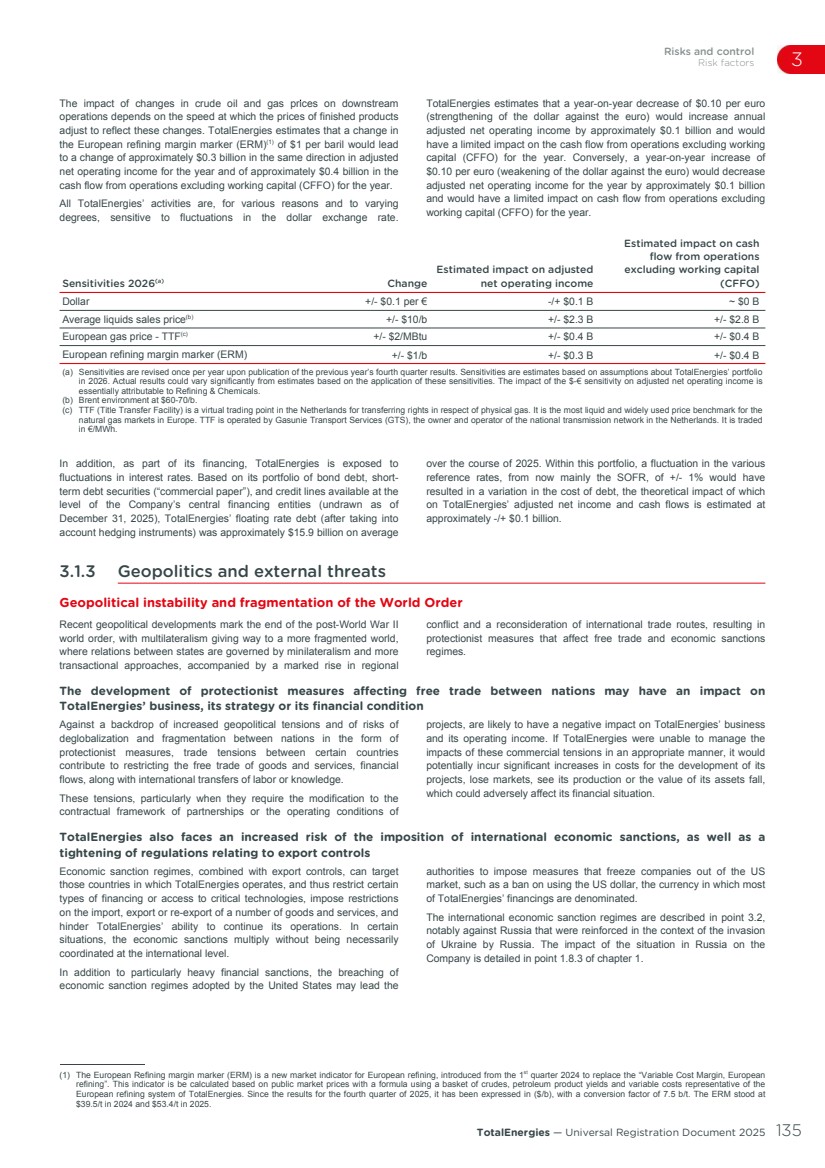
| Security risks and deterioration of operating conditions TotalEnergies is exposed to risks that may jeopardize the security of its personnel, operations and facilities, which may result from acts of malice, violence, terrorism or armed conflicts In addition to armed conflicts in certain regions or countries where TotalEnergies operates, political, economic and social instability may favor the emergence of acts of malice, violence or terrorism, either by isolated individuals or by more or less organized groups. TotalEnergies and its partners may therefore be exposed to direct or collateral risks that may jeopardize the safety of their personnel, operations and facilities (plants, industrial or operational sites, transport systems). In particular, major industrial accidents could result. Depending on their scale, such acts of malice, violence, terrorism or armed conflicts, could cause damage to people, property and/or the environment, and be detrimental to TotalEnergies’ operating income, financial situation, and reputation. TotalEnergies is exposed to risks related to adverse changes in operating conditions in some geographical areas or strategic countries A substantial part of TotalEnergies’ activities is located in strategic geographical areas or countries that may face conditions of political, geopolitical, social and/or economic instability, or the deterioration of the security conditions. Some of these countries or areas have experienced such situations in recent years, to varying degrees. Whether these conditions appear alone or in combination, they could disrupt TotalEnergies’ economic and commercial activities in the countries or geographical areas concerned. In addition, the occurrence of epidemics or pandemics may significantly affect the operating conditions of certain projects or even delay their execution. In Africa (excluding North Africa), which accounted for 17% of TotalEnergies’ 2025 oil and gas production, some of these situations of political, social and/or economic instability arose in countries where TotalEnergies has production, notably in Nigeria, which is one of the main contributing countries to TotalEnergies’ production (refer to point 2.1.3 of chapter 2). In the north of Mozambique, given the evolution of the security situation in the Cabo Delgado province where the Mozambique LNG project is being developed, TotalEnergies confirmed on April 26, 2021 the withdrawal of all Mozambique LNG personnel from the Afungi site. This situation led Mozambique LNG to declare force majeure, which was lifted end of 2025 paving the way for the project to resume (refer to point 2.3.2 of chapter 2). In the Middle East and North Africa, which accounted for 34% of TotalEnergies’ 2025 oil and gas production, some countries are the setting for political instability that could be associated with violent conflicts and terrorist acts, such as in Libya and Iraq. In Yemen, which is in a state of civil war, the deterioration of security conditions in the vicinity of the Balhaf site caused Yemen LNG, in which TotalEnergies holds an interest of 39.62%, to stop its commercial production and export of LNG and to declare force majeure to its various stakeholders in 2015. The plant has been put in preservation mode. In South America, which accounted for 13% of TotalEnergies’ 2025 oil and gas production, several countries in which TotalEnergies has production have recently experienced political or economic instability, notably Argentina. The occurrence and scale of incidents related to political, geopolitical, economic, health or social instability in certain strategic geographical areas or countries may be unpredictable. Such incidents are likely to adversely affect operating conditions, generate cost increases and lead to a significant decline in production, delays in and even halting of certain projects, or the loss of market shares. Such incidents may also expose employees and jeopardize their safety, as well as that of TotalEnergies’ facilities. These risks may have an adverse impact on TotalEnergies’ operating income and financial condition. Cybersecurity risks TotalEnergies is exposed to cybersecurity risks that may compromise the integrity or availability of its IT systems or cause losses of sensitive data The very fast evolution of cyberattack threats exposes TotalEnergies’ IT systems and requires a dynamic and proactive management of cybersecurity. In the current geopolitical context of strong tensions, cyberattacks constitute significant means of destabilization. Moreover, organized crime continues to multiply cyberattacks that are more and more sophisticated and targeted at large companies, in order to maximize profits. As a major economic player, the Company is a potential target. In 2025, several million attacks were blocked by the Company’s IT defense systems and several thousands required the intervention of TotalEnergies’ technical teams. The Company is exposed to constantly evolving cybersecurity risks through diverse attack vectors, such as phishing, malware, human intervention or exploited vulnerabilities in software or hardware. Ransomwares have become one of the biggest threats. They are notably used in cyberattacks targeting the suppliers of large companies, sometimes less protected but benefitting from legitimate access to the IT systems of their clients. Moreover, numerous factors associated with the digital transformation increase the exposure and vulnerability of TotalEnergies’ IT systems. The adoption of new technologies such as the Artificial Intelligence (AI), Internet of Things (IoT), migration to the Cloud, remote working or changes in technical architectures that favor system interconnectivity are factors that increase the range of attacks of the TotalEnergies IT systems. In particular, AI can be misused by attackers to create advanced threats (deepfakes or hyperfakes, which are AI-generated fakes, automated phishing, etc.). Finally, service providers on which the Company relies on for a number of its IT systems may also be the target of cyberattacks that could disrupt the Company’s IT systems or cause the loss of sensitive data. If TotalEnergies and its service providers were unable to detect and remediate cyber-attacks, and more generally to preserve the integrity and availability of its IT systems and sensitive data (which may include confidential information or personal data), TotalEnergies’ activities and assets could be affected: services could be interrupted, protected intellectual property rights could be usurped or confidential information or personal data stolen, and in some cases, personal injury, property damage, environmental harm and regulatory violations could occur, which could have an adverse effect on the financial condition and the reputation of the Company and expose it to legal proceedings. 3 Risks and control Risk factors 136 TotalEnergies — Universal Registration Document 2025 |
| 3.1.4 Risks relating to operations HSE: risk of major accident or damage to third parties and the environment TotalEnergies’ activities entail multiple operational risks such as the risk of a major industrial accident, or damage to third parties or to the environment TotalEnergies must face the risk of a major industrial accident both at its sites and during transport (by sea or land), or during activities related to its operations. TotalEnergies’ Upstream activities are exposed, during drilling and production operations, to risks related to the properties of oil and gas fields, which can cause blow outs, explosions, fires or other events in particular to the environment, and can lead to a disruption or interruption of TotalEnergies’ operations and limit its production. The activities of the Integrated LNG, Integrated Power, Refining & Chemicals and Marketing & Services business segments are also subject to the risk of a major industrial accident such as fires, explosions, significant damage to the environment, as well as risks related to the overall life cycle of the products manufactured, and the materials used. In addition to its drilling and pipeline transport operations, TotalEnergies had identified, at year-end 2025, 175 sites and operating zones more exposed to significant industrial accidents, given the quantity and potential harmfulness of the products used, and to damages to persons, goods and the environment. The conduct of TotalEnergies’ activities, and the nature of some of the products sold, may also entail risks of direct and repeated exposure which have longer-term effects on health and the environment (soil, air, water). TotalEnergies’ entities and their legal representatives may be exposed to legal proceedings, notably in the event of damage to human life, bodily injury and material damage, chronic damage to health and environmental damage. Such proceedings could also damage TotalEnergies’ reputation. The crisis management plans put in place at TotalEnergies level and at subsidiary level to cope with emergency situations may not be able to minimize the impacts on third parties, health or the environment, or exclude the risk that TotalEnergies’ business and operations may be severely disrupted in a crisis situation. An inability for TotalEnergies to resume its activities in a timely manner could prolong the impact of any disruption and/or lead to service interruptions, and thus could have an adverse effect on its financial condition. TotalEnergies is not insured against all potential risks, and if a major industrial accident were to occur, TotalEnergies’ liability could exceed the maximum coverage provided by its third-party liability insurance. TotalEnergies cannot guarantee that it will not suffer any uninsured loss, and there can be no guarantee that such loss would not have an adverse effect on TotalEnergies’ financial condition and its reputation (refer to point 3.4). Development of major projects TotalEnergies’ energy production growth and profitability depend on the delivery of its major development projects TotalEnergies is engaged in large development projects in the upstream, or in the decarbonized energies, in particular in solar energy and onshore and offshore wind power. Growth of energy production and profitability of TotalEnergies rely heavily on the successful execution of those major development projects that are increasingly complex and capital-intensive. These major projects, as any other projects, may be affected by the occurrence of a number of difficulties, including, in particular, those related to: – societal challenges and the extra-financial requirements of stakeholders, notably regarding managing the potential impacts of these projects in particular on affected communities; – economic or political risks, including threats specific to a certain country or region, such as terrorism, social unrest or other conflicts; – negotiations with partners, governments, local communities, suppliers, customers and other third parties; – obtaining project financing; – controlling capital expenditure and operating costs; – earning an adequate return on investment in a low price environment (oil, gas and energy prices, etc.); – respecting project schedules; – difficulties in supplying the necessary goods and services; and – the timely issuance or renewal of permits and licenses by public agencies. Failure to deliver any major project that underpins TotalEnergies’ energy production or its growth could have a material adverse effect on TotalEnergies’ financial condition. Integration of strategic acquisitions The integration of an asset or a company that presents a strategic interest for TotalEnergies may not produce the effects initially expected TotalEnergies has made and may make further acquisitions in various geographical markets, in various activities, and with companies of various sizes, in particular in the low-carbon energies sector. Acquisitions made by TotalEnergies stood at a total of $3.9 billion in 2025 (refer to point 1.4 of chapter 1). Acquisitions present many challenges (synergies, governance, operating model, key employees, sufficient availability of TotalEnergies’ teams) and require specific adaptation on a case-by-case basis. If TotalEnergies were unable to integrate the acquired assets under the planned conditions, achieve the expected synergies, retain and integrate the key employees of the newly acquired companies, or if TotalEnergies had to bear liabilities that were not yet identified or appropriately assessed at the time of the transaction, then TotalEnergies’ financial condition and reputation could be adversely affected. Risks and control Risk factors 3 TotalEnergies — Universal Registration Document 2025 137 |
| Supply chain management TotalEnergies faces various risks related to its supply chain management TotalEnergies’ supply chain is especially wide, with a network of over 100,000 suppliers of goods and services in more than 150 countries. TotalEnergies is exposed to various risks in the management of its supply chain, in particular in a context of geopolitical tensions or pandemics (containment measures or closure of borders) impacting a geographical area or a country representing, for the Company, a significant source of supply. Disruptions or interruption of its supply chain (such as insufficient inventories, unavailability of raw materials, lack of personnel, transport difficulties, suppliers’ vulnerabilities in financial and cybersecurity terms) can lead of an increase in costs and/or delays impacting the continuation of certain activities or projects. TotalEnergies may also be exposed if a supplier fails to comply with the Company’s regulations or requirements, particularly with respect to extra-financial issues. If the Company did not ensure that its supply chain is sufficiently diversified, or did not select suppliers in adequation with its requirements, TotalEnergies could be negatively impacted on the management of its operations or projects, its financial condition and its reputation. Exposure to partnerships TotalEnergies could inadequately manage or anticipate the multiplication and diversification of the partnerships that it implements for its activities Almost all upstream projects and an increasing number of projects undertaken by TotalEnergies’ other business segments, are carried out through partnerships (including joint-ventures) in all of the areas in which the Company operates. In some countries, specifically in Africa, legislation and/or the authorities make TotalEnergies’ presence conditional on the establishment of a joint-venture with a local company. Some partnerships include companies exposed to specific risks linked to the financial markets, such as Clearway Energy or Adani Group. A partnership’s success depends on many factors, primarily the quality of the partner (specifically technical skills and financial capacity), the quality of agreements negotiated, and the efficiency of the governance framework implemented. Inappropriate or incomplete contractual agreements, or a partner’s breaching of its obligations, specifically those that are financial, legal or ethical, may harm or prevent the development of projects, give rise to disputes and damage TotalEnergies’ reputation. Projects developed in partnership may be operated by TotalEnergies, by the partners, or by joint-ventures set up for this purpose in the form of a company or via contractual agreements. In cases where TotalEnergies’ companies are not operators, these companies may have limited influence over, and control of, the behavior, performance (including extra-financial) and costs of the partnership, and their ability to manage risks may be limited. Even when they are not operators, TotalEnergies companies may be sued by the authorities or by plaintiffs. If the Company did not choose high-quality partners or failed to manage its partnerships in an optimum way or to establish an appropriate governance framework, TotalEnergies could suffer profitability losses at the level of its projects, be obliged to incur costs in relation to potential litigation and face the risk of damage to its reputation. 3.1.5 Innovation Technological developments, digital transformation and artificial intelligence TotalEnergies could fail to anticipate appropriately the technological changes related to its main markets, the expectations of its customers and changes in its competitive environment or in certain business models or may not respond to them in an appropriate way and at an appropriate pace TotalEnergies’ activities are carried out in a constantly changing environment with new products, new players, new business models, new technologies and new climate challenges. TotalEnergies must anticipate these changes, understand the market’s challenges, identify and integrate technological developments in order to maintain its competitiveness, maintain a high level of performance and operational excellence, best meet the needs and demands of its customers and prepare for the future while integrating the climate and sustainable development challenges. TotalEnergies’ innovation policy requires significant investments, notably in R&D, the expected benefits of which cannot be guaranteed. An unsuitable pace of innovation or a technological or market development that is unforeseen or uncontrolled could have a negative effect on TotalEnergies’ market shares, its profitability, its reputation, and its ability to attract the necessary human resources. TotalEnergies could be unable to manage its digital transformation at a suitable pace, or on the right scale, which could have an impact on its business model, its organization, its competitiveness, its climate plan and the sustainable development commitments Across the entire value chain, digital transformation acts on the interaction between TotalEnergies and its markets. TotalEnergies seeks to benefit from digital technology to improve its industrial operations, in terms of safety, availability, costs or performance, to offer new services to customers notably in the area of managing and optimizing energy consumption, to develop in new decentralized and decarbonized energies, and to reduce its environmental impact. TotalEnergies also seeks to integrate digital, including artificial intelligence, into its operations to improve their efficiency and enable activities and investments to be managed with enhanced performance and agility. Artificial intelligence has the potential to improve and change how energy is produced and consumed. In oil and gas exploration and production, it could speed up and improve the reliability of seismic interpretation, optimize geological models, reduce exploration costs, and improve operational safety through predictive maintenance and real-time analysis of production data. In power generation, AI will facilitate the management of increasingly complex systems: optimizing production in power plants with a high share of renewables, accurately forecasting intermittency, arbitrating between flexible sources of production according to market needs, and dynamically managing networks. Finally, on the consumption side, AI paves the way for more efficient energy use by enabling intelligent demand management and the optimization of buildings and industrial processes. An insufficient pace or capacity to tailor TotalEnergies organization and skills to digital transformation and the penetration of artificial intelligence in energy production and consumption systems could have a negative effect on its operational performance, its financial condition, its reputation, and on its ability to attract and train the necessary human resources. 3 Risks and control Risk factors 138 TotalEnergies — Universal Registration Document 2025 |
| 3.2 Countries under economic sanctions Economic sanctions or other restrictive measures could target countries, such as Cuba, Iran, and Syria and/or target actors or economic sectors, such as in Russia or in Venezuela. US and European economic sanctions applicable to the activities of TotalEnergies and information concerning TotalEnergies’ activities related to certain targeted countries are set forth in points 3.2.1 and 3.2.2, respectively. 3.2.1 US and European economic sanctions TotalEnergies closely monitors the different applicable economic sanctions regimes, including those adopted by the United States and the European Union (“EU”) (collectively, the “Sanctions Regimes”), their developments and potential impacts on the Company’s activities and takes the necessary steps to ensure compliance with applicable Sanctions Regimes. However, TotalEnergies cannot guarantee that current or future regulations related to Sanctions Regimes will not have a negative impact on its business, financial condition or reputation, nor that a failure to implement the Company’s compliance program by its affiliates couldn’t result in criminal, civil and/or material financial penalties. A. Cuba The United States imposes a sanctions regime against Cuba that prohibits, in general, any US person(1) from engaging, directly or indirectly, in any dealings or activities related to Cuba. TotalEnergies no longer has any assets or operations in Cuba since January 2022. B. Iran Several countries and international organizations, including the United States and the EU, apply Sanctions Regimes of varying degrees targeting Iran. On July 14, 2015, the EU, China, France, Russia, the United Kingdom, the United States and Germany entered into an agreement with Iran, known as the Joint Comprehensive Plan of Action (the “JCPOA”), regarding limits on Iran’s nuclear activities and relief under certain United States, EU and U.N. economic sanctions regarding Iran. Therefore, as from that date, U.N. economic sanctions, most United States secondary sanctions (i.e., those covering non-US persons for activities outside the United States jurisdiction) and most EU economic sanctions were suspended(2) . Following the withdrawal of the United States from the JCPOA in May 2018, United States secondary sanctions concerning the oil industry were re-imposed as of November 5, 2018. On September 28, 2025, the UN Security Council reimposed the economic sanctions previously suspended against Iran via the snapback mechanism provided for in the JCPOA. On September 29, 2025, the EU in turn reinstated its economic sanctions targeting Iran. In July 2017, TotalEnergies signed a contract for a period of 20 years with the National Iranian Oil Company (“NIOC”) relating to the development and production of phase 11 (SP11)(3) of the giant South Pars gas field. TotalEnergies withdrew from this project and finalized its withdrawal on October 29, 2018. TotalEnergies ceased all operational activity in Iran before November 4, 2018. TotalEnergies has had no operational activity in Iran since the re-imposition of United States secondary sanctions on the oil industry as of November 5, 2018. Refer to point 3.2.2 below for information concerning Section 13(r) of the Securities Exchange Act of 1934, as amended, pertaining to activities related to Iran carried out by TotalEnergies in 2025. C. Russia Since July 2014, further to the annexation by Russia of Crimea and Sevastopol, Sanctions Regimes have been adopted against Russia, including prohibitions on transacting or dealing with certain Russian individuals and entities, as well as restrictions on investments, financings, exports and the re-exportation of certain goods towards Russia. Since the end of February 2022, Russia’s invasion of Ukraine led European and American authorities to adopt several new sets of sanctions against Russia and Belarus within their Sanctions Regimes. These sanctions provide for the freezing of assets within the EU or the United States of a certain number of individuals and entities of different nationalities (including Russian and Belarusian) (sanctioned individuals and entities) and a prohibition to make funds or economic resources available to them, or in regard of the United States sanctions, a prohibition for US persons to deal with such sanctioned individuals and entities. Sanctions targeting also the financial sector including a prohibition on access to the SWIFT system for certain Russian financial institutions. Other sanctions provide for restrictions in certain sectors such as the energy sector as well as restrictions to export and import for certain types of goods and services, from or to Russia. Among the different sets of sanctions adopted by the EU, those adopted on March 15, 2022 prohibit in particular the granting of any new loans, credits or financing to any entity operating in the energy sector in Russia without, however, prohibiting the payments made pursuant to financing arrangements entered into before these sanctions were enacted. The restrictions and sanctions imposed by the EU authorities against the Russian financial sector make it more difficult for financial flows between Russia and entities and banks established in the EU to take place. Under the countermeasures enacted by the Russian authorities since February 2022, financial flows to foreign shareholders are subject to the approval of the Ministry of Finance and the Russian Central Bank. On June 3, 2022, the EU authorities adopted sanctions prohibiting the purchase, import or transfer of crude oil and petroleum products of Russian origin into the EU as from December 5, 2022 for crude oil and as from February 5, 2023 for petroleum products. To date, an exception has been granted for imports of Russian crude oil by pipeline into Hungary and Slovakia. The sanctions adopted by the United States authorities since February 2022 have slightly comparable consequences with those adopted by the EU authorities. The United States sanctions prohibit the importation into the United States of crude oil, petroleum products and Liquefied Natural Gas (LNG) of Russian origin and prohibit US persons from making or financing new investments in Russian energy projects. (1) “US person” means any United States citizen, dual nationality and permanent resident alien wherever located in the world, entity organized under the laws of the United States or any jurisdiction within the United States, including foreign branches, as well as foreign subsidiaries for certain sanctions regimes or any person or entity located in the United States. (2) Certain United States and EU human rights-related and terrorism-related sanctions remain in force. (3) TotalEnergies was an operator of the SP11 project and held 50.1% alongside with the national Chinese company China National Petroleum Corporation (“CNPC”) (30%) and Petropars (19.9%), a wholly-owned subsidiary of NIOC. Risks and control Countries under economic sanctions 3 TotalEnergies — Universal Registration Document 2025 139 |
| On September 2, 2022, the G7 members(1) announced their joint intention to implement a price cap on Russian-originated crude oil and petroleum products, and to prohibit companies from providing certain services in connection with the marine transportation of crude oil and petroleum products of Russian origin, unless such products are sold at or below the price cap. Therefore, the EU and the United States have introduced in their respective Sanctions Regimes an exception of the prohibition on trading, brokering and transporting, and providing certain services related to such activities, of Russian crude oil, as of December 5, 2022, or Russian petroleum products, as of February 5, 2023, transported by sea to third countries (outside the EU and outside the United States), when such products are purchased at a price equal to or lower than the price cap. These restrictions do not apply under EU regulation to condensate gas from LNG production from gas fields in Russia. Compliance with the price cap does not affect the prohibition of imports of Russian oil and Russian petroleum products by sea into the EU and the United States, which remains prohibited. On June 24, 2024, the EU adopted a new sanction train prohibiting to provide reloading services in the territory of the EU for the purposes of transshipment operations of LNG originating in Russia or exported from Russia, effective March 26, 2025 for contracts concluded before June 25, 2024. By way of derogation, competent authorities may authorize Russian LNG reloading if necessary for LNG transport to an EU Member State to ensure its energy supply. It is also prohibited to sell, supply, transfer, or export, directly or indirectly, goods and technology and to provide, directly or indirectly, services including technical assistance and financing to any natural or legal person, entity or body in Russia when such goods, technology and services are for the completion of LNG projects, such as terminals and plants. On October 23, 2025, the EU adopted a new sanctions train prohibiting in particular to purchase, import or transfer LNG originating in or exported from Russia, effective April 25, 2026. Such prohibition will apply as of January 1, 2027 for long-term LNG contracts concluded before June 17, 2025 and not amended thereafter. As of the date of this document, and with the exception of the EU restrictive measures detailed above, the sanctions adopted by the EU authorities do not restrict the ability of Novatek and Yamal LNG, of which TotalEnergies is a minority shareholder, to produce and export gas to the EU until January 1, 2027 (including LNG and condensate gas). Exports of LNG of Russian origin to the United States and the United Kingdom remain prohibited. Moreover, the EU sanctions adopted since the end of February 2022 have included the designation of one of the minority shareholders of Novatek as sanctioned person (asset freezing). This minority shareholder was already designated under the United States sanctions from 2014. In accordance with Sanctions Regimes’ rules, these designations however have no impact on Novatek, or on the Yamal LNG and Arctic LNG 2 projects. Novatek is not targeted by EU sanctions, but only by United States financial restrictions dating back to 2014, which also apply to Yamal LNG and Arctic LNG 2. Concerning the financing of Yamal LNG and Arctic LNG 2 projects, some Russian banks involved in those projects have been targeted by European and/or American sanctions, which have had the effect, depending on the case, of either freezing their assets or blocking the opening or maintenance of accounts or the processing of transactions involving them. TotalEnergies has put in place the necessary measures to comply with the European sanctions, obtaining the required temporary authorizations from the French competent authorities. These sanctions have also led Yamal LNG and/or Arctic LNG 2 to replace certain banks targeted by sanctions by other non-sanctioned banks. The American Office of Foreign Assets Control (OFAC) designated, on September 14, 2023 and November 2, 2023, respectively, Arctic Transshipment and Arctic LNG 2 as Specially Designated Nationals with immediate effect subject to temporary exceptions under licenses issued by the OFAC. As a consequence of these designations, US persons are prohibited to deal with those two entities. All non-US persons are exposed to the risk of United States secondary sanctions if they provide material support to or engage in a significant transaction with these entities. Since April 18, 2023, TotalEnergies EP Transshipment has not participated in any governance body and has not paid any cash calls to Arctic Transshipment. On April 26, 2024, TotalEnergies initiated and formalized the contractual suspension procedure provided for in the Arctic Transshipment Corporate Agreement. In addition, the Company is party to an LNG purchase contract with Arctic LNG 2, for which the Company had indicated that it could not terminate it early without exposing itself financially to significant consequences in the absence of economic sanctions, and that it would exercise the force majeure clauses provided for in the contract to interrupt it if sanctions were imposed. On November 2, 2023, Arctic LNG 2 was placed under sanctions by the United States authorities. As a result, in accordance with what it announced on November 7, 2023, TotalEnergies initiated the contractual suspension procedure provided for in the Arctic LNG 2 shareholders’ agreement and the force majeure procedure for the LNG purchase contract with Arctic LNG 2. Upon notification of these procedures, TotalEnergies’ rights and obligations under these contracts were suspended. TotalEnergies has put in place the appropriate measures to comply with the Sanctions Regimes. An analysis of the impacts for TotalEnergies of the applicable Sanctions Regimes, as well as the Russian countermeasures, is carried out continuously. TotalEnergies reaffirmed, on several occasions, its firmest condemnation of Russia’s military aggression against Ukraine. In order to act in a responsible manner, on March 22, 2022, TotalEnergies publicly shared its principles of conduct for managing its Russian related businesses, and it stopped by end of 2022 purchasing Russian crude oil and Russian petroleum products. The specific context of Russia and its consequences on TotalEnergies are detailed in point 1.8.3 of chapter 1. D. Syria The EU adopted measures in 2011 regarding trade with and investment in Syria that are applicable to European persons and to entities constituted under the laws of an EU Member State, including, notably, a prohibition on the purchase, import or transportation from Syria of crude oil and petroleum products. The United States also has adopted comprehensive measures that broadly prohibit trade and investment in and with Syria. On May 27, 2025, and June 30, 2025 respectively, the EU and the United States lifted most of their sanctions targeting Syria. Since 2011, TotalEnergies ceased its activities that contributed to oil and gas production in Syria and has not purchased hydrocarbons from Syria since that time (refer to point 3.2.2). E. Venezuela Since 2014, different Sanctions Regimes were adopted relating to Venezuela, including measures that prohibit dealings with certain Venezuelan individuals and entities, as well as restrictions on financings. TotalEnergies, through its subsidiary TotalEnergies EP Venezuela, held a 30.32% non-operated minority interest in Petrocedeño S.A. which was transferred in July 2021 to Corporación Venezolana del Petróleo, S.A., an affiliate of Petróleos de Venezuela S.A. (PdVSA). TotalEnergies also sold its interest of 69.50% in the Yucal Placer field, operated by the company Ypergas S.A.(2) . The sale of TotalEnergies’ participation and interests in the Yucal Placer field and in the company Ypergas was effective from July 14, 2022. TotalEnergies also returned the license of Plataforma Deltana block 4 (49%) on August 12, 2022. TotalEnergies managed the sale of its interests in Venezuela in compliance with applicable Sanctions Regimes. Since then, TotalEnergies no longer has any assets or operations in Venezuela. (1) The G7 is comprised of the following member states: Canada, France, Germany, Italy, Japan, the UK, and the United States. (2) Ypergas S.A. is a Venezuelan company owned by TotalEnergies Holdings Nederland B.V. (37.33%) before the sale of its interests. 3 Risks and control Countries under economic sanctions 140 TotalEnergies — Universal Registration Document 2025 |
| 3.2.2 Information concerning certain limited activities related to certain countries under sanctions The information concerning TotalEnergies activities related to Iran that took place in 2025 provided in this section is disclosed pursuant to Section 13(r) of the Securities Exchange Act of 1934, as amended. In addition, information for 2025 is provided concerning the payments made by TotalEnergies’ affiliates to, or additional cash flow that operations of TotalEnergies affiliates generate for, governments of any country identified by the United States as a state sponsor of terrorism (in 2025, Cuba, Iran, North Korea and Syria) or any entity controlled by those governments. TotalEnergies is not present in North Korea. Other than fees related to the renewal of the registration of an international trademark with the World Intellectual Property Organization (WIPO) (which includes North Korea as a member state) paid in 2025, TotalEnergies is not aware of any of its activities having resulted in payments to, or additional cash flow for, the government of this country in 2025. TotalEnergies believes that these activities are not subject to sanctions under an economic sanctions regimes, including those adopted by the United States and the European Union (“EU”) (collectively, the “Sanctions Regimes”). A. Cuba Integrated Power In 2025, TotalEnergies Electricité et Gaz France, a wholly owned subsidiary, supplied gas to the Cuba Embassy in France, located in Paris. This activity generated a gross turnover of approximately €55,000 (without taxes) and a net profit of approximately €4,160 in 2025. TotalEnergies Electricité et Gaz France expects to continue this activity in 2026. Marketing & Services In 2025, TotalEnergies Marketing France, a wholly owned subsidiary, provided fuel payment cards to be used in TotalEnergies’ service stations to the Cuban Embassy located in Paris (France). This activity generated a gross turnover of approximately €11,000 (without tax) and a net profit of approximately €1,400 in 2025. TotalEnergies Marketing France expects to continue this activity in 2026. Trademarks In 2025, TotalEnergies made small payments to Cuban authorities related to the maintenance and protection of trademarks and designs in Cuba and may make similar small payments in 2026. These payments are not prohibited by applicable Sanctions Regimes. B. Iran TotalEnergies’ operational activities related to Iran were stopped in 2018 following the withdrawal of the United States from the Joint Comprehensive Plan of Action (JCPOA) in May 2018 and prior to the re-imposition of US secondary sanctions on the oil industry as of November 5, 2018. Statements in this section concerning companies controlled by TotalEnergies SE intending or expecting to continue activities described below are subject to such activities continuing to be permissible under applicable Sanctions Regimes. Exploration & Production The Tehran branch office of Total E&P South Pars S.A.S., a wholly-owned subsidiary, which opened in 2017 for the purposes of the development and production of phase 11 of the South Pars gas field, ceased all operational activities prior to November 1, 2018. In addition, the local representative office that was maintained in Tehran by Total Iran BV since November 2018 solely for non-operational functions, has been closed in June 2024. Only one employee was retained locally, exclusively for administrative purposes until June 2025. Concerning payments made to Iranian entities in 2025, Total Iran BV and Elf Petroleum Iran collectively made payments of approximately IRR 27.422 billion (€39,699(1)) to the Iranian administration for taxes and social security contributions concerning the last employee of this representative office retained locally until June 2025. None of these payments were executed in US dollars. Since November 30, 2018, TotalEnergies E&P UK Limited (“TEP UK”), a wholly owned subsidiary, holds a 1% interest in a joint-venture relating to the Bruce field in the United Kingdom (the “Bruce Field Joint-Venture”) with Serica Energy (UK) Limited (“Serica”) (98%, operator) and BP Exploration Operating Company Limited (“BPEOC”) (1%), following the completion of the sale of 42.25% of TEP UK’s interest in the Bruce Field Joint-Venture pursuant to a sale and purchase agreement dated August 2, 2018 entered into between TEP UK and Serica. The Bruce Field Joint-Venture is party to an agreement governing certain transportation, processing and operation services provided to another joint-venture at the Rhum field in the UK (the “Bruce Rhum Agreement”). The licensees of the Rhum field are Serica (50%, operator) and the Iranian Oil Company UK Ltd (“IOC UK”), a subsidiary of NIOC (50%), an Iranian government-owned corporation. Under the terms of the Bruce Rhum Agreement, the Rhum field owners pay a proportion of the operating costs of the Bruce field facilities calculated on a gas throughput basis. In November 2018, the US Treasury Department’s Office of Foreign Asset Control (“OFAC”) granted a conditional license to BPEOC and Serica authorizing provision of services to the Rhum field following the re-imposition of US secondary sanctions. The principal condition of the license is that the ownership of shares in IOC UK by Naftiran Intertrade Company Limited (the trading branch of the NIOC) are transferred into and held in a Jersey-based trust, thereby ensuring that the Iranian government does not derive any economic benefit from the Rhum field so long as US sanctions against these entities remain in place. IOC UK’s interest is managed by an independent management company established by the trust and referred to as the “Rhum Management Company” (“RMC”). If necessary, TEP UK liaises with RMC in relation to the Bruce Rhum Agreement and TEP UK expects to continue liaising with RMC on the same basis in 2026. In January 2021, OFAC renewed the conditional license to Serica authorizing the provision of services to the Rhum field, until January 31, 2023, subject to early termination if the trust arrangements described above should terminate. Following an application filed with OFAC on November 9, 2022, Serica received in January 2023 the renewal of its license until January 31, 2025. In addition, OFAC confirmed that, to the extent that the license remains valid and Serica represents that the conditions set out in the license are met, activities and transactions of non-US persons involving the Rhum field or the Bruce field, including in relation to the operation of the trust, IOC UK and RMC will not be exposed to US secondary sanctions with respect to Iran. In November 2024, Serica filed a new renewal application with OFAC of its license under the same conditions. The license, previously extended by two months until 31 March 2025, has been renewed, for two years therefore ending on 28 February 2027. (1) Converted using the average exchange rate for fiscal year 2025, as published by the Central Bank of Iran. Risks and control Countries under economic sanctions 3 TotalEnergies — Universal Registration Document 2025 141 |
| IOC UK’s share of costs incurred under the Bruce Rhum Agreement has been paid to TEP UK in 2025 by RMC. In 2025, based upon TEP UK’s 1% interest in the Bruce Field Joint Venture and income from the net cash flow sharing arrangement with Serica, gross revenue to TEP UK from IOC UK’s share of the Rhum field resulting from the Bruce Rhum Agreement was approximately £380,000. This amount was used to offset operating costs on the Bruce field and as such, generated no net profit to TEP UK. TEP UK expects to continue this activity in 2026. TEP UK is also party to an agreement with Serica whereby TEP UK uses reasonable endeavors to evacuate Rhum NGL from the St Fergus Terminal (the “Rhum NGL Agreement”). TEP UK provides this service subject to Serica having title to all of the Rhum NGL to be evacuated and Serica having a valid license from OFAC for the activity. The service is provided on a cost basis, and TEP UK charges a monthly handling fee that generates an income of approximately £108,000 per annum relating to IOC UK’s 50% interest in the Rhum field. After costs, TEP UK generates little profit from this arrangement. TEP UK expects to continue this activity in 2026. Marketing & Services In 2025, TotalEnergies Marketing France, a wholly owned subsidiary, provided fuel payment cards to be used in TotalEnergies’ service stations to the Iranian Embassy and the Iranian delegation to UNESCO located in Paris (France). This activity generated a gross turnover of approximately €8,000 (without tax) and a net profit of approximately €1,000 in 2024. TotalEnergies Marketing France expects to continue this activity in 2026. In 2025, TotalEnergies Marketing Sénégal, a majority owned subsidiary, provided fuel payment cards to be used in TotalEnergies’ service stations to the Iranian Embassy in Dakar (Senegal). This activity generated a gross turnover of approximately €2,210 (without tax) and a net profit of €45 approximately in 2025. TotalEnergies Marketing Sénégal expects to continue this activity in 2026. In 2025, TotalEnergies Marketing Burkina, a wholly owned subsidiary, stopped providing fuel payment cards to be used in TotalEnergies’ service stations to the Iranian Embassy located in Ouagadougou (Burkina Faso). TotalEnergies Marketing Burkina do not expect to continue this activity in 2026. Trademarks In 2025, TotalEnergies made small payments to Iranian authorities related to the maintenance and protection of trademarks and designs in Iran and may make similar small payments in 2026. These payments are not prohibited by applicable Sanctions Regimes. C. Syria Since early December 2011, TotalEnergies ceased its activities that contributed to oil and gas production in Syria and maintained a local office solely for non-operational functions. In late 2014, TotalEnergies initiated a downsizing of its Damascus office and reduced its staff to a few employees. Following the termination of their employment contracts in May 2019, the Damascus office was closed. Trademarks In 2025, TotalEnergies made small payments to Syrian authorities related to the maintenance and protection of trademarks and designs in Syria and may make similar small payments in 2026. These payments are not prohibited by applicable Sanctions Regimes. 3.3 Internal control and risk management procedures The following information was prepared by the Audit & Internal Control Division with the support of several functional divisions of the Corporation, in particular the Finance and Strategy & Sustainability divisions, to which the Legal and Audit & Internal Control divisions are attached. It was reviewed by the Audit Committee and then approved by the Board of Directors. 3.3.1 Fundamental elements of the internal control and risk management systems TotalEnergies is structured around its various business segments, to which the operational entities report. The business segments’ management is responsible, within its area of responsibility, for ensuring that operations are carried out in accordance with the strategic objectives defined by the Board of Directors and General Management. The functional divisions at the Holding level help General Management define norms and standards, oversee their application and monitor activities. They also lend their expertise to the operational divisions. TotalEnergies’ internal control and risk management systems are structured around this organization at three levels – the Holding, business segments and operational entities – with each level being directly involved and accountable in line with the level of delegation determined by General Management. General Management constantly strives to maintain an efficient internal control system, based on the framework of the Committee of Sponsoring Organizations of the Treadway Commission (COSO). In this framework, internal control is a process intended to provide reasonable assurance that the objectives related to operations, reporting and compliance with applicable laws and regulations are achieved. As for any internal control system, it cannot provide an absolute guarantee that all risks are completely controlled or eliminated. The COSO framework is considered equivalent to the reference framework of the French Financial Markets Authority (Autorité des marchés financiers – AMF). TotalEnergies has also chosen to rely on this framework in the context of its obligations under the Sarbanes-Oxley Act. TotalEnergies’ internal control and risk management systems are therefore built around the five components of this framework. TotalEnergies’ risk management system draws on the main international standards (COSO Enterprise Risk Management integrated framework, ISO 31000: 2018 – Risk management) as well as on French standards (Reference framework of the French Financial Markets Authority). The internal directive on the Principles of Risk Management, Internal Control and Auditing forms the common framework on which TotalEnergies relies to implement control on its activities. TotalEnergies’ internal control and risk management systems cover the processes of the fully consolidated entities. Regarding acquisitions, TotalEnergies’ control environment is implemented in the acquired entities after a critical analysis of their own systems. The principles of control fit into the framework of the rules of corporate governance. In particular, these rules task the Board of Directors’ Audit Committee with monitoring the effectiveness of the internal control and risk management systems and of the internal audit, particularly as regards the procedures for preparing and dealing with accounting, financial and extra-financial reporting. Approximately 400 employees monitor the internal control systems within TotalEnergies. The assessment of the internal control and risk management system is mainly overseen by the Audit & Internal Control Division, which belongs to the Strategy & Sustainability Division. 3 Risks and control Internal control and risk management procedures 142 TotalEnergies — Universal Registration Document 2025 |
| 3.3.2 Control environment Business integrity and ethics TotalEnergies’ control environment is based primarily on its Code of Conduct, which spells out the Company’s five values, including Respect for Each Other, which is reflected in the areas of integrity (fraud and corruption), respect for human rights, as well as the environment and health. The principles of the Code of Conduct are set forth in guides, notably those addressing integrity and human rights. These documents are distributed to employees and are available on the intranet. They also set out the rules of individual behavior expected of all employees in the countries where TotalEnergies is present. Similarly, a Financial Code of Ethics sets forth the obligations applicable to the Chairman and Chief Executive Officer, the Chief Financial Officer, the Vice President of the Corporate Accounting Division and the financial and accounting officers of the principal activities of TotalEnergies. As a priority of General Management, compliance programs are deployed at TotalEnergies level, in particular for the prevention of corruption, fraud and infringement of competition law, as well as for compliance with applicable economic sanctions. The programs covering anti-corruption, anti-fraud and compliance with economic sanctions include reporting and control actions (compliance reviews and audits). The Compliance network, coordinated by the Branch Compliance Officers, comprises around 380 Compliance Officers, whose role is to ensure the deployment and coordination of the program within the subsidiaries. Ethical assessments are also conducted. In the areas of business integrity and ethics, TotalEnergies relies on the Compliance network, the Ethics Officers’ network and the Ethics Committee, which plays a key role in listening and providing assistance. Governance, authorities and responsibilities The Board of Directors, with the support of its Committees, ensures that the internal control functions are operating properly. The Audit Committee monitors the effectiveness of the internal control and risk management systems implemented by General Management, based on the risks identified and with a view to achieving TotalEnergies’ objectives. General Management ensures that the organizational structure and reporting lines plan, execute, control and periodically assess the Company’s activities. It regularly reviews the relevance of the organizational structures so as to be able to adapt them quickly to changes in the activities and in the environment in which they are carried out. The business segments’ and operational entities’ general management bodies are responsible for the internal control and risk management system within the scope of their responsibility. TotalEnergies has also defined central responsibilities that cover the three lines of internal control: (1) operational management, which is responsible for implementing the internal control system, (2) support functions (such as Finance, Legal, Human Resources, etc.) which prescribe the internal control systems, verify their implementation and effectiveness and assist operational employees, and (3) the internal auditors who, through their risk management and internal control assessments, provide formal audit reports that include recommendations for improving the effectiveness of the system. An accountability system is defined and formalized at all levels of the organization, through organization notes, organization charts, appointment notes, job descriptions and delegations of powers. TotalEnergies has a framework that is supplemented by a series of practical recommendations and via lessons learned. The structure of this framework reflects that of TotalEnergies’ organization: a Company level framework, frameworks by business segment, and a specific framework for each significant operational entity. TotalEnergies’ Audit & Internal Control Division pursues a continual process aimed at strengthening the framework and the involvement of all employees in terms of internal control. Training initiatives tailored to the various stakeholders involved in the internal control process are regularly launched within TotalEnergies. Control activities and assessment Any activity, process or management system may be the subject of an internal audit in accordance with the international framework of the internal audit and its Code of Ethics. The Company’s Audit & Internal Control Division also conducts joint audits with third party auditors and assistance missions (advice, analysis, methodological guidance). The audit plan, which is based on an analysis of the risks and risk management systems, is submitted annually to the Executive Committee and the Audit Committee. The Audit & Internal Control Division conducted around 135 internal audit assignments in 2025, with around 70 employees. The Company’s internal audit practices undergo a certification process every 3 years by the IFACI (French Institute of Internal Audit and Control). TotalEnergies obtained the renewal of its certification in 2023. The design and effectiveness of the key operational, financial and information technology controls related to internal control over financial reporting, are regularly examined and assessed in compliance with the Sarbanes-Oxley Act. In 2025, this assessment was performed with the assistance of the Company’s main entities and the Audit & Internal Control Division. The system in place covers: – the most significant entities, which assess the key operational controls on their main processes and complete a questionnaire which allows their internal control framework to be assessed more globally; – other less significant entities, which respond only to the questionnaire for assessing the internal control framework. These two categories of entities, which include the central functions of the business segments and the Holding, account for respectively approximately 80% and 10% of the financial aggregates in TotalEnergies’ consolidated financial statements. The statutory auditors also review the internal control as part of their certification of the financial statements. In accordance with the US Sarbanes-Oxley Act, during the fiscal year 2025, they reviewed the implementation of TotalEnergies’ internal control framework and the design and effectiveness of the controls selected as key by TotalEnergies in its main entities for the preparation and processing of accounting and financial information. On the basis of the work they have carried out, they have not indicated any material weakness in their report on internal control as of December 31, 2025. The reports on the work performed by the Audit and Internal Control Division and the statutory auditors are periodically summarized and presented to the Audit Committee and, thereby, to the Board of Directors. The Senior Vice President Audit & Internal Control attended all Audit Committee meetings held in 2025. The Audit Committee also meets with the statutory auditors at least once a year without the presence of any representatives of the Corporation. If areas of improvement are identified, this work, whether it be internal audits or operational controls, is part of corrective action plans shared with operational management; the implementation of which is closely monitored by them and the Audit & Internal Control Division. Based on the internal reviews, General Management has reasonable assurance of the effectiveness of TotalEnergies’ internal control. Risks and control Internal control and risk management procedures 3 TotalEnergies — Universal Registration Document 2025 143 |
| 3.3.3 Risk assessment and management 3.3.3.1 General principles To implement its strategy, General Management ensures that clear and precise objectives are defined at the various levels of the organization with regard to operations, reporting and compliance. Operational, financial and extra-financial objectives focus on the definition and efficient use of human, financial and technical resources. They are documented, notably during the budgetary process and in the long-term plan. They are regularly monitored which allows for decision-making and monitoring the performance of activities at each level of the organization. TotalEnergies implements a comprehensive risk management system that is an essential factor in the deployment of its strategy. This system relies on an organization at Company level and in the business segments, on a continuous process of identifying and analyzing risks in order to determine those that could prevent the achievement of the objectives as well as the management systems. The Executive Committee, with the assistance of the TotalEnergies Risk Management Committee (TRMC), is responsible for identifying and analyzing internal and external risks that could affect the achievement of TotalEnergies’ objectives. The main responsibilities of the TRMC are to ensure that the Company has mapped the risks to which it is exposed and that efficient risk management systems are in place. The TRMC’s work focuses on continuously improving risk awareness and the risk management systems. Risk mapping is a structured dynamic process. The Company’s risk map feeds into the audit plan, which is based on an analysis of the risks and the risk management systems, and the work of the TRMC. The TRMC relies in particular on the work carried out by the business segments and functional divisions. The business segments are responsible for defining and implementing a risk management policy suited to their specific activities. However, the handling of certain transverse risks is more closely coordinated by the respective functional divisions. Regarding commitments, General Management exercises operational control through the Executive Committee’s validation of proposed investment commitments and expenditures in excess of defined thresholds. The Risk Committee (Corisk) is tasked with reviewing these projects in advance, and in particular with verifying the analysis of the various associated risks. 3.3.3.2 Implementation of the organizational framework The TotalEnergies Risk Management Committee The main assignment of the TotalEnergies Risk Management Committee (TRMC) is to ensure that the Company has an up-to-date map of the risks to which it is exposed and that the risk management systems in place are appropriate. It is chaired by the Chief Financial Officer, member of the Executive Committee who steers its work, and includes the President of Strategy & Sustainability, who is also a member of the Executive Committee, the managers of the corporate functions, the Senior Vice President of R&D for OneTech, together with the chief administrative officers or chief financial officers of the business segments. Under the leadership of its Chairman and based on the work of the business segments and functional departments, the TRMC is responsible for ensuring the existence and effectiveness of risk management systems tailored to the Company’s challenges. As such, its objectives are as follows: – define a common language and tools for risk identification and prioritization; – define risk reporting standards and risk treatment mechanisms; – identify transversal or emerging risks, evaluate residual risks in light of existing systems and, if necessary, make proposals for additional systems to bring them to acceptable levels; and – ensure that risks and their corresponding treatment mechanisms are handled by designated managers within the organization. The work of the TRMC is led by the Audit & Internal Control Division, which assists contributors in preparing presentations and acts as the Committee’s Secretary. In this capacity, the Audit & Internal Control Division submit an annual report on the work of the TRMC to the Executive Committee and to the Audit Committee in the presence of TotalEnergies’ Chief Financial Officer. The latter attends all meetings of the Audit Committee and the TRMC, thus providing a link between these two committees. The TRMC met six times in 2025 and its works were examined by the Audit Committee at its meeting held on February 9, 2026. The Risk Committee (Corisk) Corisk is chaired by a member of the Executive Committee: the President of Strategy & Sustainability or, in his absence, the Chief Financial Officer. It is made up of representatives from the corporate Legal, Strategy & Climate and HSE divisions, all three attached to the Strategy & Sustainability Division, as well as the representatives of the Finance (including Insurance) Division. Corisk meets at the same pace as Executive Committee meetings. Any project submitted to the Executive Committee (and therefore giving rise to a financial commitment that exceeds certain thresholds) is first examined by Corisk. Following the review by Corisk of the risks associated with the project submitted, a memorandum from the Strategy & Sustainability Division reflecting Corisk’s comments is sent to the Executive Committee. The Audit & Internal Control Division The Risk team of the Audit & Internal Control Division is responsible for producing and continuously updating TotalEnergies’ risk mapping. To this end, it uses all of the risk-mapping work carried out within the Company, in the business segments and in the functional divisions, the results of all kinds of audits and internal control activities, the action plans resulting from this work and the monitoring of their implementation, formalization of structured feedback, benchmarks and other external information sources, discussions with TotalEnergies’ executive officers, and all information gathered during TRMC meetings and the preparation for these meetings. 3 Risks and control Internal control and risk management procedures 144 TotalEnergies — Universal Registration Document 2025 |
| 3.3.3.3 Risk management systems in place Risk management systems are implemented in the operational, financial and extra-financial fields. The main risk management systems covering social challenges, occupational safety and health, industrial safety, environment, climate change-related challenges and the prevention of corruption are presented in Chapter 5 (Sustainability reporting under the CSRD). Regarding financial risks The management and conditions of use of financial instruments are governed by strict rules, defined by TotalEnergies General Management, which provide for centralization by the Treasury Division of liquidity, interest and exchange rate positions, management of financial instruments and access to capital markets. Depending on the overall needs of TotalEnergies, the financing policy aims to favor long-term debt, at floating or fixed rate, depending on the level of interest rates, mainly in dollars or euros. TotalEnergies’ cash balances, which mainly consist of dollars and euros, are managed to maintain liquidity based on daily interest rates in the given currency. Ceilings are set for transactions exceeding one month, with placements not to exceed 12 months. TotalEnergies SE also benefits from credit facilities granted by international banks. These credit facilities, along with the Company’s net cash position, aim to allow it to continually maintain a high level of liquidity in accordance with objectives set by General Management in order to meet short-term needs. In terms of counterparty risk linked to financial transactions, TotalEnergies applies a cautious policy, and only enters into commitments with institutions featuring a high degree of financial soundness, as assessed based on a multi-criteria analysis. Credit limits are determined globally for each authorized financial counterparty and is allocated among the affiliates and TotalEnergies’ central treasury entities according to its financial needs. In addition, to reduce market valuation risk on its commitments, the Treasury Division has entered into margin call agreements with its counterparties in compliance with applicable regulations. Lastly, since December 21, 2018, pursuant to Regulation (EU) No 648/2012 on OTC derivatives, central counterparties and trade repositories (EMIR), any new interest rate swap (excluding cross currency swaps) entered into by a TotalEnergies entity must be centrally cleared. TotalEnergies seeks to minimize its currency exposure, on the one hand, by financing its long-term assets in the functional currency of the entity to which they belong and, on the other hand, by systematically hedging the currency exposure generated by commercial activity. These risks are managed centrally by the Treasury Division, which operates within a set of limits defined by General Management. The policy for managing risks related to financing and cash management activities, as well as TotalEnergies’ exchange and interest rate risks are also described in detail in Note 15 to the Consolidated Financial Statements (point 8.7 of Chapter 8). TotalEnergies finances its activities either by using its own resources, by issuing bonds on international markets, or by obtaining financing for specific projects from financial institutions and banks. The medium- and long-term debt policy implemented by TotalEnergies are aimed at ensuring that cash is available, notably to cover any major new project or significant acquisition. A tightening of the selection criteria set by certain financial institutions and banks on financing for projects related to the exploration, production and sale of oil and gas could lead TotalEnergies to increase the diversification of its financing methods and sources. TotalEnergies will nonetheless continue to rely on the long-term relationships already formed with numerous banks and financial institutions. Regarding risks relating to security With regard to security, TotalEnergies has put in place means to analyze threats and assess risks in order to take preventive measures to limit its exposure to security risks in the countries where it is present. In the face of various types of threat, TotalEnergies ensures that people and assets are protected effectively and responsibly by conducting expert appraisal, consulting and control activities. In particular, it defines Security measures for TotalEnergies’ operational divisions, various entities and projects, ensures that these measures are implemented; and provides expertise in the event of a crisis. It relies on a network of Country Chairs assisted by Country Security Officers and on a continuously updated Security framework. The production, updating and distribution of this framework are part of the risk management system. Regarding risks relating to the security of information systems Cybersecurity issues are the subject of a strong commitment by the General Management, which is reflected in structured governance to address the risks related to external threats monitored by the TRMC, the Executive Committee and the Audit Committee. The Chief Financial Officer, who is an Executive Committee member, and reports to the Company’s Chairman and Chief Executive Officer, supervises the information systems Division, including cybersecurity, which is under the authority of the Company’s Global Chief Information Security Officer. Every year, the Cybersecurity & Risk Management Division submits the cybersecurity strategy for the Company’s corporate and industrial information systems to the Executive Committee for approval, that is then presented annually to the Audit Committee and regularly to the Board of Directors. In particular, it defines changes to the Company’s cybersecurity reference framework. The TotalEnergies Information Systems Division develops and disseminates the governance and security rules describing the infrastructures, organizations and operating methods expected or recommended. These rules are implemented across the entities of the Company under the responsibility of the various business segments. With the aim of preventing cyber risks, awareness-raising and training actions are also regularly carried out among TotalEnergies employees. In addition, TotalEnergies has an Operational Security Center to detect and analyze information system security events, as well as a FIRST and TF-CSIRT certified Computer Emergency Response Team (CERT). In the event of a cyber attack on information systems, a cyber crisis management process is structured within TotalEnergies. Lastly, TotalEnergies conducts specific risk analyses permitting the definition and implementation of appropriate security controls and corrective measures concerning information systems. These controls are organized into three lines of defense, the third being under the responsibility of the Security Division, which conducts several simulations of attacks in real conditions (known as “red teams”) each year, carried out by third parties specialized in offensive cybersecurity. In addition, cyber crisis management exercises based on specific risk scenarios are organized each year and used by the various TotalEnergies entities for training purposes. Risks and control Internal control and risk management procedures 3 TotalEnergies — Universal Registration Document 2025 145 |
| Regarding risk prevention relating to changes in the regulatory environment and business ethics Reporting to Strategy & Sustainability Division, whose President is member of the Executive Committee, the Legal Division is responsible for establishing and implementing the legal policy. It coordinates legal activities in close cooperation with the business segments’ legal departments and supports the various TotalEnergies entities in order to meet their legal needs. TotalEnergies’ lawyers monitor developments in their specific areas of expertise. A Compliance and Legal Risk Management Division is responsible, at Company level, for formulating policies on preventing and fighting against corruption and fraud, as well as compliance with applicable regulations on economic sanctions. This division is also in charge of devising and overseeing the implementation of the corresponding training programs, as well as coordinating the network of anti-corruption and anti-fraud compliance officers, and the points of contact for economic sanctions. TotalEnergies has put in place since 2015 a structured program to prevent and combat fraud and has established a range of procedures and control systems that help prevent and detect different types of fraud. This mechanism is supported by the business principles and values of individual behavior described in its Code of Conduct and other standards applied by TotalEnergies’ business segments. TotalEnergies has widely distributed to employees a directive providing guidelines to be followed in case of fraud incidents, recalling in particular the whistleblowing system that any employee can use to report acts that may constitute fraud. In addition, a rule was adopted in late 2020 to formalize the procedure for collecting integrity alerts (corruption, fraud and influence peddling) and to remind the various existing alert channels. TotalEnergies’ anti-fraud compliance program includes notably: an e-learning module for all employees of TotalEnergies, guides addressing anti-fraud measures, and video campaigns to raise awareness of the major risks of fraud. This program is deployed by the network of anti-fraud coordinators in the business segments and operational entities, this role of coordinator being generally performed by the Compliance Officer. Fraud risk mapping is also performed by subsidiaries. For information on corruption prevention, refer to point 5.2.4.2 of chapter 5. With regard to international economic sanctions and export controls, TotalEnergies carries out its activities in compliance with applicable laws and regulations, in particular those of the European Union (EU) and United States (US). TotalEnergies has a formalized compliance program in place to prevent the risk of non-compliance with these laws and regulations. It is kept regularly updated. This program is deployed by a dedicated Economic Sanctions and Export Control department within the Legal Division and by the points of contact within the business segments to ensure that regulations are monitored on a daily basis, to analyze all TotalEnergies’ transactions and projects in relation to a country under sanctions and to ensure compliance with applicable regulations. An e-learning module on this topic has been available since 2020. A policy aimed at ensuring compliance with, and preventing infringement of, competition law is in place and is a follow-up to the various measures previously implemented by the business segments. Its deployment is based, in particular, on management and staff involvement, training courses that include an e-learning module, and an appropriate organization. Regarding the prevention of conflicts of interest, each of the senior executives of TotalEnergies completes an annual declaration of the absence of conflicts of interest (or, if applicable, declares any conflicts of interest to which they may be subject). By completing this declaration, each senior executive also agrees to report to his or her manager any conflict of interest that he or she has had, or would have, knowledge of in the course of his or her duties. The “Conflicts of Interest” internal rule also reminds all employees of their obligation to report to their manager any situation that might give rise to a conflict of interest so that measures can be taken to deal with it when necessary. In order to prevent market abuse linked to trading on the financial markets, TotalEnergies applies a policy based in particular on internal ethics rules that are regularly updated and distributed. In addition, TotalEnergies’ senior executives and certain categories of employees, depending on the positions they hold, are required to refrain from carrying out any transactions, including hedging, on TotalEnergies shares and units in FCPEs (employee mutual funds) invested primarily in TotalEnergies shares (as well as on any derivatives linked to these shares) on the day on which the Company announces its quarterly, half‑yearly or annual results and during the preceding 30 calendar days. An annual campaign specifies the blackout periods and rules applicable to those affected. To mitigate the risks of third parties infringing its intellectual property rights and the leak of know-how, TotalEnergies ensures that its rights are protected contractually under partnership agreements the terms and conditions of which are negotiated by its intellectual property specialists and are consistent with its industrial and commercial strategy. TotalEnergies has a policy of filing and maintaining patents, monitors technological developments in terms of freedom of use, and takes, when necessary, all appropriate measures to ensure the protection of its rights. In addition, since some of its employees have access to confidential documents while performing their duties, TotalEnergies has adopted internal rules concerning the management of confidential information. TotalEnergies’ intellectual property specialists also carry out awareness-raising activities with employees, so that they are better informed about restrictions that may apply to the use of information and data. In terms of the security of information assets, TotalEnergies also implements document retention and personal data protection policies to deal with increasingly significant legal and security risks. Regarding risks relating to the supply chain The Company pays particular attention to working with responsible suppliers who respect both human rights and the environment throughout its value chain. The Company expects its suppliers to adhere to the Fundamental principles of purchasing which reflect the principles set out in its Code of Conduct. To that end, the Company has chosen to have the management of its supplier relations coordinated by TotalEnergies Global Procurement, which is specifically tasked with providing Purchasing services and assisting the Company’s entities and sites(1) . Agreements signed with third party suppliers are managed under TotalEnergies’ dedicated procurement system (structure, rules and tools). This system includes a supplier evaluation and qualification process, the monitoring of contracts and their performance (refer to point 5.2.4.3 of chapter 5) and the monitoring of the financial robustness of the main suppliers. Finally, the audits provided for in the agreements with the suppliers complete the system. Regarding risks relating to exposure to partnerships The procedures for selecting TotalEnergies’ partners and managing the different stages in the life cycle of each partnership are governed by structured internal reference frameworks, applied by all Company entities. In order to ensure that the process of selecting future partners for the creation of a joint company and/or the completion of a joint project is robust, TotalEnergies’ framework includes performing due diligence relating to the partner’s HSE, technical, legal and financial activities and operating methods. A corruption risk analysis is also carried out. (1) With the exception of certain entities that retain management of their supplier relationships, such as Hutchinson, Saft Groupe and TOTSA TotalEnergies Trading SA. 3 Risks and control Internal control and risk management procedures 146 TotalEnergies — Universal Registration Document 2025 |
| The agreements signed with these third parties are mainly drawn up by multi-disciplinary negotiation teams. Training programs, at the Company and business segment levels, ensure that the necessary knowledge and skills are transferred to ensure that contracts are correctly prepared, activities monitored, and TotalEnergies’ interests properly represented in the partnership. The relevant operational entity puts in place the structure required to monitor and manage the partnership. Finally, the audits provided for in the partnership agreements complete the system. 3.3.4 Main characteristics of the internal control and risk management procedures relating to the preparation and processing of accounting and financial information Accounting and financial internal control covers the processes that produce accounting and financial data, and mainly the financial statements processes and the processes to produce and publish accounting and financial information. The internal control system aims to: – conserve TotalEnergies’ assets; – comply with accounting regulations, and properly apply standards and methods to the production of financial information; and – ensure the reliability of accounting and financial information by controlling the production of this information and its consistency with the information used to produce the dashboards at every appropriate level of the organization. At the Company level, the Finance Division, which includes the Accounting Division, the Budget & Financial Control Division and the Tax Division, is responsible for the production and processing of accounting and financial information. The scope of the internal control procedures relating to the production and processing of financial and accounting information includes the parent company (TotalEnergies SE) and all fully consolidated entities or entities whose assets are under joint control. Refer to point 4.1.2.3 of chapter 4 for a description of the role and the missions of the Audit Committee. These missions are defined by Directive 2014/56/EU and regulation (EU) No. 537/2014 regarding statutory audits. 3.3.4.1 Production of accounting and financial information Organization of the Financial function Dedicated teams implement the accounting and financial processes in the areas of consolidation, tax, budget and management control, financing, cash positions and information systems. The entities, business segments and General Management are respectively responsible for accounting activities. The Accounting Division, which is part of the Finance Division, is responsible for drawing up the Consolidated Financial Statements and manages TotalEnergies’ network of accounting teams. The tax function, made up of a network of tax experts at the corporate level, in the business segments and the entities, monitors changes in local and international rules. It is responsible for implementing the tax policy approved by the Board of Directors, for all business sectors. The Head of Tax, under the authority of the Chief Financial Officer, submits a regular report on TotalEnergies’ tax situation to the Audit Committee, which reports on its work to the Board of Directors. Management control contributes to the reinforcement of the internal control system at every level of the organization. The network of management controllers in the entities and the business segments is supervised by the Budget & Financial Control Division. This department also produces the monthly dashboard, the budget and the long-term plan. The Treasury Division implements the financial policy, which frames in particular the processing and centralization of cash flows, the debt and liquidity investment policy and the hedging of exchange and interest rate risks. The Information Systems Division makes decisions on the choice of software suited to the accounting and financial requirements of TotalEnergies. These information systems are subject to developments to reinforce the task separation system and to improve the control of access rights. Tools are available to make sure that access rights comply with the Company’s rules in this area. Consolidated Financial Statements process The Accounting Department which reports to the Finance Division, prepares TotalEnergies’ quarterly Consolidated Financial Statements according to IFRS standards, on the basis of the consolidated reporting packages prepared by the entities concerned. The Consolidated Financial Statements are examined by the Audit Committee and then approved by the Board of Directors. The main factors in the preparation of the Consolidated Financial Statements are as follows: – the processes feeding the individual accounts used to prepare the reporting packages for consolidation purposes are subject to validation, authorization and booking rules; – the consistency and reliability of the accounting and control data are validated for each consolidated entity and at each relevant level of the organization; – a consolidation tool, supervised by the Accounting Department is used by each consolidated entity and centrally to ensure the consistency and reliability of data at each relevant level of the organization; – a consolidation reporting package from each entity concerned and that is sent directly to the Accounting Department allows the transmission and completeness of the information to be optimized; – a corpus of accounting rules and methods is formalized in the Financial Reporting Manual. Its application is compulsory for all the consolidated entities in order to provide uniform and reliable financial information. This framework is built according to IFRS accounting standards. The Accounting Department centrally distributes the Financial Reporting Manual through regular and formalized communication with the heads of the business segments. This manual, which is regularly updated, specifies in particular the procedures for identifying, valuing and recognizing off-balance sheet commitments; – new accounting standards under preparation and changes to the existing framework are monitored in order to assess and anticipate their impacts on the Consolidated Financial Statements; – an accounts plan used by all the consolidated entities is formally set forth in the Financial Reporting Manual, specifying the content of each account and the procedures for the preparation of the reporting packages for consolidation purposes; – the account closing process is supervised and is based mainly on the formalization of economic assumptions, judgments and estimates, treatment of complex accounting transactions and compliance with established timetables announced through Company instructions disclosed to each entity; – in particular, the processes applicable to the preparation of the accounts of the acquired entities are reviewed and, where appropriate, amended to integrate them into those applicable to the preparation of the Consolidated Financial Statements. Furthermore, the booking in the accounts of the purchase price allocation of each of these entities is based on assumptions, estimates and judgments in line with the TotalEnergies business model; and – off-balance sheet commitments, which are valued according to the Financial Reporting Manual. Risks and control Internal control and risk management procedures 3 TotalEnergies — Universal Registration Document 2025 147 |
| Processing of accounting and financial information Internal control of accounting and financial information is primarily organized around the following areas: – monthly financial reporting is formalized by Company and business segment dashboards using the same reference framework and standards as those used for the consolidated financial statements; in addition, the quarterly closing schedule is the same for preparing the Consolidated Financial Statements and financial reporting; – a detailed analysis of differences as part of the quarterly reconciliation between the Consolidated Financial Statements and financial reporting is supervised by the Accounting and Budget & Financial Control divisions, which are part of the Finance Division; – a detailed analysis of differences between actual amounts and the yearly budget established on a monthly basis is conducted at each level of the organization. The various monthly indicators are used to continually and uniformly monitor the performance of each of the entities, the business segments and the Company, and to make sure that they are in keeping with the objectives; – an annual reconciliation between the statutory financial statements and the financial statements based on IFRS standards is performed by entity; – regular controls are designed to ensure the reliability of accounting information. They relate in particular to the processes for drawing up financial aggregates; – a regular process for the signature of representation letters is deployed at each level of the organization; – an annual control system of the accounts of equity accounted affiliates based on a questionnaire completed by each entity concerned, the system being integrated within the TotalEnergies internal control framework; and – the Disclosure Committee ensures the respect of the procedures in place. Other significant financial information is produced according to strict internal control procedures. Proved oil and gas reserves are evaluated annually by the relevant entities. They are reviewed by the Reserves Committees, approved by Exploration & Production’s general management and then validated by TotalEnergies’ General Management. They are also presented to the Audit Committee each year. The internal control process related to estimating reserves is formalized in a special procedure described in detail in point 2.1.1 of chapter 2. The reserves evaluation and the related internal control processes are audited periodically. TotalEnergies’ published strategic and outlook presentations are prepared, notably based on the long-term plans drawn up at the business segment and Company levels, and the works carried out at each relevant level of the organization. The Board of Directors reviews the strategic and outlook presentations each year. 3.3.4.2 Publication of accounting and financial information Significant information about TotalEnergies is published externally according to formal internal procedures. These procedures aim to guarantee the quality and fair presentation of the information intended for the financial markets, and its timely publication. The Disclosure Committee, chaired by the Chief Financial Officer, ensures, in particular, that these procedures are respected. Accordingly, it meets before the press releases on TotalEnergies’ results and annual reports are submitted to the Audit Committee and the Board of Directors. A calendar of the publication of financial information is published and made available to investors on TotalEnergies’ website. With the help of the Legal Division, Investor Relations Division ensures that all publications are made on time and in accordance with the principle of equal access to information between shareholders. Assessment of the system for the internal control of accounting and financial information TotalEnergies’ General Management is responsible for implementing and assessing the internal control system for financial and accounting disclosure. In this context, the implementation of TotalEnergies’ internal control framework, based on the various components of the COSO, is assessed internally at regular intervals within the TotalEnergies’ main entities. Pursuant to the requirements introduced by Section 302 of the Sarbanes-Oxley Act, the Chairman and Chief Executive Officer and the Chief Financial Officer have conducted, with the assistance of members of certain divisions of TotalEnergies (in particular Legal and Audit & Internal Control), an evaluation of the effectiveness of the internal disclosure Controls and Procedures (Disclosure Controls and Procedures) over the period covered by the annual report Form 20-F. For fiscal year 2025, the Chairman and Chief Executive Officer and the Chief Financial Officer have concluded that these internal controls and procedures were effective. In addition, a specific process is in place for reporting any information related to TotalEnergies’ accounting procedures, internal control and auditing. This process is available to any shareholder, employee or third party. Finally, the Consolidated Financial Statements undergo a limited examination during quarterly closing, and an audit during annual closing. Almost all the audit missions performed in the countries where TotalEnergies operates are fulfilled by the members of the networks of the two statutory auditors, who, after performing their audit, proceed with the annual certification of TotalEnergies’ Consolidated Financial Statements. They are informed in advance of the process for the preparation of the accounts and present a summary of their work to the Company’s accounting and financial managers and to the Audit Committee during the quarterly reviews and annual closing. The statutory auditors also review the internal control as part of their certification of the financial statements. 3.4 Insurance and risk management 3.4.1 Organization TotalEnergies deploys its worldwide insurance program taking into account the specific requirements of local regulations applicable in the countries where the Company is present. TotalEnergies has its own reinsurance company, Omnium Reinsurance Company (ORC) which constitutes the operational tool for harmonizing and centralizing the coverage of the subsidiaries’ insurable risks. Some countries may, however, require the purchase of insurance from a local insurance company. If the local insurer agrees to cover the subsidiary in accordance with the Company’s worldwide insurance program, then, after negotiations, nearly all the risks that the local insurer had covered are transferred to ORC. In parallel, ORC negotiates reinsurance programs at the Company level with commercial or mutualist reinsurance markets. Thus, ORC allows the Company to better manage price variations in the insurance market by retaining the level of risk in accordance with the defined risk retention policy. Apart from insurance contracts covering industrial risks, other insurance contracts covering property damages and third-party liability are subscribed (car fleet, credit insurance, life and health insurance...). These risks are essentially covered by third-party insurance companies. 3 Risks and control Insurance and risk management 148 TotalEnergies — Universal Registration Document 2025 |
| 3.4.2 Risk and insurance management policy The risk and insurance management policy consists, in close cooperation with the relevant internal departments of each subsidiary, to: – define risk scenarios of major disasters (estimated maximum loss); – assess the potential financial impact on the Company, should such major disasters occur; – participate in the implementation of measures aiming to limit the probability that major disasters occur, their extent and their financial consequences if such events were to occur; and – arbitrate between retaining within the Company the potential financial consequences that would result from those disasters or transferring them to the insurance market. 3.4.3 Policy on insurance TotalEnergies has worldwide property insurance and third-party liability coverage for all its consolidated subsidiaries and most of its non-consolidated subsidiaries. These insurance contracts are entered into with first-class insurers (and reinsurers). The amounts insured depend on the financial risks defined in the risk scenarios of major disasters, the coverage terms offered by the insurance market, and the risk retention policy defined by the Company. The Company’s policy is to transfer only the most significant risks to the insurance market, in line with industry practice; other risks are retained within the Company’s reinsurance captive, in compliance with prudential insurance regulations. The Company’s policy on insurance is presented annually to the Audit Committee. More specifically: – for third-party liability: as the maximum financial risk cannot be evaluated by a systematic approach, the amounts insured are based on market conditions and the Company’s retention policy, in line with industry practice. Moreover, the Company adopts, whenever appropriate, the necessary material and human resources to manage the compensation of victims in the event of a technological accident for which it would be liable; – for property damage and business interruption: the amounts insured vary depending on the sector and on the site. They are based on the cost estimates and reconstruction scenarios of the units that would result from the materialization of the estimated maximum loss, as well as on insurance market conditions and the Company’s retention policy, in line with industry practice. The business interruption risk is retained by the Company. The policy on insurance described above reflects a particular situation as of a given date and cannot be considered as representative of a permanent situation. The Company’s policy on insurance may be changed at any time depending on market conditions, specific circumstances and General Management’s assessment of the risks incurred and the adequacy of their coverage. TotalEnergies considers that its insurance coverage is in line with industry practices and sufficient to cover usual risks in its operations. However, the Company is not insured against all potential risks. In the event of a major environmental disaster, for example, TotalEnergies’ liability could exceed the maximum coverage provided by its third-party liability insurance. TotalEnergies cannot guarantee that the Company will not suffer any uninsured loss, and there can be no guarantee, particularly in the event of a major environmental disaster or a major industrial accident, that such loss would not have a material adverse effect on the Company. 3.5 Legal and arbitration proceedings There are no governmental, legal or arbitration proceedings, including any proceeding of which the Corporation is aware that are pending or threatened against the Corporation, that could have, or could have had during the last 12 months, a material impact on TotalEnergies’ financial situation or profitability. Described below are the main administrative, legal and arbitration proceedings in which the Corporation and the other entities of TotalEnergies are involved. Disputes relating to Climate In France, TotalEnergies SE was summoned in January 2020 before Nanterre’s Civil Court of Justice by certain associations and local communities in order to oblige the Company to complete its Vigilance Plan, by identifying in detail risks relating to a global warming above 1.5 °C, as well as indicating the expected amount of future greenhouse gas emissions related to the Company’s activities and its product utilization by third parties and in order to obtain an injunction ordering the Corporation to cease exploration and exploitation of new oil or gas fields, to reduce its oil and gas production by 2030 and 2050, and to reduce its net direct and indirect CO2 emissions by 40% in 2040 compared with 2019. This action was declared inadmissible on July 6, 2023, by the Paris Civil Court of Justice to which the case was transferred following a new procedural law. Following the appeal filed by the claimants, the Paris Court of Appeal, in a judgment of June 18, 2024, considered the action initiated admissible in particular on the basis of the law on the duty of vigilance transferring the case for trial on the merits before the Paris Civil Court of Justice, while strucking out 17 of the 22 applicants as well as declining to awards any provisional measures. TotalEnergies SE considers that it has fulfilled its obligations under the French law on the vigilance duty. A new action against the Corporation, with similar requests for injunction, has started in March 2024 before the commercial court of Tournai in Belgium. Some associations in France brought civil and criminal actions against TotalEnergies SE, with the purpose of proving that since May 2021 – after the change of name of TotalEnergies – the Corporation’s corporate communication and its publicity campaign contain environmental claims that are either false or misleading for the consumer. By decision dated October 23, 2025, the Paris Judicial Court ruled that the Company’s informational institutional communications did not fall under the Consumer Code or the scope of misleading commercial practices. The claims concerning the communication campaign related to its name change in 2021, as well as those targeting its institutional communication on the role of natural gas and biofuels in the energy transition, were all dismissed. No “advertising” by TotalEnergies’ subsidiaries in France was condemned by the court. However, the court requested the removal of three paragraphs relating to carbon neutrality ambitions from the website of its commercial subsidiary TotalEnergies Electricité et Gaz France intended for customers. Neither party appealed the ruling. Risks and control Legal and arbitration proceedings 3 TotalEnergies — Universal Registration Document 2025 149 |
| In France, on July 4, 2023, nine shareholders (two companies and 7 individuals holding a small number of the Corporation’s shares) brought an action against the Corporation before the Nanterre Commercial Court, seeking the annulment of resolution no. 3 passed by the Corporation’s Annual Shareholders’ Meeting on May 26, 2023, recording the results for fiscal year 2022 and setting the amount of the dividend to be distributed for fiscal year 2022. The plaintiffs essentially allege an insufficient provision for impairment of TotalEnergies’ assets in the financial statements for the fiscal year 2022, due to the insufficient consideration of future risks and costs related to the consequences of greenhouse gas emissions emitted by its customers (scope 3) and carbon cost assumptions presented as too low. The claimants request for annulment of the Shareholders’ Meeting resolution has been dismissed on September 25, 2025, for lack of interest during a preliminary procedural phase. They have appealed this judgment. In the United States, the Corporation and several of its US subsidiaries of were summoned, amongst many other companies and professional associations, in several “climate litigation” cases, seeking to establish legal liability for past greenhouse gas emissions, and to compensate plaintiff public authorities, in particular for resulting adaptation costs. The Company considers that the courts lack jurisdiction, that it has many arguments to put forward, and considers also that the past and present behavior of the Company does not constitute a fault susceptible to give rise to liability. Mozambique In France, victims and heirs of deceased persons filed a complaint against TotalEnergies SE in October 2023 with the Nanterre Prosecutor, following the events perpetrated by terrorists in the city of Palma in March 2021. This complaint would allege that the Corporation is liable for “unvoluntary manslaughter” and, “failure to assist people in danger”. The Corporation considers these accusations as unfounded in both law and fact(1) . In France, the German association European Center for Constitutional and Human Rights (ECCHR) filed a complaint in November 2025 with the national anti-terrorism prosecutor against X and against TotalEnergies SE for “complicity in war crimes, torture, and enforced disappearances.” This complaint, to which the Company has not had access, is reportedly linked to allegations made by a journalist regarding alleged abuses by the Mozambican army outside the Mozambique LNG project site between June and September 2021, during the period when project personnel were not present due to the force majeure situation declared following the terrorist attacks in March 2021. The Company disputes the merits of these accusations both in law and in fact(2) . Kazakhstan On April 1, 2024, the Republic of Kazakhstan filed a Statement of Claims in the context of an arbitration involving TotalEnergies EP Kazakhstan and its partners under the production sharing contract related to the North Caspian Sea. TotalEnergies EP Kazakhstan and its partners consider this action to be unfounded. Therefore, it is not possible at this date to reliably assess the potential consequences of this claim, particularly financial ones, nor the date of their implementation. 3.6 Vigilance Plan 3.6.1 Introduction 3.6.1.1 Regulatory framework In accordance with Article L. 225-102-1 of the French Commercial Code, the vigilance plan (hereinafter referred to as the “Vigilance Plan”) aims to set out the reasonable measures of vigilance put in place within the Company to identify risks of and prevent severe impacts on human rights, fundamental freedoms, human health and safety and the environment resulting from the activities of the Corporation and those of the companies it controls as defined in point II of Article L. 233-16 of the French Commercial Code, directly or indirectly, as well as the activities of subcontractors or suppliers with which it has an established commercial relationship, where such activities are linked to this relationship. The Vigilance Plan covers the activities (hereinafter referred to as the “Activities” in this section) of TotalEnergies SE and its consolidated subsidiaries as defined in II of Article L. 233-16 of the French Commercial Code (hereinafter referred to as the “Subsidiaries” in this section)(3) . It also covers the activities of suppliers of goods and services with which TotalEnergies SE and its Subsidiaries have an established commercial relationship, where such activities are associated with that relationship (hereinafter referred to as the “Suppliers”)(4) . TotalEnergies operates in about 120 countries in a variety of complex economic and socio-cultural contexts and in business areas that are likely to present risks that fall within the scope of the Vigilance Plan. The reasonable measures of vigilance set out in this Vigilance Plan take into account the diversity and the geographic reach of the Company’s Activities. As part of its reporting of the implementation of the Vigilance Plan, TotalEnergies has chosen to illustrate its actions by referring to situations upon which it was specifically questioned. 3.6.1.2 Methodology and preparation of the Vigilance Plan TotalEnergies has integrated consideration of the impact of its Activities and those of its Suppliers on people’s health and safety, the environment and respect for human rights into its corporate culture. Thus in formulating its Vigilance Plan, TotalEnergies relies on a solid foundation of procedures, management and reporting tools, including with respect to HSE and human rights. Experiences acquired have contributed to develop further the Vigilance Plan. Health, safety and the environment (HSE) have long been the object of specific attention at Company level. Given their nature, the Activities give rise to health and safety risks for employees, the personnel of external contractors, and residents in the vicinity of industrial sites and for the environment. (1) Refer to the press release published by the Company on October 11, 2023 contesting the accusations. (2) Refer to the press release published by the Company on November 20, 2025 contesting the accusations. (3) Certain companies, such as Hutchinson and Saft Groupe, have set up risk management and impact prevention measures specific to their organizations. In addition, for newly acquired companies, reasonable vigilance measures are intended to be implemented progressively during the integration phase of these companies into the Company systems. (4) In accordance with the regulatory provisions, suppliers with which the Company does not have an established commercial relationship do not fall within the scope of this Plan. This Plan reflects the sustainable procurement principles applicable to relationships with Suppliers, but is not aimed at replacing the measures in place at those Suppliers. 3 Risks and control Vigilance Plan 150 TotalEnergies — Universal Registration Document 2025 |
| Since 2016, TotalEnergies has had an HSE Committee, which includes the members of the Executive Committee and is chaired by the Chairman and Chief Executive Officer. The Committee’s role is to generate momentum at top management level to ensure that safety is a value shared by all. All HSE functions at headquarters and in the Company’s business segments are centralized within a single HSE Division. The objective of this unified organization is to combine the strengths and expertise and to harmonize existing good practices, based on a One MAESTRO (Management and Expectations Standards Toward Robust Operations) reference framework common to all business segments. In practice, TotalEnergies takes a continuous improvement approach to HSE, involving every level of the organization. HSE objectives are presented to the Executive Committee every year. One MAESTRO standards, defined at Company level, are implemented by the Subsidiaries through their own HSE management systems. Human rights are at the heart of the Company’s operations. Since 2000, TotalEnergies has adopted a Company Code of Conduct. In 2002, TotalEnergies joined the United Nations Global Compact. Since 2010, the Company has been supported by a Human Rights Steering Committee. The human rights road map is presented and reviewed regularly at Executive Committee meetings. In 2013, the Executive Committee examined and validated the Company’s first human rights road map, and in 2016, its first human rights briefing paper, updated in 2018 and then in January 2024. The elaboration of the Vigilance Plan is part of a broader set of work to identify and analyse risks within TotalEnergies, including the Company’s risk mapping. This process is based on an integrated approach that calls on the skills of the various functions involved (HSE, human rights, procurement, human resources, societal, security and legal). In 2018, in the meetings of the Operational Committee of the European Works Council(1) , Committee members were provided with information on the law on the duty of vigilance and the methods used to prepare the Vigilance Plan, and were given an opportunity to comment. The Board of Directors reviews the Vigilance Plan and its annual implementation report. 3.6.1.3 Dialogue with stakeholders TotalEnergies engages in dialogue with stakeholders at every level of the organization. In accordance with the Company’s framework documents on societal matters, stakeholders are identified, mapped out and organized by level of priority according to their expectations and degree of involvement. This includes the following steps: list the main stakeholders for each Subsidiary and site (depots, refineries, etc.), categorize them and schedule consultation meetings to better understand expectations, concerns and opinions. The outcome of this process is the definition of action plans to manage the impacts of activities and consider local development needs, in order to build a long-term relationship based on trust. This process allows the Company to explain its activities to communities and other stakeholders, and to single out potentially vulnerable local populations. Its deployment continues in the Subsidiaries. In order to facilitate this dialogue, certain Subsidiaries have established a network of dedicated contacts. For example, in some Subsidiaries within the Exploration & Production segment, a network of local community mediators is in place to maintain a constructive dialogue with local communities. These mediators act as Community Liaison Officers (CLO) and are tasked with establishing an ongoing dialogue with stakeholders on the ground (Stakeholder Engagement), including local authorities and communities and, more broadly, local players in civil society. Employed by TotalEnergies, sometimes coming from the local communities, they speak the local languages and understand local customs. They play a decisive role which is crucial in establishing good relations between TotalEnergies and its stakeholders and pay close attention to the most vulnerable populations. A structured dialogue with stakeholders is established and maintained, primarily at local level. Subsidiaries manage local relations with civil society and are encouraged to enter into dialogue with non-governmental organizations (NGOs). The Company also cooperates with external experts specialized in preventing and managing conflict between businesses and local communities. Additionally, relevant divisions of the Holding ensure a continuous dialogue with stakeholders of TotalEnergies. The Sustainability & Climate Division manages relations between the Company and civil society, represented notably by NGOs, as well as large institutions and multilateral agencies (e.g., Global Compact). (1) This committee was replaced by the TotalEnergies European Works Council following the transformation of the Corporation into a European company. Risks and control Vigilance Plan 3 TotalEnergies — Universal Registration Document 2025 151 |
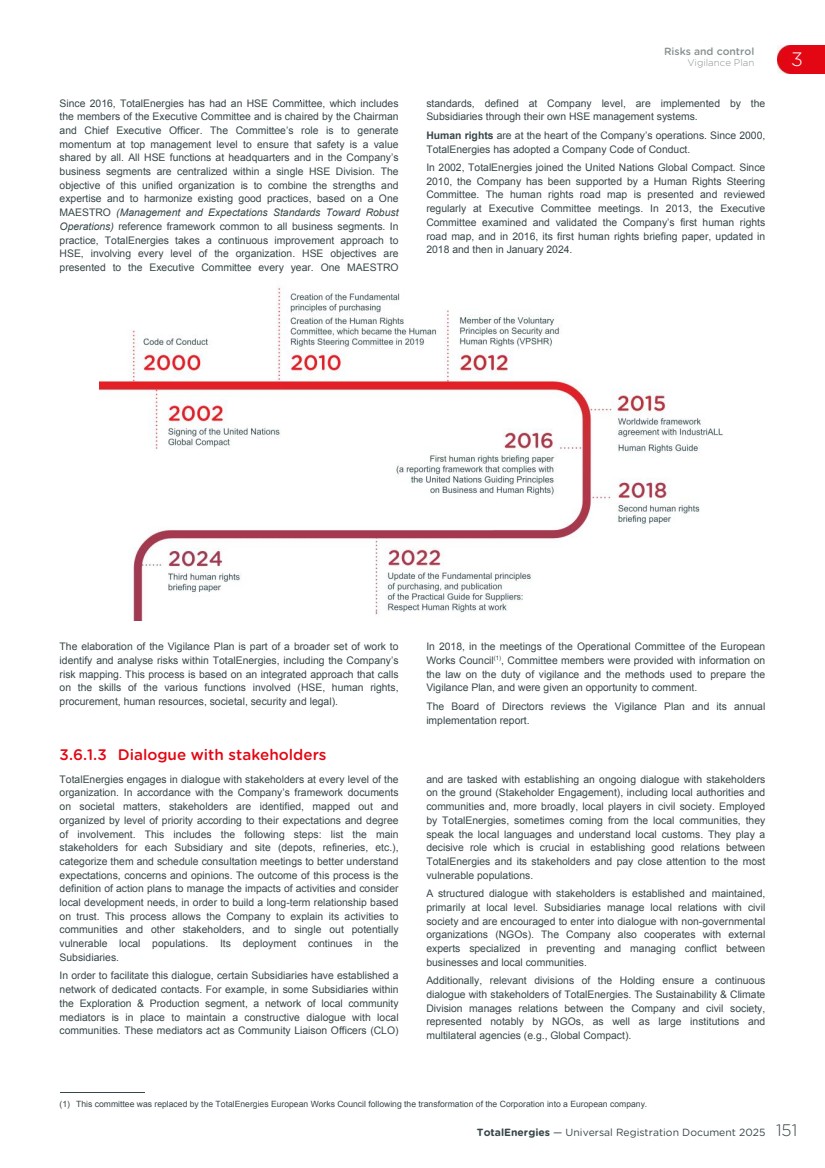
| TotalEnergies maintains ongoing exchanges with its employees and their representatives – whose role and position allows for privileged interactions, particularly with management. Social dialogue is a key component of the Company. It includes all types of negotiations, consultations or exchanges of information among the management of the TotalEnergies entities, employees and their representatives about economic and workplace issues and concerns relating to company life. The topics addressed in this social dialogue may vary according to each Subsidiary, but some are shared concerns across the Company such as health and safety, work hours, compensation, training and equal opportunity. The Company is careful to conduct this dialogue at both the local level and at headquarters or centrally, through its participation in company bodies and its negotiation of agreements. In countries where employee representation is not required by law, the Subsidiaries strive to establish such representation. As a result, majority elected employee representatives are present in most TotalEnergies companies. At the European level, the TotalEnergies European Works Council serves as a forum for providing information and regular exchanging views about the Company’s strategy, its workplace, economic and financial situation, as well as on matters relating to sustainable development, environmental and social responsibility and safety. It is consulted for significant proposed organizational changes concerning at least two companies in two European countries, to express its opinion, in addition to the procedures initiated before the national representative bodies. The members of the TotalEnergies European Committee also participate to visits on sites in Europe. At the global level, TotalEnergies signed in 2015 a four-year agreement with IndustriALL Global Union(1) on the promotion of human rights at work, diversity, health and safety at work and the dialogue with employees and their representatives. TotalEnergies continues to apply the commitments of this global agreement. Through this global agreement and the Fundamental Principles of Purchasing, TotalEnergies also asks its suppliers to respect freedom of expression, association and collective bargaining and, in countries where this right is restricted, to ensure that employees have the right to participate in a dialogue concerning their collective work situation. In December 2017, TotalEnergies also joined the Global Deal initiative, a multi-stakeholder worldwide partnership whose goal is to encourage governments, companies, unions and other organizations to make concrete commitments to improve dialogue with employees on all levels and to propose concrete solutions to reconcile economic performance and social progress. The Global Deal promotes the idea that effective dialogue with employees can contribute to decent work and quality jobs and, as a result, to more equality and inclusive growth, from which workers, companies and civil society benefit. In 2025, TotalEnergies continued to share its good practices with Global Deal member companies. 3.6.2 Severe impact risk mapping The mapping work presented below, which includes risks for people and the environment, was carried out using TotalEnergies’ risk management tools. Each risk map identifies, analyzes, and prioritizes risks, enabling to determine the risks of severe impact. These risk of a severe impact maps are the basis for the priority risk management actions implemented by the Company. 3.6.2.1 Safety, health and the environment TotalEnergies defines the risk of a severe impact on safety, health or the environment as the probability of Activities having a direct and significant impact on the health or safety of employees of TotalEnergies companies, employees of external contractors(2) and third parties, or on the environment following a large scale pollution or a pollution impacting a sensitive natural environment(3) . TotalEnergies has developed regular safety, health and environment risk assessment procedures and tools applicable to operate its Activities at various levels (Company, activities and/or industrial sites): – prior to investment decisions in industrial projects of the Company, acquisition and divestment decisions; – during operations; and – prior to releasing new substances on the market. With respect to potential major industrial accidents, analyses are based notably on incident scenarios at the site level, for each of which the probability of occurrence and potential consequences (in terms of severity) are assessed. Based on these parameters, a prioritization matrix is used to determine whether further measures are needed. These mainly include preventive measures but can also include mitigation measures that may be technical and organizational in nature. Each business segment produces, on a yearly basis, an inventory of its identified major industrial accident risks, which is submitted to management/committees in each segment and to the HSE Committee (refer to 3.6.1.2), providing a global overview of identified risks and of progress on action plans launched by the Subsidiaries operating the sites. This work allowed to identify, analyze and prioritize the risks of severe impacts. These analyses have highlighted the following risks of severe impacts: – risks to the safety of people and to the environment resulting from a major industrial accident on an offshore or onshore site. This accident could be an explosion, a fire or a leak resulting in fatalities or bodily harm, and/or accidental pollution on a large scale or on a sensitive natural environment, for example a well blowout; – risks to the safety of people and to the environment related to the overall life cycle of the products manufactured, and to the substances and raw materials used; and – risks associated with transportation, for which the likelihood of an operational accident depends on the hazardous nature of the products handled, as well as on volumes, length of the journey and sensitivity of the regions through which products are transported (quality of infrastructure, population density, environment). These risks are likely to arise from accidents or incidents in the transportation of the Company’s raw materials and finished products, notably by ship, pipeline or road, as well as from accidents or incidents in the air transport of personnel. Climate change is a global risk for the planet and results from various human actions such as energy consumption. As an energy producer, TotalEnergies seeks to reduce direct greenhouse gas emissions resulting from its operated Activities. In 2025, worldwide greenhouse gas (GHG) emissions from the facilities operated by TotalEnergies amounted to 33.1 Mt CO2e, less than 0.1% of total worldwide emissions, which amounted to 57.7 Gt CO2e for the year of 2024 (4) . In addition, TotalEnergies implements a strategy to tackle climate change challenges and reports on this in detail, notably in its Sustainability Report (refer to point 5.2.2.1 of chapter 5), in accordance with Articles L. 232-6-3 and L. 233-28-4 of the French Commercial Code. (1) International federation of trade unions representing more than 50 million employees in the energy, mining, manufacturing and industrial sectors in 140 countries. (2) Personnel of companies working on a site operated by a Subsidiary. (3) Sensitive natural environments include, in particular, remarkable or highly vulnerable natural areas, such as sea ice in the Arctic, as well as areas covered by significant regulatory protection such as Protected Area Categories I to IV as defined by the International Union for Conservation of Nature (IUCN), Ramsar areas, or natural sites listed on the UNESCO World Heritage List at December 31, 2025. (4) U.N. Environment Programme, “Emissions Gap Report 2025”. 3 Risks and control Vigilance Plan 152 TotalEnergies — Universal Registration Document 2025 |
| 3.6.2.2 Human rights and fundamental freedoms The risks of impacts on human rights for TotalEnergies personnel and third parties were identified according to the criteria defined in a well-established reference document for the mapping of human rights risks, the United Nations Guiding Principles Reporting Framework: – severity: the scale of the impact on the human right(s); and/or – scope: the number of persons affected or who could be affected; and/ or – the remediable nature of the impact: the ease with which the corresponding rights of the impacted persons can be restored. TotalEnergies applied the United Nations Guiding Principles Reporting Framework, which defines the following process: – identify all human rights at risk of being negatively impacted by a company’s activities or business relations, by taking into account all relevant business activities and entities in the company and the point of view of the people exposed to a negative impact; – prioritize potential negative impacts based on their potential gravity (severity and potential extent of the impact and the required remediation efforts) and their probability (while paying particular attention to very severe but unlikely impacts); – explain the conclusions to internal and external stakeholders and check that factors have not been omitted. This risk mapping work was carried out by TotalEnergies in 2016 in consultation with internal and external stakeholders. The process included workshops with representatives of key business activities of the Company (human resources, procurement, security, HSE, Ethics Committee, Human Rights Steering Committee) and of Subsidiaries operating in difficult environments or particularly exposed to risks to human rights and fundamental freedoms. A series of interviews was held with independent third parties (GoodCorporation, International Alert, Collaborative Learning Project). The participants were able to share return on experience on the ground (difficulties faced, proposals for improvements on issues related to human rights and HSE resulting from Subsidiary assessments). The questions raised at the Business Ethics Day were also taken into consideration. The results of the in-house survey of employees regarding their professional situation and perception of the company conducted at local or Company level, were also taken into account. This work enabled TotalEnergies to identify and analyze the human rights risks that affect the Activities and to prioritize them according to their salience. The salient risks are thus identified by comparing indicators and information provided by external stakeholders and internal return on experience. The dialogue with local stakeholders and feedback from the field, described above (refer to point 3.6.1.3) also contribute to this. The mapping of salient risks, periodically updated, is supplemented by dedicated mappings such as the CSR risk mapping linked to TotalEnergies’ purchasing by categories of goods and services (refer to point 3.6.2.3). Risk mapping by the Security Division also takes into account human rights and the VPSHR (Voluntary Principles on Security and Human Rights) In 2019, TotalEnergies updated its procedures to analyze risks of impacts on human rights (taking into account the country, types of activity and types of raw materials or purchased products and services). This work was done with a specialized consultant, and included workshops with internal and external stakeholders. It took into account international country risk indicators established by a specialized third party. This process notably offers a support to Subsidiaries located in geographic areas at higher risk of impacts on human rights. As a result, the following six salient risks were identified, divided among three key themes for the Company: – human rights in the workplace of TotalEnergies’ employees and those of its Suppliers and other business partners: – forced labor and child labor; this risk of forced labor and child labor corresponds to any work or service exacted from any person under the threat of a penalty or punishment and for which that person has not offered himself or herself voluntarily, as well as child labor, which is forbidden for anyone under the age of 15, or 18 for any type of so-called hazardous work in accordance with the standards of the International Labor Organization; – discrimination; this risk of discrimination is characterized by the unfair and unfavorable treatment of people, in particular because of their origin, nationality, sex, age, disability, sexual orientation, or membership of a political, religious, trade union or minority group; – just and favorable conditions of work and safety; this risk of not respecting just and favorable conditions of work and safety is materialized, for example, by the absence of an employment contract, an excessive number of working hours or a non-decent remuneration. – human rights and local communities: – access to land; this risk of infringement of the right of access to land is linked to the relocation of local communities and concerns certain projects requiring temporary or permanent access to land, likely to involve the economic and physical displacement and resettlement of populations and/or restricted access to their means of subsistence; – the right to health and an adequate standard of living; this risk of infringement of the right to health and an adequate standard of living concerns, for example, activities that could have an impact on the health of local communities or on their access to fresh water. – respect for human rights in security-related activities: – the risk of misuse of force; this risk of misuse of force may materialize when the intervention of government security forces or private security companies may be necessary to protect the Company’s personnel and facilities. Risks and control Vigilance Plan 3 TotalEnergies — Universal Registration Document 2025 153 |
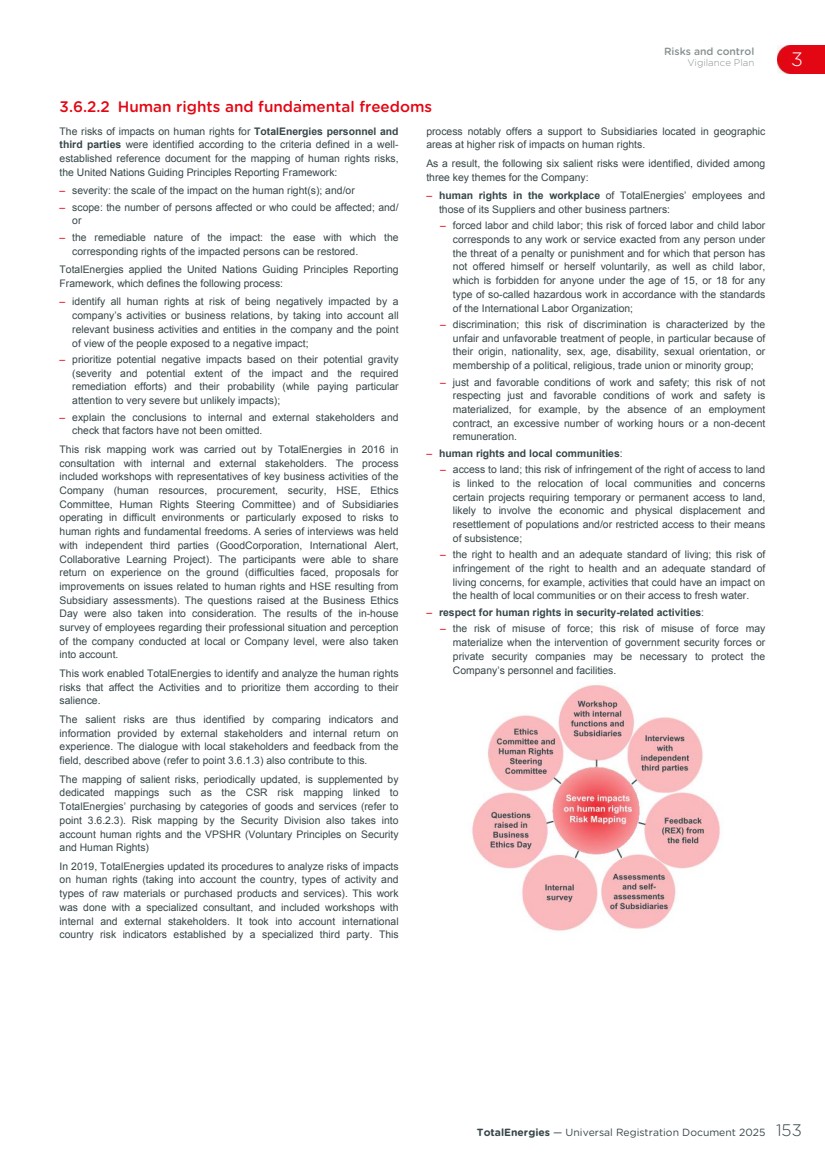
| 3.6.2.3 Suppliers The identification, analysis and prioritization of the risks of impacts on human rights, people’s health and safety and the environment as a result of Suppliers’ activities rely on a CSR mapping of the risks linked to TotalEnergies’ procurement, as well as on country risk indicators. The CSR mapping of the risks linked to TotalEnergies’ procurement, by category of goods and services purchased allows the identification and evaluation according to a severity scale of the risks relating to human rights and social working conditions and those relating to the environment that are associated with each procurement category. This mapping is regularly updated by TotalEnergies Global Procurement, based on research conducted by AFNOR experts on the human rights and environmental risks associated with each procurement category and workshops with buyers of these categories whose practical experience and knowledge greatly enhance the results of initial research. The Company’s human rights and environmental experts are also involved throughout the entire process of identification, analysis and prioritization of risks. This mapping includes particular risks relating to child labor, forced labor, working conditions, discrimination, workers’ health and safety, as well as risks relating to pollution and adverse impacts to biodiversity. It is available to buyers. Country risk indicators that supplement the CSR mapping of the risks linked to TotalEnergies’ procurement are related to human rights and environmental country-related risks. Cross-referencing the results of the CRS mapping of the risks linked to TotalEnergies’ procurement with human rights and environmental country-related risk indicators aims to identify Suppliers the most at risk regarding human rights, health, safety and the environment, to prioritize actions towards these Suppliers. 3.6.3 Action principles and organization TotalEnergies has defined in its referential framework principles which reflect the Company’s values and aim at preventing impacts on human rights and health, safety and to the environment (the “Action Principles”). When the legal provisions applicable to Activities provide less protection than the Action Principles, TotalEnergies strives under all circumstances to give precedence to the latter, within the constraints of applicable regulations. Action principles which are presented in points 3.6.3.3 “Human rights”, 3.6.3.4 “Safety, health and environment” and 3.6.3.5 “Fundamental principles of purchasing” participate in actions to mitigate and prevent the risks of severe impact presented in point 3.6.2 “Severe impact risk mapping”. 3.6.3.1 Organization TotalEnergies has a three-tier organization: Corporate, business segments and operational entities. Each tier is involved in and accountable for identifying and implementing measures in the Vigilance Plan deemed appropriate within the scope of the entity in question. The Action Principles are driven by the Executive Committee. The Ethics Committee is the guarantor of the implementation of the Code of Conduct. Its chairman, who reports to the Chairman and Chief Executive Officer of TotalEnergies SE, presents an annual ethics report to the Governance and Ethics Committee of the Board of Directors. The Strategy & Sustainability Division, created in September 2021, illustrates the importance of the sustainable development issues that are at the heart of TotalEnergies’ strategy. This general division includes in particular: – The HSE Division, which brings together the Company’s industrial health, safety, environmental and operational societal functions. Within this division, the HSE entities dedicated to the Exploration & Production, Integrated LNG, Integrated Power, Refining & Chemicals and Marketing & Services segments are notably responsible for supporting the implementation of the Company’s HSE policy. Furthermore, specific entities deal with the following areas: environmental and societal issues, major risks, safety at health, transportation, crisis management and pollution prevention, legislation and reporting, audits. TotalEnergies has set up an HSE Committee chaired by the Chairman and Chief Executive Officer and made up notably of the members of the Executive Committee and HSE managers (refer to point 3.6.2.1). Its mission is to ensure that safety is a shared value. – The Sustainability & Climate Division, whose mission includes to help implement TotalEnergies’ climate and sustainable development (including human rights) road maps and environmental, extra-financial policies, with transparency as a guiding principle. In this division, the Human Rights department, which reports to the Vice-President of the Sustainability Division, supports the Company’s operational personnel with its expertise in implementing the Action Principles relating to human rights. This division also forms the link between the Company and civil society and is in charge of relations with non-governmental organizations (NGOs), major institutions or multi-lateral agencies at Company level. Also within this division, the Climate Division is responsible for contributing to the implementation of TotalEnergies’ Climate Road map. Within the People & Social Engagement Division, the Strategy and Human Resources Policies Division is responsible in particular for defining TotalEnergies’ human resources strategy and policies in line with the business challenges and the corporate project. In line with the multiple situations encountered in the field, it coordinates the diffusion and roll-out of new policies to support the various human resources departments in TotalEnergies’ business segments. The Social Relations Division is tasked with coordinating the Company’s social relations policy, chairing the TotalEnergies European Works Council and negotiating within this scope. The Security Division is responsible for the protection of people, facilities and information, and pays particularly close attention to the protection of people and property, by conducting analyses and offering advice. TotalEnergies Global Procurement coordinates management of supplier relationships and provides in particular purchasing services for the Company’s goods and services, whether for categories of products or services specific to one business activity or categories shared among several business activities(1) . This corporate organization acts in support of the business segments and Subsidiaries in the operational implementation of the Action Principles. Within the business segments services and advice are offered to Subsidiaries to assist them in the operational implementation of TotalEnergies’ requirements. Depending on their size, type of activities and the risks to which they may be exposed, the Subsidiaries may have dedicated personnel for HSE, societal, human resources, ethical, security and procurement issues. (1) Present in about 120 countries, the Company currently works with a network of more than 100,000 suppliers. 3 Risks and control Vigilance Plan 154 TotalEnergies — Universal Registration Document 2025 |
| 3.6.3.2 Code of Conduct TotalEnergies’ Vigilance Plan is based primarily on the Code of Conduct which defines the Company’s values, including safety and respect for others, and their application to human rights, the environment, and people’s health and safety. The Code particularly sets forth TotalEnergies’ compliance with the following international standards: – the principles of the Universal Declaration of Human Rights; – the United Nations Guiding Principles on Business & Human Rights; – the principles set out in the International Labor Organization’s fundamental conventions; – the principles of the United Nations Global Compact; – the OECD Guidelines for Multinational Enterprises; and – the Voluntary Principles on Security and Human Rights, or VPSHR. The Code of Conduct, which can be accessed on TotalEnergies’ website, is aimed at all employees and external stakeholders (host countries, local communities, customers, suppliers, industrial and commercial partners and shareholders). 3.6.3.3 Human rights In addition to the Code of Conduct, matters relating to respect for human rights are included in a number of internal rules, such as those relating to ethics, human resources, societal, security and procurement. In addition to these, there are a number of practical tools dedicated specifically to societal issues. For example, a rule concerning stakeholder and local impact management describes TotalEnergies’ requirements for a unified approach to managing the societal risks and impacts of its operations. This is based on an assessment of the sensitivity of the societal context and the impacts relating to operations. Furthermore, the Charter of Principles and Guidelines regarding indigenous and tribal peoples states how TotalEnergies endeavors to know and understand the legitimate requirements of the communities living in its Subsidiaries’ sphere of activities. TotalEnergies’ charters and rules are supplemented by guides and manuals at Company level or at the level of the business segment, which serve as reference documents for Subsidiaries on meeting requirements. Thus, there are guides relating to carrying out societal impact assessments and impact assessments on human rights, managing the local societal approach, and developing local content in projects and to land acquisition and resettlement where displacement of people, their assets and livelihoods are involved. General specifications define more technical requirements, such as the implementation of the social baseline study and analysis of the societal impact. As regards community grievance management, a guide describes the methodology and procedures for managing individual and collective grievances resulting from Activities, based on the United Nations Guiding Principles on Business and Human Rights eight effectiveness criteria. Additionally, requirements relating to the implementation of VPSHR in conducting security operations are detailed in an internal rule concerning risk assessment, preliminary verifications, formalization of the relationship with security providers, training and management of possible incidents. 3.6.3.4 Safety, health and the environment TotalEnergies conducts its operations on the basis of its Safety Health Environment & Quality Charter (available on its website). It forms the common foundation for the Company’s management frameworks, and sets out the basic principles applicable to safety, security, health, the environment, quality and societal commitment. The Company’s directives and rules define the minimum requirements expected. General specifications, guides and manuals are available to implement these directives and rules. The Subsidiaries incorporate these requirements into their own management systems, whilst taking into account local specificities and regulatory requirements. The Company’s framework is available to all employees. The HSE reference framework common to all the business segments has been rolled out in order to give greater overall consistency to TotalEnergies’ operations, while taking into account the specificities of each business segment. This reference framework, called One MAESTRO (Management and Expectations Standards Toward Robust Operations), applies to the Subsidiaries as well as their operated sites possibly through versions adapted to the specific industries, notably for Hutchinson. One MAESTRO is structured around ten fundamental principles: (1) leadership and management commitment, (2) compliance with laws, regulations and Company requirements, (3) risk management, (4) operational accountability, (5) contractors and suppliers, (6) expertise and training, (7) emergency preparedness, (8) learning from events, (9) monitoring, audit and inspection, and (10) performance improvement. In addition, with regard to safety at work, the Company has 12 Golden Rules since 2010, reviewed in 2022 for them to be more directly understandable by players on site and to facilitate their appropriation. These Golden Rules are simple, memorizable by everyone and representative of a significant number of accidents at the workplace and must be strictly obeyed by all personnel, both employees and external companies, in all the countries and in all the Company’s activities. Widely circulated, the aim of the Golden Rules is to ensure day-to-day safety during the conduct of operations and on sites with a common objective: “Zero fatal accidents”. These rules cover the following subjects: 1 | High-Risk Situations 7 | Powered Systems 8 | Confined Spaces 9 | Excavation Work 10 | Work at Height 11 | Hot Work 12 | Line of Fire 3 | Body Mechanics & Tools 5 | Work Permits 6 | Lifting Operations 4 | Personal Protective Equipment 2 | Traffic Our 12 Golden Rules Risks and control Vigilance Plan 3 TotalEnergies — Universal Registration Document 2025 155 |
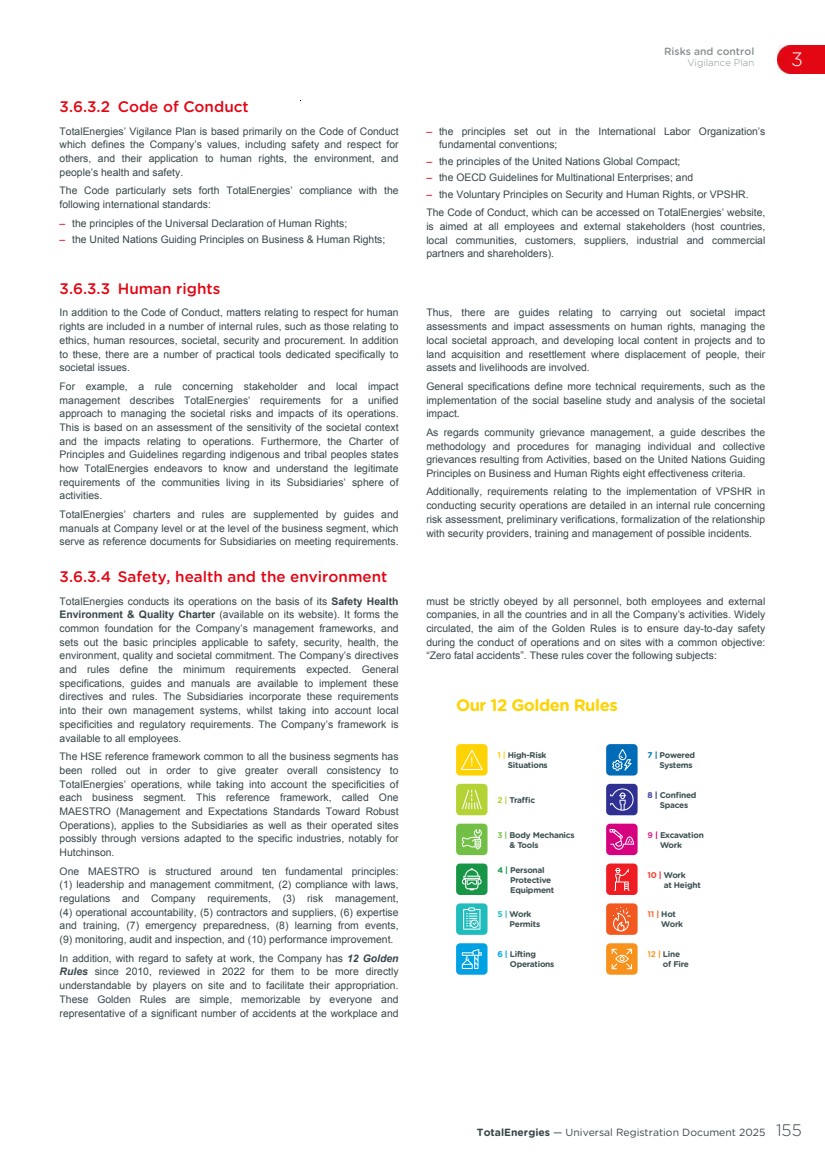
| TotalEnergies has also rolled out the Our lives first program, which introduced joint safety tours with external companies, the establishment, in the work permit process, of a ritual prior to work on all the TotalEnergies’ operated sites concerned (Safety green light), and a tool (Life Saving Checks) to intensify checks in the field and measure compliance with safety rules at least for the five high-risk activities: work at height, lifting operations, work on energy-powered systems, work in confined spaces and hot work. In addition, anyone, irrespective of their level in the organization, is authorized to interrupt work in progress, if they notice a high-risk situation, by using their Stop Card. The Stop Card is a plastic-coated card. It grants its holder the authority to intervene and stop work in progress, if he/she notices high-risk actions or situations, or situations that may lead to an accident, with an assurance that no disciplinary action will be taken as a result, even if the intervention turns out to have been unnecessary. If an action or situation seems hazardous for one or more people, a facility or the environment, the Stop Card provides a means of intervening. Uses of the Stop Card can range from a simple question to check that no risks are present, to interrupting the work in progress. This interruption offers an opportunity to exchange with the colleagues involved (members of staff and their supervisor) with a view of finding a solution to the perceived problem. If necessary, changes are made to the way of working before resuming the work in progress. If the problem cannot be solved immediately, the work is suspended, pending the implementation of suitable measures. Preventing the occurrence of major industrial accidents To prevent the occurrence of a major industrial accident such as an explosion, fire, leakage of hazardous products or mass leakage that might cause death, physical injury, large-scale pollution or pollution at an environmentally sensitive site, or important damage to property, TotalEnergies implements suitable risk management policies and measures that apply to the Company’s operated activities. The Major Risks Division of the HSE Division provides support in the application of this policy. The Company’s policy for the management of major industrial accident risks applies from the facilities design stage as well as during their lifecycle in order to minimize the potential impacts associated with its activities. The policy is described in the One MAESTRO reference framework. It provides for analysis of the risks related to the Company’s industrial operations at each operated site subject to these risks, based on incident scenarios for which the probability of occurrence and the severity of the consequences are assessed. Based on these parameters, a prioritization matrix is used to determine whether further measures are needed. These mainly include preventive measures against accidents, but also include measures to reduce the consequences (protection and mitigation). They are technical and organizational. These analyses are updated periodically, at least every five years, or when facilities are modified. With regard to the design and construction of facilities, technical standards include applicable regulatory requirements and refer to industry best practices. The construction of the Company’s facilities is entrusted to qualified contractors who undergo a demanding internal selection process and are monitored. In the event of a modification to a facility, the Company’s rules define the management process to be adopted. With regard to the management of operations and integrity of facilities operated by the Company, formal rules have been set out to prevent specific risks that have been identified either by means of risk analyses or from internal and industry feedback. For specific works, the preliminary risk analysis may lead to the establishment of a work permit, the process of which, from preparation through to closure, is defined. The Company’s reference framework also provides a process to manage the integrity of facilities, which includes, for example, preventive maintenance, facility inspections, identification of safety critical equipment for special monitoring, management of anomalies and downgraded situations, and regular audits. These rules are part of the One MAESTRO reference framework. Operations teams receive regular training in the management of operations in the form of companionship or in-person trainings. For example, in order to control the integrity of pipelines operated by the Company, they are subject to periodic surveys such as cathodic protection checks, ground or aerial surveillance or in line inspections. These actions are planned as part of the pipeline monitoring and maintenance programs. In areas with high human or environmental risks identified by the risk analysis, these controls and their frequency are reinforced. Preventing occupational accidents The Company has a policy for preventing occupational accidents that applies to all employees of Subsidiaries and employees of contractors working on a site operated by one of these Subsidiaries. The safety results are monitored with the same attention for all. This policy is described in the One MAESTRO reference framework. 3 Risks and control Vigilance Plan 156 TotalEnergies — Universal Registration Document 2025 |
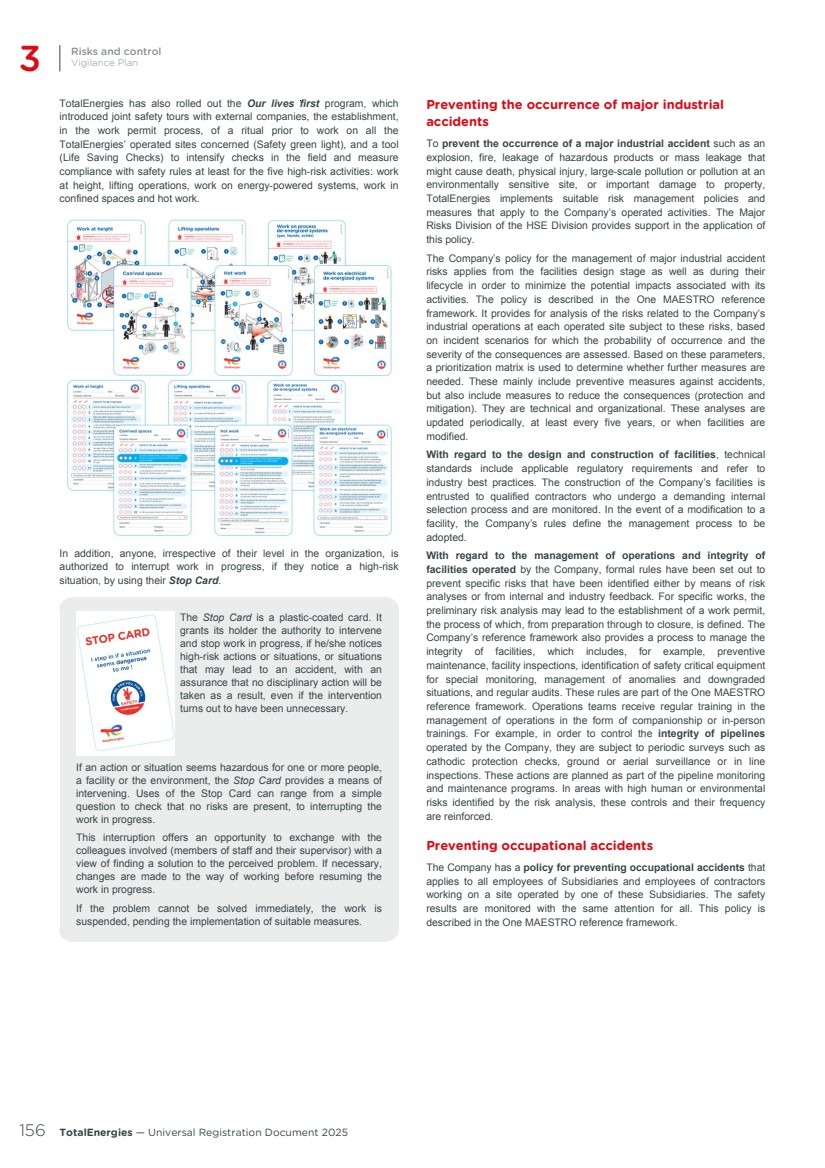
| As part of the policy for preventing workplace accidents, TotalEnergies has defined rules and guidelines for HSE training, personal protective equipment and high-risk operations for employees of the Company and of the contractors working on sites operated by the Company. In order to continually move its practices forward, TotalEnergies also implements a process for analyzing accidents, irrespective of their nature, with the method used and the level of detail involved depending on the actual or potential level of severity of the event. The HSE Division includes a division of specialists in high-risk operations (work at height, lifting, electricity, confined spaces, etc.) that consolidates in-house knowledge and relations with contractors, and issues the relevant One MAESTRO rules. The HSE Division also includes a division aimed at providing support for Subsidiaries in their own voluntary approach to strengthen their safety culture. This division also develops and disseminates tools to improve human performance by identifying the Organizational and Human Factors of a work situation and defining appropriate measures. Preventing occupational health risks With regard to the prevention of occupational health risks, the One MAESTRO framework provides that Subsidiaries of the Company identify and assess risks at the workplace in the short, medium and long terms. To do this, the framework provides application guides for implementation. The analysis of these health risks relates to chemical, physical, biological, ergonomic and mental risks. This results in the roll-out of an action plan. An Industrial Health correspondent in Subsidiaries is identified and tasked with implementing the policy for identifying and assessing work-related health risks. The actions are integrated into the entities’ HSE action plans and can be audited as part of the One MAESTRO audits. In general, potential exposure to chemical or hazardous products at a site operated by a Company entity or nearby is one of the most closely monitored risks in view of the potential consequences. New facility construction projects comply with international technical standards from the design stage in order to limit exposure. For production sites operated by a Company entity and subject to this risk, the One MAESTRO reference framework sets out the prevention process in several stages. First, hazardous products such as carcinogenic, mutagenic or toxic to reproduction (CMR) chemicals are listed and their risks identified. Second, potential exposure to levels that may present a risk to the health of personnel, contractors or local residents at the site or nearby are identified and assessed, and prevention or mitigation measures are implemented in order to control the risk. Last, the approach is checked (atmospheric checks, specific medical monitoring, audits etc.) in order to verify its effectiveness and implement improvement measures if necessary. This is also set out formally in a risk assessment file, which is revised regularly by the Subsidiary. In addition to the One MAESTRO reference framework, the Company has a health reference framework, which was comprehensively reviewed and approved by the People & Social Engagement Division in 2022. The health policy is part of the Company’s approach to sustainable development and includes occupational health requirements that apply to the Company’s employees as part of their professional activity, as well as to the employees of external companies working on its sites. The aim of occupational health protection is to protect the mental and physical health of the Company’s employees by implementing an appropriate risk analysis and prevention policy. It also aims to guarantee their fitness for work and to avoid accidents at work and occupational diseases. Limiting the environmental footprint of TotalEnergies activities TotalEnergies implements a policy of avoiding, reducing and, where necessary, offsetting the environmental footprint and effects on nature in general of its operations. Water and air protection The Company’s operations generate discharges such as smokes from combustion plants, emissions into the air from the various conversion processes and discharges of wastewater. In addition to complying with applicable legislation, TotalEnergies has drawn up rules and guidelines that the Subsidiaries can use to limit the quantities discharged. TotalEnergies has set itself targets for reducing sulfur dioxide (SO2) emissions and is committed to limiting its hydrocarbon discharges into water. After analysis, the exposed sites are equipped with reduction systems that include organizational measures (such as managing the content of sulfur dioxide (SO2) of fuels and the improvement of combustion process management, etc.) and specific technical measures depending on the sites (wastewater treatment plants, using low NOX burners and electrostatic scrubbers, etc.). All refineries controlled by the Company currently have this type of system. For new facilities developed by the Company, the internal rules require impact assessments to be carried out and, if necessary, actions must be taken to limit the impact of these emissions. Soil protection The risks of soil pollution related to TotalEnergies’ operations come mainly from accidental spills and waste storage. TotalEnergies has drawn up a guide that the Subsidiaries can use to prevent and contain this pollution. The recommended approach is based on four pillars: – preventing leaks, by implementing, in the majority of sites, industry best practices in engineering, operations and transport; – carrying out maintenance at appropriate frequency to minimize the risk of leaks; – overall monitoring of the environment to identify any soil and groundwater pollution; and – managing any pollution from previous activities by means of containment and reduction or elimination operations. In addition, a Company rule defines the following minimum requirements: – systematic identification of each site’s environmental and health impacts related to possible soil and groundwater contamination; – assessment of soil and groundwater contamination based on various factors (extent of pollution inside or outside the site’s boundaries, nature and concentrations of pollutants, presence of a vector that could allow the pollution to migrate, use of the land and groundwater in and around the site); and – management of health or environmental impacts identified based on the use of the site. Last, decommissioned facilities operated by the Company (i.e., chemical plants, service stations, mud pits or lagoons resulting from hydrocarbon extraction operations, wasteland on the site of decommissioned refinery units, etc.) impact the landscape and may, despite all the precautions taken, be sources of chronic or accidental pollution. In addition to the appropriate management of the waste associated with the dismantling and securing of sites, TotalEnergies has created a soil and groundwater depollution policy based on the assessment and management of the risks that such pollution may incur. For the sites at the end of their activity, the management of pollution is determined in accordance with regulatory obligations with an objective of continuing to control the use of the sites while favoring the possibility of redeveloping Company activities (solar, reforestation, etc.) and favoring biodiversity. Specialized entities of the Company are supervising the sites’ remediation operations. Risks and control Vigilance Plan 3 TotalEnergies — Universal Registration Document 2025 157 |
| Managing impacts of projects and operations on biodiversity and nature In 2016, the Company pledged to contribute to the achievement of the UN Sustainable Development Goals (SDGs), including those relating to biodiversity namely SDG 14 “Life Below Water” and SDG 15 “Life on Land”. In 2018, TotalEnergies signed up to the act4nature initiative promoted by the French Association of Enterprises for the Environment, now act4nature international. This biodiversity ambition constitutes a contribution to the Global Biodiversity Framework (GBF) adopted at COP 15 in 2022, whose mission is “to halt and reverse biodiversity loss and put nature on the path to recovery for the benefit of people and the planet.” The Company thus intends to contribute to this ambitious framework and its national versions, such as the French National Strategy for Biodiversity (SNB) adopted in 2023, in a concrete manner through conservation and restoration measures for nature on its sites and in the regions where it is established. This ambition is based on four core principles: (1) voluntary exclusion zones, (2) biodiversity management in projects, (3) biodiversity management at existing and abandoned sites and (4) promoting biodiversity. This ambition has been incorporated into the Company’s One MAESTRO framework. The core principles of this ambition are described in point 5.2.2.4 E. of chapter 5, which includes the following principles of action: – the Company has made a commitment not to conduct any exploration activities in oil fields under the Arctic sea ice; – the Company recognizes the universal value of UNESCO’s world natural heritage areas and honors its commitment not to carry out any oil or gas exploration or extraction activities in these areas (based on UNESCO sites listed at the end of 2025); – the Company has made a commitment to develop a biodiversity action plan (BAP) for any new site located in an area of interest for biodiversity, that is IUCN (International Union for Conservation of Nature) Protected areas I to IV or Ramsar areas. In addition, for each new project located in an IUCN Protected area I or II or a Ramsar area, the Company commits to implementing measures to produce a net positive impact (gain) in biodiversity; – it is the Company’s intention that a biodiversity action plan be deployed by 2030 at the latest, having been defined in 2025, on every existing environmentally material and ISO14001 certified operated site (E&P production sites, refineries, petrochemicals sites, gas-fired power stations). TotalEnergies will report on implementation to the various stakeholders; – finally, as part of the promotion of biodiversity, TotalEnergies wishes to support awareness-raising and educational actions for young persons on biodiversity and research actions. Limiting risks for the health and safety of consumers Unless certain precautions are taken, some of the petroleum or chemical products marketed by TotalEnergies pose potential consumer health and safety risks. Respecting regulatory requirements is the main measure to limit risk throughout the life cycle of these products. TotalEnergies has also defined the minimum requirements to be observed in order to market its petroleum or chemical products worldwide with the goal of reducing potential risks to consumer health and the environment. These include the identification and assessment of the risks inherent to these products and their use, as well as providing information to consumers. The material safety datasheets that accompany the petroleum and chemical products, including those not classified dangerous, marketed by the Company (available in at least one of the languages used in the relevant country), as well as product labels, are two key sources of information. The implementation of these requirements is monitored by teams of regulatory experts, toxicologists and ecotoxicologists within the Refining & Chemicals and Marketing & Services segments of the Company. These teams’ assignment is to ensure the preparation of safety documentation for the marketed petroleum and chemical products so that they correspond to the applications for which they are intended and to the applicable regulations. These teams therefore draw up the material safety datasheets and compliance certificates (contact with food, toys, pharmaceutical packaging, etc.) and carry out REACH(1) registration (or equivalent in other geographical regions), if necessary. Thanks to their scientific and regulatory monitoring, they support the development of future commercial products and monitor updates of safety data sheets, certificates and registrations so that they remain compliant with regulations in force. Governance of the process is rounded off within the Company’s business units or Subsidiaries of the Refining & Chemicals and Marketing & Services segments with the designation of a Products Safety Manager who ensures compliance during the market release of his or her entity’s petroleum and chemical products. The networks of product managers are coordinated by the Company’s specialist teams either directly or via an intermediate regional level in the case of the Marketing & Services segment. The safety data sheets for oil and gas produced by Subsidiaries of the Exploration & Production segment are produced by the Marketing & Services expertise center. The compliance of the go-to-market process of these products is under the Subsidiary’s responsibility. Preventing transport accidents In the field of road transportation, the Company has for many years adopted a policy intended to reduce the number of accidents by applying standards that are, in some cases, more stringent than certain local regulations. This policy, defined in the One MAESTRO reference framework, applies to all the Company’s personnel and personnel of contractors working for Company entities. For example, it includes a ban on telephoning while driving, even with a hands-free set, a ban on using motorized two-wheeled vehicles for business travel, mandatory training for drivers, and the definition of strict technical specifications for Company vehicles (in particular, light vehicles must pass NCAP 5* tests). Additional requirements are defined depending on the level of road traffic risks in the country in question and the nature of the activity. In the field of maritime and inland waterways transportation, the process and criteria for selecting ships and barges are defined by the team in charge of vetting. These criteria take into account not only the ship or barge but also the crew, ensuring that the crew has the qualifications and training required under the STCW (Standards of Training, Certification and Watchkeeping for Seafarers) convention. These same teams also verify the application of the safety management system defined for ships by the ISM (International Safety Management) Code of the IMO (International Maritime Organization) as well as industry recommendations such as OCIMF (Oil Companies International Marine Forum) and SIGTTO (Society of International Gas Tanker and Terminal Operators), including those which take into account the human and organizational factors especially for the prevention of accidents to people on board ships or barges. In addition, TotalEnergies’ chartering contracts require that the crew belong to a recognized trade union affiliated to the ITF (International Transport Workers’ Federation). The ITF represents the interests of transportation workers’ unions in bodies that make decisions about jobs, conditions of employment or safety in the transportation sector, such as the ILO (International Labour Organization) or the IMO. With regard to air transportation, a carrier selection process exists to limit the risks relating to travel by Company and contractors’ employees, if their journey is organized by TotalEnergies. This process is based on data from recognized international organizations: ICAO (International Civil Aviation Organization), IOSA (IATA Operational Safety Audit), IOGP (International Association of Oil and Gas Producers), and civil aviation authorities’ recommendations. Airlines that do not have a rating from an international body are assessed by an independent body commissioned by the Company. (1) Registration, Evaluation, Authorization and restriction of CHemicals (REACH) EU Regulation. 3 Risks and control Vigilance Plan 158 TotalEnergies — Universal Registration Document 2025 |
| 3.6.3.5 Fundamental principles of purchasing For procurement, requirements relating to respect by the Suppliers of human rights, health, safety and the environment are specified in an internal rule defining the procurement principles for goods and services, including the Fundamental Principles of Purchasing, which reflect the principles of the Code of Conduct with regard to Suppliers. The relationship between the Company and its Suppliers is based on adhesion to these Fundamental Principles of Purchasing. The Fundamental Principles of Purchasing lay out the commitments that TotalEnergies expects from its suppliers in the following areas: respect for human rights at work, protection of health, safety and security, action in favor of climate, preservation of the environment, prevention of corruption, conflicts of interest and fraud, respect for competition law, as well as the promotion of economic and social development. Subsidiaries ensure that the requirements of the Fundamental Principles of Purchasing are communicated to Suppliers and endeavor to include them in contracts or replace them with equivalent principles at the end of negotiation. These principles are also accessible to all Suppliers in French and English on TotalEnergies’ website. 3.6.3.6 Internal control framework TotalEnergies consistently ensures that an internal control framework, based on the referential of the Committee of Sponsoring Organizations of the Treadway Commission (COSO) is in place. TotalEnergies has a reference framework that is supplemented by a series of practical recommendations and return on experience. The structure of this reference framework reflects that of TotalEnergies’ organization: a Company level framework, frameworks by business segment, and a specific framework for each significant operational entity. 3.6.4 Assessment procedures TotalEnergies has defined procedures to assess its Subsidiaries and Suppliers, including in collaboration with independent bodies, which help identify and prevent risks of impacts on human rights, health, safety and the environment. Staff training, particularly of managers, is the necessary complement to assist the Subsidiaries in the implementation of the TotalEnergies Action Principles (refer to point 3.6.5). 3.6.4.1 Procedures for assessing subsidiaries HSE assessments Assessment of the implementation of the HSE framework involves self-assessment by the Subsidiary and HSE audits by experts from TotalEnergies’ HSE Division. Subsidiaries must undertake a self-assessment at least every two years. The Audit and return on experience unit of the HSE Division conducts an HSE audit at least every five years, according to an audit protocol. These audits deal with a set of activities and facilities governed by a single HSE management system. They address notably: management involvement, compliance with applicable rules, risk management, individual involvement at every level, relationships with suppliers present on the Subsidiary’s site, skills, preparations for emergency situations, return on experience, self-assessment by the Subsidiary and the continual improvement process. The Company’s HSE audit protocol is based on the One MAESTRO framework and includes the requirements of the international standards ISO 14001:2015 (environmental management) and ISO 45001:2018 (occupational health and safety management). The audit protocol is applied in full during self-assessments and according to a risk-based approach during audits. The goal is to identify potential gaps in the implementation of the rules by the Subsidiaries and to enable them to define and implement improvement actions. The progress of improvement actions is reported to management at the appropriate level in the management chain. The status of actions taken following audit observations beyond a defined severity level is reported to the business segment and HSE divisions every semester. Other targeted evaluation systems are applied, such as the annual Industrial Hygiene survey which is sent to the Company’s Subsidiaries in order to evaluate the rate of implementation of risk analyses in the workplace, to verify that potential exposures have been identified, and that action plans are in place. The HSE division defines the rule and reporting guide and notably ensures the implementation of the standards for the consolidation of data, provided by the Subsidiaries, related to the Company’s greenhouse gas (GHG) emissions. Assessments regarding human rights The Company appoints a service provider specialized in ethics and human rights assessments to check the proper application in the Subsidiaries of the principles included in the Code of Conduct. These assessments include criteria relating to human rights. As part of the process, a panel of employees and external stakeholders of the Subsidiary is questioned in order to understand how its Activities are perceived locally. The content of the assessment is adapted to each Subsidiary and may address issues such as the involvement of Subsidiary management, employee awareness of the Code of Conduct, employee working conditions, supplier selection procedures, security measures taken or proactive collaboration with local stakeholders. Following the assessment, the Subsidiary defines and implements an action plan, and a monitoring procedure is put in place. At project level, impact assessments are conducted to analyze the societal stakes and context and may be completed where appropriate by specific human rights impact assessments of the Company’s Activities in sensitive situations (mainly based on criteria linked to the risks to human rights in each particular country) with independent organizations specialized in human rights, or in the prevention and management of conflicts between corporations and local communities. These assessments take account of the salient issues identified by the Company (refer to point 3.6.2.2 in this chapter). Security, which is identified as a potential salient risk in the map of the risks of impacts on human rights, is subject to risk assessment processes at an entity and project level. The Security Division is notably tasked with ensuring the implementation of TotalEnergies’ commitments to enforce the Voluntary Principles on Security and Human Rights (VPSHR), a multi-stakeholder initiative that TotalEnergies joined in 2012, involving governments, companies and associations, that addresses relations with government security forces or private security companies. As part of this process, the Subsidiary undertakes an assessment of risks in relation to both security and human rights. In addition, a VPSHR self-diagnostic tool has been developed to enable Subsidiaries to assess their own implementation of the VPSHR and to identify areas of improvement. This tool measures the Subsidiary’s commitment to VPSHR, personnel training and relations with government security forces and private security companies. Finally, an annual self-assessment questionnaire enables the Subsidiaries in the One MAESTRO scope to evaluate the degree of deployment of the societal initiative on the ground. Actions involving dialogue, impact management and the contribution to socioeconomic and cultural development are recorded and analyzed. Risks and control Vigilance Plan 3 TotalEnergies — Universal Registration Document 2025 159 |
| 3.6.4.2 Procedures for assessing Suppliers During the pre-contractual phase, the qualification procedure for Suppliers of goods and services, concerning five criteria (compliance, technical, health and safety, financial, and sustainable development) allows the evaluation of Suppliers as for the respect of human rights at work, safety, health and the environment. This process has been harmonized at Company level(1) . A risk analysis is carried out for each Supplier, followed where deemed necessary by a detailed assessment. The detailed assessment includes questionnaires on each of the aforementioned issues and, if needed, results in an assessment plan, a technical inspection of the site by employees or an audit of working conditions carried out by a consultant. For the selection of Suppliers, TotalEnergies also integrates sustainable development criteria, including respect for human rights at work, safety, health and the environment in the evaluation of offers. During the contractual relationship, TotalEnergies has put in place a Supplier assessment procedure, by independent third parties, to identify and prevent the risks of serious violations of human rights and fundamental freedoms and people’s health and safety and the environment. Within the framework of this system, Suppliers for whom points of attention have been identified are subject to documentary and/or on-site assessments to verify compliance with the Fundamental Principles of Purchasing and to assess their performance in terms of sustainable development. An assessment plan is established each year and targets priority Suppliers, including Suppliers selected based on the risks they present in terms of human rights and/or the environment with regards to the sector of activity and the country in which they operate. At the Subsidiary level, the qualification process may be complemented by specific verifications of compliance with the VPSHR by a Supplier. When private security companies are used to protect a Subsidiary, preliminary checks are made. They include a review of the recruitment process, technical and professional training (notably on the local context, the use of force and the respect for the rights of individuals), working conditions and the company’s reputation. In addition, the proposed Supplier’s employees are screened for previous conviction or implication in human rights violations. Where deemed necessary in certain contexts such as for some raw materials or vetting, dedicated teams may be set up to conduct the qualification process. The unit put in place in the Company for the selection of Suppliers of raw materials for biofuels seeks to ensure that such raw materials are certified sustainable in accordance with the criteria required by the European Union (ISCC EU and ISCC PLUS certifications). These types of certifications include a review of carbon footprint, the preservation of forests, good use of land and respect for human rights. In addition to this mandatory certification, and as recalled above (refer to point 3.6.3.5), the entities concerned endeavor to include the Fundamental Principles of Purchasing in these contracts. In accordance with its commitment, TotalEnergies has ceased its palm oil supplies. The Vetting department of Trading & Shipping defines and applies the selection criteria for the tankers and barges used to transport the Company’s liquid petroleum or chemical and gas products. This review aims notably at ascertaining the proposed Supplier’s technical qualities relative to internationally recognized industry practices, the crews’ experience, and the quality of the shipowners’ technical management. A green light from the Vetting department, granted strictly on the basis of technical data and independently of business considerations, is required for all ships and barges chartered by a Subsidiary, third parties transporting cargo belonging to TotalEnergies, or ships and barges that stop over at a terminal operated by a Subsidiary. Assessments of shipowners also allows the Company to assess the quality of the technical management systems implemented by operators, crew selection and training, as well as the support provided to vessels. TotalEnergies is actively involved in the Ship Inspection Report (SIRE), which was set up by the Oil Companies International Marine Forum (OCIMF) to allow the sharing of inspection reports amongst international oil and gas companies, thus contributing to the continuous improvement of safety in oil, gas and chemical shipping. Last, since 2012, a large-scale inspection program of transportation contractors has also been rolled out by Marketing & Services, the segment with the most transportation within the Company, with the delivery of products to service stations and consumers. This program has been extended to the product transportation activities of the Polymers Division of the Refining-Chemicals segment, to the liquid sulfur transportation activities of the Integrated LNG segment, and is being progressively extended to the Exploration & Production segment. It calls on independent transportation experts who inspect the practices and processes adopted by transportation contractors with regard to the recruitment and training of drivers, vehicle inspections and maintenance, route management, and the HSE management system. After inspection, an action plan is adopted. If there is a serious shortcoming or repeated poor results, the freight company may be excluded from the list of approved transportation contractors. 3.6.5 Actions to mitigate risks and prevent severe impacts Specific actions are taken to mitigate risks and prevent severe impacts, drawing mainly on the Action Principles and assessments described above. They are also based on return on experience from HSE incidents and include training of TotalEnergies employees, programs to raise the awareness of Suppliers, as well as measures to manage emergency and crisis situations. With respect to climate, which is a global risk for the planet resulting from all human activities, the Company has structured its approach in order to integrate climate challenges into its strategy and has defined specific objectives within different timeframes, in order to control and reduce the GHG emissions resulting from its Activities (Scope 1+2). These are reported in point 3.6.8.4. 3.6.5.1 Return on experience The Company implements a process for the analysis of accidents, irrespective of their nature, with the method used and the level of detail involved depending on the actual or potential level of severity of the event. A return on experience may include an analysis of the incident including of its severity and result in communication to the relevant stakeholders or a wider population within the Company. The purpose of sharing return on experience is to ensure that Subsidiaries are informed and share lessons learned from the incident. By way of example, a near-miss with a high severity potential undergoes an analysis similar to that of a severe accident. This analysis is considered an essential factor of progress. Depending on its relevance to the other TotalEnergies entities, it may trigger a safety alert and the communication of a formal return on experience. More generally, the corporate culture encourages formal and informal return on experience on all matters relevant to the Vigilance Plan. (1) With the exception of certain entities that retain the management of their supplier relations such as Hutchinson, Saft Groupe, or TOTSA TotalEnergies Trading SA. 3 Risks and control Vigilance Plan 160 TotalEnergies — Universal Registration Document 2025 |
| 3.6.5.2 Awareness-raising and training of TotalEnergies’ employees The Company has a variety of communication and information channels in place, enabling all employees of TotalEnergies SE and its Subsidiaries to have access to the Action Principles defined by the Company in relation to human rights, health, safety and the environment. Each employee receives a copy of the Code of Conduct to raise awareness of the Company’s values, including safety and respect for others, which includes respect for human rights. The Code of Conduct is also available to them on the TotalEnergies intranet website in more than fifteen languages. Every new employee is required to read the Code of Conduct (and must certify to having done so). The TotalEnergies induction day includes an initiation to ethics and human rights and an online training on the challenges of business ethics is also available. HSE training courses, incorporating online educational programs as well as technical training tailored to the various Activities, are offered to all Company employees. Programs dedicated to health, safety and the environment are deployed. They may be general or specific to a type of activity or subject area. By way of illustration, the general training depends on the participant’s level of responsibility and experience in the Company: Safety Leadership for Executives, HSE training for managers, and training for new recruits. These training courses include since 2020 training actions related to climate challenges dedicated to all Company employees. A specific module is dedicated to Company senior executives and managers. In the Subsidiaries as well as head office, teams regularly engage in crisis management exercises, the scenarios of which are based on potential incidents identified in the risk analysis. Dedicated training (initial and refresher training) also contributes to preparing employees for potential crises including in relation to the various roles played by members of the crisis team (for example crisis team leader, liaison with operations, experts and communicators etc.). Training programs dedicated to human rights have been set up for senior executives, site directors and employees most exposed to these issues. Awareness-raising sessions are organized regularly for employees, for example as part of ethical assessments of Subsidiaries. The Human Rights department is developing a training plan for Company employees to encourage understanding of issues relating to human rights and thereby better manage the associated risks. This training plan is rolled out as a priority among employees who are most exposed to risks linked to human rights. Concerning procurements, specific training modules explaining TotalEnergies’ ethical commitments and the Fundamental Principles of Purchasing have also been developed for the Company’s procurement teams. A training on responsible procurement is also mandatory for the buyers of TotalEnergies Global Procurement. The Security Division developed an online training including a module on the VPSHR for security managers in the Subsidiaries and provides training materials for the Company’s personnel. Local visits are also organized to deliver in-person training in the Subsidiaries. In the field of societal, an awareness module is available to all employees through the internal training platform. Targeted trainings are also provided. Internal channels of communication, such as websites accessible to most employees, are also used to raise employee awareness of matters pertaining to human rights. Dedicated web pages on ethics and the respect for human rights present the priority areas identified by TotalEnergies. These web pages have several goals: to explain the Action Principles, present how TotalEnergies implements these principles and to help employees adopt the ethical conduct expected of them in their everyday work. Events such as the annual Business Ethics Day are used to raise awareness among employees of TotalEnergies SE and its Subsidiaries. A Guide to Human Rights is also made available to employees and stakeholders. Its goal is to raise TotalEnergies employees’ awareness on issues relating to human rights in its industry (at work, with local communities and in relation to security) and it provides guidance as to the appropriate behavior to adopt in their activities and relationships with stakeholders. It includes case studies. This guide serves as a reminder of the Company’s commitments in relation to human rights. It offers proposed answers to common questions and concerns about human rights, notably child labor, forced labor, discriminatory practices and collective negotiations. The Practical guide to dealing with religious questions, published in 2017, aims to provide practical solutions to issues raised by Company employees and managers worldwide. It draws on the experiences of the business segments in various countries and encourages dialogue, respect and listening as a way to find solutions suited to the local context. Many internal and external experts contributed to this document, including representatives of various religious communities. This guide has been translated into ten languages. It is available on the website dedicated to human rights and is also distributed at training courses. The HSE and Sustainability & Climate divisions organize the Company’s World Safety Day and Sustainab’ALL Day in order to bring teams on board and raise their awareness of ways of implementing the Action Principles. In 2024, the Company has identified 5 “Levers for a Sustainable Change” to bring about collective change in our behaviors in the area of sustainable development. Requiring the commitment of all employees, these five Levers aim to minimize energy consumption and discharges into the environment from its projects and operations, to promote renewable energies and low-carbon technologies to reduce emissions, both in its projects and operations and to its customers and suppliers, to maintain a constructive dialogue with its stakeholders and to pay attention to others in the workplace. This program aims to promote a dynamic for change by encouraging certain priority collective attitudes, and requires a commitment from everyone to implement them. A training program on the 5 Levers was launched in 2024, provinding all Company employees with digital modules dedicated to each Lever. A more extensive training program for managers was introduced in 2025. Since January 2025, investment project files submitted to the Executive Committee have included a presentation on how the Levers 1 to 4 are taken into account in the projects examined by this body. Various HSE guides exist within the One MAESTRO reference framework to share HSE best practices with the Company’s Subsidiaries. In addition, periodic HSE communications are published throughout the year (seminars, webinars, symposia). Safety culture is reinforced on a day-to-day basis by the Company’s employees through “safety moments” at the beginning of meetings or before hazardous operations, consisting of a short discussion to reiterate the key safety messages and align participants with mutual commitments. A similar approach is implemented to reinforce the culture of sustainable development through various initiatives including sustainability moments (Sustainab’ALL moments). Risks and control Vigilance Plan 3 TotalEnergies — Universal Registration Document 2025 161 |
| 3.6.5.3 Awareness-raising and training of Suppliers The Fundamental principles of purchasing constitute a contractual commitment by Suppliers and are also a means to raise awareness among Suppliers, notably on HSE and human rights issues. A brochure explaining these principles in detail is also handed out to Suppliers at annual meetings or events such as Suppliers Day. The Fundamental Principles of Purchasing are also available on the TotalEnergies website. A practical guide on respect of human rights at work, intended for Suppliers, is shared with them and is also available on TotalEnergies’ website. Training actions are also carried out for Suppliers, for example training on responsible security and the VPSHR delivered to employees of security service providers. Contracts with these service providers mention compliance with the VPSHR and the need to train their personnel about the VPSHR. Additionally, the Security Division may deliver this training directly to security service providers. Suppliers working on Subsidiary sites are made aware of the risks to health, safety and the environment of the activities of the site. They receive support in the management of risks related to their activities, those of the site and any potential interactions, such as in the work permit process or during site safety inspections. 3.6.5.4 Responses to emergency or crisis situations Crisis management is organized to ensure sufficient preparedness and an efficient response to a crisis or emergency event. In order to manage any major industrial accident efficiently, TotalEnergies has implemented a global crisis management system, based notably on a 24/7 on-call system, a set of unified procedures deployed in the Subsidiaries and on a dedicated crisis management center that makes it possible to manage two simultaneous crises from head office. The framework requires Subsidiaries to have in place plans and procedures for interventions in the event of leaks, fires or explosions and to test them at regular intervals. 3.6.6 Whistle-blowing mechanisms TotalEnergies has several whistle-blowing mechanisms that are open to employees, Suppliers and third parties. To support employees on a day-to-day basis, the Company encourages a climate of dialogue and trust enabling individuals to express their opinions and concerns. Employees can turn to their line manager, an HR or other manager, their Compliance Officer or their Ethics Officer. The Company’s employees, Suppliers, as well as any other stakeholder can contact the Ethics Committee to ask questions or report any incident involving a risk of non-compliance with the Code of Conduct by using a generic email address (ethics@totalenergies.com). This system for collecting and processing of ethical complaints was set up in 2008, in cooperation with TotalEnergies trade unions organizations on a European level, then detailed in a dedicated internal rule. This complaint mechanism provides that the report transmitted to the Ethics Committee may in particular concern: “a serious abuse or a risk of serious abuse of human rights and fundamental freedoms” and “a serious damage or a risk of serious damage to the health or safety of persons, or to the environment”. The procedure for collecting and processing of ethical complaints, available on TotalEnergies’ website since December 2020, describes this mechanism which provides measures to protect whistleblowers including the non-disclosure of their identity, the confidentiality of the procedure for collecting, processing, and closing of the complaints, the prohibition of any retaliation measures against whistleblowers, subject to sanctions, and the respect for the laws and regulations applicable to the protection of personal data. The Ethics Committee is a central structure, in which all business segments of TotalEnergies are represented. All its members are TotalEnergies employees with a good knowledge of its Activities and have demonstrated the independence and impartiality necessary for the performance of their duties. The Ethics Committee assures compliance with the Code of Conduct and ensures its proper implementation. It is assisted in its work by the relevant departments, as well as by a network of local Ethics Officers. The Chairperson of the Ethics Committee, who reports to the Chairman and Chief Executive Officer of TotalEnergies SE, submits an annual Ethics report to the Governance and Ethics Committee of the Board of Directors. The members of the Ethics Committee are subject to a confidentiality obligation. The Committee ensures the confidentiality of the complaints, which can only be lifted with the agreement of the complainant. The system is supplemented by specific whistle-blowing mechanisms implemented at certain Subsidiaries. Based on the United Nations Guiding Principles on Business & Human Rights, the One MAESTRO framework requires TotalEnergies’ operational entities to deploy procedures to manage stakeholder grievances related to the Subsidiary’s activities (excluding business claims). This provides residents and local communities with a preferential channel to voice their concerns and grievances. Handling these grievances locally makes it possible to offer a response to anyone who feels that they have been negatively affected by the Activities and to improve internal processes in order to reduce impacts that may be caused by the Activities. Managing grievances consists of: informing the stakeholders of this free process; receiving and registering grievances; acknowledging receipt of the grievances and informing the stakeholders about the follow-up actions; if necessary, proposing a means of settling the grievances in collaboration with the stakeholders and monitoring the handling of the grievance. This process is regularly analyzed to see where improvements can be made. An internal guide was published in 2020, detailing the methodology for designing and implementing the grievance management process. This guide contains practical tools inspired by international recommendations (IPIECA – International Petroleum Industry Environmental Conservation Association, ICMM – International Council on Mining and Metals, IFC – International Finance Corporation). These grievances mechanisms can also be used to implement the VPSHR. In addition, in the event of an incident, a reporting process requires the Security Division to be informed and an internal analysis to be performed to establish the facts, resulting in a final report. This allows the Subsidiary to re-assess its VPSHR process and to take measures to reduce the risk of incidents. Suppliers can also contact the internal supplier mediator using a generic email address (mediation.fournisseurs@totalenergies.com). Available to Suppliers and procurement teams, the mediator’s role is to restore dialogue and help find solutions. 3 Risks and control Vigilance Plan 162 TotalEnergies — Universal Registration Document 2025 |
| 3.6.7 Monitoring procedures Multi-disciplinary committees review the implementation of measures within their purview. Indicators are used to measure the effectiveness of the measures, progress made and to identify ways of improvement. Committees The Ethics Committee is particularly involved in monitoring compliance with the Code of Conduct and can be called upon for advice on its implementation. The Human Rights Steering Committee is made up of representatives from different divisions (including security, procurement and societal) and business segments. It is chaired by the head of TotalEnergies’ Sustainability & Climate Division. It meets several times a year and coordinate the actions on human rights taken by the business segments and the Subsidiaries, as part of the implementation of the human rights road map submitted to the Executive Committee. All Country Chairs contribute to this monitoring process, notably by acting as the local point of contact for the Security Division with respect to compliance with the VPSHR. Representatives of the Management Committee of TotalEnergies Global Procurement and of the Sustainability & Climate, HSE and Legal divisions as well as of the Ethics Committee meet regularly to monitor the effective implementation of the Responsible Procurement program. The HSE Division has set up cross-functional teams of experts, including in the fields of safety, the environment and crisis management, and monitors the ongoing coordination of HSE issues. Reporting The system of internal reporting and indicators for monitoring implementation of the actions undertaken in TotalEnergies in these areas is based on: – for social indicators (including health in particular), a guide entitled the Corporate Social Reporting Protocol and Methodology; – for safety indicators, a Company rule regarding HSE event and statistical reporting; a return on experience analysis process identifies, notably, events for which a formalized analysis report is required in order to draw lessons in terms of design and operation; and – for environmental indicators, a Company reporting procedure, together with activity-specific instructions. Consolidated objectives are defined for each key indicator and reviewed annually. The business segments apply these indicators as appropriate to their area of responsibility, analyze the results and set out a plan of action. 3.6.8 Implementation report(1) 3.6.8.1 Human rights This section is primarily intended to present implementation of measures with respect to Subsidiaries, while the implementation of measures specific to Suppliers is described in point 3.6.8.5. Subsidiary assessments TotalEnergies conducts assessments and impact assessments of various kinds: – ethics and human rights assessments of Subsidiaries, in particular regarding the working conditions of TotalEnergies employees; – impact assessments to analyze the challenges and the societal context of industrial projects, supplemented, if necessary, by specific impact assessments on human rights; – subsidiary self-assessments. Ethics and human rights assessments In addition to the audits and assistance missions carried out by the Audit and Internal Control Division, which cover certain human rights-related issues, the ethics and human rights-related practices of TotalEnergies’ entities are regularly assessed by independent third parties and qualified experts. Assessed entities are identified according to several criteria, including the level of risk of human rights violation in each country, the number of alerts received the previous year and the date of the Subsidiary’s last assessment. These assessments help identify Subsidiaries’ best practices, share them within the Company and identify areas for improvement. Knowledge and appropriation of the Code of Conduct are tested and reinforced by ethics and human rights awareness-raising sessions. Employees are encouraged to voice their ethical concerns in a confidential manner and report behaviors potentially contrary to the Code of Conduct. In 2025, six ethics and human rights assessments were conducted. They concerned six Subsidiaries (in Spain, Turkey, Dominican Republic, Brazil, United Kingdom and Ghana). These assessments confirmed that the Code of Conduct has been duly incorporated by the Subsidiaries. The follow-up of the action plans put in place further to the assessments in previous years in the Qatari, Republic of the Congo and United States Subsidiaries was also carried out in 2025. Impact assessments of industrial projects When the decision is taken to develop an industrial project, a detailed baseline study is conducted to identify in advance the stakeholders potentially affected, describe the local context and assess the main socio-economic and cultural stakes (risks and opportunities) in the affected area. A societal impact assessment is then conducted to assess and analyze the opportunities and the direct, indirect or cumulative risks of the project in the short, medium and long term. In 2025, 48 of these studies were initiated or carried out. In addition to these impact assessments, specific human rights impact assessments may also be conducted in high-risk areas or conflict zones with the support of independent experts. (1) In accordance with Article L.225-102-1 of the French Commercial Code, the report on the effective implementation of the Vigilance Plan is presented below. Since the identification of risks and the prevention of severe impacts on human rights, human health and safety and the environment overlap partially with certain risks covered in the Sustainability reporting under the CSRD (refer to point 5.2 of chapter 5), TotalEnergies has chosen to report below on the implementation of its Vigilance Plan by incorporating certain aspects of the Sustainability reporting under the CSRD, although the latter includes risks of varying degrees. Risks and control Vigilance Plan 3 TotalEnergies — Universal Registration Document 2025 163 |
| Example: Tilenga and EACOP projects, Uganda and Tanzania In February 2022 the Final Investment Decision for the Lake Albert Resources Development Project was taken, including both the Tilenga upstream oil project (operated by TotalEnergies EP Uganda - “TEPU”) and the construction of the East African Crude Oil Pipeline (EACOP) in Uganda and Tanzania (in which TotalEnergies Holdings EACOP is a major shareholder). All partners committed to implementing these projects taking into consideration the environmental and biodiversity stakes, as well as the rights of the concerned communities, in accordance with the stringent performance standards of the International Finance Corporation (IFC). Transparency In accordance with its guiding principle of transparency in engaging with civil society, since March 2021 TotalEnergies publishes relevant studies, independent third-party reviews and social and environmental action plans related to both the Tilenga and EACOP projects. Such independent reviews help ensure that the projects are carried out in compliance with good international industry practices. Alongside the ongoing dialogue with the local communities, these reviews also allow potential improvements to be identified. In 2025, TEPU and EACOP demonstrated their commitment to transparency by providing clear, accessible and up-to-date information to their stakeholders on various aspects of their projects. The Tilenga project organized 165 field visits in 2025 totaling 1,946 visitors, for NGOs and other stakeholders to monitor and review its social and environmental performance. In 2025, TEPU also answered to more than 11 petitions in various areas covering allegations on human rights and environmental aspects. EACOP has made available on its website regular construction updates including disclosing its Human Rights Due Diligence Reports, Diversity and Social Inclusion Policy, Free Prior and Informed Consent agreements made with indigenous communities, local content updates. Quarterly engagement with civil society organizations in both countries also provides detailed updates on construction, social performance, land acquisition, environment, and biodiversity programs. In 2025, TEPU published its Social Report providing the social actions implemented by the Tilenga project, particularly in relation to land acquisition, resettlement, and stakeholder engagement. Human Rights Due Diligence and policies For Tilenga as well as for EACOP, human rights impact assessments (HRIA) have been carried out as part of the social and environmental impact assessments. In addition, stand-alone human rights impact assessments were published in September 2018 for EACOP and in July 2022 for Tilenga. EACOP updated the HRIA in 2022 in a section of the Human Rights Due Diligence report issued in December 2022, available on EACOP’s website. This HRIA report was presented to NGOs in Uganda and in Tanzania in dedicated meetings in 2023. Dedicated human rights teams in both projects have put in place action plans on the basis of these impact assessments and monitor their implementation. Human Rights Steering Committees have been set up for both projects to provide governance and monitoring. Processes are in place for investigation and fact-finding with respect to human rights allegations. Both the Tilenga and EACOP projects published policies in 2022 setting out their commitment to human rights through all their activities. In addition, EACOP published a Diversity & Social Inclusion policy in November 2023. This policy, based on the UN Global Compact Women’s empowerment Principles, is available on the EACOP website in English, Swahili and 3 other local languages. An action plan has been also developed and its implementation by the relevant departments inside EACOP started in January 2024. Stakeholder Engagement Regular stakeholder engagement occurs with the full spectrum of project stakeholders including Ugandan and Tanzanian local, national and regional governmental authorities; Project-affected Communities (PACs) and Project Affected People (PAP) (1); traditional and religious authorities; local businesses and tourism operators; developers of associated facilities; civil society organizations (CSOs) and NGOs; academic and research organizations; and Intergovernmental organizations. A variety of methods and tools are used: village meetings, small group meetings, focus group discussions, one to one meetings, site visits and tours, alternative medium such as community drives etc. Engagement is supported by disclosure materials adapted to the audience including a range of written and visual material, traditional media including community radio, telecommunications and websites. As an example, as part of the Tilenga Project, an innovative series of webinars, bulletins and roundtable discussions known as “Let’s Talk!” provides a deep dive into topics of interest for civil society. In 2025 subjects covered by bulletins and roundtables included livelihood restoration, human-wildlife use-conflict, agricultural development initiatives for communities and more generally, environmental impacts of the project. A field-based stakeholder engagement team including community relations supervisors (CRS), and community liaison officers (CLO) in Uganda, composed of both male and female officers, are present on the sites and are in dialogue with local communities and have developed strong relations with local government, civil society and community representatives. The field-based community relations supervisors in Tanzania and CLO in Uganda observe and guide construction contractor stakeholder engagement with PACs acting as a “bridge” between the project and communities and to ensuring stakeholder engagement for the project is consistent with EACOP principles of participation, respect for human rights, non-discrimination, empowerment, transparency and accountability. In Uganda, TEPU has maintained for several years relations with the Civil Society Coalition on Oil and Gas (CSCO), a network of over 60 Ugandan NGOs whose objective is to work towards the sustainable governance of oil and gas resources to maximize benefits to the people of Uganda. In 2025, a field trip to the Tilenga project facilities was organized for members of CSCO and other national and grassroots NGOs. (1) A PAP (Project Affected Person) corresponds to a group of individuals forming a household or an entity (institution, company) which has been identified, within the framework of the studies carried out for the program of acquisition of the land necessary for the execution of the project, as having at least one asset impacted by the implementation of the project. An asset can be a dwelling, a construction, a plot of bare or cultivated land, plants, trees, crops. 3 Risks and control Vigilance Plan 164 TotalEnergies — Universal Registration Document 2025 |
| EACOP also conducted quarterly meetings in 2025, in Uganda with CSCO and in Tanzania with NGOs and CSCO. To further improve the engagements with CSOs and NGOs, the 2025 Tilenga NGO Coordination workplan has continued to focus on having direct engagements with the grassroots NGOs based in the project area. In 2025, 58 bilateral engagements were held with different grassroots NGOs. TEPU and EACOP in Uganda and in Tanzania have continued in 2025 their road safety sensitization. This included 1,018 road safety awareness sessions in the communities, schools and with motorcycle riders in the 5 project districts by TEPU in Uganda and 62 different awareness sessions by EACOP covering five regions of Tanzania. Additionally, TEPU has continued roll-out of the VIA Road Safety Programme in Buliisa District launched in July 2023, aimed at raising road safety awareness among young people. The NGO Safe Way Right Way was contracted to enforce and promote the initiative on behalf of TEPU. In 2025, EACOP has continued to engage and dialogue frequently with the four vulnerable ethnic groups self-identifying as “Indigenous Peoples” impacted by the project - the Akie, Taturu, Barabaig and Maasai. EACOP’s approach with these groups included in particular: – the implementation of the EACOP Plan for Vulnerable Ethnic Groups self-identifying as “Indigenous Peoples” signed in September 2022. This Plan sets out EACOP’s commitments to reinforced engagement, impact mitigation measures adapted to the specific lifestyle of these communities, access to project benefits and capacity building of these communities; – signing of the Free Prior and Informed Consent (FPIC) Agreements between EACOP and the Akie Community in July 2022, with the Taturu community in March 2023 and with the Barabaig community in January 2024; – collaboration with 2 indigenous NGOs to reinforce engagement using more traditional methods and build the capacity of the four communities on different topics; – support for a specific community social investment program for these groups through collaboration with district governments, in order to facilitate access to administrative services, including the issues of national identity cards and birth certificates. Land Acquisition The land acquisition processes for both projects are carried out in compliance with the IFC Performance Standards and national regulatory framework. The land acquisition program for both projects is well advanced. In Tilenga, the compensation process for the first tranche of land acquisition, known as “Resettlement Action Plan 1 (RAP1)” concerning 622 PAPs was completed in 2021. Only seven PAPs did not accept the compensation offered after valuation of their assets. Pursuant to a judgment of the Court of Masindi on April 30, 2021 which ruled that the compensation amounts offered were fair, TEPU deposited the corresponding funds in a court account for the benefit of these seven PAPs. The deployment of the program for RAPs 2 to 5, concerning 4,954 PAPs is near conclusion. By the end of 2025, more than 99% of the compensation had been paid. All the PAPs who had not yet signed compensation agreements were subject to a Court Application which concerned 42 PAPs owning/claiming ownership rights in 32 land parcels. Several meetings were organized to reach an agreement. Faced with the impasse resulting from the PAPs refusals, the matter was taken to court by the Ugandan government represented by the Attorney General. At a hearing held on December 8, 2023 in the Ugandan town of Hoima (where part of the land affected by the Tilenga project is located), the High Court ruled in favor of the Ugandan government. It also decided to notify the disputing PAPs of their right to file individual claims against the Ugandan government if they contest the value of the compensation awarded by the Chief Government Valuer. TEPU deposited the compensations in a court account as directed by the Court Order on December 22, 2023. Notices to vacate have since been issued to the individuals by the Government. Of the total number of PAPs, a minority of them require relocation to replacement houses as their primary residence is affected by land acquisition. For RAPs 2 to 5, 100% of replacement houses have been handed over by end of December 2024, as part of the progressive deployment of the program. Until the replacement houses are delivered, the affected PAPs could continue to live in their original house. Improvements in implementation of the land acquisition process following RAP 1 were integrated into procedures for RAPs 2 to 5 including reinforced information to communities to ensure that PAPs understand that they may continue to cultivate their land until they have received their notice to vacate following compensation. On March 6, 2026, TEPU has published the independent assessment conducted by the Canadian firm Land & People Planning Ltd on the land acquisition, resettlement and livelihood restoration program implemented for the Tilenga Project, together with the action plan adopted by TEPU based on the report’s recommendations. The report concludes that the program was implemented in line with the Project’s land acquisition and resettlement commitments, aligned with IFC Performance Standard 5, with no material systemic deficiencies. Furthermore, the report states that “compensation, replacement house handover, and a majority of livelihood mitigations have been completed and that the Project is now well positioned to transition toward Resettlement Action Plan closure.” Based on the recommendations of this report, TEPU will implement an action plan covering the following areas: – Livelihood restoration: continued monitoring in 2026 to ensure completion and uptake of training and support measures (agronomic practices, post-harvest equipment, business start-up packs). – Support to vulnerable households: tailored assistance for potentially vulnerable households, in coordination with local government services. – Grievance management: strengthened tracking and communication tools, including FAQs and key messages to ensure consistency and transparency. – Engagement and disclosure: a focused engagement plan dedicated to Resettlement Action Plan closure and livelihoods programming closure. – Gender considerations: integration of gender-disaggregated data into closure datasets and reporting. – Closure: initiation of the formal closure process, to be followed by an independent third-party closure audit. Risks and control Vigilance Plan 3 TotalEnergies — Universal Registration Document 2025 165 |
| The major part of EACOP land acquisition program is close to completion. As end of December 2025, more than 99% of the compensation had been paid in Tanzania and in Uganda. For the PAPs requiring relocation to replacement houses as their primary residence is affected by land acquisition, 100% of the replacement houses have been delivered. To support PAPs whose farming may be disrupted by the land acquisition process, transitional food assistance – a mix of food baskets and cash transfers – has been initiated and will continue until livelihoods have been reestablished. For concerned PAPs, livelihood restoration programs are implemented for at least 3 years after land acquisition or until livelihoods are fully restored. These programs include financial literacy, agricultural programs to improve crops and livestock, tree nurseries, beekeeping, financial management and business capacity, as well as vocational training to support jobseekers. Respect for Human Rights by suppliers Both the Tilenga and EACOP projects have established processes to ensure suppliers respect worker rights with regard to qualification, contracting, and verifications, inspections and audits of suppliers. In TEPU, four training sessions focused on human rights were conducted with suppliers involving more than 204 workers. Topics covered workers’ rights and available grievance mechanisms, the “Workers’ Voice” survey tool and the Company’s ethics speak-up channels. On EACOP side, human rights training sessions were also given to the suppliers and communication materials were developed for workers. In 2025, EACOP delivered Sexual Harassment Prevention training to approximately 770 staff members. The program was extended to contractor personnel. In total, nearly 708 contractors staff were trained across Uganda and Tanzania. In addition, a specialized training program for drivers was implemented. A total of approximately 200 drivers were trained in Uganda and in Tanzania. Human Rights in the workplace matters are considered during HSE audits and inspections. In addition to including some Human Rights aspects in HSE audits, targeted Human Rights assessments are carried out for TEPU contractors and suppliers. These assessments focus on sustainable development practices put in place by suppliers and contractors. In 2025, 3 TEPU contractors and suppliers were assessed by an independent third-party. The results of the assessments are shared with the concerned contractors, and where necessary, corrective action plans are shared with them for areas that require improvement. Since 2023, EACOP developed and implemented the Industrial Relations (IR) Management System (IRMS) to ensure the project’s labor management and working conditions for the contractor workforce are well respected. The IR team in Tanzania was recruited and onboarded in mid-2023 and all construction contractors were trained on the IRMS requirements. The IR team in Uganda was recruited in late 2023 and monitoring of the IR performance started in early 2024. The site-based Industrial Relations Supervisors (IRS, Tanzania) and Industrial Relations Officers (IRO, Uganda) are responsible for developing and implementing key systems and processes, such as site workers forums and committees, monthly reporting to the project, workers grievance mechanisms, and IR training, inductions, and awareness raising at the worksite to communicate on workers’ rights. Further, an additional tool called “Worker’s Voice Tool” has been rolled out on a pilot basis over the period 2023-2025, with selected contractors to monitor their respect for workers’ rights for Tilenga and EACOP projects. This initiative allows the Project to collect feedback on working conditions on site directly from contractors’ workers through surveys sent to their mobile phones or via paper surveys. The surveys have been translated into six local languages used in the projects area to improve participation by diverse workers in both projects and feedback is provided to the contractors to develop corrective actions where applicable. VPSHR and Human Rights Defenders The Company adheres to the Voluntary Principles on Security and Human Rights (VPSHR) and ensures that the deployment of security personnel is accompanied by VPSHR training. A constant dialogue occurs through regular meetings and Human Rights awareness sessions. In 2025, TEPU conducted VPHSR trainings and refresher trainings for 2,517 Government and Private Security personnel. For EACOP, the Host Government Agreements with Tanzania and Uganda included VPSHR. Risk Assessments have been undertaken in Tanzania and Uganda, and action plans for ongoing implementation of the VPSHR have been developed. A Security Committee has been formed for the project that comprises the EACOP Security Manager and representatives of public security forces from Tanzania and Uganda. This is a key forum for EACOP to promote the VPSHR. In 2025, 1,748 private security guards have been trained on VPSHR. In addition, 211 Ugandan governmental security forces have also been trained on VPSHR, in line with the Memoranda of Understanding signed by EACOP with the Ugandan and Tanzanian States. TEPU and EACOP are committed to respecting the rights of Human Rights Defenders (HRDs) in relation to the projects. They regularly engage with the government, petroleum authorities, police, and civil society to discuss the importance of freedom of expression, peaceful protest, and an open civic space. They have published their positions and policies on HRDs on their websites, and they have provided various channels for stakeholders to make complaints or raise alerts, such as an office in the project area, a toll-free number, Community Liaison Officers (CLOs), an email service and contact through traditional leaders and district authorities. TEPU and EACOP strongly oppose any threats or attacks against HRDs and seek to exercise their influence with relevant persons or authorities where, in the framework of their activities, it is alerted of allegations of threats, intimidation, harassment or violence against stakeholders. In 2025, TEPU took part in a meeting with grassroots HRDs organized by the National Coalition of Human Rights Defenders. Community grievance mechanisms Community grievance mechanisms in line with the United Nations guiding principles on business and human rights criteria have been put in place to receive and respond to community grievances including those of PAPs. For Tilenga, there are a variety of access points to present grievances which include a local office manned daily in Uganda, a toll-free number, an email address, Community Liaison Officers and local authorities who relay such information to the project teams. 3 Risks and control Vigilance Plan 166 TotalEnergies — Universal Registration Document 2025 |
| Grievances are recorded in a register and an online data management tool within 24 hours. Where possible, they are resolved within 24 hours, but for more complex cases, the process has four levels of escalation. If the proposed solution is accepted, the case is closed. A document confirming the proposed solution and its acceptance is issued (close out form). If the proposed solution is not accepted, discussions with the person who filed the complaint will continue, if necessary, with the support of external stakeholders and independent third parties. If no agreement is reached, the person remains free to take the matter to the appropriate authorities. In 2025, efforts have continued to communicate broadly on the grievance mechanism. For example, for Tilenga, the contractors, CLOs and community members were trained on the mechanism and its implementation: 82 awareness sessions were conducted for 5,337 participants, and materials such as grievance books and brochures were printed and disseminated to communities. During year 2025, TEPU registered a total of 63 grievances. 49 out of the 63 registered grievances (77.7%) were resolved and closed. By the end of 2025, 14 grievances remained opened. EACOP’s Community Grievance Management Procedure, launched in both countries in 2017, was updated in 2022 in particular to integrate local dispute resolution processes. Internal Grievance Management Committees have been established for the governance of Grievance Management in each country. Communication on Grievance Procedures has been reinforced through stakeholders’ meetings, distribution of leaflets in communities as well as information and a video available on EACOP website. In 2025, communication was supplemented by radio campaigns. A subsequent satisfaction survey was conducted to measure the effectiveness of the Grievance Management process. During year 2025, EACOP registered a total of 933 grievances (in Uganda and Tanzania). By the end of 2025, 254 grievances (registered in 2025 or earlier) remained open. Example: Mozambique LNG Project TotalEnergies EP Mozambique Area 1 (TEPMA1) has held since 2019 a participation of 26.5%(1) in the Mozambique LNG Area 1 Project. It is the first onshore development of a liquefied natural gas (LNG) plant in the country located on the Afungi Peninsula, in the Cabo Delgado province. The Project faces significant social challenges with the displacement of households and cultivating lands within the area of construction of the LNG facilities (7,000 ha), which was underway when Project activities were suspended in April 2021, as well as impact on fishers’ economy due to the establishment of a Marine Exclusion Zone. Local security situation The Cabo Delgado province has experienced the surge of a “terrorist” movement leading to attacks against villages and large towns and causing the displacement of hundreds of thousands of people. After taking the town of Mocimboa da Praia in the summer of 2020, located about 80 kilometers from the Project site, the terrorist movement conducted attacks in the northeast Cabo Delgado Province by attacking populations. This situation reached a peak with the attack of the town of Palma located 6 km away from the Afungi site on March 24, 2021. The intensity and duration of the attacks prompted the evacuation of personnel from the site. This situation led Mozambique LNG to declare force majeure on April 26, 2021. Since July 2021, the Mozambican government took military assistance from external partners (Southern African Development Community and Rwandese forces) to retake security control of Cabo Delgado. In 2024, the activities of insurgent groups continued, with less intensity than in previous years. During the first half of 2024, the insurgents (under the banner of the Islamic State in Mozambique) temporarily gained territories. In the second half of 2024, Rwandan forces strengthened their presence and response capabilities to the insurgency, and the insurgents’ operational area was gradually reduced. In September and November 2024, press articles were published regarding alleged severe abuses that would have been carried out by Mozambican soldiers close to Afungi, on the Mozambique LNG site, in northern Mozambique from June to November 2021. TotalEnergies stated in a press release that it had never received any information regarding the alleged events described. In a published letter, Mozambique LNG also stated that it had no knowledge of those alleged events and that, before the publication of these allegations, it had never received any information indicating that such events took place, despite maintaining a close communication with the local communities. Based on a review of documents and information available at the time of the alleged facts, the results of which were published on its website, Mozambique LNG has not identified any information nor evidence that would corroborate the allegations of severe abuses. In March 2025, the Attorney General of Mozambique has publicly confirmed the opening of a criminal investigation into these allegations of abuses. In addition, TotalEnergies has also requested the intervention of the Mozambican Commission on Human rights (CNDH) to conduct its own investigation into these allegations. The CNDH confirmed on March 25, 2025 that it will carry out its own assessment of all relevant information to ensure that the facts are duly ascertained and that the rights of the parties involved are fully respected. In particular, the CNDH has stated that it will follow the investigation launched by the Mozambican judicial authorities to ensure that it is conducted in a transparent, fair and impartial manner. According to the press release published March 13, 2026: “After analysing the information collected, the CNDH informs that, up to this moment, no evidences have been found that confirm allegations of torture or summary executions within the perimeter of the Mozambique LNG Project, as reported by the international press.” These allegations are subject to a complaint - which has not been formally served with this complaint by the plaintiff - filed on November 17, 2025 before the French National Antiterrorist Prosecutor’s Office (Pnat) in Paris against persons unknown and against TotalEnergies. On January 29, 2026 TotalEnregies and the President of the Republic of Mozambique have announced together the full restart of Mozambique LNG project activities, following the decision made on November 7, 2025, by Mozambique LNG consortium to lift the Force Majeure that was declared in 2021. (1) TEPMA1, operator, holds a share of 26.5% in the Mozambique LNG Area 1 Project, and partners with ENH Rovuma Area Um. S.A. (15%), Mitsui E&P Mozambique Area1 Ltd. (20%), ONGC Videsh Ltd. (10%), Beas Rovuma Energy Mozambique Limited (10%), BPRL Ventures Mozambique B.V. (10%), and PTTEP Mozambique Area 1 Limited (8.5%). Risks and control Vigilance Plan 3 TotalEnergies — Universal Registration Document 2025 167 |
| Human rights due diligence and Human rights policy Respect for human rights is a commitment and continuous focal area for Mozambique LNG throughout the Project. To this end, a Human Rights Impact Assessment (HRIA) had been conducted in 2015 for the Project which was then operated by Anadarko. To update that assessment and complete it with assessments on the Voluntary Principles on Security and Human Rights (VPSHR) and social performance, a Human Rights Due Diligence (HRDD) was conducted by LKL International Consulting and published in 2020. The due diligence resulted in an action plan addressing the following salient issues: Security (Community security and Interaction with public security providers), Resettlement, Men/Women Equality, Workers’ rights (Freedom of association), Information and consultation, Community health and safety, Project-induced in-migration (PIIM), Access to remedy. Mozambique LNG formalized the learnings from these assessments and its approach regarding human rights by adopting its Human Rights Policy in March 2021. Mozambique LNG updated the HRDD in 2023 and again in 2024, incorporating stakeholder feedback. Given the rapidly changing situation in the province, TotalEnergies on behalf of the partners of the Mozambique LNG, entrusted Jean-Christophe Rufin, a recognized expert in the field of humanitarian action and human rights, with an independent mission to assess the humanitarian situation in the province of Cabo Delgado. Published in May 2023, his report highlighted the execution quality of the actions undertaken by Mozambique LNG and their positive impact on the living conditions of local population and made recommendations for improvements to Mozambique LNG’s actions on the ground. Mozambique LNG is continuing to pursue transparency, engagement, and communications with internal and external stakeholders about the Project’s salient human rights issues. VPSHR implementation The Security Memorandum of Understanding (Security MoU) signed in March 2019 (amended in July 2020) between Mozambique security providers (Ministry of National Defense and Ministry of the Interior) and oil and gas companies (Area 1 and Area 4) remained in place until October 2023. In 2023, this Security MoU has been replaced by a new framework with the Authorities of Mozambique. The new framework has wider scope, aiming at the restoration and stabilization of public services in the Cabo Delgado province and promoting a suitable environment for proper performance of the Project. It also takes onboard the observations on the Security MoU made by Mr. Jean-Christophe Rufin in his May 2023 report and maintains the undertakings by the protection forces in terms of respect of human rights and VPSHR training. Police and army members together (formerly designated as the Joint Task Force or JTF, now as Protection Forces or PF) deployed to ensure security of Project operations and workforce and the communities residing in the broader Project area of operations, received VPSHR training to ensure adherence to key human rights standards. In 2025, 61 training sessions on the VPSHR were delivered to both personnel working for private security companies providing services to the Project and members of the government security forces. Finally, Mozambique LNG remains involved in the promotion of VPSHR at national level. Mozambique LNG contributed to the initiative that led to the establishment of an In-Country Working Group on the VPSHR and a Cabo Delgado Technical Working Group launched in April 2022. In 2025, the Project staff attended meetings of the Working Group on the VPSHR in Maputo and Pemba, as well as other meetings with human rights groups and United Nations agencies striving to promote human rights. In December 2025 the Project staff attended a VPSHR-related meeting organised by the Ministry of Justice, the VPSHR Initiative Secretariat, the International Code of Conduct Association (ICoCA), the Centro para Direitos Humanos e Democracia (CDD) and the Centre for Security Sector Governance (DCAF), various governments and members of civil society. Local grievance mechanism and Incident resolution Mozambique LNG has implemented a community grievance mechanism, managed remotely, supported notably by a 24h-toll-free telephone line to address any concerns or incidents. In 2025, around 40 awareness sessions on these mechanisms were delivered to the communities in the region where the Project is located. When PF-related incidents are reported, they are addressed by the Project staff, and referred to the PF command for additional investigation. Mozambique LNG takes measures to preserve the anonymity of complainants. Ministerial authorities are regularly engaged and discuss about the implementation of the VPSHR with Mozambique LNG. In addition, the Project monitors VPSHR incidents on a case-by-case basis by alerting and communicating directly with the authorities and taking the appropriate measures. Resettlement The construction and operation of the Mozambique LNG Project and the Area 4 Rovuma LNG project involve the physical displacement of the Quitupo community and the economic displacement of households cultivating lands, intertidal collectors and fishing activities within the Project area. To manage involuntary displacement and ensure the re-establishment and development of livelihoods within the Project area, Mozambique LNG and Area 4 Rovuma LNG projects have developed a Resettlement Plan that was approved by the Government of Mozambique. The Resettlement Plan’s implementation was affected by the suspension of activities in Afungi in March 2021. Project teams continued engaging remotely with the resettlement-affected community stakeholders. The implementation of the Resettlement Plan resumed in June 2022. Following stakeholder consultations and National Resettlement Committee recommendations, 100% of families whose residences were impacted were relocated. Along with the Resettlement Plan, compensation activities resumed in June 2022. At year-end 2025, the Resettlement Plan’s land-based compensation activities were fully completed, while compensation for fishers and intertidal collectors reached around 85%. Compensation-related grievances continue to be addressed as part of the wider grievance management system. 3 Risks and control Vigilance Plan 168 TotalEnergies — Universal Registration Document 2025 |
| Livelihood & Socioeconomic Development Initiatives The Mozambique LNG Project employs investments into different socioeconomic development projects within its neighboring communities and society. Following the recommendations of Mr. Jean-Christophe Rufin, the Project created a Foundation in 2023 for the implementation a socio-economic development program covering the whole territory of the Cabo Degaldo province, as part of a consistent and sustainable development strategy. The operational activities of the Foundation were launched in 2024 and continued throughout 2025. In 2025, Mozambique LNG continued to engage with the communities in Palma and on the border of Cabo Delgado, and support their recovery and development. Various socioeconomic development initiatives related to income generation, economic diversification, agriculture, fishery, education, WASH (water, sanitation and hygiene) sectors were implemented, reaching thousands of beneficiaries. The Project is committed to ensuring the sustainable and inclusive development and retained the Vulnerable People Program to facilitate a broader humanitarian response. The actions include distribution of food and basic goods, a vulnerable people’s nutrition program in Quitunda and Maganja, actions to facilitate the return of government health care workers and the coordination of support efforts with government, local NGOs and other entities in Afungi. Subsidiary self-assessment In addition to Subsidiary and industrial project assessments, two types of Subsidiary self-assessment should be noted. With regard to the implementation of VPSHR, the self-assessment and risk analysis tools were revised in 2022 to make them more adaptable to the local context. In 2025, the strategy for implementing these tools mainly targeted the Subsidiaries of countries that had not participated in the 2024 campaign, or whose rate of compliance with VPSHR was low. They have thus been deployed to Subsidiaries in 93 countries with a response rate of 100%. With regard to the implementation of the societal approach, the Subsidiaries must carry out an annual self-assessment in this area and internal reporting to identify the societal actions carried out locally. These self-assessments are analyzed by the HSE Division in order to adapt the support it provides to Subsidiaries (offers of training, assistance). In 2025, 100% of the Subsidiaries in the One MAESTRO roll-out scope, with an operational activity, carried out their self-assessment. Actions to mitigate risks and prevent impacts TotalEnergies has numerous tools for raising employee awareness of issues related to human rights. The Company held training courses tailored to the challenges faced in the field by employees who are particularly exposed to these issues. In 2025, several training sessions were held as part of the implementation of the Human Rights training plan: For target groups More than 3,000 employees belonging to the priority categories were trained in face-to-face training sessions in 2025. – Within the Marketing & Services segment, around 670 employees were trained. These employees include members of the Management Committees as well as other priority categories of employees (network directors, segment managers and service station managers) within the Subsidiaries, particularly in Dominican Republic, Togo, Democratic Republic of the Congo, France and Ghana. – Within the Exploration & Production segment, nearly 1,380 employees were trained in respect for human rights, including members of the Management Committees of the Subsidiaries in France, USA, Qatar, United Kingdom, Angola, Suriname, South Africa, Brazil, Malaysia and Uganda. – In the Integrated Power and Integrated LNG segments, more than 800 employees were trained in respect for human rights in the following Subsidiaries: Brazil (Casa dos Ventos), Spain, Poland and France. – In the Refining & Chemicals segment, more than 200 employees were trained in respect for human rights, including members of the segment’s Management Committee, and certain priority groups at Hutchinson sites in Romania, Turkey and Portugal. Training on ethics and human rights was followed by 20 newly appointed executives in 2025. The online module on human rights in the workplace with a focus on respecting the ILO’s core conventions, which has been accessible to all employees since 2019 in all countries and mandatory for all management employees, continued to be deployed in the countries where TotalEnergies is present. It is available in five languages. In 2025, nearly 8,000 employees completed this online module, bringing the total number of employees who have followed it to approximately 76,000 since its launch in 2019 until the end of 2025. In addition, representatives of the Human Rights department regularly participate in external events with other companies and institutional players to share experiences and best practices in this area. For the societal, several activities intended to raise awareness among the various entities on societal issues and tools were deployed in 2025: – at the level of the Company: – a societal module of the HSE for Managers training program, 10 sessions of which were delivered in 2025 with a total of more than 248 participants; – 11 webinars, attended by more than 383 participants, were organized in 2025 for the launch of the societal reporting campaign; – in Marketing & Services, a societal module was included in the MS HSE Fundamentals training for new HSE managers. 100 employees were trained in 2025; – in the Integrated Power segment, several awareness webinar sessions on managing societal impacts reached close to 370 participants; – in Exploration & Production, 4 training sessions in 2025 were attended by 43 participants from headquarters and Subsidiaries, supplemented by a specific training mission on the fundamentals of societal performance, dialogue, and complaint management conducted in Iraq; – a social awareness module, created in 2022, is available to all employees through the internal training platform (e-learning). It reached close to 988 participants in 2025. In 2025, the digital platform named Social Performance Academy, which makes the necessary educational resources accessible to Subsidiaries, such as rules, guides, training materials, feedback and best practices, was improved by the addition of new content. In certain situations, intervention by government security forces or private security companies is necessary to protect the Company Subsidiaries’ staff and assets. TotalEnergies regularly organizes training sessions and awareness-raising activities for its employees on the risk of disproportionate use of force and, more specifically, on the VPSHR. Risks and control Vigilance Plan 3 TotalEnergies — Universal Registration Document 2025 169 |
| In 2025, this awareness-raising work led the VPSHR liaisons to continue the revision the content of the training courses in order to make them more accessible and better adapted to changes and issues related to human rights and security and to offer these new modules as part of VPSHR training missions in Subsidiaries, for more than 465 participants. This improvement was made mainly by developing a new online training module for the Country Security Officers, who support Country Chairs in their role of being responsible for the Company’s security at country level and who are the representatives of the Company Security Division in charge, among other things, of implementing the VPSHR. In 2025, 53 Country Security Officers and security managers completed this online training. In addition, specific awareness-raising work on compliance with the VPSHR and their deployment in the entities considered most at risk is carried out annually. The contribution of the Subsidiaries to the annual “ADRA Campaign” (Auto-Diagnostic and Risk-Assessment) enables the VPSHR teams of the Security Division to assist them with improvement actions throughout the year. Whistle-blowing mechanisms TotalEnergies has set up several levels of whistle-blowing mechanisms that cover the entire Company or are specific to certain projects. In 2025 the Ethics Committee received 190 reports (internal, external, anonymous) regarding compliance with the Code of Conduct, 65% of them concerning matters relating to Human Resources. All reports received are addressed and, when necessary, recommendations are made in order to lead to the implementation of corrective actions. Irrespective of whether the referral is well founded, mediation may be necessary. When the Ethics Committee observes a breach of the Code of Conduct, management draws the necessary conclusions and sanctions may be imposed in keeping with the applicable law and the procedures negotiated locally with staff representatives (examples include verbal reminders, written warnings, suspension or dismissal). During the same period, the Company recorded approximately 280 integrity incidents (covering fraud - excluding attempts, corruption, or influence peddling) which led, one or more Company employees were involved, to approximatively 170 sanctions, up to and including dismissal. The Collection and processing of ethical complaints procedure published internally and on the TotalEnergies website since December 2020, then updated, formally sets out the existing approach for collecting and processing complaints sent to the Ethics Committee by internal or external stakeholders concerning behaviors or situations contrary to the Code of Conduct. It ensures that the identity of the person making the report is protected, rules out any reprisals against them or against those taking part in the processing of the complaint, and respects applicable laws and regulations in terms of protecting personal data. The Subsidiaries have also put in place mechanisms for managing grievances made by external stakeholders. Deployment is gradual throughout the Company. At the end of 2025, 100% of the Subsidiaries within the One MAESTRO scope with an operational activity, had a grievance management mechanism. Complaints received by the Subsidiaries in connection with the societal impact of their activities may concern: access to land, economic losses/ loss of livelihood, nuisances to the environment and health, local employment, road safety, logistics and transportation, adverse impact on culture heritage, security and social conduct. The number of complaints received in 2025 is 2,252, with a percentage of solved complaints of 92%. In case of incidents related to the implementation of the VPSHR, a reporting is quickly made to the Security Division, and a report is compiled after internal analysis to assess the facts and to determine the measures to be taken to reduce the risk of future incidents. Monitoring procedures The Company human rights roadmap, built with the different business segments and the departments concerned, is presented at regular intervals to members of the Company’s management team to support the ongoing efforts to enforce the Code of Conduct and respect for human rights. The Human Rights Steering Committee monitors the implementation of this roadmap. For each specialty or business segment, the roadmap addresses questions of governance (for example, an internal procedure to be updated), new trainings to be developed, the prioritization of salient issues in a given specialty or segment, dialogue with stakeholders (for example, by appointing and training CLOs), risk assessment (for example, in the impact assessments of new projects), preventive and remediation actions, monitoring and communication. The Human Rights Department and the Ethics Committee rely on a network of more than 100 Ethics officers across the countries in which TotalEnergies operates. They are in charge of promoting the values set out in the Code of Conduct among employees working at Subsidiaries and ensuring that the Company’s commitments are correctly implemented at a local level. Each business segment, as well as TotalEnergies Global Procurement in charge of the Responsible Purchasing program, have designated a human rights representative who coordinates this subject for its scope and cooperates with the Human Rights department with which it meets regularly in order to address the subjects in progress. Regarding the VPSHR, TotalEnergies takes part in follow-up meetings with the other members of the initiative as part of the process of continuous improvement. In March 2025, TotalEnergies published its 2024 VPSHR report, which contains information on the implementation of VPSHR in Subsidiaries worldwide, and reviews progress made. This report is available on the TotalEnergies website. The information set out in the report is based on annual reporting organized by the Security Division that brings together the results of a VPSHR questionnaire, and of the risk and compliance analyses for each Subsidiary operating in a sensitive context. It contains examples of action taken to raise awareness and process incidents. The 2025 VPSHR report will be published in 2026. 3.6.8.2 Health and safety This section is primarily intended to present implementation of measures with respect to Subsidiaries, while the implementation of measures specific to Suppliers is described in point 3.6.8.5. Subsidiary assessments In addition to the HSE self-assessments of the Subsidiaries at least every two years, the Subsidiaries operating the sites are audited every three to five years. The periodicity of HSE audits is defined according to a risk-based approach, which takes into account, among other things, the results of previous HSE audits and the status of the corresponding action plans. In 2025, 41 HSE audits were conducted. Actions to mitigate risks and prevent impacts In terms of HSE, training intended for various target groups (new arrivals, managers, senior executives and directors) is provided in order to establish a broad-based, consistent body of knowledge that is shared by all: – Safety Pass: these safety induction courses were started on January 1, 2018 for new arrivals. Various courses exist depending on the position and cover the Company’s main HSE risks, the risks linked to the site activities as well as those linked to the workplace. The theoretical content is supplemented by practical life-saving actions training sessions; 3 Risks and control Vigilance Plan 170 TotalEnergies — Universal Registration Document 2025 |
| – HSE for Managers is aimed at current or future operational or functional managers within one of the Company’s entities. This training was delivered in virtual classroom mode as well as face-to-face in 10 sessions in 2025, in which about 250 managers took part; – Safety Leadership for Executives is intended for the Company’s senior executives. Its objective is to give senior executives the tools allowing them to communicate and develop a safety culture within their organization. One session was held in 2025 to train approximately 22 Company’s senior executives; – HSE training are also provided for new subsidiary managers. In order to ensure and reinforce knowledge of the reference framework, a knowledge evaluation tool containing over 3,000 multiple-choice questions was developed in 2018 for use by the HSE managers of Subsidiaries, operated sites and their teams. This tool can also be used to determine a suitable training plan, if necessary. Approximately 50 evaluations were carried out in 2025. World Safety Day is held each year by the HSE Division. In 2025, it focused on technological risks with “Critical barriers and management of degraded situations”. In addition, TotalEnergies encourages and promotes its Subsidiaries’ safety initiatives. Each year, the Company recognizes and awards the best HSE initiative carried out in a Subsidiary. As regards crisis management, the intervention teams at Subsidiaries and head office practice their crisis management activities regularly on the basis of scenarios identified by the risk analyses. These personnel may follow dedicated training depending on their specific functions. In 2025, 763 individuals were thus trained in crisis management in Subsidiaries and at head office. TotalEnergies also continued to roll out its Incident Management System (IMS) at Subsidiaries operating liquid hydrocarbon or natural gas exploration and production sites in the Exploration & Production, Integrated LNG and Integrated Power segments. The IMS is a harmonized system for the management of emergency situations. It is described in an IPIECA (International Petroleum Industry Environmental Conservation Association) good practices guide and is being progressively adopted by the majors. In 2025, 228 employees were trained in the IMS and six Exploration & Production Subsidiaries carried out a large-scale application exercise, bringing the total number of trained employees to 1,529 and the number of Subsidiaries where the IMS is deployed to 25. Return on experience (feedback) on HSE incidents is regularly collected. A return on experience document describes the HSE incident or the corresponding accident, includes an analysis and recommendations applicable to similar situations. 71 documents (feedback, best practices, alerts) were disseminated within the Company in 2025. Monitoring procedures In the field of prevention of major industrial accidents, the Company monitors the number of Tier 1 and Tier 2 losses of containment as defined by the American Petroleum Institute (API) and the International Association of Oil & Gas Producers (IOGP). After reaching its target in 2024, the Company has strengthened its demands and has set itself a new target of a number of Tier 1 and Tier 2 events below 40 in 2025. This objective was achieved in 2025. The Company did not experience Tier 1 or Tier 2 events due to acts of sabotage or theft in 2025. Losses of primary containment(a) 2025 2024 2023 Losses of primary containment (Tier 1) 8 14 19 Losses of primary containment (Tier 2) 26 25 29 Losses of primary containment (Tier 1 and Tier 2) 34 39 48 (a) Tier 1 and Tier 2: indicator of the number of losses of primary containment with more or less significant consequences (fires, explosions, injuries, etc.), as defined by API 754 (for downstream) and IOGP 456 (for upstream). Excluding acts of sabotage and theft. Tier 1 and 2 events had moderate consequences in terms of safety (lost time injuries, minor fires or pollutions). The Company did not have any major industrial accidents in 2025. In the field of road transportation, to measure the results of its policy, TotalEnergies has, for many years, been monitoring the number of severe road accidents involving its employees and those of contractors. Over the past 5 years (2020 - 2025), the 41% reduction in the number of serious accidents demonstrates the efforts made, particularly thanks to the prevention campaigns targeting the drivers of heavy goods vehicles. Based on the use of new technologies to prevent road accidents, TotalEnergies internal rules ask for all new heavy vehicles in the Marketing & Services segment to be equipped with certain driver assistance systems(1) wherever these technologies are offered by manufacturers. The decision was also made to generalize, at Company’s perimeter, the use of fatigue and distraction detection systems, after conclusive tests carried out over several months on heavy vehicles in the Africa Marketing & Services zone. Deployment is underway globally with the aim of having these devices, as well as lane departure warning and frontal collision warning systems, on all heavy vehicles by the end of 2024. The Company’s Rules require all the Company’s light vehicles, as well as the contractors’ dedicated light vehicles, to be also equipped with the same devices during fleet renewals. The third SafeDriver campaign, entitled “All SafeDrivers”, ended in 2024. In 2025, prevention video spots called SafeTips were launched on specific topics such as “Foot on the brake,” “See and be seen,” and “Fatigue at the wheel”. Number of severe road accidents(a) 2025 2024 2023 Light vehicles and public transportation(b) 3 4 4 Heavy goods vehicles (trucks)(b) 13 9 7 (a) Overturned vehicle or other accident resulting in the injury of a crew member or a passenger (recordable accident). (b) TotalEnergies vehicles or vehicles under long-term contract (over 6 months) with TotalEnergies. In the field of safety, in particular in the workplace, the indicators monitored by TotalEnergies include work-related accidents whether they occur at workplace, during transportation within the framework of long-term contracts, or during an industrial accident. In addition to its aim of zero fatalities in the exercise of its activities, TotalEnergies has set itself the target of continuously reducing the TRIR indicator and, for 2025, of reducing it below 0.60 for all personnel of the Company and its contractors. This target was achieved for 2025. Safety indicators 2025 2024 2023 Millions of hours worked – All Personnel 405 400 400 Company Personnel 216 216 212 Contractors’ employees 189 184 188 Number of occupational fatalities(a) – All Personnel 1 1 2 Company Personnel 0 0 0 Contractors’ employees 1 1 2 Number of occupational fatalities per hundred million hours worked – All Personnel 0.25 0.25 0.50 TRIR(b): number of recorded injuries per million hours worked – All Personnel 0.47 0.55 0.63 Company Personnel 0.44 0.44 0.51 Contractors’ employees 0.51 0.67 0.77 (1) Such as AEB (advanced emergency braking). LDW (lane departure warning) and EBS (electronic braking system) for motor vehicles and RSS (roll stability support) for semi-trailers. Risks and control Vigilance Plan 3 TotalEnergies — Universal Registration Document 2025 171 |
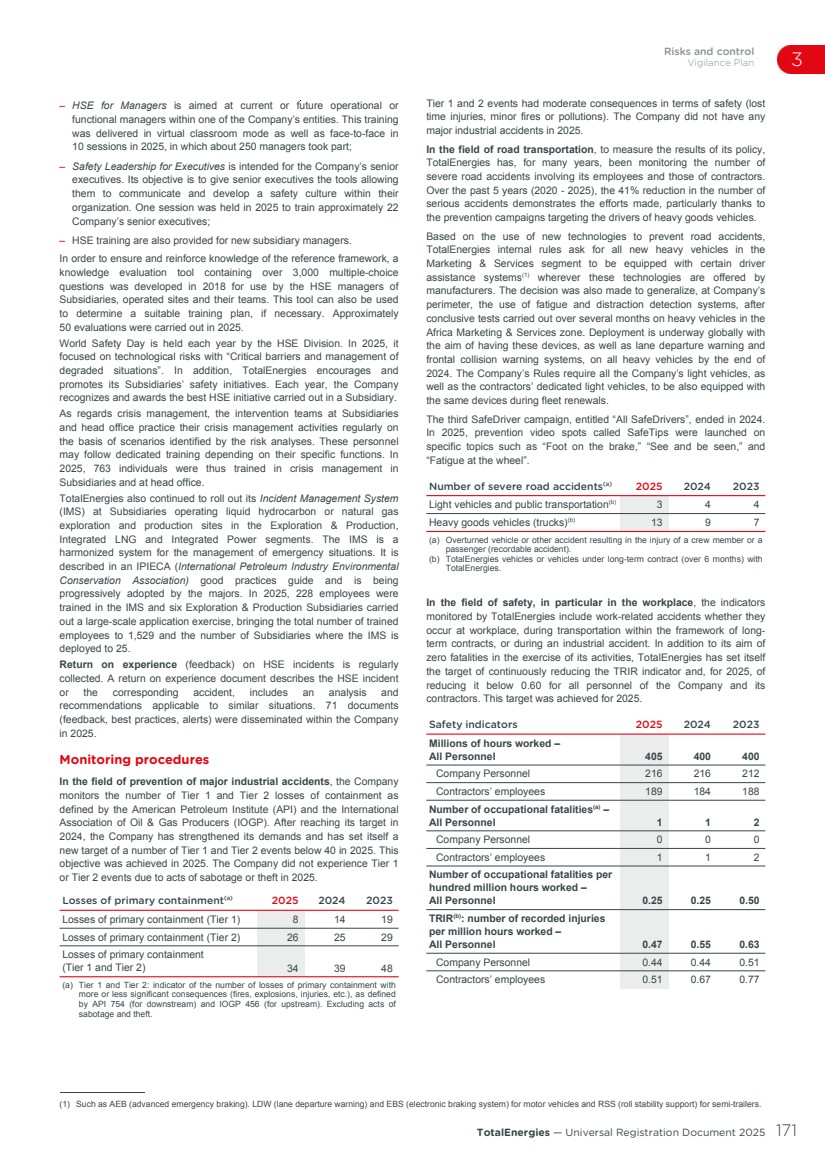
| Safety indicators 2025 2024 2023 LTIR(c): number of lost time accidents per million hours worked – All Personnel 0.36 0.35 0.40 Company Personnel 0.36 0.33 0.42 Contractors’ employees(a) 0.36 0.39 0.38 LTIS(d): number of days lost due to accidents at work per million hours worked - All Personnel 16 15 12 (a) Excluding occupational illnesses, for which the link with a possible fatality is a matter of medical confidentiality. (b) TRIR: Total Recordable Injury Rate. (c) Lost Time Injury Rate. (d) LTIS: Lost Time Injury Severity. Severity rate. In 2025, out of the 191 occupational accidents reported, 188 related to accidents at the workplace. 75% of these occurred walking, when handling loads or objects, using portable tools or working with powered systems. The Company’s efforts on safety have allowed it to reduce the TRIR by more than 60% between 2015 and 2025. This improvement is due to constant efforts in the field of safety and, in particular: – the prevention of the risks of serious and fatal accidents by campaigns aimed at road transport and high-risk work; – the implementation of the HSE rules and guides, which are regularly updated and audited; – training and general awareness raising with safety issues for all levels of management (World Safety Day, special training for managers); – HSE communication efforts targeting all Company personnel; – the maintaining of HSE objectives into the remuneration policy for TotalEnergies employees (refer to point 5.2.3.1.C. 3.a. of chapter 5). Despite the measures implemented and detailed below, there were regrettably one fatal accident among contractors’ personnel in 2025. In May, in Angola, while unloading drill pipes onto a supply vessel, once the pipes had been placed and the slings unhooked, they rolled towards two crew members of the company operating the vessel. One crew member lost his life and one of his colleague was injured in the leg. Specific recommendations have been issued regarding the strengthening of loading/unloading procedures, including the stabilization of loads after lifting, the implementation of secure storage systems for tube bundles, and the strengthening of prevention measures on logistics vessels. In the field of occupational health, the annual Industrial Hygiene survey sent to the Company’s Subsidiaries in order to evaluate the rate of implementation of risk analyses in the workplace, to verify that potential exposures have been identified, and that action plans are in place. 2025 2024 2023 Entities having carried out workplace Health risk analysis(a) 99% 97% 92% (a) Data provided by the Industrial Hygiene survey before 2024. Data for 2024 provided by the WHRS. In this field, TotalEnergies uses the following indicators: Health indicators (WHRS scope) 2025 2024 2023 Percentage of employees with specific occupational risks benefiting from regular medical monitoring 100% 99% 100% Number of occupational illnesses recorded in the year (in accordance with local regulations) 160 170 107 3.6.8.3 Environment This section is primarily intended to present implementation of measures with respect to Subsidiaries, while the implementation of measures specific to Suppliers is described in point 3.6.8.5. Subsidiary assessments HSE audits, which include a section on the environment, are described in point 3.6.8.2. The One MAESTRO reference framework states that the environmental management systems of the sites operated by the Company that are environmentally material(1) must be ISO14001 certified within two years of start-up of operations or acquisition: 100% of these 84 sites were compliant in 2025. In addition to this requirement, at year-end 2025, a total of 307 sites operated by the Company were ISO14001 certified. Actions to mitigate risks and prevent impacts and monitoring procedures In terms of preventing the risk of accidental pollution, TotalEnergies monitors indicators that allow it to assess the preparedness of Company operated sites for oil spills. Oil spill preparedness 2025 2024 2023 Number of sites whose risk analysis identified at least one risk of major accidental pollution to surface water 113 115 122 Proportion of those sites with an operational oil spill contingency plan 100% 100% 100% Proportion of those sites that have performed an oil spill response exercise or whose exercise was prevented following a decision by the authorities 94% 97% 99% In accordance with industry best practices, TotalEnergies monitors accidental liquid hydrocarbon spills of more than one barrel. Spills that exceed a predetermined severity threshold are reviewed on a monthly basis and annual statistics are sent to the Performance Management Committee of the Company. All spills are followed by corrective actions aimed at returning the environment to an acceptable state as quickly as possible. Accidental liquid hydrocarbon spills of a volume of more than one barrel that affected the environment, excluding sabotage (thousands of m³) 2025 2024 2023 Number of spills 22 24 27 Total volume of spills ~0.0 (a) 0.6 1.7 Total volume recovered ~0.0 (b) ~0.0(c) ~0.0(d) (a) Precisely 23 m3 . (b) Precisely 13 m3 . (c) Precisely 28 m3 . (d) Precisely 40 m3 . As part of TotalEnergies’ policy of avoiding, reducing and where necessary and possible offsetting the environmental footprint and effects on nature in general of its operations, discharges of substances are identified and quantified by type of environment (water, air or soil) so that appropriate measures can be taken to better control them. In 2015, SO2 emissions reached 59 kt. TotalEnergies has set itself the target of reducing its emissions by 75% in 2030 (compared to 2015), which entails not exceeding 15 kt within the scope of the sites operated by the Company. In 2025, within the same scope, SO2 emissions stand at 19 kt. (1) The production sites of the oil & gas Uptsream activities, sites producing more than 250 kt/y in the Refining & Chemicals and Marketing & Services segments, and gas-fired power plants in the Integrated Power segment, operated by the Company. 3 Risks and control Vigilance Plan 172 TotalEnergies — Universal Registration Document 2025 |
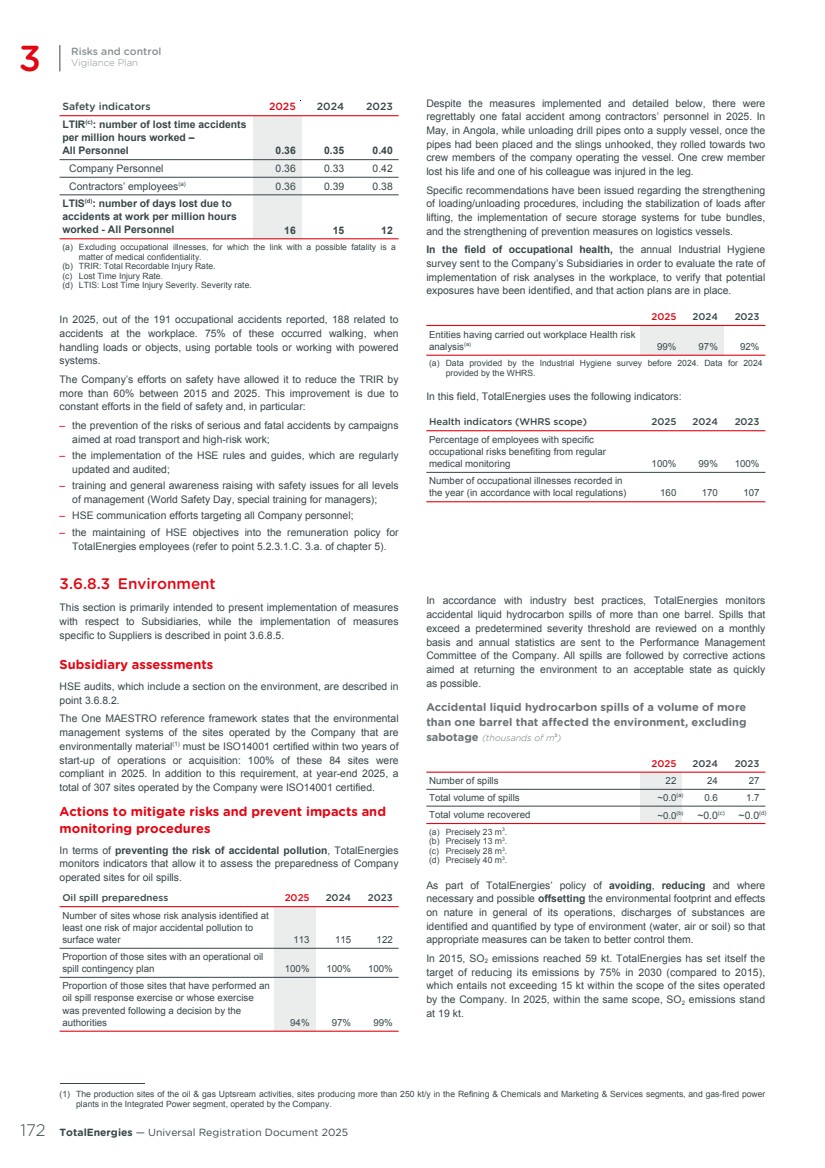
| Atmospheric chronic emissions(a) 2025 2024 2023 SO2 emissions (in kt) 18 16 12 NOX emissions (in kt) 53 57 60 NMVOC emissions(b) (in kt) 35 35 43 (a) From 2024, quantities emitted by the operated sites and above the reporting threshold values provided for in the E-PRTR(1) regulation. (b) Non-methane volatile organic compounds. SO2 emissions that are likely to cause acid rain are regularly checked and reduced. In 2025, SO2 emissions have increased mainly due to the Ratawi project (Iraq) which historically burns large quantities of sulfur containing gas. The Ratawi project aims precisely, in the long term, to valorize this gas and therefore reduce associated SO2 emissions. In addition to local regulations, TotalEnergies has set the following voluntary environmental targets for its operated sites: – limit the hydrocarbon content of continuous liquid discharges to less than 30 mg/l for offshore sites (permanent target); – limit the hydrocarbon content of continuous liquid discharges to less than 1 mg/l for onshore sites by 2030. Studies have been launched to improve the discharges from sites that are still not in compliance. Discharged water quality 2025 2024 2023 Hydrocarbon content of offshore continuous water discharges (in mg/l) 9.9 11.2 11.6 % of sites that meet the target for the quality of offshore discharges (30 mg/l) 97% 93% 92% Hydrocarbon content of onshore continuous water discharges (in mg/l) 2.0 2.0 1.9 % of sites that meet the 2030 target for onshore discharges quality (1 mg/l) 82% 82% 86% As part of the implementation of its biodiversity ambition, an overview of measures already taken and updated for 2025 under the four core principles of this ambition is provided in point 5.2.2.4 E. of chapter 5. 3.6.8.4 Climate Scope of report This part of the implementation report relates to greenhouse gas emissions resulting from the Company’s Activities (Scope 1+2), in accordance with the provisions of Article L. 225-102-1 of the French Commercial Code. TotalEnergies also reports on indirect greenhouse gas emissions related to the use by customers of energy products (Scope 3 (2)) and related actions, in accordance with Article L. 233-28-4 of the French Commercial Code, in the Sustainability reporting under the CSRD (refer to point 5.2.2 of chapter 5). Governance To define its strategy and take into account the challenges posed by climate change, TotalEnergies relies on a structured organization and governance. Climate issues are addressed at the highest level of the organization by the Board of Directors and the Executive Committee, which have committed the Company to a balanced transition strategy. The Chairman and Chief Executive Officer with the members of his Executive Committee as well as the Lead Independent Director participated all year long to a nourished dialogue with shareholders and different stakeholders on the Company’s climate issues. As an illustration, in 2025, the Lead Independent Director entertained an extensive dialogue ahead of the Shareholders’ Meeting with shareholders representing nearly a quarter of the Corporation’s capital. The Lead Independant Director has also driven a sustained dialogue with proxy advisors. This dialogue continued after the Shareholders’ Meeting. These meetings provide an opportunity to exchange views on TotalEnergies’ transition strategy, its progress and the update of its climate ambition. The Board of Directors also reports annually to the shareholders on the progress made. In 2025, progress made in the implementation of the Corporation’s ambition with respect to sustainable development and energy transition and its related targets by 2030 has been reported in the Sustainability & Climate - 2025 Progress Report which was subject of a formal item for discussion (without a resolution submitted to a shareholder vote) on the agenda of the Annual General Meeting of May 23, 2025. In support of the Company’s governance bodies, the Sustainability and Climate Division shapes the approach to climate and accompanies the strategic and operational divisions of the Company’s business segments. By defining and monitoring indicators, progress can be measured and the Company’s actions can be adjusted. Oversight by the Board of Directors TotalEnergies’ Board of Directors endeavors to promote value creation by the business in the long term by taking into consideration the social and environmental challenges of its business activities. It determines the Company’s strategic orientation and reviews every year, in connection with this strategic orientation, the opportunities and risks such as financial, legal, operating, social and environmental risks, and the measures taken as a result. It ensures that climate-related issues are incorporated into the Company’s strategy and the investment projects that are submitted to it. It examines climate change risks and opportunities during the annual strategic outlook review of the Company’s business segments. It reviews performance each year. The skills of the directors in the area of climate are presented in point 4.1.1.5 of chapter 4. In addition to ongoing access to training modules on climate issues in particular, a training program led by members of the Executive Committee, primarily intended for newcomers but open to all directors, was launched in 2025 and will continue in 2026. This program focuses in particular on technological and digital ambitions, as well as sustainability, climate, and human resources policies. Directors are invited to participate to Company’s site visits which contribute in a very concrete way to their training and allow them to deepen their knowledge of the specificities of the corporation, its challenges, including in terms of sustainability. They are the occasion for thematic presentations. In this context, site visits, by groups of 4 to 5 directors accompanied by a member of the Executive Committee, were organized in 2025 in Nigeria (offshore and onshore EP, solar), in Scotland (Seagreen, offshore EP), in Antwerp (Refining), in Rouen and Le Havre (mobility, FSRU, blending). Additionally, the Lead Independent Director went to the ACC firm in Douvrin. Finally, Audit Committee members visited the TotalEnergies Electricité et Gaz France offices in Paris, where they were presented with the Retail Power & Gas activity. The Strategy & CSR Committee reviews the Company’s overall strategy proposed by the Chairman and CEO, as well as issues related to the Company’s social and environmental responsibility (CSR), and particularly those concerning the integration of climate considerations into the Company’s strategy. The 2025 annual strategy seminar focused in particular on changes in the strategic environment, the Company’s Integrated Power strategy, and developments in the responsible investment market and their implications for investments in TotalEnergies. The Audit Committee notably carried out tasks arising from regulations on the publication of sustainability information and also reviewed the updated risk map in early 2026. For many years the Compensation Committee has included sustainability issues including climate ones in the compensation structures of the Chairman & Chief Executive Officer, as well as in the criteria related to the performance share plans. (1) Regulation (EC) No 166/2006 of the European Parliament and of the Council of 18 January 2006 concerning the establishment of a European Pollutant Release and Transfer Register. (2) GHG Protocol – Category 11 (refer to the glossary). Risks and control Vigilance Plan 3 TotalEnergies — Universal Registration Document 2025 173 |
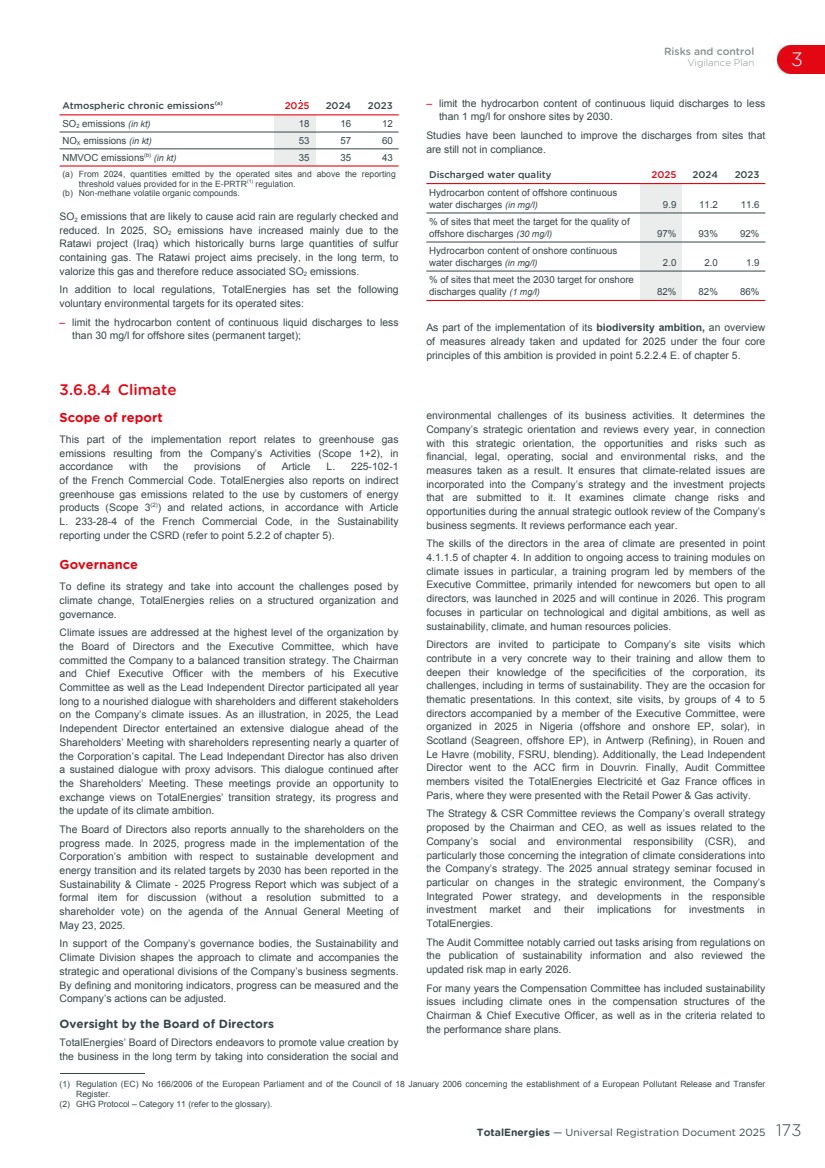
| Detailed information regarding the compensation for the 2025 fiscal year and the compensation policy for the Chairman and CEO for the 2026 fiscal year are provided in point 4.3.2 of chapter 4. The compensation policy for directors is detailed in point 4.3.1 of chapter 4. Role of management The Executive Committee (Comex) chaired by the Chairman & Chief Executive Officer ensures that climate-related issues are taken into account and built into operational roadmaps. The Executive Committee is responsible for identifying and analyzing risks that could affect the achievement of TotalEnergies’ objectives. The TotalEnergies Risk Management Committee (TRMC) assists the Executive Committee. The TRMC’s primary duties are to ensure that the Company’s risk mapping is updated on a regular basis and that its existing risk management processes, procedures and systems are effective. The Strategy & Sustainability Division coordinates the Company’s activities through the entities in charge of strategy and markets analysis, sustainability and climate, and also safety, health and environment, legal affairs, relations with public authorities and internal audit. Its President also chairs the Risk Committee (CoRisk) which is in charge of the Company’s investments. The Finance Division ensures an ongoing dialogue with investors, analysts and extra-financial rating agencies on climate challenges and on extra-financial issues more broadly. In all, more than 450 meetings were held in France and abroad in 2025, as well as a field trip to Uganda; the latter included site visits to the Tilenga and EACOP projects as well as exchanges with several stakeholders. Strategy A. TotalEnergies’ ambition in terms of sustainable development and energy transition towards carbon neutrality, together with society 1) TotalEnergies’ Climate Ambition TotalEnergies supports the Paris Agreement, with its call to reduce greenhouse gas emissions in the context of sustainable development and poverty eradication, and its overarching goals to limit planetary warming to well below 2 °C by 2100 compared with pre‑industrial levels. Climate change is a reality and requires the collective mobilization of all stakeholders. The 2015 Paris Agreement significantly raised the awareness of the need to tackle climate change and prompted an enhancement of collective action to start transitioning the global energy system. A massive transformation of the world’s energy systems is needed to achieve the Paris goals. The dual challenge of “more affordable energy for all and less carbon emissions” is a challenge for society as a whole, where governments, investors, companies and consumers all have important roles to play. In 2020, TotalEnergies outlined for the first time its ambition to aim for carbon neutrality together with society. The adoption of this ambition was supported by the strategy to become a broad-based energy company, expanding from oil and gas to low carbon electricity and low carbon energies. It was also part of a shareholder dialogue process with Climate Action 100+ (CA 100+), a coalition of investors committed to the energy transition. This ambition set out three steps for TotalEnergies to get to Net Zero together with society: net zero for TotalEnergies’ global operated emissions (Scope 1+2), net zero covering direct and indirect emissions (Scope 1+2+3) in Europe, and a 60% reduction in the average carbon intensity of energy products sold to our customers (CI) globally by 2050 compared to 2015. In 2021, as a result of a continuous dialogue with some shareholders, the Board of Directors broadened the net zero ambition together with society so as to cover direct and indirect emissions (Scope 1+2+3) on a worldwide basis. Within the framework of its first corporate sustainability report (CSRD) published in March 2025 as required by the EU, TotalEnergies characterized its “together with society” approach by underlining some dependencies and uncertainties: “The energy transition requires the participation of all stakeholders, from regulatory authorities to end customers and industrial players. TotalEnergies is deploying a strategy that supports this collective transition and will enable our Company to adapt to the various scenarios that may materialize depending on developments in low-carbon technologies (speed of penetration, cost reduction), geopolitical relations, international trade, and consumer behavior.” 2) TotalEnergies’ energy transition strategy supporting the Ambition As part of this Ambition, the Company has defined and consistently implemented a balanced transition strategy based on two pillars: – An Oil & Gas pillar centered on low cost and low emission projects: the Company continues to invest in existing fields and new oil and gas projects, and plans to increase its production of hydrocarbons – mainly LNG, a key energy source for the energy transition – by 3% per year on average until 2030, so as to meet growing energy demand and fight the natural decline of oil and gas fields (averaging 6-7% per year for the industry according to the 2025 IEA report). In parallel, TotalEnergies has published a roadmap to reduce emissions from its operations: it aims to achieve a 40% net reduction in its operated emissions (Scope 1+2) in 2030 compared to 2015, and an 80% reduction in its operated methane emissions in 2030 or sooner compared to 2020. – An Integrated Power pillar: the Company is building a competitive portfolio of renewable (solar, onshore wind, offshore wind) and flexible assets (CCGT, storage) to provide its customers with low-carbon electricity available 24 hours by 7. We plan to increase our electricity production to more than 100 TWh by 2030, which would represent 20% of our energy production by that date. In addition, we are investing in low-carbon molecules, particularly biofuels and sustainable aviation fuels (SAF). A key measure of our contribution to the transition of our customers and the global energy systems is the life-cycle Carbon Intensity of the energy products sold to our customers (CI). The decline in our CI reflects our progress in implementing our transition strategy, since it means that the carbon content of the energy products we sell to our customers is decreasing, on an energy unit basis. In 2025 our life-cycle Carbon Intensity was down by more than 18% compared to 2015. By 2030 we target a reduction of 25%. Our 2025 earnings demonstrate that our differentiated strategy built around these two pillars is delivering best in class returns, thereby creating long term value for our shareholders while supporting our climate ambition. 3) Ten years after the Paris Agreement: Confronting Net Zero ambitions to realities While the Company’s transition strategy is based on solid market fundamentals and will be consistently pursued, the Company notes that the context in which its Ambition was adopted has evolved. 3 Risks and control Vigilance Plan 174 TotalEnergies — Universal Registration Document 2025 |
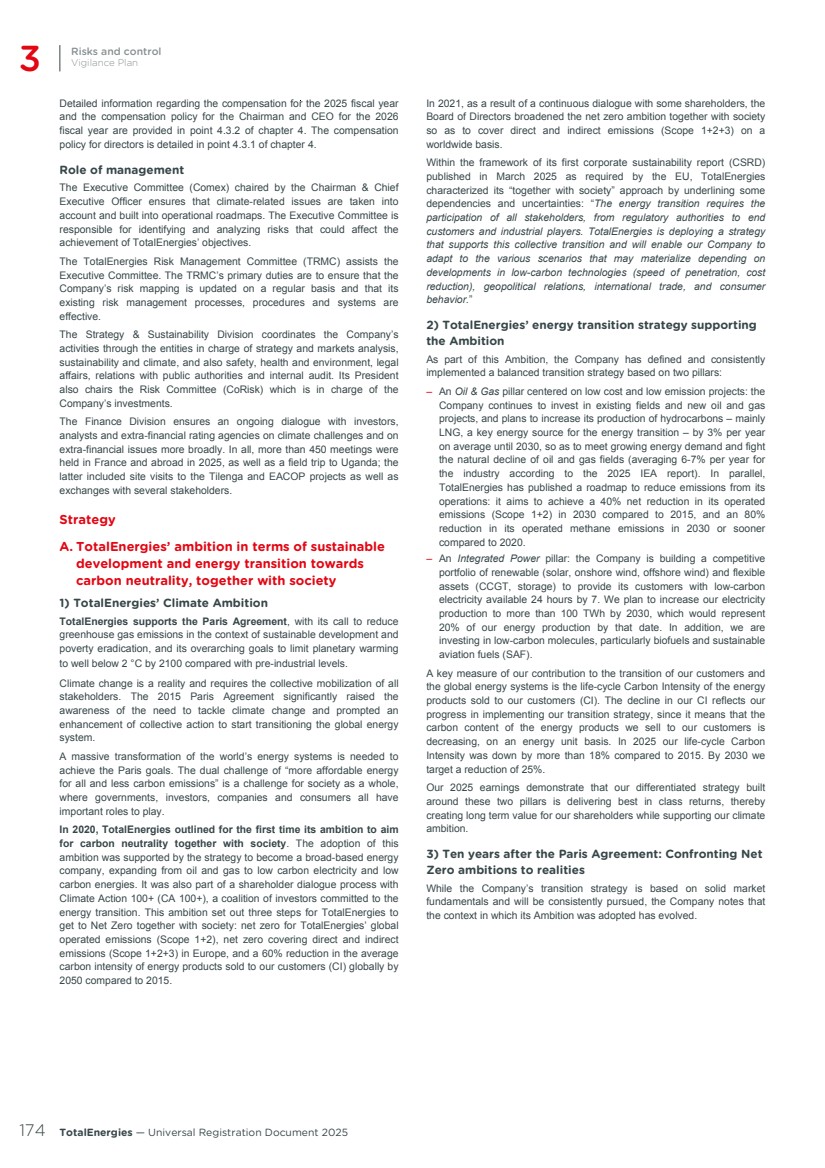
| a) Ten years after the Paris Agreement, the global energy system has progressed by enabling the continued development of emerging economies while reducing the carbon intensity of the energy mix. Affordable low-carbon technologies have experienced spectacular growth, for example solar panels or, in some parts of the world, electric vehicles. Yet the share of fossil fuels in the overall energy mix has hardly moved (from 82% to 80%) because the cleaner energy sources have not eliminated traditional energies but have mostly been added to the existing system as population and energy demand continue to grow steadily. Since 2015, economic and geopolitical conditions have shifted, with rising interest rates making transition finance more expensive and the weaponization of energy putting energy security at the top of every country’s agenda. States have to balance the energy trilemma between energy reliability, energy affordability and sustainability. Non-State actors have had to balance these competing priorities too. Our societies and economies have initiated an energy but the global economy is not yet achieving the pace of change required to meet the Paris Agreement objectives. Against this backdrop, at COP30 in Belem in Nov. 2025, there was a common finding – by UNFCCC, UNEP and the international community – that the updated Nationally Determined Contributions for 2035 provided by the States fall behind what is needed to reach the Paris goals. b) The current scientific consensus now emphasizes that the goal of limiting global warming to 1.5°C above pre-industrial levels is out of reach. Climatologists, including ones contributing to the IPCC work, and scientists have explicitly shared these views with the media and the public at large in 2025. Similarly, the International Energy Agency states in its 2025 World Energy Outlook report that “It is now all but certain that 1.5°C of warming will be exceeded within a decade or less, and that pathways that limit this overshoot of 1.5°C to low levels have now slipped out of reach.” These scientific findings are closely linked to the inertia of the energy system, which still relies on fossil fuels for nearly 80% of its energy: despite the massive deployment of solar and wind, coal still plays a dominant role in electricity generation and accounts for three-quarters of the 14 billion tons of CO2 emitted each year by power plants; the penetration of low-carbon technologies to electrify and decarbonize uses is hampered by cost considerations and sometimes by technological maturity constraints. c) The legal and regulatory framework applicable to sustainability and climate has evolved. For European companies, the corporate sustainability reporting directive (CSRD) and associated reporting standards (ESRS) in force since 2025 have established a legally binding framework: targets using the words “net zero” require the adoption of “transition plans” (as defined by the regulations), and companies that adopt such plans must explain how these plans are compatible with a warming trajectory of 1.5°C by 2050 — which we know the scientific consensus now considers out of reach. Based on the current state of scientific knowledge, in light of the growing heterogeneity of energy pathways at the global level, the reliance by forward‑looking scenarios on assumptions that may not materialize, and the ongoing uncertainties regarding the evolution of global energy demand, worldwide GHG emissions and the effective pace of deployment of low‑carbon technologies, the Company is not in a position to adopt a transition plan as defined by the European reporting standards and, as a result, cannot formulate “Net Zero” targets in the meaning of these standards. 4) The pathways to our carbon neutrality ambition together with society will need to be reassessed and adapted over time In order to take these realities into account, particularly the legal framework created by the European corporate sustainability reporting directive regarding “Net Zero” taxonomy, TotalEnergies has no choice but to evolve the wording and to precise the dependencies of its carbon neutrality ambition, together with society. “More Energy, Less Emissions, Fully engaged in our transition strategy” TotalEnergies is fully engaged in its balanced, value-creating, transition strategy based on 2 pillars: an oil & gas pillar and an integrated power pillar. This transition strategy supports TotalEnergies’ ambition for carbon neutrality, together with society, within the framework set out by the Paris Agreement’s objectives. We acknowledge that our ability to achieve carbon neutrality is linked to our own efforts and to society’s broader progress in this area. Therefore: – TotalEnergies aims to achieve carbon neutrality for its global operated emissions (Scope 1+2) by 2050 – The Company works proactively with its customers to help execute their own energy transition strategies and puts on the market a mix of energies with a lower carbon intensity year after year. Our ability to do so depends critically on the pace and affordability of technical innovation, on public policies and on consumers’ behavior. This is what is encapsulated in “together with society”. Without the right policies and enough cost-efficient innovation, carbon neutrality by 2050 will remain out of reach – for society and for TotalEnergies. As a result of these dependencies, the pathways to our carbon neutrality ambition will need to be reassessed and adapted over time. On the way to its ambition, TotalEnergies confirms its targets set for 2030 for reducing emissions worldwide: a 40% net reduction of its Scope 1+2 operated emissions compared to 2015, an 80% reduction of its operated methane emissions in 2030 or sooner compared to 2020 and a 25% reduction of its life cycle carbon intensity (CI) of the energy products sold to its customers compared to 2015. B. Our orderly energy transition 1. Oil a. Producing oil differently: focus on low cost and low-carbon intensity oil assets Global demand for petroleum products reached 104.0 Mb/d in 2025, i.e., +0.8 Mb/d (+~1%) compared to 2024, and should continue to grow over the decade (105.5 Mb/d by 2030 according to the IEA). Beyond 2030 the trajectories of the different forecasters vary between moderate growth, plateau and start of decline. These demand forecasts remain dependent in particular on population and economic growth, market penetration pace of low-carbon technology innovations such as electric vehicles and changes in behavior. In addition, demand for petroleum products should evolve in a differentiated way according to the specific energy transition roadmaps of the various countries. It is expected to continue increasing through 2030- 2040, and could begin to decline thereafter, but at a slower pace than the natural decline rate of existing fields, which the IEA estimates at an average of 8% per year over the next decade(1) . (1) Source: The Implications of Oil and Gas Field Decline Rates (IEA, September 2025). Risks and control Vigilance Plan 3 TotalEnergies — Universal Registration Document 2025 175 |
| TotalEnergies therefore believes that new oil projects are still needed to meet this demand and to keep prices at an acceptable level in order to create the conditions for a just transition that gives people time to adapt their energy use. In 2025, TotalEnergies produced 1.4 Mb/d of oil, equivalent to its 2019 level, representing around 1.5% of world production. TotalEnergies’ first responsibility as an oil producer is to produce differently, by reducing to the minimum emissions. To that end, it approves hydrocarbon projects on the basis of performance criteria, notably technical costs and carbon intensity (Scope 1+2). The Company operates its fields in accordance with strict requirements concerning safety, emissions reduction and environmental impact. The cash flow generated by these Oil and Gas activities contributes to financing its investments in renewable energy. b. Reducing our Scope 1+2 Emissions by 2030 The primary responsibility of TotalEnergies as a producer of fossil fuels is to reduce emissions on its facilities. In 2024, the Company launched the “Our 5 Levers for a Sustainable Change” initiative, which supports the commitment of all employees to improving energy efficiency and the use of low-carbon technologies in TotalEnergies’ operations. Our progress in 2025 TotalEnergies is resolutely continuing to reduce emissions from its operated assets. Thus, within the scope of its oil and gas facilities(1) , emissions from assets operated by the Company fell by 38% compared to 2015 levels. In 2025, with more than 85 GHG emissions reduction projects coming to fruition, TotalEnergies reduced its emissions by 0.7 Mt of CO2e across its operated assets. At the same time, emissions related to flexible power generation decreased by 0.2 Mt CO2e due to changes in the portfolio operated and lower utilization rates of CCGTs in the United States. As a result, the Company’s overall operated emissions have decreased by 28% compared with 2015. These ongoing reduction efforts have made it possible to reduce the Scope 1+2 intensity of the Upstream oil & gas operated assets, from 21 kg CO2e/boe in 2015 to 15.3 kg CO2e/boe in 2025(2) . These results put TotalEnergies among the players with the best intensities in the industry. In support of the unchanged target of a 40% reduction in Scope 1+2 net emissions, the trajectory for the operated oil & gas segment suggests a 50% gross reduction in Scope 1+2 emissions in this sector by 2030. Our objectives Given the progress made towards achieving its interim targets, in 2025, TotalEnergies is stepped up its ambition to reduce GHG emissions from its operated assets and has set the target for 2025 at 37 Mt CO2e/y, compared with 38 Mt CO2e/y previously. This target was achieved in 2025 with 33.1 Mt CO2e/y, down 1.1 Mt CO2e/y compared to 2024. TotalEnergies has set itself a 2026 target of reducing GHG emissions from its operated assets by 34 Mt CO2e/y. TotalEnergies reaffirms its target to reduce emissions from its operated assets, which aims to reduce its net Scope 1+2 emissions(3) by 40% by 2030 relative to 2015, after mobilizing around 5 million credits from nature-based carbon sinks projects. This offsetting will start only from 2030 for residual emissions on the basis of a consumption of approximately 10% per year of the stock of carbon credits of the Company. c. Improving the Energy Efficiency of Our Sites: Implementation of the 2023-2025 Action Plan Saving energy used in TotalEnergies operations is beneficial in several ways: it contributes to the collective campaign for energy efficiency, and it helps to reduce the Company’s GHG emissions and lowers its costs. In September 2022, TotalEnergies launched a plan to accelerate energy efficiency improvements at its sites worldwide. This plan has enabled the Company to accelerate the actions undertaken for several years in the Company’s operating sectors, with a total of more than 140 projects completed by 2025, including more than 100 initiatives for Exploration & Production, more than 40 for Refining-Chemicals and more than 5 for Marketing & Services and Integrated Power. At the end of 2025, these investments amount to more than $1 billion, as planned in this initial energy efficiency improvement plan: they have reduced emissions by more than 2 Mt CO2e/year and realized energy and CO2 savings of $200 million/year following the investment plan carried out over the 2023-2025 period. Taking into account the efficiency projects reported by the teams at the industrial sites, a second energy efficiency improvement plan is rolled out over the period 2026-2028, for a total of $1 billion. 2. Gas a. Liquified Natural Gas: a key fuel for the energy transition In the gas markets, TotalEnergies focuses on Liquefied Natural Gas (LNG), which can be shipped everywhere in the world and thus contributes to energy security, as it has been the case in Europe where pipeline deliveries of Russian gas have sharply declined since 2022 and fell further with the halt of transit through Ukraine at the end of 2024. The growth of renewable electricity, intermittent and seasonal by nature, will require an increase in flexible power generation resources. The dispatchable generation of gas-fired power plants helps secure electricity supply against weather variability affecting renewables, while also responding to fluctuations in demand. In addition, natural gas plays an essential role in reducing emissions from power generation as a replacement of coal, emitting half as much GHG for the same amount of electricity produced(4) . It is particularly the case in Asia where coal still accounts for a very large part of the electricity mix of many countries (e.g., 60% in China, 70% in India) (5) . With diversified positions, and in particular a leading position of exporter in the United States – over 19 Mt in 2025 – TotalEnergies is the 3 rd world’s largest LNG player, with 44 Mt sold in 2025. In line with its balanced multi-energy strategy, TotalEnergies intends to consolidate its integrated position across the entire LNG value chain. Between 2025 and 2030, LNG volumes (from equity and long-term third-party purchases, excluding Russia after 2027) are expected to grow by 50%. TotalEnergies intends to focus on improving the flexibility and resilience of its LNG portfolio by investing in low-cost liquefaction projects, which are best positioned on the merit curve, and to continue growing its Brent-indexed sales in Asia. Reducing the carbon footprint of the LNG portfolio TotalEnergies aims to gradually reduce GHG emissions of the LNG value chain, from gas production to end use. In addition to its efforts to reduce methane emissions, initiatives are being implemented throughout the whole chain. The electrification of liquefaction plant processes is helping to reduce LNG’s carbon footprint today, and tomorrow this reduction will be reinforced by CO2 capture and storage projects. (1) Upstream and Downstream oil & gas activities (excluding CCGT). (2) Operated oil & gas Upstream intensity is calculated excluding LNG plants. (3) The calculation of net emissions includes nature-based carbon sinks projects as from 2030. (4) Source: IEA Emission Factors Package - 2025. (5) Source: Enerdata. 3 Risks and control Vigilance Plan 176 TotalEnergies — Universal Registration Document 2025 |
| Thus, the average carbon intensity of the Company’s LNG liquefaction portfolio reached around 28 kgCO₂e/bep(1) in 2025. It ranges from 22 to 26 kgCO₂e/bep for new plants and can be reduced to less than 3 kgCO₂e/bep when the facility is electrified and powered by carbon-free electricity, as in the Marsa LNG project. TotalEnergies is also working to reduce shipping emissions by renewing its fleet of chartered LNG carriers with modern, high-performing vessels. (average age of the fleet under long-term charter: 7 years versus 11 years for the global fleet of LNG carriers(2)). All LNG carriers chartered by TotalEnergies use LNG as fuel. Furthermore, TotalEnergies actively supports the industry’s efforts to reduce “methane slip” (emission of unburned methane in engines) and joined the MAMII (Methane Abatement in Maritime Innovation Initiative) in February 2024. b. Aiming for Zero methane emissions With a warming potential 30 times greater than CO2 and a short lifespan in the atmosphere(3) , methane is a greenhouse gas whose rapid reduction is considered one of the most effective levers for having a short-term impact on global warming. The Global Methane Pledge, launched at COP26 and signed by more than 150 countries, aims to reduce methane emissions by 30% across all sectors (agriculture, waste, energy) by 2030 compared to 2020, and experts estimate that a reduction of this magnitude would have an impact of -0.2°C on the global average temperature by 2050(4) . The oil and gas sector has the technologies, technical expertise and operational capabilities to act quickly on methane emissions from its operations. TotalEnergies believes that it is the sector’s responsibility to reduce its methane emissions to near zero by 2030 and intends to maintain its leadership role in the industry on methane. Progress since 2010 Between 2010 and 2020, TotalEnergies reduced methane emissions from its operated assets by nearly half. These emissions then fell from 64 kt CH4 in 2020 to 22.5 kt CH4 in 2025, a reduction of 65%, exceeding the target of a 60% reduction between 2020 and 2025. TotalEnergies has set a new target of -70% in 2026 and is on track to achieve its goal of an 80% reduction by 2030 or sooner, compared to 2020. In terms of methane intensity(5) from operated oil and gas production, TotalEnergies reached 0.07% in 2025, thereby already achieving its 2030 target of falling below the 0.1% threshold. Pioneers in methane emissions detection and measurement In 2022, TotalEnergies deployed AUSEA(6) drone technology at its upstream sites, complementing the annual leak detection and repair (LDAR) campaigns. Mounted on a drone, the ultra-lightweight dual sensor simultaneously detects methane and CO₂ with high accuracy and is now considered an international benchmark technology and one of the best drone technologies for methane detection(7) . All of the Company’s upstream sites are currently subject to an AUSEA detection campaign at least once a year, and TotalEnergies has shared this technology with several industry partners (including Petrobras, Socar, Sonangol, NNPC, ONGC, Oil India), and more recently in 2025 with Veolia in the waste and wastewater treatment sector. In 2025, 560 days of AUSEA operations were carried out on TotalEnergies’ operated assets, nearly 100 on non-operated assets, and nearly 50 on third-party assets. In 2025, as announced at COP29, TotalEnergies took a new step forward in identifying methane emissions in real time, whether related to leaks or sub-optimal operational processes, and in immediately implementing corrective measures. This continuous detection plan relies on 13,000 sensors deployed across all operated Upstream assets and uses proven technologies such as IoT sensors(8) , infrared cameras, flow meters, and predictive emission monitoring systems placed at combustion sources. In 2025, a Methane Tracking Center (MTC) was set up in Pau to centralize and consolidate data from various detection means worldwide, whether periodic or continuous and in real time. Using digital tools and the expertise of a team of around ten experts, the MTC analyzes data, alerts operators, and provides support when needed. The technologies used at TotalEnergies’ operating sites have been tested and validated in advance on the internal TADI (TotalEnergies Anomalies Detection Initiative) platform, located in Lacq, which is one of two testing platforms in the world using METEC(9) , developed by Colorado State University in the United States. In April 2025, TADI and METEC co-published(10) an international protocol for evaluating methane detection and quantification technologies, illustrating the Company’s commitment to promoting international collaboration for the harmonized evaluation of methane emission measurement and detection technologies. Reduction actions by methane emission source TotalEnergies has long been committed to reducing its methane emissions by taking specific actions on each of the four sources: flaring, vents, stationary combustion and continuous real-time detection to identify any fugitive emissions. Actions on flaring During flaring, gas combustion at the flare is incomplete, and around 2% of the gas sent to the flare is not burnt, the rest – 98% – being transformed into CO2 after combustion. The actions to reduce flaring described below therefore directly reduce methane emissions. Eliminating routine flaring is a priority for reducing methane and CO2 emissions. TotalEnergies has been committed to eliminating routine flaring for new projects since 2000. A founding member of the World Bank’s “Zero Routine Flaring by 2030” initiative since 2014, the Company is committed to ending this type of flaring by 2030 and to achieve this goal, has implemented several large-scale projects at its sites. TotalEnergies is also seeking to reduce other forms of flaring and is launching projects to modify facilities with closed flares. Closed flare systems recover and treat residual gases, reducing the volume of flared gas to emergency situations only. In 2024, the first closed flare was installed at the Tempa Rossa site in Italy, resulting in a reduction of 1.3 kt CH4, or 40 kt CO2e. These residual gas recovery systems are now installed in all new projects, such as the Egina FPSO in Nigeria when it came on stream. Beyond actions taken on each of these sources, all new projects include strict design criteria to avoid methane emissions: no natural gas for pneumatic equipment, no continuous cold vents and systematic installation of closed flares. (1) Source: TotalEnergies, calculations based on the plants in which TotalEnergies holds an interest and on the principles presented by the IEA in its report “The Oil and Gas Industry in Net Zero Transitions” (2023). (2) Source: S&P. (3) Around a dozen years, compared to several hundred years for CO2. Global warming potential of around 30 over 100 years (source: IPCC AR6). (4) Refer to Global Methane Pledge official text. (5) Intensity of methane emissions: refer to glossary for the definition. (6) Airborne Ultralight Spectrometer for Environmental Application. (7) Stanford & IMEO study: Controlled release testing of multiple European methane measurement technologies. (8) Internet of Things. (9) Methane Emissions Technology Evaluation Center. (10) Controlled Test Protocol Version – Emission Detection and Quantification Protocol Version 1.2 April 2025. Risks and control Vigilance Plan 3 TotalEnergies — Universal Registration Document 2025 177 |
| Actions on vents Venting is the release of methane into the atmosphere without combustion. TotalEnergies has reduced its vents since 2020 by rerouting the gas going to the vents to the gas export system or to the flare. Some equipments – such as pneumatic actuators – also use methane as an instrumentation gas, and the replacement of these equipments with innovative solutions using compressed air instead of methane has significantly reduced vents. In the United States, at the Barnett site, instrument gas has been replaced by compressed air on 400 pads between 2021 and 2024, reducing emissions by 7.5 kt CH4/year, or 225 kt CO2e/year. Currently, nearly half of the natural gas that was previously used in equipment is recovered and exported. Another source of venting is the cover gas in storage tanks, which can be combustible gas, ensuring the safety of the facility by maintaining pressure in the storage tanks. In December 2024, in Nigeria, the combustible gas used as cover gas was replaced by an inert gas, nitrogen, resulting in a reduction from 5.2 kt CH4/year to 0.35 kt CH4/year, or a decrease of 150 kt CO2e/year. Actions on incomplete combustion on certain equipment Certain equipment running on natural gas (engines, furnaces, turbines) also emits methane through incomplete combustion. In Argentina, at the Neuquen site, connecting the Aguada Pichana Este plant to the national power grid through the construction of a 43 km power line and a high-voltage substation (refer to section 1.3.3.3) has made it possible to stop local electricity production from gas-powered engines and thus eliminate methane emissions from this equipment. Maintaining our leadership within the industry Over the years, TotalEnergies has acquired robust know-how and significant technical expertise in reducing methane emissions. TotalEnergies has successfully developed and deployed innovative technologies for detecting and measuring methane emissions. TotalEnergies strives to deploy this know-how and these technologies at its non-operated assets, as well as with its partners and other companies in the oil and gas sector, notably through the Oil & Gas Decarbonization Charter (refer to section 1.3.3.6). TotalEnergies also promotes the OGMP 2.0 (Oil & Gas Methane Partnership), the reference framework created in 2020 and piloted by the United Nations Environment Programme (UNEP) for methane reporting in the oil and gas sector. This framework encourages companies to continue improving the completeness and accuracy of their emissions reporting, for both operated and non-operated perimeters, in order to focus on reducing the most significant emissions. To date, more than 150 companies are members across the value chain. TotalEnergies has been awarded Gold Standard OGMP 2.0 certification in 2025 for the fifth consecutive year(1) . c. Anticipating changes in demand by adapting our sales of petroleum products TotalEnergies’ downstream business has been a steady contributor to the Company’s results, while transitioning and adapting its activities to focus on high value-added markets. The Company is addressing the sustainability challenges of its downstream activities through 3 levers: – lowering the breakeven point of its refining-petrochemicals assets in a cyclical industry; – reducing GHG emissions from its operations; – offering customers low-carbon mobility solutions. In Refining & Chemicals, TotalEnergies is continuing to develop its biofuels business. It is capitalizing on its existing assets by implementing SAF production by co-processing raw materials from waste and residues (used cooking oils and animal fats), excluding first generation 1G biomass (in competition with food consumption) in jet units in operation or by converting existing refineries into biorefineries (La Mède since 2019 and Grandpuits from 2026). For the Marketing & Services, TotalEnergies executes a three-fold Value over Volume strategy: – Network: focusing on geographies where it has a competitive advantage, such as France, Africa and certain niche markets, in order to adapt to the evolving demand for petroleum products, particularly in Europe as part of the implementation of the “Fit for 55” program; – Lubricants: differentiating ourselves through high value-added, high-margin products and developing more sustainable products to meet growing demand for circular products (RRBO(2)); – Electric mobility: aligning its investments with the pace of electric vehicle adoption by users, develop its positions in high-power charging in Europe and deploy a low-equity business model (partnerships and leverage. 3. Electricity a. Our major development in electricity: an integrated approach Electricity demand, which is essential to the success of the energy transition, is expected to grow sharply(3) , as decarbonization is at the heart of the roadmaps of countries committed to carbon neutrality by 2050. In response, Integrated Power, the second pillar of the Company’s strategy, is developing an integrated model encompassing the entire value chain, from power generation to sales and trading activities, with a profitability target of around 12% ROACE(4) . By 2030, TotalEnergies aims to achieve net electricity production of 100- 120 TWh, mainly from renewable sources. As part of its transformation into an integrated multi-energy company, TotalEnergies is building a competitive portfolio of renewable (solar, onshore and offshore wind) and flexible (CCGT, storage) assets to provide its customers with an increasing share of carbon free electricity available 24/7. The Company’ levers to grow with a return on average capital employed of around 12% are selectivity in its choices of projects; integration across the entire electricity value chain; cost control using its project management and offshore development skills; mobilizing external financing at competitive rates and farm-downs to accelerate cash flow generation and diversify its portfolio’s exposure. b. Our renewable electricity capacity build-up TotalEnergies is executing its roadmap in renewables, which is part of the Company’s objective to reach 100-120 TWh of gross electricity generation by 2030. At the end of 2025, TotalEnergies has reached a gross installed production capacity of 34 GW of renewable electricity and is actively pursuing the development of these activities to bring this capacity to 80 GW by 2030, a level that should make it one of the world’s top five producers of renewable electricity (wind and solar), Chinese producers set aside. c. Developing electric mobility TotalEnergies develops a network of high-power electric charging stations along motorways, major roads and in urban hubs in Europe with more than 400 sites equipped with high-power charging by the end of 2025. (1) Refer to the UNEP report “An Eye on Methane: 2025 Report”. (2) Re-Refined Base Oils. (3) Estimated average annual growth of nearly 2.5% between 2023 and 2050. Sources: Enerdata, TotalEnergies internal analysis. (4) Refer to the glossary for definitions and additional information on alternative performance measures (APM, Non-GAAP measures) and to point 1.8 for reconciliation tables. 3 Risks and control Vigilance Plan 178 TotalEnergies — Universal Registration Document 2025 |
| The Company also has a selective presence in a number of large cities, mainly in Europe, notably in Paris, Amsterdam, London or Brussels, with a portfolio of over 35,000 charging point. It also supports road haulers in the electrification of their fleet with the installation of terminals dedicated to trucks along European corridors and charging services at the depot with the supply of green electricity. Lastly, TotalEnergies offers French customers who own an electric car an adapted electricity rate and an intelligent, controllable charging station for economical home charging. This offer includes a number of services such as monitoring their charges via their mobile application, repair assistance and even a 24/7 mobility guarantee. Finally, as electricity customers, they also benefit from access to a large network of charging stations at an advantageous rate for their roaming charging. From the production of renewable electricity to the operation of recharging services, the Company is present across the entire electric mobility value chain. 4. New low-carbon energy a. New low-carbon energy The energy transition also requires the development of low-carbon energy based on the conversion of biomass and waste, the use of renewable hydrogen, notably for refining or in the longer term the production of synthetic molecules (e-fuels) combining hydrogen with CO2 as a raw material. TotalEnergies is thus developing these new energies: biofuels, biogas, renewable hydrogen and synthetic fuels. Biofuels Today, biofuels emit over their life cycle more than 50% less CO2 than their fossil fuel equivalents, making them a partial decarbonization pathway for liquid fuels(1) . While demand is emerging quickly, which should lead towards a high-margin market, access to feedstocks (plants, residues, sugar, etc.) remains a barrier to growth. Among these biofuels, TotalEnergies favors the production of Sustainable Aviation Fuel (SAF) to decarbonize the aviation industry. To avoid conflicts of land usage, TotalEnergies is developing solutions based on primarily food industry waste and residues (used oils, amal fats). As of 2024, the Company increases the share of circular feedstocks to more than 75% to produce biofuels. Biogas Biogas, produced from the decomposition of organic waste, is a renewable gas. Injected into gas networks in the form of biomethane, it contributes to the partial decarbonization of natural gas uses. TotalEnergies’ gross production capacity continued to increase in 2025, reaching 1.4 TWh/y eq. of biomethane. The Company now intends to pursue its development through growth, mainly in Europe and the United States. Building low carbon hydrogen supply for our refineries in Europe by 2030 To reduce the carbon footprint associated with the production, transformation and supply of energy to its customers, one of the levers identified by the Company is the use of low-carbon hydrogen to decarbonize its European refineries, which would reduce their direct CO2 emissions by up to three million tons a year by 2030. In September 2023, TotalEnergies launched a call for tenders to use up to 500 kt/y of low-carbon hydrogen in its European refineries from 2030. The call for tenders generated considerable interest within the industry, attracting a wide range of local and international players. In this context, TotalEnergies has already contracted for more than 200 kt/year of low-carbon hydrogen. These volumes are intended for the La Mède, Grandpuits, and Normandy sites in France, as well as those in Leuna, Germany; Antwerp, Belgium; and Zeeland, the Netherlands. However, achieving this ambition of using up to 500 kt/year of low-carbon hydrogen in its European refineries from 2030 onwards depends on the implementation of national tax and regulatory frameworks that effectively support the reduction of the carbon footprint. b. Innovating to accelerate the energy transition To prepare for the future, the Company invested each year more than $1 billion in R&D, industrial innovation, digital developments. R&D at TotalEnergies In support of its transition strategy, TotalEnergies has significantly reoriented its R&D in recent years. Compared to 28% in 2017, TotalEnergies devoted 72% of its 2025 R&D budget(2) to low-carbon energy (renewables, biomass, batteries, etc.) and to reducing environmental footprints through CCUS and sustainable development programs. The creation of the OneTech branch in September 2021 illustrates the dynamic generated by general management to mobilize teams and respond to the new challenges facing TotalEnergies as part of its transition strategy. OneTech’s mission is to provide all the technical and R&D expertise that TotalEnergies needs to implement its strategy. One of the missions of the OneTech branch is to provide solutions for reducing the carbon footprint and improving the energy efficiency of our projects right from the design stage, and to anticipate innovative technologies together with our partners. By putting Digital at the heart of OneTech’s organization, the Company is extending its digital transformation to all its business sectors by deploying digital solutions to improve the performance of industrial operations, reduce their environmental footprint and provide new services to its customers. Our technological Ambition Mastering the key technologies for the energy transition must be a source of differentiation. TotalEnergies has identified 6 technological areas in which the company wants to develop its excellence, focus and expand its research and technology (R&T) efforts through Strategic R&T Programs (SRTPs), with the aim of building competitive technological advantages. Accordingly, in September 2025, the Company adopted six Strategic R&T Programs: – two in the field of Sustainability Development: Digital for HSE and CO2 Techno Hub, – two for Projects and Operations: Digital Plant and NZE Plant (Near Zero Emissions Plant), – two for New Energies: Integrated Power Modelling and BioHub. Reducing our emissions through digital technology In September 2025, TotalEnergies reinforced its Digital Technology Ambition through two Strategic R&T Programs: Digital for HSE and Digital Plant. Digital for HSE aims to develop digital solutions to: – identify, anticipate, and manage technological risks; – improve workplace safety; – detect and prevent pollutant emissions. For example, STORM (Safety Tool for Operators and Remote Monitoring) is a digital product that illustrates the company’s efforts in digital technology for sustainable development whose deployment was initiated in 2025. (1) According to the European Directive 2018/2001 named RED II. (2) Excluding Hutchinson. Risks and control Vigilance Plan 3 TotalEnergies — Universal Registration Document 2025 179 |
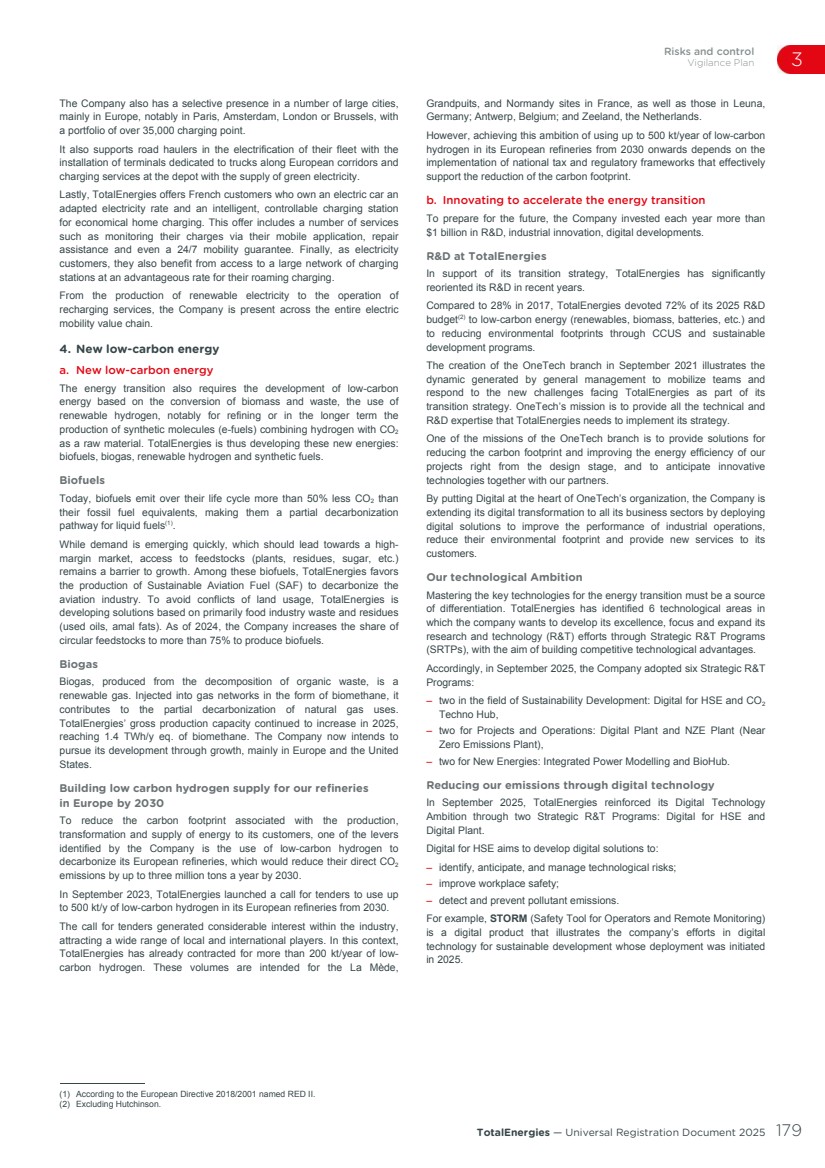
| STORM is an innovative digital solution developed by TotalEnergies to improve the detection and continuous monitoring of methane emissions at sites operated by on-site operators and the Methane Tracking Center in Pau. By aggregating multi-source data in real time—IoT sensors, infrared cameras, acoustic sensors, weather data, and AUSEA® drone or satellite imagery—STORM provides 2D/3D visualization that enables early identification of leaks, localization of their source, and accelerated corrective action. Designed to facilitate the interpretation of multiple data sets while enhancing environmental performance, the tool aims to support the Company’s commitment to near-zero methane emissions by 2030. Gradually deployed across E&P assets, STORM contributes to transparent reporting and a significant reduction in emissions, building the foundation for future automated quantification and OGMP 2.0 reporting capabilities. Innovating with start-ups To contribute to its development in the electricity sector, TotalEnergies continues to collaborate with start-ups selected through its TotalEnergies On acceleration program, based in Paris at Station F. Today, nearly 46 start-ups have been accelerated; three of them have been acquired by the Company (Nash, Predictive Layer, DS Flow) and nearly 20 commercial contracts have been signed at the end of the 6-month acceleration period. 5. Solutions for residual emissions a. Developing carbon capture and storage to reduce our emissions and those of our customers The IEA’s NZE scenario(1) includes the use of CCS(2) for up to 6 Gt CO2 per year in 2050, in order to reduce some of the emissions from residual oil & gas consumption, as well as from other industrial processes (cement, lime, steel, etc.). This capacity is more than 100 times greater than the global capture capacity currently in operation, which is around 60 Mt CO2 per year(3) . TotalEnergies’ CCS strategy gives priority to reducing emissions of its activities to reduce Scope 1+2 emissions from Upstream oil & gas activities, as well as refining and LNG plants. For example, at Snøhvit liquefaction plant in Norway, where the Company is partner alongside Equinor, around 9 Mt of native CO2 have been stored since 2008. Similarly, separated native CO2 in the new NFE and NFS LNG liquefaction trains currently under development in Qatar will be stored by QatarEnergy. Finally, for our Ichthys LNG asset in Australia, the Company is studying a native CO2 storage solution for start-up beyond 2030. The study of CCS solutions for its assets therefore complements the already mentioned efforts to reduce emissions (including electrification, energy efficiency, and flaring reduction). The Company also invests in CO2 storage projects for large industrial emitters (“Storage as a Service”) which can thereby reduce their Scope 1 and secure the future of their activities. TotalEnergies is investing around $100 million per year in this business, with models that enable us to benefit from leverage. This investment will be sustained in order to contribute to the development of a gross storage capacity of 10 Mt CO2 per year by 2030. Europe is at the heart of this CCS strategy. TotalEnergies is an historical operator in the North Sea, with recognized operational and geological expertise in the area. The United Kingdom, Norway and the European Union have set objectives and regulations and have provided significant financial support to promote a cross-border deployment of CCS. The Company currently developing four projects in the North Sea that will provide CO2 storage solutions for its own assets and those of its customers. TotalEnergies is also studying the utilization of carbon in various forms (CCU(4)), such as in reaction with renewable hydrogen, to produce fuels or synthesic methane. b. Offsetting residual emissions with nature-based carbon sinks Natural areas preservation and restoration can be a lever for achieving net zero emissions worldwide by 2050. Only in 2030 will TotalEnergies begin voluntary offsetting its residual emissions via NBS (Nature Based Solutions) carbon credits and will offset only Company’s Scope 1+2 residual emissions. TotalEnergies is working to build a high-quality portfolio and is paying close attention to the integrity and permanence of the emissions reductions and sequestration achieved by the activities financed in this way. The Company is in favor of strengthening a global framework of trust to further reinforce robust and recognized voluntary crediting mechanisms. TotalEnergies is investing in forestry, regenerative agriculture and wetlands protection projects. Its strategy aims to combine and balance the value of people’s financial revenue from agriculture and forestry and the value of the benefits to soil, biodiversity, the water cycle and the production of carbon credits. When that approach is successful, the local standard of living improves and degradation of the land diminishes – as do emissions. This search for balance among different practices makes a just transition possible. At 2025 year-end, the Company’s stock of credits stood at 17.9 million carbon credits certified by the main international standards such as Verified Carbon Standard (VCS or Verra), ACR (American Carbon Registry) or ANREU (Australian National Registry of Emissions Units). The annual budget allocated to these projects is $100 million. The cumulative budget committed at the end of 2025 for all concluded operations amounts to more than $650 million over their cumulative lifespan, for a cumulative volume of verified credits expected at 37 million by 2030 and 51 million over their lifetime. The final quantities of carbon credits obtained will depend on the effective completion of the projects, methodological revisions for certification and technical updates. Between 2026 and 2030, TotalEnergies will continue to develop new projects in order to build up a stock of carbon credits of around 50 million by 2030. In this context and based on a consumption rate of 10% of the stock per year from 2030, TotalEnergies would consume around 5 million credits per year from 2030 onwards. (1) “IEA 2025, World Energy Outlook 2025, License CC by 4.0.” (2) Carbon Capture & Storage. (3) Global CCS Institute 2025, Global Status of CCS 2025 (updated on October 9, 2025). (4) Carbon Capture & Utilization. 3 Risks and control Vigilance Plan 180 TotalEnergies — Universal Registration Document 2025 |
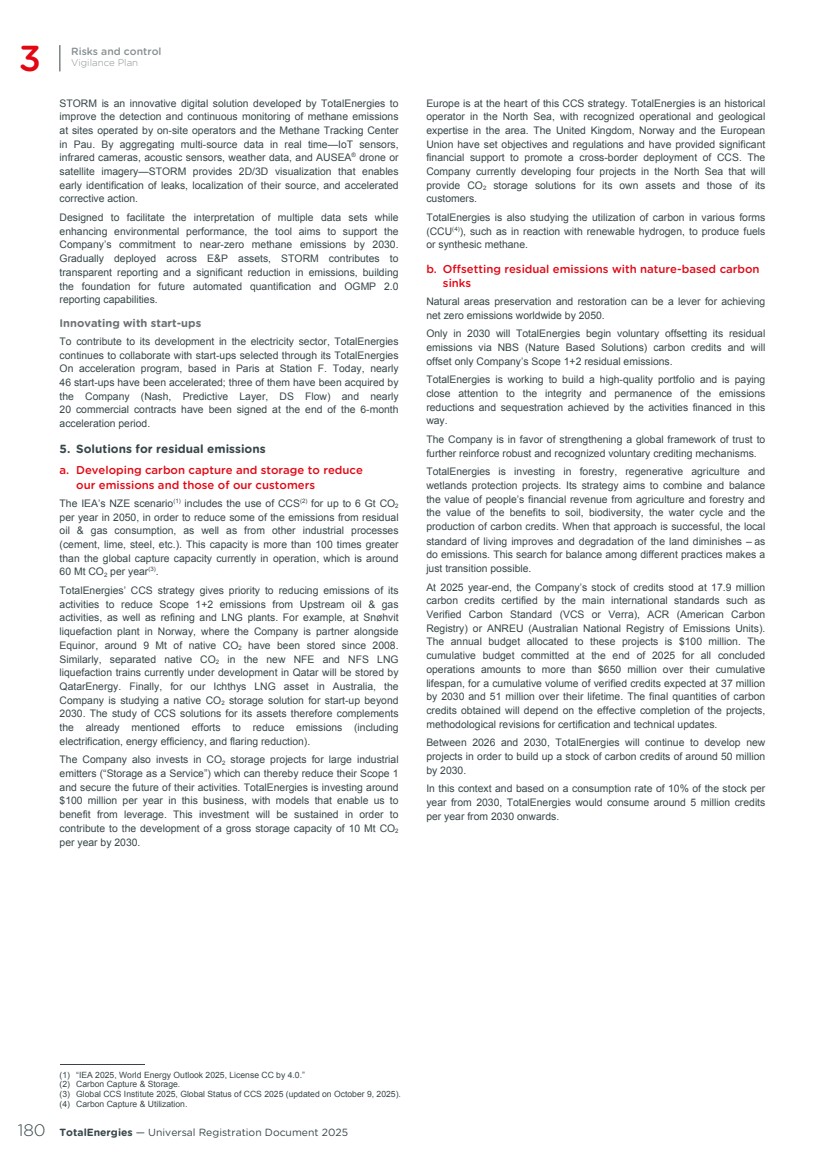
| Targets and indicators related to climate change TotalEnergies has set targets and introduced a number of indicators to steer its performance. The Company’s climate targets include among others the following: 2030 targets worldwide (Scope 1+2) – Reduce gross GHG emissions (Scope 1+2) from operated facilities from 46 Mt CO2e in 2015 to less than 34 Mt CO2e by 2026. By 2030, reduce by 40% net(1) Scope 1+2 GHG emissions relative to 2015 for operated activities, thus bringing them to between 25 and 30 Mt CO2e. Offsetting through nature-based carbon sinks projects will start only from 2030 on for residual emissions on the basis of a consumption of approximately 10% per year of the Company’s stock of carbon credits, i.e. around 5 million per year. This target concerns Scope 1+2 GHG emissions, as the Company has not defined a specific target for Scope 1 or Scope 2 alone. It implements action plans to reduce both these scopes (refer to point 5.2.2.1 B. 2. (E1-3)). The perimeter of this target is the operated perimeter defined in point 5.2.1.1. A. (BP-1), covering, in 2025, 75% of the GHG emissions (Scope 1+2) of the ESRS perimeter (refer to point 5.2.2.1 C. 2. (E1-6)). The Scope 2 used in this indicator is market-based Scope 2. – Within Scope 1, TotalEnergies has specifically set a more ambitious target for its direct methane emissions(2) , given its greater warming potential than CO2. This target is a 70% reduction between 2020 and 2026, and an 80% reduction between 2020 and 2030 or sooner on the Company’s operated facilities. – Reduce methane emissions intensity(3) below 0.1% of commercial gas produced at Upstream operated oil & gas facilities. – Reduce routine flaring(4) (Upstream oil & gas operations) with the goal of eliminating it by 2030. Indicators related to climate change GHG emissions - Scope 1+2 Operated domain 2025 2024 2023 2015 Scope 1 Direct GHG emissions Mt CO2e 32 33 32 42 Breakdown by segment Upstream oil & gas activities Mt CO2e 11 12 12 19 Integrated LNG, excluding upstream gas operations Mt CO2e <1 <1 <1 – Integrated Power Mt CO2e 6 7 6 – Refining & Chemicals Mt CO2e 14 14 14 22 Marketing & Services Mt CO2e <1 <1 <1 <1 Breakdown by geography Europe: EU 27 + Norway + UK + Switzerland Mt CO2e 18 18 19 22 Eurasia (incl. Russia)/Oceania Mt CO2e 1 <1 <1 5 Africa Mt CO2e 6 7 8 12 Americas Mt CO2e 7 7 5 4 Breakdown by type of gas CO2 Mt CO2e 31 32 31 39 CH4 Mt CO2e 1 1 1 2 N2O Mt CO2e <1 <1 <1 <1 Scope 2 Indirect emissions from energy use Mt CO2e 1 1 2 4 of which Europe: EU 27 + Norway + UK + Switzerland Mt CO2e 1 1 1 2 Scope 1+2 Mt CO2e 33 34 35 46 of which oil & gas facilities Mt CO2e 28 29 30 46 of which CCGT Mt CO2e 5 5 4 – (1) The calculation of net emissions takes into account nature-based carbon sinks projects from 2030. (2) Excluding biogenic methane. (3) Methane emissions intensity in relation to commercial gas produced, refer to the glossary for the definition of this indicator. (4) Routine flaring, as defined by the working group of the Global Gas Flaring Reduction program within the framework of the World Bank’s Zero Routine Flaring initiative. Excluding Irak. Risks and control Vigilance Plan 3 TotalEnergies — Universal Registration Document 2025 181 |
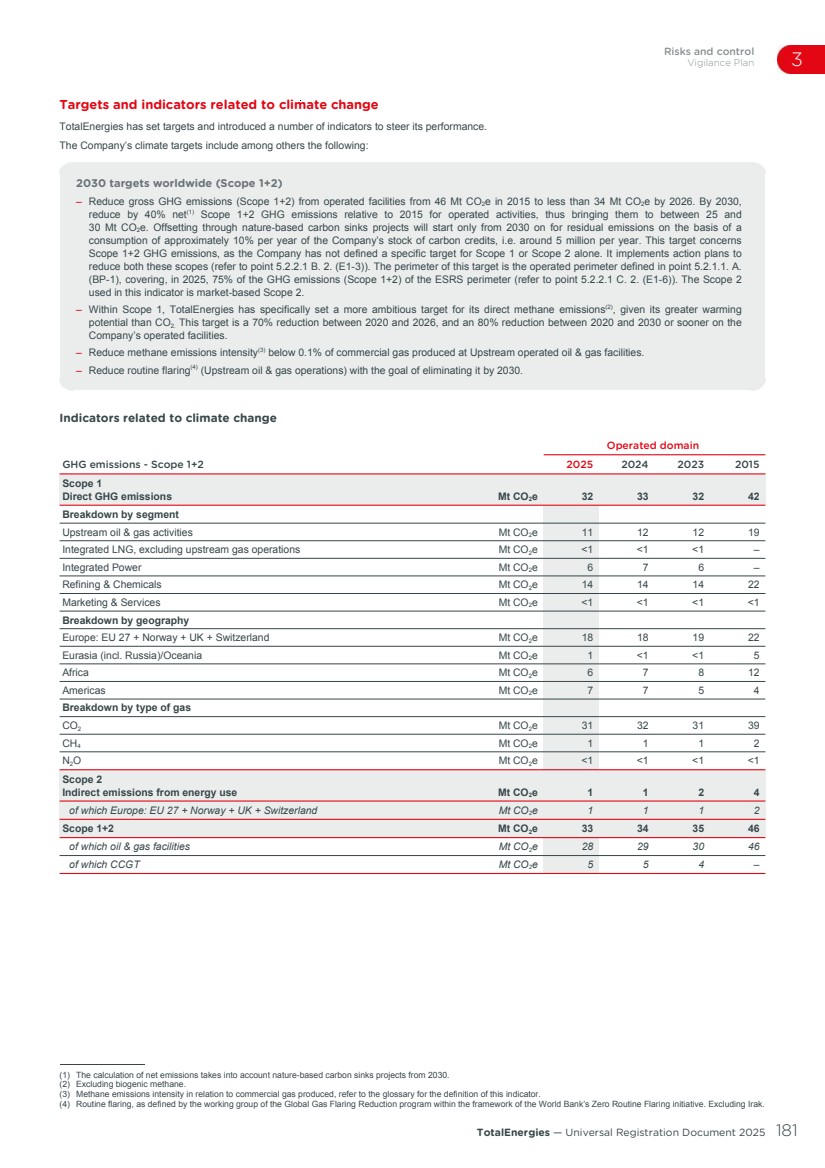
| GHG emissions - Methane Operated domain 2025 2024 2023 2015 Methane emissions(a) kt CH4 22.5 29 34 94 Breakdown by segment Upstream oil & gas activities kt CH4 21 27 33 92 Integrated LNG, excluding upstream gas operations kt CH4 <1 <1 <1 0 Integrated Power kt CH4 <1 <1 <1 0 Refining & Chemicals kt CH4 1 1 1 1 Marketing & Services kt CH4 0 0 0 0 Breakdown by geography Europe: EU 27 + Norway + UK + Switzerland kt CH4 5 5 5 9 Eurasia (incl. Russia)/Oceania kt CH4 3 3 1 33 Africa kt CH4 10 16 18 49 Americas kt CH4 4 5 9 3 (a) Excluding biogenic methane. Intensity indicators 2025 2024 2023 2015 Intensity of GHG emissions (Scope 1+2) of operated Upstream oil & gas activities(a) kg CO2e/boe 16 17 17 21 Intensity of methane emissions from operated oil & gas facilities (Upstream) % 0.07 0.10 0.11 0.23 (a) This indicator doesn’t include integrated LNG assets in its perimeter. Other indicators 2025 2024 2023 2015 Net primary energy consumption (operated perimeter) TWh 150 156 157 153 Renewable energy consumption (operated perimeter) TWh 5 4 2 – Flared gas(a) (Upstream oil & gas operations) Mm3 /d 2.3 2.5 2.5 7.2 of which routine flaring Mm3 /d 0.7 0.5 0.3 2.3(b) (a) This indicator includes safety flaring, routine flaring and non-routine flaring. (b) Volumes estimated upon historical data. 3.6.8.5 Suppliers Suppliers assessment The Suppliers assessment process The Company set itself the objective of assessing its 1,300 priority Suppliers by the end of 2025, on their sustainable development performance (including respect of human rights, working conditions and environment), via documentary and/or on-site assessments carried out by independent third parties. By the end of 2025, the objective of assessing the 1,300 priority Suppliers had been achieved. Suppliers documentary assessment TotalEnergies joined forces with EcoVadis since 2023 to evaluate its priority Suppliers in terms of sustainable development. EcoVadis carries out a documentary assessment to assess the maturity and performance of Suppliers in terms of the environment, human rights, ethics and responsible purchasing. Each company is evaluated by independent analysts on essential issues depending on its size, location and business segment. The EcoVadis rating may be shared by the Supplier with its other customers. It also gives rise to an improvement plan. In 2025, 398 Suppliers were evaluated via EcoVadis or similar. 95% of them obtained a score above 45/100, a score beyond which EcoVadis considers that the supplier is “committed to CSR”, and the average score is 69/100. Supplier on-site assessment Introduced in 2016 and expanded in 2022, these assessments, conducted by an independent third party, include a site visit, a document review and interviews with workers covering aspects of human rights (such as forced labor, child labor, working conditions, health and safety), environment (such as pollution, waste management, water, biodiversity) and climate. In 2025, the Company achieved its target of assessing 200 Suppliers on site. In total, since 2023, the Company has assessed more than 800 priority Suppliers in more than 75 countries. The Company ensures that its Suppliers are committed to a process of continuous progress. Thus, in the event of a deficiency observed during the on-site assessment, a Supplier must put in place an action plan, followed by the TotalEnergies teams and whose effectiveness is verified by an independent external service provider. Among the 800 Suppliers assessed since 2023, more than 400 of them have implemented verified improvements concerning, among other things, hazardous waste management, access to grievance mechanism or compliance with working hours in accordance with local laws. Other initiatives Workers’s voice tool Aware of the importance of respecting working conditions on the sites of major construction projects, TotalEnergies has tested an innovative complementary approach to the already existing assessment and complaint reporting systems. Between 2023 and 2025, the Company deployed a pilot “workers’ voice survey” within two of its large industrial projects: Tilenga in Uganda and EACOP in Tanzania. This pilot aims to directly interview workers of tier-one Suppliers to via their mobile phones in order to collect information on respect for human rights and working conditions on site. Worker participation is voluntary and anonymous. Among workers volunteering to participate in the system, the response rate to regular surveys varies from 56% to 100%. TotalEnergies shares the results of these surveys with Suppliers who are required to propose action plans. 3 Risks and control Vigilance Plan 182 TotalEnergies — Universal Registration Document 2025 |
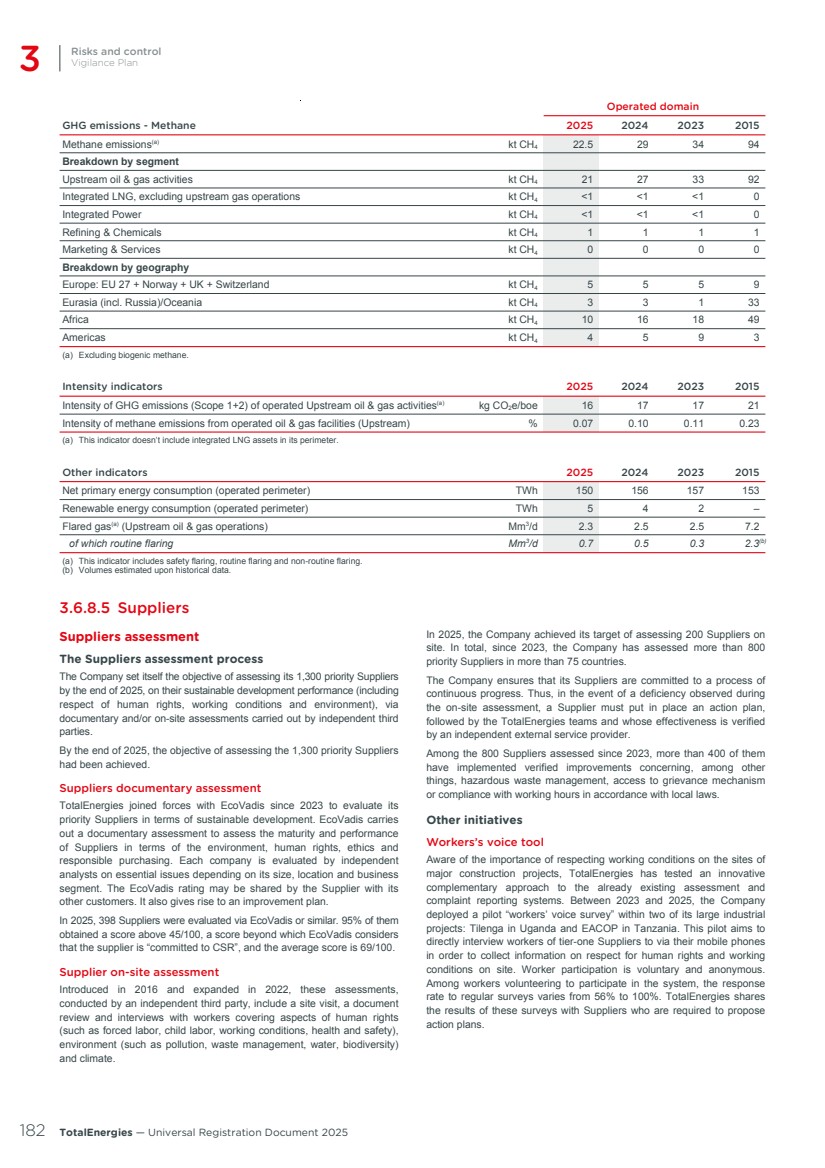
| Minerals The origin, extraction and refining conditions and the use of certain minerals, ores and raw materials are the subject of particular attention, given the potential risks to human rights and the environment. In 2022, TotalEnergies conducted an internal study to identify the Company’s priorities in this area. This study, based on a materiality analysis and a risk analysis, identified three priorities: cobalt, polysilicon and conflict minerals (gold, tungsten, tin and tantalum). – Cobalt: since cobalt can be used in the manufacture of certain batteries, Saft Groupe (Saft) has been conducting an annual campaign since 2021 to collect information from its Suppliers. Saft relies on the Extended Minerals Reporting Template (EMRT) provided by the Responsible Minerals Initiative® (RMI® ) to identify the processing units in its supply chain and the country of origin of the cobalt ores. Based on the results and using the RMI® database, Saft verifies whether its cobalt supply chains include suppliers at risk in terms of human rights and environment. Where necessary, specific actions are taken to mitigate or cancel these risks. As part of a progress-led approach, since 2023, Saft has been a member of the Cobalt Institute, the global association representing cobalt producers and users. The main objective of the Cobalt Institute is to ensure that cobalt is produced and used ethically and in a sustainable manner, while meeting the needs of industry and society. – Polysilicon: polysilicon is used in the manufacture of solar panels. TotalEnergies Global Procurement carries out traceability audits upstream of the Supplier’s selection or commissions an independent third party to conduct them. – Conflict minerals: pursuant to Rule 13p-1 of the U.S. Securities Exchange Act of 1934, as amended, which implemented certain provisions of the Dodd-Frank Wall Street Reform and Consumer Protection Act of 2010, since 2014, TotalEnergies has filed with the United States Securities and Exchange Commission (SEC) an annual document relating to “minerals from conflict zones” sourced from the Democratic Republic of the Congo or neighboring countries. This document indicates whether, during the preceding calendar year, any such minerals were necessary for the operation or for the production of a product manufactured by TotalEnergies SE or one of its consolidated companies or contracted by TotalEnergies SE or one of its consolidated companies to be manufactured. The purpose of this regulation is to prevent the direct or indirect funding of armed groups in central Africa. For more information, please refer to TotalEnergies’ most recent publication, available on the TotalEnergies website or sec.gov. As conflict minerals may potentially be present in the electrical and electronic components used in battery manufacturing, Saft Groupe conducts an annual campaign to collect information from its Suppliers. Saft Groupe relies on the Conflict Minerals Reporting Template (CMRT) provided by the Responsible Minerals Initiative® (RMI® ) to determine the presence of conflict minerals in its supply chain and to identify the processing units for these minerals that are likely to participate in it and the country of origin of the ores. Saft Groupe became a member of the RMI in 2022. In 2025, Saft also launched a campaign to collect information from suppliers in its supply chain for nickel, lithium, graphite and copper, using version 2.0 of the Extended Minerals Reporting Template (EMRT) of the RMI® . Mitigation and preventive actions The training of buyers and the awareness raising and mobilization of Suppliers for a responsible purchasing approach are among the axes of TotalEnergies’ Sustainable Procurement program. Training of buyers TotalEnergies has set up a number of channels of communication to raise employees’ awareness of risks and concerns relating to its supply chain. Training modules explaining the Company’s ethical commitments and the Fundamental Principles of Purchasing have been developed for and made available to buyers of the Company. In addition to training buyers, numerous awareness-raising initiatives are regularly carried out in order to strengthen the responsible purchasing culture within the Company. Buyers are the first players in the sustainable procurement process, with their internal contacts as well as with the Company’s Suppliers. A dedicated training mandatory for all new entrant to the role has been in place since 2022. At the end of 2025, 93% of TotalEnergies central purchasing function employees were trained in sustainable procurement. In addition, three onboarding sessions, including a module specifically dedicated to Responsible Purchasing, were organized for new joiners within the procurement function. In addition to training, awareness-raising initiatives are regularly carried out among Company’s buyers in order to strengthen the sustainable procurement culture (themed webinars, newsletters, awareness raising during Business Ethics Day). Awareness-raising and training of Suppliers The Company regularly conducts awareness-raising actions with its Suppliers on the responsible procurement approach, particularly on respect for human rights, the protection of workers’ health and safety and the preservation of the environment. The Company also organizes a Suppliers Day every two years, the last having been organized in November 2024. The event brought together approximatively 180 representatives of the Company’s Suppliers. The Chairman and CEO and two members of the Executive Committee intervened and underlined the Company’s ambition as well as the commitment expected from Suppliers in terms of sustainable development. This event was the opportunity to award a Sustainability Award to one of the Company’s Suppliers. Progress with other companies In December 2018, the Company committed to pursuing its efforts with regard to decent work and respect for human rights in its supply chain by signing six commitments contained in the United Nations Global Compact, and, in this context, participates in discussion sessions with other companies and certain webinars. TotalEnergies also participates in the IPIECA Supply Chain Working Group. Whistleblowing mechanisms An email address (mediation.fournisseurs@totalenergies.com) available on TotalEnergies’ website allows the Company’s suppliers to contact the dedicated internal mediator. Its mission is to facilitate relations between the Company and its French and international suppliers. The general purchasing terms and conditions also mention the possibility of using mediation. Monitoring procedures TotalEnergies Global Procurement is responsible for raising awareness among those involved in procurement, both internally and externally, and for steering the Sustainable Procurement program. The implementation of this program, adopted by the Executive Committee, is monitored in particular by the Company’s management bodies. Risks and control Vigilance Plan 3 TotalEnergies — Universal Registration Document 2025 183 |
| Report on corporate governance 4 4.1 Administration and management bodies 186 4.1.1 Composition of the Board of Directors 186 4.1.2 Functioning of the Board of Directors 211 4.1.3 Report of the Lead Independent Director on the execution of his mission in respect of 2025 financial year 223 4.1.4 Assessment of the Board of Directors’ practices 225 4.1.5 General Management 225 4.1.6 Shares held by the administration and management bodies 233 4.2 Statement regarding corporate governance 235 4.3 Compensation for the administration and management bodies 235 4.3.1 Board members’ compensation 235 4.3.2 Chairman and Chief Executive Officer’s compensation 238 4.3.3 Executive officers’ compensation 258 4.3.4 Stock option and Corporation’s shares grants 258 4.4 Additional information about corporate governance 266 4.4.1 Regulated agreements and undertakings and related party transactions 266 4.4.2 Delegations of authority and powers granted to the Board of Directors with respect to capital increases and cancellation of shares of the Corporation currently in effect 267 4.4.3 Provisions of the Articles of Association governing shareholders’ participation in Shareholders’ Meetings 268 4.4.4 Information regarding factors likely to have an impact in the event of a public takeover or exchange offer 268 4.4.5 Internal control and management risk systems of the Corporation as part of the financial reporting process 269 4.4.6 Statutory auditors 269 4.5 TotalEnergies — Universal Registration Document 2025 185 [REDACTED SECTION: CERTAIN TEXT HAS BEEN REDACTED.] |
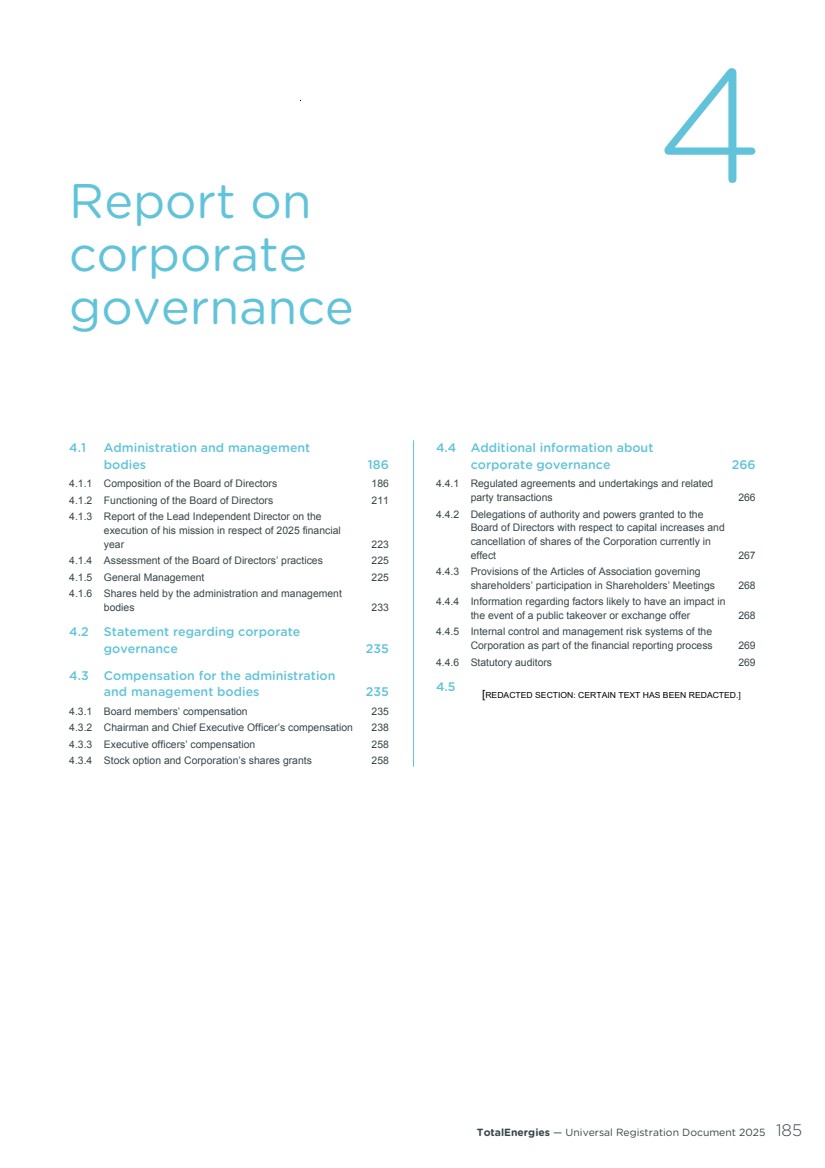
| The information set out in this chapter forms the Board of Directors’ report on corporate governance, produced pursuant to Article L. 225-37 of the French Commercial Code. This report was prepared on the basis of the deliberations of the Board of Directors, and with the assistance of several of the Corporation’s corporate functional divisions, including in particular the Strategy & Sustainability, Finance and People & Social Engagement Departments. After the sections relevant to their respective duties were reviewed by the Governance and Ethics Committee and the Compensation Committee, the report was approved by the Board of Directors. 4.1 Administration and management bodies 4.1.1 Composition of the Board of Directors As of March 18, 2026 13 directors 1 Lead Independent Director 80% independent directors(a) 5.1 years Average length of service on the Board 54.5% of women(b) 5 nationalities represented (a) Excluding the director representing employee shareholders and the directors representing employees, in accordance with the recommendations of the AFEP-MEDEF Code (point 10.3). For more information, refer to point 4.1.1.4. (b) As from fiscal year 2026, the proportions of women and men are calculated excluding directors representing employees but taking into account the director representing employee shareholders in accordance with the Ordinance of October 15, 2024 transposing into French law the directive (EU) of November 23, 2022 (known as the “Women on Board” directive). For the 2025 fiscal year, the proportions of women and men calculated excluding directors representing employees pursuant to Article L. 225-27-1 of the French Commercial Code and directors representing employee shareholders pursuant to Articles L. 225-23 and L. 22-10-5 of the French Commercial Code, were 45.5% for women and 54.5% for men, respectively. The Corporation is administered by a Board of Directors whose 13 members include a director representing employee shareholders elected on the proposal of the shareholders specified in Article L. 225- 102 of the French Commercial Code, in accordance with the provisions of Articles L. 225-23 and L. 22-10-5 of the French Commercial Code (hereafter referred to as the “director representing employee shareholders”), and two directors representing employees appointed in accordance with the provisions of Article L. 225-27-1 of the French Commercial Code and the Corporation’s Articles of Association (the first appointed by the Central Social and Economic Works Council of the Upstream Global Services UES Amont – Global Services – Holding and the second appointed by the SE Committee, known as “TotalEnergies European Works Council”). Mr. Patrick Pouyanné is the Chairman and Chief Executive Officer of TotalEnergies SE. He has served as Chairman of the Board of Directors since December 19, 2015, the date on which the functions of Chairman of the Board of Directors and Chief Executive Officer of the Corporation were combined (refer to point 4.1.5.1). A Lead Independent Director is in place. His duties are specified in the Rules of Procedure of the Board of Directors (refer to point 4.1.2.1). Directors are appointed for a three-year period (Article 11 of the Corporation’s Articles of Association)(1) . The terms of office of the members of the Board are staggered to space more evenly the renewal of appointments and to ensure the continuity of the work of the Board of Directors and its Committees, in accordance with the recommendations of the AFEP-MEDEF Code, which the Corporation refers to. The profiles, experience and expertise of the directors are detailed in the biographies hereafter. Changes that occurred within the membership of the Board of Directors and Committees during fiscal year 2025 Appendix 3 of the AFEP-MEDEF Code – Situation as of March 18, 2026 Departure Appointment/designation Reappointment Board of Directors 05/23/2025 Maria van der Hoeven Valérie Della Puppa-Tibi Lise Croteau Emma de Jonge Helen Lee Bouygues Jean Lemierre Laurent Mignon 03/16/2026 Mark Cutifani Audit Committee 05/23/2025 Maria van der Hoeven 01/01/2026 Helen Lee Bouygues Governance and Ethics Committee 05/23/2025 Jean Lemierre 01/01/2026 Laurent Mignon 03/16/2026 Mark Cutifani Compensation Committee 03/16/2026 Mark Cutifani Strategy & CSR Committee 05/23/2025 Emma de Jonge Marie-Ange Debon Jean Lemierre Valérie Della Puppa-Tibi (1) The Articles of Association also contain specific provisions concerning the terms of office of directors representing employees, taking into account the method of their appointment. 4 Report on corporate governance Administration and management bodies 186 TotalEnergies — Universal Registration Document 2025 |
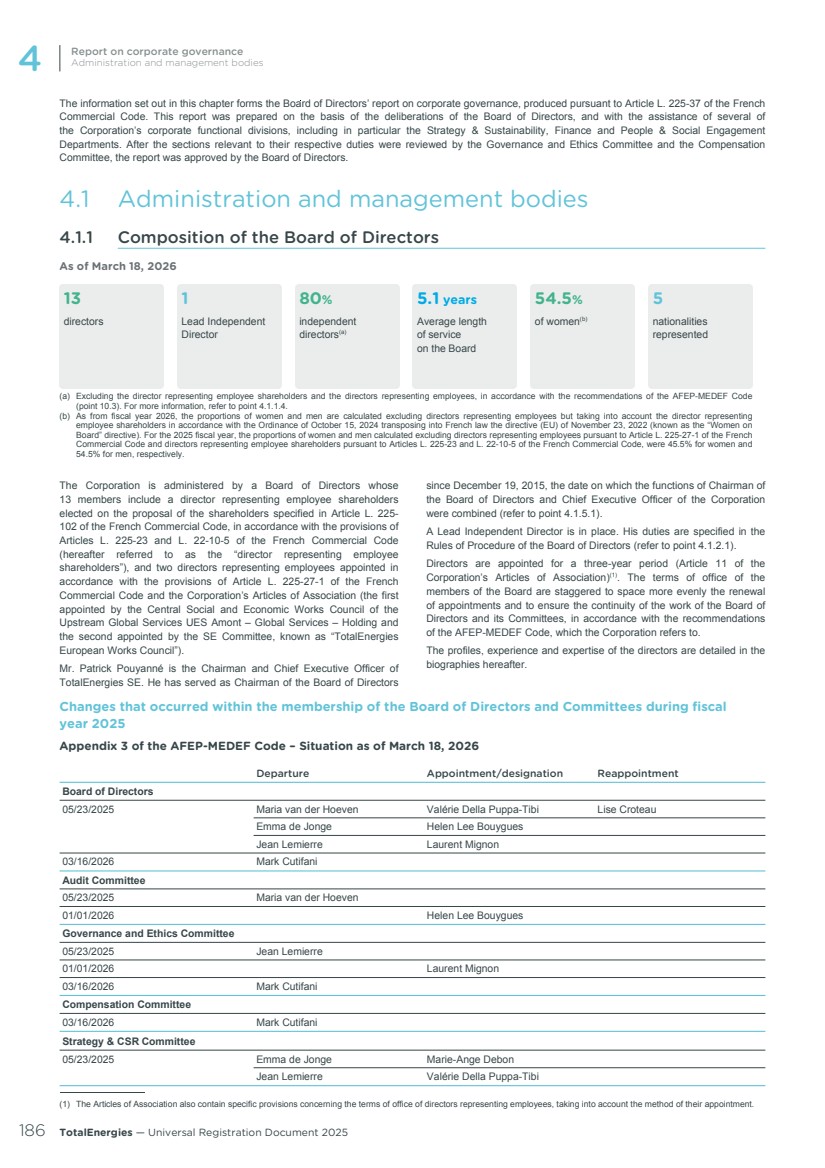
| Overview of the Board of Directors as of March 18, 2026 Appendix 3 of the AFEP-MEDEF Code Personal information Experience Position on the Board Participation in Board As of March 18, 2026 Age Sex Nationality Committees Number of shares(a) Number of directorships(b) Indepen-dence(a) Initial date of appointment Term of office expires Length of service on the Board Patrick Pouyanné Chairman and Chief Executive Officer 62 M 578,895 1 2015 2027 11 Jacques Aschenbroich Lead Independent Director 71 M 1,000 2 2021 2027 5 Marie-Christine Coisne-Roquette 69 F 5,800 1 2011 2026 15 Lise Croteau 65 F 1,100 2 2019 2028 7 Marie-Ange Debon 60 F 1,574 1 2024 2027 2 Valérie Della Puppa-Tibi Director representing employee shareholders 57 F 30 0 n/a 2025 2028 1 Romain Garcia-Ivaldi Director representing employees 37 M 178 0 n/a 2020 2026 6 Glenn Hubbard 67 M 1,000 1 2021 2027 5 Anelise Lara 64 F 1,000 1 2023 2026 3 Helen Lee Bouygues 53 F 1,000 1 2025 2028 1 Laurent Mignon 62 M 1,000 2 2025 2028 1 Dierk Paskert 64 M 2,200 0 2023 2026 3 Angel Pobo Director representing employees 56 M 1,091 0 n/a 2020 2026 6 (a) As of December 31, 2025. (b) Number of directorships held by the director at listed companies outside his or her group, including foreign companies, assessed in accordance with the recommendations of the AFEP-MEDEF Code, point 20 (refer to point 4.1.1.3). As of March 18, 2026 (a) Excluding the director representing employee shareholders and the directors representing employees, in accordance with the recommendations of the AFEP-MEDEF Code (point 10.3). (b) Financial expert. (c) Director representing employees. (d) Director representing employee shareholders. * Chair of the Committee. Audit Committee 5 members 75% independent members(a) Lise Croteau* (b) Marie-Christine Coisne-Roquette Romain Garcia-Ivaldi(c) Glenn Hubbard Helen Lee Bouygues Governance and Ethics Committee 3 members 67% independent members Jacques Aschenbroich* Marie-Christine Coisne-Roquette Laurent Mignon Compensation Committee 3 members 100% independent members(a) Dierk Paskert* Jacques Aschenbroich Angel Pobo(c) Strategy & CSR Committee 6 members 60% independent members(a) Patrick Pouyanné* Jacques Aschenbroich Marie-Christine Coisne-Roquette Marie-Ange Debon Valérie Della Puppa-Tibi(d) Anelise Lara Report on corporate governance Administration and management bodies 4 TotalEnergies — Universal Registration Document 2025 187 |
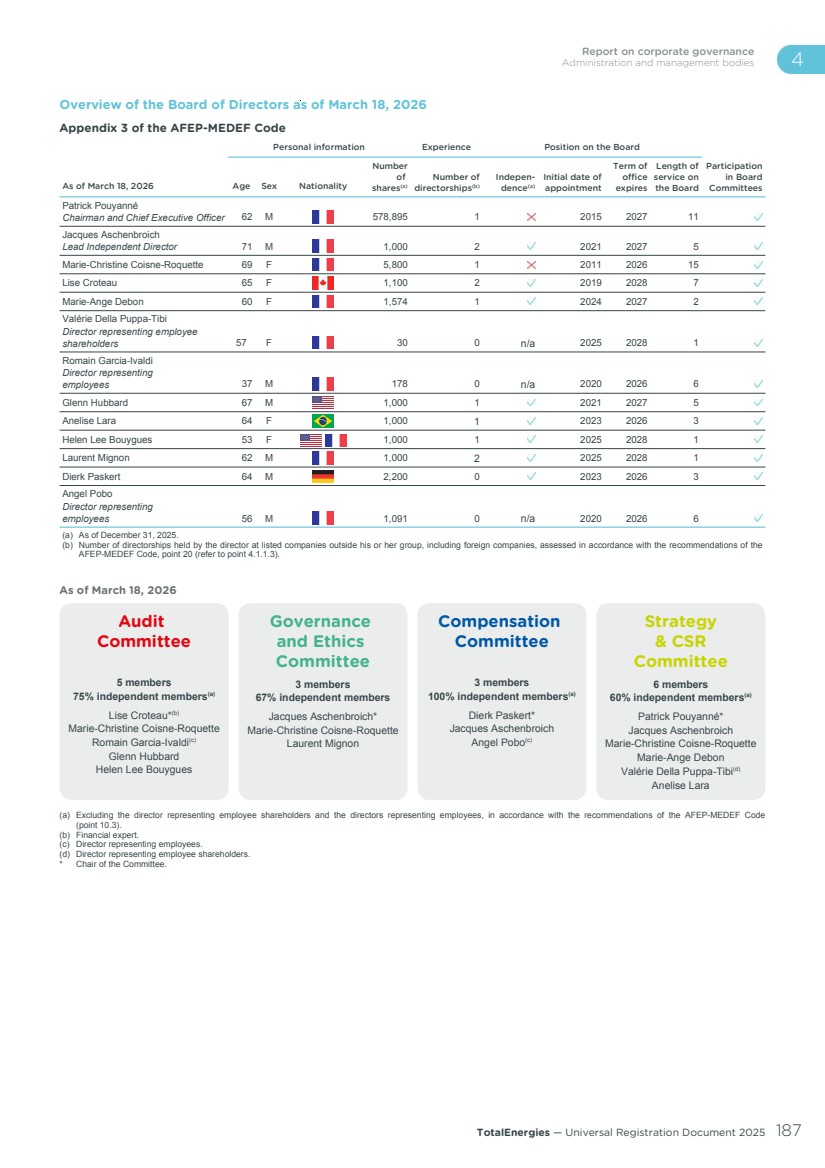
| Renewal of the directors’ terms of office and appointment proposed to the Shareholders’ Meeting to be held on May 29, 2026 The terms of office of Ms. Marie-Christine Coisne-Roquette, Ms. Anelise Lara, Mr. Dierk Paskert and Mr. Mark Cutifani as director, as well as the terms of office of the directors representing employees (Mr. Romain Garcia-Ivaldi and Mr. Angel Pobo) expire at the end of the Annual Ordinary Shareholders’ Meeting on May 29, 2026. Renewal of the terms of office of Ms. Marie-Christine Coisne-Roquette, Ms. Anelise Lara and Mr. Dierk Paskert as directors At its meeting on December 17, 2025, the Board of Directors, upon the proposal of the Governance and Ethics Committee, decided to submit to the Annual Shareholders’ Meeting to be held on May 29, 2026, the renewal of the terms of office of Ms. Marie-Christine Coisne-Roquette, Ms. Anelise Lara and Mr. Dierk Paskert as directors, for a three-year term, which will expire at the end of the Annual Shareholders’ Meeting to be held in 2029 to approve the 2028 financial statements. Ms. Marie-Christine Coisne-Roquette, a French national, has been a director of TotalEnergies SE since May 13, 2011, a member of the Governance and Ethics Committee, the Audit Committee and the Strategy & CSR Committee, and a former lead independent director of the Company. As a non-independent director within the meaning of the Afep-Medef Code due to her length of service on the Board (more than 12 years), the Board considered that Marie-Christine Coisne-Roquette’s experience is beneficial to its work and that of its Committees. Indeed, her length of service on the Board of Directors and the important roles she held have led Ms. Marie-Christine Coisne-Roquette to participate in various important stages in the life of the Company and have given her a detailed understanding of the Company’s businesses, its challenges, and its teams. The Board also noted that the Board of Directors has a high level of independence (82% according to the Afep-Medef Code as of December 31, 2025), in line with the highest standards. Finally, the renewal of her term of office as a director will allow the Board to continue to benefit from her international experience as a lawyer and a corporate executive, her skills in risk manager, as well as her knowledge of the electrical equipment distribution sector. Ms. Anelise Lara, a Brazilian national, has been an independent director of TotalEnergies SE since May 26, 2023 and a member of the Strategy & CSR Committee. She has extensive experience in the oil & gas and gas & power sectors, which usefully complements the various skills present on the Board. Her knowledge of Brazil is also beneficial given the significant capital invested by the Company in that country in both hydrocarbons and renewable energies. Ms. Anelise Lara is also committed to diversity, helping young women advance in their careers. Mr. Dierk Paskert, a German national, has been an independent director of TotalEnergies SE since May 26, 2023, and Chairman of the Compensation Committee since March 18, 2026. Until the end of 2022, he was CEO of Encavis AG, a German-listed renewable electricity producer. He has held several positions at E.ON, a major German utility company. Mr. Dierk Paskert thus has extensive experience in the electricity and renewable energy sectors, which contributes to the Board’s support for the Company’s transformation. Appointment of a new director The Board of Directors, at its meeting on March 18, 2026, decided, on the proposal of the Governance and Ethics Committee, to submit to the Annual Shareholders’ Meeting on May 29, 2026 the appointment of Mr. Slawomir Krupa as director for a three-year term, expiring at the end of the Annual Shareholders’ Meeting to be held in 2029 to approve the 2028 financial statements. A graduate of the Paris Institut d’Études Politiques, Mr. Slawomir Krupa, 51 years old, of Polish, French and American nationalities, has been Chief Executive Officer and Board member of Société Générale Group since May 2023. After various functions within the General Inspection, he joined the Corporate and Investment Banking Division as Director of Strategy and Development, then Head of Central and Eastern Europe, Middle East and Africa, and Deputy Director of Financing. He is named CEO of SG Americas Inc. in January 2016 and Head of the Americas region. In January 2021, he joined the General Management of Société Générale Group as Head of Global Banking and Investor Solutions. Mr. Slawomir Krupa will be able to bring to the Board the benefit of his expertise in finance and markets and his highly international background, particularly his experience in the United States. Directors representing employees The directorships of Mr. Romain Garcia-Ivaldi and of Mr. Angel Pobo, directors representing employees, expire at the end of the Annual Ordinary Shareholders’ Meeting on May 29, 2026. In accordance with the provisions of Article L. 225-27-1 of the French Commercial Code and with the Corporation’s Articles of Association, the Central Social and Economic Works Council of the Corporation, at its meeting on March 5, 2026, renewed Mr. Romain Garcia-Ivaldi for a new mandate as a director representing employees. The European Company Committee (the “SE Committee”), at its meeting on November 20, 2025, renewed Mr. Angel Pobo for a new mandate as director representing employees. Mr. Romain Garcia-Ivaldi and Mr. Angel Pobo, directors representing employees thus designated, will exercice their mandates for a three-year term to expire at the end of the Annual Shareholders’ Meeting to be held in 2029 to approve the 2028 financial statements. At the end of the Shareholders’ Meeting on May 29, 2026, if the proposed resolutions are approved, the Board of Directors will be composed of 14 members, including 8 French nationals and 6 foreigners. The proportion of independent directors in the meaning of the Afep-Medef Code will be 82%. The proportions of women and men, will be of 50% each (calculated in accordance with current legislation). The Board of Directors points out that the directors of TotalEnergies SE have different profiles. They are present, active and involved in the work of the Board of Directors and the Committees in which they participate. The complementarity of their professional experience and their skills are all assets for the quality of the deliberations of the Board of Directors in the context of the decisions it is called upon to make. 4 Report on corporate governance Administration and management bodies 188 TotalEnergies — Universal Registration Document 2025 |
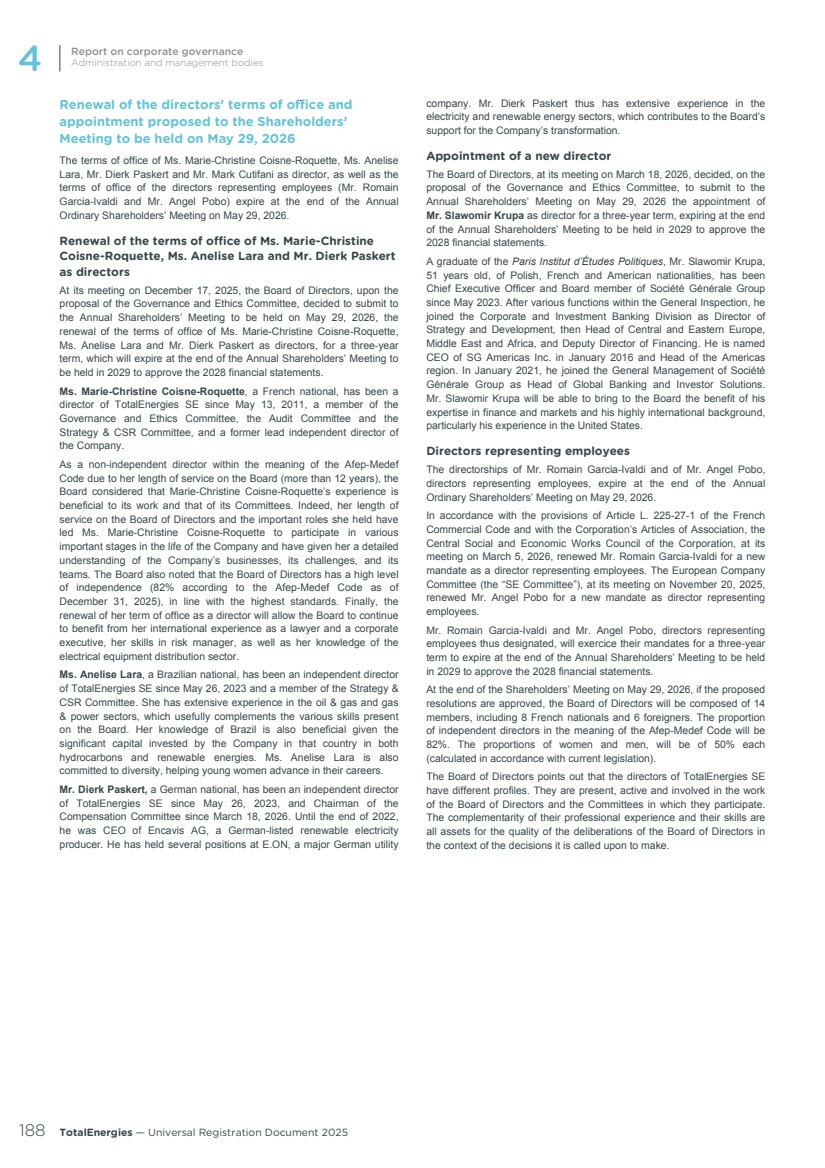
| 4.1.1.1 Profiles, experience and expertise of the directors (information as of December 31, 2025) (1) Born on June 24, 1963 Nationality: French Director of TotalEnergies SE since the Annual Shareholders’ Meeting on May 29, 2015 Last reappointment: Annual Shareholders’ Meeting on May 24, 2024 End of current term: 2027 Annual Shareholders’ Meeting Number of TotalEnergies shares held: 578,895 Number of TotalEnergies Actionnariat France collective investment fund units held: 14,881.2503 (as of December 31, 2025) Business address: TotalEnergies SE, 2 place Jean Millier, La Défense 6, 92400 Courbevoie, France Chairman and Chief Executive Officer of TotalEnergies SE* Chairman of the Strategy & CSR Committee Main function: Chairman and Chief Executive Officer of TotalEnergies SE* Biography & Professional Experience A graduate of École Polytechnique and a Chief Engineer of France’s Corps des Mines, Mr. Pouyanné held, between 1989 and 1996, various administrative positions in the Ministry of Industry and of Environment and other cabinet positions (technical advisor to the Prime Minister – Édouard Balladur – in the fields of the Environment and Industry from 1993 to 1995, Chief of staff for the Minister for Information and Aerospace Technologies – François Fillon – from 1995 to 1996). In January 1997, he joined TotalEnergies’ Exploration & Production division, first as Chief Administrative Officer in Angola, before becoming Company representative in Qatar and President of the Exploration and Production subsidiary in that country in 1999. In August 2002, he was appointed President, Finance, Economy and IT for Exploration & Production. In January 2006, he became Senior Vice President, Strategy, Business Development and R&D in Exploration & Production and was appointed a member of the Company’s Management Committee in May 2006. In March 2011, Mr. Pouyanné was appointed Deputy General Manager, Chemicals, and Deputy General Manager, Petrochemicals. In January 2012, he became President, Refining & Chemicals and a member of the Company’s Executive Committee. On October 22, 2014, he became Chief Executive Officer of TOTAL S.A. and Chairman of the Company’s Executive Committee. On May 29, 2015, he was appointed by the Annual Shareholders’ Meeting as director for a three-year term. The Board of Directors appointed him as Chairman of the Board of Directors as of December 19, 2015. Mr. Pouyanné thus became the Chairman and Chief Executive Officer. Following the renewal of Mr. Pouyanné’s directorship at the Shareholders’ Meeting on June 1, 2018 and then on May 28, 2021 for a three-year period, the Board of Directors renewed Mr. Pouyanné’s term of office as Chairman and Chief Executive Officer for a period equal to that of his directorship. Mr. Pouyanné is thus the Chairman and Chief Executive Officer of TotalEnergies SE. Mr. Pouyanné is Vice-Chairman of the French association, Entreprises pour l’Environnement (EpE), after having been its Chairman between June 2022 and June 2025. Mr. Pouyanné is also the Vice-Chairman of the Alliance pour l’Education – United Way association, after having been its Chairman from June 2018 to January 29, 2025, having accepted this office as Chairman and Chief Executive Officer of the Corporation. In addition, he has been a member of the Board of Directors of Capgemini (since May 2017), of the Board of Directors of École Polytechnique (since September 2018), of the Institut du Monde Arabe (since 2017) and of the foundation La France s’engage (since 2017). Mr. Pouyanné is an Officer of the Légion d’honneur. Directorships and functions held Directorships held at any company during fiscal year 2025 Within the Company ● Chairman and Chief Executive Officer of TotalEnergies SE* and Chairman of the Strategy & CSR Committee Outside the Company ● Director of Capgemini S.E.* (since May 2017), Chairman of the Compensation Committee (since May 2022) and member of the Ethics and Governance Committee Directorships that have expired in the previous five years None Other positions held during fiscal year 2025 ● Chairman (until January 29, 2025) and then Vice‑Chairman of the l’Association Alliance pour l’Education – United Way ● Chairman (until June 5, 2025), then Vice-Chairman of the French business coalition Entreprises pour l’Environnement (EpE) ● Member of the Board of Directors of École Polytechnique (a public scientific, cultural and professional establishment under French law) (since September 2018) ● Member of the Board of Directors of AFEP (French Association of private companies) (since 2014) ● Member of the Board of Directors of the Institut du Monde Arabe (since 2017) ● Member of the Board of Directors of the La France s’engage foundation (since 2017) * For information relating to the offices held by directors, companies marked with an asterisk are listed companies. (1) Including the information referred to in Articles L. 22-10-10 and L. 225-37-4 of the French Commercial Code, and point 12.1 of Annex I to Commission Delegated Regulation EU 2019/980 of March 14, 2019, supplementing Regulation (EU) 2017/1129 of the European Parliament and of the Council on the form, content, review and approval of the prospectus to be published when securities are offered to the public or admitted to trading on a regulated market. Patrick Pouyanné Report on corporate governance Administration and management bodies 4 TotalEnergies — Universal Registration Document 2025 189 |
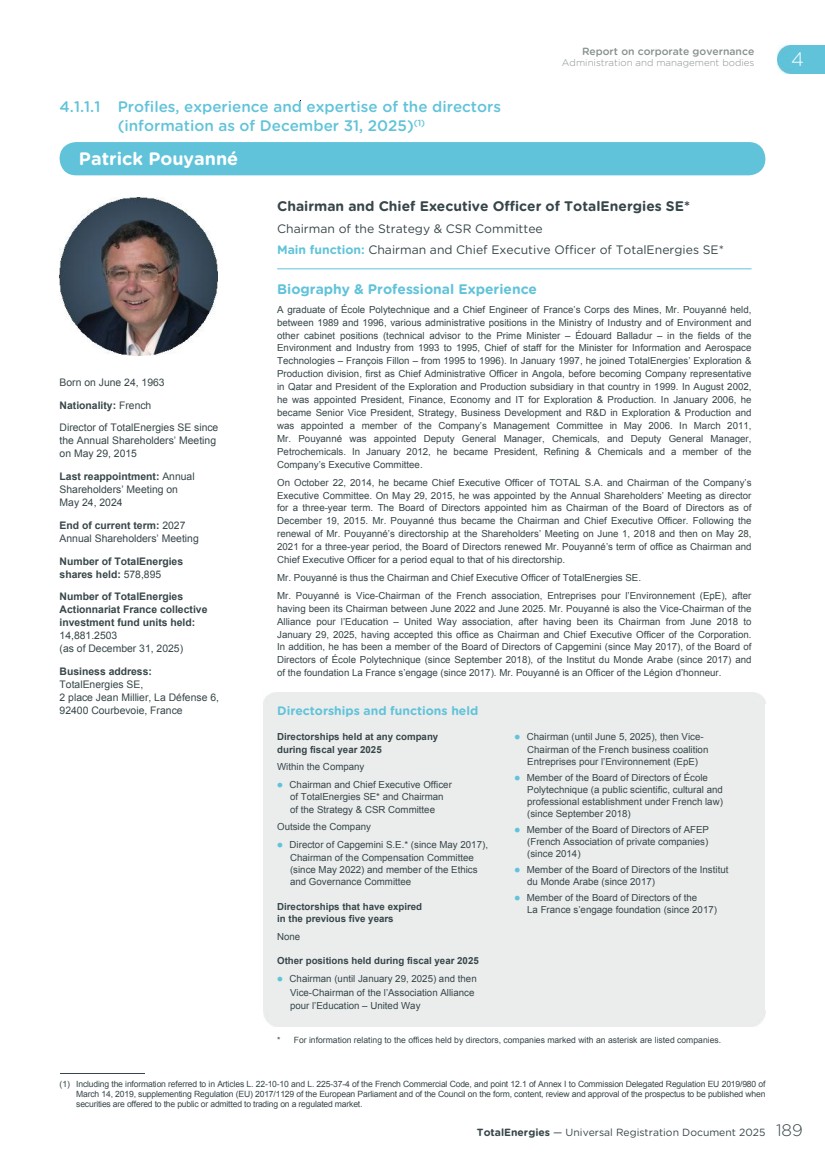
| Born on June 3, 1954 Nationality: French Director of TotalEnergies SE since the Annual Shareholders’ Meeting on May 28, 2021 Last reappointment: Annual Shareholders’ Meeting on May 24, 2024 End of current term: 2027 Annual Shareholders’ Meeting Number of TotalEnergies shares held: 1,000 (as of December 31, 2025) Business address: 111 quai du Président Roosevelt, 92130 Issy Les Moulineaux, France Independent director – Lead Independent Director Chairman of the Governance and Ethics Committee Member of the Compensation Committee Member of the Strategy & CSR Committee Main function: Chairman of the Board of Directors of Orange* Biography & Professional Experience As an engineer graduate of the Corps des Mines, Mr. Jacques Aschenbroich held several positions in the French administration and served in the Prime Minister’s office in 1987 and 1988. He then pursued an industrial career in the Saint-Gobain group from 1988 to 2008. After having managed subsidiaries in Brazil and Germany, he became Managing Director of the Flat Glass division of Compagnie de Saint-Gobain and went on to become Chairman of Saint-Gobain Vitrage in 1996. As Senior Vice-President of Compagnie de Saint-Gobain from October 2001 to December 2008, he managed the flat glass and high-performance materials sectors as from January 2007 and, as the Vice-Chairman of Saint-Gobain Corporation and General Delegate to the United States and Canada, he directed the operations of the group in the United States as from September 1, 2007. He was also a director of Esso SAF until June 2009. Mr. Jacques Aschenbroich was appointed Director and Chief Executive Officer of Valeo in March 2009 and then Chairman and Chief Executive Officer of Valeo, positions he held from February 2016 to January 26, 2022. Following the change in the Valeo Group’s governance, he remained the Chairman of the Board of Directors of Valeo from January 26, 2022 until December 31, 2022, when Mr. Jacques Aschenbroich left the Chairmanship and the Board of Directors of Valeo. In May 2022, Jacques Aschenbroich was appointed Chairman of the Board of Directors of Orange. Directorships and functions held Directorships held at any company during fiscal year 2025 ● Chairman of the Board of Directors of Orange* since May 2022 ● Director of TotalEnergies SE*, Lead Independent Director, chairman of the Governance and Ethics Committee, member of the Compensation Committee and member of the Strategy & CSR Committee ● Director of BNP Paribas*, Chairman of the Corporate Governance, Ethics, Nominations and CSR Committee, and member of the Financial Statements Committee Directorships that have expired in the previous five years ● Chairman of the Board of Directors of Valeo* until December 31, 2022 and Chief Executive Officer of Valeo until January 26, 2022 ● Director of Veolia Environnement*, Chairman of the Comité de recherche, innovation et développement durable and member of the Comité des comptes et de l’audit (until May 28, 2021) ● Chairman of Valeo Finance, Valeo S.p.A. (Italy) and Valeo (UK) Limited (United Kingdom) Other positions held during fiscal year 2025 ● Chairman of the French-American Foundation France (since January 2024) * For information relating to the offices held by directors, companies marked with an asterisk are listed companies. Jacques Aschenbroich 4 Report on corporate governance Administration and management bodies 190 TotalEnergies — Universal Registration Document 2025 |
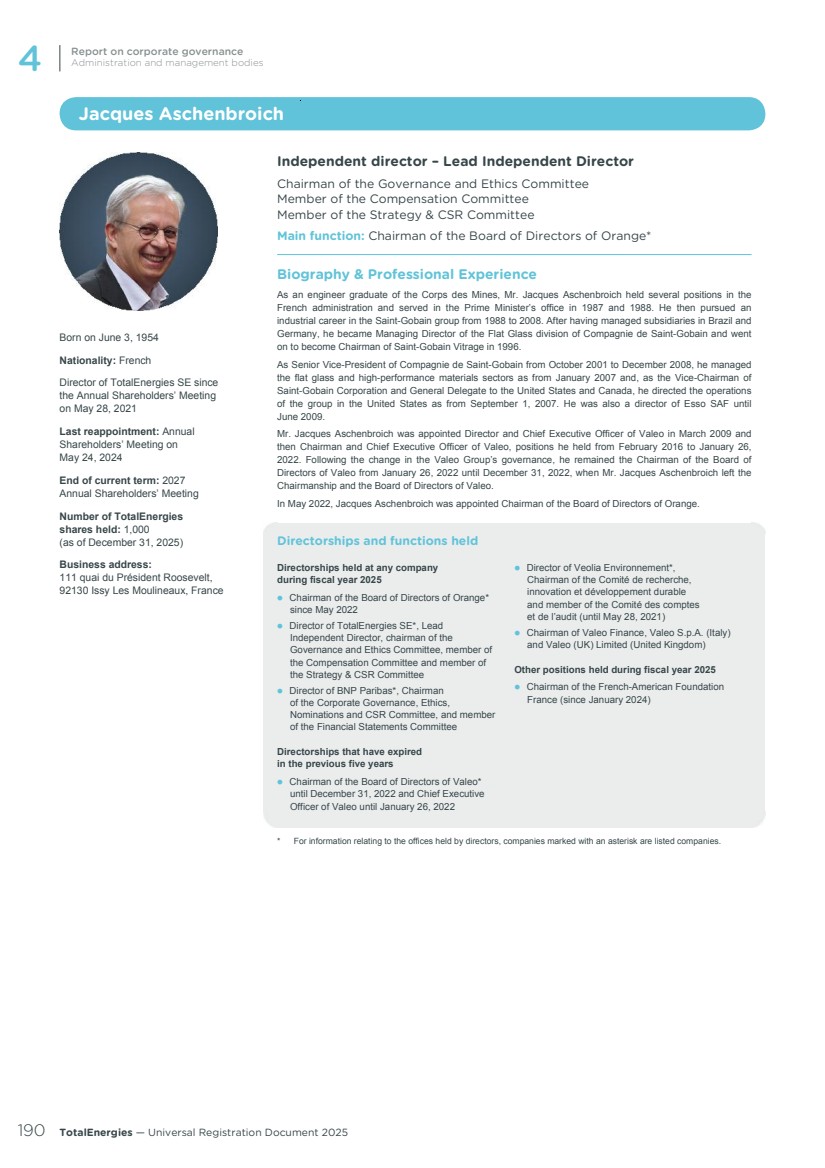
| Born on November 4, 1956 Nationality: French Director of TotalEnergies SE since the Annual Shareholders’ Meeting May 13, 2011 Last reappointment: Annual Shareholders’ Meeting on May 26, 2023 End of current term: Annual Shareholders’ Meeting on May 29, 2026 Number of TotalEnergies shares held: 5,800 (as of December 31, 2025) Business address: Sonepar, 25 rue d’Astorg, 75008 Paris, France Director Member of the Audit Committee Member of the Governance and Ethics Committee Member of the Strategy & CSR Committee Main function: Permanent Representative of Colam Entreprendre SAS and Chairwoman of the Steering Committee of Sonepar SAS Biography & Professional Experience Ms. Coisne-Roquette has a Bachelor’s Degree in English. A lawyer by training, with a French Masters’ in law and a Specialized Law Certificate from the New York bar, she started her career as an attorney in 1981 at the Paris and New York bars, as an associate of Cabinet Sonier & Associés in Paris. In 1984, she became a member of the Board of Directors of Colam Entreprendre, a family holding company that she joined full time in 1988. As Chairwoman of the Board of Colam Entreprendre and the Sonepar Supervisory Board, she consolidated family ownership, reorganized the group structures and strengthened its shareholding base to sustain the group’s growth strategy. Chairwoman and Chief Executive Officer of Sonepar as of 2002, Marie-Christine Coisne-Roquette became Chairwoman of Sonepar S.A.S. in 2016. At the same time, she heads Colam Entreprendre as its Chairwoman and Chief Executive Officer. Formerly a member of the Young Presidents’ Organization (YPO), she served on the Executive Committee of MEDEF (France’s main employers’ association) for 13 years and was Chairwoman of its Tax Commission from 2005 to 2013. She was a member of the Economic, Social and Environmental Council from 2013 and 2015 and is currently a director of TotalEnergies SE. Directorships and functions held Directorships held at any company during fiscal year 2025 Within the Sonepar group ● Permanent Representative of Colam Entreprendre S.A.S., Chairwoman of the Steering Committee of Sonepar S.A.S. ● Chairwoman of Sonepack SAS since May 2024 Outside the Sonepar group ● Managing Partner of Ker Coro (société civile immobilière) ● Director of TotalEnergies SE*, member of the Audit Committee, member of the Governance and Ethics Committee and of the Strategy & CSR Committee ● Director of EssilorLuxottica* Directorships that have expired in the previous five years ● Chairwoman of Colam Entreprendre S.A.S. until April 30, 2024 ● Director of Sonepack SAS until May 2024 ● Chairwoman of Développement Mobilier et Industriel (S.A.S.) until April 30, 2024 Other positions held during fiscal year 2025 ● Director at the Fondation Recherche Alzheimer ● Member of the Board of Directors of AFEP (French association of private companies) ● Vice Chair of the Board of Directors of the Association Nationale des Sociétés par Actions (ANSA) ● Vice-Chariwoman of the Bureau and director of MEDEF International ● Chairwoman of the Télémaque association since July 2024 ● Chairwoman of the Financière de la Croix Blanche since September 2025 * For information relating to the offices held by directors, companies marked with an asterisk are listed companies. Marie-Christine Coisne-Roquette Report on corporate governance Administration and management bodies 4 TotalEnergies — Universal Registration Document 2025 191 |
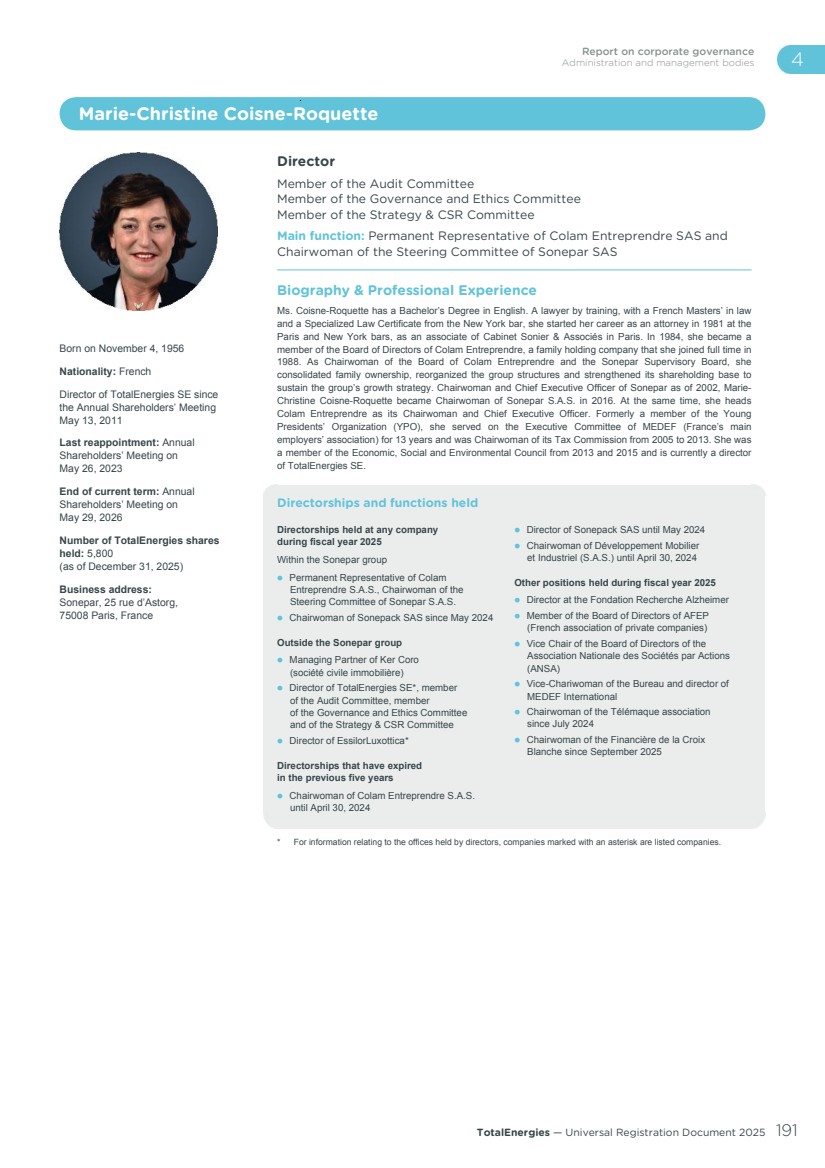
| Born on May 5, 1960 Nationality: Canadian Director of TotalEnergies SE since the Annual Shareholders’ Meeting on May 29, 2019 Last reappointment: Annual Shareholders’ Meeting on May 23, 2025 End of current term: 2028 Annual Shareholders’ Meeting Number of TotalEnergies shares held: 1,100 (as of December 31, 2025) Business address: 580 Chemin de la Réserve, Mont-Tremblant, Québec, J8E 3L8, Canada Independent director Chairwoman of the Audit Committee Main function: Independent director Biography & Professional Experience Ms. Croteau began her career in 1982 as an auditor within the audit firms, today Raymond Chabot Grant Thornton, then Deloitte, and she joined Hydro-Québec in 1986 where she held positions of control, of risk management and of financial management of increasing responsibility. From 2015 to 2018, she held the position of Executive Vice President and Chief Financial Officer of Hydro-Québec prior to retiring. A chartered professional accountant since 1984, Ms. Croteau holds a Bachelor’s degree in Business Administration and in 2008 was named a Fellow of the Order of Chartered Professional Accountants of Québec in recognition of her contribution to the profession and for her collaboration in the development of Canadian accounting standards for derivatives. Her functions within Hydro-Québec have enabled her in particular to develop significant expertise in risk management from 2008, as she has been in charge of risk management, responsible for the company’s risk portfolio drawn up as part of the annual exercise of the company’s long-term strategic planning. In this context, she had in particular to identify, quantify and monitor risk trends and means of mitigation. Ms. Croteau was also in charge of market risk management activities, and “Middle Office” credit of Hydro-Québec’s market activities for energy transactions on Northeast American markets, debt management and management of the company’s employee pension fund. Ms. Croteau has been an independent director of Boralex since 2018, the Chair of the Audit Committee since 2019 and a member of the Investment and Risk Management Committee since 2021. Boralex, listed in Toronto, is a Canadian leader in renewable energies with operations in wind, solar, hydroelectricity and storage. It also has operations in France, the United States and the United Kingdom. Since June 2019, Ms. Croteau has been a director on the Boards of Québecor inc. and Québecor Média inc. as well as a member of the Human Resources and Corporate Governance Committee and of the Audit and Management Risks Committee since May 2022, when she was also appointed director of the Board of Directors of Vidéotron and member of the Audit and Management Risks Committee. Québecor is a Canadian leader in the telecommunications, entertainment, news media and culture fields. Directorships and functions held Directorships held at any company during fiscal year 2025 ● Director of TotalEnergies SE* and member of the Audit Committee until May 23, 2025, then Chairwoman of the Audit Committee since ● Director of Québecor inc.* since June 16, 2019, member of the Human Resources and Corporate Governance Committee and member of the Audit and Management Risks Committee since May 12, 2022; director of Québecor Média inc. since June 16, 2019, member of the Human Resources and Corporate Governance Committee and member of the Audit and Management Risks Committee since May 12, 2022 and director and member of the Audit and Management Risks Committee of Vidéotron (Québecor’s wholly-owned subsidiary) since May 12, 2022 ● Director of Boralex* since 2018, Chairwoman of the Audit Committee since 2019 and member of the Investment and Risk Management Committee since 2021 Directorships that have expired in the previous five years None Other positions held during fiscal year 2025 None * For information relating to the offices held by directors, companies marked with an asterisk are listed companies. Lise Croteau 4 Report on corporate governance Administration and management bodies 192 TotalEnergies — Universal Registration Document 2025 |
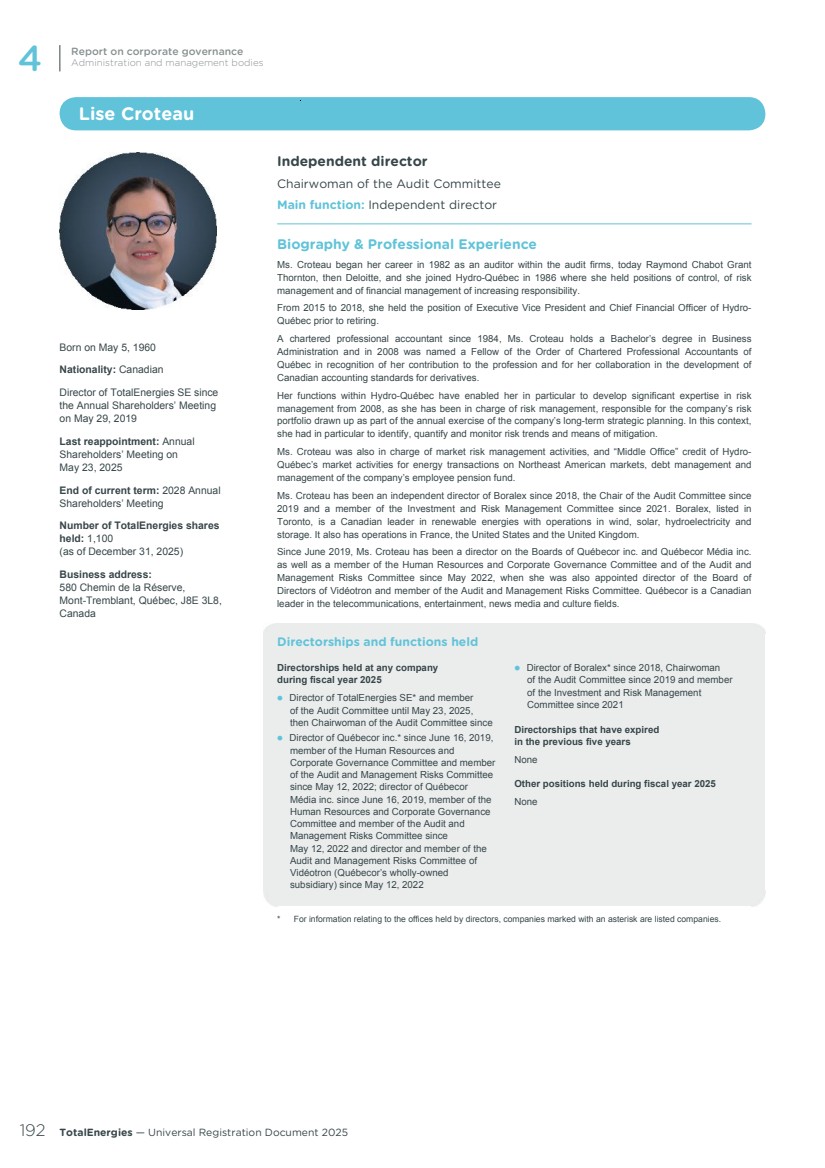
| Born on May 2, 1958 Nationality: Australian Director of TotalEnergies SE since the Annual Shareholders’ Meeting on May 26, 2017 until March 16, 2026 Last reappointment: Annual Shareholders’ Meeting on May 26, 2023 End of current term: Annual Shareholders’ Meeting on May 29, 2026 (ended on March 16, 2026) Number of TotalEnergies shares held: 2,000 (as of December 31, 2025) Business address: Rex House, Level 7, 4-12 Regent Street, London SW1Y 4RG, United Kingdom Independent director Chairman of the Compensation Committee Member of the Governance and Ethics Committee Main function: Director and Executive Business Advisor Biography & Professional Experience Mr. Cutifani is a Director and Executive Business Advisor after retiring from Anglo American plc. in June 2022. He has more than 47 years of experience in the mining industry in various parts of the world, covering a broad range of products. He was previously the Chief Executive Officer of AngloGold Ashanti Limited. Before joining AngloGold Ashanti, Mr. Cutifani was COO responsible for global nickel business at Vale. Prior to that, he held various management roles at Normandy Group, Sons of Gwalia, Western Mining Corporation, Kalgoorlie Consolidated Gold Mines and CRA (Rio Tinto). Mr. Cutifani has a degree in Mining Engineering (with honors) from the University of Wollongong in Australia. He is a Fellow of the Royal Academy of Engineering, the Australasian Institute of Mining and Metallurgy and the Institute of Materials, Minerals and Mining in the United Kingdom. Mr. Cutifani received an honorary doctorate from the University of Wollongong in Australia in 2013 and an honorary doctorate from Laurentian University in Canada in 2016. Mr. Cutifani is Commander of the Order of the British Empire (CBE). Directorships and functions held Directorships held at any company during fiscal year 2025 ● Director of TotalEnergies SE*, Chairman of the Compensation Committee and member of the Governance and Ethics Committee ● Senior Independent Non-Executive Director – Laing O’Rourke (Private) since September 1, 2022 until August 2025 ● Chair of Vale Base Metals since July 2023 until June 2025 ● Non-Executive Director – Development Partner Institute since August 2022 ● Member of the Board of Advisors of Diamond’ Standard’s Inc. since February 2024 Directorships that have expired in the previous five years ● Senior Independent Non-Executive Director – Laing O’Rourke (Private) since September 1, 2022 until August 2025 ● Chair of Vale Base Metals since July 2023 until June 2025 ● Director and Chief Executive of Anglo American plc.* until April 19, 2022 ● Non-executive director of Anglo American Platinum Limited until May 12, 2022 ● Chairman of De Beers plc. until May 12, 2022 ● Chairman of De Beers Investments plc. until May 12, 2022 Other positions held during fiscal year 2025 ● Chairman of Board of Trustees – Power of Nutrition since July 2022 ● Chair – International Advisory Committee for Global Foundation since July 2022 ● Member of International Advisory Committee – AUSIMM since October 2022 ● Advisor to ERM since July 2023 ● Mentor for CMI since January 2022 ● Chair of Global Tailings Management Institute (GTMI) since July 30, 2025 * For information relating to the offices held by directors, companies marked with an asterisk are listed companies. Mark Cutifani CBE Report on corporate governance Administration and management bodies 4 TotalEnergies — Universal Registration Document 2025 193 |
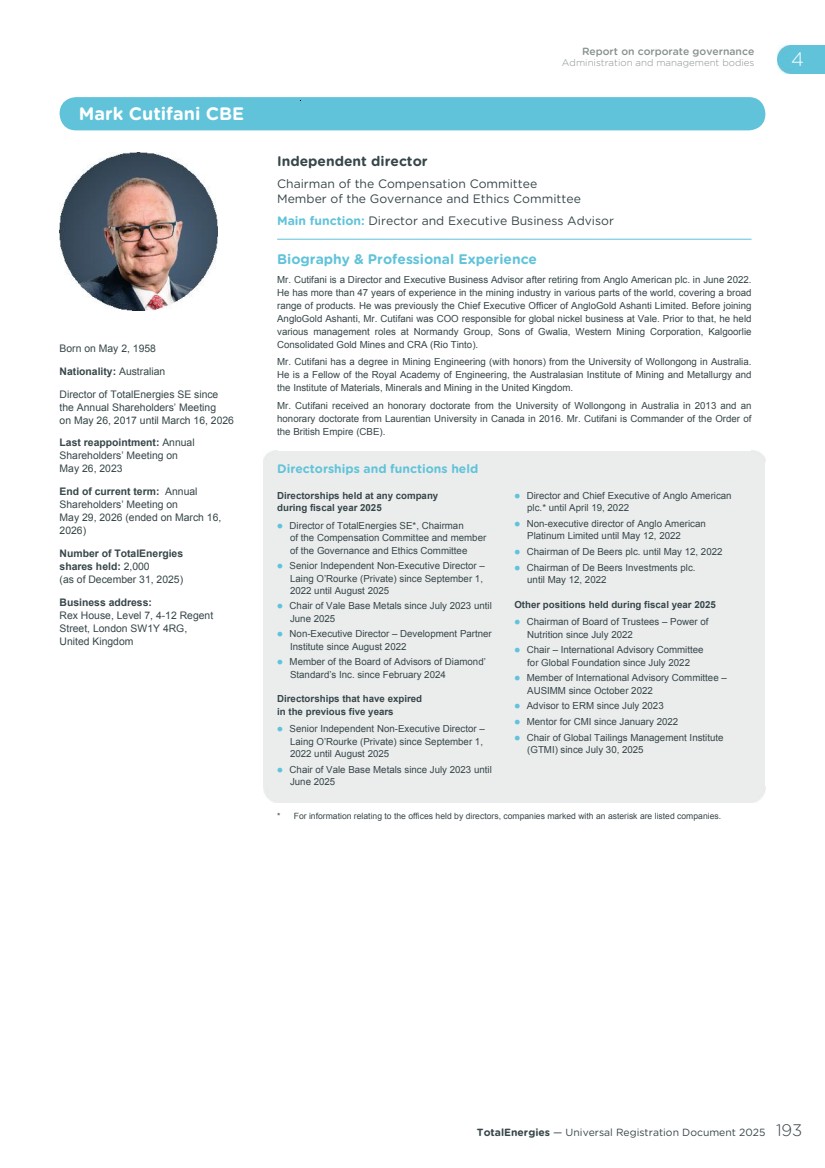
| Born on May 18, 1965 Nationality: French Director of TotalEnergies SE since the Annual Shareholders’ Meeting on May 24, 2024 End of current term: 2027 Annual Shareholders’ Meeting Number of TotalEnergies shares held: 1,574 (as of December 31, 2025) Business address: 9 rue du Colonel Pierre Avia, 75015 Paris, France Independent director Member of the Strategy & CSR Committee Main function: Chairwoman and Chief Executive Officer of the La Poste group since October 22, 2025 Biography & Professional Experience Born in 1965, Marie-Ange Debon is graduate from the French Ecole des Hautes Etudes Commerciales (HEC) and from the French Ecole Nationale de l’Administration (ENA). She has been Chairwoman and Chief Executive Officer of the La Poste group since October 22, 2025 after having been Chairwoman of the Keolis Group Executive Board from August 2020 to October 22, 2025. Prior to joining Keolis, she held a number of positions in both the public and private sectors: auditeur, then conseiller référendaire à la Cour des comptes from 1990 to 1994, then directrice générale adjointe at France 3 from 1994 to 1998. She then joined the Thomson/Technicolor group as Deputy CFO, before becoming General Secretary. In 2008, she joined the Suez group as General Secretary and became CEO of the International Division in 2013, then CEO for France from 2018 to 2020. Directorships and functions held Directorships held at any company during fiscal year 2025 Within the La Poste group: ● Chairwoman and Chief Executive Officer of the La Poste group since October 22, 2025 ● Chairwoman of the Steering Committee of La Banque Postale since December 2, 2025 ● Chairwoman of the Board of Directors of Geopost since November 21, 2025 ● Board member of CNP Assurances since February 25, 2026 Outside the La Poste group: ● Director of TotalEnergies SE* and, since May 23, 2025, member of the Strategy & CSR Committee ● Executive Chair (Présidente du Directoire) of Groupe Keolis until October 22, 2025 ● Director and Chairwoman of the Audit and Accounts Committee of Arkema* Directorships that have expired in the previous five years ● Executive Chair (Présidente du Directoire) of Groupe Keolis until October 22, 2025 ● Director and Chairwoman of the Audit Committee of Technip Energies until May 6, 2024 ● Director of La Française des jeux Other positions held during fiscal year 2025 ● Vice-Chairwoman of the UTPF (Union des transports publics et ferroviaires) until June 2025 ● Member of the bureau and director of MEDEF International * For information relating to the offices held by directors, companies marked with an asterisk are listed companies. Marie-Ange-Debon 4 Report on corporate governance Administration and management bodies 194 TotalEnergies — Universal Registration Document 2025 |
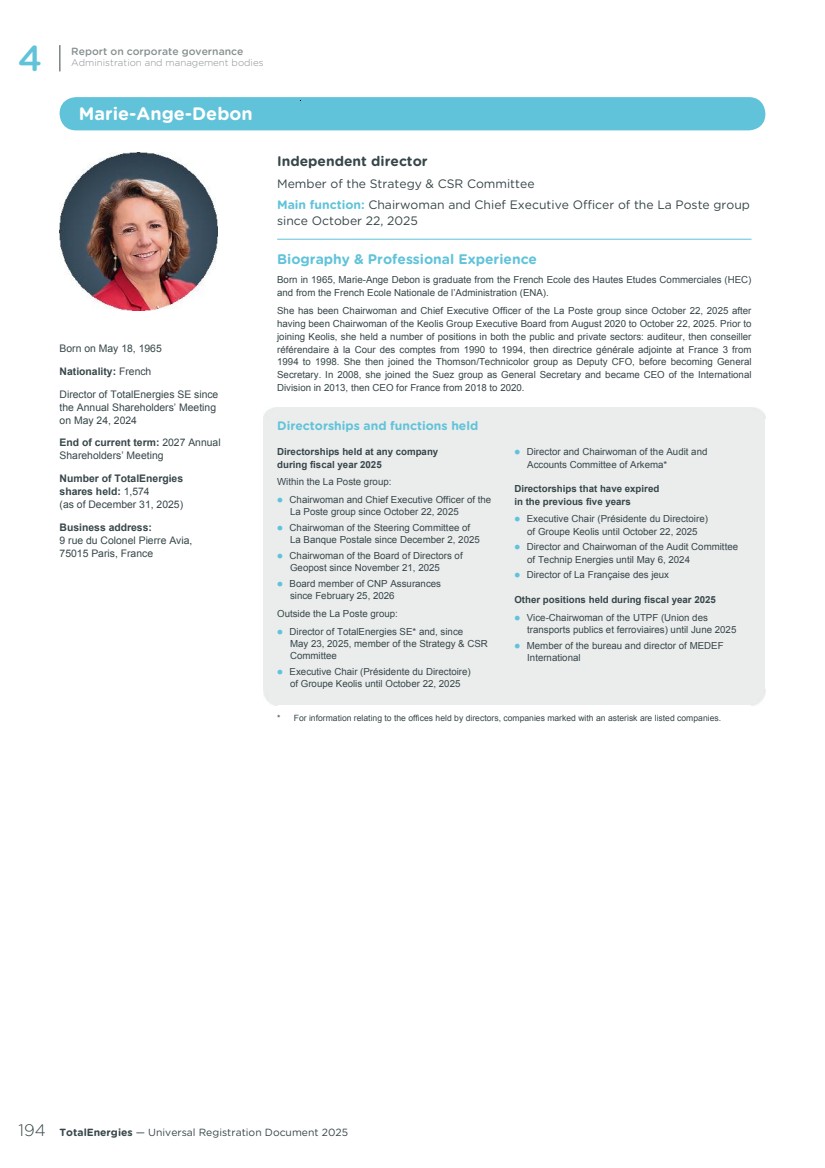
| Born on August 22, 1968 Nationality: French Director representing employee shareholders of TotalEnergies SE since the Annual Shareholders’ Meeting on May 23, 2025 End of current term: 2028 Annual Shareholders’ Meeting Number of TotalEnergies shares held: 30 TotalEnergies Actionnariat France collective investment jund units held: 1,256.2218 (as of December 31, 2025) Business address: 2 place Jean Millier, La Défense 6, 92400 Courbevoie, France Director representing employee shareholders Member of the Strategy & CSR Committee Main function: Staff representative Biography & Professional Experience Graduated of the Institut Universitaire de Technologie de Sceaux (Paris XI) in International Trade, Ms. Della Puppa-Tibi entered the Company in 1989. She held several positions in international logistics at the Lub Marine entity of the subsidiary Lubrifiants. In parallel, Ms. Della Puppa-Tibi studied at the Conservatoire des Arts et Métiers (International Trade curriculum - Marketing, International Trade, Commodity Markets courses) as well as languages (English, Spanish and Italian). In 2002, she joined the Réseau France as a contract pilot for the maintenance of service stations. In 2011, Ms. Della PuppaTibi joined the Procurement Division of the Marketing Refining as e-procurement manager then Lead Buyer at the creation of Total Global Procurement in 2017. Ms. Della Puppa-Tibi has been a member of the European Committee since 2017 and an elected member of the Supervisory Board of the FCPE TotalEnergies Actionnariat France since 2018. She was also a Director representing employee shareholders on the TotalEnergies Board of Directors from 2019 to 2022. Directorships and functions held Directorships held at any company during fiscal year 2025 ● Director representing employee shareholders of TotalEnergies SE* and member of the Strategy & CSR Committee since May 23, 2025 ● Deputy director to IG-CREA (Elf Aquitaine pension fund) Directorships that have expired in the previous five years ● Director representing employee shareholders on the TotalEnergies Board of Directors (2019 to 2022) Other positions held during fiscal year 2025 ● Elected member of the TotalEnergies AGSH Paris Work Council (Comité Social et Economique) ● Elected member of the TotalEnergies AGSH Central Work Council (Comité Social et Economique Central) ● Member of the European Committee of TotalEnergies ● TotalEnergies AGSH Paris union representative ● Member of the Human Resources Commission of the TotalEnergies AGSH Central Work Council (Comité Social et Economique Central) ● Member of the Human Resources Commission of the TotalEnergies AGSH Paris Work Council (Comité Social et Economique Central) ● Titular member of the European Operational Committee of TotalEnergies ● Elected member of the Supervisory Board of the FCPE TotalEnergies Actionnariat France ● Titular representative on the joint Committee of IG-CREA * For information relating to the offices held by directors, companies marked with an asterisk are listed companies. Valérie Della Puppa-Tibi Report on corporate governance Administration and management bodies 4 TotalEnergies — Universal Registration Document 2025 195 |
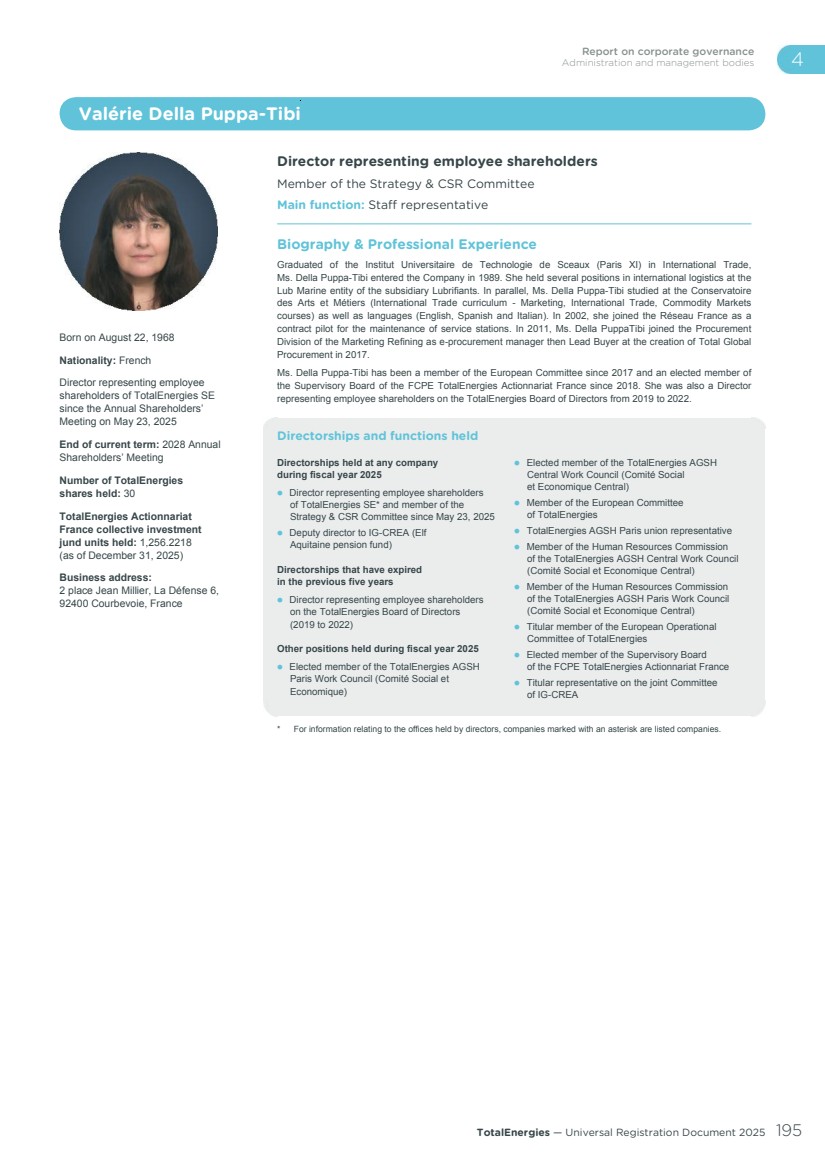
| Born on September 14, 1988 Nationality: French Director representing employees of TotalEnergies SE since June 9, 2020 Last reappointment (by the Central Social and Economic Works Council of the Corporation): February 28, 2023 End of current term: Annual Shareholders’ Meeting on May 29, 2026 Number of TotalEnergies shares held: 178 Number of TotalEnergies Actionnariat France collective investment fund units held: 6,121.9137 (as of December 31, 2025) Business address: TotalEnergies SE, 2 place Jean Millier, La Défense 6, 92400 Courbevoie, France Director representing employees Member of the Audit Committee Main function: Employee at TotalEnergies Renewables Biography & Professional Experience An engineer and economist, graduate of ENSTA Paris and IFP School, Mr. Garcia-Ivaldi began his career at TotalEnergies in 2012 as an economist on oil and gas projects in Americas region between 2012 and 2015 and for new business between 2021 and 2024. Between 2015 and 2021, he was a reservoir engineer, serving in a variety of positions in Paris and Lagos (Nigeria). He is asset manager of offshore wind projects (inc. Seagreen) within TotalEnergies Renewables. He also obtained the “Certificat Administrateur de Sociétés” IFA-Sciences Po. He also completed the “Climate Change: Economics and Governance” and “Climate Change: Economics and Governance” training programs at the London School of Economics. Mr. Garcia-Ivaldi was chairman of the Supervisory Board of the TotalEnergies Actionnariat France and TotalEnergies France Capital+ employee shareholding funds from November 9, 2018 to June 17, 2020. Directorships and functions held Directorships held at any company during fiscal year 2025 ● Director representing employees of TotalEnergies SE* and member of the Audit Committee Directorships that have expired in the previous five years None Other positions held during fiscal year 2025 None * For information relating to the offices held by directors, companies marked with an asterisk are listed companies. Romain Garcia-Ivaldi 4 Report on corporate governance Administration and management bodies 196 TotalEnergies — Universal Registration Document 2025 |
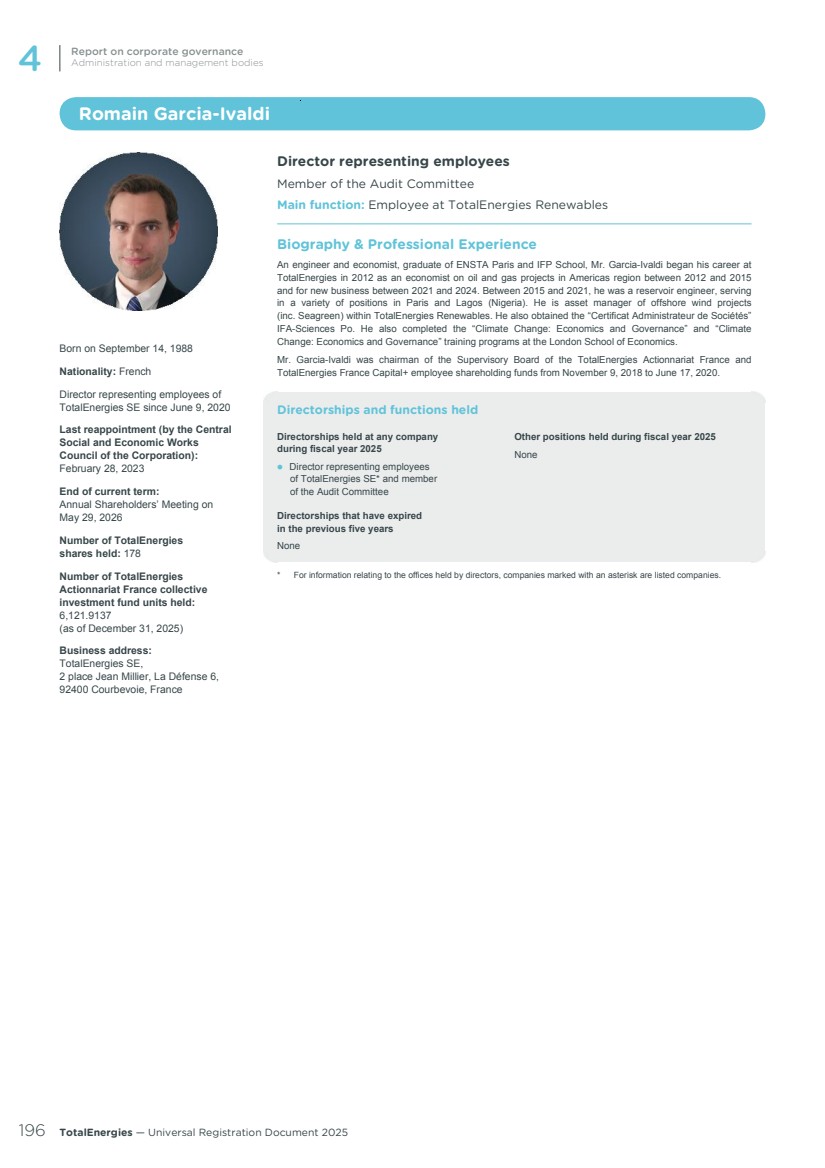
| Born on September 4, 1958 Nationality: American Director of TotalEnergies SE since the Annual Shareholders’ Meeting on May 28, 2021 Last reappointment: Annual Shareholders’ Meeting on May 24, 2024 End of current term: 2027 Annual Shareholders’ Meeting Number of TotalEnergies shares held: 1,000 (as of December 31, 2025) Business address: 572 Kravis Hall, 665 West 130th Street, New York, NY 10027, United States Independent director Member of the Audit Committee Main function: Russell L. Carson Professor of Finance and Economics, Columbia University and Chairman of the Board, MetLife, Inc. Biography & Professional Experience Mr. Glenn Hubbard obtained in 1983 a PhD in Economics at Harvard University. After graduation, he joined Northwestern University as Assistant Professor of Economics, where he stayed for five years. In 1988 he joined Columbia University, where he continues to teach today. Since then, he has been a visiting professor at Harvard’s Kennedy School of Government and Harvard Business School as well as The University of Chicago. In 1991, Glenn Hubbard was appointed Deputy Assistant Secretary for Tax Policy at the United States Department of the Treasury. In 1993, he joined the Federal Reserve Bank of New York’s Panel of Economic Advisors, a position he vacated in 2001 when he became Chairman of the United States Council of Economic Advisers (CEA). He also served as Chair of the Economic Policy Committee of the Organization for Economic Cooperation and Development (OECD) as well as a Member of the White House National Economic Council, National Security Council, and the President’s Council on Science and Technology. He stepped down as Chair of the CEA in 2003, returning to Columbia University. In 2007, he also rejoined the Panel of Economic Advisors for the Federal Reserve Bank of New York, a position he maintained for 10 years. In 2004, he joined the Boards of Dex Media, KKR Financial Corporation, and Automatic Data Processing (ADP), positions he held for many years. In 2004, he was named Dean Emeritus of Columbia Business School (Columbia University’s graduate school of business), keeping this position until 2019. In 2007, Glenn Hubbard joined the Board of MetLife, Inc. where he continues to serve today after being named Lead Independent Director in 2017 and Chairman in 2019. Directorships and functions held Directorships held at any company during fiscal year 2025 ● Chairman of the Board of MetLife, Inc.* ● Director of BlackRock Fixed Income Funds ● Director of TotalEnergies SE* and member of the Audit Committee Directorships that have expired in the previous five years None Other positions held during fiscal year 2025 ● Russell L. Carson Professor of Finance and Economics, Columbia University ● Co-Chair, Committee on Capital markets Regulation ● Board Member of Resources for the Future ● Non resident Senior Fellow at the American Enterprise Institute (AEI) * For information relating to the offices held by directors, companies marked with an asterisk are listed companies. Glenn Hubbard Report on corporate governance Administration and management bodies 4 TotalEnergies — Universal Registration Document 2025 197 |
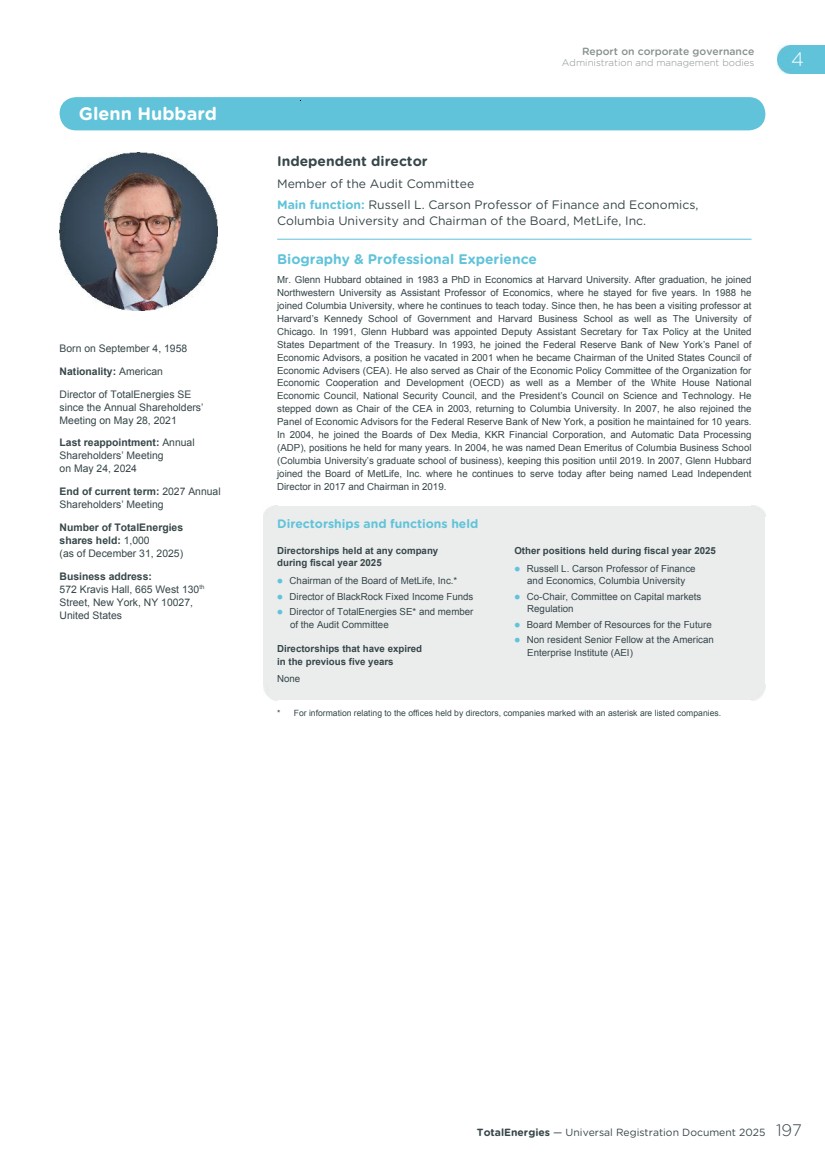
| Born on May 24, 1961 Nationality: Brazilian Director of TotalEnergies SE since the Annual Shareholders’ Meeting on May 26, 2023 End of current term: Annual Shareholders’ Meeting on May 29, 2026 Number of TotalEnergies shares held: 1,000 (as of December 31, 2025) Business address: Instituto Rua Alberto de Campos 289 22411030 Rio de Janeiro, Brazil Independent director Member of the Strategy & CSR Committee Main function: Independent director Biography & Professional Experience Mrs. Anelise Lara is a chemical engineer with an MSc in Petroleum Engineering and a Ph.D. in Earth Sciences from “Université Pierre et Marie Curie,” France. She was also certified in ESG Competent Boards Program, including climate change risks, in 2021. Mrs. Lara has 37 years of experience in the energy industry. In 1986, she joined Petrobras, the most important company in the energy segment in Brazil. She began her career in the Research and Development Center. In 2003, she joined the Exploration and Production Department as General Manager for the Reservoir Team at the corporate level. In 2011, after the first pre-salt discoveries, she was appointed General Manager for pre-salt development projects. Then in 2013, she was invited to become the Director of the Libra Joint Project Team. In 2016, she was appointed as Head of M&A, responsible for a portfolio of more than 40 projects of divestments and strategic partnerships in Brazil and abroad. During this period, Mrs. Lara was also a member of the Company’s Investment Committee. In 2019, she was appointed as Chief Executive Officer for Refining, Natural Gas, and Power, responsible for the strategic, risk management, HSE, and operational results of Refining, Gas & Power areas, covering the areas of refining, biofuels, petrochemicals, fertilizers plants, distribution and transportation of natural gas, regas terminals, and thermal power plants. She left Petrobras in January 2021. Mrs. Lara served as President of the Society of Petroleum Engineers (SPE) – Brazil Section from 2005 to 2008. She also joined the International Board of SPE from 2014 until 2017 as Regional Director for Latin America and Caribe. She also served as Chair of the Brazilian Petroleum Institute (IBP) from 2019 to 2021. Mrs. Lara volunteers for the cause of D&I (diversity and inclusion). She is a board member of WILL (Women Leadership in Latin America) and has already mentored many young women interested in working in the energy segment. Directorships and functions held Directorships held at any company during fiscal year 2025 ● Director of TotalEnergies SE* and member of the Strategy & CSR Committee ● Board Member of Mubadala Capital Downstream Brazil, since March 2022 ● Board Member of Trident Energyand Member of the Technical Committee and Member of the ESG Committee, ● Member of the Board of Directors of Vale* since May 2025, member of the Capital Allocation and Projects Committee, Member of the People and Compensation Committee Directorships that have expired in the previous five years ● Chief Executive Officer for Refining, Natural Gas, and Power of Petrobras until January 2021 ● Chair of the Brazilian Petroleum Institute until March 2021 Other positions held during fiscal year 2025 ● Advisory Board Member for Ultrapar* since September 2022 until March 2025 ● Board Member of IBP (Brazilian Petroleum Institute) until March 2025 ● Board member of WILL (Women Leadership in Latin America) * For information relating to the offices held by directors, companies marked with an asterisk are listed companies. Anelise Lara 4 Report on corporate governance Administration and management bodies 198 TotalEnergies — Universal Registration Document 2025 |
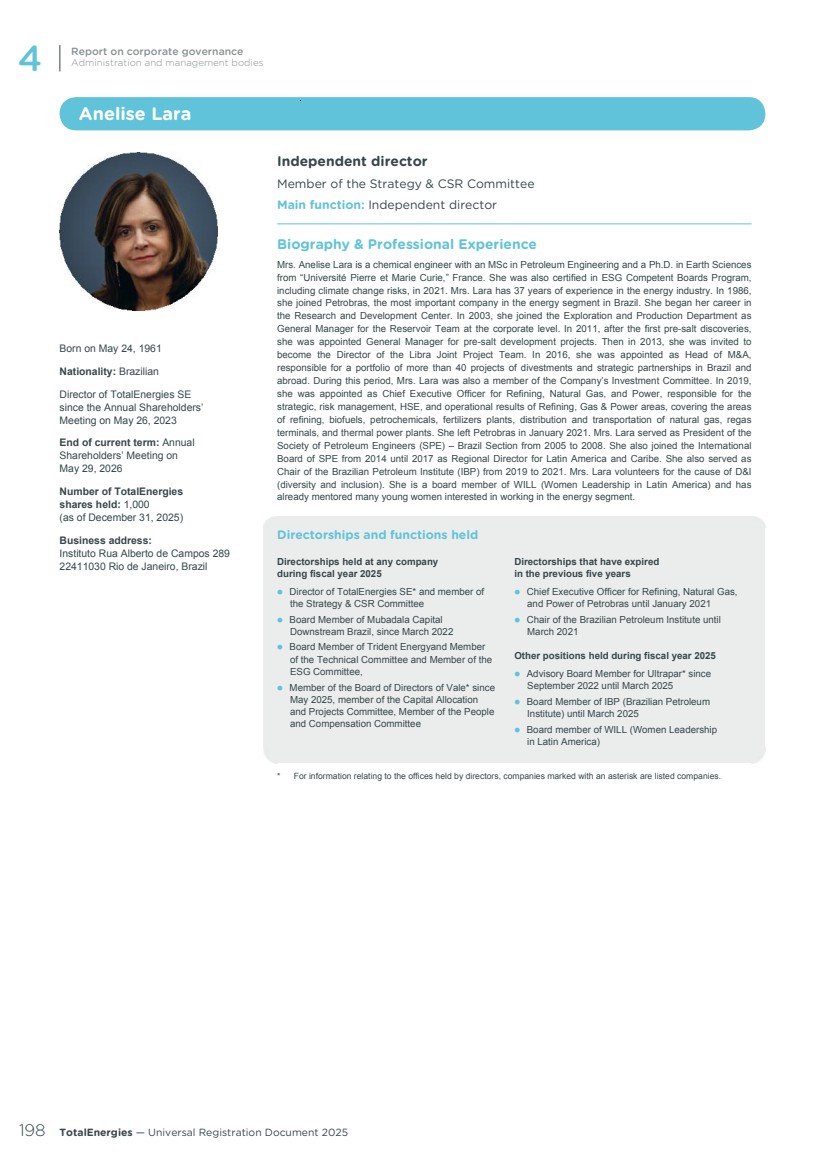
| Born on May 23, 1972 Nationalities: American and French Director of TotalEnergies SE since the Annual Shareholders’ Meeting on May 23, 2025 End of current term: 2028 Annual Shareholders’ Meeting Number of TotalEnergies shares held: 1,000 (as of December 31, 2025) Business address: TotalEnergies SE, 2 place Jean Millier, La Défense 6, 92400 Courbevoie, France Independent director Member of the Audit Committee Main function: Independent director Biography & Professional Experience Of Korean origin, of American and French nationalities, and residing in France since 2004, Ms. Helen Lee Bouygues holds a Bachelor of Arts, magna cum laude, from Princeton University in Political Science and a Master in Business Administration from Harvard Business School. For over 25 years, she has been supporting the strategic transformation of leading French and international companies. Ms. Helen Lee Bouygues began her career in 1995 at J.P. Morgan, as partner in M&A at New York and Hong Kong. In 1997, she was appointed Director of Development at Pathnet, a telecommunications service provider based in Washington DC, then joined Cogent Communications in 2000, where she held the positions of Treasurer, Chief Operating Officer, and Chief Financial Officer until 2004. Helen Lee Bouygues was then appointed partner at Alvarez & Marsal in Paris, that she left in 2010 to create her own consulting firm. She sold it in 2014 to McKinsey & Company, where she became a partner in charge of the Recovery and Transformation Services division. Ms. Helen Lee Bouygues has been Operating Partner within the private equity fund Ardian since 2024. Ms. Helen Lee Bouygues was a director of numerous companies, holding various chair positions on board committees, particularly in the energy sector (Lead Independent Director of Neoen SA until March 20, 2025, director of CGG (now Viridien SA) until 2024). Ms. Helen Lee Bouygues is currently Board member of Burelle SA. Directorships and functions held Directorships held at any company during fiscal year 2025 ● Director of TotalEnergies SE* since May 23, 2025 and member of the Audit Committee since January 1, 2026 ● President of LB Associés ● Board member, Chairwoman of the audit committee (comité des comptes) and member of the Compensation committee of Burelle SA* ● Member of the Steering Committee and Chairwoman of the Audit Committee of Fives S.A.S. ● Member of the Steering Committee of Société Anonyme des Galeries Lafayette (SAGL) ● Lead Director, member of the Audit Committee and member of the Governance and CSR Committee of Neoen SA* (until March 20, 2025) ● Board member and member of the Audit Committee of Guarantee Trust Holding Company PLC* (until March 2025) Directorships that have expired in the previous five years ● Lead Director, member of the Audit Committee and member of the Governance and CSR Committee of Neoen SA* (until March 20, 2025) ● Board member and member of the Audit Committee of Guarantee Trust Holding Company PLC* (until March 2025) ● Board member, member of the Audit Committee, Chairwoman of the Compensation Committee of Latecoere SA* (until April 2024) ● Board member of Atos SA* (until June 2024) ● Board member, member of the Audit Committee and Chairwoman of Investment Committee of Viridien SA* (until September 2024) ● Chairwoman of the Board of Directors of Conforama S.A. ● Member of the Supervisory Board of Arvella Investments S.A.S. Other positions held during fiscal year 2025 None * For information relating to the offices held by directors, companies marked with an asterisk are listed companies. Helen Lee Bouygues Report on corporate governance Administration and management bodies 4 TotalEnergies — Universal Registration Document 2025 199 |
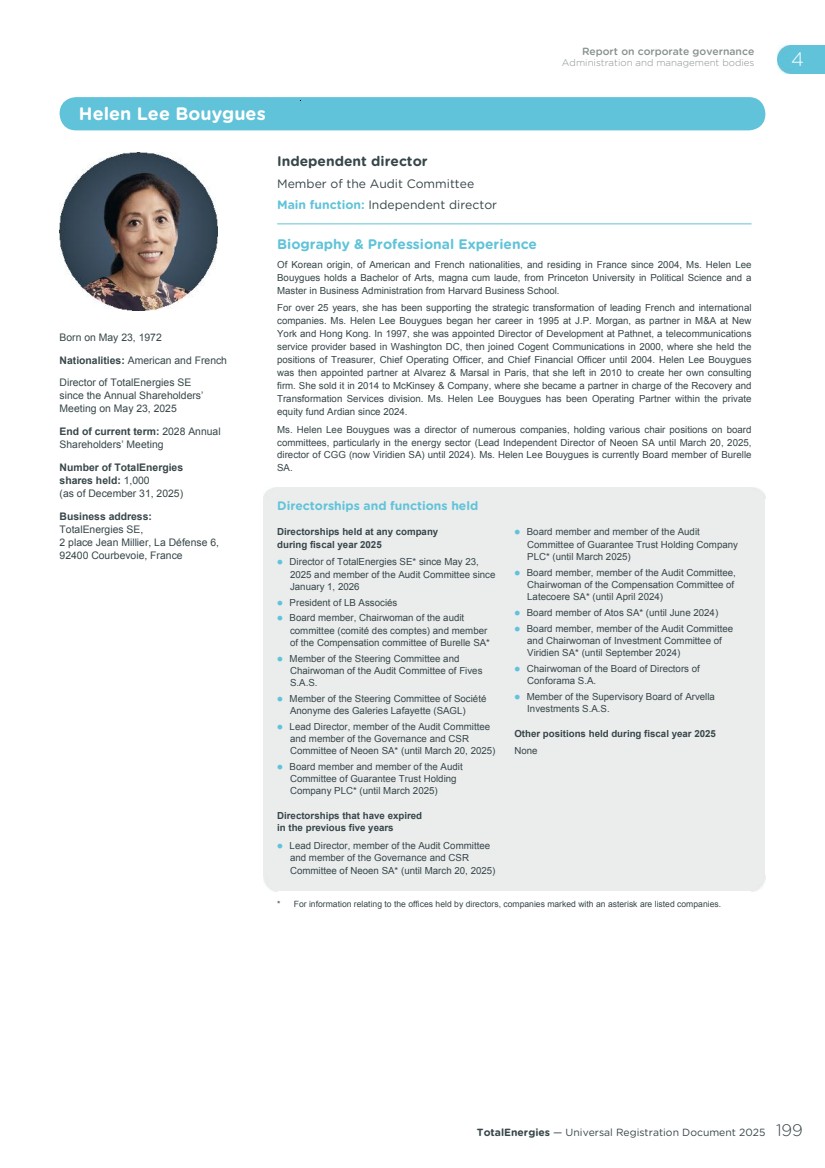
| Born on December 28, 1963 Nationality: French Director of TotalEnergies SE since the Annual Shareholders’ Meeting on May 23, 2025 End of current term: 2028 Annual Shareholders’ Meeting Number of TotalEnergies shares held: 1,000 (as of December 31, 2025) Business address: 4 rue Paul Cézanne, 75008 Paris, France Independent director Member of the Governance and Ethics Committee Main function: Chairman of the Executive Board (Président du Directoire) of Wendel* Biography & Professional Experience Mr. Laurent Mignon, a French national, a graduate from HEC and from the Executive Program at Stanford, has been Chairman of the Executive Board (Président du Directoire) of Wendel since December 2, 2022 and Chairman of the Board of Directors of Bureau Veritas, a company that Wendel controls and fully consolidates. From 1986 to 1996, Mr. Laurent Mignon worked for lndosuez bank before joining Schroders in London, and then AGF (Assurances Générales de France) in 1997 as Chief Financial Officer, then Vice Chief Executive Officer in 2002 and Chief Executive Officer in 2006. From 2007 to 2009, he was Managing Partner at Oddo & Cie. From 2009 to 2022, Mr. Laurent Mignon carried out his functions within Groupe BPCE where he was Chief Executive Officer of Natixis and member of the Executive Board of BPCE from 2009 to May 2018, and Chairman of the Executive Board (Président du Directoire) of Groupe BPCE from May 2018 to December 2022, as well as Chairman of the Board of Directors of Natixis. Directorships and functions held Directorships held at any company during fiscal year 2025 Within the Wendel group ● Chairman of the Executive Board of Wendel SE* ● Chairman of the Board of Directors and member of the Strategy Committee of Bureau Veritas SE* Outside the Wendel group ● Director of TotalEnergies SE* since May 23, 2025 and member of the Governance and Ethics Committee since January 1, 2026 ● Director and member of the Performance Audit Committee of LVMH Moët Hennessy Louis Vuitton SE* ● Censor of Oddo BHF SCA ● Chairman of LMIGNON Conseil SAS Directorships that have expired in the previous five years ● Director of Arkema ● Director of AROP (Association pour le Rayonnement de l’Opéra National de Paris) ● Chairman, Association Française Bancaire (AFB) Association Française des Etablissements de Crédit et des Entreprises d’investissement ● Chairman of BPCE SA ● Vice-Chairman of the Board of Bureau Veritas SA ● President of CE Holding Participations SAS ● Director of CNP Assurances SA ● Chairman of the Board of Directors of Crédit Foncier SA ● Censor of Fédération Bancaire Française (FBF) ● Member of the Board of Directors of Fimalac SE ● Chairman of the Board of Directors of Natixis SA ● Director of Natixis Assurances SA ● Director of Sopassure SA ● Director, Peter J. Solomon Company, LP (United States) Other positions held during fiscal year 2025 ● Director of the Institut de la Finance Durable (Paris) * For information relating to the offices held by directors, companies marked with an asterisk are listed companies. Laurent Mignon 4 Report on corporate governance Administration and management bodies 200 TotalEnergies — Universal Registration Document 2025 |
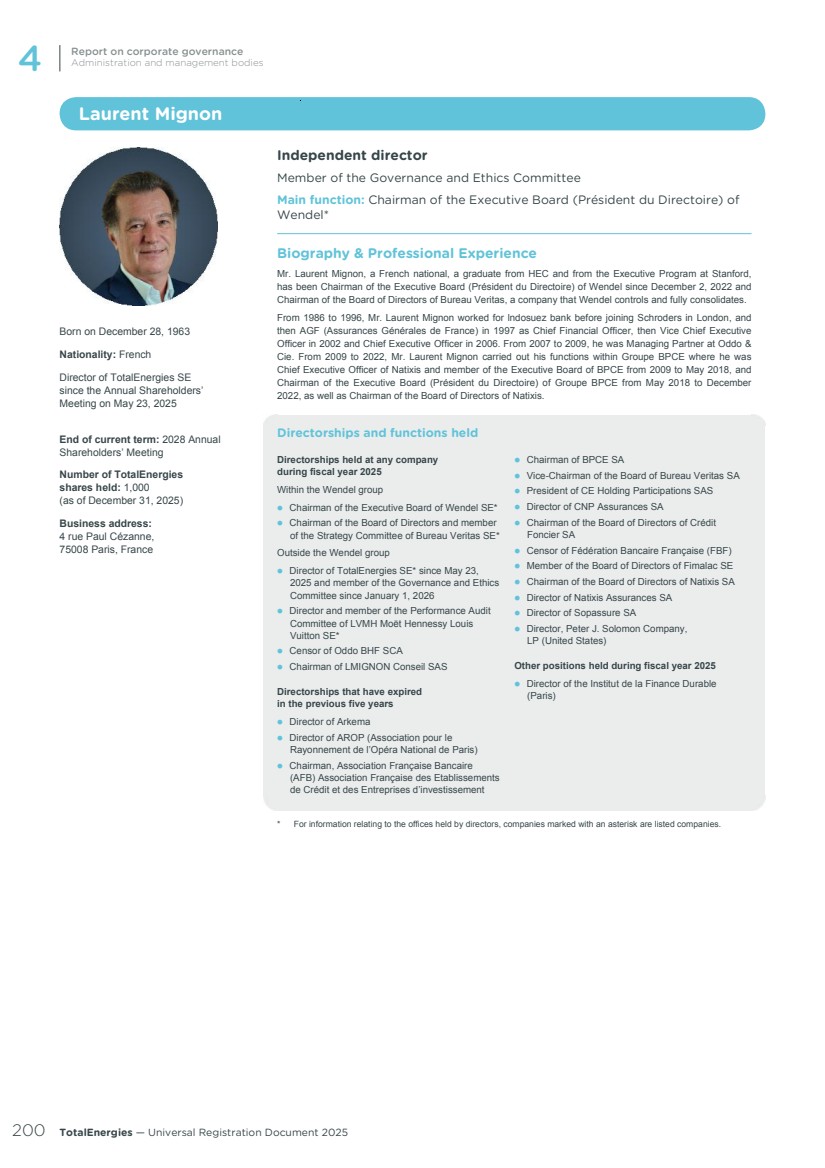
| Born on April 29, 1961 Nationality: German Director of TotalEnergies SE since the Annual Shareholders’ Meeting on May 26, 2023 End of current term: Annual Shareholders’ Meeting on May 29, 2026 Number of TotalEnergies shares held: 2,200 (as of December 31, 2025) Business address: Asamstr. 5, 83700 Rottach-Egern, Germany Independent director Chairman of the Compensation Committee Main function: Independent director Biography & Professional Experience Mr. Dierk Paskert obtained a PhD in Economics at Münster University in 1990. Having made his first professional steps in Investment Banking with Trinkaus Samuel Montague and West Merchant Bank, he started his industrial career in VEBA Group from 1995 onwards. With VEBA Group focusing entirely on power and gas and turning into E.ON, he became Senior Vice-President for Corporate Development at E.ON AG in 2003. He was inter alia responsible to further internationalize the gas business (Ruhrgas), to integrate the power and gas activities downstream and to develop the first renewable strategy of E.ON. In 2008 he joined the Board of E.ON-Energie and directed the Transmission and Distribution Grid business in Germany, Czech, Hungary, Slovakia, Romania and Bulgaria. In 2012, he was asked by the German Industry Association to found and manage Resource Alliance, a Joint-Venture of 16 German Industrial Companies focusing on supply of critical raw materials. From 2017 until end of 2022, he was appointed CEO of Encavis AG, a M-Dax listed Independent Power Producer (IPP) from Renewable Energy Sources at that time. He was Member of the Executive Risk Committee. Whilst growing the production portfolio to > 4 GW and focusing on Power Purchase Agreements as well as Traded Markets, he introduced in particular a risk management system coping with the growing merchant exposure of the company in Renewable Energy. Directorships and functions held Directorships held at any company during fiscal year 2025 ● Director of TotalEnergies SE* and, since March 18, 2026, Chairman of the Compensation Committee ● Member of the Administrative Board KAEFER SE&Co ● Member of the Supervisory Board Intilion AG until January 2026 ● Non-executive Board Member of Zelestra Corporacion Tecnologia SAU ● Member of the Supervisory Board of ES.FOR.IN SE (Germany) from May 2025 Directorships that have expired in the previous five years ● Member of the Board of Directors The Mobility House AG, member of the Risk Committee, member of the Strategy Committee (until June 10, 2024) ● Member of the Board of Directors Pexapark AG (until January 11, 2023) ● Member of the Board of Management and Chief Executive Officer Encavis AG (until December 31, 2022) Other positions held during fiscal year 2025 ● Member of the Advisory Board of East-Energy GmbH * For information relating to the offices held by directors, companies marked with an asterisk are listed companies. Dierk Paskert Report on corporate governance Administration and management bodies 4 TotalEnergies — Universal Registration Document 2025 201 |
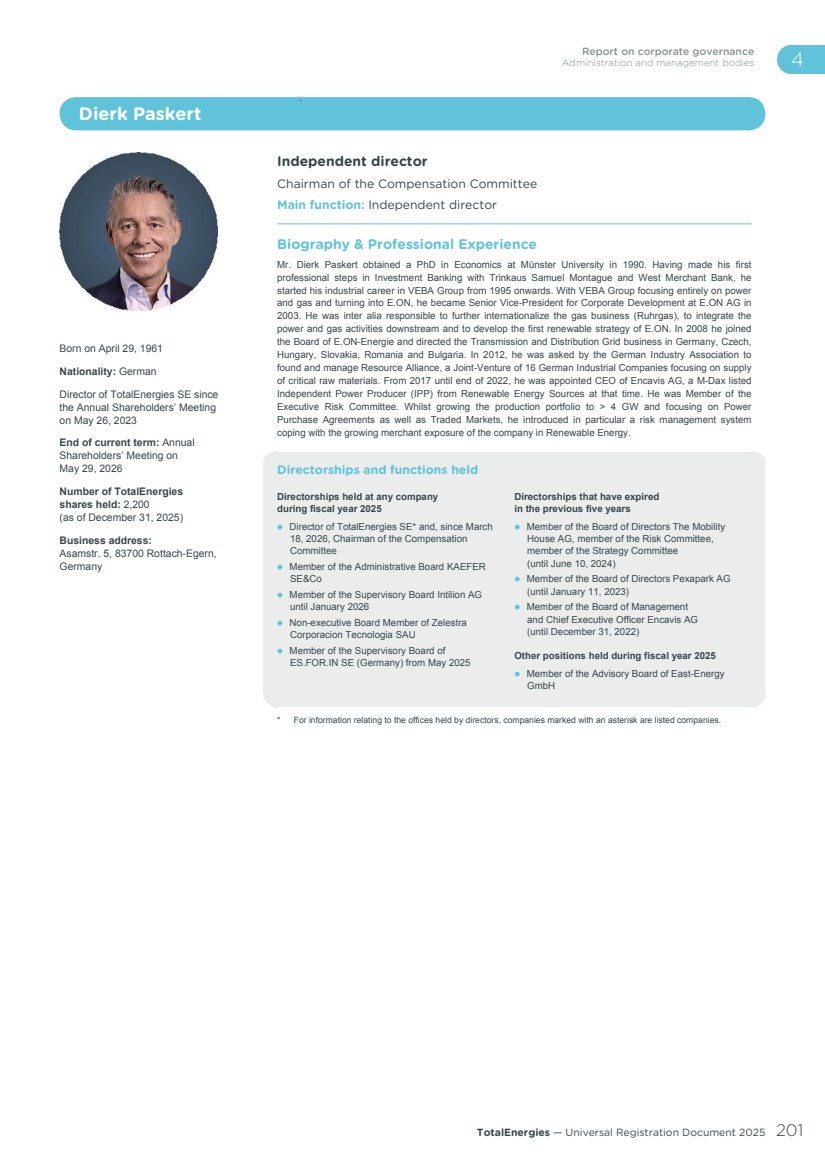
| Born on August 14, 1969 Nationality: French Director representing employees of TotalEnergies SE since October 14, 2020 Last reappointment (by the SE Committee): February 16, 2023 End of current term: Annual Shareholders’ Meeting on May 29, 2026 Number of TotalEnergies shares held: 1,091 Number of TotalEnergies Actionnariat France collective investment fund units held: 2,888.2497 (as of December 31, 2025) Business address: TotalEnergies SE, 2 place Jean Millier, La Défense 6, 92400 Courbevoie, France Director representing employees Member of the Compensation Committee Main function: Employee of TotalEnergies SE* Biography & Professional Experience Mr. Pobo joined TotalEnergies in 1989 as part of Argedis, the subsidiary responsible for service station management and operations in France, where he held a variety of positions before becoming site director in 1998. In 2013, he became a member of the European Works Council. He was the central union representative for the Marketing & Services Unit of Economic and Employee Interest (UES) from 2014 to 2017, and then for the Upstream/Global Services/Holding Company UES beginning in 2017. He is also the union representative on the Economic and Employee Interest Committee and the Central Economic and Employee Interest Committee. On October 14, 2020, he was appointed by the SE Committee, known as the European Works Committee, to sit on the Board of Directors of TotalEnergies SE as a director representing employees and accordingly resigned from his union responsibilities. Directorships and functions held Directorships held at any company during fiscal year 2025 ● Director representing employees of TotalEnergies SE* and member of the Compensation Committee Directorships that have expired in the previous five years None Other positions held during fiscal year 2025 ● Mayor of Aubais (France) ● Vice president of the community of municipalities Rhony-Vistre-Vidourle ● Non-salaried manager of the agricultural limited liability company l’Oliverna * For information relating to the offices held by directors, companies marked with an asterisk are listed companies. Angel Pobo 4 Report on corporate governance Administration and management bodies 202 TotalEnergies — Universal Registration Document 2025 |
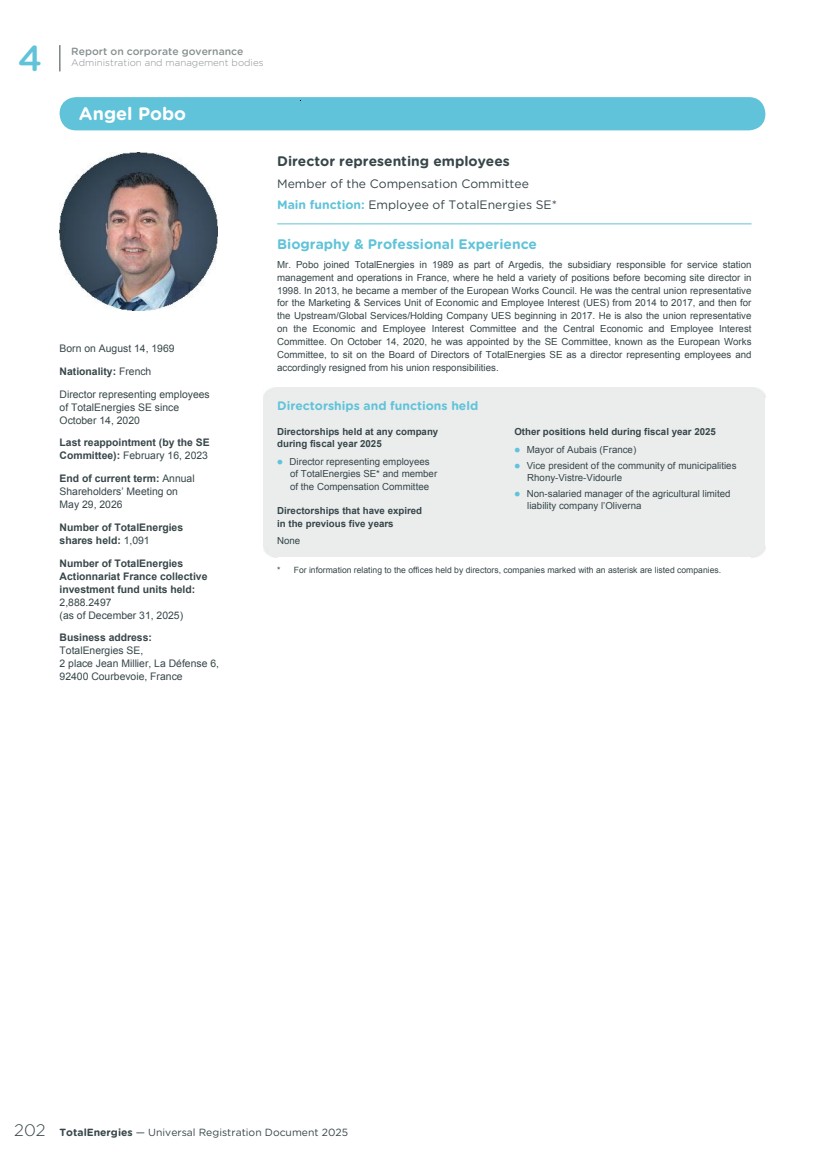
| Directorships of TotalEnergies SE that expired in 2025 (information as of May 23, 2025) Maria van der Hoeven Director of TotalEnergies SE since the Annual Shareholders’ Meeting on May 24, 2016 until the Annual Shareholders’ Meeting on May 23, 2025 - Chairwoman of the Audit Committee until May 23, 2025 Born on September 13, 1949 - Nationality: Dutch - Main function: Independent director Biography & Professional Experience Ms. van der Hoeven trained as a teacher, becoming a professor in economic sciences and administration then a school counselor. She subsequently headed the Adult Vocational Education Center in Maastricht for seven years, before leading the Limburg Technology Center. She was a member of the Dutch Parliament, served as Minister of Education, Culture and Science from 2002 to 2007, and was Minister of Economic Affairs of the Netherlands from 2007 to 2010. Ms. van der Hoeven was Executive Director of the International Energy Agency (IEA) from September 2011 to August 2015. During this period, she helped to increase the number of members of the Agency and emphasized the close link between climate and energy policy. In September 2015, Ms. van der Hoeven joined the Board of Trustees of Rocky Mountain Institute (USA) and in the spring of 2016, she became a member of the Supervisory Board of Innogy SE (Germany). Ms. van der Hoeven was Vice Chairwoman of the High-level Panel of the European Decarbonisation Pathways Initiative within the European Commission between 2016 and 2018. Since January 2020, she has been a member of the Supervisory Board of COVRA, a privately held Dutch company that serves as the central depository for radioactive waste in the Netherlands. Directorships and functions held Directorships held at any company during fiscal year 2025 ● Director of TotalEnergies SE* and Chairwoman of the Audit Committee until May 23, 2025 ● Member of the Supervisory Board of Covra since January 2020 (Netherlands) Directorships that have expired in the previous five years ● Director of TotalEnergies SE* and Chairwoman of the Audit Committee until May 23, 2025 ● Member of the Board of Trustees of Rocky Mountain Institute (USA) until October 30, 2021 Other positions held during fiscal year 2025 ● Member of the EACLN, European Audit Committee Leaders Network, since August 2021 ● Member of the Supervisory Board of Erasmus Entreprise (Netherlands) since June 2021 until 2024 ● Special Advisor on energy literacy to the Secretary General of World Energy Council (WEC) since May 2021 ● Member of the Board of Leaders pour la Paix (France) since January 2019 ● Member of the International Advisory Panel on Energy in Singapore since January 2019 ● Senior fellow in CIEP (Center for International Energy Policies) (Netherlands) * For information relating to the offices held by directors, companies marked with an asterisk are listed companies. Emma de Jonge Director representing employee shareholders of TotalEnergies SE since the Annual Shareholders’ Meeting on May 25, 2022 until the Annual Shareholders’ Meeting on May 23, 2025 - Member of the Strategy & CSR Committee until May 23, 2025 Born on March 20, 1963 - Nationality: Dutch - Main function: Employee of TotalEnergies* Biography & Professional Experience After obtaining a double degree in information systems and management at the University of Grenoble, Emma de Jonge began her career as a project manager and pre-sales support in the Cap Gémini group in 1987. She joined Elf Aquitaine in 1990, where she held several positions as project manager, buyer and internal consultant in the Refining Distribution IT Department. In 2004, as assistant to the SAP support manager for 150 subsidiaries of Total Marketing & Services, she managed relations with the subsidiaries’ managers and supplier relations. From 2010, Emma de Jonge worked primarily as a project manager and in change management in international contexts, in the Europe Card Development Department and then in the Governance Department of Total Marketing & Services. In 2017, she continued these activities as Head of Procure to Pay and then as project manager, first within TotalEnergies Global Procurement, and then within TotalEnergies Global Services in 2022. Furthermore, Emma de Jonge holds the IFA-Science Po Corporate Director Certificate. She was a member of the European Works Council from 2020 to 2024 and an elected member of the Supervisory Board of the TotalEnergies Actionnariat France collective investment fund from 2020 to 2023. Directorships and functions held Directorships held at any company during fiscal year 2025 ● Director representing employee shareholders of TotalEnergies SE*, member of the Strategy & CSR Committee until May 23, 2025 Directorships that have expired in the previous five years ● Director representing employee shareholders of TotalEnergies SE*, member of the Strategy & CSR Committee until May 23, 2025 Other positions held during fiscal year 2025 ● Elected member of the CSE AGSH TotalEnergies Paris (since 2018) ● Elected member of the CSEC AGSH TotalEnergies (since 2018) * For information relating to the offices held by directors, companies marked with an asterisk are listed companies. Report on corporate governance Administration and management bodies 4 TotalEnergies — Universal Registration Document 2025 203 |
| Jean Lemierre Director of TotalEnergies SE since the Annual Shareholders’ Meeting on May 24, 2016 until the Annual Shareholders’ Meeting on May 23, 2025 - Member of the Governance and Ethics Committee and of the Strategy & CSR Committee until May 23, 2025 Born on June 6, 1950 - Nationality: French - Main function: Chairman of the Board of Directors of BNP Paribas* Biography & Professional Experience Mr. Lemierre is a graduate of the Institut d’Études Politiques de Paris and the École Nationale d’Administration. He also has an undergraduate law degree. Mr. Lemierre held various positions at the French tax authority, including as Head of the Fiscal Legislation Department and Director-General of Taxes. He was then appointed as Cabinet Director at the French Ministry of Economy and Finance before becoming Director of the French Treasury in October 1995. Between 2000 and 2008, he was President of the European Bank for Reconstruction and Development (EBRD). He became an advisor to the Chairman of BNP Paribas in 2008 and has been Chairman of the Board of Directors of BNP Paribas since December 1, 2014. During his career, Mr. Lemierre has also been a member of the European Monetary Committee (1995-1998), Chairman of the European Union Economic and Financial Committee (1999-2000) and Chairman of the Paris Club (1999-2000). He later became a member of the International Advisory Council of China Investment Corporation (CIC) and the International Advisory Council of China Development Bank (CDB). He is currently Chairman of the Centre d’Études Prospectives et d’Informations Internationales (CEPII) and a member of the Institute of International Finance (IIF). Directorships and functions held Directorships held at any company during fiscal year 2025 Within the BNP Paribas group ● Chairman of the Board of Directors of BNP Paribas* ● Director of TEB Holding AS (Turkey) Outside the BNP Paribas group ● Director of TotalEnergies SE*, member of the Governance and Ethics Committee and of the Strategy & CSR Committee until May 23, 2025 Directorships that have expired in the previous five years ● Director of TotalEnergies SE*, member of the Governance and Ethics Committee and of the Strategy & CSR Committee until May 23, 2025 Other positions held during fiscal year 2025 ● Member of the Board of Directors of AFEP (French association of private companies) ● Chairman of Centre d’Études Prospectives et d’Informations Internationales (CEPII) ● Member of the Institute of International Finance (IIF) ● Member of the International Advisory Council of China Development Bank* (CDB) ● Member of the International Advisory Council of China Investment Corporation (CIC) ● Member of the International Advisory Panel (IAP) of the Monetary Authority of Singapore (MAS) ● Vice-Chairman of Paris EUROPLACE since 2014 ● Member of the Board of the Institut de la Finance Durable (Paris) * For information relating to the offices held by directors, companies marked with an asterisk are listed companies. 4.1.1.2 Absence of conflicts of interest or convictions The Board of Directors’ Rules of Procedure stipulate the specific rules for preventing conflicts of interest applicable to directors in the following terms (refer to point 4.1.2.1 for the full version of the Rules of Procedure): “2.5. Duty of loyalty Directors must not take advantage of their office or duties to gain, for themselves or a third party, any monetary or non-monetary benefit. They must notify the Chairman of the Board of Directors and the Lead Independent Director, if one has been appointed, of any existing or potential conflict of interest with the Corporation or any subsidiary of the Company, and they must refrain from participating in the vote relating to the corresponding resolution as well as from participating in any debates preceding such vote. Directors must inform the Board of Directors of their participation in any transaction that directly involves the Corporation, or any subsidiary of the Company, before such transaction is finalized. Directors must not assume personal responsibilities in companies or businesses having activities in competition with those of the Corporation or any subsidiary of the Company without first having informed the Board of Directors. Directors undertake not to seek or accept from the Corporation, or from companies related to the Corporation, directly or indirectly, any advantages liable to be considered as being of a nature that may compromise their independence.” “7.2 Duties of the Lead Independent Director 5. Prevention of conflicts of interest Within the Governance and Ethics Committee, the Lead Independent Director organizes the performance of due diligence in order to identify and analyze potential conflicts of interest within the Board of Directors. He informs the Chairman and Chief Executive Officer of any conflicts of interest identified as a result and reports to the Board of Directors on these activities. Pursuant to the obligation to declare conflicts of interest set out in article 2.5 of these Rules, any director affected by an existing or potential conflict of interest must inform the Chairman and Chief Executive Officer and the Lead Independent Director.” The Lead Independent Director has performed due diligence in order to identify and analyze potential conflicts of interest. The Lead Independent Director is thus consulted by directors who were considering accepting a mandate in other companies. No situation relating to a project to take up a mandate or an external function by a director has led the Lead Independent Director to refer the matter to the Governance and Ethics Committee. 4 Report on corporate governance Administration and management bodies 204 TotalEnergies — Universal Registration Document 2025 |
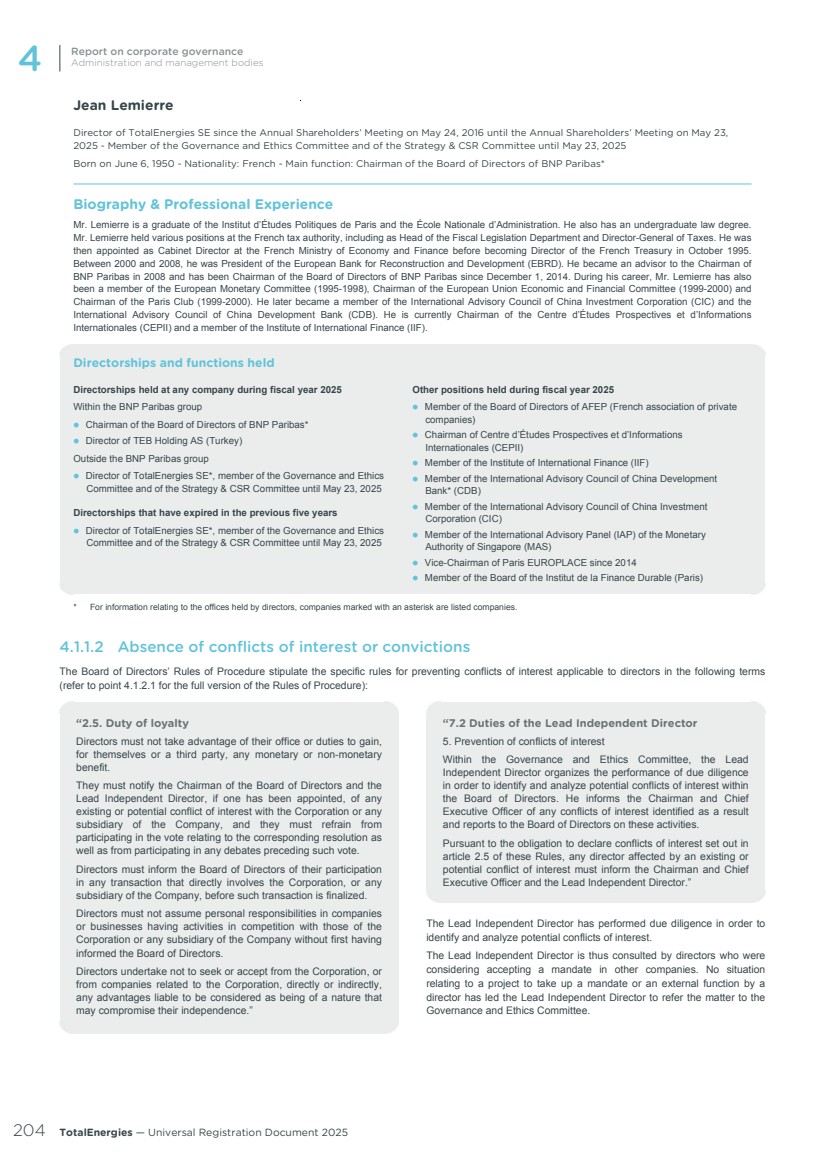
| On the basis of the work carried out, the Board of Directors noted the absence of potential conflicts of interest between the directors’ duties with respect to TotalEnergies and their private interests. To the Corporation’s knowledge, there is no family relationship among the members of the Board of Directors of TotalEnergies SE; there is no arrangement or agreement with the major shareholders, customers or suppliers under which a director was selected; and there is no service agreement that binds a director to TotalEnergies SE or to any of its subsidiaries and provides for special benefits under the terms thereof. The current directors of TotalEnergies have informed the Corporation that they have not been convicted of fraud, have not been associated with bankruptcy, sequestration, receivership or court-ordered liquidation proceedings, and have not been subject to any incrimination, conviction or sanction pronounced by an administrative authority or professional body, nor have they been prohibited from managing a company or disqualified as stipulated in item 12.1 of Annex I of Commission Delegated Regulation (EU) 2019/980 of March 14, 2019, over the last five years. 4.1.1.3 Plurality of directorships held by directors The number of directorships held by directors in listed companies outside their group, including foreign companies, was assessed as of December 31, 2025, in accordance with the recommendations of the AFEP-MEDEF Code (point 20), which states that “an executive officer should not hold more than two other directorships in listed corporations, including foreign corporations, outside of his or her group. [This] limit [...] does not apply to directorships held by an executive officer in subsidiaries and holdings, held alone or together with others, of companies whose main activity is to acquire and manage such holdings. [...] A director may not hold more than four other directorships in listed corporations, including foreign corporations, outside of the group.” Summary of other directorships held by members of the Board of Directors As of December 31, 2025 Number of directorships held at listed companies(a) Compliance with the criteria of the AFEP-MEDEF Code Patrick Pouyanné 1 Jacques Aschenbroich 2 Marie-Christine Coisne-Roquette 1 Lise Croteau 2 Mark Cutifani 0 Marie-Ange Debon 1 Valérie Della Puppa-Tibi(b) 0 Romain Garcia-Ivaldi(c) 0 Glenn Hubbard 1 Anelise Lara 1 Helen Lee Bouygues 1 Laurent Mignon 2 Dierk Paskert 0 Angel Pobo(c) 0 (a) In accordance with the criteria of the AFEP-MEDEF Code. (b) Director representing employee shareholders. (c) Director representing employees. 4.1.1.4 Directors’ independence At its meeting on March 18, 2026, the Board of Directors, on the proposal of the Governance and Ethics Committee, reviewed the independence of the Corporation’s directors as of December 31, 2025. Upon that Committee’s proposal, the Board considered that, pursuant to the AFEP-MEDEF Code to which the Corporation refers, a director is independent when “he or she has no relationship of any kind whatsoever with the corporation, its group or its management that may interfere with the exercise of his or her freedom of judgment”. For each director, this assessment was based on the independence criteria set forth in points 10.5 to 10.7 of the AFEP-MEDEF Code, updated in December 2022, and as described below. Criterion 1: Employee corporate officer within the previous five years “Not to be or not to have been within the previous five years: – an employee or executive officer of the company; – an employee, executive officer or director of a company consolidated within the corporation; – an employee, executive officer or director of the company’s parent company or a company consolidated within this parent company.” Criterion 2: Cross-directorships “Not to be an executive officer of a company in which the corporation holds a directorship, directly or indirectly, or in which an employee appointed as such or an executive officer of the corporation (currently in office or having held such office within the last five years) holds a directorship.” Criterion 3: Significant business relationships “Not to be a customer, supplier, commercial banker, investment banker or consultant: – that is significant to the corporation or its group; – or for which the corporation or its group represents a significant portion of its activity.” Report on corporate governance Administration and management bodies 4 TotalEnergies — Universal Registration Document 2025 205 |
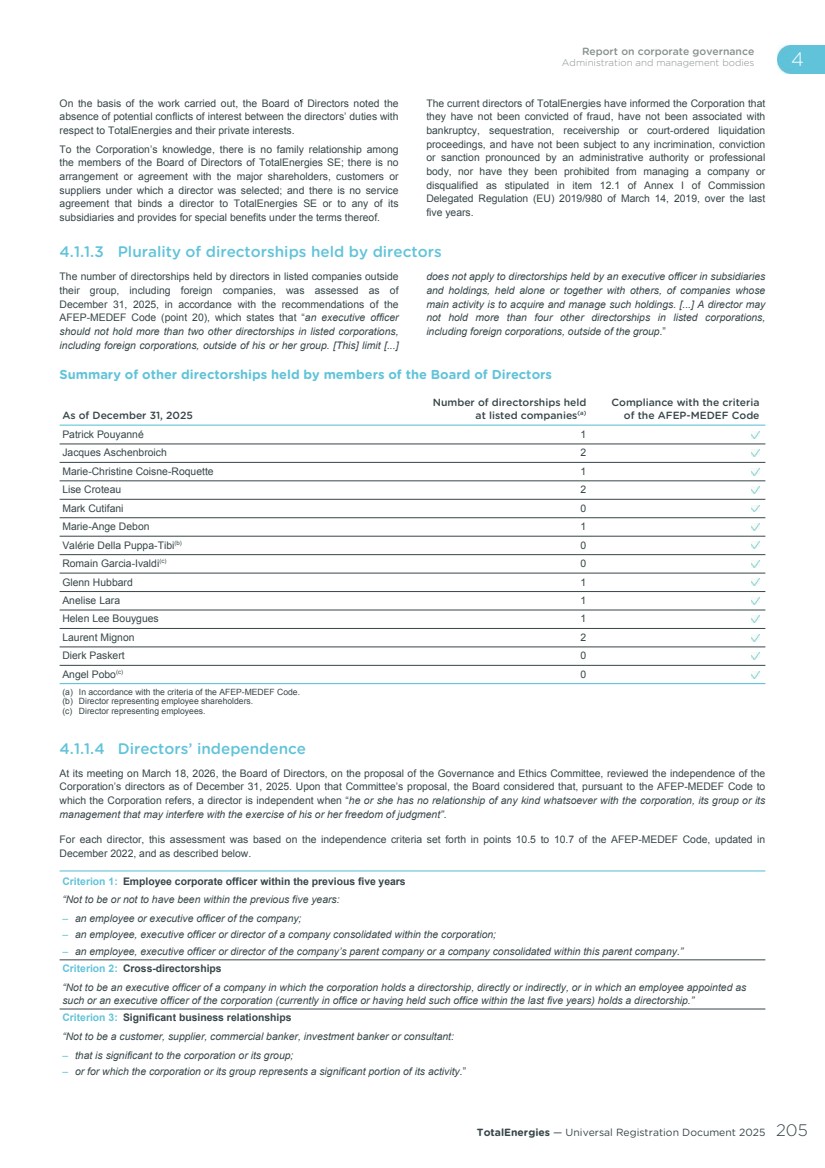
| The evaluation of the significance or otherwise of the relationship with the company or its group must be debated by the Board, and the quantitative and qualitative criteria that led to this evaluation (continuity, economic dependence, exclusivity, etc.) must be explicitly stated in the annual report.” Criterion 4: Family ties “Not to be related by close family ties to a company officer.” Criterion 5: Auditor “Not to have been an auditor of the corporation within the previous five years.” Criterion 6: Period of office exceeding 12 years “Not to have been a director of the corporation for more than twelve years. Loss of the status of independent director occurs on the date of this 12th anniversary.” Criterion 7: Status of non-executive officer “A non-executive officer cannot be considered independent if he or she receives variable compensation in cash or in the form of securities or any compensation linked to the performance of the corporation or group.” Criterion 8: Status of the major shareholder “Directors representing major shareholders of the corporation or its parent company may be considered independent, provided these shareholders do not take part in the control of the corporation. Nevertheless, beyond a 10% threshold in capital or voting rights, the Board, upon a report from the nominations committee, should systematically review the qualification of a director as independent in the light of the make-up of the corporation’s capital and the existence of a potential conflict of interest.” It was confirmed, regarding the independence as of December 31, 2025, of Mr. Aschenbroich, Ms. Croteau, Mr. Cutifani, Ms. Debon, Mr. Hubbard, Ms. Lara, Ms. Lee Bouyges, Mr. Mignon as well as Mr. Paskert that the independence analyzes previously carried out remained relevant. In particular, the following was noted as of the date of December 31, 2025. – The level of business relations between the companies of the Company and those of the Orange group, of which Mr. Aschenbroich is Chairman of the Board of Directors, is not significant for TotalEnergies or for Orange. The amount of purchases made by the Company from Orange in 2025 (below $35 million) represents less than 0.1% of the purchases made by the Company in 2025 (i.e., approximately $35 billion(1)). The amount of purchases made by Orange from the Company’s companies in 2025 (below $27 million) represents less than 0.1% of the total amount of purchases made by Orange in 2025 (i.e., approximately $33 billion). It was noted the absence of economic dependence and exclusive business relations between the two groups. It was thus concluded that Mr. Aschenbroich could be deemed to be independent director. – The level of business relations between the Company’s companies and those of the La Poste group, of which Ms. Debon is Chairwoman and Chief Executive Officer, is not significant for TotalEnergies or for La Poste. The amount of purchases made by La Poste from the Company in 2025 (lower than $11 million) represents less than 0.03% with regards to the purchases made by the Company in 2025 (approximately $35 billion(2)). The amount of purchases made by La Poste from the Company’s companies in 2025 (approximately $35 million) represent an amount below 0.2% of the total amount of purchases made by La Poste in 2025 (approximately $20 billion). It was noted the absence of economic dependence and exclusive business relations between the two groups. It was thus concluded that Ms. Debon could be deemed to be independent. – The level of business relations between the Company’s companies and those of the MetLife Inc. group, of which Mr. Hubbard is Chairman of the Board of Directors, is not significant for TotalEnergies or MetLife Inc. The amount of insurance premiums paid by the Company’s companies to the MetLife Inc. group in 2025 represents a non significant portion of the sales generated by this group in 2025. It was noted the absence of economic dependence and exclusive business relationships between the two groups. It was thus concluded that Mr. Hubbard could be deemed to be an independent director. – The level of business relations between the Company’s companies and those of the Wendel group, of which Mr. Mignon is Chairman of the Executive Board (Président du Directoire), is not significant for TotalEnergies or for Wendel group. The amount of purchases made by Wendel group from the Company in 2025 (approximatively $39 million) represents less than 0.11% of purchases made by the Company in 2025 (approximately $35 billion(3)). The amount of the purchases made by Wendel group from the Company’s companies in 2025 (approximatively $14 million) represents around 0.5% of the total amount of the purchases made by Wendel group in 2025 (approximately $2.6 billion). Furthermore, the level of business relations between the Company’s companies and those of the Bureau Veritas group, of which Mr. Mignon is Chairman of the Board of Directors and member of the Strategy Committee, is not significant for TotalEnergies or for Bureau Veritas group. The amount of purchases made by Bureau Veritas group from the Company in 2025 (approximatively $29 million) represents less than 0.1% of purchases made by the Company in 2025 (approximately $35 billion(4)). The amount of the purchases made by Bureau Veritas group from the Company’s companies in 2025 (approximatively $14 million) represents less than 0.7% of the total amount of the purchases made by Bureau Veritas group in 2025 (approximately $2.3 billion). It was noted the absence of economic dependence and exclusive business relations between the two groups. It was thus concluded that Mr. Mignon could be deemed to be independent director. Ms. Coisne-Roquette, who was appointed director by the Shareholders’ Meeting on May 13, 2011, (i.e., more than 12 years ago) cannot be considered as an independent director pursuant to Article 10.5.6 of the Afep-Medef Code, with the meaning of the Afep-Medef Code even though she meet all of the independence criteria. Ms. Coisne-Roquette is therefore considered independent under US regulations, which do not provide for loss of independence due to length of service, and can sit on the Audit Committee in this capacity. The proportion of independent directors within the Board in its composition as of December 31, 2025, was 82%(5) . The rate of independence of the Board of Directors is higher than that recommended by the Afep-Medef Code, which specifies that at least half of the members of the Board in widely-held companies with no controlling shareholders should be independent. (1) Purchases of goods and services (excluding petroleum products and chartering for Trading-Shipping activities). (2) Purchases of goods and services (excluding petroleum products and chartering for Trading-Shipping activities). (3) Purchases of goods and services (excluding petroleum products and chartering for Trading-Shipping activities). (4) Purchases of goods and services (excluding petroleum products and chartering for Trading-Shipping activities). (5) Excluding the director representing employee shareholders and the directors representing employees, in accordance with the recommendations of the Afep-Medef Code (point 10.3). 4 Report on corporate governance Administration and management bodies 206 TotalEnergies — Universal Registration Document 2025 |
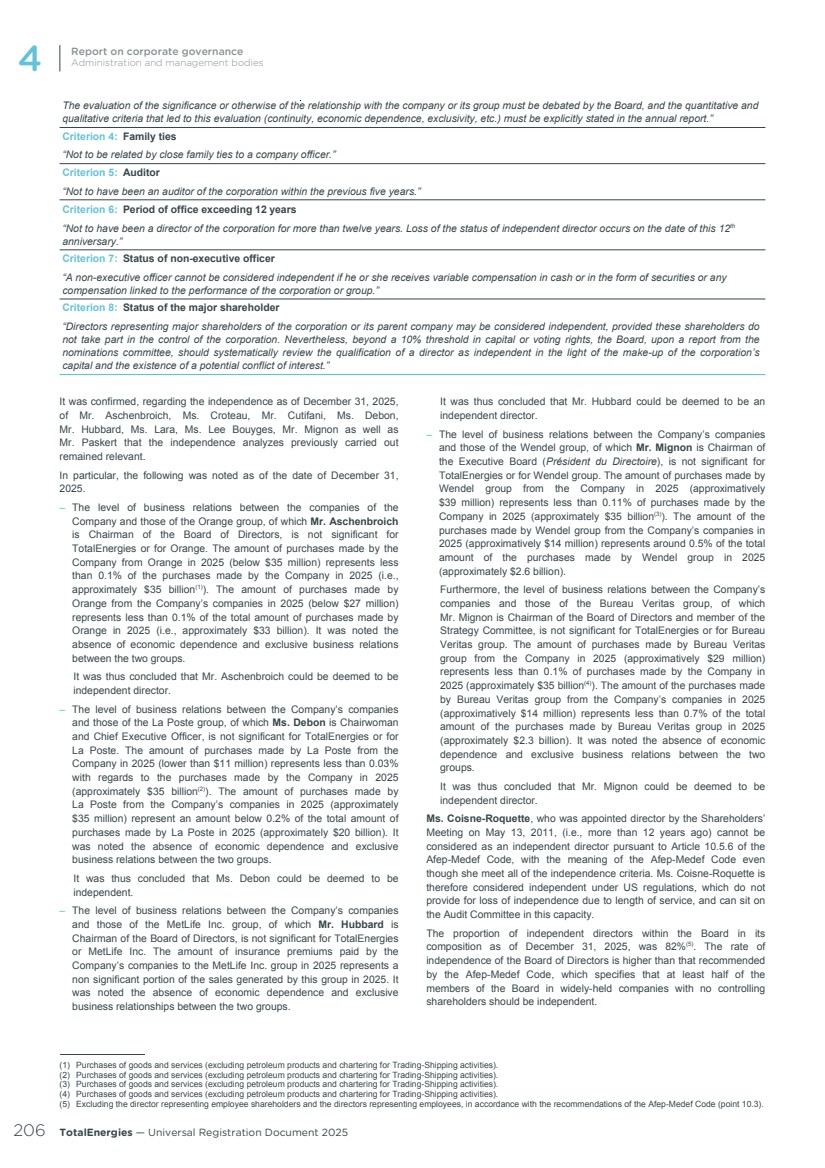
| With regard to Mr. Krupa whose appointment as director will be submitted to the Shareholders’ Meeting on May 29, 2026, the level of business relations between the Company’s companies and those of the Société Générale group, of which Mr. Krupa is Chief Executive Officer and director, is not significant for TotalEnergies or for Société Générale. It represents a non‑significant share of the overall activity of Société Générale (below 0.2% of the net banking income(1) of this bank) and a non‑significant share of the total amount of external financing of the Company’s activities (below 3%). It was noted the absence of economic dependence and exclusive business relations between the two groups. It was thus concluded that Mr. Krupa could be deemed to be independent director. Summary of the independence of the members of the Board of Directors Appendix 3 of the AFEP-MEDEF Code – Independence of directors As of December 31, 2025 Criteria(a) Criterion 1: Employee corporate officer within the past 5 years n/a n/a n/a Criterion 2: Cross-directorships n/a n/a n/a Criterion 3: Significant business relationships n/a n/a n/a Criterion 4: Family ties n/a n/a n/a Criterion 5: Auditor n/a n/a n/a Criterion 6: Period of office exceeding 12 years n/a n/a n/a Criterion 7: Status of non-executive officer n/a n/a n/a Criterion 8: Status of the major shareholder n/a n/a Compliance with the independence criteria of the AFEP-MEDEF Code n/a(d) n/a(d) n/a(d) (a) In this table, signifies that a criterion for independence is satisfied and signifies that a criterion for independence is not satisfied. (b) Director representing employee shareholders. (c) Director representing employees. (d) Excluding the director representing employee shareholders and the directors representing employees, in accordance with the recommendations of the AFEP-MEDEF Code (point 10.3). 4.1.1.5 Diversity policy of the Board of Directors (Article L. 22-10-10 of the French Commercial Code) The Board of Directors places a great deal of importance on its composition and the composition of its Committees. In particular, it draws on the work of the Governance and Ethics Committee, which reviews annually and proposes, as circumstances may require, desirable changes to the composition of the Board of Directors and Committees based on TotalEnergies’ strategy. The Governance and Ethics Committee conducts its work within the framework of a formal procedure so as to ensure in particular that the directors’ areas of expertise are complementary and their backgrounds are diverse, to maintain an overall rate of independent members that is appropriate to the TotalEnergies’ governance structure and shareholder base, to allow for a balanced representation of women and men on the Board, and to promote an appropriate representation of directors of different nationalities. These principles underpin the selection process for directors. As part of an effort that began several years ago, the composition of the Board of Directors has changed significantly since 2010 to achieve better balance between men and women and an openness to more international profiles. Based on its composition as of March 18, 2026, the 13 members of the Board of Directors include 7 male directors and 6 female directors, with 5 nationalities represented. The proportion of women on the Board was 54.5%. The threshold of 40% of directors of each sex required by Articles L. 225-18-1 and L. 22-10-3 of the French Commercial Code was reached. (1) 2025 net banking income. Patrick Pouyanné Jacques Aschenbroich Marie-Christine Coisne-Roquette Lise Croteau Mark Cutifani Marie-Ange Debon Valérie Della Puppa-Tibi (b) Romain Garcia-Ivaldi (c) Glenn Hubbard Anelise Lara Helen Lee Bouygues Laurent Mignon Dierk Paskert Angel Pobo (c) Report on corporate governance Administration and management bodies 4 TotalEnergies — Universal Registration Document 2025 207 |
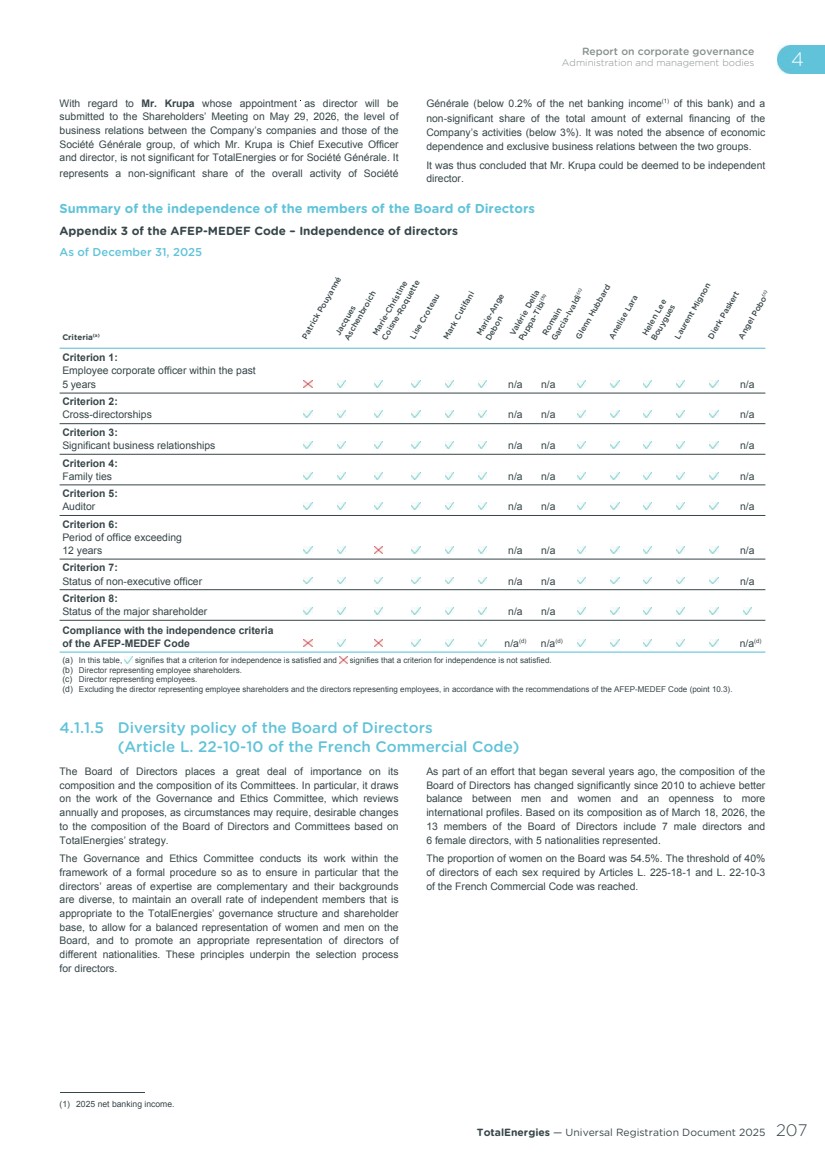
| Competence of the directors Corporate management 9 69% International 9 69% Finance, accounting, economics 11 85% Risk management 7 54% Governance 11 85% Climate - sustainable development 11 85% Industry 10 77% Energy 9 69% Public affairs, geopolitics 8 62% Focus on the competence of directors in sustainability, in particular in climate matters Patrick Pouyanné In environmental matters, Patrick Pouyanné held the positions of Inspector of installations classified for environmental protection and Head of the regional industrial environment department of Nord Pas de Calais (1989-1992). He was a member of the High Council for Classified Facilities (1990-1993). Patrick Pouyanné has been involved in climate issues since the 1990s when he was in the French administration. Thus, he followed the preparation of the COP1 in Berlin in 1995 when he was technical advisor in charge of environmental issues in the French Prime Minister’s office. Since his appointment at the head of the Company at the end of 2014, Patrick Pouyanné has committed TotalEnergies to a major energy transition with determination and consistency, more rapidly and resolutely than his peers. His roadmap is to drive forward the energy transition while creating value for the Company’s shareholders, with a dual challenge for TotalEnergies: to supply more energy with less emissions. It gives TotalEnergies with a new ambition in terms of sustainable development and the energy transition. From 2021 to 2024, he proposed that the Board of Directors submit this ambition to the Annual Shareholders’ Meeting for approval. TotalEnergies thus submitted its ambition in terms of sustainable development and energy transition to shareholders for an advisory opinion for four consecutive years. The 2025 Annual Shareholders’ Meeting discussed, as part of a formal agenda item, the Sustainability & Climate Report 2025, which reports on the progress made in implementing the Company’s ambitions in terms of sustainable development and energy transition. As Chairman of the Board of Directors and Chairman of the Strategy & CSR Committee, Patrick Pouyanné takes the initiative of organizing strategic seminars for directors on climate-related issues, with contributions from recognized leaders and experts. In October 2020, Ms. Christina Figueres spoke at a seminar on “Climate issues and the impact on energy demand: implications for the Company’s strategy”. In October 2021, Mr. Fatih Birol, Executive Director of the International Energy Agency, spoke on energy and climate issues. In October 2022, Mr. Larry Fink, Chairman & CEO of BlackRock, spoke at the strategy seminar on the following topics: energy markets - geopolitics; new energies in mobility by 2030 (road, marine and aviation); integrated electricity business model. At the September 2023 strategy seminar, Patrick Pouyanné invited Mr Dan Yergin, Vice President of S&P Global, to discuss the challenges of energy transition in the United States and worldwide. The strategy seminar also provided an opportunity to examine Integrated Power’s profitability drivers, as well as the state of hydrogen technologies and cost assessments. During the strategy seminar in September 2024 a focus was made on Integrated Power’s business model, in particular the integration of gas-electricity and renewables-flexible assets. In September 2025, Valérie Baudson, CEO in Amundi, spoke at the strategic seminar on the trends in the responsible investment market. Furthermore, the strategy seminar related to examining the Integrated Power strategy in various markets: gas-electricty integration, renewable-flexible asset integration, which assets for which markets, with a focus on the place of offshore wind in TotalEnergies’ mix. In addition to the energy transition, Patrick Pouyanné’s responsibilities at TotalEnergies have given him extensive experience of the sustainability issues facing the Company. Patrick Pouyanné also brings his strategic vision on the major global challenges of sustainable development, participating in numerous international forums such as the World Economic Forum and the United Nations Global Compact. At COP28 at the end of 2023, more than 50 oil and gas companies signed the OGDC (Oil & Gas Decarbonization Charter), committing them to reducing emissions from their operations and, in particular, aiming for near-zero upstream methane emissions by 2030. Under the leadership of Patrick Pouyanné, TotalEnergies has actively supported the success of OGDC. The OGDC now represents 40% of the global oil production and published its second report at COP30. Patrick Pouyanné, co-champion of the OGDC, reaffirmed TotalEnergies’ commitment to helping the industry move forward eliminating routine flaring and striving for near-zero methane emissions by 2030. Jacques Aschenbroich The automotive industry, and mobility in general, are particularly concerned by the challenge of decarbonization, which requires massive investments in technologies and products. At the head of Valeo since 2009 until 2022, Jacques Aschenbroich has implemented a strategic plan aimed at ensuring the group’s growth through the development of technologies to reduce CO2 emissions. As early as 2010, he put the reduction of CO2 at the center of the strategy. In 2015, Valeo signed the Climate Manifesto, through which major companies affirm their driving role and leadership in favor of a more sustainable world. In 2021, Valeo presented its commitment to carbon neutrality by 2050 (with an intermediary target to reduce by 45% the carbon footprint by 2030) and joined the “Business Ambition for 1.5 °C” campaign, bringing together companies committed to carbon neutrality by 2050 using the SBTi (Science-Based Targets initiative) framework. Patrick Pouyanné Jacques Aschenbroich Marie-Christine Coisne-Roquette Lise Croteau Marie-Ange Debon Valérie Della Puppa-Tibi Romain Garcia-Ivaldi Glenn Hubbard Anelise Lara Helen Lee Bouygues Laurent Mignon Dierk Paskert Angel Pobo Total Total (%) 4 Report on corporate governance Administration and management bodies 208 TotalEnergies — Universal Registration Document 2025 |
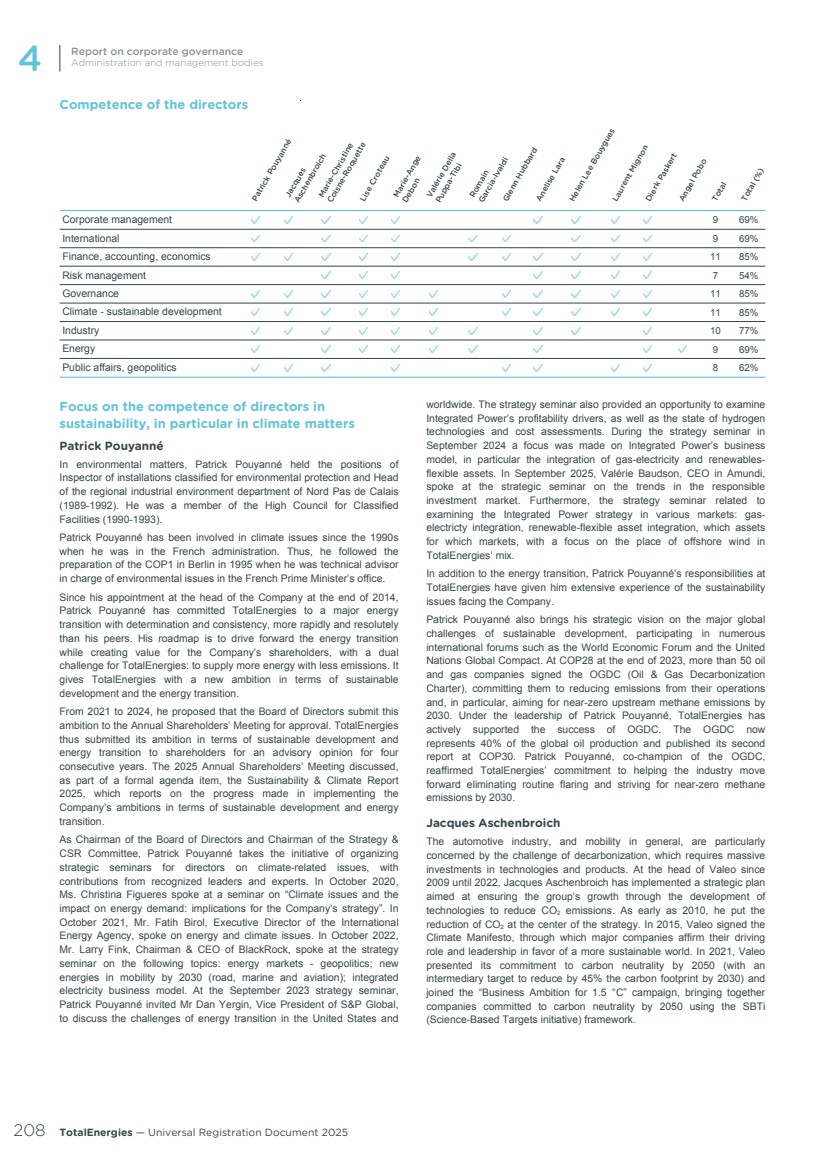
| Through his positions at Valeo and then Orange, Jacques Aschenbroich has developed a significant knowledge of the issues surrounding artificial intelligence, both technological (creation in 2017 of Valeo.ai, the world’s first research center dedicated to artificial intelligence and deep learning in automotive applications) and ethical (launch at the end of 2022 of Positive AI by Orange France and three other major partner companies, numerous works since 2023 on the responsibility and ethics of data and artificial intelligence). Jacques Aschenbroich brings to the Board of Directors of TotalEnergies his experience as the head of an industrial, international and technological group that is exposed to climate issues. Marie-Christine Coisne-Roquette As Chairwoman of Sonepar and permanent representative of its animating holding, Marie-Christine Coisne-Roquette is driving the strategy of the Sonepar group, the world leader in the distribution of electrical equipment, solutions and related services to professionals. Marie-Christine Coisne-Roquette’s experience as a Sonepar corporate officer for over 25 years and her other mandates have led her to develop a solid understanding of sustainability issues. She thus engaged Sonepar in a global Sustainable Development approach by adhering to the United Nations Global Compact and Science Based Targets and by joining the Medef’s “Ambition 4 Climate” initiative. Sonepar implements a sustainable development approach in close partnership with its stakeholders and has launched the “Energy Transition Academy”, an online training program for its 45,000 employees and customers to help them reduce their emissions and become actors of change. The energy transition is at the heart of the family-owned group’s activity, both through the adoption of a trajectory to reduce its carbon footprint and through the promotion of a “green offer” that provides its customers with clean energy solutions and the development of circular, renewable and eco-efficient products and services. In the social and societal sphere, Marie-Christine Coisne-Roquette oversaw the implementation of Sonepar’s diversity and inclusion policies and value-sharing programs by introducing an annual worldwide plan for allocating free shares to all Sonepar employees. In the sphere of corporate governance, Marie-Christine Coisne-Roquette has ensured that a more concrete version of the code of conduct on compliance, ethics and anti-corruption issues has been distributed to all Sonepar employees and that audit and due diligence procedures concerning human rights have been extended. As a Lead Independent Director on the Board of Directors of TotalEnergies until May 2023, Marie-Christine Coisne-Roquette participated in numerous discussions and roadshows with shareholders and investors on climate change and energy transition issues. Lise Croteau After serving as Executive Vice President and Chief Financial Officer of Hydro-Québec, one of the world’s largest producers of hydroelectricity, Ms. Lise Croteau now uses her skills and knowledge of renewables and of the management of risks, in particular related to climate change, in the service of the companies in which she sits as an independent director. Since 2018, she has been a director of Boralex, the Canadian leader in renewable energy, and since June 2019, a director of Québecor inc. She has followed various training courses in sustainability, particularly on reporting and materiality issues. Marie-Ange Debon Marie-Ange Debon is Chairwoman and Chief Executive Officer of the La Poste Group, her company places the challenges of ecological and energy transition at the heart of its business model. Reducing its carbon emissions is a crucial issue for La Poste, given its activities related to transport‑logistics and banking‑insurance; the Group notably has more than 35,000 electric vehicles in service across Europe. As the only French company simultaneously certified by SBTi in the transport, logistics and banking sectors for its decarbonization trajectory, it has defined its first medium‑term climate plan, recognized with a CDP “A List” rating for the second year. Previously, Marie-Ange Debon was Executive Chair of the Public Transport group Keolis which plays an important role in the fight against climate change and which leads a proactive policy to reduce its emissions, she also held positions of responsibility for 11 years in the SUEZ Environnement group, major global player in waste recycling and water reuse technologies, which are key to promoting sustainable development. Marie-Ange Debon brings to the Board her experience as a general manager in industrial and service companies, in France and internationally. Valérie Della Puppa-Tibi An employee of TotalEnergies since 1989, Valérie Della Puppa‑Tibi has, over the course of her various positions and her mandates as an employee representative, developed a strong awareness of issues related to the energy transition. Based on this experience, she now sits on the TotalEnergies European Committee, a social body where the challenges of the Company’s transformation and the changes within the energy sector are discussed. Thanks to her knowledge of the Company and her field experience, Valérie Della Puppa‑Tibi contributes to the Board of Directors’ discussions within the framework of TotalEnergies’ transformation strategy. She has participated in several internal training courses, including “Climate at the Heart of Total’s Strategy” and “Visa for TotalEnergies,” demonstrating her commitment to integrating climate and societal issues. Furthermore, Valérie Della Puppa‑Tibi holds the Social, Economic and Environmental Culture Certificate from Sciences Po, as part of which she took part in the module “Social Dialogue in the Anthropocene.” Romain Garcia-Ivaldi An engineer and economist, graduate of ENSTA Paris and IFP School, Romain Garcia-Ivaldi is asset manager of offshore wind projects (inc. Seagreen in United Kingdom) at TotalEnergies Renewables. His current position gives him a deep knowledge of the challenges related to the development of renewable energies as well as the Integrated Power business model by the Company. Through his experience within the Company, he contributes as a director representing employees, in a concrete way to the Board of Directors’ discussions on the challenges of the transformation of the industry and energy efficiency as well as to issues related to extra-financial reporting within the Audit Committee. Romain Garcia-Ivaldi has taken part in numerous training sessions offered by the Company on the challenges of the energy transition. He also holds a certificate for company directors from IFA-Sciences Po. He also completed the “Climate Change: Economics and Governance” and “Global Macroeconomic Challenges” training programs at the London School of Economics. Romain Garcia-Ivaldi has actively contributed to social dialogue within the Company, particularly in relation to employee shareholding, to which he is particularly attached. Glenn Hubbard Glenn Hubbard is Professor of Finance and Economics and Dean Emeritus of the Columbia Business School at Columbia University, holding the Russell L. Carson Chair in Finance and Economics. He has published numerous scientific articles on economics and finance. His work covers a variety of areas, including energy economics and taxation, and in particular the issue of CO2 pricing, as well as the role of companies in climate change mitigation and how they address their exposure to climate risk. Glenn Hubbard is co-chair of the American committee on capital markets regulation and was the co-chair of the Study Group on Corporate Boards. Report on corporate governance Administration and management bodies 4 TotalEnergies — Universal Registration Document 2025 209 |
| Glenn Hubbard is also a member of the Board of Directors of Resources for the Future, a non-profit organization dedicated to independent economic research in the areas of the environment, natural resources and energy. Glenn Hubbard is also a director of BlackRock Fixed Income Funds and the Chairman of MetLife, a US-based energy transition insurer that has set environmental goals for 2030 to reduce the environmental impact of its global operations and supply chain. MetLife is a founding member of the Climate Leadership Council, supporting carbon pricing. Anelise Lara As Chief Executive of Petrobras Refining, Gas and Energy, a Brazilian oil & gas company, until January 2021, Anelise Lara actively contributed to the transformation strategy of this company towards energy transition. She also helped this company to reduce its GHG emissions in its operations, while reducing energy consumption and maximizing the use of renewable energies at operational sites. In addition, Anelise Lara created “Biorefinery 2030”, a program aimed at the production of renewable fuels. Anelise Lara has also taken part in numerous seminars in Brazil and abroad on climate issues and the energy transition. She also holds the ESG Certificate issued by the Competent Board learning platform, whose content, if it is particularly focused on climate challenges and the energy transition, also covers various sustainability issues such as working conditions across the entire value chain and the fight against corruption. In addition, Ms. Lara volunteers for the cause of diversity and inclusion. She is a member of the WILL (Women Leadership in Latin America) board and has already mentored many young women who want to work in the energy sector. Helen Lee Bouygues With over 25 years of experience in the strategic transformation of international companies, Helen Lee Bouygues has developed a solid and operational knowledge of sustainability issues, particularly in sectors related to the energy transition. Lead Independent Director of Neoen SA until March 2025, as one of the leading independent producers of exclusively renewable energy, she contributed to monitoring the strategy of a major player in wind, solar and storage. Moreover, she served on the Audit Committee and the Governance and CSR Committee of Neoen SA, thus actively participating in the group’s CSR strategy, monitoring its policy on social and environmental risk management and developing its strategic orientations in terms of social and environmental responsibility. Her career also includes responsibilities within companies in the energy and resources sector, such as CGG (now Viridien SA), in which Helen Lee Bouygues served on the Board of Directors and specialized committees (member of the Audit Committee and Chair of the Investment Committee), increasing her exposure to the environmental issues specific to these activities. Indeed, Viridien is a world leader in cutting-edge technologies, digital technology and Earth data. Today, as an Operating Partner, she also coordinates sustainability issues for companies in Ardian Buyout’s portfolio. Laurent Mignon Laurent Mignon is Chairman of the Executive Board (Président du Directoire) of Wendel, whose investment policy has consistently incorporated ESG issues for many years, focusing on 5 key areas: the reliability of non-financial information; governance and business ethics; health and safety; mitigation and adaptation to climate change; and gender parity. Wendel’s ESG performance is recognized by leading rating agencies, including S&P Global (69/100), MSCI (AA), and CDP (B). Furthermore, Laurent Mignon is Chairman of the Board of Directors of Bureau Veritas which has placed CSR at the heart of its strategic plan LEAP 28. The Group’s mission is to support its clients in reducing their risks in terms of environment, social responsibility, safety, and quality. Bureau Veritas’s ESG performance is excellent, as evidenced by its ratings from leading extra-financial rating agencies: S&P Global (84/100, ranked number one in professional services), MSCI (AA), and CDP (A). Previously, Laurent Mignon was Chairman of the Executive Board of the banking group BPCE, which was highly committed to CSR policy and particularly to the energy transition, and he served as Chairman of the Climate and Biodiversity Commission of the Fédération Bancaire Française (French Banking Federation). Laurent is also a director of the Institut de la Finance Durable. Dierk Paskert Having served in senior executive roles in Chemicals, Transport & Logistics as well as Energy, Dierk Paskert has been exposed to climate matters related to industrial activities throughout his career, starting in the 90ies. He fundamentally believes that using the inexhaustible natural sources of energy to a much larger extent compared to the past will make the biggest contribution to achieve ambitious climate goals as stated in the Paris Agreement. In particular he was responsible to form the first Renewable Energy strategy for E.ON in 2007. As CEO of Encavis, a producer of electricity from renewable energy sources, he was first to boost bilateral off take agreements between energy producer and industry without using any support mechanisms granted by governments. Furthermore, Dierk Paskert is an avid investor in new technologies with positive impact on climate change, including E-Mobility, Renewable Energy Production and Battery Storage. It’s the combination of new technologies and the usage of sustainable, natural resources catching his interest. Dierk Paskert served in leadership positions in various companies and sectors exposing him to challenges in Governance, Business Conduct, Ethics & Anti-Corruption on a global scale. In particular he received explicit trainings on this subject throughout his career, latest as Member of the Administrative Board of KAEFER SE&Co, a leading global industrial service company, in 2024. Angel Pobo Angel Pobo joined the Company in 1989. In October 2020, he was appointed by the SE Works Council to sit on the Company’s Board of Directors as the director representing employees, and became a member of the Strategy & CSR Committee in 2021. He uses his knowledge of the Company to bring a social dimension to the Board of Directors and the Strategy & CSR Committee, particularly at a time when the Company is taking a major turn in its strategy and initiating an in-depth transformation. Angel Pobo has taken part in numerous training sessions offered by the Company on the challenges of the energy transition. Before he became director representing employees, Angel Pobo has been particularly involved within his union organization in social dialogue linked to the transformation of the Company. As mayor of a municipality of more than 3,000 inhabitants, Angel Pobo was confronted with the management of different sustainable development issues, particularly in terms of water pollution management and sustainable energy. 4.1.1.6 Training of directors and knowledge of the Company A training program led by members of the Executive Committee, primarily aimed at newcomers but open to all directors in 2025 and will continue in 2026. This program focuses in particular on technological and digital ambition as well as on sustainability & climate, and human resources policies. 4 Report on corporate governance Administration and management bodies 210 TotalEnergies — Universal Registration Document 2025 |
| In 2024, the members of the Audit Committee all took part in an external training course dedicated to CSRD issues, which most of the directors also attended. Directors declared they followed training in the detection and prevention of corruption. Furthermore, directors may ask to receive training in the specificities of the Company, its businesses and its business segment, as well as any training that may help them perform their duties as directors. An ongoing climate training program, to which directors have access to, includes various modules on the following topics “Energy, Climate Change and Environmental Risks”, “Solutions for a low-carbon future”, “The low-carbon energy transition” and “Climate Change: Financial risks and opportunities”. In addition, directors representing employees or employee shareholders may submit requests for training under the specific rules applicable to them, as defined by the Board of Directors. – The directors representing employees receive additionally in-house training time at the Corporation and/or economics training offered by an outside body chosen by the director, after the Secretary to the Board has accepted the body and the training program. This training time, which was initially set at 20 hours per year, was increased to 60 hours per year by decision of the Board of Directors at its meeting on July 26, 2017, a decision the Board confirmed at its meeting on July 29, 2020, pursuant to Article L. 225-30-2 of the French Commercial Code. – The director representing employee shareholders may, at his or her request, be given training time set at 40 hours per year. Training may be undertaken within the Corporation or the Company, and/or provided by an external body chosen by the director, once the body and program have been accepted by the Secretary to the Board, in line with the conditions set out in the regulations. Pursuant to Article R. 225-34-3 of the French Commercial Code, and upon a proposal made by the Governance and Ethics Committee, the Board of Directors decided that the training should enable the directors representing employees and the directors representing employee shareholders to acquire and refine the knowledge and techniques needed for the performance of their duties, and that the content of the training should principally address the role and operations of the Board of Directors, the rights and obligations of directors and their liability, and the organization and business activities of the Corporation and more generally the Company. It includes a climate component in accordance with what the Board decided to propose to all of its members at its meeting held on October 27, 2021. The training may be provided at an outside training body or within the Corporation itself. The Secretary to the Board, with the consent of the Chairman of the Board of Directors, is responsible for the procedures by which the training program determined by the Board of Directors is implemented. Directors are invited to Company’s site visits. These site visits by the directors are opportunities to meet with the Company’s employees, partners and local leading figures in the energy sector. Site visits contribute in a very concrete way to the training of directors and allow them to deepen their knowledge of the specificities of the Company, its challenges in particular regarding sustainability, its businesses – including new businesses – and its teams. They are often the occasion for thematic presentations. In this context, site visits, by groups of 4 to 5 directors accompanied by a member of the Executive Committee, were organized in 2025 in Nigeria (offshore and onshore EP, solar), in Scotland (Seagreen, offshore EP), in Antwerp (Refining), in Rouen and Le Havre (mobility, FSRU, blending). Additionally, the Lead Independent Director went to the ACC firm in Douvrin. Finally, Audit Committee members visited the TotalEnergies Electricité et Gaz France offices in Paris, where they were presented with the Retail Power & Gas activity. Site visits are planned for 2026. At its meeting on March 19, 2025, the Strategy & CSR Committee examined the Company’s digital ambitions and the opportunities offered by artificial intelligence in the Company’s various businesses, in support of its strategy. The directors also have regular contact with Company management, either with members of the Executive Committee at Board meetings or operational managers during visits to the Company’s sites. These interactions help the directors better understand TotalEnergies’ activities in a practical way. 4.1.2 Functioning of the Board of Directors 9 meetings of the Board of Directors in 2025 99.2% Directors’ average attendance rate at Board meetings in 2025 1 executive session chaired by the Lead Independent Director in 2025 4.1.2.1 Working procedures of the Board of Directors The working procedures of the Board of Directors are set out in its Rules of Procedure, which specify the mission of the Board of Directors and the rules related to the organization of its work. The Board’s Rules of Procedure also specify the obligations of each director, as well as the role and powers of the Chairman and the Chief Executive Officer. A member of the Central Social and Economic Committee attends the Board meetings in an advisory capacity, pursuant to Article L. 2312-75 of the French Labor Code. The Rules of Procedure of the Board of Directors are reviewed on a regular basis in order to adapt them to changes in governance rules and practices. In 2014, changes were made to include, in particular, new provisions relating to information of the Board of Directors in the event of new directorships being assumed by the directors or changes in existing directorships, together with a reminder of the obligations of confidentiality inherent to the work of the Board. In December 2015, changes were made to provide for the appointment of a Lead Independent Director in the event of the combination of the functions of Chairman of the Board and Chief Executive Officer and to define his or her duties. In July 2018, changes were made in response to the new demands pertaining to social and environmental responsibility further to the revision of the AFEP-MEDEF Code in June 2018. In July 2020, the Rules of Procedure governing the Board of Directors were amended further to reflect the Corporation’s conversion into a European company and the changes introduced by the PACTE Law. In July 2021, it was again amended to incorporate the change of name of the Corporation, decided at the Shareholders’ Meeting on May 28, 2021. The text of the latest unabridged version of the Rules of Procedure of the Board of Directors, as approved by the Board of Directors at its meeting on July 28, 2021, is provided below. It is also available on the Corporation’s website under “Our Company/Our identity/Our governance.” Report on corporate governance Administration and management bodies 4 TotalEnergies — Universal Registration Document 2025 211 |
| Rules of procedure of the Board of Directors The Board of Directors of TotalEnergies SE(1) has approved the following rules of procedure. 1. Role of the Board of Directors The Board of Directors is a collegial body that determines the course of the Corporation’s business and oversees its implementation, in accordance with its corporate interest by taking into account the social and environmental challenges of its activity. With the exception of the powers and authority expressly reserved for shareholders and within the limits of the corporate purpose, the Board may address any issue related to the Corporation’s operation and make any decision concerning the matters falling within its purview. Within this framework, the Board’s duties and responsibilities include, but are not limited to, the following: – appointing the executive directors(2) and supervising the handling of their responsibilities; – striving to promote creation of long-term value by the Company; – defining the Corporation’s strategic orientations and, more generally, that of the Company; – regularly reviewing, in relation with such strategic orientations, opportunities and risks such as financial, legal, operational, social and environmental risks as well as measures taken as a result; – being informed of market developments, the competitive environment and the main challenges facing the Company, including with regard to social and environmental responsibility; – approving investments or divestments being considered by the Company that exceed 3% of shareholders’ equity as well as any significant transaction outside the announced strategy of the Company; – reviewing information on significant events related to the Corporation’s operations, in particular for investments and divestments involving amounts exceeding 1% of shareholders’ equity; – conducting any audits and investigations it deems appropriate. In particular, the Board, with the assistance of the Committees it has established, ensures that: – authority has been properly defined and that the various corporate bodies of the Corporation make proper use of their powers and responsibilities, – no individual is authorized to commit to pay or to make payments, on behalf of the Corporation, without proper supervision and control, – a system for preventing and detecting corruption and influence peddling is in place, – a non-discrimination and diversity policy within the Corporation and its Company exists and is implemented, – the internal control function operates properly and the statutory auditors are able to perform their mission satisfactorily, and – the Committees duly perform their responsibilities; – approving the internal assessment procedure regarding ordinary agreements finalized under normal conditions as well as “regulated” agreements; – ensuring the quality of the information provided to shareholders and financial markets through the financial accounts that it closes and the reports that it publishes, as well as when major transactions are completed; – convening and setting the agenda for Shareholders’ Meetings or meetings of bond holders; – ensuring that its composition as well as that of the Committees it establishes are balanced in terms of diversity (nationality, age, men/women, skills and professional experience); – preparing on an annual basis, according to criteria set by the Code of corporate governance to which the Corporation refers, the list of directors it deems to be independent amongst the directors other than the director representing employee shareholders and the director or directors representing employees who are not counted for the purpose of determining the proportion of independent directors within the Board of Directors as well as within its Committees; and – appointing a Lead Independent Director under the conditions set out in article 7, when the Chairman of the Board of Directors is also the Chief Executive Officer pursuant to a decision by the Board of Directors. 2. Obligations of the Directors of TotalEnergies SE Before accepting a directorship, all candidates receive a copy of the Corporation’s Articles of Association and these Rules of Procedure. They must ensure that they have broad knowledge of the general and particular obligations related to their duty, especially the laws and regulations governing directorships in European companies (Societas Europaea) registered in France, whose shares are listed in one or several regulated markets. They must also ensure that they are familiar with the guidelines set out in the Corporate Governance Code to which the Corporation refers. Accepting a directorship creates an obligation to comply with applicable regulations relating in particular to the functioning of the Board of Directors, and with the ethical rules of professional conduct for directors as described in the Corporate Governance Code to which the Corporation refers. It also creates an obligation to comply with these rules of procedure and to uphold the Company’s values as described in its Code of Conduct. When directors participate in and vote at meetings of the Board of Directors, they are required to represent all of the Corporation’s shareholders and to act in the interest of the Corporation as a whole. 2.1. Independence of judgment Directors undertake to maintain, in all circumstances, the independence of their analysis, judgment, decision-making and actions as well as not to be unduly influenced, directly or indirectly, by other directors, particular groups of shareholders, creditors, suppliers or, more generally, any third party. 2.2. Other directorships or functions Directors must keep the Board of Directors informed of any position they hold on the management team, board of directors or supervisory board of any other company, whether French or foreign, listed or unlisted. This includes any positions as a non-voting member (censeur) of a board. To this end, directors expressly undertake to promptly notify the Chairman of the Board of Directors, and the Lead Independent Director if one has been appointed, of any changes to the positions held, for any reason, whether appointment, resignation, termination or non-renewal. 2.3. Participation in the Board’s work Directors undertake to devote the amount of time required to duly consider the information they are given and otherwise prepare for meetings of the Board of Directors and of the Committees of the Board of Directors on which they sit. They may request from the executive directors any additional information they deem necessary or useful to their duties. If they consider it necessary, they may request training on the Company’s specificities, businesses and industry sector, its challenges in terms of social and environmental responsibility as well as any other training that may be of use to the effective exercise of their duties as directors. (1) TotalEnergies SE is referred to in these rules of procedure as the “Corporation” and collectively with all its direct and indirect subsidiaries as the “Company”. (2) The term “executive director” refers to the Chairman and Chief Executive Officer, if the Chairman of the Board of Directors is also responsible for the management of the Corporation; the Chairman of the Board of Directors and the Chief Executive Officer, if the two roles are carried out separately; and, where applicable, any Deputy Chief Executive Officers or Chief Operating Officers, depending on the organisational structure adopted by the Board of Directors. 4 Report on corporate governance Administration and management bodies 212 TotalEnergies — Universal Registration Document 2025 |
| Unless unable, in which case the Chairman of the Board shall be provided advance notice, directors are to attend all meetings of the Board of Directors, meetings of Committees of the Board of Directors on which they serve and Shareholders’ Meetings. The Chairman of the Board ensures that directors receive all relevant information concerning the Corporation, including that of a negative nature, particularly analyst reports, press releases and the most important media articles. 2.4. Confidentiality Directors and any other person who attends all or part of any meeting of the Board of Directors or its Committees are under the strict obligation not to disclose any details of the proceedings. All documents reviewed at meetings of the Board of Directors, as well as information conveyed prior to or during the meetings, are strictly confidential. With respect to all non-public information acquired during the exercise of their functions, directors are bound, even after their functions have ceased, by professional secrecy not to divulge such information to outside parties of the Corporation and to employees of the Company. This obligation goes beyond the mere duty of discretion provided for by law. Directors must not use confidential information obtained prior to or during meetings for their own personal benefit or for the benefit of anyone else, for whatever reason. They must take all necessary steps to ensure that the information remains confidential. Confidentiality and privacy are lifted when such information is made publicly available by the Corporation. 2.5. Duty of loyalty Directors must not take advantage of their office or duties to gain, for themselves or a third party, any monetary or non-monetary benefit. They must notify the Chairman of the Board of Directors and the Lead Independent Director, if one has been appointed, of any existing or potential conflict of interest with the Corporation or any subsidiary of the Company, and they must refrain from participating in the vote relating to the corresponding resolution as well as from participating in any debates preceding such vote. Directors must inform the Board of Directors of their participation in any transaction that directly involves the Corporation, or any subsidiary of the Company, before such transaction is finalized. Directors must not assume personal responsibilities in companies or businesses having activities in competition with those of the Corporation or any subsidiary of the Company without first having informed the Board of Directors. Directors undertake not to seek or accept from the Corporation, or from companies related to the Corporation, directly or indirectly, any advantages liable to be considered as being of a nature that may compromise their independence. 2.6. Duty of expression Directors undertake to clearly express their opposition if they deem a decision being considered by the Board of Directors is contrary to the Corporation’s corporate interest and they must endeavor to convince the Board of Directors of the pertinence of their position. 2.7. Transactions in the Corporation’s securities and stock exchange rules While in office, directors are required to hold the minimum number of registered shares of the Corporation as set by the Articles of Association. Generally speaking, directors must act with the highest degree of prudence and vigilance when completing any personal transaction involving the financial instruments of the Corporation, its subsidiaries or affiliates that are listed or that issue listed financial instruments. To that end, directors must comply with the following requirements: 1. Any shares or ADRs of the Corporation or its listed subsidiaries are to be held in registered form, either with the Corporation or its agent, or as administered registered shares with a French broker (or North American broker for ADRs), whose contact details are communicated by the director to the Secretary of the Board of Directors. 2. Directors shall refrain from directly or indirectly engaging in (or recommending engagement in) transactions involving the financial instruments (shares, ADRs or any other securities related to such financial instruments) of the Corporation or its listed subsidiaries or shareholding, or any listed financial instruments for which the director has insider information. Inside information is precise information, which has not yet been made public, relating directly or indirectly, to one or more issuers of financial instruments or to one or more financial instruments, and which, if it were made public, would be likely to have a significant effect on the prices of those financial instruments or on the price of financial instruments related to them. 3. Any transaction in the Corporation’s financial instruments (shares, ADRs or related financial instruments) is strictly prohibited during the thirty calendar days preceding the publication of its periodic results (quarterly, half-year or annual) as well as on the day of any such announcement. 4. Moreover, directors shall comply with the provisions under which performance shares may not be sold: – within thirty calendar days prior to the publication by the Corporation of a press release relating to the half-year and annual results, such publication constituting the announcement of an interim financial report or a year-end report within the meaning of the applicable regulations; – as well as in the event of knowledge of inside information within the meaning of Article 7 of Regulation (EU) No 596/2014 on market abuse, and which has not been made public. 5. Directors are prohibited from carrying out transactions on any financial instruments related to the Corporation’s share (Paris option market (MONEP), warrants, exchangeable bonds, etc.) and from buying on margin or short selling such financial instruments. 6. Directors are also prohibited from hedging the shares of the Corporation and any financial instruments related to them, and in particular: – Corporation shares that they hold; and, where applicable: – Corporation shares subscription or purchase options; – rights to Corporation shares that may be awarded free of charge; and – Corporation shares obtained from the exercise of options or definitively granted. 7. Directors must make all necessary arrangements to declare, pursuant to the form and timeframe provided by applicable law, to the French securities regulator (Autorité des marchés financiers) and to the Financial Conduct Authority, as well as to the Secretary of the Board of Directors, any transaction involving the Corporation’s securities conducted by themselves or by any other person to whom they are closely related. 3. Functioning of the Board of Directors 3.1. Board meetings The Board of Directors meets whenever circumstances require and at least every three months. Prior to each Board meeting, the directors receive the agenda and, whenever possible, all other materials necessary to consider for the session. Report on corporate governance Administration and management bodies 4 TotalEnergies — Universal Registration Document 2025 213 |
| Directors may be represented by another director at a meeting of the Board, provided that no director holds more than one proxy at any single meeting. Whenever authorized by law, directors are considered present for quorum and majority purposes who attend Board meetings through video conferencing or other audiovisual means that are compliant with the technical requirements set by applicable regulations. 3.2. Directors’ compensation Within the limit of a ceiling set by the Shareholders’ Meeting, the Board of Directors determines the directors’ compensation based on a fixed portion as well as a variable portion that takes into account each director’s actual participation in the work of the Board of Directors and its Committees together with, if applicable, the exercise of the duties of the Lead Independent Director. The Chief Executive Officer or, if the functions are combined, the Chairman and Chief Executive Officer, does not receive any compensation for his participation in the work of the Board and its Committees. 3.3. Secretary of the Board of Directors The Board of Directors, based on the recommendation of its Chairman, appoints a Secretary of the Board who assists the Chairman in organizing the Board’s activities, and particularly in preparing the annual work program and the schedule of Board meetings. The Secretary of the Board drafts the minutes of Board meetings, which are then submitted to the Board for approval. The minutes of the Board meetings are drafted in French and executed by the Chairman of the meeting and at least one director. If the Chairman of the meeting is unable to attend, it is executed by at least two directors. Non-binding translations of extracts from the minutes may be drawn up into another language than French. However, only the minutes in French shall prevail. The Secretary of the Board is authorized to dispatch Board meeting minutes and to certify copies and extracts of the minutes. The Secretary is responsible for all procedures pertaining to the functioning of the Board of Directors. These procedures are reviewed periodically by the Board. All Board members may ask the Secretary for information or assistance. 3.4. Evaluation of the functioning of the Board The Board evaluates its functioning at regular intervals not exceeding three years. The evaluation is carried out under the supervision of the Lead Independent Director, if one has been appointed, or under the supervision of the Governance and Ethics Committee, with the assistance of an outside consultant. The Board of Directors also conducts an annual review of its practices. 4. Role and authority of the Chairman The Chairman represents the Board of Directors and, except under exceptional circumstances, has sole authority to act and speak on behalf of the Board of Directors. The Chairman organizes and oversees the work of the Board of Directors and ensures that the corporate bodies operate effectively and in compliance with good governance principles. The Chairman coordinates the work of the Board of Directors and its Committees. The Chairman establishes the agenda for each Board meeting, including items suggested by the Chief Executive Officer. The Chairman ensures that directors receive, in a timely manner and in a clear and appropriate format, the information they need to effectively carry out their duties. In liaison with the general management, the Chairman is responsible for maintaining relations between the Board of Directors and the shareholders of the Corporation. The Chairman monitors the quality of information disclosed by the Corporation. In close cooperation with the general management, the Chairman may represent the Corporation in high-level discussions with government authorities and major partners of the Company, both at a national and international level. The Chairman is regularly informed by the Chief Executive Officer of significant events and situations relating to the Company, particularly with regard to strategy, organisation, monthly financial reporting, major investment and divestment projects and key financial transactions. The Chairman may ask the Chief Executive Officer or other senior executives of the Corporation, provided that the Chief Executive Officer is informed, to supply any information that may help the Board or its Committees to carry out their duties. The Chairman may meet with the statutory auditors in order to prepare the work of the Board of Directors and the Audit Committee. Every year, the Chairman reports to shareholders at the Shareholders’ Meeting on the Board of Directors’ work. 5. Authority of the Chief Executive Officer The Chief Executive Officer is responsible for the Corporation’s overall management. He represents the Corporation in its relationships with third parties and chairs the Executive Committee. The Chief Executive Officer is vested with the broadest powers to act on behalf of the Corporation in all circumstances, subject to the powers that are, by law, restricted to the Board of Directors and to the Annual Shareholders’ Meeting, as well as to the Corporation’s corporate governance rules and in particular these rules of procedure of the Board of Directors. The Board of Directors decides on any limitations of the powers of the Chief Executive Officer. The Chief Executive Officer is responsible for presenting the Company’s results and prospects to shareholders and the financial community on a regular basis. At each meeting of the Board of Directors, the Chief Executive Officer presents an overview of significant events of the Company. The Chief Executive Officer proposes to the Board of Directors who present it to the shareholders at the Shareholders’ Meeting, the Management Report of the Corporation as well as the consolidated Management Report. 6. Board Committees The Board of Directors approved the creation of: – an Audit Committee; – a Governance and Ethics Committee; – a Compensation Committee; and – a Strategy & CSR Committee. The roles and composition of each Committee are set forth in their respective rules of procedure, which have been approved by the Board of Directors. The Committees perform their duties under the authority and for the benefit of the Board of Directors. Each Committee reports on its activities to the Board of Directors. 7. Lead Independent Director 7.1. Appointment of the Lead Independent Director When the functions of the Chairman of the Board and Chief Executive Officer are combined, the Board of Directors appoints a Lead Independent Director, on the recommendation of the Governance and Ethics Committee, among the directors considered to be independent by the Board of Directors. The appointed Lead Independent Director holds this position while in office as director, unless otherwise decided by the Board of Directors, which may choose to terminate his duties at any time. If for any reason the director is no longer deemed to be independent, his or her position as Lead Independent Director will be terminated. The Lead Independent Director, if one is appointed, chairs the Governance and Ethics Committee. 4 Report on corporate governance Administration and management bodies 214 TotalEnergies — Universal Registration Document 2025 |
| 7.2. Duties of the Lead Independent Director The Lead Independent Director’s duties include: 1. Convening meetings of the Board of Directors – Meeting Agenda The Lead Independent Director may request that the Chairman and Chief Executive Officer call a meeting of the Board of Directors to discuss a given agenda. He may request that the Chairman and Chief Executive Officer include additional items on the agenda of any meeting of the Board of Directors. 2. Participation in the work of the Committees If not a member of the Compensation Committee, the Lead Independent Director is invited to attend meetings and participates in the work of the Compensation Committee relating to the annual review of the executive directors’ performance and recommendations regarding their compensation. 3. Acting as Chairperson of Board of Directors’ meetings When the Chairman and Chief Executive Officer is unable to attend all or part of a meeting of the Board of Directors, the Lead Independent Director chairs the meeting. In particular, he or she chairs those Board meetings the proceedings of which relate to the evaluation of the performance of the executive directors and the determination of their compensation, which take place in their absence. 4. Evaluation of the functioning of the Board of Directors The Lead Independent Director manages the evaluation process relating to the functioning of the Board of Directors and reports on this evaluation to the Board of Directors. 5. Prevention of conflicts of interest Within the Governance and Ethics Committee, the Lead Independent Director organizes the performance of due diligence in order to identify and analyze potential conflicts of interest within the Board of Directors. He informs the Chairman and Chief Executive Officer of any conflicts of interest identified as a result and reports to the Board of Directors on these activities. Pursuant to the obligation to declare conflicts of interest set out in article 2.5 of these Rules, any director affected by an existing or potential conflict of interest must inform the Chairman and Chief Executive Officer and the Lead Independent Director. 6. Monitoring of the satisfactory functioning of the Board and compliance with the Rules of Procedure The Lead Independent Director ensures compliance with the rules of the Corporate Governance Code to which TotalEnergies SE refers and with the Rules of Procedure of the Board of Directors. He or she may make any suggestions or recommendations that he deems appropriate to this end. He or she ensures that the directors are in a position to carry out their tasks under optimal conditions and that they have sufficient information to perform their duties. With the agreement of the Governance and Ethics Committee, the Lead Independent Director may hold meetings of the directors who do not hold executive or salaried positions on the Board of Directors. He reports to the Board of Directors on the conclusions of such meetings. 7. Relationships with Shareholders The Chairman and Chief Executive Officer and the Lead Independent Director are the shareholders’ dedicated contacts on issues that fall within the remit of the Board. When a shareholder approaches the Chairman and Chief Executive Officer in relation to such issues, the latter may seek the opinion of the Lead Independent Director before responding appropriately to the shareholder’s request. When the Lead Independent Director is approached by a shareholder in relation to such issues, he or she must inform the Chairman and Chief Executive Officer, providing his or her opinion, so that the Chairman and Chief Executive Officer may respond appropriately to the request. The Chairman and Chief Executive Officer must inform the Lead Independent Director of the response given. With the consent of the Chairman of the Board of Directors, the Lead Independent Director may represent the Board of Directors at meetings with the shareholders of the Corporation on matters of corporate governance. 7.3. Resources – conditions of office and activity report The Chairman and Chief Executive Officer must regularly update the Lead Independent Director on the Corporation’s activities. The Lead Independent Director has access to all of the documents and information necessary for the performance of his or her duties. The Lead Independent Director may consult the Secretary of the Board and use the latter’s services in the performance of his or her duties. Under the conditions set out in article 3.2 of these Rules and those established by the Board of Directors, the Lead Independent Director may receive additional compensation for the duties entrusted to him or her. The Lead Independent Director must report annually to the Board of Directors on the performance of his or her duties. During Annual Shareholders’ Meetings, the Chairman and Chief Executive Officer may invite the Lead Independent Director to report on his or her activities. 4.1.2.2 Activity of the Board of Directors in 2025 Directors are in principle summoned to Board meetings by letter sent the week preceding the meetings. Whenever possible, documents to be considered for decisions to be made at Board meetings are sent with the notice of meetings. The minutes of the previous meeting are expressly approved at the following Board meeting. In 2025, the Board of Directors met 9 times. The overall attendance rate for the directors was 99.2%. The Audit Committee met 7 times, with an attendance rate of 100%; the Compensation Committee met 2 times, with 100% attendance; the Governance and Ethics Committee held 4 meetings, with 100% attendance; and the Strategy & CSR Committee met 3 times, with 100% attendance. A table summarizing individual attendance at the Board of Directors and Committee meetings is provided below. Report on corporate governance Administration and management bodies 4 TotalEnergies — Universal Registration Document 2025 215 |
| Directors’ attendance at Board and Committee meetings in 2025 Board of Directors Audit Committee Compensation Committee Governance and Ethics Committee Strategy & CSR Committee Directors Attendance rate Number of meetings Attendance rate Number of meetings Attendance rate Number of meetings Attendance rate Number of meetings Attendance rate Number of meetings Patrick Pouyanné, Chairman and Chief Executive Officer 100% 9/9 – – – – – – 100% 3/3 Jacques Aschenbroich Lead Independent Director 100% 9/9 – – 100% 2/2 100% 4/4 100% 3/3 Marie-Christine Coisne-Roquette 100% 9/9 100% 7/7 – – 100% 4/4 100% 3/3 Lise Croteau 100% 9/9 100% 7/7 – – – – – 3 (f) Mark Cutifani 100% 9/9 – – 100% 2/2 100% 4/4 – 3 (f) Marie-Ange Debon(a) 88.9% 8/9 – – – – – – 100% 3/2(g) Valérie Della Puppa-Tibi(b)(c) 100% 5/5 – – – – – – 100% 2/2 Romain Garcia-Ivaldi(d) 100% 9/9 100% 7/7 – – – – – 3 (f) Maria van der Hoeven(e) 100% 4/4 100% 3/3 – – – – – 1 (f) Glenn Hubbard 100% 9/9 100% 7/7 – – – – – 3 (f) Emma de Jonge(c)(e) 100% 4/4 – – – – – – 100% 1/1 Anelise Lara 100% 9/9 – – – – – – 100% 3/3 Helen Lee Bouygues(b) 100% 5/5 – – – – – – – 2 (f) Jean Lemierre(e) 100% 4/4 – – – – 100% 2/2 100% 1/1 Laurent Mignon(b) 100% 5/5 – – – – – – – 2 (f) Dierk Paskert 100% 9/9 – – 100% 2/2 – – – 3 (f) Angel Pobo(d) 100% 9/9 – – 100% 2/2 – – – 3 (f) Attendance rate 99.2% 100% 100% 100% 100%(h) (a) Director since May 24, 2024. (b) Director since May 23, 2025. (c) Director representing employee shareholders. (d) Director representing employees. (e) Director until May 23, 2025. (f) Voluntary participation (director not a member of the Strategy & CSR Committee). (g) Including one voluntary participation. (h) Excluding voluntary participation. The Board meetings included, but were not limited to, a review of the following subjects: February 4 – closing of the 2024 accounts (Consolidated Financial Statements, parent company accounts) after the Audit Committee’s report and work performed by the statutory auditors – draft allocation of the result of the Corporation, setting of the dividend for fiscal year 2024, ex-dividend and payment dates of final dividend for 2024 – 2025 shareholder return policy – main investor relations messages – presentation to the Board of the work of the Audit Committee at its meeting on February 3, 2025 – presentation to the Board of the work of the Governance and Ethics Committee, which met on February 4, 2025 – report on the 2024 assessment of the Board of Directors and discussion on its functioning – report of the Lead Independent Director on his mandate for fiscal year 2024 – allocation of the directors’ compensation for the 2024 fiscal year – review of the directors’ compensation policy – update on directors’ and executives’ liability insurance – report on the implementation of the procedure to assess current transactions finalized under normal conditions and information on regulated agreements finalized by the Corporation – information on Corporation share buybacks – reduction in the Corporation’s share capital by cancellation of treasury shares – information on the declarations regarding the crossings of the thresholds in the Corporation’s share capital – update on the legislative amendment on the creation of a golden share – update on the project of conversion of ADRs into ordinary shares March 19 – approval of the Company’s financial policy – presentation on CSRD and on the impacts, risks and opportunities – Sustainability & Climate 2025 Progress Report – presentation of the Sustainability and Climate strategy exposed to investors – item for debate (without voting) submitted to the Shareholders’ Meeting on the Sustainability & Climate 2025 Progress Report and approval of the shareholder engagement policy – presentation to the Board of the work of the Governance and Ethics Committee at its meeting on March 17, 2025 – assessment of the independence of the directors as of December 31, 2024 – presentation to the Board of the work of the Compensation Committee at its meeting on March 19, 2025: assessment of the compensation of the Chairman and Chief Executive Officer for fiscal year 2024 and compensation policy for fiscal year 2025 (in his absence) – confirmation of the final grant of performance shares under the 2022 Plan in the light of the fulfillment of the performance conditions – 2025 performance shares plan – review of the draft resolution submitted to the Shareholders’ Meeting regarding the granting of free shares – presentation to the Board of the work of the Audit Committee at its meeting on March 17, 2025 4 Report on corporate governance Administration and management bodies 216 TotalEnergies — Universal Registration Document 2025 |
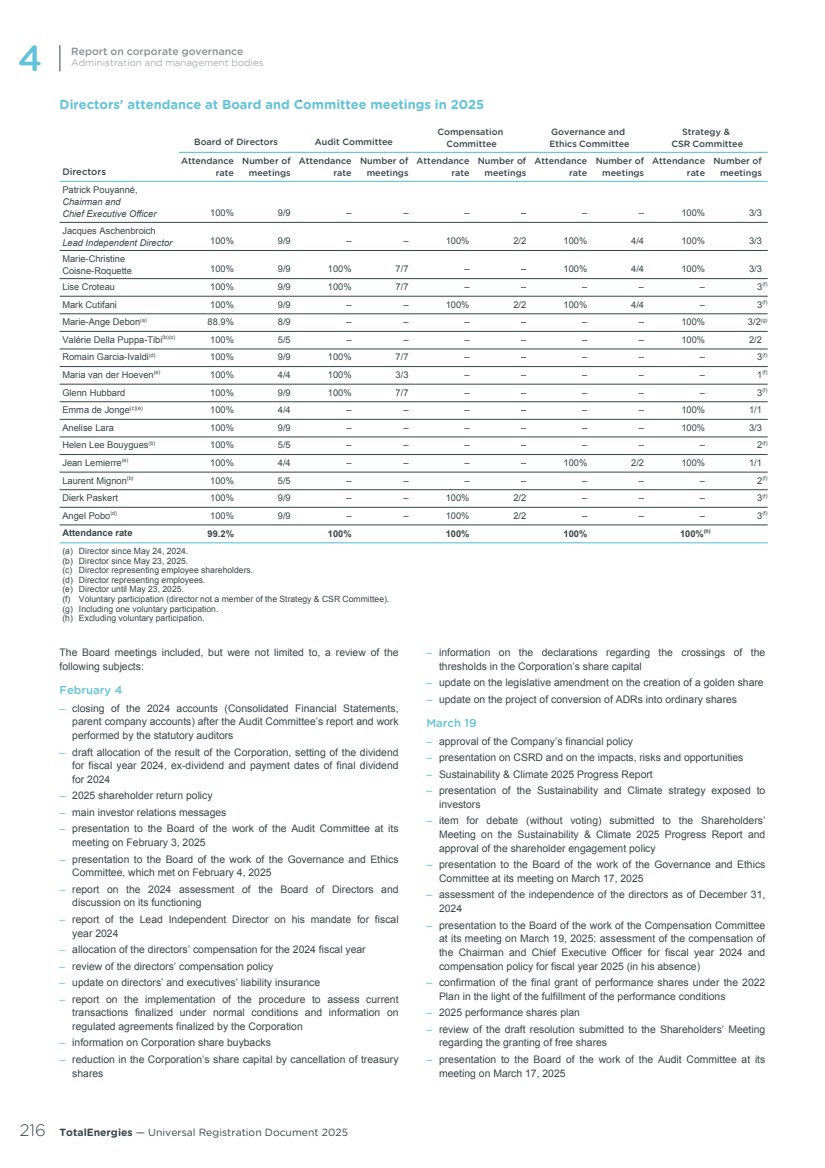
| – preparation for the Annual Shareholders’ Meeting: date and location of the Shareholders’ Meeting; setting of the agenda for the Shareholders’ Meeting; approval of the various chapters of the Universal Registration Document forming the management report as defined by the French Commercial Code, the report on corporate governance and the special reports on subscription and purchase options on shares of the Corporation and the granting of performance shares; closing ot the report on purchases and sales of the shares of the Corporation as defined by Article L. 225-211 of the French Commercial Code; approval of the report of the Board of Directors and of the text of the draft resolutions submitted to the Shareholders’ Meeting; press release – answer to the opinion issued on February 13, 2025 by the Central Social and Economic Works Council of the UES Amont Holding Global Services on the strategic orientations of the Company – information on shares buybacks and authorization to buy back shares in the second quarter of 2025 – information of a bond issue – information on the declarations regarding the crossings of the thresholds in the Corporation’s share capital – update on legal proceedings – update on the evolution of the institutional shareholding April 29 – report to the Board of the work of the Strategy & CSR Committee at its meeting on March 19, 2025 – consolidated financial statements, results for the first quarter of 2025 after the Audit Committee’s report and work performed by the statutory auditors – presentation to the Board of the work of the Audit Committee at its meeting on April 28, 2025 – setting of a first interim dividend for fiscal year 2025 – main investor relations messages – preparation and organization of the Shareholders’ Meeting on May 23, 2025: feedback on the Lead Independent Director’s roadshows and review of a draft rebuttal letter; review of the resolutions submitted to the Shareholders’ Meeting and of the Board’s report on those resolutions – information on the 2025 capital increase reserved for employees – information on Corporation share buybacks and authorization to buyback shares for the second quarter of 2025 – information on the declarations regarding the crossings of the thresholds in the Corporation’s share capital – update on climate litigation May 22 – preparation and organization of the Shareholders’ Meeting on May 23, 2025: answers to written questions and information on the vote on draft resolutions – information on share buybacks and delegation of powers July 23 – analysis of the results of the votes at the Shareholders’ Meeting held on May 23, 2025, of the comments of shareholders and main proxy advisors and lessons to be learnt – confidentiality of the work of the Board of Directors – conditions for the exercise of the mandate of the director representing employee shareholders – presentation of the strategic outlook for Exploration & Production, including safety, reduction of the environmental footprint, improvement of operational efficiency, resilience and project selectivity – Consolidated Financial Statements, results for the second quarter of 2025 and the first half of 2025 after the Audit Committee’s report and work performed by the statutory auditors; results of the parent company for the first half of 2025 – half-yearly financial report – minutes of the Audit Committee meetings on June 16, 2025 and July 22, 2025 – setting of a second interim dividend for fiscal year 2025 – information on share buybacks and decision on the implementation of the share buyback program – main investor relations messages – presentation of the review of the 2025 capital increase reserved for employees – approval of the Board’s supplementary report on the 2025 capital increase reserved for employees – information on a bond issue – information on the declarations regarding the crossings of the thresholds in the Corporation’s share capital – dividend calendar (second and third interim dividends and final dividend) for fiscal year 2025 and for the dividend (interim and final dividends) for fiscal year 2026 and related investor relations message – program of the 2025 Strategy seminar – training of directors and site visit projects for members of the Board of Directors – update on legal proceedings – update on the evolution of the institutional shareholders September 24 – approval to continue negotiations with a view to establishing a joint venture that would accelerate the implementation of the Integrated Power strategy in Europe – strategic outlook for Gas, Renewables & Power activities – Company’s five-year plan – shareholder return policy – presentation of the draft communication to investors on the outlook of TotalEnergies – approval of the principle of the 2026 capital increase reserved for employees – approval of the project to convert ADRs into shares – reduction in the Corporation’s share capital by way of cancellation of treasury shares – information on the declarations regarding the crossings of the thresholds in the Corporation’s share capital October 29 – strategic outlook for Refining & Chemicals’ activities – Consolidated Financial Statements, results for the third quarter of 2025, after the Audit Committee’s report and work performed by the statutory auditors – presentation to the Board of the work of the Audit Committee at its meetings on October 6 and 27, 2025 – setting of a third interim dividend on the dividend for fiscal year 2025 – update on the Corporation’s share buybacks – approval of the initiation of the termination of the ADR program and the conversion of the ADRs into ordinary shares listed on the NYSE, as well as the timetable and payment terms for the second interim dividend for the shares listed on the NYSE – main investor relations messages – information on the declarations regarding the crossings of the thresholds in the Corporation’s share capital – update on climate litigation November 16 – approval of the acquisition of 50% of a portfolio of flexible power generation assets from EPH as part of an equity transaction December 17 – strategic outlook for Marketing & Services’ activities – 2026 budget – update on the composition of the Board of Directors and its Committees – the Corporation’s equality policy between men and women in the workplace and in terms of pay – information on the conversion of ADRs into ordinary shares – information on Corporation share buybacks in 4 th quarter 2025 and authorization of Corporation share buybacks for 1 st quarter 2026 Report on corporate governance Administration and management bodies 4 TotalEnergies — Universal Registration Document 2025 217 |
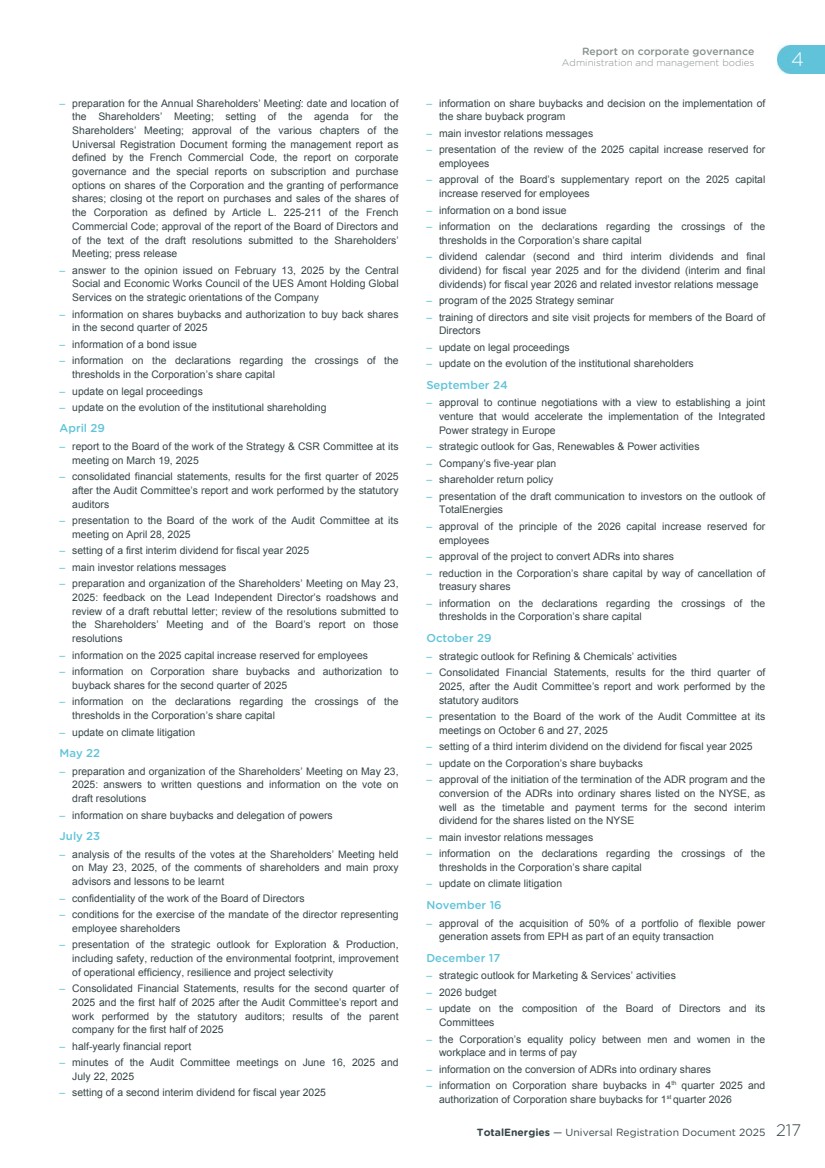
| – renewal of the authorization to issue bonds – renewal of the authorization to issue security, commitments and guarantees – renewal of the authorization to issue guarantees for certain financial transactions – update on Market Abuse Regulations and the blackout periods – information on the notifications regarding the crossings of the thresholds concerning the Corporation – 2026 work program for the Board of Directors. 4.1.2.3 Committees of the Board of Directors The Audit Committee 5 members 75%(a) Independence rate 7 meetings in 2025 100% Attendance rate (a) Excluding the director representing employees. Composition As of March 18, 2026, the Audit Committee is made up of 5 members, with a 75% rate of independence (excluding director representing employees). Ms. Lise Croteau chairs the Committee and was appointed financial expert in this Committee by the Board of Directors. Ms. Marie-Christine Coisne-Roquette, Ms. Helen Lee Bouygues, Mr. Romain Garcia-Ivaldi and Mr. Glenn Hubbard sit on the Committee. The careers of the Committee members confirm their possession of acknowledged expertise in the financial, accounting or audit fields (refer to point 4.1.1.1). Duties The rules of procedure of the Audit Committee define the Committee’s duties as well as its working procedures. The Audit Committee’s rules of procedure were last amended on March 13, 2024 to include the transposition in French law of the European CSRD (Corporate Sustainability Reporting Directive) directive. They had previously been amended on July 28, 2021 to take account of the change in the Corporation’s name decided at the Shareholders’ Meeting on May 28, 2021, on February 8, 2017, in order to adapt the Committee’s role and responsibilities to the European audit reform, on July 25, 2018, in order to take account of new social and environmental responsibility requirements, further to the revision of the AFEP-MEDEF Code in June 2018, and on July 29, 2020, to reflect the Corporation’s conversion to a European company and various amendments to the Corporation’s Articles of Association that were approved by the Shareholders’ Meeting on May 29, 2020. The text of the unabridged version of the rules of procedure approved by the Board of Directors on July 28, 2021, is available on the TotalEnergies website under “Our Company/Our identity/Our governance.” Notwithstanding the duties of the Board of Directors, the Audit Committee is tasked with the following missions in particular: Regarding the statutory auditors and the sustainability auditor(s) in charge of carrying out the certification mission of the sustainability information: – making a recommendation to the Board of Directors on the statutory auditors and the sustainability auditor(s) in charge of carrying out the certification mission of the sustainability information, put before the Annual Shareholders’ Meeting for designation or renewal, following their selection procedure organized by General Management and enforcing the applicable regulations; – monitoring the performance of their missions of audit and certification of sustainability information and, examining notably reports, in particular the additional report drawn up by the statutory auditors for the Committee, while taking account of the observations and conclusions of the High Authority of the Audit (Haute autorité de l’Audit) further to the inspection of the auditors in question in application of the legal provisions, where appropriate; – ensuring that the conditions of independence required for persons exercising the account certification and sustainability information certification missions are met, and analyzing the risks to their independence and the measures taken to mitigate these risks; to this end, examining all the fees paid, including for services other than the certification of the financial statements or for services other than the certification of the sustainability information, and making sure that the rules applying to the maximum length of the terms and the obligation to alternate are obeyed; – approving the delivery of services other than those relating to the certification of the financial statements or of services other than those relating to the certification of the sustainability information, in accordance with the applicable regulations. Regarding accounting, financial and sustainability information: – following the process to produce financial information, the process to produce sustainable information, including in digital form, and the process implemented to determine the information to be disclosed in accordance with sustainability reporting standards, as well as, where appropriate, formulating recommendations to guarantee the integrity, of such processes; – monitoring the implementation and the proper workings of a disclosures Committee in the Corporation and reviewing its conclusions; – examining the assumptions used to prepare the financial statements, assessing the validity of the methods used to handle significant transactions and examining the Corporation financial statements and annual, half-yearly, and quarterly Consolidated Financial Statements prior to their examination by the Board of Directors, after regularly monitoring the financial situation, cash position and off-balance sheet commitments; – guaranteeing the appropriateness and the permanence of the accounting policies and principles chosen to prepare the statutory and Consolidated Financial Statements of the Corporation; – examining the scope of the consolidated companies and, where appropriate, the reasons why companies are not included; – examining the process to validate the proved reserves of the companies included in the scope of consolidation; – reviewing, if requested by the Board of Directors, major transactions contemplated by the Corporation. Regarding internal control and risk management procedures: – monitoring the efficiency of the internal control and risk management systems, and of internal audits, in particular with regard to the procedures relating to the production and processing of accounting, financial and sustainability information, including in digital form, without compromising its independence, and in this respect: 4 Report on corporate governance Administration and management bodies 218 TotalEnergies — Universal Registration Document 2025 |
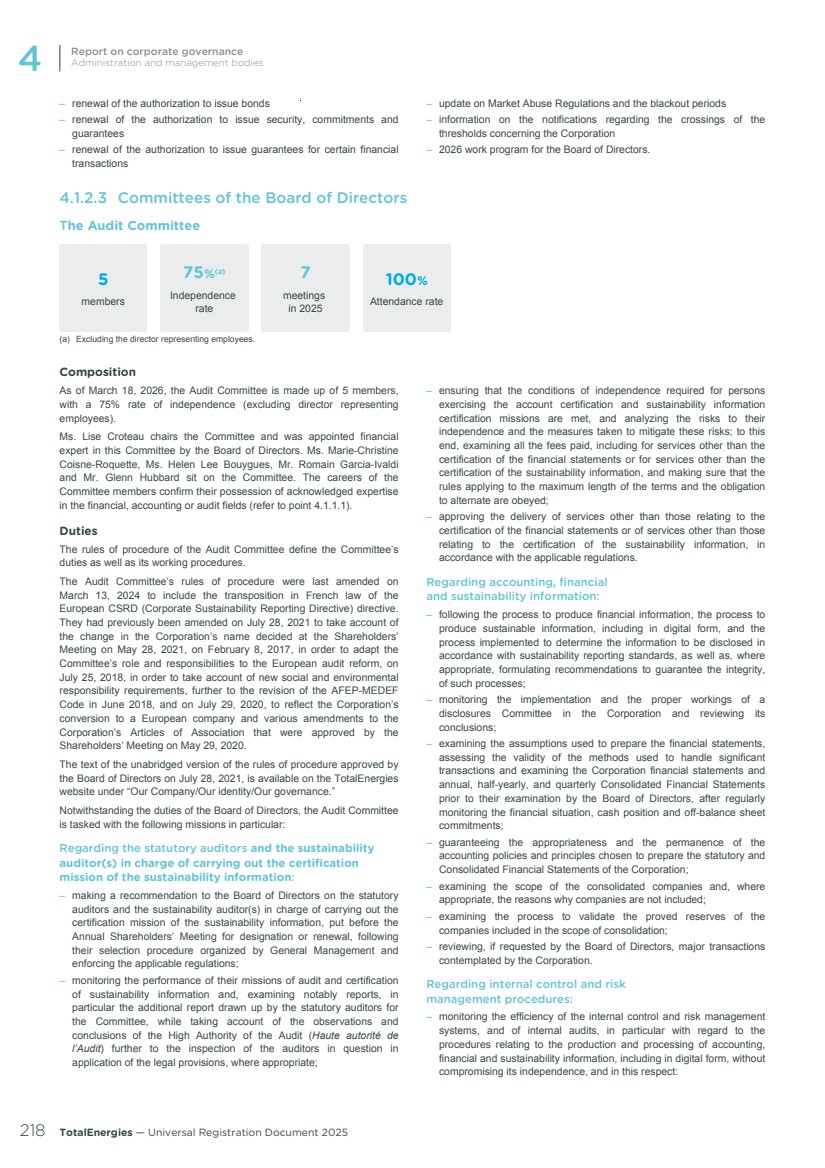
| – checking that these systems exist and are deployed, and that actions are taken to correct any identified weaknesses or anomalies; – reviewing, based in particular on the risk maps developed by the Corporation, the exposure to risks, such as financial risks (including material off-balance sheet commitments), legal risks, operational risks, social and environmental risks, as well as measures taken as a result; – annually examining the reports on the work of the TotalEnergies Risk Management Committee and the major issues for the Company; – examining the annual work program of the internal auditors and being regularly informed of their work; – reviewing significant litigation at least once a year; – overseeing the implementation of the Financial Code of Ethics; – proposing to the Board of Directors, for implementation, a procedure for complaints or concerns of employees, shareholders and others, related to accounting, internal control or auditing matters, and monitoring the implementation of this procedure; – where appropriate, examining important operations in which a conflict of interests could have arisen; – annually examining the results of the controls carried out within the framework of the procedure implemented in order to assess the agreements on current operations finalized under normal conditions and verifying the relevance of the criteria used to qualify those agreements. The Audit Committee reports to the Board of Directors on the performance of its duties. It also reports on the results of the mission concerning the certification of the financial statements, of the mission of certification of the sustainability information as well as on how these missions contributed to the integrity of the accounting and financial information, and the sustainability information as well as its role in this process. It shall inform the Board of Directors without delay of any difficulties encountered. Organization of activities The Committee meets at least seven times each year: each quarter to review in particular the statutory financial statements of the Corporation and the annual and quarterly Consolidated Financial Statements, and at least on three other occasions to review matters not directly related to the review of the quarterly financial statements. At each Committee meeting where the quarterly financial statements are reviewed, the Chief Financial Officer presents the Consolidated Financial Statements and the statutory financial statements of the Corporation, as well as the Company’s financial position and, in particular, its liquidity, cash flow and debt situation. A memo describing risk exposure and off-balance sheet commitments is communicated to the Committee. This review of the financial statements includes a presentation by the statutory auditors underscoring the key points observed. As part of monitoring the efficiency of the internal control and risk management systems, as well as internal audits with regard to the procedures relating to the production and processing of accounting, financial and sustainability information, the Committee is informed of the work program of the Audit & Internal Control division and its organization, on which it may issue an opinion. The Committee also receives a summary of the internal audit reports, which is presented at each Committee meeting where the quarterly financial statements are reviewed. The risk management processes implemented within the Company, as well as updates to them, are presented regularly to the Committee. The Committee may meet with the Chairman and Chief Executive Officer or, if the functions are separate, the Chairman of the Board of Directors, the Chief Executive Officer as well as, if applicable, any Deputy Chief Executive Officer of the Corporation. It may perform inspections and consult with managers of operating or non-operating department, as may be useful in performing its duties. The Chairman of the Committee gives prior notice of such meeting to the Chairman and Chief Executive Officer or, if the functions of Chairman of the Board of Directors and Chief Executive Officer are separate, both the Chairman of the Board of Directors and the Chief Executive Officer. In particular, the Committee is authorized to consult with those involved in preparing or auditing the financial statements and sustainability information (Chief Financial Officer and principal Finance Department managers, Audit Department, Strategy & Sustainability) by asking the Corporation’s Chief Financial Officer to call them to a meeting. The Committee consults with the statutory auditors regularly, including at least once a year without any Corporation representative present. If it is informed of a substantial irregularity, it recommends to the Board of Directors all appropriate action. If it considers that it is necessary for the accomplishment of its mission, the Committee asks the Board of Directors for resources to receive assistance or conduct external studies on subjects within its competence. If the Committee calls on external consulting services, it makes sure that they are objective. Work of the Audit Committee In 2025, the Audit Committee met 7 times, with an attendance rate of 100%. The Chairman and Chief Executive Officer did not attend any of the meetings of the Audit Committee. The Audit Committee’s work mainly focused on the following areas: February 3 – review of the Consolidated Financial Statements and statutory financial statements of the parent company for the fourth quarter and of the 2024 fiscal year. Presentation by the statutory auditors of their work performed in accordance with French and American professional audit standards – review of the Company’s financial position as of December 31, 2024 – update on outstanding balance of guarantees granted by TotalEnergies SE as of December 31, 2024 – update on the 2024 internal audit – update on the organizational framework of the Company’s risk management system and the missions of the TotalEnergies Risk Management Committee (TRMC) – presentation of the works undertaken by the TRMC – update on the Sarbanes-Oxley process: self-assessment carried out by the Company and audit of the internal control related to financial reporting by the statutory auditors as part of the SOX 404 process – review of the results of the controls carried out concerning the assessment procedure of ordinary transactions entered into under normal terms – presentation of the section of the Universal Registration Document on risk factors, countries under economic sanctions, legal proceedings and arbitration, internal control and risk management procedures relating to accounting and financial information – presentation of the double materiality assessment work aiming at preparing the Company’s first sustainability statement March 18 – review of the statutory auditors’ reports, their declaration of independence and their obligations to the Audit Committee – review of the Company’s financial policy – review of the implementation of the new Company’s insurance policy – update on the internal audit of the 4 th quarter 2024 and of the 2025 audit plan – presentation of the sustainability report – presentation of the update of the vigilance plan and its implementation report – process for validating hydrocarbon reserves at the end of the 2024 fiscal year – presentation of the report on the payments made to governments and of the tax transparency report April 28 – review of the Consolidated Financial Statements and statutory financial statements of the parent company for the first quarter of 2025, with a presentation by the statutory auditors of a summary of their limited review Report on corporate governance Administration and management bodies 4 TotalEnergies — Universal Registration Document 2025 219 |
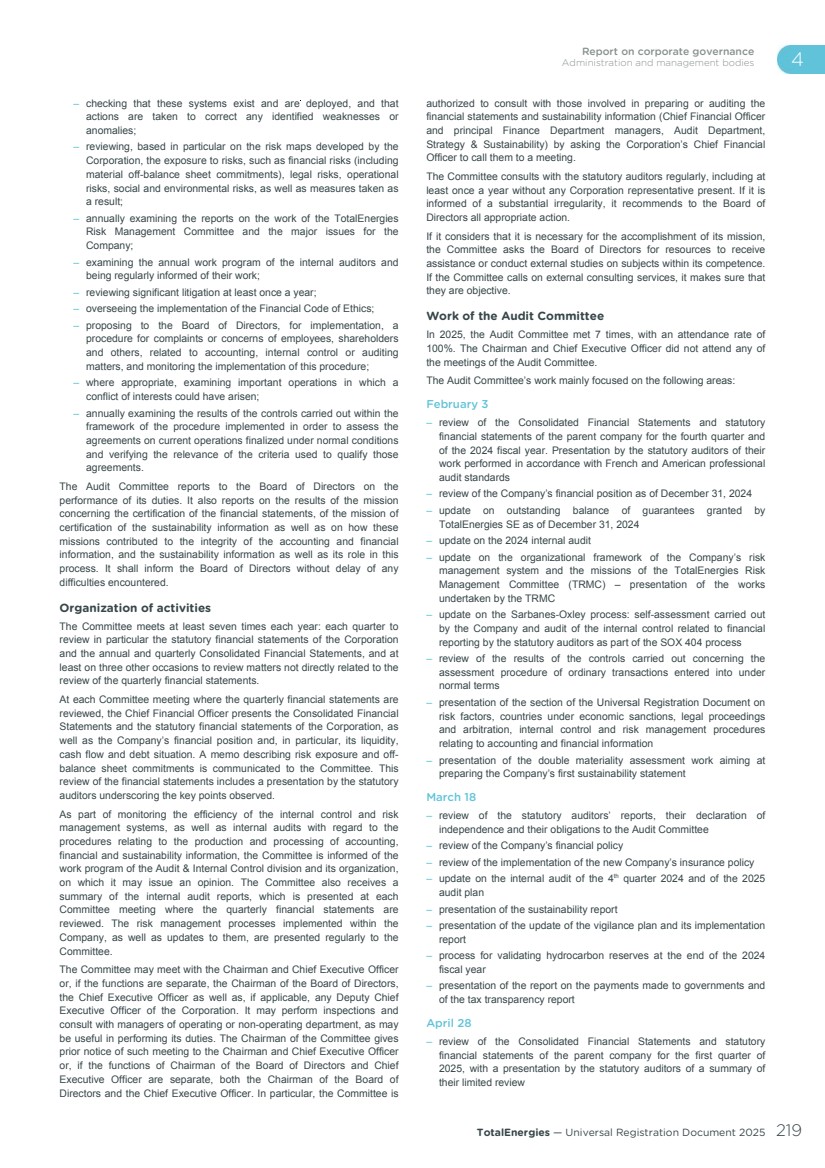
| – update on the Company’s financial position as of March 31, 2025 – presentation of the 2024 health, safety and environment audit plan and review of the fiscal year 2023 – review of the internal audit June 16 (visit of TotalEnergies Electricite et Gaz France’s’ site at Balard in France) – presentation of the Retail Power & Gas activity – update on accounting new developments, financial information and regulatory developments – review of significant litigation July 22 – review of the Consolidated Financial Statements of the parent company of the second quarter and the first half of 2025, with a presentation by the statutory auditors of a summary of their limited review – review of the Company’s financial position as of June 30, 2025 – review of the internal audit October 6 – review of significant litigation – review of the Company’s tax situation – review of 2024 audits and the audits from January to September 2025 regarding cybersecurity – presentation by the auditors of the audit approach on consolidated financial statements and on non-financial reporting (CSRD) as of December 31, 2025 October 27 – agenda proposal for 2026 Audit Committee meetings – review of the Consolidated Financial Statements and statutory financial statements of the third quarter and the first nine months of 2025, with a presentation by the statutory auditors of a summary of their limited review – review of the Company’s financial situation as of September 30, 2025 – update on the internal audits conducted in the third quarter of 2025 – information of the Committee on compliance by relevant employees with the provisions of the Financial Code of Ethics – update on the call for tender for statutory and sustainability auditors whose mandates expire at the 2028 Shareholders’ Meeting. At each meeting related to the quarterly financial statements, the Committee reviewed the Company’s financial position in terms of liquidity, cash flow and debt, as well as the significant risks and off-balance sheet commitments of TotalEnergies. The Audit Committee was periodically informed of the risk management processes implemented within the Company as well as the work carried out by the Audit & Internal Control Division, which was presented at each Committee meeting where the quarterly financial statements were reviewed. The Audit Committee reviewed the financial statements in a sufficient amount of time as set out in the recommendations of the AFEP-MEDEF Code. The statutory auditors attended all Audit Committee meetings held in 2025. The Chief Financial Officer and the Senior Vice President Audit & Internal Control Division, as well as Vice President Accounting attended all Audit Committee meetings related to their area. The Corporate Treasurer attended all Audit Committee meetings related to his area, except the meeting held on February 2025. The Chairman of the Committee reported to the Board of Directors on the Committee’s work. The Governance and Ethics Committee 3 members 67% Independence rate 4 meetings in 2025 100% Attendance rate Composition As of March 18, 2026, the Governance and Ethics Committee is made up of 3 members, with a 67% rate of independence. Mr. Jacques Aschenbroich chairs the Committee. Ms. Marie-Christine Coisne-Roquette and Mr. Laurent Mignon are members of the Committee. Duties The rules of procedure of the Governance and Ethics Committee define the Committee’s duties as well as its working procedures. The Governance and Ethics Committee’s rules of procedure were last amended on July 28, 2021 to take account of the change in the Corporation’s name decided at the Shareholders’ Meeting on May 28, 2021. They had previously been amended on July 25, 2018 to extend the Committee’s role and responsibilities to subjects related to compliance and the prevention and detection of corruption and influence peddling, and on July 29, 2020, to take account of the Corporation’s conversion to a European company and various amendments to the Corporation’s Articles of Association that were approved by the Shareholders’ Meeting on May 29, 2020. The text of the unabridged version of the rules of procedure approved by the Board of Directors on July 28, 2021, is available on the TotalEnergies website under “Our Company/Our identity/Our governance.” The Governance and Ethics Committee is focused on: – recommending to the Board of Directors the persons that are qualified to be appointed as directors, so as to guarantee the scope of coverage of the directors’ competencies and the diversity of their profiles; – recommending to the Board of Directors the persons that are qualified to be appointed as executive directors; – preparing the Corporation’s corporate governance rules and supervising their implementation; – ensuring compliance with ethics rules and examining any questions related to ethics and situations of conflicting interests; – reviewing matters regarding compliance as well as the prevention and detection of corruption and influence peddling. Its duties include: – presenting recommendations to the Board of Directors for its membership and the membership of its Committees, and the qualification in terms of independence of each applicant for Directors’ positions on the Board of Directors; – proposing annually to the Board of Directors the list of directors who may be considered as “independent directors”; – examining, for the parts within its remit, reports to be sent by the Board of Directors or its Chairman to the shareholders; – assisting the Board of Directors in the selection of the organization of the governance of the Corporation as well as the selection and evaluation of the executive directors and examining the preparation of their possible successors including establishing a succession plan, including cases of unforeseeable absence; 4 Report on corporate governance Administration and management bodies 220 TotalEnergies — Universal Registration Document 2025 |
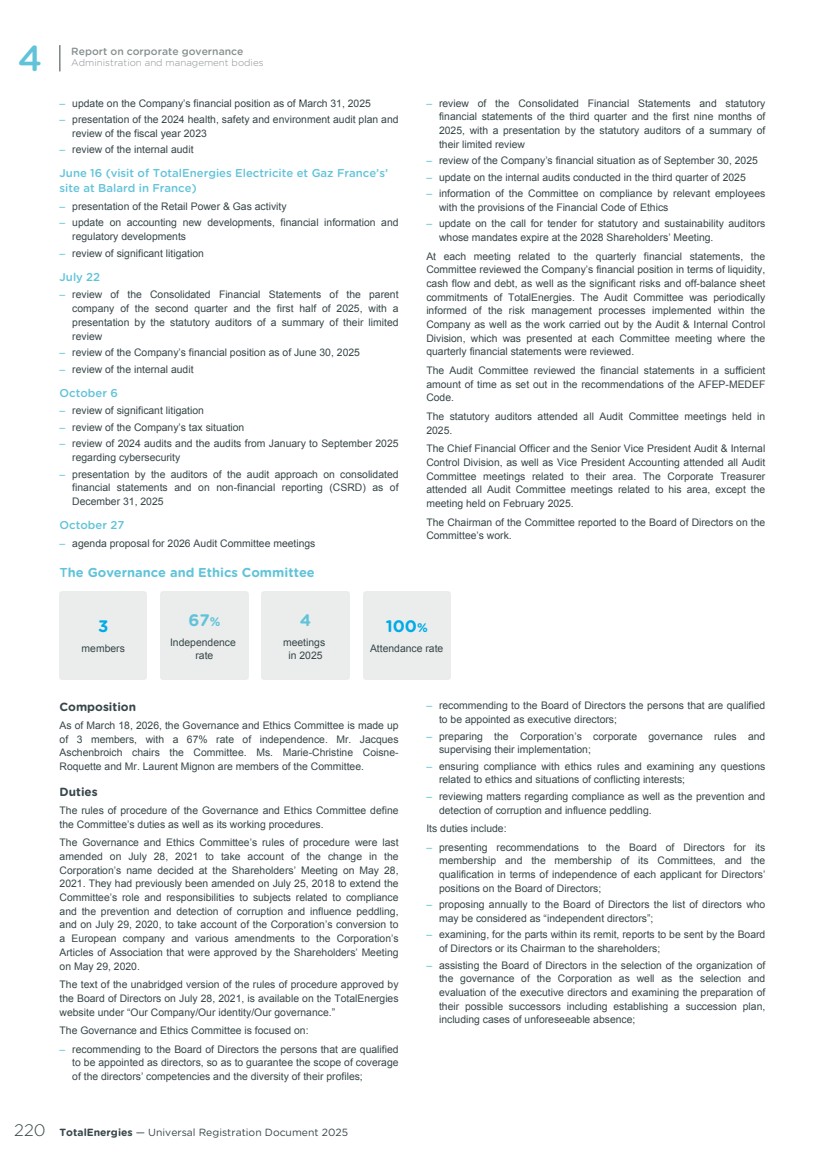
| – recommending to the Board of Directors the persons that are qualified to be appointed as directors; – recommending to the Board of Directors the persons that are qualified to be appointed as members of a Committee of the Board of Directors; – proposing methods for the Board of Directors to evaluate its performance, and in particular preparing means of regular self-assessment of the workings of the Board of Directors, and the possible assessment thereof by an external consultant; – proposing to the Board of Directors the terms and conditions for allocating directors’ compensation and the conditions under which expenses incurred by the directors are reimbursed; – developing and recommending to the Board of Directors the corporate governance principles applicable to the Corporation; – preparing recommendations requested at any time by the Board of Directors or the general management of the Corporation regarding appointments or governance; – examining the conformity of the Corporation’s governance practices with the recommendations of the Code of Corporate Governance to which the Corporation refers; – supervising and monitoring the implementation of the approach of the Corporation with regard to ethics, compliance, prevention and detection of corruption and influence peddling and, in this respect, ensuring that the necessary procedures are in place, including those for updating the Company’s Code of Conduct and that this Code is disseminated and applied; – examining any questions related to ethics and potential situations of conflicting interests; – examining changes in the duties of the Board of Directors. Work of the Governance and Ethics Committee In 2025, the Governance and Ethics Committee held 4 meetings, with 100% attendance. Its work mainly focused on the following areas: February 4 – assessment of the Board of Directors’ practices in 2024 – report of the Lead Independent Director on the execution of his mission – allocation of the compensation to directors and members of the Committees for fiscal year 2024 – review of the directors’ compensation policy – update on directors’ and executives’ liability insurance – update on the terms of office of the directors and the members of the Committees March 17 – composition of the Board of Directors and the Committees – assessment of the independence of the directors as of December 31, 2024 – item for debate (without voting) submitted to the Shareholders’ Meeting on the Sustainability & Climate 2025 Progress Report – shareholder engagement policy July 23 – the Company’s ethics and compliance policy – analysis of the outcome of the votes at the Shareholders’ Meeting held on May 23, 2025, of the comments of shareholders and main proxy advisors and lessons to be learnt – update on the confidentiality of the works of the Board of Directors – update on the directors’ training in connection with CSRD – update on the conditions of exercise of the mandate of the director representing employee shareholders – update on the composition of the Board of Directors October 29 – update on the statutory age limits – update on the composition of the Board of Directors and the Committees – update on the process of assessment of the functioning of the Board of Directors in 2025 – succession plans. Succession plans The Governance and Ethics Committee, under the leadership of its Chairman, the Lead Independent Director, reviews each year the succession plan of Board members and executives. The Committee reviews both the succession process outside of emergency situations – including the terms or renewals of mandates, as well as scenarios involving unforeseen vacancies. The plans are thus reviewed over a 3-year and 5-year horizon, depending on the circumstances. The Governance and Ethics Committee, in anticipation of the expiry of directors’ terms of office, examines in particular the effective contribution of the director concerned to the work of the Board and its Committees, her/his seniority on the Board (with regard to the Afep-Medef Code rule on loss of independence after 12 years), as well as her/his age. In the event of non-renewal and before initiating a search, the Governance and Ethics Committee defines a target profile, taking into account in particular the skills lost with the non-renewal, the skills required in relation to the Company’s activities and strategic orientations, gender balance, and, more generally, various other balances within the Board (independence, nationalities, etc.). Candidate interviews are held at the end of the process with a view to making a recommendation to the Board of Directors. During these interviews, the Committee ensures, in particular, the independence, availability, and motivation of the proposed candidate, as well as her/his adherence to the Company’s values. As part of the executive succession plan, the Governance and Ethics Committee reviews the Company’s talent pools likely to become executive corporate officers, particularly among the members of the Executive Committee. In this context, the Chairman and Chief Executive Officer provides and updates an annual report on the organizational and managerial developments underway within the Executive Committee, as well as their timeline, including the performance and development potential within the Executive Committee. The Chairman and Chief Executive Office does not take part in the Committee’s deliberations relating to his own succession, whether as Chairman of the Board (or the renewal of his directorship), or as Chief Executive Officer. The Chairman of the Governance and Ethics Committee reports on the Committee’s work to the Board of Directors. In addition, in his capacity as Lead Independent Director, he chairs meetings of directors who do not hold executive or salaried positions on the Board of Directors (Executive Sessions), during which the Lead Independent Director may address these succession matters. In 2025, the review of the succession plan of directors and its update took place during the Governance and Ethics Committee meeting on July 23, 2025, and that of the executives during the Governance and Ethics Committee meeting on October 29, 2025. In this context, after reviewing the practices of CAC40 companies and international peers, the Governance and Ethics Committee decided in favor of a revision of the Articles of Association’s age limit applicable to the position of Chairman to increase it from 70 to 75 years old and that applicable to the position of Chief Executive Officer to increase it from 67 to 70 years old. Report on corporate governance Administration and management bodies 4 TotalEnergies — Universal Registration Document 2025 221 |
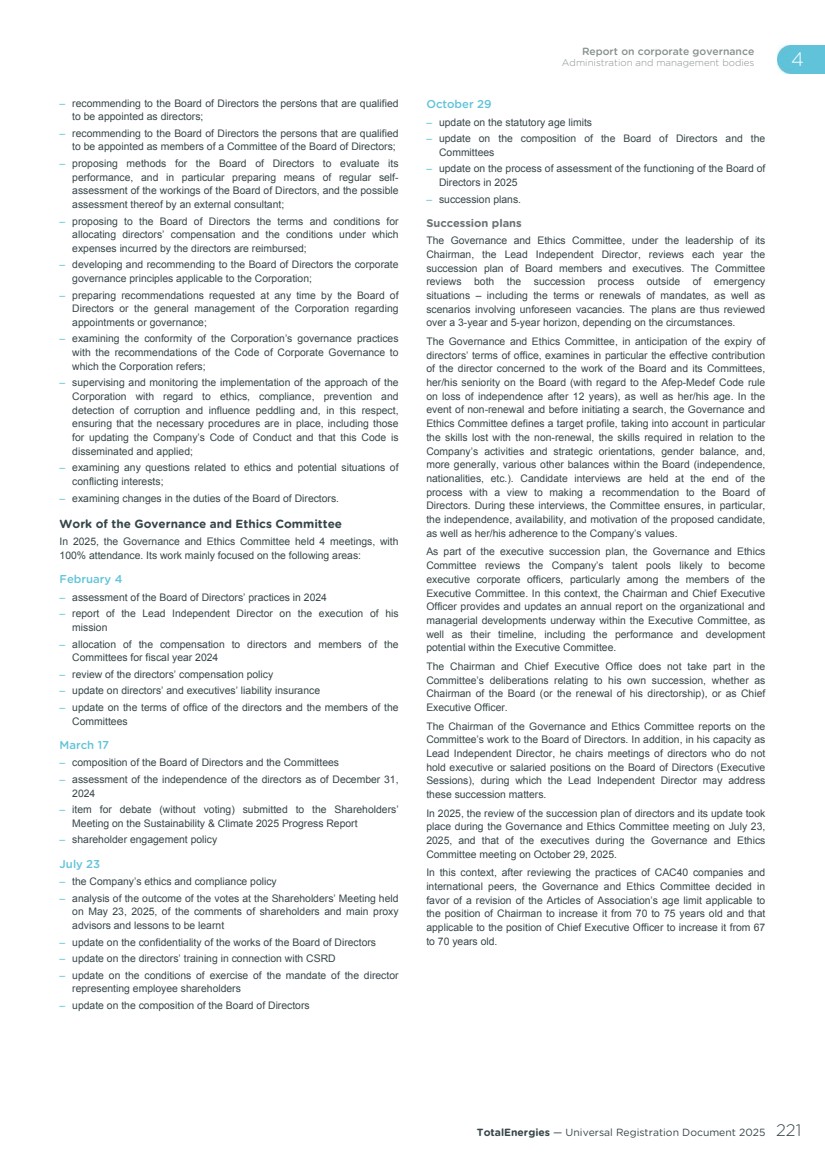
| The Compensation Committee 3 members 100%(a) Independence rate 2 meetings in 2025 100% Attendance rate (a) Excluding the director representing employees. Composition As of March 18, 2026, the Compensation Committee is made up of 3 members, with a 100% rate of independence(1) . The Committee is chaired by Mr. Dierk Paskert. Mr. Jacques Aschenbroich and Mr. Angel Pobo (director representing employees) are members of the Committee. Duties The rules of procedure of the Compensation Committee define the Committee’s duties as well as its working procedures. The Compensation Committee’s rules of procedure were last amended on July 28, 2021 to take account of the change in the Corporation’s name decided at the Shareholders’ Meeting on May 28, 2021. They had previously been amended on July 25, 2018, in order to take account of new social and environmental responsibility requirements, further to the revision of the AFEP-MEDEF Code in June 2018, and on July 29, 2020, to reflect the Corporation’s conversion to a European company and various amendments to the Corporation’s Articles of Association that were approved by the Shareholders’ Meeting on May 29, 2020. The text of the unabridged version of the rules of procedure approved by the Board of Directors on July 28, 2021, is available on the TotalEnergies website under “Our Company/Our identity/Our governance.” The Committee is focused on: – examining the executive compensation policies implemented by the Company and the compensation of members of the Executive Committee; – evaluating the performance and recommending the compensation of each executive director; – preparing reports which the Corporation must present in these areas. The Committee’s duties include: – examining the main objectives proposed by the Corporation’s general management regarding compensation of the Company’s senior executives, including stock option and performance share grant plans as well as equity-based plans, and advising on this subject; – presenting recommendations and proposals to the Board of Directors concerning: – compensation, pension and life insurance plans, in-kind benefits and other compensation (including severance benefits) for the executive directors of the Corporation; in particular, the Committee proposes compensation structures that take into account the Corporation’s strategic orientations, objectives and earnings, market practices as well as one or more criteria related to social and environmental responsibility; – stock option and performance share grants, particularly grants of restricted shares to the executive directors; – examining the compensation of the members of the Executive Committee, including stock option and performance share grant plans as well as equity-based plans, pension and insurance plans and in-kind benefits; – preparing and presenting reports in accordance with these rules of procedure; – examining, for the parts within its remit, reports to be sent by the Board of Directors or its Chairman to the shareholders; – preparing recommendations requested at any time by the Chairman of the Board of Directors or the general management of the Corporation regarding compensation; – at the request of the Chairman of the Board, examining all draft reports of the Corporation regarding compensation of the executive officers or any other matters within its competence. Work of the Compensation Committee In 2025, the Compensation Committee held 2 meetings, with 100% attendance. The Chairman and Chief Executive Officer does not attend the Committee’s deliberations regarding his own situation. Its work mainly focused on the following areas: March 19 – assessment of the compensation of the Chairman and Chief Executive Officer for fiscal year 2024 – compensation policy of the Chairman and Chief Executive Officer for fiscal year 2025 – confirmation of the final grant of performance shares in respect of the 2022 plan – 2025 performance share plan – proposed resolution to the Shareholders’ Meeting on May 23, 2025 regarding the grant of free shares – review of the Letter of the Chairman of the Compensation Committee and of the section of the report on corporate governance regarding compensation – compensation of the members of the Executive Committee December 17 – analysis of the proxy advisors’ recommendations – topics to be examined by the Committee in 2026 and 2027 – benchmark elements (peer group compensation CEO) – orientations regarding the compensation for the Chairman and Chief Executive Officer in respect of 2025 and 2026 fiscal years. (1) Excluding the director representing employee shareholders in accordance with the recommendations of the AFEP-MEDEF Code (point 10.3). 4 Report on corporate governance Administration and management bodies 222 TotalEnergies — Universal Registration Document 2025 |
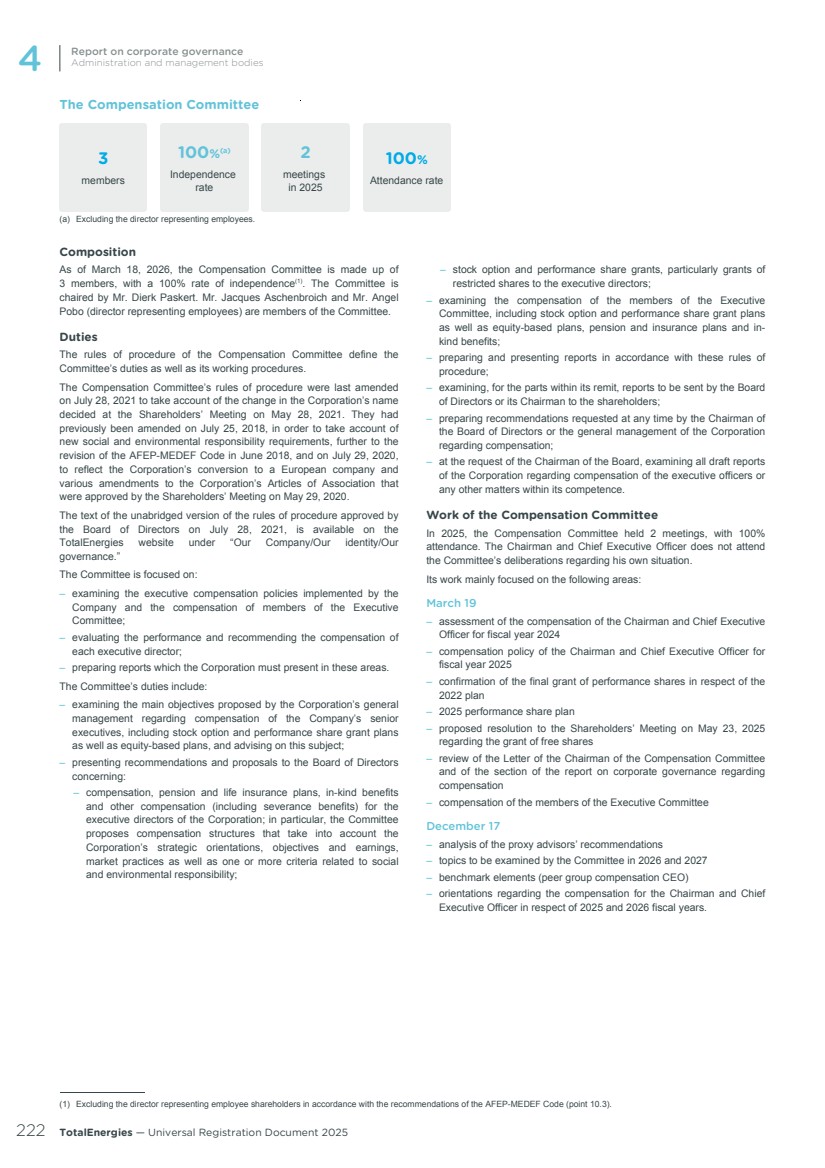
| The Strategy & CSR Committee 6 members 60%(a) Independence rate 3 meetings in 2025 100% Attendance rate (a) Excluding the director representing employee shareholders. Composition As of March 18, 2026, the Strategy & CSR Committee is made up of six members, including three independent directors and one director representing employees. Mr. Patrick Pouyanné chairs the Committee. Ms. Marie-Christine Coisne-Roquette, Ms. Marie-Ange Debon, Ms. Valérie Della Puppa-Tibi, Ms. Anelise Lara and Mr. Jacques Aschenbroich are members of the Committee. Duties The rules of procedure of the Strategy & CSR Committee define the Committee’s duties as well as its working procedures. The Strategy & CSR Committee’s rules of procedure were last amended on July 28, 2021 to take account of the change in the Corporation’s name decided at the Shareholders’ Meeting on May 28, 2021. They had previously been amended notably on July 25, 2018, in order to take account of new social and environmental responsibility requirements, further to the revision of the AFEP-MEDEF Code in June 2018, and on July 29, 2020, to reflect the Corporation’s conversion to a European company and various amendments to the Corporation’s Articles of Association that were approved by the Shareholders’ Meeting on May 29, 2020. The text of the unabridged version of the rules of procedure approved by the Board of Directors on July 28, 2021, is available on the TotalEnergies website under “Our Company/Our identity/Our governance.” To allow the Board of Directors of the Corporation to ensure the Company’s development, the Strategy & CSR Committee’s duties include: – examining the Company’s overall strategy proposed by the Corporation’s Chief Executive Officer; – examining the Company’s corporate social and environmental responsibility (CSR) issues and, in particular, matters relating to the incorporation of the Climate challenge in the Company’s strategy; – examining transactions that are of particular strategic importance; – reviewing the competitive environment, the main challenges the Company faces, including with regard to social and environmental responsibility, as well as the resulting medium and long-term outlook for the Company. Work of the Strategy & CSR Committee In 2025, the Strategy & CSR Committee met 3 times, with 100% attendance. Its work notably focused on the following areas: March 19 – presentation of the Sustainability & Climate 2025 Progress Report – update on the climate ambition – presentation of the technological ambition of the Company: strategic R&T programs as well as the digital ambition/AI – presentation of climate litigation (worldwide and of the Company) September 23 and 24 (strategy seminar) – presentation of the Company’s strategic environment: evolution of energy markets, update of the benchmark of the majors’ strategy and elements on the utilities – resilience of TotalEnergies’ portfolio in the face of geopolitical instabilities and their macroeconomic consequences – presentation of Integrated Power strategy according to various markets – discussion with Valérie Baudson, CEO of Amundi, TotalEnergies’ main French shareholder – update on the conversion of ADRs into ordinary shares – discussions on the strategy of the Company with members of the Executive Committee – Strategy and Outlook presentation to investors – return to shareholders and share buyback policy. 4.1.3 Report of the Lead Independent Director on the execution of his mission in respect of 2025 financial year During the Board meeting of February 10, 2026, Mr. Aschenbroich presented a report on his mandate as Lead Independent Director in fiscal year 2025. The duties of Lead Independent Director were exercised as follows during fiscal year 2025: Contact with the Chairman and Chief Executive Officer The Lead Independent Director is a privileged interlocutor of the Chairman and Chief Executive Officer with respect to significant matters concerning the Company’s business and preparing meetings of the Board of Directors and of the Governance and Ethics Committee that he chairs. In addition to occasional exchanges, the Lead Independent Director thus met in 2025 the Chairman and Chief Executive Officer on a monthly basis and before each meeting of the Board of Directors. Assessment of the Board of Directors’ practices The Lead Independent Director conducted the assessment of the Board of Directors’ practices in 2025. The lessons learned from this assessment are published in point 4.1.4 of this chapter. Prevention of conflicts of interest The Lead Independent Director has performed due diligence in order to identify and analyze potential conflicts of interest. The Lead Independent Director is thus consulted by directors who are considering accepting a mandate in other companies. No situation relating to a project to take up a mandate or an external function by a director has led the Lead Independent Director to refer the matter to the Governance and Ethics Committee in 2025. Monitoring of the Board’s practices The Lead Independent Director held a meeting on December 17, 2025 with the directors having no executive nor salaried position on the Board. The directors were able to discuss in a constructive and transparent atmosphere, it being recalled that they were asked to complete the questionnaire submitted to them as part of the annual assessment of the functioning of the Board. Report on corporate governance Administration and management bodies 4 TotalEnergies — Universal Registration Document 2025 223 |
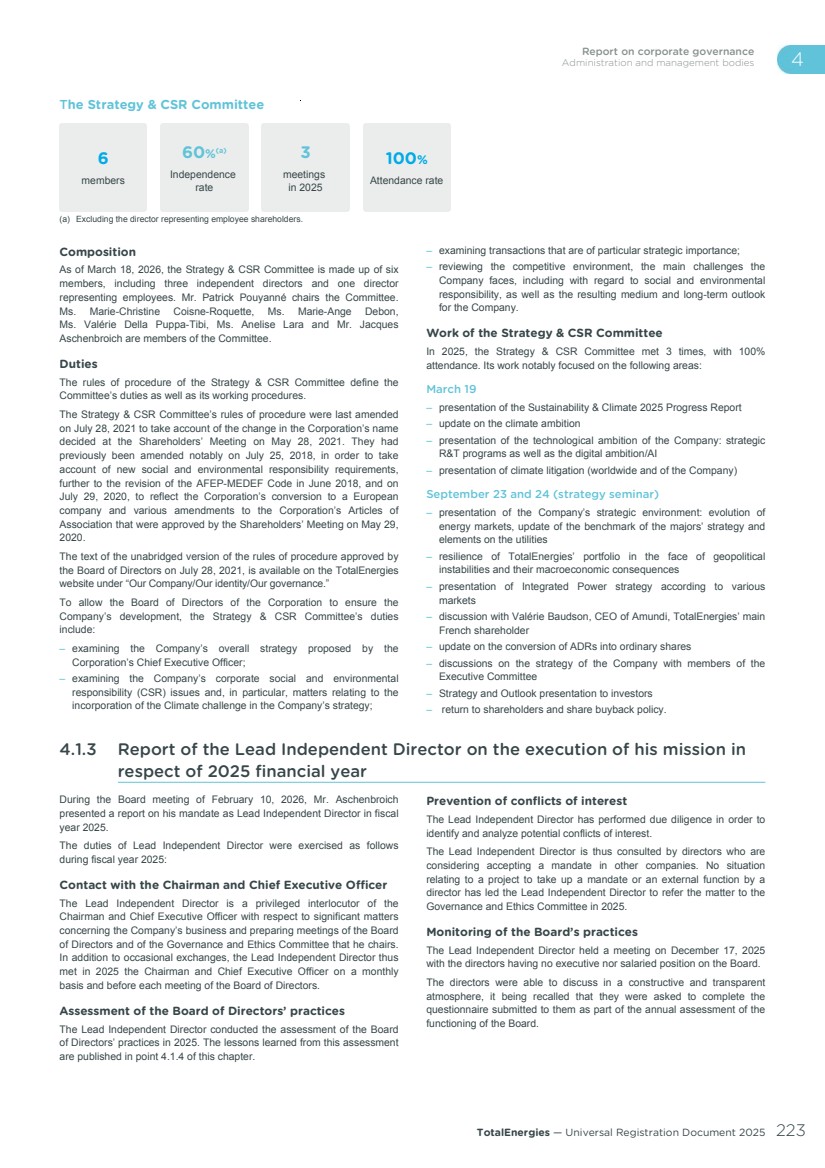
| During the meeting, it was noted that, given the quality of the Board of Directors’ work – confirmed by the Board’s assessment –, the current pace of one “executive session” per year was deemed appropriate. Knowing that, if necessary, and at the requests of several directors having no executive nor salaried position, an additional session could be organized by the Lead Independent Director on a specific topic. The Directors spent most of the meeting unanimously confirming their support for TotalEnergies’ strategy, based on the development of “oil and gas” and the very rapid development of “Integrated Power.” Regarding Integrated Power, the Directors once again note the progress of the growth model for this business, which TotalEnergies continues to develop unlike its major competitors in the sector, improving its margin and net cash generation year after year, which should be positive in the very short term and therefore contribute to dividend distribution. The discussion highlighted the following points that could be addressed at the Strategic Seminar in September 2026: – presenting benchmarks to compare the Company with players in this business, in addition to the usual oil & gas benchmarks; – evaluate the weight of Integrated Power in the Company’s overall value; – as part of a medium- and long‑term reflection, developing scenarios that consider various potential weightings of the Integrated Power activity. Relationship with directors The Lead Independent Director is playing a key role in the search and selection process for directors. He thus conducted the work of the Governance and Ethics Committee having led this Committee to recommend to the Board of Directors the submission to the 2026 Shareholders’ Meeting of the appointment of Mr. Slawomir Krupa as director. Relationships with shareholders The Chairman and Chief Executive Officer and the Lead Independent Director are the privileged points of contact for shareholders concerning matters under the Board’s responsibility. In accordance with the provisions of the Board’s Rules of Procedure, when the Chairman and Chief Executive Officer is solicited by a shareholder in this area, he may consult the Lead Independent Director before responding. When the Lead Independent Director is approached by a shareholder in relation to such issues, he must inform the Chairman and Chief Executive Officer, providing his opinion, so that the Chairman and Chief Executive Officer may respond appropriately to the request. The Chairman and Chief Executive Officer must inform the Lead Independent Director of the response given. In 2025, the Lead Independent Director had an extensive dialogue ahead of the Shareholders’ Meeting with shareholders representing a total of nearly a quarter of the Corporation’s capital. This dialogue continued after the Shareholders’ Meeting. In this context, the Lead Independent Director had discussions on the composition of the Board of Directors and the directors’ candidacies submitted to the Shareholders’ Meeting (including the number of mandates held by the candidates), the inclusion on the agenda of the Shareholders’ Meeting of a formal item for discussion (without a vote) on the Sustainability & Climate Report, the process for elaborating succession plans of corporate officers, the functioning of the Board of Directors and the role of the Lead Independent Director within the framework of the unified functions of Chairman and Chief Executive Officer. These meetings also made it possible to discuss the strategy and investments of TotalEnergies, particularly for the Integrated Power activities, as well as Tilenga & EACOP projects, the Mozambique LNG project and the technical conversion of ADRs listed on the NYSE into ordinary shares. Like every year in July, the Governance and Ethics Committee, under the chairmanship of the Lead Independent Director, and then the Board of Directors, reviewed the results of the votes of the resolutions at the Shareholders’ Meeting and the lessons to be learned. This analysis was integrated into the following discussions between the Lead Independent Director and the shareholders. As part of this annual review, the Governance and Ethics Committee and the Board examined the dialogue conducted ahead of the 2025 Annual Shareholders’ Meeting, particularly with regard to the number of mandates held by Mr. Laurent Mignon, in accordance with the Afep‑Medef Code, the corporate governance code to which the Corporation refers, but considered high under the voting policies of certain investors. As a reminder, Mr. Laurent Mignon is Chairman of the Executive Board (Président du Directoire) of Wendel, an investment company whose main purpose is to acquire and manage equity interests in other companies and which holds a controlling interest in Bureau Veritas that it fully consolidates, and his position as Chairman of the Board of Directors of Bureau Veritas should not be taken into account under the Afep‑Medef Code. Mr. Laurent Mignon therefore holds, within the meaning of this Code, two external directorships, LVMH and TotalEnergies. In light of a negative recommendation from the main proxy advisors, the active dialogue initiated by the Corporation with shareholders and the detailed explanations provided by the Board of Directors in its report to the Annual Shareholders’ Meeting led to the appointment of Mr. Laurent Mignon as a Director for a three‑year term, with 57% of votes cast in favor. Given the vote at the 2025 Annual Shareholders’ Meeting, the Governance and Ethics Committee and the Board of Directors will carefully review the matter upon the expiry of Mr. Laurent Mignon’s directorship in 2028, in light of developments in his personal circumstances and the evolving expectations of investors regarding the number of board mandates. During its meeting on February 4, 2026, the Governance and Ethics Committee stated that Mr. Laurent Mignon proved in 2025 to be exemplary in his attendance (100%) at the meetings of the Board and the Strategy & CSR Committee to which he was invited, like all directors, and made a strong contribution by putting his extensive experience at the service of the Board and the Company. In addition, he closely followed the training program established as a priority for new directors and took the initiative to meet with each member of the Executive Committee. Shareholders’ Meeting on May 23, 2025 At the Annual Shareholders’ Meeting, the Lead Independent Director presented the missions of the Lead Independent Director, the report on the Board’s activity since the previous Shareholders’ Meeting, the candidacies for director positions presented to the Shareholders’ Meeting and the composition of the Board of Directors at the end of the latter as well as the topics of the dialogue he conducted with the main shareholders. Visits to Company sites by the directors Site visits contribute in a very concrete way to the training of Directors and allow them to deepen their knowledge of the specificities of the Company, its challenges in particular regarding sustainability, its businesses – including new businesses – and its teams. They are often the occasion for thematic presentations. In this context, site visits, by groups of 4 to 5 directors accompanied by a member of the Executive Committee, were organized in 2025 in Nigeria (offshore and onshore EP, solar), in Scotland (Seagreen, offshore EP), in Antwerp (Refining), in Rouen and Le Havre (mobility, FSRU, blending). Additionally, the Lead Independent Director went to the ACC firm in Douvrin. Finally, Audit Committee members visited the TotalEnergies Electricité et Gaz France (TEEGF) offices in Paris, where they were presented with the Retail Power & Gas activity (RPG). Site visits are planned for 2026. 4 Report on corporate governance Administration and management bodies 224 TotalEnergies — Universal Registration Document 2025 |
| 4.1.4 Assessment of the Board of Directors’ practices In accordance with point 3.4 of its Rules of Procedure, the Board of Directors conducts a formal assessment of its own functioning at regular intervals of up to three years. The evaluation is carried out under the supervision of the Lead Independent Director, if one has been appointed, or under the supervision of the Governance and Ethics Committee, with the assistance of an outside consultant. The Board of Directors also conducts an annual review of its practices. Furthermore, in accordance with point 7.2.4 of the Rules of Procedure of the Board of Directors, the Lead Independent Director manages the evaluation process relating to the functioning of the Board of Directors and reports on this evaluation to the Board of Directors. The Lead Independent Director managed, in accordance with the above provisions, the evaluation process relating to the functioning of the Board of Directors, using a questionnaire sent to each director in December 2025, and which was followed by discussions with the Directors. This assessment focused notably on the Directors’ expectations, the composition, the organization, the functioning and the areas of expertise of the Board and its Committees, the performance of the duties of the Lead Independent Director, the individual contribution of each Director to the Board’ and Committees’ work, the internal audit and risk management procedures, the Directors’ compensation, their training and site visits, the relations between the Board and General Management, the personal and comparative assessment of governance, and the onboarding program for new directors. The Lead Independent Director reported on this assessment to the Governance and Ethics Committee on February 4, 2026 and then to the Board of Directors, which discussed its operating conditions, at its meeting on the same day. It was recalled that at the beginning of 2025, a formal assessment, conducted with the assistance of an external consultant, took place under the supervision of the Lead Independent Director. It was carried out in the form of a detailed questionnaire, to which all directors responded, followed by individual interviews with each of them. At the beginning of 2024, a discussion on the annual functioning of the Board was held, based on a questionnaire completed by the directors. Furthermore, in accordance with point 7.2.6 of the Rules of Procedure of the Board of Directors which states that the Lead Independent Director may hold meetings of directors who do not hold executive or salaried positions on the Board of Directors, such a meeting was held on December 11, 2024, at the initiative of the Lead Independent Director. This evaluation revealed a positive assessment of the functioning of the Board of Directors and its committees. In particular, the following points were noted: – the balance of profiles and skills represented on the Board of Directors is considered to be well aligned with the Company’s challenges; – new directors have been quickly integrated, thanks in particular to the intensification and personalization of the onboarding program; – the leadership of the Chairman and Chief Executive Officer, his strong relationship of trust with the directors, and his in‑depth knowledge of the matters at hand are considered a strength of the Company’s governance; – the Lead Independent Director fully assumes his responsibilities and his involvement contributes effectively to the quality of the Board’s work. He also plays an important role in shareholder dialogue ahead of the Annual Shareholders’ Meeting; – the discussions within the Board are open and constructive, and all topics can be addressed without any taboo; – the significant focus devoted to strategy in the Board’s work, as well as the quality and depth of this work, generates very strong support among the directors; – the annual strategic seminar was highly appreciated, including the small‑group exchanges between directors and members of the Executive Committee on the Company’s strategy; – the format of the directors’ lunches and the exchanges they foster are highly appreciated and considered a hallmark of quality governance; – good information and the involvement of the Board in the monitoring of the litigation; – site visits carried out in groups of directors, accompanied by a member of the Executive Committee, are considered outstanding in their preparation and content, and enable the commitment of the Company’s teams in the field to be assessed; – the implementation of training sessions delivered by members of the Executive Committee, intended primarily for new arrivals but open to all directors, is appreciated and will continue in 2026. It was pointed out that the suggestions for improving the functioning of the Board identified by the Board of Directors at the meeting on February 4, 2025 have been implemented, namely: – implement the onboarding program of directors by adapting it to the profile of new members; – continue to reserve a significant amount of time for the work of the Board to examine the Company’s strategy; – continue to deepen the analysis of some risks, in particular geopolitical risks, during the Committee and the Board and examine disruptive scenarios; – continue to develop opportunities where directors can meet members of the Executive Committee; – examine the impact of artificial intelligence on the Company’s business lines. The current pace of one executive session per year was considered appropriate. An additional meeting on a specific subject could be held if, where appropriate, several directors request it. The main actions to deploy in 2026 or identified suggestions of improvement likely to contribute to improving the functioning of the Board are as follows: – continue to examine geopolitical issues in the Board’s work; – continue to produce comparative analyses of the situation and strategy of competitors in the Company’s various business segments, including Integrated Power; – review the assessment of the impact of technological disruptions, including artificial intelligence, on the Company’s businesses and the associated risks and opportunities. 4.1.5 General Management 4.1.5.1 Unified Management Form Combination of the management positions Management of the Corporation is assumed either by the Chairperson of the Board of Directors (who then holds the title of Chairman and Chief Executive Officer), or by another person appointed by the Board of Directors with the title of Chief Executive Officer. It is the responsibility of the Board of Directors to choose between these two forms of management under the majority rules described above. At its meeting on December 16, 2015, the Board of Directors decided to reunify the positions of Chairperson and Chief Executive Officer of the Corporation as from December 19, 2015. Since that date, Mr. Pouyanné has held the position of Chairman and Chief Executive Officer of TotalEnergies SE. Report on corporate governance Administration and management bodies 4 TotalEnergies — Universal Registration Document 2025 225 |
| After his term of office as director was renewed at the Shareholders’ Meeting on May 28, 2021, and then at that on May 24, 2024, for a three-year period the Board of Directors reappointed Mr. Pouyanné as Chairman and Chief Executive Officer for the same period, expiring at the end of the 2027 Shareholders’ Meeting called to approve the financial statements for fiscal year 2026. The Board of Directors, at its meeting held on September 21, 2023, after reaffirming its support to the quality and the relevance of the strategy implemented, considered that it is highly desirable that Mr. Patrick Pouyanné, Chairman and Chief Executive Officer, continues to drive this strategy’s deployment at the helm of the Company. On the proposal of the Governance and Ethics Committee, it has therefore been unanimously decided to propose the renewal of the mandate of Mr. Patrick Pouyanné to the Shareholders’ Meeting to be held on May 24, 2024. In the frame of the balanced governance implemented since 2015, it also unanimously decided to propose the renewal of the mandate of Mr. Jacques Aschenbroich, who has held the position of Lead Independent Director since May 2023. Unified management form The discussions held with the Governance and Ethics Committee in the best interests of the Corporation had led to a firm proposal to continue to combine the functions of Chairman and Chief Executive Officer. Indeed, this management form of the Corporation is considered to be the most appropriate for dealing with the challenges and specificities of the energy sector, which is facing major transformations. More than ever, this context requires agility of movement, which the unity of command reinforces, by giving the Chairman and Chief Executive Officer the power to act and increased representation of the Corporation in its strategic negotiations with States and partners of the Company. Balance of power The Lead Independent Director also recalled that the unity of the power to manage and represent the Corporation is also particularly well regulated by the Corporation’s governance. The balance of power is established through the quality, complementarity and independence of the members of the Board of Directors and its four Committees, as well as through the Articles of Association and the Board’s Rules of procedure, which define the means and prerogatives of the Lead Independent Director, notably: – in his relations with the Chairman and Chief Executive Officer: contribution to the agenda of Board meetings or the possibility of requesting a meeting of the Board of Directors and sharing opinions on major issues; – in his contribution to the work of the Board of Directors: chairing meetings in the absence of the Chairman and Chief Executive Officer, or when the examination of a subject requires his abstention, evaluation and monitoring of the functioning of the Board, prevention of conflicts of interest, and dialogue with the directors and Committee Chairpersons; – in his relations with shareholders: the possibility, with the approval of the Chairman and Chief Executive Officer, of meeting with them on corporate governance issues, a practice that has already been used on several occasions. The balance of power within the governance bodies, in addition to the independence of its members, is further strengthened by the full involvement of the directors, whose participation in the work of the Board and its Committees is exemplary. The diversity of their skills and expertise also enables the Chairman and Chief Executive Officer to benefit from a wide range of contributions. In addition, the Board’s Rules of procedure provide that any investment or divestment transactions contemplated by the Company involving amounts in excess of 3% of shareholders’ equity must be approved by the Board, which is also kept informed of all significant events concerning the Corporation’s operations, in particular investments and divestments in excess of 1% of shareholders’ equity. Lastly, the Corporation’s Articles of Association provide the necessary guarantees of compliance with good governance practices in the context of a unified management structure. In particular, they provide that the Board may be convened by any means, including orally, or even at short notice depending on the urgency of the matter, by the Chairman or by one third of its members, including the Lead Independent Director, at any time and as often as the interests of the Corporation require. Lead Independent Director Mr. Jacques Aschenbroich has been acting as Lead Independent Director since the end of the Shareholders’ Meeting on May 26, 2023. This position was previously held by Ms. Marie-Christine Coisne-Roquette. Pursuant to the provisions of the Rules of Procedure of the Board of Directors, the Lead Independent Director chairs the Governance and Ethics Committee. The duties of the Lead Independent Director are described in detail in the Rules of Procedure of the Board of Directors, the full version of which is provided in point 4.1.2.1. 4.1.5.2 The Executive Committee and the Performance Management Committee of the Company The Executive Committee The Executive Committee, under the responsibility of the Chairman and Chief Executive Officer, is the decision-making body of the Company. It implements the strategic vision defined by the Board of Directors and authorizes the corresponding capital expenditures, subject to the Board of Directors’ approval for investments exceeding 3% of shareholders’ equity and any significant transaction outside the scope of the company’s stated strategy, and subject to the Board’s review for investments involving amounts exceeding 1% of shareholders’ equity. The Executive Committee meets as often as necessary and generally on a fortnightly basis. As of December 31, 2025, the members of Executive Committee were as follows: – Patrick Pouyanné, Chairman and Chief Executive Officer and Chairman of the Executive Committee; – Aurélien Hamelle, President for Strategy & Sustainability; – Helle Kristoffersen, President, Asia; – Stéphane Michel, President, Gas, Renewables & Power; – Bernard Pinatel, President, Downstream and President, Marketing & Services; – Catherine Remy, President, People & Social Engagement; – Jean-Pierre Sbraire, Chief Financial Officer; – Namita Shah, President, OneTech; – Vincent Stoquart, President, Refining & Chemicals; – Nicolas Terraz, President, Exploration & Production. The members of the Executive Committee as of December 31, 2025, informed TotalEnergies that they have not been convicted of fraud, have not been associated with bankruptcy, sequestration, receivership or court-ordered liquidation proceedings, and have not been subject to any incrimination, conviction or sanction pronounced by an administrative authority or professional body, prohibited from managing a company or disqualified from doing so over the last five years. The Performance management Committee of the Company The mission of the Performance Management Committee of the Company is to examine, analyze and monitor the HSE, financial and business results of the Company. It is chaired by the Chairman and Chief Executive Officer and meets monthly. In addition to the members of the Executive Committee, this Committee is made up of the heads of the TotalEnergies’ main business units, along with a limited number of the Senior Vice-Presidents of functions at the Company and each business branch levels. 4 Report on corporate governance Administration and management bodies 226 TotalEnergies — Universal Registration Document 2025 |
| Balanced representation of women and men and diversity results in the 10% of positions at the Corporation with the highest responsibilities TotalEnergies is committed to respecting the principle of equality treatment between men and women, principle it promotes and it ensures that it is properly applied. The promotion of the equality between men and women is fostered Company-wide through a global policy of diversity, quantitative targets set by General Management, human resources procedures that take men and women concern into account, agreements aimed at promoting a better work-life balance and actions to raise awareness and train the workforce. TotalEnergies’ commitment to equality in the workplace and treatment between men and women begins at the recruitment stage and continues throughout a person’s career, particularly in the process of identifying high-potential employees and appointing managers. In order to ensure a better balance between men and women in its senior management, the Company has set itself the following targets for improvement by 2030 for the Senior executives and other leadership positions in the Company: – over 30% of women by 2030 in the Executive Committee, Senior executives positions and Senior management positions: women represented 30% in the Executive Committee, 30.2% in Senior executives positions and 26.4% in Senior management positions in 2025; – 40% of women in the G70(1): women represented 32.9% in 2025. Moreover, TotalEnergies develops talent pools and regularly organizes campaigns to identify high-potential employees in the Company, in order to offer them a specific development program. At year-end 2025, women accounted for 41.1% of the pool of high-potential employees. Furthermore, there is a particular focus on attracting more women to technical and business careers (at year-end 2025, 26.1% of women were among managers on permanent contracts in technical or sales positions(2)). At TotalEnergies SE’s level, the Company’s commitment has materialized by the entry of three women in the Executive Committee (10 people since 2025) since 2016. With regard to diversity in the 10% of the highest management positions of the Corporation(3) , the proportion of women equals 24.5%. At Company level, which is the most relevant perimeter in view of the Company’s activities, that percentage stands at 27.1%(4) . (1) Senior executives with the most important responsibilities. Together with the Executive Committee, they form part of the Company’s management bodies (“instances dirigeantes”) within the meaning of point 8.1 of the AFEP-MEDEF Code. (2) Technical and sales functions, excluding support functions (e.g., human resources, legal affairs, purchasing, etc.). (3) TotalEnergies SE, the Company’s parent company, has more than 3,000 employees (full-time-equivalent employees present on December 31 of each fiscal year for the period in question). (4) Proportion calculated on the basis of 98,115 employees. Report on corporate governance Administration and management bodies 4 TotalEnergies — Universal Registration Document 2025 227 |
| Profile, experience and expertise of the members of the Executive Committee Born on June 24, 1963 Nationality: French Business address: TotalEnergies SE, 2 place Jean Millier, La Défense 6, 92400 Courbevoie, France Chairman and Chief Executive Officer of TotalEnergies SE Chairman of the Strategy & CSR Committee Biography & Professional Experience A graduate of École Polytechnique and a Chief Engineer of France’s Corps des Mines, Mr. Pouyanné held, between 1989 and 1996, various administrative positions in the Ministry of Industry and of Environment and other cabinet positions (technical advisor to the Prime Minister – Édouard Balladur – in the fields of the Environment and Industry from 1993 to 1995, Chief of staff for the Minister for Information and Aerospace Technologies – François Fillon – from 1995 to 1996). In January 1997, he joined TotalEnergies’ Exploration & Production division, first as Chief Administrative Officer in Angola, before becoming Company representative in Qatar and President of the Exploration and Production subsidiary in that country in 1999. In August 2002, he was appointed President, Finance, Economy and IT for Exploration & Production. In January 2006, he became Senior Vice President, Strategy, Business Development and R&D in Exploration & Production and was appointed a member of the Company’s Management Committee in May 2006. In March 2011, Mr. Pouyanné was appointed Deputy General Manager, Chemicals, and Deputy General Manager, Petrochemicals. In January 2012, he became President, Refining & Chemicals and a member of the Company’s Executive Committee. On October 22, 2014, he became Chief Executive Officer of TOTAL S.A. and Chairman of the Company’s Executive Committee. On May 29, 2015, he was appointed by the Annual Shareholders’ Meeting as director for a three-year term. The Board of Directors appointed him as Chairman of the Board of Directors as of December 19, 2015. Mr. Pouyanné thus became the Chairman and Chief Executive Officer. Following the renewal of Mr. Pouyanné’s directorship at the Shareholders’ Meeting on June 1, 2018 and then on May 28, 2021 for a three-year period, the Board of Directors renewed Mr. Pouyanné’s term of office as Chairman and Chief Executive Officer for a period equal to that of his directorship. Mr. Pouyanné is thus the Chairman and Chief Executive Officer of TotalEnergies SE. Mr. Pouyanné is Vice-Chairman of the French association, Entreprises pour l’Environnement (EpE), after having been its Chairman between June 2022 and June 2025. Mr. Pouyanné is also the Vice-Chairman of the Alliance pour l’Education – United Way association, after having been its Chairman from June 2018 to January 29, 2025, having accepted this office as Chairman and Chief Executive Officer of the Corporation. In addition, he has been a member of the Board of Directors of Capgemini (since May 2017), of the Board of Directors of École Polytechnique (since September 2018), of the Institut du Monde Arabe (since 2017) and of the foundation La France s’engage (since 2017). Mr. Pouyanné is an Officer of the Légion d’honneur. Patrick Pouyanné 4 Report on corporate governance Administration and management bodies 228 TotalEnergies — Universal Registration Document 2025 |
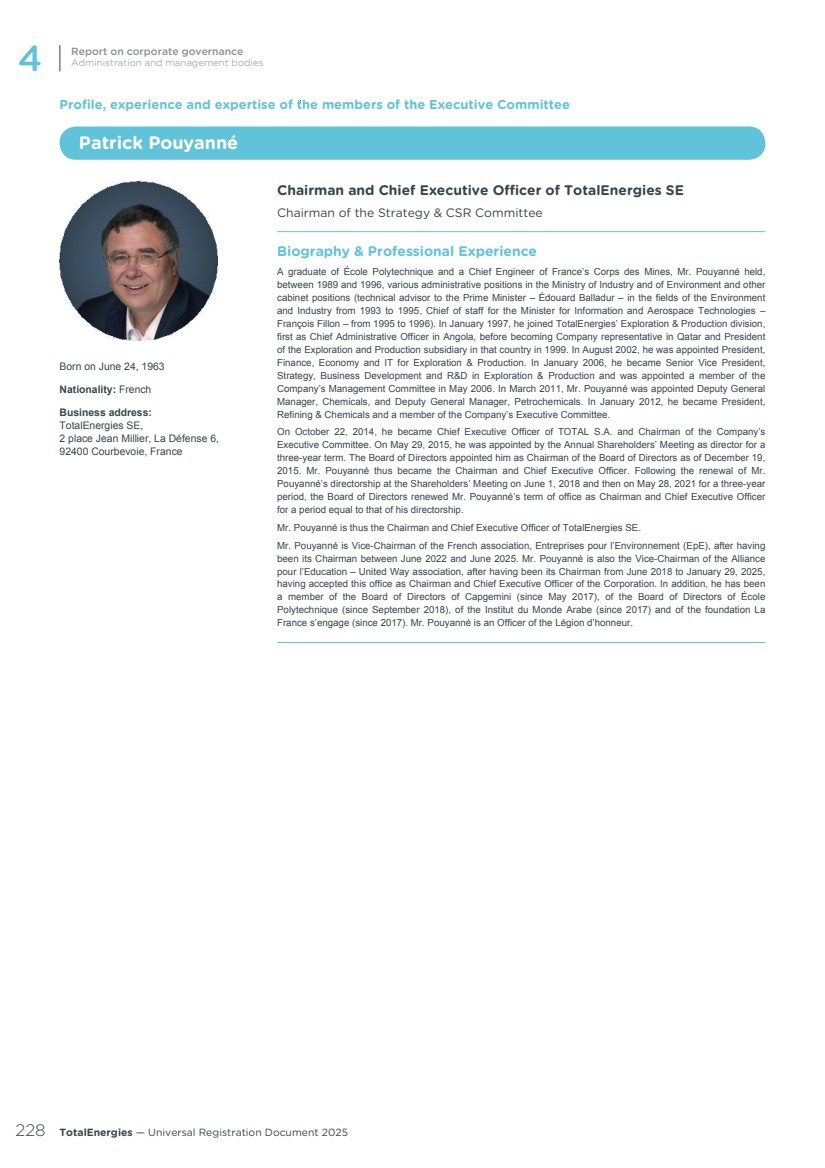
| Born on November 5, 1978 Nationality: French Member of TotalEnergies’ Executive Committee since January 8, 2024 Business address: TotalEnergies SE, 2 place Jean Millier, La Défense 6, 92400 Courbevoie, France President for Strategy & Sustainability Member of TotalEnergies’ Executive Committee Biography & Professional Experience Aurélien Hamelle has been President for Strategy & Sustainability and member of the Executive Committee of TotalEnergies, the French major integrated energy company, since January 2024. Before taking up this position, he was General Counsel and Senior Vice President for Acquisitions & Disposals of TotalEnergies. He started his career as a regulatory and dispute resolution lawyer with various firms, including Allen & Overy as a partner in their Paris office. As President for Strategy & Sustainability, Aurélien Hamelle oversees several corporate divisions of the Company (strategy and markets, sustainability and climate, government affairs, HSE, internal control and audit, legal). He is a member of various professional associations or academic bodies, such as the Haut Comité Juridique de la place financière de Paris (HCJP – High committee of the Paris financial place) and the Club des Juristes. He sits on the strategic committee of Sciences-Po Paris’ law school (Paris Institute of Political Studies), where he has held teaching positions in global governance namely. Aurélien Hamelle holds a Master’s degree in political and international studies from Sciences-Po Paris and graduate degrees in law and management from the Universities Paris-Nanterre and Paris-Dauphine (PSL). Born on April 13, 1964 Nationalities: French and Danish Member of TotalEnergies’ Executive Committee since August 19, 2019 Business address: TotalEnergies SE, 2 place Jean Millier, La Défense 6, 92400 Courbevoie, France President, Asia Member of TotalEnergies’ Executive Committee Biography & Professional Experience Helle Kristoffersen is President, Asia based in Tokyo, member of the Executive Committee. She was President Strategy & Sustainability from 2021 to January 2024, President Strategy & Innovation from 2019 to 2021, SVP Strategy and Corporate Affairs in Gas Renewables & Power from 2016 to 2019 and SVP Strategy & Business Intelligence from January 2012 to September 2016, deputy SVP Strategy from 2011 to 2012, within the Company she joined in 2011. Between 1994 and 2011, she held a number of general management positions within the Alcatel group, which became Alcatel-Lucent, and then Nokia. A dual Danish and French national, Helle Kristoffersen is a graduate of the Ecole Normale Supérieure (Ulm) and the Paris Graduate School of Economics, Statistics and Finance (ENSAE). She also holds a master’s degree in econometrics from Université Paris Sorbonne. She is an alumna of the French Institute for Higher National Defense Studies (IHEDN) and a Knight of the French Legion of Honor. Aurélien Hamelle Helle Kristoffersen Report on corporate governance Administration and management bodies 4 TotalEnergies — Universal Registration Document 2025 229 |
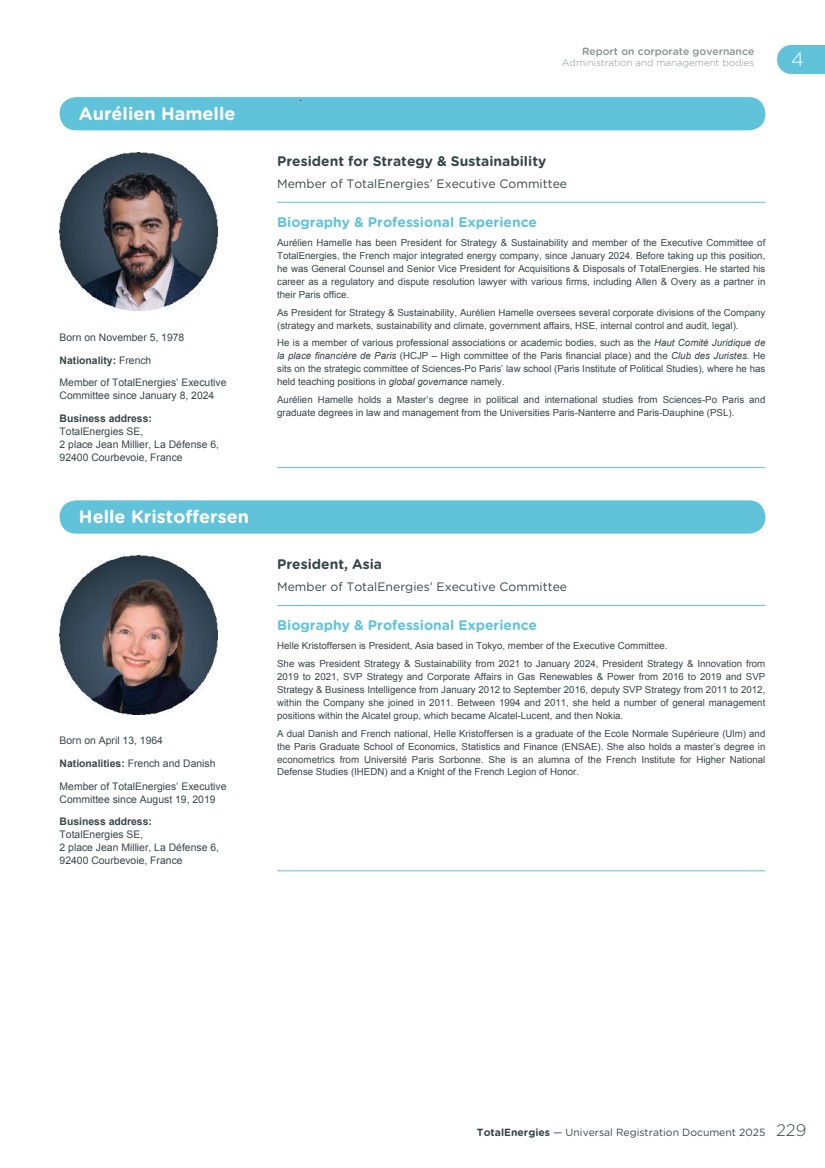
| Born on February 17, 1973 Nationality: French Member of TotalEnergies’ Executive Committee since March 1, 2021 Business address: TotalEnergies SE, 2 place Jean Millier, La Défense 6, 92400 Courbevoie, France President, Gas, Renewables & Power Member of TotalEnergies’ Executive Committee Biography & Professional Experience A graduate of École Polytechnique (1994) and École des Mines in Paris (1997), Stéphane Michel is Chief Engineer of the France’s Corps des Mines. After serving as Energy Advisor to the French Finance Minister (2002-2004), Stéphane Michel joined the Company in 2005, working as Business Development Manager for the Downstream Asia division, based in Singapore. In 2008, Stéphane Michel, is appointed TotalEnergies E&P Qatar JV Business Development Manager and in 2010 Managing Director of TotalEnergies E&P Libya. In 2011, he became TotalEnergies E&P Qatar Managing Director and on April 1, 2014, the E&P Senior Vice President Middle East/North Africa and a Member of the Management Committee of the Exploration & Production segment. On March 1, 2021, Stéphane Michel is appointed President of Gas, Renewables & Power segment and a member of the Executive Committee. Born on June 5, 1962 Nationality: French Member of TotalEnergies’ Executive Committee since September 1, 2016 Business address: TotalEnergies SE, 2 place Jean Millier, La Défense 6, 92400 Courbevoie, France President, Downstream and President, Marketing & Services Member of TotalEnergies’ Executive Committee Biography & Professional Experience Bernard Pinatel is a graduate of the École Polytechnique and the Institut d’Études Politiques (IEP) de Paris and has an MBA from the Institut Européen d’Administration des Affaires (INSEAD). He is also a statistician-economist (École Nationale de la Statistique et de l’Administration Économique – ENSAE). He started his career at Booz Allen & Hamilton, before joining the company TotalEnergies in 1991, where he occupied various operational positions in the production plants and head offices of different subsidiaries, including Hutchinson and Coates Lorilleux. He became the CEO France, and then the CEO Europe of Bostik between 2000 and 2006, and the Chairman and Chief Executive Officer of Cray Valley, from 2006 to 2009. In 2010, he became the Chairman and Chief Executive Officer of Bostik. At TotalEnergies, he became a member of the Company’s Management Committee in 2011 and was member of the Management Committee of Refining & Chemicals from 2011 to 2014. When Arkema took over Bostik in February 2015, he was nominated as a member of the Executive Committee of Arkema, responsible for the High-Performance Materials activity. He joined TotalEnergies on September 1, 2016, and was appointed President of the Refining & Chemicals segment and a member of the Executive Committee. Since September 1, 2024, he has been President, Downstream and President, Marketing & Services. Stéphane Michel Bernard Pinatel 4 Report on corporate governance Administration and management bodies 230 TotalEnergies — Universal Registration Document 2025 |
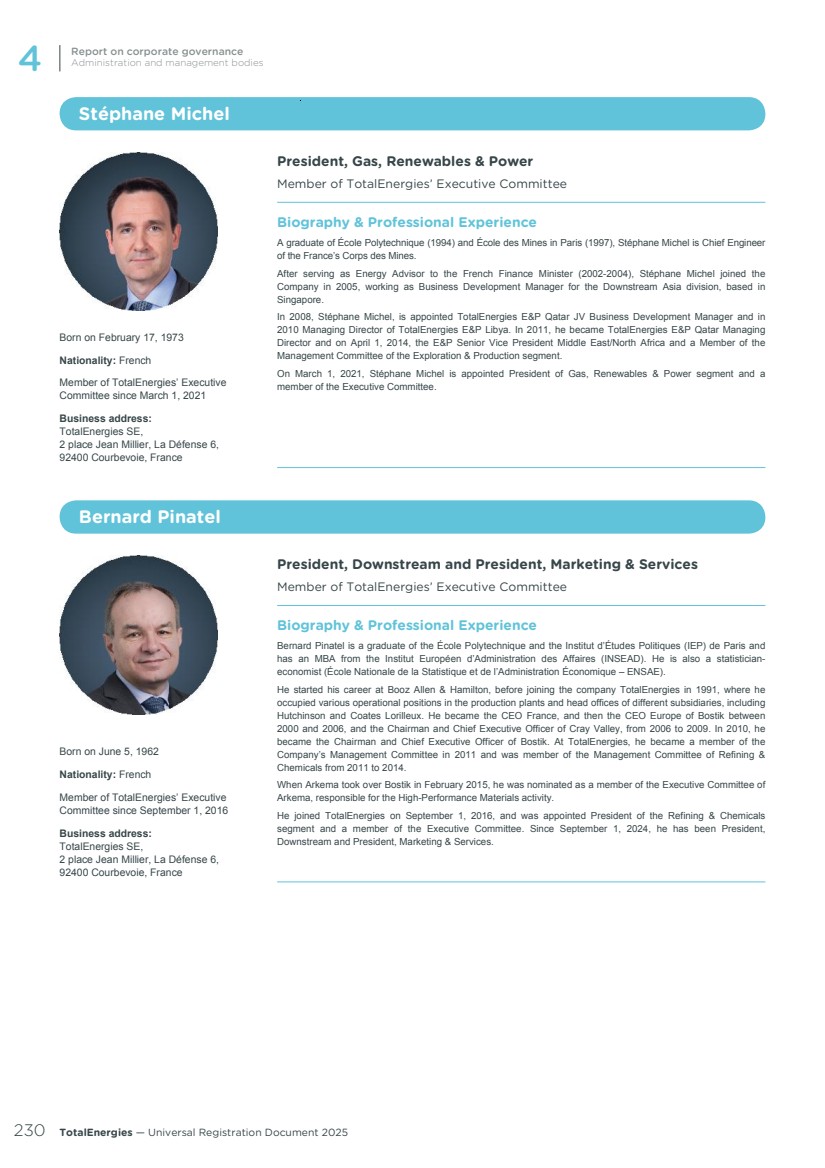
| Born on April 5, 1978 Nationality: French Member of TotalEnergies’ Executive Committee since August 1, 2025 Business address: TotalEnergies SE, 2 place Jean Millier, La Défense 6, 92400 Courbevoie, France President, People & Social Engagement since August 1, 2025 Member of TotalEnergies’ Executive Committee Biography & Professional Experience A graduate of École Polytechnique (2001) and holder of a Master of Science degree from the University of California-Berkeley (2003), Catherine Remy joined TotalEnergies in 2004 as an economist in Exploration & Production at the Company’s headquarters in France. After working in the Finance Department, she continued her career in Nigeria as a project engineer, then oversaw the construction of a platform in Argentina, managing teams in several countries. Back in France, she held various positions related to the planning, development, and negotiation of new international business, particularly in Africa, Brazil, and Iraq. In 2021, she was appointed Vice President Environment & Social for the Company. In 2023, she took over as Managing Director of TotalEnergies EP Argentina and was appointed Country Chair in the country. On August 1, 2025, Catherine Remy was appointed President People & Social Engagement. Born on October 28, 1965 Nationality: French Member of TotalEnergies’ Executive Committee since August 1, 2019 Business address: TotalEnergies SE, 2 place Jean Millier, La Défense 6, 92400 Courbevoie, France Chief Financial Officer Member of TotalEnergies’ Executive Committee Biography & Professional Experience Jean-Pierre Sbraire began his career at TotalEnergies in 1990 in the Trading & Shipping Division. In 1995, he joined Exploration & Production, holding various positions in Paris and Nigeria in finance, economics and business development. In 2005, he was appointed General Secretary and Finance Manager for TotalEnergies in Venezuela. In 2009, within the Company’s Financial Division, he became Senior Vice President, E&P Subsidiaries Financial Operations. In 2012, he was appointed Vice President, Equity Crude Acquisitions in Trading & Shipping. From September 2016 to September 2017, he served as Company’s Treasurer. He then accepted the position of Deputy Chief Financial Officer. In 2019, he was appointed Chief Financial Officer and Executive Committee member. Jean-Pierre Sbraire is a graduate of ENSTA ParisTech engineering school and has a master’s degree from IFP School. Catherine Remy Jean-Pierre Sbraire Report on corporate governance Administration and management bodies 4 TotalEnergies — Universal Registration Document 2025 231 |
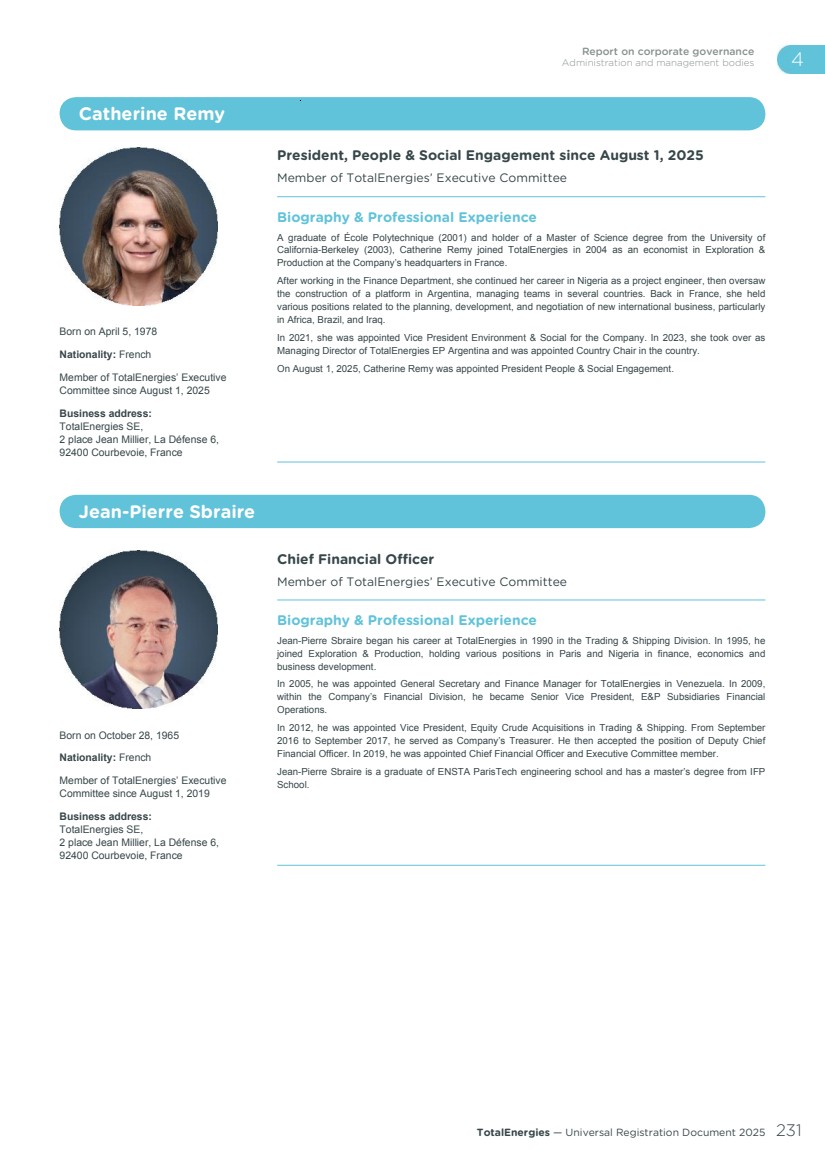
| Born on August 21, 1968 Nationality: French Member of TotalEnergies’ Executive Committee since September 1, 2016 Business address: TotalEnergies SE, 2 place Jean Millier, La Défense 6, 92400 Courbevoie, France President, OneTech Member of TotalEnergies’ Executive Committee Biography & Professional Experience Namita Shah began her career as an Associate Attorney at Shearman & Sterling, a New York-based law firm, where she spent eight years providing advice and supervising transactions including those involving financings of pipeline and power plant companies. She joined TotalEnergies in 2002 as a Legal Counsel in the E&P mergers and acquisitions team. In 2008, she joined the New Business team, where she was responsible for business development in Australia and Malaysia. She held this position until 2011 when she moved to Yangon as General Manager, TotalEnergies E&P Myanmar. On July 1, 2014, she was appointed Senior Vice President, Corporate Affairs, Exploration & Production. On September 1, 2016, Namita Shah was appointed President, People & Social Responsibility and a member of the Executive Committee. On September 1, 2021, she was appointed President, OneTech and member of the Executive Committee. She continued to supervise the Company People & Social Engagement team until July 31, 2025. Indian and French, Namita Shah is a graduate of Delhi University and the New York University of Law. Born on May 15, 1974 Nationality: Belgian Member of TotalEnergies’ Executive Committee since September 1, 2024 Business address: TotalEnergies SE, 2 place Jean Millier, La Défense 6, 92400 Courbevoie, France President, Refining & Chemicals Member of TotalEnergies’ Executive Committee Biography & Professional Experience Vincent Stoquart began his career with TotalEnergies in 1998 as an engineering project manager at the Feluy Polymers Plant in Belgium, working as a production manager in various positions from 2002 to 2009 before being appointed as human resources and communications manager of the Feluy Plant in 2010. From 2012 to 2017, he was Plant Manager of the Flanders site in Dunkirk, France, before joining TotalEnergies Global Services where he became President of TotalEnergies Learning Solutions. From 2019 to 2021, he served as Senior Vice President Refining and Petrochemicals Americas. He was during this period also the country chair for TotalEnergies in the United States, based in Houston, Texas. Prior to that, Mr. Stoquart was Senior Vice President Polymers of TotalEnergies Refining & Chemicals. Vincent Stoquart was Senior Vice President Renewables at TotalEnergies SE since 2021. Mr. Stoquart graduated as a Mechanical Engineer from the Catholic University of Louvain, Belgium. He also holds a Diploma Course in Aeronautics and Aerospace from the von Karman Institute for Fluid Dynamics. Namita Shah Vincent Stoquart 4 Report on corporate governance Administration and management bodies 232 TotalEnergies — Universal Registration Document 2025 |
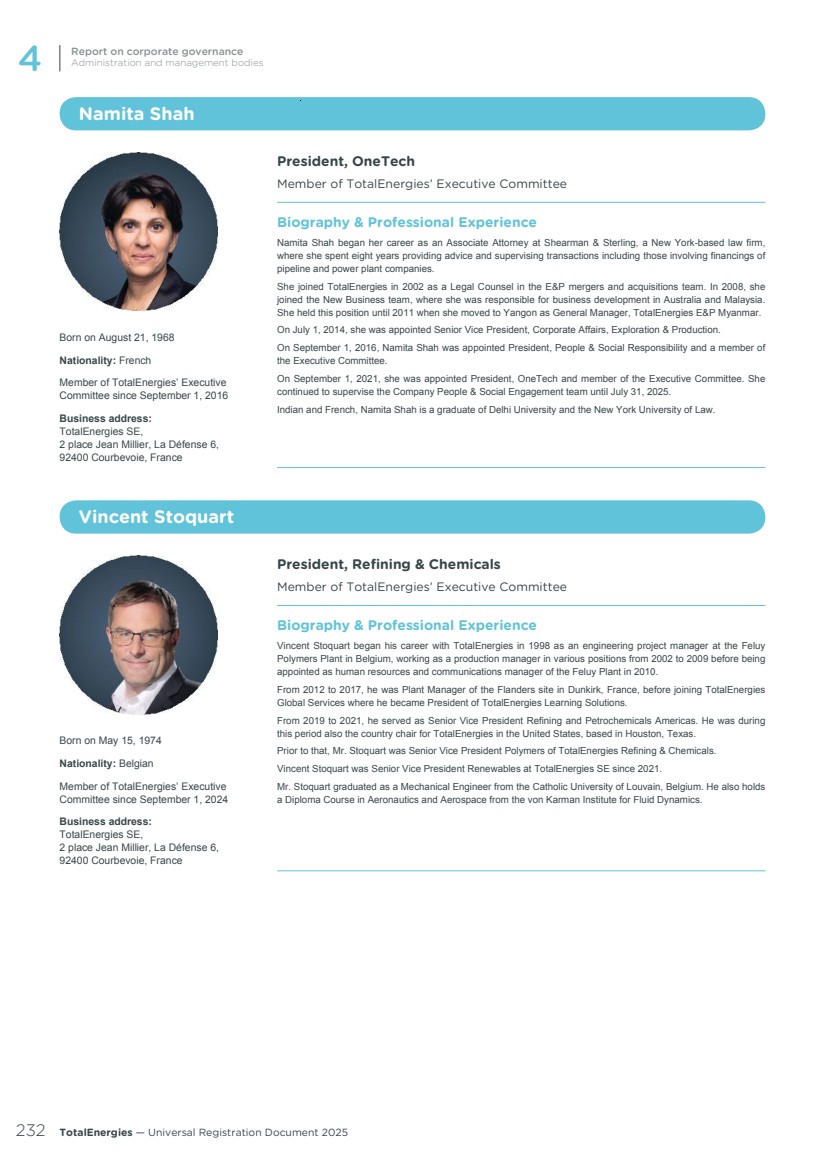
| Born on September 9, 1969 Nationality: French Member of TotalEnergies’ Executive Committee since September 1, 2021 Business address: TotalEnergies SE, 2 place Jean Millier, La Défense 6, 92400 Courbevoie, France President, Exploration & Production Member of TotalEnergies’ Executive Committee Biography & Professional Experience Nicolas Terraz started his career in the French Ministries of Industry (1994-1997) and Public Works and Transportation (1997-2001) and joined TotalEnergies in 2001. After holding positions in France and in Qatar, Nicolas Terraz served as Managing Director of TotalEnergies E&P Myanmar (2008-2011), Managing Director of TotalEnergies E&P France (2011-2014), Vice President New Ventures for Exploration and Production (2014-2015) and Managing Director of TotalEnergies E&P Nigeria (2015- 2019). In 2019, Nicolas Terraz was appointed Senior Vice President Africa and a member of the management committee of the Exploration & Production segment of TotalEnergies. Born in 1969, Nicolas Terraz is a graduate of the Ecole Polytechnique and the Ecole Nationale des Ponts et Chaussées and earned a Master of Science in Technology and Policy from the Massachusetts Institute of Technology. 4.1.6 Shares held by the administration and management bodies As of December 31, 2025, based on statements by the persons concerned, registered shares ledger and the register of the FCPE fund units custodian, all of the members of the Board of Directors and the executive officers(1) of TotalEnergies held less than 0.5% of the share capital: – members of the Board of Directors(2): 597,558 TotalEnergies shares and 25,147.64 units of the FCPE (collective investment fund) invested in TotalEnergies shares; – Chairman and Chief Executive Officer: 578,895 TotalEnergies shares and 14,881.25 units of the FCPE (collective investment fund) invested in TotalEnergies shares; – executive officers: 1,422,038 TotalEnergies shares and 338,300.55 units of the FCPE invested in TotalEnergies shares. Members of the Board of Directors and Executive Committee may not hold TotalENergies shares listed on the US market. By decision of the Board of Directors on February 7, 2023: – Executive directors of the Corporation are required to hold a number of TotalEnergies shares equal in value to five years of the fixed portion of their annual compensation; and – members of the Executive Committee are required to hold a number of TotalEnergies shares equal in value to four years of the fixed portion of their annual compensation. Executive directors of the Corporation and members of the Executive Committee have a maximum period of five years from taking office to reach these holding levels. Executive directors and members of the Executive Committee cannot sell the performance shares that were definitively awarded to them until they have reached the required level of ownership of TotalEnergies shares. The number of TotalEnergies shares to be considered comprises TotalEnergies shares and units of FCPEs invested in TotalEnergies shares. Summary of transactions referred to in Article L. 621-18-2 of the French Monetary and Financial Code The following table presents transactions, of which the Corporation has been informed, in the Corporation’s shares or related financial instruments carried out in 2025 by the individuals referred to in paragraphs a), b)(3) and c) of Article L. 621-18-2 of the French Monetary and Financial Code: 2025 Acquisition Subscription(a) Transfer Exchange Exercise of options Patrick Pouyanné(b) TotalEnergies shares 85,400 – – – – Units in FCPE and other related financial instruments(c) – 1,004.88 – – – Jacques Aschenbroich(b) TotalEnergies shares – – – – – Units in FCPE and other related financial instruments(c) – – – – – Marie-Christine Coisne‑Roquette(b) TotalEnergies shares – – – – – Units in FCPE and other related financial instruments(c) – – – – – Lise Croteau(b) TotalEnergies shares – – – – – Units in FCPE and other related financial instruments(c) – – – – – (1) As of December 31, 2025, the Company’s executive officers are the members of the Executive Committee, i.e., ten people. During the fiscal year 2020, the Corporation, taking into account the definition used by the US regulations applicable to Executive Officers and in the interest of harmonization, has chosen to reduce the list of its Executive Officers to the members of the Executive Committee in order to align this list with the list of “Persons Discharging Managerial Responsibilities” (PDMR) within the meaning of Article 19.5 of Regulation (EU) No. 596/2014 on Market Abuse. For the purposes of this regulation, PDMRs are defined as the persons referred to in Article L. 621-18-2 (a) of the French Monetary and Financial Code (“the directors”) and the persons referred to in Article L. 621-18-2 (b) of the same code that the Corporation has defined as the members of the TotalEnergies Executive Committee. (2) Including the Chairman and Chief Executive Officer, the director representing employee shareholders and the directors representing employees. (3) The individuals referred to in paragraph b) of Article L. 621-18-2 of the French Monetary and Financial Code include the members of the Executive Committee. Nicolas Terraz Report on corporate governance Administration and management bodies 4 TotalEnergies — Universal Registration Document 2025 233 |
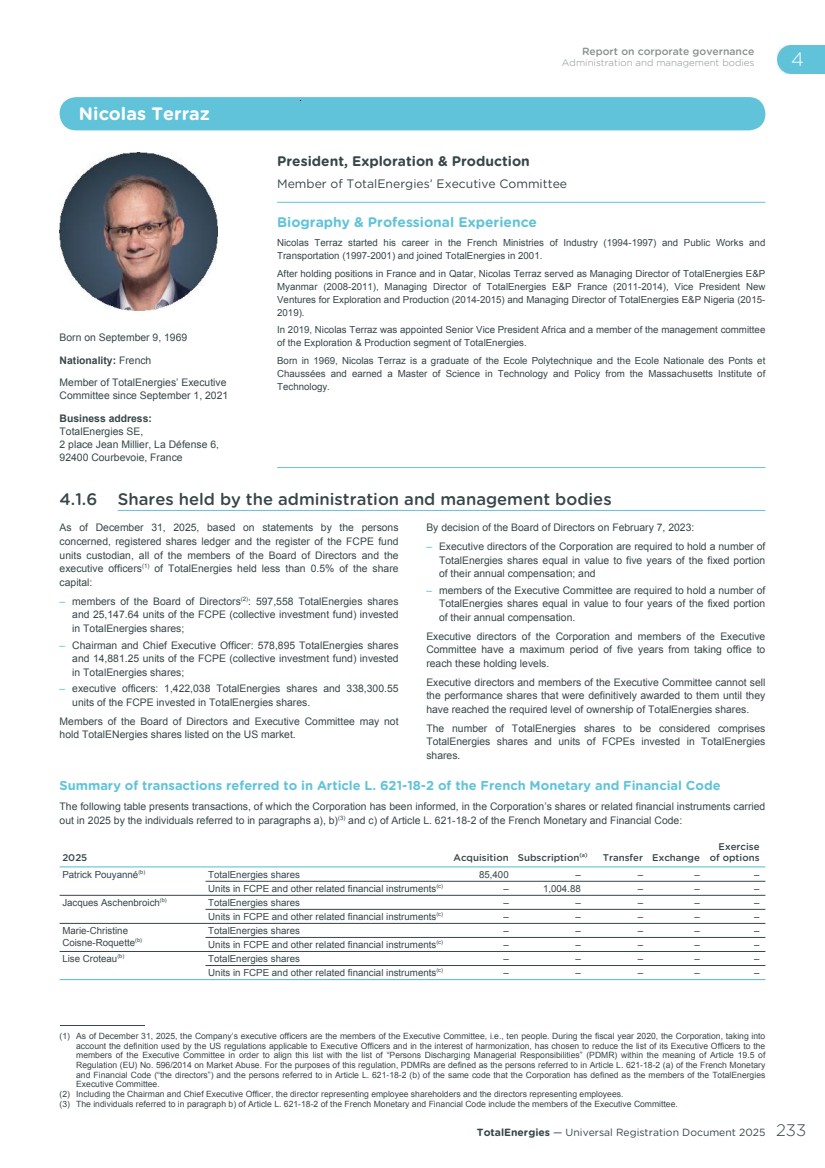
| 2025 Acquisition Subscription(a) Transfer Exchange Exercise of options Mark Cutifani(b) TotalEnergies shares – – – – – Units in FCPE and other related financial instruments(c) – – – – – Marie-Ange Debon(b) TotalEnergies shares – – – – – Units in FCPE and other related financial instruments(c) – – – – – Dierk Paskert(b) TotalEnergies shares 1,000 – – – – Units in FCPE and other related financial instruments(c) – – – – – Romain Garcia-Ivaldi(b) TotalEnergies shares – – – – – Units in FCPE and other related financial instruments(c) – 1,121.24 (234.69) – – Maria van der Hoeven(b) Director until May 23, 2025 TotalEnergies shares – – – – – Units in FCPE and other related financial instruments(c) – – – – – Glenn Hubbard(b) TotalEnergies shares – – – – – Units in FCPE and other related financial instruments(c) – – – – – Emma de Jonge(b) Director until May 23, 2025 TotalEnergies shares – – – – – Units in FCPE and other related financial instruments(c) – 844.28 (227.32) – – Anelise Lara(b) TotalEnergies shares – – – – – Units in FCPE and other related financial instruments(c) – – – – – Helen Lee Bouygues(b) Director since May 23, 2025 TotalEnergies shares – – – – – Units in FCPE and other related financial instruments(c) – – – – – Jean Lemierre(b) Director until May 23, 2025 TotalEnergies shares – – – – – Units in FCPE and other related financial instruments(c) – – – – – Laurent Mignon(b) Director since May 23, 2025 TotalEnergies shares – – – – – Units in FCPE and other related financial instruments(c) – – – – – Angel Pobo(b) TotalEnergies shares – – – – – Units in FCPE and other related financial instruments(c) – 975.01 (222.58) – – Valérie Della Puppa-Tibi(b) Director since May 23, 2025 TotalEnergies shares – – – – – Units in FCPE and other related financial instruments(c) – 20.33 – – – Aurélien Hamelle(b) TotalEnergies shares 9,821 – – – – Units in FCPE and other related financial instruments(c) – 1,610.76 (1,906.45) – – Helle Kristoffersen(b) TotalEnergies shares 23,058 – – – – Units in FCPE and other related financial instruments(c) – 4,899.88 (913.82) – – Stéphane Michel(b)(d) TotalEnergies shares 18,788 – – – – Units in FCPE and other related financial instruments(c) – 11,638.49 (6,677.37) – – Bernard Pinatel(b) TotalEnergies shares 27,328 – – – – Units in FCPE and other related financial instruments(c) – 7,565.33 (1,292.81) – – Catherine Remy(b) Member of the Executive Committee since August 1, 2025 TotalEnergies shares – – – – – Units in FCPE and other related financial instruments(c) – 122.28 – – – Jean-Pierre Sbraire(b) TotalEnergies shares 25,620 – – – – Units in FCPE and other related financial instruments(c) – 14,160.44 (3,010.77) – – Namita Shah(b) TotalEnergies shares 28,182 – – – – Units in FCPE and other related financial instruments(c) – 13,831.75 (3,036.03) – – Vincent Stoquart(b) TotalEnergies shares 7,686 – – – – Units in FCPE and other related financial instruments(c) – 8,020.93 (3,965.35) – – Nicolas Terraz(b) TotalEnergies shares 17,080 – – – – Units in FCPE and other related financial instruments(c) – 11,935.90 (2,825.84) – – (a) Including FCPE share subscription through automatic dividend reinvestment for the year 2025, except for those relating to the dividend with an ex-dividend date on December 31, 2025, which will be accounted for in 2026. (b) Including related parties within the meaning of the provisions of Article R. 621-43-1 of the French Monetary and Financial Code. (c) FCPE primarily invested in TotalEnergies shares and following the categorisation carried out by the fund manager with the AMF (including in particular technical operations of the “fonds Relais” merger for the capital increase reserved for employees). (d) Anne-Thérèse Michel, a person related to Stéphane Michel, acquired 387.23 FCPE shares and transferred 0.31 FCPE shares in 2025. 4 Report on corporate governance Administration and management bodies 234 TotalEnergies — Universal Registration Document 2025 |
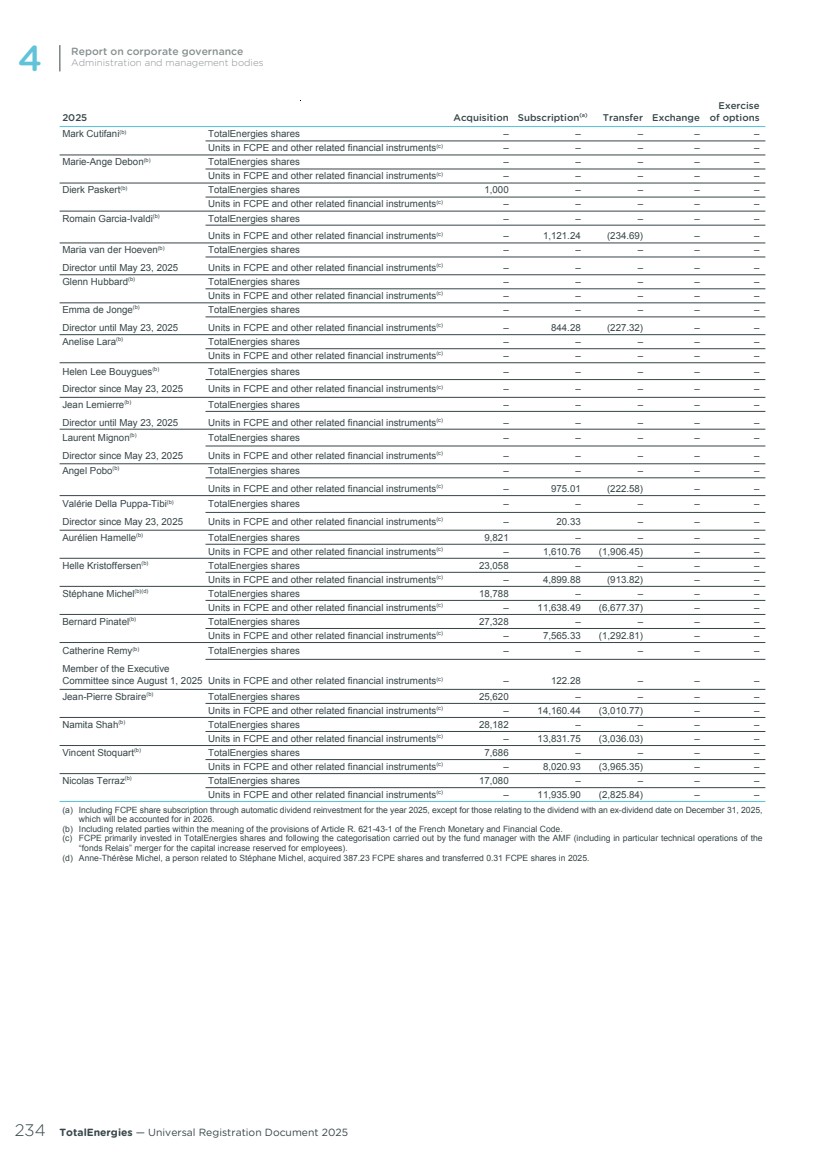
| 4.2 Statement regarding corporate governance For many years, TotalEnergies has taken an active approach to corporate governance and at its meeting on November 4, 2008, the Board of Directors decided to refer to the AFEP-MEDEF Code of Corporate Governance for publicly traded companies (available on the AFEP and MEDEF websites). The Corporation follows all the recommendation made in the AFEP-MEDEF Code in its revised version dated December 2022 and reports on it in accordance with Article L. 22-10-10 of the French Commercial Code. Recommendation not followed None Explanation – practice followed by TotalEnergies Not applicable 4.3 Compensation for the administration and management bodies 4.3.1 Board members’ compensation 4.3.1.1 Board members’ compensation policy Aggregate amount of directors’ compensation due to their directorships In accordance with the provisions of Article L. 22-10-14 of the French Commercial Code, the conditions applicable to Board members’ compensation are defined by the Board of Directors on the proposal of the Governance and Ethics Committee, under the conditions provided for by Article L. 22-10-8 of the French Commercial Code and within the limit of an annual fixed amount determined by the Annual Shareholders’ Meeting. The maximum annual global envelope was revised in 2025 to bring it from €1,950,000 to €2,150,000. Such amount could then be reviewed every two to three years depending in particular on inflation. Rules for allocating directors’ compensation due to their directorships The allocation rules of the directors’ compensation and their payment conditions, defined by the Board at its meeting on July 26, 2017, were reviewed by the Board, at its meeting on February 4, 2025, to increase by €500 the portion linked to their attendance at the meetings of the Board and its Committees, while the other allocation rules remain unchanged. The compensation due to directors by virtue of their directorships are allocated according to a formula comprised of fixed compensation and variable compensation based on fixed amounts per meeting, which makes it possible to take into account each director’s actual attendance at the meetings of the Board of Directors and its Committees, subject to the following conditions: – a fixed annual portion of €20,000 per director*; – a fixed annual portion* of €30,000 for the Chairman of the Audit Committee**; – a fixed annual portion* of €25,000 for the Audit Committee members**; – a fixed annual portion* of €25,000 for the Chairman of the Governance and Ethics Committee and for the Chairman of the Compensation Committee**; – an additional fixed annual portion* of €30,000 (on top of the amounts above) for the Lead Independent Director; – an amount of €8,000 per director for each Board meeting actually attended; – an amount of €4,000 per director for each Governance and Ethics Committee, Compensation Committee or Strategy & CSR Committee meeting actually attended; – an amount of €7,500 per director for each Audit Committee meeting actually attended; – a premium of €4,000 in respect of each actual travel from a country outside France to attend a Board or Committee meeting. * Calculated on a pro rata basis, in the event of change in the course of the year. ** Substituting the €20,000 fixed annual portion per director. In case of accumulation of the functions of director and/or Audit Committee member and/or Chairman of a Committee (Audit, Governance and Ethics, Compensation), the difference between the fixed annual portion per director and the fixed annual portion of the other functions is added. The Chairman and Chief Executive Officer does not receive directors’ compensation for his work on the Board and Committees of the Corporation. The total amount paid to each director is determined after taking into consideration the director’s actual presence at each Board of Directors’ or Committee’s meeting and, if appropriate, since the decision by the Board of Directors on February 9, 2012, after prorating the amount set for each director such that the overall amount paid remains within the maximum limit set by the Shareholders’ Meeting. Directors’ compensation for each fiscal year is paid following a decision by the Board of Directors, on the proposal of the Governance and Ethics Committee, at the beginning of the following fiscal year. The director representing employee shareholders and the directors representing employees receive directors’ compensation according to the same terms and conditions as any other director. Moreover, there is no service contract between a director and the Corporation or any of its controlled companies that provides for the grant of benefits under such a contract. After reviewing the benchmark conducted on CAC40 companies with a compensation allocation structure among Directors comparable to that of TotalEnergies, the Board of Directors decided to change the allocation rules of the compensation to Directors as of fiscal year 2026, without affecting the maximum annual envelope of €2,150,000 previously approved by your Shareholders’ Meeting. Report on corporate governance Statement regarding corporate governance 4 TotalEnergies — Universal Registration Document 2025 235 |
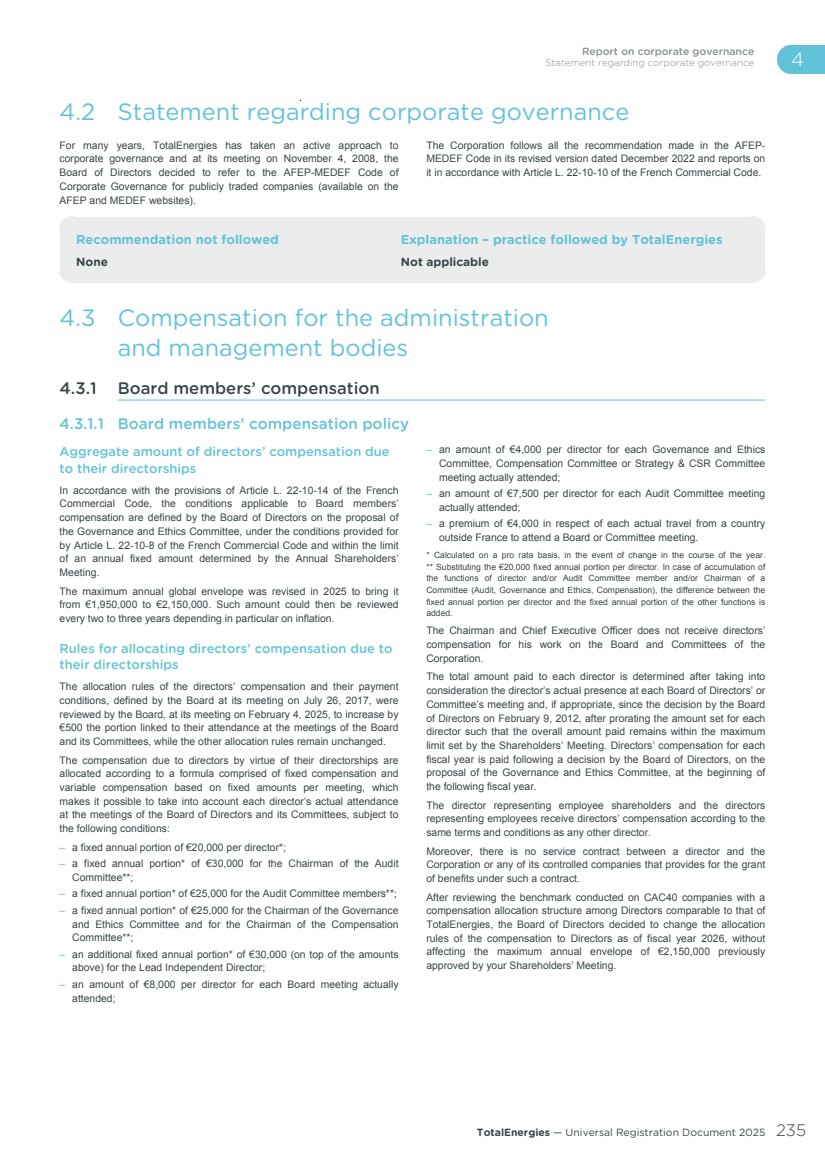
| Thus, as from 2026, subject to approval by the Shareholders’ Meeting on May 29, 2026, the compensation due to directors by virtue of their directorships will be allocated according to a formula comprised of fixed compensation and variable compensation based on fixed amounts per meeting, which makes it possible to take into account each director’s actual attendance at the meetings of the Board of Directors and its Committees, subject to the following conditions: – a fixed annual portion of €25,000 per director*; – an amount of €8,000 per director for each Board meeting actually attended; – an additional fixed annual portion* of €50,000 for the Lead Independent Director; – an additional fixed annual portion* of €20,000 for the Chairman of the Audit Committee; – an additional fixed annual portion* of €7,500 for the Audit Committee members; – an amount of €7,500 per director for each Audit Committee meeting actually attended; – an additional fixed annual portion* of €15,000 for the Chairman of the Governance and Ethics Committee and for the Chairman of the Compensation Committee; – an amount of €5,000 per director for each Committee (other than the Audit Committee) meeting actually attended; – a premium of €5,000 in respect of each actual travel from a country outside France to attend a Board or Committee meeting. *Calculated on a pro rata basis, in the event of change in the course of the year. 4.3.1.2 Compensation paid to directors during fiscal year 2025 or allocated during the same fiscal year At its meeting on February 10, 2026, the Board of Directors, on the proposal of the Governance and Ethics Committee, set the aggregate amount of compensation (formerly fees) allocated to board members due to their directorships in TotalEnergies SE, for fiscal year 2025. This amount was determined by applying the principles presented in the directors’ compensation policy (point 4.3.1.1), and set for each director, after taking into account his/her actual attendance to each meeting of the Board or of the Committees (refer to point 4.1.2.2 – table of the directors’ attendance at Board and Committees meetings). Given the number of Board and Committee meetings held during fiscal year 2025, the amount of compensation determined for each director on the basis of the above allocation rules was set at €1,911,458, i.e., an amount below the cap set by the Shareholders’ Meeting on May 23, 2025 (i.e., €2.15 million). The director representing employee shareholders and the directors representing employees benefited from their compensation by virtue of their directorships in the same conditions and under the same basis as the other directors. Ms. Della Puppa-Tibi and Mr. Pobo chose to pay, for the entire term of their directorship, all their directors’ compensation to their respective trade union membership organization. Ms. de Jonge and Mr. Garcia-Ivaldi chose to pay all their director’s compensation to charities of their choices. During the past two years, the directors currently in office have not received any compensation or in-kind benefits from the Corporation or from its controlled companies other than those mentioned in the table below. No extraordinary compensation was allocated. Ms. Emma de Jonge, director representing employee shareholders from May 25, 2022 to May 23, 2025, Ms. Valérie Della Puppa-Tibi, director representing employee shareholders since May 23, 2025, as well as Mr. Angel Pobo, director representing employees since October 14, 2020, whose term of office was renewed on February 16, 2023, benefit from the internal defined contribution pension plan applicable to all TotalEnergies SE employees, called PERO (Plan d’épargne retraite obligatoire - mandatory retirement savings plan), governed by Article L. 242-1 of the French Social Security Code. The Corporation’s commitment is limited to its share of the contribution paid to the insurance company that manages the plan. For fiscal year 2025, this pension plan represented an expense accounted for TotalEnergies SE in favor of Ms. de Jonge of €1,395, in favor of Ms. Della Puppa-Tibi of €891, and in favor of Mr. Pobo of €851. The table below presents the total compensation paid to directors during fiscal year 2025 or allocated for the same fiscal year. 4 Report on corporate governance Compensation for the administration and management bodies 236 TotalEnergies — Universal Registration Document 2025 |
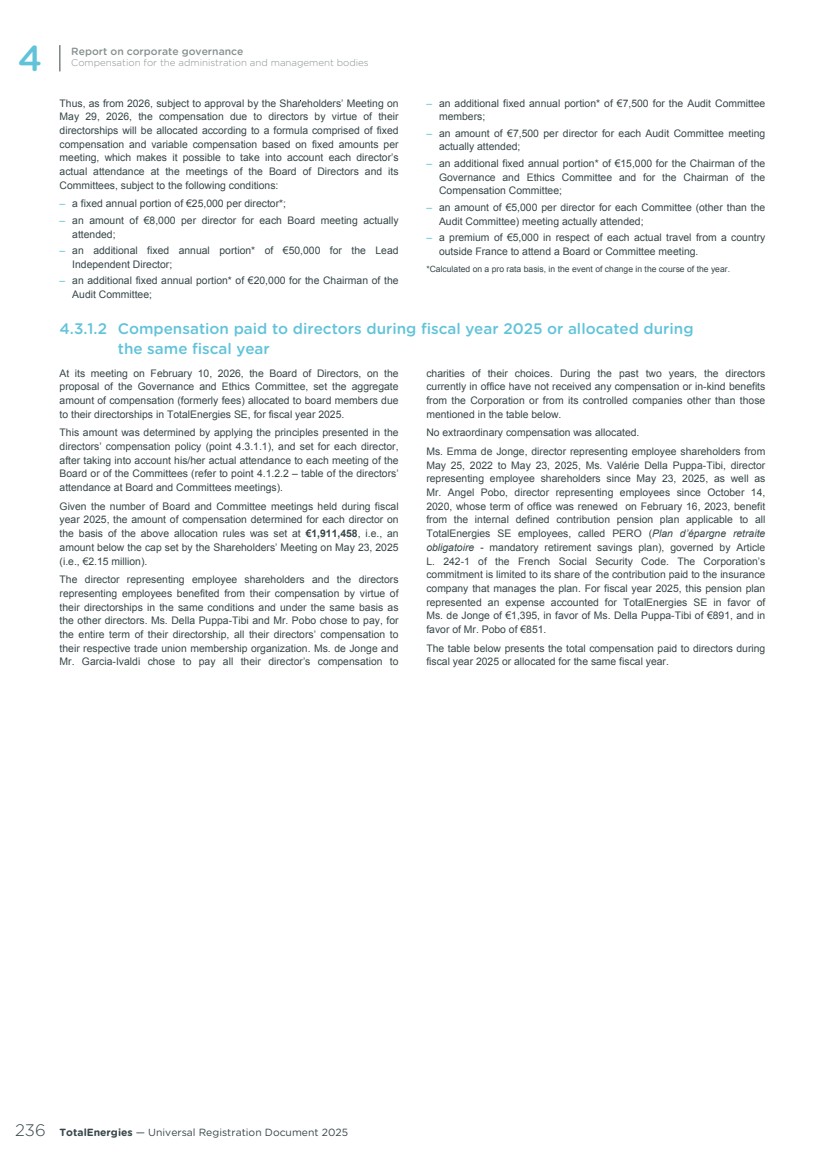
| Table of compensation allocated in respect of directorship and other compensation by non‑executive directors Table 3 – Position-recommendation – DOC-2021-02 (Appendix 2) Gross (€) Amount allocated in respect of fiscal year 2024 Amount paid during fiscal year 2024 Amount allocated in respect of fiscal year 2025 Amount paid during fiscal year 2025 Patrick Pouyanné Compensation by virtue of directorship None None None None Other compensation (a) (a) (a) (a) Jacques Aschenbroich(b) Compensation by virtue of directorship 165,654 147,000 163,000 165,654 Other compensation – – – – Patricia Barbizet(c) Compensation by virtue of directorship n/a 71,500 n/a n/a Other compensation n/a – n/a n/a Marie-Christine Coisne-Roquette Compensation by virtue of directorship 166,637 167,500 177,500 166,637 Other compensation – – – – Jérôme Contamine(c) Compensation by virtue of directorship – 64,500 n/a – Other compensation – – n/a – Lise Croteau Compensation by virtue of directorship 196,131 192,000 204,541 196,131 Other compensation – – – – Mark Cutifani Compensation by virtue of directorship 156,315 141,000 165,000 156,315 Other compensation – – – – Marie-Ange Debon(d) Compensation by virtue of directorship 62,995 n/a 96,000 62,995 Other compensation – n/a – – Valérie Della Puppa-Tibi(e) Compensation by virtue of directorship(i) n/a n/a 60,164 n/a Other compensation n/a n/a 88,376 88,376 Romain Garcia-Ivaldi Compensation by virtue of directorship(j) 156,806 152,000 161,500 156,806 Other compensation 81,008 81,008 86,518 86,518 Maria van der Hoeven(f) Compensation by virtue of directorship 201,046 197,000 86,253 201,046 Other compensation – – – – Glenn Hubbard(b) Compensation by virtue of directorship 188,266 157,000 189,500 188,266 Other compensation – – – – Anne-Marie Idrac(g) Compensation by virtue of directorship 57,928 119,000 n/a 57,928 Other compensation – – n/a – Emma de Jonge(f) Compensation by virtue of directorship(j) 103,718 98,000 43,836 103,718 Other compensation 132,103 132,103 138,148 138,148 Anelise Lara(h) Compensation by virtue of directorship 135,178 65,000 136,000 135,178 Other compensation – – – – Helen Lee Bouygues(e) Compensation by virtue of directorship n/a n/a 60,164 n/a Other compensation n/a n/a – n/a Jean Lemierre(f) Compensation by virtue of directorship 106,668 104,500 51,836 106,668 Other compensation – – – – Laurent Mignon(e) Compensation by virtue of directorship n/a n/a 60,164 n/a Other compensation n/a n/a – n/a Dierk Paskert(h) Compensation by virtue of directorship 138,619 68,500 144,000 138,619 Other compensation – – – – Angel Pobo Compensation by virtue of directorship(i) 114,041 108,500 112,000 114,041 Other compensation 83,313 83,313 84,861 84,861 Total 2,246,426 2,149,424 2,309,361 2,347,905 (a) Refer to the summary tables presented in point 4.3.2. (b) Director since May 28, 2021. (c) Director until May 26, 2023. (d) Director since May 24, 2024. (e) Director since May 23, 2025. (f) Director until May 23, 2025. (g) Director until May 24, 2024. (h) Director since May 26, 2023. (i) Ms. Della Puppa-Tibi and Mr. Pobo chose to pay, for the entire term of their directorship as director, all their director’s compensation to their trade union membership organization. (j) Ms. de Jonge and Mr. Garcia-Ivaldi chose to pay all their director’s compensation to charities of their choices, for the entire term of their directorship. Report on corporate governance Compensation for the administration and management bodies 4 TotalEnergies — Universal Registration Document 2025 237 |
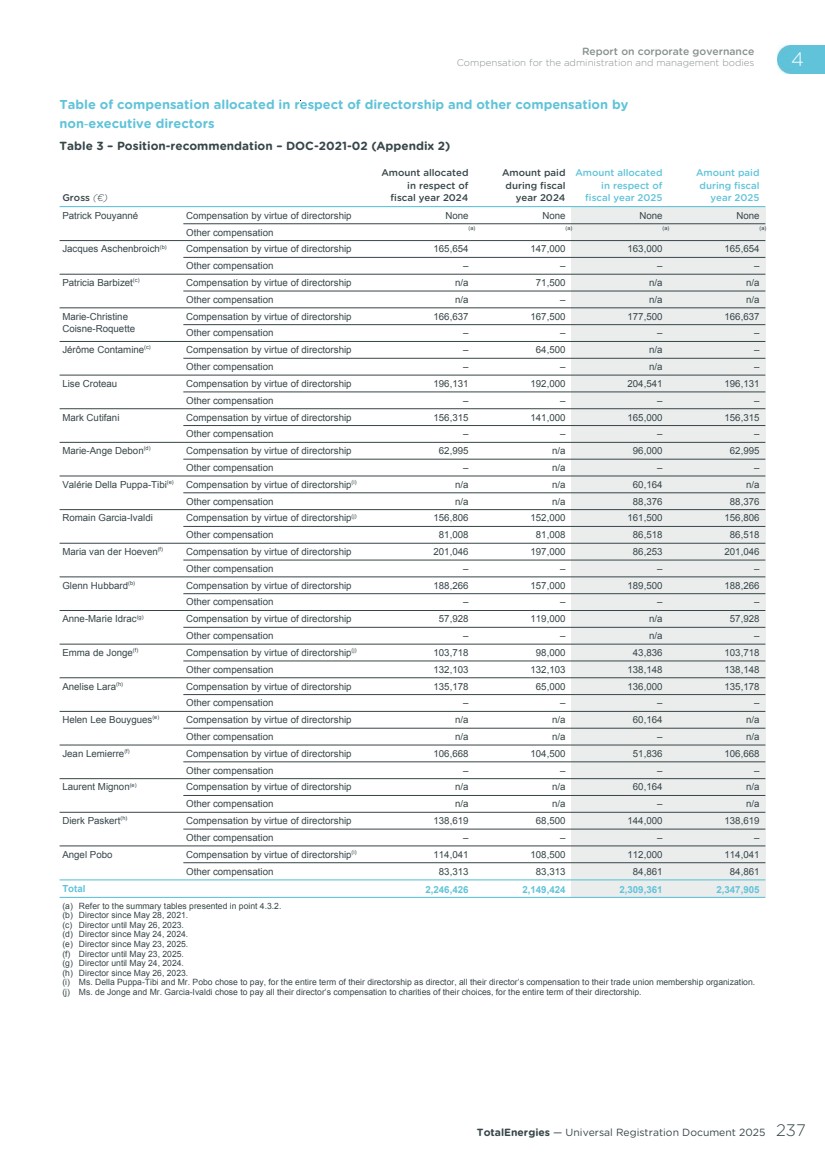
| 4.3.2 Chairman and Chief Executive Officer’s compensation Letter of the Compensation Committee to shareholders Dear Shareholders, On behalf of the Board of Directors, we are pleased to present the Company’s compensation report for the year ended 31 December 2025. The Compensation Committee met twice since the last Annual General Meeting and reviewed market trends and the Company’s performance to ensure that current practices remain sufficiently competitive and are based on a clear alignment between compensation and performance. The Committee noted that the two resolutions regarding the Chairman and CEO’s compensation were overwhelmingly approved by shareholders at the Annual General Meeting of May 23, 2025, since the 2024 financial year compensation (say on pay ex post) received 93.9% of votes in favour, while the 2025 financial year compensation policy (say on pay ex ante) received 94.8% of votes in favour. Furthermore, the Committee recalls that, in connection with the renewal of the Chairman and CEO’s term of office at the Annual General Meeting of May 24, 2024 and the setting of the Chairman and CEO’s compensation policy, your Board announced that the annual base salary (EUR 1,550,000) and the structure and amount of the annual variable portion applicable during the previous term of office would be maintained unchanged for the duration of the new term of office (2024 to 2026), along with the allocation of the amount of performance shares per year (140,000). The annual base salary (fixed compensation) of the Chairman and CEO for 2026 will therefore be EUR 1,550,000 (unchanged since the beginning of 2022). The annual variable portion for 2026 therefore retains the same structure (110% financial criteria, 30% quantifiable safety and GHG criteria, 40% personal portion) and the same amount (up to 180% of the base salary) as for 2025. Within this unchanged structure, the Board has decided, on the recommendation of the Compensation Committee, to adjust the thresholds for Integrated Power cash-flow criterion, which accounts for 10% of variable compensation. The Board has decided to raise the level of the Integrated Power cash-flow corresponding to 100% achievement of this criterion from $2.5 billion to $3 billion. In addition, in view of the improved results achieved by the Company in 2025, the targets for the TRIR (Total Recordable Injury Rate) safety criteria and the evolution in the number of Tier 1 + Tier 2 incidents have been made more stringent for the 2026 annual variable portion. Similarly, the target for the criterion related to Scope 1+2 greenhouse gas emissions from operated facilities has been revised downward for 2026 compared to the trajectory validated by the Board of Directors since 2020, in line with the new 2026 target announced by the Company (emission target of 34 Mt CO2e for 2026 instead of 37 Mt CO2e for 2025). The allocation of 140,000 performance shares for 2026 is in line with the Chairman and CEO’s compensation policy set by the Board of Directors for the entire duration of the new term of office (2024 to 2026). As announced with regard to the sharing of value and employee share ownership, your Board will ensure that the plans for the allocation of performance shares 2024, 2025 and 2026 to employees evolve, in terms of the volume of shares allocated and the number of beneficiaries, thereby contributing to increasing the alignment of the Company’s employees’ interests with those of its shareholders. Lastly, the Committee recalls that the corporate officer compensation policy incorporates best practices in terms of clawback policy for variable compensation and performance shares, as well as shareholding requirements for the Chairman and CEO (and the Executive Committee). On behalf of the Compensation Committee, we would like to thank you for your support and feedback, which we will continue to seek as we review and refine our compensation practices to ensure that they remain aligned with the interests of our shareholders and fully comply with all legal and regulatory requirements. The Compensation Committee The Board of Directors pays the greatest importance to ensuring that the general principles governing the compensation of executive directors, detailed in point 4.3.2.2, lead to a measured and fair compensation, depending on the results obtained, the responsibility assumed and the market. The general principles of the compensation policy of the executive directors are based on: – the compensation of the performance, – the alignment with the interest of shareholders, – the competitiveness compared to a reference group of peers and industrial companies of comparable size. 4 Report on corporate governance Compensation for the administration and management bodies 238 TotalEnergies — Universal Registration Document 2025 |
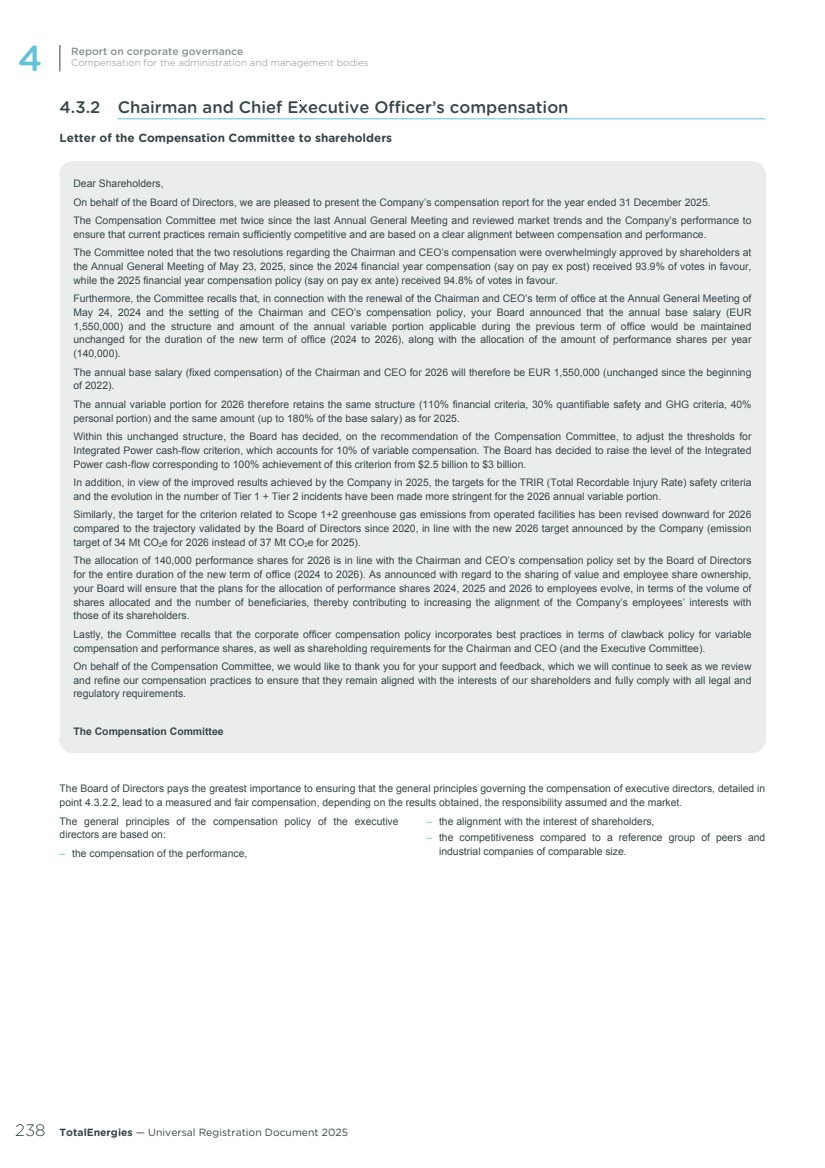
| Key points of the 2025 performance and changes in the compensation of the Chairman and Chief Executive Officer TSR ($)* Return on equity Organic gearing Pre-dividend organic cash breakeven Return on average capital employed (ROACE), comparative Reduction of GHG emissions from operated facilities (Scope 1+2) 2025 27.6% 13.6% 14.5% $26.4/b TotalEnergies: 12.6% Peers**: 9.4% 33 Mt CO2e 2024 -14.8% 15.8% 7.3% $25.4/b TotalEnergies: 14.8% Peers**: 12.0% 34 Mt CO2e * TSR as defined in point 6.1.2.2 B of chapter 6. ** Panel average (ExxonMobil, Shell, BP and Chevron). 10-year TSR 5-year TSR Structure of the Chairman and Chief Executive Officer’s total compensation (excluding benefits) 84% of the compensation is subject to performance conditions Annual variable compensation (STI) 2025 in % of the base salary – HSE - GHG: 27% – Financial parameters: 96.6% – Personal contribution: 40% Compensation Performance shares (LTIP) 2025 plan – TSR vs. peers: 25% – Annual variation in net cash flow per share vs. peers: 25% – Pre-dividend organic cash breakeven: 20% – Lifecycle carbon intensity of energy products sold to customers: 15% – Change in methane emissions from operated facilities: 15% History of the rate of achievement of performance criteria for performance share plans * Note: As the performance criteria differ between the grants made to the executive director and those made to other beneficiaries, the respective achievement rates are 81% and 82%. Report on corporate governance Compensation for the administration and management bodies 4 TotalEnergies — Universal Registration Document 2025 239 |
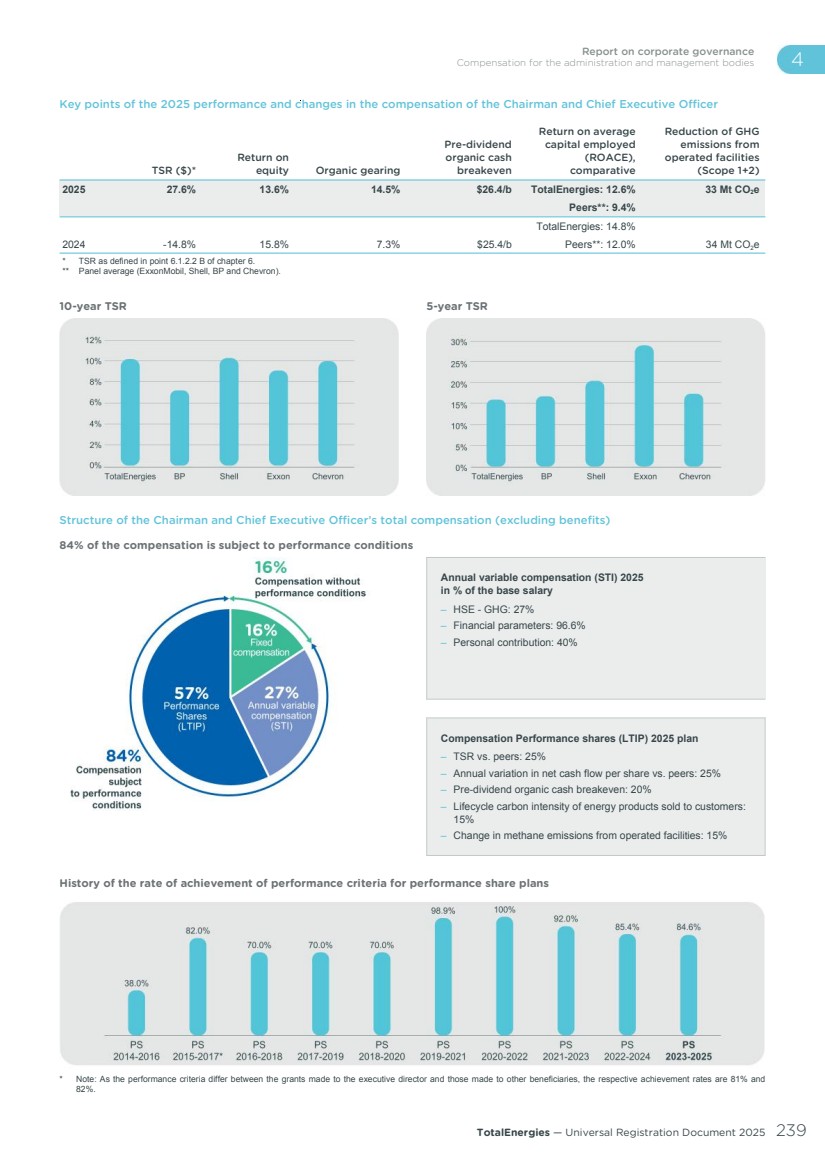
| 2021 Plan 2022 Plan 2023 Plan TSR* Achievement rate: 70% Achievement rate: 43.3% Achievement rate: 100% Annual variation of the net cash flow per share Achievement rate: 100% Achievement rate: 100% Achievement rate: 43.3% Pre-dividend organic cash breakeven Achievement rate: 100% Achievement rate: 100% Achievement rate: 94% Change in the GHG from operated facilities (Scope 1+2) Achievement rate: 100% Achievement rate: 100% Achievement rate: 100% Change in GHG in Europe (Scope 3) Achievement rate: 96.9% Achievement rate: 96.9% Change in methane emissions from operated facilities Achievement rate: 100% Achievement rate of the performance shares plan 92.0% 85.4% 84.6% Performance shares acquired at the end of the vesting period by the Chairman and CEO 90,000 x 92% = 82,800 100,000 x 85.4% = 85,400 110,000 x 84.6% = 93,060 * TSR: Total Shareholder Return. Please report to point 6.1.2.2 B of chapter 6. A compensation aligned with market practices and consistent with the two reference panels Comparison groups The Compensation Committee examines annually the relevance of the two panels of companies selected. These two panels allow us to compare our compensation practices with our peers in the energy sector, but also with companies in our employment pool that are leaders in their markets, in order to offer a competitive compensation program aimed at attracting and retaining the talents of today and tomorrow that are necessary for the development of our Company. These two reference panels include French, European or American companies, selected from among groups similar in terms of: – size (sales, capitalization); – complexity and activities (energy sector); – internalization of activities; – long-term incentive compensation; – and competitors in terms of recruiting talent on an international scale. French comparison panel made up of CAC40 companies Airbus Dassault Systèmes L’Oreal Saint-Gobain Stellantis Air Liquide EssilorLuxottica LVMH Sanofi ST Microelectronics Danone Kering Pernod-Ricard Schneider Electric Vinci International comparison panel Air Liquide ENEL Marathon Petroleum SLB BASF Engie Mercedes-Benz Group Siemens Centrica ENI Philips 66 Stellantis BP ExxonMobil Repsol TechnipFMC Chevron GE Vernova Shell Valero Energy E.ON Iberdrola RWE Volkswagen Positioning of the benchmarks The Consultants (Mercer firm) assess the compensation of the executive director by reference to the two above-mentioned reference panels (1) . Compared to the French panel, Mr. Pouyanné’s compensation ranks below the third quartile for the total “cash” compensation, and between the median and the third quartile for the total compensation including performance shares. Compared to the international “Energies” panel, Mr. Pouyanné’s compensation ranked below the median for his total “cash” compensation as well as for the total compensation including performance shares. Considering TotalEnergies’ performances, the Compensation Committee considers the positioning to be appropriate. (1) Methodological note: In order to compare our practice for short-term compensation practice with market practice, our consultants have retained a target bonus for the Chairman and Chief Executive Officer equal to 2/3 of the maximum bonus (average ratio observed between target and maximum bonus for the market). The performance shares (LTIP) were valued on the basis of the IFRS expense recognized for the shares granted in 2025. 4 Report on corporate governance Compensation for the administration and management bodies 240 TotalEnergies — Universal Registration Document 2025 |
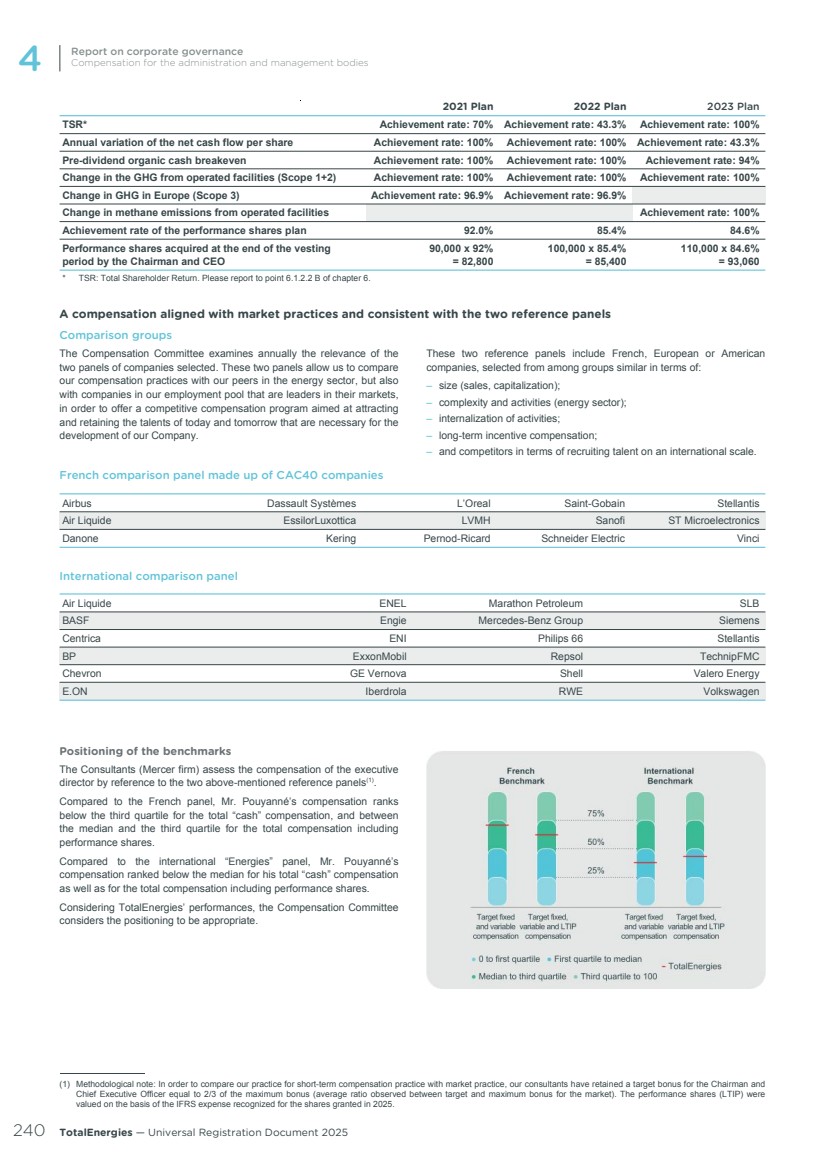
| Other components of the compensation policy The compensation policy of the Chairman and Chief Executive Officer is decided by the Board of Directors, consistent with the AFEP-MEDEF’s recommendations and on the proposal of the Compensation Committee and takes account of the comments of investors and proxy advisors. The table below shows what the compensation policy of the Chairman and Chief Executive Officer provides, does not provide and takes into account from the advice of stakeholders: What TotalEnergies does What TotalEnergies does not do Advice of the stakeholders that TotalEnergies takes into account A strong emphasis on compensation subject to performance conditions (approximately 80%-85% of total compensation) No accumulation of an employment contract and a directorship From 2022, taking into account for the calculation of the Chairman and CEO compensation ratios, of a population of employees in France representing more than 80% of the total French payroll in accordance with the AFEP recommendations A significant part corresponding to extra-financial targets thus representing 39% of the annual variable compensation No guaranteed variable compensation components New rule in 2023 for the obligation to hold TotalEnergies’ shares: 5 years of base compensation for the Chairman and CEO and 4 years for the members of the Executive Committee within a maximum period of 5 years from taking office Taking into account for the objectives relating to the annual variable compensation and the performance share plan of financial criteria measured on a peer group in a “pay for performance” logic No upholding for the executive director of vesting rights to performance shares in case of dismissal or termination for serious or gross misconduct Deletion as of 2023 of the over-performance for each financial criterion of the annual variable portion of the executive director. Some proxy advisors had underlined that the taking into account of the potential over-performance for each of the 4 financial criteria with an overall cap at 110% of the financial criteria would allow an offsetting between criteria The granting of performance shares to the executive director is part of a broad plan of more than 13,000 employees (13% of the workforce of the Company) Clarification for extraordinary circumstances allowing the Board of Directors to adjust the variable compensation of the executive director Golden hellos capped to the value of opportunities lost in the previous employer 4.3.2.1 Compensation of Mr. Patrick Pouyanné for fiscal year 2025 At its meeting on March 18, 2026, the Board of Directors set, on the proposal of the Compensation Committee, the Chairman and Chief Executive Officer’s compensation in respect of fiscal year 2025, by applying the principles and criteria set in the compensation policy of the Chairman and Chief Executive Officer for fiscal year 2025 submitted by the Board of Directors to the Ordinary Shareholders’ Meeting on May 23, 2025, and approved by the latter at 94.80% (resolution 13). In accordance with Article L. 22-10-9 of the French Commercial Code, the information presented below reports on the total compensation and benefits of all kinds, paid to Mr. Patrick Pouyanné by virtue of his mandate as Chairman and Chief Executive Officer of TotalEnergies SE for fiscal year 2025 or allocated by virtue of this mandate in respect of the same fiscal year(1) , as well as all the other information provided for in this Article L. 22-10-9. It is reminded that the payment to the Chairman and Chief Executive Officer of the annual variable component for fiscal year 2025 is conditional upon the approval of the Ordinary Shareholders’ Meeting on May 29, 2026, of the fixed, variable and extraordinary components of the total compensation and the benefits of all kinds paid during fiscal year 2025 to the Chairman and Chief Executive Officer or allocated to the latter during the same fiscal year, in accordance with Article L. 22-10-34 of the French Commercial Code. The Ordinary Shareholders’ Meeting to be held on May 29, 2026, will be convened to approve the total compensation and the benefits of all kinds paid during fiscal year 2025 or attributed to the Chairman and Chief Executive Officer for the same fiscal year, in accordance with Article L. 22-10-34 of the French Commercial Code. (1) Including attributions in the form of stock, securities or rights giving access to the company’s share capital or rights to the attribution of securities of the Corporation or of the companies mentioned in Articles L. 228-13 and L. 228-93 of the French Commercial Code. Report on corporate governance Compensation for the administration and management bodies 4 TotalEnergies — Universal Registration Document 2025 241 |
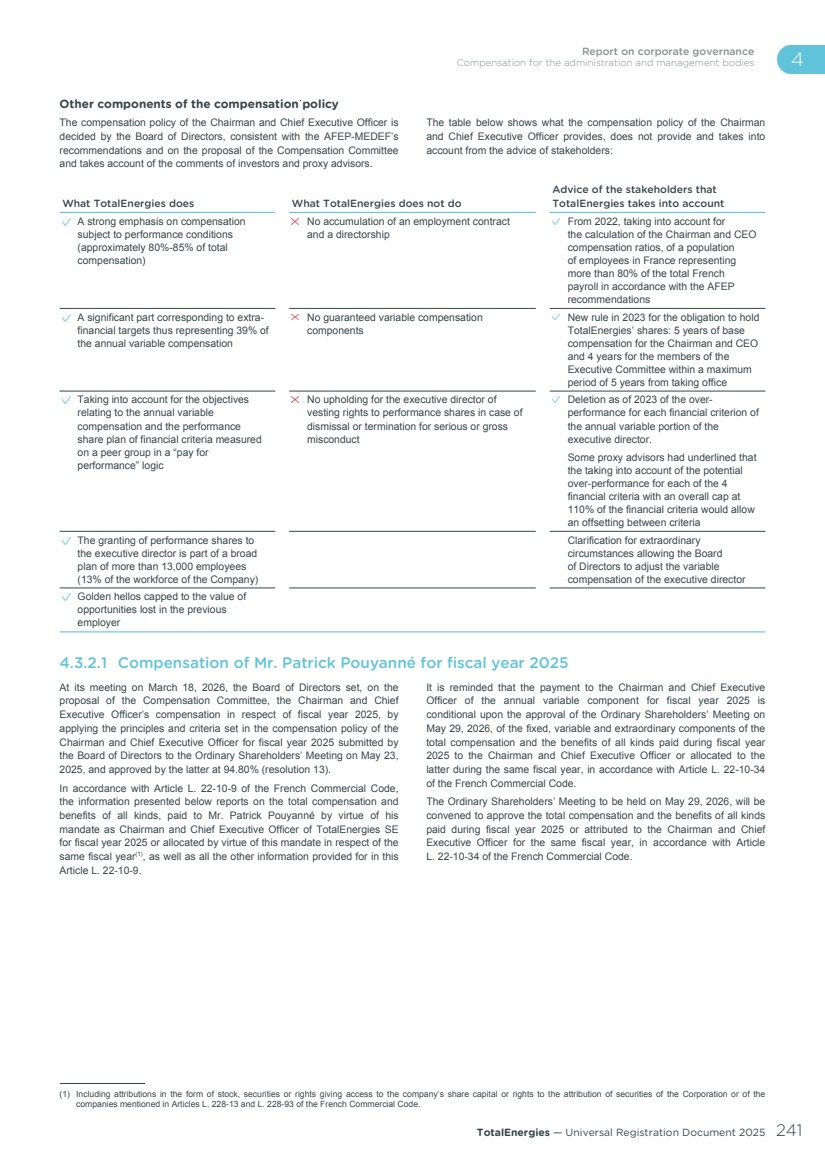
| Table summarizing the compensation, options and shares allocated to the Chairman and Chief Executive Officer Summary of the compensation to the executive director -3.8% on the allocated compensation in respect for the fiscal year 2025 Table 2 – AMF Position-recommendation – DOC-2021-02 (Appendix 2) (€) Fiscal year 2024 Fiscal year 2025 Amount allocated for the fiscal year Amount paid during the fiscal year(a) Amount allocated for the fiscal year Amount paid during the fiscal year(a) Patrick Pouyanné Chairman and Chief Executive Officer Fixed compensation 1,550,000 1,550,000 1,550,000 1,550,000 Annual variable compensation 2,698,550 2,741,950 2,535,800 2,698,550 Multi-year variable compensation – – – – Extraordinary compensation – – – – Compensation due to his directorship as a director – – – – In-kind benefits(b) 78,514 78,514 78,305 78,305 Total 4,327,064 4,370,464 4,164,105 4,326,855 -3.8% (a) Variable portion paid for the prior fiscal year. (b) Company car and life insurance and health expense reimbursement plans paid for by the Corporation. Number of performance shares (140,000) The increase in the number of performance shares allocated to the Chairman and Chief Executive Officer in 2024 follows the decision validated by the Shareholders’ Meeting on May 24, 2024 to increase the number of performance shares to be allocated to the Chairman and Chief Executive Officer during fiscal years 2024, 2025 and 2026 to 140,000 shares to be more in line with the levels practiced by the markets and to increase the alignment of interests between the Chairman and Chief Executive Officer and the shareholders of the Company. Table of allocated compensation in constant IFRS valuation(1) (in €, except the number of shares) Fiscal year 2024 Fiscal year 2025 Variation Patrick Pouyanné Chairman and Chief Executive Officer Compensation allocated in respect of the fiscal year (detailed in table 2) 4,327,064 4,164,105 -3.8% Number of performance shares granted during the financial year 140,000 140,000 0% Valuation of the performance shares allocated with constant IFRS value 6,252,960 6,252,960 0% Compensation allocated in respect for the financial year with constant IFRS valuation 10,580,024 10,417,065 -1.5% The evolution of the compensation presented in the table below includes the evolution of the TotalEnergies share price taken into account for the valuation of the performance shares from €55.83 to €48.23 between 2024 and 2025, which gives a value of the granted shares lower, whereas, at constant value, with an evolution of the compensation of -1.5% as shown in the table above. Performance shares valuations correspond to a valuation made in accordance with IFRS 2 standard (refer to Note 9 of the Consolidated Financial Statements) and not to a compensation actually received during the financial year. The benefit of the performance shares is subject to the achievement of performance conditions assessed over a three-year period. Table 1 – AMF Position-recommendation – DOC-2021-02 (Appendix 2) (€, except the number of shares) Fiscal year 2024 Fiscal year 2025 Patrick Pouyanné Chairman and Chief Executive Officer Compensation allocated in respect of the fiscal year (detailed in table 2) 4,327,064 4,164,105 Valuation of multi-year variable compensation allocated during the fiscal year – – Valuation of stock options granted during the fiscal year (detailed in table 4) – – Valuation of performance shares granted during the financial year (detailed in table 6) 6,252,960 5,401,760 Number of performance shares granted during the financial year 140,000 140,000 Valuation of the other long-term compensation plans – – Total 10,580,024 9,565,865 Note: The valuations of the options and performance shares correspond to a valuation performed in accordance with IFRS 2 (refer to Note 9 to the Consolidated Financial Statements) and not to any compensation actually received during the fiscal year. Entitlement to performance shares is subject to the fulfillment of performance conditions assessed over a three-year period. (1) By retaining the fair value of the share in 2024, i.e., €55.83. 4 Report on corporate governance Compensation for the administration and management bodies 242 TotalEnergies — Universal Registration Document 2025 |
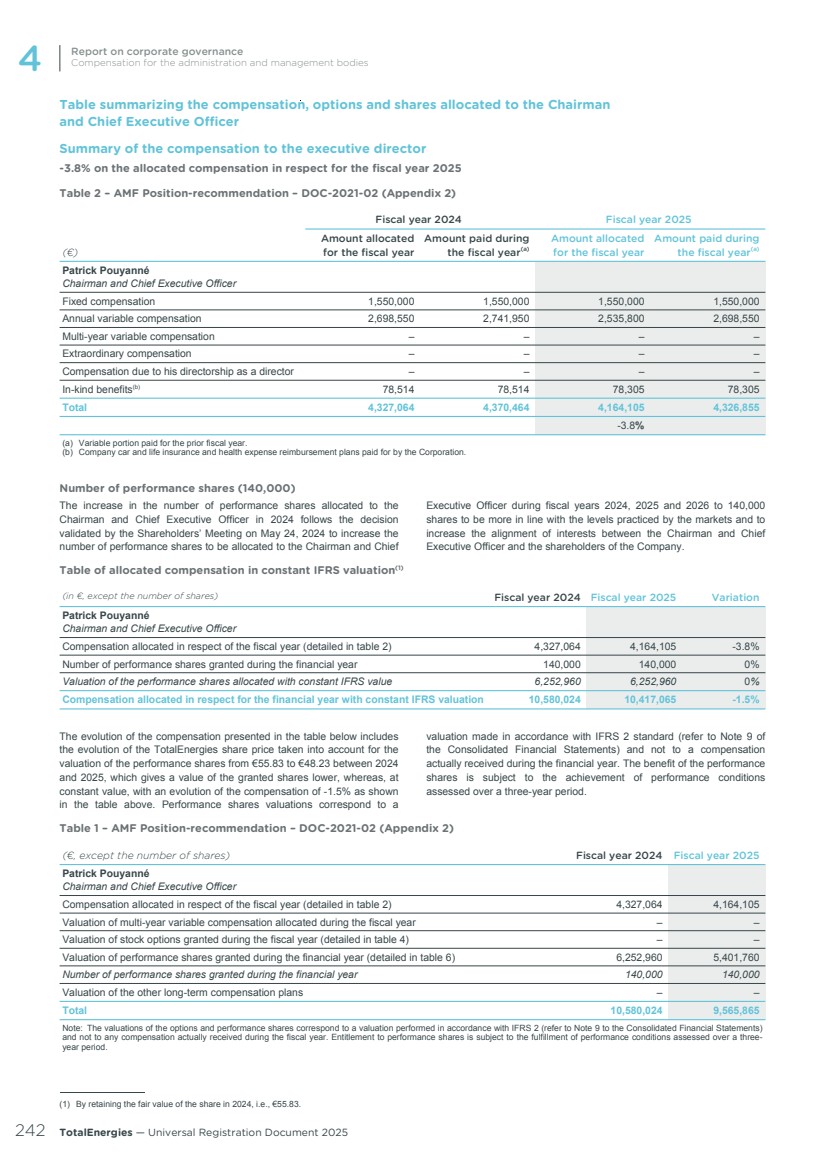
| Summary of the multi-annual variable compensation paid to the executive officer Table 10 – AFEP-MEDEF Code Patrick Pouyanné Chairman and Chief Executive Officer None Table 11 – AMF Position-recommendation – DOC-2021-02 (Appendix 2) Executive directors Employment contract Supplementary pension plan Payments or benefits due or likely to be due upon termination or change in duties Benefits related to a non-compete agreement Patrick Pouyanné Chairman and Chief Executive Officer Start of term of office: December 19, 2015 End of term of office: 2027 Shareholders’ Meeting NO YES Internal supplementary defined benefit pension plan and defined contribution pension plan YES(a) Severance benefit and retirement benefit NO (a) Payment subject to performance conditions. Details of these commitments are provided below. The retirement benefit cannot be combined with the severance benefit. Summary table of the components of the compensation for Mr. Patrick Pouyanné, Chairman and Chief Executive Officer of TotalEnergies SE, paid during fiscal year 2025 or allocated in respect of the same fiscal year Components of compensation submitted for vote Amount paid during fiscal year 2025 Amount allocated in respect of fiscal year 2025 or accounting valuation Presentation Fixed compensation €1,550,000 €1,550,000 (amount paid in 2025) Mr. Pouyanné’s annual fixed compensation in his capacity as Chairman and Chief Executive Officer has been set by the Board of Directors at €1,550,000 (base salary) for fiscal year 2025. This fixed compensation represents 38% of the total cash compensation allocated in respect of fiscal year 2025 (i.e., excluding performance shares and benefit in kind). Annual variable compensation €2,698,550 (amount allocated in respect of fiscal year 2024 and paid in 2025) €2,535,800 (amount allocated in respect of fiscal year 2025 and to be paid in 2026) The variable portion of Mr. Pouyanné’s compensation allocated in respect of fiscal year 2025 by virtue of his duties as Chairman and Chief Executive Officer has been set at €2,535,800. This corresponds to 163,6% (of a maximum of 180%) of his base salary, taking into account the results of the economic parameters and the evaluation of the personal contribution of the Chairman and Chief Executive Officer. This annual variable compensation corresponds to 62% of the total cash compensation allocated in respect of fiscal year 2025 (i.e., excluding performance shares and benefit in kind). Multi-year variable compensation n/a n/a The Board of Directors has not granted any multi-year or deferred variable compensation. Compensation by virtue of directorship n/a n/a Mr. Pouyanné does not receive compensation due to his directorship in TotalEnergies SE. Mr. Pouyanné does not receive compensation from companies TotalEnergies SE controls. Stock options (SO), performance shares (PS) or all other forms of long-term compensation SO: none PS: €5,401,760(a) (accounting valuation) On March 19, 2025, Mr. Pouyanné was granted 140,000 existing shares of the Corporation pursuant to the authorization of the Corporation’s Extraordinary Shareholders’ Meeting on May 24, 2024 (twenty-third resolution) subject to the conditions set out below. These shares were granted under a broader share plan approved by the Board of Directors on March 19, 2025, in favor of more than 13,000 beneficiaries. Payment for assuming a position n/a n/a Mr. Pouyanné was not granted any payment for assuming his position. Report on corporate governance Compensation for the administration and management bodies 4 TotalEnergies — Universal Registration Document 2025 243 |
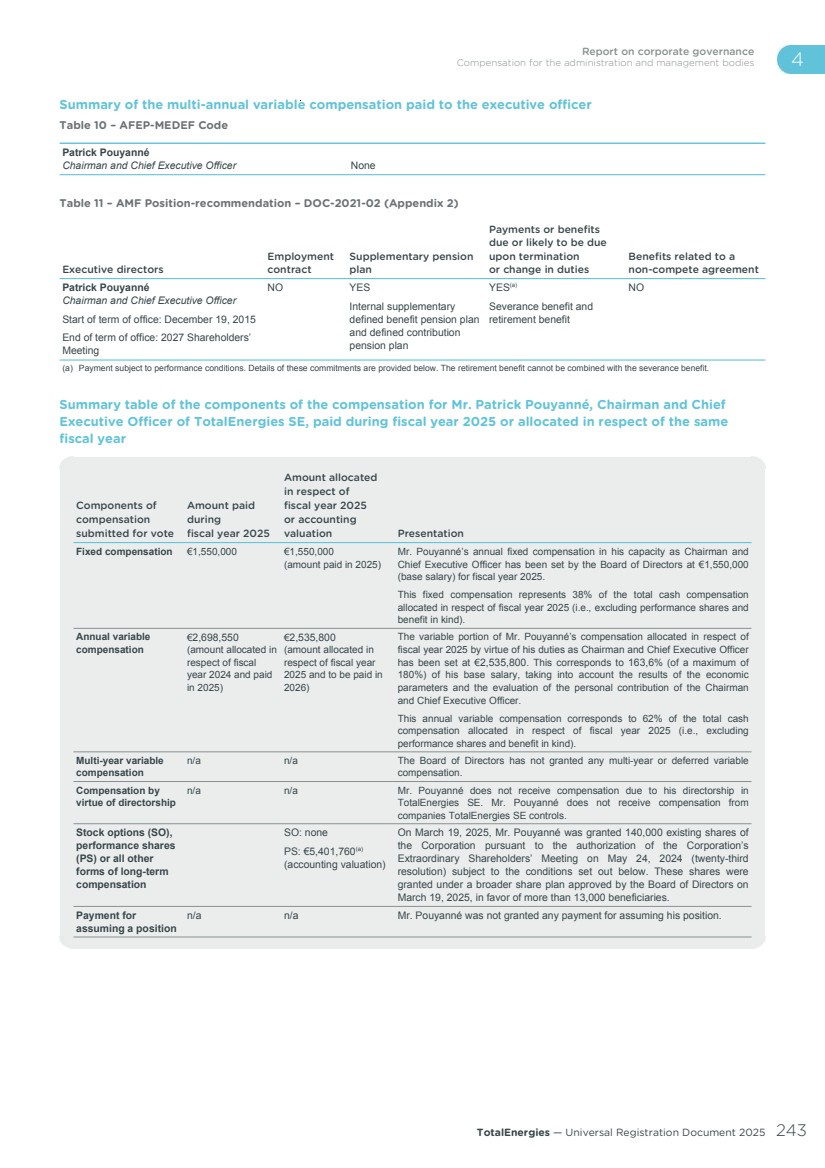
| Components of compensation submitted for vote Amount paid during fiscal year 2025 Amount allocated in respect of fiscal year 2025 or accounting valuation Presentation In-kind benefits – €78,305 (accounting valuation) The Chairman and Chief Executive Officer is entitled to a company vehicle. He is covered by the following life insurance plans provided by various life insurance companies: – An “incapacity, disability, death” insurance policy applicable to all employees, partly paid for by the Corporation; – a second “disability and life insurance” plan, fully paid by the Corporation, applicable to executive officers and senior executives whose annual gross compensation is more than 16 times the PASS. The Chairman and Chief Executive Officer also benefits from the health expense reimbursement plan applicable to all employees. Severance benefit None None The Chairman and Chief Executive Officer is entitled to a benefit equal to two years of his gross compensation in the event of a forced departure related to a change of control or strategy. The calculation is based on the gross compensation (fixed and variable) of the 12 months preceding the date of termination or non-renewal of his term of office. The severance benefit will only be paid in the event of a forced departure related to a change of control or strategy and subject to performance conditions. Retirement benefit None None The Chairman and Chief Executive Officer is entitled to a retirement benefit equal to those available to eligible members of the Company under the French National Collective Bargaining Agreement for the Petroleum Industry. This benefit is equal to 25% of the fixed and variable annual compensation received during the 12 months preceding retirement. Entitlement to retirement benefits is subject to conditions related to the performance of the beneficiary. The retirement benefit cannot be combined with the severance benefit described above. Non-compete compensation n/a Mr. Pouyanné has not received any non-compete compensation. Supplementary pension plan None The Chairman and Chief Executive Officer benefits from the legal AGIRC-ARRCO scheme, as well as from the internal supplementary defined contribution scheme applicable to all employees of TotalEnergies SE, referred to in Article L. 242-1 of the French Social Security Code, and from the supplementary defined benefit pension scheme, referred to in Article L. 137-11 of the French Social Security Code. Approval by the Shareholders’ Meeting The commitments made to the Chairman and Chief Executive Officer regarding the pension and insurance plans, the retirement benefit and the severance benefit (in the event of forced departure related to a change of control or strategy) were authorized by the Board of Directors on March 14, 2018, and approved by the Shareholders’ Meeting on June 1, 2018. (a) In accordance with the accounting of the performance shares for fiscal year 2025 in accordance with IFRS 2 which takes into account an award rate hypothesis of 80% at the end of the vesting period, this amount corresponds to the 140,000 shares granted in 2025, valued on the basis of a unit fair value of €48.23. This fair value was calculated in accordance with IFRS 2 on the grant date of the plan, i.e., on March 19, 2025, on the basis of the closing price of the TotalEnergies share on that date of €58.81. 4 Report on corporate governance Compensation for the administration and management bodies 244 TotalEnergies — Universal Registration Document 2025 |
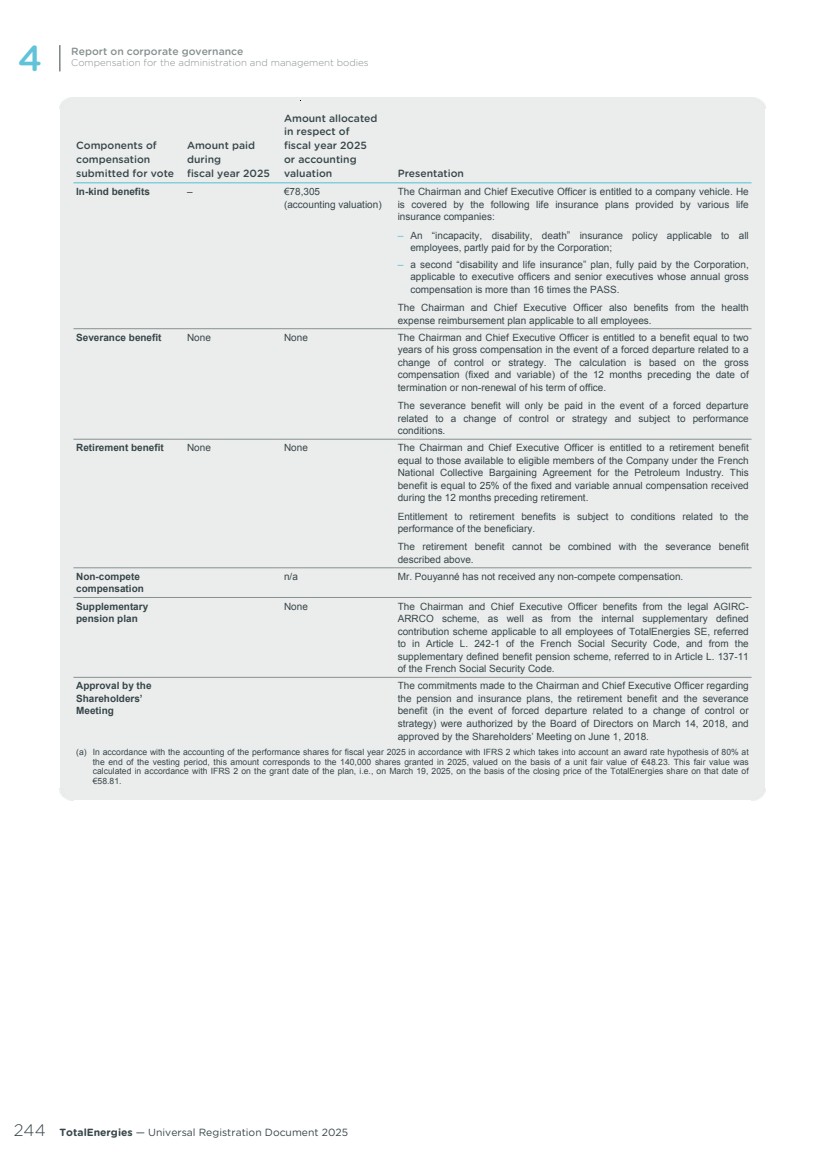
| A. Details of the assessment of the performance criteria for the determination of the annual variable compensation for fiscal year 2025 For the setting of the variable portion of Mr. Pouyanné’s compensation allocated in respect of fiscal year 2025 due to his duties as Chairman and Chief Executive Officer, the Board of Directors reviewed, at its meeting on March 18, 2026, the level of achievement of the economic parameters based on the quantifiable targets set by the Board of Directors at its meeting on March 19, 2025. The Board of Directors also assessed the Chairman and Chief Executive Officer’s personal contribution on the basis of the target criteria set during its meeting on March 19, 2025, to qualitatively assess his management. The payment to the Chairman and Chief Executive Officer of the annual variable component for fiscal year 2025 is conditional upon the approval of the Ordinary Shareholders’ Meeting on May 29, 2026, of the fixed, variable and extraordinary components of the total compensation and the benefits of all kinds paid during fiscal year 2025 to the Chairman and Chief Executive Officer or allocated to the latter during the same fiscal year, in accordance with Article L. 22-10-34 of the French Commercial Code. It is reminded that the variable portion of Mr. Pouyanné’s compensation allocated in respect of fiscal year 2024 by virtue of his duties as Chairman and Chief Executive Officer and paid in 2025 (after the approval by the Ordinary Shareholders’ Meeting on May 23, 2025, of the fixed, variable and extraordinary components of the total compensation and the benefit-in-kind paid in respect of fiscal year 2024) was set at €2,698,550 corresponding to 174.1% (of a maximum of 180%) of his fixed annual compensation based on results of the economic parameters and the evaluation of his personal contribution. Annual variable compensation allocated in respect of fiscal year 2025 (expressed as a percentage of the base salary) % targets % allocated Summary of the quantifiable targets A. Safety and greenhouse gas (GHG) emissions a) Safety 20% 17% – TRIR 6% 6% – FIR 6% 3% – Evolution of the number of Tier 1 + Tier 2 incidents 8% 8% b) Evolution of GHG emissions (Scope 1+2) 10% 10% Maximum percentage that may be allocated in respect of Safety and greenhouse gas (GHG) emissions criteria 30% 27% B. Financial parameters – Return on equity (RoE) 30% 25.3% – Organic gearing 20% 15.5% – Integrated Power cash flow (CFFO) 10% 10% – Pre-dividend organic cash breakeven 30% 25.8% – Return on average capital employed (ROACE), comparative 20% 20% Maximum percentage that may be allocated in respect of financial parameters 110% 96.6% Maximum percentage that may be allocated in respect of quantifiable targets 140% 123.6% Personal contribution (qualitative criteria) – Steering of the Corporation’s transition strategy, in line with the 2020/2030 targets announced to investors, in particular the increase of gas and power production, as well as the evolution of its sales mix 15% 15% – Profitable growth in renewables and electricity 10% 10% – Corporate Social Responsibility (CSR) performance, notably the integration of climate issues in the Company’s Strategy, the Company’s commitment and ratings regarding CSR, as well as the diversity policy (feminization and internationalization) 15% 15% Maximum percentage that may be allocated in respect of the personal contribution 40% 40% Total 180% 163,6% Safety and Greenhouse gas emissions criteria The Board of Directors assessed achievement of the targets set for the Safety and Greenhouse gas emissions criteria as follows: The safety evolution was assessed for a maximum of 20% of the base salary through (i) the achievement of the annual TRIR (Total Recordable Incident Rate) target, (ii) the number of accidental deaths per million hours worked, FIR (Fatality Incident Rate), as well as (iii) through change in the Tier 1 + Tier 2 indicator(1) . These three sub-criteria were assessed based on the elements set out in the 2025 compensation policy for the Chairman and Chief Executive Officer, as approved by the Shareholders’ Meeting on May 23, 2025. Concerning the 2025 fiscal year, the following elements were noted: – the TRIR was 0.47, which is below the target of 0.60. The result of this criterion was thus set at its maximum of 6%; – the FIR was set at 0.25, slightly below the average of the FIR rates of the panel of majors. The result of the benchmarked FIR sub-criterion was thus set at 3%, at its maximum. The Company suffered one fatality in 2025, so the zero fatality sub-criterion was not achieved. The overall result for the two sub-criteria relating to the FIR was therefore set at 3%, against a maximum of 6%; – the number of Tier 1 + Tier 2 incidents was 34, which is below the level of 40 allowing to achieve the target. The result of this criterion was set at its maximum of 8%. The result of the criterion related to the safety evolution was thus set at 17%. (1) Tier 1 and Tier 2: indicator of the number of loss of primary containment events, with more or less significant consequences, as defined by the API 754 (for downstream) and IOGP 456 (for upstream) standards. Excluding acts of sabotage and theft. Report on corporate governance Compensation for the administration and management bodies 4 TotalEnergies — Universal Registration Document 2025 245 |
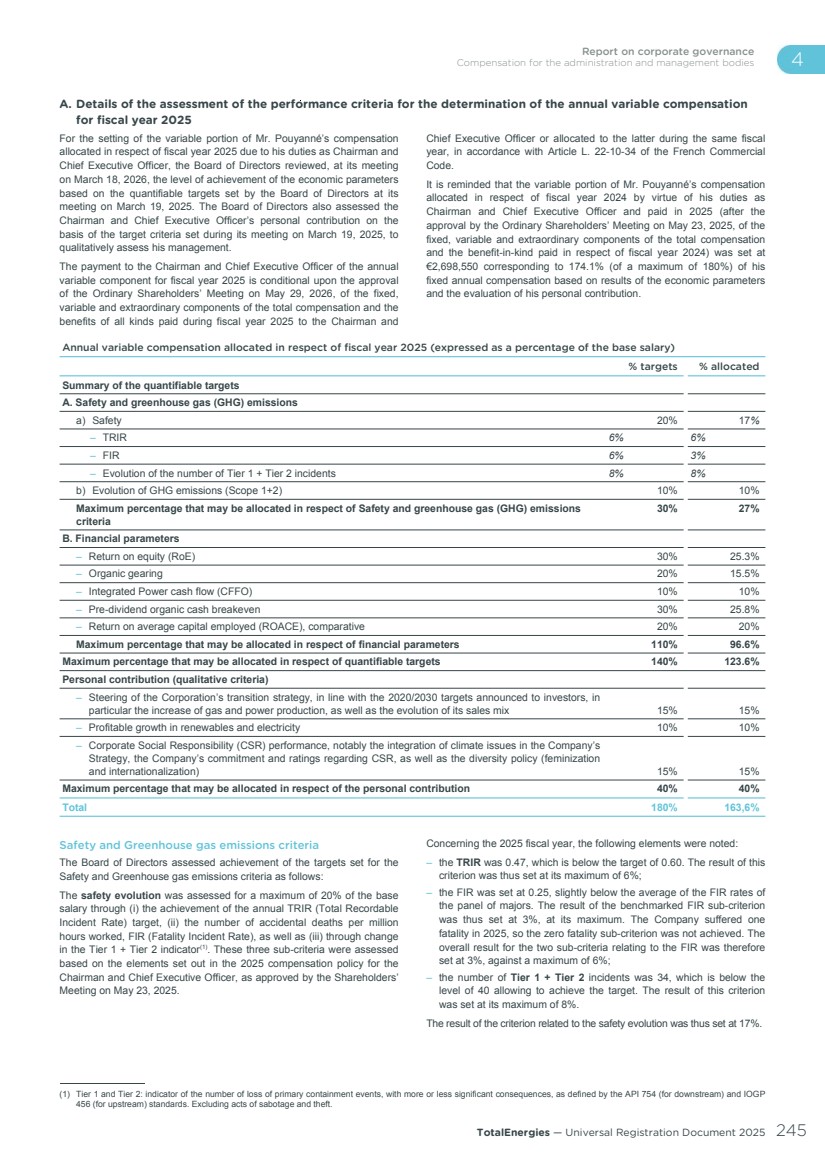
| The evolution of the greenhouse gas (GHG) emissions on operated facilities was assessed for a maximum weighting of 10% of the base salary, through the achievement of a GHG (Scope 1+2) reduction emission target from 46 Mt CO2e in 2015 to 37 Mt CO2e in 2025, corresponding to a reduction of 800 kt CO2e/y revised downwards in 2025, i.e., a target of 37 Mt CO2e for 2025 instead of 38 Mt CO2e previously planned for 2025. This criterion was assessed based on the elements set out in the 2025 compensation policy for the Chairman and Chief Executive Officer, as approved by the Shareholders’ Meeting on May 23, 2025. The Board noted that the GHG Scope 1+2 emissions from operated facilities amounted to 33.1 Mt CO2e in 2025. The result of this criterion was thus set at its maximum of 10%. Financial parameters – The return on equity (ROE), as published by the Company on the basis of its balance sheet and consolidated statement of income was assessed for a maximum of 30% of the base salary, based on the elements set out in the 2025 compensation policy of the Chairman and Chief Executive Officer. The Board noted that the ROE for fiscal year 2025 was 13.6%, i.e., slightly below the target. The result of this criterion was thus set at 25.3%. – The organic gearing was assessed for a maximum of 20% of the base salary, based on the elements set out in the compensation policy of the Chairman and Chief Executive Officer for 2025. The Board thus noted that the organic gearing for financial year 2025 was set at 14.5%, i.e., a 77.5% achievement rate. The result of this criterion was thus set at 15.5%. – The Integrated Power cash flow (CFFO) was assessed for a maximum of 10% of the base salary, based on the elements set out in the compensation policy of the Chairman and Chief Executive Officer for 2025. The Board thus noted that Integrated Power cash flow (CFFO) for financial year 2025 was set at $2.6 billion, i.e., a 100% achievement rate. The result of this criterion was thus set at its maximum, i.e., 10% – The pre-dividend organic cash breakeven criterion was assessed at a maximum of 30% of the base salary according to components set in the compensation policy of the Chairman and Chief Executive Officer for 2025. The ability of the Company to resist to the variations of the Brent barrel price is measured by this parameter. Regarding fiscal year 2025, the Board noted that the pre-dividend organic cash breakeven set at $26.4/b, i.e., at a level slightly above the target. The result of this criterion was thus set at 25.8%. – The return on average capital employed (ROACE) criterion, by comparison, was assessed as a maximum weighting of 20% of the base salary. TotalEnergies’ ROACE, as published from the consolidated balance sheet and the income statement, was compared to the ROACE average of each of the four peers (ExxonMobil, Shell, BP and Chevron). This criterion was assessed based on the elements set out in the 2025 compensation policy for the Chairman and Chief Executive Officer. For fiscal year 2025, the Board noted that TotalEnergies’ ROACE was more than 3 points higher than the average of the ROACEs of the four peers, i.e., above the target set. The result of this criterion was thus set at its maximum, i.e., 20%. The result of the financial criteria was set at 96.6% of the base salary, for a maximum of 110%. Personal contribution The personal contribution of the Chairman and Chief Executive Officer was assessed at its maximum of 40% of the base salary based on the three criteria set in the compensation policy of the Chairman and Chief Executive Officer for 2025: – steering of the Corporation’s transition strategy, in line with the 2020/ 2030 targets announced to investors, in particular the increase of gas and power production, as well as the evolution of its sales mix, for up to 15%; – profitable growth in renewables and electricity, for up to 10%; – Corporate Social Responsibility (CSR) performance, including the integration of climate issues in the Company’s strategy, the Company’s commitment and ratings regarding CSR, as well as the diversity policy (feminization and internationalization), for up to 15%. The Board of Directors set the results of each of these criteria at their maximum, because of the following components which were observed during the past fiscal year: ● Criterion 1: Steering of the Corporation’s transition strategy, in line with the 2020/2030 targets announced to investors, in particular the increase of gas and power production, as well as the evolution of its sales mix. The Board of Directors noted that TotalEnergies has continued its balanced, integrated multi-energy strategy in light of developments in the oil, gas, and electricity markets. Anchored in two pillars, hydrocarbons, particularly LNG, and electricity, the energy source at the heart of the energy transition, the Company plans to increase its energy production (hydrocarbons and electricity) by 4% per year between 2024 and 2030. Thus, thanks to the refocusing of its oil and gas portfolio on assets and projects with low breakeven points and low greenhouse gas emissions, and to diversification into electricity, particularly renewables, through an integrated strategy from production to customer, the Company, under the leadership of its Chairman and Chief Executive Officer, is successfully implementing its transition strategy while ensuring an attractive return policy for shareholders. The year 2025 was marked by major agreements which strengthen the implementation of the strategy and to which the Chairman and Chief Executive Officer directly contributed: on the Integrated Power side, the agreement with EPH which was very well received by the markets, on the oil side, the agreement with GALP on Namibia and the major progress of the GGIP project in Iraq and on the gas side, the agreement with Petronas in Malaysia giving access to significant additional gas resources and the consolidation of the integrated gas–LNG position in the United States. During fiscal year 2025, the Board observed that the Chairman and Chief Executive Officer achieved the following: In 2025, TotalEnergies implements with consistency its balanced and profitable multi-energy transition strategy anchored in two pillars: oil & gas, mainly LNG, and integrated power. • TotalEnergies retains its status as the oil & gas major that is most advanced in the energy transition, being the one that devotes the largest CAPEX budgets to electricity and low-carbon energies. • The sales mix at the end of 2025 was 40% oil, 46.5% gas and 13.4% electrons and low-carbon molecules, on a trajectory in line with the Company’s 2030 objective for 2030 of a mix consisting of 40% oil, 40% gas and 20% electrons and low-carbon molecules. • The ratio of the Company’s hydrocarbon production remains balanced at 50:50 between oil and gas. The Company is pursuing low-cost projects with low emissions while confirming its ability to grow profitably across the electricity value chain. • In 2025, oil production increased from 1.408 Mb/d to 1.467 Mb/d compared to 2024, with a CO2 intensity of 15.3 kg CO2/boe, half the industry average. • Electricity production reached 48.1 TWh, representing an increase of over 17% year-on-year. Gross installed electricity generation capacity of 43.3 GW represents a 25% increase compared to 2024. 4 Report on corporate governance Compensation for the administration and management bodies 246 TotalEnergies — Universal Registration Document 2025 |
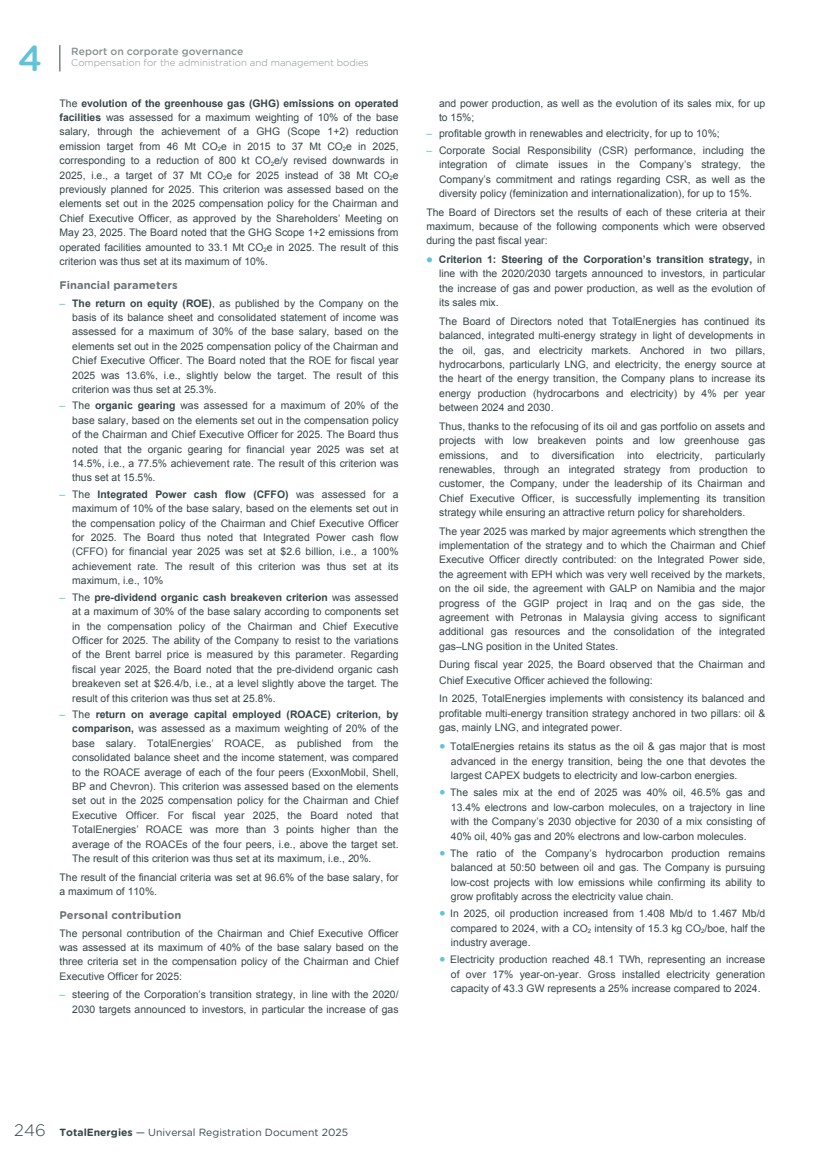
| Oil TotalEnergies plans for +3% per year oil and gas growth between 2024 and 2030 thanks to the start-up of accretive projects from its rich portfolio, 95% of 2030 production being either already running or under development. In 2025 and 2026, this growth will exceed 3% per year, benefiting from the start-up of several high-margin oil projects (Offshore US, Brazil, Iraq, Uganda) and major LNG and gas projects (NFE in Qatar, Jerun in Malaysia). • Production of 2.53 Mb/d, growing by more than 4% year-on-year, fueled in particular by the start of production of the Ballymore offshore field in the United States, with a capacity of 75 kb/d, as well as that of Mero-4 in Brazil, with a capacity of 180 kb/d and by the start of the Begonia and CLOV phase 3 offshore fields with a combined capacity of 60 kb/d in Angola. • Launch, as part of the GGIP project in Iraq, of the construction of an early gas treatment unit associated with the Ratawi oil field. The full development of the Ratawi field will increase production to 210 kb/d without any routine flaring. The project aims to sustainably develop Iraq’s natural resources to improve the country’s electricity supply while contributing to its energy independence and reducing its greenhouse gas emissions. • The Company continued the active management of its low-cost, low-emissions portfolio: – Agreement with Galp to acquire a 40% stake and act as operator in the prolific PEL83 permit, including the Mopane discovery; award of exploration licenses in Congo, Nigeria, Liberia and Algeria; acquisition of a 25% working interest in a portfolio of 40 Chevron-operated offshore exploration leases, in the United States; acquisition of a 25% interest in Block 53, in Suriname. – Signing with NEO NEXT of a merger agreement for its mature assets in the British North Sea. – Signature of an agreement with Cyprus and Egypt for the export of Cyprus Block 6 gas through Egypt. – Divestment of TotalEnergies’ 20% non-operated interest in Gato do Mato project to Shell in exchange for an increased 48% stake in the operated Lapa offshore field in Brazil; divestment of TotalEnergies’ 12.5% non-operated interest in the Bonga field in Nigeria; divestment of TotalEnergies’ 39.8% non-operated interest in the West Ekofisk, Albuskjell and the Tommeliten Gamma fields in Norway (20.2%); divestment of interests in two unconventional blocks in the Vaca Muerta in Argentina. Integrated LNG Integrated LNG is expected to deliver cash flow growth of more than 70% by 2030 compared to 2024. This is driven by 50% sales growth that is mainly coming from LNG projects in the United States and Qatar (Rio Grande LNG Train 1-4 in the United-States, NFE and NFS in Qatar), which are among the most competitive in the world. In addition, the Company will develop gas-to-power integration, mainly in the United States and Europe, in order to complete its Integrated Power business model. • Strengthening the strategic partnership with Petronas: acquisition of interests in multiple offshore gas blocks, in Malaysia. • Signature of an agreement with Cyprus and Egypt for the export of Cyprus Block 6 gas through a GNL’s plant in Egypt. • Strengthening of the LNG portfolio: signature of an agreement for LNG offtake of 1.5 Mt/year from the future Train 4 of Rio Grande LNG in Texas; acquisition of a 49% interest in producing natural gas assets in the Anadarko basin in the United States; signature of agreements for a future equity stake and LNG offtake in Ksi Lisims LNG project in Canada. • Confirmation of the lifting of force majeure for the Mozambique LNG project. • Signing of LNG sale contracts with buyers in the Dominican Republic, India and South Korea. • Agreement with CMA CGM to create a JV for LNG bunkering in Rotterdam with TotalEnergies providing up to 360,000 tons of LNG per year. Integrated Power TotalEnergies plans to increase electricity production by approximately 20% per year through 2030, resulting in 100 to 120 TWh/y of electricity production, of which 70% is renewable and 30% flexible gas. TotalEnergies intends to focus its investments on the main deregulated markets (United States, Europe, Brazil) in which the Company deploys its integrated model. The Integrated Power segment will be free cash-flow positive by 2027, thanks in particular to the acquisition of 50% of EPH’s portfolio of gas-fired power plants in Europe and will achieve a ROACE of 12% by 2030. TotalEnergies’ profitable diversification through the electricity value chain is positively differentiating versus peers and creates value for shareholders by contributing to dividend growth regardless of oil & gas cycles and thus, enhancing the Company’s resilience. • Electricity production of 48.1 TWh, with an increase of more than 17% year-on-year, of which 31.4 TWh came from renewable sources. • Signing of a major transaction with EPH for the acquisition of 50% of a portfolio of more than 14 GW of gross capacity of flexible generation assets in operation or under construction, mainly comprising gas, biomass and battery power plants, representing an estimated net additional electricity production of 15 TWh per year and a portfolio of projects under development of approximately 5 GW; these projects are located in Italy, UK, Ireland, Netherlands and France. • Start-up of a 640 MW offshore wind farm, in Taiwan. • Launch of six new battery storage projects, for a capacity of 221 MW, in Germany. • Signature of a Clean Firm Power contract with STMicroelectronics (1.5 TWh over 15 years); signature of a contract with Data4 in Europe; electricity sales contract with Google in the United States. • Closing of the SN Power acquisition, a hydro-electricity project developer, in Africa. • Acquisition of wind and solar projects in Canada, totaling over 800 MW. • Acquisition of 350 MW of solar projects and 85 MW of BESS projects, in the UK. • Award of a concession to develop a 1 GW offshore wind farm, in Germany. • Award of a tender for the development of a 1.5 GW offshore wind project, in France. • TotalEnergies and Aljomaih Energy & Water Company obtained a license to develop, build and operate a 400 MW solar power plant in Saudi Arabia. • Closing of the sale of 50% of TotalEnergies’ 2.7 GW gross installed power generation portfolio (United States, Portugal, Greece, France). Carbon footprint reduction and low-carbon molecules • Launch of projects with Air Liquide to produce green hydrogen to European refineries: JV for the construction and operation of an electrolyzer producing 30,000 tons of green hydrogen per year (Zeeland); tolling agreement for 15,000 tons of green hydrogen per year (Antwerp). • Investment decision in the second phase of the Northern Lights CCS project in Norway and transportation and storage of the first CO2 volumes. • Signature of a 15-year agreement with Quatra for the supply of 60,000 tons/y of European used cooking oil to TotalEnergies’ biorefineries. • Joint-venture creation with Banque des Territoires to finance the deployment of EV (B2G) charging infrastructure in France. • Signature of an agreement with NativState for sustainable forestry operations and preservation of carbon sinks in the United States. Report on corporate governance Compensation for the administration and management bodies 4 TotalEnergies — Universal Registration Document 2025 247 |
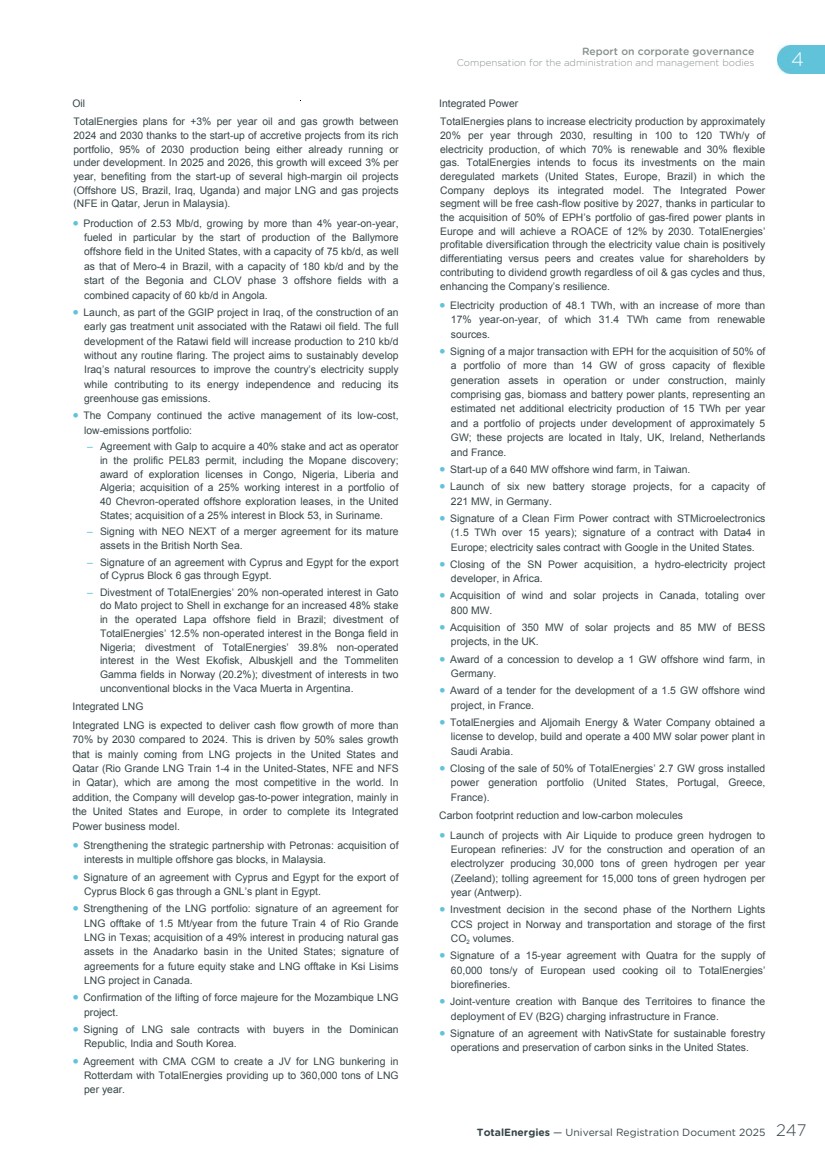
| • Commissioning of BioNorrois, the second largest biogas production unit in France. • Signature of an agreement for the sale of 50% of biogas leader PGB in Poland. Innovation and Performance • Signature of a strategic partnership with Emerson for the deployment of a global industrial data platform on all of TotalEnergies’ operational sites. • Signature of a partnership with Cognite for the deployment of industrial AI across all of TotalEnergies’ operated Upstream assets worldwide. • Collaboration with Mistral AI through a joint innovation lab to increase the application of AI and improve the performance of TotalEnergies’s activities, particularly in the field of low-carbon energies. Financial analysts’ assessment of the transition process Analysts highlight the consistency of TotalEnergies’ strategy, emphasizing the growth generated by its project portfolio, the unique nature of its profitable growth during the transition, and the resulting profitability. UBS, in its review of September 23, 2025, ranks the Company first among a broad range of European peers in terms of growth delivered by projects under development, with a 2030 horizon. Rothschild & Co Redburn, in its research of October 30, 2025, recognizes TotalEnergies’ “uniqueness among its peers in its ability to deliver growth until the end of the decade, while the majority of its peers have begun to reduce their investments in renewable energy and electricity. TotalEnergies has successfully developed a profitable Integrated Power segment that diversifies its future valuation.” This transition is accompanied by organic free cash flow growth, which puts the Company in the lead compared to its peers. Goldman Sachs highlights the contribution of new projects approved in recent years to the Company’s “ambitious long-term plan”. This translates into growth in Upstream production, leading the industry. The Company’s commitment to the transition is recognized in particular by Goldman Sachs, which gives its low-carbon sector the highest valuation compared to its peers. Gerdes titles its analysis of TotalEnergies, published on October 30, 2025: TTE: Epitome of a Global Lower Carbon Multi-Energy Business Model. The article particularly highlights the cash margin of the integrated model as a generator of superior returns over the 2026- 2030 cycle. In conclusion, the analysts emphasize the Company’s size and profitability, and the execution of its energy transition. ● Criterion 2: Profitable growth in renewables and electricity TotalEnergies intends to replicate its integrated oil & gas model across the electricity value chain to achieve a profitability (ROACE) of approximately 12% for the Integrated Power segment, equivalent to the profitability of its oil & gas activities at $60/barrel and therefore higher than the traditional Utilities model. The Board of Directors noted that for 2025, cash flow amounts to $2.6 billion, in line with the announced target, and the profitability (ROACE) is 10%. Net electricity production reached 48 TWh, up 17% year-on-year. To accelerate its gas–electricity integration strategy in Europe, TotalEnergies has entered into an agreement with EPH to acquire 50% of a portfolio of flexible power generation assets with a gross capacity exceeding 14 GW. Furthermore, in 2025, TotalEnergies recycled $2 billion of capital by selling 50% of a 2.7 GW gross capacity portfolio (United States, Portugal, Greece, France), in line with its renewable energy business model. The Board of Directors thus notes once again for 2025 the progress of the growth model for this business, which TotalEnergies continues to develop, unlike its major competitors in the sector, by improving margins and net cash generation year after year. This is expected to become positive in the very near future and therefore contribute to the dividend payment. During fiscal year 2025, the Board observed that the Chairman and Chief Executive Officer implemented, in particular, the following achievements. The figures published by the new Integrated Power business confirm the profitable growth of the renewable and electricity activities in 2025. • Growth in electricity generation and generation capacity in 2025: – Net electricity generation at 48.1 TWh of which 31.4 TWh from renewable sources (+17% year-on-year), – Net generation capacity up 21% year-on-year to 26 GW of which 19 GW form renewable sources (+26% year-on-year). • Gross installed renewable generation capacity up 31% year-on-year to 34.1 GW. • The Integrated Power segment also reported an increase of results in 2025: – Adjusted net operating profit at 2.22 B$ (+2% year-on-year), – CFFO of 2.56 B$ (stable compared to 2024), – The Integrated Power segment achieved a ROACE of 9.7% in 2025. TotalEnergies has also accelerated its gas–electricity integration strategy in Europe through a major acquisition: the signing of an agreement with EPH for the acquisition of 50% of a portfolio of over 14 GW of gross capacity of flexible generation assets in operation or under construction. These assets primarily comprise gas-fired power plants, biomass plants, and battery storage facilities, representing an estimated net additional electricity production of 15 TWh per year, and a portfolio of projects under development of approximately 5 GW. These projects are located in Italy, the UK, Ireland, the Netherlands, and France. This major transaction was very well received by the markets and strongly supports the Company’s Integrated Power strategy. TotalEnergies plans to increase electricity production by approximately 20% per year through 2030, resulting in 100 to 120 TWh/y of electricity production, of which 70% is renewable and 30% flexible gas. TotalEnergies intends to focus its investments on the main deregulated markets (United States, Europe, Brazil) in which the Company deploys its integrated model. The Integrated Power segment will be free cash-flow positive by 2027 and will achieve a ROACE of 12% by 2030. ● Criterion 3: Corporate Social Responsibility (CSR) performance, measured according to three axes: the integration of climate issues in the Company’s strategy, the Company’s commitment and ratings regarding CSR, as well as the diversity policy (feminization and internationalization). The Board of Directors noted that, in 2025, TotalEnergies continued to be included in numerous extra-financial indices that group the best-performing companies. In terms of greenhouse gas emission reductions in 2025, methane emissions were reduced by 65% compared to 2020, against a target of a 60% reduction, and Scope 1+2 emissions from operated facilities were reduced to 33 Mt CO2e, against a target of less than 37 Mt CO2e. Regarding gender equality, the Company continued its efforts on track to meet its 2025 objectives, enabling it to achieve the target of 30% female representation on the Executive Committee (30% by the end of 2025), the G70 (32.9% by the end of 2025), and among senior executives (30.2% by the end of 2025). In this context, the following achievements in particular were noted. CSR ratings • Rating agencies continue to rank TotalEnergies at the top of their lists for ESG commitments and achievements. The Company is now even ranked first by the three major agencies. In 2025, TotalEnergies received the following ratings: MSCI: A (equally-ranked 1 st among our peers); Sustainalytics: 24.5 Medium Risk (first among our peers); ISS ESG (first among our peers). 4 Report on corporate governance Compensation for the administration and management bodies 248 TotalEnergies — Universal Registration Document 2025 |
| • TotalEnergies ranks among the top companies in the report “Progress 2025: An Assessment of Transparency of the Oil and Gas Industry,” published by the IEA, EDF (Environmental Defense Fund), and UNEP (United Nations Environment Program). This report evaluates the 116 largest oil and gas companies worldwide based on 25 indicators across three categories: targets, implementation strategies, transparency, and reporting. TotalEnergies achieved a score of 21 points, compared to an average score of 9 points. • In its 2025 Management Quality Assessment, the Transition Pathway Initiative (TPI) awarded TotalEnergies a Level 5 rating, the highest category, which includes 16% of the 2,000 companies assessed this year. The assessment is based on a framework of 23 questions measuring the maturity of companies in implementing their transition strategy. Furthermore, TPI evaluated the company’s lifecycle carbon intensity trajectory and considers it to be aligned with a scenario of below 2°C of global warming by 2050. • In the 2025 Sustainability Rating, TotalEnergies received a platinum medal for TotalEnergies Electricité et Gaz France SA (with a score of 87/100), placing it in the top 1% of companies. TotalEnergies also received gold medals for its subsidiaries Hutchinson (84/100), Saft (82/100), TotalEnergies Marketing Services SAS (82/100), and TotalEnergies Raffinage Chimie SAS (81/100), placing them in the top 5% of companies rated in this ranking. • In 2025, the WBA (World Benchmarking Alliance) awarded TotalEnergies the highest score for the Just Transition theme, both overall (out of nearly 2,000 companies) and within the oil & gas sector, where 94 companies were assessed globally. For the Climate category, TotalEnergies received a B grade, placing it among the top performers, representing 8% of the 1,600 companies assessed. TotalEnergies also obtained a good score for the Social category, ranking 15th out of 2,000 companies assessed. • With a score of 69.2, TotalEnergies is ranked 5 th out of 30 companies in terms of biodiversity in the first Business & Biodiversity Benchmark published by the VBDO (Dutch Association of Investors for Sustainable Development) coalition in November 2025. This score places TotalEnergies well ahead of its peers. The quality of our biodiversity action plans is highlighted as a best practice example in the report accompanying the ranking. Also noteworthy: • In the CCLA Corporate Mental Health Global 100+ benchmark, focusing on mental health in the workplace, TotalEnergies maintains its Tier 2 ranking, placing the company among the top 7 (1) of the 120 largest publicly traded companies (over $60 billion market capitalization) with more than 10,000 employees included in the study. TotalEnergies is the company that has most improved its score between 2022 and 2025. • The TotalEnergies Pulse Survey is an internal survey used to measure in particular employee engagement and well-being. In 2025, with 84% employee participation and a significant increase of over 7 points compared to the last survey in 2023, the survey revealed high levels of engagement and well-being, well above the benchmark indicators for companies with more than 10,000 employees, with respective scores of 83.5% (Engagement score) and 83.4% (Care score). Furthermore, by including questions about the Sustainab’ALL program in this edition, the Company has observed employee awareness and support for its strategy, which is a key asset for its sustainable performance. • Success of the employee share ownership plan in 2025, which increases their stake in the Company’s capital to nearly 9%, underscoring their confidence in the Company’s strategy. This reinforces the Company’s position as the leading employee share ownership provider in Europe in terms of the value held by employees. 2025 Achievements • Publication of the Sustainability & Climate – 2025 Progress Report presenting progress on TotalEnergies’ transition strategy and climate ambition. • Reporting: deployment of the new European sustainability reporting framework (CSRD), praised by the WBCSD (World Business Council for Sustainable Development), which cites the Company as an example of best practices. • Continued reduction in Greenhouse Gas Emissions (GHG): – Scope 1+2 emissions at TotalEnergies’ operated facilities reduced by 27% compared with 2015, with a 37% reduction in the oil & gas scope(2) . – Reduction in methane emissions from TotalEnergies’ operated facilities by 65% compared with 2020. TotalEnergies is a leader in the detection and reduction of methane emissions in the oil & gas industry. The company is taking the necessary steps to meet its target of reducing methane emissions by 80% by 2030, by installing continuous real-time leak detection equipment on all its upstream assets (10,000 IoT sensors, infrared cameras, flow meters and predictive monitoring systems). – 18.6% reduction in the lifecycle carbon intensity of energy products used by TotalEnergies customers compared to 2015 and maintenance of Scope 3 emissions from 385 Mt CO2e to below 400 Mt CO2e, reflecting the lower carbon content of energy sold and the Company’s progress in implementing its transition strategy. • In the area of environment: – Continued efforts to reduce chronic discharges into the environment. The hydrocarbon concentration in wastewater discharges is increasing to 9.9 mg/l offshore. It remains constant at 2.0 mg/l onshore in 2025, with the percentage of sites meeting the discharge quality objective increasing by 4 points to 97%. – Continued efforts to reduce water withdrawals in water-stressed areas. While withdrawals are increasing in absolute terms for the 11 physical sites (from 51 Mm3 in 2024 to 53 Mm3 in 2025, mainly related to electricity production at the Company’s CCGTs), the amount of water recycled or reused at the Company’s pumping stations is increasing by 3 points to 14 Mm3 . – Achieving 100% of the target for deploying a Biodiversity Action Plan across all of the Company’s material sites for the environment by 2024, one year ahead of the target set under Pillar 3 of the Company’s biodiversity ambition. 2025 confirms the successful integration of biodiversity considerations at the sites, with detailed and operational feedback on the deployment of the action plans. – Reduction in the number (from 24 to 22) of accidental spills exceeding 1 barrel from operated facilities reaching the environment, for a total volume of 23 m³. • Our 5 levers for sustainable change: continued rollout of this program launched in September 2024, designed to foster long-term change in the company’s culture regarding sustainable development. After one year, more than 20,000 employees have completed the digital training modules implemented. Nearly 200 Sustainability Officers form a network within the Company’s operated LBUs. Since January 2025, investment proposals submitted to the Executive Committee have outlined how these levers have been considered in the projects. (1) Peers: ExxonMobil, Shell, BP, Chevron. (2) Facilities operated by the Company within the framework of Upstream oil & gas activities and the activities of the Refining & Chemicals and Marketing & Services segments. Only combined cycle gas turbine (CCGT) power plants are excluded from this scope. Report on corporate governance Compensation for the administration and management bodies 4 TotalEnergies — Universal Registration Document 2025 249 |
| • In terms of feminization, the Company has continued actions in line with the objectives for 2025, enabling it to reach the target of 30% women in the Executive Committee (30% by the end of 2025), the G70 (32.9% by the end of 2025) and among senior executives (30.2% by the end of 2025). All the set targets being considered as largely met, the personal contribution of the Chairman and Chief Executive Officer was determined at its maximum, i.e., 40% of the fixed compensation. B. Details of the performance criteria applicable to performance shares (2025 Plan) The definitive number of performance shares granted to the Chairman and Chief Executive Officer is subject to the beneficiary’s continued presence in the Company during the vesting period and to performance conditions as described below. Applicable performance conditions are the following: – For 25% of the shares, the Corporation’s ranking against its peers (ExxonMobil, Shell, BP and Chevron) each year during the three vesting years (2025, 2026 and 2027) based on the Total Shareholder Return (TSR) criterion of the last quarter of the year in question, the dividend being considered reinvested. – For 25% of the shares, the Corporation’s ranking against its peers (ExxonMobil, Shell, BP and Chevron) each year during the three vesting years (2025, 2026 and 2027) using the annual variation in net cash flow per share expressed in dollars. Based on the ranking, a grant rate will be determined each year for these two first criteria: 1 st: 180% of the grant; 2 nd: 130% of the grant; 3 rd: 80% of the grant; 4 th and 5 th: 0%, with a maximum of 100%. – For 20% of the shares, the level reached by the pre-dividend organic cash breakeven each year during the three vesting years (2025, 2026 and 2027). The pre-dividend organic cash breakeven is defined as the Brent price for which the operating cash flow before working capital changes (MBA) covers the organic investments(1) . The ability of the Company to resist to the variations of the Brent barrel price is measured by this parameter. – For 15% of the shares, the criterion of the change in the methane emissions from operated facilities with regard to the achievement of the target to reduce methane emissions set for 2027 at 62% compared to the methane emissions of 2020. – For 15% of the shares, the criterion of the lifecycle carbon intensity of energy products sold to the customers of the Company assessed with regard to the achievement of the target to reduce this carbon intensity set for 2027 at 19% compared to 2015. In accordance with Article L. 225-197-1 of the French Commercial Code, Mr. Pouyanné will be required to hold in registered form 50% of the shares definitively granted to him at the end of the three-year vesting period as part of the 2025 plan until the end of his term of office. In addition, the Board of Directors has noted that, pursuant to the Board’s Rules of Procedure applicable to all directors, the Chairman and Chief Executive Officer is not allowed to hedge the shares of the Corporation or any related financial instruments and has taken note of Mr. Pouyanné’s commitment to abstain from such hedging operations with regard to the performance shares granted. Treatment of performance shares in the event of the Chairman and Chief Executive Officer leaving the Company – In the event of the retirement or of a change of position within the Company, the Chairman and Chief Executive Officer upholds all vesting rights in the course of acquisition. – In the event of forced departure, other than for serious or gross misconduct, the Board of Directors may decide that the Chairman and Chief Executive Officer upholds his vesting rights in the course of acquisition on a pro rata basis according to the length of time of his presence within the Company. – In the event of resignation or termination of his function for serious or gross misconduct, his vesting rights in the course of acquisition will be lost in whole. The upholding of existing vesting rights in the course of acquisition under the conditions of departure described above is accompanied by the upholding of the performance criteria set for the definitive grant of the shares. In case of exceptional circumstances, the Board of Directors may decide to maintain stock options and performance share grants after the executive director left, the decision of the Board of Directors has to be duly motivated and taken in the corporate interest. C. Details of the commitments made by the Corporation to the Chairman and Chief Executive Officer Severance benefit The Chairman and Chief Executive Officer is entitled to a benefit equal to two years of his gross compensation in the event of a forced departure related to a change of control or strategy. The calculation is based on the gross compensation (fixed and variable) of the 12 months preceding the date of termination or non-renewal of his term of office. It will not be due in case of serious or gross misconduct or if the Chairman and Chief Executive Officer leaves the Corporation of his own volition, accepts new responsibilities within the Company or may claim full retirement benefits within a short time period. Receipt of this severance benefit is contingent upon a performance-related condition applicable to the beneficiary, which is deemed to be fulfilled if at least two of the following criteria are met: – the average return on equity (ROE) for the three years preceding the year in which the Chairman and Chief Executive Officer leaves is at least 10%; – the average gearing ratio for the three years preceding the year in which the Chairman and Chief Executive Officer leaves is less than or equal to 30%; and – the average pre-dividend organic cash breakeven of the three years preceding the year in which the Chairman and Chief Executive Officer retires is below or equal to $30/b. Retirement benefit The Chairman and Chief Executive Officer is entitled to a retirement benefit equal to those available to eligible members of the Company under the French National Collective Bargaining Agreement for the Petroleum Industry. This benefit is equal to 25% of the fixed and variable annual compensation received during the 12 months preceding retirement. Receipt of this retirement benefit is contingent upon a performance-related condition applicable to the beneficiary, which is deemed to be fulfilled if at least two of the criteria defined below are met: – the average return on equity (ROE) for the three years preceding the year in which the Chairman and Chief Executive Officer leaves is at least 10%; – the average gearing ratio for the three years preceding the year in which the Chairman and Chief Executive Officer leaves is less than or equal to 30%; and – the average pre-dividend organic cash breakeven of the three years preceding the year in which the Chairman and Chief Executive Officer retires is below or equal to $30/b. (1) Refer to the glossary for the definition and further information on alternative performance measures (Non-GAAP measures) and to point 1.8 of chapter 1 for reconciliation tables. 4 Report on corporate governance Compensation for the administration and management bodies 250 TotalEnergies — Universal Registration Document 2025 |
| Supplementary pension plans Pursuant to applicable legislation, the Chairman and Chief Executive Officer is eligible for the basic French Social Security pension and for pension benefits under the AGIRC-ARRCO supplementary pension plan. He also participates in the internal defined contribution pension plan applicable to all TotalEnergies SE employees, called PERO (Plan d’épargne retraite obligatoire - mandatory retirement savings plan), covered by Article L. 242-1 of the French Social Security Code. The Corporation’s commitment is limited to its share of the contribution paid to the insurance company that manages the plan. For fiscal year 2025, this pension plan represented a booked expense to TotalEnergies SE in favor of the Chairman and Chief Executive Officer of €2,826. The Chairman and Chief Executive Officer also participates in a supplementary defined-benefit pension plan, covered by Article L. 137-11 of the French Social Security Code, set up and financed by the Corporation and approved by the Board of Directors on March 13, 2001, for which management is outsourced to two insurance companies effective January 1, 2012. In accordance with the ordinance 2019-697 published on July 4, 2019, this plan is closed to any new participant as from July 4, 2019, and, for participants as of July 4, 2019, and retiring as from January 1, 2020, the amount of supplementary pension provided for in this plan is calculated on the basis of number of years of service as at December 31, 2019, and up to a maximum of 20 years. This pension plan applies to all TotalEnergies SE employees whose reference compensation exceeded, as of July 4, 2019, an amount equal to 8 times the annual ceiling for calculating French Social Security contributions (PASS), set at €40,524 for 2019 (i.e., €324,192), and above which there is no conventional pension plan. To be eligible for this supplementary pension plan, participants must have served for at least five years, be at least 60 years old and exercised his or her rights to retirement from the French Social Security. The benefits under this plan are subject to a presence condition under which the beneficiary must still be employed at the time of retirement. However, the presence condition does not apply if a beneficiary aged 55 or older leaves the Corporation at the Corporation’s initiative or in case of disability. The length of service acquired by Mr. Pouyanné as a result of his previous salaried duties held at the Company since January 1, 1997, has been maintained for the benefit of this plan. The compensation taken into account to calculate the supplementary pension is the average gross annual compensation (fixed and variable portion) over the last three years. The amount paid in respect of this pension is equal to 1.8% of the portion of the compensation failing between 8 and 40 times the PASS and 1% for the portion of the compensation falling between 40 and 60 times the PASS, multiplied by the number of years as at December 31, 2019, of service up to a maximum of 20 years. The sum of the annual supplementary pension plan benefits and other pension plan benefits (other than those set up individually and on a voluntary basis) may not exceed 45% of the average gross compensation (fixed and variable portion) over the last three years. In the event that this percentage is exceeded, the supplementary pension is reduced accordingly. The amount of the supplementary pension determined in this way is indexed to the AGIRC-ARRCO pension point. The supplementary pension includes a clause whereby 60% of the amount will be paid to beneficiaries in the event of death after retirement. The Board noted that Mr. Pouyanné can no longer acquire additional pension rights under this plan given the rules for determining pension rights set out in the plan and the 20 years of service of Mr. Pouyanné as of December 31, 2016. The conditional rights granted to Mr. Patrick Pouyanné for the period from January 1, 1997, to December 31, 2016 (inclusive), are now equal to a reference rate of 36% for the portion of the base compensation falling between 8 and 40 times the PASS and 20% for the portion of the base compensation falling between 40 and 60 times the PASS. Based on Mr. Pouyanné’s years of service capped at 20 years on December 31, 2016, the commitments made by TotalEnergies SE to the Chairman and Chief Executive Officer in terms of supplementary defined benefits and similar pension plans represented, at December 31, 2025, a gross annual retirement pension estimated at €730,992. It corresponds to 17.89% of Mr. Pouyanné’s gross annual compensation consisting of the annual fixed portion for 2025 (i.e., €1,550,000) and the variable portion paid in 2026 (1) for fiscal year 2025 (i.e., €2,535,800). Nearly the full amount of TotalEnergies SE’s commitments under these supplementary and similar retirement plans (including the retirement benefit) is outsourced for all beneficiaries to insurance companies and the non-outsourced balance is evaluated annually and adjusted through a provision in the accounts. The amount of these commitments as of December 31, 2025, is €17.4 million for the Chairman and Chief Executive Officer (€17.5 million for the Chairman and Chief Executive Officer and the executive and non-executive directors covered by these plans). These amounts represent the gross value TotalEnergies SE’s commitments to these beneficiaries based on the estimated gross annual pensions as of December 31, 2025, as well as the statistical life expectancy of the beneficiaries. The total amount of all the pension plans in which Mr. Pouyanné participates represents, at December 31, 2025, a gross annual pension estimated at €893,049, corresponding to 21.86% of Mr. Pouyanné’s gross annual compensation defined above (annual fixed portion for 2025 and variable portion paid in 2026 for fiscal year 2025). In line with the principles for determining the compensation of the executive directors as set out in the AFEP-MEDEF Code which the Corporation uses as a reference, the Board of Directors took into account the benefit accruing from participation in the pension plans when determining the Chairman and Chief Executive Officer’s compensation. Compensation ratios – Annual trend of the compensation, of performance of the Corporation and of the ratios In accordance with Article L. 22-10-9, 6° and 7° of the French Commercial Code, below are indicated the ratios between the level of compensation of the Chairman and Chief Executive Officer and the average and median compensation of TotalEnergies SE employees, as well as the annual trend of the compensation, of performance of the TotalEnergies SE(2) , of the average compensation of the Corporation’s employees and of the ratios during the last five fiscal years. Also presented are the ratios between the level of compensation of the Chairman and Chief Executive Officer of TotalEnergies SE and the average and median compensation of employees within a scope extended to all Corporation employees in France more than representing more than 80% of the payroll according to the Afep guidelines. The elements included in the calculation of the compensation ratios relate to all elements of compensation paid during fiscal year N whether in the numerator for the executive directors or in the denominator for employees (fixed compensation, variable component paid during fiscal year N in respect of fiscal year N-1, extraordinary or deferred compensation, incentive and profit-sharing compensation paid during fiscal year N in respect of N-1, employers’ social charges and contributions...) as well as the valuation of the performance shares granted during fiscal year N (excluding in-kind benefits) according to IFRS standards. It should be mentioned that the employers’ social charges and contributions are taking into account for executive directors and employees starting from 2022 in accordance with the Afep guidelines, as updated in February 2021. Data from 2020 to 2021 were thus restated as defined in 2022. (1) Subject to approval by the Ordinary Shareholders’ Meeting on May 29, 2026. (2) TotalEnergies SE, the parent company of the Company (full-time-equivalent employees present on December 31 of each fiscal year for the period in question). Report on corporate governance Compensation for the administration and management bodies 4 TotalEnergies — Universal Registration Document 2025 251 |
| The employees included in the denominator are employees who have been present and active throughout the year in question, their compensation being taken on a full-time basis. Trainees, professional contracts, people on sabbatical or on long-term absence are therefore not included in the denominator. Table of ratios pursuant to I. 6° and 7° of Article L. 22-10-9 of the French Commercial Code presented in accordance with Afep guidelines updated in February 2021 2021 2022 2023 2024 2025 Change (%) in compensation paid to Mr. Patrick Pouyanné, Chairman and Chief Executive Officer of TotalEnergies SE (since December 19, 2015) 24% 31% 18% 25% -4% Information relating to the scope of TotalEnergies SE: 3,444 present employees on permanent contracts (CDI) and in activity (11% of employees in France and 19% of the payroll France) as of December 31, 2025 Change (%) in average compensation of employees 2% 25% 10% 4% -2% Ratio compared to average compensation of employees 42 44 47 57 56 Change in ratio (%) relative to previous year 25% 5% 8% 21% -2% Ratio compared to median compensation of employees 51 54 61 72 72 Change in ratio (%) relative to previous year 25% 6% 12% 18% -1% Additional information on the enlarged scope representing at least 80% of the payroll of the employees France (20,662 employees) as of December 31, 2025 Change (%) in average compensation of employees 1% 16% 5% 8% -3% Ratio compared to average compensation of employees 61 68 79 91 91 Change in ratio (%) relative to previous year 25% 13% 15% 16% -1% Ratio compared to median compensation of employees 77 86 101* 118 116 Change in ratio (%) relative to previous year 27% 12% 18% 17% -2% Performance of TotalEnergies SE (on a consolidated basis) Change in net income IFRS (TotalEnergies share) 42%** 28% 4% -26% -17% Change in operating cash flow before working capital changes*** 86% 57% -21% -17% -7% * This ratio would have been 92 based on the same fair value of performance shares as in 2022. ** Versus 2019. *** Refer to the glossary for the definition and further information on alternative performance measures (Non-GAAP measures) and to point 1.8 of chapter 1 for reconciliation tables. 4.3.2.2 Compensation policy of the Chairman and Chief Executive Officer The compensation policy of the Chairman and Chief Executive Officer for fiscal year 2026 was set by the Board of Directors, at its meetings on March 18, 2026, in accordance with the provisions of Article L. 22-10-8 of the French Commercial Code, on the proposal of the Compensation Committee. It will be submitted to the Shareholders’ Meeting on May 29, 2026. It is based on the general principles for determining the compensation of executive directors set out below. General principles for determining the compensation of the executive directors The general principles for determining the compensation and other benefits granted to the executive directors of TotalEnergies SE are as follows. They were approved by the Board of Directors and clarified at the Board meeting on March 16, 2022, on two specific points: one concerns the treatment of performance shares granted to the Chairman and Chief Executive Officer in the event of his leaving the Company, and the other concerns the possibility for the Board to approve a compensatory payment in the event of the recruitment of an executive director from outside the Company, where this recruitment results in the loss of deferred benefits (buy-out award). These two clarifications were made in order to take into account certain remarks made by the proxy advisors and certain shareholders: – Compensation as well as benefits for the executive directors are set by the Board of Directors on the proposal of the Compensation Committee. Such compensation must be reasonable and fair in a context of solidarity and motivation within the company. Compensation for the executive directors is based on the market, the work performed, the results obtained and the responsibilities assumed. – Compensation for the executive directors includes a fixed portion and a variable portion. The fixed portion is reviewed at least every two years. – The amount of the variable portion is reviewed each year and may not exceed a stated percentage of the fixed portion. Variable compensation is determined based on pre-defined quantifiable and qualitative criteria that are periodically reviewed by the Board of Directors. Quantifiable criteria are limited in number, objective, measurable and adapted to the Company’s strategy. – The variable portion rewards short-term performance and the progress made toward paving the way for medium-term development. It is determined in a manner consistent with the annual performance review of the executive directors and the Company’s medium-term strategy. – The Board of Directors monitors the change in the fixed and variable portions of the executive directors’ compensation over several years in light of the Company’s performance. – There is no specific pension plan for the executive directors. They are eligible for retirement benefits and pension plans available to certain employee categories in the Company under conditions determined by the Board. – In line with the principles for determining the compensation of the executive directors as set out in the AFEP-MEDEF Code which the Corporation uses as a reference, the Board of Directors takes into account the benefit accruing from participation in the pension plans when determining the compensation policy of the executive directors. – Stock options and performance shares are designed to align the interests of the executive directors with those of the shareholders over the long term. 4 Report on corporate governance Compensation for the administration and management bodies 252 TotalEnergies — Universal Registration Document 2025 |
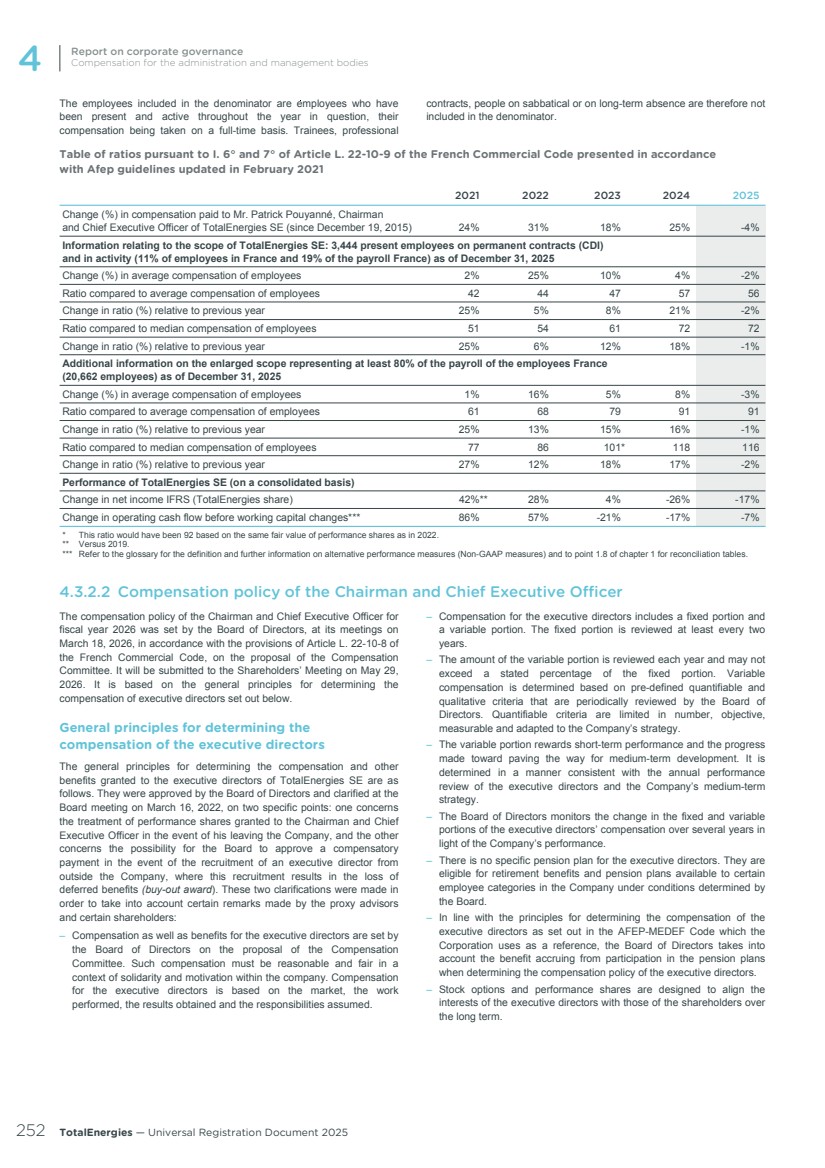
| The grant of options and performance shares to the executive directors is reviewed in light of all the components of compensation of the person in question. No discount is applied when stock options are granted. The exercise of options and the definitive grant of performance shares to which the executive directors are entitled are subject to conditions of presence in the Company and performance that must be met over several years. The Board of Directors determines the rules related to holding a portion of the shares resulting from the exercise of options as well as the performance shares definitively granted, which apply to the executive directors until the end of their term of office. The executive directors cannot be granted stock options or performance shares when they leave office. In the event of the retirement or a change of position within the Company, the Chairman and Chief Executive Officer upholds all vesting rights in the course of acquisition. In the event of forced departure, other than for serious or gross misconduct, the Board of Directors may decide that the Chairman and Chief Executive Officer upholds his vesting rights in the course of acquisition on a pro rata basis according to the length of time of his presence within the Company. In the event of resignation or termination of his function for serious or gross misconduct, all vesting rights in the course of acquisition will be lost in whole. The upholding of vesting rights in the course of acquisition under the conditions of departure described above is accompanied by the upholding of the performance criteria set for the definitive grant of the shares. In case of exceptional circumstances, the Board may decide to maintain stock options and performance share grant rights after the executive director left, the decision of the Board of Directors has to be duly motivated and taken in the corporate interest. – After three years in office, the executive directors are required to hold at least the number of Corporation shares set by the Board. – The components of compensation of the executive directors are made public after the Board of Directors’ meeting at which they are approved. – The executive directors do not take part in any discussions or deliberations of the corporate bodies regarding items on the agenda of Board of Directors’ meetings related to the assessment of their performance or the determination of the components of their compensation. – When a new executive director is nominated, the Board of Directors decides on his or her compensation as well as benefits, further to a proposal by the Compensation Committee, and in accordance with the above general principles for determining the compensation of the executive directors. The Board of Directors, on the proposal of the Compensation Committee, may approve a compensation payment in the event of the recruitment of an executive director from outside the Company, where this recruitment results in the loss of deferred benefits (buy-out award). The Board will ensure that the amount thus granted does not exceed the loss of these benefits and may make its payment subject to performance conditions. Exceptional compensation or specific benefits when taking office are forbidden, unless the Board of Directors decides otherwise for particular reasons, in the corporate interest and within the limits of the exceptional circumstances. At its meeting on February 7, 2023, the Board of Directors adopted a clawback policy under which, in the event of a restatement of the financial statements, the Corporation will require, within the framework and limits of applicable law, the recovery within a reasonable period of time of the variable compensation (in cash and/or equity) paid or awarded to the executive officers, or otherwise vested in them, during the three financial years preceding the decision to make such a restatement in the amount of the portion of such compensation that should not have been paid, vested or awarded on the basis of the restated financial statements. A restatement is defined as any accounting restatement that gives rise to an obligation to make restitution in accordance with Section 10D-1 of the Securities Exchange Act of 1934, the New York Stock Exchange standards and the implementing measures issued thereunder. Compensation policy applicable to the Chairman and Chief Executive Officer for fiscal year 2026 As part of the renewal of the mandate of the Chairman and Chief Executive Officer at the Shareholders’ Meeting on May 24, 2024 and of the setting of the compensation policy for 2024, the Board of Directors announced the continuation for the duration of the new mandate (2024 to 2026) of the annual base compensation (€1,550,000) and the structure and amount of the annual variable portion as well as a granting of 140,000 performance shares per year. At its meetings on March 18, 2026, the Board of Directors, on the proposal of the Compensation Committee, approved the compensation policy applicable to the Chairman and Chief Executive Officer for the 2026 financial year, after ensuring that it was consistent with the external benchmarks that the Compensation Committee had commissioned and after taking into consideration the opinions expressed by the proxy advisors. A. The Chairman and Chief Executive Officer’s base salary (fixed compensation) for fiscal year 2026 Mr. Patrick Pouyanné’s annual base salary (fixed compensation) in respect of his duties as Chairman and Chief Executive Officer for fiscal year 2026 is set at €1,550,000. Such fixed compensation has been unchanged since 2022, despite inflation. B. Annual variable compensation due for fiscal year 2026 (expressed as a percentage of the base salary) The maximum amount of the variable portion that could be paid to the Chairman and Chief Executive Officer for the fiscal year 2026 is maintained at 180% of base salary (percentage unchanged compared to the variable portion allocated in respect of fiscal year 2025). The formula for calculating the variable portion of the Chairman and Chief Executive Officer for fiscal year 2026, which may not exceed 180% of his base salary, includes, as in 2025, quantifiable targets reflecting the Company’s performance, up to a maximum of 140% of the fixed portion, and the personal contribution of the Chairman and Chief Executive Officer allowing for qualitative assessment of his management, up to a maximum of 40% of the fixed portion. The total variable portion may thus reach a maximum of 180% of the fixed portion of the Chairman and Chief Executive Officer’s compensation. The economic parameters (quantifiable targets) are based on three themes: Safety for 20%, GHG emissions (Scope 1+2) for 10%, financial for 110%. Within this unchanged structure, the Board has decided, on the recommendation of the Compensation Committee, to adjust the thresholds for Integrated Power cash-flow criterion, which accounts for 10% of variable compensation. The Board has decided to raise the level of the Integrated Power cash-flow corresponding to 100% achievement of this criterion from $2.5 billion to $3 billion. In addition, in view of the improved results achieved by the Company in 2025, the targets for the TRIR (Total Recordable Injury Rate) safety criteria and the evolution in the number of Tier 1 + Tier 2 incidents have been made more stringent for the 2026 annual variable portion. Similarly, the target for the criterion related to Scope 1+2 greenhouse gas emissions from operated facilities has been revised downward for 2026 compared to the trajectory validated by the Board of Directors since 2020, in line with the new 2026 target announced by the Company (emission target of 34 Mt CO2e for 2026 instead of 37 Mt CO2e for 2025). The other criteria were renewed identically, the weightings of all the criteria remaining otherwise unchanged. Report on corporate governance Compensation for the administration and management bodies 4 TotalEnergies — Universal Registration Document 2025 253 |
| Annual variable compensation due for fiscal year 2026 (expressed as a percentage of the base salary) % targets Summary of the quantifiable targets A. Safety and greenhouse gas (GHG) emissions a) Safety 20% – TRIR 6% – FIR 6% – Evolution of the number of Tier 1 + Tier 2 incidents 8% b) Evolution of GHG emissions (Scope 1+2) 10% Maximum percentage that may be allocated in respect of Safety and greenhouse gas (GHG) emissions criteria 30% B. Financial parameters – Return on equity (ROE) 30% – Organic Gearing 20% – Integrated Power cash flow (CFFO) 10% – Pre-dividend organic cash breakeven 30% – Return on average capital employed (ROACE), comparative 20% Maximum percentage that may be allocated in respect of financial parameters 110% Maximum percentage that may be allocated in respect of quantifiable targets 140% Personal contribution (qualitative criteria) – Steering of the Corporation’s transition strategy, in line with the 2020/2030 targets announced to investors, in particular the increase of gas and power production, as well as the evolution of its sales mix 15% – Profitable growth in electricity and renewables 10% – Extra-financial performance of the Company in the areas of corporate social responsibility, talent development, sustainable development and company extra-financial ratings 15% Maximum percentage that may be allocated in respect of the personal contribution 40% Total 180% Safety and Greenhouse gas emissions criteria The Safety and Greenhouse gas emissions criteria are assessed on the basis of the quantifiable targets set out below for a maximum of 30% of the Chairman and Chief Executive Officer’s fixed salary. The change in safety will be assessed, for a maximum of 20%, through the achievement of an annual TRIR (Total Recordable Incident Rate) target and the number of accidental deaths per million hours worked, FIR (Fatality Incident Rate), as well as through changes in the Tier 1 + Tier 2 indicator(1): – The maximum weighting of the TRIR criterion is 6% of the base salary (as in 2025). • The maximum weighting will be reached if the TRIR is below 0.55 (0.60 in 2025). • The weighting of the criterion will be zero if the TRIR is above or equal to 0.88 (0.96 in 2025). • The interpolations are linear between these points of reference; – The maximum weighting of the FIR criterion will be 6% of the base salary (as in 2025). • up to 50%: the maximum weighting of this sub-criterion will be reached if there is no accidental death and is zero from at least one accidental death, • up to 50%: the maximum weighting of this sub-criterion assessed by comparison with that of the four major competing oil companies (ExxonMobil, Shell, BP et Chevron), will be reached if TotalEnergies’ FIR is the best of the panel of majors and will be zero if the FIR is the worst of the panel. The weighting of the criterion is calculated based on TotalEnergies’ FIR by linear interpolation between these two points of reference. – the maximum weighting of the changes in the number of Tier 1 + Tier 2 incidents is 8% of the base salary (as in 2025). • The maximum weighting will be reached if the number of Tier 1 + Tier 2 incidents is equal to or below 35 (40 in 2025). • The weighting of the parameter will be zero if the number of Tier 1 + Tier 2 incidents is equal to or higher than 63 (72 in 2025). • The interpolations are linear between these two points of reference. The change in greenhouse gas (GHG) emissions from operated facilities will be assessed, for a maximum of 10% of the Chairman and Chief Executive Officer’s fixed portion, through the achievement of a GHG (Scope 1+2) reduction emission target from 46 Mt CO2e in 2015 to 34 Mt CO2e in 2026. The maximum weighting of the GHG criterion is 10% of the base salary: – the maximum weighting of the criterion, i.e. 10% of the base salary, will be obtained if the GHG emissions (Scope 1+2) from operated facilities reaches the target set at 34 Mt CO2e in 2026 (compared to 37 Mt CO2e in 2025); – the weighting of the criterion will be zero if the emissions are equal or above 36 Mt CO2e above the target set; – the interpolations are linear between these points of reference. Details on the financial parameters The four financial criteria are assessed on the basis of the quantifiable objectives set out below for a maximum of 110% of the Chairman and Chief Executive Officer’s fixed portion: – the return on equity (ROE), as published by the Company on the basis of its balance sheet and consolidated statement of income, will be assessed as follows. The maximum weighting of the ROE criterion will be 30% of the base salary: • the maximum weighting of the criterion will be reached, i.e., 30% of the base salary, if the ROE is higher than or equal to 15%; • the weighting of the criterion will be zero if the ROE is lower than or equal to 6%; • the interpolations are linear between these two points of reference. (1) Tier 1 and Tier 2: indicator of the number of loss of primary containment events, with more or less significant consequences, as defined by the API 754 (for downstream) and IOGP 456 (for upstream) standards. Excluding acts of sabotage and theft. 4 Report on corporate governance Compensation for the administration and management bodies 254 TotalEnergies — Universal Registration Document 2025 |
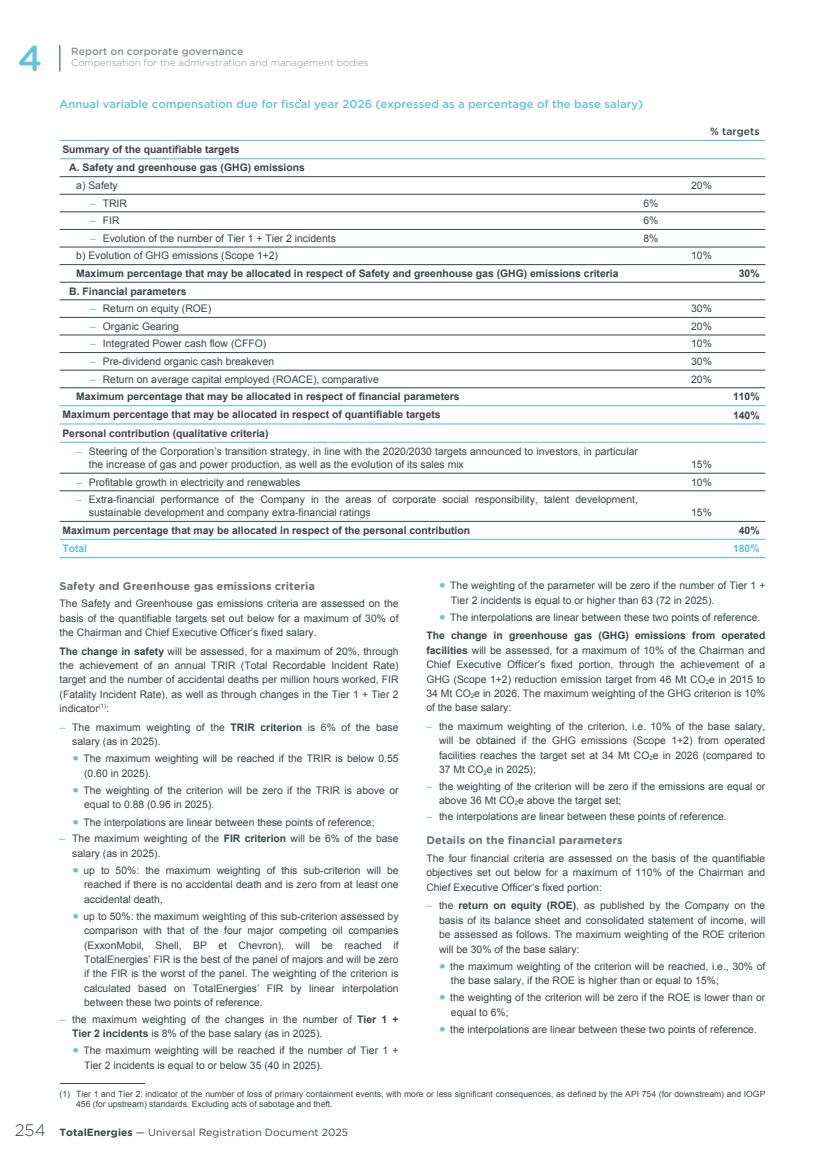
| – the organic gearing will be assessed as follow. The maximum weighting of the criterion will be 20% of the base salary: • the maximum weighting of the criterion, i.e., 20% of the base salary, will be reached if the organic gearing is below or equal to 10%; • the weighting of the criterion will be zero if the organic gearing is above or equal to 30%; • the interpolations are linear between these two points of reference. – the Integrated Power cash flow (CFFO) will be assessed as follow. The maximum weighting of the criterion will be 10% of the base salary: • the maximum weighting of the criterion, i.e., 10% of the base salary, will be reached if the Integrated Power cash flow (CFFO) is above or equal to $3 billion; • the weighting of the criterion will be zero if the Integrated Power cash flow (CFFO) is below $2.5 billion; • the interpolations are linear between these two points of reference. – the pre-dividend organic cash breakeven will be assessed as follows. The maximum weighting of this criterion will be 30% of the base salary: • the maximum weighting of the criterion will be reached, i.e., 30% of the base salary, if the breakeven is below or equal to $25/b, • the weighting of the criterion will be zero if the breakeven is above or equal to $35/b, • the interpolations are linear between these two points of reference; The ability of the Company to resist to the variations of the Brent barrel price is measured by the pre-dividend organic cash breakeven. – the return on average capital employed (ROACE), by comparison, will be assessed as follows. The maximum weighting of the ROACE criterion will be 20% of the base salary. TotalEnergies’ ROACE, as published from the consolidated balance sheet and the income statement, will be compared to the ROACE average of each of the four peers (ExxonMobil, Shell, BP and Chevron). The ROACE is equal to the net adjusted operating income divided by the average of the capital employed (at replacement costs, net of deferred income tax and non-current liabilities) of the start and end of the fiscal year: • the maximum weighting of the criterion will be reached, i.e., 20% of the base salary, if TotalEnergies’ ROACE is 2% above the average of the 4 peers’ ROACE, • the weighting of the criterion will be zero if TotalEnergies’ ROACE is under 2% or more compared to the average of the 4 peers’ ROACE, • the interpolations will be linear between these two points of reference. Personal contribution The criteria for assessing the personal contribution of the Chairman and Chief Executive Officer, up to a maximum of 40% of his fixed portion, are as follows: – steering the Corporation’s transition strategy, in line with the 2020/ 2030 targets announced to investors, in particular the increase of gas and power production, as well as the evolution of its sales mix, for up to 15%; – profitable growth in electricity and renewables, for up to 10%; – Extra-financial performance of the Company in the areas of corporate social responsibility, talent development, sustainable development and company extra-financial ratings, for up to 15%. Powers of the Board under special circumstances In the event of a significant change affecting the calculation of the economic parameters for the Company (change in accounting standard, change in the policy of rating agencies, significant patrimonial transaction approved by the Board of Directors, etc.), the Board reserves the right to calculate the parameters mutatis mutandis with justification of the changes i.e., excluding exogenous extraordinary elements. In addition, the Board of Directors may exercise its discretionary powers regarding the determination of the compensation of the Chairman and Chief Executive Officer, in accordance with Articles L. 22-10-16, paragraph 1 and L. 22-10-17, paragraph 3 of the French Commercial Code, and pursuant to Articles L. 22-10-8 and L. 22-10-34 of the French Commercial Code, in the event of particular circumstances (significant change in the perimeter, completion of a transformation transaction or unexpected changes in the competitive environment...) that could justify that the Board of Directors adjusts, exceptionally and both on the upside and the downside, one or more of the criteria that make up his compensation to ensure that the results of the application of the criteria described above reflect both the performance of the Chairman and Chief Executive Officer and the performance of the Company either in absolute terms or relative to the four peers of the Company, for the economic criteria measured in comparison with these four peers. This adjustment would be made to the variable compensation of the Chairman and Chief Executive Officer by the Board of Directors on the proposal of the Compensation Committee, within the limit of the variable compensation cap of 180% of the fixed compensation, after the Board of Directors ensured that the interests of the Corporation and of its shareholders are aligned with those of the executive director. Pursuant to Article L. 22-10-34 of French Commercial Code, the payment of this annual variable portion is subject to the approval of the Shareholders’ Meeting to be called in 2026 to approve 2025 financial statements. C. Performance shares The granting of performance shares to the Chairman and Chief Executive Officer corresponds to the long-term component of his global compensation. Performance shares are definitively granted at the end of a three-year vesting period. The definitive grant of shares is subject to a presence condition and performance conditions assessed at the end of this three-year vesting period. As part of the renewal of the Chairman and Chief Executive Officer’s directorship at the Shareholders’ Meeting on May 24, 2024, the Board of Directors increased the number of performance shares to 140,000 shares per year for the duration of the new term of office (2024 to 2026). The compensation policy for fiscal year 2026 includes the granting of 140,000 performance shares to the Chairman and Chief Executive Officer as part of a 2026 plan that will not be specific to him. As it announced regarding value sharing and employee shareholding, the Board of Directors ensures that the grant performance shares to employees evolves, in volume of shares allocated and in number of beneficiaries, helping to increase the alignment of the interests of the Company’s employees with those of the shareholders. Performance conditions Report on corporate governance Compensation for the administration and management bodies 4 TotalEnergies — Universal Registration Document 2025 255 |
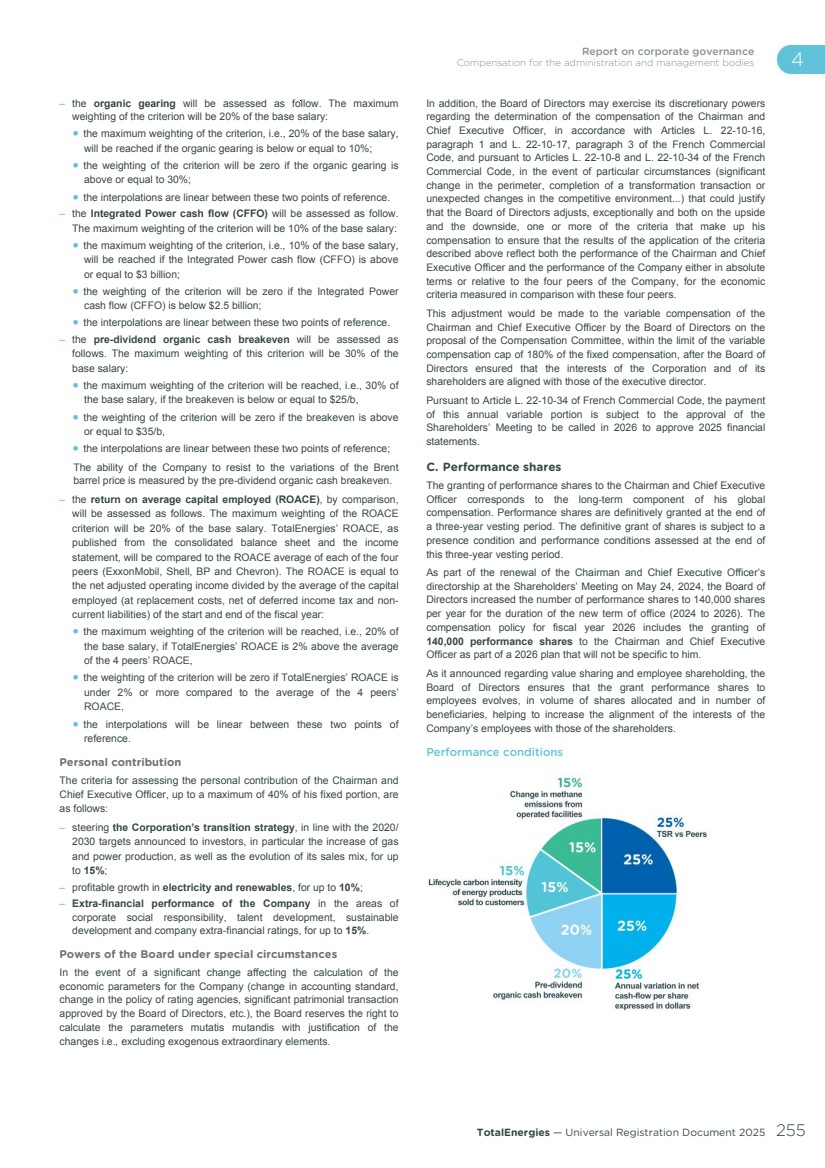
| The performance shares will be subject to the following performance conditions. The definitive number of granted shares will be based on: (i) the TSR (Total Shareholder Return) compared to its peers, (ii) the annual variation of the net cash flow by share in dollars compared to its peers, (iii) the pre-dividend organic cash breakeven, (iv) the change in methane emissions from operated facilities and (v) the change on lifecycle carbon intensity of energy products sold to the customers of the Company, and applied as follows: – for 25% of the shares, the Corporation will be ranked against its peers (ExxonMobil, Shell, BP and Chevron) each year during the three vesting years (2026, 2027 and 2028) based on the TSR criterion of the year in question, the dividend being considered reinvested; – for 25% of the shares, the Corporation will be ranked against its peers (ExxonMobil, Shell, BP and Chevron) each year during the three vesting years (2026, 2027 and 2028) using the annual variation in net cash flow per share criterion expressed in dollars. Based on the ranking, a grant rate will be determined for each year for these two first criteria: 1 st: 180% of the grant; 2 nd: 130% of the grant; 3 rd: 80% of the grant; 4 th and 5 th: 0%. – For 20% of the shares, the pre-dividend organic cash breakeven criterion will be assessed each year during the three vesting years (2026, 2027 and 2028) as follows: • the maximum grant rate will be achieved, i.e., 100% for this criterion, if the breakeven is less than or equal to $25/b; • the grant rate will be zero if the breakeven is greater than or equal to $35/b; • the interpolations will be linear between these two points of reference. The pre-dividend organic cash breakeven is defined as the Brent price for which the operating cash flow before working capital changes covers the organic investments(1) . The ability of the Company to resist to the variations of the Brent barrel price is measured by this parameter. A grant rate will be determined each year for each of these above criteria. For each of the first three criteria, the average of the three grant rates obtained (for each of the three fiscal years for which the performance conditions are assessed) will be rounded to the nearest 0.1 whole percent (0.05% being rounded to 0.1%) and capped at 100%. – For 15% of the shares, the criterion of the change in the methane emissions from operated facilities will be assessed with regard to the achievement of the target to reduce methane emissions set for 2028 at 74% compared to the methane emissions of 2020. • the maximum grant rate, i.e., 100% for this criterion, will be reached if the methane emissions in 2028 reach the target; • the grant rate will be zero if the methane emission reduction is below 65% compared to 2020; • the interpolations will be linear between these two points of reference. – For 15% of the shares, the criterion of the lifecycle carbon intensity of energy products sold to the customers of the Company will be assessed with regard to the achievement of the target to reduce this lifecycle carbon intensity set for 2028 at 22% compared to 2015: • the maximum grant rate, i.e., 100% for this criterion, will be obtained if the lifecycle carbon intensity reach in 2028 the target set; • the grant rate will be zero if the lifecycle carbon intensity reduction is below 18% in 2028 compared to 2015; • the interpolations will be linear between these two points of reference. The definitive grant rate will be rounded to the nearest 0.1 whole percent (0.05% being rounded to 0.1%). The number of shares definitively granted after determination of performance conditions will be determined according to the weighting of each of the five criteria and rounded up to the next whole number of shares. In accordance with Article L. 225-197-1 of the French Commercial Code, at the end of the three-year vesting period, the executive director will be required to hold in registered form 50% of the shares definitively granted to him at the end of the vesting period until the end of his term of office. Treatment of performance shares in the event of the Chairman and Chief Executive Officer leaving the Company The Board paid particular attention to the comments made by shareholders concerning the treatment of performance shares granted to the Chairman and Chief Executive Officer in the event of his leaving the Company and clarified the following points: ● in the event of the retirement or of a change of position within the Company, the Chairman and Chief Executive Officer upholds all vesting rights in the course of acquisition; ● in the event of forced departure, other than for serious or gross misconduct, the Board of Directors may decide that the Chairman and Chief Executive Officer upholds his vesting rights in the course of acquisition on a pro rata basis according to the length of time of his presence within the Company; ● in the event of resignation or termination of his function for serious or gross misconduct, his vesting rights in the course of acquisition will be lost in whole. The upholding of existing vesting rights in the course of acquisition under the conditions of departure described above is accompanied by the upholding of the performance criteria set for the definitive grant of the shares. In case of exceptional circumstances, the Board of Directors may decide to maintain stock options and performance share grants after the executive director left, the decision of the Board of Directors has to be duly motivated and taken in the corporate interest. D. Commitments made by the Corporation to the Chairman and Chief Executive Officer The commitments made by the Corporation to the Chairman and Chief Executive Officer relate to the pension plans, the retirement benefit and the severance benefit to be paid in the event of forced departure related to a change of control or strategy, as well as the life insurance and healthcare benefits. They were approved by the Board of Directors on March 14, 2018, and by the Annual Shareholders’ Meeting on June 1, 2018, in accordance with the provisions of Article L. 225-42-1 of the French Commercial Code. It should be noted that Mr. Pouyanné already benefited from all these provisions when he was an employee of the Corporation, except for the commitment to pay severance benefits in the event of forced departure related to a change of control or strategy. It should also be noted that Mr. Pouyanné, who joined the Company on January 1, 1997, ended the employment contract that he previously had with the Corporation through his resignation at the time of his appointment as Chief Executive Officer on October 22, 2014. Pension plans Pursuant to applicable legislation, the Chairman and Chief Executive Officer is eligible for the basic French Social Security pension and for pension benefits under the AGIRC-ARRCO supplementary pension plan. He also participates in the internal defined contribution pension plan applicable to all TotalEnergies SE employees, called PERO (Plan d’épargne retraite obligatoire - mandatory retirement savings plan), covered by Article L. 242-1 of the French Social Security Code. The Corporation’s commitment is limited to its share of the contribution paid to the insurance company that manages the plan. For fiscal year 2025, this pension plan represented a booked expense to TotalEnergies SE in favor of the Chairman and Chief Executive Officer of €2,826. (1) Organic investments: net investments excluding acquisitions, asset sales and other operations with non-controlling interests. 4 Report on corporate governance Compensation for the administration and management bodies 256 TotalEnergies — Universal Registration Document 2025 |
| The Chairman and Chief Executive Officer also participates in a supplementary defined-benefit pension plan, covered by Article L. 137-11 of the French Social Security Code, set up and financed by the Corporation and approved by the Board of Directors on March 13, 2001, for which management is outsourced to two insurance companies effective January 1, 2012. In accordance with the ordinance 2019-697 published on July 4, 2019, this plan is closed to any new participant as from July 4, 2019, and, for participants as of July 4, 2019, and retiring as from January 1, 2020, the amount of supplementary pension provided for in this plan is calculated on the basis of number of years of service as at December 31, 2019, and up to a maximum of 20 years. This plan applies to all TotalEnergies SE employees whose reference compensation exceeded as of July 4, 2019 eight times the annual ceiling for calculating French Social Security contributions (PASS), set at €40,524 for 2019 (i.e., €324,192), and above which there is no conventional pension plan. To be eligible for this supplementary pension plan, participants must have served for at least five years, be at least 60 years old and exercised his or her rights to retirement from the French Social Security. The benefits under this plan are subject to a presence condition under which the beneficiary must still be employed at the time of retirement. However, the presence condition does not apply if a beneficiary aged 55 or older leaves the Corporation at the Corporation’s initiative or in case of disability. The length of service acquired by Mr. Pouyanné as a result of his previous salaried duties held at the Company since January 1, 1997, has been maintained for the benefit of this plan. The compensation taken into account to calculate the supplementary pension is the average gross annual compensation (fixed and variable portion) over the last three years. The amount paid under this plan is equal to 1.8% of the compensation falling between 8 and 40 times the PASS and 1% for the portion of the compensation falling between 40 and 60 times this ceiling, multiplied by the number of years of service as of December 31, 2019, up to a maximum of 20 years. The sum of the annual supplementary pension plan benefits and other pension plan benefits (other than those set up individually and on a voluntary basis) may not exceed 45% of the average gross compensation (fixed and variable portion) over the last three years. In the event that this percentage is exceeded, the supplementary pension is reduced accordingly. The amount of the supplementary pension determined in this way is indexed to the AGIRC-ARRCO pension point. The supplementary pension includes a clause whereby 60% of the amount will be paid to beneficiaries in the event of death after retirement. The Board noted that Mr. Pouyanné can no longer acquire additional pension rights under this plan given the rules for determining pension rights set out in the plan and the 20 years of service of Mr. Pouyanné as of December 31, 2016. The conditional rights granted to Mr. Patrick Pouyanné for the period from January 1, 1997, to December 31, 2016 (inclusive), are now equal to a reference rate of 36% for the portion of the base compensation falling between 8 and 40 times the PASS and 20% for the portion of the base compensation falling between 40 and 60 times the PASS. Based on Mr. Pouyanné’s seniority capped at 20 years on December 31, 2016, the commitments made by TotalEnergies SE to the Chairman and Chief Executive Officer in terms of supplementary defined benefits and similar pension plans represented, at December 31, 2025, a gross annual retirement pension estimated at €730,992. It corresponds to 17.89% of Mr. Pouyanné’s gross annual compensation consisting of the annual fixed portion for 2025 (i.e., €1,550,000) and the variable portion paid in 2026 (1) for fiscal year 2025 (i.e., €2,535,800). Nearly the full amount of TotalEnergies SE’s commitments under these supplementary and similar retirement plans (including the retirement benefit) is outsourced for all beneficiaries to insurance companies and the non-outsourced balance is evaluated annually and adjusted through a provision in the accounts. The amount of these commitments as of December 31, 2025, is €17.4 million for the Chairman and Chief Executive Officer (€17.5 million for the Chairman and Chief Executive Officer and the executive and non-executive directors covered by these plans). These amounts represent the gross value of TotalEnergies’ commitments to these beneficiaries based on the estimated gross annual pensions as of December 31, 2025, as well as the statistical life expectancy of the beneficiaries. The total amount of all the pension plans in which Mr. Pouyanné participates represents, at December 31, 2025, a gross annual pension estimated at €893,049, corresponding to 21.86% of Mr. Pouyanné’s gross annual compensation defined above (annual fixed portion for 2025 and variable portion paid in 2026 for fiscal year 2025). Retirement benefit The Chairman and Chief Executive Officer is entitled to a retirement benefit equal to those available to eligible members of the Company under the French National Collective Bargaining Agreement for the Petroleum Industry. This benefit is equal to 25% of the fixed and variable annual compensation received during the 12 months preceding retirement. The receipt of this retirement benefit is subject to conditions related to the performance of the beneficiary. Therefore, the conditions applicable to the beneficiary will be deemed to be fulfilled if at least two of the following criteria are met: – the average return on equity (ROE) for the three years preceding the year in which the Chairman and Chief Executive Officer leaves is at least 10%; – the average gearing ratio for the three years preceding the year in which the Chairman and Chief Executive Officer leaves is less than or equal to 30%; and – the pre-dividend organic cash breakeven of the three years preceding the year in which the Chairman and Chief Executive Officer retires is below or equal to $30/b. The retirement benefit cannot be combined with the severance benefit described below. Severance benefit The Chairman and Chief Executive Officer is entitled to a benefit equal to two years of his gross compensation in the event of a forced departure related to a change of control or strategy. The calculation is based on the gross compensation (fixed and variable) of the 12 months preceding the date of termination or non-renewal of his term of office. The severance benefit will only be paid in the event of a forced departure related to a change of control or strategy. It will not be due in case of serious or gross misconduct or if the Chairman and Chief Executive Officer leaves the Corporation of his own volition, accepts new responsibilities within the Company or may claim full retirement benefits within a short time period. The receipt of the severance benefit is subject to conditions linked to the beneficiary’s performance. Therefore, the conditions applicable to the beneficiary are deemed to be fulfilled if at least two of the following criteria are met: – the average return on equity (ROE) for the three years preceding the year in which the Chairman and Chief Executive Officer leaves is at least 10%; – the average gearing ratio for the three years preceding the year in which the Chairman and Chief Executive Officer leaves is less than or equal to 30%; and – the pre-dividend organic cash breakeven of the three years preceding the year in which the Chairman and Chief Executive Officer retires is below or equal to $30/b. (1) Subject to approval by the Ordinary Shareholders’ Meeting on May 29, 2026. Report on corporate governance Compensation for the administration and management bodies 4 TotalEnergies — Universal Registration Document 2025 257 |
| Life insurance and health expense reimbursement plans The Chairman and Chief Executive Officer is covered by the following life insurance plans provided by various life insurance companies: – an “incapacity, disability, life insurance” plan applicable to all employees, partly paid for by the Corporation, that provides for two options in case of death of a married employee: either the payment of a lump sum equal to 5 times the annual compensation up to 16 times the PASS, corresponding to a maximum of €3,844,800 in 2026, plus an additional amount if there is a dependent child or children, or the payment of a lump sum equal to 3 times the annual compensation up to 16 times the PASS, plus a survivor’s pension and education allowance; – a second “disability and life insurance” plan, fully paid by the Corporation, applicable to executive officers and senior executives whose annual gross compensation is more than 16 times the PASS. This contract, signed on October 17, 2002, amended on January 28, 2015, December 11, 2015, July 4, 2017 and July 7, 2020, guarantees the beneficiary the payment of a lump sum, in case of death, equal to two years of compensation (defined as the gross annual fixed reference compensation (base France), which corresponds to 12 times the monthly gross base salary paid during the month prior to death or sick leave, to which is added the highest amount in absolute value of the variable portion received during one of the five previous years of activity), which is increased to three years in case of accidental death and, in case of accidental permanent disability, a lump sum proportional to the degree of disability. Death benefits are increased by 15% for each dependent child. Payments due under this contract are made after the deduction of any amount paid under the above-mentioned plan applicable to all employees. The Chairman and Chief Executive Officer also has the use of a company car and is covered by the health care plan available to all employees. 4.3.3 Executive officers’ compensation TotalEnergies’ executive officers include the members of the Executive Committee. As of December 31, 2025, the list of the executive officers of TotalEnergies was as follows (10 people vs 9 people, as of December 31, 2024): – Patrick Pouyanné, Chairman and Chief Executive Officer and Chairman of the Executive Committee; – Aurélien Hamelle, President, Strategy & Sustainability, member of the Executive Committee; – Helle Kristoffersen, President, Asia, member of the Executive Committee; – Stéphane Michel, President, Gas, Renewables & Power, member of the Executive Committee; – Bernard Pinatel, President Downstream and President, Marketing & Services, member of the Executive Committee; – Catherine Remy, President, People & Social Engagement, member of the Executive Committee; – Jean-Pierre Sbraire, Chief Financial Officer, member of the Executive Committee; – Namita Shah, President, OneTech, member of the Executive Committee; – Vincent Stoquart, President, Refining & Chemicals, member of the Executive Committee; – Nicolas Terraz, President, Exploration & Production, member of the Executive Committee. In 2025, the aggregate amount paid directly or indirectly by TotalEnergies’ French and foreign companies as compensation to TotalEnergies’ executive officers in office as of December 31, 2025 (10 people vs 9 people, as of December 31, 2024) was €16.72 million (compared to €14.62 million in 2024). The variable component (based on economic, Safety performance and personal contribution criteria) represented 46% of this global amount of €16.72 million. 4.3.4 Stock option and Corporation’s shares grants 4.3.4.1 General policy Grant of performance shares In addition to its employee shareholding development policy, TotalEnergies SE has implemented a policy to involve employees and senior executives in its future performance which entails granting performance shares each year under selective plans based on a review of individual performance at the time of each grant. The share plans offered by TotalEnergies SE concern only TotalEnergies shares and no shares of the TotalEnergies listed subsidiaries are granted by the Company. All grants are approved by the Board of Directors, on the proposal of the Compensation Committee. For each plan, the Compensation Committee recommends a list of beneficiaries, the conditions as well as the number of shares granted to each beneficiary. The Board of Directors then gives final approval for this list and the grant conditions. Grants of performance shares under selective plans become definitive only at the end of a three-year vesting period, subject to the fulfillment of applicable presence and performance conditions.(1) 2024 Worldwide plan To mark TotalEnergies’ 100th anniversary, the Board of Directors decided to proceed with an exceptional grant of shares to the employees of the Company(2) worldwide. On May 23, 2024, the Board of Directors approved the grant of 100 free shares of the Corporation to each employee subject to the presence condition of five years from the grand date. Stock options Stock options were granted until 2011. Since the 2011 plan, the Board of Directors has not granted any new TotalEnergies stock options, and all the stock option plans have since expired. The last authorization from the Shareholders’ Meeting to grant stock options expired in 2023 and has not been renewed since. (1) For plans granted before 2022, beneficiaries had to hold the shares that were granted to them at the end of the vesting period, for a two-year holding period. (2) TotalEnergies SE and the companies in which TotalEnergies SE holds more than 50% of the share capital and which are directly or indirectly controlled by TotalEnergies SE or under a joint control, with the exception of a limited number of companies co-managed with other oil players, as well as those registered or incorporated in a country under economic sanctions. 4 Report on corporate governance Compensation for the administration and management bodies 258 TotalEnergies — Universal Registration Document 2025 |
| 4.3.4.2 Monitoring of grants to the executive directors Stock options As of December 31, 2025, Mr. Pouyanné did not hold any TotalEnergies stock options. Stock options granted in 2025 to each executive director by the issuer and by any TotalEnergies company - Table 4 – AMF position-recommendation – DOC-2021-02 (Appendix 2) Executive directors Plan N° and date Nature of the options (purchase or subscription) Valuation of options (€)(a) Number of options granted during the fiscal year Strike price Exercise period Patrick Pouyanné Chairman and Chief Executive Officer – – – – – – (a) According to the method used for the Consolidated Financial Statements. Stock options exercised in fiscal year 2025 by each executive director - Table 5 – AMF position-recommendation – DOC-2021-02 (Appendix 2) Plan N° and date Number of options exercised during the fiscal year Strike price Patrick Pouyanné Chairman and Chief Executive Officer – – – Grant of Corporation’s shares Mr. Pouyanné is granted performance shares as part of the broader grant plans approved by the Board of Directors for certain Company employees. The performance shares granted to him are subject to the same requirements applicable to the other beneficiaries of the grant plans. Report on corporate governance Compensation for the administration and management bodies 4 TotalEnergies — Universal Registration Document 2025 259 |
| Summary tables Shares granted to each director(a) in fiscal year 2025 by the issuer and by any TotalEnergies company - Table 6 – AMF position-recommendation – DOC-2021-02 (Appendix 2) Executive and non-executive directors Plan N° and date Number of shares granted during the fiscal year Valuation of the shares (€)(b) Acquisition date Date of transferability Performance conditions Patrick Pouyanné Chairman and Chief Executive Officer 2025 Plan 03/19/2025 140,000 5,401,760.00 03/20/2028 03/20/2028 – For 25% of the shares, the Company’s ranking against its peers (ExxonMobil, Shell, BP and Chevron) during the three vesting years (2025, 2026 and 2027) based on the Total Shareholder Return (TSR) of the year in question, the dividend being considered reinvested. – For 25% of the shares, the Company’s ranking against its peers (ExxonMobil, Shell, BP and Chevron) based on the annual variation in net cash flow per share expressed in dollars during the three vesting years (2025, 2026 and 2027). – For 20% of the shares, the level reached by the pre-dividend organic cash breakeven with regard to the target set for the three vesting years (2025, 2026 and 2027). The pre-dividend organic cash breakeven is defined as the Brent price for which the operating cash flow before working capital changes (MBA) covers the organic investments(c) . The ability of the Company to resist to the variations of the Brent barrel price is measured by this parameter. – For 15% of the shares, the change in methane emissions from operated facilities with regard to the achievement of the target to reduce methane emissions set for 2027. – For 15% of the shares, the criterion of the lifecycle carbon intensity of energy products sold to the Company’s customers with regard to the achievement of the target to reduce this intensity set for 2027. Valérie Della Puppa-Tibi Director representing employee shareholders since May 23, 2025 n/a n/a n/a n/a n/a Romain Garcia-Ivaldi Director representing employees since June 9, 2020 2025 Plan 03/19/2025 – – – – Emma de Jonge Director representing employee shareholders until May 23, 2025 2025 Plan 03/19/2025 – – – – Angel Pobo Director representing employees since October 14, 2020 2025 Plan 03/19/2025 387 14,932.01 03/20/2028 03/20/2028 Total 140,387 5,416,692.01 (a) List of executive and non-executive directors who had this status during fiscal year 2025. (b) 2025 performance shares valuation in accordance with IFRS 2 and taking into account an award rate hypothesis of 80% at the end of the vesting period, this amount corresponds to the shares granted in 2025, valued on the basis of a unit fair value of 48.23 euros. This fair value was calculated in accordance with IFRS 2 on the grant date of the plan, i.e., March 19, 2025, on the basis of a closing price of the TotalEnergies share on that date of 58.81 euros. (c) Refer to the glossary for the definitions and further information on Non-GAAP measures (alternative performance measures) and to point 1.8 of chapter 1 for reconciliation tables. 4 Report on corporate governance Compensation for the administration and management bodies 260 TotalEnergies — Universal Registration Document 2025 |
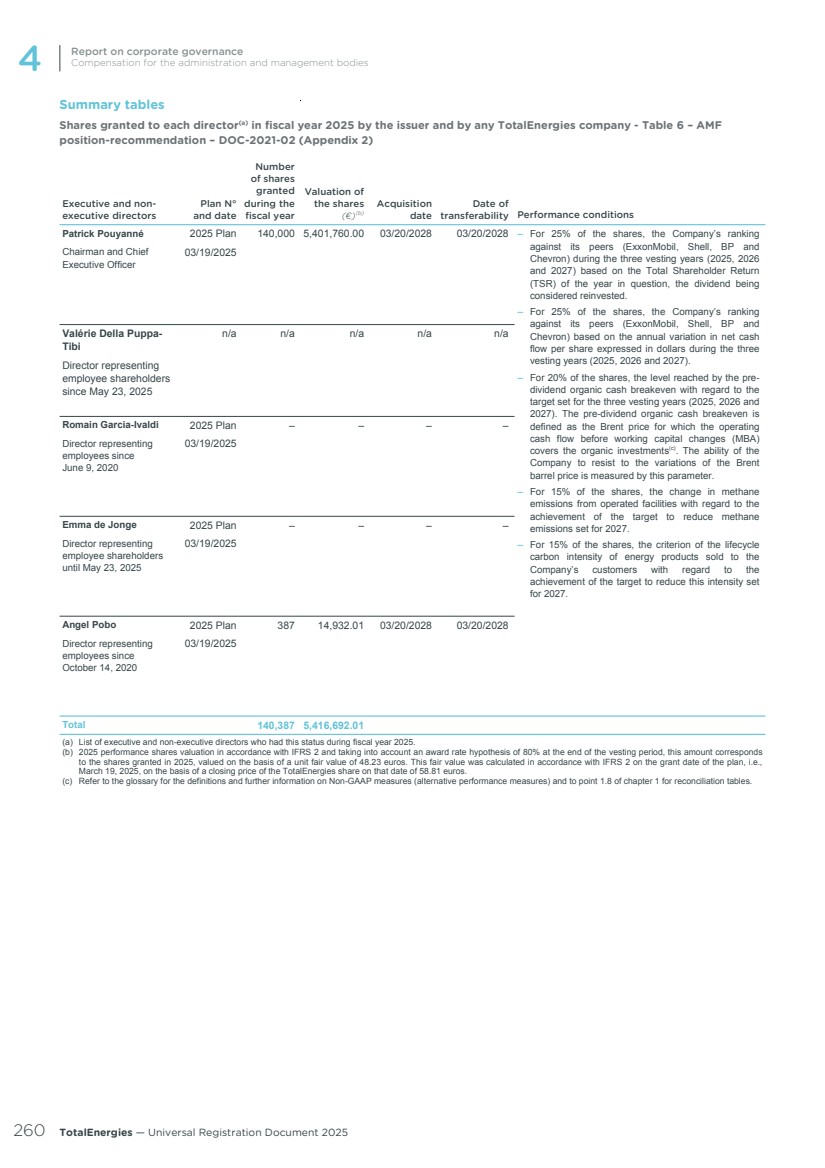
| Shares that have become transferable for each director - Table 7 – AMF position-recommendation – DOC-2021-02 (Appendix 2) Executive and non-executive directors(a) Plan N° and date Number of shares that became transferable during fiscal year 2025 Vesting conditions Patrick Pouyanné Chairman and Chief Executive Officer 2022 Plan 03/16/2022 85,400 The performance conditions are based for: – For 25% of the shares, the Corporation’s ranking against its peers (ExxonMobil, Shell, BP and Chevron) based on the TSR criterion during the three vesting years (2022, 2023 and 2024). The TSR considered is that of the last quarter of the year, the dividend being considered reinvested based on the closing price on the ex-dividend date. – For 25% of the shares, the Corporation’s ranking each year against its peers (ExxonMobil, Shell, BP and Chevron) using the annual variation in net cash flow per share criterion expressed in dollars during the three vesting years (2022, 2023 and 2024). – For 20% of the shares, the level reached by the pre-dividend organic cash breakeven with regard to the target set for the three vesting years (2022, 2023 and 2024). – For 15% of the shares, the change in the greenhouse gas (GHG) emissions from operated facilities (Scope 1+2) with regard to the achievement of the target to reduce the GHG emissions set for the three vesting years (2022, 2023 and 2024). – For 15% of the shares, the change in the greenhouse gas (GHG) emissions (Scope 3) in Europe with regard to the achievement of the target to reduce the GHG emissions set for the three vesting years (2022, 2023 and 2024). Valérie Della Puppa-Tibi Director representing employee shareholders since May 23, 2025 n/a n/a Romain Garcia-Ivaldi Director representing employees since June 9, 2020 2022 Plan 03/16/2022 – Emma de Jonge Director representing employee shareholders until May 23, 2025 2022 Plan 03/16/2022 – Angel Pobo Director representing employees since October 14, 2020 2022 Plan 03/16/2022 – (a) List of executive and non-executive directors who had this status during fiscal year 2025. For the 2022 plan, the vesting rate of shares granted, subject to performance conditions, linked to the TSR criterion, the annual change in net cash flow per share, the organic cash breakeven before dividends, the reduction in the greenhouse gas (Scope 1+2) and the reduction in the greenhouse gas (Scope 3) in Europe was 85.4%. The breakdown of the vesting rate of shares granted by criterion is detailed as follows: – TSR criterion: vesting rate of 43.3%; – annual variation in net cash flow per share criterion: vesting rate of 100%; – pre-dividend organic cash breakeven criterion: vesting rate of 100%; – change in the greenhouse gas (GHG) emissions (Scope 1+2) criterion: vesting rate of 100%; – change in the greenhouse gas (GHG) emissions (Scope 3) in Europe criterion: vesting rate of 96.9%. 4.3.4.3 Follow-up of TotalEnergies stock option plans as of December 31, 2025 Since the 2011 plan, the Board of Directors has not granted any new TotalEnergies stock options, and all the stock option plans have since expired. History of TotalEnergies stock option grants – Information on stock options - Table 8 – AMF position - recommendation – DOC-2021-02 (Appendix 2) Plan TotalEnergies stock option grants none Date of the Shareholders’ Meeting – Date of Board meeting/grant date – Total number of options granted by the Board of Directors, including to: – Executive and non-executive directors(a) – – P. Pouyanné none – V. Della Puppa-Tibi none – R. Garcia-Ivaldi none – E. de Jonge none – A. Pobo none Date as of which the options may be exercised: – Expiry date – Subscription or purchase price (€) – Cumulative number of options exercised/subscribed as of December 31, 2025 – Cumulative number of options canceled or expired as of December 31, 2025 – Number of options remaining at the end of the year – (a) List of executive and non-executive directors who had this status during fiscal year 2025. Report on corporate governance Compensation for the administration and management bodies 4 TotalEnergies — Universal Registration Document 2025 261 |
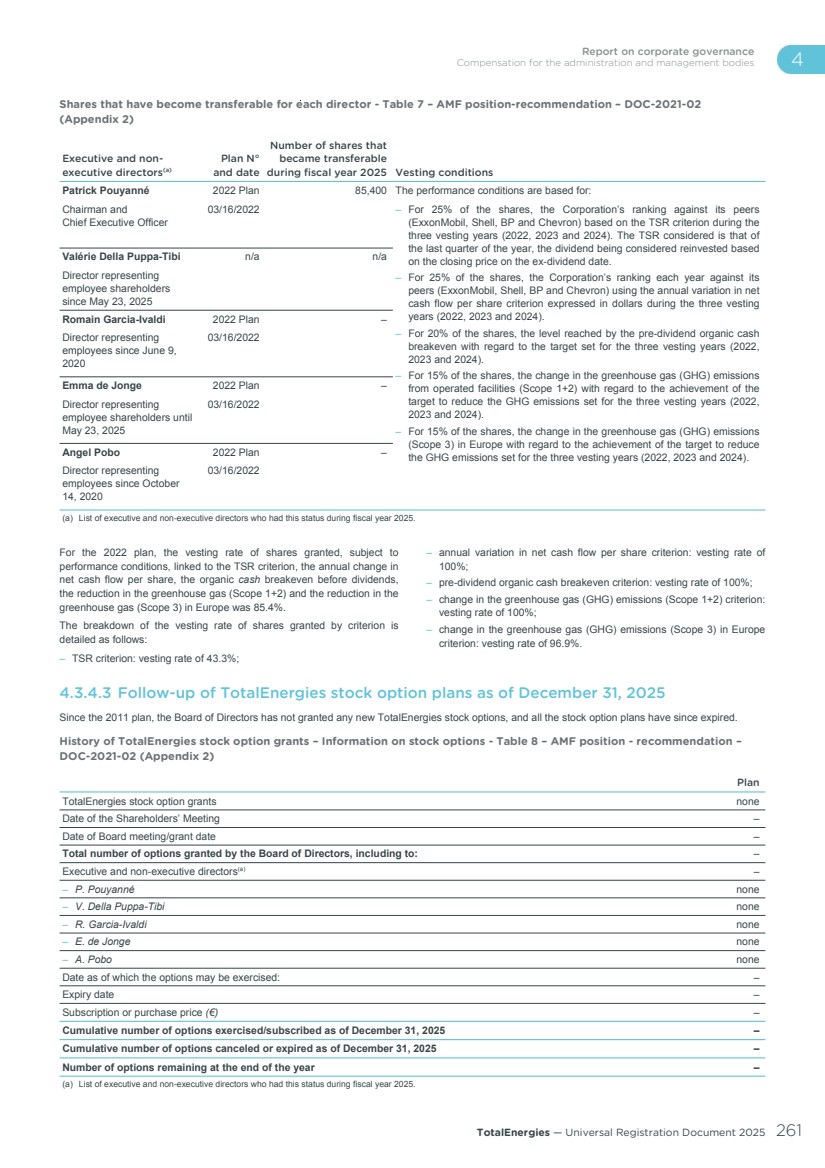
| Stock options granted to the 10 employees (other than executive or non-executive directors) receiving the largest number of options/Stock options exercised by the 10 employees (other than executive or non-executive directors) exercising the largest number of options - Table 9 – AMF position-recommendation – DOC-2021-02 (Appendix 2) Total number of options granted/exercised Weighted average strike price (€) Plan Options granted in fiscal year 2025 by TotalEnergies SE and its affiliates(a) to the 10 employees of TotalEnergies SE and its affiliates (other than executive or non-executive directors) receiving the largest number of options (aggregate – not individual information) – – none Options held on TotalEnergies SE and its affiliates(a) and exercised in fiscal year 2025 by the 10 employees of TotalEnergies SE and its affiliates (other than executive or non-executive directors at the date of the exercises) who purchased or subscribed for the largest number of shares (aggregate – not individual information) – – none (a) Pursuant to the conditions of Article L. 225-180 of the French Commercial Code. 4.3.4.4 Follow-up of TotalEnergies shares grants as of December 31, 2025 In 2025, the Board of Directors, at its meeting of March 19, 2025 granted a performance share plan to certain employees and executive directors of TotalEnergies SE or its subsidiaries. Shares granted to the Chairman and Chief Executive Officer under the 2025 Plan represent 0.006%(1) of the Corporation’s share capital on the attribution date. The performance shares, which were previously bought back by the Corporation on the market, will be definitively granted to their beneficiaries at the end of a three-year vesting period from the grant date. The vesting of performance shares is subject to a presence condition and performance conditions. For the 2025 grant, the applicable performance conditions are the following: – for 25% of the shares, the Corporation’s ranking against its peers (ExxonMobil, Shell, BP and Chevron) during the three vesting years (2025, 2026 and 2027) based on the Total Shareholder Return (TSR) of the year in question, the dividend being considered reinvested; – for 25% of the shares, the Corporation’s ranking against its peers (ExxonMobil, Shell, BP and Chevron) based on the annual variation in net cash flow per share expressed in dollars during the three vesting years (2025, 2026 and 2027); – for 20% of the shares, the level reached by the pre-dividend organic cash breakeven with regard to the target set for the three vesting years (2025, 2026 and 2027). The pre-dividend organic cash breakeven is defined as the Brent price for which the operating cash flow before working capital changes (MBA) covers the organic investments(2) . The ability of the Company to resist to the variations of the Brent barrel price is measured by this parameter; – for 15% of the shares, the criterion of the change in methane emissions from operated facilities with regard to the achievement of the target to reduce these methane emissions set for 2027; – for 15% of the shares, the criterion of the lifecycle carbon intensity of energy products sold to the Company’s customers with regard to the achievement of the target to reduce this intensity set for 2027. (1) On the basis of a share capital divided into 2,270,057,201 shares as at March 19, 2025. (2) Refer to the glossary for the definitions and further information on Non-GAAP measures (alternative performance measures) and to point 1.8 of chapter 1 for reconciliation tables. 4 Report on corporate governance Compensation for the administration and management bodies 262 TotalEnergies — Universal Registration Document 2025 |
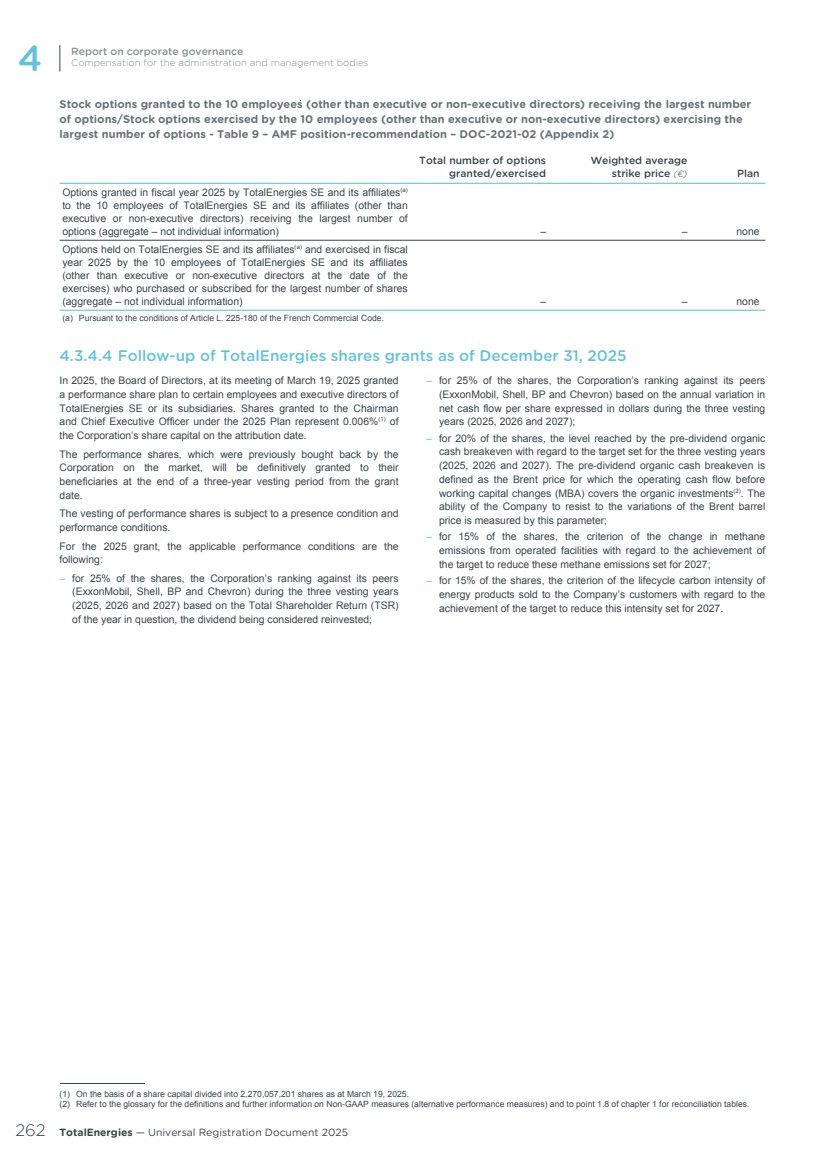
| Breakdown history of TotalEnergies share grants by category of beneficiary Breakdown of TotalEnergies share grants by category of beneficiary (executive officers, other senior executives and other employees) Number of beneficiaries Number of notified shares Percentage Average number of options per beneficiary 2021 Plan(a) Decision of the Board of Directors of March 17, 2021, with effect from May 28, 2021 Executive officers(b) 8 272,000 4.0% 34,000 Senior executives 280 1,579,100 23.3% 5,640 Other employees(c) 11,039 4,913,448 72.6% 445 Total 11,327 6,764,548 100% 579 2022 Plan(a) Decision of the Board of Directors of March 16, 2022 Executive officers(b) 8 284,000 4% 35,500 Senior executives 275 1,683,000 23% 6,120 Other employees(c) 11,494 5,386,271 73% 469 Total 11,777 7,353,271 100% 624 2023 Plan(a)(d) Decision of the Board of Directors of March 15, 2023, with effect from May 26, 2023 Executive officers(b) 8 337,500 4% 42,188 Senior executives(d) 270 1,746,300 22% 6,468 Other employees(c) 12,008 5,901,403 74% 491 Total 12,286 7,985,203 100% 650 2024 Plan Decision of the Board of Directors of May 24, 2024 Executive officers(b) 9 407,000 5% 45,222 Senior executives(d) 263 1,740,200 22% 6,617 Other employees(c) 8,462 5,628,522 73% 665 Total 8,734 7,775,722 100% 890 2024 Worldwide plan Decision of the Board of Directors of May 23, 2024 Employees 106,669 10,666,900 100% 100 Total 106,669 10,666,900 100% 100 2025 Plan Decision of the Board of Directors of March 19, 2025 Executive officers(b) 9 421,500 5% 46,833 Senior executives(d) 249 1,789,800 19% 7,188 Other employees(c) 12,998 6,978,718 76% 537 Total 13,256 9,190,018 100% 693 (a) For the 2021 plan, the vesting rate of granted shares, subject to performance conditions, linked to the TSR, the annual variation of the net cash flow per share, the organic cash breakeven point, to GHG emissions from operated facilities (Scope 1+2) and to GHG emissions (Scope 3), was 92%. For the 2022 plan, the vesting rate of granted shares, subject to performance conditions, linked to the TSR, the annual variation of the net cash flow per share, the organic cash breakeven point, to GHG emissions from operated facilities (Scope 1+2) and to GHG emissions (Scope 3), was 85.4%. For the 2023 plan, the vesting rate of granted shares, subject to performance conditions, linked to the TSR, the annual variation of the net cash flow per share, the organic cash breakeven point, to GHG emissions from operated facilities (Scope 1+2) and to methane emissions from operated facilities was 84.6%. (b) The executive officers as of the date of the Board meeting authorizing the grant. (c) Mr. Garcia-Ivaldi is a TotalEnergies Renewables employee and a TotalEnergies SE director representing employees since June 9, 2020. He was not granted any shares under the 2025 plan. He was granted 360 shares under the 2024 plan and 350 shares under the 2023 plan. Ms. de Jonge is a TotalEnergies SE employee and a TotalEnergies SE director representing employee shareholders between May 25, 2022 and May 23, 2025. She was not granted any shares under the 2025, 2024 and 2023 plan. Mr. Pobo is a TotalEnergies SE employee and TotalEnergies SE director representing employees since October 14, 2020. He was granted 387 shares under the 2025 plan, 360 shares under the 2024 plan and 344 shares under the 2023 plan. (d) Includes 37,000 performance shares granted to 4 executives recruited in 2023 under the Board of Directors’ decision of December 13, 2023. Report on corporate governance Compensation for the administration and management bodies 4 TotalEnergies — Universal Registration Document 2025 263 |
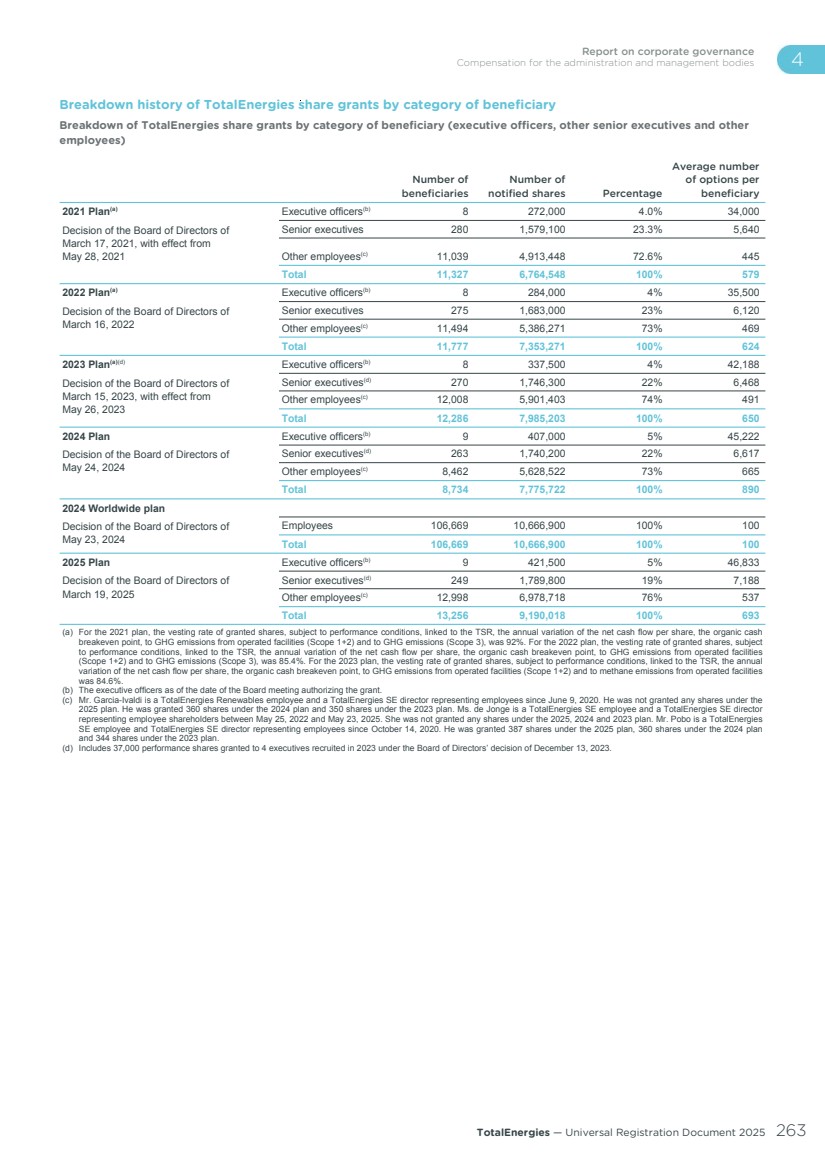
| Breakdown of TotalEnergies share grants by category of beneficiary Percentage of beneficiaries by category of beneficiaries Average number of performance shares granted by beneficiary Men Women Men Women 2021 Plan Senior management (JL 15+)(a) 83% 87% 1,406 1,492 JL 10 to 14 24% 25% 298 282 JL 9- 2% 2% 127 127 2022 Plan Senior management (JL 15+)(a) 82% 88% 1,524 1,656 JL 10 to 14 26% 27% 328 309 JL 9- 2% 2% 138 139 2023 Plan(b) Senior management (JL 15+)(a) 80% 84% 1,596 1,689 JL 10 to 14 26% 26% 340 321 JL 9- 2% 2% 145 147 2024 Worldwide Plan Employees and senior executives(c) 100% 100% 100 100 2024 Plan Senior management (JL 15+)(a) 80% 82% 1,627 1,743 JL 13 to 14 46% 47% 454 444 JL 12- 1% 1% 220 210 2025 Plan Senior management (JL 15+)(a) 77% 80% 1,724 1,836 JL 10 to 14 26% 25% 384 360 JL 9- 3% 3% 165 166 (a) Including senior executives. (b) Includes 37,000 performance shares granted on December 13, 2023 to 4 executives recruited in 2023 in accordance with the decision of the Board of Directors on December 13, 2023. (c) Excluding the Chairman and Chief Executive Officer of TotalEnergies SE. JL: Job level of the position according to the Hay method (unique classification and job evaluation reference). 4 Report on corporate governance Compensation for the administration and management bodies 264 TotalEnergies — Universal Registration Document 2025 |
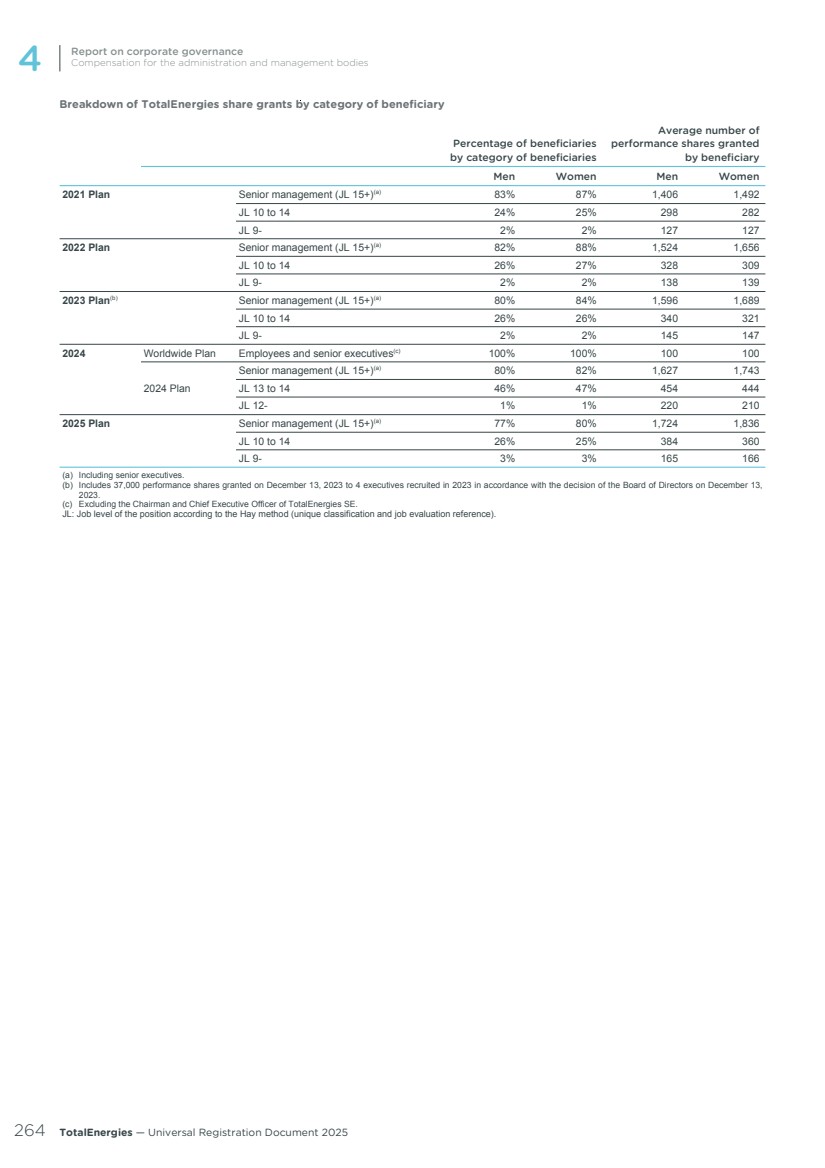
| Breakdown history of TotalEnergies shares plans History of TotalEnergies shares grants – Information on shares granted - Table 10 – AMF Position-recommendation – DOC-2021-02 (Appendix 2) 2021 Plan 2022 Plan 2023 Plan(a) 2024 Plan 2024 Worldwide Plan 2025 Plan Date of the Shareholders’ Meeting 06/01/2018 05/28/2021 05/26/2023 05/24/2024 05/26/2023 05/24/2024 Date of Board meeting/grant date 05/28/2021 03/16/2022 05/26/2023 05/24/2024 05/23/2024 03/19/2025 Closing price on grant date €38.145 €45.540 €55.760 €65.990 €65.700 €58.810 Average purchase price per share paid by the Company €59.91 €61.25 n/a n/a n/a n/a Total number of performance shares granted, including to: 6,764,548 7,353,271 7,985,203 7,775,722 10,666,900 9,190,018 Executive and non-executive directors(b) 90,250 100,000 110,694 140,720 300 140,387 – P. Pouyanné 90,000 100,000 110,000 140,000 – 140,000 – V. Della Puppa-Tibi n/a n/a n/a n/a n/a n/a – R. Garcia-Ivaldi – – 350 360 100 – – E. de Jonge n/a n/a – – 100 – – A. Pobo 250 – 344 360 100 387 Start of the vesting period 05/28/2021 03/16/2022 05/26/2023 05/24/2024 05/23/2024 03/19/2025 Definitive grant date, subject to the conditions set (end of the vesting period) 05/29/2024 03/17/2025 05/27/2026 05/24/2027 05/24/2029 03/20/2028 Vesting rate after determination of the performance conditions: – Executive director 92.0% 85.4% 84.6% n/a n/a n/a – Employees 92.0% 85.4% 84.6% n/a n/a n/a Total number of performance shares definitively granted(c) at the end of the vesting period, including: 6,079,684 6,226,667 n/a n/a n/a n/a – P. Pouyanné 82,800 85,400 n/a n/a n/a n/a Disposal possible from (end of the lock-up period) 05/30/2026 03/17/2025 05/27/2026 05/24/2027 05/24/2029 03/20/2028 Number of performance shares granted: – Outstanding as of January 1, 2025 – 7,148,245 7,878,108 7,762,851 10,329,400 – – Notified in 2025 – – – – – 9,190,018 – Canceled in 2025 – (937,957) (127,154) (83,775) (742,000) (70,975) – Definitively granted in 2025 – (6,210,288) (2,580) (2,831) (4,400) (243) Outstanding as of December 31, 2025 – – 7,748,374 7,676,245 9,583,000 9,118,800 (a) Includes 37,000 performance shares granted on December 13, 2023 to 4 executives recruited in 2023 in accordance with the decision of the Board of Directors on December 13, 2023. For these performance shares, the vesting period begins on December 13, 2023 and the final grant date is December 14, 2026, subject to the conditions set (end of the vesting period). The closing share price on the grant date was €61.36. (b) List of executive and non-executive directors who had this status during fiscal year 2025. Ms. Della Puppa Tibi is a TotalEnergies SE employee and a TotalEnergies SE director representing employee shareholders since May 23, 2025. Mr. Garcia-Ivaldi is a TotalEnergies Renewables employee and a TotalEnergies SE director representing employees since June 9, 2020. Ms. de Jonge is a TotalEnergies SE employee and a TotalEnergies SE director representing employee shareholders between May 25, 2022 and May 23, 2025. Mr. Pobo is a TotalEnergies SE employee and a TotalEnergies SE director representing employees since October 14, 2020. (c) Shares definitively granted include early grants following the death of the beneficiaries of shares for the respective plan. If all the performance shares outstanding at December 31, 2025, were definitively granted, they would represent 1.5%(1) of the Corporation’s share capital on that date. Performance shares granted to the 10 employees (other than executive and non-executive directors) receiving the largest number of performance shares granted Number of performance shares notified/ definitively granted Award date Definitive grant date (end of the vesting period) Date of transferability (end of the lock-up period) Performance share granted in fiscal year 2025, to the 10 employees of TotalEnergies SE and its affiliates (other than executive or non-executive directors at the date of the exercises) who purchased or subscribed for the largest number of performance shares(a) 322,500 03/19/2025 03/20/2028 03/20/2028 Performance shares definitively granted in fiscal year 2025 to the 10 employees of TotalEnergies SE and its affiliates (other than executive and non-executive directors on the date of the decision) receiving the largest number of performance shares 191,425 03/16/2022 03/17/2025 03/17/2025 (a) These shares will be definitively granted to their beneficiaries at the end of a three-year vesting period, i.e., on March 20, 2028, subject to five performance conditions being met. (1) On the basis of a share capital divided into 2,206,585,543 shares as at December 31, 2025. Report on corporate governance Compensation for the administration and management bodies 4 TotalEnergies — Universal Registration Document 2025 265 |
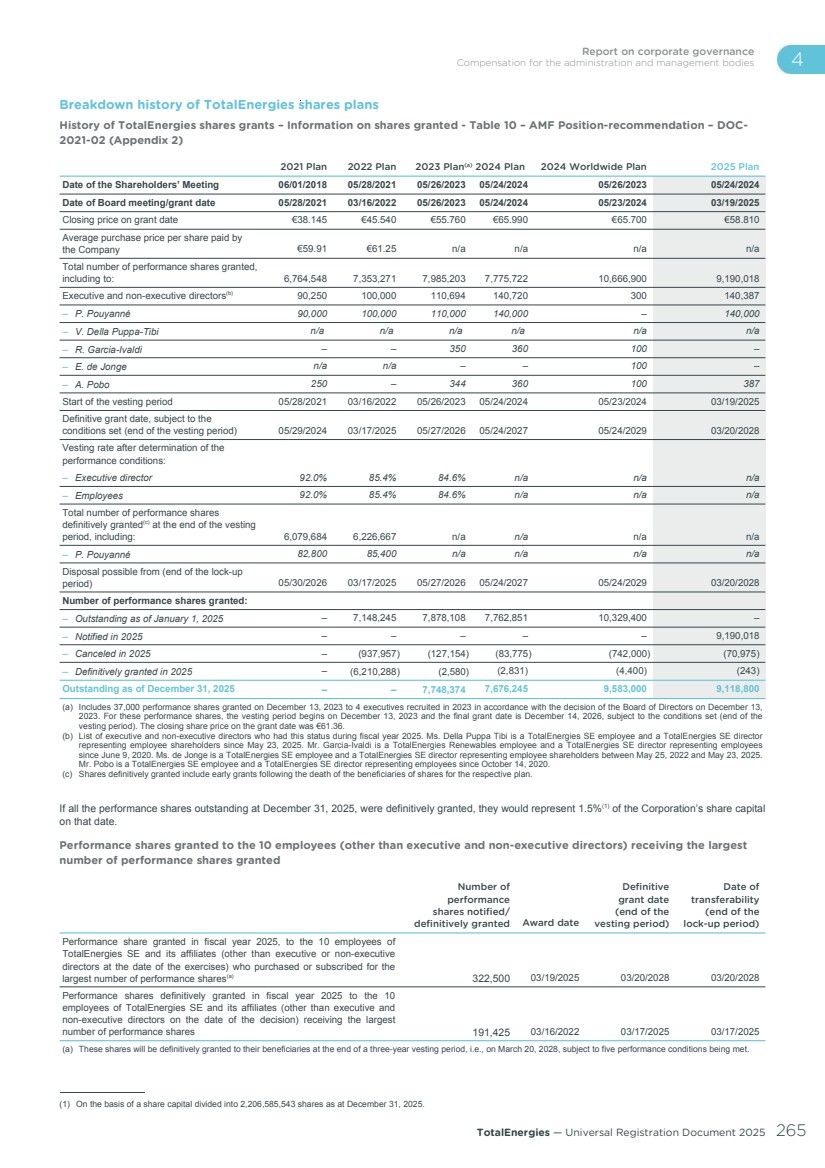
| 4.4 Additional information about corporate governance 4.4.1 Regulated agreements and undertakings and related party transactions Regulated agreements and undertaking In addition, to TotalEnergies’ knowledge, there exists no agreement, other than the agreements related to its ordinary course of business and signed under normal conditions, engaged, directly or through an intermediary, between, on the one hand, any director or shareholder holding more than 10% of TotalEnergies SE’s voting rights and, on the other hand, a company controlled by TotalEnergies SE within the meaning of Article L. 233-3 of the French Commercial Code. Related-party transactions Details of related-party transactions as specified by the regulations adopted under EC regulation 1606/2002, entered into by TotalEnergies’ companies during fiscal years 2023, 2024 or 2025, are provided in Note 8 of the notes to the Consolidated Financial Statements (refer to point 8.7 of chapter 8). These transactions primarily concern equity affiliates and non-consolidated companies. 4 Report on corporate governance Additional information about corporate governance 266 TotalEnergies — Universal Registration Document 2025 [REDACTED SECTION: CERTAIN TEXT HAS BEEN REDACTED.] [REDACTED SECTION: CERTAIN TEXT HAS BEEN REDACTED.] |
| 4.4.2 Delegations of authority and powers granted to the Board of Directors with respect to capital increases and cancellation of shares of the Corporation currently in effect Table compiled in accordance with Article L. 225-37-4, 3° of the French Commercial Code summarizing the use of delegations of authority and powers granted to the Board of Directors with respect to share capital increases currently in effect Type Cap on par value, or number of shares or expressed as % of share capital Use in 2025 by value or number of shares Available balance as of 12/31/2025 by value or number of shares(a) Date of the delegation of authority or authorization by the Extraordinary Shareholders’ Meeting Expiry date and term of authorization granted to the Board of Directors Maximum cap for the issuance of securities granting immediate or future rights to share capital Securities representing debt securities giving rights to a portion of share capital €10bn in securities – €10bn May 24, 2024 (17th , 18th , 19th and 21stresolutions) July 24, 2026 26 months Share capital par value An overall cap of €2.5bn (i.e., a maximum of 1,000 million shares issued with a preemptive subscription right), from which can be deducted: Capital increase with preemptive subscription right: – Overall cap: 11.1 million shares (2025 ESOP(b)) et a maximum of 18 million shares (2026 ESOP(b)) €2.427 bn (i.e., 971 million shares) May 24, 2024 (17th resolution) July 24, 2026 26 months 1/ a specific cap of €575 million, i.e., a maximum of 230 million shares for issuances without a preferential subscription right (with potential use of an extension clause), including in compensation with securities contributed within the scope of a public exchange offer, provided that they meet the requirements of Article L. 22-10-54 of the French Commercial Code, from which can be deducted: – €575 million May 24, 2024 (18th and 20th resolutions) July 24, 2026 26 months 1a/ a sub-cap of €575 million with a view to issuing, through an offer as set forth in Article L. 411-2-1 of the French Monetary and Financial Code, shares and securities resulting in a share capital increase, without a shareholders’ preemptive subscription right – €575 million May 24, 2024 (19th and 20th resolutions) July 24, 2026 26 months 1b/ a sub-cap of €575 million through in-kind contributions when the provisions of Article L. 22-10-54 of the French Commercial Code are not applicable – €575 million May 24, 2024 (21st resolution) July 24, 2026 26 months 2/ a specific cap of 1.5% of the share capital on the date of the Board decision for share capital increases reserved for employees participating in a Company savings plan Maximum of 18 million shares(c) 15.1 million shares May 23, 2025 (15th resolution) July 23, 2027 26 months Performance shares granted to Company employees and to executive directors 1% of share capital on the date of the 2025 Shareholders’ Meeting – 22.7 million shares(d) May 23, 2025 (14th resolution) July 23, 2027 26 months (a) Based on share capital as of December 31, 2025, divided into 2,206,585,543 shares. (b) Employee Stock Ownership Plan. (c) The meeting of the Board of Directors on September 24, 2025 decided to proceed with a share capital increase in 2026 with a cap of 18,000,000 shares (the capital increase is scheduled for the second quarter of 2026, subject to implementation by the Chairman and Chief Executive Officer). (d) The shares granted pursuant to the presence and performance conditions to the Executive Directors under the 14th resolution of the Extraordinary Shareholders’ Meeting held on May 23, 2025, may not exceed 0.015% of the capital existing on the date of the 2025 general meeting, i.e., 340,509 shares. Report on corporate governance Additional information about corporate governance 4 TotalEnergies — Universal Registration Document 2025 267 |
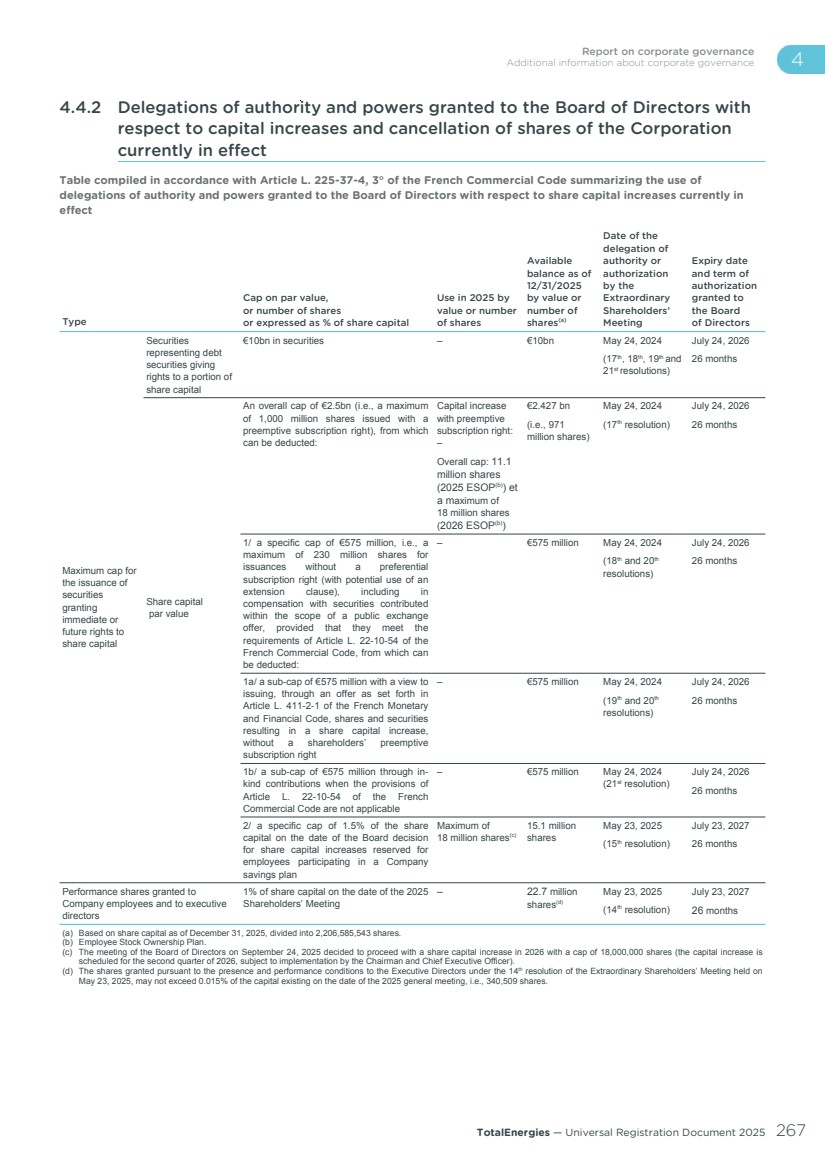
| Use of the authorization to cancel shares of the company during fiscal year 2025 Pursuant to the terms of the 23rd resolution of the Shareholders’ Meeting held on May 25, 2022, the Board of Directors is authorized to cancel shares of the Corporation up to a maximum of 10% of the share capital of the Corporation existing as of the date of the operation within a 24-month period. This authorization, granted for five years, will expire in 2027. In 2025, pursuant to this authorization, the Board of Directors decided to reduce the share capital of the Corporation: – on February 4, 2025, with effect on February 10, 2025, by canceling 127,622,460 treasury shares; – on September 24, 2025, with effect on September 26, 2025, by canceling 74,620,711 treasury shares. Furthermore, the Board of Directors, at its meeting on February 10, 2026, used this authorization and decided to reduce the share capital of the Company by canceling 18,185,068 treasury shares with effect on February 13, 2026. On February 13 2026, the share capital of the Corporation was therefore 5,471,001,187.50 euros, divided into 2,188,400,475 shares, each with a nominal value of 2.50 euros. 4.4.3 Provisions of the Articles of Association governing shareholders’ participation in Shareholders’ Meetings The Corporation’s Articles of Association amended as a result of the change of corporate name of the Corporation were approved by the Annual Shareholders’ Meeting of May 28, 2021. The statutory provisions of TotalEnergies SE presented below are those resulting from the Articles of Association of TotalEnergies SE. 4.4.3.1 Calling of shareholders to Shareholders’ Meetings Shareholders’ Meetings are convened and conducted under the conditions provided for by law. The Board of Directors, the statutory auditor or a court-appointed representative can ask for a meeting to be convened, as well as one or more shareholders together holding at least 5% of the share capital. The Ordinary Shareholders’ Meeting is convened to take any decisions that do not modify the Corporation’s Articles of Association. It is held at least once a year within six months of the closing date of each fiscal year to approve the financial statements of that year. It may only deliberate, at its first meeting, if the shareholders present, represented or participating by remote voting hold at least one fifth of the shares that confer voting rights. No quorum is required at its second meeting. In accordance with regulation (EC) 2157/2001 on the Statute for a European company (SE), the Ordinary Shareholders’ Meeting rules by a majority of votes cast by the shareholders present or represented by proxy. The votes cast do not include those attached to shares in which the shareholder did not take part in the vote, abstained, or returned a blank or invalid vote. Only the Extraordinary Shareholders’ Meeting is authorized to modify the Articles of Association. It may not, however, increase shareholders’ commitments. It may only deliberate, at its first meeting, if the shareholders present, represented or participating by remote voting hold at least one quarter, and, at the second meeting, one fifth of the shares that confer voting rights. In accordance with regulation (EC) 2157/2001 on the Statute for a European company (SE), the Extraordinary Shareholders’ Meeting rules by a majority of two thirds of votes cast by the shareholders present or represented by proxy. The votes cast do not include those attached to shares in which the shareholder did not take part in the vote, abstained, or returned a blank or invalid vote. One or more shareholders holding a certain percentage of the Corporation’s share capital (calculated using a decreasing scale based on the share capital) may ask for items or draft resolutions to be added to the agenda of a Shareholders’ Meeting under the terms and conditions and within the deadlines set forth by the French Commercial Code. Requests to add items or draft resolutions to the agenda must be sent no later than 20 days after the publication of the notice of meeting that the Corporation must publish in the French official journal of legal notices (Bulletin des annonces légales obligatoires, BALO). Any request to add an item to the agenda must be justified. Any request to add a draft resolution must be accompanied by the draft resolution text and brief summary of the grounds for this request. Requests made by shareholders must be accompanied by a proof of their share ownership as well as their ownership of the portion of capital as required by the regulations. Review of the item or draft resolution filed pursuant to regulatory conditions is subject to those making the request providing a new attestation justifying the shares being recorded in a book-entry form in the same accounts on the fifth business day preceding the date of the Meeting. The Central Social and Economic Committee may also request the addition of draft resolutions to the meeting agendas under the terms and conditions and within the deadlines set by the French Labor Code. In particular, requests to add draft resolutions must be sent within 10 days following the date on which the notice of meeting was published. 4.4.3.2 Admission of shareholders to Shareholders’ Meetings Participation in any form in Shareholders’ Meetings is subject to registration of the shares, either in the registered account maintained by the Corporation (or its securities agent) or recorded in bearer form in a securities account maintained by a financial intermediary. Proof of this registration is obtained under a certificate of participation (attestation de participation) delivered to the shareholder. Registration of the shares must be effective no later than midnight (Paris time) on the fifth business day preceding the date of the Shareholders’ Meeting. If the shares are sold or transferred prior to this record date, the certificate of participation will be canceled, and the votes sent by mail and proxies sent to the Corporation will be canceled accordingly. If shares are sold or transferred after this record date, the certificate of participation will remain valid and votes cast or proxies granted will be taken into account. 4.4.4 Information regarding factors likely to have an impact in the event of a public takeover or exchange offer In accordance with Article L. 22-10-11 of the French Commercial Code, information relating to factors likely to have an impact in the event of a public offering is provided below. – Structure of the share capital The structure of the Corporation’s share capital is presented in points 6.4.3 in chapter 6. 4 Report on corporate governance Additional information about corporate governance 268 TotalEnergies — Universal Registration Document 2025 |
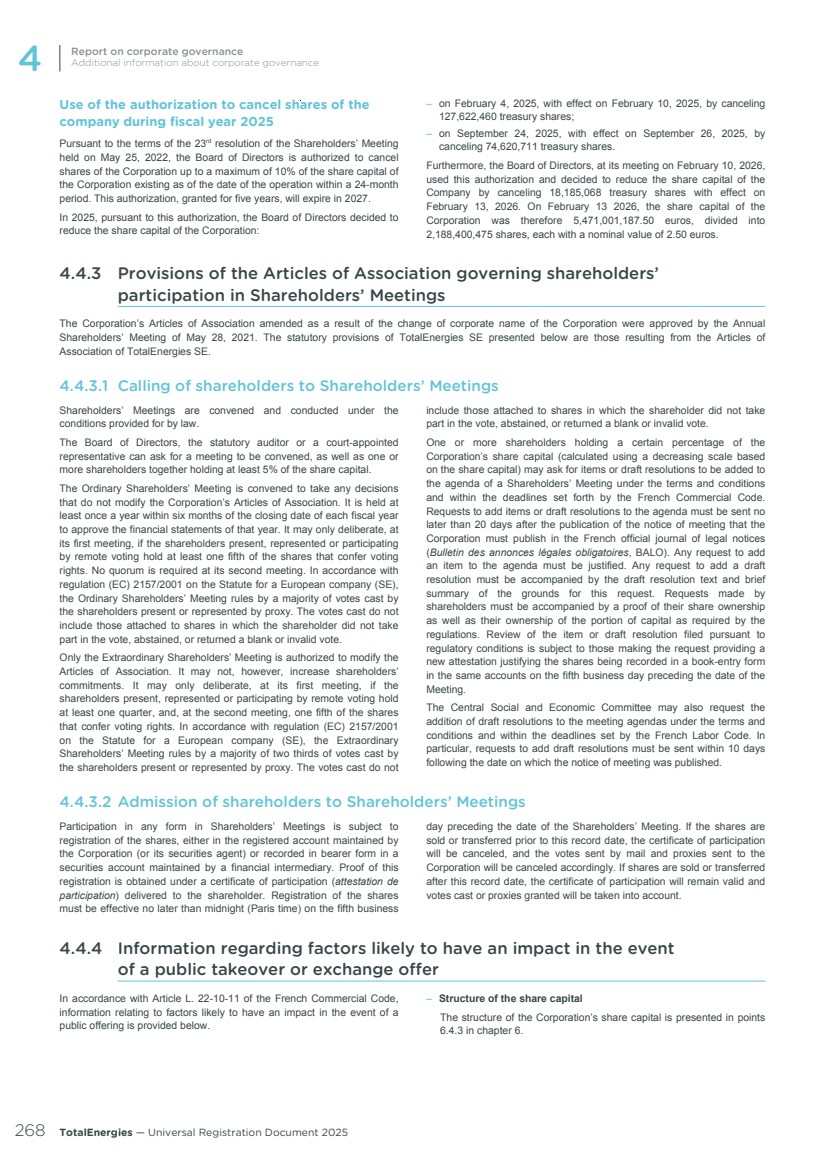
| – Restrictions on the exercise of voting rights and transfers of shares provided in the Articles of Association – Clauses of the agreements of which the Corporation has been informed in accordance with Article L. 233-11 of the French Commercial Code The provisions of the Articles of Association relating to shareholders’ voting rights are mentioned in point 7.2.4 of chapter 7. The Corporation has not been informed of any clauses as specified in paragraph 2 of Article L. 22-10-11 of the French Commercial Code. – Direct or indirect holdings in the share capital which the Corporation is aware pursuant to Articles L. 233-7 and L. 233-12 of the French Commercial Code The direct and indirect holdings in the Corporation’s capital of which TotalEnergies is aware of pursuant to Articles L. 233-7 and L. 233-12 of the French Commercial Code are indicated in points 6.4.1.2, 6.4.1.3 and 6.4.1.4 of chapter 6. – Holders of securities conferring special control rights There are no securities conferring special control rights as specified in paragraph 4 of Article L. 22-10-11 of the French Commercial Code. – Control mechanisms provided for in an employee shareholding system The rules relating to the exercise of voting rights within the Corporation collective investment funds are presented in point 6.4.2 of chapter 6. – Shareholder agreements of which the Corporation is aware and that could restrict share transfers and the exercise of voting rights The Corporation is not aware of any agreements between shareholders as specified in paragraph 6 of Article L. 22-10-11 of the French Commercial Code which could result in restrictions on the transfer of shares and exercise of the voting rights of the Corporation. – Rules applicable to the appointment and replacement of members of the Corporation’s Board of Directors and amendment of the Articles of Association No provision of the Articles of Association or agreement made between the Corporation and a third party contains a specific provision relating to the appointment and/or replacement of the Corporation’s directors that is likely to have an impact in the event of a public offering. – Powers of the Board of Directors in the event of a public offering The delegations of authority or authorizations granted by the Shareholders’ Meeting that are currently in effect limit the powers of the Board of Directors during public offering on the Corporation’s shares. – Agreements to which the Corporation is party and which are amended or terminated in the event of a change of control of the Corporation – Agreements providing for the payment of compensation to members of the Board of Directors or employees in the event of their resignation or dismissal without real and serious grounds or if their employment were to be terminated as a result of a public offering Although a number of agreements made by the Corporation contain a change in control clause, the Corporation believes that there are no agreements provided for in paragraph 9 of Article L. 22-10-11 of the French Commercial Code. The Corporation also believes that there are no agreements provided for in paragraph 10 of Article L. 22-10-11 of the French Commercial Code. For commitments made for the Chairman and Chief Executive Officer in the event of a forced departure owing to a change of control or strategy, refer to point 4.3.2. 4.4.5 Internal control and management risk systems of the Corporation as part of the financial reporting process The description of the main characteristics of the internal control and risk management procedures relating to the preparation and processing of financial information referred to in 7° of Article L. 22-10-10 of the French Commercial Code is presented in point 3.3.4 of chapter 3. 4.4.6 Statutory auditors 4.4.6.1 Auditor’s term of offices ERNST & YOUNG Audit 1/2, place des Saisons, 92400 Courbevoie – Paris-La Défense, Cedex 1 Appointed: May 14, 2004 Last reappointment: May 25, 2022, for a six-fiscal year term Yvon Salaün, Vincent Coste PricewaterhouseCoopers Audit 63, rue de Villiers, 922008 Neuilly-sur-Seine Appointed: May 25, 2022, for a six-fiscal year term Cécile Saint-Martin, Olivier Lotz French law (Article L. 821-44 of the French Commercial Code) provides that the auditors are appointed for renewable six-fiscal year terms. The terms of office of the statutory auditors and of the alternate auditors will expire at the end of the Shareholders’ Meeting to be convened in 2028 to approve the financial statements for fiscal year 2027. Report on corporate governance Additional information about corporate governance 4 TotalEnergies — Universal Registration Document 2025 269 |
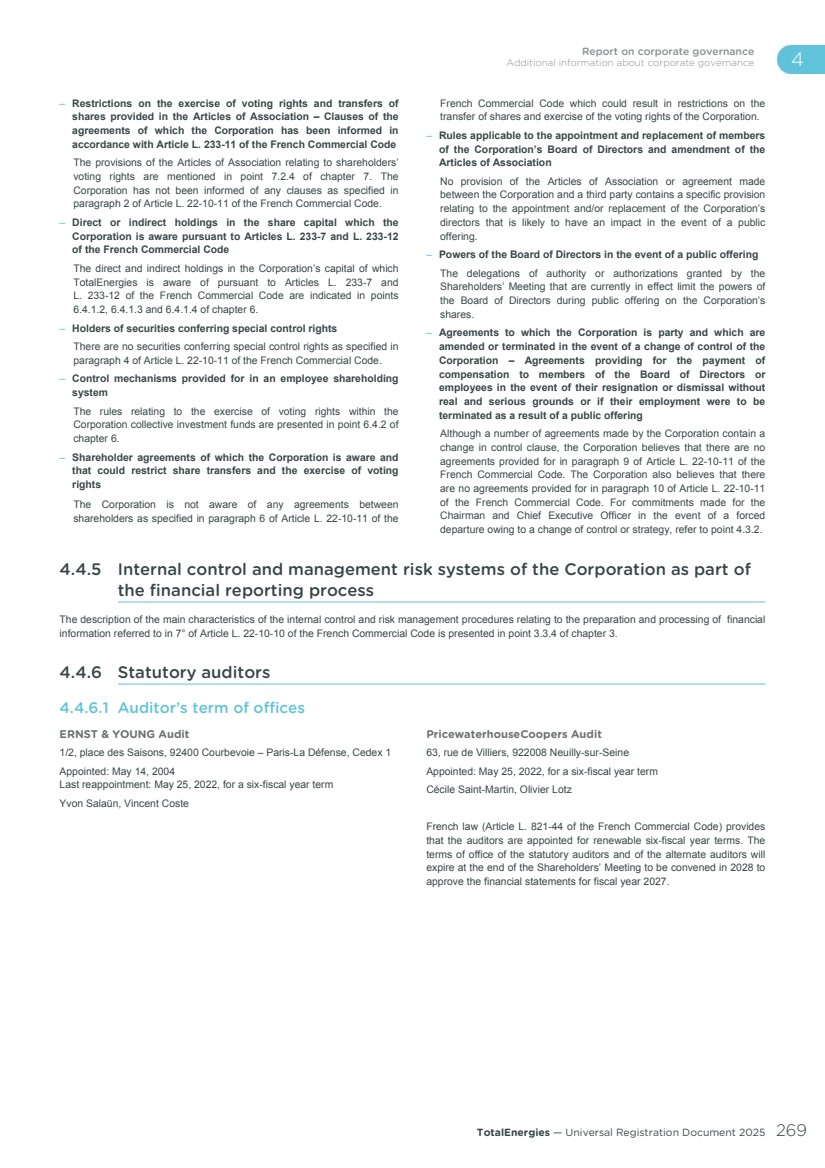
| 4.4.6.2 Fees received by the statutory auditors (including members of their networks) ERNST & YOUNG Audit PricewaterhouseCoopers Audit Amount in M$ (excluding VAT) % Amount in M$ (excluding VAT) % 2024 2025 2024 2025 2024 2025 2024 2025 Audit Statutory auditors, certification, examination of the parent company and consolidated accounts 25.4 27.8 80.8 80.5 22.9 24.3 81.5 82.9 TotalEnergies SE 5.7 5.6 18.1 16.3 4.9 4.7 17.4 16.0 Fully consolidated subsidiaries 19.7 22.2 62.7 64.2 18.0 19.6 64.1 66.9 Services other than statutory audit – Audit-related services 2.5 2.2 7.9 6.3 2.2 2.0 7.9 6.8 TotalEnergies SE 0.2 0.3 0.6 0.8 0.3 0.5 1.1 1.7 Fully consolidated subsidiaries 2.3 1.9 7.3 5.5 1.9 1.5 6.8 5.1 Subtotal 27.9 30.0 88.7 86.8 25.1 26.3 89.4 89.7 Other services provided Legal, tax, labor law 2.1 2.5 6.5 7.0 1.2 1.6 4.4 5.5 Other 0.5 1.1 1.7 3.2 0.8 0.4 2.7 1.4 Subtotal 2.6 3.6 8.2 10.2 2.0 2.0 7.1 6.9 Certification of the Company’s Sustainability reporting under the CSRD 1.0 1.0 3.1 3.0 1.0 1.0 3.5 3.4 Total 31.5 34.6 100 100 28.1 29.3 100 100 4 Report on corporate governance Additional information about corporate governance 270 TotalEnergies — Universal Registration Document 2025 [REDACTED SECTION: CERTAIN TEXT HAS BEEN REDACTED.] |
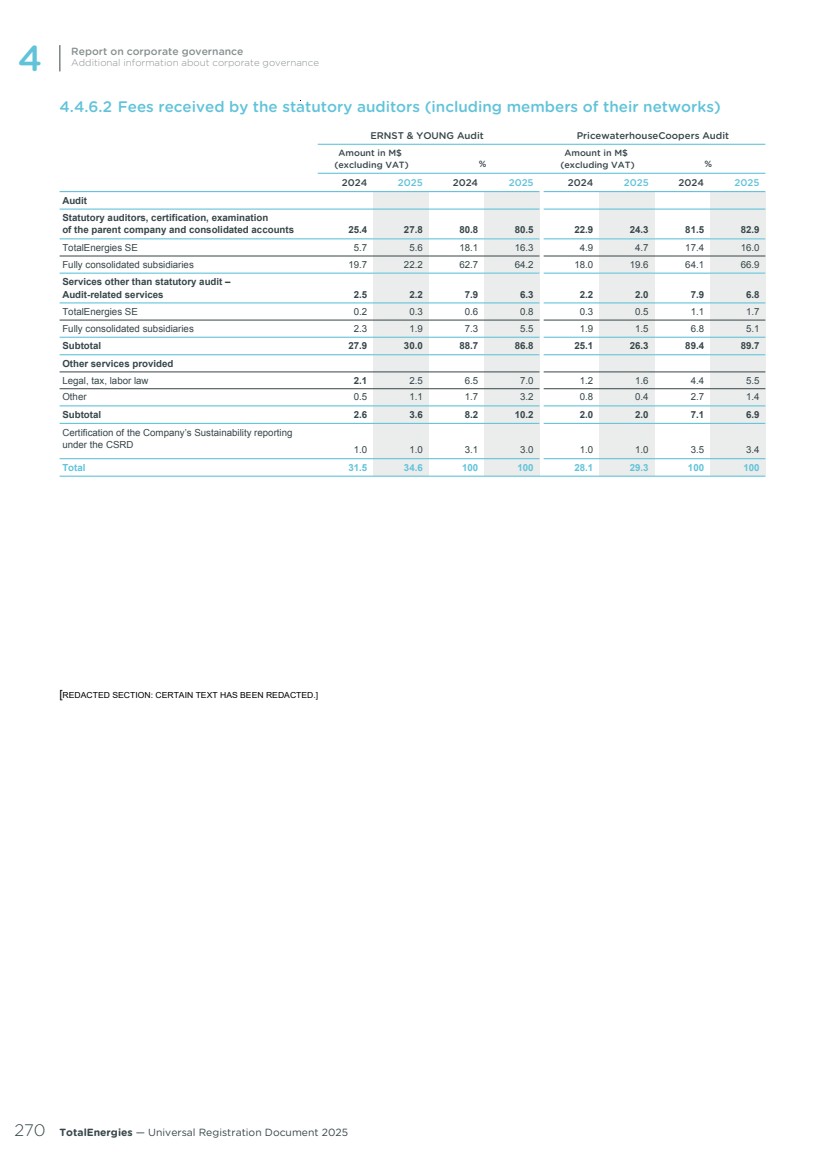
| Climate & Sustainable Development 5 5.1 Our approach and our progress 274 5.1.1 Our approach to sustainable development 274 5.1.2 Acting for the well-being of employees 282 5.1.3 Caring for the environment 286 5.1.4 Having a positive impact for stakeholders 289 5.2 Sustainability reporting under the CSRD 294 5.2.1 General information (ESRS 2) 294 5.2.2 Environmental information 334 5.2.3 Social information 373 5.2.4 Governance information 409 5.2.5 5.3 Other information 420 5.3.1 Actions to promote the link between the nation and the armed forces and support commitment to the reserves 420 5.3.2 Actions to promote the civic engagement in local democracy 420 TotalEnergies — Universal Registration Document 2025 273 [REDACTED SECTION: CERTAIN TEXT HAS BEEN REDACTED.] |
| 5.1 Our approach and our progress 5.1.1 Our approach to sustainable development 5.1.1.1 Our approach to sustainable development Energy is at the heart of one of the great challenges of the 21st century: saving our planet from the threat of climate change while enabling the majority of mankind to escape from poverty. The climate challenge and energy transition are inseparable from other major world challenges such as poverty, hunger, environmental degradation, biodiversity loss, the preservation of water, ethics and corruption: these are the 17 U.N. Sustainable Development Goals. It is not enough to decarbonize energy. It is also necessary to meet in a responsible way the growing needs for affordable and sustainable energy of a rising global population. This is TotalEnergies’ purpose: to provide as many people as possible with energy that is more reliable, more affordable and more sustainable. And this is why the Company aims at placing Sustainability in all its dimensions at the heart of its strategy, its projects and its operations and at establishing the benchmark for endorsement of the Sustainable Development Goals. To do so, it relies on the action principles at the heart of its business model, Safety, Respect for Each Other, Zero tolerance towards corruption and fraud, Transparency in its engagement with society. TotalEnergies’ commitment to contribute to the Sustainable Development Goals is based on 4 axes: – climate and sustainable energy; – caring for the environment; – acting for the well-being of our employees; – having a positive impact for stakeholders. In 2024, to make these commitments a reality, the Company has identified 5 “Levers for a Sustainable Change” to bring about collective change in our behaviors. Requiring the commitment of all employees, these five Levers aim to minimize energy consumption and discharges into the environment from its projects and operations, to promote renewable energies and low-carbon technologies to reduce emissions, both in its projects and operations and to its customers and suppliers, to maintain a constructive dialogue with its stakeholders and to pay attention to others in the workplace. They support TotalEnergies’ Sustainab’ALL approach for which the Company has mobilized its 100,000 employees through the progress plans defined at each of its sites. TotalEnergies’ approach to sustainable development 5 Climate & Sustainable Development Our approach and our progress 274 TotalEnergies — Universal Registration Document 2025 |
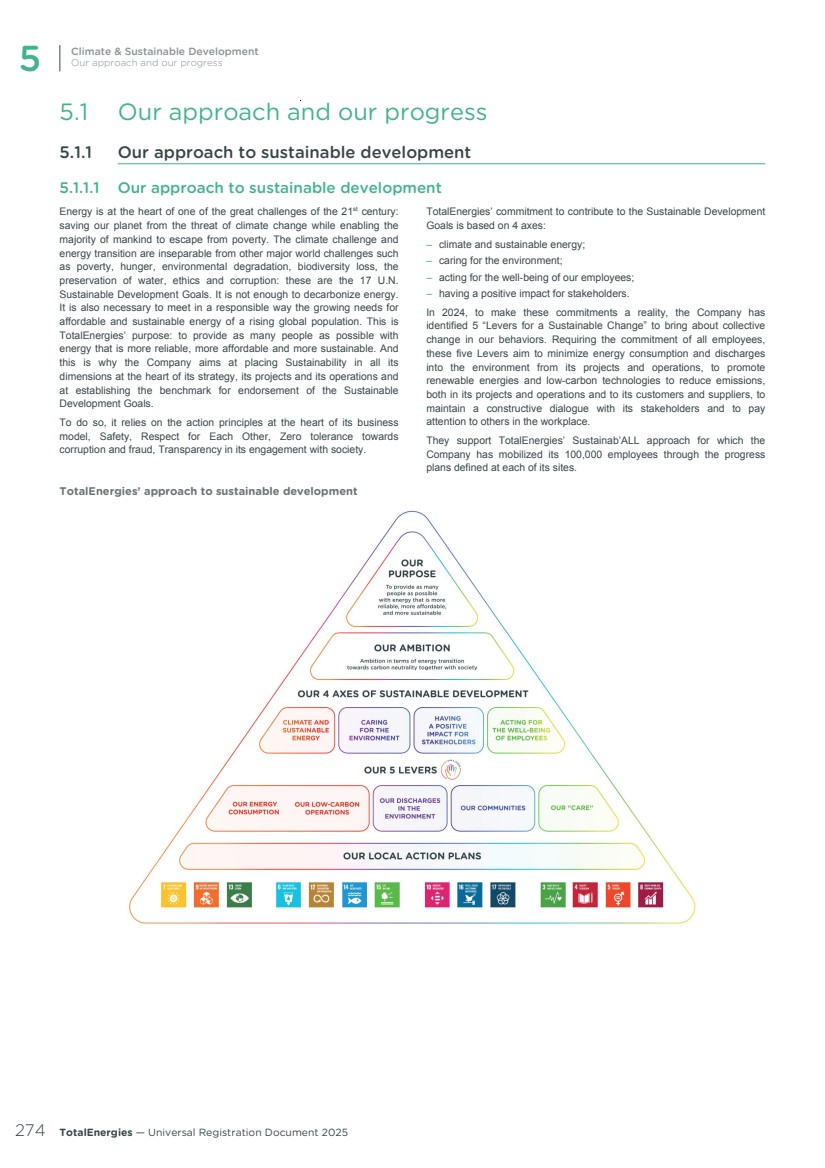
| Local action plans in support of sustainable development Level of progress towards the 2025 objective (a) Not applicable: corresponds to subsidiaries having decided not to retain this KPI. (b) The size of the circles is proportional to the number of responses in the interval considered. TotalEnergies’ aim to be one of the major players in the energy transition will require the mobilization of our 100,000 employees. More than 27,000 TotalEnergies employees took part in workshops during 2022, to develop ten objectives and indicators aligned with the United Nations Sustainable Development Goals (SDGs). In 2023, every TotalEnergies site, business unit and affiliate worldwide has adopted an action plan with targets to be met by 2025. Each plan is based on actions that are directly related to the entity’s local operations in the field. The program has been rolled out in over 250 Company entities, representing 94,4% of employees (excluding Hutchinson). A survey was carried out in January 2026, to which 62% of these entities responded. It showed that the vast majority put in place action plans (96%) and set targets (70%). Their assessment of progress at the end of 2025 is shown in the table; optimization of energy consumption (KPI 2), employee engagement (KPI 5) and their training (KPI 6) are the KPIs considered to be the most advanced at the end of the 3-year period. Entities took ownership of rituals: the Sustainab’ALL moment, for example, is practiced by 83% of them and 93% have celebrated the Sustainab’ALL day. In 2024, TotalEnergies launched its “Our 5 Levers for a Sustainable Change” program. These 5 levers are deployed as close as possible to our employees and our operations, thanks to the 189 Sustainability Officers of our operated subsidiaries. They ensure that the 5 levers are implemented in their subsidiaries, through action plans, training and the dissemination of best practices shared within the Company. 5.1.1.2 Our Just Transition plan Energy is at the heart of one of the great challenges of the 21st century: saving our planet from the threat of climate change while enabling the majority of mankind to escape from poverty. It is not enough to decarbonize energy. It is also necessary to meet the growing energy needs of a rising global population in a responsible way. That is the dual challenge for energy. Today, around 4.6 billion people(1) have a level of access to energy below what is considered necessary to enable satisfactory human development, particularly in terms of access to healthcare and education. In 2050, there will be close to 10 billion people in the world. This demographic growth, and the improvement in living standards of the poorest populations, will require energy that is reliable, affordable, clean and accessible to as many people as possible. As the effects of global warming become more visible, nations, both developed and emerging, are now faced with the essential task of a large-scale transformation, particularly of their energy systems. Beyond the technological and financial challenges it poses, this transition process must be just if it is to succeed. It must provide the least developed countries with the clean, reliable and affordable energy they need for their growing populations aspiring to a higher standard of living. The most developed nations, in turn, will need to assist those who could be adversely affected by that transition, should for example their job disappear or the cost of this transition put them in energy poverty. (1) TotalEnergies Energy Outlook 2025 Climate & Sustainable Development Our approach and our progress 5 TotalEnergies — Universal Registration Document 2025 275 |
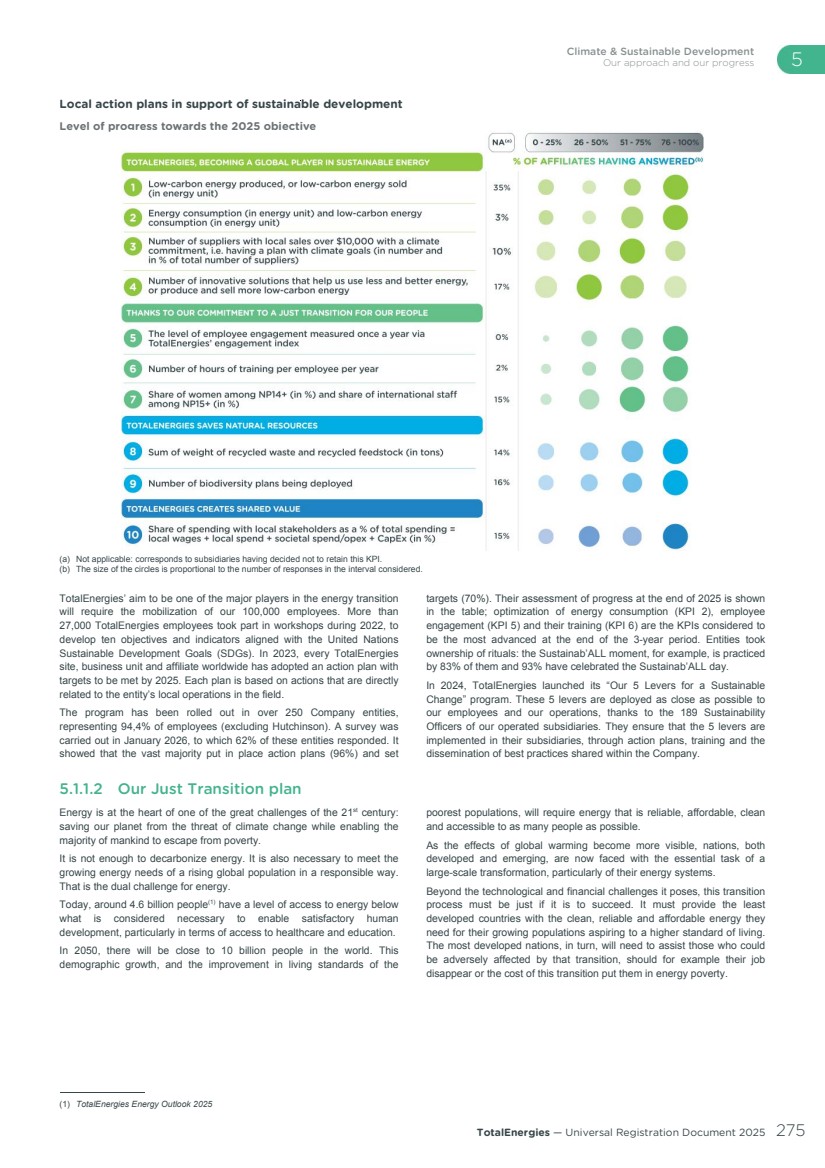
| The Just Transition is at the heart of our purpose “To provide as many people as possible with energy that is more reliable, more affordable, and more sustainable”. The Company is willing to accelerate the development of a decarbonized energy system, while maintaining the current energy system at a level sufficient to meet global demand and organize a just, orderly and equitable transition of energy systems. We are mindful of the issues raised by our activities and our own transformation. We are particularly sensitive to the need to enhance our employees’ skills, guarantee decent wages and maintain social dialogue, in the spirit of the International Labour Organization’s guiding principles on just transition and the Paris Agreement. We also take actions towards our customers, our suppliers and more generally the communities and countries where we operate. 100,000 EMPLOYEES Ensure employability, equal opportunity, social protection and attractive jobs OUR DIALOGUE AND CONSULTATION MEANS ● Negotiation, discussion, consultation or information of staff representative bodies. ● Listening (annual surveys – TotalEnergies Survey/Pulse Survey). ● Exchange between members of the Executive Committee and the employees (Campus). OUR PROGRESS IN 2025 ● 100% of employees receive direct remuneration at least equal to the country’s living wage (global reporting in place since 2022). ● Roll out of the Care Together by TotalEnergies program, guaranteeing high social standards for our employees worldwide. 100% of employees exposed to an occupational risk benefiting from regular medical monitoring. 98% of employees, primary parents, benefit from at least 14 weeks of fully paid child-welcoming leave. ● 4.6 training days per year per employee in 2025. 98% of employees have followed at least one training course during the year. ● Continuation of the “Digital Accelerator” season of the “Visa for TotalEnergies” upskilling program launched in 2022, focused on generative AI. ● 24,000 employees have taken the digital training modules on sustainable development as part of the “Our 5 levers for a Sustainable Change” initiative. ● Close to 10,000 of our employees work in low-carbon energies. ● Capital increase reserved for TotalEnergies employees in 2025 subscribed by nearly 62,800 current and former employees in 97 countries. ● 2025 Pulse Survey involving more than 60,000 employees in nearly 120 countries (excluding Hutchinson): 83.5% engagement rate and 90% of employees state they are proud to work for TotalEnergies. ● Celebration of 5 years of membership in The Valuable 500, a global initiative in favor of the inclusion of people with disabilities in multinational companies. OUR 2026-2030 OBJECTIVES ● Start-up of the Grandpuits biorefinery, a major industrial redeployment project, without layoffs or forced mobility. ● Continuation of the deployment of the Care Together by TotalEnergies program. ● Continuation of the upskilling program. ● Continuation of the program to train employees in sustainable development within the frame of “Our 5 Levers for a Sustainable Change”. ● New disability agreement signed in 2025, for the 2026–2029 period (perimeter covering 14,000 employees in France). ● Continuation of the deployment of the €2,000 “energy efficiency and transition” individual envelope agreement for our 35,000 employees in France, applicable from January 1, 2024 for a period of 5 years. ● New diversity objectives as of 01/01/2026. ~120 HOST COUNTRIES Participate in national energy transition projects by promoting responsible and transparent business conduct OUR DIALOGUE AND CONSULTATION MEANS ● Cooperation and partnerships. ● Advocacy and lobbying based on the values and principles of our Code of Conduct. ● Participation in the Extractive Industry Transparency Initiative (EITI). OUR PROGRESS IN 2025 ● OGDC (Oil & Gas Decarbonization Charter): publication of the second report “Implementing Action” under the leadership of the 3 CEO champions, including Patrick Pouyanné. ● Implementation of the cooperation agreements with several industry partners (in particular Petrobras, Socar, Sonangol, NNPC, Oil India and ONGC) to measure methane emissions, and with Veolia in the waste and wastewater treatment sector (AUSEA). ● Publication of the fourth tax transparency report. ● Irak – Gas Growth Integrated Project (GGIP): start of construction of a first gas treatment unit, continuation of the solar plant works and investment decision for the last two projects, the full field development of Ratawi field (up to 210,000 bpd with no routine flaring) and the construction of the seawater treatment plant. ● France: TotalEnergies in partnership with RWE won the offshore wind tender “Centre Manche 2” (1.5 GW capacity). ● France: start of France’s first chemical recycling plant for plastic waste using pyrolysis technology with Plastic Energy at the Grandpuits platform. ● United States: commissioning of Clinton (65 MW) and Brazonia (325 MW) solar farms and start-up of the Cottonwood battery storage system. ● Europe: creation of a joint investment platform with Tikehau Capital, to promote the development of charging infrastructure for electric vehicles in Belgium and the Netherlands. 5 Climate & Sustainable Development Our approach and our progress 276 TotalEnergies — Universal Registration Document 2025 |
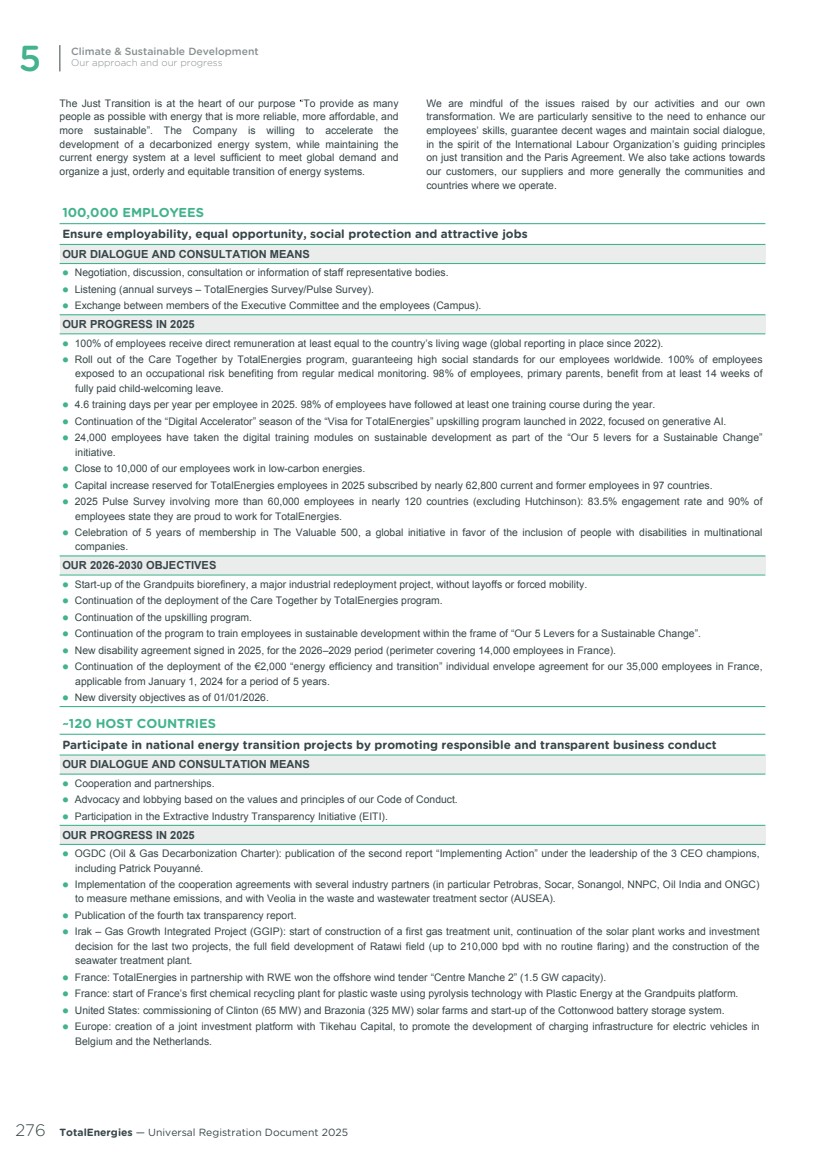
| ~120 HOST COUNTRIES OUR 2026-2030 OBJECTIVES ● Continued deployment of our multi-energy strategy with our partner countries, notably the GGIP project in Iraq (first electron of the solar project delivered to the grid in 2026). ● Continuation of AUSEA campaigns. ● Regular publication of our tax transparency reports. COMMUNITIES Contribute to their resilience and sustainable socio-economic development through a constant dialogue OUR DIALOGUE AND CONSULTATION MEANS ● Public consultations and societal impact studies for projects, meetings with local stakeholders. ● Dialogue sessions with local/national/ international NGOs. OUR PROGRESS IN 2025 ● EACOP & Tilenga: by the end of 2025, more than 24,300 direct jobs created, 1.5B$ spent locally; 2.7 million hours of training provided. In 2025, EACOP has continued to engage and dialogue frequently with the four vulnerable ethnic groups self-identifying as “Indigenous Peoples” impacted by the project - the Akie, Taturu, Barabaig and Maasai. ● Nearly 1,600 socio-economic development initiatives supported worldwide. ● Continuation of the operational activities of the Foundation created in 2023 by Mozambique LNG project to support socio-economic development in the province of Cabo Delgado. ● Nearly 14,000 solidarity actions around the world in 2025 by nearly 10,000 employees (Action! program). ● France: continuation of regional think tanks “Territoires des Energies et au-delà” meetings. Organization in 2025 of a cycle of meetings on energy sobriety. ● Supporting youth in France: opening of 6 additional Production Schools in 2025; L’Industreet was hosting 309 young people at the end of 2025 and 187 graduated in 2025. OUR 2026-2030 OBJECTIVES ● Local jobs Tilenga & EACOP: aim to create 78,000 direct and indirect jobs during the construction phase and 4,200 during the operations phase. ● Mozambique LNG: continuation of the Foundation’s development actions (multi-year budget of 200 M$). ● Suriname: the local content of the GranMorgu project is estimated at more than $1 billion over the duration of the project and more than 6,000 jobs, direct, indirect and induced, are expected to be created. ● Continue to support young people: network of 100 Production Schools in France by 2028 in 13 regions; train 400 young people per year at L’Industreet. MILLIONS OF CUSTOMERS Support the transition towards low-carbon, affordable energy consumption OUR DIALOGUE AND CONSULTATION MEANS ● B2B and B2C commercial relations. ● Every day more than 6 million customers visit our more than 13,000 service stations in nearly 60 countries. ● Management of our more than 450 key accounts and B2B technical and commercial partnerships. ● Customer satisfaction surveys. OUR PROGRESS IN 2025 ● Clean Cooking: in 2025, TotalEnergies distributed 1,030 kt of bottled LPG in Africa and India, serving more than 16 million household and around 65 million people. ● Launch of a partnership with DelAgua, to distribute improved cookstoves to 200,000 households in Rwanda. ● Electromobility: nearly 90,000 charging points operated and supervised by the end of 2025 including 80,000 in Europe. Leading player in France in high-power charging on highways with nearly 1,850 charging points installed accross 290 sites at end-2025, all powered with 100% renewable electricity. The Charge+ mobility card provides access to a network of 200,000 public charging points In France and Spain. ● Major player in professional mobility in Europe, with 4.2 million active mobility cards and electronic toll badges. ● France: capping of fuel prices at all service stations at €1.99/l. OUR 2026-2030 OBJECTIVES ● Provide access to Clean Cooking to 100 million people in Africa and India by 2030. ● 40 million people served by our electricity production in emerging countries by 2030. ● Electromobility: more than 1,000 sites equipped with high-power charging in Europe by 2028. 100,000 SUPPLIERS Encourage the reduction of environmental impact and promote respect for human rights OUR DIALOGUE AND CONSULTATION MEANS ● Awareness campaigns. ● Surveys and questionnaires. ● “Supplier Day”. ● Monitoring and evaluation platform. Climate & Sustainable Development Our approach and our progress 5 TotalEnergies — Universal Registration Document 2025 277 |
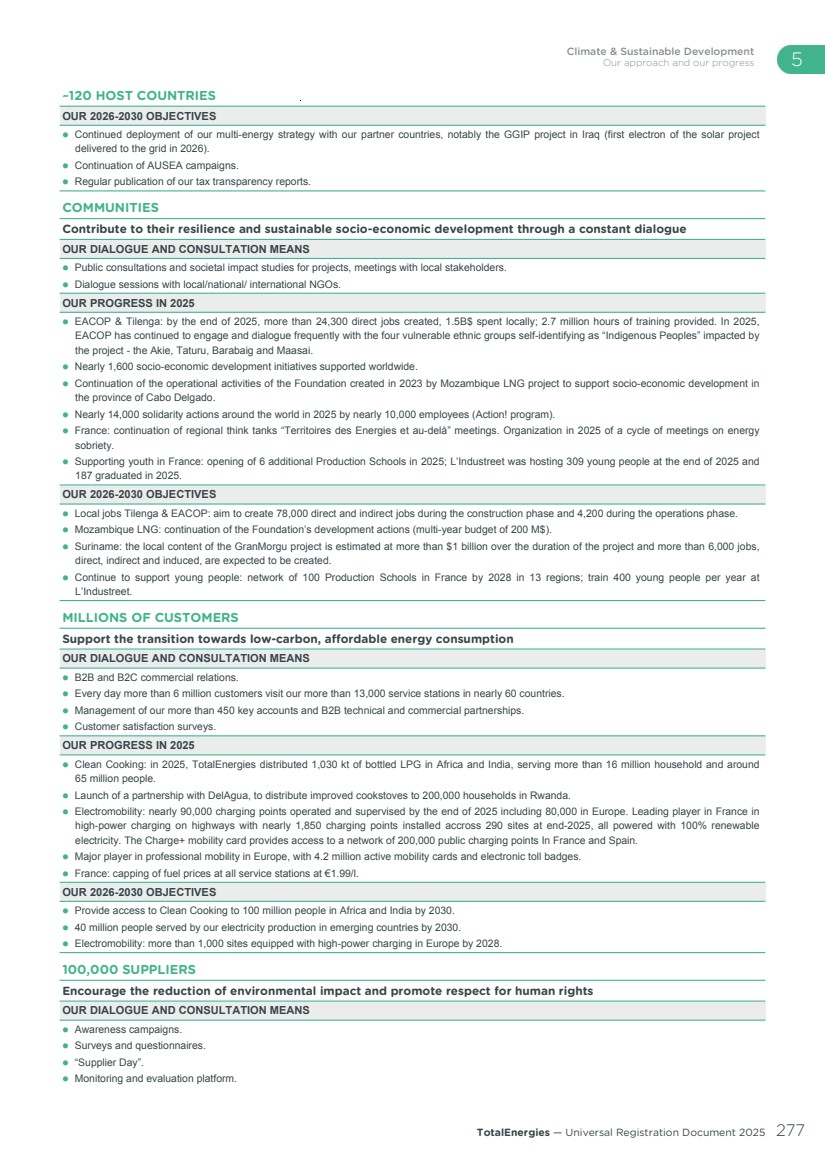
| 100,000 SUPPLIERS OUR PROGRESS IN 2025 ● 93% of central purchasing function employees trained in sustainable procurement in 2025. ● In 2025, the Company reached its target set in 2023 of assessing its 1,300 priority suppliers on all aspects of sustainable development. OUR 2026-2030 OBJECTIVES ● Train our buyers in sustainable procurement. ● Raise awareness and mobilize our suppliers in terms of sustainable development. ● Support our suppliers within the framework of the Climate commitment program. 5.1.1.3 Advocacy and sector initiatives in support of the energy transition A successful energy transition requires closer collaboration between all the players involved. Support for government action and climate sectorial initiatives and disclosures TotalEnergies supports the commitments made by governments to combat global warming as part of the Paris Agreement and publishes its positions on its corporate website (heading Sustainability). This section also groups together TotalEnergies’ positions and commitments in favour of human rights, the fight against corruption and the environment. TotalEnergies’ interest representation actions in France, Europe and the United States are listed by theme and by year, to promote complete transparency. During COP30, just as COP29, TotalEnergies’ CEO participated as CEO Champion in a round table of the Oil and Gas Decarbonization Charter (OGDC). This industry initiative - launched at COP28 - brings together 56 national and international oil & gas companies representing almost 40% of the world’s oil production. The signatories’ objectives are to eliminate routine flaring by 2030, aim for near-zero upstream methane emissions by 2030, and to be Net Zero on Scope 1+2 operated emissions by 2050. In Europe, TotalEnergies supports the “Fit-for-55” package and specifically some of its key components, such as the broader use of carbon pricing, the large-scale expansion of renewable energies, deployment of infrastructure and the development of fuels and renewables for the transportation industry. TotalEnergies’ responses to the European Commission’s public consultations on climate are public and may be viewed online. TotalEnergies published on its website in February 2026 a position expressing support for the implementation of the European Methane Emissions Regulation (EU MER) in a way that upholds energy security and affordability, while seeking further clarity on the compliance requirements for oil and gas importers. TotalEnergies encourages producing countries, through the membership of their national companies in the OGDC and/or the OGMP and/or other voluntary initiatives, to put in place frameworks and policies that support methane monitoring and emission reduction actions. TotalEnergies also calls for a pragmatic approach to establishing regulatory equivalence with countries that have such frameworks and policies. Review of associations TotalEnergies is an active participant in both national and international business and industry associations. Since 2019, the Company has been publishing its six principles on its responsible commitment to climate change within industry associations. Our 6 key principles: 1. TotalEnergies recognizes the link established by science between human activities, in particular the use of fossil fuels, and climate change. 2. TotalEnergies recognizes the Paris Agreement as a major step forward in the fight against global warming and supports the initiatives of the implementing States to fulfill its aims. 3. TotalEnergies supports the implementation of carbon pricing mechanisms. 4. TotalEnergies supports policies, initiatives and technologies aimed at promoting the development of renewable energies and sustainable bioenergies (biofuels, biogas) as well as energies and technologies aimed at decarbonizing industrial processes and transportation. 5. TotalEnergies promotes the role of natural gas as a transition fuel, in particular as a replacement for coal. TotalEnergies supports policies aimed at measuring and reducing methane emissions aiming for zero methane emissions. 6. TotalEnergies supports the carbon offset mechanisms necessary to achieve carbon neutrality, through organized and certified markets ensuring the quality and sustainability of carbon credits. TotalEnergies promotes a policy of reducing greenhouse gas emissions. In 2024, TotalEnergies published a report presenting the detailed results of the associations review on the Company’s website. Every two years, TotalEnergies lists its memberships in industry associations and is assessing the six principles for a selection of them. In the first half of 2026, we will publish the results of this new review covering a selection of more than 100 associations in over 20 countries. From now on, an annual interim review will be carried out on the associations selected during the comprehensive listing every two years. Collective initiatives supported by TotalEnergies Axes Name of the initiative Perimeter ENERGY & CLIMATE ● 3x Renewables Worldwide ● Oil and Gas Decarbonization Charter Worldwide ● OGMP 2.0 Worldwide ● Aiming For Zero Methane Worldwide ● Carbon Measures Worldwide 5 Climate & Sustainable Development Our approach and our progress 278 TotalEnergies — Universal Registration Document 2025 |
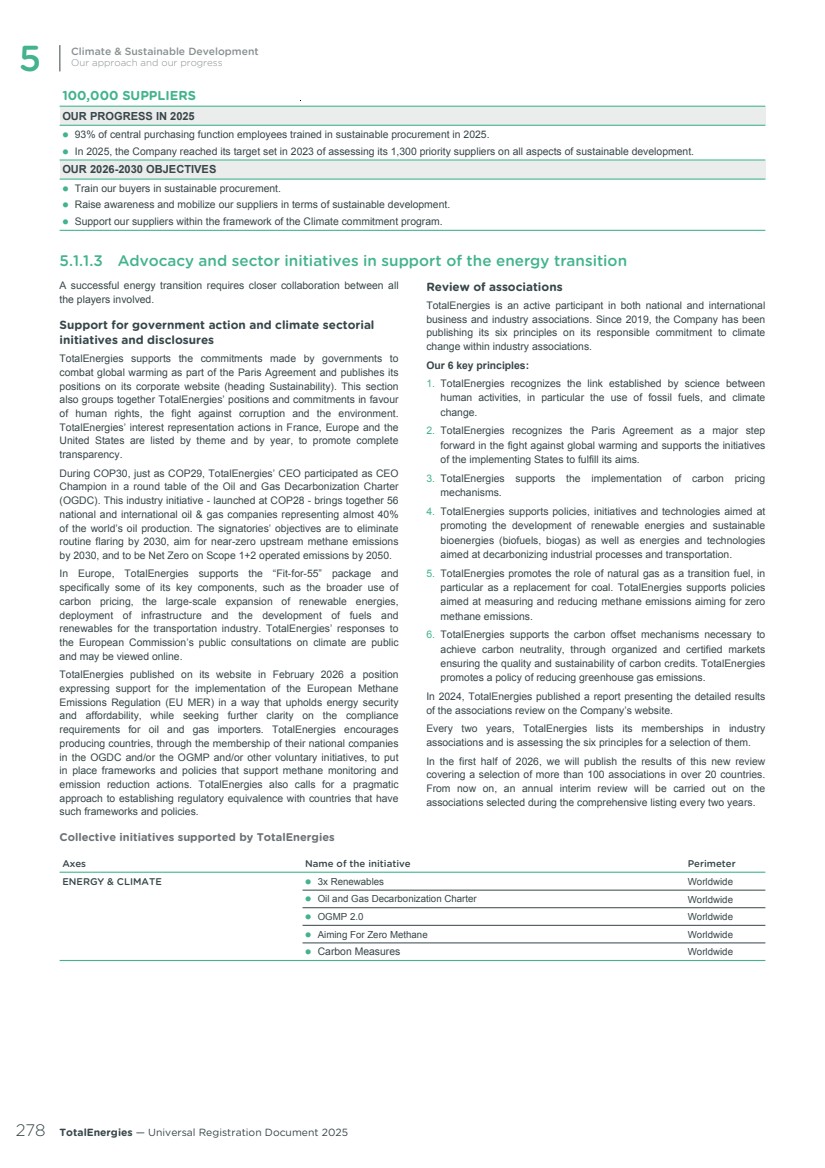
| Axes Name of the initiative Perimeter ACTING FOR THE WELL-BEING OF EMPLOYEES ● Global Deal Worldwide ● Women’s Empowerment Principles - Equality Means Business (UNGP) Worldwide ● Closing the gender gap - a call to action (WEF) Worldwide ● ILO Global Business and Disability Network Charter Worldwide ● The Valuable 500 Worldwide ● Manifesto for the inclusion of people with disabilities in economic life France ● Inclusion and Diversity Pledge (ERT) Europe ● Charter - Autre Cercle France ● Elles bougent France CARING FOR THE ENVIRONMENT ● Act4Nature International Worldwide ● CEO Water Mandate Worldwide ● Circular economy commitment AFEP Worldwide ● UN Global Compact Ocean Stewardship Coalition Worldwide ● UNESCO - Ocean Decade (via Corporate Data Group) Worldwide HAVING A POSITIVE IMPACT FOR STAKEHOLDERS ● The Voluntary Principles on Security and Human Rights (VPSHR) Worldwide ● The United Nations Guiding Principles on Business and Human Rights as endorsed by the UN Human Rights Council in 2011 Worldwide ● The United Nations Global Compact Principles Worldwide ● The B Team Responsible Tax Principles Worldwide ● Partnering Against Corruption Initiative (PACI) Worldwide ● Extractive Industries Transparency Initiative (EITI) Worldwide ● Le Collectif des entreprises pour une économie plus inclusive France 5.1.1.4 Targets and progress indicators Whether with regard to safety, health, climate, the environment or shared growth, TotalEnergies manages its operations with the aim of working in a sustainable, active and positive manner in all of the Company’s host countries. The Company was one of the first in the industry to publish measurable improvement targets in these areas. Diversity The diversity of its employees and management is crucial to the Company’s competitiveness, capacity for innovation, and its attractiveness. Targets Facts – Women to account for more than 30% of Executive Committee members, senior executives and senior managers by 2030 – 30% of Executive Committee members, 30.2% of senior executives and 26.4% of senior managers are women in 2025 – Women to account for 40% of the G70(a) by 2030 – 32.9% of the G70 are women in 2025 – Non-French nationals to account for more than 45% of senior executives and senior managers – 37.7% of senior executives are non-French nationals and 36.4% of senior managers are non-French nationals in 2025 (a) Senior executives with the most important responsibilities. Together with the Executive Committee, they form part of the Company’s management bodies (“instances dirigeantes”) within the meaning of point 8.1 of the AFEP-MEDEF Code. Safety/Health Protecting the safety of its employees, stakeholders and facilities is a priority for TotalEnergies, as is protecting the health of all people directly or indirectly involved in its activities. SAFETY Targets Facts – Avoiding the occurrence of a major industrial accident – No major industrial accidents in 2025 – Zero fatal accidents – 1 fatality in 2025 – Continuously decrease the TRIR and achieve a TRIR of 0.55 by 2026. The 2025 target was 0.60 – A TRIR(a) of 0.47 in 2025 HEALTH Target Facts – Protecting the health of employees at work – 100% of employees with specific occupational risks received regular medical monitoring in 2025 (b) (a) TRIR (Total Recordable Injury Rate): number of recorded injuries per million hours worked. (b) Data provided by the WHRS. Climate & Sustainable Development Our approach and our progress 5 TotalEnergies — Universal Registration Document 2025 279 |
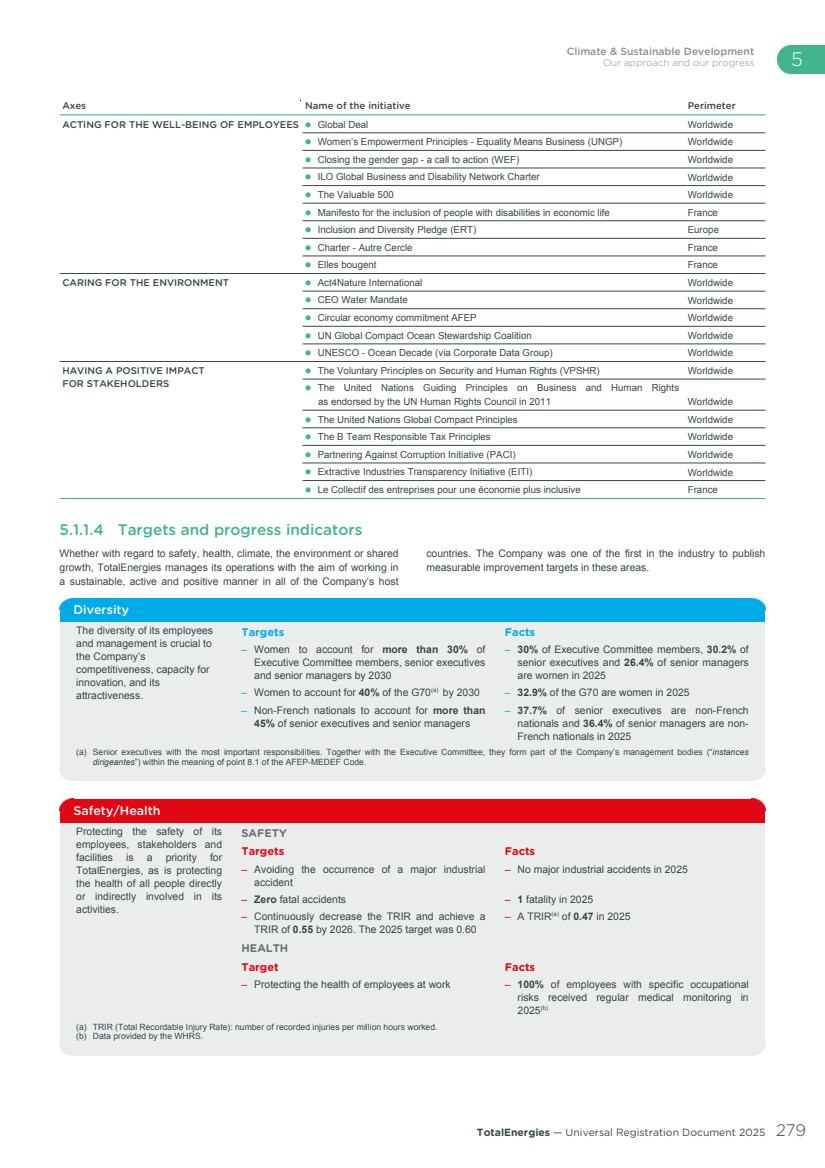
| Climate TotalEnergies is resolutely committed to reducing GHG emissions from its operated facilities Targets Facts 2030 worldwide targets (Scope 1+2) – Reduce GHG emissions (Scope 1+2) from operated facilities from 46 Mt CO2e in 2015 to less than 34 Mt CO2e by 2026. By 2030, the target is a reduction of at least 40% of the net emissions(a) compared to 2015 for its operated activities, i.e., 25 Mt CO2e to 30 Mt CO2e – A GHG emission reduction (Scope 1+2) from operated facilities from 46 Mt CO2e in 2015 to 33 Mt CO2e in 2025 – Reduce methane emissions(b) from operated facilities by 70% between 2020 and 2026, and by 80% between 2020 and 2030 or sooner – Methane emissions(2) already reduced by 50% between 2010 and 2020 and by 65% between 2020 and 2025 – Maintain the intensity of methane emissions at less than 0.1% of commercial gas produced at Upstream operated oil & gas facilities – A methane intensity of 0.07% for Upstream operated oil & gas facilities – Reduce routine flaring(c) (Upstream oil & gas operations) to less than 0.1 Mm3 /d by 2025, with the goal of eliminating it by 2030 – More than 91% reduction in routine flaring between 2010 and 2025 2030 worldwide targets (Scope 3 (d)) – Maintain Scope 3 (d) GHG emissions to a level lower than 400 Mt CO2e by 2025 and 2030 – Scope 3 (d) emissions limited to 335 Mt CO2e in 2025, below the 2015 level – A decrease of the Scope 3 (d) GHG emissions from the petroleum products sold worldwide of 41% in 2025 compared to 2015 2030 worldwide target (carbon intensity(e)) – Reduce the lifecycle carbon intensity(e) of energy products sold by more than 25% compared to 2015. By 2026, the target reduction is approximately 19% (Scope 1+2+3) – A decrease of the carbon intensity(e) of energy products sold of 18.6% between 2015 and 2025 (a) The calculation of net emissions takes into account projects of nature-based carbon sinks like forests, regenerative agriculture and wetlands. (b) Excluding biogenic methane. (c) Routine flaring, as defined by the working group of the Global Gas Flaring Reduction program within the framework of the World Bank’s Zero Routine Flaring initiative. Perimeter excluding Iraq. (d) Scope 3 GHG emissions (GHG Protocol – Category 11). Refer to the glossary for the definition. (e) Lifecycle carbon intensity of energy products sold (refer to the glossary for the definition). 5 Climate & Sustainable Development Our approach and our progress 280 TotalEnergies — Universal Registration Document 2025 |
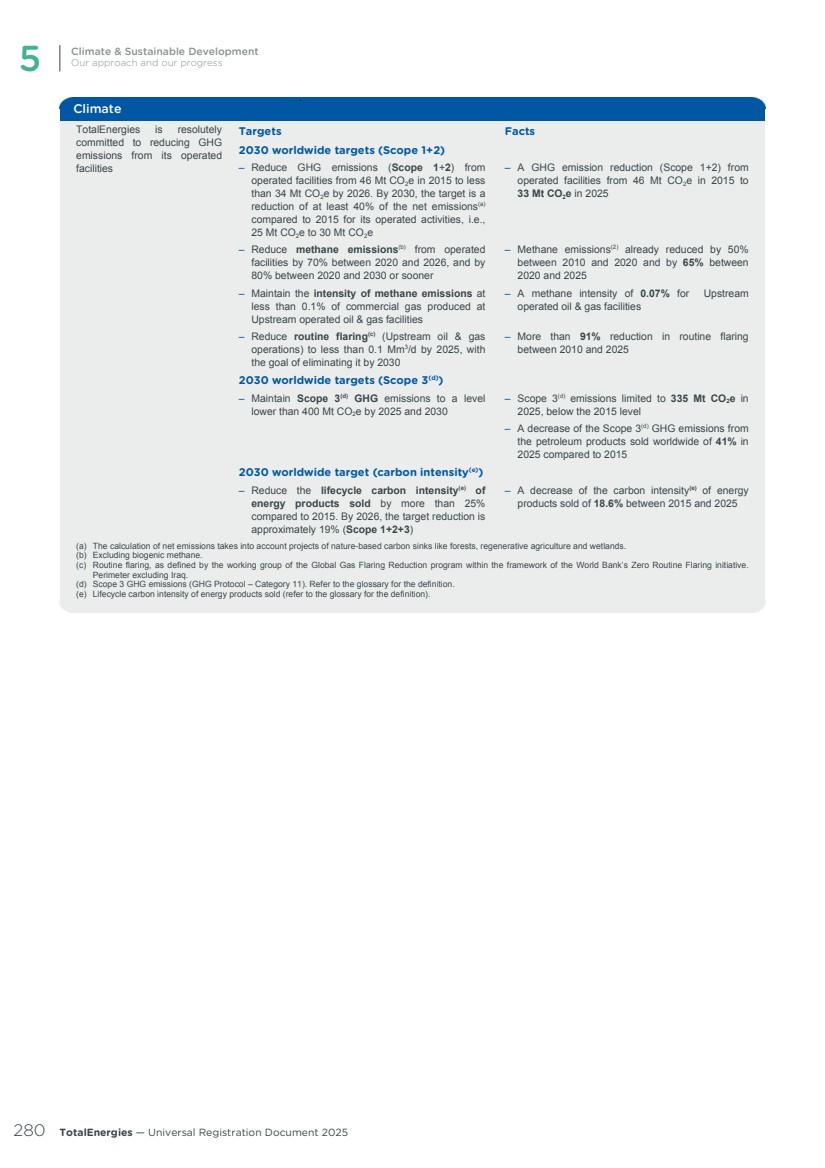
| Environment TotalEnergies’ goal is to improve the environmental performance of its operated facilities. ENVIRONMENT MANAGEMENT SYSTEM Target Facts – Have the environment management systems of environmentally material sites(a) certified to the ISO14001 standard – 100%(b) of the 84 sites material for the environment certified to the ISO14001 standard in 2025 AIR Target Facts – Decrease sulfur dioxide (SO2) emissions into the air by 75% between 2015 and 2030, a target that amounts to not exceeding 15 kt emitted in 2030 – 68% reduction in SO2 emissions into the air between 2015 and 2025 WATER Targets Facts – Reduce the freshwater withdrawal of the sites located in water stress area by 20% between 2021 and 2030 – Limit the hydrocarbon content of water discharges to below 30 mg/l for offshore sites – Limit the hydrocarbon content of water discharges to below 1 mg/l for onshore and coastal sites by 2030 – 4% of reduction in freshwater withdrawal in water stress area in 2025 (base WRI Aqueduct 2030 V4.0) – 97% of the Company’s oil sites met the target for the quality of offshore discharges in 2025 – 82% of the Company’s oil sites met the target for the quality of onshore discharges in 2025 WASTE Target Facts – Recycle more than 70% of the waste from sites operated by the Company’s subsidiaries (excluding digestate from biogas units) – 68% of the waste produced by sites operated by the Company’s subsidiaries was recycled in 2025 (a) Production sites of the subsidiaries of the 5, sites producing more than 250 kt/y in the Refining & Chemicals and Marketing & Services segments, as well as gas-fired power plants in the Integrated Power segment, operated by the Company. (b) Four sites newly acquired have two years to obtain the certification, one site is exempted. Biodiversity Aware of the need to preserve biodiversity, ecosystems and protect nature, TotalEnergies has adopted an ambition in terms of biodiversity. Commitments Facts – Implement a net zero deforestation policy in new projects on new sites approved after 2022 – In 2025, 149 ha net deforestation (210 ha gross deforestation and 61 ha compensated). Projects to compensate have generated a negative balance of deforested area of 141 ha since 2023 – Implement the biodiversity ambition in the 4 areas presented in point 5.2.2.4 – No oil and gas exploration or production activity in the area of natural sites listed on the UNESCO World Heritage List – No exploration activity in oil fields under sea ice in the Arctic – 2 biodiversity action plans carried out or in preparation in 2025 for projects located in protected areas(a) – 80 biodiversity action plans initiated on sites material for the environment(b) and thus 100% of sites material for environment covered(c) by a biodiversity action plan at the end of 2025 – 370 cumulated citations since 2020 in scientific publications of biodiversity data sets produced by the Company and shared in the database of the Global Biodiversity Information Facility (GBIF) database (a) Sites located in an IUCN I to IV or Ramsar convention protected area. (b) Production sites of the subsidiaries of the Oil and Gas Upstream Activities, sites producing more than 250 kt/y in the Refining & Chemicals and Marketing & Services segments, as well as gas-fired power plants in the Integrated Power segment, operated by the Company. (c) Four newly acquired sites have two years from their acquisition date to establish their diagnoses and plans for biodiversity. Climate & Sustainable Development Our approach and our progress 5 TotalEnergies — Universal Registration Document 2025 281 |
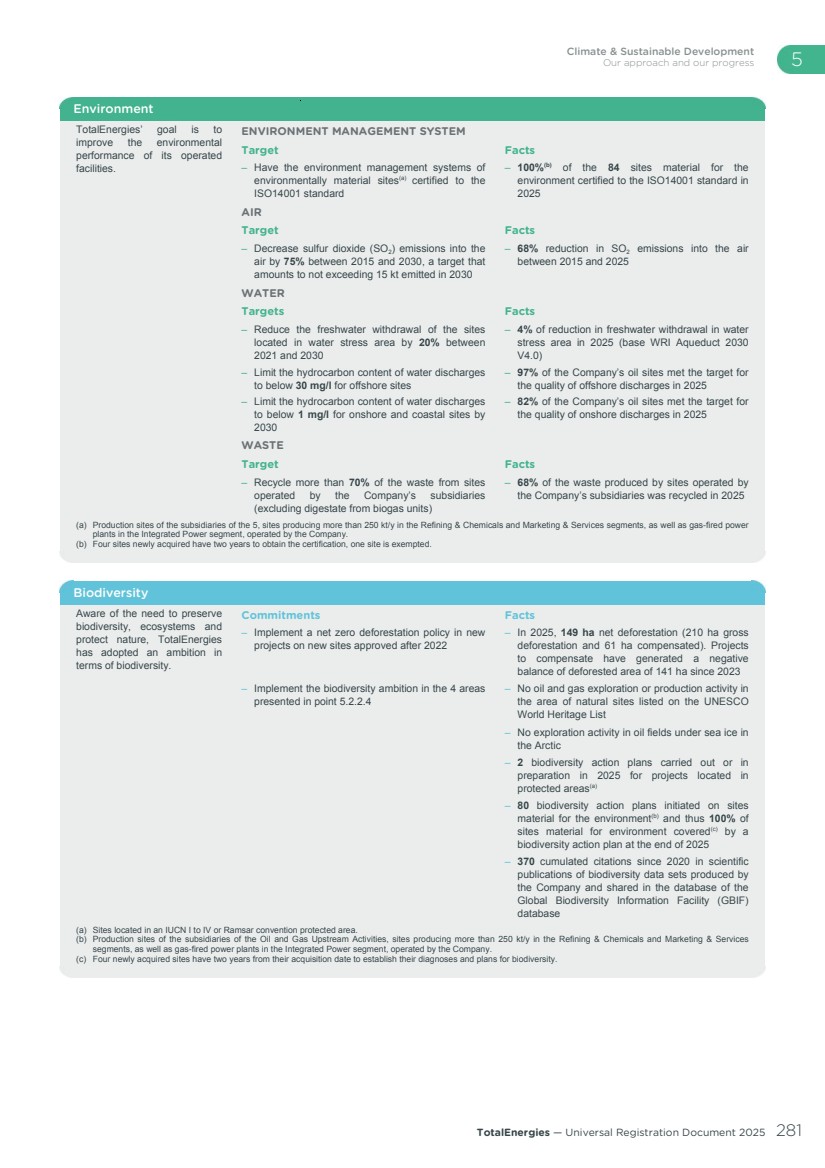
| 5.1.2 Acting for the well-being of employees 5.1.2.1 Ensuring people’s safety Safety is more than a priority at TotalEnergies; it is a core value on which we will not compromise for any reason. Everyone who works at our sites must be able to return home safe and sound at the end of their workday. Prevention of occupational accidents The number of accidents per million hours worked (TRIR) among our Company’s staff and contractors has been steadily improving for many years. It reached 0.47 in 2025. Safety efforts have reduced TotalEnergies’ TRIR by 60% over a 10-year period. The vast majority of accidents relate to occupational safety. This decrease in the TRIR is due to ongoing safety efforts, including: – a specific action plan to prevent serious and fatal accidents through campaigns targeting high-risk works and road transport; – the implementation of HSE rules and guidelines that are regularly updated and audited; – training and general safety awareness for all levels of the organization (specific training for managers, World Day For Safety); – HSE communication efforts targeting all Company personnel; – maintaining HSE objectives in the employee compensation policy. Actions to prevent fatal accidents The Company has set a goal of “zero fatality”. Sadly, we recorded one accident-related fatality in 2025 among contractors staff. Learning all the lessons from the accidental death that occurred in 2025 Exploration and Production Angola - Block 17 – Clov Field - Anahita logistics vessel – May 14, 2025 While unloading drill pipes onto a logistics vessel, once the pipes had been placed and the slings unhooked, they rolled towards two crew members of the company operating the vessel. Manoj Kumar lost his life and one of his colleagues was injured in the leg. Specific recommendations were issued concerning the strengthening of loading/unloading procedures, in particular the stabilization of loads after lifting, the implementation of secure storage systems for pipe bundles, and the strengthening of prevention measures on logistics vessels. Our actions plans to prevent fatal accidents are based on long-term work to continuously adapt and systematically implement our two global programs in the field: “The Golden Rules” and “Our Lives First”. This indispensable fundamental work is supplemented by specific action plans resulting from investigations carried out when new events occur. Worldwide roll-out of the “Our Lives First” program The program is designed to implement three types of practical actions at all of our sites: ● Life Saving Checks: five activities have been identified as generating the highest risks which could be the cause of fatal accidents. Safety checklists have been drafted for these activities, to check that work is carried out correctly in the field, in compliance with the safety rules. More than 280,000 “Life Saving Checks” were carried out in 2025; ● Joint Safety Tours: front-line presence and safety dialogue have been enhanced to promote a shared safety culture. “Joint safety Tours” with TotalEnergies senior management and contractor partners are held in addition to daily visits from local management. More than 13,000 “Joint Safety Tours” were carried out in 2025; ● Safety Green Light: the goal is to ensure, before starting work, that the risks involved are understood by the intervening teams, who may not start or stop work if the conditions are not met. To this end, the ritual of questions has been revised, and the objectives and expectations clarified. This new version of the “Safety Green Light” was deployed in 2024 and continued to be roll-out to all Company sites in 2025. Welcoming contractors Safety Street course - Antwerp refinery and other RC sector sites and Safety Dojo initiative - Saft and other GRP sector entities The Safety Street course and Safety Dojo initiative, by replicating real-life work situations for each Golden Rule, enable participants to identify risks and best practices for their future work phases on site. This includes handling personal protective equipment, exercises based on risky situations, modules dedicated to work permits, internal traffic, and the remaining of safety feedbacks. At some sites, virtual reality devices are used to reinforce learning on these safety topics. Launched in 2021, these initiatives are now being rolled out at more than 70 of the Company’s sites. Strategic Research and Technology Program – Digital for HSE The integration of digital technology in the service of HSE is now an important lever for achieving the Company’s ambitions. The Digital for HSE program, launched in 2025, is central to this approach, mobilizing advanced digital technologies—artificial intelligence, robotics, drones, augmented reality, predictive monitoring—to enhance operational performance, control risks to people and production infrastructure, and reduce the environmental footprint. This ambition is reflected in the structuring of dedicated programs such as the Smart Worksite Safety Program, which improves work preparation and supervision through digital assistants, risk anticipation through data analysis, and continuous automated monitoring of construction sites. Solutions also make it possible to reduce human exposure, for example through remote-controlled means such as drone inspections or the use of robots. The other pillar of the system is based on real-time monitoring of critical barriers that protect us from major technological risks, made possible by the consolidation of industrial maintenance data, operational decision support, and failure prediction. Pilots were developed in 2025 in various sectors, accompanied by enhanced training on understanding the concept of critical barriers. Beyond safety, digital technology is also being used to benefit the environment through solutions for monitoring emissions. 5 Climate & Sustainable Development Our approach and our progress 282 TotalEnergies — Universal Registration Document 2025 |
| Preventing major technological risks TotalEnergies facilities and activities are exposed to technological risks, and the prevention of major industrial accidents is an essential part of the Company’s safety policy. All our facilities are subject to systematic studies to identify hazards and analyze the associated risks, with the aim of controlling risks in order to prevent a major accident, to protect people, the environment and assets. All risks are studied, and technical, organizational and human barriers are identified and implemented to guarantee risk control. A multi-year plan has been elaborated to continue strengthening the control of major technological risks for the Company’s operated entities. This program has 3 main focuses: – reassess the effectiveness of critical barrier management for each major accident scenario; – facilitate the management of major risks by visualizing critical barriers; – improve understanding and management of prevention tools for operational staff. In addition, a specific training has been developed for site operational managers. This immersive training in conditions closest to reality allows to understand fire and hydrocarbon explosion situations in a controlled environment and on secure ground. Also, on April 24, 2025, during the World Day For Safety, the prevention of major accidents was addressed through the theme of critical barriers and degraded situations. The day provided an opportunity for numerous discussions and presentations to employees of the Company and contractors. We track Tier 1 and Tier 2 losses of primary containment, as defined by the industry standards. The prevention policy we have implemented, based on managing technical integrity and operational excellence, has resulted in a four-fold decrease since 2015. The Company did not experience any major industrial accident in 2025. Road transportation The risk of road accidents is one of the main safety risks at the workplace for TotalEnergies. The Company has for many years had a policy based on rules, driver training, communication, technical vehicle specifications and an extensive carrier inspection program. This policy has led to a steady decline in the number of accidents. The number of serious accidents has been divided by 4 since 2015. To prevent road accidents, several technological innovations have been tested, implemented as a priority in countries with high road risk and we have decided to extend them to all countries where the Company operates. These technologies are: – lane departure warning system; – forward collision warning; – advanced emergency breaking; – fatigue and distraction detection. 5.1.2.2 Our employees committed to transition Our employees are at the heart of our performance, and their engagement is essential to the success of our transition. Our people ambition Better Together brings together a set of measures to make the Company a good place to work together, and to lead a just transition. We believe that listening to our stakeholders is an essential part of a just transition. Social dialogue plays a key role in achieving this. Beyond, our employees around the world participate every two years in the TotalEnergies Survey to share their perceptions of the Company across various themes (ambition, collective performance, commitment to Sustainab’ALL approach, management, talent development, working conditions, etc.). Following the Executive Committee’s decision, a complementary and more concise survey, the TotalEnergies Pulse Survey, was launched in 2023. This survey now takes place alternately every other year to enable the measurement of employee engagement and well-being on an annual basis. In 2025, the engagement score for TotalEnergies is, once again, above 80% (83.5%(1)). 2025 TotalEnergies engagement index and Ipsos Benchmark(a) Ipsos Benchmark composed of companies larger than 10,000 employees throughout the world (% agree) (d) Results scope: Company without Hutchinson. Since 2022, the Company has been organizing campuses that bring together Comex members, senior executives, and employees to listen to their proposals on key topics. In 2025, nearly 300 employees managers of profit centers were able to exchange views with the Comex. Participants particularly focused on accountability, a principle that emphasizes the commitment of a profit center manager within the area for which he or she is responsible and vis-à-vis the Company, to deliver the expected results, make the decisions required to achieve them, take responsibility for those decisions, and report, transparently, on the results and consequences, both present and future, of his or her actions. (1) Results scope: Company without Hutchinson. Climate & Sustainable Development Our approach and our progress 5 TotalEnergies — Universal Registration Document 2025 283 |
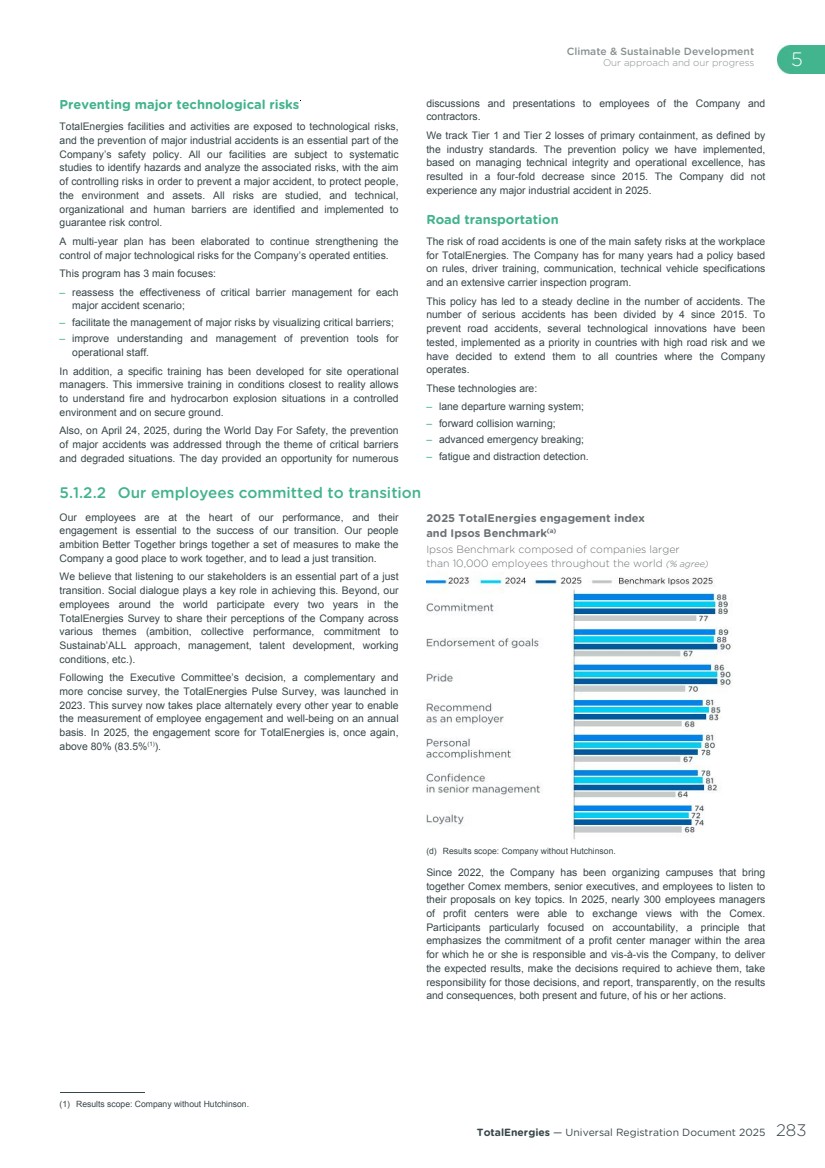
| 5.1.2.3 Five levers to mobilize our employees TotalEnergies’ ambition to place sustainable development at the heart of its strategy, its projects and its operations calls for the mobilization of all its employees. To progress together and make our approach a reality, we deployed in 2024 “Our 5 Levers for a Sustainable Change”. These 5 levers of action aim at collectively making our corporate culture evolve, over the long term, as we have been able to do over the past 20 years in the area of safety. Such an evolution implies a collective journey, which needs to be initiated by first focusing on certain priority behaviors. Our 5 Levers for a Sustainable Change Their deployment is supported by the appointment of 189 Sustainability Officers within the HSSE (Health, Safety, Sustainability, Environment) teams of our operated affiliates. In charge of promoting the levers locally, of piloting progress plans and organizing information feedback, they constitute a network which meets at regular intervals, in particular to share good practices. A training program on the 5 levers was launched in 2024, giving access to all Company employees to digital modules dedicated to each of the levers. By end 2025, 24,000 of them had followed all of the modules. A longer training for managers has been set up in 2025 and allowed 400 of them to be trained. Finally, since January 2025, files supporting investment projects submitted to the Executive Committee include a presentation on the way levers 1 to 4 have been taken into account in the projects. “Our 5 Levers for a Sustainable Change” are therefore a key step in creating a dynamic for change by promoting 5 priority collective attitudes, in addition to the rituals of the Sustainab’ALL moment at the start of each afternoon meeting, launched in 2021, and of the Sustainab’ALL day launched in 2023. 5.1.2.4 Develop and support talent in the transition Developing everyone’s skills is a major challenge for a just transition. Our goal is to empower all employees to take charge of their career development, notably through the internal mobility platform, or to freely decide which training courses they consider important for their development, up to three days per year, in addition to mandatory training. In 2025, 98% of our employees had taken at least one training course and benefited from an average of 4.6 days of training during the year. Visa for TotalEnergies, a global upskilling program As part of its just transition plan, TotalEnergies has designed the “Visa for TotalEnergies” program as a global upskilling program, aimed at preparing all employees for the new challenges facing the Company and society in general, as well as supporting the development of their skills. This multi-year training program is deployed in several seasons, each one devoted to a key aspect of the Company’s transition. The first two seasons enabled the training of more than 30,000 employees on climate challenges and the answers provided by our ambition, then in 2023 in the fundamentals of electricity, the main lever for decarbonizing the energy mix. In 2024 and 2025, the program continued with an aim to accelerate the appropriation of generative Artificial Intelligence tools in the service of collective performance. This resulted in the gradual provision of Copilot licenses for Microsoft 365 and Microsoft Power Platform, supported by training on how to use these new tools. OneTech: decompartmentalizing skills The OneTech branch, which brings together 3,400 engineers, technicians and researchers of TotalEnergies inside one entity is today a hub of technological excellence serving all the Company’s multi-energy activities. The concentration of technical skills makes it possible to build multidisciplinary teams to carry out new industrial projects, regardless of the sector of activity. This generates a decompartmentalization of skills, creating value for the company and its employees. The result: greater flexibility to better develop our projects across the entire energy mix. 5 Climate & Sustainable Development Our approach and our progress 284 TotalEnergies — Universal Registration Document 2025 |
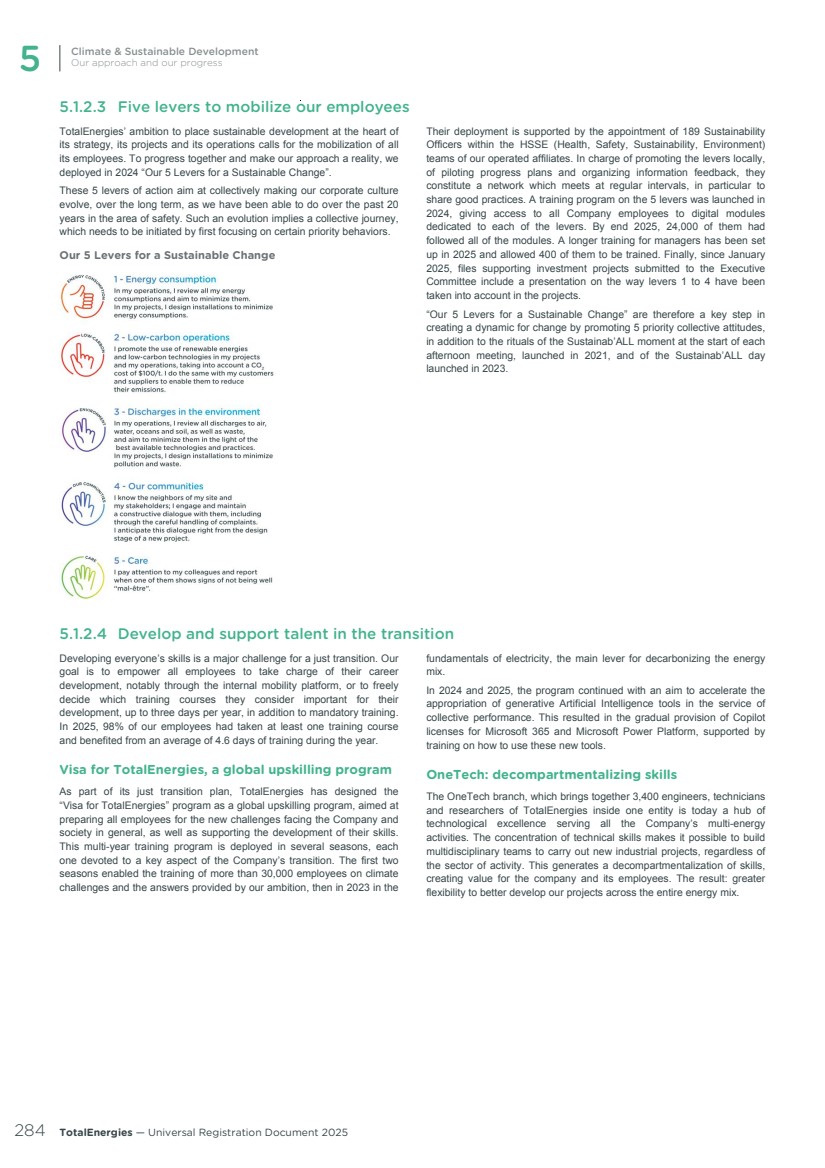
| 5.1.2.5 Building a good place to work The Company’s commitment to social responsibility is reflected in the roll out of the Care Together by TotalEnergies program. In addition to commitments specific to each affiliate, this program guarantees compliance with high social standards for all its employees worldwide, regardless of the legislation in force in any given country. Remarkable for its scope, this program is based on concrete measures revolving around four essential pillars: social protection, health, the family sphere and working conditions. For example, every employee worldwide has access to medical monitoring, health insurance and a death benefit plan, and childcare leave. In terms of mental health, the Company has a worldwide policy of preventing psychosocial risks. With the aim of developing a culture that fosters well-being on a daily basis, we help our employees to preserve their balance in a safe working environment, by reinforcing the attention that everyone pays to the well-being of their colleagues and encouraging local managers to create a working environment conducive to sustainable performance. We are thus providing our employees with a specific training offer within a framework that enables every employee to take three days of training of his or her choice. The Company has also been running “Green Fridays”. This innovation liberates the calendar from any collective meetings scheduled by management every other Friday and allows employees to organize their work. In order to measure our progress and draw up action plans, we defined, in collaboration with Ipsos, an annual measurement of our employees’ level of well-being using a Care index based on 7 criteria. In 2025, our score is 83.4%, an increase compared to 2024 (1) . 2025 TotalEnergies Care index and Ipsos Benchmark(a) Ipsos Benchmark composed of companies larger than 10,000 employees throughout the world (% agree) (a) Results scope: Company without Hutchinson. 5.1.2.6 Talent diversity, a performance lever Diversity of talent and management is a decisive lever for progress for a company like TotalEnergies, in that it increases our competitiveness, our capacity for innovation and also our attractiveness. The Company ensures the diversity and internationalization of its teams and prevents any form of discrimination to build a respectful collective within which everyone can express their full potential. Understanding and respecting our differences In 2025, the Company continued to roll out a complete awareness-raising kit made available to managers so that they could organize a moment of exchange with their teams anywhere in the world. The aim: understand and respect differences to create collective conditions allowing everyone to express their talents, ideas and energy. On International Women’s Day, an awareness campaign was dedicated to promoting women’s ambitions, notably through a conference entitled “Sport: a lever for women’s empowerment?” This conference, attended by top female athletes, helped break down gender stereotypes and provided examples of inspiring career paths. Through this type of awareness-raising action, the Company aims to prevent all forms of discrimination, in line with its values: Respect for Each Other and Stand Together. Acting to promote the employment of people with disabilities Since 2018, we have joined the International Labour Organization (ILO) network, committing ourselves to promoting as a priority five major principles of the Global Business and Disability Network Charter. To date, more than 40 Company subsidiaries have committed to creating a more inclusive working environment for employees with disabilities, while respecting the specific features of each country. Diversity 2025 roadmap: Ongoing progress Evolution of feminization % of women among senior management % of women among senior executives Evolution of internationalization % of non-French nationals among senior management % of non-French nationals among senior executives (1) Results scope: Company without Hutchinson. Climate & Sustainable Development Our approach and our progress 5 TotalEnergies — Universal Registration Document 2025 285 |
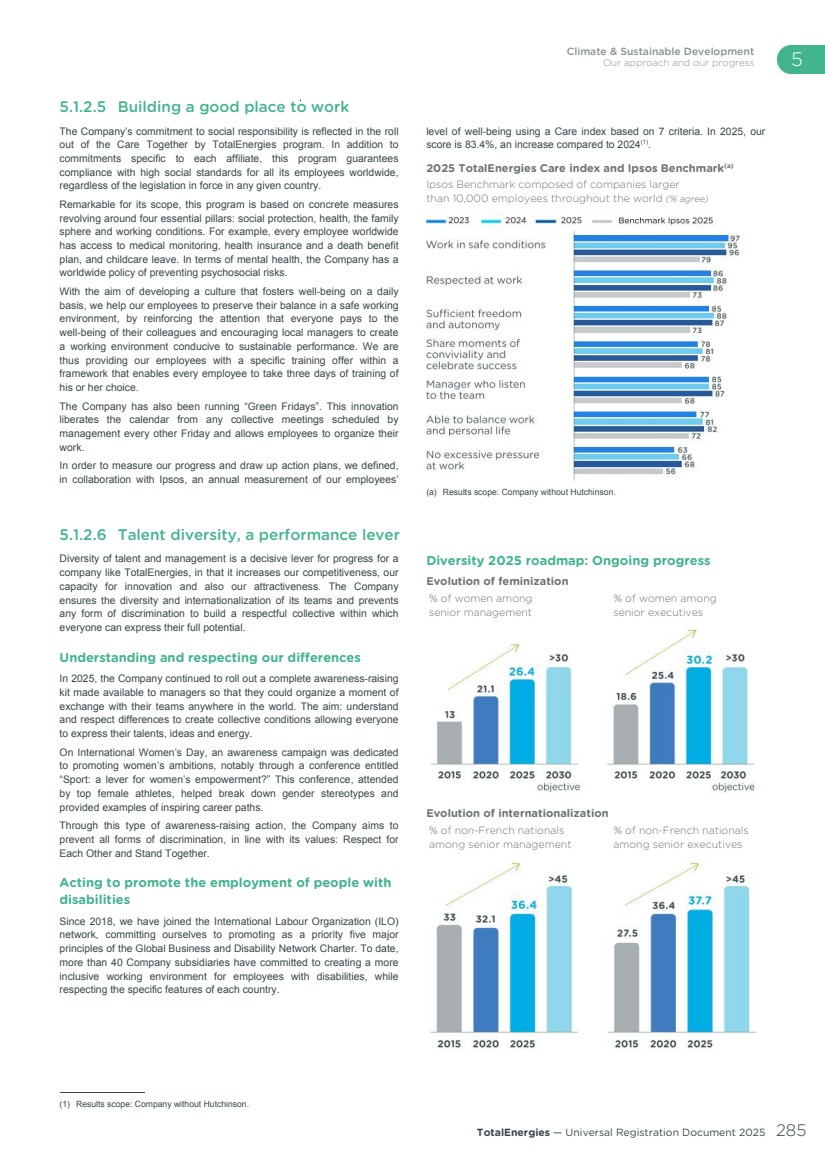
| 5.1.3 Caring for the environment 5.1.3.1 Caring for the environment Nature provides a large range of services, known as ecosystem services, which are directly or indirectly necessary for all human activities on earth. We are one of the many players who depend on these services. What’s more, like all human activities, our operations have an impact on ecosystems. In 2022, the world adopted a Global Biodiversity Framework, with quantified targets for States by 2030. We support this ambitious and concrete agreement. It also calls on companies to be transparent across their value chain. This agreement highlights the importance of nature in the broadest sense. It recalls the link between climate and biodiversity, climate change being listed by the IPBES (Intergovernmental Science-Policy Platform on Biodiversity and Ecosystem Services) as the third leading cause of biodiversity loss. Our ambition is to place environmental performance at the heart of our projects and operations. For us, it’s a question of operational excellence. In concrete terms, this means developing our activities, including renewables, while protecting the environments in which we operate, in particular by limiting our discharges. It means taking into account freshwater issues and therefore the preservation of water bodies in our upstream and downstream operations. It means being a player in circularity by developing recovery processes for the waste from our sites, and by making a concrete contribution to this “resource efficiency” particularly through our production of circular polymers. This means acting to protect biodiversity, by paying close attention to land use and making commitments of “net zero deforestation”. Finally, it means integrating these issues into our value chain. In 2025, we made progress in implementing our environmental objectives. 5.1.3.2 Environmental protection Reducing the environmental risks associated with liquid, gaseous and solid discharges into the environment is our top priority in controlling the environmental impact of our operations. Number of accidental spills Number of accidental spills of liquid hydrocarbons exceeding one barrel into the environment, excluding acts of sabotage. Preventing the risk of accidental pollution We apply the highest standards to reduce the risks inherent to the nature of our activities: – maritime and river transport of hydrocarbons; selection and vetting of chartered vessels in accordance with the best international standards (OCIMF(1) and EBIS(2)) and use of Marine Terminal Management and Self Assessment (MTMSA) in operated terminals; – implementation of a Company-wide crisis management system to deal with a major accidental spill, backed up in the field by regular mandatory exercises to test the pollution control plans of Company-operated sites at risk of spills reaching surface water. In 2025, several exercises were organized for various entities within the Company, including an exercise involving an offshore crude oil production subsidiary, the Company’s central anti-pollution expertise, the participation of ships at sea to deploy offshore anti-pollution equipment, and drone real-time transmission to the tactical unit. Reducing our industrial discharges Our activities generate emissions such as combustion fumes, atmospheric emissions from transformation processes and water discharges. The Company often goes beyond compliance with applicable regulations to limit the quantities discharged into the various environments: Sulphur dioxide (SO2) A target of 75% reduction in emissions between 2015 and 2030. In 2025, we reduced these emissions to 19 kt SO2, a reduction of 68% compared to 2015. Discharge of hydrocarbons into water In January 2022, the Company set itself a 2030 target for the quality of water discharged from our onshore sites. This new target divides by 15 the maximum hydrocarbon content of discharded water compared with the previous Company objective. To date, 82% of onshore sites comply with this strenghtened 1mg/l target. Studies have been launched to improve discharges from sites that have not yet met the new target. At our offshore sites, the average hydrocarbon content of water discharges is 9.9mg/l, well below our objective of keeping it below 30mg/l. 5.1.3.3 Taking action to preserve water resources In 2022, we joined the CEO Water Mandate, part of the United Nations Global Compact, joining a platform of over 400 companies committed to advancing water management. A brochure published in 2024 details the actions taken to reduce our footprint on water resources. Reducing freshwater withdrawals in our direct operations Freshwater represents about 10% of the water used at our operated sites, and we have decided to focus our efforts on this unevenly distributed resource on the planet that we share with our neighbors. (1) Oil Companies International Marine Forum: industry association of the world’s leading oil companies. (2) European Barge Inspection Scheme. 5 Climate & Sustainable Development Our approach and our progress 286 TotalEnergies — Universal Registration Document 2025 |
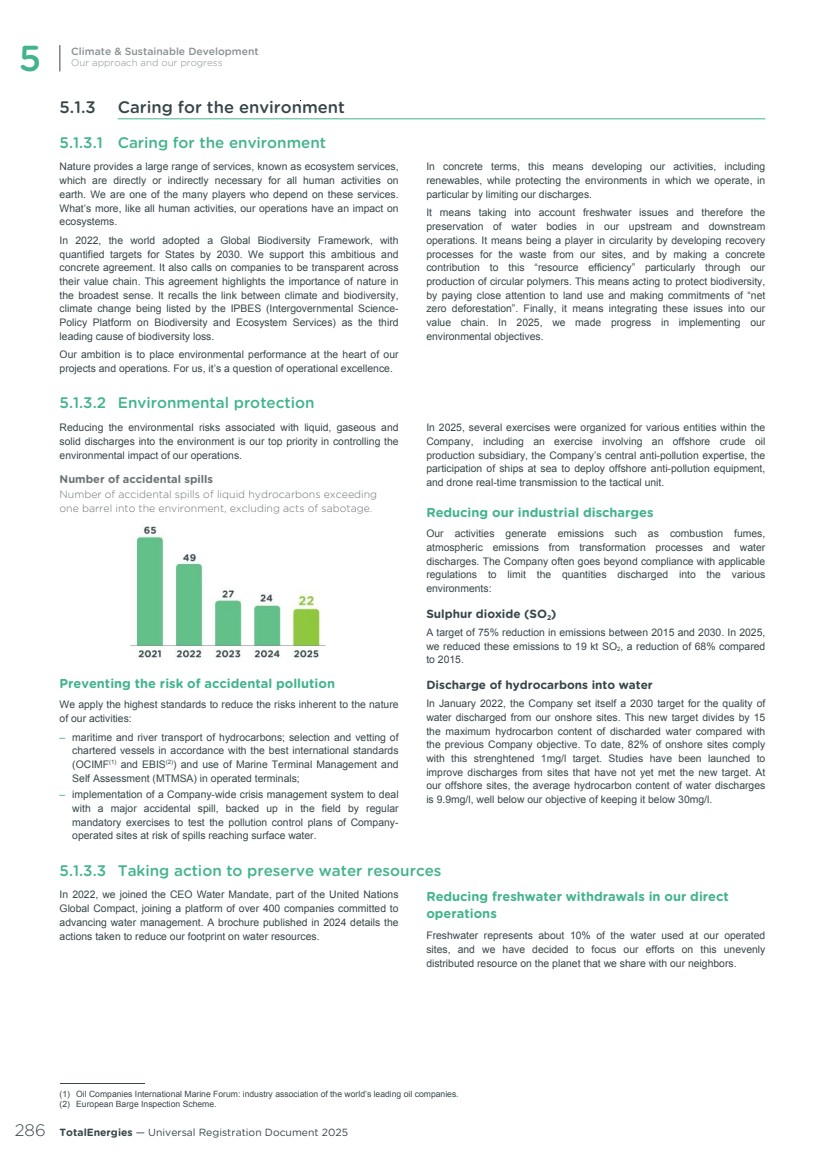
| Our target is to reduce our overall freshwater withdrawals by 20% at sites located in water-stressed zones(1) in 2030 compared to 2021. In 2023, we have reassessed the priority sites on the basis of updated projections from the World Resources Institute’s Aqueduct tool. Eleven priority sites(2) are now covered by this target. Located mainly in Western Europe, they represent, in 2025, 46% of the Company’s total freshwater withdrawals, i.e., 53 Mm3 . Contributing to collective programs We contribute to the French government’s Water Plan (March 2023) with our sites at Donges (Loire-Atlantique), La Mède and SOBEGI (Pau region). Promoting access to fresh water for local communities Access to water is fundamental to local development. As part of our activities, we run several programs (WAter, Sanitation and Hygiène (WASH)) to provide access to water for local communities in connection with our operations. In Argentina, the E&P subsidiary supplies water, notably for breeding and agriculture as well as for human needs in the Neuquén and Tierra del Fuego regions. In Bolivia, the E&P subsidiary supported the creation of a water committee in the communities of Iviyeca and Carapari to improve water supply infrastructure and increase community knowledge of efficient and sustainable water use. 5.1.3.4 Developing circular management of our products Making progress in the circularity of our products and waste is another way of reducing our environmental footprint. We do this through our production of biofuels, biogas and circular polymers. At our sites, promoting the circular management of resources starts with responsible management of our waste. Valorizing waste from our sites In early 2022, we have set ourselves the goal of valorizing over 70% of our waste. Our approach, based on the “Reduce • Reuse • Recycle • Recover” principle, has enabled us to recover, in 2025, 68% of waste from our operated sites (vs. 71% in 2024). This slight decrease in 2025 is due to a quantity of non recoverable waste related to Company’s projects. Creating value from circular raw materials Biogas is mainly produced from agricultural waste. Thus, in 2025, we have treated more than 1.5 Mt of agricultural waste in our biomethanizers. For the production of biofuels, we set ourselves the objective of increasing the share of circular raw materials (used oils, animal fats) to more than 75% from 2024 and achieved 98% this year. Circular polymers at the heart of our strategy Increasing the circularity of our polymers is essential in the fight against plastic pollution. We offer our customers a range of circular polymers named RE: clic. RE:clic organized around 3 product lines RE:use, polymers containing mechanically recycled plastic. Our subsidiary Synova is the leader on the French market, supplying high-performance recycled polymers to markets such as the automotive industry. RE:build, polymers manufactured by chemical recycling, which converts non-mechanically recyclable waste into raw materials. Chemically recycled polymers can be used for food applications, for example. We currently produce chemically recycled polymers at our Antwerp (Belgium) platform, from pyrolysis oil produced in Europe by Indaver and Plastic Energy. A new waste plastic recycling unit started in Grandpuits (France) in 2025. RE:newable, our range of biopolymers. TotalEnergies is developing new polymers based on vegetable oils and used cooking oils processed at the La Mède biorefinery in France, and tomorrow at the Grandpuits biorefinery. The TotalEnergies Corbion joint venture produces PLA (polylactic acid), a biosourced, recyclable and biocompostable bioplastic, at its Rayong plant (Thailand) with a capacity of 75 kt/y. We are also working with our stakeholders to reduce the global footprint of plastics: – we develop ecodesign solutions to reduce the amount of material needed for packaging and enable the recycling of plastic waste at the end of its life cycle (monomaterials); – we support regulatory initiatives aimed at banning certain single-use plastic applications; – we are rolling out the Operation Clean Sweep® certification program; – we are involved in coalitions such as the Alliance to End Plastic Waste, of which we are a founding member and which brings together players from the entire plastics value chain, to work on solutions to eliminate plastic waste in the environment. (1) Water-stressed zone 2030: Water-stress zones as defined by WRI (zones in which withdrawals exceed 40% of available resources). (2) Concerned sites are listed in point 5.2.2.3. Climate & Sustainable Development Our approach and our progress 5 TotalEnergies — Universal Registration Document 2025 287 |
| 5.1.3.5 Acting for biodiversity Biodiversity action is an engagement driver across all of our sites and underpins an ambition(1) and concrete objectives set across four action axes. Our approach is to reconcile energy resources development with biodiversity protection to build a sustainable future. We apply the Mitigation Hierarchy: Avoid-Reduce/Restore-Offset at all our operations and projects. In practice, we implement environmental impact assessments inclusive of biodiversity for all our projects, including for renewable energies, which allows to identify areas of interest and opportunities to limit impacts. Percentage share of mitigation actions (avoid, reduce/ restore, offset) for biodiversity A continuous improvement voluntary approach Our ambition is based on the Act4Nature International voluntary commitments made since 2018. In 2022, we integrated a “zero net deforestation” target for each of our projects located in new locations. We use the United Nations(2) definition of forest, and we compensate on the basis of surface (hectares). With our Sustainab’ALL program launched in 2023, our commitment to deploy actions to support biodiversity now applies to all our operated sites. Our commitments Axis 1. Respecting Our Voluntary Exclusion Zones ● No oil or gas exploration or extraction in natural World Heritage Sites (UNESCO zones. ● No oil exploration activities in the Arctic sea ice areas. Axis 2. Managing Biodiversity at Our New Projects ● Implementation of a biodiversity action plan for each new project located in IUCN I to IV and Ramsar areas. ● Production of a positive impact on biodiversity, confirmed by a third-party, for each new project in priority zones (IUCN I to II and Ramsar). Axis 3. Managing Biodiversity at Our Existing Sites ● Implementation of a biodiversity action plan for each of our environmentally material sites(3) . ● Assessment of the prospect of creating biodiversity rich areas (habitats for rare species, etc.) for sites that have ceased operations, as an option for their rehabilitation. Axis 4. Promoting Biodiversity ● Promotion of biodiversity to youth, our employees, and sharing biodiversity data collected from our projects on the international GBIF(4) platform. Our progress in 2025: 100% of our material sites for the environment have a Biodiversity Action Plan Axis 3. In 2025, 100% of our material industrial sites(5) for the environment have a biodiversity action plan currently being deployed, in line with our objective. The most common actions of these biodiversity action plans include reducing light and noise pollution, restoring terrestrial habitats, controlling invasive species, creating fauna species refugia, or setting up partnerships with local NGOs. The percentage distribution of Mitigation Hierarchy actions of the biodiversity action plans are presented in the figure opposite and are monitored using response indicators. Sites interactions with protected and sensitive areas are recorded annually and inform biodiversity action plans. 14 of our sites that have ceased operations initiated biodiversity restoration assessments or deployed restoration actions. Furthermore, in 2025: Axis 1. We have respected our voluntary exclusion zones. Axis 2. We are deploying two biodiversity action plans on our new projects located in the most sensitive protected areas, notably the Tilenga project in Uganda which has a biodiversity net gain target. For example, elephant movements in the Murchison Falls Park in Uganda are being monitored using GPS collars, in partnership with the Wildlife Conservation Society (WCS) NGO, to determine their movement patterns and areas of occurrence. Zero Net Deforestation objective: By the end of 2025, the Company has accumulated a net deforestation of 141 ha. The necessary compensation measures have been identified and are scheduled to be implemented between 2026 and 2027. Axis 4. The TotalEnergies Corporate Foundation (Fondation d'entreprise) has supported 14 projects, including the “Oceano pour tous” competition run by the Oceanographic Institute - Albert 1 er , Prince of Monaco Foundation, which aims at helping schoolchildren discover the ocean. 28 datasets from our projects in Argentina, Brazil, Yemen and Namibia have been shared with the GBIF. Since 2020, the shared data has been cited in 370 scientific publications. As a member of the Ocean Decade Corporate Data Group, TotalEnergies contributed to the development of the guide on marine megafauna data sharing published in 2025 by UNESCO’s Intergovernmental Oceanographic Commission, drawing on its more than five years of experience in data sharing on the GBIF. In addition, in 2025, the Company’s Action! Program raised awareness of biodiversity among 3,080 employees. (1) Refer to additional ambition details on our website. (2) Forest: land larger than 0.5 ha with trees higher than 5 m and a canopy cover of more than 10%, or trees capable of reaching these thresholds in situ (source: Food and Agriculture Organization of the United Nations). (3) Sites of the affiliates in production of the upstream oil and gas activities, refineries, petrochemical sites, gas-fired power plants operated by the Company. (4) Global Biodiversity Information Facility. (5) Excluding newly acquired sites in 2024 and 2025 wich have 2 years to comply. 5 Climate & Sustainable Development Our approach and our progress 288 TotalEnergies — Universal Registration Document 2025 |
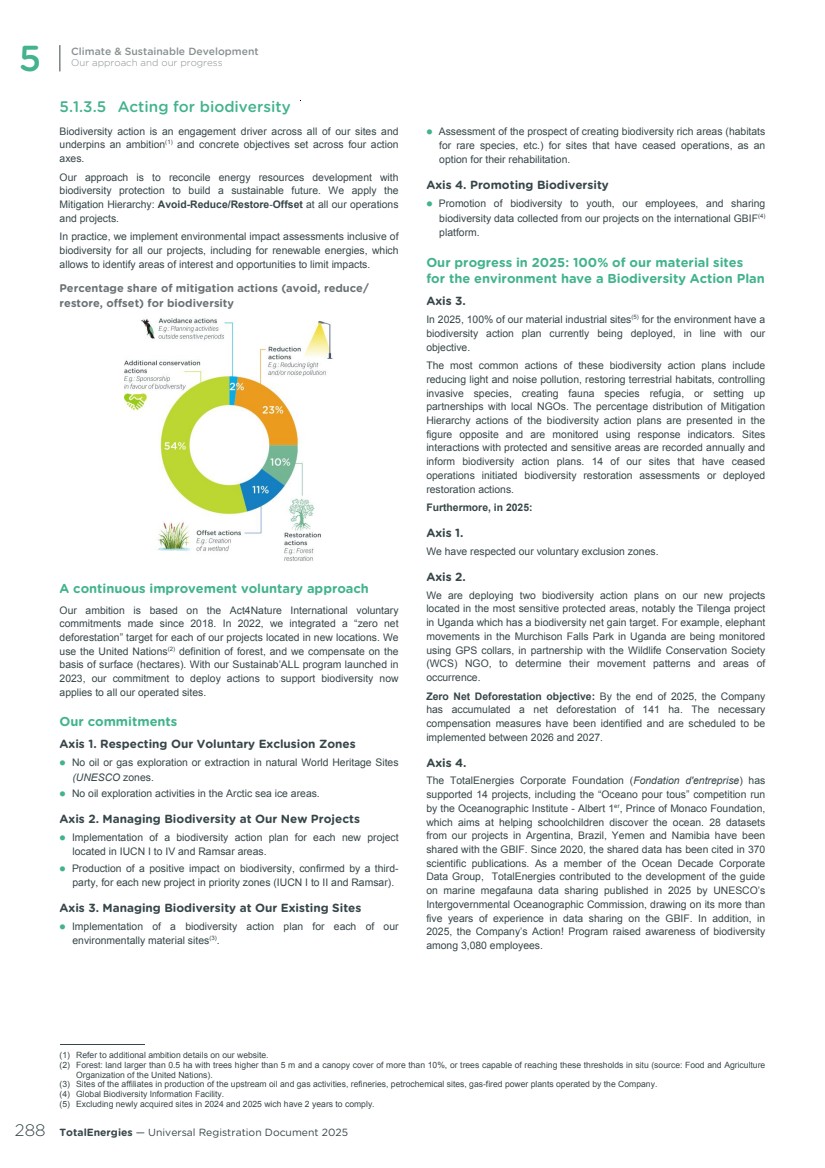
| 5.1.4 Having a positive impact for stakeholders 5.1.4.1 Having a positive impact for stakeholders Energy is at the heart of the most daunting challenges of the 21st century, defined in the U.N.’s 2030 Agenda in the form of its 17 Sustainable Development Goals (SDGs) formulated in 2015. Supplying energy indeed contributes to the development of our societies which have seen an increase in life expectancy of around 15 years over the last half a century(1) , while the number of people living in extreme poverty has decreased significantly(2) . This spectacular progress nevertheless masks severe disparities. And it was largely achieved through the use of fossil energies, resulting in a very sharp increase in CO2 emissions, which are the main cause of the climate change we can observe today. In this situation, exacerbated by geopolitical upheavals, pressure is growing on energy companies to meet a wide range of occasionally conflicting expectations. These demands are legitimate, reflecting people’s aspiration to build a more responsible and more equitable world, while ensuring that the required transition is as fair as possible. By aiming to provide more affordable, more available and more sustainable energy to as many people as possible, the Company’s activities contribute to this and have a positive impact for its stakeholders. This impact is based first of all on the values and principles of action that TotalEnergies applies in its operations, described in our Code of Conduct, which notably recalls our commitment to respect internationally recognized human rights. It also involves promoting tax transparency and the fight against corruption. Having a positive impact for our stakeholders entails understanding their expectations, which requires constructive dialogue and reporting on our actions with transparency. It also means sharing the value with our host communities, by promoting local development and ensuring that they benefit from the economic outcomes of our projects, through employment and training for example, with particular attention paid to youth and their professional integration. Beyond all the actions taken to reduce our greenhouse gas emissions and those of our customers presented in the corresponding chapters, TotalEnergies also contributes to making energy accessible and affordable for all, for example by developing Clean Cooking, while, in 2023, 666 million people in the world still did not have access to electricity and 2.1 billion to Clean Cooking(3) . The positive impact of the Company is finally manifested by the sharing of the economic value that it creates which benefits its employees, the States, its shareholders and its economic partners, including its suppliers. 5.1.4.2 Upholding human rights Respect for Each Other is a core value at TotalEnergies, at the heart of our collective ethics and our Code of Conduct. The Code of Conduct applies to all our employees, as well as to our suppliers and contractors. Respect for Each Other means respect for human rights, which are non-negotiable in our operations around the world. It is a collective and individual requirement. Our salient risks of impacting human rights break down into three categories. Our salient risks Our commitments 1. Human rights in the workplace We take action against all forms of discrimination, forced labor and child labor, ensure just and favorable conditions of work and safety and require the same of our suppliers in their operations. In the field, we emphasize training to explain, anticipate and prevent human rights risks. In 2025, more than 3,000 employees participated in classroom training and since 2019, more than 75,000 have received the online training on human rights in the workplace. We are also engaged in conducting external audits of our affiliates using the consulting firm GoodCorporation. In 2025, 6 assessments were conducted (Spain, Turkey, Dominican Republic, Brazil, United Kingdom and Ghana). In 2025, the Company reached its target set in 2023 of assessing its 1,300 priority suppliers. Of the 800 suppliers evaluated on site in more than 75 countries, more than 400 have implemented a corrective action plan. 2. Human rights and local communities In our projects, we conduct specific due diligence as soon as studies begin, to identify the potential negative impacts of our activities on local communities, as well as appropriate remediation plans, in accordance with the United Nations Guiding Principles on Business and Human Rights (UNGP). We pay particular attention to salient risks concerning access to land, the right to health and to an adequate standard of living. We are setting up mechanisms to manage grievances in our affiliates. 3. Human rights and security The intervention of government forces or private security companies may be necessary to protect the Companyís personnel and facilities. To prevent the risk of disproportionate use of force, TotalEnergies implement the VPSHR. We make sure that the personnel assigned to this mission have been vetted and received adequate training. In 2025, over 450 people have been trained by TotalEnergies’ Security Division on the VPSHR. We perform analyses each year to assess human rights risks linked to our security activities at our sites and publish annually a VPSHR report. (1) Between 1970 and 2020. Source: Data published by the United Nations. (2) Source: Data published by the United Nations. (3) Source:Tracking SDG7 - The Energy Progress Report 2025. Climate & Sustainable Development Our approach and our progress 5 TotalEnergies — Universal Registration Document 2025 289 |
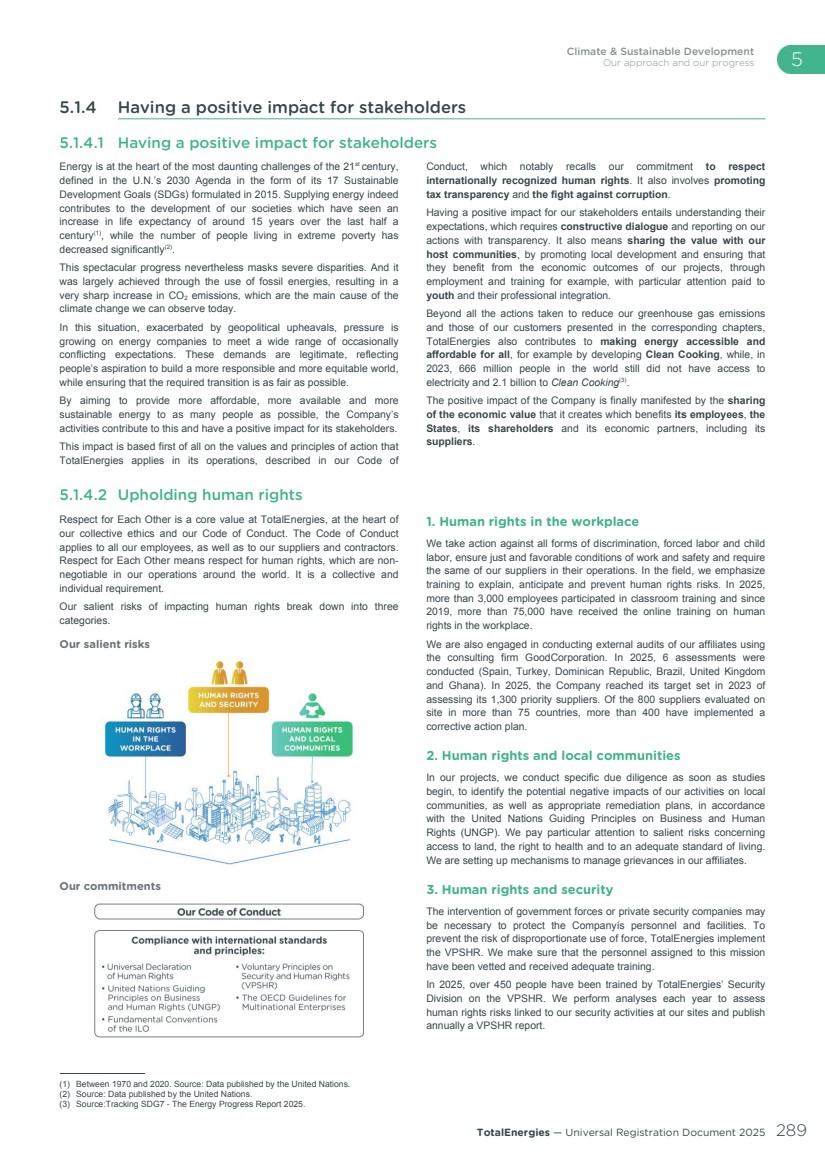
| Listening to whistleblowers The Chairman of the Company’s Ethics Committee reports directly to the Chairman and CEO and oversees a network of more than 100 Ethics Officers. The Ethics Committee maintains a system for reporting situations or behavior that violate the Code of Conduct, including a grievance reporting mechanism (via the address ethics@totalenergies.com) accessible to all employees internally and to external stakeholders. In 2025, 190 reports were logged, over 65% of which concerned issues related to human resources. 5.1.4.3 Promoting fiscal transparency and fighting corruption We work with governments to promote fiscal transparency and fight corruption, helping to create the right environment for socio-economic development. Sharing value with governments TotalEnergies pays its fair share of taxes, making a contribution to the economic development of its host countries. In 2025, the amount of current income tax and production taxes paid by the Company across all operations, came to just over 19B$ and the average tax rate was 40.5%. Payments made by the Company’s extracting entities to governments or territories in which we operate amounted to 24.5B$ in 2025 (mainly taxes, duties and production rights). At the other end of the value chain, product retail, the Company collects excise taxes for government from consumers of energy products. In 2025, we collected 18.9B$ in excise taxes on petroleum products. Promoting fiscal transparency TotalEnergies is a member of the Extractive Industries Transparency Initiative (EITI) since its creation in 2003. As early as 2014, the Company made its tax policy public, which is approved by the Board of Directors and regularly updated. We also publicly endorse the Responsible Tax Principles developed by the B Team. The Company published early 2026 a fiscal transparency report, as every year since fiscal year 2019, in line with GRI recommendations. This report describes the Company’s tax policy and provides detailed information on TotalEnergies’ global tax contribution, as well as on taxes due, country by country, in the EU, in so-called uncooperative or tax-preferred states and in all countries with extractive activity (thus covering more than 70 countries and more than 90% of the tax burden). Fighting corruption TotalEnergies is exposed to corruption risks owing to its presence in certain countries that have a high perceived level of corruption according to the index drawn up by Transparency International. We apply a principle of zero tolerance for corruption among our employees and suppliers. We promote the Code of Conduct as a mean of communicating our values both internally and externally. At the occasion of its 25 years of existence, in 2025, our annual Business Ethics Day event was dedicated to it on the theme “Code of conduct, 25 years of shared values”. Our employees are encouraged to put the principles of the Code of Conduct into practice on a daily basis, and to be ambassadors of them to all those who work with and for us. To take action in all areas of its value chain, TotalEnergies has made preventing and fighting the risk of conflicts of interest and corruption part of its Responsible Purchasing Program. The tool which was launched at the end of 2023 to facilitate systematic checks during the supplier evaluation process continued to be deployed within the Company. Fighting tax evasion With a presence in about 120 countries, the Company carries out its operations in a constantly changing environment and is subject to an increasingly complex set of tax regulations which may raise risks related to their articulation and their interpretation. In this context, TotalEnergies has developed a responsible tax approach based on clear principles of action and rigorous governance rules as set out in its tax policy statement, which is available to the public on the website of TotalEnergies. TotalEnergies publishes a tax transparency report on its corporate website which discloses detailed information on the taxes paid in its main countries of operation, in order to provide its stakeholders with a better understanding of the Company’s tax position pursuant to the recommendations of the Global Reporting Initiative and the World Economic Forum. Tax Policy of the Company Tax payments of TotalEnergies represent a substantial part of its economic contribution to the countries in which it operates. Mindful of its responsibility, the Company is committed to paying its fair share of taxes to the host countries of its operations, in compliance with applicable laws and conventions and in accordance with its Code of Conduct. The structuring of our investments worldwide is driven by our business operations and the regulatory framework. Our tax policy’s prime focus is certainty and sustainability in the long term. We thus believe that artificial or aggressive tax planning mostly derives short term tax benefits and is not compatible with a sustainable approach. We apply the arm’s length principle for the determination of our intercompany transfer prices and we pay our income taxes in the countries where we create value, in compliance with applicable laws and regulations. It is the Company’s long-term commitment not to create subsidiaries in countries generally acknowledged as tax havens and to repatriate or liquidate existing subsidiaries, where feasible. Government authorities may offer tax incentives to support business segments, create employment or foster their economic development. The Company may only claim incentives that are aligned with its business strategy, relate to investments with genuine economic substance and meet the requirements set by host countries. The Company takes a responsible approach to the management and control of taxation issues, relying on well-documented and controlled processes. The management of tax risks is fully integrated in the Company’s global risk governance process. As part of this process, the VP Tax, under the authority of the Chief Financial Officer, oversees the implementation of the tax policy and reports on a regular basis to the Board’s Audit Committee on TotalEnergies’ tax position. The tax function is made up of a network of qualified and regularly trained in-house tax experts at the corporate level, in the business segments and in the affiliates. Transparency is an essential factor in building a trust-based relationship with our stakeholders. As a permanent member of the Extractive Industries Transparency Initiative (EITI) since its formation in 2003, TotalEnergies fully supports initiatives for greater transparency and accountability. We encourage governments to ensure that the tax reporting obligations they will impose upon multinational groups are consistent, coordinated and proportionate. 5 Climate & Sustainable Development Our approach and our progress 290 TotalEnergies — Universal Registration Document 2025 |
| We engage with a broad range of stakeholders, and especially with tax authorities, in a timely, transparent and professional manner which is the basis of a constructive and long-term relationship. In France, the country of its headquarters, TotalEnergies has been part of the cooperative compliance program upon its inception in 2019, thus pursuing greater transparency, dialogue and trust in its relationship with the French tax administration. As regards advocacy relating to tax matters, TotalEnergies follows the rules set forth under its Code of Conduct and its Advocacy Directive, both available to the public on the Company’s website. The Company is committed to fighting any form of corruption and does not intervene in the functioning or financing of the political life in its host regions. It undertakes to convey messages to the authorities that are consistent with its stated positions and strategies and to be transparent about such messages, whether they are positive or defensive, notably with regard to the Company’s support for the objectives of the Paris Agreement relating to the fight against climate change. The Company publishes in its Universal Registration Document an annual report covering the payments made by its extractive subsidiaries to governments as well as the full list of its consolidated subsidiaries, together with their countries of incorporation and of operations. The Company also issues a tax transparency report, which provides additional information on the taxes paid in its main countries of operations on a country-by-country basis. This report aims to offer more detailed information on the Company’s tax position. In compliance with its goal to foster a global responsible tax environment and encourage best practices, the Company endorsed the Responsible Tax Principles developed by the B Team, a non-profit organization bringing together business leaders and representatives of civil society with the aim of promoting a sustainable form of economic and social development. The present tax policy is included in the Company’s Universal Registration Document. It is reviewed by the Audit Committee and approved by the Board of Directors. 5.1.4.4 Engaging with our stakeholders Our activities directly or indirectly concern a very large number of stakeholders. With growing expectations of businesses, legitimate questions are raised about our strategy, how we implement it and the impact it has. We organize discussion channels in order to dialogue with all stakeholders and pay particular attention to any controversies raised. The main controversies that we faced in 2025 related to: – the pace and the reality of our transition strategy: – our climate impact, and particularly that of new oil and gas production projects; – the role of Nature-Based Solutions projects; – LNG’s role in ensuring security of supply, the viability of investments in LNG and the emissions associated with its production and transport; – human rights and the impact of our activities or that of our partners on local communities, particularly those concerned in Uganda and Tanzania by the Tilenga-EACOP projects, in Mozambique by the Mozambique LNG project; – the impact of our operations on the environment and health. On the ground, all over the world, we work hand in hand with civil society including local NGOs, the business world and public authorities. These relationships enable us to identify priority needs, and contribute to taking a responsible approach in our operations. TotalEnergies is also a member of a number of coalitions and think-tanks committed to advancing corporate sustainability, such as the WBSCD, the Global Compact, CSR Europe, le Collectif des entreprises pour une Economie plus inclusive (the Collective of companies for a more inclusive economy), ORSE and EpE(1) . 5.1.4.5 Dialogue with investors Shareholder structure (In % excluding treasury shares) We deeply value the dialogue with all our shareholders, with whom the members of the Executive Committee, the Lead Independent Director and the Investor Relations team regularly engage about the Company’s strategy and sustainability policy. Investors: ongoing demanding and fruitful dialogue In addition to engagement on financial matters, the Company has developed a shareholder engagement program on extra-financial themes. This program allows for regular interactions with shareholders, throughout the year, on Company strategy, climate policy and sustainability issues as well as governance practices. In 2025, more than 1,000 meetings were held with investors (individual meetings and roadshows) worldwide, of which more than 450 were dedicated to extra-financial issues. Ahead of the Annual General Meeting, the Lead Independent Director also maintained a particularly active dialogue with shareholders totaling nearly a quarter of TotalEnergies’ capital. Furthermore, a site visit was organized in Uganda in June 2025, to allow institutional shareholders to discover the Tilenga and EACOP sites and to engage with various stakeholders. (1) TotalEnergies has been a member of the World Business Council for Sustainable Development since 2014, the United Nations Global Compact since 2002, the Corporate Sustainability and Responsibility network since 2016, the Collective since 2002, the Observatoire de la responsabilité́ sociétale des entreprises since 2000 and of EpE (Entreprises pour l’Environnement) since 1992. Climate & Sustainable Development Our approach and our progress 5 TotalEnergies — Universal Registration Document 2025 291 |
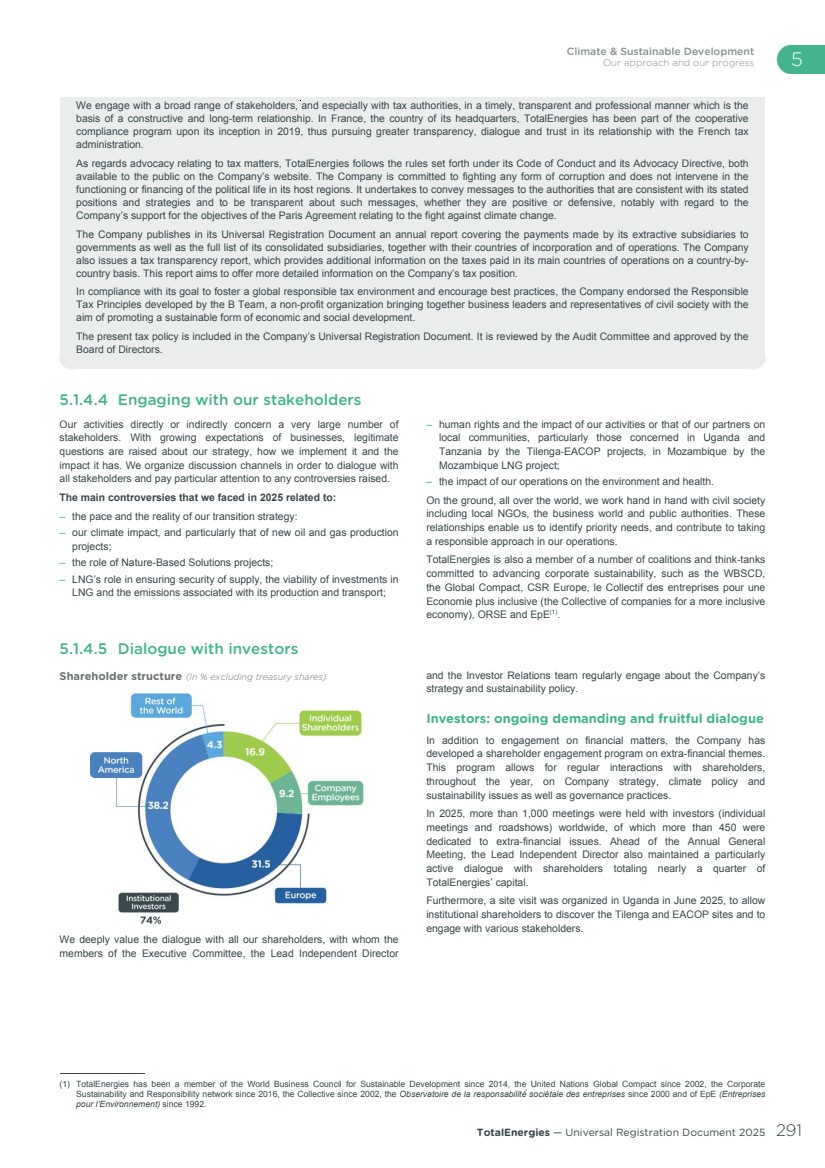
| The dialogue is also particularly active with the individual shareholders, who are informed of the Company’s news via dedicated publications, take part in visits organized with the Shareholders’ Club, and with whom we interact through the Shareholder Advisory Committee. An attractive shareholder return policy TotalEnergies has not reduced its dividend since 1982. The Company’s financial strength enables it to successfully implement its transition strategy and offer shareholders an attractive return policy. Over the past 10 years, the average annual gross dividend yield has been 5.7%. In 2025, in addition to the 5.6% increase in quarterly interim dividends, a 7.5 B$ share buyback program has been implemented. Payout to shareholders represented therefore 55% of cash flow in 2025, in line with the objective of maintaining the latter above 40%. 5.1.4.6 Share value with our host communities Our operations involve close interaction with local communities in our host countries. Our vision of shared prosperity is based on three principles: dialogue and engagement with all our host communities, which are based on Lever 4 of “Our 5 Levers for a Sustainable Change” program; assessing and reducing the impact of our operations, and contributing to local social and economic development that meets the needs of the communities. Socio-economic development initiatives Contributing to local development Long-term operations in a territory means developing profitable, sustainable projects. TotalEnergies is committed to prioritizing local jobs and subcontracting locally wherever possible, in accordance with operational constraints, and strives to integrate its industrial activities into the local ecosystem. For example, the Le Havre South urban heat network was extended in 2025 in order to be fed with TotalEnergies Normandy platform industrial heat. By reducing gas utilization, this project will allow to heat more than 12,000 households in Le Havre and avoid the emission of 16,000 tons of CO2 per year. In addition to jobs and using local suppliers for projects, we support education and getting young people into employment, protecting cultural heritage, access to water, health and road safety, which all contribute to reduce inequality. In 2025, nearly 1,600 initiatives were supported in these areas. Building ties with host communities Our employees have the opportunity to get involved in causes close to where they work. The Action! employee community volunteering program launched in 2018 enables all employees to donate up to 3 workdays a year to local causes. These are opportunities to play a part in achieving the Company’s aim of driving positive change locally. In 2025, close to 10,000 employees took part in nearly 14,000 citizenship initiatives worldwide as part of this program. 5.1.4.7 Making a commitment to young people The Sustainable Development Goals (SDGs), particularly those related to employment and education, are at the heart of youth development. TotalEnergies takes action to give them the means to take charge of their own futures, focusing on the most vulnerable. Helping young people to find work TotalEnergies takes an active approach as an employer: at the end of 2025, we again largely fulfilled our commitment to welcoming 2,000 work-study students per year into our teams in France, including 10% work-study students from priority neighborhoods (Quartiers Prioritaires de la Ville (QPV) or Zones de Revitalisation Rurales (ZRR)). At the end of 2025, more than 2,300 work-study students were present (over 7% of our workforce in France), including about 12% from priority neighborhoods. The Company also takes action through its Corporate Foundation (Fondation d'entreprise), which in 2020 created L’Industreet in Stains, Seine-Saint-Denis. L’Industreet is a campus providing free professional training for young people in industrial sectors struggling to recruit. At the end of 2025, it was hosting 309 18- to-30 year-olds for training and 187 obtained their qualification in 2025. The Corporate Foundation (Fondation d'entreprise) also contributed to the opening of a further 6 Production Schools in 2025, bringing the total to 77, as part of a 60 M€ partnership over 10 years. Making the roads safer We are committed to road safety for our operations and our customers, to make the roads safer for all users, in particular the youngest users, for whom this is the leading cause of death. By sharing our expertise in schools for example with the VIA program, we are contributing to support reaching SDG 3.6. We also support NGOs such as the International Road Federation (IRF) for the creation of an international register of 450 auditors accredited in road infrastructures evaluation. We also support the IRF for the development of a digital platform providing free access to worldwide reference road statistics, in order to speed up the implementation of more efficient and informed road safety policies. 5 Climate & Sustainable Development Our approach and our progress 292 TotalEnergies — Universal Registration Document 2025 |
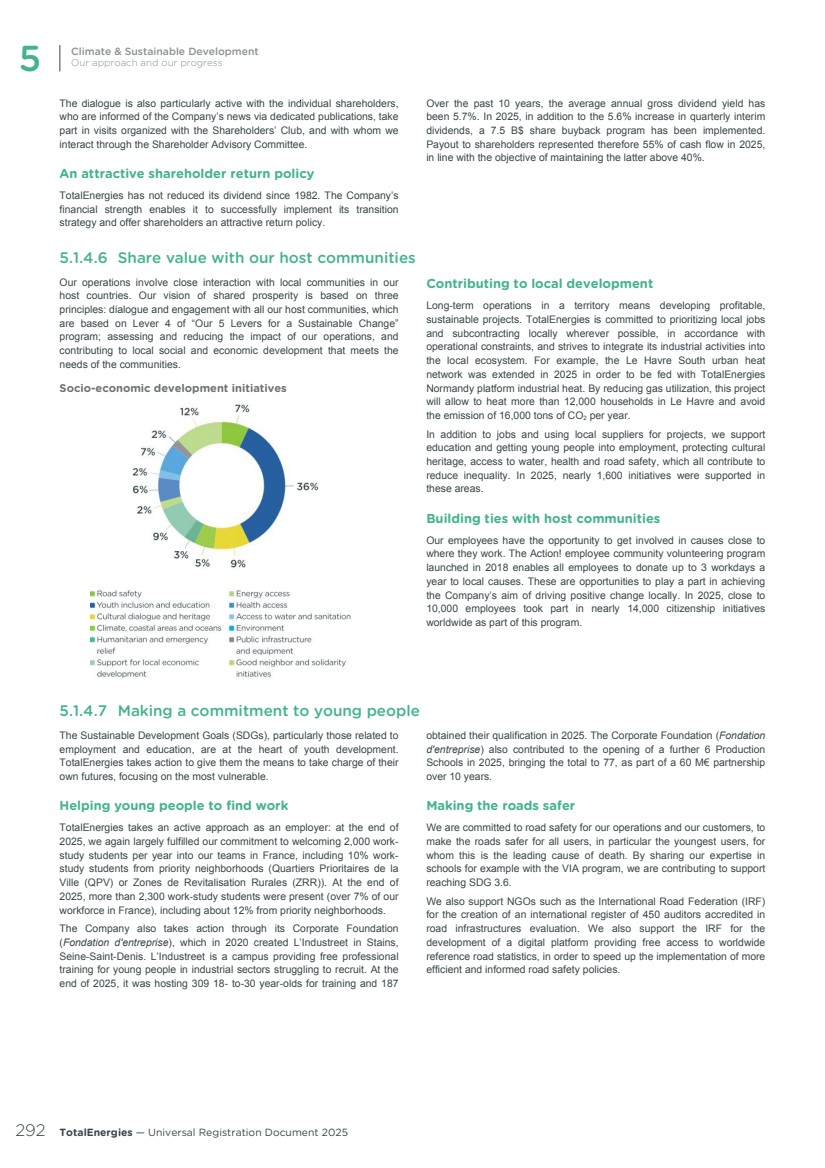
| 5.1.4.8 Accessible and affordable energy for all Universal access to clean energy is one of the main aims of the United Nations Sustainable Development Goals. TotalEnergies’ mission is to deliver energy that is more available, more affordable, more sustainable and accessible to the greatest number of people. The energy transition relies in part on using more electricity, to which we have devoted nearly 3G$ of our investments in 2025. We estimate that around a third of our development will be in emerging countries, as described in our SDG7 Energy Compact which will enable around 40 million people to benefit from decent or more reliable access to energy for the first time by 2030. Access to clean energy for cooking, is another essential prerequisite for economic and social development in emerging countries. Today, 2.1 billion people in the world do not have access to it(1) . By substituting Liquefied Petroleum Gas (LPG – a fossil fuel) in the form of bottled gas for wood and charcoal, “Clean Cooking” has a positive effect on people’s health, the environment and the economy. LPG is indeed more efficient for cooking, emits less CO2 and particles harmful to health than charcoal. It also reduces some of the negative impacts of traditional biomass use, notably on women (time saved facilitating access to education and employment) and on the environment (deforestation). In May 2024, the Company announced its ambition to give access to Clean Cooking to 100 million people in Africa and India by 2030. To achieve this, the Company will invest more than 400 M$ in the development of LPG for cooking. In 2025, TotalEnergies distributed 1,030 kt of bottled LPG in Africa (in the following countries and territories: Mozambique, Tanzania, Rwanda, Namibia, Senegal, Ivory Coast, Cameroon, South Africa, Kenya, Uganda, Togo, Morocco, Tunisia, Gabon, Mauritius, Burkina Faso, Mayotte and La Reunion) and Asia (in India and Vietnam) serving more than 16 million households and around 65 million people. 5.1.4.9 Working alongside our suppliers TotalEnergies works with over 100,000 suppliers of goods and services worldwide, for a total spend of around 35 B$ in 2025. We can play a major role in encouraging our suppliers to improve their sustainability. Axis 1 – Training our buyers By the end of 2025, 93% of TotalEnergies’ central procurement function had been trained in sustainable procurement. Additional awareness-raising actions are regularly carried out through thematic webinars. Axis 2 – Raising awareness of suppliers The Company regularly raises awareness among its suppliers regarding sustainable development, through supplier days such as in the United Arab Emirates in 2025, and also through dedicated training sessions. Axis 3 – Integration of our sustainability requirements into our purchasing process TotalEnergies ensures the integration of societal and environmental criteria at key stages of the purchasing process. Since 2024, synthesis tools enable buyers to look up suppliers’ maturity with regard to the various aspects of sustainability. This maturity is assessed by means of documentary or on-site evaluations as well as on the basis of their climate commitments. Axis 4 – Evaluating our suppliers In 2025, the Company reached its target set in 2023 of assessing its 1,300 priority suppliers on all aspects of sustainable development. Axis 5 – Support of suppliers The Company ensures that its suppliers are committed to continuous progress. In 2025, it organized meetings to provide support to suppliers, following documentary and on site evaluations. In this context, it also conducted training in collaboration with the Carbon Disclosure Project (CDP) supply chain program, allowing them to gain maturity and adopt objectives to reduce their emissions. (1) Source: Tracking SDG7 - The Energy Progress Report 2025. Climate & Sustainable Development Our approach and our progress 5 TotalEnergies — Universal Registration Document 2025 293 |
| 5.2 Sustainability reporting under the CSRD 5.2.1 General information (ESRS 2) 5.2.1.1 Basis for preparation (BP1 and BP2) A. General basis for the preparation of the Sustainability Report (BP1) The consolidated sustainability reporting presented below under the CSRD constitutes the consolidated sustainability report of TotalEnergies SE (the “Sustainability Report”) prepared in accordance with the European Sustainability Reporting Standards (“ESRS”)(1) adopted by the European Commission and with Articles L. 232-6-3 and L. 233-28-4 of the French Commercial Code. Its purpose is to provide an understanding of the impact of the activity of the Company and the companies included in the scope of consolidation on sustainability issues, as defined in the aforementioned regulations, as well as the way in which these issues influence the development of its business, results and situation. The Sustainability Report was prepared with the support of the Company’s functional divisions, notably the Strategy & Sustainability Division (which includes Legal, Sustainability & Climate, Audit & Internal Control, Health Safety and Environment) as well as People & Social Engagement and Finance divisions. It was reviewed by the Audit Committee before being approved by the Board of Directors. The Sustainability Report covers the same scope of consolidation as that used for the financial statements excluding equity affiliates (refer to note 18 to the consolidated financial statements, chapter 8.7), as well as companies controlled by the Company that are not financially consolidated but are material from a sustainability point of view (“ESRS perimeter” hereinafter). Its preparation was based on a double materiality analysis carried out by the Company, covering the Company’s own operations and its upstream value chain (including tier 1 suppliers), and downstream (where relevant and possible), on the basis of information available within the Company. Through this exercise, the Company has identified the impacts, risks and opportunities it considers material (refer to 5.2.1.3.C (SBM-3)). In its Sustainability Report, TotalEnergies presents the policies and action plans (whose scope may vary according to the areas concerned) developed or implemented to meet the sustainability challenges thus identified, as well as the targets and indicators that the Company has set itself. The second year of application of the ESRS standards remains characterized by uncertainties regarding the interpretation of texts and data collection difficulties, particularly due to the perimeter to which the ESRS standards apply. TotalEnergies has endeavored to apply the normative requirements set by the ESRS, as applicable at the date of establishment of the Sustainability Report, based on available information within the deadlines for establishing the Sustainability Report. In some cases, difficulties in accessing certain data within the deadlines for establishing the Sustainability Report or the lack of reliability of the collected data have led the Company not to communicate, on certain data points or information that does not meet its quality assurance approach, especially in the context of the announcements by the European Commission on February 26, 2025 which aimed at simplifying and reducing the number of data points prescribed in the normative requirements set by the ESRS. The reporting scopes and methodology concerning the Sustainability reporting under the CSRD in this chapter are presented hereinafter. The data required for the disclosure of environmental indicators are collected on the basis of the “ESRS perimeter” defined above. This ESRS perimeter is extended to companies and/or assets over which the Company exercises operational control, regardless of their financial consolidation method, for the following indicators: – Greenhouse gas emissions (ESRS E1-6 §44 to 46 and §50); – Pollutants listed in Annex II to Regulation (EC) No. 166/2006 and microplastics generated or used by the Company (ESRS E2-4 §28/29); – Biodiversity-sensitive sites (ESRS E4-1). In addition to the ESRS perimeter, TotalEnergies also voluntarily publishes certain indicators for the “operated perimeter”. This perimeter covers the activities, sites and industrial assets of which TotalEnergies SE or one of its subsidiaries has operational control, i.e., has the responsibility of the conduct of operations on behalf of all its partners. For the operated perimeter, the environmental indicators are reported 100%, regardless of the Company’s equity interest in the asset. Data related to acquisitions are collected during the year, when they are material for an indicator, or at the latest from January 1 of the following year. For any facility sold, data are collected until the date of divestment when they are material for an indicator. In addition, it is specified that TotalEnergies has not made use of the option allowing it to omit particular classified or sensitive information referred to in ESRS 1, 7.7 (Classified and sensitive information, and specific pieces of information corresponding to intellectual property, know-how or the results of innovation). It is additionally specified that TotalEnergies has not made use of the option offered by Article L. 233-28-4 of the French Commercial Code, allowing it to omit, in exceptional cases, specific information concerning imminent developments or business under negotiation when, in the duly reasoned opinion of the Board of Directors, disclosure would be seriously detrimental to the Company’s commercial position. B. Disclosure of information on special circumstances (BP-2) Time horizons TotalEnergies’ time frames follow the processes put in place by the Company to manage its activities, in particular those dictated by the budget cycle and the five-year strategic plan. They are spread over the short term (2026), the medium term (2030) and beyond into the long term. – short-term is defined as 1 year according to the budget cycle; – medium term, corresponding to the period covered by the strategic plan, is defined as 5 years; – long-term covers the period beyond 5 years. Estimates concerning the value chain and Sources of uncertainty associated with estimates and results Considering uncertainties regarding the interpretation of ESRS standards and difficulties in data collection particularly within the value chain, TotalEnergies has endeavored to apply the normative requirements set by the ESRS, as applicable at the date of preparation of the Sustainability Report, based on available information within the establishment deadlines of the Sustainability Report. (1) Commission Delegated Regulation (EU) 2023/2772 of July 31, 2023 supplementing Directive 2013/34/EU of the European Parliament and of the Council as regards sustainability reporting standards and its corrigendum in particular 2024/90408 of July 26, 2024. 5 Climate & Sustainable Development Sustainability reporting under the CSRD 294 TotalEnergies — Universal Registration Document 2025 |
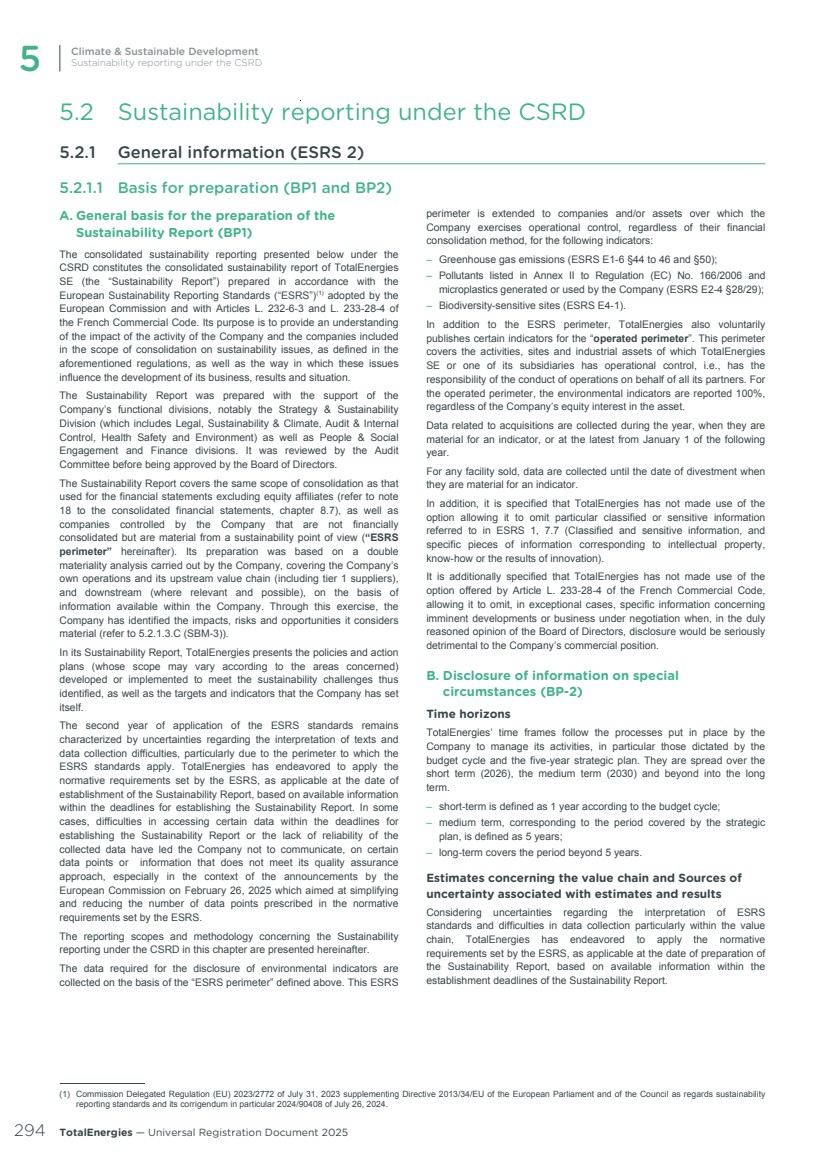
| In some cases, difficulties in accessing certain data within the establishment deadlines of the Sustainability Report or the lack of reliability of the collected data have led the Company to resort, on a case-by-case basis, to estimates required by the ESRS standards, whenever possible or deemed relevant. The estimates used by the Company for the publication of sustainability indicators are based, as far as possible, on recognized databases. However, these estimates may prove to be erroneous or inaccurate, as the underlying data are not always available. The nature and scope of the estimates implemented or limitations of the data collection perimeter applied on a case-by-case basis are explained by the methodological indications in the relevant sections. The Company continues to work on improving data collection and associated estimates for future exercises. Transition strategy for climate change mitigation Current trends indicate that the evolution of the global energy mix is not compatible with limiting global warming to 1.5°C and with the objective of achieving climate neutrality by 2050 (International Energy Agency’s STEPS scenario). Similarly, there is currently no consensus on greenhouse gas (GHG) emission reduction targets or trajectories applicable at the scale of a company in a given sector and which would be compatible with a given global temperature target. TotalEnergies’ transition strategy for climate change mitigation (which does not consitute a transition plan as defined by ESRS E1-1 - refer to point 5.2.2.1 A.) should be seen in this context and relies on diversification into low-carbon energies, particularly electricity and renewable energies, with greenhouse gas emission reduction targets for 2030 that are put into perspective in relation to IEA scenarios. Greenhouse gases (GHG) For the greenhouse gas (GHG) of the non-operated assets, TotalEnergies relies on information provided by its partner operators and strives to obtain reliable data without, however, having the same level of assurance as for data from its own operations. When this information is not available, it is estimated based on past data. For calculation of the different categories of scope 3 emissions as defined by the GHG protocol, TotalEnergies relies on information collected within the value chain and strives to obtain reliable data without, however, having the same level of assurance as for data from its own operations. The calculation method used are explained by methodological indications covering the main sources of estimation and uncertainty. Environmental data excluding GHGs For the second year, environmental data excluding GHGs were collected from operated sites and requested from operating partners for non-operated sites. TotalEnergies strives to obtain reliable data through a quality assurance process. For missing data, data for which the quality assurance process has not yet been completed, or data for which it has not been possible to make estimates in the absence of an established scientific basis, and taking into account the announcements by the European Commission on February 26, 2025 aimed at simplifying and reducing the number of data points, the Company does not communicate them. TotalEnergies will continue its work with its operated sites and the operators of the non-operated sites concerned to improve the collection rates of missing data and ensure their reliability. Cautionary Note regarding forward-looking statements The information presented in the Sustainability Report may additionally contain forward-looking statements (including forward-looking statements in the meaning of the Private Securities Litigation Reform Act of 1995), notably with respect to the financial condition, results of operations, activities and strategy of TotalEnergies. In particular it may contain indications of prospects, objectives, paths of progress and ambitions of TotalEnergies, including those relating to climate and more generally to sustainability. These forward-looking statements may be identified by the use of the future or conditional tense or forward-looking words such as “will”, “should”, “could”, “would”, “may”, “likely”, “might”, “envisions”, “intends”, “anticipates”, “believes”, “considers”, “plans”, “expects”, “thinks”, “targets”, “commits”, “aims” or similar terminology. Such forward-looking statements included in this document are based on economic data, estimates and assumptions prepared in a given economic, competitive and regulatory environment and considered to be reasonable by TotalEnergies as of the date of this document. These forward-looking statements are not historical data and should not be interpreted as assurances that the perspectives, objectives or goals announced will be achieved. They are uncertain and may evolve or be modified with a significant difference between the actual results and those initially estimated, due to the uncertainties notably related to the economic, financial, competitive and regulatory environment, or due to the occurrence of risk factors, such as, notably, the price fluctuations in crude oil and natural gas, the evolution of the demand and price of petroleum products, the changes in production results and reserves estimates, the ability to achieve cost reductions and operating efficiencies without unduly disrupting business operations, changes in laws and regulations including those related to the environment and climate, currency fluctuations, technological innovations, meteorological conditions and events, as well as socio-demographic, economic and political developments, changes in market conditions, loss of market share and changes in consumer preferences, or pandemics. Additionally, certain financial information is based on estimates particularly in the assessment of the recoverable value of assets and potential impairments of assets relating thereto. Readers are cautioned not to consider forward-looking statements as certain but as an expression of the Corporation’s views only as of the date this document is disclosed. TotalEnergies SE and its subsidiaries undertake to use their best efforts to update or revise, when necessary and in accordance with applicable legal and regulatory requirements, any and all forward-looking statements, information, trends or objectives contained in this document. Readers are expressly reminded that all information published in this document reflects the current state of knowledge and takes into account recent and evolving regulatory requirements and applicable best practices. In addition, the Corporation has not verified, and is under no obligation to verify any third-party data contained in this document or used in the estimates and assumptions or, more generally, forward-looking statements published in this document. TotalEnergies shall not be liable for any errors, omissions or inaccuracies in the information and data provided by or sourced from third parties contained in this document or used for assumptions, estimates or, more generally, forward-looking statements published in this document. Users are advised to verify them independently before relying on them. Change in the preparation or presentation of the sustainability reporting under the CSRD Unless otherwise specified, the historical data published in the sustainability report for financial year 2024 has not been restated. Climate & Sustainable Development Sustainability reporting under the CSRD 5 TotalEnergies — Universal Registration Document 2025 295 |
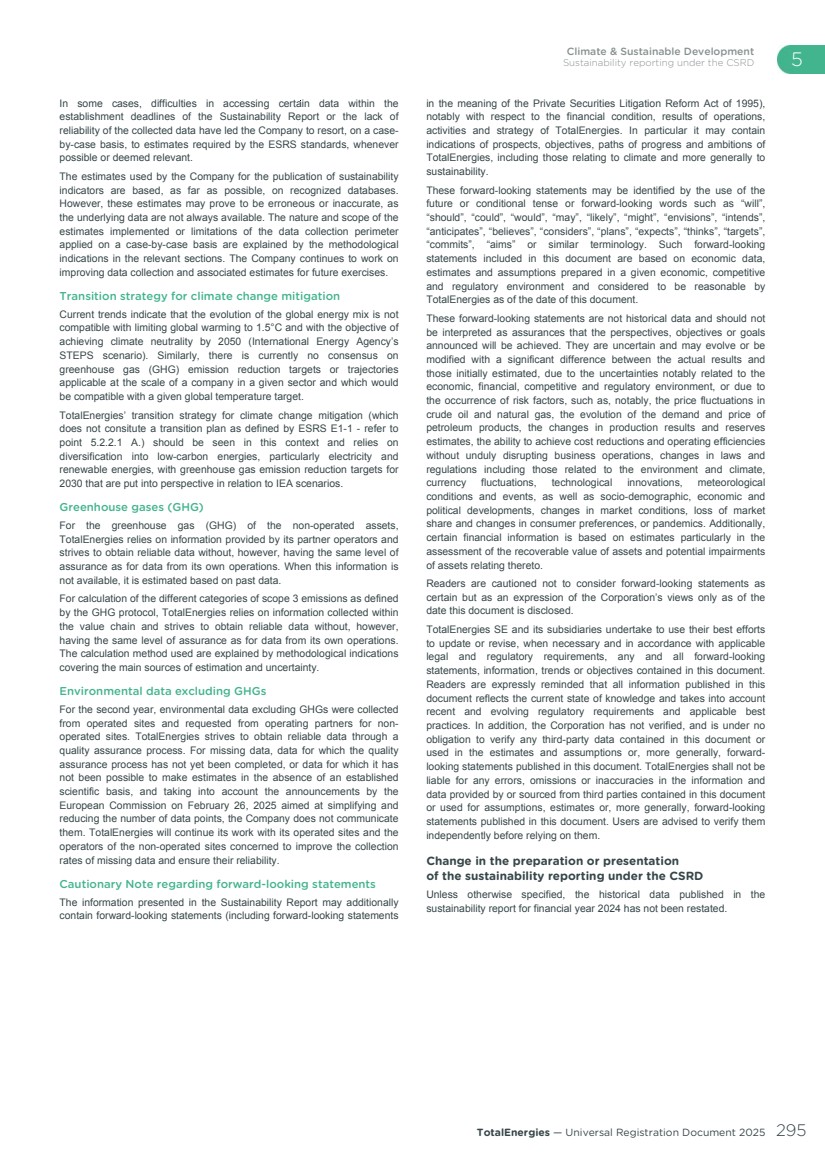
| Incorporation of information by reference The table below lists the disclosure requirements and specific data points incorporated by reference. Standards Disclosure requirements and data points URD Chapter/Sections ESRS -GOV-1 21 c (experience acquired by directors) 4.1.1.1 and 4.1.1.5 ESRS 2-GOV-3 29 a (key characteristics of the incentive schemes) 4.3 ESRS 2 SBM-1 42 (business model and value chain) 1.1.3 ESRS S1-16 97 b (the annual total remuneration ratio of the highest paid individual to the median annual total remuneration for all employees) 4.3.3 ESRS G1-3 21 c (training given to members of the administrative, management and supervisory bodies concerning corruption) 4.1.1.6 5.2.1.2 Governance (GOV-1 to GOV-5) A. Role and composition of administration, management and supervisory bodies (GOV-1) TotalEnergies SE’s administrative, management and supervisory bodies consist of the Board of Directors and the Chairman and Chief Executive Officer (refer to point 4.1 of chapter 4). The Board of Directors of TotalEnergies has committed the Company since 2020 to a transition strategy to transform it into an integrated multi-energy company. The Company is committed to a balanced transition strategy for the benefit of the energy transition and has the ambition to contribute to the development of a more decarbonized energy system while at the same time maintaining the current energy system at a sufficient level to meet global demand and organize a fair, orderly and equitable transition of energy systems. The Company affirms its purpose to provide as many people as possible with energy that is more affordable, more reliable and more sustainable, while at the same time placing sustainable development at the heart of its strategy, its projects and its operations. The Board of Directors is committed to this ambition. Composition of the Board of Directors, reflecting the diversity and complementarity of its members With 14 directors, including 9 independent members, 1 director representing employee shareholders(1) and 2 directors representing employees(2) , and 6 nationalities represented, the composition of the Board of Directors of TotalEnergies SE reflects the diversity and complementarity of experience, expertise, nationalities and cultures needed to understand all the issues facing the Company, including those relating to sustainability. Board composition Financial year 2025 Number of directors 14 of which executive members 1 of which non-executive members 13 of which the director representing employee shareholders. 1 of which the directors representing employees. 2 Number of directors excluding those representing employee shareholders and employees 11 Independence Number of independent directors 9 weighted average % of independent directors 64% (9/14) % of independent directors calculated excluding director representing employee shareholders and directors representing employees (point 10.3 of the AFEP-MEDEF Code) 82% (9/11) Diversity Weighted average ratio of women to men 43/57 Proportion of directors by sex Women 43% (6/14) Men 57% (8/14) Proportion of directors by sex, excluding director representing employee shareholders and directors representing employees (articles L. 225-27-1 and L. 225-23 of the French Commercial Code)(3) Women 45.5% (5/11) Men 54.5% (6/11) Diversity Number of nationalities represented within the Board 6 Proportion of directors by nationality French 57% (8/14) Foreigners 43% (6/14) Details of the composition of the Board of Directors of TotalEnergies SE and of the way general management is exercised are provided in the Corporate Governance Report (point 4.1 of chapter 4). (1) Director representing employee shareholders, elected on the proposal of the shareholders referred to in Article L. 225-102 of the French Commercial Code, in application of the provisions of Articles L. 225-23 and L. 22-10-5 of the French Commercial Code (hereinafter “Director representing employee shareholders”). (2) Directors representing employees appointed in accordance with the provisions of article L. 225-27-1 of the French Commercial Code and the Corporation’s Articles of Association (the first appointed by the Central Social and Economic Works Council of the Amont Global Services Holding Economic & Social Unit and the second appointed by the SE Committee known as “TotalEnergies European Works Council”). (3) As from fiscal year 2026, the proportions of women and men are calculated excluding directors representing employees but taking into account the director representing employee shareholders in accordance with the Ordinance of October 15, 2024 transposing into French law the directive (EU) of November 23, 2022 (known as the “Women on Board” directive). 5 Climate & Sustainable Development Sustainability reporting under the CSRD 296 TotalEnergies — Universal Registration Document 2025 |
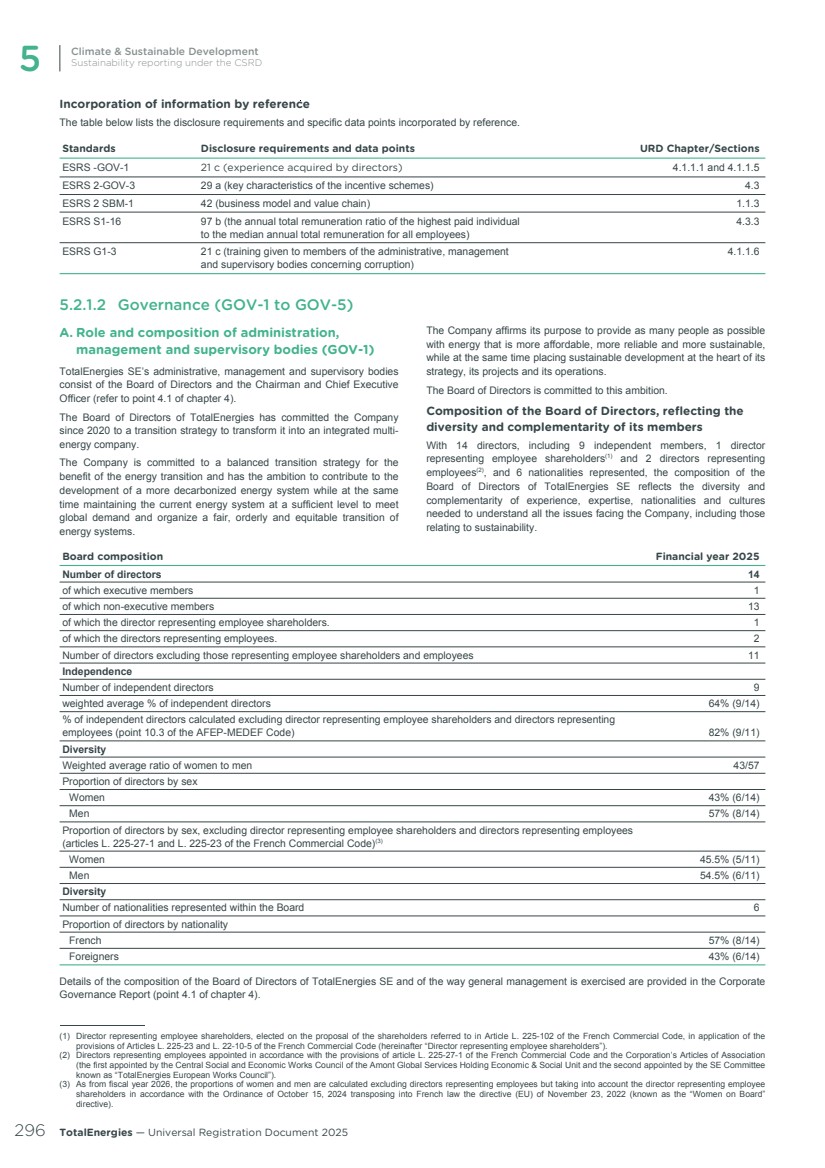
| Expertise and skills of the Board of Directors as regards sustainability With the support of the Governance and Ethics Committee, the Board of Directors ensures that the Board of Directors as a whole has the skills and expertise required to oversee the sustainability issues associated with the Company’s activities. More detailed information on the profiles, experience, expertise and skills of each director, as well as on the Board’s diversity policy, is provided in points 4.1.1.1 and 4.1.1.5 of chapter 4. A training program led by members of the Executive Committee, primarily aimed at newcomers but open to all directors was initiated in 2025 and will continue in 2026. This program focuses in particular on technological and digital ambition as well as on sustainability & climate, and human resources policies. In 2024, the members of the Audit Committee all took part in an external training course dedicated to CSRD issues, which most of the directors also attended. Directors stated that they had already received training in the detection and prevention of corruption. In addition, directors may ask to receive training in the specificities of the Company, its businesses and its business segment, as well as any training that may help them perform their duties as directors. An ongoing climate training program to which directors have access includes various modules on the following topics “Energy, Climate Change and Environmental Risks”, “Solutions for a low-carbon future”, “The low-carbon energy transition” and “Climate Change: Financial risks and opportunities”. Moreover, directors representing employees or employee shareholders may submit requests for training under the specific rules applicable to them, as defined by the Board of Directors. In 2025, a director representing employees attended the “Global Macroeconomic Challenges” training program at the London School of Economics. Directors are also invited to take part in Company site visits, which contribute in a very concrete way to their training and allow them to deepen their knowledge of the specificities of the Company, its challenges, including as regards sustainability. They are often the occasion for thematic presentations. In this context, site visits, by groups of 4 to 5 directors accompanied by a member of the Executive Committee, were organized in 2025 in Nigeria (offshore and onshore EP, solar), in Scotland (Seagreen, offshore EP), in Antwerp (Refining), in Rouen and Le Havre (mobility, FSRU, blending). Additionally, the Lead Independent Director went to the ACC firm in Douvrin. Finally, Audit Committee members visited the TotalEnergies Electricité et Gaz France offices in Paris, where they were presented with the Retail Power & Gas activity. Site visits are planned for 2026. Roles and responsibilities for monitoring risks, impacts and opportunities Board of Directors With the support of the Audit Committee, the Board of Directors ensures the taking into consideration of the sustainability issues on the basis of work prepared by General Management and the relevant operating divisions. The Board of Directors endeavors to promote value creation by the company in the long term. It defines TotalEnergies’ strategic orientations and ensures its implementation in accordance with the corporate interest of the Corporation, taking into consideration the social and environmental challenges of its business activities. It is informed of the main challenges facing the Company, including with regard to social and environmental responsibility. It regularly reviews, in relation with such strategic orientations, opportunities and risks such as financial, legal, operational, social and environmental risks as well as measures taken as a result. It monitors the management of both financial and extra-financial matters and ensures the quality of the information provided to shareholders and financial markets. It oversees the determination of the roadmaps and objectives proposed by General Management with regard to impacts, risks and opportunities, and monitors progress in achieving them. It approves investments or divestments that exceed amounts greater than 3% of shareholders’ equity and it is informed of those greater than 1%, taking into consideration the social and environmental stakes involved. The Board of Directors is assisted by the four committees it has created: the Audit Committee, the Governance and Ethics Committee, the Compensation Committee, and the Strategy & CSR Committee. Without prejudice to the powers of the Board of Directors, each Committee of the Board of Directors is responsible for specific sustainability-related tasks. The Audit Committee’s mission is to ensure that the process for identifying and evaluating the Company’s material impacts, risks and opportunities is implemented. To this end, it has reviewed the work carried out as part of the double materiality analysis. With regard to internal control and risk management procedures, the Audit Committee’s mission is to monitor the effectiveness of internal control and risk management systems, as well as internal audit, in particular with regard to procedures relating to the preparation and processing of sustainability information, without prejudice to its independence, and in this context, its missions are notably to: – ensure the existence of these systems, their deployment and the implementation of corrective actions in the event of identified weaknesses or anomalies; – examine, notably on the basis of risk maps prepared by the Corporation, exposure to risks such as financial (including significant off-balance sheet commitments), legal, operational, social and environmental risks, and the measures taken as e result; – annually examine the reports on the work of the TotalEnergies Risk Management Committee and the major issues for the Company; – examine the annual work program of the internal auditors and being regularly informed of their work; – review significant litigation at least once a year. The Governance and Ethics Committee’s mission is notably to supervise and monitor the implementation of the Corporation’s approach with regard to ethics, compliance, the prevention and detection of corruption and influence peddling and, in this respect, ensure that the necessary procedures are in place, including those for updating the Company’s Code of Conduct and ensuring that this Code is disseminated and applied. The Governance and Ethics Committee examines the Company’s Ethics and Compliance policy and the annual Ethics summary presented to it by the Chairman of the Ethics Committee (who reports to the Company’s Chairman and Chief Executive Officer). The Ethics Committee assures compliance with the Code of Conduct and ensures its proper implementation. The Compensation Committee’s mission is to propose compensation structures to the Board of Directors that take into account the Company’s strategic orientations, objectives and results, market practices as well as sustainability issues. The Strategy & CSR Committee examines the Company’s overall strategy as proposed by the Chairman and Chief Executive Officer, as well as matters relating to the Company’s social and environmental responsibility and in particular those relating to the incorporation of Climate challenge in the Company’s strategy. It also reviews transactions of exceptional strategic importance and reviews the competitive environment, the main challenges the Company faces, including with regard to social and environmental responsibility, as well as the resulting medium and long-term outlook for the Company. Climate & Sustainable Development Sustainability reporting under the CSRD 5 TotalEnergies — Universal Registration Document 2025 297 |
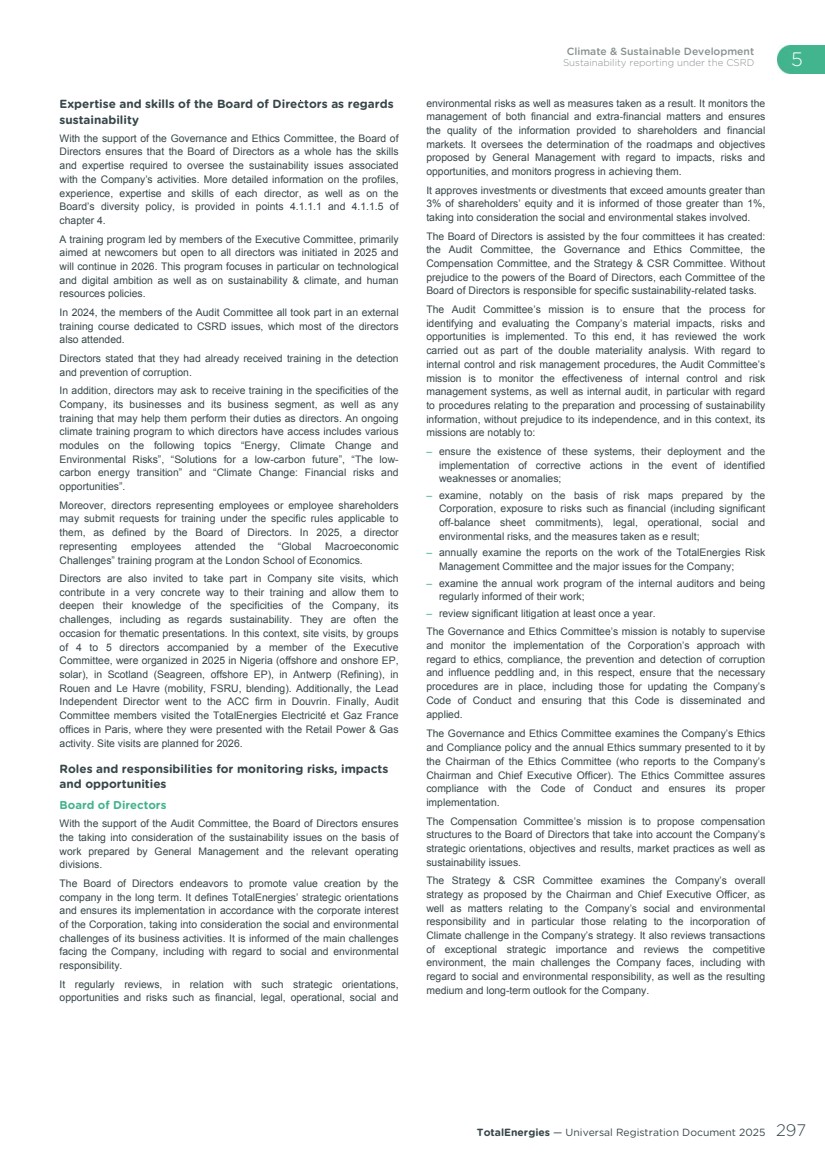
| More detailed information on the composition, role and work of the Board of Directors and its Committees is provided in point 4.1 of Chapter 4. General management The Executive Committee, chaired by the Chairman and Chief Executive Officer, ensures that climate-related issues are taken into account and built into operational roadmaps. The Executive Committee is responsible for identifying and analyzing risks that could affect the achievement of TotalEnergies’ objectives. The TotalEnergies Risk Management Committee (TRMC) assists the Executive Committee and ensures that the Company’s risk mapping is updated on a regular basis and that its existing risk management systems are well adapted. The Strategy & Sustainability Division coordinates the Company’s activities through the entities in charge of strategy and markets analysis, sustainability and climate, as well as safety, health and environment, legal affairs, relations with public authorities and internal audit. In terms of commitments, General management’s control is exercised at operational level by the Executive Committee’s approval of proposed capital investment commitments and expenditure exceeding defined thresholds. The Risk Committee (Corisk), chaired by the President Strategy & Sustainability, is tasked with reviewing these projects beforehand, and in particular with verifying the analysis of the various associated risks. The audit plan, based on an analysis of risks and the risk management systems, is submitted annually to the Executive Committee and to the Audit Committee (for internal control and risk management systems, please refer to point 5.2.1.2 E.). The Finance Division ensures an ongoing dialogue with investors, analysts and extra-financial rating agencies on climate challenges and on extra-financial issues more broadly. In all, more than 450 meetings were organized in France and abroad in 2025, as well as a field trip to Uganda; the latter included site visits to the Tilenga and EACOP projects as well as exchanges with several stakeholders. B. Information provided to and sustainability matters addressed by the company’s administrative, management and supervisory bodies (GOV-2) Sustainable development in all its dimensions is at the heart of the Company’s strategy and projects. Since 2021, every project presentation to the Executive Committee chaired by the Chairman and Chief Executive Officer includes a specific analysis of how sustainable development issues are taken into account. Project impacts and contributions are identified, focusing on the four axes around which the Company’s commitment to contribute to the Sustainable Development Goals is structured: (i) climate and sustainable energy, (ii) caring for the environment, (iii) acting for the well-being of our employees, (iv) having a positive impact for stakeholders. In 2024, to make these commitments a reality, the Company has identified 5 “Levers for a Sustainable Change“ to bring about collective change in our behaviors. Since January 2025, investment project files submitted to the Executive Committee have included a presentation on how the Levers “Energy Consumption“, “Low-carbon operations“, “Discharge in the environment“ and “Our Communities“ are taken into account in the projects examined by this body. The corresponding elements are reviewed by the Risk Committee, notably the measures taken to minimize consumption, emissions or discharges, the technologies or solutions studied and the choices made, as well as the mapping and engagement plan with stakeholders. The Board of Directors and its specialized committees are informed of and deal with sustainability issues when examining the items on the agenda of their meetings, in accordance with legal and statutory provisions, internal regulations and the Afep-Medef Code (refer to point 4.1 of chapter 4). The Chairman of the Board of Directors ensures that directors are provided with all relevant and critical information concerning the Company. In addition to the information provided in advance of Board meetings, directors may ask the General Management for any additional information they may require or find useful in the performance of their duties as directors. In 2025, the Audit Committee notably reviewed the work involved in conducting the double materiality analysis, as well as all the material impacts, risks and opportunities that were identified in this context (as in 2024) as well as the first Sustainability Report of the Corporation. The conclusions of this work were reported to the Board of Directors. In addition, throughout fiscal year 2025, the Board of Directors, with the support of its specialized committees, took social and environmental issues into consideration in defining the strategic orientations of the Company and its business branches. It also takes into consideration the social and environmental challenges of investment and divestment transactions submitted for its information or approval at the time of their review. The main activities of the Board of Directors and/or committees in relation to sustainability issues were as follows in 2025. Details of the work of the Board and its Committees are given in point 4.1.2.3 of chapter 4. 5 Climate & Sustainable Development Sustainability reporting under the CSRD 298 TotalEnergies — Universal Registration Document 2025 |
| Risks/Audit Strategy/Climate/Environment Update on CSRD and impacts, risks and opportunities Update on the Company’s risk management system and the missions of the TotalEnergies Risk Management Committee (TRMC) - presentation of the work carried out by the TRMC Presentation of the update to the Vigilance plan and the implementation report Update on the 2024 internal audit Presentation of the 2025 health, safety and environment audit plan and review of the fiscal year 2024 Review of cybersecurity audits carried out in 2024 and the first half of 2025 Update on the call for tenders of statutory auditors and sustainability auditors whose mandates expire at 2028 Shareholders’ Meeting Climate litigation The Company’s 5-year plan Strategic outlook for Exploration & Production Strategic outlook for Gas, Renewables & Power activities Strategic outlook for Refining & Chemicals’ activities Strategic outlook for Marketing & Services’ activities The Company’s strategic environment: changes in energy markets, update of the benchmarking of majors’ strategies and elements on utilities Resilience of TotalEnergies’ portfolio in the face of geopolitical instabilities and their macroeconomic consequences Presentation of the Sustainability and Climate Strategy to investors Sustainability & Climate – Progress Report 2025, reporting on the progress made in the implementation of the Corporation’s ambition with respect to sustainable development and energy transition and its related targets by 2030 Investor Day 2025 presentation - Strategy & Outlook Major investments/divestments Approval of the acquisition of 50% of a portfolio of flexible power generation assets from EPH(1) Governance - Business conduct Social issues and human resources Assessment of the functioning of the Board of Directors Report of the Lead Independent Director on his mandate Feedback on the Lead Independent Director’s roadshows Answers to shareholders’ written questions Review of voting results at the Shareholders’ Meeting on May 24, 2024, of the comments of shareholders and main proxy advisors, and lessons learnt Changes in the composition of the Board of Directors and its Committees Update on the succession plans Review of the Company’s ethics and compliance policy Information of the Audit Committee on compliance by relevant persons with the provisions of the Financial Code of Ethics Approval of the URD chapter on corporate governance Market Abuse Regulation - Blackout periods Review of equality policy between men and women in the workplace and in terms of pay 2025 capital increase reserved for employees 2025 grant performance share plan Setting of the compensation for the Chairman and Chief Executive Officer and directors for the 2024 fiscal year Compensation policy for the Chairman and Chief Executive Officer and directors for the 2025 fiscal year C. Incentive mechanisms linked to sustainability performance (GOV-3) In order to set a compensation aligned with the Company’s performance, the variable portion of the Chairman and Chief Executive Officer’s compensation takes into account both quantifiable targets (financial, Safety and GHG emission change parameters) and qualitative criteria (personal contribution). Aware of the importance of climate challenges, the Board of Directors decided, starting in 2019, to change the criteria for determining the variable portion of the Chairman and Chief Executive Officer’s compensation, in particular by including a quantifiable criterion related to the change in GHG emissions (Scope 1+2) from operated facilities, in addition to those introduced in 2016 so as to take more account of the achievement of the Company’s CSR (corporate social responsibility) and HSE (health, safety and environment) objectives. The extra-financial criteria for setting the annual variable compensation of the Chairman and Chief Executive Officer, as set out in the compensation policy for the 2025 financial year, account for 39% of the maximum variable portion. In addition, since 2020, the criteria for awarding performance shares to the Chairman and Chief Executive Officer and to all the Company’s employees have also included performance conditions related to climate targets. For the 2025 grant performance share plan, award criteria linked to climate objectives account for 30% (15% of the award is linked to a life-cycle carbon intensity criterion for energy products sold to the Company’s customers, and 15% to a criterion linked to changes in methane emissions). The Board of Directors has a proactive approach to this issue. The compensation policy for the Chairman and Chief Executive Officer is reviewed annually by the Board of Directors, on the recommendation of the Compensation Committee. Details of compensation for fiscal year 2025 and the compensation policy for the Chairman and Chief Executive Officer for fiscal year 2026 are provided in point 4.3.2 of chapter 4. Directors’ remuneration policy is described in point 4.3.1 of chapter 4. (1) The transaction remains subject to information and consultation processes and regulatory approvals, with completion expected by mid-2026. Climate & Sustainable Development Sustainability reporting under the CSRD 5 TotalEnergies — Universal Registration Document 2025 299 |
| Variable compensation aligned with the Company’s strategic objectives (a) Maximum percentage. (b) According to the role. (c) More than 13,000 employees. D.Statement on due diligence (GOV-4) Essential elements of due diligence Paragraphs in the Sustainability Report a) Embedding due diligence in governance, strategy and business model 5.2.1.2 B. Information provided to and sustainability matters addressed by the company’s administrative, management and supervisory bodies (GOV-2) 5.2.1.2 C. Incentive mechanisms linked to sustainability performance (GOV-3) 5.2.1.3 C. Material impacts, risks and opportunities and their interaction with strategy and business model (SBM-3) b) Engaging with affected stakeholders in all key steps of the due diligence 5.2.1.2 B. Information provided to and sustainability matters addressed by the company’s administrative, management and supervisory bodies (GOV-2) 5.2.1.3 B. Interests and views of stakeholders (SBM-2) 5.2.1.4 A. Description of the processes to identify and assess material impacts, risks and opportunities (IRO-1) 5.2.3.1 D. Social dialogue 5.2.3.2 B. Process for dialogue with value chain workers on impacts (S2-2) 5.2.3.3.B Process of dialogue with affected communities 5.2.3.3 F. Consumers and end-users (S4)/Responsible business practices 5.2.4.1 Business conduct policy and corporate culture (G1-1) 5 Climate & Sustainable Development Sustainability reporting under the CSRD 300 TotalEnergies — Universal Registration Document 2025 |
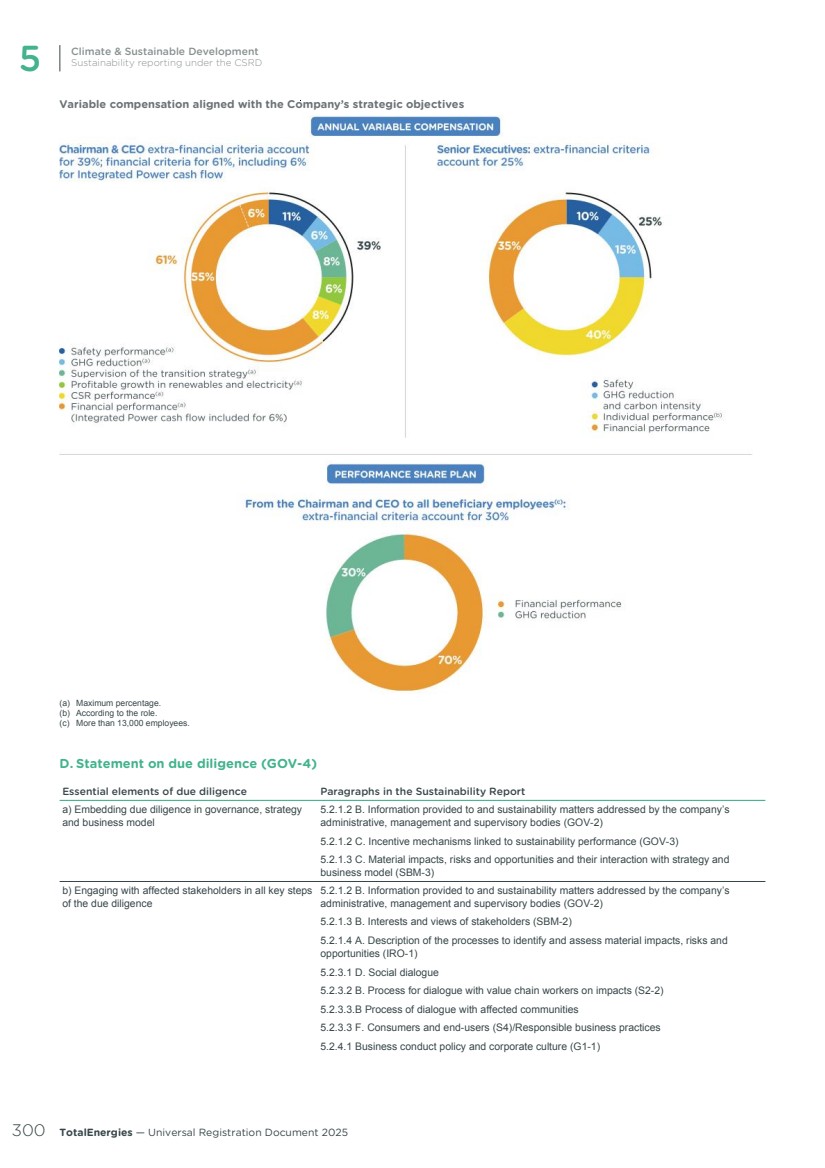
| Essential elements of due diligence Paragraphs in the Sustainability Report c) Identifying and assessing adverse impacts 5.2.1.4 A. Description of the processes to identify and assess material impacts, risks and opportunities (IRO-1) 5.2.1.3 C. Material impacts, risks and opportunities and their interaction with strategy and business model (SBM-3) d) Taking action to address those adverse impacts 5.2.2.1 A. Strategy/1. Transition strategy for climate change mitigation 5.2.2.1 B. Impact, risk and opportunity management/2. Actions and resources in relation to climate change policies (E1-3) 5.2.2.2 B. Targets, actions and resources related to pollution at operated sites (E2-2, E2-3) 5.2.2.3 D. Actions and resources (E3-2) 5.2.2.4 E. Actions and resources related to biodiversity and ecosystems (E4-3) 5.2.2.5 C. Actions relating to resource use and the circular economy (E5-2) 5.2.3.1 Company workforce (S1) 5.2.3.2 D. Description of actions concerning material impacts on value chain workers, approaches to managing material risks and seizing material opportunities concerning value chain workers, and effectiveness of these actions (S2-4) 5.2.3.3 C. Processes to remedy negative impacts and channels for affected communities to voice their concerns 5.2.3.3 Consumers and end-users (S4) 5.2.4 Corporate governance information e) Tracking the effectiveness of these efforts and communicating 5.2.2.1 C. Metrics and targets 5.2.2.2 B. Targets, actions and resources related to pollution at operated sites (E2-2, E2-3) 5.2.2.2 C. Quantitative data on substance releases to water, air and soil (E2-4) 5.2.2.3 C. Voluntary targets related to water resources (E3-3) 5.2.2.3 E. Water indicators (E3-4) 5.2.2.4 D. Targets related to biodiversity and ecosystems (E4-4) 5.2.2.4 F. Impact indicators related to biodiversity and ecosystems change (E4-5) 5.2.2.5 B. Targets related to resource use and the circular economy (E5-3) 5.2.2.5 D. Raw materials used by TotalEnergies for its activities (E5-4) 5.2.2.5 E. TotalEnergies products from the circular economy and waste (E5-5) 5.2.3 Social information 5.2.3.2 E. Description of targets for managing material negative impacts, promoting positive impacts and managing material risks and opportunities (S2-5) 5.2.3.3 E. Targets for managing material negative impacts, promoting positive impacts and managing material risks and opportunities 5.2.3.3 Consumers and end-users (S4) 5.2.4 Corporate governance information E. Risk management and internal control over sustainability reporting (GOV-5) Main features of risk management and internal control processes relating to consolidated sustainability reporting The internal control and risk management processes relating to consolidated sustainability reporting form part of the Company’s overall internal control and risk management systems (refer to point 3.3 of chapter 3). As regards sustainability, internal control covers the processes that feed sustainability reporting, and primarily the processes for producing and disclosing sustainability reports. The associated internal control system, based on the reference framework of the Committee of Sponsoring Organizations of the Treadway Commission (COSO), is designed to ensure compliance with regulations, the correct application of standards and methods for the preparation of sustainability information as well as the reliability of sustainability reporting by controlling the production of sustainability information and its consistency with the information used to prepare the dashboards at each relevant level of the organization. The development and production of sustainability information is based on a system of accountability defined and formalized at all levels of the organization. The development, collection and consolidation of quantified sustainability indicators are based in particular on a reference framework of standards and integrated systems that enable data to be reported by business segments and operational entities in a timely fashion. The internal control of quantified sustainability indicators relies on: – updating and controlling the scope of coverage; – updating indicators and controlling calculation parameters; – a consistency check on source data; – data verification and consolidation at business segment level; – consolidation checks at Company level. Once produced, sustainability information is reviewed by General Management, then presented to the Audit Committee before being approved by the Board of Directors. The main features of the risk management system for consolidated sustainability reporting are as follows: – a set of calculation rules and methods formalized in industry guides; – IT tools to automate data collection; – validation of data consistency and reliability at each relevant level of the organization (entity, segment, functional line, holding company); Climate & Sustainable Development Sustainability reporting under the CSRD 5 TotalEnergies — Universal Registration Document 2025 301 |
| – monitoring of new sustainability standards in preparation as well as changes to the applicable in-house business line reference framework in order to assess and anticipate their impacts on the disclosing of sustainability information; – framework notes specifying procedures and timetables for reporting. Risk assessment The assessment of the risks associated with the preparation and disclosure of sustainability information is based on an examination of: – the characteristics of the information collected; – the applicable management framework (rules, calculation methodologies); – the perimeter, its evolution and the materiality of the various contributing entities; – information reporting procedures, the applications that support these processes and the controls that govern their operation. This examination identifies risks that could significantly affect data quality and integrity (completeness, accuracy, validation and security), taking into account their criticality. The main risks in the process of compiling sustainability information and the associated controls relate to: – data completeness (data sources not taken into account, incomplete scope of calculation and consolidation); – their accuracy (input or calculation errors, incorrect application of measurement or conversion methods); – data validation (insufficient or ineffective review); – protection of data integrity (unauthorized access, accidental or malicious alteration or loss). The risks and controls relating to the applications that support the production of sustainability information concern: – assigning and updating IT access and other permissions; – monitoring technical incidents and user anomalies; – review of technical and functional developments; – management of application outsourcing and internal control of solution providers. Integration of risk assessment results and internal controls The preparation and disclosure of consolidated sustainability information, like any TotalEnergies activity, process or management system, may be subject to internal audit by the Company’s Audit & Internal Control department. The audit plan, which is based on an analysis of the risks and risk management systems, is submitted annually to the Executive Committee and the Audit Committee. If areas of improvement are identified, this work is made the subject of action plans which are shared with operators and the implementation of which is closely monitored by the competent functional lines and entities and by the Audit & Internal Control Division. They may also contribute to the development of the reference framework applicable to the functional lines concerned. Communication to administrative, management and supervisory bodies The principles of control over sustainability reporting derive from the rules of corporate governance. These rules task the Board of Directors’ Audit Committee with monitoring the effectiveness of the internal control and risk management systems and of the internal audit, particularly as regards the procedures for preparing and dealing with accounting, financial and extra-financial reporting. The assessment of the internal control and risk management system is mainly overseen by the Audit & Internal Control Division, which belongs to the Strategy & Sustainability Division. In addition, consolidated sustainability information is reviewed 5.2.1.3 Strategy (SBM-1 to SBM-3) A.Strategy, business model and value chain (SBM-1) TotalEnergies is a global integrated multi-energy company producing and supplying energy: oil and biofuels, natural gas, biogas and low-carbon hydrogen, renewables and electricity. With more than 100,000 employees, TotalEnergies’ mission is to provide more affordable, available and sustainable energy to as many people as possible. Present in some 120 countries, TotalEnergies places sustainable development at the heart of its strategy, projects and operations. TotalEnergies’s ambition in terms of sustainable development and energy transition towards carbon neutrality, together with society 1) TotalEnergies Climate Ambition TotalEnergies supports the Paris Agreement, with its call to reduce greenhouse gas emissions in the context of sustainable development and poverty eradication, and its overarching goals to limit planetary warming to well below 2°C by 2100 compared with pre‑industrial levels. Climate change is a reality and requires the collective mobilization of all stakeholders. The 2015 Paris Agreement significantly raised the awareness of the need to tackle climate change and prompted an enhancement of collective action to start transitioning the global energy system. A massive transformation of the world’s energy systems is needed to achieve the Paris goals. The dual challenge of “more affordable energy for all and less carbon emissions” is a challenge for society as a whole, where governments, investors, companies and consumers all have important roles to play. In 2020, TotalEnergies outlined for the first time its ambition to aim for carbon neutrality together with society. The adoption of this ambition was supported by the strategy to become a broad-based energy company, expanding from oil and gas to low carbon electricity and low carbon energies. It was also part of a shareholder dialogue process with Climate Action 100+ (CA 100+), a coalition of investors committed to the energy transition. This ambition set out three steps for TotalEnergies to get to Net Zero together with society: net zero for TotalEnergies’ global operated emissions (Scope 1+2), net zero covering direct and indirect emissions (Scope 1+2+3) in Europe, and a 60% reduction in the average carbon intensity of energy products sold to our customers (CI) globally by 2050 compared to 2015. In 2021, as a result of a continuous dialogue with some shareholders, the Board of Directors broadened the net zero ambition together with society so as to cover direct and indirect emissions (Scope 1+2+3) on a worldwide basis. Within the framework of its first corporate sustainability report (CSRD) published in March 2025 as required by the EU, TotalEnergies characterized its “together with society” approach by underlining some dependencies and uncertainties: “The energy transition requires the participation of all stakeholders, from regulatory authorities to end customers and industrial players. TotalEnergies is deploying a strategy that supports this collective transition and will enable our Company to adapt to the various scenarios that may materialize depending on developments in low-carbon technologies (speed of penetration, cost reduction), geopolitical relations, international trade, and consumer behavior.” 5 Climate & Sustainable Development Sustainability reporting under the CSRD 302 TotalEnergies — Universal Registration Document 2025 [REDACTED SECTION: CERTAIN TEXT HAS BEEN REDACTED.] |
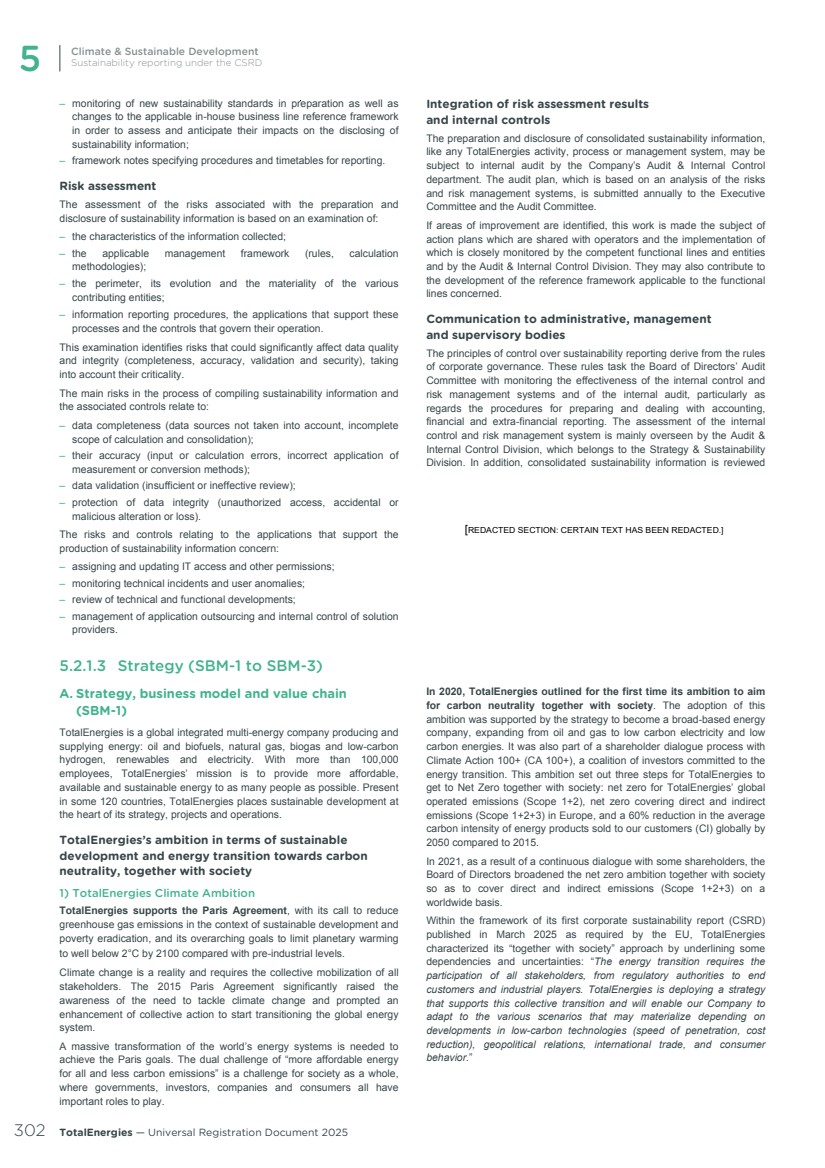
| 2) TotalEnergies’ energy transition strategy supporting the Ambition As part of this Ambition, the Company has defined and consistently implemented a balanced transition strategy based on two pillars: – An Oil & Gas pillar centered on low cost and low emission projects: the company continues to invest in existing fields and new oil and gas projects, and plans to increase its production of hydrocarbons – mainly LNG, a key energy source for the energy transition – by 3% per year on average until 2030, so as to meet growing energy demand and fight the natural decline of oil and gas fields (averaging 6-7% per year for the industry according to the 2025 IEA report). In parallel, TotalEnergies has published a roadmap to reduce emissions from its operations: it aims to achieve a 40% net reduction in its operated emissions (Scope 1+2) in 2030 compared to 2015, and an 80% reduction in its operated methane emissions in 2030 or sooner compared to 2020. – An Integrated Power pillar: the Company is building a competitive portfolio of renewable (solar, onshore wind, offshore wind) and flexible assets (CCGT, storage) to provide its customers with low-carbon electricity available 24 hours by 7. We plan to increase our electricity production to more than 100 TWh by 2030, which would represent 20% of our energy production by that date. In addition, we are investing in low-carbon molecules, particularly biofuels and sustainable aviation fuels (SAF). A key measure of our contribution to the transition of our customers and the global energy systems is the life-cycle Carbon Intensity of the energy products sold to our customers (CI). The decline in our CI reflects our progress in implementing our transition strategy, since it means that the carbon content of the energy products we sell to our customers is decreasing, on an energy unit basis. In 2025 our life-cycle Carbon Intensity was down by more than 18% compared to 2015. By 2030 we target a reduction of 25%. Our 2025 earnings demonstrate that our differentiated strategy built around these two pillars is delivering best in class returns, thereby creating long term value for our shareholders while supporting our climate ambition. 3) Ten years after the Paris Agreement: Confronting Net Zero ambitions to realities While the Company’s transition strategy is based on solid market fundamentals and will be consistently pursued, the Company notes that the context in which its Ambition was adopted has evolved. a) Ten years after the Paris Agreement, the global energy system has progressed by enabling the continued development of emerging economies while reducing the carbon intensity of the energy mix. Affordable low-carbon technologies have experienced spectacular growth, for example solar panels or, in some parts of the world, electric vehicles. Yet the share of fossil fuels in the overall energy mix has hardly moved (from 82% to 80%) because the cleaner energy sources have not eliminated traditional energies but have mostly been added to the existing system as population and energy demand continue to grow steadily. Since 2015, economic and geopolitical conditions have shifted, with rising interest rates making transition finance more expensive and the weaponization of energy putting energy security at the top of every country’s agenda. States have to balance the energy trilemma between energy reliability, energy affordability and sustainability. Non-State actors have had to balance these competing priorities too. Our societies and economies have initiated an energy transition but the global economy is not yet achieving the pace of change required to meet the Paris Agreement objectives. Against this backdrop, at COP30 in Belem in Nov. 2025, there was a common finding – by UNFCCC, UNEP and the international community - that the updated Nationally Determined Contributions for 2035 provided by the States fall behind what is needed to reach the Paris goals. b) The current scientific consensus now emphasizes that the goal of limiting global warming to 1.5°C above pre-industrial levels is out of reach. Climatologists, including ones contributing to the IPCC work, and scientists have explicitly shared these views with the media and the public at large in 2025. Similarly, the International Energy Agency states in its 2025 World Energy Outlook report that “It is now all but certain that 1.5°C of warming will be exceeded within a decade or less, and that pathways that limit this overshoot of 1.5°C to low levels have now slipped out of reach.” These scientific findings are closely linked to the inertia of the energy system, which still relies on fossil fuels for nearly 80% of its energy: despite the massive deployment of solar and wind, coal still plays a dominant role in electricity generation and accounts for three-quarters of the 14 billion tons of CO2 emitted each year by power plants; the penetration of low-carbon technologies to electrify and decarbonize uses is hampered by cost considerations and sometimes by technological maturity constraints. c) The legal and regulatory framework applicable to sustainability and climate has evolved. For European companies, the corporate sustainability reporting directive (CSRD) and associated reporting standards (ESRS) in force since 2025 have established a legally binding framework: targets using the words “net zero” require the adoption of “transition plans” (as defined by the regulations), and companies that adopt such plans must explain how these plans are compatible with a warming trajectory of 1.5°C by 2050 — which we know the scientific consensus now considers out of reach. Based on the current state of scientific knowledge, in light of the growing heterogeneity of energy pathways at the global level, the reliance by forward‑looking scenarios on assumptions that may not materialize, and the ongoing uncertainties regarding the evolution of global energy demand, worldwide GHG emissions and the effective pace of deployment of low‑carbon technologies, the Company is not in a position to adopt a transition plan as defined by the ESRS E1 and, as a result, cannot formulate “Net Zero” targets in the meaning of this standard. 4) The pathways to our carbon neutrality ambition together with society will need to be reassessed and adapted over time In order to take these realities into account, particularly the legal framework created by the European corporate sustainability reporting directive regarding “Net Zero” taxonomy, TotalEnergies has no choice but to evolve the wording and to precise the dependencies of its carbon neutrality ambition, together with society. “More Energy, Less Emissions, Fully engaged in our transition strategy” TotalEnergies is fully engaged in its balanced, value-creating, transition strategy based on 2 pillars: an oil & gas pillar and an integrated power pillar. This transition strategy supports TotalEnergies’ ambition for carbon neutrality, together with society, within the framework set out by the Paris Agreement’s objectives. We acknowledge that our ability to achieve carbon neutrality is linked to our own efforts and to society’s broader progress in this area. Climate & Sustainable Development Sustainability reporting under the CSRD 5 TotalEnergies — Universal Registration Document 2025 303 |
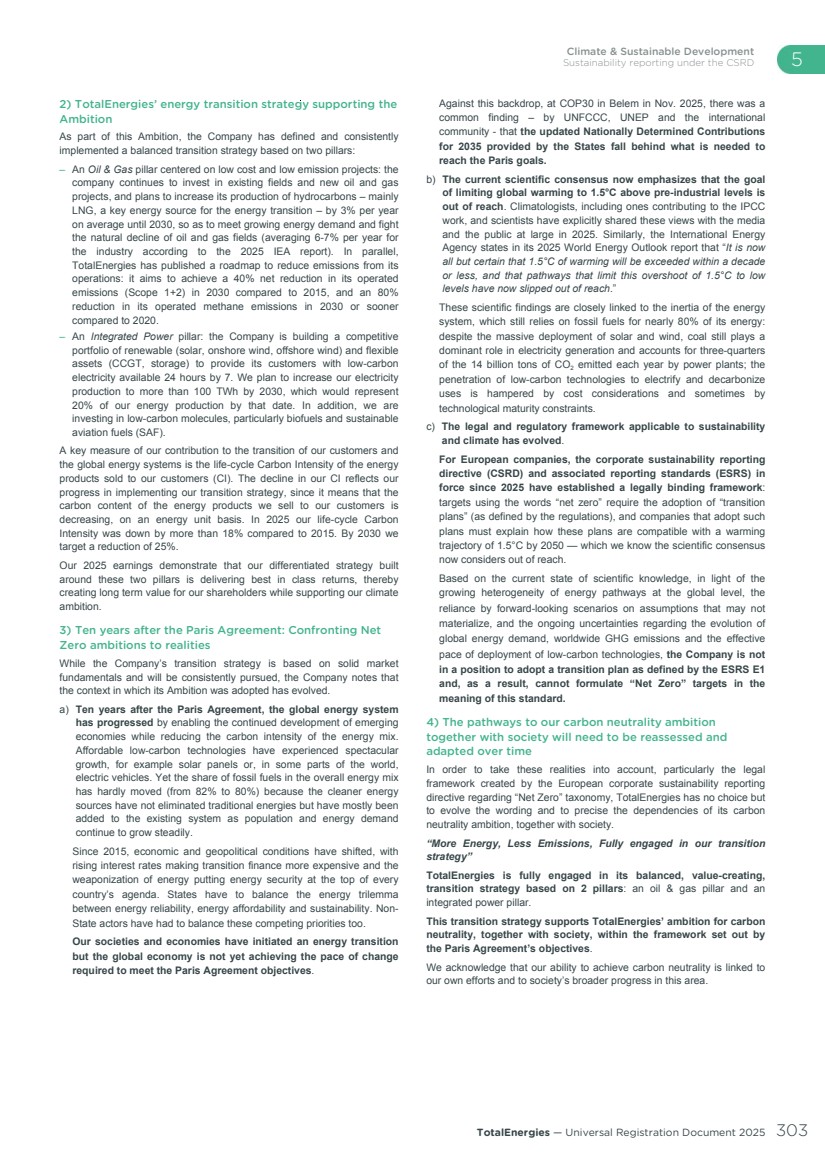
| Therefore: – TotalEnergies aims to achieve carbon neutrality for its global operated emissions (Scope 1+2) by 2050, – The Company works proactively with its customers to help execute their own energy transition strategies and puts on the market a mix of energies with a lower carbon intensity year after year. Our ability to do so depends critically on the pace and affordability of technical innovation, on public policies and on consumers’ behavior. This is what is encapsulated in “together with society”. Without the right policies and enough cost-efficient innovation, carbon neutrality by 2050 will remain out of reach – for society and for TotalEnergies. As a result of these dependencies, the pathways to our carbon neutrality ambition will need to be reassessed and adapted over time. On the way to its ambition, TotalEnergies confirms its targets set for 2030 for reducing emissions worldwide: a 40% net reduction of its Scope 1+2 operated emissions compared to 2015, an 80% reduction of its operated methane emissions in 2030 or sooner compared to 2020 and a 25% reduction of its life cycle carbon intensity (CI - Scope 1+2+3) of the energy products sold to its customers compared to 2015. 2030: Our objectives for more energy and less emissions TotalEnergies continues to implement its integrated multi-energy strategy, which is balanced with the evolution of the oil, gas and electricity markets. Anchored on two pillars - hydrocarbons, in particular LNG, and electricity, the energy at the heart of the transition - the Company is deploying its balanced transition strategy while guaranteeing an attractive policy of return to shareholders. To execute this strategy, TotalEnergies plans to invest $14 to $16 billion per year over the 2026-2030 period. Overall, TotalEnergies intends to maintain a material level of investment in low-carbon energies, mainly in the Integrated Power segment with a total investment effort ranging from $3 and $4 billion per year over 2026–2030, including around $1 billion per year in shares over five years as part of the transaction with EPH. With its broad portfolio of assets, the Company can remain selective when it comes to external growth in oil & gas. Moreover, it retains the flexibility to arbitrate projects in response to market conditions should the need arise. Over the decade 2020-2030, TotalEnergies’ energy transition strategy based on two pillars is reflected in the production targets shown below. TotalEnergies plans to increase its energy production (oil, gas and electricity), overall by 4% per year between 2024 and 2030. In 2025, its electricity production accounted for nearly 10% of its hydrocarbon production. Its objective is to increase it to 20% in 2030. At the same time, the Company is pursuing its trajectory of reducing its emissions (Scope 1+2 CO2 and methane) from its operated facilities with the view to reducing net emissions(1) by 40% compared with 2015 and to reducing its operated methane emissions by 80% in 2030 or sooner compared to 2020. The growth of its electricity sales allows the Company to target a 25% reduction in the lifecycle carbon intensity(2) of its sales by 2030 compared to 2015. Energy Production (PJ/d) GHG Emissions, Scope 1+2 from TotalEnergies’ operated facilities (Mt CO2e) (a) Net of nature-based carbon sinks. Lifecycle carbon intensity of the energy products sold(a) Scope 1+2+3, base 100 in 2015 (a) Lifecycle carbon intensity of energy products sold (refer to the glossary). Methane emissions from TotalEnergies’ operated facilities (Kt CH4) (1) The calculation of net emissions includes nature-based carbon sinks projects as from 2030. (2) Lifecycle carbon intensity of energy products sold (refer to the glossary). 5 Climate & Sustainable Development Sustainability reporting under the CSRD 304 TotalEnergies — Universal Registration Document 2025 |
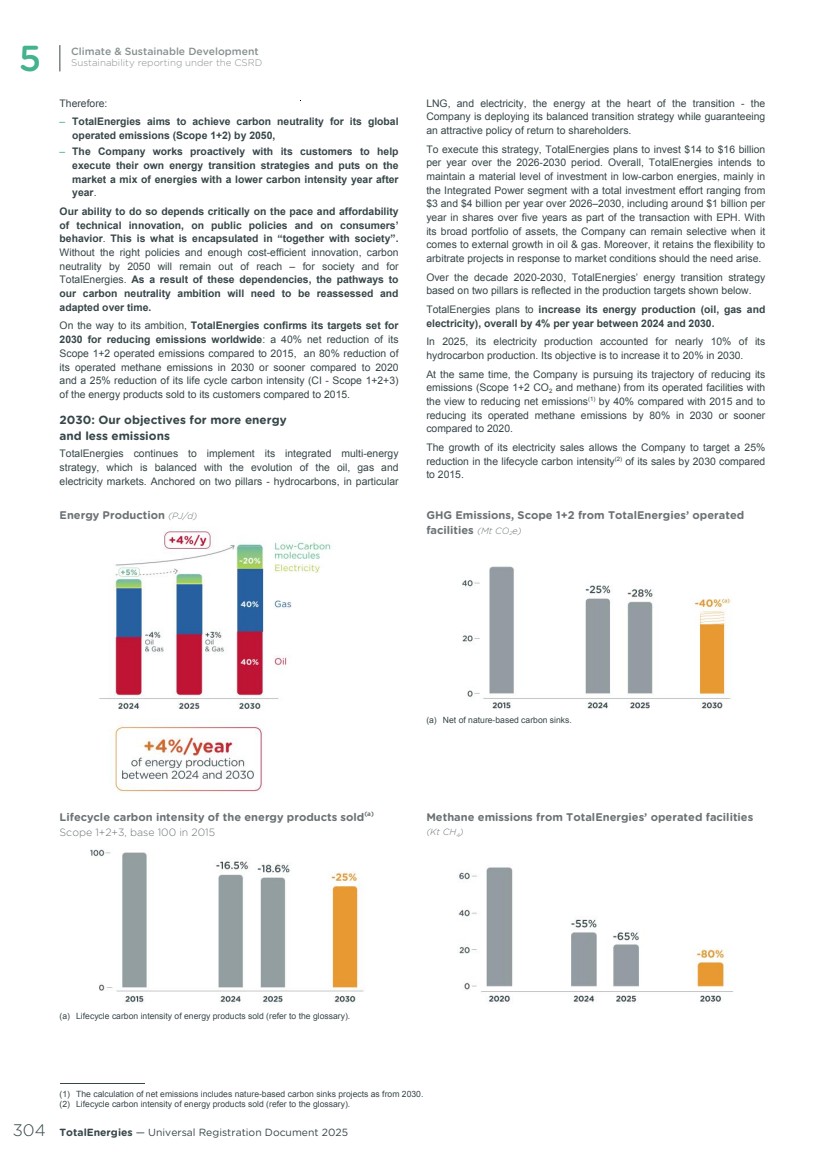
| Business model and value chains TotalEnergies’ value-creation model is based on integration across the entire energy value chain (refer to point 1.1.3 of chapter 1): from oil and gas exploration and production, power generation, refining, natural gas liquefaction, petrochemicals, energy trading, transportation and storage, to energy distribution to end-users. This integrated model enables the Company to take advantage of the synergies that exist between its various activities, while responding to the volatility of raw material prices. It expresses the complementary nature of the Company’s Upstream activities, which are more dependent on oil prices, with those of its Downstream activities, which, when cycles are low, can benefit from added value that the Upstream would not otherwise enjoy. The integration of activities across the entire value chain makes it possible to resist better at the bottom of the cycle, while fully capturing margins across the entire value chain when the market is more favorable. This integrated model is also applied by TotalEnergies to the electricity and renewable energies businesses within Integrated Power, where the Company has positioned itself as the second pillar of its growth, alongside the pillar oil & gas. The Company provides them with the leverage of the know-how and resources of its business model: global brand and coverage, technical expertise in offshore and trading, and partnerships with governments and local authorities. Accelerating growth in electricity and renewable energies has diversified the Company’s geographic risk profile. The Company’s strategy of balanced transition, in favor of the energy transition, strengthens the sustainability and resilience of its value creation model. Hydrocarbons value chain a. Upstream oil & gas activities - A sustainable, low-cost, low-emissions portfolio TotalEnergies’ Upstream encompass oil and gas exploration and production. They are carried out in around 50 countries. In 2025, production reached 2.5 Mboe/d, including 1.4 Mboe/d of oil and 1.2 Mboe/d of gas. The Middle East - North Africa zone accounts for 34% of production, Europe 21%, Africa 17%, the Americas 18% and Asia -Pacific 10%. In 2025, global demand for petroleum products reached 104.0 Mb/d, i.e., +0.98 Mb/d (+~1%) compared with 2024, and should continue to grow over the decade (105.5 Mb/d in 2030 according to the IEA(1)). Beyond 2030, the trajectories of the various forecasters vary between moderate growth, a plateau and the start of a decline. These demand forecasts remain dependent in particular on demographic and economic growth, the rate of penetration of low-carbon technological innovations such as electric vehicles, and changes in behavior. In addition, demand is likely to evolve differently according to the energy transition roadmaps of the various countries. It is expected to continue increasing through 2030- 2040, and could begin to decline thereafter, but at a slower pace than the natural decline rate of existing fields, which the IEA estimates at an average of 8% per year over the next decade(2) . TotalEnergies therefore considers that new oil projects are needed to meet this demand and keep prices at an acceptable level, so as to create the conditions for a just transition that allows people time to adapt their energy use. The Company takes sustainability issues into account in its Upstream oil & gas activities through a strategy that aims both to meet growing global demand over the decade (driven in particular by demographic growth in emerging countries) and to develop a sustainable portfolio with low costs and low GHG emissions. TotalEnergies aims to increase its Upstream oil & gas production by 3%/y on average between 2024 and 2030 by bringing on stream more than a dozen major projects by 2030, starting in 2025-2026 (oil: Anchor, Ballymore in the United States, Mero 2-3-4 in Brazil, Ratawi Phase 1 in Iraq and Tilenga in Uganda and gas: Fenix in Argentina and Jerun in Malaysia). In addition, the Company has sanctioned projects in 2024 to ensure its medium-term growth, notably GGIP Phase 2 in Iraq. The projects developed are well positioned on the merit curve, enabling them to generate value for the Company even in a low-price scenario. Global oil projects merit curve Technical costs, $/boe * After tax breakeven ~25 $/b. Sources: Merit curve: Rystad (projects starting up in 2024–30), TotalEnergies projects: internal data. Over the past 10 years, TotalEnergies has overhauled its upstream oil portfolio to refocus on the least expensive fields to develop, with a technical cost of less than $20/b or an organic cash breakeven point of $30/b and low GHG emissions. For new Upstream oil & gas projects, the Scope 1+2 GHG emissions intensity threshold is lowered to 16 kg CO₂e/ boe as of 2026, compared to 17 kg CO₂e/boe previously. In Nigeria, TotalEnergies finalized the sale of its non‑operated interest in the Bonga field and signed an agreement to divest its oil interest in Renaissance (formerly SPDC). The Company also completed the divestment of its non‑operated interests in the three Ekofisk satellite fields in Norway, in two unconventional blocks in Vaca Muerta in Argentina, and in Gato do Mato in Brazil. Faced with uncertainties in assessing demand, TotalEnergies implements a disciplined and sustainable investment strategy on short-cycle projects, and maintains the competitiveness of its portfolio by activating various levers aimed at achieving a low breakeven point. The flexibility of its portfolio enables it to adjust its investments and production to the pace of the energy transition, notably through the natural decline of the fields in its portfolio. Faced with the challenge of climate change, TotalEnergies is committed to promoting the use of natural gas, the lowest-emission fossil fuel, which emits half as much greenhouse gas as coal when used to generate electricity(3) . In 2015, TotalEnergies ceased its coal production activities with the sale of Total Coal South Africa. b. Liquefied Natural Gas activities Within the gas markets, TotalEnergies’ priority is to position itself across the entire liquefied natural gas value chain (including upstream and LNG activities, midstream, gas trading, transport and sales), a global market expected to grow by 5 to 6% a year between 2025 and 2030(4) . (1) Source: IEA, Oil Market Report, January 2026. (2) Source: The Implications of Oil and Gas Field Decline Rates (IEA, September 2025). (3) Source: IEA, The Role of Gas in Today’s Energy Transitions. (4) Source: TotalEnergies internal projections. Climate & Sustainable Development Sustainability reporting under the CSRD 5 TotalEnergies — Universal Registration Document 2025 305 [REDACTED SECTION: CERTAIN TEXT HAS BEEN REDACTED.] |
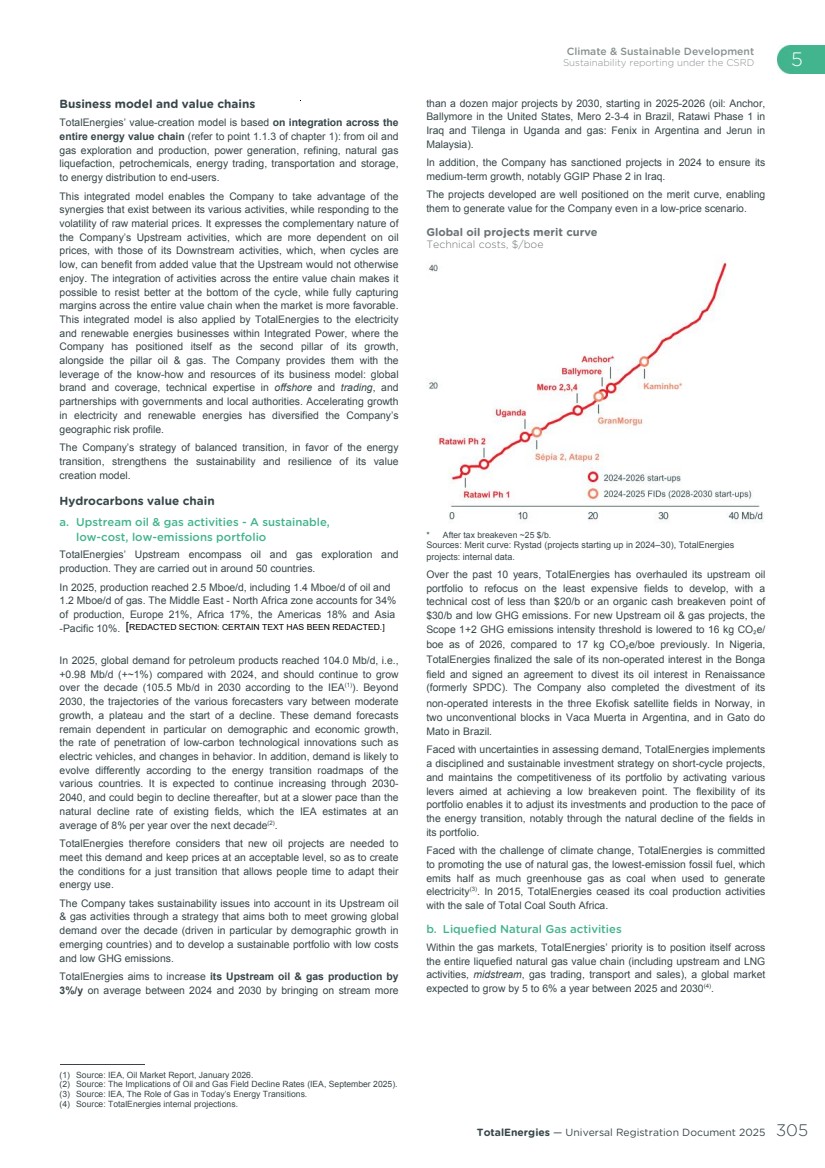
| TotalEnergies intends to consolidate its position as a major player in the LNG value chain, as it is an energy that favors transition. Although it is a fossil fuel, gas half as emits much as coal in electricity generation(1) . In addition, gas is a flexible complement to intermittent and seasonal renewable energies for electricity generation. As the world’s 3 rd largest LNG player, with a diversified sales portfolio of ~44 Mt in 2025 and a market share of around 10% in 2025, TotalEnergies is the leading importer in Europe. TotalEnergies’ LNG sales reached 18.4 Mt in 2025, compared with 13.8 Mt in 2024 and 22.8 Mt in 2023, and it has a regasification capacity of 19 Mt/y. The Company is also the leading exporter to the United States (with more than 19 Mt in 2025(2)). TotalEnergies is strengthening its presence upstream, through stakes in liquefaction plants located in major production zones. LNG volumes (from equity and long-term thrid-party purchases, excluding Russia after 2027) are expected to grow by 50% between 2025 and 2030, with the commissioning of North Field East in Qatar, Nigeria LNG T7 and ECA in Mexico in 2026. From 2027 to 2029 will follow the start-ups of other projects currently under construction: Qatar North Field South, Rio Grande LNG in the United States, Marsa LNG in Oman and Mozambique LNG. The Company enhances the flexibility and resilience of its LNG portfolio by investing in competitive projects that are best positioned on the merit curve (refer to chart below). This strategy enables it to take advantage of both the high cycles with higher prices and the low cycles expected following the launch of additional capacity by 2027-2029, when it should benefit from the recovery in global demand. In addition, the Company has undertaken to reduce its exposure to indices spot gas by signing long-term contracts, with nearly 8 Mt/y of medium-to-long-term sales contracts signed in 2024 and 2025 in Asia, mainly indexed to Brent and offering more arbitrage options. To reduce its exposure to the American Henry Hub index, TotalEnergies is strengthening its upstream integration, notably through the position it is currently building in the Eagle Ford, Anadarko and Barnett basins. LNG projects merit curve $/mcf DES Asia, breakeven at 11% discount Sources: Merit curve: Goldman Sachs Top Projects (HH= 3 $/Mcf). TotalEnergies projects: internal data, shareholder view. c. Downstream activities TotalEnergies is active in downstream oil activities through: – Refining-Chemicals, which includes refining, base petrochemicals (olefins and aromatics), polymer derivatives (polyethylene, polypropylene, polystyrene, hydrocarbon resins) including biopolymers and recycled polymers obtained by chemical or mechanical recycling, – as well as the production of biofuels from biomass processing, and the production of specialty fluids, and, since July 2025, the development of green hydrogen volumes intended to supply the Company’s European refineries, previously reported under the Integrated LNG segment. The Refining-Chemicals business also includes Hutchinson’s elastomer processing activities. These activities are mainly based in Europe. – Marketing & Services, present in around 100 countries, comprises the worldwide supply and marketing of petroleum products and services, low-carbon fuels and new energies for mobility. Its main markets are in France, Africa and, to a lesser extent, the Americas and Asia-Pacific. – Trading-Shipping, whose primary mission is to sell the Company’s crude oil production on world markets, supply TotalEnergies’ refineries competitively, charter the vessels required for these activities, and intervene on the various derivatives markets. TotalEnergies’ Downstream business has been a steady contributor to the Company’s results while transitioning and adapting its activities to focus on high value-added markets. In particular, it aims to align its refined and sold volumes with its Upstream production (down -15% for refined volumes and -30% for sold volumes since 2019). The Company is addressing the sustainability challenges of its downstream activities through 3 levers: – Lowering the breakeven point of its refining-petrochemicals assets in a cyclical industry; – Reducing GHG emissions from its operations; – Offering customers low-carbon mobility solutions. In Refining & Chemicals, TotalEnergies is strengthening the resilience of its assets across cycles by capitalizing on the most important platforms, lowering their breakeven points and emissions. In petrochemicals, it sanctions the most profitable and resilient projects with access to competitive feedstock, such as the Admiral project in Saudi Arabia, scheduled to come on stream in 2027. In biofuels, TotalEnergies is capitalizing on its existing assets to produce SAF (Sustainable Aviation Fuels), either through low-capital-cost projects relying on the co-processing of waste‑ and residue‑derived feedstocks (used cooking oils and animal fats), excluding first-generation 1G biomass (which competes with food consumption), in existing jet plants, or by converting existing refineries into biorefineries. In addition, it secures access to competitive feedstock through partnerships with waste and residue suppliers, such as the one signed with Saria, and through its biofuels trading business. The company works closely with airlines to define SAF specifications, and has signed strategic partnerships with Air France-KLM and Airbus. Finally, for Marketing & Services TotalEnergies executes a three-fold Value over Volume strategy: – Network: focusing on geographies where it has a competitive advantage, such as France, Africa and certain niche markets, in order to adapt to the evolving demand for petroleum products, particularly in Europe as part of the implementation of the “Fit for 55” program; – Lubricants: differentiating in high value-added, high-margin products and develop more sustainable products to meet growing demand for circular products (RRBO)(3) . – Electric mobility: align its investments with the pace of electric vehicle adoption by users, expand its footprint in high-power charging in Europe and deploy a low-equity business model (partnerships and leverage). (1) Source: IEA, The Role of Gas in Today’s Energy Transitions. (2) Source: TotalEnergies data. (3) Re-Refined Base Oils. 5 Climate & Sustainable Development Sustainability reporting under the CSRD 306 TotalEnergies — Universal Registration Document 2025 |
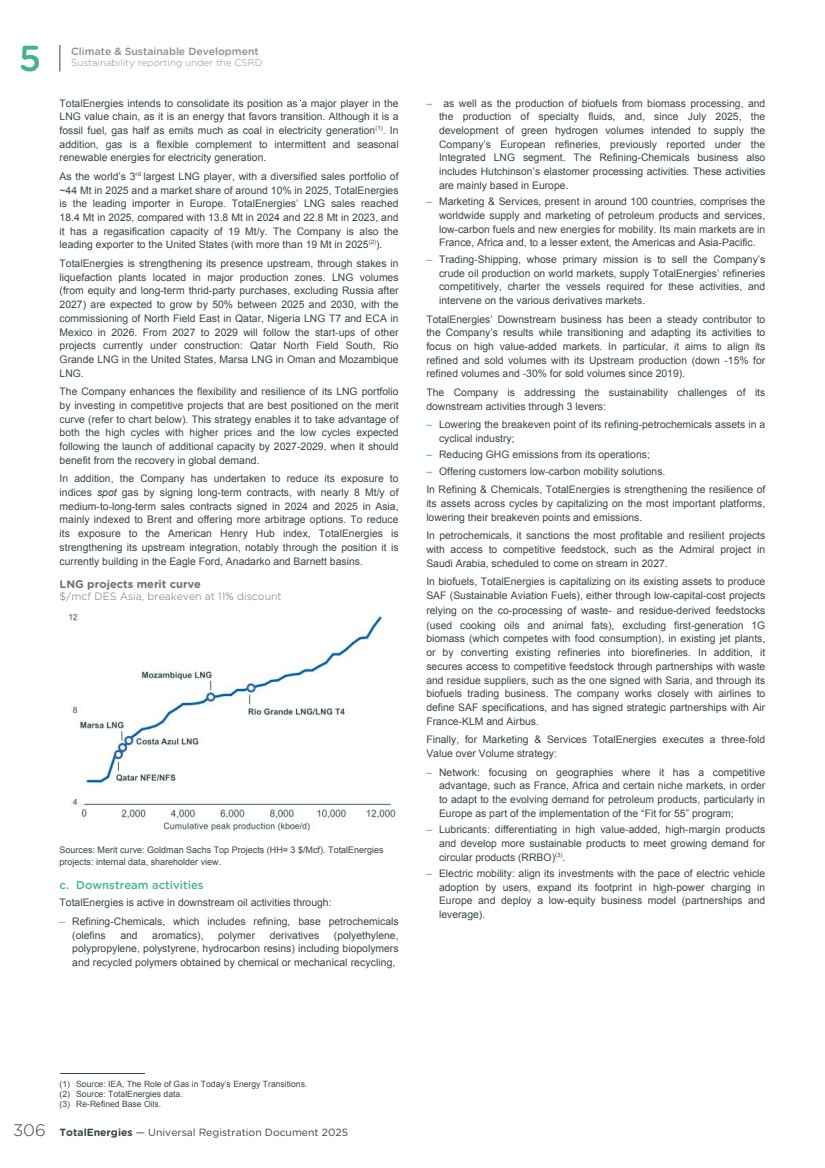
| Electricity value chain Essential for a successful energy transition, electricity demand, is expected to grow by almost 3%/y over the decade, driven by the electrification of emerging countries(1) , the decarbonization of countries committed to a net-zero roadmap, and the digitization of uses. To meet this demand, Integrated Power, the second pillar of the Company’s strategy, is developing an integrated model covering the entire value chain, from power generation to sales activities, and should account for 20% of TotalEnergies’ hydrocarbon production by 2030. The profitability objective for this sector includes achieving a positive free cash flow(2) from 2027 and a ROACE(3) of approximately 12% by 2028, aligning with its oil & gas activities in an price environment of a Brent at $60/b. TotalEnergies plans to produce 100-120 TWh of electricity on an equity share basis by 2030, mainly from renewable sources. As part of its transformation into an integrated multi-energy company, TotalEnergies is building a competitive portfolio of renewable assets (solar, onshore and offshore wind) and flexible (CCGT, battery storage) to provide its customers with an increasing share of carbon-free electricity available 24/7. In 2025, over 70% of TotalEnergies’ electricity production is located in deregulated markets, mainly in Europe, the United States (ERCOT and PJM) and Brazil. The Company intends to maintain this ratio anticipating sustained and volatile electricity prices, in a context of strong demand growth and supply constraints. In these deregulated markets, the Company is implementing an integration strategy across the electricity value chain, keeping approximately 30% of its electricity production exposed to market fluctuations. To do so, on the Company leverages its renewable generation capacity, storage solutions, its flexible generation and its power trading activities to capture the best prices. To this end, the Company is developing specialized expertise in electricity trading particularly in short-term markets, flexibility management activities and the structuring of Corporate PPAs, enabling it in particular to provide its customers with a Clean Firm Power offering, a continuous, constant and carbon‑free supply of electricity. In regulated markets, TotalEnergies is implementing a targeted growth strategy: – in oil- and gas-producing countries, to support their energy transition relying on the Company’s local presence and historical activities to develop multi-energy projects, particularly in renewables; – in the rest of the world, it is selectively developing projects, focusing on markets large enough to benefit from economies of scale (such as India and South Africa) and through strategic partnerships with local players. The key levers for achieving profitable growth with an average of return on capital reaching 12% include selectivity in project choices, integration across the entire electricity value chain, cost control by leveraging the Company’s expertise in project management and offshore development, mobilization of external financing at competitive rates and farm-downs to accelerate cash flow generation and diversify portfolio exposure. Breakdown of sales from hydrocarbon activities Sales (in $M)(a) 2025 Oil 125,999 Gas 19,426 Cumulative 145,425 (a) Sales shown above correspond to Revenues from sales as presented in the consolidated statement of income, i.e., sales minus excise taxes. Sales from fossil-gas-related economic activities aligned with taxonomy regulations TotalEnergies does not recognize sales generated by economic activities, aligned with the taxonomy, related to fossil gas, in accordance with article 8, paragraph 7, point a) of the Commission Delegated Regulation (EU) 2021/2178 (refer to point 5.2.2.6 C.). Number of employees by geographic area Headcount as of December 31 2025 Total number of employees 101,513 Breakdown by region Europe 62.2% of which France 34.9% Africa 11.3% North America 5.7% Latin America 13.2% Asia-Pacific 6.5% Middle East 1.0% B. Interests and views of stakeholders (SBM-2) In TotalEnergies’ view, dialogue with its internal and external stakeholders is essential for the Company to conduct its business responsibly and integrate the long-term challenges of sustainable development in its strategy and policies. This dialogue contributes to the identification of the main risks and impacts of the Company’s activities, and more broadly to a better understanding of changing trends and the main societal expectations of each of the major categories of stakeholders. It is also a prerequisite to ensuring that the Company is firmly integrated in its host regions, as well as an effective tool for identifying ways to generate value at the local level. TotalEnergies believes that transparency is an essential principle of action in building a trust-based relationship with its stakeholders and ensuring that the Company is on a path of continuous improvement. For many years, TotalEnergies has been ensuring that it reports on its performance based on the various reporting frameworks commonly used in extra-financial matters. In addition, the Company publishes voluntary reportings according to the standards of the GRI (Global Reporting Initiative) and SASB (Sustainability Accounting Standards Board), and includes in its reporting the “Core” indicators proposed by the World Economic Forum(4) . The Company relied on the recommendations of the TCFD(5) (Task Force on Climate-related Financial Disclosures) to identify climate-related risks and opportunities. TotalEnergies also responds to the CDP water and climate questionnaires. Reportings are available on its website in the pages dedicated to its sustainable development approach and performance indicators are made available to all stakeholders in the ESG Databook 2025. TotalEnergies has structured its dialogue processes with its stakeholders at different levels of the Company, through relays within the organization, requirements included in internal reference frameworks, the deployment of a methodology for conducting local dialogue and a dedicated attention to the professionalization of the teams responsible for fostering that dialogue. (1) Source: IEA Electricity Market Report Update - July 2024. (2) Refer to the glossary for definitions and additional information on alternative performance measures (APM, Non-GAAP measures) and to point 1.8 for reconciliation tables. (3) Refer to the glossary for definitions and additional information on alternative performance measures (APM, Non-GAAP measures) and to point 1.8 for reconciliation tables. (4) Measuring Stakeholder Capitalism Towards Common Metrics and Consistent Reporting of Sustainable Value Creation, White paper, September 2020. (5) From 2024, the TCFD recommendations have been taken up by the ISSB (International Sustainabilty Standards Board). In accordance with the requirements of the European CSRD Directive, TotalEnergies now publishes sustainability information in accordance with the CSRD and in accordance with the ESRS standards (refer to point 5.2.1). In May 2024, EFRAG and the IFRS Foundation published a guide to interoperability between ESRS and ISSB. Climate & Sustainable Development Sustainability reporting under the CSRD 5 TotalEnergies — Universal Registration Document 2025 307 |
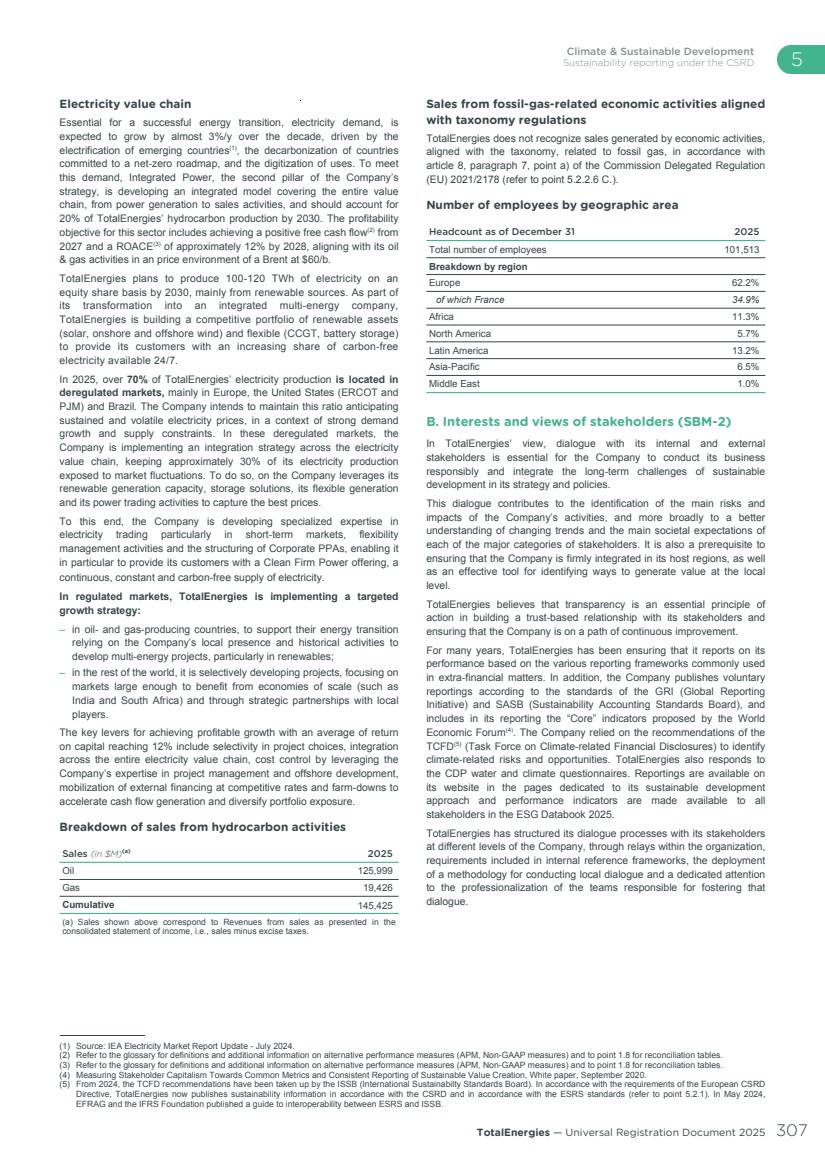
| Those measures are designed to develop a long-term, trust-based relationship founded on principles of respect, attentiveness, constructive dialogue, proactive engagement and transparency, consistent with the legitimate need for confidentiality as appropriate. They also ensure that stakeholder warnings or grievances to be gathered and addressed quickly and that potential controversial situations defused. At a corporate level, each group of stakeholders (employees, employee representatives, customers, investors, shareholders and the financial sector, government officials, suppliers, academics, NGOs and civil society, and the media) has a single point of contact at the corporate level, responsible for responding to their requests, keeping them informed and maintaining an ongoing dialogue in formats appropriate to each concern. Those stakeholder liaisons also provide advice and support to Company subsidiaries when needed. The One MAESTRO framework (Management and Expectations Standards Toward Robust Operations) provides that subsidiaries should conduct a stakeholder mapping and engage in a structured, ongoing process of dialogue with stakeholders to keep them informed, hear and address their concerns and expectations, report on mitigation actions or compensation, measure their satisfaction and identify ways the subsidiaries can improve their societal outreach. This commitment to local dialogue puts special emphasis on residents and communities located near Company facilities. Additionally, preparing and holding the Shareholders’ Meeting feeds the dialogue that the Company maintains with its various stakeholders (investors, shareholders, NGOs). It is one of the ways in which the Board of Directors is informed of the views and interests of stakeholders. The table below gives a non-exhaustive list of the main channels for dialogue with stakeholders: Employees More information Main stakeholders – More than 100,000 employees – Employee representative bodies – Trade unions and employee associations Sections S-1 and 3.6 Main modalities of dialogue – Surveys and questionnaires – Negotiation, concertation, consultation or information of representative bodies – Signing of agreements – Processing of alerts Main tools and frameworks for dialogue – 2 internal opinion surveys(1) alternating every other year: – TotalEnergies Survey: more than 90,000 employees in 122 countries where asked to participate in the latest edition of this 2024 survey; – TotalEnergies Pulse Survey: a survey was launched in 2025 and involved more than 60,000 employees in nearly 120 countries. – Campus with the Executive Committee: by 2025, nearly 300 employees and managers were able to interact directly with the Executive Committee – TotalEnergies European Works Council – Employee representative bodies and collective bargaining: 91.9% of employees had trade union representation and/or employee representation in 2025; 305 agreements signed with employee representatives worldwide were in force in 2025 – Membership of and participation in the Global Deal(2) (since 2017) – Whistleblowing mechanisms Main entities/teams involved – Human resources Main topics of common interest and identified expectations – Health and safety – Physical and mental health, well-being at work, working hours, work organization – Compensation – Training, employability and skills, mobility – Equal opportunity, diversity – Social dialogue – Respect for human rights in the workplace – Social and environmental responsibility Stakeholders interests and points of view taken into account – The surveys (TotalEnergies Survey, Pulse Survey) are part of a continuous improvement cycle that allows to identify areas for improvement at all levels of the Company as well as the construction and deployment of managerial and HR action plans. – Beyond these surveys, exchange formats between employees and members of the Executive Committee are organized to listen to and consider their proposals on key subjects of the Company (for example, accountability(3) in 2025) Sections S-1 and 3.6 (1) TotalEnergies Survey is an in-house opinion survey for all the employees worldwide allowing the Company to gather their views and expectations with regard to their working situation and their perception of the company, both locally and Company-wide. TotalEnergies Pulse Survey is a complementary survey to the TotalEnergies Survey, launched in 2023 by decision of the Executive Committee to enable employee engagement to be measured each year, conducted on a scope Company excluding Hutchinson. (2) International initiative of the OECD and ILO in favor of labor relations (3) A principle that emphasizes the commitment of a profit center manager, in the area for which he or she is responsible and towards the Company, to deliver the expected results, make the decisions required to achieve them, take responsibility for these decisions and report, in a transparent manner, on the results and consequences, both present and future, of his or her actions. 5 Climate & Sustainable Development Sustainability reporting under the CSRD 308 TotalEnergies — Universal Registration Document 2025 |
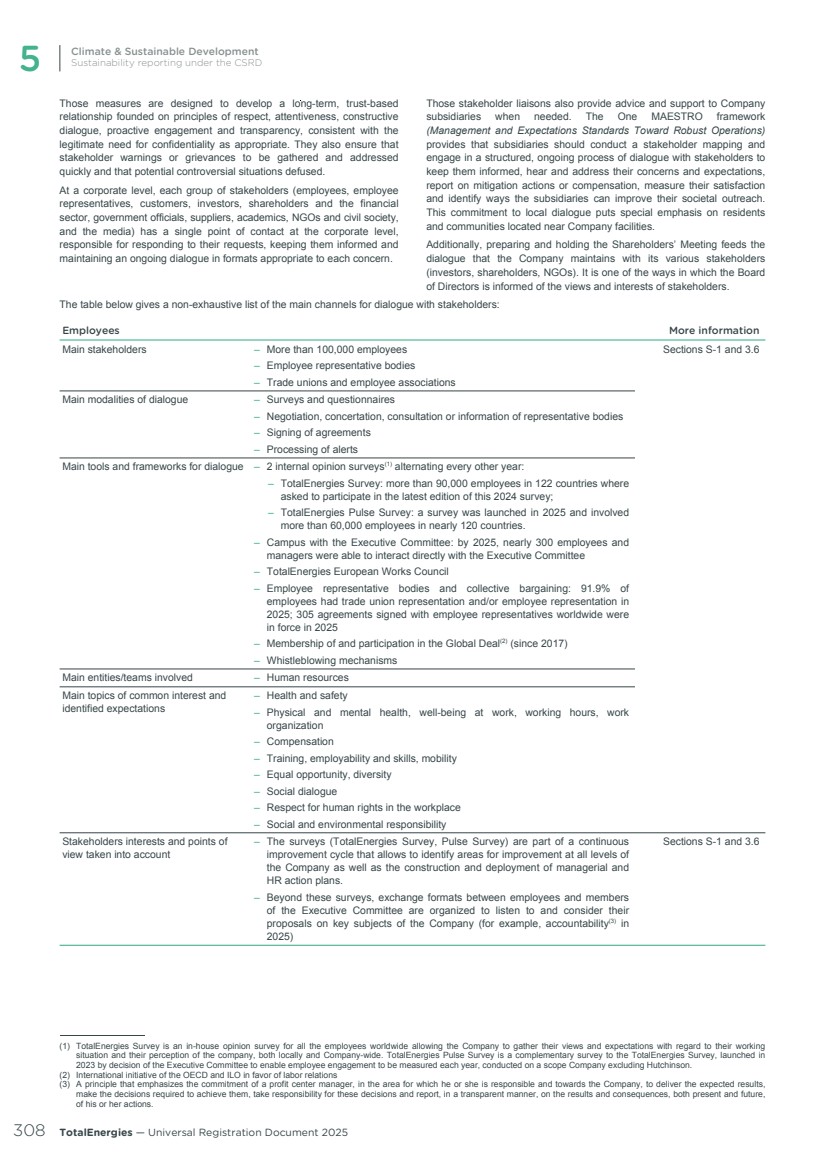
| Investors and financial players More information Main stakeholders – Individual shareholders – Institutional investors – Investor coalitions – Financial and extra-financial analysts – Financial and extra-financial rating agencies – Market regulators Sections E-1 to E-5, S-1 to S-4,G-1 Chapters 3, 4 and 6 Main modalities of dialogue – Financial and extra-financial publications – Individual or group meetings – Questionnaires and engagement with rating agencies and analysts (financial and/or extra-financial) Main tools and frameworks for dialogue – Investor presentations during the publication of annual and quarterly results events: “Sustainability & Climate” in March, and “Strategy and Outlook” in September – More than 1,000 interviews organized with investors (individual interviews and roadshows) worldwide, including more than 450 dedicated to extra-financial topics and a field trip to Uganda – Written answers to commitment letters from shareholders or investor coalitions – Annual Shareholders’ Meeting: answers given to the questions asked online via the dedicated platform, answers given to written questions; for the 2025 Shareholders’ Meeting: formal item for discussion on the Sustainability & Climate - 2025 Progress Report – An ISO 9001 certified team dedicated to relationships with individual shareholders and offering a comprehensive communication package, featuring dedicated direct-line, email address, and postal address – Shareholders’ Circle – Shareholder Advisory Committee Main entities/teams involved – Executive management – Board of Directors – Finance Department; Financial Communications; Individual Shareholder Relations – Legal department Main topics of common interest and identified expectations – Corporate governance – Financial and extra-financial performance – Investment strategy – Climate: decarbonization strategy and trajectory; information on risks and performance indicators – Operational, financial and extra-financial risk management – Transparency – Financial and extra-financial reporting frameworks Stakeholders’interests and points of view taken into account – Continuous improvement of extra-financial reporting in response to requests from extra-financial rating agencies, enabling the Company to maintain its high ESG performance in the sector and among its peers Customers More information Main stakeholders – Private customers (B2C) – Business customers (B2B) – Government (B2G) – Consumers and users of products and services Sections S-2, S-4, Chapter 2 Main modalities of dialogue – Commercial relationship – Key account management – Technical and commercial partnerships – Complaints and claims Climate & Sustainable Development Sustainability reporting under the CSRD 5 TotalEnergies — Universal Registration Document 2025 309 |
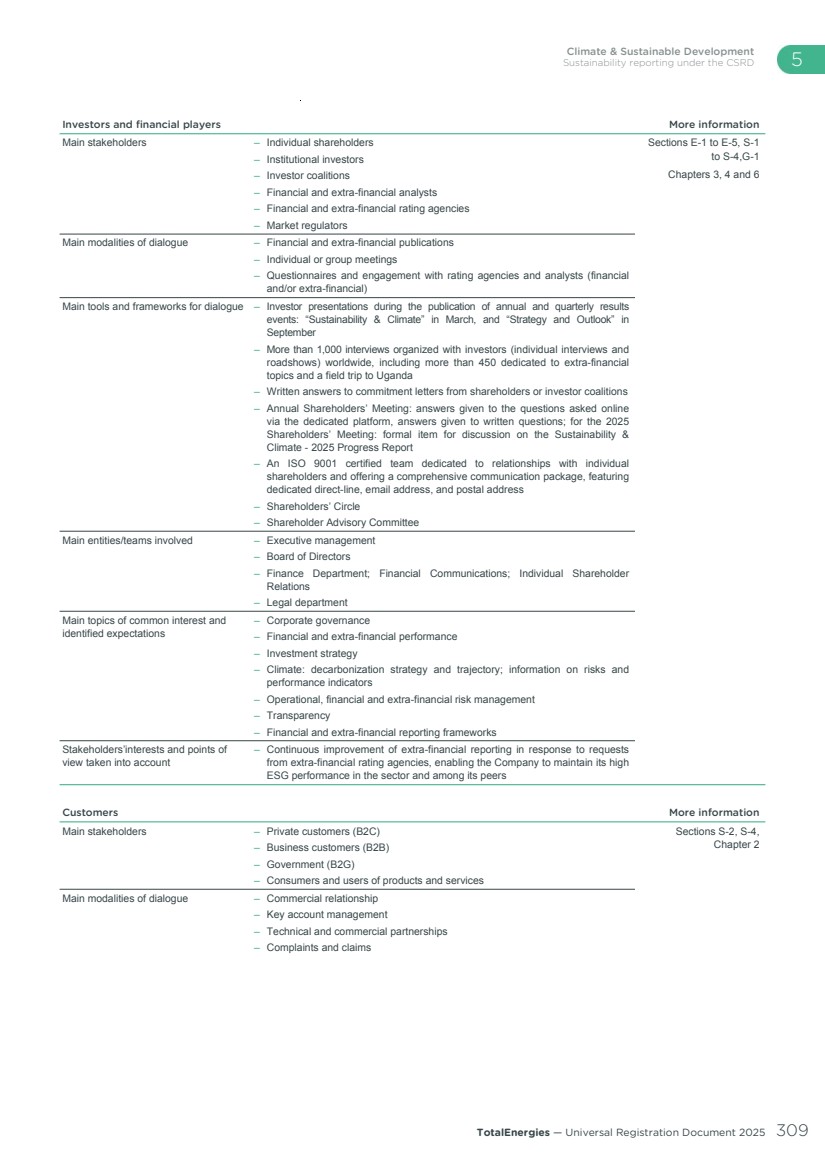
| Customers More information Main tools and frameworks for dialogue – Customer Relationship Management (mainly via the Microsoft Dynamics 365 platform) – Team dedicated to monitoring more than 450 Compagnie’s Key Accounts worldwide – Annual B2C customers’ satisfaction survey – Global B2B satisfaction survey conducted every two years – Barometer on reputation and image (every two years) – Processing complaints and claims Sections S-2, S-4, Chapter 2 Main entities/teams involved – Marketing/Strategy of business segments – Sales teams – Consumer Services – Research & Development Main topics of common interest and identified expectations – Consumer health & safety – Carbon intensity of products used – Energy efficiency services – Low-carbon goods and services – Access to energy – Energy price – Digitization of services – Competition law Stakeholders’interests and points of view taken into account – Creation or modification of our service offers and developments of our products. – Review of customer journeys Sections S-2, S-4, Chapter 2 Suppliers More information Main stakeholders – Network of over 100,000 suppliers and subcontractors Sections G1-2, 3.6, S-2 Main modalities of dialogue – Qualification – Call for tenders – Contractualization – Assessment and action plans – Awareness raising Main tools and frameworks for dialogue – Fundamental principles of purchasing – Supplier qualification process – Since 2023, more than 800 on site assessments and more than 490 documentary assessments in sustainable development have been carried out – Surveys and questionnaires (Pilote Workers’Voice Survey) – Suppliers Day (every two years) – Alert mechanism including internal mediator Main entities/teams involved – TotalEnergies Global Procurement – Subsidiaries purchasing teams – HSE Division – Business lines Main topics of common interest and identified expectations – Fight against climate change and taking into account suppliers’ carbon footprint in the procurement decision process – Human rights in the supply chain (including risks related to child labor, forced labor, working conditions, discrimination, health and safety of workers) – Environment in the supply chain (including risks related to pollution and damage to biodiversity) – Support for the economic development of SMEs and adapted and protected segment companies – Compliance with contractual terms and payment deadlines – Safety/Health as part of the services provided Stakeholders’interests and points of view taken into account – Support for suppliers as part of the documentary or on-site assessment program, as well as the climate commitment program – Continuous improvement approach implemented following documentary and on-site assessments: more than 400 suppliers have implemented corrective action plans following on-site assessments 5 Climate & Sustainable Development Sustainability reporting under the CSRD 310 TotalEnergies — Universal Registration Document 2025 |
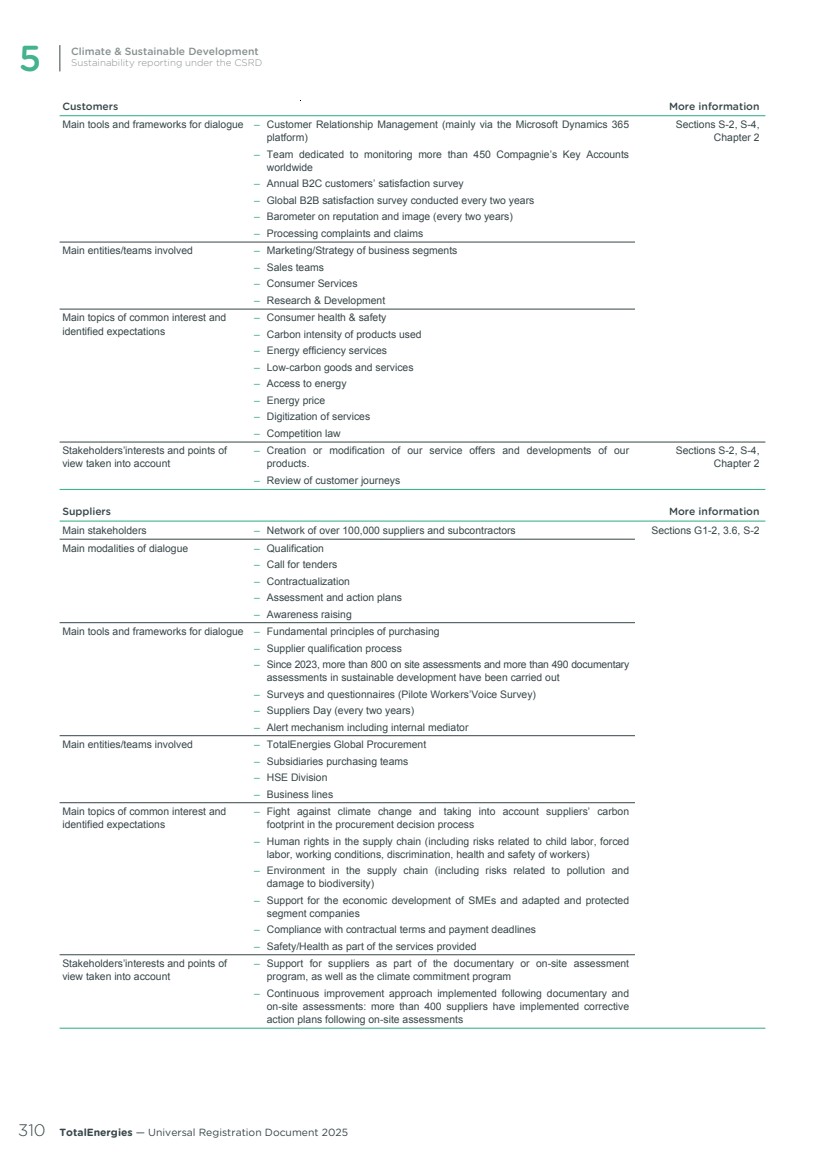
| Professional associations More information Main stakeholders – Professional or multi-stakeholder business organizations Sections E-1, E-2 to E-5, S-3, G-1-6 List of associations available on TotalEnergies’ website Main modalities of dialogue – Consultations – Memberships and participation in collective initiatives Main tools and frameworks for dialogue – Every two year, the Company conducts a census of the professional associations of which it is member and review the six climate principles for the most important associations – In the first half of 2026, the Company will publish a new review of the professional associations of which it is member: it will cover a selection of more than 100 associations representing the Company’s activities in over 20 countries. Tree-quarters of these associations were already included in the review published in 2024, and all the associations that InfluenceMap links to TotalEnergies (as of October 2025) are included – Directive applicable to the representation of interests of the company TotalEnergies (December 2021) Main entities/teams involved – Public Affairs – Business segments – Legal department – Sustainability & Climate Department Main topics of common interest and identified expectations – Climate: energy transition; transparency and consistency of supported positions – Environment and safety - regulations and risk management - minimization of impacts – Employment and economic development Stakeholders’ interests and points of view taken into accounts – In the European context: – TotalEnergies is a member of several professional associations whose activities and relations with members are codified by the statutes of these associations – These associations are registered in the EU transparency register and thus comply with its code of conduct which governs its relations with the institutions – TotalEnergies participates in the work of these associations as a member and disseminates the information and work of these associations internally to establish and align the respective positions of the Company and its associations – TotalEnergies maintains regular dialogue with these associations, in different forms (working meetings with members, bilateral meetings, board meetings) Civil society More information Main stakeholders – Communities living near or not near of our sites – Community representatives, opinion leaders – Land owners – Multilateral institutions and agencies – Universities and research centers – NGOs, non-profit organizations, associations (local and international) – Media Sections E-1, E-2 to E-5, S-1, S-2, S-3, G-1, 3.5, 3.6 Main modalities of dialogue – Inform – consulting – collaborating – Project management, partnerships (with NGOs, associations, university chairs) – answering appeals and alerts – Mediation Climate & Sustainable Development Sustainability reporting under the CSRD 5 TotalEnergies — Universal Registration Document 2025 311 |
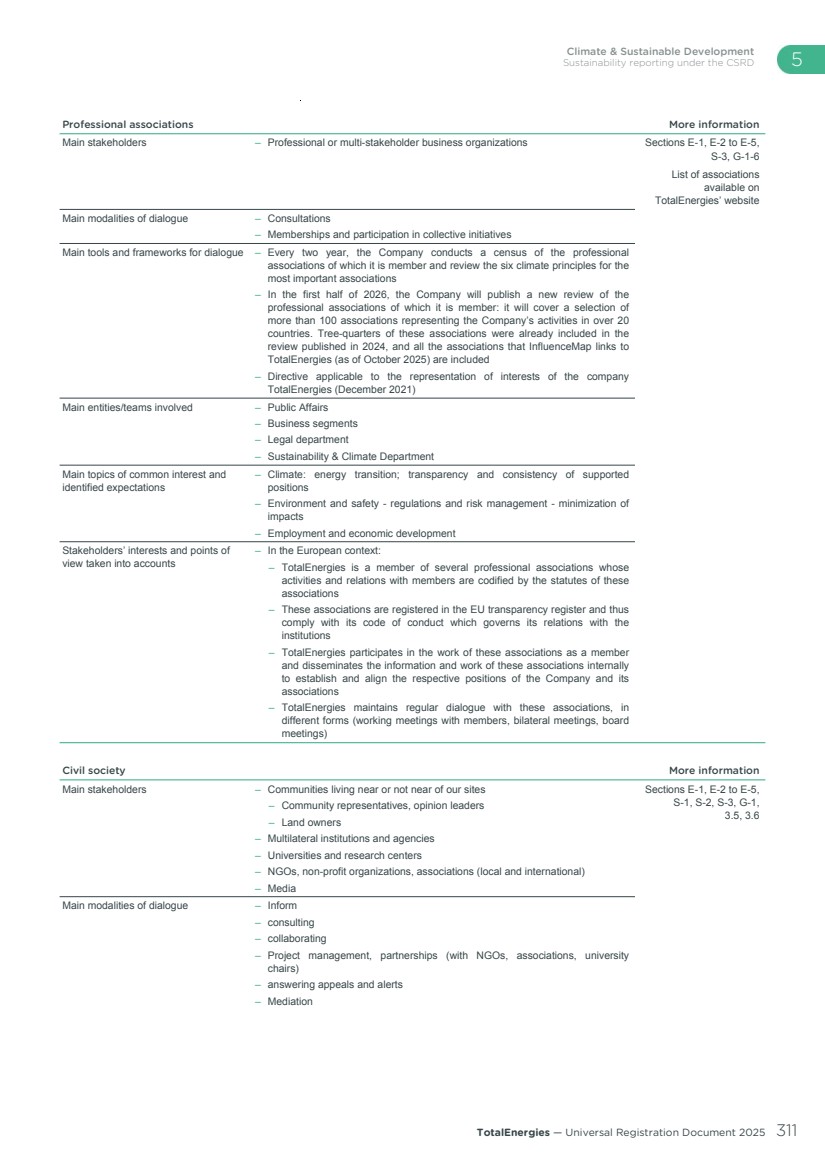
| Civil society More information Main tools and frameworks for dialogue – Assessment of safety, environmental and societal risks of new projects – Environmental and societal studies (impact studies, baseline studies, etc.), human rights studies – Proactive dialogue led by societal teams and others – VPSHR (Voluntary Principles on Security and Human Rights) initiative and tools for self-diagnosis and risk analysis – Management of complaints from local communities and other stakeholders – Citizen actions - TotalEnergies Foundation Program Sections E-1, E-2 to E-5, S-1, S-2, S-3, G-1, 3.5, 3.6 Main entities/teams involved – Societal teams – Environmental teams – Safety teams – Various teams in subsidiaries (societal, community liaison officers, operations, public affairs, etc.) – OneTech – Sustainability & Climate – Legal Department – Communication – TotalEnergies Corporate Foundation (Fondation d'entreprise) Main topics of common interest and identified expectations – Identification and management of the impacts related to our activities on the environment and biodiversity – Identification and management of societal impacts (i.e., access to land, maritime space and resources, impacts on cultural and religious practices and heritage) – Contribution of the Company to local socio-economic development (local employment, socio-economic projects) – Human rights – Climate and the Company’s approach to the energy transition – Employment - reconversion of sites with a desire for a just transition – Response to the humanitarian emergency – Innovation and R&D – Access to energy – Prevention of major accidental risks – Education and integration of young people in situations of social and/or educational vulnerability Stakeholders’interest and points of view taken into account – Regulatory consultations during environmental and societal impact studies – Regular engagement with local communities in the form of group discussions for example, to collect their questions and concerns (weak signals) and respond to them – Study of local needs to develop a local development strategy (social investment) – Deployment of the SRM+ (Stakeholder Relationship Management) tool with stakeholder interviews in the form of questionnaires to review the subsidiary’s societal action plan – Forums, webinars, meetings with our partners (NGOs, local associations, etc.) – Participation in organizations bringing together associations and patrons – Presence in the field alongside our associative partners – Questioning our associative partners on our relationship and their needs in the context of impact measurement Public authorities More information Main stakeholders – Host countries – Authorities – Administrations – The elected officials – International organizations Sections E-1, E-2 to E-5, S-1, S-2, S-3, G-1, 3.5, 3.6 Main modalities of dialogue – Agreements and authorizations – Project management – Cooperation – Mediation 5 Climate & Sustainable Development Sustainability reporting under the CSRD 312 TotalEnergies — Universal Registration Document 2025 |
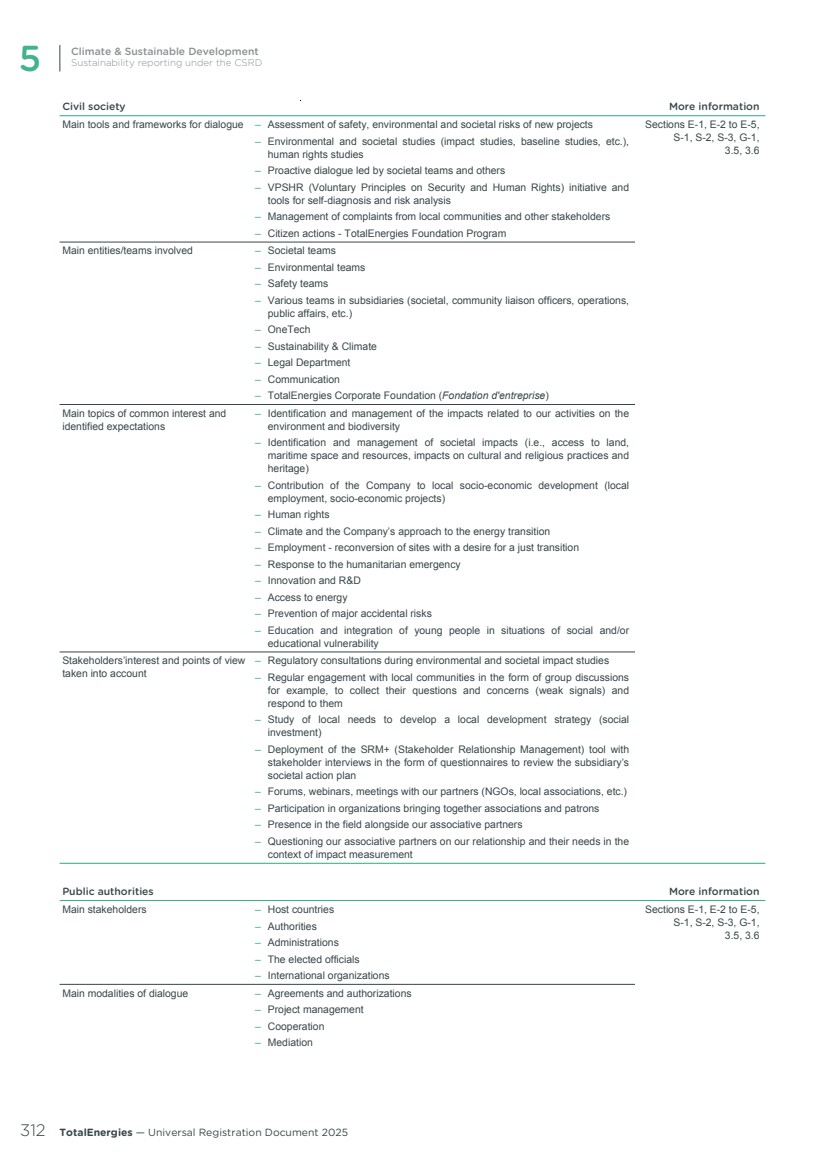
| Public authorities More information Main tools and frameworks for dialogue – Meetings organized at the request of the authorities or the Company – Regular dialogue with the authorities responsible for supervising projects and operations – TotalEnergies company’s Advocacy Directive (December 2021) – Voluntary Principles on Security and Human Rights – Code of Conduct Sections E-1, E-2 to E-5, S-1, S-2, S-3, G-1, 3.5, 3.6 Main entities/teams involved – Executive management – Country chairs – Legal department – Public Affairs – Security Main topics of common interest and identified expectations – Climate change – Fighting corruption and tax evasion – Human rights – Protection of the environment and biodiversity – Major accident risk prevention – Economic development – Access to energy Stakeholders’interests and points of view taken into accounts – Take into consideration the challenges of economic and social development in our projects and operations – Ensure compliance with the rules established by the authorities – Respect pluralism and observe political neutrality C. Material impacts, risks and opportunities and their interaction with strategy and business model (SBM-3) The double materiality analysis was carried out in 2024 to identify material Impacts, Risks and Opportunities (IROs). TotalEnergies has identified 65 material IROs that fall within the scope of the matters covered by the ESRS. For the 2025 financial year, no material changes that could affect the conclusions of the materiality assessment conducted in the previous period were identified. The assessment of IROs related to the Company’s activities and its value chain (upstream, including tier 1 suppliers, and downstream), where relevant and possible on the basis of the information available within the Company, has been carried out on a “gross” basis, i.e., before taking into account the level of control and the policies and actions implemented. The Company has not identified any material current financial effect related to material risks and opportunities (SBM-3 48-d) unless otherwise stated. The value chain is represented by the following signs: The time horizon is represented by the following abbreviations: ● Upstream value chain ST: Short term ● Company MT: Medium-term ● Downstream value chain LT: Long term Climate change (E1) IRO IRO type Impact on strategy, business model and value chain Climate change mitigation and energy GHG emissions (CO2e) of the Company ● ● ● ST - MT - LT Negative impact The world’s energy system is still 80% dependent on fossil fuels. Worldwide, greenhouse gas (GHG) emissions associated with TotalEnergies’ operated facilities represent ~0.1% of global energy-related emissions(1) . Reducing GHG emissions from the Company’s operated sites (Scope 1+2) is at the heart of its ambition to supply more energy while reducing GHG emissions. The Company has set a target of a 40% reduction in net Scope 1+2 emissions from its operated facilities between 2015 and 2030. By 2030, the Company intends to sell its customers a mix of energy products with a carbon content 25% lower than in 2015. In other words, TotalEnergies intends to reduce by 25% the lifecycle carbon intensity(2) of its products sold. (1) Source: Ratio calculated for 2022, TotalEnergies Outlook 2024, IEA. (2) Lifecycle carbon intensity of energy products sold (refer to the glossary for definition). Climate & Sustainable Development Sustainability reporting under the CSRD 5 TotalEnergies — Universal Registration Document 2025 313 |
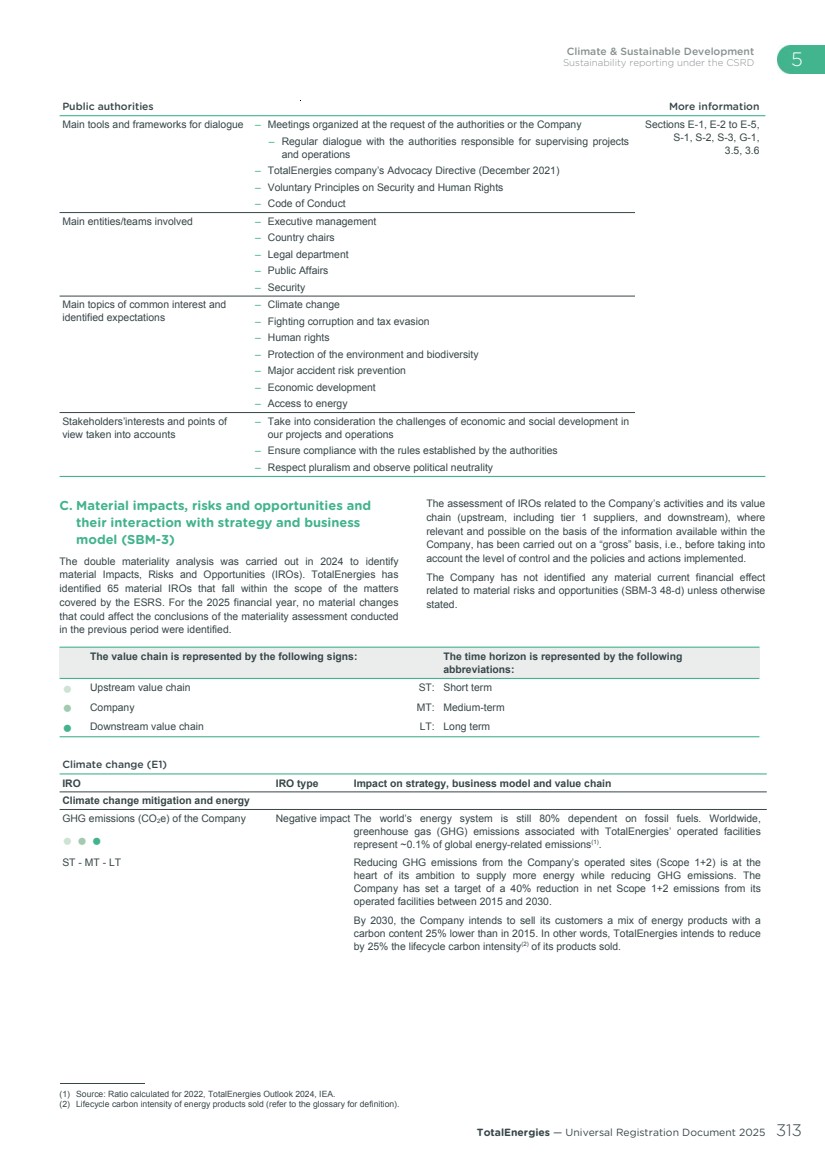
| Climate change (E1) IRO IRO type Impact on strategy, business model and value chain Methane emissions of the Company ● ST - MT - LT Negative impact The Company’s objective is to reduce methane emissions from its operated facilities by 80% between 2020 and 2030 or sooner, and to maintain methane emissions intensity below 0.1% of commercial gas produced at Upstream operated oil and gas facilities, moving towards near-zero methane emissions from the Company’s operations. With regard to non-operated activities, TotalEnergies takes actions to mobilize its partners, in particular national companies within the framework of the Oil & Gas Decarbonization Charter (OGDC), aiming to reduce emissions from the assets they operate. Renewable and low-carbon energy supply ● ● ST - MT - LT Positive impact TotalEnergies stays the course of its balanced integrated multi-energy strategy responsibly producing low cost, low emissions oil & gas and developing a profitable and differentiated Integrated Power model to create a future cash engine of the Company. The Company is building a world-class, cost-competitive portfolio combining renewable (solar, onshore wind, offshore wind) and flexible assets (CCGT, storage) to deliver low-carbon electricity available 24/7. It plans to increase its annual electricity production to 100-120 TWh (mainly from renewable sources) by 2030 by allocating a significant investment effort to low-carbon energies, mainly in the Integrated Power segment, of $3 to $4 billion per year for the period 2026-2030, including approximately $1 billion per year on average over five years in shares as part of the transaction with EPH(1) . Additionally, TotalEnergies also invests in a targeted manner in low-carbon molecules (biofuels, SAF and biogas, as well as hydrogen and its derivatives: e-fuels) as part of an “equity light” business model with partners. Insufficient capacity to adapt to the pace of deployment of the energy transition and inadequate anticipation of the evolution of demand ● ST - MT - LT Risk An insufficient ability to adapt to the pace of deployment of the energy transition, in particular the evolution of the demand or energy cost, which may be considered excessive by the populations, could affect TotalEnergies’ prospects as well as its financial situation (deterioration in profitability, loss of operating rights, loss of revenues, increased financing difficulties) or its shareholder value. The energy transition is underway, and the growth in renewable electricity production worldwide is kick-starting the decarbonization of energy. However, energy demand trajectories are still a long way from the scenarios compatible with the Paris Agreement. The energy transition requires the participation of all stakeholders, from regulators to end customers, including industrial players. TotalEnergies deploys a strategy that supports this collective transition and will enable our Company to adapt to the various scenarios that may materialize, depending on developments in low-carbon technologies (penetration speed, cost reduction), geopolitical relations and international exchanges, and consumer behavior. Difficulties in obtaining the key skills and talents needed to address climate matters ● ● ST - MT - LT Risk TotalEnergies could face difficulties in securing the key skills and talent needed for its transition strategy. Maintaining employees’ employability over the long term is one of the Company’s social challenges, and one of the key factors in the success of the Company’s project, in the context of a just transition. Deploying the Company’s transition strategy to become an integrated multi-energy company requires to support employees as they develop their skills, and to build bridges between current jobs and electricity jobs, particularly in renewable energies, in order to have the key skills available at the pace of the transition (refer to point 5.2.3.1 (SBM3 - S1)). Access to financing for the development of oil and gas activities made more difficult by the climate policies of financial institutions ● MT - LT Risk TotalEnergies’ profitability and ability to finance the energy transition depend on its ability to finance the development of its reserves profitably and in sufficient quantities. If TotalEnergies failed to develop its reserves profitably, in sufficient quantities and as part of its climate ambition, its financial condition, operating incomes and cash flows could be materially affected. The Company is also exposed to the risk of more difficult access to the financial resources it needs, in particular to develop its oil and gas activities. If TotalEnergies were unable to obtain adequate financing from investors for its activities, particularly in the oil and gas fields, the significant increase in the cost of financing that could result could hamper its ability to carry out its projects under satisfactory economic conditions, worsening its financial situation or its shareholder value. Over the decade 2020-2030, in line with its two-pillar transition strategy, TotalEnergies plans to increase its cash flow by growing its energy production by +4% per year between 2025 and 2030 by developing an attractive low-cost, low-emissions oil and gas portfolio and evolving its production mix with a ~20% share of electricity. (1) The transaction remains subject to information‑consultation processes and regulatory approvals, with completion expected in mid‑2026. 5 Climate & Sustainable Development Sustainability reporting under the CSRD 314 TotalEnergies — Universal Registration Document 2025 |
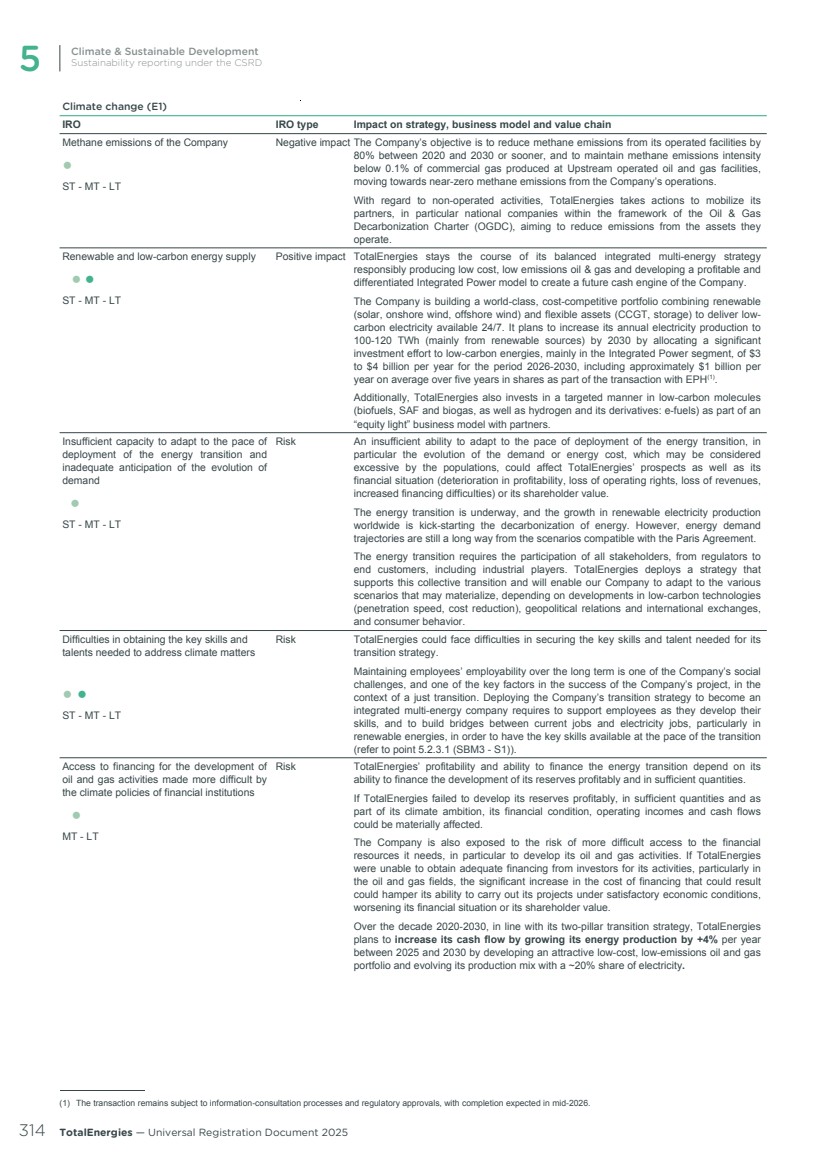
| Climate change (E1) IRO IRO type Impact on strategy, business model and value chain Access to financing for the development of oil and gas activities made more difficult by the climate policies of financial institutions ● MT - LT Risk This integrated and balanced multi-energy strategy should help preserve the Company’s ability to finance its development competitively, thanks to the cash flows generated to self-finance part of its development, estimated at an additional $5 to 10 billion between 2024 and 2030, and to the diversification of its panel of financial partners and the financing tools it may use. Costs related to technological developments linked to climate matters ● MT - LT Risk TotalEnergies could fail to anticipate appropriately the technological changes related to its main markets, the expectations of its customers and changes in its competitive environment or in certain business models, and its commitment for sustainable development or may not respond to them in an appropriate way and at an appropriate pace. An unsuitable pace of innovation or an unanticipated or uncontrolled technological or market evolution could have a negative impact on TotalEnergies’ market share, profitability, reputation and ability to attract the necessary human resources. In 2025, TotalEnergies devoted 72% of its R&D budget(1) to low-carbon activities (renewable electricity, biomass, batteries...) and to reducing the environmental footprint through CCUS and sustainability programs, compared to 28% in 2017. Costs related to changes in climate regulations ● ● ● MT - -LT Risk The increasing number of regulations, and the constant developments, whether anticipated or not, in the legal and tax frameworks in countries where TotalEnergies operates, may have significant operational and financial effects, jeopardize TotalEnergies’ business model and affect the conduct of its business and its financial conditions, especially given the size of TotalEnergies and its international dimension. For instance, more and more countries are likely to adopt carbon pricing mechanisms to accelerate the transition to a low-carbon economy. Although CO2 pricing does not currently apply in all the countries where the Company operates, TotalEnergies takes into account as a base case in its investment criteria an internal CO2 price (refer to point 5.2.2.1. (E1-8)). Legal proceedings against the Company relating to climate matters, including actions by third parties aimed at influencing its strategy ● ST - MT - LT Risk The increasing number of legal regulations that are sometimes incompatible with each other, and the constant changes, whether anticipated or not, in the legal frameworks of the countries in which TotalEnergies operates, create a legal instability that increases the risk of litigation and encourages the multiplication of national or transnational disputes. If TotalEnergies were unable to anticipate these developments or comply with them in a timely manner in one or more of the countries in which it operates, TotalEnergies could face an increase in litigation, be forced to modify and/or cease certain of its activities, which could lead to a deterioration in the profitability of certain projects and have an adverse impact on its financial situation and reputation. TotalEnergies is committed to a balanced transition strategy for the benefit of the energy transition. We report transparently on our progress in this area. It is developing a process of dialogue with all of its internal and external stakeholders, which it considers essential to the responsible conduct of its activities and for taking account of the long-term challenges of transition risks in its strategy. Damage to the Company’s reputation in the event of climate-related claims ● ST - MT - LT Risk TotalEnergies is exposed to a reputational and media scrutiny risk that can damage its reputation. The attention that many stakeholders are paying to major industrial groups is increasing, particularly given the challenges of climate change and the support needed to be put in place in a responsible manner for a just transition. As a major energy player, TotalEnergies faces media scrutiny, mainly from NGOs. It is developing an approach based on dialogue with all its internal and external stakeholders, which it considers essential to the responsible conduct of its business and the inclusion of long-term transition risk issues in its strategy. (1) Excluding Hutchinson. Climate & Sustainable Development Sustainability reporting under the CSRD 5 TotalEnergies — Universal Registration Document 2025 315 |
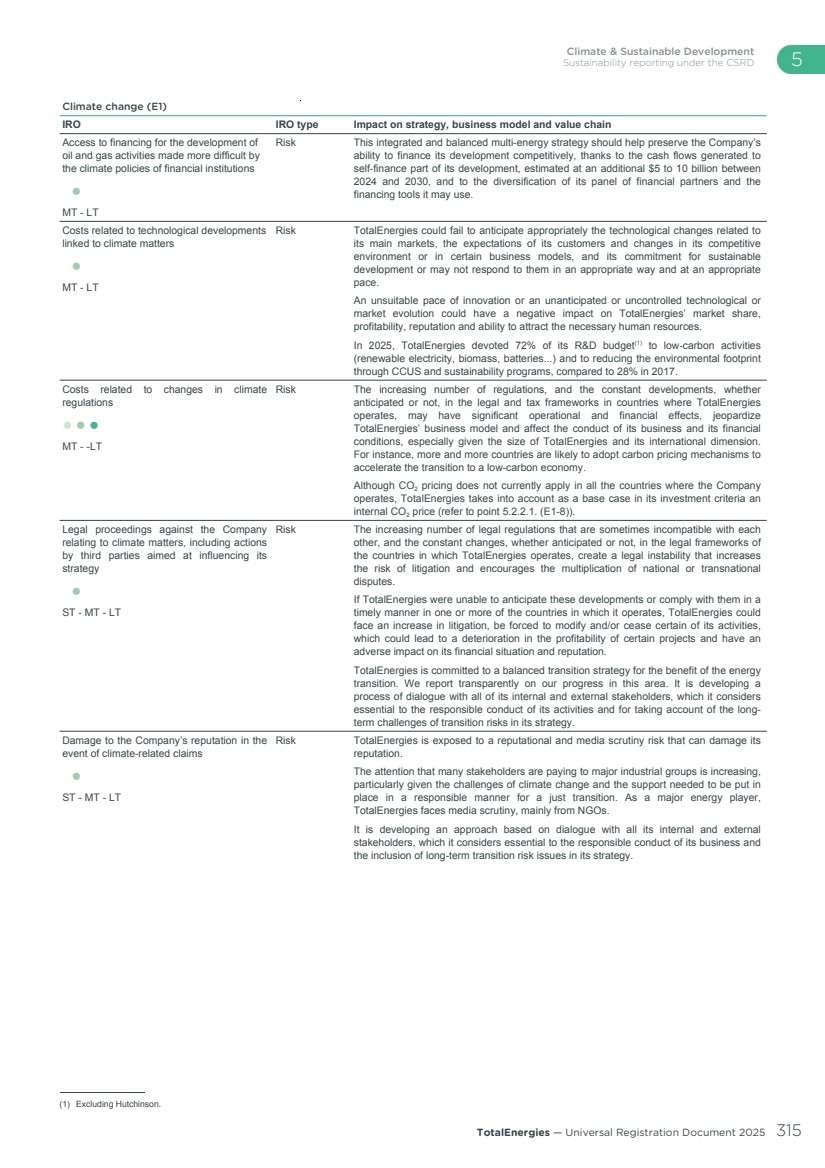
| Climate change (E1) IRO IRO type Impact on strategy, business model and value chain Contribution to the development of new low-carbon activities ● ● ● ST - MT - LT Opportunity At the end of 2025, TotalEnergies has reached a gross installed production capacity of 34 GW of renewable electricity and is actively pursuing the development of these activities to bring this capacity to 80 GW by 2030, a level that should make it one of the world’s top five producers of renewable electricity (wind and solar), Chinese producers set aside. It is also developing biofuels, primarily Sustainable Aviation Fuels, and aims to achieve SAF production capacity of 0.5 Mt/y in 2028. Recognition by stakeholders, particularly investors, of the quality of the Company’s consideration of climate matters and its long-term resilience ● ST - MT - LT Opportunity The Company is committed to a process of continuous improvement and reinforcement of its climate objectives. Moreover, it has been recognized by extra-financial rating agencies for the quality of its approach to environmental issues, particularly climate-related ones. Improvement of the Company’s economic performance through the adoption of energy efficiency plans ● ST - MT - LT Opportunity The Company is committed to energy efficiency across all its operations. It funded a $1 billion energy efficiency improvement plan over the 2023-2025 period and in 2024 it announced a second plan for the same amount for the period 2026-2028. Adaptation to Climate Change Required costs for adapting facilities to anticipate the climate-related physical risks ● ● ● ST - MT - LT Risk The effects of climate change could present physical risks to some of TotalEnergies’ facilities, disrupting or even interrupting its operations, with potential financial consequences. The Company takes climate risk into account in the design of its facilities. Pollution (E2) IRO IRO type Impact on strategy, business model and value chain Degradation of the environment (water, air, soil) and biodiversity in the event of the release of polluting substances linked to the Company’s activities ● ● ● ST - MT - LT Negative impact The Company’s activities may generate smoke discharges from combustion facilities, air emissions from the various transformation processes, or wastewater discharges. The Company’s operations are also likely to generate pollution in the event of accidental spills, waste storage or major industrial accidents (explosion, fire, product leakage, etc.). To reduce chronic emissions and prevent the occurrence of a major industrial accident, such as an explosion, fire, leakage of hazardous products or a massive leakage of products, large-scale accidental pollution, or on an environmentally sensitive site, TotalEnergies implements appropriate risk management policies and measures, which apply to the Company’s operated activities. Legal proceedings and/or compliance costs based on applicable environmental regulations or in the event of environmental damage ● ● ● ST - MT - LT Risk Damage to the Company’s reputation in the event of water, air or soil pollution linked to its activities, waste management, purchases of goods and services and use of its products ● ● ● ST - MT - LT Risk Release of microplastics as part of the Company’s activities ● ● ● ST - MT - LT Negative impact In the context of its Refining-Chemicals activities, a potential release of microplastics would take the form of plastic granules (with a diameter of less than 5 mm), on its sites during handling and transport. In the event of loss, these granules would be disseminated in the environment and could lead to soil and water pollution. As a pellet producer, TotalEnergies is aware of its environmental responsibility within the industry, and adapts its processes to take account of this issue at its sites while engaging with its partners as part of the Operation Clean Sweep certification program, an industry initiative that promotes best practices aimed at preventing the dispersion of plastic pellets in the environment. 5 Climate & Sustainable Development Sustainability reporting under the CSRD 316 TotalEnergies — Universal Registration Document 2025 |
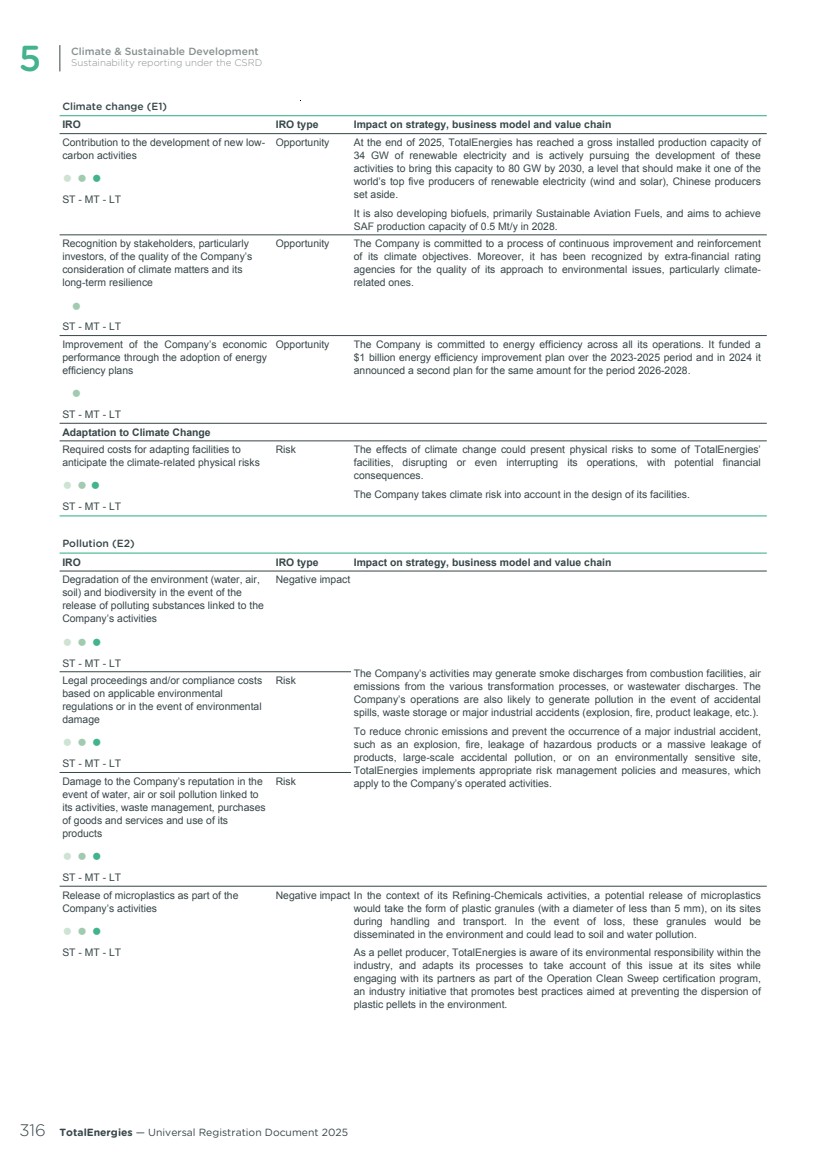
| Pollution (E2) IRO IRO type Impact on strategy, business model and value chain Disruption of the Company’s activities following industrial accidents resulting in pollution, with shutdown or slowdown of operations and costs of remediating the impact ● ● ● ST - MT - LT Risk The Company could be affected by a major industrial accident, such as an explosion, fire, leakage of hazardous products or a massive leakage of products, causing large-scale accidental pollution, or on an environmentally sensitive site. To prevent the occurrence of such an accident, TotalEnergies implements appropriate risk management policies and measures that apply to the activities it operates. Tightening of regulations on the use, release and sale of certain substances of concern or very high concern, affecting access to raw materials, production and/or sales, and associated revenues. ● ● ● ST - MT - LT Risk The Company could be affected by changes in regulations governing the release of chemical or hazardous products, including CMR products, as defined by the European Chemicals Agency (ECHA). The Company is taking steps to limit this risk, by assessing the substances used on its operated sites and value chain, in compliance with applicable health and environmental protection regulations, and implementing management measures to reduce the risks associated with these substances or their use. Water and marine resources (E3) IRO IRO type Impact on strategy, business model and value chain Disruption of operations in the event of restricted access to the water resources required for the Company’s activities, particularly in water-stressed areas ● ST - MT - LT Risk Some of the Company’s industrial facilities may be currently or in the future dependent on water resources, which could lead to restrictions on operations in times of drought. The Company implements management measures to reduce this risk. Biodiversity and ecosystems (E4) IRO IRO type Impact on strategy, business model and value chain Damage to biodiversity and ecosystems linked to the Company’s activities, particularly in sensitive areas or areas hosting protected species ● ● ● ST - MT - LT Negative impact The Company’s activities may generate negative impacts on biodiversity due to land use changes, population influx, discharges into natural environments or the introduction of invasive exotic species. It implements management measures to avoid, reduce and compensate for these impacts (refer to point 5.2.4 (E4)), including voluntary exclusion zones, impact studies and biodiversity action plans. Risk The Company could face reputational risk in the event of alleged or proven damage to biodiversity and ecosystems linked to its operations and supplies. Resource use and the circular economy (E5) IRO IRO type Impact on strategy, business model and value chain Development by the Company of recycling and waste recovery channels (particularly plastics), with a positive impact on employment and a contribution to reducing resource consumption ● ● ● ST - MT - LT Positive impact The Company is developing recycling and reclamation processes for waste (particularly plastics), with a positive impact on employment and a contribution to reducing resource consumption. It aims to achieve a 70% recovery rate for production waste from its sites. In addition, it is developing recycling activities for electric vehicle batteries, via an extensive take-back and recycling network. Dependence of the Company’s operations on raw materials available in limited stocks or difficult to access, generating risks of disruption to activities ● ● ● ST - MT - LT Risk The Company could face a risk of dependence on the raw materials required for its activities. This applies in particular to the manufacture of batteries and solar panels using certain critical metals (cobalt, silicon, etc.) and biofuels (using waste and residues so as not to compete with food). It implements purchasing strategies to reduce this risk. Development of new markets linked to the circular economy: SAF, recycled plastics, biofuels, etc. ● ● ● ST - MT - LT Opportunity The energy transition presents opportunities to develop new markets for low-carbon molecules, in which the Company is positioning itself as part of its multi-energy strategy, notably biodiesels, sustainable aviation fuels (SAF) and biogas as far as fuels are concerned. The development of the circular economy also presents opportunities in terms of the production and marketing of recycled polymers, battery recycling and waste recovery, as well as in terms of job creation. Climate & Sustainable Development Sustainability reporting under the CSRD 5 TotalEnergies — Universal Registration Document 2025 317 |
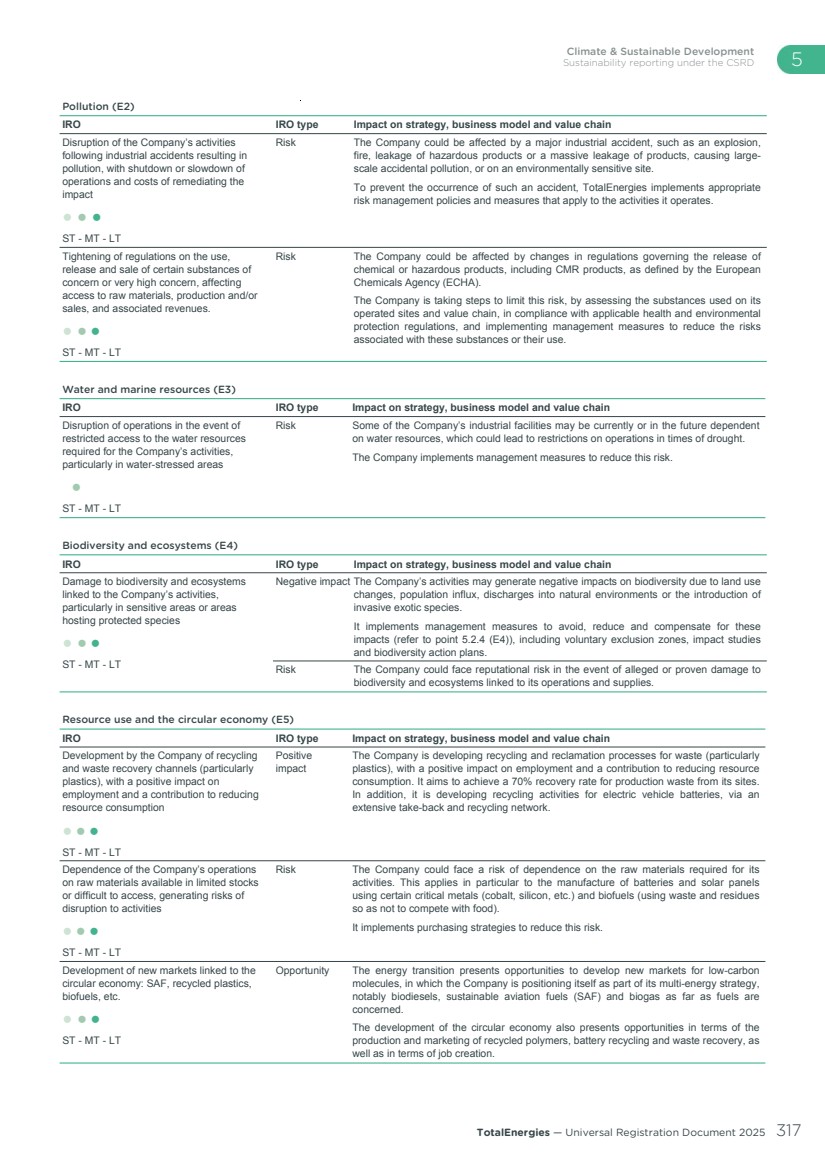
| Own workforce (S1) IRO IRO type Impact on strategy, business model and value chain Employees health and safety Support for the Company’s employees through regular medical monitoring ● ST - MT - LT Positive impact As a responsible employer, TotalEnergies is committed to preserving the health of its employees. The Company offers its employees regular medical check-ups. It also supports health promotion in its host countries through vaccination and screening campaigns. Through these measures, TotalEnergies contributes to the continuity of its operations and participates in the development of the territories in which it operates. Damage to the health and safety of personnel (on site or during transportation) in the event of a major industrial accident or during activities related to operations ● ST - MT - LT Negative impact TotalEnergies’ operational activities are likely to have a negative impact on the health and safety of the Company’s employees and those of partner companies. They also entail multiple operational risks, such as the risk of a major industrial accident. TotalEnergies’ operating procedures are structured around safety, one of the Company’s core values, and in compliance with the strictest health standards. In terms of health and safety, the Company strives to prevent the occurrence of any major industrial accident, with zero fatal accidents, a continuous reduction in TRIR and the preservation of employee health in the workplace. Costs related to damage suffered by personnel following a major industrial accident ● ST - MT - LT Risk Damage to the Company’s reputation in the event of degraded health and safety conditions leading to accidents on its sites ● ST - MT - LT Risk Well-being of Company’s employees Well-being of the Company’s employees and their families, supported by proactive policies in terms of remuneration, health and the granting of other social benefits in response to employees’ expectations ● ST - MT - LT Positive impact As a responsible employer, the Company is convinced that the well-being of its employees is an essential source of professional fulfillment and long-term performance, and contributes to the protection of mental health. The Company promotes decent employment and social protection in a work environment that combines performance and conviviality. Talent development and skills management Contribution to the upskilling of employees through training programs and actions ● MT - LT Positive impact The Company offers its employees opportunities for professional development and fulfillment, through training programs and upskilling and reskilling initiatives designed to build bridges between the Company’s traditional businesses and the electricity sector, particularly renewable energies. Loss of employability of employees in the event of failure to support the development of their skills ● MT - LT Negative impact Maintaining employee employability is an important social issue, and one of the key factors in the success of our corporate project. If the Company did not provide its employees with sufficient support in upgrading their skills, this could lead to a loss of employability. The learning model, combined with the training axes, enables TotalEnergies employees to maintain their employability. Decrease in competitiveness and slowdown in the Company’s innovation capacity due to insufficient and/or inappropriate skills management ● MT - LT Risk TotalEnergies’ ability to attract, retain and motivate the talent required for its transition strategy is a key challenge for the Company. Increased competition with high-growth sectors such as information technology and new energies can make recruiting and retaining certain key skills more complex. If TotalEnergies were unable to respond adequately to these social challenges, it could face difficulties in building the teams needed to make its transition strategy a success. Improving performance, stimulating innovation and strengthening the Company’s positioning through an appropriate skills management policy ● ST - MT - LT Opportunity The adaptation of employee skills is key to the deployment of the Company’s balanced, integrated multi-energy strategy, given the need to upgrade skills in low-carbon energy and electricity, particularly renewable energies. The opportunities offered to employees for professional development and fulfillment create a stimulating environment for talent. 5 Climate & Sustainable Development Sustainability reporting under the CSRD 318 TotalEnergies — Universal Registration Document 2025 |
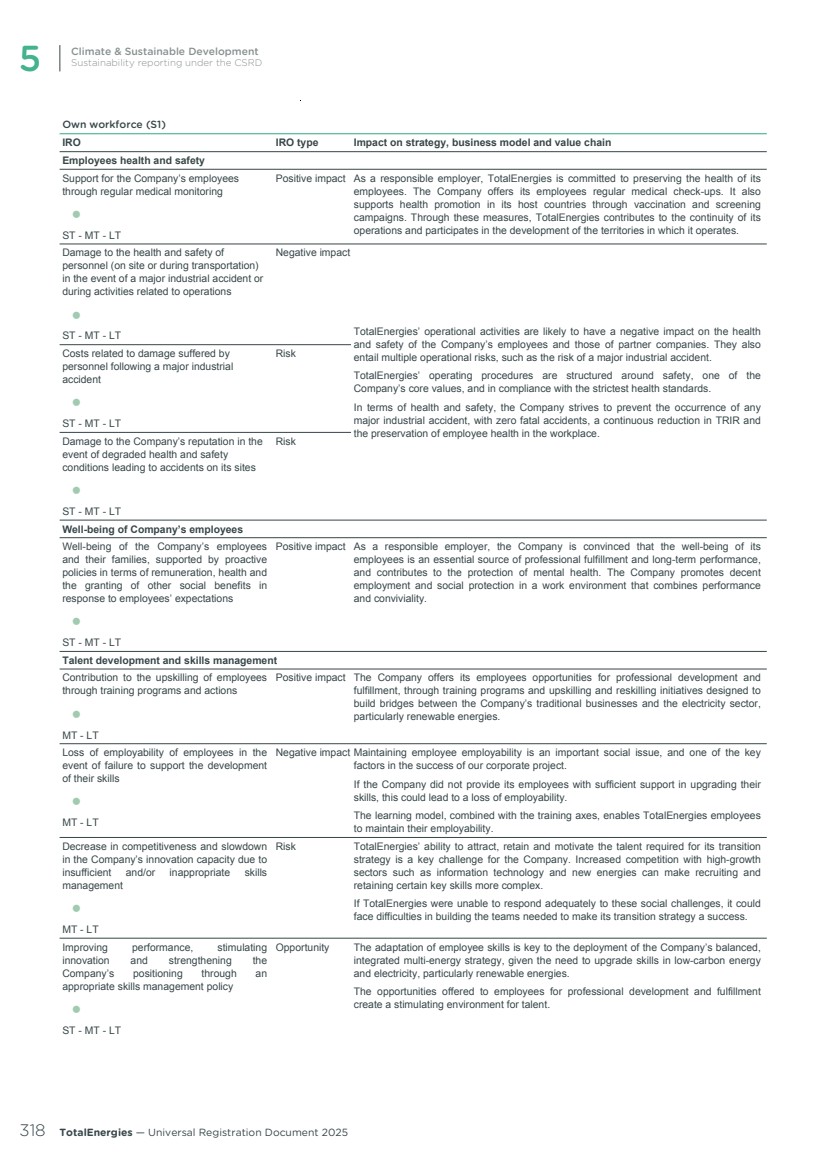
| Own workforce (S1) IRO IRO type Impact on strategy, business model and value chain Diversity, inclusion and non-discrimination Implementation of policies promoting equal opportunity, mutual respect and inclusion ● ST - MT - LT Positive impact The Company promotes equal opportunity, mutual respect and inclusion of its employees through its human resources policies. It excludes any discrimination linked to national, ethnic or social origins, sex, sexual orientation or identity, marital or parental status, disability, state of health, age or membership of a political, trade union or religious organization or minority group. Deterioration of mental health and well-being in the event of repeated discriminatory practices, violence or harassment in the workplace ● ST - MT - LT Negative impact The mental health and well-being of employees are likely to deteriorate in the event of repeated discriminatory practices, violence or harassment in the workplace. The Company promotes a working environment that respects its corporate values and the principles of its Code of Conduct. Damage to the Company’s reputation and deterioration of its employer brand in the event of repeated allegations of discrimination or harassment in the workplace ● ST - MT - LT Risk The Company could face reputational risk in the event of repeated allegations of discrimination or harassment in the workplace. If TotalEnergies were unable to adequately prevent such allegations, the Company’s public image and reputation could be damaged. Social dialogue In countries where employee representation is not mandatory, the Company proposes the establishment of bodies to promote social dialogue, freedom of association and collective bargaining ● ST - MT - LT Positive impact Social dialogue is a key component of the Company and it ensures to maintain it worldwide. Where local law offers few protection for freedom of association and the right to collective bargaining, the Company encourages the introduction of alternatives enabling employees to have regular exchanges with management. Social movements that could lead to disruptions, or even cessation of activities and damage to the company’s image/ reputation ● ST - MT - LT Risk The Company could be exposed to risks of business disruption and damage to its reputation in the event of industrial action. It anticipates and supports organizational changes and the transformation of its activities in a responsible manner, through regular dialogue with its employees and representatives. Other human rights of Company employees Consideration of fundamental labor rights as defined by the ILO for the Company’s personnel, by applying the highest standard in case of discrepancies between legal requirements and the Code of Conduct ● ST - MT - LT Positive impact In application of its Code of Conduct, the Company is committed to respecting fundamental rights as defined by the ILO wherever it does business: non-use of forced labor, child labor, discrimination, occupational health and safety, freedom of association and the right to collective bargaining. Violation of fundamental labor rights as defined by the ILO due to practices that do not comply with Company standards (as defined in the Code of Conduct) ● ST - MT - LT Negative impact Damage to the Company’s reputation in the event of allegations of non-compliance with fundamental labor rights as defined by the ILO (forced and child labor, discrimination, fair, satisfactory and safe working conditions) ● ST - MT - LT Risk Climate & Sustainable Development Sustainability reporting under the CSRD 5 TotalEnergies — Universal Registration Document 2025 319 |
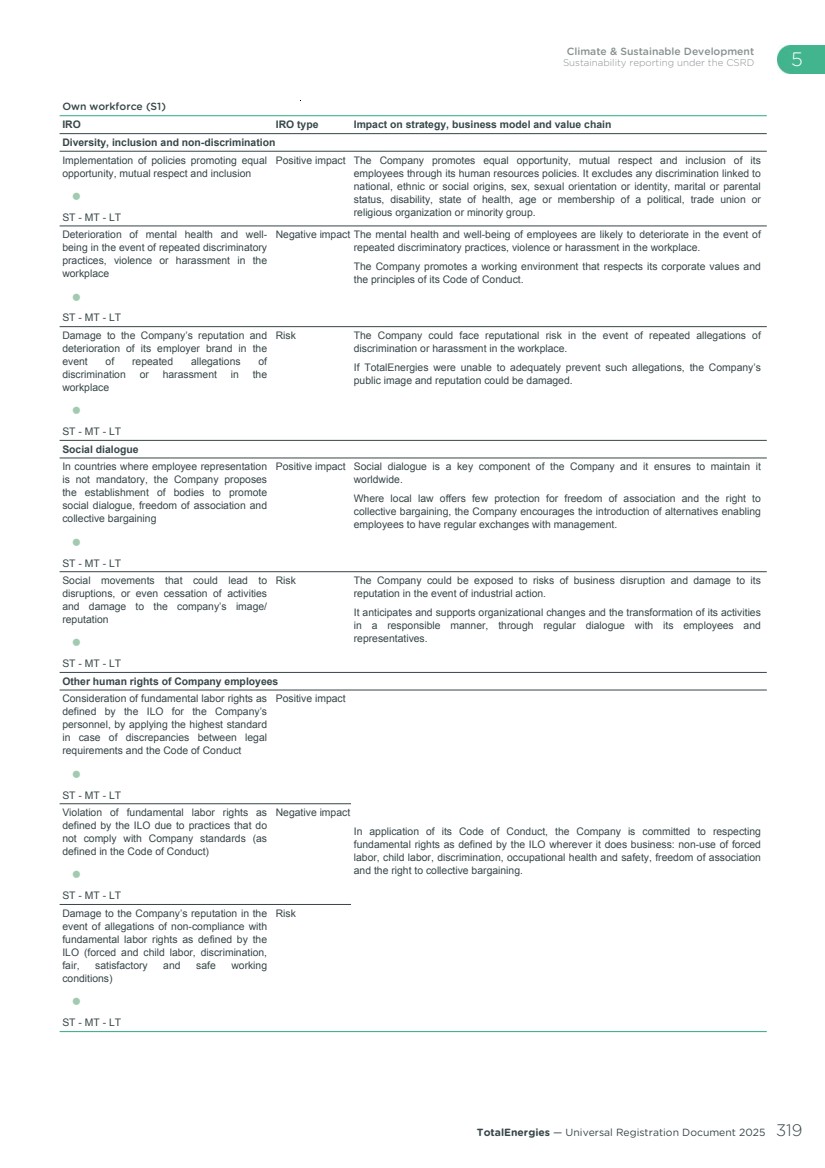
| Value chain workers (S2) IRO IRO type Impact on strategy, business model and value chain Respect for fundamental rights at work as defined by the ILO Violation of the fundamental rights at work defined by the ILO (forced labor and child labor, discrimination, fair, satisfactory and safe working conditions) of workers in the value chain, due to practices by the Company’s partners that do not comply with its standards ● ● ST- MT - LT Negative impact The Company is likely to be associated with possible breaches of fundamental labor rights as defined by the ILO, due to non-compliance with international regulations and standards on the part of its value chain partners. TotalEnergies may take measures up to and including termination of commercial relations in the event of proven non-compliance by its partners. Disruption, or even stoppage of the Company’s operations due to the difficulty of identifying and working with partners that comply with regulations regarding fundamental rights at work as defined by the ILO ● ● ST - MT - LT Risk The Company could face disruption or even closure of its operations if it is unable to identify suppliers who comply with the Company’s regulations and principles on fundamental rights at work as defined by the ILO. The Company could be exposed to higher operating costs, lower production, delays or even stoppages in certain projects, or loss of market share. Damage to the Company’s reputation in the event of allegations of non-compliance by its partners with fundamental rights at work as defined by the ILO ● ● ● ST - MT - LT Risk In the event of alleged breaches by its partners of fundamental rights at work as defined by the ILO, the Company could be exposed to risks relating to the conduct of its operations or projects, its financial situation and/or its reputation. As part of the Company’s ambition to integrate all aspects of sustainable development at the heart of its strategy, projects and operations, TotalEnergies is committed to continuous progress in sustainable procurement. Affected communities (S-3) IRO IRO type Impact on strategy, business model and value chain Local Development Strengthening the structure of local economy and the dynamism of affected communities through actions to promote the enhancement of value chain partners’ skills, the development of local employment, the improvement of infrastructure and the support of producing countries ● ● ● ST - MT - LT Positive impact As part of its sustainable development approach and in order to contribute to the United Nations’ Sustainable Development Goals (SDGs), the Company has made the creation of value for the countries and territories in which it operates a key focus of its commitment. Based on its values and the principles set out in its Code of Conduct and Health, Safety, Environment and Quality Charter, TotalEnergies aims to have a positive impact on society and contribute to its development through its social actions at national and local levels, as well as through its partners and its upstream and downstream value chain. It also intends to support producer countries in making the right energy transition, by implementing programs to diversify energy sources and reduce dependence on fossil fuels. Impact on communities Harm to the health and safety of local communities due to the proximity of the Company’s facilities in the event of a major industrial accident ● ● ● ST - MT - LT Negative impact In addition to the potential consequences for the Company’s employees and the environment (refer to point 5.2.1.4 (IRO S1 and E2)), major industrial accidents can also have an impact on local communities. The operational systems and indicators used to manage the Company’s activities are structured around safety, one of the Company’s core values, and in compliance with the strictest health and safety standards. The identification of health and safety risks and challenges is the result of a dynamic process, based in particular on feedback integrated into the HSE reference framework known as One MAESTRO (Management and Expectation Standards Towards Robust Operations). Violation of human rights related to land access, health and an adequate standard of living for local communities whose territories are affected by the Company’s activities ● ● ● ST - MT - LT Negative impact Using the method developed by the United Nations Guiding Principles on Business and Human Rights (UNGPs), the Company has identified the “salient issues” likely to have a negative impact on the human rights of local communities – access to land – the right to health and an adequate standard of living – disproportionate use of force by private security companies intervening to protect Company personnel and facilities. 5 Climate & Sustainable Development Sustainability reporting under the CSRD 320 TotalEnergies — Universal Registration Document 2025 |
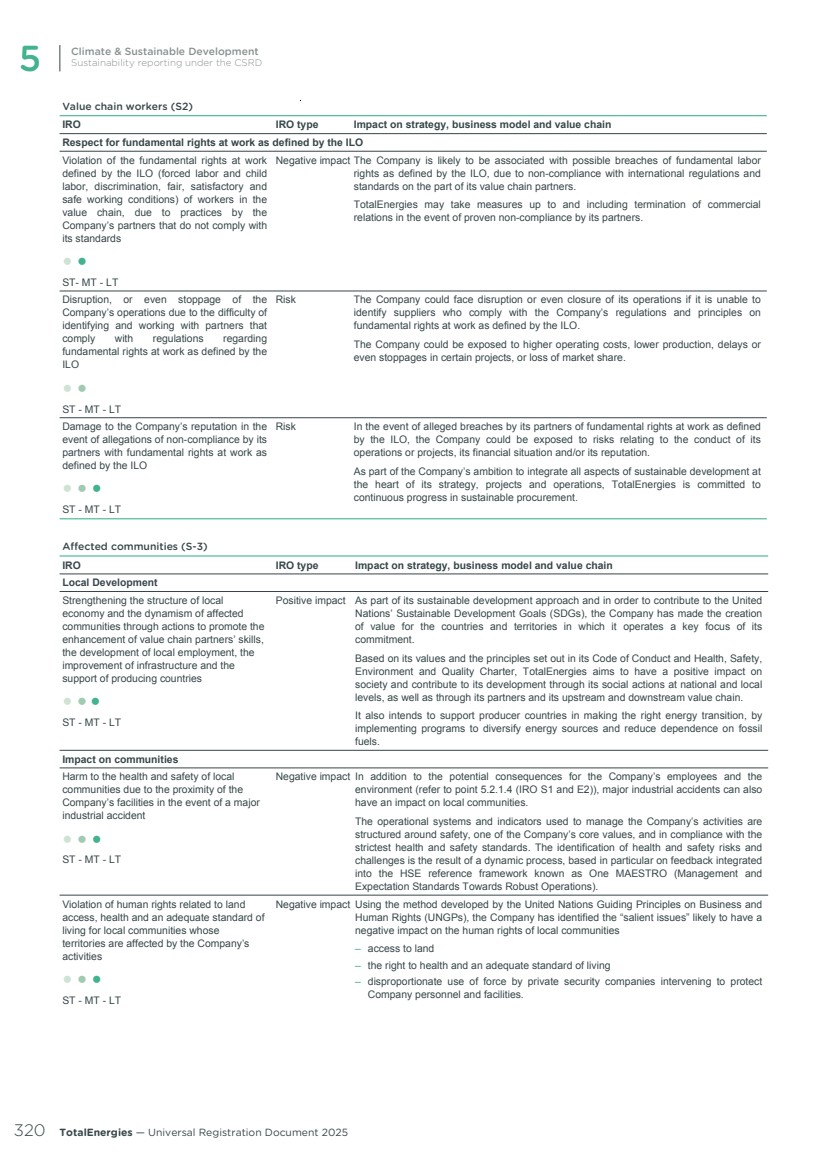
| Affected communities (S-3) IRO IRO type Impact on strategy, business model and value chain Violation of human rights related to disproportionate use of force by private security companies protecting the Company’s personnel and facilities ● ● ● ST - MT - LT Negative impact As part of its commitment to sustainable development, the Company has made respect for human rights a cornerstone of its Code of Conduct. Solid, formalized commitments specify the principles of action to be followed to respect the Company’s values and prevent human rights abuses. The Company is committed to implementing the Voluntary Principles on Security and Human Rights. Legal proceedings and/or compliance costs based on applicable regulations concerning the human rights of local communities related to land access, health and an adequate standard of living ● ● ● ST - MT - LT Risk TotalEnergies may be exposed to financial or legal risks and/or compliance costs on the basis of applicable regulations relating to the human rights of local communities identified in its sailant risks. As part of its commitment to sustainable development, the company has developed and implemented guidelines to ensure respect for the human rights of affected communities, both within the company and among its partners. Damage to the Company’s reputation and loss of trust from civil society due to allegations of non-compliance with international standards regarding local communities’ rights related to land access, health, and an adequate standard of living ● ● ● ST - MT - LT Risk The Company may be exposed to reputational risks on the basis of allegations of non compliance with applicable international standard regarding local communities’ fundamental rights related to land access, health, and an adequate standard of living of local communities. As part of its commitment to sustainable development, the company has developed and implemented guidelines to ensure respect for the human rights of affected communities, both within the company and among its partners. Reduced capacity to access to financing due to allegations of non-compliance with international standards on human rights of local communities related to land access, health and an adequate standard of living ● ● ● MT - LT Risk TotalEnergies’ energy production growth and profitability rely heavily on the success of major development projects, which are increasingly complex and require substantial financing. These major projects, like any other, can be affected by the occurrence of a number of difficulties, including those related to the requirements of financial institutions to respect the human rights of local communities identified in its highlights. As part of its commitment to sustainable development, the company has developed and implemented guidelines to ensure respect for the human rights of communities within the company and its partners. Consumers and end-users (S-4) IRO IRO type Impact on strategy, business model and value chain Accessibility of products and services for consumers and end-users Access to more affordable, more available and more sustainable energy, in particular through innovation ● ST - MT - LT Positive impact The Company’s transition strategy aims, on the one hand, to contribute to the construction of a new low-carbon energy system based on electricity and renewables, in which gas plays a useful role as a flexible transition energy, and on the other hand, to accompany this fair, orderly and equitable transition away from fossil fuels, particularly in emerging countries that legitimately aspire to economic and social development for their populations over the long term. It is stepping up its efforts in Africa and India, with the aim of providing 100 million people with solutions by 2030 LPG-powered clean cooking. Health and safety of consumers and end-users Harm to the health and safety of consumers and end-users linked to the Company’s products and services ● ST - MT - LT Negative impact The conduct of the Company’s activities and the nature of its products may give rise to risks of direct and repeated exposure of customers and end-users that could have health effects. TotalEnergies monitors, evaluates and improves its products, services, technology and processes at every stage of development, production and distribution. Reliability and transparency of information to consumers and end-users Damage to the Company’s image and reputation resulting from the leak/loss of consumer and end-user personal data ● ● ST - MT - LT Risk In the course of its business activities, the Company collects and processes certain personal data from consumers and end-users. Potential cases of data loss or leakage could damage the Company’s image and reputation. TotalEnergies protects the confidentiality of personal data in compliance with applicable regulations. Climate & Sustainable Development Sustainability reporting under the CSRD 5 TotalEnergies — Universal Registration Document 2025 321 |
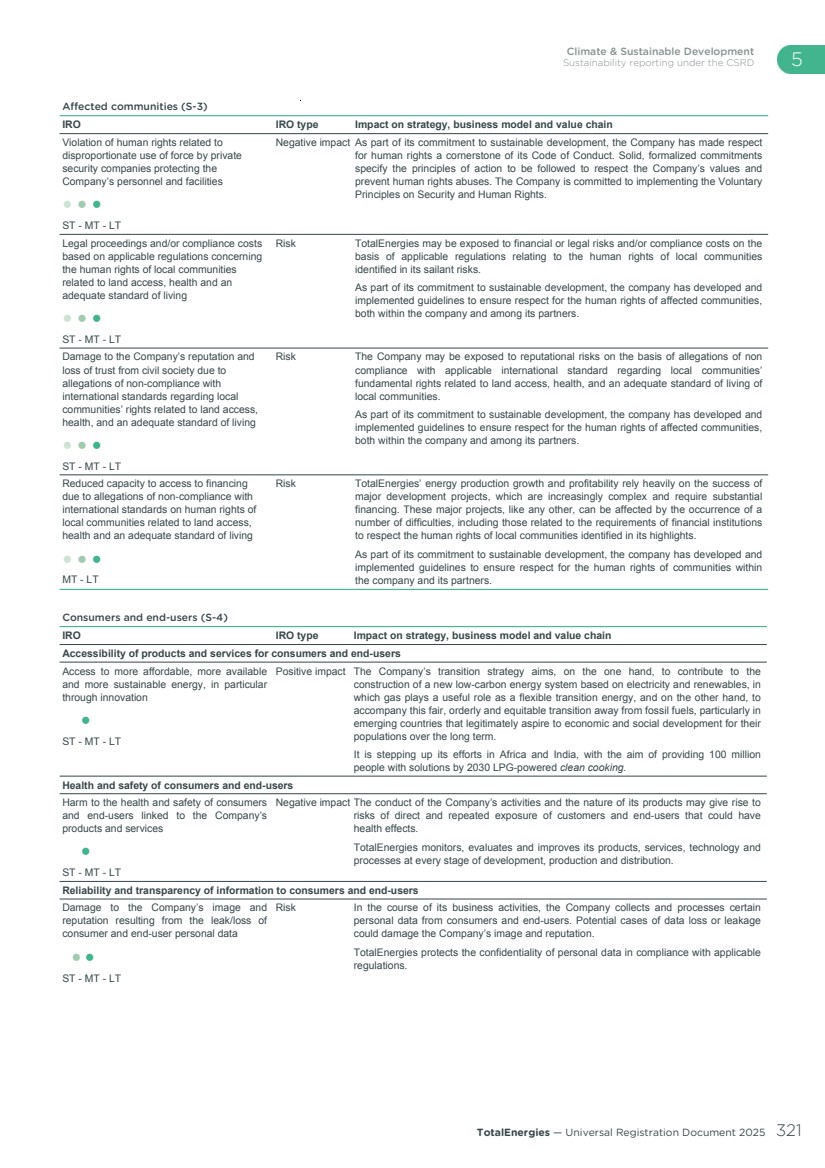
| Consumers and end-users (S-4) IRO IRO type Impact on strategy, business model and value chain Responsible marketing practices Damage to the Company’s reputation in the event of allegations of non-compliance with regulations on commercial practices ● ST - MT - LT Risk Potential breaches of regulations governing business practices could result in a loss of confidence among consumers and end-users, and damage the Company’s reputation. The Code of Conduct sets out the principles that form the basis of the Company’s commercial policies, and prohibits certain sales channels. Business management (G1) IRO IRO type Impact on strategy, business model and value chain Ethics and anti-corruption Promoting compliance principles of the Company ● ● ● ST - MT - LT Positive impact The company contributes to promoting responsible business ethics in all the countries in which it operates. Through its Code of Conduct, the Company maintain a policy of zero tolerance for fraud of any kind, particularly bribery and corruption, influence peddling and violations of antitrust law towards its employees, suppliers and partners in joint-ventures and public authorities. To prevent corruption risks and ensure the sustainability of its activities, TotalEnergies has a Compliance network with dedicated teams who implement and deploy a robust anti-corruption compliance program. TotalEnergies communicates the “zero tolerance” principle to its stakeholders through various publications. Legal proceedings and/or compliance costs based on regulations relating to business ethics, including anti-fraud, anti-corruption and anti-competitive practices. ● ● ● ST - MT - LT Risk Non-compliance with the various applicable anti-corruption laws is likely to entail the risk of legal proceedings, financial and reputational risks (exclusion from public contracts, difficulty in obtaining financing, downgrading of ratings, etc.). To prevent these risks and ensure the sustainability of its activities, TotalEnergies implements and deploys a robust and regularly updated anti-corruption compliance program. Damage to the Company’s reputation in case of unethical practices, suspected or proven cases of fraud or corruption and non-compliance with business ethics regulations. ● ● ● ST - MT - LT Risk Allegations or proven cases of fraud or corruption present an image and reputational risk for TotalEnergies that could have an impact on the sustainability of the Company’s activities. To ensure the Company’s sustainability, TotalEnergies relies on its Code of Conduct to maintain a policy of zero tolerance for fraud of any kind, particularly bribery and corruption, towards its stakeholders. This principle is publicly reiterated when TotalEnergies is the subject of allegations. Balanced supplier relationships and supply chain resilience Vulnerability of suppliers due to a situation of economic dependence on the Company or in the event of extended payment terms or payment terms not respected by the Company. ● ● ST - MT - LT Negative impact The Company’s activities could lead to economic dependence on suppliers and have a negative impact on their economic situation, particularly depending on the weight the Company represents in their activities, or in the event of extended payment deadlines or failure to meet supplier payment deadlines. The Company ensures that contractual conditions are negotiated fairly with its suppliers. The Code of Conduct reiterates this requirement, as well as the three essential principles guiding the Company’s relations with its suppliers: dialogue, professionalism and respect for commitments. Business disruption associated with supplier dependencies ● ● MT - LT Risk TotalEnergies could be exposed to risks in the conduct of its operations or projects if its supply chain were insufficiently diversified. TotalEnergies has an extensive supply chain with a network of over 100,000 suppliers of goods and services in more than 150 countries, reducing the risk of dependence on its suppliers. Damage to the Company’s reputation in the event of unfair or unethical practices or controversies related to its supply chain ● ● ST - MT - LT Risk The Company’s reputation could be affected by controversies linked to unfair or unethical practices in its supply chain. TotalEnergies has a qualification process for the selection of its suppliers and looks after the interests of each party in the tendering process. It ensures that clear, fairly-negotiated contractual terms and conditions are implemented, and that the parties’ commitments are respected. 5 Climate & Sustainable Development Sustainability reporting under the CSRD 322 TotalEnergies — Universal Registration Document 2025 |
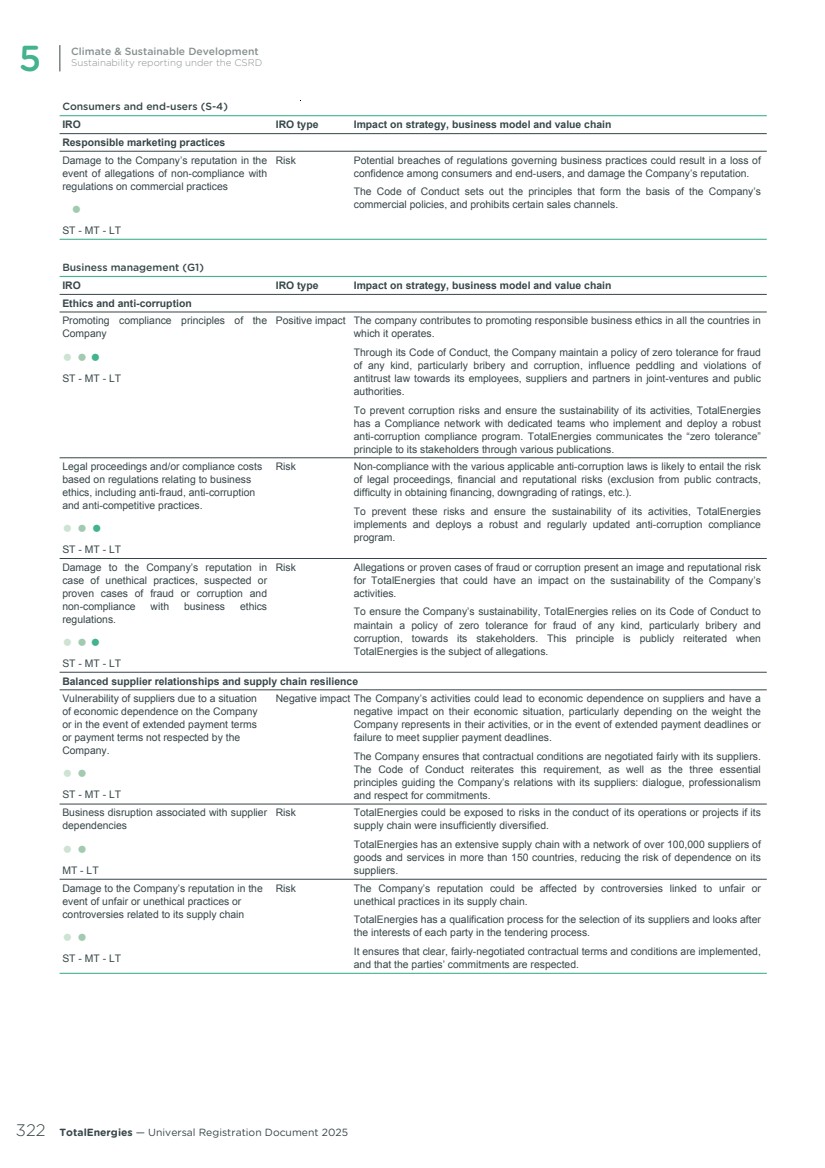
| 5.2.1.4 Impact risk and opportunity management (IRO-1 and 2) A. Description of the processes to identify and assess material impacts, risks and opportunities (IRO-1) In 2024, the Company formalized its double materiality analysis with the involvement of the Strategy & Sustainability divisions (which include the Legal, Sustainability & Climate, Audit & Internal Control, Health, Safety and Environment divisions), as well as the People & Social Engagement and Finance divisions. The work was examined by the Executive Committee and then reviewed by the Audit Committee on February 3, 2025. For the 2025 financial year, the Company’s divisions did not identify any material changes that could affect the conclusions of the materiality assessment conducted in the previous period. The work was presented to the Audit Committee on March 16, 2026. Process for identifying and assessing the Company’s material IROs * Identification of risks and impacts for own activities and upstream and downstream value chains where relevant and possible. ** DR: disclosure requirements - DP: data points. The identification and assessment of IROs related to the Company’s activities and its value chain (where relevant and possible), whether actual or potential, have been carried out on a “gross” basis, i.e., before taking into account the level of control and the policies and actions implemented. The process of identifying and assessing IROs as part of the double materiality analysis was based on existing systems within the Company, and in particular on the ongoing risk identification and mapping process implemented by the Company to develop policies in line with the desired degree of control. In this process, the Company thus follows a variety of procedures to identify and assess the risks, opportunities and impacts of its activities in the areas of society, people’s health and safety, the environment, climate, human rights and business ethics, as well as in its supply chain: – as regards health, safety and the environment, IROs are identified by the HSE Division as part of a dynamic process that draws in particular on lessons learned, which are included in the HSE (Health, Safety and Environment) reference framework known as One MAESTRO (Management and Expectations Standards Toward Robust Operations); – the identification of climate-related IROs is carried out by the Sustainability & Climate Division and is based on the recommendations of the TCFD (Task Force on Climate-related Financial Disclosures); – the identification of labor IROs is carried out by the People & Social Engagement Division and is based in particular on an HR (Human resources) risk map, the latest update of which was carried out in 2025; – the identification of IROs as regards human rights is carried out by the Sustainability & Climate Division, the Health, Safety and Environment Division, the People & Social Engagement Division and the TotalEnergies Global Procurement Division, and relies in particular on the Reporting Framework for the UN Guiding Principles to identify its salient issues; – in terms of purchasing, a mapping of CSR risks is carried out by TotalEnergies Global Procurement, and is performed by category of purchase of goods and services and supplemented by risk indices by country. In conjunction with these processes to identify IROs, dialogue approaches based on stakeholders’ involvement and participation are implemented in order to develop transparent relationships with them and to identify the main challenges and expectations. Modalities of dialogue are presented in point 5.2.1.3 B. (SBM-2). Additionally, the identification and assessment of IROs are generally carried out on an ongoing basis, in particular: – prior to investment, acquisitions and divestitures decisions on the Company’s industrial projects (evaluation by the Risk Committee of safety and security studies, impact assessments, particularly environmental and societal, and evaluation of consistency with the Company’s climate strategy, prior to review by the Executive Committee); – during operations; – prior to placing new substances on the market (toxicological and ecotoxicological studies, life cycle analyses). These assessments incorporate the local context and the regulatory requirements of the countries where the Company operates, as well as the generally accepted professional practices. Climate & Sustainable Development Sustainability reporting under the CSRD 5 TotalEnergies — Universal Registration Document 2025 323 |
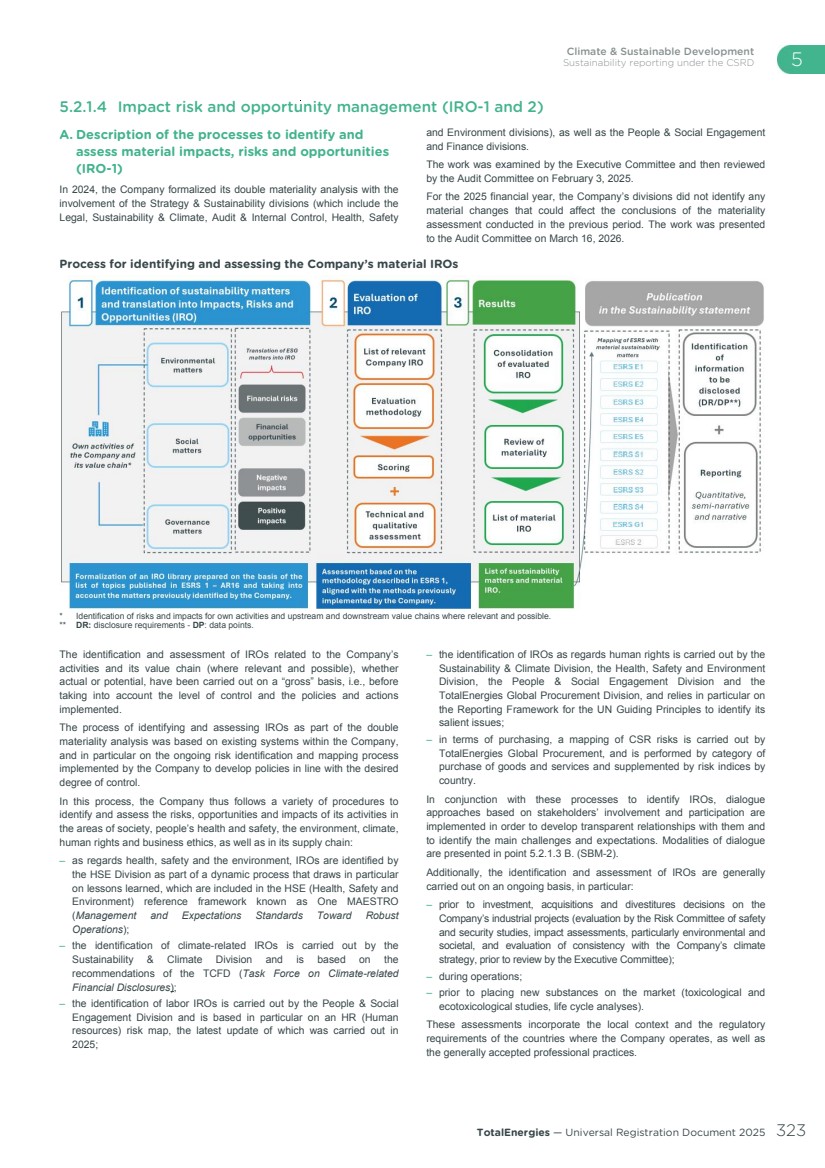
| In addition to this work and the risk maps, the relevance of the IROs identified was corroborated by comparing them with various internal and external sources of analysis, in particular: – the list of sustainability matters established by the ESRS standards (delegated regulation (EU) 2023/2772 - AR 16- ESRS 1); – the Company’s internal standards and reference frameworks, in particular the Universal Registration Document, the Sustainability & Climate Progress Report and the Human Rights Briefing Paper; – external reference frameworks and industry standards, in particular: GRI 11 Oil and Gas Sector 2021, SASB Oil and Gas standards, IPIECA Sustainability Guide. The IROs identified were analyzed according to: – their nature: positive impact, negative impact, risk, opportunity; – their dimension, i.e., for risks and opportunities: financial, strategic, legal, image and reputation, HR - social relations; and for negative and positive impacts: environment, human rights, health and safety, socio-economic; – their scope of application: the Company’s activities and the value chain (where relevant and possible); – their time horizon: short-term, medium-term, long-term. As part of this analysis, attention was paid to the identification of potentially affected stakeholders and to the existing modalities of dialogue that enabled their views and interests to be taken into account wherever possible and relevant. Each IRO has been assessed to determine whether it is material or not, based on the criteria and thresholds specified below. The approach adopted was based on the recommendations published by EFRAG. This evaluation, the basis of which has been documented, was carried out by means of scores and additional assessment criteria. The aim of scoring is to determine a rating for each of the relevant IROs identified. Therefore, to assess impact materiality, the scoring takes into account the following criteria: – quality of impact: positive or negative; – type of effect: actual or potential; – the severity of the impact, taking into account the scale, scope, irremediable character and likelihood of occurrence. For the assessment of financial materiality, scoring is determined on the basis of the potential magnitude of financial effects, and by taking into account the likelihood of occurrence. In order to ensure consistent implementation of the methodology and the scoring obtained, specific rating scales have been defined. The scales are applicable both for financial materiality and impact materiality and take into account the time horizon (short, medium or long term). They are based on methods already used within the Company (Company risk mapping, HSE risk mapping, human rights risk mapping, etc.). In addition to the scoring, a qualitative review was carried out based on the experience of the Company’s specialized departments, with particular regard to the risk mapping exercises carried out by the Company. The materiality of the IROs was ultimately determined by taking into account this work and the scoring indications. This methodology has enabled to qualify materiality relying on an objective basis, based on knowledge and technical studies. The materiality analysis, like the methodology used, is subject to periodic review. Specific processes for identifying and assessing material IROs a. Climate change The Company has drawn on the recommendations of the TCFD (Task Force on Climate-related Financial Disclosures) to identify the risks and opportunities associated with climate change. GHG emissions Climate change is a global risk for the planet that is the result of various human actions, including the consumption of fossil fuels. As a multi-energy company, TotalEnergies has identified its CO2e and methane emissions as material. Emissions of other greenhouse gases, including nitrous oxide (N2O), ozone (O3), halogen gases and aerosols, are not material for the Company. Physical risks associated with climate change In 2025, using a modeling tool provided by a third-party expert (Jupiter Intelligence), TotalEnergies reviewed the assessment carried out in 2024 of the potential impacts of the effects of climate change on around 300(1) assets in its portfolio, including all operated industrial sites classified as Seveso (and their equivalents outside the European Union). The climate data used for this assessment are based on models from the IPCC’s 6 th Assessment Report of 2021. The climate scenario considered is a high emissions scenario: IPCC SSP5-8.5(2) , as recommended by the European standard ESRS-E1, for which the global warming is estimated at 4.4°C by the end of the century. In addition, sensitivity tests were carried out for the SSP2-4.5(3) and SSP1-2.6(4) climate scenarios (for which global warming at the end of the century is 2.7°C and 1.8°C respectively). The climate hazards analyzed were selected for their relevance to the nature of the Company’s portfolio and the state of available scientific knowledge. The main acute risks selected cover precipitation, flooding, drought, heat waves, cold/, hail, strong winds, significant wave heights and wildfires. The main chronic risks included were temperature change, water stress and sea-level rise. Some climate hazards have not been included due to the nature and location of the Company’s assets (such as avalanches or glacial lake outbursts), or to the unavailability of suitable climate risk assessment tools (as in the case of saline intrusion). The results of the assessment are presented in point 5.2.2.1 A. 2. Transition risks and opportunities linked to climate change The Company has identified its transition risks and opportunities, based on the TCFD recommendations. The scenarios used to assess transition risks are those used for the resilience analysis (refer to point 5.2.2.1 A. 2). Climate change and the energy transition are considered in preparing the consolidated financial statements. They may have significant impacts on the value of TotalEnergies’s assets and liabilities and on similar assets and liabilities that may be recognized in the future (refer to the appendix to the consolidated financial statements, point 8.7 in chapter 8 - Major judgments and accounting estimates - Climate change and energy transition). (1) Operated and non-operated, excluding the value chain. (2) SSP5-8.5 is a pessimistic scenario that assumes, among other things, high GHG emissions linked to heavy dependence on fossil fuels. According IPCC, the “best estimate” in global surface temperature change associated with SSP5-8.5 is +4.4°C [3.3-5.7°C] over 2081-2100. (3) SSP2-4.5 is an intermediate scenario that assumes, among other things, the continuation of current emissions until 2050, followed by a reduction. (4) SSP1-2.6 is an optimistic scenario involving strong reductions in GHG emissions, net zero in 2080, compatible with the Paris agreement to limit global warming to below +2°C by 2100. 5 Climate & Sustainable Development Sustainability reporting under the CSRD 324 TotalEnergies — Universal Registration Document 2025 |
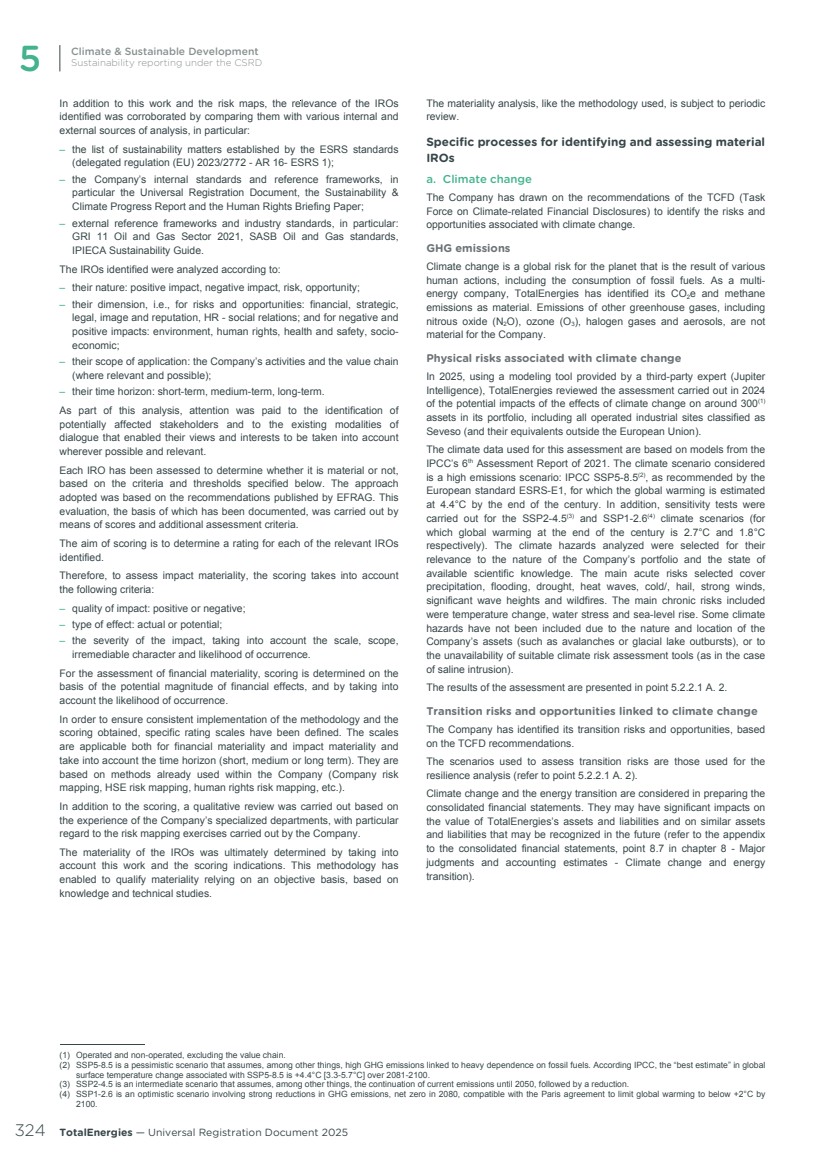
| b. Environment Specific environmental aspects To identify and assess material IROs related to the environment, TotalEnergies relied on the mapping of its Dependencies, Impacts, Risks and Opportunities (DIRO) linked specifically to nature together with the recommendations of the TNFD (Task Force on Nature-related Financial Disclosure), which highlighted in particular: – the dependencies of the Company’s operated facilities on water resources (refineries, petrochemical sites, CCGT), on the availability of land (direct for solar farms and indirect for its feedstock of agricultural origin), and on weather conditions; – impacts linked to potential pollution or to the physical footprint of its operated facilities (e.g., wind farms); – the physical risks associated with extreme climatic events, as well as the risks of water stress and rising land prices. This mapping was supplemented by a detailed analysis carried out with a third party, taking into account reference frameworks (IPBES, SBTN, TNFD, CSRD, etc.), stakeholder concerns as well as SBTN database for impacts and ENCORE (Exploring Natural Capital Opportunities, Risks and Exposure) proposed by the United Nations Environment Program (UNEP) for dependencies. Impacts have been identified by analyzing the contribution to the various pressure factors on biodiversity (SBTN, 2023). Dependencies have been identified in relation to the various ecosystem services listed in the IPBES reference framework, 2019. In particular, the analysis identified a list of families of pollutants specific to the Company’s activities and value chain. These families of pollutants include: gaseous pollutants (SO2, NOx, NMVOC, PM) and pollutants more commonly found in aqueous effluents (nitrogen, heavy metals, BTEX, hydrocarbons). The Company has also drawn on its knowledge of its activities and markets to identify the relevant incoming and outgoing resource flows to determine its sustainability challenges in terms of resource use and the circular economy. This analysis remains valid in 2025. Material sites for the environment (IRO-1, E2, E3, E4, E5) TotalEnergies has identified its material sites for the environment The Company defines them as sites likely to have a significant impact on the environment through their footprint (pressure on biodiversity), chronic discharges or accidental releases. They cover all subsidiary production sites in the Oil and Gas Upstream Activities, sites producing more than 250 kt/y in the Refining & Chemicals and Marketing & Services segments, and gas-fired power plants operated by the Company in the Integrated Power segment. TotalEnergies operates 84 material sites for the environment at the end of 2025. In line with the One MAESTRO reference framework, 100% of these sites are ISO14001 certified. Four sites newly acquired have two years to obtain the certification, one site is exempted. In addition to this requirement, at year-end 2025, a total of 307 sites operated by the Company were ISO14001 certified. Aspects specific to water and marine resources TotalEnergies has identified its operated sites likely to have an impact on freshwater resources and to be dependent on them, particularly when the activity concerned is located in a water-sensitive environment. The analysis did not reveal any dependence on marine resources. TotalEnergies has examined the potential impact of the activities of its operated sites on water resources as a result of possible pollution. With regard to dependencies, operated sites may be affected by water shortages in water-stressed areas, and local authorities may ask the site to reduce its water intake in the event of drought. In the event of severe drought, a site would have to suspend operations for several weeks or months. The operated sites which are material for water resources are presented in the following table. Activity Site name Catchment area Refining and petrochemicals Antwerp platform Scheldt, Belgium Refining and petrochemicals Normandy platform Seine, France Petrochemicals Feluy plant Sambre, Belgium Refining Leuna refinery Elbe River, Germany Biorefinery Grandpuits platform Seine, France Biorefinery La Mède platform Rhône, France Gas power plant Pont-sur-Sambre CCGT Maas/Sambre, France Gas power plant Marchienne CCGT Maas/Sambre, Belgium Gas power plant Castejón CCGT Ebro, Spain Gas power plant Colorado Bend CCGT Gulf Coast, USA Production of gas Barnett segment Gulf Coast, USA Specific aspects of biodiversity and ecosystems TotalEnergies has identified its material sites for biodiversity and ecosystems. The Company defines them as sites (i) located in biodiversity-sensitive areas(1) identified in the frame of it’s biodiversity ambition, (ii) material to the environment (as defined above), and (iii) whose activities have a potential negative impact on these areas; potential negative impacts are analyzed as part of environmental and societal impact studies. The list of 12 material sites for biodiversity (operated and non-operated) identified by TotalEnergies is presented in the table “List of material sites for biodiversity (operated and non-operated)” in point 5.2.2.4 B. c. Business conduct TotalEnergies, a major actor in the energy sector, has an industrial and retail presence in about 120 countries spanning five continents. TotalEnergies’ supply chain is especially wide, with a network of over 100,000 suppliers of goods and services in more than 150 countries. In identifying and assessing material IROs relating to business conduct issues, the Company took into account its size, its business segment in which the amounts invested can be very substantial, its strategic positioning and its geographical presence in more than 120 countries, some of which are perceived to have high levels of corruption according to the Transparency International index. (1) UNESCO natural world heritage areas, Ramsar wetlands and IUCN category I to IV protected areas. Climate & Sustainable Development Sustainability reporting under the CSRD 5 TotalEnergies — Universal Registration Document 2025 325 |
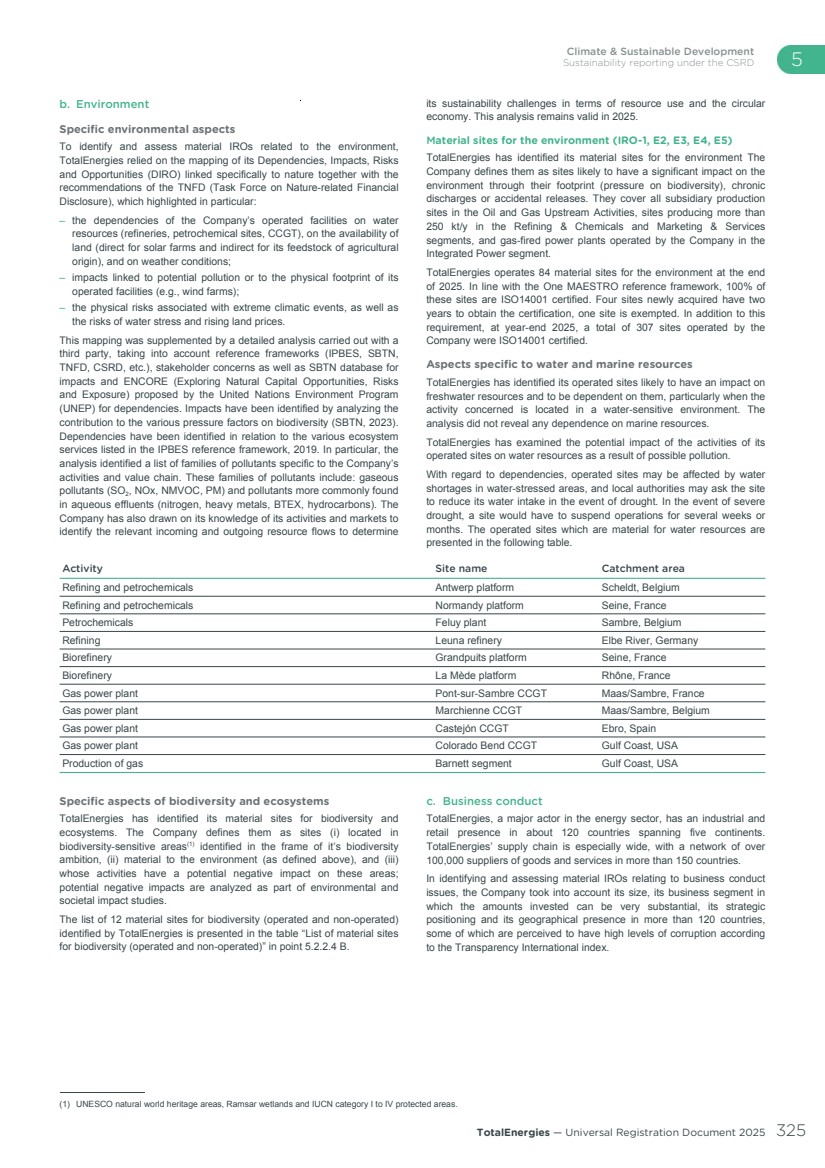
| B. Disclosure Requirements in ESRS covered by the Sustainability Report (IRO-2) The Company conducted its double materiality analysis based on the list of sustainability matters covered by the ESRS. The sustainability matters identified were assessed as material using the assessment process described in point 5.2.1.4 A. The identification of the information to be disclosed in the Sustainability Report was based on a review of the disclosure requirements and data points of each ESRS. The Company has therefore identified the relevant data points, with regard to their materiality, for each topic by following the method recommended in ESRS 1 (Appendix E). Subsequent analysis was carried out to ensure data availability and collection methodology. In 2024, the Company chose not to disclose in its Sustainability Report the information relating to the disclosure requirements and data points phased-in (ESRS 1 - Appendix C), and the disclosure which might be deferred. In 2025, the Company again opts to postpone the publication of disclosure requirements and data points related to the expected financial effects (ESRS 2 SBM-1 §40, b and c; ESRS 2 SBM-3 48.e, E1-9, E2-6, E3-5, E4-6 and E5-6) as well as certain information or disclosure requirements relating to ESRS S1 (S1-7, S1-8, S1-11, S1-14 and S1-15). List of disclosure requirements In accordance with the disclosure requirement IRO 2, § 56 of ESRS 2, the table below refers to the section number where the information on the disclosure requirement can be found. Section ESRS 2 - General disclosures 5.2 BP-1 — General basis for preparation of sustainability reports 5.2.1.1 A BP-2 — Disclosures in relation to specific circumstances 5.2.1.1 B GOV-1 — The role of the administrative, management and supervisory bodies 5.2.1.2 A GOV-2 — Information provided to and sustainability matters addressed by the undertaking’s administrative, management and supervisory bodies 5.2.1.2 B GOV-3 — Integration of sustainability-related performance in incentive schemes 5.2.1.2 C GOV-4 — Statement on due diligence 5.2.1.2 D GOV-5 — Risk management and internal controls over sustainability reporting 5.2.1.2 E SBM-1 — Strategy, business model and value chain 5.2.1.3 A SBM-2 —Interests and views of stakeholders 5.2.1.3 B SBM-3 — Material impacts, risks and opportunities and their interaction with strategy and business model 5.2.1.3 C IRO-1 — Description of the process to identify and assess material impacts, risks and opportunities 5.2.1.4 A IRO-2 — Disclosure requirements in ESRS covered by the undertaking’s sustainability statement 5.2.1.4 B ESRS E1 - Climate change 5.2.2.1 Disclosure Requirement related to ESRS 2 GOV-3 — Integration of sustainability-related performance in incentive schemes 5.2.1.2 C E1-1 — Transition plan for climate change mitigation - Disclosure Requirement related to ESRS 2 SBM-3 – Material impacts, risks and opportunities and their interaction with strategy and business model 5.2.2.1 A 2 Disclosure requirement related to ESRS 2 IRO-1 – Description of the processes to identify and assess material climate-related impacts, risks and opportunities 5.2.1.4 A E1-2 — Policies related to climate change mitigation and adaptation 5.2.2.1 B 1 E1-3 — Actions and resources in relation to climate change policies 5.2.2.1 B 2 E1-4 — Targets related to climate change mitigation and adaptation 5.2.2.1 C 1 E1-5 — Energy consumption and mix 5.2.2.1 C 2 a E1-6 — Gross Scopes 1, 2, 3 and Total GHG emissions 5.2.2.1 C 2 c E1-7 — GHG removals and GHG mitigation projects financed through carbon credits 5.2.2.1 C 3 E1-8 — Internal carbon pricing 5.2.2.1 C 4 ESRS E2 - Pollution 5.2.2.2 Disclosure Requirement related to ESRS 2 IRO-1 — Description of the processes to identify and assess material pollution-related impacts, risks and opportunities 5.2.1.4 A E2-1 — Policies related to pollution 5.2.2.2 A E2-2 — Actions and resources related to pollution 5.2.2.2 B E2-3 — Targets related to pollution 5.2.2.2 B E2-4 — Pollution of air, water and soil 5.2.2.2 C E2-5 — Substances of concern and substances of very high concern 5.2.2.2 D ESRS E3 - Water and marine resources 5.2.2.3 Disclosure Requirement related to ESRS 2 IRO-1 — Description of the processes to identify and assess material pollution-related impacts, risks and opportunities related to water and marine resources 5.2.1.4 A E3-1 — Policies related to water and marine resources 5.2.2.3 A E3-2 — Actions and resources related to water and marine resources 5.2.2.3 D E3-3 — Targets related to water and marine resources 5.2.2.3 C E3-4 — Water consumption 5.2.2.3 E 5 Climate & Sustainable Development Sustainability reporting under the CSRD 326 TotalEnergies — Universal Registration Document 2025 |
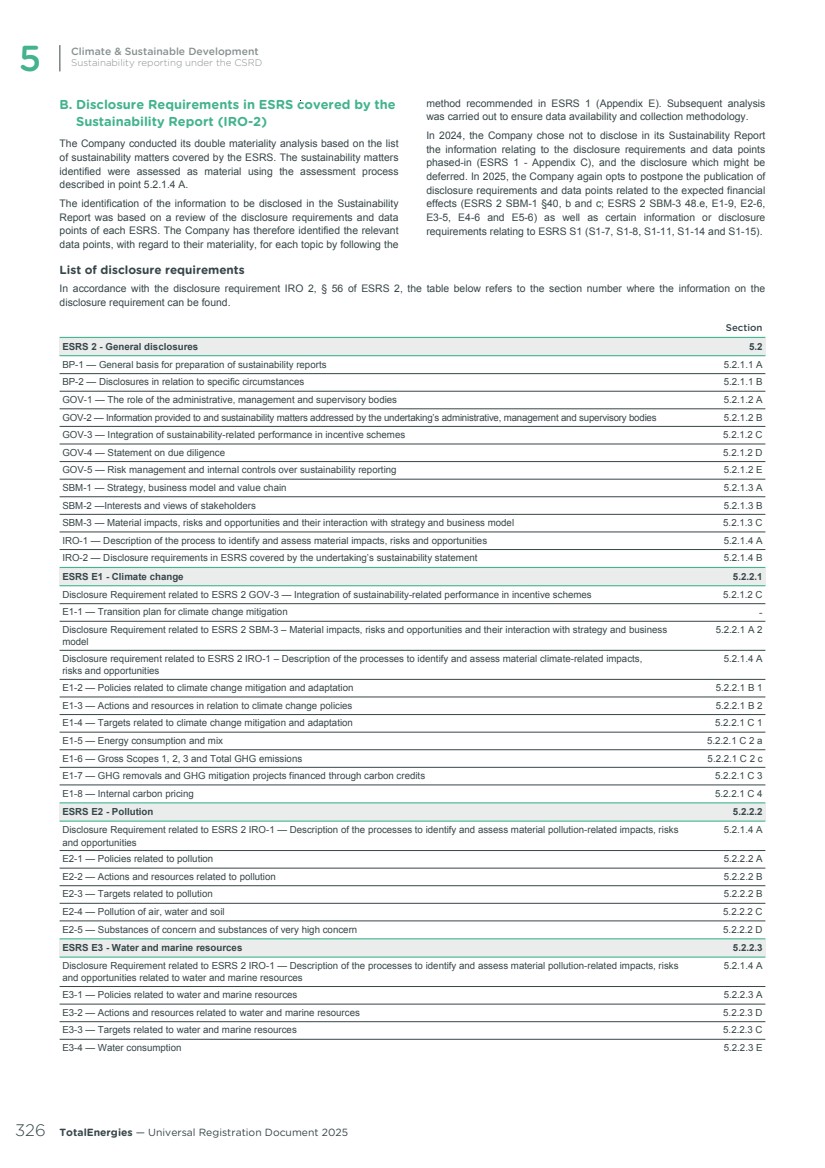
| Section ESRS E4 - Biodiversity and ecosystems 5.2.2.4 E4-1 — Transition plan and consideration of biodiversity and ecosystems in strategy and business model 5.2.2.4 A Disclosure Requirement related to ESRS 2 SBM-3 – Material impacts, risks and opportunities and their interaction with strategy and business model 5.2.2.4 B Disclosure Requirement related to ESRS 2 IRO-1 –Description of processes to identify and assess material biodiversity and ecosystem-related impacts, risks, dependencies and opportunities 5.2.1.4 A E4-2 — Policies related to biodiversity and ecosystems 5.2.2.4 C E4-3 — Actions and resources related to biodiversity and ecosystems 5.2.2.4 E E4-4 — Targets related to biodiversity and ecosystems 5.2.2.4 D E4-5 — Impact metrics related to biodiversity and ecosystems change 5.2.2.4 F ESRS E5 - Resource use and circular economy 5.2.2.5 Disclosure Requirement related to ESRS 2 IRO-1 – Description of the processes to identify and assess material resource use and circular economy-related impacts, risks and opportunities 5.2.1.4 A E5-1 — Policies related to resource use and circular economy 5.2.2.5 A E5-2 — Actions and resources related to resource use and circular economy 5.2.2.5 C E5-3 — Targets related to resource use and circular economy 5.2.2.5 B E5-4 — Resource inflows 5.2.2.5 D E5-5 — Resource outflows 5.2.2.5 E ESRS S1 - Own workforce 5.2.3.1 Disclosure Requirement related to ESRS 2 SBM-2 – Interests and views of stakeholders 5.2.1.3 B Disclosure Requirement related to ESRS 2 SBM-3 – Material impacts, risks and opportunities and their interaction with strategy and business model 5.2.1.3 C S1-1 — Policies related to own workforce 5.2.3.1 B 5.2.3.1 C 5.2.3.1 E S1-2 — Processes for engaging with own workforce and workers’ representatives about impacts 5.2.3.1 D S1-3 — Processes to remediate negative impacts and channels for own workforce to raise concerns 5.2.3.1 E S1-4 — Taking action on material impacts on own workforce, and approaches to managing material risks and pursuing material opportunities related to own workforce, and effectiveness of those actions 5.2.3.1 B 5.2.3.1 C 5.2.3.1 E S1-5 — Targets related to managing material negative impacts, advancing positive impacts, and managing material risks and opportunities 5.2.3.1 B 5.2.3.1 C S1-6 — Characteristics of the undertaking’s employees 5.2.3.1 A S1-8 — Collective bargaining coverage and social dialogue 5.2.3.1 D S1-9 — Diversity metrics 5.2.3.1 C 4 S1-10 — Adequate wages 5.2.3.1 C 3 S1-11 — Social protection 5.2.3.1 C 3 S1-12 — Persons with disabilities 5.2.3.1 C 4 S1-13 — Training and skills development metrics 5.2.3.1 C 2 S1-14 — Health and safety metrics 5.2.3.1 B S1-15 — Work-life balance metrics 5.2.3.1 C 1 S1-16 — Remuneration metrics (pay gap and total remuneration) 5.2.3.1 C S1-17 — Incidents, complaints and severe human rights impacts 5.2.3.1 E ESRS S2 - Workers in the value chain 5.2.3.2 Disclosure Requirement related to ESRS 2 SBM-2 – Interests and views of stakeholders 5.2.1.3 B Disclosure Requirement related to ESRS 2 SBM-3 – Material impacts, risks and opportunities and their interaction with strategy and business model 5.2.1.3 C S2-1 — Policies related to value chain workers 5.2.3.2 A S2-2 — Processes for engaging with value chain workers about impacts 5.2.3.2 B S2-3 — Processes to remediate negative impacts and channels for value chain workers to raise concerns 5.2.3.2C S2-4 — Taking action on material impacts on value chain workers, and approaches to managing material risks and pursuing material opportunities related to value chain workers, and effectiveness of those actions 5.2.3.2 D S2-5 — Targets related to managing material negative impacts, advancing positive impacts, and managing material risks and opportunities 5.2.3.2 E Climate & Sustainable Development Sustainability reporting under the CSRD 5 TotalEnergies — Universal Registration Document 2025 327 |
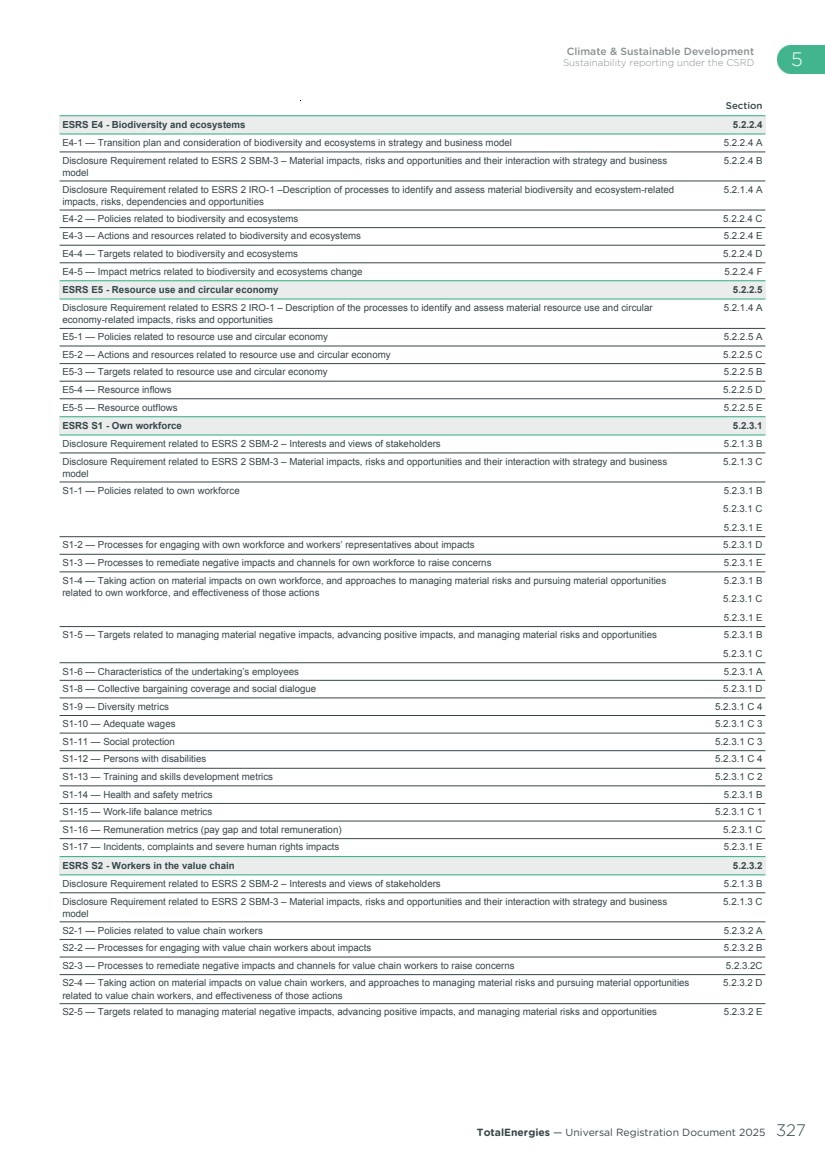
| Section ESRS S3 - Affected communities 5.2.3.3 Disclosure Requirement related to ESRS 2 SBM-2 – Interests and views of stakeholders 5.2.1.3 B Disclosure Requirement related to ESRS 2 SBM-3 – Material impacts, risks and opportunities and their interaction with strategy and business model 5.2.1.3 C S3-1 — Policies related to affected communities 5.2.3.3 A S3-2 — Processes for engaging with affected communities about impacts 5.2.3.3 B S3-3 — Processes to remediate negative impacts and channels for affected communities to raise concerns 5.2.3.3 C S3-4 — Taking action on material impacts on affected communities, and approaches to managing material risks and pursuing material opportunities related to affected communities, and effectiveness of those actions 5.2.3.3 D S3-5 — Targets related to managing material negative impacts, advancing positive impacts, and managing material risks and opportunities 5.2.3.3 E ESRS S4 - Consumers and end-users 5.2.3.4 Disclosure Requirement related to ESRS 2 SBM-2 – Interests and views of stakeholders 5.2.3.4 Disclosure Requirement related to ESRS 2 SBM-3 – Material impacts, risks and opportunities and their interaction with strategy and business model 5.2.3.4 S4-1 — Policies related to consumers and end-users 5.2.3.4 S4-2 — Processes for engaging with consumers and end-users about impacts 5.2.3.4 S4-3 — Processes to remediate negative impacts and channels for consumers and end-users to raise concerns 5.2.3.4 S4-4 — Taking action on material impacts on consumers and end-users, and approaches to managing material risks and pursuing material opportunities related to consumers and end-users, and effectiveness of those actions 5.2.3.4 S4-5 — Targets related to managing material negative impacts, advancing positive impacts, and managing material risks and opportunities 5.2.3.4 ESRS G1 - Business conduct 5.2.4 Disclosure Requirement related to ESRS 2 GOV-1 – The role of the administrative, supervisory and management bodies 5.2.1.2 A Disclosure Requirement related to ESRS 2 IRO-1 – Description of the processes to identify and assess material impacts, risks and opportunities 5.2.1.4 A G1-1 — Business conduct policies and corporate culture 5.2.4.1 G1-2 — Management of relationships with suppliers 5.2.4.3 G1-3 — Prevention and detection of corruption and bribery 5.2.4.2 A G1-4 — Incidents of corruption or bribery 5.2.4.2 B G1-6 — Payment practices 5.2.4.4 List of data points in cross-cutting and topical standards that derive from other eu legislation In application of disclosure requirement IRO 2, § 56 of ESRS 2, the following table specifies for the data points required by other EU legislative acts, as listed in Appendix B of ESRS 2, the paragraph where they appear in the Sustainability Report For data points which, after evaluation, have been deemed to be not material, “Not material” is indicated in the table in accordance with paragraph 35 of ESRS 1. Disclosure requirement and related datapoint SFDR(1) reference Pillar 3 (2) reference Benchmark Regulations(3) reference EU climate law(4) reference Section concerned ESRS 2 GOV-1 Board’s gender diversity paragraph 21 (d) Indicator number 13, table 1, annex I Annex II to Commission Delegated Regulation (EU) 2020/1816(5) 5.2.1.2 A - Composition of the Board of Directors, reflecting the diversity and complementarity of its members ESRS 2 GOV-1 Percentage of board members who are independent paragraph 21 (e) Annex II to Commission Delegated Regulation (EU) 2020/1816 5.2.1.2 A - Composition of the Board of Directors, reflecting the diversity and complementarity of its members ESRS 2 GOV-4 Statement on due diligence paragraph 30 Indicator number 10, table 3, annex I 5.2.1.2 D - Statement on due diligence (GOV-4) ESRS 2 SBM-1 Involvement in activities related to fossil fuel activities paragraph 40 (d) i Indicator number 4, table 1, annex I Article 449a of Regulation (EU) No 575/2013, Commission Implementing Regulation (EU) 2022/ 2453(6) , Table 1: Qualitative information on environmental risk and Table 2: Qualitative information on social risk Annex II to Commission Delegated Regulation (EU) 2020/1816 5.2.1.3 A - Strategy, business model and value chain (SBM-1) 5 Climate & Sustainable Development Sustainability reporting under the CSRD 328 TotalEnergies — Universal Registration Document 2025 |
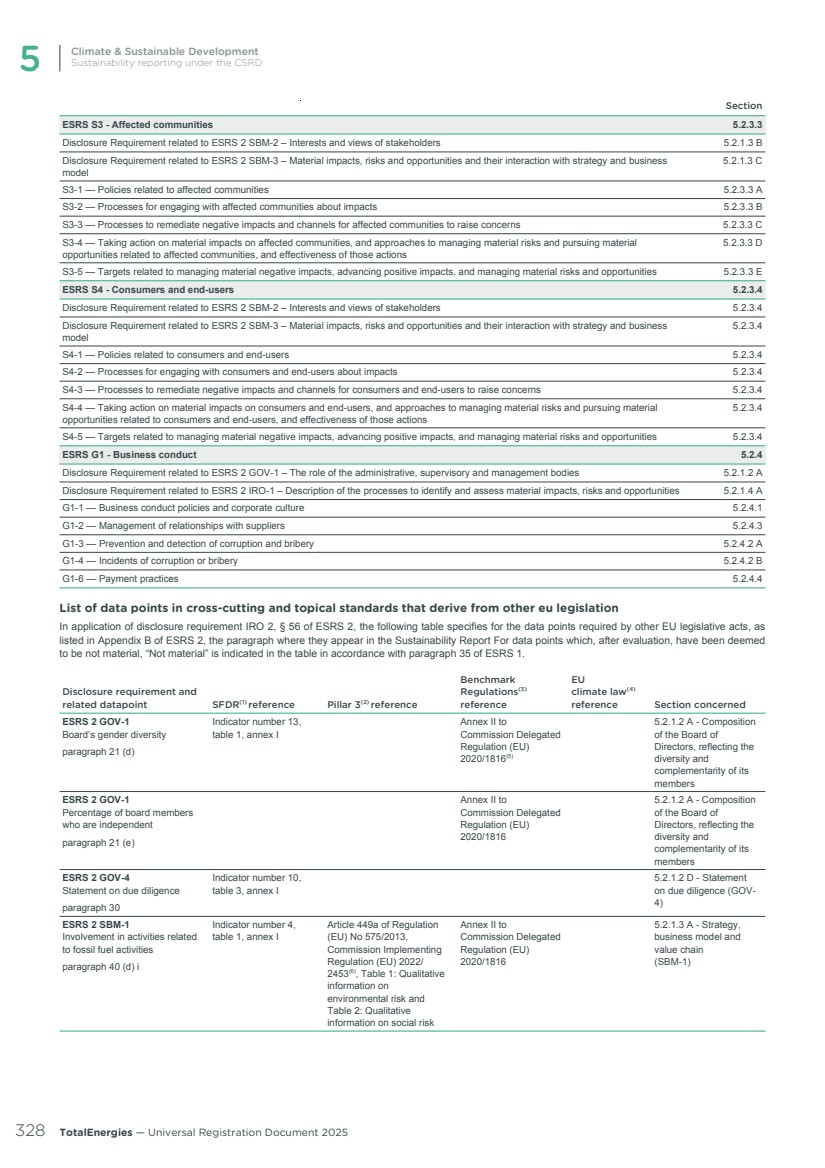
| Disclosure requirement and related datapoint SFDR(1) reference Pillar 3 (2) reference Benchmark Regulations(3) reference EU climate law(4) reference Section concerned ESRS 2 SBM-1 Involvement in activities related to chemical production paragraph 40 (d) ii) Indicator number 9, table 2, annex I Annex II to Commission Delegated Regulation (EU) 2020/1816 5.2.1.3 A - Strategy, business model and value chain (SBM-1) ESRS 2 SBM-1 Involvement in activities related to controversial weapons paragraph 40 (d) iii Indicator number 14, table 1, annex I Article 12(1) of Delegated Regulation (EU) 2020/1818(7) , Annex II of Delegated Regulation (EU) 2020/1816 Not applicable (no involvement in activities related to controversial weapons). ESRS 2 SBM-1 Involvement in activities related to cultivation and production of tobacco paragraph 40 (d) iv Delegated Regulation (EU) 2020/1818, Article 12(1) of Delegated Regulation (EU) 2020/1816, Annex II. Not applicable (no involvement in activities related to cultivation and production of tobacco) ESRS E1-1 Transition plan to reach climate neutrality by 2050 paragraph 14 Article 2(1) of Regulation (EU) 2021/1119 Not applicable ESRS E1-1 Undertakings excluded from Paris-aligned Benchmarks paragraph 16 (g) Article 449a of Regulation (EU) No 575/2013, Commission Implementing Regulation (EU) 2022/2453, Template 1: Banking book - Climate change transition risk: Credit quality of exposures by sector, emissions and residual maturity Article 12(1)(d) to (g) and Article 12(2) of Delegated Regulation (EU) 2020/1818 5.2.2.1 A - Strategy ESRS E1-4 GHG emission reduction targets paragraph 34 Indicator number 4, table 2, annex I Article 449a of Regulation (EU) No 575/2013, Commission Implementing Regulation (EU) 2022/2453, Template 3: Banking book - Climate change transition risk: alignment metrics Article 6 of Delegated Regulation (EU) 2020/1818 5.2.2.1 C - Metrics and targets ESRS E1-5 Energy consumption from fossil sources disaggregated by sources (only high climate impact sectors) paragraph 38 Indicator number 5, table 1, and indicator number 5, table 2, annex I 5.2.2.1 C - Metrics and targets ESRS E1-5 Energy consumption and mix paragraph 37 Indicator number 5, table 1, annex I 5.2.2.1 C - Metrics and targets ESRS E1-5 Energy intensity associated with activities in high climate impact sectors paragraphs 40 to 43 Indicator number 6, table 1, annex I 5.2.2.1 C - Metrics and targets ESRS E1-6 Gross Scopes 1, 2, 3 and Total GHG emissions paragraph 44 Indicators 1 and 2, Table 1, Annex I Article 449a of Regulation (EU) No 575/2013, Commission Implementing Regulation (EU) 2022/2453, Template 1: Banking book - Climate change transition risk: Credit quality of exposures by sector, emissions and residual maturity Article 5(1), Article 6 and Article 8(1) of Delegated Regulation (EU) 2020/1818 5.2.2.1 C - Metrics and targets Climate & Sustainable Development Sustainability reporting under the CSRD 5 TotalEnergies — Universal Registration Document 2025 329 |
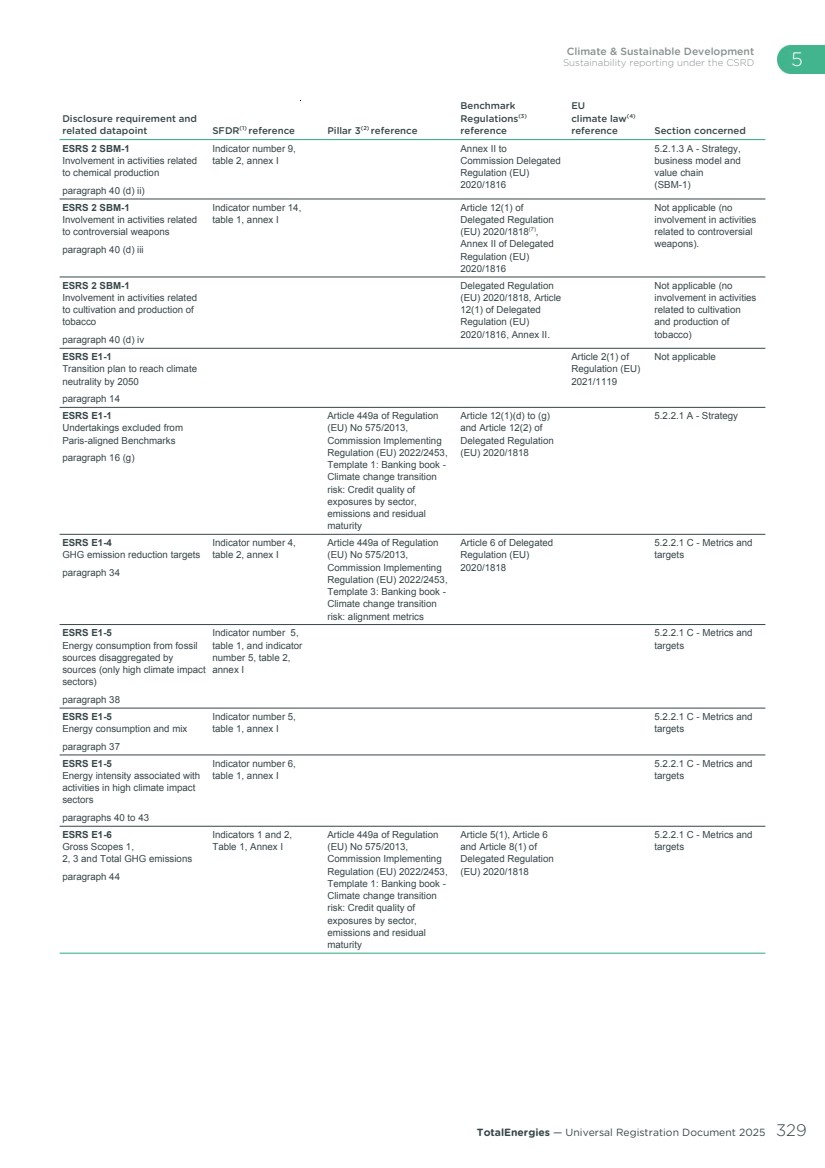
| Disclosure requirement and related datapoint SFDR(1) reference Pillar 3 (2) reference Benchmark Regulations(3) reference EU climate law(4) reference Section concerned ESRS E1-6 Gross GHG emissions intensity paragraphs 53 to 55 Indicator number 3, table 1, annex I Article 449a of Regulation (EU) No 575/2013, Commission Implementing Regulation (EU) 2022/2453, Template 3: Banking book - Climate change transition risk: alignment metrics Article 8(1) of Delegated Regulation (EU) 2020/1818 5.2.2.1 C - Metrics and targets ESRS E1-7 GHG removals and carbon credits paragraph 56 Article 2(1) of Regulation (EU) 2021/1119 5.2.2.1 C - Metrics and targets ESRS E1-9 Exposure of the benchmark portfolio to climate-related physical risks paragraph 66 Annex II of Delegated Regulation (EU) 2020/1818, Annex II of Delegated Regulation (EU) 2020/1816 Not published ESRS E1-9 Disaggregation of monetary amounts by acute and chronic physical risk paragraph 66 (a) Article 449a of Regulation (EU) No. 575/2013, Commission Implementing Regulation (EU) 2022/2453, paragraphs 46 and 47, Template 5: Banking book - Climate change physical risk: Exposures subject to physical risk. Not published ESRS E1-9 Location of significant assets at material physical risk paragraph 66 (c) Article 449a of Regulation (EU) No. 575/2013, Commission Implementing Regulation (EU) 2022/2453, paragraphs 46 and 47, Template 5: Banking book - Climate change physical risk: Exposures subject to physical risk. Not published ESRS E1-9 Breakdown of the carrying value of its real estate assets by energy-efficiency classes paragraph 67 (c) Article 449a Regulation (EU) No 575/2013; Commission Implementing Regulation(EU) 2022/2453 paragraph 34; Template 2: Banking book -Climate change transition risk: Loans collateralised by immovable property - Energy efficiency of the collateral Not published ESRS E1-9 Degree of exposure of the portfolio to climate- related opportunities paragraph 69 Annex II to Commission Delegated Regulation (EU) 2020/1818 Not published ESRS E2-4 Amount of each pollutant listed in Annex II of the E-PRTR Regulation (European Pollutant Release and Transfer Register) emitted to air, water and soil paragraph 28 Indicator No. 8, table 1, annex 1, Indicator No. 2, table 2, annex 1, Indicator No 1, table 2, annex 1, Indicator No. 3, table 2, annex 1 5.2.2.2 C - Quantitative data on substance releases to water, air and soil (E2-4) ESRS E3-1 Water and marine resources paragraph 9 Indicator number 7, table 2, annex I 5.2.2.3 A - Policies related to water and marine resources (E3-1) ESRS E3-1 Dedicated policy paragraph 13 Indicator number 8, table 2, annex I 5.2.2.3 A - Policies related to water and marine resources (E3-1) ESRS E3-1 Sustainable oceans and seas paragraph 14 Indicator number 12, table 2, annex I 5.2.2.3 A - Policies related to water and marine resources (E3-1) 5 Climate & Sustainable Development Sustainability reporting under the CSRD 330 TotalEnergies — Universal Registration Document 2025 |
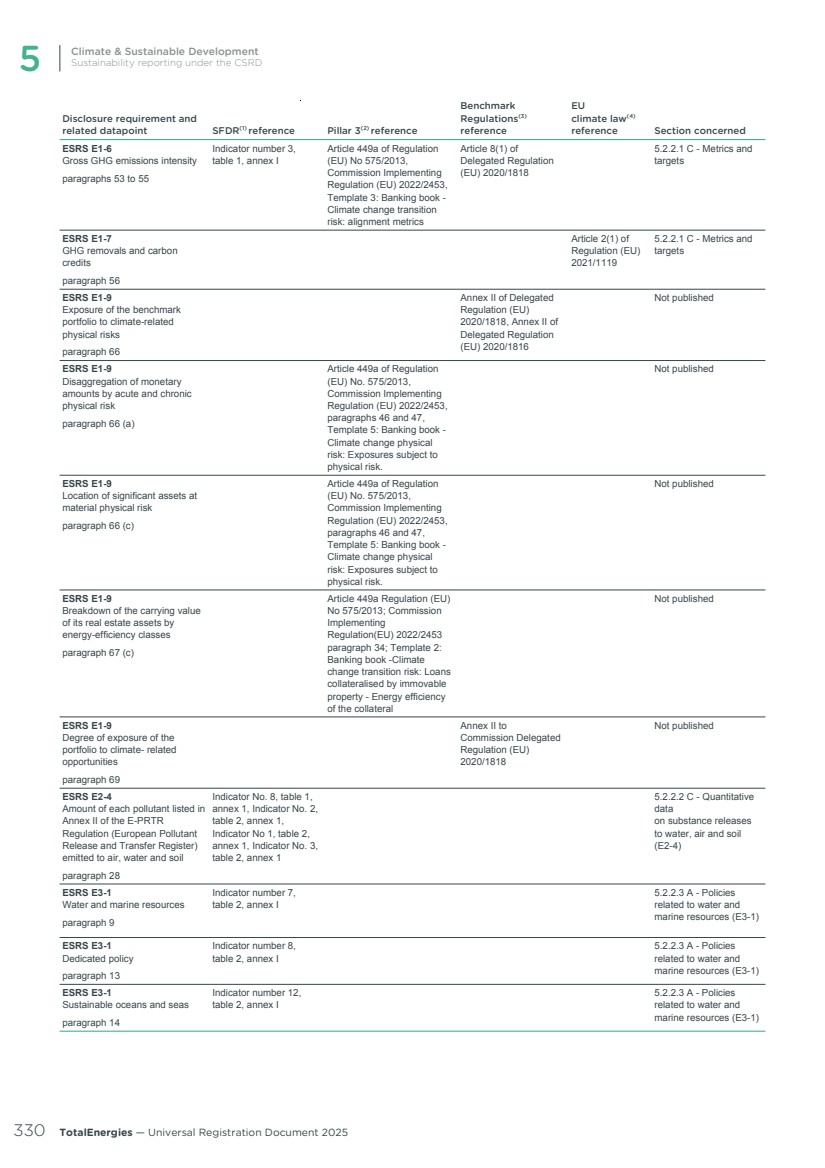
| Disclosure requirement and related datapoint SFDR(1) reference Pillar 3 (2) reference Benchmark Regulations(3) reference EU climate law(4) reference Section concerned ESRS E3-4 Total water recycled and reused paragraph 28 (c) Indicator number 6.2, table 2, annex I 5.2.2.3 E - Water indicators (E3-4) ESRS E3-4 Total water consumption in m3 per net revenue on own operations paragraph 29 Indicator number 6.1, table 2, annex I 5.2.2.3 E - Water indicators (E3-4) ESRS 2- SBM-3 - E4 paragraph 16 (a) i Indicator number 7, table 1, annex I 5.2.2.4 B Material impacts, risks and opportunities and their interaction with strategy and business model (ESRS 2 SBM-3) ESRS 2- SBM-3 - E4 paragraph 16 (b) Indicator number 10, table 2, annex I 5.2.2.4 B Material impacts, risks and opportunities and their interaction with strategy and business model (ESRS 2 SBM-3) ESRS 2- SBM-3 - E4 paragraph 16 (c) Indicator number 14, table 2, annex I 5.2.2.4 B Material impacts, risks and opportunities and their interaction with strategy and business model (ESRS 2 SBM-3) ESRS E4-2 Sustainable land/agricultural practices or policies paragraph 24 (b) Indicator number 11, table 2, annex I Not material ESRS E4-2 Sustainable oceans/seas practices or policies paragraph 24 (c) Indicator number 12, table 2, annex I Not material ESRS E4-2 Policies to address deforestation paragraph 24 (d) Indicator number 15, table 2, annex I 5.2.2.4 C - Policies related to biodiversity and ecosystems (E4-2) ESRS E5-5 Non-recycled waste paragraph 37(d) Indicator number 13, table 2, annex I 5.2.2.5 E - TotalEnergies products from the circular economy and waste (E5-5) ESRS E5-5 Hazardous waste and radioactive waste paragraph 39 Indicator number 9, table 1, annex I 5.2.2.5 E - TotalEnergies products from the circular economy and waste (E5-5) ESRS 2- SBM3 - S1 Risk of incidents of forced labour paragraph 14 (f) Indicator number 13, table 3, annex I 5.2.3.1 E - Respect for human rights at work ESRS 2- SBM3 - S1 Risk of incidents of child labour paragraph 14 (g) Indicator number 12, table 3, annex I 5.2.3.1 E - Respect for human rights at work ESRS S1-1 Human rights policy commitments paragraph 20 Indicator number 9, table 3, and indicator number 11, table 1, annex I 5.2.3.1 E - Respect for human rights at work ESRS S1-1 Due diligence policies on issues addressed by the fundamental International Labor Organisation Conventions 1 to 8 paragraph 21 Delegated Regulation (EU) 2020/1816, Annex II 5.2.3.1 E - Respect for human rights at work Climate & Sustainable Development Sustainability reporting under the CSRD 5 TotalEnergies — Universal Registration Document 2025 331 |
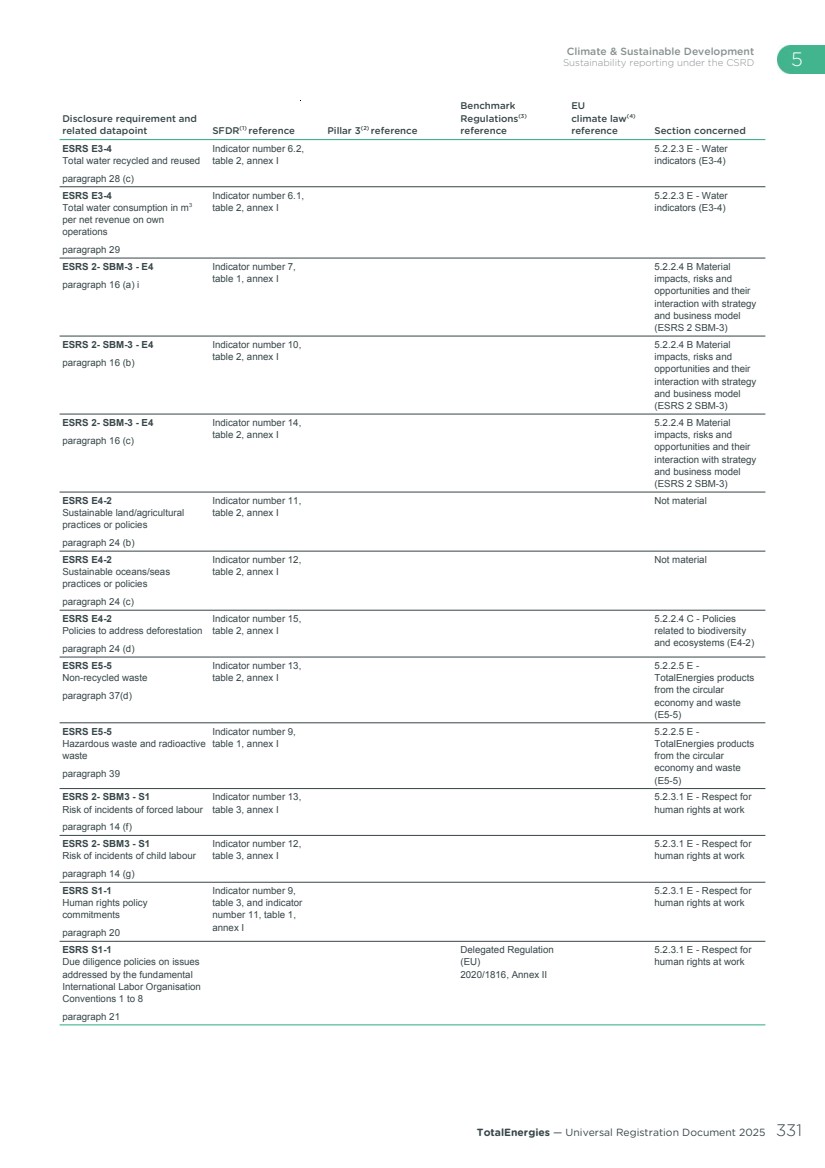
| Disclosure requirement and related datapoint SFDR(1) reference Pillar 3 (2) reference Benchmark Regulations(3) reference EU climate law(4) reference Section concerned ESRS S1-1 Processes and measures for preventing trafficking in human beings paragraph 22 Indicator number 11, table 3, annex I 5.2.3.1 E - Respect for human rights at work ESRS S1-1 Workplace accident prevention policy or management system paragraph 23 Indicator number 1, table 3, annex I 5.2.3.1 B - Health and safety ESRS S1-3 Grievance/complaints handling mechanisms paragraph 32 (c) Indicator number 5, table 3, annex I 5.2.3.1 E - Respect for human rights at work ESRS S1-14 Number of fatalities and number and rate of work-related accidents paragraph 88 (b) and (c) Indicator number 2, table 3, annex I Delegated Regulation (EU) 2020/1816, Annex II 5.2.3.1 B - Health and safety ESRS S1-14 Number of days lost to injuries, accidents, fatalities or illness paragraph 88 (e) Indicator number 3, table 3, annex I 5.2.3.1 B - Health and safety ESRS S1-16 Unadjusted gender pay gap paragraph 97 (a) Indicator number 12, table 1, annex I Delegated Regulation 2020/1816, Annex II 5.2.3.1 C - Working conditions and environment ESRS S1-16 Excessive CEO pay ratio paragraph 97 (b) Indicator number 8, table 3, annex I 5.2.3.1 C - Working conditions and environment ESRS S1-17 Incidents of discrimination paragraph 103 (a) Indicator number 7, table 3, annex I 5.2.3.1 E - Respect for human rights at work ESRS S1-17 Non-respect of UNGPs on Business and Human Rights and OECD paragraph 104 (a) Indicator no. 10, table 1, and indicator no. 14, table 3, annex I Annex II to Delegated Regulation (EU) 2020/ 1816, Article 12(1) of Delegated Regulation (EU) 2020/1818 5.2.3.1 E - Respect for human rights at work ESRS 2- SBM3 - S2 Significant risk of child labour or forced labour in the value chain paragraph 11 (b) Indicators no. 12 and no. 13, table 3, annex I 5.2.3.2 A - Value chain worker policies (S2-1) ESRS S2-1 Human rights policy commitments paragraph 17 Indicator no. 9, table 3, and indicator no. 11, table 1, annex I 5.2.3.2 A - Value chain worker policies (S2-1) ESRS S2-1 Policies related to value chain workers paragraph 18 Indicators no. 11 and no. 4, table 3, annex I 5.2.3.2 A - Value chain worker policies (S2-1) ESRS S2-1 Non-respect of UNGPs on Business and Human Rights principles and OECD guidelines paragraph 19 Indicator number 10, table 1, annex I Annex II to Delegated Regulation (EU) 2020/ 1816, Article 12(1) of Delegated Regulation (EU) 2020/1818 5.2.3.2 A - Value chain worker policies (S2-1) ESRS S2-1 Due diligence policies on issues addressed by the fundamental International Labor Organisation Conventions 1 to 8 paragraph 19 Annex II to Delegated Regulation 2020/1816 5.2.3.2 A - Value chain worker policies (S2-1) 5 Climate & Sustainable Development Sustainability reporting under the CSRD 332 TotalEnergies — Universal Registration Document 2025 |
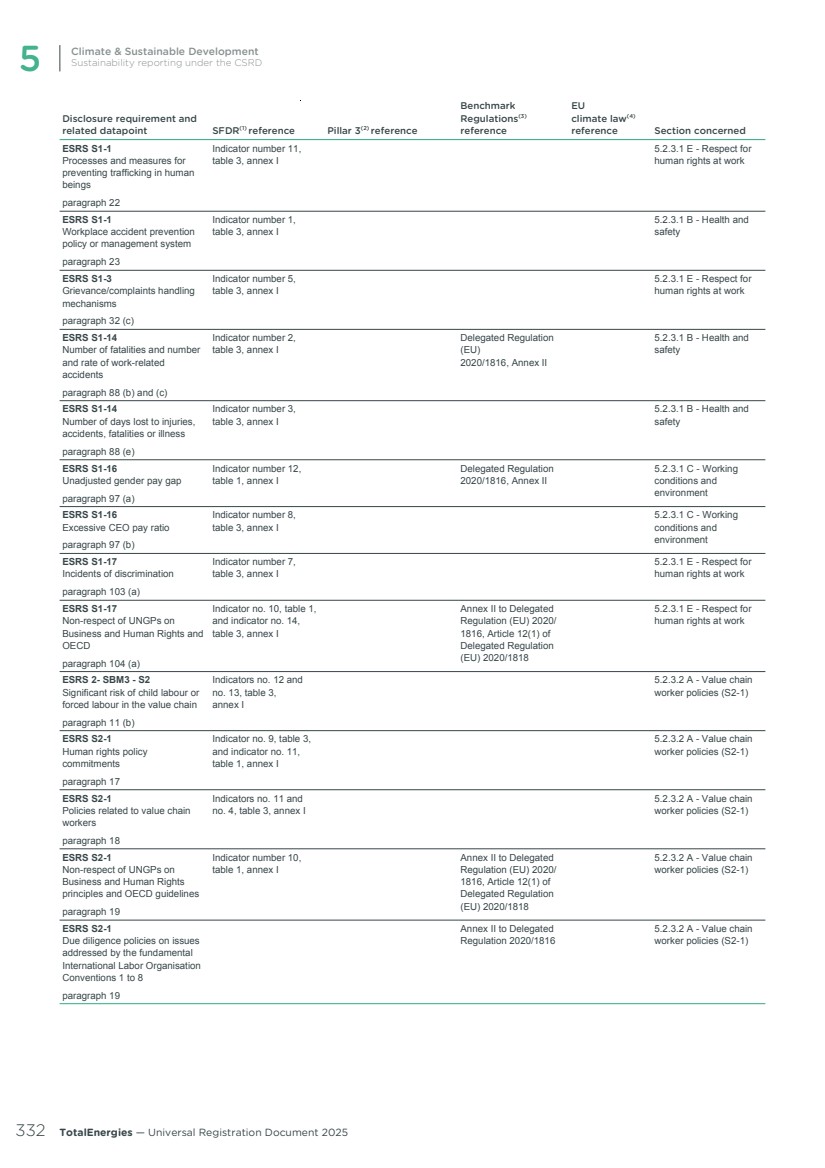
| Disclosure requirement and related datapoint SFDR(1) reference Pillar 3 (2) reference Benchmark Regulations(3) reference EU climate law(4) reference Section concerned ESRS S2-4 Human rights issues and incidents connected to its upstream and downstream value chain paragraph 36 Indicator number 14, table 3, annex I 5.2.3.2 A - Value chain worker policies (S2-1) ESRS S3-1 Human rights policy commitments paragraph 16 Indicator number 9, table 3, annex I, and indicator number 11, table 1, annex I 5.2.3.3 A Policies for affected communities (S3-1) ESRS S3-1 Non-respect of UNGPs on Business and Human Rights, ILO principles or and OECD guidelines paragraph 17 Indicator number 10, table 1, annex I Delegated Regulation (EU) 2020/1816, article 12, Annex II Delegated Regulation(EU) 2020/ 1818, Art 12 (1) 5.2.3.3 C - Processes to remedy negative impacts and channels for affected communities to voice their concerns ESRS S3-4 Human rights issues and incidents paragraph 36 Indicator number 14, table 3, annex I 5.2.3.3 C - Processes to remedy negative impacts and channels for affected communities to voice their concerns ESRS S4-1 Policies related to consumers and end-users paragraph 16 Indicator no. 9, table 3, and indicator no. 11, table 1, appendix I 5.2.3.4 - Consumers and end-users (S4) ESRS S4-1 Non-respect of UNGPs on Business and Human Rights principles and OECD guidelines paragraph 17 Indicator number 10, table 1, annex I Delegated Regulation (EU) 2020/1816, Annex II Delegated Regulation(EU) 2020/ 1818, Art 12 (1) 5.2.3.4 - Consumers and end-users (S4) ESRS S4-4 Human rights issues and incidents paragraph 35 Indicator number 14, table 3, annex I 5.2.3.4 - Consumers and end-users (S4) ESRS G1-1 United Nations Convention against Corruption paragraph 10 (b) Indicator number 15, table 3, annex I 5.2.4.2 A - Preventing and detecting corruption (G1-3) ESRS G1-1 Protection of whistleblowers paragraph 10 (d) Indicator number 6, table 3, annex I 5.2.4.1 C - Procedure for collecting and reporting whistleblowing reports ESRS G1-4 Fines for violation of anti-corruption and anti-bribery laws paragraph 24 (a) Indicator number 17, table 3, annex I Delegated Regulation 2020/1816, Annex II 5.2.4.2 B - Incidents of corruption (G1-4) ESRS G1-4 Standards of anti- corruption and anti- bribery paragraph 24 (b) Indicator number 16, table 3, annex I 5.2.4.2 A - Preventing and detecting corruption (G1-3) (1) Regulation (EU) 2019/2088 of the European Parliament and of the Council of November 27, 2019 on sustainability-related disclosures in the financial services sector (OJ L 317, 9.12.2019, p. 1). (2) Regulation (EU) No 575/2013 of the European Parliament and of the Council of June 26, 2013 on prudential requirements for credit institutions and investment firms and amending Regulation (EU) No 648/2012 (Capital Requirements Regulation or “CRR” Regulation) (OJ L 176, 27.6.2013, p. 1). (3) Regulation (EU) 2016/1011 of the European Parliament and of the Council of June 8, 2016 on indices used as benchmarks in financial instruments and financial contracts or to measure the performance of investment funds and amending Directives 2008/48/EC and 2014/17/EU and Regulation (EU) No 596/2014 (OJ L 171, 29.6.2016, p. 1). (4) Regulation (EU) 2021/1119 of the European Parliament and of the Council of June 30, 2021 establishing the framework for achieving climate neutrality and amending Regulations (EC) No 401/2009 and (EU) 2018/1999 (“European Climate Law”) (OJ L 243, 9.7.2021, p. 1). (5) Commission Delegated Regulation (EU) 2020/1816 of July 17, 2020 supplementing Regulation (EU) 2016/1011 of the European Parliament and of the Council as regards the explanation in the benchmark statement of how environmental, social and governance factors are reflected in each benchmark provided and published (OJ L 406 of 3.12.2020, p. 1). (6) Commission Implementing Regulation (EU) 2022/2453 of November 30, 2022 amending the implementing technical standards laid down in Implementing Regulation (EU) 2021/637 as regards the disclosure of environmental, social and governance risks (OJ L 324 of 19.12.2022, p. 1). (7) Commission Delegated Regulation (EU) 2020/1818 of July 17, 2020 supplementing Regulation (EU) 2016/1011 of the European Parliament and of the Council as regards minimum standards for EU Climate Transition Benchmarks and EU Paris-aligned Benchmarks (OJ L 406, 3.12.2020, p. 17). Climate & Sustainable Development Sustainability reporting under the CSRD 5 TotalEnergies — Universal Registration Document 2025 333 |
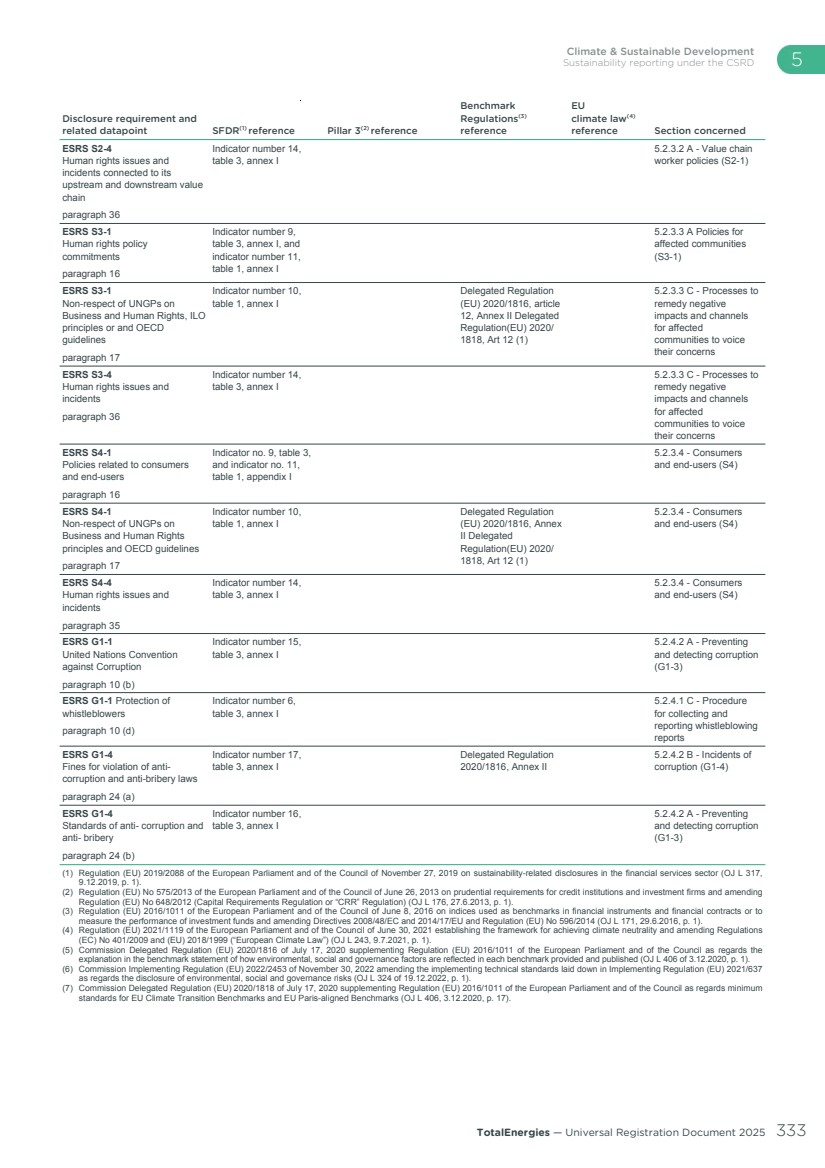
| 5.2.2 Environmental information 5.2.2.1 Climate change (E1) A.Strategy 1. Transition strategy for climate change mitigation TotalEnergies’s ambition in terms of sustainable development and energy transition towards carbon neutrality, together with society, is described in point 5.2.1.3. In 2025, progress made in the implementation of the Corporation’s ambition with respect to sustainable development and energy transition and its related targets by 2030 has been reported in the Sustainability & Climate - 2025 Progress Report. In the context of shareholder dialogue, major regulatory changes (CSRD), and controversies surrounding the practice of Say on Climate through advisory resolutions, the Board of Directors, after conducting a review of peer practices and market developments, and consulting shareholders and proxy advisory firms to gather their expectations regarding Say on Climate, has decided to include a formal item for discussion (without a resolution submitted to a shareholder vote) on the agenda of the Annual General Meeting of May 23, 2025 about the Sustainability & Climate – 2025 Progress Report. The Board intends to make this an ongoing practice of including an agenda item at future Annual General Meetings. In the event of a significant change to the Company’s strategy, the Board of Directors would take the initiative to submit the Sustainability & Climate strategy to an advisory shareholder vote. In parallel, the Chairman and Chief Executive Officer and some members of the Executive Committee as well as the Lead Independent Director participated all year long to a nourished dialogue with shareholders and different stakeholders on the Company’s climate issues. As an illustration, in 2025, the Lead Independent Director entertained an extensive dialogue ahead of the Shareholders’ Meeting with shareholders representing nearly a quarter of the Corporation’s capital. The Lead Independant Director has also driven a sustained dialogue with proxy advisors. This dialogue continued after the Shareholders’ Meeting. These meetings provide an opportunity to exchange views on TotalEnergies’ strategy and investments, notably for the Integrated Power business. Description of decarbonization levers identified and key actions planned A strategy to help clients reduce their emissions By 2030, the Company intends to sell its customers a mix of energy products with a 25% lower carbon content than in 2015. In other words, it intends to reduce the lifecycle carbon intensity of its products sold(1) by 25%, which is the ratio of lifecycle emissions (Scope 1+2+3) of its energy products sold to the volumes of energy supplied (g CO2e/MJ). Indeed, by offering its clients an increasingly decarbonized portfolio, TotalEnergies contributes to the energy transition and helps its clients reduce their emissions. Growth in electricity will drive around 70% of the reduction in its lifecycle carbon intensity between 2015 and 2030. Lower emissions from facilities will contribute to approximately 20% of the intensity reduction. The other levers will be essentially the shift to natural gas and to a lesser extent low-carbon molecules as well as “CCS as a service” (2) . Levers for reducing the carbon intensity(a) (2015-2030) (a) Lifecycle carbon intensity of energy products sold (Refer to the glossary for the definition of this indicator). (b) Biofuels, biogas, hydrogen and e-fuels/e-gas. Reduction in Scope 1+2 emissions by 2030 TotalEnergies reaffirms its target to reduce emissions from its operated assets, which aims to reduce its net Scope 1+2 emissions(3) by 40% by 2030 relative to 2015, after mobilizing around 5 million credits from nature-based carbon sinks projects. The Company has not set itself a gross target for 2030. This offsetting will start only from 2030 for residual emissions on the basis of a consumption of approximately 10% per year of the stock of carbon credits (refer to point 5.2.2.1 C. 3. (E1-7)). These targets include emissions generated by the growth strategy in electricity pursued since 2015, which has prompted to create a portfolio of flexible power generation plants (CCGT). The baseline values in the 2015 reference year against which the progress towards the targets are measured are representative in terms of activities covered (mainly the supply of energies) and influences of external factors, taking into account the geographical diversity of the locations and markets covered by the Company. To achieve this 2030 target, the Company is activating every lever at its disposal to avoid and reduce the emissions linked to its operations. Scope 1+2 decarbonization levers are described in point 5.2.2.1 C. 1. (E1-4). Investments and financing by the Company to support the implementation of its transition strategy Firstly, in October 2025, the Company announced a $1 billion reduction in its annual capital expenditure target to $15-17 billion per year over the next five years, including $3-4 billion for Integrated Power. That reduction is part of the Company’s implementation of a $7.5 billion cost-saving programme (Capex + Opex) during the 2026-2030 period. The Company will remain focused on high margin Upstream projects and stay selective on low-carbon Capex, mainly for the Integrated Power business. Secondly, in November 2025, TotalEnergies announced its intention to accelerate its gas-to-power integration strategy in Europe by acquiring 50% of a portfolio of flexible power generation assets from EPH as part of a €5.1 billion all-share transaction that was immediately earnings-enhancing for TotalEnergies shareholders(4) . Due to this accelerated inorganic growth within the Integrated Power segment, the Company is lowering its annual Capex guidance by $1 billion per year to $14- 16 billion per year for 2026-2030, of which $2-3 billion is for Integrated Power, while maintaining its 2030 electricity generation target of 100- 120 TWh. (1) Refer to the glossary for the definition of this indicator. (2) Refer to 5.2.2.1 B. 2. - Action 5, for the description of “Storage as a Service” CCS projects. (3) The calculation of net emissions includes nature-based carbon sinks projects as from 2030. (4) The transaction remains subject to information and consultation processes and regulatory approvals, with completion expected by mid-2026. 5 Climate & Sustainable Development Sustainability reporting under the CSRD 334 TotalEnergies — Universal Registration Document 2025 |
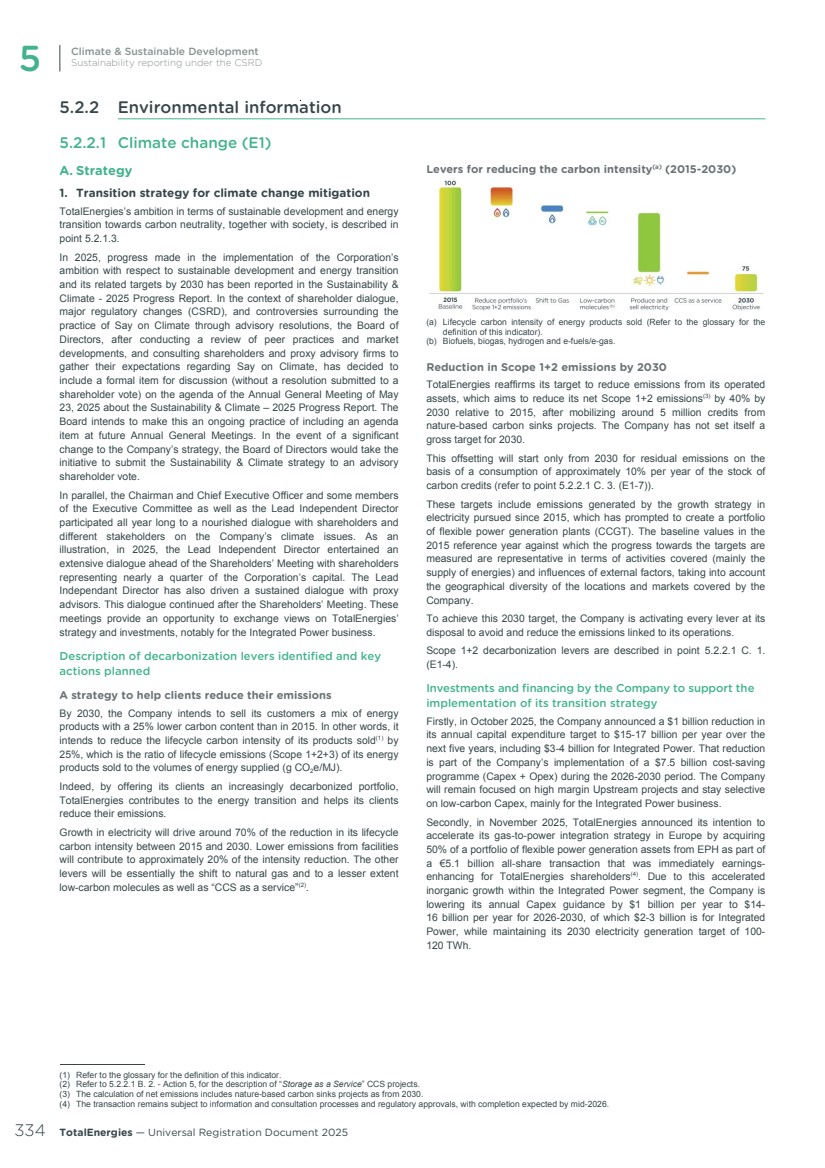
| Overall, therefore, TotalEnergies intends to maintain a material level of investment in low-carbon energies, mainly in the Integrated Power segment, where it plans to invest $3-4 billion per year in 2026-2030, including around $1 billion per year for five years through shares as part of the transaction with EPH. Net investments in low-carbon energies include investments in Integrated Power, low-carbon molecules (including biofuels, biogas, recycled plastic, biopolymers, synthetic fuels, hydrogen and CCS) as well as the nature-based carbon sinks projects allowing, from 2030, to contribute to reduction of the Company’s carbon footprint. Around 35% of TotalEnergies’ net investments are expected to be dedicated to developing new low-cost, low-emissions oil and gas projects, contributing to the 3% growth in hydrocarbon production between 2024 and 2030. These investments are expected to be allocated in particular to strengthening its LNG production capacity and supporting its oil production, in a context of continued growth in global demand. The Company maintains a downward flexibility to $14 billion per year in case of a sharp decrease of prices, under $50/b. In 2025, the Company has invested a total of $17.1 billion, including around $3.5 billion in low-carbon energies, mainly in the Integrated Power segment ($3 billion). In 2026, TotalEnergies is planning net investment of around $15 billion, including $2.5-3 billion of net investment in the Integrated Power segment, which equates to a total net investment effort of $3.5-4 billion per year in that segment averaging around $1 billion per year for five years including shares as part of the transaction with EPH. In a global economic context marked by a high level of uncertainty, it is essential to maintain the Company’s investment criteria to ensure the profitability and resilience of its portfolio. Each material investment project is assessed taking into consideration the aims of the Paris Agreement on the basis of the following criteria: – project profitability is analyzed in a hydrocarbon price scenario compatible with the Paris Agreement objectives of limiting temperature rise to “well below 2°C” and with an internal carbon price of $100 per ton (or the prevailing price if higher in a given country); – for new oil & gas projects (greenfield projects and acquisitions), the intensity of Scope 1+2 greenhouse gas emissions is compared, depending on their nature, to the intensity of the average greenhouse gas emissions of Upstream production assets or that of various Downstream units (LNG plants, refineries) of the Company. For Upstream projects, as of 2026, the threshold has been lowered to 16 kg CO2e/boe, versus 17 kg CO2e/boe previously – evidence of the effectiveness of the Company’s criteria. For additional investments in existing assets (brownfield projects), the investment will have to lower the Scope 1+2 emissions intensity of the asset in question. The goal is for each new investment to contribute to lowering the average intensity of the Company’s Scope 1+2 greenhouse gas emissions in its category; – for projects involving other energy and technologies (biofuels, biogas…), GHG emission reductions are assessed based on the amount by which they will reduce the carbon content of the Company’s sales. In addition to investments in new low-carbon activities, TotalEnergies funded a $1 billion energy efficiency improvement plan over the period 2023-2025, and in 2024 announced a second plan for the same amount for the period 2026-2028. TotalEnergies also devoted more than $1 billion in 2025 to R&D, industrial innovation and developments in digital, with 72% of the R&D budget(1) devoted to low carbon energies (renewable electricity, biomass, batteries...) and to reducing the environmental footprint through CCUS and sustainability programs. Pursuant to European Union regulations, TotalEnergies publishes the proportion of eligible activities and aligned activities in the CapEx indicator(2) . Eligible or aligned CapEx represent respectively 31% and 27% of investments on proportional view(3) in 2025, confirming the dynamic initiated since 2020 (refer to point 5.2.2.6). Eligible and aligned CapEx (a) Proportional view(b) (a) CapEx refers to the taxonomy standard. A reconciliation table is provided in point 5.2.2.6 C. (b) Proportional view, in accordance with EU Delegated Act 2021/2178 of July 6, 2021. This proportional view incorporates the contribution of jointly controlled entities and those over which TotalEnergies exercises significant influence, accounted for using the equity method. A reconciliation table is provided in point 5.2.2.6 C. As part of a balanced energy transition and a growing world energy demand, TotalEnergies as an integrated global multi-energy company producing and supplying energies has to and will have to make investments in activities not aligned according to the criteria of EU Delegated Act 2021/2139 of the European Commission. Indeed, demand for oil could start to decline during the 2030s but less quickly than the current rate of natural decline of existing fields (estimated at an average of 8% per year over the next decade according to the IEA(4)). TotalEnergies therefore considers that new oil projects are necessary to meet this demand and maintain prices at an acceptable level in order to create the conditions for a just transition, giving people time to adapt their energy use. Significant investments during the reporting year related to coal, oil and gas-related economic activities In 2025, the Company’s net investments amounted to approximately $14 billion in its oil and gas-related economic activities, representing approximately 80% of its net investments. TotalEnergies has not made any investments in coal-related economic activities. In 2015, TotalEnergies ceased its coal production activities and it stopped selling and trading coal in 2016. (1) Excluding Hutchinson. (2) CapEx refers to the taxonomy standard. A reconciliation table is provided in point 5.2.2.6.C. (3) Proportional view, in accordance with EU Delegated Act 2021/2178. This proportional view incorporates the contribution of jointly controlled entities and those over which TotalEnergies exercises significant influence, accounted for using the equity method. A reconciliation table is provided in point 5.2.2.6 C. (4) Source: “The Implications of Oil and Gas Field Decline Rates” (IEA, September 2025). Climate & Sustainable Development Sustainability reporting under the CSRD 5 TotalEnergies — Universal Registration Document 2025 335 |
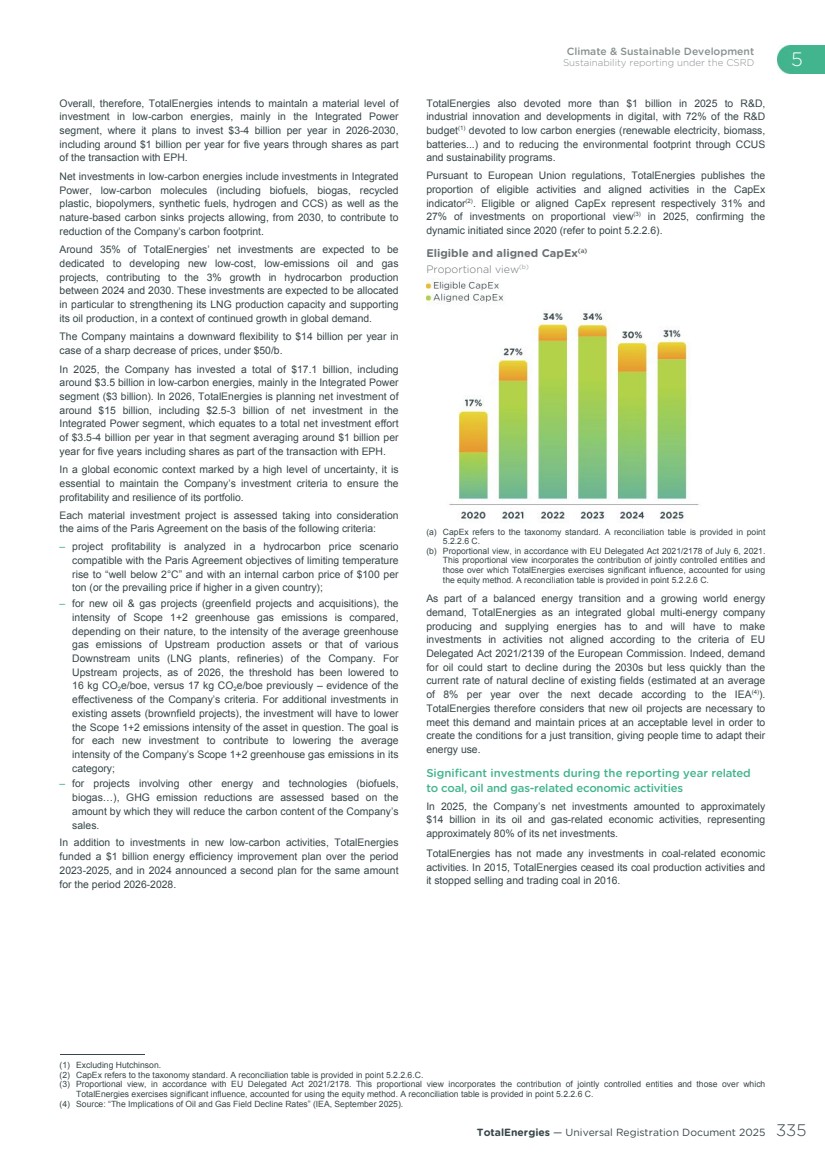
| How TotalEnergies’ 2030 targets compared to the IEA scenarios Based on the current state of scientific knowledge, in light of the growing heterogeneity of energy pathways at the global level, the reliance by forward‑looking scenarios on assumptions that may not materialize, and the ongoing uncertainties regarding the evolution of global energy demand, worldwide GHG emissions and the effective pace of deployment of low‑carbon technologies, the Company is unable to determine whether the targets it has set for itself for 2030 (whether net or gross) are compatible with limiting global warming to 1.5°C by 2100. From a scientific perspective, there are a multitude of transition scenarios and there is currently no consensus on GHG emission reduction targets or trajectories applicable at the scale of a company in a given sector and which would be compatible with a given global temperature target. Current trends indicate that the evolution of the global energy mix is not compatible with limiting global warming to 1.5°C and with the objective of achieving climate neutrality by 2050(1) . The “Stated Policies” scenario (STEPS) of the International Energy Agency provides an idea of the direction taken by the energy sector based on the most recent policies in countries around the world. It takes into account the energy, climate and related industrial policies that are in place or have been announced. The 2025 STEPS scenario projects a higher demand in fossil energies compared to the 2024 STEPS scenario: oil demand remains more or less constant until 2040 and declines by approximately 3% per annum between 2040 and 2050. Gas demand increases until 2035 and plateaus thereafter until 2050. Therefore the global primary energy mix in 2050 still relies on fossil fuels for 59% (25% oil, 22% gas and 13% coal). STEPS is associated with a temperature increase of 2.5°C in 2100 (with a 50% probability) compared to the reference period 1850–1900. TotalEnergies’ targets for 2030 outline trajectories comparable to those of certain recognized public scenarios (IEA - APS and STEPS scenarios, Fit for 55 of the European Union(2)). Achieving the Scope 1+2 (net target) and methane emission reduction targets in the operated perimeter depends mainly on the Company, while the evolution of TotalEnergies’ Scope 3 (3) assumes an evolution of customers’ Scope 1+2 emissions that does not depend only on TotalEnergies but on various external factors such as consumer behavior or public policies. The Company monitors the conditions for achieving its targets as part of the long-term plan exercises that it carries out annually. When setting its targets, TotalEnergies also listens to its stakeholders (investors, shareholders, public authorities and civil society in particular). It reports on its progress as part of its Sustainability & Climate Progress Report. TotalEnergies puts its targets for 2030 into perspective in relation to the IEA scenarios. Its target for reducing the lifecycle carbon intensity of energy products sold(4) (a 25% reduction by 2030) puts TotalEnergies on a trajectory close to the Announced Pledges Scenario (APS) in the IEA’s World Energy Outlook 2024, which assumes that the States party to the Paris Agreement fulfill all their carbon neutrality objectives. An independent third party (Wood Mackenzie) has audited the calculations made and the trajectories presented. Net Scope 1+2 emissions TotalEnergies operated perimeter World CO2 emissions (all sectors) - IEA scenarios (WEO 2024 and 2025(a)) In % relative to 2015 (a) Based on the IEA World Energy Outlook 2024 and 2025, License CC by 4.0. Worldwide CO2 emissions from energy combustion and industrial processes. For TotalEnergies, emissions exclude the COVID-19 effect in 2020 and 2021, and take into account nature-based carbon sinks projects from 2030. Lifecycle carbon intensity of energy products sold(a) IEA Scenarios (WEO 2024 and 2025) In % relative to 2015 (a) Lifecycle carbon intensity of energy products sold (refer to glossary for the definition of this indicator) and evolution of the carbon intensity of world energy, calculated as the ratio of worldwide CO2 emissions from fossil fuels (Mt CO2) to total primary energy supply (EJ) in the IEA World Energy Outlook 2024 and 2025. The electricity production from renewable sources (wind, solar, hydro) included in these scenarios is reduced to the same fossil base, taking into account a substitution factor of 2.63 (38%) to make them comparable with the lifecycle carbon intensity of the energy products sold by TotalEnergies. Exclusion of the Company from the “Paris Agreement” benchmarks TotalEnergies is excluded from the EU Paris-aligned benchmark in accordance with the exclusion criteria stated in Articles 12(1)(d) to (g) of Commission Delegated Regulation (EU) 2020/1818, since it derives more than 10% of its revenues from the exploration, extraction, distribution or refining of liquid fuels. EU Paris-aligned benchmarks are a category of benchmarks that aim to align passively managed capital with the decarbonisation objectives of the Paris Agreement. They are subject to minimum standards and exclusion criteria set by the European Benchmark Regulation and its aforementioned Delegated Regulation. Qualitative assessment of potential locked-in GHG emissions The potentially locked-in GHG emissions associated with the Company’s main assets and products represent an estimate of the future GHG emissions likely to be caused by these assets or products sold during their operational life. (1) International Energy Agency, STEPS scenario. (2) A 37% decrease between 2015 and 2030. (3) Refer to the glossary for the definition of this indicator. (4) Refer to the glossary for the definition of this indicator. 5 Climate & Sustainable Development Sustainability reporting under the CSRD 336 TotalEnergies — Universal Registration Document 2025 |
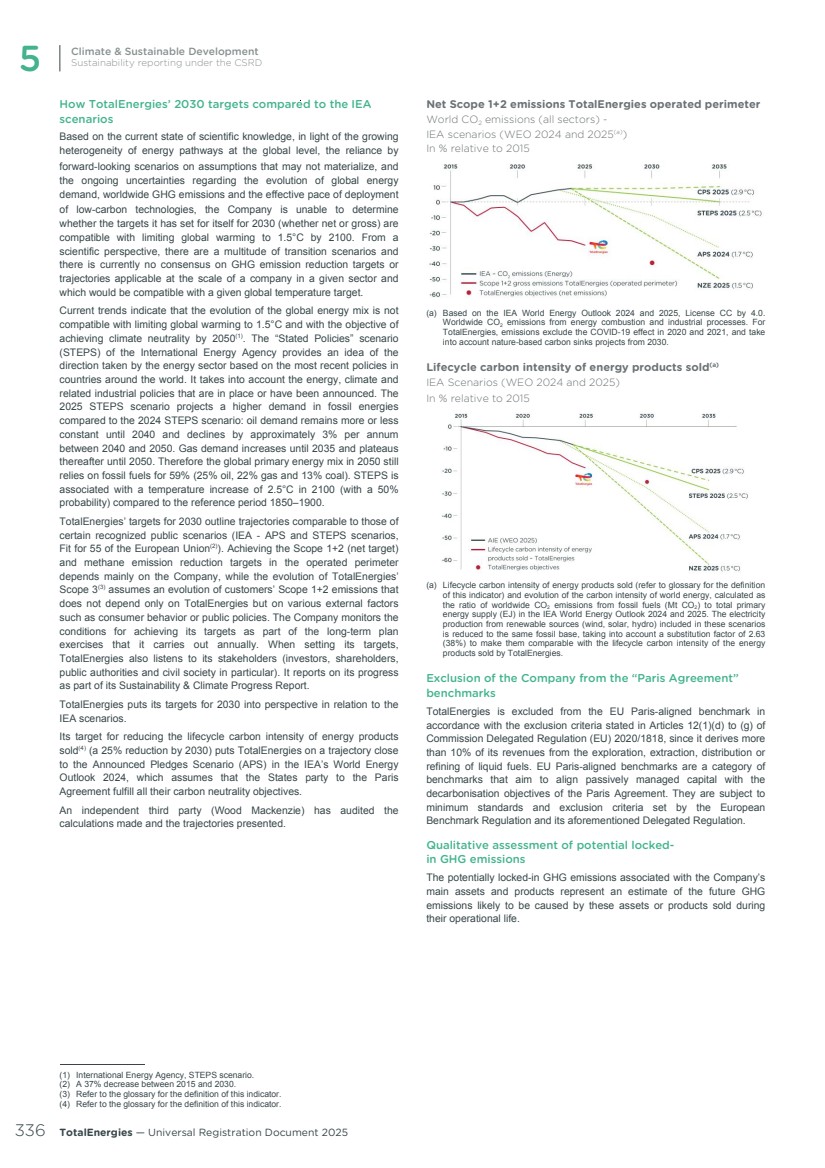
| For the Company, these emissions would essentially be linked: – on the one hand, with respect to assets, to Scope 1+2 emissions from its facilities over their lifetime, including its oil and gas installations and flexible power generation assets (CCGT); – and on the other hand, with respect to products, to Scope 3 (1) emissions, category 11, corresponding to indirect GHG emissions caused by customers’ use of energy products, i.e., from their combustion to obtain energy. Against a backdrop of ever-increasing global demand, particularly in developing countries, TotalEnergies has chosen to meet this demand while at the same time reducing its emissions. Potential locked-in GHG emissions are taken into account by the Company in the process to define its targets. With respect to assets, Scope 1+2 emissions of operated facilities are part of a reduction trajectory materialized by targets described in point 5.2.2.1 C. 1. (E1-4). With respect to products, the Company has set a target of maintaining Scope 3 (2) GHG emissions related to its customers’ use of energy products at a level below 400 Mt CO2e by 2030 while increasing its energy production. In view of the transition risk that could be associated with potential locked-in emissions, TotalEnergies has managed to strengthen the resilience of its portfolio through very active management in recent years, leading on the one hand to a recentering of the oil and gas portfolio on assets and projects with low break-even points and low greenhouse gas emissions and on the other to diversification into electricity, particularly electricity from renewable sources, through an integrated strategy from production to customer. Progress made by the Company in implementing the transition strategy The Company measures the progress made in implementing its transition strategy through various indicators listed in point 5.2.2.1 C. (E1-4 and E1-6), notably: – lifecycle carbon intensity of energy products sold(3); – net Scope 1+2 emissions from its operated activities(4); – methane emissions from its operated activities. In 2025, TotalEnergies maintained its progress, thanks to growth in sales of electricity from renewable sources, achieving a 18.6% reduction in the lifecycle carbon intensity of its energy products sold relative to 2015. Lifecycle carbon intensity of energy products sold(a) Base 100 in 2015 (a) Lifecycle carbon intensity of energy products sold (refer to the glossary for the definition). TotalEnergies is resolutely continuing to reduce emissions from its operational assets. Thus, within the scope of its oil and gas facilities(5) , emissions from assets operated by the Company fell by more than 38% compared to 2015 levels. In 2025, with more than 85 GHG emissions reduction projects coming to fruition, TotalEnergies reduced its emissions by 0.7 Mt CO2e across its operated assets. At the same time, emissions related to flexible power generation decreased by 0.2 Mt CO2e due to changes in the portfolio operated and lower utilization rates of CCGTs in the United States. As a result, the Company’s overall operated emissions have decreased by 28% compared to 2015. Scope 1+2 emissions from operated facilities(a) (Mt CO2e) (a) Net emissions, including nature-based carbon sinks projects from 2030, at a level of approximately 5 Mt/y of carbon credits. Until 2029 included, net emissions are equal to gross emissions (no use of nature-based carbon sinks projects before 2030). In 2025, operated methane emissions were 22.5 kt CH4, a decrease of 65% compared to 2020. Methane emissions from operated facilities (kt CH4) (1) Refer to the glossary for the definition of this indicator. (2) Refer to the glossary for the definition of this indicator. (3) Refer to the glossary for the definition of this indicator. (4) The calculation of net emissions includes nature-based carbon sinks projects as from 2030. (5) Upstream and Downstream oil & gas activities (excluding CCGT). Climate & Sustainable Development Sustainability reporting under the CSRD 5 TotalEnergies — Universal Registration Document 2025 337 |
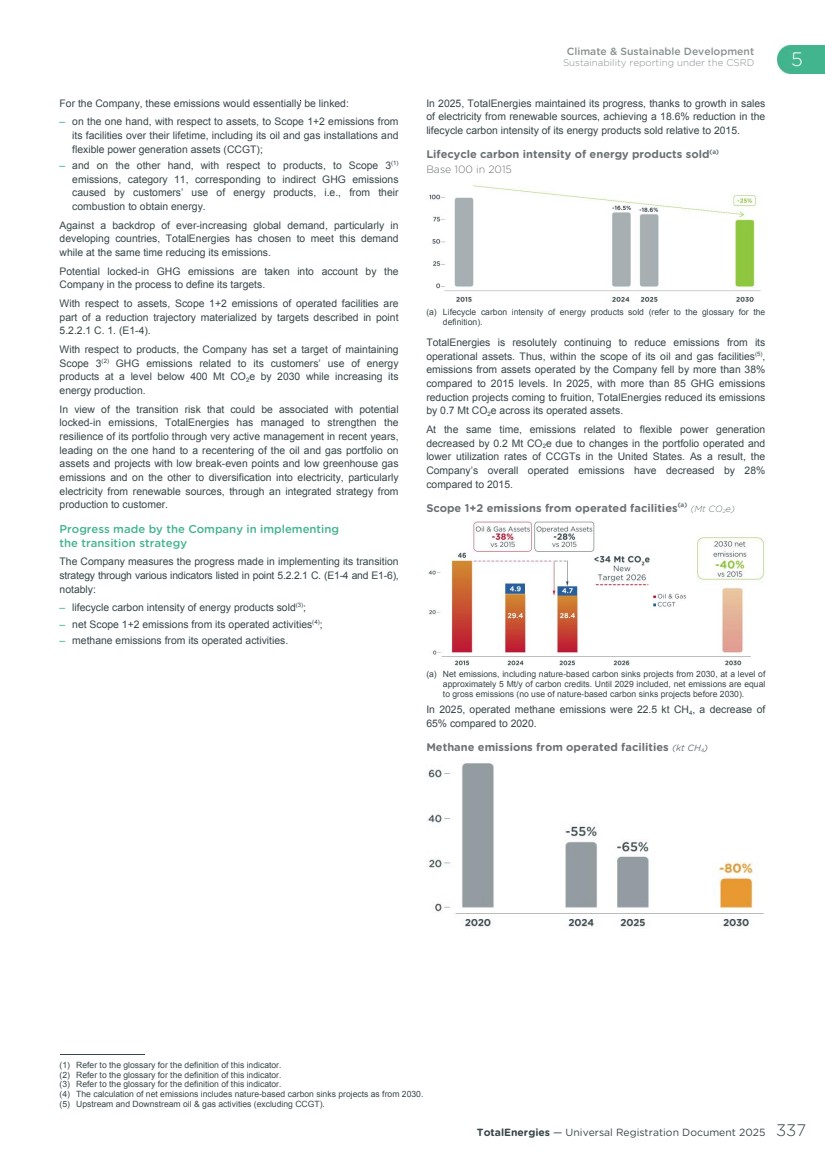
| 2. Material impacts, risks and opportunities and their interaction with strategy and business model (ESRS2 SBM-3) In carrying out its double materiality analysis, the Company identified eight material climate-related risks, which are described in the table below: Material climate-related risks Type of climate-related risk Pace of deployment of the energy transition, evolution of the demand Transition risk Reputational risk relating to climate issues Transition risk Financing of oil and gas activities relating to climate change Transition risk Risk of legal actions relating to climate change Transition risk Risk of skill management and evolution of the professions relating to climate change Transition risk Risk of evolution of regulations relating to climate change Transition risk Technology risk relating to climate change Transition risk Operational risks relating to the effects of climate change and extreme events Physical risk a. Resilience analysis: scope, analysis and results The scope of the resilience analysis covers the Company’s transition and physical risks. It was updated at the end of 2025. As detailed in point 5.2.1.3 (SBM-1), the Company has strengthened the resilience of its portfolio through very active portfolio management in recent years: the Upstream portfolio has seen a 50% portfolio change since 2015, ensuring an oil reserves replacement ratio above 100% over 2015-2025. The Company’s portfolio has a low breakeven point, in line with its objective of keeping it below $30/b (the Company’s organic cash breakeven point before dividend is $26.4/b in 2025), which ensures the competitiveness of its resources. For its Upstream oil & gas assets in 2025, TotalEnergies has the lowest production cost per barrel of around $5.0/boe among its peers(1) and its GHG emissions intensity (Scope 1+2) has fallen to less than 16 kg CO2e/boe in 2025 (compared with 17 in 2024) (2) . TotalEnergies’ downstream business has been a steady contributor to the Company’s results, while transitioning and adapting its activities to focus on high value-added markets. The Company is addressing the sustainability challenges of its downstream activities through three levers: – Lowering the breakeven point of its refining-petrochemicals assets in a cyclical industry; – Reducing GHG emissions from its operations; – Offering its customers low-carbon mobility solutions. b. Risk of stranded assets In June 2020, TotalEnergies determined that among its Upstream assets, only the Fort Hills and Surmont oil sands projects in Canada could be classified as stranded assets, meaning assets with reserves beyond 20 years and high production costs, whose overall reserves might therefore not be produced by 2050. TotalEnergies has sold these assets in 2023. This portfolio management approach allows TotalEnergies to mitigate the risk of stranded assets in the future if the risks of a structural decline in demand for oil & gas materialize faster than estimated as a result of stricter global environmental regulations and constraints and the resulting changes in consumer preferences. As shown in the cost merit order curve of production costs for 2040, compared to the demand expected under various IEA scenarios, TotalEnergies’ portfolio of Upstream oil projects has an average technical cost that places it among the 50 Mb/d lowest-cost for these horizons, thanks in particular to long plateau oil assets with low production costs. Merit order curve of global oil production costs(a) Technical costs ($/b) (a) Source: Rystad, IEA WEO 2024 (APS) and 2025 (NZE, STEPS, CPS) scenarios. c. Sensitivity to CO2, oil and gas prices TotalEnergies assesses the robustness of its portfolio, including new material investments, based on relevant scenarios and sensitivity tests. Each material investment, including in the exploration, acquisition or development of oil & gas resources, as well as in other energies and technologies, is subject to an assessment taking into account a price scenario of Brent at $50/b and Henry Hub at $3/Mbtu, i.e., prices lower than those of the IEA’s APS scenario deemed to be compatible with the objectives of the Paris Agreement; every new investment reinforces the resilience of the Company’s portfolio. Even though CO2 pricing does not currently apply in all the countries where the Company operates, TotalEnergies includes as a base case, a CO2 price of $100/t in its investment criteria (or the prevailing price in a given country, if higher); beyond 2031, the CO2 price is inflated by 2% per year. – On the assumption that this CO2 price would be at $200/ton, then inflated by 2%/y beyond 2031, i.e., an increase of $100/ton compared to the base case scenario from this date, TotalEnergies estimates a negative impact around 15% on the discounted present value of all the Company’s assets (Upstream and Downstream). In such a scenario, the value of Integrated Power’s assets would increase due to the rise in electricity prices in Europe. (1) Production costs, ASC 932. Peers: BP, Chevron, ExxonMobil, Shell. (2) Operated Perimeter. Oil & gas Upstream intensity is calculated excluding integrated LNG assets. 5 Climate & Sustainable Development Sustainability reporting under the CSRD 338 TotalEnergies — Universal Registration Document 2025 [REDACTED SECTION: CERTAIN TEXT HAS BEEN REDACTED.] |
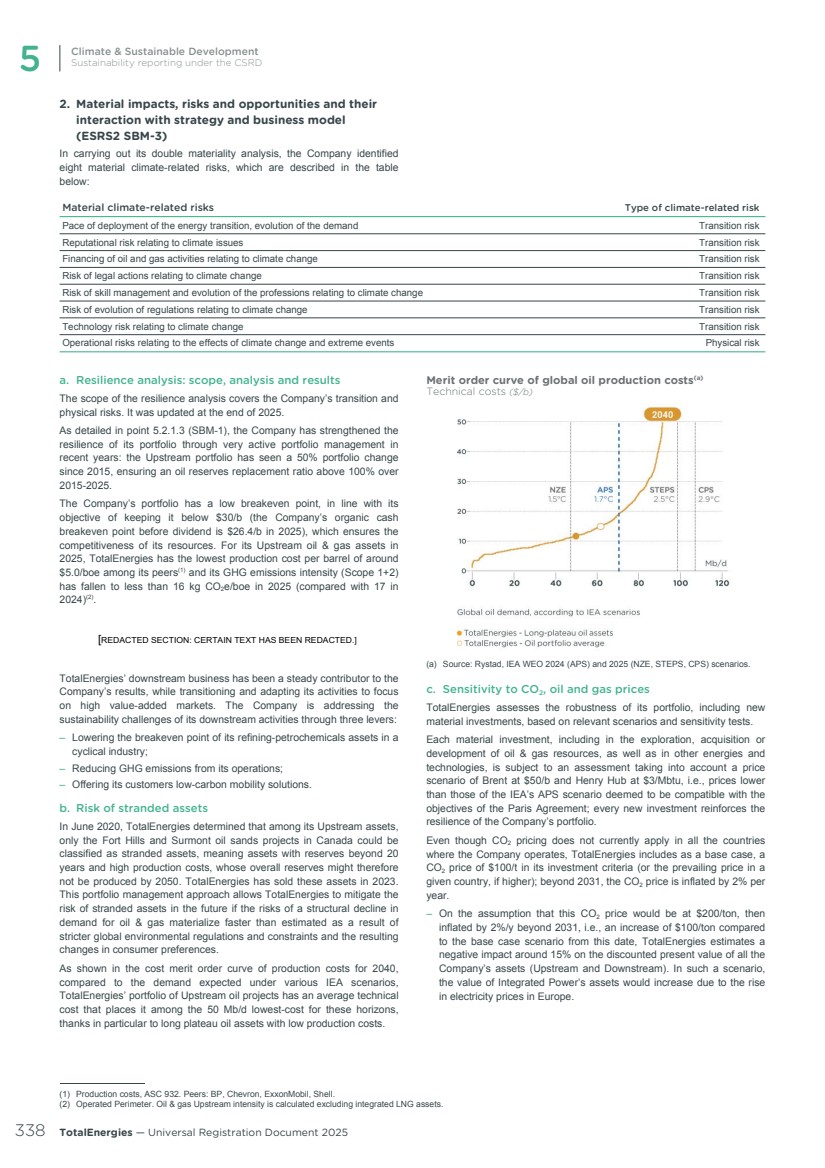
| – Compared with the reference scenario used to evaluate investments (Brent at $50/b), TotalEnergies assessed the impact on the present value of its assets (Upstream and Downstream) of using the IEA’s NZE price scenario in 2025. Such a scenario would reduce the discounted present value of all its assets (Upstream and Downstream) by around 10% compared with its reference scenario used to evaluate investments. d. Impairment of Upstream assets In addition, to ensure robust accounting of its assets in the balance sheet, for the purposes of calculating asset impairment, the Company assumes oil price trajectory that remains sustained at $202570/b until 2030, then decreases linearly to reach $202550/b in 2040 and then decreases from 2040 onwards to the price adopted in 2050 by the IEA’s NZE scenario, i.e., $202525.7/b. Gas prices used in Europe and Asia decrease at respectively $20256.5/Mbtu and $20257.5/Mbtu in 2029/2030, before boucing back to $20258/Mbtu and $20259/Mbtu and stabilizing at these levels until 2040, i.e., levels lower than current prices; the Henry Hub price remaining at $20253/Mbtu over the period 2027-2040. They then all converge towards the prices in the IEA’s NZE scenario in 2050. The impairment tests also retain an internal carbon price (refer to point 5.2.2.1 C. 4. (E1- 8)). e. Physical risks The results of the physical risk assessment reviewed in 2025 for around 300 onshore and offshore assets for the SSP5-8.5 scenario(1) are presented in the graphs below based on net book value at end 2025 (2) . For the selected offshore sites, strong winds and wave heights are the two most severe hazards for this type of asset. As shown in the graph below, the majority of the Company’s offshore portfolio(3) , which includes the Exploration & Production asset groups in Africa, South America and the Middle East, is subject to a relatively low physical risk in the current climate, and also a limited potential change between now and 2050. Offshore assets in the Integrated Power segment, comprising wind farms, are subject to a higher current physical risk due to their location (North Atlantic and South China Sea), but a low potential risk evolution. Offshore portfolio exposure to climate-related physical risks (scenario SSP5-8.5(a)) - based on the most prevalent risk Results of the evaluation conducted in 2024 and reviewed in 2025 for TotalEnergies’ offshore assets. Bubble size is proportional to net book value. (a) SSP5-8.5 is a pessimistic scenario that assumes, among other things, high ghg emissions linked to heavy dependence on fossil fuels. According IPCC, the “best estimate” in global surface temperature change associated with SSP5-8.5 is +4.4°C [3.3-5.7°C] over 2081-2100. The results of the study of physical risks at onshore sites are presented below. Today, the Company’s refineries and petrochemical plants are relatively more at risk from climate change than assets in other sectors, due to their general dependence on water resources in water-stressed areas (refer to point 5.2.2.3) and their greater vulnerability to flooding (as in the case of the Refining-Chemicals sites in North America, including the Port-Arthur site, for which mitigation measures have been put in place. We have identified limited potential evolution of physical risks linked to climate change between now and 2050. Onshore portfolio exposure to climate-related physical risks (scenario SSP5-8.5(a) ) - based on the most prevalent risk Results of the evaluation conducted in 2024 and reviewed in 2025 for TotalEnergies’ onshore assets. Bubble size is proportional to net book value. (a) SSP5-8.5 is a pessimistic scenario that assumes, among other things, high ghg emissions linked to heavy dependence on fossil fuels. According IPCC, the “best estimate”in global surface temperature change associated with SSP5-8.5 is +4.4°C [3.3-5.7°C] over 2081-2100. B. Impact, risk and opportunity management 1. Policies related to climate change mitigation and adaptation (E1-2) In implementing its strategy, TotalEnergies relies on a set of action and management principles to manage its material impacts, risks and opportunities in terms of climate change mitigation and adaptation, which are integrated into the Company’s cross-functional policies, including its investment policy. In addition, at the beginning of 2024, under the impetus of General Management, the Company launched the roll out of a collective program called “Our 5 Levers for a Sustainable Change” (refer to point 5.1.1) which encompasses five Levers, including two relating to climate change mitigation issues (“Energy Consumption” and “Low-carbon operations”). This program aims to promote a dynamic for change by encouraging certain priority collective attitudes, and requires a commitment from everyone to implement them. The “Energy Consumption” lever involves reviewing all energy consumption in operations and aiming to minimize it. In all projects, installations must be designed to minimize energy consumption. The “Low-carbon operations” lever consists in promoting the use of low-carbon technologies and renewable energies in projects and operations, taking into account a CO2 cost of $100/t. The same must be done with customers and suppliers to enable them to reduce their emissions. The table below summarizes them, mentioning the areas concerned, their scope in terms of activities and value chain, and the people or entities responsible for their implementation. (1) SSP5-8.5 is a pessimistic scenario assuming, among other things, high GHG emissions linked to heavy dependence on fossil fuels. According IPCC, the “best estimate” in global surface temperature change associated with SSP5-8.5 is +4.4°C [3.3-5.7°C] over 2081-2100. (2) Capital employed excluding working capital at December 31, 2025. (3) Capital employed excluding working capital at December 31, 2025. Climate & Sustainable Development Sustainability reporting under the CSRD 5 TotalEnergies — Universal Registration Document 2025 339 |
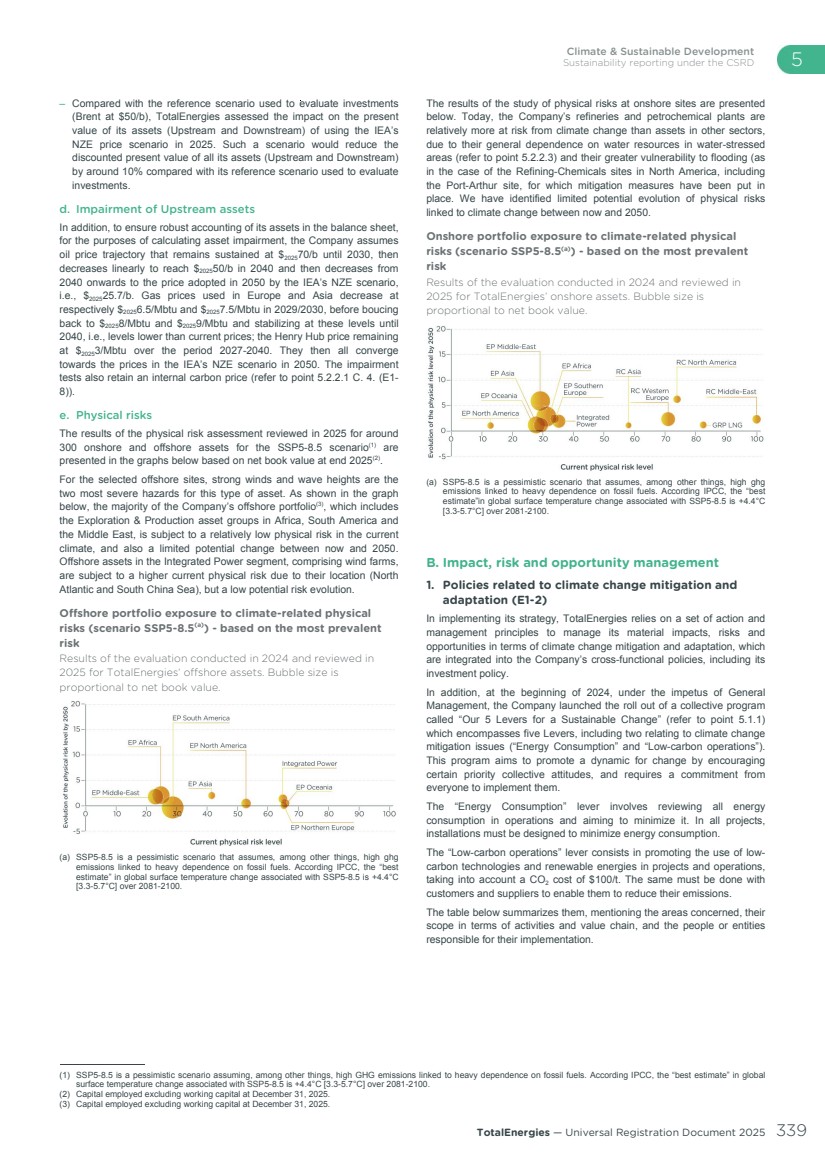
| Principles of action and management/ Policy Policy content Areas covered Material IRO involved I/R/O Scope of the policy Person or entity responsible for implementation Investment – Allocation of investment expenses – Investment rules and criteria for projects – Portfolio sensitivity and resilience – Environmental and societal assessment of projects Cross-functional (including Mitigation, Adaptation, Energy efficiency, Renewable energy deployment) Pace of deployment of the energy transition, evolution of demand Risk Company Executive Committee Financing of oil and gas activities relating to climate change Risk New low-carbon activities Opportunity Supply of renewable and transition energies, and contribution to reducing customers emissions Impact Operational risks relating to the effects of climate change and extreme events Risk Controlling technological risks – Preventing risks of accident, reducing and limiting their consequences Cross-functional (including Adaptation) Operational risks relating to the effects of climate change and extreme events Risk Company HSE Division Maintaining activity – Ensuring business continuity Cross-functional (including Adaptation) Operational risks relating to the effects of climate change and extreme events Risk Company HSE Division Safety Division Innovation Refer to point 1.5. of chapter 1. Cross-functional (including Energy efficiency, Renewable energy deployment) Technology risk relating to climate change Risk Company OneTech, Hutchinson, Saft Ethics and compliance Refer to point 5.2.4.2 (G1-1, G1-3, G1-4) Cross-functional (including Mitigation, Adaptation) Risk of legal actions relating to climate change Risk Company Ethics committee Legal Division Risk of evolution of regulations relating to climate change Risk HR Policies Refer to point 5.2.3.1 (S1-1) Cross-functional (including Renewable energy deployment) Risk of skill management and evolution of the professions relating to climate change Risk Company People & Social Engagement Division Responsible purchasing program Refer to point 5.2.4.2 (G1-2) Cross-functional (including Adaptation) GHG emissions of the Company Impact Upstream value chain TotalEnergies Global Procurement Principles of action and management/ Policy Policy content Areas covered Material IRO involved I/R/O Scope of the policy Person or entity responsible for implementation “Energy Consumption” lever – In operations, review all energy consumption with a view to minimizing it; – In projects, design installations to minimize energy consumption Mitigation Energy efficiency GHG emissions of the Company Impact Company and upstream/ downstream value chain Business segments and industrial sites Implementation of energy efficiency plans Opportunity “Low-carbon operations” lever – Promote the use of low-carbon technologies and renewable energies in projects and operations, taking into account a CO2 cost of $100/t; – Do the same with customers and suppliers to enable them to reduce their emissions Mitigation Deployment of renewable energies Pace of deployment of the energy transition, evolution of demand Risk Company and upstream/ downstream value chain Business segments and industrial sites New low-carbon activities Opportunity GHG emissions of the Company Impact Methane emissions of the Company Impact Supply of renewable and transition energies, and contribution to reducing customers emissions Impact Cross-functional policies “Our 5 Levers for Sustainable Change” program 5 Climate & Sustainable Development Sustainability reporting under the CSRD 340 TotalEnergies — Universal Registration Document 2025 |
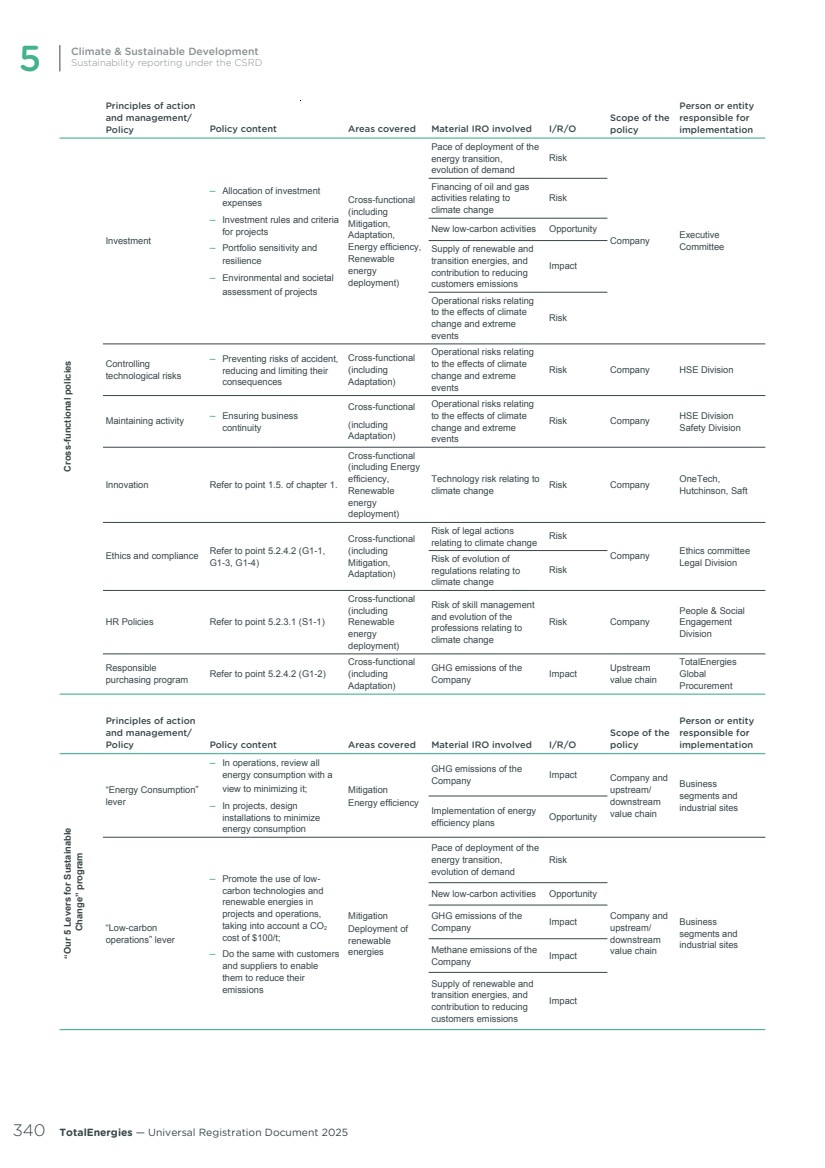
| Principles of action and management/ Policy Policy content Areas covered Material IRO involved I/R/O Scope of the policy Person or entity responsible for implementation “Our communities” lever – Get to know local residents and the Company’s stakeholders – Embark upon and maintain constructive dialogue with them, including the careful handling of complaints – Anticipate dialogue right from the design stage of a new project Cross-functional (including Mitigation, Adaptation) Reputational risk relating to climate change Risk Company Business segments and industrial sites Stakeholders recognition of the balanced transition strategy Opportunity 2. Actions and resources in relation to climate change policies (E1-3) The Company is continuing to implement its transition strategy by rolling out action plans on its decarbonization levers. Action 1: Energy efficiency improvement plan In September 2022, TotalEnergies launched a plan to accelerate energy efficiency improvements at its sites worldwide. This plan has enabled to accelerate the actions undertaken for several years in the Company’s operating sectors, with a total of more than 140 projects completed by 2025, including more than 100 initiatives for Exploration & Production, more than 40 for Refining-Chemicals and more than 5 for Marketing & Services and Integrated Power. At the end of 2025, these investments amount to more than $1 billion, as planned in this initial energy efficiency plan: they have reduced emissions by more than 2 Mt CO2e/y and realized energy and CO2 savings of $200 million/y following the investment plan carried out over the 2023‑2025 period. Taking into account the efficiency projects reported by the teams at the industrial sites, a second energy efficiency improvement plan is rolled out over the period 2026-2028, for a total of $1 billion. Energy efficiency The Refining and Chemicals sites achieved a total reduction in greenhouse gas emissions of more than 1 Mt CO2e over the 2023-2025 period thanks to the energy efficiency improvement plan. In 2025, the turnaround of the Antwerp refinery provided an opportunity to roll out seven projects representing an investment of around $40 million, enabling an annual reduction of around 50 kt CO₂e. The main areas for improvement focused on furnace optimization, preheater optimization, electrification, and heat exchanger performance. These projects will permanently reduce the carbon footprint of the Antwerp site. Also in 2025, during the turnaround of the steam cracker at the Normandy refinery, energy efficiency improvement projects resulted in an annual reduction of approximately 35 kt CO2e/y, mainly through the implementation of new technologies to optimize furnaces and heat exchange equipment. Operational excellence In Exploration & Production, on Block 17 in Angola, the installation of mobile filtration units to keep the lubricating oil for rotating equipment clean improves reliability and reduces burning by minimizing downtime. Cleaner oil prevents premature wear and failure, ensuring continuous compressor operation and avoiding production interruptions that typically lead to burnout. This approach not only supports environmental performance with a reduction of 13 kt CO2e/y, but also improves operational efficiency by extending equipment life and reducing maintenance costs. In 2025, the Netherlands subsidiary of Exploration & Production optimized the export compression system at the K5CC field by replacing two low-pressure compressors with a single compressor while maintaining identical or even better production profiles. Following the implementation of this project in June 2025, only two export compressors and turbines are required instead of three, resulting in savings of around 5 million m³ of gas per year, equivalent to the consumption of more than 5,000 Dutch households. This represents approximately 13% of the gas consumption of the K5CC field and contributes to a reduction of ~10 kt CO2e/y. Adaptation of facility design In Exploration & Production, by 2025, GHG emissions linked to gas compression at the Aguada Pichana Este plant in Argentina were significantly reduced thanks to better use of the reservoirs’ high natural pressure. This operational improvement led to an annual reduction in direct emissions from the plant of around 65 kt CO2e. In the combined cycle power plants (CCGT) of the Integrated Power segment, the reduction in GHG emissions is based in particular on improving energy efficiency and turbine performance. In 2025, train 8 of the Saint-Avold power plant was modernized with the installation of an ATEP (Advanced Turbine Efficiency Package). This performance upgrade involves replacing key turbine parts with more efficient components (more resistant materials, better aerodynamics, improved cooling, and reinforced sealing). These modifications aim to increase efficiency, reduce gas consumption, and thus decrease CO₂ emissions through improved combined cycle efficiency. In Marketing & Services, the Brunsbüttel site in Germany—an industrial facility that processes crude oil to produce bitumen—has rolled out a comprehensive plan to reduce its energy consumption, notably by recovering waste heat from the distillation process (at 360°C). This heat is now used to preheat crude oil and produce steam. The entire process has been reviewed to reduce energy losses: reduction of steam losses, insulation of bitumen storage tanks and lowering of their temperature in consultation with customers. Furnace combustion has also been optimized with CO (carbon monoxide) sensors, resulting in energy savings of 4%. Energy consumption per ton of crude oil has decreased by 20% over the last ten years, and Scope 1+2 emissions have been reduced by 33% compared to 2015, representing a reduction of 16 kt CO2e per year Action 2: Flaring and Methane emissions reduction plan With a warming potential 30 times greater than CO2 and a short lifespan in the atmosphere(1) , methane is a greenhouse gas whose rapid reduction is considered one of the most effective levers for having a short-term impact on global warming. The Global Methane Pledge, launched at COP26 and signed by more than 150 countries, aims to reduce methane emissions by 30% across all sectors (agriculture, waste, energy) by 2030 compared to 2020, and experts estimate that a reduction of this magnitude would have an impact of -0.2°C on the global average temperature by 2050(2) . (1) Around a dozen years, compared to several hundred years for CO2. Global warming potential of around 30 over 100 years (source: IPCC AR6). (2) Refer to Global Methane Pledge official text. “Our 5 Levers for Sustainable Change” program Climate & Sustainable Development Sustainability reporting under the CSRD 5 TotalEnergies — Universal Registration Document 2025 341 |
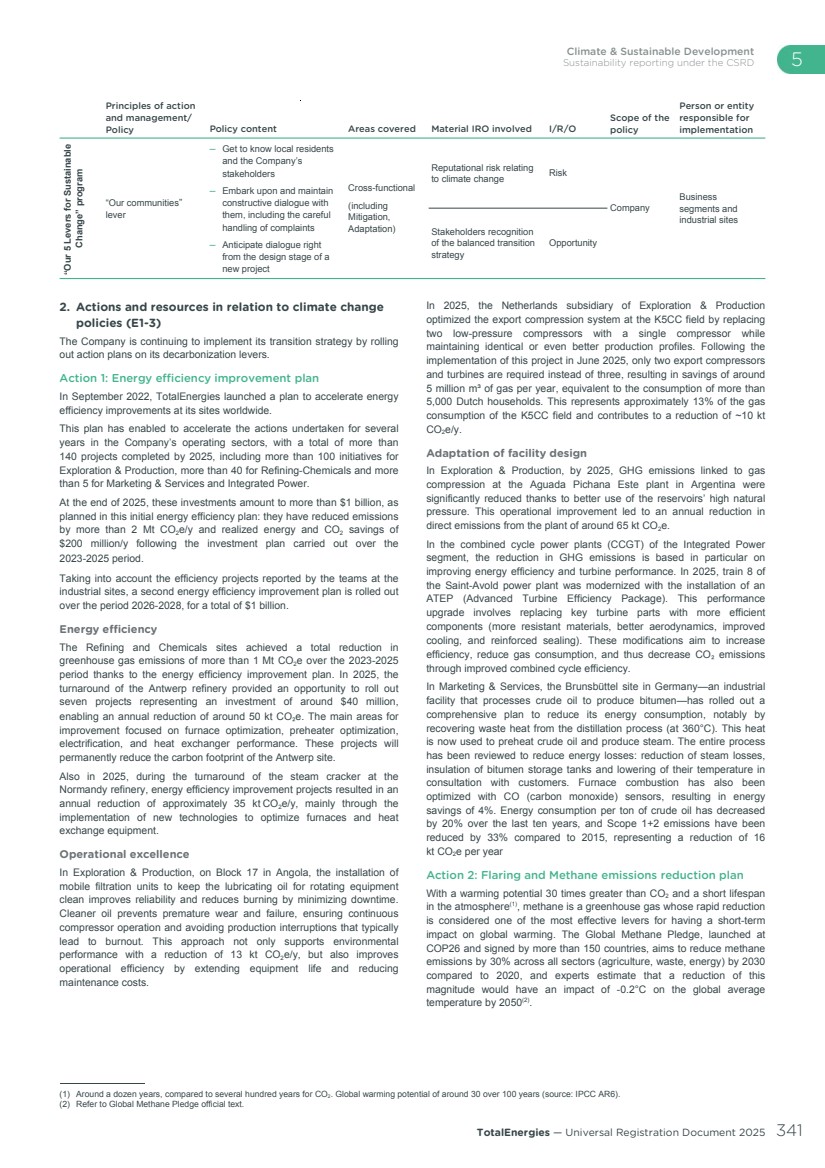
| The oil and gas sector has the technologies, technical expertise and operational capabilities to act quickly on methane emissions from its operations. TotalEnergies believes that it is the sector’s responsibility to reduce its methane emissions to near zero by 2030 and intends to maintain its leadership role in the industry on methane. Progress since 2010 Between 2010 and 2020, TotalEnergies reduced methane emissions from its operated assets by nearly half. These methane emissions then fell from 64 kt CH4 in 2020 to 22.5 kt CH4 in 2025, a reduction of 65%, exceeding the target of a 60% reduction between 2020 and 2025. TotalEnergies has set a new target of -70% in 2026 and is on track to achieve its goal of an 80% reduction by 2030 or sooner, compared to 2020. In terms of methane emissions intensity(1) from oil and gas production, TotalEnergies reached 0.07% in 2025, thereby already achieving its 2030 target of falling below the 0.1% threshold. Methane emissions on operated facilities (kt CH4) Pioneers in methane emissions detection and measurement In 2022, TotalEnergies deployed AUSEA(2) drone technology at its upstream sites, complementing the annual leak detection and repair (LDAR) campaigns. Mounted on a drone, the ultra-lightweight dual sensor simultaneously detects methane and CO₂ with high accuracy and is now considered an international benchmark technology and one of the best drone technologies for methane detection(3) . All of the Company’s upstream sites are currently subject to an AUSEA detection campaign at least once a year, and TotalEnergies has shared this technology with several industry partners (including Petrobras, Socar, Sonangol, NNPC, ONGC, Oil India), and more recently in 2025 with Veolia in the waste and wastewater treatment sector. In 2025, 560 days of AUSEA operations were carried out on TotalEnergies’ operated assets, nearly 100 on non-operated assets, and nearly 50 on third-party assets. In 2025, as announced at COP29, TotalEnergies took a new step forward in identifying methane emissions in real time, whether related to leaks or sub-optimal operational processes, and in immediately implementing corrective measures. This continuous detection plan relies on 13,000 sensors deployed across all operated Upstream assets and uses proven technologies such as IoT sensors(4) , infrared cameras, flow meters, and predictive emission monitoring systems placed at combustion sources. In 2025, a Methane Tracking Center (MTC) was set up in Pau to centralize and consolidate data from various detection means worldwide, whether periodic or continuous and in real time. Using digital tools and the expertise of a team of around ten experts, the MTC analyzes data, alerts operators, and provides support when needed. The technologies used at TotalEnergies’ operating sites have been tested and validated in advance on the internal TADI (TotalEnergies Anomalies Detection Initiative) platform, located in Lacq, which is one of two testing platforms in the world with METEC(5) , at Colorado State University in the United States. In April 2025, TADI and METEC co-published(6) an international protocol for evaluating methane detection and quantification technologies, illustrating the Company’s commitment to promoting international collaboration for the harmonized evaluation of methane emission measurement and detection technologies. Reduction actions by methane emission source TotalEnergies has long been committed to reducing its methane emissions by taking specific actions on each of the four sources: flaring, vents, stationary combustion and continuous real-time detection to identify any fugitive emissions. Actions on flaring During flaring, gas combustion at the flare is incomplete, and around 2% of the gas sent to the flare is not burnt, the rest (98%) being transformed into CO2 after combustion. The actions to reduce flaring described below therefore directly reduce methane emissions. Eliminating routine flaring is a priority for reducing methane and CO2 emissions. TotalEnergies has been committed to eliminating routine flaring for new projects since 2000. A founding member of the World Bank’s “Zero Routine Flaring by 2030” initiative since 2014, the Company is committed to ending this type of flaring by 2030 and to achieve this goal, has implemented several large-scale projects at its sites. In Nigeria, the OML100 asset accounted for 57% of global routine Exploration & Production flaring in 2020. The end of routine flaring on the OML100 offshore block became effective in 2023. This was the last TotalEnergies asset in Nigeria with routine flaring by design (initial design, facilities commissioned in 1993). Significant modifications were made to the facilities to send the gas produced to the Bonny LNG plant for upgrading instead of being flared. The total reduction in greenhouse gas emissions is around 330 kt CO2e/y, including 1.3 kt CH4/y of methane. In Congo, at the Moho site, the elimination of routine flaring reached its final phase in 2025 with the recirculation of low-pressure flare gas to the process and the recommissioning of the low-pressure gas compressor. These measures have made it possible to permanently eliminate routine flaring on the Alima FPSO at Moho Bilondo and reduce emissions from the site by ~8 kt CO2e/y. The gas previously flared – a volume of around 7,000 m3 /day – is now used as lift gas in wells or exported to the Nkossa asset. TotalEnergies is also seeking to reduce other forms of flaring. In Gabon, at the Anguille and Torpille assets, the safety flaring system has been improved with the installation of a new flare tip with a flame stabilizer, an automatic ignition system, and a camera. The volume of gas flared has been significantly reduced, resulting in a reduction of 3.2 kt CH4/y in methane emissions, or 100 kt CO2e/y. In Denmark, flaring has been reduced at the Gorm site thanks to the installation of an ejector to recover gas from the low-pressure separator that would normally be flared. The commissioning of this ejector in April 2025 also led to a slight increase in gas production thanks to the reduction in pressure in the low-pressure separator. This project reduces methane emissions by 0.2 kt CH4, or 6 kt CO2e. TotalEnergies is also launching projects to modify facilities with closed flares. Closed flare systems recover and treat residual gases, reducing the volume of flared gas to emergency situations only. In 2024, the first closed flare was installed at the Tempa Rossa site in Italy, resulting in a reduction of 1.3 kt CH4, or 40 kt CO2e. (1) Intensity of methane emissions: refer to glossary for the definition. (2) Airborne Ultralight Spectrometer for Environmental Application (3) Stanford & IMEO study: Controlled release testing of multiple European methane measurement technologies. (4) Internet of Things (5) Methane Emissions Technology Evaluation Center (6) Controlled Test Protocol Version – Emission Detection and Quantification Protocol Version 1.2 April 2025. 5 Climate & Sustainable Development Sustainability reporting under the CSRD 342 TotalEnergies — Universal Registration Document 2025 |
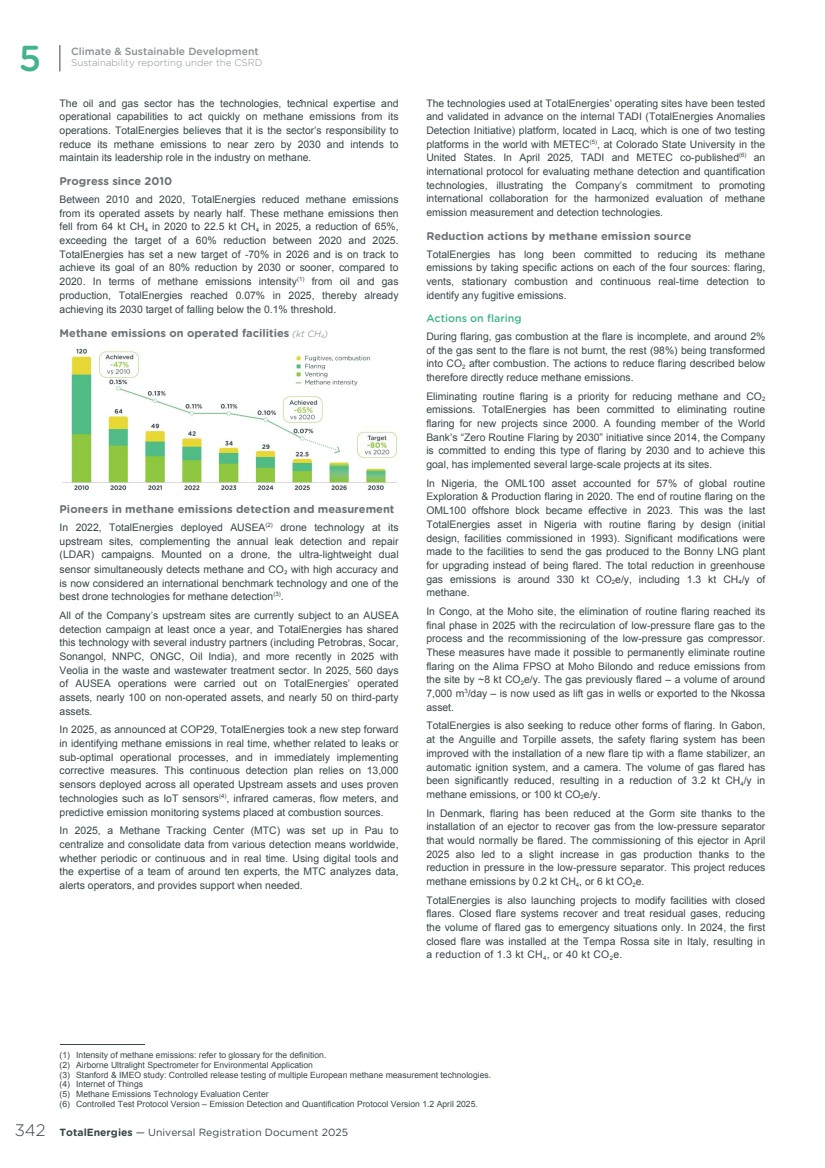
| These residual gas recovery systems are now installed in all new projects, such as the Egina FPSO in Nigeria when it came on stream. Beyond actions taken on each of these sources, all new projects include strict design criteria to avoid methane emissions: no natural gas for pneumatic equipment, no continuous cold vents and systematic installation of closed flares. Actions on vents Venting is the release of methane into the atmosphere without combustion. TotalEnergies has reduced its vents since 2020 by rerouting the gas going to the vents to the gas export system or to the flare. Some equipment – such as pneumatic actuators – also uses methane as an instrumentation gas, and the replacement of this equipment with innovative solutions using compressed air instead of methane has significantly reduced vents. In the United States, at the Barnett site, instrument gas has been replaced by compressed air on 400 pads between 2021 and 2024, reducing emissions by 7.5 kt CH4/y, or 225 kt CO2e/y. Currently, nearly half of the natural gas that was previously used in equipment is recovered and exported. Another source of venting is the cover gas in storage tanks, which can be combustible gas, ensuring the safety of the facility by maintaining pressure in the storage tanks. In December 2024, in Nigeria, the combustible gas used as cover gas was replaced by an inert gas, nitrogen, resulting in a reduction from 5.2 kt CH4/y to 0.35 kt CH4/y, or a decrease of 150 kt CO2e/y. Actions on incomplete combustion on certain equipment Certain equipment running on natural gas (engines, furnaces, turbines) also emits methane through incomplete combustion. In Argentina, at the Neuquen site, connecting the Aguada Pichana Este plant to the national power grid through the construction of a 43 km power line and a high-voltage substation (refer to Action 3) has made it possible to stop local electricity production from gas-powered engines and thus eliminate methane emissions from this equipment. Maintaining our leadership within the industry Over the years, TotalEnergies has acquired robust know-how and significant technical expertise in reducing methane emissions. TotalEnergies has successfully developed and deployed innovative technologies for detecting and measuring methane emissions. TotalEnergies strives to deploy this know-how and these technologies at its non-operated assets, as well as with its partners and other companies in the oil and gas sector, notably through the Oil & Gas Decarbonization Charter (refer to Action 6). TotalEnergies also promotes the OGMP 2.0 (Oil & Gas Methane Partnership), the reference framework created in 2020 and piloted by the United Nations Environment Programme (UNEP) for methane reporting in the oil and gas sector. This framework encourages companies to continue improving the completeness and accuracy of their emissions reporting, for both operated and non-operated perimeters, in order to focus on reducing the most significant emissions. To date, more than 150 companies are members across the value chain. TotalEnergies has been awarded Gold Standard OGMP 2.0 certification in 2025 for the fifth consecutive year(1) . Action 3: Electrification Low-carbon electricity supply In Refining & Chemicals, TotalEnergies’ ambition is to provide its facilities in Europe and the United States with a 100% low-carbon electricity thanks to its Go Green initiative. In Europe, up to 5.2 TWh/y will be supplied to the Refining & Chemicals industrial assets. This electricity will come partly from the European renewable portfolio, of which 1.8 TWh/y is in operation and 3.4 TWh/y is under development, as well as the Company’s portfolio of guarantees of origin. In the United States, around 1.2 TWh/y will gradually be supplied to the Refining & Chemicals assets from the renewable portfolio in Texas. The Danish and Myrtle assets, which are already in service, will supply around 1 TWh/y. The supplement will be provided from the Company’s portfolio of renewable projects in the United States starting in 2026. This action to supply low-carbon electricity illustrates the “Lever 2 for a Sustainable Change” which aims to use low carbon technologies in the Company’s own operations and will enable a reduction in emissions of more than 2 Mt CO2e/y on the Refining & Chemicals segment’s Scope 2 compared with 2015. In Argentina, at Exploration & Production, to meet the electricity demand of the Rio Cullen and Cañadon Alfa onshore sites, TotalEnergies designed a hybrid power generation system, including an 8.4 MW wind farm coupled with 9.2 MWh of batteries, along with an increase in electricity transmission capacity between Cañadon Alfa and Rio Cullen. This project, which takes advantage of the region’s wind potential, was commissioned in January 2026 and is expected to reduce emissions by 36 kt CO₂e per year by lowering fuel gas consumption to power the site. At the Neuquén asset, the Aguada Pichana Este plant was connected to the national electricity grid through the implementation of a large-scale electrification project comprising a 132 kV substation and a 43 km transmission line. A 14 MW solar power plant was built and, to manage intermittency, a long-term power purchase agreement was signed to supply mainly renewable energy (80 to 100%). This project reduces fuel gas consumption and flaring, while increasing availability and reducing emissions at the site by approximately 46 kt CO₂e/y. Also in Exploration & Production, in Nigeria, the OML 58 site has installed a solar power plant combined with batteries to reduce the energy required by the gas turbines that generate electricity. To connect the site to the solar power plant, a 6 kV electrical cable approximately 1 km long has been installed. The energy generated by this solar power plant reduces the fuel gas consumed by the gas turbines, thereby cutting emissions by around 13 kt CO2e/y. In the Integrated Power segment as part of a multi-year program, the Bayet CCGT plant has installed photovoltaic panels on the roofs of buildings, on the ground, and on parking shade structures to produce electricity for self-consumption. This initiative aims to improve the efficiency of the facility by reducing the power demand of auxiliary equipment when the plant is in operation. It also aims to limit the site’s electricity consumption during periods when the unit is shut down. Electrification of facilities Between 2023 and 2025, the Marketing & Services segment carried out several electrification projects, including the electrification of refueling trucks for the aviation sector in France and the Beverwijk project in the Netherlands. At the Beverwijk lubricants plant, the process—initially based on a boiler providing heat from the combustion of natural gas—now uses an induction system powered by renewable electricity. Since the completion of this project in 2024, greenhouse gas emissions per ton of lubricant produced have fallen from 38 kg CO2e/ton of lubricant to 1.6 kg CO2e/ton, and energy consumption has fallen from 200 kWh/t to 120 kWh/t. Action 4: Building Low Carbon Hydrogen supply for our refineries in Europe by 2030 To reduce, the carbon footprint associated with the production, transformation and supply of energy to its customers, one of the levers identified by the Company is the use of low-carbon hydrogen to decarbonize its European refineries, which would reduce their direct CO2 emissions by up to three million tons a year by 2030. In September 2023, TotalEnergies launched a call for tenders to use up to 500 kt/y of low-carbon hydrogen in its European refineries from 2030. (1) Refer to the UNEP report “An Eye on Methane: 2025 Report”. Climate & Sustainable Development Sustainability reporting under the CSRD 5 TotalEnergies — Universal Registration Document 2025 343 |
| The call for tenders generated considerable interest within the industry, attracting a wide range of local and international players. In this context, TotalEnergies has already contracted for more than 200 kt/y of low-carbon hydrogen. These volumes are intended for the La Mède, Grandpuits, and Normandy sites in France, as well as those in Leuna, Germany; Antwerp, Belgium; and Zeeland, the Netherlands. However, achieving this ambition of using up to 500 kt/y of low-carbon hydrogen in its European refineries from 2030 onwards depends on the implementation of national tax and regulatory frameworks that effectively support the reduction of the carbon footprint. TotalEnergies is rolling out four types of projects: – renewable hydrogen production in TotalEnergies biorefineries; – green hydrogen production by TotalEnergies and its partners; – tolling agreements; – long-term green hydrogen supply contracts. The first volumes of low-carbon hydrogen are expected in 2026. Renewable hydrogen production in TotalEnergies’ biorefineries In La Mède, a 25 kt/y unit is under construction and will be operated by Air Liquide. The €150 million investment will reduce emissions by 130 kt CO₂e/y starting in 2028. In Grandpuits, Air Liquide is building a unit with a capacity of around 20 kt/y, equipped with Cryocap™ technology, which will enable 150 kt CO₂e/y to be avoided. Green hydrogen production by TotalEnergies and its partners In 2024, TotalEnergies acquired 50% of the OranjeWind offshore wind farm (795 MW) in the Netherlands. Together with Air Liquide, a joint venture will develop a 250 MW electrolyzer at the Zeeland refinery site, producing up to 30 kt/y of green hydrogen from 2029. The investment amounts to €600 million and will reduce CO₂e by up to 300 kt/y. The project entered the engineering and design phase in 2025 and is targeting a final investment decision in 2026. In France, the Masshylia project, led with Engie, plans an initial 20 MW phase in 2029 to reduce the carbon footprint of La Mède and the Fos-Berre area. In 2025, TotalEnergies and Engie created the “Masshylia Hydrogen” joint venture to develop the project. In the same year, the project obtained grants under the European IPCEI(1) programme. Tolling agreements TotalEnergies will supply renewable electricity to dedicated electrolysis capacities, operated by partners, which will in turn produce green hydrogen. This model has been the subject of long-term tolling agreements signed with Air Liquide to reduce the carbon footprint of its sites in Antwerp and Normandy. – In Antwerp, Air Liquide will dedicate 130 MW of a new electrolyzer to the production of 15 kt/year of green hydrogen. TotalEnergies will supply renewable electricity from the OranjeWind project. In 2025, the final agreements were signed and the project reached its final investment decision. – In Gonfreville, 100 MW of a new electrolyzer will be dedicated by Air Liquide to the production of 15 kt/year of green and low-carbon hydrogen. The first volumes are expected in 2026. Long-term green hydrogen supply contracts In 2024, TotalEnergies and Air Products signed a 15-year contract for 70 kt/y of green hydrogen starting in 2030, produced from green ammonia, enabling TotalEnergies to reduce its emissions in Europe by up to 700 kt CO₂e/y. In Germany, an agreement signed in 2023 with VNG provides for the supply of approximately 4 kt/y from a 30 MW electrolyzer, enabling to reduce emissions by up to 80 kt CO₂e/y by 2030. The first volumes of green hydrogen are expected in 2026. An agreement signed in 2025 with RWE covers 30 kt/y of hydrogen produced by a 300 MW electrolyzer in Lingen, delivered by pipeline in Germany, enabling to avoid 300 kt CO₂e/y of emissions from 2030 onwards. TotalEnergies is actively contributing to the development of the H2 pipeline infrastructure in Germany. Action 5: Developing Carbon Capture and Storage to reduce our emissions and those of our customers The IEA’s NZE scenario(2) includes the use of CCS(3) for up to 6 Gt CO2 per year in 2050, in order to reduce some of the emissions from residual oil and gas consumption, as well as from other industrial processes (cement, lime, steel, etc.). This capacity is more than 100 times greater than the global capture capacity currently in operation, which is around 60 Mt CO2 per year(4) . TotalEnergies’ CCS strategy gives priority to reducing emissions from its activities, to reducing Scope 1+2 emissions from Upstream oil & gas activities, as well as refining and LNG plants. For example, at Snøhvit liquefaction plant in Norway, where the Company is partner alongside Equinor, around 9 Mt of native CO2 have been stored since 2008. Similarly, the separated native CO2́ in the new NFE and NFS LNG liquefaction trains, currently under development in Qatar, will be stored by QatarEnergy. Finally, for its Ichthys LNG asset in Australia, the Company is studying a native CO2 storage solution for start-up beyond 2030. The study of CCS solutions for its assets therefore complements the already mentioned efforts to reduce emissions, including electrification, energy efficiency and flaring reduction. The Company also invests in CO2 storage projects for large industrial emitters (“Storage as a Service”) which can thereby reduce their Scope 1 and secure the future of their activities. TotalEnergies is investing around $100 million per year in this business, with models that enable to benefit from leverage. This investment will be sustained in order to contribute to the development of a gross storage capacity of 10 Mt CO2 per year by 2030. Europe is at the heart of this CCS strategy as TotalEnergies is an historical operator in the North Sea, with recognized operational and geological expertise in the area. The United Kingdom, Norway and the European Union have set objectives and regulations and have provided significant financial support to promote a cross-border deployment of CCS. The Company currently developing four projects in the North Sea that will provide CO2 storage solutions for its own assets and those of its customers. The Company has entered the United States CCS market in 2024, with a 25% stake in the Bayou Bend project in Texas. Finally, TotalEnergies is studying the development of CO2 storage in Malaysia, for local and regional markets, with its partners Petronas and Mitsui. TotalEnergies is also studying the utilization of carbon in various forms (CCU(5)), such as in reaction with renewable hydrogen, to produce fuels or synthetic methane. In particular, the Company signed an agreement for the development of the Live Oak synthetic methane production project in the United States. In Norway, Northern Lights is the world’s first merchant CO2 transport and storage project. In 2025, the first CO2 volumes were successfully transported by vessel from Heidelberg Materials’ cement factory in Brevik, Norway, to the Northern Lights’ facilities in Øygarden. (1) IPCEI: ortant Project of Common European Interest (2) IEA 2025, World Energy Outlook 2025, License CC BY 4.0. (3) Carbon Capture & Storage. (4) Global CCS Institute 2025, Global Status of CCS 2025 (updated on October 9, 2025). (5) Carbon Capture and Utilization. 5 Climate & Sustainable Development Sustainability reporting under the CSRD 344 TotalEnergies — Universal Registration Document 2025 |
| Also in 2025, TotalEnergies and its partners, Equinor and Shell, announced the Final Investment Decision (FID) of the second phase of the Northern Lights development, which will increase the project transport and storage capacity from 1.5 Mt to more than 5 Mt CO2/y from 2028. This FID follows the signing of a 15-year commercial agreement between Northern Lights and the Swedish district energy provider, Stockholm Exergi, for the cross-border transport and storage of 900 kt of biogenic CO2 emissions annually, starting in 2028. Action 6: Actively working with the Company’s partners on non-operated assets TotalEnergies’ Scope 1+2 emissions based on equity share from sites operated by its partners in 2025 represent 24 Mt CO2e, of which 11 Mt CO2e are included in Scope 1+2 of the ESRS perimeter. TotalEnergies is working to mobilize its partners to reduce emissions from the assets they operate. At Exploration & Production, a dedicated team is tasked with sharing best practices with partners at non-operated assets, such as deploying an emissions reduction roadmap that includes an energy assessment, reduction of methane venting and routine flaring, and improving energy efficiency, particularly for gas turbines and compressors. The projects conducted at the Company’s operated sites are used to illustrate ways its partners can reduce their Scope 1+2 emissions and encourage uptake. In addition to the existing collaboration with its partners on each of its non-operated assets, TotalEnergies has been a very active contributor to the Oil & Gas Decarbonization Charter (OGDC) initiative since its creation at the end of 2023. More than 80%(1) of TotalEnergies’ non-operated production is operated by partners who are members of initiatives of which the Company is an active member (OGDC and OGMP 2.0). The vast majority of its partners are therefore committed to reducing methane emissions and eliminating routine flaring by 2030. TotalEnergies industry leader through the Oil & Gas Decarbonization Charter At COP28, a major initiative between national and international companies was launched to reduce the industry’s GHG emissions: the Oil & Gas Decarbonization Charter (OGDC). Through this initiative – which for the first time brings together international oil companies (IOCs) and national oil companies (NOCs – the companies are committed to achieving net-zero operations by 2050, aiming for near-zero upstream methane emissions and eliminating routine flaring by 2030, as well as measuring and reporting progress towards these goals. Dr. Sultan Al Jaber, CEO of ADNOC and former President of COP28, is the driving force behind this initiative, which is being led by two other CEO Champions: Amin Nasser, CEO of Aramco, and Patrick Pouyanné, Chairman and CEO of TotalEnergies. This initiative now brings together 56 companies representing nearly 40% of the world’s oil and gas production. On November 14, 2025, during COP30 in Belém, the OGDC published its second report, entitled “Implementing Action”, which highlights rapid progress and sustained momentum. Two years after its launch, the OGDC has established itself as a multilateral platform for action aimed at accelerating the decarbonization of the oil and gas industry, a key sector of the global economy. In 2025, for the first time, signatories reported emissions calculated according to the OGCI reporting framework, paving the way for consistent reporting among the 56 signatories. This second report highlights that ambitions are being translated into action: 42 signatories, covering 94% of OGDC production, have set ambitions to reduce Scope 1+2 emissions by 2030, and 36 of them have formalized corresponding action plans. This reflects tangible progress since the “Baseline Report 2024,” with six more companies setting targets and seven new companies developing action plans for methane and flaring. $100 million committed to Climate Investment During COP30, TotalEnergies announced a $100 million commitment to Climate Investment’s Venture Strategy fund, which backs technologies that cut emissions across the oil and gas value chain. Climate Investment is now a Partner of the Oil & Gas Decarbonization Charter (OGDC) under a MoU signed on July 14, 2025. As such, Climate Investment will provide OGDC signatories with insights that can help them on their decarbonization path, within the scope of the OGDC Charter. Brazil: Reduction of CO2 emissions from the Mero FPSOs TotalEnergies actively promotes and supports its partners on non-operated assets to reduce their emissions, particularly through initiatives to optimize processes and improve energy efficiency. For FPSOs 2, 3, and 4 in the Mero field, TotalEnergies and Petrobras teams worked together from the design phase and identified an effective solution to reduce fuel consumption and therefore the project’s emissions: increasing the pressure of the first stage of the separation unit to 65 bar instead of the usual 20 bar so that most of the gas flows directly to the dehydration unit without requiring another significant compression stage. The feasibility of this concept was thoroughly evaluated through multiple simulations and scenario analyses, confirming the robustness and reliability of the chosen design. This decision has already brought tangible benefits, including: – a 14% reduction in fuel gas consumption for FPSOs Mero 2 and 3, compared to FPSO Mero 1. The Mero 4 FPSO, which is still in the ramp-up phase, will deliver the same performance as FPSOs 2 and 3; – a reduction of approximately 100 kt CO2e per year for each FPSO. Action 7: Helping customers reduce their emissions The Company is ambitious in its targets for direct emissions (Scope 1+2), which its controls in facilities it is operating. It is also ambitious in helping its customers reduce their emissions through its multi-energy strategy, which makes a wider range of energies available to customers, including low-carbon energies. Indeed, by offering its clients an increasingly decarbonized portfolio, TotalEnergies contributes to the energy transition and helps its clients reduce their emissions. It tracks progress through the lifecycle carbon intensity of energy products sold – the decarbonization index of its sales – for which it has set reduction targets for 2026 and 2030. TotalEnergies has been leading among its peers in terms of actually achieving decarbonization of the energy products sales mix since 2015. In 2025, it maintained its progress by notching a 18.6% reduction in the lifecycle carbon intensity of its energy products compared to 2015 and sets a new goal of around -19% for 2026. By 2030, the Company’s two-pillar balanced transition strategy aims to result in a sales mix of energy products with the view to final use whose lifecycle carbon intensity of energy products sold would be reduced by 25%, which means: – for an equivalent quantity of energy, the carbon content of energy products would be reduced by 25% (“less emissions for same energy”); – for an equivalent quantity of emissions (Scope 1+2+3), the Company would supply 33% more energy to its customers (“more energy for same emissions”). (1) Based on 2025 SEC production from all non-operated assets and membership as of end 2025. For the purpose of this calculation, ADNOC-led operating companies in the UAE are considered OGDC members, given ADNOC is championing OGDC; also when the operator is a joint-venture that is not directly an OGDC or OGMP 2.0 member, it is treated as OGDC member if 100% of its partners are OGDC members, and as OGMP 2.0 member if 100% of its partners are OGMP 2.0 members. Climate & Sustainable Development Sustainability reporting under the CSRD 5 TotalEnergies — Universal Registration Document 2025 345 |
| Established in 2022, TotalEnergies OneB2B Solutions assists large companies across 37 industries in fulfilling their decarbonization roadmaps and offers low-carbon solutions tailored to their needs from various segments of the Company, such as renewable electricity, BESS solutions, biogas, biofuels, truck charging solutions, and CCS. In 2025, more than 450 large companies are accompanied in their transition through partnerships covering 700 potential projects worldwide. To date, cumulatively about 140 TWh of low-carbon energy sales have been committed in 2030 to these industries. “Driving Decarbonization Together” In November 2025, TotalEnergies, through its OneB2B Solutions Division, organized its “Driving Decarbonization Together” Day. This initiative aimed at gathering the trajectories and expectations of key accounts in order to design, together with them and fifteen of our business units, tailored multi-energy offers. Several major customers participated in this event, demonstrating the approach adopted by the Company in supporting its B2B customers: prioritizing exchange and co-construction to meet the challenges of the energy transition. Nine major players, each representing a different sector of activity, shared their vision, operational constraints, and specific expectations with regard to the energy transition. Despite the diversity of the sectors represented, all expressed the same ambition: to reduce the carbon footprint of their activities. Feedback from the field, the difficulties encountered, and the innovations presented by customers are all levers for perfecting the low-carbon solutions offered by TotalEnergies. More than just a meeting, this day illustrated the conviction that decarbonization is a collective challenge that must be built over time, through dialogue and cooperation between all stakeholders. Accelerating decarbonization in key industrial sectors In 2025, the decarbonization momentum accelerated significantly across all supported industrial sectors. During the year, OneB2B signed around 15 renewable electricity purchase agreements (PPAs) with its customers, half a dozen Clean Firm Power energy production contracts, dozens of electricity and gas supply contracts, the supply of approximately 80 kt of sustainable aviation fuel (SAF) per year, and several thousand m³ of renewable fuels to major customers in the aerospace, heavy industry, data centers and electronics, waste and water, agri-food, transportation, and logistics sectors. Action 8: Adapt to physical risks Following the assessment of its operational sites’ exposure to climate hazards conducted in 2024 and reviewed in 2025 (refer to point 5.2.2.1 A. 2. e.), the Company conducts further studies when necessary to ensure that their consequences do not affect the integrity of the facilities or the safety of personnel. The Company also takes climate risk into account in the design of its facilities. Tyra redevelopment Discovered in 1968 and in production since 1984, the Tyra offshore field is Denmark’s largest natural gas field. Due to the natural subsidence of the field after nearly 40 years of continuous gas extraction, the seabed beneath the Tyra platforms has sunk by more than 5 meters. In 2017, the decision was made to rebuild and modernize the facilities to ensure continuity and safety of operations. During the design phase, ocean developments such as projected increases in wave height were also incorporated, as it is the case for our offshore facilities. As a result, the platforms were raised by 13 meters. C. Metrics and targets 1. Targets related to climate change mitigation and adaptation (E1-4) To support its climate change mitigation and adaptation policies, the Company has set targets for 2026 and 2030, and established a set of indicators to monitor its performance. Base year Value at base year 2026 target 2030 target Target perimeter in % of the ESRS perimeter (2025) Net Scope 1+2 emissions(a) 2015 46 Mt CO2e < 34 Mt CO2e -40% (25 to 30 Mt CO2e) Operated perimeter, Scope 2 market-based 75% Methane emissions 2020 64 kt CH4 -70% -80% Operated perimeter, excluding biogenic methane 60% Intensity of methane emissions from operated oil & gas facilities (Upstream) 2015 0.23% <0.1% Operated perimeter, upstream oil & gas facilities Routine flaring 2010 7.5 Mm3 /d ~0 Operated perimeter - Upstream oil & gas operations GHG emissions - Scope 3 (b) 2015 410 Mt CO2e (c) <400 Mt CO2e Value chain, excluding biogenic CO2, GHG Protocol – category 11 100% Lifecycle carbon intensity of energy products sold 2015 73 g CO2e/MJ -19% -25% Value chain, net Scope 1+2+3 lifecycle emissions (a) Net emissions, including nature-based carbon sinks projects from 2030, at a level of approximately 5 Mt/y of carbon credits. Until 2029 included, net emissions are equal to gross emissions (no use of nature-based carbon sinks projects before 2030). (b) GHG Protocol – Category 11. Refer to the glossary for the definition. (c) In 2015, Scope 3 category 11 was published at 410 MtCO2e. The Company keeps this reference to assess the evolution of its Scope 3. If the Scope 3 category 11 for 2015 had been recalculated according to the IPIECA value chain methodology (published in 2016) on the gas value chain, as introduced in data disclosures from 2021, then the Scope 3 category 11 of 2015 would have been 465 Mt CO2e, including 344 Mt CO2e for the oil value chain and 121 Mt CO2e for the gas value chain. 5 Climate & Sustainable Development Sustainability reporting under the CSRD 346 TotalEnergies — Universal Registration Document 2025 |
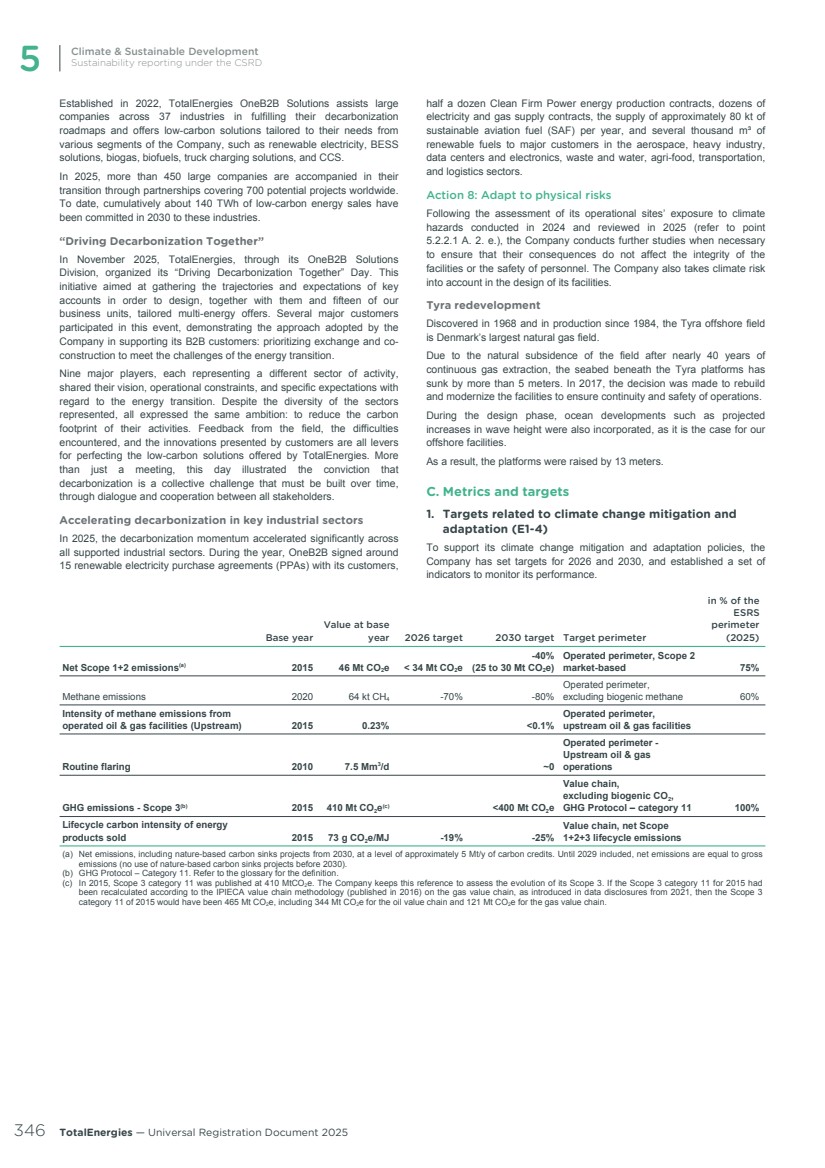
| 2030 targets worldwide (Scope 1+2) – Reduce gross GHG emissions (Scope 1+2) from operated facilities from 46 Mt CO2e in 2015 to less than 34 Mt CO2e by 2026. By 2030, reduce by 40% net(1) Scope 1+2 GHG emissions relative to 2015 for operated activities, thus bringing them to between 25 and 30 Mt CO2e. Offsetting through nature-based carbon sinks projects will start only from 2030 on for residual emissions on the basis of a consumption of approximately 10% per year of the Company’s stock of carbon credits, i.e. around 5 million per year. This target concerns Scope 1+2 GHG emissions, as the Company has not defined a specific target for Scope 1 or Scope 2 alone. It implements action plans to reduce both these scopes (refer to point 5.2.2.1 B.2. (E1-3)). The perimeter of this target is the operated perimeter defined in point 5.2.1.1 (BP-1), covering, in 2025, 75% of the GHG emissions (Scope 1+2) of the ESRS perimeter (refer to point 5.2.2.1 C. 2. (E1-6)). The Scope 2 used in this indicator is market-based Scope 2. – Within Scope 1, TotalEnergies has specifically set a more ambitious target for its direct methane emissions(2) , given its greater warming potential than CO2. This target is a 70% reduction between 2020 and 2026, and an 80% reduction between 2020 and 2030 or sooner on the Company’s operated facilities. – Reduce methane emissions intensity(3) below 0.1% of commercial gas produced at Upstream operated oil & gas facilities. – Reduce routine flaring(4) (Upstream oil & gas operations) with the goal of eliminating it by 2030. 2030 worldwide targets (Scope 3) – Maintain gross Scope 3 (5) GHG emissions below 400 Mt CO2e by 2030. This target covers, in 2025, 100% of Scope 3 emissions of the categories considered as significant by the Company. 2030 worldwide target (carbon intensity) – Reduce the lifecycle carbon intensity of the energy products sold by more than 25% compared to 2015. By 2026, the target reduction is approximately 19% (Scope 1+2+3). The Company has no “net-zero target” according to ESRS definitions. Decarbonization levers used to achieve reduction targets The decarbonization levers enabling the Company to reach the reduction target of net(6) Scope 1+2 GHG emissions of operated facilities are described in the graph below. Action 1 described in paragraph E1-3 falls under the lever “Energy efficiency”, action 2 under the lever “Flaring & Methane”, actions 3 and 4 under the lever “Low-carbon electricity, Electrification, H2”. (a) NBS credits will be used from 2030. The decarbonization levers enabling the Company to reach its Scope 3 target are described in the graph below. (1) The calculation of net emissions takes into account nature-based carbon sinks projects from 2030. (2) Excluding biogenic methane. (3) Methane emissions intensity in relation to commercial gas produced, refer to the glossary. (4) Routine flaring, as defined by the working group of the Global Gas Flaring Reduction program within the framework of the World Bank’s Zero Routine Flaring initiative. Excluding Iraq. (5) GHG Protocol – Category 11. (6) The calculation of net emissions takes into account nature-based carbon sinks projects from 2030. Climate & Sustainable Development Sustainability reporting under the CSRD 5 TotalEnergies — Universal Registration Document 2025 347 |
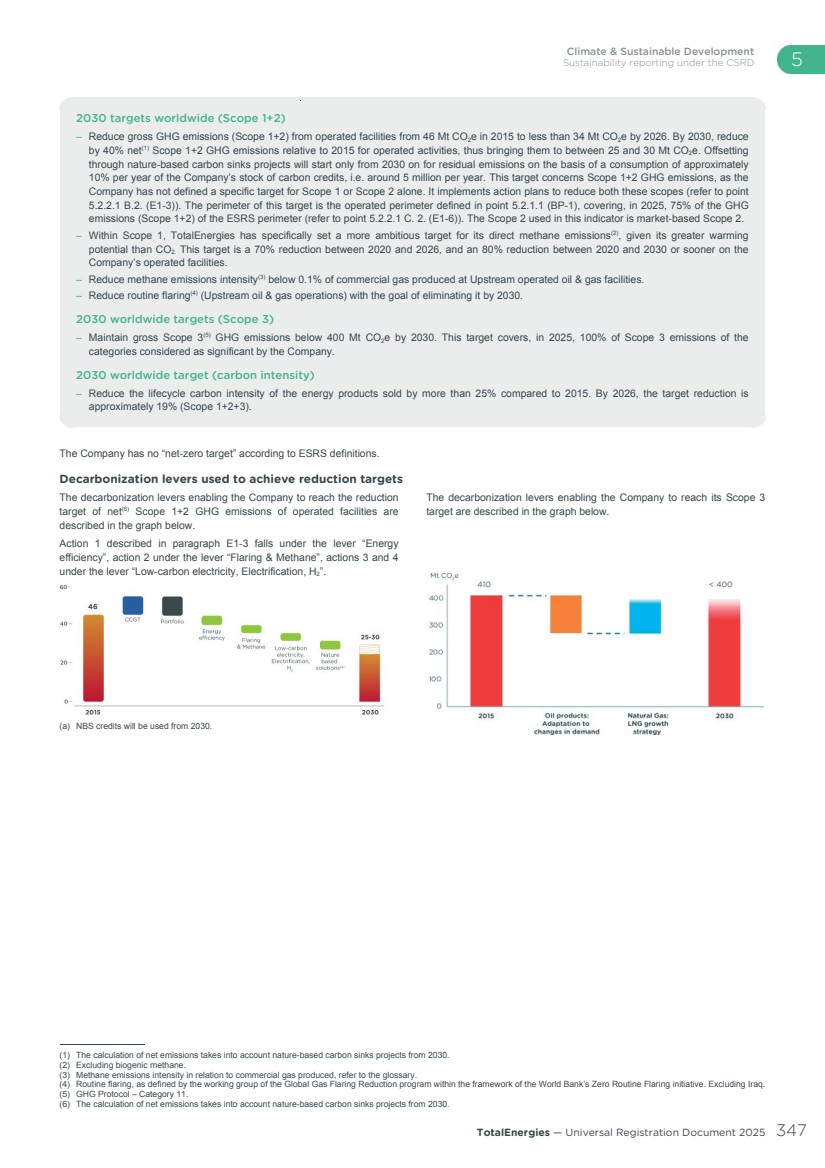
| 2. Indicators a. Energy consumption and mix (E1-5) Final energy consumption and mix 2024 2025 1) Fuel consumption from coal and coal products (MWh) 0 0 2) Fuel consumption from crude oil and petroleum products (MWh) 62,600,000 63,900,000 3) Fuel consumption from natural gas (MWh) 105,400,000 103,900,000 4) Fuel consumption from other fossil sources (MWh) 0 0 5) Consumption of purchased or acquired electricity, heat, steam and cooling from fossil sources (MWh) 4,200,000 3,400,000 6) Total fossil energy consumption (MWh) (calculated as the sum of lines 1 to 5) 172,200,000 171,200,000 Share of fossil sources in total energy consumption (%) 96.9% 96.8% 7) Consumption from nuclear sources (MWh) 1,100,000 900,000 Share of consumption from nuclear sources in total energy consumption (%) 0.6% 0.5% 8) Fuel consumption from renewable sources, including biomass (also comprising industrial and municipal waste of biologic origin, biogas, renewable hydrogen, etc.) (MWh) <100,000 <100,000 9) Consumption of purchased or acquired electricity, heat, steam and cooling from renewable sources (MWh) 4,400,000 4,700,000 10) Consumption of self-generated non-fuel renewable energy (MWh) <100,000 <100,000 11) Total renewable energy consumption (MWh) (calculated as the sum of lines 8 to 10) 4,500,000 4,800,000 Share of renewable sources in total energy consumption (%) 2.5% 2.7% Total energy consumption (MWh) (calculated as the sum of lines 6, 7 and 11) 177,800,000 176,900,000 Given the orders of magnitude, the data in the above table have been rounded to the nearest 100,000 MWh. The Company has estimated the information on its energy consumption and mix taking into consideration the following assumptions: – the perimeter applied is the same as for the accounting of Scope 1+2 GHG emissions, i.e., the ESRS perimeter extended to companies and/ or assets over which the Company has operational control, regardless of their financial consolidation method; – the self-consumption of Upstream oil & gas activities, corresponding to the consumption of fuel gas produced at these facilities to generate energy, has been allocated to the “Consumption of fuel from natural gas” line; – the self-consumption of Downstream oil & gas activities, which corresponds to the consumption of refinery by-products to produce energy, has been allocated to the “Consumption of fuel from crude oil and petroleum products” line; – consumption of fuels from coal, other fossil sources or renewable sources, including biomass, has been considered as zero or non-material; – renewable electricity purchases backed by guarantees of origin are taken into account on the same basis as market-based Scope 2 GHG emissions. For other electricity purchases, as well as heat, steam and cooling purchases, the breakdown by primary source has been estimated on the basis of the “Electricity and heat global mix data, excluding renewables, provided by the IEA in its latest World Energy Outlook report. Moreover, in 2025, the non-renewable energy production of the Company reached 1,481 TWh (hydrocarbons and electricity produced by flexible gas-powered capacities) and its renewable energy production reached 36 TWh (electricity from renewable sources, biofuels and biogas). b. Energy intensity based on net revenue In the table below, the Company has estimated its ratio of energy intensity to net revenues(1) . The net revenue corresponds to the Revenues from sales as presented in the consolidated statement of income, i.e., sales minus excise taxes (refer to point 8.2 of chapter 8). However, it is important to note that TotalEnergies’ revenue is largely correlated with oil and gas prices, which are volatile and over which it has no influence. Consequently, the energy intensity ratio per net revenue is not a relevant indicator for assessing changes in the Company’s energy consumption. Energy intensity per net revenue 2024 2025 % N/N-1 Total energy consumption from activities in high climate impact sectors per net revenue from activities in high climate impact sectors (MWh/M$) 909 970 +7% Total energy consumption from activities in high climate impact sectors (MWh) 177,800,000 176,900,000 -1% Net revenue from activities in high climate impact sectors (M$) 195,610 182,344 -7% (1) All the Company’s activities have been considered as high climate impact sectors, and the Company’s total energy consumption and total net revenues have therefore been taken into account. 5 Climate & Sustainable Development Sustainability reporting under the CSRD 348 TotalEnergies — Universal Registration Document 2025 |
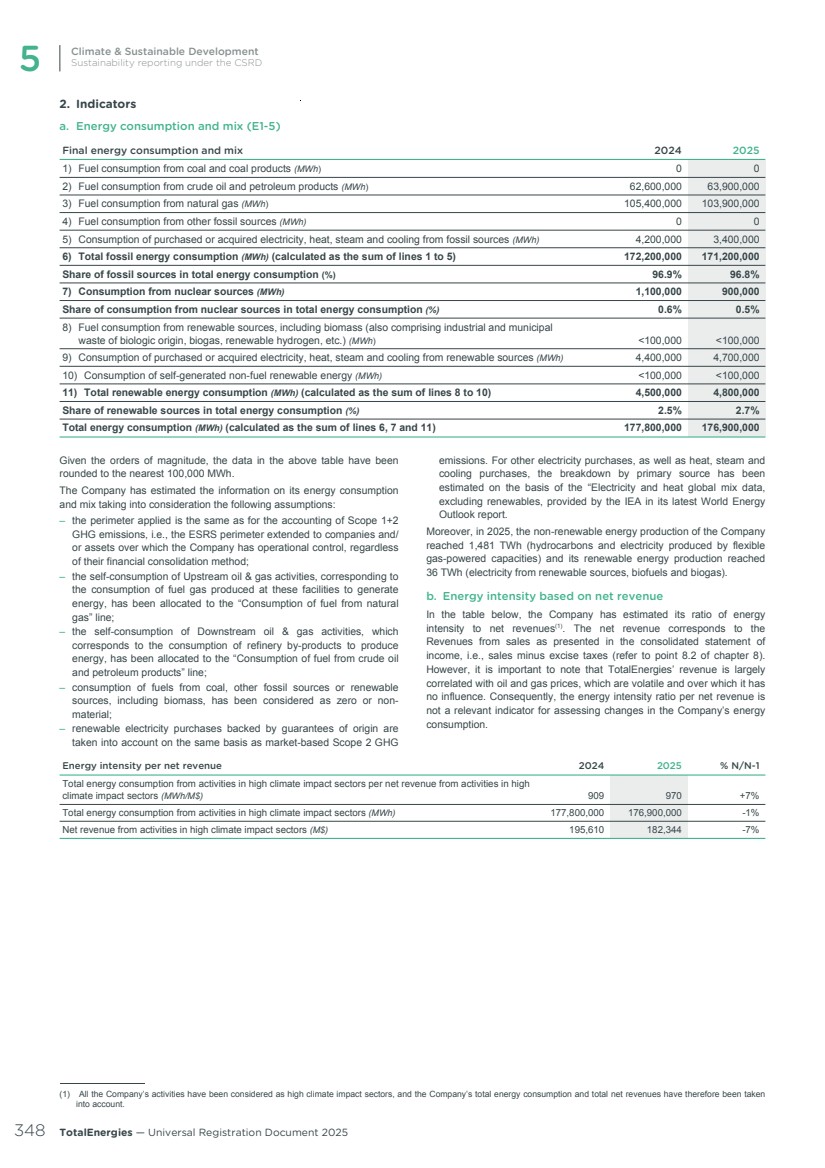
| c. Gross scopes 1, 2, 3 and total GHG emissions (E1-6) Retrospective ESRS perimeter Operated perimeter Scope 1 GHG emissions (t CO2e) 2015 2024 2025 %N/ N-1 2015 2024 2025 %N/ N-1 Gross Scope 1 GHG emissions a+b+c 52,600,000 43,200,000 42,200,000 -2% 41,800,000 32,900,000 31,800,000 -3% Percentage of Scope 1 GHG emissions from regulated emissions trading schemes (%) 47% 47% – 54% 55% +2% of which emissions from the consolidated accounting group a+b 40,200,000 34,200,000 33,700,000 -1% 29,300,000 23,900,000 23,300,000 -3% of which emissions from the consolidated accounting group - operated perimeter a 29,300,000 23,900,000 23,300,000 -3% 29,300,000 23,900,000 23,300,000 -3% of which emissions from the consolidated accounting group - outside the operated perimeter b 10,800,000 10,300,000 10,400,000 +1% – – – of which emissions outside the consolidated accounting group - operated perimeter c 12,400,000 8,900,000 8,500,000 -4% 12,400,000 8,900,000 8,500,000 -4% Retrospective ESRS perimeter Operated perimeter Scope 2 GHG emissions (t CO2e) 2015 2024 2025 % N/ N-1 2015 2024 2025 % N/ N-1 Gross market-based Scope 2 GHG emissions d+e+f – 1,700,000 1,600,000 -6% 4,000,000 1,400,000 1,300,000 -7% of which emissions from the consolidated accounting group d+e – 1,500,000 1,400,000 -7% 3,600,000 1,100,000 1,100,000 − of which emissions from the consolidated accounting group - operated perimeter d – 1,100,000 1,100,000 − 3,600,000 1,100,000 1,100,000 − of which emissions by the consolidated accounting group - outside the operated perimeter e – 300,000 300,000 − – – – − of which emissions outside the consolidated accounting group - operated perimeter f – 300,000 300,000 − 400,000 300,000 300,000 − Gross location-based Scope 2 GHG emissions (t CO2e) g+h+i – 2,600,000 2,400,000 -8% 2,200,000 2,000,000 -9% of which emissions from the consolidated accounting group g+h – 2,200,000 2,100,000 -5% 1,800,000 1,700,000 -6% of which emissions from the consolidated accounting group - operated perimeter g – 1,800,000 1,700,000 -6% 1,800,000 1,700,000 -6% of which emissions from the consolidated accounting group - outside the operated perimeter h – 400,000 400,000 – – – – of which emissions outside the consolidated accounting group - operated perimeter i – 400,000 300,000 -25% 400,000 300,000 -25% Retrospective ESRS perimeter Operated perimeter Scope 1+2 GHG emissions (t CO2e) 2015 2024 2025 % N/ N-1 2015 20245 2024 % N/ N-1 Scope 1+2 GHG emissions (market based) – 44,900,000 43,900,000 -2% 45,800,000 34,300,000 33,100,000 -3% of which oil & gas facilities – 40,000,000 39,200,000 -2% 45,800,000 29,400,000 28,400,000 -3% of which CCGT – 4,900,000 4,700,000 -4% – 4,900,000 4,700,000 -4% In CO2 equivalent terms, nitrous oxide (N2O) represents less than 1% of the Company’s Scope 1+2 emissions. HFCs, PFCs, SF6 and NF3 are virtually absent from the Company’s emissions and are no longer counted by the Company. Climate & Sustainable Development Sustainability reporting under the CSRD 5 TotalEnergies — Universal Registration Document 2025 349 |
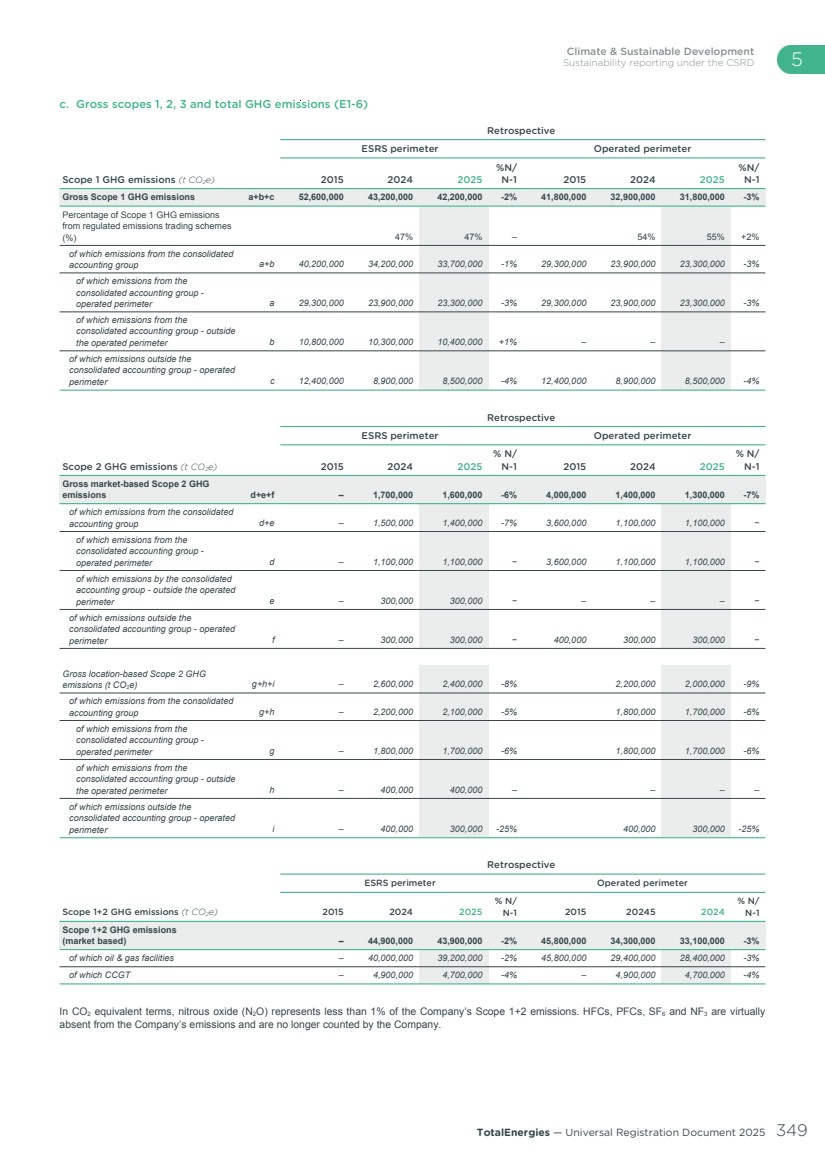
| Retrospective ESRS perimeter Significant Scope 3 GHG emissions 2024 2025 % N/N-1 Total gross indirect GHG (Scope 3) emissions (t CO2e) 342,000,000 335,000,000 -2% 1) Purchased goods and services n.s. n.s. 2) Capital goods n.s. n.s. 3) Fuel and energy-related activities (not included in Scope 1 or Scope 2) n.s. n.s. 4) Upstream transportation and distribution n.s. n.s. 5) Waste generated in operations n.s. n.s. 6) Business travel n.s. n.s. 7) Employee commuting n.s. n.s. 8) Upstream leased assets n.s. n.s. 9) Downstream transportation n.s. n.s. 10) Processing of sold products n.s. n.s. 11) Use of sold products 342,000,000 335,000,000 -2% Breakdown by products Petroleum products 218,000,000 207,000,000 -5% Gas 124,000,000 128,000,000 +3% 12) End-of-life treatment of sold products n.s. n.s. 13) Downstream leased assets n.s. n.s. 14) Franchises n.s. n.s. 15) Investments n.s. n.s. n.s.: not significant TotalEnergies has carried out an estimate of the 15 Scope 3 categories for the years 2024 and 2025 and has retained category 11 as significant, based in particular on the magnitude of its estimated GHG emissions, in line with its practice since 2017 and in continuity of the statement of extra-financial performance. Retrospective ESRS perimeter Total GHG emissions(a) (t CO2e) 2024 2025 % N/N-1 Total GHG emissions (market-based) 387,000,000 379,000,000 -2% Total GHG emissions (location-based) 388,000,000 380,000,000 -2% (a) Corresponding to the sum of Scope 1, Scope 2 and Scope 3 (Category 11) GHG emissions. Retrospective ESRS perimeter Biogenic CO2 emissions (t CO2e) 2024 2025 % N/N-1 Biogenic CO2 emissions from the combustion or biodegradation of biomass excluded from Scope 1 200,000 100,000 -50% Biogenic CO2 emissions from the combustion or biodegradation of biomass excluded from Scope 2 0 0 − Biogenic CO2 emissions from the combustion or biodegradation of biomass excluded from Scope 3 10,000,000 10,000,000 − Given the orders of magnitude, the data in the above tables have been rounded to the nearest 100,000 t CO2e for Scopes 1 and 2, and to the nearest 1 million t CO2e for Scope 3. For GHG emissions, the ESRS perimeter includes that used for the financial statements excluding equity affiliates, as well as subsidiaries not financially consolidated because they are not material from a financial standpoint, but are material from a sustainability standpoint. This ESRS perimeter is extended to companies and/or assets over which the Company has operational control, irrespective of their financial consolidation method. Compared with the operated perimeter, this ESRS perimeter is therefore broader, and also includes some 70 jointly-controlled assets operated by third parties in Exploration & Production as well as the jointly-controlled companies Naphtachimie, Appryl (both divested on April 1, 2024) and BASF TotalEnergies Petrochemicals (Refining & Chemicals segment). For the year 2024, the operated perimeter of Scope 1+2 GHG emissions represents 75% of the ESRS perimeter. Consolidation methods are also described in point 5.2.1.1 (BP-1) and the definitions of the indicators linked to climate change are available in the glossary. 5 Climate & Sustainable Development Sustainability reporting under the CSRD 350 TotalEnergies — Universal Registration Document 2025 |
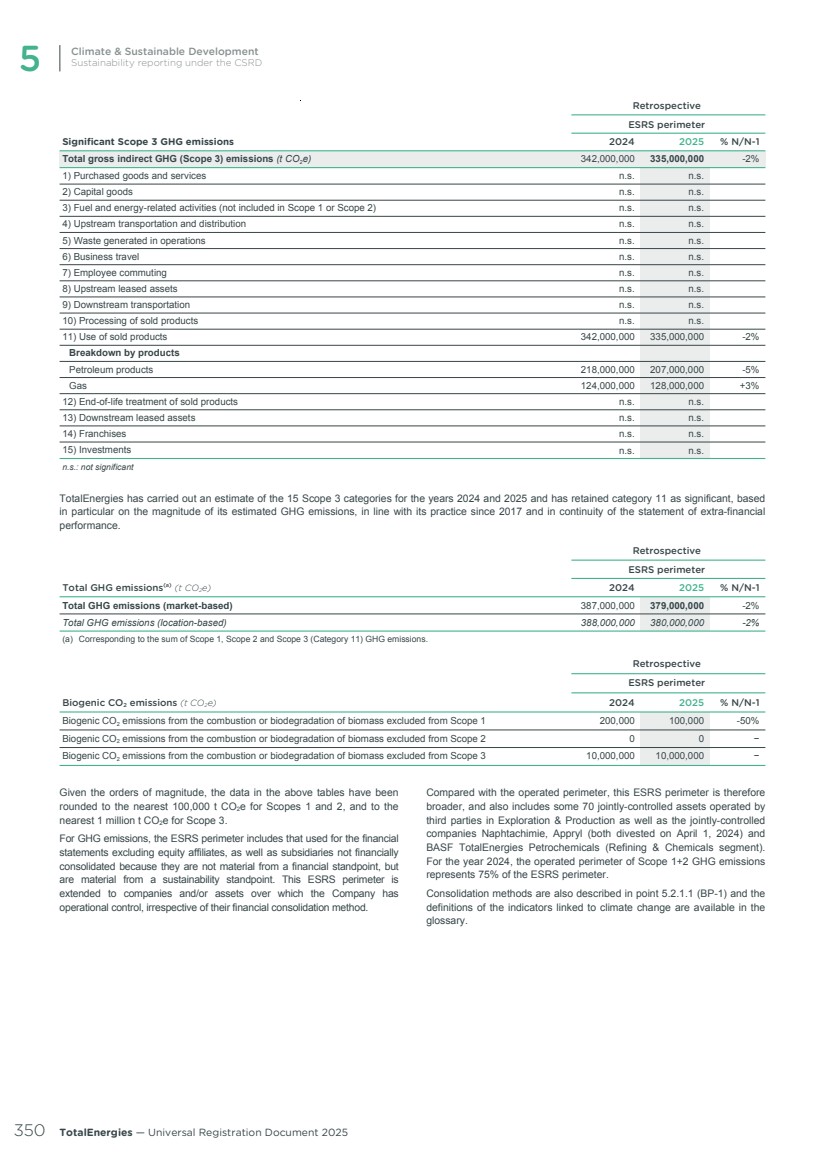
| Accounting for Scope 3 Category 11 emissions Considering the largest volume in the oil and gas value chains For TotalEnergies in 2025, the calculation of Scope 3 GHG emissions for the oil value chain considers products sales (higher than production) and for the gas value chain, the marketable gas and condensates production (higher than gas sales, either as LNG or as direct sales to B2B/B2C customers). d. GHG intensity based on net revenue The Company has estimated the ratio of its GHG intensity per net revenue in the table below. The net revenue corresponds to the Revenues from sales as presented in the consolidated statement of income, i.e., sales minus excise taxes (refer to point 8.2 of chapter 8). However, it is important to note that TotalEnergies’ revenue is largely correlated with oil and gas prices, which are volatile and over which it has no influence. Consequently, the GHG intensity ratio per net revenue is not a relevant indicator for assessing changes in the Company’s GHG emissions. GHG intensity per net revenue (t CO2e/M$) 2024 2025 % N/N-1 Total GHG emissions (market-based) per net revenue 1,978 2,078 +6% Total GHG emissions (location-based) per net revenue 1,984 2,084 +6% Total GHG emissions (t CO2e) 2024 2025 % N/N-1 Total GHG emissions (market-based) 387,000,000 379,000,000 -2% Total GHG emissions (location-based) 388,000,000 380,000,000 -2% Net revenue (M$) 2024 2025 % N/N-1 Net revenue 195,610 182,344 -7% e. Entity-specific disclosures Operated perimeter GHG emissions - Methane(a) 2020 2024 2025 Gross methane emissions (kt CH4) 64 29 22.5 (a) Excluding biogenic methane emissions, equal to around 1 kt CH4 in 2025. Biogenic methane is nevertheless included in the calculation of Scope 1. Intensity indicators 2015 2024 2025 Life cycle carbon intensity(a) of energy products sold (73 g CO2e/MJ in 2015) Base 100 in 2015 100(b) 83.5 81.4 Intensity of methane emissions from operated oil & gas facilities (Upstream) % 0.23 0.10 0.07 (a) Lifecycle carbon intensity of energy products sold (refer to the definition in the glossary). The abatement rates applied to the emissions of biofuels compared to equivalent fossil fuels are in line with the minimums required by European regulations (RED II). An average value of approximately -56% is used in the calculation for 2025. The numerator of this indicator takes into account negative emissions stored through the use of CCS marketed to third-party industrial emitters (storage as a service) and nature-based carbon sinks projects (these volumes are nil up to 2024 and equal to 13 kt CO2 in 2025, following the start up of the Northern Lights CCS project). (b) Indicator developed in 2018, with 2015 as the baseline year. Other indicators 2015 2024 2025 Flared gas(a) (Upstream oil & gas operations) Mm3 /d 7.2 2.5 2.3 of which routine flaring Mm3 /d 2.3(b) 0.5 0.7 (a) This indicator includes safety flaring, routine flaring and non-routine flaring. (b) Volumes estimated upon historical data. 2025 Production 2025 Midstream 2025 Sales Oil 1.4 Mb/d (182 Mt CO2e) Refining 1.5 Mb/d (189 Mt CO2e) Petroleum Products(a) 1.5 Mb/d (207 Mt CO2e) Natural gas + condensates 1.2 Mboe/d (128 Mt CO2e) Liquefaction 0.4 Mboe/d (42 Mt CO2e) LNG + BtB/BtC gas sales 1.1 Mboe/d (114 Mt CO2e) 3 rd party long-term LNG Purchases 0.4 Mboe/d (40 Mt CO2e) Scope 3 category 11 emissions = 335 Mt CO2e (a) Includes bulk refining sales. Climate & Sustainable Development Sustainability reporting under the CSRD 5 TotalEnergies — Universal Registration Document 2025 351 |
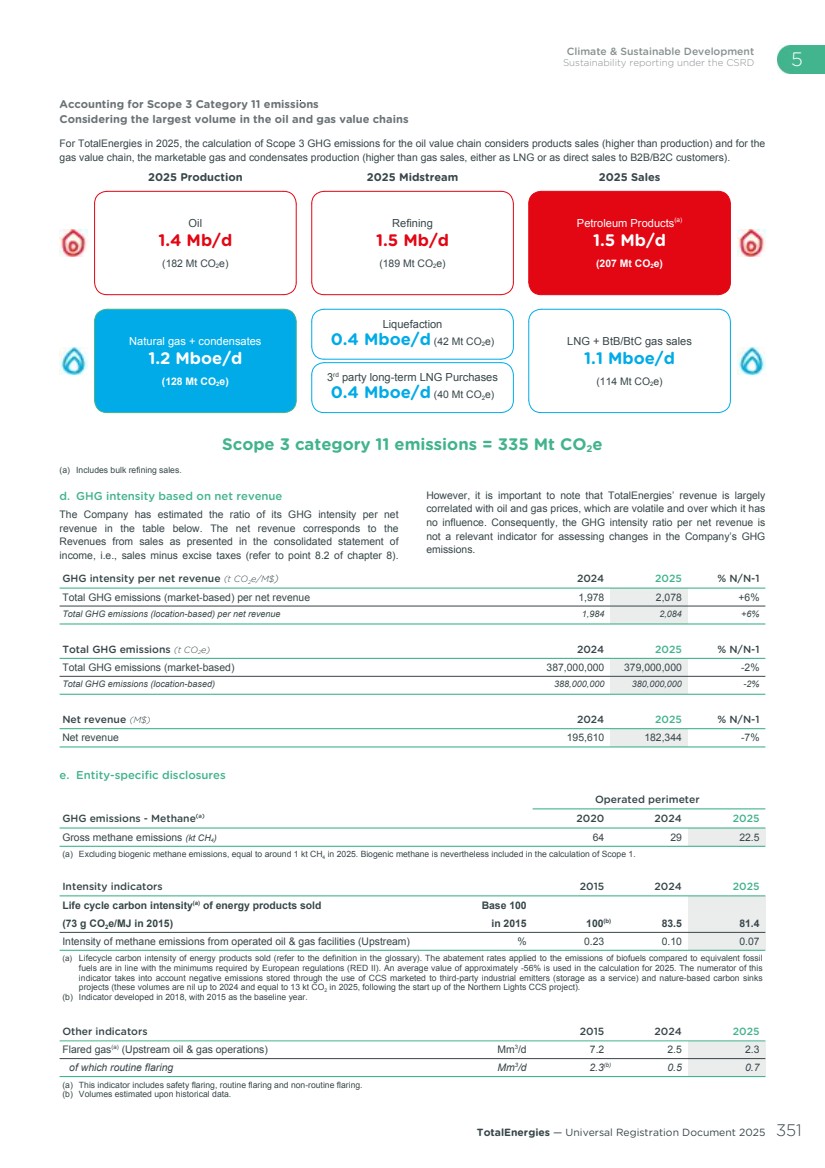
| 3. GHG removals and GHG mitigation projects financed through carbon credits (E1-7) GHG removal and storage in TotalEnergies’ own activities and its upstream and downstream value chain As per the ESRS, the GHG removal referred to in ESRS E1-7 means the removal of GHG from the atmosphere as a result of deliberate human activities. It covers, for example, the capture of carbon dioxide from the atmosphere (Direct Air Capture or DAC) and the production of BioEnergy (or BE). Since the technology for the capture and geological storage of carbon from industrial sources cannot by itself remove CO2 from the atmosphere, the carbon capture and storage (CCS) activities that the Company is carrying out or developing to reduce its own emissions, or that it may offer to major industrial customers to reduce their own emissions (refer to point 1.3.5.1 of chapter 1) do not constitute “GHG removal and storage operations” in the meaning of ESRS E1-7. They are part of the Company’s actions to reduce emissions (refer to point 5.2.2.1 B. 2. (E1-3, Action 5)). To its knowledge, TotalEnergies’ activities have not generated any leaks during the transportation and storage of CO2. GHG mitigation projects financed through carbon credits Use of carbon credits in regulatory frameworks, customer offset offers or voluntary cancellation In 2025, within the framework of the national application of the EU Fuel Quality Directive (Directive 98/70/EC), the Company has used 13,500 UER (Upstream Emission Reduction) credits in Luxembourg and 5,300 UER credits in the Czech Republic. In addition, as part of commitments made in 2017 to the GoodPlanet Foundation, the Company used(1) 61,567 carbon credits in 2025 for its employees’ air travel in 2024. Indeed, since 2022, TotalEnergies has been voluntarily using carbon credits at a rate of one carbon credit for every metric ton of CO2 emitted by its employees’ air travel - thanks to the Adilabad biogas project in India developed by the GoodPlanet Foundation. This project aims to avoid releasing around 400 kt CO2 into the atmosphere over 10 years, generating Gold Standard certified carbon credits while improving the lives of approximately 40,000 people. Financing of NBS projects to offset the Company’s residual Scope 1+2 emissions TotalEnergies invests in GHG mitigation projects outside its value chain, financed by carbon credits, in particular nature based carbon sinks (Nature Based Solutions or NBS). The Company is working to build a high-quality portfolio and is paying close attention to the integrity and permanence of the emissions reductions and sequestration achieved by the activities financed in this way. The Company plans to use the NBS carbon credits financed by the Company outside its value chain that it will have in stock from 2030 to offset only the Company’s residual Scope 1+2 emissions. At 2025 year end, the stock of NBS carbon credits financed by the Company outside its value chain stood at 17.9 million. These NBS carbon credits are certified by leading international standards such as Verified Carbon Standard (VCS or Verra), ACR (American Carbon Registry) or ANREU (Australian National Registry of Emission Units). They derive from nature-based carbon sink projects, i.e., sequestration projects such as reforestation or regenerative agriculture, or conservation projects ensuring the protection of environments already storing significant quantities of carbon. At the end of 2025, they represent a cumulative committed budget of more than $650 million pledged to date over their cumulative lifespan, for an expected cumulative volume of verified credits of 37 million in 2030 and 51 million over their lifespan. The final quantities of carbon credits obtained will depend on the actual implementation of the projects, methodological revisions for certification and technical updates. Between 2026 and 2030, TotalEnergies will continue to develop new projects in order to build up a stock of carbon credits of around 50 million by 2030(2) . In this context and based on a consumption rate of 10% of the stock per year from 2030, TotalEnergies would consume around 5 million credits per year from 2030 onwards to partially offset the Company’s remaining Scope 1+2 emissions after the priority actions to avoid and reduce its GHG emissions have been carried out (refer to point 5.2.2.1 C. 1. (E1-4) for the Company’s GHG emission reduction targets). Information on credits used in 2025 and the volumes of carbon credits acquired and certified at the end of 2025 that are scheduled to be used in the future as voluntary offset for Scope 1+2. Carbon credits used in the reference year (2025) 0 Number of certified credits in stock at the end of the reference year (2025) scheduled to be used from 2030 onwards 17,900,000 Part relating to removal projects (%) 3% Part relating to reduction projects (%) 97% Part relating to VCS(a) certifications (%) 61.6% Part relating to ANREU(b) certifications (%) 0.2% Part relating to ACR(c) certifications (%) 38.2% Part issued in the context of EU projects (%) 0% Part that can be considered as a corresponding adjustment under Article 6 of the Paris Agreement 0% (a) Verra’s Verified Carbon Standard (VCS). (b) Australian National Registry of Emissions Units. (c) American Carbon Registry. 4. Internal carbon pricing (E1-8) Even though CO2 pricing does not currently apply in all the countries where the Company operates, TotalEnergies includes as a base case, a CO2 price of $100/t in its investment criteria (or the prevailing price in a given country, if higher); beyond 2030, the CO2 price is inflated by 2% per year The internal price of CO2 provides a relevant economic signal associated with these emissions and allows their social cost(3) to be integrated into all decisions. The internal price of CO2 applies to Scope 1+2 GHG emissions(4) from all of the Company’s activities. It is integrated like other prices (crude oil price, exchange rate, etc.) into investment decisions, including the exploration, acquisition or development of oil and gas projects. In addition, Carbon Capture and Storage (CCS) and Nature Based Solutions (NBS) projects are evaluated based on the cost per ton of CO2 (internal threshold in $/tCO2). Resilience tests at $200/t CO2 are carried out and are described in point 5.2.2.1 A. 2. c. “Sensitivity to CO2, oil and gas prices”. The Company carries out impairment tests on its assets, which are described in note 3 of the notes to the consolidated financial statements (refer to point 8.7 of chapter 8). The determination of recoverable amounts includes, for all identified assets, the impact of their CO2 emissions. The future Scope 1+2 emissions of the assets concerned over the lifetime of the assets are valued at $100/t or the prevailing price in a given country, if higher, including the existing free quota systems in Europe. Beyond 2031, the price of CO2 is inflated by 2%/y. (1) The term “used” in this section corresponds to the term “cancelled” as defined in the CSRD. (2) The final tally of carbon credits obtained will depend on the actual completion of the NBS projects, and may vary according to any additional projects and investments that the Company may decide during these periods. (3) Economic indicator estimating the monetary value of the environmental, economic, human and social damage caused by the emission of an additional ton of CO₂ into the atmosphere. (4) Excluding actual or anticipated free allowances. 5 Climate & Sustainable Development Sustainability reporting under the CSRD 352 TotalEnergies — Universal Registration Document 2025 |
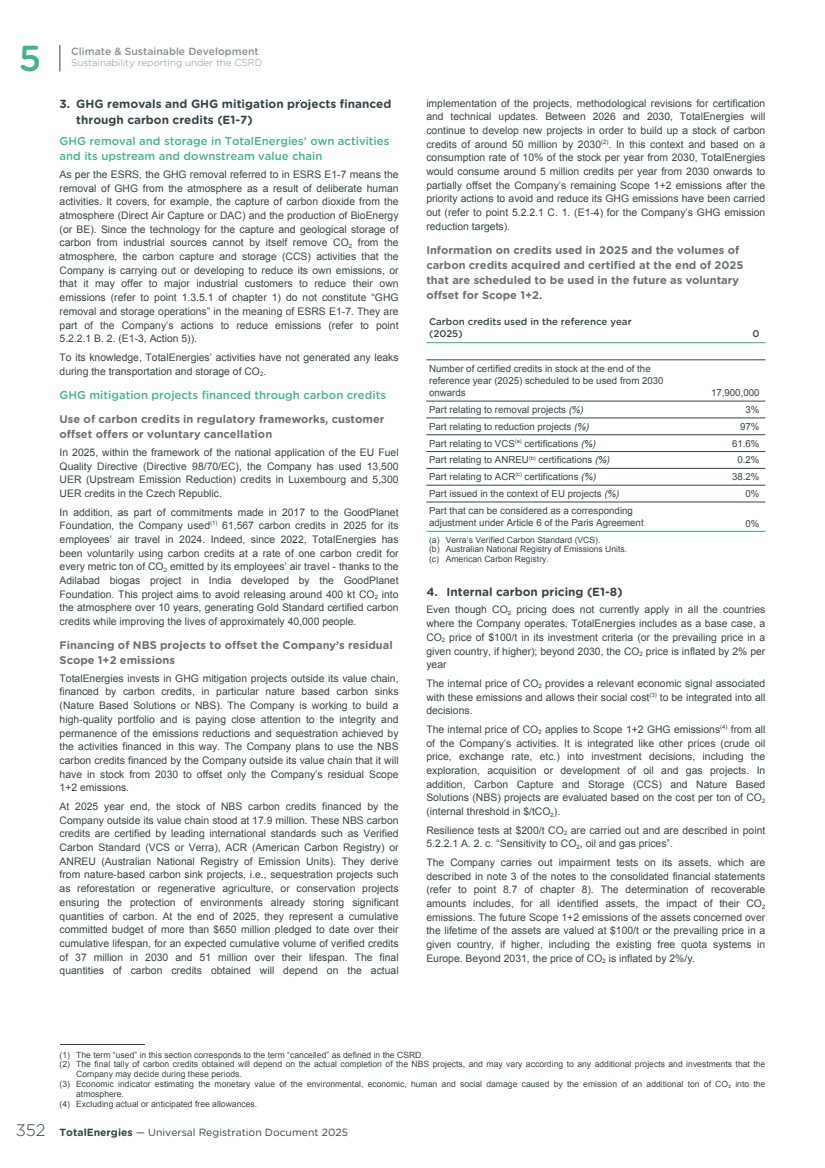
| In addition, the Company carries out sensitivity tests on the internal price of CO2 on the impairments recognized: – for the Exploration & Production segment, taking into account a CO2 cost of $200/t, inflated by 2%/y from 2031 on all assets, would have an additional negative impact of $0.2 billion on the net income attributable to TotalEnergies for the 2025 financial year; – with regard to the Integrated LNG segment, taking into account a CO2 cost of $200/t, inflated by 2%/y from 2031 on all assets, would have an additional negative impact of $0.8 billion on the net income share of TotalEnergies for the 2025 financial year. The Company’s accounts incorporate the regulatory carbon prices in force. The internal price of CO2 is not applied to actual emissions in the current year but is used for the Company’s valuations to ensure that the cost of carbon and possible future regulations are taken into account in all investment decisions. 5.2.2.2 Pollution (E2) A. Policy adopted to protect the environment and limit the environmental footprint of TotalEnergies’ activities (E2-1) TotalEnergies considers respect for the environment and nature as one of its priorities. Everyone must, at every level, in the exercise of his functions, demonstrate the greatest demands in the environmental protection. The Company’s activities, such as those linked to its value chain, can generate emissions to the natural environment (water, air, soil, biodiversity) such as combustion fumes, emissions to the air from various transformation processes, or even wastewater discharges. TotalEnergies pursues a policy of avoidance, reduction and, when this is necessary and possible, to compensate for the footprint of its activities on the environment and nature. TotalEnergies carried out the mapping of its Dependencies, Impacts, Risks and Opportunities (DIRO) linked to nature, the methodology of which is presented in point 5.2.1.4 “IRO-1”. The list of families of pollutants specific to the activities of the Company is the result of this analysis. These families of pollutants contain gaseous pollutants (SO2, NOx, NMVOC, PM) and pollutants more commonly present in aqueous effluents (nitrogen, heavy metals, BTEX, Hydrocarbons). The Company does not carry out deliberate releases to soil although risks of soil contamination linked to the activities carried out by TotalEnergies may mainly come from accidental spills. The situations of accidental spills are monitored and analyzed specifically. In addition to complying with applicable legislation, TotalEnergies has drawn up rules and guidelines that the Subsidiaries can use to limit the quantities discharged. The Company also develops new processes, products and services for its customers, with the aim of reducing their environmental footprint. TotalEnergies has established a rule for its operated sites which includes management measures to reduce pollution. Firstly, this rule stipulates that installations and equipment designed to measure and limit discharges into the environment must be identified, maintained and provided with performance targets. Secondly, it provides for specific measures to manage the following aspects: – Chronic environmental risks; – Accidental pollution risks; – Chemical management, chemical storage, drilling fluid specification; – Air emissions management, water emissions management, soil protection. For its non-operated sites, TotalEnergies strives to share and promote best practices with the operators concerned. For the upstream part of its value chain (purchases of goods and services), the Company has a responsible purchasing program detailed in point 5.2.4.3 A. 1. Management of chronic and accidental pollution at operated facilities To prevent accidental risks and in particular spills able to reach the environment, TotalEnergies implements risk management policies described in point 5.2.3.1 B. The Company’s policy for the management of major industrial accident risks applies from the facilities design stage, and throughout their lifespan, in order to minimize the potential impacts associated with its activities. These mainly concern measures to prevent accidents but also include mitigation measures (mitigation and protection). They are technical and organizational. These analyses are updated periodically, at least every five years, or when facilities are modified. With regard to the design and construction of facilities, technical standards include applicable regulatory requirements and refer to industry best practices. For example, in order to control the integrity of pipelines operated by the Company, they are subject to periodic surveys such as cathodic protection checks, ground or aerial surveillance or in line inspections. These actions are planned as part of the pipeline monitoring and maintenance programs. These verifications and their frequency are reinforced in areas with high human or environmental risks identified by the risk analysis. In order to manage a major accidental spill efficiently, TotalEnergies has implemented a global crisis management system. For the sites operated by the Company exposed to the risk of accidental spills that reach the surface water, this system is supplemented by requirements of the One MAESTRO (Management and Expectations Standards Toward Robust Operations) reference framework. These requirements demand that the oil spill contingency plans be regularly reviewed and tested in exercises. These plans are specific to each site and are adapted to their structure, activities and environment while complying with Company recommendations. 2. Management and storage of chemical products and drilling fluids at operated sites Chemical products whose use is necessary for the Company’s activities and that are likely to affect the environment, even accidentally, are selected on the basis of a risk assessment and with the aim of minimizing this impact. In countries with no regulatory framework, the criteria of minimum toxicity, minimum bioaccumulation potential and maximum biodegradability are used to select chemicals. A documented chemical management procedure must be implemented to limit risks to the environment, taking into account the selection, storage, transportation, use, possible associated emissions and disposal of these products. In the specific case of drilling fluids, specifications set maximum levels for aromatic hydrocarbon compounds. The Company’s standards require compliance with specifications for the design of chemical storage facilities, in order to limit the risk of releases into the environment. Climate & Sustainable Development Sustainability reporting under the CSRD 5 TotalEnergies — Universal Registration Document 2025 353 |
| TotalEnergies fully shares the desire to replace and/or minimize the use of substances of concern and to phase out the use of substances of very high concern in the industry. The Company regularly monitors product safety in order to eliminate and/or replace, where possible, substances of concern and very high concern that may be present in its industrial processes. 3. Air and water emissions management, soil protection of operated sites In addition to complying with applicable legislation, TotalEnergies has drawn up rules and guidelines on which the Company’s operated sites can rely to limit the quantities discharged into the atmosphere or water. For new facilities operated by the Company, internal rules require impact assessments to be carried out and, if necessary, actions to be taken to limit the impact of atmospheric and water emissions. For discharges into water, the Company specifies maximum levels for hydrocarbon discharges that are specific to its oil and gas activities. The risks of soil pollution related to TotalEnergies’ operated activities basically come from accidental spills. TotalEnergies has drawn up a pollution prevention and control guide that its subsidiaries can rely on. The recommended approach is based on four pillars: – preventing leaks, by implementing industry best practices in engineering, operations and transport; – carrying out maintenance at appropriate frequency to minimize the risk of leaks; – overall monitoring of the environment to identify any soil and groundwater pollution; – managing any pollution from previous activities by means of containment and reduction or elimination operations. 4. Managing pollution risks in the downstream value chain Unless specific precautions are taken, part of the petroleum or chemical products marketed by TotalEnergies may pose environmental risks. Respecting regulatory requirements is the main measure to limit risk throughout the life cycle of these products. TotalEnergies has also defined the minimum requirements to be observed in order to market its petroleum or chemical products worldwide with the goal of reducing potential impacts on the environment. These include the identification and assessment of the risks inherent to these products and their use, as well as providing information to consumers. The material safety data sheets that accompany the petroleum or chemical products marketed by the Company, including those not classified as dangerous, available in at least one of the languages used in the relevant country, as well as product labels, are two key sources of information. The implementation of these requirements is monitored by teams of regulatory experts and ecotoxicologists within the Refining & Chemicals and Marketing & Services segments of the Company. These teams draw up the safety and registration data sheets under REACH(1) (or equivalent regulations in other geographical regions) if necessary. B. Targets, actions and resources related to pollution at operated sites (E2-2, E2-3) Beyond compliance with applicable local regulations, the HSE Division and the HSE services within the Company’s entities ensure the application of One MAESTRO’s internal requirements and the Company’s additional commitments. The Company’s steering bodies, led by the HSE Division, are tasked with: – monitoring TotalEnergies’ environmental performances, which are reviewed annually by the Company, for which multi-annual improvement targets are set; – handling, in conjunction with the business segments, the various environment-related subjects of which they are in charge; – promoting the internal standards to be applied by the Company’s operational entities. For its operated perimeter, the Company has set itself environmental progress targets for 2030. TotalEnergies seeks to share with all employees its environmental care and nature protection requirements. 1. Combating pollution TotalEnergies is implementing action plans to address the situations of accidental pollution, carries out tests each year of necessary equipment and monitors indicators to assess the readiness of the sites operated by the Company for pollution control. Oil spill preparedness 2025 2024 2023 Number of sites whose risk analysis identified at least one risk of major accidental pollution to surface water 113 115 122 Proportion of those sites with an operational oil spill contingency plan 100% 100% 100% Proportion of those sites that have performed an oil spill response exercise or whose exercise was prevented following a decision by the authorities 94% 97% 99% Furthermore, TotalEnergies monitors, in accordance with the practices of the profession, accidental spills of liquid hydrocarbon with a volume greater than one barrel. Those who exceed a threshold of predetermined severity are subject to a monthly review and a annual statistical information is transmitted to the Performance Committee of the Company. Any spill is followed by remedial action aiming for a return as quickly as possible of the environment to a state acceptable. In 2025, several exercises were organized for different entities within the Company, including: – an exercise involving the Gabonese subsidiary for offshore crude oil production and export, the Company’s central pollution control expertise, and the participation of vessels and crews at sea for the proper deployment of offshore pollution control equipment, with drone transmission to the tactical cell; – a crisis scenario involving a cyber incident with major consequences for the Congolese EP subsidiary (search for victims at sea, major pollution, fire on an offshore site); – a significant accidental pollution scenario in a French estuary, related to the activity of a refinery site, which allowed testing the interconnection of the entire response chain, from the site’s field teams to the Company’s crisis support cell, also involving internal specialists and the Company’s global contracts for pollution response support. For its maritime and river transport of hydrocarbons and LNG, TotalEnergies maintains a rigorous safety policy based in particular on a strict selection of chartered vessels and barges that meet the highest international standards. The process and criteria for selecting vessels and barges (vetting) are based on regulations, best practices, and recommendations from the OCIMF (International Organisation of Maritime Fisheries and Oceans), as well as on the tools implemented by this organization (SIRE 2.0 for oil and gas carriers and BIRE for barges). Vetting of tankers and barges is carried out by a single, centralized entity within the Company. In 2025, the average age of the fleet of oil tankers chartered on a time basis by TotalEnergies is seven years. (1) EU regulation on the Registration, Evaluation, Authorization and Restriction of Chemicals. 5 Climate & Sustainable Development Sustainability reporting under the CSRD 354 TotalEnergies — Universal Registration Document 2025 |
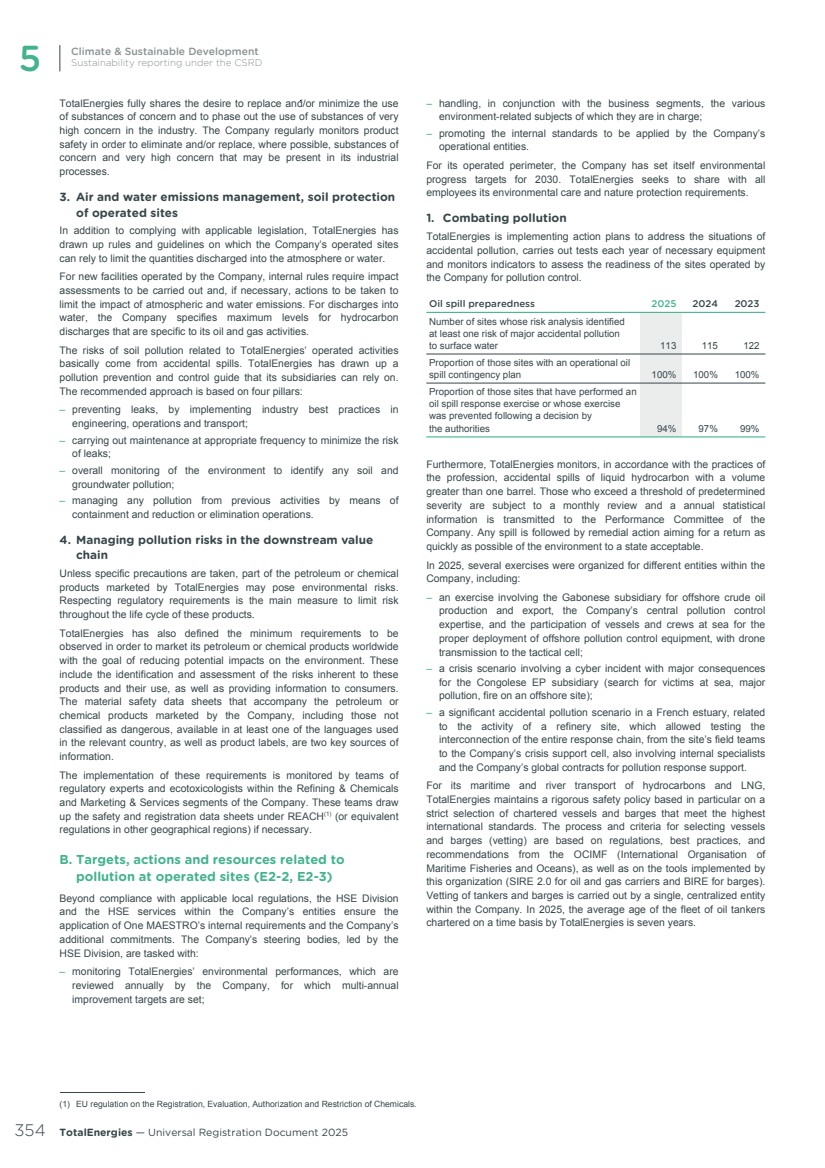
| For hydrocarbon exploration-production activities, measurements of control to avoid accidental risks of pollution linked to blowout or leak on a well focus first, under the management of each subsidiary, on the design of wells in compliance with the Company standard which is based on international standards and best practices the industry (e.g. redundant barriers, blowout preventers and monitoring of cement integrity). This includes a verification process by the headquarters of the well design, an RTSC (Real Time Support Center) which allows the real-time monitoring, by headquarters specialists, of construction operations of sensitive wells, skills development, personnel certifications and equipment audits for prevention of well incidents. In 2025, 49 sensitive wells over a total of 221 wells drilled had their engineering design verified, and have been monitored 24/7 during the operation execution. Well integrity management is described in point 5.2.3.1 B. In the event of an incident on a well in very deep water, seabed well closure equipment (subsea capping) and leak capture (subsea containment), mobilizable by air or maritime, have been positioned since 2014 in different parts of the world (South Africa, Brazil, Norway, Singapore). They allow you to have access to solutions more quickly in the event of an oil blowout or gas during underwater drilling. From these locations, these equipment can thus benefit TotalEnergies’ operations all over the world. These devices come from the work of a group of nine oil companies including TotalEnergies and are managed by the cooperative organization for the fight against marine pollution Oil Spill Response Ltd (OSRL). Moreover, since 2018, a system intended to facilitate capping operations by shallow water depth, the Offset Installation Equipment (OIE), is positioned in Trieste (Italy). Managed by OSRL, it can be transported by plane or boat anywhere in the world if necessary. In addition, TotalEnergies has designed and developed its own system of capping (Subsea Emergency Response System) to stop the most quickly possible a potential blowout occurring on a well in during drilling or during production. Since 2015, equipments are positioned in Angola and the Republic of Congo, thus covering the entire Gulf of Guinea region. Concerning activities for onshore or shallow water wells, various contracts with specialized companies are in place to assist the Company’s teams in the event of an incident on a well. These means of intervention to manage an incident on a well are constantly improved by the search for the best techniques available in the industry. Intervention and crisis management plans are regularly updated and tested, to enable an effective response in the event of an incident on a well, with the possibility of mobilizing a headquarters team (BOTF – Blow Out Task Force) to strengthen the local teams and resolve the incident as quickly as possible. 2. Controlling emissions to air and water In addition to local regulations and based on its long-term plan, TotalEnergies has set the following voluntary environmental targets for its operated sites: – reduce emissions of sulfur dioxide (SO2) into the air by 75% between 2015 and 2030, which means emitting less than 15 kt in 2030. In 2015, SO2 emissions reached 59 kt; – limit the hydrocarbon content of continuous liquid discharges to less than 30 mg/l for offshore sites (permanent target); – limit the hydrocarbon content of continuous liquid discharges to less than 1 mg/l for onshore sites by 2030. After analysis, the concerned sites are equipped with reduction systems that include organizational measures (managing sulfur content of fuels, improving the management of combustion processes, etc.) and specific technical measures depending on the sites (wastewater treatment plants, desulfurization units, etc.). The Company does not discharge into the ground although risks of soil contamination linked to the activities carried out by TotalEnergies could mainly come from accidental spills. Accidental spill situations are subject to a monitoring and specific analysis. In 2025, no significant accidental spill reached the soil of the operated sites of the Company. 3. Replacing and reducing substances of concern or very high concern For its operated polymer production processes, the Company carries out a continuous assessment of the substances used, in compliance with the strictest local regulations for the protection of health and the environment, and in particular with REACH regulations in the EU, where most of the operated production sites are located. For Marketing & Services segment products, traceability of the substances used and associated certifications are ensured from purchase to delivery of batches to customers. In addition, action has been taken on operated facilities to: – eliminate asbestos: in accordance with its internal rules, TotalEnergies prohibits the use of materials containing asbestos in new buildings and installations. These components are gradually being removed from the plants as part of a comprehensive asbestos removal plan launched several years ago; – eliminate PCB (polychlorinated biphenyls): the Company prohibits the use of equipment containing PCBs. These components have been progressively eliminated from the installations as part of our global PCB elimination plan launched several years ago; – eliminate HFCs and HCFCs: in accordance with European Union regulations relating to fluorinated GHGs, the Company has banned since years the use of the targeted HFC and HCFC gases. C. Quantitative data on substance releases to water, air and soil (E2-4) All TotalEnergies operated sites use the environmental reporting system of the Company which covers in particular the entire operated perimeter, to consolidate, control and communicate their data relating to discharges. These indicators are subject to regular monitoring using quantification and analytical systems which are controlled according to a frequency defined by the site in depending on their criticality. The regulations applicable to normalization of analyzes are applied. Data collection aggregation and calculations are carried out each year at the level of the Company, filters set up on the reporting tool allow to aggregate data according to the different reporting scopes. In the absence of regulatory obligations similar to those of the European Union in a number of countries where the Company operates, the collection of reliable data may be made more difficult. In view of the announcement by the European Commission on February 26th , 2025 of the plan to eliminate half of the data points under the ESRSs, the Company is still working on the collection of reliable data for a number of substances and will take into account future regulatory developments. Tables below show the evolution of discharges which are the subject of a target set by the Company for the operated domain (100%), i.e., SO2 emissions into the air and the hydrocarbon content of emissions into water as indicated in point 5.2.2.2 B: Atmospheric chronic emissions 2025 2024 2023 SO2 emissions (kt) 19 17 12 SO2 emissions that are likely to cause acid rain are regularly checked and reduced. In 2025, SO2 emissions have increased mainly due to the Ratawi project (Iraq) which historically burns large quantities of sulfur containing gas. The Ratawi project aims precisely, in the long term, to valorize this gas and therefore reduce associated SO2 emissions. Climate & Sustainable Development Sustainability reporting under the CSRD 5 TotalEnergies — Universal Registration Document 2025 355 |
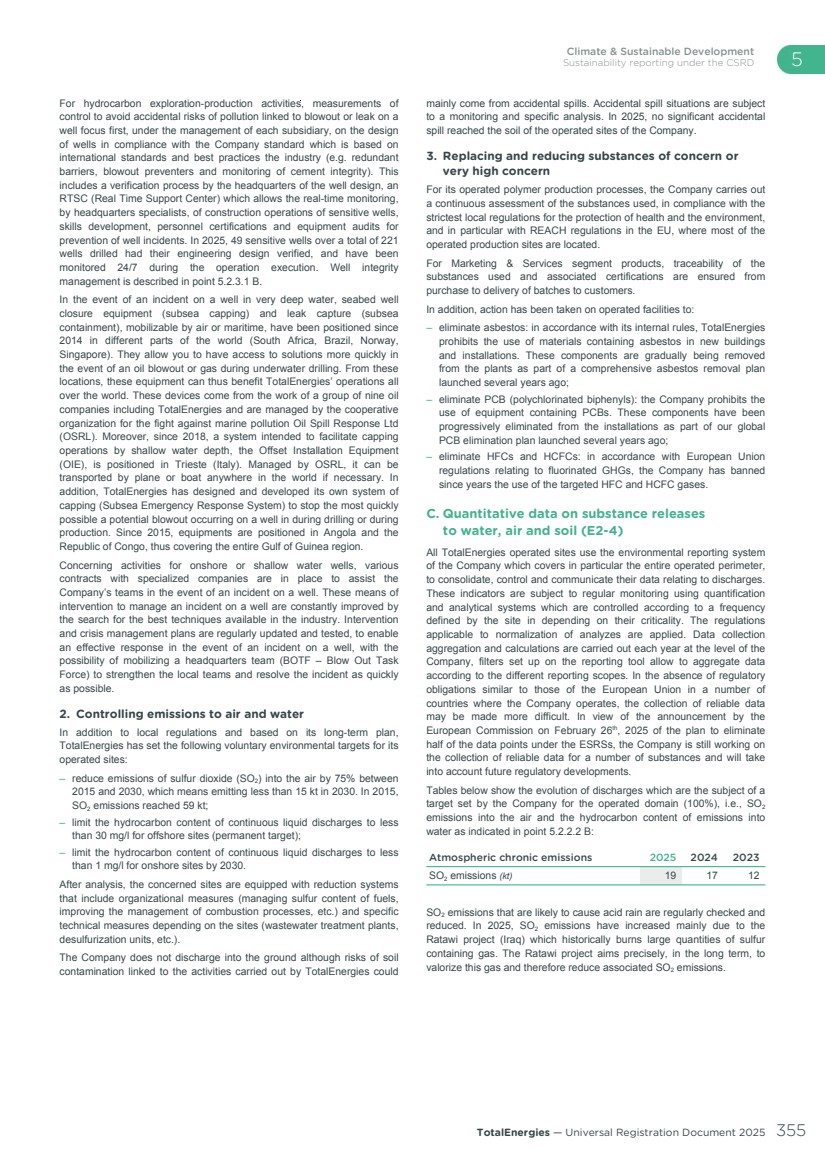
| Chronic releases to water 2025 2024 2023 Hydrocarbon content of offshore continuous water discharges (in mg/l) 9.9 11.2 11.6 % of sites that meet the target for the quality of offshore discharges (30 mg/l) 97% 93% 92% Hydrocarbon content of onshore continuous water discharges (in mg/l) 2.0 2.0 1.9 % of sites that meet the 2030 target for onshore discharges quality (1 mg/l) 82% 82% 86% In 2025, the improvement of the offshore performance is due to the cessation of production of one site. Studies have been launched to improve discharges from sites not yet compliant. In addition, in 2025, the following quantities of pollutants were emitted by the operated sites (within the ESRS perimeter and above the reporting threshold values provided for in the E-PRTR(1) regulation): Emissions into air or water(a) Units 2025 2024 Sulfur oxide/dioxide (SOx /SO2) into the air t/y 18,000 16,000 Carbon monoxide (CO) into the air t/y 9,000 12,000 Non-methane volatile organic carbon (NMVOC) into the air t/y 35,000 35,000 Nitrogen oxide/dioxide (NOx /NO2) into the air t/y 53,000 57,000 Dust (PM) - into the air t/y 2,000 3,000 Total Organic Carbon (TOC) or Chemical Oxygen Demand (COD)/3 into water t/y 13,000 15,000 Total nitrogen (N, TKN or global nitrogen) into water t/y 7,000 8,000 Total phosphorus (P) into water t/y 60 70 Polycyclic aromatic hydrocarbons (PAHs) into water t/y 5 4 (a) Rounded number. The variations observed in the quantities of pollutants emitted are linked to operational events of various kinds. Without taking special precautions, pellets (balls of diameter less than 5 mm) can be disseminated in the environment during the production and transport of polymers. As a producer, TotalEnergies integrates this issue through its participation and promotion to its customers and partners (carriers and logistics agents) to certification programs such as Operation Clean Sweep® , a voluntary sector initiative that promotes good practices to avoid the dispersion of plastic pellets in the environment. Since 2025, all polymer production sites of TotalEnergies in Europe and in the United States are certified. TotalEnergies is implementing the methodology proposed by Operations Clean Sweep® to determine the volume of microplastics disseminated. This volume is estimated to be less than 0.0001% of TotalEnergies’ total polymer production (so less than 1 gram of lost pellets per ton of produced polymer). For the 2025 financial year, the company has implemented a collection of data relating to emissions into air and water from the operators of its non-operated sites. This collection made it possible to collect data on emissions to water from only 69% of sites. Due to the diversity of sites and processes involved and the absence of activity data, it was not possible to carry out estimation of missing data. Quantities of pollutants emitted by the Company’s non-operated sites into water and microplastics are therefore not available for the 2025 exercise. Concerning air emissions, for material emissions of the Company’s non-operated sites, the collection made it possible to bring together between 23% and 49% of site data depending on the type of emissions, which is insufficient. The quantities of pollutants emitted by sites not operated by the Company into the air are therefore not available for fiscal year 2025. 96% of the Company’s non-operated production comes from operators not subject to European regulations who have no obligation to provide this data. Regarding operated sites accidental spills greater than one barrel reaching the environment global data in 100% are presented in the table below. No significant spill reached soils. Accidental spills of liquid hydrocarbons reaching the environment and having a volume greater than one barrel, excluding theft or acts of sabotage (in thousands of m3 ) 2025 2024 2023 Number of spills 22 24 27 Total volume of spills ~0.0(a) 0.6 1.7 Total volume recovered ~0.0(b) ~0.0 (c) ~0.0 (d) (a) Precisely 23 m3 . (b) Precisely 13 m3 . (c) Precisely 28 m3 . (d) Precisely 40 m3 . D. E2-5 category substances In Europe, in accordance with the regulations, the Company’s operated sites maintain an up-to-date list of substances of concern (Substances of Concern – SoC) and substances of very high concern (Substances of Very High Concern – SVHC) present in their purchases and sales (with the associated quantities). Outside Europe, the regulations in force do not provide for similar monitoring. Since 2024, the Company has asked its operated sites located outside of Europe to engage in this process. The data collected does not currently allow the Company to publish an estimate of the quantities involved, in accordance with its data quality assurance process. Furthermore, the standards relating to the disclosure of these substances are currently the subject of a proposed revision by EFRAG, which the Company is reviewing. The Company has not identified any reasonable scientific basis for making estimates of these missing data at this stage. 5.2.2.3 Water and marine resources (E3) A. Policies related to water and marine resources (E3-1) TotalEnergies places the environment at the heart of its ambition of being a responsible company with a goal to improve the environmental performance of its operated facilities, specifically by encouraging responsible and sustainable water management. The process of assessing dependencies, impacts, risks and opportunities, including the analysis of water resources, is described in point 5.2.1.4 (IRO-1). TotalEnergies does not use marine resources for its operations. TotalEnergies’ policy provides that a full life-cycle environmental risk assessment must be carried out prior to any development project or product launch. The Company requires operated sites to control their use of natural resources. Thus, TotalEnergies follows its principles of action in terms of risk management related to water resources, by carrying out the: – identification of priority sensitive sites by monitoring water withdrawals, and then a risk assessment; – improvement of water resources management depending on local or national identified needs, by adapting the priority sites’ environmental management system. (1) Regulation (EC) No 166/2006 of the European Parliament and of the Council of 18 January 2006 concerning the establishment of a European Pollutant Release and Transfer Register. 5 Climate & Sustainable Development Sustainability reporting under the CSRD 356 TotalEnergies — Universal Registration Document 2025 |
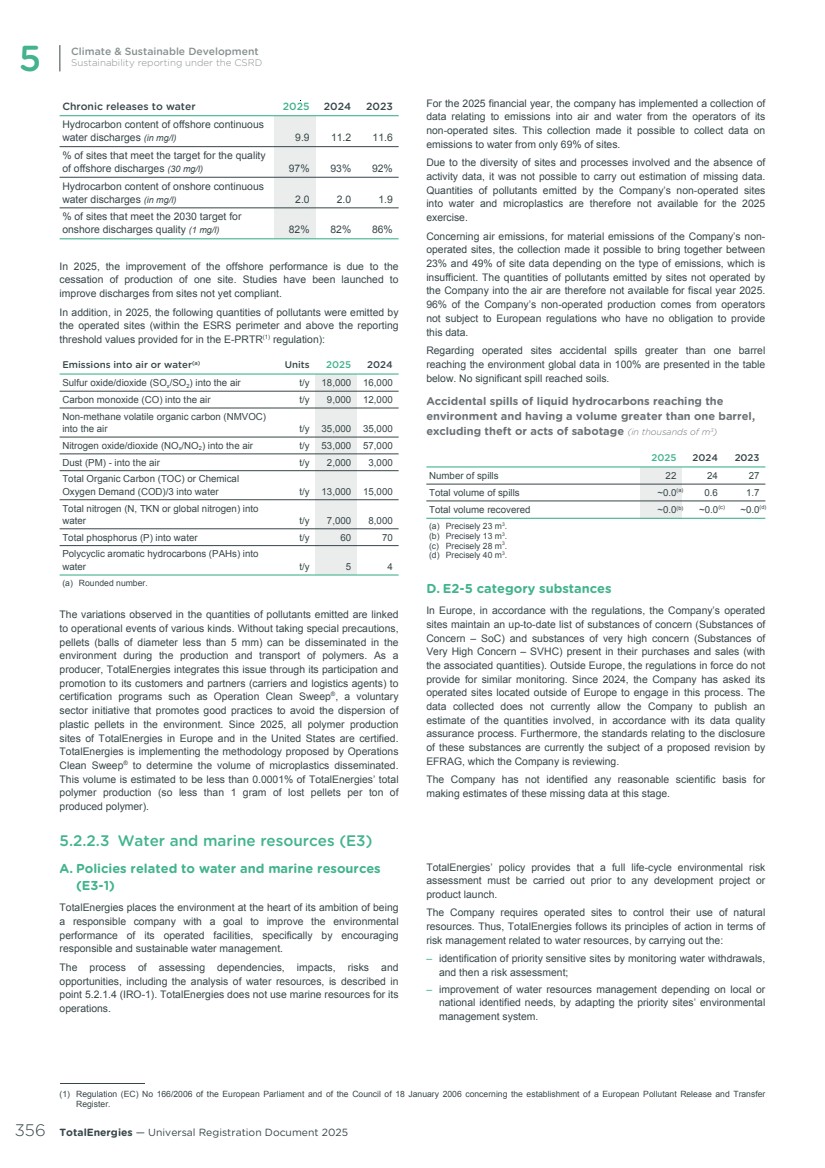
| In addition, an internal rule relating to the management and protection of the environment for the operated domain specifies that sites located in water stress areas and withdrawing more than 500,000 m3 of fresh water per year must draw up a detailed analysis of the actual risk of dependence on water resources. This analysis takes all stakeholders into account. The rule also calls for the assessment of means to optimize freshwater consumption aligned with the level of risk. Operated site discharges to surface water are dealt with in point 5.2.2.2. As regards its non-operated sites, TotalEnergies strives to share and promote best practices with the concerned operators, including in water stressed areas. For the upstream part of its value chain (purchases of goods and services), the Company has a responsible purchasing program detailed in point 5.2.4.3 (G1-2). B. Managing water stress areas To identify sites at risk of water stress, TotalEnergies conducts a survey of freshwater withdrawals at all its operated sites and evaluates them according to the WRI’s (1) “Aqueduct” current and future water stress indices, which consider withdrawals by local stakeholders and three IPCC scenarios (SSP1 RCP2.6, SSP3 RCP7.0, SSP5 RCP8.5). Material operated sites for water resources are defined as those located in water stress areas and withdrawing more than 500,000 m3 of water per year, i.e. 11 sites identified: Activity Site name Catchment area Refining, polymers and olefins Antwerp platform Scheldt, Belgium Refining and petrochemicals Normandy platform Seine, France Petrochemicals Feluy plant Sambre, Belgium Refining Leuna refinery Elbe River, Germany Biorefinery Grandpuits platform Seine, France Biorefinery La Mède platform Rhône, France Gas power plant Pont-sur-Sambre CCGT Maas/Sambre, France Gas power plant Marchienne CCGT Maas/Sambre, Belgium Gas power plant Castejón CCGT Ebro, Spain Gas power plant Colorado Bend CCGT Gulf Coast, USA Production of natural gas Barnett sector Gulf Coast, USA C. Voluntary targets related to water resources (E3-3) TotalEnergies has voluntarily set a freshwater resource target that covers 100% of operated sites considered as material for water resources, and beyond regulatory requirements. The Company’s target is to reduce its freshwater withdrawal in water stress areas by 20% between 2021 and 2030. The 2030 target of a maximum of 44 million m3 of freshwater withdrawal from water stressed areas, for a 2021 value of 55 million m3 is based on the Company’s long-term plan. Targets related to operated site discharges to surface waters are dealt with in point 5.2.2.2. Indicator for 11 material operated sites (100%) Unit 2025 2024 2023 Fresh water withdrawal in water stress area(a) 106 m3 53 51 50 (a) The basin of Carling - St Avold sites in France is excluded because the withdrawal of groundwater is administratively imposed there for environmental reasons. The freshwater withdrawal increase in 2025 is essentially linked to the increase of some of the gas power plants electricy production. D. Actions and resources (E3-2) The various types of action shown in the chart below are expected to enable the Company to achieve its 2030 target. TotalEnergies’ action-levers to reduce its water withdrawals at its material operated sites (in million of m3 ) Some operated sites, including the material sites covered by the voluntary 2030 target, have initiated detailed studies to reduce their freshwater withdrawals, in order to define actions adapted to the local context, site practices and sources of water used. The Antwerp platform was the first Refining & Chemicals facility to approve, in 2022, a large-scale project to reduce freshwater withdrawals. The project involves reusing treated domestic wastewater to supply the Antwerp refinery. This initiative is part of the Flemish government’s Blue Deal program. This project, alongside with the shutdow of the steam cracker, should enable the refinery to reduce its uptake of drinking water by more than 9 million cubic meters per year, or nearly 65% of its freshwater withdrawals by 2027. An investment of €3 million is planned. The site has carried out technical studies to identify the projects needed to adapt to the new type of water coming from the urban wastewater treatment plant. Two main actions are being studied: the construction of a new pipeline for the drinking water network, which will be separated from the new water supply network, and the installation of new flow meters. (1) World Resources Institute - Baseline Water Stress and its projection to 2030. Climate & Sustainable Development Sustainability reporting under the CSRD 5 TotalEnergies — Universal Registration Document 2025 357 |
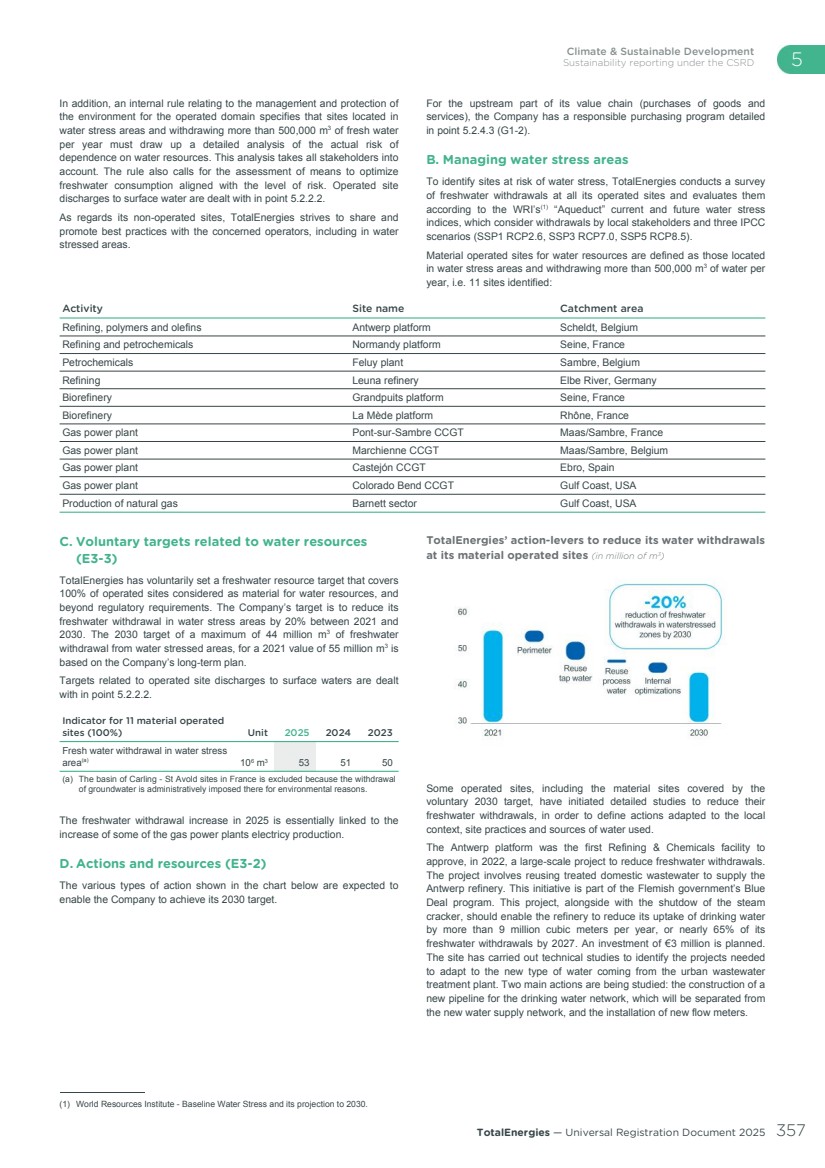
| The Normandy Platform plans to continue reducing its water consumption through implementing actions on steam losses in 2026, but also through optimization actions on fire-fighting network (these latest optimizations have made it possible to achieve a 50% water saving in 2025 compared to 2023). Furthermore, an urban wastewater reuse opportunity assessment is ongoing. In Germany, as part of the district heating project with the city of Leipzig, the Leuna refinery plans to implement by 2028 condensates recovery from one of its units to reuse them in the steam-producing boiler. Further technical studies on condensate recovery projects and the optimization of a cooling system are conducted. The La Mède biorefinery, further to installing a variable flow pump on its main water intake, is assessing various water withdrawals reduction measures including the implementation of regulations to automate certain operations, as well as the optimization of the cooling of various equipments, with the objective of implementation by 2028. Studies are also being carried out to optimize water resources for the Combined Cycle Gas Turbine plants (CCGT) located at: – Pont-sur-Sambre (France): in 2025, technical studies have been carried out to implement a decarbonated water storage to preserve it in the event of a shutdown, which should be effective by the end of 2026. Tests on a pilot system for the treatment of the blowdown water from the cooling tower have also started, with a view to reuse it, with a target implementation date of early 2027; – Castejón (Spain): a COLDEP pilot system, a vacuum floatation technology, has been installed in June 2025. This aims at improving the quality of water that is recycled in the ultrafiltration and reverse osmosis treatment unit. These pilot tests have been carried out until early 2026. E. Water indicators (E3-4) All of TotalEnergies operated sites use the Company’s environmental reporting system, which covers the entire operated domain, to consolidate, monitor and communicate their water-related data. Volumes of water withdrawals and liquid effluent discharge are reported. These indicators are subject to continuous monitoring at the material operated sites, by means of flow meters, which are checked according to a frequency defined by the site according to their criticality, and daily calculations of the mass balance, in particular in the event of failure of the flow meters. Aggregated data collection and calculations are carried out annually at Company level. In the course of its operated activities, the Company does not store any significant quantities of water. Operated sites within ESRS perimeter Indicators Unit 2025 2024 Fresh water withdrawals excluding open loop cooling 106 m3 99 92 Fresh water withdrawal in water stress area(a) 106 m3 58 56 Fresh water consumption 106 m3 48 45 Fresh water consumption in water stress areas 106 m3 26 26 Volume of water recycled or reused(b) 106 m3 14 11 (a) The withdrawal values in water stress areas are evaluated from the WRI Projected Water Stress 2030 V4.0 of August 2023. (b) Internal water reuse (e.g., reuse of process water for crude oil desalting or semi-open cooling loops purges, produced water reinjection), projects to reuse sites’ effluents discharges. The withdrawals increase in 2025 is mainly due to the increase of the electricity production of some of the Company gas power plants. The company has implemented a collection of data relating to water resources from its non-operated sites operators for the 2025 financial year. This data collection didn’t make it possible to compile data relating to the water resources for the non-operated sites located in water-stressed zones: only 2 of the 9 non-operated sites located in water stress areas provided their data. Therefore, the information collected from non-operated sites is not representative. The Company is therefore unable to publish this information for 2025. Furthermore, in the absence of information from non-operated sites, calculation of water intensity as per the ESRS scope cannot be carried out. 96% of the Company’s non-operated production comes from operators not subject to European regulations which have no obligation to provide this data. 5.2.2.4 Biodiversity and ecosystems (E4) A. Transition plan and consideration of biodiversity and ecosystems in strategy and business model (E4-1) TotalEnergies pays particular attention to the necessity of preserving biodiversity, ecosystems and to protect nature, ensuring they are duly addressed in all its activities. TotalEnergies has an ambition in terms of biodiversity. TotalEnergies’ biodiversity ambition is a contribution to the Global Biodiversity Framework (GBF) adopted at COP15 in 2022, which aims “to halt and reverse biodiversity loss and put nature on the path to recovery for the benefit of people and the planet.” The Company intends to contribute to this ambitious framework and its nationally implemented plans, such as the 2023 French National Biodiversity Strategy (SNB), through nature conservation and restoration concrete measures at its operated sites and projects as well as their surrounding areas. In 2016, the Company pledged to contribute to the achievement of the United Nations’ Sustainable Development Goals (SDGs), including those relating to biodiversity, namely SDG 14 “Life below Water” and SDG 15 “Life on Land”. Each year, TotalEnergies conducts an analysis and monitors its material impacts and risks in relation to biodiversity, ecosystems and wildlife management identifying its operated and non-operated sites that are material for biodiversity. This analysis is described in point 5.2.1.4 (IRO-1), and its material sites for biodiversity are presented in point 5.2.2.4 B. TotalEnergies assessed in 2023 the resilience of its strategy and business model to systemic, physical and transition risks associated with biodiversity and ecosystems. This assessment was carried out for its activities and raw material supplies. It focused on the inclusion of nature-related Dependencies, Impacts, Risks and Opportunities (DIRO) in the Company’s main activities long-term plans (all oil & gas and renewable energy operations, transport, battery production, biogas and biofuels, natural carbon sinks), including raw material supplies and considering the Company’s products and services user expectations identified by its business units. External stakeholders were not directly involved in this assessment. The time horizon used corresponds to the duration of the plans that were analysed, or the duration of the projects when it was possible and relevant. This assessment did not reveal any vulnerability of the Company’s business model in relation to biodiversity or ecosystems. This analysis remains relevant in 2025. 5 Climate & Sustainable Development Sustainability reporting under the CSRD 358 TotalEnergies — Universal Registration Document 2025 |
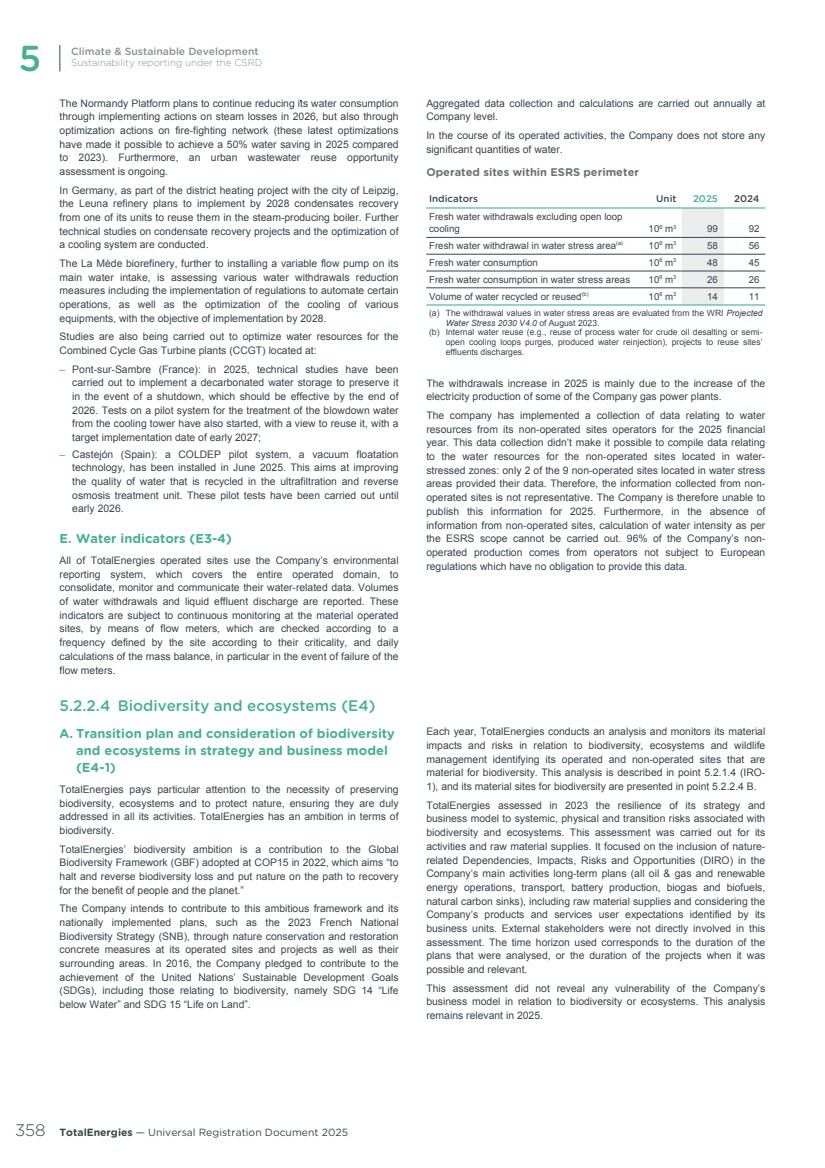
| B. Material impacts, risks and opportunities and their interaction with strategy and business model (ESRS 2 SBM-3) The Company defines its material sites for biodiversity as sites that are material for the environment (refer to definition in point 5.2.1.4 (IRO-1)) located in biodiversity sensitive areas, as per its biodiversity ambition, namely UNESCO Natural World Heritage sites, wetlands under the Ramsar Convention and IUCN category I to IV protected areas. The materiality of sites in terms of biodiversity is assessed based on their overlap with these areas. By the end of 2025, 84 sites operated by the Company are considered material for the environment. Six of these sites (four production sites and two projects) overlap with an IUCN category I to IV and/or Ramsar protected area thus a proportion of 7%. Regarding the 68 non-operated sites that fall into the category of material sites for the environment, five non-operated sites overlap with a UNESCO WHS, IUCN I to IV and/or Ramsar protected area. In total, by the end of 2025, 11 of the Company’s sites (operated and non-operated) are thus considered material for biodiversity. The activities carried out on these sites have the potential to impact biodiversity: – plant construction activities may lead to a change in land use and thus have an impact on biodiversity; – the presence of certain projects can lead to an influx of people towards them because of the associated economic opportunities, thus increasing the risk of over-exploitation of local natural resources (firewood, timber, bushmeat hunting, fishing, etc.); – discharges into the natural environment from construction activities and operations may represent a risk to species and ecosystems, and potentially to threatened species; – these activities can contribute to the introduction of alien invasive species which impact native species and the proper functioning of ecosystems, and potentially threatened species. List of material sites for biodiversity identified by TotalEnergies (operated and non-operated according to ESRS perimeter) The table below provides a breakdown of material sites for biodiversity based on the potential impacts identified in the context of the Company’s own activities. It specifies which activities potentially affect negatively biodiversity-sensitive areas, and indicates the sensitive areas concerned(1) . The potential impacts are essentially generated by the sites and related to land use change (“land”) and to a lesser extent to noise and light nuisances (“nuisance”). Some impact drivers are linked to construction phases and are therefore temporary. For non-operated sites or projects (OBO: Operated By Others), information concerning biodiversity action plans is unknown, except for some specific cases. N° Branch and name of the site Country Operated /OBO Protected areas, key biodiversity areas/ presence of IUCN VU, EN or CR(a) species Main impact driver Comments 1 EP Gladstone LNG (onshore/offshore) Australia OBO UNESCO WHS “Great Barrier Reef”/NR(d) Land BAP(b) Net Gain(c) No overlap with the “Great Barrier” itself 2 EP Ratawi project (onshore) Iraq Operated Ramsar “Hammar Marsh”/yes Land, nuisance BAP Net Gain 0.08% overlap on the Ramsar area 3 EP Djeno oil terminal (onshore) Republic of the Congo Operated Ramsar “Cayo-Loufoualeba”/yes Land BAP 4 EP Halfaya production site (onshore) Iraq OBO Ramsar “Hawizeh Marshes”/NR Land NR 5 EP OML 22, 28, 36 (onshore) Nigeria OBO Ramsar “Apoi Creek Forests”/NR Land NR 6 EP Tilenga oil project (onshore) Uganda Operated IUCN II “Murchison Falls National Park”/yes Land, nuisance (temporary) BAP Net Gain 0.02% overlap on the National Park 7 EP Tempa Rossa oil production site (onshore) Italy Operated IUCN II “Parco nazionale dell’Appennino Lucano - Val d’Agri - Lagonegrese”/no Nuisance BAP 8 EP Gladstone LNG upstream (onshore) Australia OBO IUCN II “Expedition National Park”/NR Land NR 9 EP BLOCKS K1A (offshore) Netherlands Operated IUCN IV “Klaver Bank”/no Nuisance BAP 10 RC Zeeland refinery jetty (onshore) Netherlands Operated IUCN IV “Westerschelde & Saeftinghe”/no Nuisance BAP 11 EP ADNOC oil site, Block 1 (onshore) United Arab Emirates OBO IUCN IV “Al Ghadha protected area”/NR Land NR (a) VU: Vulnerable, EN: Endangered, CR: Critically Endangered. (b) Biodiversity Action Plan. (c) Net Gain according to the International Finance Corporation Performance Standard 6 definition. (d) NR: not reported. (1) In the absence of a recognized methodology, the ecological status (with reference to the specific ecosystem baseline level) of the areas in which sites and projects are located is not determined. Land degradation, desertification or soil waterproofing are not part of the material impacts identified by the Company. Climate & Sustainable Development Sustainability reporting under the CSRD 5 TotalEnergies — Universal Registration Document 2025 359 |
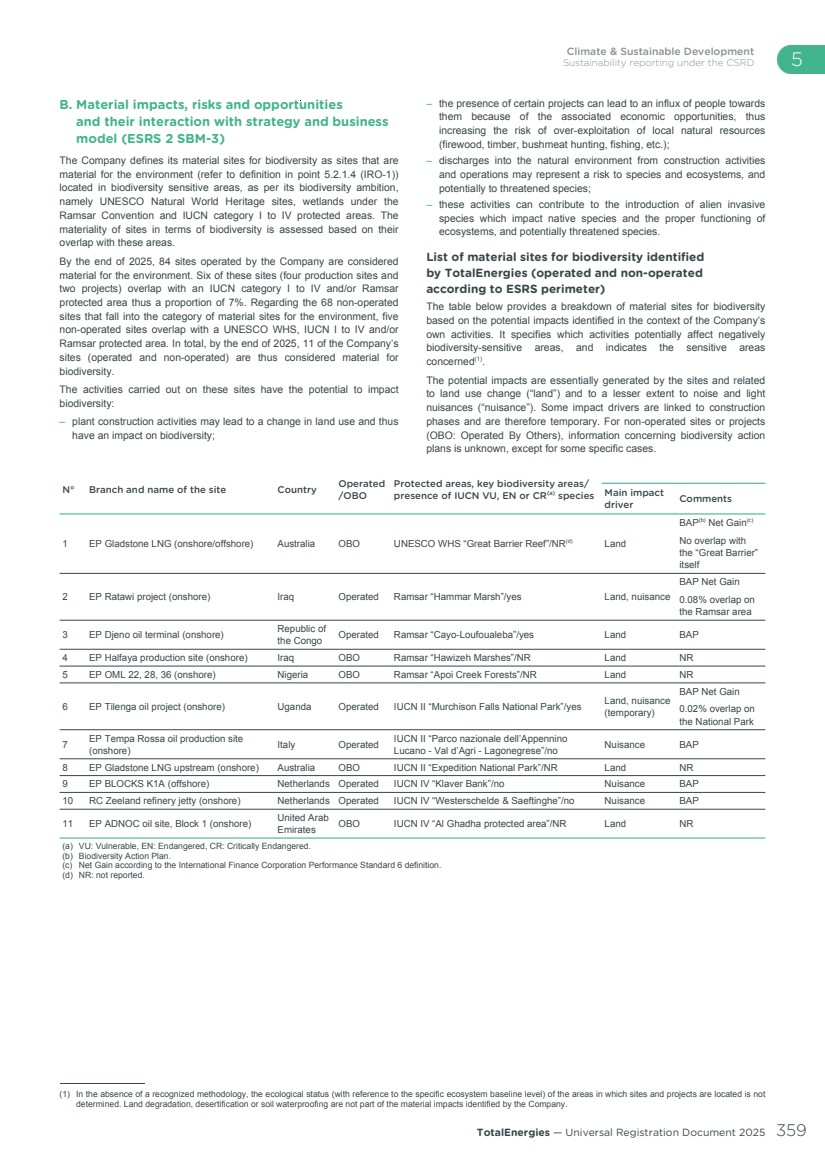
| C. Policies related to biodiversity and ecosystems (E4-2) TotalEnergies’ policy for managing its material impacts and risks related to biodiversity and ecosystems at its operated sites and projects is based on the application of the Avoid - Reduce/Restore - Offset mitigation hierarchy. It is part of a biodiversity ambition set in four axes, with voluntary commitments and an environmental framework (including biodiversity) applied to the operated perimeter. For non-operated sites, the Company strives to promote its principles among its partners, including by sharing industry guides and best practices, as well as return on experience. For the upstream segment of its value chain (procurement of goods and services), biodiversity issues are also included in a section related to the procurement of goods and services as part of the Company’s Responsible Purchasing program described in point 5.2.4.3, as well as in a policy for the purchasing of agricultural products (raw materials) to supply biorefineries described in point 5.2.2.5. Lastly, the ecotoxicological risks to biodiversity and ecosystems of TotalEnergies’ chemical products are considered in the value chain downstream segment. Identifying the risks and impacts associated with biodiversity in projects The Company’s HSE framework states that the risks and impacts associated with biodiversity in new projects, whether operated or not, is identified using financial thresholds specific to each activity in the operated and non-operated perimeters, in order to determine: – the sensitivity of the project area or natural environment in terms of biodiversity (species and habitats), including vulnerability status, ecological values present, importance of ecosystem services, regulatory protection of natural areas (i.e., protected areas) and recognition of the importance of biodiversity values present. Local and indigenous knowledge is identified in these processes and integrated into Biodiversity and Ecosystem Action Plans where appropriate; – the modalities for implementing the Avoid - Reduce/Restore - Offset mitigation hierarchy. For other projects, a company rule requires the identification of impacts on biodiversity and ecosystem services, the implementation of the Avoid - Reduce/Restore - Offset mitigation hierarchy and the management of implementation performance. It also requires the implementation of a Biodiversity Action Plan for sites located in sensitive areas and recalls the Company voluntary exclusion zones. Managing the risks and impacts associated with biodiversity in projects and operations In operated projects Axes 1 and 2 of the Company’s biodiversity ambition specify the principles by which the risks and impacts associated with biodiversity in operated projects are managed. Axis 1 of the biodiversity ambition (’Respecting our voluntary exclusion zones’) specifies that the Company recognizes the universal value of UNESCO Natural World Heritage areas, by not conducting any oil or gas exploration or extraction activities in these areas and commits not to conduct any oil field exploration operations in Arctic sea ice areas. Axis 2 (’Managing biodiversity in our new projects’) specifies that the Company puts in place a Biodiversity Action Plan (BAP) for each new site located in an area of interest for biodiversity, namely IUCN (International Union for Conservation of Nature) protected area category I to IV or Ramsar areas. In addition, for each new project located in an IUCN category I or II protected area or a Ramsar area, the Company commits to implementing measures to produce a net positive impact (gain) for biodiversity, confirmed by a third-party institution. The action plan is in place, at the latest, at the time of commissioning of the site. In addition, the Company implements a “zero net deforestation” policy for its new projects located in new sites for which the investment decision is made after 2022. In the operated perimeter operations The minimum HSE requirements for managing the risks of environmental damage in the affiliate’s operations are set out in the framework of the Company. In particular, the impacts of operations on biodiversity and ecosystem services must be identified and consultations carried out with affected communities, as part of the management of impacts. The framework foresees, where appropriate, the defining and implementation of the Avoid - Reduce/Restore - Offset mitigation hierarchy actions to manage these impacts, and monitoring of the associated performance. The management is carried out by the affiliates. In addition, Axis 3 of the Company’s biodiversity ambition (’Managing biodiversity at our existing sites’) defined in 2020 specifies that, on each of the material sites for the environment in the operated perimeter, a biodiversity action plan must be defined by 2025 and deployed by 2030 at the latest, and a report on the implementation of this plan must be communicated to stakeholders. Newly acquired sites have two years to comply. The deployment of the defined action plans is currently underway. Axis 3 also requires, when a site ceases operations, that the creation of biodiversity rich areas (e.g., rare species habitats, biodiversity sanctuaries, etc.) be assessed as one of the options for the site’s rehabilitation. Beyond operations Axis 4 of TotalEnergies’ biodiversity ambition (Promoting biodiversity) calls for the sharing of biodiversity data collected as part of its environmental studies with the scientific community and the public. Managing the impacts and risks of products on biodiversity TotalEnergies has defined the minimum requirements to market its petroleum or chemical products worldwide with the goal of reducing potential impacts on the environment, including biodiversity and ecosystems. These include the identification and assessment of the ecotoxicological risks inherent to these products and their use, as well as providing information to consumers on preventing spills into the natural environment. The safety data sheets associated with the petroleum and chemical products marketed by the Company, including those not classified as hazardous, as well as the product labelling are two key sources of information. The implementation of these requirements is monitored by teams of regulatory experts and ecotoxicologists within the Refining & Chemicals and Marketing & Services branches of the Company. D. Targets related to biodiversity and ecosystems (E4-4) TotalEnergies has set biodiversity and ecosystem-related targets as part of the process of defining and implementing its biodiversity ambition to manage the impacts and risks of its operated sites and projects as identified in its materiality assessment described in point 5.2.1.4 (IRO-1). The Company has not set any target on the value chain downstream segment but aims for its Lubricants line of business to market products with the lowest possible eco-toxicity to mitigate biodiversity and ecosystems risks, replacing raw materials that are classed hazardous or reformulating finished products that would be classed as H400, H410 or H411. 5 Climate & Sustainable Development Sustainability reporting under the CSRD 360 TotalEnergies — Universal Registration Document 2025 |
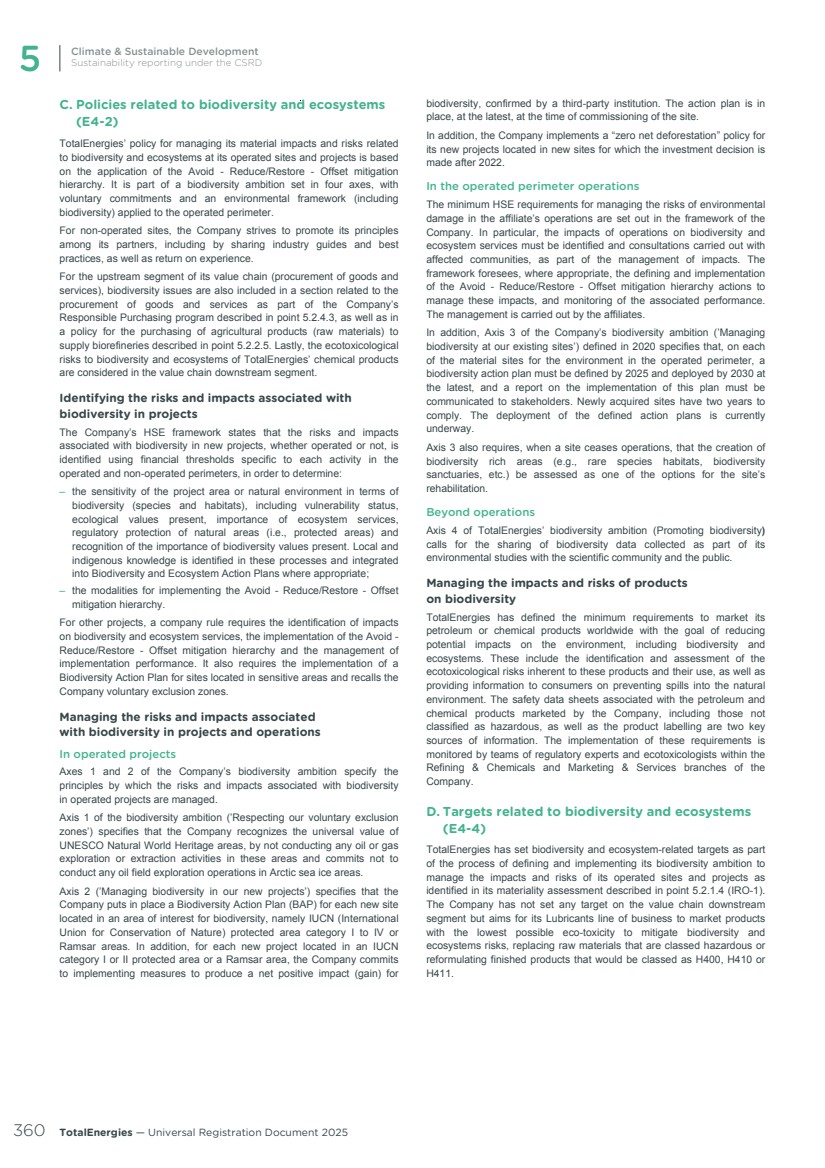
| The commitments and targets relating to the impacts and risks associated with biodiversity and ecosystems identified by the Company for its operated sites and projects are as follows: Avoidance – No oil and gas exploration or production activity in UNESCO Natural World Heritage Site areas. – No exploration activity in oil fields located in Arctic sea ice areas. Reduction/Restoration – Permanent target - implementation of a Biodiversity Action Plan (BAP) for 100% of our new projects located in an area of interest for biodiversity, that is, IUCN category I to IV protected areas or Ramsar areas. The action plan is in place, at the latest, at the time of commissioning of the site. – Deployment of biodiversity action plans defined at 100% of material sites for the environment by 2025 and communication on the implementation of the plan to stakeholders over the period 2025 - 2030. Offset – Permanent target - Production of a net positive impact on biodiversity, confirmed by a third-party institution, for 100% of new projects located in an area of priority interest for biodiversity, that is, IUCN category I or II areas or Ramsar areas. – Permanent target - Zero net deforestation in new projects located in new sites approved after 2022. Additional Conservation Actions (ACA) – Each year, sharing a minimum of five biodiversity datasets collected as part of environmental studies with the scientific community and the public. – Supporting biodiversity related awareness programs, youth education and research actions concerning the ocean and coastal environments as part of TotalEnergies Foundation’s Climate, Coastal and Oceans program. – Promoting the civic engagement of the Company’s employees as part of the TotalEnergies Foundation’s “Action!” program, by offering employees dedicated workdays to conduct actions in favour of biodiversity. These commitments and targets meet the SMART criteria(1) required by the Act4nature initiative promoted by the French Association ’Entreprises pour l’Environnement’, to which TotalEnergies has been a signatory since 2018. These commitments have been the subject of detailed public annual reporting since the first quarter of 2021. This reporting indicates the number of sites concerned by the various commitments. These targets incorporate the concepts of local ecological thresholds as follows: – the target concerning the avoidance of UNESCO Natural World Heritage areas is compatible with the SBTN(2) nature-related avoidance ’interim targets’, as it results in the absence of conversion of natural habitat, representing the avoidance of a maximum potential total area of approximately 535 million hectares at the end of 2025; – the net gain target is set in relation to a state of reference for projects located in priority biodiversity areas such as IUCN categories I and II and Ramsar areas; – project-specific targets regarding the state of biodiversity are set to ensure that the impact on biodiversity induced by the project is offset, and that the net gain exceeds the loss, compared to a local baseline scenario. The target is therefore in line with, or even exceeds, the SBTN nature-related avoidance “interim targets” for projects of the extractive segment in terms of no net loss of natural habitat. The geographical scope of the targets is the operated perimeter of the Company. In defining some of its targets, the company has used measures to offset the loss of biodiversity, as explained in the “Offset” paragraph. The targets adopted by the Company constitute a contribution to the Kunming-Montreal Global Biodiversity Framework, relevant aspects of the EU Biodiversity Strategy for 2030 and other national biodiversity policies and legislations without claiming alignment with these different frameworks. The current status of these targets is presented in point 5.2.2.4 E. E. Actions and resources related to biodiversity and ecosystems (E4-3) The actions implemented as part of the biodiversity ambition deployment on the Company’s operated perimeter are described below. Axis 1: Voluntary exclusion zones This commitment is respected (based on the UNESCO sites listed at the end of 2025 which represent 535 million hectares). Similarly to previous years, in 2025 the Company did not conduct any oil field exploration activity in Arctic sea ice areas. The list of its licenses in the Arctic area is available on the Company’s website. Axis 2: New projects In 2025, 2 projects located in material sites for biodiversity (refer to above list) are concerned, the two projects having a biodiversity net gain target: – the Net Gain Biodiversity Action Plan (BAP) for the Tilenga oil project (Uganda), partly located within an IUCN Category II area, continues to be implemented with the launch of the four pillars of the net gain plan. Impact‑reduction actions carried out in 2025 within the project area included optimization of the project footprint within Murchison Falls National Park (MFNP), covering 70.92 hectares, i.e., 0.02% of the park’s total area (compared with 0.03% in 2024), and the relocation of wildlife present in the construction area (75 specimens) to adjacent refuge areas, in close collaboration with the Uganda Wildlife Authority (UWA), which is responsible for park management. Restoration of the C1 road is underway, with a revegetation rate of 88% by the end of 2025, and 68% of the 21.6 km North Nile pipeline corridor has been restored. Employee awareness‑raising and training activities were conducted to improve patrol effectiveness in the Budongo area (160 employees sensitized), as well as on compliance topics related to construction activities (4,281 employees trained - representing 96.9% of the target), including the code of conduct on respect for wildlife, for example zero tolerance for poaching and the prevention of wildlife–vehicle collisions. Biodiversity monitoring near the construction area was carried out throughout the year, with 71,404 observations recorded, 88% relating to mammals and 12% to birds. Regarding offset programme actions, conservation measures include ongoing improvements in the effectiveness of anti‑poaching patrols, continued removal of wildlife snares, development of an intervention plan for managing human-wildlife conflict through the installation of crop‑protection measures for local communities (electric fences), and management of invasive species. Monitoring of ecological status continues within the park, particularly for elephants, vultures, giraffes and carnivores, notably through aerial surveillance, and has also been initiated in the Ramsar area. The study of elephant population movements (using GPS collars) is ongoing. Communication and awareness‑raising activities targeting local communities were conducted, including meetings on anti‑poaching (275 participants, including 29% women), radio programmes, television communication campaigns, and newspaper publications. This BAP is designed to be aligned with the International Finance Corporation (IFC) performance standards; (1) Specific, Measurable, Achievable, Relevant, Time-bound. (2) “Interim targets” Science Based Targets Network. Climate & Sustainable Development Sustainability reporting under the CSRD 5 TotalEnergies — Universal Registration Document 2025 361 |
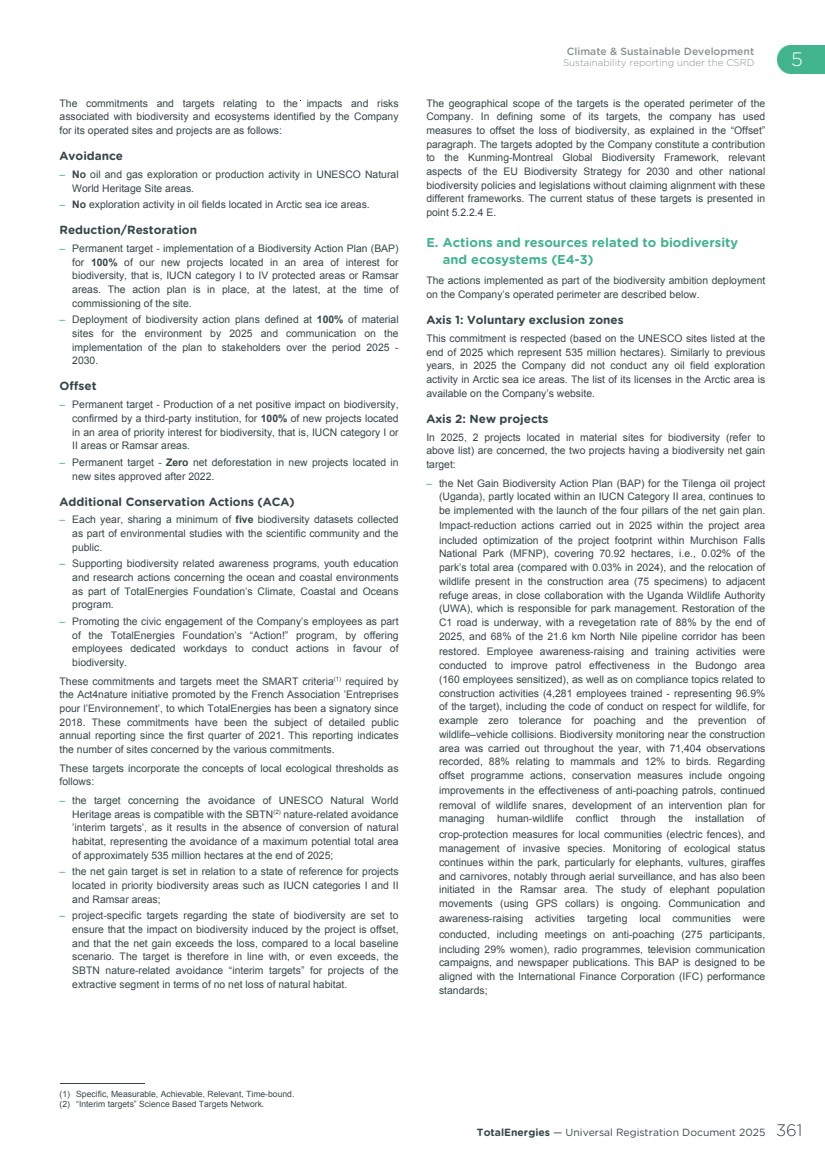
| Furthermore, the non‑operated EACOP pipeline project (Tanzania), linked to the Tilenga project and running alongside an IUCN Category III area, includes a Net Gain Biodiversity Action Plan (BAP) with both a terrestrial and a marine component. In 2025, EACOP continued to advance its terrestrial and marine biodiversity offset programmes towards its net gain objective. Key actions in Uganda include a chimpanzee action plan and a wetland conservation project for the grey crowned crane. In Tanzania, progress was made on the development of the Burigi Chato National Park management plan, as well as on offset measures for the red colobus monkey and the southern patas monkey in Tanzania, particularly through population censuses, anti‑poaching protection measures, local community awareness‑raising, and monitoring. The marine offset programme for Indo‑Pacific humpback dolphins and humpback whales was fully implemented, with results shared with the Western Indian Ocean Marine Science Association (WIOMSA). This BAP is designed to be aligned with the IFC performance standards; – the design of the net gain Biodiversity Action Plan (BAP) for the Ratawi hybrid gas-photovoltaic project (Iraq), partially located within a Ramsar wetland, has been completed; net gain biodiversity options are currently under assessment. The proposed offset measures are under evaluation. The main mitigation measure, involving the capture and translocation of spiny‑tailed lizards to refuge areas, is currently being rolled out. This BAP is designed to be aligned with the Performance Standards of the International Finance Corporation (IFC); – furthermore, with regard to the zero net deforestation target, the table below gives the progress of operations as well as the results of reforestation plans. Deforestation/reforestation balance (ha) 2025 2024 2023 Deforested surface 210 156 81 Reforested or compensated surface 61 186 59 Annual forest balance(a) -149 30 -22 Cumulative forest balance since 2023(a) -141 8 -22 (a) A negative figure indicates net deforestation. At the end of 2025, the Company presents a net cumulative deforestation of 141 ha. The necessary compensation actions have been identified and their deployment is planned for the period 2026-2027. Axis 3: Existing Sites By the end of 2025, 100% of material sites for the environment are covered by a Biodiversity Action Plan (BAP) (four newly acquired sites have 2 years from their acquisition date to establish their biodiversity survey and BAP). The BAPs are being rolled out and consist in the implementation of the mitigation hierarchy (Avoid - Reduce/Restore - Offset), including avoidance through the planning of activities outside sensitive periods for species (e.g., anticipating the arrival of a drilling rig to avoid disturbing kittiwakes during the breeding season in the Netherlands), protection of sensitive species (e.g., marking and protecting areas hosting rare orchids to avoid their destruction at the Zeeland refinery in the Netherlands), reduction of light pollution (e.g., installation of timers to manage lighting at the Marchienne‑au‑Pont CCGT plant in Belgium), nature‑based solutions (e.g., planting reed beds for stormwater treatment at certain Marketing & Services sites), rescue of sensitive species (e.g., collection and relocation of orchids located in a mowing area at the Normandy refinery in France), management of invasive species (e.g., eco‑grazing using goats to control Himalayan balsam at the Landivisiau CCGT plant in France), restoration of natural habitats (e.g., restoration of a grassland area to benefit insects at the Brunsbüttel site in Germany; revegetation of rehabilitated former drilling pits at the Djeno terminal in the Republic of Congo with the planting of 106 Baphia vili plants and 47 Salacia arenicola plants over an area of 594 m²), enhancement of existing habitats (e.g. installation of 100 bird nesting boxes by around ten employees at the Leuna platform in Germany), and protection of sensitive species through the development of partnerships with key local stakeholders (e.g. monitoring of a marine turtle nesting area adjacent to the Djeno site in the Republic of Congo in partnership with an NGO). These measures are complemented by Additional Conservation Actions (ACAs), such as awareness‑raising initiatives carried out by the Tempa Rossa oil site (Italy) focused on biodiversity education in schools (organisation of site visits in partnership with the Gallipoli Cognato Piccole Dolomiti Lucane Park), or the sharing of biodiversity data by the Danish affiliate through its public North Sea Environment Portal for the scientific community. This portal was cited as a best practice example at the 2025 Ocean & Waters Mission conference, held under the auspices of the Danish Presidency of the Council of the European Union. The distribution of mitigation hierarchy actions is as follows: 2% Avoidance actions, 23% Reduction actions, 10% Restoration actions, 11% Offsett actions and the remaining 54% dedicated to ACAs. Across sites, the 10 most frequently mobilised action levers include: 1) the implementation of biodiversity monitoring measures and the acquisition of new biodiversity data; 2) the deployment of internal and external awareness‑raising and training initiatives; 3) the adoption of differentiated management practices for green spaces; 4) the development of partnerships or sponsorship arrangements with key local biodiversity stakeholders; 5) the creation of micro‑habitats and refuges for species, such as bird nesting boxes, bat roosts, hibernacula and pollard trees; 6) the sharing of biodiversity data through citizen‑science programmes; 7) the reduction and/or discontinuation of phytosanitary product use; 8) the implementation of measures to control invasive species; 9) the restoration of grassland areas; and 10) the restoration of hedgerows as refuges using native plant species. Furthermore, the Company’s affiliate specialized in the rehabilitation of industrial sites continued the study and/or implementation of biodiversity restoration actions across 14 former decommissioned sites (industrial brownfields). For example, the programme of enhancement works for the wetland area at the Villers‑St‑Paul site continued with the opening up of sedge beds and the removal of invasive alien species. Axis 4: Promotion of biodiversity The Company joined the public international platform GBIF (Global Biodiversity Information Facility) in 2019 with the objective of sharing its biodiversity data with the scientific community. In 2025, TotalEnergies ranked third worldwide(1) among corporate contributors on the platform. 28 datasets were uploaded in 2025, relating to the Company’s projects in Argentina, Brazil, Yemen and Namibia. Data published by TotalEnergies now represent 56,504 occurrences in the GBIF database and have been cited 370 times in scientific publications. Furthermore, as a member of the Ocean Decade Corporate Data Group, TotalEnergies contributed to the development of the guide on marine megafauna data sharing published in 2025 by the Intergovernmental Oceanographic Commission of UNESCO, drawing on more than five years of experience in sharing data via GBIF. This document aims to guide and encourage other private‑sector companies to share their data to create mutual value for science and industry and is part of the United Nations Decade of Ocean Science for Sustainable Development. In 2025, TotalEnergies continued work on the development of a biodiversity footprint measurement methodology known as BFIS (Biodiversity Footprint Indicator for Sites), which is intended, in the longer term, to enable measurement at the individual site level and consolidation at the Company level. An independent critical review committee composed of representatives from international institutions and NGOs (IUCN, UNEP-WCMC(2) , WCS) supports the Company in this work. The methodology for this tool was presented at the IUCN World Conservation Congress in Abu Dhabi in October 2025. (1) Source: GBIF statistics. (2) United Nations Environment Programme World Conservation Monitoring Centre. 5 Climate & Sustainable Development Sustainability reporting under the CSRD 362 TotalEnergies — Universal Registration Document 2025 |
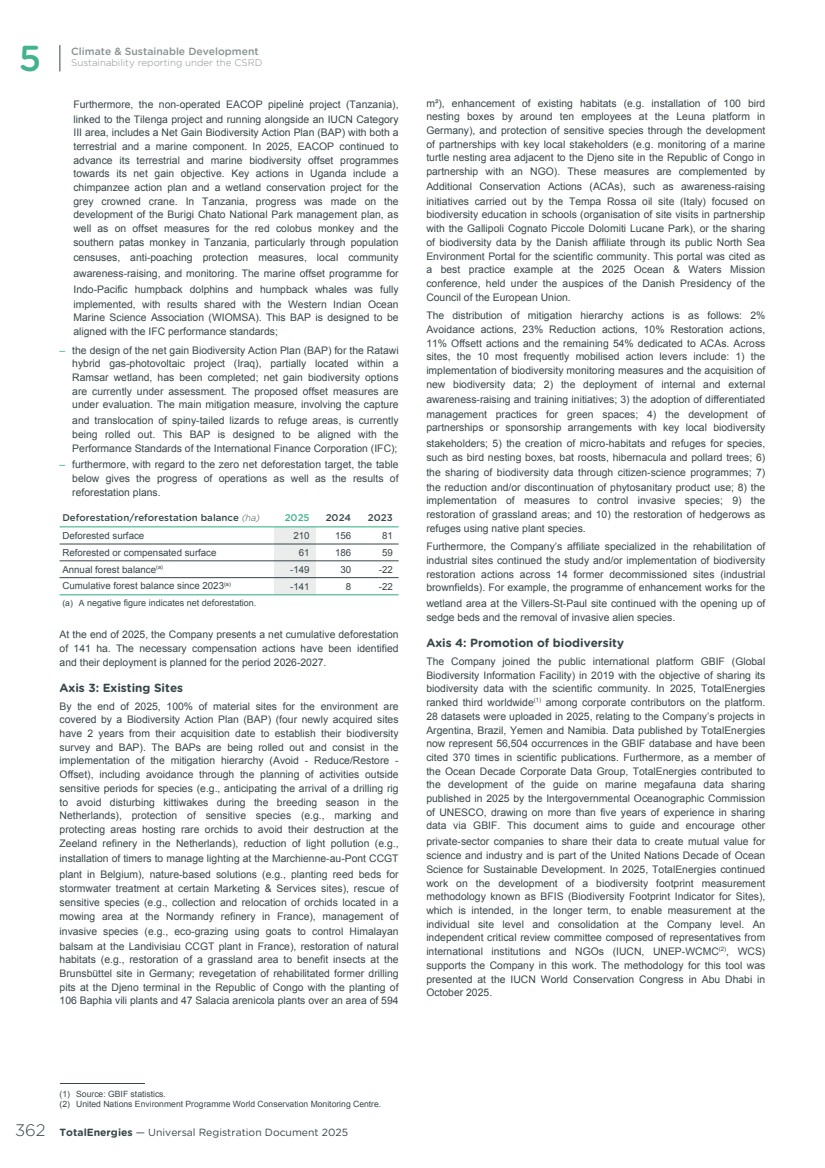
| By the end of 2025, the Action! programme of the TotalEnergies Corporate Foundation (Fondation d'entreprise) had raised biodiversity awareness among 3,080 employees through various initiatives, such as the restoration of the Hajangoua islets in partnership with the association Les Naturalistes, Environnement et Patrimoine de Mayotte. The programme contributes to increasing employee awareness of biodiversity issues, alongside the availability of biodiversity management good-practice examples on the interactive “One Biodiversity” platform, which brings together biodiversity-related content and enables all employees to contribute to the Company’s ambition to preserve biodiversity and nature. In 2025, 14 projects were supported by the TotalEnergies Corporate Foundation (Fondation d'entreprise) under the theme of Climate, coastlines and oceans in connection with biodiversity, including nine projects involving awareness‑raising or education (for example, the Corporate Foundation (Fondation d'entreprise) supports the Oceano pour tous competition led by the Oceanographic Institute, Prince Albert I of Monaco Foundation, aimed at supporting school classes in discovering the Ocean), as well as a research project by the French National Research Institute for Development (IRD), initiated in 2025, focusing on improving knowledge of microbiomes in mangroves. Actions in favour of biodiversity and ecosystems are led by the HSE Environment & Social Department, with the support of teams within the affiliates. F. Impact indicators related to biodiversity and ecosystems change (E4-5) TotalEnergies uses available indicators or those required by various reporting frameworks, while recognizing that, in a constantly evolving field, there is currently no commonly accepted and shared impact indicator. The company pays particular attention to the impact of its own activities on biodiversity-sensitive areas (e.g., the Natura 2000 network, UNESCO World Heritage Sites, key biodiversity areas, and other protected areas). TotalEnergies defines the proximity of its activities to these areas with the help of the Integrated Biodiversity Assessment Tool (IBAT) and the World Database on Protected Areas (WPDA). According to GRI 304: Biodiversity 2016: Disclosure 304-1 “Operational sites owned, leased, managed in, or adjacent to, protected areas and areas of high biodiversity value outside protected areas.”, the sites that TotalEnergies operates within or adjacent to protected areas or areas of high biodiversity value that have the potential to negatively impact these areas are 178 sites operated by the Company, representing 6,851 hectares. In 2025, the Company requested operators the following indicators related information to monitor biodiversity and ecosystems actions implemented at its non-operated sites: Avoidance – Number of sites overlapping a biodiversity-sensitive area (UNESCO Natural World Heritage Site, IUCN category I to IV area, Ramsar wetland) Reduction – Total area of sites owned, leased or managed in or near protected areas or key biodiversity areas negatively affected by activities – Number of sites implementing a Biodiversity Action Plan to manage impacts on biodiversity. Offset – Number of sites implementing biodiversity offsets as part of Biodiversity Action Plans The overall response collection rate for usable data is 67% and is therefore not sufficient to present comprehensive information. However, the use of the Company’s Geographic Information System, enriched with data from the World Database on Protected Areas (WDPA) made it possible to estimate the data presented in the table below. Indicators estimated or collected from operators of non-operated sites Results Number of sites overlapping a biodiversity-sensitive area (UNESCO Natural World Heritage site, IUCN category I to IV area, Ramsar wetland) 5 Total area of sites owned, leased or managed in or near protected areas or key biodiversity areas negatively affected by activities (hectares) 3,095 The Company will reiterate for the 2026 reporting period its requests for information to operators of non-operated sites to improve collection rates. However, 96% of the Company’s production from non-operated sites originates from operators that are not subject to European regulations and have no obligation to provide this data. 5.2.2.5 Resource use and circular economy (E5) A. Becoming a player in the circular economy (E5–1) For TotalEnergies, making progress in the circularity of its products and waste is a way of reducing its environmental footprint. The Company’s HSEQ charter stipulates that TotalEnergies ensures the management of its natural resource use and that any development project or product launch is undertaken after a risk assessment over its entire life cycle. TotalEnergies strives, wherever possible, to reduce its consumption of raw virgin resources or materials and to substitute part of them with circular economy derived raw materials. Lastly, the Company is careful to control its waste production and to encourage its recovery through appropriate external channels, so that it can be used by others as a raw material. TotalEnergies’ commitment to the circular economy can be summed up in three general orientations: Creating value from circular raw materials(1) by expanding production of: – biofuels, which emit 50% less CO2e than their fossil equivalents over their life cycle (in accordance with European standards (2)) and therefore represent an element for the reduction of the carbon footprint of liquid fuels. In addition to first-generation biofuels, the Company produces second-generation biofuels, i.e., biofuels obtained from waste and residues, which both reduces the use of virgin raw materials (and therefore the conflict of use and impact on arable land) and recovers post-consumption waste as a resource. – biogas from organic and agro-industrial waste. Biomethane(3) , which consists of the same methane molecule as natural gas, is renewable due to the way it is produced and leads to very low-carbon emissions over its entire life cycle(4) . The methanization process generates a co‑product, digestate, a natural fertilizer with high agronomic value. (1) This includes renewable raw materials and secondary raw materials (e.g., recycled waste), as classified in the report “A circular economy vision for a competitive Europe” by the Ellen MacArthur Foundation, the SUN Institute for Environment & Sustainability and the McKinsey Center for Business & Environment (p.24). (2) Directive (EU) 2018/2001 of the European Parliament and of the Council of December 2018 on the promotion of the use of energy from renewable sources and Commission Implementing Regulation (EU) 2024/482 laying down rules for the application of Regulation (EU) 2019/881. (3) Biogas is used to produce electricity and heat, in co-generation. Biogas, once purified, in particular of carbon dioxide, becomes biomethane, which has the same characteristics as natural gas. (4) Directive (EU) 2018/2001 of the European Parliament and of the Council of December 2018 on the promotion of the use of energy from renewable sources and Commission Implementing Regulation (EU) 2024/482 laying down rules for the application of Regulation (EU) 2019/881. Climate & Sustainable Development Sustainability reporting under the CSRD 5 TotalEnergies — Universal Registration Document 2025 363 |
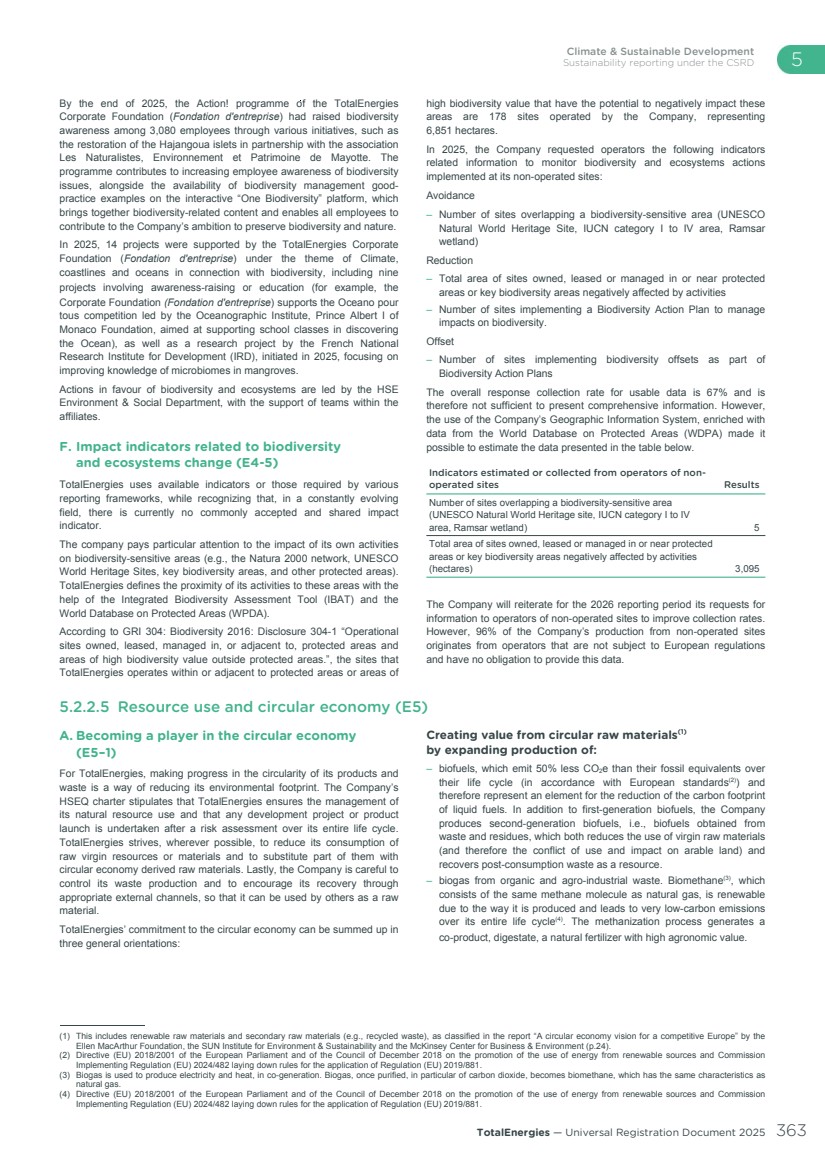
| Offering customers a range of circular polymers Polymers containing circular raw materials (“circular polymers“) include: – polymers obtained by mechanical recycling of plastic waste from sorting and collection centers; – polymers obtained by chemical recycling of non-mechanically recyclable waste; – biopolymers derived from the processing of biofeedstock (vegetable oils and used cooking oils). Producing more responsibly TotalEnergies has adopted a waste management policy that sets out the minimum requirements to be met by the Company’s operated sites. Waste management is carried out in four basic stages: waste identification (technical and regulatory); waste storage (soil protection and emissions management); waste traceability, from production to disposal (e.g., transfer notes, waste manifests, statements); and waste treatment, with technical and regulatory knowledge of the relevant processes, under the site’s responsibility. A Company rule requires subsidiaries to control the processing of the waste produced by all operated sites, at every stage of their operations. This approach is based on the following four principles, listed in decreasing order of priority: – reducing waste at source by designing products and processes that generate as little waste as possible, as well as minimizing the quantity of waste produced by the Company’s operations; – reusing products for a similar purpose in order to prevent them from becoming waste; – recycling residual waste wherever possible; – recovering non-recycled products wherever possible. For all its renewable raw materials (i.e., those from biomass) TotalEnergies has a policy specifying that all biofuels and biopolymers must comply with the sustainability, traceability and certification criteria (ISCC, RSPO, etc.) set by the various national regulations (carbon balance sheet, non-deforestation, good land use). These criteria apply to the entire production and distribution chain of biofuels and biopolymers. With regard to critical metals, TotalEnergies complies with all the requirements for batteries set out in Regulation (EU) 2023/1542, specifically those relating to sustainability, extended producer responsibility and waste collection and treatment. Saft Groupe (Saft), the Company’s subsidiary that manufactures batteries and is the main consumer of critical materials within the Company, has adopted a specific policy. This policy includes the more sustainable use of resources and the introduction of circular economy principles in operations, notably through the implementation of eco-design tools enabling the design of recyclable and sustainable batteries, and the incorporation of an increasing proportion of recycled materials in its products. For sites operated by third parties, TotalEnergies strives to share and promote best practices with the concerned operators. B. Targets related to resource use and the circular economy (E5-3) Over and above the regulatory requirements in force in the countries where it operates, TotalEnergies has made a voluntary commitment to double the circularity of its businesses by 2030 (compared with 2021), i.e., to double the quantity of circular raw materials used in products (in Mt) as well as sales of circular products (in billions of dollars) within the equity share perimeter. The equity interest perimeter, which is distinct from the operated perimeter, includes all the assets in which the consolidated subsidiaries (including equity-accounted companies) have a financial interest or rights to production. This scope also includes subsidiaries that are not financially consolidated but are material from a sustainability point of view. Under the equity interest perimeter, the indicators are consolidated based on the Company’s equity interest in the assets or its share of production for oil and gas production assets. The Company’s commitment to circularity involves increasing the use of recycled materials, using renewable raw materials (biomass) and increasing circularity in product design. The circular raw materials used by TotalEnergies can be divided into two main families: renewable raw materials (for which TotalEnergies ensures sustainability and traceability: carbon balance sheet, non-deforestation and good land use) and waste materials used by the Company increasingly to replace fossil resources in its processes. Examples include: – vegetable oils, animal fats and used cooking oils used for biofuel production, – lactic acid (obtained by fermentation of sugarcane extracts) used by the Company at its Rayong plant in Thailand (in JV with Corbion) to produce biopolymers, – waste plastics of fossil origin (Polyethylene, Polypropylene and Polystyrene), recycled mechanically or chemically to produce recycled polymers (rPE, rPP, rPS), – biowaste, animal by-products and agricultural sludge used as raw materials for biogas production through biomethanization. The quantity of circular raw materials used to manufacture the Company’s products in 2021 was 3.4 Mt. The target is to double this figure and thus reach 6.8 Mt/y of circular raw materials by 2030. Circular products are obtained by substitution: – in the production processes operated by TotalEnergies, of all or part of the raw materials by circular raw materials. Example: use of plastic waste as a substitute for raw materials of fossil origin in the production of recycled polymers; – at sales level, of all or part of the fossil-based products by products of renewable origin. Example: incorporation of ethanol of renewable origin into fuels. The Company’s total sales of circular products amounted to $4.2 billion in 2021. The target is to double this figure to $8.4 billion/y in circular sales by 2030. The table below shows the progress of the Company’s global circularity target. In 2025, the quantity of circular raw materials used to manufacture products increased very slightly compared to 2024, reaching 4.7 Mt, which is a significant increase compared to 2021. This increase is mainly due to the development of the biogas production business and the inclusion of Polska Grupa Biogazowa in the reporting scope in 2024. Sales of circular products, by contrast, remained below their 2021 level, mainly due to the continued low price levels of biofuels in 2025, as in 2024, and compared to 2021, 2022 and 2023. The quantities of circular raw materials and circular sales are monitored and reported annually by the Branches in the environmental reporting tool, which ensures traceability and archiving. Circularity - Monitoring TotalEnergies’ global voluntary target (a) Units 2025 2024 2023 2022 2021 Quantity of circular feedstock Mt 4.7 4.6 3.8 3.4 3.4 vs. 2021 +36% +33% +10% – – Sales from circular products G$ 3.8 4.0 4.5 5.4 4.2 vs. 2021 -8% -4% +8% +30% – (a) The data expressed as a percentage were calculated based on raw data. 5 Climate & Sustainable Development Sustainability reporting under the CSRD 364 TotalEnergies — Universal Registration Document 2025 |
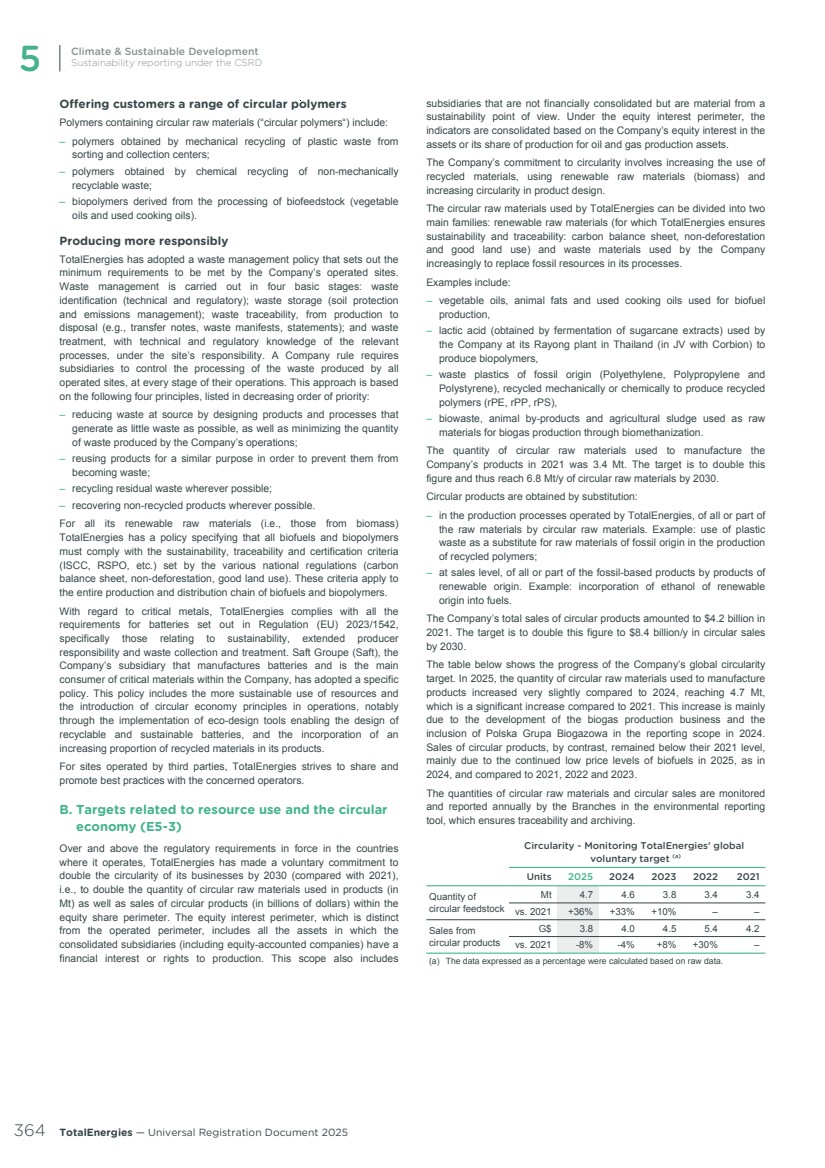
| TotalEnergies’ global voluntary target has also been broken down into more specific targets (also in equity share view), in line with the Company’s activities: – achieve a gross biogas production capacity of 10 TWh in 2030, mainly from waste, – produce 1 Mt/y of circular polymers by 2030, including mechanically and chemically recycled polymers and biopolymers. In addition, TotalEnergies aims to achieve SAF production capacity of 0.5 Mt/y by 2028(1) . The results of these specific targets are presented in section E of this chapter. Lastly, the Company has set itself a voluntary target of recovering 70% of the waste produced by its operated sites, including preparation for reuse, recycling and other waste recovery operations (such as energy recovery). C. Actions relating to resource use and the circular economy (E5-2) 1. Creating value from circular raw materials Biogas In 2025, TotalEnergies continued to expand its biogas production activities: – In France, the BioNorrois site, located in Normandy and with a capacity of 153 GWh/y, was commissioned in February 2025. For this unit, TotalEnergies partnered with the French sugar group Cristal Union to recover beet pulp residues, which will supply the unit for a period of 15 years. – In the United States, TotalEnergies and Vanguard Renewables, had signed an agreement in 2024 to create a 50/50 joint-venture to develop, build and operate 10 biomethane projects, with a combined capacity of 0.8 TWh/y. In 2025, a first project with a capacity of nearly 75 GWh/y, was started up, while two other projects are under construction in the states of Wisconsin and Virginia. At the end of 2025, TotalEnergies’ total production capacity reached 1.4 TWh eq. of biomethane. This represents the treatment of approximately 1.7 Mt/y of organic waste to provide renewable gas to the equivalent of 280,000 inhabitants, making it possible to avoid the emission of around 280 kt CO2e/y(2) . With the digestate from anaerobic digestion, around 48 kt/y of chemical fertilizers are replaced by a natural fertilizer. Biofuels and Sustainable Aviation Fuels (SAF) TotalEnergies is mobilising to decarbonise air transport by producing and supplying its customers with sustainable aviation fuels (SAF) derived from more than 75% of waste and residues. La Mède biorefinery (France), which converts vegetable oils, animal fats and used cooking oils into biofuels and co-products for mobility or heating uses, has, since 2025, the technical capacity to process 100% waste and residues from the circular economy and to produce 15 kt/y of SAF. The biodiesel produced at La Mède can also be co-processed at the Company’s other european platforms. The Grandpuits platform is the second refinery being transformed into a zero-oil platform. The biorefinery is scheduled to come on stream in 2026. With a processing capacity of 420 kt/y of waste and residue feedstocks, the biorefinery will have the capacity to produce up to 230 kt/ y of SAF, as well as road biofuels and bionaphtha. In the Middle East, SATORP, a partnership between TotalEnergies and Saudi Aramco, continued in 2025 the development of a project aimed at processing 13 kt/y of used cooking oil from 2026 and thereby producing a fuel meeting all the quality criteria of ISCC+ certified SAF. 2. Offering customers a range of circular polymers Mechanically recycled polymers TotalEnergies continued the development of its mechanical recycling business: the production capacity of its subsidiary Iber Resinas (Spain), which produces high‑performance recycled polypropylene, polyethylene and polystyrene, was increased by 10 kt in 2025, reaching a capacity of 40 kt/y. The capacity is in addition to that of Synova and Carling, which produce high-performance recycled polypropylene with a production capacity of 60 kt/y. Chemically recycled polymers Since 2020, TotalEnergies has been producing recycled polymers at its polymers plant in Antwerp (Belgium) from Tacoil, a pyrolysis oil produced by its partner Plastic Energy. In 2025, TotalEnergies increased its production capacity to 25 kt/y of Tacoil. TotalEnergies Grandpuits platform (France) also started up in 2025 the first plastic waste processing unit by chemical recycling in France, with a processing capacity of 15 kt/y of plastic waste. The unit was built in partnership with Plastic Energy and benefits from a long-term commercial agreement between TotalEnergies, Citeo and Paprec to secure the plant supply plastic waste collected through the yellow bins (household packaging in France) and develop France’s first chemical recycling industrial stream for plastic film waste. 3. Producing more responsibly Recovering waste produced at the Company’s operated sites To meet its target of recovering over 70% of the waste produced by its operated sites, TotalEnergies has set up waste management contracts that clearly define the Company’s requirements in this area and, particularly, its expectations in terms of waste recovery. In 2025, TotalEnergies and Veolia signed a memorandum of understanding to step up their cooperation in several key areas of the energy transition and the circular economy. In this context, Veolia and TotalEnergies plan to pool their research and innovation capabilities in order to explore the industrialisation of new processes for recovering strategic chemical elements contained in waste streams that are still poorly recovered, and to develop waste recovery pathways in specific geographical areas such as Africa. Implement responsible sourcing of biomass raw materials TotalEnergies Trading-Shipping teams are responsible for purchasing renewable raw materials. They apply specifications that include biodiversity sustainability criteria, purchase raw materials that meet the European ISCC standard and apply a due diligence process to ensure that suppliers comply with biodiversity requirements (refer to point 3.6.4.2.). Developing recycling solutions for batteries Saft has developed a network for the recovery and recycling of its nickel batteries, enabling at least 75% of the weight of collected batteries to be recycled, notably at its recycling site in Oskarshamn, Sweden. In December 2024, an R&D project led with Orano, Paprec, MTB Manufacturing, and the CEA on vehicle battery recycling concluded with good electrochemical performance of “RECYVABAT active materials,” proving the technical feasibility of this innovative recycling process. A new collaboration was launched at the end of 2025 with Veolia to explore new processes for the recovery of critical elements from industrial lithium‑ion batteries. (1) For biofuels in Europe, sustainability rules are defined by the RED (Renewable Energy Directive), which sets the criterion that the carbon footprint of biofuels should be 50% lower than that of fossil fuels, over the entire product life cycle. The RED also requires this criterion to be verified by an approved body. (2) According to the first quarter 2021 report from the Energy Regulatory Commission on retail gas markets and key figures from ADEME for methanization. Climate & Sustainable Development Sustainability reporting under the CSRD 5 TotalEnergies — Universal Registration Document 2025 365 |
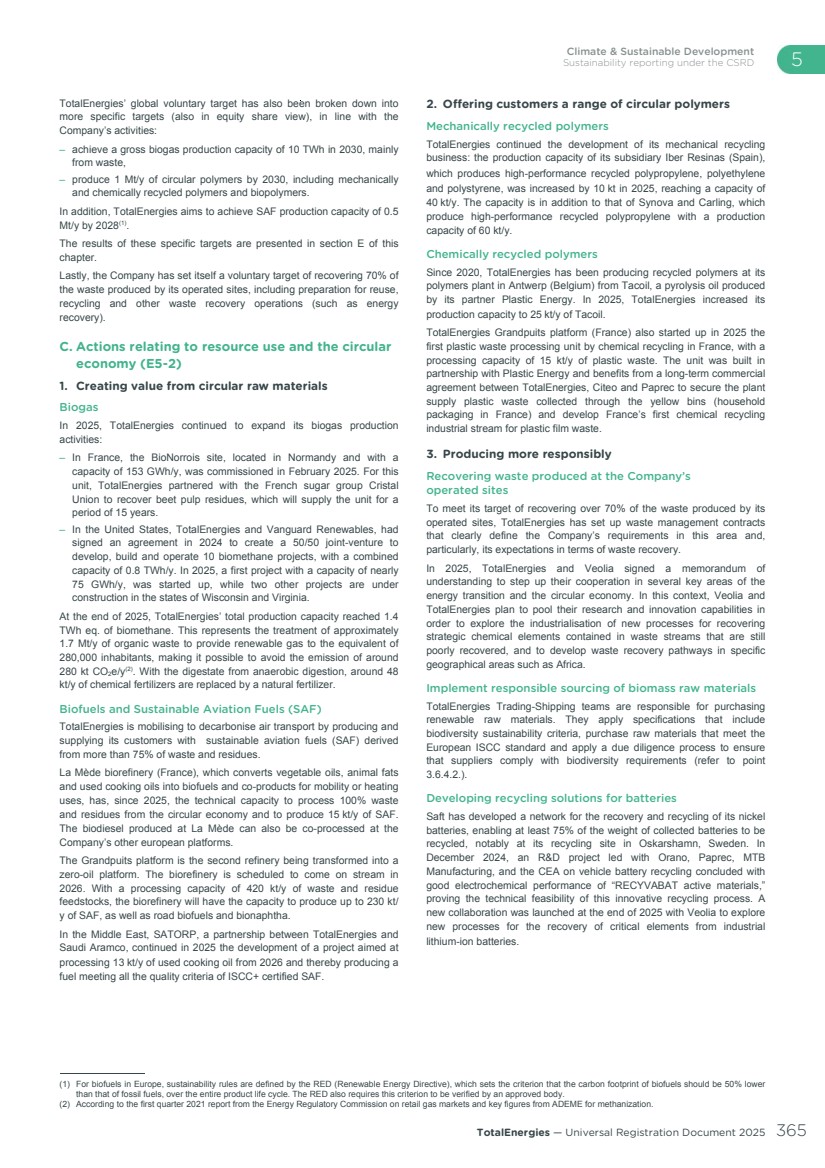
| Using critical metals responsibly TotalEnergies’ Purchasing Division has implemented strategies to diversify suppliers and qualify, substitute or reuse resources to optimize the security of its supply chains. Specific actions are also being implemented with regard to critical resources: – In 2025, as every year since 2021, Saft carried out an annual information‑collection campaign with its suppliers on the cobalt used in battery manufacturing. Saft relies on the Extended Minerals Reporting Template (EMRT) provided by the Responsible Minerals Initiative® (RMI® ) in order to identify, within its supply chain, the processing facilities and the country of origin of cobalt ores. Based on the results and using the RMI® database, Saft checks whether its cobalt supply chains include suppliers at risk in terms of human and environmental rights and, where applicable, implements specific actions to mitigate these risks. As part of a continuous improvement approach, Saft has also been a member of the Cobalt Institute since 2023, a global association bringing together cobalt producers and users, whose objective is to ensure that cobalt is produced and used in an ethical and sustainable manner, while meeting the needs of industry and society. – In 2024, the Company analyzed its exposure to the critical materials required for renewable projects, battery chemistries and distribution networks. A complementary study, focused on battery recycling technologies, permanent magnets for wind turbines and photovoltaic panels, was carried out in 2025 and made it possible to identify innovative technologies in this field as well as potential future partners. A collaboration with Veolia was launched at the end of 2025 in order to explore these new processes in greater detail. D. Raw materials used by TotalEnergies for its activities (E5-4) In 2025, the main raw materials used by TotalEnergies were: – water: for more details on the use of this resource, refer to point 5.2.2.3; – crude hydrocarbons extracted from subsurface, the quantity of which amounted to 731 Mboe in 2025 for Upstream production operations within the 100% operated perimeter; – circular raw materials, which include renewable raw materials (i.e., from biomass) remains stable, and secondary raw materials (i.e., waste and residues) for which the Company’s consumption continued to increase in 2025, in connection with the development of its biogas, biofuels and circular polymers production activities. Quantities of circular raw materials used by TotalEnergies in the equity share perimeter (Mt) 2025 2024 2023 2022 2021 Waste and residues 1.8 1.5 0.8 0.6 0.5 Renewable raw materials 2.9 3.1 3.0 2.9 2.9 Total circular raw materials 4.7 4.6 3.8 3.4 3.4 – metals, for which the Company is unable to collect used quantities in its operations, due to a lack of data availability, in particular for a large number of the Company’s suppliers that are not subject to European regulations. Water consumption as well as the quantities of circular raw materials are monitored and reported annually by the Branches in the environmental reporting tool, which ensures traceability and archiving. The total quantity of hydrocarbons is estimated annually at Company level based on information collected from the purchasing and supply teams and stored in the Company’s environment reporting tool. E. TotalEnergies products from the circular economy and waste (E5-5) Products from the circular economy TotalEnergies’ main products resulting from its production process (equity share view) and designed according to the principles of the circular economy are: – biofuels and sustainable aviation fuels (SAF), produced mainly from animal fats and used cooking oils; – biogas, produced mainly from agricultural waste, the production residue of which - known as digestate - can be used as an agricultural soil improver in place of chemical fertilizers; – recycled polymers obtained by mechanical or chemical recycling of plastic waste; – biopolymers derived from the processing of biofeedstock (vegetable oils, used cooking oils). Circular economy products - Tracking targets (equity share view) Units 2025 2024 2023 2022 2021 Production of SAF kt 35 26 12 10 – % of waste and residues in biofuels % 98 77 73 61 38 Biogas gross production capacity TWh 1.42 1.20 1.17 0.55 0.55 Production of circular polymers kt 97 89 78 52 56 The quantities of waste used as raw materials and renewable raw materials are tracked and reported annually by the Branches in the environmental reporting tool, which ensures traceability and archiving. So far, information on packaging is not available as it is not systematically declared by packaging producers. Waste Despite an improvement in the waste recovery rate in certain business segments, the Company’s performance in 2025 remained slightly below the 70% target it has set for its 100% operated sites, with a recovery rate of 68%. The decrease in the recovery rate is notably due to a significant volume of non‑recoverable waste generated as part of Company’s projects. Waste recovery in the 100% operated perimeter Units 2025 2024 2023 2022 Waste recovery rate(a) % 68 71 61 61 (a) Recovery includes preparation for re-use, recycling and other types of recovery (e.g., energy recovery). In 2025, TotalEnergies’ operated sites generated 495 kt of waste within the ESRS perimeter. Details are given in the table below. NORM (Naturally Occuring Radioactive Material) waste is accounted for separately from production waste. 5 Climate & Sustainable Development Sustainability reporting under the CSRD 366 TotalEnergies — Universal Registration Document 2025 |
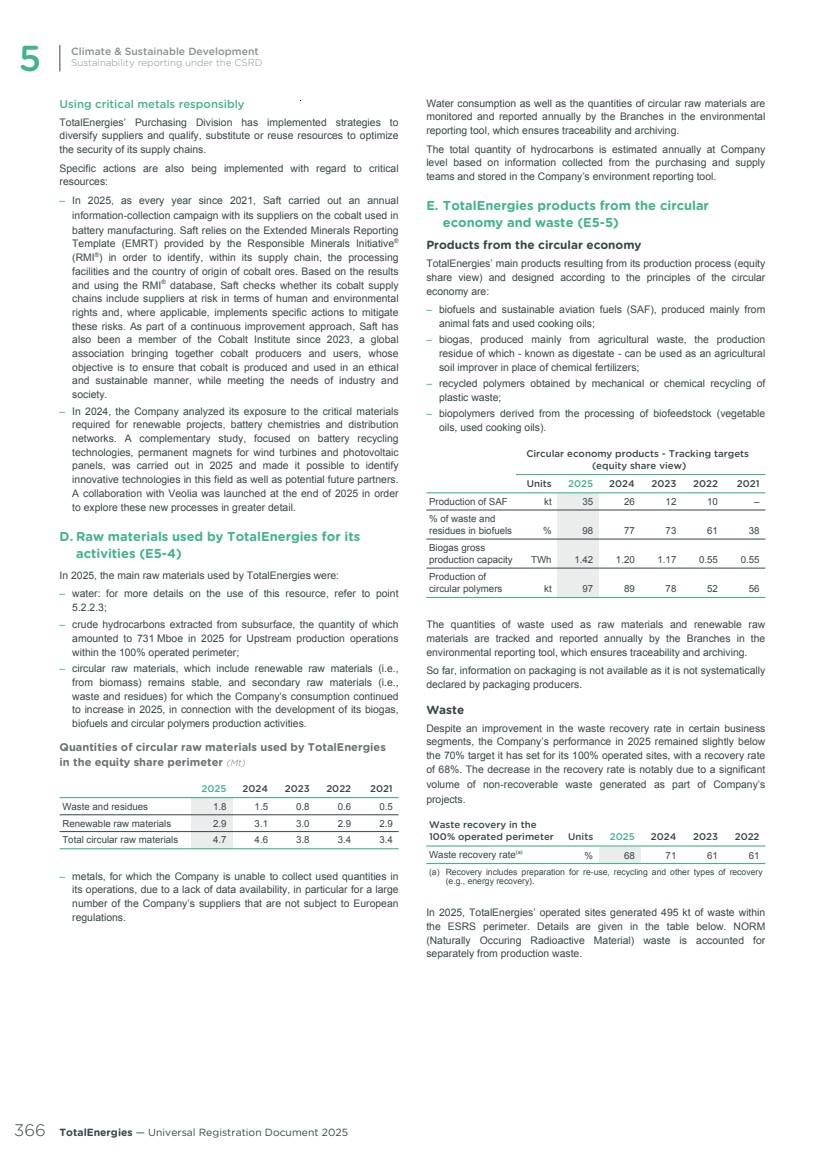
| Waste tonnage at ESRS perimeter for operated sites(a) Units 2025 2024 Total volume of waste produced kt 495 513 Total volume of waste recovered kt 350 371 Recovery rate(b) % 71 72 Hazardous waste kt 175 178 of which, hazardous waste prepared for reuse kt Accounted with recycled non-hazardous waste of which, recycled hazardous waste kt 64 70 of which, hazardous waste incinerated with energy recovery kt 24 24 of which, hazardous waste recovered by other processes kt 10 10 of which, hazardous waste incinerated without energy recovery kt 30 20 of which hazardous waste sent to landfill kt 27 24 of which, hazardous waste disposed of (without recovery) by another process kt 20 30 Non-hazardous waste kt 320 334 of which, non-hazardous waste prepared for re-use kt Accounted with recycled non-hazardous waste of which non-hazardous waste recycled kt 183 209 of which, non-hazardous waste incinerated with energy recovery kt 35 33 of which, non-hazardous waste recovered by other processes kt 34 25 of which, non-hazardous waste incinerated without energy recovery kt 4 3 of which, landfilled non-hazardous waste kt 42 48 of which, non-hazardous waste disposed of (without recovery) by another process kt 22 16 NORM (Naturally Occurring Radioactive Material) waste kt 2 2 (a) Excluding drilling cuttings, excluding digestate from biogas units, excluding sites that have ceased operations and are in the process of being remediated. (b) Recovery includes reuse, recycling, material recovery and energy recovery. For the 2025 reporting exercise, the Company has organised, like in 2024, the collection of data relating to waste from the operators of its non-operated sites. This process resulted in the collection of waste data for 43% of these sites. Consequently, the information collected from non-operated sites is not representative. The Company is therefore unable to publish this information for 2025. 96% of the Company’s non-operated production comes from operators not subject to European regulations, who are under no obligation to provide this data. 5.2.2.6 European Taxonomy The Taxonomy regulation (EU) 2020/852 (“the Regulation”) establishes a classification system common to the European Union, the objective of which is to identify the economic activities considered as sustainable, with reference to six environmental objectives. These six environmental objectives defined at article 9 of the Regulation are as follows: – climate change mitigation, – climate change adaptation, – the sustainable use and protection of water and marine resources, – the transition to a circular economy, – pollution prevention and control, – the protection and restoration of biodiversity and ecosystems. Within the meaning of article 3 of the Regulation, an economic activity shall qualify as environmentally sustainable where that economic activity: – contributes substantially to one or more of the environmental objectives set out in Article 9, – does not significantly harm any of the environmental objectives set out in Article 9, – is carried out in compliance with the minimum safeguards laid down in Article 18 of the Regulation, and – complies with technical screening criteria that have been established by the Commission. The delegated regulation (EU) 2021/2139 of June 4, 2021 supplementing regulation (EU) 2020/852 of the European Parliament and of the Council, and amended by delegated regulation (EU) 2023/2485 of June 27, 2023, establishes the technical screening criteria for determining the conditions under which an economic activity qualifies as contributing substantially to climate change mitigation or climate change adaptation. It also determines, for each of the environmental objectives listed in article 9 of the Regulation, the technical screening criteria for assessing whether that economic activity causes no significant harm to one or several of those environmental objectives. The delegated regulation (EU) 2023/2486 of June 27, 2023 supplementing regulation (EU) 2020/852 of the European Parliament and of the Council establishes the technical screening criteria relating to the four other environmental objectives (the sustainable use and protection of water and marine resources; the transition to a circular economy; the pollution prevention and control; the protection and restoration of biodiversity and ecosystems). The delegated Regulation (EU) 2026/73 of July 4, 2025 amending Delegated Regulations (EU) 2021/2139 and (EU) 2023/2486 simplifies certain technical screening criteria for determining whether economic activities cause no significant harm to environmental objectives. The minimum safeguards of article 3 of the Regulation are procedures implemented by an undertaking to ensure the alignment with the OECD Guidelines for Multinational Enterprises and the UN Guiding Principles on Business and Human Rights, including the principles and rights set out in the eight fundamental conventions identified in the Declaration of the International Labour Organisation on Fundamental Principles and Rights at Work and the International Bill of Human Rights. Reporting framework Article 8 of the Regulation requires undertakings(1) to include in their “consolidated non-financial statement information on how and to what extent the undertaking’s activities are associated with economic activities that qualify as environmentally sustainable under Articles 3 and 9 of this Regulation”. (1) Undertakings which are subject to the obligation to publish an extra-financial statement or a consolidated extra-financial statement pursuant to Article 19a or Article 29a of Directive 2013/34/EU. Climate & Sustainable Development Sustainability reporting under the CSRD 5 TotalEnergies — Universal Registration Document 2025 367 |
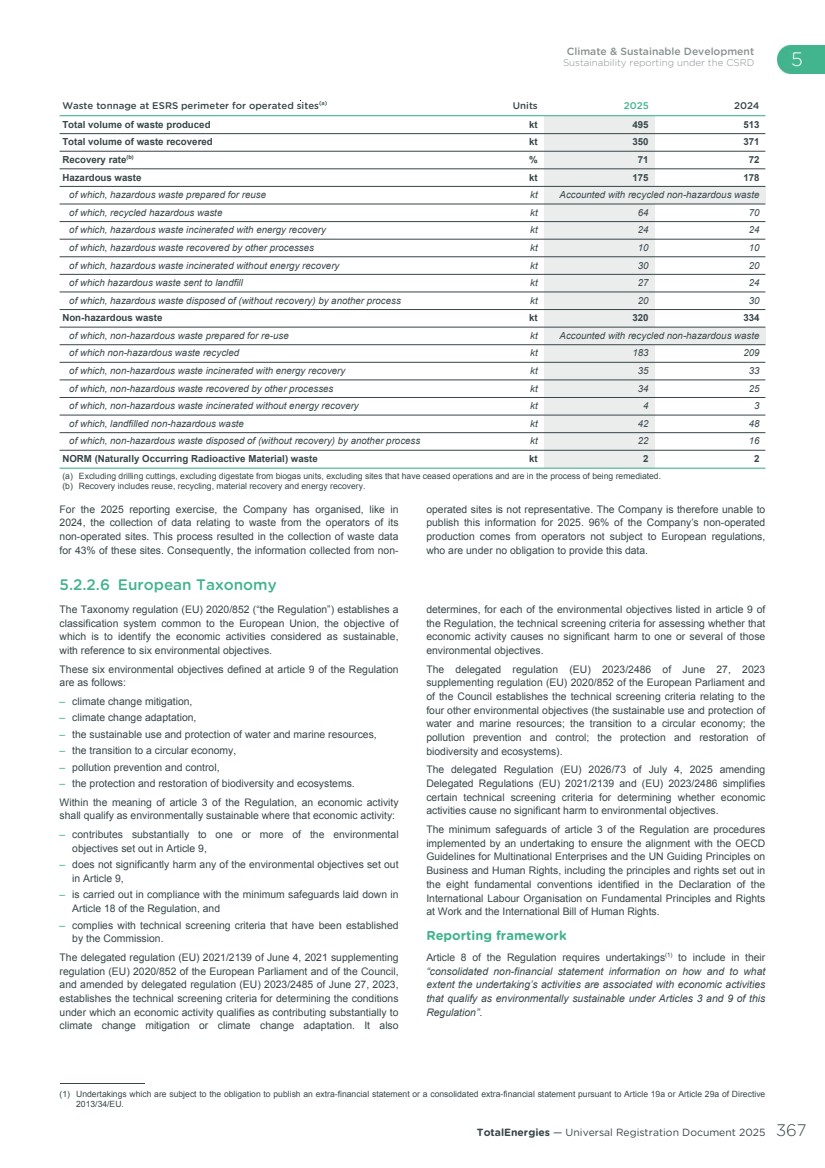
| In particular, the undertakings concerned shall disclose the following: – the proportion of their Turnover derived from products or services associated with economic activities that qualify as environmentally sustainable, – the proportion of their capital expenditure (“CapEx”) and the proportion of their operating expenditure (“OpEx”) related to assets or processes associated with economic activities that qualify as environmentally sustainable. The delegated regulation (EU) 2021/2178 of July 6, 2021, amended by delegated regulation (EU) 2023/2486 of June 27, 2023 and by delegated regulation (EU) 2026/73 of July 4, 2025, supplementing the Regulation specifies the content and presentation of information to be disclosed by undertakings concerning environmentally sustainable economic activities and specifying the methodology to comply with that disclosure obligation. The delegated regulation specifies the following definitions: – a taxonomy-eligible economic activity (“Eligible Activity”) is an economic activity that is described in the delegated regulations (EU) 2021/2139 of June 4, 2021 (amended by the delegated regulation (EU) 2023/2485 of June 27, 2023), and (EU) 2023/2486 of June 27, 2023, irrespective of whether that economic activity meets any or all of the technical screening criteria laid down in this delegated act, – a taxonomy-non-eligible economic activity is any economic activity that is not described in the delegated regulations (EU) 2021/2139 of June 4, 2021 (amended by the delegated regulation (EU) 2023/2485 of June 27, 2023), and (EU) 2023/2486 of June 27, 2023, – a taxonomy-aligned economic activity (“Aligned Activity”) is an economic activity that complies with the requirements laid down in Article 3 of the Regulation. As introduced by Delegated Regulation (EU) 2026/73 of July 4, 2025, and in the absence of any significant change in the Company’s economic activities for the 2025 financial year compared with previously published data, the Turnover associated with certain Economic Activities has not been assessed with respect to their eligibility and alignment. This Turnvover represents in total less than 10% of the Company’s Turnover (refer to the introductory table in point 5.2.2.6 C.). It consists mainly of plastic in primary forms, organic basic chemicals and battery sales. The indicators (Turnover, CapEx, OpEx) are disclosed in the point 5.2.2.6 C. A. Eligibility Of TotalEnergies’ activities tTotalEnergies has calculated the proportion of its eligible and non-eligible economic activities under the Regulation on the basis of the provisions of the delegated regulation (EU) 2021/2139 of June 4, 2021, the delegated regulation (EU) 2021/2178 of July 6, 2021 and the delegated (EU) 2023/2486 of June 27, 2023 and delegated regulation (EU) 2026/73 of July 4, 2025. The table below thus presents the proportion of its eligible economic activities of TotalEnergies on two financial indicators: capital expenditure (“CapEx”) and operating expenditure (“OpEx”), within the meaning of the Taxonomy regulation, on the scope of entities exclusively controlled and consolidated by TotalEnergies SE. The table also presents, in a voluntary approach, proposed by the delegated regulation of July 6, 2021, a proportional view of the indicator CapEx, including the contribution of joint-ventures and associates in which TotalEnergies SE has significant influence, accounted for by the equity method up to the amount of the interest held by TotalEnergies. Given the size of the Company and the adopted development model using partnership to develop its strategy in the electricity and renewables sector, the proportional view is more relevant for TotalEnergies than the consolidated view. Summary of the ratios of Eligible Activities Eligible Activities (Financial year 2025) Controlled scope Proportional view CapEx OpEx CapEx Electricity and renewables 20.6% 8.3% 23.9% including electricity generation from natural gas 0.5% 0.9% 0.4% Biofuels and chemicals 2.1% 8.9% 5.3% Other eligible activities 1.3% 1.7% 1.3% Total 2025 24.0% 18.8% 30.5% Total 2024 20.9% 18.7% 30.4% Total 2023 28.1% 15.5% 33.9% Eligible activities of TotalEnergies TotalEnergies’ Eligible Activities focus mainly on the climate change mitigation objective. – For the Integrated Power segment, main Eligible Activities are as follows: – renewable energy activities include the electricity generation from renewable sources (wind [CCM 4.3], solar [CCM 4.1], and hydroelectricity [CCM 4.5]), the manufacture, installation, maintenance and repair of renewable energy technologies [CCM 7.6 & CCM 3.1], as well as the manufacture of rechargeable batteries [CCM 3.4], battery packs and accumulators [CCM 4.10] (refer to points 2.4.2 and 2.4.4 in chapter 2), – electricity generation from natural gas [CCM 4.29 & 4.30], corresponding to the portfolio of combined cycle gas turbine (CCGT) power plants (refer to point 2.4.3 of chapter 2). – For the Integrated LNG segment, main Eligible Activities are those related to the production of biogas by anaerobic digestion of bio-waste [CCM 5.7] (refer to point 2.3.6 in chapter 2). – For the Refining & Chemicals segment, main Eligible Activities are as follows: – activities related to the production of biofuel for transportation [CCM 4.13] (refer to point 2.5.1.1 in chapter 2), – activities related to the manufacture of basic organic chemicals [CCM 3.14] and the manufacture of basic plastic materials [CCM 3.17] cover a significant portion of the Company’s petrochemical activities. Some of these activities may constitute “transitional activities” within the meaning of the European taxonomy regulation, as long as they meet the technical screening criteria of the delegated regulation (EU) 2021/2June 4, 2021, in particular in the fields of biopolymer production and mechanical or chemical recycling of plastics (refer to point 2.5.1.1 of chapter 2), – activities related to the hydrogen manufacturing [CCM 3.10] (refer to point 2.5.1 of chapter 2). – For the Exploration & Production segment, main eligible activities are those related to carbon sinks: CO2 capture and storage [CCM 5.10] and the development of nature-based carbon sinks [CCM 1.1] (refer to points 2.2.2.2 and 2.2.2.3 in chapter 2). – For the Marketing & Services segment, main Eligible Activities are those related to new energy mobility infrastructures: construction and operation of infrastructure enabling low-carbon road transport and public transport [CCM 6.15 & 7.6], such as electric charging stations and hydrogen fueling stations (refer to point 2.6.1 in chapter 2). The Eligible Activities reported under the line Electricity and renewables include renewable energy activities and electricity generation from natural gas [CCM 4.29 & 4.30] of the Integrated Power segment, as well as construction and operation of electric charging stations [CCM 7.6] of the Marketing & Service segment. 5 Climate & Sustainable Development Sustainability reporting under the CSRD 368 TotalEnergies — Universal Registration Document 2025 |
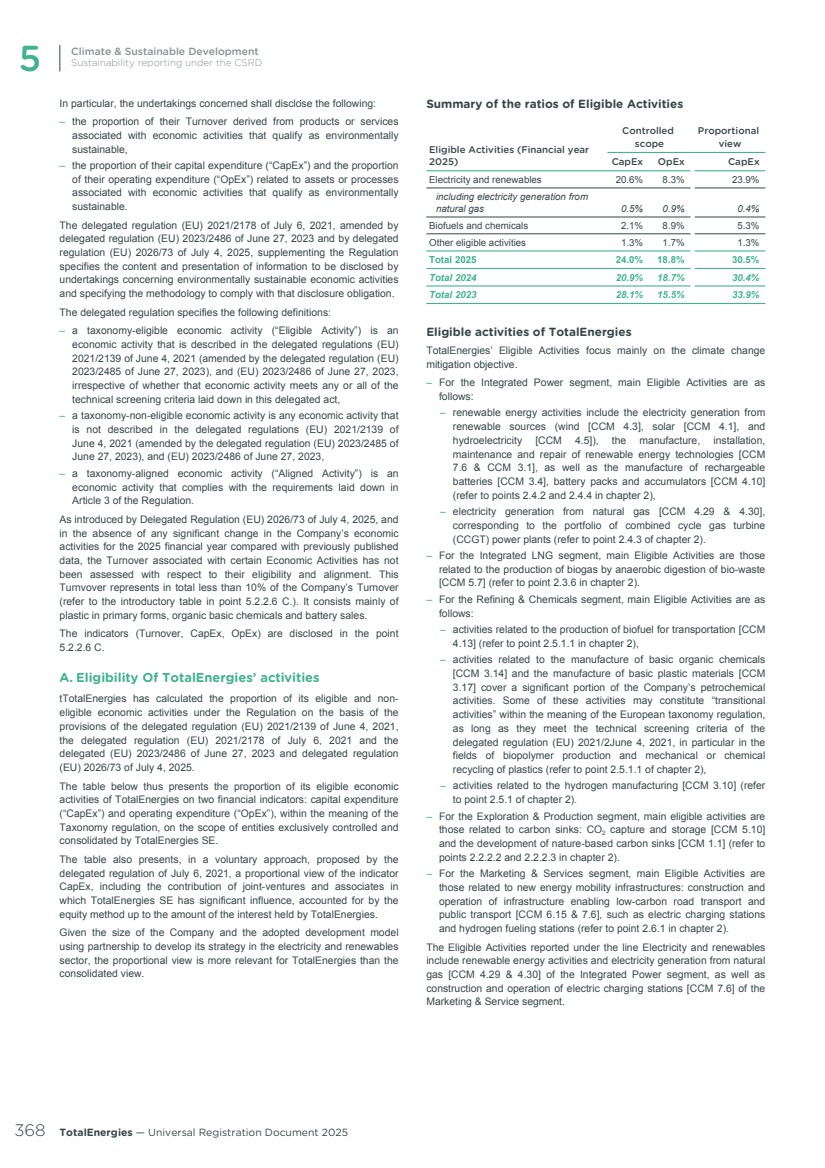
| The Eligible Activities reported under the line Biofuels and chemicals include the production of biofuel for transportation [CCM 4.13], the manufacture of basic organic chemicals [CCM 3.14] and the manufacture of basic plastic materials [CCM 3.17] of the Refining & Chemicals segment. The analysis led TotalEnergies to conclude that, among its activities, are notably not eligible under the taxonomy regulation: – electricity marketing activities, if the electricity is not produced by the Company (refer to point 2.4.5 of chapter 2), – the construction and operation of infrastructures for the distribution of energy from natural gas, such as NGV stations and marine natural gas supply infrastructures (refer to point 2.6.1 of chapter 2), – activities related to the use of means of transportation (road, sea) if the vessels or vehicles are dedicated to the transport of fossil fuels (refer to point 2.5.2.2 in chapter 2). Definition of financial indicators and methodology The proportion of Eligible Activities and the proportion of Aligned Activities in the Turnover, the CapEx and the OpEx (the “Ratios”) are calculated by dividing respectively the Turnover, the CapEx and the OpEx associated with the Eligible Activities and Aligned Activities of the Company (the numerator) by the total Turnover, CapEx and OpEx of TotalEnergies (the denominator). The financial indicators, on which the Ratios of the controlled scope are founded, are determined from the financial data used for the preparation of the consolidated financial statements of TotalEnergies SE, established in compliance with the IFRS international accounting standards. – Turnover corresponds to Revenues from sales as presented in the consolidated statement of income (refer to point 8.2 of chapter 8), i.e., consolidated external sales excluding excise taxes. – CapEx corresponds to the additions to tangible and intangible assets, i.e., to the cost of construction or acquisition of new properties, plants and equipments and intangible assets recognized in the consolidated balance sheet (refer to point 8.4 of chapter 8), including in connection with a business combination. These additions are considered before depreciation, amortisation and any re-measurements, including those resulting from revaluations and impairments, and excluding fair value changes. It includes rights of use under new lease agreements and it excludes acquisitions of shares in equity affiliates and non-consolidated companies, as well as loans granted to these companies. The reconciliation of CapEx with cash flow used in investing activities as presented in the consolidated statement of cash flow (refer to point 8.5 of chapter 8) is available in point 5.2.2.6.C. – OpEx corresponds only to direct non-capitalized costs that relate to research and development, short-term lease, building renovation measures and maintenance and repair. These costs are included in the Other operating expenses in the consolidated statement of income (refer to point 8.2 of chapter 8). The Ratios calculated using the proportional view are based on the CapEx financial indicator but extend the scope of the contributing entities, for the numerator like the denominator, to the joint-ventures and associates in which TotalEnergies SE has significant influence, accounted for by the equity method up to the amount of the interest held by TotalEnergies. The scope of consolidation as of December 31, 2025, including the list of companies accounted for by the equity method, is available in note 18 of the appendix to the consolidated financial statements in chapter 8. An internal procedure documents the methodology for determining Eligible Activities and Aligned Activities, the precise definition of financial indicators and all the criteria and assumptions used. Methodology and definitions may evolve depending on future changes in regulations and interpretations. B. Alignment of TotalEnergies’ activities The tables below present the proportion of the Eligible Activities and the proportion of the Aligned Activities on the CapEx indicator, on the scope of the entities controlled by TotalEnergies, as well as a proportional view, proposed by the delegated regulation of July 6, 2021, including the contribution of joint-ventures and associates in which TotalEnergies SE has significant influence, accounted for by the equity method. These data have been assessed on the basis of year 2025 with a reminder of the data published for the years 2024 and 2023. Summary of the ratios of Eligible Activities and Aligned Activities CapEx - 2025 Controlled scope Proportional view Eligible activities Aligned activities Eligible activities Aligned activities Electricity and renewables 20.6% 20.0% 23.9% 23.4% including electricity generation from natural gas 0.5% 0.0% 0.4% 0.0% Biofuels and chemicals 2.1% 0.9% 5.3% 2.8% Other eligible activities 1.3% 0.7% 1.3% 0.9% Total 2025 24.0% 21.6% 30.5% 27.1% Total 2024 20.9% 15.5% 30.4% 24.8% Total 2023 28.1% 25.7% 33.9% 31.7% According to this classification, defined by the Taxonomy, eligible or aligned CapEx represent respectively 31% and 27% of investments on proportional view in 2025, confirming the dynamic initiated since 2020. “Substantial contribution” criterion With regard to the assessment of the regulatory criterion named “Substantial Contribution”: – the Eligible Activities related to renewables have a substantial contribution to the objective of climate change mitigation as soon as they qualify as eligible, except of the manufacture of rechargeable batteries, battery packs [CCM 3.4] and accumulators [CCM 4.10], which complies with this criterion if they result in substantial greenhouse gases (GHG) emission reductions in transport, stationary and off-grid energy storage and other industrial applications, – the electricity generation from natural gas [CCM 4.29 & 4.30] complies with this criterion for plants, the GHG emissions of which are lower than 100 g CO2e/kWh or in transient configurations, for plants whose permit is granted before December 31, 2030, if: – the GHG emissions of the activity are lower than 270 g CO2e/kWh or the average annual GHG emissions over 20 years are lower than 550 kg CO2e/kW, – a duly documented management commitment is taken for a switch to 100% renewable and/or low-carbon gas before end 2035, – the activity in question replaces a preexisting coal or liquid fuel activity, and – a comparative assessment will have demonstrated that no 100% renewable alternative was possible. – the manufacture of biofuels for use in transports [CCM 4.13] complies with that criterion if the process uses a biomass that is not food-and feed crops that complies with the sustainability criteria of the Renewable Energies Directive (RED) and that allows savings in GHG emissions due to the manufacturing of these biofuels of at least 65% compared to fossil fuels, – the manufacture of basic organic chemicals [CCM 3.14] complies with that criterion if (i) the GHG emissions (manufacture) by product are lower than a threshold, or (ii) those products are manufactured from renewable feedstock and the lifecycle GHG emissions, verified by a third party, are lower than the equivalent chemical manufactured from fossil fuel feedstock, Climate & Sustainable Development Sustainability reporting under the CSRD 5 TotalEnergies — Universal Registration Document 2025 369 |
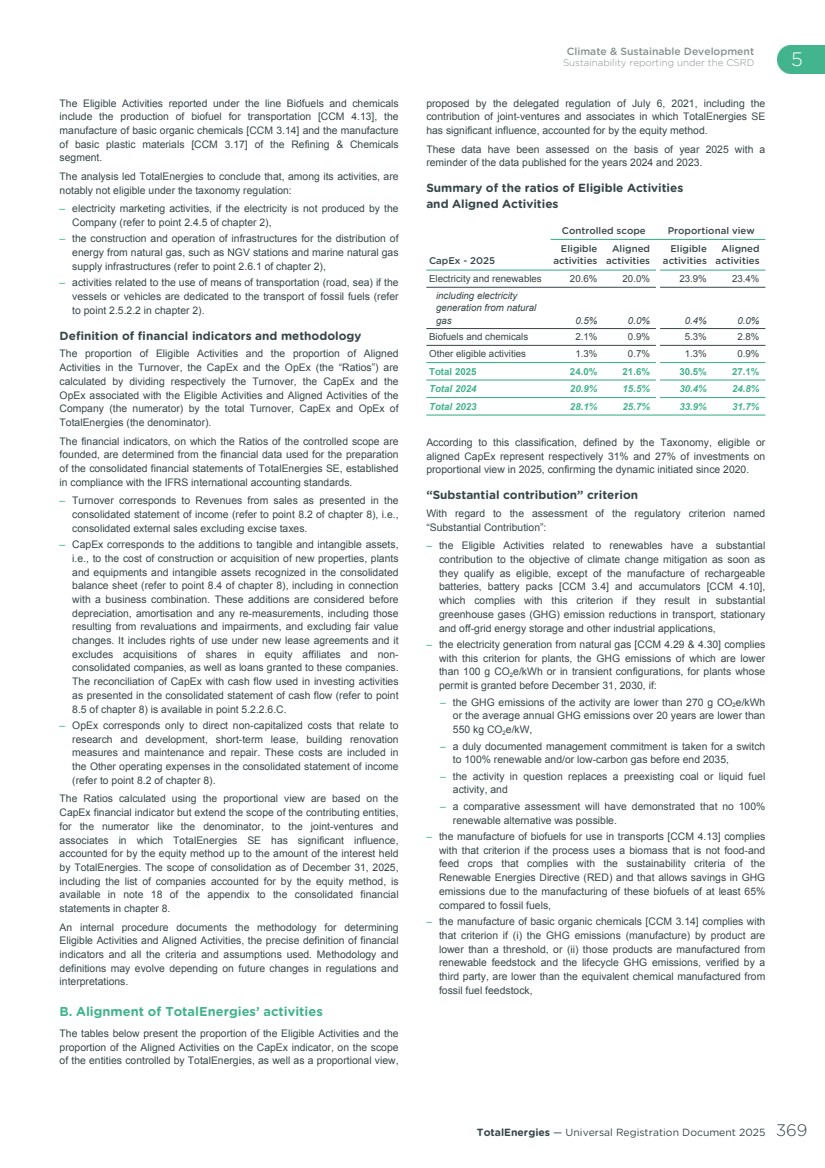
| – the manufacture of plastic in primary form [CCM 3.17] complies with that criterion if it is (i) fully manufactured by mechanical recycling of plastic waste or (ii) where mechanical recycling is not technically feasible or economically viable, fully manufactured by chemical recycling and the lifecycle GHG emissions of the manufactured plastic, verified by a third party, are lower than the lifecycle GHG emissions of the equivalent plastic in primary form manufactured from fossil fuel feedstock or (iii) derived wholly or partially from renewable feedstock if its lifecycle GHG emissions, verified by a third party, are lower than the lifecycle GHG emissions of the equivalent plastics in primary form manufactured from fossil fuel feedstock, – the manufacture of biogas by anaerobic digestion of bio-waste [CCM 5.7] complies with that criterion if the methane leakage and the traceability of the feedstock and digestates are under control and if the share of food-and feed crops is lower than 10%. “Do No Significant Harm” criterion With regard to the regulatory criterion named “Do no significant harm” any of the environmental objectives, TotalEnergies relies on the HSE Division and the HSE departments within the Company’s entities which seek to ensure that applicable local regulations, internal requirements of One MAESTRO reference framework and the Company’s additional commitments are respected (refer to point 5.2.1.4) to analyze if its Eligible Activities comply with this criterion. – For activities located in the European Union, compliance with European and national laws helps document compliance with technical screening criteria. – For activities located outside the European Union, the analysis of compliance with the technical screening criteria of delegated regulation (EU) 2021/2139 of June 4, 2021 is based in particular on the following elements: – sustainable use and protection of water and marine resources: risks related to water quality and the avoidance of water stress are identified and covered through a water use and protection management plan, – pollution prevention and control regarding use and presence of chemicals: the activities do not lead to the manufacture, placing on the market or use of substances, on their own, in mixtures or in articles, listed or defined in European Regulations 2019/1021, 2017/852, 2024/590, 2011/65 and 1907/2006, – protection and restoration of biodiversity and ecosystems: an environmental impact assessment or an appropriate screening is completed for each activity, – analysis of technical screening criteria specific to certain Eligible Activities. More specifically concerning the analysis of the criteria related to the environmental objective “Climate change adaptation”, TotalEnergies relies on its specific process for identifying and assessing physical risks associated with climate change (refer to points 1.2.14, 5.2.1.4 A. and 5.2.2.1 A. 2.). “Minimum Safeguards” criterion With regard to the regulatory criterion named “Minimum Safeguards”, various TotalEnergies policies cover these issues, through the adoption of a set of norms, principles, guidelines and best practices applicable to its operations, the establishment of specialized teams and networks of correspondents responsible for particular attention to these subjects, as well as procedures, reports and audits aimed at ensuring their daily application. Thus, the TotalEnergies Code of Conduct includes respect for the Universal Declaration of Human Rights, the Fundamental Conventions of the International Labour Organization (ILO), the U.N. Guiding Principles on Business and Human Rights, the OECD guidelines for multinational enterprises and the Voluntary Principles on Security and Human Rights (VPSHR). The Company refers to those standards in the analysis of the compliance of its Eligible Activities. For a more detailed presentation of TotalEnergies’ policies and procedures in terms of respect for human rights, refer to points 3.3.3 and 3.6 of chapter 3 and point 5.2.3 of chapter 5, respect for competition law, refer to point 3.3.3 of chapter 3, fighting corruption refer to point 3.3.3 of chapter 3 and point 5.2.4.2 of chapter 5 and fighting tax evasion refer to point 5.1.4.3 of chapter 5. In the context of activities carried out by joint-ventures and associates in which TotalEnergies has significant influence, accounted for by the equity method, the Company uses its leverage with its business partners to apply similar standards, as explained in these same points. Contextual information In 2025, CapEx associated with Aligned Activities on the scope of the entities controlled by TotalEnergies amount to $4,664 million ($3,043 million in 2024). They include: – $3,306 million related to additions to tangible assets, $1,240 million related to additions to intangible assets and $118 million related to new leases (respectively $2,368 million, $577 million and $98 million in 2024), – $2,469 million related to organic investments and $2,195 million related to assets additions in connection with a business combination. CapEx associated with Aligned Activities are either related to assets or processes that are associated with Aligned Activities, or related to CapEx Plans, within the meaning of the regulation, or related to purchases of products from Aligned Activities or to individual measures, also among the Aligned Activities, enabling the target activities to become low-carbon or to lead to greenhouse gas emissions reductions. CapEx related to CapEx Plans are part of a plan to expand Aligned Activities or allow Taxonomy Eligible Activities to align with it. CapEx related to purchases of products from Aligned Activities or to individual measures correspond, mainly to the solarization of TotalEnergies’ sites. TotalEnergies has an annual capital expenditures target of $14-16 billion per year for 2026-2030, of which $2-3 billion is for Integrated Power. Overall, therefore, TotalEnergies intends to maintain a material level of investment in low-carbon energies, mainly in the Integrated Power segment, where it plans to invest $3-4 billion per year in 2026-2030, including around $1 billion per year for 5 years through shares as part of the transaction with EPH(1) . Net investments in low-carbon energies include investments in Integrated Power, low-carbon molecules (including biofuels, biogas, recycled plastic, biopolymers, synthetic fuels, hydrogen and CCS) as well as the nature-based carbon sinks projects allowing, from 2030, to contribute to reduction of the Company’s carbon footprint (refer to point 1.4 of chapter 1). (1) The transaction remains subject to information and consultation processes and regulatory approvals, with completion expected by mid-2026. 5 Climate & Sustainable Development Sustainability reporting under the CSRD 370 TotalEnergies — Universal Registration Document 2025 |
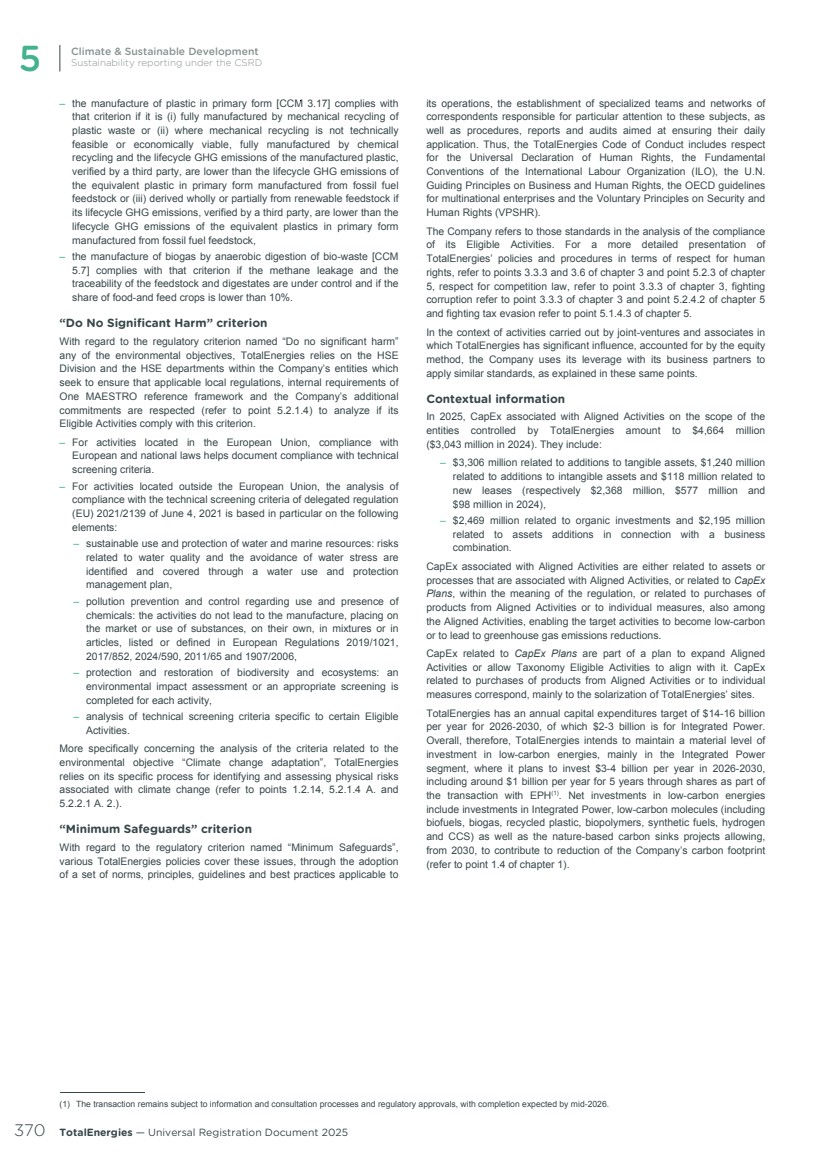
| C. Key performance indicators within the taxonomy Key performance indicators Fiscal year 2025 Breakdown by environmental objectives of Taxonomy aligned activities % KPI Turnover 182,344 0.0% 0 0.0% 0.0% 0.0% 0.0% 0.0% 0.0% 0.0% 0.0% 0.0% 7.1% 3,713 1.9% CapEx 21,598 24.0% 4,664 21.6% 21.6% 0.0% 0.0% 0.0% 0.0% 0.0% 1.8% 0.1% 0.0% 3,043 15.5% OpEx 4,031 18.8% 398 9.9% 9.9% 0.0% 0.0% 0.0% 0.0% 0.0% 5.4% 0.5% 0.0% 420 10.5% Proportion of CapEx from products or services associated with Taxonomy-aligned economic activities Fiscal year 2025 Environmental objective of Taxonomy aligned activities % Economic Activity Manufacture of batteries CCM 3.4 0.4% 65 0.3% 0.3% 0.0% 0.0% 0.0% 0.0% 0.0% E 69.1% Manufacture of energy efficiency equipment for buildings CCM 3.5 0.0% 1 0.0% 0.0% 0.0% 0.0% 0.0% 0.0% 0.0% E 100.0% Manufacture of hydrogen CCM 3.10 0.2% 34 0.2% 0.2% 0.0% 0.0% 0.0% 0.0% 0.0% E 100.0% Manufacture of organic basic chemicals CCM 3.14 0.9% 0 0.0% 0.0% 0.0% 0.0% 0.0% 0.0% 0.0% T 0.0% Manufacture of plastics in primary form CCM 3.17 0.4% 12 0.1% 0.1% 0.0% 0.0% 0.0% 0.0% 0.0% T 14.5% Manufacture of automotive and mobility components CCM 3.18 0.1% 22 0.1% 0.1% 0.0% 0.0% 0.0% 0.0% 0.0% E 100.0% Electricity generation using solar photovoltaic technology CCM 4.1 6.6% 1,433 6.6% 6.6% 0.0% 0.0% 0.0% 0.0% 0.0% 100.0% Electricity generation from wind power CCM 4.3 11.6% 2,508 11.6% 11.6% 0.0% 0.0% 0.0% 0.0% 0.0% 100.0% Electricity generation from hydropower CCM 4.5 0.1% 15 0.1% 0.1% 0.0% 0.0% 0.0% 0.0% 0.0% 100.0% Storage of electricity CCM 4.10 0.2% 35 0.2% 0.2% 0.0% 0.0% 0.0% 0.0% 0.0% E 100.0% Manufacture of biogas and biofuels for use in transport and of bioliquids CCM 4.13 0.8% 181 0.8% 0.8% 0.0% 0.0% 0.0% 0.0% 0.0% 99.5% Cogeneration of heat/cool and power from bioenergy CCM 4.20 0.1% 18 0.1% 0.1% 0.0% 0.0% 0.0% 0.0% 0.0% 100.0% Electricity generation from fossil gaseous fuels CCM 4.29 0.5% 0 0.0% 0.0% 0.0% 0.0% 0.0% 0.0% 0.0% T 0.0% Anaerobic digestion of bio-waste CCM 5.7 0.4% 80 0.4% 0.4% 0.0% 0.0% 0.0% 0.0% 0.0% 100.0% Underground permanent geological storage of CO2 CCM 5.12 0.2% 35 0.2% 0.2% 0.0% 0.0% 0.0% 0.0% 0.0% 100.0% Infrastructure enabling low-carbon road transport and public transport CCM 6.15 1.0% 207 1.0% 1.0% 0.0% 0.0% 0.0% 0.0% 0.0% E 100.0% Construction of new buildings CCM 7.1 0.3% 0 0.0% 0.0% 0.0% 0.0% 0.0% 0.0% 0.0% 0.0% Installation, maintenance and repair of charging stations for electric vehicles in buildings (and parking spaces attached to buildings) CCM 7.4 0.0% 4 0.0% 0.0% 0.0% 0.0% 0.0% 0.0% 0.0% E 100.0% Installation, maintenance and repair of renewable energy technologies CCM 7.6 0.0% 9 0.2% 0.2% 0.0% 0.0% 0.0% 0.0% 0.0% E 100.0% Acquisition and ownership of buildings CCM 7.7 0.2% 0 0.0% 0.0% 0.0% 0.0% 0.0% 0.0% 0.0% 0.0% Professional services related to energy performance of buildings CCM 9.3 0.0% 5 0.0% 0.0% 0,0% 0,0% 0,0% 0,0% 0,0% E 100.0% Sum of alignment per objective 21.6% 0.0% 0.0% 0.0% 0.0% 0.0% Total CapEx 24.0% 4,664 21.6% 1.8% 0.1% 90.1% Total Proportion of Taxonomy eligible activities % Taxonomy aligned activities M$ Proportion of Taxonomy aligned activities % Proportion of enabling activities % Proportion of transitional activities % Not assessed activities considered non-material % Taxonomy aligned activities in previous financial year (N-1) M$ Proportion of Taxonomy aligned activities in previous financial year (N-1) % Climate Change Mitigation Climate Change Adaptation Water Circular economy Pollution Biodiversity Code Taxonomy eligible CapEx % Taxonomy aligned CapEx M$ Taxonomy aligned CapEx % Enabling (E) activity Transitional (T) activity Proportion of Taxonomy aligned in taxonomy eligible % Climate Change Mitigation Climate Change Adaptation Water Circular economy Pollution Biodiversity Climate & Sustainable Development Sustainability reporting under the CSRD 5 TotalEnergies — Universal Registration Document 2025 371 |
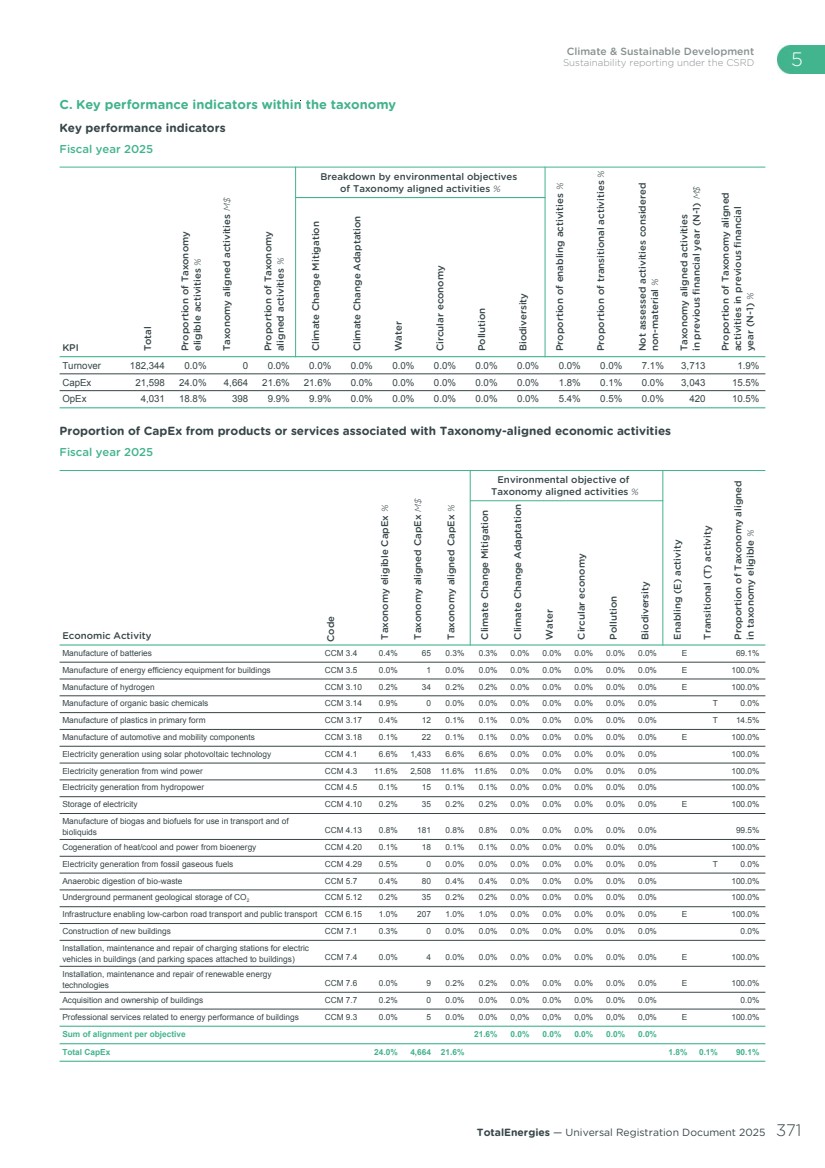
| Proportion of OpEx from products or services associated with Taxonomy-aligned economic activities Fiscal year 2025 Environmental objective of Taxonomy aligned activities % Economic Activity Treatment of hazardous waste CEY 2.4 0.1% 0 0.0% 0.0% 0.0% 0.0% 0.0% 0.0% 0.0% 0.0% Manufacture of batteries CCM 3.4 2.8% 82 2.0% 2.0% 0.0% 0.0% 0.0% 0.0% 0.0% E 73.9% Manufacture of energy efficiency equipment for buildings CCM 3.5 0.0% 1 0.0% 0.0% 0.0% 0.0% 0.0% 0.0% 0.0% E 100.0% Manufacture of organic basic chemicals CCM 3.14 3.8% 0 0.0% 0.0% 0.0% 0.0% 0.0% 0.0% 0.0% T 0.0% Manufacture of plastics in primary form CCM 3.17 3.6% 26 0.7% 0.7% 0.0% 0.0% 0.0% 0.0% 0.0% T 17.9% Manufacture of automotive and mobility components CCM 3.18 1.3% 53 1.3% 1.3% 0.0% 0.0% 0.0% 0.0% 0.0% E 100.0% Electricity generation using solar photovoltaic technology CCM 4.1 1.3% 54 1.3% 1.3% 0.0% 0.0% 0.0% 0.0% 0.0% 100.0% Electricity generation using concentrated solar power (CSP) technology CCM 4.2 0.0% 1 0.0% 0.0% 0.0% 0.0% 0.0% 0.0% 0.0% 100.0% Electricity generation from wind power CCM 4.3 1.1% 46 1.1% 1.1% 0.0% 0.0% 0.0% 0.0% 0.0% 100.0% Electricity generation from hydropower CCM 4.5 0.1% 4 0.0% 0.0% 0.0% 0.0% 0.0% 0.0% 0.0% 100.0% Storage of electricity CCM 4.10 0.0% 2 0.0% 0.0% 0.0% 0.0% 0.0% 0.0% 0.0% E 100.0% Manufacture of biogas and biofuels for use in transport and of bioliquids CCM 4.13 1.4% 56 1.4% 1.4% 0.0% 0.0% 0.0% 0.0% 0.0% 98.2% Electricity generation from fossil gaseous fuels CCM 4.29 0.9% 0 0.0% 0.0% 0.0% 0.0% 0.0% 0.0% 0.0% T 0.0% High-efficiency co-generation of heat/cool and power from fossil gaseous fuels CCM 4.30 0.1% 0 0.0% 0.0% 0.0% 0.0% 0.0% 0.0% 0.0% T 0.0% Construction, extension and operation of water collection, treatment and supply systems CCM 5.1 0.1% 0 0.0% 0.0% 0.0% 0.0% 0.0% 0.0% 0.0% 0.0% Anaerobic digestion of bio-waste CCM 5.7 0.1% 2 0.1% 0.1% 0.0% 0.0% 0.0% 0.0% 0.0% 100.0% Landfill gas capture and utilisation CCM 5.10 0.1% 2 0.1% 0.1% 0.0% 0.0% 0.0% 0.0% 0.0% 100.0% Underground permanent geological storage of CO2 CCM 5.12 1.3% 51 1.3% 1.3% 0.0% 0.0% 0.0% 0.0% 0.0% 100.0% Infrastructure enabling low-carbon road transport and public transport CCM 6.15 0.4% 14 0.4% 0.4% 0.0% 0.0% 0.0% 0.0% 0.0% E 100.0% Renovation of existing buildings CCM 7.2 0.1% 0 0.0% 0.0% 0.0% 0.0% 0.0% 0.0% 0.0% T 0.0% Installation, maintenance and repair of energy efficiency equipment CCM 7.3 0.1% 0 0.0% 0.0% 0.0% 0.0% 0.0% 0.0% 0.0% E 0.0% Installation, maintenance and repair of renewable energy technologies CCM 7.6 0.1% 4 0.1% 0.1% 0.0% 0.0% 0.0% 0.0% 0.0% E 100.0% Sum of alignment per objective 9.9% 0.0% 0.0% 0.0% 0.0% 0.0% Total OpEx 18.8% 398 9.9% 5.4% 0.5% 52.4% Statement of CapEx reconciliation 2025 In millions of dollars TotalEnergies Cash flow used in investing activities (a) 18,135 Divestments (b) 4,069 Investments in equity affiliates and other securities (c) (1,288) Increase in non-current loans (d) (1,960) New leasing contracts (e) 2,403 Adjustment of controlled entities acquisition (f) 422 Other adjustments* (g) (183) CapEx as per Taxonomy - Controlled scope (a+b+c+d+e+f+g) 21,598 Share of equity affiliates CapEx 8,190 CapEx as per Taxonomy - Proportional view 29,788 * Other adjustments include investment grants and capitalized financial expenses. Code Taxonomy eligible OpEx % Taxonomy aligned OpEx M$ Taxonomy aligned OpEx % Enabling (E) activity Transitional (T) activity Proportion of Taxonomy aligned in taxonomy eligible % Climate Change Mitigation Climate Change Adaptation Water Circular economy Pollution Biodiversity 5 Climate & Sustainable Development Sustainability reporting under the CSRD 372 TotalEnergies — Universal Registration Document 2025 |
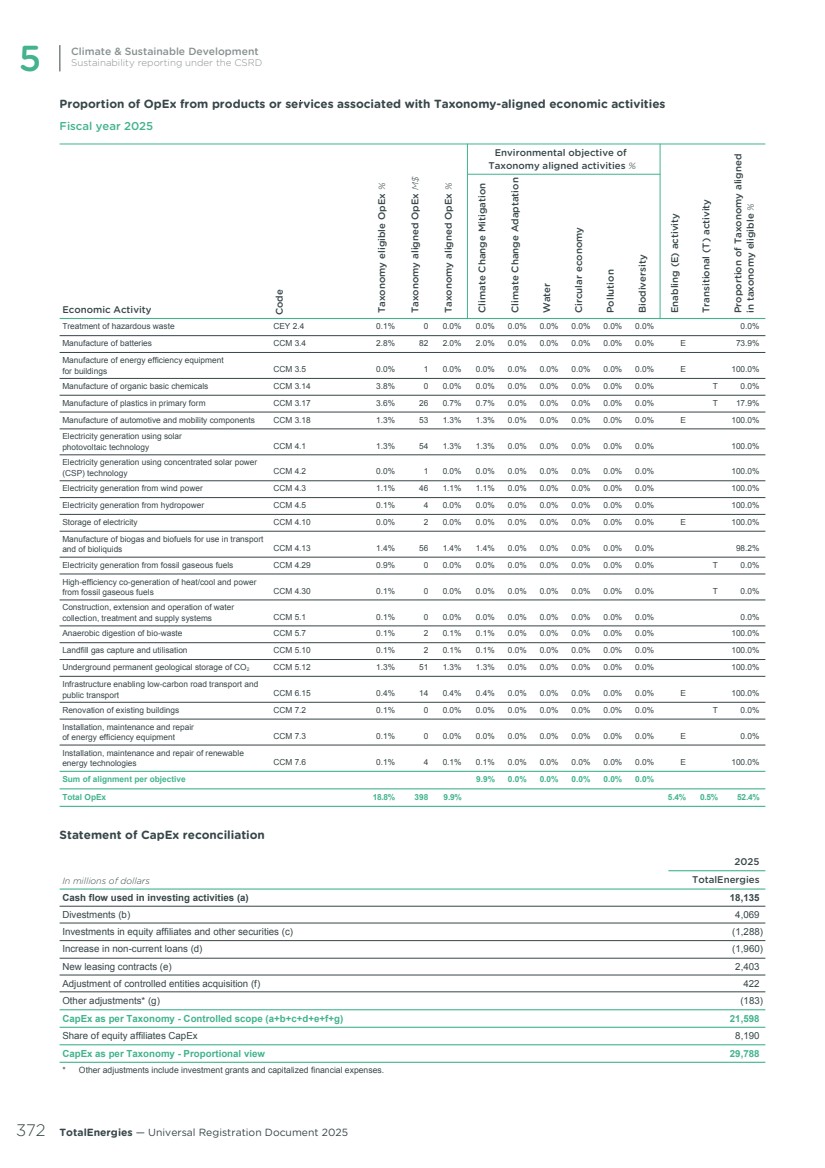
| Statement of Turnover reconciliation In millions of dollars 2025 Turnover - Controlled scope 182,344 Share of equity affiliates Turnover 24,582 Turnover - Proportional view 206,926 5.2.3 Social information 5.2.3.1 Company workforce (S1) TotalEnergies intends to place the women and men of the company at the heart of its performance. With more than 100,000 employees worldwide and a presence in about 120 countries, the company is convinced that its development is inseparable from the trust and respect established between itself and its employees. TotalEnergies’ social commitment is therefore based on the values set out in its Code of Conduct. In particular, it ensures that: – protecting its employees’ health and safety; – offering high social standards and establishing a quality of life at work that contributes to Company’s appeal and the well-being of its employees; – developing people’s skills using a robust learning model and individual support to ensure a successful and just transition; – promoting a corporate culture that fosters equal treatment and opportunities, diversity and excludes all forms of discrimination; – maintaining and encouraging social dialogue in compliance with local legal requirements; – respecting internationally recognized human rights, in particular the Universal Declaration of Human Rights and the fundamental conventions of the International Labour Organization. Reporting scopes and methodology Workforce and health reporting is based on three annual surveys: the Global Workforce Analysis, the complementary Worldwide Human Resources Survey, and the Compensation Survey. The Global Workforce Analysis (GWA) is conducted on December 31 in all the controlled, consolidated companies (refer to note 18 to the Consolidated Financial Statements and point 8.7 of chapter 8) having employees, i.e., 350 companies in 93 countries at December 31, 2025. This survey covers workforce, hiring people on both permanent and fixed-term contracts (contrats à durée déterminée or indéterminée) and their non-French equivalents, as well as employee turnover at the global level. It offers a breakdown of the workforce by sex, professional category (managers and other employees and non-French equivalents), age and nationality. The Worldwide Human Resources Survey (WHRS), carried out in December of year “x” and January of year “x+1”, includes nearly 300 workforce indicators linked to the Company’s Human Resources policies, such as internal mobility, talent development, training, working conditions, social dialogue, deployment of the Code of Conduct, human rights and health. The survey covers 140 companies in 52 countries, representing 90.8% of the Company’s consolidated workforce (92,165 employees). The data published in this document are taken from the most recent survey, carried out in December 2025 and January 2026. The Compensation survey is based on the consolidated scope of the WHRS. The data published from the workforce reporting represent 90.8% of the Company’s consolidated workforce. They are considered sufficiently representative of the overall Company workforce and are not subject to estimation methodology. Safety reporting covers the employees of subsidiaries that are more than 50% controlled within the Company’s financial scope, employees of subsidiaries that are more than 50% controlled and not financially consolidated because they are not material from a financial standpoint, as well as the employees of contractors working on sites, assets or activities operated and those of transport companies under long-term contracts. Additionally, two opinion surveys of all employees worldwide are conducted, the TotalEnergies Survey and the TotalEnergies Pulse Survey. They are carried out alternately every other year within the “périmètre de gestion” (374 companies in 117 countries in 2025). – TotalEnergies Survey is a large survey assessing employee engagement and measuring people’s perception of the Company in various areas: the Company’s ambition, collective performance, management, talent development, working conditions, etc. – TotalEnergies Pulse Survey is an additional more concise survey that enables to measure employee engagement and well-being at work on a yearly basis. A. Company employees Characteristics of company employees 1. Breakdown of employees At December 31, 2025, the Company had 101,513 employees belonging to 350 employing companies located in 93 countries (refer to Note 10.2 to the Consolidated Financial Statements, point 8.7 of chapter 8). Company employees Equality between women and men(a) Number of employees (headcount) as of December 31 2025 2024 2023 Company including Hutchinson Company including Hutchinson Company including Hutchinson Women 37,292 16,016 37,862 16,257 37,839 15,943 Men 64,221 24,381 65,025 24,559 64,740 23,974 Total number of employees 101,513 40,397 102,887 40,816 102,579 39,917 (a) Certain local regulations do not allow the categories “other” and “not reported”. The corresponding data are not collected in these countries. Climate & Sustainable Development Sustainability reporting under the CSRD 5 TotalEnergies — Universal Registration Document 2025 373 |
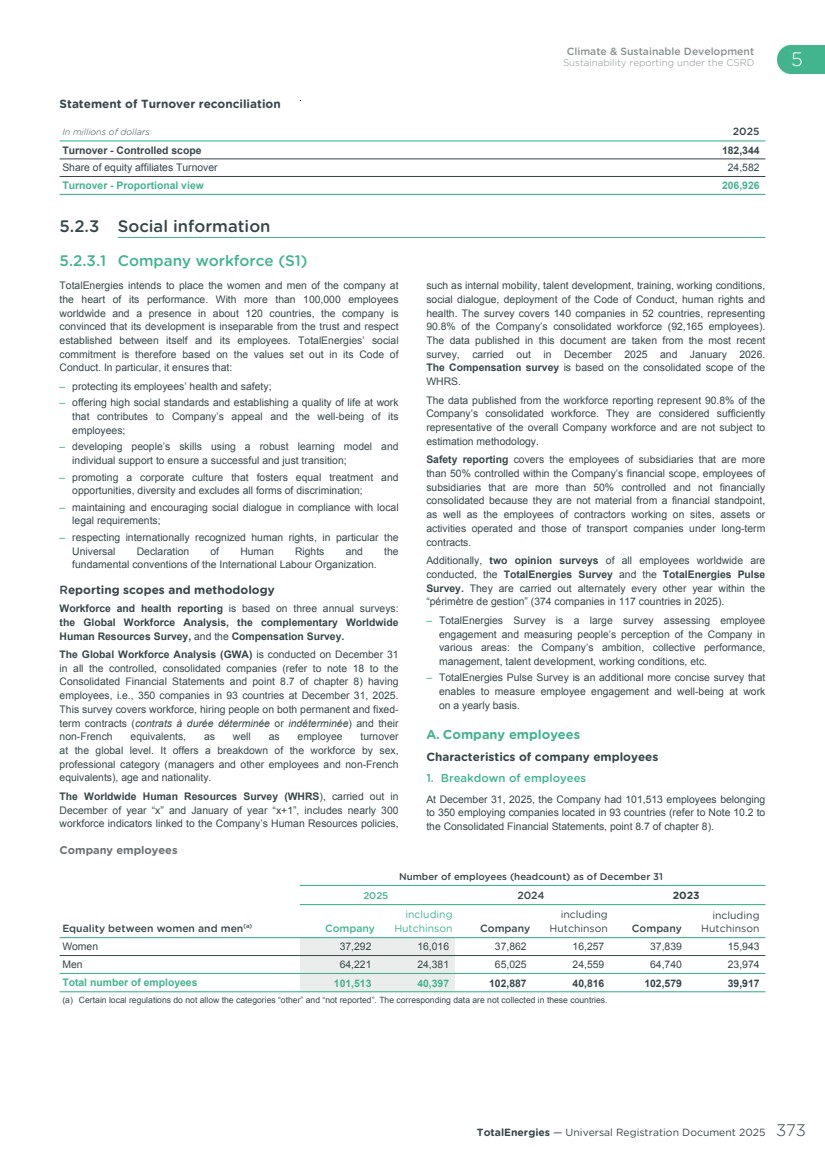
| Employees in countries with at least 50 employees representing at least 10% of the Company’s total workforce France is the only country representing at least 10% of the total number of the employees of the Company. Number of employees (headcount) as of December 31 France 2025 2024 2023 Company 35,424 35,880 35,506 including Hutchinson 8,046 8,124 7,968 Company workforce by business segment Headcount as of December 31 2025 2024 2023 Total number of employees 101,513 102,887 102,579 Breakdown by business segment Exploration & Production segment 8.6% 8.6% 8.4% Integrated LNG segment 1.3% 1.9% 1.7% Integrated Power segment 8.3% 7.9% 7.8% Refining & Chemicals segment 51.6% 51.2% 50.4% Refining & Petrochemicals 10.8% 10.6% 10.6% Trading & Shipping 1.0% 1.0% 0.9% Hutchinson 39.8% 39.6% 38.9% Marketing & Services segment 22.4% 22.8% 24.3% Corporate 4.1% 4.0% 3.9% OneTech(a) 3.6% 3.6% 3.5% (a) OneTech contains technical and scientific teams from the various business segments. Employees by type of contract Employees as of December 31 2025 2024 2023 Company workforce Women Men Total Women Men Total Women Men Total Number of employees 37,292 64,221 101,513 37,862 65,025 102,887 37,839 64,740 102,579 Number of employees with permanent contracts (CDI) 34,410 60,437 94,847 34,372 61,021 95,393 34,022 60,501 94,523 Number of employees with fixed-term contracts (CDD) 2,882 3,784 6,666 3,490 4,004 7,494 3,817 4,239 8,056 The GWA does not identify TotalEnergies employees affected by non-guaranteed hours. Employees as of December 31 2025 2024 2023 Including Hutchinson workforce Women Men Total Women Men Total Women Men Total Number of employees 16,016 24,381 40,397 16,257 24,559 40,816 15,943 23,974 39,917 Number of employees with permanent contracts (CDI) 14,901 22,932 37,833 14,666 22,898 37,564 14,378 22,341 36,719 Number of employees with fixed-term contracts (CDD) 1,115 1,449 2,564 1,591 1,661 3,252 1,565 1,633 3,198 The GWA does not identify TotalEnergies employees affected by non-guaranteed hours. Employees by region In 2025, the regions where Company’s workforce is most represented were Europe (62.2%), Latin America (13.2%) and Africa (11.3%). Company workforce Employees as of December 31 Europe including France Africa 2025 2024 2023 2025 2024 2023 2025 2024 2023 Number of employees 63,179 63,886 64,790 35,424 35,880 35,506 11,442 11,073 10,516 including women 23,182 23,496 24,047 12,697 12,945 12,589 3,870 3,731 3,395 including men 39,997 40,390 40,743 22,727 22,935 22,917 7,572 7,342 7,121 Number of employees with permanent contracts (CDI) 57,837 58,255 58,458 32,708 33,012 32,647 10,750 9,740 9,475 Number of employees with fixed-term contracts (CDD) 5,342 5,631 6,332 2,716 2,868 2,859 692 1,333 1,041 5 Climate & Sustainable Development Sustainability reporting under the CSRD 374 TotalEnergies — Universal Registration Document 2025 |
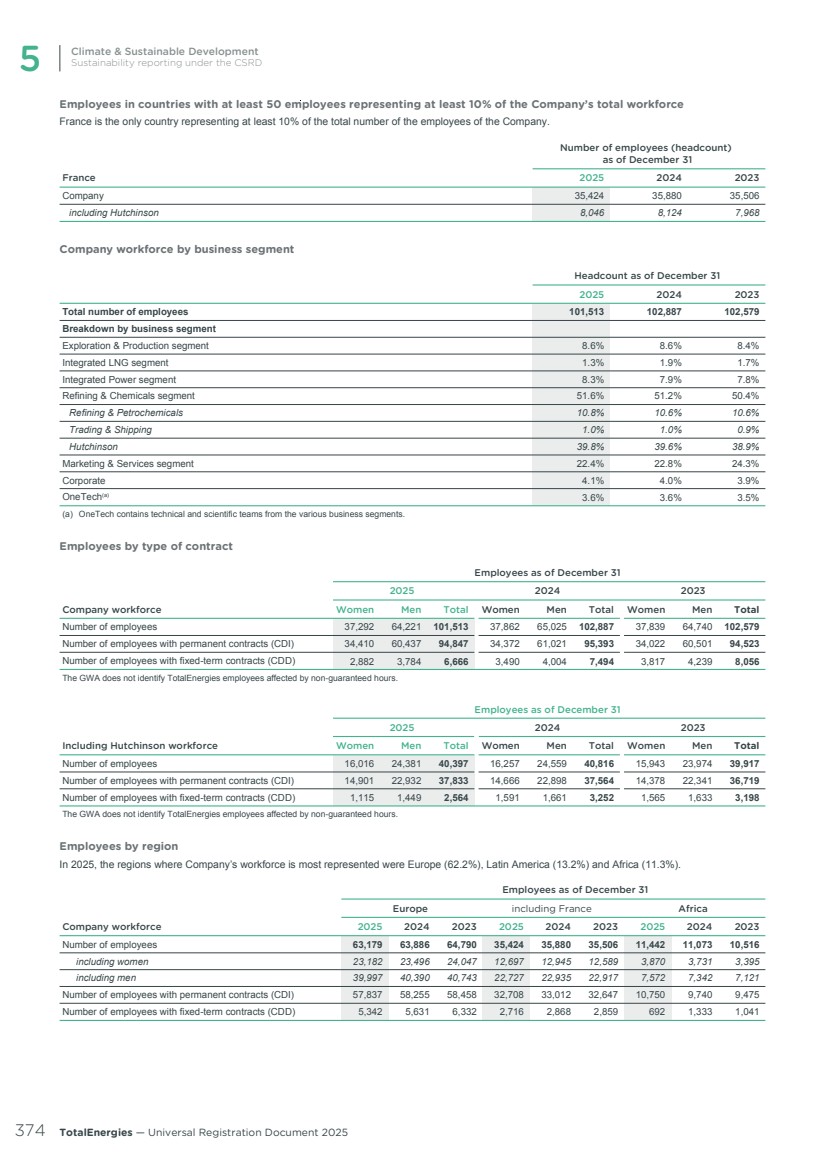
| Employees as of December 31 North America Latin America Asia-Pacific Middle East 2025 2024 2023 2025 2024 2023 2025 2024 2023 2025 2024 2023 Number of employees 5,832 6,023 6,112 13,417 14,149 13,720 6,624 6,787 6,594 1,019 969 847 including women 1,646 1,700 1,770 5,830 6,127 5,881 2,424 2,484 2,463 340 324 283 including men 4,186 4,323 4,342 7,587 8,022 7,839 4,200 4,303 4,131 679 645 564 Number of employees with permanent contracts (CDI) 5,776 6,012 6,105 13,358 14,076 13,602 6,184 6,391 6,056 942 919 827 Number of employees with fixed-term contracts (CDD) 56 11 7 59 73 118 440 396 538 77 50 20 Employees as of December 31 Europe including France Africa Including Hutchinson workforce 2025 2024 2023 2025 2024 2023 2025 2024 2023 Number of employees 22,123 22,584 22,519 8,046 8,124 7,968 3,196 2,443 1,883 including women 8,533 8,730 8,737 2,336 2,336 2,228 1,243 995 702 including men 13,590 13,854 13,782 5,710 5,788 5,740 1,953 1,448 1,181 Number of employees with permanent contracts (CDI) 19,935 20,226 20,016 7,662 7,709 7,568 2,968 1,635 1,431 Number of employees with fixed-term contracts (CDD) 2,188 2,358 2,503 384 415 400 228 808 452 Employees as of December 31 North America Latin America Asia-Pacific Middle East 2025 2024 2023 2025 2024 2023 2025 2024 2023 2025 2024 2023 Number of employees 2,478 2,666 2,861 9,967 10,447 10,130 2,633 2,676 2,524 0 0 0 including women 705 749 849 4,627 4,854 4,724 908 929 931 0 0 0 including men 1,773 1,917 2,012 5,340 5,593 5,406 1,725 1,747 1,593 0 0 0 Number of employees with permanent contracts (CDI) 2,471 2,664 2,857 9,967 10,447 10,130 2,492 2,592 2,285 0 0 0 Number of employees with fixed-term contracts (CDD) 7 2 4 0 0 0 141 84 239 0 0 0 2. Recruitment of employees In 2025, among the 12,015 employees recruited on permanent contracts, proportions remain generally stable compared to 2024: – 50.3% are under 30; – 87.9% are non-French nationalities; – 39.2% are women. Furthermore, 4,866 employees were hired on fixed-term contracts in 2025 (compared to 5,632 in 2024), mainly in France, in line with the proactive Company policy of recruiting work-study students. Hires on permanent contracts (CDI) as of December 31 2025 2024 2023 Company including Hutchinson Company including Hutchinson Company including Hutchinson Number of hires on permanent contracts (CDI) 12,015 8,500 13,975 9,187 15,220 9,831 Breakdown by region Europe 21.9% 9.1% 27.4% 13.1% 26.3% 11.8% including France 13.2% 4.8% 16.5% 6.8% 15.9% 6.3% Africa 14.9% 17.3% 6.0% 2.9% 6.1% 3.8% North America 7.2% 5.4% 7.9% 7.1% 14.9% 17.2% Latin America 49.7% 65.2% 53.8% 75.4% 47.7% 66.0% Asia-Pacific 5.3% 3.0% 3.6% 1.4% 4.5% 1.2% Middle East 1.0% – 1.3% – 0.5% – 3. Measures in favor of young work-study students in France TotalEnergies is committed to the employment of young people, helping them establish themselves in the workplace and strengthening their employability. Every year since 2016, the Company has reaffirmed its determined policy of recruiting, training and supporting young work-study students in France. The policy has been implemented in compliance with its commitments to diversity and equal opportunities. Since 2023, in the context of the Collectif d’entreprises pour une économie plus inclusive (Collective businesses for a more inclusive economy), TotalEnergies continues to be committed to welcoming 2,000 work-study students per year into its teams. At the end of 2025, over 2,300 work-study students were working within the Company throughout France. Climate & Sustainable Development Sustainability reporting under the CSRD 5 TotalEnergies — Universal Registration Document 2025 375 |
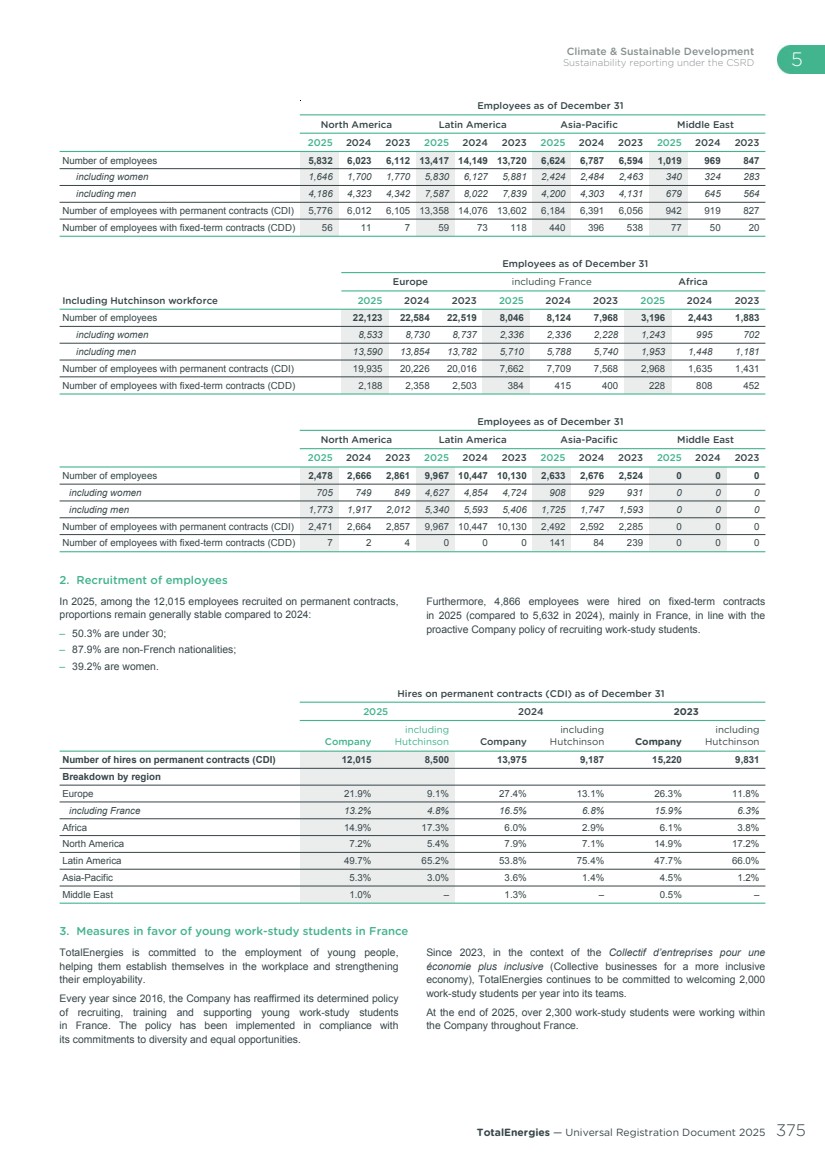
| 4. Departures from the workforce Departures as of December 31 2025 2024 2023 Company including Hutchinson Company including Hutchinson Company including Hutchinson Deaths 100 37 105 41 112 38 Dismissals 3,258 2,413 2,627 1,916 2,427 1,637 Resignations 7,860 6,106 8,860 6,924 10,217 7,793 Contract termination by mutual agreement(a) 1,128 614 917 432 880 420 Retirements(b) 1,224 338 1,276 301 – – Total departures (permanent contracts CDI) 13,570 9,508 13,785 9,614 13,636 9,888 Turnover rate(c) (permanent contracts CDI) 14.2% 25.3% 14.6% 26.2% – – Total departures (fixed-term contracts CDD)(b)(d) 4,862 2,052 4,693 1,734 – – Turnover rate(b)(e) (fixed-term contracts CDD) 64.9% 63.1% 58.3% 54.2% – – (a) Including “ruptures conventionnelles” in France. (b) Data are not published before 2024. (c) Calculation since 2024 turnover rate for permanent contracts (CDI): Total departures from permanent contracts (deaths, dismissals, resignations, contract termination by mutual agreement, retirements)/total headcount on permanent contracts at December 31 of the previous year. In 2023, the turnover rate was calculated excluding retirements. 2023 data are not restated using the new methodology. (d) The reasons for fixed-term contrats (CDD) departures include the end of the fixed term, resignations and deaths. (e) Calculation since 2024 turnover rate for fixed-term contracts (CDD): Total departures from fixed-term contracts (end of the fixed term, deaths, resignations)/total headcount on fixed-term contracts at December 31 of the previous year. B. Health and safety TotalEnergies’ activities give rise to health and safety risks and impacts for the Company’s employees and our contractors. TotalEnergies’ operational systems are therefore centered on safety, a cardinal value at the Company, in accordance with the strictest standards, also as regards health. As part of its double materiality analysis, the Company has identified the following material health and safety impacts, risks and opportunities. They cover the following main areas: – major industrial accidents, – occupational accidents, – transportation accidents, – health at work. 1. HSE management reference framework TotalEnergies relies on its Health, Safety, Environment and Quality Charter (available on its website) to conduct its operations. It forms the common foundation for the Company’s management frameworks, and sets out the basic principles applicable to safety, security, health, the environment, quality and societal commitment. The Company’s guidelines and rules define the minimum requirements expected of employees of both the Company and contractors under its supervision. General specifications, guides and manuals are used to implement these directives and rules. TotalEnergies’ subsidiaries implement these requirements by means of their own management systems, which take account of specific local specificities and local regulatory requirements. The Company’s reference framework is available to all employees. The HSE reference framework common to all business segments, called One MAESTRO (Management and Expectations Standards Toward Robust Operations), was rolled out since 2018 in order to give greater consistency to the Company’s operations, while continuing to respect the specific characteristics of the various business segments. This HSE reference framework applies to all controlled subsidiaries within the scope of the Sustainability report, and may be adapted to specific business lines, notably Hutchinson. It is based on ten fundamental principles: (1) Management Leadership & Commitment, (2) Compliance with Laws, Regulations and Company requirements, (3) Risk Management, (4) Operational Accountability, (5) Contractors and Suppliers, (6) Competencies & Training, (7) Emergency Preparedness, (8) Learning From Events, (9) Monitoring, Audit & inspection, and (10) Performance Improvement. Fundamental principles of the One MAESTRO reference framework 5 Climate & Sustainable Development Sustainability reporting under the CSRD 376 TotalEnergies — Universal Registration Document 2025 |
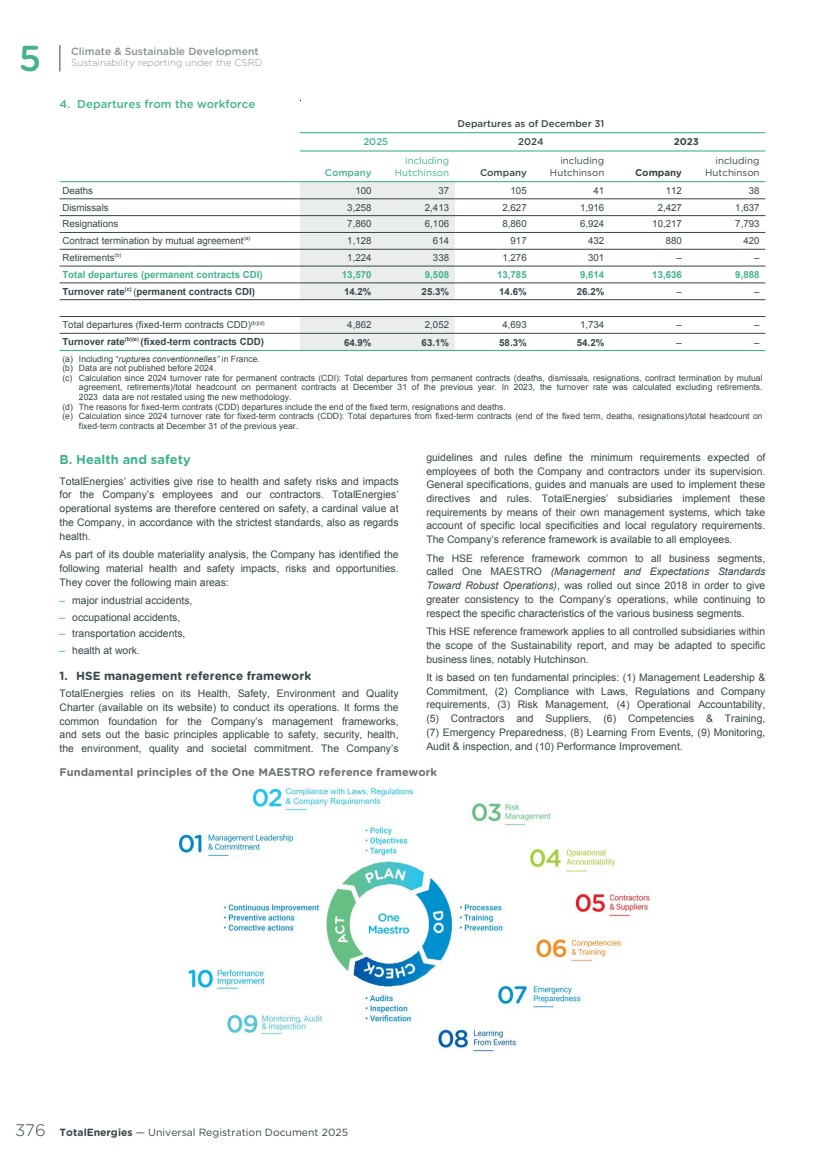
| In order to evaluate the implementation of this framework, TotalEnergies’ subsidiaries operating sites are audited every three to five years. The periodicity of HSE audits is defined according to a risk-based approach, which takes into account, among other things, the results of previous HSE audits and the status of the corresponding action plans. In 2025, 41 HSE audits were conducted. The Company’s HSE audit protocol is based on the One MAESTRO framework, and includes among others the requirements of ISO 14001:2015 and ISO 45001:2018. The audit protocol is applied according to a risk-based approach during audits. In addition, the One MAESTRO framework provides that subsidiaries of TotalEnergies holding an interest in assets operated by third parties must promote the Company’s HSE requirements and best practices and use their best efforts to enable similar requirements to be adopted by the operator. It also provides that the HSE risks relating to these assets must be assessed at least every five years and that the TotalEnergies’ employees in charge of managing non-operated assets must be trained in HSE management. Assessing the risks relating to these assets provides the basis for promoting the Company’s HSE rules implemented by the asset manager, particularly during board meetings. This can also take place during technical assistance missions or through HSE audits or reviews, when these are provided for by a shareholders’ agreement. In 2025, the Company took part in 23 HSE audits of non-operated assets. HSE Training Whatever the nature of the health, safety and environmental risks, preventive actions require all employees to adhere to the Company’s HSE policy. To this end, TotalEnergies provides training intended for the various groups (new arrivals, managers, senior executives and directors) to establish a broad-based, consistent body of knowledge that is shared by everyone: – Safety Pass: these safety induction courses were started on January 1, 2018 for new arrivals. Various courses exist depending on the employee’s position and cover the Company’s main HSE risks, the risks linked to the site activities and those linked to the workplace. The theoretical content is supplemented by practical training in life-saving actions practices, – HSE for frontline managers: launched in 2025, this training program is aimed at frontline managers with current or future responsibilities in one of the Company’s entities. Delivered by trainers trained within the entities, this training takes place on site. Around 30 trainers and approximately 190 frontline managers were trained in 2025, – HSE for Managers is aimed at current or future operational or functional managers within one of the Company’s entities. This training was delivered in virtual classroom mode as well as face-to-face in 10 sessions in 2025, in which approximately 250 managers took part, – Safety Leadership for Executives is intended for the new Company’s senior executives. Its objective is to give new senior executives the tools allowing them to communicate and develop a safety culture within their organization. One session was held in 2025 to train 22 Company senior executives, – HSE training was also put in place for new subsidiary managers. In order to provide and reinforce knowledge of the reference framework, a knowledge evaluation tool of over 3,000 multiple-choice questions was developed in 2018 for use by HSE managers at subsidiaries, operated sites and their teams. The tool can also be used to determine a suitable training plan, if necessary. Approximately 50 evaluations were initiated in 2025, of which 9 were completed. HSE Division In coordination with the Company’s various businesses, the HSE Division coordinates the promotion and roll out of TotalEnergies’ policies to enable the subsidiaries’ HSE divisions to prevent or mitigate risks. Indicators are monitored so that the Company’s health and safety activities can be continuously adapted. General Management oversees the policy’s implementation with the support of the Strategy & Sustainability Division, whose Managing Director sits on the Executive Committee, and the HSE Division which reports to it. Before any final decision to invest in a construction project or acquire or sell a subsidiary, the proposals presented to the Company’s Risk Committee (Corisk) attended by the HSE Division, are assessed for health and safety risks. The HSE Division is responsible for the ongoing management of HSE issues, working with experts and specialists. The annual World Day for Safety is another key event. TotalEnergies also encourages and promotes its subsidiaries’ safety initiatives. Each year, the Company recognizes and awards a trophy to the best HSE initiative carried out in a subsidiary. Health and safety issues are an important part of social dialogue, as described in chapter 5.2.3.1-D. Health and safety objectives Our main health and safety objectives are: – preventing the occurrence of major industrial accidents, – zero fatal accidents, – continuous reduction of the TRIR, – maintaining the health of employees at work. These objectives are broken down into quantified targets. 2. Prevention of major industrial accidents Policy and action plan To prevent the occurrence of a major industrial accident such as an explosion, fire, leakage of hazardous products or mass leakage that might cause death, physical injury, large-scale pollution or pollution at an environmentally sensitive site, or important damage to property, TotalEnergies implements suitable risk management policies and measures which apply to its operated activities. At year-end 2025, in addition to its drilling and pipeline transportation operations, TotalEnergies had 175 operated sites and zones exposed to these risks. These correspond to all activities relating to hydrocarbon production, whether offshore or onshore, as well as Seveso classified industrial sites (upper and lower threshold) and their equivalents outside the European Union (181 sites at the end of 2024 and 177 at the end of 2023). The Company’s policy for the management of major industrial accident risks applies from the facilities design stage, as well as throughout their lifespan, in order to minimize the potential impacts associated with its activities. The policy is described in the One MAESTRO reference framework. It provides for the analysis of the risks related to the Company’s industrial operations at each operated site subject to these risks, based on incident scenarios for which the probability of occurrence and the severity of the consequences are assessed. Based on these parameters, a prioritization matrix is used to determine whether further measures are needed. These mainly concern measures to prevent accidents but also include mitigation measures (protection and mitigation). They are technical and organizational. These analyses are updated periodically, at least every five years, or when facilities are modified. Training on major accident risks is organized at head office and at subsidiary sites for operating staff. The design and construction of facilities are subjected to technical standards that include applicable regulatory requirements and refer to industry best practices. The construction of the Company’s facilities is entrusted to qualified contractors who undergo a demanding internal selection process and who are monitored. In the event of a modification to a facility, the Company’s rules define the management process to be adopted. Climate & Sustainable Development Sustainability reporting under the CSRD 5 TotalEnergies — Universal Registration Document 2025 377 |
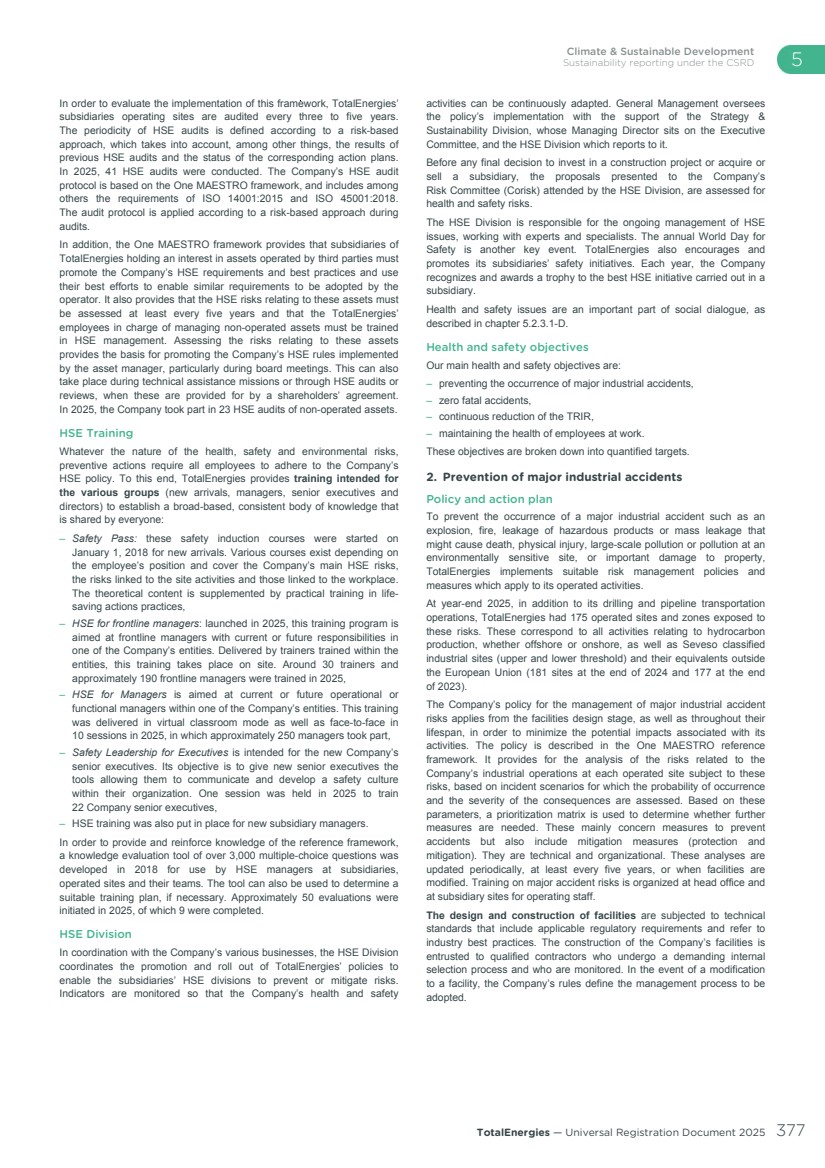
| The management of operations and integrity of facilities operated by the Company, are subjected to formal rules set out to prevent specific risks that have been identified either by means of risk analyses or from internal and industry feedback. For specific works, the preliminary risk analysis may lead to the establishment of a work permit, the process of which, from preparation through to closure, is defined. The Company’s reference framework also provides a process to manage the integrity of facilities, which includes, for example, preventive maintenance, facility inspections, identification of safety critical equipment for special monitoring, management of anomalies and downgraded situations and regular audits. All these rules are part of the One MAESTRO reference framework. Operations teams receive regular training in the management of operations in the form of companionship or in-person trainings. The Company implements a pipeline integrity management policy to prevent losses of containment and maintain operational safety and environmental protection. These measures cover the entire life cycle of the equipments, from design to end of service, and are based on internal standards aligned with international norms. This policy includes regularly updated risk assessments, monitoring of operating conditions, regular inspections such as cathodic protection checks or inspections using instrumented pigging systems, and visual monitoring of facilities and their immediate surroundings. For the structures concerned, monitoring and marking the pipeline route, awareness-raising campaigns, and advance notification of construction work help prevent damage by third parties during construction. All of these actions are planned as part of pipeline monitoring, inspection, and maintenance programs. Inspections and their frequency are reinforced in areas with high human or environmental risks identified by the risk analysis. These plans are regularly reviewed following the analysis of internal and external incidents and the sharing of feedback. Finally, pipelines are integrated into the Company’s overall crisis management system. For wells in the Exploration & Production segment, the integrity management process follows the same general principles described above, with the additional use of a digital platform allowing the continuous monitoring of the status of well barriers (compliant or non-compliant), and systematic reporting to the specialists at headquarters of any non-compliance identified during barrier tests, including the associated risk analyses. In order to deal effectively with the consequences of a major industrial accident, TotalEnergies has for several years implemented a global crisis management system based on the following elements: an on-call system available 24/7 in all the Company’s entities (subsidiaries, branches and head office), a process for rating incidents and triggering alerts, an emergency management system deployed in each subsidiary which includes regular training (individual courses and annual training sessions), dedicated equipment or equipment that can be quickly mobilized. At head office, a dedicated crisis management area can handle two major crises simultaneously, if necessary. Teams are trained to act in each of the crisis cell’s functions. The standards clearly stipulate that subsidiaries must have response plans and procedures in place in the event of accidents such as leaks, fires, explosions, or transport accidents. Large-scale exercises are organized by subsidiaries exposed to significant technological or envrionment risks to train and test their crisis management systems. These are supplemented by regular safety drills (e.g., fire drills, evacuation drills) carried out at site level. The response teams at subsidiaries and at head office practice their crisis management activities regularly based on scenarios identified by the risk analyses. These personnel may follow dedicated training depending on their specific functions. In 2025, 763 individuals completed crisis management training in subsidiaries and at head office. TotalEnergies also continued to roll out its Incident Management System (IMS) in subsidiaries operating liquid hydrocarbon or natural gas exploration or production sites in the Exploration & Production, Integrated LNG and Integrated Power segments. The IMS is a harmonized system for the management of emergency situations described by a good practices guide produced by the International Petroleum Industry Environmental Conservation Association (IPIECA) and increasingly being adopted by the major operators. In 2025, 228 employees were trained in the IMS and six Exploration & Production subsidiaries carried out a large-scale application exercise, bringing the total number of trained employees to 1,529 and the number of subsidiaries where the IMS is deployed to 25. Lastly, in 2025, TotalEnergies continued to strengthen its business continuity system which includes a Company reference framework, onsite and remote training and a network of correspondents in all entities. Resources The HSE Division provides assistance and expertise in analysis and control of technological risks. The Company can also draw on One Tech’s technical expertise, particularly in safety engineering and technical integrity management. The Company is actively represented in international associations in the field of major accident risk management (for example: EPSC – European Process Safety Centre, CCPS – Chemical Center for Process Safety, FABIG – Fire and Blast Information Group, IOGP – International Oil & Gas Producers...) to exchange good practices in controlling major accident risks. In 2025, World Day for Safety focused once again on technological risks with the theme “Critical barriers and management of downgraded situations”. Major accident prevention indicators In the prevention of major industrial accidents, TotalEnergies monitors the number of Tier 1 and Tier 2 losses of primary containment as defined by the American Petroleum Institute (API) and the International Association of Oil & Gas Producers (IOGP). After reaching its target in 2024, the Company strengthened its requirements and set itself a new target for Tier 1 and Tier 2 events’ number below 40 in 2025. This objective was achieved. The Company recorded no Tier 1 or Tier 2 event due to acts of sabotage or theft in 2025. Losses of primary containment(a) 2025 2024 2023 Losses of primary containment (Tier 1) 8 14 19 Losses of primary containment (Tier 2) 26 25 29 Losses of primary containment (Tier 1 and Tier 2) 34 39 48 (a) Tier 1 and Tier 2: indicator of the number of losses of primary containment with more or less significant consequences (fires, explosions, injuries, etc.), as defined by API 754 (for downstream) and IOGP 456 (for upstream). Excluding acts of sabotage and theft. The scope of application is defined in the standards cited. Tier 1 and 2 events had moderate consequences in terms of safety and environment (lost time injuries, minor fires or pollution). 3. Prevention of occupational accidents Policy The Company has a policy for the prevention of occupational accidents which applies to all subsidiaries’ and contractors’ employees working on a site operated by one of these subsidiaries. The safety results are monitored with the same attention to all workers. This policy is described in the One MAESTRO reference framework. 5 Climate & Sustainable Development Sustainability reporting under the CSRD 378 TotalEnergies — Universal Registration Document 2025 |
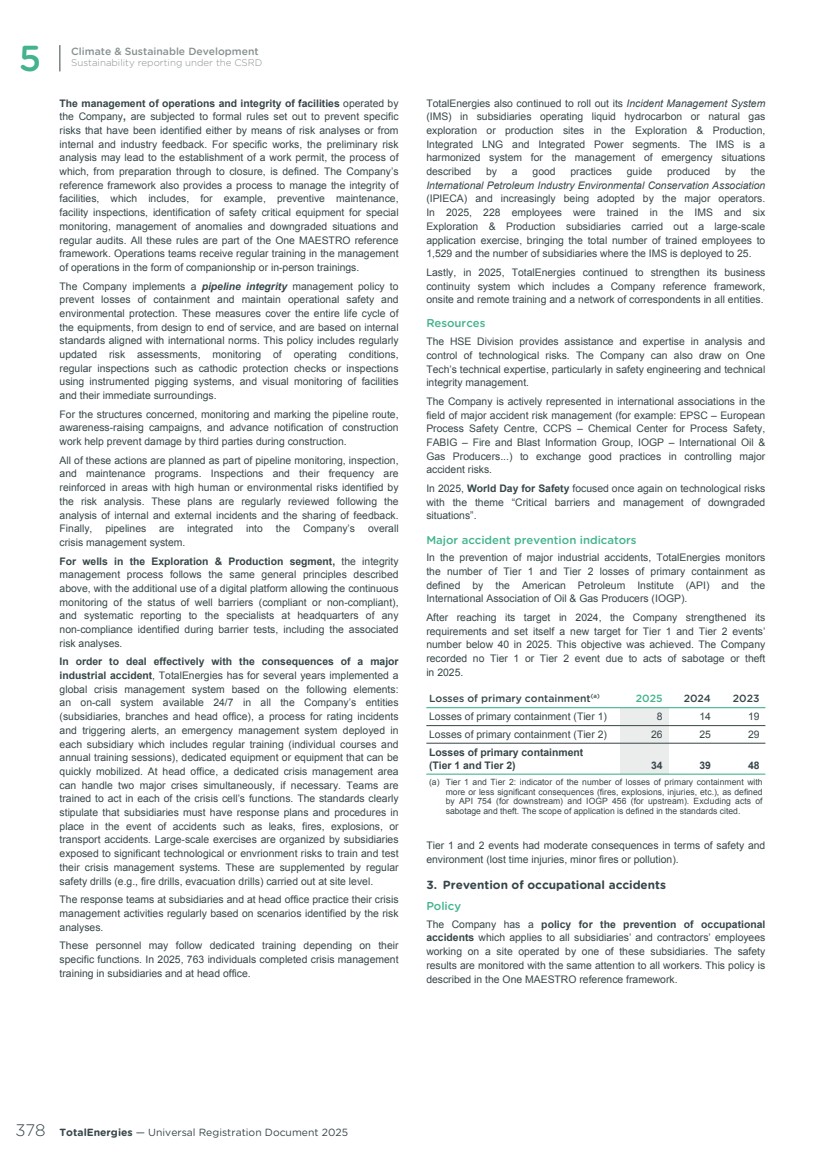
| As part of the policy for preventing workplace accidents, TotalEnergies has defined rules and guidelines for HSE training, personal protective equipment and high-risk operations for Company employees and contractors working on sites operated by the Company. In addition to its One MAESTRO reference framework, the Company has applied 12 Golden Rules for safety at work since 2010. These simple Golden Rules, which can be memorized by everyone and are representative of a high number of workplace accidents, must be strictly applied by all personnel, both employees and contractors, in all countries and in all the Company’s activities. The purpose of the Golden Rules is to protect day-to-day safety in operations and on sites with a common objective: “Zero fatal accidents”. In 2022, TotalEnergies reviewed the drafting of its Golden Rules to make them more readily understandable by workers on site and to facilitate their appropriation. The Golden Rules were widely distributed to both employees and contractors supported by numerous communication media to anchor these new Golden Rules and enable their discussion and appropriation by the teams in subsidiaries. Finally, safety, as a value of TotalEnergies, is taken into account in the employee compensation policy (refer to point 5.2.3.1 C.). Action plan In order to keep moving its practices forward, TotalEnergies also implements a process for analyzing accidents, irrespective of their nature, adapting the method used and the level of detail to the event’s actual or potential level of severity. A return on experience may include an analysis of the incident including severity and result in communication to the relevant stakeholders or a wider population within the Company. The purpose of sharing return on experience is to ensure that subsidiaries are informed and share lessons learned from the incident. By way of example, a near miss with high severity potential is treated as a severe accident, and its analysis is considered an essential factor for progress. Depending on its relevance to other Company entities, it will trigger a safety alert and, depending on the circumstances, the circulation of lessons learned and updating of the reference framework. The reporting of anomalies and near misses (more than 1,000,000 in 2025) is strongly encouraged and is permanently monitored. The involvement of each employee in identifying anomalies and dangerous situations is an indicator of employees’ vigilance in accident prevention and reflects the Company’s safety culture. The Stop Card system also enables any employee of the Company or of a contractor to intervene if, for example, any of the Golden Rules is not complied with. Starting in 2019, the Company also rolled out “Our Lives First” program, which introduced joint safety tours with contractors (more than 13,000 carried out on the Company’s sites in 2025), the establishment, in the work permit process, of a pre-work routine on all operated sites concerned (Safety Green Light); and a tool (Life Saving Checks) to intensify checks in the field and gauge compliance with safety rules for the five high-risk activities: work at height, lifting operations, work on energized systems, work in confined spaces, hot work. More than 280,000 compliance checks were carried out on the Company’s sites in 2025). The “Our Lives First” program was revitalized in 2024 through a communications campaign designed to strengthen its foothold in the Company. The proper implementation of the One MAESTRO reference framework, and more generally, of all the Company’s occupational safety programs, is checked with site visits and audits. Contractors are subject to particular attention. Verification of their HSE commitment involves a rigorous qualification process. The reference framework states that for a contractor to be authorized to carry out high risk work on a site operated by a Company subsidiary, its HSE management system needs to be certified by a recognized third-party body or be inspected for compliance. Finally, the contract award process is also based on a selection phase allowing checking that specific HSE criteria are fully respected. As indicated above, a control program is also put in place to check that contracts are properly executed from an HSE point of perspective. For contractors with a high number of hours worked, a Safety Contract Owner can be appointed from among the senior executives of the Company’s segments or members of executive committees of Company subsidiaries to initiate high-level dialogue with the contractor’s management and increase the level of commitment and visibility on HSE issues. In addition to this management process, a safety induction is organized upon arrival on site. This step aims to ensure that each worker is aware of the specific risks of the site, the main safety rules, in particular the Golden Rules and site traffic rules, as well as emergency procedures. Various initiatives are highlighted in section 5.1.2.1. Resources The Company’s HSE Division includes specialists in high-risk operations (work at height, lifting, electricity, confined spaces, etc.), whose purpose is to consolidate in-house knowledge and relations with contractors, and to issue the relevant One MAESTRO rules. The HSE Division also provides support for subsidiaries in their own voluntary approach to strengthen their safety culture. This division also develops and disseminates tools to improve human performance by identifying the Organizational and Human Factors (OHF) of a work situation and defining appropriate measures. The implementation of these principles is promoted within the Company through dedicated modules integrated into the training programs for different populations and through specific training programs at the request of the subsidiaries. Security of operations Concerning security, the policy aims to protect the Company’s people and property from malicious intentions or acts. To achieve this, TotalEnergies relies on its Security Division, which draws up the Company’s reference framework and oversees the security situation in the countries in which it operates in order to determine general security measures to be adopted (such as authorization to travel). The Company’s security reference framework applies to all subsidiaries controlled by TotalEnergies. It provides that the security management system for subsidiaries must include the following stages: analysis of the threat, risk assessment, choice of a security posture, implementation of preventive or protective measures, control and reporting and then regular reviews. It must also comply with the requirements of local regulations. The framework requires each subsidiary to develop a security plan, operating procedures and an action plan. Within the framework of developing new activities, the Company’s Security Division recommends the organization and resources to be deployed in connection with the business segments. In each country in which TotalEnergies operates, the Country Chair is responsible for the security of operations in the country. The Country Chair ensures the deployment of measures and resources, with the support of a Country Security Officer. Subsidiaries’ management systems and security plans are checked regularly by the Company’s Security Division or the Country Chair. Awareness raising and training programs and a centralized system for reporting security events are organized by the Company’s Security Division. Occupational safety indicators The indicators tracked by TotalEnergies in relation to occupational accident prevention cover accidents to its salaried and non-salaried employees (temporary workers, etc.) as well as to employees of external contractors, whether they occur on site at the workplace or in the event of an industrial accident or during transportation under long-term contracts. Climate & Sustainable Development Sustainability reporting under the CSRD 5 TotalEnergies — Universal Registration Document 2025 379 |
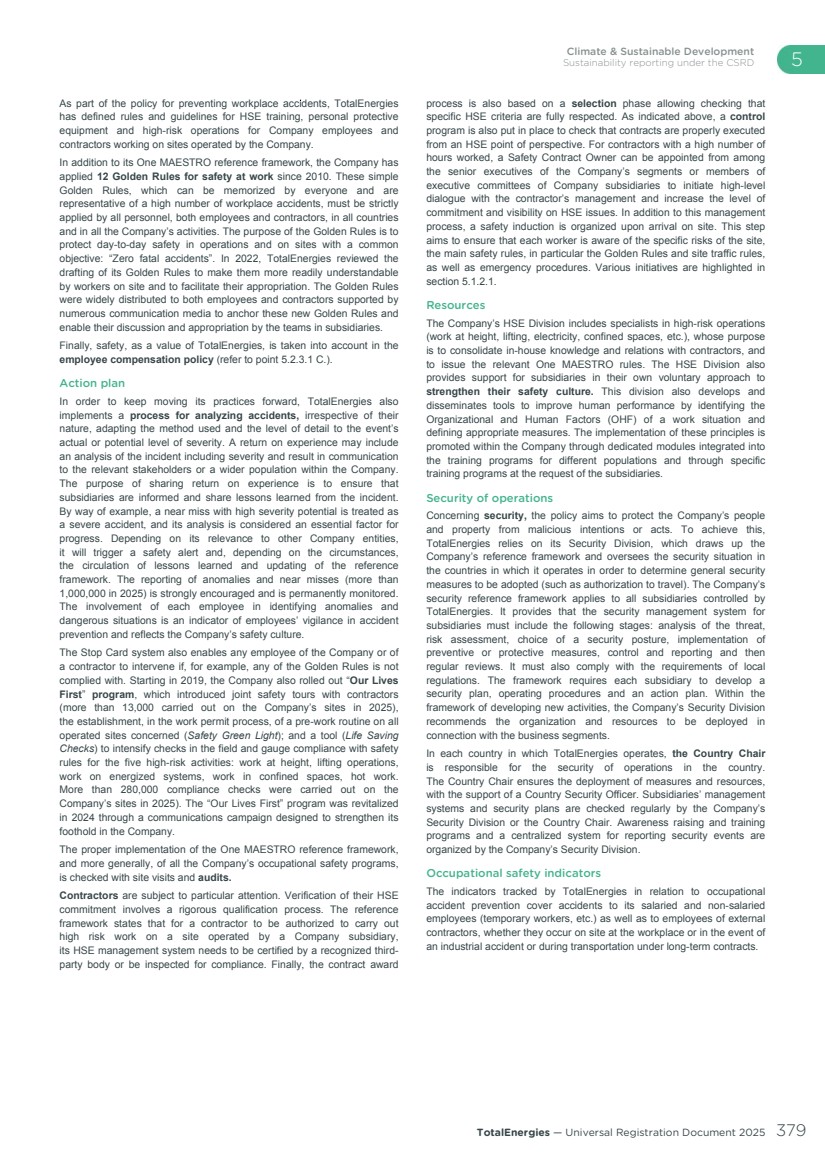
| In addition to its aim of zero fatalities in the exercise of its activities, TotalEnergies has set itself the target of continuously reducing the TRIR indicator and, for 2025, reducing it below 0.60 for all personnel of the Company and its contractors. This target was achieved for 2025. Occupational Safety indicators 2025 2024 2023 Health and safety management system coverage rate(a) 90% 91% 91% of which coverage of operating activities(b) 100% 100% 100% Millions of hours worked – All Personnel 405 400 400 Company employees 216 216 212 Contractors’ personnel 189 184 188 Number of occupational fatalities(c) – All employees 1 1 2 Company employees 0 0 0 Contractors’ personnel 1 1 2 Number of occupational fatalities(c) per hundred million hours worked – All Personnel 0.25 0.25 0.50 Company employees 0.00 0.00 0.00 Contractors’ personnel 0.53 0.54 1.06 Number of occupational injuries – All personnel 191 219 252 Company employees 95 95 108 Contractors’ personnel 96 124 144 TRIR(d): number of recorded injuries per million hours worked – All Personnel 0.47 0.55 0.63 Company employees 0.44 0.44 0.51 Contractors’ personnel 0.51 0.67 0.77 LTIR(e): number of lost time injuries per million hours worked – All Personnel 0.36 0.35 0.40 Company employees 0.36 0.33 0.42 Contractors’ personnel 0.36 0.39 0.38 Number of lost days due to accidents at work – All personnel 6,281 6,002 4,800 Company employees 2,631 2,621 2,508 Contractors’ personnel 3,650 3,381 2,292 LTIS(f): number of days lost due to accidents at work(g) per million hours worked – All personnel 16 15 12 Company employees 12 12 12 Contractors’ personnel 19 18 12 Number of reported near misses and anomalies 1,024,000 998,000 893,000 (a) Percentage of personnel covered by a health and safety management system based on legal requirements and/or recognized standards or guidelines such as ONE MAESTRO or its equivalents (calculation based on hours worked). (b) Excluding headquarters activities, services activities and trading activities. (c) Excluding occupational illnesses, for which the link with a possible fatality is a matter of medical confidentiality. (d) TRIR: Total Recordable Injury Rate. (e) LTIR: Lost Time Injury Rate. (f) LTIS: Lost Time Injury Severity. (g) Excluding occupational illnesses, as the cause of absenteeism is a matter of medical confidentiality. In 2025, of the 191 recordable accidents reported, 188 were related to workplace accidents. 75% of accidents occurred while walking, handling loads or objects, using portable tools or working on an energized system. The Company’s efforts on safety allowed it to reduce the TRIR by more than 60% between 2015 and 2025. This improvement is attributable to constant efforts in safety and, specifically: – preventing the risks of serious and fatal accidents through campaigns addressing road transport and high-risk work; – the implementation of the HSE rules and guides, which are regularly updated and audited; – safety training and awareness raising for all levels of management (special training for managers, World Day for Safety); – HSE communication efforts targeting all Company personnel; – the maintaining of HSE objectives in the employee compensation policy (refer to point 5.2.3.1-C). Despite the measures implemented and detailed below, there was regrettably one fatal accident among contractors’ personnel in 2025. In May, in Angola, while unloading drill pipes onto a supply vessel, once the pipes had been placed and the slings unhooked, they rolled towards two crew members of the company operating the vessel. One crew member lost his life and another was injured in the leg. Specific recommendations have been issued regarding the strengthening of loading/unloading procedures, including the stabilization of loads after lifting, the implementation of secure storage systems for tube bundles, and the strengthening of prevention measures on logistics vessels. 4. Prevention of transportation accidents Policy In road transportation, the Company has for many years applied a policy intended to reduce the number of accidents by applying standards that are, in some cases, more stringent than certain local regulations. This policy, defined in the One MAESTRO reference framework, applies to all the Company’s personnel and Company entities’ contractors. For example, it includes a ban on telephoning while driving, even with a hands-free set, a ban on using motorized two-wheeled vehicles for business travel, mandatory training for drivers, and the definition of strict technical specifications for Company vehicles (in particular, light vehicles must pass Euro New Car Assessment Programs - 5 stars tests). Additional requirements are defined according to the level of road traffic risks in the country in question and the nature of the activity. 5 Climate & Sustainable Development Sustainability reporting under the CSRD 380 TotalEnergies — Universal Registration Document 2025 |
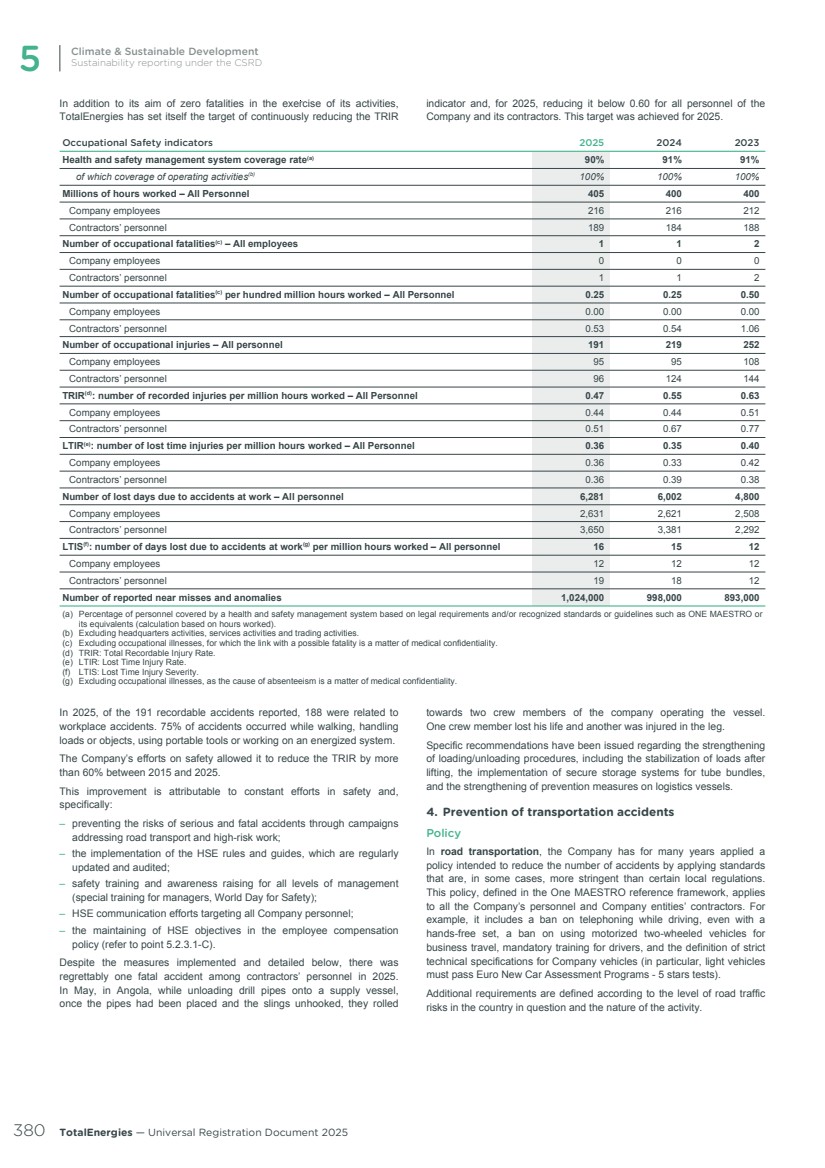
| In maritime and inland waterways transportation, the process and criteria for selecting ships and barges are defined by the teams in charge of vetting. These criteria account of the ship or barge and its crew, ensuring that the crew has the qualifications and training required under the STCW (Standards of Training, Certification and Watchkeeping for Seafarers) convention as well as a minimum of experience. The same teams also check the application of the safety management system defined for ships by the ISM (International Safety Management) Code of the IMO (International Maritime Organization) and industry recommendations such as OCIMF (Oil Companies International Marine Forum) and SIGTTO (Society of International Gas Tanker and Terminal Operators), including those that take account of the human and organizational factors. TotalEnergies’ chartering contracts also require that the crew belong to a recognized trade union affiliated to the ITF (International Transport Workers’ Federation). The ITF represents the interests of transportation workers’ unions in bodies that make decisions about jobs, conditions of employment or safety in the transportation segment such as the International Labour Organization (ILO) or the IMO. The average age of the TotalEnergies’ mid-term and long-term chartered fleet of oil & gas tankers is 7 years in 2025. In air transportation, a carrier selection process limits the risks relating to travel by Company and contractors’ employees, if their journey is organized by TotalEnergies. This process is based on data from recognized international organizations: ICAO (International Civil Aviation Organization), IOSA (IATA Operational Safety Audit), IOGP (International Association of Oil and Gas Producers), and civil aviation authorities’ recommendations. Airlines that do not have a rating from an international body are assessed by an independent body commissioned by the Company. For chartered flights, TotalEnergies’ Aeronautical Technical center participates in the selection process of air operators. It audits and inspects these operators on a regular basis. Action plan Since 2012, a large-scale inspection program of transportation contractors has also been rolled out by Marketing & Services, the segment with the greatest use of road transportation within the Company, with the delivery of products to service stations and consumers. This program has been extended to the product transportation activities of the Polymers Division of the Refining & Chemicals segment, to the liquid sulfur transportation activities of the Integrated LNG segment and is being progressively extended to the Exploration & Production segment. The program calls on independent transportation experts who inspect the transportation contractors’ practices and processes in the recruitment and training of drivers, vehicle inspections and maintenance, route management, and the HSE management system. After inspection, an action plan is adopted. If there is a serious shortcoming or repeated poor results, the transportation contractor may be excluded from the list of approved transportation contractors. There has also been a training center in Radès in Tunisia since 2015 welcoming subsidiaries’ employees as well as road transportation contractors working for the Company that are interested in the transportation trainings offered by Marketing & Services. Based on the use of new technologies to prevent road accidents, TotalEnergies internal rules require all new heavy vehicles in the Marketing & Services segment to be equipped with certain driver assistance systems(1) wherever these technologies are offered by manufacturers. The decision was also made to generalize the use of fatigue and distraction detection systems throughout Company, after conclusive tests carried out over several months on heavy vehicles in the Africa Marketing & Services zone. The deployment of these devices has been completed wherever regulations permit it. However, some countries are still encountering regulatory difficulties regarding their implementation, and appropriate solutions are currently being developed on a case-by-case basis. The Company’s Rules also require all the Company’s light vehicles, as well as the contractors’ dedicated light vehicles, to be equipped with the same devices during fleet renewals. The third SafeDriver campaign, entitled “All SafeDrivers”, ended in 2024. In 2025, prevention video spots called SafeTips were launched on specific topics such as “Foot on the brake,” “See and be seen,” and “Fatigue at the wheel.” The creation and distribution of these spots will continue in 2026. In addition, a fourth SafeDriver awareness campaign is currently being considered for 2026. Transportation accident prevention indicators To measure the results of its policy for the prevention of road transportation accidents, TotalEnergies has for many years monitored the number of severe road accidents involving its own employees and those of its contractors. Over the past five years, the 41% reduction in the number of severe road accidents testifies to the efforts made, thanks, in particular, to prevention campaigns for heavy goods truck drivers. Number of severe road accidents(a) 2025 2024 2023 Light vehicles and people transportation(b) 3 4 4 Heavy goods vehicles (trucks)(b) 13 9 7 (a) Overturned vehicle or other accident resulting in the injury of a crew member or a passenger (recordable accident). (b) TotalEnergies’ vehicles or vehicles under long-term contract (over 6 months) with TotalEnergies. 5. Prevention of risks to health in the workplace General policy relating to occupational health The health directive contains requirements regarding occupational health which apply to TotalEnergies’ employees in the context of their professional activity, as well as to the employees of contractors working on the Company’s sites. The aim of occupational health protection is to preserve the mental and physical health of the Company’s employees by implementing an appropriate risk analysis and prevention policy. It also aims to guarantee their fitness for work and to prevent accidents at work and occupational diseases. The Company has also included the preservation of the mental and physical health of all employees worldwide in its Care Together by TotalEnergies program (refer to point 5.2.3.1 C.). a. Physical health Action plan To prevent occupational health risks, the One MAESTRO framework provides that subsidiaries of the Company identify and assess risks in the workplace in the short, medium and long term. The framework provides guides for implementation. The analysis of these health risks relates to chemical, physical, biological, ergonomic and psychosocial risks. This results in the roll-out of an action plan. An Industrial Health correspondent in subsidiaries is identified and tasked with implementing the policy for identifying and assessing work-related health risks. The actions are integrated into the entities’ HSE action plans and can be audited as part of the One MAESTRO audits. (1) Such as AEB (advanced emergency braking), LDW (lane departure warning) and EBS (electronic braking system) for motor vehicles and RSS (roll stability support) for semi-trailers. Climate & Sustainable Development Sustainability reporting under the CSRD 5 TotalEnergies — Universal Registration Document 2025 381 |
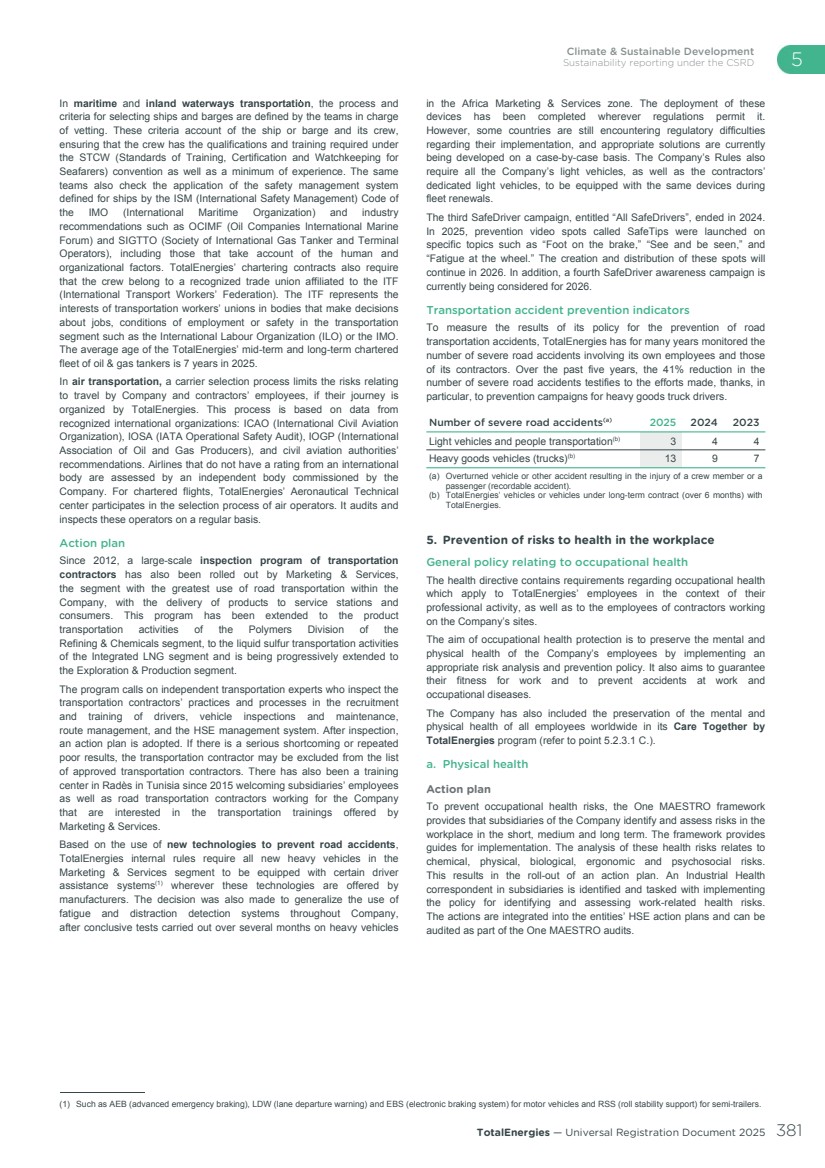
| In general, potential exposure to chemical or hazardous products at a site operated by a Company entity or nearby is one of the most closely monitored risks in view of the potential consequences. New facility construction projects comply with international technical standards from the design stage in order to limit exposure. For production sites operated by a Company entity and subject to this risk, the One MAESTRO reference framework sets out the prevention process in several stages: – first, hazardous products such as carcinogenic, mutagenic and reprotoxic products (CMR) are listed and their risks identified, – second, potential exposure to levels that may present a risk to the health of personnel, contractors or local residents at the site or nearby are identified and assessed, and prevention or mitigation measures are implemented to control the risk, – last, the approach is checked (atmospheric checks, specific medical monitoring, audits etc.) to ensure its effectiveness and implement improvement measures if necessary. This is also set out formally in a risk assessment file, which is revised regularly by the subsidiary. An annual Industrial Hygiene survey is sent to the Company’s subsidiaries to evaluate the rate of implementation of risk analyses in the workplace, to make sure any potential exposure has been identified, and that action plans are in place. The Company provides its subsidiaries with a guide to best practice in assessing the risk of musculoskeletal disorders (MSDs). It helps subsidiaries’ HSE departments implement ergonomic risk management measures and offers employees training in the prevention of musculoskeletal disorders. In addition to the One MAESTRO reference framework, the Company has adopted a health directive. In medical monitoring, the Care Together by TotalEnergies program (refer to point 5.2.3.1 C.) provides that each subsidiary offer its employees a regular medical checkup that includes the prevention or early detection of disease. The formal medical monitoring procedure takes account of the requirements of local law (frequency, type of examination, etc.) and the level of exposure of its personnel to the various risks. Medical monitoring of employees is conducted at a health department, either internal or external. On a broader level, TotalEnergies also supports the promotion of individual and collective health programs in the countries where it operates, including vaccination campaigns and screening programs for certain diseases (AIDS, cancer, malaria, etc.) for employees, their families and local communities. It also develops social protection schemes and takes regular action to raise awareness of health-related risks, particularly in connection with the health topics addressed during World Mental Health Day, World Heart Day, etc. In 2025, an awareness campaign on women’s and men’s cancers was organized in the form of an Octobre Rose-Movember Challenge. This initiative, conducted in October and November, aims to encourage employees to take care of their health. The Company has set up scientific and legal watch teams to monitor global health situations (EBOLA, MPOX, etc.). Resources The Company has a dedicated organization for implementing its health directive. Active monitoring is carried out, and health issues are regularly addressed within networks of major international groups. A Medical Advisory Committee, bringing together external scientific experts as well as internal leaders and stakeholders, regularly reviews health topics related to the Company’s activities and may decide on additional prevention measures. A health steering body ensures the overall governance of these matters. Furthermore, in view of its activities and exposure, TotalEnergies has an international medical department that designs, coordinates and supervises operational medical logistics overseas. It is the decision-making body for the medical safety of expatriate and national employees. For foreign subsidiaries, it coordinates health services, employee aptitude assessments, medical monitoring and support for employees and expatriates’ families, and medical evacuations. It also assesses medical facilities in TotalEnergies’ host countries and issues recommendations. b. Mental health Policy TotalEnergies aims to develop a culture promoting well-being at work and encourages openness and dialogue on mental health. As part of its health directive, the Company has implemented a Mental Health Risks (MHR) prevention program aimed at protecting employees’ mental health, and has introduced a global program to enable all exposed employees to receive support, wherever they are in the world. The program is managed by the People & Social Engagement Division, which relies on MHR officers appointed in each TotalEnergies business segment, and on local MHR prevention committees consisting of employer and employee representatives. Any employee can volunteer to take part in these committees and contribute to the definition and development of local mental health initiatives. This allows mental health programs to be adapted to the local contexts. Action plan The program is based on three levels. – Primary prevention consists of systematically assessing the mental health risks in the workplace and the impacts of reorganizations on mental health, using a methodology based on the One MAESTRO reference framework, to take action at the source, or reduce or eliminate any potential risk. – Secondary prevention consists of raising awareness among all employees with a mental health risk prevention kit. This kit, the primary supporting material for all training, has been translated into eleven languages and approved by international experts. It consists of a methodological guide for site managers and two practical guides for managers and employees. After a definition of the MHRs and risk factors for mental health, it presents the impacts and human and societal issues connected to MHRs and a methodology to prevent them in the workplace. Finally, it contains practical fact sheets for use in the event of difficulties, high-risk situations or crises. Aware of the key role played by managers in the psychological equilibrium and mental health of their employees, the Company is making them aware of their role in preventing these risks on a daily basis and of the impact of the working environment on their teams’ well-being. Training in the prevention of mental health risks (e-learning and educational videos) is available to everyone on the Company’s training platform. It addresses in particular the themes of stress, both moral and sexual harassment, and burn-out. In 2025, the Company developed a training program exclusively for MHR officers to establish a common skills base and strengthen their ability to support employees experiencing distress. Since 2023, the Company provides “First Aid in Mental Health” training to improve understanding of psychological difficulties, help people provide the right initial response and redirect cases to the appropriate contacts. Following a pilot scheme deployed in France for health stakeholders and employee representatives, this training (currently in French only) is now made available to all employees. 5 Climate & Sustainable Development Sustainability reporting under the CSRD 382 TotalEnergies — Universal Registration Document 2025 |
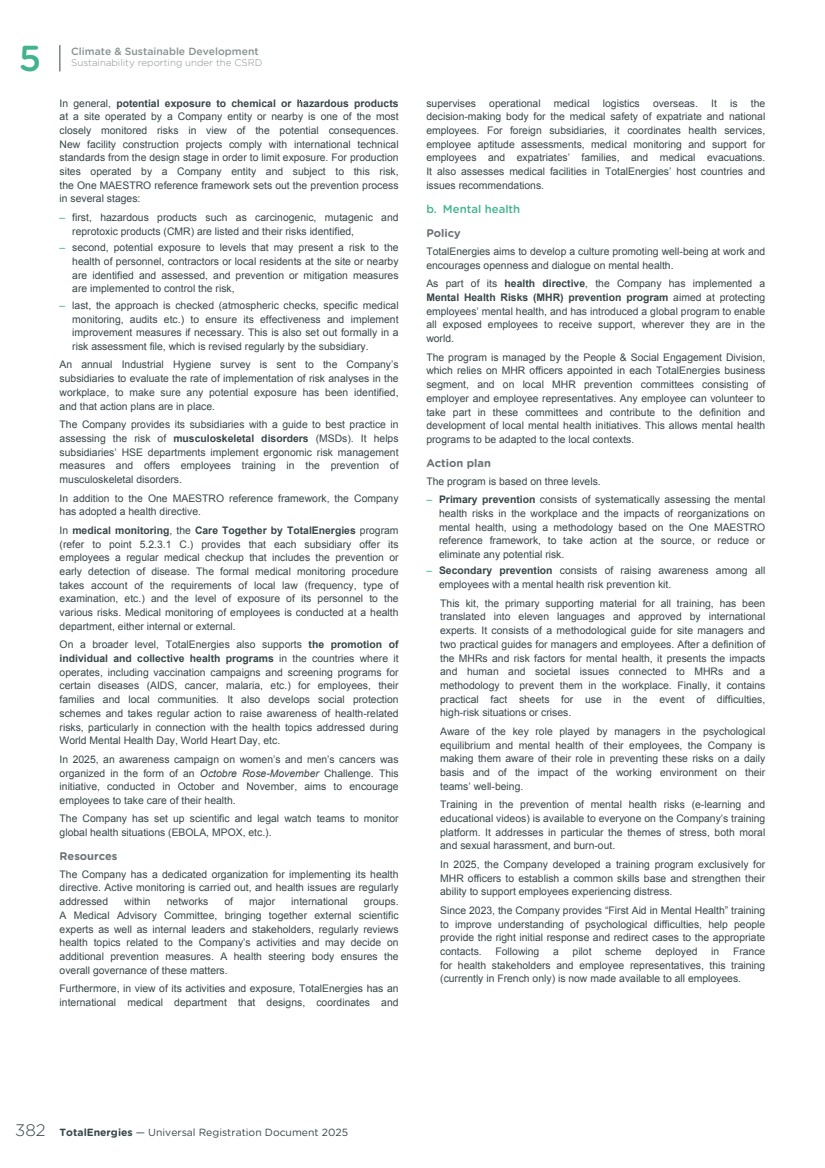
| In pursuit of openness and dialogue about mental health, the Company provides its employees with a link to a platform giving access to scientifically validated questionnaires by recognized organizations for individual measurements of stress, anxiety and depression, and for collective assessment of MHR factors in the working environment. Consequently, MHR officers can manage the prevention of MHRs themselves in order to reduce their impacts on mental health, working as closely as possible to the employees. – Tertiary prevention, provided by international experts, offers help and support to all employees, in more than 60 languages and cultures, on a free 24/7 hotline (also accessible to employees of contractors) and up to three video-consultations paid for by the Company. This system guarantees anonymity, confidentiality and the security of personal data during the entire period of support. It is easily accessible on the Company’s intranet. The Health Steering Committee checked the progress of the system’s roll-out within each business segment. These physical and mental health commitments are included in the Health pillar of the Care Together by TotalEnergies program (refer to point 5.2.3.1 C.). Indicators for prevention of risks to health in the workplace - WHRS 2025 2024 2023 Health risk assessment(a) Entities having carried out workplace health risk analysis 99% 97% 92% Well-being at work % of subsidiaries that have deployed a help system 93% 91% 87% % of subsidiaries that have measured stress over the last two years(b) 46% 56% 55% Mental health risks % of subsidiaries that have appointed a Mental Health Risks Officer 94% 94% 100% % of subsidiaries with a Mental Health Risk Prevention Committee 80% 81% 65% % of managers trained in Mental Health Risk prevention 60% 53% 49% Medical monitoring % of employees with specific occupational risks benefiting from regular medical monitoring 100% 99% 100% % of subsidiaries offering a regular medical check-up 94% 92%(c) 74% Occupational illnesses Number of occupational illnesses recorded in the year (in accordance with local regulations) 160 170 107 including musculoskeletal disorders 64% 65% 69% Absenteeism Absenteeism for medical reasons 4.1% 4.0% 4.0% (a) Data provided by the Industrial Hygiene survey before 2024. Since 2024, data provided by the WHRS. (b) Since 2023, the TotalEnergies Survey and Pulse Survey have measured the annual level of employee well-being at work (Care Score 2025: 83.4% – refer to point 5.2.3.1-C). The decision to carry out an additional stress assessment is left to the discretion of the subsidiaries. (c) 2024 data restated to take into account all local regulations effective from 2024. C. Working conditions and environment To implement its balanced multi-energy strategy for the benefit of the energy transition, TotalEnergies has defined a people ambition for its employees. Deployed from 2019 under the name Better Together, it aims to attract and develop talent all over the world, promote a management style that encourages team development and make the Company a good place to work together. This translates into a competitive compensation and benefits policy, skills development programs and the promotion of high social standards worldwide, based on four pillars: social protection, physical and mental health, family sphere, and working environment and ways of working. The Company is convinced that talent diversity is crucial to the success of the transition on which it has embarked and therefore promotes diversity as well as equal treatment and opportunities. To fulfill its social responsibility commitments, TotalEnergies relies on its People & Social Engagement Division, whose mission is to define and present the Company’s human resources strategy and policies for approval by the Executive Committee, in line with its business challenges and transition strategy. The social dialogue and the human rights aspects of working conditions and the working environment are dealt with in points 5.2.3.1 D. and 5.2.3.1 E. 1. Quality of life at work and employee well-being a. Care Together by TotalEnergies program As part of its ambition to build a good place to work together, the Company has the Care Together by TotalEnergies program. It translates TotalEnergies’ CSR commitments and promotes high social standards for all employees worldwide, regardless of local legislation. Climate & Sustainable Development Sustainability reporting under the CSRD 5 TotalEnergies — Universal Registration Document 2025 383 |
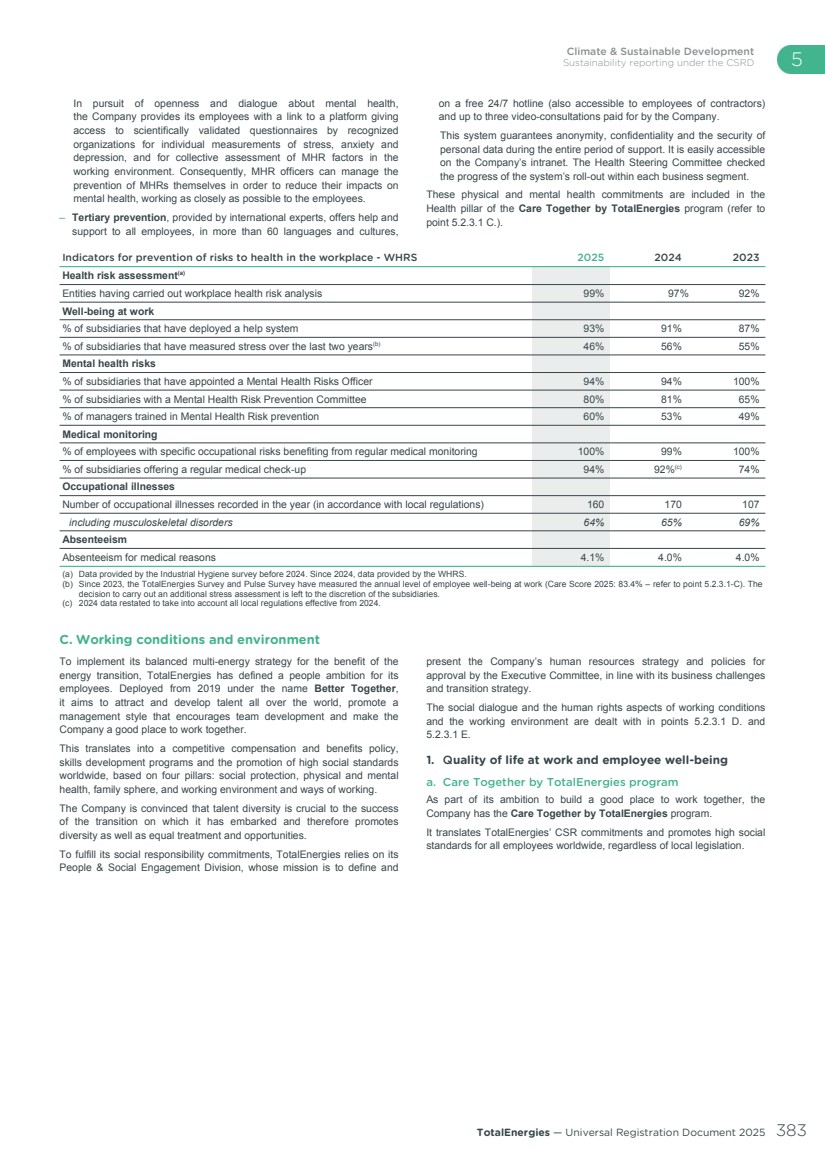
| The program is based on four pillars: Resources The People & Social Engagement Division coordinates the promotion and deployment of the Care Together by TotalEnergies program, supporting the human resources functions of the Company’s business segments and subsidiaries. Action plan Social protection Our worldwide commitments Ensure a living wage and quality social protection for all employees, regardless of their location (refer to point 5.2.3.1 C. 3.) ● Ensure all employees have direct remuneration at least equal to the living wage of the country or region in which they work ● Where appropriate, set up a health insurance plan or a corporate supplementary regime, in addition to the legal plans in force ● Set up a death benefit plan, whatever the cause, at least equivalent to two years’ gross reference salary Health Our worldwide commitments Preserve the physical and mental health of all employees worldwide (refer to point 5.2.3.1 B. 5.) ● Provide medical monitoring for all employees exposed to an occupational risk that may have harmful effects on their physical and mental health ● Propose to employees a regular health check-up ● Deploy a global policy for the prevention of psychosocial risks to protect the mental health of employees Family sphere Our worldwide commitments Give employees the opportunity to take care of their families For situations of pregnancy or adoption: ● Guarantee a minimum of 14 weeks of childcare leave for the first parent and 2 weeks for the second parent with 100% retention of their basic salary (subject to more protective local measures) ● Neutralize absences for childcare leave by granting the first parent to return from leave an increase equal to the average of individual increases received over the last three years Working environment and ways of working Our worldwide commitments Promote a flexible, modern and attractive work organization for employees while preserving collective efficiency in a safe working environment ● Generalize the use of flexible working hours by establishing clear rules and trust employees to take responsibility for the way they manage remote working as part of their day-to-day activities ● Conduct information campaigns and awareness-raising initiatives on employee well-being and work-life balance 5 Climate & Sustainable Development Sustainability reporting under the CSRD 384 TotalEnergies — Universal Registration Document 2025 |
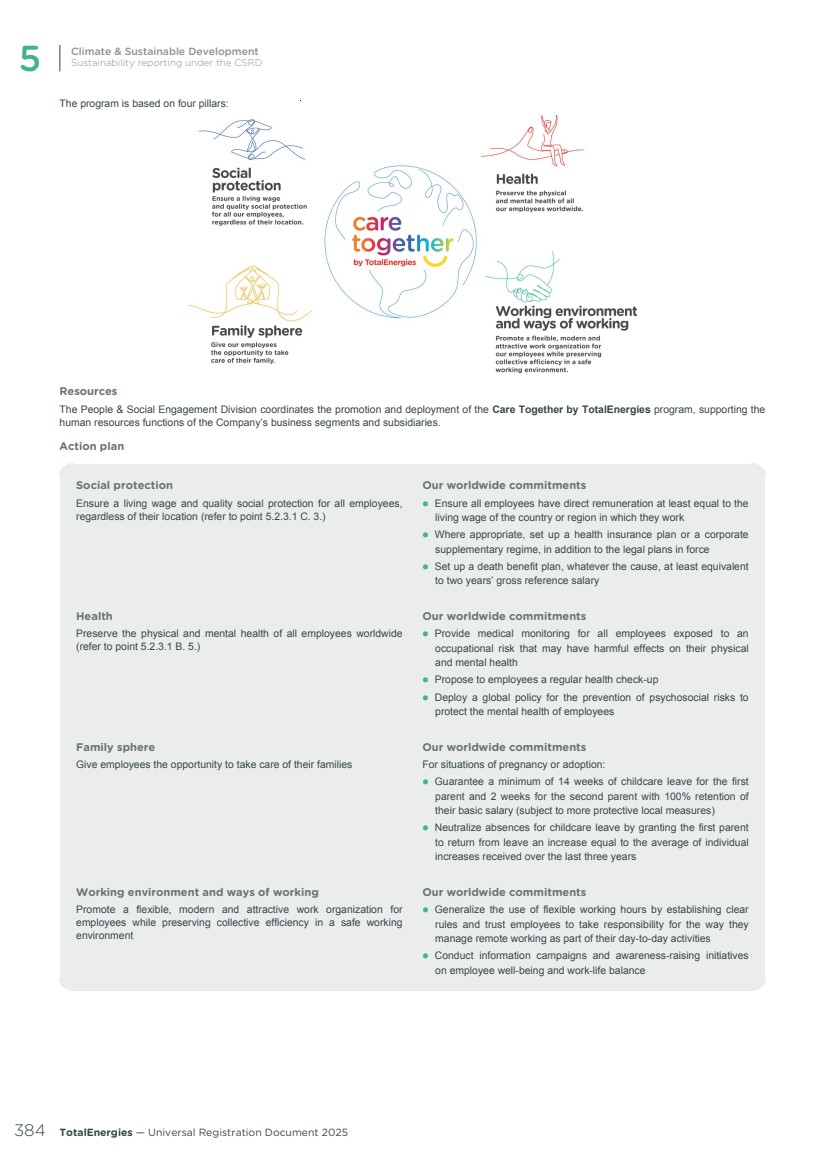
| Measures for the family sphere The Company’s parental policy has adopted a neutral concept of families that takes account of the diversity of family structures. The concepts of a “first parent” and a “second parent” now allow all parents, regardless of the composition of their families, to benefit from leave for the birth or the arrival of a child. TotalEnergies guarantees paid childcare leave of at least 14 weeks for the first parent and at least 2 weeks for the second parent, with 100% retention of their basic salary. If local measures are more favorable, they prevail. TotalEnergies also guarantees the first parent returning from this leave an increase equal to the average of the individual increases he or she has received over the past three years. In addition to parental leave, and to help employees manage their work-life balance, the Company offers personal leave at each important stage of life, especially for family events (marriage, death, sick child, etc.) or for helping family members. Other types of unpaid leave are also offered to support employees in their personal projects (international voluntary missions, following spouses, setting up a company, etc.). In 2023, an agreement in favor of employee caregivers(1) was signed with the representative trade union within the scope of the Socle social commun(2) in France, in order to provide them with guidance and support. The agreement establishes a “care manager”, who offers practical advice and support for employee caregivers, helping them implement the right solutions for their relatives, offering flexibility in the organization of their work and improving on certain legal leave entitlements for caring for relatives requiring assistance or at the end of life. Since it was signed, nearly 270 employee caregivers have received support. Family sphere Indicators - WHRS 2025 2024 2023 % of subsidiaries deploying the parental policy 75% 71% 67% % of subsidiaries applying paid childcare leave of 14 weeks or more (for the first parent) 94% 92% 91% % of subsidiaries guaranteeing the 100% payment of the basic salary (for the first parent) 91% 89% 83% % of employees receiving an increase equal to the average individual increases awarded over the last three years (for the first parent) 78% 78% 77% % of subsidiaries with specific breastfeeding period arrangements 75% 66% 58% % of subsidiaries offering personal leave (family events...) 78% 75% 70% Fostering a flexible work organization The organization of work involves many challenges, varying according to the different regions of the world where the Company operates, and according to the local legislation. The TotalEnergies’ entities set up programs designed to meet the specific needs of the organization of work and ensure, as far as possible, that a work-life balance is promoted. Depending on the segment, specific working arrangements are implemented, such as shift(3) schedules and rotating (4) schedules. Most shift workers are employed in Refining & Chemicals, Marketing & Services, Integrated LNG and Integrated Power, while rotating workers are mainly in Exploration & Production. The average work week is determined in accordance with applicable local laws and limits set by International Labour Organization (ILO) conventions. In line with its ambition to build a good place to work together, TotalEnergies promotes a modern and attractive work organization, while preserving collective efficiency. The Company is committed to generalizing the use of flexible working hours by establishing clear rules, trusting employees to take responsibility for the way they manage remote working and by conducting information campaigns and awareness-raising initiatives on the well-being of employees and their work-life balance. Among other programs designed to foster a better work-life balance, employees can also choose part-time work. Ways of working Indicators - WHRS 2025 2024 2023 % of subsidiaries offering the option of regular remote working 68% 65% 64% % of subsidiaries offering the option of occasional remote working 88% 85% 82% % of employees choosing remote working when given the option 18% 20% 19% % of subsidiaries that have implemented flextime 89% 85% 82% % of subsidiaries that have voluntary part-time work 54% 52% 51% % of employees choosing part-time work 3% 3%(a) 3% (a) Restated data. b. Quality of life at work and employee well-being “Care” lever - Paying attention to colleagues TotalEnergies promotes this behavior in its “Our 5 levers for a Sustainable Change” program, so that employees can play an active role in their own well-being. Launched in 2024, this program aims to create a dynamic for change by promoting certain priority group attitudes in favor of sustainable development. The “Care” lever encourages employees to pay attention to their colleagues and take action if any of them show signs of not being well, “mal-être”. A training module dedicated to this lever was made available to all employees in early 2025. Awards were given out in 2025 during the Sustainab’ALL Day(5) . For lever 5, the Nigeria E&P subsidiary was rewarded for a project illustrating the promotion of a culture of care, listening, and respect. (1) Employees who have to balance a caregiving role with their professional life, either occasionally or more regularly. (2) The Socle social commun (SSC) or “Common Social Basis” (whereby all employees have the same rights) is composed of 18 subsidiaries in France. (3) Employees maintain continuous operations, with relays between teams to keep production going (in two or three 8-hour shifts), e.g., in plants or refineries. (4) Employees conduct their work at a location (town or worksite) far from their place of residence and alternate between extended periods of work (at their assigned worksite) and rest periods at home. (5) The Sustainab’ALL Day is an annual internal event dedicated to Sustainability and sustainable development challenges. This global Company-wide day takes place across every site, entity, and business unit, and everyone is encouraged to participate and discover local initiatives. Climate & Sustainable Development Sustainability reporting under the CSRD 5 TotalEnergies — Universal Registration Document 2025 385 |
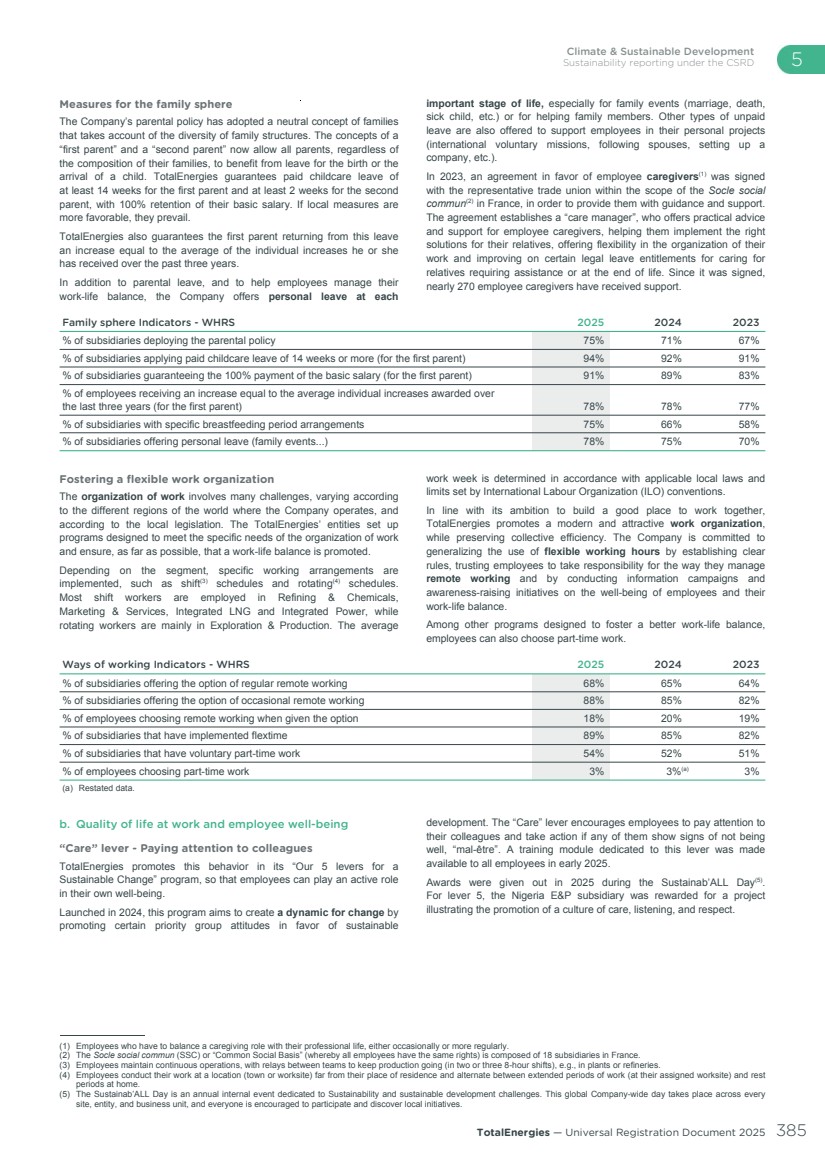
| Raising awareness of well-being To reaffirm TotalEnergies’ commitment to fostering a culture that promotes employee well‑being, awareness initiatives are organized each year across the different business segments. At Company level, events such as “Care Week” or World Mental Health Day enable employees to take part in conferences, webinars, and interactive workshops. Indicators - WHRS 2025 2024 2023 % of subsidiaries conducting information campaigns or organizing events related to the well-being of employees 96% 96% 93% % of subsidiaries that have carried out actions to raise awareness of work-life balance 87% 85% 82% “Bonjour” stores As part of TotalEnergies’ ambition to build a company that is a good place to work together, “Bonjour” stores have been gradually opened on Company sites with more than 100 employees. For smaller sites, the concept can be implemented on the site’s own initiative. These living spaces and personal services within the Company aim to make life easier for employees. At the end of 2025, this program has reached over 50,000 employees in 52 countries. Well-being indicators In collaboration with Ipsos, the Company has defined an annual measure of its employees’ level of well-being, using a Care index based on seven criteria: safety, respect, autonomy at work, listening capacity of manager, conviviality, work-life balance and controlling pressure at work. In 2025, the TotalEnergies’ score(1) is 83.4%, while the benchmark(2) is 70%. Care Index TotalEnergies 2025 (Pulse) 2024 (TotalEnergies Survey) 2023 (Pulse) Care Score TotalEnergies(a)(b) 83.4% 83.1% 81.5% Work in safe conditions 96% 95% 97% Feel respected at work 86% 88% 86% Freedom and autonomy 87% 87% 85% Share moments of conviviality and celebrate success 78% 81% 78% Managers listen to their teams 87% 85% 85% Good balance between work and personal life 82% 81% 77% No excessive pressure at work 68% 66% 63% (a) Pulse Survey data do not cover Hutchinson. (b) The Hutchinson Care score, which was the subject of a separate survey not consolidated in the data presented, is 80.9% in 2024 while the benchmark is 70%. The Ipsos benchmark is composed of automotive and aeronautical companies from around the world. 2. Developing skills and maintaining employees’ long-term employability Developing employees’ skills and maintaining their long-term employability is one of the Company’s key social challenges, and one of the key factors in ensuring the success of the corporate project. The Company has therefore decided to rely on a robust learning model and individual support adapted to the transition and the changes in business lines and technologies. a. Employee support Policy TotalEnergies is aware of the challenges of the energy transition and has adopted a people ambition called Better Together which places each employee’s professional development at the heart of the Company’s performance. All employees are empowered to take charge of their own career paths and given support in their choices and development. Action plan Talent developers To meet the ambition of “Attracting and developing talent”, the position of Talent Developer was created in 2019 to strengthen employee support by providing individualized local guidance. More than 400 talent developers are located close to the teams in all our business segments (head offices and subsidiaries). They are responsible for implementing internal mobility to ensure that all available positions are filled, and for ensuring compliance with human resources policies in the recruitment and selection of candidates. Talent developers support employees’ development throughout their careers, in coordination with manager-coaches. They carry out individual career reviews for employees, drawing on the tools and methods they have been trained to use (in-depth interviews, personality profiles, “vis ma vie” experiences, etc.). The time spent with their talent developers allows employees to: – review their experiences, skills and aspirations, – identify opportunities in the Company, – build a realistic professional project for the next stages of their careers. Talent developers support the operational implementation of employees’ career plans (training plans, coaching, etc.) and help them to find new positions in the Company. They also support managers in their role as manager-coach. Better Together Indicators 2025 2024 2023 Number of individual career review carried out since the launch of Better Together Nearly 13,000 Number of positions on the internal mobility platform(a) each year Nearly 9,000 % of positions are staffed by internal mobility 76% 72% 72% Average time spent in the same job (in years) 6.5 6.2 6.6 Average time spent in the same job for managers (in years) 4.8 4.7 5.0 (a) Publication of positions, except for senior management positions, which are subject to succession plans. Manager-coaches The managers of TotalEnergies, at all levels of the organization, are manager-coaches, committed to continuous development of their managerial practice. They are responsible for their teams’ professional development. (1) Source: Results of the 2025 Pulse Survey. This survey does not cover Hutchinson. (2) The benchmark established by Ipsos is composed of companies with over 10,000 employees worldwide. 5 Climate & Sustainable Development Sustainability reporting under the CSRD 386 TotalEnergies — Universal Registration Document 2025 |
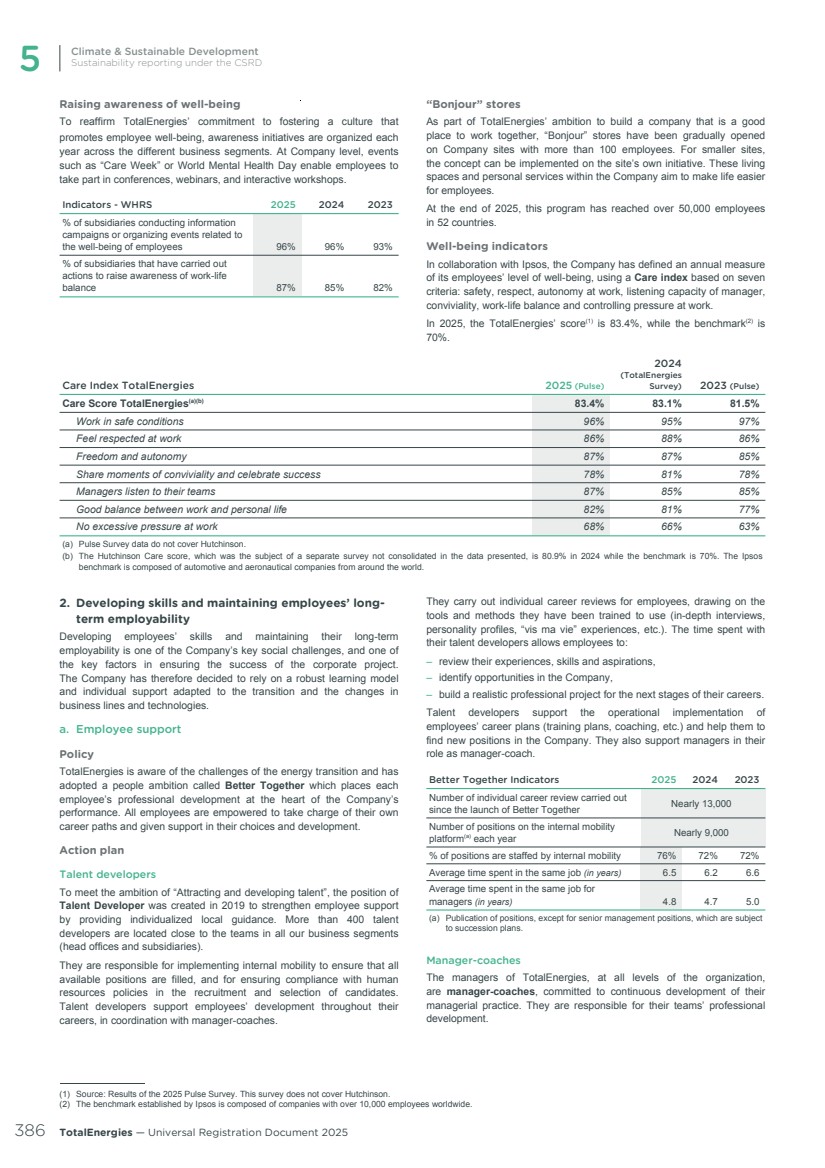
| A training program allows them to develop their skills from the moment they take up a management position and throughout their subsequent career. This offer, revised and reinforced in 2024, is made up of three components: – The fundamentals: a set of training courses intended to develop the know-how and best practices essential for manager-coaches. They are aimed at everyone in the logic of continuous development and are proposed for first-time manager-coaches and first-time managers of manager-coaches, – Deep diving: “à la carte” training to deepen skills on what manager-coaches need when they need them, on one or more themes, in addition to the fundamentals, – Outside the box: collective development (social learning) offer to share and develop between peers, structured around various modalities allowing each manager-coach, at least once a year, to devote time to their managerial practice (co-development, conferences, etc.). Employees As the main active players in the Better Together people ambition, employees build their own career paths. As they do so, they are supported by their talent developer and manager-coach and are encouraged to: – reflect on their profile, skills and aspirations; – sign up for training courses that enable them to develop their skills; – freely apply, where appropriate, to the positions they aspire to. Each year, an annual performance review campaign is organized for the entire Company. This is a time for employees to meet their manager-coach for an objective and constructive conversation. The Annual Individual Reviews (AIRs) provide an opportunity to take stock of the past year, evaluate the employee’s performance and define objectives for the coming period. They are also an opportunity to discuss the employee’s career plan and skills, to define a development plan, and to consider the relevance and timing of mobility. These interviews are also an ideal opportunity to discuss the quality of life at work and, in particular, workload and work-life balance, as well as to address questions about the principles of action and individual behavior set out in the Code of Conduct. Indicators Employees who had a performance and development appraisal % of employees who had an Annual Individual Review during the year - WHRS 2025 2024 2023 All employees 93.1% 91.2% 91.6% Women 92.4% 90.7% 93.1% Men 93.5% 91.4% 90.7% Managers (JL ≥ 10)(a) 97.6% 96.2% 95.2% Non-managers (JL <10) 90.7% 88.5% 89.8% (a) Job level of the position according to the Hay method. JL 10 corresponds to the first level of junior manager (cadre débutant) (≥ 300 Hay points). Employee support indicators(a) 2024 2022 % of employees who consider that feedback from their manager-coach helps them progress 76% 76% % of employees who feel involved in their own professional development 77% 73% % of employees who state that they have access to information about the vacancies to be filled 81% 79% (a) Data from the TotalEnergies Survey. Hutchinson was the subject of a separate survey, which is not consolidated in the data presented. This topic was not addressed in the Pulse Survey, which is conducted every other year. b. Training and skills development Policy Employee development is at the heart of the company’s performance and is one of the foundations of the Better Together people ambition. Development is based on a learning model with three levers: – on-the-job training, to develop know-how through experience, – peer learning, which allows know-how to be pooled in the various communities of professions or expertises to develop skills in a collaborative spirit, – training, offering adapted programs aimed at developing the skills and employability of employees. These three levers are reinforced by a policy of internal mobility that enables employees to change jobs regularly and acquire new skills, thus developing their employability. The Company’s training approach is based on five major areas: – sharing TotalEnergies’ basic corporate values, particularly in HSE, the climate, ethics, compliance, leadership, innovation and digital technology, – supporting the development of existing activities and creating new ones in order to achieve the Company’s ambition, – strengthening key skills in all the Company’s business areas to maintain a high level of operating performance in the workforce, – promoting employees’ integration and career development through training designed to teach employees about the Company, management skills and personal development, – supporting the policy of mobility and diversity within TotalEnergies through language and intercultural training. This robust learning model, associated with the major areas of training, allows TotalEnergies to adapt to technical changes and unforeseeable environmental factors, while preserving employees’ employability. Resources The People & Social Engagement Division coordinates the promotion and deployment of skills development policies. A Company’s subsidiary manages the training offering and helps the business segments develop specific training programs. Training programs and initiatives are implemented and monitored by local business segment networks. TotalEnergies also has a technological training center, Oléum, that combines technological expertise (over 30 specialized, certified instructors) and technical teaching facilities. The center, located on two sites in France (Dunkirk and La Mède), offers trainees a full-scale Seveso environment and provides technical career training in operations, maintenance, inspection, safety and other fields. Certified as a corporate Apprentice Training Center (CFA), Oléum trains apprentices for roles both inside and outside the Company. Internationally recognized qualifications are also offered, such as the BOSIET program (Basic Offshore Safety Induction and Emergency Training), approved by the Offshore Petroleum Industry Training Organization, and training programs on wind power certified by the Global Wind Organization. Oléum welcomes trainees from all the Company’s segments worldwide and from its partners and external customers. Climate & Sustainable Development Sustainability reporting under the CSRD 5 TotalEnergies — Universal Registration Document 2025 387 |
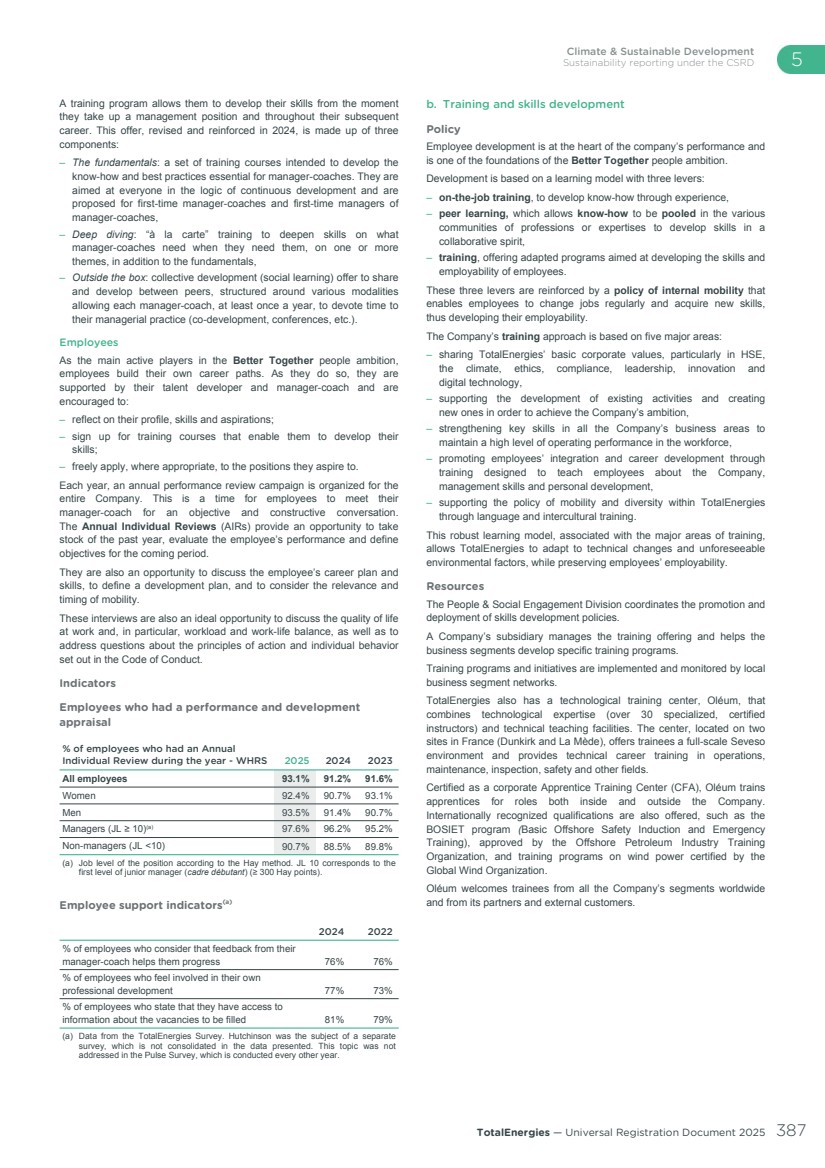
| Action plan Training The Company has decided to make all employees active players in their professional training, consistent with the Better Together people ambition. The goal deployed and monitored worldwide is for every employee to devote at least five days a year to professional training. Among those 5 days, in addition to the mandatory training programs required for the job, since January 1, 2023, every employee has the option to enroll for up to 3 days of training of their choice each year, in fields that they consider to be important for their development, among the training programs offered by the Company. The Company’s training catalog offers nearly 6,400 training content (on site and remote) covering all technical, business and cross-functional fields, including behavioral soft skills. After each training session, participants, and their managers where applicable, receive a satisfaction survey designed to assess the impact of the training and its results in the light of the stated objectives. Skills development programs Global “upskilling” program As part of its balanced multi-energy strategy for the benefit of the energy transition, TotalEnergies has designed Visa for TotalEnergies, a comprehensive upskilling program designed to prepare all employees for the new challenges facing the company and society in general, and to support the development of their skills. This multi-year training program is deployed in several seasons, each devoted to a key aspect of TotalEnergies’ transition. The first season focused on climate challenges and the answers provided by the Company’s ambition. Season 2 covered fundamentals of electricity, the main lever for reducing the carbon footprint of the energy mix (production, uses, value chains, markets and business models). These first two seasons have trained more than 30,000 employees worldwide. The third season of Visa for TotalEnergies, “Digital Accelerator”, launched in 2024, continued in 2025 with the ambition to accelerate the appropriation of generative Artificial Intelligence tools to serve collective performance. This resulted in the gradual provision of Copilot licenses for Microsoft 365 and Microsoft Power Platform, supported by training on how to use these new tools. Upskilling programs Several training programs have been designed and adapted to the specific needs of the business segments: – programs requiring a few weeks of training to acquire the skills needed to do a job in one’s own technical discipline, but in a different field of application, – courses over a longer period including training, coaching, role playing and mentoring to prepare for moves to other technical disciplines. Since 2022, 34 career paths have been created for positions in a wide range of technical fields (projects, processes, research & development, etc.). These long-term skills development initiatives are designed to anticipate changes in the Company’s activities, and are based on a mapping of technical roles and competencies carried out by OneTech. Class of young multi-energy talents In 2022, OneTech launched the first cohort of the OneTech Graduate Program, an integration and recruitment program for young graduates to support the Company’s energy transition. Building on the program’s success and attractiveness, several sessions have since been organized across the Company’s different business segments. These integration-accelerating programs offer young graduates the opportunity to gain initial experience in all areas of energy, oil and gas, but also electricity (solar, wind, batteries, gas power plants) and decarbonated molecules (hydrogen and biogas). Lasting two and a half years, they take the form of successive missions over several months to create a group of young multi-energy talents. Each cohort is made up of scientific and technical profiles, engineers or researchers, either generalists or specialists (electricity, geosciences, process, wind power, data). They come from diverse and international academic backgrounds. Support for the evolution and transformation of activities In the Marketing & Services segment, training for service station staff has been developed on the specific features of charging infrastructure for electric vehicles. Since 2023, more than 500 operators, station managers and sales teams have been trained. These training courses will continue through 2026 to support the deployment of new charging stations operated by the Company. More generally, Marketing & Services is training its sales teams in the fundamentals of electric mobility in order to give them the necessary operational skills to support the Company’s customers with sustainable mobility solutions. Since 2023, over 1,300 employees have been trained in electric mobility, including more than 700 sales staff. Four years after its creation, OneTech initiated a major structural evolution of its organization in 2025 to support the Company’s technological ambition. In this context, six Strategic Programs were created. A Digital Line was established to support TotalEnergies’ digital transformation, while the Technical Line Operations adapted its organization to better support industrial assets worldwide. In addition, technical communities were launched. These communities bring together engineers and technicians from around the world by area of expertise: Geosciences & Reservoir, Drilling & Wells, Process, Maintenance/Inspection, Technologies, Projects, and Electricity & Renewables. Their aim is to share innovations, feedback and training, and to promote skills in support of operations and projects across the entire Company (refer to sections 1.5.3 and 1.5.4). 5 Climate & Sustainable Development Sustainability reporting under the CSRD 388 TotalEnergies — Universal Registration Document 2025 |
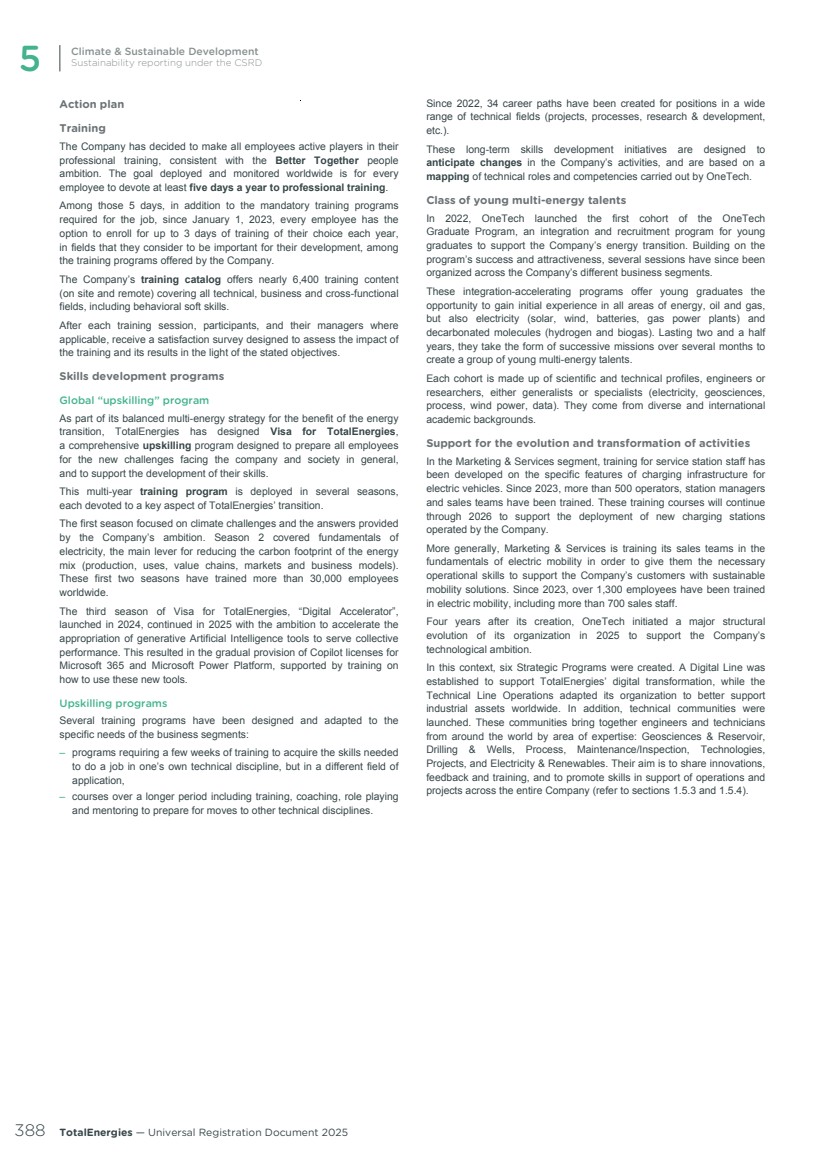
| Training indicators Average number of training hours/y per employee(a) - WHRS 2025(b) 2024 2023 All employees 25.9 30.8 27.8 Women 24.6 29.3 26.8 Men 26.6 31.8 28.3 Managers (JL ≥ 10)(c) 32.4 39.8 34.3 Non-managers (JL <10) 22.5 26.5 24.7 (a) On-site and remote learning, excluding on-the-job training (7.6 h = 1 day). (b) End of the deployment of the third season of Visa for TotalEnergies. (c) Job level of the position according to the Hay method. JL 10 corresponds to the first level of junior manager (cadre débutant) (≥ 300 Hay points). Indicators - WHRS 2025(a) 2024 2023 % of employees that followed at least one training course during the year 98.1% 97.9% 97.7% Average number of training days/y per employee (including on-the-job training) 4.6 5.5 5.0 Average number of training days/y per employee (excluding on-the-job training) 3.4 4.1 3.7 Satisfaction rate of trainings 85.5% 85.9% 83.2% (a) End of the deployment of the third season of Visa for TotalEnergies. 3. Compensation and benefits The Company’s compensation and benefits policy is an integral part of our Better Together people ambition. It aims to offer our employees a competitive, transparent and fair compensation package, linked to individual performance and in line with the Company’s corporate social responsibility commitments. a. Attractive and competitive compensation Policy The Company’s compensation policy applies to all companies in which TotalEnergies SE holds the majority of voting rights. That policy has several aims: to ensure external competitiveness and internal fairness, reinforce the link to individual performance, increase employee share ownership and implement the Company’s corporate social responsibility commitments. It consists of providing levels of compensation that are higher than the minimum level observed locally, through regular benchmarks in countries where legislation guaranteeing a minimum wage is lacking. The Company’s compensation policy is designed to offer competitive, fair, transparent and responsible compensation. In particular, it stipulates that compensation levels must be equivalent internally for positions with the same level of responsibility in a given environment (activity, country). Fair treatment is ensured within the Company through the widespread use of weighting for management positions (JL ≥ 10) via the Hay method. Performance reviews for Company employees, covering actual versus targeted results, skills assessment and overall job performance, are conducted during an annual individual review and formally issued in accordance with the same principles and guidelines across the entire Company. Resources The compensation policy is implemented and managed by the People & Social Engagement Division. Implementation The compensation structure for the Company’s employees is based on the following components, depending on the country: – a base salary, which is subject to individual and/or general salary-raise campaigns each year. The salary-raise campaigns are intended to reflect market adjustment, employee’s proficiency in the position and individual potential; – an individual variable compensation starting at a certain level of responsibility. This is intended to compensate individual performance (quantitative and qualitative attainment of previously set targets), managerial practices, if applicable, and the employee’s contribution to collective performance evaluated on the basis of HSE targets set for each business segment, which represents up to 10% of the variable portion. In 2025, 90% of the Company’s entities included HSE criteria in the variable compensation. In particular, HSE criteria include greenhouse gas reduction targets. Supplemental collective variable compensation programs are implemented in some countries, such as France, via incentives and profit sharing. In France, under the agreement signed for 2024-2028, applicable to the companies that signed the agreement(1) (encompassing approximately 18,000 employees in 2025), the amount available for employee profit-sharing is based on environmental and social criteria, and is determined on the basis of: – financial parameters (the Company’s return on equity (ROE) as an absolute value and the Company’s return on average employed (ROACE) and compared to four peers(2)), – the attainment of safety targets (injury rate and accidental deaths in the establishments in France of the companies party to the agreement), – the attainment of energy transition targets (intensity of greenhouse gas emissions from the refining and petrochemicals activities), – criteria relating to employee commitment to priority areas identified by the Action! program, which is mainly led by the TotalEnergies Corporate Foundation (Fondation d’entreprise) in France, assessed for the establishments to which the employees belong and the companies party to the agreement. Furthermore, this agreement now includes a mechanism that increases profit-sharing bonuses in the event of TotalEnergies’ financial outperformance, based on the Company’s gross cash flow margin (MBA). b. Social protection Policy In its general compensation and benefits policy, the Company provides pension and employee benefit programs (health and death) that meet the needs of the subsidiaries, as well as the Company’s standards, designed to ensure that each employee can: – in case of illness, receive coverage that is at least equal to the median amount for the national industrial market, – participate in a savings or supplementary retirement plan, – organize the protection of the family in the event of the death of the employee. Action plan To this end, TotalEnergies is deploying a number of commitments and mechanisms worldwide (part of the Care Together by TotalEnergies program): (1) The Socle social commun (SSC) or “Common Social Basis” (whereby all employees have the same rights) is composed of 18 subsidiaries in France. (2) ExxonMobil, Shell, BP and Chevron. Climate & Sustainable Development Sustainability reporting under the CSRD 5 TotalEnergies — Universal Registration Document 2025 389 |
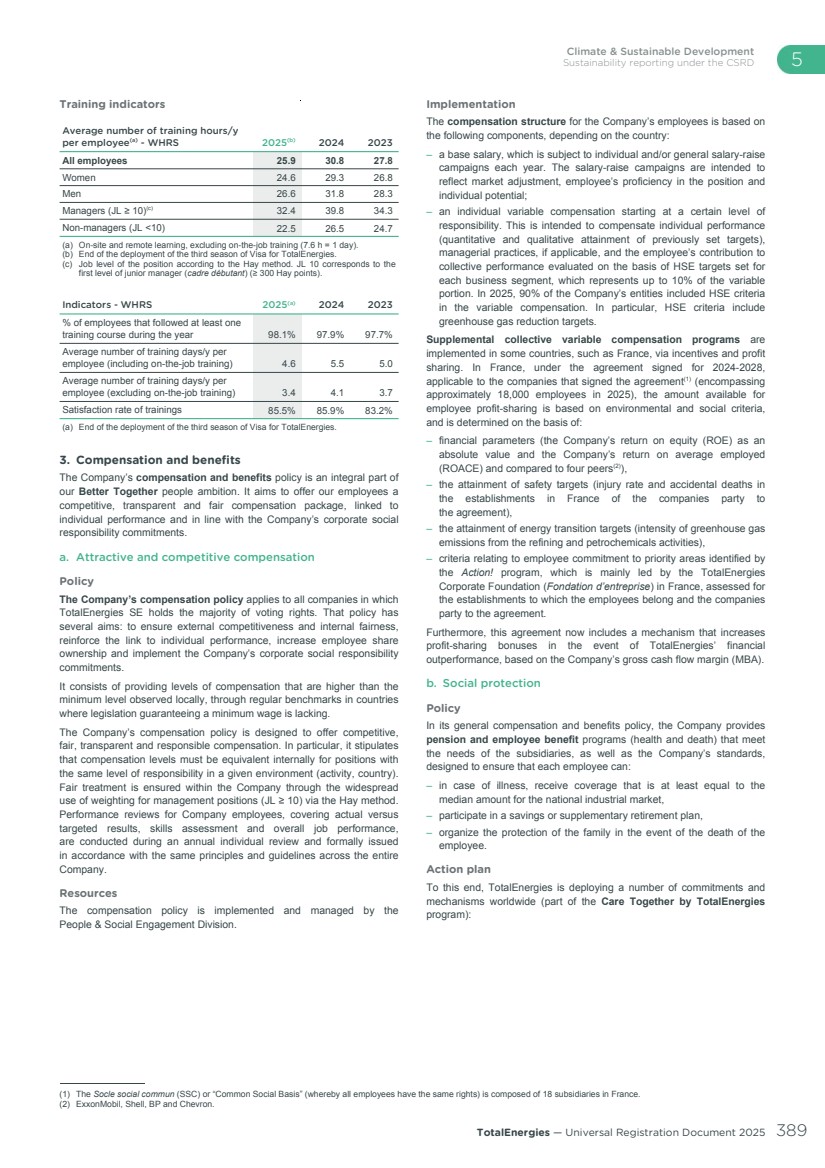
| Social protection Ensure a living wage and quality social protection for all employees, regardless of their location Our worldwide commitments ● Ensure all employees have direct compensation at least equal to the living wage of the country or region in which they work ● Where appropriate, set up a health insurance plan or a corporate supplementary regime, in addition to the legal plans in force ● Set up a death benefit plan, whatever the cause, at least equivalent to two years’ gross reference salary Since 2021, TotalEnergies assesses any discrepancies between direct compensation(1) and the living wage(2) in all its subsidiaries(3) . The result of the studies carried out show that, since the end of 2022, the Company had reached its target, as 100% of employees received direct remuneration at least equal to the living wage in the country or region in which they work. A living wage is defined as an income that allows employees: – to provide a decent life for their family, – for standard working hours, – to cover their essential expenses (food, water, electricity, housing, education, health, clothing, etc.), – the ability to cope with some of life’s uncertainties. c. Employee shareholding and employee savings Policy Employee shareholding is developed through three main programs: the grant of performance shares, share capital increases reserved for employees, and employee savings. In this way, TotalEnergies hopes to encourage employee shareholding, strengthen employees’ sense of belonging to the Company and give them a stake in the Company’s performance by allowing them to reap benefits from their commitment. Action plan Performance shares Each year since 2005, TotalEnergies has granted performance shares to many of its employees (more than 11,000 each year since 2016). Those shares are granted definitively only upon the fulfillment of performance conditions assessed at the end of a vesting period of three years. Two of the performance conditions include GHG emission reduction targets. On May 23, 2024, to mark the Company’s centenary, the Board of Directors approved a plan to grant 100 free TotalEnergies shares to all employees of the Company(4) worldwide, amounting to nearly 105,000 employees in over 100 countries. These shares will be definitively granted after five years of working for the Company without performance conditions. This global allocation, owing to its exceptional scale, is a first in the history of TotalEnergies. In 2025, the Board of Directors has decided to allocate performance shares under the 2025 plan for more than 13,000 employees, over 98% of whom are non-executives. Share Capital increases reserved for employees TotalEnergies also invites employees of companies in which it holds more than 50% of voting rights, and that subscribe to the Shareholder Group Savings Plan (PEG-A) created in 1999 for this purpose, to subscribe to share capital increases reserved for employees. Share capital increases reserved for employees take place annually. Depending on the employees’ location, these campaigns are completed either through employee mutual funds(5) (FCPE) or by subscribing to TotalEnergies shares. Pursuant to the authorization given by the Annual Shareholders’ Meeting on May 23, 2025, the Board of Directors decided, at its meeting on September 24, 2025, to proceed with a capital increase reserved for employees to be carried out in 2026 with a 20% discount. This operation is expected to involve about 100 countries. Employees will benefit from a matching contribution of one free share for each share subscribed, up to a limit of ten. The shares subscribed will give holders current dividend rights. The previous share capital increase reserved for employees was carried out in June 2025. Nearly 62,800 current and former employees in 97 countries took part in this share capital increase, which resulted in the subscription of 10,572,824 shares at a price of €42.50 per share. Since 2023, employees in French companies can finance their subscription to the capital increase by investing their profit-sharing bonuses. Excluding subscriptions by former employees, the total amount subscribed internationally represents 55% of the total amount, exceeding that of France in the last three operations. Share capital increases indicators Number of subscriptions and subscription rate during the last five capital increases reserved for employees Employee savings The development of employee savings schemes enables each employee, with the help of TotalEnergies, to build up and then develop medium or long-term savings, in order to retire or to support major life events. Employee savings are made through the TotalEnergies Group Savings Plan (PEGT), open to employees of the Company’s French subsidiaries covered by the 2002 agreement and its amendments. This plan allows investments in a wide range of mutual funds, including the TotalEnergies Actionnariat France fund that is invested in TotalEnergies shares. (1) The direct compensation is composed of fixed and variable compensation. (2) TotalEnergies relies on the global database provided by the Fair Wage Network, which assesses the living wage for a given country or region, based on the typical family size (number of children) and the average number of workers (between one and two per household). (3) It applies to the so called “périmètre de gestion” i.e., all subsidiaries controlled at more than 50%. (4) The term “Company employee” is used to refer to employees of TotalEnergies SE and companies whose share capital is more than 50% owned by TotalEnergies SE and which are directly or indirectly controlled by TotalEnergies SE or under joint control, with the exception of a limited number of companies co-managed with other oil actors, as well as those registered or incorporated in a country under economic sanctions. (5) TotalEnergies Actionnariat France, TotalEnergies Actionnariat International Capitalisation. 5 Climate & Sustainable Development Sustainability reporting under the CSRD 390 TotalEnergies — Universal Registration Document 2025 |
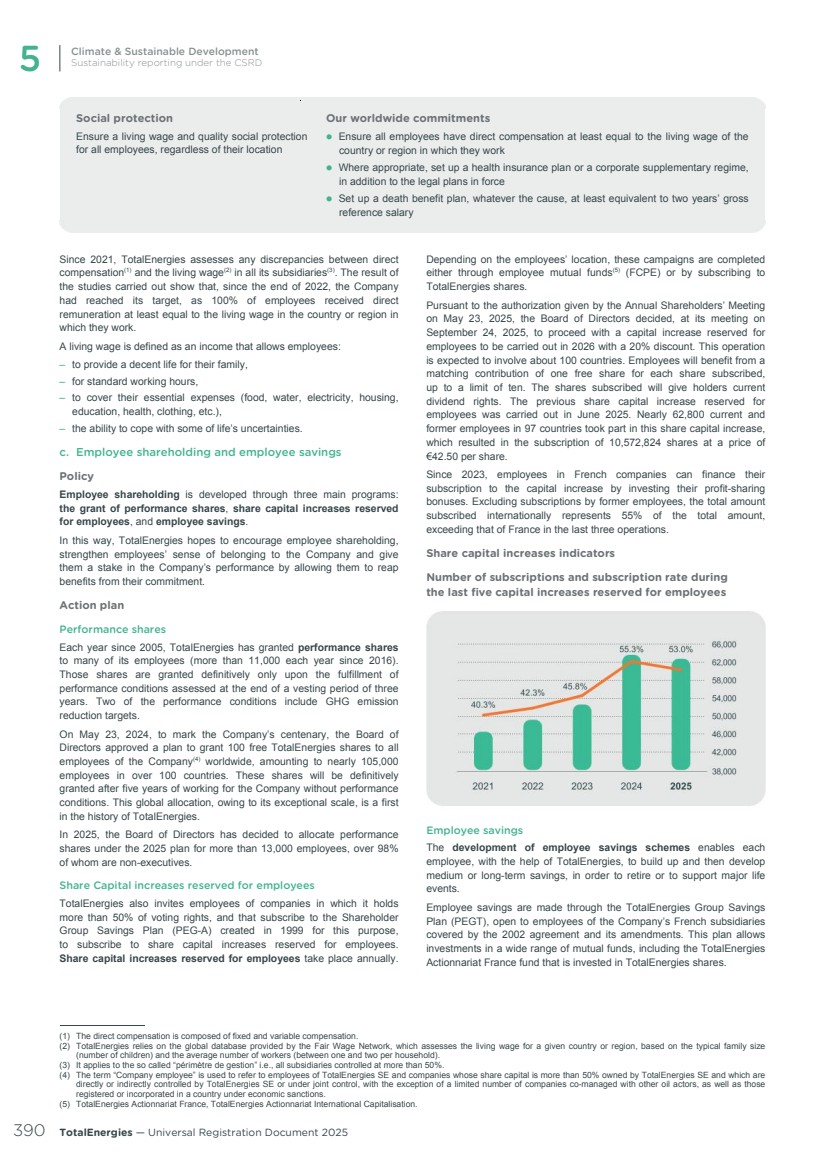
| In France, an agreement on retirement savings, within the limits of the Socle Social Commun(1) , came into force on January 1, 2022. This agreement had introduced an optional Collective Retirement Savings Plan (PERCOL), which is the successor of the PERCO, previously introduced by the 2004 Group agreement on retirement savings schemes. Other saving plans are open in some Company subsidiaries in France covered by specific agreements. Company employees can make discretionary contributions as part of those various plans, which their employer may supplement under certain conditions through a matching contribution. The Company’s subsidiaries in France made gross matching contributions totaling nearly €79 million in 2025. Worldwide, this arrangement is strengthened by the Care Together by TotalEnergies program launched in 2024 (refer to point 5.2.3.1 C.). Employee shareholding indicators More than 70% of the Company’s employees are TotalEnergies shareholders and employee shareholding(2) represents 8.9% of the Company’s share capital at December 31, 2025, increasing by more than 80% over the last ten years. Evolution of the Company employee shareholding (held % of share capital) 4. Equal treatment and opportunities Policy TotalEnergies considers that the men and women of the Company are at the heart of its performance and is convinced that diversity of talent and management is a key driver of progress, both for its competitiveness and its capacity for innovation, as well as for its attractiveness. The Company has therefore included this principle in its Diversity policy, which applies to all its employees, subject to local laws and regulations. The Company has long been committed to promoting equal treatment and opportunity that allows every employee to express and develop his or her potential. In accordance with its Code of Conduct, TotalEnergies aims to develop its employees’ skills and careers by implementing a Human Resources policy excluding any discrimination. In terms of diversity, the Company has signed international agreements and charters to demonstrate its commitment at the highest levels of decision-making. In 2010, TotalEnergies signed the Women’s Empowerment Principles - Equality Means Business as set out in the United Nations Global Compact. The WEP are inspired by international labor and human rights standards. TotalEnergies pledged within the World Economic Forum by signing “Closing the gender gap – a call to action” in 2016. This joint declaration is based on seven guiding principles (leadership; aspiration and goal setting; the Science, Technology, Engineering and Mathematics (STEM) pipeline; clear responsibilities; recruitment, retention and promotion policies; inclusive corporate culture; and work environment and work-life balance) and two decisive objectives: more diverse recruitment and greater access for women to technical and management roles. The Company’s Diversity policy includes specific measures to promote the integration and retention of people with disabilities. Resources The Diversity policy is supported at the highest levels and promoted by the Diversity and Inclusion Council, which is chaired by a member of the Company’s Executive Committee and composed of fifteen members representing all the Company’s activities. The Diversity and Inclusion Council is also charged with making specific recommendations on issues identified each year by the Executive Committee. Council members also have an individual responsibility to play an active role in deploying the policy, and to act as ambassadors for it both internally and externally. The Council relies on the People & Social Engagement Division to coordinate the implementation of the policy and the network of business segments’ Diversity & Inclusion correspondents. Actions To promote diversity, the Company takes care to raise awareness among its employees and provides training. To do this, it relies on a number of documents, accessible to all: – the Code of Conduct, – the Human Rights Guide, – the Practical Guide to dealing with religious issues, – the “Recruiting without discrimination” Guide, – or more recently, the Guide on Neurodiversity. Employees can also access a wide range of e-learning material and training courses on the themes of diversity, unconscious bias and non-discrimination via the TotalEnergies training platform. A comprehensive awareness kit is available for managers so that they can organize a moment of exchange with their teams around the world. The goal: to understand and respect differences in order to create the collective conditions that allow everyone to express their talent, ideas, and energy. In addition to the guides and training courses available on the TotalEnergies training platform, the Company deploys frequent awareness-raising initiatives. Moreover, in France, TotalEnergies is a signatory of the Charter developed by an organization called l’Autre Cercle, which provides a framework for combating workplace discrimination in France based on an individual’s sexual orientation or identity. Remediation procedure The Ethics Committee plays a key role in listening and providing assistance. It can be contacted by employees on the e-mail address: ethics@totalenergies.com (refer to point 5.2.3.1 E. 6.). (1) The Socle social commun (SSC) or “Common Social Basis” (whereby all employees have the same rights) is composed of 18 subsidiaries in France. (2) As defined in Article L. 225-102 of the French Commercial Code and Article 11 paragraph 6 of the Articles of Incorporation of the Company. Climate & Sustainable Development Sustainability reporting under the CSRD 5 TotalEnergies — Universal Registration Document 2025 391 |
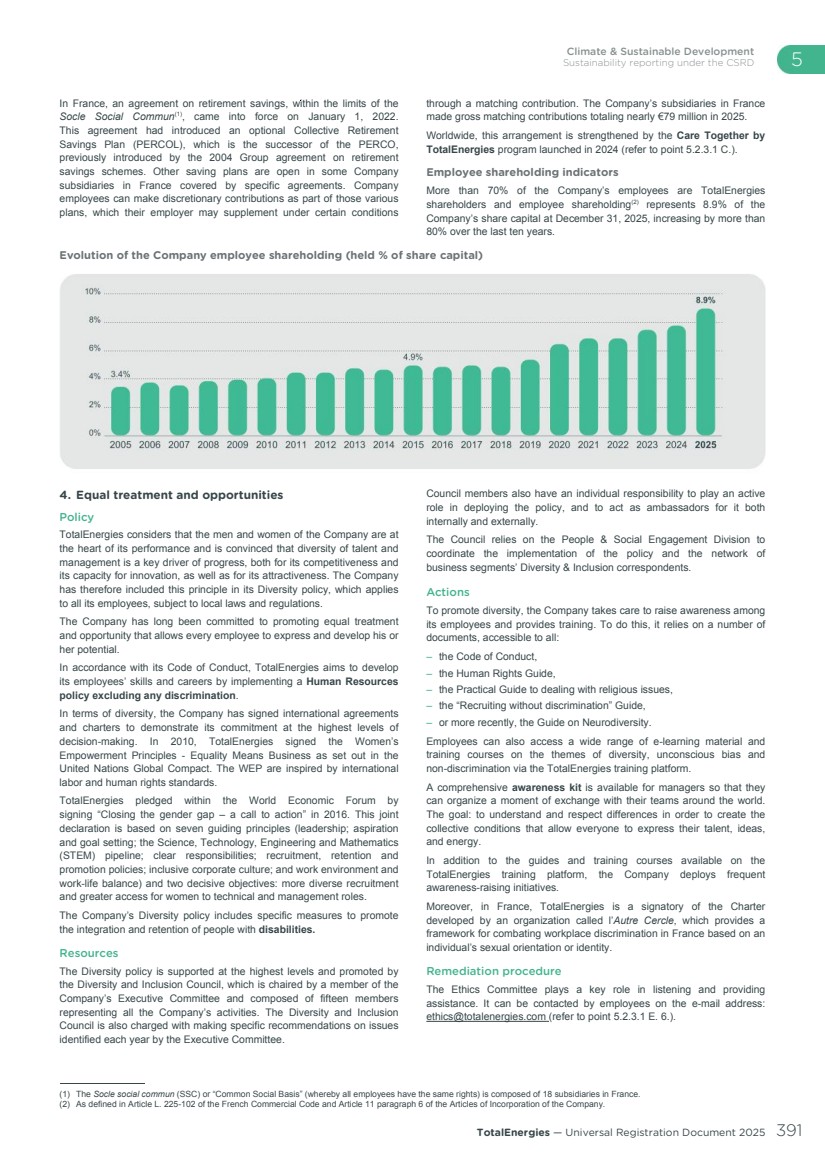
| Targets The Diversity roadmap, which sets out the targets for feminization and internationalization of the management bodies and senior management, was rolled out by business segment to maintain momentum, in compliance with local laws and regulations. In addition to the diversity and internationalization components, each entity is encouraged to implement measures to promote the employment and integration of people with disabilities, in line with applicable legislation, and to create an inclusive working environment to offer all employees the same career opportunities. Our objectives ● Over 30% of women by 2030 in the Executive Committee, Senior executives positions and Senior management positions ● Over 45% of internationals (non-French nationalities) in Senior executives positions and in Senior management positions ● 40% of women by 2030 in the G70(a) (a) Senior executives with the most important responsibilities. Together with the Executive Committee, they form part of the Company’s management bodies (“instances dirigeantes”) within the meaning of point 8.1 of the AFEP-MEDEF Code. With nearly 170 nationalities in its workforce, TotalEnergies benefits from a great cultural diversity and considers it important to promote that diversity at all levels of the Company. Several measures have been adopted to create a more international management pool, including career paths designed to create more international careers, expatriate assignments for employees of all nationalities (nearly 3,100 employees representing more than 100 nationalities are posted in nearly 100 countries), and orientation and personal development training organized by large regional hubs (such as Houston, Johannesburg and Singapore). a. Equality between men and women in the workplace Actions TotalEnergies is committed to upholding and promoting the principle of equality between men and women in the workplace and ensuring and monitoring its proper application. Equality between men and women is fostered Company-wide through a global policy of diversity, quantitative targets set by the Company’s General Management, human resources procedures that take men and women’s concerns into account, agreements aimed at promoting a better work-life balance and actions to raise awareness and train the workforce. TotalEnergies’ commitment to equality in the workplace and treatment between men and women begins at the recruitment stage and continues throughout a person’s career, particularly in the process of identifying high-potential employees and appointing managers. Mixed teams, equal treatment and opportunities TotalEnergies aims to recruit women in proportions that reflect, at a minimum, the percentage of women graduates at schools and universities in its business sectors. To encourage young women to opt for careers in technical fields, TotalEnergies has partnered with France’s Elles Bougent organization since 2011. Nearly 230 female engineers and technicians from diverse cultural backgrounds raise awareness each year among high‑school and university students about scientific and technical careers, highlighting the contribution of women in these fields. The internal mobility process implemented as part of Better Together, ensures greater transparency and offers new prospects for career growth for both men and women in the Company’s various professions. Promoting a culture that respects differences also involves awareness-raising through diverse actions such as training and communication, which are regularly carried out for managers and employees. Internal training courses for women such as “Young Female Talents” and “How to Market Yourself” or “How extraordinary women communicate” are offered. Through its mentoring activities and development workshops, the TWICE (TotalEnergies Women’s Initiative for Communication and Exchange) network also helps to expand the diversity policy. Established in 2006, it is now present in France and abroad (with 75 local networks). TWICE offers a mentoring program, deployed in France and worldwide, to help women gain insight into key phases of their career. This program has benefited several thousand women since 2010. In 2018, TWICE launched the TWICE@Digital initiative to encourage networking among women working in digital technology in the Company and, more broadly, help women become more digital-savvy, so they can learn about the changes underway and the impact of those changes on their work. Finally, to address the challenges of increasing the representation of women in technical roles, a new network, TWICE Technical, was launched in 2025. It offers networking opportunities, inspiring conferences and discussions, testimonials, as well as regular meetings and workshops. Initiatives are also being launched at a business segment level to promote women’s career development. Within Exploration & Production, a 100-day training program called “The A effect”, was launched in 2023 for talented women who wish to fully realize their potential. By the end of 2025, this training program had been extended to the entire Company. A total of 289 women have benefited from this program since its launch. 5 Climate & Sustainable Development Sustainability reporting under the CSRD 392 TotalEnergies — Universal Registration Document 2025 |
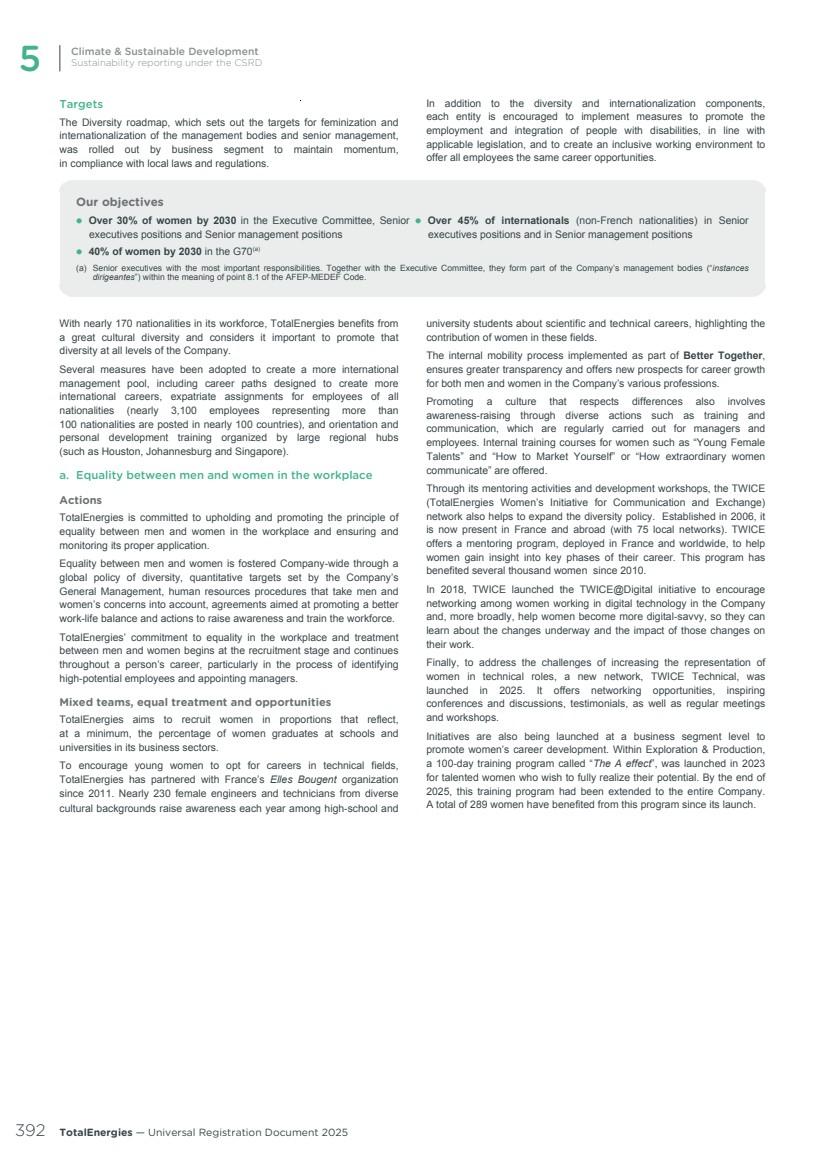
| Diversity indicators Representation of diversity in management and governing bodies Number in 2025 % in 2025 Number in 2024 % in 2024 Number in 2023 % in 2023 Women Men Women Men Women Men Women Men Women Men Women Men Executive Committee 3 7 30.0% 70.0% 2 7 22.2% 77.8% 2 6 25.0% 75.0% G70(a) 25 51 32.9% 67.1% 25 50 33.3% 66.7% 26 51 33.8% 66.2% Senior Executives 85 196 30.2% 69.8% 78 186 29.5% 70.5% 75 190 28.3% 71.7% Senior management(b) 2,108 5,871 26.4% 73.6% 2,019 5,793 25.8% 74.2% 1,921 5,726 25.1% 74.9% Middle management(c) 1,966 4,600 29.9% 70.1% 1,916 4,602 29.4% 70.6% 1,830 4,335 29.7% 70.3% First-level management(d) 7,950 14,202 35.9% 64.1% 7,773 14,340 35.2% 64.8% 7,338 13,707 34.9% 65.1% (a) Senior executives with the most important responsibilities. Together with the Executive Committee, they form part of the Company’s management bodies (“instances dirigeantes”) within the meaning of point 8.1 of the AFEP-MEDEF Code. (b) JL≥14. (c) JL13. (d) JL 10 to 12. Representation of workforce diversity by age groups % in 2025 % in 2024 % in 2023 Women Men Total workforce Women Men Total workforce Women Men Total workforce < 30 years 18.6% 15.3% 16.6% 19.4% 15.9% 17.2% 19.6% 15.9% 17.3% 30-49 years 56.1% 53.3% 54.3% 56.5% 53.8% 54.8% 56.7% 54.4% 55.2% 49 years and over 25.2% 31.4% 29.1% 24.1% 30.4% 28.0% 23.7% 29.7% 27.5% Representation of women in the workforce % of women 2025 2024 2023 Among all employees 36.7% 36.8% 36.9% Among managers (JL ≥ 10)(a) 33.5% 33.1% 32.5% Among permanent contract hires 39.2% 42.2% 41.2% Among managers hires (JL ≥ 10)(a) 35.0% 39.0% 39.8% Among the pool of high potentials 41.1% 40.8% 39.6% Among technical or commercial professions(b) (JL ≥ 10)(a) 26.1% 25.5% 24.9% Technical professions 23.2% 22.9% 22.4% Commercial professions 32.9% 31.7% 31.0% Occupying the top 10% of positions with the highest level of responsibility(c) 27.1% 26.6% 26.1% (a) Job level of the position according to the Hay method. JL 10 corresponds to the first level of junior manager (cadre débutant) (≥ 300 Hay points). (b) Technical and sales functions, excluding support functions (e.g., human resources, legal affairs, purchasing, etc.). (c) Proportion calculated on the basis of 98,115 employees. Representation of non-French nationals in the workforce % of employees of non-French nationals 2025 2024 2023 Among all employees 66.8% 66.8% 67.0% Among managers (JL ≥ 10)(a) 59.5% 59.1% 58.5% Among permanent contract hires 87.9% 85.3% 85.6% Among managers hires (JL ≥ 10)(a) 70.5% 66.0% 67.1% Among the pool of high potentials 54.3% 54.0% 52.7% Among senior executives 37.7% 38.6% 37.7% Among senior managers (JL ≥ 15)(a) 36.4% 36.4% 36.3% (a) Job level of the position according to the Hay method. JL 10 corresponds to the first level of junior manager (cadre débutant) (≥ 300 Hay points). Equal pay for equal work In terms of compensation, the Company has introduced an annual check in all countries for any unjustified wage differentials, followed by the implementation of a corrective action plan if needed. To this end, TotalEnergies calculates the adjusted or “identical profile” pay gap in each subsidiary, using Mercer Consulting’s methodology. This adjusted pay gap takes into account the characteristics of the job held (function, segment, region, etc.) and of the individual (diploma, seniority, etc.), and makes it possible to isolate gaps not justified by objective criteria. In 2025, the overall adjusted pay gap(1) is 2.9% in favor of men for direct compensation (2) . (1) Including Hutchinson. (2) The direct compensation is composed of fixed and variable compensation. Climate & Sustainable Development Sustainability reporting under the CSRD 5 TotalEnergies — Universal Registration Document 2025 393 |
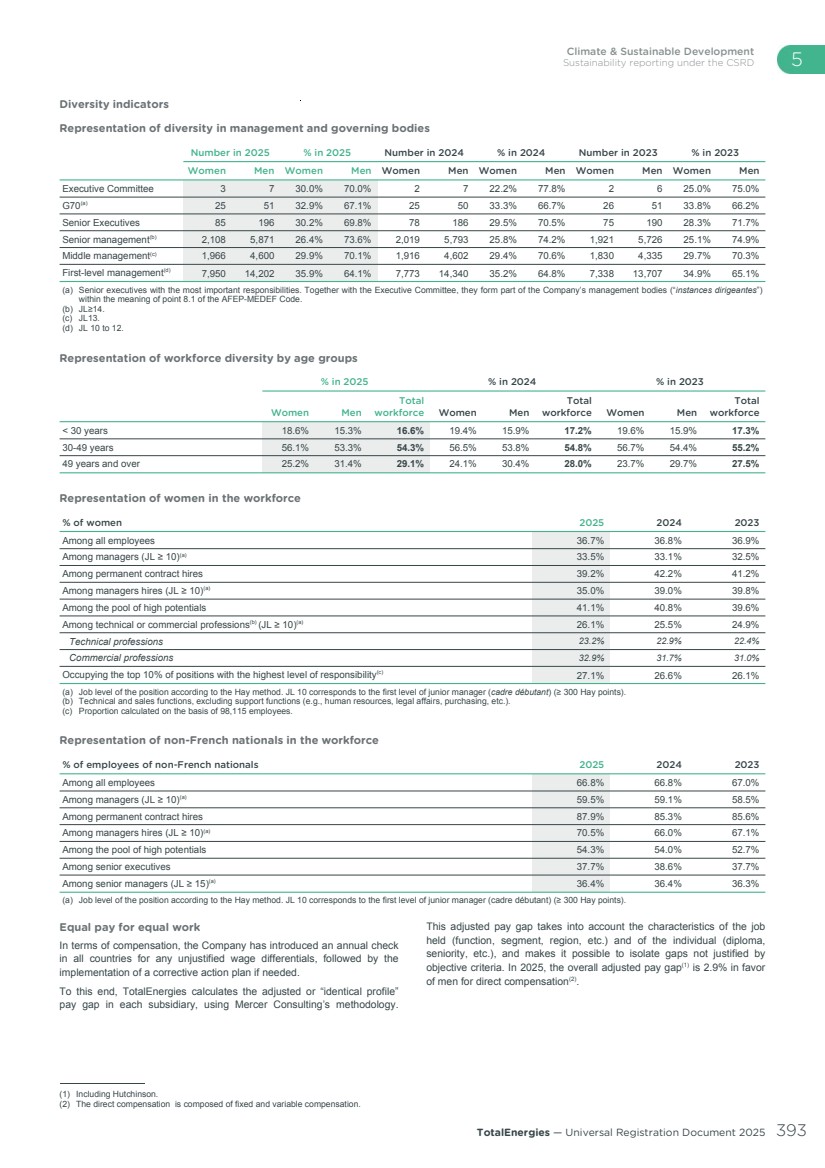
| Since 2019, consistent with French Act 2018-771 of September 5, 2018, on the freedom to choose one’s professional future, the Company has published an index in France for its three units of economic and employee interest (UESs) on wage differentials and the steps taken to eliminate them. That index, based on a score of 100, reflects five indicators: wage differentials, pay raise differentials excluding promotions, promotion rate differentials, percentage of female employees who received a pay raise in the year they returned from maternity leave, number of employees of the under-represented sex among the ten employees who received the highest compensation. In November 2023, the Company and all the representative trade union organizations within the scope of the Socle Social Commun(1) in France signed a new agreement relating to professional equality for an indefinite term. Through this agreement, the parties reaffirm their commitment to respecting the principle of equal treatment between women and men. Pay gap indicators The ratio of total annual compensation is presented in point 4.3.2.1. Professional equality Index Index(a) 2024-2025 2023-2024 2022-2023 Upstream/Global services/Holding UES (AGSH) 92/100 93/100 93/100 Refining & Petrochemicals UES (RP) 90/100(b) 100/100 99/100 Marketing & Services UES (MS) 93/100 92/100 92/100 (a) Reference period N-1/N: from September 30 N-1 to September 30 N. (b) The change in the UES RP rating (-10 points) between 2024 and 2025 is explained by the application of the methodology, as individual pay increases concerned a higher proportion of female technicians (42.4%) than male technicians (35%). Details of the 2024-2025 index UES AGSH UES RP UES MS Wage differential 37/40 40/40 38/40 Difference in the distribution of individual increases 20/20 10/20(a) 20/20 Difference in the distribution of promotions 15/15 15/15 15/15 % of employees with a raise after returning from maternity leave 15/15 15/15 15/15 Number of women in the 10 highest earners 5/10 10/10 5/10 (a) The change in the UES RP rating (-10 points) between 2024 and 2025 is explained by the application of the methodology, as individual pay increases concerned a higher proportion of female technicians (42.4%) than male technicians (35%). Ratio of the lowest base salary (M/W) to the minimum salary guaranteed by local legislation, aggregated by geographical area(a) (e) Unweighted average, within the scope of the Compensation survey. b. Employment and inclusion of people with disabilities The Company’s diversity policy includes specific measures to promote the integration and retention of people with disabilities. Resources The People & Social Engagement Division is responsible for leading the disability approach basing itself on a Disability Agreement of the Socle Social Commun perimeter. TotalEnergies’ Mission Handicap structure, which is part of the People & Social Engagement Division, oversees and coordinates the network of disability officers at the business segment level, as well as their network of officers within the sites. They act as key drivers for implementing the Company’s disability approach in the field. Actions In France, TotalEnergies has given concrete proof of its commitment to hiring people with disabilities for more than 20 years by signing agreements with employee representatives. In 2025, following the expiration of its disability agreement approved by the State, TotalEnergies reaffirmed its commitment by signing a new disability agreement covering the scope of the Socle Social Commun for the 2026–2029 period. This agreement strengthens the Company’s approach to promoting the employment of people with disabilities and is structured around priorities such as recruitment, integration, and professional support throughout the employee’s career. Since 2022, TotalEnergies has reached the rate of 6% (6.55% in 2024) of employees with disabilities within the scope of the Socle Social Commun. Since 2022, the Company has made new commitments to digital accessibility by signing the “J’agis” (“I act”) charter for the inclusion of people with disabilities through employment in the digital profession. Additionally, workstation adaptations continued at the homes of disabled employees working from home to facilitate their continued employment, particularly within the framework of the ergonomic services contract signed with a specialist company. Since 2023, as part of the agreement and the Development Fund for Initiatives(2) , nearly 90 applications have received financial support to help fund community projects related to disability. (1) The Socle social commun (SSC) or “Common Social Basis” (whereby all employees have the same rights) is composed of 18 subsidiaries in France. (2) The Development Fund for Initiatives for the inclusion of people with disabilities aims to facilitate the implementation and development of projects for the inclusion and retention in employment of people with disabilities. 5 Climate & Sustainable Development Sustainability reporting under the CSRD 394 TotalEnergies — Universal Registration Document 2025 |
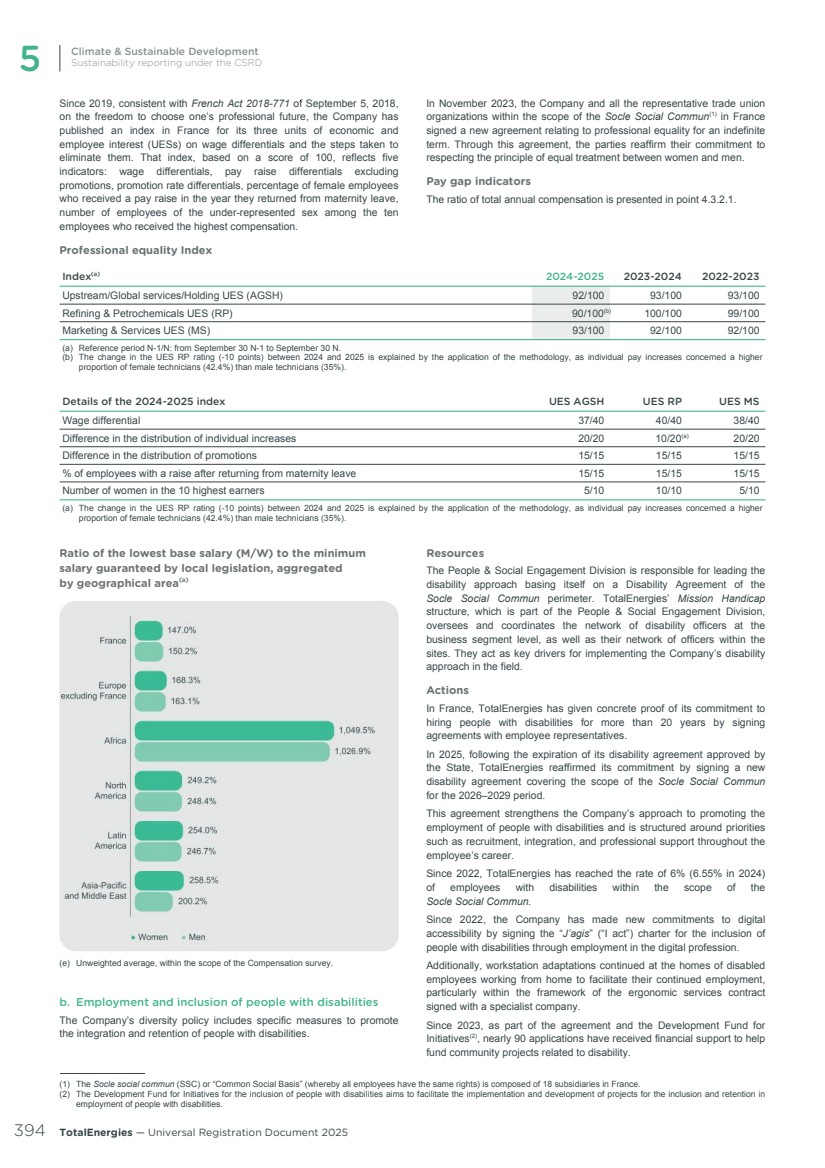
| TotalEnergies also supports the Association TotalEnergies Solidarité Handicap (ATSH), an organization formed in 1975 by employees who have children with disabilities. ATSH provides psychological and financial support to current and retired employees of the Company and their dependents in France who are affected by disability. It currently has about 300 members. Furthermore, as part of the “Manifesto for the Inclusion of Persons with Disabilities in economic life”, which was signed in 2019, TotalEnergies participates in several working groups, such as those on the internationalization of corporate disability policies or digital accessibility. As a partner of the Conférence des Grandes Ecoles, TotalEnergies finances an international scholarship program to offset the extra costs associated with disability, allowing talented young people to complete top-level courses by spending time abroad. In 2025, around thirty young people benefited from this program. Internationally, the Company aims to support employees with disabilities whatever the legal obligations in each country. This ambition is reflected in the signing of the International Labour Organization’s (ILO) Global Business and Disability Network Charter in October 2018 and by joining The Valuable 500 in 2020, a global initiative aimed at embedding the inclusion of people with disabilities and the recognition of their potential into the roadmap of multinational companies. More than 40 Company subsidiaries have committed to creating a more inclusive working environment for employees with disabilities, while respecting the specific features of each country. Many subsidiaries have therefore set objectives regarding the respect and promotion of rights, non‑discrimination policies and practices, accessibility, job retention, and confidentiality. Disability indicators(a) 2024 2023 2022 Total Women Men Total Women Men Total Women Men % of disabled workers in France (Socle Social Commun) (b) and breakdown W/M 6.55% 46% 54% 6.23% 46% 54% 6.24% 46% 54% (a) The rate for the reference year (2025) will be known after the report’s publication. (b) The Socle Social Commun (SSC) or “Common Social Basis” (whereby all employees have the same rights) is composed of 18 subsidiaries in France. D.Social dialogue Social dialogue is a key component of the Company. It includes all types of negotiations, consultations or exchanges of information among the management of the TotalEnergies entities, employees and their representatives about economic and workplace issues and concerns relating to company life. The topics addressed in this social dialogue may vary according to each subsidiary, but some are shared concerns across the Company such as health and safety, work hours, compensation, training and equal opportunity. Actions Promoting and encouraging social dialogue The Company is careful to conduct this dialogue at both the local level and at headquarters or centrally, through its participation in company bodies and its negotiation of agreements. Among the many stakeholders with which TotalEnergies maintains a regular dialogue, the Company’s employees and their representatives have a special position and role, particularly in discussions with management teams. In countries where employee representation is not required by law, the TotalEnergies companies strive to establish such representation. As a result, majority elected employee representatives are present in most TotalEnergies companies. Moreover, where local laws provide few protections for freedom of organization and the right to collective bargaining, the subsidiary’s management is reminded that it must provide alternatives. These may include allowing employees to designate representatives, organizing regular meetings between those representatives and management, providing meeting rooms where employees can gather adjusting work schedules accordingly. Those best practices are reviewed in an e-learning course on human rights in the workplace, available within the Company since 2019. Freedom of association and collective bargaining are two of the subjects studied in its analysis of the risks of human rights abuses, and especially human rights in the workplace. In December 2017, TotalEnergies joined the worldwide Global Deal initiative, a multiparty partnership that aims to encourage governments, businesses, unions and other organizations to make concrete commitments to promoting employee relations at every level and to proposing concrete solutions that reconcile economic performance and social progress. The Global Deal promotes the idea that effective social dialogue can contribute to decent work and quality jobs and, as a consequence, lead to greater equality and inclusive growth, from which workers, companies and civil society benefit. TotalEnergies continues to share its best practices with Global Deal member companies and participates in working groups. Anticipating and supporting organizational changes The TotalEnergies European Works Council serves, on a European scale, as a forum for providing information and regularly exchanging views about the Company’s strategy, its workplace, and economic and financial situation, as well as on sustainable development, environmental and social responsibility and safety. It is consulted on proposals for significant organizational changes concerning at least two companies in two European countries, to express its opinion, in addition to the procedures initiated before the national representative bodies. The richness of social dialogue at European level was once again illustrated by the number (15) of European Works Council meetings and site visits in 2025, including several outside France (Czechia, Spain). Also in 2024, the particularly fruitful social dialogue at European level led to the negotiation of an amendment to the agreement concerning the renewal of the TotalEnergies European Works Council, signed by all members of the Committee, with the exception of those members representing a French trade union organization. This amendment improves the functioning of the European Works Council, notably by granting more resources to countries with fewer than 150 employees and grouped into clusters, optimizes meeting times (preparatory meetings, plenary meetings and visits) and takes into account the representativeness of each country making up the European Works Council, by updating the allocation of seats among these countries. The composition of the Works Council was accordingly renewed in September 2024 with 51 members representing 24 countries(1) . Members benefited from several discussions relating in particular to TotalEnergies’ balanced multi-energy strategy for the benefit of the energy transition. Meetings of the Strategy Committees (E&P, GRP, M&S, R&C)(2) allowed staff representatives to understand this ambition in a concrete way, through the presentation of the strategy of each business segment. (1) Restated data. (2) Exploration & Production - Gas, Renewables & Power - Marketing & Services - Refining & Chemicals. Climate & Sustainable Development Sustainability reporting under the CSRD 5 TotalEnergies — Universal Registration Document 2025 395 |
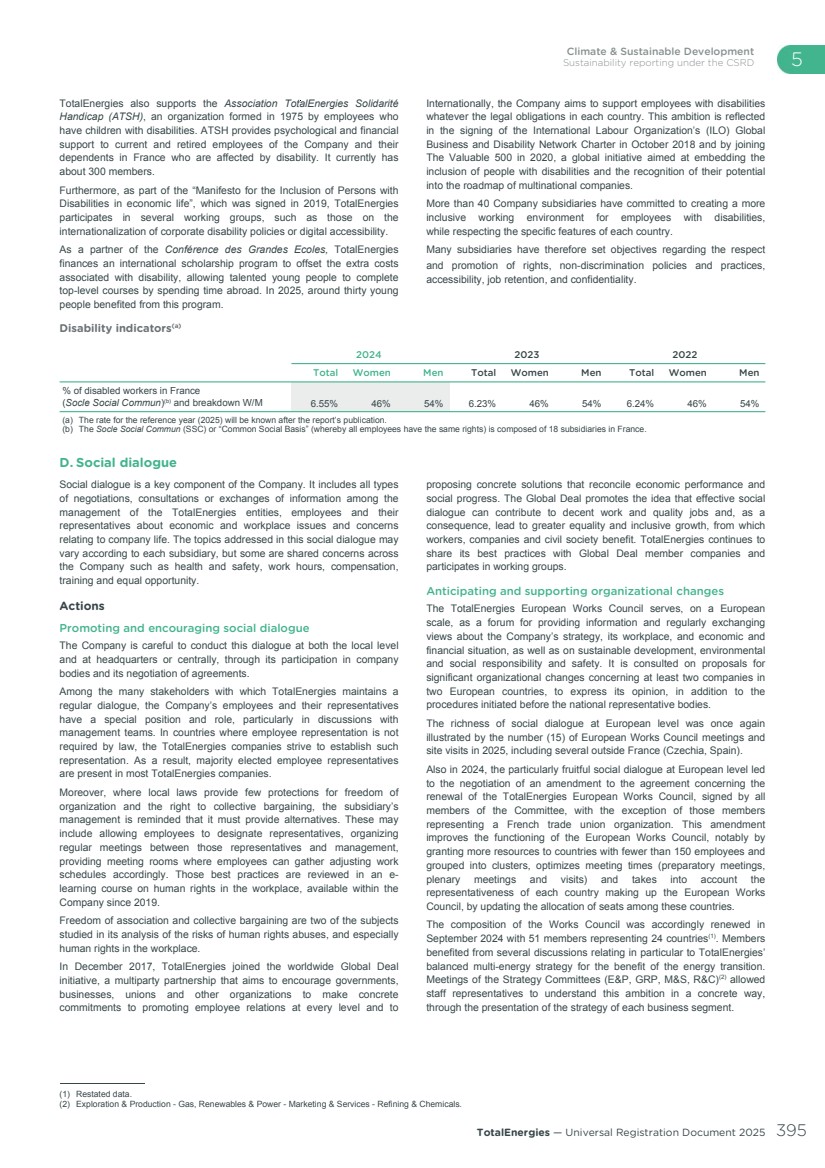
| As a responsible employer, TotalEnergies manages organizational changes responsibly. Among the commitments in the global agreement, the Company has committed to social support for organizational changes that consists of informing employee representatives in advance of planned changes, as well as making sure that subsidiaries take social measures when organizational changes occur, which must be among the best practices of companies in the business segment of the country concerned. In 2025, 48 subsidiaries worldwide underwent organizational changes that could have impact on employees, and 46 (95.8%) of them implemented measures to support their employees. They included: – 17 subsidiaries that took supporting measures for retirement or early retirement. This represents 35.4% of the subsidiaries concerned, – 43 subsidiaries that resorted to redeployment or mobility as supporting measures. This represents 89.6% of the subsidiaries concerned, – 20 subsidiaries that introduced an outplacement program. This represents 41.7% of the subsidiaries concerned, – 32 subsidiaries that offered assistance for training. This represents 66.7% of the subsidiaries concerned, – 4 subsidiaries that used a reduction in working hours as support measures. This represents 8.3% of the subsidiaries concerned, – 14 subsidiaries that offered financial compensation. This represents 29.2% of the subsidiaries concerned. Listening to our employees As a company that listens to its employees, TotalEnergies regularly involves them in participatory processes. For example, the Company is developing exchange formats between members of the Executive Committee and the employees, in order to listen to their proposals on key issues for the Company, such as climate change, the impact of the Company’s activities on biodiversity, performance-related compensation, employee well-being and the pace of the transition and its impact on employees. SInce 2022, nearly 300 employees of TotalEnergies have the possibility to take part in these collective intelligence sessions each year. In 2025, nearly 300 managers from around the world listened, spoke and made suggestions on the topic of “Managers & Accountability at TotalEnergies”. Participants focused in particular on Accountability, a principle that emphasises the commitment of profit centre managers in their areas of responsibility and to the Company to deliver the expected results, take the decisions required to achieve them, take responsibility for those decisions and report transparently on the results and consequences, both present and future, of their actions. A Company policy has been published and distributed internally to clarify the framework and expectations for implementing this principle on a daily basis, which is based on two of the company’s values: a Performance-Minded Commitment and a Pioneering Spirit. Moreover, every two years, TotalEnergies conducts an internal opinion survey (TotalEnergies Survey) to gather employees’ opinions and expectations regarding their professional situation and their perception of the Company, on a local or Company-wide level, on various topics (values, commitment, the Company’s ambition, diversity and inclusion, management, talent development, working conditions, etc.). Since 2023, by decision of the Executive Committee, an additional and shorter survey, the TotalEnergies Pulse Survey(1) , takes place every other year, to make it possible to measure employee engagement and well‑being annually. In 2025, the second edition of the TotalEnergies Pulse Survey was opened to more than 60,000 employees of the Company in nearly 120 countries. With an 84% participation rate and an increase of more than 7 points compared to the first edition in 2023, this result confirms the relevance of this listening tool. The engagement and well-being rates remain at very high levels, well above the benchmarks for companies with more than 10,000 employees(2) , with respective rates of 83.5% (Engagement score) and 83.4% (Care score). 90% of employees state they are proud to work for TotalEnergies. Questions were added to this survey to assess employees’ understanding of and commitment to the Company’s transition and to Sustainab’ALL, TotalEnergies’ sustainable development initiative. The initial results demonstrate a positive and shared dynamic and illustrate the teams’ confidence in the Company’s strategic direction. The results were communicated within all the entities concerned. Social dialogue indicators Employee commitment Indicator - TotalEnergies Survey and Pulse Survey (a) 2025 (Pulse) 2024 (TotalEnergies Survey) 2023 (Pulse) TotalEnergies’ Engagement Score 83.5% 83.7% 82.5% (a) Pulse Survey data do not cover Hutchinson. Coverage of negotiation/collective bargaining agreements France is the only country representing at least 10% of the total number of the employees of the Company. 2025 2024 2023 % of employees covered by a collective bargaining agreement worldwide 72.6% 73.6% 73.0% in the EEA(a)(b) 92.3% 93.3% – Number of active agreements signed with employee representatives worldwide 305 346 404 in the EEA(a)(b) 251 266 – including France 142 165 222 Number of wage agreements signed worldwide 125 150 282 (a) European Economic Area. (b) Data was not collected before 2024. (1) Survey conducted in 2025 on a Company scope excluding Hutchinson. (2) The Ipsos benchmark of companies with over 10,000 employees worldwide shows an Engagement score of 69% and a Care score of 70%. 5 Climate & Sustainable Development Sustainability reporting under the CSRD 396 TotalEnergies — Universal Registration Document 2025 |
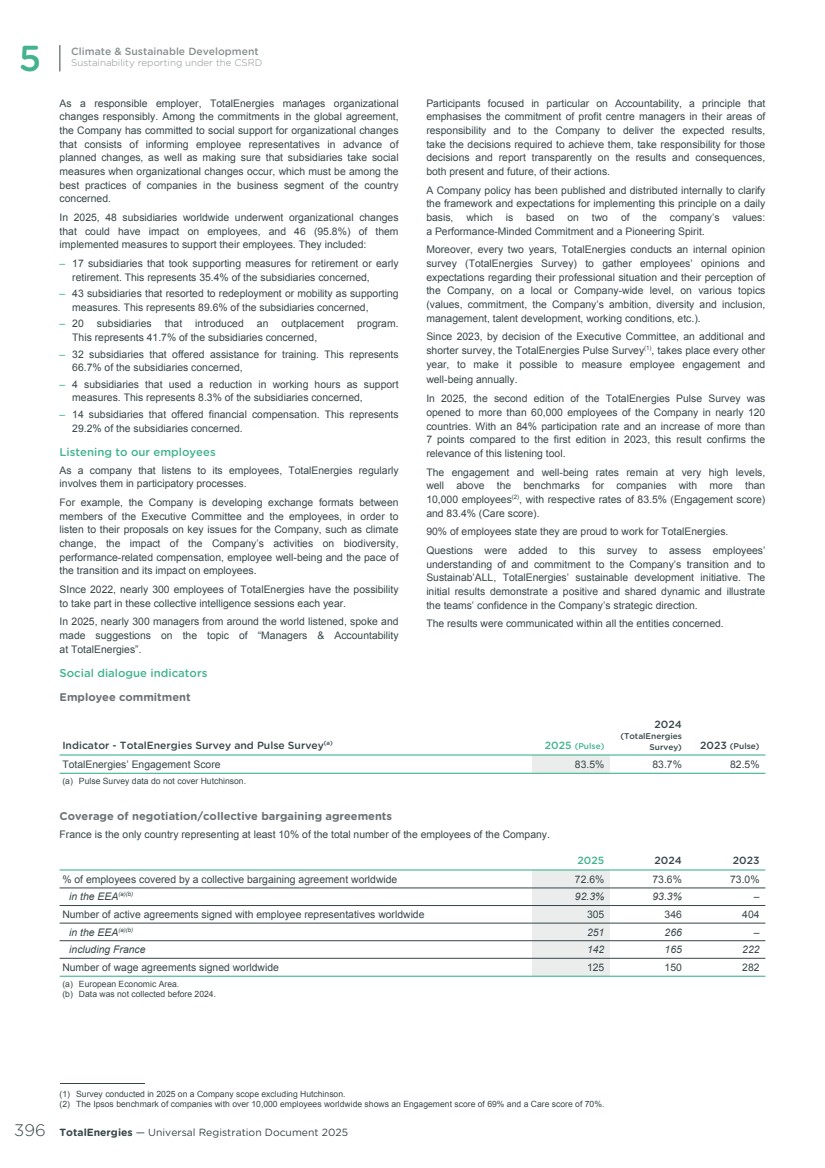
| Social dialogue 2025 2024 2023 % of employees with labor union representation and/or employee representation worldwide 91.9% 92.3% 91.5% in the EEA(a)(b) 100% 100% – including France(b) 100% 100% – (a) European Economic Area. (b) Data was not collected before 2024. E. Respect for human rights at work The main challenges associated with the effects of the Company’s activities in terms of respect for human rights have been identified using the methodology set out in the United Nations Guiding Principles on business and human rights (UNGP) reporting framework relating to the “salient issues”, i.e., the human rights at risk of the most severe negative impact through the Company’s activities or business relationships. 1. Reference framework TotalEnergies’ human rights approach is based on its Code of Conduct, strong and formalized commitments, a dedicated organization, an awareness-raising and training program as well as evaluation and follow-up mechanisms aiming at measuring the effectiveness of the Company’s actions. TotalEnergies is committed in particular to respecting internationally recognized human rights and standards, wherever the Company operates, in particular the Universal Declaration of Human Rights, the Fundamental Conventions of the International Labour Organization (ILO), the U.N. Guiding Principles on Business and Human Rights, the OECD guidelines for multinational enterprises and the Voluntary Principles on Security and Human Rights (VPSHR). The Human Rights Briefing Paper, whose third edition was published by TotalEnergies in January 2024, describes the Company’s approach to human rights in line with the recommendations of the United Nations Guiding Principles Reporting Framework. 2. Commitments To address salient human rights issues, TotalEnergies takes action in its employees’ workplaces by creating a working environment in which people are treated with respect and dignity, without fear of intimidation or harassment. The Company pays particular attention to the following points: – prohibition of forced labor and child labor, – prohibition of all forms of discrimination, whether based on origin, sex, age, disability, sexual orientation or identity, or affiliation with a political, religious, trade union or minority group, – taking the necessary steps to ensure decent working conditions: – ensuring people’s health and safety, – guaranteeing a decent wage for all employees, – monitoring equal pay between women and men, – promoting diversity and respect for others in the workplace, – respecting freedom of association and collective bargaining. The Company’s specific policies aimed at eliminating discrimination and harassment, and promoting equal opportunity and treatment are described in point 5.2.3.1 C. 4. and 5.2.3.1 B. 5. Specific commitments relating to policies of positive actions in favor of members of its personnel are described in point 5.2.3.1 C. 3. Resources/Organization The organization in charge of human rights is structured at three different levels. First, the Human Rights department, which reports to the Sustainability & Climate Division, itself reporting to the Strategy & Sustainability President, who sits on the Executive Committee, is responsible for rolling out the Company’s Human Rights roadmap, coordinates the analysis of the Company’s human rights risks, supports operational teams and supervises the actions to promote respect for human rights, in close collaboration with the Ethics Committee and in accordance with the Company’s Code of Conduct. The Human Rights Steering Committee monitors the implementation of the human rights roadmap and meets four times a year. It is led by the Senior Vice President of Sustainability & Climate and includes representatives of each business segment and of the main functional divisions that have a role related to human rights. The Ethics Committee, on which representatives of all TotalEnergies’ business segments sit, plays a key role of listening and support. Employees, but also people from outside the Company, can contact the committee at the email address ethics@totalenergies.com. The Committee protects the confidentiality of the complaints, which can only be lifted with the agreement of the complainant. The Chairman of the Ethics Committee presents an annual Ethics report to the Governance and Ethics Committee of the Board of Directors. In 2025, the Ethics Committee received 190 alerts (internal, external and anonymous) registered on ethics@totalenergies.com regarding compliance with the Code of Conduct, 65% of them concerning matters related to human resources. All alerts received are addressed and, when necessary, recommendations are made in order to lead to the implementation of corrective actions. Secondly, each business segment has appointed a human rights representative who coordinates this subject in its scope and cooperates with the Human Rights department, with which he or she meets regularly in order to address ongoing issues. Monthly reviews also take place between the Human Rights department and the main head office functional divisions regarding human rights. Lastly, this dedicated organization is supported by a network of human rights correspondents based in the countries where the Company operates, and in particular the network of ethics officers, as well as the persons in the local subsidiaries in charge of the health, safety and environment and human resources functions, plus certain subsidiaries’ managing directors. These human rights correspondents, who are located as close to the operations as possible, are in charge of promoting the values set out in the Code of Conduct among employees working at subsidiaries and ensuring that the Company’s commitments are correctly implemented by local stakeholders. More information on the organization in charge of human rights are available in point 5.2.3.2. 4. Action plan Awareness-raising and training In order to disseminate the Company’s commitments, TotalEnergies raises its employees’ awareness via internal communication channels such as intranet sites and events such as the Business Ethics Day, which is held each year at the headquarters and in subsidiaries. In 2025, the Business Ethics Day was held on December 10, the day on which the International Human Rights Day is celebrated, and had for theme the 25th anniversary of the Code of Conduct. The Chairman & Chief Executive Officer of TotalEnergies adressed a message to all the personnel of the Company to reiterate the importance, relevance and continued applicability of the Code of Conduct and of the principles and values it embodies. Climate & Sustainable Development Sustainability reporting under the CSRD 5 TotalEnergies — Universal Registration Document 2025 397 |
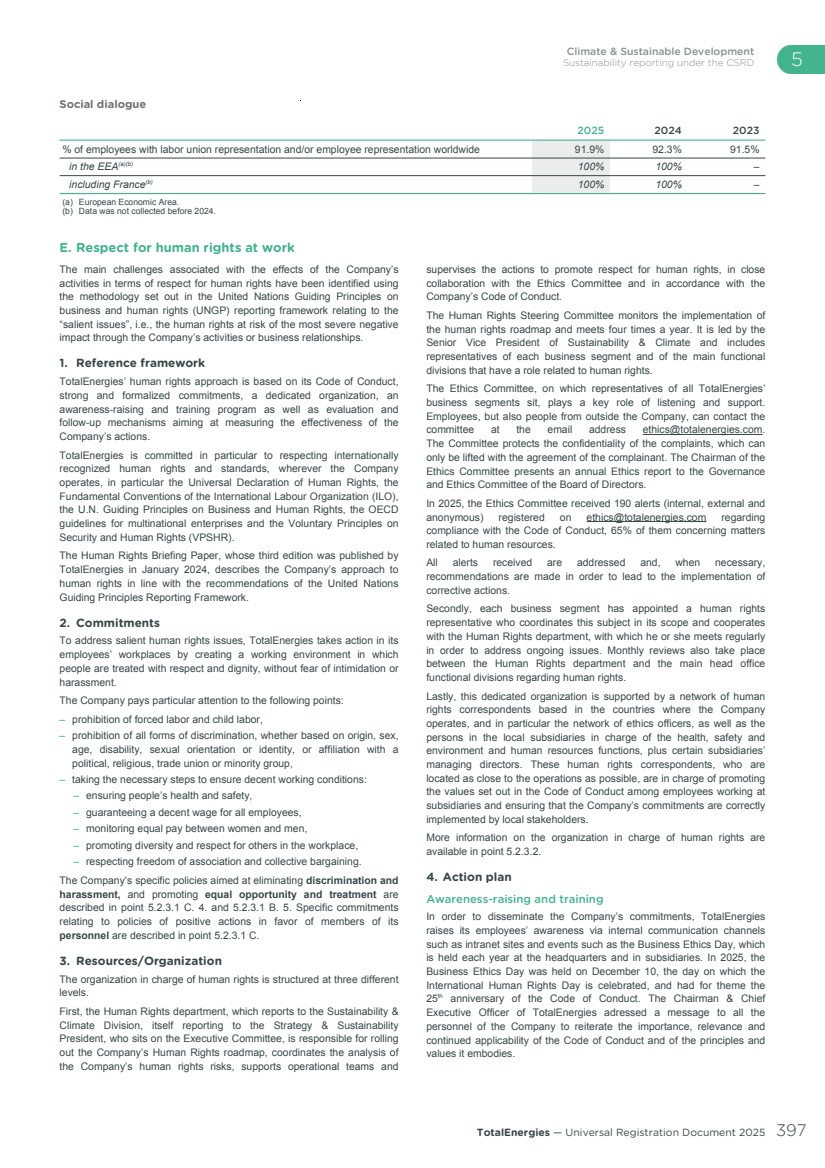
| In addition to the Code of Conduct, the Company also publishes a Human Rights Guide that is made available to its employees and the stakeholders and published in early 2024 its third edition of the Human rights briefing paper covering the time period from 2018 to 2023 which illustrates its human rights approach in its activities. TotalEnergies also has a practical guide to dealing with religious questions within the Company. These guides and the third edition of the Human rights briefing paper 2018-2023 are available on the intranet site. In addition to the Ethics training which has been updated in 2024 and is mandatory for all Company employees, a Human Rights training plan, developed in 2020, aims to promote the development of a culture of respect for human rights within the Company, to better manage the associated risks, and to upskill all employees, so that they themselves become agents of change in the long term. This plan is targeted at the following priority populations: – the most influential categories (such as Country Chairs, Project Managers and Asset Managers in high-risk countries and projects), – the categories most exposed to human rights risks or whose actions may have potentially negative impacts on human rights (such as service station managers in the Marketing & Services segment or Community Liaison Officers (CLOs) in the Exploration & Production segment). As part of this plan, several training sessions were organized in 2025. For target groups More than 3,000 employees (compared to nearly 5,000 in 2024) belonging to the priority categories were trained in face-to-face training sessions in 2025: – in the Marketing & Services segment, about 670 employees were trained. These employees include members of management committees (Mancom) as well as other priority categories of employees (network directors, segment managers and service station managers) within the subsidiaries, particularly in Dominican Republic, Democratic Republic of the Congo, Togo, France and Ghana; – the Exploration & Production segment, more than 1,380 employees were trained on respect for human rights, including members of the management committees of subsidiaries located in Angola, South Africa, Brazil, France, Malaysia, the United States, Qatar, the United Kingdom, Uganda and Suriname; – the Integrated Power and Integrated LNG segments, more than 800 employees were trained on respect for human rights in Brazil (Casa dos Ventos), in Poland, in France and in Spain; – the Refining & Chemicals segment, more than 200 employees were trained on respect for human rights, including members of the segment’s management committee and certain priority groups at Hutchinson sites in Turkey, Portugal and Romania. Training on ethics and human rights was followed by 20 executives in 2025. For all employees The online module on human rights in the workplace with a focus on respecting the ILO’s core conventions, which has been accessible to all employees since 2019 in all countries and mandatory for all management employees, continued to be deployed in the countries where TotalEnergies is present. It is available in five languages. In 2025, nearly 8,000 employees have been trained online leading to a total number of more than 76,000 employees having completed it between its launching in 2019 and the end of 2025. After two years of intense deployment in 2023 and 2024, the annual training rythm stabilized in 2025. In addition, representatives of the Human Rights department regularly participate in external events with other companies and institutional players to share experiences and best practices in this area. Assessments In addition to the audits and assistance missions carried out by the Audit and Internal Control Division, which cover certain human rights-related issues, the ethics and human rights-related practices of TotalEnergies’ entities are regularly assessed by independent third parties and qualified experts. The entities are identified in particular according to the level of the risk of human rights violations in each country, the number of alerts received the previous year and the date of the subsidiary’s last assessment. These assessments help identify best practices, share them in the Company and recommend areas for improvement. Knowledge and appropriation of the Code of Conduct are tested and reinforced by ethics and human rights awareness-raising sessions. Employees are encouraged to voice their ethical concerns in a confidential manner and report behaviors potentially contrary to the Code of Conduct. These assessments confirmed that the Code of Conduct is well understood by employees. The ethics and human rights assessments are followed up by action plans within 12 months. The British company GoodCorporation has assessed nearly 170 entities since 2002 in 60 countries with regard to the principles and values enshrined in the Code of Conduct. In 2025, six ethics and human rights assessments were conducted. They concerned six subsidiaries (in Spain, Turkey, Dominican Republic, Brazil, the United Kingdom and Ghana). These assessments confirmed that the Code of Conduct has been duly incorporated by the subsidiaries. The follow-up of the action plans put in place further to the previous year’s assessments in subsidiaries of the Republic of Congo, Qatar and the United States was also carried out in 2025. 5. Combatting forced labor and child labor In accordance with ILO standards, it is forbidden to hire people under the age of 15. The minimum age for access to any type of employment or work considered dangerous must not be less than 18. TotalEnergies is concerned about the risk of forced labor and child labor. Such situations are a challenge, but also an opportunity to use our skills to promote respect for human rights in the workplace. The prohibition of forced and child labor, non-discrimination, just and favorable conditions of work, as well as safety, all form part of the principles set out in the Code of Conduct and are developed in TotalEnergies’ Human Rights Guide and in the Human Rights Briefing Paper 2018-2023 published in 2024. The “Human rights in the workplace” e-learning course also raises employee awareness about upholding these rights and the Company’s zero-tolerance policy concerning forced labor and child labor. 6. Remediation procedures and access to corrective measures Employees can contact the Ethics Committee in their preferred language to ask questions or report any incident involving a risk of non-compliance with the Code of Conduct via the generic email address (ethics@totalenergies.com). This channel was put in place in 2008. The collection and processing of ethical complaints procedure published internally and on the TotalEnergies website since December 2020, formally sets out the existing approach for collecting and processing complaints sent to the Ethics Committee by internal or external stakeholders concerning behaviors or situations contrary to the Code of Conduct. It ensures that the identity of the person making the report is protected, rules out any reprisals against them or against those taking part in the processing of the complaint, and respects applicable laws and regulations in terms of protecting personal data. The procedure was presented to employee representatives in France for consultation. The Chairman of the Ethics Committee, who reports directly to the Chairman and Chief Executive Officer of the Company, presents an annual ethics balance sheet to the Governance and Ethics Committee of the Board of Directors. 5 Climate & Sustainable Development Sustainability reporting under the CSRD 398 TotalEnergies — Universal Registration Document 2025 |
| When the Ethics Committee observes a breach of the Code of Conduct, management draws the necessary conclusions and sanctions may be imposed in keeping with the applicable law and the procedures negotiated locally with staff representatives (examples include verbal reminders, written warnings, suspension or dismissal). All cases registered via the online network are processed and when necessary, recommendations are made in order to lead to the implementation of corrective actions. For example, in cases of human rights violations in the workplace, such as inappropriate behavior including sexual harassment, sanctions up to and including dismissal in the most serious cases may be imposed on the perpetrator. Processing of complaints made to ethics@totalenergies.com Whistleblowers are kept informed of the progress of their case (receipt, analysis, actions, closure). Whistleblowers can choose to remain anonymous. 7. Indicators Report follow-up 2025 2024 2023 Number of reports relating to the Code of Conduct received at ethics@totalenergies.com 190 209 170 % of reports relating to human resources (including harassment, discrimination and unsatisfactory working conditions) 65% 63% 70% Human rights training follow-up 2025 2024 2023 Number of employees trained in human rights during the year (in person training for target groups) 3,063 4,948 3,532 Number of employees trained in human rights during the year (e-learning) 7,934 9,886 11,712 TotalEnergies implements several channels for reporting information, principally the email address ethics@totalenergies.com which is open to all employees and to people outside the Company. Beyond the incidents reported to the Ethics Committee above, the Company is not in a position to gather and collect data on the number of work-related incidents and/or complaints (including the amounts of related fines and penalties, if any), and continues the consolidation of this information in order to be in a position to report them in the future, where appropriate. In 2025, TotalEnergies was not aware of any serious incidents related to human rights (such as forced labor, human trafficking, or child labor, for example). 5.2.3.2 Value chain workers (S2) TotalEnergies’ activities generate hundreds of thousands of direct and indirect jobs worldwide. Workers in the value chain likely to be affected by material impacts related to the Company’s activities or its value chain include: – upstream, the workers of suppliers of goods and services, – downstream, workers at the Company’s distributors and service stations operated by a third party. A. Value chain worker policies (S2-1) The main challenges associated with the effects of the Company’s activities in terms of respect for human rights have been identified using the methodology set out in the United Nations Guiding Principles on business and human rights (UNGP) Reporting Framework relating to the “salient issues”, i.e., the human rights at risk of the most severe negative impact through the Company’s activities or business relationships. On this basis, the Company has identified six salient risks, subdivided across three key areas, one of which is human rights in the workplace of TotalEnergies employees as well as the employees of its suppliers and other business partners. Preventing risks related to working conditions, in particular forced labor and child labor in the value chain, is a priority for the Company which has made this one of the principles in its Code of Conduct, along with non-discrimination, fair, satisfactory and safe working conditions, as well as safety. These principles relating to human rights in the workplace are also those set out in the fundamental conventions of the International Labor Organization, which are recalled in TotalEnergies’ Code of Conduct as its reference standards in its activities. The Company has formalized its approach to human rights, set out in the Human Rights Information Document published in January 2024. The Company specifies its commitments to prohibit forced labor and child labor, to proscribe all forms of discrimination and to take the necessary steps to ensure decent working conditions. Climate & Sustainable Development Sustainability reporting under the CSRD 5 TotalEnergies — Universal Registration Document 2025 399 |
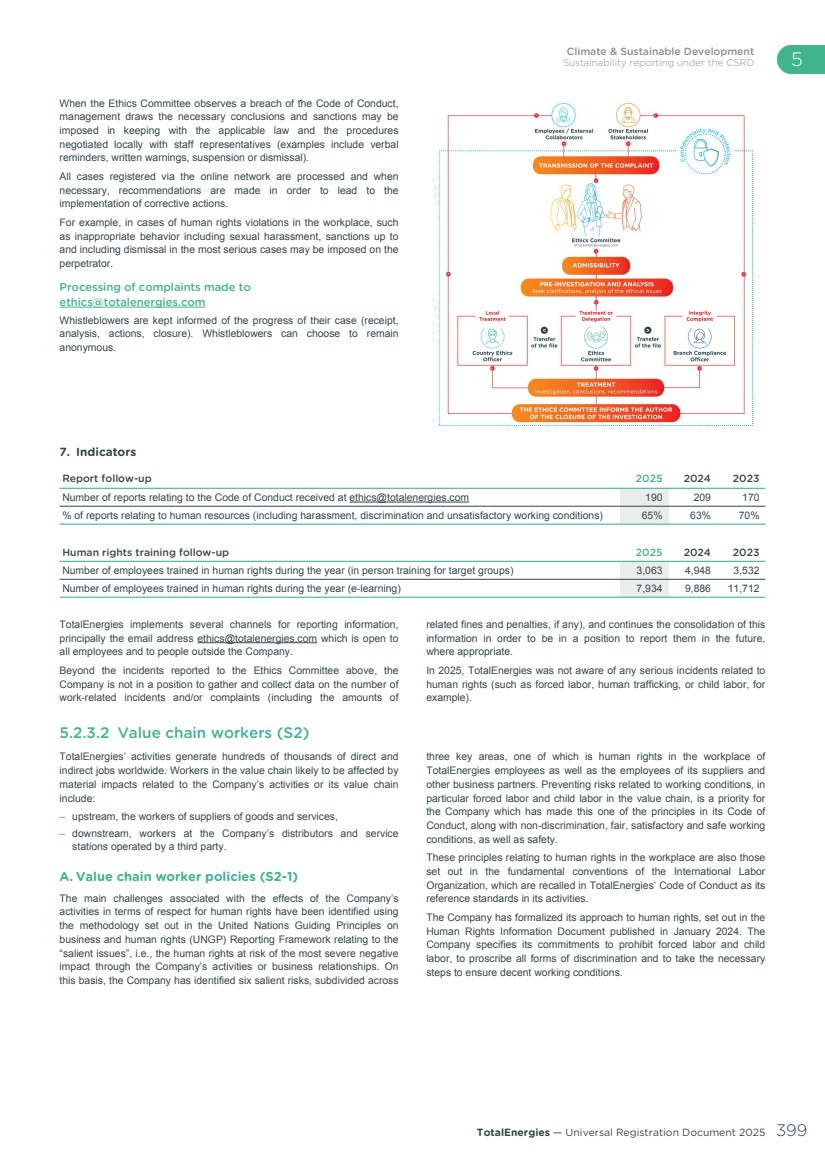
| The organization in charge of human rights is structured at three levels: ● first, the Human rights department which reports to the Sustainability & Climate Division, which in return reports to the President, Strategy & Sustainability, who sits on the Executive Committee, is in charge of deploying the Company’s roadmap, coordinates the analysis of Company’s human rights, supports operational teams and supervises the actions to promote respect for human rights, in close collaboration with the Ethics Committee in accordance with the Company’s Code of Conduct. A Human Rights Steering Committee monitors the implementation of the Human Rights roadmap and meets four times a year. It is chaired by the Sustainability & Climate director and includes representative of each business segment, as well as the main functional divisions that have a role related to human rights. The Ethics Committee, on which representatives of all TotalEnergies’ business segments sit, plays a key role of listening and support. It carries out Ethics and human rights assessments of the subsidiaries with the assistance of a consultant GoodCorporation. These assessments cover the upstream and downstream value chain and the working conditions of the workers of this value chain, and enable to identify good practices, to share them across the Company and to recommend areas of improvement. The choice of the entities assessed is based in particular on the level of human rights violations risks in the country, the number of alerts received during the previous year and the date of the latest assessment of the subsidiary. In 2025, these Ethics and human rights assessments were carried out in Spain, Turkey, the Dominican Republic, Brazil, the United Kingdom, and Ghana. ● Secondly, each business segment, has appointed a human rights representative who coordinates this subject whithin its scope and cooperates with the Human Rights department, with whom he or she meets regularly to address ongoing concerns. Monthly reviews also take place between the Human rights department and the main functional entities of the headquarters in charge of human rights. ● Lastly, this dedicated organization is supported by a network of human rights correspondents located in the countries where the Company operates, notably the ethics officers’ network (ethics officers) as well as the persons within the subsidiaries in charge of the health, safety and environment, human resources and certain subsidiaries managing directors. These human rights correspondents, who are located as close to the operations as possible, are in charge of promoting the values set out in the Code of Conduct among subsidiaries employees and ensuring that the Company’s commitments are correctly implemented by local stakeholders. Policies for workers in the upstream value chain The Company’s Code of Conduct also applies to the Company’s suppliers of goods and services, who must apply standards at least equivalent to those of the Company, particularly with regard to their employees. The relationship between TotalEnergies and its suppliers is based on adherence to the Fundamental Principles of Purchasing, which specify the commitments expected by TotalEnergies, particularly in the areas of respect for human rights in the workplace, and the protection of health, safety and security. For more information on upstream value chain worker policies, refer to point 5.2.4.3. Minerals policies The origin, extraction and refining conditions as well as the use of certain minerals, ores and raw materials are the subject of particular attention, in light of the potential risks to human rights (like forced labour, child labour and non decent working conditions), and the environment. TotalEnergies conducted an internal study to identify the Company’s priorities in this area. Following a risk analysis, TotalEnergies has identified three priorities in this regard: cobalt, polysilicon and conflict minerals (gold, tungsten, tin and tantalum). – Cobalt: since cobalt can be used in the manufacture of certain batteries, Saft Groupe (Saft) has been conducting an annual campaign since 2021 to collect information from its suppliers. Saft relies on the Extended Minerals Reporting Template (EMRT) provided by the Responsible Minerals Initiative® (RMI® ) to identify the processing units in its supply chain and the country of origin of the cobalt ores. Based on the results and using the RMI® database, Saft verifies whether its cobalt supply chains include suppliers at risk in terms of human rights and environment. Where necessary, specific actions are taken to mitigate or cancel these risks. As part of a progress-led approach, since 2023, Saft is a member of the Cobalt Institute, the global association representing cobalt producers and users. The main objective of the Cobalt Institute is to ensure that cobalt is produced and used ethically and in a sustainable manner, while meeting the needs of industry and society. – Polysilicon: polysilicon is used in the manufacture of solar panels. When necessary, TotalEnergies entrusts traceability audits to an independent third party. – Conflict minerals: Pursuant to Rule 13p-1 of the Securities Exchange Act of 1934, as amended, which implemented certain provisions of the Dodd-Frank Wall Street Reform and Consumer Protection Act of 2010, since 2014, TotalEnergies has filed with the United States Securities and Exchange Commission (SEC) an annual document relating to “minerals from conflict zones” sourced from the Democratic Republic of the Congo or neighboring countries. This document indicates whether, during the preceding calendar year, any such minerals were necessary for the operation or for the production of a product manufactured by TotalEnergies SE or one of its consolidated companies or contracted by TotalEnergies SE or one of its consolidated companies to be manufactured. The purpose of this regulation is to prevent the direct or indirect funding of armed groups in central Africa. To this end, TotalEnergies operates a centralized conflict‑minerals due‑diligence process, coordinated at the Holding level and carried out by business‑segment coordinators who assess relevant products and engage suppliers. Subsidiaries conduct reasonable country‑of‑origin inquiries using standardized industry templates to identify sourcing risks. This structured process enables TotalEnergies to monitor its supply chain, promote responsible sourcing, and assess whether any minerals may have originated from covered conflict‑affected areas. For more information, please refer to TotalEnergies’ most recent publication, available on the TotalEnergies website or sec.gov. As conflict minerals may potentially be present in the electrical and electronic components used in battery manufacturing, Saft conducts an annual campaign to collect information from its suppliers. Saft relies on the Conflict Minerals Reporting Template (CMRT) provided by the Responsible Minerals Initiative® (RMI® ) to determine the presence of conflict minerals in its supply chain and to identify the processing units for these minerals that are likely to participate in it as well as the country of origin of the ores. Saft became a member of the RMI ® in 2022. In 2025, Saft also launched a campaign to collect information from suppliers in its supply chain for nickel, lithium, graphite and cooper, relaying on version 2.0 of the Extended Minerals Reporting Template (EMRT) of the RMI® . 5 Climate & Sustainable Development Sustainability reporting under the CSRD 400 TotalEnergies — Universal Registration Document 2025 |
| Policies for workers in the downstream value chain The Company encourages its business partners to apply principles at least equivalent to those set out in the Code of Conduct. Among the ethics and human rights assessments carried out by the Ethics Committee in 2025 with downstream value chain partners, enabled to identify some areas for improvement with regards to the principles of the Code of Conduct, essentially linked to unsatisfactory working conditions. They have led to action plans. In the Marketing & Services (M&S) segment, assessments on human rights in the workplace conducted in service stations, with the assistance of an external service providers. These assessments aim to identify good practices and area for improvement and result in development of action plans. They include interviews with service station dealers and employees, site visits and a document review. The M&S segment has also implemented a self‑assessment mechanism on human rights at work within its subsidiaries. Contracts concluded with service stations operators must include provisions relating to respect for human rights and the Voluntary Principles on Security and Human Rights (VPSHR). Finally, human rights training and awareness-raising sessions, aimed more specifically at employees of TotalEnergies subsidiaries and service station dealers, are held in parallel to these self-assessments or assessment. B. Process for dialogue with value chain workers on impacts (S2-2) TotalEnergies ensures that, whenever possible and relevant, it has discussions with workers’ representatives in the value chain or directly with workers in the case of more innovative approaches to certain major projects. This dialogue can take different forms, depending on the specific context and the particular groups of workers involved in the value chain. Conducting assessments of the Company’s partners is one of the first levers of dialogue to build a dynamic of continuous improvement with partners. At the global level, TotalEnergies signed in 2015 a four-year agreement with IndustriALL Global Union(1) on the promotion of human rights at work, diversity, health and safety at work and the dialogue with employees and their representatives. TotalEnergies continues to apply the commitments of this global agreement. Through this global agreement, TotalEnergies also asks its suppliers to respect freedom of expression, association and collective bargaining and, in countries where this right is restricted, to ensure that employees have the right to participate in a dialogue concerning their collective work situation. In December 2017, TotalEnergies also joined the worldwide Global Deal initiative, a multi-stakeholder partnership whose goal is to encourage governments, companies, unions and other organizations to make concrete commitments to improve dialogue with employee on all levels and to propose concrete solutions to reconcile economic performance and social progress. The Global Deal promotes the idea that effective dialogue with employees can contribute to decent work and quality jobs and, as a result, to more equality and inclusive growth, from which workers, companies and civil society benefit. In 2025, TotalEnergies continued to share its good practices with Global Deal member companies. Upstream value chain As part of its priority supplier assessment and engagement programme, the Company conducts on site human rights and environmental assessments carried out by an independent third party. These assessments include, among other things, systematic interviews with suppliers’ employees. In addition, aware of the importance of guaranteeing respect for working conditions on the sites of major construction projects, TotalEnergies has put in place a complementary approach to the already existing assessment and complaint reporting systems. Between 2023 and 2025, the Company deployed as a pilot a digital grievance mechanism, “workers’ voice survey” within two of its large industrial projects: Tilenga in Uganda and EACOP in Tanzania. This pilot aims to directly interview workers of tier-one suppliers and above via their mobile phones in order to collect information on respect for human rights and working conditions on site. TotalEnergies shares the results of these surveys with suppliers who are required to propose action plans. Downstream value chain Since 2022, the M&S segment’s assessments in service stations on human rights in the workplace are opportunities for dialogue with service station dealers. These assessments aim to identify good practices and areas for improvement. Awareness-raising sessions on human rights are held for service station dealers. In addition, M&S subsidiaries regularly host conventions in the countries where they operate, bringing together service stations dealers, in order to discuss with them and raise awareness on issues such as respect for human rights in the workplace. C. Description of processes to remedy negative impacts and channels for value chain workers to voice their concerns (S2-3) Value chain workers have access to grievance mechanisms and may report their concerns and complaints through the global Ethics line via a generic email address (ethics@totalenergies.com) as well as through other mechanisms for reporting concerns or complaints. These may be mechanisms set up by a subsidiary of the Company (such as the form on the subsidiary’s website, the telephone number or the email referring to the subsidiary’s sales department trained to receive and manage non-commercial complaints) or managed by third parties (such as the anonymous platform). TotalEnergies ensures that these mechanisms are effective, understandable and accessible (displays, awareness-raising, language used) by all workers in the value chain, and that they are not used to impede access to judicial or extrajudicial grievance mechanisms. No individual who raise a concern or submit a complaint in good faith may be subject to retaliation. Likewise, TotalEnergies’ suppliers are expected to allow their employees to express grievances and concerns without fear of retaliation. As part of evaluation missions of the Company’s partners, TotalEnergies ensures that mechanisms for reporting concerns or complaints are made available to workers in the value chain. D. Description of actions concerning material impacts on value chain workers, approaches to managing material risks and seizing material opportunities concerning value chain workers, and effectiveness of these actions (S2-4) Upstream value chain TotalEnergies also implements specific actions aimed at preventing and addressing material impacts on workers operating within its upstream value chain, in particular through the deployment of a priority supplier assessment and engagement programme. (1) International union federation representing more than 50 million employees in the energy, mining, manufacturing and industrial segments in 140 countries. Climate & Sustainable Development Sustainability reporting under the CSRD 5 TotalEnergies — Universal Registration Document 2025 401 |
| In 2025, on‑site assessments of suppliers (refert to point 5.2.4.3) identified several areas for improvement likely to have an impact on workers in the upstream value chain. These areas mainly relate to the absence of grievance‑mechanisms among certain suppliers, as well as to suppliers’ practices related to working conditions (such as entitlement to leave or compliance with working hours as required under local laws). Following these findings, suppliers are required to implement action plans, which are monitored by TotalEnergies and subject to verification by the external service provider responsible for conducting the on‑site assessments. Of the 800 suppliers assessed since 2023, more than 400 have implemented verified improvements, including with respect to leave entitlements, access to grievance mechanisms, and compliance with and remuneration of overtime hours In addition, in 2025 EACOP continued implementation of the Industrial Relations Management System (IRMS) to ensure the project’s workforce management and the working conditions for the contractor workforce are well respected, in particular by putting in place systems and processes to monitor dedicated indicators and complaints management. In this context, all construction contractors were trained on the IRMS requirements in Tanzania. The site-based Industrial Relations Supervisors (IRS, Tanzania) and Industrial Relations Officers (IRO, Uganda) are responsible for developing and implementing key systems and processes, such as site workers forums and committees, monthly reporting to the project, workers grievance mechanisms, as well as IR training, inductions, and awareness raising at the worksite to communicate on workers’ rights. IRMS enables contractors to monitor working conditions throughout a project, and to respond to any incident. For EACOP, it has been supplemented by the “Worker’s Voice” tool, deployed on a pilot basis to monitor compliance with workers’ rights for the Tilenga and EACOP projects. This system has improved working conditions, in line with the information feedback facilitated by IRMS. IRMS is a mechanism that could be deployed on other projects. Downstream value chain Salient human rights issues in the workplace, including forced labor, child labor, and safe and satisfactory working conditions, have been identified for several years by the Company in all its activities, including those of service stations in the M&S segment. The Company has integrated these risks into its approach to human rights, enabling it to better assess them and, where necessary, implement actions to avoid or reduce the impact on workers in the value chain. Since 2022, the M&S segment set up a Human Rights Committee, responsible for overseeing and ensuring the effective deployment of the segment’s human rights roadmap. Since then, assessments on human rights at work have been conducted by an external service provider across the service station network (in the Democratic Republic of the Congo, Tanzania, Cambodia, Zimbabwe, Jamaica, Cameroon, Côte d’Ivoire, the Dominican Republic, Mauritius, Puerto Rico, Senegal and Togo), and more than 250 service stations have responded to human rights at work self‑assessment questionnaires. These assessments and self‑assessments made it possible to identify good practices and areas for improvement, such as the installation of suggestion boxes in service stations, as well as posters featuring a QR code enabling the submission of commercial and non‑commercial complaints. In addition, training or awareness‑raising sessions on respect for human rights are provided to service station managers, employees of the M&S segment’s subsidiaries and other stakeholders. The M&S segment’s subsidiaries regularly organise conventions in the countries where they operate, bringing together service station managers in order to engage in dialogue with them and raise awareness on topics such as respect for human rights at work. Furthermore, service station managers are systematically interviewed as part of the audits conducted by the Ethics Committee, with the assistance of GoodCorporation, within the M&S segment. E. Description of targets for managing material negative impacts, promoting positive impacts and managing material risks and opportunities (S2-5) As part of a continuous improvement process designed to address the material risks associated with workers in the value chain, the Sustainable Procurement program is a target-based scheme targeting 1,300 priority suppliers (refer to point 5.2.4.3 B.). 5.2.3.3 Affected communities (S3) A. Policies for affected communities (S3-1) TotalEnergies strives to be an agent of positive change for society, and to contribute to its development through its societal actions. At a national level, the Company’s activities generate value for the countries where it operates. At a local level, the Company’s activities can be a source of opportunities for people but may also have an impact on the living conditions of local communities and residents. In order to manage these actual or potential impacts, and associated risks for the Company, TotalEnergies has defined in its referential framework’s principles which reflect the Company’s values and aim at preventing impacts on human rights. ● The Company’s Code of Conduct, which can be consulted on the TotalEnergies website, is intended for all employees worldwide, as well as external stakeholders (host countries, local communities, customers, suppliers, industrial and commercial partners, and shareholders) and sets out the values that guide TotalEnergies’ actions, including safety and respect for others. It states TotalEnergies’ compliance with the following international norms and standards: – the principles of the Universal Declaration of Human Rights, – the United Nations Guiding Principles on Business & Human Rights, – the principles set out in the International Labour Organization’s fundamental conventions, – the principles of the United Nations Global Compact, – the OECD Guidelines for Multinational Enterprises, and – Voluntary Principles on Security and Human Rights or VPSHR. The Code of Conduct sets out the Company’s commitments to its internal and external stakeholders, in particular: – to respect the rights of local communities by identifying, preventing and mitigating any negative impact on their environment and way of life, and remedying it where necessary, – systematically to seek to establish dialogue as early as possible in order to foster lasting relationships with communities, and to be attentive to their development opportunities, – to design and implement grievance mechanisms and corrective measures, particularly for vulnerable groups such as indigenous peoples. ● TotalEnergies published the third edition of the Human Right Briefing Paper in January 2024, describing the Company’s approach to integrating Human Rights, particularly in relation to local communities. It provides concrete illustrations of the Company’s actions in the field. 5 Climate & Sustainable Development Sustainability reporting under the CSRD 402 TotalEnergies — Universal Registration Document 2025 |
| ● The Company’s Health, Safety, Environment and Quality Charter, specifies that TotalEnergies implements periodic risk assessments and appropriate risk management policies and measures for all its activities. ● The “Our 5 Levers for a Sustainable Change” program, launched in 2024 aims to strengthen the commitment of all employees to sustainable development. Lever 4, “Our Communities”, promotes knowledge of local residents and stakeholders, constructive dialogue with local communities and careful handling of complaints. ● The One MAESTRO (Management and Expectations Standards Toward Robust Operations) reference framework, comprising rules, guides and manuals, specifications, video tutorials and a community of practice, accessible online to all TotalEnergies subsidiaries, and which facilitates the structuring and implementation of an operational societal approach adapted to the local specificities of territories and communities. It includes a rule dedicated to the management of stakeholders and local impacts, which describes the approach to be followed in managing the societal risks and impacts of the Company’s operations. Special provisions for indigenous and tribal peoples TotalEnergies, aware of the particularities of Indigenous Peoples, recognizes Convention 169 of the International Labour Organization (ILO) adopted in 1989, the 2007 United Nations Declaration on the Rights of Indigenous Peoples and various World Bank standards, including the International Finance Corporation (IFC) performance standards. A Charter of Principles and Guidelines regarding Indigenous and Tribal Peoples has been issued so that operated projects carefully consider these peoples rights, while respecting applicable laws. In addition to the application of the One MAESTRO reference framework application, and its rules regarding stakeholder dialogue and local impact management, TotalEnergies subsidiaries strive to identify human rights impacts notably through a human rights impact assessment where appropriate, to know and understand the legitimate needs of the indigenous peoples with whom they come into contact, within the framework of the applicable legal rules and the Principles and Guidelines of the Charter, and in compliance with the principle of sovereignty of nations. In particular, when the situation so requires, TotalEnergies subsidiaries are expected to: – consult indigenous peoples and their representatives, as recommended by ILO standards such as Convention 169, in particular, – dialogue with communities to understand their objectives, needs, values and constraints, – communicate planned operations to indigenous groups through presentations and local meetings, – keep the local population informed of the project’s progress, – work with all stakeholders so that the overall impact of the project is considered positive. In 2025, the project Papua LNG continued to consult local indigenous communities. In 2025, EACOP in Tanzania, has continued to engage and dialogue frequently with the four vulnerable ethnic groups self-identifying as “Indigenous Peoples” impacted by the project - the Akie, Taturu, Barabaig and Maasai. EACOP’s approach with these groups included in particular the implementation of the EACOP Plan for Vulnerable Ethnic Groups self-identifying as “Indigenous Peoples” signed in September 2022 and the signing of Free Prior and Informed Consent (FPIC) Agreements between EACOP and the Akie Community in July 2022, with the Taturu community in March 2023 and with the Barabaig community in January 2024. The collaboration with indigenous NGOs to reinforce engagement using more traditional methods and build the capacity of the four communities on different topics continues. A community social investment program, working with one of the indigenous NGOs, was implemented having started by supporting communities to obtain basic administrative documents such as identity cards and birth certificates. The solutions proposed in response to the expectations of local communities, particularly indigenous and tribal people, are coordinated by the societal teams that work in close collaboration with the Human Rights department and the legal, safety and environmental teams. B. Process of dialogue with affected communities TotalEnergies has structured its dialogue processes with its stakeholders at different levels of the Company, through relays within the organization, requirements included in internal reference frameworks, the deployment of a methodology for conducting local dialogue and a dedicated attention to the professionalization of the teams responsible for fostering that dialogue. This structure is designed to develop a long-term, trust-based relationship founded on principles of respect, attentiveness, constructive dialogue, proactive engagement and transparency, consistent with the legitimate need for confidentiality as appropriate. The One MAESTRO framework, which applies to all branches, provides subsidiaries a referential to conduct a stakeholder mapping and engage in a structured, ongoing process of dialogue with stakeholders to keep them informed, hear and address their concerns and expectations, report on mitigation actions or compensation, measure their satisfaction and identify ways the subsidiaries can improve their community outreach. In all segments, dialogue is initiated from the early project stages even when TotalEnergies does not have permanent teams on site. Each subsidiary or project develops a stakeholder engagement plan describing a process for transparent dialogue, as well as the timetable and means of ensuring its implementation. For sites already in operation, like in the Integrated Power segment, regular exchanges are organized with key stakeholders, such as elected officials, farm owners and students from schools in the regions where the operations are located. In most Exploration & Production projects, a network of community liaison officers is deployed on the ground to provide information to and consult with neighboring communities, authorities and other local stakeholders, with a particular focus being paid to vulnerable groups. Community liaison officers speak the local languages and understand local customs. Their role is crucial for establishing good relations between TotalEnergies and its stakeholders. For example, community liaison officers in Tanzania and Uganda, for the EACOP and Tilenga projects, observe and guide exchanges between contractors and communities affected by the project. Community liaison officers ensure that exchanges with project stakeholders are consistent with the principles of participation, respect for human rights, non-discrimination, empowerment, transparency and accountability. In Papua New Guinea, the Papua LNG Project maintains an intense dialogue, with more than 890 meetings held in 2025, mainly with communities and traditional authorities neighboring its operations. In the Refining & Chemicals segment, refineries and petrochemical sites, some of them ISO 14001 certified, put consultation with stakeholders at the heart of their ongoing improvement strategy. Local structures for dialogue have been set up, such as Community Advisory Panels in the United States and specific local committees for certain European platforms (e.g., Feyzin neighbors’ conference, La Mède neighbors’ meetings and Donges residential committee). The SRM+ (“Stakeholder Relationship Management”) methodology developed by TotalEnergies is periodically deployed to assess the effectiveness of the subsidiary’s actions in the fields of safety, environment, local content (employment and supply of local goods and services), and to understand the perception and expectations of local stakeholders. Climate & Sustainable Development Sustainability reporting under the CSRD 5 TotalEnergies — Universal Registration Document 2025 403 |
| On this occasion, representatives of the communities affected are consulted on the quality of dialogue with the subsidiary (transparency and regularity) and on its management of negative and positive impacts. The results of these consultations are integrated into the subsidiary’s decision-making processes through an action plan. C. Processes to remedy negative impacts and channels for affected communities to voice their concerns The main challenges associated with the effects of the Company’s activities in terms of respect for human rights have been identified using the methodology set out in the United Nations Guiding Principles on business and human rights (UNGP) Reporting Framework relating to the “salient issues”, i.e., the human rights at risk of the most severe negative impact through the Company’s activities or business relationships. On this basis, the Company has identified as salient risks: – access to land, – right to health and to an adequate standard of living, – and the risk to human rights in security activities in the event of disproportionate use of force. In this context, the Company’s stakeholder and local impact management is based on: – the analysis of the challenges and local societal context and potential impacts relating to operations: This analysis is one of the criteria for making investment, acquisition and divestment decisions on projects presented to the Company’s Risk Committee and, depending on the amounts, to the governing bodies of TotalEnergies; – A societal impact assessment: when the decision is taken to develop a project, a detailed baseline study is launched to identify in advance potential affected communities, describe the local context and assesses the main socio-economic and cultural impacts, risks and opportunities in the affected area. In 2025, 48 of these studies were carried out for different projects; – Specific studies on human rights (due diligence, Human Rights Impact Assessment (HRIA)) or cultural heritage, in addition to the societal impact assessment, may be carried out depending on the context, with the help of independent experts; – The implemention and monitoring of societal actions: Subsidiaries implement and monitor their societal strategy, with the support of the societal teams reporting to TotalEnergies’ HSE Division, which provide expertise for the implementation of the One MAESTRO reference framework. Societal aspects are included within the scope of the One MAESTRO audits that produce recommendations to reinforce control of operations. In addition, subsidiaries are required to conduct a self-assessment of their societal initiatives and produce an annual internal report listing the societal actions taken locally. Finally, in some cases, when projects follow IFC standards or are exposed to controversies, independent experts may be called upon to conduct external reviews of the societal actions implemented. The mitigation hierarchy (“Avoid, Reduce, Compensate”) is applied during societal impact assessments and throughout the project lifecycle to manage negative impacts on communities. When applicable, if a specific human rights study is conducted, the implementation of the associated action plan falls under the responsibility of the subsidiary, with the support of the Company’s human rights and societal teams. To reinforce this proactive impact management, TotalEnergies has also set up alert mechanisms enabling communities to voice their concerns about the Company’s activities or its value chain actors. Any stakeholder can contact the Ethics Committee to ask questions or report any incident involving a risk of non-compliance with the Code of Conduct through the generic email address (ethics@totalenergies.com). This system for collecting and processing of ethical complaints was set up in 2008 and then detailed in a dedicated internal rule. Reports transmitted to the Ethics Committee may in particular concern: a serious abuse or a risk of serious abuse of human rights and fundamental freedoms, or serious harm to the health or safety of persons, or to the environment. The procedure for collecting and processing of ethical complaints, available on TotalEnergies’ website since December 2020, describes this mechanism which provides measures to protect whistleblowers including the non-disclosure of their identity, the confidentiality of the procedure for collecting, processing, and closing of the complaints, the prohibition of any retaliation measures against whistleblowers, subject to sanctions, and the respect for the laws and regulations applicable to the protection of personal data. The Ethics Committee oversees this system and reports annually to the Board of Directors’ Governance and Ethics Committee. In 2025, the Ethics Committee received close to 190 alerts (internal, external, anonymous) regarding compliance with the Code of Conduct, more than 65% of them concerning matters relating to human resources (compared to almost 210 in 2024 of which 60% concerned matters related to human resources). All alerts received are addressed and, when necessary, recommendations are made in order to lead to the implementation of corrective actions. The One MAESTRO reference framework requires the Company’s operational subsidiaries to implement complaint management procedures aligned with the eight effectiveness criteria of the United Nations Guiding Principles on Business and Human Rights. These provide residents and local communities with a preferential and easily accessible channel to voice their concerns and grievances and involve them in finding a solution. Several channels for submitting a grievance are available to affected communities: via community liaison officers for certain projects, in reception offices, during local consultations, through community mailboxes, telephone hotlines, e-mails or online forms on the website. These mechanisms guarantee the confidentiality and anonymity of complainants, when they so request, and protect them against any form of retaliation. At every stage of the asset life cycle, from developing a project to cessation of activity and divestment, the Company intends to provide swift responses that are acceptable to the people or organizations that have been adversely affected. As part of a continuous improvement process, analysis of all complaints received helps improve operations. At the end of 2025, 100% of the Subsidiaries within the One MAESTRO scope with an operational activity, had a grievance management mechanism in place. In 2025, 2,252 grievances have been recorded (compared to 1,414 in 2024), and 92% (compared to 87% in 2024) of them were resolved, representing an improvement of 5.75% compared to the previous year. Each subsidiary within the One MAESTRO scope reports the number of grievances as well as their resolution rate, using a self-assessment questionnaire. TotalEnergies’ headquarter HSE Environmental & Societal teams are responsible for analyzing these questionnaires, with the aim of promoting continuous improvement of procedures. These processes are evaluated as part of the One MAESTRO management system. In addition, as part of the deployment of the SRM+ methodology, local community representatives are consulted on their perception of grievance management, its effectiveness and the transparency of the responses provided. Finally, these grievance and alert mechanisms can also be used in the context of the implementation of the Voluntary Principles on Security and Human Rights. In the event of an incident, a reporting process requires the Security Division to be informed and an internal analysis to be performed to establish the facts, resulting in a final report. This allows the Subsidiary to re-assess its VPSHR process and to take measures to reduce the risk of incidents. 5 Climate & Sustainable Development Sustainability reporting under the CSRD 404 TotalEnergies — Universal Registration Document 2025 |
| D. Actions to manage material impacts and opportunities for affected communities Human rights of local communities whose territories are affected by the Company’s activities The initial studies carried out for a project may lead TotalEnergies to review the location of its assets in order to avoid or minimize impacts on land use and cultural heritage. Particular attention is paid to the following points: – access to land for people affected by the project is maintained or compensated (including through replacement land), and that their livelihoods are restored; – the use of locally provided resources by operations does not have a negative impact on local populations in terms of health and on their right to an adequate standard of living, including a healthy environment, access to water and sanitation. The subsidiaries manage impacts on affected communities that cannot be avoided in relation to physical displacement or livelihoods. Compensation paid may be accompanied by programs to restore livelihoods, developed in consultation with the communities concerned. In Uganda, the Tilenga project implements livelihood restoration programs for several years after land acquisition until livelihoods have been fully restored. In terms of compensation for land acquisition, people affected may choose between monetary compensation based on a rate schedule approved by the Uganda Land Administration office, or in kind compensation in the form of a new house (for the main residence) or new land. With regard to the management of impacts linked to cultural or religious heritage, TotalEnergies may use specialists to carry out specific studies prior to new operations. For example, in 2025: – in Bolivia, a mitigation plan, as well as the design of the facilities, were developed through a co-construction process with the Guarani people of the Capitanía Alto Parapetí, in coordination with community, municipal, and national authorities. A community organization was put in place to manage the Guarani Cultural Interpretation House, training sessions focusing on sustainable cultural tourism were organized and equipment was strengthened. This enabled the strengthening of local capacities and the linking of cultural heritage with potential regional development opportunitie; – in South Africa and Namibia, following specific impact studies on cultural heritage carried out in 2022 (in addition to regulatory environmental and social impact assessments), a program to understand and value this social and cultural heritage (The Blue Values Journey) was implemented in collaboration with Nelson Mandela University from 2023 and was completed in 2025. Human rights in security-related activities In certain situations, intervention by government security forces or private security companies may be necessary to protect TotalEnergies’ staff and assets. To prevent the risk of disproportionate use of force, TotalEnergies is committed to respecting the Voluntary Principles on Security and Human Rights. When government security forces are deployed to protect the Company’s personnel and facilities, a dialogue is maintained with national or regional authorities to raise awareness of these principles and encourage them to adhere to them through specific protocols. The Company promotes these principles and requirements among the private security companies contracted as part of its activities, for whom training is provided. In addition, TotalEnergies regularly organizes training sessions and awareness campaigns for its employees, in particular to encourage them to report any safety and human rights incidents. The contribution of the subsidiaries to the annual “ADRA Campaign” (Auto-Diagnostic and Risk-Assessment) enables the VPSHR teams of the Security Division to assist them with improvement actions throughout the year. The self-assessment and risk analysis tools in this field were revised in 2022 to make them more adaptable to the local situation. In 2025, these tools were rolled out in the subsidiaries in 93 countries. Specific awareness-raising work on compliance is carried out annually in the entities considered to be most at risk. In certain specific contexts, where security risks are high, notably countries affected by conflict or internal unrest, specific analyses are carried out to understand the underlying dynamics of a conflict context and to deduce the impact on our activities and communities. By integrating these analyses, it is possible to anticipate the impact, and adapt and reinforce measures to prevent and mitigate the risk of human rights violations, in line with the Voluntary Principles on Security and Human Rights. Health and safety of local communities TotalEnergies has a policy to prevent the occurrence of a major industrial accidents, integrated into its One MAESTRO reference framework. This policy includes a risk analysis for each site operated, based on potential accident scenarios. For each situation, preventive or mitigating measures are put in place. These risk analyses are regularly updated. In particular, TotalEnergies is stepping up the training of local teams to ensure that operations comply with the strictest safety standards, while minimizing the impact on neighboring communities. The Company’s reference framework also provides a process to manage the integrity of facilities, which includes, for example, preventive maintenance, facility inspections, identification of safety critical equipment for special monitoring, management of anomalies and downgraded situations, as well as regular audits. Operations teams receive regular training in the management of operations in the form of mentorship or in-person trainings. These controls and their frequency are reinforced in areas with high human or environmental risks identified by the risk analysis. Positive impact on local development TotalEnergies is committed to promoting local employment and subcontracting wherever possible, while respecting its operational constraints. In addition to jobs and the local content of projects, TotalEnergies supports the education and professional integration of young people, the preservation of cultural heritage, access to water, health and road safety, all of which help to reduce inequalities. In 2025, more than 1,550 initiatives (compared to 1500 in 2024) were supported in these fields. Commitment to the professional integration of young people in countries where the company operates TotalEnergies is committed to the employment of young people, thus contributing concretely to their professional integration and strengthening their employability. Considering it essential to address this issue as early as possible in the educational process to maximize its impact, targeted actions are put in place and adapted to the specificity of the country contexts where they are deployed. In the Africa Marketing & Services Department, the Young graduate program has been in existence since 2014 and offers each year approximately 80 young African graduates aged up to 26 an 18-month professional placement. The program is divided into two phases: a 6- month work experience at the subsidiary in the participant’s home country, followed by a 12-month assignment abroad. Since 2014, more than 700 young people have taken this opportunity to improve their employability and 71% of these young people were recruited following the program. Climate & Sustainable Development Sustainability reporting under the CSRD 5 TotalEnergies — Universal Registration Document 2025 405 |
| The Exploration & Production segment’s international scholarship programs contribute both to the promotion of French higher education around the world and to the development of the skills of students from host countries. The beneficiaries of international scholarships, selected in their country of origin by the TotalEnergies subsidiary concerned, join multi-year academic programs in France, from bachelor level to PhD in highly diverse fields of study. In 2025, TotalEnergies financed and supported 100 scholarship students from 6 different countries (Angola, Azerbaijan, Iraq, Mozambique, Nigeria, Rwanda). Just and multi-energy transition TotalEnergies also supports producer countries in making a just energy transition, by implementing programs to diversify energy sources and reduce dependence on fossil fuels, in particular with the ambition of giving 100 M people in Africa and India access to clean cooking by 2030 (refer to point 5.2.3.4). Total Energies’ ambition is to provide accessible energy to as many people as possible. The “Access to Energy” program, launched in 2011 by TotalEnergies, aims to bring a solar lighting solution to 25 M people without access to energy by 2025. This objective has been achieved a year ahead of schedule. This endeavour continues notably by assisting populations impacted by extreme weather events (e.g., Hurricane Melissa in Jamaica) as well as by proposing solar streetlights. In France, since 2022, regional think tanks have brought together more than 1,100 participants to produce recommendations and actions that were published by region and shared with local stakeholders. In 2025, a cycle of meetings was organized in each region on the role of sufficiency in the reduction of consumption and as a lever of environmental impact reduction. This initiative resulted in a publication called “Energetic sufficiency: a collective challenge at the heart of our regions presented at the 2025 Salon des Maires et des Collectivités Locales. To support local communities in their energy transition and economic development, several partnerships have been set up with local authorities. In 2025, two new partnership agreements were signed with the Association des Petites Villes de France and Intercommunalités de France and the one with Toulouse Métropole was renewed. The Company continues its collaboration with the association of Départements de France, the Association Nationale des Élus des Littoraux, the Association des Maires Ruraux de France, the Régions de France and the Institut des Hautes Études des Mondes Ruraux Accompanying the reconversion of the Company’s industrial sites, in a spirit of just transition and support for the energy transition, is another aspect of its responsible involvement in local communities. This reconversion takes into account market trends, in order to offer low-carbon products to our customers and partners and maintain jobs in the economic areas concerned. Subcontractors at the sites concerned are being supported by TotalEnergies to help them adapt their businesses and the skills of their employees to the transition. Training programs are being implemented to strengthen and adapt employees’ skills, particularly toward the new professions emerging from the energy transition. Projects led by other industrial companies may also be followed to facilitate the establishment of new industrial units on the land made available by our industrial sites undergoing redevelopment. A Voluntary Agreement for Economic and Social Development (CVDES) is systematically implemented to support the site and its ecosystem in this phase of change (subcontractors, stakeholders, network of small local businesses, etc.). In this way, TotalEnergies is reaffirming its responsibility to the employment areas in which it operates, with a commitment to a just transition and to maintaining a long-term industrial base. – At the Grandpuits platform, TotalEnergies is supporting the project to convert the site to a “zero-oil” platform announced in September 2020, representing a planned investment of over €500 M. This will include units for the production of sustainable aviation fuels and plastics recycling, as well as photovoltaic electricity generation and battery storage. The CVDES signed between the public authorities and TotalEnergies, with a budget of almost €5 M dedicated to supporting the Grandpuits and Gargenville employment areas, came to an end in 2024, with to date five third-party projects supported and 78 jobs programmed. – On the Lacq platform, a specific TotalEnergies unit researches and examines third-party industrial projects that could be set up there, in partnership with the Nouvelle-Aquitaine region, the Pau-Béarn Chamber of Commerce and Industry (CCI), the Chemparc public interest group, the Lacq-Orthez local authority and its affiliate Sobegi. With its project to recycle rare earths from permanent magnets used in electric motors and to separate heavy rare earths, Carester plans to invest €180 M and create over 90 jobs in the Lacq area. The coordinated efforts of local players, including TotalEnergies, have enabled the creation of new, forward-looking sectors linked to the energy transition, turning this site into the industry of the future. The independent think tank Synopia produced a white paper entitled “Successfully Managing Change at the Territorial Level” on the industrial transformations of the La Mède and Carling sites. Praising the CVDES model implemented by TotalEnergies, it was presented during a roundtable with the local authorities involved at the 2025 Salon des Maires et des Collectivités Locales. In addition, TotalEnergies supports the creation and maintenance of sustainable jobs in France by granting loans to SMEs, particularly those with projects contributing to the ecological and energy transition. Between 2023 and 2025, loans have been granted to 437 SME projects for a total amount of €15.6 M and over 11,000 jobs supported. An international think tank was launched at the end of 2024, leading to five meetings with actors in the French export sector. A white paper benchmarking support policies for French SMEs and mid‑caps in export markets was produced and shared to ensure better consideration of the competitiveness realities faced by French companies internationally. E. Targets for managing material negative impacts, promoting positive impacts and managing material risks and opportunities In order to meet the expectations and needs of affected communities as closely as possible, targets adapted to the local legal, economic and social context can be defined by the Company’s subsidiaries to maximize the socio-economic benefits of their projects in host countries. These targets may include: – the number of local jobs created, – the share of contracts allocated to local suppliers, – the number of hours of training provided, – the amount and type of investments made in socio-economic development projects. These targets are monitored by the subsidiaries and are the subject of communication and discussion with all relevant stakeholders (authorities, business and local communities). The Tilenga and EACOP projects have developed a detailed national and local content plan covering local employment, local procurement of goods and services, and local skills development. These plans have been approved by the national authorities. In terms of jobs, these projects aim to create nearly 18,000 direct jobs and 60,000 indirect jobs during the construction phase. Priority is given to local communities and Ugandan and Tanzanian nationals for these jobs. At the end of 2025, 24,300 direct jobs had been created (compared to 17,674 at the end of 2024) on both projects. 5 Climate & Sustainable Development Sustainability reporting under the CSRD 406 TotalEnergies — Universal Registration Document 2025 |
| In terms of investment, the plan is to spend $1.2 billion with local contractors. In 2025, $1.5 billion was spent on Ugandan and Tanzanian companies (compared to $1.1 billion in 2024). In terms of training, 2.7 million hours were delivered by end 2025 (compared to 1.55 million by end 2024) against an objective to provide three million hours of training to local employees in Uganda and Tanzania. Approximately 40% of the technical skills acquired through these training courses can be used in other industrial projects (e.g., truck driving, welding, etc.). 5.2.3.4 Consumers and end-users (S4) Responsible business practices TotalEnergies’ Code of Conduct sets out the guiding principles and commitments relating to the relationship with its customers: to provide quality products and services, always seeking to deliver the best performance at a competitive price, in a just transition approach. As such, the Company aims to constantly monitor, evaluate and improve its products, services, technology and processes, in order to ensure quality, safety, energy efficiency and innovation at every stage of the development, production and distribution processes while placing customers’ needs at the heart of its concerns. These principles form the basis of the Company’s business policies, defined in compliance with applicable regulations, and are underpinned by a set of procedures. This approach is designed to help build trusting relationships with customers and minimize reputational and image risks. To be able to identify, assess, manage and, if necessary, repair any material impact on consumers and end-users, the company has set up various channels for dialogue with its customers, both private and professional: – individuals can contact TotalEnergies’ customer service teams to request any useful information, receive administrative support or raise a complaint, as well as to exercise their rights with regard to the processing of their personal data. Teams can be reached by telephone, e-mail, post or via social networks. In France, channels dedicated to private customers are also accessible to the deaf and hearing-impaired; – key account professionals are supported by a dedicated account manager, enabling constant dialogue with the company. For over 450 key account customers from 37 industries, the dedicated OneB2B Solutions organization is set to help them achieve their ambitions by offering solutions tailored to their needs. The sales and operations functions from the Company’s subsidiaries and business units are responsible for customer relationship management, and as such, they manage interactions with customers from prospecting through the entire contractual relationship. Actions and action plans are deployed on a daily basis within the Company and its subsidiaries to respond to any complaints from our customers or external stakeholders: – claims are analyzed to identify their causes, – concrete actions are then taken to treat the cause and verify the corrective action taken, – the customer is then contacted, and – a specific treatment such as a commercial gesture can be applied in addition to tracking traceability in the customer relationship management platform. Customer interactions are tracked through customer relationship management tools, allowing to trace any claims raised. Requests or complaints are addressed orally and/or in writing, as appropriate. Their processing and the customers’ satisfaction are regularly reviewed by the subsidiaries’ management committees through a number of indicators. More generally, customer satisfaction is measured by means of awareness and/or satisfaction barometers: a worldwide B2B satisfaction survey conducted every two years and regular consumer surveys. In France, to meet these reputational and image challenges, these procedures are applied at different levels of the customer relationship: – with business introducer/comparator partners to gain access to new customers, – within contracts, with the addition of a paragraph relating to the principles set out in international conventions such as the Internation Labour Organization, – via the implementation of a quality control system based on regular listening and, – monitoring customer complaints through bilateral meetings twice a year with the French national energy ombudsman. In its relations with its customers, as with all other stakeholders, TotalEnergies is committed to respecting internationally recognized human rights, in particular the United Nations Guiding Principles on Business and Human Rights (UNGPs), the principles set out in the fundamental conventions of the International Labour Organization and the OECD Guidelines for Multinational Enterprises. These commitments apply, in particular, to the safety of its products sold and to the protection of our customers’ personal data. Products safety Without taking into consideration specific precautions, some of the petroleum or chemical products marketed by TotalEnergies pose potential consumer health and safety risks. Respecting regulatory requirements is the main measure to limit risk throughout the life cycle of these products. TotalEnergies has also defined the minimum requirements to be observed in order to market its petroleum or chemical products worldwide with the goal of reducing potential risks to consumer health and the environment. These include the identification and assessment of the risks inherent to these products and their use, as well as providing information to consumers. The material safety data sheets that accompany the petroleum or chemical products marketed by the Company, including those not classified as dangerous, available in at least one of the languages used in the relevant country, as well as product labels, are two key sources of information. The implementation of these requirements is monitored by teams of regulatory experts, toxicologists and ecotoxicologists within the Refining & Chemicals and Marketing & Services segments of the Company. These teams’ assignment is the preparation of safety documentation for the marketed petroleum and chemical products so that they correspond to the applications for which they are intended and to the applicable regulations. These teams therefore draw up the material safety data sheets and compliance certificates (contact with food, toys, pharmaceutical packaging, etc.) and carry out REACH registration(1) (or equivalent in other geographical regions) if necessary. Thanks to their scientific and regulatory monitoring, they support the development of future commercial products and monitor updates of safety data sheets, certificates and registrations so that they remain compliant with regulations in force. Governance of the process is rounded off within the Company’s business units or subsidiaries of the Refining & Chemicals and Marketing & Services segments with the designation of a Product Safety Manager, who ensures compliance during the market release of his or her entity’s petroleum or chemical products. The networks of product managers are coordinated by the Company’s specialist teams either directly or via an intermediate regional level in the case of the Marketing & Services segment. (1) European Parliament regulation Registration, Evaluation, Authorization and restriction of CHemicals (REACH). Climate & Sustainable Development Sustainability reporting under the CSRD 5 TotalEnergies — Universal Registration Document 2025 407 |
| The safety data sheets for oil and gas produced by subsidiaries of the Exploration & Production segment are produced by the Marketing & Services expertise center. The compliance of the go-to-market process of these products is under the subsidiary’s responsibility. Through its health, safety and environment quality charter, the Company is committed to maintaining a quality management system to ensure that the products and services it provides to customers comply with current regulations and specifications, and meet its stated performance commitments. In its directive on minimum requirements for placing products on the market, the company describes the approach to be implemented for marketing products: – identify and assess hazards inherent in products and their uses, – inform customers and users of these hazards and of the prevention and protection measures to be applied, by means of safety data sheets and product labeling, the two key information elements. The Company assesses the impact of its products, throughout their life cycle, on the health of customers, users and any other people involved. The quality of the products and services marketed is the responsibility of the subsidiary vis-à-vis its customers. In the event of a malfunction, the subsidiary which receives a customer complaint or a remark from a competent authority, or which detects an anomaly, is responsible for its follow-up: it records it, ensures that it is processed and checks that corrective actions are effectively implemented. Consumer information is provided by the labels affixed to our products, the content of which is defined by the chemical regulations of the country of sale concerned. In the European Union, this is the Classification, Labeling and Packaging (CLP) regulation(1) . This regulation is the European version of the United Nations Globally Harmonized System (GHS) for chemicals. This system is used in other regulations around the world. For countries with no specific regulations, TotalEnergies applies the GHS. Consumers can contact customer service if they have any questions about using our products. The contact number can be found, for example, on the packaging of our lubricants. Personal data TotalEnergies ensures the confidentiality of the data entrusted to it by its customers, in compliance with personal data regulations. As part of its commercial activities, TotalEnergies processes personal data of customers, both private individuals and professionals. Such processing of personal data is carried out respecting the rights of the individuals concerned, to ensure, in particular, their security and confidentiality. The affiliate processing the data can be found liable(2) in case of non-compliance with regulations, in addition to damage to its image and of the Company’s, loss of confidence on the part of customers or other stakeholders. To face these challenges, the Company has set up a Personal Data Protection program based on Binding Corporate Rules (BCR) approved by supervisory authorities. These BCRs establish governance for the personal data protection by setting up a dedicated network and creating a set of internal rules that each signing entity is required to comply with. These internal rules ensure a consistent level of protection within the Company and legally regulate intra-group transfers of personal data outside the EEA(3) in compliance with applicable regulations. Compliance with the Company’s data protection internal rules is verified during a Privacy By Design analysis for each new IT project. This analysis incorporates, from the design stage of a project, measures aimed at protecting personal data throughout their processing. In the event of high risks for the rights and freedoms of individuals, a Data Protection Impact Assessment (DPIA) is carried out, and additional measures are implemented to mitigate the risks. In the event of a personal data breach(4) , the resulting risks to the rights and freedoms of individuals are assessed. The supervisory authority is notified, and individuals are informed, in accordance with applicable regulations, when this breach results in a high risk to their rights and freedoms. Furthermore, awareness-raising actions are regularly carried out and an e-learning module dedicated to personal data protection is made available to employees. In addition, the Company implements a cybersecurity risk management program designed to protect the confidentiality, integrity and availability of its information systems as well as its critical data, including customers’ data. TotalEnergies designs and evaluates its program based notably on the National Institute of Standards and Technology’s Cybersecurity Framework (NIST CSF), the ISO 27001 standard for information security management systems (ISMS), and communicates with the French information security agency (ANSSI) for its regulated scopes of action. The Company’s cybersecurity risk management program is integrated into TotalEnergies’ overall risk management program, and relies on common methods, reporting channels and governance processes that apply to other risk areas such as legal, compliance, strategic, operational and financial risk. The key elements of the cybersecurity risk management program include, but are not limited to: – risk assessments, deployment of preventive and mitigation measures as well as compliance control procedures; – a cybersecurity team primarily responsible for managing risk assessment processes, cybersecurity controls, and response to cybersecurity incidents; – a coordinated and integrated organization, for all the branches of the Company; – a cybersecurity incident response plan including procedures, trainings and exercices; – a risk management process for key service providers; – regular trainings and information for company executives. In addition to these key elements, the Company develops and relays rules to be followed everywhere regarding cybersecurity. It raises awareness and trains its employees on cybersecurity through various initiatives, such as mandatory training, courses tailored to different profiles, and guidelines for managers. Regular events like phishing awareness campaigns or Cybersecurity Month organized by the Company in October allow all employees to review best practices and identify cyber correspondents. The Audit Committee oversees the implementation of the cybersecurity risk management program. The Committee reviews the cybersecurity risk control system and the deployment of the multi-year program that covers the Company’s information systems. The Committee is informed of the results of audit missions conducted, self-assessments, and, if necessary, any significant cybersecurity incidents. The Committee periodically reports on its activities, including those related to cybersecurity, to the Board of Directors. (1) CLP: Classification Labeling and Packaging. Transposition by the European Union of the UNGHS (United Nations Globally Harmonized System) via regulation 1272/2008/EC. (2) According to Article 83 of Regulation (EU) 2016/679 of April 27, 2016, penalties can amount to up to €20 million or up to 4% of the global annual turnover. (3) The EEA includes the EU member states and Iceland, Norway, and Liechtenstein. (4) Violation of security resulting in accidental or unlawfuul destruction, loss, alteration, unauthorized disclosure or unauthorized access to personal data transmitted, stored or otherwise processed. 5 Climate & Sustainable Development Sustainability reporting under the CSRD 408 TotalEnergies — Universal Registration Document 2025 |
| Access to more sustainable energy (or just transition) TotalEnergies aims to address the challenges of the energy transition by providing energy to the less developed countries, meeting the needs of their growing populations aspiring to improve their standard of living. To achieve this, the Company supports its customers’ transition towards the consumption of low-carbon and affordable energy. To this end, TotalEnergies announced at the Clean Cooking Summit organized by the International Energy Agency (IEA) in Paris in 2024, its ambition to give 100 million people in Africa and India access to clean cooking by 2030. To achieve this, TotalEnergies plans on investing over $400 million in the development of LPG (Liquefied Petroleum Gas) for cooking. In addition, to make clean cooking affordable to as many people as possible, the company will be developing the use of digital pay-as-you-cook technologies, which enable customers to pay only as they use the LPG cylinder, rather than having to advance the full value of the cylinder volume. Replacing wood and charcoal with LPG (even though it is a fossil fuel) in the form of bottled gas for clean cooking has a positive effect on human health, the environment and the economy. LPG is more efficient for cooking and emits less CO2 than charcoal. It improves air quality, reducing the risk of respiratory complications and cardiovascular disease. It also helps reduce some of the negative impacts of traditional biomass use, notably for women (time saved, facilitating access to education, employment or entrepreneurship, and to financial autonomy) or on the environment (deforestation). TotalEnergies has also launched initiatives to support those who could find themselves in a difficult position as a result of this transition, for example because the cost of this transition would place them in a precarious situation energy-wise. In France, TotalEnergies Electricité et Gaz has set up a number of initiatives to combat fuel poverty and help customers reduce their energy consumption, and therefore their energy bills. Similarly, since 2023, the Company is committed to supporting drivers’ purchasing power by capping fuel prices in its French service stations. In March 2026, to protect its customers as a result of the global oil shock observed since the start of the conflict in the Gulf, TotalEnergies has announced a new measure, in place until the end of March 2026, committing to cap the price of gasoline at €1.99/l and diesel at €2.09/l in 1,830 service stations in its French network. For its electricity and gas customers in France who are registered for the “fuel benefit” program, the Company has committed to capping fuel prices at €1.99/l, regardless of the type of fuel, for the entire year 2026. 5.2.4 Governance information 5.2.4.1 Business conduct policy and corporate culture (G1-1) A. Five values rooted in our daily lives TotalEnergies operates in many different countries with diverse and complex economic, social and cultural environments, where governments and civil society have high expectations towards the Company in terms of exemplarity. Within this context, TotalEnergies strives to act as a vehicle for positive change in society by contributing to the promotion of ethical principles in every region where it operates. The Company’s corporate culture is rooted in five values: Safety, Respect for Each Other, Pioneer Spirit, Stand Together, and Performance-Minded. These five values guide the Company’s daily actions and relationships with its stakeholders. They require all TotalEnergies employees to behave in an exemplary manner, priorily in terms of safety, security, health, environment, integrity in all its forms (including the fight against corruption, fraud, and anti-competitive practices), and human rights. It is through the employees’ adhesion to these values and the Code of Conduct that the Company aims to build profitable and sustainable growth for itself and its stakeholders. Every two years, TotalEnergies conducts an internal opinion survey (TotalEnergies Survey) to gather employee’s views and expectations particulary regarding their perception of the Company, both locally and at Company level. Since 2023, an additional survey (TotalEnergies Pulse Survey)(1) has been conducted every other year to measure employee engagement and well-being annually. The second edition of the TotalEnergies Pulse Survey was conducted in 2025 among more than 60,000 employees(2) across nearly 120 countries. The results show that employees have an engagement rate of 83.5%, with 90% expressing pride in working for TotalEnergies. These high results are in line with those of the 2024 TotalEnergies Survey. B. Collective ethics For the Company, adopting an ethical conduct is essential to its operational activities with its internal and external stakeholders, to its reputation, and to its performance. The Company’s Code of Conduct embodies TotalEnergies’ collective ethics. Distributed to all employees, it can be downloaded in more than fifteen languages. The Code of Conduct, which can be accessed on TotalEnergies’ website, is intended for all employees and external stakeholders (host countries, local communities, customers, suppliers, industrial and commercial partners and shareholders). It specifies the five values that guide TotalEnergies’ actions and the Company’s commitments towards its internal and external stakeholders. Each employee is responsible for knowing the Code of Conduct, putting it in practice daily, and being its ambassador to all those who work with and for the Company. Every new employee is required to read it when joining the Company (and must confirm having done so). On the occasion of the 25th anniversary of the Code of Conduct, the theme of the 2025 Business Ethics Day was “Code of Conduct, 25 years of shared values”. The principles set out in the Code of Conduct cover safety, integrity, matters related to fraud and corruption, respect for human rights, health, and the environment. It promotes a zero tolerance policy towards fraud of any kind, particularly bribery and corruption, influence peddling and violations of antitrust law. It also reaffirms that respect for human rights is a collective and individual requirement, and sets out TotalEnergies’ commitment to comply with the following international norms and standards: – the principles of the Universal Declaration of Human Rights, – the United Nations Guiding Principles on Business and Human Rights, – the principles set out in the Fundamental Conventions of the International Labour Organization (ILO), – the principles of the United Nations Global Compact, (1) Excluding Hutchinson. (2) Survey conducted in 2025 on a Company scope excluding Hutchinson. Climate & Sustainable Development Sustainability reporting under the CSRD 5 TotalEnergies — Universal Registration Document 2025 409 |
| – the OECD Guidelines for Multinational Enterprises, and – the Voluntary Principles on Security and Human Rights (VPSHR). The principles of the Code of Conduct are set forth in a number of guides, such as the Business Integrity Guide and the Human Rights Guide. These documents distributed to employees and available on the intranet, outline the principles of individual behavior by which all employees must abide in the countries where TotalEnergies operates. Similarly, a Financial Code of Ethics reminds the obligations applicable to the Chairman and Chief Executive Officer, the Chief Financial Officer, the Vice President of the Corporate Accounting Division, and the financial and accounting officers of TotalEnergies main activites. As part of the priority actions defined by General Management, compliance programs are deployed, particularly for the prevention of corruption, fraud, and infringement of competition law, as well as for compliance with applicable economic sanctions. The programs covering anti-corruption, anti-fraud, and compliance with economic sanctions include reporting and control actions (compliance reviews and audits). TotalEnergies’ anti-corruption program is more precisely described in point 5.2.4.2 A. The Ethics Committee is the guardian of the Code of Conduct and monitors its proper implementation. It is supported by the relevant departments, as well as by a network of local Ethics Officers. Ethics assessments are carried out by third parties to verify the implementation of the Code of Conduct, and the Chairman of the Company’s Ethics Committee monitors the results. The Chairperson of the Ethics Committee, who reports to the Chairman & Chief Executive Officer of TotalEnergies SE, submits an annual Ethics report to the Governance and Ethics Committee of the Board of Directors. The members of the Ethics Committee are subject to a confidentiality obligation. The Committee ensures the confidentiality of the whistleblowing reports, which can only be lifted with the agreement of the whistleblower. C. Procedure for collecting and processing whistleblowing reports The system for collecting and processing whistleblowing reports implemented by TotalEnergies as part of the Code of Conduct enables the detection, the handing and the remediation of behaviors contrary to business ethics. To submit a report, employees can use various available channels according to what they deem most appropriate: any manager, managers in charge of human resources, Compliance Officers, Ethics Officers, or the Ethics Committee by writing to ethics@totalenergies.com. Because ethics is everyone’s responsibility, any third party can also contact TotalEnergies Ethics Committee to seek advice, ask a question or report any matter that poses an ethical risk via the dedicated email address mentioned above, which is accessible from the Company’s website. TotalEnergies has voluntarily made different channels available to encourage and facilitate the submission of reports. Every report is processed within a predefined framework, from its receipt to the taking of remedial actions, if necessary, to address the matter raised in the report. TotalEnergies ensures that no disciplinary sanction, nor any direct or indirect discriminatory retaliatory measure, may be taken against the whistleblower, provided the report is made in good faith, even if the facts subsequently turn out to be inaccurate or unfounded and/or do not lead to any proceeding or sanction. The system for collecting and processing reports guarantees, in particular, confidentiality, the absence of conflict of interest, as well as the preservation and protection of personal data. TotalEnergies uses several communication channels to inform its employees about the procedures for collecting and processing reports: – awareness-raising actions, for example, during the Business Ethics Day or through training sessions; – poster campaigns; – The Company’s intranet, which provides access to internal documents on ethics and compliance, including the Code of Conduct, which repeatedly mentions the Company’ system for collecting and processing reports and includes a message from the Chairman and Chief Executive Officer reminding that in case of suspected violation of the Code of Conduct, the Ethics Committee is available via the address ethics@totalenergies.com. The Company ensures the dissemination and promotion of its ethical approach to its stakeholders by making available on its website the information and documents specifying its commitment and the actions implemented. D. Awareness-raising and training on ethics and business conduct TotalEnergies conducts awareness and training initiatives for employees on issues related to ethics. A dedicated section on ethics on the Company’s intranet provides employees with various materials and information documents on help understand ethical issues and the role and functioning of the Ethics Committee. An e-learning module (“Ethics, what to know and what to do”) mandatory for all employees provides keys to understanding ethics and its challenges and describes the Company’s commitments through practical cases. In addition to this module, webinars are held annually for Ethics Officers to maintain a network for sharing information and best practices. A seminar is also organized every two years with the same objective. Ethics sessions are integrated into training programs for target populations such as new recruits, senior executives, and newly appointed subsidiary managing directors. In terms of prevention and fight against fraud, TotalEnergies offers an online training available to all employees and mandatory for defined target populations. It covers the challenges of fraud detection worldwide, the concept of fraud, the internal framework, and the Company’s organization to fight against fraud. Training on anti-corruption is detailed in point 5.2.4.2. 5.2.4.2 The fight against corruption (G1-3 and G1-4) A. Prevention and detection of corruption (G1-3) 1. Internal anti-corruption procedures The Company rejects corruption in all its forms, whether public or private, active or passive. TotalEnergies has set up an anti-corruption compliance program based on the principle of “zero tolerance” It is drawn up, promoted, and monitored by a dedicated organization acting at the Company and business segment levels, namely: the Compliance and Legal Risk Management department, headed by the Chief Compliance Officer, and the Branch Compliance Officers. They coordinate a network of approximately 380 Compliance Officers (as in 2024) in charge of rolling out and running the program at the subsidiary or entity level. This structured organization lies in close proximity to operational activities while having its own dedicated reporting line. 5 Climate & Sustainable Development Sustainability reporting under the CSRD 410 TotalEnergies — Universal Registration Document 2025 |
| In 2016, the American authorities deemed this compliance program to be appropriate and, in 2022, the French Anti-Corruption Agency confirmed the quality and maturity of the Company’s program, as well as making recommendations for its improvement. The implementation of a dedicated action plan was finalized in 2023. The compliance program applies to all companies controlled by the Company, in accordance with their respective decision-making rules and subject to the legal and regulatory provisions applicable locally. An Anti-Corruption Compliance Directive recounts the main principles and organizes the roll-out of the anti-corruption program. It is complemented by rules that deal with more specific subjects. Corruption risk mapping Corruption risk mapping is carried out at two levels: at entity level under the coordination of the Compliance Officer and at business segments level under the coordination of the Branch Compliance Officers. At the business segment level, the assessment needs to examine the main types of risk (purchasing, sales, conflicts of interest, gifts and hospitality, human resources, representatives dealing with public officials, mergers and acquisitions, joint-ventures, donations and sponsoring, and influence peddling). This two-tier analysis is aimed at establishing action plans in line with the risks identified and the realities on the ground. Due diligence As part of its anti-corruption compliance program, the internal rule defines a due diligence process to evaluate third parties with whom TotalEnergies has contractual relationships and to prevent corruption-related risks. Due diligence involves collecting information, identifying any risks of corruption and taking appropriate mitigation measures. This process is performed by the relevant business person with support from their Compliance Officer, who may in turn call on the Branch Compliance Officer. Particular attention is paid to representatives (agents or others) dealing with public officials for whom the applicable internal rule specifically provides for mandatory due diligence and monitoring by operational staff of such contractual relationships, which may include the verification of invoices, the control of activity reports or the organization of audits. Whistleblowing Reports The rule on the collection of integrity alerts, associated with the one adopted by the Ethics Committee concerning the collection and processing of whistleblowing reports (refer to point 5.2.4.1 C. on whistleblower protection), intends to address all situations or behaviors likely to be contrary to the Company’s Code of Conduct and highlights the enhanced protection granted to whistleblowers. Internal investigations are conducted within a predefined framework and implemented in compliance with applicable local laws. Controls TotalEnergies has put in place a control and evaluation system of its anti-corruption compliance program, which is deployed at three independent and complementary levels (operational entities, the central compliance team, and internal audit). The main objective of this system is to monitor and evaluate the implementation of the anti-corruption compliance program in light of the risks to which the Company is exposed in the course of its activities. The communication channels for this system are similar to those for the procedures for collecting and processing reports (refer to point 5.2.4.1 C.). 2. Anti-corruption training Awareness and training actions are carried out for all employees. The training program aims at disseminating widely the commitments made by the Company in the fight against corruption and to ensure that employees understand and take ownership of the associated issues. It is based on a set of online anti-corruption training courses consisting of a common base supplemented by more specific training for exposed populations. Common base: online training open to employees An online training course is open to all employees and is mandatory for certain target populations. It is based on the assignment of a profile specific to each learner (from beginners to experts), determined on the basis of their answers to questions asked in introduction to the training course. The profile specific to each learner then allows them to follow the modules best suited to their needs. This training covers various themes of the Company’s compliance program. In 2025, close to 10,000 employees completed this training in addition to the employees previously trained, including 15,200 in 2024. Climate & Sustainable Development Sustainability reporting under the CSRD 5 TotalEnergies — Universal Registration Document 2025 411 |
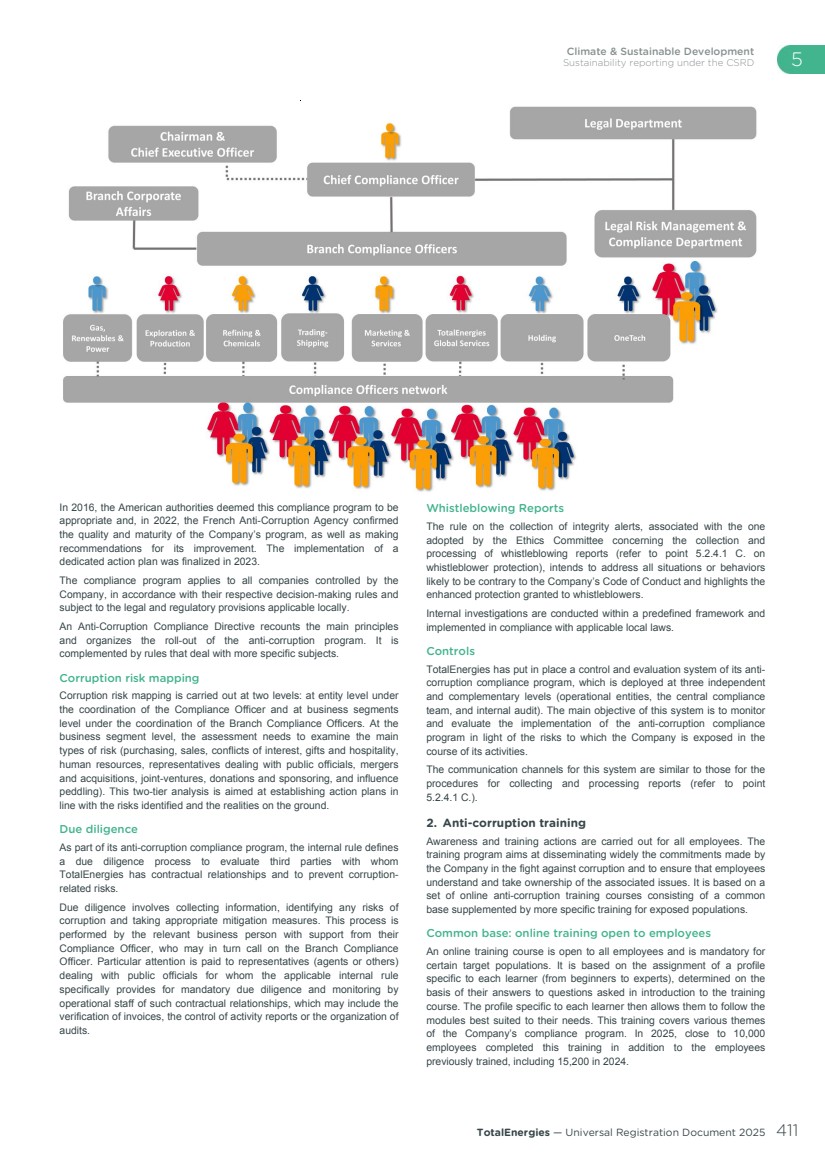
| Training for exposed populations to corruption risk Webinars have been provided to the populations within the eight business functions identified by the Executive Committee as the most exposed to the risk of corruption (such as purchasing or human resources). All (100%) of the most exposed populations are covered by these training sessions. They consist of a common part related to anti-corruption procedures, including whistleblowing report, and a specific part (case study) adapted to the targeted function. Training for the Compliance network A dedicated online course is open to Compliance Officers in order to train them on the legal framework of the fight against corruption, better identifying situations of corruption, and acquiring the right reflexes to act within the applicable legal framework. In 2025, the Compliance function organized, as in 2024, two two-day in person training sessions for newly appointed Compliance Officers, which were also attended by Branch Compliance Officers and the Chief Compliance Officer, and during which the Company’s anti-corruption procedures were detailed. Several additional training sessions are organized each year by the segments, both online and in person, for their network of Compliance Officers. 3. Communication of the results of internal reporting Consolidated data based on internal reporting, which reflects the outcome of the implemented policies, is presented once a year to the Executive Committee as well as to the Governance and Ethics Committee of the Board of Directors. This presentation provides an opportunity to report the result of the actions undertaken at the very highest level and to review the roadmap in relation to areas identified for improvement. B. Case of corruption (G1-4) In 2025, as in 2024, TotalEnergies was not subject to any conviction and did not receive any fine for violations of anti-corruption legislation and acts of corruption. The Company processed whistleblowing reports and proven cases of corruption, and in accordance with the “zero tolerance” principle, proven cases were subject to disciplinary sanctions and remediation measures. 5.2.4.3 Supplier relationship management (G1-2) Present in about 120 countries, the Company works with a network of over 100,000 suppliers of goods and services. In 2025, the Company’s purchases of goods and services (excluding petroleum products and vessel chartering by Trading & Shipping) represented approximately $35 billion worldwide. The allocation of purchasing expenditures at Company level is approximately 24% for goods (products, materials, etc.) and 76% for services (such as consulting services, materials supply operations, transportation, etc.). TotalEnergies’ activities generate hundreds of thousands of direct and indirect jobs worldwide. The activities of the Company’s suppliers are likely to present the same risks as those associated with TotalEnergies’ activities. The main risks relate basically to human rights in the workplace (forced labor, child labor, discrimination, decent working conditions), health and safety and security, corruption, fraud and respect for the environment. The Company ensures that contractual conditions are negotiated in an equitable manner with its suppliers. TotalEnergies’ Code of Conduct reminds this requirement and the three essential principles that guide the Company’s relations with its suppliers: dialogue, professionalism and compliance with commitments. As part of the development of best practice in business relations, an email address (mediation.fournisseurs@totalenergies.com) available on TotalEnergies’ website allows the Company’s suppliers to contact the dedicated internal mediator. Its mission is to facilitate relationships between the Company and its French and international suppliers. The general purchasing terms and conditions also mention the possibility of using mediation. Management of the Company’s supplier relations is coordinated by TotalEnergies Global Procurement, which is specifically tasked with providing Purchasing services, assisting the Company’s entities and sites(1) , promoting best practices in terms of purchasing and expressing requirements for contracts, from expression of need to end of contract. The Company attaches particular importance to working with sustainable suppliers who respect both human rights and the environment, throughout its supply chain. The Company expects its suppliers to adhere to the Fundamental principles of purchasing and has structured a sustainable procurement program. A. Fundamental principles of purchasing The Fundamental principles of purchasing are the foundation for the long-term relationships that the Company wishes to build with its suppliers. These principles apply to suppliers the principles set out in the Company’s Code of Conduct. They include the fundamental principles defined by: – the United Nations Universal Declaration of Human Rights, – the Fundamental Conventions of the International Labor Organization, – the United Nations Guiding Principles on Business & Human Rights, – United Nations Global Compact, Voluntary Principles on Security and Human Rights, – as well as the OECD Guidelines for Multinational Enterprises. TotalEnergies expects its direct (tier one) suppliers to adhere and comply with the Fundamental principles of purchasing of TotalEnergies and to ensure that their own suppliers and subcontractors also comply with them. These Principles are as follows: – Principle 1: Respect human rights at work (such as prohibition and prevention of forced labor and child labor), – Principle 2: Protect of health, safety and security, – Principle 3: Act in favor of climate, – Principle 4: Respect the environment (such as water, air, soil, biodiversity), – Principle 5: Prevent corruption, conflicts of interest and fight of fraud, – Principle 6: Respect competition law, – Principle 7: Promote economic and social development. The Fundamental principles of purchasing are available in French and English on the TotalEnergies website (under the sustainable development). B. The Company’s Sustainable Procurement program A process of continuous improvement In accordance with the Company’s ambition to integrate all aspects of sustainable development at the heart of its strategy, projects and operations, TotalEnergies is engaged in a process of continuous improvement regarding Sustainable procurement. TotalEnergies Global Procurement is responsible for raising awareness among those involved in procurement, both internally and externally, and for steering the Sustainable Procurement program. The implementation of this program is monitored by the Sustainable procurement Committee which meets twice a year. (1) With the exception of certain entities that retain the management of their supplier relations such as Hutchinson, Saft Group and TOTSA TotalEnergies Trading SA.which have Fundamental Purchasing Principles (or equivalent) in place. 5 Climate & Sustainable Development Sustainability reporting under the CSRD 412 TotalEnergies — Universal Registration Document 2025 |
| Description of the program The Sustainable Procurement program has five axes: – strengthen the Sustainable Procurement culture within the Company; – raise awareness and mobilize suppliers; – integrate sustainable development criteria at key stage of the procurement process; – evaluate suppliers with regard to their performance in terms of sustainable development; – engage the Company’s suppliers in a process of continuous improvement. Some of these axes are associated with a quantified objective allowing the progress made to be measured. TotalEnergies Sustainable Procurement program is aimed at 1,300 sustainability priority suppliers. These suppliers account for nearly 60% of the Company’s purchasing expenditure. They comprise: – 500 suppliers selected on the basis of the importance of their commercial relations with the Company (amount of purchasing expenditure, irreplaceability, etc.). These 500 suppliers represent approximately 50% of the Company’s purchasing expenditure; – 800 suppliers selected on the basis of the risks they present in terms of human rights and/or the environment due to the business segment and the country in which they operate. These 800 suppliers represent approximately 10% of the Company’s purchasing expenditure. Program objectives and achievements Axe 1: Strengthen the Sustainable procurement culture within the Company Buyers are the first to promote the sustainable procurement process to their internal contacts as well as to the Company’s suppliers. A dedicated training mandatory for all new entrants to the role has been in place since 2022. Achievements in 2025 At the end of 2025, 93% of TotalEnergies central purchasing function employees had completed the dedicated sustainable procurement training. Furthermore, three onboarding sessions, including a module on Responsible Purchasing, were organised for new entrants within the Procurement function. In addition to training, awareness-raising initiatives are regularly carried out among the Company’s buyers in order to strengthen the sustainable procurement culture (themed webinar, newsletter, awareness raising during the Buisness Ethics Day). Axe 2: Raise awareness and mobilize suppliers The Company regularly raises awareness among its suppliers regarding sustainable development. It engages its main suppliers through supplier days, periodic meetings and other awareness-raising tools. Discussions focus on achievements and difficulties observed in the performance of contractual relations, and on the implementation of corrective actions. Achievements in 2025 In 2025, the Company organized supplier days, which were an opportunity to raise awareness among stakeholders regarding sustainability issues. The Company also organizes a Suppliers Day every two years, the last having been organized in November 2024. This event brings together approximately 180 representatives of the Company’s suppliers. The Chairman and Chief Executive Officer as well as two members of the Executive Committee are intervened and underlined the Company’s ambition and the commitments expected from suppliers in terms of sustainable development. This event was the opportunity to award a Sustainability Award to one of the Company’s suppliers. The next Suppliers Day will be held in November 2026. Axe 3: Integrate sustainable development criteria at key stages of the purchasing process The Company’s procurement process integrates sustainable development issues, which are taken into account at key stages described below. – The supplier qualification process: This process covers five criteria: compliance, technical, health and safety, financial, sustainable development. During this process, suppliers must share their sustainability commitments. A supplier whose sustainability performance is deemed unsatisfactory is required to implement an action plan or may, in certain cases, be excluded from the supplier panel. – Evaluation of offers: TotalEnergies integrates sustainable development criteria into the evaluation of offers. The Company takes account of carbon emissions in calculating the total cost of acquisition for the highest emission categories (marine logistics, rotating machines, etc.). – Contractualization: The Company ensures that the Fundamental Principles of Purchasing or equivalent principles are included in the contracts concluded with suppliers. These Principles include an audit clause to ensure that suppliers comply with them. Additional clauses, for example relating to local content or HSE, are also included in contracts where relevant. – Monitoring and execution of the contract: Throughout the duration of the contract, suppliers for whom points of attention have been identified are subject to documentary and/or on-site assessments to verify compliance with TotalEnergies’ Fundamental Principles of purchasing and to assess their performance in terms of sustainable development. Achievements in 2025 In 2025, the supplier qualification process was reviewed and simplified. The process begins with a risk assessment phase to determine whether a more in‑depth analysis of the supplier’s sustainability commitments is required. During the second phase, these commitments are assessed either on the basis of existing certifications (ISO 14001, ISO 26000, EcoVadis) or through a dedicated questionnaire. The results of this assessment are then used to define the supplier’s qualification status and, where applicable, to determine whether an action plan must be implemented. Buyers include sustainability issues in their regular reviews with suppliers. Summary tools have enabled buyers to assess suppliers’ maturity in terms of the various aspects of sustainability. This maturity is assessed on the basis climate commitments, as well as on the basis of documentary and on-site assessments. Axe 4: Evaluate suppliers with regard to their performance in terms of sustainable development In order to control risks in its supply chain and contribute to improving the practices of its suppliers, the Company committed to assess its 1,300 priority suppliers by the end of 2025, via documentary and/or on-site assessments carried out by independent third parties. Achievements in 2025 By the end of 2025, the objective of assessing the sustainability performance of 1,300 priority suppliers had been achieved – Supplier documentary assessment TotalEnergies has partnered with EcoVadis since 2023 to evaluate its priority suppliers in terms of sustainable development. EcoVadis carries out a documentary assessment to assess the maturity as well as performance of suppliers in terms of the environment, human rights, ethics and sustainable procurement. Each company is evaluated by independent analysts on essential issues depending on its size, location and business segment. The EcoVadis rating may be shared by the supplier with its other customers. It also gives rise to an improvement plan. Climate & Sustainable Development Sustainability reporting under the CSRD 5 TotalEnergies — Universal Registration Document 2025 413 |
| In 2025, 398 suppliers were subject to a documentary assessment. Among those assessed via EcoVadis, 95% of them obtained a score above 45/100, a score above which EcoVadis considers that the supplier is “committed to CSR”, the average score being 69/100. – Supplier on-site assessment Introduced in 2016 and expanded in 2022, these on-site assessments, conducted by an independent third party, include an on-site visit, a documentary review and interviews with workers covering aspects of human rights (such as forced labor, child labor, working conditions, health and safety), environment (such as pollution, waste management, water, biodiversity) and climate. In 2025, the Company achieved its target of auditing 200 suppliers on-site. In total, since 2023, the Company has audited more than 800 priority suppliers in more than 75 countries. The Company also organised follow‑up and support meetings with suppliers whose EcoVadis score was below 45/100, as well as with those for which shortcomings had been identified during on‑site assessments. The Company’s Sustainable Procurement program provides for the assessment of priority suppliers continues for any new supplier entering this scope, in order to ensure compliance with the program’s requirements. Axe 5: Engage our suppliers in a process of continuous improvement The Company ensures that its suppliers are committed to a process of continuous progress. Thus, in the event of a deficiency observed during the on-site assessments, a supplier must put in place an action plan, followed by the TotalEnergies teams and whose effectiveness is verified by an independent external service provider. Of the 800 suppliers assessed since 2023, more than 400 of them have implemented verified improvements concerning hazardous waste management, access to grievance mechanism or compliance with working hours in accordance with local laws. In addition, the Company strengthened its climate engagement program with suppliers by delivering training, in collaboration with the Carbon Disclosure Project (CDP) supply chain program, aimed at increasing suppliers’ maturity and supporting them in setting emissions reduction targets. In 2025, the Company achieved its objective: 90% of the 400 most emitting suppliers have now adopted Scope 1+2 emissions reduction targets. Building on this achievement, supplier engagement will continue to be monitored, and the Company will maintain its efforts with the most carbon‑intensive suppliers (target: covering 90% of the most emitting suppliers). C. Specific actions in favor of certain categories of suppliers Local economic development TotalEnergies is committed to local economic development. In this respect, insofar as operational constraints allow, the Company uses local employment and subcontracting and also contributes to the development of local skills. For the Company’s large industrial projects, a local content development and management approach has been structured to strengthen the positive impact on local employment and economic activity notably by involving the main suppliers. Calls for tenders include local content criteria aimed to ensure at least equal opportunity for local subcontractors, or, depending on the local context, quantified contractual obligations (use of local subcontractors, employment, investment in local capacities) for subcontractors. Inclusive purchases in France The Company pays special attention to the adapted and protected sector. TotalEnergies is a member of the French Hosmoz organization and provides its buyers with an online tool that can be used to identify potential suppliers and service providers by region and category. The Company is also a member since 2022 of the Collective of Companies for a More Inclusive Economy and participated in the Inclusive Purchasing Forum to connect the Company’s buyers with companies in the adapted sector. In 2023, at the second forum, the Company aligned its objectives with those of the Collective by signing the manifesto Let’s transform our purchasing policy for a more inclusive economy. The objective set – to increase the share of inclusive procurement by 30% by 2025 compared with 2022, to reach approximately €5 million – was achieved. In 2025, the Company spent €6.4 million with inclusive suppliers. Support for SME To support TotalEnergies’ French SME, the Company launched, in 2025, the Pitch PME program. This pilot initiative aims to connect French SMEs with TotalEnergies’ technical teams and procurement buyer. In addition, in 2024, the Company developed, in collaboration with an energy sector industry association (EVOLEN), a guide designed to enable SMEs to better meet the requirements and challenges of sustainable development. This guide includes information on sustainable development issues as they apply to SMEs, as well as explanations on how to implement these requirements within their company (examples of action plans and KPIs). D. Policy to prevent late payments to suppliers Employees are regularly reminded of the need to respect supplier payment terms, particularly for SMEs and the most vulnerable, and of existing regulations, throughout the purchasing process from requisition to invoice payment. In France, an automatic alert system aims to prevent late payments. 5.2.4.4 Payment practices (G1-6) TotalEnergies applies a principle of transparency in its payment practices, respecting the legal terms of payment in the countries where the Company operates and the contractual due dates negotiated with direct (tier one) suppliers regardless of their categorization. Standard payment terms apply to the general purchase terms of TotalEnergies contracts, i.e., thirty (30) days from the last day of the month in which the invoice was issued, corresponding a minimum 30- days period and a maximum 60-days period. Out of 84.1% of the Company’s purchases of goods and services in 2025 (i.e., €26.1 billion out of a total of €31.5 billion equivalent to $35 billion), the average payment period for invoices is 49 days (the average payment period is calculated by taking into account the date of the invoice issued and the effective date of payment). On an analysed scope of 150 of the Company’s entities in France, corresponding to €5.8 billion in purchases of goods and services, the payment of invoices in 2025 was carried out as follows: – for French small and medium-sized enterprises - SMEs, in 49 days on average with a ratio of 87% (calculated between invoices paid within 60 days from the date of the document and the total number of invoices); – for French intermediate-sized companies - ETIs, in 43 days on average with a ratio of 88%. There are no ongoing legal proceedings reported after questioning the subsidiaries at the end of December 2025 regarding late payments. 5 Climate & Sustainable Development Sustainability reporting under the CSRD 414 TotalEnergies — Universal Registration Document 2025 [REDACTED SECTION: CERTAIN TEXT HAS BEEN REDACTED.] |
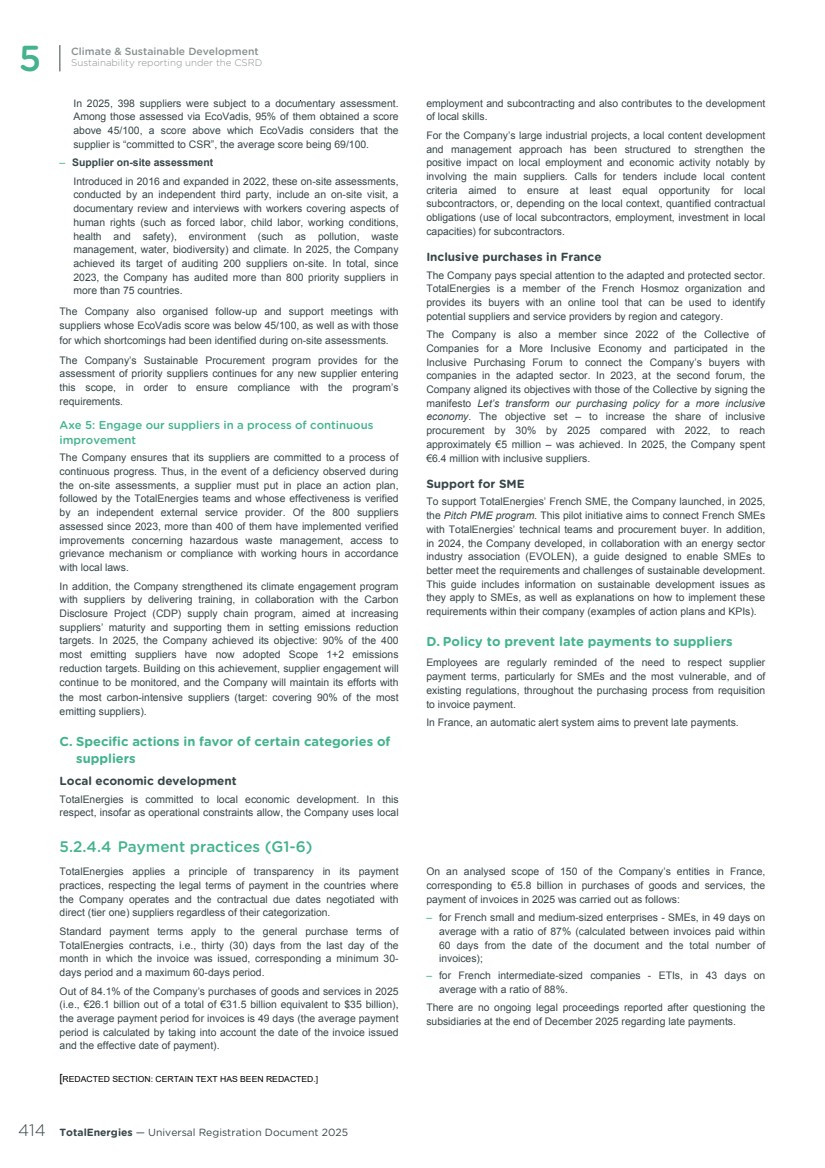
| 5.3 Other information 5.3.1 Actions to promote the link between the nation and the armed forces and support commitment to the reserves Since 2005, TotalEnergies has been associated with the French Ministry of the Armed Forces as part of an agreement to support the military reserve policy. This agreement has been renewed regularly, most recently in March 2022 for a further five years (2022-2027). The aim of this agreement is on the one hand to confirm the Company’s support for the military reserve policy by granting its employees who are operational reservists special facilities to enable them to carry out their periods of reserve activity, and on the other hand to establish a climate of trust, based on dialogue, between the employer and the Ministry of the Armed Forces. At a time when the French Defense Code required employers to grant their reservists eight working days to carry out periods of reserve service, without any obligation to maintain their pay, TotalEnergies, through its agreement, granted reservists thirteen working days per year, on full pay, as well as maintaining their social security and welfare benefits. For the Ministry of the Armed Forces, these agreements with employers are one of the important levers used to achieve the objective, set by the government after the 2015 attacks, of doubling the number of operational military reservists. These agreements send a positive signal to: – the Armed Forces, who count on companies to support them in their efforts to mobilize operational reservists, – and the small but young and highly motivated and dynamic reservist population. TotalEnergies has around one hundred reservists, forty of whom are on operational reserve duty. 5.3.2 Actions to promote the civic engagement in local democracy TotalEnergies’employees have the opportunity to get involved in causes close to where they work. Through the Action! program, each employee can donate up to three workdays a year to such initiatives during working time. These opportunities enable employees to contribute to the Company’s ambition to be a driver of positive change in the communities where it operates. In 2025, nearly 14,000 solidarity initiatives were carried out worldwide by close to 10,000 employees under this program. 5 Climate & Sustainable Development Other information 420 TotalEnergies — Universal Registration Document 2025 |
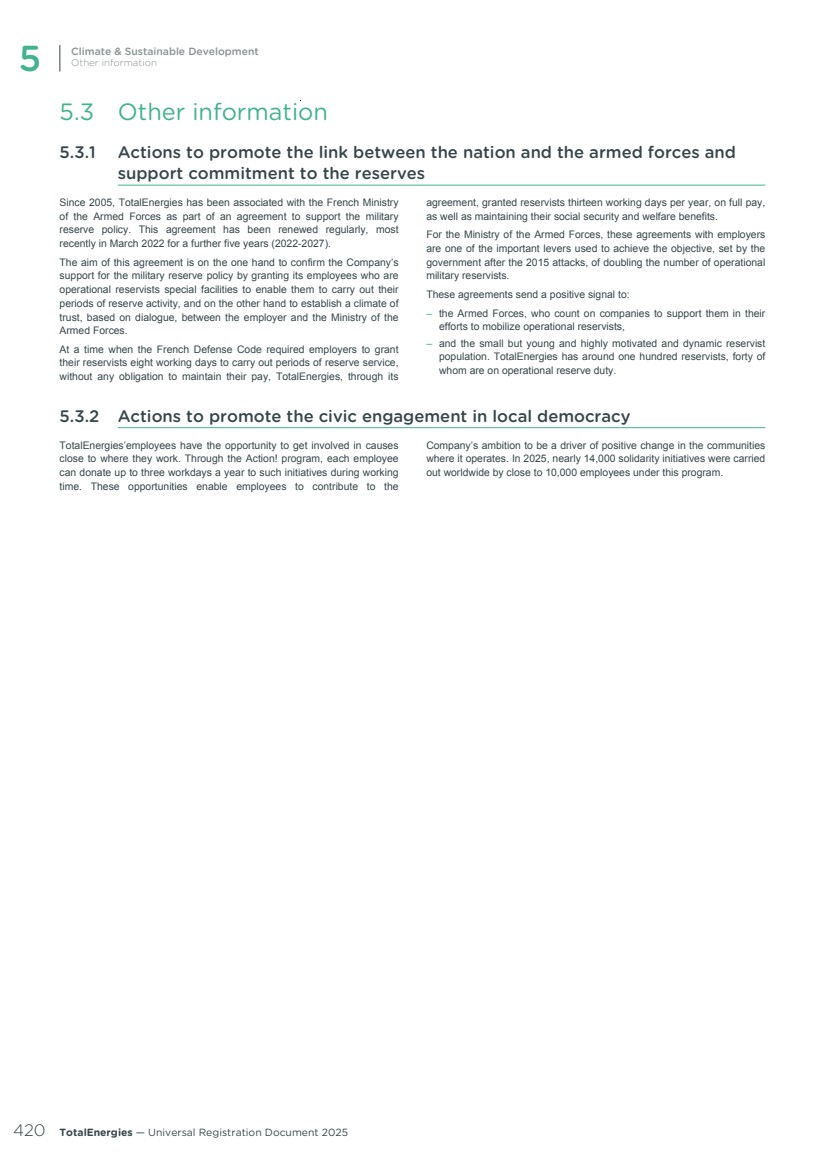
| TotalEnergies and its shareholders 6 6.1 Listing details 422 6.1.1 Listing 422 6.1.2 Share performance 422 6.2 Shareholder return and dividend 424 6.2.1 Shareholder return policy 424 6.2.2 Dividend payment policy 425 6.3 Share buybacks 427 6.3.1 Board of Directors’ report on share buybacks and sales 427 6.3.2 Share buyback program 428 6.4 Shareholders 430 6.4.1 Major shareholders 430 6.4.2 Employee shareholding 431 6.4.3 Shareholding structure 432 6.5 6.6 Investor relations 433 6.6.1 Documents on display 433 6.6.2 Relationships with institutional investors, financial analysts and individual shareholders 434 6.6.3 Registered shareholding 437 6.6.4 Forecast financial calendar for 2026 437 6.6.5 Forecast financial calendar for 2027 437 6.6.6 Contacts 438 TotalEnergies — Universal Registration Document 2025 421 [REDACTED SECTION: CERTAIN TEXT HAS BEEN REDACTED.] |
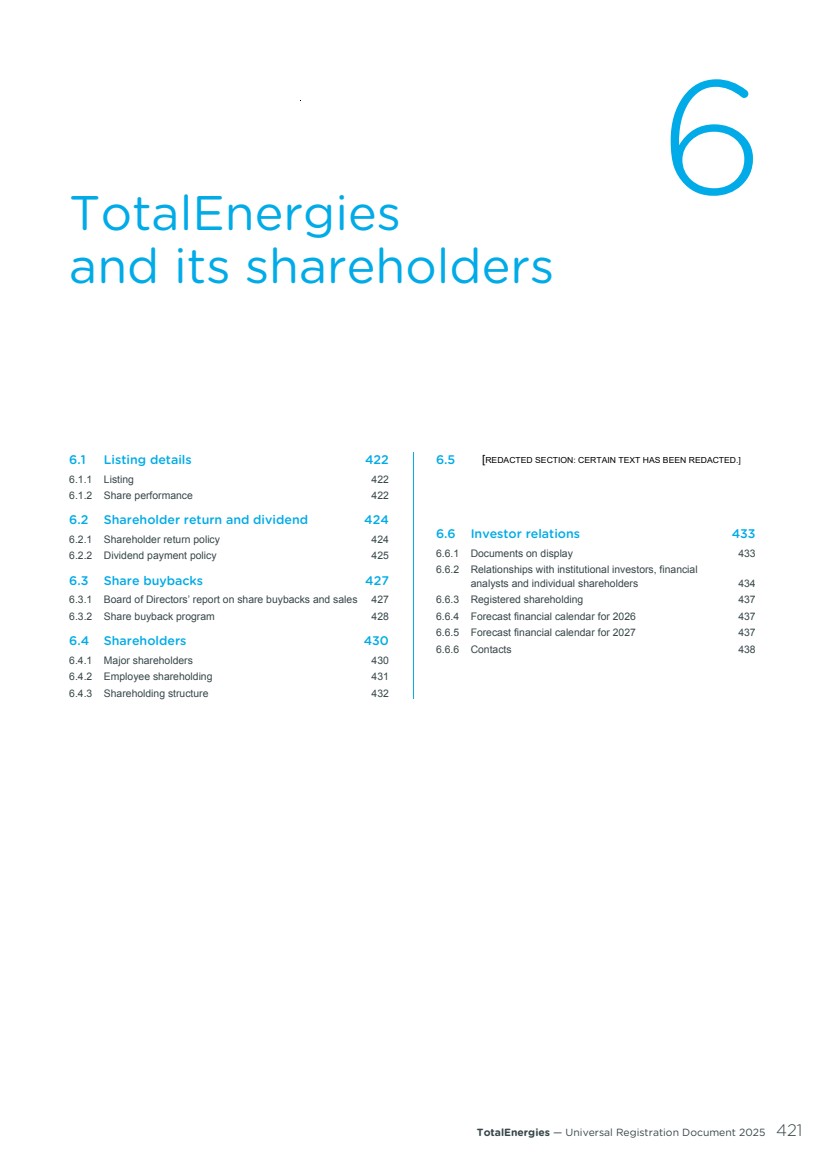
| 6.1 Listing details 6.1.1 Listing Stock exchanges and markets – Paris (Euronext Paris); – Brussels (Euronext Brussels); – London (London Stock Exchange); and – New York (New York Stock Exchange or NYSE). Since December 8, 2025, TotalEnergies ordinary shares have been listed on the NYSE. Therefore, the listing of TotalEnergies ordinary shares in Europe and on the NYSE allows for extended trading hours on the European and U.S. markets. To this end, the American Depositary Shares (ADR) program has been terminated. The ADRs have been converted into TotalEnergies ordinary shares. Each ADR was exchanged for one ordinary share. The listing of TotalEnergies ordinary shares on the NYSE facilitates access to the securities for U.S. investors. Codes (Euronext) ISIN FR0000120271 Reuters TTEF.PA Bloomberg TTE FP Ticker TTE Codes (NYSE) CUSIP F92124100 Reuters TTE.N Bloomberg TTE UN Ticker TTE Main indices as of December 31, 2025 Index Weighting in the index CAC 40 6.27% (4 th) Euro Stoxx 50 2.92% (8 th) Stoxx Europe 50 2.13% (15 th) Sources: Euronext and Stoxx. Presence in the main extra-financial indices FTSE4Good, MSCI Europe Screened, MSCI World Screened, MSCI Europe Filtered and MSCI ACWI Select Screened. Market capitalization as of December 31, 2025 Based on a share capital composed of 2,206,585,543 shares as of December 31, 2025 Market Market capitalization Closing price Euronext €122.7 billion €55.59 NYSE $144.4 billion $65.42 Market capitalization on Euronext Paris and in the Eurozone as of December 31, 2025 Source: Bloomberg TotalEnergies SE is the eighth-largest market capitalization on the Euronext Paris regulated market and the seventeenth-largest capitalization of the Euro Stoxx 50. Free float As of December 31, 2025, the free float factor determined by Euronext Paris for calculating the weight of TotalEnergies SE in the CAC 40 was 90%. Par value €2.50. Debt credit rating (long-term/outlook/short-term) As of December 31 2025 2024 2023 Standard & Poor’s A+/Stable/A-1 A+/Stable/A-1 A+/Stable/A-1 Moody’s Aa3/Stable/P-1 Aa3/Stable/P-1 A1/Stable/P-1 6.1.2 Share performance 6.1.2.1 Change in share prices in 2025 The change in TotalEnergies’ share price in 2025, compared with that of the share prices of its main peers listed in Europe and the United States, is shown in the following tables: In Europe (% calculated on the basis of the closing price in local currency) TotalEnergies (euro) 4.16% Shell (euro) 4.52% BP (pound sterling) 10.13% ENI (euro) 23.30% Source: Bloomberg. In the United States(1) (% calculated on the basis of the closing price in US$) TotalEnergies 20.04% ExxonMobil 11.87% Chevron 5.23% Shell 17.29% BP 17.49% ENI 38.67% Source: Bloomberg. (1) Price of Shell, BP and ENI’s American Depositary Receipts. Price of TotalEnergies’ American Depositary Receipts as of December 31, 2024, and of TotalEnergies’ ordinary shares as of December 31, 2025. 6 TotalEnergies and its shareholders Listing details 422 TotalEnergies — Universal Registration Document 2025 |
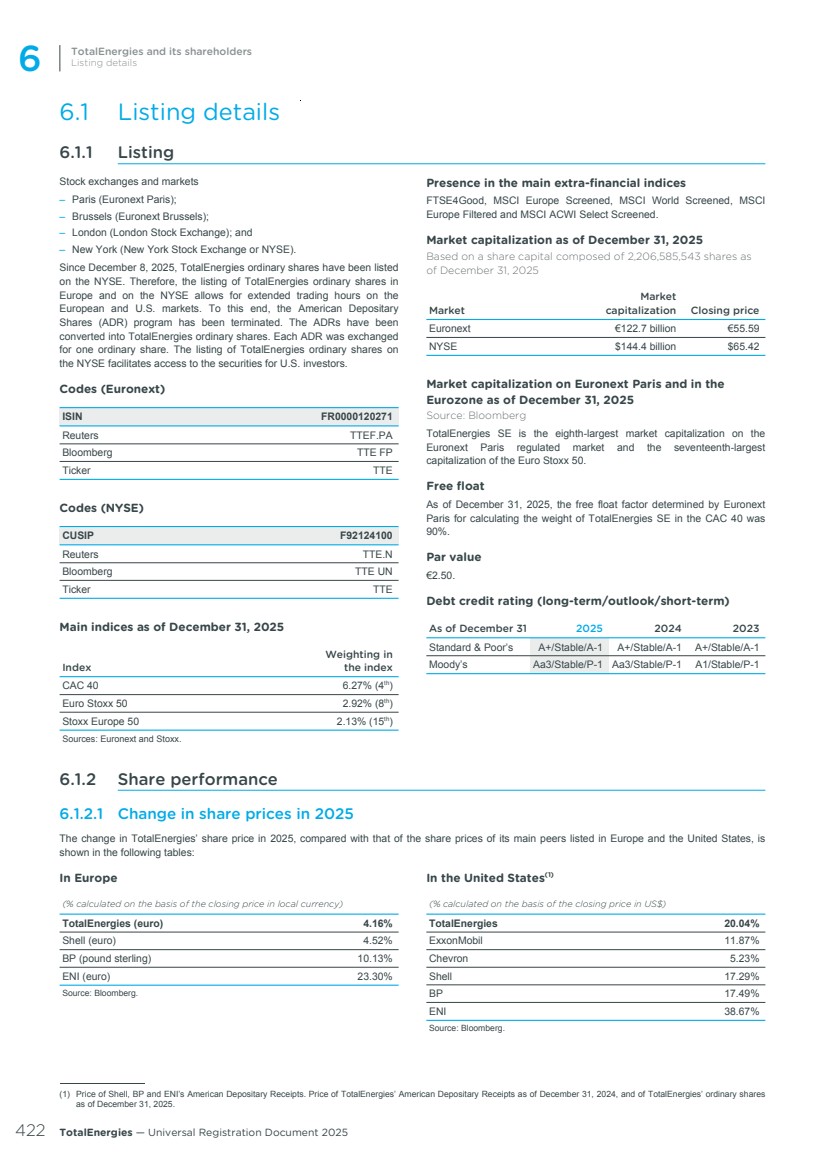
| 6.1.2.2 Shareholder’s annual return A. Based on Euronext share prices in euros €1,000 invested in TotalEnergies shares by an individual residing in France, assuming that the dividends are reinvested in TotalEnergies shares at the ex-dividend date, would have generated the following returns as of December 31, 2025 (excluding tax and social withholding): Shareholder’s annual return Value as of December 31, 2025 of €1,000 invested Investment term TotalEnergies CAC 40(a) TotalEnergies CAC 40 1 year 12.21% 14.28% 1,122 1,143 5 years 16.63% 11.24% 2,158 1,703 10 years 9.28% 9.03% 2,429 2,374 15 years 8.44% 8.65% 3,372 3,471 (a) CAC 40 prices taken into account to calculate the annual returns include all dividends distributed by the companies that are in the index. B. Based on NYSE share prices in dollars $1,000 invested in TotalEnergies shares by an individual residing in the United States, assuming that the dividends are reinvested in TotalEnergies shares at the ex-dividend date, would have generated the following returns as of December 31, 2025 (excluding tax and social withholding): Shareholder’s annual return Value as of December 31, 2025 of $1,000 invested Investment term TotalEnergies S&P 500(a) TotalEnergies S&P 500 1 year 27.58% 17.86% 1,276 1,179 5 years 16.03% 14.40% 2,103 1,959 10 years 10.16% 14.79% 2,631 3,972 15 years 7.46% 14.04% 2,940 7,176 (a) S&P 500 prices taken into account to calculate the annual returns include all dividends distributed by the companies that are in the index. Sources: Non-adjusted data from Euronext Paris, NYSE, Bloomberg. 6.1.2.3 Market information summary TotalEnergies share prices on Euronext Paris (in €) 2021 2022 2023 2024 2025 Highest (during trading session) 45.55 60.44 64.80 70.11 60.92 Lowest (during trading session) 33.91 43.60 50.55 50.80 47.65 Last price of the year (closing) 44.63 58.65 61.60 53.37 55.59 Average of the last 30 trading sessions (closing) 43.53 57.95 61.96 54.12 56.00 TotalEnergies share prices on the NYSE(a) (in $) 2021 2022 2023 2024 2025 Highest (during trading session) 52.57 64.02 69.63 74.97 66.92 Lowest (during trading session) 40.33 44.61 54.94 53.29 52.78 Last price of the year (closing) 49.46 62.08 67.38 54.50 65.42 Average of the last 30 trading sessions (closing) 49.10 60.77 67.48 56.57 65.39 (a) Share price of American Depositary Receipts (ADRs) traded up to December 5, 2025, followed by the share price of TotalEnergies shares traded as from December 8, 2025. Trading volume (average per session) Euronext Paris(a) 6,716,595 6,952,567 4,719,338 3,687,727 4,270,412 NYSE(b) 2,155,119 2,426,647 1,435,870 1,556,615 1,518,222 (a) Number of TotalEnergies shares traded. (b) Number of TotalEnergies American Depositary Receipts (ADR) traded up to December 5, 2025, and number of TotalEnergies shares traded from December 8, 2025 onward. Sources: Non-adjusted data from Euronext Paris, NYSE. TotalEnergies and its shareholders Listing details 6 TotalEnergies — Universal Registration Document 2025 423 |
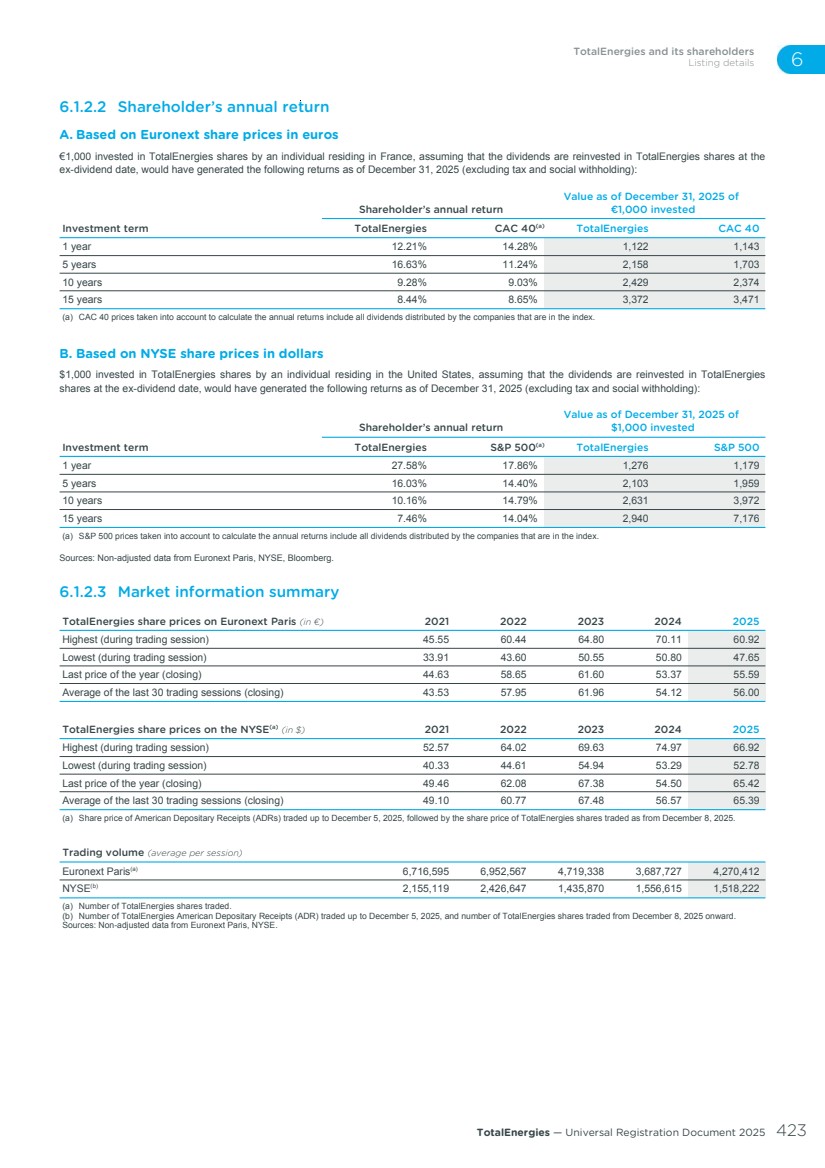
| Change in TotalEnergies share price at closing on Euronext Paris (2021-2025) Base 100 at 01/01/2021. Sources: Non-adjusted data from Euronext Paris, Bloomberg. Change in TotalEnergies ADR price at closing until December 5, 2025 and of the ordinary share closing price from December 8, 2025 on the NYSE (2021-2025) Base 100 at 01/01/2021. Sources: NYSE, Bloomberg. 6.2 Shareholder return and dividend 6.2.1 Shareholder return policy The shareholder return policy of the Company combine dividends and share buybacks, the levels of which are determined according to the following cash flow allocation priorities: – a sustainable ordinary dividend across cycles, which did not decrease during the Covid crisis and whose increase is supported by free cash flow growth; – disciplined investments in support of a balanced strategy anchored in two pillars: oil and gas on the one hand, and low-carbon activities, mainly electricity, on the other; – maintaining a strong balance sheet; – share buybacks to share the excess cash flow generated at high prices. The rate of return to shareholders is calculated on the basis of the amount of dividends paid during the year, plus the amount of TotalEnergies share buybacks in view of their cancellation carried out by the Corporation during the year, divided by the cash flow from operations excluding working capital (CFFO)(1) for the fiscal year in question. Shareholder Return for 2025 Following its meeting on September 24, 2025, thanks to the disciplined investment policy as well as anticipated free cash flow(2) growth of around $10 billion by 2030 (compared to 2024 in the same price environment), the Board of Directors reaffirmed the priority given to dividend and its growth through cycles and confirmed a shareholder (1) Refer to the glossary for the definition and further information on alternative performance measures (Non-GAAP measures) and to point 1.8 of chapter 1 for reconciliation tables. (2) Refer to the glossary for the definition and further information on alternative performance measures (Non-GAAP measures) and to point 1.8 of chapter 1 for reconciliation tables. 6 TotalEnergies and its shareholders Shareholder return and dividend 424 TotalEnergies — Universal Registration Document 2025 |
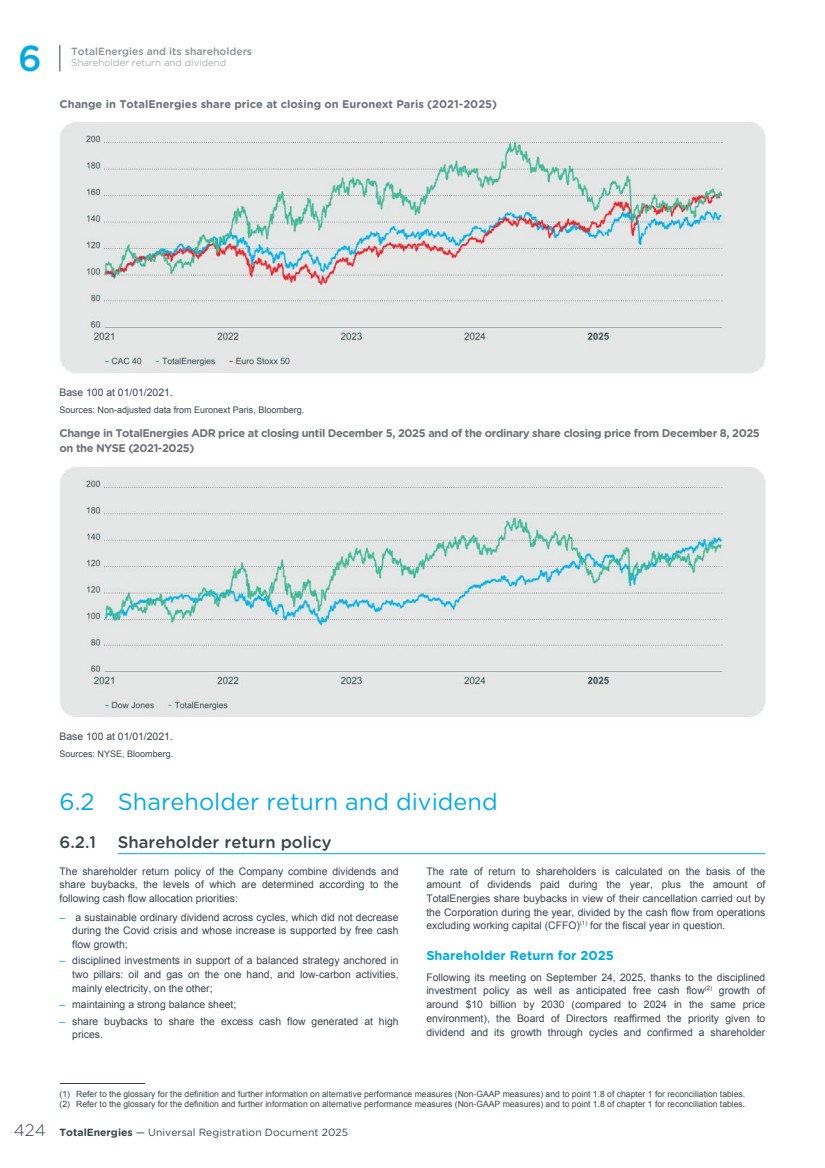
| return policy of more than 40% of annual cash flow regardless of energy prices. On September 24, the Board of Directors also authorized $1.5 billion of share buybacks in the fourth quarter 2025, resulting in $7.5 billion of share buybacks for the full year 2025. In addition, the Board of Directors approved 2026 share buyback guidance of between $0.75 billion and $1.5 billion per quarter for a Brent price between $60 and $70/b and an exchange rate of around 1.20 $/€. The Board of Directors met on February 10, 2026, after having closed the statutory accounts for fiscal year 2025, decided to propose at the Shareholders’ Meeting to be held on May 29, 2026, the dividend distribution of €3.40/share for fiscal year 2025, a 5.6% increase compared to the dividend for fiscal year 2024 of €3.22/share. The final dividend for fiscal year 2025 thus set at €0.85/share, identical to the three interim dividends for fiscal year 2025 previously decided by the Board of Directors. The payout (rate of return to shareholders) for fiscal year 2025 was 55%(1) . Shareholder Return for 2026 Under a scenario of $60/b Brent, $10/MBtu TTF and $5/b ERM, the Company expects to generate cash flow above $26 billion, supported by accretive production growth, improved Downstream performance and growth in Integrated Power. Given the Company’s strong cash‑flow generation and solid balance sheet despite uncertain environment, the Board of Directors, at its meeting on February 10, 2026, confirmed the 2026 share‑buyback guidance of $3 billion to $6 billion for an oil price between $60 and $70/b and an exchange rate around 1.20 $/€. The Company should maintain an attractive shareholder return while preserving the strength of its balance sheet, with a targeted gearing ratio(2) of around 15% at end‑2026. Considering the uncertain price environment, it authorized $750 million of buybacks in the first quarter 2026, consistent with the budget assumption ($60/b), thereby preserving the flexibility to adjust the level of buybacks during 2026 depending on price developments. 6.2.2 Dividend payment policy On October 28, 2010, the Corporation’s Board of Directors adopted a policy based on quarterly dividend payments starting in fiscal year 2011. The decision of TotalEnergies SE’s subsidiaries to declare dividends is made by their relevant Shareholders’ Meetings and is subject to the provisions of applicable local laws and regulations. As of December 31, 2025, there is no restriction under such provisions that would materially restrict the distribution to TotalEnergies SE of the dividends declared by those subsidiaries. The dividend is paid in euros for shares listed in Europe and in U.S. dollars for shares listed on the NYSE. Dividends for fiscal year 2025 On February 10, 2026, the Board of Directors, after having closed the financial statements for fiscal year 2025, decided to propose to the Shareholders’ Meeting on May 29, 2026, the distribution of an ordinary dividend of €3.40/share for fiscal year 2025. Subject to the Shareholders’ decision on May 29, 2026, considering the first three interim dividends already decided by the Board of Directors, the final ordinary dividend for fiscal year 2025 will amount to €0.85/share. 2025 dividend(a) First interim Second interim Third interim Final EUR amount (Euronext share) €0.85 €0.85 €0.85 €0.85 USD amount (NYSE share) $0.987785 Set on April 16, 2026 Set on July 15, 2026 Set date April 29, 2025 July 23, 2025 October 29, 2025 February 10, 2026 Ex-dividend date Euronext and NYSE (starting second interim) October 1, 2025 December 31, 2025 March 31, 2026 June 30, 2026 Payment date Euronext October 3, 2025 January 5, 2026 April 2, 2026 July 2, 2026 Payment date NYSE January 23, 2026 April 23, 2026 July 22, 2026 (a) Subject to approval by the Shareholders’ Meeting on May 29, 2026. Dividends for fiscal year 2026 Subject to the applicable legislative and regulatory provisions, as well as the pending approval by the Board of Directors and the Shareholders’ Meeting called to approve the 2026 financial statements, the ex-date and payment calendar for the interim and final dividends for fiscal year 2026 is expected to be as follows: Euronext and NYSE ex-dividend date Euronext payment date NYSE payment date First interim September 30, 2026 October 2, 2026 October 21, 2026 Second interim December 31, 2026 January 5, 2027 January 22, 2027 Third interim March 31, 2027 April 2, 2027 April 20, 2027 Final June 30, 2027 July 2, 2027 July 22, 2027 (1) Based on an amount of $15.2 billion, consisting of dividends paid in cash plus TotalEnergies share buybacks for cancellation in 2025 plus an operating cash flow before working capital changes (CFFO) of $27.8 billion in 2025. (2) Refer to the glossary for the definition and further information on alternative performance measures (Non-GAAP measures) and to point 1.8 of chapter 1 for reconciliation tables. TotalEnergies and its shareholders Shareholder return and dividend 6 TotalEnergies — Universal Registration Document 2025 425 |
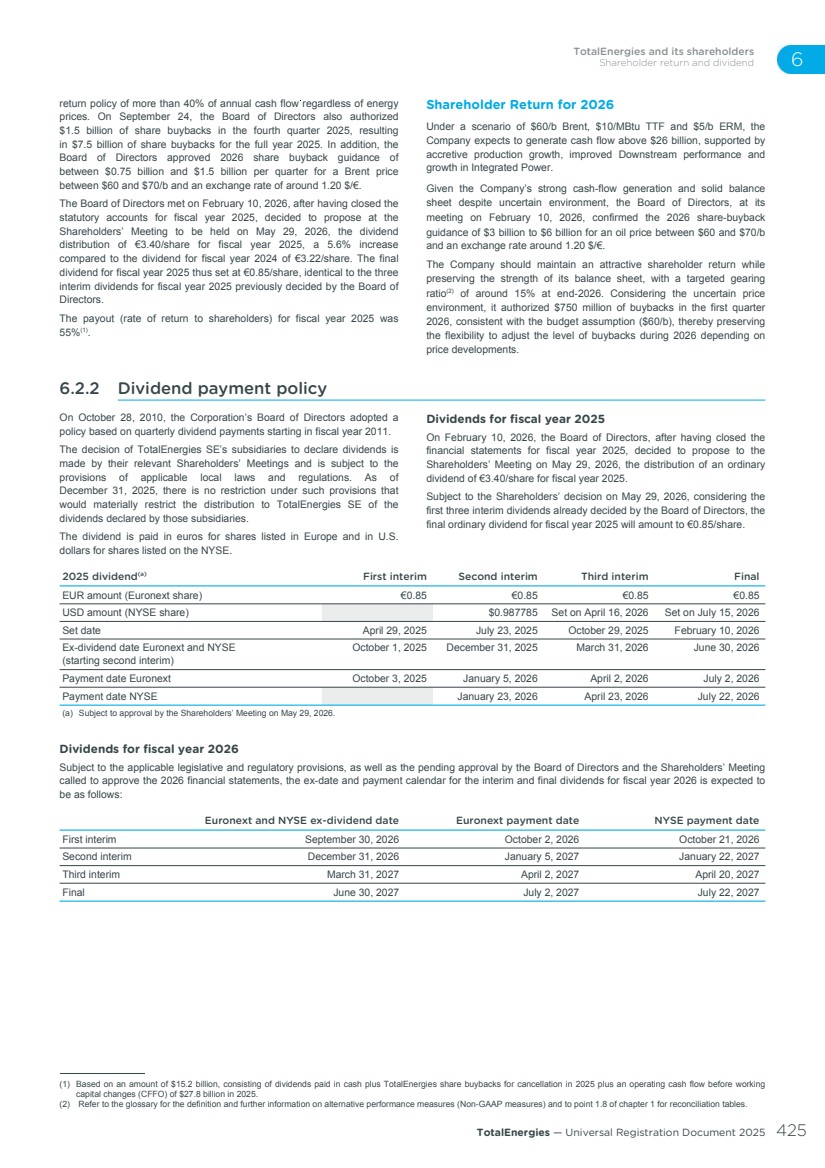
| Dividends for the last five fiscal years(1) Quarterly dividend (€/share) Fiscal year Ex-dividend date Euronext payment date(a) NYSE payment date(a) Type of coupon Amount (in €) Amount (in $) 2021 09/21/2021 10/01/2021 Interim dividend 0.66 01/03/2022 01/13/2022 Interim dividend 0.66 03/22/2022 04/01/2022 Interim dividend 0.66 06/21/2022 07/01/2022 Final dividend 0.66 2022 09/21/2022 10/03/2022 Interim dividend 0.69 12/06/2022 12/16/2022 Special dividend 1.00 01/02/2023 01/12/2023 Interim dividend 0.69 03/22/2023 04/03/2023 Interim dividend 0.69 06/21/2023 07/03/2023 Final dividend 0.74 2023 09/20/2023 10/02/2023 Interim dividend 0.74 01/02/2024 01/12/2024 Interim dividend 0.74 03/20/2024 04/03/2024 Interim dividend 0.74 06/19/2024 07/01/2024 Final dividend 0.79 2024 09/25/2024 10/01/2024 Interim dividend 0.79 01/02/2025 01/06/2025 Interim dividend 0.79 03/26/2025 04/01/2025 Interim dividend 0.79 06/19/2025 07/01/2025 Final dividend 0.85 2025 (b) 10/01/2025 10/03/2025 Interim dividend 0.85 12/31/2025 01/05/2026 01/23/2026 Interim dividend 0.85 0.987785 03/31/2026 04/02/2026 04/23/2026 Interim dividend 0.85 06/30/2026 07/02/2026 07/22/2026 Final dividend 0.85 (a) Unclaimed dividends expire five years after they become payable. (b) Subject to approval by the Shareholders’ Meeting on May 29, 2026. Dividend payment on stock certificates The Corporation issued stock certificates (certificats représentatifs d’actions, CR Actions) in Belgium as part of the public exchange offer for TotalEnergies Petrochemicals & Refining (formerly PetroFina) shares. The CR Actions is a stock certificate provided for by French rules, issued by Euroclear France, intended to circulate exclusively outside of France, and which may not be held by French residents. Since January 1, 2018, in compliance with Belgian law, CR Actions may only be issued in the form of a dematerialized certificate. CR Actions issued before this date are freely convertible from a physical certificate into a dematerialized certification in the form of a security registered on a custody account. In addition, ING Belgique is the bank handling the payment of all coupons detached from outstanding CR Actions. No fees are applicable to the payment of coupons detached from CR Actions, except for any income or withholding taxes; the payment may be received on request at the following bank branches: – ING Belgique, Avenue Marnix 24, 1000 Brussels, Belgium; – Société Générale Securities Services, 32 rue du Champ de Tir, 44312 Nantes, France; and – Euroclear France, 10-12 Place de la Bourse, 75002 Paris, France. (1) Subject to approval by the Shareholders’ Meeting on May 29, 2026. Dividends received by individuals fiscally domiciled in France are generally subject to a flat tax of 31.4% on their gross amount (i.e., 12.8% for income tax and 18.6% for social security contributions, reflecting the 1.4% increase in CSG provided for under the 2026 Social Security Financing Act), excluding securities held in a share savings plan (PEA) or in a company or retirement savings plan (PEE or PER) in particular. Regarding income tax, the taxpayer can, however, opt for the taxation of their dividends at the progressive scale with a 40% allowance. This regime is nevertheless subject to change. 6 TotalEnergies and its shareholders Shareholder return and dividend 426 TotalEnergies — Universal Registration Document 2025 |
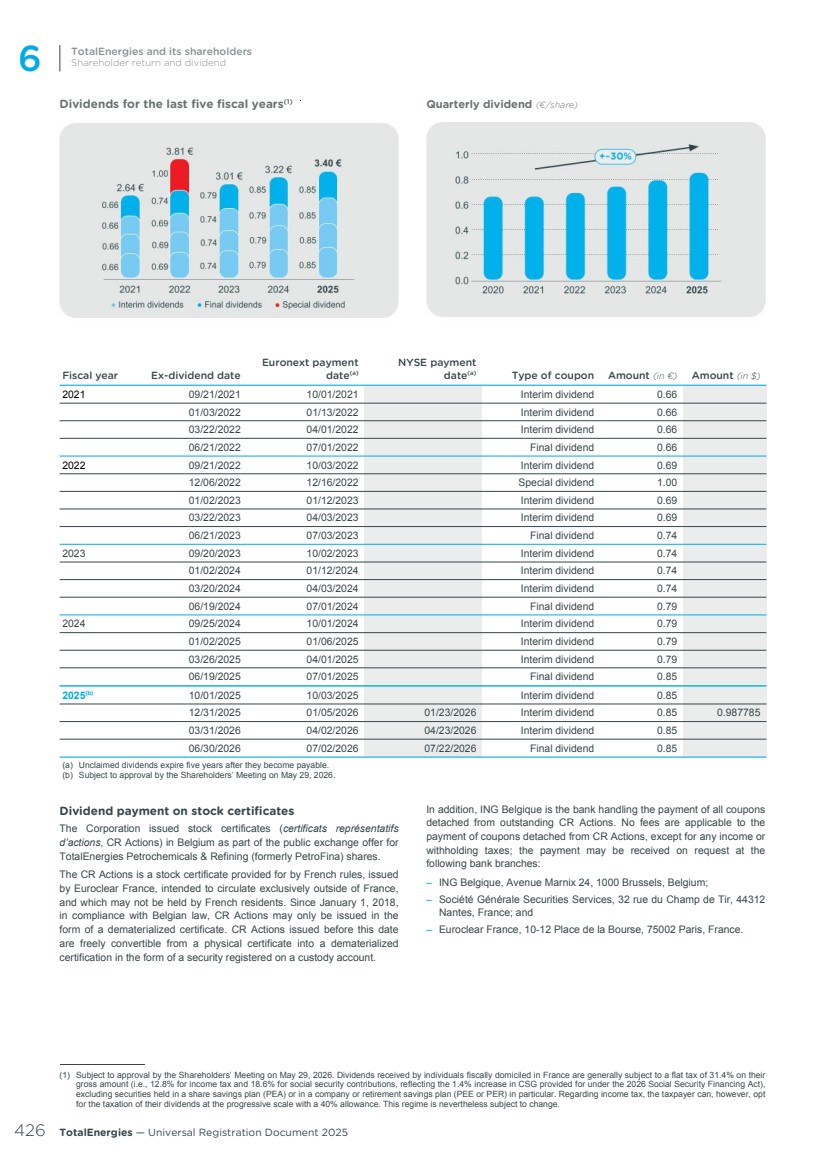
| 6.3 Share buybacks The Shareholders’ Meeting on May 23, 2025, after considering the report from the Board of Directors, authorized the Board of Directors, pursuant to the provisions of Article L. 22-10-62 of the French Commercial Code, of Regulation (EU) No. 596/2014 of April 16, 2014, on market abuse and of the General Regulation (règlement général) of the French Financial Markets Authority (Autorité des marchés financiers), to buy or sell shares of the Corporation. The number of shares acquired may not exceed 10% of the share capital. The maximum purchase price was set at €100 per share. This authorization was granted for a period of 18 months and replaced the previous authorization granted by the Shareholders’ Meeting on May 24, 2024. In 2025, TotalEnergies SE bought back 122,637,294 TotalEnergies shares including: – 116,292,328 TotalEnergies shares in order to cancel them in an amount of $7.10 billion; and – 6,344,966 TotalEnergies shares in order to cover the share grant plans approved by the Board of Directors. In addition, since the closing of fiscal year 2025 until February 28, 2026, TotalEnergies SE bought back 3,564,537 TotalEnergies shares of which: – 422,500 TotalEnergies shares in order to cancel them in an amount of $28 million; and – 3,142,037 TotalEnergies shares in order to cover the share grant plans approved by the Board of Directors. Percentage of share capital bought back in order to cancel (2021-2025) Share buybacks (B$) b 6.3.1 Board of Directors’ report on share buybacks and sales 6.3.1.1 Share buybacks during fiscal year 2025 Following the Board of Directors’ decisions during its meetings on December 11, 2024 and March 19, May 22, July 23 and September 24, 2025, and pursuant to the authorizations granted by the Shareholders’ Meetings on May 24, 2024 and May 23, 2025, the Corporation bought back 116,292,328 TotalEnergies shares during fiscal year 2025, in order to cancel them, i.e., 5.27% of the share capital as of December 31, 2025. These shares were bought back for a total amount of €6.31 billion, or $7.10 billion(1) , at an average unit price of €54.24. In addition, the Corporation bought back, in 2025, a total of 6,344,966 TotalEnergies shares for a total amount of €354 million, at an average unit price of €55.74, in order to cover the share grant plans decided by the Board of Directors, using the authorizations granted by the Shareholders’ Meetings. 6.3.1.2 Cancellation of Corporation shares during fiscal years 2023 to 2025 The Board of Directors, pursuant to the authorization granted by the Shareholders’ Meeting on May 25, 2022, to reduce the Corporation’s share capital in one or more steps through the cancellation of shares repurchased for that purpose, in accordance with the provisions of Article L. 22-10-62 of the French Commercial Code, cancelled the following TotalEnergies shares: Fiscal year Date of Board of Directors’ decision Number of shares cancelled Percentage of share capital cancelled(a) 2025 September 24, 2025(b) 74,620,711 3.27% February 4, 2025(c) 127,622,460 5.32% 2024 February 6, 2024(d) 25,405,361 1.05% 2023 September 21, 2023(e) 86,012,344 3.44% February 7, 2023 128,869,261 4.92% (a) Percentage of the share capital that the cancelled shares represented on the operations’ date. (b) Cancellation effective as of September 26, 2025. (c) Cancellation effective as of February 10, 2025. (d) Cancellation effective as of February 12, 2024. (e) Cancellation effective as of September 25, 2023. (1) At the ECB exchange rate on the date of the share buybacks. TotalEnergies and its shareholders Share buybacks 6 TotalEnergies — Universal Registration Document 2025 427 |
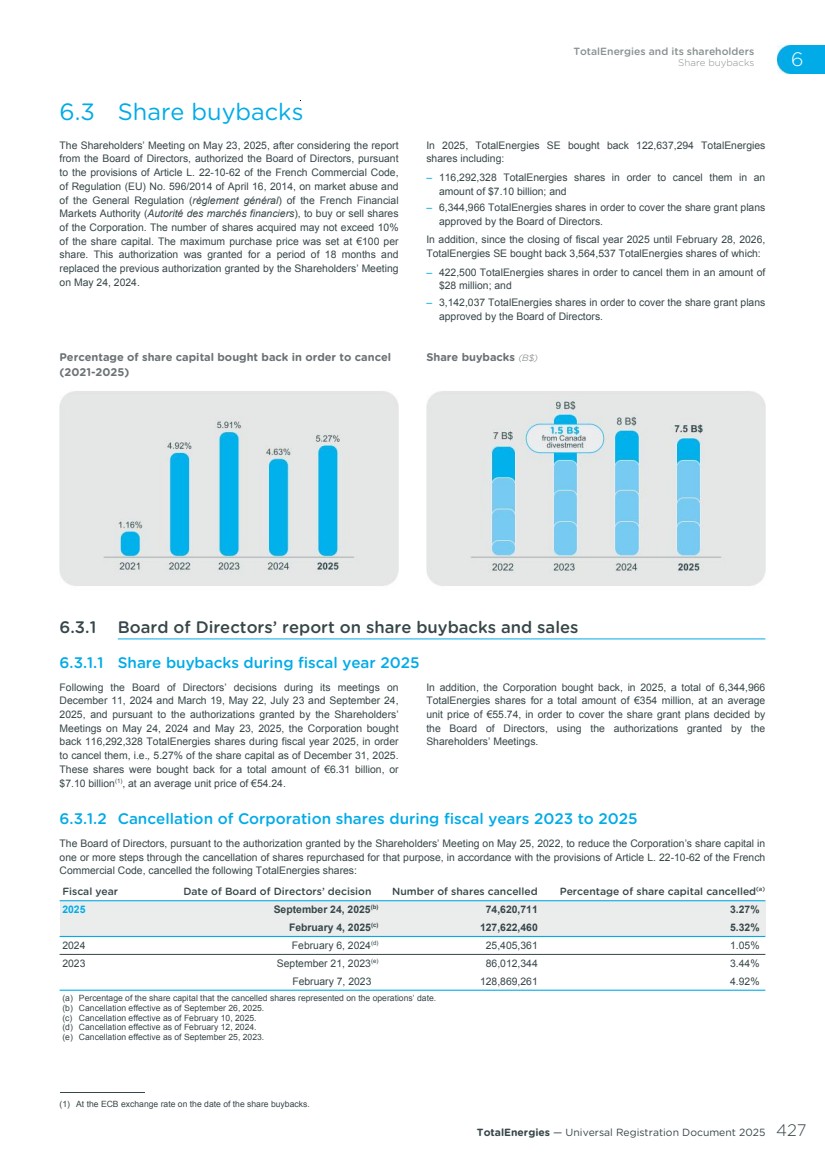
| 6.3.1.3 Transfer of shares during fiscal year 2025 6,221,412 TotalEnergies shares were transferred to the beneficiaries during fiscal year 2025 following the final grant of TotalEnergies shares under share grant plans decided by the Board of Directors. 6.3.1.4 Registered shares held in the name of the Corporation as of December 31, 2025 As of December 31, 2025, the Corporation held 63,702,529 treasury shares representing 2.89% of TotalEnergies SE’s share capital on that same date, including 7,554,813 shares to cover share grant plans and the remainder intended to be cancelled. In accordance with French law, these shares are deprived of voting rights and do not entitle to dividends. In addition, shares bought back in order to be allocated to employees of the Corporation or other TotalEnergies’ companies when such shares are held to cover the share grant plans that were not granted by the end of the vesting period, may be held under the conditions applicable to the holding by the Corporation of its own shares and used in accordance with the purposes specified share buyback by the Corporation. 6.3.1.5 Reallocation of shares for other purposes during fiscal year 2025 During fiscal year 2025, 467,600 treasury shares held by the Corporation, initially allocated to cover share grant plans, were reallocated for cancellation purposes. 6.3.1.6 Conditions for the share buybacks and use of derivative instruments No derivative instruments were used in the context of the share buyback programs authorized by the Shareholders’ Meetings on May 24, 2024, and May 23, 2025. TotalEnergies has no open purchase or sale position as of December 31, 2025. Transactions completed by the Corporation involving its treasury shares from January 1 to December 31, 2025 Cumulative gross movements Purchases Sales/Transfers Number of shares 122,637,294 6,221,412(a) Average transaction price(b) (in €) 54.32 – Amount of transactions (in €) 6,661,931,614.06(c) – (a) Corresponds to the final award of TotalEnergies shares under the share grant plans. (b) Including brokerage fees (excluding taxes). (c) Including €819,707.74 of brokerage fees (excluding taxes). Treasury shares at December 31, 2025 Percentage of share capital held by TotalEnergies SE 2.89% Number of shares held in portfolio 63,702,529(a) Par value of the portfolio (in €m) 159.3 (b) Book value of the portfolio (in €m) 3,437.1 Market value of the portfolio (in €m) 3,541.2 (c) (a) Including 7,554,813 shares held to cover the share grant plans. (b) Based on a TotalEnergies share par value of €2.50. (c) Based on TotalEnergies’ closing share price of €55.59 on Euronext Paris on December 31, 2025. 6.3.2 Share buyback program 6.3.2.1 Description of the share buyback program under Articles 241-1 et seq. of the AMF General Regulation The objectives of the share buyback program are as follows: – reduce the Corporation’s capital through the cancellation of shares; – honor the Corporation’s obligations related to securities convertible or exchangeable into Corporation shares; – honor the Corporation’s obligations related to stock option programs or other share grants to the Corporation’s executive directors or to employees of the Corporation or of subsidiaries of TotalEnergies; and – stimulate the secondary market or the liquidity of the TotalEnergies share under a liquidity agreement. 6 TotalEnergies and its shareholders Share buybacks 428 TotalEnergies — Universal Registration Document 2025 |
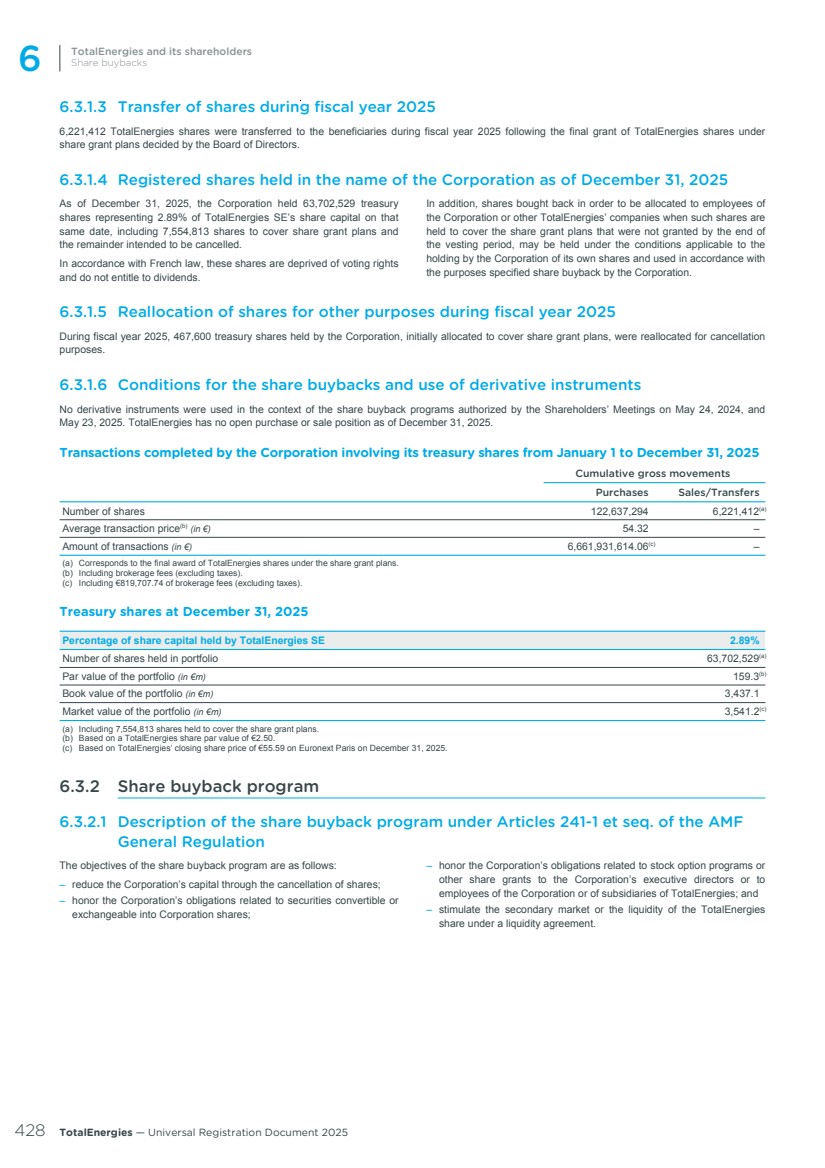
| 6.3.2.2 Legal framework Implementation of this share buyback program, which is covered by Articles L. 22-10-62 et seq. of the French Commercial Code, Articles 241-1 et seq. of the General Regulation of the AMF, and the provisions of Regulation (EU) No 596/2014 on market abuse, is subject to approval by the TotalEnergies SE Shareholders’ Meeting on May 29, 2026, under the proposed fourth resolution, which reads as follows: “The Shareholders’ Meeting, voting under the conditions of quorum and majority required for Ordinary Shareholders’ Meetings, after having reviewed the report of the Board of Directors and the information contained in the description of the program drawn up in accordance with Articles 241-1 and following the General Regulations of the Autorité des Marchés Financiers, or any other regulation relating to market abuse that may apply to the Company, authorizes the Board of Directors, with the ability to sub-delegate under the conditions provided for by law, in accordance with the provisions of Article L. 22-10-62 of the French Commercial Code, European Regulation (EU) No. 596/2014 of April 16, 2014 on market abuse, and the General Regulation of the Autorité des Marchés Financiers, to buy or sell shares of the Corporation in the context of the implementation of a share buyback program. The acquisition, sale or transfer of these shares may be carried out by any means on regulated markets, multilateral trading facilities or over‑the‑counter (OTC), including by acquisition or disposal of blocks of shares, under the conditions authorized by the relevant market authorities. In this context, these means include the use of any derivative financial instrument traded on regulated markets and the implementation of optional strategies. These transactions may be carried out at any time, in compliance with the regulations in force on the date of the relevant transactions, excluding periods of public offerings on the Corporation’s capital. The maximum purchase price is set at €100 per share (excluding transaction costs) or the equivalent of this amount on the same date in any other currency. In the event of a share capital increase by capitalization of reserves and free allocation of shares or in the event of a split or consolidation of the Corporation’s shares, this maximum price will be adjusted by a multiplier equal to the ratio of the number of shares comprising the capital before the transaction and the number after the transaction. Pursuant to the provisions of Article L. 22-10-62 of the French Commercial Code, the maximum number of shares that may be purchased under this authorization may not exceed 10% of the total number of shares comprising the share capital on the date this authorization is used. This 10% limit applies to an amount of the Corporation’s share capital which will, if necessary, be adjusted to take into account the transactions that have affected the share capital after this Meeting, as the acquisitions made by the Corporation may not under any circumstances lead it to hold, directly or indirectly through subsidiaries, more than 10% of the share capital. On an indicative basis, as of February 28, 2026, among the 2,188,400,475 shares comprising the share capital, the Corporation directly held 49,081,518 shares. As a result, the maximum number of shares that the Corporation may buy back is 169,758,529 shares and the maximum amount that it would have to pay to acquire these shares is €16,975,852,900.00 (excluding transaction costs). The objective of this share buyback program will be to reduce the Corporation’s capital or to enable it to meet obligations related to: – debt securities convertible or exchangeable into shares of the Corporation; and/or – stock option programs, free share allocation plans, employee share ownership plans or company savings plans, or other share allocations to executive officers or employees of the Corporation or a TotalEnergies company. The purpose of the buybacks could also be to implement the market practice accepted by the Autorité des Marchés Financiers, namely the stimulation of the secondary market or the liquidity of the Corporation’s shares by an investment services provider under a liquidity contract in accordance with the code of ethics recognized by the Autorité des Marchés Financiers. This program would also be intended to allow the Corporation to transact, on the stock exchange or off-market, in its shares within the framework of any other purpose authorized by the regulations in force or any other market practice accepted or which would become authorized on the date of the transactions in question. In the event of transactions carried out outside the objectives mentioned above, the Corporation will inform its shareholders by means of a press release. Depending on these objectives, the treasury shares acquired could be either: – cancelled, subject to authorization in force to reduce the share capital given by the Shareholders’ Meeting; – granted free of charge to employees and executive officers of the Corporation or of TotalEnergies companies; – granted to the beneficiaries of stock options of the Corporation in the event of exercise, whether transferred to employees directly or through employee savings funds; – remitted following the exercise of rights attached to securities entitled to the allocation of shares of the Corporation by redemption, conversion, exchange, presentation of a warrant or in any other way; and – used in any other manner consistent with the objectives set out in this resolution. The shares repurchased and retained by the Corporation will be deprived of voting rights and will not be eligible for the payment of the dividend. This authorization is given for a period of eighteen months from the date of this meeting. It deprives of effect, to the extent of the unused part, any previous authorization having the same purpose. All powers are granted to the Board of Directors, with the ability to sub-delegate, to ensure the implementation of this authorization.” 6.3.2.3 Conditions Maximum share capital to be purchased and maximum funds allocated to the transaction The maximum number of shares that may be purchased under the authorization provided by the Shareholders’ Meeting on May 29, 2026 (1) , may not exceed 10% of the total number of shares composing the capital, with this limit applying to an amount of the Corporation’s share capital that will be adjusted, if necessary, to include transactions affecting the share capital subsequent to this Meeting. Purchases made by the Corporation may under no circumstances result in the Corporation holding more than 10% of the share capital, either directly or indirectly through subsidiaries. (1) Subject to approval of the Shareholders’ Meeting on May 29, 2026. TotalEnergies and its shareholders Share buybacks 6 TotalEnergies — Universal Registration Document 2025 429 |
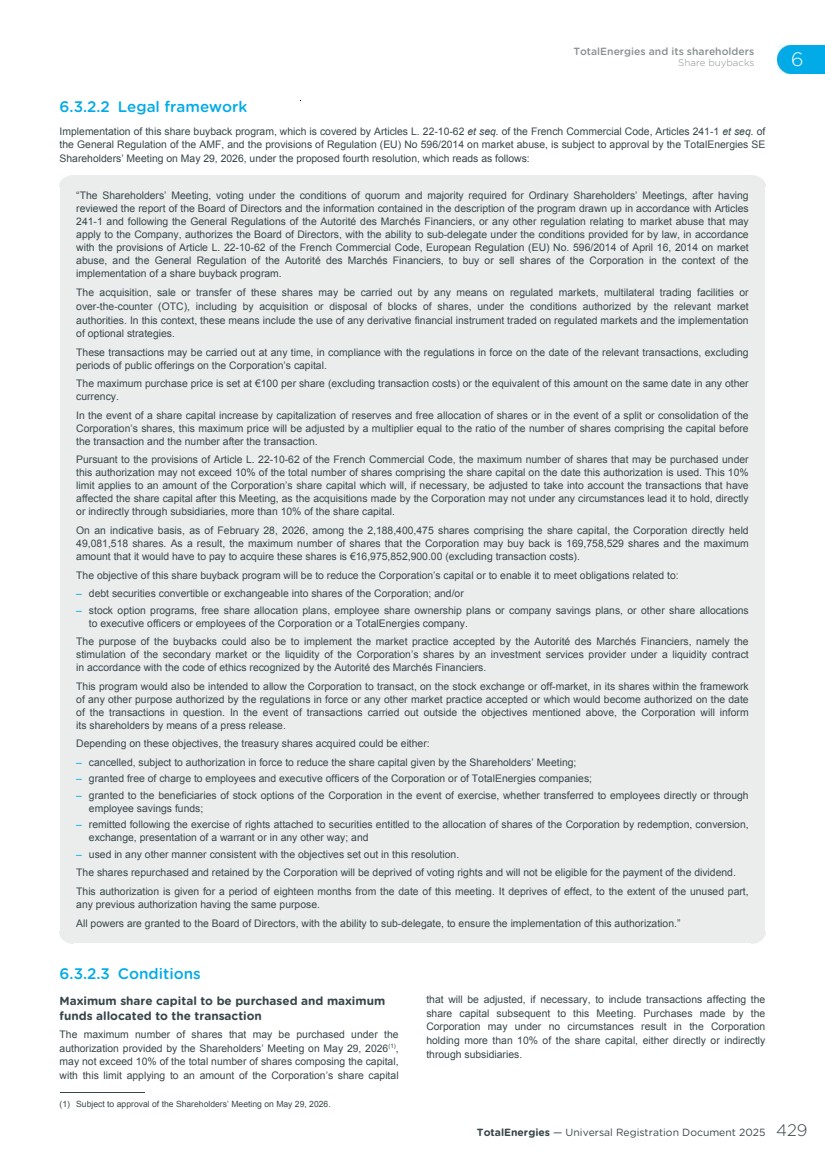
| Before any share cancellation under the authorization granted by the Shareholders’ Meeting on May 29, 2026, based on the number of shares outstanding as of February 28, 2026 (1) and given the 49,081,518 shares held by the Corporation as of February 28, 2026, representing 2.24% of the share capital, the maximum number of shares that may be purchased would be 169,758,529 representing a theoretical maximum investment of €16,975,852,900.00 (excluding acquisition fees) based on the maximum purchase price of €100. Conditions for buybacks Such shares may be bought back by any means on regulated markets, multilateral trading facilities or over the counter, including through the purchase or sale of blocks of shares, under the conditions authorized by the relevant market regulatory authorities. These means include the use of any financial derivative instrument traded on a regulated market or over the counter and the implementation of option strategies, with the Corporation taking measures, however, to avoid increasing the volatility of its stock. The portion of the program carried out through the purchase of blocks of shares will not be subject to quota allocation, up to the limit set by this resolution. These transactions may be carried out at any time, in accordance with the applicable rules and regulations, except during any public offering periods applying to the Corporation’s share capital. Duration and schedule of the share buyback program In accordance with the fourth resolution, submitted to the Shareholders’ Meeting on May 29, 2026, the share buyback program may be implemented over an 18-month period following the date of this Meeting, i.e., until November 29, 2027. Transactions carried out under the previous program Transactions carried out under the previous program are listed in the special report of the Board of Directors on share buybacks (refer to point 6.3.1). 6.4 Shareholders 6.4.1 Major shareholders 6.4.1.1 Changes in major shareholders’ holdings TotalEnergies SE’s major shareholders(2) as of December 31, 2025, 2024 and 2023 were as follows: As of December 31 2025 2024 2023 % of share capital % of voting rights % of theoretical voting rights(a) % of share capital % of voting rights % of share capital % of voting rights BlackRock, Inc. (b) 6.5 6.4 6.2 6.1 5.8 6.5 6.1 Company employees (c) 8.9 9.2 8.9 7.7 8.2 7.4 7.6 of which FCPE TotalEnergies Actionnariat France (French employee mutual fund) 5.5 5.7 5.5 4.8 5.1 4.6 4.7 Other shareholders 84.6 84.4 84.9 86.2 86.0 86.1 86.3 of which holders of ADR(d) 0.0 0.0 0.0 8.3 8.9 8.2 8.4 (a) Pursuant to Article 223-11 of the AMF General Regulation, the number of theoretical voting rights is calculated on the basis of all shares to which voting rights are attached, including treasury shares that are deprived of voting rights. (b) Information taken from threshold notification form sent by BlackRock, Inc (“BlackRock”) to TotalEnergies on March 31, 2025, in which BlackRock state that it has 136,313,297 voting rights in TotalEnergies (i.e., then 6.0% of the Corporation’s voting rights). BlackRock did not filed any form Schedule 13G with the SEC with reference to 2025. (c) On the basis of the definition of employee shareholding set forth in Article L. 225-102 of the French Commercial Code and, since 2020, Article 11 para. 6 of the Corporation’s Articles of Association. Amundi, the holding company of Amundi Asset Management, which in turn manages the TotalEnergies Actionnariat France fund (refer to below), filed a Schedule 13G with the SEC on February 17, 2026, declaring a holding of 222,647,121 TotalEnergies shares as of December 31, 2025 (10.1% of the Corporation’s share capital). Amundi stated that it does not have any exclusive voting rights or exclusive right to dispose of these shares and that it has joint voting rights on 50,639,446 of these shares (i.e., 2.4% of the Corporation’s voting rights) and a joint right to dispose of all of these shares. (d) Including all the American Depositary Shares represented by ADR listed on the NYSE. These ADRs were converted into ordinary shares listed on the NYSE on December 8, 2025. The percentage of the holdings of the major shareholders was calculated based on the below data: As of December 31 2025 2024 2023 Number of shares composing the share capital 2,206,585,543 2,397,679,661 2,412,251,835 Number of voting rights attached to the shares 2,142,883,014 2,248,149,843 2,351,708,622 Number of theoretical voting rights 2,206,585,543(a) 2,397,679,661(b) 2,412,251,835(c) (a) Exercisable at the Shareholders’ Meeting taking into account all shares to which voting rights are attached, including 63,702,529 treasury shares that are deprived of voting rights. (b) Exercisable at the Shareholders’ Meeting as of December 31, 2024. (c) Exercisable at the Shareholders’ Meeting as of December 31, 2023. 6.4.1.2 Holdings above the legal thresholds In accordance with the provisions of Article L. 233-13 of the French Commercial Code, to TotalEnergies SE’s’ knowledge, two identified shareholders held 5% or more of the share capital or voting rights at year-end 2025: BlackRock held, as of December 31, 2025, 6.5% of the share capital representing 6.4% of the voting rights exercisable at Shareholders’ Meetings and 6.2% of the theoretical voting rights. FCPE TotalEnergies Actionnariat France held, as of December 31, 2025, 5.5% of the share capital representing 5.7% of the voting rights exercisable at Shareholders’ Meetings and 5.5% of the theoretical voting rights. (1) 2,188,400,475 shares. (2) Major shareholders are defined herein as shareholders whose interest exceeds 5% of the share capital or voting rights. 6 TotalEnergies and its shareholders Shareholders 430 TotalEnergies — Universal Registration Document 2025 |
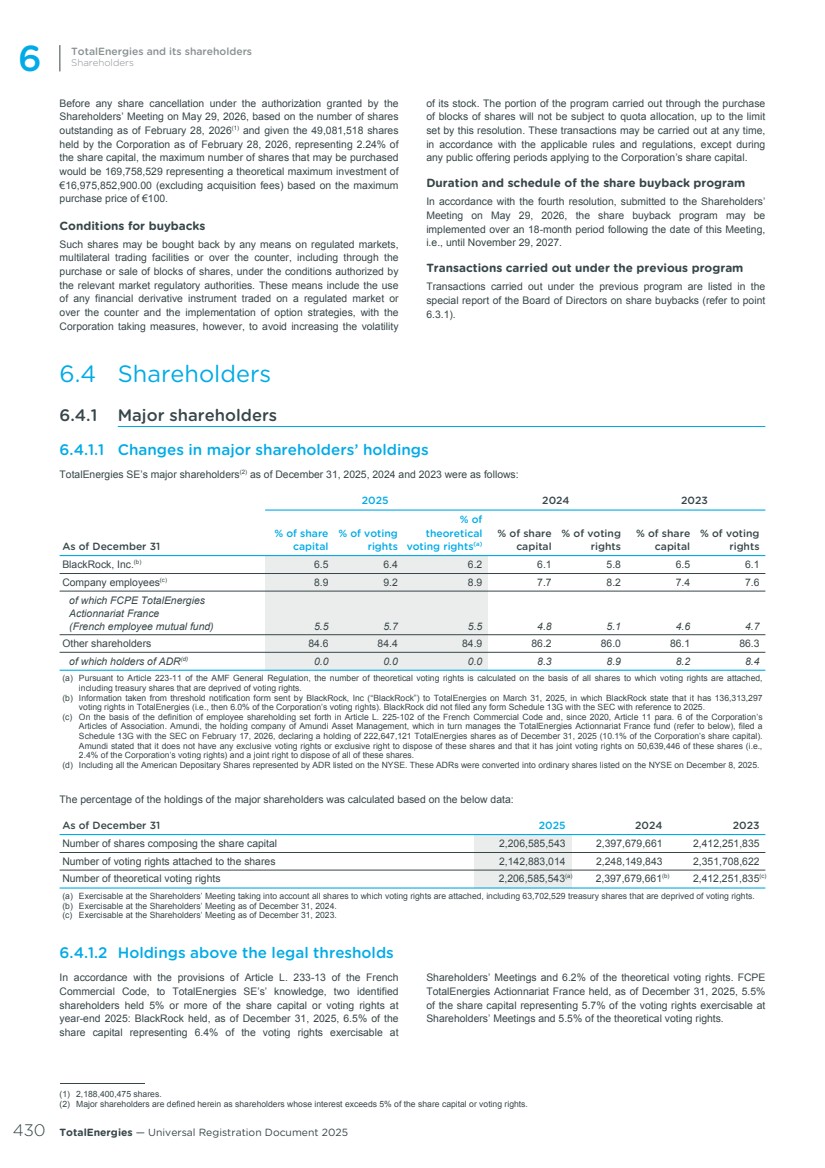
| 6.4.1.3 Legal threshold notifications in fiscal year 2025 AMF notice no. Threshold crossing date Group Number of shares % of share capital % of voting rights Going below/ above threshold of 5% of voting rights Number of shares in capital Number of voting rights 225C0527 03/17/2025 Amundi Asset Management on behalf of FCPE TotalEnergies Actionnariat France 115,741,535 5.10% 5.10% Above 2,270,057,201 2,270,057,201 6.4.1.4 Threshold notifications required by the bylaws In addition to the legal obligations to inform notably the Corporation and the French Financial Markets Authority when the number of shares (or securities similar to shares or voting rights pursuant to Article L. 233-9 of the French Commercial Code) held represents more than 5%, 10%, 15%, 20%, 25%, 30%, one third, 50%, two thirds, 90% or 95% of the share capital or theoretical voting rights, such information being made at the latest on the close of the fourth trading day after the threshold is exceeded (Article L. 233-7 of the French Commercial Code and Article 223-14 of the AMF General Regulation), any individual or legal entity who directly or indirectly comes to hold a percentage of the share capital, voting rights or rights giving future access to the Corporation’s share capital that is equal to or greater than 1%, or a multiple of this percentage, is required to notify the Corporation within 15 days of the date on which each of the above thresholds is exceeded, by registered mail with return receipt requested, and indicate the number of shares held. If not declared, any shares held in excess of the threshold that should have been declared will be deprived of voting rights at Shareholders’ Meetings if, at a Shareholders’ Meeting, the failure to make a declaration is acknowledged and if one or more shareholders holding collectively at least 3% of the Corporation’s share capital or voting rights so request at that Meeting. Any individual or legal entity is also required to notify the Corporation in due form and within the time limits stated above when their direct or indirect holdings fall below each of the thresholds mentioned above. Notifications must be sent to the Head of Investor Relations, contact details provided in point 6.6.6. 6.4.1.5 Temporary transfer of securities Pursuant to legal provisions, any legal entity or individual (with the exception of those described in paragraph IV-3 of Article L. 233-7 of the French Commercial Code) holding alone or in concert a number of shares representing more than two percent of the Corporation’s voting rights pursuant to one or more temporary transfer or similar operations as described in Article L. 22-10-48 of the aforementioned Code is required to notify the Corporation and the AMF of the number of shares temporarily owned no later than the fifth business day preceding the Shareholders’ Meeting at midnight (Paris time). Notifications must be emailed to the Corporation at the following address: ir@totalenergies.com. If no notification is sent, any shares acquired under any of the above temporary transfer operations will be deprived of voting rights at the relevant Shareholders’ Meeting and at any Shareholders’ Meeting that may be held until such shares are transferred again or returned. 6.4.1.6 Shareholders’ agreements TotalEnergies SE is not aware of any agreements among its shareholders. 6.4.2 Employee shareholding As of December 31, 2025, based on the definition of employee shareholding set forth in Article L. 225-102 of the French Commercial Code and Article 11 paragraph 6 of the Corporation’s Articles of Association, the Company’s employees held, directly or indirectly, 196,590,939 TotalEnergies shares, representing 8.91% of the Corporation’s share capital and 9.17% of the exercisable voting rights after deduction of 63,702,529 treasury shares, distributed as follows: FCPE TotalEnergies Actionnariat France 121,570,965 FCPE TotalEnergies Actionnariat International Capitalisation 46,026,918 FCPE Direct Energie 73,225 Shares subscribed by employees in Italy, Germany, Spain, Denmark and in the United States 3,037,788 TotalEnergies shares resulting from the exercise of stock options and held as registered shares within a Company Savings Plan 135,049 TotalEnergies shares granted for free to employees 25,746,994 Total shares held by employees 196,590,939 The management of each of the collective investment funds (FCPEs) mentioned above is controlled by a dedicated Supervisory Board, two thirds of its members representing holders of fund units and one third representing the company. In accordance with legal provisions, the employees representing the unitholders are elected from among the unitholder employees as a whole based on the number of units held by each unitholder and, for the exercise of the voting rights attached to the securities issued by the company, after discussion in the presence of the company representatives, the voting operations take place without the latter being present. TotalEnergies and its shareholders Shareholders 6 TotalEnergies — Universal Registration Document 2025 431 |
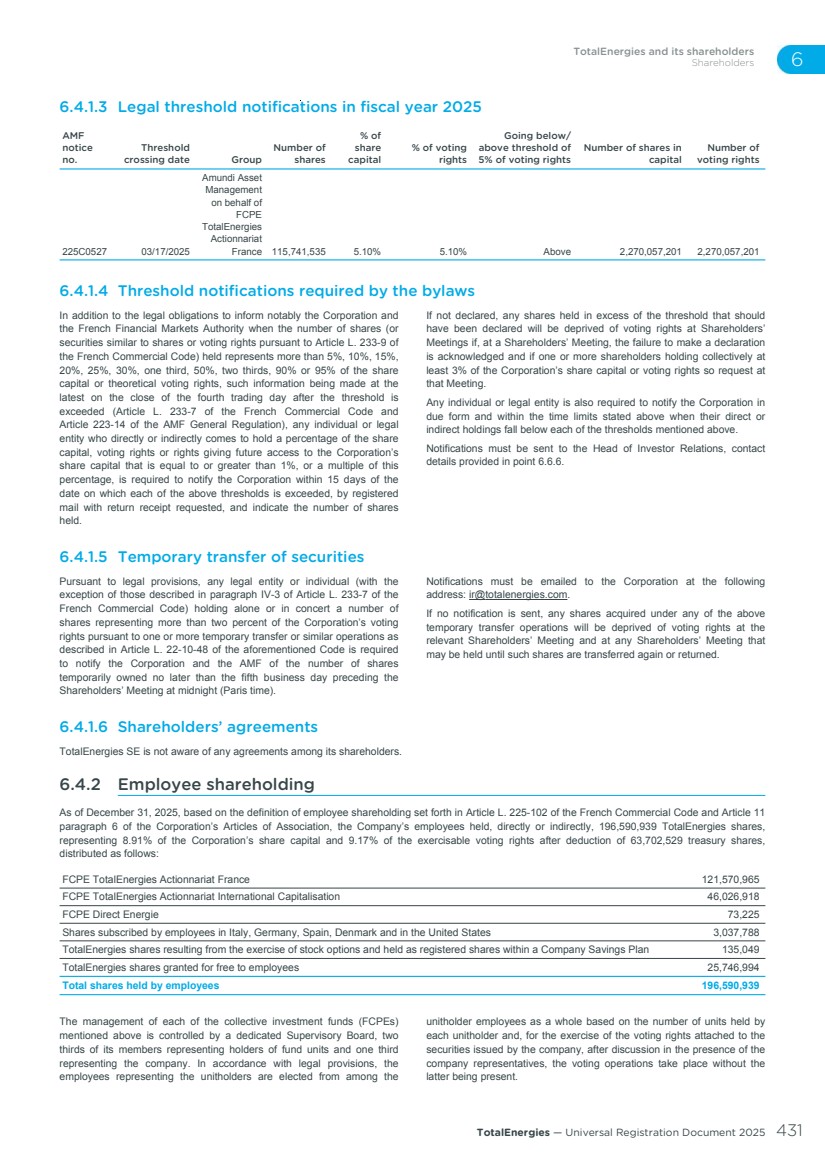
| The Supervisory Board is responsible for reviewing the collective investment fund’s management report and annual financial statements, as well as the financial, administrative and accounting management of the fund, exercising voting rights attached to portfolio securities, deciding contributions of securities in case of a public tender offer, deciding mergers, spin-offs or liquidations, and granting its approval prior to changes in the rules and procedures of the collective investment fund in the conditions provided for by the rules and procedures. These rules and procedures also stipulate a simple majority vote for decisions, except for decisions requiring a qualified majority vote of two thirds plus one related to a change in a fund’s rules and procedures, its conversion or disposal. For employees holding shares outside of the employee collective investment funds mentioned in the table above, voting rights are exercised individually. The information regarding shares held by the administration and management bodies is set forth in point 4.1.6 of chapter 4. 6.4.3 Shareholding structure Estimate as of December 31, 2025, based on the request for the identification of shareholders made on that date, pursuant to Article L. 228-2 of the French Commercial Code. By shareholder type(a) (a) Excluding treasury shares. (b) Based on the definition of employee shareholding set forth in Article L. 225-102 of the French Commercial Code and Article 11 paragraph 6 of the Corporation’s Articles of Association. By area(a) (a) Excluding treasury shares. (1) The French finance law for 2025 broadened the definition of operations falling within the scope of application of this article. (2) Apart from the countries and territories mentioned in point 2 bis (2°) of the same article. Since May 8, 2025, the NCCTs concerned by the scheme have been: Anguilla, Antigua and Barbuda, the Turks and Caicos Islands and Vanuatu. 6 TotalEnergies and its shareholders Information for foreign shareholders 432 TotalEnergies — Universal Registration Document 2025 [REDACTED SECTION: CERTAIN TEXT HAS BEEN REDACTED.] |
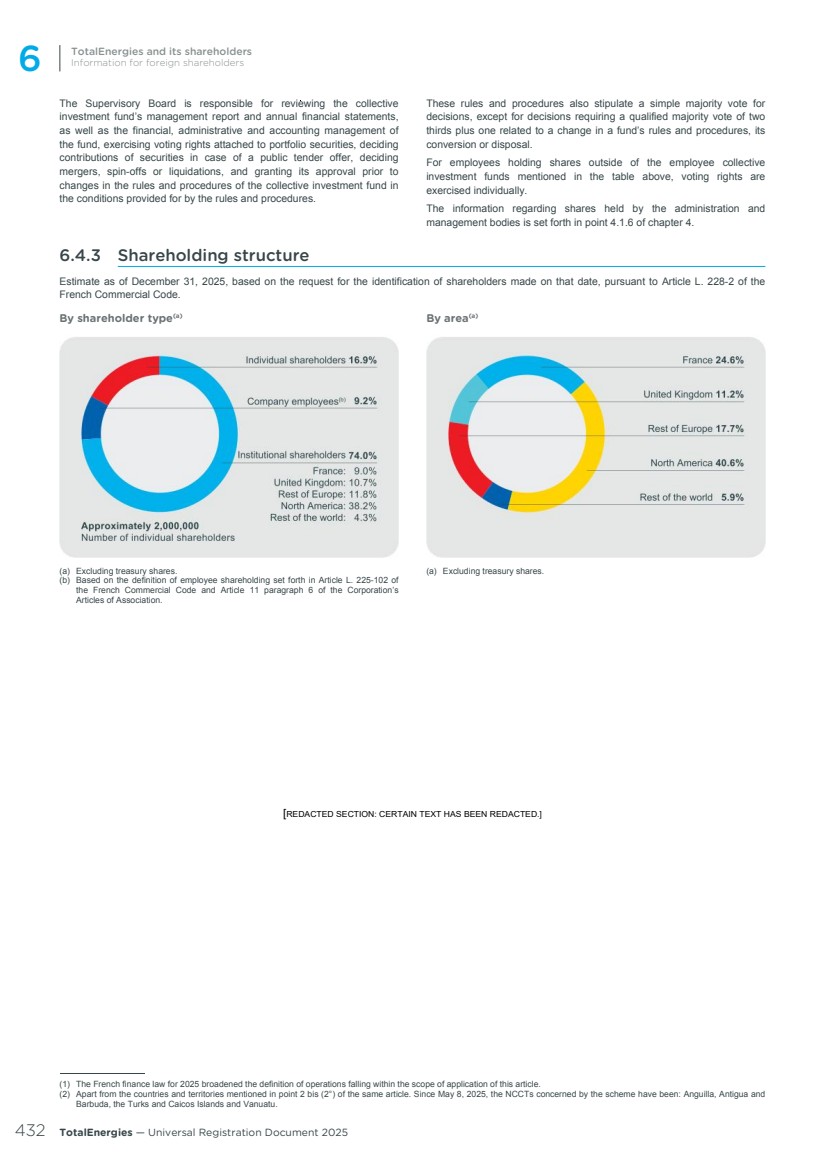
| 6.6 Investor relations 6.6.1 Documents on display Information and documents regarding TotalEnergies SE, its bylaws and the Corporation’s Statutory and Consolidated Financial Statements for the year ended December 31, 2025, or previous fiscal years, may be consulted at the Corporation’s registered office pursuant to the legal and regulatory provisions in force, as well as on TotalEnergies’ website. In addition, TotalEnergies SE’s Reference Documents or Universal Registration Documents (including the annual financial reports) and the interim financial reports (filed with the market authorities) for each of the past 10 financial years are available on the Corporation’s website (under Investors/Regulated information). The Company’s half-yearly results and outlook presentations, as well as the quarterly financial information, are also available on the TotalEnergies website. Furthermore, in order to meet its obligations related to the listing of its shares in the United States, the Corporation also files an annual report on Form 20-F, in English, with the SEC. This report is also available on the Corporation’s website. (1) Notably, the condition of being the effective beneficiary of the dividend. (2) Since January 1, 2026, withholding tax on dividends is levied at the domestic rate when the applicable tax treaty does not provide for or exempts them from withholding tax. The dividend recipient can obtain a refund from the French tax authorities, subject to certain conditions. (3) Apart from the countries and territories mentioned in point 2 bis (2°) of Article 238-0 A of the French General Tax Code. Since May 8, 2025, the NCCTs concerned by the scheme have been: Anguilla, Antigua and Barbuda, the Turks and Caicos Islands and Vanuatu. TotalEnergies and its shareholders Investor relations 6 TotalEnergies — Universal Registration Document 2025 433 [REDACTED SECTION: CERTAIN TEXT HAS BEEN REDACTED.] |
| 6.6.2 Relationships with institutional investors, financial analysts and individual shareholders Members of the Company’s General Management and Investor Relations regularly meet with institutional investors and financial analysts in the leading financial centers. In 2025, the Company kept up a sustained rate of meetings. Approximately 1,200 meetings were held. Each year, two main presentations are given to the financial community: one in February following the publication of the results for the previous fiscal year, and the other in September to present the Company’s outlook and objectives. A series of meetings is held after each of these presentations. In addition, each year the Chief Financial Officer hosts three conference calls to discuss results for the first, second and third quarters of the year. The information presented and broadcast at these events are available on the TotalEnergies website. The Finance Division maintains an ongoing dialogue with investors, analysts and extra-financial rating agencies on climate issues and, more generally, on sustainability themes. In all, more than 450 meetings were organized in France and abroad in 2025, as well as a site visit in Uganda and a presentation of the Sustainability & Climate – 2025 Progress Report. In 2025, the Lead Independent Director engaged in an extensive dialogue with shareholders, representing nearly a quarter of the Company’s capital ahead of the Shareholders’ Meeting. This dialogue continued after the Shareholders’ Meeting. The Company has a team dedicated to relationships with individual shareholders and offering a comprehensive communication package, featuring: – a direct-line, email address, and postal address (refer to point 6.6.6); – documentation and material provided for individual shareholders (e.g., the shareholders’ newsletter, e-newsletter, etc.); – shareholder meetings and fairs in France; – the Shareholders’ Club, which organizes visits to the Company’s industrial facilities, cultural events sponsored by the TotalEnergies Corporate Foundation (Fondation d'entreprise) and sport events linked with sponsoring activities; – the Shareholders’ Advisory Committee, which expresses its views on the communication service as a whole. The documentation on relationships with individual shareholders is available on the TotalEnergies website (under Investors/Individual shareholders). This team also organized the Annual Shareholders’ Meeting which was held on May 23, 2025, in Paris. As the Company is particularly committed to preserving this key moment in the expression of shareholder democracy, it took care to implement the necessary means to facilitate remote participation by shareholders. They were able to follow the meeting in full and live, thanks to its broadcast on the Company’s website. Shareholders also had the opportunity to ask questions online via a dedicated platform accessible from the Company’s website between May 2 and May 16, 2025, with around 20 questions received. As every year, the Chairman and Chief Executive Officer spent more than an hour answering them, including a questions & answers session with shareholders specifically dedicated to the agenda item for debate on the Sustainability & Climate – 2025 Progress Report. The replay of the Shareholders’ Meeting remains accessible on the TotalEnergies website. Shareholder dialogue 1. Shareholder engagement policy The Company and its Board of Directors are committed to a rich and constructive shareholder dialogue throughout the year. In addition to the actions implemented by the investor relations team on financial matters, the Company has developed a shareholder engagement program on extra-financial topics. This program allows for regular interactions with shareholders throughout the year on the Company’s strategy, climate policy, sustainability matters, and governance practices. These interactions are ensured by the Chairman and Chief Executive Officer, the Lead Independent Director, the members of the Executive Committee, and the investor relations team. In parallel with exchanges with its shareholders, the Company maintains regular communication with proxy advisors, extra-financial rating agencies, and some investor coalitions to better understand their expectations. The Company also has a dedicated service for relations with individual shareholders, which maintains a particularly active dialogue. Individual shareholders are also informed of the Company’s news through the Shareholders’ Journal (3 issues per year) and the Shareholders’ Webzine (10 issues per year) as well as through visits organized within the framework of the Shareholders’ Club. Several meetings also take place each year with the Shareholders’ Advisory Committee, bringing together a representative panel of individual shareholders. All of these exchanges, both verbal and written, form the basis on which TotalEnergies analyzes the expectations of its investors. These expectations are assessed as often as necessary by the General Management and the Board of Directors, and more specifically before and after the Shareholders’ Meeting. The results of the votes at the shareholders’ meetings, as well as potential comments from shareholders and stakeholders, are reviewed by the Governance and Ethics Committee and the Board of Directors. In addition to the ongoing dialogue, the shareholder engagement program is structured around key moments as described in the table below. Key moments of the annual shareholder engagement program Pre-Shareholders’ Meeting dialogue (April – May) In addition to the ongoing dialogue, a specific engagement campaign is conducted prior to the Shareholders’ Meeting. The objective is to address shareholders’ questions regarding the agenda and the resolutions presented at the Shareholders’ Meeting. 6 TotalEnergies and its shareholders Investor relations 434 TotalEnergies — Universal Registration Document 2025 |
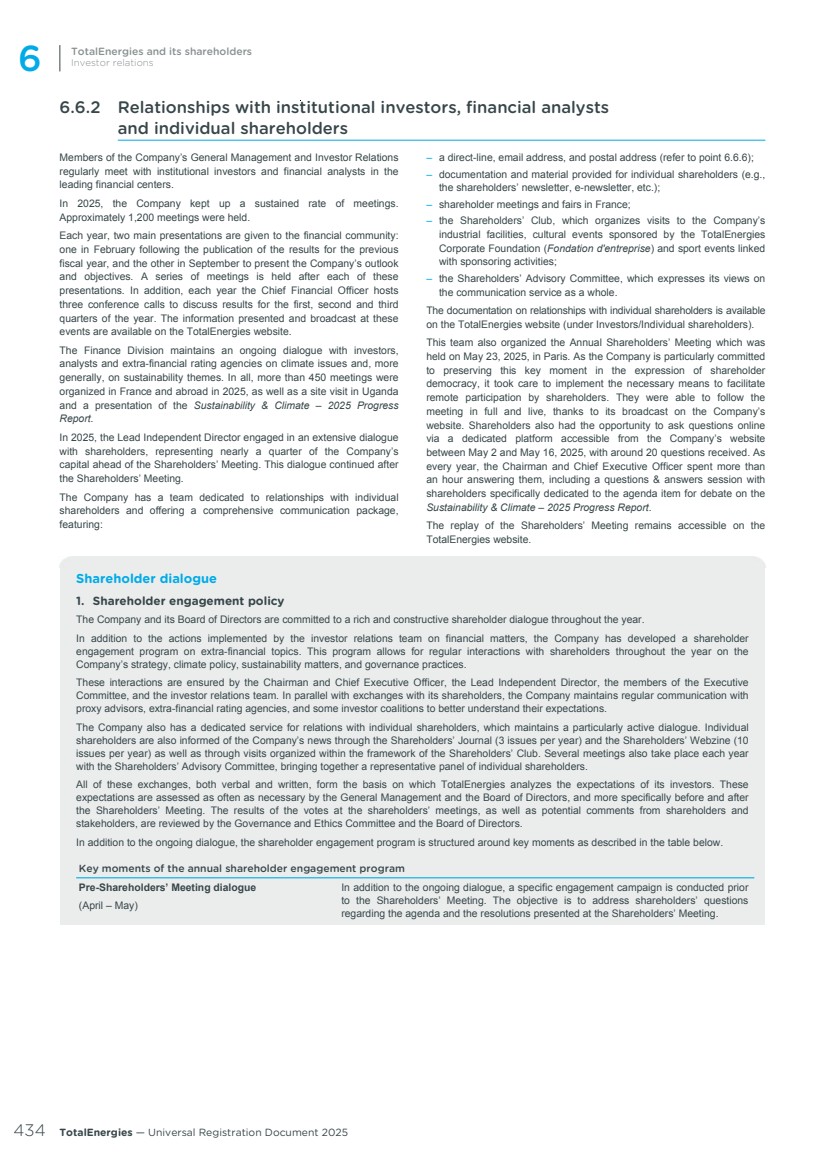
| Key moments of the annual shareholder engagement program Shareholders’ Meeting (May) The Shareholders’ Meeting, which generally holds in May, is an important moment in shareholder dialogue. In addition to exercising their voting rights, shareholders have the opportunity to ask questions either online before the Shareholders’ Meeting via a dedicated platform accessible from the Company’s website, or during the session. The Company responds to these questions, and each year, the Chairman and Chief Executive Officer dedicates significant time to answering them during the session. Shareholders also have the ability to submit written questions to the Board of Directors before the Shareholders’ Meeting, with responses published on the Corporation’s website. Review of the Shareholders’ Meeting votes (July) The Governance and Ethics Committee and the Board of Directors analyze the results of the Shareholders’ Meeting votes as well as the comments expressed by shareholders and main proxy advisors, and the lessons to be learned from them. This discussion then feeds into the work of the Committees and the Board throughout the year. ESG Survey (November – January) An ESG survey is sent to TotalEnergies’ institutional shareholders to collect their expectations regarding the Company’s extra-financial reporting. This ESG survey enables quality shareholder dialogue on extra-financial topics, particularly on the Company’s progress in decarbonization and sustainability. A formal analysis of the ESG survey results illustrating shareholder expectations is conducted by General Management. Third-party evaluations (extra-financial ratings, shareholder coalitions, etc.) and the voting policies of proxy advisors are also reviewed on this occasion. These expectations are then taken into account in the development of the Company’s publications and practices. 2. Deployment of the shareholders dialogue in 2025 In 2025, more than 1,000 meetings were organised with investors (individual interviews and roadshows) worldwide, including more than 450 dedicated to extra-financial matters and a presentation of the Sustainability & Climate – 2025 Progress Report to investors held in March, followed by a questions and answers session In addition to these meetings, shareholder dialogue carried out in 2025 included in particular the following: Dialogue with the Lead Independent Director In 2025, the Lead Independent Director had an extensive dialogue ahead of the Shareholders’ Meeting with shareholders representing a total of nearly a quarter of the Corporation’s capital. This dialogue continued after the Shareholders’ Meeting. In this context, the Lead Independent Director had discussions on the composition of the Board of Directors and the directors’ candidacies submitted to the Shareholders’ Meeting (including the number of mandates held by the candidates), the inclusion on the agenda of the Shareholders’ Meeting of a formal item for discussion (without a vote) on the Sustainability & Climate Report, the process for elaborating succession plans of corporate officers, the functioning of the Board of Directors and the role of the Lead Independent Director within the framework of the unified functions of Chairman and Chief Executive Officer. These meetings also made it possible to discuss the strategy and investments of TotalEnergies, particularly for the Integrated Power activities, as well as Tilenga & EACOP projects, the Mozambique LNG project and the technical conversion of ADRs listed on the NYSE into ordinary shares. The modalities and themes of this dialogue are presented in the report by the Lead Independent Director on the exercise of their mission, which appears in point 4.1.3 of this Universal Registration Document. Pre-Shareholders’ Meeting Engagement Campaign A comprehensive engagement program was conducted prior to the 2025 Shareholders’ Meeting with 55 shareholders, representing 22% of TotalEnergies’ share capital. The dialogue focused on the agenda of the Shareholders’ Meeting and the director candidacies submitted to the Shareholders’ Meeting (including the number of mandates of one of the candidates). The inclusion of a formal item on the agenda for debate, TotalEnergies’ transition strategy and the EACOP & Tilenga and Mozambique LNG projects were also discussed during these exchanges. Shareholders’ Meeting: formal item for debate In 2025, the Board of Directors included a formal item at the agenda of the Shareholders’ Meeting for debate (without a resolution submitted to the shareholders’ vote) on the Sustainability & Climate – 2025 Progress Report, reporting the progress made in implementing the Company’s ambition in terms of sustainable development and the energy transition towards carbon neutrality, as well as its objectives in this area by 2030. The President for Strategy & Sustainability, a member of the Company’s Executive Committee, presented to the Shareholders’ Meeting the key elements of the report and the main progress made in reducing greenhouse gas emissions. A questions and answers session with shareholders, specifically dedicated to this formal agenda item, was subsequently opened by the Chairman and Chief Executive Officer. Visit of Tilenga and EACOP site A site visit was organised in Uganda in June 2025, to allow shareholders to discover the Tilenga and EACOP sites and to engage with various local stakeholders. This visit, spread over several days, allowed for transparent discussion of the controversies surrounding these projects. Review of the Shareholders’ Meeting votes As every year in July, the Governance and Ethics Committee, chaired by the Lead Director, and then the Board of Directors, reviewed the results of the votes on the resolutions of the Annual Shareholders’ Meeting and the lessons to be learned. This analysis was incorporated into the Lead Director’s subsequent discussions with shareholders. TotalEnergies and its shareholders Investor relations 6 TotalEnergies — Universal Registration Document 2025 435 |
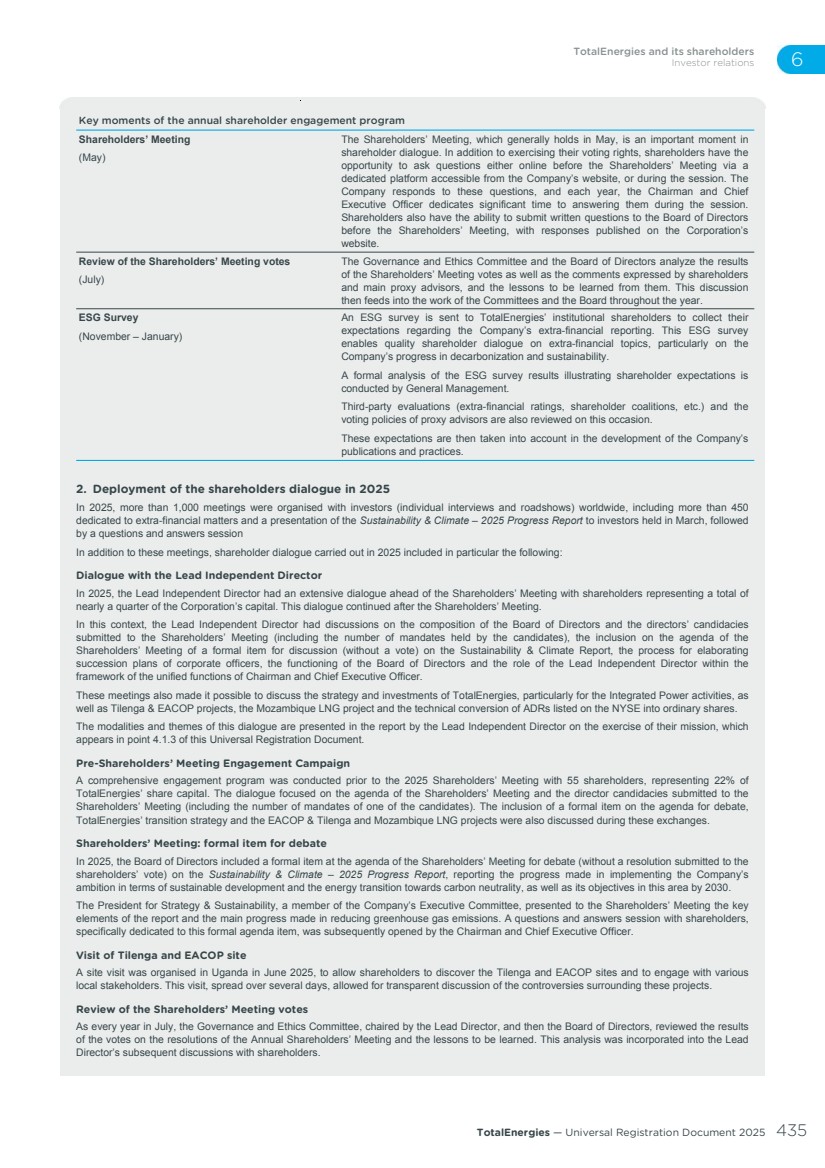
| As part of this annual review, the Governance and Ethics Committee and the Board examined the dialogue conducted prior to the 2025 Shareholders’ Meeting, particularly with regard to the number of terms of office held by Mr. Laurent Mignon. This review and its conclusions are detailed in the Lead Independent Director’s report on the performance of his duties, which is included in point 4.1.3 of this Universal Registration Document. ESG Survey The questionnaire, composed of 38 questions covering ESG data, the impact of recent regulatory developments, the Sustainability & Climate 2025 Progress Report, and shareholder dialogue, was sent at the end of November to approximately 200 institutional shareholders representing around 60% of TotalEnergies’ share capital. The numerous responses received were analyzed in detail and presented to General Management in January 2026. Dialogue with individual shareholders Several site visits were organised, both with the Shareholders’ Club and the Shareholders’ Advisory Committee, notably at the Digital Factory, La Mède platform, Saft’s R&D center in Bordeaux, the plant and R&D center at Feluy, Belgium, the CSTJF of Pau, a methanation plant and a solar plant near Perpignan. The Shareholders’ Advisory Committee was also invited to exchange in March at the Company’s headquarters around opportunities offered to TotalEnergies’ shareholder and to work on the new editorial offering developed by the Individual Shareholder Relations Department. 3. Examples of changes implemented following shareholder engagement The analysis of voting results and shareholder feedback feeds into the decision-making process of the Board of Directors. Over the years, many improvements have been implemented in this context. This includes: Shareholders’ expectations Changes implemented in response Example 1: Elimination of double voting rights Engagement theme: Shareholder equality Institutional shareholders, proxy advisors, and extra-financial rating agencies expressed their commitment to the governance principle of ’one share, one vote’ and the alignment between shareholders’ economic exposure and their voting rights. In order to meet these expectations, the Board of Directors submitted a proposal to the 2023 Shareholders’ Meeting to eliminate double voting rights and engaged in constructive dialogue with employee shareholders who were attached to double voting rights. The proposal was approved by 99.78%, and double voting rights were therefore eliminated. Example 2: Diversity within the Board of Directors Engagement theme: Governance Shareholders’ wish for greater internationalization of the Board, given the global exposure of the Company’s activities and additional expertise in electricity and renewables. This wish also emerged from the assessment of the Board’s functioning. In order to meet these expectations, the Board of Directors submitted to the 2023 Shareholders’ Meeting the appointment of Mr. Dierk Paskert, a German national with extensive experience in the electricity and renewables sectors, as well as Ms. Anelise Lara, a Brazilian national with long-standing experience in the oil & gas and gas & power sectors and a good knowledge of Brazil, a country where the Company’s investments are significant. Mr. Dierk Paskert and Ms. Anelise Lara were appointed directors by 2023 Shareholders’ Meeting with approval rates above 99%. Example 3: Scope 3 & compensation Engagement theme: Compensation; Climate Strategy The 2023 performance shares plan no longer included a criterion related to Scope 3, which was replaced by a criterion on reducing methane emissions. In a context where shareholder expectations are diverse and even contradictory regarding the setting of Scope 3 targets, some shareholders wanted the reintroduction of a Scope 3 target within the performance share plans. Starting from the 2024 performance share plan, the Board of Directors replaced the criterion related to the evolution of GHG emissions from operated facilities (Scope 1+2), which was also used in the variable part of the compensation, with the criterion related to the lifecycle carbon intensity of energy products sold to the customers of the Company (Scope 1+2+3). The lifecycle carbon intensity of energy products sold measures the average GHG emissions of energy products used by the Company’s customers, throughout their life cycle, from production to final use, per unit of energy. The results of this indicator are directly readable in the Company’s annual publications. The use of this new criterion allows for linking long-term incentive compensation to the Company’s ambition and the ultimate goal of the transition strategy: to reduce the carbon content of energy products sold to the Company’s customers while providing them with more energy. This criterion thus reflects the Company’s progress in implementing its transition strategy. Example 4: Transparency Engagement theme: Transparency The dialogue with shareholders in 2024 and 2025 has continued to inform reflections on potential changes to the Company’s publications. The identified expectations mainly focused on climate change adaptation, the resilience of our oil & gas portfolio, and representation of interests. Additional elements have been incorporated into the Sustainability & Climate Progress Report in 2025 and 2026. This included an assessment of the potential impacts of climate change effects on approximately 300 assets in the Company’s portfolio, undertaken since 2024, the results of which are presented in our publications. A merit order curve for the Company’s LNG projects was also incorporated into the Sustainability & Climate 2026 Progress Report. Furthermore, in 2026 the Company decided to publish the report presenting the detailed results of the review of associations on an annual basis instead of every two years. 6 TotalEnergies and its shareholders Investor relations 436 TotalEnergies — Universal Registration Document 2025 |
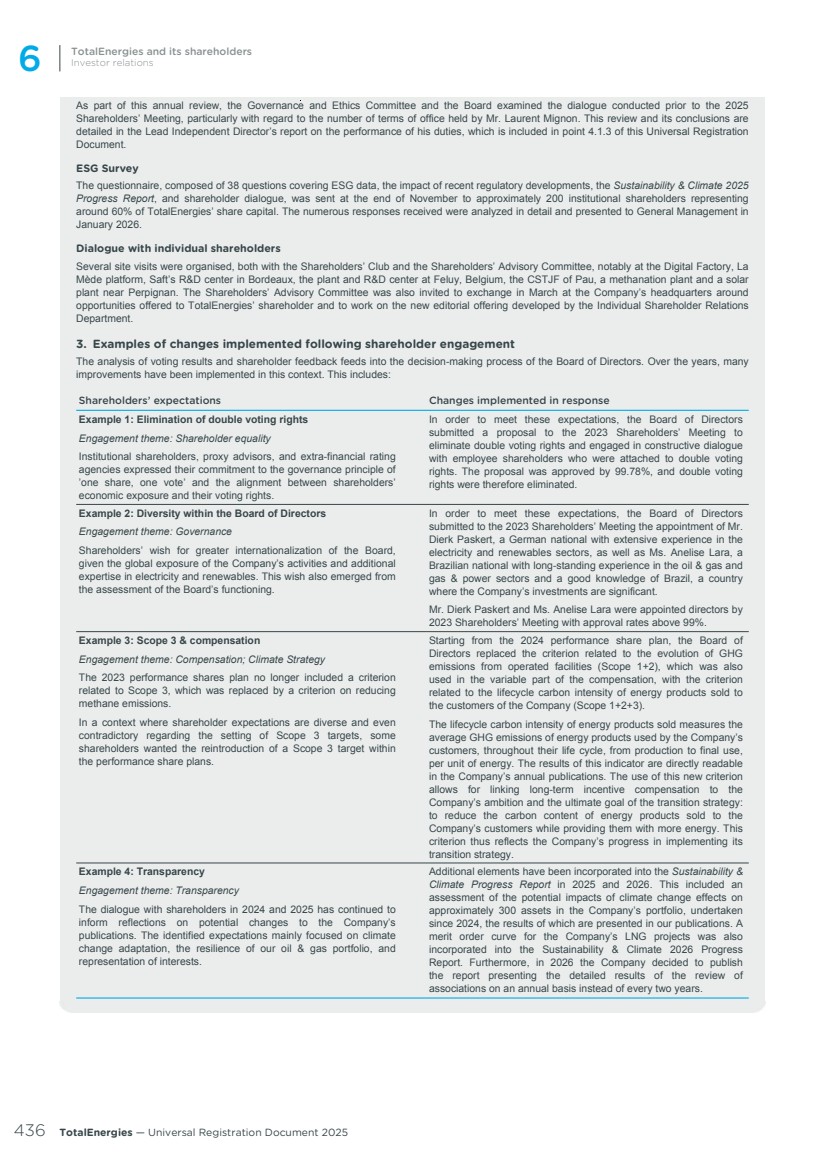
| 6.6.3 Registered shareholding TotalEnergies shares can be held in bearer form or registered form. In the latter case, shareholders are identified by TotalEnergies SE, in its capacity as the issuer, or by its agent, Société Générale Securities Services, which is responsible for keeping the register of shareholders’ registered shares. Registered shares There are two forms of registration: – administered registered shares: shares are registered with TotalEnergies through the Corporation’s agent, but the holder’s financial intermediary continues to administer them (sales, purchases, coupons, etc.); – pure registered shares: TotalEnergies holds and directly administers shares on behalf of the holder through the Corporation’s agent (sales, purchases, coupons, Shareholders’ Meeting notices, etc.), so that the shareholder does not need to appoint a financial intermediary. Main advantages of registered shares The advantages of registered shares include: – a customer relations center, Nomilia, available in six languages 24/7 by phone on +33 (0)2 51 85 67 89 (local call rate) with access to an advisor from Société Générale Securities Services, from Monday to Friday (business days) from 8.30 a.m. to 6.00 p.m., Paris time; – registration as a recipient of all information published by the TotalEnergies for its shareholders; – the ability to join the TotalEnergies Shareholders’ Club by holding at least 50 shares. The advantages of pure registered shares, in addition to those of administered registered shares, include: – no custodial fees; – easier placement of market orders(1) (phone, mail, fax, Internet); – brokerage fees of 0.19% (incl. tax) of the gross amount of the trade, with no minimum charge and up to €1,000 per trade; – the option to view and manage shareholdings online via the Sharinbox site. To convert TotalEnergies shares into pure registered shares, shareholders must fill out a form that can be obtained upon request from the Individual Shareholder Relations Department and send it to their financial intermediary. 6.6.4 Forecast financial calendar for 2026 February 11, 2026 Results of the fourth quarter and full year 2025 and Investors’ Day March 26, 2026 Energy & Climate 2026 workshop March 31, 2026 Ex-dividend date for the third 2025 interim dividend April 2, 2026 Payment date for the third 2025 interim dividend for shares listed on Euronext April 23, 2026 Payment date for the third 2025 interim dividend for shares listed on the NYSE April 29, 2026 Results of the first quarter of 2026 May 29, 2026 2026 Annual Shareholders’ Meeting June 30, 2026 Ex-dividend date for the 2025 final dividend(a) July 2, 2026 Payment date for the 2025 final dividend for shares listed on Euronext(a) July 22, 2026 Payment date for the 2025 final dividend for shares listed on the NYSE(a) July 23, 2026 Results of the second quarter and first half of 2026 September 28, 2026 Investors’ Day (outlook and objectives) September 30, 2026 Ex-dividend date for the first 2026 interim dividend(b) October 2, 2026 Payment date for the first 2026 interim dividend for shares listed on Euronext(b) October 21, 2026 Payment date for the first 2026 interim dividend for shares listed on the NYSE(b) October 29, 2026 Results of the third quarter and first nine months of 2026 December 31, 2026 Ex-dividend date for the second 2026 interim dividend(b) (a) Subject to approval at the Annual Shareholders’ Meeting called to approve the 2025 financial statements. (b) Subject to the Board of Directors’ decision. The calendar including Shareholders’ Meetings and investor fairs is available on the TotalEnergies website (under Investors). 6.6.5 Forecast financial calendar for 2027 January 5, 2027 Payment date for the second 2026 interim dividend for shares listed on Euronext (a) January 22, 2027 Payment date for the second 2026 interim dividend for shares listed on the NYSE(a) March 31, 2027 Ex-dividend date for the third 2026 interim dividend(a) April 2, 2027 Payment date for the third 2026 interim dividend for shares listed on Euronext(a) April 20, 2027 Payment date for the third 2026 interim dividend for shares listed on the NYSE(a) May 21, 2027 2027 Annual Shareholders’ Meeting June 30, 2027 Ex-dividend date for the 2026 final dividend(b) July 2, 2027 Payment date for the 2026 final dividend for shares listed on Euronext(b) July 22, 2027 Payment date for the 2026 final dividend for shares listed on the NYSE(b) (a) Subject to the Board of Directors’ decision. (b) Subject to approval at the Annual Shareholders’ Meeting called to approve the 2026 financial statements (1) Provided the subscriber has signed the market service agreement. Signing this agreement is free of charge. TotalEnergies and its shareholders Investor relations 6 TotalEnergies — Universal Registration Document 2025 437 |
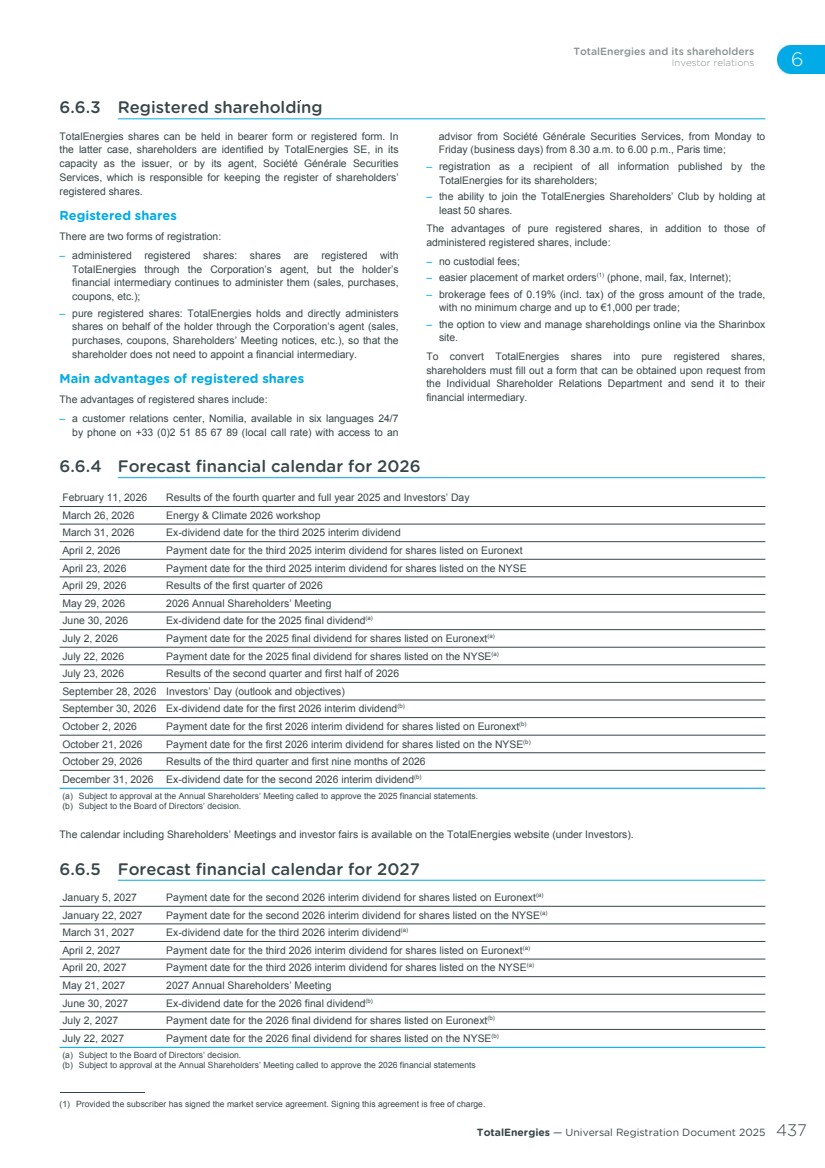
| 6.6.6 Contacts Mr. Renaud Lions Senior Vice President of Investor Relations, TotalEnergies SE TotalEnergies SE Tour Coupole 2, Place Jean Millier 92078 Paris La Défense Cedex, France Email address: ir@totalenergies.com Tel: +33 (0) 1 47 44 46 46 Mr. Vincent Granier Head of Individual Shareholder Relations TotalEnergies SE Individual Shareholder Relations Department Tour Coupole 2, Place Jean Millier 92078 Paris La Défense Cedex, France Email address: actionnaires@totalenergies.com Tel. (Monday to Friday from 9:00 a.m. to 12:30 p.m. and from 1:30 p.m. to 5:00 p.m., Paris time): – from France: 0800 039 039 (toll-free number from a landline); – from other countries: +33 (0) 1 47 44 24 02. 6 TotalEnergies and its shareholders Investor relations 438 TotalEnergies — Universal Registration Document 2025 |
| General information 7 7.1 Share capital 440 7.1.1 Amount of share capital 440 7.1.2 Features of the shares 440 7.1.3 Potential capital as of December 31, 2025 440 7.1.4 Changes in share capital between 2023 and 2025 440 7.2 Articles of Association; other information 441 7.2.1 General information concerning the Corporation 441 7.2.2 Corporate purpose 441 7.2.3 Provisions of the Articles of Association governing the administration and management bodies 441 7.2.4 Rights, privileges and restrictions attached to the shares 443 7.2.5 Amending shareholders’ rights 443 7.2.6 Shareholders’ Meetings 444 7.2.7 Identification of the holders of bearer shares 444 7.2.8 Thresholds to be declared according to the Articles of Association 444 7.2.9 Changes in the share capital 444 7.3 TotalEnergies — Universal Registration Document 2025 439 [REDACTED SECTION: CERTAIN TEXT HAS BEEN REDACTED.] |
| 7.1 Share capital 7.1.1 Amount of share capital As of December 31, 2025, the share capital amounted to €5,516,463,857.50, divided into 2,206,585,543 ordinary shares, each with a par value of €2.50. All shares issued have been fully paid up. On February 10, 2026, the Board of Directors decided, with effect as of February 13, 2026, to decrease the share capital of TotalEnergies SE by way of cancellation of 18,185,068 treasury shares. As of February 13, 2026, the share capital of the Corporation amounts to €5,471,001,187.50 and is divided into 2,188,400,475 shares. 7.1.2 Features of the shares There is only one category of shares. The shares are held in registered or bearer form, at the shareholder’s discretion. The shares are in book-entry form and registered in an account. 7.1.3 Potential capital as of December 31, 2025 The potential share capital consists of the existing share capital to which are added the new TotalEnergies shares that could be issued in the event of (i) the conversion or reimbursement in shares of all the securities giving access to the share capital, or (ii) the exercise of all the share subscription options. As of December 31, 2025, there were no financial instruments likely to result in the issuance of new TotalEnergies shares. 7.1.4 Changes in share capital between 2023 and 2025 Transaction acknowledgment date Shares created/ (canceled) (number of shares) Type of transaction (share capital increase/reduction) Nominal amount of the transaction (euros) Issuance/ share premium per share (euros) Share capital after the transaction (euros) Number of shares composing the capital after the transaction Fiscal year 2023 February 7, 2023 (128,869,261) Reduction – Cancellation of treasury shares (322,173,152.50) n/a 6,225,655,060.00 2,490,262,024 June 7, 2023 8,002,155 Share capital increase reserved for employees 20,005,387.50 43.10(a) 6,245,660,447.50 2,498,264,179 September 25, 2023 (86,012,344) Reduction – Cancellation of treasury shares (215,030,860.00) n/a 6,030,629,587.50 2,412,251,835 (a) Only the created 7,760,062 shares subscribed by the employees as part of the share capital increase included an issuance premium. The 242,093 shares created for the matching contribution, in the form of free shares pursuant to Article L. 3332-21 of the French Labor Code, did not include an issuance premium. Transaction acknowledgment date Shares created/ (canceled) (number of shares) Type of transaction (share capital increase/reduction) Nominal amount of the transaction (euros) Issuance/ share premium per share (euros) Share capital after the transaction (euros) Number of shares composing the capital after the transaction Fiscal year 2024 February 12, 2024 (25,405,361) Reduction – Cancellation of treasury shares (63,513,402.50) n/a 5,967,116,185.00 2,386,846,474 June 6, 2024 10,833,187 Share capital increase reserved for employees 27,082,967.50 44.40(a) 5,994,199,152.50 2,397,679,661 (a) Only the created 10,251,337 shares subscribed by the employees as part of the share capital increase included an issuance premium. The 581,850 shares created for the matching contribution, in the form of free shares pursuant to Article L. 3332-21 of the French Labor Code, did not include an issuance premium. Transaction acknowledgment date Shares created/ (canceled) (number of shares) Type of transaction (share capital increase/reduction) Nominal amount of the transaction (euros) Issuance/ share premium per share (euros) Share capital after the transaction (euros) Number of shares composing the capital after the transaction Fiscal year 2025 February 10, 2025 (127,622,460) Reduction – Cancellation of treasury shares (319,056,150.00) n/a 5,675,143,002.50 2,270,057,201 June 10, 2025 11,149,053 Share capital increase reserved for employees 27,872,632.50 40.00 (a) 5,703,015,635.00 2,281,206,254 September 26, 2025 (74,620,711) Reduction – Cancellation of treasury shares (186,551,777.50) n/a 5,516,463,857.50 2,206,585,543 (a) Only the created 10,572,824 shares subscribed by the employees as part of the share capital increase included an issuance premium. The 576,229 shares created for the matching contribution, in the form of free shares pursuant to Article L. 3332-21 of the French Labor Code, did not include an issuance premium. 7 General information Share capital 440 TotalEnergies — Universal Registration Document 2025 |
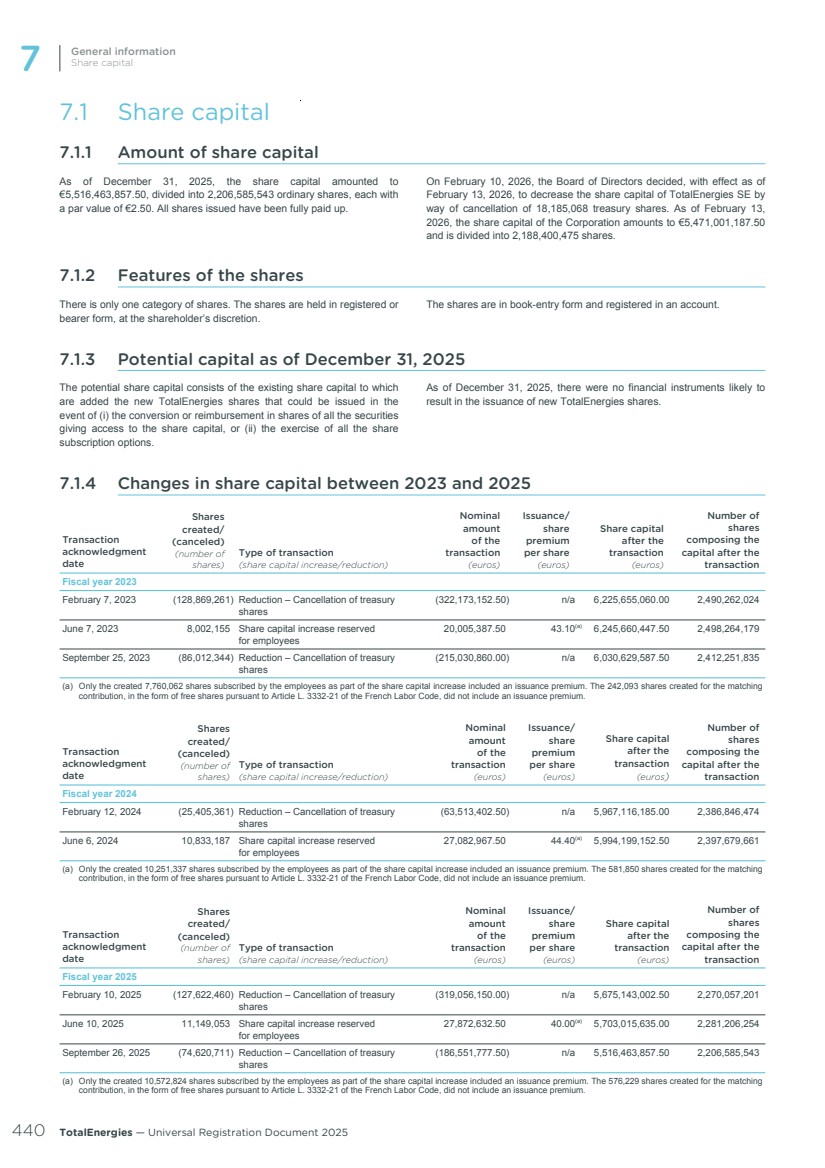
| 7.2 Articles of Association; other information The Annual Shareholders’ Meeting held on May 29, 2020 approved to transform TOTAL S.A. into a European company (Societas Europaea or SE). The legal status of a European company is common to all the countries in the European Union and is used by an increasing number of companies in France and in Europe. This status better reflects the economic and social reality of TotalEnergies and ensures that its European dimension is fully recognized. The Corporation officially became a European company on the date it was registered under its new status in the Nanterre Trade and Companies Register, on July 16, 2020. The process was completed without the creation of a new legal entity and had no impact on the Company’s governance, activities, tax affairs or organization, the listing places or the location of the registered office, which remained in France. The Shareholders’ Meeting on May 28, 2021 decided to change the corporate name to TotalEnergies SE, thereby anchoring the Corporation’s transformation into an integrated energy company. 7.2.1 General information concerning the Corporation The Corporation’s name is TotalEnergies SE. TotalEnergies SE is a European company governed by French law. The registered office is located at 2, Place Jean Millier, La Défense 6, 92400 Courbevoie, France. It is registered in the Nanterre Trade and Companies Register under No. 542 051 180. The Corporation’s term was extended until March 28, 2119, i.e., it will expire on March 28, 2119, unless dissolved prior to this date or extended. Fiscal year: from January 1 to December 31 of each year. LEI (Legal Entity Identifier): 529900S21EQ1BO4ESM68. EC Registration Number: FR 59 542 051 180. APE Code (NAF): 111Z until January 7, 2008; 7010Z since January 8, 2008. The Corporation’s Articles of Association are available on the Company’s website. The telephone number is +33 (0)1 47 44 45 46 and its Internet address is totalenergies.com. 7.2.2 Corporate purpose The purpose of the Corporation, directly and indirectly and in all countries, is: 1. All activities relating to production and distribution of all forms of energy, including electricity from renewables; 2. The search for and extraction of mining deposits, particularly all forms of hydrocarbons, and the production, refining, transportation, processing and trading in said materials as well as their derivatives and by-products; 3. All activities relating to the chemicals sector in all its forms and to the rubber sector; And in general, all financial, commercial, industrial, securities or real estate transactions, and acquisitions of interests or holdings in any form whatsoever, in any business or company existing or to be created that may relate, directly or indirectly, to the above-mentioned purposes or to any similar or related purposes, of such nature as to promote the Company’s expansion or its development. 7.2.3 Provisions of the Articles of Association governing the administration and management bodies 7.2.3.1 Election of directors and term of office Directors are elected up to a maximum number of directors authorized by law (currently 18) by the Shareholders’ Meeting, which determines the duration of their term of office not to exceed three years, subject to the legal provisions that allow the term to be extended until the next Ordinary Shareholders’ Meeting called to approve the financial statements for the previous fiscal year. In addition, one director representing the employee shareholders is elected by the Shareholders’ Meeting for a three-year term from a list of at least two candidates preselected by the employee shareholders under the conditions provided for by the laws, regulations and Articles of Association in force. However, his or her term shall expire automatically once this director is no longer an employee or a shareholder. The Board of Directors may meet and conduct valid deliberations until the date his or her replacement is named. In addition, a director representing the employees is designated by the Corporation’s Central Social and Economic Committee. Where the number of directors appointed by the Shareholders’ Meeting is greater than eight(1) , a second director representing the employees is designated by the TotalEnergies European Works Council (the SE Committee). In accordance with applicable legal provisions, the director elected by the Central Social and Economic Committee must have held an employment contract with the Corporation or one of its direct or indirect subsidiaries, whose registered office is based in mainland France, for at least two years prior to appointment. By way of derogation, the second director elected by the SE Committee must have held an employment contract with the Corporation or one of its direct or indirect subsidiaries for at least two years prior to appointment. The term of office for a director representing the employees is three years. However, the term of office ends following the Ordinary Shareholders’ Meeting called to approve the financial statements for the last fiscal year and held in the year during which the said director’s term of office expires. 7.2.3.2 Age limit of directors On the closing date of each fiscal year, the number of individual directors over the age of 70 may not be greater than one third of the directors in office. If that number is exceeded, the oldest Board member is automatically considered to have resigned. The permanent representative of a legal entity director must be less than 70 years old. (1) Neither the director representing employee shareholders, elected by the Annual Shareholders’ Meeting, nor the director(s) representing employees are taken into consideration when calculating the eight-member threshold, which is assessed on the date on which the employee director(s) is/are elected. General information Articles of Association; other information 7 TotalEnergies — Universal Registration Document 2025 441 |
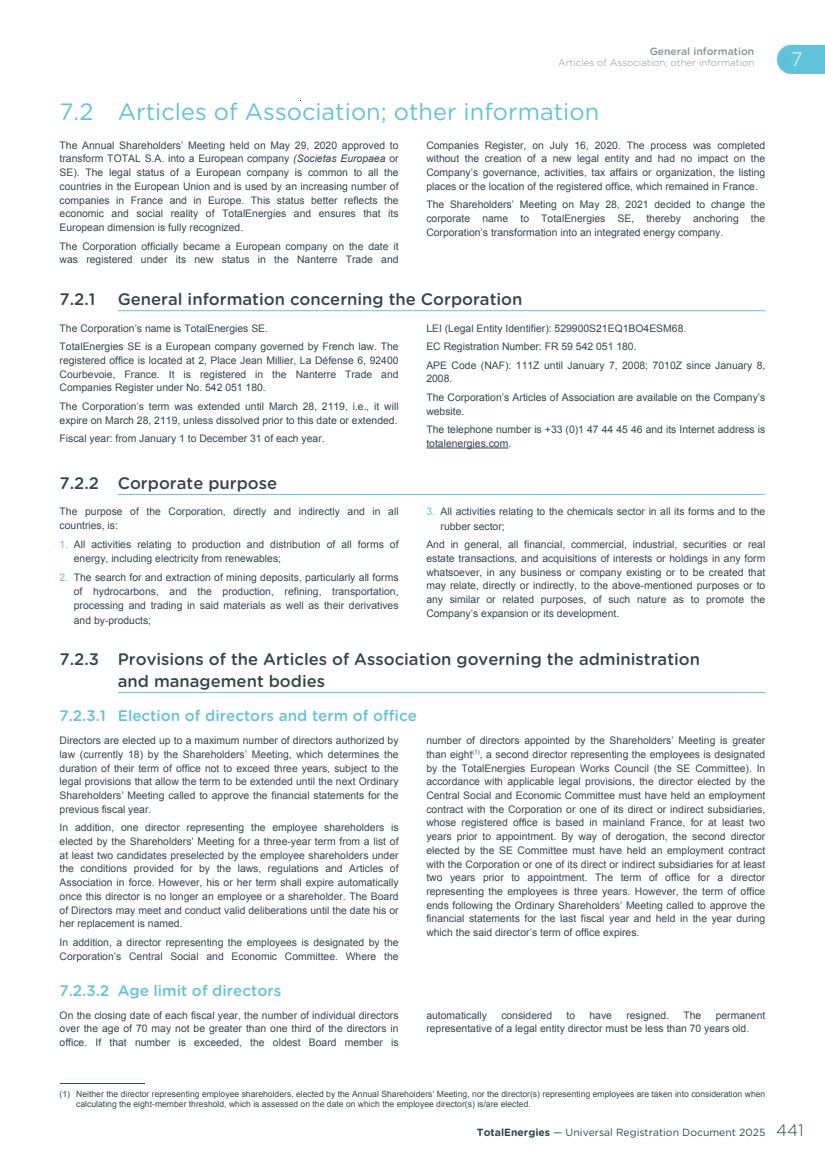
| 7.2.3.3 Age limit of the Chairperson of the Board and the Chief Executive Officer The office of the Chairperson of the Board of Directors automatically ceases on his or her 70th birthday at the latest. To hold this office, the Chief Executive Officer must be under the age of 67. When the age limit is reached during his or her duties, such duties automatically cease, and the Board of Directors elects a new Chief Executive Officer. However, his or her duties as Chief Executive Officer will continue until the date of the Board of Directors’ meeting aimed at electing his or her successor. Subject to the age limit specified above, the Chief Executive Officer can always be re-elected. The age limits specified above are stipulated in the Corporation’s Articles of Association. Upon the recommendation of the Governance and Ethics Committee, following a review of the practices of CAC 40 companies and international peers, the Board of Directors decided to propose to the Annual Shareholders’ Meeting on May 29, 2026 to revise the statutory age limits applicable to the position of Chairman, raising it from 70 to 75 years of age, and to the position of Chief Executive Officer, raising it from 67 to 70 years of age. It is thus proposed to the Shareholders’ Meeting to amend the Articles of Association so that the term of office of the Chairman shall end no later than the end of the Shareholders’ Meeting called to approve the financial statements for the fiscal year in which he reaches the age of 75, and the term of office of the Chief Executive Officer shall end no later than the end of the Shareholders’ Meeting called to approve the financial statements for the fiscal year in which he reaches the age of 70. 7.2.3.4 Minimum interest in the Company held by directors Each director (other than the director representing employee shareholders or the directors representing employees) must own at least 1,000 shares during his or her term of office. If, however, any director ceases to own the required number of shares, they may adjust their position subject to the conditions set by law. The director representing employee shareholders must hold, during his or her term of office, either individually or through a Company Savings Plan (Fonds Commun de Placement d’Entreprise, FCPE) governed by Article L. 214-165 of the French Monetary and Financial Code, at least one share or a number of units in said fund equivalent to at least one share. The directors representing employees are not required to be shareholders. 7.2.3.5 Majority rules for Board meetings Decisions are adopted by a majority vote of the directors present or represented. In the event of a tie vote, the person chairing the meeting shall cast the deciding vote. When permitted by applicable regulations, directors participating in the meeting by means of video conferencing or telecommunications as defined by decree shall be deemed present for the calculation of the quorum and the majority. 7.2.3.6 Rules of procedure and Committees of the Board of Directors Refer to point 4.1.2 of chapter 4. 7.2.3.7 Form of management Management of the Corporation is assumed either by the Chairperson of the Board of Directors (who then holds the title of Chairman and Chief Executive Officer), or by another person appointed by the Board of Directors with the title of Chief Executive Officer. It is the responsibility of the Board of Directors to choose between these two forms of management under the majority rules described above. At its meeting on December 16, 2015, the Board of Directors decided to reunify the positions of Chairperson and Chief Executive Officer of the Corporation as from December 19, 2015. Since that date, Mr. Pouyanné has held the position of Chairman and Chief Executive Officer of TotalEnergies SE. After his term of office as director was renewed for a three-year period at the Shareholders’ Meeting on May 24, 2024, the Board of Directors reappointed Mr. Pouyanné as Chairman and Chief Executive Officer for the same period, expiring at the end of the 2027 Shareholders’ Meeting called to approve the financial statements for fiscal year 2026. The Board of Directors, at its meeting held on September 21, 2023, after reaffirming its support to the quality and the relevance of the strategy implemented, considered that it is highly desirable that Mr. Patrick Pouyanné, Chairman and Chief Executive Officer, continues to drive this strategy’s deployment at the helm of the Company. On the proposal of the Governance and Ethics Committee, it has therefore been unanimously decided that the renewal of the mandate of Mr. Patrick Pouyanné will be proposed to the Shareholders’ Meeting to be held on May, 24 2024. In the frame of the balanced governance implemented since 2015, it also unanimously decided to propose the renewal of the mandate of Mr. Jacques Aschenbroich, who has held the position of Lead Independent Director since May 2023. Unified management form The discussions held with the Governance and Ethics Committee in the best interests of the Corporation had led to a firm proposal to continue to combine the functions of Chairman and Chief Executive Officer. Indeed, this management form of the Corporation is considered to be the most appropriate for dealing with the challenges and specificities of the energy sector, which is facing major transformations. More than ever, this context requires agility of movement, which the unity of command reinforces, by giving the Chairman and Chief Executive Officer the power to act and increased representation of the Corporation in its strategic negotiations with States and partners of the Company. Balance of power The unity of the power to manage and represent the Corporation is also particularly well regulated by the Corporation’s governance. The balance of power is established through the quality, complementarity and independence of the members of the Board of Directors and its four Committees, as well as through the Articles of Association and the Board’s Rules of Procedure, which define the means and prerogatives of the Lead Independent Director, notably: – in his relations with the Chairman and Chief Executive Officer: contribution to the agenda of Board meetings or the possibility of requesting a meeting of the Board of Directors and sharing opinions on major issues; – in his contribution to the work of the Board of Directors: chairing meetings in the absence of the Chairman and Chief Executive Officer, or when the examination of a subject requires his abstention, evaluation and monitoring of the functioning of the Board, prevention of conflicts of interest, and dialogue with the directors and Committee Chairpersons; – in his relations with shareholders: the possibility, with the approval of the Chairman and Chief Executive Officer, of meeting with them on corporate governance issues, a practice that has already been used on several occasions. 7 General information Articles of Association; other information 442 TotalEnergies — Universal Registration Document 2025 |
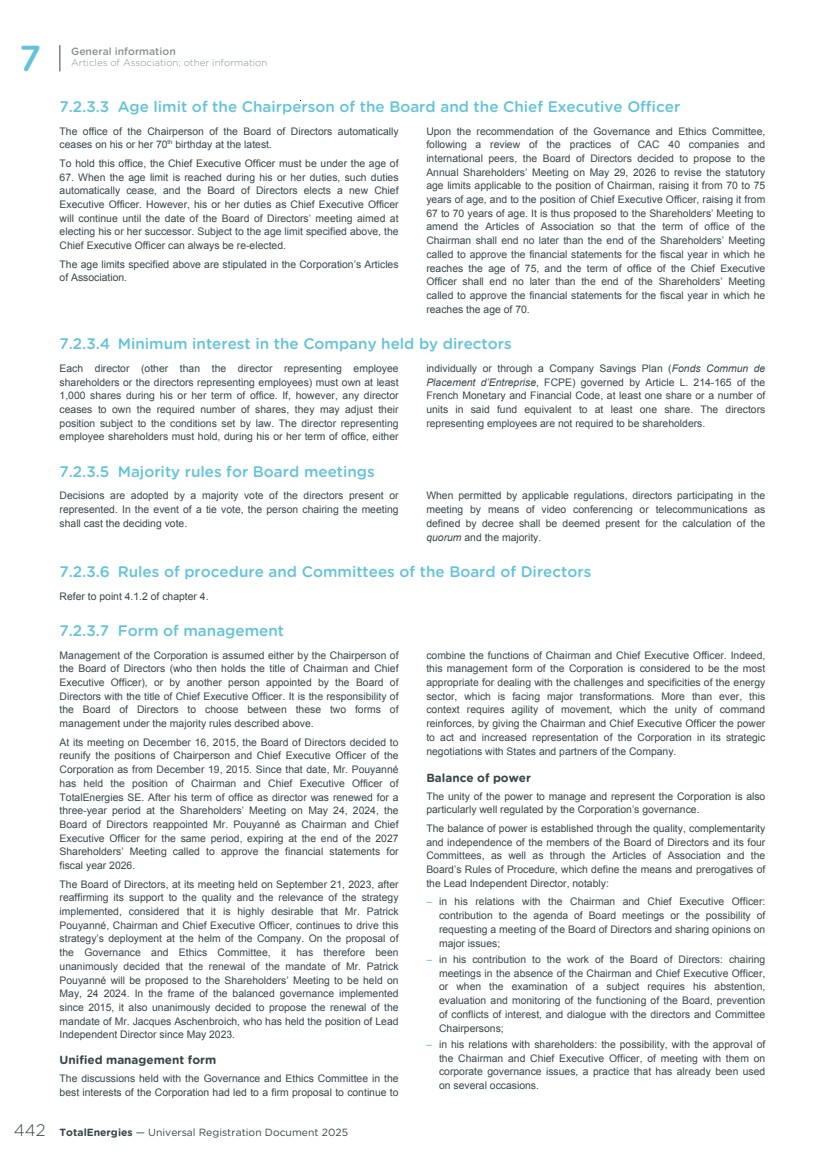
| The balance of power within the governance bodies, in addition to the independence of its members, is further strengthened by the full involvement of the directors, whose participation in the work of the Board and its Committees is exemplary. The diversity of their skills and expertise also enables the Chairman and Chief Executive Officer to benefit from a wide range of contributions. In addition, the Board’s rules of procedures provide that any investment or divestment transactions contemplated by the Company involving amounts in excess of 3% of shareholders’ equity must be approved by the Board, which is also kept informed of all significant events concerning the Corporation’s operations, in particular investments and divestments in excess of 1% of shareholders’ equity. Lastly, the Corporation’s Articles of Association provide the necessary guarantees of compliance with good governance practices in the context of a unified management structure. In particular, they provide that the Board may be convened by any means, including orally, or even at short notice depending on the urgency of the matter, by the Chairman or by one third of its members, including the Lead Independent Director, at any time and as often as the interests of the Corporation require. 7.2.4 Rights, privileges and restrictions attached to the shares In addition to the voting right, each share entitles the holder to a portion of the corporate assets, distributions of profits and liquidation dividend that is proportional to the number of shares issued, subject to the laws and regulations in force, as well as the Articles of Association. No privilege is attached to a specific class of shares or to a specific class of shareholders. Since the decision of the Extraordinary Shareholders’ Meeting held on May 26, 2023, which decided to eliminate double voting rights, no double voting right is attached to the shares of the Corporation. 7.2.4.1 Voting rights Each share of the Corporation entitles to one vote. 7.2.4.2 Limitation of voting rights Article 18 of the Corporation’s Articles of Association provides that at Shareholders’ Meetings, no shareholder may cast, by himself or through his agent, on the basis of the voting rights attached to the shares he holds directly or indirectly and the shares for which he holds powers, more than 10% of the total number of voting rights attached to the shares of the Corporation. Additionally, Article 18 of the Articles of Association also provides that the limitation on voting rights no longer applies, absent any decision of the Shareholders’ Meeting, if an individual or a legal entity acting solely or together with one or more individuals or entities acquires at least two thirds of the shares of the Corporation following a public tender offer for all the shares of the Corporation. In that case, the Board of Directors acknowledges that the limitation no longer applies and carries out the necessary procedure to modify the Corporation’s Articles of Association accordingly. Once acknowledged, the fact that the limitation no longer applies is final and applies to all Shareholders’ Meetings following the public tender offer under which the purchase of at least two thirds of the overall number of shares of the Corporation was made possible, and not solely to the first meeting following that public tender offer. Since in such circumstances the limitation no longer applies, such limitation on voting rights cannot prevent or delay any takeover of the Corporation, except in case of a public tender offer where the bidder does not acquire at least two thirds of the Corporation’s share capital. 7.2.4.3 Fractional rights Whenever it is necessary to own several shares in order to exercise a right, a number of shares less than the number required does not give the owners any right with respect to the Corporation; in such case, the shareholders are responsible for aggregating the required number of shares. 7.2.4.4 Statutory allocation of profits The Corporation may distribute dividends under the conditions provided for by the French Commercial Code and the Corporation’s Articles of sociation. The net profit for the period is equal to the net income minus general expenses and other personnel expenses, all amortization and depreciation of the assets, as well as all provisions for commercial and industrial contingencies. From this profit, minus prior losses, if any, the following items are deducted in the order indicated: – 5% to constitute the legal reserve fund, until said fund reaches 10% of the share capital, – the amounts set by the Shareholders’ Meeting in order to fund reserves for which it determines the allocation or use, and – the amounts that the Shareholders’ Meeting decides to retain. The remainder is paid to the shareholders as dividends. The Board of Directors may pay interim dividends. The Shareholders’ Meeting held to approve the financial statements for the fiscal year may decide to grant shareholders an option, for all or part of the dividend or interim dividends, between payment of the dividend in cash or in shares. The Shareholders’ Meeting may decide at any time, but only based on a proposal by the Board of Directors, to make a full or partial distribution of the amounts in the reserve accounts, either in cash or in shares of the Corporation. Dividends that have not been claimed at the end of a five-year period are forfeited to the French State. 7.2.5 Amending shareholders’ rights Any amendment to the Articles of Association must be approved or authorized by the Shareholders’ Meeting voting with the quorum and majority required by the laws and regulations governing Extraordinary Shareholders’ Meetings. General information Articles of Association; other information 7 TotalEnergies — Universal Registration Document 2025 443 |
| 7.2.6 Shareholders’ Meetings Refer to point 4.4.3 of chapter 4 for the terms and conditions of the notice of and admission to Shareholders’ Meetings. 7.2.7 Identification of the holders of bearer shares In accordance with Article 9 of its Articles of Association, TotalEnergies SE is entitled to make use of the legal provisions regarding identification of holders of securities that grant an immediate or future voting right at the Corporation Shareholders’ Meetings. Law No. 2019-486 of May 22, 2019, on the growth and transformation of businesses amended Article L. 228-2 of the French Commercial Code to stipulate that this ability to make use of the procedure is a matter of law, and any provision of the Articles of Association to the contrary shall be deemed unwritten. 7.2.8 Thresholds to be declared according to the Articles of Association Any individual or entity who directly or indirectly acquires a percentage of the share capital, voting rights or rights giving future access to the share capital of the Corporation that is equal to or greater than 1%, or a multiple of this percentage, is required to notify the Corporation within 15 days of crossing each threshold, by registered mail with return receipt requested, and to declare the number of securities held. In the event that the shares above these thresholds are not declared, as specified in the preceding paragraph, any shares held in excess of the threshold that should have been declared will be deprived of voting rights at Shareholders’ Meetings if, at a Shareholders’ Meeting, the failure to make a declaration is acknowledged and if one or more shareholders holding collectively at least 3% of the Corporation’s share capital or voting rights so request at that meeting. All individuals and entities are also required to notify the Corporation, in due form and within the time limits stated above, when their direct or indirect holdings fall below each of the thresholds mentioned in the first paragraph. 7.2.9 Changes in the share capital The Corporation’s share capital may be changed only under the conditions stipulated by the legal and regulatory provisions in force. No provision of the Articles of Association, charter, or internal regulations provide for more stringent conditions than the law governing changes in the Corporation’s share capital. The French Commercial Code stipulates that shareholders hold, in proportion to their number of shares, a preemptive subscription right to shares issued for cash as par of share capital increase. The Extraordinary Shareholders’ Meeting can decide, under the conditions provided for by law, to remove this preemptive subscription right. 7 General information Historical financial information and additional information 444 TotalEnergies — Universal Registration Document 2025 [REDACTED SECTION: CERTAIN TEXT HAS BEEN REDACTED.] |
| Supplemental oil and gas information (unaudited) 9 9.1 Oil and gas information pursuant to FASB Accounting Standards Codification 932 568 9.1.1 Assessment process for reserves 568 9.1.2 Proved developed reserves 568 9.1.3 Proved undeveloped reserves 568 9.1.4 Estimated proved reserves of oil, bitumen and gas 569 9.1.5 Results of operations for oil and gas producing activities 576 9.1.6 Cost incurred 578 9.1.7 Capitalized costs related to oil and gas producing activities 579 9.1.8 Standardized measure of discounted future net cash flows (excluding transportation) 580 9.1.9 Changes in the standardized measure of discounted future net cash flows 582 9.2 Other information 582 9.2.1 Natural Gas production available for sale 582 9.2.2 Production prices 583 9.2.3 Production costs 584 9.3 Report on the payments made to gov ernments 585 9.3.1 Reporting by country and type of Payment 586 9.3.2 Reporting of Payments by Project and by type of Payment, and by Government and by type of Payment 589 9.4 Reporting of payments to governments for purchases of oil, gas and minerals (EITI reporting) 610 TotalEnergies — Universal Registration Document 2025 567 |
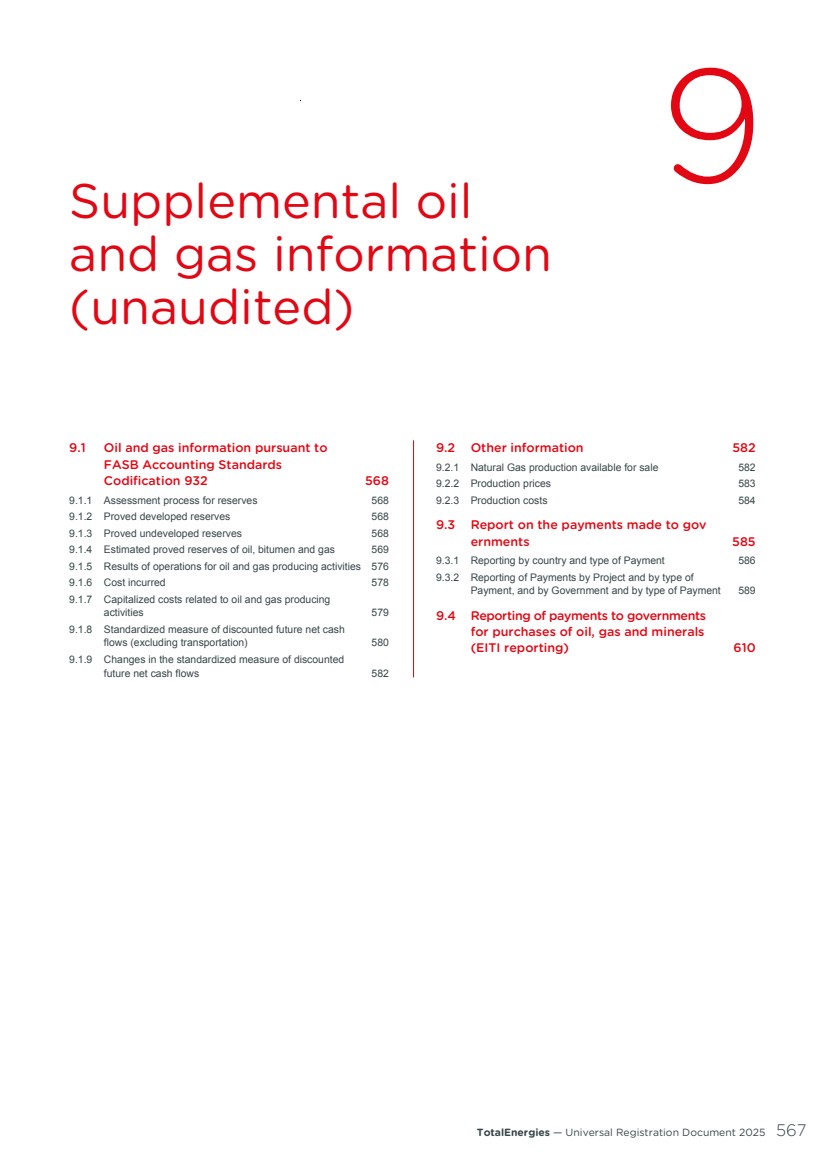
| 9.1 Oil and gas information pursuant to FASB Accounting Standards Codification 932 Proved reserves estimates are calculated according to the Securities and Exchange Commission (SEC) Rule 4-10 of Regulation S-X set forth in the “Modernization of Oil and Gas Reporting” release (SEC Release No. 33-8995) and the Financial Accounting Standards Board (FASB) Accounting Standards Update regarding Extractive Activities – Oil and Gas (ASC 932), which provide definitions and disclosure requirements. 9.1.1 Assessment process for reserves Reserves estimations are performed by experienced geoscientists, engineers and economists under the supervision of each subsidiary’s General Management. Staff involved in reserves evaluation are trained to follow SEC-compliant internal guidelines and policies regarding criteria that must be met before reserves can be considered as proved. As of December 31, 2025, all of the Company’s proved reserves held in consolidated subsidiaries and equity affiliates are estimated within the affiliates of the Company. The technical validation process relies on a Technical Reserves Committee that is responsible for approving proved reserves variations above a certain threshold and technical evaluations of reserves associated with an investment decision that requires approval from the Exploration & Production Executive Committee. The Chairman of the Technical Reserves Committee is appointed by the President of Exploration & Production and the President of the OneTech Branch, and its members have expertise in reservoir engineering, production geology, production geophysics, reserves methodology, drilling and development studies. An internal control process related to reserves estimation is formalized and involves the following elements: – a central Reserves Entity, the role of which is to consolidate, document and archive the Company’s reserves; to ensure coherence of evaluations worldwide; to maintain the Corporate Reserves Guidelines Standards in line with SEC guidelines and policies; to deliver training on reserves evaluation and classification; and to conduct periodically in-depth technical review of reserves for each affiliate; – an annual review of affiliate reserves conducted by an internal group of specialists selected for their expertise in geosciences and engineering and their knowledge of the affiliates. All members of this group, chaired by the Reserves Vice President of the Company and composed of at least three Technical Reserves Committee members, are knowledgeable in the SEC guidelines for proved reserves evaluation. Their responsibility is to provide an independent review of significant reserves changes proposed by affiliates and ensure that reserves are estimated using appropriate standards and procedures; – following the annual review of the reserves, a SEC Reserves Committee chaired by the Exploration & Production Senior Vice President Corporate Affairs and comprised of the New Business - Carbon Neutrality EP, the Legal EP, the Finance EP, the Reserves Vice Presidents as well as the Chairman of the Technical Reserves Committee, approves the elements of the SEC reserves booking proposals concerning criteria that are not dependent upon technical expertise (reservoir, geosciences, etc.). The results of the annual review and the proposals for including revisions or additions of SEC Proved Reserves are presented to the Exploration & Production Executive Committee for approval before final validation by the Company’s General Management and Chief Financial Officer. The reserves evaluation and control process are audited periodically by the Company’s internal auditors. The Reserves Vice President in charge of the central Reserves Entity is appointed by the President of Exploration & Production. As Reserves Vice President, he supervises the Reserves Entity, chairs the annual review of reserves, and is member of the Technical Reserves Committee and the SEC Reserves Committee. The Reserves Vice President is also member of the Development Committee of the Exploration & Production. The current Reserves Vice President has over 30 years of experience in the oil and gas industry, with skills in geosciences and reservoir engineering, as well as in the field of reserves evaluation and control process. He graduated from École Polytechnique and IFP School. He is member of the SPE (Society of Petroleum Engineers) for more than 20 years. 9.1.2 Proved developed reserves As of December 31, 2025, TotalEnergies’ proved developed reserves of hydrocarbons (oil, bitumen and gas) were 7,054 Mboe and represented 63% of the proved reserves. As of December 31, 2024, proved developed reserves of hydrocarbons were 6,965 Mboe and represented 63% of the proved reserves. As of December 31, 2023, proved developed reserves of hydrocarbons were 6,835 Mboe and represented 65% of the proved reserves. 9.1.3 Proved undeveloped reserves As of December 31, 2025, TotalEnergies’ proved undeveloped reserves (PUDs) of hydrocarbons were 4,164 Mboe compared to 4,108 Mboe as of December 31, 2024 and 3,729 Mboe as of December 31, 2023. The variation between December 31, 2024 and December 31, 2025 is due to: – -455 Mboe converted from PUDs to proved developed reserves within the scope of development activities mainly in Brazil, the United States, the United Arab Emirates, Qatar, Angola, Norway and Argentina. This confirms once again the Company’s ability to develop and bring into production large scale and complex projects; – +415 Mboe of net revisions of previous estimates which break down to +85 Mboe due to economic factors, +40 Mboe due to technical revisions and +290 Mboe due to improved recovery projects mainly in Iraq and in the United Arab Emirates; – +110 Mboe related to extensions and discoveries, mainly in the United States, Australia and Argentina; – -14 Mboe from sales in Nigeria. 9 Supplemental oil and gas information (unaudited) Oil and gas information pursuant to FASB Accounting Standards Codification 932 568 TotalEnergies — Universal Registration Document 2025 |
| In 2025, the costs incurred to develop proved undeveloped reserves were $10.3 billion, which represented 85% of 2025 development costs incurred, and were related to projects located for the most part in the United Arab Emirates, Qatar, Uganda and Suriname. The Company’s PUDs that may remain undeveloped for five years or more after first disclosure (PUD5+) correspond to the remaining PUD on large scale and complex development projects and to field development projects the implementation of which is dependent on capacity constraints. Although the Company has converted significant amount of reserves associated to large scale and complex projects from PUD5+ into developed reserves in the last years, those projects still hold PUD5+ that are expected to be developed over time as part of initial field development plans or additional development phases. In addition, some projects are designed and optimized for a given production capacity that controls the pace at which the field is developed and the wells are drilled. At production start-up, only a portion of the proved reserves is developed to meet capacity constraints and contractual obligations. Under these specific circumstances, the Company believes that it is justified to report as proved reserves those PUDs, the development of which could span over more than five years after the launching of the project. 9.1.4 Estimated proved reserves of oil, bitumen and gas The following tables present, for oil, bitumen and gas reserves, an estimate of the Company’s oil, bitumen and gas quantities by geographic areas as of December 31, 2025, 2024 and 2023. Quantities shown correspond to proved developed and undeveloped reserves together with changes in quantities for 2025, 2024 and 2023. The definitions used for proved, proved developed and proved undeveloped oil and gas reserves are in accordance with the revised Rule 4-10 of SEC Regulation S-X. All references in the following tables to reserves or production are to the Company’s entire share of such reserves or production. TotalEnergies’s worldwide proved reserves include the proved reserves of its consolidated subsidiaries as well as its proportionate share of the proved reserves of equity affiliates. Year-over-year variations in proved reserves at December 31, 2025 are detailed in points 9.1.2, 9.1.3 and are complemented below. For consolidated subsidiaries, the revisions for the year 2025 are explained by: – +525 Mboe due to new information obtained from drilling and production history, notably in recent developments in the United Arab Emirates, Brazil, Norway, United Kingdom, Nigeria, Argentina, the United States, Angola and Iraq; – +275 Mboe due to improved recovery projects mainly in Iraq and the United Arab Emirates; – +52 Mboe due to change of economic factors leading mainly to extended economic life mainly in North America; – +89 Mboe on production sharing contracts and risk-service contracts due to the decrease in Reference price; – -11 Mboe resulting from variations related to projects reclassifications, change in the contractuals terms and license extensions. For consolidated subsidiaries, the acquisitions were completed in the Republic of Congo. The sales were completed in Nigeria, in the Republic of Congo and Argentina. For equity affiliates, the revisions for the year 2025 are mainly explained by new information obtained from drilling and production history, notably in Oman and Qatar. Supplemental oil and gas information (unaudited) Oil and gas information pursuant to FASB Accounting Standards Codification 932 9 TotalEnergies — Universal Registration Document 2025 569 |
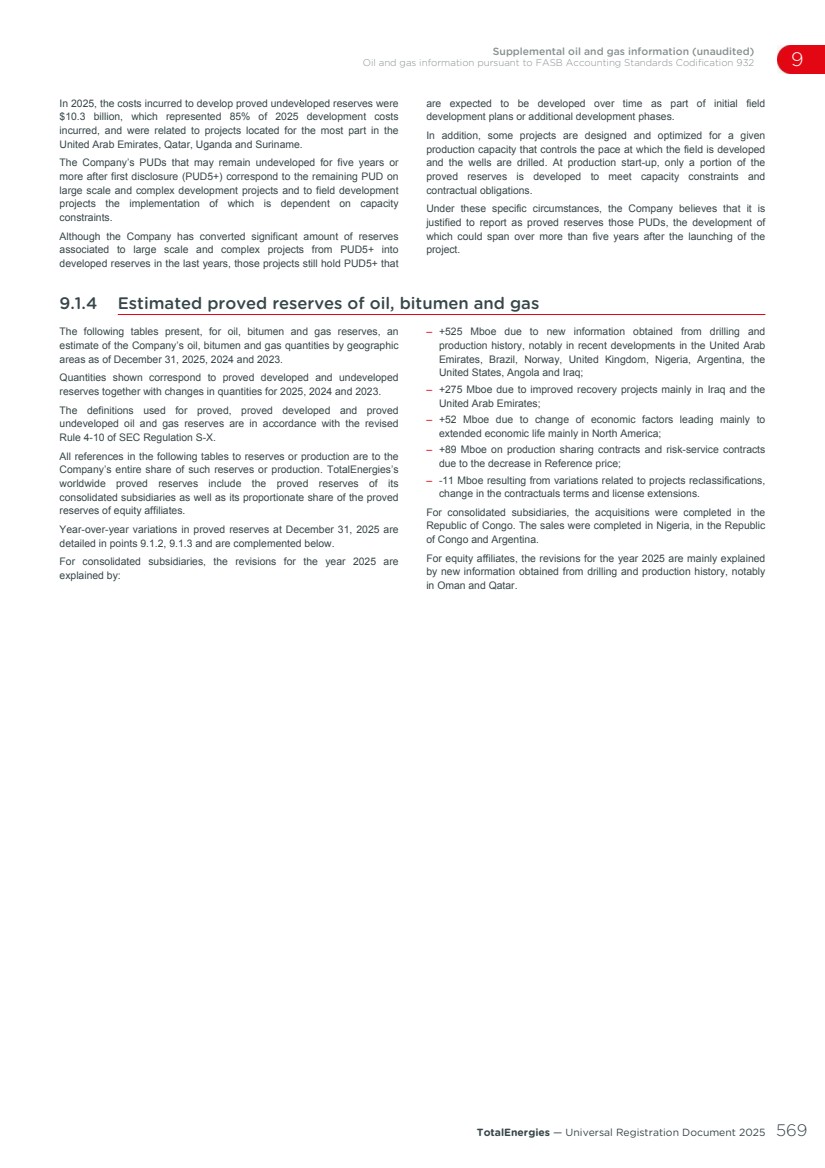
| 9.1.4.1 Changes in oil, bitumen and gas reserves Consolidated subsidiaries Proved developed and undeveloped reserves (in million barrels of oil equivalent) Africa (excl. North Africa) Americas Asia-Pacific Europe Middle East and North Africa Total Balance as of December 31, 2022 – Brent at $101.24/b 1,786 2,058 1,161 1,239 2,238 8,482 Revisions of previous estimates 144 89 68 56 108 465 Extensions, discoveries and other 18 38 13 – 1 70 Acquisitions of minerals in place – 12 – – 346 358 Sales of minerals in place – (589) (20) – – (609) Production for the year (165) (155) (94) (166) (204) (784) Balance as of December 31, 2023 – Brent at $83.27/b 1,783 1,453 1,128 1,129 2,489 7,982 Revisions of previous estimates 72 92 55 58 199 476 Extensions, discoveries and other 100 352 34 6 20 512 Acquisitions of minerals in place – 23 93 – – 116 Sales of minerals in place – – (24) (34) – (58) Production for the year (158) (137) (85) (165) (214) (759) December 31, 2024 – Brent at $81.17/b 1,797 1,783 1,201 994 2,494 8,269 Revisions of previous estimates 109 224 17 98 482 930 Extensions, discoveries and other 8 76 23 2 1 110 Acquisitions of minerals in place 20 − − − − 20 Sales of minerals in place (39) (1) − − − (40) Production for the year (149) (164) (95) (156) (223) (787) December 31, 2025 – Brent at $69.51/b 1,746 1,918 1,146 938 2,754 8,502 Minority interest in proved developed and undeveloped reserves as of December 31, 2023 – Brent at $83.27/b 51 – – – – 51 December 31, 2024 – Brent at $81.17/b 47 – – – – 47 December 31, 2025 – Brent at $69.51/b 45 – 22 – – 67 Equity affiliates Proved developed and undeveloped reserves (in million barrels of oil equivalent) Africa (excl. North Africa) Americas Asia-Pacific Europe Middle East and North Africa Total Balance as of December 31, 2022 – Brent at $101.24/b 73 – – 534 1,101 1,708 Revisions of previous estimates 6 – – – 67 73 Extensions, discoveries and other – – – – – – Acquisitions of minerals in place – – – – 923 923 Sales of minerals in place – – – – – – Production for the year (7) – – (40) (75) (122) Balance as of December 31, 2023 – Brent at $83.27/b 72 – – 494 2,016 2,582 Revisions of previous estimates <1 – – – 354 354 Extensions, discoveries and other – – – – – – Acquisitions of minerals in place – – – – – – Sales of minerals in place – – – – – – Production for the year (7) – – (44) (81) (132) Balance as of December 31, 2024 – Brent at $81.17/b 65 – – 450 2,289 2,804 Revisions of previous estimates 3 − − − 45 48 Extensions, discoveries and other − − − − − − Acquisitions of minerals in place − − − − − − Sales of minerals in place − − − − − − Production for the year (8) − − (41) (87) (136) Balance as of December 31, 2025 – Brent at $69.51/b 60 − − 409 2,247 2,716 9 Supplemental oil and gas information (unaudited) Oil and gas information pursuant to FASB Accounting Standards Codification 932 570 TotalEnergies — Universal Registration Document 2025 |
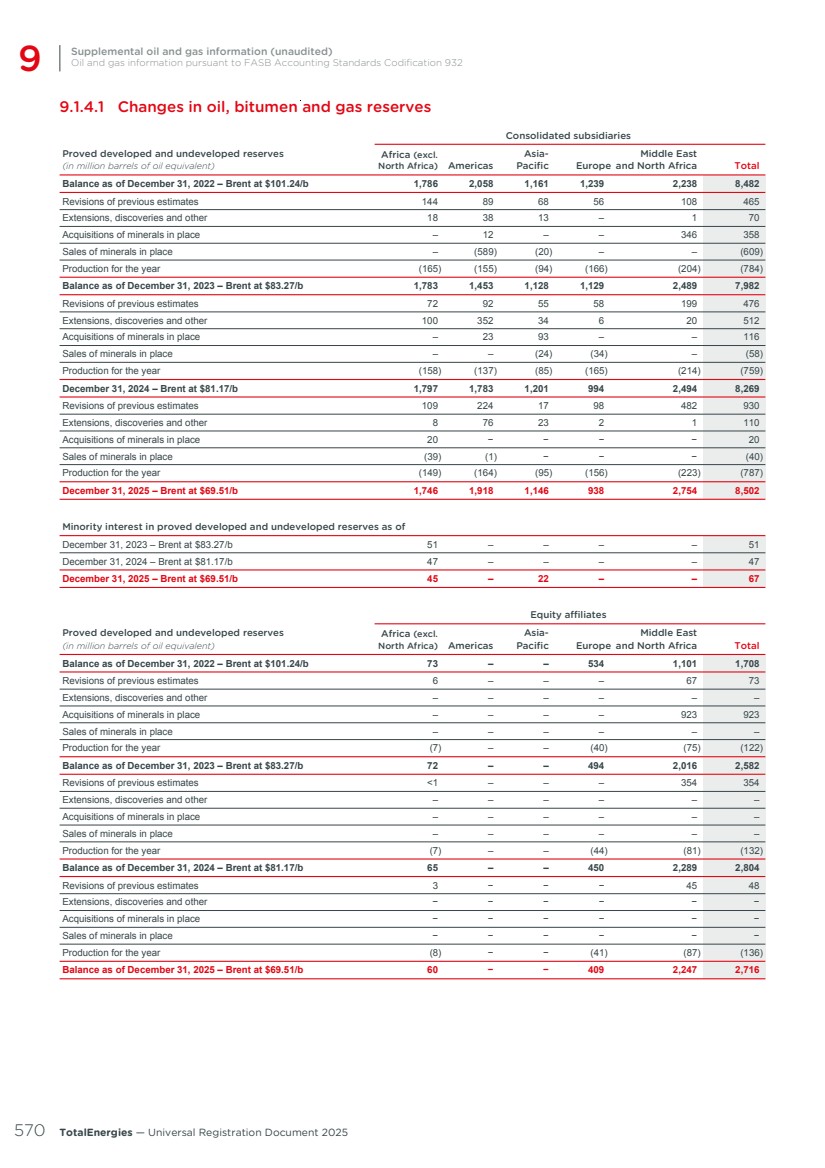
| Consolidated subsidiaries and equity affiliates Proved developed and undeveloped reserves (in million barrels of oil equivalent) Africa (excl. North Africa) Americas Asia-Pacific Europe Middle East and North Africa Total As of December 31, 2023 – Brent at $83.27/b Proved developed and undeveloped reserves 1,855 1,453 1,128 1,624 4,504 10,564 Consolidated subsidiaries 1,783 1,453 1,128 1,130 2,488 7,982 Equity affiliates 72 – – 494 2,016 2,582 Proved developed reserves 871 919 912 1,185 2,948 6,835 Consolidated subsidiaries 865 919 912 882 1,972 5,550 Equity affiliates 6 – – 303 976 1,285 Proved undeveloped reserves 984 534 216 439 1,556 3,729 Consolidated subsidiaries 918 534 216 248 516 2,432 Equity affiliates 66 – – 191 1,040 1,297 As of December 31, 2024 – Brent at $81.17/b Proved developed and undeveloped reserves 1,862 1,783 1,201 1,444 4,783 11,073 Consolidated subsidiaries 1,797 1,783 1,201 994 2,494 8,269 Equity affiliates 65 – – 450 2,289 2,804 Proved developed reserves 841 1,082 1,022 1,124 2,896 6,965 Consolidated subsidiaries 794 1,082 1,022 847 1,855 5,600 Equity affiliates 47 – – 277 1,041 1,365 Proved undeveloped reserves 1,021 701 179 320 1,887 4,108 Consolidated subsidiaries 1,003 701 179 147 639 2,669 Equity affiliates 18 – – 173 1,248 1,439 As of December 31, 2025 – Brent at $69.51/b Proved developed and undeveloped reserves 1,806 1,918 1,146 1,347 5,001 11,218 Consolidated subsidiaries 1,746 1,918 1,146 938 2,754 8,502 Equity affiliates 60 − − 409 2,247 2,716 Proved developed reserves 820 1,218 974 1,137 2,905 7,054 Consolidated subsidiaries 764 1,218 974 812 1,887 5,655 Equity affiliates 56 − − 325 1,018 1,399 Proved undeveloped reserves 986 700 172 210 2,096 4,164 Consolidated subsidiaries 982 700 172 126 867 2,847 Equity affiliates 4 − − 84 1,229 1,317 Supplemental oil and gas information (unaudited) Oil and gas information pursuant to FASB Accounting Standards Codification 932 9 TotalEnergies — Universal Registration Document 2025 571 |
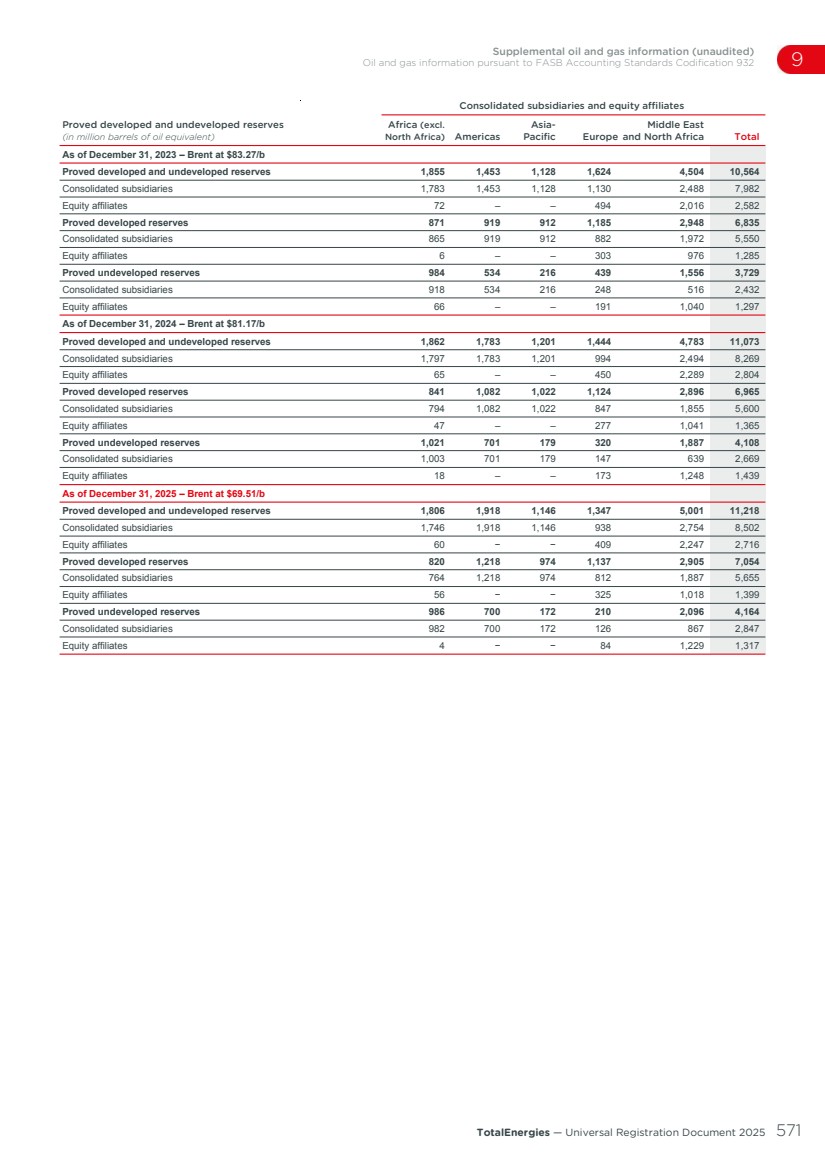
| 9.1.4.2 Changes in oil & bitumen reserves The oil reserves include crude oil, condensates and natural gas liquids reserves(1) . Consolidated subsidiaries Oil Bitumen Proved developed and undeveloped reserves (in million barrels) Africa (excl. North Africa) Americas Asia-Pacific Europe Middle East and North Africa Total Americas Balance as of December 31, 2022 – Brent at $101.24/b 983 762 527 575 1,814 4,661 620 Revisions of previous estimates 81 116 36 33 84 350 – Extensions, discoveries and other 4 2 – – 1 7 – Acquisitions of minerals in place – – – – 334 334 – Sales of minerals in place – – (18) – – (18) (589) Production for the year (125) (61) (39) (83) (172) (480) (31) Balance as of December 31, 2023 – Brent at $83.27/b 943 819 506 525 2,061 4,854 – Revisions of previous estimates 57 60 22 19 292 450 – Extensions, discoveries and other 91 309 2 1 20 423 – Acquisitions of minerals in place – – 6 – – 6 – Sales of minerals in place – – (3) (12) – (15) – Production for the year (118) (66) (34) (80) (183) (481) – December 31, 2024 – Brent at $81.17/b 973 1,122 499 453 2,190 5,237 – Revisions of previous estimates 90 127 2 26 469 714 – Extensions, discoveries and other 3 1 – 1 1 6 – Acquisitions of minerals in place 19 – – – – 19 – Sales of minerals in place (32) (1) – – – (33) – Production for the year (112) (84) (36) (74) (195) (501) – December 31, 2025 – Brent at $69.51/b 941 1,165 465 406 2,465 5,442 – Minority interest in proved developed and undeveloped reserves as of December 31, 2023 – Brent at $83.27/b 44 – – – – 44 – December 31, 2024 – Brent at $81.17/b 40 – – – – 40 – December 31, 2025 – Brent at $69.51/b 39 − 1 − − 40 – Equity affiliates(a) Oil Proved developed and undeveloped reserves (in million barrels) Africa (excl. North Africa) Americas Asia-Pacific Europe Middle East and North Africa Total Balance as of December 31, 2022 – Brent at $101.24/b 12 − − 17 406 435 Revisions of previous estimates 1 − − − 19 20 Extensions, discoveries and other <1 − − − − <1 Acquisitions of minerals in place − − − − 233 233 Sales of minerals in place − − − − − − Production for the year (2) − − (2) (51) (55) Balance as of December 31, 2023 – Brent at $83.27/b 11 − − 15 607 633 Revisions of previous estimates (1) − − − 167 166 Extensions, discoveries and other − − − − − − Acquisitions of minerals in place − − − − − − Sales of minerals in place − − − − − − Production for the year (2) − − (2) (52) (56) Balance as of December 31, 2024 – Brent at $81.17/b 8 − − 13 722 743 Revisions of previous estimates 3 − − − 34 37 Extensions, discoveries and other − − − − − − Acquisitions of minerals in place − − − − − − Sales of minerals in place − − − − − − Production for the year (2) − − (2) (54) (58) Balance as of December 31, 2025 – Brent at $69.51/b 9 − − 11 702 722 (a) There are no bitumen reserves for equity affiliates. (1) The tables do not include separate figures for NGL reserves because they represented less than 8.5% of the Company’s proved developed and undeveloped oil reserves in each of the years 2023, 2024 and 2025. 9 Supplemental oil and gas information (unaudited) Oil and gas information pursuant to FASB Accounting Standards Codification 932 572 TotalEnergies — Universal Registration Document 2025 |
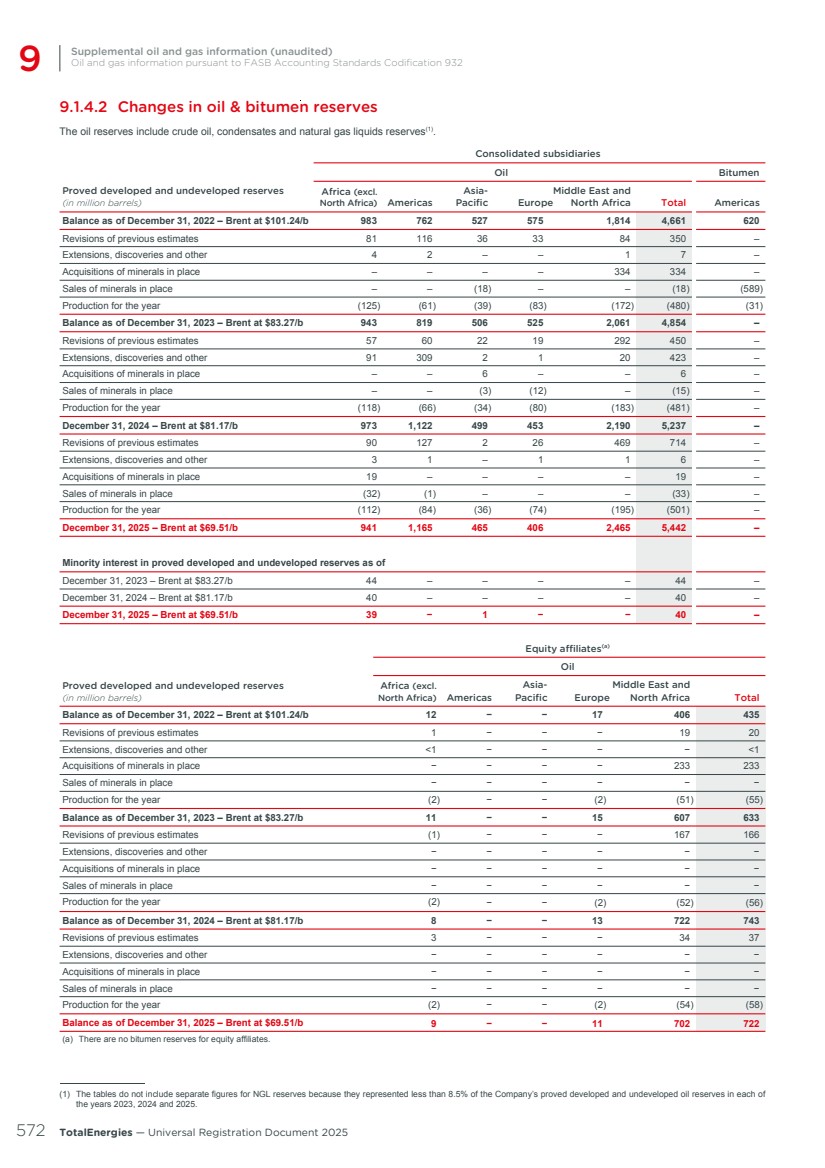
| Consolidated subsidiaries and equity affiliates Oil Proved developed and undeveloped reserves (in million barrels) Africa (excl. North Africa) Americas Asia-Pacific Europe Middle East and North Africa Total As of December 31, 2023 – Brent at $83.27/b Proved developed and undeveloped reserves(a) 954 819 506 540 2,667 5,486 Consolidated subsidiaries 943 819 506 525 2,061 4,854 Equity affiliates 11 – – 15 606 632 Proved developed reserves 610 459 441 451 2,048 4,009 Consolidated subsidiaries 608 459 441 442 1,742 3,692 Equity affiliates 2 – – 9 306 317 Proved undeveloped reserves 344 360 65 89 619 1,477 Consolidated subsidiaries 335 360 65 83 319 1,162 Equity affiliates 9 – – 6 300 315 As of December 31, 2024 – Brent at $81.17/b Proved developed and undeveloped reserves(a) 981 1,122 499 466 2,912 5,980 Consolidated subsidiaries 973 1,122 499 453 2,190 5,237 Equity affiliates 8 – – 13 722 743 Proved developed reserves 567 563 448 430 1,970 3,978 Consolidated subsidiaries 562 563 448 420 1,665 3,658 Equity affiliates 5 – – 10 305 320 Proved undeveloped reserves 414 559 51 36 942 2,002 Consolidated subsidiaries 411 559 51 33 525 1,579 Equity affiliates 3 – – 3 417 423 As of December 31, 2025 – Brent at $69.51/b Proved developed and undeveloped reserves(a) 950 1,165 465 417 3,167 6,164 Consolidated subsidiaries 941 1,165 465 406 2,465 5,442 Equity affiliates 9 − − 11 702 722 Proved developed reserves 546 661 420 390 2,020 4,037 Consolidated subsidiaries 538 661 420 380 1,718 3,717 Equity affiliates 8 − − 10 302 320 Proved undeveloped reserves 404 504 45 27 1,147 2,127 Consolidated subsidiaries 403 504 45 26 747 1,725 Equity affiliates 1 − − 1 400 402 (a) The tables do not include separate figures for NGL reserves because they represented less than 8.5% of the Company’s proved developed and undeveloped oil reserves in each of the years 2023, 2024 and 2025. Supplemental oil and gas information (unaudited) Oil and gas information pursuant to FASB Accounting Standards Codification 932 9 TotalEnergies — Universal Registration Document 2025 573 |
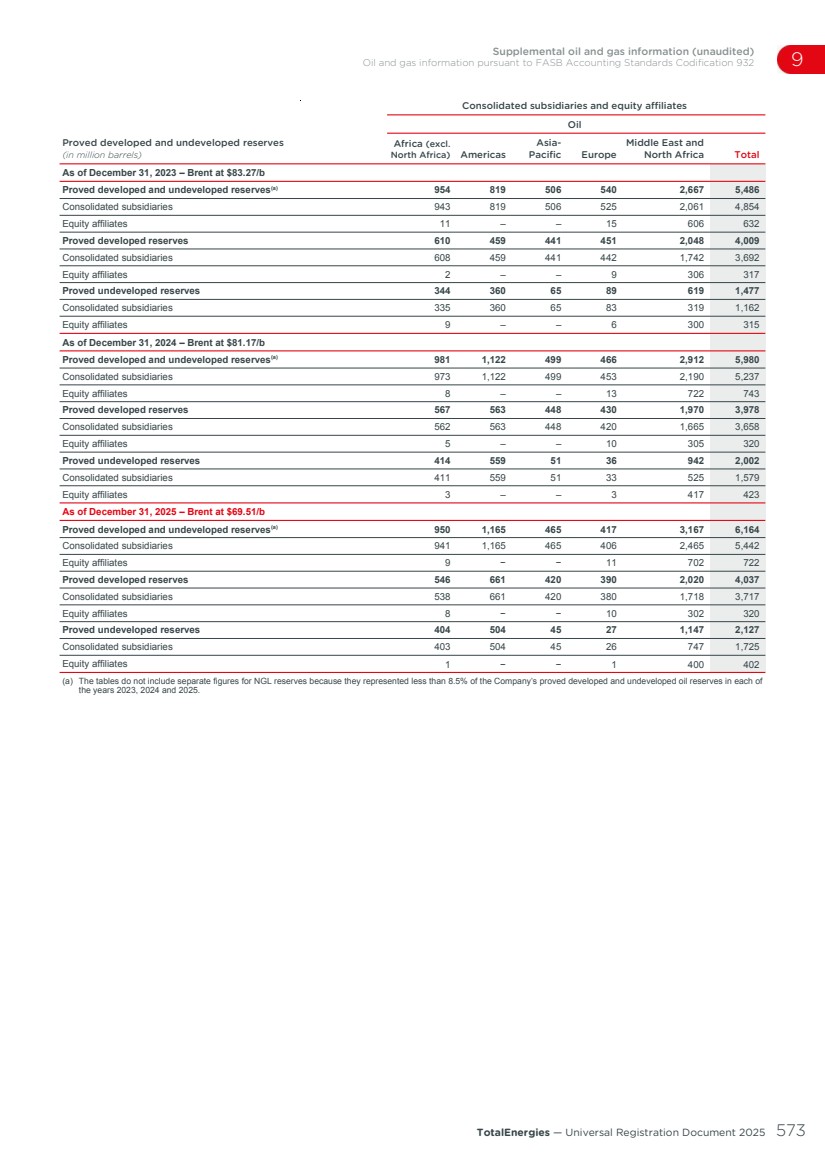
| 9.1.4.3 Changes in gas reserves Consolidated subsidiaries Proved developed and undeveloped reserves (in billion cubic feet) Africa (excl. North Africa) Americas Asia-Pacific Europe Middle East and North Africa Total Balance as of December 31, 2022 – Brent at $101.24/b 4,193 3,739 3,353 3,568 2,301 17,154 Revisions of previous estimates 362 (146) 166 128 118 628 Extensions, discoveries and other 66 203 70 – – 339 Acquisitions of minerals in place – 63 – – 61 124 Sales of minerals in place – – (8) (1) – (9) Production for the year (196) (356) (294) (446) (177) (1,469) Balance as of December 31, 2023 – Brent at $83.27/b 4,425 3,503 3,287 3,249 2,303 16,767 Revisions of previous estimates 85 177 179 198 (507) 132 Extensions, discoveries and other 43 207 168 25 – 443 Acquisitions of minerals in place – 139 490 – – 629 Sales of minerals in place – – (111) (115) – (226) Production for the year (202) (395) (273) (454) (167) (1,491) December 31, 2024 – Brent at $81.17/b 4,351 3,631 3,740 2,903 1,629 16,254 Revisions of previous estimates 116 532 82 382 75 1,187 Extensions, discoveries and other 24 443 129 9 − 605 Acquisitions of minerals in place 7 − − − − 7 Sales of minerals in place (37) (4) − − − (41) Production for the year (179) (444) (322) (440) (162) (1,547) December 31, 2025 – Brent at $69.51/b 4,282 4,158 3,629 2,854 1,542 16,465 Minority interest in proved developed and undeveloped reserves as of December 31, 2023 – Brent at $83.27/b 34 – – – – 34 December 31, 2024 – Brent at $81.17/b 31 – – – – 31 December 31, 2025 – Brent at $69.51/b 26 − 116 − − 142 Equity affiliates Proved developed and undeveloped reserves (in billion cubic feet) Africa (excl. North Africa) Americas Asia-Pacific Europe Middle East and North Africa Total Balance as of December 31, 2022 – Brent at $101.24/b 326 – – 2,822 3,791 6,939 Revisions of previous estimates 29 – – – 226 255 Extensions, discoveries and other – – – – – – Acquisitions of minerals in place – – – – 3,922 3,922 Sales of minerals in place – – – – – – Production for the year (28) – – (211) (127) (366) Balance as of December 31, 2023 – Brent at $83.27/b 327 – – 2,611 7,812 10,750 Revisions of previous estimates 7 – – – 1,031 1,038 Extensions, discoveries and other – – – – – – Acquisitions of minerals in place – – – – – – Sales of minerals in place – – – – – – Production for the year (28) – – (228) (160) (416) Balance as of December 31, 2024 – Brent at $81.17/b 306 – – 2,383 8,683 11,372 Revisions of previous estimates 7 − − − 62 69 Extensions, discoveries and other − − − − − − Acquisitions of minerals in place − − − − − − Sales of minerals in place − − − − − − Production for the year (37) − − (208) (180) (425) Balance as of December 31, 2025 – Brent at $69.51/b 276 − − 2,175 8,565 11,016 9 Supplemental oil and gas information (unaudited) Oil and gas information pursuant to FASB Accounting Standards Codification 932 574 TotalEnergies — Universal Registration Document 2025 |
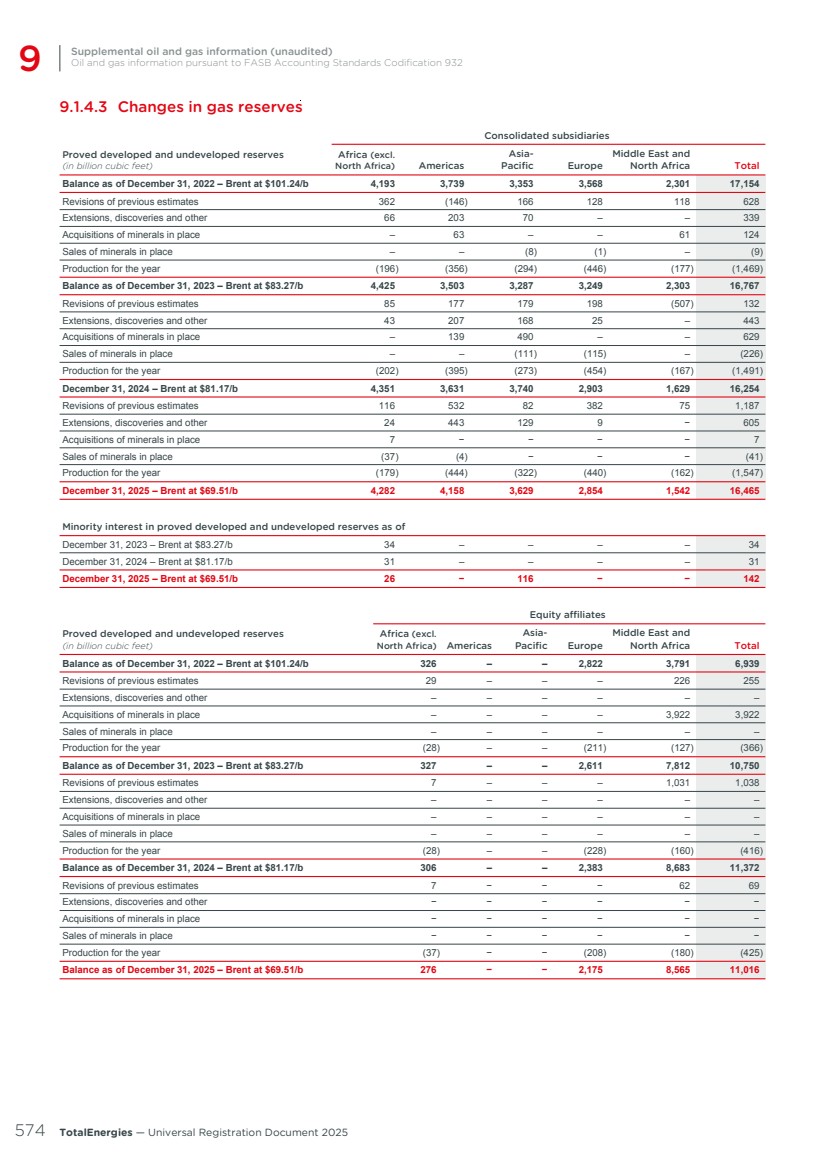
| Consolidated subsidiaries and equity affiliates Proved developed and undeveloped reserves (in billion cubic feet) Africa (excl. North Africa) Americas Asia-Pacific Europe Middle East and North Africa Total As of December 31, 2023 – Brent at $83.27/b Proved developed and undeveloped reserves 4,751 3,503 3,287 5,861 10,115 27,517 Consolidated subsidiaries 4,424 3,503 3,287 3,250 2,303 16,767 Equity affiliates 327 – – 2,611 7,812 10,750 Proved developed reserves 1,285 2,562 2,488 3,970 4,880 15,185 Consolidated subsidiaries 1,262 2,562 2,488 2,369 1,259 9,940 Equity affiliates 23 – – 1,601 3,621 5,245 Proved undeveloped reserves 3,466 941 799 1,891 5,235 12,332 Consolidated subsidiaries 3,162 941 799 881 1,044 6,827 Equity affiliates 304 – – 1,010 4,191 5,505 As of December 31, 2024 – Brent at $81.17/b Proved developed and undeveloped reserves 4,657 3,631 3,740 5,286 10,312 27,626 Consolidated subsidiaries 4,351 3,631 3,740 2,903 1,629 16,254 Equity affiliates 306 – – 2,383 8,683 11,372 Proved developed reserves 1,369 2,891 3,062 3,744 5,025 16,091 Consolidated subsidiaries 1,142 2,891 3,062 2,287 1,038 10,420 Equity affiliates 227 – – 1,457 3,987 5,671 Proved undeveloped reserves 3,288 740 678 1,542 5,287 11,535 Consolidated subsidiaries 3,209 740 678 616 591 5,834 Equity affiliates 79 – – 926 4,696 5,701 As of December 31, 2025 – Brent at $69.51/b Proved developed and undeveloped reserves 4,558 4,158 3,629 5,029 10,107 27,481 Consolidated subsidiaries 4,282 4,158 3,629 2,854 1,542 16,465 Equity affiliates 276 − − 2,175 8,565 11,016 Proved developed reserves 1,386 3,082 2,956 4,037 4,799 16,260 Consolidated subsidiaries 1,130 3,082 2,956 2,313 921 10,402 Equity affiliates 256 − − 1,724 3,878 5,858 Proved undeveloped reserves 3,172 1,076 673 992 5,308 11,221 Consolidated subsidiaries 3,152 1,076 673 541 621 6,063 Equity affiliates 20 − − 451 4,687 5,158 Supplemental oil and gas information (unaudited) Oil and gas information pursuant to FASB Accounting Standards Codification 932 9 TotalEnergies — Universal Registration Document 2025 575 |
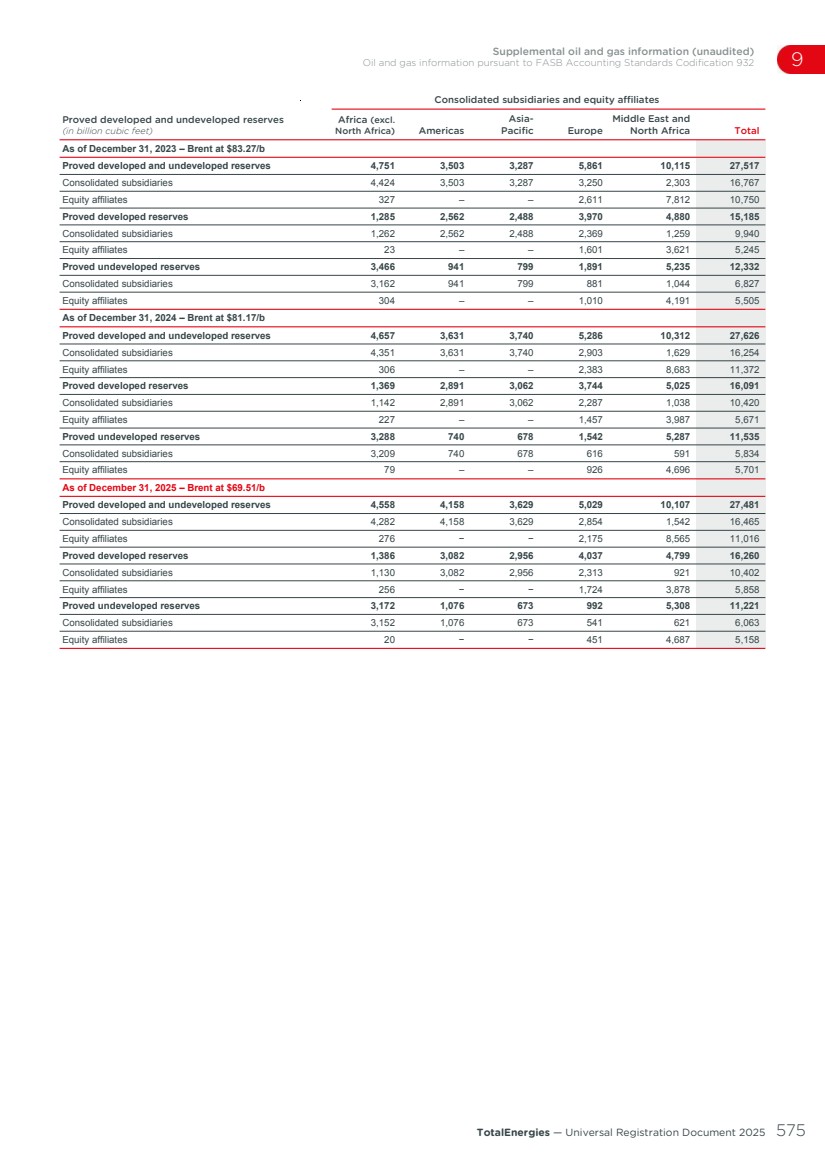
| 9.1.5 Results of operations for oil and gas producing activities The following tables do not include revenues and expenses related to oil and gas transportation activities and LNG liquefaction and transportation. Consolidated subsidiaries (M$) Africa (excl. North Africa) Americas Asia-Pacific Europe Middle East and North Africa Total 2023 Revenues Non-Company sales 1,049 884 1,402 1,240 1,930 6,505 TotalEnergies sales 8,766 5,561 2,213 10,128 12,480 39,148 Total Revenues 9,815 6,445 3,615 11,369 14,410 45,654 Production costs (1,006) (1,051) (342) (1,178) (740) (4,317) Exploration expenses (118) (149) (6) (226) (74) (573) Depreciation, depletion and amortization and valuation allowances (3,453) (1,181) (1,125) (1,661) (1,044) (8,465) Other expenses(a) (711) (1,047) (227) (417) (9,673) (12,075) Pre-tax income from producing activities(b) 4,527 3,017 1,915 7,886 2,879 20,224 Income tax (1,756) (739) (559) (6,194) (930) (10,178) Results of oil and gas producing activities(b) 2,771 2,278 1,356 1,692 1,949 10,046 2024 Revenues Non-Company sales 1,053 1,083 1,072 863 1,799 5,870 TotalEnergies sales 8,142 4,312 2,084 8,696 12,852 36,085 Total Revenues 9,195 5,395 3,156 9,558 14,651 41,955 Production costs (939) (448) (327) (1,235) (802) (3,751) Exploration expenses (597) (138) 2 (219) (48) (999) Depreciation, depletion and amortization and valuation allowances (3,109) (1,289) (1,040) (1,677) (1,091) (8,206) Other expenses(c) (725) (974) (219) (456) (9,620) (11,994) Pre-tax income from producing activities(d) 3,825 2,546 1,572 5,972 3,090 17,004 Income tax (2,038) (570) (428) (4,763) (812) (8,611) Results of oil and gas producing activities(d) 1,787 1,976 1,144 1,209 2,278 8,394 2025 Revenues Non-Company sales 771 1,392 1,178 1,185 1,590 6,116 TotalEnergies sales 6,651 4,617 1,827 7,708 12,232 33,035 Total Revenues 7,422 6,009 3,005 8,893 13,822 39,151 Production costs (1,012) (533) (350) (1,221) (822) (3,938) Exploration expenses (145) (79) (63) (98) (34) (419) Depreciation, depletion and amortization and valuation allowances (2,650) (1,959) (1,202) (1,967) (1,122) (8,900) Other expenses(e) (609) (1,016) (137) (476) (8,720) (10,958) Pre-tax income from producing activities(f) 3,006 2,422 1,253 5,130 3,124 14,935 Income tax (1,665) (751) (362) (4,162) (829) (7,769) Results of oil and gas producing activities(f) 1,341 1,671 891 968 2,295 7,166 (a) Including production taxes ($11,498 million) and accretion expense as provided by IAS 37 ($576 million in 2023). (b) Including adjustment items applicable to ASC932 perimeter, amounting to a net charge of $481 million before tax and $436 million after tax, related to asset impairments. (c) Including production taxes ($11,373 million) and accretion expense as provided by IAS 37 ($620 million in 2024). (d) Including adjustment items applicable to ASC932 perimeter, amounting to a net charge of $782 million before tax and $788 million after tax, related to asset impairments. (e) Included production taxes ($10,328 million) and accretion expense as provided by IAS 37 ($630 million in 2025). (f) Including adjustment items applicable to ASC932 perimeter, amounting to a net charge of $298 million before tax and $197 million after tax, related to asset impairments. 9 Supplemental oil and gas information (unaudited) Oil and gas information pursuant to FASB Accounting Standards Codification 932 576 TotalEnergies — Universal Registration Document 2025 |
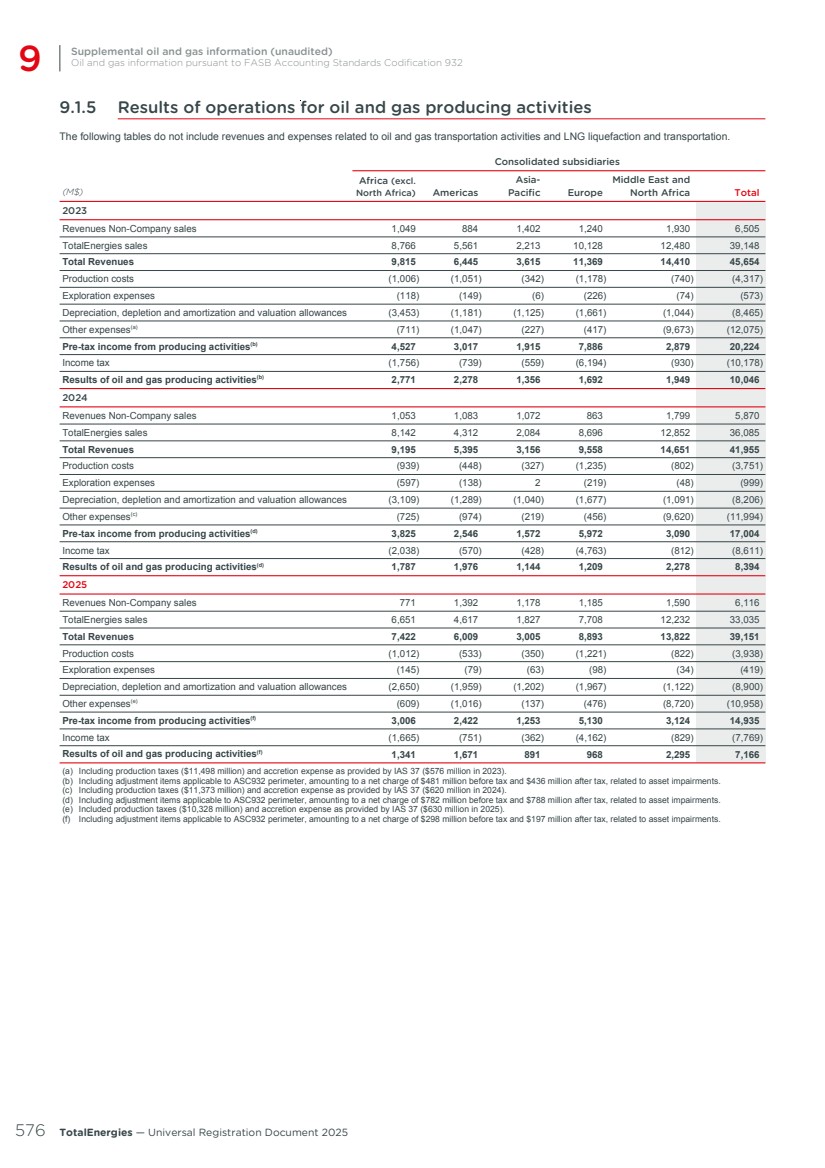
| (M$) Equity affiliates Africa (excl. North Africa) Americas Asia-Pacific Europe Middle East and North Africa Total 2023 Revenues Non-Company sales 276 – – 1,203 3,473 4,951 TotalEnergies sales 1 – – 373 1,299 1,673 Total Revenues 277 – – 1,576 4,771 6,625 Production costs (8) – – (23) (300) (331) Exploration expenses – – – – – – Depreciation, depletion and amortization and valuation allowances – – – (81) (792) (873) Other expenses (64) – – (1) (2,799) (2,864) Pre-tax income from producing activities 205 – – 1,472 880 2,557 Income tax – – (397) (501) (898) Results of oil and gas producing activities 205 – – 1,075 379 1,659 2024 Revenues Non-Company sales 201 – – 1,272 3,577 5,050 TotalEnergies sales 8 – – 297 1,212 1,518 Total Revenues 210 – – 1,568 4,789 6,567 Production costs (9) – – (29) (336) (374) Exploration expenses – – – – – – Depreciation, depletion and amortization and valuation allowances – – – (88) (520) (608) Other expenses (48) – – (1) (2,395) (2,444) Pre-tax income from producing activities 153 – – 1,451 1,537 3,141 Income tax – – – (573) (597) (1,171) Results of oil and gas producing activities 153 – – 877 940 1,971 2025 Revenues Non-Company sales 272 – – 1,040 3,313 4,625 TotalEnergies sales (2) – – 286 1,050 1,334 Total Revenues 270 – – 1,326 4,364 5,959 Production costs (12) – – (31) (333) (375) Exploration expenses – – – – – – Depreciation, depletion and amortization and valuation allowances – – – (87) (500) (587) Other expenses (81) – – (1) (2,003) (2,085) Pre-tax income from producing activities 177 – – 1,207 1,528 2,912 Income tax – – – (202) (537) (739) Results of oil and gas producing activities 177 – – 1,006 991 2,174 Supplemental oil and gas information (unaudited) Oil and gas information pursuant to FASB Accounting Standards Codification 932 9 TotalEnergies — Universal Registration Document 2025 577 |
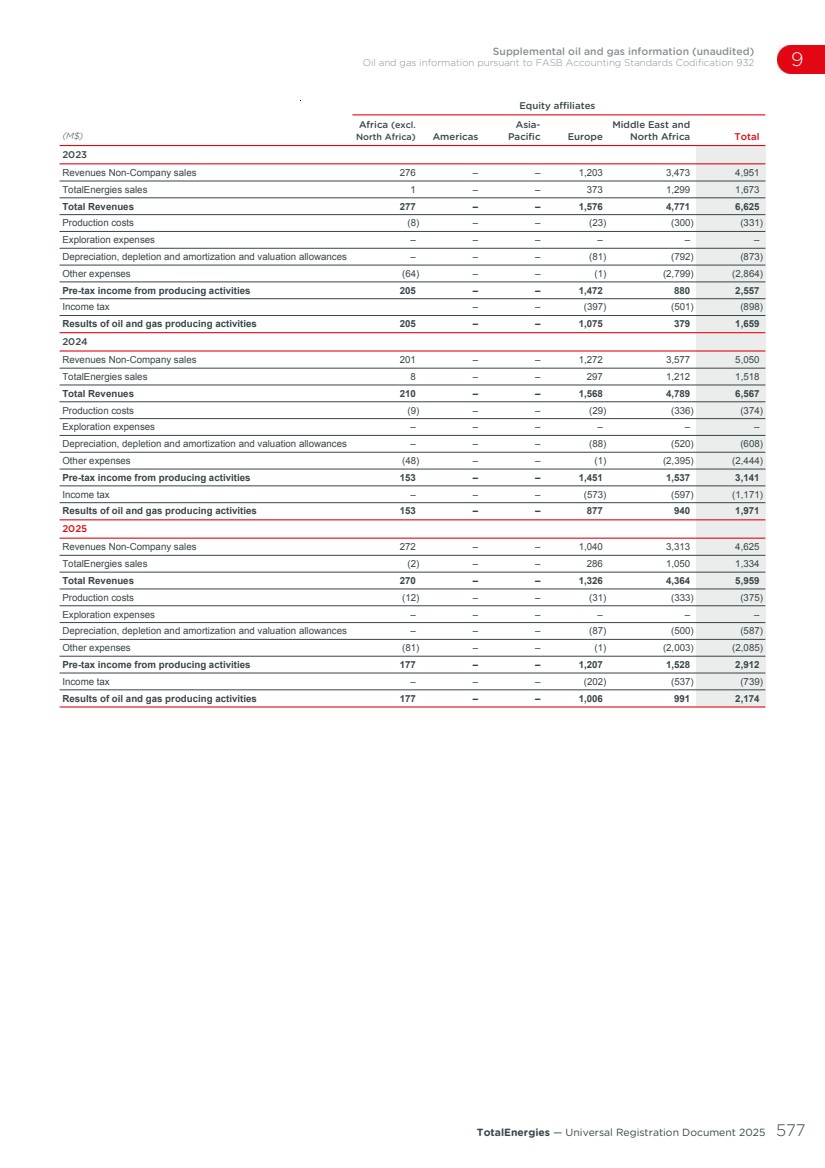
| 9.1.6 Cost incurred The following tables set forth the costs incurred in the Company’s oil and gas property acquisition, exploration and development activities, including both capitalized and expensed amounts. They do not include costs incurred related to oil and gas transportation and LNG liquefaction and transportation activities. (M$) Consolidated subsidiaries Africa (excl. North Africa) Americas Asia-Pacific Europe Middle East and North Africa Total 2023 Proved property acquisition(a) 97 309 5 21 1,243 1,675 Unproved property acquisition 24 255 56 – 273 608 Exploration costs 528 367 12 204 140 1,250 Development costs(b) 2,259 2,059 835 1,014 1,698 7,825 Total cost incurred 2,908 2,989 908 1,239 3,354 11,398 2024 Proved property acquisition(c) 2 107 1,111 – 42 1,262 Unproved property acquisition(c) 111 477 385 – (9) 964 Exploration costs 406 129 6 183 106 830 Development costs(b) 2,634 1,858 659 1,362 1,802 8,315 Total cost incurred 3,153 2,571 2,161 1,545 1,941 11,371 2025 Proved property acquisition 167 577 4 – 44 792 Unproved property acquisition 28 88 420 – – 536 Exploration costs 243 166 80 99 58 646 Development costs(b) 3,047 2,462 577 1,264 2,634 9,984 Total cost incurred 3,485 3,293 1,081 1,363 2,736 11,958 (a) Including cost incurred relating to acquisition of Umm Lulu SARB assets in Abu Dhabi. (b) Including asset retirement costs capitalized during the year and any gains or losses recognized upon settlement of asset retirement obligation during the year. (c) Including cost incurred relating to the acquisition of Sapura OMV. (M$) Equity affiliates Africa (excl. North Africa) Americas Asia-Pacific Europe Middle East and North Africa Total 2023 Proved property acquisition – – – – 225 225 Unproved property acquisition – – – – – – Exploration costs – – – – 5 5 Development costs(a) – – – – 899 899 Total cost incurred – – – – 1,129 1,129 2024 Proved property acquisition – – – – – – Unproved property acquisition – – – – – – Exploration costs – – – – 5 5 Development costs(a) – – – – 1,455 1,455 Total cost incurred – – – – 1,460 1,460 2025 Proved property acquisition – – – – – – Unproved property acquisition – – – – – – Exploration costs – – – – – – Development costs(a) – – – – 1,974 1,974 Total cost incurred – – – – 1,974 1,974 (a) Including asset retirement costs capitalized during the year and any gains or losses recognized upon settlement of asset retirement obligation during the year. 9 Supplemental oil and gas information (unaudited) Oil and gas information pursuant to FASB Accounting Standards Codification 932 578 TotalEnergies — Universal Registration Document 2025 |
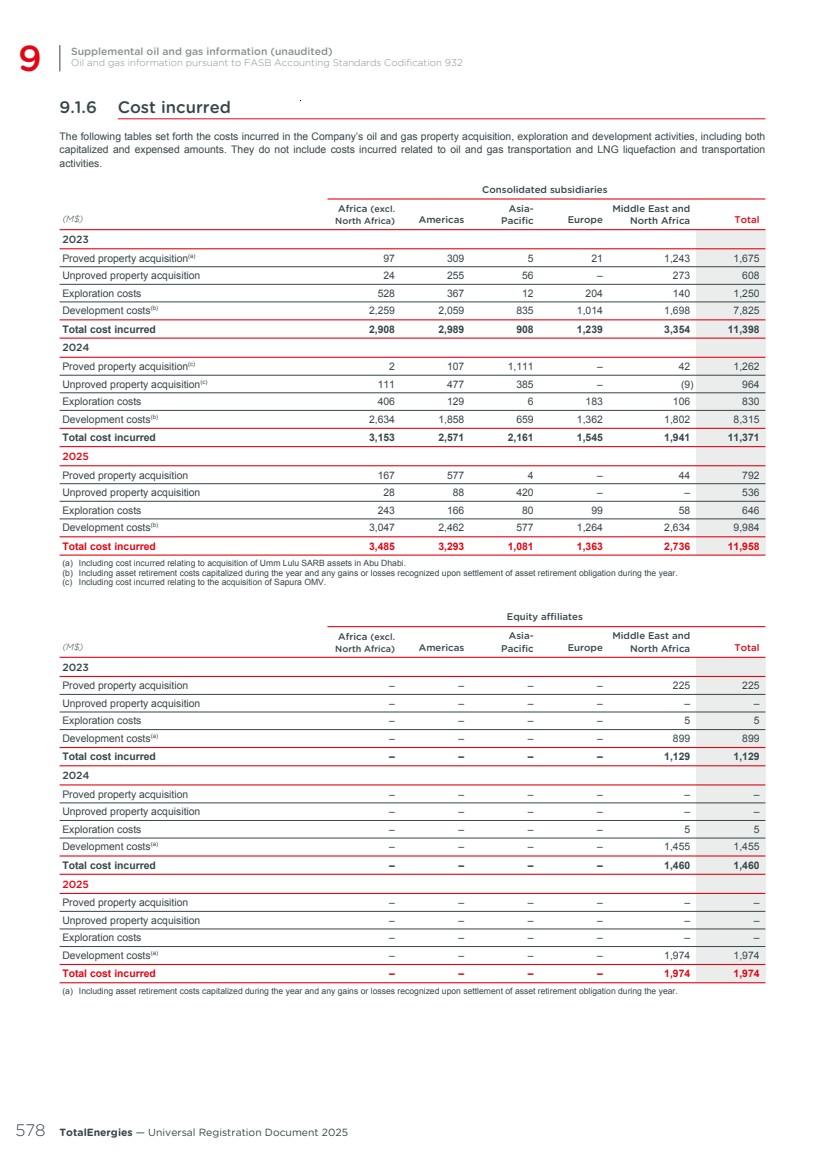
| 9.1.7 Capitalized costs related to oil and gas producing activities Capitalized costs represent the amount of capitalized proved and unproved property costs, including support equipment and facilities, along with the related accumulated depreciation, depletion and amortization. The following tables do not include capitalized costs related to oil and gas transportation and LNG liquefaction and transportation activities. (M$) Consolidated subsidiaries Africa (excl. North Africa) Americas Asia-Pacific Europe Middle East and North Africa Total As of December 31, 2023 Proved properties 86,930 27,654 36,066 49,825 21,266 221,741 Unproved properties 8,184 5,373 1,827 1,672 2,734 19,790 Total capitalized costs 95,114 33,027 37,893 51,497 24,000 241,531 Accumulated depreciation, depletion and amortization (65,070) (12,632) (21,160) (37,838) (11,423) (148,122) Net capitalized costs 30,044 20,395 16,733 13,659 12,578 93,409 As of December 31, 2024 Proved properties 84,222 32,327 36,802 44,731 22,796 220,878 Unproved properties 7,711 3,626 2,286 1,435 2,474 17,532 Total capitalized costs 91,933 35,953 39,088 46,166 25,270 238,410 Accumulated depreciation, depletion and amortization (62,930) (13,924) (21,361) (33,582) (12,323) (144,120) Net capitalized costs 29,003 22,029 17,727 12,584 12,947 94,290 As of December 31, 2025 Proved properties 85,486 36,277 37,032 34,100 26,695 219,590 Unproved properties 7,885 3,120 2,945 974 2,633 17,556 Total capitalized costs 93,371 39,397 39,977 35,074 29,328 237,147 Accumulated depreciation, depletion and amortization (63,980) (15,532) (22,285) (23,842) (13,451) (139,090) Net capitalized costs 29,391 23,865 17,692 11,231 15,877 98,057 (M$) Equity affiliates Africa (excl. North Africa) Americas Asia-Pacific Europe Middle East and North Africa Total As of December 31, 2023 Proved properties – – – 1,445 6,658 8,103 Unproved properties – – – – – – Total capitalized costs – – – 1,445 6,658 8,103 Accumulated depreciation, depletion and amortization – – – (552) (3,523) (4,075) Net capitalized costs – – – 892 3,135 4,028 As of December 31, 2024 Proved properties – – – 1,445 9,368 10,813 Unproved properties – – – – – – Total capitalized costs – – – 1,445 9,368 10,813 Accumulated depreciation, depletion and amortization – – – (640) (4,167) (4,807) Net capitalized costs – – – 805 5,201 6,006 As of December 31, 2025 Proved properties − − − 1,445 10,243 11,688 Unproved properties − − − − − − Total capitalized costs − − − 1,445 10,243 11,688 Accumulated depreciation, depletion and amortization − − − (727) (4,517) (5,244) Net capitalized costs − − − 719 5,726 6,444 Supplemental oil and gas information (unaudited) Oil and gas information pursuant to FASB Accounting Standards Codification 932 9 TotalEnergies — Universal Registration Document 2025 579 |
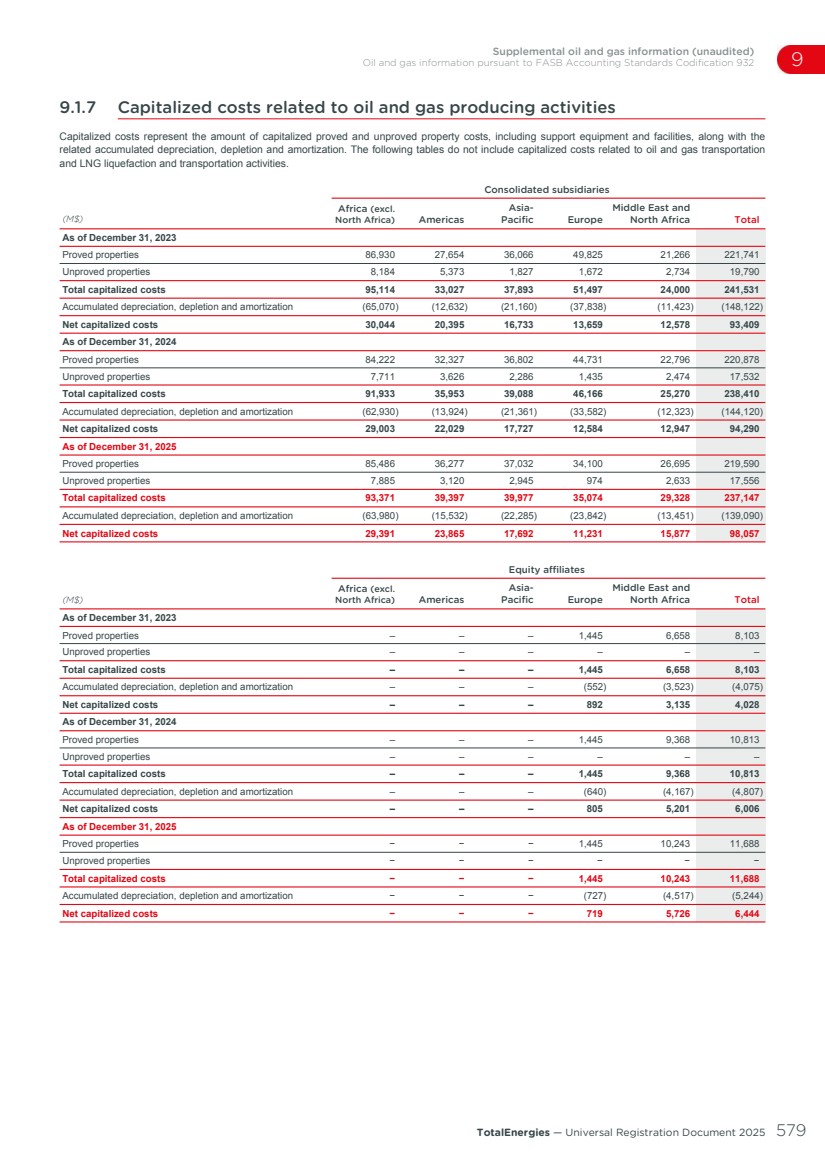
| 9.1.8 Standardized measure of discounted future net cash flows (excluding transportation) The standardized measure of discounted future net cash flows relating to proved oil and gas reserve quantities was developed as follows: – estimates of proved reserves and the corresponding production profiles are based on existing technical and economic conditions; – the estimated future cash flows are determined based on prices used in estimating the Company’s proved oil and gas reserves; – the future cash flows incorporate estimated production costs (including production taxes), future development costs and asset retirement costs. All cost estimates are based on year-end technical and economic conditions; – future income taxes are computed by applying the year-end statutory tax rate to future net cash flows after consideration of permanent differences and future income tax credits; and – future net cash flows are discounted at a standard discount rate of 10%. These principles applied are those required by ASC 932 and do not reflect the expectations of real revenues from these reserves, nor their present value; hence, they do not constitute criteria for investment decisions. An estimate of the fair value of reserves should also take into account, among other things, the recovery of reserves not presently classified as proved, anticipated future changes in prices and costs and a discount factor more representative of the time value of money and the risks inherent in reserves estimates. Consolidated subsidiaries (M$) Africa (excl. North Africa) Americas Asia-Pacific Europe Middle East and North Africa Total As of December 31, 2023 Future cash inflows 93,472 68,658 47,109 73,259 170,685 453,183 Future production costs (23,152) (19,026) (8,443) (16,464) (132,755) (199,840) Future development costs (13,816) (7,018) (3,270) (11,634) (11,745) (47,484) Future income taxes (16,536) (9,055) (7,461) (31,320) (6,846) (71,218) Future net cash flows, after income taxes 39,968 33,559 27,934 13,841 19,339 134,641 Discount at 10% (19,230) (15,698) (13,809) (5,290) (8,047) (62,074) Standardized measure of discounted future net cash flows 20,738 17,861 14,125 8,552 11,292 72,567 As of December 31, 2024 Future cash inflows 92,191 87,952 47,106 56,815 175,978 460,041 Future production costs (22,390) (24,241) (8,176) (14,761) (135,776) (205,344) Future development costs (14,536) (12,901) (3,166) (11,233) (15,337) (57,172) Future income taxes (15,178) (11,549) (7,421) (22,002) (6,303) (62,452) Future net cash flows, after income taxes 40,087 39,261 28,343 8,820 18,562 135,072 Discount at 10% (19,804) (19,741) (13,338) (3,301) (8,058) (64,242) Standardized measure of discounted future net cash flows 20,283 19,520 15,004 5,519 10,504 70,830 As of December 31, 2025 Future cash inflows 73,871 79,591 40,106 51,222 170,467 415,256 Future production costs (19,437) (22,817) (7,171) (14,841) (124,076) (188,342) Future development costs (13,051) (11,888) (3,557) (11,697) (19,518) (59,711) Future income taxes (9,690) (9,305) (6,392) (17,310) (6,998) (49,695) Future net cash flows, after income taxes 31,693 35,580 22,987 7,373 19,875 117,508 Discount at 10% (15,684) (17,740) (11,073) (2,154) (10,018) (56,669) Standardized measure of discounted future net cash flows 16,009 17,840 11,914 5,219 9,856 60,839 Minority interests in future net cash flows as of December 31, 2023 720 – – – – 720 December 31, 2024 555 – – – – 555 December 31, 2025 414 – 255 – – 669 9 Supplemental oil and gas information (unaudited) Oil and gas information pursuant to FASB Accounting Standards Codification 932 580 TotalEnergies — Universal Registration Document 2025 |
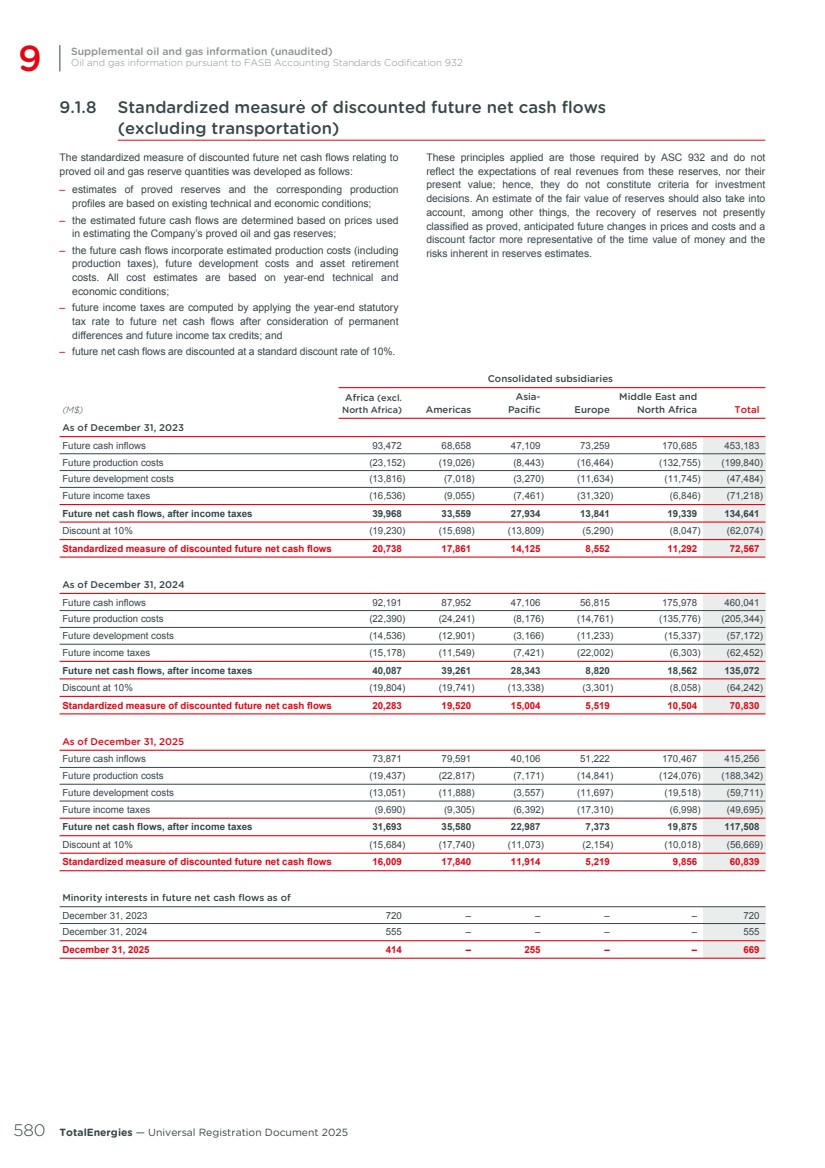
| Equity affiliates (M$) Africa (excl. North Africa) Americas Asia-Pacific Europe Middle East and North Africa Total As of December 31, 2023 Future cash inflows 3,818 – – 20,141 103,518 127,477 Future production costs (955) – – (3,322) (62,997) (67,274) Future development costs – – – (70) (4,081) (4,151) Future income taxes (542) – – (4,517) (13,907) (18,966) Future net cash flows, after income taxes 2,321 – – 12,232 22,533 37,086 Discount at 10% (1,008) – – (5,900) (14,523) (21,431) Standardized measure of discounted future net cash flows 1,313 – – 6,332 8,010 15,655 As of December 31, 2024 Future cash inflows 3,018 – – 16,723 112,196 131,937 Future production costs (693) – – (3,060) (67,400) (71,152) Future development costs – – – (47) (7,308) (7,354) Future income taxes (447) – – (3,542) (12,262) (16,251) Future net cash flows, after income taxes 1,878 – – 10,074 25,227 37,179 Discount at 10% (753) – – (4,613) (16,127) (21,493) Standardized measure of discounted future net cash flows 1,126 – – 5,460 9,100 15,686 As of December 31, 2025 Future cash inflows 2,723 – – 10,249 104,824 117,796 Future production costs (564) – – (2,632) (62,109) (65,306) Future development costs – – – (49) (7,436) (7,485) Future income taxes (452) – – (952) (12,172) (13,577) Future net cash flows, after income taxes 1,706 – – 6,616 23,106 31,428 Discount at 10% (657) – – (2,700) (14,482) (17,840) Standardized measure of discounted future net cash flows 1,049 – – 3,916 8,623 13,588 Supplemental oil and gas information (unaudited) Oil and gas information pursuant to FASB Accounting Standards Codification 932 9 TotalEnergies — Universal Registration Document 2025 581 |
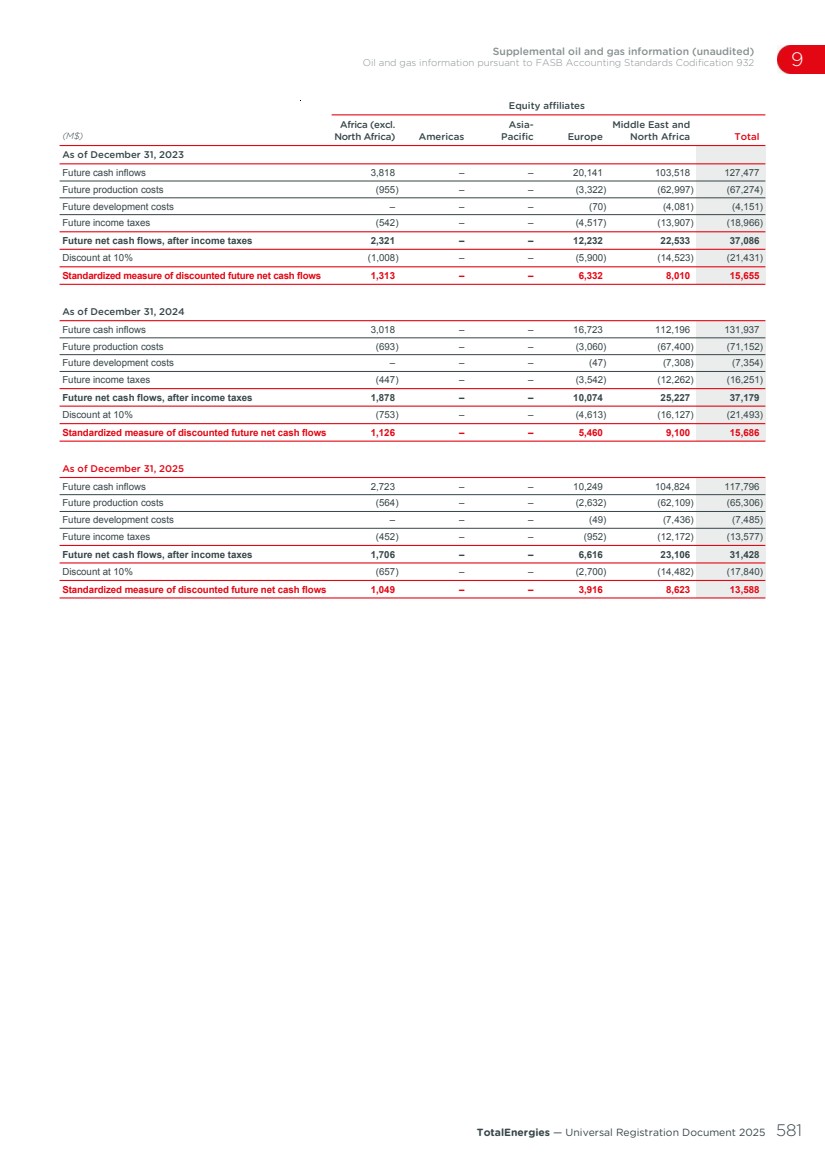
| 9.1.9 Changes in the standardized measure of discounted future net cash flows Consolidated subsidiaries (M$) 2023 2024 2025 Discounted future net cash flows at January 1 109,399 72,567 70,830 Sales and transfers, net of production costs (29,837) (27,429) (24,884) Net change in sales and transfer prices and in production costs and other expenses (81,604) (7,845) (18,088) Extensions, discoveries and improved recovery 887 5,078 2,386 Changes in estimated future development costs (1,122) (2,536) (4,633) Previously estimated development costs incurred during the year 8,458 8,195 9,461 Revisions of previous quantity estimates 5,669 5,483 8,357 Accretion of 10% discount 10,940 7,256 7,083 Net change in income taxes 54,260 9,318 10,523 Purchases of reserves in place 2,047 1,624 223 Sales of reserves in place (6,530) (880) (419) End of year 72,567 70,830 60,839 Equity affiliates (M$) 2023 2024 2025 Discounted future net cash flows at January 1 23,291 15,655 15,686 Sales and transfers, net of production costs (3,442) (3,764) (3,519) Net change in sales and transfer prices and in production costs and other expenses (12,731) 151 (3,336) Extensions, discoveries and improved recovery 487 177 160 Changes in estimated future development costs 25 (944) (431) Previously estimated development costs incurred during the year 743 808 1,288 Revisions of previous quantity estimates 250 691 483 Accretion of 10% discount 2,329 1,566 1,569 Net change in income taxes 900 1,347 1,688 Purchases of reserves in place 3,803 – – Sales of reserves in place – – – End of year 15,655 15,686 13,588 9.2 Other information 9.2.1 Natural Gas production available for sale Consolidated subsidiaries Africa (excl. North Africa) Americas Asia-Pacific Europe Middle East and North Africa Total 2023 Natural Gas production available for sale(a) (Bcf) 162 341 284 418 159 1,363 2024 Natural Gas production available for sale(a) (Bcf) 167 379 264 425 150 1,385 2025 Natural Gas production available for sale(a) (Bcf) 150 426 313 415 144 1,447 (a) The reported volumes are different from those shown in the reserves table due to gas consumed in operations. Equity affiliates Africa (excl. North Africa) Americas Asia-Pacific Europe Middle East and North Africa Total 2023 Natural Gas production available for sale(a) (Bcf) 24 – – 187 117 328 2024 Natural Gas production available for sale(a) (Bcf) 24 – – 200 148 373 2025 Natural Gas production available for sale(a) (Bcf) 32 – – 182 169 382 (a) The reported volumes are different from those shown in the reserves table due to gas consumed in operations. 9 Supplemental oil and gas information (unaudited) Other information 582 TotalEnergies — Universal Registration Document 2025 |
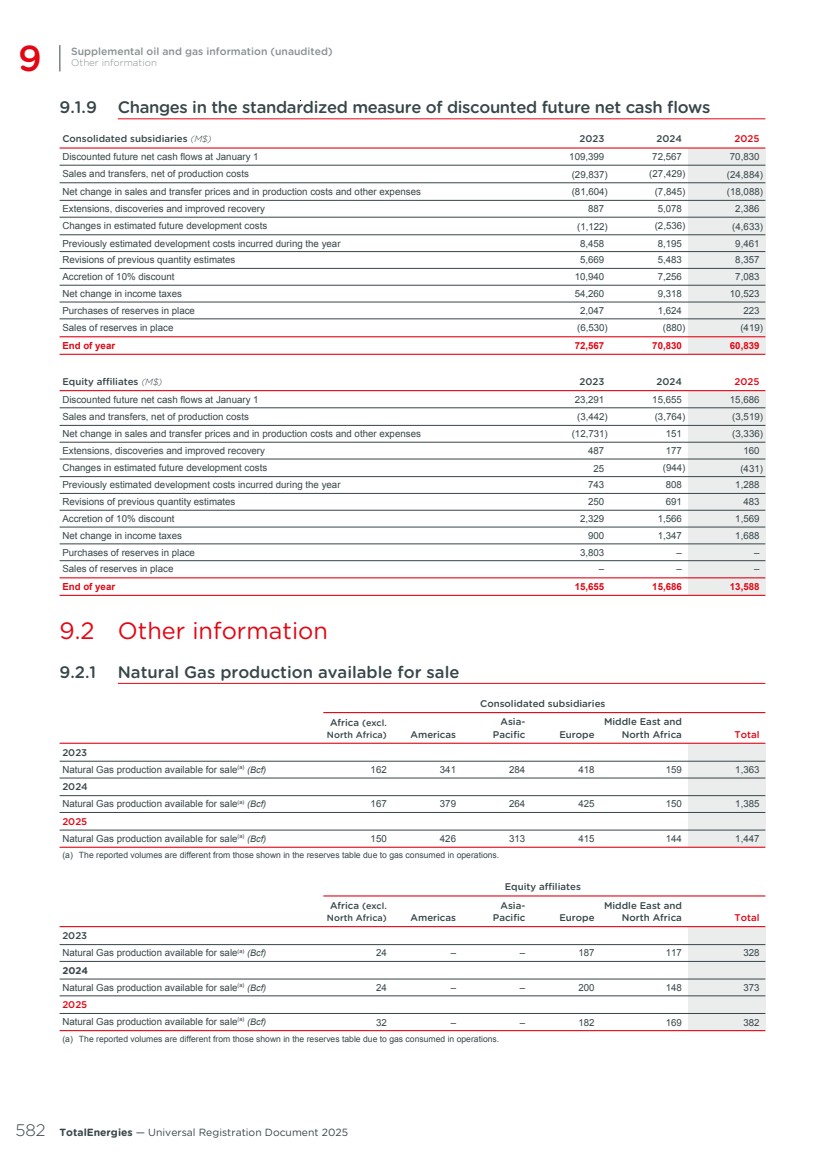
| 9.2.2 Production prices Consolidated subsidiaries Africa (excl. North Africa) Americas Asia-Pacific Europe Middle East and North Africa Total 2023(a) Oil ($/b)(b) 76.47 67.67 61.27 74.45 80.98 75.41 Bitumen ($/b) – 45.27 – – – 45.27 Natural Gas ($/kcf) 1.96 2.93 4.76 12.61 3.44 6.24 2024(a) Oil ($/b)(b) 75.99 69.13 61.19 72.20 78.53 74.30 Bitumen ($/b) – – – – – – Natural Gas ($/kcf) 2.28 2.55 4.39 9.33 3.44 5.07 2025 (a) Oil ($/b)(b) 63.31 58.14 53.49 61.88 67.93 63.34 Bitumen ($/b) – – – – – – Natural Gas ($/kcf) 2.13 2.68 3.73 10.53 3.19 5.17 (a) The volumes used for calculation of the average sales prices are the ones sold from the Company’s own production. (b) The reported price represents an average aggregate price of prices for crude oil, condensates and NGL. The table does not include separate figures for NGL production prices because the production of NGL represented less than 7.5% of the Company’s total liquids production in each of the years 2023, 2024 and 2025. Equity affiliates Africa (excl. North Africa) Americas Asia-Pacific Europe Middle East and North Africa Total 2023(a) Oil ($/b)(b) – – – 44.64 73.35 70.26 Bitumen ($/b) – – – – – – Natural Gas ($/kcf) 11.79 – – 7.97 8.77 8.51 2024(a) Oil ($/b)(b) – – – 46.38 71.94 69.10 Bitumen ($/b) – – – – – – Natural Gas ($/kcf) 8.79 – – 7.09 6.50 6.99 2025 (a) Oil ($/b)(b) – – – 41.60 64.75 62.32 Bitumen ($/b) – – – – – – Natural Gas ($/kcf) 8.99 – – 6.69 5.42 6.38 (a) The volumes used for calculation of the average sales prices are the ones sold from the Company’s own production. (b) The reported price represents an average aggregate price of prices for crude oil, condensates and NGL. The table does not include separate figures for NGL production prices because the production of NGL represented less than 7.5% of the Company’s total liquids production in each of the years 2023, 2024 and 2025. Supplemental oil and gas information (unaudited) Other information 9 TotalEnergies — Universal Registration Document 2025 583 |
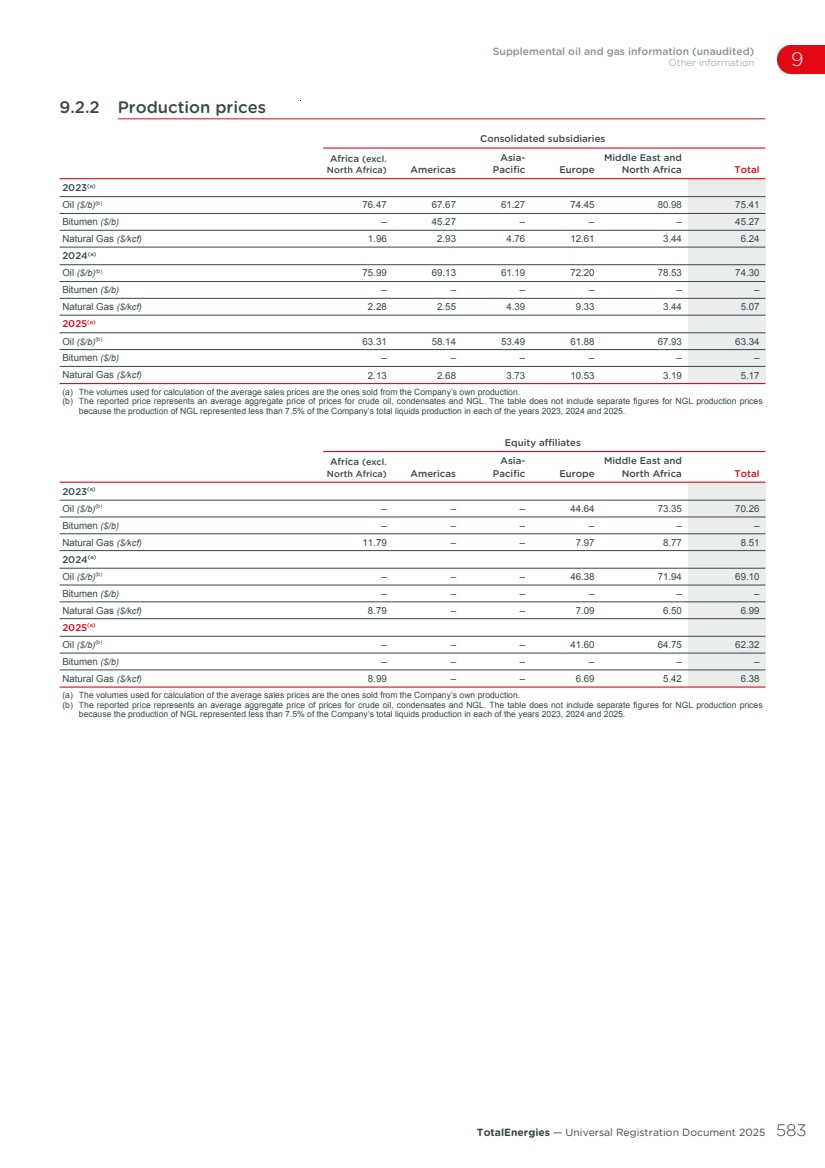
| 9.2.3 Production costs (in $/boe) Consolidated subsidiaries Africa (excl. North Africa) Americas Asia-Pacific Europe Middle East and North Africa Total 2023(a) Oil, bitumen and natural gas 6.36 6.88 3.72 7.34 3.69 5.65 of which bitumen − 20.83 − − − 20.83 2024(a) Oil, bitumen and natural gas 6.21 3.34 3.91 7.77 3.81 5.08 of which bitumen – – – – – – 2025 (a) Oil, bitumen and natural gas 7.07 3.32 3.76 8.08 3.73 5.13 of which bitumen – – – – – – (a) The volumes of oil used for this computation are shown in the proved reserves tables of this report. The reported volumes for natural gas are different from those shown in the reserves table due to gas consumed in operations. (in $/boe) Equity affiliates Africa (excl. North Africa) Americas Asia-Pacific Europe Middle East and North Africa Total 2023(a) Oil, bitumen and natural gas 1.32 − − 0.63 4.12 2.87 of which bitumen − − − − − − 2024(a) Oil, bitumen and natural gas 1.39 – – 0.74 4.23 3.00 of which bitumen – – – – – – 2025 (a) Oil, bitumen and natural gas 1.51 – – 0.87 3.93 2.94 of which bitumen – – – – – – (a) The volumes of oil used for this computation are shown in the proved reserves tables of this report. The reported volumes for natural gas are different from those shown in the reserves table due to gas consumed in operations. 9 Supplemental oil and gas information (unaudited) Other information 584 TotalEnergies — Universal Registration Document 2025 |
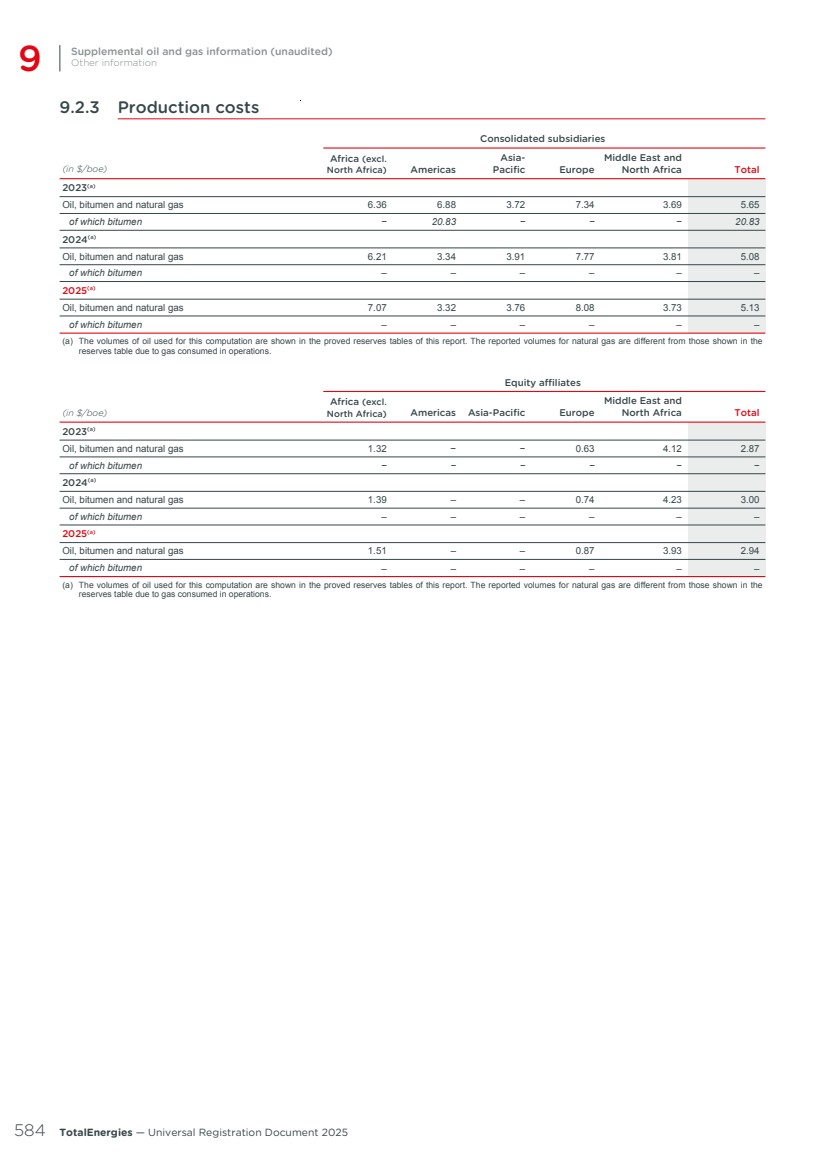
| 9.3 Report on the payments made to governments Articles L. 232-6-2 and L. 22-10-37 of the French Commercial Code(1) require large undertakings and public-interest entities that are active in the extractive industry or logging of primary forests to disclose, in an annual report, payments of at least 100,000 euros made to governments in the countries in which they operate. The consolidated report of TotalEnergies is presented pursuant to the aforementioned provisions. This report covers the aforementioned payments made in 2025 by the Company’s Extractive Companies as defined below, for the benefit of each government of states or territories in which TotalEnergies carries out its activities, by detailing the total amount of payments made, the total amount by payment type, the total amount by project and the total amount by payment type for each project. When payments were made in kind, valuated hydrocarbons’ volumes are specified. This report has been approved by the Board of Directors of TotalEnergies SE. Definitions The meaning of certain terms used in this report are set forth below: Extractive Companies: TotalEnergies SE and any company or undertaking fully consolidated by TotalEnergies SE, the activities of which consist, in whole or in part, of exploration, prospection, discovery, development and extraction of minerals, crude oil and natural gas, among others. Payment: a single payment or multiple interconnected payments of an amount equal to, or in excess of, 100,000 euros (or its equivalent) paid, whether in money or in kind, for extractive activities. Payment types included in this report are the following: – Taxes: – Income taxes: corporate income taxes based on taxable profits of Extractive Companies, – Other Taxes: other taxes and levies (other than Income taxes). Other Taxes include those based on revenues or production of Extractive Companies, and exclude taxes levied on consumption such as added value taxes, customs duties, personal income taxes and sales taxes. – Royalties: percentage of production payable to the owner of mineral rights, – License Fees: license fees, surface or rental fees, and other consideration for licenses and/or concessions that are paid for access to the area where the extractive activities are conducted, – License bonuses: bonuses paid for and in consideration of signature, discovery, production, awards, grants and transfers of extraction rights; bonuses related to the achievement or failure to achieve certain production levels or certain targets, and discovery of additional mineral reserves /deposits, – Dividends: dividends paid to a host government holding an interest in an Extractive Company, – Payments for Infrastructure Improvements: payments for local development, including the improvement of infrastructure, not directly necessary for the conduct of extractive activities but mandatory pursuant to the terms of a production sharing contract or to the terms of a law relating to oil and gas activities, – Production entitlement: host Government’s share of production. This payment is generally made in kind. Government: any national, regional or local authority of a country or territory, or any department, agency or undertaking controlled by that authority. Project: operational activities governed by a single contract, license, lease, concession or similar legal agreement and that form the basis for payment liabilities with a Government. If multiple such agreements are substantially interconnected, they shall be considered as a single Project. Payments (such as company income tax when it concerns several projects which cannot be separated in application of the fiscal regulations) unable to be attributed to a Project are disclosed under the item “non-attributable”. Reporting principles This report sets forth all Payments as booked in the Extractive Companies’ accounts. They are presented based on the Company’s share in each Project, whether the Payments have been made directly by the Extractive Companies of TotalEnergies as operator or indirectly through third-party operating companies. Production entitlement and Royalties that are mandatorily paid in kind and that are owed to host Governments pursuant to legal or contractual provisions (not booked in the Extractive Companies’ accounts pursuant to accounting standards) are reported in proportion of the interest held by the Extractive Company in the Project as of the date on which such Production entitlements and Royalties are deemed to be acquired. Payments in kind are estimated at fair value. Fair value corresponds to the contractual price of hydrocarbons used to calculate Production entitlement, market price (if available) or an appropriate benchmark price. These prices might be calculated on an averaged basis over a given period. (1) Transposing certain provisions set out in Directive 2013/24/UE of the European Parliament and of the Council of June 26, 2013 (chapter 10). Supplemental oil and gas information (unaudited) Report on the payments made to governments 9 TotalEnergies — Universal Registration Document 2025 585 |
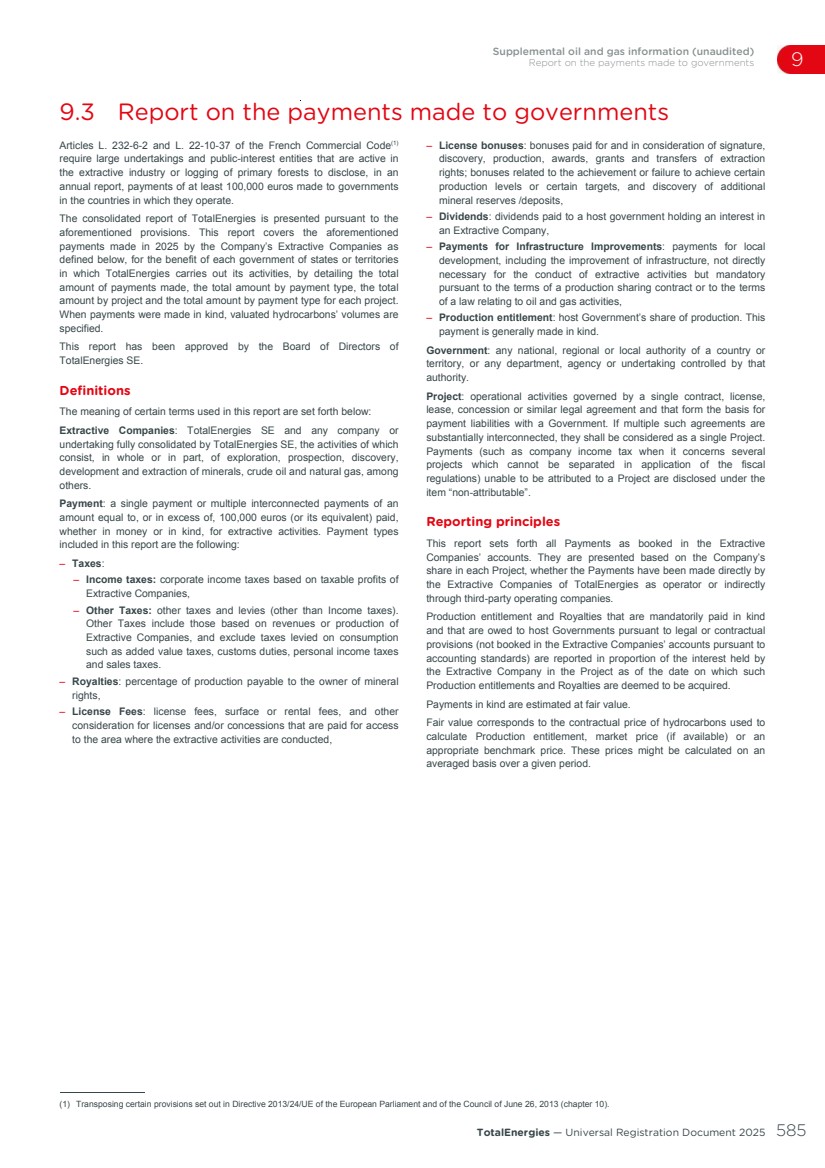
| 9.3.1 Reporting by country and type of Payment 9.3.1.1 Paid in cash paid in cash (in thousands of dollars) Income Taxes Other Taxes Taxes (Total) Royalties License fees License bonuses Dividends Infrastructure improvements Production entitlements Total of Payments Europe 4,805,698 136,420 4,942,118 – 32,252 – – 1,432 – 4,975,802 Denmark 39,745 5,650 45,395 – 5,384 – – – – 50,779 France – – – – – – – 1,432 – 1,432 Italy 33,807 64,658 98,465 – 15,672 – – – – 114,137 Netherlands 147,949 – 147,949 – 799 – – – – 148,748 Norway 3,368,392 66,112 3,434,504 – 2,849 – – – – 3,437,353 United Kingdom 1,215,805 – 1,215,805 – 7,548 – – – – 1,223,353 Africa 1,365,590 164,263 1,529,853 – 167,865 15,882 105,001 61,370 – 1,879,971 Angola 576,929 59,848 636,777 – 8,396 2,000 – 2,735 – 649,908 Gabon 655 46,115 46,770 – 3,329 – 105,001 13,231 – 168,331 Mozambique – – – – 530 – – 3,180 – 3,710 Namibia – – – – 201 – – – – 201 Nigeria 787,583 57,527 845,110 – 55,666 8,000 – 40,736 – 949,512 Republic of the Congo 423 773 1,196 – 93,599 5,882 – 1,488 – 102,165 Sᾶo Tomé and Principe – – – – 1,726 – – – – 1,726 Uganda – – – – 4,418 – – – – 4,418 Middle East and North Africa 88,945 9,192,725 9,281,670 – 30,600 33,017 – – – 9,345,287 Algeria 33,679 182,089 215,768 – 1,910 33,017 – – – 250,695 Cyprus – – – – 2,797 – – – – 2,797 Lebanon – – – – 107 – – – – 107 Libya – 1,680,727 1,680,727 – 9,986 – – – – 1,690,713 Oman – 392,670 392,670 – – – – – – 392,670 Qatar 55,266 20,008 75,274 – – – – – – 75,274 United Arab Emirates – 6,917,231 6,917,231 – 12,779 – – – – 6,930,010 Yemen – – – – 3,021 – – – – 3,021 Americas 324,120 825,376 1,149,496 140,907 29,764 157,868 – 219 – 1,478,254 Argentina 88,798 92,829 181,627 – 8,853 – – – – 190,480 Bolivia – 94,850 94,850 – 648 – – 219 – 95,717 Brazil 235,322 617,887 853,209 – 18,264 151,172 – – – 1,022,645 Guyana – – – – 507 6,000 – – – 6,507 Mexico – 426 426 – 642 – – – – 1,068 Suriname – – – – 195 – – – – 195 United States – 19,384 19,384 140,907 655 696 – – – 161,642 Asia Pacific 191,601 177,777 369,378 72 7,172 416,078 – 2,954 2,600 798,254 Australia 85,325 52,197 137,522 – 3,155 – – – – 140,677 Cambodia – – – – 1,957 4,500 – – – 6,457 China 20,196 1,449 21,645 – – – – – – 21,645 Indonesia 2,364 – 2,364 – – – – – 2,600 4,964 Kazakhstan – 111,628 111,628 – – – – 2,954 – 114,582 Malaysia 79,803 12,299 92,102 72 1,872 411,578 – – – 505,624 Papua New Guinea – – – – 188 – – – – 188 Thailand 3,913 204 4,117 – – – – – – 4,117 Total 6,775,954 10,496,561 17,272,515 140,979 267,653 622,845 105,001 65,975 2,600 18,477,568 9 Supplemental oil and gas information (unaudited) Report on the payments made to governments 586 TotalEnergies — Universal Registration Document 2025 |
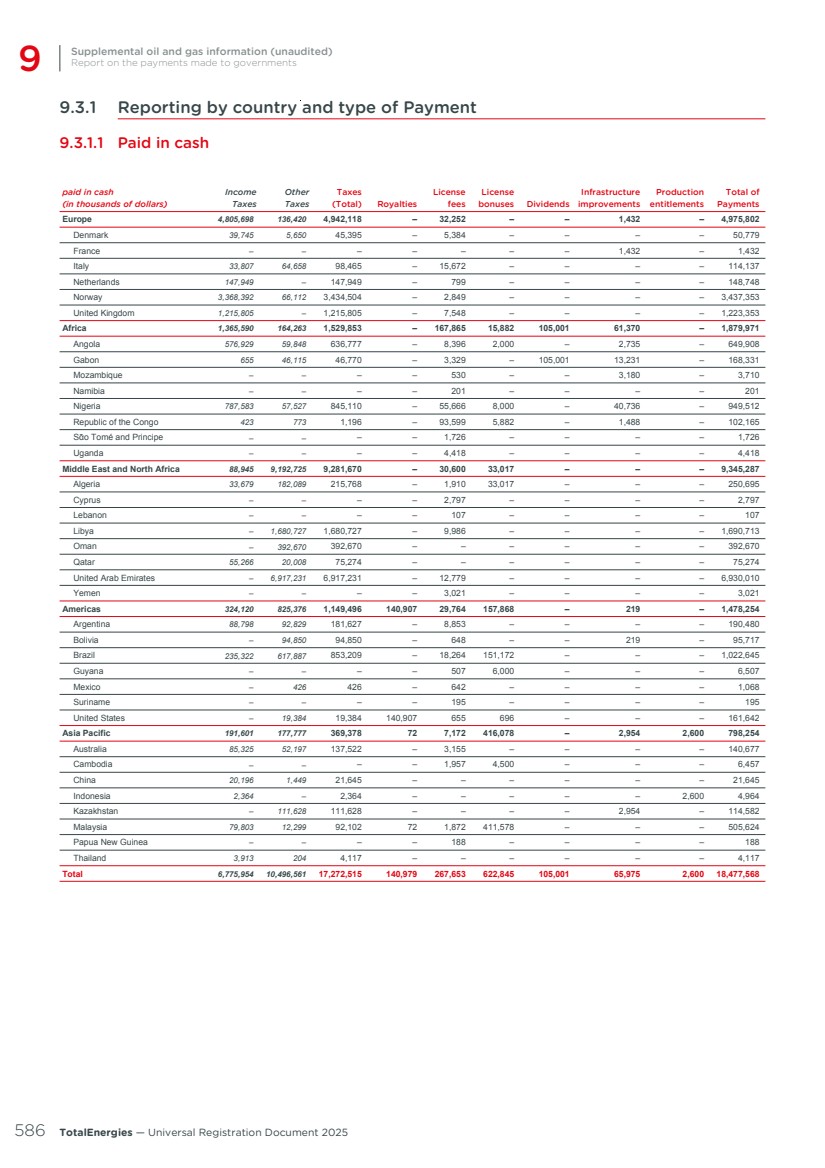
| 9.3.1.2 Paid in kind paid in kind (in kboe) Income Taxes Other Taxes Taxes (Total) Royalties License fees License bonuses Dividends Infrastructure improvements Production entitlements Total of Payments Europe – – – – – – – – 1,080 1,080 Azerbaijan – – – – – – – – 1,080 1,080 Africa 1,870 4,058 5,927 – 1 – – 1 20,839 26,768 Angola – – – – – – – – 19,403 19,403 Gabon 241 – 241 – – – – 1 – 242 Nigeria 209 858 1,066 – 1 – – – 1,432 2,499 Republic of the Congo 1,420 3,200 4,620 – – – – – 5 4,625 Middle East and North Africa 12,494 799 13,293 2,427 – – – – 53,632 69,352 Algeria 1,109 – 1,109 – – – – – – 1,109 Iraq 727 – 727 2,427 – – – – – 3,154 Libya 7,360 799 8,159 – – – – – 23,431 31,590 Qatar 3,298 – 3,298 – – – – – 30,201 33,499 Americas – – – – – – – – 9,458 9,458 Bolivia – – – – – – – – 279 279 Brazil – – – – – – – – 9,179 9,179 Asia Pacific – 601 601 2,044 – – – – 7,918 10,563 China – 601 601 – – – – – 2,409 3,010 Indonesia – – – – – – – – 43 43 Kazakhstan – – – – – – – – 463 463 Malaysia – – – 2,044 – – – – 5,003 7,047 Total 14,363 5,458 19,821 4,470 1 – – 1 92,928 117,221 Supplemental oil and gas information (unaudited) Report on the payments made to governments 9 TotalEnergies — Universal Registration Document 2025 587 |
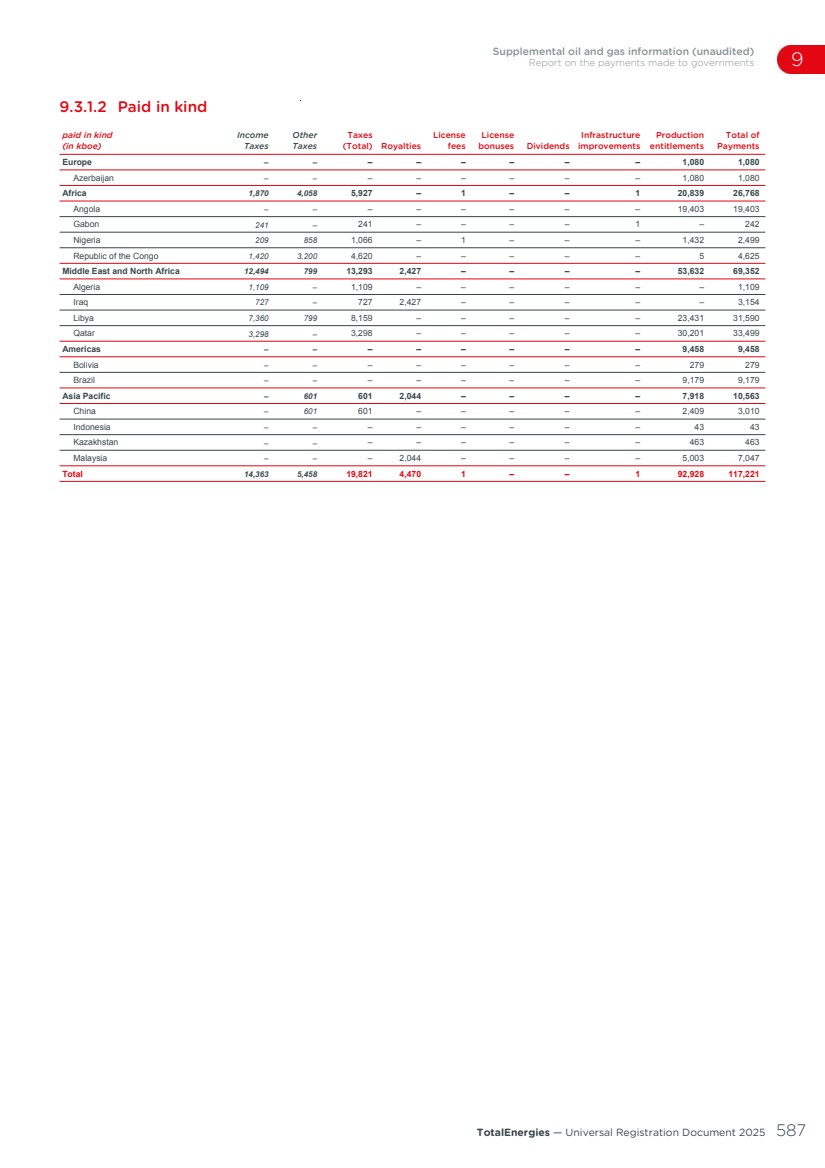
| 9.3.1.3 Paid in cash and in kind (including valuation of in-kind payments) In application of the regulation imposing a disclosure of the value of the total Payments, the table presented herebelow shows the sum of payments done in cash and in kind valuated as indicated in the footnotes. all payments (in thousands of dollars) Income Taxes Other Taxes Taxes (Total) Royalties License fees License bonuses Dividends Infrastructure improvements Production entitlements Total of Payments Europe 4,805,698 136,420 4,942,118 – 32,252 – – 1,432 34,900 5,010,702 Azerbaijan – – – – – – – – 34,900 34,900 Denmark 39,745 5,650 45,395 – 5,384 – – – – 50,779 France – – – – – – – 1,432 – 1,432 Italy 33,807 64,658 98,465 – 15,672 – – – – 114,137 Netherlands 147,949 – 147,949 – 799 – – – – 148,748 Norway 3,368,392 66,112 3,434,504 – 2,849 – – – – 3,437,353 United Kingdom 1,215,805 – 1,215,805 – 7,548 – – – – 1,223,353 Africa 1,491,388 441,887 1,933,275 – 167,946 15,882 105,001 61,421 1,437,695 3,721,220 Angola 576,929 59,848 636,777 – 8,396 2,000 – 2,735 1,344,789 1,994,697 Gabon 16,801 46,115 62,916 – 3,329 – 105,001 13,282 – 184,528 Mozambique – – – – 530 – – 3,180 – 3,710 Namibia – – – – 201 – – – – 201 Nigeria 800,945 117,735 918,680 – 55,747 8,000 – 40,736 92,567 1,115,730 Republic of the Congo 96,713 218,189 314,902 – 93,599 5,882 – 1,488 339 416,210 Sᾶo Tomé and Principe – – – – 1,726 – – – – 1,726 Uganda – – – – 4,418 – – – – 4,418 Middle East and North Africa 798,271 9,247,517 10,045,788 162,552 30,600 33,017 – – 2,275,151 12,547,108 Algeria 110,524 182,089 292,613 – 1,910 33,017 – – – 327,540 Cyprus – – – – 2,797 – – – – 2,797 Iraq 54,637 – 54,637 162,552 – – – – – 217,189 Lebanon – – – – 107 – – – – 107 Libya 504,549 1,735,519 2,240,068 – 9,986 – – – 1,605,831 3,855,885 Oman – 392,670 392,670 – – – – – – 392,670 Qatar 128,561 20,008 148,569 – – – – – 669,320 817,889 United Arab Emirates – 6,917,231 6,917,231 – 12,779 – – – – 6,930,010 Yemen – – – – 3,021 – – – – 3,021 Americas 324,120 825,376 1,149,496 140,907 29,764 157,868 – 219 595,425 2,073,679 Argentina 88,798 92,829 181,627 – 8,853 – – – – 190,480 Bolivia – 94,850 94,850 – 648 – – 219 4,778 100,495 Brazil 235,322 617,887 853,209 – 18,264 151,172 – – 590,647 1,613,292 Guyana – – – – 507 6,000 – – – 6,507 Mexico – 426 426 – 642 – – – – 1,068 Suriname – – – – 195 – – – – 195 United States – 19,384 19,384 140,907 655 696 – – – 161,642 Asia Pacific 191,601 194,492 386,093 52,813 7,172 416,078 – 2,954 238,873 1,103,983 Australia 85,325 52,197 137,522 – 3,155 – – – – 140,677 Cambodia – – – – 1,957 4,500 – – – 6,457 China 20,196 18,164 38,360 – – – – – 67,205 105,565 Indonesia 2,364 – 2,364 – – – – – 4,551 6,915 Kazakhstan – 111,628 111,628 – – – – 2,954 29,391 143,973 Malaysia 79,803 12,299 92,102 52,813 1,872 411,578 – – 137,726 696,091 Papua New Guinea – – – – 188 – – – – 188 Thailand 3,913 204 4,117 – – – – – – 4,117 Total 7,611,078 10,845,692 18,456,770 356,272 267,734 622,845 105,001 66,026 4,582,044 24,456,692 9 Supplemental oil and gas information (unaudited) Report on the payments made to governments 588 TotalEnergies — Universal Registration Document 2025 |
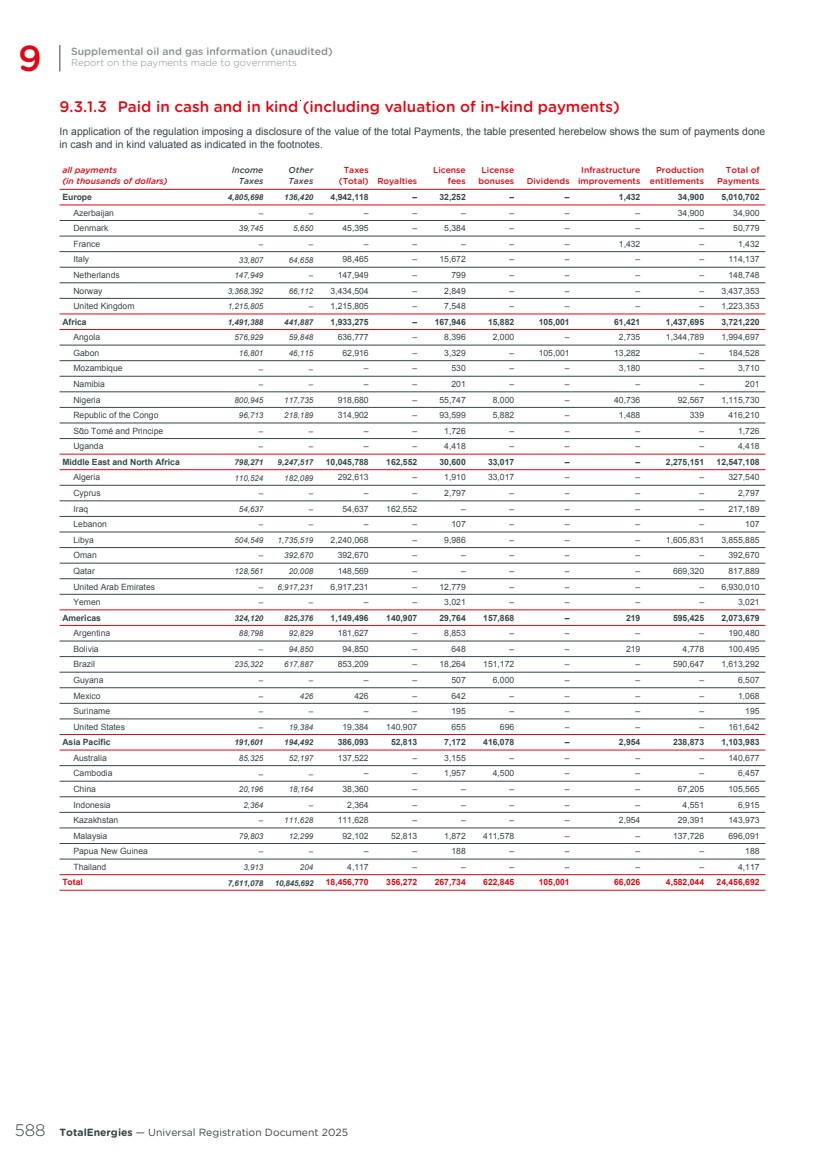
| 9.3.2 Reporting of Payments by Project and by type of Payment, and by Government and by type of Payment Income Taxes Other Taxes Taxes (Total) Royalties License fees License bonuses Dividends Infrastructure improvements Production entitlements Total of Payments Algeria (paid in cash (kusd)) Payments per Project Groupement Berkine – 23,361 23,361 – – 15,200 – – – 38,561 Organisation Orhoud – – – – – 2,272 – – – 2,272 Timimoun – 20,342 20,342 – 980 – – – – 21,322 Tin Fouyé Tabankort II 33,679 138,386 172,065 – 563 15,545 – – – 188,173 Tin Fouyé Tabankort Sud – – – – 367 – – – – 367 Total 33,679 182,089 215,768 – 1,910 33,017 – – – 250,695 Payments per Government Direction Générale des Impôts, Direction des Grandes Entreprises c/o Sonatrach – – – – – – – – – – Direction Générale des Impôts, Direction des Grandes Entreprises 33,679 115,447 149,126 – 1,910 – – – – 151,036 Agence Nationale pour Valorisation des Ressources en Hydrocarbures (ALNAFT) – 43,281 43,281 – – – – – – 43,281 Sonatrach – 23,361 23,361 – – 33,017 – – – 56,378 Total 33,679 182,089 215,768 – 1,910 33,017 – – – 250,695 Algeria (paid in kind (kboe)) Payments per Project Groupement Berkine 1,109 – 1,109 – – – – – – 1,109 Organisation Orhoud – – – – – – – – – – Timimoun – – – – – – – – – – Tin Fouyé Tabankort II – – – – – – – – – – Tin Fouyé Tabankort Sud – – – – – – – – – – Total 1,109 – 1,109 – – – – – – 1,109 Payments per Government Direction Générale des Impôts, Direction des Grandes Entreprises c/o Sonatrach 1,109 – 1,109 – – – – – – 1,109 Direction Générale des Impôts, Direction des Grandes Entreprises – – – – – – – – – – Agence Nationale pour Valorisation des Ressources en Hydrocarbures (ALNAFT) – – – – – – – – – – Sonatrach – – – – – – – – – – Total 1,109 – 1,109 – – – – – – 1,109 In application of the regulation imposing a disclosure of the value of the total Payments, the table presented herebelow shows the sum of payments done in cash and in kind valuated as indicated in the footnotes. Algeria (all payments (kusd) – including valuation of in-kind payments) Payments per Project Groupement Berkine 76,845(a) 23,361 100,206 – – 15,200 – – – 115,406 Organisation Orhoud – – – – – 2,272 – – – 2,272 Timimoun – 20,342 20,342 – 980 – – – – 21,322 Tin Fouyé Tabankort II 33,679 138,386 172,065 – 563 15,545 – – – 188,173 Tin Fouyé Tabankort Sud – – – – 367 – – – – 367 Total 110,524 182,089 292,613 – 1,910 33,017 – – – 327,540 Payments per Government Direction Générale des Impôts, Direction des Grandes Entreprises c/o Sonatrach 76,845(a) – 76,845 – – – – – – 76,845 Direction Générale des Impôts, Direction des Grandes Entreprises 33,679 115,447 149,126 – 1,910 – – – – 151,036 Agence Nationale pour Valorisation des Ressources en Hydrocarbures (ALNAFT) – 43,281 43,281 – – – – – – 43,281 Sonatrach – 23,361(b) 23,361 – – 33,017 – – – 56,378 Total 110,524 182,089 292,613 – 1,910 33,017 – – – 327,540 (a) Corresponds to the valuation of 1,109 kboe at fiscal selling prices for income taxes. (b) Corresponds to the share of operating costs paid in complement to the economic interest of TotalEnergies in Groupement Berkine. Supplemental oil and gas information (unaudited) Report on the payments made to governments 9 TotalEnergies — Universal Registration Document 2025 589 |
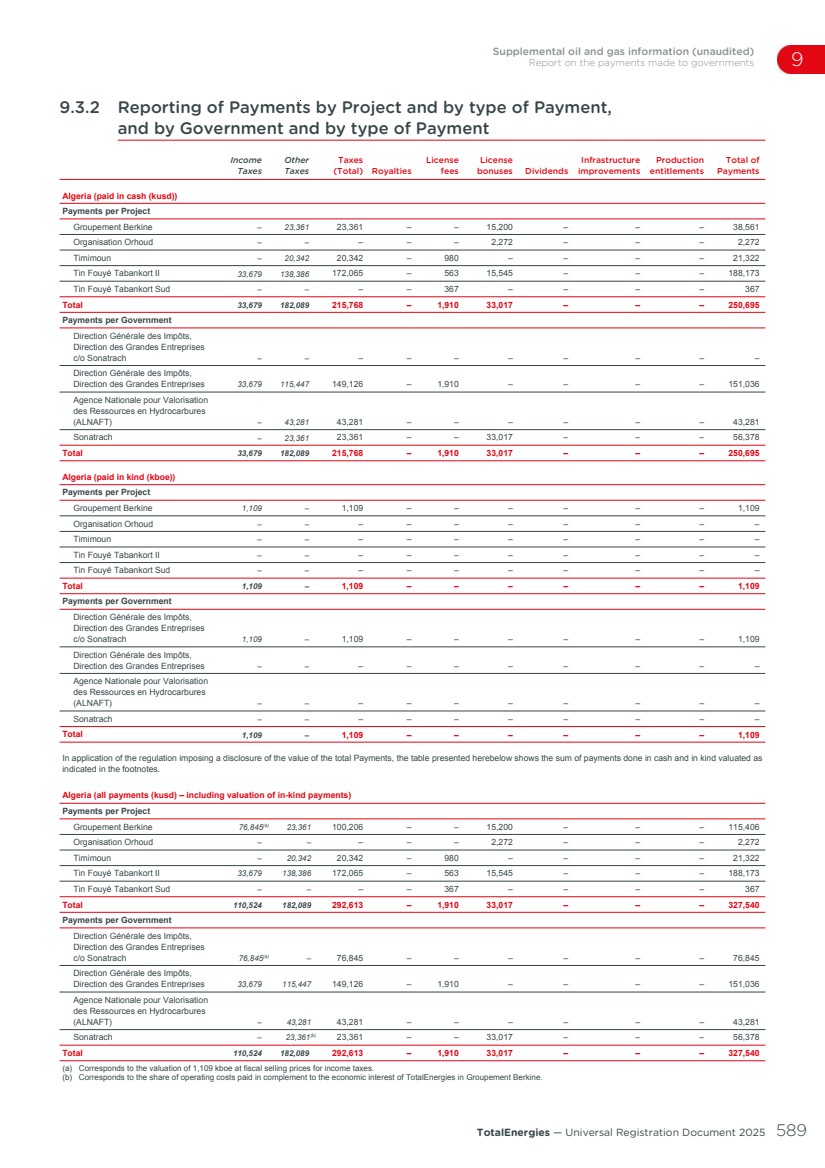
| Income Taxes Other Taxes Taxes (Total) Royalties License fees License bonuses Dividends Infrastructure improvements Production entitlements Total of Payments Angola (paid in cash (kusd)) Payments per Project Block 0 39,836 59,848 99,684 – 609 – – – – 100,293 Block 16 180 – 180 – 231 – – – – 411 Block 17 416,343 – 416,343 – 5,279 2,000 – 794 – 424,416 Block 17/06 1,929 – 1,929 – 85 – – – – 2,014 Block 20/11 3,795 – 3,795 – 99 – – – – 3,894 Block 29 10 – 10 – 279 – – – – 289 Block 32 114,836 – 114,836 – 1,814 – – 1,941 – 118,591 Total 576,929 59,848 636,777 – 8,396 2,000 – 2,735 – 649,908 Payments per Government Caixa do Tesouro Nacional 576,929 59,848 636,777 – 549 – – – – 637,326 Ministério dos Recursos Minerais, Petróleo e Gás – – – – 7,847 – – – – 7,847 ANPG – Agência Nacional de Petróleo, Gás e Biocombustíveis – – – – – 2,000 – 2,735 – 4,735 Total 576,929 59,848 636,777 – 8,396 2,000 – 2,735 – 649,908 Angola (paid in kind (kboe)) Payments per Project Block 0 – – – – – – – – – – Block 16 – – – – – – – – – – Block 17 – – – – – – – – 18,558 18,558 Block 17/06 – – – – – – – – 115 115 Block 20/11 – – – – – – – – – – Block 29 – – – – – – – – – – Block 32 – – – – – – – – 730 730 Total – – – – – – – – 19,403 19,403 Payments per Government Caixa do Tesouro Nacional – – – – – – – – – – Ministério dos Recursos Minerais, Petróleo e Gás – – – – – – – – – – ANPG – Agência Nacional de Petróleo, Gás e Biocombustíveis – – – – – – – – 19,403 19,403 Total – – – – – – – – 19,403 19,403 In application of the regulation imposing a disclosure of the value of the total Payments, the table presented herebelow shows the sum of payments done in cash and in kind valuated as indicated in the footnotes. Angola (all payments (kusd) – including valuation of in-kind payments) Payments per Project Block 0 39,836 59,848 99,684 – 609 – – – – 100,293 Block 16 180 – 180 – 231 – – – – 411 Block 17 416,343 – 416,343 – 5,279 2,000 – 794 1,288,226(a) 1,712,642 Block 17/06 1,929 – 1,929 – 85 – – – 7,330(b) 9,344 Block 20/11 3,795 – 3,795 – 99 – – – – 3,894 Block 29 10 – 10 – 279 – – – – 289 Block 32 114,836 – 114,836 – 1,814 – – 1,941 49,233(c) 167,824 Total 576,929 59,848 636,777 – 8,396 2,000 – 2,735 1,344,789 1,994,697 Payments per Government Caixa do Tesouro Nacional 576,929 59,848 636,777 – 549 – – – – 637,326 Ministério dos Recursos Minerais, Petróleo e Gás – – – – 7,847 – – – – 7,847 ANPG – Agência Nacional de Petróleo, Gás e Biocombustíveis – – – – – 2,000 – 2,735 1,344,789(d) 1,349,524 Total 576,929 59,848 636,777 – 8,396 2,000 – 2,735 1,344,789 1,994,697 (a) Corresponds to the valuation of 18,558 kboe at the weighted average fiscal price of the year. (b) Corresponds to the valuation of 115 kboe at the weighted average fiscal price of the year. (c) Corresponds to the valuation of 730 kboe at the weighted average fiscal price of the year. (d) Corresponds to the valuation of 19,403 kboe at the weighted average fiscal price of the year. 9 Supplemental oil and gas information (unaudited) Report on the payments made to governments 590 TotalEnergies — Universal Registration Document 2025 |
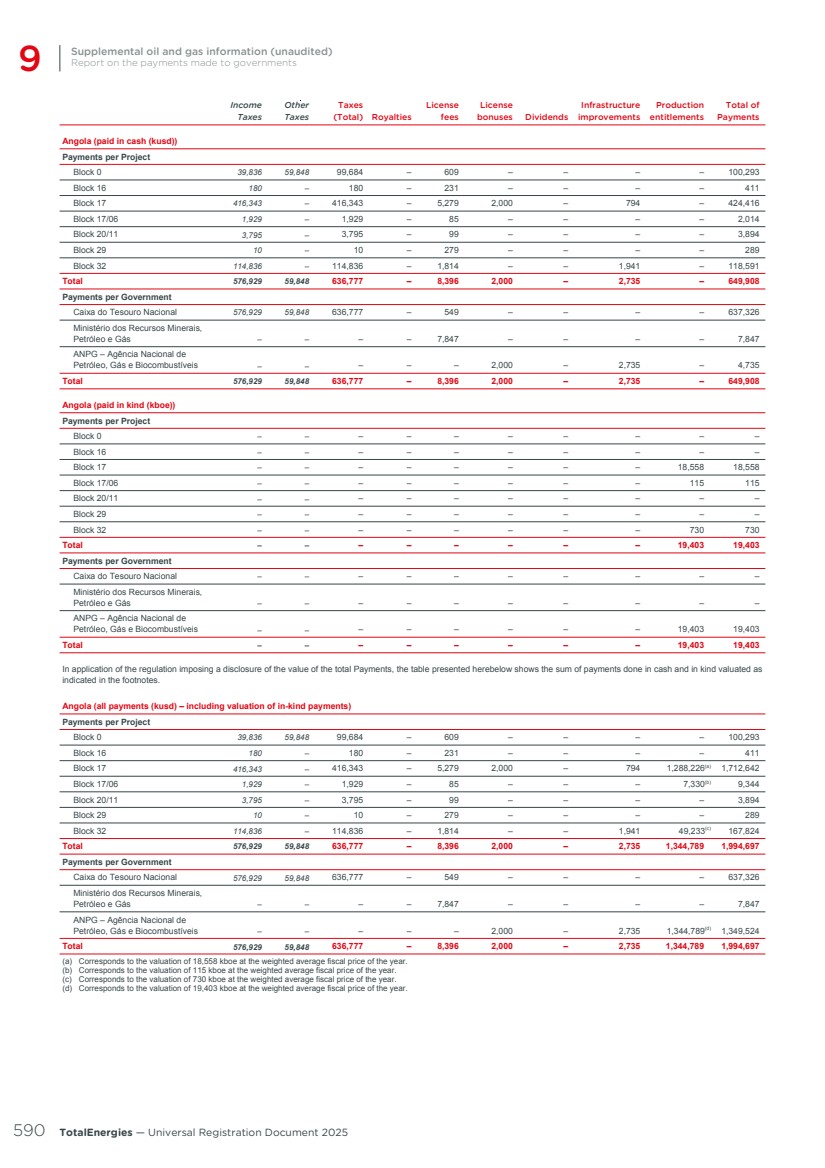
| Income Taxes Other Taxes Taxes (Total) Royalties License fees License bonuses Dividends Infrastructure improvements Production entitlements Total of Payments Argentina (paid in cash (kusd)) Payments per Project Malvinas Ocidental – Block 123 – – – – 58 – – – – 58 Neuquen – 39,418 39,418 – 781 – – – – 40,199 Santa Cruz – – – – 747 – – – – 747 Tierra del Fuego – 53,411 53,411 – 7,267 – – – – 60,678 Argentina (non-attributable) 88,798 – 88,798 – – – – – – 88,798 Total 88,798 92,829 181,627 – 8,853 – – – – 190,480 Payments per Government Administracion Federal de Ingresos Publicos 88,798 – 88,798 – – – – – – 88,798 Secretaria de Energia, Republica Argentina – 40,528 40,528 – 1,519 – – – – 42,047 Provincia del Neuquen – 39,418 39,418 – 781 – – – – 40,199 Provincia de Tierra del Fuego – 12,883 12,883 – 6,553 – – – – 19,436 Total 88,798 92,829 181,627 – 8,853 – – – – 190,480 Australia (paid in cash (kusd)) Payments per Project GLNG 42,710 42,710 – 3,155 – – – – 45,865 Ichthys LNG 85,325 9,487 94,812 – – – – – – 94,812 Total 85,325 52,197 137,522 – 3,155 – – – – 140,677 Payments per Government Australian Taxation Office 85,325 9,487 94,812 – – – – – – 94,812 Queensland Government – – – – 3,155 – – – – 3,155 Queensland Government, Queensland Revenue Office – 42,710 42,710 – – – – – – 42,710 Total 85,325 52,197 137,522 – 3,155 – – – – 140,677 Azerbaijan (paid in cash (kusd)) Payments per Project Absheron – – – – – – – – – – Total – – – – – – – – – – Payments per Government State Oil Company of the Azerbaijan Republic – – – – – – – – – – Total – – – – – – – – – – Azerbaijan (paid in kind (kboe)) Payments per Project Absheron – – – – – – – – 1,080 1,080 Total – – – – – – – – 1,080 1,080 Payments per Government State Oil Company of the Azerbaijan Republic – – – – – – – – 1,080 1,080 Total – – – – – – – – 1,080 1,080 In application of the regulation imposing a disclosure of the value of the total Payments, the table presented herebelow shows the sum of payments done in cash and in kind valuated as indicated in the footnotes. Azerbaijan (all payments (kusd) – including valuation of in-kind payments) Payments per Project Absheron – – – – – – – – 34,900(a) 34,900 Total – – – – – – – – 34,900 34,900 Payments per Government State Oil Company of the Azerbaijan Republic – – – – – – – – 34,900(a) 34,900 Total – – – – – – – – 34,900 34,900 (a) Corresponds to the valuation of 1,080 kboe for production entitlements at a fixed contractual price for gas and contractual net-back price for condensates. Supplemental oil and gas information (unaudited) Report on the payments made to governments 9 TotalEnergies — Universal Registration Document 2025 591 |
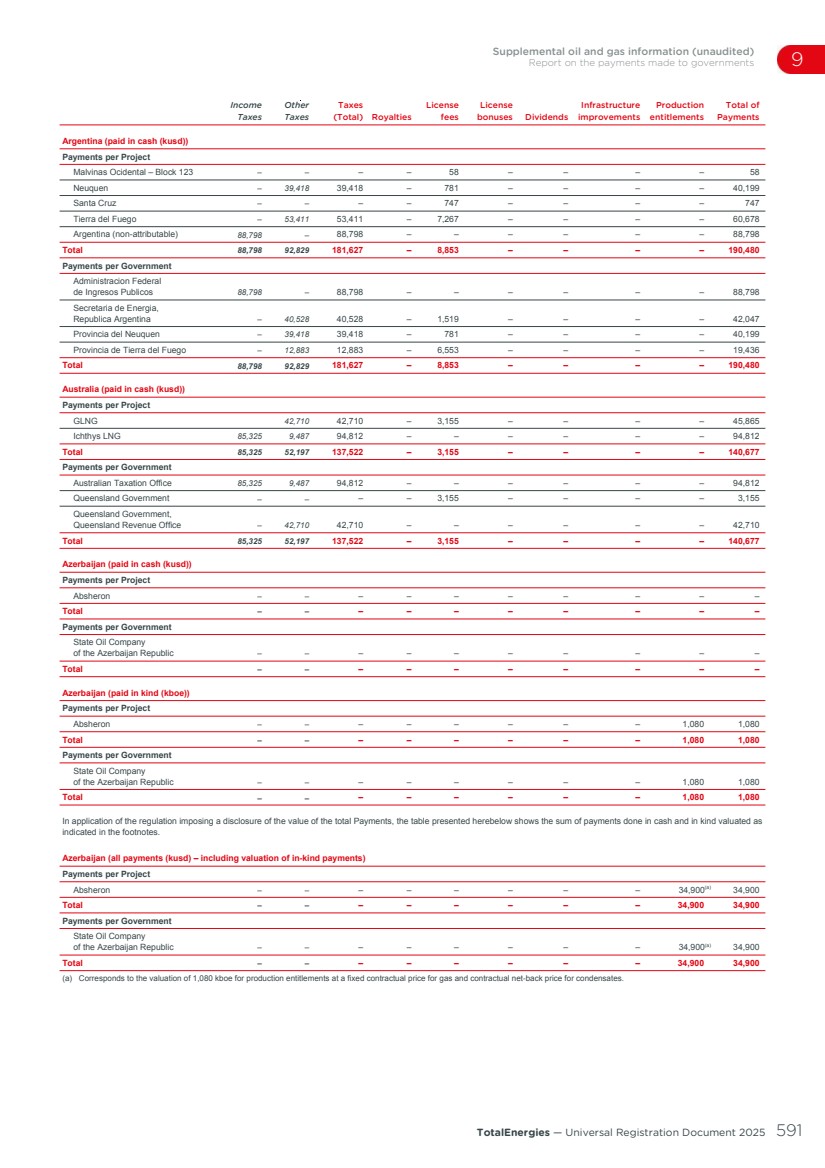
| Income Taxes Other Taxes Taxes (Total) Royalties License fees License bonuses Dividends Infrastructure improvements Production entitlements Total of Payments Bolivia (paid in cash (kusd)) Payments per Project Aquio – 7,367 7,367 – 158 – – – – 7,525 Ipatí – 60,491 60,491 – 250 – – 219 – 60,960 Itaú – 4,259 4,259 – 136 – – – – 4,395 San Alberto – 9,365 9,365 – 35 – – – – 9,400 San Antonio – 13,368 13,368 – 69 – – – – 13,437 Total – 94,850 94,850 – 648 – – 219 – 95,717 Payments per Government Yacimientos Petroliferos Fiscales Bolivianos (YPFB) – – – – 648 – – – – 648 Servicio de Impuestos Nacionales (SIN) c/o YPFB – 60,704 60,704 – – – – – – 60,704 Departamentos c/o YPFB – 34,146 34,146 – – – – – – 34,146 Fundesoc c/o Indigeneous Communities – – – – – – – 219 – 219 Total – 94,850 94,850 – 648 – – 219 – 95,717 Bolivia (paid in kind (kboe)) Payments per Project Aquio – – – – – – – – – – Ipatí – – – – – – – – – – Itaú – – – – – – – – – – San Alberto – – – – – – – – 104 104 San Antonio – – – – – – – – 175 175 Total – – – – – – – – 279 279 Payments per Government Yacimientos Petroliferos Fiscales Bolivianos (YPFB) – – – – – – – – 279 279 Servicio de Impuestos Nacionales (SIN) c/o YPFB – – – – – – – – – – Departamentos c/o YPFB – – – – – – – – – – Fundesoc c/o Indigeneous Communities – – – – – – – – – – Total – – – – – – – – 279 279 In application of the regulation imposing a disclosure of the value of the total Payments, the table presented herebelow shows the sum of payments done in cash and in kind valuated as indicated in the footnotes. Bolivia (all payments (kusd) – including valuation of in-kind payments) Payments per Project Aquio – 7,367 7,367 – 158 – – – – 7,525 Ipatí – 60,491 60,491 – 250 – – 219 – 60,960 Itaú – 4,259 4,259 – 136 – – – – 4,395 San Alberto – 9,365 9,365 – 35 – – – 2,944(a) 12,344 San Antonio – 13,368 13,368 – 69 – – – 1,834(b) 15,271 Total – 94,850 94,850 – 648 – – 219 4,778 100,495 Payments per Government Yacimientos Petroliferos Fiscales Bolivianos (YPFB) – – – – 648 – – – 4,778(c) 5,426 Servicio de Impuestos Nacionales (SIN) c/o YPFB – 60,704 60,704 – – – – – – 60,704 Departamentos c/o YPFB – 34,146 34,146 – – – – – – 34,146 Fundesoc c/o Indigeneous Communities – – – – – – – 219 – 219 Total – 94,850 94,850 – 648 – – 219 4,778 100,495 (a) Corresponds to the valuation of 104 kboe for production entitlements at a fixed regulated price for condensates and on a net-back regulated price for gas. (b) Corresponds to the valuation of 175 kboe for production entitlements at a fixed regulated price for condensates and on a net-back regulated price for gas. (c) Corresponds to the valuation of 279 kboe for production entitlements at a fixed regulated price for condensates and on a net-back regulated price for gas. 9 Supplemental oil and gas information (unaudited) Report on the payments made to governments 592 TotalEnergies — Universal Registration Document 2025 |
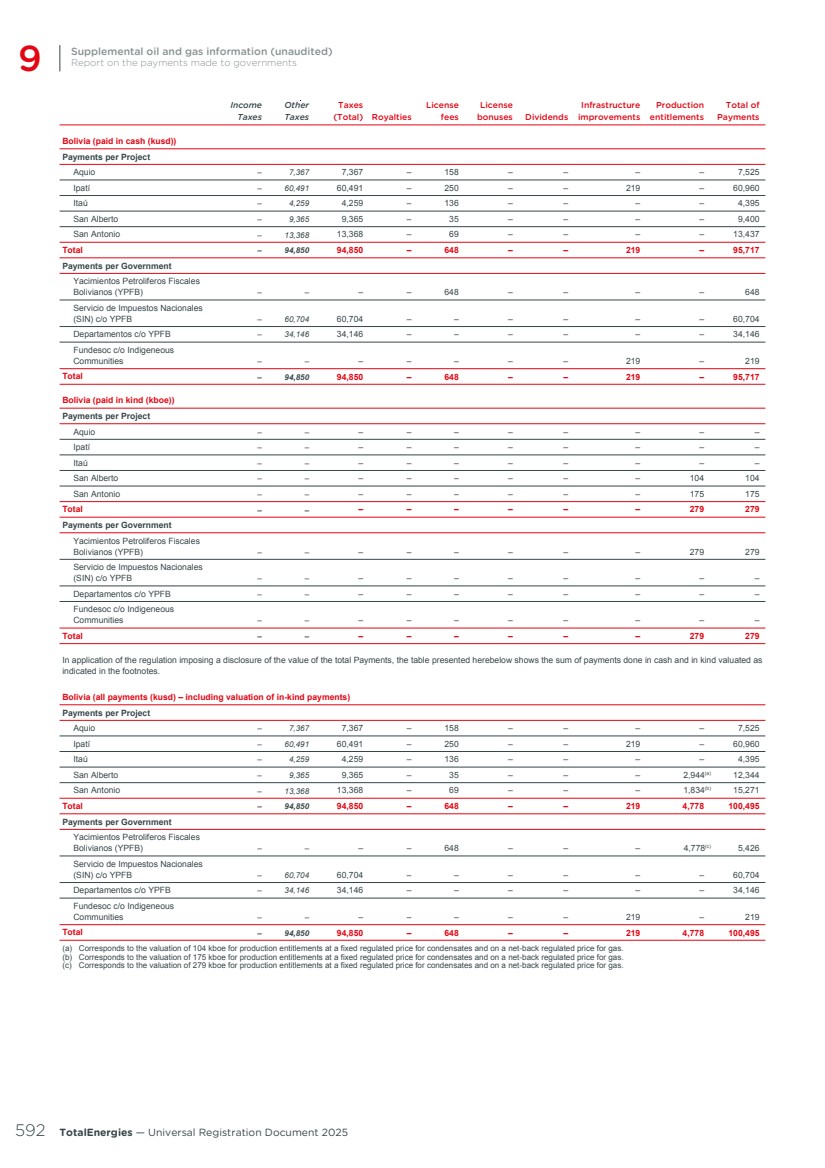
| Income Taxes Other Taxes Taxes (Total) Royalties License fees License bonuses Dividends Infrastructure improvements Production entitlements Total of Payments Brazil (paid in cash (kusd)) Payments per Project Atapu – – – – 23 – – – – 23 Atapu ToR Surplus – 54,859 54,859 – – 56,300 – – – 111,159 Barreirinhas – – – – 48 – – – – 48 BM-S-54 – – – – 18 – – – – 18 C-M-541 – – – – 617 – – – – 617 Iara – 89,327 89,327 – 2,284 – – – – 91,611 Lapa – 42,660 42,660 – 386 – – – – 43,046 Libra – 345,555 345,555 – 1,451 – – – – 347,006 Sépia ToR Surplus – 85,486 85,486 – 861 94,872 – – – 181,219 S-M-1711 – – – – 33 – – – – 33 S-M-1815 – – – – 33 – – – – 33 Brazil (non-attributable) 235,322 – 235,322 – 12,510 – – – – 247,832 Total 235,322 617,887 853,209 – 18,264 151,172 – – – 1,022,645 Payments per Government Agencia National de Petroleo, Gas Natural e Biocombustiveis – – – – 12,510 – – – – 12,510 Fundo de Compensação Ambiental (FCA) – – – – 4,329 – – – – 4,329 Receita Federal 235,322 617,887 853,209 – – – – – – 853,209 Petrobras – – – – – 151,172 – – – 151,172 Pré-sal Petroleo (PPSA) – – – – – – – – – – Secretaria do Tesouro Nacional – – – – 1,425 – – – – 1,425 Total 235,322 617,887 853,209 – 18,264 151,172 – – – 1,022,645 Brazil (paid in kind (kboe)) Payments per Project Atapu – – – – – – – – – – Atapu ToR Surplus – – – – – – – – 110 110 Barreirinhas – – – – – – – – – – BM-S-54 – – – – – – – – – – C-M-541 – – – – – – – – – – Iara – – – – – – – – – – Lapa – – – – – – – – – – Libra – – – – – – – – 7,251 7,251 Sépia ToR Surplus – – – – – – – – 1,818 1,818 S-M-1711 – – – – – – – – – – S-M-1815 – – – – – – – – – – Brazil (non-attributable) – – – – – – – – – – Total – – – – – – – – 9,179 9,179 Payments per Government Agencia National de Petroleo, Gas Natural e Biocombustiveis – – – – – – – – – – Fundo de Compensação Ambiental (FCA) – – – – – – – – – – Receita Federal – – – – – – – – – – Petrobras – – – – – – – – – – Pré-sal Petroleo (PPSA) – – – – – – – – 9,179 9,179 Secretaria do Tesouro Nacional – – – – – – – – – – Total – – – – – – – – 9,179 9,179 Supplemental oil and gas information (unaudited) Report on the payments made to governments 9 TotalEnergies — Universal Registration Document 2025 593 |
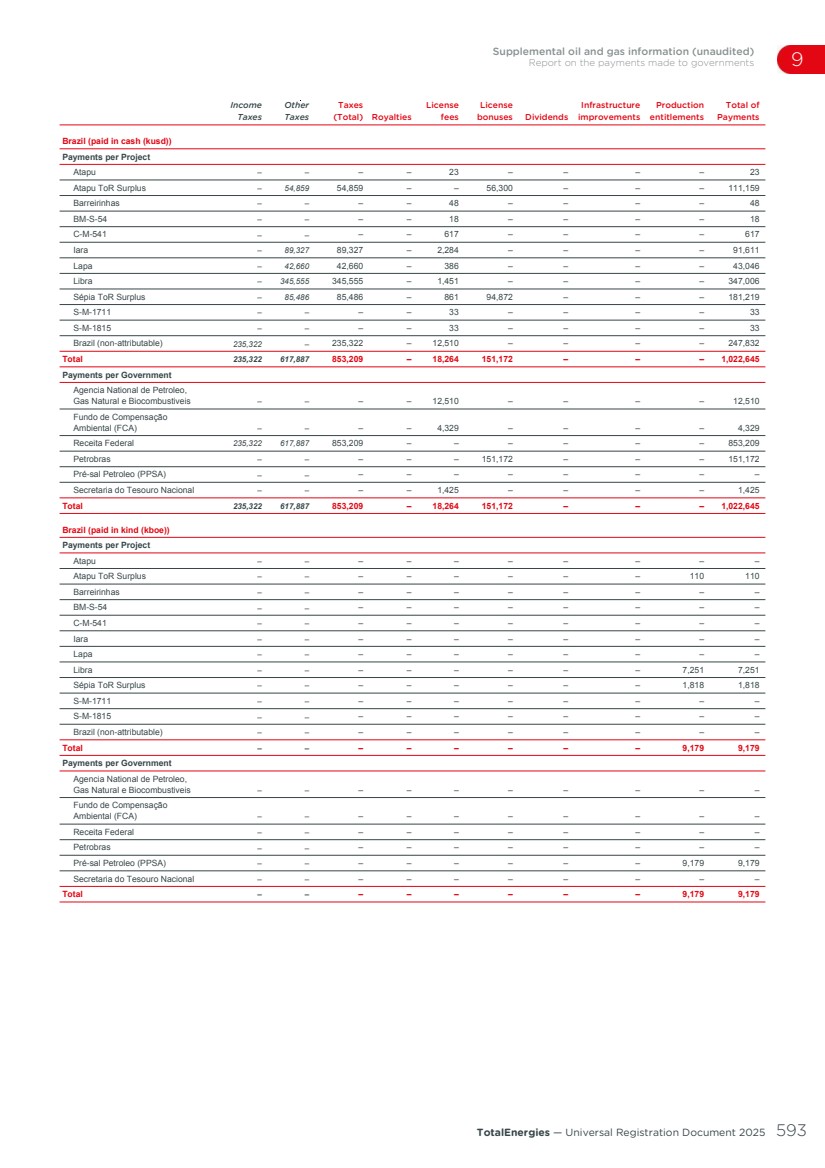
| Income Taxes Other Taxes Taxes (Total) Royalties License fees License bonuses Dividends Infrastructure improvements Production entitlements Total of Payments In application of the regulation imposing a disclosure of the value of the total Payments, the table presented herebelow shows the sum of payments done in cash and in kind valuated as indicated in the footnotes. Brazil (all payments (kusd) – including valuation of in-kind payments) Payments per Project Atapu – – – – 23 – – – – 23 Atapu ToR Surplus – 54,859 54,859 – – 56,300(a) – – 6,938(b) 118,097 Barreirinhas – – – – 48 – – – – 48 BM-S-54 – – – – 18 – – – – 18 C-M-541 – – – – 617 – – – – 617 Iara – 89,327 89,327 – 2,284 – – – – 91,611 Lapa – 42,660 42,660 – 386 – – – – 43,046 Libra – 345,555 345,555 – 1,451 – – – 467,196(c) 814,202 Sépia ToR Surplus – 85,486 85,486 – 861 94,872(a) – – 116,513(d) 297,732 S-M-1711 – – – – 33 – – – – 33 S-M-1815 – – – – 33 – – – – 33 Brazil (non-attributable) 235,322 – 235,322 – 12,510 – – – – 247,832 Total 235,322 617,887 853,209 – 18,264 151,172 – – 590,647 1,613,292 Payments per Government Agencia National de Petroleo, Gas Natural e Biocombustiveis – – – – 12,510 – – – – 12,510 Fundo de Compensação Ambiental (FCA) – – – – 4,329 – – – – 4,329 Receita Federal 235,322 617,887 853,209 – – – – – – 853,209 Petrobras – – – – – 151,172(e) – – – 151,172 Pré-sal Petroleo (PPSA) – – – – – – – – 590,647(f) 590,647 Secretaria do Tesouro Nacional – – – – 1,425 – – – – 1,425 Total 235,322 617,887 853,209 – 18,264 151,172 – – 590,647 1,613,292 (a) Corresponds to the complementary variable consideration (earn-out) linked to the asset transfer realized in 2022 with Petrobras. (b) Corresponds to the valuation of 110 kboe at the fiscal reference price determined by ANP (Agencia National de Petroleo) for production entitlements. (c) Corresponds to the valuation of 7,251 kboe at the fiscal reference price determined by ANP (Agencia National de Petroleo) for production entitlements. (d) Corresponds to the valuation of 1,818 kboe at the fiscal reference price determined by ANP (Agencia National de Petroleo) for production entitlements. (e) Corresponds to the complementary variable consideration (earn-out) linked to the asset transfer realized in 2022 with Petrobras, majority controlled by the Brazilian State as of December 31, 2025. (f) Corresponds to the valuation of 9,179 kboe at the fiscal reference price determined by ANP (Agencia National de Petroleo) for production entitlements. Cambodia (paid in cash (kusd)) Payments per Project OCA – zone 3 – – – – 1,957 4,500 – – – 6,457 Total – – – – 1,957 4,500 – – – 6,457 Payments per Government Ministry of Mines and Energy – – – – 1,957 4,500 – – – 6,457 Total – – – – 1,957 4,500 – – – 6,457 China (paid in cash (kusd)) Payments per Project Sulige 20,196 1,449 21,645 – – – – – – 21,645 Total 20,196 1,449 21,645 – – – – – – 21,645 Payments per Government China National Petroleum Company – – – – – – – – – – Etoke Tax Bureau 9,947 1,449 11,396 – – – – – – 11,396 Guangzhou Offshore Oil Tax Bureau 151 – 151 – – – – – – 151 Tianjin Offshore Oil Tax Bureau 10,098 – 10,098 – – – – – – 10,098 Total 20,196 1,449 21,645 – – – – – – 21,645 9 Supplemental oil and gas information (unaudited) Report on the payments made to governments 594 TotalEnergies — Universal Registration Document 2025 |
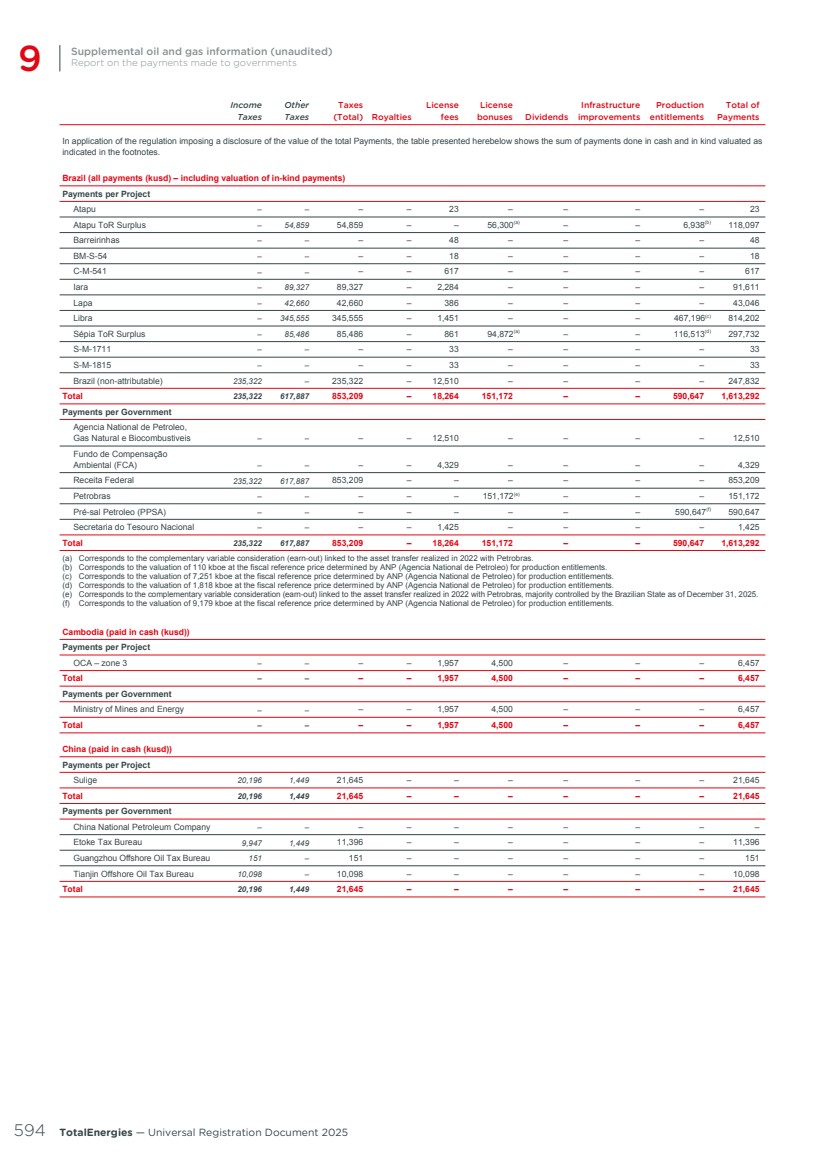
| Income Taxes Other Taxes Taxes (Total) Royalties License fees License bonuses Dividends Infrastructure improvements Production entitlements Total of Payments China (paid in kind (kboe)) Payments per Project Sulige – 601 601 – – – – – 2,409 3,010 Total – 601 601 – – – – – 2,409 3,010 Payments per Government China National Petroleum Company – – – – – – – – 2,409 2,409 Etoke Tax Bureau – 601 601 – – – – – – 601 Guangzhou Offshore Oil Tax Bureau – – – – – – – – – – Tianjin Offshore Oil Tax Bureau – – – – – – – – – – Total – 601 601 – – – – – 2,409 3,010 In application of the regulation imposing a disclosure of the value of the total Payments, the table presented herebelow shows the sum of payments done in cash and in kind valuated as indicated in the footnotes. China (all payments (kusd) – including valuation of in-kind payments) Payments per Project Sulige 20,196 18,164(a) 38,360 – – – – – 67,205(b) 105,565 Total 20,196 18,164 38,360 – – – – – 67,205 105,565 Payments per Government China National Petroleum Company – – – – – – – – 67,205(b) 67,205 Etoke Tax Bureau 9,947 18,164(a) 28,111 – – – – – – 28,111 Guangzhou Offshore Oil Tax Bureau 151 – 151 – – – – – – 151 Tianjin Offshore Oil Tax Bureau 10,098 – 10,098 – – – – – – 10,098 Total 20,196 18,164 38,360 – – – – – 67,205 105,565 (a) Includes the valuation for 16,715 k$ of 601 kboe for taxes of different natures. (b) Corresponds to the valuation of 2,409 kboe for production entitlements. Cyprus (paid in cash (kusd)) Payments per Project Block 2 – – – – 565 – – – – 565 Block 3 – – – – 847 – – – – 847 Block 6 – – – – 171 – – – – 171 Block 7 – – – – 180 – – – – 180 Block 8 – – – – 176 – – – – 176 Block 9 – – – – 610 – – – – 610 Block 11 – – – – 248 – – – – 248 Total – – – – 2,797 – – – – 2,797 Payments per Government Ministry of Energy, Commerce, Industry and Tourism – – – – 2,797 – – – – 2,797 Total – – – – 2,797 – – – – 2,797 Denmark (paid in cash (kusd)) Payments per Project Sole Concession Area 39,745 5,650 45,395 – 5,384 – – – – 50,779 Total 39,745 5,650 45,395 – 5,384 – – – – 50,779 Payments per Government Arbejdstilsynet – – – – 346 – – – – 346 Energistyrelsen – – – – 300 – – – – 300 Dansk Teknisk Universitet – – – – 4,738 – – – – 4,738 Skat 39,745 5,650 45,395 – – – – – – 45,395 Total 39,745 5,650 45,395 – 5,384 – – – – 50,779 France (paid in cash (kusd)) Payments per Project Guyane Maritime – – – – – – – 1,432 – 1,432 Total – – – – – – – 1,432 – 1,432 Payments per Government Alyse Guyane – – – – – – – 1,432 – 1,432 Total – – – – – – – 1,432 – 1,432 Supplemental oil and gas information (unaudited) Report on the payments made to governments 9 TotalEnergies — Universal Registration Document 2025 595 |
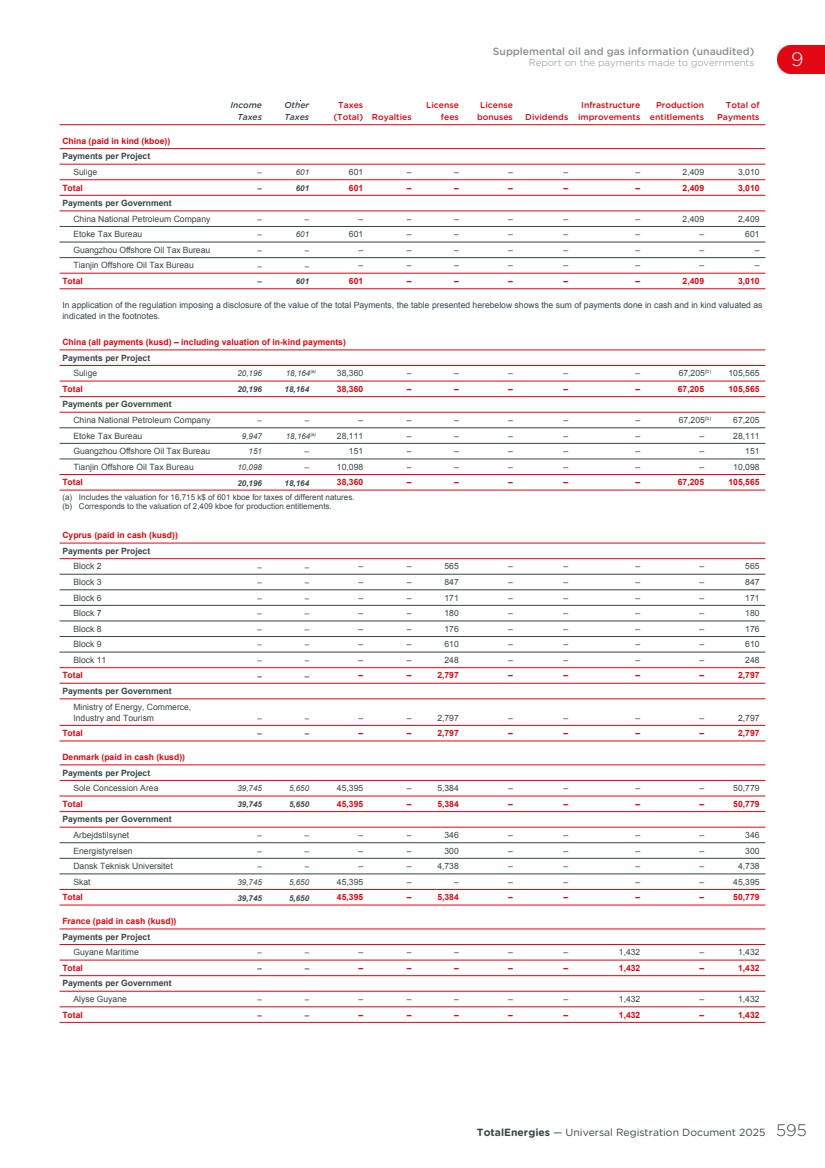
| Income Taxes Other Taxes Taxes (Total) Royalties License fees License bonuses Dividends Infrastructure improvements Production entitlements Total of Payments Gabon (paid in cash (kusd)) Payments per Project Baudroie-Mérou CEPP – 6,163 6,163 – 932 – – 2,060 – 9,155 Concessions (périmètre Convention d’Etablissement) 655 2,945 3,600 – 2,397 – – 11,171 – 17,168 Concession Anguille – 22,606 22,606 – – – – – – 22,606 Concession Torpille – 14,401 14,401 – – – – – – 14,401 Non-attributable – – – – – – 105,001 – – 105,001 Total 655 46,115 46,770 – 3,329 – 105,001 13,231 – 168,331 Payments per Government Trésor Public Gabonais 655 46,115 46,770 – 3,329 – – – – 50,099 République du Gabon – – – – – – 105,001 5,974 – 110,975 Ville de Libreville – – – – – – – 751 – 751 Ville de Port-Gentil – – – – – – – 6,445 – 6,445 Miscellaneous PID beneficiaries – – – – – – – 61 – 61 Total 655 46,115 46,770 – 3,329 – 105,001 13,231 – 168,331 Gabon (paid in kind (kboe)) Payments per Project Baudroie-Mérou CEPP 241 – 241 – – – – 1 – 242 Concessions (périmètre Convention d’Établissement) – – – – – – – – – – Concession Anguille – – – – – – – – – – Concession Torpille – – – – – – – – – – Non-attributable – – – – – – – – – – Total 241 – 241 – – – – 1 – 242 Payments per Government Trésor Public Gabonais – – – – – – – 1 – 1 République du Gabon 241 – 241 – – – – – – 241 Ville de Libreville – – – – – – – – – – Ville de Port-Gentil – – – – – – – – – – Miscellaneous PID beneficiaries – – – – – – – – – – Total 241 – 241 – – – – 1 – 242 In application of the regulation imposing a disclosure of the value of the total Payments, the table presented herebelow shows the sum of payments done in cash and in kind valuated as indicated in the footnotes. Gabon (all payments (kusd) – including valuation of in-kind payments) Payments per Project Baudroie-Mérou CEPP 16,146(a) 6,163 22,309 – 932 – – 2,111(b) – 25,352 Concessions (périmètre Convention d’Établissement) 655 2,945 3,600 – 2,397 – – 11,171(c) – 17,168 Concession Anguille – 22,606 22,606 – – – – – – 22,606 Concession Torpille – 14,401 14,401 – – – – – – 14,401 Non-attributable – – – – – – 105,001 – – 105,001 Total 16,801 46,115 62,916 – 3,329 – 105,001 13,282 – 184,528 Payments per Government Trésor Public Gabonais 655 46,115 46,770 – 3,329 – – 51(d) – 50,150 République du Gabon 16,146(a) – 16,146 – – – 105,001 5,974 – 127,121 Ville de Libreville – – – – – – – 751 – 751 Ville de Port-Gentil – – – – – – – 6,445 – 6,445 Miscellaneous PID beneficiaries – – – – – – – 61 – 61 Total 16,801 46,115 62,916 – 3,329 – 105,001 13,282 – 184,528 (a) Corresponds to the valuation of 241 kboe at the official selling price and applying the fiscal terms of the profit sharing agreements. (b) Financing of projects (infrastructure, education, health) under joint control of the State and TotalEnergies within the framework of the Provision pour Investissements Diversifiés (PID – contribution to diversified investments) and of the Provision pour Investissements dans les Hydrocarbures (PIH – contribution to investments in hydrocarbons) including the valuation for 51 kusd of 1 kbep. (c) Financing of projects (infrastructure, education, health) under joint control of the State and TotalEnergies within the framework of the Provision pour Investissements Diversifiés (PID – contribution to diversified investments) and of the Provision pour Investissements dans les Hydrocarbures (PIH – contribution to investments in hydrocarbons). (d) Corresponds to the valuation of 1 kboe for Provision pour Investissements Diversifiés (PID – contribution to diversified investments) and of the Provision pour Investissements dans les Hydrocarbures (PIH – contribution to investments in hydrocarbons). 9 Supplemental oil and gas information (unaudited) Report on the payments made to governments 596 TotalEnergies — Universal Registration Document 2025 |
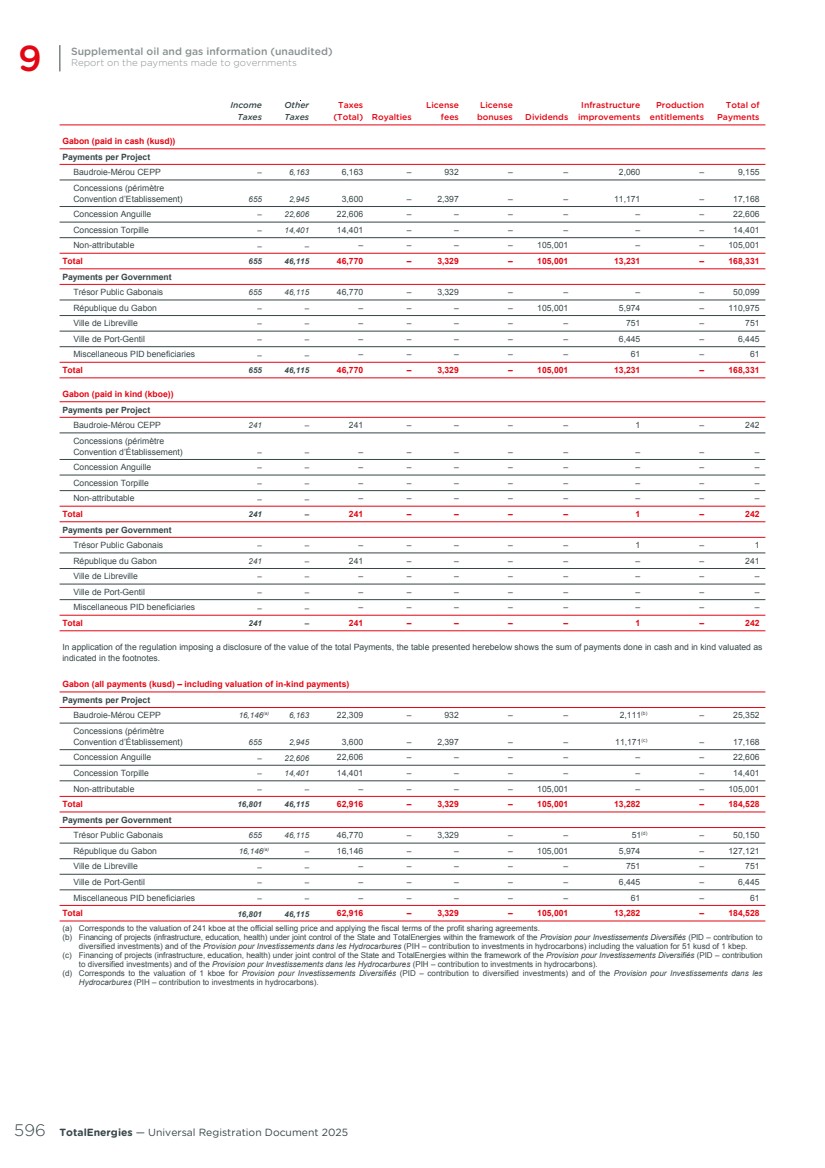
| Income Taxes Other Taxes Taxes (Total) Royalties License fees License bonuses Dividends Infrastructure improvements Production entitlements Total of Payments Guyana (paid in cash (kusd)) Payments per Project Block S4 – – – – 456 6,000 – – – 6,456 Canje – – – – 51 – – – – 51 Total – – – – 507 6,000 – – – 6,507 Payments per Government Guyana Geology and Mines Commission – – – – 507 – – – – 507 Ministry of Natural Resources – – – – – 6,000 – – – 6,000 Total – – – – 507 6,000 – – – 6,507 Indonesia (paid in cash (kusd)) Payments per Project Sebuku PSC 2,157 – 2,157 – – – – – – 2,157 Tengah PSC 207 – 207 – – – – – 2,600 2,807 Total 2,364 – 2,364 – – – – – 2,600 4,964 Payments per Government Directorate General of Taxation, Ministry of Finance 2,364 – 2,364 – – – – – – 2,364 Satuan Khusus Kegiatan Usaha Hulu Minyak dan Gas Bumi (SKK Migas) – – – – – – – – 2,600 2,600 Total 2,364 – 2,364 – – – – – 2,600 4,964 Indonesia (paid in kind (kboe)) Payments per Project Sebuku PSC – – – – – – – – 43 43 Tengah PSC – – – – – – – – – – Total – – – – – – – – 43 43 Payments per Government Directorate General of Taxation, Ministry of Finance – – – – – – – – – – Satuan Khusus Kegiatan Usaha Hulu Minyak dan Gas Bumi (SKK Migas) – – – – – – – – 43 43 Total – – – – – – – – 43 43 In application of the regulation imposing a disclosure of the value of the total Payments, the table presented herebelow shows the sum of payments done in cash and in kind valuated as indicated in the footnotes. Indonesia (all payments (kusd) – including valuation of in-kind payments) Payments per Project Sebuku PSC 2,157 – 2,157 – – – – – 1,951(a) 4,108 Tengah PSC 207(b) – 207 – – – – – 2,600(b) 2,807 Total 2,364 – 2,364 – – – – – 4,551 6,915 Payments per Government Directorate General of Taxation, Ministry of Finance 2,364(c) – 2,364 – – – – – – 2,364 Satuan Khusus Kegiatan Usaha Hulu Minyak dan Gas Bumi (SKK Migas) – – – – – – – – 4,551(d) 4,551 Total 2,364 – 2,364 – – – – – 4,551 6,915 (a) Corresponds to the valuation at net-back price of 43 kboe for production entitlements. (b) Corresponds to the terms defined in 2025 on exit of Tengah PSC in 2018. (c) Includes 207 k$ of income taxes as per the settlement terms agreed beginning of 2025 following Tengah PSC exit in 2018. (d) Includes the valuation at net-back price for 1,951 kusd of 43 kboe for production entitlements and 2,600 k$ as per the settlement terms agreed beginning of 2025 following Tengah PSC exit in 2018. Supplemental oil and gas information (unaudited) Report on the payments made to governments 9 TotalEnergies — Universal Registration Document 2025 597 |
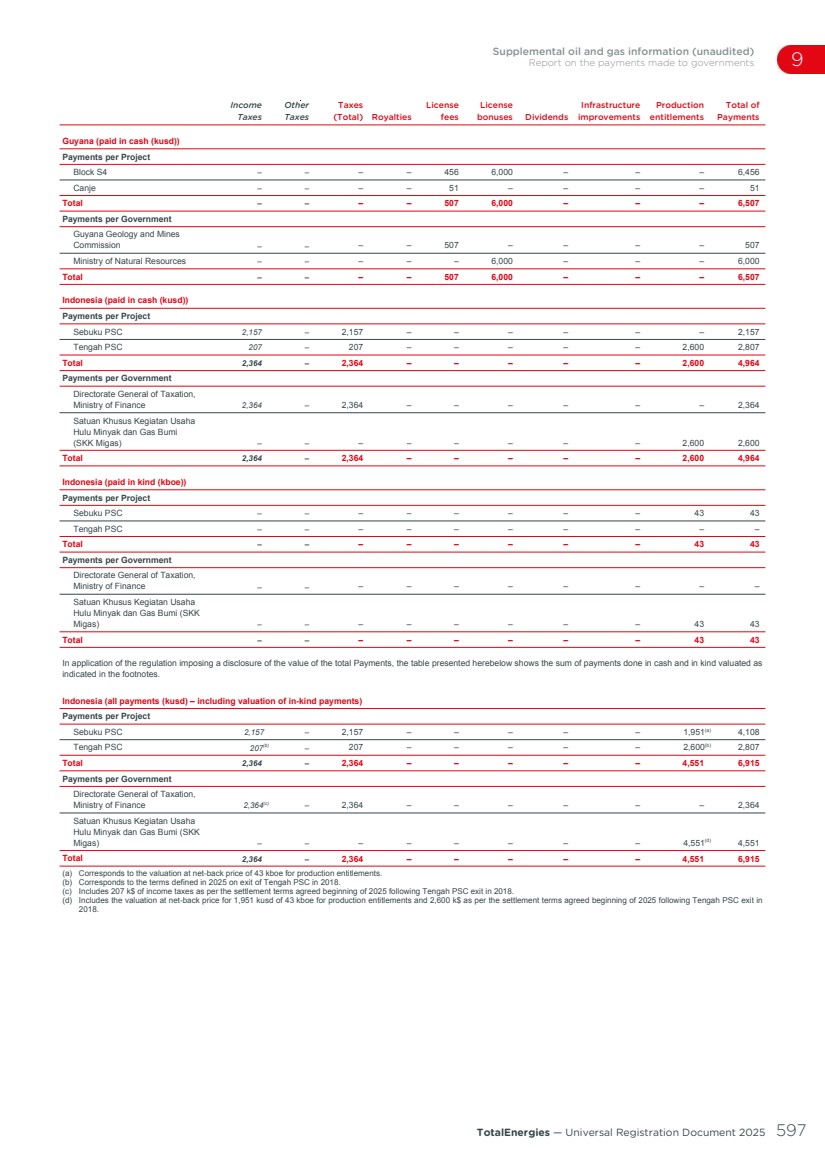
| Income Taxes Other Taxes Taxes (Total) Royalties License fees License bonuses Dividends Infrastructure improvements Production entitlements Total of Payments Iraq (paid in cash (kusd)) Payments per Project GGIP – – – – – – – – – – Halfaya – – – – – – – – – – Total – – – – – – – – – – Payments per Government Iraqi General Commision for Tax-Corporate Division, via Iraqi Ministery of Oil – – – – – – – – – – Ministry of Finance, General Commission of Taxation – – – – – – – – – – Total – – – – – – – – – – Iraq (paid in kind (kboe)) Payments per Project GGIP 520 – 520 2,427 – – – – – 2,947 Halfaya 207 – 207 – – – – – – 207 Total 727 – 727 2,427 – – – – – 3,154 Payments per Government Iraqi General Commision for Tax-Corporate Division, via Iraqi Ministery of Oil 520 – 520 2,427 – – – – – 2,947 Ministry of Finance, General Commission of Taxation 207 – 207 – – – – – – 207 Total 727 – 727 2,427 – – – – – 3,154 In application of the regulation imposing a disclosure of the value of the total Payments, the table presented herebelow shows the sum of payments done in cash and in kind valuated as indicated in the footnotes. Iraq (all payments (kusd) – including valuation of in-kind payments) Payments per Project GGIP 39,065(a) – 39,065 162,552(b) – – – – – 201,617 Halfaya 15,572(c) – 15,572 – – – – – – 15,572 Total 54,637 – 54,637 162,552 – – – – – 217,189 Payments per Government Iraqi General Commision for Tax-Corporate Division, via Iraqi Ministery of Oil 39,065(a) – 39,065 162,552(b) – – – – – 201,617 Ministry of Finance, General Commission of Taxation 15,572(c) – 15,572 – – – – – – 15,572 Total 54,637 – 54,637 162,552 – – – – – 217,189 (a) Corresponds to the valuation of 520 kboe based on official prices for Income taxes. (b) Corresponds to the valuation of 2,427 kboe based on official prices for royalties. (c) Corresponds to the valuation of 207 kboe based on official prices for Income taxes. Italy (paid in cash (kusd)) Payments per Project Gorgoglione Unified License 33,807 64,658(a) 98,465 – 15,672 – – – – 114,137 Total 33,807 64,658 98,465 – 15,672 – – – – 114,137 Payments per Government Regione Basilicata – 45,637(a) 45,637 – 15,026 – – – – 60,663 Agenzia delle Entrate 33,807 – 33,807 – – – – – – 33,807 Comune Corleto Perticara – 4,274 4,274 – 216 – – – – 4,490 Comune Gorgoglione – 658 658 – 4 – – – – 662 Ministero dell’Economia e delle Finanze – – – – 426 – – – – 426 Tesoreria dello Stato – 14,089 14,089 – – – – – – 14,089 Total 33,807 64,658 98,465 – 15,672 – – – – 114,137 (a) Includes payment for the domestic gas supply obligation. 9 Supplemental oil and gas information (unaudited) Report on the payments made to governments 598 TotalEnergies — Universal Registration Document 2025 |
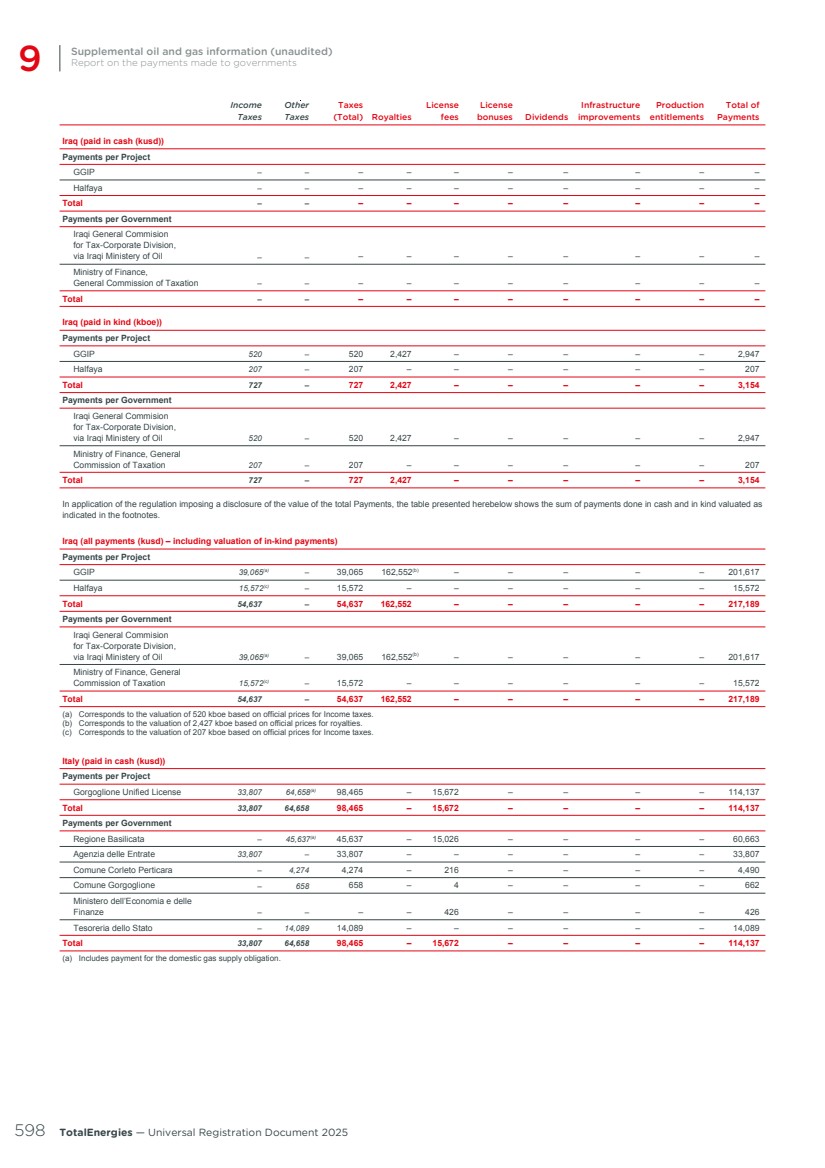
| Income Taxes Other Taxes Taxes (Total) Royalties License fees License bonuses Dividends Infrastructure improvements Production entitlements Total of Payments Kazakhstan (paid in cash (kusd)) Payments per Project Kashagan – 111,628 111,628 – – – – 2,954 – 114,582 Total – 111,628 111,628 – – – – 2,954 – 114,582 Payments per Government Atyrau region c/o North Caspian Operating Company b.v. – – – – – – – 1,943 – 1,943 Mangistau region c/o North Caspian Operating Company b.v. – – – – – – – 1,011 – 1,011 Ministry of Finance – 111,628 111,628 – – – – – – 111,628 Ministry of Energy – – – – – – – – – – Total – 111,628 111,628 – – – – 2,954 – 114,582 Kazakhstan (paid in kind (kboe)) Payments per Project Kashagan – – – – – – – – 463 463 Total – – – – – – – – 463 463 Payments per Government Atyrau region c/o North Caspian Operating Company b.v. – – – – – – – – – – Mangistau region c/o North Caspian Operating Company b.v. – – – – – – – – – – Ministry of Finance – – – – – – – – – – Ministry of Energy – – – – – – – – 463 463 Total – – – – – – – – 463 463 In application of the regulation imposing a disclosure of the value of the total Payments, the table presented herebelow shows the sum of payments done in cash and in kind valuated as indicated in the footnotes. Kazakhstan (all payments (kusd) – including valuation of in-kind payments) Payments per Project Kashagan – 111,628 111,628 – – – – 2,954 29,391(a) 143,973 Total – 111,628 111,628 – – – – 2,954 29,391 143,973 Payments per Government Atyrau region c/o North Caspian Operating Company b.v. – – – – – – – 1,943 – 1,943 Mangistau region c/o North Caspian Operating Company b.v. – – – – – – – 1,011 – 1,011 Ministry of Finance – 111,628 111,628 – – – – – – 111,628 Ministry of Energy – – – – – – – – 29,391(a) 29,391 Total – 111,628 111,628 – – – – 2,954 29,391 143,973 (a) Corresponds to the valuation of 463 kboe at average net-back prices for production entitlements. Lebanon (paid in cash (kusd)) Payments per Project Block 9 – – – – 107 – – – – 107 Total – – – – 107 – – – – 107 Payments per Government Lebanese Petroleum Administration (LPA) – – – – 107 – – – – 107 Total – – – – 107 – – – – 107 Libya (paid in cash (kusd)) Payments per Project Areas 15, 16 & 32 (Al Jurf) – – – – 4,033 – – – – 4,033 Areas 70 & 87 – – – – – – – – – – Areas 129 & 130 – – – – 4,425 – – – – 4,425 Areas 130 & 131 – – – – 1,447 – – – – 1,447 Waha – 1,680,727 1,680,727 – 81 – – – – 1,680,808 Total – 1,680,727 1,680,727 – 9,986 – – – – 1,690,713 Payments per Government National Oil Corporation – – – – 9,905 – – – – 9,905 Ministry of Finance c/o National Oil Corporation – – – – – – – – – – Ministry of Oil and Gas – 1,680,727 1,680,727 – 81 – – – – 1,680,808 Total – 1,680,727 1,680,727 – 9,986 – – – – 1,690,713 Supplemental oil and gas information (unaudited) Report on the payments made to governments 9 TotalEnergies — Universal Registration Document 2025 599 |
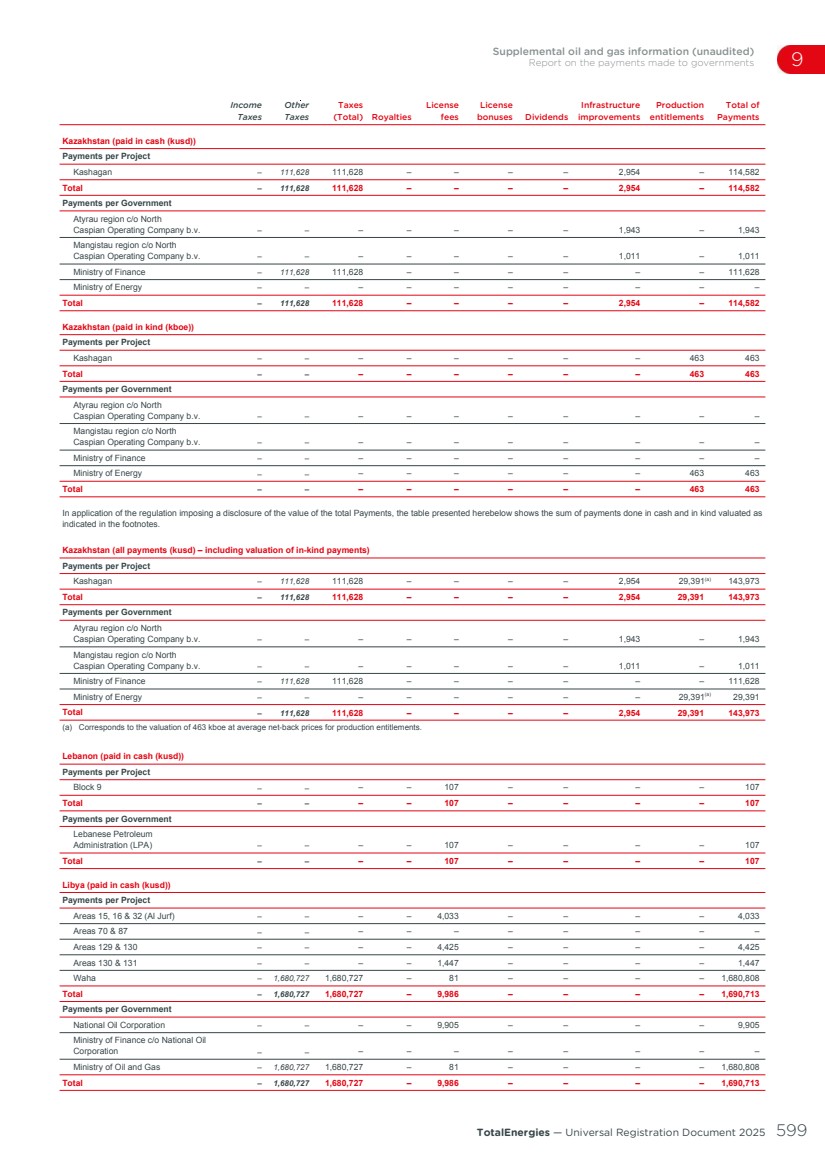
| Income Taxes Other Taxes Taxes (Total) Royalties License fees License bonuses Dividends Infrastructure improvements Production entitlements Total of Payments Libya (paid in kind (kboe)) Payments per Project Areas 15, 16 & 32 (Al Jurf) 1,219 153 1,372 – – – – – 1,689 3,061 Areas 70 & 87 230 45 276 – – – – – 844 1,119 Areas 129 & 130 4,460 442 4,902 – – – – – 14,815 19,716 Areas 130 & 131 1,450 159 1,609 – – – – – 6,083 7,693 Waha – – – – – – – – – – Total 7,360 799 8,159 – – – – – 23,431 31,590 Payments per Government National Oil Corporation – – – – – – – – 23,431 23,431 Ministry of Finance c/o National Oil Corporation 7,360 799 8,159 – – – – – – 8,159 Ministry of Oil and Gas – – – – – – – – – – Total 7,360 799 8,159 – – – – – 23,431 31,590 In application of the regulation imposing a disclosure of the value of the total Payments, the table presented herebelow shows the sum of payments done in cash and in kind valuated as indicated in the footnotes. Libya (all payments (kusd) – including valuation of in-kind payments) Payments per Project Areas 15, 16 & 32 (Al Jurf) 83,809(a) 10,495(b) 94,304 – 4,033 – – – 116,099(c) 214,436 Areas 70 & 87 15,902(d) 3,128(e) 19,030 – – – – – 58,218(f) 77,248 Areas 129 & 130 305,513(g) 30,257(h) 335,770 – 4,425 – – – 1,014,809(i) 1,355,004 Areas 130 & 131 99,325(j) 10,912(k) 110,237 – 1,447 – – – 416,705(l) 528,389 Waha – 1,680,727 1,680,727 – 81 – – – – 1,680,808 Total 504,549 1,735,519 2,240,068 – 9,986 – – – 1,605,831 3,855,885 Payments per Government National Oil Corporation – – – – 9,905(m) – – – 1,605,831(n) 1,615,736 Ministry of Finance c/o National Oil Corporation 504,549(o) 54,792(p) 559,341 – – – – – – 559,341 Ministry of Oil and Gas – 1,680,727 1,680,727 – 81 – – – – 1,680,808 Total 504,549 1,735,519 2,240,068 – 9,986 – – – 1,605,831 3,855,885 (a) Corresponds to the valuation of 1,219 kboe at official selling prices and applying the fiscal terms of the profit sharing agreements. (b) Corresponds to the valuation of 153 kboe at official selling prices and applying the fiscal terms of the profit sharing agreements. (c) Corresponds to the valuation of 1,689 kboe at official selling prices and applying the profit sharing agreements, including the share of National Oil Corporation, as partner. (d) Corresponds to the valuation of 230 kboe at official selling prices and applying the fiscal terms of the profit sharing agreements. (e) Corresponds to the valuation of 45 kboe at official selling prices and applying the fiscal terms of the profit sharing agreements. (f) Corresponds to the valuation of 844 kboe at official selling prices and applying the profit sharing agreements, including the share of National Oil Corporation, as partner. (g) Corresponds to the valuation of 4,460 kboe at official selling prices and applying the fiscal terms of the profit sharing agreements. (h) Corresponds to the valuation of 442 kboe at official selling prices and applying the fiscal terms of the profit sharing agreements. (i) Corresponds to the valuation of 14,815 kboe at official selling prices and applying the profit sharing agreements, including the share of National Oil Corporation, as partner. (j) Corresponds to the valuation of 1,450 kboe at official selling prices and applying the fiscal terms of the profit sharing agreements. (k) Corresponds to the valuation of 159 kboe at official selling prices and applying the fiscal terms of the profit sharing agreements. (l) Corresponds to the valuation of 6,083 kboe at official selling prices and applying the profit sharing agreements, including the share of National Oil Corporation, as partner. (m) Corresponds to ARO obligations (Areas 15, 16, 32, 129, 130 and 131). (n) Corresponds to the valuation of 23,431 kboe at official selling prices and applying the profit sharing agreements, including the share of National Oil Corporation, as partner. (o) Corresponds to the valuation of 7,360 kboe at official selling prices and applying the fiscal terms of the profit sharing agreements. (p) Corresponds to the valuation of 799 kboe at official selling prices and applying the fiscal terms of the profit sharing agreements. Malaysia (paid in cash (kusd)) Payments per Project SB3K – – – – – 51,054 – – – 51,054 SB409 – – – – – 14,307 – – – 14,307 SB412 1 – 1 – – – – – – 1 SK302a – – – – – 38 – – – 38 SK303a – – – – – 72 – – – 72 SK310 4,224 956 5,180 6 175 – – – – 5,361 SK310 & SK408 – 3,886 3,886 – – – – – – 3,886 SK313 – – – – – 63,135 – – – 63,135 SK328 – – – – – 69 – – – 69 SK408 75,563 7,457 83,020 66 1,697 282,903 – – – 367,686 Malaysia (non-attributable) 15 – 15 – – – – – – 15 Total 79,803 12,299 92,102 72 1,872 411,578 – – – 505,624 Payments per Government Ketua Pengarah Hasil Dalam Negeri 79,803 – 79,803 – – – – – – 79,803 Petronas – 8,413 8,413 72 1,872 – – – – 10,357 Petronas Carigali Sdn Bhd – – – – – 411,578 – – – 411,578 Sarawak State Treasury Department – 3,886 3,886 – – – – – – 3,886 Total 79,803 12,299 92,102 72 1,872 411,578 – – – 505,624 9 Supplemental oil and gas information (unaudited) Report on the payments made to governments 600 TotalEnergies — Universal Registration Document 2025 |
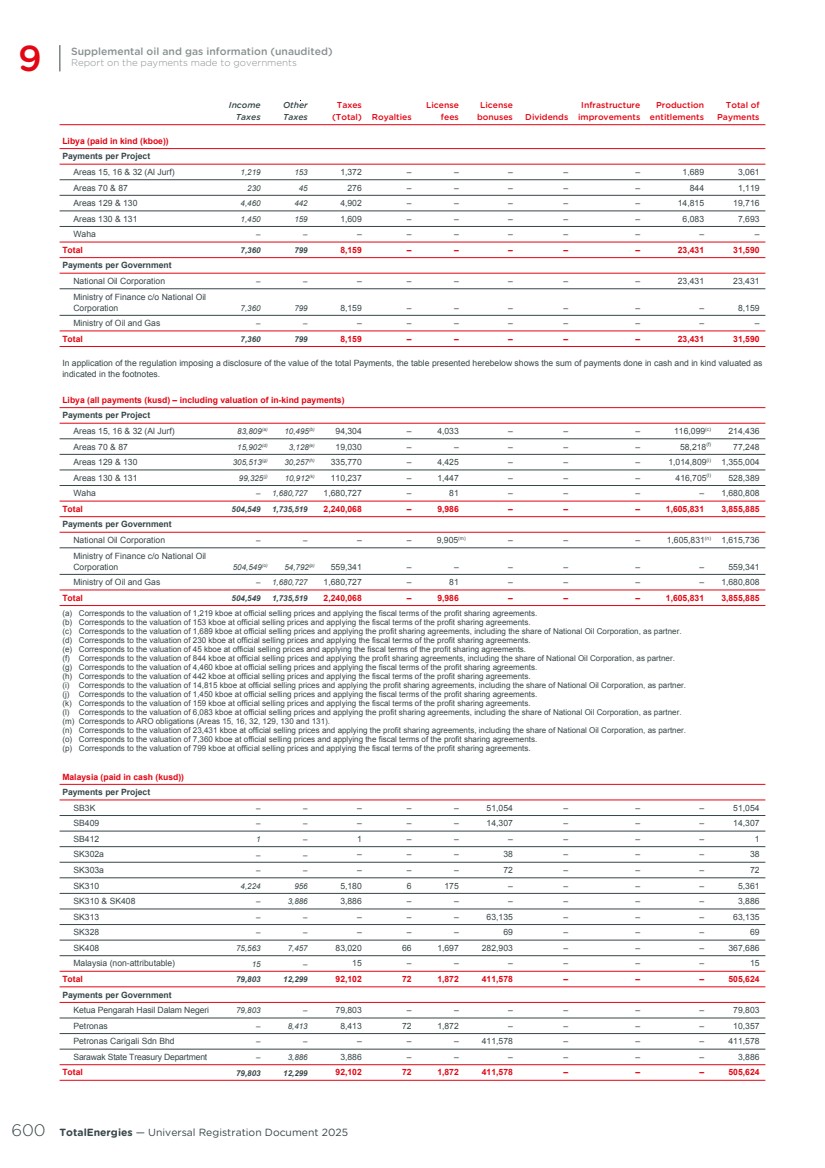
| Income Taxes Other Taxes Taxes (Total) Royalties License fees License bonuses Dividends Infrastructure improvements Production entitlements Total of Payments Malaysia (paid in kind (kboe)) Payments per Project SB3K – – – – – – – – – – SB409 – – – – – – – – – – SB412 – – – – – – – – – – SK302a – – – – – – – – – – SK303a – – – – – – – – – – SK310 – – – 225 – – – – 557 782 SK310 & SK408 – – – – – – – – – – SK313 – – – – – – – – – – SK328 – – – – – – – – – – SK408 – – – 1,818 – – – – 4,446 6,265 Malaysia (non-attributable) – – – – – – – – – – Total – – – 2,044 – – – – 5,003 7,047 Payments per Government Ketua Pengarah Hasil Dalam Negeri – – – – – – – – – – Petronas – – – 2,044 – – – – 5,003 7,047 Petronas Carigali Sdn Bhd – – – – – – – – – – Sarawak State Treasury Department – – – – – – – – – – Total – – – 2,044 – – – – 5,003 7,047 In application of the regulation imposing a disclosure of the value of the total Payments, the table presented herebelow shows the sum of payments done in cash and in kind valuated as indicated in the footnotes. Malaysia (all payments (kusd) – including valuation of in-kind payments) Payments per Project SB3K – – – – – 51,054 – – – 51,054 SB409 – – – – – 14,307 – – – 14,307 SB412 1 – 1 – – – – – – 1 SK302a – – – – – 38 – – – 38 SK303a – – – – – 72 – – – 72 SK310 4,224 956 5,180 5,157(a) 175 – – – 13,263(b) 23,775 SK310 & SK408 – 3,886 3,886 – – – – – – 3,886 SK313 – – – – – 63,135 – – – 63,135 SK328 – – – – – 69 – – – 69 SK408 75,563 7,457 83,020 47,656(c) 1,697 282,903 – – 124,463(d) 539,739 Malaysia (non-attributable) 15 – 15 – – – – – – 15 Total 79,803 12,299 92,102 52,813 1,872 411,578 – – 137,726 696,091 Payments per Government Ketua Pengarah Hasil Dalam Negeri 79,803 – 79,803 – – – – – – 79,803 Petronas – 8,413 8,413 52,813(e) 1,872 – – – 137,726(f) 200,824 Petronas Carigali Sdn Bhd – – – – – 411,578 – – – 411,578 Sarawak State Treasury Department – 3,886 3,886 – – – – – – 3,886 Total 79,803 12,299 92,102 52,813 1,872 411,578 – – 137,726 696,091 (a) Includes the valuation for 5,151 k$ of 225 kboe at average contractual price and applying the contractual terms for the royalties. (b) Corresponds to the valuation of 557 kboe at average contractual price and applying the contractual terms for production entitlements. (c) includes the valuation for 47,590 k$ of 1,818 kboe at average contractual price and applying the contractual terms for the Royalties. (d) Corresponds to the valuation of 4,446 kboe at average contractual price and applying the contractual terms for production entitlements. (e) Includes the valuation for 52,741 k$ of 2,044 kboe at average contractual price and applying the contractual terms for the Royalties. (f) Corresponds to the valuation of 5,003 kboe at average contractual price and applying the contractual terms for production entitlements. Mexico (paid in cash (kusd)) Payments per Project AS-CS-06 (B33) – 301 301 – 413 – – – – 714 Block 15 – 125 125 – 229 – – – – 354 Total – 426 426 – 642 – – – – 1,068 Payments per Government Servicio de Administracion Tributaria – 426 426 – – – – – – 426 Fondo Mexicano del Petroleo – – – – 642 – – – – 642 Total – 426 426 – 642 – – – – 1,068 Supplemental oil and gas information (unaudited) Report on the payments made to governments 9 TotalEnergies — Universal Registration Document 2025 601 |
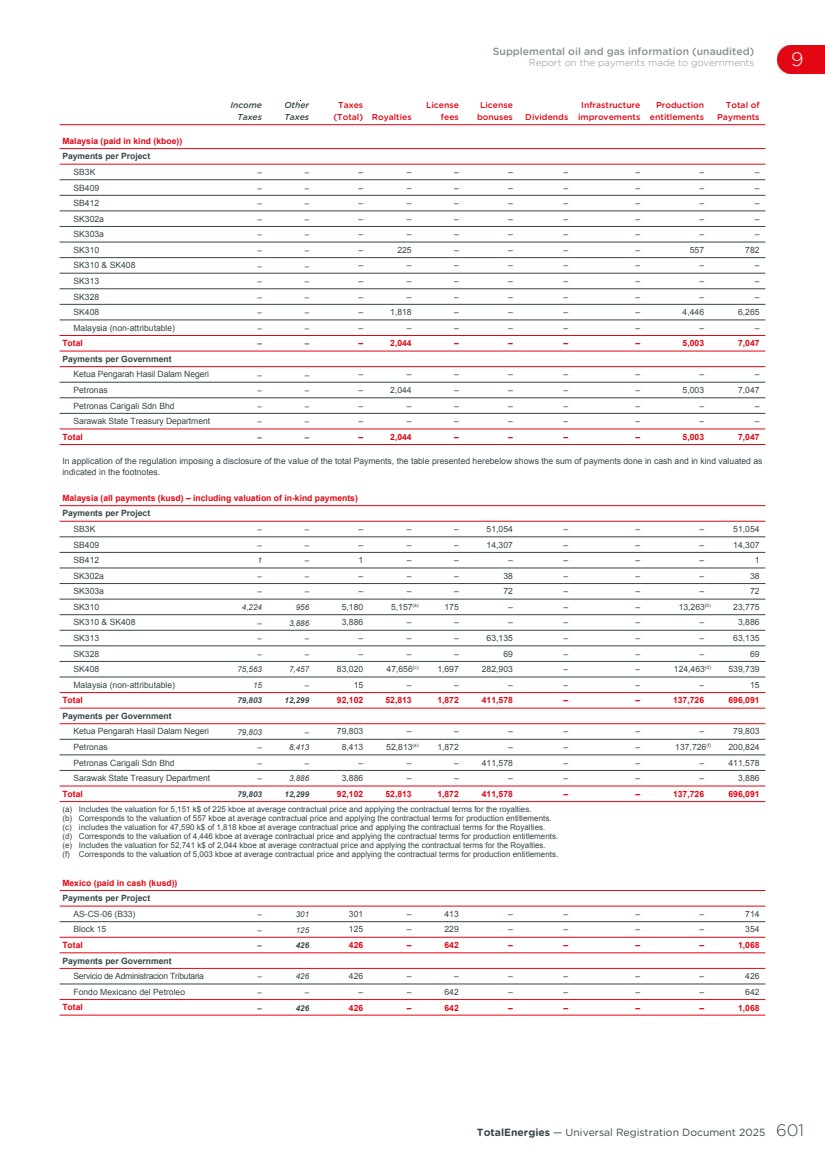
| Income Taxes Other Taxes Taxes (Total) Royalties License fees License bonuses Dividends Infrastructure improvements Production entitlements Total of Payments Mozambique (paid in cash (kusd)) Payments per Project Area 1 Golfino-Atum – – – – 530 – – 3,180 – 3,710 Total – – – – 530 – – 3,180 – 3,710 Payments per Government Instituto Nacional de Petroleo – – – – 530 – – – – 530 Ministerio da Economia e Financas – – – – – – – 3,180 – 3,180 Total – – – – 530 – – 3,180 – 3,710 Namibia (paid in cash (kusd)) Payments per Project PEL 56 – – – – 100 – – – – 100 PEL 91 – – – – 101 – – – – 101 Total – – – – 201 – – – – 201 Payments per Government Petrofund – – – – 201 – – – – 201 Total – – – – 201 – – – – 201 Netherlands (paid in cash (kusd)) Payments per Project Offshore Blocks – – – – 799 – – – – 799 Non-attributable 147,949 – 147,949 – – – – – – 147,949 Total 147,949 – 147,949 – 799 – – – – 148,748 Payments per Government Belastingdienst Nederland 147,949 – 147,949 – 799 – – – – 148,748 Total 147,949 – 147,949 – 799 – – – – 148,748 Nigeria (paid in cash (kusd)) Payments per Project OML58 (joint venture with NNPC, operated) 32,653 – 32,653 – – – – – – 32,653 OML99 (joint venture with NNPC, operated) 56,537 – 56,537 – – – – – – 56,537 OML100 (joint venture with NNPC, operated) 10,724 – 10,724 – – – – – – 10,724 OML102 (joint venture with NNPC, operated) 107,509 – 107,509 – – – – – – 107,509 OML118 (Bonga) 4,451 – 4,451 – 35,984 – – 7,059 – 47,494 OML138 (Usan) 1,505 – 1,505 – 3,706 – – 4,883 – 10,094 PMLs 2/3/4 & PPL 261 PSA (Akpo & Egina) 189,116 57,527 246,643 – 1,824 – – 6,914 – 255,381 PPL 2000/2001 – – – – – 8,000 – – – 8,000 Joint ventures with NNPC, operated – non-attributable – – – – 3,262 – – 13,783 – 17,045 Joint ventures with NNPC, non operated – non-attributable 100,454 – 100,454 – 6,935 – – 8,097 – 115,486 Non-attributable 284,634 – 284,634 – 3,955 – – – – 288,589 Total 787,583 57,527 845,110 – 55,666 8,000 – 40,736 – 949,512 Payments per Government Federal Inland Revenue Service 479,706 – 479,706 – 3,955 – – – – 483,661 Niger Delta Development Commission – – – – – – – 40,736 – 40,736 Nigerian Maritime Administration & Safety Agency, Federal Government of Nigeria – – – – 976 – – – – 976 Nigerian National Petroleum Corporation – – – – – – – – – – Nigerian Upstream Petroleum Regulatory Commission 307,877 57,527 365,404 – 50,735 8,000 – – – 424,139 Nigerian Upstream Petroleum Regulatory Commission c/o Nigerian National Petroleum Corporation Ltd – – – – – – – – – – Federal Inland Revenue Service c/o Nigerian National Petroleum Corporation – – – – – – – – – – Total 787,583 57,527 845,110 – 55,666 8,000 – 40,736 – 949,512 9 Supplemental oil and gas information (unaudited) Report on the payments made to governments 602 TotalEnergies — Universal Registration Document 2025 |
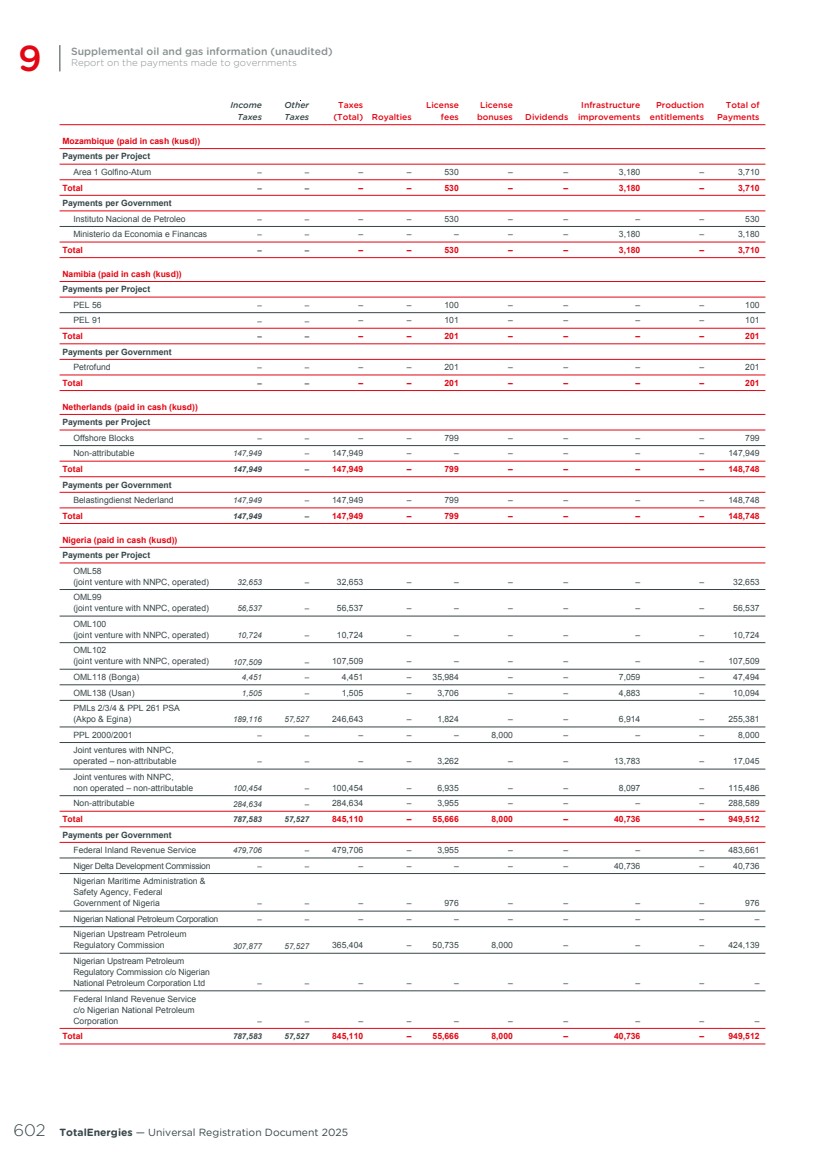
| Income Taxes Other Taxes Taxes (Total) Royalties License fees License bonuses Dividends Infrastructure improvements Production entitlements Total of Payments Nigeria (paid in kind (kboe)) Payments per Project OML58 (joint venture with NNPC, operated) – – – – – – – – – – OML99 (joint venture with NNPC, operated) – – – – – – – – – – OML100 (joint venture with NNPC, operated) – – – – – – – – – – OML102 (joint venture with NNPC, operated) – – – – – – – – – – OML118 (Bonga) 209 615 823 – 1 – – – 1,270 2,094 OML138 (Usan) – 243 243 – 0 – – – 162 405 PMLs 2/3/4 & PPL 261 PSA (Akpo & Egina) – – – – – – – – – – PPL 2000/2001 – – – – – – – – – – Joint ventures with NNPC, operated – non-attributable – – – – – – – – – – Joint ventures with NNPC, non operated – non-attributable – – – – – – – – – – Non-attributable – – – – – – – – – – Total 209 858 1,066 – 1 – – – 1,432 2,499 Payments per Government Federal Inland Revenue Service – – – – – – – – – – Niger Delta Development Commission – – – – – – – – – – Nigerian Maritime Administration & Safety Agency, Federal Government of Nigeria – – – – – – – – – – Nigerian National Petroleum Corporation – – – – – – – – 1,432 1,432 Nigerian Upstream Petroleum Regulatory Commission – – – – – – – – – – Nigerian Upstream Petroleum Regulatory Commission c/o Nigerian National Petroleum Corporation Ltd – 858 858 – 1 – – – – 859 Federal Inland Revenue Service c/o Nigerian National Petroleum Corporation 209 – 209 – – – – – – 209 Total 209 858 1,066 – 1 – – – 1,432 2,499 Supplemental oil and gas information (unaudited) Report on the payments made to governments 9 TotalEnergies — Universal Registration Document 2025 603 |
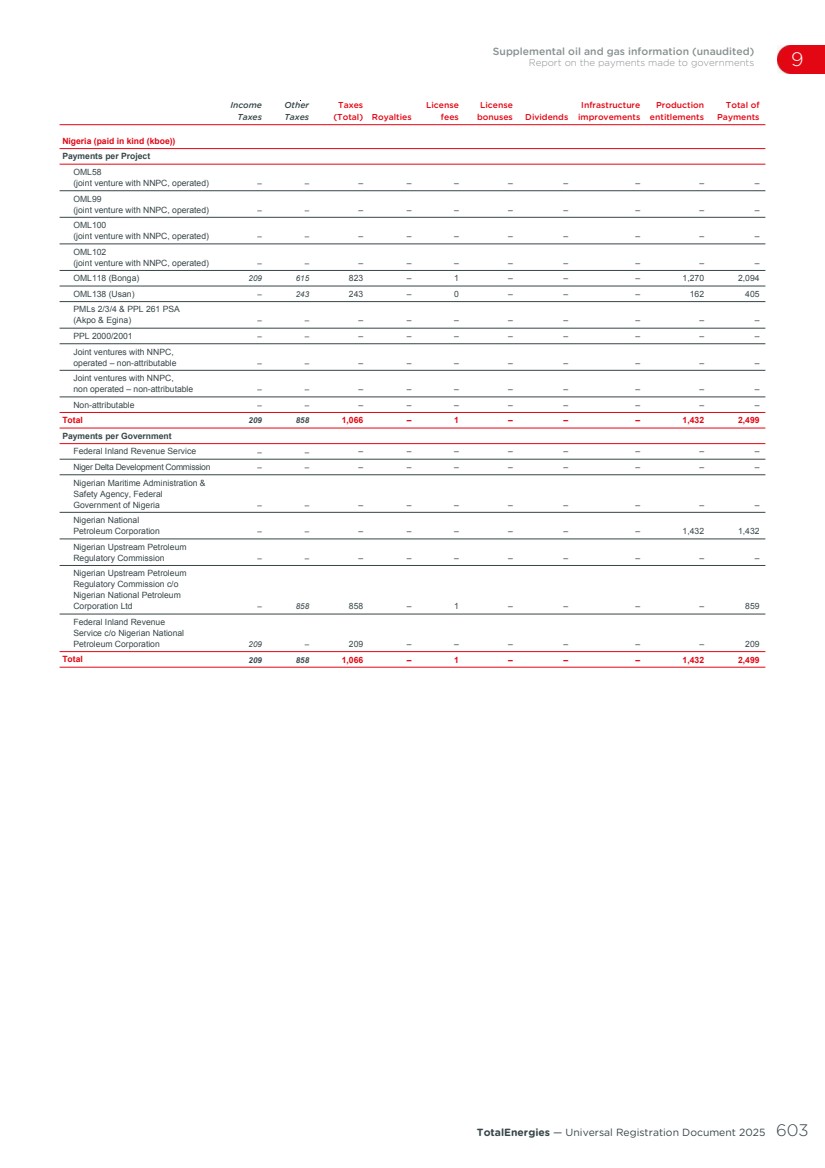
| Income Taxes Other Taxes Taxes (Total) Royalties License fees License bonuses Dividends Infrastructure improvements Production entitlements Total of Payments In application of the regulation imposing a disclosure of the value of the total Payments, the table presented herebelow shows the sum of payments done in cash and in kind valuated as indicated in the footnotes. Nigeria (all payments (kusd) – including valuation of in-kind payments) Payments per Project OML58 (joint venture with NNPC, operated) 32,653 – 32,653 – – – – – – 32,653 OML99 (joint venture with NNPC, operated) 56,537 – 56,537 – – – – – – 56,537 OML100 (joint venture with NNPC, operated) 10,724 – 10,724 – – – – – – 10,724 OML102 (joint venture with NNPC, operated) 107,509 – 107,509 – – – – – – 107,509 OML118 (Bonga) 17,813(a) 43,401(b) 61,214 – 36,055(c) – – 7,059 81,388(d) 185,716 OML138 (Usan) 1,505 16,807(e) 18,312 – 3,716(f) – – 4,883 11,179(g) 38,090 PMLs 2/3/4 & PPL 261 PSA (Akpo & Egina) 189,116 57,527 246,643 – 1,824 – – 6,914 – 255,381 PPL 2000/2001 – – – – – 8,000 – – – 8,000 Joint ventures with NNPC, operated – non-attributable – – – – 3,262 – – 13,783 – 17,045 Joint ventures with NNPC, non operated – non-attributable 100,454 – 100,454 – 6,935 – – 8,097 – 115,486 Non-attributable 284,634(h) – 284,634 – 3,955 – – – – 288,589 Total 800,945 117,735 918,680 – 55,747 8,000 – 40,736 92,567 1,115,730 Payments per Government Federal Inland Revenue Service 479,706 – 479,706 – 3,955 – – – – 483,661 Niger Delta Development Commission – – – – – – – 40,736 – 40,736 Nigerian Maritime Administration & Safety Agency, Federal Government of Nigeria – – – – 976 – – – – 976 Nigerian National Petroleum Corporation – – – – – – – – 92,567(i) 92,567 Nigerian Upstream Petroleum Regulatory Commission 307,877 57,527 365,404 – 50,735(j) 8,000 – – – 424,139 Nigerian Upstream Petroleum Regulatory Commission c/o Nigerian National Petroleum Corporation Ltd – 60,208(k) 60,208 – 81(l) – – – – 60,289 Federal Inland Revenue Service c/o Nigerian National Petroleum Corporation 13,362(m) – 13,362 – – – – – – 13,362 Total 800,945 117,735 918,680 – 55,747 8,000 – 40,736 92,567 1,115,730 (a) Includes the valuation for 13,362 k$ of 209 kboe at average entitlement price and applying the fiscal terms of the profit sharing agreements. (b) Corresponds to the valuation for 615 kboe at average entitlement price and applying the terms of the profit sharing agreements. (c) Includes the valuation for 71 k$ of 1 kboe at average entitlement price of the period of barrels allocation and applying the terms of the profits sharing agreements and 35.7 M$ consent fees related to Bonga disposal ultimately supported by buyers. (d) Corresponds to the valuation for 1,270 kboe at average entitlement price and applying the terms of the profit sharing agreements. (e) Corresponds to the valuation for 243 kboe at average entitlement price and applying the terms of the profit sharing agreements. (f) Includes the valuation for 10 k$ of 146 boe at average entitlement price of the period of barrels allocation and applying the terms of the profits sharing agreements. (g) Corresponds to the valuation for 162 kboe at average entitlement price and applying the terms of the profit sharing agreements. (h) This amount includes the tax implications of the provisions of the Modified Carry Agreement (MCA). Under the MCA, TotalEnergies EP Nigeria is entitled to recover 85% of the Carry Capital Cost through claims of capital allowance, described in the MCA as “Carry Tax Relief”. The balance of 15% is to be recovered from NNPC’s share of crude oil produced. (i) Corresponds to the valuation for 1,432 kboe at average entitlement price and applying the terms of the profit sharing agreements. (j) Includes 35.7 M$ consent fees related to Bonga disposal ultimately supported by buyers. (k) Corresponds to the valuation for 858 kboe at average entitlement price and applying the fiscal terms of the profit sharing agreements. (l) Corresponds to the valuation for 1,154 boe at average entitlement price of the period of barrels allocation and applying the terms of the profits sharing agreements. (m) Corresponds to the valuation for 209 kboe at average entitlement price and applying the fiscal terms of the profit sharing agreements. Norway (paid in cash (kusd)) Payments per Project Åsgard area – 8,335 8,335 – 408 – – – – 8,743 Ekofisk area – 28,410 28,410 – 1,567 – – – – 29,977 Johan Sverdrup – 115 115 – 56 – – – – 171 Oseberg area – 14,517 14,517 – 676 – – – – 15,193 PL018C – – – – (28)(a) – – – – (28) Snøhvit area – 12,691 12,691 – 52 – – – – 12,743 Troll area – 2,044 2,044 – 118 – – – – 2,162 Non-attributable 3,368,392 – 3,368,392 – – – – – – 3,368,392 Total 3,368,392 66,112 3,434,504 – 2,849 – – – – 3,437,353 Payments per Government Norwegian Tax Administration 3,368,392 66,112 3,434,504 – – – – – – 3,434,504 Norwegian Petroleum Directorate – – – – 2,849 – – – – 2,849 Total 3,368,392 66,112 3,434,504 – 2,849 – – – – 3,437,353 (a) Corresponds to reimbursement of fees following PL018C disposal 9 Supplemental oil and gas information (unaudited) Report on the payments made to governments 604 TotalEnergies — Universal Registration Document 2025 |
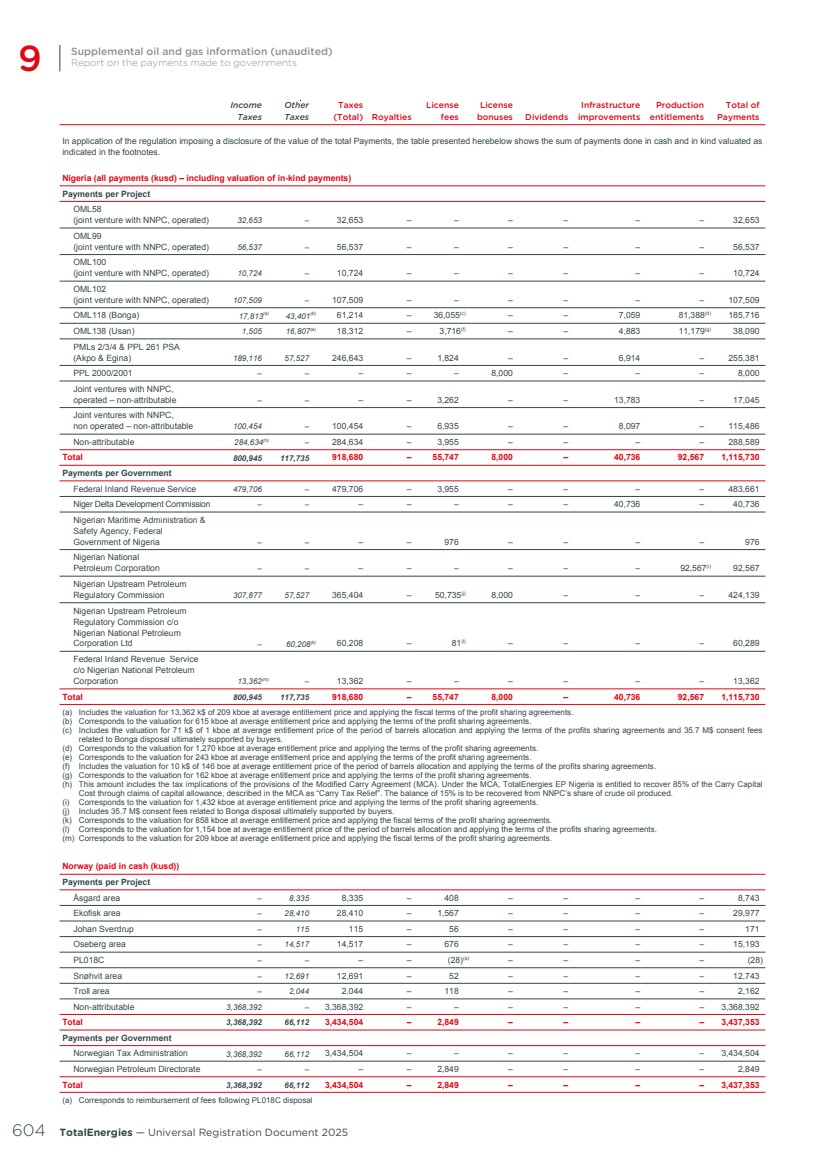
| Income Taxes Other Taxes Taxes (Total) Royalties License fees License bonuses Dividends Infrastructure improvements Production entitlements Total of Payments Oman (paid in cash (kusd)) Payments per Project Block 6 – 392,670 392,670 – – – – – – 392,670 Total – 392,670 392,670 – – – – – – 392,670 Payments per Government Oman Ministry of Finance – 392,670 392,670 – – – – – – 392,670 Total – 392,670 392,670 – – – – – – 392,670 Papua New Guinea (paid in cash (kusd)) Payments per Project PRL-15 – – – – 188 – – – – 188 Total – – – – 188 – – – – 188 Payments per Government Conservation & Environment Protection Authority – – – – 188 – – – – 188 Total – – – – 188 – – – – 188 Qatar (paid in cash (kusd)) Payments per Project Al Khalij 55,266 20,008 75,274 – – – – – – 75,274 Dolphin – – – – – – – – – – Total 55,266 20,008 75,274 – – – – – – 75,274 Payments per Government QatarEnergy – – – – – – – – – – Qatar Ministry of Finance 55,266 20,008 75,274 – – – – – – 75,274 Total 55,266 20,008 75,274 – – – – – – 75,274 Qatar (paid in kind (kboe)) Payments per Project Al Khalij – – – – – – – – – – Dolphin 3,298 – 3,298 – – – – – 30,201 33,499 Total 3,298 – 3,298 – – – – – 30,201 33,499 Payments per Government QatarEnergy – – – – – – – – 30,201 30,201 Qatar Ministry of Finance 3,298 – 3,298 – – – – – – 3,298 Total 3,298 – 3,298 – – – – – 30,201 33,499 In application of the regulation imposing a disclosure of the value of the total Payments, the table presented herebelow shows the sum of payments done in cash and in kind valuated as indicated in the footnotes. Qatar (all payments (kusd) – including valuation of in-kind payments) Payments per Project Al Khalij 55,266 20,008 75,274 – – – – – – 75,274 Dolphin 73,295(a) – 73,295 – – – – – 669,320(b) 742,615 Total 128,561 20,008 148,569 – – – – – 669,320 817,889 Payments per Government QatarEnergy – – – – – – – – 669,320(b) 669,320 Qatar Ministry of Finance 128,561(c) 20,008 148,569 – – – – – – 148,569 Total 128,561 20,008 148,569 – – – – – 669,320 817,889 (a) Corresponds to the valuation of 3,298 kboe based on the average price of production entitlements and as per the fiscal terms of the profit sharing agreements. (b) Corresponds to the valuation of 30,201 kboe based on the average price of production entitlements. (c) Includes the valuation for 73,295 k$ of 3,298 kboe based on the average price of production entitlements and as per the fiscal terms of the profit sharing agreements. Supplemental oil and gas information (unaudited) Report on the payments made to governments 9 TotalEnergies — Universal Registration Document 2025 605 |
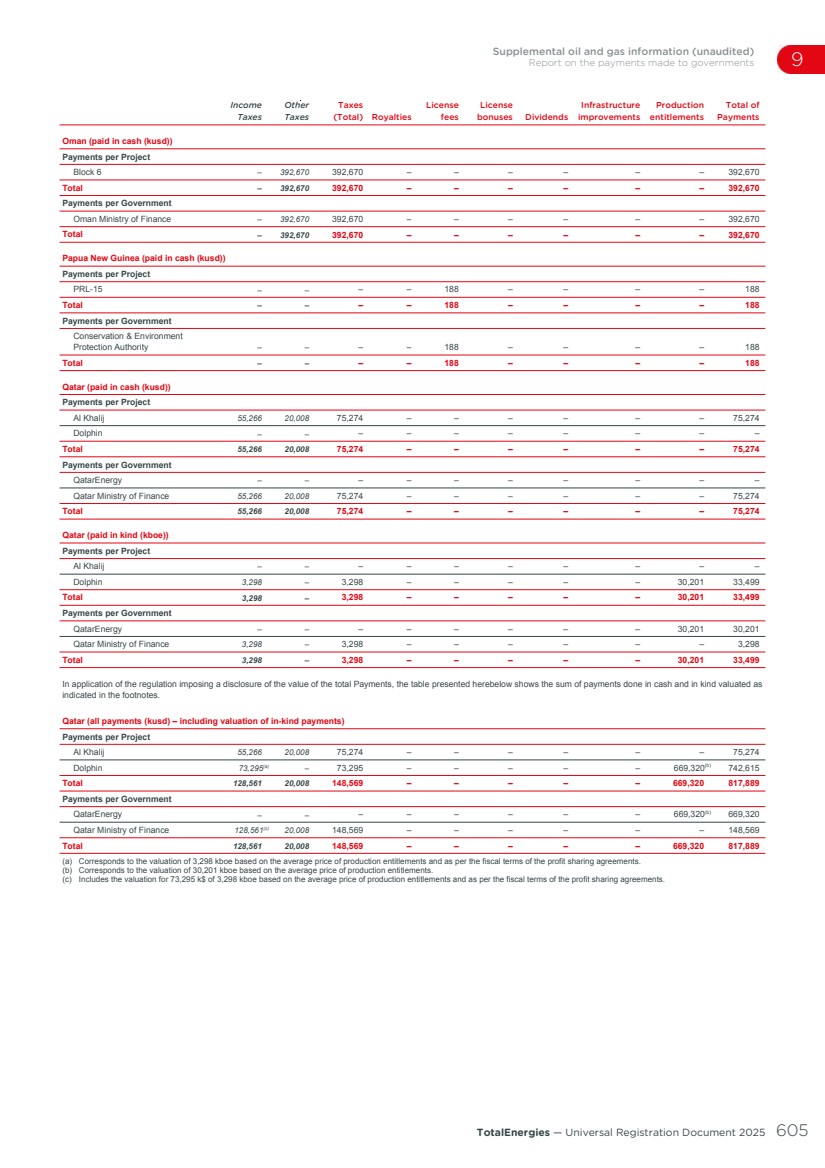
| Income Taxes Other Taxes Taxes (Total) Royalties License fees License bonuses Dividends Infrastructure improvements Production entitlements Total of Payments Republic of the Congo (paid in cash (kusd)) Payments per Project CPP Andromède (MTPS) – – – – 149 – – – – 149 CPP Cassiopée (MTPS) – – – – 81 – – – – 81 CPP Haute Mer – Zone A – 673 673 – 77,065 – – – – 77,738 CPP Haute Mer – Zone B – 100 100 – 16 – – – – 116 CPP Haute Mer – Zone D – – – – 15,090 – – 1,488 – 16,578 CPP Nzombo – – – – – 5,882 – – – 5,882 CPP Persée (MTPS) – – – – 29 – – – – 29 CPP Pointe Noire Grands Fonds (PNGF) – – – – 928 – – – – 928 Lianzi 423 – 423 – – – – – – 423 Marine XX – – – – 131 – – – – 131 Pegase Nord (ex MTPS) – – – – 110 – – – – 110 Total 423 773 1,196 – 93,599 5,882 – 1,488 – 102,165 Payments per Government Ministère des hydrocarbures – – – – 362 – – 1,488 – 1,850 Trésor Public – 773 773 – 93,237 5,882 – – – 99,892 Société Nationale des Pétroles Congolais 423 – 423 – – – – – – 423 Total 423 773 1,196 – 93,599 5,882 – 1,488 – 102,165 Republic of the Congo (paid in kind (kboe)) Payments per Project CPP Andromède (MTPS) – – – – – – – – – – CPP Cassiopée (MTPS) – – – – – – – – – – CPP Haute Mer – Zone A 11 – 11 – – – – – – 11 CPP Haute Mer – Zone B 4 – 4 – – – – – – 4 CPP Haute Mer – Zone D 1,073 3,067 4,140 – – – – – – 4,140 CPP Nzombo – – – – – – – – – – CPP Persée (MTPS) – – – – – – – – – – CPP Pointe Noire Grands Fonds (PNGF) 332 133 465 – – – – – – 465 Lianzi – – – – – – – – 5 5 Marine XX – – – – – – – – – – Pegase Nord (ex MTPS) – – – – – – – – – – Total 1,420 3,200 4,620 – – – – – 5 4,625 Payments per Government Ministère des hydrocarbures 1,420 3,200 4,620 – – – – – – 4,620 Trésor Public – – – – – – – – – – Société Nationale des Pétroles Congolais – – – – – – – – 5 5 Total 1,420 3,200 4,620 – – – – – 5 4,625 9 Supplemental oil and gas information (unaudited) Report on the payments made to governments 606 TotalEnergies — Universal Registration Document 2025 |
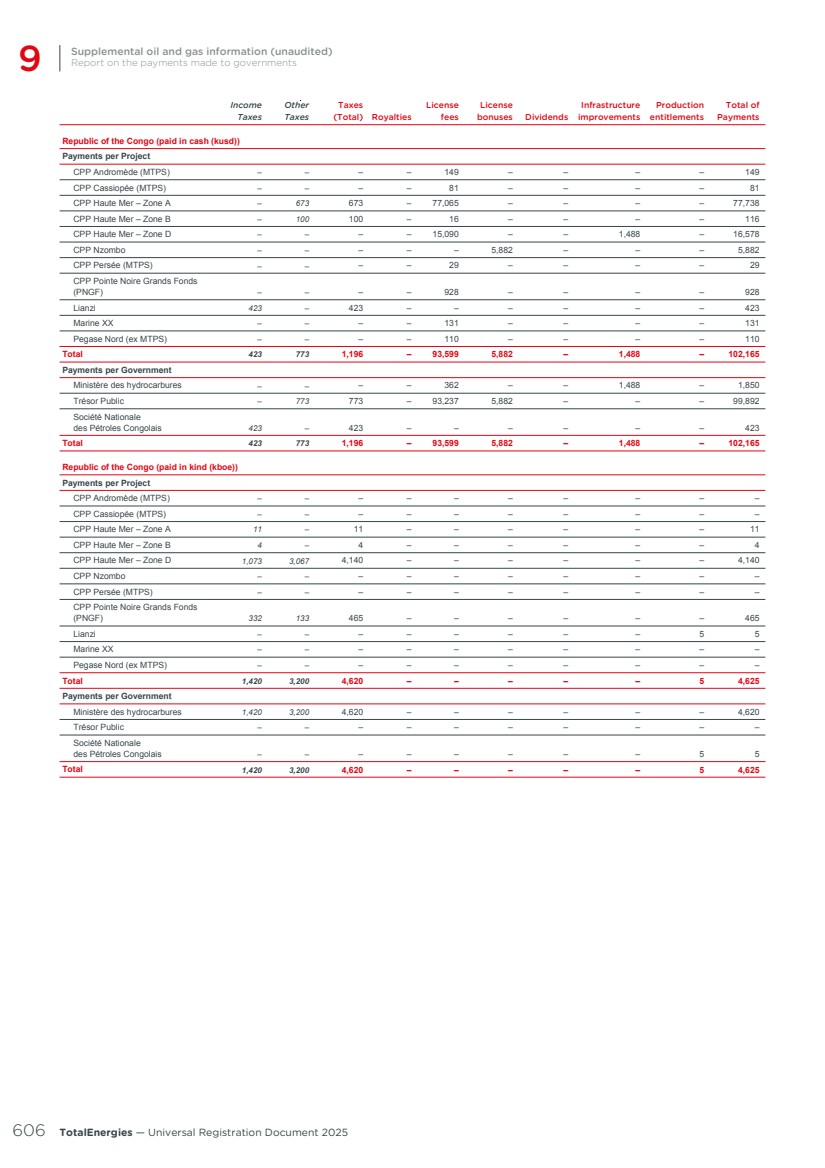
| Income Taxes Other Taxes Taxes (Total) Royalties License fees License bonuses Dividends Infrastructure improvements Production entitlements Total of Payments In application of the regulation imposing a disclosure of the value of the total Payments, the table presented herebelow shows the sum of payments done in cash and in kind valuated as indicated in the footnotes. Republic of the Congo (all paiements (kusd) – including valuation of in-kind payments) Payments per Project CPP Andromède (MTPS) – – – – 149 – – – – 149 CPP Cassiopée (MTPS) – – – – 81 – – – – 81 CPP Haute Mer – Zone A 499(a) 673 1,172 – 77,065(b) – – – – 78,237 CPP Haute Mer – Zone B 280(c) 100 380 – 16 – – – – 396 CPP Haute Mer – Zone D 72,937(d) 208,392(e) 281,329 – 15,090 – – 1,488 – 297,907 CPP Nzombo – – – – – 5,882 – – – 5,882 CPP Persée (MTPS) – – – – 29 – – – – 29 CPP Pointe Noire Grands Fonds (PNGF) 22,574(f) 9,024(g) 31,598 – 928 – – – – 32,526 Lianzi 423 – 423 – – – – – 339(h) 762 Marine XX – – – – 131 – – – – 131 Pegase Nord (ex MTPS) – – – – 110 – – – – 110 Total 96,713 218,189 314,902 – 93,599 5,882 – 1,488 339 416,210 Payments per Government Ministère des hydrocarbures 96,290(i) 217,416(j) 313,706 – 362 – – 1,488 – 315,556 Trésor Public – 773 773 – 93,237 5,882 – – – 99,892 Société Nationale des Pétroles Congolais 423 – 423 – – – – – 339(h) 762 Total 96,713 218,189 314,902 – 93,599 5,882 – 1,488 339 416,210 (a) Corresponds to the valuation of 11 kboe at official fiscal prices and applying the fiscal terms of the profit sharing agreements. (b) Corresponds to the discharging payments for funding of asset retirement obligations following Nkossa disposal. (c) Corresponds to the valuation of 4 kboe at official fiscal prices and applying the fiscal terms of the profit sharing agreements. (d) Corresponds to the valuation of 1,073 kboe at official fiscal prices and applying the fiscal terms of the profit sharing agreements. (e) Corresponds to the valuation of 3,067 kboe at official fiscal prices and applying the fiscal terms of the profit sharing agreements. (f) Corresponds to the valuation of 332 kboe at official fiscal prices and applying the fiscal terms of the profit sharing agreements. (g) Corresponds to the valuation of 133 kboe at official fiscal prices and applying the fiscal terms of the profit sharing agreements. (h) Corresponds to the valuation of 5 kboe at official fiscal prices and applying the fiscal terms of the profit sharing agreements. (i) Corresponds to the valuation of 1,420 kboe at official fiscal prices and applying the fiscal terms of the profit sharing agreements. (j) Corresponds to the valuation of 3,200 kboe at official fiscal prices and applying the fiscal terms of the profit sharing agreements. Sᾶo Tomé and Principe (paid in cash (kusd)) Payments per Project Block 1 – – – – 1,726 – – – – 1,726 Total – – – – 1,726 – – – – 1,726 Payments per Government Agenc. Nac. Petroleo de Sao Tome e Principe c/o Alliance Française – – – – 1,060 – – – – 1,060 Agenc. Nac. Petroleo de Sao Tome e Principe c/o Universidade de STP – – – – 666 – – – – 666 Total – – – – 1,726 – – – – 1,726 Suriname (paid in cash (kusd)) Payments per Project Block 6 – – – – 52 – – – – 52 Block 8 – – – – 38 – – – – 38 Block 58 – – – – 82 – – – – 82 Block 64 – – – – 23 – – – – 23 Total – – – – 195 – – – – 195 Payments per Government Staatsolie-Various associations – – – – 195 – – – – 195 Total – – – – 195 – – – – 195 Supplemental oil and gas information (unaudited) Report on the payments made to governments 9 TotalEnergies — Universal Registration Document 2025 607 |
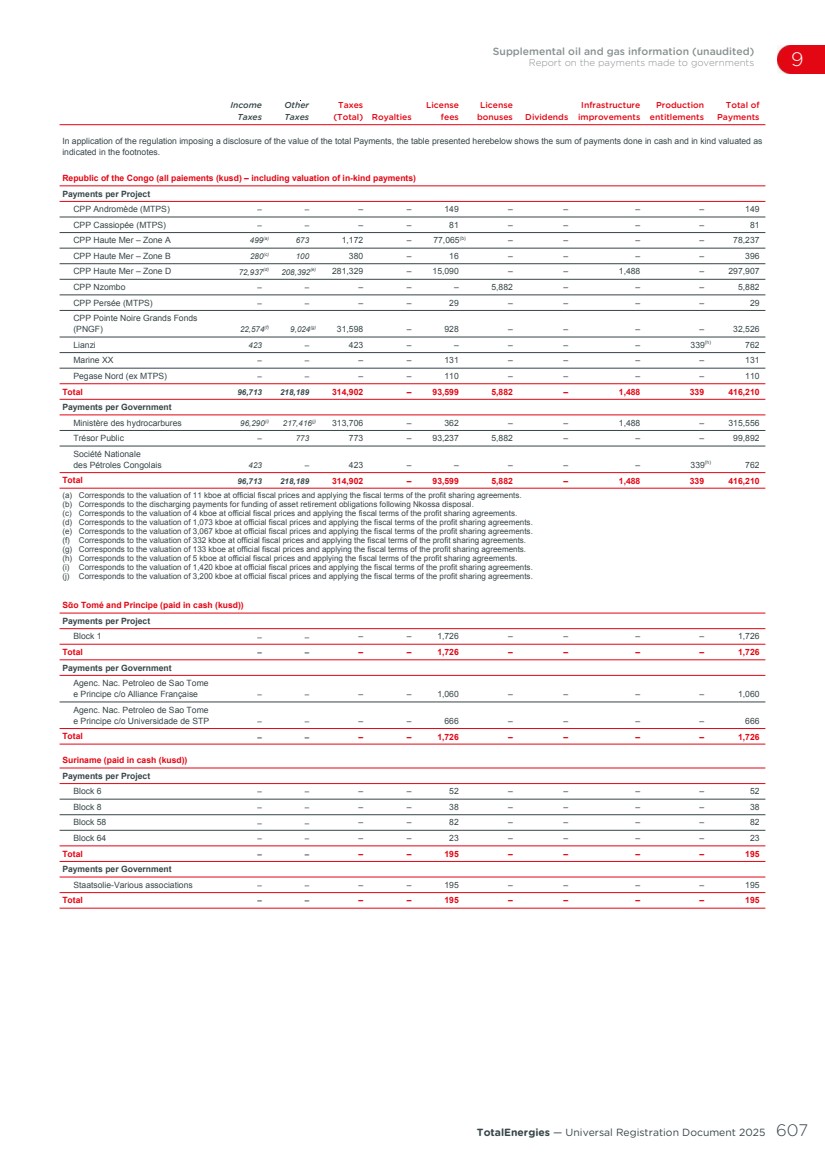
| Income Taxes Other Taxes Taxes (Total) Royalties License fees License bonuses Dividends Infrastructure improvements Production entitlements Total of Payments Thailand (paid in cash (kusd)) Payments per Project Bongkot 312 – 312 – – – – – – 312 G12/48 3,601 204 3,805 – – – – – – 3,805 Total 3,913 204 4,117 – – – – – – 4,117 Payments per Government Revenue Department 3,913 – 3,913 – – – – – – 3,913 Department of Mineral Fuels, Ministry Of Energy – 204 204 – – – – – – 204 Total 3,913 204 4,117 – – – – – – 4,117 Uganda (paid in cash (kusd)) Payments per Project Block CA-1 – – – – 3,480 – – – – 3,480 Block CA-3A – – – – 573 – – – – 573 Block LA-2 – – – – 365 – – – – 365 Total – – – – 4,418 – – – – 4,418 Payments per Government Ministry of Energy and Mineral Development – – – – 1,395 – – – – 1,395 Ministry of Water and Environment – – – – 348 – – – – 348 Ministry of Wildlife, Tourism and Antiquities, UWA – – – – 2,675 – – – – 2,675 Total – – – – 4,418 – – – – 4,418 United Arab Emirates (paid in cash (kusd)) Payments per Project ADNOC Gas Processing – 320,825 320,825 – 2,344 – – – – 323,169 ADNOC Onshore – 4,078,479 4,078,479 – 6,561 – – – – 4,085,040 Lower Zakum – 366,639 366,639 – 553 – – – – 367,192 Umm Lulu & SARB – 835,598 835,598 – 1,107 – – – – 836,705 Umm Shaif Nasr – 1,315,690 1,315,690 – 2,214 – – – – 1,317,904 Total – 6,917,231 6,917,231 – 12,779 – – – – 6,930,010 Payments per Government Abu Dhabi Fiscal Authorities – 6,658,991 6,658,991 – 1,107 – – – – 6,660,098 Abu Dhabi National Oil Company – 258,240 258,240 – 11,672 – – – – 269,912 Total – 6,917,231 6,917,231 – 12,779 – – – – 6,930,010 United Kingdom (paid in cash (kusd)) Payments per Project Central Graben Area – – – – 698 – – – – 698 Culzean – – – – 142 – – – – 142 Eastern North Sea – – – – 1,690 – – – – 1,690 Greater Laggan Area – – – – 1,438 – – – – 1,438 Markham Area – – – – 21 – – – – 21 Northern North Sea – – – – 3,407 – – – – 3,407 Non-attributable 1,215,805(a) – 1,215,805 – 152 – – – – 1,215,957 Total 1,215,805 – 1,215,805 – 7,548 – – – – 1,223,353 Payments per Government HM Revenue & Customs 1,215,805(a) – 1,215,805 – – – – – – 1,215,805 Crown Estate – – – – 152 – – – – 152 North Sea Transition Authority – – – – 7,396 – – – – 7,396 Total 1,215,805 – 1,215,805 – 7,548 – – – – 1,223,353 (a) Includes 596 M$ income taxes for Energy Profit Levy. 9 Supplemental oil and gas information (unaudited) Report on the payments made to governments 608 TotalEnergies — Universal Registration Document 2025 |
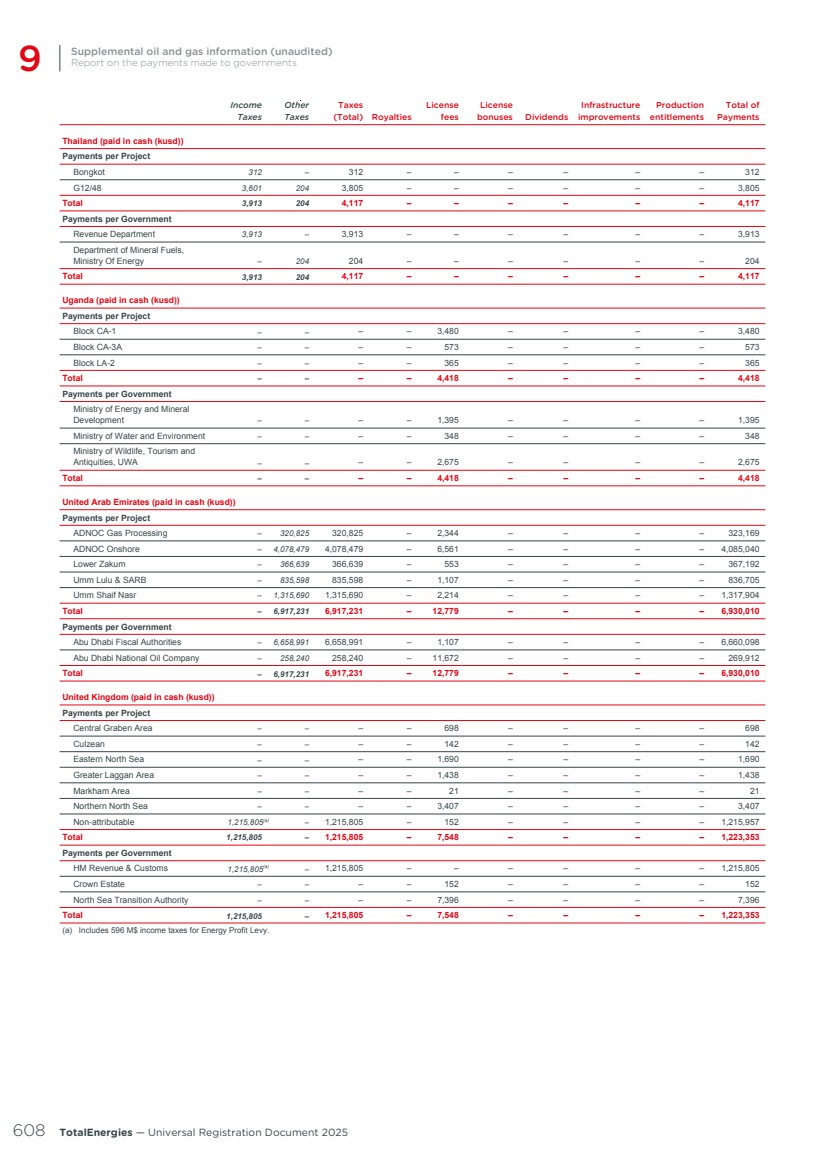
| Income Taxes Other Taxes Taxes (Total) Royalties License fees License bonuses Dividends Infrastructure improvements Production entitlements Total of Payments United States (paid in cash (kusd)) Payments per Project Anchor – – – 50,170 – – – – – 50,170 Ballymore – – – 34,036 – – – – – 34,036 Barnett Shale – 12,326 12,326 14,016 35 – – – – 26,377 Constellation – 5,001 5,001 – – – – – – 5,001 Dorado – 2,057 2,057 – – – – – – 2,057 Jack – – – 15,621 – – – – – 15,621 Tahiti – – – 27,064 – – – – – 27,064 Other US offshore fields – – – – 620 696 – – – 1,316 Total – 19,384 19,384 140,907 655 696 – – – 161,642 Payments per Government Office of Natural Resources Revenue – – – 126,891 620 696 – – – 128,207 Johnson County Tax Assessor – 621 621 – – – – – – 621 Tarrant County Tax Assessor – 2,107 2,107 – – – – – – 2,107 Texas State Comptroller’s Office – 9,598 9,598 – – – – – – 9,598 City of Fort Worth – – – 3,213 20 – – – – 3,233 Dallas/Fort Worth International Airport Board – – – 2,139 – – – – – 2,139 City of Arlington – – – 1,971 15 – – – – 1,986 Tarrant Regional Water District – – – 699 – – – – – 699 State of Texas – 7,058 7,058 578 – – – – – 7,636 City of Richland Hills – – – 184 – – – – – 184 City of North Richland Hills – – – 423 – – – – – 423 Fort Worth Independent School District – – – 361 – – – – – 361 Burleson Independent School District – – – 189 – – – – – 189 Arlington Independent School District – – – 607 – – – – – 607 Birdville Independent School District – – – 902 – – – – – 902 Tarrant County College – – – 225 – – – – – 225 City of Grand Prairie – – – 464 – – – – – 464 Grand Prairie ISD – – – 121 – – – – – 121 Kennedale Independent School District – – – 153 – – – – – 153 Tarrant County AAAA – – – 133 – – – – – 133 City of Cleburne – – – 207 – – – – – 207 City of Burleson – – – 197 – – – – – 197 Mansfield Independent School District – – – 918 – – – – – 918 White Settlement Independent School District – – – 225 – – – – – 225 City of White Settlement – – – 107 – – – – – 107 Total – 19,384 19,384 140,907 655 696 – – – 161,642 Yemen (paid in cash (kusd)) Payments per Project Block 70 – – – – 3,021(a) – – – – 3,021 Total – – – – 3,021 – – – – 3,021 Payments per Government Ministry of Oil & Minerals – – – – 3,021(a) – – – – 3,021 Total – – – – 3,021 – – – – 3,021 (a) Corresponds to differents paiements as per the settlement terms conclude in 2024 following exit of Block 70 in 2023. Supplemental oil and gas information (unaudited) Report on the payments made to governments 9 TotalEnergies — Universal Registration Document 2025 609 |
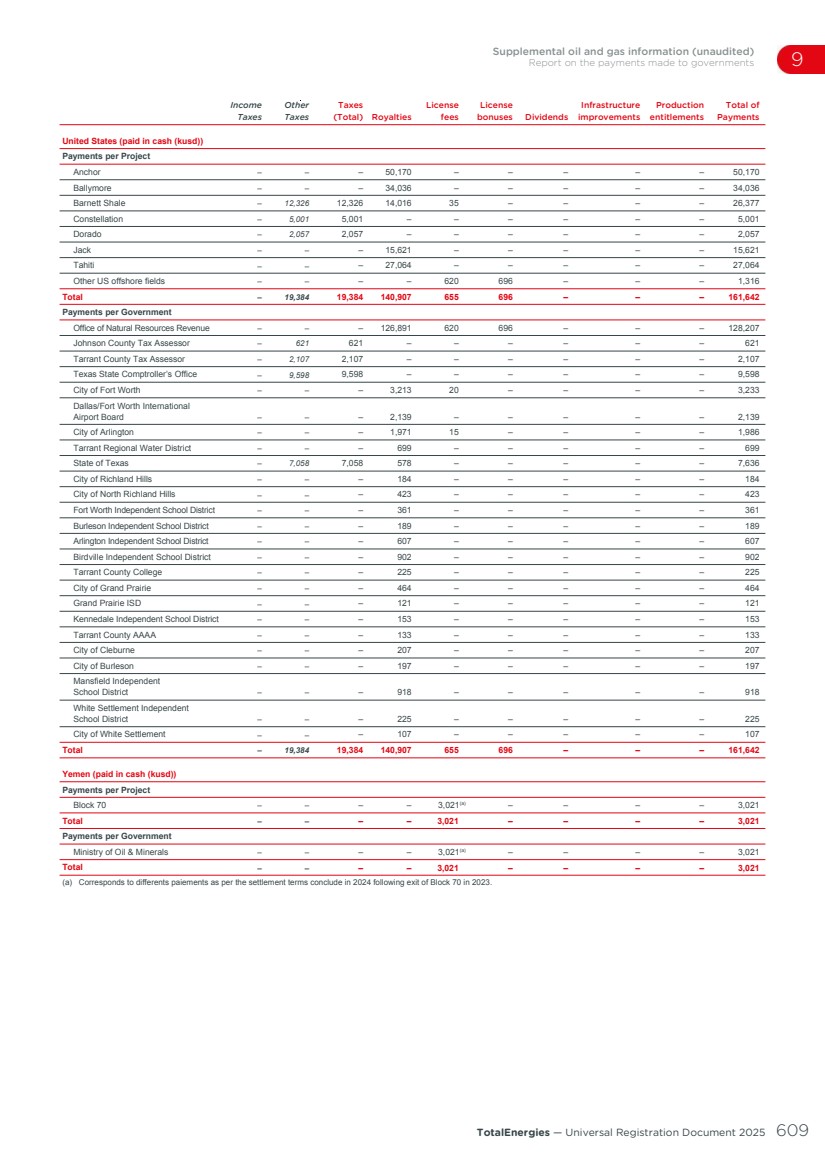
| 9.4 Reporting of payments to governments for purchases of oil, gas and minerals (EITI reporting) Purpose of the reporting In September 2020, the Extractive Industries Transparency Initiative, or EITI, published its “Reporting Guidelines for Companies Buying Oil, Gas and Minerals from Governments.” Those Guidelines are intended for companies that purchase oil, gas and/or minerals from governments, to guide them for the disclosure of payments made to governments. They aim to ensure the consistent disclosure of payments made to the state or state-owned enterprises (SOEs)(1) where oil, gas or minerals are being sold on behalf of the state, where EITI requirements are applicable and relevant, or where there is commitment to transparency in commodity sales. These reporting guidelines were developed by the EITI Working Group on Transparency in Commodity Trading, and documented by the discussions at the OECD Thematic Dialogue on Commodity Trading Transparency. They are part of the implementation of Requirement 4.2 of the applicable EITI Standard, which aims to ensure transparency in how the state is selling oil, gas and minerals by requiring disclosures by SOEs and/or other relevant government agencies concerning the sale of the state’s share of production or other revenues collected in kind. Correspondingly, the Standard encourages companies buying oil, gas and/or mineral resources from the state or SOEs to disclose information regarding the volumes received from the state or SOE and payments made for the purchase of oil, gas and mineral resources. Companies that purchase these commodities disclose this data on a voluntary basis. The Guidelines aim to identify: 1. Who is buying the product. 2. Who is selling the product. 3. What product is being purchased. 4. What the buyer pays to the seller for the product. Definitions Applicable purchases: under the Guidelines, purchases of oil, petroleum products, metals and minerals should be reported. Oil and petroleum products may be categorized as “crude oil,” “refined products” or “natural gas.” For this 2025 reporting, TotalEnergies is disclosing its purchases of oil and petroleum products made during fiscal year 2025 by TotalEnergies SE’s fully consolidated companies. Selling entities and purchases to be covered: EITI recommends that the disclosures cover: – purchases of the state’s share of production and other in-kind revenues from EITI countries where the selling entity is a government agency or SOE or a third party appointed to sell on their behalf (i.e., where EITI Requirement 4.2 is applicable), – purchases from SOEs in non-EITI countries that have explicitly or publicly stated their support to the initiative. Reporting principles TotalEnergies reporting follows the EITI recommendations mentioned hereabove. From the reporting models suggested by EITI regarding the level of disaggregation, TotalEnergies has chosen model 1, in which disclosures of both volumes and values (amounts paid) are aggregated by individual seller (where the seller is any company that is wholly or majority owned by the state) for purchases of commodities delivered in 2025. TotalEnergies follows the EITI recommendation with regards to obtaining the prior consent of the concerned countries before the publication of the procurement data concerning them. Therefore, TotalEnergies discloses under the category “Other Countries”, aggregate data on its purchases from (i) SOEs in EITI countries that have not given such consent or to which Requirement 4.2 is not applicable by virtue of the systematic transparency implemented by their governments (Norway) and (ii) in non-EITI Countries. (1) For the purpose of EITI implementation, a “state-owned enterprise (SOE) is a wholly or majority government-owned company that is engaged in extractives activities on behalf of the government.” EITI Requirement 2.6.a.i. 9 Supplemental oil and gas information (unaudited) Reporting of payments to governments for purchases of oil, gas and minerals (EITI reporting) 610 TotalEnergies — Universal Registration Document 2025 |
| Disclosure of volumes and value by individual seller Crude oil - Refined products 1. Who is selling the product 2. Who is buying the product 3. What product is being bought 4. What does the buyer pay to the seller for the product Core Information Additional Information Core Information Additional Information Core Information Core Information Name of Country of Seller of Government Share of Production Name of SOE or seller of the state share of production Counterparty state owned % Buying Entity Beneficial Ownership Product Type Volumes Purchased (barrel) Amounts paid (kUSD) Iraq SOMO 100 TOTSA TotalEnergies Trading SA TotalEnergies SE Crude oil 991,726 78,172 Other Countries TOTSA TotalEnergies Trading SA TotalEnergies SE Crude oil 81,284,456 5,702,158 Other Countries TotalEnergies Trading Asia Pte Ltd TotalEnergies SE Crude oil 32,666,825 2,332,738 Other Countries Atlantic Trading & Marketing Inc TotalEnergies SE Crude oil 567,125 30,419 Other Countries TOTSA TotalEnergies Trading SA TotalEnergies SE Refined products 152,750,602 12,208,568 Other Countries TotalEnergies Trading Asia Pte Ltd TotalEnergies SE Refined products 13,647,690 1,138,626 Other Countries Atlantic Trading & Marketing Inc TotalEnergies SE Refined products 932,206 69,314 LPG 1. Who is selling the product 2. Who is buying the product 3. What product is being bought 4. What does the buyer pay to the seller for the product Core Information Additional Information Core Information Additional Information Core Information Core Information Name of Country of Seller of Government Share of Production Counterparty state owned % Buying Entity Beneficial Ownership Product Type Volumes Purchased (barrel) Amounts paid (kUSD) Other Countries TOTSA TotalEnergies Trading SA TotalEnergies SE LPG 4,012,672 178,562 Other Countries TotalEnergies Trading Asia Pte Ltd TotalEnergies SE LPG 3,552,094 171,585 Supplemental oil and gas information (unaudited) Reporting of payments to governments for purchases of oil, gas and minerals (EITI reporting) 9 TotalEnergies — Universal Registration Document 2025 611 |
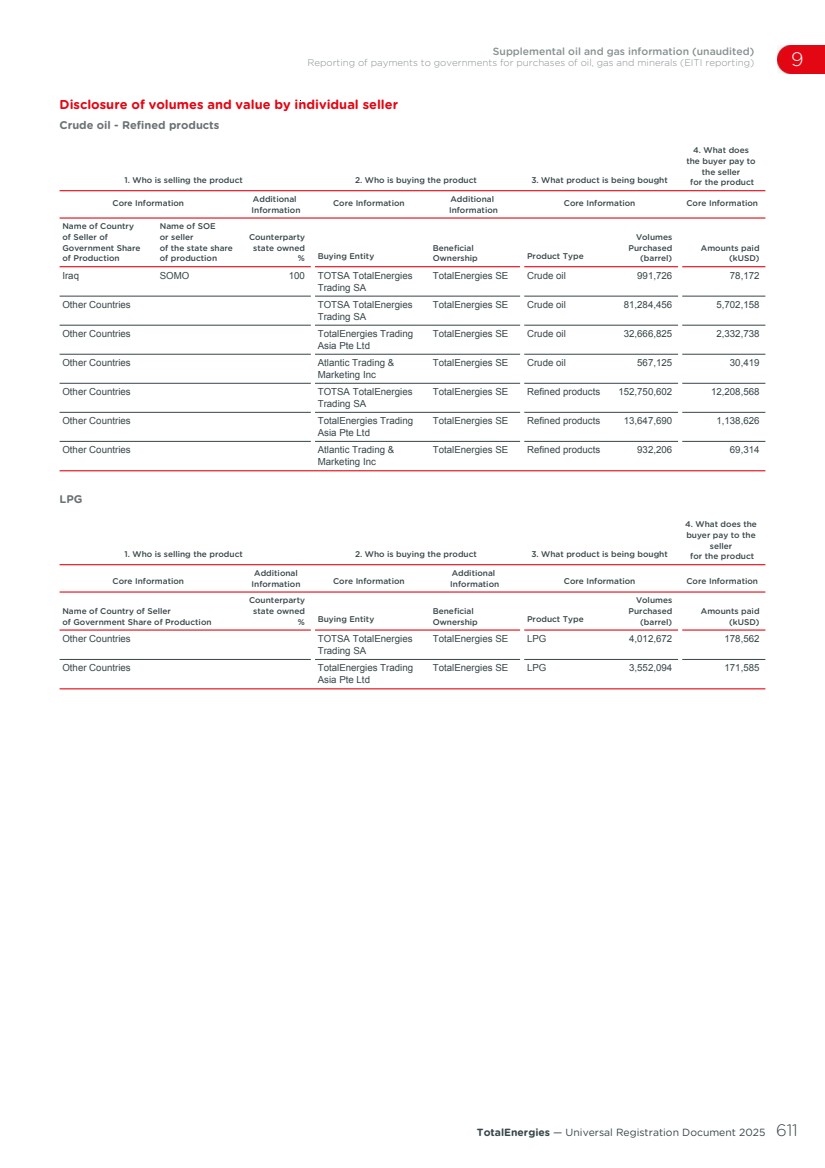
| Natural Gas - LNG - Sulphur - Petcoke 1. Who is selling the product 2. Who is buying the product 3. What product is being bought 4. What does the buyer pay to the seller for the product Core Information Additional Information Core Information Additional Information Core Information Core Information Name of Country of Seller of Government Share of Production Name of SOE or seller of the state share of production Counterparty state owned % Buying Entity Beneficial Ownership Product Type Volumes Purchased (Mbtu) Volumes Purchased (ton) Amounts paid (kUSD) Germany Uniper Global Commodities SE 99.12 TotalEnergies Gas & Power Limited TotalEnergies SE LNG 8,049,000 94,724 Germany EnBW Energie Baden-Wurttemberg AG 93.5 TotalEnergies Gas & Power Limited TotalEnergies SE LNG 3,446,000 50,465 Germany Uniper Global Commodities SE 99.12 TotalEnergies Gas & Power Limited TotalEnergies SE Natural gas 11,113,000 119,610 Germany EnBW Energie Baden-Wurttemberg AG 93.5 TotalEnergies Gas & Power Limited TotalEnergies SE Natural gas 3,446,000 42,305 Germany EWE VERTRIEB GmbH 74 TotalEnergies Gas & Power Limited TotalEnergies SE Natural gas 57,000 846 Germany Stadtwerke Bietigheim-Bissingen GmbH 100 TotalEnergies Gas & Power Limited TotalEnergies SE Natural gas 60,000 834 Germany Danpower Biomasse GmbH 75 TotalEnergies Gas & Power Limited TotalEnergies SE Natural gas 28,000 351 Germany Danpower GmbH 75 TotalEnergies Gas & Power Limited TotalEnergies SE Natural gas 58,000 737 Germany RhonEnergie Fulda GmbH 81.8 TotalEnergies Gas & Power Limited TotalEnergies SE Natural gas 4,000 32 Germany SWK Energie GmbH 74.9 TotalEnergies Gas & Power Limited TotalEnergies SE Natural gas 63,000 778 Indonesia PT Pertamina (Persero) 100 TotalEnergies Gas & Power Asia Pte Ltd TotalEnergies SE LNG 21,970,000 246,564 Germany EnBW Energie Baden-Wurttemberg AG 93.5 TotalEnergies Gas & Power Asia Pte Ltd TotalEnergies SE LNG 3,553,000 40,520 Germany Uniper Global Commodities SE 99.12 TotalEnergies Gas & Power Asia Pte Ltd TotalEnergies SE LNG 13,499,000 145,742 Other Countries TotalEnergies Gas & Power Limited TotalEnergies SE LNG 229,747,000 2,751,907 Other Countries TotalEnergies Gas & Power Limited TotalEnergies SE Natural gas 25,669,000 335,740 Other Countries TotalEnergies Gas & Power Limited TotalEnergies SE Petcoke 940,000 74,983 Other Countries TotalEnergies Gas & Power Limited TotalEnergies SE Sulphur 706,000 207,618 Other Countries TotalEnergies Gas & Power Asia Pte Ltd TotalEnergies SE LNG 76,346,000 1,043,511 Other Countries TotalEnergies Gas & Power Asia Pte Ltd TotalEnergies SE Sulphur 21,000 7,790 Other Countries TotalEnergies Gas & Power Asia Pte Ltd TotalEnergies SE Petcoke 36,000 21,009 9 Supplemental oil and gas information (unaudited) Reporting of payments to governments for purchases of oil, gas and minerals (EITI reporting) 612 TotalEnergies — Universal Registration Document 2025 [REDACTED SECTION: CERTAIN TEXT HAS BEEN REDACTED.] |
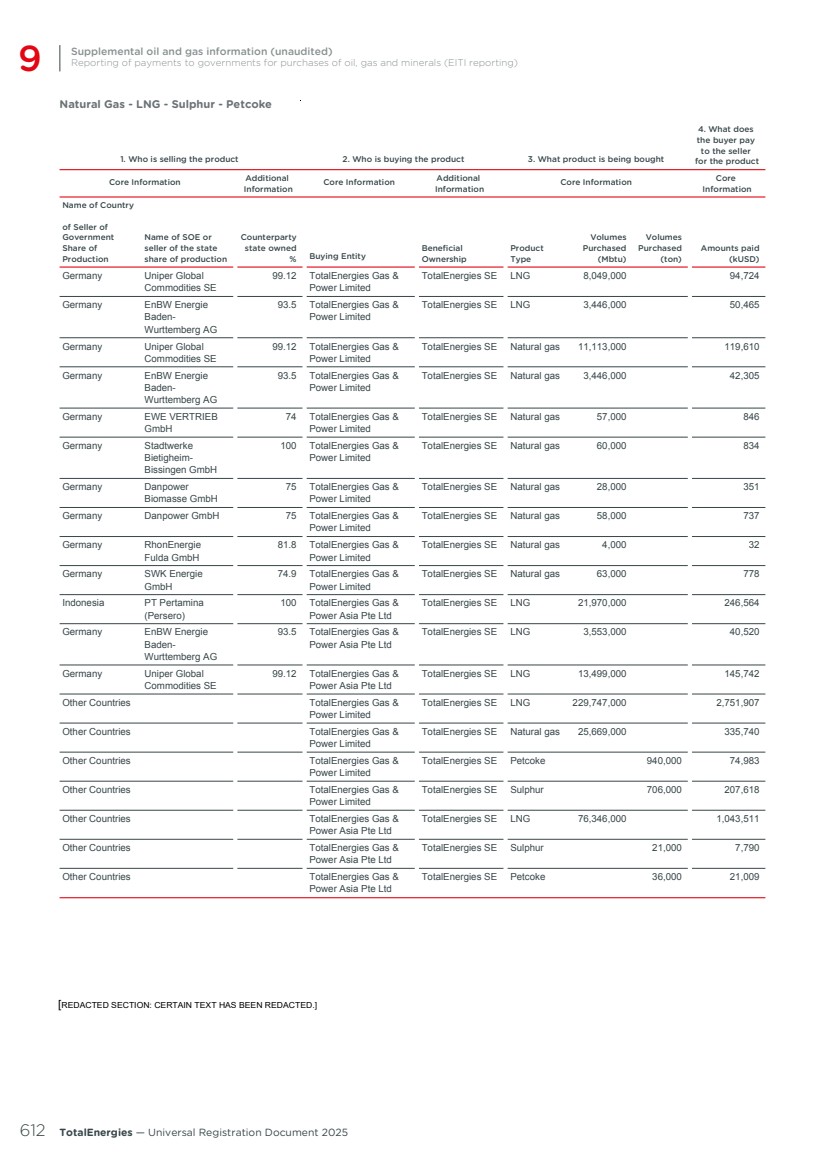
| Glossary Abbreviations €: euro FSRU: floating storage and regasification unit $ or USD or dollar US dollar GHG: greenhouse gas ADR: American depositary receipt (evidencing an ADS) HSE: health, safety and the environment ADS: American depositary share (representing a share of a company) IEA: International Energy Agency AMF: Autorité des marchés financiers (French Financial Markets Authority) IFRS: International Financial Reporting Standards API: American Petroleum Institute IPIECA: International Petroleum Industry Environmental Conservation Association CCS: carbon capture and storage (refer to the definition below) LNG: liquefied natural gas CCU: carbon capture and utilization (refer to the definition below) LPG: liquefied petroleum gas CCUS: carbon capture utilization and storage NGL: natural gas liquids CFFO cash flow from operations excluding working capital NGV: natural gas vehicle CNG: compressed natural gas OML: oil mining lease CO2: carbon dioxide Opec: Organization of the Petroleum Exporting Countries CO2e: equivalent CO2 PPA: Power Purchase Agreement (refer to the definition below) CSR: corporate and social responsibility ROACE: return on average capital employed DACF: debt adjusted cash flow (refer to the definition of debt adjusted cash flow below) ROE: return on equity ERM: indicator of European Refining Margin SDG: Sustainable development goal EV: electric vehicle SEC: United States Securities and Exchange Commission FLNG: floating liquefied natural gas TCFD: task force on climate-related financial disclosures FPSO: floating production, storage and offloading WHRS: Worldwide Human Resources Survey (refer to point 5.2.3.1 of chapter 5 for the definition) Units of measurement b = barrel(1) km = kilometer B = billion m = meter Bcm = billion of cubic meters m³ = cubic meter(1) boe = barrel of oil equivalent M = million btu = British thermal unit MW = megawatt cf = cubic feet PJ = petajoule /d = per day t = (Metric) ton Gt CO2 = billion of CO2 tons toe= ton of oil equivalent GW = gigawatt TWh = terawatt hour GWh = gigawatt hour W = watt k = thousand /y = per year Conversion table 1 acre ≈ 0.405 hectares 1 m³ ≈ 35.3 cf 1 b = 42 US gallons ≈ 159 liters 1 Mt of LNG ≈ 48 Bcf of gas 1 b/d of crude oil ≈ 50 t/y of crude oil 1 Mt/y of LNG ≈ 131 Mcf/d of gas 1 Bcm/y ≈ 0.1 Bcf/d 1 t of oil ≈ 7.5 b of oil (assuming a specific gravity of 37° API) 1 km ≈ 0.62 mile 1 boe = 1 b of crude oil ≈ 5,438 cf of gas in 2025(2) (5,424 cf of gas in 2024 and 5,419 cf in 2023) (1) Liquid and gas volumes are reported at international standard metric conditions (15 °C and 1 atm). (2) Natural gas is converted to barrels of oil equivalent using a ratio of cubic feet of natural gas per one barrel. This ratio is based on the actual average equivalent energy content of natural gas reserves during the applicable periods and is subject to change. The tabular conversion rate is applicable to TotalEnergies’ natural gas reserves on a Company-wide basis. Glossary TotalEnergies — Universal Registration Document 2025 639 |
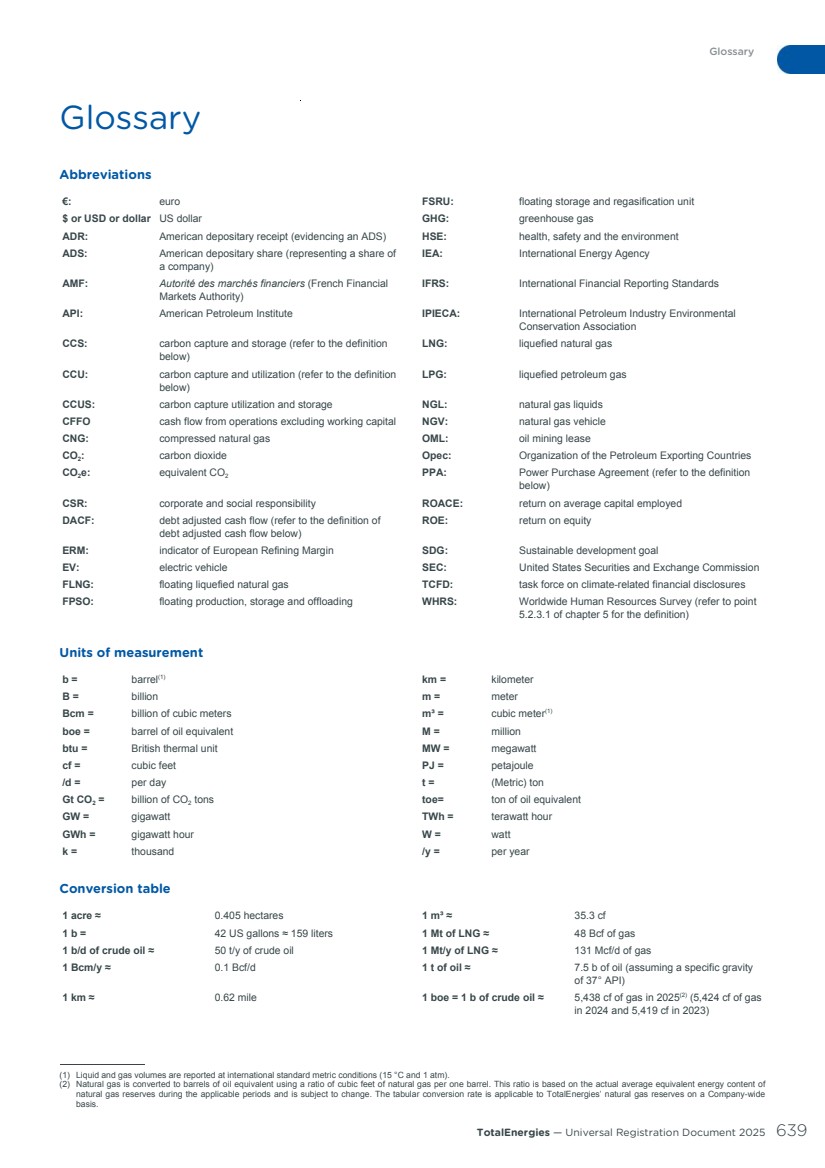
| A acquisitions net of assets sales Acquisitions net of assets sales is a non-GAAP financial measure and its most directly comparable IFRS measure is Cash flow used in investing activities. Acquisitions net of assets sales refer to acquisitions minus assets sales (including other operations with non-controlling interests). This indicator can be a valuable tool for decision makers, analysts and shareholders alike because it illustrates the allocation of cash flow used for growing the Company’s asset base via external growth opportunities. acreage Areas in which mining rights are exercised. adjusted EBITDA (Earnings Before Interest, Tax, Depreciation and Amortization) Adjusted EBITDA is a non-GAAP financial measure and its most directly comparable IFRS measure is Net Income. It refers to the adjusted earnings before depreciation, depletion and impairment of tangible and intangible assets and mineral interests, income tax expense and cost of net debt, i.e., all operating income and contribution of equity affiliates to net income. This indicator can be a valuable tool for decision makers, analysts and shareholders alike to measure and compare the Company’s profitability with utility companies (energy sector). adjusted fully diluted earnings per share The adjusted fully diluted eanrings per share corresponds to the ratio between the adjusted net income (TotalEnergies’ share), reduced by the coupon on perpetual subordinated notes, and the weighted average diluted number of shares outstanding during the period, excluding shares held by TotalEnergies SE. adjusted net income (TotalEnergies share) Adjusted net income (TotalEnergies share) is a non-GAAP financial measure and its most directly comparable IFRS measure is Net Income (TotalEnergies share). Adjusted Net Income (TotalEnergies share) refers to Net Income (TotalEnergies share) less adjustment items to Net Income (TotalEnergies share). Adjustment items are inventory valuation effect, effect of changes in fair value, and special items. This indicator can be a valuable tool for decision makers, analysts and shareholders alike to evaluate the Company’s operating results and to understand its operating trends by removing the impact of non-operational results and special items. adjusted net operating income Adjusted net operating income is a non-GAAP financial measure and its most directly comparable IFRS measure is Net Income. Adjusted Net Operating Income refers to Net Income before net cost of net debt, i.e., cost of net debt net of its tax effects, less adjustment items. Adjustment items are inventory valuation effect, effect of changes in fair value, and special items. Adjusted Net Operating Income can be a valuable tool for decision makers, analysts and shareholders alike to evaluate the Company’s operating results and understanding its operating trends, by removing the impact of non-operational results and special items and is used to evaluate the Return on Average Capital Employed (ROACE) as explained below. adjusted net operating income from business segments The adjusted net operating income from business segments corresponds to the sum of the adjusted net operating results of each operating segment. API degree Scale established by the American Petroleum Institute (API) to measure oil density. A high API degree indicates light oil from which a high yield of gasoline can be refined. appraisal Work performed after a discovery for the purpose of determining the boundaries or extent of an oil or gas field or assessing its reserves and production potential. aromatics Base chemical products, derived from oil, used in the manufacture of polymers. Main aromatics are benzene, toluene and xylene. asset retirement (site restitution) Companies may have obligations related to well-abandonment, dismantlement of facilities, decommissioning of plants or restoration of the environment. These obligations generally result from international conventions, local regulations or contractual obligations. associated gas Gas released during oil production. association/consortium/joint-venture Terms used to generally describe a project in which two or more entities participate. For the principles and methods of consolidation applicable to different types of joint arrangements according to IFRS, refer to note 1 to the Consolidated Financial Statements. B barrel Unit of measurement of volume of crude oil equal to 42 US gallons or 159 liters. barrel of oil equivalent (boe) Conventional unit for measuring the energy released by a quantity of fuel by relating it to the energy released by the combustion of a barrel of oil. biofuel Liquid fuel for transport produced from biomass. biogas Gaseous combustible or fuels produced from biomass. biogas (power generation from) Combustion of gas produced by the fermentation of non-fossil organic matter (biomass). biomass Organic material excluding the material that is fossilised or embedded in geological formations. biomethane Biogas whose characteristics allow its injection into a natural gas network. bitumen Petroleum in a solid or semi-solid state in natural deposits. It usually contains sulfur, heavy metals, and other non-hydrocarbons compounds. Unable to flow naturally in the reservoir because of its high viscosity (typically greater than 10,000 centipoise), its production requires unconventional extraction technologies. In reference to marketing, bitumen is produced from the refining of crude oil and is used in the construction industry in particular as a component of asphalt pavements, e.g., for roads, airfields, cycle paths, etc. It is a visco-elastic, adhesive and waterproof material particularly suited to the needs of construction and road sealing products(1) . Block Area delimited geographically by a country on its territory, offshore or onshore, in the view to exploring for and/or producing hydrocarbons. Brent Quality of crude oil (38° API) produced in the North Sea, from Brent and neighboring fields. brownfield project Project concerning developed existing fields. (1) Source: Eurobitume. Glossary 640 TotalEnergies — Universal Registration Document 2025 |
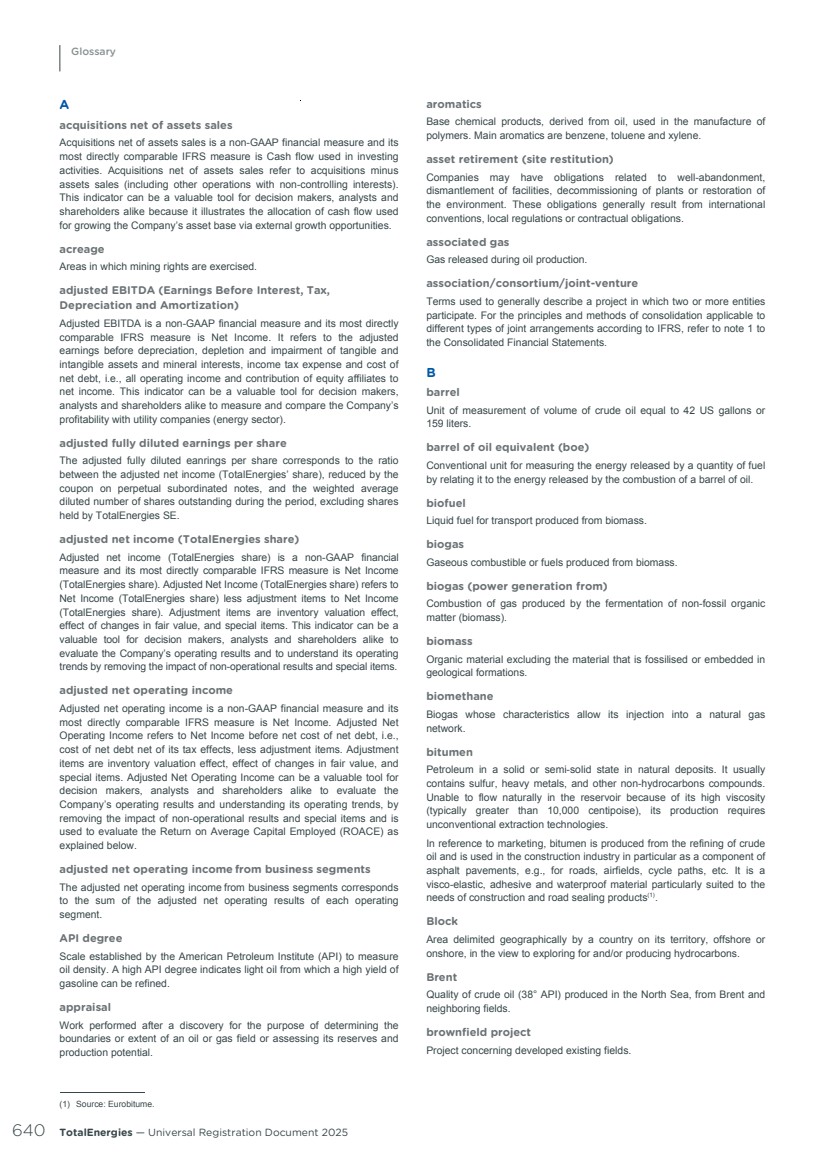
| C capacity of treatment Annual crude oil treatment capacity of the atmospheric distillation units of a refinery and of a petrochemical unit, or a processing plant, or a separation unit in the oil Upstream. capital employed Capital employed is a non-GAAP financial measure. They are calculated at replacement cost and refer to capital employed (balance sheet) less inventory valuations effect. Capital employed (balance sheet) refers to the sum of the following items: (i) Property, plant and equipment, intangible assets, net, (ii) Investments & loans in equity affiliates, (iii) Other non-current assets, (iv) Working capital which is the sum of: Inventories, net, Accounts receivable, net, other current assets, Accounts payable, Other creditors and accrued liabilities, (v) Provisions and other non-current liabilities and (vi) Assets and liabilities classified as held for sale. Capital Employed can be a valuable tool for decision makers, analysts and shareholders alike to provide insight on the amount of capital investment used by the Company or its business segments to operate. Capital Employed is used to calculate the Return on Average Capital Employed (ROACE). Carbon Capture and Storage (CCS) Capture and transport of CO₂ for long‑term geological storage. Carbon Capture and Utilization (CCU) Capture and transport of CO₂ for its use in the production of synthetic products, chemicals, or fuels. carbon neutrality ambition, together with society Ambition of the Company as described in point 1.2.3 of chapter 1 of this Document. carbon sinks Natural reservoir (e.g., vegetation, oceans) or artificial reservoir (e.g., CCS) that stores carbon in different forms. cash flow from operations excluding working capital (CFFO) CFFO is a non-GAAP financial measure and its most directly comparable IFRS measure is Cash flow from operating activities. Cash Flow From Operations excluding working capital is defined as cash flow from operating activities before changes in working capital at replacement cost, excluding the mark-to-market effect of Integrated LNG and Integrated Power contracts, including capital gain from renewable projects sales and including organic loan repayments from equity affiliates. This indicator can be a valuable tool for decision makers, analysts and shareholders alike to help understand changes in cash flow from operating activities, excluding the impact of working capital changes across periods on a consistent basis and with the performance of peer companies in a manner that, when viewed in combination with the Company’s results prepared in accordance with IFRS, provides a more complete understanding of the factors and trends affecting the Company’s business and performance. This performance indicator is used by the Company as a base for its cash flow allocation and notably to guide on the share of its cash flow to be allocated to the distribution to shareholders. catalysts Substances that increase a chemical reaction speed. During the refining processes, they are used in conversion units (reformer, hydrocracker, catalytic cracker) and desulphurization units, hydrotreating and in hydrogenation processes. Principal catalysts are precious metals (platinum), transition metals (nickel, cobalt) and certain solid supports (alumina, silica). charger (for an electric vehicle) A charger is a fixed (external to the electric vehicle) equipment dedicated to recharging the battery, through a cable linked to the vehicle (rovided or not by the charger operator). A charger can include one or several charging points (each adjacent to a dedicated parking stall). The charger is equipped with devices for measuring the energy delivered. Other systems of communication, control and allowing payment can be added. charging point (for an electric vehicle) Unlike a charger, a charging point is attached to a single parking space and can therefore charge only one electric vehicle at a time. The charging point refers to the component of the charger that is similar to an electrical outlet through which energy is delivered to the electric vehicle (using the power supply equipment plugged in by the driver, or through an automated system, and which may or may not be provided by the charger operator. compressed natural gas (CNG) Natural gas compressed between 200 and 300 bars in gaseous form and which can be stored at ambient temperature. cogeneration Simultaneous generation of electrical and thermal energies from a combustible source (gas, fuel oil or coal). Combined Cycle with Gas Turbine (CCGT) Thermal power plant for electricity generation that combines two types of turbines: a combustion turbine and a steam turbine. commercial/marketable gas/gas available for sale Gas produced by the upstream facilities and sent directly or indirectly to the gas market. concession contract Exploration and production contract under which a host country grants to an oil and gas company (or a consortium) the right to explore a geographic area and develop and produce potential reserves. The oil and gas company (or consortium) undertakes the execution and financing, at its own risk, of all operations. In return, it is entitled to the entire production. condensates Light hydrocarbon products produced with natural gas that exist – either in a gaseous phase or in solution – in the oil and gas under the initial pressure and temperature conditions in the reservoir, and which are recovered in a liquid state in separators, on-site facilities or gas treatment units. condensate splitter Unit that distillates condensates upstream of refining or petrochemical units. consortium Refer to the definition above of “association/consortium/joint-venture”. conversion All refining operations aimed at transforming heavy hydrocarbon fractions into lighter or less viscous products (gasoline, jet fuel, etc.) in order to improve their recovery. co-processing Refers to the simultaneous conversion of biogenic residues and intermediate petroleum distillates in existing petroleum refineries to produce renewable fuels. In contrast to the blending of biofuels into the finished petroleum product, co-processing makes use of biomass within the processing of petroleum. Suitable feedstocks for co-processing are for example wood pyrolysis oil or triglycerides (such as vegetable oils, used cooking oils, animal fats) or HVO (renewable diesel produced by hydrotreatment). cost oil/cost gas In a production sharing contract, the portion of the oil and gas production made available to the contractor (contracting group) and contractually reserved for reimbursement of exploration, development, operation and site restitution costs (“recoverable” costs). The reimbursement may be capped by a contractual cost stop that corresponds to the maximum share of production that may be allocated to the reimbursement of costs. Glossary TotalEnergies — Universal Registration Document 2025 641 |
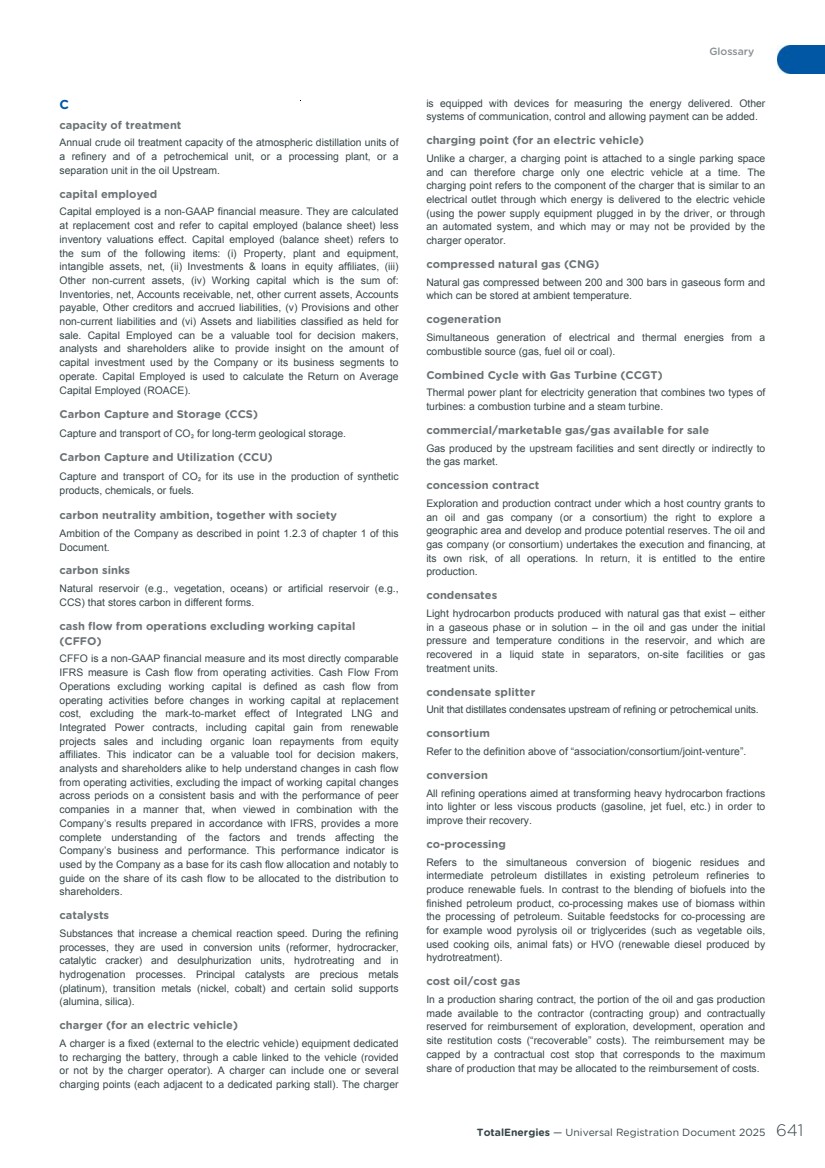
| cracking Refining process that entails converting the molecules of large, complex, heavy hydrocarbons into simpler, lighter molecules using heat, pressure and, in some cases, a catalyst. A distinction is made between catalytic cracking and steam cracking, which uses heat instead of a catalyst. Cracking then produces ethylene and propylene, in particular. crude oil A mixture of compounds (mainly pentanes and heavier hydrocarbons) that exists in a liquid phase at original reservoir temperature and pressure and remains liquid at atmospheric pressure and ambient temperature. D debottlenecking Change made to a facility to increase its production capacity. debt adjusted cash flow (DACF) DACF is a non-GAAP financial measure and its most directly comparable IFRS measure is Cash flow from operating activities. DACF is defined as Cash Flow From Operations excluding working capital (CFFO) without financial charges. This indicator can be a valuable tool for decision makers, analysts and shareholders alike because it corresponds to the funds theoretically available to the Company for investments, debt repayment and distribution to shareholders, and therefore facilitates comparison of the Company’s results of operations with those of other registrants, independent of their capital structure and working capital requirements. decarbonization Actions aimed at reducing the carbon intensity of activities or products and/or greenhouse gas emissions from activities. desulphurization unit Unit in which sulphur and sulphur compounds are eliminated from mixtures of gaseous or liquid hydrocarbons. development project Operations carried out to access the proved reserves and set up the technical facilities for extraction, processing, transportation and storage of the oil and gas: drilling of development or injection wells, platforms, pipelines, etc. distillates Products obtained through the atmospheric distillation of crude oil or through vacuum distillation. Includes medium distillate such as aviation fuel, diesel fuel and heating oil. E e-fuels Category of synthetic fuels or combustibles obtained from the combination of hydrogen (according to the applicable regulations in the different geographies) and CO2 (biogenic, industrial or captured from the air). effect of changes in fair value The effect of changes in fair value presented as an adjustment item reflects, for trading inventories and storage contracts, differences between internal measures of performance used by TotalEnergies’ Executive Committee and the accounting for these transactions under IFRS. IFRS requires that trading inventories be recorded at their fair value using period-end spot prices. In order to best reflect the management of economic exposure through derivative transactions, internal indicators used to measure performance include valuations of trading inventories based on forward prices. TotalEnergies, in its trading activities, enters into storage contracts, whose future effects are recorded at fair value in TotalEnergies’ internal economic performance. IFRS precludes recognition of this fair value effect. Furthermore, TotalEnergies enters into derivative instruments to risk manage certain operational contracts or assets. Under IFRS, these derivatives are recorded at fair value while the underlying operational transactions are recorded as they occur. Internal indicators defer the fair value on derivatives to match with the transaction occurrence. effective tax rate Effective tax rate = (tax on adjusted net operating income)/(adjusted net operating income – income from equity affiliates – dividends received from investments – impairment of goodwill + tax on adjusted net operating income). electric vehicle An electric vehicle refers to a rechargeable electric vehicle (either fully electric or plug‑in hybrid). It can be powered by an electric motor and is equipped with an electrical system powered by a battery. These batteries are recharged using an electric vehicle charger (also commonly called a charging station). electricity aggregator Company that aggregates different types of electricity production and optimises des actifs flexibles (batteries, effacements…). In concrete terms, an aggregator buys volumes of renewable electricity from various small producers who do not have sufficient resources to market it, operates flexible assets such as batteries directly on the market, and contracts and activates demand response with consumers. enabled emissions reductions Difference between the emissions associated to a reference electricity generation (alternative source) and the emissions associated with solution proposed by the Company, either electricity generated thanks to gas supplied by TotalEnergies (by regasifying LNG) or electricity generated by renewable power plants owned by the Company (solar and wind). For LNG sales, the Company has identified, for each LNG-receiving country or region, the likely source of competing flexible power generation (alternative source). When the final use for power generation is established and the alternative source of power is identified, the difference between emissions from the alternative fuel (fuel oil or coal) and natural gas has been calculated, by using power generation emission factors of each country or region(1) for each of these sources(2) . For the countries where the final use of LNG sales is not identified, this method is applied to LNG sales volumes weighed by the percentage of gas used for power generation in the overall local natural gas consumption(3) . For renewable power generation, the methodology compares emissions from the country’s alternative non-renewable mix (alternative source according to IRENA’s methodology) and the ones from solar or wind generation. The applied emission factors (published by IEA) cover the entire life cycle of power generation(4) . Non-renewable production mixes are based on IEA data(5) by country or continent(6) . Refer to point 1.3.4.5 of chapter 1. energy mix The various energy sources used to meet the demand for energy. energy mix of sales Energy mix calculated by taking into account electricity sales, marketable gas production from Exploration & Production and LNG sales, sales of petroleum products (from Marketing & Services and bulk refining sales) and distribution of biofuels, biomass and H2 sales. Electricity is placed on an equal footing with fossil fuels, taking into account average capacity factors and average efficiency ratios. (1) France, Luxembourg, Belgium, the Netherlands and Germany are considered as a single electricity and gas network. (2) Emission factors associated with combustion published in 2025 by IEA for the year 2023, except for France where the emission factors published by RTE France were used. (3) Distribution of gas use and electricity production mix for 2024 provided by Enerdata. (4) Combustion and upstream emission factors published in 2025 by IEA for the year 2023. (5) STEPS scenario of the World Energy Outlook 2025. (6) Europe is considered as a single electricity network. Glossary 642 TotalEnergies — Universal Registration Document 2025 |
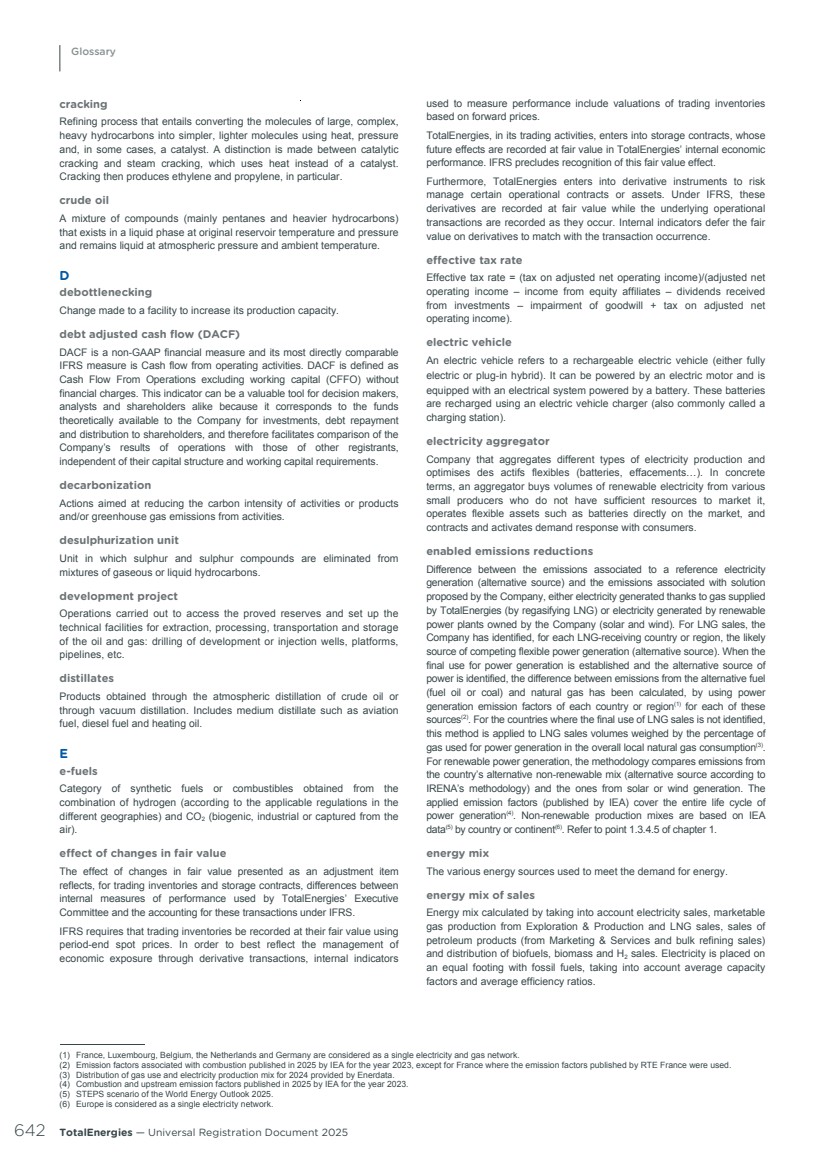
| equity interest perimeter The equity interest perimeter, which is distinct from the operated perimeter, includes all the assets in which the consolidated subsidiaries (including equity-accounted companies) have a financial interest or rights to production. This scope also includes subsidiaries that are not financially consolidated but are material from a sustainability point of view. Under the equity interest perimeter, the indicators are consolidated based on the Company’s equity interest in the assets or its share of production for oil and gas production assets. ESRS perimeter Same scope of consolidation as that used for the financial statements excluding equity affiliates, as well as companies controlled by the Company that are not financially consolidated but are material from a sustainability point of view. This ESRS perimeter is extended to companies and/or assets over which the Company exercises operational control, regardless of their financial consolidation method, for the following indicators: – greenhouse gas emissions (ESRS E1-6 §44 to 46 and §50), – pollutants listed in Annex II to Regulation (EC) No. 166/2006 and microplastics generated or used by the Company (ESRS E2-4 §28/ 29), – biodiversity-sensitive sites (ESRS E4-1). ethane A colorless, odorless combustible gas of the alkanes class composed of two carbon atoms found in natural gas and petroleum gas. ethanol Also commonly called ethyl alcohol or alcohol, ethanol is obtained notably through the fermentation of sugar (beetroot, sugarcane) or starch (grains) or other biological sources. ethylene/propylene Petrochemical products derived from cracking naphtha or light hydrocarbons and used mainly in the production of polyethylene and polypropylene, two plastics frequently used in packaging, the automotive industry, household appliances, healthcare and textiles. European Refining Margin Marker (ERM) This market indicator for European refining, calculated based on public market prices ($/b), uses a basket of crudes, petroleum product yields and variable costs representative of the European refining system of TotalEnergies. F fair value Fair value is the price that would be received to sell an asset or paid to transfer a liability in a transaction under normal conditions between market participants at the measurement date. farmdown Partial sale to a third party of an interest in an asset. FEED studies (front-end engineering design) Studies aimed at defining the project and preparing for its execution. In the TotalEnergies’ process, this covers the pre-project and basic engineering phases. fossil energies Energies produced from oil, natural gas and coal. FPSO (floating production, storage and offloading) Floating integrated offshore unit comprising the equipment used to produce, process and store hydrocarbons and offload them directly to an offshore oil tanker. free cash flow after organic investments Free cash flow after organic investments is a non-GAAP financial measure and its most directly comparable IFRS measure is Cash flow from operating activities. Free cash flow after Organic Investments, refers to Cash Flow From Operations excluding working capital minus Organic Investments. Organic Investments refer to Net Investments excluding acquisitions, asset sales and other transactions with non-controlling interests. This indicator can be a valuable tool for decision makers, analysts and shareholders alike because it illustrates operating cash flow generated by the business post allocation of cash for Organic Investments. FSRU (floating storage and regasification unit) Floating unit permitting the storage of LNG and the regasification. G gearing Gearing is a non-GAAP financial measure and its most directly comparable IFRS measure is the ratio of total financial liabilities to total equity. Gearing is a Net-debt-to-capital ratio, which is calculated as the ratio of Net debt excluding leases to (Equity + Net debt excluding leases). This indicator can be a valuable tool for decision makers, analysts and shareholders alike to assess the strength of the Company’s balance sheet. gearing ratio excluding leases commitments Gearing is a non-GAAP financial measure and its most directly comparable IFRS measure is the ratio of total financial liabilities to total equity. Gearing ratio excluding leases commitments is calculated as follow: (Net debt excluding leases commitments)/(Net debt excluding leases commitments + shareholders equity Company share + Non-controlling interests). GHG The seven greenhouse gases in the Kyoto protocol, namely CO2, CH4, N2O, HFCs, PFCs, SF6 and NF3, with their respective 100-year GWP (Global Warming Potential) as described in the most recent IPCC report. HFCs, PFCs, SF6 and NF3 are virtually absent from the Company’s emissions and are not accounted for by the Company. green electricity Electricity produced from renewable sources. greenfield project Project concerning fields that have never been developed. gross capacity Capacity expressed on a 100% basis regardless of the ownership share in the asset. gross installed capacity Cumulative gross capacity of a site’s electricity generation facilities in operation, without taking into account losses, availability factors or grid constraints. It reflects the theoretical maximum capacity that the facilities can produce at the injection point under standard conditions. It is expressed on a 100% basis regardless of the ownership interest held in the asset. gross investments Investments including acquisitions and increases in non-current loans. H hydraulic fracturing Technique that involves fracturing rock to improve its permeability. hydrocarbon spills Accidental spills of liquid hydrocarbons that have an environmental impact and exceed one barrel in volume, excluding acts of sabotage and theft. hydrocarbons Mixture of molecules composed principally of carbon and hydrogen atoms. They can be solid such as asphalt, liquid such as crude oil or gaseous such as natural gas. They may include compounds with sulphur, nitrogen, metals, etc. Glossary TotalEnergies — Universal Registration Document 2025 643 |
| hydrocracker A refinery unit that uses catalysts and extraordinarily high pressure, in the presence of surplus hydrogen, to convert heavy oils into lighter fractions. I infill well Operating well added to the existing productive wells in order to accelerate and/or improve hydrocarbon recovery. intensity of CO2 equivalent emissions Scope 1+2 GHG emissions from the facilities operated by the Company for its upstream oil & gas activities (kg) divided by the Company’s operated hydrocarbon production in barrels of oil equivalent (boe). intensity of methane emissions Volume of methane emissions divided by the volume of commercial gas produced, from all facilities operated by the Company (oil and/or gas) for its upstream oil & gas activities. inventory valuation effect In accordance with IAS 2, TotalEnergies values inventories of petroleum products in its financial statements according to the First-In, First-Out (FIFO) method and other inventories using the weighted-average cost method. Under the FIFO method, the cost of inventory is based on the historic cost of acquisition or manufacture rather than the current replacement cost. In volatile energy markets, this can have a significant distorting effect on the reported income. Accordingly, the adjusted results of the Refining & Chemicals and Marketing & Services segments are presented according to the replacement cost method. This method is used to assess the segments’ performance and facilitate the comparability of the segments’ performance with those of its main competitors. In the replacement cost method, which approximates the Last-In, First-Out (LIFO) method, the variation of inventory values in the statement of income is, depending on the nature of the inventory, determined using either the month-end prices differential between one period and another or the average prices of the period rather than the historical value. The inventory valuation effect is the difference between the results under the FIFO and the replacement cost methods. J joint-venture Refer to the definition above of “association/consortium/joint-venture”. L lifecycle carbon intensity of energy products sold This indicator measures the average GHG emissions of a unit of energy products used by the Company’s customers across its lifecycle (i.e., Scope 1+2+3), from production to end use by customers. This indicator is calculated as a division which takes into account: – for the numerator, the sum of: – emissions connected to the production and conversion of energy products used by the customers of the Company; – emissions connected to the end use of energy products sold to the Company’s customers. For each product, stoichiometric emission factors(1) are applied to these sales to obtain an emission volume. For the biofuel value chain, lifecycle emissions (production, processing and end use) are calculated on the basis of the emissions of the equivalent fossil fuel to which a standard abatement rate is applied(2) . Non-energy use products (bitumen, lubricants, plastics, etc.) are not taken into account; – negative emissions stored through the use of carbon capture and storage services marketed to third‑party industrial emitters (“storage as a service”) and nature-based carbon sinks projects. – for the denominator: the quantity of energy sold, this being the sum of: – the energy quantities associated with the highest points in the oil and gas value chains, as determined in the Scope 3 calculation; – the energy quantities associated with sales of biofuels (Marketing & Services sales and bulk refining sales), biogas and hydrogen; – the quantities of electricity sold, based on sales by marketing entities in Europe, sales linked to aggregation activities (corresponding to medium/long-term purchases), production outside Europe and sales of EV charging station entities outside Europe. Electricity is placed on an equal footing with fossil fuels, taking into account average capacity factors and average efficiency ratios. The carbon intensity indicator therefore corresponds to the average emissions associated with each unit of energy used by customers. To track changes in the indicator, it is expressed in base 100 compared to 2015. liquids Liquids consist of crude oil, bitumen, condensates and NGL. LNG (liquefied natural gas) Natural gas which has been liquefied by cooling to a temperature of approximately -160 °C which allows its volume to be reduced by a factor of almost 600 in order to transport it. LNG bunkering Specific type of operation where the LNG is transferred from a determined distribution source (e.g., bunkering ship, LNG terminal) to an LNG-fueled vessel. LNG production capacity LNG production average capacity expressed in Mt/y on a 100% basis, taking into account temperature variations over the year and without considering facilities availability. The nameplate capacity which corresponds to the facilities design, defined in project phase is different from the actual capacity which corresponds to capacity tests on existing facilities. LNG train Installation forming part of a liquefaction plant and allowing the separation of natural gas from other gases such as acid gases and LPG, to then liquefy it and finally store it, before loading on to the LNG carriers. LNG carrier Vessel specially designed for the transport of LNG and equipped with tanks which enable to minimize thermal losses in order to maintain the LNG in a liquid state. low-carbon energies ● Electricity generation activities (from renewable sources and flexible gas-fired capacities), electricity storage and trading, and BtB–BtC distribution of gas and electricity – these activities together form the Integrated Power segment. ● Activities related to low‑carbon molecules, namely: biofuels, biogas, renewable hydrogen, low‑carbon hydrogen, e‑fuels/e‑gas. ● Other low‑carbon technologies: CCS, Nature‑based solutions, plastic recycling, electromobility. low-carbon hydrogen Hydrogen whose energy content comes from non‑renewable sources and that meets a required level of greenhouse gas emission reduction compared to the fossil fuel comparator. In Europe, this reduction level is 70%, corresponding to a life‑cycle emission level for hydrogen of 3.38 kg CO₂e/kg H₂, according to the methodology of the European Directive 2018/2001 (RED II). low-carbon molecules Biofuels, biogas, low‑carbon and renewable hydrogen, e‑fuels/e‑gases. (1) The emission factors used are taken from a technical note of the CDP: Guidance methodology for estimation of scope 3 category 11 emissions for oil and gas companies. (2) The abatement rates applied to the emissions of biofuels compared to equivalent fossil fuels are in line with the minimums required by European regulations (RED II). Glossary 644 TotalEnergies — Universal Registration Document 2025 |
| LPG (liquefied petroleum gas) Light hydrocarbons (comprised of butane and propane, belonging to the alkanes class and composed of three and four carbon atoms respectively) that are gaseous under normal temperature and pressure conditions and that are kept in liquid state by increasing the pressure or reducing the temperature. LPG is included in NGL. LTIR (Lost Time Injury Rate) Frequency rate of lost-time injuries: number of lost time accidents per million hours worked. LTIS (Lost Time Injury Severity) Number of lost-time days due to accidents at work per million hours worked. M material sites for the environment The sites of the subsidiaries in production for the Upstream oil & gas activities, the production sites with output above 250 kt/y in the Refining & Chemicals and Marketing & Services segments, as well as the gas‑fired power plants in the Integrated Power segment, which are operated by the Company. mining interests Rights to explore for and/or produce oil and gas in a specific area for a fixed period. Covers the concepts of “permit”, “license”, “title”, etc. N naphtha Light or heavy fraction obtained from the distillation of hydrocarbons and used as a feedstock for the production of olefins (ethylene, propylene) and aromatics in petrochemicals. native CO2 CO2 naturally present in the reservoir before any hydrocarbon production or CO2 injection. natural gas Mixture of light gaseous hydrocarbons extracted from underground reservoirs. It is mainly composed of methane, but can also contain ethane up to 10%, molecules with one or two carbon atoms, and other compounds in small quantities. natural gas liquids (NGL) A mixture of light hydrocarbons that exist in the gaseous phase at room temperature and pressure and are recovered as liquid in gas processing plants. NGL include ethane, propane and butane. natural gas for vehicles (NGV) Natural gas used as vehicle fuel, mainly in the form of LNG or CNG. nature-based solutions Actions aimed at a sustainable management and use of nature in order to preserve or enhance carbon storage. TotalEnergies’ Nature based solutions aim to generate carbon credits for the voluntary compensation of the Company’s residual Scope 1 and 2 emissions from 2030 onward while also seeking environmental, social and economic benefits. net cash flow (or free cash-flow) Net cash flow (or free cash-flow) is a non-GAAP financial measure and its most directly comparable IFRS measure is Cash flow from operating activities. Net cash flow refers to Cash Flow From Operations excluding working capital minus Net Investments. Net cash flow can be a valuable tool for decision makers, analysts and shareholders alike because it illustrates cash flow generated by the operations of the Company post allocation of cash for Organic Investments and Acquisitions net of assets sales (acquisitions - assets sales - other operations with non-controlling interests). This performance indicator corresponds to the cash flow available to repay debt and allocate cash to shareholder distribution or share buybacks. net financial debts or net debt Net financial debts or net debt comprise non-current financial debts, including current portion due within one year, current borrowings, other current financial liabilities less cash and cash equivalents, non current financial assets and other current financial assets, as well as financial assets and liabilities intended to be sold or exchanged. net investments Net investments is a non-GAAP financial measure and its most directly comparable IFRS measure is Cash flow used in investing activities. Net Investments refer to Cash flow used in investing activities including other transactions with non-controlling interests, including change in debt from renewable projects financing, including expenditures related to carbon credits, including capex linked to capitalized leasing contracts and excluding organic loan repayment from equity affiliates. This indicator can be a valuable tool for decision makers, analysts and shareholders alike to illustrate the cash directed to growth opportunities, both internal and external, thereby showing, when combined with the Company’s cash flow statement prepared under IFRS, how cash is generated and allocated for uses within the organization. Net Investments are the sum of Organic Investments and Acquisitions net of assets sales. non-routine flaring flaring other than routine flaring and safety flaring occurring primarily during occasional and intermittent events. O offshore wind Wind turbine installed offshore rather than inland. Operating on the same model as land-based models, offshore wind turbines capture more sustained and steady winds, and thus produce more electricity. oil In the Upstream hydrocarbons activities, generic term designating crude oil, condensates and natural gas liquids. oil sands Sandstones containing natural bitumen. olefins Group of products (gas) obtained after cracking of petroleum streams. Olefins are ethylene, propylene and butadiene. These products are used in the production of large plastics (polyethylene, polypropylene, PVC, etc.), in the production of elastomers (polybutadiene, etc.) or in the production of large chemical intermediates. operated charging point (for an electric vehicle) A charging point is said to be operated when the Company supplies electricity and issues the charging session’s invoice, or any other potential related services (membership, reservation, etc.) via a supervision platform tahat it manages directly (without any intermediaries. operated perimeter Activities, sites and industrial assets of which TotalEnergies SE or one of its subsidiaries has operational control, i.e., has the responsibility of the conduct of operations on behalf of all its partners. operated oil & gas facilities Facilities operated by the Company as part of its Upstream oil and gas activities as well as in its Refining & Chemicals and Marketing & Services segments. Facilities for power generation from renewable sources or natural gas, such as combined-cycle natural gas power plants are therefore excluded from this perimeter. operated production Total quantity of oil and gas produced on fields operated by the Company. Glossary TotalEnergies — Universal Registration Document 2025 645 |
| operator Partner, within an association, in charge of an oil and gas joint-venture in charge of carrying out the operations on a specific area, or the operation of refining and/or petrochemical activities on a processing unit on behalf of the partners, partners of said permit or owners of said refining or petrochemical unit. organic investments Organic investments is a non-GAAP financial measure and its most directly comparable IFRS measure is Cash flow used in investing activities. Organic investments refers to Net Investments, excluding acquisitions, asset sales and other operations with non-controlling interests. Organic Investments can be a valuable tool for decision makers, analysts and shareholders alike because it illustrates cash flow used by the Company to grow its asset base, excluding sources of external growth. P payout Payout is a non-GAAP financial measure. Payout is defined as the ratio of the dividends and share buybacks for cancellation to the Cash Flow From Operations excluding working capital. This indicator can be a valuable tool for decision makers, analysts and shareholders as it provides the portion of the Cash Flow From Operations excluding working capital distributed to the shareholder. permit Area contractually granted to an oil and gas company (or a consortium) by the host country for a defined period to carry out exploration work or to exploit a field. petcoke (or petroleum coke) Residual product remaining after the improvement of very heavy petroleum cuts. This solid black product consists mainly of carbon and can be used as fuel. polymers Molecule composed of monomers bonded together by covalent bonds, such as polyolefins obtained from olefins or starch and proteins produced naturally. Power Purchase Agreement (PPA) Long-term agreement for the supply of electricity used in particular for marketing renewable electricity. pre-dividend organic cash breakeven Brent price for which the operating cash flow before working capital changes covers the organic investments. price effect The impact of changing hydrocarbon prices on entitlement volumes from production sharing contracts and on economic limit dates. production costs Costs related to the production of hydrocarbons in accordance with FASB ASC 932-360-25-15. production plateau Expected average stabilized level of production for a field following the production build-up. production sharing contract/agreement (PSC/PSA) Exploration and production contract under which a host country or, more frequently, its national company, transfers to an oil and gas company (the contractor) or a consortium (the contracting group) the right to explore a geographic area and develop the fields discovered. The contractor (or contracting group) undertakes the execution and financing, at its own risk, of all operations. In return, it is entitled to a portion of the production, called cost oil/gas, to recover its expenditures and investments. The remaining production, called profit oil/gas, is then shared between the contractor (contracting group), and the national company and/or host country. project As used in this document, “project” may encompass different meanings, such as properties, agreements, investments, developments, phases, activities or components, each of which may also informally be described as a “project”. Such use is for convenience only and is not intended as a precise description of the term “project” as it relates to any specific governmental law or regulation. proved permit Permit for which there are proved reserves. proved reserves (1P reserves) Proved oil and gas reserves are those quantities of oil and gas, which, by analysis of geoscience and engineering data, can be estimated with a reasonable certainty to be economically producible from a given date forward, from known reservoirs, and under existing economic conditions, operating methods, and government regulations, prior to the time at which contracts providing the right to operate expire, unless evidence indicates that renewal is reasonably certain, regardless of whether deterministic or probabilistic methods are used for the estimation. proved developed reserves Proved developed oil and gas reserves are proved reserves that can be expected to be recovered (i) through existing wells with existing equipment and operating methods or in which the cost of the required equipment is relatively minor compared to the cost of a new well; and (ii) through installed extraction equipment and infrastructure operational at the time of the reserves estimate if the extraction is by means not involving a well. proved undeveloped reserves Proved undeveloped oil and gas reserves are proved reserves that are expected to be recovered with new investments (new wells on undrilled acreage, or from existing wells where a relatively major expenditure is required for recompletion, surface facilities). R refining The various processes used to produce petroleum products from crude oil (e.g., distillation, reforming, desulphurization, cracking). regasification Before the gas is transported from the terminal to the distribution networks, the LNG is regasified: its temperature is raised from -160 °C to 0 °C under high pressure. renewable diesel Category of biodiesel, renewable diesel refers to diesel fuel made from 100% renewable raw materials, such as vegetable oils or materials from the circular economy (animal fats, used cooking oils, etc.). Thanks to its hydrotreatment production process, renewable diesel has a chemical composition close to fossil diesel and can therefore be used without any limit on its incorporation into diesel, without damaging the operation of engines. Compared with its fossil equivalent, using renewable diesel reduces greenhouse gas emissions by more than 50% over the entire life cycle, calculated pursuant to the methodology set out in Directive (EU) 2018/2001 (RED II) and also enables a reduction in particle and nitrogen oxide emissions. renewable/renewable energy An energy source the inventories of which can be renewed or are inexhaustible, such as solar, wind, hydraulic, biogas, biomass and geothermal energy. Glossary 646 TotalEnergies — Universal Registration Document 2025 [REDACTED SECTION: CERTAIN TEXT HAS BEEN REDACTED.] |
| renewable hydrogen Hydrogen produced through electrolysis of water (in an electrolyzer, powered by electricity) and with the electricity stemming from renewable sources. For renewable hydrogen production, greenhouse gas emissions over the entire life cycle are close to zero. Renewable hydrogen can also be produced by reforming biogas (instead of natural gas) or by the biochemical conversion of biomass, provided the process meets the applicable sustainability requirements. For example, in Europe, the maximum greenhouse gas emission threshold for renewable hydrogen is 3.38 kg CO₂e/kg H₂ over the life cycle, according to the methodology of European Directive 2018/2001 (RED II). reserve life index Synthetic indicator calculated from data published under ASC 932. Ratio of the proved reserves at the end of the period to the production of the past year. reserves Estimated remaining quantities of oil and gas and related substances expected to be economically producible, as of a given date, by application of development projects to known accumulations. reservoir Porous, permeable underground rock formation that contains oil or natural gas. residual emissions Greenhouse gas emissions that remain after implementing emission‑reduction measures. resource acquisitions Acquisition of a participating interest in an oil and gas mining property by way of an assignment of rights and obligations in the corresponding permit or license and related contracts, with a view to producing the recoverable oil and gas. return on average capital employed (ROACE) ROACE is a non-GAAP financial measure. ROACE is the ratio of Adjusted Net Operating Income to average Capital Employed at replacement cost between the beginning and the end of the period. This indicator can be a valuable tool for decision makers, analysts and shareholders alike to measure the profitability of the Company’s average Capital Employed in its business operations and is used by the Company to benchmark its performance internally and externally with its peers. return on equity (ROE) Ratio of adjusted consolidated net income to average adjusted shareholders’ equity (after distribution) between the beginning and the end of the period. Adjusted shareholders’ equity for a given period is calculated after distribution of the dividend (subject to approval by the Shareholders’ Meeting). risked service contract Service contract where the contractor bears the investments and the risks. The contractor usually receives a portion of the production to cover the refund of the investments and the related interests, and a monetary remuneration linked to the performance of the field. routine flaring Flaring during normal production operations conducted in the absence of sufficient facilities or adequate geological conditions for the reinjection, on-site utilization or sale of the gas produced (as defined by the working group of the Global Gas Flaring Reduction program as part of the World Bank’s Zero Routine Flaring initiative). Routine flaring does not include safety flaring. S Safety flaring Flaring to ensure the safe performance of operations conducted at the production site (emergency shutdown, safety-related testing, etc.) Scope 1 GHG emissions Direct emissions of greenhouse gases from sites or activities that are included in the scope of reporting for climate change-related indicators. Direct biogenic CO2 emissions are excluded from Scope 1 and reported separately. Scope 2 GHG emissions Indirect emissions of greenhouse gases resulting from the production of electricity, steam, heat or cooling, purchased or acquired, and consumed by the sites or activities included in the scope of reporting for climate change-related indicators, net from potential energy sales, excluding purchased industrial gases (H2). If not stated otherwise, TotalEnergies reports Scope 2 GHG emissions according to the market-based method defined by the GHG Protocol. For the purposes of reporting under the ESRS standards, TotalEnergies also reports Scope 2 GHG emissions using the location‑based method. Scope 3 GHG emissions other indirect emissions. If not stated otherwise, TotalEnergies reports Scope 3 GHG emissions, category 11, which correspond to indirect GHG emissions related to the direct use-phase emissions of sold products over their expected lifetime (i.e., the scope 1 and scope 2 emissions of end users that occur from the combustion of fuels) in accordance with the definition of the GHG Protocol Corporate Value Chain (Scope 3) Accounting and Reporting Standard Supplement. The Company follows the oil & gas industry reporting guidelines published by IPIECA, which comply with the GHG Protocol methodologies. In order to avoid double counting, this methodology accounts for the largest volume in the oil and gas value chains, i.e., the higher of the two production volumes or sales for end use. A stoichiometric emission factor (oxidation of molecules to carbon dioxide) is applied to these sales or production to obtain an emission volume. In accordance with the Technical Guidance for Calculating Scope 3 Emissions Supplement to the Corporate Value Chain (Scope 3) Accounting and Reporting Standard which defines end users as both consumers and business customers that use final products, and with IPIECA’s Estimating petroleum industry value chain (Scope 3) greenhouse gas emissions guidelines, under which reporting of emissions from fuel purchased for resale to non-end users (e.g., traded) is optional, TotalEnergies does not report emissions associated with trading activities. In accordance with ESRS, biogenic CO2 emissions from the combustion or biodegradation of biomass (from sales of biofuels and biogas) are excluded from Scope 3 and disclosed separately. seismic acquisition Field campaign consisting of acquiring geophysical data, offshore or onshore, with a view to imaging the subsurface and implanting exploration, development or production wells. serious road accident Overturned vehicle or other accident resulting in the injury of a crew member or a passenger (recordable accident) involving a TotalEnergies vehicle or vehicle on long-term contract with TotalEnergies (>6 months). service provider personnel Any employee of a contractor or service provider working at a site that is part of the safety reporting Scope or employed in the context of a transport service under a long-term contract. shale gas A fossil energy comparable to conventional natural gas, derived from a mixture of organic matter and sediments that, over time, transform into source rocks. The organic materials trapped in the shale undergo metamorphosis and give rise to a methane‑rich hydrocarbon. shipping Transport by sea. LNG is carried out on board LNG carriers (refer to definition). Glossary TotalEnergies — Universal Registration Document 2025 647 |
| silicon The most abundant element in Earth’s crust after oxygen. It does not exist in a free state but in the form of compounds such as silica, which has long been used as an essential element of glass. Polysilicon (or crystalline silicon), which is obtained by purifying silicon and consists of metal-like crystals, is used in the construction of photovoltaic solar panels, but other minerals or alloys may be used. site restitution Refer to the definition above of “asset retirement”. Socle Social Commun or “Common Social Basis” The Socle Social Commun or “Common Social Basis” is composed of the subsidiaries in France that share the same agreements. Employees of the companies that form the Socle Social Commun benefit from shared social provisions, notably in the areas of health and life/disability insurance, profit‑sharing and employee incentives, employee savings schemes, national and international mobility, and working time. special items Due to their unusual nature or particular significance, certain transactions qualifying as “special items” are excluded from the business segment figures. In general, special items relate to transactions that are significant, infrequent or unusual. In certain instances, transactions such as restructuring costs or asset disposals, which are not considered to be representative of the normal course of business, may qualify as special items although they may have occurred in prior years or are likely to recur in following years. special fluids Special fluids are hydrocarbon-based products used in specific and diverse applications. They are used by the Company’s customers in paint formulations, mastics, drilling fluids, cosmetics, print inks, tires, vaccines, as well as products for water treatment (this list is not exhaustive). steam cracker Industrial petrochemical unit that converts, through high‑temperature thermal cracking and in the presence of steam, naphtha and light hydrocarbons into ethylene, propylene, and other chemical raw materials. supervised charging point (for an electric vehicle) A charging point is said to be supervised when it is not operated by the Company (refer to the definition of operated charging point for an electric vehicle). sustainable aviation fuel (SAF) Molecules aiming to be incorporated into conventional fossil-based aviation fuel. It can be made through different technologies and from different feedstocks: – biomass, e.g., waste and residues sourced from the circular economy such as used cooking oils (pursuant to regulations applicable in the various regions; for example, in Europe, the qualification of sustainable aviation fuel excludes the use of feedstocks derived from crops intended for human or animal consumption) via a mature technology available at industrial scale; – green hydrogen and CO2 (named e-fuels or synthetic fuels), via a technology still under development. As of today, SAF is not used pure, but is incorporated in varying proportions up to 50% into conventional fossil-based aviation fuel. Incorporation rates vary depending on airlines requests and/or regulations applicable in the different countries. For instance, in Europe the regulation ReFuelEU Aviation (EU) 2023/2405 expects minimum shares of SAF calculated as an annual average across all airports in Europe (and then for each airport starting in 2035): 2% starting from 2025, 6% (including 1.2% of synthetic fuel) starting from 2030 and 70% (including 35% of synthetic fuel) starting from 2050. Used neat, SAF may allow, depending on the feedstocks used and the production pathways, a reduction of up to 90% CO2 emissions over its full lifecycle, compared with its fossil equivalent (pursuant to the methodology European directive (EU) 2018/2001 modified on the promotion of the use of energy from renewable sources, named RED II). T technical costs Ratio (Production costs* + exploration expenses + DD&A*)/production of the year. *Excluding non-recurrent items. Tier 1 and Tier 2 Indicator of the number of losses of primary containment with more or less significant consequences (fires, explosions, injuries, etc.), as defined by API 754 (for downstream) and IOGP 456 (for upstream). Excluding acts of sabotage and theft. The Tier 1 indicator refers to incidents with the potential for the most severe consequences. The scope of application is defined in the standards cited. tight gas Natural gas trapped in very low-permeable reservoir. transition strategy Means the transition strategy of TotalEnergies as described in point 1.2 of the chapter 1. TRIR (Total Recordable Injury Rate) Frequency rate of recordable injuries: number of recorded injuries per million hours worked. turnaround Scheduled or unscheduled shutdown of production units to carry out maintenance, inspection, regulatory compliance or modernization work on one or more pieces of equipment. U unconventional hydrocarbons Unconventional oil & gas are defined by the U.S. Energy Information Administration (EIA) as hydrocarbons that are “produced by means that do not meet the criteria for conventional production” i.e., “by a well drilled into a geologic formation in which the reservoir and fluid characteristics permit the oil and natural gas to readily flow to the wellbore.” According to United Nations Framework Classification for Resources (UNFC), “examples include CBM (Coal-Bed Methane), low permeability deposits such as tight gas (including shale gas) and tight oil (including shale oil), gas hydrates and natural bitumen”. unitization Creation of a new joint-venture and appointment of a single operator for the development and production as single unit of an oil or gas field involving several permits/licenses or countries. unproved permit Permit for which there are no proved reserves. Upstream oil and gas activities The Company’s Upstream hydrocarbons activities include the oil and gas exploration and production activities of the Exploration & Production and the Integrated LNG segments. They do not include power generation facilities based on natural gas such as combined-cycle natural gas power plants. V variable cost margin, Refining Europe This indicator represents the average margin on variable costs realized by TotalEnergies’ European refining business. It is equal to the difference between the sales of refined products realized by TotalEnergies’ European refining and the crude purchases as well as associated variable costs, divided by refinery throughput in tons. The previous ERMI indicator was intended to represent the margin after variable costs for a hypothetical complex refinery located around Rotterdam in Northern Europe that processes a mix of crude oil and other inputs commonly supplied to this region to produce and market the main refined products at prevailing prices in this region. Glossary 648 TotalEnergies — Universal Registration Document 2025 |
| W Worldwide Human Resources Survey (WHRS) An annual study that includes approximately 300 workforce indicators linked to the Company’s Human Resources policies, such as mobility, talent development, training, working conditions, social dialogue, deployment of the Code of Conduct, human rights and health. The survey is conducted among a panel of companies representative of the Company (in terms of workforce and geographic areas), which each year accounts for approximately 90% of the Company’s consolidated headcount. Glossary TotalEnergies — Universal Registration Document 2025 649 [REDACTED SECTION: CERTAIN TEXT HAS BEEN REDACTED.] |