Please wait
false0000885275DEF 14A0000885275ecd:AggtPnsnAdjsSvcCstMemberecd:PeoMember2024-01-012024-12-310000885275ecd:VstngDtFrValOfEqtyAwrdsGrntdAndVstdInCvrdYrMemberecd:PeoMember2024-01-012024-12-310000885275ecd:ChngInFrValAsOfVstngDtOfPrrYrEqtyAwrdsVstdInCvrdYrMemberecd:PeoMember2024-01-012024-12-310000885275ecd:NonPeoNeoMemberecd:VstngDtFrValOfEqtyAwrdsGrntdAndVstdInCvrdYrMember2022-01-012022-12-310000885275ecd:ChngInFrValAsOfVstngDtOfPrrYrEqtyAwrdsVstdInCvrdYrMemberecd:PeoMember2023-01-012023-12-310000885275ecd:NonPeoNeoMemberecd:EqtyAwrdsInSummryCompstnTblForAplblYrMember2025-01-012025-12-310000885275ecd:AggtChngPnsnValInSummryCompstnTblForAplblYrMemberecd:PeoMember2025-01-012025-12-310000885275ecd:ChngInFrValAsOfVstngDtOfPrrYrEqtyAwrdsVstdInCvrdYrMemberecd:PeoMember2021-01-012021-12-310000885275ecd:NonPeoNeoMemberecd:PnsnAdjsPrrSvcCstMember2024-01-012024-12-310000885275ecd:AggtChngPnsnValInSummryCompstnTblForAplblYrMemberecd:NonPeoNeoMember2022-01-012022-12-310000885275ecd:AggtChngPnsnValInSummryCompstnTblForAplblYrMemberecd:NonPeoNeoMember2023-01-012023-12-310000885275ecd:YrEndFrValOfEqtyAwrdsGrntdInCvrdYrOutsdngAndUnvstdMemberecd:PeoMember2024-01-012024-12-310000885275ecd:AggtPnsnAdjsSvcCstMemberecd:PeoMember2022-01-012022-12-310000885275ecd:NonPeoNeoMemberecd:AggtPnsnAdjsSvcCstMember2021-01-012021-12-310000885275ecd:PnsnAdjsSvcCstMemberecd:PeoMember2024-01-012024-12-310000885275ecd:AggtChngPnsnValInSummryCompstnTblForAplblYrMemberecd:PeoMember2023-01-012023-12-310000885275ecd:FrValAsOfPrrYrEndOfEqtyAwrdsGrntdInPrrYrsFldVstngCondsDrngCvrdYrMemberecd:PeoMember2024-01-012024-12-310000885275ecd:EqtyAwrdsAdjsExclgValRprtdInSummryCompstnTblMemberecd:PeoMember2023-01-012023-12-310000885275ecd:YrEndFrValOfEqtyAwrdsGrntdInCvrdYrOutsdngAndUnvstdMemberecd:PeoMember2025-01-012025-12-310000885275ecd:NonPeoNeoMemberecd:ChngInFrValOfOutsdngAndUnvstdEqtyAwrdsGrntdInPrrYrsMember2025-01-012025-12-310000885275ecd:EqtyAwrdsAdjsExclgValRprtdInSummryCompstnTblMemberecd:PeoMember2021-01-012021-12-310000885275ecd:NonPeoNeoMemberecd:AggtPnsnAdjsSvcCstMember2025-01-012025-12-310000885275ecd:NonPeoNeoMemberecd:FrValAsOfPrrYrEndOfEqtyAwrdsGrntdInPrrYrsFldVstngCondsDrngCvrdYrMember2023-01-012023-12-310000885275ecd:YrEndFrValOfEqtyAwrdsGrntdInCvrdYrOutsdngAndUnvstdMemberecd:PeoMember2021-01-012021-12-310000885275ecd:NonPeoNeoMemberecd:PnsnAdjsSvcCstMember2022-01-012022-12-310000885275ecd:EqtyAwrdsInSummryCompstnTblForAplblYrMemberecd:PeoMember2025-01-012025-12-310000885275ecd:NonPeoNeoMemberecd:PnsnAdjsSvcCstMember2024-01-012024-12-310000885275ecd:AggtChngPnsnValInSummryCompstnTblForAplblYrMemberecd:PeoMember2024-01-012024-12-310000885275ecd:PnsnAdjsPrrSvcCstMemberecd:PeoMember2023-01-012023-12-310000885275ecd:NonPeoNeoMemberecd:FrValAsOfPrrYrEndOfEqtyAwrdsGrntdInPrrYrsFldVstngCondsDrngCvrdYrMember2022-01-012022-12-310000885275ecd:PnsnAdjsSvcCstMemberecd:PeoMember2021-01-012021-12-310000885275ecd:NonPeoNeoMemberecd:AggtPnsnAdjsSvcCstMember2024-01-012024-12-310000885275ecd:NonPeoNeoMemberecd:PnsnAdjsSvcCstMember2025-01-012025-12-310000885275ecd:NonPeoNeoMemberecd:EqtyAwrdsAdjsExclgValRprtdInSummryCompstnTblMember2023-01-012023-12-310000885275ecd:YrEndFrValOfEqtyAwrdsGrntdInCvrdYrOutsdngAndUnvstdMemberecd:PeoMember2023-01-012023-12-310000885275ecd:EqtyAwrdsInSummryCompstnTblForAplblYrMemberecd:PeoMember2022-01-012022-12-310000885275ecd:PnsnAdjsPrrSvcCstMemberecd:PeoMember2024-01-012024-12-310000885275ecd:NonPeoNeoMemberecd:ChngInFrValAsOfVstngDtOfPrrYrEqtyAwrdsVstdInCvrdYrMember2023-01-012023-12-310000885275ecd:FrValAsOfPrrYrEndOfEqtyAwrdsGrntdInPrrYrsFldVstngCondsDrngCvrdYrMemberecd:PeoMember2023-01-012023-12-310000885275ecd:ChngInFrValOfOutsdngAndUnvstdEqtyAwrdsGrntdInPrrYrsMemberecd:PeoMember2024-01-012024-12-310000885275ecd:NonPeoNeoMemberecd:PnsnAdjsPrrSvcCstMember2025-01-012025-12-310000885275ecd:VstngDtFrValOfEqtyAwrdsGrntdAndVstdInCvrdYrMemberecd:PeoMember2022-01-012022-12-310000885275ecd:NonPeoNeoMemberecd:VstngDtFrValOfEqtyAwrdsGrntdAndVstdInCvrdYrMember2023-01-012023-12-310000885275ecd:YrEndFrValOfEqtyAwrdsGrntdInCvrdYrOutsdngAndUnvstdMemberecd:PeoMember2022-01-012022-12-310000885275ecd:NonPeoNeoMemberecd:DvddsOrOthrErngsPdOnEqtyAwrdsNtOthrwsRflctdInTtlCompForCvrdYrMember2023-01-012023-12-310000885275ecd:NonPeoNeoMemberecd:AggtChngPnsnValInSummryCompstnTblForAplblYrMember2025-01-012025-12-310000885275ecd:NonPeoNeoMemberecd:FrValAsOfPrrYrEndOfEqtyAwrdsGrntdInPrrYrsFldVstngCondsDrngCvrdYrMember2025-01-012025-12-310000885275ecd:NonPeoNeoMemberecd:YrEndFrValOfEqtyAwrdsGrntdInCvrdYrOutsdngAndUnvstdMember2021-01-012021-12-310000885275ecd:PnsnAdjsPrrSvcCstMemberecd:PeoMember2021-01-012021-12-310000885275ecd:VstngDtFrValOfEqtyAwrdsGrntdAndVstdInCvrdYrMemberecd:PeoMember2021-01-012021-12-310000885275ecd:DvddsOrOthrErngsPdOnEqtyAwrdsNtOthrwsRflctdInTtlCompForCvrdYrMemberecd:PeoMember2022-01-012022-12-3100008852752021-01-012021-12-310000885275ecd:NonPeoNeoMemberecd:YrEndFrValOfEqtyAwrdsGrntdInCvrdYrOutsdngAndUnvstdMember2025-01-012025-12-310000885275ecd:PnsnAdjsSvcCstMemberecd:PeoMember2022-01-012022-12-310000885275ecd:NonPeoNeoMemberecd:EqtyAwrdsInSummryCompstnTblForAplblYrMember2023-01-012023-12-310000885275ecd:NonPeoNeoMemberecd:PnsnAdjsPrrSvcCstMember2022-01-012022-12-310000885275ecd:ChngInFrValOfOutsdngAndUnvstdEqtyAwrdsGrntdInPrrYrsMemberecd:PeoMember2023-01-012023-12-310000885275ecd:EqtyAwrdsInSummryCompstnTblForAplblYrMemberecd:PeoMember2021-01-012021-12-310000885275ecd:NonPeoNeoMemberecd:YrEndFrValOfEqtyAwrdsGrntdInCvrdYrOutsdngAndUnvstdMember2023-01-012023-12-310000885275ecd:NonPeoNeoMemberecd:YrEndFrValOfEqtyAwrdsGrntdInCvrdYrOutsdngAndUnvstdMember2024-01-012024-12-310000885275ecd:NonPeoNeoMemberecd:FrValAsOfPrrYrEndOfEqtyAwrdsGrntdInPrrYrsFldVstngCondsDrngCvrdYrMember2021-01-012021-12-310000885275ecd:NonPeoNeoMemberecd:EqtyAwrdsAdjsExclgValRprtdInSummryCompstnTblMember2021-01-012021-12-310000885275ecd:NonPeoNeoMemberecd:FrValAsOfPrrYrEndOfEqtyAwrdsGrntdInPrrYrsFldVstngCondsDrngCvrdYrMember2024-01-012024-12-310000885275ecd:NonPeoNeoMemberecd:PnsnAdjsSvcCstMember2023-01-012023-12-310000885275ecd:FrValAsOfPrrYrEndOfEqtyAwrdsGrntdInPrrYrsFldVstngCondsDrngCvrdYrMemberecd:PeoMember2021-01-012021-12-310000885275ecd:NonPeoNeoMemberecd:EqtyAwrdsAdjsExclgValRprtdInSummryCompstnTblMember2022-01-012022-12-310000885275ecd:NonPeoNeoMemberecd:EqtyAwrdsInSummryCompstnTblForAplblYrMember2024-01-012024-12-310000885275ecd:NonPeoNeoMemberecd:ChngInFrValOfOutsdngAndUnvstdEqtyAwrdsGrntdInPrrYrsMember2022-01-012022-12-310000885275ecd:AggtChngPnsnValInSummryCompstnTblForAplblYrMemberecd:PeoMember2021-01-012021-12-310000885275ecd:ChngInFrValOfOutsdngAndUnvstdEqtyAwrdsGrntdInPrrYrsMemberecd:PeoMember2025-01-012025-12-310000885275ecd:AggtPnsnAdjsSvcCstMemberecd:PeoMember2025-01-012025-12-310000885275ecd:DvddsOrOthrErngsPdOnEqtyAwrdsNtOthrwsRflctdInTtlCompForCvrdYrMemberecd:PeoMember2025-01-012025-12-310000885275ecd:NonPeoNeoMemberecd:PnsnAdjsPrrSvcCstMember2023-01-012023-12-3100008852752025-01-012025-12-310000885275ecd:EqtyAwrdsInSummryCompstnTblForAplblYrMemberecd:PeoMember2023-01-012023-12-310000885275ecd:ChngInFrValAsOfVstngDtOfPrrYrEqtyAwrdsVstdInCvrdYrMemberecd:PeoMember2022-01-012022-12-310000885275ecd:NonPeoNeoMemberecd:ChngInFrValOfOutsdngAndUnvstdEqtyAwrdsGrntdInPrrYrsMember2024-01-012024-12-3100008852752022-01-012022-12-310000885275ecd:NonPeoNeoMemberecd:DvddsOrOthrErngsPdOnEqtyAwrdsNtOthrwsRflctdInTtlCompForCvrdYrMember2021-01-012021-12-310000885275ecd:NonPeoNeoMemberecd:ChngInFrValAsOfVstngDtOfPrrYrEqtyAwrdsVstdInCvrdYrMember2022-01-012022-12-310000885275ecd:ChngInFrValAsOfVstngDtOfPrrYrEqtyAwrdsVstdInCvrdYrMemberecd:PeoMember2025-01-012025-12-310000885275ecd:PnsnAdjsPrrSvcCstMemberecd:PeoMember2025-01-012025-12-310000885275ecd:NonPeoNeoMemberecd:VstngDtFrValOfEqtyAwrdsGrntdAndVstdInCvrdYrMember2021-01-012021-12-310000885275ecd:NonPeoNeoMemberecd:AggtPnsnAdjsSvcCstMember2023-01-012023-12-310000885275ecd:NonPeoNeoMemberecd:ChngInFrValAsOfVstngDtOfPrrYrEqtyAwrdsVstdInCvrdYrMember2024-01-012024-12-310000885275ecd:NonPeoNeoMemberecd:DvddsOrOthrErngsPdOnEqtyAwrdsNtOthrwsRflctdInTtlCompForCvrdYrMember2025-01-012025-12-310000885275ecd:NonPeoNeoMemberecd:ChngInFrValOfOutsdngAndUnvstdEqtyAwrdsGrntdInPrrYrsMember2021-01-012021-12-310000885275ecd:AggtPnsnAdjsSvcCstMemberecd:PeoMember2023-01-012023-12-310000885275ecd:AggtChngPnsnValInSummryCompstnTblForAplblYrMemberecd:PeoMember2022-01-012022-12-310000885275ecd:FrValAsOfPrrYrEndOfEqtyAwrdsGrntdInPrrYrsFldVstngCondsDrngCvrdYrMemberecd:PeoMember2025-01-012025-12-310000885275ecd:ChngInFrValOfOutsdngAndUnvstdEqtyAwrdsGrntdInPrrYrsMemberecd:PeoMember2022-01-012022-12-310000885275ecd:NonPeoNeoMemberecd:AggtChngPnsnValInSummryCompstnTblForAplblYrMember2024-01-012024-12-310000885275ecd:VstngDtFrValOfEqtyAwrdsGrntdAndVstdInCvrdYrMemberecd:PeoMember2023-01-012023-12-310000885275ecd:NonPeoNeoMemberecd:ChngInFrValAsOfVstngDtOfPrrYrEqtyAwrdsVstdInCvrdYrMember2025-01-012025-12-310000885275ecd:VstngDtFrValOfEqtyAwrdsGrntdAndVstdInCvrdYrMemberecd:PeoMember2025-01-012025-12-310000885275ecd:NonPeoNeoMemberecd:DvddsOrOthrErngsPdOnEqtyAwrdsNtOthrwsRflctdInTtlCompForCvrdYrMember2024-01-012024-12-310000885275ecd:NonPeoNeoMemberecd:PnsnAdjsPrrSvcCstMember2021-01-012021-12-310000885275ecd:NonPeoNeoMemberecd:EqtyAwrdsAdjsExclgValRprtdInSummryCompstnTblMember2025-01-012025-12-310000885275ecd:NonPeoNeoMemberecd:PnsnAdjsSvcCstMember2021-01-012021-12-310000885275ecd:EqtyAwrdsAdjsExclgValRprtdInSummryCompstnTblMemberecd:PeoMember2025-01-012025-12-310000885275ecd:ChngInFrValOfOutsdngAndUnvstdEqtyAwrdsGrntdInPrrYrsMemberecd:PeoMember2021-01-012021-12-310000885275ecd:PnsnAdjsSvcCstMemberecd:PeoMember2023-01-012023-12-310000885275ecd:EqtyAwrdsAdjsExclgValRprtdInSummryCompstnTblMemberecd:PeoMember2022-01-012022-12-310000885275ecd:PnsnAdjsPrrSvcCstMemberecd:PeoMember2022-01-012022-12-310000885275ecd:NonPeoNeoMemberecd:ChngInFrValAsOfVstngDtOfPrrYrEqtyAwrdsVstdInCvrdYrMember2021-01-012021-12-310000885275ecd:NonPeoNeoMemberecd:ChngInFrValOfOutsdngAndUnvstdEqtyAwrdsGrntdInPrrYrsMember2023-01-012023-12-310000885275ecd:NonPeoNeoMemberecd:YrEndFrValOfEqtyAwrdsGrntdInCvrdYrOutsdngAndUnvstdMember2022-01-012022-12-3100008852752023-01-012023-12-310000885275ecd:NonPeoNeoMemberecd:EqtyAwrdsAdjsExclgValRprtdInSummryCompstnTblMember2024-01-012024-12-310000885275ecd:DvddsOrOthrErngsPdOnEqtyAwrdsNtOthrwsRflctdInTtlCompForCvrdYrMemberecd:PeoMember2021-01-012021-12-3100008852752024-01-012024-12-310000885275ecd:PnsnAdjsSvcCstMemberecd:PeoMember2025-01-012025-12-310000885275ecd:NonPeoNeoMemberecd:DvddsOrOthrErngsPdOnEqtyAwrdsNtOthrwsRflctdInTtlCompForCvrdYrMember2022-01-012022-12-310000885275ecd:NonPeoNeoMemberecd:VstngDtFrValOfEqtyAwrdsGrntdAndVstdInCvrdYrMember2025-01-012025-12-310000885275ecd:AggtPnsnAdjsSvcCstMemberecd:PeoMember2021-01-012021-12-310000885275ecd:EqtyAwrdsInSummryCompstnTblForAplblYrMemberecd:PeoMember2024-01-012024-12-310000885275ecd:DvddsOrOthrErngsPdOnEqtyAwrdsNtOthrwsRflctdInTtlCompForCvrdYrMemberecd:PeoMember2024-01-012024-12-310000885275ecd:NonPeoNeoMemberecd:AggtPnsnAdjsSvcCstMember2022-01-012022-12-310000885275ecd:NonPeoNeoMemberecd:VstngDtFrValOfEqtyAwrdsGrntdAndVstdInCvrdYrMember2024-01-012024-12-310000885275ecd:NonPeoNeoMemberecd:EqtyAwrdsInSummryCompstnTblForAplblYrMember2021-01-012021-12-310000885275ecd:NonPeoNeoMemberecd:AggtChngPnsnValInSummryCompstnTblForAplblYrMember2021-01-012021-12-310000885275ecd:DvddsOrOthrErngsPdOnEqtyAwrdsNtOthrwsRflctdInTtlCompForCvrdYrMemberecd:PeoMember2023-01-012023-12-310000885275ecd:FrValAsOfPrrYrEndOfEqtyAwrdsGrntdInPrrYrsFldVstngCondsDrngCvrdYrMemberecd:PeoMember2022-01-012022-12-310000885275ecd:EqtyAwrdsAdjsExclgValRprtdInSummryCompstnTblMemberecd:PeoMember2024-01-012024-12-310000885275ecd:NonPeoNeoMemberecd:EqtyAwrdsInSummryCompstnTblForAplblYrMember2022-01-012022-12-31iso4217:USD
UNITED STATES
SECURITIES AND EXCHANGE COMMISSION
Washington, D.C. 20549
SCHEDULE 14A
Proxy Statement Pursuant to Section 14(a) of the Securities
Exchange Act of 1934 (Amendment No. )
Filed by the Registrant ☒
Filed by a Party other than the Registrant ☐
Check the appropriate box:
☐ Preliminary Proxy Statement
☐ Confidential, for Use of the Commission Only (as permitted by Rule 14a-6(e)(2))
☒ Definitive Proxy Statement
☐ Definitive Additional Materials
☐ Soliciting Material Pursuant to §240.14a-12
WILSON BANK HOLDING COMPANY
(Name of Registrant as Specified In Its Charter)
(Name of Person(s) Filing Proxy Statement, if other than the Registrant)
Payment of Filing Fee (Check all boxes that apply):
☒ No fee required
☐ Fee paid previously with preliminary materials
☐ Fee computed on table in exhibit required by Item 25(b) per Exchange Act Rules 14a-6(i)(1) and 0-11

March 20, 2026
Dear Shareholder,
Wilson Bank Holding Company is pleased to report that 2025 was another impressive year marked by strong financial performance and meaningful progress toward our long-term strategic objectives. Continued growth beyond $5 billion in total assets and the achievement of record levels of income reflect the disciplined execution of our strategy, the dedication of our employees, and the trust placed in us by our customers and communities.
Delivering consistent returns to our shareholders while supporting economic growth in our markets remains central to our mission. During 2025, we remained well positioned to meet the needs of our markets including through our providing quality lending solutions to local businesses and financing real estate investments, resulting in loan growth of $259.2 million during the year. This growth was supported by a growing strong and stable core deposit base, which reinforces our belief in our ability to perform across varying economic cycles. We continue to focus on relationship banking, with accessibility, dependability, and local decision-making serving as the foundation of the relationships we have built over nearly 40 years.
Enclosed, you will find the 2025 Annual Report, which highlights our strong financial performance and long-term stability. Inside, you will find a comprehensive financial update, along with inspiring stories that reflect the meaningful impact our employees and customers are making – both within the bank and throughout the communities we proudly call home.
In addition to our annual report, a proxy statement and shareholder voting sheet for our annual meeting are enclosed. For your convenience, voting can be done in advance of the meeting by returning your completed voting sheet by mail or voting online. Instructions for casting your vote online are included with this letter. If you need assistance, please contact us at (615) 443-5900.
Our 2026 annual meeting will take place Thursday, April 23, 2026 at 5 p.m. at the Clemons-Richerson Operations Center, located at 105 North Castle Heights Avenue, Lebanon, TN 37087. We are excited to have the opportunity to meet with you again this year. As always, we encourage you to vote your shares ahead of time even if you plan to attend the meeting.
Thank you for your continued trust and investment in Wilson Bank Holding Company.
Sincerely,
|
|
|
|
WILSON BANK HOLDING COMPANY |
|
|
|
|
|
|
John C. McDearman, III |
|
Mike Maynard |
President/CEO |
|
Chairman |
WILSON BANK HOLDING COMPANY
LEBANON, TENNESSEE
NOTICE OF ANNUAL MEETING OF SHAREHOLDERS
To the Shareholders of Wilson Bank Holding Company:
The Annual Meeting of Shareholders (the “Annual Meeting”) of Wilson Bank Holding Company (the “Company”) will be held on Thursday, April 23, 2026 at 5:00 p.m. (CDT) at the Clemons-Richerson Operations Center of the Company, located at 105 North Castle Heights Avenue, Lebanon, TN 37087, for the following purposes:
(1)To elect four (4) Class I directors to hold office for a term of three (3) years, and in each case until their successors are duly elected and qualified;
(2)To ratify the appointment of RubinBrown LLP as the Company’s independent registered public accounting firm for the fiscal year ending December 31, 2026;
(3)To hold a non-binding, advisory vote on the Company's named executive officer compensation programs and practices, as disclosed in the Proxy Statement; and
(4)To transact such other business as may properly come before the Annual Meeting or any adjournment(s) thereof.
Only shareholders of record at the close of business on March 2, 2026 are entitled to notice of and to vote at the Annual Meeting or any adjournment(s) thereof.
Your attention is directed to the Proxy Statement accompanying this Notice for a more complete statement regarding the matters proposed to be acted upon at the Annual Meeting.
|
|
|
|
|
|
|
|
|
By Order of the Board of Directors, |
|
|
|
|
|
Kayla N. Hawkins, Secretary |
March 20, 2026
YOUR REPRESENTATION AT THE ANNUAL MEETING IS IMPORTANT. TO ENSURE YOUR REPRESENTATION, WHETHER OR NOT YOU PLAN TO ATTEND THE ANNUAL MEETING, PLEASE VOTE AND SUBMIT YOUR PROXY. YOU MAY VOTE BY EITHER (I) COMPLETING, DATING, SIGNING AND RETURNING THE ENCLOSED PROXY CARD OR (II) IF YOU HAVE ACCESS TO THE COMPANY'S SHAREHOLDER PORTAL, BY VOTING VIA THE PORTAL. SHOULD YOU SUBSEQUENTLY DESIRE TO REVOKE YOUR PROXY, YOU MAY DO SO AS PROVIDED IN THE ACCOMPANYING PROXY STATEMENT AT ANY TIME BEFORE IT IS VOTED.
NOTICE OF INTERNET AVAILABILITY OF PROXY MATERIALS
Important Notice Regarding the Availability of Proxy Materials for the
Annual Shareholder Meeting to be Held on April 23, 2026
Pursuant to rules promulgated by the Securities and Exchange Commission, we have elected to provide access to these proxy statement materials (which includes this Proxy Statement, a proxy card and our 2025 Annual Report) both by sending you this full set of proxy statement materials, including a proxy card, and by notifying you of the availability of such materials on the Internet.
This Proxy Statement, the Company’s 2025 Annual Report and a proxy card are available at: www.wilsonbank.com.
The Annual Meeting of Shareholders (the "Annual Meeting") will be held on April 23, 2026 at 5:00 p.m. (CDT) at the Company’s Clemons-Richerson Operations Center, 105 North Castle Heights Avenue, Lebanon, TN 37087. In order to obtain directions to attend the Annual Meeting, please call 615-444-2265.
The proposals to be voted upon at the Annual Meeting (each, a “Proposal”), all of which are more completely set forth in this Proxy Statement, are as follows:
(1)To elect four (4) Class I directors to hold office for a term of three (3) years, and in each case until their successors are duly elected and qualified;
(2)To ratify the appointment of RubinBrown LLP as the Company’s independent registered public accounting firm for the fiscal year ending December 31, 2026;
(3)To hold a non-binding, advisory vote on the Company's named executive officer compensation programs and practices, as disclosed in the Proxy Statement; and
(4)To transact such other business as may properly come before the Annual Meeting or any adjournment(s) or postponement(s) thereof.
Our Board of Directors recommends that you vote FOR the approval of Proposal #1, Proposal #2, and Proposal #3.
WILSON BANK HOLDING COMPANY
LEBANON, TENNESSEE
PROXY STATEMENT FOR ANNUAL MEETING OF SHAREHOLDERS
This Proxy Statement is furnished in connection with the solicitation by the Board of Directors (the "Board" or "Board of Directors") of Wilson Bank Holding Company (the “Company”) of proxies for the Annual Meeting of Shareholders of the Company (the “Annual Meeting”) to be held on Thursday, April 23, 2026, at the Clemons-Richerson Operations Center, 105 North Castle Heights Avenue, Lebanon, Tennessee 37087, at 5:00. p.m. (CDT). This proxy material was first mailed to shareholders on or about March 20, 2026.
If you vote and submit and do not revoke your proxy, the persons appointed as proxies will vote your shares according to the instructions you have specified on the proxy card. If you submit your executed proxy card but do not specify how the persons appointed as proxies are to vote your shares, your proxy will be voted in accordance with the Board's recommendations as follows:
•“For” the election of the director nominees set out below;
•“For” the ratification of RubinBrown LLP as the Company’s independent registered public accounting firm for the fiscal year ending December 31, 2026; and
•“For” the approval, on a non-binding, advisory basis, of the Company's named executive officers' compensation as disclosed in this Proxy Statement.
A proxy may be revoked by a shareholder at any time prior to its use by filing with the Secretary of the Company a written revocation or a duly executed proxy card bearing a later date, by attending the Annual Meeting and voting during the Annual Meeting or, if you have access to the Company's online shareholder portal, by submitting a new proxy via the shareholder portal (only your last proxy submitted prior to the Annual Meeting will count). If you hold shares of the Company’s Common Stock (the “Common Stock”) through a broker, bank or other nominee and you wish to cast your vote or change your vote at the Annual Meeting, please bring a copy of your brokerage statement reflecting your share ownership as of the Record Date. You must also obtain a “legal proxy” from your broker, bank, or other nominee for you to vote at the Annual Meeting (instead of your broker, bank, or nominee voting). If any nominee for election to the Board named in this Proxy Statement becomes unavailable to serve for any reason, submitted proxies may be voted "For" a substitute nominee selected by the Board or a vacancy will occur on the Board of Directors, which, pursuant to the Company's charter, may be filled only by the Board, or the Board may reduce the size of the Board to eliminate the vacancy.
Only holders of record of Common Stock at the close of business on March 2, 2026 (the “Record Date”) are entitled to notice of and to vote at the Annual Meeting. As of the Record Date, the Company had 12,284,147 shares of Common Stock issued and outstanding, the holders of which are entitled to one (1) vote for each share held on each of the matters to be voted upon at the Annual Meeting. The representation in person or by proxy of at least a majority of the outstanding shares entitled to vote is necessary to provide a quorum at the Annual Meeting. The director nominees shall be elected by a plurality of the votes cast in the election by the holders of Common Stock represented and entitled to vote at the Annual Meeting. The approval of (i) the ratification of RubinBrown LLP as the Company’s independent registered public accounting firm for the fiscal year ending December 31, 2026, (ii) the non-binding, advisory vote on the Company's named executive officers' compensation as disclosed in this Proxy Statement and (iii) any other matters submitted to the shareholders at the Annual Meeting but not proposed in this Proxy Statement will be approved if the number of shares of Common Stock voted in favor of the proposal exceeds the number of shares of Common Stock voted against it. The Board of Directors does not know of any other matters which will be presented for action at the Annual Meeting other than those proposed in this Proxy Statement, but the persons named in the proxy (who are officers or directors of the Company) intend to vote or act with respect to any other proposal which may be properly presented for action according to their best judgment. You are requested to vote and submit your proxy promptly, even if you plan to attend the Annual Meeting in person. You may vote by completing, dating, signing and returning the enclosed proxy card or, if you have access to the Company's shareholder portal, by voting on the Internet via the portal. If you hold your shares through a broker, bank, or other nominee and wish to vote at the Annual Meeting, you must obtain a “legal proxy” from your broker, bank, or other nominee for you to vote at the Annual Meeting (instead of your broker, bank or nominee voting).
Abstentions and “non-votes” are accounted as “present” in determining whether a quorum is present. A “non-vote” occurs when a bank, broker or other nominee holding shares for a beneficial owner votes on one (1) proposal, but does not vote on another proposal because the nominee does not have discretionary voting power and has not received instructions from the beneficial owner. A bank, broker or other nominee may exercise discretion in voting on routine matters but may not exercise discretion, and therefore will not vote, on non-routine matters if the instructions are not given. Pursuant to the rules of the New York Stock Exchange (the “NYSE”), if you hold your shares through a bank, broker or other nominee and that holder does not receive voting instructions from you for non-routine matters, they will not be able to vote your shares in the election of directors or the non-binding, advisory vote on the compensation of the Company's named executive officers as disclosed in this Proxy Statement, resulting in a broker non-vote on these proposals. So long as a quorum is present, a “non-vote” or abstention will have no effect on the approval of the nominees to the Company’s board of directors, the approval of the non-binding, advisory vote of the Company's named executive officers' compensation as disclosed in this proxy statement, the approval of the ratification of RubinBrown LLP. as the Company’s independent registered public accounting firm for fiscal year ending December 31, 2026, or an approval of any other proposal that properly comes before the Annual Meeting. Approval of the ratification of RubinBrown LLP as the Company’s independent registered public accounting firm is a routine matter on which banks, brokers or other nominees may vote without specific instructions from shareholders. Approval of the (i) nominees to the Company’s Board of Directors and (ii) the non-binding, advisory vote of the Company's named executive officers' compensation as disclosed in this Proxy Statement are both deemed non-routine matters on which banks, brokers or other nominees may not vote without specific instructions from shareholders.
The cost of solicitation of proxies will be borne by the Company, including expenses in connection with preparing, assembling, and mailing this Proxy Statement. Such solicitation will be made by mail, and may also be made by the Company’s directors, officers or employees personally or by telephone or other form of electronic communication, in each case without additional consideration. The Company may reimburse brokers, custodians and nominees for their expenses in sending proxies and proxy materials to beneficial owners.
Wilson Bank and Trust (the “Bank”) is located in Lebanon, Tennessee and is a wholly-owned subsidiary of the Company. The Bank is the only direct subsidiary of the Company.
STOCK OWNERSHIP
There are no persons who are the beneficial owners of more than 5% of the Common Stock, the Company's only class of voting securities.
The following table sets forth information regarding the beneficial ownership of the Company’s Common Stock as of March 2, 2026 (unless otherwise noted), for:
•each of our directors and nominees;
•each of our executive officers named in the Summary Compensation Table in this Proxy Statement (the “Named Executive Officers”); and
•all of our directors and executive officers as a group.
The percentages of shares outstanding provided in the table below are based on 12,284,147 shares of Common Stock outstanding as of the Record Date. Beneficial ownership is determined in accordance with the rules of the Securities and Exchange Commission (the “SEC”) and generally includes voting or investment power with respect to securities. Unless otherwise indicated, each person named in the table below has sole voting and investment power, or shares voting and investment power with his or her spouse, children or other dependents, with respect to all shares of stock listed as owned by that person. The number of shares shown does not include the interest of certain persons in shares held by family members in their own right. Shares issuable upon exercise of options that are exercisable within sixty (60) days of the Record Date are considered outstanding for the purpose of calculating the percentage of outstanding shares of Common Stock held by the individual, but not for the purpose of calculating the percentage of outstanding shares held by any other individual.
|
|
|
|
|
|
|
|
|
|
|
Name and Address of Beneficial Owner (1) |
|
Amount and Nature
of Beneficial Ownership (2) |
|
|
|
Percent of Class (%) |
|
Directors: |
|
|
|
|
|
|
|
|
|
|
|
|
|
|
|
Jack W. Bell |
|
|
186,981 |
|
(4) |
|
|
1.52 |
% |
Randall Clemons |
|
|
176,224 |
|
(5) |
|
|
1.43 |
% |
James F. Comer |
|
|
32,047 |
|
(6) |
|
|
0.26 |
% |
William P. Jordan |
|
|
62,649 |
|
(7) |
|
|
0.51 |
% |
John C. McDearman III (3) |
|
|
23,077 |
|
(8) |
|
|
0.19 |
% |
Michael G. Maynard |
|
|
23,039 |
|
(9) |
|
|
0.19 |
% |
James Anthony Patton |
|
|
79,821 |
|
(10) |
|
|
0.65 |
% |
Lisa Pominski |
|
|
22,004 |
|
(11) |
|
|
0.18 |
% |
H. Elmer Richerson |
|
|
81,714 |
|
(12) |
|
|
0.67 |
% |
Clinton M. Swain |
|
|
17,769 |
|
(13) |
|
|
0.14 |
% |
|
|
|
|
|
|
|
|
Named Executive Officers: |
|
|
|
|
|
|
|
John Foster |
|
|
17,186 |
|
(14) |
|
|
0.14 |
% |
Clark Oakley |
|
|
9,238 |
|
(15) |
|
|
0.08 |
% |
Taylor Walker |
|
|
8,556 |
|
(16) |
|
|
0.07 |
% |
Kayla Hawkins |
|
|
4,928 |
|
(17) |
|
|
0.04 |
% |
|
|
|
|
|
|
|
|
Executive Officers and Directors as a group (14 persons) |
|
|
745,233 |
|
|
|
|
6.07 |
% |
(1)The address for each of the directors and executive officers set forth in the table above is 623 West Main Street, Lebanon, Tennessee 37087.
(2)Each person has sole voting and investment power with respect to the shares listed unless otherwise indicated.
(3)Mr. McDearman is also a Named Executive Officer.
(4)Includes 63,406 shares held by the Jack and Rick Bell Family Trust for which Mr. Bell serves as trustee, 96,170 shares that are pledged, 277 shares held by Mr. Bell’s wife and 9,059 shares issuable upon exercise of options granted under the Company's Amended and Restated 2016 Equity Incentive Plan (the “2016 Plan”).
(5)Includes 4,964 shares held by Mr. Clemons’ wife, 75,130 shares held by the Clemons Community Property Trust for which Mr. Clemons serves as trustee, 57,208 shares held by the Clemons Family Limited Partnership of which Mr. Clemons is a partner, and 16,602 shares held jointly with or on behalf of Mr. Clemons' children and/or other dependents and 998 shares issuable upon exercise of options granted under the 2016 Plan.
(6)Includes 4,124 shares held jointly with or on behalf of Mr. Comer’s children and/or other dependents, 10,214 shares that are pledged and 4,000 shares issuable upon exercise of options granted under the 2016 Plan.
(7)Includes 13,746 shares held by the Jordan Family Trust and 48,903 shares held by the WM Jordan Community Property Trust, for which trusts Mr. Jordan serves as trustee.
(8)Includes 507 shares held by or on behalf of Mr. McDearman’s children and/or dependents, 2,667 shares that are pledged, and 1,000 shares issuable upon exercise of options granted under the 2016 Plan.
(9)Includes 2,247 shares held by Mr. Maynard’s wife.
(10)Includes 333 shares held by Mr. Patton’s wife, 3,483 shares held by certain family members of Mr. Patton's wife for which his wife has power of attorney, 3,000 shares that are pledged and 11,000 shares issuable upon exercise of options granted under the 2016 Plan.
(11)Includes 4,729 shares held by Ms. Pominski’s husband, 1,304 shares held jointly with or on behalf of Ms. Pominski’s children and/or other dependents, 580 shares issuable upon exercise of options granted under the 2016 Plan and 7,809 shares that are pledged.
(12)Includes 1,396 shares held by Mr. Richerson’s wife, 70,000 shares held by the Richerson Community Property Trust for which Mr. Richerson serves as trustee, and 2,204 held jointly with or on behalf of Mr. Richerson’s grandchildren.
(13)Includes 6,000 shares issuable upon exercise of options granted under the 2016 plan.
(14)Includes 1,333 shares held jointly with or on behalf of Mr. Foster’s children and 2,667 shares issuable upon exercise of options granted under the 2016 Plan.
(15)Includes 436 shares held by or on behalf of Mr. Oakley’s children and/or other dependents, 1,053 shares that are pledged, and 4,750 shares issuable upon exercise of options granted under the 2016 Plan.
(16)Includes 5,933 shares issuable upon exercise of options granted under the 2016 Plan.
(17)Includes 274 shares held by Ms. Hawkins’s husband and 466 shares issuable upon exercise of options granted under the 2016 Plan.
PROPOSAL 1 — ELECTION OF DIRECTORS
The Board of Directors of the Company currently consists of ten (10) members. The Company’s amended and restated bylaws (the "Bylaws") provide for a minimum of five (5) and maximum of fifteen (15) directors, the exact number to be set by the Company’s Board of Directors. The Company’s charter provides that the Board of Directors shall be divided into three (3) classes, each class to be as nearly equal in number as possible. The terms of the four (4) Class I directors expire at the Annual Meeting. These directors are J. Randall Clemons, William P. Jordan, James Anthony Patton, and Lisa Pominski. The nomination of J. Randall Clemons, William P. Jordan, James Anthony Patton, and Lisa Pominski has been approved by the Company's Board of Directors in advance of the Annual Meeting.
Unless contrary instructions are received, the enclosed proxy card, to the extent returned executed and unspecified, will be voted in favor of the election as directors of the nominees listed below. Each nominee has consented to be a candidate and to serve, if elected. Messrs. Clemons, Jordan, Patton, and Ms. Pominski are currently serving as a director of the Company. While the Company’s Board of Directors has no reason to believe that any nominee will be unable to accept nomination or election as a director, if such event should occur, proxies will be voted with discretionary authority for a substitute or substitutes who will be designated by the Company’s current Board of Directors or either a vacancy will occur, which, pursuant to the Company's charter, may only be filled by the Board, or the Board will vote to reduce the size of the Board to eliminate the vacancy.
Information Concerning Nominees and Continuing Directors
|
|
|
|
|
|
|
|
Class I Directors (Nominees for Election to the Board: Term to Expire at the 2029 Annual Meeting of Shareholders, if Elected) |
Name(1) |
|
Age |
|
Director Since |
|
Current Position; Prior Business Experience |
J. Randall Clemons |
|
73 |
|
1987 |
|
Director; Chairman of the Company’s Board of Directors (May 2023-May 2024); President and Chief Executive Officer of the Company until his retirement (1992-2019); Chief Executive Officer of the Bank until his retirement (1987-2019); Chairman of the Bank’s Board of Directors (1987-2019) |
|
|
|
|
|
|
|
William P. Jordan(2) |
|
62 |
|
2014 |
|
Director; Real Estate investor (since 1989) and farming operation partner (since 1970) |
|
|
|
|
|
|
|
James Anthony Patton |
|
65 |
|
1987 |
|
Director; Owner-C & T Farms, a registered cattle company (since 2009); Salesman – Mid Tenn Technologies, an industrial chemical company (2003-2025); Salesman and Director of Business Development - Remar Inc., a supply chain management business (2010-2019) |
Lisa Pominski |
|
61 |
|
2024 |
|
Director; Executive Vice President of the Company and the Bank until her retirement (2017- March 2024); Chief Financial Officer of the Company and the Bank (1997-March 2024); several other positions with the Bank including Asst. Cashier, Asst. Vice President and Senior Vice President since the Bank’s formation in May of 1987 |
|
|
|
|
|
|
|
|
Class III Directors (Continuing Directors until the 2028 Annual Meeting of Shareholders) |
Name(1) |
|
Age |
|
Director Since |
|
Current Position; Prior Business Experience |
James F. Comer (3) |
|
67 |
|
1996 |
|
Director; Chairman of the Company’s Board of Directors (May 2024-May 2025); Owner/President – Comerica Enterprises, Inc., a real estate investment company (since 2006); Vice President – Lending and Account Executive of Farm Credit Services of America (1980-1995) |
|
|
|
|
|
|
|
Michael G. Maynard |
|
66 |
|
2019 |
|
Director; Chairman of the Company's Board of Directors (Since May 2025); Previous Owner and Chief Manager – FourStar Paving, an asphalt and paving contractor (2003-2022) |
|
|
|
|
|
|
|
Clinton M. Swain |
|
46 |
|
2019 |
|
Director; Co-owner of Fakes & Hooker Inc., a building and materials retail company (since 2008) |
|
|
|
|
|
|
|
|
|
|
|
|
|
|
|
Class II Directors (Continuing Directors until the 2027 Annual Meeting of Shareholders) |
Name(1) |
|
Age |
|
Director Since |
|
Current Position; Prior Business Experience |
Jack W. Bell (4) |
|
67 |
|
1987 |
|
Director; Owner – Jack W. Bell Builders, Inc., a residential and commercial construction company (since 1994); Vice President of Operations – Lebanon Aluminum Products, Inc. (until 1995) |
|
|
|
|
|
|
|
H. Elmer Richerson |
|
73 |
|
1998 |
|
Director; Executive Vice President of the Company until his retirement (1992-2017); President of the Bank until his retirement (2002-2017); Executive Vice President of the Bank (1994-2002); Vice President of the Bank (1989-1994) |
|
|
|
|
|
|
|
John C. McDearman III |
|
56 |
|
2018 |
|
Director; Chairman of the Bank’s Board of Directors (since January 1, 2020); President and Chief Executive Officer of the Company (since January 1, 2020); Chief Executive Officer of the Bank (since January 1, 2020); President of the Bank (2018-2019); Executive Vice President of the Bank (2009-2017); Senior Vice President of the Bank (2002-2009); Vice President of the Bank (2001-2002) |
|
(1)All directors serve on the Boards of Directors of the Company and the Bank.
(2)Mr. Jordan serves on the Advisory Board of the Rutherford County branches of the Bank.
(3)Mr. Comer serves on the Advisory Board of the Smith County branches of the Bank.
(4)Mr. Bell serves on the Advisory Board of the DeKalb County branches of the Bank.
Director Qualifications
The information describing the current position and prior business experience of each of the nominees and continuing directors above and below contains information regarding the person’s service as a director, business experience, director positions held currently or at any time during the last five (5) years and the experiences, qualifications, attributes or skills that caused the Board of Directors to determine that the person should serve as a director for the Company.
Mr. Comer has extensive agricultural expertise having been involved in agricultural-related professions for over 20 years. He also has extensive experience in making loans and other extensions of credit to agricultural borrowers in the Company’s market areas.
Mr. Maynard has extensive business experience in the transportation and paving industry. His experience and knowledge of businesses in the Company’s market area allows him to offer business insight to the Board of Directors on a wide range of matters impacting the Company’s operations.
Mr. Swain has extensive experience as a salesman and business owner. His years of experience in the building industry including management, human resources, sales, marketing and advertising allows him to provide the Board of Directors with knowledge in these areas.
Mr. Bell has extensive real estate construction and development experience as the owner of a building enterprise that engages in residential and commercial construction in the Company’s market areas. His extensive knowledge of the real estate construction and development industry allows him to provide the Board of Directors with insight on a wide range of matters impacting the Company's operations.
Mr. Jordan has extensive experience in the real estate industry as a real estate investor in Middle Tennessee. He is also involved in a number of community and public service activities in the Company’s market areas. His extensive knowledge of real estate industry allows him to provide the Board of Directors with insight on a wide range of matters impacting the Company's operations.
Mr. Richerson has extensive experience as a banker in the Company’s market area and is a community leader that is actively involved in a number of community activities. His extensive knowledge of the Bank’s history allows him to provide the Board of Directors with Company-specific experience and expertise.
Mr. Clemons has extensive experience as a banker in the Company’s market area and is a community leader that is actively involved in a number of community activities. His extensive knowledge of the Bank’s history allows him to provide the Board of Directors with Company-specific experience and expertise.
Mr. Patton’s previous experience in sales and contract negotiation in the medical industry gives him knowledge of board functions and financials that allows him to offer insight to the Board of Directors on a wide range of matters impacting the Company’s operations.
Ms. Pominski has extensive experience as a banking financial officer in the Company’s market area. Her extensive knowledge of the Bank’s history, particularly from a financial and accounting perspective, allows her to provide the Board of Directors with Company-specific experience and expertise.
Mr. McDearman has extensive experience as a banker in the Company’s market area and is a community leader that is actively involved in a number of community activities. He is able to provide insight to the Board of Directors on the factors that impact the Company and the communities the Company serves, and his day-to-day management of the Bank allows him to provide the Board of Directors with company-specific experience and expertise.
Director Independence
The Board of Directors has determined that each of the following directors is an “independent director” within the meaning of the listing standards of the NYSE:
|
|
|
J. Randall Clemons; |
James F. Comer; |
William P. Jordan; |
Michael G. Maynard; |
James Anthony Patton; |
H. Elmer Richerson; and |
Clinton M. Swain |
|
Director Qualifications and Consideration of Candidates
Each potential director nominee is evaluated on the same basis regardless of whether he or she is recommended by management, a director or a shareholder. The Board of Directors has not adopted a policy with respect to minimum qualifications for directors, nor has the Board of Directors adopted a formal diversity policy for nominees. Rather, the Board of Directors annually reviews and determines the specific qualifications and skills that one or more directors must possess in the context of the then current needs of the Board of Directors with respect to experience, expertise and age. In making recommendations for nominees to the Board of Directors, the Board of Directors seeks to include directors who, when taken together with the other nominees and continuing directors, will create a Board of Directors that offers a diversity of education, professional experience, background, age, perspective, viewpoints and skill. Each of the nominees for director to be elected at the Annual Meeting was nominated and recommended by the Board of Directors.
The Company has not received director nominee recommendations from any shareholders for any directors whose terms would commence following the Annual Meeting and expire in 2029. The Board of Directors will consider nominees
recommended by shareholders in the same fashion as nominees recommended by directors or management, provided that such recommendations are submitted to the Board of Directors in writing, describe the reasons why the shareholder finds the recommended person to be a qualified candidate and comply with the requirements of the Bylaws.
Under the Bylaws, any shareholder may nominate a person for election to the Company’s Board of Directors at an annual meeting of shareholders or special meeting of shareholders called for the purpose of electing directors by providing timely notice of such nomination to the Corporate Secretary of the Company. Generally, to be timely, the written notice must be received by the Corporate Secretary at 623 West Main Street, Lebanon, Tennessee 37087 within the following time periods:
•in the case of an annual meeting, no earlier than 5:00 p.m. central time on the 120th day and no later than 5:00 p.m. central time on the 90th day prior to the first anniversary of the date of the preceding year’s annual meeting; provided, however, that if (A) the annual meeting is not within 30 days before or after such anniversary date, or (B) no annual meeting was held during the preceding year, to be timely the shareholder notice must be received no earlier than 5:00 p.m. central time on the 120th day prior to the date of the annual meeting and not later than (i) 5:00 p.m. central time on the 90th day before such annual meeting, or (ii) if the first public disclosure (as defined in the Bylaws) of the date of such annual meeting is less than 100 days prior to the date of such annual meeting, the tenth day following the day on which public disclosure of the date of the annual meeting is first made; and
•in the case of a nomination of a person or persons for election to the Company’s Board of Directors at a special meeting of the shareholders called for the purpose of electing directors, no earlier than 5:00 p.m. central time on the 120th day prior to the date of the special meeting and not later than 5:00 p.m. central time on (A) the 90th day before such special meeting, or (B) if the first public disclosure (as defined in the Bylaws) of the date of special meeting is less than 100 days prior to the date of such special meeting, the tenth day following the day on which public disclosure of the date of the special meeting is first made.
In addition to timely notifying the Company of a proposed nominee, a shareholder must also provide the Company with certain information including information regarding the nominee and the shareholder proposing the nominee within the time periods outlined in the Bylaws.
The foregoing is a summary of the requirements for shareholders to nominate persons for election to the Company’s Board of Directors, which requirements are set out fully in the Bylaws and the foregoing description is qualified by reference to the full text of the Bylaws. You should consult the Bylaws, which you can access by viewing the Company's Annual Report on Form 10-K which is filed with the SEC, for more detailed information regarding the processes by which shareholders may nominate directors, including the specific requirements regarding the content of the written notices and other related requirements. The Company’s Board of Directors will not entertain any nominations that do not comply with these requirements.
Description of Committees of the Board
The Company does not have an executive committee or nominating committee. The Board of Directors of the Company also serves as the Board of Directors of the Bank. The Company does not have an executive compensation committee. Rather the Board of Directors of the Company and the Board of Directors of the Bank, based upon recommendations by the Personnel Committee of the Board of Directors of the Bank, establish general compensation policies and programs for the Company and the Bank and determine annually the compensation to be paid to Company and Bank employees, including their respective executive officers. Likewise, the Board of Directors does not believe it is necessary to have a nominating committee because the Boards of Directors of the Company and the Bank work together to develop general criteria concerning the qualifications, recommendations and selection of directors and officers of the Company and the Bank, including considering recommendations made for such positions by shareholders of the Company. All of the Company’s directors participate in the consideration of director nominees. Messrs. McDearman and Bell and Ms. Pominski would not be considered “independent” within the meaning of the NYSE listing standards for executive compensation and nominating committees, which, in the case of Mr. Bell is due to
the amounts paid to his construction company during 2023 and 2024 by the Company for certain bank building projects, whereas Mr. McDearman is a current employee of the Company and Ms. Pominski retired as an employee of the Company on March 31, 2024. See “Certain Relationships and Related Transactions” elsewhere in this Proxy Statement for more information on the payments to Mr. Bell’s construction company.
The Board of Directors of the Company has two standing committees, the Audit Committee and the Risk Oversight Committee. The Board of Directors of the Bank has six standing committees consisting of Audit, Risk, Executive, Personnel, Finance, and Technology Steering Committee. The Chairman of the Board of Directors of the Company, Mr. Michael G. Maynard is a member of all committees of the Boards of Directors of the Company and of the Bank. The Chairman of the Board of Directors of the Bank, Mr. McDearman, is also a member of all of the committees with the exception that Mr. McDearman is not a member of the Personnel Committee or the Audit Committee. The members of each committee are generally appointed in May of each year and serve until the following May. Therefore, the committee members identified below may not have been on each identified committee for the entire 2025 fiscal year. Unless otherwise provided below, the members identified below are the current members of the applicable committees.
Audit Committee of the Company. The Company has a separately-designated standing audit committee, composed of Messrs. Comer, Maynard, Swain, Clemons and Jordan, with Mr. Jordan serving as the committee’s chairman. The Audit Committee reviews annual and interim reports of the independent auditors and provides advice and assistance regarding the accounting, auditing and financial reporting practices of the Company and the Bank. The Audit Committee operates pursuant to the terms of an amended and restated charter which was adopted by the Board of Directors in August 2024 (the “Audit Committee Charter”). A copy of the Audit Committee Charter is available on the Company’s website. All of the Audit Committee’s members are independent under the current listing standards of the NYSE. The Board of Directors has determined that Randall Clemons is an “audit committee financial expert” as defined by the SEC’s rules and regulations. The Audit Committee held six (6) meetings during 2025.
Risk Oversight Committee of the Company. The Company has a separately-designated standing risk oversight committee, which was established in May 2023, and is composed of Messrs. Jordan, Patton, Maynard, Bell, McDearman, Richerson and Ms. Pominski with Mr. Richerson serving as the committee’s chairman. The Risk Oversight Committee reviews the significant risk management policies and associated frameworks of the Company and the Bank, including the Company’s risk appetite statement, and any associated risk deficiencies. The Risk Oversight Committee operates pursuant to the terms of a charter which was adopted by the Board of Directors in May 2023 (the “Risk Committee Charter”). A copy of the Risk Committee Charter is available on the Company’s website. The Risk Oversight Committee held four (4) meetings during 2025.
Executive Committee of the Bank. The Executive Committee is composed of Messrs. Swain, Patton, Comer, Maynard, McDearman and Bell, with Mr. Comer serving as the committee’s chairman. The Executive Committee reviews corporate activities of the Company and the Bank, makes recommendations to the Board of Directors of the Company and the Bank on their respective policy matters and makes executive decisions on matters that do not require a meeting of the full Board of Directors. The Executive Committee held twelve (12) meetings during 2025.
Personnel Committee of the Bank. The Personnel Committee is composed of Messrs. Patton, Swain, Maynard, Clemons and Jordan, with Mr. Swain serving as the committee’s chairman. The Personnel Committee considers and recommends to the Board of Directors of the Bank for its approval the compensation of the Bank’s personnel, including the Named Executive Officers. This committee, all of the members of which are independent under the listing standards of the NYSE, held six (6) meetings during 2025. This Committee does not have a written charter. Mr. McDearman abstains from voting on his own compensation when the recommendation of the Personnel Committee is approved by the Board of Directors.
The agenda for meetings of the Personnel Committee is determined by its chairman with the assistance of the Bank’s Human Resources Director and the Company’s Chief Executive Officer. Personnel Committee meetings are regularly attended by the Chairman of the Board of the Bank and the Chief Executive Officer, the President, the Bank’s Human Resources Director, and the Bank’s Chief Financial Officer. When considering the compensation of the Chief Executive Officer and President, the
Personnel Committee meets in executive session without the Chief Executive Officer's or President's participation. The Personnel Committee’s chairman reports the committee’s recommendations on executive compensation to the Board of Directors of the Bank and the Company. The Bank’s human resources and accounting departments support the Personnel Committee in its duties and may be delegated authority to fulfill certain administrative duties regarding the compensation programs.
Finance Committee of the Bank. The Finance Committee functions as the credit review board of the Bank. This committee reviews loan applications meeting certain criteria and approves those found creditworthy. In addition, this committee reviews all loans that are funded. The committee is comprised of Messrs. Bell, Comer, Jordan, Richerson, Patton, Maynard, Swain, Clemons, McDearman and Ms. Pominski, with Mr. Bell serving as the committee’s chairman. The Finance Committee held twelve (12) meetings during 2025.
Technology Steering Committee of the Bank. The Technology Steering Committee is composed of Messrs. Richerson, Clemons, Bell, Maynard, Comer, McDearman and Ms. Pominski, with Ms. Pominski serving as the committee’s chair. The Technology Steering Committee reviews technology projects, critical vendors, and future hardware and software needs of the Company and the Bank. Information security, technology audit, and cybersecurity initiatives are presented, discussed and approved as needed by the Technology Steering Committee. The Technology Steering Committee makes recommendations regarding these areas to the Bank's Board of Directors. This committee held four (4) meetings during 2025.
During the fiscal year ended December 31, 2025, the Board of Directors of the Company held fifteen (15) meetings and the Board of Directors of the Bank met thirteen (13) times. The non-employee members of the Board also periodically meet in executive session outside of the presence of management during the course of the year. During 2025, each director attended at least 99% of the aggregate number of meetings of both the Bank’s and the Company’s Boards of Directors and the committees on which such director served. The Company encourages each member of the Board of Directors to attend the Annual Meeting of Shareholders, and all of the Company’s directors other than Mr. Clemons and Mr. Maynard attended the 2025 Annual Meeting of Shareholders.
The Company’s Board of Directors has established procedures for the Company’s shareholders to communicate with members of the Board of Directors. Shareholders may communicate with any of the members of the Company’s or the Bank’s Board of Directors, including the chairperson of any of the committees of the Board of Directors, by writing to a director c/o Wilson Bank Holding Company, 623 West Main Street, Lebanon, Tennessee 37087.
Board Leadership Structure. The Company separates the roles of Chief Executive Officer and Chairman of the Board in recognition of the differences between the two roles. Mr. McDearman currently serves as the Company’s Chief Executive Officer, holding such position since January 1, 2020, and Mr. Maynard currently serves as the Chairman of the Board, a position he has held since May 2025. The Chief Executive Officer is responsible for setting the strategic direction for the Company and the day-to-day leadership and performance of the Company, while the Chairman of the Board provides guidance to the Chief Executive Officer, sets the agenda for Board meetings and presides over meetings of the full Board.
Board’s Role in Risk Oversight. While the Company's Board of Directors has the ultimate oversight responsibility for the risk management process, the committees of the Board of Directors assist the Board of Directors in fulfilling its oversight responsibilities in certain areas of risk, though the Risk Oversight Committee is the primary provider of such oversight assistance. The Risk Oversight Committee fulfills the primary oversight role for the Company’s significant risk management policies and associated risk management frameworks, including approving risk appetite and tolerance levels, risk policies and limits in the Company’s risk appetite statement, reviewing and reporting key and emerging risks as well as risk deficiencies, and reviewing risk assessment and compliance audit results. In carrying out its responsibilities, the Risk Oversight Committee works closely with the Company's Chief Risk Officer and other members of the Company's senior risk management team, including members of the Company’s Internal Audit Department. The Risk Oversight Committee meets at least quarterly with the Chief Risk Officer and other members of management and receives a comprehensive report on risk management, including management's assessment of risk exposures (including risks related to liquidity, credit, operations and regulatory compliance, among others),
and the processes in place to measure, monitor, control and report such exposures. The Risk Oversight Committee periodically reports on risk management to the full Board.
In addition, the Audit Committee focuses on financial and enterprise risk exposures, including internal controls, and discusses with management, the internal auditors and the independent registered public accountants the Company’s policies with respect to risk assessment and risk management, including risks related to fraud, liquidity, cybersecurity, credit operations and regulatory compliance. The Audit Committee also assists the Board of Directors in fulfilling its duties and oversight responsibilities relating to the Company’s or the Bank’s compliance and ethics programs, including compliance with legal and regulatory requirements. The Personnel Committee focuses on ensuring that compensation programs do not encourage excessive and unnecessary risk-taking. The Finance Committee monitors lending activities to ensure that credit risk does not exceed the Bank’s risk appetite, while the Technology Steering Committee works with management to oversee cybersecurity risk.
Delinquent Section 16(a) Reports
Section 16(a) of the Securities Exchange Act of 1934, as amended requires the Company’s executive officers and directors and persons, if any, who beneficially own more than ten percent (10%) of the Common Stock to file reports of ownership and changes in ownership with the SEC, and such persons are required by federal securities regulations to furnish the Company with copies of all Section 16(a) forms they file.
Based solely on the Company’s review of the copies of such forms and written representations from certain reporting persons furnished to the Company, the Company believes that none of its executive officers, directors and greater than ten percent (10%) beneficial owners, if any, were delinquent under the applicable Section 16(a) filing requirements in the 2025 fiscal year, except for one (1) late Form 4 by Ms. Pominski, one (1) late Form 4 filing by Mr. Clemons and one (1) late Form 5 filing by Mr. Patton.
Hedging Policy
The Company’s Insider Trading Policy prohibits directors and employees of the Company and the Bank and certain of their family members from directly or indirectly (i) engaging in transactions that are designed to or have the effect of hedging or offsetting any decrease in the market value of the Company’s securities; (ii) buying or selling put options, call options or other derivatives of the Company’s securities; (iii) executing short sales of the Company’s securities; or (iv) holding the Company’s securities in margin accounts without obtaining the consent of the Company’s securities trading officer or board of directors.
Insider Trading Policy
The Board of Directors has adopted the “Wilson Bank Holding Company Insider Trading Policy”. The Company has adopted policies and procedures designed to prohibit unlawful trading, hedging transactions and related practices. Specifically, the Company’s employees, officers and directors are prohibited from trading in the Company’s securities while in possession of material non-public information and the Company’s and the Bank’s directors and certain of their officers are also subject to routine and non-routine blackout periods during which times trading in the Company’s securities is not permitted. In addition, with regard to the Company's trading in its own securities, it is the Company's policy to comply with the federal securities law. A copy of our Insider Trading Policy was filed with the SEC as Exhibit 19.1 to our Annual Report on Form 10-K for the fiscal year ended December 31, 2024.
THE BOARD OF DIRECTORS RECOMMENDS THAT YOU VOTE “FOR” EACH OF THE NOMINEES LISTED ABOVE.
PROPOSAL 2 — RATIFICATION OF THE APPOINTMENT OF THE INDEPENDENT REGISTERED
PUBLIC ACCOUNTING FIRM
The Board of Directors of the Company, as recommended and approved by the Audit Committee, is recommending to the shareholders the ratification of the appointment of the accounting firm of RubinBrown LLP. to serve as the Company’s independent registered public accounting firm for the fiscal year ending December 31, 2026. RubinBrown LLP has served in this capacity for the Company since 2025. Effective June 2, 2025, the shareholders and professional staff of Maggart & Associates, P.C., the Company's independent registered public accounting firm from 1987 through 2025, joined RubinBrown LLP. A representative of RubinBrown LLP is expected to be present at the Annual Meeting, will have the opportunity to make a statement if he or she so desires, and is expected to be available to respond to appropriate questions.
During the fiscal years ended December 31, 2025 and December 31, 2024, the Company incurred the following fees for services provided by Maggart & Associates, P.C. and RubinBrown LLP:
|
|
|
|
|
|
|
|
|
|
|
|
|
|
|
|
2025 |
|
|
2025 |
|
|
2024 |
|
|
|
RubinBrown LLP |
|
|
Maggart & Associates P.C. |
|
|
Maggart & Associates P.C. |
|
Audit Fees:(a) |
|
$ |
347,412 |
|
|
$ |
24,098 |
|
|
$ |
387,824 |
|
Audit-Related Fees:(b) |
|
$ |
19,494 |
|
|
$ |
15,524 |
|
|
$ |
19,249 |
|
Tax Fees:(c) |
|
$ |
4,050 |
|
|
$ |
15,000 |
|
|
$ |
13,384 |
|
|
|
|
|
|
|
|
|
|
|
Other Fees: |
|
$ |
— |
|
|
$ |
— |
|
|
$ |
— |
|
Total: |
|
$ |
370,956 |
|
|
$ |
54,622 |
|
|
$ |
420,457 |
|
(a)Includes fees related to the annual independent audit of the Company’s financial statements, reviews of the Company’s annual report on Form 10-K and quarterly reports on Form 10-Q and fees related to the audit of the effectiveness of the Company’s internal control over financial reporting, as required by Section 404 of the Sarbanes Oxley Act of 2002.
(b)Includes fees related to the audit of the Company’s 401(k) plan, the Bank’s U.S. Department of Housing and Urban Development audit and the audit of the Bank’s investment center.
(c)Includes fees related to the preparation of the Company’s tax returns and other tax-related assistance.
The Audit Committee considered these fees and concluded that the performance of these non-audit services was consistent with RubinBrown LLP’s and Maggart & Associates independence.
The Audit Committee also has adopted a formal policy concerning approval of audit and non-audit services to be provided by the independent auditor to the Company. The policy requires that all services the Company’s independent auditor may provide to the Company, including audit services and permitted audit-related and non-audit services, be pre-approved by the Audit Committee. The Audit Committee pre-approved all audit and non-audit services provided by Maggart & Associates and RubinBrown LLP during fiscal 2025.
As described above, the Company received notice from Maggart & Associates that the shareholders and professional staff of Maggart & Associates joined RubinBrown LLP effective June 2, 2025. As a result, on August 4, 2025, the Company received notice that Maggart & Associates was resigning as the Company’s independent registered public accounting firm for and with respect to the fiscal year ending December 31, 2025.
On August 4, 2025, the Company engaged RubinBrown LLP as its new independent registered public accounting firm for and with respect to the fiscal year ending December 31, 2025. The engagement of RubinBrown LLP was approved by the Audit Committee of the Company’s board of directors on August 4, 2025.
Maggart & Associates’ reports on the Company’s financial statements as of and for each of the fiscal years ended December 31, 2024 and 2023 did not contain an adverse opinion or a disclaimer of opinion, nor were they qualified or modified as to uncertainty, audit scope or accounting principles.
During the Company’s fiscal years ended December 31, 2024 and 2023, and during the subsequent interim period beginning January 1, 2025 and ended August 4, 2025, there were (i) no “disagreements,” as defined in Item 304(a)(1)(iv) of Regulation S-K and its related instructions, between the Company and Maggart & Associates on any matter of accounting
principles or practice, financial statement disclosure or auditing scope or procedure, which disagreements, if not resolved to the satisfaction of Maggart & Associates, would have caused Maggart & Associates to make reference to the subject matter of the disagreements in connection with its reports for such years and (ii) no “reportable events” of the type described in Item 304(a)(1)(v) of SEC Regulation S-K.
During each of the Company’s fiscal years ended December 31, 2024 and 2023, and during the subsequent interim period beginning January 1, 2025 and ended August 4, 2025, neither the Company nor anyone acting on its behalf consulted with RubinBrown LLP regarding (i) the application of accounting principles to a specified transaction, either contemplated or proposed or the type of audit opinion that might be rendered on the Company’s consolidated financial statements, and neither a written report nor oral advice was provided that RubinBrown LLP concluded was an important factor considered by the Company in reaching a decision as to any accounting, auditing, or financial reporting issue or (ii) any matter that was either the subject of a “disagreement” as defined in Item 304(a)(1)(iv) of SEC Regulation S-K and its related instructions, or a “reportable event” as described in Item 304(a)(1)(v) of SEC Regulation S-K.
THE BOARD OF DIRECTORS RECOMMENDS THAT YOU VOTE “FOR” THE RATIFICATION OF THE APPOINTMENT OF RUBINBROWN LLP AS THE COMPANY’S INDEPENDENT REGISTERED PUBLIC ACCOUNTING FIRM FOR THE YEAR ENDING DECEMBER 31, 2026.
PROPOSAL 3 - APPROVAL OF A NON-BINDING ADVISORY VOTE ON
EXECUTIVE COMPENSATION
At our 2023 Annual Meeting of Shareholders, we held our triennial shareholder advisory vote on the compensation of our Named Executive Officers in accordance with Section 951 of the Dodd-Frank Wall Street Reform and Consumer Protection Act (the “Dodd-Frank Act”) and the implementing regulations proposed by the SEC thereunder. The Company again, at the Annual Meeting, seeks your non-binding, advisory vote and asks that you support the compensation of our Named Executive Officers as disclosed in the Compensation Discussion and Analysis (“CD&A”) section and the accompanying compensation tables and narrative discussion contained in this Proxy Statement. Because your vote is advisory, it will not be binding on the Board of Directors or the Company or the Personnel Committee of the Bank’s Board of Directors. However, the Board of Directors will review the voting results and take them into consideration when making future decisions regarding executive compensation for our Named Executive Officers. We urge you to read the CD&A and other sections of this Proxy Statement for additional details on our executive compensation, including our compensation philosophy and objectives and the 2025 compensation of our Named Executive Officers.
In the proxy statement for the 2023 annual meeting of shareholders, a similar advisory vote was requested by the Company. The results for that vote were as follows:
|
|
|
|
|
2023 Vote Cast |
Percentage |
For |
5,897,276 |
96.8% |
Against |
59,376 |
1.0% |
Abstain |
134,157 |
2.2% |
This “Say-on-Pay” proposal gives you as a shareholder the opportunity on a non-binding, advisory basis, to endorse or not endorse the compensation paid to the Company’s named executive officers through the following resolution:
RESOLVED, that the shareholders of the Company approve, on an advisory and non-binding basis, the compensation of the Company’s Named Executive Officers, as disclosed pursuant to Item 402 of Regulation S-K, including the Compensation Discussion and Analysis, compensation tables and narrative discussion, in this Proxy Statement.
In voting to approve the above resolution, shareholders may vote for the resolution, against the resolution or abstain from voting. This proposal will be approved if more shares of the Company's Common Stock are voted in favor of the proposal than against the proposal by the affirmative vote of a majority of the votes cast at the Annual Meeting on this proposal. On this matter, broker non-votes and abstentions will have no effect on the outcome of this proposal so long as a quorum is present at the Annual Meeting.
THE BOARD OF DIRECTORS RECOMMENDS THAT YOU VOTE "FOR" APPROVAL OF THE RESOLUTION.
PROPOSAL 4 - OTHER MATTERS
The Board of Directors is not aware of any other matters which may be brought before the Annual Meeting. However, if any matter other than the proposed matters properly comes before the meeting for action, proxies will be voted for such matters in accordance with the best judgment of the persons named as proxies.
AUDIT COMMITTEE REPORT
The Audit Committee reviews the Company’s financial reporting process on behalf of the Board of Directors of the Company. Management has the primary responsibility for the financial statements and the reporting process. The Company’s independent registered public accounting firm is responsible for expressing an opinion on the conformity of the Company’s audited financial statements to generally accepted accounting principles.
In this context, the Audit Committee has reviewed and discussed with management and the Company’s independent registered public accounting firm the audited financial statements. The Audit Committee has discussed with the independent registered public accounting firm the matters required to be discussed by the SEC and Auditing Standard No. 1301, Communications with Audit Committees, issued by the Public Company Accounting Oversight Board. In addition, the Audit Committee has received from the Company’s independent registered public accounting firm the written disclosures and letter required by applicable requirements of the Public Company Accounting Oversight Board regarding the independent registered public accounting firm’s communications with the audit committee concerning independence, and discussed with it, the firm’s independence from the Company and its management. The Audit Committee has considered whether the independent registered public accounting firm’s provision of non-audit services to the Company is compatible with maintaining the registered public accounting firm’s independence.
In reliance on the reviews and discussions referred to above, the Audit Committee recommended to the Company’s Board of Directors, and the Company’s Board of Directors has approved, that the Company’s consolidated audited financial statements be included in the Company’s Annual Report on Form 10-K for the year ended December 31, 2025, for filing with the SEC.
William P. Jordan, Chairman
Clinton M. Swain
J. Randall Clemons
Michael G. Maynard
James F. Comer
The foregoing report of the Audit Committee shall not be deemed incorporated by reference by any general statement incorporating by reference the Proxy Statement into any filing under the Securities Act of 1933 or the Securities Exchange Act of 1934, except to the extent that the Company specifically incorporates this information by reference, and shall not otherwise be deemed filed under such acts.
EXECUTIVE COMPENSATION
Risk Assessment of Compensation Policies
The Board of Directors of the Company and the Bank have reviewed the Company’s and the Bank’s compensation policies as generally applicable to their employees and believes that the policies are consistent with sound compensation practices and do not encourage excessive and unnecessary risk taking, and that the level of risk that they encourage is not reasonably likely to have a materially adverse effect on the Company or the Bank.
Compensation Discussion and Analysis
Compensation Policy and Philosophy. Decisions with respect to compensation of the Company’s and the Bank’s executive officers, including the Chief Executive Officer and the other Named Executive Officers, as identified in the Summary Compensation Table, for fiscal year 2025 were made by the Board of Directors of the Company and the Bank based upon recommendations by the Personnel Committee. The components of compensation of the Named Executive Officers consist of a base salary, an annual cash incentive opportunity, any amounts contributed (and earnings) under, to the extent applicable, the executive officer's frozen Executive Salary Continuation Agreement and thereafter under the SERP Agreements (as defined
below) entered into in 2012, 2015, 2016, 2018, 2020, and 2025, and in certain cases thereafter amended, and matching and profit-sharing contributions under the Company’s 401(k) plan (as well as health and disability insurance and other non-cash benefits similar to those provided or made available to all employees of the Bank or Company). At times, these executive officers have also been awarded equity-based compensation in the form of time vested stock options, cash-settled stock appreciation rights (“SARs”), or other equity-based awards, like restricted stock units ("RSUs") with time-based vesting requirements. Historically our Named Executive Officers’ compensation has been more heavily weighted toward cash compensation but stock options, SARs and other equity-based awards, including RSUs, which the Company utilized for the first time in 2023, are being utilized more regularly as the Personnel Committee and Board of Directors has sought to grant a number of equity-based awards to our Named Executive Officers in amounts that result in the officer maintaining a targeted level of unvested equity-based awards. Accordingly, as a Named Executive Officer’s previously awarded equity-based awards begin to vest, new awards have been periodically granted to these individuals. Equity-based awards are also utilized in connection with promotions or changes in duties. Equity-based awards, which typically involve multi-year vesting periods, are also utilized as a retention tool. The Company utilizes the frozen Executive Salary Continuation Agreements and the SERP Agreements, each as described in more detail below, to provide for post-retirement or other post-termination payments to the Named Executive Officers. No member of the Personnel Committee served as an officer or employee of the Company or of any of its subsidiaries during 2025.
The overarching policy of the Personnel Committee and the Board of Directors in determining executive compensation, including the compensation of the Chief Executive Officer, is to attract and retain the highest quality talent to lead the Company and the Bank and to reward key executives based upon their individual performance and the performance of the Bank and the Company. The Personnel Committee evaluates both performance and compensation to ensure that the Company and the Bank maintain their ability to attract and retain superior employees in key positions and that compensation packages provided to key employees remain competitive relative to the compensation paid to similarly situated executives of peer companies. When evaluating the Company’s performance, the Personnel Committee and Board of Directors look to the Company’s earnings per share, return on average assets, return on average shareholders’ equity and the Company’s efficiency ratio. Asset quality measures, like the Bank’s non-performing assets ratio, are also reviewed as are the Bank’s capital levels and book value per share accretion. Executive compensation, including the compensation of the Chief Executive Officer, for 2025 was determined by the Personnel Committee and the Board of Directors in an effort to retain key executives through competitive pay and reward executives based upon their individual performance as well as the overall performance of the Bank.
The Personnel Committee and the Board of Directors each believes that providing incentives to and rewarding the performance of the Company’s and the Bank’s executive officers enhances the profitability of the Company. To that end, the Personnel Committee and the Board of Directors each believes that the compensation paid to the Company’s and the Bank’s executive officers should include base salary and a significant annual cash incentive opportunity designed to reward performance as measured against the Bank’s profitability. The Personnel Committee and the Board of Directors also utilize equity-based awards from time-to-time in an effort to motivate the Company’s executive officers to drive performance and as a retention tool. Equity-based awards are a smaller component of our Named Executive Officers’ total compensation than other elements, and awards are typically granted in amounts that seek to preserve an officer’s unvested equity-based awards at targeted levels established for the officer. Awards are also typically granted in connection with promotions or expansion of an officer’s responsibilities. While equity-based awards have been utilized more in recent years, the Named Executive Officers’ total compensation remains more heavily weighted toward cash compensation, and their annual cash incentive compensation makes up a greater percentage of their total compensation than is the case for many peer companies. The Personnel Committee and the Board of Directors may utilize equity-based awards as a larger component of executive compensation in the future.
Executive compensation programs impact all employees by setting general levels of compensation and helping to create an environment of goals, rewards and expectations. Because we believe the performance of every employee is important to our success, we are mindful of the effect of executive compensation and incentive programs on all of our employees.
Say on Pay Vote. At our 2023 Annual Meeting of Shareholders, we held our triennial shareholder advisory vote on the compensation of our Named Executive Officers and our shareholders overwhelmingly approved our fiscal year 2022 executive compensation program. Of the 6,090,809 votes cast, 5,897,276 or 96.8%, were cast in favor of approval. The Personnel Committee has considered the results of the vote on our 2022 executive compensation program and concluded that the shareholders support the Company’s compensation policies and procedures which the Personnel Committee believes that policies and procedures continue to provide a competitive pay-for-performance package that effectively and appropriately incentivizes our Named Executive Officers. The Personnel Committee will continue to consider shareholder views about our core compensation principles and objectives, including the results of future say-on-pay votes like the one being held at the Annual Meeting, when determining executive compensation.
In finalizing the recommended compensation for the Named Executive Officers in 2025, the Personnel Committee considered the reports and information it received from Newcleus Compensation Advisors ("Newcleus"), a consulting firm with experience providing compensation consulting to financial institutions' compensation committees, including updated comparative market data of the compensation practices of nineteen (19) banks across the Mid-South and Southeast United States with between $3 billion and $12 billion in total assets as of June 30, 2024. The Personnel Committee targeted total compensation for 2025 at the 50th to 60th percentile of such peer group if, for purposes of the annual cash incentive component thereof, the Bank’s performance achieved budgeted results.
The Company’s strong financial performance and profitability in fiscal year 2025 reinforces the Personnel Committee’s view that our executive compensation program is achieving its objectives, and the Board of Directors and the Personnel Committee made no significant changes to the program compared to the design in 2024.
Base Salary. Annually, the Personnel Committee reviews and approves and recommends to the Board of Directors a base salary for the Company’s Chief Executive Officer for approval taking into account several factors, including prior year base salary, responsibilities, cost of living in the Company’s primary market area, tenure, performance and salaries paid to chief executive officers of the peer group companies in the Newcleus information, as the Company seeks targeted total compensation within a desired percentile range. The Personnel Committee also considered the Bank’s overall pay scale, including retirement benefits payable to the executive, and the Bank’s recent performance in making its recommendations to the Board of Directors. Taking these factors into consideration, the Personnel Committee approved and recommended an increase of 4.0% to the 2025 base salary of Mr. McDearman when compared to 2024. In approving and recommending the base salaries of the other Named Executive Officers, the Personnel Committee considers the recommendations of the Chief Executive Officer, who makes his recommendations regarding these salaries based on many of the same factors as are considered by the Personnel Committee in recommending his base salary, including salaries paid by peer companies to their employees serving in similar capacities at their peer companies. Based on those criteria, the Personnel Committee approved and recommended, and the Board of Directors approved, a 4.0% increase to the 2025 base salary of Mr. Foster, a 3.0% increase to the 2025 base salary of Mr. Oakley, a 3.49% increase to the 2025 base salary of Mr. Walker, and an 8.05% increase to the 2025 base salary to Ms. Hawkins. The increase in Ms. Hawkins' salary was also due in large part to the recognition of her expanding responsibilities as Chief Financial Officer and to better align with peer salary information for retention purposes.
Annual Cash Incentive. The Named Executive Officers are eligible for an annual cash incentive payment, which we refer to as a bonus, pursuant to a percentage formula recommended by the Personnel Committee and approved by the Board of Directors, after consideration of the same factors that are considered in the base salary approval process and detailed above and the peer company information provided by Newcleus. The annual cash incentive is based upon the Bank’s estimated net income for the fiscal year as of the date the bonus is paid. In 2025, Messrs. McDearman, Foster, Oakley and Walker and Ms. Hawkins were eligible for a cash incentive payment equal to 1.25%, .96%, .25%, .35% and .25%, respectively of the Bank’s estimated net income as of the date the payout is approved by the Board of Directors. In total, Messrs. McDearman, Foster, Oakley, Walker and Ms. Hawkins were paid cash incentive payouts totaling $961,601, $738,510, $192,320, $269,248 and $192,320, respectively, based on the Bank's estimated net income for 2025 as of the December 19, 2025 payment date. The percentages used for each of the Named Executive Officers for their 2025 cash incentive opportunity were identical to the percentages utilized in 2024. The Bank’s estimated net income as of December 19, 2025 was $76.9 million and its reported net income for the year was $77.6
million, an increase of 33.52% compared to the Company's reported net income for 2024. By tying the Named Executive Officers’ bonus to the Bank’s net income, which accounts for substantially all of the Company's net income, the Named Executive Officers’ compensation increases as the Company’s results improve and decreases when the Company's results decline.
Equity-Based Awards. On June 9, 2025, Ms. Hawkins was awarded 125 RSUs that if earned will be settled in a like number of shares of the Company’s Common Stock. The RSUs vest, subject to the Ms. Hawkins’s continued employment, in 20% pro rata increments on each of the first five (5) anniversaries of the grant date. On June 13, 2025, Mr. Foster was awarded 2,500 Non-qualified stock options. The stock options vest in 20% increments on each anniversary for the first five (5) years of the ten (10) year term and have an exercise price of $76.30 per share. These equity-based awards were granted in amounts that sought to maintain an officer's unvested awards at levels targeted by the Personnel Committee and Board of Directors.
401(k) Plan and Profit Sharing Contributions. All employees, including our Named Executive Officers and other executive officers participating in the Bank’s 401(k) Plan, receive a matching grant of $.50 from the Bank for each one dollar ($1) up to a maximum of 8% of the amount contributed each year by the employee to his or her 401(k) account. No employee was entitled to contribute more than $34,750 in 2025. The Bank historically has also contributed additional funds into each employee’s 401(k) account under a profit-sharing arrangement. During 2025, Messrs. McDearman, Foster, Walker and Oakley and Ms. Hawkins received contributions under the 401(k) Plan and profit sharing arrangement totaling in the aggregate $33,250, $33,250, $31,000, $32,192, and $31,000 respectively, as compared to $32,775, $32,775, $30,475, $31,536, and $30,475 respectively, in 2024.
Post-Termination Benefits. The Bank has entered into an Executive Salary Continuation Agreement with Mr. McDearman, which agreement was amended on December 30, 2008, November 23, 2012, and September 26, 2016. The Executive Salary Continuation Agreement was amended during 2008 to bring the agreement into compliance with the requirements of Internal Revenue Code Section 409A, along with simplifying the calculation of the benefits received at retirement. In November 2012, this agreement, and each of the other Executive Salary Continuation Agreements entered into with certain of the Bank's senior executive officers at that time, was amended to freeze future benefit accruals thereunder as of October 1, 2012 (the “Frozen Plans”). In addition, in November 2012, the Bank entered into SERP Agreements with each of the Company's then senior executive officers, including the Named Executives Officers, other than Messrs. Foster and Walker and Ms. Hawkins, effective as of October 1, 2012 (the “2012 SERP Agreements”). The 2012 SERP Agreement with Mr. McDearman was originally entered into to provide him with certain supplemental non-qualified pension benefits in coordination with the then freezing of the benefits under his Executive Salary Continuation Agreement. On May 22, 2015, additional SERP Agreements were entered into with the Company's then senior executive officers, including the Named Executive Officers, other than Mr. Walker and Ms. Hawkins (the “2015 SERP Agreements”). On September 26, 2016, the Executive Salary Continuation Agreement with Mr. McDearman was amended to extend the period of benefit payments regarding his retirement following age 65 under the Executive Salary Continuation Agreement such that benefits payable thereunder will continue following 180 months of payments for the remainder of his life if he is still alive when the 180th payment is made. On November 19, 2018, a SERP Agreement was entered into with Mr. Walker (the “2018 SERP Agreement” and together with the 2012 SERP Agreements and the 2015 SERP Agreements, the “Existing SERP Agreements”). On October 26, 2020, the Existing SERP Agreements, other than the 2018 SERP Agreement, were amended to limit the amount of payments payable to the Named Executive Officers a party thereto upon the executive’s disability to 60% of the executive’s annual base salary and bonus at the time of disability, including any amounts payable under all other disability benefits, plans and arrangements that the Bank may have in place with the executive. In 2020, the 2015 SERP Agreements for Messrs. Foster and McDearman were amended to reflect the addition of annuity contracts to fund the Bank’s obligations under the 2015 SERP Agreements. Effective June 23, 2025, the 2015 SERP Agreements for Messrs. McDearman, Foster and Oakley and the 2018 SERP Agreement for Mr. Walker were amended to provide for an early retirement benefit for each of Messrs. McDearman, Foster, Oakley and Walker in the event that he remains employed until achieving age sixty (60) and so long as in such early retirement scenario he has then been continuously employed for a minimum of thirty (30) years (the “2025 SERP Amendments”). As amended by the 2025 SERP Amendments, the 2015 SERP Agreements for Messrs. McDearman, Foster and Oakley and the 2018 SERP Agreement for Mr. Walker provide that each of Messrs. McDearman, Foster, Oakley and Walker will be entitled to a monthly benefit payable for the remainder of his life paid from additional annuity contracts purchased by the Bank in the event that he separates from service after reaching age sixty (60)
but before reaching age sixty-five (65) and so long as at the time of his separation from service he had been continuously employed for thirty (30) years. Each of the 2025 SERP Amendments also includes a provision that conditions payment of the benefit payments to Messrs. McDearman, Foster, Oakley and Walker under the 2015 SERP Agreements and, in the case of Mr. Walker, the 2018 SERP Agreement other than those owed as a result of a change of control on him not directly or indirectly performing services that are substantially similar to those that he provided to the Bank for a business that is engaged in the business of banking within any county where the Bank has an office as of June 23, 2025 or the date he separates from service with the Bank for a period beginning on the date that he separates from service and ending on the earlier of the date that payments are no longer being made to him under the 2015 SERP Agreement, as amended (including as amended by the 2025 SERP Amendments), or 2018 SERP Agreement, as amended (including as amended by the 2025 SERP Amendments), as applicable, and the date he reaches the age of 80.
Effective June 23, 2025, a SERP Agreement was entered into with Ms. Hawkins (the “2025 SERP Agreement” and together with the Existing SERP Agreements, the “SERP Agreements”). The 2025 SERP Agreement includes retirement benefits that are payable for the remainder of Ms. Hawkins’s life following her separation from service from the Bank after reaching age sixty-five (65) or after reaching age sixty (60) so long as in such early retirement scenario Ms. Hawkins has then been continuously employed for a minimum of thirty (30) years. These retirement benefits are expected to be funded from an annuity contract purchased by the Bank. The 2025 SERP Agreement also includes a provision that conditions payment of the benefit payments to Ms. Hawkins thereunder other than those owed as a result of a change of control on her not directly or indirectly performing services that are substantially similar to those that she provided to the Bank for a business that is engaged in the business of banking within any county where the Bank has an office as of June 23, 2025 or the date Ms. Hawkins separates from service with the Bank for a period beginning on the date that she separates from service and ending on the earlier of the date that payments are no longer being made to her under the 2025 SERP Agreement and the date she reaches the age of 80.
In connection with entering into the amendments for the Frozen Plans in 2012, the Company subsequently discovered that an Executive Salary Continuation Agreement for Mr. Oakley had not been executed. To address this oversight, the Company and Mr. Oakley entered into an amendment to his 2012 SERP Agreement on November 23, 2012 to increase the benefits payable to him thereunder for each allowable termination event by an amount necessary to place Mr. Oakley in the same position as if an Executive Salary Continuation Agreement had been executed by him and the Company.
Mr. McDearman's Executive Salary Continuation Agreement and the SERP Agreements are unfunded arrangements maintained primarily to provide supplemental retirement benefits. The primary impetus for freezing Mr. McDearman's Executive Salary Continuation Agreement, along with the other Executive Salary Continuation Agreements entered into with certain of the Company's then senior executive officers, and establishing the 2012 SERP Agreements was attainment of a net decrease in compensation expense for the Bank of approximately $1.9 million over the life of the Frozen Plans for the Company's senior executive officers that were then a party to such plans and additional SERP arrangements, including similar agreements with Elmer Richerson, the former President of the Bank, Randall Clemons, the former Chief Executive Officer and President of the Company, and Lisa Pominski, the former Chief Financial Officer of the Company and the Bank.
The accrual of benefits was frozen under Mr. McDearman's Executive Salary Continuation Agreement such that no additional benefits (including disability and death benefits thereunder) would be accrued under the Executive Salary Continuation Agreement on or after October 1, 2012. In the event of disability under the Executive Salary Continuation Agreement, the frozen disability benefit would be paid to Mr. McDearman's normal retirement age, at which time such benefit would be reduced to the normal retirement benefit provided for under Mr. McDearman's Executive Salary Continuation Agreement for the remaining benefit payment period of the normal retirement benefit. The 2016 amendment to Mr. McDearman's Executive Salary Continuation Agreement was implemented to provide for continued payments beyond the original 180-month period until Mr. McDearman's death.
The SERP Agreements, when combined with the frozen Executive Salary Continuation Agreement (in the case of Mr. McDearman), are designed to provide the Named Executive Officers a party thereto with a targeted percentage of final base
salary for the remainder of each of the executive’s lives following their separation from service for normal or early retirement. The Bank purchased Flexible Premium Indexed Deferred Annuity Contracts in 2012, 2015, 2018, 2020 and 2021 as a way to fund the benefits under the SERP Agreements and in 2016 as a way to fund the benefits under the portion of the frozen Executive Salary Continuation Agreement for Mr. McDearman following the original 180-month payment period. Additional annuity contracts were purchased in 2025, at an aggregate cost of $6.9 million, to fund a portion of the Bank’s obligations under the 2015 SERP Agreements and 2018 SERP Agreement, each as amended (including by the 2025 SERP Amendments), and the 2025 SERP Agreement. The frozen Executive Salary Continuation Agreements (in the case of John McDearman) and the SERP Agreements together provide for the payment of an annual cash benefit following the executive’s separation from service from the Bank under a variety of events including voluntary termination of employment and involuntary termination of employment without cause.
Per the Executive Salary Continuation Agreement (in the case of Mr. McDearman) and the 2012 SERP Agreement, upon the separation from service of an executive a party to these agreements for any reason other than death or disability, in each case after reaching age sixty-five (65), or the termination of the executive for cause, he is entitled to receive a percentage of his then current base salary payable in equal monthly installments for 180 months beginning the month following the month in which the executive's employment ends. Following the end of the 180-month period, if the executive's employment was terminated as a result of normal retirement, this payment will continue for the remainder of the executive's life. Under the 2015 SERP Agreements and the 2018 SERP Agreement, as amended (including by the 2025 SERP Amendments), and the 2025 SERP Agreement, upon the separation from service of an executive a party to any such agreement for any reason other than death or disability after reaching age sixty-five (65), he or she is entitled to receive a percentage of his or her then current salary payable in equal monthly installments for the remainder of the executive’s life. The targeted annual normal retirement benefit is 30% of base salary payable at the executive’s retirement in equal monthly installments upon such separation from service for the executive’s life, commencing on the first full day of the month or, under certain of the SERP Agreements, the second month following separation from service.
Under the frozen Executive Salary Continuation Agreement and the 2012 SERP Agreements, if Mr. McDearman or Mr. Oakley retires after the later of twenty (20) years of service or age 55, which each has attained, but prior to reaching age 65, his retirement will be considered an “early retirement”. Upon such event, he shall be entitled to receive a benefit equal to the executive’s then accrued balance under the plans, payable in equal monthly installments for 180 months beginning the month following the month in which the executive’s early retirement occurs. Following the end of the 180-month period, the executive will continue to receive the early retirement payments under the 2012 SERP Agreement for the remainder of the executive’s life. Following reaching age 55 on February 3, 2025, Mr. McDearman became entitled to receive an early retirement benefit under his frozen Executive Salary Continuation Agreement and 2012 SERP Agreement in lieu of the “early termination” benefits provided for thereunder. These early retirement benefits provide for the payment of $2,525 annually for 180 months under the frozen Executive Salary Continuation Agreement and $28,215 annually for life under the 2012 SERP Agreement, in each case, with payments commencing following his termination of employment as a result of his early retirement. These early retirement benefit payments commence at normal retirement age under the Executive Salary Continuation Agreement and upon separation from service under the 2012 SERP Agreement. Following reaching age 55 on November 13, 2024, Mr. Oakley became entitled to receive an early retirement benefit under his 2012 SERP Agreement in lieu of the “early termination” benefits provided for thereunder. These early retirement benefits provide for the payment of $23,385 annually for life under the 2012 SERP Agreement, with payments commencing following his termination of employment as a result of his early retirement. These early retirement benefit payments commence upon separation from service under the 2012 SERP Agreement.
As discussed above, under the 2015 SERP Agreements and the 2018 SERP Agreement, each as amended (including by the 2025 SERP Amendments), and the 2025 SERP Agreement, if a Named Executive Officer that is a party to any such agreement retires after reaching age sixty (60), he or she shall be entitled to receive early retirement benefits equal to the normal retirement benefits payable under such agreements upon a separation of service after reaching age sixty-five (65) so long as he or she has been continuously employed for a minimum of thirty (30) years at the time of such retirement and thereafter complies with certain restrictive covenants as described above.
In the event that a Named Executive Officer that is party to such agreements becomes disabled prior to reaching age 65 and prior to separating from service under a different payment scenario, the Bank is obligated to pay to the executive an annual benefit equal to 60% of the Named Executive Officer’s base salary and bonus at the time of disability payable in equal monthly installments until the Named Executive Officer’s 65th birthday, though the amount payable under the 2015 SERP Agreement is reduced by any amounts payable to the Named Executive Officer under the Executive Salary Continuation Agreement (in the case of Mr. McDearman) and 2012 SERP Agreement. Following that date, the disability benefit under the Executive Salary Continuation Agreement is reduced to Mr. McDearman's normal retirement benefit under the Executive Salary Continuation Agreement for the number of months necessary for a total of 180 monthly payments to have been made to him thereunder, and the disability benefit under the SERP Agreements will be reduced to the normal retirement benefit under the SERP Agreements, which shall be paid annually for life thereunder.
As noted above, the SERP Agreements (other than the 2018 SERP Agreement) were amended on October 26, 2020 to limit the amount of payments payable to the Named Executive Officers a party thereto upon the executive’s disability to 60% of the executive’s annual base salary and bonus at the time of disability, including any amounts payable under all other disability benefits, plans and arrangements that the Bank may have in place with the executive.
In the event that the Named Executive Officer dies before he or she has a separation from service with the Bank, his or her beneficiary is entitled to receive a payment equal to the amount of the liability that should at that time have been accrued by the Bank under generally accepted accounting principles for the Named Executive Officer under the Executive Salary Continuation Agreement (in the case of Mr. McDearman) and SERP Agreements to which the Named Executive Officer is a party payable in a lump sum no later than thirty (30) days (or in the case of the 2015 SERP Agreement, 60 days) from the date of the Named Executive Officer’s death. In addition, the Named Executive Officer’s beneficiary is entitled to receive under a split dollar life insurance arrangement (the “Split Dollar Benefit”) a death benefit the amount of which as of December 31, 2025 was approximately equal to $458,000, $568,000, $500,786, $543,641, and $697,906, in the case of Messrs. McDearman, Foster, Walker, Oakley, and Ms. Hawkins respectively. In the event that the Named Executive Officer dies after retirement benefit payments have commenced under the Executive Salary Continuation Agreement (in the case of Mr. McDearman) and SERP Agreements to which the Named Executive Officer is a party, but before he or she has received 180 monthly payments, the Bank will continue to pay the Named Executive Officer’s beneficiary those payments until a total of 180 monthly payments have been made to the Named Executive Officer and/or his or her beneficiary.
In the event there is a change in control of the Bank, the normal retirement benefit under the Executive Salary Continuation Agreements and SERP Agreements becomes fully vested and will be paid to each Named Executive Officer in equal monthly installments, as applicable, for the remainder of his or her life. A change in control will be deemed to have occurred if a “change in ownership,” a “change in the effective control,” or a “change in the ownership of a substantial portion of the assets” of the Bank occurs, as such terms are defined in Treasury Regulation §1.409A-3(i)(5) or any subsequent, applicable Treasury Regulation.
Additional Life Insurance Benefits. On April 14, 2014, the Bank entered into an Executive Survivor Income Agreement (the “Executive Survivor Income Agreement”), with each of the Named Executive Officers, other than Mr. Walker and Ms. Hawkins. On June 1, 2020, the Bank entered into an Executive Survivor Income Agreement and the related amendment on September 14, 2021 with each of Mr. Walker and Ms. Hawkins. The Executive Survivor Income Agreements were entered into to encourage the Named Executive Officers a party thereto to remain in service to the Bank by the Bank providing certain survivor income benefits to designated beneficiaries if the Named Executive Officer dies prior to the termination of his or her employment or, if such service continues following the executive's termination of employment, service on the board of directors of the Bank.
In the event that a Named Executive Officer is removed from office with cause or any Named Executive Officer is permanently prohibited from participating in the Bank’s activities by an order of the Bank’s regulators, or terminated for “cause”, in each case prior to such person’s death, all obligations of the Bank under the Executive Survivor Income Agreement shall terminate. Cause under these agreements means the Bank has terminated the Named Executive Officer’s employment for any of the following reasons: (i) gross negligence or gross neglect of duties; (ii) commission of a felony or of a gross misdemeanor
involving moral turpitude; or (iii) fraud, disloyalty, or willful violation of any law or significant Bank policy committed in connection with the Named Executive Officer’s employment or service on the Board, as applicable, and resulting in an adverse effect on the Bank.
The amounts payable to a Named Executive Officer’s beneficiary under the Executive Survivor Income Agreements are largely fixed, though in some instances are reduced based on the age of the Named Executive Officer at the time of his or her death. As of December 31, 2025, the amount payable under the agreements with each of the Named Executive Officers a party thereto was $400,000. The Bank will pay the benefits due under the Executive Survivor Income Agreements from its general assets, but only so long as one of the Bank’s general assets is an enforceable life insurance policy on the Named Executive Officer’s life that was issued by Massachusetts Mutual Life Insurance Company and Midland National Life Insurance Company.
Health Insurance Benefits. In 2025, the Company paid the employee portion of the premiums under the Company’s health insurance plan for each of Messrs. McDearman, Foster, Walker, Oakley, and Ms. Hawkins and certain of their family members at a cost of $21,659, $17,684, $21,659, $21,659 and $20,123, respectively.
Fuel Allowance. In addition to the above-described compensation, the Company provides a company owned car for each of Messrs. McDearman, Foster, and Walker. The Company provides a fuel allowance for such personal use based on the amount of miles driven for personal use multiplied by the effective federal mileage reimbursement rate. In 2025, these allowances totaled $2,184, $4,032, and $8,064 for each of Messrs. McDearman, Foster, and Walker respectively.
2026 Compensation. In finalizing the recommended 2026 compensation for the Named Executive Officers in 2025, the Personnel Committee once again considered the reports and information received from Newcleus, including updated comparative market data of the compensation practices of twenty (20) banks primarily in the South East United States between $3 billion and $13.2 billion in total assets as of September 30, 2025. The Personnel Committee targeted compensation for 2026 at the 50th to 60th percentile of such peer group in each such report if, for purposes of the annual cash incentive component thereof, the Bank’s performance achieves budgeted results. For 2026, base salaries have been set at $652,421, $449,664, $350,763, $332,378, and $385,613 for Messrs. McDearman, Foster, Walker and Oakley, and Ms. Hawkins, respectively. The Personnel Committee also approved a cash incentive plan for the Named Executive Officers in 2026, which was largely unchanged from the 2025 cash incentive plan in terms of award opportunities for the Named Executive Officers and performance metrics on which payment will be based.
Personnel Committee Report On Executive Compensation
The Personnel Committee has reviewed and discussed the Compensation Discussion & Analysis disclosure for the year ended December 31, 2025 with management. In reliance on the reviews and discussions referred to above, the Personnel Committee recommended to the Boards of Directors of the Company and the Bank, and each of the Boards of Directors has approved, that the Compensation Discussion & Analysis disclosure be included in the Proxy Statement for the Annual Meeting.
Clinton M. Swain, Chairman
Michael G. Maynard
William P. Jordan
James Anthony Patton
J. Randall Clemons
The foregoing report of the Personnel Committee shall not be deemed incorporated by reference by any general statement incorporating by reference the Proxy Statement into any filing under the Securities Act of 1933, as amended or the Securities Exchange Act of 1934, as amended, except to the extent that the Company specifically incorporates this report by reference therein, and shall not otherwise be deemed filed under such acts.
Employment Agreements
The Company does not have employment agreements with any of its personnel, including the Named Executive Officers. However, the Company has entered into agreements with its Named Executive Officers and certain other employees, containing restrictions on the Named Executive Officer’s ability to compete with the Bank or solicit certain customers or employees, including for certain periods of time following their termination. In addition, these persons are parties to Executive Salary Continuation Agreements (in Mr. McDearman's case), SERP Agreements and equity incentive plans, the benefits of which would cease to accrue upon the termination of the person’s employment with the Company or the Bank.
Potential Payments Upon Termination or Change in Control
For a discussion of the amounts payable under the Executive Salary Continuation Agreement and SERP Agreements to which a Named Executive Officer is a party in the event that a Named Executive Officer’s employment terminated on account of disability, retirement, death or early voluntary termination by the executive none of whom were eligible for early retirement under the 2015 SERP Agreements, 2018 SERP Agreement or 2025 SERP Agreement, as applicable, or by the Bank without cause in the case of each the Named Executive Officers, see the discussion beginning on page 18 above.
In general, the payment of benefits under the Executive Salary Continuation Agreement, as amended, (in the case of Mr. McDearman) is contingent on Mr. McDearman not competing with the Bank for one (1) year after termination of employment, and in the case of the 2015 SERP Agreements and 2018 SERP Agreement, each as amended by the 2025 SERP Amendments, and the 2025 SERP Agreement, the payment of benefits thereunder is contingent on the Named Executive Officer a party to such agreement not competing with the Bank for a period beginning on the date that he or she separates from service and ending on the earlier of the date that payments are no longer being made to him or her under such agreement and the date he or she reaches the age of 80; however, in the event there is a change in control of the Bank, the normal retirement benefit under the Executive Salary Continuation Agreement, as amended, (in the case of Mr. McDearman) and the SERP Agreements becomes fully vested without regard to the non-competition obligations and will be paid in equal monthly installments commencing thirty (30) days following consummation of the change in control and continuing for the remainder of the executive’s life. A change in control will be deemed to have occurred if a “change in ownership,” a “change in the effective control,” or a “change in the ownership of a substantial portion of the assets” of the Bank occurs, as such terms are defined in Treasury Regulation §1.409A-3(i)(5) or any subsequent, applicable Treasury Regulation.
At December 31, 2025, the accrual balance, vested balance for purposes of early retirement benefits, and percentage vested for purposes of early retirement benefits for each of the Named Executive Officers was as follows:
|
|
|
|
|
|
|
|
|
|
|
Named Executive Officer |
Accrual Balance at December 31, 2025 |
|
Vested Balance at December 31, 2025 |
|
Percent Vested at December 31, 2025 |
|
|
|
|
|
|
|
|
John C. McDearman III(1) |
|
459,312 |
|
|
119,691 |
|
|
26 |
% |
John Foster(1) |
|
184,767 |
|
|
— |
|
|
— |
|
Taylor Walker(1) |
|
70,509 |
|
|
— |
|
|
— |
|
Clark Oakley(1) |
|
232,913 |
|
|
79,679 |
|
|
34 |
% |
Kayla Hawkins(1) |
|
13,832 |
|
|
— |
|
|
— |
|
(1)Mr. McDearman reached early retirement age on February 3, 2025 and Mr. Oakley reached early retirement age on November 13, 2024, in each case under the 2012 SERP Agreements and in the case of Mr. McDearman the Executive Salary Continuation Agreement. Messrs. Foster and Walker and Ms. Hawkins are not a party to a 2012 SERP Agreement or an Executive Salary Agreement. None of the Named Executive Officers was eligible for early retirement or retirement under the 2015 SERP Agreements (as amended by the 2025 SERP Amendments), 2018 SERP Agreement (as amended by the 2025 SERP Amendments) or 2025 SERP Agreement, as applicable.
The Bank has purchased life insurance policies or other assets to provide the benefits payable to the Named Executive Officers and other executive officers that are a party to Executive Salary Continuation Agreements, as amended, and the SERP Agreements with the Bank. These insurance policies are the sole property of the Bank and are payable to the Bank. At December 31, 2025, the total liability of the Bank to the Named Executive Officers under the Executive Salary Continuation Agreements, as amended, and the SERP Agreements totaled $961,333, while the cash surrender value and face amount of the life insurance
policies and annuity policies associated with these Named Executive Officers totaled approximately $16,042,799 and $17,924,788, respectively.
In the event that there was a change in control of the Company on December 31, 2025, all outstanding options, stock appreciation rights and RSUs that were then unvested would have vested. At that date, Messrs. McDearman, Foster, Oakley and Walker and Ms. Hawkins held 1,000, 4,000, 1,333, 3,167 and 367 unvested stock options, respectively, and Mr. Foster held 167 unvested cash-settled SARs, respectively. At that date, Mr. McDearman, Mr. Oakley and Ms. Hawkins also held 750, 250, and 609 unvested time-based vesting RSUs, respectively. Accelerated vesting of stock option and cash-settled SARs are calculated as the difference between the sales price of our Common Stock on December 31, 2025 (or the date closest to December 31, 2025 on which the Company's Common Stock traded and settled in the Company's stock transfer records and of which the Company has knowledge) ($80.45 per share) and the respective exercise prices of in-the-money unvested stock options and cash-settled SARs. Therefore, the aggregate value of these unvested options and cash-settled SARs (the closing sales price less the exercise price) was $18,350, $34,064, $22,928, $43,930 and $6,734 for Messrs. McDearman, Foster, Oakley and Walker and Ms. Hawkins, respectively. Accelerated vesting of the RSU amounts are calculated as the product of the number of underlying shares of the Company’s Common Stock into which the vested RSUs would settle and the sales price of the Company’s Common Stock on December 31, 2025 (or the date closest to December 31, 2025 on which the Company's Common Stock traded and settled in the Company's stock transfer records and of which the Company has knowledge) ($80.45 per share). As a result, the aggregate value of these unvested RSUs was $60,337.50, $20,112.50 and $48,994 for Messrs. McDearman and Oakley and Ms. Hawkins, respectively.
Had a Named Executive Officer died on December 31, 2025, his or her designated beneficiary would have been entitled to receive a payment of $400,000 from the Bank pursuant to the terms of the Named Executive Officer’s Executive Survivor Income Agreement or the Director Survivor Income Agreement, as applicable, and the Split-Dollar Benefit described above.
Had a Named Executive Officer been terminated on December 31, 2025, such officer would have already received the full amount of his or her annual cash incentive payment earned for the year ended December 31, 2025 as it was paid on December 19, 2025. These amounts are reflected in the Summary Compensation Table below.
2025 Summary Compensation Table
The following table provides information as to annual, long-term or other compensation awarded to, earned by or paid to, during the periods presented, for Mr. McDearman, the Company’s Chief Executive Officer, Ms. Hawkins, the Company's Chief Financial Officer, and the three (3) most highly compensated executive officers of the Company or the Bank other than the Chief Executive Officer and Chief Financial Officers with total compensation over $100,000 for the years ended December 31, 2025, December 31, 2024 and December 31, 2023.
|
|
|
|
|
|
|
|
|
|
|
|
|
|
|
|
|
|
|
|
|
|
|
|
|
|
|
Name and Principal Position |
Year |
Salary
($) |
|
Bonus
($)(1) |
|
Stock
Awards
($) (2) |
|
Option
Awards
($)(3) |
|
Non-Equity Incentive Plan Compensation ($) |
|
Change in Pension Value and Nonqualified Deferred Compensation
Earnings(4)
($) |
|
All Other Compensation(5) (6)(7)
($) |
|
Total
($) |
|
(a) |
(b) |
(c) |
|
(d) |
|
(e) |
|
(f) |
|
(g) |
|
(h) |
|
(i) |
|
(j) |
|
|
|
|
|
|
|
|
|
|
|
|
|
|
|
|
|
|
|
John C. McDearman III, President |
2025 |
|
627,328 |
|
|
— |
|
|
— |
|
|
— |
|
|
961,601 |
|
|
163,163 |
|
|
58,753 |
|
|
1,810,845 |
|
and Chief Executive Officer of the |
2024 |
|
603,200 |
|
|
500 |
|
|
— |
|
|
— |
|
|
729,994 |
|
|
52,513 |
|
|
56,769 |
|
|
1,442,976 |
|
Company and Chief Executive Officer of the Bank |
2023 |
|
580,000 |
|
|
— |
|
|
86,250 |
|
|
— |
|
|
632,677 |
|
|
47,532 |
|
|
54,239 |
|
|
1,400,698 |
|
|
|
|
|
|
|
|
|
|
|
|
|
|
|
|
|
|
|
Kayla Hawkins, Chief Financial |
2025 |
|
341,250 |
|
|
— |
|
|
9,538 |
|
|
— |
|
|
192,320 |
|
|
13,832 |
|
|
51,547 |
|
|
608,486 |
|
Officer of the Company and the Bank |
2024 |
|
315,833 |
|
|
500 |
|
|
29,816 |
|
|
— |
|
|
145,999 |
|
|
— |
|
|
50,136 |
|
|
542,284 |
|
|
|
|
|
|
|
|
|
|
|
|
|
|
|
|
|
|
|
John Foster, Executive Vice |
2025 |
|
432,370 |
|
|
— |
|
|
— |
|
|
61,822 |
|
|
738,510 |
|
|
62,613 |
|
|
56,246 |
|
|
1,351,561 |
|
President of the Company and |
2024 |
|
415,740 |
|
|
500 |
|
|
— |
|
|
— |
|
|
560,636 |
|
|
28,125 |
|
|
50,705 |
|
|
1,055,706 |
|
President of the Bank |
2023 |
|
399,750 |
|
|
— |
|
|
— |
|
|
43,851 |
|
|
485,896 |
|
|
25,240 |
|
|
47,934 |
|
|
1,002,671 |
|
|
|
|
|
|
|
|
|
|
|
|
|
|
|
|
|
|
|
Taylor Walker, Executive Vice |
2025 |
|
324,781 |
|
|
— |
|
|
— |
|
|
— |
|
|
269,248 |
|
|
19,025 |
|
|
61,175 |
|
|
674,229 |
|
President of the Bank |
2024 |
|
313,815 |
|
|
500 |
|
|
— |
|
|
— |
|
|
204,398 |
|
|
10,885 |
|
|
53,931 |
|
|
583,529 |
|
|
2023 |
|
300,300 |
|
|
— |
|
|
— |
|
|
69,832 |
|
|
177,150 |
|
|
9,783 |
|
|
49,394 |
|
|
606,459 |
|
|
|
|
|
|
|
|
|
|
|
|
|
|
|
|
|
|
|
Clark Oakley, Executive Vice |
2025 |
|
323,282 |
|
|
— |
|
|
— |
|
|
— |
|
|
192,320 |
|
|
109,673 |
|
|
55,723 |
|
|
680,998 |
|
President and Chief Operating |
2024 |
|
313,269 |
|
|
500 |
|
|
— |
|
|
— |
|
|
145,999 |
|
|
15,857 |
|
|
53,639 |
|
|
529,264 |
|
Officer of the Bank |
2023 |
|
304,724 |
|
|
— |
|
|
28,773 |
|
|
— |
|
|
126,535 |
|
|
14,617 |
|
|
49,379 |
|
|
524,029 |
|
(1)In 2024, the Company paid a $500 mid-year bonus to all employees, including the Named Executive Officers, in celebration of crossing the $5 billion asset threshold.
(2)The "Stock Awards" column represents the grant date fair value of the RSUs granted to the Named Executive Officer in 2023, 2024 and 2025. The RSUs contain forfeiture restrictions that lapse in one-fifth pro rata increments on each of the first five anniversaries of the grant date of the award. Consequently, to calculate the grant date fair value of these awards in accordance with the requirements of FASB ASC Topic 718, Compensation, Stock Compensation, the Company multiplied the price at which the Company’s Common Stock was last traded and of which the Company was aware on the date closest, but prior, to the date of grant by the number of RSUs granted. For a description of the assumptions used by the Company in valuing these awards for the fiscal year ended December 31, 2025, please see “Note 19 – Equity Incentive Plan to the Company’s consolidated financial statements included in the Company’s Annual Report on Form 10-K for the fiscal year ended December 31, 2025 (the “2025 Form 10-K”). In 2023, Messrs. McDearman and Oakley were granted 1,250 and 417 RSUs, respectively. In 2024, Ms. Hawkins was granted 417 RSUs. In 2025, Ms. Hawkins was granted 125 RSUs.
(3)The amounts in the column captioned “Option Awards” reflect the aggregate grant date fair value of $28.31 and $24.73 per stock option granted to Mr. Foster in 2023 and 2025, respectively, and $27.93 per stock option granted to Mr. Walker in 2023 in each case, as of the date of grant in accordance with FASB ASC Topic 718, Compensation – Stock Compensation, and were based on an expected term of seven years for stock option awards. For a description of the assumptions used by the Company in valuing these awards for the fiscal year ended December 31, 2025, please see “Note 19 – Equity Incentive Plan” to the Company’s consolidated financial statements included in the 2025 Form 10-K. In 2023, Messrs. Foster and Walker were granted 1,667 stock options and 2,500 stock options, respectively. Mr. Foster was granted 2,500 stock options in 2025.
(4)Represents the change in the actuarial present value of the accumulated benefit of the Executive Salary Continuation Agreements, as amended, and SERP Agreements, as amended.
(5)Represents for fiscal year 2023 (i) the Company’s matching grants under the Company’s 401(k) Plan and contributions under the Company’s profit sharing plan in the amounts of $31,350 for Mr. McDearman; $31,350 for Mr. Foster; $29,400 for Mr. Walker; and $28,335 for Mr. Oakley; (ii) health insurance premiums of $19,566 for Mr. McDearman; $11,803 for Mr. Foster; $19,566 for Mr. Walker; and $19,566 for Mr. Oakley; (iii) fuel allowance for personal use of a Company owned car in the amount of $2,044 for Mr. McDearman and $3,773 for Mr. Foster; and (iv) the value of premiums paid under the Company’s bank owned life insurance policies in the amounts of $1,280, $1,008, $428 and $1,478 for Mr. McDearman, Mr. Foster, Mr. Walker and Mr. Oakley, respectively.
(6)Represents for fiscal year 2024 (i) the Company’s matching grants under the Company’s 401(k) Plan and contributions under the Company’s profit sharing plan in the amounts of $32,775 for Mr. McDearman; $32,775 for Mr. Foster; $30,475 for Ms. Hawkins; $30,475 for Mr. Walker; and $31,536 for Mr. Oakley; (ii) health insurance premiums of $20,443 for Mr. McDearman; $12,947 for Mr. Foster; $19,245 for Ms. Hawkins; $20,443 for Mr. Walker; and $20,443 for Mr. Oakley; (iii) fuel allowance for personal
use of a Company owned car in the amount of $2,090 for Mr. McDearman, $3,859 for Mr. Foster, and $2,573 for Mr. Walker; (iv) the value of premiums paid under the Company’s bank owned life insurance policies in the amounts of $1,460, $1,124, $416, $440 and $1,660 for Mr. McDearman, Mr. Foster, Ms. Hawkins, Mr. Walker and Mr. Oakley, respectively.
(7)Represents for fiscal year 2025 (i) the Company’s matching grants under the Company’s 401(k) Plan and contributions under the Company’s profit sharing plan in the amounts of $33,250 for Mr. McDearman; $33,250 for Mr. Foster; $31,000 for Ms. Hawkins; $31,000 for Mr. Walker; and $32,192 for Mr. Oakley; (ii) health insurance premiums of $21,659 for Mr. McDearman; $17,684 for Mr. Foster; $20,123 for Ms. Hawkins; $21,659 for Mr. Walker; and $21,659 for Mr. Oakley; (iii) fuel allowance for personal use of a Company owned car in the amount of $2,184 for Mr. McDearman, $4,032 for Mr. Foster, and $8,064 for Mr. Walker; (iv) the value of premiums paid under the Company’s bank owned life insurance policies in the amounts of $1,660, $1,280, $424, $452 and $1,872 for Mr. McDearman, Mr. Foster, Ms. Hawkins, Mr. Walker and Mr. Oakley, respectively.
Grants of Plan-Based Awards for Fiscal Year 2025
The following table summarizes certain information regarding grants of plan-based awards to the Named Executive Officers in 2025:
|
|
|
|
|
|
|
|
|
|
|
|
|
|
Name |
Award Type |
Grant Date |
Estimated Possible Payouts Under Non-Equity Incentive Plan Awards |
Estimated Future Payouts Under Equity Incentive Plan Awards |
All Other Stock Awards: Number of Shares of Stock or Units |
All Other Option Awards: Number of Securities Under-lying Options |
Exercise or Base Price of Option Awards |
Grant Date Fair Value of Stock and Option Awards |
(a) |
(b) |
(c)(2) |
Threshold ($) (d) |
Target ($) (e)(1) |
Maximum ($) (f) |
Threshold ($) (g) |
Target ($) (h) |
Maximum ($) (i) |
(#) (j)(2) |
(#) (k)(3) |
($/Sh) (l) |
(m)(4) |
John C. McDearman III |
Annual Cash Incentive |
— |
— |
961,601 |
— |
— |
— |
— |
— |
— |
— |
— |
John Foster |
Annual Cash Incentive |
— |
— |
738,510 |
— |
— |
— |
— |
— |
— |
— |
— |
Stock Options |
6/13/2025 |
— |
— |
— |
— |
— |
— |
— |
2,500 |
24.73 |
61,822 |
Kayla Hawkins |
RSUs |
6/9/2025 |
__ |
__ |
__ |
__ |
__ |
__ |
125 |
__ |
76.30 |
9,538 |
Annual Cash Incentive |
— |
— |
192,320 |
— |
— |
__ |
— |
— |
— |
— |
— |
Taylor Walker |
Annual Cash Incentive |
— |
— |
269,248 |
— |
— |
— |
— |
— |
— |
— |
— |
Clark Oakley |
Annual Cash Incentive |
— |
— |
192,320 |
— |
— |
— |
— |
— |
— |
— |
— |
(1)Messrs. McDearman, Foster, Walker and Oakley and Ms. Hawkins were eligible for a cash incentive payment equal to 1.25%, .96%, .35%, .25% and .25%, respectively, of the Bank’s estimated after tax earnings for fiscal 2025 as of December 19, 2025, the date the executive was paid his or her cash incentive payment. Messrs. McDearman, Foster, Walker and Oakley and Ms. Hawkins were paid cash incentive payments of $961,601, $738,510, $269,248, $192,320 and $192,320, respectively, for the fiscal year ended December 31, 2025.
(2)On June 9, 2025, Ms. Hawkins was granted 125 RSUs. These RSUs vest ratably, subject to Ms. Hawkins' continued employment, each year over a five-year period from the date of grant.
(3)On June 13, 2025, Mr. Foster was granted 2,500 non-qualified stock options. These options vest ratably, subject to Mr. Foster's continued employment, each year over a five-year period from the date of grant.
(4)The amount in column (m) reflects, for RSUs, the aggregate grant date fair value of $76.30 per RSU for Ms. Hawkins as of the date of grant, and for non-qualified stock options, the aggregate grant date fair value of $24.73 per share for Mr. Foster as of the date of grant in accordance with FASB ASC Topic 718, Compensation – Stock Compensation. For a description of the assumptions
used by the Company in valuing these awards, please see “Note 19- Equity Incentive Plan” to the Company’s consolidated financial statements included in the 2025 Form 10-K.
Outstanding Equity Awards at 2025 Fiscal Year-End
The following table sets forth certain information with respect to outstanding equity awards at December 31, 2025.
|
|
|
|
|
|
|
|
|
|
|
|
|
|
|
|
|
|
|
|
|
|
|
|
|
|
|
|
|
|
|
|
|
Option Awards |
|
Stock Awards |
|
Name |
Number
of Securities Underlying Unexercised Options (#) Exercisable |
|
Number of Securities Underlying Unexercised Options (#) Unexercisable |
Equity Incentive Plan Awards: Number of Securities Underlying Unexercised/ Unearned Options (#) |
|
Option Exercise Price ($) |
|
Option Expiration Date |
|
Number of Shares or Units of Stock That Have Not Vested (#) |
Market Value of Shares or Units of Stock That Have Not Vested ($) |
Equity Incentive Plan Awards: Number of Unearned Shares, Units or Other Rights That Have Not Vested (#) |
|
Equity Incentive Plan Awards: Market or Payout Value of Unearned Shares, Units or Other Rights That Have Not Vested ($) |
|
(a) |
(b) |
|
(c) |
(d) |
|
(e) |
|
(f) |
|
(g) |
(h) |
(i) |
|
(j) |
|
|
|
2,500 |
|
|
— |
|
(1) |
|
— |
|
|
47.25 |
|
06/27/2028 |
|
|
— |
|
|
|
— |
|
|
|
— |
|
|
— |
|
John C. McDearman III |
|
2,500 |
|
|
1,000 |
|
(2) |
|
— |
|
|
62.10 |
|
10/25/2031 |
|
|
— |
|
|
|
— |
|
|
|
— |
|
|
— |
|
|
|
— |
|
|
— |
|
|
|
— |
|
|
— |
|
|
— |
|
|
750 |
|
(3) |
|
60,338 |
|
(6) |
|
— |
|
|
— |
|
|
|
100 |
|
|
— |
|
(2) |
|
— |
|
|
54.75 |
|
3/6/2030 |
|
|
— |
|
|
|
— |
|
|
|
— |
|
|
— |
|
|
|
366 |
|
|
367 |
|
(2) |
|
— |
|
|
62.10 |
|
12/6/2031 |
|
|
— |
|
|
|
— |
|
|
|
— |
|
|
— |
|
Kayla Hawkins |
|
— |
|
|
— |
|
|
|
— |
|
|
— |
|
|
— |
|
|
334 |
|
(3) |
|
26,870 |
|
(6) |
|
— |
|
|
— |
|
|
|
— |
|
|
— |
|
|
|
— |
|
|
— |
|
|
— |
|
|
150 |
|
(4) |
|
12,068 |
|
(6) |
|
— |
|
|
— |
|
|
|
— |
|
|
— |
|
|
|
— |
|
|
— |
|
|
— |
|
|
125 |
|
(5) |
|
10,056 |
|
(6) |
|
— |
|
|
— |
|
|
|
666 |
|
|
167 |
|
(1) |
|
— |
|
|
62.10 |
|
12/06/2031 |
|
|
— |
|
|
|
— |
|
|
|
— |
|
|
— |
|
John Foster |
|
2,000 |
|
|
500 |
|
(2) |
|
— |
|
|
62.10 |
|
12/06/2031 |
|
|
— |
|
|
|
— |
|
|
|
— |
|
|
— |
|
|
|
667 |
|
|
1,000 |
|
(2) |
|
— |
|
|
69.00 |
|
5/23/2033 |
|
|
— |
|
|
|
— |
|
|
|
— |
|
|
— |
|
|
|
— |
|
|
2,500 |
|
(2) |
|
— |
|
|
76.30 |
|
6/13/2035 |
|
|
— |
|
|
|
— |
|
|
|
— |
|
|
— |
|
|
|
1,100 |
|
|
— |
|
(2) |
|
— |
|
|
40.75 |
|
01/5/2027 |
|
|
— |
|
|
|
— |
|
|
|
— |
|
|
— |
|
|
|
833 |
|
|
— |
|
(2) |
|
— |
|
|
46.00 |
|
05/18/2028 |
|
|
— |
|
|
|
— |
|
|
|
— |
|
|
— |
|
Taylor Walker |
|
1,500 |
|
|
1,000 |
|
(2) |
|
— |
|
|
64.40 |
|
03/23/2032 |
|
|
— |
|
|
|
— |
|
|
|
— |
|
|
— |
|
|
|
1,000 |
|
|
667 |
|
(2) |
|
— |
|
|
64.40 |
|
05/31/2032 |
|
|
— |
|
|
|
— |
|
|
|
— |
|
|
— |
|
|
|
1,000 |
|
|
1,500 |
|
(2) |
|
— |
|
|
69.00 |
|
05/12/2033 |
|
|
— |
|
|
|
— |
|
|
|
— |
|
|
— |
|
|
|
417 |
|
|
— |
|
(2) |
|
— |
|
|
40.75 |
|
12/29/2026 |
|
|
— |
|
|
|
— |
|
|
|
— |
|
|
— |
|
Clark Oakley |
|
1,667 |
|
|
— |
|
(2) |
|
— |
|
|
46.00 |
|
05/18/2028 |
|
|
— |
|
|
|
— |
|
|
|
— |
|
|
— |
|
|
|
2,000 |
|
|
1,333 |
|
(2) |
|
— |
|
|
63.25 |
|
2/25/2032 |
|
|
— |
|
|
|
— |
|
|
|
— |
|
|
— |
|
|
|
— |
|
|
— |
|
|
|
— |
|
|
— |
|
|
— |
|
|
250 |
|
(3) |
|
20,113 |
|
(6) |
|
— |
|
|
— |
|
(1)Represents cash-settled SARs granted in 2018 and 2021 that vest in 20% increments on each anniversary of the grant date for the first five (5) years of the ten (10) year term.
(2)Represents options granted in 2017, 2018, 2020, 2021, 2022, 2023, and 2025 that vest in 20% increments on each anniversary of the grant date for the first five (5) years of the ten (10) year term.
(3)Represents RSUs granted in 2023 that vest in 20% increments on each of the first five (5) anniversaries of the grant date. Mr. McDearman’s 2023 RSU award was granted on May 22, 2023, Ms. Hawkins’s 2023 RSU award was granted on May 22, 2023 and Mr. Oakley’s 2023 RSU award was granted on May 23, 2023.
(4)Represents RSUs granted on February 8, 2024 that vest in 20% increments on each of the first five (5) anniversaries of the grant date.
(5)Represents RSUs granted on June 9, 2025 that vest in 20% increments on each of the first five (5) anniversaries of the grant date
(6)Market value is determined by multiplying the price at which the Company's Common Stock last traded in a transaction that settled in the Company's stock transfer records prior to December 31, 2025 and of which the Company had knowledge ($80.45) by the number of shares of the Company's Common Stock issuable in settlement of the RSUs.
Option Exercises and Stock Vested for Fiscal Year 2025
The following table provides information related to options, and cash-settled SARs exercised for each of the Named Executive Officers during the 2025 fiscal year and RSUs that vested during 2025.
|
|
|
|
|
|
|
|
|
|
|
|
|
|
|
Option Awards |
|
Stock Awards |
|
Name
(a) |
Number of
Shares Acquired
on Exercise (#)
(b) |
|
Value Realized
on Exercise ($)
(c)(1) |
|
Number of Shares
Acquired on Vesting (#)
(d) |
|
Value Realized
on Vesting ($) (e) |
|
John C. McDearman III |
|
— |
|
|
— |
|
|
250 |
|
|
19,075 |
|
Kayla Hawkins |
|
— |
|
|
— |
|
|
133 |
|
|
10,048 |
|
John Foster |
|
5,151 |
|
|
146,043 |
|
|
— |
|
|
— |
|
Taylor Walker |
|
— |
|
|
— |
|
|
— |
|
|
— |
|
Clark Oakley |
|
420 |
|
|
16,674 |
|
|
84 |
|
|
6,409 |
|
(1)Represents the difference between the exercise price for the options, or cash-settled SARs, exercised and the price at which the Company’s Common Stock last traded in a transaction that settled in the Company's stock transfer records and of which the Company had knowledge prior to the exercise of the option or cash-settled SAR.
Pension Benefits for Fiscal Year 2025
The following table reflects information related to the Company’s Executive Salary Continuation Agreements and SERP Agreements with each of the Named Executive Officers that is a party to such an agreement:
|
|
|
|
|
|
|
|
|
|
|
|
|
Name |
|
Plan Name |
Number of
Years
Credited
Service
(#) |
|
Present
Value of
Accumulated
Benefit (1)
($) |
|
Payments
During Last
Fiscal Year
($) |
|
(a) |
|
(b) |
(c) |
|
(d) |
|
(e) |
|
John C. McDearman, III |
|
Executive Salary Continuation Agreement, as amended |
|
26 |
|
|
24,936 |
|
|
— |
|
|
|
SERP Agreements |
|
26 |
|
|
434,376 |
|
|
— |
|
John Foster |
|
SERP Agreements |
|
28 |
|
|
184,767 |
|
|
— |
|
Taylor Walker |
|
SERP Agreements |
|
13 |
|
|
70,509 |
|
|
— |
|
Clark Oakley |
|
SERP Agreements |
|
30 |
|
|
232,913 |
|
|
— |
|
Kayla Hawkins |
|
SERP Agreements |
|
14 |
|
|
13,832 |
|
|
— |
|
(1)Amount represents the accrued liability balance at December 31, 2025 For more information see “Note 18 - Salary Deferral Plans” to the Company’s consolidated financial statements included in the Company’s Annual Report on Form 10-K for the fiscal year ended December 31, 2025. The Executive Salary Continuation Agreements were frozen as of October 1, 2012.
For a more detailed discussion of these Executive Salary Continuation Agreements, as amended, and the SERP Agreements, see “Compensation Discussion and Analysis - Post-Termination Benefits” above.
Stock Option Grant Practices
Though equity-based compensation has historically made up a small percentage of the compensation of our employees, and has been used largely in connection with promotions or the hiring of new employees, we have from time to time utilized stock options, cash-settled SARs, restricted shares or restricted stock units, including those with performance-based vesting criteria, as part of our employee compensation programs. While we do not have a formal written policy in place with regard to the timing of awards of options, cash-settled SARs or similar awards in relation to the disclosure of material nonpublic information, in part because of such limited use of equity-based compensation, our practice has been to make awards on dates
that do not begin in any period beginning four business days before the filing or furnishing of a Form 10-Q, Form 10-K, or Form 8-K that disclosed material nonpublic information, and ending one business day after the filing or furnishing of such reports. Historically, our Personnel Committee has granted stock options or cash-settled SARs on a limited number of dates during each year and in 2023 began the practice of making annual grants in May, though on limited occasions the Personnel Committee may grant stock options or cash-settled SARs outside of this annual grant cycle for new hires, promotions, recognition, retention or other purposes. Our Personnel Committee approves all option and cash-settled SAR awards for our employees on or before the grant date and does not grant such awards in anticipation of the release of material nonpublic information, nor does the Company time the release of material nonpublic information based on stock option and cash-settled SAR grant dates.
During fiscal year 2025, (i) Mr. Foster was awarded 2,500 stock options on June 13, 2025, which was not within the period beginning four business days before the filing or furnishing of a Form 10-Q, Form 10-K, or Form 8-K that disclosed material nonpublic information and ending one business day after the filing or furnishing of such report (ii) we did not time the disclosure of material nonpublic information for the purpose of affecting the value of our named executive officers’ compensation.
Pay Versus Performance
As required by Section 953(a) of the Dodd-Frank Wall Street Reform and Consumer Protection Act, and Item 402(v) of Regulation S-K, we are providing the following information about the relationship between executive compensation actually paid and certain financial performance of the Company. For further information concerning the Company’s variable pay-for-performance philosophy and how the Company’s aligns executive compensation with the Company’s performance, refer to “Executive Compensation – Compensation Discussion and Analysis.” The Personnel Committee and Board of Directors did not consider the pay-versus-performance disclosures below when making their pay decisions for any of the years shown.
|
|
|
|
|
|
|
|
|
|
|
|
|
|
|
|
|
|
|
|
|
|
|
|
|
|
|
|
|
|
|
|
|
|
|
Value of Initial Fixed $100
Investment Based On: |
|
|
|
|
|
Year |
Summary Compensation Table Total for PEO(1) |
|
Compensation Actually Paid to PEO(2) |
|
Average Summary Compensation Table Total for Non-PEO NEOs(3) |
|
Average Compensation Actually Paid to Non-PEO NEOs(4) |
|
Total Shareholder Return(5) |
|
Peer Group Total Shareholder Return(6) |
|
Net Income (millions) (7) |
|
Bank Net Income (millions) (8) |
|
(a) |
(b) |
|
(c) |
|
(d) |
|
(e) |
|
(f) |
|
(g) |
|
(h) |
|
(i) |
|
2025 |
$ |
1,810,845 |
|
$ |
1,798,472 |
|
$ |
828,818 |
|
$ |
823,708 |
|
$ |
155 |
|
$ |
196 |
|
$ |
75.724 |
|
$ |
77.644 |
|
2024 |
$ |
1,442,976 |
|
$ |
1,431,589 |
|
$ |
667,815 |
|
$ |
658,502 |
|
$ |
141 |
|
$ |
148 |
|
$ |
56.664 |
|
$ |
58.153 |
|
2023 |
$ |
1,400,698 |
|
$ |
1,385,137 |
|
$ |
678,273 |
|
$ |
667,567 |
|
$ |
131 |
|
$ |
108 |
|
$ |
48.992 |
|
$ |
50.455 |
|
2022 |
$ |
1,347,202 |
|
$ |
1,385,488 |
|
$ |
843,277 |
|
$ |
881,057 |
|
$ |
122 |
|
$ |
109 |
|
$ |
53.020 |
|
$ |
54.851 |
|
2021 |
$ |
1,336,169 |
|
$ |
1,366,357 |
|
$ |
721,938 |
|
$ |
719,386 |
|
$ |
110 |
|
$ |
138 |
|
$ |
49.426 |
|
$ |
50.867 |
|
(1)The dollar amounts reported in column (b) are the amounts of total compensation reported for Mr. McDearman (our Chief Executive Officer) for each corresponding year in the “Total” column of the Summary Compensation Table.
(2)The dollar amounts reported in column (c) represent the amount of “compensation actually paid” to Mr. McDearman, as computed in accordance with Item 402(v) of Regulation S-K. The dollar amounts do not reflect the actual amount of compensation earned by or paid Mr. McDearman during the applicable year. In accordance with the requirements of Item 402(v) of Regulation S-K, the following adjustments were made to Mr. McDearman’s total compensation for each year to determine the compensation actually paid:
|
|
|
|
|
|
|
|
|
|
|
|
|
|
|
|
|
|
|
|
|
|
|
|
|
|
Year |
|
Reported Summary Compensation Table Total for PEO |
|
|
Reported Value of Equity Awards(a) |
|
|
Equity Award Adjustments(b) |
|
|
Reported Change in the Actuarial Present Value of Pension Benefits(c) |
|
|
Pension Benefit Adjustments (d) |
|
|
Compensation Actually Paid to PEO |
|
2025 |
|
$ |
1,810,845 |
|
|
|
— |
|
|
$ |
7,813 |
|
|
$ |
(163,163 |
) |
|
$ |
142,977 |
|
|
$ |
1,798,472 |
|
2024 |
|
$ |
1,442,976 |
|
|
|
— |
|
|
$ |
3,341 |
|
|
$ |
(52,513 |
) |
|
$ |
37,785 |
|
|
$ |
1,431,589 |
|
2023 |
|
$ |
1,400,698 |
|
|
|
(86,250 |
) |
|
$ |
82,392 |
|
|
$ |
(47,532 |
) |
|
$ |
35,828 |
|
|
$ |
1,385,137 |
|
2022 |
|
$ |
1,347,202 |
|
|
|
— |
|
|
$ |
47,254 |
|
|
$ |
(42,955 |
) |
|
$ |
33,987 |
|
|
$ |
1,385,488 |
|
2021 |
|
$ |
1,336,169 |
|
|
|
(116,635 |
) |
|
$ |
154,964 |
|
|
$ |
(40,395 |
) |
|
$ |
32,254 |
|
|
$ |
1,366,357 |
|
(a)The grant date fair value of equity awards represents the total of the amounts reported in the “Stock Awards” and “Option Awards” columns in the Summary Compensation Table for the applicable year, and these values are calculated in accordance with FASB ASC Topic 718.
(b)The equity award adjustments for each applicable year include the addition (or subtraction, as applicable) of the following: (i) the year-end fair value of any equity awards granted in the applicable year that are outstanding and unvested as of the end of the year; (ii) the amount of change as of the end of the applicable year (from the end of the prior fiscal year) in fair value of any awards granted in prior years that are outstanding and unvested as of the end of the applicable year; (iii) for awards that are granted and vest in the same applicable year, the fair value as of the vesting date; (iv) for awards granted in prior years that vest in the applicable year, the amount equal to the change as of the vesting date (from the end of the prior fiscal year) in fair value; (v) for awards granted in prior years that are determined to fail to meet the applicable vesting conditions during the applicable year, a deduction for the amount equal to the fair value at the end of the prior fiscal year; and (vi) the dollar value of any dividends or other earnings paid on stock or option awards in the applicable year prior to the vesting date that are not otherwise reflected in the fair value of such award or included in any other component of total compensation for the applicable year. The valuation assumptions used to calculate fair values did not materially differ from those disclosed at the time of grant. The amounts deducted or added in calculating the equity award adjustments are as follows:
|
|
|
|
|
|
|
|
|
|
|
|
|
|
|
|
|
|
|
|
|
|
|
|
|
|
|
|
|
|
Year |
|
Year End Fair Value of Equity Awards Granted During that Year that Remained Unvested as of the Last Day of the Year |
|
|
Year over Year change in Fair Value of Outstanding and Unvested Equity Awards |
|
|
Fair Value as of Vesting Date of Equity Awards Granted and Vested in the Same Year |
|
|
Change in Fair Value from Last Day of Prior Year to Vesting Date of Unvested Equity Awards Granted in Prior Years that Vested During the Year |
|
|
Fair Value at the End of the Prior Year of Equity Awards that Failed to Meet Vesting Conditions in the Year |
|
|
Value of Dividends or other Earnings Paid on Stock or Option Awards not Otherwise Reflected in Fair Value or Total Compensation |
|
|
Total Equity Award Adjustments |
|
2025 |
|
|
— |
|
|
$ |
5,268 |
|
|
|
— |
|
|
$ |
607 |
|
|
|
— |
|
|
$ |
1,938 |
|
|
$ |
7,813 |
|
2024 |
|
|
— |
|
|
$ |
(10,087 |
) |
|
|
— |
|
|
$ |
11,491 |
|
|
|
— |
|
|
$ |
1,938 |
|
|
$ |
3,341 |
|
2023 |
|
$ |
89,375 |
|
|
$ |
(3,381 |
) |
|
|
— |
|
|
$ |
(4,539 |
) |
|
|
— |
|
|
|
938 |
|
|
$ |
82,392 |
|
2022 |
|
|
— |
|
|
$ |
32,146 |
|
|
|
— |
|
|
$ |
15,108 |
|
|
|
— |
|
|
|
— |
|
|
$ |
47,254 |
|
2021 |
|
$ |
124,530 |
|
|
$ |
18,125 |
|
|
|
— |
|
|
$ |
12,309 |
|
|
|
— |
|
|
|
— |
|
|
$ |
154,964 |
|
(c)The amounts included in this column are the amounts reported in “Change in Pension and Nonqualified Deferred Compensation” column of the Summary Compensation Table for each applicable year.
(d)The total pension benefit adjustments for each applicable year include the aggregate of two components: (i) the actuarially determined service cost for services rendered by Mr. McDearman during the applicable year (the “service cost”); and (ii) the entire cost of benefits granted in a plan amendment (or initiation) during the applicable year that are attributed by the benefit formula to services rendered in periods prior to the plan amendment or initiation (the “prior service cost”), in each case, calculated in accordance with U.S. GAAP. The amounts deducted or added in calculating the pension benefit adjustments are as follows:
|
|
|
|
|
|
|
|
|
|
|
|
|
|
Year |
|
Service Cost |
|
|
Prior Service Cost |
|
|
Total Pension Benefit Adjustments |
|
2025 |
|
$ |
142,977 |
|
|
|
— |
|
|
$ |
142,977 |
|
2024 |
|
$ |
37,785 |
|
|
|
— |
|
|
$ |
37,785 |
|
2023 |
|
$ |
35,828 |
|
|
|
— |
|
|
$ |
35,828 |
|
2022 |
|
$ |
33,987 |
|
|
|
— |
|
|
$ |
33,987 |
|
2021 |
|
$ |
32,254 |
|
|
|
— |
|
|
$ |
32,254 |
|
(3)The dollar amounts reported in column (d) represent the average of the amounts reported for the Company’s Named Executive Officers as a group (excluding Mr. McDearman, who has served as our CEO since 2020, and excluding in years 2021, 2022 and 2023, Ms. Hawkins who became our Chief Financial Officer in 2024) in the “Total” column of the Summary Compensation Table in each applicable year. Information presented does not include information for Ms. Pominski for years following 2024, the year in which she retired. The names of each of the Named Executive Officers (excluding Mr. McDearman) included for purposes of calculating the average amounts in each applicable year are as follows: (i) for 2025, John Foster, Taylor Walker, Clark Oakley, and Kayla Hawkins, (ii) for 2024, John Foster, Taylor Walker, Clark Oakley, Lisa Pominski and Kayla Hawkins, (iii) for 2023, John Foster, Taylor Walker, Lisa Pominski and Clark Oakley, for (iv) 2022, John Foster, Gary Whitaker, Lisa Pominski and Clark Oakley; and (v) for 2021, John Foster, Gary Whitaker, Lisa Pominski and Clark Oakley. The amount reported in the “Total” column of the Summary Compensation Table for Ms. Pominski for 2024 was disproportionately impacted in comparison to prior years as a result of the inclusion in 2024 of (i) the increase in the actuarial present value of her Executive Salary Continuation Agreement, as amended, and her SERP Agreements resulting from Ms. Pominski fully vesting in the early retirement benefits payable under such agreements upon her retirement from the Company and the Bank on March 31, 2024, (ii) the Company’s payment of $59,762 in retainer and retreat fees to Ms. Pominski and health insurance premiums of $10,518 for Ms. Pominski, in each case in relation to her service on the Board of Directors from April 1, 2024 to December 31, 2024 following her
retirement from the Company and the Bank on March 31, 2024; (iii) the monthly payments to Ms. Pominski under her Executive Salary Continuation Agreement, as amended, and SERP Agreements following her retirement on March 31, 2024 in the aggregate amount of $64,518; and (iv) $30,450 associated with the value of the unvested options and cash-settled SARs previously awarded to Ms. Pominski, the vesting of which was accelerated in connection with her retirement.
(4)The dollar amounts reported in column (e) represent the average amount of “compensation actually paid” to the Named Executive Officers as a group (excluding Mr. McDearman and in all years but 2024 and 2025, Ms. Hawkins), as computed in accordance with Item 402(v) of Regulation S-K. The dollar amounts do not reflect the actual average amount of compensation earned, realized or received by the Named Executive Officers as a group (excluding Mr. McDearman and in all years but 2024 and 2025, Ms. Hawkins) during the applicable year. In accordance with the requirements of Item 402(v) of Regulation S-K, the following adjustments were made to average total compensation for the Named Executive Officers as a group (excluding Mr. McDearman and in all years but 2024 and 2025, Ms. Hawkins) for each year to determine the compensation actually paid, using the same methodology described above in Note 2:
|
|
|
|
|
|
|
|
|
|
|
|
|
|
|
|
|
|
|
|
|
|
|
|
|
|
Year |
|
Average Reported Summary Compensation Table Total for Non-PEO NEOs |
|
|
Average Reported Value of Equity Awards |
|
|
Average Equity Award Adjustments |
|
|
Average Reported Change in the Actuarial Present Value of Pension Benefits |
|
|
Average Pension Benefit Adjustments |
|
|
Average Compensation Actually Paid to Non-PEO NEOs |
|
2025 |
|
$ |
828,818 |
|
|
$ |
(17,840 |
) |
|
$ |
18,133 |
|
|
$ |
(51,286 |
) |
|
$ |
45,883 |
|
|
$ |
823,708 |
|
2024 |
|
$ |
667,815 |
|
|
$ |
5,963 |
|
|
$ |
(17,051 |
) |
|
$ |
(84,069 |
) |
|
$ |
85,844 |
|
|
$ |
658,502 |
|
2023 |
|
$ |
678,273 |
|
|
$ |
(35,614 |
) |
|
$ |
32,459 |
|
|
$ |
(31,574 |
) |
|
$ |
24,023 |
|
|
$ |
667,567 |
|
2022 |
|
$ |
843,277 |
|
|
$ |
(50,551 |
) |
|
$ |
97,874 |
|
|
$ |
(68,643 |
) |
|
$ |
59,101 |
|
|
$ |
881,057 |
|
2021 |
|
$ |
721,938 |
|
|
$ |
(47,937 |
) |
|
$ |
59,785 |
|
|
$ |
(44,920 |
) |
|
$ |
30,519 |
|
|
$ |
719,386 |
|
(a)The amounts deducted or added in calculating the total average equity award adjustments are as follows:
|
|
|
|
|
|
|
|
|
|
|
|
|
|
|
|
|
|
|
|
|
|
|
|
|
|
|
|
|
Year |
Average Year End Fair Value of Equity Awards Granted During Year that Remained Unvested as of the Last Day of the Year |
|
|
Year over Year Average Change in Fair Value of Outstanding and Unvested Equity Awards |
|
|
Average Fair Value as of Vesting Date of Equity Awards Granted and Vested in the Same Year |
|
|
Average Change in Fair Value from Last Day of Prior Year to Vesting Date of Unvested Equity Awards Granted in Prior Years that Vested during the Year |
|
|
Average Fair Value at the End of the Prior Year of Equity Awards that Failed to Meet Vesting Conditions in the Year |
|
|
Average Value of Dividends or other Earnings Paid on Stock or Option Awards not Otherwise Reflected in Fair Value or Total Compensation |
|
|
Total Average Equity Award Adjustments |
|
2025 |
$ |
18,660 |
|
|
$ |
(402 |
) |
|
$ |
- |
|
|
$ |
(631 |
) |
|
$ |
- |
|
|
$ |
506 |
|
|
$ |
18,133 |
|
2024 |
$ |
6,263 |
|
|
$ |
(10,921 |
) |
|
$ |
- |
|
|
$ |
(12,684 |
) |
|
$ |
- |
|
|
$ |
290 |
|
|
$ |
(17,051 |
) |
2023 |
$ |
38,383 |
|
|
$ |
(2,581 |
) |
|
$ |
- |
|
|
$ |
(3,422 |
) |
|
$ |
- |
|
|
$ |
78 |
|
|
$ |
32,459 |
|
2022 |
$ |
26,156 |
|
|
$ |
24,592 |
|
|
$ |
40,458 |
|
|
$ |
6,667 |
|
|
$ |
- |
|
|
$ |
- |
|
|
$ |
97,874 |
|
2021 |
$ |
40,506 |
|
|
$ |
10,228 |
|
|
$ |
- |
|
|
$ |
9,052 |
|
|
$ |
- |
|
|
$ |
- |
|
|
$ |
59,785 |
|
(b)The amounts deducted or added in calculating the total pension benefit adjustments are as follows:
|
|
|
|
|
|
|
|
|
|
|
|
|
|
Year |
|
Average Service Cost |
|
|
Average Prior Service Cost |
|
|
Total Average Pension Benefit Adjustments |
|
2025 |
|
$ |
45,883 |
|
|
|
— |
|
|
$ |
45,883 |
|
2024 |
|
$ |
7,771 |
|
|
|
78,073 |
|
|
$ |
85,844 |
|
2023 |
|
$ |
24,023 |
|
|
|
— |
|
|
$ |
24,023 |
|
2022 |
|
$ |
59,101 |
|
|
|
— |
|
|
$ |
59,101 |
|
2021 |
|
$ |
30,519 |
|
|
|
— |
|
|
$ |
30,519 |
|
(5)Cumulative total shareholder return ("TSR") is calculated by dividing the sum of the cumulative amount of dividends for the measurement period, assuming dividend reinvestment, and the difference between the Company’s share price at the end and the beginning of the measurement period by the Company’s share price at the beginning of the measurement period with the share price in each case determined by the price at which the Company's Common Stock last traded in a transaction that settled in the Company's stock transfer records prior to the measurement date and of which the Company had knowledge.
(6)The peer group used for this purpose is the following published industry index: KBW NASDAQ Bank Index. This index is market cap weighted and includes all reinvestment of dividends.
(7)The dollar amounts reported represent the amount of net income reflected in the Company’s audited financial statements for the applicable year.
(8)The dollar amounts reported represent the amount of net income for the Bank for each applicable year. Net income for the Bank is the performance metric utilized for purposes of the annual cash incentive plan in which the Named Executive Officers participate and is the only performance metric utilized for our Named Executive Officers’ compensation. Accordingly, we are presenting it as our company-selected measure required under Item 402(v) of Regulation S-K. Bank net income, rather than the Company’s net income, is utilized for the annual cash incentive plan because the Company believes it more directly reflects the performance of the Company's core banking business activities.
Financial Performance Measures
As described in greater detail in “Executive Compensation – Compensation Discussion and Analysis,” the Company’s performance–based executive compensation program is based exclusively on the Bank’s net income with the objective of incentivizing our Named Executive Officers to increase the value of our enterprise for our shareholders. The Personnel Committee utilizes the Bank’s net income because the Company believes it more directly reflects the performance of the Company’s core business activities.
Relationship Between Compensation Actually Paid and Cumulative TSR
The following chart sets forth the relationship between the compensation actually paid to Mr. McDearman, the average of the compensation actually paid to the Company’s Named Executive Officers as a group (excluding Mr. McDearman), and the Company’s cumulative TSR over the five most recently completed fiscal years.
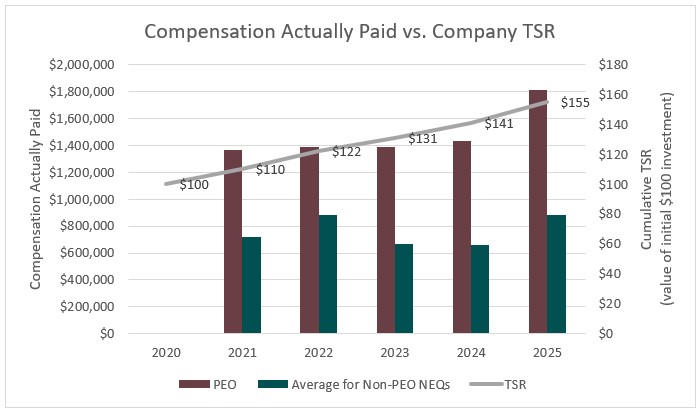
Relationship Between Compensation Actually Paid and the Company's Net Income
The following chart sets forth the relationship between the compensation actually paid to Mr. McDearman, the average of the compensation actually paid to the Company’s Named Executive Officers as a group (excluding Mr. McDearman), and the Company’s and the Bank’s net income during the five most recently completed fiscal years.
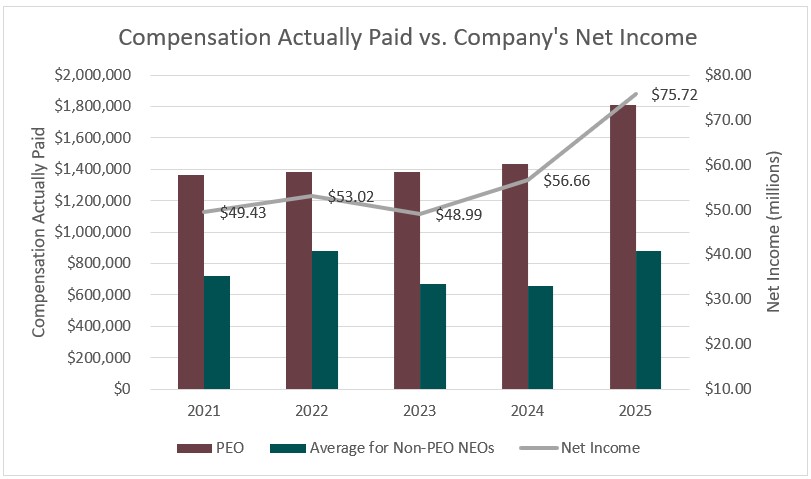
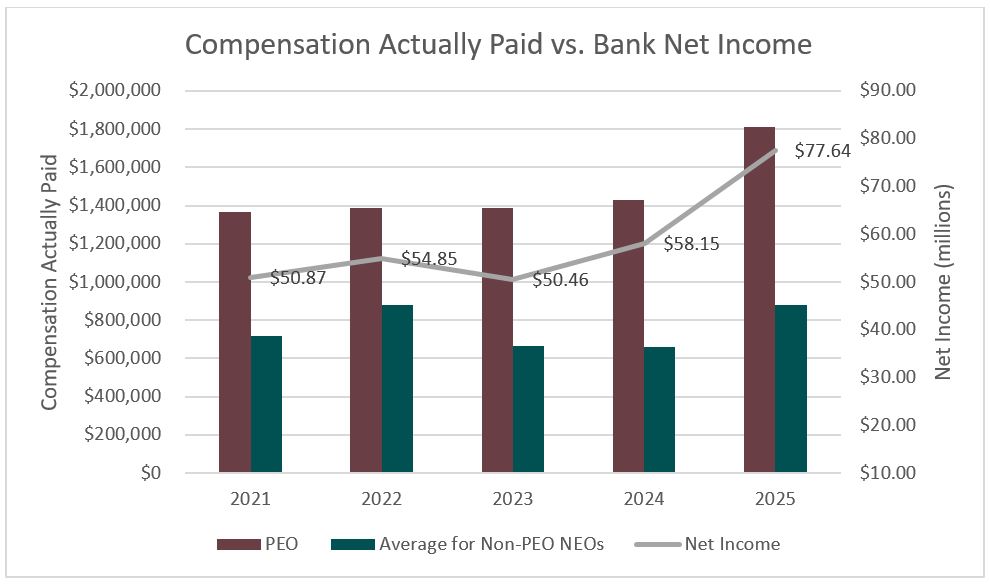
Cumulative TSR of the Company and Cumulative TSR of the Peer Group
The following chart sets forth the relationship between the Company’s cumulative TSR over the five most recently completed fiscal years and the cumulative TSR for the peer group presented for this purpose, the KBW NASDAQ Bank Index, over the same period. For more information regarding the Company’s performance and the peer group that the Personnel Committee considers when determining compensation, refer to “Executive Compensation – Compensation Discussion and Analysis.”
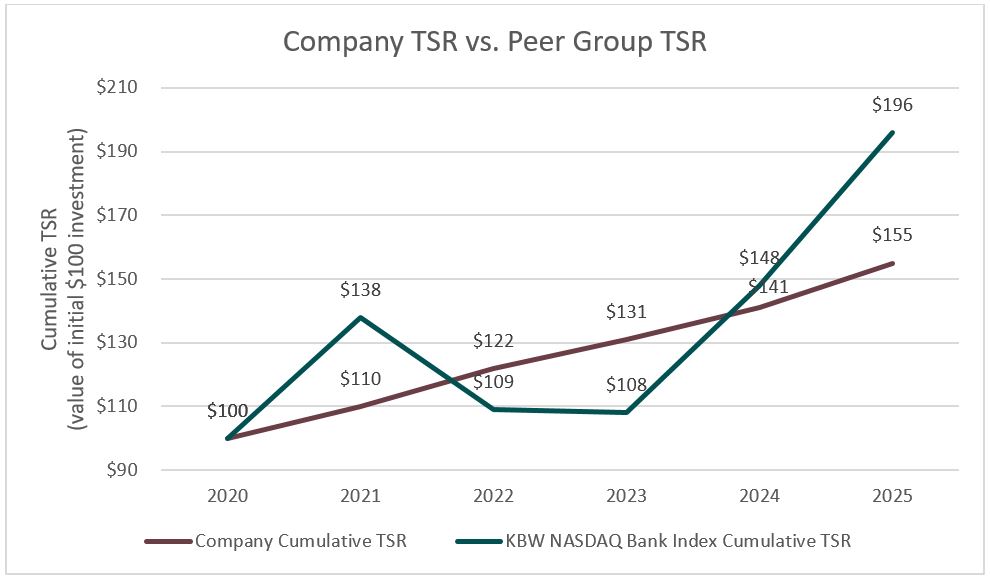
CEO Pay Ratio Disclosure
As required by Section 953(b) of the Dodd-Frank Wall Street Reform and Consumer Protection Act, and Item 402(u) of Regulation S-K, we are providing the following information for the year ended December 31, 2025:
The annual total compensation of our employee whose compensation placed the employee at the median of all employees of our company (other than our CEO) in 2025, was $57,245; and the annual total compensation of Mr. McDearman, our President and Chief Executive Officer in 2025, was $1,810,845. Based on this information, for 2025, the ratio of the annual total compensation of our President and Chief Executive Officer to the annual total compensation of our median employee is 32 to 1.
We completed the following steps to identify the annual total compensation of our employee whose compensation placed the employee at the median of all employees and our CEO:
As of December 31, 2025, our employee population consisted of approximately 651 employees, including all full-time, part-time, temporary, and seasonal employees employed on that date.
· To find the median of the annual total compensation of our employees (other than our CEO), we used original gross earnings, which includes all wages paid - inclusive of salary, overtime, straight time, incentives, bonus and commissions - in each case paid before any deductions are made for pre-tax reductions or after-tax deductions for fiscal 2025. In making this determination, we annualized compensation for full-time and part-time permanent employees who were employed on December 31, 2025, but did not work for us the entire year. No full-time equivalent adjustments were made for part-time employees.
· We identified our median employee using this compensation measure and methodology, which was consistently applied to all our employees included in the calculation.
· After identifying the median employee, we added together all of the elements of that employee’s compensation for 2025 in accordance with the requirements of Item 402(c)(2)(x) of Regulation S-K, resulting in annual total compensation of $57,245. With respect to the annual total compensation of our CEO, we used the amount reported in the “Total” column of our 2025 Summary Compensation Table appearing on page 27 of this Proxy Statement, which is also in accordance with the requirements of Item 402(c)(2)(x).
DIRECTOR COMPENSATION
The Company’s directors are classified in three (3) classes, with directors in each class serving for three (3) year terms and until his or her successor has been duly elected and qualified. The Board of Directors of the Company also serves as the Board of Directors of the Bank. In April 2023, the Company changed its compensation program for its non-employee directors to pay such directors a monthly retainer equal to $6,000 in replacement of the prior structure of a combination of a partial retainer and per meeting fees. The non-employee directors continue to receive incremental fees paid for attending board retreats. For 2025, the Board approved an increase to the monthly retainer to $6,242. As a result, in 2025, each non-employee director received a retainer fee of $43,447 for his or her services as a director of the Company. In addition, each non-employee director received a retainer fee of $31,462 for his or her services as a director of the Bank. In addition, fees of $4,562 and $3,303 were paid to each of the non-employee directors of the Company and the Bank, respectively, for attendance at the Company and the Bank planning retreats held during 2025. Mr. Comer received $400 per meeting for four (4) meetings for serving on the Advisory Board of the Smith County branches of the Bank. Mr. Bell received $400 per meeting for four (4) meetings for serving on the Advisory Board of the DeKalb County branches of the Bank. Mr. Jordan received $200 per meeting for three (3) meetings for serving on the Advisory Board of the Rutherford County branches of the Bank. In addition, beginning in 2019, the Company began paying the entire health insurance premium for certain family members of each non-employee director. Previously, these amounts were paid by the directors. The monthly amount of such premiums are set out in footnote 4 to the below table.
On April 14, 2014, the Bank entered into a Director Survivor Income Agreement with each of Messrs. Jack Bell, Randall Clemons, James Comer, Elmer Richerson, James Patton, and Ms. Pominski on April 6, 2015, the Bank entered into a Director Survivor Income Agreement with Mr. Jordan, and on June 1, 2020, the Bank entered into a Director Survivor Income Agreement with each of Messrs. Clint Swain and Mike Maynard (the “Director Survivor Income Agreement”). The Director Survivor Income Agreements were entered into to encourage Messrs. Bell, Clemons, Comer, Jordan, Patton, Richerson, Swain, Maynard and Ms. Pominski to remain in service to the Bank by the Bank’s commitment to provide certain survivor income benefits to those directors’ designated beneficiaries if the director dies prior to the termination of his or her service on the Bank’s Board of Directors.
In the event that Messrs. Bell, Clemons, Comer, Jordan, Swain, Maynard, Richerson, Patton or Ms. Pominski is removed from the Board of Directors or is permanently prohibited from participating in the Bank’s activities by an order of the Bank’s regulators, or his or her service on the Board of Directors is terminated for “cause”, in each case prior to such person’s death, all obligations of the Bank under the relevant Director Survivor Income Agreement shall terminate. Cause under these agreements means the Bank has terminated the Director’s service for any of the following reasons: (i) gross negligence or gross neglect of duties; (ii) commission of a felony or of a gross misdemeanor involving moral turpitude; or (iii) fraud, disloyalty, or willful violation of any law or significant Bank policy committed in connection with the director’s service on the Board of Directors and resulting in an adverse effect on the Bank.
The amounts payable to Messrs. Bell’s, Clemons’, Comer’s, Jordan’s, Maynard’s, Richerson’s, Swain’s, Patton’s or Ms. Pominski's survivors under the Director Survivor Income Agreements are largely fixed, though in some instances are reduced based on the age of the director at the time his or her service on the Board of Directors is terminated. As of December 31, 2025, the amount payable under the agreements with each of the directors was $400,000. The Bank will pay the benefits due under the Director Survivor Income Agreements from its general assets, but only so long as one of the Bank’s general assets is an enforceable life insurance policy on the director’s life that was issued by Massachusetts Mutual Life Insurance Company and Midland National Life Insurance Company.
In addition, Messrs. Clemons and Richerson and Ms. Pominski each entered into an Executive Salary Continuation Agreement and SERP Agreements while serving as executive officers of the Company and the Bank. As noted below, each of Mr. Clemons and Mr. Richerson retired from the Company and the Bank after reaching the normal retirement age of 65. Accordingly, subject to any applicable non-competition covenants included therein, each is entitled to receive normal retirement benefits under the Executive Salary Continuation Agreement, as amended, and SERP Agreements to which he is a party. Ms. Pominski retired from the Company and the Bank on March 31, 2024 after reaching early retirement eligibility, and began receiving the corresponding benefits under the Executive Salary Continuation Agreement, as amended, and SERP Agreements to which she is a party, subject to compliance with any applicable non-competition covenants included therein.
During fiscal year 2025, (i) Mr. Maynard was awarded 10,000 stock options, Mr. Swain was awarded 6,000 stock options and 1,000 restricted stock units, and Ms. Pominski was awarded 7,000 cash-settled SARs and 750 restricted stock units. These
equity-based awards were granted in amounts that sought to maintain directors unvested awards at levels targeted by the Personnel Committee and Board of Directors
The following table sets forth certain information with respect to the fees and other compensation paid or earned by the non-employee members of the Boards of Directors of the Company and the Bank for services in 2025:
|
|
|
|
|
|
|
|
|
|
|
|
|
|
|
|
|
|
|
|
|
|
|
|
|
Name(1) |
Fees Earned or Paid in Cash(2)
($)
(b) |
|
Stock Awards
($)(3) |
|
Option Awards
($)(4) |
|
Non-Equity Incentive Plan Compensation
($) |
|
Change in Pension Value and Nonqualified Deferred Compensation Earnings
($) |
All Other
Compensation
($)(5) |
Total
($) |
|
|
|
|
|
|
|
|
|
|
|
|
|
|
|
|
|
|
Jack W. Bell(2) |
|
84,374 |
|
|
— |
|
|
— |
|
|
— |
|
|
— |
|
|
|
22,118 |
|
|
|
106,493 |
|
James F. Comer(2) |
|
84,374 |
|
|
— |
|
|
— |
|
|
— |
|
|
— |
|
|
|
14,027 |
|
|
|
98,402 |
|
William P. Jordan(2) |
|
83,374 |
|
|
— |
|
|
— |
|
|
— |
|
|
— |
|
|
|
19,558 |
|
|
|
102,933 |
|
Michael G. Maynard |
|
82,774 |
|
|
— |
|
|
251,096 |
|
|
— |
|
|
— |
|
|
|
22,118 |
|
|
|
355,989 |
|
James Anthony Patton |
|
82,774 |
|
|
— |
|
|
— |
|
|
— |
|
|
— |
|
|
|
21,474 |
|
|
|
104,249 |
|
H. Elmer Richerson |
|
82,774 |
|
|
— |
|
|
— |
|
|
— |
|
|
— |
|
(6) |
|
145,078 |
|
(7) |
|
227,853 |
|
Clinton M. Swain |
|
82,774 |
|
|
77,600 |
|
|
150,724 |
|
|
— |
|
|
— |
|
|
|
24,555 |
|
|
|
335,654 |
|
Randall Clemons |
|
82,774 |
|
|
— |
|
|
— |
|
|
— |
|
|
— |
|
(8) |
|
188,938 |
|
(9) |
|
271,713 |
|
Lisa Pominski |
|
82,774 |
|
|
57,225 |
|
|
173,913 |
|
|
— |
|
|
— |
|
(10) |
|
113,724 |
|
(11) |
|
427,637 |
|
(1)John McDearman, the Company’s and the Bank’s Chief Executive Officer and John Foster, the current Executive Vice President of the Company and President of the Bank, are not included in this table as they are also Named Executive Officers of the Company that were not separately compensated for their service on the Boards of Directors of the Company (in the case of Mr. McDearman only) and the Bank in 2025.
(2)Includes a monthly cash retainer fee equal to $6,242.40 plus fees for any planning retreats, and in the case of Mr. Comer, $1,600 for service on the advisory board of the Smith County branches of the Bank and in the case of Mr. Bell, $1,600 for service on the advisory board of the DeKalb County branches of the Bank and in the case of Mr. Jordan, $600 for service on the advisory board of the Rutherford County branches of the Bank.
(3)The "Stock Awards" column represents the grant date fair value of the RSUs granted to Mr. Swain and Ms. Pominski in 2025. The RSUs contain forfeiture restrictions that lapse in one-fifth pro rata increments on each of the first five anniversaries of the grant date of the award. Consequently, to calculate the grant date fair value of these awards in accordance with the requirements of FASB ASC Topic 718, Compensation, Stock Compensation, the Company multiplied the price at which the Company’s Common Stock was last traded in a transaction that settled in the Company’s stock transfer records and of which the Company was aware on the date closest, but prior, to the date of grant by the number of RSUs granted. For a description of the assumptions used by the Company in valuing these awards for the fiscal year ended December 31, 2025, please see “Note 19 – Equity Incentive Plan” to the Company’s consolidated financial statements included in the 2025 Form 10-K. In 2025, Mr. Swain was granted 1,000 RSUs and Ms. Pominski was granted 750 RSUs.
(4)The amounts in the column captioned “Option Awards” reflect the aggregate grant date fair value of $25.10 per stock option granted to Mr. Maynard, and $25.12 per stock option granted to Mr. Swain in 2025. Additionally, this column reflects the aggregate grant date fair value of $24.84 per cash settled stock appreciation right granted to Ms. Pominski in 2025 as of the date of grant in accordance with FASB ASC Topic 718, Compensation – Stock Compensation, and were based on an expected term of seven years for stock option awards and cash-settled stock appreciation rights. These awards vest in one-fifth pro rata increments on each of the first five anniversaries of the grant date of the award. For a description of the assumptions used by the Company in valuing these awards for the fiscal year ended December 31, 2025, please see “Note 19 – Equity Incentive Plan” to the Company’s consolidated financial statements included in the 2025 Form 10-K. In 2025, Messrs. Maynard and Swain were granted 10,000 stock options and 6,000 stock options, respectively. Ms. Pominski was granted 7,000 cash-settled stock appreciation rights in 2025. As of December 31, 2025, Mr. Bell held 11,059 stock options. As of December 31, 2025, Mr. Maynard held 10,000 stock options. As of December 31, 2025, Mr. Jordan held 2,000 stock options. As of December 31, 2025, Mr. Patton held 13,000 stock options. As of December 31, 2025, Mr. Swain held 12,000 stock options. As of December 31, 2025, Mr. Clemons held 1,498 stock options and 15,000 cash-settled stock appreciation rights. At December 31, 2025, Mr. Comer held 5,000 stock options and 5,000 cash-settled stock appreciation rights. At December 31, 2025, Mr. Richerson held 17,500 cash-settled stock appreciation rights. At December 31, 2025, Ms. Pominski held 580 stock options and 11,740 cash-settled stock appreciation rights that had been granted to her in her capacity as an employee prior to her retirement on March 31, 2024.
(5)Reflects (i) the value of premiums paid in connection with the Director Survivor Income Agreements of $5,404 for Mr. Bell, $6,080 for Mr. Comer, $2,844 for Mr. Jordan, $5,404 for Mr. Maynard, $4,760 for Mr. Patton, $11,028 for Mr. Richerson, $668 for Mr. Swain, $11,028 for Mr. Clemons, $2,844 for Ms. Pominski and (ii) health insurance premiums paid of $16,714 for Mr. Bell and certain of his family members, $7,947 for Mr. Comer, $16,714 for Mr. Jordan and his spouse, $16,714 for Mr. Maynard and his spouse, $23,887 for Mr. Swain and certain of his family members, $16,714 for Mr. Clemons and his spouse, $16,714 for Mr. Richerson and his spouse, $16,714 for Mr. Patton and his spouse, and $16,714 for Ms. Pominski and her spouse.
(6)Mr. Richerson retired from the Company and the Bank on December 31, 2017 after reaching the normal retirement age of 65. Accordingly, he is entitled to receive his normal retirement benefits under the Executive Salary Continuation Agreement, as amended and SERP Agreements. Pursuant to those agreements, Mr. Richerson began receiving payments of $9,137 per month beginning in January 2018 and will receive those payments until his death. The actuarial present value under Mr. Richerson’s Executive Salary Continuation Agreement, as amended, and SERP Agreements increased by $64,549 in the aggregate in 2025; however, this increase was offset by the monthly distributions made thereunder to Mr. Richerson in 2025, for a net decrease of $52,787 in the aggregate actuarial present value under such agreements.
(7)Mr. Richerson was paid $117,336 from his Executive Salary Continuation Agreement, as amended, and SERP Agreements in 2025.
(8)Mr. Clemons retired from the Company and the Bank on December 31, 2019 after reaching the normal retirement age of 65. Accordingly, he is entitled to receive his normal retirement benefits under the Executive Salary Continuation Agreement, as amended, and SERP Agreements. Pursuant to those agreements, Mr. Clemons began receiving payments of $13,433 per month beginning in January 2020 and will receive those payments until his death. The actuarial present value under Mr. Clemons’ Executive Salary Continuation Agreement, as amended, and SERP Agreements increased by $97,418 in the aggregate in 2025; however, this increase was offset by the monthly distributions made thereunder to Mr. Clemons in 2025, for a net decrease of $63,778 in the aggregate actuarial present value under such agreements.
(9)Mr. Clemons was paid $161,196 from his Executive Salary Continuation Agreement, as amended, and SERP Agreements in 2025.
(10)Ms. Pominski retired from the Company and the Bank on March 31, 2024 after reaching the early retirement age of 60. Accordingly, she is entitled to receive her early retirement benefits under the Executive Salary Continuation Agreement, as amended, and SERP Agreements. Pursuant to those agreements, Ms. Pominski began receiving payments of $7,847 per month beginning in April 2024 and will receive those payments until her death as long as Ms. Pominski does not violate any of the restrictive covenants therein. The actuarial present value under Ms. Pominski’s Executive Salary Continuation Agreement, as amended, and SERP Agreements increased by $41,738 in the aggregate in 2025; however, this increase was offset in part by the monthly distributions made thereunder to Ms. Pominski in 2025, for a net decrease of $52,428 in the aggregate actuarial present value under such agreements.
(11)Ms. Pominski was paid $94,166 from her Executive Salary Continuation Agreement, as amended, and SERP Agreements in 2025.
Personnel Committee Interlocks and Insider Participation
During fiscal 2025, the Personnel Committee of the Board of Directors of the Bank was composed of Messrs. Swain, Jordan, Clemons, Maynard and Patton, with Mr. Swain serving as the committee’s Chairman. None of these persons has at any time been an officer or employee of the Company or any of its subsidiaries. There are no relationships among the Company’s executive officers, members of the Personnel Committee or entities whose executives serve on the Board of Directors or the Personnel Committee that require disclosure under applicable regulations of the SEC.
No executive officer of the Company or the Bank has served as a member of the compensation committee of another entity, one of whose executive officers served on the Personnel Committee. No executive officer of the Company or the Bank has served as a director of another entity, one of whose executive officers served on the Personnel Committee. No executive officer of the Company or the Bank has served as a member of the compensation committee of another entity, one of whose executive officers served as a director of the Company or the Bank.
For a discussion of those officers and employees who participated in deliberations of the Board of Directors of either the Company or the Bank concerning executive officer compensation, see “Compensation Discussion & Analysis” above.
Certain Relationships and Related Transactions
Some directors and principal officers of the Company are at present, as in the past, customers of the Bank and have had and expect to have loan or deposit transactions with the Bank in the ordinary course of business. In addition, some of the directors and officers of the Bank are at present, as in the past, affiliated with businesses which are customers of the Bank and which have had and expect to have loan transactions with the Bank in the ordinary course of business. These loans or deposits were made in
the ordinary course of business and were made on substantially the same terms, including interest rates and collateral, as those prevailing in the market at the time for comparable transactions with other parties. In the opinion of the Board of Directors, these loans do not involve more than a normal risk of collectability or present other unfavorable features.
During 2025, Jack Bell Builders was paid an aggregate of $15,434 by the Bank for remodels and repairs of several of the Bank’s branch offices. This company is owned 100% by Jack Bell, a director of the Company and the Bank. The Building Committee makes recommendations to the Boards of Directors of the Company and the Bank on certain building projects for which Jack Bell Builders is given consideration. In such instances, the Board of Directors does not permit Mr. Jack Bell to participate in its discussions or cast a vote with respect to such building projects.
Related party transactions between the Company or the Bank and the directors or executive officers are approved in advance by the Company’s or the Bank’s Board of Directors, as appropriate.
SHAREHOLDERS’ PROPOSALS AND OTHER MATTERS
In order for shareholder proposals for the 2027 annual meeting of shareholders to be eligible for inclusion in the Company's 2027 proxy statement, all such proposals must be mailed to the Company's Corporate Secretary, Wilson Bank Holding Company, 623 West Main Street, Lebanon, Tennessee, 37087, and must be received no later than November 20, 2026 and must comply with the applicable rules and regulations of the SEC and the relevant provisions of the Bylaws. In addition, the deadline for postmarking or transmitting electronically to the Company notice under Rule 14a-19, the SEC’s universal proxy rule, of a shareholder’s intent to solicit proxies on the Company’s proxy card in support of director nominees submitted in accordance with the Bylaws for the 2027 Annual Meeting of Shareholders is February 22, 2027. This deadline is the deadline for notifying the Company if the shareholder intends to include a proposed nominee on the Company's proxy card. Other deadlines and conditions, as described in the Bylaws, apply to the submission by a shareholder of a nominee to serve on the board. See "Director Qualifications and Consideration of Candidates" on page 7 of this Proxy Statement.
A shareholder who intends to raise a proposal to be acted upon at the 2027 Annual Meeting of Shareholders, but who does not desire to include the proposal in the Company’s 2027 proxy statement, must comply with the advance notice provisions of the Bylaws. Under the advance notice provisions, a shareholder must give written notice of such proposal to the Company’s Corporate Secretary, Wilson Bank Holding Company, 623 West Main Street, Lebanon, Tennessee 37087. The Corporate Secretary must receive such notice not later than 5:00 p.m. central time on the ninetieth (90th) day nor earlier than 5:00 p.m. central time on the one hundred twentieth (120th) day prior to the first anniversary of the Meeting (January 23, 2027 and December 24, 2026, respectively). The shareholder’s submission must include certain specified information concerning the proposal and the shareholder, including such shareholder’s ownership of the Company’s Common Stock, as described in more detail in the Bylaws. Shareholders are strongly encouraged to seek advice from legal counsel before submitting a proposal as the Company will not entertain any proposals that do not meet these requirements.
GENERAL
In addition to solicitation by mail, certain directors, officers and other employees of the Company and the Bank may solicit proxies by telephone, facsimile, email or other similar means for which they will receive no compensation other than their regular salaries. The Company may request brokerage houses and custodians, nominees and fiduciaries to forward soliciting material to the beneficial owners of the Company’s Common Stock held of record by such persons and may reimburse them for their reasonable out-of-pocket expenses in connection therewith.
The Company’s 2025 Annual Report is mailed herewith. A shareholder may obtain a copy of the Company’s Annual Report to the SEC on Form 10-K for the year ended December 31, 2025 without charge by writing to Kayla Hawkins, Wilson Bank Holding Company, 623 West Main Street, Lebanon, Tennessee 37087.
|
|
|
|
By order of the Board of Directors, |
|
|
|
Kayla N. Hawkins |
|
Secretary |
Lebanon, Tennessee
March 20, 2026
WILSON BANK HOLDING COMPANY
NOTICE OF ANNUAL MEETING OF SHAREHOLDERS
This proxy is solicited on behalf of the Board of Directors for the Annual Meeting to be held on April 23, 2026.
The undersigned shareholder(s) hereby appoints John C. McDearman III and Kayla Hawkins, and either of them, with full power of substitution, as proxies, and hereby authorizes them to vote, as designated, all shares of common stock of Wilson Bank Holding Company (the “Company), held by the undersigned as of the close of business on March 2, 2026 at the Annual Meeting of Shareholders (the “Annual Meeting”) to be held on Thursday, April 23, 2026, at 5:00 p.m. (CDT) at the Company’s Clemons-Richerson Operations Center, 105 North Castle Heights Avenue, Lebanon, TN 37087, and any adjournment(s) or postponement(s) thereof.
|
|
|
|
_____ |
FOR all nominees listed below (except as marked to the contrary below) |
|
Class I directors: |
|
|
J. Randall Clemons |
|
|
William P. Jordan |
|
|
James Anthony Patton |
|
|
Lisa Pominski |
_____ |
Withhold authority to vote for all nominees; |
|
|
|
|
|
_____ |
Withhold authority to vote for the following nominee(s), write that nominee’s name on the line below: |
|
|
|
2. |
RATIFICATION OF RUBINBROWN LLP as the Company’s independent registered public accounting firm for the fiscal year ending December 31, 2026. |
For [ ] Against [ ] Abstain [ ]
|
|
|
3. |
NON-BINDING, ADVISORY VOTE ON THE COMPANY'S NAMED EXECUTIVE OFFICER COMPENSATION PROGRAMS & PRACTICES AS DISCLOSED IN THE PROXY STATEMENT FOR THE ANNUAL MEETING |
For [ ] Against [ ] Abstain [ ]
In their discretion, the proxies are authorized to vote upon such business as may properly come before the Annual Meeting and any adjournments or postponements thereof.
THIS PROXY, WHEN PROPERLY EXECUTED, WILL BE VOTED IN THE MANNER DIRECTED HEREIN BY THE UNDERSIGNED SHAREHOLDER(S). IF NO DIRECTION IS MADE, THIS PROXY WILL BE VOTED “FOR” EACH OF THE DIRECTOR NOMINEES AND FOR PROPOSALS 2 AND 3.
|
|
|
|
|
|
|
|
Signature |
|
|
|
Date |
|
|
Signature (if held jointly) |
|
|
|
Date |
|
|
Please sign exactly as your name appears on your share certificates. Each joint owner must sign. When signing as attorney, executor, administrator, trustee or guardian, please give full title as such. If a corporation, please sign in full corporate name as authorized. If a partnership, please sign in partnership name by an authorized person.
BE SURE TO MARK, SIGN, DATE AND RETURN THIS PROXY PROMPTLY IN THE ADDRESSED
POSTAGE PAID ENVELOPE PROVIDED
PLEASE SEE REVERSE SIDE FOR ONLINE VOTING INSTRUCTIONS.
INSTRUCTIONS FOR VOTING YOUR PROXY ONLINE
1.To vote your proxy online, please visit: https://stocks.wilsonbank.com/pxlogin and enter your Control Number that was located on the proxy voting sheet included in this Annual Report package. It should consist of 12 digits and can be entered as shown on your form.
2.Once logged in, your status on the right should show as ‘Not Voted’ if you have currently not cast a vote.
3.Within the Voting Screen, select ‘Continue’ in order to review the proposals and cast your vote.
4.Within the proposals, the highlighted Vote is the Board’s recommendation for your vote. If you do not select a voting option for any question, the portal will automatically vote in accordance with the Board’s recommendation.
5.Once you have selected your voting pattern, please click ‘Next Page’ at the bottom.
6.At this point, the vote has not been cast and you can review the options that are presented. To submit your vote, click the ‘Cast Vote’ button.