Please wait
METHANEX CORPORATION
ANNUAL INFORMATION FORM
www.methanex.com
March 5, 2026
| | | | | |
| TABLE OF CONTENTS | Page |
| |
| |
| |
| |
| |
| |
| |
| |
| |
| |
| |
| |
| |
| |
| |
| |
| |
| |
| |
| |
| |
| |
| |
| |
| |
| |
| |
| |
| |
| |
| |
| |
| |
| |
| |
| |
| |
| |
| |
| |
| |
| |
| |
| |
| |
| |
| |
| |
| |
| |
| |
| |
| |
| |
| |
APPENDIX "A" | |
REFERENCE INFORMATION
In this Annual Information Form ("AIF"), a reference to the "Company" refers to Methanex Corporation and a reference to "Methanex," "we," "us," "our" and similar words refers to the Company and its subsidiaries or any one of them as the context requires, as well as their respective interests in joint ventures and partnerships.
We use the United States dollar as our reporting currency. Accordingly, unless otherwise indicated, all dollar amounts in this AIF are stated in United States dollars.
In this AIF, unless the context otherwise indicates, all references to "methanol" are to chemical-grade methanol. Methanol’s chemical formula is CH3OH and it is also known as methyl alcohol.
In this AIF, we incorporate by reference our 2025 Management’s Discussion and Analysis ("2025 MD&A"), which contains information required to be included in this AIF. The 2025 MD&A is publicly accessible and is filed on the Canadian Securities Administrators’ SEDAR website at www.sedarplus.ca and on the U.S. Securities and Exchange Commission’s EDGAR website at www.sec.gov.
The approximate conversion of measurement used in this AIF is as follows:
1 tonne of methanol = 332.6 US gallons of methanol
Some of the historical price data and supply and demand statistics for methanol and certain other industry data contained in this AIF are derived by the Company from industry consultants or from recognized industry reports regularly published by independent consulting and data compilation organizations in the methanol industry, including Chemical Market Analytics by OPIS, a Dow Jones company, Tecnon OrbiChem Ltd., Argus, ICIS, S&P Global and Methanol Market Services Asia, an Energy Aspects (EA) company. Industry consultants and industry publications generally state that the information provided has been obtained from sources believed to be reliable. We have not independently verified any of the data from third-party sources nor have we ascertained the underlying economic assumptions relied upon in these reports.
Responsible Care® is a registered trademark of the Chemistry Industry Association of Canada and is used under license by us.
CAUTION REGARDING FORWARD-LOOKING STATEMENTS
This document contains forward-looking statements with respect to us and our industry. These statements relate to future events or our future performance. All statements other than statements of historical fact are forward-looking statements. Statements that include the words "believes," "expects," "may," "will," "should," "potential," "estimates," "anticipates," "aim," "goal," "targets," "plan," "predict" or other comparable terminology and similar statements of a future or forward-looking nature identify forward-looking statements.
More particularly and without limitation, any statements regarding the following are forward-looking statements:
•the expected benefits of the ("OCI Acquisition"), including benefits related to expected synergies and commodity diversification,
•anticipated synergies and Methanex's ability to achieve such synergies following closing of the OCI Acquisition,
•expected demand for methanol, including demand for methanol for energy uses, and its derivatives,
•expected new methanol supply or restart of idled capacity and timing for startup of the same,
•expected increase in methanol production of assets acquired as part of the OCI Acquisition,
•expected shutdowns (either temporary or permanent) or restarts of existing methanol supply (including our own facilities), including, without limitation, the timing and length of planned maintenance outages,
•expected methanol and energy prices,
•expected levels of methanol purchases from traders or other third parties,
•expected levels, timing and availability of economically priced natural gas supply to each of our plants,
•capital committed by third parties towards future natural gas exploration and development in the vicinity of our plants,
•our expected capital expenditures and anticipated timing and rate of return on such capital expenditures,
•anticipated operating rates of and production at our plants,
•expected operating costs, including natural gas feedstock costs and logistics costs,
•expected tax rates or resolutions to tax disputes,
•expected cash flows, cash balances, earnings capability, debt levels, debt reduction and deleveraging plans, and share price,
•availability of committed credit facilities and other financing,
•our ability to meet covenants associated with our long-term debt obligations,
•our shareholder distribution strategy and anticipated distributions to shareholders,
•commercial viability and timing of, or our ability to execute future projects, plant restarts, capacity expansions, plant relocations, or other business initiatives or opportunities,
•our financial strength and ability to meet future financial commitments,
•expected global or regional economic activity (including industrial production levels) and gross domestic product growth,
•potential impact of tariffs on global economic activity and Methanex,
•expected outcomes of litigation or other disputes, claims and assessments, and
•expected actions of governments, governmental agencies, gas suppliers, courts, tribunals or other third parties.
We believe that we have a reasonable basis for making such forward-looking statements. The forward-looking statements in this document are based on our experience, our perception of trends, current conditions and expected future developments as well as other factors. Certain material factors or assumptions were applied in drawing the conclusions or making the forecasts or projections that are included in these forward-looking statements, including, without limitation, future expectations and assumptions concerning the following:
•Methanex's ability to realize the expected strategic, financial and other benefits of the OCI Acquisition in the timeframe anticipated or at all,
•our ability to procure natural gas feedstock on commercially acceptable terms,
•operating rates of our facilities,
•receipt or issuance of third-party consents or approvals or governmental approvals related to rights to purchase natural gas,
•the establishment of new fuel standards,
•operating costs, including natural gas feedstock and logistics costs, capital costs, tax rates, cash flows, foreign exchange rates and interest rates,
•the availability of committed credit facilities and other financing,
•our ability to sustain the designed operating rates of the Geismar 3 plant,
•global and regional economic activity (including industrial production levels) and gross domestic product growth,
•absence of a material negative impact from major natural disasters,
•absence of a material negative impact from changes in laws or regulations,
•absence of a material negative impact from political instability in the countries in which we operate, and
•enforcement of contractual arrangements and ability to perform contractual obligations by customers, natural gas and other suppliers and other third parties.
However, forward-looking statements, by their nature, involve risks and uncertainties that could cause actual results to differ materially from those contemplated by the forward-looking statements. The risks and uncertainties primarily include those attendant with producing and marketing methanol and successfully carrying out major capital expenditure projects in various jurisdictions, including, without limitation:
•unforeseen difficulties in integrating the business operations or assets purchased pursuant to the OCI Acquisition into our business and operations,
•failure to realize the expected strategic, financial and other benefits of the OCI Acquisition in the timeframe anticipated or at all,
•unexpected costs or liabilities associated with the OCI Acquisition,
•increased indebtedness of Methanex,
•conditions in the methanol and other industries, including fluctuations in the supply, demand and price for methanol and its derivatives, including demand for methanol for energy uses,
•the price of natural gas, coal, oil and oil derivatives,
•our ability to obtain natural gas feedstock on commercially acceptable terms to underpin current operations and future production growth opportunities,
•the ability to carry out corporate initiatives and strategies,
•actions of competitors, suppliers and financial institutions,
•conditions within the natural gas delivery systems that may prevent delivery of our natural gas supply requirements,
•competing demand for natural gas, especially with respect to any domestic needs for gas and electricity,
•actions of governments and governmental authorities, including, without limitation, the
implementation of policies or other measures that could impact the supply of or demand for methanol or its derivatives,
•changes in laws or regulations,
•import or export restrictions, anti-dumping measures, increases in duties, taxes and
government royalties and other actions by governments that may adversely affect our operations or existing contractual arrangements,
•worldwide economic conditions, and
•other risks described in our 2025 MD&A.
Having in mind these and other factors, investors and other readers are cautioned not to place undue reliance on forward-looking statements. They are not a substitute for the exercise of one’s own due diligence and judgment. The outcomes implied by forward-looking statements may not occur and we do not undertake to update forward-looking statements except as required by applicable securities laws.
THE COMPANY
Methanex Corporation was incorporated under the laws of Alberta on March 11, 1968, and was continued under the Canada Business Corporations Act on March 5, 1992. Its registered and head office is located at 1800 Waterfront Centre, 200 Burrard Street, Vancouver, British Columbia, V6C 3M1 (telephone: 604-661-2600).
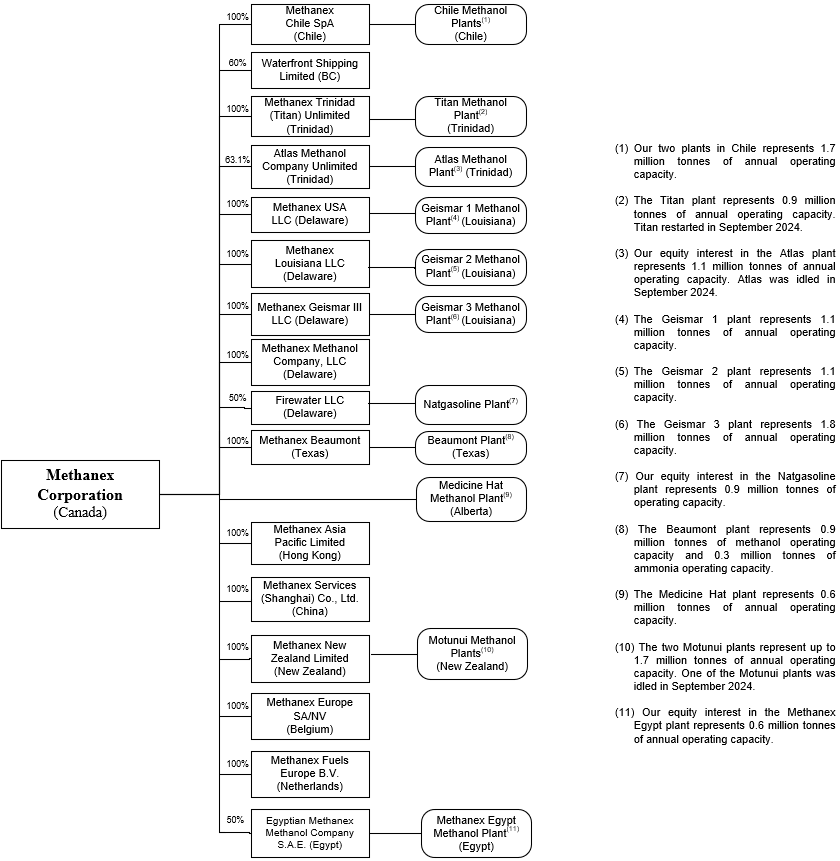
The following chart includes the Company’s principal operating subsidiaries as of December 31, 2025, and, for each subsidiary, its place of organization and the Company’s percentage of voting interests beneficially owned or over which the Company exercises control or direction. The chart also shows our principal production facilities and their locations.
BUSINESS OF THE COMPANY
Methanex Corporation is the world’s largest producer and supplier of methanol, serving methanol customers across the globe. The Company also produces and supplies ammonia, predominantly serving customers in North America.
Methanol is a clear liquid commodity chemical that is produced from natural gas and is also produced from coal, particularly in China. Traditional chemical demand, which represents approximately 50% of global methanol demand, is used to produce traditional chemical derivatives, including formaldehyde, acetic acid and a variety of other chemicals that form the basis of a wide variety of industrial and consumer products. Demand for energy-related applications, which represents over 30% of global methanol demand, includes several applications including methyl tertiary-butyl ether ("MTBE"), fuel applications (including vehicle fuel, marine fuel and other thermal applications), di-methyl ether ("DME") and biodiesel. Demand into methanol-to-olefins ("MTO") represents less than 20% of global methanol demand. MTO plants produce light olefins which have wide applications in packaging, textiles, plastic parts and automotive components.
Ammonia is a key compound in modern life and plays an important role in agriculture and industry. Most ammonia demand is generated from use in producing fertilizer but it is also used in the production of plastics and textiles, and in refrigeration.
We are the world’s largest producer and supplier of methanol and serve customers in Asia Pacific, North America, Europe and South America. Our total annual methanol operating capacity, including Methanex's interests in jointly owned plants, is currently 10.4 million tonnes and is located in the United States, Chile, Trinidad and Tobago, New Zealand, Egypt, and Canada. In addition to the methanol produced at our sites, we purchase methanol produced by others under methanol offtake contracts and on the spot market. This gives us flexibility in managing our supply chain while continuing to meet customer needs and support our marketing efforts. We have marketing rights for 100% of the production from the jointly-owned plant in Egypt, which provides us with an additional 0.6 million tonnes per year of methanol offtake supply when gas is available and the plant is operating at full capacity. We market only our share of the production from our jointly-owned Texas-located Natgasoline plant.
Our annual ammonia operating capacity is 0.3 million tonnes and is located in the United States.
Refer to the Production section on page 14 for more information regarding production at our plants.
DEVELOPMENT OF THE BUSINESS AND CORPORATE STRATEGY
On September 8, 2024, Methanex announced that it entered into a definitive agreement to acquire OCI Global’s (“OCI”) international methanol business for approximately $2.05 billion ("OCI Acquisition"). The transaction includes a methanol facility with an annual production capacity of 910,000 metric tonnes ("MT") of methanol and 340,000 MT of ammonia and a 50 percent interest in a second methanol facility operated by the joint venture Natgasoline LLC (“Natgasoline”) which has an annual capacity of 1.7 million MT of methanol. The transaction also includes a low-carbon methanol production and marketing business and an idled methanol facility in the Netherlands.
The Company successfully closed the acquisition on June 27, 2025 and has since finalized the purchase price, which consisted of $1.18 billion in cash, adjustments for debt and working capital of $0.01 billion and $0.10 billion, the issuance of 9.9 million common shares of Methanex and the assumption of debt and leases.
Three-Year History
2023
On October 13, 2023, the Company announced that it had signed a two-year natural gas supply agreement with the National Gas Company of Trinidad and Tobago ("NGC") for its Titan methanol plant, which is currently idled, to restart operations in September 2024. Simultaneously, the Company announced its intention to idle its Atlas methanol plant in September 2024, when its legacy 20-year natural gas supply agreement expires.
On October 25, 2023, the Company announced the restart of its Chile I plant in September with increased gas availability from Argentina and an increase in 2023 production guidance for Chile from 0.8-0.9 million tonnes to 0.9-1.0 million tonnes.
On November 22, 2023, the Company announced that its 1.26 million tonne Egypt methanol production facility was impacted by an unplanned outage in mid-October as a result of a mechanical failure in the synthesis gas
compressor. The unit was removed from service for repairs on an expedited schedule. Production was expected to resume towards the end of the first quarter of 2024.
2024
On February 20, 2024, the Company announced that commercial production of its new 1.8 million tonne methanol plant, Geismar 3, in Geismar, Louisiana had been delayed due to complications that occurred in the autothermal reformer during the late stages of the initial start-up process thereby delaying commercial production up to the end of the third quarter of 2024.
On July 17, 2024, the Company announced that it had entered into an agreement to invest in a Preliminary Front-End Engineering and Design study for carbon capture, utilization and sequestration deployment at its Medicine Hat, Alberta facility.
On July 30, 2024, the Company announced that the repairs to the Geismar 3 plant’s autothermal reformer were complete and that first methanol was successfully produced in late July.
On August 12, 2024, the Company announced that it had entered into short-term commercial arrangements to provide its contracted natural gas into the New Zealand electricity market and, as a result, idled its manufacturing operations in New Zealand until the end of October 2024.
On September 8, 2024, the Company announced that it had entered into a definitive agreement to acquire OCI’s international methanol business for $2.05 billion.
On October 29, 2024, the Company announced the successful syndication of acquisition financing to support the OCI Acquisition including (i) up to $650 million in Term Loan A commitments which can be drawn upon closing of the OCI Acquisition, and (ii) $600 million in revolving credit facility commitments.
On November 6, 2024, the Company announced the extension of gas contracts with Chilean gas producer, Empresa Nacional del Petróleo, and Argentinian gas producer, YPF S.A., until 2030 and 2027 respectively, on similar economic terms as the previous agreements. These two gas contracts underpin approximately 55% of the site's gas requirements.
On November 19, 2024, the Company announced that its wholly-owned subsidiary, Methanex US Operations Inc., will issue $600 million in aggregate principal amounts of 6.25% senior unsecured notes due 2032 in a private offering, with a portion of the net proceeds to be used to support the OCI Acquisition. The notes are guaranteed on a senior basis by the Company and are subject to a special mandatory redemption if the OCI Acquisition is not completed as further described in the terms of the notes.
2025
On March 9, 2025, the Company announced that its 1.8 million tonne methanol plant, Geismar 3, in Geismar, Louisiana was impacted by an unplanned outage in late February. Upon completing various inspections, management decided to complete repairs to the autothermal reformer (ATR), and estimated a plant startup by early May 2025.
On May 1, 2025, the Company announced that its 1.8 million tonne methanol plant, Geismar 3, in Geismar, Louisiana had successfully restarted and begun producing methanol following an unplanned outage in late February.
On June 12, 2025, the Company announced that the regulatory review period under the U.S. Hart-Scott-Rodino Antitrust Act had lapsed. Accordingly, all regulatory approvals required for the Company to close its previously announced acquisition of OCI's international methanol business were obtained.
On June 27, 2025, the Company announced that it completed the previously announced acquisition of OCI’s international methanol business.
Our Strategy
Our primary objective is to create value through our leadership in the global production, marketing and delivery of methanol to customers. To achieve this objective we have a simple, clearly defined strategy: leadership, low cost and operational excellence. We pride ourselves in being a leader in Responsible Care (an operating ethic and set of
principles for sustainability developed by the Chemistry Industry Association of Canada and recognized by the United Nations) and having a strategic focus on managing risks and proactive plans relating to personnel health and safety, environmental protection, community involvement, social responsibility, sustainability, security and emergency preparedness.
Leadership
Leadership is a key element of our strategy. We are focused on creating value through our position as the leading producer and supplier in the global methanol industry, improving our ability to safely and cost-effectively deliver methanol to customers and supporting both traditional and energy-related global methanol demand growth.
We are the leading producer and supplier of methanol to customers in Asia Pacific, North America, Europe and South America. Our 2025 sales volume of 9.5 million tonnes of methanol represented approximately 20% of the internationally traded methanol market. This scale allows us the flexibility to meet customer needs globally. Our leadership position has also enabled us to play an important role in the methanol industry, which includes publishing Methanex reference prices that are used in each region as the basis of pricing for our customer contracts.
The geographically diverse locations of our production sites and our shipping fleet allow us to deliver methanol cost-effectively to customers globally. We continue to invest in global distribution and supply infrastructure, which includes the world's largest methanol ocean tanker fleet and terminal capacity in all major international ports, enabling us to enhance value to customers by providing reliable and secure supply.
Another key component of our global leadership strategy is our ability to supplement methanol production with methanol purchased from third parties to give us flexibility in our supply chain to meet customer commitments. We purchase methanol through a combination of methanol offtake contracts and spot purchases. We manage the cost of purchased methanol by taking advantage of our global supply chain infrastructure, which allows us to purchase methanol in the most cost-effective region while still maintaining overall security of supply.
We have storage capacity and offices in strategic global locations that allow us to cost-effectively manage supply to customers and ensure customer service and industry positioning.
Low Cost
A low cost structure is an important competitive advantage in a commodity industry and is a key element of our strategy. Our approach to major business decisions is guided by a drive to improve our cost structure and create value for shareholders. The most significant components of total costs are natural gas for feedstock and distribution costs associated with delivering methanol to customers.
We manage our natural gas costs in two ways: through fixed price contracts and gas contracts linked to methanol price. In North America, we target to have fixed price natural gas supply contracts and financial hedges in place covering approximately 50% of our natural gas needs in the near term. Our production facilities outside North America are largely underpinned by natural gas purchase agreements where the natural gas price is linked to methanol prices. This pricing relationship enables these facilities to be competitive throughout the methanol price cycle.
Our production facilities are well located to supply global methanol markets and we take a long-term approach to contracting shipping capacity to meet customer needs. Nonetheless, the cost to distribute methanol from production locations to customers is a significant component of total operating costs. These include costs for ocean shipping, in-market storage facilities and in-market distribution. We focus on identifying initiatives to reduce these costs, including optimizing the use of our shipping fleet, third-party backhaul arrangements and taking advantage of prevailing conditions in the shipping market by varying the type and term of ocean vessel contracts. We also look for opportunities to leverage our global asset position by entering into geographic product exchanges with other methanol producers to reduce distribution and transportation costs.
Operational Excellence
We maintain a focus on operational excellence in all aspects of our business. This includes excellence in manufacturing and supply chain processes, marketing and sales, Responsible Care and financial management.
To differentiate ourselves from competitors, we strive to be the best operator and the preferred supplier to customers. We believe that reliability of supply is critical to the success of our customers’ businesses and our goal is to deliver methanol safely, reliably and cost-effectively. Our commitment to Responsible Care drives our adherence to the highest principles of health, safety, environmental, product stewardship, and social responsibility. We believe this commitment helps us achieve an excellent overall environmental and safety record and aligns our community involvement and social investments with our core values.
Product stewardship is a vital component of a Responsible Care culture and guides our actions through the complete life cycle of our product. We aim for the highest safety standards to minimize risk to employees, customers and suppliers as well as to the environment and the communities in which we do business. We promote the proper use and safe handling of methanol at all times through a variety of internal and external health, safety and environmental initiatives, and we work with industry colleagues to improve safety standards. We readily share technical and safety expertise with key stakeholders (including customers, end-users, suppliers, and logistics providers) through direct communication and active participation in local and international industry associations, seminars and conferences and online education initiatives.
In 2025, our strategy of operational excellence in financial management enabled the successful close of the $2.05 billion OCI Acquisition. We have begun the repayment of the Term Loan A facility that was drawn upon to fund the acquisition, upholding our commitment to prioritize debt reduction in our capital allocation strategy. We have continued to return cash to shareholders through the regular dividend. As at December 31, 2025, we remain in a strong liquidity position with $425 million in cash and $600 million of undrawn back-up liquidity through our revolving credit facility. We actively manage our liquidity and capital structure in light of changes to economic conditions, the underlying risks inherent in our operations and the capital requirements of our business.
Sustainability
We have embedded sustainability into our long-term strategy alongside our commitment to Responsible Care. We prioritize material sustainability topics, which are those environmental, social or governance topics that represent an impact on the environment or people, significantly affect our financial performance, or are of interest to our stakeholders. Our material sustainability topics are GHG emissions and transition to a low-carbon economy, climate change/physical impacts, process safety, employee and contractor safety, product stewardship, people practices and community and Indigenous relations.
Our executive leadership team has overall responsibility for ensuring our material sustainability topics are being effectively evaluated and managed. These include climate-related risks and opportunities associated with our GHG emissions and the transition to a low-carbon economy. The Executive Leadership Team incorporates these matters into scenario-based strategic and business planning activities to support the long-term sustainability of our business.
We believe that having a diverse team, equitable people practices and an inclusive workplace leads to a better culture, better decisions and a better company. Our vision is to have an inclusive culture where diversity is valued, differences are embraced and everyone has the opportunity to contribute, develop and advance.
In March 2026, we issued our 2025 Sustainability Report, aligned with the Sustainability Accounting Standards Board (SASB) and the Task Force on Climate-related Financial Disclosures (TCFD), and including general and topic-specific Global Reporting Initiative (GRI) disclosures. The 2025 Sustainability Report is available at https://www.methanex.com/sustainability.
METHANOL INDUSTRY INFORMATION
Demand Factors
Based on the diversity of end products in which methanol is used, demand for methanol is driven by a number of factors, including: the strength of global and regional economies, industrial production levels, energy prices, pricing of end products, downstream capacity and government regulations and policies.
We estimate global methanol demand increased modestly in 2025 to just below 100 million tonnes, driven by continued growth in Asia and China, and overall flat demand across the Atlantic markets.
Traditional Chemical Derivative Demand
Traditional chemical demand, which represents approximately 50% of global methanol demand, is used to produce traditional chemical derivatives, including formaldehyde, acetic acid and a variety of other chemicals that form the basis of a wide variety of industrial and consumer products. Over the long term, we believe that traditional chemical demand is influenced by the strength of global and regional economies and industrial production levels. The use of methanol derivatives such as formaldehyde and acetic acid in the building industry means that building and construction cycles and the level of wood products production, housing starts and consumer spending are important factors in determining demand for such derivatives. Demand is also affected by automobile production, durable goods production, industrial investment and environmental and health trends, as well as new product development. Historically, chemical derivative demand for methanol has been relatively insensitive to changes in methanol prices, reflecting both the limited availability of cost-effective substitutes and the fact that methanol typically represents only a small share of the value of many end products.
Formaldehyde Demand
In 2025, methanol demand to produce formaldehyde represented approximately 25% of global methanol demand. The largest use for formaldehyde is as a component of urea-formaldehyde and phenol-formaldehyde resins, which are used as wood adhesives for plywood, particleboard, oriented strand board, medium-density fibreboard and other reconstituted or engineered wood products. There is also demand for formaldehyde as a raw material for engineering plastics and in the manufacture of a variety of other products, including elastomers, paints, building products, foams, polyurethane, and automotive products.
Acetic Acid Demand
In 2025, methanol used to produce acetic acid represented approximately 10% of global methanol demand. Acetic acid is a chemical intermediate used principally in the production of vinyl acetate monomer, acetic anhydride, purified terephthalic acid and acetate solvents, which are used in a wide variety of products, including adhesives, paper, paints, plastics, resins, solvents, pharmaceuticals, and textiles.
Other Chemical Derivative Demand
In 2025, the remaining chemical derivative demand for methanol represented approximately 15% of global methanol and is used in the manufacture of methylamines, methyl methacrylate and a diverse range of other chemical products that are ultimately used to make products such as adhesives, coatings, plastics, film, textiles, paints, solvents, paint removers, polyester resins and fibres, explosives, herbicides, pesticides, poultry feed additives and a variety of health and pharmaceutical products. Other end uses include silicone products, aerosol products, de-icing fluid, windshield washer fluid for automobiles and antifreeze for pipeline dehydration.
Energy Demand
Demand for energy-related applications, which represents over 30% of global methanol demand, includes a number of applications including methyl tertiary-butyl ether ("MTBE"), fuel applications (vehicles, marine, cooking stoves, industrial boilers, furnaces and kilns), di-methyl ether and biodiesel. We believe that demand for energy-related applications will be influenced by energy prices, pricing of end products, and government policies that are playing an increasing role in encouraging new applications for methanol due to its emissions benefits as a fuel. Ongoing regulatory changes as part of the global energy transition along with other factors have led to a growing interest in methanol as a fuel due to its clean-burning attributes and potential to reduce greenhouse gas emissions if made from a renewable feedstock.
Methyl tertiary-butyl ether (MTBE) Demand
MTBE is used primarily as an oxygenate blended in gasoline to contribute octane and reduce the amount of harmful exhaust emissions from motor vehicles. As an efficient and cost-competitive gasoline component, MTBE is increasingly used in developing countries targeting gasoline pool extension and clean air benefits at lower cost than alternatives. The Middle East and Asia Pacific account for the majority of methanol demand into MTBE due to large automotive markets and exports to the Atlantic. Looking ahead, growth potential is underpinned by increasing vehicle ownership and the adoption of stricter fuel standards to reduce exhaust emissions. However, the growth and development of electric vehicles could reduce reliance on conventional fuels and pose a risk to long term demand growth for MTBE.
Methanol Demand for Fuel Applications
Methanol can be used as a marine fuel, vehicle fuel and thermal fuel for cooking stoves, industrial boilers, furnaces and kilns.
There is continuing interest in methanol as a marine fuel given its environmental benefits, wide availability, cost competitiveness and ease of use. When made from renewable sources, methanol can materially reduce life-cycle carbon emissions and in some cases can be carbon neutral, providing a future-proof pathway to meet the decarbonization goals of the shipping industry. Actual methanol consumption from marine applications will depend on regulations, relative economics versus other fuels, and other factors.
Methanol is also being used as a vehicle fuel, primarily in China. Methanol can be blended with gasoline in low quantities for use in existing vehicles, or used in high-proportion blends such as M85 in flex-fuel vehicles or M100 in dedicated methanol-fueled vehicles. There is growing interest in 100% methanol fuel (M100) for light-duty trucks, heavy-duty trucks, mining trucks and buses in China. We estimate that vehicular fuel demand for methanol in China is over 1.3 million tonnes annually. Other countries are in the assessment or early stages of adopting methanol as a vehicle fuel.
In China, the total annual methanol demand from thermal applications, including cooking stoves, industrial boilers, furnaces and kilns, stands at over 7 million tonnes. This demand is concentrated in rural regions where pipelined natural gas infrastructure remains inadequate.
Di-methyl ether (DME) and Biodiesel Demand
Methanol is also used in the production of di-methyl ether (DME) and biodiesel. DME is a clean-burning fuel that can be stored and transported like LPG. It is used for household cooking, heating, and a clean-burning substitute for diesel fuel in transportation. Biodiesel is a renewable biofuel and its primary use is in transportation. In 2025, global methanol demand for use in DME and biodiesel was estimated at over seven million tonnes, or over 7% of global demand.
Methanol-to-Olefins (MTO) Demand
Demand for MTO applications represents less than 20% of global methanol demand. The future operating rates and methanol consumption of MTO producers will depend on a number of factors, including pricing for their various final products, the degree of downstream integration of these units with other products, the availability of methanol supply, the impact of olefin industry feedstock costs, including naphtha, on relative competitiveness and plant maintenance schedules.
Light olefins (ethylene and propylene) are the basic building blocks used to make many everyday products that have wide application in packaging, textiles, plastic parts and containers, and automotive components. Olefins can be produced from various feedstocks, including naphtha, liquefied petroleum gas, ethane and methanol. In 2025, approximately 18 million tonnes of methanol in the merchant market was consumed by MTO plants in China (excluding demand from upstream-integrated coal-to-olefins plants).
Supply Factors
Methanol industry supply is impacted by the cost of production, methanol industry operating rates and methanol industry capacity changes.
Methanol is produced from natural gas and is also produced from coal, particularly in China. The cost of goods sold is influenced by the availability and cost of raw feedstock materials, freight costs, other operating and maintenance costs and government policies.
The industry has historically operated below stated capacity on a consistent basis, even in periods of high methanol prices, primarily due to shutdowns for planned or unplanned maintenance and feedstock shortages and/or uneconomical feedstock costs. Methanol industry supply can increase through improving operating rates of existing methanol plants.
Methanol industry capacity can increase through the construction of new methanol plants, by restarting idle methanol plants, or by expanding or debottlenecking existing plants to increase their operating capacity. There is typically a span of four to six years to plan and construct a new world-scale methanol plant. Typical of most commodity chemicals, periods of sustained high methanol prices encourage producers to operate at maximum rates and encourage the construction of new plants and expansion projects, leading to the possibility of oversupply in the market. However, historically, many of the announced capacity additions have not been constructed for a variety of reasons. The construction of world-scale methanol facilities requires significant capital over a long lead time, a location with access to significant natural gas or coal feedstock with appropriate pricing, and an ability to market and deliver methanol cost-effectively and reliably to customers.
Industry operating rates continue to be impacted by trade sanctions, plant technical issues, and structural and seasonal natural gas constraints. The methanol industry ran at higher rates in 2025 compared to 2024, driven by record-high operations in North America and improved utilization in China. In 2025, there were approximately 1 million tonnes of production capacity additions in China and 1.8 million tonnes in Malaysia. In Iran, projects under development are showing slow progress due to technical and financing challenges from sanctions and the operating rates of existing methanol plants are constrained by declining gas availability from depleting gas fields. If sanctions impacting Iran and/or other methanol producing countries are eased or removed, this could lead to an increase in methanol supply. In China, capacity additions have slowed due to environmental regulations and a more restrictive industrial policy for methanol projects without downstream integration. These capacity additions are expected to be partly offset by the closure of some inefficient older plants. New capacity built in China is expected to serve growing domestic demand, as China requires methanol imports to meet that demand. Project development remains slow elsewhere due to economic or feedstock challenges.
Methanol Prices
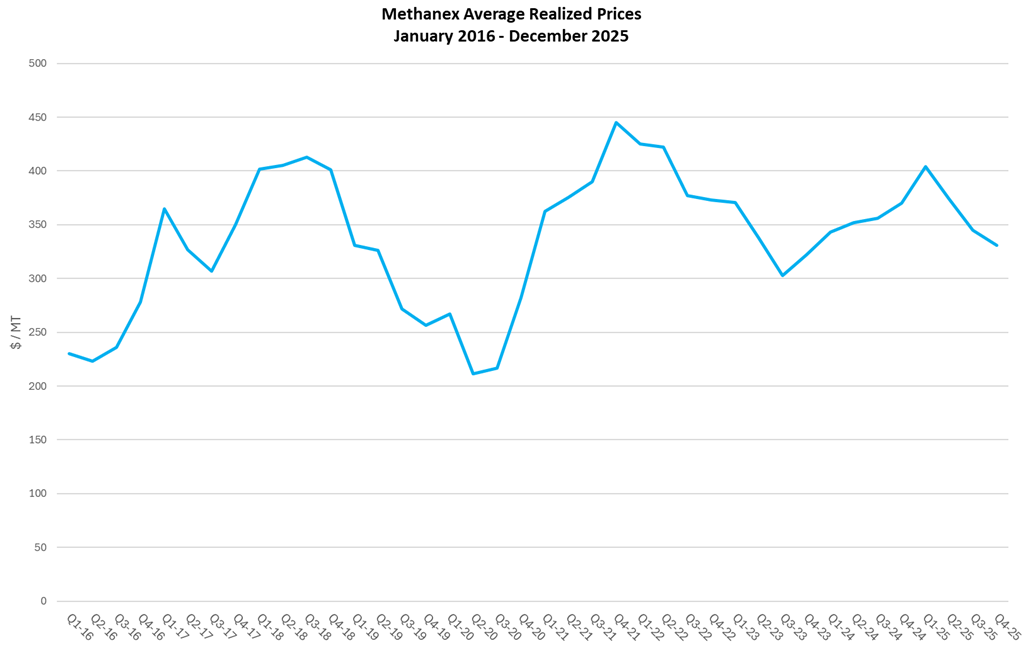
The methanol business is a highly competitive commodity industry and future methanol prices will ultimately depend on the strength of global and regional demand and methanol industry supply but can also be impacted by other factors such as global trade disputes and government sanctions. Methanol demand and industry supply are driven by several factors as described above. Methanol prices have historically been, and are expected to continue to be, characterized by volatility and cyclicality. We are not able to predict future methanol prices, which are driven by several factors that are beyond our control.
We publish regional non-discounted reference prices for each methanol sales region and these posted prices are reviewed based on industry fundamentals and market conditions and revised monthly in North America, Asia Pacific, and China and quarterly in Europe. Most of our customer contracts use published Methanex reference prices as a basis for pricing, and we offer discounts to customers based on various factors. The sales weighted average posted price less the sales weighted average discount generates our average realized price which drives our revenue.
PRODUCTION
Production Process
Across our portfolio of production assets, we utilize several technologies to produce methanol which involve the production of synthesis gas (a mixture of hydrogen and carbon oxides) through either steam reforming, combined reforming or autothermal-only reforming. This reformed gas is then cooled, compressed and converted to crude methanol. Crude methanol consists of approximately 80% methanol and 20% water by weight. To produce chemical-grade methanol, crude methanol is distilled to remove water, higher alcohols and other impurities.
The ammonia manufacturing process used in our Beaumont facility involves the utilization of excess hydrogen from the methanol plant which is combined with third-party nitrogen and hydrogen supply. The mixture is then compressed and passed over an iron catalyst to produce gaseous ammonia. The gaseous ammonia is then cooled and liquified through a refrigeration process for storage and distribution.
Operating Data and Other Information
We endeavour to operate our production facilities around the world in an optimal manner to lower our overall delivered cost of product.
Scheduled shutdowns of plants are necessary to change catalysts or perform maintenance activities that cannot otherwise be completed with the plant operating (a process commonly known as a turnaround). These shutdowns typically take between 30 and 45 days. Catalysts generally need to be changed every three to six years depending on technology. Careful planning and scheduling is required to ensure that maintenance and repairs can be carried out during turnarounds. In addition, both scheduled and unscheduled shutdowns may occur between turnarounds. We prepare a long-term turnaround schedule that is updated annually for all of our production facilities.
The following table details the annual operating capacity and actual production at our facilities in 2025 and 2024:
| | | | | | | | | | | |
| Annual Operating Capacity(1) | 2025 Production | 2024 Production |
| (000 tonnes/year) | (000 tonnes) | (000 tonnes) |
USA | | | |
| Geismar | 4,000 | | 3,330 | | 2,529 | |
Beaumont (2) | 910 | | 466 | | — | |
Natgasoline (50% interest) (2) | 850 | | 418 | | — | |
Trinidad and Tobago (3) | 860 | | 730 | | 956 | |
New Zealand (4) | 860 | | 507 | | 670 | |
Chile | 1,700 | | 1,302 | | 1,180 | |
Egypt (50% interest) | 630 | | 555 | | 460 | |
Canada (Medicine Hat) | 560 | | 508 | | 563 | |
| Total Methanol Production | 10,370 | | 7,816 | | 6,358 | |
| | | |
Beaumont Ammonia 5 | 340 | | 182 | | — | |
(1)The annual operating capacity of our production facilities may be higher or lower than original nameplate capacity as, over time, these figures have been adjusted to reflect ongoing operating efficiencies at these facilities. Actual production for a facility in any given year may be higher or lower than operating capacity due to a number of factors, including natural gas availability, feedstock composition, the age of the facility's catalyst, turnarounds and access to CO2 from external suppliers for certain facilities. We review and update the operating capacity of our production facilities on a regular basis based on historical performance.
(2)The annual operating capacity of the Beaumont and Natgasoline facilities are 910,000 tonnes and 850,000 tonnes (50% interest), respectively. The actual production for 2025 reflects the amount of production since the facilities were acquired on June 27, 2025.
(3)The operating capacity of Trinidad consists of the Titan facility (100% interest). The Atlas facility (63.1% interest) is excluded as it is idle (refer to the Natural Gas Supply – Trinidad and Tobago section below).
(4)The operating capacity of New Zealand consists of one Motunui facility, with the other excluded as it is idle (refer to the Natural Gas Supply – New Zealand section below).
(5)The annual operating capacity of the Beaumont ammonia facility is 340,000 tonnes. The actual production for 2025 reflects the amount of production since the facility was acquired on June 27, 2025.
Refer to the Production Summary section of our 2025 MD&A for more information.
MARKETING
We sell methanol to customers globally through an extensive marketing and distribution system with marketing offices in North America (Houston), Europe (Brussels), Asia Pacific (Hong Kong, Shanghai, Tokyo, Seoul and Beijing) and South America (Santiago). Most of our customers are large global or regional petrochemical manufacturers or distributors.
We believe our ability to sell methanol from geographically dispersed production sites enhances our ability to serve major chemical and petrochemical producers as customers for whom reliability of supply and quality of service are important.
In addition to selling methanol that we produce at our own facilities, we also sell methanol that we purchase from other suppliers through methanol purchase agreements and on the spot market. This provides us with flexibility in our supply chain and allows us to reliably meet customer commitments.
DISTRIBUTION AND LOGISTICS
All of our methanol production facilities are located adjacent to deepwater ports, except for Medicine Hat which mainly services the regional market via either rail and truck. Methanol is transported from our coastal plants by pipeline to these ports for shipping. We currently own or manage a fleet of approximately 30 ocean-going vessels to ship this methanol. We lease or own in-region storage and terminal facilities in North America, Europe, South
America and Asia Pacific. We also use barge, rail, pipelines and, to a lesser extent, truck transport in our delivery system.
To retain optimal flexibility in managing our shipping fleet, we have entered into short-term and long-term time charter agreements covering vessels with a range of capacities. We also ship methanol under contracts of affreightment and through spot arrangements. We use mid-range (45-50,000 deadweight tonnage) vessels as key elements in our supply chain to move product from our production facilities to storage facilities located in major ports and for direct delivery to some customers. We also use smaller vessels capable of entering into restricted ports to deliver directly to other customers.
The cost to distribute methanol to customers represents a significant component of our operating costs. These include costs for ocean shipping, storage and distribution. We focus on identifying initiatives to reduce costs, including optimizing the use of our shipping fleet, third-party backhaul arrangements and taking advantage of prevailing conditions in the shipping market by varying the type and term of ocean vessel contracts. We also look for opportunities to leverage our global asset position by entering into geographic product exchanges with other methanol producers to reduce distribution and transportation costs. We are continuously investigating opportunities to further improve the efficiency and cost-effectiveness of distributing methanol from our production facilities to customers.
Our plants in New Zealand primarily supply customers in the Asia Pacific region. Our production site in Chile can supply all global regions due to its geographic location. Our Egypt plant primarily services the domestic Egypt market and our European markets but can also supply the Asia Pacific region. Our Medicine Hat plant serves our customer base in North America, and our plants in the United States and Trinidad and Tobago can serve customers across the Americas, Europe and the Asia Pacific region.
NATURAL GAS SUPPLY
General
Natural gas is the principal feedstock for producing methanol and it accounts for a significant portion of our operating costs. Accordingly, our results from operations depend in large part on the availability and security of supply and the price of natural gas. If, for any reason, we are unable to obtain sufficient natural gas for any of our plants on commercially acceptable terms or we experience interruptions in the supply of contracted natural gas, we could be forced to curtail production or shut down such plants, which could have an adverse effect on our results of operations and financial condition.
United States
We have three plants operating in Geismar, Louisiana with an annual operating capacity of 4.0 million tonnes. In Beaumont, Texas we operate one plant with an annual operating capacity of 0.9 million tonnes of methanol and an annual operating capacity of 0.3 million tonnes of ammonia.
We utilize a combination of fixed price financial hedges and fixed price physical gas supply agreements to manage natural gas price risk for our North American facilities. In the United States, we have fixed price gas supply contracts and hedges in place of approximately 50% in the near-term, declining over time. The balance of our gas requirements is purchased at a combination of monthly and daily index prices.
Chile
We have long-term natural gas supply agreements for our plants in Chile with Empresa Nacional del Petróleo ("ENAP") in Chile and YPF S.A. ("YPF") in Argentina. During 2025, these agreements supported full-capacity operation of one plant throughout the year. In addition, during the southern hemisphere summer months, natural gas supply arrangements and associated Argentine export permits supported operation of two plants. In 2025, both plants operated at full capacity for substantially all seven months during the southern hemisphere summer period, and one plant operated at full capacity for the remaining five months of the year.
ENAP continues to develop natural gas from unconventional reservoirs, which has supported consistent deliveries to our facilities. In Argentina, continued development of unconventional reservoirs, together with additions to
transportation capacity, has improved the reliability of supply available for export to Chile. Currently, we have a long-term natural gas supply agreement with ENAP through 2030 and with YPF through the end of 2027. These gas supply agreements are subject to deliver-or-pay and take-or-pay provisions.
In addition, during 2025, we received natural gas from Argentina from four different suppliers pursuant to firm supply agreements from January through April and from September through December.
The price paid for natural gas for our Chilean facilities under our Chilean and Argentine supply agreements is either a fixed U.S. dollar price or a U.S. dollar base price plus a variable component that is adjusted pursuant to a formula linked to methanol prices above a specified threshold.
Trinidad and Tobago
Natural gas for our Titan plant is supplied by the National Gas Company of Trinidad and Tobago Limited ("NGC"), pursuant to a two-year take-or-pay contract that commenced in September 2024. The natural gas sale agreement for Titan is a take-or-pay contract with the NGC, which purchases the natural gas from upstream gas producers. The contract has a U.S. dollar base and variable price components, where the variable portion is adjusted by a formula linked to methanol prices above a certain level.
Our Atlas methanol production facility in Trinidad and Tobago, with our share of total production capacity being 1.1 million tonnes per year, was idled in September 2024.
New Zealand
We have two plants located at Motunui in New Zealand each with operating capacity of 0.86 million tonnes of methanol per year. In September 2024, we restructured our operations in New Zealand to support a one-plant operation, and idled one of the Motunui plants. A third plant located at nearby Waitara Valley was idled indefinitely in the first quarter of 2021. The plants were idled due to a lack of available gas supply.
We have agreements with various natural gas suppliers with terms that range in length up to 2029. All material gas supply agreements in New Zealand are take-or-pay agreements and include U.S. dollar base and variable price components where the variable price component is adjusted by a formula linked to methanol prices above a certain level. We believe this pricing relationship enables New Zealand methanol production to be competitive at all points in the methanol price cycle. The volume delivered under certain contracts is dependent on the success of exploring and developing the related natural gas field. Supplier upstream development activities have not delivered the expected gas production results and have resulted in reduced gas quantities delivered under our contracts and a continuing decline in gas production will make it challenging to continue operations in the country.
Egypt
We have a 25-year, take-or-pay natural gas supply agreement expiring in 2035 for the 1.3 million tonne per year methanol plant in Egypt in which we have a 50% equity interest. The price paid for gas is based on a U.S. dollar base price plus a variable price component that is adjusted by a formula linked to methanol prices above a certain level. Under the contract, the gas supplier is obligated to supply, and we are obliged to take or pay for, a specified annual quantity of natural gas. In addition, the natural gas supply agreement has a mechanism whereby we are partially compensated when gas delivery shortfalls in excess of a certain threshold occur. Natural gas is supplied to this facility from the same gas delivery grid infrastructure that supplies other industrial users in Egypt, as well as the general Egyptian population.
Canada
We have entered into fixed price contracts to supply 80-90% of our natural gas requirements for our Medicine Hat facility through 2031. The balance of our gas requirements is purchased under contracts at spot prices.
FOREIGN OPERATIONS
We have substantial operations and investments outside of North America, and as such we are affected by foreign political developments and federal, provincial, state and other local laws and regulations. We are subject to risks inherent in foreign operations, including loss of revenue, property and equipment as a result of expropriation; import
or export restrictions; anti-dumping measures; nationalization, war, civil unrest, insurrection, acts of terrorism and other political risks; increases in duties, tariffs, taxes and governmental royalties; renegotiation of contracts with governmental entities; as well as changes in laws or policies or other actions by governments that may adversely affect our operations. We are also subject to potential trade risks associated with geopolitical disputes between countries in which we operate.
We derive a substantial portion of our revenue from production and sales by subsidiaries outside of Canada, and the payment of dividends or the making of other cash payments or advances by these subsidiaries to us may be subject to restrictions or exchange controls on the transfer of funds in or out of the respective countries or result in the imposition of taxes on such payments or advances. We have organized our foreign operations in part based on certain assumptions about various tax laws (including capital gains, withholding taxes and transfer pricing), foreign currency exchange and capital repatriation laws and other relevant laws of a variety of foreign jurisdictions. While we believe that such assumptions are reasonable, we cannot provide assurance that foreign taxation or other authorities will reach the same conclusion. Further, if such foreign jurisdictions were to change or modify such laws, we could suffer adverse tax and financial consequences.
Our wholly owned subsidiary, Methanex Chile SpA ("Methanex Chile"), owns two methanol plants on our Chilean production site. Chilean foreign investment regulations provide certain benefits and guarantees to companies that enter into a foreign investment contract ("DL 600 Contract") with Chile. Methanex Chile has entered into DL 600 Contracts, substantially identical in all matters material for Methanex Chile, for both plants. Under the DL 600 Contracts, Methanex Chile is authorized to remit from Chile, in United States dollars or any other freely convertible currency, all or part of its profits and its equity. The DL 600 Contracts provide that they cannot be amended or terminated except by written agreement.
RESPONSIBLE CARE & SUSTAINABILITY
As a member of the Chemistry Industry Association of Canada ("CIAC"), the American Chemistry Council ("ACC"), Asociación Gremial de Industriales Quimicos de Chile, Responsible Care New Zealand, European Chemical Industry Council, China Association of International Chemical Manufacturers, Japan Chemical Industry Association and Gulf Petrochemicals and Chemicals Association, we are committed to the Responsible Care® (RC) Ethic and Principles for Sustainability.
Responsible Care, a sustainability initiative recognized by the United Nations, is the umbrella under which we manage our business in relation to health, safety, the environment, community involvement, social responsibility, sustainability, security and emergency preparedness at each of our facilities and locations.
Accordingly, we have established policies, systems and procedures to promote and encourage the responsible development, manufacture, transportation, storage, handling, distribution and use of methanol and ultimate disposal of hazardous waste and residual chemical products to prevent harm to human health and well-being, the environment and the communities in which we operate while striving to improve the environment and people’s lives.
Methanex’s Responsible Care and Social Responsibility (RC and SR) related policies and programs are based on CIAC’s RC Ethic and Principles for Sustainability and the CIAC RC Codes of Practice. Some of the countries where we operate have different standards than those applied in North America. Our policy is to adopt the more stringent of either Responsible Care practices or local regulatory or association requirements at each of our facilities.
Sound corporate governance is the foundation of our long-term success and the sustainability of our operations. Our corporate governance policies ensure that we have strong management and clear direction for all of Methanex’s business affairs. The application of Responsible Care begins with our Board of Directors, which has appointed a Responsible Care Committee, and extends throughout our organization.
The Board’s Responsible Care Committee provides oversight of the RC and SR program performance and related matters at the policy level. The Responsible Care Committee considers RC ethics, sustainability, safety (personal and process), health, environment, crisis management and communications, physical security, product stewardship, quality assurance management, and social responsibility. The executive leadership team has overall responsibility for establishing Methanex’s RC policies and programs, and ensuring that they align with the Board’s requirements and the Company’s business strategy. These global programs are directed and managed by the Vice President, Responsible Care who leads Methanex’s global Responsible Care function.
Methanex evaluates the performance of its RC and SR management system through internal and third-party external audit and assessment programs. The internal program includes ongoing in-region self-audits as well as global audits conducted by Methanex subject matter experts. Third-party verification of the performance of Methanex’s RC/SR program occurs through the CIAC RC verification process or the ACC RC 14001 certification process. The most recent CIAC RC re-verification was successfully completed in 2025.
Our overarching RC Ethic & Principles for Sustainability Purpose and Values statement sets out the Company’s commitment to RC and sustainability. We also have an established Health, Safety, Security, Environment-Quality Policy that includes the requirement that we operate our facilities in a manner that protects the safety and health of all employees, contractors, customers and the general public. It requires that we have systems in place to monitor and comply with all local safety, health and environmental regulations as well as internal standards, periodically audit performance and compliance, measure performance against key performance indicators, report and investigate incidents with the potential to cause harm to people or the environment and demonstrate continual improvement.
We have also adopted a number of risk assessment tools that are formally applied as part of our normal business processes to identify and mitigate current and future health and occupational safety, environmental and process safety-related risks. When incidents do occur, we have a formal incident investigation process to determine root causes and corrective actions to allow for effective mitigation as well as application of lessons learned throughout our organization.
As a natural extension of our RC ethic, we align our employee engagement and communications, community involvement and social investment strategies with our core values and corporate strategy. In alignment with our Stakeholder Relations Policy, the Company is committed to being accountable and responsive to our stakeholders. We proactively respond to any community concerns about the manufacture, storage, handling, transportation and disposal of our products and promptly provide information concerning any potential health or environmental hazard to the appropriate authorities, employees and all stakeholders. Furthermore, the Company is committed to positively contributing to and having an open, honest and proactive relationship with the communities where we have a significant presence; to having effective processes to identify and respond to community concerns; and to informing the community of risks associated with our operations.
One of the ways the Company maintains the highest standards of product care is by sharing methanol safe handling knowledge and best practices with key stakeholders involved in the methanol value chain including customers, distributors, logistics providers, emergency responders, industry associations and regulators.
We believe that Responsible Care helps us achieve safe and reliable operations, which in turn results in strong financial performance, effective and innovative minimization of environmental impacts and improved quality of life.
ENVIRONMENTAL MATTERS
The countries in which we operate and international and jurisdictional waters in which our vessels operate have laws, regulations, treaties and conventions in force to which we are subject, governing the environment and the management of natural resources as well as the handling, storage, transportation and disposal of toxic or waste materials. We are also subject to laws and regulations governing emissions and the import, export, use, discharge, storage, disposal and transportation of toxic substances. The products we use and produce are subject to regulation under various health, safety and environmental laws. Non-compliance with these laws and regulations may give rise to compliance orders, fines, injunctions, civil liability and criminal sanctions.
Laws and regulations with respect to protecting the environment have become more stringent over time and may, in certain circumstances, impose absolute liability rendering a person liable for environmental damage without regard to negligence or fault on the part of such person. Such laws and regulations may also expose us to liability for the conduct of, or conditions caused by others or for our own acts even if we complied with applicable laws at the time such acts were performed. To date, environmental laws and regulations have not had a significant adverse effect on our capital expenditures, earnings or competitive position. However, operating petrochemical manufacturing plants and distributing methanol exposes us to risks in connection with compliance with such laws and we cannot provide assurance that we will not incur significant costs or liabilities in the future.
GHG Legislation
We generate GHG emissions, primarily as carbon dioxide ("CO2"), directly and indirectly through the production, distribution and use of methanol. GHG emissions are a byproduct of the development and extraction of hydrocarbons, including natural gas used as a feedstock in methanol production, as well as the methanol production process. GHG emissions are also generated when fuel is consumed during the global transport of methanol. The GHG Protocol Corporate Standard classifies a company’s GHG emissions into three ‘scopes’. Scope 1 emissions are direct emissions from owned or controlled sources. Scope 2 emissions are indirect emissions from the generation of purchased energy. Scope 3 emissions are all other indirect emissions (not included in Scope 2) that occur in the value chain, including both upstream and downstream emissions.
We monitor and manage our GHG emissions intensity for Scope 1 and Scope 2 emissions, defined as the equivalent quantity of CO2 released per unit of production or transported tonne, based on assets and operations over which we have operational control, including methanol production and our marine operations. The amount of GHG emissions generated by the methanol production process is highly dependent on a number of factors including the design of the methanol plant, plant reliability, and availability of natural gas. Similarly, the distance of trade routes, volume of transported cargo, as well as ship technology and operating efficiency, influence the emissions intensity of our marine operations. Accordingly, GHG emissions may vary from year to year depending on the mix of production assets and vessels and their respective operations.
Under the Paris Agreement within the United Nations Framework Convention on Climate Change, many of the countries we operate in have agreed to put forth substantial efforts and commitments to reduce GHG emissions that they are implementing through GHG regulations that include carbon prices. Our production in New Zealand, Canada, Chile and the Netherlands (where our facility is indefinitely idled) is currently subject to GHG regulations, whereas our production in the United States, Trinidad and Tobago, and Egypt is not currently subject to such regulations. These regulations result in additional costs to produce methanol. Many of our competitors produce methanol in countries with no imposed GHG regulations or carbon taxes and as such, further increases in regulations or carbon taxes in the countries in which we operate may negatively impact our competitive position within the methanol industry. In addition, as of January 2024, Waterfront Shipping is subject to the EU’s Emissions Trading System (ETS) for fifty percent of emissions from voyages where the point of origin or the point of destination is within the EU and 100 percent of emissions that occur for voyages between two EU ports and when ships are within EU ports. In 2025, Waterfront Shipping needed to purchase and surrender 70 percent of EU ETS credits for shipping emissions within the EU and will need to purchase 100 percent in 2026. Additionally, the FuelEU maritime regulation requires the annual average of the well-to-wake GHG intensity of fuels used by the shipping sector that call on EU ports to decrease over time (two per cent from 2025, six per cent from 2030, and up to 80 per cent from 2050).
There are ongoing reviews and potential changes to government GHG regulations in countries where we have operations or conduct business, including potential carbon border adjustment mechanisms that could impact the efficient management of our global supply chain.
We cannot provide assurance that changes in existing or the introduction of new GHG regulations, carbon taxes, or other initiatives related to climate change in jurisdictions where we have operations or conduct business will not have an adverse impact on our results of operations and financial condition.
INSURANCE
The majority of our revenues are derived from the sale of methanol and ammonia produced at our plants. Our business is subject to the normal hazards of methanol and ammonia production operations that could result in damage to our plants. Under certain conditions, prolonged shutdowns of plants due to unforeseen equipment breakdowns, interruptions in the supply of natural gas, oxygen, nitrogen, hydrogen or utilities, power failures, loss of port facilities or any other event, including any event of force majeure, could adversely affect our revenues and operating income. We maintain operational insurance, including business interruption, subject to certain deductibles, that we consider to be adequate under the circumstances. However, there can be no assurance that we will not incur losses beyond the limits or outside the coverage of such insurance. From time to time, various types of insurance for companies in the chemical and petrochemical industries have not been available on commercially acceptable terms or, in some cases, have been unavailable. There can be no assurance that in the future we will be able to maintain existing coverage, or that premiums will not increase substantially.
COMPETITION
Methanex is the largest producer and supplier of methanol, with approximately 20% of global market demand in 2025, excluding the China domestic market, and is the only global supplier with a significant presence in Asia Pacific, Europe, North America and South America. Methanex has established itself as a clear methanol industry leader. Similar to other global commodities, the methanol industry is highly competitive. A supplier’s ability to withstand price competition and volatile market conditions will depend on several factors, with the most important being its position on the industry cost curve. This in turn depends on the relative cost and availability of natural gas or coal feedstock, and the efficiency of production facilities and distribution systems. Our methanol assets are competitively positioned on the industry cost curve. We manage our natural gas costs in two ways: through fixed price contracts and gas contracts linked to methanol price. In North America, we target to have fixed price natural gas supply contracts and financial hedges in place covering approximately 50% of our natural gas needs in the near term. Our production facilities outside North America are largely underpinned by natural gas purchase agreements where the natural gas price is linked to methanol prices. This pricing relationship enables these facilities to be competitive throughout the methanol price cycle. Some of our competitors are not dependent on a single product for revenues, and some have greater financial resources. However, given our ability to service our customers globally, the reliability and cost-effectiveness of our distribution system and the enhanced service we provide customers, we believe we are well positioned to compete.
EMPLOYEES
As at December 31, 2025, we had 1,649 employees.
RISK FACTORS
The risks relating to our business are described under the heading Risk Factors and Risk Management in our 2025 MD&A, and are incorporated in this document by reference. Any of those risks, as well as risks and uncertainties currently not known to us, could adversely affect our business, financial condition, results of operations or the market price of our securities.
DIVIDENDS
Dividends are payable to the holders of common shares of the Company ("Common Shares") if, as and when declared by our Board of Directors and in such amounts as the Board of Directors may, from time to time, determine. The Company’s current dividend policy is designed to return cash to shareholders while allowing the Company to retain financial flexibility appropriate for the historically cyclical nature of the methanol industry. The following table sets forth the amount of quarterly cash dividends paid by the Company on its Common Shares in 2023, 2024 and 2025:
| | | | | | | | |
| Record Date | Payment Date | Dividend per Share |
| December 17, 2025 | December 31, 2025 | $0.185 |
| September 16, 2025 | September 30, 2025 | $0.185 |
| June 16, 2025 | June 30. 2025 | $0.185 |
| March 17, 2025 | March 31, 2025 | $0.185 |
| December 17, 2024 | December 31, 2024 | $0.185 |
| September 16, 2024 | September 30, 2024 | $0.185 |
| June 14, 2024 | June 28, 2024 | $0.185 |
| March 14, 2024 | March 28, 2024 | $0.185 |
| December 15, 2023 | December 29, 2023 | $0.185 |
| September 16, 2023 | September 30, 2023 | $0.185 |
| June 16, 2023 | June 30, 2023 | $0.185 |
| March 17, 2023 | March 31, 2023 | $0.175 |
CAPITAL STRUCTURE
We are authorized to issue an unlimited number of Common Shares without nominal or par value and 25,000,000 preferred shares without nominal or par value ("Preferred Shares").
Holders of Common Shares are entitled to receive notice of and attend all annual and special meetings of shareholders and to one vote in respect of each Common Share held; receive dividends if, as and when declared by our Board of Directors; and participate in any distribution of the assets of the Company in the event of liquidation, dissolution or winding up.
Preferred Shares may be issued in one or more series and the Board of Directors may fix the designation, rights, restrictions, conditions and limitations attached to the Preferred Shares of each such series. Currently, there are no Preferred Shares outstanding.
Our bylaws provide that at any meeting of our shareholders a quorum shall be two persons present in person, or represented by proxy, holding Common Shares representing not less than 25% of the votes entitled to be cast at the meeting. Nasdaq Global Select Market listing standards require a quorum for shareholder meetings to be not less than 33-1/3% of a company’s outstanding voting shares. As a foreign private issuer and because our quorum requirements are consistent with practices in Canada, we are exempt from the quorum requirement under the Nasdaq Listing Rules.
RATINGS
The following information relating to Methanex's credit ratings is provided as it relates to Methanex's financing costs, liquidity and operations. Credit ratings affect Methanex's cost and ability to obtain short-term and long-term financing and to engage in certain business activities on a cost-effective basis. A negative change in Methanex's current rating score and/or rating outlook could adversely affect Methanex's future cost of financing and its access to sources of liquidity and capital. In addition, changes in credit ratings may affect Methanex's ability to, and the associated costs of (i) entering into ordinary course derivative or hedging transactions, and (ii) entering into and maintaining ordinary course contracts with customers and suppliers on acceptable terms.
The following table sets forth the ratings assigned to Methanex and certain of its subsidiaries by S&P Global Ratings ("S&P"), Moody’s Investors Service, Inc. ("Moody’s") and Fitch Ratings, Inc. ("Fitch").
| | | | | | | | | | | | | | |
Entity | Debt Rated/Outlook | S&P(1) | Moody’s(2) | Fitch(3) |
Methanex Corporation | Issuer Rating | BB | n/a(2) | BB+ |
Senior Unsecured Notes | BB | Ba2 | BB+ |
| Ratings Outlook | Stable | Stable | Stable |
| Last Reviewed | March 25, 2025 | June 27, 2025 | December 17, 2025 |
Methanex US Operations Inc. | Issuer Rating | n/a(4) | n/a(2) | BB+ |
| Senior Unsecured Notes | BB | Ba2 | BB+ |
| Ratings Outlook | Stable | Stable | Stable |
| Last Reviewed | March 25, 2025 | June 27, 2025 | December 17, 2025 |
(1) S&P long-term debt ratings are on a rating scale that ranges from AAA to D, which represents the range from highest to lowest quality. According to the S&P rating system, issuers and debt securities rated BB are less vulnerable in the near term relative to other lower-rated obligations, however, they face major ongoing uncertainties in periods of adverse business, financial or economic conditions. The ratings from AA to CCC may be modified by the addition of a plus (+) or minus (-) sign to show relative standing within the major rating categories.
(2) Moody’s long-term debt ratings are on a rating scale that ranges from Aaa to C, which represents the range from highest to lowest quality. According to the Moody’s rating system, debt securities rated Ba are judged to have speculative elements and are subject to substantial credit risk. Moody’s applies numerical modifiers 1, 2 and 3 in each major rating category from Aa through Caa in its corporate bond rating system. The modifier 1 indicates that the issue ranks in the higher end of its major rating category, the modifier 2 indicates a mid-range ranking and the modifier 3 indicates that the issue ranks in the lower end of its major rating category. Moody's rates Methanex's debt securities and does not provide an Issuer Credit Rating.
(3) Fitch long-term debt ratings are on a rating scale that ranges from AAA to D, which represents the range from highest to lowest quality. According to the Fitch rating system, issuers and debt securities rated BB indicate an elevated vulnerability to default risk, particularly in the event of adverse changes in business or economic conditions over time; however, business or financial flexibility exists that supports the servicing of financial commitments. The ratings from AA to CCC may be modified by the addition of a plus (+) or minus (-) sign to show relative standing within the major rating categories.
(4) S&P assigned an issue-level rating for the $600 million 2032 senior notes but did not publish an issuer rating for Methanex US Operations Inc.
The rating agencies regularly evaluate Methanex, and their ratings of Methanex are based on a number of factors, including Methanex’s financial strength and factors not entirely within Methanex’s control, including conditions affecting the methanol industry generally and the wider state of the economy.
The foregoing ratings should not be construed as a recommendation to buy, sell or hold any securities, as such ratings do not comment as to market price or suitability for a particular investor. There is no assurance that any rating will remain in effect for any given period of time or that any rating will not be revised or withdrawn entirely by a rating agency in the future if, in its judgment, circumstances so warrant. If any such rating is so revised or withdrawn, we are under no obligation to update this AIF.
During the last two years, Methanex has paid each of the rating agencies its customary fees in connection with the provision of the above ratings.
MARKET FOR SECURITIES
Our Common Shares are listed on the Toronto Stock Exchange in Canada (trading symbol: MX) and on the Nasdaq Global Select Market in the U.S. (trading symbol: MEOH). The following table sets out the market price ranges and trading volumes of our Common Shares on the Toronto Stock Exchange as well as on other Canadian and US equity marketplaces, including exchanges and alternative trading systems, for each month of our most recently completed financial year (January 1, 2025, through December 31, 2025).
| | | | | | | | | | | | | | | | | | | | |
2025 Trading Volumes(1) |
Trading Symbol: MX | Trading Symbol: MEOH | Total Volume |
The Toronto Stock Exchange | Other Canadian Trading | Nasdaq Global Select Market and Other US Trading |
Month | High (CDN$) | Low (CDN$) | Volume | Volume | Volume |
January | 76.99 | 67.86 | 2,965,123 | 1,458,157 | 8,068,848 | 12,492,128 |
February | 78.18 | 61.73 | 3,020,009 | 1,746,808 | 7,453,281 | 12,220,098 |
March | 64.47 | 49.46 | 4,338,914 | 2,785,554 | 10,557,724 | 17,682,192 |
April | 50.38 | 36.10 | 6,156,686 | 5,715,364 | 16,051,431 | 27,923,481 |
May | 49.59 | 42.00 | 4,145,562 | 2,411,250 | 11,434,216 | 17,991,028 |
June | 51.87 | 43.27 | 5,869,824 | 4,640,519 | 14,938,380 | 25,448,723 |
July | 48.48 | 45.03 | 3,742,519 | 2,333,121 | 12,719,366 | 18,795,006 |
August | 49.82 | 44.57 | 4,228,551 | 2,136,983 | 8,322,400 | 14,687,934 |
September | 57.30 | 47.83 | 4,400,141 | 2,672,839 | 10,103,168 | 17,176,148 |
October | 57.41 | 45.01 | 5,234,311 | 3,602,346 | 13,301,950 | 22,138,607 |
November | 55.05 | 48.00 | 3,142,177 | 1,888,449 | 8,092,278 | 13,122,904 |
December | 56.33 | 49.19 | 3,108,810 | 1,780,506 | 9,473,335 | 14,362,651 |
(1) Source: Bloomberg
DIRECTORS AND EXECUTIVE OFFICERS
As at December 31, 2025, the directors and executive officers of the Company owned, controlled or directed, directly or indirectly, 380,537 Common Shares, representing approximately 0.5% of the outstanding Common Shares as at December 31, 2025.
The following tables set forth the names and places of residence of the current directors and executive officers of the Company, the offices held by them in the Company, their current principal occupations, their principal occupations during the last five years and, in the case of the directors, the month and year in which they became directors: | | | | | | | | | | | |
Name and
Municipality of Residence | Office | Principal Occupations and
Positions During the Last Five Years | Director Since(16) |
ARNELL, DOUG
West Vancouver
British Columbia
Canada | Director and Chair of the Board | Chief Executive Officer of Cedar LNG LLC(5) since June 2021 and President and Chief Executive Officer of Helm Energy Advisors Inc.(6) since March 2015. | October 2016 |
BERTRAM, JIM(3)(4) Calgary, Alberta Canada | Director | Corporate Director. | October 2018 |
DOBSON, PAUL(1)(3) Naples, Florida USA | Director | Corporate Director. Chief Financial Officer of EVgo Inc.(7) from October 2024 to January 2026. Prior to that Senior Vice President and Chief Financial Officer of Ballard Power Systems(8) from March 2021 to September 2024. Prior thereto Acting President and Chief Executive Officer of Hydro One Limited(9) from July 2018 to May 2019. | April 2019 |
HOWE, MAUREEN(1)(2) Vancouver, British Columbia Canada | Director | Corporate Director. | June 2018 |
MARCHAND, DON(1)(4) Calgary, Alberta Canada | Director | Corporate Director. Executive Vice President and Chief Financial Officer of TC Energy Corporation(10) from 2010 to 2021. | December 2025 |
O'DONOGHUE, LESLIE(1)(3) Calgary, Alberta Canada | Director | Corporate Director. Executive Vice President and Adviser to the Chief Executive Officer of Nutrien Ltd.(11) from June 2019 to December 2019. | April 2020 |
PERREAULT, ROGER(1)(4) Six Mile, South Carolina USA | Director | Corporate Director. President and CEO of UGI Corporation(12) from 2021 to 2023; prior thereto Executive Vice President, Global LPG of UGI Corporation from 2018 to 2021. | April 2024 |
RODGERS, KEVIN(2)(3) London UK | Director | Corporate Director. | July 2019 |
SAMPSON, JOHN(3)(4) Midland, Michigan USA | Director | Senior Vice President, Operations, Manufacturing and Engineering of Dow Inc.(13) since 2020; prior thereto Executive Vice President, Business Operations of Olin Corporation(14) from 2019 to 2020. | October 2023 |
SUMNER, RICH
North Vancouver
British Columbia
Canada | Director, President and Chief Executive Officer | President and Chief Executive Officer of the Company since January 2023. Prior thereto Senior Vice President, Global Marketing and Logistics of the Company since October 2021; prior thereto Regional President, Marketing and Logistics, Asia Pacific of the Company since February 2019. | January 2023 |
WARMBOLD, BENITA(1)(2) Toronto, Ontario Canada | Director | Corporate Director. | February 2016 |
YANG, XIAOPING(2)(4) Henderson, Nevada USA | Director | Corporate Director. President and Chair of BP China(15) from November 2016 to September 2020. | January 2022 |
(1)Member of the Audit, Finance and Risk Committee.
(2)Member of the Corporate Governance Committee.
(3)Member of the Human Resources Committee.
(4)Member of the Responsible Care Committee.
(5)Cedar LNG LLC is developing an LNG export terminal in Northwestern British Columbia.
(6)Helm Energy Advisors, Inc. is a private company which provides advisory services to the global energy sector.
(7)EVgo Inc. installs and operates public, fast-charging electric vehicle infrastructure.
(8)Ballard Power Systems is a global provider of innovative clean energy and fuel cell solutions.
(9)Hydro One Limited is a major transmission and distribution provider in Ontario, Canada.
(10)TC Energy Corporation (formerly TransCanada Corporation) is a leading North American energy infrastructure company.
(11)Nutrien Ltd. is a Canadian fertilizer company, and is the world's largest provider of crop inputs, services and solutions.
(12)UGI Corporation is a distributor and marketer of energy products and services in the United States and Europe.
(13)Dow Inc. is a producer and supplier of raw materials for products in a wide variety of industries.
(14)Olin Corporation is a global manufacturer and distributor of chemical products.
(15)BP is a multinational energy company.
(16)The directors of the Company are elected each year at the Annual General Meeting of the Company and hold office until the close of the next Annual General Meeting or until their successors are elected or appointed.
| | | | | | | | |
Name and
Municipality of Residence | Office | Principal Occupations and
Positions During the Last Five Years |
ALLARD, MARK North Vancouver, British Columbia Canada | Senior Vice President, Low Carbon Solutions | Senior Vice President, Low Carbon Solutions of the Company since January 2023; prior thereto Vice President, North America of the Company since January 2019. |
BOYD, BRAD
West Vancouver, British Columbia
Canada | Senior Vice President,
Corporate Resources | Senior Vice President, Corporate Resources of the Company since January 2018. |
DELBARRE, KARINE Whitesboro, Texas USA | Senior Vice President, Global Marketing and Logistics | Senior Vice President, Global Marketing and Logistics of the Company since January 2023; prior thereto Vice President, Marketing and Logistics, North America of the Company since February 2019. |
MALONEY, Kevin
West Vancouver, British Columbia
Canada | Senior Vice President, Corporate Development | Senior Vice President, Corporate Development of the Company since January 2023; prior thereto Vice President, Corporate Development of the Company since April 2018. |
PARRA, GUSTAVO Houston, Texas, USA | Senior Vice President,
Manufacturing | Senior Vice President, Manufacturing of the Company since January 2023; prior thereto Vice President, Manufacturing Strategy and Planning of the Company since September 2019. |
PRICE, KEVIN
Vancouver, British Columbia
Canada | Senior Vice President, General Counsel & Corporate Secretary | Senior Vice President, General Counsel and Corporate Secretary of the Company since January 2023; prior thereto General Counsel and Corporate Secretary of the Company since March 2016. |
RICHARDSON, DEAN
Vancouver, British Columbia
Canada | Senior Vice President, Finance and Chief Financial Officer | Senior Vice President, Finance and Chief Financial Officer of the Company since February 2023; prior thereto Vice President, Corporate Finance of the Company since January 2022; prior thereto Managing Director, New Zealand of the Company since April 2018. |
INTEREST OF MANAGEMENT AND OTHERS IN MATERIAL TRANSACTIONS
Since the start of our most recently completed financial year, and for the three most recently completed financial years, no director or executive officer of the Company, and no person or company that beneficially owns, controls or directs, directly or indirectly, more than 10% of the Company’s voting securities, or any associate or affiliate of such persons, has had any material interest in any transaction involving the Company.
EXPERTS
Our Independent Registered Public Accounting Firm is KPMG LLP (“KPMG”), who prepared the Report of the Independent Registered Public Accounting Firm dated March 5, 2026 with respect to the Company’s consolidated financial statements as at December 31, 2025 and 2024, and for the years ended December 31, 2025 and 2024, and the effectiveness of the Company’s internal control over financial reporting as of December 31, 2025. KPMG has confirmed that they are independent with respect to the Company within the meaning of the relevant rules and related interpretations prescribed by the relevant professional bodies in Canada and any applicable legislation or regulations and also that they are independent accountants with respect to the Company under all relevant U.S. professional and regulatory standards.
LEGAL PROCEEDINGS
The Company is subject to various legal proceedings and regulatory actions arising in the normal course of business. While the final outcome of such legal proceedings and regulatory actions cannot be predicted with certainty and there can be no assurance that such matters will be resolved in the Company’s favour, it is the opinion of the Company’s management that the resolution of such proceedings and regulatory actions will not have a material impact on the Company’s consolidated financial position, results of operations or liquidity.
AUDIT COMMITTEE INFORMATION
The Audit Committee Charter
The Audit, Finance and Risk Committee (the "Audit Committee") is appointed by the Board to assist the Board in fulfilling its oversight responsibility relating to: the integrity of the Company’s financial statements; the financial reporting process; the systems of accounting and financial controls; the professional qualifications and independence of the Company's external auditors; the performance of the internal and external auditors; risk management processes; financing plans; and compliance by the Company with ethics policies and legal and regulatory requirements.
The Audit Committee’s mandate sets out its responsibilities and duties. A copy of the Committee’s mandate is attached here as Appendix "A".
Composition of the Audit Committee
The Audit Committee is comprised of six directors: Benita Warmbold (Chair), Paul Dobson, Maureen Howe, Leslie O'Donoghue, Don Marchand and Roger Perreault. Each Audit Committee member is "independent" and "financially literate" as determined in accordance with Canadian National Instrument 52-110 - Audit Committees, and is also "independent" as determined under each of Rule 10A-3 under the United States Securities Exchange Act of 1934, as amended (the "Exchange Act"), and Nasdaq Listing Rule 5605(a). Ms. Warmbold is currently designated as the "audit committee financial expert" (as that term is defined in paragraph (8)(b) of General Instruction B to Form 40-F under the Exchange Act). The U.S. Securities and Exchange Commission has indicated that the designation of a director as an audit committee financial expert does not make such director an "expert" for any other purpose, impose any duties, obligations or liability on such director that are greater than those imposed on members of the Audit Committee and Board who do not carry this designation or affect the duties, obligations or liability of any other member of the Audit Committee or the Board.
Relevant Education and Experience
The following is a brief summary of the education and experience of each member of the Audit Committee that is relevant to the performance of his or her responsibilities as a member of the Audit Committee, including any education or experience that has provided the member with an understanding of the accounting principles we use to prepare our annual and interim financial statements.
Ms. Benita Warmbold
Ms. Warmbold is a corporate director and former Senior Managing Director and Chief Financial Officer of the Canada Pension Plan Investment Board ("CPPIB"). CPPIB is a professional investment management organization responsible for investing funds on behalf of the Canada Pension Plan. Over her nine years at CPPIB, Ms. Warmbold was responsible for finance, risk, tax, internal audit, legal, technology, data and investment operations. Prior to joining CPPIB, Ms. Warmbold held leadership positions with Northwater Capital Management Inc., Canada Development Investment Corporation and KPMG LLP.
Ms. Warmbold holds a bachelor of commerce (honours) degree from Queen’s University, is a chartered professional accountant and is a Fellow of the Institute of Chartered Accountants of Ontario. She is also a Fellow of the Institute of Corporate Directors and has been granted their ICD.D .
Ms. Warmbold serves on the board of the Bank of Nova Scotia and chairs their Audit and Conduct Review Committee and is a designated financial expert. She is also a director of AtkinsRéalis and is a former Chair of their Audit and Risk Committee.
Ms. Warmbold has served on the Audit Committee since February 2016 and has been Chair of the Audit Committee since April 2018.
Mr. Paul Dobson
Mr. Dobson is a corporate director. He was Chief Financial Officer of EVgo Inc. from October 2024 until his retirement in January 2026. EVgo installs and operates public, fast-charging electric vehicle infrastructure. Prior to that he was Senior Vice President, Chief Financial Officer of Ballard Power Systems ("Ballard") from March 2021 to
September 2024. Ballard is a global provider of innovative clean energy and fuel cell solutions. From July 2018 to May 2019 Mr. Dobson was Acting President and Chief Executive Officer of Hydro One Limited, a major transmission and distribution provider in Ontario, Canada, and prior to that was Chief Financial Officer of Hydro One Limited from March 2018. Mr. Dobson also served as Chief Financial Officer of Direct Energy Ltd. in Houston, Texas, and held senior leadership positions in finance across the Centrica Group, the parent company of Direct Energy.
Mr. Dobson holds a bachelor of arts in management accounting (honours) from the University of Waterloo as well as an MBA from the University of Western Ontario. He is a chartered professional accountant and a certified management accountant.
Mr. Dobson has served on the Audit Committee since April 2019.
Ms. Maureen Howe
Ms. Howe is a corporate director. From 1996 to 2008 she was Managing Director of RBC Capital Markets specializing in the area of energy infrastructure, which included power generation, transmission and distribution, oil and gas transmission and distribution, gas processing and alternative energy. Prior to joining RBC Capital Markets, Ms. Howe held finance positions in the utility industry, investment banking and portfolio management.
Ms. Howe holds a bachelor of commerce (honours) from the University of Manitoba and a Ph.D. in Finance from the University of British Columbia.
Ms. Howe is a director and Audit Committee chair of both Pembina Pipeline Corporation and Freehold Royalties Ltd.
Ms. Howe has served on the Audit Committee since June 2018.
Mr. Don Marchand
Mr. Marchand is a corporate director. From 1994 onward, he held positions of increasing responsibility in finance at TC Energy Corporation ("TC Energy") (formerly TransCanada Corporation), a leading North American energy infrastructure company. From 2010 until his retirement in 2021, Mr. Marchand served as the Executive Vice President and Chief Financial Officer at TC Energy. During his 27-year tenure with TC Energy, Mr. Marchand led many of its financial functions including treasury, finance, accounting, taxation, risk management and investor relations. He also had responsibility for Strategy and Corporate Development for a period of three years.
Mr. Marchand holds a bachelor of commerce from the University of Manitoba and subsequently qualified as a Chartered Accountant and Chartered Financial Analyst. He is a member of the Institute of Chartered Professional Accountants of Alberta, the CFA Institute and the Calgary Society of Financial Analysts.
Mr. Marchand is a director of Fortis Inc. and serves on their audit committee.
Mr. Marchand has served on the Audit Committee since December 2025.
Ms. Leslie O'Donoghue
Ms. O'Donoghue is a corporate director. She was Executive Vice President and Advisor to the Chief Executive Officer of Nutrien Ltd. ("Nutrien") from June 2019 until her retirement in December 2019. Nutrien is a Canadian fertilizer company and is the world's largest provider of crop inputs, services and solutions. Ms. O'Donoghue was the Executive Vice President, Chief Strategy and Business Development Officer of Nutrien from January 2018 to June 2019, and prior to this she was Executive Vice President, Corporate Development and Strategy and Chief Risk Officer of Agrium Inc. (Nutrien's predecessor company) from 2012 to 2017.
Through Ms. O’Donoghue’s experience at Nutrien and from serving on other audit committees, she has gained an understanding of accounting and financial reporting, including internal controls and procedures for financial reporting.
Ms. O'Donoghue holds a bachelor of arts (economics) degree from the University of Calgary and an LLB from Queen's University.
Ms. O'Donoghue is a director of Pembina Pipeline Corporation and serves on their Audit Committee.
Ms. O'Donoghue has served on the Audit Committee since April 2021.
Mr. Roger Perreault
Mr. Perreault is a corporate director. He served most recently at UGI Corporation from 2015 to 2023. He was President & CEO from 2021 to 2023, Executive Vice President, Global LPG from 2018 to 2021 and President, UGI International from 2015 to 2018. UGI Corporation is a distributor and marketer of energy products and services in the United States and Europe. Prior to this, Mr. Perreault held a variety of senior management positions in international and North American natural gas and industrial gases industries.
Through Mr. Perreault’s experience as President and Chief Executive Officer of UGI Corporation, he has an understanding of accounting and financial reporting, including internal controls and procedures for financial reporting.
Mr. Perreault holds a bachelor of science in Chemical Engineering from Toronto Metropolitan University (formerly known as Ryerson University) in Toronto, Ontario and a Graduate Diploma of Management (Applied) from McGill University in Montreal. He also completed the International Development Program at INSEAD and graduated from the Advanced Management Program at INSEAD in Fontainebleau, France in 2014.
Mr. Perreault has served on the Audit Committee since April 2024.
Pre-Approval Policies and Procedures
The Audit Committee annually reviews and approves the terms and scope of the external auditors’ engagement. The Audit Committee oversees the Audit and Non-Audit Pre-Approval Policy, which sets forth the procedures and the conditions by which permissible non-audit services proposed to be performed by KPMG LLP are pre-approved in order to mitigate the risk of non-audit services impacting the auditor’s independence. The Audit Committee has delegated to the Chair of the Audit Committee pre-approval authority for any services not previously approved by the Audit Committee. All such services approved by the Chair of the Audit Committee are subsequently reviewed by the Audit Committee.
All non-audit service engagements, regardless of the cost estimate, must be coordinated and approved by the Chief Financial Officer of the Company to further ensure that adherence to this policy is monitored.
Audit and Non-Audit Fees Billed by the Independent Auditors
KPMG LLP’s global fees relating to the years ended December 31, 2025 and December 31, 2024 are as follows:
| | | | | | | | |
| US$000s | 2025 | 2024 |
| Audit Fees | 3,258 | | 2,979 | |
| Audit-Related Fees | 131 | | 155 | |
| Tax Fees | 218 | | 203 | |
| All Other Fees | 63 | | — | |
| Total | 3,670 | | 3,337 | |
Each fee category is described below.
Audit Fees
Audit fees for professional services rendered by the external auditors for the audit of the Company’s consolidated financial statements; statutory audits of the financial statements of the Company’s subsidiaries; quarterly reviews of the Company’s financial statements; consultations as to the accounting or disclosure treatment of transactions reflected in the financial statements; and services associated with registration statements, prospectuses, periodic reports and other documents filed with securities regulators.
Audit fees for professional services rendered by the external auditors for the audit of the Company’s consolidated financial statements were in respect of an "integrated audit" performed by KPMG LLP globally. The integrated audit encompasses an opinion on the fairness of presentation of the Company’s financial statements as well as an opinion on the effectiveness of the Company’s internal controls over financial reporting.
Audit-Related Fees
Audit-related fees for professional services rendered by the auditors for procedures and audit or attest services not required by statute or regulation; and consultations related to the accounting or disclosure treatment of other transactions.
Tax Fees
Tax fees for professional services rendered for tax compliance, including the review of tax returns; assistance in completing routine tax schedules and calculations; review of indirect tax items.
Other Fees
The Other fees in 2025 relate to advisory services on sustainability reporting compliance. There were no other fees in 2024.
TRANSFER AGENT AND REGISTRAR
Our principal transfer agent for our Common Shares is TSX Trust Company at its offices in Vancouver, British Columbia. Our co-transfer agent in the United States for our Common Shares is Equiniti Trust Company, LLC at its offices in New Jersey.
MATERIAL CONTRACTS
Other than those contracts entered into during the normal course of business, the only material contracts that were entered into before December 31, 2025 and after January 1, 2002, that are still in effect, and which are required to be filed with Canadian securities regulatory authorities pursuant to applicable securities laws, are (i) the second 2024 amended and restated credit agreement dated for reference October 29, 2024, among the Company and Methanex US Operations Inc., as borrowers, Royal Bank of Canada, as agent bank, and the financial institutions party thereto as lenders (the “Credit Agreement”), (ii) the equity purchase agreement dated as of September 8, 2024 entered into among, inter alia, the Company and OCI N.V. relating to the purchase of OCI’s international methanol business (the “OCI Purchase Agreement”) and (iii) the indenture dated as of November 22, 2024, among the Company, as parent guarantor, Methanex US Operations Inc. and the Bank of New York Mellon, as trustee, as supplemented by the first supplemental indenture dated as of November 22, 2024 (collectively, the Indenture"). The Credit Agreement and the Indenture are described above in “Three-Year History – 2025” and the OCI Purchase Agreement is described above in “Development of the Business and Corporate Strategy”.
CONTROLS AND PROCEDURES
Our disclosure controls and procedures are described under the heading Controls and Procedures in our 2025 MD&A and are incorporated in this AIF by reference.
CODE OF ETHICS
We have a written code of ethics that applies to our directors, officers and employees, including our principal executive officer, principal financial officer and principal accounting officer. A copy of our code, entitled "Code of Business Conduct" can be found on our website at www.methanex.com or upon request from the Corporate Secretary at the address below under the heading Additional Information.
ADDITIONAL INFORMATION
Additional information relating to the Company, including directors’ and officers’ remuneration and indebtedness, principal holders of the Company’s securities and securities authorized for issuance under equity compensation plans, is contained in our Information Circular dated March 9, 2026, relating to our Annual General Meeting that will be held on April 30, 2026.
Additional financial information about the Company is provided in the Company’s audited consolidated annual financial statements for the year ended December 31, 2025, and in our 2025 MD&A.
Copies of the documents referred to above are available on the Canadian Securities Administrators’ SEDAR+ website at www.sedarplus.ca and may also be obtained upon request from:
Methanex Corporation
Kevin Price
Senior Vice President, General Counsel and Corporate Secretary
1800 Waterfront Centre
200 Burrard Street
Vancouver, British Columbia V6C 3M1
Telephone: 604 661 2600
Facsimile: 604 661 2602
Additional information relating to the Company may be found on the Canadian Securities Administrators’ SEDAR+ website at www.sedarplus.ca, on the United States Securities and Exchange Commission’s EDGAR website at www.sec.gov and on our website at www.methanex.com.
APPENDIX "A"
METHANEX CORPORATION
AUDIT, FINANCE AND RISK COMMITTEE MANDATE
A committee of the directors to be known as the “Audit, Finance and Risk Committee” (hereinafter referred to as the “Committee”) is hereby established.
A.PURPOSE
The Committee is appointed by the Board of Directors (the “Board”) to assist the Board in fulfilling its oversight responsibility relating to: the integrity of the Corporation’s financial statements; the financial reporting process; the systems of accounting and financial controls; the professional qualifications and independence of the Corporation’s external auditor; the performance of the external and internal auditors; risk management processes; financing plans; and compliance by the Corporation with ethics policies and legal and regulatory requirements.
The Committee’s role is one of oversight. It is the responsibility of the Corporation’s management to plan audits and to prepare consolidated financial statements in accordance with applicable generally accepted accounting principles (“GAAP”), and it is the responsibility of the Corporation’s external auditor to audit these financial statements. Therefore, each member of the Committee, in exercising their business judgment, shall be entitled to rely on the integrity of those persons and organizations within and outside the Corporation from whom they receive information and on the accuracy of the financial and other information provided to the Committee by such persons or organizations. The Committee does not provide any expert or other special assurances as to the Corporation’s financial statements or any expert or professional certification as to the work of the Corporation’s external auditor.
B. STRUCTURE
1. The Committee shall be composed of a minimum of three directors.
2. The members of the Committee shall be appointed or reappointed at the organizational meeting of the Board concurrent with each Annual General Meeting of the shareholders of the Corporation. Each member of the Committee shall continue to be a Committee member until a successor is appointed, unless they resign or are removed by the Board or cease to be a director of the Corporation. Where a vacancy occurs at any time in the membership of the Committee, it may be filled by the Board and shall be filled by the Board if the membership of the Committee is less than three directors as a result of the vacancy.
3. Each member of the Committee shall meet the independence and financial literacy requirements of the Corporation’s Corporate Governance Principles and the applicable rules and regulations of the stock exchanges on which the Corporation is listed, the U.S. Securities and Exchange Commission (the “SEC”) and the Canadian Securities Administrators (collectively, the “Applicable Rules”), and at least one member of the Committee shall qualify as an “audit committee financial expert” in accordance with the rules of the SEC.
4. The Board shall appoint a Chair from among the Committee members and the Chair shall set the agendas for Committee meetings. If the Chair of the Committee is not present at any meeting of the Committee, the Chair of the meeting shall be chosen by the Committee from among the members present. The Chair presiding at any meeting of the Committee has a deciding vote in the case of deadlock. The Committee shall also appoint a Secretary who need not be a director.
C. MEETINGS
1.The Committee shall meet at least quarterly. The time and place of Committee meetings and the procedure at such meetings shall be determined from time to time by Committee members, provided that:
a.a quorum for meetings shall be a majority of the members of the Committee, present in person or by tele- or video-conference that permits all persons participating in the meeting to communicate with each other;
b.notice of the time and place of every meeting shall be given in writing, by electronic transmission or otherwise, to each member of the Committee and the external auditor of the Corporation at least 24 hours prior to the time fixed for such meeting, provided, however, that a member may in any manner waive notice of a meeting, and attendance of a member at the meeting is a waiver of notice of the meeting, except where
a member attends a meeting for the express purpose of objecting to the transaction of any business on the grounds that the meeting is not lawfully called;
c.the Committee shall, at least annually, meet with the Chief Financial Officer without other members of management present;
d.each regular meeting of the Committee shall conclude with a session without any members of management present;
e.the external auditor shall be entitled to attend each meeting at the Corporation’s expense;
f.a meeting of the Committee may be called by the Secretary of the Committee on the direction of the Chair or any other member of the Committee, the Chief Executive Officer of the Corporation or the external auditor; and
g.notwithstanding the provisions of this paragraph, the Committee has the right to request any officer or employee of the Corporation or the Corporation’s outside counsel or external auditor to be present or not present at any part of the Committee meeting.
2. The Committee shall report to the Board following each meeting with respect to its activities and such recommendations as the Committee deems appropriate. The report may take the form of an oral report by the Chair or any other member of the Committee designated by the Committee to make such report.
3. The Committee shall maintain minutes or other records of its meetings and activities.
D. RESPONSIBILITIES AND DUTIES
The following functions shall be the common recurring responsibilities of the Committee. The Committee may carry out additional functions as may be appropriate in light of changing business, legislative and other conditions. The Committee shall also carry out any other responsibilities delegated to it by the Board from time to time.
The Committee, in carrying out its duties and discharging its oversight role, shall have the sole authority to retain independent legal, accounting or other experts as it determines necessary, including the authority to set and pay the fees payable to such experts at the Corporation’s expense. The Board shall be kept apprised of both the selection of the experts and the experts’ findings through the Committee’s regular reports to the Board.
Financial Statements and Disclosure
1. Review and discuss with management and the external auditor, and recommend to the Board for approval prior to public disclosure, the Corporation’s Annual Report, Annual Information Form, audited Consolidated Financial Statements and related Management’s Discussion and Analysis, Management Information Circular and any reports on adequacy of internal controls.
2. Review and discuss with management, and recommend to the Board for approval prior to public disclosure, prospectuses and other offering documents.
3. Review and discuss with management and the external auditor, and approve prior to public disclosure, the Corporation’s interim reports, including the unaudited Condensed Consolidated Interim Financial Statements and related Management’s Discussion and Analysis.
4. Review and discuss with management and the external auditor, and approve prior to public disclosure, press releases on quarterly and year-end financial results and any other disclosure documents not identified above that are required to be filed with regulators and contain significant financial information respecting the Corporation.
5. Review and discuss with management and the external auditor significant accounting policies and critical accounting estimates that would have a significant effect on the Corporation’s financial statements, and any changes to such policies. This review shall include a discussion with management and the external auditor concerning:
a.any areas of management judgment and estimates that may have a significant effect on the financial statements;
b.the appropriateness, acceptability and quality of the Corporation’s accounting policies; and
c.any material written communication between the external auditor and management.
6. Discuss with management the use of ‘‘pro forma’’ or ‘‘non-GAAP information’’ in the Corporation’s disclosure documents.
7. Discuss with management and the external auditor the effect of regulatory and accounting initiatives as well as the use of off-balance sheet arrangements on the Corporation’s financial statements.
8. Discuss with the Corporation’s General Counsel (and with external legal counsel if necessary) and other members of management, as applicable, any litigation, claim or other contingency (including tax assessments) that could have a material effect on the financial position or operating results of the Corporation, and the manner in which these matters have been disclosed in the financial statements.
Financing Plans
1. Review and discuss with management the financing plans and objectives of the Corporation.
Risk Management and Internal Controls
1. Review and discuss with management at least annually:
a.the Corporation’s risk management framework, including the Corporation’s processes and controls to identify, monitor, evaluate and manage enterprise-wide risks and the Corporation's policies and practices relating to enterprise risk management. The Committee shall recommend to the Board for approval any changes considered advisable to such policies and practices;
b.the Corporation’s financial and taxation risks, shipping risk and IT-related risks (including cybersecurity and data privacy) and steps management has taken to monitor, evaluate and manage such risks; and
c.the insurance coverage maintained by the Corporation.
2. Review such other risk management matters from time to time as the Committee may consider appropriate or the Board may specifically direct.
3. Review, at least quarterly, the results of management’s evaluation of the adequacy and effectiveness of internal controls within the Corporation in connection with the certifications signed by the CEO and CFO. Management’s evaluation shall include a review of:
a.policies and procedures to ensure completeness and accuracy of information disclosed in the quarterly and annual reports, prevent earnings management and detect material financial statement misstatements due to fraud and error; and
b.internal control recommendations of the external auditor and arising from the results of the internal audit procedures, including any special steps taken to address material control deficiencies and any fraud, whether or not material, that involves management or other employees who have a significant role in the Corporation’s internal controls.
External Auditors
1. Review the selection, evaluation, reappointment or, where appropriate, replacement of the external auditor and recommend to the Board the nomination and remuneration of the external auditor to be appointed by the Corporation’s shareholders.
2. Resolve any disagreements between management and the external auditor regarding financial reporting.
3. Receive reports directly from, and communicate directly with, the external auditor.
4. Review a formal written statement obtained at least annually from the external auditor describing:
a.the external auditor’s internal quality control procedures;
b.any material issues raised by the most recent internal quality control review, peer review of the external auditor or any investigation by governmental or professional authorities within the preceding five years respecting one or more independent audits of the Corporation carried out by the external auditor;
c.any steps taken to deal with any such issues; and
d.all relationships between the external auditor and the Corporation.
As part of such review, the Committee shall discuss with the external auditor whether the external auditor’s quality controls are adequate and whether any of the disclosed relationships or non-audit services may impact the objectivity and independence of the external auditor based on the independence requirements of the Applicable Rules. The Committee shall also conduct a comprehensive review of the external auditor at least every five years.
5. Review the external audit plan and enquire as to the extent the planned audit scope can be relied upon to detect weaknesses in internal control or fraud or other illegal acts. Any significant recommendations made by the external auditor for strengthening internal controls shall be reviewed.
6. Monitor the rotation of senior audit personnel who have primary responsibility for the audit work, as required by law.
7. Review and approve, in advance, the scope and related fees for all auditing services and non-audit services permitted by regulation that are to be provided by the external auditor in accordance with the Corporation’s Audit and Non-Audit Services Pre-Approval Standard, which is to be annually reviewed and approved by the Committee.
8. Review the establishment of policies relating to the Corporation’s hiring of present and former employees of the external auditor, if such individuals have participated in the audit of the Corporation, as required by law.
9. Prior to filing the Corporation’s Condensed Consolidated Interim Financial Statements and the Consolidated Financial Statements, receive a report from the external auditor on the results of their review or audit.
10. Meet with (a) the external auditor without management present and discuss any issues related to performance of the audit work, any restrictions and any significant disagreement with management and (b) separately with management to discuss the same matters as those discussed with the external auditor.
Internal Audit
1. Review the scope of responsibilities of the Corporation’s Internal Audit function, including its reporting relationships, activities, organizational structure and resources and whether there are any unjustified or inappropriate restrictions or limitations on the functioning of Internal Audit.
2. Discuss the appointment and performance of the head of the Corporation’s Internal Audit function.
3. Review and approve the annual Internal Audit Plan and objectives.
4. Review the responses and actions taken by management to address any control weaknesses or deficiencies identified in internal audit reports issued to management.
5. Meet, without management present, with the Corporation’s Internal Auditor and/or representatives of any external firm that executed the annual Internal Audit Plan. The Committee shall also meet, without management and the external auditor present, with the Corporation’s Internal Auditor to discuss any matters that the Committee or the Internal Auditor believes should be discussed privately.
Ethics and Compliance
1. Review annually the Corporation’s compliance with the Code of Business Conduct and make recommendations to the Board regarding any requests by directors or officers for waivers of the Code of Business Conduct.
2. Review the processes and procedures established by the Corporation for the receipt, retention and treatment of complaints regarding accounting, internal accounting controls or auditing matters or non-compliance with the Code of Business Conduct, including procedures for the confidential, anonymous submission of such complaints from employees.
3. Discuss with management and the external auditor any correspondence with regulators or governmental agencies and any published reports that raise material issues regarding the Corporation’s compliance policies or that could have a material effect on the Corporation’s financial statements.
4. Review annually the Corporation’s Corporate Disclosure Policy and recommend to the Board for approval any changes thereto.
5. Review and approve all related party transactions between the Corporation (or any of its subsidiaries) and its officers or directors (or any affiliates of such officers or directors), other than those disclosed in the Corporation’s financial statements.
E. ANNUAL PERFORMANCE EVALUATION
1. The Committee shall review and evaluate, at least annually, the performance of the Committee and its members, including the compliance of the Committee with its mandate.
2. The Committee shall annually review and assess the adequacy of its mandate and recommend to the Board for approval any improvements to the mandate that the Committee considers necessary or desirable.