Please wait
Annual Information Form
For the year ended December 31, 2025
Dated as of February 18, 2026
2025 Annual Information Form
| | | | | | | | |
| Introductory Notes |
| Nomenclature |
| Cautionary Statement on Forward-Looking Information |
| Cautionary Note to U.S. Investors Concerning Estimates of Mineral Resources |
| Glossary of Technical Terms |
| Corporate Structure |
| Name, Address and Incorporation |
| Intercorporate Relationships |
| Development of the Business |
| Overview |
| Three-Year History |
| Operations and Production |
| Principal Products |
| Copper |
| Zinc |
| Operations and Projects by Region |
| Canada |
| United States |
| Mexico |
| Chile |
| Peru |
| Production and Guidance |
| Exploration |
| Foreign Operations |
| Mineral Reserves and Resources |
| Notes to Mineral Reserves and Resources Tables |
| Definitions for Mineral Reserves and Mineral Resources |
| Methodologies and Assumptions |
| Comments on Individual Operations and Projects |
| Risks and Uncertainties | |
| Qualified Persons | |
| Health, Safety, Community and Environment |
| Health and Safety |
| Closure |
| Carbon Pricing and Decarbonization |
| Water Regulation |
| Social and Environmental Policies |
| Human Resources |
| Risk Factors |
| Governance |
| Directors and Executive Officers |
| Directors |
| Executive Officers |
2025 Annual Information Form
| | | | | | | | |
| Ownership by Directors and Officers |
| Audit Committee Information |
| Mandate of the Audit Committee |
| Composition of the Audit Committee |
| Pre-Approval Policies and Procedures |
| Auditor's Fees |
| |
| Description of Capital Structure |
| Credit Facilities | |
| Public Indebtedness | |
| Ratings | |
| Market for Securities | |
| Transfer Agents and Registrars |
| Dividends |
| Material Contracts |
| Legal Proceedings and Regulatory Actions |
| Interests of Experts |
| Disclosure Pursuant to the Requirements of the New York Stock Exchange |
| Additional Information |
| Schedule A – Audit Committee Charter |
B-1 | Schedule B – List of Technical Reports |
2025 Annual Information Form
NOMENCLATURE
In this Annual Information Form, unless the context otherwise dictates, “we”, "our", or “Teck” refers to Teck Resources Limited and its subsidiaries. All dollar amounts expressed throughout this Annual Information Form are in Canadian dollars unless otherwise noted.
CAUTIONARY STATEMENT ON FORWARD-LOOKING INFORMATION
This Annual Information Form contains certain forward-looking information and forward-looking statements as defined in applicable securities laws (collectively referred to as "forward-looking statements"). These statements relate to future events or our future performance. All statements other than statements of historical fact are forward-looking statements. The use of any of the words “anticipate”, “ability”, “plan”, “continue”, “could”, “estimate”, “expect”, “may”, “will”, “project”, “predict”, “potential”, “should”, “believe” and similar expressions is intended to identify forward-looking statements. These statements involve known and unknown risks, uncertainties and other factors that may cause actual results or events to differ materially from those anticipated in such forward-looking statements. These statements speak only as of the date of this Annual Information Form, and accordingly, are subject to change after such date.
These forward-looking statements include, but are not limited to, statements concerning:
■expectations related to the "merger of equals" (the "Merger") between Teck and Anglo American plc ("Anglo American") to form Anglo Teck plc ("Anglo Teck");
■the reasons for, and anticipated benefits of, the Merger to Teck and Anglo American and their respective stakeholders, including corporate, operational, financial, scale and other synergies;
■expectations regarding whether the Merger will be consummated, including whether conditions to the consummation of the Merger will be satisfied, or the anticipated timing for the closing of the Merger;
■expectations regarding receipt of all necessary approvals and the expiration of relevant waiting periods for the Merger;
■the anticipated value of the consideration to be received by Teck shareholders, which may fluctuate in value due to the trading prices of the Anglo American shares;
■expectations as to the structure, future plans, and overall strategy and performance of Anglo Teck;
■the expected percentage ownership of Teck shareholders and Anglo American shareholders following the consummation of the Merger and the sale price and market capitalization of Anglo Teck post-Merger;
■expectations regarding timing and payment of dividends by Teck prior to the completion of the Merger;
2025 Annual Information Form
■expectations with respect to the restrictions on the Teck shares prior to the closing of the Merger;
■forecast production;
■forecast operating costs, unit costs, capital costs and other costs;
■sales forecasts;
■our strategies, objectives and goals;
■statements with respect to Teck’s business and assets and its strategy going forward;
■the statement that Class A common shares will automatically be exchanged for one Class B subordinate voting share on May 12, 2029;
■future prices and price volatility for copper, zinc and other products and commodities that we produce and sell;
■the demand for and supply of copper, zinc and other products and commodities that we produce and sell;
■expected mine lives of our operations and the possibility of extending mine lives through the development of new areas or otherwise;
■expected submission and receipt of regulatory approvals and the expected timing thereof;
■expectations regarding our ability to maintain and renew existing licences and leases for our properties;
■expected receipt or completion of prefeasibility studies, feasibility studies and other studies and the expected timing thereof;
■expectations regarding the timing and costs of construction and production of, and planned activities in relation to, our development and expansion projects, including, among others, our copper and zinc growth projects;
■production capacity, planned production levels and future production of our operations and other development projects;
■availability of transportation for our products from our operations to our customers;
■our expectations with respect to our Comprehensive Operations Review (defined below), including on production and sales guidance and the potential success of any action plan;
■our expectations regarding the advancement of the Quebrada Blanca tailings management facilities ("TMF") development initiatives as expected and timing, including the length of any potential maintenance downtime;
■our expectations regarding the timing of planned maintenance at our Trail smelting and refining operations ("Trail Operations");
■our estimates of the quantity and quality of our mineral reserves and resources;
■availability and cost of our credit facilities;
2025 Annual Information Form
■financial assurance requirements related to our projects and related agreements;
■our planned capital expenditures and capital spending and timing for completion of our capital projects;
■our 2026 projected capital costs and cash operating costs for our material properties;
■our estimates of reclamation and other costs related to environmental protection;
■proposed or expected changes in regulatory frameworks and their anticipated impact on our business;
■future power or water availability at our operations;
■our tax position and the tax rates applicable to us, including statements related to the tax stability agreements in place at Quebrada Blanca and Carmen de Andacollo;
■our future capital and mine production costs, including the costs and potential impact of complying with existing and proposed environmental laws and regulations in the operation and closure of various operations;
■our expectations with respect to guidance on and compliance with greenwashing laws and the potential impact the Competition Act (Canada) (the "Competition Act") may have on Teck's public disclosure;
■our expectations with respect to current laws and government regulations;
■our financial and operating objectives;
■our expectations with respect to our equity and other investments;
■our exploration, environmental, community, health and safety initiatives and procedures;
■our long- and short-term sustainability goals and strategies;
■the timing for hearings and other relevant dates in respect of any legal proceedings;
■the potential outcome and timing of any legal, indemnity claim or regulatory proceeding;
■risks facing our operations, projects and business;
■our dividend policy and capital allocation framework;
■general business and economic conditions; and
■all other statements that are not historical facts.
Inherent in forward-looking statements are risks and uncertainties beyond our ability to predict or control which may cause actual results to differ materially from those expressed or implied by the forward-looking statements contained in this Annual Information Form, including: risks related to the closing of the Merger; risks related to integration of Teck and Anglo American; risks related to the value of growth and synergy potential realized from the Merger; risks related to termination of the Arrangement Agreement (as defined below, see "Development of the Business - Three-Year History" for more information); risks related to the consideration received by Teck shareholders; risks related to the set exchange ratio for consideration to
2025 Annual Information Form
be received as part of the Merger; risks related to the trading price of Teck shares prior to closing of the Merger; risks related to Teck's current business and stakeholder relationships; risks related to potential triggers of change of control or other similar contract provisions; risks related to restrictions on Teck during the interim period; risks related to the divergence of management's attention due to the Merger and the impact on Teck to attract or retain key personnel; risks related to securities class actions, oppression claims, derivative lawsuits and other claims; risks related to the costs of the Merger; risks that may affect our operating or capital plans; risks generally encountered in the permitting and development of mineral properties such as unusual or unexpected geological formations; risks associated with volatility in financial and commodities markets and global uncertainty; risks of exposure to commodities not previously held by Teck due to the Merger; risks associated with fluctuations in the market prices of our principal commodities, which are cyclical and subject to substantial price fluctuations; risks relating to delays associated with permit appeals or other regulatory processes; risks relating to ground control problems, adverse weather conditions, process upsets, equipment malfunctions or technology failures; risks related to inflation; risks relating to our development and expansion projects; risks associated with climate change, environmental compliance, changes in environmental legislation and regulation or changes to our reclamation obligations; risks associated with unanticipated metallurgical difficulties; risks associated with any damage to our reputation; risks associated with the Canadian Corruption of Foreign Public Officials Act ("CFPOA") and similar foreign bribery laws; risks associated with labour disturbances and availability of skilled labour; risks associated with changes to the tax and royalty regimes in which we operate; risks created through competition for mining properties; risks associated with import or export tariffs, duties or restrictions, lack of access to markets or disruptions to supply chains; risks associated with mineral reserve and resource estimates; risks posed by fluctuations in exchange rates and interest rates, as well as general economic conditions; risks associated with access to capital; risks associated with changes to our credit ratings; risks associated with our material financing arrangements and our covenants thereunder; risks associated with our dependence on third parties for the provision of transportation, port and other critical services; risks associated with the need to procure goods and services for our business, projects and operations, including risks relating to availability, prices, quality and timely delivery of goods and services; risks associated with non-performance by contractual counterparties; risks associated with potential disputes with partners and co-owners of our projects or operations; risks associated with reclamation and mine closure with partners and co-owners of our projects and operations; risks associated with Indigenous Peoples’ claims and other title risks; social and political risks associated with operations in foreign countries; risks associated with the preparation of our financial statements; risks related to trade barriers or import restrictions; risks associated with information technology, including cybersecurity risks and risks associated with the failure of such information technology; risks associated with our ability to obtain or maintain insurance and risks associated with tax reassessments, regulatory and legal proceedings. See “Risk Factors” for a discussion of additional risks we face. The amount and timing of actual capital expenditures is dependent upon, among other matters, being able to secure permits, equipment, supplies, materials and labour on a timely basis and at expected costs to enable the related capital project to be completed as anticipated. Certain of our operations and projects are operated through joint arrangements where we may not have control over all decisions, which may cause outcomes to differ from current expectations. Declaration and payment of dividends and capital allocation are generally the discretion of the board of directors of Teck (the "Board"), and our
2025 Annual Information Form
dividend policy and capital allocation framework will be reviewed regularly and may change. Dividends and share repurchases can be impacted by share price volatility, changes to commodity prices, availability of funds to purchase shares, alternative uses for funds, compliance with regulatory requirements and other risk factors detailed in this Annual Information Form.
Forward-looking statements in this Annual Information Form are based on the information available at the time those statements are made and are of good faith belief of the officers and directors of Teck as of the time with respect to future events and are subject to risks and uncertainties that could cause actual results to differ materially from those expressed in the forward-looking information. Forward-looking statements are subject to a number of assumptions that may prove to be incorrect, including, but not limited to, assumptions regarding:
■the expected benefits of the Merger are based on a number of factors, including the terms and conditions of the Arrangement Agreement and current industry, economic and market conditions;
■certain steps in, and timing of, the Merger and the effective date, as well as the consideration to be received by the Teck shareholders pursuant to the Merger, are based upon the terms of the Merger and the advice received from counsel to Teck related to timing and expectations;
■receipt of key regulatory approvals;
■the listing of the Anglo American shares on the London Stock Exchange ("LSE"), Johannesburg Stock Exchange ("JSE") and the potential listing of Anglo Teck on the Toronto Stock Exchange ("TSX") and New York Stock Exchange ("NYSE") (to be implemented as a listing of American Depository Receipts), subject to the approval of the applicable exchanges;
■the ability of Teck and Anglo American to satisfy the closing conditions in all material respects in accordance with the terms of the Arrangement Agreement;
■management's expectations regarding the completion of the Merger, the ability to realize operational synergies and future growth in copper and other metals and mineral production;
■general business and economic conditions;
■interest rates;
■inflation;
■commodity and power prices;
■acts of foreign or domestic governments;
■the supply and demand for, deliveries of, and the level and volatility of prices of copper, zinc and our other metals and minerals;
■expectations with respect to the potential impact of any tariffs, countervailing duties or other trade restrictions;
■the receipt of permits and other regulatory and governmental approvals for our development projects and other operations, including mine extensions, and the timing thereof;
■our ability to secure adequate transportation, including port service, for our products;
2025 Annual Information Form
■results from studies on our expansion and development projects;
■our costs of production, and our production and productivity levels, as well as those of our competitors;
■continuing availability of water and power resources for our operations;
■credit market conditions and conditions in financial markets generally;
■the availability of funding to refinance our borrowings as they become due or to finance our development projects on reasonable terms;
■availability of letters of credit and other forms of financial assurance acceptable to regulators for reclamation and other bonding requirements;
■our ability to procure equipment and operating supplies and services in sufficient quantities on a timely basis and on commercially reasonable terms;
■the availability of qualified employees and contractors for our operations, including our new developments and our ability to attract and retain skilled employees;
■our ability to train employees, including by providing mental and physical health and safety training;
■the satisfactory negotiation of collective agreements with unionized employees;
■the impact of changes in Canadian-United States dollar exchange rates, Canadian dollar-Chilean Peso exchange rates and other foreign exchange rates on our costs and results;
■engineering and construction timetables and capital costs for our development and expansion projects;
■the benefits of technology for our operations and development projects;
■costs of closure, reclamation and environmental compliance costs generally, of our operations;
■market competition;
■the accuracy of our mineral reserve and resource estimates (including with respect to size, grade and recoverability) and the geological, operational and price assumptions on which these are based;
■tax benefits and tax rates;
■the outcome of our copper, zinc and lead concentrate price, volume and treatment and refining charge negotiations with customers;
■the impact of climate change and climate change initiatives on markets and operations and projects;
■the impact of geopolitical events on our operations and projects and on global markets;
■outcome of legal and regulatory proceedings and other disputes in which we are involved;
■the future supply of low-cost power to the Trail smelting and refining complex;
2025 Annual Information Form
■our ability to obtain, comply with and renew permits, licences and leases in a timely manner; and
■our ongoing relations with our employees and with our business and joint venture partners.
Expectations regarding our operations are based on numerous assumptions regarding the operations. Assumptions regarding the costs and benefits of our development and expansion projects include assumptions that the relevant project is constructed, commissioned and operated in accordance with current expectations. Statements regarding the availability of our credit facilities and project financing facility are based on assumptions that we will be able to satisfy the conditions for borrowing at the time of a borrowing request and that the credit facilities are not otherwise terminated or accelerated due to an event of default. Statements concerning future production costs or volumes are based on numerous assumptions of management regarding operating matters, including assumptions: that demand for products develops as anticipated; that customers and other counterparties perform their contractual obligations; that access to markets for our products is not impeded by trade barriers; that operating and capital plans will not be disrupted by issues such as mechanical failure, unavailability of parts or supplies, labour disturbances, interruption in transportation or utilities, or adverse weather conditions; and that there are no material unanticipated variations in the cost of energy or supplies. Our sustainability goals and strategies are based on a number of additional assumptions, including assumptions regarding: the availability and effectiveness of technologies needed to achieve our sustainability goals and priorities; the availability of clean energy sources and zero-emissions alternatives for transportation on reasonable terms; our ability to implement new source control or mine design strategies on commercially reasonable terms without impacting production objectives; our ability to successfully implement our technology and innovation strategy; and the performance of new technologies in accordance with our expectations.
We caution you that the foregoing list of important factors and assumptions is not exhaustive. Other events or circumstances could cause our actual results to differ materially from those estimated or projected and expressed in, or implied by, our forward-looking statements. You should also carefully consider the matters discussed under “Risk Factors” in this Annual Information Form and in the “Cautionary Statement on Forward-Looking Statements” section of our Management’s Discussion and Analysis for the year ended December 31, 2025, and subsequent filings, which can be found under our profile on SEDAR+ (www.sedarplus.ca) and on EDGAR (www.sec.gov). Except as required by law, we undertake no obligation to update publicly or otherwise revise any forward-looking statements or the foregoing list of factors, whether as a result of new information or future events or otherwise.
Scientific and technical information in this Annual Information Form regarding Antamina was reviewed and approved by Fernando Angeles, P.Eng,. Lucio Canchis, who is an SME Registered Member, Carlos Aguirre, FAusIMM and Hernando Valdivia, FAusIMM and who are all employees of Compañía Minera Antamina S.A. ("CMA") and Qualified Persons for the purposes of National Instrument 43-101 - Standards of Disclosure for Mineral Projects ("NI 43-101") in respect of Antamina. Scientific and technical information in this Annual Information Form regarding all other properties was reviewed and approved by Jason Sangha, P.Eng., Vice President, Technical & Planning at Teck and Javier Miranda Duarte, a geologist, Manager, Reserves and Resources Assurance, both Qualified Persons under NI 43-101.
2025 Annual Information Form
CAUTIONARY NOTE TO U.S. INVESTORS CONCERNING ESTIMATES
OF MEASURED, INDICATED AND INFERRED MINERAL RESOURCES
This Annual Information Form has been prepared in accordance with NI 43-101. NI 43-101 is a rule developed by the Canadian Securities Administration that establishes standards for all public disclosure an issuer makes of scientific and technical information concerning mineral projects. NI 43-101 differs from the disclosure requirements of the United States Securities Exchange Commission ("SEC") generally applicable to United States companies pursuant to the standards adopted under Regulation S-K 1300. Accordingly, there is no assurance any mineral reserves or mineral resources that Teck may report as "proven mineral reserves", "probable mineral reserves", "measured mineral resources", "indicated mineral resources" and "inferred mineral resources" under NI 43-101 would be the same had Teck prepared the mineral reserve or mineral resource estimates under the standards adopted under Regulation S-K 1300.
GLOSSARY OF TECHNICAL TERMS
cathode: an electrode in an electrolytic cell where electrons enter that represents the final product of an electrolytic metal refining process.
CME: Chicago Mercantile Exchange.
concentrate: a product containing valuable minerals from which most of the waste rock in the ore has been eliminated in a mill or concentrator.
dump leach: a process that involves dissolving and recovering minerals from typically lower-grade uncrushed ore from a mine dump.
flotation: a method of mineral separation in which a variety of reagents facilitate the attachment of certain minerals onto the surface of a froth while other minerals sink, thus effecting the separation of valuable minerals from non-valuable minerals.
grade: the classification of an ore according to its content of economically valuable material, expressed as grams per tonne for precious metals and as a percentage for most other metals.
hypogene: primary sulphide ore located beneath shallow zones of ore affected by weathering processes.
LME: London Metals Exchange.
mill: a plant in which ore is ground to reduce particle size, physically liberating valuable from non-valuable minerals.
ore: naturally occurring material from which minerals of economic value can be extracted at a reasonable profit.
orebody: a contiguous, well-defined mass of material of sufficient ore content to make extraction economically feasible.
semi-autogenous grinding or SAG: a method of grinding rock in which particle size reduction is achieved through the tumbling action of a rotating grinding mill that primarily utilizes the contact of rock-on-rock supplemented with steel grinding balls to break down particles.
SFE: Shanghai Futures Exchange
2025 Annual Information Form
smelter: a plant in which concentrates are processed into an upgraded product by application of heat.
sulphide: a mineral compound containing sulphur but no oxygen.
supergene: near-surface ore that has been subject to secondary enrichment by weathering.
SX-EW: an abbreviation for solvent extraction-electrowinning, a hydrometallurgical process to produce cathode copper from leached copper ores.
tailings: solids that remain after saleable minerals have been removed from the ore during processing.
treatment and refining charges: the charge a mine pays to a smelter as a fee for conversion of concentrates into refined metal.
2025 Annual Information Form
NAME, ADDRESS AND INCORPORATION
Teck Resources Limited was continued under the Canada Business Corporations Act in 1978. It is the continuing company resulting from the merger in 1963 of the interests of The Teck-Hughes Gold Mines Ltd., Lamaque Gold Mines Limited and Canadian Devonian Petroleum Ltd., companies incorporated in 1913, 1937 and 1951, respectively. Over the years, several other reorganizations have been undertaken. These include our merger with Brameda Resources Limited and The Yukon Consolidated Gold Corporation in 1979, the merger with Highmont Mining Corporation and Iso Mines Limited in 1979, the consolidation with Afton Mines Ltd. in 1981, the merger with Copperfields Mining Corporation in 1983, the acquisition of 100% of Cominco Ltd. in 2001, and the amalgamation with our wholly owned subsidiary, Aur Resources Inc. on January 1, 2008.
Since 1978, the articles of Teck ("Articles") have been amended on several occasions to provide for various series of preferred shares and for other corporate purposes. On January 19, 1988, our Articles were amended to provide for the subdivision of our Class A common shares and Class B subordinate voting shares on a two-for-one basis. On September 12, 2001, the Articles were amended to effect the name change to Teck Cominco Limited and to convert each outstanding Class A common share into one new Class A common share and 0.2 Class B subordinate voting shares and to enact “coattail” provisions for the benefit of the Class B subordinate voting shares. Effective May 7, 2007, our Articles were amended to subdivide our Class A common shares and Class B subordinate voting shares on a two-for-one basis. On April 23, 2009, our Articles were amended to effect the name change to Teck Resources Limited. On May 12, 2023, our Articles were amended to introduce a new class of Class A common shares and each existing Class A common share was acquired by Teck in exchange for (i) one new Class A common share and (ii) 0.67 of a Class B subordinate voting share. On May 12, 2029, each outstanding Class A common share will automatically be exchanged for one Class B subordinate voting share and the Class B subordinate voting shares will be renamed "common" shares. See “Investor Information — Description of Capital Structure” below for a description of the attributes of the Class A common shares and Class B subordinate voting shares.
The registered and principal offices of Teck are located at Suite 3300, 550 Burrard Street, Vancouver, British Columbia, V6C 0B3.
2025 Annual Information Form
INTERCORPORATE RELATIONSHIPS
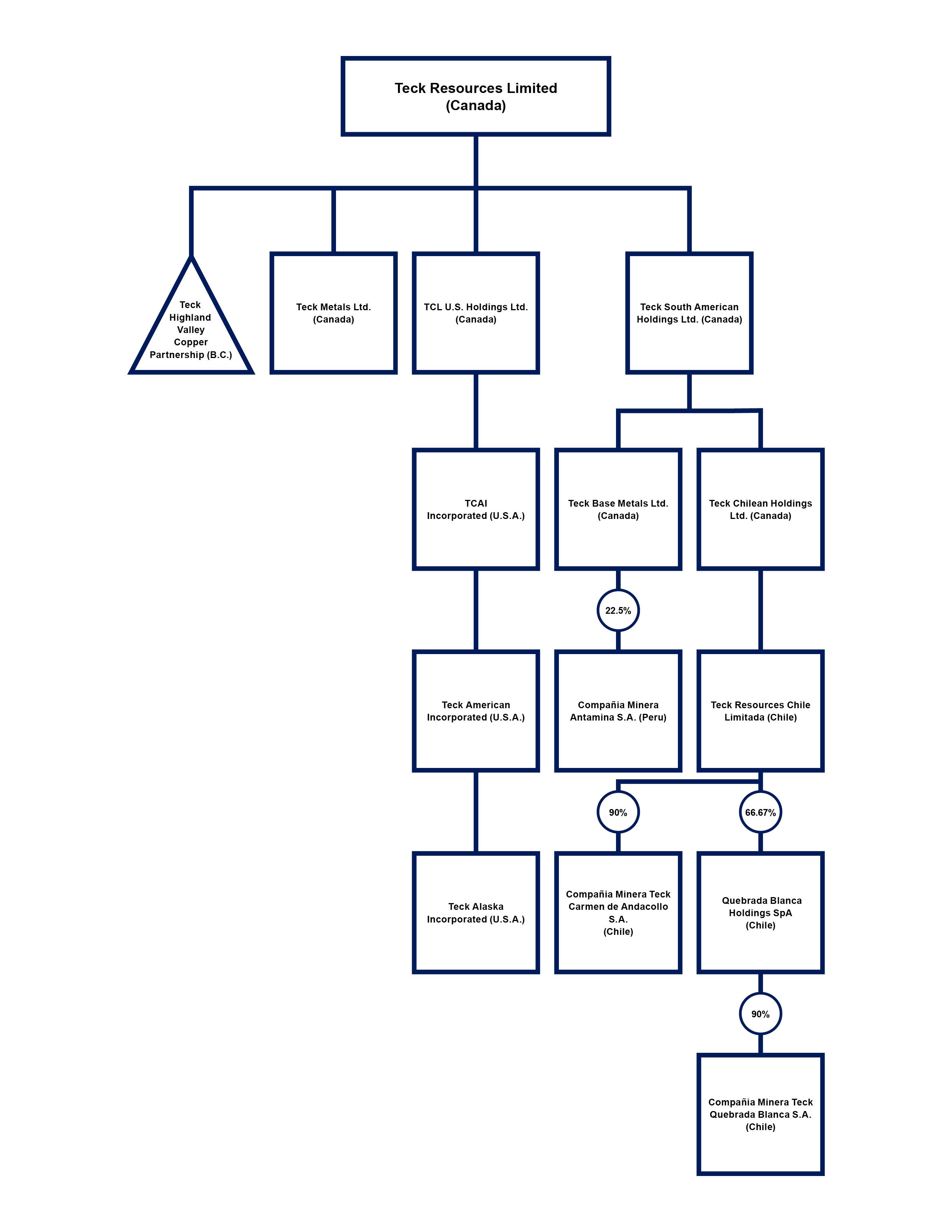
Our financial statements consolidate the accounts of all of our subsidiaries. Our material subsidiaries as at December 31, 2025, are listed below. Unless otherwise indicated, all subsidiaries listed below are wholly owned by Teck. Indentation indicates that the majority of the voting securities of the relevant subsidiary are held by the subsidiary listed above.
| | | | | |
Company Name | Jurisdiction of Organization or Formation |
Teck South American Holdings Ltd. | Canada |
Teck Chilean Holdings Ltd. | Canada |
Teck Resources Chile Limitada | Chile |
Quebrada Blanca Holdings SpA(1) | Chile |
Compañía Minera Teck Quebrada Blanca S.A.(2) | Chile |
Compañía Minera Teck Carmen de Andacollo S.A.(3) | Chile |
Teck Base Metals Ltd. | Canada |
Teck Metals Ltd. | Canada |
Teck Highland Valley Copper Partnership | British Columbia |
TCL U.S. Holdings Ltd. | Canada |
TCAI Incorporated | Washington, U.S.A. |
Teck American Incorporated | Washington, U.S.A. |
Teck Alaska Incorporated | Alaska, U.S.A. |
(1) 66.67% held, directly or indirectly, by Teck.
(2) 60% held, directly or indirectly, by Teck.
(3) 90% held, directly or indirectly, by Teck.
In addition to the above, we own, a 22.5% indirect share interest in Compañía Minera Antamina S.A.
2025 Annual Information Form
The following chart sets out the relationships among our material subsidiaries as at December 31, 2025. Certain aspects of the ownership structure have been simplified. All material subsidiaries are wholly owned unless otherwise specified.
2025 Annual Information Form
| | |
DEVELOPMENT OF THE BUSINESS |
OVERVIEW
Teck’s business is exploring for, acquiring, developing, producing and selling natural resources. Our activities are organized into reportable segments focused on copper and zinc. These are supported by Teck’s corporate offices, which provide administrative, technical, financial and other support to our reportable segments. We have interests in the following operations:
| | | | | | | | |
| Type of Operation | Jurisdiction |
Highland Valley | Copper/Molybdenum Mine | British Columbia, Canada |
Antamina | Copper/Zinc/Molybdenum Mine | Ancash, Peru |
Quebrada Blanca | Copper/Molybdenum Mine | Region I, Chile |
Carmen de Andacollo | Copper/Gold Mine | Region IV, Chile |
Trail Operations | Zinc/Lead Refinery | British Columbia, Canada |
Red Dog | Zinc/Lead Mine | Alaska, U.S.A. |
Our principal products are copper and zinc. In addition, we produce lead concentrates, refined lead, silver, gold, molybdenum, and various specialty and other metals, chemicals and fertilizers. We also explore for metal-containing deposits on a targeted and opportunistic basis. The following table sets out our revenue by product for each of our last two financial years:
| | | | | | | | | | | | | | |
| 2025 $(Billions) | % | 2024 $(Billions) | % |
Copper(1) | 5.829 | 54 | 5.035 | 56 |
Zinc(2) | 2.534 | 24 | 2.418 | 26 |
Other(3) | 2.393 | 22 | 1.612 | 18 |
Total(4) | 10.756 | 100 | 9.065 | 100 |
(1)Copper revenues include sales of copper contained in concentrates.
(2)Zinc revenues include sales of refined zinc and zinc concentrate.
(3)Other revenues include sales of lead concentrates, refined lead, silver, gold, molybdenum, germanium, various specialty metals, chemicals and fertilizer.
(4)Does not include revenues from discontinued operations.
2025 Annual Information Form
THREE-YEAR HISTORY
■On March 6, 2025, we announced an agreement, as amended on March 24, 2025 with Bunker Hill Mining Corp. for a US$40-million equity investment (the "Equity Investment"). The Equity Investment closed on June 5, 2025.
■On June 17, 2025, the B.C. Government issued and Environmental Assessment Certificate ("EAC") for the Highland Valley Copper Mine Life Extension Project (the "HVC MLE").
■The Board approved construction for the HVC MLE on July 23, 2025, which will extend Highland Valley Copper's operations from 2028 through to 2046.
■On September 2, 2025, we disclosed that management was undertaking a comprehensive operations overview (the "Comprehensive Operations Review") focused on improving operational performance and reviewing production and sales guidance.
■On September 9, 2025, we entered into an arrangement agreement, as amended November 10, 2025 (the "Arrangement Agreement") with Anglo American with respect to the Merger between Anglo American and Teck to form Anglo Teck, a global critical minerals champion and top five global copper producer, headquartered in Canada. Pursuant to the Arrangement Agreement, Anglo American will issue 1.3301 ordinary shares (or, in the case of electing eligible Canadian Teck shareholders, 1.3301 exchangeable shares)(the "Exchange Ratio") to existing Teck shareholders in exchange for each outstanding Teck Class A common share and Class B subordinate voting share (together with the Teck Class A common shares, the "Teck Shares").
■In October 2025, we released the results of our Comprehensive Operations Review providing for an update on Quebrada Blanca, including on production and sales guidance.
■On December 9, 2025, shareholders of both Teck and Anglo American approved the Merger as required under the Arrangement Agreement. The Merger remains subject to customary closing conditions for a transaction of this nature, including regulatory approvals in multiple jurisdictions globally. The parties continue to work collaboratively toward securing the required approvals and advancing the Merger to completion. Closing is anticipated to be within 12-18 months of September 9, 2025.
■On December 12, 2025, Teck obtained a final order from the Supreme Court of British Columbia approving the Merger.
■On December 15, 2025, Teck received regulatory approval from the Government of Canada under the Investment Canada Act for the Merger.
■In January 2024, we closed the sale of a minority interest in our steelmaking coal business to Nippon Steel Corporation ("NSC") and POSCO Canada Limited ("POSCO") and in July 2024 we closed the sale of the remaining 77% interest in our steelmaking coal business to Glencore plc ("Glencore").
■All outstanding major construction at Quebrada Blanca was completed in the first quarter of 2024, including the shiploader and molybdenum plant.
■On July 15, 2024, we purchased and cancelled US$1.4 billion of our public notes through a bond tender offer.
2025 Annual Information Form
■In 2024, our Red Dog operations ("Red Dog Operations") were awarded the Zinc Mark in recognition of environmental and socially responsible production practices. Zinc Mark is part of the Copper Mark assurance framework, aimed at promoting responsible production practices and demonstrating commitment to the United Nations Sustainable Development Goals.
■In August 2024, we announced a new business structure to support our shift to a pure-play energy transition metals company focused on growth. The new business structure organizes Teck around two regional business units, North America, which includes Highland Valley Copper, Red Dog and Trail Operations, and the Galore Creek, Schaft Creek, and NewRange copper growth projects, and Latin America, which includes Carmen de Andacollo and Quebrada Blanca operations, Teck’s interest in Antamina, and the Zafranal, San Nicolas, and NuevaUnión copper growth projects.
■We reached multi-year collective agreements with our union at Antamina and two of our unions at Quebrada Blanca, extending them until 2027 and 2028, respectively.
■In March 2023, we achieved first copper from our Quebrada Blanca project; Quebrada Blanca was operating near design throughput capacity at the end of 2023.
■We completed the sale of our interest in the Fort Hills oil sands business to Suncor Energy Inc. and TotalEnergies EP Canada Ltd. and the sale of our Quintette coal property to Conuma Resources Limited.
■We completed the creation of two new 50/50 joint ventures; one with Agnico Eagle Mines Limited ("Agnico Eagle") relating to our San Nicolás project and one with PolyMet Mining Corp. ("PolyMet") relating to the combination of our Mesaba deposit and PolyMet's NorthMet project.
■In April 2023, we amended our articles providing for a six-year sunset on the multiple voting rights attached to our Class A common shares. On May 12, 2023, each then-existing Class A common share was acquired by us and exchanged for one new Class A common share and 0.67 of a Class B subordinate voting share. The terms of the new Class A common shares are identical to the terms of the previous Class A common shares except they provide that on May 12, 2029, all Class A common shares will automatically be exchanged for Class B subordinate voting shares which will be renamed "common shares".
■Our Trail Operations was awarded the Zinc Mark, which is part of the Copper Mark assurance framework, and both our Quebrada Blanca and Carmen de Andacollo operations were awarded the Copper Mark in recognition of environmental and socially responsible production practices.
■In May 2023, we achieved regulatory approval from SENACE, Peru's National Service of Environmental Certification for Sustainable Investments, for our Zafranal project in Peru.
■In November 2023, we announced agreements to sell our entire interest in our steelmaking coal business, through the sale of a majority stake to Glencore and minority stakes to NSC and POSCO. The transactions with NSC and POSCO closed in January 2024 and the transaction with Glencore closed in July 2024.
2025 Annual Information Form
| | |
OPERATIONS AND PRODUCTION |
PRINCIPAL PRODUCTS
Our copper concentrates are sold into markets in Asia, Latin America and Europe. Copper concentrates produced at our Highland Valley Copper operations are railed to port in Vancouver, British Columbia, and from there transported by ship to customers in Europe and Asia. Copper concentrates produced at Antamina are transported by a slurry pipeline to a port at Huarmey, Peru, and from there by ship to customers in Asia and Europe. Copper concentrates produced at Carmen de Andacollo are trucked to the port of Coquimbo, Chile, and from there are transported by ship to customers in Asia and Europe and by truck to customers in Chile. Copper concentrates from our Quebrada Blanca mine are processed in Northern Chile and shipped by slurry pipeline to our own port facilities (Port Patache) south of the city of Iquique, then shipped to customers in Asia and Europe. We truck copper concentrate to alternative Chilean port facilities for export as required. Domestic sales to Chilean customers are transported by truck.
Copper concentrates are sold primarily under long-term contracts, with treatment and refining charges negotiated on an annual basis. The balance is sold in the spot market at prices based on prevailing market quotations. All of Teck's revenues from sales of copper concentrates were derived from sales to third parties.
The copper business is cyclical. Copper concentrate treatment charges rise and fall depending upon the supply of copper concentrates and the demand for copper concentrates by the copper smelting and refining industry. Copper consumption is primarily tied to its electrical conductivity properties, accounting for over 65% of global demand. Demand for copper globally comes from various end-use sectors, with the largest being electrical networks, construction industries and consumer goods, with the remainder split between auto, transportation sectors and industrial machinery. We compete with other producers of copper concentrates as well as copper sourced through scrap sources.
In 2025, global copper mine production increased 1.3%, according to Benchmark Mineral Intelligence, with total production estimated at 23.4 million tonnes. Chinese imports of copper concentrates increased 7.9% from 2024 levels to reach over 7.5 million tonnes of contained copper. Scrap imports into China rose 3.6% on the year, while Benchmark Mineral Intelligence's estimate of global copper scrap availability increased 7.8% in 2025 due to stronger prices and smelting needs to offset a lack of concentrate supply. Availability of copper raw materials is expected to remain constrained relative to smelter needs in 2026.
China's refined cathode imports in 2025 were 8.2% lower than 2024, totaling 3.1 million tonnes in 2025, continuing the decade-long trend of imports at approximately 3 million tonnes. With an increase in refined production, Benchmark Mineral Intelligence Limited ("Benchmark Mineral Intelligence") estimates that apparent refined copper consumption grew in China by 3.8% in 2025, equivalent to 2024's growth, supported by strong growth in energy transition-related areas which more than offset ongoing construction weakness. With ex-China demand growth relatively stagnant however, global copper stocks
2025 Annual Information Form
held on exchange (LME, CME and SFE) rose 305 thousand tonnes during 2025, ending the year at 744 thousand tonnes.
Benchmark Mineral Intelligence estimates global refined copper production grew 1.6% in 2025, and will increase by 0.8% in 2026, reaching 27.7 million tonnes. 2026 demand is forecast to increase 2.1% to 27.9 million tonnes, putting the metal market into deficit. Demand forecasts for 2026 are currently below trend as Chinese copper consumption growth slows and higher prices put pressure on downstream copper consumers. Additionally, United States tariff policies continue to redirect trade patterns, and promote market regionalization.
We produce refined zinc through our metallurgical operations at Trail and zinc concentrates through our mining operations at Red Dog and Antamina. Our principal markets for refined zinc are North America and Asia. Refined zinc produced at our metallurgical operations at Trail, British Columbia, is distributed to customers in North America by rail and/or truck and to customers in Asia by ship.
We produce zinc concentrates at our Red Dog mine in the United States and the Antamina mine in Peru, in which we indirectly own 22.5%. Zinc concentrates are sold primarily under long term contracts with treatment charges negotiated on annual basis. The balance is sold on the spot market at prices based on prevailing market quotations. Our principal markets for zinc concentrates are Asia, Australia, Europe and North America. Zinc concentrates from our Red Dog mine in Alaska are transported by truck from the mine to our port where they are stored until the summer shipping season, then loaded onto ships for distribution to customers in our principal markets. Zinc concentrates produced at Antamina are transported by a slurry pipeline to a port at Huarmey, Peru, and from there by ship to global customers.
In 2025, the majority of the zinc concentrate produced at Red Dog was shipped to customers in Asia, Australia and Europe, with the balance being shipped to our metallurgical facilities at Trail, British Columbia. Red Dog's lead concentrate production is also shipped to Trail and to customers in Asia, Australia and Europe. The shipping season at Red Dog is restricted to approximately 100 days per year, between early July and the end of October, because of sea ice conditions. Red Dog’s sales are seasonal, with the majority of sales occurring in the last five months of each year.
The zinc business is highly cyclical. Treatment charges rise and fall depending upon the supply and demand for zinc concentrates by the zinc smelting and refining industry. Galvanized steel makes up close to 60% of global zinc demand, with almost half of galvanized steel demand going into construction and about 20% each going into the transportation and infrastructure sectors. Zinc’s galvanizing properties provide protection to steel to reduce corrosion reducing the need for replacement. This extends the service life of steel components and infrastructure and is well suited for increasingly hot and wet climates. Zinc prices and premiums are highly dependent on demand for steel products. We compete with other producers of both zinc concentrates and refined zinc metal globally.
In 2025, global zinc mine production increased for the first year in four, rising by 4.7% according to industry consultant Wood Mackenzie Limited ("Wood Mackenzie"), with a total mine production of 12.8 million tonnes. Notwithstanding this, zinc mine production has not materially grown since 2011, remaining
2025 Annual Information Form
at or below 13 million tonnes per year. Wood Mackenzie expects global zinc mine production to grow just 0.1% in 2026, staying at 12.8 million tonnes after a production adjustment for potential disruptions.
Wood Mackenzie data shows that global refined zinc production grew by 2.6% in 2025 to 13.7 million tonnes, as refined production in China rebounded from the feed constraints of 2024, up 9.7% on the year. This was supported by a 34% increase in Chinese zinc concentrate imports. However, as domestic self-sufficiency increased Chinese zinc metal imports were down 39% over 2024 levels. Wood Mackenzie estimates that refined zinc production will grow a further 1.3% in 2026.
Global refined zinc demand rose 1.6% in 2025 to 13.7 million tonnes, with demand in China lagging global growth at 0.7% (7.0 million tonnes). India moved past the United States to become the second-largest zinc consumer globally, growing 4.9% to 854 kilotonnes of demand with its rising middle class, growing auto sector infrastructure investment, and increased use of galvanized steel throughout. Demand in Europe rose by 1.8% due to normalization in energy prices and infrastructure investment, offsetting a weakening auto sector. In North America, demand fell by 5.4% in 2025, according to Wood Mackenzie, based on a weakened auto sector further hampered by tariffs, persisting inflationary pressures, as well as stalled energy transition infrastructure rollout. In 2026, Wood Mackenzie expects demand for zinc to grow globally by 1.1% to 13.8 million tonnes, with growth coming primarily from China, India, Europe and the Middle East.
As a result, Wood Mackenzie estimates the global zinc metal market moved into a 40 kilotonne surplus in 2025, easing from a 2024 deficit of 224 kilotonnes. For 2026, another small surplus of 63 kilotonnes is anticipated using Wood Mackenzie data.
All of our 2025 revenues from sales of refined zinc and zinc concentrates, other than zinc concentrates produced at Red Dog that are sold to Trail, were derived from sales to third parties. We strive to differentiate our refined metal products by producing alloys, sizes, shapes and emissions intensities best suited to customer requirements.
Trail’s supply of zinc and lead concentrates, other than those sourced from Red Dog, is provided primarily through long-term contracts with mines in North America, South America and Australia.
OPERATIONS AND PROJECTS BY REGION
OPERATIONS
Highland Valley Copper Mine, British Columbia (Copper)
We hold a 100% interest in the Highland Valley Copper mine located near Kamloops, British Columbia through our wholly owned subsidiary Teck Highland Valley Copper Partnership.
Highland Valley’s primary product is copper concentrate; it also produces a molybdenum concentrate. The property comprising the Highland Valley Copper mine covers a surface area of approximately 50,000 hectares and is held pursuant to various mineral leases, mineral claims and Crown grants. Mineral claims are renewed annually or as required based on the amount of exploration-related expenses applied on a given claim, which can extend the claim renewal
2025 Annual Information Form
requirements by several years at a time. Mineral leases are typically held for 20- or 30-year terms and are renewed accordingly. In the past, renewals of these licences and leases have generally been granted, although there can be no assurance that this will continue in the future. Crown grants are held indefinitely and are subject to annual taxes.
The Highland Valley Copper mine is located adjacent to Highway 97C connecting Merritt, Logan Lake and Ashcroft, British Columbia. Access to the mine is from a 1-kilometre access road from Highway 97C. The mine is approximately 50 kilometres southwest of Kamloops, and approximately 200 kilometres northeast of Vancouver. The mine operates throughout the year. Power is supplied by BC Hydro through a 138-kilovolt line that terminates at the Nicola substation east of Merritt. Mine personnel live in nearby areas, primarily Logan Lake, Kamloops, Ashcroft, Cache Creek and Merritt.
The mine is an open pit operation. The processing plant, which uses autogenous and semi-autogenous grinding and flotation to produce metal in concentrate from the ore, has the capacity to process up to 160,000 tonnes of ore per day, depending on ore hardness. Autonomous haulage trucks are successfully operating in the Lornex pit, with 32 autonomous-capable haulage trucks currently in operation.
Water from mill operations is collected and contained in a tailings impoundment area, from where it is reclaimed and used as mill process water. The operation is subject to water and air permits issued by the Province of British Columbia and is in material compliance with those permits. The operation holds all of the permits that are material to its current operations. Major contracts include the BC Hydro power contract, the collective agreement with United Steelworkers Local 7619 in effect to September 2026, and a five-year contract related to dam construction to be renegotiated in 2026.
Concentrates from the operation are transported first by truck to Ashcroft and then by rail to a port in Vancouver for export overseas, with the majority being sold under long-term sales contracts to smelters in Asia. The price of copper concentrate under these long-term sales agreements is based on LME prices during quotation periods determined with reference to the time of delivery, with treatment and refining charges negotiated annually. The balance is sold on the spot market. Molybdenum concentrates are sold under long-term and spot contracts in line with prevailing market terms.
Ore is mined from the Valley, Lornex and Highmont pits. The pits are located in the Guichon batholith, which hosts all of the orebodies located in the area. The host rocks of the Valley deposit are mainly porphyritic granodiorites of the Bethsaida phase of the batholith with minor inter-mineral dykes. These rocks are medium-to-coarse-grained with large phenocrysts of quartz and biotite. The rocks of the deposit were subjected to hydrothermal alteration, extensive quartz veining, quartz-muscovite veining, and a late sericite and argillic overprint. Bornite, chalcopyrite and molybdenum were introduced with the quartz and quartz-muscovite veins, and with the late sericite alteration. Minor pyrite, sphalerite, and galena are associated with the mineralization.
The Lornex orebody occurs primarily in the medium-grained quartz-diorite Skeena phase of the batholith with a small portion of the Bethsaida phase. These phases have been intruded by younger inter-mineral quartz porphyry and aplite dykes. The rocks of the deposit have been subjected to similar hydrothermal alteration as the Valley deposit with quartz veining, quartz-muscovite veining
2025 Annual Information Form
being overprinted by extensive sericite and argillic alteration. Bornite, chalcopyrite and molybdenite are the main economic minerals contained within the veins, associated with the late sericite alteration. Minor pyrite, sphalerite, and galena are also associated with the mineralization.
The Highmont deposit is entirely hosted within the Skeena granodiorite and the Gnawed Mountain Composite Dyke ("GMCD") which is a multiphase intrusion and hydrothermal breccia body. The Bethsaida phase of the batholith occurs 750 metres southwest of the deposit. Historical intercepts of Bethsaida logged within the deposit are interpreted to be phases of the GMCD. The lithology of dykes in Highmont is less constrained than the Valley-Lornex deposit. Copper mineralization occurs dominantly as chalcopyrite or bornite within quartz and quartz-muscovite veins, and to a lesser degree as breccia infill. The generalized sulphide distribution indicates a roughly concentric distribution of bornite-chalcopyrite and pyrite centered in the east of the deposit and extending northwest along the contacts of the GMCD.
In 2025, a total of 135 drillholes were completed across the Valley, Lornex, Highmont, and Bethlehem pits. Drilling comprised 57 holes (12,593 m) in Valley, 39 holes (4,731 m) in Lornex, 19 holes (2,935 m) in Highmont, and 20 holes (2,851 m) in Bethlehem. Of the Lornex drillholes, 20 were reverse circulation holes totaling 1,523 m; all remaining holes were core. Apart from 3 geotechnical holes in the Valley pit all drilling supported geological and resource model confidence with model updates ongoing.
Diamond drill core is split in halves using core saws and sampled in two-metre intervals (HQ/PQ diameter core). One half is sent to an independent, off-site laboratory for analysis and the other is retained for future reference. Field duplicates and external umpire checks of approximately 5% of pulp samples are elements of the Highland Valley quality assurance/quality control program procedures.
On June 17, 2025, the B.C. Government issued an EAC and other required permits for the HVC MLE, which is expected to extend the life of mine to 2046 through open pit pushbacks of the Valley, Highmont and Bethlehem pits. The HVC MLE also contemplates modest concentrator upgrades which are expected to increase overall throughput by up to 10%. Construction for the project is expected to extend from 2026 to 2028 with first incremental production expected in 2028.
The Highland Valley Copper mine is subject to the British Columbia mineral tax, which is a two-tier tax with a minimum rate of 2% and a maximum rate of 13%. A minimum tax of 2% applies to operating cash flows, as defined by the regulations. A maximum tax rate of 13% applies to operating cash flows after taking deductions for capital expenditures and other permitted deductions (including credit for the 2% minimum tax paid).
2025 Annual Information Form
2026 projected capital costs for Highland Valley Copper are approximately $1,345-$1,645 million. The major components of the projected capital costs are:
| | | | | |
Component | Approximate projected cost ($/million) |
Sustaining | 145-180 |
Growth | 900-1,100 |
Capitalized stripping(1) | 300-365 |
Total | 1,345-1,645 |
(1) Includes development costs.
2026 projected aggregate cash operating costs for Highland Valley Copper are approximately $745-$920 million. The major components of the projected cash operating costs are:
| | | | | |
Component | Approximate projected cost ($/million) |
Labour (including contractors) | 415-510 |
Supplies | 340-420 |
Energy | 140-175 |
Other (including general & administrative, inventory changes, corporate allocations) | 105-130 |
Less amounts associated with projected capitalized stripping(2) | (255)-(315) |
Total | 745-920 |
(2) Excludes development costs.
The cash operating costs presented above do not include transportation or royalties.
REFINING AND SMELTING
Trail Operations, British Columbia
Teck Metals Ltd. ("Teck Metals") owns and operates the integrated smelting and refining complex at Trail, British Columbia. The complex’s major products are refined zinc, lead and silver. It also produces a variety of precious and specialty metals, chemicals and fertilizer products.
The zinc refinery consists of six major metallurgical plants, one fertilizer plant and additional precious and specialty metal plants. Depending on the mix and quality of feeds, the facility has an annual capacity of approximately 300,000 tonnes of refined zinc. Zinc concentrates are initially treated in either roasters or pressure leach plants, where sulphur is separated from the metal-bearing solids. The zinc is put into solution where it is first purified to remove other metal impurities and then electroplated onto cathodes in an electrolytic refining plant. The zinc cathodes are melted and then the zinc is cast into various shapes, grades and alloys to meet customer requirements. Other valuable metals, including indium and germanium, are also recovered as co-products in the zinc circuit.
2025 Annual Information Form
The lead smelting operation consists of two major metallurgical plants and one precious metal plant. Lead concentrates, recycled lead acid batteries, residues from the zinc circuits and various other lead- and silver-bearing materials are treated in the KIVCET flash furnace to produce lead bullion. The bullion is electro-refined in the lead refinery to produce high-purity lead. The valuable silver and gold are also recovered in this circuit after further processing. Major maintenance requiring shutdown of the lead circuit including the KIVCET furnace is scheduled to occur approximately every four years, with the next shutdown planned for 2028.
Our continued focus at Trail has been on improving its profitability and cash generation through prioritizing processing of residues over maximizing refined zinc production. Processing residues enables us to reduce concentrate purchases in the low treatment charge environment, improving profitability. The benefit of these initiatives combined with improved pricing for by-products such as silver, germanium and indium contributed to an increase in profitability in the fourth quarter compared to the same period last year.
Our recycling process treated 26,000 tonnes of material during the year, and we plan to treat about 32,400 tonnes in 2026. Our focus remains on treating lead acid batteries and cathode ray tube glass, plus small quantities of zinc alkaline batteries and other post-consumer waste.
Trail operates with multiple long-term contracts between sellers of concentrate, as well as buyers of products. Other major contracts include the collective agreement, next scheduled for renewal in May 2027, and an ammonia supply agreement with Agrium Canada Partnership.
Metallurgical effluent, together with site rainfall drainage water, is collected in ponds and treated through an effluent treatment plant before discharge into the Columbia River. The smelter operates under a variety of permits, including effluent and air emission permits issued by the British Columbia Ministry of Environment and Climate Change Strategy.
In 2018, we sold our two-thirds interest in the Waneta Dam to British Columbia Hydro and Power Authority ("BC Hydro"). In connection with the sale, we entered into a 20-year arrangement with BC Hydro, with an option to extend for an additional 10 years, to produce power for our Trail Operations. Our arrangement with BC Hydro retains our prior obligation to provide for the firm delivery of energy and capacity from Waneta to BC Hydro until 2036. If Teck Metals fails to deliver power as provided for in the agreement, it could be liable to pay liquidated damages to BC Hydro based on the market rate for power at the time of the shortfall. The costs of the liquidated damages could be significant if the shortfall continues and is not covered by our insurance policies. We also own the related 15-kilometre transmission and distribution system from Waneta to the United States, which BC Hydro has agreed to purchase on a deferred schedule.
2025 Annual Information Form
GROWTH PROJECTS
Galore Creek, British Columbia (Copper-Gold-Silver)
The Galore Creek property, located in Tahltan territory in northwestern British Columbia, approximately 150 kilometres northwest of the port of Stewart and 370 kilometres northwest of Smithers, is a significant copper-gold-silver porphyry deposit. The project is owned by the Galore Creek Partnership ("GCP"), a 50:50 partnership between Teck and Newmont Corporation ("Newmont"), and is managed by Galore Creek Mining Corporation, a wholly owned subsidiary of the GCP.
The focus of 2025 was to continue advancing project studies related to site infrastructure requirements. In 2026, the project will continue de-risking key project elements by advancing targeted studies, while also continuing to advance preparations for initiation of the regulatory approvals process.
Schaft Creek, British Columbia (Copper-Molybdenum-Gold-Silver)
The Schaft Creek property, located in Tahltan territory in northwestern British Columbia, approximately 61 kilometres south of Telegraph Creek and 37 kilometres northeast of the Galore Creek property, is a joint venture between Teck and Copper Fox Metals Inc., with Teck holding a 75% interest and acting as the operator.
In 2025 the project design basis was updated, select technical studies were advanced, and planning completed for the next phase of development. In addition, a field program focused on continuing baseline data collection and drilling at select infrastructure sites was conducted. Planned work for 2026 is focused on further de-risking project components by advancing key technical studies. The project will also continue to collect baseline data and advance community relations.
2025 Annual Information Form
OPERATIONS
Red Dog Mine (Zinc, Lead)
The Red Dog zinc-lead mine, concentrator and shipping facility in the Northwest Arctic Borough, approximately 144 kilometres north of Kotzebue, Alaska, commenced production in 1989 and began shipping concentrates in 1990. The Red Dog mine is 100% owned and operated by Teck Alaska Incorporated ("Teck Alaska"), a wholly owned subsidiary of Teck, on lands owned by, and leased from, the NANA Regional Corporation ("NANA"), a Regional Alaska Native corporation.
Since 2007, we have paid NANA a percentage of the net proceeds of production from the mine under a development and operating agreement, starting at 25% and increasing by successive increments of 5% at five-year intervals to a maximum of 50%. The most recent increase occurred in October 2022, bringing the royalty to 40%, with the next adjustment to 45% anticipated to occur in October 2027. The NANA royalty expense in 2025 was US$372 million, compared with US$327 million in 2024. NANA has advised us that they share the royalty received, net of allowable costs, with other Regional Alaska Native corporations pursuant to section 7(i) of the Alaska Native Claims Settlement Act. The development and operating agreement also provides for employment and contracting preferences and additional lease rental payments. In addition to the royalties payable to NANA, Red Dog is subject to the Alaska Mining License Tax at approximately 7% of taxable income. A 5% US withholding tax also applies to dividends paid on any repatriation of earnings to Canada.
Teck Alaska and the Northwest Arctic Borough agreed to a 6-year contract renewal for payment in lieu of taxes agreement ("PILT") effective January 1, 2026. Under the agreement, PILT payments to the Northwest Arctic Borough are calculated based on the net book value of the mine lands, buildings and equipment in accordance with United States Generally Accepted Accounting Principles, and are generally between US$17.5 million and US$22 million per year, with the minimum annual payment subject to an inflation adjustment. In addition, Teck Alaska remits annual payments to a separate fund aimed at social investment in villages in the region. These payments, based on mine profitability, are between US$4 million and US$8 million per year, with the minimum and maximum payments subject to an inflation adjustment.
Red Dog mine is located on a ridge between the middle and south forks of Red Dog Creek, in the DeLong Mountains of the Western Brooks Range. The mine covers approximately 1,000 hectares. The topography is moderately sloping, with elevations ranging from 260 metres to 1,200 metres above sea level. Vegetation is classified as woody tundra. The mine is accessible from a paved airstrip, five kilometres from the Red Dog mine, which allows jet access from Anchorage and Kotzebue. Mine personnel are generally drawn from surrounding communities as well as from other locations within the State of Alaska and in North America. Power for the mine is produced on-site by diesel generators with a maximum capacity of 30 megawatts, sufficient for present and expected future power requirements. Potable water is sourced from Bons Creek.
Red Dog is comprised of a number of sedimentary hosted exhalative lead-zinc sulphide deposits hosted in Mississippian-age to Pennsylvanian-age sedimentary rocks. The orebodies are lens
2025 Annual Information Form
shaped and occur within structurally controlled (thrust faults) plates, are relatively flat-lying and are hosted by marine clastic rocks (shales, siltstones, turbidites) and lesser chert and carbonate rocks. Barite rock is common in and above the sulphide units. Silicification is the dominant alteration type.
The sulphide mineralization consists of semi-massive to massive sphalerite, pyrite, marcasite and galena. Common textures within the sulphide zone include massive, fragmental, veined and, rarely, sedimentary layering.
In 2025, 22 drillholes were completed for resource definition and mine structural information, totaling 4,092 metres in and adjacent to the existing Aqqaluk pit. Three geotechnical drillholes were completed near Qanaiyaq pit totaling 392 metres. District exploration programs focused on the Aktigiruq orebody with 21 holes drilled totaling 13,579 metres in 2025. Block models for the Aqqaluk pit and Aktigiruq underground resource were updated in 2025.
Current and planned production is from the Aqqaluk and Qanaiyaq pits. The mining method employed is conventional open pit drill-and-blast and truck-and-shovel technology. The mineral processing facilities employ conventional grinding and sulphide flotation methods to produce zinc and lead concentrates.
Tailings storage and waste disposal areas have adequate design capacity to sustain the current life of mine plan. All contaminated water from the mine area and waste dumps is collected and contained in a tailings impoundment and seasonally discharged through a water treatment plant. Mill process water is reclaimed from the tailings pond. Timely water discharge is a critical activity at Red Dog and the site is in the process of renewing its water discharge permit, which is expected to be completed in the second quarter of 2026. Power is generated on site.
The mine is in material compliance with all of its permits and related regulatory instruments, and has obtained all of the permits that are material to its current operations. The site is pursuing an extension of a minor modification to its water discharge permit.
In 2025, the majority of the zinc concentrate produced at Red Dog was shipped to customers in Asia, Australia and Europe, with the balance being shipped to our metallurgical facilities at Trail, British Columbia. The lead concentrate production is also shipped to Trail and to customers in Asia. The majority of concentrate sales are pursuant to long-term contracts at market prices, subject to annually negotiated treatment charges. The balance is sold on the spot market at prices based on prevailing market quotations. The shipping season at Red Dog is restricted to approximately 100 days per year because of sea ice conditions and Red Dog’s sales are seasonal, with the majority of sales in the last five months of each year. Concentrate is stockpiled at the port facility and is typically shipped between July and October. Two major contracts for trucking and marine transportation will be up for renewal in 2026; these contracts are typically negotiated on three-year terms.
The current mine life, based on existing developed deposits, is expected to extend through to 2031; however, studies to utilize portions of Red Dog infrastructure, for example the concentrator, are underway as part of the Red Dog Mine Life Extension exploration project ("Red Dog MLE"), discussed further below.
2025 Annual Information Form
2026 projected capital costs for Red Dog are approximately US$180-$220 million. The major components of the projected capital costs are:
| | | | | |
Component | Approximate projected cost (US$/million) |
Sustaining | 55-65 |
Growth(1) | 120-145 |
Capitalized stripping | 5-10 |
Total | 180-220 |
(1) Includes Red Dog MLE.
2026 projected cash operating costs for Red Dog are approximately US$405-$485 million. The major components of the projected cash operating costs are:
| | | | | |
Component | Approximate projected cost (US$/million) |
Labour | 180-220 |
Supplies | 125-150 |
Energy | 40-45 |
Other (including general & administrative, inventory changes, corporate allocations) | 65-80 |
Less amounts associated with projected capitalized stripping | (5)-(10) |
Total | 405-485 |
The cash operating costs presented above do not include transportation or royalties.
GROWTH PROJECTS
NewRange Copper Nickel LLC, Minnesota (Copper-Nickel-Platinum Group Metals)
Teck and PolyMet US, Inc. are 50/50 joint venture partners in the NewRange Copper Nickel LLC ("NewRange"). NewRange holds both the NorthMet and Sunrise (formerly Mesaba) copper, nickel, cobalt, and platinum group metal deposits, located in northeastern Minnesota.
In 2025, the NorthMet project continued to advance technical studies and regulatory work aimed at securing updated development permits, including a Section 404 Clean Water Act Permit, which was previously revoked by the US Army Corps of Engineers in 2023. NorthMet continues to work collaboratively with local tribal groups, community stakeholders, state and federal permitting agencies, regulators and critical mineral policymakers to successfully obtain required permits.
In 2025, the Sunrise project work program focused on environmental management and monitoring, continuing environmental baseline work, and advancing necessary environmental and ecosystem mapping in support of permitting activities. Technical studies continued in support of preliminary stage project engineering and design work. This work will continue in 2026.
2025 Annual Information Form
Red Dog MLE (formerly known as the Aktigiruq-Anarraaq Exploration Project), Alaska (Zinc-Lead)
Teck’s principal zinc growth project is located in the Red Dog District in Alaska, where we have several high-quality opportunities located between 10 and 20 kilometers from our existing Red Dog operation. The primary focus for future expansion is on the Aktigiruq deposit. The project is currently in the prefeasibility study stage to potentially become an underground mine that would leverage the existing mill and supporting facilities at Red Dog Operations. In 2025, the Red Dog MLE focused on advancing the exploration access road, engineering studies and environmental baseline work. Planned work in 2026 will focus on continuing access road construction to the portal pad, surface drilling, technical studies and baseline programs to support future permit applications.
GROWTH PROJECTS
San Nicolás, México (Copper-Zinc)
The San Nicolás property, located in Zacatecas, México, is a copper-zinc massive sulphide deposit with minor gold and silver content. The property is held by Minas de San Nicolás, S.A.P.I. de C.V. ("MDSN"), a 50/50 joint venture between Teck and Agnico Eagle formed in April 2023. MDSN continues to advance a wide range of engagements with key communities of interest.
Activities in 2025 included advancing project studies and continued support of the Mexican Environmental Impact Assessment (Manifestación de Impacto Ambiental Regional or MIA-R) permit application and the Change of Land Use (Estudios Técnicos Justificativos or ETJ) permit application which were submitted in January 2024 and June 2024, respectively. Planned work in 2026 includes continuing studies, de-risking project infrastructure elements, and supporting the permit approval process, thereby advancing the project towards a potential sanction decision.
2025 Annual Information Form
OPERATIONS
Quebrada Blanca Mine (Copper-Molybdenum)
The Quebrada Blanca mine is held by, Compañía Minera Teck Quebrada Blanca S.A. ("QBSA"), a Chilean company. Teck holds an indirect 60% interest in QBSA (66.67% of the Series A shares); Sumitomo Metal Mining Co., Ltd. ("SMM") and Sumitomo Corporation ("Sumitomo") collectively hold an indirect 30% interest in QBSA (33.33% of the Series A shares) and Corporación Nacional del Cobre de Chile ("Codelco"), a Chilean state-owned mining entity, holds a 10% carried interest in QBSA (100% of the Series B shares), which does not require Codelco to fund capital spending.
QBSA owns the exploitation and/or exploration rights in the immediate area of the Quebrada Blanca deposit pursuant to various mining concessions and other rights. There are currently approximately 138,141 hectares of mining rights incorporating exploitation and exploration mining concessions held in the name of QBSA. The exploitation mining concessions have no expiry date. In addition, QBSA holds surface rights covering the mine site and other areas aggregating approximately 34,800 hectares as well as certain other exploration rights in the surrounding area and certain water rights.
The Quebrada Blanca property is located in the Tarapacá Region of northern Chile approximately 240 kilometres southeast of the port city of Iquique and 1,500 kilometres north of the city of Santiago, the capital of Chile. Quebrada Blanca is located approximately 4,400 metres above sea level. Mine personnel are based in a camp facility, and the majority commute from large population centres, including Iquique and Santiago.
Previously mined for its supergene mineralization, the Quebrada Blanca copper-molybdenum sulphide deposit is characterized by a series of Eocene-Oligocene aged intrusions, hydrothermal breccias and vein-related mineralization over an area of approximately 5 kilometres by 2 kilometres and controlled primarily by northeast-oriented structures. Alteration associated with the emplacement of the porphyritic and related intrusions includes chalcopyrite- and bornite-related veins, disseminations, and cement fill associated with potassic alteration. A large, vertically zoned hydrothermal breccia developed in association with the potassic event. This breccia has biotite, biotite-magnetite, chalcopyrite and locally bornite preserved at depth, whilst at shallower levels it transitions to a tourmaline-rich breccia with pyrite and chalcopyrite. A series of quartz-molybdenite veins are commonly associated with the biotite-magnetite breccia on the east side of the deposit. A subsequent chalcopyrite and molybdenite event cuts across the system and is characterized by grey-green sericite and quartz veins. This type of transitional alteration is best preserved in the western part of the deposit. A late quartz-sericite-pyrite assemblage cuts the copper-bearing stages and is strongly controlled by northwest-oriented structures. This phyllic event also occurs along northeast-oriented structures, which were a key control in the location of the supergene mineralization at surface. The mineralized porphyries and hydrothermal breccias are hosted by a quartz monzonite intrusive and the Collahuasi formation volcanics. Supergene enrichment processes have dissolved and redeposited primary (hypogene) chalcopyrite as a blanket of supergene copper sulphides, the most important being chalcocite and covellite, with lesser copper oxides/silicates such
2025 Annual Information Form
as chrysocolla in the oxide zone. Irregular transition zones, with locally faulted contacts, separate the higher- and lower-grade supergene/dump leach ores from the leached cap and hypogene zones.
Quebrada Blanca was formerly a copper oxide and supergene sulphide leaching / cathode operation; however, the current Quebrada Blanca operation, which commenced copper production in 2023, exploits the underlying sulphide deposit. The open-pit mine is a conventional truck-and-shovel operation with a haul fleet that is 100% autonomous. The mineralization is hypogene copper sulphide, and the concentrator is designed to process over 140,000 tonnes per day, depending on ore hardness. The mine's primary crushing facility contains a single primary crusher, and the coarse ore conveyor facility consists of an overland conveyor to transport the crushed ore from the primary crusher to the coarse ore stockpile. The concentrator facility contains two semi-autogenous grinding mills, four ball mills, two parallel flotation circuits, tailings thickeners and a molybdenum plant to separate the copper and molybdenum concentrate. Tailings from the concentrator are pumped to the nearby S-21 dam facility. Cathode production ended in the fourth quarter of 2023, and the cathode plant is in the process of being decommissioned to allow access to future mine phases.
The concentrator and related facilities connect to a port and desalination plant by approximately 165-kilometres of concentrate and desalinated water pipelines. Access to the mine site is via road from Iquique; the mine is serviced by the A-97 bypass which connects the A-97B highway to the mine.
Power is delivered to site via an overhead high-voltage electric power transmission line and QBSA has three primary power purchase agreements for power supply to the mine and related infrastructure, under which QBSA is required to pay for the contracted power regardless of whether it is required in the operations. QBSA has long-term arrangements with AES Andes S.A. and transitioned to renewable energy for all of the power required for the operation of Quebrada Blanca in October 2025.
Other major contracts for the site include individual collective bargaining agreements with three unions, two of which were renewed in 2024 and one in 2025 for 3-year extensions.
Two major contracts were awarded in 2025 for earthworks and equipment leasing for the TMF. In 2026, the key contracts subject to renewal include: operational support services for the tailings storage facility, light vehicle leasing, drilling and blasting services and supplies, operational waste management, sewage treatment plant and chemical toilets, fuel transportation, storage and supply services, and personnel transportation services. These contracts are expected to have terms ranging between three and five years.
In 2025, Quebrada Blanca's production was impacted by plant shutdowns, caused by delays in sand dam growth due to difficulties in sand drainage in the paddocks at the tailings dam. Several improvement initiatives were implemented during the year, including the replacement of cyclones, which enabled significant improvements in sand drainage and therefore sand dam construction in the last quarter of 2025. The 2026 plan anticipates an improvement in sand deposition, aiming to achieve original design sand placement rates in the second half of 2026 and nameplate capacity by the end of 2026. A permit amendment, known as the Declaracion de Impacto Ambiental, translated as Environmental Impact Declaration, was submitted in 2025 to help optimize aspects of the existing operation. Regulatory approval is expected in 2026.
2025 Annual Information Form
Quebrada Blanca is currently focused on process stabilization, however it is still considering opportunities to improve upon nameplate capacity, with potential permitting amendments (See “Operations and Production — Operations and Projects by Region — Chile — Growth Projects).
In 2025, a total of 73 diamond drillholes, totaling 15,291 metres, were completed at Quebrada Blanca. This program included 40 advanced and infill drillholes (4,043 metres) to collect metallurgical samples in support of the 2026 production plan and 3-year planning. In addition, five hydrogeological drillholes (1,618 metres) were completed to characterize major structures, and monitoring instrumentation was installed. All diamond core has historically been logged and sampled at two-meter intervals using half core (PQ, HQ, NQ size depending on sample depth), however in November 2025 Quebrada Blanca shifted to four-metre logging, sampling and testing. Samples are collected and prepared for assaying at a third party chemical laboratory. The remaining second half core is securely stored and preserved for future reference. Quebrada Blanca rigorously adheres to existing quality control and quality assurance protocols consistent with those recommended by Teck. The certified reference samples are prepared by Oreas using material from the Quebrada Blanca orebody, homogenized and certified in accordance with industry practice. Sample pulps are assayed using agua regia, inductively coupled mass spectrometry ("ICP"), for ore grade, copper sequential leach and fire assay fusion; ICP is used in gold assaying. The quality assurance quality control program results showed that there is no bias, nor contamination and the samples have sufficient accuracy and precision for use in resources and reserves reporting.
The current configuration of the operation, final pit design, and mine plan use approximately 15% of the total known reserve and resource for the deposit. Potential options for extending the life of the asset or expanding the concentrator capacity are being studied (See “Operations and Production — Operations and Projects by Region — Chile — Growth Projects — Quebrada Blanca - Future Expansions (Copper-Molybdenum)”). These options would require new operating permits, additional community engagement and additional tailings capacity.
Taxes payable in Chile that affect the operation include the Chilean Specific Mining Tax, which applies to operating margin based on a progressive sliding scale from 5% to 14% until 2037, when the tax stability agreement that protects QBSA against changes in mining taxes will expire. After 2037, the Chilean mining royalty regime that was enacted in 2023 will apply to QBSA, which consists of a flat 1% ad-valorem component applicable to copper revenues and a profit-based component based on rates ranging from 8% to 26% applicable to progressive levels of adjusted operating profits, as that term is prescribed. The amount of the profit-based royalty is capped so that the overall effective tax rate does not exceed 46.5% as computed in reference to the sum of the ad-valorem and profit-based components of the royalty, corporate income tax and imputed dividend withholding tax in relation to the corporate income tax base.
2026 projected capital costs for Quebrada Blanca (100% basis) are approximately US$495-$605 million. The major components of the projected capital costs are:
2025 Annual Information Form
| | | | | |
Component | Approximate projected cost (US$/million) |
Sustaining | 455-555 |
Growth(1) | 25-30 |
Capitalized stripping | 15-20 |
Total | 495-605 |
(1) Includes growth capital expenditures related to future expansions of Quebrada Blanca.
2026 projected aggregate cash operating costs for Quebrada Blanca (100% basis) are approximately US$1,110-$1,360 million. The major components of the projected cash operating costs are:
| | | | | |
Component | Approximate projected cost (US$/million) |
Labour (including contractors) | 460-560 |
Supplies | 325-400 |
Energy | 260-320 |
Other (including general & administrative, inventory changes, corporate allocations) | 80-100 |
Less amounts associated with projected capitalized stripping | (15)-(20) |
Total | 1,110-1,360 |
The cash operating costs presented above do not include transportation or royalties.
Carmen de Andacollo Mine (Copper)
The Carmen de Andacollo property is owned by a Chilean private company, Compañía Minera Teck Carmen de Andacollo ("CDA"). We own 100% of the Series A shares of CDA while Empresa Nacional de Minería ("ENAMI") owns 100% of the Series B shares of CDA. Our Series A shares of CDA equate to 90% of CDA’s total share equity and ENAMI’s Series B shares comprise the remaining 10% of total share equity. ENAMI’s interest is a carried interest and, as a result, ENAMI is not required to contribute further funding to CDA.
CDA owns the exploitation and/or exploration rights over an area of approximately 30,000 hectares in the area of the Carmen de Andacollo supergene and hypogene deposits pursuant to various mining concessions and other rights. In addition, CDA owns the surface rights covering the mine site and other areas aggregating approximately 2,700 hectares as well as certain water rights. Since 1996, CDA has been conducting mining operations on the supergene deposit on the Carmen de Andacollo property that overlies the hypogene deposit, and since 2010 has been processing hypogene ore through a concentrator on the site.
The Carmen de Andacollo property is located in the Coquimbo Region in central Chile. The site is adjacent to the town of Carmen de Andacollo, approximately 55 kilometres southeast of the city of La
2025 Annual Information Form
Serena and 350 kilometres north of Santiago. Access to the Carmen de Andacollo mine is by paved roads from La Serena. The mine is located near the southern limit of the Atacama Desert at an elevation of approximately 1,000 metres. The climate around Carmen de Andacollo is transitional between the desert climate of northern Chile and the Mediterranean climate of the Santiago area. The majority of mine personnel live in the town of Andacollo, immediately adjacent to the mine, or in the nearby cities of Coquimbo and La Serena.
The Carmen de Andacollo orebody is a porphyry copper deposit consisting of disseminated and fracture-controlled copper mineralization contained within a gently dipping sequence of andesitic to trachytic volcanic rocks and sub-volcanic intrusions. The mineralization is spatially related to a feldspar porphyry intrusion and a series of deeply rooted fault structures. A primary copper-gold sulphide hypogene deposit containing principally disseminated and quartz vein-hosted chalcopyrite mineralization lies beneath the supergene deposit. The hypogene deposit was subjected to surface weathering processes, resulting in the formation of a barren leached zone 10 to 60 metres thick. The original copper sulphides leached from this zone were redeposited below the barren leached zone as a copper-rich zone comprised of copper silicates (chrysocolla) and supergene copper sulphides (chalcocite with lesser covellite).
The Carmen de Andacollo mine is an open pit mine. Copper concentrate is produced by processing hypogene ore through semi-autogenous grinding and a flotation plant with the capacity to process up to 50,000 tonnes of ore per day, depending on ore hardness. Formerly supergene ore was also mined, transported to heap leach pads and processed in an SX-EW plant to produce copper cathode, however cathode operations ended in 2023, with the cathode plant placed in care and maintenance.
Over the course of 2025, 46 infill diamond drillholes were completed at Carmen de Andacollo for a total of 6,962 meters. This program comprised 21 holes (3,122 metres) for infill and metallurgical purposes, three geotechnical holes (300 metres), and two hydrogeological holes (550 metres).
Results from the infill drilling campaign were incorporated into the 2025 block model and did not result in any material changes to the geological understanding of the orebody or the mine plan. In addition, 20 diamond drillholes totaling 2,990 metres were completed to support geometallurgical characterization of future mining phases.
Diamond drill core is split in halves and sampled in 2.5-metre intervals. One half is sent to the external lab for analysis and the other is retained for future reference. For the infill drilling campaign, one in five samples was submitted for hardness proxy testing; subsequently, these samples were returned to the mechanical preparation process. For the metallurgical drillholes, one in five samples was submitted for metallurgical testing. Coarse blank, field duplicated (prior to shipment to the laboratory), crushing duplicated, fine coarse blank, pulp duplicated, and standards were used as part of the quality assurance/quality control program.
The life of mine for Carmen de Andacollo is expected to continue until 2038, although additional environmental permits will be required to extend mine life beyond 2031. The long-term availability of water for Carmen de Andacollo will continue to be a focus, with additional water rights required to extend mine life beyond 2031. This extension will require regulatory approvals, with technical studies
2025 Annual Information Form
and environmental baseline data collection underway to support the required environmental impact assessment process.
In August 2020, CDA entered into a long-term power purchase agreement to provide 100% renewable power for the operation. Other major contracts for the site include individual collective bargaining agreements with two separate unions, which were renewed in 2025 for a term of three years, as well as a new contract for the engineer of record and quality assurance for the construction and operation of the existing tailing’s facility.
Carmen de Andacollo has an agreement with Royal Gold to deliver an amount of gold equal to 100% of the payable gold produced from the Carmen de Andacollo mine until 900,000 ounces have been delivered, and 50% thereafter.
Taxes payable in Chile that affect the operation include the Chilean Specific Mining Tax, which applies to operating margin based on a progressive sliding scale from 5% to 14% until 2027 when the tax stability agreement that Carmen de Andacollo has in place with the government will expire.
After 2027, Carmen de Andacollo will be subject to the Chilean mining royalty regime noted above in the Quebrada Blanca section.
GROWTH PROJECTS
Quebrada Blanca Optimization and Debottlenecking (Copper-Molybdenum)
As the Quebrada Blanca ramp-up concludes, the team is considering opportunities to optimize and debottleneck the asset, with a specific focus on increasing concentrator throughput. Studies related to these opportunities commenced in 2024 and will continue through 2026. Amendments to the current permit are being planned for as part of these debottlenecking initiatives.
Quebrada Blanca - Future Expansions (Copper-Molybdenum)
Concept-level studies relating to future expansions of Quebrada Blanca continued in 2025, assessing various options to develop the vast Quebrada Blanca resource. Work is ongoing and the results will inform further studies planned in 2026. To advance these studies, seven geometallurgical drillholes (3,880 metres) were drilled to obtain additional metallurgical samples, and 21 geotechnical drillholes (5,750 metres) were completed to generate the data required for geotechnical modeling and stability analyses supporting a larger open pit. Advanced and infill diamond drill core was logged and sampled at four-metre intervals, primarily using HQ-size half core. To optimize the schedule, sample preparation and preliminary assaying were completed at the Quebrada Blanca laboratories to accelerate metallurgical sample selection. The samples will subsequently be sent to an independent third-party laboratory for chemical analysis in accordance with the established workflow. The remaining half core was either retained for metallurgical testing or securely stored for future reference.
2025 Annual Information Form
NuevaUnión (Copper-Molybdenum-Silver-Gold)
NuevaUnión is a 50:50 partnership between Teck and Newmont consisting of the copper-gold La Fortuna deposit and the copper-molybdenum-silver Relincho deposit, located approximately 40 kilometres apart in the Huasco Province in the Atacama region of Chile. Work in 2025 advanced select technical and strategic work which will continue in 2026 with a focus on establishing a cost-effective path forward for the development of these assets. Community engagement will also continue in 2026.
2025 Annual Information Form
OPERATIONS
Antamina Mine (Copper, Zinc, Molybdenum)
We indirectly own 22.5% of the Antamina copper/zinc mine in Peru, with the balance held indirectly by BHP Billiton plc (33.75%), Glencore (33.75%) and Mitsubishi Corporation (10%). The participants’ interests are represented by shares of CMA, the Peruvian company that owns and operates the project. Our interest is subject to a net profits royalty of 1.667% on CMA’s free cash flow.
The Antamina property consists of numerous mining concessions covering an area of approximately 105,000 hectares and an area of approximately 15,716 hectares of surface rights. These concessions can be held indefinitely, contingent upon the payment of annual license fees and the provision of minimum annual investment or production from each mining concession. CMA also owns a port facility located at Huarmey and an electrical substation located at Huallanca. In addition, CMA holds title to all easements and rights-of-way for the 302-kilometre concentrate pipeline from the mine to the port in Huarmey.
The deposit is located at an average elevation of 4,200 metres, 385 kilometres by road and 270 kilometres by air north of Lima, Peru. Antamina lies on the eastern side of the Western Cordillera in the upper part of the Rio Marañon basin. Mine personnel live in a camp facility while at work, and commute from both local communities and larger population centres, including Lima.
The mine is an open pit, truck-and-shovel operation. The ore is crushed adjacent to the pit and conveyed to a coarse ore stockpile at the mill. It is then processed utilizing two SAG mills, followed by ball mill grinding and flotation to produce separate copper, zinc, molybdenum and lead/bismuth concentrates. The mill has the capacity to process approximately 165,000 tonnes per day, depending on ore hardness. A 302-kilometre-long slurry concentrate pipeline, approximately 22 centimetres in diameter with a single pump station at the mine site, transports copper and zinc concentrates to the port where they are dewatered and stored prior to loading onto vessels for shipment to smelters and refineries worldwide.
The mine is accessible via an access road maintained by CMA. Power for the mine is taken from the Peru national energy grid through an electrical substation constructed at Huallanca. Fresh water requirements are sourced from a dam-created reservoir upstream from the tailings impoundment facility. The tailings impoundment facility is located next to the mill. Water reclaimed from the tailings impoundment is used as process water in the mill operation. The operation is subject to water and air permits issued by the Government of Peru and is in material compliance with those permits. The operation holds all of the permits that are material to its current operations.
The Antamina polymetallic deposit is skarn-hosted. It is unusual in its persistent mineralization and predictable zonation, and has a southwest-northeast strike length of more than 2,500 metres and a width of up to 1,000 metres. The skarn is well-zoned symmetrically on either side of the central intrusion with the zoning used as the basis for four major subdivisions: a brown garnet skarn, a green garnet skarn, a wollastonite/diopside/green garnet skarn and a marbleized limestone with veins or
2025 Annual Information Form
mantos of wollastonite. Other types of skarn, including the massive sulphides, massive magnetite, and chlorite skarn, represent the remainder of the skarn and are randomly distributed throughout the deposit. The variability of ore types can result in significant changes in the relative proportions of copper and zinc produced in any given year.
In 2025, the drilling program consisted of 72 drillholes totaling 45,265 metres. A total of 93 drillholes totaling 55,556 metres were used to update the geologic model and the current Mineral Resource model. The current drillhole database now includes 4,306 drillholes totaling 1,399,121 metres. For diamond core, three-metre samples on average of half core (HQ or NQ) are collected and prepared for assay at an external laboratory. The remaining half of the core is retained for future reference. The assay program includes approximately 20% of quality-control samples, comprising reference materials, duplicates and blanks, as well as samples for external control at a secondary laboratory. The reference materials consist of matrix-matched material from Antamina, homogenized and certified in accordance with industry practice.
CMA has entered into long-term off-take agreements with affiliates of the Antamina shareholders on market terms for copper, zinc and molybdenum concentrates. Under a long-term streaming agreement with FN Holdings ULC ("FNH"), a subsidiary of Franco-Nevada Corporation, Teck has agreed to deliver silver to FNH equivalent to 22.5% of the payable silver sold by CMA. FNH made a payment of US$610 million on closing of the arrangement in 2015 and pays 5% of the spot price at the time of delivery for each ounce of silver delivered under the agreement. After 86 million ounces of silver have been delivered under the agreement, the stream will be reduced by one-third. A total of 32.1 million ounces of silver have been delivered under the agreement as of December 31, 2025. The streaming agreement restricts distributions from Teck Base Metals Ltd., our subsidiary that holds our 22.5% interest in CMA, to the extent of unpaid amounts under the agreement if there is an event of default under the streaming agreement or an insolvency of Teck. CMA, which owns and operates Antamina, is not a party to the agreement and operations are not affected by it.
The collective bargaining agreement for the unionized labour force at Antamina is typically negotiated for a three-year term. A new three-year agreement was signed in 2024.
In Peru, the mining tax regime includes the Special Mining Tax and the modified mining royalty, which apply to CMA’s operating margin based on a progressive sliding scale ranging from 3% to 20.4%. A 5% Peruvian withholding tax also applies to dividends paid on any repatriation of earnings to Canada.
The life of mine for Antamina is expected to extend through to 2036, with all major regulatory approvals in place. Preliminary studies are advancing to assess the potential of mine life extensions beyond 2036.
2025 Annual Information Form
Our 22.5% share of 2026 projected capital costs for Antamina is approximately US$215-$270 million. The major components of the projected capital costs are:
| | | | | |
Component | Approximate projected cost (US$/million) |
Sustaining | 110-135 |
Growth | 15-20 |
Capitalized stripping | 90-115 |
Total | 215-270 |
Our 22.5% share of 2026 projected cash operating costs for Antamina is approximately US$255-310 million. The major components of the projected cash operating costs are:
| | | | | |
Component | Approximate projected cost (US$/million) |
Labour (including contractors) | 135-165 |
Supplies | 130-160 |
Energy | 65-80 |
Other (including general & administrative, inventory changes, corporate allocations) | 15-20 |
Less amounts associated with projected capitalized stripping | (90)-(115) |
Total | 255-310 |
The cash operating costs presented above do not include transportation or royalties.
GROWTH PROJECTS
Zafranal (Copper-Gold)
The Zafranal property, located in southern Peru, 85 kilometres northwest of Arequipa within the Provinces of Castilla and Caylloma, is a mid-sized copper-gold porphyry deposit discovered by Teck in 2004. The asset is held by Compañía Minera Zafranal S.A.C., in which Teck holds an 80% interest, with Mitsubishi Materials Corporation holding the remaining 20%.
In 2025, the project continued to advance technical studies while initiating limited, low capital early works at site. The construction permit application was submitted, with regulatory reviews underway. The 2026 scope will focus on identifying, evaluating, and implementing opportunities to enhance the business case and prepare for a future sanction decision. To enable this work, we will transition Zafranal to asset preservation while these improvements are undertaken. Early work activities will cease within the first quarter of 2026, and contractors will continue to demobilize from site by the end of the first quarter of 2026. Progress continues across key components, including permitting, land access, and feasibility study and engineering design, based on an adjusted timeline.
2025 Annual Information Form
PRODUCTION AND GUIDANCE
| | | | | | | | | | | | | | | | | |
Units in 000’s tonnes | 2025 | Guidance 2026 | Guidance 2027 | Guidance 2028 |
|
PRINCIPAL PRODUCTS |
Copper(1)( 2) |
Quebrada Blanca | 190 | 200-235 | 240-275 | 220-255 |
Highland Valley Copper | 127 | 115-135 | 135-155 | 100-120 |
Antamina | 86 | 95-105 | 85-95 | 80-90 |
Carmen de Andacollo | 51 | 45-55 | 45-55 | 35-45 |
Total | 454 | 455-530 | 505-580 | 435-510 |
Zinc(1)(2)(3) |
Red Dog | 463 | 375-415 | 330-370 | 230-270 |
Antamina | 102 | 55-65 | 35-45 | 45-55 |
Total | 565 | 430-480 | 365-415 | 275-325 |
Refined zinc |
Trail Operations | 230 | 190-230 | 260 - 300 | 260 - 300 |
|
OTHER PRODUCTS |
Lead(1) |
Red Dog | 107 | 70-90 | 60-80 | 50-65 |
Molybdenum(1)(2) |
Quebrada Blanca | 1.8 | 2.8-3.4 | 4.7-5.6 | 5.3-6.3 |
Highland Valley Copper | 1.4 | 1.5-1.8 | 1.8-2.0 | 3.0-3.4 |
Antamina | 0.6 | 0.7-1.0 | 0.9-1.2 | 0.4-0.6 |
Total | 3.8 | 5.0-6.2 | 7.4-8.8 | 8.7-10.3 |
(1) Metal contained in concentrate.
(2) Includes 100% of production from Quebrada Blanca and Carmen de Andacollo, even though we do not own 100% of these operations, because we fully consolidate their results in our financial statements. Includes 22.5% of production from Antamina, representing our proportionate ownership interest.
(3) Total zinc includes co-product zinc production from our 22.5% proportionate interest in Antamina.
EXPLORATION
In 2025, we incurred exploration expenditures of $90 million. Approximately 78% of the project expenditures were dedicated to exploration for copper, 16% for nickel and the remaining 6% dedicated to zinc and other commodities. Of the total exploration expenditures, approximately 43% was spent in South America, 32% in North America, 14% in Asia, 9% in Australia and 2% in Europe and Africa.
Exploration plays three critical roles at Teck: discovery of new orebodies through early-stage, greenfield exploration on Teck-owned properties and third-party properties via option and earn-in agreements, brownfield exploration and drilling activities at existing Teck projects and operations, and the pursuit, evaluation and acquisition of third-party exploration and development opportunities. Exploration is carried out through sole funding and joint ventures with major and junior exploration companies. Exploration is focused on areas in proximity to our existing operations and projects in regions that we consider have high potential for discovery.
Early-stage copper exploration in 2025 focused primarily on advancing projects targeting economic porphyry-style mineralization in Argentina, Armenia, Kazakhstan, and Peru and on evaluating new opportunities in South America, Europe, Central Asia and southern Africa. In 2026, we plan to drill early-stage copper projects in Argentina and Peru.
2025 Annual Information Form
In 2025, we continued to grow our portfolio of early-stage nickel-copper exploration opportunities, with initial drilling conducted on projects in Australia and Canada, and work completed to define targets for drilling in the United States. In 2026, we will continue to advance this portfolio.
Zinc exploration in 2025 was concentrated on an advancing the Red Dog MLE in Alaska. We continued to advance a zinc-copper-silver project in eastern Türkiye. In 2026, we plan to continue drilling advanced-stage projects in the Red Dog mine district in Alaska.
Teck’s exploration strategy is underpinned by an agile commercial mindset whereby we manage and refresh a portfolio of commercial assets, such as retained project royalties and equity in junior exploration companies. In 2025, investments were made in exploration companies with copper portfolios in Canada, Colombia, Kazakhstan, Peru and the United States, and nickel-copper portfolios in Canada. Additionally, exploration agreements were signed with exploration companies with projects in Armenia, Peru, the United States and Zambia.
FOREIGN OPERATIONS
The Red Dog mine located in Alaska, the Antamina mine located in Peru, and the Quebrada Blanca and Carmen de Andacollo mines located in Chile are our significant operating assets located outside of Canada. We hold a 22.5% interest in Antamina through our equity interest in CMA, the operating company for the mine. We hold a 100% interest in the Red Dog mine, subject to the royalty in favour of NANA as described under the heading “Operations and Production – United States — Red Dog Mine (Zinc, Lead)” above. We own 90% of the Chilean operating company that owns Carmen de Andacollo and we hold a 60% indirect interest in QBSA, which holds our Quebrada Blanca operations. Foreign operations accounted for approximately 62% of our 2025 consolidated revenue and represented approximately 74% of our total assets as at December 31, 2025.
We also have interests in various exploration and development projects in various foreign countries, with significant activities in Argentina, Armenia, Australia, Chile, Kazakhstan, México, Peru, Türkiye and the United States. We currently have foreign exploration offices in Australia, Chile, Ireland, Peru and Türkiye. See “Risk Factors — We operate in foreign jurisdictions and face added risks and uncertainties due to different economic, cultural and political environments” for further information on the risks associated with these foreign properties.
2025 Annual Information Form
| | |
MINERAL RESERVES AND RESOURCES |
See “Notes to Mineral Reserves and Resources Tables” below, after the Mineral Resources tables.
| | | | | | | | | | | | | | | | | | | | | | | | | | |
MINERAL RESERVES as at 31 December 2025(1) |
| Proven | Probable | Total | Teck Interest (%) | Recoverable Metal (000 t)(2) |
Tonnes (000's) | Grade (%) | Tonnes (000's) | Grade (%) | Tonnes (000's) | Grade (%) |
Copper |
Highland Valley Copper | 584,700 | 0.30 | 488,800 | 0.25 | 1,073,500 | 0.28 | 100.0 | 2,660 |
Antamina | |
Copper only ore OP | 212,000 | 0.80 | 174,900 | 0.93 | 386,900 | 0.86 | 22.5 | 690 |
Copper-zinc ore OP | 48,200 | 1.02 | 93,300 | 1.08 | 141,500 | 1.06 | 22.5 | 280 |
Total | 260,200 | 0.84 | 268,200 | 0.98 | 528,400 | 0.91 | 22.5 | 970 |
Quebrada Blanca | 990,700 | 0.53 | 339,900 | 0.50 | 1,330,600 | 0.53 | 60.0 | 3,820 |
Andacollo | 122,300 | 0.31 | 112,500 | 0.28 | 234,800 | 0.30 | 90.0 | 540 |
NuevaUnión | |
Relincho | 576,400 | 0.34 | 977,400 | 0.36 | 1,553,800 | 0.35 | 50.0 | 2,390 |
La Fortuna | 386,800 | 0.58 | 295,400 | 0.42 | 682,200 | 0.51 | 50.0 | 1,520 |
Total | 963,200 | 0.43 | 1,272,800 | 0.37 | 2,236,000 | 0.40 | 50.0 | 3,910 |
Zafranal | 408,800 | 0.39 | 32,000 | 0.21 | 440,700 | 0.38 | 80.0 | 1,150 |
San Nicolás | 47,700 | 1.26 | 57,500 | 1.01 | 105,200 | 1.12 | 50.0 | 460 |
Molybdenum |
Highland Valley Copper | 584,700 | 0.007 | 488,800 | 0.009 | 1,073,500 | 0.008 | 100.0 | 50 |
Antamina | |
Copper only ore OP | 212,000 | 0.026 | 174,900 | 0.030 | 386,900 | 0.028 | 22.5 | 10 |
Quebrada Blanca | 990,700 | 0.021 | 339,900 | 0.024 | 1,330,600 | 0.022 | 60.0 | 130 |
NuevaUnión | |
Relincho | 576,400 | 0.014 | 977,400 | 0.017 | 1,553,800 | 0.016 | 50.0 | 60 |
Zinc |
Antamina | |
Copper-zinc ore OP | 48,200 | 1.8 | 93,300 | 1.9 | 141,500 | 1.9 | 22.5 | 490 |
Red Dog | |
Red Dog Mine | | | 22,800 | 11.2 | 22,800 | 11.2 | 100.0 | 2,130 |
San Nicolás | 47,700 | 1.6 | 57,500 | 1.4 | 105,200 | 1.5 | 50.0 | 630 |
Lead |
Red Dog | |
Red Dog Mine | | | 22,800 | 3.1 | 22,800 | 3.1 | 100.0 | 360 |
2025 Annual Information Form
| | | | | | | | | | | | | | | | | | | | | | | | | | |
MINERAL RESERVES as at 31 December 2025(1) |
| Proven | Probable | Total | Teck Interest(%) | Recoverable Metal (000 oz)(2) |
Tonnes (000's) | Grade (g/t)(3) | Tonnes (000's) | Grade (g/t)(3) | Tonnes (000's) | Grade (g/t)(3) |
Gold |
Andacollo(4) | 122,300 | 0.10 | 112,500 | 0.10 | 234,800 | 0.10 | 90.0 | 420 |
NuevaUnión | |
La Fortuna | 386,800 | 0.55 | 295,400 | 0.36 | 682,200 | 0.47 | 50.0 | 3,380 |
Zafranal | 408,800 | 0.07 | 32,000 | 0.05 | 440,700 | 0.07 | 80.0 | 440 |
San Nicolás | 47,700 | 0.41 | 57,500 | 0.39 | 105,200 | 0.40 | 50.0 | 120 |
Silver |
Antamina | |
Copper only ore OP(5) | 212,000 | 7.9 | 174,900 | 9.6 | 386,900 | 8.7 | 22.5 | 19,170 |
Copper-zinc ore OP(5) | 48,200 | 18.7 | 93,300 | 19.4 | 141,500 | 19.1 | 22.5 | 12,260 |
Total | 260,200 | 9.9 | 268,200 | 13 | 528,400 | 11.5 | 22.5 | 31,430 |
Quebrada Blanca | 990,700 | 1.4 | 339,900 | 1.2 | 1,330,600 | 1.3 | 60.0 | 24,410 |
NuevaUnión | |
Relincho | 576,400 | 1.6 | 977,400 | 1.5 | 1,553,800 | 1.5 | 50.0 | 24,990 |
La Fortuna | 386,800 | 0.9 | 295,400 | 0.7 | 682,200 | 0.8 | 50.0 | 6,200 |
Total | 963,200 | 1.3 | 1,272,800 | 1.3 | 2,236,000 | 1.3 | 50.0 | 31,190 |
Red Dog | |
Red Dog Mine | | | 22,800 | 57.4 | 22,800 | 57.4 | 100.0 | 26,240 |
San Nicolás | 47,700 | 23.9 | 57,500 | 20.9 | 105,200 | 22.3 | 50.0 | 14,550 |
2025 Annual Information Form
| | | | | | | | | | | | | | | | | | | | | | | |
MINERAL RESOURCES as at 31 December 2025(1) |
| Measured | Indicated | Inferred | Teck Interest (%) |
Tonnes (000's) | Grade (%) | Tonnes (000's) | Grade (%) | Tonnes (000's) | Grade (%) |
Copper |
Highland Valley Copper | 303,500 | 0.27 | 553,700 | 0.25 | 289,700 | 0.20 | 100.0 |
Antamina | |
Copper only ore OP | 84,700 | 0.68 | 174,900 | 0.77 | 627,800 | 0.84 | 22.5 |
Copper-zinc ore OP | 14,100 | 0.55 | 65,000 | 0.99 | 148,400 | 1.04 | 22.5 |
Copper only ore UG | | | | | 360,900 | 1.12 | 22.5 |
Copper-zinc ore UG | | | | | 119,200 | 1.12 | 22.5 |
Total | 98,800 | 0.66 | 239,900 | 0.83 | 1,256,300 | 0.97 | 22.5 |
Quebrada Blanca | 951,500 | 0.37 | 3,580,900 | 0.38 | 3,731,400 | 0.34 | 60.0 |
Andacollo | 78,500 | 0.28 | 313,600 | 0.25 | 79,600 | 0.25 | 90.0 |
NuevaUnión | |
Relincho | 319,000 | 0.19 | 463,000 | 0.26 | 724,700 | 0.36 | 50.0 |
La Fortuna | 9,600 | 0.42 | 236,700 | 0.51 | 479,700 | 0.43 | 50.0 |
Total | 328,600 | 0.19 | 699,700 | 0.34 | 1,204,300 | 0.39 | 50.0 |
Galore Creek | 425,700 | 0.44 | 771,200 | 0.47 | 237,800 | 0.26 | 50.0 |
Schaft Creek | 166,000 | 0.32 | 1,127,200 | 0.25 | 316,700 | 0.19 | 75.0 |
NewRange Copper Nickel | |
Sunrise (Mesaba) | 459,600 | 0.39 | 1,892,400 | 0.32 | 2,316,800 | 0.27 | 50.0 |
NorthMet | 287,600 | 0.26 | 353,400 | 0.25 | 406,500 | 0.26 | 50.0 |
Total | 747,300 | 0.34 | 2,245,800 | 0.31 | 2,723,300 | 0.27 | 50.0 |
Zafranal | 5,100 | 0.19 | 2,300 | 0.21 | 62,800 | 0.24 | 80.0 |
San Nicolás | 500 | 1.35 | 6,100 | 1.17 | 4,900 | 0.94 | 50.0 |
Molybdenum |
Highland Valley Copper | 303,500 | 0.01 | 553,700 | 0.009 | 289,700 | 0.009 | 100.0 |
Antamina | |
Copper only ore OP | 84,700 | 0.016 | 174,900 | 0.022 | 627,800 | 0.023 | 22.5 |
Copper only ore UG | | | | | 360,900 | 0.018 | 22.5 |
Total | 84,700 | 0.016 | 174,900 | 0.022 | 988,700 | 0.021 | 22.5 |
Quebrada Blanca | 951,500 | 0.013 | 3,580,900 | 0.018 | 3,731,400 | 0.016 | 60.0 |
NuevaUnión | |
Relincho | 319,000 | 0.006 | 463,000 | 0.009 | 724,700 | 0.012 | 50.0 |
Schaft Creek | 166,000 | 0.021 | 1,127,200 | 0.016 | 316,700 | 0.019 | 75.0 |
Zinc |
Antamina | |
Copper-zinc ore OP | 14,100 | 1.3 | 65,000 | 1.7 | 148,400 | 1.6 | 22.5 |
Copper-zinc ore UG | | | | | 119,200 | 1.4 | 22.5 |
Total | 14,100 | 1.3 | 65,000 | 1.7 | 267,600 | 1.5 | 22.5 |
Red Dog | |
Red Dog Mine | | | 5,300 | 8.5 | 12,200 | 10.1 | 100.0 |
Red Dog District Aktigiruq & Anarraaq | | | 42,200 | 15.8 | 18,800 | 11.8 | 100.0 |
Red Dog District Anarraaq | | | | | 17,000 | 14 | 100.0 |
San Nicolás | 500 | 0.4 | 6,100 | 0.7 | 4,900 | 0.6 | 50.0 |
2025 Annual Information Form
| | | | | | | | | | | | | | | | | | | | | | | |
MINERAL RESOURCES as at 31 December 2025(1) |
| Measured | Indicated | Inferred | Teck Interest (%) |
Tonnes (000's) | Grade (%) | Tonnes (000's) | Grade (%) | Tonnes (000's) | Grade (%) |
Lead |
Red Dog | |
Red Dog Mine | | | 5,300 | 6.4 | 12,200 | 3.9 | 100.0 |
Red Dog District Aktigiruq | | | 42,200 | 4.1 | 18,800 | 3.1 | 100.0 |
Red Dog District Anarraaq | | | | | 17,000 | 4.0 | 100.0 |
Nickel |
NewRange Copper Nickel | |
Sunrise (Mesaba) | 459,600 | 0.09 | 1,892,400 | 0.07 | 2,316,800 | 0.07 | 50.0 |
NorthMet | 287,600 | 0.08 | 353,400 | 0.07 | 406,500 | 0.07 | 50.0 |
Total | 747,300 | 0.08 | 2,245,800 | 0.07 | 2,723,300 | 0.07 | 50.0 |
Cobalt |
NewRange Copper Nickel | |
Sunrise (Mesaba) | 459,600 | 0.009 | 1,892,400 | 0.009 | 2,316,800 | 0.008 | 50.0 |
NorthMet | 287,600 | 0.007 | 353,400 | 0.007 | 406,500 | 0.006 | 50.0 |
Total | 747,300 | 0.008 | 2,245,800 | 0.009 | 2,723,300 | 0.008 | 50.0 |
| | | | | | | |
| | | | | | | |
2025 Annual Information Form
| | | | | | | | | | | | | | | | | | | | | | | |
MINERAL RESOURCES as at 31 December 2025(1) |
| Measured | Indicated | Inferred | Teck Interest (%) |
Tonnes (000's) | Grade (g/t)(3) | Tonnes (000's) | Grade (g/t)(3) | Tonnes (000's) | Grade (g/t)(3) |
Gold |
Andacollo(4) | 78,500 | 0.1 | 313,600 | 0.09 | 79,600 | 0.08 | 90.0 |
NuevaUnión | |
La Fortuna | 9,600 | 0.47 | 236,700 | 0.59 | 479,700 | 0.40 | 50.0 |
Galore Creek | 425,700 | 0.29 | 771,200 | 0.22 | 237,800 | 0.19 | 50.0 |
Schaft Creek | 166,000 | 0.20 | 1,127,200 | 0.15 | 316,700 | 0.14 | 75.0 |
NewRange Copper Nickel | |
Sunrise (Mesaba) | 459,600 | 0.03 | 1,892,400 | 0.03 | 2,316,800 | 0.03 | 50.0 |
NorthMet | 287,600 | 0.04 | 353,400 | 0.03 | 406,500 | 0.03 | 50.0 |
Total | 747,300 | 0.03 | 2,245,800 | 0.03 | 2,723,300 | 0.03 | 50.0 |
Zafranal(6) | 5,100 | 0.04 | 2,300 | 0.05 | 62,800 | 0.10 | 80.0 |
San Nicolás | 500 | 0.08 | 6,100 | 0.20 | 4,900 | 0.13 | 50.0 |
Silver |
Antamina | |
Copper only ore OP(5) | 84,700 | 6.6 | 174,900 | 8.2 | 627,800 | 7.9 | 22.5 |
Copper-zinc ore OP(5) | 14,100 | 25.5 | 65,000 | 18.4 | 148,400 | 16.1 | 22.5 |
Copper only ore UG(5) | | | | | 360,900 | 10.7 | 22.5 |
Copper-zinc ore UG(5) | | | | | 119,200 | 16.4 | 22.5 |
Total | 98,800 | 9.3 | 239,900 | 10.9 | 1,256,300 | 10.5 | 22.5 |
Quebrada Blanca | 951,500 | 1.1 | 3,580,900 | 1.2 | 3,731,400 | 1.1 | 60.0 |
NuevaUnión | |
Relincho | 319,000 | 1.0 | 463,000 | 1.2 | 724,700 | 1.3 | 50.0 |
La Fortuna | 9,600 | 0.9 | 236,700 | 1.1 | 479,700 | 1.0 | 50.0 |
Total | 328,600 | 1.0 | 699,700 | 1.2 | 1,204,300 | 1.2 | 50.0 |
Red Dog | |
Red Dog Mine | | | 5,300 | 126.0 | 12,200 | 72.4 | 100.0 |
Red Dog District Aktigiruq & Anarraaq | | | | | 17,000 | 78.3 | 100.0 |
Galore Creek | 425,700 | 4.1 | 771,200 | 4.8 | 237,800 | 2.6 | 50.0 |
Schaft Creek | 166,000 | 1.5 | 1,127,200 | 1.2 | 316,700 | 1.1 | 75.0 |
NewRange Copper Nickel | |
Sunrise (Mesaba) | 459,600 | 1.3 | 1,892,400 | 1.2 | 2,316,800 | 1.1 | 50.0 |
NorthMet | 287,600 | 1.0 | 353,400 | 0.9 | 406,500 | 0.9 | 50.0 |
Total | 747,300 | 1.2 | 2,245,800 | 1.1 | 2,723,300 | 1.1 | 50.0 |
San Nicolás | 500 | 6.4 | 6,100 | 11.9 | 4,900 | 9.3 | 50.0 |
Platinum |
NewRange Copper Nickel | |
Sunrise (Mesaba) | 459,600 | 0.04 | 1,892,400 | 0.04 | 2,316,800 | 0.05 | 50.0 |
NorthMet | 287,600 | 0.07 | 353,400 | 0.07 | 406,500 | 0.07 | 50.0 |
Total | 747,300 | 0.05 | 2,245,800 | 0.04 | 2,723,300 | 0.05 | 50.0 |
Palladium |
NewRange Copper Nickel | | | | | | | |
Sunrise (Mesaba) | 459,600 | 0.11 | 1,892,400 | 0.11 | 2,316,800 | 0.15 | 50.0 |
NorthMet | 287,600 | 0.24 | 353,400 | 0.23 | 406,500 | 0.24 | 50.0 |
Total | 747,300 | 0.16 | 2,245,800 | 0.13 | 2,723,300 | 0.17 | 50.0 |
2025 Annual Information Form
NOTES TO MINERAL RESERVES AND RESOURCES TABLES
| | | | | |
(1) | Mineral reserves and resources are mine and property totals and are not limited to our proportionate interests. |
(2) | Recoverable Metal refers to the amount of metal contained in concentrate. |
(3) | g/t = grams per tonne. |
(4) | In 2015, an interest in future gold production from the Andacollo mine was sold. Compañía Minera Teck Carmen de Andacollo has agreed to sell and deliver to the purchaser an amount of gold equal to 100% of the payable gold produced from the Carmen de Andacollo mine until 900,000 ounces have been delivered, and 50% thereafter. Reserves and resources are stated without accounting for this production interest. |
(5) | In 2015, Teck entered into an agreement with a purchaser to deliver silver equivalent to 22.5% of the payable silver sold by CMA until 86 million ounces of silver have been delivered, after which the amount of silver to be delivered will be reduced by one-third. Reserves and resources are stated without accounting for this production interest. |
(6) | At Zafranal, gold in oxide material is considered to be non-recoverable. |
DEFINITIONS FOR MINERAL RESERVES AND MINERAL RESOURCES
Mineral Reserves and Mineral Resources: “proven” and “probable” mineral reserves and “measured”, “indicated” and “inferred” mineral resources are estimated in accordance with the definitions of these terms adopted by the Canadian Institute of Mining, Metallurgy and Petroleum in November, 2010 updated in May 2014 and incorporated in NI 43-101, by Canadian securities regulatory authorities.
Mineral resources are reported separately from, and do not include, that portion of the mineral resources classified as mineral reserves.
The Canadian Institute of Mining, Metallurgy and Petroleum definitions for mineral resources and mineral reserves are as follows:
A “mineral resource” is a concentration or occurrence of solid material of economic interest in or on the Earth’s crust in such form, grade or quality and quantity that there are reasonable prospects for eventual economic extraction. The location, quantity, grade or quality, continuity and other geological characteristics of a mineral resource are known, estimated or interpreted from specific geological evidence and knowledge, including sampling.
An “inferred mineral resource” is that part of a mineral resource for which quantity and grade or quality are estimated on the basis of limited geological evidence and sampling. Geological evidence is sufficient to imply but not verify geological and grade or quality continuity. An inferred mineral resource has a lower level of confidence than that applying to an indicated mineral resource and must not be converted to a mineral reserve. It is reasonably expected that the majority of inferred mineral resources could be upgraded to indicated mineral resources with continued exploration. An inferred mineral resource is based on limited information and sampling gathered through appropriate sampling techniques from locations such as outcrops, trenches, pits, workings and drillholes. Inferred mineral resources must not be included in the economic analysis, production schedules, or estimated mine life in publicly disclosed prefeasibility or feasibility studies, or in the life of mine plans and cash flow models of developed mines. Inferred mineral resources can only be used in economic studies as provided under NI 43-101.
2025 Annual Information Form
An “indicated mineral resource” is that part of a mineral resource for which quantity, grade or quality, densities, shape and physical characteristics are estimated with sufficient confidence to allow the application of modifying factors in sufficient detail to support mine planning and evaluation of the economic viability of the deposit. Geological evidence is derived from adequately detailed and reliable exploration, sampling and testing and is sufficient to assume geological and grade or quality continuity between points of observation. An indicated mineral resource has a lower level of confidence than that applying to a measured mineral resource and may only be converted to a probable mineral reserve. Mineralization may be classified as an indicated mineral resource by the qualified person when the nature, quality, quantity and distribution of data are such as to allow confident interpretation of the geological framework and to reasonably assume the continuity of mineralization. An indicated mineral resource estimate is of sufficient quality to support a prefeasibility study, which can serve as the basis for major development decisions.
A “measured mineral resource” is that part of a mineral resource for which quantity, grade or quality, densities, shape and physical characteristics are estimated with confidence sufficient to allow the application of modifying factors to support detailed mine planning and final evaluation of the economic viability of the deposit. Geological evidence is derived from detailed and reliable exploration, sampling and testing and is sufficient to confirm geological and grade or quality continuity between points of observation. A measured mineral resource has a higher level of confidence than that applying to either an indicated mineral resource or an inferred mineral resource. It may be converted to a proven mineral reserve or to a probable mineral reserve. Mineralization or other natural material of economic interest may be classified as a measured mineral resource when the nature, quality, quantity and distribution of data are such that the tonnage and grade or quality of the mineralization can be estimated to within close limits and that variation from the estimate would not significantly affect potential economic viability of the deposit. This category requires a high level of confidence in, and understanding of, the geology and controls of the mineral deposit.
A “mineral reserve” is the economically mineable part of a measured and/or indicated mineral resource. It includes diluting materials and allowances for losses, which may occur when the material is mined or extracted and is defined by studies at prefeasibility or feasibility level as appropriate that include application of modifying factors. These studies demonstrate that, at the time of reporting, extraction could reasonably be justified.
A “probable mineral reserve” is the economically mineable part of an indicated mineral resource, and in some circumstances, a measured mineral resource. The confidence in the modifying factors applying to a probable mineral reserve is lower than that applying to a proven mineral reserve.
A “proven mineral reserve” is the economically mineable part of a measured mineral resource. A proven mineral reserve implies a high degree of confidence in the modifying factors.
2025 Annual Information Form
METHODOLOGIES AND ASSUMPTIONS
Mineral reserve and mineral resource estimates are based on various assumptions relating to operating matters, including with respect to production costs, mining and processing recoveries, mining dilution, cut-off values or grades, as well as assumptions relating to long-term commodity prices and, in some cases, exchange rates. Cost estimates are based on feasibility study estimates or operating history.
Methodologies used in reserve and resource estimates vary from property to property depending on the style of mineralization, geology and other factors. Geostatistical methods, appropriate to the style of mineralization, have been used in the estimation of reserves at Teck’s material base metal properties.
Assumed metal prices vary from property to property for a number of reasons. Teck has interests in a number of joint ventures for which assumed metal prices are a joint venture decision. In certain cases, assumed metal prices are historical assumptions made at the time of the relevant reserve and resource estimates. For operations with short remaining lives, assumed metal prices may reflect shorter-term commodity price forecasts.
COMMENTS ON INDIVIDUAL OPERATIONS AND PROJECTS
Mineral resource and mineral reserve estimates for Highland Valley Copper as of December 31, 2025 were prepared using long-term metal price assumptions of US$3.80/lb copper and US$15.20/lb molybdenum, and an exchange rate of CAD$1.31 per US$1.00.
Mineral reserves were estimated using a variable cut-off strategy optimized for net present value ("NPV"), based on Lerchs-Grossman™ pit shells resulting from the approved 2026 life-of-mine plan. Metallurgical average recoveries assumed for mineral reserves are approximately 89% for copper and 61% for molybdenum.
At year-end 2025, proven mineral reserves and probable mineral reserves increased by 413%, from 209.3 million tonnes to 1,074 million tonnes. This increase is primarily attributable to the approval of updated pit designs under the HVC MLE project, together with the application of updated long-term metal price assumptions.
Mineral resources were estimated using a fixed copper-equivalent cut-off grade of 0.10% CuEq, incorporating a molybdenum factor of 2.5 and constrained by Whittle-optimized pit shells and current mine designs.
Measured mineral resources and indicated mineral resources increased from approximately 831 million tonnes to 857 million tonnes. Inferred mineral resources increased from approximately 51 million tonnes to 290 million tonnes. These changes reflect the expansion of the optimized pit footprint under the HVC MLE case, updated long-term commodity price assumptions, and drilling and geological model updates.
2025 Annual Information Form
Mineral resource and mineral reserve estimates for Antamina as of December 31, 2025 were prepared using long-term metal price assumptions of US$3.75/lb copper, US$1.21/lb zinc, US$15.00/lb molybdenum, and US$27.00/oz silver for mineral reserves, and US$3.75/lb copper, US$1.33/lb zinc, US$21.00/lb molybdenum, and US$31.38/oz silver for mineral resources.
Mineral resources were constrained within a conceptual open pit shell and reported above a zero dollar-per-mill-hour (US $0 ore value per hour ("OVPHR")) cut-off, and within a conceptual underground economic envelope reported above a Net Smelter Return ("NSR") cut-off of US$58.70 per tonne. Mineral reserves were estimated from measured mineral resources and indicated mineral resources using Lerchs–Grossmann pit optimization and reported above a US$6,000 OVPHR cut-off.
Average metallurgical recoveries applied to mineral reserves vary by geometallurgical type and are approximately 92% for copper and 45% for molybdenum within copper-dominant mineralization, and approximately 83% for copper and 83% for zinc within copper–zinc mineralization.
At year-end 2025, proven mineral reserves and probable mineral reserves decreased by 3.9%, from 550 million tonnes to 528 million tonnes, primarily due to mine depletion of approximately 44 million tonnes.
At year-end 2025, measured mineral resources and indicated mineral resources increased from 313 million tonnes to 339 million tonnes. Inferred resources increased from 1,217 million tonnes to 1,256 million tonnes. These changes reflect updates to geological models, updated commodity price assumptions, updated processing cost assumptions for underground mineral resources, and a decrease in overall pit slope angles associated with a change in ramp width from 40 metres to 45 metres.
Mineral resource and mineral reserve estimates for Quebrada Blanca as of December 31, 2025 were prepared using long-term metal price assumptions of US$3.80/lb copper and US$15.20/lb molybdenum.
Mineral reserves were estimated from measured mineral resources and indicated mineral resources using optimized pit designs constrained by the currently permitted TMF capacity. Mineral reserves were reported above a NSR cut-off of US$28.34/t, derived from a variable cut-off strategy consistent with the approved 2026 life-of-mine plan. Metallurgical recoveries vary by mineralization type, with average recoveries of approximately 91% for copper and 78% for molybdenum.
At year-end 2025, proven mineral reserves and probable mineral reserves decreased by approximately 3%, from 1,373 million tonnes to 1,331 million tonnes, primarily due to mine depletion and higher operating costs. These impacts were partially offset by higher copper and molybdenum prices and refinements to mine design.
Mineral resources were constrained within Whittle-optimized pit shells (Revenue Factor = 1) and reported above an NSR cut-off of US$14.13 per tonne. Measured mineral resources and indicated mineral resources increased from 4,252 million tonnes to 4,532 million tonnes, while inferred mineral resources decreased from 3,958 million tonnes to 3,731 million tonnes. These changes were mainly driven by higher metal prices and updates to the resource model, partially offset by higher operating costs, mine design adjustments, and updates to metallurgical recovery assumptions.
2025 Annual Information Form
Mineral resource and mineral reserve estimates for Carmen de Andacollo as of December 31, 2025 were prepared using long-term metal price assumptions of US$3.80/lb copper and US$1,970/oz gold.
Mineral reserves were estimated from measured mineral resources and indicated mineral resources using the approved LOM 2026 mine plan. Mineral reserves were reported using a variable cut-off grade strategy, with an average cut-off grade of approximately 0.173% total copper. Average metallurgical recoveries applied to mineral reserves are approximately 85% for copper and 62% for gold.
At year-end 2025, proven mineral reserves and probable mineral reserves decreased by approximately 1.5%, from 238 million tonnes to 235 million tonnes, primarily due to mine depletion during the year. This reduction was partially offset by the application of updated long-term price assumptions and an increase in effective tailings storage capacity resulting from updated tailings density assumptions.
Mineral resources were constrained within Whittle-optimized pit shells (Revenue Factor = 1) and reported above a NSR cut-off of US$10.26 per tonne. The mineral resource estimate reflects updated geological information, operating cost assumptions, and metallurgical recovery parameters. Average metallurgical recoveries applied to mineral resources are approximately 84% for copper and 61% for gold.
At year-end 2025, measured mineral resources and indicated mineral resources increased from 384 million tonnes to 392 million tonnes, while inferred mineral resources increased from 70 million tonnes to 80 million tonnes. These changes were primarily driven by updated long-term metal price assumptions, partially offset by increased operating costs and updates to the geological model.
Mineral resource and mineral reserve estimates for Red Dog Operations as of December 31, 2025 were prepared using long-term metal price assumptions of US$1.20/lb zinc, US$0.90/lb lead and US$24.00/oz silver.
Red Dog Mine
Mineral reserves at the Red Dog mine were estimated from indicated mineral resources and are reported above a breakeven operational cut-off of US$0.00 per tonne. Overall expected recoveries for mineral reserves are approximately 84% for zinc, 52% for lead and 62% for silver.
At year-end 2025, mineral reserves total approximately 22.8 million tonnes, derived primarily from the Aqqaluk and Qanaiyaq open pit deposits. Compared to the prior year, mineral reserves decreased by approximately 6.3 million tonnes, primarily due to mine depletion of approximately 5.1 million tonnes. These reductions were partially offset by lower treatment and shipping costs and updated silver price assumptions.
Mineral resources at the Red Dog mine comprise indicated mineral resources and inferred mineral resources from Aqqaluk, Qanaiyaq and the Paalaaq deposit. Open pit mineral resources are reported above a US$0.00 per tonne breakeven operational cut-off, while underground mineral resources at Paalaaq are reported above a US$125 per tonne NSR cut-off.
At year-end 2025, indicated mineral resources increased from 4.7 million tonnes to 5.3 million tonnes, while inferred mineral resources decreased from 13.2 million tonnes to 12.2 million tonnes. This change
2025 Annual Information Form
reflects updated technical and economic constraints applied to the Aqqaluk pit, partially offset by increases in underground mineral resources at Paalaaq.
Red Dog District
The Red Dog District includes indicated mineral resources and inferred mineral resources from the Aktigiruq and Anarraaq deposits, which are considered potentially extractable by underground mining methods.
District mineral resources are reported within underground stope shapes generated using a US$125 per tonne NSR cut-off, based on the same long-term metal price assumptions applied to the Red Dog mine. Metallurgical recoveries for Anarraaq are approximately 76% for zinc, 54% for lead and 56% for silver, while average recoveries for Aktigiruq are approximately 81% for zinc and 71% for lead.
Compared to the prior year, indicated mineral resources increased from 32.7 million tonnes to 42.2 million tonnes, while inferred mineral resources decreased from 42.9 million tonnes to 35.9 million tonnes. These changes reflect additional drilling, geological model updates, and revised metallurgical recovery assumptions.
Mineral resources reported for Galore Creek as of December 31, 2025 are unchanged from 2024. The mineral resource estimate is constrained within an optimized open pit shell, generated to demonstrate reasonable prospects for eventual economic extraction, and is based on long-term metal price assumptions of US$3.15/lb copper, US$1,600/oz gold and US$20.00/oz silver.
Mineral resources are reported above a NSR cut-off greater than US$0 per tonne within the resultant optimized pit shell.
2025 reported mineral resources remain unchanged from 2024. Open pit mineral resources are reported at a NSR cut-off of US$4.31/tonne and constrained by a conceptual open pit shape optimized based on long-term metal price assumptions of US$3.00/lb copper, US$1,200/oz gold, US$20.00/oz silver and US$10.00/lb molybdenum.
NorthMet
Mineral resource estimates for NorthMet as of December 31, 2025 were prepared using long-term metal price assumptions of US$4.31/lb copper, US$8.40/lb nickel, US$28.44/oz silver, US$18.22/lb cobalt, US$2,389/oz gold, US$1,225/oz platinum, and US$1,093/oz palladium.
Mineral resources at NorthMet are reported within an optimized open pit shell and above a NSR cut-off of US$10.11 per short ton (US$11.14 per metric tonne).
Average metallurgical recoveries applied for mineral resource estimate are approximately 91.1% for copper, 60% for nickel, 30% for cobalt, 78% for palladium, 73% for platinum, 59% for gold, and 54% for silver.
2025 Annual Information Form
At year-end 2025, measured mineral resources and indicated mineral resources at NorthMet increased from 625 million tonnes to 641 million tonnes, while inferred mineral resources increased from 391 million tonnes to 407 million tonnes. This increase is primarily attributable to updated commodity price assumptions, revised operating costs and economic parameters, and updates to the NSR and cut-off methodology, resulting in changes to the optimized pit shell.
Sunrise (formerly Mesaba)
Mineral resource estimates for Sunrise as of December 31, 2025 were prepared using long-term metal price assumptions of US$4.31/lb copper, US$8.40/lb nickel, US$18.22/lb cobalt, US$2,389/oz gold, US$28.44/oz silver, US$1,225/oz platinum and US$1,093/oz palladium.
Mineral resources at Sunrise are reported within an optimized open pit shell (Revenue Factor = 1 ("RF1")). Mineral resources within the RF1 pit are reported using a US$8.47 per short ton (US$9.34 per metric tonne) milled cut-off.
Average metallurgical recoveries applied to the mineral resource estimate are approximately 89.9% for copper, 85% for nickel, 42% for cobalt, 75% for gold, 69% for silver, 65% for platinum and 67.7% for palladium.
At year-end 2025, measured mineral resources and indicated mineral resources at Sunrise increased from 1,581 million tonnes to approximately 2,352 million tonnes, while inferred mineral resources increased from 1,366 million tonnes to 2,317 million tonnes. This increase is primarily attributable to updated long-term commodity price assumptions, revisions to operating costs and economic parameters, and updates to the NSR and cut-off grade methodology, which resulted in an expanded optimized pit shell.
2025 reported mineral reserves and mineral resources are unchanged from 2024.
Mineral resource and mineral reserve estimates at Zafranal were prepared and reported in a feasibility study using long-term metal price assumptions of US$3.00/lb copper and US$1,200/oz gold. The contained metal used in the mineral reserves table is based on variable metallurgical recoveries of up to 89% for copper and up to 56% for gold. Open pit mineral reserves are reported using a variable NSR cut-off of US$6.10 to $6.35/tonne averaging US$6.11/tonne.
2025 reported reserves and resources are unchanged from 2023.
The estimates assume NSR cut-offs for low zinc/copper ores and high zinc/copper ores, respectively, of US$9.71/tonne and US$13.15/tonne NSR based on an estimate of the marginal cost of production for the relevant ore. NSR calculations include long-term metal price assumptions of US$3.00/lb copper, US$1.10/lb zinc, US$1,300/oz gold and US$20/oz silver and scaled costs from previous studies.
2025 Annual Information Form
Mineral reserves and mineral resources for NuevaUnión are contained within two deposits, Relincho and La Fortuna. Mineral reserves at the deposits consider a bulk open-pit mining operation developed in three production phases that will alternate mining operations between the two deposits. No new work has been completed in 2025 and reported mineral resources and mineral reserves are unchanged from 2023.
Relincho mineral reserves and mineral resources are reported using an average NSR cut-off of US$11.00/tonne and US$6.72/tonne, respectively, and using long-term metal price assumptions of US$ 3.00/lb copper and US$10.00/lb molybdenum and US$18.00/oz silver.
La Fortuna mineral reserves and open pit mineral resources are reported using an average NSR cut-off of US$10.55/tonne and US$9.12/tonne, respectively, and using long-term metal price assumptions of US$3.00/lb copper and US$1,200/oz gold. Mineral resources outside of the mineral reserve pit are defined using a conceptual underground mining envelope. This approach assumes the same recoveries, metal prices, processing and general & administration costs as used for the open pits but with mining costs and dilution assumptions that are more appropriate to bulk underground mining. The resource model was updated in 2020 to include nine holes targeting the deep portion of La Fortuna, improved geological boundaries and updated grade estimation.
RISKS AND UNCERTAINTIES
Mineral reserves and mineral resources are estimates of the size and grade of the deposits based on the assumptions and parameters currently available. These assumptions and parameters are subject to a number of risks and uncertainties, including, but not limited to, future changes in metals prices and/or production costs; differences in size, grade, continuity, geometry or location of mineralization from that predicted by geological modelling; recovery rates being less than those expected; and changes in project parameters due to changes in production plans. Except as described elsewhere in this Annual Information Form, there are no known environmental, permitting, legal, title, taxation, socio-political, marketing or other issues that are currently expected to materially affect the mineral reserves or mineral resources. Certain operations will require further permits over the course of their operating lives to continue operating. Where management expects such permits to be issued in the ordinary course, material that may only be mined after such permits are issued is included in proven mineral reserves and probable mineral reserves. Specific current permitting issues are described in the narrative concerning the relevant operation under the headings “Description of the Business” and “Health, Safety, Community and Environment” and “Risk Factors — We face risks associated with the issuance and renewal of permits.”
QUALIFIED PERSONS
Estimates of mineral reserves and mineral resources have been reviewed, approved and verified under the general supervision of Jason Sangha, P.Eng., Vice President, Technical & Planning at Teck and the Qualified persons for the purposes of NI 41-101 for our properties (other than Antamina). For Teck's properties located in Latin American (other than Antamina), scientific and technical information has been prepared by Javier Miranda Duarte, a geologist, Manager, Reserves and Resources Assurance at Teck, and a Registered Member of the Comisión Calificadora de Competancias en Recursos y Reservas
2025 Annual Information Form
Mineras (Chile), a professional association recognized for the pruposes of NI 43-101, acting within the scope of his competencies and experience. Scientific and technical information related to Antamina has been reviewed and approved by Fernando Angeles, P.Eng., Artemio Maque, FAusIMM, Carlos Aguirre, FAusIMM, and Hernando Valdivia, FAusIMM, who are employees of CMA and are Qualified Persons for the purposes of NI 43-101 in respect of Antamina. Mineral resources and mineral reserve estimates have been prepared in accordance with Canadian Institute of Mining definition standards, as incorporated by reference in NI 43-101. Mineral resources are not mineral reserves and do not have demonstrated economic viability.
SCIENTIFIC AND TECHNICAL INFORMATION
The following table sets out the title, date and author(s) of the current NI 43-101 technical report for each of Teck’s material properties. Notwithstanding the authorship of the reports noted below, the scientific and technical information included in this Annual Information Form regarding Teck’s mining properties, except for the Antamina property is reviewed, approved and verified under the supervision of, Jason Sangha, P. Eng., Vice President, Technical & Planning at Teck and prepared by Javier Miranda Duarte, a geologist, Manager, Reserves and Resources Assurance at Teck. The technical information for the Antamina property, for which the reserve and resource estimates included in this Annual Information Form is approved by, and prepared under the supervision of Fernando Angeles, P.Eng., Artemio Maque, FAusImm, Carlos Aguirre, FAusIMM and Hernando Valdivia, FAusIMM, all of whom are employees of CMA. Other than Mssrs. Angeles, Aguirre and Valdivia, the authors of the reports below have not prepared or approved the disclosure in this Annual Information Form, and the inclusion of their names below is not intended to imply that they have prepared or approved any such disclosure.
| | | | | |
Property | Title, Date and Author of Report |
Highland Valley Copper | NI 43-101 Technical Report on Highland Valley Copper Operations; July 1, 2025; Christopher Hercun, Alex Stewart, Tim Tsuji, Frank Laroche, Carl Diederichs |
Antamina | NI 43-101 Technical Report on Antamina Mining Operation, Peru; December 31, 2024; Lucio Canchis, Fernando Angeles, Hernando Valdivia, Carlos Aguirre |
Red Dog | NI 43-101 Technical Report, Red Dog Mine, Alaska, USA; February 21, 2017; Thomas Krolak, Kevin Palmer, Brigitte Lacouture and Norman Paley |
Quebrada Blanca | NI 43-101 Technical Report on the Quebrada Blanca Operations, Región de Tarapacá, Chile; December 31, 2023; Rodrigo Marinho, Claudia Velasquez, Eldwin Huls, Jacquelyn Vanos and Paul Kolisnyk |
| | |
HEALTH, SAFETY, COMMUNITY AND ENVIRONMENT |
Our current and future operations, including development activities and commercial production, on our properties or areas in which we have an interest, are subject to laws and regulations in Canada, the United States, Chile and elsewhere governing occupational health and safety, protection and remediation
2025 Annual Information Form
of the environment, site reclamation, management of toxic substances, permit approvals and similar matters. Compliance with these laws and regulations can affect the planning, design, operation, closure and remediation of our mines, our refinery and our other facilities.
Whether in Canada, the United States, Chile or elsewhere, we work to apply technically proven and economically feasible measures to protect the environment, communities and worker health and safety throughout the mining life cycle of exploration, construction, mining, processing and closure.
We are an active participant in public regulatory review, revision and development processes with government agencies, including Indigenous Peoples, and non-governmental organizations and, as such, typically have insight regarding emerging regulatory developments and trends. We apply this insight when we estimate risks and liabilities associated with current and future regulatory matters including in the areas of health and safety, Indigenous consultation, community engagement, the environment and other permitting matters. We conduct regular environmental and health and safety audits and we regularly consult with and seek to obtain and maintain consent from Indigenous Peoples. The overall objective of our audits is to assess key environmental, community and health and safety risks and their associated controls and to assess regulatory compliance. Environmental, health and safety, Indigenous and community-related obligations embedded in regulations are constantly evolving and it can be a significant challenge to meet changing standards.
HEALTH AND SAFETY
Safety is a core value at Teck. Safety performance, occupational hygiene, health, and well-being are key priorities for us. Safety performance statistics are collected from each asset monthly. Health and safety key performance indicator targets are set each year and are assessed as part of determining management compensation. Safety incidents are thoroughly investigated, preventative actions are determined and reports are shared widely to support learning. If relevant incidents occur in the industry they are studied to help prevent a similar events at Teck. We continue to focus on our occupational hygiene and health risks and improving working environments to reduce exposures linked to occupational disease. Our high-potential risk control strategy, safety standards and critical control verification programs are designed to proactively manage and reduce serious injuries and fatalities. Also, a long-standing cornerstone of our health and safety program is Teck’s Courageous Safety Leadership which helps to build a positive culture and leadership in safety across Teck. At this time, we do not anticipate significant liability associated with long-term occupational health issues.
Finally, we understand the importance of mental health and well-being on overall health and safety. We continue to develop programs to address these issues. For example, in 2024 and 2025 more than 1,100 people have completed mental health first aid training including more than 90% of our frontline supervisors in our assets as well as other key personnel such as our first responders and human resources representatives.
CLOSURE
In order to obtain mining permits and approvals from regulatory authorities, mine operators must typically submit a closure plan for restoring, upon prolonged suspension or completion of mining operations, the
2025 Annual Information Form
mined property to a safe and stable condition and to meet many other permitted conditions. Typically, we submit the necessary permit applications several years before we plan to begin activities. Some of the permits we require are becoming increasingly difficult and expensive to obtain; the application and review processes are taking longer to complete, are increasingly complex in terms of required background information and can be subject to challenge. For a further discussion of risks associated with the issuance and renewal of permits, see “Risk Factors — We face risks associated with the issuance and renewal of permits”.
Financial assurance in various forms, including letters of credit and surety bonds, are posted with various governmental authorities as security to cover estimated reclamation obligations. Our provisions for future site restoration are estimated based on known requirements and are subject to review and approval by regulatory agencies. Our sites may undergo progressive closure during operations to proactively address mined-out areas and lessen the works required upon mine closure. In addition, certain closed mines are under continuous care and maintenance as well as subject to ongoing closure activities to enhance their long-term stability. Rehabilitation is guided by biodiversity management plans, which aim to integrate several factors in the rehabilitation approach, including biological diversity and establishment of sustainable vegetation.
All our mining operations have closure plans in place that are developed to the level of detail appropriate to the stage of life of the operation. All the plans and cost estimates undergo regular updates and revisions as they are refined and implemented. These reviews and updates typically include input and oversight from regulatory agencies and other stakeholders.
Our decommissioning and restoration provision, as of December 31, 2025, is $2.3 billion, of which $920 million is attributable to our copper operations, $776 million is attributable to our zinc operations and $578 million is attributable to closed properties. As of December 31, 2025, we had letters of credit and other bonding in place in the aggregate amount of approximately $2.6 billion, primarily to secure our closure obligations. Bonding requirements may increase in the future as a result of regular updates to plans and cost estimates, scheduled changes in our permits and changes to regulatory regimes.
See the disclosure regarding environmental matters under the respective descriptions of our material operations for further details of environmental matters impacting those operations.
CARBON PRICING AND DECARBONIZATION
As part of ongoing global efforts to address climate change, regulations to control greenhouse gas emissions remain present and are evolving. Regulatory uncertainty and resulting uncertainty regarding the costs of technology required to comply with current or anticipated regulations make it difficult to predict the ultimate costs of compliance.
Our operations in British Columbia were previously subject to the provincial Carbon Tax Act ("CTA"). On April 1, 2024, the Province of British Columbia transitioned the regulation of industrial facility green house gas ("GHG") emissions from the CTA to an Output-Based Pricing System ("OBPS"). Under the OBPS, industrial facilities whose emissions exceed their permitted amounts will have a compliance obligation. OBPS compliance obligations will be met through payments or the use of offsets or credits. We may in the future face similar emissions regulation or taxation for our activities in other jurisdictions. Similarly,
2025 Annual Information Form
customers of some of our products may also be subject to new emissions costs or taxation in the future in the jurisdictions where the products are ultimately used.
We are taking action to reduce greenhouse gas emissions by improving our energy efficiency and implementing low-carbon technologies at our operations. In 2020, we announced our target to achieve net zero Scope 1 and 2 greenhouse gas emissions across our operations by 2050. The cost of progressively reducing our Scope 1 and Scope 2 emissions in accordance with our publicly stated carbon reduction targets through carbon reduction activities or by acquiring the equivalent amount of future credits (to the extent permitted by regulation), is a function of several evolving factors, including technology development and pace of commercialization, the regulatory environment for subsidies and incentives, and the markets for carbon credits and offsets.
We have established a set of actions that progress our decarbonization goals and ambitions. Our objective is to deliver significant and cost-competitive emissions reductions. We routinely evaluate existing and emerging abatement opportunities as the pace of low-carbon technology maturation continues to accelerate, and as options that were not feasible a few years ago approach commercialization. We intend to continue to operate with a goal of reducing our emissions across the business.
WATER REGULATION
In addition to climate change, issues surrounding water regulation remain of particular importance. We continue to monitor regulatory initiatives and participate in consultation opportunities with governments.
SOCIAL AND ENVIRONMENTAL POLICIES
We have adopted and implemented a management system to provide governance over social and environmental issues at our operations. Our operating practices are governed by the principles set out in our Code of Ethics and our Code of Sustainable Conduct.
Our Code of Ethics reflects our commitment to upholding high moral and ethical principles. Our Code of Sustainable Conduct reflects Teck’s commitment to sustainability and our efforts to try to make a positive contribution to the environment and to the communities where we operate. This Code sets out how we work to achieve support for our activities through responsible social, economic and environmental performance.
In addition to the Code of Ethics and the Code of Sustainable Conduct, we have adopted a Health and Safety Policy, a Water Policy, a Climate Change Policy, a Responsible Mineral Sourcing Policy, a Decommissioning and Restoration and Environmental Provisions Accounting Policy, a Corporate Disclosure Policy, a Human Rights Policy, an Equity, Diversity and Inclusion Policy, an Indigenous Peoples Policy, a Risk Management Policy, a Tailings Management Policy, a Tax Policy and a policy setting out our Expectations for Suppliers and Contractors. We have taken steps to implement the Code of Sustainable Conduct and related policies through the implementation of our Health, Safety, Environment, Tailings and Social Performance Management Standards, which provide direction to all operations and provide criteria against which performance may be measured. Safety and sustainability
2025 Annual Information Form
(including environment and community) performance are metrics used in our annual bonus plan and in our performance-linked equity compensation plans.
We set objectives in these areas for improvement on an annual basis, and these are used to determine specific objectives for corporate and business units within our organization. Overall responsibility for achievement of objectives rests with senior personnel. Members of senior management regularly report directly to the Sustainability Committee, which in turn reports to the Board.
We measure and report our performance on an ongoing basis. Internal monthly, quarterly and annual reporting tracks performance indicators, including compliance with permits, environmental monitoring, health and safety performance, consultation and agreement fulfillment with Indigenous Peoples, and reclamation and remediation activities.
For further information on Teck’s sustainability goals and strategy, please see the most recent sustainability report published at www.teck.com.
2025 Annual Information Form
As at December 31, 2025, there were 7,429 employees classified as “permanent” employees working at the various operations and projects we manage, as well as our corporate offices. Of those employees, 3,740 were employed by our North America operations, 2,402 by our South America operations, and a total of 1,287 by our exploration, projects and corporate groups. These figures exclude employees classified as casual, fixed-term or inactive.
Collective bargaining agreements covering unionized employees at our principal operations (including Antamina) are as follows:
| | | | | |
| Expiry Date of Collective Agreement |
Antamina | July 31, 2027 |
Carmen de Andacollo | September 30, 2028 (Operators’ Union) and December 31, 2028 (Supervisors’ Union) |
Highland Valley Copper | September 30, 2026 |
Quebrada Blanca | January 31, 2028 (Union Admin); November 30, 2028 (Union 1); and March 31, 2028 (Union 2); |
Trail | May 31, 2027 |
2025 Annual Information Form
You should carefully consider the risks and uncertainties described below as well as in other sections of this Annual Information Form. These risks and uncertainties are not the only ones facing us. Additional risks and uncertainties not presently known to us or that we currently consider immaterial may also impair our business operations. If any of these events actually occur, our business, prospects, financial position, cash flows and operating results could be materially harmed. The risks discussed below also include forward looking statements and actual results or outcomes may differ substantially from those described in those forward-looking statements. See "Introductory Notes — Cautionary Statement on Forward-Looking Information".
We face risks related to the Closing of the Merger.
The completion of the Merger is subject to a number of conditions, certain of which are outside of Teck's control, including receipt of key regulatory approvals, foreign regulatory clearance, conditional approval of the TSX and the NYSE with respect to the listing of Anglo American shares and the American Depository Receipts, receipt of applicable acknowledgement that each of the LSE admission and the JSE admission will occur with respect to the continued listing of Anglo shares, the distribution by Teck or Anglo American, as applicable, of the Anglo Special Dividend (as defined in the Arrangement Agreement) or the Teck Catch-Up Dividend (as defined in the Arrangement Agreement), no legal impediment to the Merger, certain customary contractual conditions in respect of the accuracy of key representations and warranties and adherence to covenants provided by both Anglo American and Teck to each other, the absence of circumstances that would constitute a material adverse effect on either Anglo American or Teck, and the absence of the imposition of a Burdensome Condition (as defined in the Arrangement Agreement) in respect of the regulatory clearances being sought.
There can be no certainty, nor can Teck provide any assurance, that these conditions to the Merger will be satisfied or waived or, as to the timing of the satisfaction or waiver of such conditions. Moreover, a substantial delay in obtaining satisfactory approvals and/or the imposition of unfavourable terms or conditions in the approvals to be obtained could have an adverse effect on the business, financial condition or results of operations of Teck and/or Anglo American or could result in the termination of the Arrangement Agreement and the Merger not being completed. In addition, satisfying the outstanding conditions may take longer, and could cost more, than Teck expects. Any delay in completing the proposed Merger may adversely affect Teck and the benefits that Teck expects to achieve if the Merger is completed within the expected timeframe, which could materially and adversely affect the business, results of operations, financial condition, cash flows or prospects of Teck, Anglo American, and following the Merger, Anglo Teck.
Integration of Teck and Anglo American may not be achieved to the extent, or within the time period currently expected.
We may encounter difficulties during the integration process that would eliminate, reduce or delay the realization of the synergies expected from the transaction. Among other things, these difficulties could include: unexpected integration issues, higher than expected costs and an overall process that
2025 Annual Information Form
takes longer than originally anticipated; our inability to successfully integrate operations, systems, technologies, services and relationships; loss of key employees; modification or termination of existing agreements with customers, suppliers, contractors, local communities, Indigenous groups and governments; and the diversion of management's attention from day-to-day business or developing longer-term strategy as a result of the need to deal with integration and synergy program issues.
The Merger may not maximize the growth potential of, or deliver greater value for, our company beyond the level that Teck could have achieved on its own.
One of the principal reasons for the Merger was to maximize our growth potential beyond the level that Teck could have achieved on its own. Achieving this growth potential is dependent upon a number of factors, many of which are beyond our control. The inability to realize the full extent of the anticipated growth opportunities, as well as any delays encountered in the integration process, could have an adverse effect on our revenues, production, operating results and financial strength.
The Arrangement Agreement may be terminated in certain circumstances, including by mutual consent of Teck and Anglo American.
Each of Teck and Anglo American has the right to terminate the Arrangement Agreement in certain circumstances, including by mutual consent. The Arrangement Agreement may also be terminated upon the occurrence of other circumstances, including but not limited to, failure to close by the Outside Date (as defined in the Arrangement Agreement) and the occurrence of a Teck Material Adverse Effect or Anglo Material Adverse Effect (each defined in the Arrangement Agreement).
If the Arrangement Agreement is terminated, there can be no guarantee that the Board will be able to find a party willing to agree to an equivalent or more attractive price than what is proposed under the Merger. If the Merger is not completed for any reason, the ongoing business of Teck may be adversely affected, and without realizing any benefits of having completed the Merger, Teck may be subject to a number of risks, including: negative reactions from the financial markets; negative impacts on Teck's share price, reputational consequences and negative reactions from Teck's customers, vendors, business partners, governmental entities, regulators, project legal communities and employees.
The Exchange Ratio will not increase or decrease due to fluctuations in the relative market of Teck Shares or Anglo American shares.
Under the Arrangement Agreement, each Teck shareholder will receive the Exchange Ratio of Anglo American shares or exchangeable shares, as applicable, for each Teck Share held. The Exchange Ratio is fixed and, subject to certain specified and limited circumstances allowing for adjustments to the Exchange Ratio under the Arrangement Agreement, will not increase or decrease due to fluctuations in the relative market price of Teck Shares or Anglo American shares. The relative market value of Teck Shares or Anglo American shares may vary significantly prior to the closing of the Merger in response to various factors. Other factors that could cause the relative market value of the Teck Shares or Anglo American shares to vary significantly prior to the closing of the Merger include, without limitation, differences between Teck's and Anglo American's actual financial or operating results and those expected by investors and analysts, changes in analysts' projections or
2025 Annual Information Form
recommendations, changes in, or market perceptions of changes in, the business, operations or prospects of Teck or Anglo American, changes in general economic or market conditions, market perceptions of the Merger, including the likelihood of the completion of the Merger, regulatory factors, broad market fluctuations, or other factors over which neither Teck nor Anglo American has control.
Due to the Merger, we face risks related to the relative trading price of Teck Shares prior to the closing of the Merger.
Market assessment of the benefits of the Merger and the likelihood that the Merger will be consummated may impact the volatility of the market price of the Teck Shares prior to the consummation of the Merger.
Our business relationships may be subject to disruption due to uncertainty associated with the Merger.
Parties with which Teck currently does business may experience uncertainty associated with the Merger, including with respect to current or future business relationships with Teck, Anglo American or Anglo Teck following the Merger and/or may view the Merger unfavorably. Teck's business relationships may be subject to disruption as parties with which Teck does business, including customers, distributors, suppliers, vendors, landlords, joint venture partners, and other business partners, may attempt or delay or defer entering into new business relationships, may attempt to negotiate changes in existing business relationships or consider entering into business relationships with parties other than Teck or Anglo Teck following the Merger. Teck has significant joint ventures with partners globally and these relationships with our respective joint venture partners may be adversely impacted if such partners view the Merger adversely. These disruptions in business relationships could have an adverse effect on Teck's ability to realize the anticipated benefits of the Merger. The risk, and the adverse effect, of such disruptions could be exacerbated by a delay in completion of the Merger or termination of the Arrangement Agreement, which could materially and adversely affect the business, results of operations, financial condition, cash flows or prospects of Teck and Anglo Teck.
We face risks related to potential triggers of change in control or other provisions in certain agreements.
The completion of the Merger may trigger change in control provisions in certain agreements to which Teck is a party or other provisions in certain agreements to which Teck is a party. If Teck is unable to negotiate waivers of those provisions, the applicable counterparties may exercise rights and/or remedies under the applicable agreements, including, but not limited to, potentially terminating the agreements and/or seeking monetary damages. Even if Teck is able to negotiate or obtain all required waivers, the counterparties may require a fee for such waivers or seek to renegotiate on terms less favourable to Teck or, following completion of the Merger, Anglo Teck.
We are restricted from taking certain actions while the Merger is pending.
The Arrangement Agreement provides that each of Teck and Anglo American must conduct their respective businesses in the ordinary course and restricts each of Teck and Anglo American from taking certain specified actions without the consent of the other party until the completion of the Merger. These restrictions, which Teck would not have otherwise been subject to but for the Merger,
2025 Annual Information Form
include, among others, limitations on reorganizations, issuing or repurchasing securities, declaring non-ordinary course dividends, making material acquisitions or dispositions, making significant changes to employee compensation or benefit plans, incurring additional indebtedness, taking any action with respect to material litigation and tax matters.
The Merger may divert the attention of Teck's management, and impact Teck's ability to attract or retain key personnel.
The Merger has required, and will continue to require, substantial amounts of investment, time and focus from the management teams and employees of Teck and could cause the attention of Teck's management to be diverted from day-to-day and other ongoing or potential operations, projects or potential opportunities. These disruptions could be exacerbated by any delay in the completion of the Merger or termination of the Arrangement Agreement and could have an adverse effect on the current and future business, operations, results of operations, cash flows, and financial condition of Teck, regardless of whether the Merger is completed. The Merger completion is subject to uncertainty, and as a result of the headquarters of the Anglo Teck moving to Canada from the United Kingdom, officers and employees of Teck may experience uncertainty about their future roles, which may adversely affect Teck's ability to attract and retain key management and personnel in the period until the completion of the Merger or termination of the Arrangement Agreement.
We could face securities class actions, oppression claims, derivative lawsuits and other claims.
Securities class actions and oppression and derivative lawsuits have been brought against public companies that have entered into business combination agreements with one another. Third parties may also attempt to bring claims against Teck or Anglo American seeking to restrain the Merger or seeking monetary compensation or other remedies, including where the Merger is not completed for any reason. Even when lawsuits are without merit, defending against these claims can result in costs and divert management time and resources. Additionally, if an injunction prohibiting consummation of the Merger is obtained by a third party, such injunction may delay or prevent the Merger from being completed.
We will incur costs in connection with the Merger.
Teck will be responsible for certain costs related to the Merger irrespective of its outcome, including without limitation, legal, accounting, tax advisor, certain financial advisor, proxy solicitation, stock exchange and regulatory filing fees, and printing and mailing costs. If the Merger is not completed for certain reasons, Teck may be required to pay a termination fee of US$330 million to Anglo American. Taken as a whole, such costs may be significant and could have an adverse effect on Teck's cash resources, cash flows and financial condition.
We face risks in the mining and metals business.
The business of exploring for natural resources and the development and production of mining operations is inherently risky. Many projects are unsuccessful and there are no assurances that current or future exploration or development programs will be successful or that our operations will achieve production, cost or rate of return targets. During development and after the commencement
2025 Annual Information Form
of mining operations, our projects and operations are subject to significant risks and hazards, some beyond our control, including, but not limited to: permitting, environmental hazards; industrial accidents or other long-term and short-term health and safety related incidents; physical climate change-related hazards; unexpected increases in capital or operating costs; unusual or unexpected geological formations; unanticipated metallurgical difficulties; ground control problems; handling and transportation incidents, including aircraft and watercraft; infrastructure availability; restrictions on water availability; seismic activity; weather events; security incidents; failure of equipment or technology; labour-force disruptions; supply problems and delays; fires; natural disasters, such as flooding; and regulatory obligations, laws and changes thereto, including, but not limited to, changes to fiscal and taxation regimes in the jurisdictions in which we operate.
Our mining and exploration operations require reliable infrastructure such as roads, rail, ports, pipelines, power sources and transmission facilities, and water supplies. As orebodies become more remote, and as the availability of fresh water becomes more restricted in certain areas, the complexity and cost of infrastructure for mining projects is increasing. Availability, reliability of and cost of infrastructure affects our production and sales from operations, as well as our capital and operating costs.
The Trail metallurgical operations and our processing facilities at our operations are also subject to risks and hazards, including process upsets and equipment malfunctions. Equipment and supplies may from time to time be unavailable at all or on a timely basis.
Our operating mines and certain closed sites have tailings facilities, designed and managed in accordance with local regulations and international standards, which could fail as a result of severe seismic activity or for other reasons. Additionally, our tailings facilities are located in different jurisdictions, and may have different efficiency and operational levels depending on potential risks related to: ground, soil and sand conditions; employee and contractor experience; social, political or environmental events out of our control; earthquakes or other environmental incidents; and access to necessary equipment, tools and related tailings necessities.
The occurrence of any of the foregoing could result in, among other things, inability to bring mines into production or optimal production as planned or at all, damage to or destruction of mineral properties or production or logistics facilities, personal injuries or death, environmental damage, delays, suspension or interruption of production or distribution, increases in operating and/or capital costs, monetary losses, reputational damage, legal liability and/or adverse governmental action, any of which may have a significant adverse effect on our operations, business and financial condition.
Geopolitical conflict, inflation and other factors continue to impact global markets and cause general economic uncertainty and the potential for disruptions to global trade flows and supply chains, the impact of which may have a significant adverse effect on our operations, business and financial condition.
Geopolitical conflict, together with concerns over general global economic conditions, fluctuations in interest and foreign exchange rates, stock market volatility and inflation have contributed to increased economic uncertainty and diminished expectations for the global economy. These factors have also increased the risk of disruption to global trade flows and supply chains. This global
2025 Annual Information Form
economic uncertainty and any disruption to global trade flows or supply chains may have a material adverse effect on our operations, sales, business and financial condition.
Concerns over global economic conditions may also have the effect of heightening many of the other risks described herein, including, but not limited to: risks relating to fluctuations in the market price of our products; development of our projects; volatility in commodity and financial markets; market access restrictions or tariffs; fluctuations in the price and availability of consumed commodities; labour unrest and disturbances; availability of skilled employees; disruptions of information technology systems; changes in law or policies in relation to taxes; fees and royalties; and transportation and other services from third parties.
We face risks of the exposure to commodities not previously held by Teck.
Following completion of the Merger, Anglo Teck shareholders will hold an interest in a diversified portfolio that will include commodities and products, such as premium iron ore and diamonds (unless divested prior to completion of the Merger), respectively, which were not historically produced by Teck. As a result, former Teck shareholders will be exposed to market dynamics and risks associated with these additional metals and minerals, which are distinct from those previously experienced by Teck on a standalone basis prior to the Merger.
Moreover, the performance of Anglo Teck may be affected by factors unique to the combined commodities and product portfolio of Anglo Teck, including regulatory developments, environmental considerations, and price volatility specific to the introduction of new commodities, as well as the particular combination of commodities under the Anglo Teck portfolio. The inclusion of these business segments could result in greater earnings volatility, company risk profile changes, or exposure to mining and minerals sector that some Teck shareholders may not have previously sought. In addition, the market may ascribe a different valuation to a more diversified portfolio, which could impact the trading price of the Anglo Teck shares following the Merger.
We face risks associated with the issuance and renewal of permits.
Numerous permits or approvals are required for mining operations. We have significant permitting activities currently underway for new projects and for the extension or expansion of existing operations. In addition, many existing permits require periodic renewals or modifications. These permit updates can result in requirements for increased monitoring, reporting or risk mitigation expenditure. Examples of current permitting efforts include efforts related to mine life extensions, including the HVC MLE project, and efforts related to the development of our Red Dog MLE (formerly known as the Aktigiruq and Anarraaq exploration project) adjacent to our Red Dog operation and our Zafranal and San Nicolás projects. When we apply for these permits and approvals, we are often required to prepare and present data to various government authorities pertaining to the potential effects or impacts that any proposed project may have on the environment and on communities. The authorization, permitting and implementation requirements imposed by any of these authorities may be costly and time-consuming, and may delay commencement or continuation of construction activities or mining operations. There can be no certainty that these approvals or permits will be granted in a timely manner, or at all. Regulations also provide that a mining permit or modification can be delayed, refused or revoked. Existing regulations, and the
2025 Annual Information Form
interpretation and enforcement thereof, may evolve or become more stringent, requiring us to apply for additional permits and approvals. In certain jurisdictions, some parties have extensive rights of participation and appeal in regulatory processes, including Indigenous Peoples who are frequently engaged in order to seek their free, prior and informed consent as part of, or in parallel to, regulatory approvals processes. See "Risk Factors — Indigenous Peoples’ claims and rights to consultation and accommodation may affect our existing operations worldwide, as well as development projects and future acquisitions". Permits may be stayed or withdrawn during the pendency of appeals. See “Risk Factors — Changes in environmental, health, safety and other laws may have a material adverse effect on our operations and projects" for a discussion of the changes to Canadian environmental assessment and regulatory process.
Past or ongoing violations of mining, environmental, transportation, health or safety laws could provide a basis to revoke existing permits or to deny the issuance of additional permits. In addition, evolving reclamation requirements, environmental and safety concerns or inadequate management of the impacts of our projects and operations on communities, Indigenous Peoples and other audiences may threaten our ability to renew existing permits or obtain new permits in connection with future development, expansions and continuing operations.
Delays associated with permitting may cause us to incur material additional costs in connection with the development of new projects or the conduct or expansion of existing operations, including penalties or other costs in relation to long-lead equipment orders and other commitments associated with projects or operations. Failure to obtain certain permits may result in damage to our reputation, cessation of development of a project or the inability to proceed with the conduct or expansion or extension of existing operations, increased costs of development, production, transportation or handling, and litigation or regulatory action, any of which may have a material adverse effect on our operations, business and financial position.
We face risks associated with our development projects.
We are involved in a number of development projects. Projects in our development portfolio include NuevaUnión, Galore Creek, San Nicolás, NewRange, Schaft Creek and Zafranal as well as projects related to expanding or extending the life of our existing operations, including the HVC MLE (currently under construction) and the Red Dog MLE. We also have a number of potential brownfield opportunities which are being studied at Quebrada Blanca, Antamina and Carmen de Andacollo. Our ability to maintain or increase our annual production of our principal products is dependent, to a significant extent, on our ability to bring new mines into production and expand existing mines.
Development projects typically require a number of years and significant expenditures before production is possible. Especially in the current environment of high inflation, estimates of such expenditures or of future operating costs may differ materially from actual capital or operating costs. Such projects could experience unexpected problems or delays during development, production or mine start-up.
Construction and development of these projects are subject to numerous risks, including, without limitation, risks relating to:
2025 Annual Information Form
■timing and completion of the Merger and related integration processes;
■significant cost overruns due to, among other things, inflation, delays, project execution challenges, changes to inputs or changes to engineering;
■delays in construction, and technical and other problems, including adverse geotechnical conditions and other obstacles to construction;
■our ability to obtain regulatory approvals or permits, on a timely basis or at all;
■our ability to comply with any conditions imposed by regulatory approvals or permits, maintain such approvals and permits, or obtain any required amendments to existing regulatory approvals or permits;
■accuracy of reserve and resource estimates;
■accuracy of engineering and changes in scope;
■adverse regulatory developments, including the imposition of new regulations;
■significant fluctuation in prevailing prices for copper and our other principal products, oil, other petroleum products and natural gas, which may affect the profitability of the projects;
■community action or other disruptive activities by stakeholders;
■adequacy and availability of a skilled workforce;
■difficulties in acquiring and maintaining land and mineral titles;
■difficulties in procuring or a failure to procure required supplies and resources to construct and operate a mine;
■the fact that we do not own 100% of many of our projects and certain decisions will require the agreement of one or more of our partners (See “Risk Factors — We face risks associated with our joint venture operations and projects);
■availability, supply and cost of water and power;
■weather or severe climate impacts;
■litigation;
■our dependence on third parties for services and utilities;
■development of required infrastructure;
■a failure to develop or manage a project in accordance with our planning expectations or to properly manage the transition to an operating mine;
■the ability of our partners to finance their respective shares of project expenditures;
■the reliance on contractors and other third parties for management, engineering, construction and other services, and the risk that they may not perform as anticipated and that unanticipated disputes may arise between them and us;
2025 Annual Information Form
■our ability to finance our share of project costs or obtain financing for these projects on commercially reasonable terms, or at all;
■changes in regulatory regimes in the jurisdictions in which our projects are located; and
■the effects of potential pandemics, including regulatory measures intended to address the pandemic or operating restrictions imposed to protect workers, supply chain impacts and other factors.
The economic feasibility analysis with respect to each project is based upon, among other things, the interpretation of geological data obtained from drillholes and other sampling techniques, engineering studies, pricing assumptions for inputs and products produced, the configuration of the orebody, expected recovery rates, anticipated climate conditions, and estimates of labour, productivity, royalty and tax rates. Actual operating results may differ materially from those anticipated.
Damage to our reputation may result in decreased investor confidence, challenges in maintaining positive community relations, and increased risks in obtaining permits or financing for our development properties and expansions of our existing operations.
Damage to our reputation can occur from our actual or perceived actions or inactions and a variety of events and circumstances, many of which are out of our control. The growing use of social media and artificial intelligence ("AI") to generate, publish and discuss community news, videos and issues and to connect with others has made it significantly easier for individuals and groups to share their opinions of us and our activities, whether accurate or not. We do not directly control how we are perceived by others or AI systems. Loss of reputation could result in, among other things, a decrease in the price of our shares, decreased investor confidence, challenges in maintaining positive relationships with the communities in which we operate and other important stakeholders, and increased risks in obtaining permits or financing for our development properties or expansions to our existing operations, any of which could have a material adverse effect on our operations, development projects, business and financial position.
Fluctuations in the market price of copper, zinc, lead and specialty metals may significantly adversely affect the results of our operations.
The results of our operations are significantly affected by the market prices of copper and zinc, and to a lesser extent, lead and specialty metals, which are cyclical and subject to substantial price fluctuations. Market prices can be affected by numerous factors beyond our control, including: new sources of production of our products; levels of supply and demand for our products and for a broad range of other industrial products; substitution of new or different products in critical applications for our existing products; expectations with respect to the rate of inflation, the relative strength of the Canadian dollar and of certain other currencies; interest rates; speculative activities; transportation restrictions; global or regional political or economic crises; government policy changes, including taxes and tariffs; trade disputes or the potential for trade disputes; and sales of commodities by holders in response to such factors.
The Chinese market is a significant source of global demand for commodities, including zinc and copper. A sustained slowdown in China’s growth or demand, or a significant slowdown in other
2025 Annual Information Form
markets, in either case, that is not offset by reduced supply or increased demand from other regions could have an adverse effect on the price and/or demand for our products.
A prolonged period of low and/or volatile commodity prices, particularly of one or more of our principal products, could have a significant adverse effect on our operations, business and financial condition. If prices should decline below our cash costs of production and remain at such levels for any sustained period, we could determine that it is not economically feasible to continue commercial production at any or all of our operations. We may also curtail or suspend some or all of our exploration activities, with the result that our depleted reserves are not replaced.
Our general policy has been not to hedge changes in prices of our mineral products. From time to time, however, we have in the past and may in the future undertake hedging programs in specific circumstances, with an intention to reduce the risk of declines in a commodity’s market price while optimizing upside participation, to protect against currency fluctuations, or to maintain adequate cash flows and profitability to contribute to the long-term viability of our business. There are, however, risks associated with hedging programs including, among other things: the risk of opportunity losses or actual financial losses in the event of an increase in the price of the commodity; an increase in interest rates; the possibility that rising operating costs will make delivery into hedged positions uneconomic; counterparty risks; and the impact of production interruption events.
Future funding requirements may affect our business and we may not have access to credit in the future.
Future investments, including development projects, acquisitions, site reclamation/closure and other investments, may require significant capital expenditures. Our operating cash flow may not be sufficient to meet all of these expenditures depending on the timing and costs of development. As a result, new sources of capital may be needed to fund acquisitions or these investments. Additional sources of capital may not be available when required or on acceptable terms and, as a result, we may be unable to grow our business, finance our projects, take advantage of business opportunities, fund our ongoing business activities, respond to competitive pressure, retire or service outstanding debt, or refinance maturing debt.
We have significant financial support in the form of outstanding letters of credit issued by banks, which reduces the amount of other credit, including loans, that issuing banks may be willing to extend to us by way of debt financing. We also have a significant amount of surety bonds issued by insurance companies. These letters of credit and surety bonds are required for a number of purposes, mainly as security for closure and reclamation obligations. If we are no longer rated investment grade, we may be required to deliver a significant amount of letters of credit to support our parent guarantees of the take-or-pay commitments in respect of our Quebrada Blanca power arrangements.
The surety bonds and the credit facilities that support our letters of credit do not currently require us to deliver cash collateral or other security, although we may elect to do so from time to time to reduce borrowing costs. If letters of credit, surety bonds or other acceptable financial assurance are not available to us on an unsecured basis, we may be required to deliver cash collateral to a financial
2025 Annual Information Form
institution that will issue the financial assurance, which would reduce our cash available for use in our business.
In addition, certain of our letters of credit are issued under uncommitted standby facilities. Our standby letter of credit facilities may be terminated at the election of the bank counterparty upon at least 90 days’ notice. In the event that a standby letter of credit facility is terminated, we would be required to deliver cash collateral to the bank counterparty if we were unable to terminate the letter of credit issued by the bank. Providers of our surety bonds also have the right to require the delivery of cash collateral upon 60-90 days’ notice.
Our credit ratings have been subject to change over the years. There can be no assurance that the credit ratings currently assigned to Teck’s debt securities will not be lowered. A downgrade by any rating agency could adversely affect the value of our outstanding debt securities, the value of our existing debt and our ability to obtain new financing on favourable terms, if at all, and may increase our borrowing costs and require us to provide additional financial support in respect of certain obligations relating to our operations, which in turn could have a material adverse effect on our operations, business and financial position.
Failure to comply with environmental, health and safety and other laws may have a material adverse effect on our operations, our projects and our business.
Environmental, health and safety legislation affects nearly all aspects of our operations, including mine development, worker and public health and safety, product classification, handling and transportation, waste disposal, emissions controls, dust control, transportation and logistics and protection of endangered and protected species. Compliance with environmental, health and safety legislation can require significant expenditures and can impact the manner in which mining and other operations can be conducted.
Past, ongoing and future violations of environmental, health or safety legislation may result in the imposition of significant fines and/or penalties; the issuance of remedial or protective orders; the temporary or permanent suspension of operations or other regulatory sanctions, including cleanup costs arising out of contaminated properties; damages; damage to reputation; loss of community and other stakeholder support; the loss of existing permits or inability to obtain future permits; the requirement to expend significant capital for corrective or remedial measures; increased operating costs; and civil suits or criminal charges.
We could also be held liable for the impact of our activities on communities, our personnel or the environment or for activities in connection with certain hazardous substances or goods, including worker and public exposure to, and the handling and transportation of, such hazardous substances or goods. Exposure to these liabilities arises not only from our existing operations, but also from operations that have been closed or sold to third parties.
We are committed to supporting and respecting human rights in our operations and supply chain. However, our policies and procedures may not prevent or detect all potential human rights violations. Allegations (even if unsupported) that we are, directly or indirectly, violating human rights principles could lead to liability and a loss of reputation which may lead to increased challenges in developing
2025 Annual Information Form
and maintaining government and community relations, decreased investor confidence, and act as an impediment to our overall ability to advance our projects, or to access equity or debt financing.
From time to time, we engage with regulatory authorities regarding existing and potential compliance issues with relevant environmental, health and safety regulations and to obtain permits that enable us to carry out certain operations and activities in compliance with law and in a manner that provides for the level of safety and protection required under relevant environmental, health and safety regulations. There can be no assurance that we are or will at all times be in compliance with all environmental, health and safety or other laws or that steps to achieve compliance would not materially adversely affect our operations, business and financial condition.
We face risks related to inflation.
Global markets have recently experienced high rates of inflation. Inflationary pressures have increased, and may continue to increase, our operating and capital costs and the costs of our planned exploration and development activities and could have a material adverse effect on our operations, development projects, business and financial position. If inputs are unavailable at reasonable costs this may delay planned development activities. In addition, governmental responses to inflation, such as any increase in interest rates, may have a significant negative impact on the economy generally, which could have a material adverse effect on our operations, business and financial position. In the current environment, assumptions about future commodity prices, exchange rates, interest rates, costs of inputs and customer credit performance are subject to greater variability than normal, which could, in the future, significantly affect the valuation of our assets, both financial and non-financial, and may have a material adverse effect on our operations, business and financial condition.
We may be adversely affected by currency fluctuations.
Our operating results and cash flow are affected by changes in currency exchange rates relative to the currencies of other countries. Exchange rate movements can have a significant impact on results, as a significant portion of our operating costs are incurred in Canadian dollars, Chilean pesos and other currencies, while most revenues are earned in United States dollars. To reduce the exposure to currency fluctuations, we enter into foreign exchange contracts from time to time, but these hedges do not eliminate the potential that those fluctuations may have an adverse effect on us. In addition, foreign exchange contracts expose us to the risk of default by the counterparties to those contracts, which could have a material adverse effect on our business. In addition, our operating costs are influenced by the strength of the currencies of those countries where our operations are located, such as Canada, Chile, Peru and the United States.
Our general policy has been not to hedge currency exchange rates. From time to time, however, we have in the past and may in the future undertake currency hedging activities in specific circumstances. There can be no assurance that we will enter into these currency hedging activities or that these currency hedging activities will not cause us to experience less favourable economic outcomes than we would have experienced if we did not engage in such activities.
2025 Annual Information Form
We operate in foreign jurisdictions and face added risks and uncertainties due to different economic, cultural and political environments.
Our business operates in a number of foreign countries where there are added risks and uncertainties due to the different economic, cultural and political environments. Some of these risks include nationalization and expropriation; social unrest and political instability; uncertainties in perfecting mineral titles; delays or inability to obtain permits; trade barriers and exchange controls; limitations on repatriation of funds; and material changes in taxation. Further, developing country status or an unfavourable political climate may make it difficult for us to obtain financing for projects in some countries.
There can be no certainty that governments will not implement changes in taxation, policy or regulation from time to time. Any such changes could affect our costs, cash flows, permitting timelines, or the stability of the investment environment, and the impact may be material. In Chile, our Quebrada Blanca operations have the benefit of a mining tax stability agreement that protects us against changes in mining (but not income) taxes until 2037. The incoming Chilean administration has publicly stated its intention to reduce corporate taxes and to promote investment, including through measures aimed at improving regulatory efficiency. There can be no assurance that any tax measures will be enacted, the timing of any changes, or their overall effect on our business, including whether other fiscal measures could offset their impact.
A substantial portion of our base metals business is in Chile. Chile will undergo a change of government in March 2026, with a new administration taking office and changes across key ministries and public services. The incoming administration has publicly emphasized a pro investment agenda, and changes in policy direction or administrative practice could result in a more favourable operating environment for the mining sector. At the same time, changes in administration can affect the pace and approach to permitting, regulatory oversight and enforcement. Depending on how they are implemented, these changes could improve clarity and efficiency, or create transitional uncertainty as new priorities and processes are put in place. The practical implementation of policy priorities will depend in part on execution capacity and political support, including in Chilean Congress. These developments could affect timelines, costs and operating conditions for our assets in Chile, and the impact may be material. Peru has experienced periods of political and social unrest in recent years, and general elections are scheduled to be held on April 12, 2026, which may increase political uncertainty and social tensions and could impact our Antamina operations and Zafranal project development.
Changes to mining legislation in any of the jurisdictions in which we operate may have a material adverse effect on our projects or operations. We hold a 50% interest in the San Nicolás project which is located in the State of Zacatecas, Mexico. In May 2023, Mexico introduced extensive amendments to the Mexican Mining Law and related statutes under the prior federal administration, which changed the legal framework governing concessions and increased uncertainty for the sector. In 2024, proposals advanced in Mexico's Congress that would prohibit open pit mining through constitutional changes. The current federal administration has indicated that it does not intend to proceed with a blanket open pit ban, while maintaining a policy of not granting new mining concessions. In June 2025, Mexico held its first nationwide judicial elections, including for Supreme
2025 Annual Information Form
Court justices, and further judicial elections are expected under the new system. This transition may increase uncertainty regarding the predictability and consistency of judicial and administrative review in Mexico. In addition, changes in United States security policy, including the designation process for certain cartels as Foreign Terrorist Organizations or Specially Designated Global Terrorists, may increase compliance expectations and sensitivities for companies operating in Mexico. Together, these developments could materially adversely affect our ability to advance or operate the San Nicolás project.
In addition, global economic uncertainty and any decrease to resource prices may adversely affect Chile’s economy and those of other emerging markets in which we operate or are developing projects, including México and Peru. Such events could materially and adversely affect our business, financial position and operations.
We face risks associated with our joint venture operations and projects.
A number of our projects and operations are developed and operated through joint venture or shared ownership arrangements with third parties. These arrangements include, among others, Quebrada Blanca, Antamina, NuevaUnión, Zafranal, Galore Creek, Schaft Creek, NewRange Copper Nickel LLC and San Nicolás.
We face risks from the fact that at certain of our operations, like Antamina, we are a minority partner and certain major decisions may be made without our consent, meaning we may not have control over a number of factors, including, timing and amount of capital and operating expenditures, operation and production decisions, risk management and other operational practices.
We also face risks from the fact that at certain other projects in which we hold a 50% interest, like NuevaUnión, Galore Creek, NewRange Copper Nickel LLC and San Nicolás, many decisions require the consent of our partner, and, even at projects or operations where we hold a majority interest, such as Quebrada Blanca, Zafranal and Schaft Creek, major decisions affecting the project or operation may require agreement with our partners. Dispute resolution provisions with respect to major decisions in the relevant agreements may result in major decisions being made without our consent, or may trigger other remedies.
The success and timing of these operations and projects depend on a number of factors that may be outside our control, including the financial resources of our partners and the objectives and interests of our partners. While joint venture partners may generally reach consensus regarding the direction and operation of the operation or project, there are no assurances that this will always be the case or that future demands and expectations will continue to align. Failure of joint venture partners to agree on matters requiring consensus may lead to development or operational delays, failure to obtain necessary permits or approvals in an efficient manner or at all, remedies under dispute resolution mechanisms, or the inability to progress with production at the relevant operation or development of the relevant project in accordance with expectations or at all, which could materially affect the operation or development of such projects or operations and our business and financial condition.
In addition, our joint venture partners may have different closure and reclamation perspectives and priorities and may fail to fund their closure liability.
2025 Annual Information Form
We may face market access restrictions or tariffs on our products and supply chains may be impacted by global trade barriers.
Access to markets for our products, and our ability to procure inputs and equipment required for our projects and operations, may be subject to interruptions or trade barriers due to policies and tariffs or import/export restrictions of individual countries. Our products may also be subject to tariffs that do not apply to producers based in other countries which could result in changes to our customer base and disrupt our usual sales processes.
The potential imposition of tariffs and countervailing restrictions between the United States, Canada and other nations is a fluid and rapidly evolving situation. We primarily sell refined zinc and lead, and specialty metals such as germanium, indium and sulphur products from Canada into the United States from our Trail Operations in British Columbia. The imposition of import tariffs on these products could materially impede our ability to sell these products to customers located in the United States and is likely to have a material impact on revenues from our Trail Operations. The timing, possibility and rates of potential changes to United States tariffs, and the countries on which they are levied are difficult to predict at this time. However, United States tariffs are likely to be met with retaliatory tariffs and a multi-country trade war could develop which could impact our business, including profitability and flow of goods. Future Canadian actions in response to any tariff imposed by the United States may further impact our supply chain, our ability to sell our zinc from Red Dog to Trail and our ability to export our products to the United States. However, the economic impact of tariffs or a broader trade war on the Canadian economy, the United States economy and the global economy could negatively impact capital markets and Teck's ability to undertake its exploration and work programs.
The imposition of tariffs and countervailing restrictions between the United States and China has been subject to fluctuations throughout 2025, will levies now set to be in place through 2026. We sell lead and zinc concentrate from our Red Dog mine in the United States, and such tariffs materially impede our ability to export these products into the Chinese market. These tariffs also impact the economics of procurement of Chinese-origin goods for use in our North American operations, both directly and indirectly, which could negatively impact our cost of production.
Any disruption to current trade practices could have a material impact on our ability to market our products and procure inputs and equipment for our operations and projects.
We are highly dependent on third parties for the provision of transportation services.
Due to the geographical location of many of our mining properties and operations, we are highly dependent on third parties for the provision of transportation services, including rail, aircraft, trucking and port services. We negotiate prices for the provision of these services in circumstances where we may not have viable alternatives to using specific providers, or have access to regulated rate setting mechanisms. Contractual disputes; labour unrest; demurrage charges; rail and port capacity issues; availability of vessels, aircrafts and railcars; availability of permits; geopolitical events; extreme weather events; or other factors can have a material adverse effect on our ability to transport materials according to schedules and contractual commitments, and result in lower-than-anticipated sales volumes and revenue.
2025 Annual Information Form
Failure to secure water rights, loss of existing water rights, or restrictions on access to water could have negative effects on our operations and financial conditions.
Water rights are an area of significant focus for our operations, and community relations are significantly impacted by access and sourcing of water. Our mining operations require significant quantities of water for mining, ore processing and related support facilities. Certain of our operations and projects are located in areas where water is scarce and competition among users for access to water is significant. If water supplies become scarce or are negatively affected by environmental events or factors such as drought, water supplies to our operations might be reduced, whether or not we have legal rights to draw water. Laws and regulations may be introduced in certain jurisdictions that could limit our access to water resources. Newer projects may rely on desalination for water supply as has been included in the design of our new Quebrada Blanca operations. Desalination facilities are capital-intensive, subject to process upsets, operational and labour issues, and environmental compliance requirements.
Any reduction or interruption in the availability of water may preclude development of otherwise potentially economic mineral deposits or may negatively affect costs, production and/or sales from our affected operations.
Climate change may have an adverse effect on our operations and closed sites.
Climate change may, among other things, cause or result in increased frequency or severity of extreme weather events, sea level increases, changes in precipitation, changes in fresh water levels, melting permafrost in the Arctic and resource shortages. Extreme weather events have the potential to disrupt operations at our mines and to impact our transportation and logistics infrastructure. In recent years, wildfires, extreme flooding and extreme cold have caused significant disruptions to our operations and our logistics chains in British Columbia. Extreme weather events may also affect the length of our shipping season at our Red Dog mine, as well as our ability to manage water at the site. The frequency and severity of extreme weather events across our operations has been increasing, and these events will likely continue to impact our operations and our logistics and supply chains, which may require additional spending to mitigate weather-related impacts and impose potential constraints on production or sales in the future. Any increase in the frequency or severity of extreme weather events or the other environmental impacts above could have a material impact on our ability to produce and deliver our products and a material impact on the cost of operations, which may result in a material adverse effect on our business and financial position.
Our Red Dog mine is located in the Arctic and could be materially impacted by melting permafrost. In recent years the mine has been impacted by changes in water quality in the receiving environment, which has limited the discharge of mine-affected water and has required us to incur additional water treatment costs. Melting permafrost continues to impact background water quality in the area. While our mining and refining operations are located well above sea level, an increase in sea level could affect our ocean transportation and shipping facilities.
Our Carmen de Anacollo mine is in the Coquimbo region of central Chile near the southern limit of the Atacama Desert and could be materially impacted by ongoing drought conditions. In recent years the mine has been impacted by reduced water availability that has resulted in reducing concentrator
2025 Annual Information Form
throughput rates which are dependent on water flows to transport material through the process. This has required us to increase operating costs to ensure sufficient process water is available.
Climate change may also result in shortages in certain consumables and other products required to sustain our operations, and any such shortage could impact our production capacity.
In addition to impacts on our operating mines, climate change has the potential to impact the ongoing management of our closed and closing sites, including generating increased maintenance needs, or disrupting post-closure monitoring and water management. Some of our closed sites are located in the arctic and subarctic, and could conceivably be affected by melting permafrost.
Although we make efforts to anticipate potential costs to mitigate the physical risks of climate change, and work with governments to influence regulatory requirements regarding climate change, there can be no assurance that these efforts will be effective or that climate change or associated governmental action will not have an adverse impact on our operations and therefore our profitability.
Changes in environmental, health, safety and other laws may have a material adverse effect on our operations and projects.
Changes to permitting regulations, such as environmental assessment processes, and any other new legislation may affect our ability to obtain or renew permits for our operations and projects in an efficient and cost-effective manner or at all.
In 2019 the Government of British Columbia passed the Declaration of the Rights of Indigenous Peoples Act, to implement the United Nations Declaration on the Rights of Indigenous Peoples ("UNDRIP") in British Columbia. The legislation resulted in a review of the province’s laws with respect to UNDRIP while also encouraging new agreements with Indigenous nations that are intended to address outstanding governance questions around the nature of Indigenous rights and title interests in British Columbia. In 2021, the Canadian federal government enacted comparable legislation. We are seeing federal and provincial government agencies increasingly defer to Indigenous Peoples' concerns in the course of the permitting process which is adding cost and uncertainty to our permitting efforts.
In 2024, the Province of British Columbia transitioned the regulation of industrial facility GHG emissions from the CTA to an OBPS. Under the OBPS, industrial facilities whose emissions exceed their permitted amounts will have a compliance obligation. OBPS compliance obligations will be met through payments or the use of offsets or credits according to the compliance schedule set by the Province of British Columbia. There are risks of increased operating costs required to meet these obligations.
Environmental, health, safety and other laws and regulations are evolving in all jurisdictions where we have activities. See "Risk Factors — We operate in foreign jurisdictions and face added risks and uncertainties due to different economic, cultural and political environments." We are not able to determine the specific impact that future changes in laws and regulations, or evolving interpretation and enforcement of such laws and regulations, may have on our operations and activities, and our resulting financial position; however, we anticipate that capital and operating expenses will increase in the future as a result of the implementation of new and increasingly stringent environmental,
2025 Annual Information Form
health and safety regulations. For example, emissions standards for carbon dioxide and sulphur dioxide are becoming increasingly stringent, as are laws relating to the use and production of regulated chemical substances and the consumption of water by industrial activities. Further changes in environmental, health and safety laws or in the interpretation and enforcement of such existing laws; new information on existing environmental, health and safety conditions or other events, including legal proceedings based upon such conditions; or an inability to obtain necessary permits, could require increased financial reserves or compliance expenditures, or otherwise have a material adverse effect on us. Changes in environmental, health and safety legislation, or in the interpretation or enforcement of such existing legislation, could also have a material adverse effect on product demand, product quality, and methods of production, transportation, handling or distribution. In the event that any of our products were demonstrated to have negative health effects, we could be exposed to workers’ compensation and product liability claims, which could have a material adverse effect on our business.
Indigenous Peoples’ claims and rights to consultation and accommodation may affect our existing operations worldwide, as well as development projects and future acquisitions.
Governments in many jurisdictions must consult, and require Teck to consult, and enter into consensus seeking with Indigenous Peoples with respect to grants of mineral rights and the issuance or amendment of project authorizations. These requirements are subject to change from time to time. As examples, the Government of British Columbia and the Canadian federal government have introduced legislation to implement the UNDRIP, which legislation requires further legislative changes to ensure that other acts are consistent with the Declaration. Our Red Dog Operations in Alaska are located on land owned by NANA, a Regional Alaska Native corporation. We consult with, and enter into consensus with, NANA before any material amendments to our permits or other material changes to the operations. See “Risk Factors — Changes in environmental, health, safety and other laws may have a material adverse effect on our operations and projects” for more information.
Teck works to achieve and maintain free, prior and informed consent from Indigenous Peoples, which may include entering into impact benefit agreements or making commitments regarding financial benefits, employment, contracting and other participation in Teck's activities. This may affect our ability to acquire within a reasonable time frame effective mineral titles or environmental permits in these jurisdictions, including in some parts of Canada in which Aboriginal rights or title is claimed or recognized, and may affect the timetable and costs of development of mineral properties or expansion of existing operations in these jurisdictions. The recognition of Indigenous Peoples' rights and the potential liability of private parties in respect of the infringement of those rights is evolving in Canada and other jurisdictions. Unforeseen Indigenous Peoples’ claims or grievances could affect existing operations as well as development projects and future acquisitions, as well as give risk to liability for alleged historical infringements. These legal requirements and the risk of Indigenous Peoples’ opposition may increase our operating costs and affect our ability to expand, extend or maintain existing operations or to develop new projects.
2025 Annual Information Form
We face risks associated with our reclamation and closure obligations.
We are required to reclaim properties as mining progresses and after mining is completed and specific requirements vary among jurisdictions. We are required by various governments in the jurisdictions in which we operate to provide financial assurances to cover the estimated reclamation and closure obligations we have at our mine sites. The amount of these financial assurances is significant and is subject to change from time to time by the governments in the jurisdictions in which we operate, and those changes may result in assurance requirements that exceed our current estimates for such costs. The amount and nature of our financial assurance obligations depend on a number of factors, including remaining life of mine, required discount rates, changes in regulations or regulator interpretation of existing regulations, closure and reclamation commitments acquired through regulatory processes, and change in the cost estimates.
Reclamation and closure cost estimates can escalate because of new regulatory requirements, improved closure cost estimations, changes in site conditions or conditions in the receiving environment, or changes in analytical methods or scientific understanding of the impacts of various constituents in the environment.
We also face risks of remediation costs associated with historical air emissions from the smelter at Trail. Teck has made significant improvements over the decades to reduce emissions; however, historical emissions have affected soils in the areas of the Lower Columbia River valley, posing potential risks to human health and the environment. Teck is developing a Wide Area Remediation Plan (the "Plan") which will set out measures to address impacts. Costs associated with implementation of the Plan could escalate as further investigations and consultation are performed.
As described in the "Legal Proceedings and Regulatory Actions" section below, Teck Metals and its affiliate, Teck American Incorporated ("TAI"), entered into a Settlement Agreement with the United States Environmental Protection Agency ("EPA") and the United States under which TAI is paying for and conducting a remedial investigation and feasibility study of contamination in the Upper Columbia River under the oversight of the EPA. If remediation is required, the cost of that remediation may be material.
Changes to the form or amount of our financial assurance obligations in respect of reclamation and closure obligations could significantly increase our costs or limit the availability of acceptable sources of financial assurance, making the maintenance and development of existing or new mines or industrial facilities less feasible. Increases in financial assurance requirements could severely impact our credit capacity and our ability to raise capital for other projects or acquisitions. We may be unable to obtain letters of credit or surety bonds to satisfy these requirements, in which case we may be required to deposit cash as financial assurance. If we are unable to satisfy these requirements, we may face loss of permits, fines and other material and negative consequences.
Although we currently make provisions for our reclamation and closure obligations, there can be no assurance that these provisions will be sufficient to satisfy the future costs associated with such obligations. Any underestimated or unanticipated reclamation costs could materially affect our business, operations and financial condition. Failure to provide regulatory authorities with the
2025 Annual Information Form
required financial assurances could potentially result in the closure of one or more of our operations, which could result in a material adverse effect on our operations, business and financial position.
We are, and may in the future become, subject to legal proceedings, the outcome of which may affect our business.
The nature of our business subjects us to numerous regulatory investigations, claims, lawsuits and other proceedings in the ordinary course of our business. The results of these legal proceedings cannot be predicted with certainty and the costs of these legal proceedings can be significant.
Additionally, although largely unsuccessful to date, natural resource issuers are facing a significant increase in climate change related litigation. There can be no assurances that these matters will not have a material adverse effect on our reputation, our support by various stakeholders, our ability to secure permits, the market price of our shares, or on our operations, business or financial position generally. See “Legal Proceedings and Regulatory Actions” below.
Our operations depend on information technology systems, which may be disrupted or may not operate as desired.
We rely on information technology systems, consisting of data, applications and network infrastructure, in our operations. This reliance is increasing as we continue to incorporate more advanced technology in our operations, including autonomous haulage, automated process controls and sophisticated computer models. Our information technology systems are subject to disruption, damage or failure from a variety of sources, including, without limitation, human problems - internal or external threats, whether accidental or deliberate, through technical or physical means; technical problems including, without limitation, defects in software or hard ware systems, system crashes or malicious code; or other problems, including, without limitation, power supply, telecommunications or other third party dependencies or natural disasters. Our system and procedures for protecting against such threats and mitigating such risks may prove to be insufficient in the future and such disruption, damage or failure could result in, among other things, production downtime, operational delays, theft of information or funds, destruction or corruption of data, damage to reputation, environmental or physical damage to our operations or surrounding areas, disclosure of confidential or personal information and/or legal or regulatory consequences, any of which could have a material adverse effect on our financial condition, operations, production, sales and business. We could also be adversely affected in a similar manner by information technology disruptions, damages or failures by our material service providers or by system or network disruptions if new or upgraded information technology systems of ours or our service providers are defective, not installed properly or not properly integrated into our operations.
Our systems may be targeted for cyberattack or other information technology security events.
Cybersecurity risk is increasingly difficult to identify and quantify and cannot be fully mitigated because of the rapidly evolving nature of the threats, targets, and consequences. As technologies evolve and cybersecurity attacks become more sophisticated, we may incur significant costs to upgrade or enhance our security measures to mitigate potential harm. We continue to invest in
2025 Annual Information Form
increasing our cybersecurity capability in line with our other technology investments and changes in the risk landscape. Despite this investment, our security systems and procedures may be inadequate and we may be impacted by a cyber event resulting in, among other things, production downtime, destruction or corruption of data, disclosure of confidential or personal information, reputational damage, physical damage to our operations, theft of information or funds, environmental impact and/or legal and regulatory consequences.
In addition to risks we face from cybersecurity incidents directed against our systems, we also face risks from cybersecurity incidents impacting third-parties, including but not limited to contractors, consultants and suppliers directly or indirectly involved in our business and operations. We are vulnerable to damage and interruptions from incidents involving these third-parties, and are exposed to consequences that could have a material adverse effect on our financial condition, operations, production, sales and business.
We may be adversely affected by interest rate changes.
Throughout 2025, global economies have reduced interest rates to bring rates down to a more neutral level as inflation levels have been reduced. Our exposure to changes in interest rates results from investing and borrowing activities undertaken to manage our liquidity and capital requirements. We have incurred indebtedness that bears interest at fixed and floating rates, and we may from time to time enter into interest rate swap agreements to effectively convert some fixed rate exposure to floating rate exposure. There can be no assurance that interest rates will not continue to increase, perhaps materially, and if they do they may have a material adverse effect on our operations, business and financial position. In addition, our use of interest rate swaps exposes us to the risk of default by the counterparties to those arrangements. Any default by a counterparty could have a material adverse effect on our operations, business and financial position.
Volatility in commodity markets and financial markets may adversely affect our ability to operate and our financial condition, and may cause the market price of our shares to fluctuate significantly.
Recent global financial conditions and commodity markets have been volatile. From time to time, access to financing has been negatively affected by many factors, including the financial distress of banks and other credit market participants and global market uncertainty. This volatility has from time to time affected and may in the future affect our ability to obtain equity or debt financing on acceptable terms, and may make it more difficult to plan our operations and to operate effectively. If volatility or market disruption affects our access to financing on reasonable terms, our operations and financial condition could be adversely affected.
Furthermore, the market price of our shares may fluctuate significantly in response to a number of factors, including, without limitation, variations in our operating results; changes in market conditions; announcements by us of strategic developments, acquisitions, divestments and other material events; speculation about us in the press or investment community; changes in market valuation of similar companies; developments in the mining business generally; activism; regulatory changes; and changes in political environments and changes in global financial markets generally. Any of
2025 Annual Information Form
these events could result in a material decline in the price of our shares. Many of these and other events and factors that impact the market price of our shares are beyond our control.
We face competition in product markets and from other natural resource companies.
The mining industry in general is intensely competitive and even if commercial quantities of mineral resources are developed, a profitable market may not exist for the sale of the minerals. We must sell our products at prices determined by world markets over which we have no influence or control. Our competitive position is determined by our costs in comparison to those of other producers in the world. If our costs increase for any reason, including, due to our locations, climate change impacts, inflation, grade and nature of orebodies, foreign exchange rates, government policy changes, permitting costs, labour costs or our operating and management skills, our profitability may be affected. We have to compete with larger companies that have greater assets and financial and human resources than us, and that may be able to sustain larger losses than us.
We also compete with other natural resource companies to hire and retain skilled employees, and obtain specialized equipment, components and supplies to develop our projects or operate our mines. Competition in these areas could result in significant delays or increased costs to us in the development of our projects or the operation of our mines.
In addition, we face strong competition for exploration and producing properties. Competition in this area could impede our ability to acquire suitable exploration or producing properties on reasonable terms or at all in order to offset the depletion of our current reserves.
Regulatory efforts to control or reduce greenhouse gas emissions or societal pressures in relation to climate change could materially negatively affect our business.
Our businesses include several operations that emit large quantities of greenhouse gases. Carbon dioxide and other greenhouse gases are the subject of increasing public concern and regulatory scrutiny. See “Health, Safety, Community and Environment — Carbon Pricing and Decarbonization”.
Climate change has and is likely to continue to result in increased regulations for our operations or those of our customers and/or restrict the development of our projects, which may increase costs and/or limit production.
Our operations depend significantly on hydrocarbon energy sources to conduct daily operations, and there are currently no economic substitutes for equipment using these forms of energy. While carbon tax legislation has been adopted in several jurisdictions where we operate, and while we expect that carbon taxes will increase over time, it is not always possible to reasonably estimate the nature, extent, timing, cost or other impacts of any future taxes or other programs that may be enacted.
As a result of public concern regarding climate change, natural resource companies like Teck face increasing public scrutiny of our activities and our impacts. Societal pressures in relation to climate change may adversely affect our social license to operate and may impair our ability to obtain required permits, increase regulatory action or result in litigation against us, and negatively affect our reputation and our relationships with stakeholders. See “Risk Factors — Damage to our reputation may result in decreased investor confidence, challenges in maintaining positive community relations,
2025 Annual Information Form
and increased risks in obtaining permits or financing for our development properties and expansions of our existing operations.”
We have publicly announced climate-related goals, commitments, and targets. Any inability to reach such goals, commitments and targets may have a material adverse impact on our reputation, the relationship with our stakeholders and our share price, may increase the risk of allegations of “greenwashing”, may impact our ability to attract and retain customers or employees or to access certain types of capital. Our US$3.0 billion revolving credit facility is a sustainability linked facility, which involves pricing adjustments that are aligned with our sustainability performance and strategy. These pricing adjustments may lead to a material increase in the interest rate under the facility if we fail to meet certain sustainability targets.
Further, climate change litigation has grown in frequency, as scientists, agencies, and the general public increasingly associate catastrophic environmental events with changing climate. In recent years, litigants have utilized common law theories and existing environmental statutes to try to hold companies liable for the effects of climate change. While much of the climate change litigation to date has focused on allegations that companies have or are contributing to greenhouse gas emissions, businesses have also been targeted based on a theory of failing to prepare for the effects of climate change. Additionally, increasing scrutiny of public climate change disclosures made by companies has prompted recent government investigations and enforcement actions.
On June 20, 2024 the Canadian government implemented amendments to the Competition Act that created uncertainty as to how Canadian companies may publicly communicate their environmental and climate performance and goals. The amendments also impose potential significant financial penalties for non-compliance. On June 5, 2025, the Canadian Competition Bureau released its final guidelines regarding environmental claims made by companies. However, the impact of the guidance, amendments, the legislation and their potential interpretation remain uncertain. As a result, Teck may be subject to increased potential liability in connection with its environmental initiatives, disclosure and goals, if regulators determine such disclosures to be incomplete or misleading. Any non-compliance with the greenwashing provisions of the Competition Act or regulatory enforcement action may have an adverse impact on the Teck's business or reputation. Teck continues to monitor the guidance and updates regarding the greenwashing provisions of the Competition Act.
In addition, we may become subject to climate change-related lawsuits in the future. Regardless of whether future litigants are successful in such claims, such lawsuits may require significant time and attention by our management, result in significant defense costs and expense or possible damage awards, fines and/or penalties and may materially adversely affect our business and/or our ability to continue all or certain of our mining, exploration and development activities.
Fluctuations in the price and availability of consumed commodities affect our costs of production.
Prices and availability of commodities consumed or used in connection with exploration, development, mining, smelting and refining, such as natural gas, diesel, oil and electricity, as well as reagents such as copper sulphate, fluctuate and these fluctuations affect the costs of production at our various operations. Our smelting and refining operations at Trail require concentrates, some of
2025 Annual Information Form
which are produced at our Red Dog mine and some of which we purchase from third parties. The availability of those concentrates and the treatment charges we can negotiate fluctuate depending on market conditions. Costs of these inputs continue to increase due to inflation and other pressures. Any increase or fluctuations in such prices may have a material adverse impact on our operating costs or on the timing and costs of various projects. Our general policy is not to hedge our exposure to changes in prices of the commodities we use in our business.
We are subject to changes in law or policy in relation to taxes, fees and royalties.
We are subject to taxes (including income taxes, mineral taxes and carbon taxes), various fees and royalties imposed by various levels of government across the jurisdictions in which we operate. The laws imposing these taxes, fees and royalties and the manner in which they are administered may in the future be changed or interpreted in a manner that materially and adversely affects our business, financial position and results of operations.
In Chile, our Quebrada Blanca operations have the benefit of a mining tax stability agreement that protects us against changes in mining (but not income) taxes until 2037. The incoming Chilean administration has publicly stated its intention to reduce corporate taxes and to promote investment, including through measures aimed at improving regulatory efficiency. There can be no assurance that any tax measures will be enacted, the timing of any changes, or their overall effect on our business, including whether other fiscal measures could offset their impact.
We have indebtedness to service and repay.
As of December 31, 2025, we and our consolidated subsidiaries had total debt of $4.9 billion. We must generate sufficient amounts of cash to service and repay our debt, and our ability to generate cash will be affected by general economic, financial, competitive, legislative, regulatory and other factors that are beyond our control. Any failure to renew or replace our credit facilities may impact our liquidity and our ability to repay debt and materially and adversely affect our financial position. Additionally, prior to the closing of the Merger, we are unable to incur debt over certain thresholds, subject to limited exceptions, without the consent of Anglo American. This inability to enter into new agreements or renew agreements may potentially affect the material operations of the business until the closing of the Merger. See also "Risk Factors — We are restricted from taking certain actions while the Merger is pending."
We could be subject to labour unrest or other labour disturbances as a result of the failure of negotiations in respect of our collective agreements.
Approximately 4,200 of our approximately 7,400 regular employees (as of December 31, 2025) are employed under collective bargaining agreements. We could be subject to labour unrest or other labour disturbances as a result of delays in or the failure of negotiations in respect of our collective agreements, which could, while ongoing, have a material adverse effect on our business. See “Human Resources” for a description of our regular employee category and the expiry dates of the collective bargaining agreements covering unionized employees at our material projects.
2025 Annual Information Form
Our material financing agreements contain financial and other covenants that may impose restrictions on our business and, if breached by us, may require us to redeem, repay, repurchase or refinance our existing debt obligations prior to their scheduled maturity.
We are party to a number of financing agreements, including our credit facilities and the indentures governing our various public indebtedness, that contain financial and other covenants, including restrictive covenants. If we breach covenants contained in our financing agreements, we may be required to replace or cash collateralize letters of credit or surety bonds or redeem, repay, repurchase or refinance our existing debt obligations prior to their scheduled maturity, and our ability to do so may be restricted or limited by the prevailing conditions in the capital markets, interest rates, available liquidity and other factors. If we are unable to refinance any of our debt obligations in such circumstances at all or on reasonable terms, our ability to make capital expenditures and our financial condition and cash flows could be adversely impacted. In addition, our ability to borrow or request letters of credit under our credit facilities is subject to our compliance with certain covenants, and the making of certain representations and warranties at the time of a borrowing request. See “Investor Information — Credit Facilities” and “Investor Information — Public Indebtedness” for further information regarding, and a further discussion of the covenants in, our financing arrangements.
In addition, from time to time, new accounting rules, pronouncements and interpretations are enacted or promulgated that may require us, depending on the nature of those new accounting rules, pronouncements and interpretations, to reclassify or restate certain elements of our financing agreements and other debt instruments, which may in turn cause us to be in breach of the financial or other covenants contained in our financing agreements and other debt instruments.
We may not be able to hire enough skilled employees to support our operations.
We compete with other mining companies to attract and retain key executives and skilled and experienced employees. The mining industry is labour-intensive and our success depends to a significant extent on our ability to attract, hire, train and retain qualified employees, including our ability to attract employees with needed skills in the geographic areas in which we operate. We face competition for limited candidates in many trades and professions, and may see current employees leave to pursue other opportunities. We could experience increases in our recruiting and training costs, and decreases in our operating efficiency, productivity and profit margins if we are not able to attract, hire and retain a sufficient number of skilled employees to support our operations.
Our reserve and resource estimates may prove to be incorrect.
Disclosed reserve and mine life estimates should not be interpreted as assurances of mine life or of the profitability of current or future operations. We estimate and report our mineral reserves and resources in accordance with the requirements of the applicable Canadian securities regulatory authorities and industry practice.
We disclose both mineral reserves and mineral resources. Mineral resources are concentrations or occurrences of minerals that are judged to have reasonable prospects for economic extraction, but for which the economics of extraction cannot be assessed, whether because of insufficiency of
2025 Annual Information Form
geological information or lack of appropriate engineering studies, or for which economic extraction cannot be justified at the time of reporting. Consequently, mineral resources are of a higher risk and are less likely to be accurately estimated or recovered than mineral reserves.
In general, our mineral reserves and resources are estimated by persons who are, or were, employees of the respective operating company for each of our operations. These individuals are not “independent” for purposes of applicable securities legislation. Generally, we do not use outside sources to verify mineral reserves or resources; however, we may do so at the appropriate study stage and through periodic external audits.
The reserve and resource figures included in this annual information form are estimates based on the interpretation of limited sampling and subjective judgments regarding the grade, continuity and existence of mineralization, as well as the application of economic assumptions, including assumptions as to operating costs, production costs, mining and processing recoveries, cut-off grades, long-term commodity prices and, in some cases, exchange rates, inflation rates, capital costs, and applicable taxes and royalties. As a result, changes in estimates or inaccuracy of estimates may affect our reserves and resources. The sampling, interpretations or assumptions underlying any reserve or resource estimate may be incorrect, and the impact on reserves or resources may be material.
Should the mineralization and/or configuration of a deposit ultimately turn out to be significantly different from that implied by our estimates, or should regulatory standards or enforcement change, then the proposed mining plan may have to be altered in a way that could affect the tonnage and grade of the reserves mined and rates of production and, consequently, could adversely affect the profitability of the mining operations. In addition, short-term operating factors relating to the reserves, such as the need for orderly development of orebodies or the processing of new or different ores, may cause reserve and resource estimates to be modified or operations to be unprofitable in any particular fiscal period.
There can be no assurance that our projects or operations will be, or will continue to be, economically viable, that the indicated amount of minerals will be recovered, or that they can be recovered profitably at the prices assumed for purposes of estimating reserves.
The depletion of our mineral reserves may not be offset by future discoveries or acquisitions of mineral reserves.
We must continually replace mineral reserves depleted by production to maintain production levels over the long term. This is done by expanding known mineral reserves or by locating or acquiring new mineral deposits.
There is, however, a risk that depletion of reserves will not be offset by future discoveries or acquisitions of mineral reserves. Exploration for minerals is highly speculative and involves many risks. Few properties that are explored are ultimately developed into producing mines. The reasons why a mineral property may be non-productive often cannot be anticipated in advance. Further, significant costs are incurred to establish mineral reserves and to construct mining and processing facilities. Development projects have no operating history upon which to base estimates of future
2025 Annual Information Form
cash flow and are subject to the successful completion of engineering studies, obtaining necessary government permits, obtaining title or other land rights, and availability of financing, among other things. In addition, assuming discovery of an economic orebody, depending on the type of mining operation involved, many years may elapse from the initial phases of drilling until commercial operations are commenced. Accordingly, there can be no assurances that our current work programs will result in any new commercial mining operations or yield new reserves to replace and/or expand current reserves in a timely manner.
Title defects or claims may affect our existing operations as well as our development projects and future acquisitions.
Title to our properties may be challenged or impugned. Our mining properties may be subject to prior unregistered agreements, transfers or subject to challenge by governments or private parties. Claims and title may be affected by, among other things, undetected defects. A determination of defective title or a challenge to title rights could impact our existing operations as well as exploration and development projects and future acquisitions, which may have a material adverse effect on our operations, business and financial position.
Our dual class share structure may limit our access to capital and affect our ability to enter into certain transactions.
Teck’s share structure currently consists of Class A common shares, which carry 100 votes per share, and Class B subordinate voting shares, which carry one vote per share. There is consequently a large disparity between the voting and equity economic ownership interests of holders of Class A common shares. The Class A common shares are listed on the TSX. Holders of our Class A common shares will have significant influence over a number of matters requiring shareholder approval, including the election of directors. This may affect the composition of the Board.
In addition, certain investors have limited appetite to invest in companies with dual-class share structures that feature differential voting rights, which could adversely affect the market price of our shares. There is a risk that our dual-class share structure may result in our exclusion from certain stock indices, or may limit our ability to list our Class B subordinate voting shares on certain stock exchanges. Potential strategic transaction counterparties may not be willing to accept Class B subordinate voting shares as consideration in acquisition transactions, which could limit our ability to acquire significant assets or otherwise engage in beneficial strategic transactions. Certain strategic transactions may require the approval of Class A common shareholders and Class B subordinate voting shareholders, in some cases voting separately as a class. There is a risk that the interests of the two classes of shareholders are not aligned in respect of any specific transaction or other corporate matter.
This dual class share structure will cease on May 12, 2029 when the outstanding Class A common shares will be exchanged for Class B subordinate voting shares, which will be renamed "common shares".
2025 Annual Information Form
Our business is subject to the CFPOA and similar anti-bribery laws in other jurisdictions, a breach or violation of which could lead to civil and criminal fines and penalties, loss of licences or permits, and reputational harm.
We operate in certain jurisdictions that have experienced governmental and private sector corruption to some degree, and, in certain circumstances, strict compliance with anti-bribery laws may conflict with certain local customs and practices. For example, the CFPOA, and anti-corruption and anti-bribery laws in other jurisdictions generally prohibit companies and their intermediaries from making improper payments for the purpose of obtaining or retaining business or other commercial advantage. In recent years, there has been a general increase in both the frequency of enforcement and the severity of penalties under such laws, resulting in greater scrutiny of and punishment of companies convicted of violating anti-corruption and anti-bribery laws. Furthermore, a company may be found liable for violations not only by its employees, but also by its contractors and third-party agents.
Our Code of Ethics, our Anti-Bribery and Corruption Policy and other corporate policies mandate compliance with these anti-corruption and anti-bribery laws, and we have implemented training programs, internal monitoring and controls, and reviews and audits to ensure compliance with such laws. However, there can be no assurance that our internal control policies and procedures will always protect us from recklessness, fraudulent behaviour, dishonesty or other inappropriate acts committed by our affiliates, employees, contractors or agents. Violations of these laws, or allegations of such violations, could lead to civil and criminal convictions, fines and penalties, litigation, loss of operating licences or permits, or withdrawal of mining tenements, termination of contracts and prohibitions from entering into certain contracts and may damage our reputation, which could have a material adverse effect on our business, financial position and results of operations, or cause the market value of our shares to decline. We may face disruption in our permitting, exploration or other activities resulting from our refusal to make “facilitation payments” in certain jurisdictions where such payments are otherwise prevalent.
A number of our concentrate products include varying amounts of minor elements that are subject to increasing environment regulation, which may expose us to higher smelter treatment charges, penalties or limit our ability to sell certain products.
Our customer smelters are subject to increasingly stringent environmental regulation, in particular with respect to minor elements such as arsenic, mercury, cadmium and thallium, which could adversely affect their ability to treat copper, zinc and lead concentrates from certain of our operations. We rely on customer smelters to process our concentrates into metals for sale. We are already restricted in our ability to sell certain products in certain jurisdictions for regulatory reasons. We may be required to pay higher smelter treatment charges or specific penalties relating to minor elements present in our concentrates, we may incur additional costs to blend certain products, or we may not be able to sell certain products at all in certain jurisdictions, depending on the regulatory environment.
2025 Annual Information Form
The profitability of our Trail Operations depends in part on our ability to sell various products that may face more stringent environmental regulation.
In addition to zinc and lead, Trail Operations produces various minor metals and other compounds, which are sold into specialized markets. Changes in market demand for these products, or changes in export regulations or other regulatory restrictions, may limit our ability to sell these products. If we are unable to sell certain products at a profit, we may incur significant storage and disposal costs, or costs to change our production facilities or processes.
We have agreed to indemnification obligations in connection with the sale of our steelmaking coal assets that could be significant.
The agreements entered into in connection with the sale of our steelmaking coal assets contain certain customary representations, warranties, and covenants. In July of 2025, NSC and Glencore provided separate notices of claims to Teck that they are seeking indemnification with respect to certain representations and warranties and covenants contained in the respective agreements for the sale of the steelmaking coal business (See "Legal Proceedings and Regulatory Actions" for more information). On November 15, 2025, NSC commenced formal dispute resolution proceedings against Teck regarding its indemnity claim under the sales agreement. Although Teck disputes the claim and is defending the matter. The outcome and timing of these proceedings is uncertain at this time. The amount claimed, and any potential award, could be material. There is no guarantee that Teck will be successful in defending the matter or that NSC or Glencore will receive the amount claimed.
On July 10, 2024, the Public Prosecution Service of Canada charged Teck Coal Limited with five counts of violating s.36(3) of the Fisheries Act. Glencore has notified Teck that it is seeking indemnification with respect to liabilities arising out of these charges.
Our arrangements relating to our relationship with BC Hydro regarding the Waneta hydroelectric plant may require us to incur substantial costs.
In connection with the sale of our interest in the Waneta hydroelectric plant in 2018, we entered into a 20-year arrangement with BC Hydro, with the ability to renew for an additional 10 years, to use a portion of the energy derived from the Waneta hydroelectric plant for our Trail Operations. Under our arrangement with BC Hydro, Teck Metals is required to provide firm delivery of a portion of the energy from the Waneta hydroelectric plant to BC Hydro until 2036. If Teck Metals does not deliver power as required, it could be required to purchase replacement power in the open market or to pay liquidated damages to BC Hydro based on the market rate for power at the time of the shortfall. These costs are generally not covered by our insurance policies and we could incur substantial costs, especially if the shortfall is protracted.
In addition, BC Hydro has contracted to make power available to Teck Metals at favourable rates in amounts sufficient to meet the current and anticipated future requirements of our Trail Operations. If our entitlement to power from the Waneta hydroelectric plant (taking into account our arrangements with BC Hydro) is not sufficient to supply the requirements of our Trail Operations, we may be required to reduce production at our Trail Operations, or purchase power in the open market, in order to address any shortfall. Following expiry of this arrangement, we may be required to purchase
2025 Annual Information Form
power in the open market to power our Trail Operations, which may require us to incur substantial additional costs to operate our Trail Operations.
Our Red Dog Operations are subject to a limited annual shipping window, which increases the consequences of restrictions on our ability to ship concentrate from the operation.
Like our other mines, our Red Dog mine operates year-round on a 24-hour-per-day basis. Due to sea ice and weather conditions, the annual production of the mine must be stored at the port site and shipped within an approximate 100-day window when sea ice and weather conditions permit. Two purpose-designed shallow draft barges transport the concentrates to deep-water moorings. The barges cannot operate in severe swell conditions.
Unusual ice or weather conditions, or damage to the barges or ship loading equipment could restrict our ability to ship all of the stored concentrate. Failure to ship the concentrate during the shipping season could have a material adverse effect on our sales, as well as on our Trail Operations, and could materially restrict mine production subsequent to the shipping season. See also "Risk Factors - Climate change may have an adverse effect on our operations and closed sites".
Although we believe our financial statements are prepared with reasonable safeguards to ensure reliability, we cannot provide absolute assurance.
We prepare our annual financial statements in accordance with accounting policies and methods prescribed by IFRS® Accounting Standards as issued by the International Accounting Standards Board. In the preparation of financial reports, management may need to rely upon assumptions, make estimates or use their best judgment in determining the financial condition of Teck. Significant accounting policies are described in more detail in the notes to our annual consolidated financial statements for the year ended December 31, 2025. In order to have a reasonable level of assurance that financial transactions are properly authorized, assets are safeguarded against unauthorized or improper use, and transactions are properly recorded and reported, we have implemented and continue to analyze our internal control systems for financial reporting. Although we believe our financial reporting and financial statements are prepared with reasonable safeguards to ensure reliability, we cannot provide absolute assurance in that regard.
Product alternatives may reduce demand for our products.
Most of our products are primarily used in specific applications, such as the use of copper in electrical wiring and electronic applications and the use of refined zinc to galvanize steel. Alternative technologies are continually being investigated and developed with a view to reducing production costs or for other reasons, such as minimizing environmental or social impact. If competitive technologies emerge that use other materials in place of our products, demand and price for our commodities might fall.
Our insurance may not provide adequate coverage.
We maintain large self-insured retentions and insure against most risks up to reasonably high limits through captive insurance companies. Our property, business interruption and liability insurance may not provide sufficient coverage for losses related to certain hazards, and large losses within our
2025 Annual Information Form
captive insurers could have a material adverse effect on our consolidated financial position. We may elect not to maintain insurance for certain risks due to the high premiums associated with insuring those risks and for various other reasons. In other cases, insurance against certain risks, including certain liabilities for environmental pollution, may not be available to us or to other companies within the industry. Insurance availability at any time is driven by a number of factors, and availability will be further pressured by the announced intentions of certain providers to restrict underwriting of certain industries, assets or projects. In addition, our insurance coverage may not continue to be available at economically feasible premiums, or at all. Any such event could have a material adverse effect on our business, operations or financial position.
Our pension and other post-retirement liabilities and the assets available to fund them could change materially.
We have substantial assets in defined benefit pension plans, which arise through employer contributions and returns on investments made by the plans. The returns on investments are subject to fluctuations, depending upon market conditions, and we are responsible for funding any shortfall of pension assets compared to our pension obligations under these plans.
We also have certain obligations to current and former employees with respect to other post-retirement benefits. The cost of providing these benefits can fluctuate and the fluctuations can be material.
Our liabilities under defined benefit pension plans and in respect of other post-retirement benefits are estimated based on actuarial and other assumptions. These assumptions may prove to be incorrect and may change over time, and the effect of these changes can be material.
2025 Annual Information Form
DIRECTORS AND EXECUTIVE OFFICERS
As at February 18, 2026, the members of the Board (the "Directors") of Teck are as follows:
| | | | | | | | |
Name, City, Province/State and Country of Residence | Principal Occupations within Previous Five Years | Director Since |
Arnoud J. Balhuizen(1)(2)(4) Laren, Netherlands | Managing Partner, 280ppm B.V., a Dutch investment firm since 2020; previously, Chief Commercial Officer, BHP Group PLC from 2016-2019. Chair of Compensation & Talent Committee | April 2023 |
James K. Gowans(3)(4) Surrey, B.C., Canada | Corporate Director; previously, Interim President and CEO of Trilogy Metals Inc. from September 2019 to June 2020. Director of Trilogy Metals Inc., NexGold Mining Corp. and Premium Resources Inc. | May 2024 |
Norman B. Keevil, III Victoria, B.C., Canada | Vice Chair of Teck, CEO of Valence Water Inc. (formerly Boydel Wastewater Technologies Inc.) and a Director of Lupaka Gold Corp. | April 1997 |
Catherine McLeod-Seltzer(2)(3)(4) Vancouver, B.C., Canada | Corporate Director. Non-executive Chair of Bear Creek Mining Corporation and director since 2003. Director of Kinross Gold Corporation from 2005 to 2025. | April 2025 |
Sheila A. Murray Toronto, Ontario, Canada | Chair of the Board since February 2020. Corporate Director; previously, President, Executive Vice-President and General Counsel and Secretary of CI Financial Corp.; Director of BCE Inc. and a Trustee of Granite REIT. | April 2018 |
Una M. Power(1)(2) Vancouver, B.C., Canada | Corporate Director; previously, Chief Financial Officer of Nexen Energy ULC. Director of Bank of Nova Scotia and TC Energy Corporation. Chair of Audit Committee | April 2017 |
Jonathan H. Price Vancouver, B.C., Canada | President and Chief Executive Officer of Teck since September 2022; previously, Executive Vice President and Chief Financial Officer of Teck since October 2020; previously, Chief Transformation Officer at BHP Group PLC. | July 2022 |
Paul G. Schiodtz(1)(3)(5) Santiago, Chile | Corporate Director; previously, Chairman of the Asociación Chilena de Seguridad from 2017 to 2024. Chair of Corporate Governance & Nominating Committee | February 2022 |
Timothy R. Snider (2)(4)(5) Tucson, Arizona, United States | Corporate Director; previously, Chairman of Cupric Canyon Capital LP/GP from 2010 to 2024. Chair of Safety, Operations & Projects Committee | April 2015 |
Sarah A. Strunk(1)(3)(5) Coronado, California, United States | Director of Fennemore Craig P.C. since 2000. Director of Arizona Sonoran Copper Company. Chair of Sustainability Committee | February 2022 |
Yu Yamato(5) Vancouver, B.C., Canada | President and a Director of Sumitomo Metal Mining Canada Ltd. Director of Kenorland Minerals Ltd. | April 2024 |
(1)Member of the Audit Committee
(2)Member of the Compensation & Talent Committee
(3)Member of the Corporate Governance & Nominating Committee
(4)Member of the Safety, Operations & Projects Committee
(5)Member of the Sustainability Committee
2025 Annual Information Form
In addition to the above committees, directors may participate in subcommittees of the Board from time to time formed on an ad hoc basis to review certain matters in further detail. Each of the Directors is elected to hold office until our next annual meeting or until a successor is duly elected or appointed. Our next annual meeting is scheduled to be held on April 23, 2026.
As at February 18, 2026, the executive officers of Teck are as follows:
| | | | | |
Name, City, Province/State and Country of Residence | Office Held with Teck and Principal Occupations within Previous Five Years |
Jonathan H. Price Vancouver, B.C., Canada | President and Chief Executive Officer of Teck since November 2023; previously, Chief Executive Officer, since September 2022 and Executive Vice President and Chief Financial Officer of Teck; previously, Chief Transformation Officer at BHP Group PLC. |
Ian K. Anderson Calgary, Alberta, Canada | Executive Vice President and Chief Commercial Officer since September 2024; previously, Senior Vice President and Chief Commercial Officer; Vice President, Logistics; General Manager, Fording River Operations; and General Manager, Line Creek Operations. |
Lyndon P. Arnall North Vancouver, B.C., Canada | Executive Vice President and Chief Legal and Sustainability Officer since November 2024; previously, Group General Counsel at BHP. |
Brock Gill Vancouver, B.C., Canada | Senior Vice President, Operations, North America since September 2025; previously, Vice President, Operations & Innovation, Base Metals. |
C. Jeffrey Hanman Vancouver, B.C., Canada | Executive Vice President and Chief Strategy Officer since September 2024; previously Senior Vice President, Sustainability and External Affairs; Vice President, Sustainable Development, Coal; and Vice President, Corporate Affairs. |
Nicholas P.M. Hooper Toronto, Ontario, Canada | Executive Vice President and Chief Corporate Development Officer since September 2024; previously, Senior Vice President, Corporate Development and Exploration; Senior Vice President, Corporate Development; and Managing Director, Rothschild & Co. |
Karla L. Mills Anmore, B.C., Canada | Executive Vice President and Chief Project Development Officer since September 2024; previously, Senior Vice President, Projects; and Vice President, Project Development. |
Crystal J. Prystai North Vancouver, B.C., Canada | Executive Vice President and Chief Financial Officer since September 2024; previously, Senior Vice President and Chief Financial Officer; and Vice President and Corporate Controller. |
Dean C. Winsor West Vancouver, B.C., Canada | Executive Vice President and Chief People Officer since September 2024; previously, Senior Vice President and Chief Human Resources Officer; and Vice President, Human Resources. |
Dale Web Santiago, Chile | Senior Vice President, Operations, Latin America since September 2025; previously, Vice President, Base Metals. |
2025 Annual Information Form
OWNERSHIP BY DIRECTORS AND EXECUTIVE OFFICERS
As at February 18, 2026, the Directors and executive officers as a group beneficially own or exercise control or direction, directly or indirectly, over the following shares issued by Teck:
| | | | | | | | |
| Shares beneficially owned or over which control or direction is exercised | As a % of the total outstanding of the class |
Class A common shares | 5,000 | 0.07% |
Class B subordinate voting shares | 91,552 | 0.02% |
In addition, Keevil Holding Corporation owns 51.16% of the outstanding shares of Temagami Mining Company Limited ("Temagami") that, as at February 18, 2025, beneficially owned or exercised direction or control, directly or indirectly, over 4,300,000 Class A common shares, representing 56.6% of the Class A common shares outstanding and 3,406,000 Class B subordinate voting shares, representing 0.7% of the Class B subordinate voting shares outstanding. Norman Keevil, III is a director of Keevil Holding Corporation and 98% of the votes attached to the outstanding shares of Keevil Holding Corporation are held by a trust for the benefit of certain members of the Keevil family. The other 48.84% of the outstanding Temagami shares are owned by SMM. One of our directors, Yu Yamato, is a director or officer of certain entities that are affiliated with SMM. Messrs. Keevil, III and Yamato are also directors of Temagami.
AUDIT COMMITTEE INFORMATION
| | |
Mandate of the Audit Committee |
The full text of our Audit Committee’s mandate is included as Schedule A to this Annual Information Form.
| | |
Composition of the Audit Committee |
Our Audit Committee consists of four members. All of the members of the Committee are independent and financially literate. The names, relevant education and experience of each Audit Committee member are outlined below:
Una M. Power (Chair)
Ms. Power is a graduate of Memorial University B.Comm (Honours), and also holds CPA, CA and CFA designations. Ms. Power is the former Chief Financial Officer of Nexen Energy ULC, and held various other executive positions covering financial reporting, financial management, investor relations, business development, strategic planning and investment at Nexen. She is also a director of the Bank of Nova Scotia and TC Energy Corporation.
2025 Annual Information Form
Arnoud J. Balhuizen
Mr. Balhuizen is a graduate of The Hague University, with a Bachelor’s degree in Business Economics. Mr. Balhuizen has extensive experience in the international mining industry through various senior executive roles, including as Chief Commercial Officer of BHP Group PLC from 2016 to 2019 and as President, Marketing, BHP Billiton from 2013 to 2016. He has been Managing Partner of 280ppm B.V., a Dutch investment firm, since 2020, and a senior advisor with Boston Consulting Group, since 2019.
Sarah A. Strunk
Sarah A. Strunk is a graduate of the New York University School of Law, the University of Kansas School of Law, and Wichita State University (B.A.). She is currently a Director and a Shareholder of the law firm Fennemore Craig, P.C., where she was Chair from 2016 to 2023. She practices business and finance law, with an emphasis on mergers and acquisitions, corporate governance, international sales contracts, and exploration projects, and is called to the bar in Arizona, California, New York, Connecticut, and Kansas. Ms. Strunk is a director of Arizona Sonoran Copper Company and was previously Chair of the board of Brio Gold Inc. She is a member of the Foundation for Mineral and Energy law, having previously served on the board of the Arizona Mining Association and as a trustee of the Rocky Mountain Mineral Law Foundation.
Paul G. Schiodtz
Mr. Schiodtz is a graduate of the University of Santiago (Mechanical Engineering) and the Massachusetts Institute of Technology with M.Sc. degrees in Management and in Operations Research. He was previously the Chairman of the board of the Asociacion Chilena de Seguridad from 2017 to 2024 and a Council Member of the Sociedad de Fomento Fabril. Mr. Schiodtz served on the board of Codelco until May 2021 and is the former Chairman of the Canada-Chile Chamber of Commerce and the Chilean Chemical Industry Association. His last executive position was Senior Vice President, Latin America of Methanex Corporation after a 27-year career in natural resource based industries.
| | |
Pre-Approval Policies and Procedures |
The Audit Committee has adopted policies and procedures with respect to the pre-approval of audit and permitted non-audit services to be provided by PricewaterhouseCoopers LLP. All non-audit services are pre-approved by the Committee prior to commencement. In addition, the Committee has prohibited the use of the external auditors for the following non-audit services:
■bookkeeping or other services related to the accounting records or financial statements;
■financial information systems design and implementation;
■appraisal or valuation services, fairness opinions or contribution-in-kind reports;
■actuarial services;
■internal audit outsourcing services;
■management functions or human resources functions;
■broker or dealer, investment advisor, or investment banking services;
2025 Annual Information Form
■legal services;
■expert services unrelated to the audit; and
■all other non-audit services unless there is a strong financial or other reason for external auditors to provide those services.
For the years ended December 31, 2025 and 2024, we paid the external auditors $9.5 million and $11.0 million, respectively, as detailed below:
| | | | | | | | |
| Year Ended 2025 ($000) | Year Ended 2024 ($000) |
Audit Services(1) | 6,526 | 7,955 |
Audit-Related Services(2) | 2,428 | 2,638 |
Tax Fees(3) | 542 | 466 |
All Other Fees(4) | 11 | 6 |
Notes:
(1)Includes services that are provided by Teck’s external auditors in connection with the audit of the financial statements and internal controls over financial reporting.
(2)Includes assurance and related services that are related to the performance of the audit, greenhouse gas verification and sustainability assurance, regulatory filing consent engagements, due diligence engagements and pension plan and special purpose audits.
(3)Fees are for tax compliance and advisory services.
(4)Fees are for subscriptions to online accounting guidance and publications.
DESCRIPTION OF CAPITAL STRUCTURE
Teck is authorized to issue an unlimited number of Class A common shares and Class B subordinate voting shares and an unlimited number of preference shares, issuable in series.
Class A common shares carry the right to 100 votes per share. Class B subordinate voting shares carry the right to one vote per share. Each Class A common share is convertible, at the option of the holder, into one Class B subordinate voting share. On May 12, 2029, each Class A common share will automatically be exchanged for one Class B subordinate voting share, which will be renamed "common shares". In all other respects, including dividend rights and the distribution of property upon dissolution or winding-up of Teck, the Class A common shares and Class B subordinate voting shares rank equally.
The attributes of the Class B subordinate voting shares contain so called “coattail” provisions, which provide that, in the event that an offer (an "Exclusionary Offer") to purchase Class A common shares, which is required to be made to all or substantially all holders thereof, is not made concurrently with an offer to purchase Class B subordinate voting shares on identical terms, then each Class B subordinate voting share will be convertible into one Class A common share at the option of the holder during a certain
2025 Annual Information Form
period, provided that any Class A common shares received upon such conversion are deposited to the Exclusionary Offer. Any Class B subordinate voting shares converted into Class A common shares pursuant to such conversion right will automatically convert back to Class B subordinate voting shares in the event that any such shares are withdrawn from the Exclusionary Offer or are not otherwise ultimately taken up and paid for under the Exclusionary Offer.
The Class B subordinate voting shares will not be convertible in the event that holders of a majority of the Class A common shares (excluding those shares held by the offeror making the Exclusionary Offer) certify to Teck that they will not, among other things, tender their Class A common shares to the Exclusionary Offer.
If an offer to purchase Class A common shares does not, under applicable securities legislation or the requirements of any stock exchange having jurisdiction, constitute a “takeover bid” or is otherwise exempt from any requirement that such offer be made to all or substantially all holders of Class A common shares, the coattail provisions will not apply.
The above is a summary only as of the date of this Annual Information Form. Reference should be made to the articles of Teck, a copy of which may be obtained on our website at www.teck.com or on SEDAR+ at www.sedarplus.ca.
Securities subject to contractual restriction on transfer
On July 15, 2009, Teck issued 101.3 million Class B subordinate voting shares to Fullbloom Investment Corporation ("Fullbloom"), a wholly owned subsidiary of China Investment Corporation ("CIC"). Each of Fullbloom and CIC have agreed that neither of them will, without the prior written consent of Teck, knowingly dispose or agree to dispose (directly or indirectly) of all or a significant portion of their Class B subordinate voting shares to any person that at the time of the disposition is (i) either itself, or through its affiliates, a direct participant in the mining, metals or minerals industries with respect to a substantial portion of the business of itself and its affiliates taken together, (ii) a material customer of Teck, or (iii) a person who, based on Fullbloom and CIC’s actual knowledge without inquiry, is not dealing at arm’s-length with any of the persons referred to in (i) or (ii) in connection with securities of Teck, in each case anywhere in the world. These transfer restrictions are subject to certain exceptions.
To Teck's knowledge, 27,245,974 Class B subordinate voting shares remain subject to the restrictions described above, representing 5.5% of Teck’s outstanding Class B subordinate voting shares as at February 18, 2026.
On September 9, 2025, Teck entered into the Arrangement Agreement whereby Anglo American will acquire all of the outstanding Teck Shares upon closing of the Merger. Teck and Anglo American may mutually agree in writing to terminate the Arrangement Agreement and not complete the Merger at any time prior to the closing of the Merger. In addition, each of Teck and Anglo American may terminate the Arrangement Agreement and not complete the Merger at any time prior to the Closing of the Merger if certain specified events occur. During the interim period Teck is restricted from entering into certain agreements, taking certain actions with respect to its share capital or issuing securities out of the ordinary course of business without the express written consent of Anglo American. Closing is expected to be 12-18 months from the announcement of the Merger.
2025 Annual Information Form
CREDIT FACILITIES
We maintain various committed and uncommitted credit facilities for liquidity and for the issuance of letters of credit. As at December 31, 2025, we or our subsidiaries were party to various credit agreements establishing the following credit facilities (collectively, the "credit facilities"):
■A US$3 billion revolving credit facility provided by a syndicate of lenders, which matures on October 18, 2029. As at December 31, 2025, the facility was undrawn.
■A $200 million uncommitted standby letter of credit facility with Bank of Montreal. As at December 31, 2025, $163 million of letters of credit under the facility were outstanding.
■A $125 million uncommitted credit facility with Royal Bank of Canada. As at December 31, 2025, $99 million of letters of credit under the facility were outstanding.
■A $200 million uncommitted standby letter of credit facility with Canadian Imperial Bank of Commerce. As at December 31, 2025, $135 million of letters of credit under the facility were outstanding.
■A $150 million uncommitted standby letter of credit facility with the Toronto-Dominion Bank. As at December 31, 2025, $102 million of letters of credit under the facility were outstanding.
■A $125 million uncommitted standby letter of credit facility with BNP Paribas. As at December 31, 2025, $108 million of letters of credit under the facility were outstanding.
■A $170 million uncommitted standby letter of credit facility with United Overseas Bank. As at December 31, 2025, $71 million of letters of credit under the facility were outstanding.
■A $100 million uncommitted standby letter of credit facility with National Bank of Canada. As at December 31, 2025, $97 million of letters of credit under the facility were outstanding.
■A $100 million uncommitted standby letter of credit facility with Sumitomo Mitsui Banking Corporation. As at December 31, 2025, $89 million of letters of credit under the facility were outstanding.
■An uncommitted standby letter of credit facility with MUFG Bank Ltd consisting of a CAD$50 million tranche and a US$50 million tranche. As at December 31, 2025, $11 million of letters of credit under the CAD tranche of the facility were outstanding, and $47 million of letters of credit under the USD tranche were outstanding.
■A $150 million uncommitted standby letter of credit facility with Credit Agricole. As at December 31, 2025, $141 million of letters of credit under the facility were outstanding.
■A $100 million uncommitted standby letter of credit facility with China Construction Bank. As at December 31, 2025, there were no letters of credit outstanding under the facility.
■A US$120 million uncommitted standby letter of credit facility with Standard Chartered Bank. As at December 31, 2025, US$113 million of letters of credit under the facility were outstanding.
■A US$450 million Performance Security Guarantee Issuance and Indemnity Agreement with Export Development Canada ("EDC"), regarding our Red Dog mine. As at December 31, 2025,
2025 Annual Information Form
US$413 million of letters of credit, issued by third-party banks but secured by EDC under this arrangement, were outstanding.
■A credit facility with Goldman Sachs Mortgage Company for up to US$100 million of letters of credit. As at December 31, 2025, there were no letters of credit outstanding under the facility.
In addition to the letters of credit outstanding under the facilities listed above, we also had, as at December 31, 2025, $204 million of various other letters of credit and $549 million of surety bonds outstanding. The letters of credit are issued by financial institutions on an as-negotiated basis mainly to support our reclamation obligations. The surety bonds are provided by insurance companies and support our reclamation obligations.
Our uncommitted standby letter of credit facilities may be terminated at the election of the bank counterparty upon at least 90 days’ notice, and we would be required to deliver cash collateral to the bank counterparty if we were unable to replace any outstanding letters of credit prior to termination. From time to time, at our election, we may reduce the fees paid to banks issuing letters of credit by making short-term cash deposits with those banks. The deposits earn a competitive rate of interest and are generally refundable on demand. As at December 31, 2025, we had US$576 million on deposit with those banks. Our surety bonds provide the insurance issuer with the right, on between 30 and 90 days’ notice, to require Teck to obtain the return of a surety bond or to deliver cash collateral if we are unable to return the bond.
In addition to the above, QBSA is a party to a US$2.5 billion limited recourse project financing facility in respect of the Quebrada Blanca project. As at December 31, 2025, US$1.6 billion was outstanding under this facility. Project finance loans issued under this facility are secured against the assets of QBSA and were guaranteed pre-completion on a several basis by Teck, SMM and Sumitomo pro rata to their respective interests in the Series A shares of QBSA. In March of 2025, QBSA passed final completion under the governing project finance agreement, which consisted of a series of operation and technical tests, and as a result these guarantees have been released.
The owner of the Antamina project, CMA, is party to credit facilities. We hold a 22.5% interest in CMA. As at December 31, 2025, our proportionate share of CMA’s borrowings under its credit facilities was US$225 million. The Antamina facilities are non-recourse to us and the other Antamina project sponsors.
Our US$3.0 billion revolving credit facility is a sustainability linked facility, which involves pricing adjustments that are aligned with our sustainability performance and strategy. Our sustainability performance over the term of the facility is measured by greenhouse gas intensity, percentage of women in Teck’s workforce and safety. Our revolving credit facility contains restrictive and financial covenants, including:
■a requirement to maintain a net debt to total capitalization (net debt over debt-plus-equity) ratio of not more than 0.60:1.0;
■a restriction on certain of our subsidiaries incurring indebtedness of more than an aggregate of US$675 million unless the relevant subsidiary guarantees the credit facility;
■a provision requiring prepayment in the event of a change of control at Teck; and
2025 Annual Information Form
■a prohibition on agreements that might restrict certain subsidiaries from issuing dividends or other distributions to, or making or repayment of loans to, Teck.
Borrowing under our primary committed credit facility is subject to our compliance with the covenants in the relevant agreement and our ability to make certain representations and warranties at the time of the borrowing request.
Our reclamation obligations are included in the “Provisions and other liabilities” line item on our balance sheet. Associated letters of credit and surety bonds would not become a liability unless the letter of credit or surety bond is drawn by the beneficiary, which drawing would be triggered if we did not perform our obligations under the relevant contract or permit. In the event of a drawing, we would be required to reimburse the issuing bank or surety bond provider for the amount drawn on the letter of credit or surety bond, respectively.
There are no restrictions on borrowing, or additional covenants, triggered under our credit facilities as a result of ratings downgrades, although the pricing under certain of our credit facilities varies with our credit rating. Teck’s indebtedness outstanding under each of the credit facilities ranks pari passu in right of payment with the indebtedness under each of the other credit facilities and with all of Teck’s other indebtedness for borrowed money, except that which is secured by liens permitted by the credit facilities and indentures.
PUBLIC INDEBTEDNESS
As of December 31, 2025, our public indebtedness consisted of six series of outstanding notes.
We have issued notes under an indenture dated September 12, 2002, an indenture dated August 17, 2010 (as supplemented from time to time in connection with an offering of notes) and an indenture dated June 20, 2020. The Bank of New York Mellon acts as trustee under each indenture. All of our notes are issued under the 2010 indenture, except for our 6.125% notes due October 1, 2035, which were issued under the 2002 indenture, and our 3.900% notes due 2030, which were issued under the 2020 indenture.
The details of the outstanding principal amount, coupon and maturity date of each of our outstanding series of notes as of December 31, 2025 follows:
■US$142 million of 3.900% notes due 2030;
■US$179 million of 6.125% notes due 2035;
■US$190 million of 6.000% notes due 2040;
■US$243 million of 6.250% notes due 2041;
■US$167 million of 5.200% notes due 2042; and
■US$108 million of 5.400% notes due 2043.
The 2020 indenture and indentures supplementing the 2010 indenture include a covenant requiring us to offer to purchase the notes in the event of a change in control (as defined in the related supplemental indentures), and all of the bond indentures include restrictive covenants regarding liens on certain assets of Teck and certain restricted subsidiaries (as defined in the indentures). The indentures also provide for
| | | | | | | | |
| | |
Teck Resources Limited | | 100 |
2025 Annual Information Form
customary events of default, which include non-payment of principal or interest, failure to comply with covenants, the bankruptcy or insolvency of Teck or a material subsidiary, final judgments against Teck or a material subsidiary in excess of US$100 million, failure to pay other indebtedness in excess of US$100 million, or an acceleration of other indebtedness in excess of US$100 million.
The above is a summary of the terms of our public notes and is qualified in its entirety by reference to the indentures under which the notes were issued. A copy of the indentures can be found under Teck’s profile on SEDAR+ at www.sedarplus.ca.
The following table sets forth the current ratings that we have received from rating agencies in respect of our outstanding securities. The cost of funds under our credit facilities depend in part on our credit ratings from time to time, and our obligation to deliver letters of credit to support certain obligations also depends on our credit ratings. In addition, credit ratings affect our ability to obtain other short-term and long-term financing and the cost of such financing. The drawn and undrawn costs under some of our credit facilities are based upon our credit ratings, and could increase, or decrease, if Teck’s credit ratings are downgraded, or upgraded, respectively.
Credit ratings are not recommendations to purchase, hold or sell securities and do not address the market price or suitability of a specific security for a particular investor. Credit ratings may not reflect the potential impact of all risks on the value of securities and may be revised or withdrawn at any time by the credit rating organization. In addition, real or anticipated changes in the ratings assigned to a security will generally affect the market value of that security. We cannot guarantee that a rating will remain in effect for any given period of time or that a rating will not be revised or withdrawn entirely by a rating agency in the future.
Our current credit ratings are as follows:
| | | | | | | | |
| Moody’s | Standard & Poor’s |
Senior unsecured notes(1) | Baa3 | BBB- |
(1) All of our outstanding notes are senior unsecured notes.
A description of the rating categories of each of the rating agencies is set out below.
MOODY’S INVESTOR SERVICE ("MOODY’S")
Moody’s long-term credit ratings are on a rating scale that ranges from Aaa to C, which represents the range from highest to lowest quality of securities rated. Moody’s “Baa3” rating assigned to our senior unsecured notes is the fourth-highest major rating of 10 major rating categories. Under Moody’s definitions, an obligation rated “Baa3” is subject to moderate credit risk and is considered medium-grade and as such, may possess certain speculative characteristics. Moody’s appends numerical modifiers from 1 to 3 to its long-term debt ratings, which indicates where the obligation ranks within its ranking category, with 1 being the highest.
| | | | | | | | |
| | |
Teck Resources Limited | | 101 |
2025 Annual Information Form
STANDARD & POOR’S ("S&P")
S&P’s long-term issue credit ratings are on a rating scale that ranges from AAA to D, which represents the range from highest to lowest quality of securities rated. S&P’s “BBB-” rating assigned to our senior unsecured notes is the fourth-highest major rating of 10 major rating categories. Under S&P’s definitions, an obligation rated “BBB-” exhibits adequate protection parameters. However, adverse economic conditions or changing circumstances are more likely to weaken the obligor's capacity to meet its financial commitments on the obligation. S&P uses “+” or “-” designations to indicate the relative standing of securities within a particular rating category.
PAYMENTS TO AGENCIES
We have made payments in respect of certain services provided to us by each of Moody’s and S&P during the last two years.
MARKET FOR SECURITIES
Our Class A common shares are listed on the TSX under the ticker symbol TECK.A. Our Class B subordinate voting shares are listed on the TSX under the ticker symbol TECK.B and on the NYSE under the symbol TECK. The following tables set out the monthly price ranges and volumes traded on The TSX during 2025 for the Class A common shares and Class B subordinate voting shares.
| | | | | | | | | | | | | | | | | | | | | | | |
| Teck Resources A | | Teck Resources B |
Date | High ($) | Low ($) | Volume | | High ($) | Low ($) | Volume |
January | 63.42 | 58.24 | 24,165 | | 63.50 | 57.94 | 21,128,562 |
February | 62.61 | 56.76 | 43,643 | | 62.79 | 56.63 | 20,697,459 |
March | 61.58 | 50.90 | 59,608 | | 61.33 | 50.21 | 27,491,266 |
April | 54.74 | 40.22 | 49,644 | | 53.59 | 39.96 | 36,873,416 |
May | 53.97 | 46.44 | 29,035 | | 53.95 | 46.14 | 26,494,300 |
June | 57.73 | 49.49 | 27,303 | | 56.57 | 49.38 | 38,653,145 |
July | 57.19 | 44.81 | 42,843 | | 57.55 | 43.34 | 37,644,907 |
August | 48.27 | 43.49 | 31,382 | | 47.04 | 42.77 | 22,932,036 |
September | 61.67 | 44.61 | 119,399 | | 61.74 | 43.66 | 49,713,644 |
October | 63.30 | 57.78 | 77,412 | | 62.66 | 57.62 | 28,143,192 |
November | 62.60 | 53.92 | 35,095 | | 61.24 | 53.44 | 20,000,025 |
December | 66.50 | 58.54 | 82,349 | | 66.67 | 58.50 | 22,308,695 |
Source: TSX
| | | | | | | | |
| | |
Teck Resources Limited | | 102 |
2025 Annual Information Form
TRANSFER AGENTS AND REGISTRARS
TSX Trust Company is the transfer agent and registrar for the Class A common and Class B subordinate voting shares and maintains registers in Vancouver, British Columbia and Toronto, Ontario.
DIVIDENDS
Our Class A common shares and Class B subordinate voting shares rank equally as to the payment of dividends. Total dividends per share declared and paid in the past three years were:
| | | | | | | | | | | |
Year ended December 31 | 2025 | 2024 | 2023 |
Dividends paid per share | $0.50 | $1.00 | $1.00 |
Our dividend policy contemplates the payment of an annual base dividend of $0.50 per share, paid quarterly, and annual consideration of a supplemental dividend. Each year, the Board reviews the free cash flow generated by the business, the outlook for business conditions and priorities regarding capital allocation in accordance with our capital allocation framework, and determines whether a supplemental dividend should be paid. If declared, supplemental dividends may be highly variable from year to year, given the volatility of commodity prices and the potential need to conserve cash for certain project capital expenditures or other corporate policies. In accordance with the policy, in 2025 we declared and paid an aggregate $0.50 per share base dividend.
On February 18, 2026, the Board declared a quarterly base dividend of $0.125 per share payable on March 31, 2026 to shareholders of record at the close of business on March 13, 2026.
The payment of dividends is typically at the discretion of the Board, who will review the dividend policy regularly in the context of our capital allocation framework. During the interim period prior to the closing of the Merger, the Arrangement Agreement restricts Teck from declaring or paying additional dividend amounts exceeding $0.125 per share per fiscal quarter without the prior approval of Anglo American.
All dividends paid on our Class A common shares and Class B subordinate voting shares after 2005 are eligible dividends for purposes of the federal and provincial enhanced dividend tax credit that may be claimed by Canadian resident individuals.
We may not pay dividends on the Class A common shares and Class B subordinate voting shares unless all dividends on any preferred shares outstanding have been paid to date. We do not currently have any preferred shares outstanding.
The following are the only contracts entered into by Teck that are material, still in effect and not entered into in the ordinary course of business:
■Arrangement Agreement, dated as of September 9, 2025, as amended November 10, 2025 between Teck Resources Limited and Anglo American (See "Development of Business - Three-Year History" for more details)
| | | | | | | | |
| | |
Teck Resources Limited | | 103 |
2025 Annual Information Form
■Waneta Transmission Agreement, dated as of July 26, 2018, between Teck Metals and British Columbia Hydro and Power Authority (See “Operations and Production — Operations and Projects By Region — Canada — Refining and Smelting — Trail Operations, British Columbia” for more details)
■Indenture, dated as of June 30, 2020, between Teck Resources Limited and The Bank of New York Mellon (See “Investor Information — Public Indebtedness” for more details)
■Indenture, dated as of August 17, 2010, between Teck Resources Limited and The Bank of New York Mellon, as trustee, and the first, second, third, fourth and fifth supplemental indentures thereto (See “Investor Information — Public Indebtedness” for more details)
■Indenture, dated as of September 12, 2002, between Teck Resources Limited and The Bank of New York Mellon, as trustee (See “Investor Information — Public Indebtedness” for more details)
■Share Purchase Agreement, dated November 13, 2023, between Teck Metals, Teck Resources Limited, 1448935 B.C. Ltd. and Glencore (See "Development of Business — Three-Year History" for more details)
| | | | | | | | |
| | |
Teck Resources Limited | | 104 |
2025 Annual Information Form
| | |
LEGAL PROCEEDINGS AND REGULATORY ACTIONS |
UPPER COLUMBIA RIVER BASIN (LAKE ROOSEVELT)
Through our acquisition in 2000 of a majority interest in Cominco Ltd. (now Teck Metals Ltd.), we acquired the Trail smelter. From 1930 to 1996 the Trail smelter discharged smelter slag into the Columbia River. Slag was discharged pursuant to permits issued in British Columbia subsequent to the enactment of relevant environmental legislation in 1967.
Slag is a glass-like compound consisting primarily of silica, calcium and iron that also contains small amounts of base metals including zinc, lead, copper and cadmium.
While slag has been deposited into the river, further study is required to assess what effect the presence of metals in the river has had and whether it poses an unacceptable risk to human health or the environment.
A large number of studies regarding slag deposition and its effects have been conducted by or under the oversight of various governmental agencies on both sides of the border. On the United States side of the border, in June 2006, Teck Metals and its affiliate, TAI, entered into a Settlement Agreement with the EPA and the United States under which TAI is paying for and conducting a remedial investigation and feasibility study ("RI/FS") of contamination in the Upper Columbia River in Washington State under the oversight of the EPA.
The RI/FS is being prepared by independent consultants retained by TAI and approved by the EPA. TAI is paying the EPA’s oversight costs and providing funding for the participation of other governmental parties: the United States Department of Interior, the State of Washington, and two native tribes, the Confederated Tribes of the Colville Reservation (the "Colville Tribes") and the Spokane Tribe of Indians. Teck Metals has guaranteed TAI’s performance of the Settlement Agreement. TAI has also placed US$20 million in escrow as financial assurance for its obligations under the Settlement Agreement. We have accrued our estimate of the costs of the RI/FS.
TAI intends to fulfill its obligations under the Settlement Agreement reached with the United States and the EPA in June 2006 and to complete the RI/FS mentioned above. In parallel, two members of the Colville Tribes commenced a citizen suit proceeding under the Comprehensive Environmental Response, Compensation and Liability Act ("CERCLA") to enforce a subsequently-withdrawn EPA administrative order against Teck and to seek fines and penalties against Teck Metals for non-compliance. The State of Washington intervened in the suit and subsequently amended its complaint to add claims for alleged response costs and natural resource damages under CERCLA. The Colville Tribes also joined as a plaintiff. Teck Metals sought to have the claims dismissed on the basis that the court lacked jurisdiction because the CERCLA statute, in Teck Metals’ view, was not intended to govern the discharges of a facility in another country. That case proceeded through the United States Federal District Court for the Eastern District of Washington (the "District Court") and the United States Court of Appeals for the Ninth Circuit (the "Ninth Circuit"). The Ninth Circuit found that the court had jurisdiction and that CERCLA could be applied to Teck Metals’ discharges in British Columbia because they may have resulted in a release of
| | | | | | | | |
| | |
Teck Resources Limited | | 105 |
2025 Annual Information Form
toxic materials in Washington State. The individual members of the Colville Tribes’ citizen-suit and penalties claims were dismissed.
In September 2012, Teck Metals entered into an agreement with the plaintiffs, agreeing that certain facts were established for purposes of the litigation. The agreement stipulates that some portion of the slag discharged from our Trail Operations into the Columbia River between 1930 and 1995, and some portion of the effluent discharged from Trail Operations, has been transported to and is present in the Upper Columbia River in the United States, and that some hazardous substances from the slag and effluent have been released into the environment within the United States. In December 2012, the District Court found in favour of the plaintiffs in phase one of the case, issuing a declaratory judgment that Teck Metals is liable under CERCLA and for Plaintiffs' response costs, the amounts of which were to be determined in a subsequent phase of the case.
During the second phase of the case, in October 2013, the Colville Tribe filed an omnibus motion with the District Court seeking an order stating that it is permitted to seek recovery from Teck Metals for environmental response costs and, in a subsequent proceeding, natural resource damages and assessment costs arising from the alleged deposition of hazardous substances in the United States from aerial emissions from Teck Metals’ Trail Operations. Prior allegations by the Tribes related solely to solid and liquid materials discharged to the Columbia River. Teck moved to strike the plaintiffs’ new aerial emissions allegations. The trial court initially ruled in favour of plaintiffs but was reversed by the Ninth Circuit on an interlocutory basis. Plaintiffs sought an en banc review, which was denied in October 2016. Plaintiffs did not seek review by the United States Supreme Court. As a result, liability, response costs, and natural resource damages allegedly associated with air emissions are no longer part of the case. Also in this phase, the plaintiffs’ past response costs claims were decided and subsequently paid.
In the third and final phase of the case, the plaintiffs’ natural resource damages claims are being litigated. In October 2023, Teck Metals filed a motion for partial summary judgment on the Colville Tribes' tribal service loss claim. This claim comprises the entirety of the Tribe's outstanding individual claims against Teck Metals. On February 6, 2024, the court granted Teck Metal's motion and dismissed the plaintiffs' claim on the basis that tribal service loss claims are not cognizable as natural resource damages claims under CERCLA. The plaintiffs' appealed and the issue is now being considered by the Ninth Circuit on an interlocutory basis.
There are currently pending motions before the trial court judge related to expert qualifications and motions to strike. A trial with respect to claims for natural resource damages and assessment costs will be scheduled after the Ninth Circuit's decision on the Colville Tribes' dismissed tribal service loss claim.
There can be no assurance that we will ultimately be successful in our defence of the litigation or that we or our affiliates will not be faced with further liability in relation to this matter. If damages for alleged injuries to natural resources are proved, or if the Colville Tribes’ dismissed tribal service loss claim is revived and subsequently proved, the costs of restoration and compensation may be material.
Until the studies contemplated by the Settlement Agreement and the litigation completed, it is not possible to estimate the extent and cost, if any, of any additional remediation or restoration and compensation that
| | | | | | | | |
| | |
Teck Resources Limited | | 106 |
2025 Annual Information Form
may be required or to assess our potential liability. If remediation is required, the cost of that remediation may be material.
Steelmaking Coal Business Sale Indemnity
The agreements for the sale of the steelmaking coal business include customary representations, warranties and covenants. In July of 2025, NSC and Glencore provided separate notices of claims to Teck that they are seeking indemnification with respect to certain representations and warranties and covenants contained in the respective agreements for the sale of the steelmaking coal business. After having reviewed each notice of claims and the information provided to substantiate each claim, Teck responded separately to NSC on July 31, 2025 and to Glencore on September 5, 2025 to reject their respective claims. Glencore responded on October 4, 2025 and Teck management is assessing Glencore's October 4, 2025 response.
On November 12, 2025, NSC commenced formal dispute resolution proceedings against Teck regarding its indemnity claim under the sales agreement. Teck disputes the claim and is defending the matter. The outcome of these proceedings is uncertain at this time; however, the amount claimed, and any potential award, could be material.
| | | | | | | | |
| | |
Teck Resources Limited | | 107 |
2025 Annual Information Form
PricewaterhouseCoopers LLP, Chartered Professional Accountants, are Teck’s independent registered public accounting firm and have issued a Report of Independent Registered Public Accounting Firm dated February 19, 2026 with respect to Teck’s consolidated financial statements as at and for the years ended December 31, 2025 and December 31, 2024 and the effectiveness of Teck’s internal control over financial reporting as at December 31, 2025. PricewaterhouseCoopers LLP has advised that they are independent with respect to Teck within the meaning of the relevant rules and related interpretations prescribed by the relevant professional bodies in Canada, including the Chartered Professional Accountants of British Columbia Code of Professional Conduct and any applicable legislation or regulations, as well as the rules of the SEC and the Public Company Accounting Oversight Board on auditor independence.
Jason Sangha, P.Eng., Javier Miranda Duarte, geologist, Fernando Angeles P.Eng., Artemio Maque, FAusIMM, Carlos Aguirre, FAusIMM and Hernando Valdivia, FAusIMM have acted as Qualified Persons in connection with the estimates of mineral reserves and resources presented in this Annual Information Form. Mr. Sangha and Mr. Duarte are employees of Teck. Messrs. Angeles, Maque, Aguirre and Valdivia are employees of CMA, in which Teck holds a 22.5% share interest.
Messrs. Sangha, Duarte, Angeles, Maque, Aguirre and Valdivia each respectively, hold beneficially, directly or indirectly, less than 1% of any class of Teck’s securities.
| | |
DISCLOSURE PURSUANT TO THE REQUIREMENTS OF THE NEW YORK STOCK EXCHANGE |
The Board and management are committed to leadership in corporate governance. As a Canadian reporting issuer with securities listed on the TSX, we have in place a system of corporate governance practices that meets or exceeds all applicable Canadian requirements.
Notwithstanding that Teck is a “foreign private issuer” for purposes of its NYSE listing and, as such, the NYSE director independence requirements that are applicable to United States domestic issuers do not apply to Teck, the Board has established a policy that at least a majority of its directors must satisfy the director independence requirements under Section 303A.02 of the NYSE corporate governance rules. The Board annually reviews and makes such determination as to the independence of each director for both Canadian and NYSE purposes.
The NYSE requires that, as a foreign private issuer that is not required to comply with all of the NYSE’s corporate governance rules applicable to United States domestic issuers, Teck disclose any significant ways in which its corporate governance practices differ from those followed by NYSE listed United States domestic issuers. Aside from the exception listed below, the differences between our practices and the NYSE rules are not material and are more of a matter of form than substance.
We are subject to reporting obligations that, in certain respects, are less detailed and less frequent than those of United States domestic reporting companies. As a result, we do not file the same reports that a United States domestic issuer would file with the SEC, although we are required to file or furnish to the
| | | | | | | | |
| | |
Teck Resources Limited | | 108 |
2025 Annual Information Form
SEC the continuous disclosure documents that we are required to file in Canada under Canadian securities laws.
| | | | | | | | |
| | |
Teck Resources Limited | | 109 |
2025 Annual Information Form
Additional information relating to Teck may be found under our profile on SEDAR+ at www.sedarplus.ca.
Additional information, including directors’ and officers’ remuneration and indebtedness, principal holders of Teck’s securities, securities authorized for issuance under equity compensation plans, options to purchase securities and interests of insiders in material transactions, is contained in the Management Proxy Circular to be issued for our Annual Meeting of Shareholders to be held on April 23, 2026. Additional financial information is also provided in our comparative financial statements and in the Management’s Discussion and Analysis for the year ended December 31, 2025. Copies of these documents are available upon request from our Corporate Secretary.
Unless otherwise stated, information contained herein is as at December 31, 2025.
| | | | | | | | |
| | |
Teck Resources Limited | | 110 |
2025 Annual Information Form
Schedule A – Audit Committee Charter
TECK RESOURCES LIMITED
AUDIT COMMITTEE CHARTER
A.GENERAL
1.Purpose
The Audit Committee (the "Committee") is established by the Board of Directors (the "Board") of Teck Resources Limited ("Teck") to:
(i) provide an open avenue of communication between Teck’s management, external auditors and advisors, internal auditors, and the Board;
(ii) assist the Board in its oversight of the:
(a)integrity, adequacy and timeliness of Teck’s financial reporting and disclosure practices;
(b)processes for identifying Teck’s principal financial risks and reviewing Teck’s internal control systems to ensure that they are adequate to ensure fair, complete and accurate financial reporting;
(c)compliance with legal and regulatory requirements related to financial reporting;
(d)accounting principles, policies and procedures used by management in determining significant estimates;
(e)antifraud programs and controls, including management’s identification of fraud risks and implementation of antifraud measures;
(f)mechanisms for employees to report concerns about accounting policies and financial reporting;
(g)engagement, independence and performance of Teck’s external and internal auditors and any other advisors; and
(h)internal audit mandate, internal audit plans, audits and assessments of Internal Control over Financial Reporting related to the Sarbanes-Oxley Act of 2002 ("SOX"), and results of internal audits and SOX compliance audits performed by the internal auditors;
(iv) assist the Board in fulfilling its responsibilities to oversee and monitor the management and governance of Teck’s various pension plans ("Pension Matters"); and
(v) perform any other activities consistent with this Charter, Teck’s by-laws and applicable laws as the Committee or Board deems necessary or appropriate.
2.Responsibilities
The Committee’s role is one of oversight and it is to act in an advisory capacity to the Board.
Management is responsible for preparing Teck’s financial statements and other financial information, for the fair presentation of the information set forth in the financial statements in accordance with Canadian generally accepted accounting principles ("GAAP", which for Teck is International Financial Reporting Standards), for establishing, documenting, maintaining and reviewing systems of internal control and for maintaining the appropriate accounting and financial
| | | | | | | | |
| | |
Teck Resources Limited | | A-1 |
2025 Annual Information Form
reporting principles and policies designed to assure compliance with accounting standards and all applicable laws and regulations. The external financial auditor’s responsibility is to audit Teck’s financial statements and provide an opinion, based on its audit conducted in accordance with Canadian generally accepted auditing standards, that the financial statements present fairly, in all material respects, Teck’s financial position, results of operations and cash flows in accordance with GAAP.
In accordance with the SOX Section 404, the external auditor is also responsible for providing an opinion on the effectiveness of Teck’s internal controls over financial reporting.
The Committee is responsible for recommending to the Board for recommendation to Teck’s shareholders the appointment of the external auditor and for approving the external auditor’s remuneration. The external auditor shall report directly to the Committee, as the external auditor is accountable to the Board as representatives of Teck’s shareholders. The Committee is responsible for the evaluation and oversight of the work of the external auditor and the resolution of any disagreements between management and the external auditor regarding financial reporting and SOX assessment. It is not the duty or responsibility of the Committee or any of its members to plan or conduct any type of audit or accounting review or procedure.
With respect to Pension Matters, management is responsible for the day-to-day administrative and sponsorship responsibilities with respect to pension matters. The Committee is responsible for overseeing the activities of the Executive Pension Committee and the senior management personnel responsible for pension-related matters.
B.AUTHORITY AND RESPONSIBILITIES WITH RESPECT TO FINANCIAL REPORTING AND RELATED MATTERS
In performing its oversight responsibilities, the Committee shall:
1.Review the appointments of Teck’s chief financial officer ("CFO") and any other key financial executives involved in the financial reporting process.
2.Review with management the structure of the finance organization and succession planning for key finance leadership team roles.
3.Review with management, the external auditor, and the chief audit executive the adequacy and effectiveness of Teck’s systems of internal control, the status of management’s implementation of internal audit recommendations and the remediation status of any reported control deficiencies. Particular emphasis will be placed on those deficiencies evaluated as either a significant deficiency or a material weakness, which have been identified as a result of audits and/or during annual controls compliance testing as required under SOX legislation.
4.Review Teck’s process for the chief executive officer ("CEO") and CFO certifications required by applicable securities regulations with respect to Teck’s financial statements, disclosure and internal controls, including any significant changes or deficiencies in such controls.
5.Review with management and the external auditor the annual audited financial statements and management’s discussion and analysis and recommend their approval by the full Board prior to their release and/or filing with the applicable regulatory agencies.
6.Review with management and the external auditor the unaudited quarterly financial statements, associated management’s discussion and analysis and interim earnings news releases and approve them on behalf of the Board, prior to their release and/or filing with the applicable regulatory agencies.
7.As appropriate, review other news releases and reporting documents that include material non-public financial information prior to their public disclosure by filing or distribution of these documents as may be referred to the Committee by management’s Disclosure Committee based
| | | | | | | | |
| | |
Teck Resources Limited | | A-2 |
2025 Annual Information Form
on the level of materiality of the information or concerns previously expressed by the Committee related to the subject matter of the information. Such review includes financial matters required to be reported under applicable legal or regulatory requirements, but does not necessarily include news releases that contain financial information incidental to the announcement of acquisitions, financings or other transactions. Where practicable, the Committee will be given at least two business days to review and provide comments on such news releases and reporting documents and management will provide notice to Committee members as soon as possible that their review will be required.
8.Ensure that adequate procedures are in place for the review of Teck’s public disclosure of financial information extracted or derived from Teck’s financial statements, other than the disclosure documents referred to above, and periodically assess the adequacy of these procedures.
9.Review Teck’s financial reporting and accounting standards and principles and significant changes in such standards or principles or in their application, including key accounting decisions affecting the financial statements, alternatives thereto and the rationale for decisions made.
10.Review the quality and appropriateness, not just the acceptability, of the accounting policies and the clarity of financial information and disclosure practices adopted by Teck, including consideration of the external auditor’s judgments about the quality and appropriateness of Teck’s accounting policies. This review shall include discussions with the external auditor without the presence of management.
11.Review with management, the external auditor, and the internal auditors significant related party transactions and potential conflicts of interest.
12.Review with management Teck’s tax policy and material developments in Teck’s tax affairs.
13.Review with management Teck’s privacy and cybersecurity risk exposure and the policies, procedures, and mitigation plans in place to protect the security and integrity of Teck’s information systems and data, including crisis management and business continuity plans and potential impacts of artificial intelligence on Teck's information systems and data.
14.With respect to the external auditor:
(a)To assist the Board with its recommendations to shareholders, recommend (a) the external auditor to be nominated to examine Teck’s accounts and financial statements and prepare and issue an auditor’s report on them or perform other audit, review or attest services for Teck, and (b) the compensation of the external auditor.
(b)Approve all audit engagement terms and fees.
(c)Review with management and the external auditor and approve the annual external audit plan and results of and any problems or difficulties encountered during any external audits and management’s responses thereto.
(d)Receive the reports of the external auditor on completion of the quarterly reviews and the annual audit.
(e)Monitor the independence of the external auditor by reviewing all relationships between Teck’s external auditor and all audit, non-audit and assurance work performed for Teck by the external auditor on at least a quarterly basis. The Committee will receive an annual written confirmation of independence from the external auditor.
(f)Pre-approve all audit, non-audit and assurance services provided by the independent auditor prior to the commencement of any such engagement. The Committee may delegate the responsibility for approving non-audit services to the chair of the Committee
| | | | | | | | |
| | |
Teck Resources Limited | | A-3 |
2025 Annual Information Form
(the "Chair") or another member of the Committee appointed by the Chair where the fee does not exceed $50,000. The Committee will review a summary of all audit, non-audit, and assurance work performed for Teck at least twice per year.
(g)Review and approve hiring policies regarding partners, employees or former partners and employees of the present or former external auditor of Teck, including:
(i)the appointment of any employee or former employee of the present and former external auditor to a senior financial management position with Teck; and
(ii)management’s reports of the profiles of all individuals hired during the past year who were employed by the present and former external auditor at any time during the two years prior to being hired by Teck.
(h)Review and evaluate the qualifications and performance of the external auditor annually. In conducting its review and evaluation, the Committee should:
(i)obtain and review any report by the external auditor describing any material issues raised by the most recent internal quality control review, or peer review, of the firm, or by any inquiry or investigation with respect to the firm by professional or regulatory authorities, and any steps taken to deal with any such issues;
(ii)review and evaluate the performance of the lead audit partners and the engagement team as a whole; and
(iii)take into account the opinions of management, the internal auditors (or other personnel involved with the annual audit and quarterly reviews) and Committee members.
15.Review and approve the internal audit function’s:
(a)mandate, authority, responsibilities, scope of services, and organizational reporting lines;
(b)annual and longer term internal audit plans, budgets and staffing;
(c)performance, qualifications, and competencies; and
(d)the appointment, reassignment, or replacement of the chief audit executive.
This review will include discussions with chief audit executive without the presence of management or the external auditor.
16.Review Teck’s procedures and establish procedures for the Committee for the:
(a)receipt, retention and resolution of complaints regarding accounting, internal accounting controls, financial disclosure or auditing matters; and
(b)confidential, anonymous submission by employees regarding questionable accounting, auditing or financial reporting and disclosure matters or violations of Teck’s Code of Ethics or associated policies.
17.Review material treasury matters, including liquidity management, the adequacy of Teck’s bank lines of credit, guidelines for the investment of cash and other short term investments.
18.Review with senior financial management, the external auditor, the chief audit executive, and such others as the Committee deems appropriate, the results of operational reviews, audits, SOX controls compliance audits, risk-based reviews, and any problems or difficulties encountered during the audits.
| | | | | | | | |
| | |
Teck Resources Limited | | A-4 |
2025 Annual Information Form
C.AUTHORITY AND RESPONSIBILITIES WITH RESPECT TO PENSION MATTERS
In assisting the Board in fulfilling its responsibilities with respect to the management and governance of Teck’s pension plans, the Committee shall:
1.With respect to Teck’s role as plan sponsor:
(a)review and oversee the implementation of the design of Teck’s pension plans, the coverage afforded by the plans and changes to the plans;
(b)review the funding policies for Teck’s defined benefit plans and where appropriate, recommend the Board’s approval of these policies;
(c)review the level of Teck’s contributions to its defined contribution plans and any proposed changes thereto and where appropriate recommend approval of such changes to the Board; and
(d)review proposals for the wind-up or partial wind-up of any of Teck’s pension plans, having regard to any collective bargaining and regulatory requirements and making appropriate recommendations in respect thereof to the Board.
2.With respect to Teck’s role as plan administrator:
(a)oversee and monitor the authority delegated to management’s Executive Pension Committee to administer each of the pension plans in accordance with relevant pension legislation, the terms of the plans and all other requirements of law;
(b)review compliance with minimum funding requirements (if any) prescribed by applicable pension legislation and the policies and procedures in place in respect thereof, including requisitioning and reviewing actuarial reports and audited financial statements for the defined benefit pension plans;
(c)review and monitor the investment of pension fund assets (in the case of a defined benefit plan), including the policies and procedures in place in respect thereof;
(d)review and monitor the sufficiency and appropriateness of the investment choices available to plan members of the defined contribution plans and the communication and educational materials provided to plan members; and
(e)review and monitor the performance of the investment managers chosen by management for Teck’s pension plans, including the process established for the selection, retention or replacement of any investment manager or advisors.
D.COMMITTEE COMPOSITION
1.Member Qualifications
The Committee shall consist of at least three directors. All members of the Committee shall be independent directors and shall be sufficiently financially literate to enable them to discharge their responsibilities in accordance with any applicable corporate, securities, or other legislation or any applicable rule, regulation, instrument, policy, guideline, or interpretation under such legislation and the requirements of the stock exchanges on which Teck’s securities trade, including National Instrument 52-110. Financial literacy means the ability to read and understand a balance sheet, income statement, cash flow statement and associated notes, which represent a breadth and level of complexity of accounting issues that are generally comparable to the breadth and complexity of the issues that can reasonably be expected to be raised by Teck’s consolidated financial statements.
| | | | | | | | |
| | |
Teck Resources Limited | | A-5 |
2025 Annual Information Form
At least one member of the Committee shall have accounting or related financial management expertise that allows that member to read and understand financial statements and the related notes attached thereto in accordance with GAAP and shall otherwise qualify as an audit committee financial expert as required by SOX Section 407.
2.Member Appointment and Removal
The members of the Committee shall be appointed annually at the time of each annual meeting of shareholders and shall hold office until the next annual meeting or until they cease to be directors of Teck.
3.Quorum
A quorum for the Committee shall be a majority of the members. No business may be transacted
by the Committee unless a quorum of the Committee is present.
E.PROCEDURES AND OTHER MATTERS
1.Structure and Operations
The Board shall appoint a Chair of the Committee who, in consultation with the Committee members, shall determine the schedule and frequency of Committee meetings, provided that the Committee shall meet at least five times per year. The Committee may invite any person to attend meetings to assist in the discussion of the matters under consideration by the Committee. Decisions at meetings of the Committee will be made by simple majority vote and the Chair shall not have a casting vote. The Committee may also take action evidenced by a written consent resolution signed by all members of the Committee, which resolution may be signed in counterparts.
2.Calling of Meetings
The Chair, any member of the Committee, the Board Chair, or the CEO may call a meeting of the Committee outside of pre-scheduled meetings by notifying Teck’s Corporate Secretary who will notify the members of the Committee. Notice of the time and place of each meeting shall be given at least 48 hours prior to the time fixed for such meeting (the "Notice Period"). The Notice Period may be waived by a quorum of the Committee.
3.In-Camera Meetings
In performing its oversight responsibilities, the Committee shall meet separately with the CFO, other senior financial management requested by the Committee, the external auditor, and the chief audit executive at each Committee meeting, or more frequently as required, to discuss matters that the Committee or these individuals or groups believe should be discussed privately with the Committee. The agenda for each Committee meeting will afford an opportunity for such sessions.
4.Litigation and Ethics Matters
On a quarterly basis, Teck’s senior officer in charge of legal matters and the chief audit executive shall report any litigation, claim or other contingency that could have a significant effect on Teck’s financial results or disclosure and any real or suspected incidents of fraud, theft or violations of Teck’s Code of Ethics or associated policies that have been reported to management or to the internal audit department. The Committee shall review any such reports or similar reports submitted by other employees or members of management and if deemed necessary, report such matters related to auditing, accounting and financial reporting, or disclosure to the full Board.
| | | | | | | | |
| | |
Teck Resources Limited | | A-6 |
2025 Annual Information Form
In addition, reports related to the following will be immediately reported to the Chair of the Audit Committee:
•material allegations related to accounting, internal controls or auditing matters, or any potential misstatement or misrepresentation in Teck’s public disclosure;
•material allegations related to actual or suspected theft, fraud, money laundering, or other dishonest behavior related to intentional or unintentional misuse or misappropriation of funds;
•material allegations related to insider trading, conflict of interest, or unauthorized disclosure of confidential or proprietary information;
•allegations related to directors, senior management, or members of the internal audit or ethics and compliance functions;
•material allegations of illegal activity, including any bribery, corruption, or violations of applicable sanctions, anti-trust or securities laws or other material violations of the law;
•allegations related to practices or behaviours that pose a serious risk to the health and safety of an individual or the public or to the environment; and
•allegations with the potential to cause significant reputational harm to Teck;
each as determined in the discretion of the senior officer in charge of legal affairs.
5.Management Committee Minutes
Copies of the minutes of meetings of management’s Disclosure Committee and Executive Pension Committee shall be provided to the Committee upon their request.
6.Investigations and Advisors
The Committee shall conduct or authorize investigations into any matter that the Committee believes is within the scope of its responsibilities. The Committee has the authority to (a) retain independent counsel, accountants, auditors or other advisors to assist it in the conduct of any investigation or otherwise to assist it in the discharge of its duties, at the expense of Teck, (b) set and pay the compensation of and engagement terms for any such advisors retained by it, and (c) communicate directly with the internal and external auditors and advisors.
7.Manner of Reporting to the Board
The Committee shall fix its own procedures, keep records of its proceedings, and report to the Board when the Committee may deem appropriate (but not later than the next meeting of the Board). The Board shall be promptly advised of any decisions taken by the Committee, and minutes of any Committee meeting will be provided to the Board.
8.Review of the Charter
The Committee shall annually assess the adequacy of this Charter and recommend any changes to the Board for approval, taking into account any applicable legislative and regulatory requirements and best practice guidelines.
9.Annual Review and Assessment
The Committee’s performance, including its compliance with this Charter, shall be evaluated annually in accordance with a process approved by the Board and the results of that evaluation shall be reported to the Committee and to the Board.
10.Committee Reports
(a)Advise the Board, either orally or in writing, of any:
| | | | | | | | |
| | |
Teck Resources Limited | | A-7 |
2025 Annual Information Form
i.accounting, disclosure or finance related matters that the Committee believes have or could have a material effect on the financial condition or affairs of Teck;
ii.pension-related matters that the Committee believes have or could have a material effect on the financial condition or affairs of Teck and/or any of its pension plans; and
iii.make appropriate recommendations to the Board in respect of any matters requiring Board approval.
(b)The Chair of the Committee shall prepare or cause to be prepared an audit committee report to be included in Teck’s annual management proxy circular, which report shall be approved by the Committee.
| | | | | | | | |
| | |
Teck Resources Limited | | A-8 |