Please wait
0000887343DEF 14AFALSEiso4217:USD00008873432025-01-012025-12-3100008873432024-01-012024-12-3100008873432023-01-012023-12-3100008873432022-01-012022-12-3100008873432021-01-012021-12-310000887343ecd:AggtChngPnsnValInSummryCompstnTblForAplblYrMemberecd:PeoMember2025-01-012025-12-310000887343ecd:AggtChngPnsnValInSummryCompstnTblForAplblYrMemberecd:PeoMember2024-01-012024-12-310000887343ecd:AggtChngPnsnValInSummryCompstnTblForAplblYrMemberecd:PeoMember2023-01-012023-12-310000887343ecd:AggtChngPnsnValInSummryCompstnTblForAplblYrMemberecd:PeoMember2022-01-012022-12-310000887343ecd:AggtChngPnsnValInSummryCompstnTblForAplblYrMemberecd:PeoMember2021-01-012021-12-310000887343ecd:AggtPnsnAdjsSvcCstMemberecd:PeoMember2025-01-012025-12-310000887343ecd:AggtPnsnAdjsSvcCstMemberecd:PeoMember2024-01-012024-12-310000887343ecd:AggtPnsnAdjsSvcCstMemberecd:PeoMember2023-01-012023-12-310000887343ecd:AggtPnsnAdjsSvcCstMemberecd:PeoMember2022-01-012022-12-310000887343ecd:AggtPnsnAdjsSvcCstMemberecd:PeoMember2021-01-012021-12-310000887343ecd:EqtyAwrdsInSummryCompstnTblForAplblYrMemberecd:PeoMember2025-01-012025-12-310000887343ecd:EqtyAwrdsInSummryCompstnTblForAplblYrMemberecd:PeoMember2024-01-012024-12-310000887343ecd:EqtyAwrdsInSummryCompstnTblForAplblYrMemberecd:PeoMember2023-01-012023-12-310000887343ecd:EqtyAwrdsInSummryCompstnTblForAplblYrMemberecd:PeoMember2022-01-012022-12-310000887343ecd:EqtyAwrdsInSummryCompstnTblForAplblYrMemberecd:PeoMember2021-01-012021-12-310000887343ecd:YrEndFrValOfEqtyAwrdsGrntdInCvrdYrOutsdngAndUnvstdMemberecd:PeoMember2025-01-012025-12-310000887343ecd:YrEndFrValOfEqtyAwrdsGrntdInCvrdYrOutsdngAndUnvstdMemberecd:PeoMember2024-01-012024-12-310000887343ecd:YrEndFrValOfEqtyAwrdsGrntdInCvrdYrOutsdngAndUnvstdMemberecd:PeoMember2023-01-012023-12-310000887343ecd:YrEndFrValOfEqtyAwrdsGrntdInCvrdYrOutsdngAndUnvstdMemberecd:PeoMember2022-01-012022-12-310000887343ecd:YrEndFrValOfEqtyAwrdsGrntdInCvrdYrOutsdngAndUnvstdMemberecd:PeoMember2021-01-012021-12-310000887343ecd:ChngInFrValOfOutsdngAndUnvstdEqtyAwrdsGrntdInPrrYrsMemberecd:PeoMember2025-01-012025-12-310000887343ecd:ChngInFrValOfOutsdngAndUnvstdEqtyAwrdsGrntdInPrrYrsMemberecd:PeoMember2024-01-012024-12-310000887343ecd:ChngInFrValOfOutsdngAndUnvstdEqtyAwrdsGrntdInPrrYrsMemberecd:PeoMember2023-01-012023-12-310000887343ecd:ChngInFrValOfOutsdngAndUnvstdEqtyAwrdsGrntdInPrrYrsMemberecd:PeoMember2022-01-012022-12-310000887343ecd:ChngInFrValOfOutsdngAndUnvstdEqtyAwrdsGrntdInPrrYrsMemberecd:PeoMember2021-01-012021-12-310000887343ecd:ChngInFrValAsOfVstngDtOfPrrYrEqtyAwrdsVstdInCvrdYrMemberecd:PeoMember2025-01-012025-12-310000887343ecd:ChngInFrValAsOfVstngDtOfPrrYrEqtyAwrdsVstdInCvrdYrMemberecd:PeoMember2024-01-012024-12-310000887343ecd:ChngInFrValAsOfVstngDtOfPrrYrEqtyAwrdsVstdInCvrdYrMemberecd:PeoMember2023-01-012023-12-310000887343ecd:ChngInFrValAsOfVstngDtOfPrrYrEqtyAwrdsVstdInCvrdYrMemberecd:PeoMember2022-01-012022-12-310000887343ecd:ChngInFrValAsOfVstngDtOfPrrYrEqtyAwrdsVstdInCvrdYrMemberecd:PeoMember2021-01-012021-12-310000887343ecd:AggtChngPnsnValInSummryCompstnTblForAplblYrMemberecd:NonPeoNeoMember2025-01-012025-12-310000887343ecd:AggtChngPnsnValInSummryCompstnTblForAplblYrMemberecd:NonPeoNeoMember2024-01-012024-12-310000887343ecd:AggtChngPnsnValInSummryCompstnTblForAplblYrMemberecd:NonPeoNeoMember2023-01-012023-12-310000887343ecd:AggtChngPnsnValInSummryCompstnTblForAplblYrMemberecd:NonPeoNeoMember2022-01-012022-12-310000887343ecd:AggtChngPnsnValInSummryCompstnTblForAplblYrMemberecd:NonPeoNeoMember2021-01-012021-12-310000887343ecd:AggtPnsnAdjsSvcCstMemberecd:NonPeoNeoMember2025-01-012025-12-310000887343ecd:AggtPnsnAdjsSvcCstMemberecd:NonPeoNeoMember2024-01-012024-12-310000887343ecd:AggtPnsnAdjsSvcCstMemberecd:NonPeoNeoMember2023-01-012023-12-310000887343ecd:AggtPnsnAdjsSvcCstMemberecd:NonPeoNeoMember2022-01-012022-12-310000887343ecd:AggtPnsnAdjsSvcCstMemberecd:NonPeoNeoMember2021-01-012021-12-310000887343ecd:EqtyAwrdsInSummryCompstnTblForAplblYrMemberecd:NonPeoNeoMember2025-01-012025-12-310000887343ecd:EqtyAwrdsInSummryCompstnTblForAplblYrMemberecd:NonPeoNeoMember2024-01-012024-12-310000887343ecd:EqtyAwrdsInSummryCompstnTblForAplblYrMemberecd:NonPeoNeoMember2023-01-012023-12-310000887343ecd:EqtyAwrdsInSummryCompstnTblForAplblYrMemberecd:NonPeoNeoMember2022-01-012022-12-310000887343ecd:EqtyAwrdsInSummryCompstnTblForAplblYrMemberecd:NonPeoNeoMember2021-01-012021-12-310000887343ecd:YrEndFrValOfEqtyAwrdsGrntdInCvrdYrOutsdngAndUnvstdMemberecd:NonPeoNeoMember2025-01-012025-12-310000887343ecd:YrEndFrValOfEqtyAwrdsGrntdInCvrdYrOutsdngAndUnvstdMemberecd:NonPeoNeoMember2024-01-012024-12-310000887343ecd:YrEndFrValOfEqtyAwrdsGrntdInCvrdYrOutsdngAndUnvstdMemberecd:NonPeoNeoMember2023-01-012023-12-310000887343ecd:YrEndFrValOfEqtyAwrdsGrntdInCvrdYrOutsdngAndUnvstdMemberecd:NonPeoNeoMember2022-01-012022-12-310000887343ecd:YrEndFrValOfEqtyAwrdsGrntdInCvrdYrOutsdngAndUnvstdMemberecd:NonPeoNeoMember2021-01-012021-12-310000887343ecd:ChngInFrValOfOutsdngAndUnvstdEqtyAwrdsGrntdInPrrYrsMemberecd:NonPeoNeoMember2025-01-012025-12-310000887343ecd:ChngInFrValOfOutsdngAndUnvstdEqtyAwrdsGrntdInPrrYrsMemberecd:NonPeoNeoMember2024-01-012024-12-310000887343ecd:ChngInFrValOfOutsdngAndUnvstdEqtyAwrdsGrntdInPrrYrsMemberecd:NonPeoNeoMember2023-01-012023-12-310000887343ecd:ChngInFrValOfOutsdngAndUnvstdEqtyAwrdsGrntdInPrrYrsMemberecd:NonPeoNeoMember2022-01-012022-12-310000887343ecd:ChngInFrValOfOutsdngAndUnvstdEqtyAwrdsGrntdInPrrYrsMemberecd:NonPeoNeoMember2021-01-012021-12-310000887343ecd:VstngDtFrValOfEqtyAwrdsGrntdAndVstdInCvrdYrMemberecd:NonPeoNeoMember2025-01-012025-12-310000887343ecd:VstngDtFrValOfEqtyAwrdsGrntdAndVstdInCvrdYrMemberecd:NonPeoNeoMember2024-01-012024-12-310000887343ecd:VstngDtFrValOfEqtyAwrdsGrntdAndVstdInCvrdYrMemberecd:NonPeoNeoMember2023-01-012023-12-310000887343ecd:VstngDtFrValOfEqtyAwrdsGrntdAndVstdInCvrdYrMemberecd:NonPeoNeoMember2022-01-012022-12-310000887343ecd:VstngDtFrValOfEqtyAwrdsGrntdAndVstdInCvrdYrMemberecd:NonPeoNeoMember2021-01-012021-12-310000887343ecd:ChngInFrValAsOfVstngDtOfPrrYrEqtyAwrdsVstdInCvrdYrMemberecd:NonPeoNeoMember2025-01-012025-12-310000887343ecd:ChngInFrValAsOfVstngDtOfPrrYrEqtyAwrdsVstdInCvrdYrMemberecd:NonPeoNeoMember2024-01-012024-12-310000887343ecd:ChngInFrValAsOfVstngDtOfPrrYrEqtyAwrdsVstdInCvrdYrMemberecd:NonPeoNeoMember2023-01-012023-12-310000887343ecd:ChngInFrValAsOfVstngDtOfPrrYrEqtyAwrdsVstdInCvrdYrMemberecd:NonPeoNeoMember2022-01-012022-12-310000887343ecd:ChngInFrValAsOfVstngDtOfPrrYrEqtyAwrdsVstdInCvrdYrMemberecd:NonPeoNeoMember2021-01-012021-12-310000887343ecd:FrValAsOfPrrYrEndOfEqtyAwrdsGrntdInPrrYrsFldVstngCondsDrngCvrdYrMemberecd:NonPeoNeoMember2025-01-012025-12-310000887343ecd:FrValAsOfPrrYrEndOfEqtyAwrdsGrntdInPrrYrsFldVstngCondsDrngCvrdYrMemberecd:NonPeoNeoMember2024-01-012024-12-310000887343ecd:FrValAsOfPrrYrEndOfEqtyAwrdsGrntdInPrrYrsFldVstngCondsDrngCvrdYrMemberecd:NonPeoNeoMember2023-01-012023-12-310000887343ecd:FrValAsOfPrrYrEndOfEqtyAwrdsGrntdInPrrYrsFldVstngCondsDrngCvrdYrMemberecd:NonPeoNeoMember2022-01-012022-12-310000887343ecd:FrValAsOfPrrYrEndOfEqtyAwrdsGrntdInPrrYrsFldVstngCondsDrngCvrdYrMemberecd:NonPeoNeoMember2021-01-012021-12-31000088734312025-01-012025-12-31000088734322025-01-012025-12-31000088734332025-01-012025-12-31
UNITED STATES
SECURITIES AND EXCHANGE COMMISSION
Washington, DC 20549
SCHEDULE 14A
SCHEDULE 14A INFORMATION
Proxy Statement Pursuant to Section 14(a)
of the Securities Exchange Act of 1934 (Amendment No.)
Image_2.jpg
Checkedbox-1.jpg
Filed by the Registrant
Checkbox-1.jpg
Filed by a Party other than the Registrant
Check the appropriate box:
Checkbox-1.jpg
Preliminary Proxy Statement
Checkbox-1.jpg
Confidential, for Use of the Commission Only (as permitted by Rule 14a-6(e)(2))
Checkedbox-1.jpg
Definitive Proxy Statement
Checkbox-1.jpg
Definitive Additional Materials
Checkbox-1.jpg
Soliciting Material Pursuant to §240.14a-12
COLUMBIA BANKING SYSTEM, INC.
(Name of Registrant as Specified In Its Charter)
(Name of Person(s) Filing Proxy Statement, if Other Than the Registrant)
Payment of Filing Fee (Check all boxes that apply):
Checkedbox-1.jpg
No fee required
Checkbox-1.jpg
Fee paid previously with preliminary material
Checkbox-1.jpg
Fee computed on table in exhibit required by Item 25(b) per Exchange Act Rules 14a-6(i)(1) and 0-11
NCB_Proxy_CoverV4.jpg
NCBS horz logo rgb-High.jpg
Columbia Banking System, Inc.
1301 A Street
Tacoma, Washington 98402-4200
March 31, 2026
To our Shareholders:
During 2025, we continued to advance our strategic priorities while delivering solid operating performance and consistent,
repeatable financial results. A defining milestone of the year was the announcement and closing of our strategic acquisition of
Pacific Premier Bancorp, Inc. (“Pacific Premier”), followed by a seamless systems conversion in January 2026. The acquisition
completed our Western footprint, bolstering our position as the preeminent regional bank in the Northwest and improving our
competitive position in other key western markets, most notably Southern California, where we now hold a top 10 deposit market
share position. We also contributed to our operational momentum through de novo growth, opening new locations in Arizona,
California, Colorado, and Oregon, funded by resources set aside from our 2024 expense initiatives. Our actions prioritized
optimized performance and long-term shareholder value creation as we support our associates, customers, and communities.
The Board has nominated 12 individuals for election or re-election, as applicable, at this year’s annual meeting of shareholders,
which will be held on Thursday, May 14, 2026, at 10:00 a.m. Pacific Time. Directors Maria M. Pope and S. Mae Fujita Numata have
not been nominated for re-election in connection with their desire to retire from the Columbia Board effective as of the Annual
Meeting. Ms. Pope and Ms. Numata served most recently as, respectively, Lead Independent Director of Columbia and Chair of the
Columbia Bank Trust Committee until its dissolution in December 2025. Ms. Pope and Ms. Numata have provided 12 and 14 years
of dedicated board service to the Company, respectively, and we are deeply grateful for their many years of leadership, insight,
and stewardship. Directors Steven R. Gardner, M. Christian Mitchell and Jaynie Miller Studenmund joined the Columbia Board in
connection with the acquisition of Pacific Premier. Mr. Gardner is the former board chair, chief executive officer and president of
Pacific Premier, and Mr. Mitchell and Ms. Studenmund are the former chairs of Pacific Premier’s audit committee and compensation
committee, respectively. They bring valuable banking and public company expertise to the Columbia Board and have been
nominated for election at the annual meeting.
The annual meeting on May 14, 2026, will be conducted exclusively via live webcast. We believe this format enables engagement
with our shareholders regardless of size, resources or physical location. You will be able to attend the meeting online, vote your
shares electronically and submit questions during the meeting by visiting www.virtualshareholdermeeting.com/COLB2026.
To participate in the virtual meeting, you will need the 16-digit control number included on your Notice, proxy card or voting
instruction form. The meeting webcast will begin promptly at 10:00 a.m. Pacific Time. We encourage you to access the meeting
prior to the start time. Online check-in will begin at 9:45 a.m. Pacific Time, and you should allow ample time for the check-in
procedures. If you experience any difficulties while accessing the virtual meeting during the check-in or meeting time, a technical
assistance phone number will be made available on the virtual meeting registration page starting at 9:45 a.m. Pacific Time on the
date of the meeting.
At the meeting, in addition to voting on the matters set forth in the proxy statement, you will have the opportunity to hear
management discuss developments in our business and industry during the past year and to ask questions pertinent to the
meeting. You will find additional information concerning our company and its operations, including its audited financial statements,
in the Annual Report for the year ended December 31, 2025, which is available on our website at
www.columbiabankingsystem.com in the “Quarterly Results” section.
Whether or not you plan to attend the virtual meeting, please take the time to vote online, by telephone or by completing
and mailing the proxy card (if you received one) as soon as possible. Your opinion and your vote are important to us. Voting
by proxy will not prevent you from voting online if you attend the meeting, but it will ensure that your vote is counted if you are
unable to attend.
Clint E. Stein
Chair, Chief Executive Officer and President
Clint Stein_Sig_White.jpg
Table of Contents
NCBS horz logo rgb-High.jpg
Notice of Annual Meeting of Shareholders
symbol_hres.gif
clock_blue_hres.gif
Time and Date
10:00 a.m. Pacific Time on Thursday, May 14, 2026
laptop_blue_hres.gif
Virtual Meeting
www.virtualshareholdermeeting.com/COLB2026
Visit www.virtualshareholdermeeting.com/COLB2026 and enter the control number
found on your Notice, proxy card or instruction form.
profile_blue_hres.gif
How To Participate
You are entitled to vote at the annual meeting and at any adjournments or postponements
of the meeting if you were a shareholder at the close of business on March 20, 2026.
calendar_blue_hres.gif
Record Date
Items of Business
Board
Recommendation
Page
Reference
info_blue_hres.gif
The purposes of the meeting are as follows:
(1)  To elect the 12 nominees for director named in the accompanying Proxy Statement
to serve on the Board of Directors until the 2027 annual meeting of shareholders or
until their successors have been elected and have qualified.
FOR
(2)  To approve, on an advisory basis, the compensation of the Company’s named
executive officers.
FOR
(3)  To ratify the appointment of Deloitte & Touche LLP as the Company’s independent
registered public accounting firm for the fiscal year ending December 31, 2026.
FOR
z
NOTE: In their discretion, the proxies are authorized to vote upon such other business as may properly come before the Annual Meeting and
any adjournments or postponements thereof.
Voting
internet_blue_hres.gif
phone_blue_hres.gif
mail_blue_hres.gif
By Internet:
By Telephone:
By Mail:
To vote before the meeting, visit www.proxyvote.com
By Toll Free Number:
1-800-690-6903
Follow the instructions
on your proxy card
To vote at the meeting, visit
www.virtualshareholdermeeting.com/COLB2026
By Order of the Board of Directors,
Dated: March 31, 2026
Kumi Yamamoto Baruffi
EVP, General Counsel and Corporate Secretary / Tacoma, Washington
Kumi Y Baruffi_Sig_White.jpg
Table of Contents
Table of Contents
Pay Versus Performance
1
Table of Contents
NCBS horz logo rgb-High.jpg
Proxy Statement
The Columbia Board of Directors (the “Board”) is soliciting proxies for this year’s Annual Meeting of Shareholders (the “Annual
Meeting”). This Proxy Statement (the “Proxy Statement”) contains important information for you to consider when deciding how to
vote on the matters brought before the Annual Meeting. Please read it carefully. In this Proxy Statement, the terms the “Company,”
“Columbia,” “we,” “us” or “our” refer to Columbia Banking System, Inc.
alert_hres.gif
Important Notice Regarding the Availability of Proxy Materials for the Annual Meeting:
This Proxy Statement, the Notice of Internet Availability of Proxy Materials (the “Notice”) and our annual
report to shareholders for the year ended December 31, 2025 (the “2025 Annual Report”) are available at
www.columbiabankingsystem.com.*
*References in this Proxy Statement to our website address are provided only as a convenience and do not constitute, and should not be
viewed as, an incorporation by reference of the information contained on, or available through, the website. Therefore, such information
should not be considered part of this Proxy Statement.
Proxy Summary
This summary does not contain all the information you should consider, and you should carefully read the entire Proxy Statement
before voting. For information about voting and the virtual Annual Meeting please see the “Questions and Answers About Voting
and the Annual Meeting” section. Your vote is very important. The Board is requesting that you allow your common stock to be
represented at the Annual Meeting by proxy.
info_hres.gif
Annual Meeting Business
Proposal
Vote Required
for Approval
Effect of Abstentions
Broker
Discretionary
Voting Allowed?
Effect of
Broker
Non-Votes
1.Election of Directors
Majority of Votes Cast*
No effect; not treated as a vote
cast, except for quorum purposes
No
No Effect
2. To approve, on an advisory basis,
the compensation of the Company’s
named executive officers
Votes cast “FOR”
exceed votes cast
“AGAINST”
No effect; not treated as a vote
cast, except for quorum purposes
No
No Effect
3. To ratify the appointment of the
independent registered public
accounting firm
Votes cast “FOR”
exceed votes cast
“AGAINST”
No effect; not treated as a vote
cast, except for quorum purposes
Yes
No Effect
*Voting standard for uncontested director elections.
2
Table of Contents
Columbia Overview
symbol_hres.gif
NCB Simplified_Flyer_v3_122425_RGB.jpg
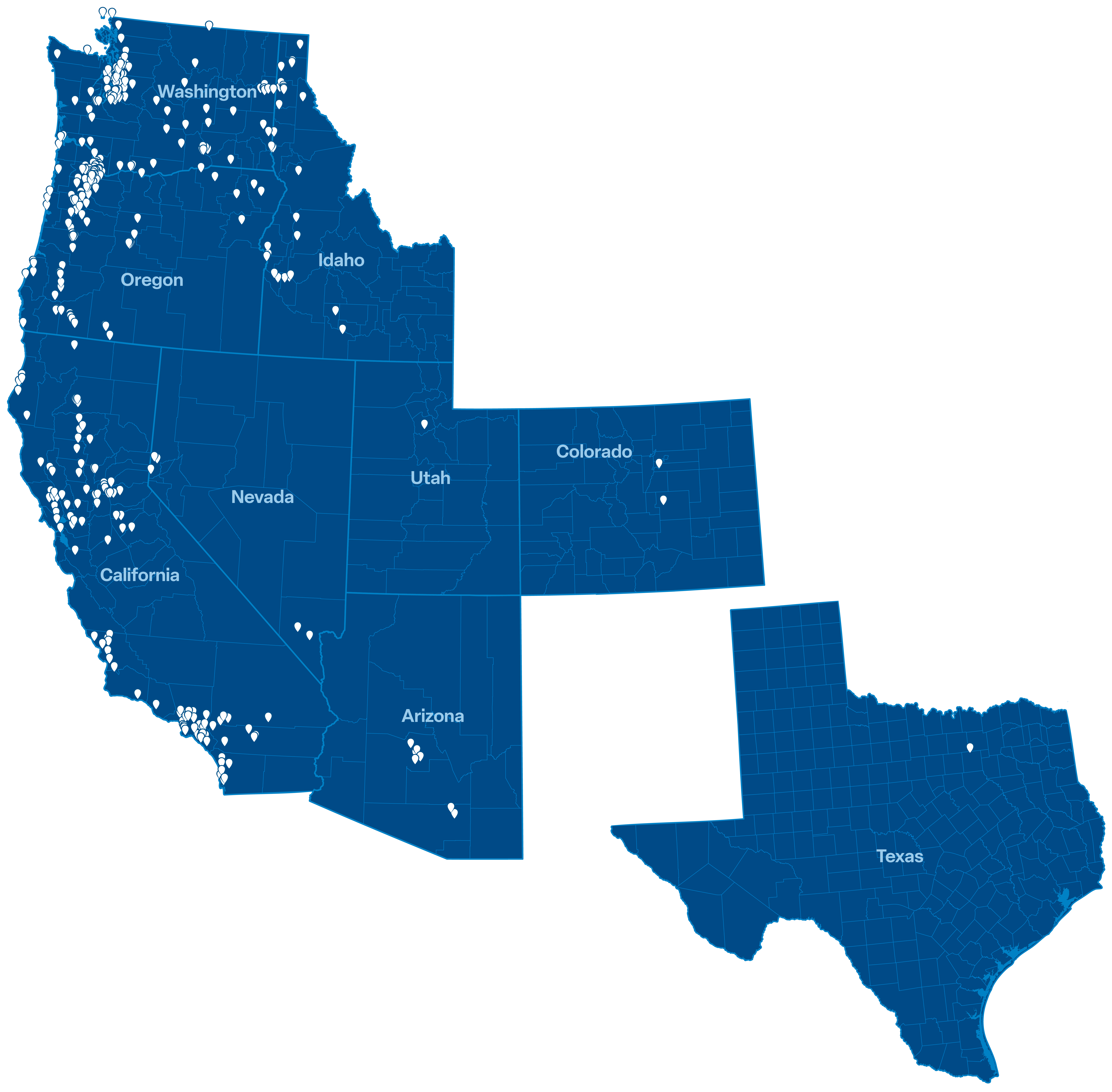
Columbia is a financial holding company,
with its common stock trading on the Nasdaq
stock exchange under the symbol “COLB.
Columbia’s wholly owned subsidiary, Columbia Bank, is a preeminent
regional bank in the Northwest.
Columbia Bank is an Oregon state-chartered commercial bank, and
through it, we provide a broad range of financial services to corporate
and middle market companies, small businesses, and individual
customers. The majority of Columbia Bank’s loans and deposits are
within its service areas in Arizona, California, Colorado, Idaho,
Nevada, Oregon, Utah, and Washington, as we focus on relationship
banking with customers in our western footprint. In 2025, Columbia
Bank expanded its market area into Texas through a homeowners
association office, due to the acquisition of Pacific Premier.
Over 350 Locations
Operating throughout the West
Top Market Share
Ranked #4 among regional banks headquartered in our footprint
pin_blue_hres.gif
star_blue_hres.gif
Columbia had consolidated assets, loans and deposits of
$67 billion, $48 billion, and $54 billion, respectively, as of December 31, 2025.
money_blue_hres.gif
8796093022549
8796093022700
8796093022723
Assets
$67B
Loans
$48B
Deposits
$54B
For additional information, please visit our website at www.columbiabankingsystem.com or see our Annual Report on Form 10-K
for the year ended December 31, 2025, as filed with the Securities and Exchange Commission (the “SEC”) and available on our
website. Such information is not part of or incorporated by reference into this Proxy Statement.
3
Table of Contents
Balanced Growth in Loans, Deposits,
and Sustainable Core Fee Income
Community Banking at Scale
Our Strategy
Business Bank of Choice”
Columbia, through its principal subsidiary, Columbia Bank, seeks to bank businesses of all sizes, along with their owners,
executives, and employees, in addition to the residents of the communities we serve. We focus on expanding full relationship
banking services through our “Business Bank of Choice” strategy.
Balanced Growth in Loans, Deposits,
and Sustainable Core Fee Income
heart_hres.gif
arrowupward_hres.gif
Community Banking at Scale
We seek to provide our customers with the financial
sophistication and product depth of a regional banking
company while retaining the appeal and service level of
a community bank.
Our bankers and operations teams support individuals
and small businesses through larger corporations living
and operating in low-population rural markets through
the largest metropolitan areas in the United States.
Our Community Banking at Scale business model drives
a granular, low-cost core deposits base.
Our loan portfolio is diversified by product, customer,
industry, and geography, mitigating risk and supporting
a diverse customer base.
Our approach is a concentrated focus on full banking
relationships, bringing together collaborative teams from
commercial and consumer banking as well as wealth
management, and leveraging our retail branch network.
Our scaled franchise and offerings, talented associate
base, and customer-focused business model enable us
to provide comprehensive financial services through
relationship banking in the communities we serve.
We place the highest priority on customer service and
assist our customers in making informed decisions when
selecting from the products and services we offer.
We offer tailored financial solutions to meet our
customers’ needs in support of balanced growth in loans,
deposits, and sustainable core fee income.
Our Culture Aligns Our Business Objectives to Support Our Primary Stakeholders.
Our “Do Right” Culture Fosters an Environment Where:
symbolcircle_hres.gif
1blue_hres.gif
2blue_hres.gif
Associates Thrive
Customers Grow
We combine national-level sophistication and expertise
with unparalleled community bank service to provide the
best personalized relationship banking experiences in
the West.
We intentionally create the kind of place where associates
care about one another, root for the customer down the
street, and participate in making their community a better
place to live and work.
3blue_hres.gif
4blue_hres.gif
Communities Prosper
Shareholders Invest
We take an active leadership role in helping our
communities prosper. By drawing on our strengths, our
people, and our values, we aim to make a meaningful
difference and set a high bar for social impact wherever
we do business.
We are committed to running our business in a way that
reinforces shareholder confidence, including risk-based
decision-making and managing our capital responsibly,
all with the goal of ensuring continued investment from
our shareholders.
4
Table of Contents
2025 Performance Highlights
Gained Market Share in Southern California and Added Other Strategic Locations
We announced and closed our strategic acquisition of Pacific Premier, completing our Western footprint and strengthening our competitive
position in key Western markets, most notably Southern California, where Columbia now holds a top 10 deposit market share position.
We also opened de novo locations in Arizona, California, Colorado, and Oregon during 2025, supporting both newer and long-established
markets and advancing our Business Bank of Choice operating strategy.
We made it easier for customers to recognize and engage with the full breadth of our services, as Columbia Bank began serving customers
under its unified name and brand effective September 1, 2025. The strategic transition streamlined our identity across all business lines,
including Columbia Bank (formerly Umpqua Bank), Columbia Wealth Advisors, Columbia Trust Company, Columbia Private Bank, and
Columbia Private Trust.
Made Significant Progress Optimizing Our Balance Sheet
We reduced wholesale funding (brokered deposits and Federal Home Loan Bank (FHLB) advances) by $576 million during 2025, as
customer deposits increased by $13.2 billion due to the Pacific Premier acquisition and organic growth. Customer deposits increased to
84.0% of total funding (total deposits and other interest-bearing liabilities) as of December 31, 2025, compared to 78.2% as of
December 31, 2024.
We identified a portfolio of below-market-rate transactional loans, primarily consisting of low-coupon multifamily and single-family mortgage
loans with no associated customer deposit balance as of the initial measurement date. As below-market-rate transactional loans reach their
repricing dates, our profitability is improving, as these loans either reprice to higher rates and remain on balance sheet or refinance elsewhere,
with proceeds used to reduce higher-cost funding. We took advantage of opportunities where payback periods were short and aligned with
value preservation and creation to sell certain below-market-rate transactional loans.
We grew commercial and owner-occupied commercial real estate loans, with growth largely offset by the intentional contraction of below-
market-rate transactional loans during 2025. Our relationship-focused, Business Bank of Choice strategy supported balance sheet
optimization and contributed to an expansion in net interest margin, which increased to 3.83% for 2025, compared to 3.57% for 2024.
Enhanced Capital Return to Shareholders
We repurchased 3.7 million shares of our common stock for a total of $100 million during 2025 under a new repurchase program
approved by Columbia’s Board in October 2025, which authorizes Columbia to repurchase up to $700 million of common stock through
November 30, 2026.
We paid cash dividends of $1.45 per common share during 2025, compared to $1.44 during 2024. In November 2025, Columbia increased its
quarterly dividend to $0.37 per common share, compared to $0.36 per common share previously.
Our capital deployment strategy remains focused on supporting organic growth, maintaining strong regulatory capital ratios, and returning
capital to shareholders through dividends and share repurchases.
The past several years have brought significant change to Columbia. Following the Umpqua acquisition, 2023 was a
year of broad integration, as our associates successfully navigated industry liquidity events that occurred in tandem
with the deal’s elongated closing and our scheduled systems conversion. In 2024, we executed efficiency initiatives
that simplified organizational structures, consolidated positions, and improved our profitability outlook.
In 2025, we completed our Western footprint through the acquisition of Pacific Premier while at the same time we
invested a portion of 2024’s cost savings into de novo locations in targeted markets. Over the past year, we also
added new talent throughout the company, launched new products, implemented new technology, and made
significant progress towards optimizing our balance sheet as we increased capital returned to our shareholders by
repurchasing shares of our common stock and increasing our common dividend. As we look to 2026, we have set
the stage for an exciting future. We are now positioned to deliver on the full capabilities of our Company with the
resources, talent, and vision to excel in every market we serve in the pursuit of long-term shareholder value creation.
Quote1.gif
Quote2.gif
arrowright_blue_hres.gif
Clint E. Stein
Chair, Chief Executive Officer and President
5
Table of Contents
Financial Performance Summary
2025
2024
Q42025
Q42024
Notable Items
Operations
Net interest margin
3.83%
3.57%
4.06%
3.64%
Net income increased 3% in 2025
compared to 2024, due to the acquisition
of Pacific Premier and net interest margin
improvement. Net interest margin
expanded to 3.83% for 2025, compared to
3.57% for 2024, due to balance sheet
optimization activity and a more favorable
interest rate environment. Net interest
margin expanded to 4.06% for the fourth
quarter of 2025, compared to 3.64% for
the fourth quarter of 2024, highlighting
improvement through 2025. Higher
merger-related expense and a legal
settlement partially offset these
improvements, and our operating
performance excludes these costs.
Operating net income* increased 31% in
2025 compared to 2024. Changes in
earnings per share between periods
reflect shares issued and exchanged on
August 31, 2025, as a result of the
acquisition of Pacific Premier. Operating
performance metrics are non-GAAP
financial measures. Refer to Appendix A
for additional information and
reconciliations to the most directly
comparable GAAP financial measures.
Efficiency ratio
61.68%
57.14%
57.30%
54.61%
Operating efficiency ratio, as adjusted*
52.54%
54.22%
51.39%
52.51%
Net income
$550 million
$534 million
$215 million
$143 million
Operating net income*
$746 million
$568 million
$243 million
$150 million
Earnings per share - diluted
$2.30
$2.55
$0.72
$0.68
Operating earnings per share - diluted*
$3.12
$2.71
$0.82
$0.71
Return on average assets
0.97%
1.03%
1.27%
1.10%
Operating return on average assets*
1.31%
1.09%
1.44%
1.15%
Return on average common equity
8.98%
10.55%
10.92%
10.91%
Return on average tangible common equity*
12.51%
15.31%
15.24%
15.41%
Operating return on average tangible
common equity*
16.97%
16.30%
17.22%
16.11%
Credit
Net charge-offs to average loans and leases
(annualized)
0.27%
0.34%
0.25%
0.27%
Credit performance remained strong
and stable.
Non-performing assets to total assets
0.30%
0.33%
Capital
Common equity tier 1 risk-based capital ratio
11.80%
10.54%
Organic capital generation and the
impact of the Pacific Premier acquisition
outpaced our regular quarterly dividend
and common share repurchases, driving
ratios higher.
Total risk-based capital ratio
13.63%
12.75%
Growth
Commercial and owner-occupied commercial
real estate loan balances
$19,269 million
$15,239 million
Our Business Bank of Choice strategy
focuses on remixing our balance sheet
into relationship-based commercial
loans, which, inclusive of owner-occupied
commercial real estate loans, grew 26%
in 2025, reflecting organic growth and
balances added from Pacific Premier.
Customer deposit balances
$48,758 million
$35,566 million
Customer deposit balances increased
37% during 2025, also reflecting organic
growth and balances added from Pacific
Premier. The favorable change enabled us
to reduce wholesale funding.
* Non-GAAP financial measures. Please refer to Appendix A for additional information and reconciliations to the most directly comparable GAAP financial measure.
6
Table of Contents
Governance and Compensation Quick Facts
Board Composition and Operations
Voting Standard
Majority of votes cast in uncontested elections, plurality in
contested elections
Annual Elections
Yes
Mandatory Retirement Age
Yes (75)
Overboarding Policy
Yes
Director Term Limits
No
Independent Directors
10 of 12 directors
Standing Board Committee Membership Independence
100%
Annual Board and Committee Self-Evaluations
Yes
Shareholder Rights
One Share, One Vote
Yes
Cumulative Voting
No
Vote Standard for Amending Articles of Incorporation
Majority of votes entitled to be cast, amendments to Article 9 of the Articles
of Incorporation require 66 2/3% of the outstanding common stock
Shareholder Right to Call Special Meeting
Yes, of holders of record of 10% of the outstanding stock entitled to vote
Shareholder Right to Act by Written Consent
Unanimous
Board Authorized to Issue Blank-Check Preferred Stock
Yes
Poison Pill
No
Other Governance Practices
Code of Conduct for Directors, Executive Officers, and Associates
Yes
Year-Round Shareholder Engagement
Yes
Percentage of Shareholders Contacted and Engaged During Off-Season Engagement
Approximately 75% contacted; approximately 26% engaged
Chief Executive Officer and Senior Management Succession Planning
Yes
Stock Ownership Guidelines
Yes
Anti-Hedging and Anti-Pledging Policies
Yes
Information Security, Cybersecurity and Data Privacy Oversight
Yes, led by Enterprise Risk Management Committee
Board-Level Corporate Responsibility Oversight
Yes, led by Nominating and Governance Committee
Annual Corporate Responsibility Report
Yes, posted on website
Operational Greenhouse Gas Emission Reporting per Greenhouse Gas Protocol
Yes, posted on website
Compensation Practices
CEO Pay Ratio
101 to 1
Clawback Policies
Yes
Repricing of Underwater Options
No
Excessive Perquisites
No
Pay-for-Performance
Yes
Frequency of Say-on-Pay Advisory Vote
Annual
Double-Trigger Change-in-Control Provisions
Yes
Independent Compensation Consultant
Yes
checkmark_hres.gif
checkmark_hres.gif
checkmark_hres.gif
checkmark_hres.gif
7
Table of Contents
Governance and Leadership
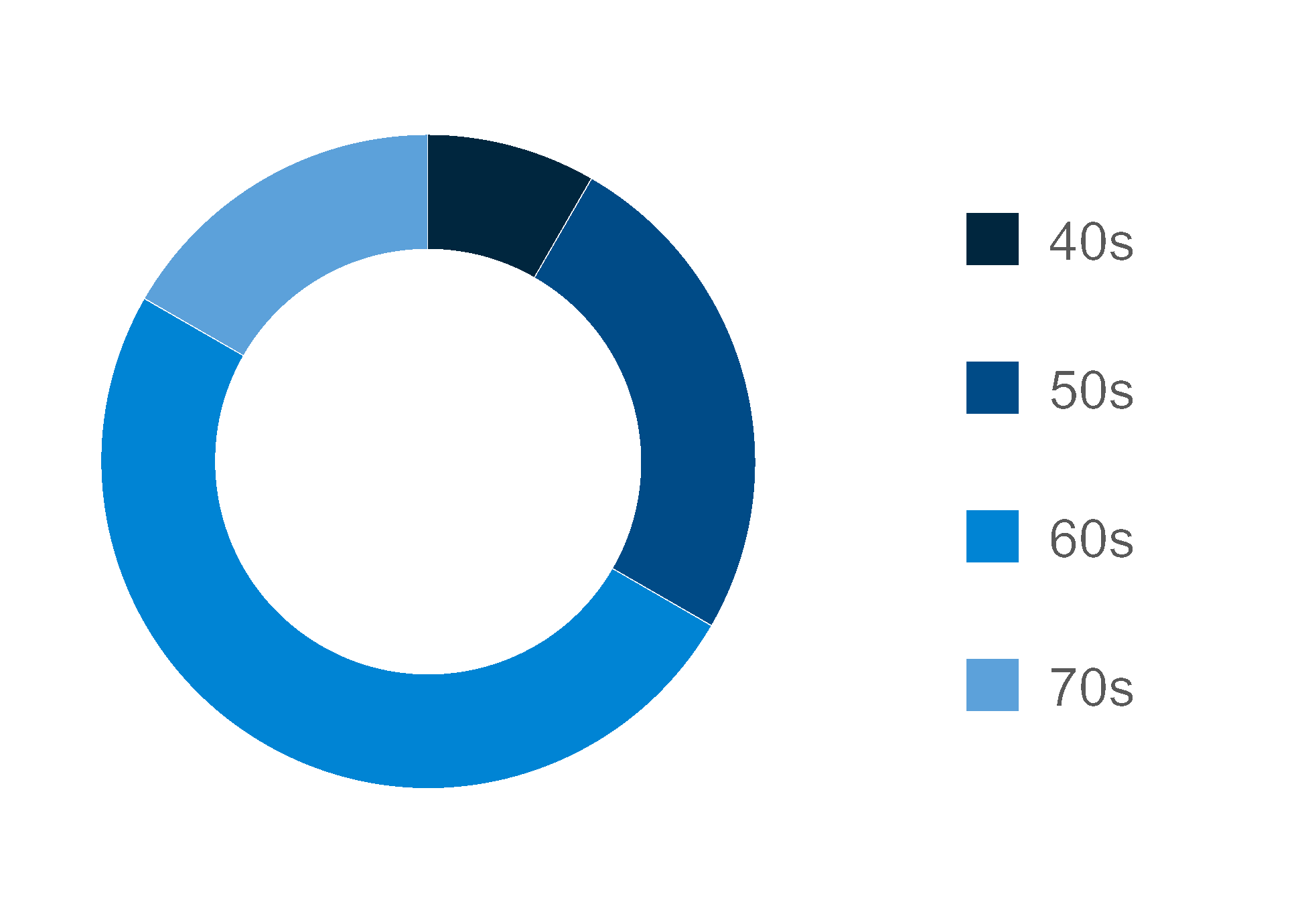
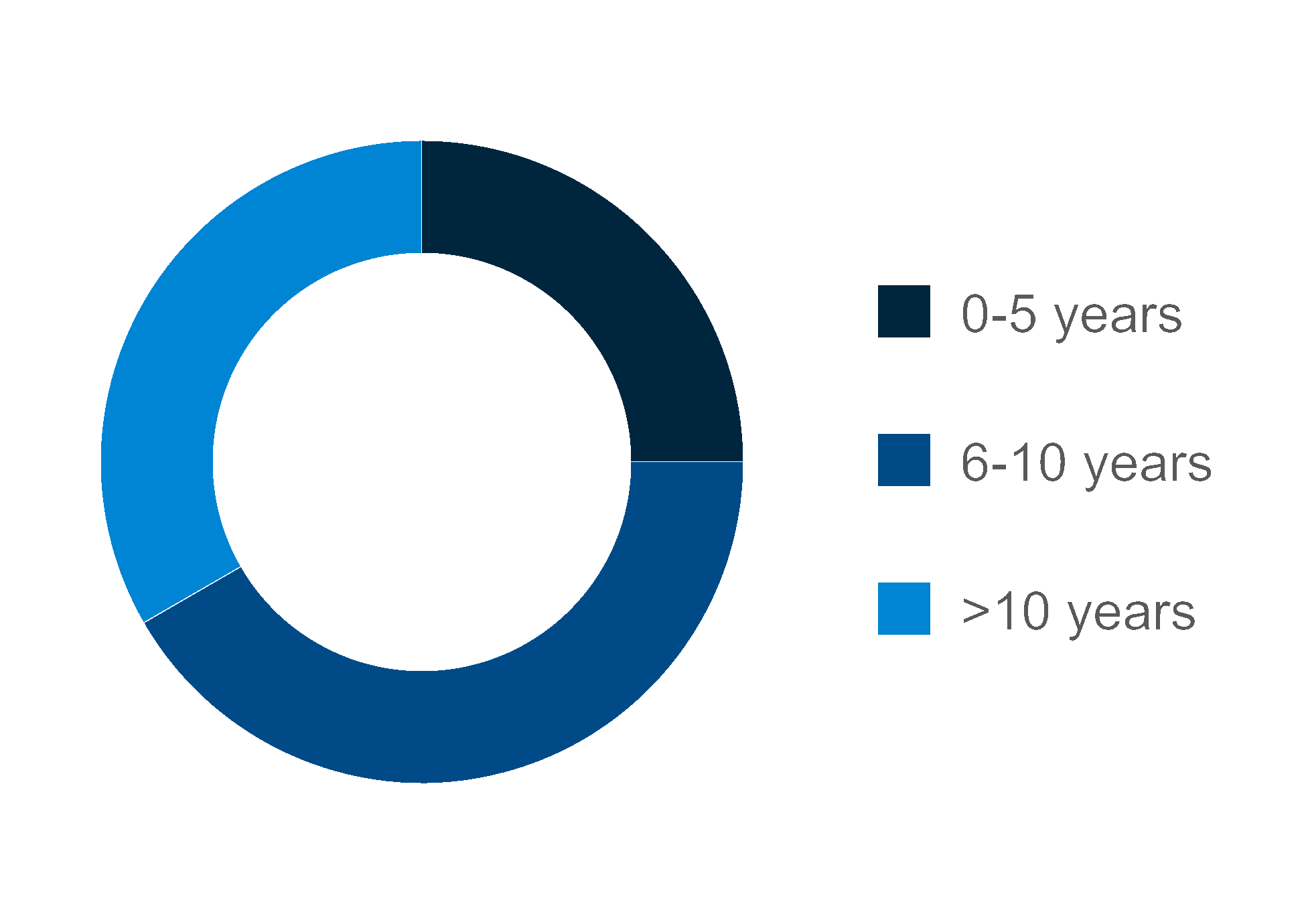
The Board believes that it is important to its members to, as a whole, represent a robust mix of experiences, perspectives, and
backgrounds. The following charts summarize some of the characteristics of the 12 nominees standing for election at the Annual
Meeting (with tenure determined by service on either the Columbia Board or the Umpqua Holdings Corporation (“Umpqua”) board
of directors, prior to the merger of the two companies (the “Merger”)).
1_hres.gif
2_hres.gif
Board Nominees: Age
Board Nominees: Gender
19791209306368
Male Members
09
Average
age is
62
Female Members
03
3_hres.gif
4_hres.gif
Board Nominees: Independence
Board Nominees: Tenure
19791209300727
Independent 10/12
Non-Independent 2/12
8
years of average
tenure
Strong governance profile led by an independent board of directors representing a robust
mix of experiences, perspectives, and backgrounds.
5_hres.gif
8
Table of Contents
Director Nominees at a Glance
Name
Age
Director Since
Primary Occupation
Committee Assignments
Independent
Clint E. Stein
54
2020
Chair, Chief Executive Officer and
President - Columbia; Chair, Chief
Executive Officer - Columbia Bank
None
No
Luis F. Machuca
68
2010
Former President and Chief
Executive Officer - Enli Health
Intelligence Corporation
Nominating and Governance
Committee (Chair)
Compensation Committee
Technology Committee
Yes
Mark A. Finkelstein
67
2014
Director - Christensen, Inc.
Compensation Committee
Nominating and Governance
Committee
Technology Committee
Yes
Eric S. Forrest
58
2017
Co-President and co-owner -
Bigfoot Beverages
Enterprise Risk Management
Committee
Nominating and Governance
Committee
Yes
Steven R. Gardner
65
2025
Former Chair, Chief Executive Officer
and President - Pacific Premier
Bancorp, Inc.; Former Chair, Chief
Executive Officer - Pacific Premier Bank
None
No
Randal L. Lund
68
2017
Former Partner - KPMG
Audit Committee (Chair)
Enterprise Risk Management
Committee
Yes
M. Christian Mitchell
71
2025
Senior Advisor - Marshall & Stevens
Audit Committee
Enterprise Risk Management
Committee
Yes
John F. Schultz
61
2015
Executive Vice President and
Chief Operating and Legal Officer -
Hewlett Packard Enterprise
Technology Committee (Chair)
Audit Committee
Yes
Elizabeth W. Seaton
65
2014
Former President and Chief Executive
Officer - Saltchuk Aviation
Enterprise Risk Management
Committee (Chair)
Audit Committee
Yes
Jaynie Miller Studenmund
71
2025
Former Chief Operating Officer -
Overture Services, Inc.
Compensation Committee
Nominating and Governance
Committee
Yes
Hilliard C. Terry, III
56
2010
Former Executive Vice President
and Chief Financial Officer -
Textainer Group Holdings Limited
Compensation Committee (Chair)
Nominating and Governance
Committee
Technology Committee
Yes
Anddria Varnado
40
2018
Former GM and Head of the Consumer
Business as member for
the Executive Management Team -
Kohler Company
Audit Committee
Technology Committee
Yes
9
Table of Contents
Proposal 1 – Election of Directors
Vote Required and Board Recommendation
The election of each of the Board nominees named in this Proxy Statement, each of which is an uncontested election, requires the
affirmative vote FOR by a majority of the votes cast on this proposal. Brokers do not have discretion to cast a vote for the election
of Board nominees without your direction. Therefore, if your shares are in street name and you do not instruct your broker how to
vote, your shares will not be voted on this proposal. Abstentions and broker non-votes will not be considered votes cast on this
proposal and will have no effect on the outcome of this proposal.
The Board of Directors unanimously recommends a vote “FOR” each of the nominees named in this Proxy Statement.
Board Leadership
Following completion of the integration of Columbia and Umpqua ahead of schedule, on March 31, 2025, the Board eliminated the
role of Executive Chair that was implemented in connection with the Merger. With the elimination of the Executive Chair position,
the Board believed it appropriate at that time to continue to separate the roles of Board Chair and Chief Executive Officer so
as to allow Mr. Stein, as President and Chief Executive Officer, to continue focusing on executing Columbia’s strategic plan, its
acquisition of Pacific Premier, and managing operations and performance. Ms. Pope was thus appointed as the independent, non-
executive Board Chair effective April 1, 2025.
Effective January 22, 2026, with almost three years of post-Merger operations concluded, the Board determined it appropriate to
combine the roles of Board Chair and Chief Executive Officer and elect Mr. Stein as Board Chair. Ms. Pope transitioned, effective
the same date, to serve as Lead Independent Director until the Annual Meeting. It is anticipated that following the Annual Meeting,
Mr. Machuca, the current Chair of Columbia’s Nominating and Governance Committee, will succeed Ms. Pope as Lead
Independent Director.
Size of the Board
Our Bylaws provide that the number of directors to be elected by the shareholders will be not less than eight nor more than
15 persons. In light of the fact that Ms. Pope and Ms. Numata will be leaving the Board as of the Annual Meeting, the Board has
accordingly fixed the number of directors to be elected at the Annual Meeting at 12. The Board would like to thank Ms. Pope and
Ms. Numata for their service, leadership, and valuable contributions as directors.
Director Retirement Age
Our Bylaws provide that any person who has or will attain the age of 75 prior to a meeting of shareholders may not stand for
election at such meeting.
Nominee Independence
As discussed under the “Board Leadership and Director Independence” section, the Board has determined that all of the nominees
for election to the Board are independent, other than Mr. Stein, who serves as Chief Executive Officer and President, and Mr.
Gardner, the former board chair, chief executive officer and president of Pacific Premier, who is party to a consulting agreement
with Columbia. See the “Certain Relationships and Related Transactions” section for additional details.
Replacement Nominees
If a nominee refuses or is unable to stand for election, the Board will designate a replacement nominee in accordance with the
terms of the Bylaws. If the Board designates a substitute, shares represented by a proxy will be voted FOR the substitute nominee.
The Board presently has no knowledge that any of the nominees will refuse or be unable to serve.
10
Table of Contents
Information About the 2026 Nominees
Information regarding each of the nominees is provided below, including each nominee’s name, age as of the Record Date, principal occupation during
the past five years, public company directorships, and the year first elected or appointed a director of Columbia or Umpqua, as applicable. All of the
nominees are presently directors of Columbia. There are no family relationships among any of our directors or executive officers, nor are any of the
corporations or organizations referenced in the biographical information a parent, subsidiary or affiliate of Columbia.
symbol_hres.gif
Clint E. Stein
Experience: Mr. Stein has served as Chair of the Board, Chief Executive Officer and President of Columbia and as
Chair of the Board and Chief Executive Officer of Columbia Bank since January 2026. He served as President, Chief
Executive Officer and Director of Columbia since 2020, overseeing operations across the United States. He served as
Chief Executive Officer and Director of Columbia Bank since 2023, following the formal separation of the President and
Chief Executive Officer roles at Columbia Bank. Prior to that, he served as President, Chief Executive Officer and
Director of Columbia State Bank from 2020 to 2023. Since joining Columbia in 2005, Mr. Stein has held several senior
executive positions including Senior Vice President, Chief Accounting Officer and Controller (2005-2012), Executive
Vice President, Chief Financial Officer (2012-2018), and Executive Vice President, Chief Operating Officer (2017-2019).
Prior to joining Columbia, Mr. Stein served as Chief Financial Officer for Albina Community Bank, which he joined
following his tenure as Chief Financial Officer at Community Bank.
Mr. Stein began his career in the financial services industry as a certified public accountant focused on tax and
municipal and nonprofit auditing. Mr. Stein was recognized as CFO of the Year by the Puget Sound Business Journal
(“PSBJ”) in 2015, has been named to the PSBJ’s “Power 100” list for four consecutive years (2022-2025), and was a
2025 PSBJ Most Admired CEOs honoree. In addition, Mr. Stein was recognized as Business Leader of the Year in
2024 by the University of Washington’s Milgard School of Business.
He currently serves on the board of the Federal Reserve Bank of San Francisco. His previous board service includes
the Washington Bankers Association, Pacific Coast Banking School, and the Executive Council for a Greater Tacoma
and the Tacoma-Pierce County Chamber of Commerce.
Reason for Nomination: Mr. Stein brings to the Board extensive financial, mergers and acquisitions, and accounting
experience, developed through a 31-year career in the financial services and banking industries. He played a pivotal
role in establishing Columbia as a Western-focused regional powerhouse committed to empowering businesses and
families as they pursue their ambitions. Under his leadership, Columbia has expanded into attractive markets across
the West while building a culture of performance, focused on enriching the customer experience, delivering strong
financial results and creating value for its shareholders.
Committee Assignments: None
Education: Bachelor’s Degree in Accounting and Business Administration, University of Idaho; Graduate School of
Bank Financial Management and the Graduate School of Banking, University of Wisconsin; previously a licensed
certified public accountant in the State of Oregon
Other Public Board Directorships: None
Clint_E_Stein_Proxy1.gif
CHAIR OF THE BOARD
Age: 54
Director Since: 2020
symbol_hres.gif
Luis F. Machuca
Experience: Mr. Machuca served as President and Chief Executive Officer of Enli Health Intelligence Corporation, a
healthcare software and applications company he co-founded, for 19 years until its sale to Cedar Gate Technologies
in 2020. Under his leadership, the company was acquired by Surescripts as a wholly owned subsidiary in 2012 and
spun out as an independent company in 2015, at which time it rapidly became the market leader in population health
management software.
Prior to Enli Health Intelligence, Mr. Machuca led the turnaround of the NEC Computer Services Division at Packard
Bell-NEC Corporation and successfully repositioned eFusion for acquisition by ITXC in 2000, subsequently serving as
Executive Vice President and General Manager of e-Commerce. He began his career with Intel, where he spent 15
years ascending to leadership roles in manufacturing, engineering, marketing, and ultimately became the General
Manager of the OEM Systems Division.
He previously served on the board of directors of Cambia Health Systems (2009-2024), a nonprofit health care
company based in Portland, Oregon, and as the Chair of Umpqua’s Compensation Committee until its merger with
Columbia in 2023.
Reason for Nomination: As a former chief executive officer and senior executive with over four decades of
experience in technology and healthcare, Mr. Machuca brings deep expertise in governance, turnarounds, mergers
and acquisitions, finance, risk management and talent development. In addition to his strong business operations and
leadership experience, he provides extensive civic and community ties through his work in the healthcare space.
Committee Assignments: Nominating and Governance Committee (Chair), Compensation Committee,
Technology Committee
Education: Bachelors Degree in Electrical Engineering and Master of Science in Industrial Engineering,
Purdue University
Other Public Board Directorships: GigCapital8 Corp. (Nasdaq: GIWWU; 2025-present); GigCapital9 Corp.
(Nasdaq: GIXXU; 2026-present); UpHealth, Inc. (NYSE: UPH; 2022-present)
Luis_F_Machuca_Proxy1.gif
LEAD INDEPENDENT
DIRECTOR APPOINTEE
(Effective May 14, 2026)
Independent
Age: 68
Director Since: 2010
11
Table of Contents
symbol_hres.gif
Mark A. Finkelstein
Experience: Most recently, Mr. Finkelstein served as Chief Legal and Administrative Officer and Secretary of Blucora,
Inc. (former Nasdaq: BCOR), a provider of technology-enabled financial solutions, where he led the company’s legal,
compliance and human resources functions. He advised the board on a wide variety of legal and corporate strategy
matters, corporate governance, shareholder engagement, disclosure obligations, risk management, and mergers and
acquisitions transactions.
Prior to Blucora, he served as General Counsel, Corporate Secretary, and Executive Vice President of Corporate
Development at Emeritus Corp. (former NYSE: ESC), a senior living healthcare provider with more than 30,000
employees supporting operations in 45 states, where he oversaw the company’s legal, compliance, and corporate
development departments.
Earlier in his career, he served as Chief Executive Officer and a board member of Novellus Capital Management,
overseeing firm-wide strategic direction and operations, and he served as a strategic advisor for private investment
firms in the United States and Europe. He is a National Association of Corporate Directors (“NACD”) Board Leadership
Fellow. He has served on the board of directors of Christensen, Inc. since 2020.
Reason for Nomination: Mr. Finkelstein brings extensive legal, corporate governance and strategic insights to the
Board, developed through his over 25 years in the highly regulated financial services and healthcare industries, as well
as deep expertise in strategic financial planning, mergers and acquisitions, and other strategic corporate transactions.
Committee Assignments: Compensation Committee, Nominating and Governance Committee,
Technology Committee
Education: Bachelor’s Degree with High Honors in Economics, The University of Michigan; J.D., The University of
Michigan Law School
Other Public Board Directorships: None
Mark_A_Finkelstein_Proxy1.gif
Independent
Age: 67
Director Since: 2014
symbol_hres.gif
Eric S. Forrest
Experience: Mr. Forrest is a co-President and co-owner of Bigfoot Beverages, a beverage distributor, where he
oversees and manages the company’s day-to-day operations, warehousing and fleet. He was previously a Partner in
Fast Track Car Wash, which is also Oregon-based. Mr. Forrest’s entrepreneurial and operational achievements reflect
a strong track record of value creation and disciplined execution.
In addition to his business leadership expertise, Mr. Forrest contributes significant governance experience at publicly
traded regional commercial banks having served as a member of the board of directors of Pacific Continental
Corporation (former Nasdaq: PCBK) prior to its acquisition by Columbia in 2017.
He chairs the Oregon Beverage Recycling Board, which he also co-founded, and serves on the boards of directors of
the Ford Family Foundation, the Pepsi-Cola Bottlers Association, and the Oregon Business Council. He is also the
former President of the Oregon Beer and Wine Distributors Association and a former member of the board of directors
of Pepsi Northwest Bottlers. These leadership roles reflect a deep commitment to community engagement, industry
stewardship, and strategic governance.
Reason for Nomination: Mr. Forrest brings entrepreneurial and operational management expertise to the Board, as
well as significant regulatory compliance and governance insights from his career in the banking industry. His industry
background and strong community banking ties provide the Board with practical expertise that enhances oversight
over business operations, corporate governance, audit and financial strategy.
Committee Assignments: Enterprise Risk Management Committee, Nominating and Governance Committee
Education: Bachelor’s Degree in Communications, Oregon State University; Master of Business Administration,
Willamette University’s Atkinson School of Management
Other Public Board Directorships: None
Eric_S_Forrest_Proxy1.gif
Independent
Age: 58
Director Since: 2017
12
Table of Contents
symbol_hres.gif
Steven R. Gardner
Experience: Mr. Gardner served as Chairman, Chief Executive Officer and President of Pacific Premier and as
Chairman and Chief Executive Officer of Pacific Premier Bank until their acquisition by Columbia in 2025. He has
extensive knowledge of all facets of financial institution management. During his tenure, Mr. Gardner led Pacific
Premier Bank’s transformation into one of the largest commercial banks headquartered in California and a top
performing bank in the United States, completing 12 acquisitions across whole banks, specialty finance lines of
business and FDIC-assisted transactions.
Mr. Gardner is an expert in all areas of mergers and acquisitions as well as capital market transactions. Prior to
Pacific Premier, he was an executive officer of Hawthorne Financial Corporation, responsible for credit administration
and portfolio management. Earlier in his career, he held senior management roles at both commercial banks and
thrift institutions.
In addition to his experience as an executive, Mr. Gardner previously served as a director for the Federal Reserve
Bank of San Francisco and as a director and chairman of the finance committee for the Federal Home Loan Bank of
San Francisco. He also previously served as vice chairman of the Federal Reserve Bank of San Francisco’s
Community Depository Institutions Advisory Council.
Reason for Nomination: Mr. Gardner brings more than 35 years of experience as a commercial banking executive
and provides the Board with valuable insight and deep expertise in all facets of financial institution management,
corporate strategy, mergers and acquisitions, and capital market transactions.
Committee Assignments: None
Education: Bachelor’s Degree, California State University, Fullerton; Graduate School, California State University,
Long Beach
Other Public Board Directorships: None
Steven_R_Gardner_Proxy1.gif
Age: 65
Director Since: 2025
symbol_hres.gif
Randal L. Lund
Experience: Mr. Lund served as a partner for over 35 years with the accounting firm KPMG, one of the Big Four
accounting firms in the United States. His extensive background in public accounting includes leadership over complex
audits, capital markets transactions, and the application of both United States generally accepted accounting principles
(“GAAP”) and International Financial Reporting Standards (“IFRS”) across a range of industries, including
financial services.
During his tenure at KPMG, Mr. Lund advised numerous clients through initial public offerings, secondary equity and
debt offerings, and mergers and acquisitions transactions. He has vast experience in revenue recognition, stock-based
compensation, tax accounting, complex debt and equity transactions, and acquisition accounting, among others. As a
designated SEC engagement quality control partner, Mr. Lund regularly worked with leading public companies,
engaging directly with audit committees and SEC regulators to address emerging accounting issues, assess internal
controls, and strengthen regulatory compliance and corporate governance practices.
In addition to his technical knowledge, Mr. Lund served as a designated IFRS partner for international engagements
and played a role in implementing audit methodologies at KPMG. His experience in evaluating financial reporting
integrity and advising on regulatory compliance makes him a valuable asset to the Board. Mr. Lund is a NACD Board
Leadership Fellow.
Reason for Nomination: Mr. Lund offers deep expertise in financial reporting, audit oversight, regulatory compliance
and operational risk management. With extensive experience advising public companies, including Fortune 500 firms,
Mr. Lund contributes significant insights into complex financial matters, capital markets and the evolving role of audit
committees. He is one of the Board’s designated audit committee financial experts.
Committee Assignments: Audit Committee (Chair), Enterprise Risk Management Committee
Education: Bachelor’s Degree in Accounting, Montana State University
Other Public Board Directorships: None
Randal_L_Lund_Proxy1.gif
Independent
Age: 68
Director Since: 2017
13
Table of Contents
symbol_hres.gif
M. Christian Mitchell
Experience: Mr. Mitchell currently serves as a Senior Advisor to and member of the board of directors of Marshall &
Stevens, a national valuation and financial advisory firm. He previously served as a national managing partner for
Deloitte’s Mortgage Banking and Finance Companies practice. During his 26-year career at Deloitte, he also served as
regional managing partner for various practices including audit, enterprise risk services and financial services.
He was a founding member of the board of directors of Deloitte Consulting USA, which worked with Fortune 500
companies to solve complex business challenges through strategy development and implementation, human capital
and digital transformation to maintain competitiveness and realize growth opportunities.
Mr. Mitchell previously served on the board of directors of Pacific Premier (former Nasdaq: PPBI; 2018-2025, until its
acquisition by Columbia), Western Asset Mortgage Capital Corporation (NYSE: WMC; 2012-2023, until its acquisition
by TPG Mortgage Investment Trust, Inc.), and has served as a director of eight other public companies and three
private-equity owned companies. He taught as an Adjunct Accounting Professor and a guest lecturer at the University
of Redlands and he is Chairman Emeritus of the NACD, Pacific Southwest Chapter. He also served on the national
board of NACD (2017-2019).
Reason for Nomination: Mr. Mitchell brings over 45 years of financial consulting experience, with special focus on
enterprise risk management, strategic planning, financial reporting, corporate governance, capital markets, and
mergers and acquisitions, which provides invaluable support to the Board’s corporate stewardship and strategic
decision-making. He is one of the Board’s designated audit committee financial experts.
Committee Assignments: Audit Committee, Enterprise Risk Management Committee
Education: Bachelor’s Degree in Accounting, University of Alabama
Other Public Board Directorships: Parsons Corporation (NYSE: PSN; 2013-present); TPG Mortgage Investment
Trust, Inc. (NYSE: MITT; 2023-present)
Christian_Mitchell_Proxy1.gif
Independent
Age: 71
Director Since: 2025
symbol_hres.gif
John F. Schultz
Experience: Since joining Hewlett Packard Enterprise (“HPE”) in 2008, Mr. Schultz has held a variety of leadership
roles at the company. He currently leads large-scale initiatives including the integration of Juniper Networks, HPE’s
largest acquisition to date, including the regulatory approval process and integration planning and execution. As a part
of the integration, Mr. Schultz led the development of an innovative integration framework, anchored by clear
objectives, a track system, and core integration leaders, that establishes a new standard for future projects; his tailored
execution approach, which departed from traditional models to concepts tailor-fit to the company’s future vision, has
ensured rapid progress and reflects the thoughtful planning invested from the outset.
Prior to leading the Juniper integration, Mr. Schultz led HPE’s Transformation Office, a cross-business team
responsible for delivering the company’s plan to become the leading edge-to-cloud company, including the strategic
development and incubation of HPE’s GreenLake platform and cloud services.
Mr. Schultz’s firsthand leadership in digital transformation, cloud adoption and enterprise modernization provides
valuable insights to the Board in areas including digital infrastructure, cybersecurity, regulatory compliance and the
strategic use of artificial intelligence and cloud technologies to meet evolving customer expectations for seamless
digital experiences. These efforts have been, and continue to be, central to HPE’s strategic modernization and
innovation agenda.
Before joining HPE, Mr. Schultz was a partner in the litigation practice of Morgan Lewis & Bockius LLP, focusing on
complex litigation and primarily defending consumer class-action, fiduciary liability, and technology-related commercial
litigation. He was previously a partner at Drinker Biddle & Reath, where he also specialized in commercial and product
liability litigation.
Reason for Nomination: Mr. Schultz brings valuable legal, risk management and corporate governance insights to the
Board, having led several business transformations, information technology and risk management functions,
information technology and cybersecurity organizations, eCommerce teams, ethics and compliance, and global
resilience and security functions.
Committee Assignments: Technology Committee (Chair), Audit Committee
Education: Bachelor’s Degree, Albright College; J.D., University of Pennsylvania Law School
Other Public Board Directorships: None
John_F_Schultz_Proxy1.gif
Independent
Age: 61
Director Since: 2015
14
Table of Contents
symbol_hres.gif
Elizabeth W. Seaton
Experience: Ms. Seaton is the former President and Chief Executive Officer of Saltchuk Aviation, an air cargo and
aviation services company headquartered in Seattle, Washington. She successfully guided the company through
numerous milestones during her six-year tenure, including achieving top-tier safety performance, expanding
partnerships with key customers and overseeing significant operational growth. Under her leadership, Saltchuk
successfully integrated Ryan Air into its portfolio.
Ms. Seaton previously served as Senior Vice President of Operations for Saltchuk Resources, Inc., a family of
diversified transportation and fuel distribution companies. Earlier in her career, she spent over 20 years at
Weyerhaeuser, where she held senior roles in strategic planning, capital investments and business operations, which
deepened her expertise in enterprise risk management, capital investments, operations and corporate governance.
She began her career as a Principal at Boston Consulting Group, advising clients on strategic development,
turnarounds and change management, and mergers and acquisitions.
Ms. Seaton serves on the board of directors of Premera, a not-for-profit parent company that through its family of
companies delivers comprehensive health benefits and personalized services to individuals, small businesses and
Fortune 100 companies. She also serves on the Planned Parenthood Federation of America Board after serving on
Planned Parenthood Great Northwest, Hawaiʻi, Alaska, Indiana, Kentucky. Ms. Seaton has held several board
leadership roles, including Board Chair and Vice Chair, Finance and Investment Committee Chair, Board Secretary,
and Executive Committee member.
Ms. Seaton was named a Director of the Year in 2024 by PSBJ and named as one of the “Power 100” business and
not-for-profit leaders in the Pacific Northwest.
Reason for Nomination: Ms. Seaton brings to the Board broad financial, operational and governance expertise,
developed through more than three decades of leadership. In particular, the Board benefits from her deep experience
in turnarounds and change management, strategic development, mergers and acquisitions, and enterprise
risk management.
Committee Assignments: Enterprise Risk Management Committee (Chair), Audit Committee
Education: Bachelor’s Degree in Economics, History, Princeton University; J.D./Master of Business Administration,
University of Chicago Business and Law Schools
Other Public Board Directorships: None
Betsy_Seaton_Proxy1.gif
Independent
Age: 65
Director Since: 2014
symbol_hres.gif
Jaynie Miller Studenmund
Experience: Ms. Studenmund’s experience includes 20 years of executive banking experience, having been a
managing committee member and leading retail banking and business banking, primarily at First Interstate of California
(now Wells Fargo), where she began as the Chief Marketing Officer. She then became Executive Vice President and
Head of Retail and Business Banking for Home Savings of America and Great Western Bank, following the acquisition
of First Interstate.
After her banking career, Ms. Studenmund pivoted to digital businesses as President and Chief Operating Officer of
PayMyBill.com, an early consumer platform acquired by Paytrust, and next as Chief Operating Officer of Overture
Services, the successful, publicly traded pioneer of paid search advertising. She played a key role in positioning
Overture for its $1.6 billion acquisition by Yahoo!, demonstrating strong operating, financial, and mergers and
acquisitions experience.
Ms. Studenmund also brings significant corporate governance experience. She has served on the boards of directors
of Pacific Premier (former Nasdaq: PPBI; 2019-2025, until its acquisition by Columbia), ExlService Holdings
(Nasdaq: EXLS; 2018-2025) and CoreLogic (Nasdaq: CLGX; 2012-2021).
Reason for Nomination: Ms. Studenmund brings extensive executive and public board expertise in strategy,
operations, change management, and mergers and acquisitions, developed over four decades of executive leadership
across the financial services, digital analytics and health care industries. Her in-depth background leading major
consumer and business banking franchises during periods of regulatory change, rapid innovation, growth, market
transformation, and mergers and acquisitions strengthens the Board’s ability to guide Columbia’s growth strategies.
Committee Assignments: Compensation Committee, Nominating and Governance Committee
Education: Bachelor’s Degree in Economics, Wellesley College; Master of Business Administration,
Harvard Business School
Other Public Board Directorships: Select funds for Franklin Templeton’s Western Asset Management (2004-present)
Jaynie_M_Studenmund_Proxy1.gif
Independent
Age: 71
Director Since: 2025
15
Table of Contents
symbol_hres.gif
Hilliard C. Terry, III
Experience: Mr. Terry has served as an advisor and interim chief executive officer to private equity-backed portfolio
companies, providing strategic and operational leadership during periods of transition and growth. He was previously
a board member at Umpqua, where he chaired the Audit and Compliance Committee, until its merger with Columbia
in 2023.
Earlier in his career, Mr. Terry was Chief Financial Officer of Textainer Group Holdings Limited, one of the world’s
largest marine container leasing companies, where he led complex capital transactions, strategic investments and
financial operations. Prior to that, he held investor-facing and finance leadership roles at Agilent Technologies,
where he played a key role in the company’s successful spin-off from Hewlett-Packard and its subsequent initial
public offering.
Mr. Terry also held investor relations and global marketing leadership roles at Verifone and began his professional
journey at Kenetech Corporation in investor relations. He spent time in investment banking with Goldman Sachs,
focusing on real estate finance and financial institutions.
Reason for Nomination: As a senior finance executive with over 25 years of experience across technology, financial
services and leasing sectors, Mr. Terry brings deep expertise in financial strategy, risk management, corporate
development and accounting. He provides the Board with valuable investor insights and capital markets expertise.
Mr. Terry serves as one of the Board’s designated audit committee financial experts.
Committee Assignments: Compensation Committee (Chair), Nominating and Governance Committee,
Technology Committee
Education: Bachelor’s Degree in Economics, University of California, Berkeley; Master of Business Administration,
Golden Gate University
Other Public Board Directorships: Asbury Automotive Group, Inc. (NYSE: ABG; 2022-present); Upstart, Inc.
(Nasdaq: UPST; 2019-present)
Hilliard_C_TerryIII_Proxy1.gif
Independent
Age: 56
Director Since: 2010
symbol_hres.gif
Anddria Varnado
Experience: Ms. Varnado served as General Manager and Head of Consumer Businesses at Kohler Company,
a global leader in home products, hospitality destinations and systems, where she oversaw key growth and
transformation initiatives and led consumer channels and e-commerce sales. In this role, she developed expertise
in customer-centric strategy, digital channel optimization, data-driven decision-making, and large-scale
operational execution.
Prior to Kohler, Ms. Varnado was Vice President of Strategy and Business Development at Macy’s, where she oversaw
strategic evaluation, including analysis, development, transformation and innovation in the consumer market. She also
served as Vice President and Head of Strategy and Business Development at Williams-Sonoma, where she was
directly responsible for mergers and acquisitions, new business, and brand development across the company’s
multi-brand portfolio. At Williams-Sonoma, Ms. Varnado led the acquisition of Outward, Inc., a digital imaging company,
which was the largest acquisition transaction in the company’s history at that time and positioned the business at the
forefront of retail technology.
Ms. Varnado’s experience also includes management consulting at ZS Associates, product leadership at New York Life
Insurance Company and corporate banking at Citigroup.
Reason for Nomination: Ms. Varnado brings extensive senior leadership experience with a focus on business
transformation, digital strategy, strategic development, mergers and acquisitions, and consumer financial insights.
Her cross-industry experience in retail, consumer goods, financial services and corporate strategy brings a broad
and valuable perspective to the Board.
Committee Assignments: Audit Committee, Technology Committee
Education: Bachelor’s Degree in Business Administration, Clark Atlanta University; Master of Business Administration,
Harvard Business School
Other Public Board Directorships: Red Robin Gourmet Burgers, Inc. (Nasdaq: RRGB; 2021-present)
Anddria_Varnado_Proxy1.gif
Independent
Age: 40
Director Since: 2018
16
Table of Contents
Corporate Governance
Governance Practices and Framework
The Board is committed to sound business practices, transparency in financial reporting, and high standards of corporate
governance. We operate within a comprehensive plan of corporate governance with the purpose of defining responsibilities,
setting high standards of professional and personal conduct, and ensuring compliance with such responsibilities and standards.
We regularly monitor developments in the area of corporate governance and our corporate governance policies, practices and
committee charters are reviewed periodically and updated as necessary to reflect changes in regulatory requirements and evolving
oversight practices.
The Nominating and Governance Committee of the Board has the authority and responsibility to monitor and review the
appropriateness of the Company’s principles and practices of corporate governance in light of emerging standards and best
practices and the needs of the Company and its shareholders, and make such recommendations to the full Board as the
Nominating and Governance Committee considers appropriate.
Board Leadership and Director Independence
Our Corporate Governance Policy provides that a majority of the directors serving on the Board must be independent under the
rules of the Nasdaq Stock Market. An overwhelming majority of the Board has been comprised of outside directors for many years.
The Board annually reviews director independence under applicable law, the listing standards of Nasdaq and our Corporate
Governance Policy. The Board has affirmatively determined that all directors are independent, other than Mr. Stein, who serves
as Chief Executive Officer and President, and Mr. Gardner, the former board chair, chief executive officer and president of Pacific
Premier, who is party to a consulting agreement with Columbia. In determining the independence of directors, the Board considered
responses to Director and Officer questionnaires, as well as the lack of any reported conflicts of interests and transactions with the
Company, which directors are required to report pursuant to the Corporate Governance Policy.
Board Leadership Structure
Combination of Board Chair and Chief Executive Officer
Effective January 22, 2026, the Board elected Mr. Stein, Columbia’s Chief Executive Officer and President, to the additional role
of Chair of the Board. The Board’s actions reflect its confidence in Mr. Stein’s leadership and are intended to support continuity,
accountability and strong governance as Columbia executes on its long-term strategic priorities. Combining the roles of Board Chair
and Chief Executive Officer will enhance alignment between the Board and management, further strengthening our ability to deliver
long-term value for shareholders while remaining firmly committed to strong, independent oversight.
Lead Independent Director
The Company’s Corporate Governance Policy provides that if the Board Chair is not an independent director, then the Board will
designate a Lead Independent Director from among the independent directors. Contemporaneous with Mr. Stein’s election to Board
Chair, the Board elected the former independent, non-executive Board Chair, Ms. Pope, to serve as the Lead Independent Director
until the Annual Meeting. The Board had previously aligned, through a process facilitated by an independent consultant, on the
desired characteristics of a Lead Independent Director, including leadership qualities, communication skills, independence and
objectivity, and time commitment. In connection with the January 2026 transition from an independent, non-executive Board Chair
to a Lead Independent Director, the Nominating and Governance Committee of the Board led an independent process, building on
the consultant’s prior work, to confirm the desired characteristics and qualities of a successor Lead Independent Director. Through
this process, the Board identified Mr. Machuca to succeed Ms. Pope as the Lead Independent Director after the Annual Meeting.
17
Table of Contents
The Lead Independent Director presides over executive sessions of the independent directors, serves as a liaison between the
independent directors and the Board Chair and Chief Executive Officer, is available for direct engagement with shareholders and
other stakeholders, as appropriate, and carries out the other duties of Lead Independent Director as set forth in the Company’s
Corporate Governance Policy.
The Board reserves the right to determine the appropriate leadership structure for the Company’s Board on a case-by-case basis,
taking into account at any particular time the Board’s assessment of its and the Company’s needs, as well as the people and
situation involved.
Director Commitment
In order to identify potential conflicts of interest and to monitor and preserve independence, our Corporate Governance Policy
provides that:
arrowright_blue_hres.gif
Prior Consultation
Limitation on Paid Board Service
Directors should consult the Chair of the Nominating
and Governance Committee and the Chair of the
Board before accepting membership on other boards
or other significant commitments involving affiliation
with other businesses or governmental entities.
Directors may not serve on more than three boards
for which they receive compensation as a director,
in addition to Columbia’s Board, unless such
service preceded the adoption of the Corporate
Governance Policy.
Executive Sessions
Typically, the Company’s independent directors meet in executive session without management at the quarterly scheduled Board
meetings. In addition, the Company’s standing committees regularly meet in executive session.
Annual Board and Board Committee Evaluations
The Nominating and Governance Committee of the Board facilitates an annual self-assessment by the Board and each of its
committees. The Nominating and Governance Committee develops and implements a process for such self-assessment, which
is designed to encourage open and candid feedback on both the effectiveness of the Board as a whole, as well as each of its
committees. All feedback is reviewed by the Nominating and Governance Committee, which considers the self-assessment
results in its consideration of leadership roles, committee assignments and potential Board refreshment. Each committee reviews
and discusses the results of its self-assessment, and the Board reviews and discusses the results of the Board self-assessment.
Policies and practices at the Board and committee levels are updated as appropriate, as a result of director feedback.
18
Table of Contents
Director Qualifications
The matrix below represents some of the qualifications, skills and experience of our director nominees. These attributes are defined
in the “Selecting and Nominating Director Candidates” section. The varied perspective and depth and breadth of their qualifications,
skills and experience are valuable to the effective oversight of the Company and the execution of our strategy.
Qualifications,
Skills, Experience
Finkelstein
Forrest
Gardner
Lund
Machuca
Mitchell
Schultz
Seaton
Stein
Studenmund
Terry, III
Varnado
Total
Banking/Financial
Services
8
President/CEO
Leadership
6
Public Company
Director
5
Senior Executive
Officer
7
Technology/
Information Security
3
Risk Management
7
Professional
Corporate
Governance
9
Public Company
Strategy
6
Mergers and
Acquisitions/Capital
Markets
9
Audit Committee
Financial Expert
Qualifications
4
Selecting and Nominating Director Candidates
The Nominating and Governance Committee is responsible for the oversight and nomination process for director nominees. The
committee is authorized to establish guidelines for the qualification, evaluation and selection of new directors to serve on the Board.
The Nominating and Governance Committee has not adopted, nor does it anticipate adopting, specific minimum qualifications for
committee-recommended nominees. Nominees are evaluated on a case-by-case basis, including assessment of their business
experience, involvement in the communities served by Columbia, whether their skills are complementary to existing Board
members’ skills, and the Board’s need for operational, management, financial, technological or other expertise.
Board Refreshment - The Nominating and Governance Committee periodically reviews the appropriate size and composition of
the Board. In anticipation of the possible retirement of Columbia’s former Lead Independent Director from the Board, the committee
undertook a process facilitated by an independent consultant to identify the desired characteristics and qualities of its next Lead
Independent Director and has continued to build on the work previously undertaken to consider the overall mix of expertise and
qualifications desired of the Board.
19
Table of Contents
In connection with the Pacific Premier acquisition, the Board considered the extensive banking, public company and governance
experience of former Pacific Premier directors Steven R. Gardner, M. Christian Mitchell, and Jaynie Miller Studenmund in
determining to appoint them to the Columbia Board, effective upon the completion of the acquisition on August 31, 2025.
The Nominating and Governance Committee’s continued assessment of Board composition and evaluation of priorities for the
Company is foundational to the Board renewal and refreshment process.
Shareholder Nominees - The Nominating and Governance Committee will consider nominees recommended by shareholders
provided that the recommendations are made in accordance with the procedures described in this Proxy Statement under the
“When are proposals and director nominations for the 2027 Annual Meeting due?” section. The Nominating and Governance
Committee evaluates all candidates, including shareholder-proposed candidates, using generally the same methods and criteria.
Qualifications - The biographical information set forth under the “Information About the 2026 Nominees” section summarizes the
experience, qualifications, attributes and skills that Columbia believes qualifies each director to serve on the Board. The Nominating
and Governance Committee and the Board believe each respective director’s professional and business acumen and board
experience, and the total mix of all directors’ experience and skills, are beneficial to the Company and the Board. The experience
and skills typically sought by the Nominating and Governance Committee in director candidates includes, but are not limited to,
the following areas:
Banking/Financial Services: Current or former senior executive of regional/superregional bank, role in
public sector economic/monetary policy development, or other experience in commercial or consumer
banking and financial services industry
President/Chief Executive Officer Leadership: Current or former president or chief executive officer
Public Company Director: Excluding Columbia or entities merged into Columbia, current or former public
company director
Senior Executive Officer: Excluding Columbia or entities merged into Columbia, current or former senior
executive of public company or large/national private company
Technology/Information Security: Professional experience with or oversight of innovative technology,
artificial intelligence, fintech, cybersecurity, privacy, information systems/data management
Risk Management: Experience in identifying, assessing and managing business and financial risk factors,
including liquidity risk management
Professional Corporate Governance: Professional experience in corporate governance matters, policies
and best practices
Public Company Strategy: Excluding Columbia or entities merged into Columbia, experience
developing strategy
Mergers and Acquisitions/Capital Markets: Current or former role in investment banking, funds
management; professional experience with mergers and acquisitions or capital raising
Audit Committee Financial Expert Qualifications: Experience in accounting, financial report or audit
processes, to oversee our financial position and reporting
b
20
Table of Contents
Operating Responsibly for the Long Term
The Board is committed to overseeing the Company’s community development strategy, and the Nominating and Governance
Committee is chartered with providing oversight of the Company’s corporate responsibility strategy. The Company publishes a
separate report on these topics that includes alignment with the Global Reporting Initiative, the Sustainability Accounting Standards
Board, and the Task Force on Climate-related Financial Disclosures. Such information is not part of or incorporated by reference
into this Proxy Statement.
While our ultimate goal is to build long-term value for our shareholders, building long-term value for customers, communities and
associates is underpinned by the Company’s Do RIGHT culture and its commitment to community prosperity. We receive feedback
in a variety of ways. Customers can share feedback directly with our bankers and through surveys and social media, while our
Client Advisory Board and Columbia Bank Business Barometer Report allow us to meaningfully engage with our customers and
prospects to understand their needs. We engage with our communities through board service, sponsorships, charitable donations,
fundraising and volunteerism. Our Community Advisory Panel, which partners with us and helps to guide our efforts related to our
$9.8 billion Community Benefits Plan, is comprised of a variety of nonprofit leaders across our footprint. Internal newsletters keep
associates up to date with company news and engagement surveys provide the opportunity to share honest feedback. Finally,
through earnings calls, public disclosures and industry conferences, shareholders have the opportunity to hear directly from
Columbia executives and ask questions about long-term strategy.
Further commitment to serving the community is evidenced through Columbia’s “Satisfactory” rating on its most recent
Community Reinvestment Act examination. This reflects the Company’s dedication and responsiveness to meeting the credit
needs of its communities by lending to, investing in, and serving a broad range of customers, including low- and
moderate-income neighborhoods.
Additional information about our community development activities can be found in the “About Us - Our Impact” section at
www.columbiabank.com, in the “Our Impact” section at www.columbiabankingsystem.com, or by writing to: Columbia Banking
System, Inc., Attn: Corporate Secretary, 1301 A Street, Tacoma, Washington 98402-4200. Such materials, information, website
addresses and references to additional materials found on those websites, as well as third party-materials are not part of or
incorporated by reference into this Proxy Statement.
Climate
Fundamental to our Do RIGHT culture is a commitment to understand the needs of our communities and customers. As
climate-related impacts evolve across our footprint, we think it is responsible to assess the climate-related risks that exist for our
stakeholders and to our business. We focus on smart business operations that benefit both the environment and the Company, and
we work to make our resource consumption more efficient, reducing waste and limiting our operational impact in support of the
communities where we operate.
Climate risk-related efforts, in addition to overall risk management, are led by our Corporate Risk Committee (“CRC”), which is
chaired by our Chief Risk Officer and includes members of executive and senior leadership. The CRC reports to the Board’s
Enterprise Risk Management Committee, which is responsible for overseeing, among other risks facing the Company, climate risk.
The Enterprise Risk Management Committee provides governance of our overarching risk objectives through risk policies, risk
limits and the Risk Appetite Statement, in addition to providing an approved risk framework which is monitored by the CRC.
Inclusion and Belonging
We strive to create an inclusive workplace and embrace our role as a community leader. The Company’s culture starts with
providing a great place to work where appreciation for different experiences, cultures and perspectives builds a sense of belonging
that reflects our communities. The Company is committed to compliance with all applicable anti-discrimination laws.
21
Table of Contents
Code of Ethics and Corporate Governance Documents
The Company has adopted a code of conduct, referred to as the Business Ethics and Conduct Statements. We require all
associates to adhere to this code of conduct in addressing legal and ethical issues that they encounter in the course of doing their
work. This code of conduct requires our associates to avoid conflicts of interest, comply with all laws and regulations, conduct
business in an honest and ethical manner, and otherwise act with integrity and in the Company’s best interest. Annually, each
associate is expected to attest that they have read and understand the code of conduct and acknowledge that failure to adhere to
it can result in termination of employment.
In addition, Columbia has adopted a Code of Ethics for Senior Financial Officers, which applies to our Chief Executive Officer,
Chief Financial Officer, Chief Accounting Officer, and other designated officers serving in finance, accounting, tax, treasury, and
investor relations roles.
Our Business Ethics and Conduct Statements and our Code of Ethics for Senior Financial Officers, as well as the documents listed
below, are located in the “Overview - Governance Documents” section at www.columbiabankingsystem.com, or by writing to:
Columbia Banking System, Inc., Attn: Corporate Secretary, 1301 A Street, Tacoma, Washington 98402-4200:
Bylaws;
Charters of the Board’s Audit, Compensation, Enterprise Risk
Management, and Nominating and Governance committees;
Corporate Disclosure Policy;
Corporate Governance Policy;
Insider Trading Policy; and
Whistleblower reporting (via EthicsPoint).
Such information is not part of or incorporated by reference into this Proxy Statement.
Compensation Committee Interlocks and Insider Participation
In 2025, the following Board members served on the Compensation Committee: Mr. Machuca (Chair until May 15, 2025), Mr. Terry
(Chair effective May 15, 2025), Mr. Eerkes (until his retirement from the Board effective May 15, 2025), Mr. Finkelstein, Ms. Fowler
(until her retirement from the Board effective May 15, 2025), Ms. Pope (until May 15, 2025, shortly after her election as Board
Chair), Mr. Schultz, Ms. Seaton, Ms. Studenmund (effective August 31, 2025 with her Board appointment), and Ms. Varnado.
During 2025, none of our executive officers served on the compensation committee (or equivalent body) or board of directors of
another entity whose executive officer served on the Compensation Committee. For information about related person transactions
involving members of our Compensation Committee, see the “Certain Relationships and Related Transactions” section.
Shareholder Engagement
We value the insight and views of our shareholders and welcome feedback from them regarding a variety of topics, including
corporate strategy, financial and operating performance, risk management, corporate governance, and executive compensation.
We regularly engage with shareholders throughout the year, including by attending investor conferences, roadshows, and tours
hosted by research firms and others. In addition, management, which includes the Investor Relations department, routinely
reaches out to current and prospective institutional shareholders to discuss topics of interest.
By regularly engaging with our shareholders, we provide perspective on our business practices and policies. Seeking input from
shareholders also helps to ensure we are addressing their questions and concerns. Feedback received from shareholder
engagement is shared with senior executives and the Board, as appropriate. This feedback is taken into consideration when
planning future Company policies, practices, and disclosures in public filings. Moreover, senior management and the Board
endeavor to listen, consider, and respond to shareholders in shaping the goals and objectives of the Company.
22
Table of Contents
2025 Total Shareholder Engagement
In 2025, management engaged with representatives from approximately 125 separate investment firms that represented current,
former, and prospective shareholders. Conversations were conducted through in-person conferences and similar events, virtual
meetings, and phone calls. Columbia’s top 50 shareholders represent over 85% of our outstanding common shares according to
available records, and management engaged with approximately 56% of this group in fiscal year 2025, representing approximately
59% of our outstanding shares.
arrowright_blue_hres.gif
Top 50 Shareholder Engagement
56%
59%
by investment firm count
of total outstanding shares
info_blue_hres.gif
Topics discussed with Columbia’s shareholders and other stakeholders during 2025 included
Macroeconomic environment
Competitive banking landscape
“Business Bank of Choice” strategy
Pacific Premier acquisition and integration
Franchise reinvestment
Balance sheet optimization
Credit quality conditions
Financial performance
Capital management
Corporate governance
Executive compensation program
Human capital management
Community engagement
In the year-to-date period through March 20, 2026, management has engaged with approximately 80 separate investment firms.
Recent topics discussed with these investment firms align with those discussed during 2025. The Board and management are
committed to ongoing and proactive engagement with our shareholders, which includes a robust off-season engagement targeted
toward our larger shareholders to conduct governance-related discussions with those who wish to engage.
2025 Off-Season Shareholder Engagement
In the fall of 2025, we reached out to 75% of our shareholders by beneficial ownership to offer the opportunity to engage with
members of management and, in the case of larger shareholders, an independent director. Through this process, which extended
into January 2026, we engaged with 26% of our shareholders by beneficial ownership, and an additional 28% of shareholders by
beneficial ownership passed on the opportunity to engage in this manner. Our Lead Independent Director, who at the time served
as our independent Board Chair, joined three of the ten discussions conducted through this outreach.
arrowright_blue_hres.gif
Shareholders Contacted
Shareholder Engagement
75%
26%
of total shares outstanding
of total outstanding shares
23
Table of Contents
Communicating with the Board
Shareholders and other interested parties may communicate with the Board by writing to the Board Chair at: Columbia Banking
System, Inc., Attn: Corporate Secretary, 1301 A Street, Tacoma, Washington 98402-4200. The Corporate Secretary will relay
appropriate questions or messages to the Board Chair. Only items related to the duties and responsibilities of the Board will
be forwarded.
Anyone interested in raising a complaint or concern regarding accounting issues or other compliance matters directly
with the Audit Committee may do so anonymously and confidentially by contacting EthicsPoint:
phone_blue_hres.gif
internet_blue_hres.gif
By Telephone
By Internet
1-866-EthicsP (1-866-384-4277)
Visit 24/7 www.ethicspoint.com
Board Structure and Compensation
2025 Board Meetings
The Board met 11 times during 2025. Each director who served on the Board for the full calendar year, as well as former Pacific
Premier directors Mr. Mitchell and Ms. Studenmund, attended at least 75% of the total number of meetings of the Board and
committees on which they served. Former Pacific Premier director Mr. Gardner, who joined the Board in connection with the
acquisition of Pacific Premier on August 31, 2025, missed one of the three Board meetings that was held after such date due to a
conflicting personal obligation. Mr. Gardner does not serve on any Board committees because he is not an independent director.
Due to his absence from one of the total of three Board meetings that occurred since he joined the Board on August 31, 2025,
Mr. Gardner did not meet the 75% attendance threshold for 2025. Columbia directors are expected to attend the annual meeting of
shareholders. Last year, all of our directors attended the virtual annual meeting of shareholders with the exception of Mr. Forrest
and Ms. Numata. During 2025, the independent directors held four meetings without management present.
Board Committees
The Board’s primary standing committees are the Audit, Compensation, Enterprise Risk Management, Nominating and Governance
and Technology committees. The Board has determined that all of the members of such committees qualify as “independent”
under applicable laws, the listing standards of Nasdaq and our Corporate Governance Policy. Each committee operates (and in
the case of the newly formed Technology Committee, will operate) under a formal written charter, copies of which are (and in the
case of the Technology Committee will be) available in the “Overview - Governance Documents” section of our website at
www.columbiabankingsystem.com. Such information is not part of or incorporated by reference into this Proxy Statement.
24
Table of Contents
2025 Committee Memberships
The following table shows the membership of these committees during 2025, as well as the Columbia Bank Trust Committee;
the Technology Committee was formed in 2026.
Name
Footnote
Audit Committee
Compensation
Committee
Enterprise Risk
Management
Committee
Nominating and
Governance
Committee
Columbia Bank
Trust Committee
Craig D. Eerkes
(1)
Mark A. Finkelstein
Eric S. Forrest
Peggy Y. Fowler
(1)
C
Steven R. Gardner
(2)
Randal L. Lund
C
Luis F. Machuca
(3)
C /
/ C
M. Christian Mitchell
(2)
S. Mae Fujita Numata
C
Maria M. Pope
(4)
John F. Schultz
Elizabeth W. Seaton
C
Jaynie Miller Studenmund
(2)
Hilliard C. Terry, III
(5)
C
Anddria Varnado
C = Committee Chair
(1)Retired May 15, 2025
(2)Appointed to the Board effective August 31, 2025
(3)Effective May 15, 2025, ceased serving as Compensation Committee Chair and appointed as Nominating and Governance Committee Chair
(4)Ceased serving on all committee effective May 15, 2025, shortly after election as Board Chair
(5)Effective May 15, 2025, ceased serving on Audit Committee and appointed as Compensation Committee Chair
25
Table of Contents
Current Committee Memberships
Effective January 1, 2026, committee memberships were refreshed following review and recommendation by the Nominating and
Governance Committee. The current membership and the key functions of each primary standing committee are identified below.
arrowdown_hres.gif
Audit Committee
Current Members:
R. Lund (Chair)*
The Audit Committee is responsible for the oversight of the quality and integrity of Columbia’s financial
statements, its compliance with legal and regulatory requirements, the qualifications and independence
of its independent auditors, the performance of its internal audit function and independent auditors, and
other significant financial matters. In discharging its duties, the committee is expected to, among
other things:
Have the sole authority to appoint, compensate, retain, oversee, evaluate and replace the
independent auditors;
Review and approve the engagement of the independent auditors to perform audit and non-audit
services and related fees;
Review the financial reports and disclosures submitted to appropriate regulatory authorities;
Oversee disclosure controls and procedures related to cybersecurity;
Review and provide oversight over procedures for the receipt, retention and treatment of complaints
regarding financial matters; and
Review and approve related party transactions.
M. Mitchell*
S. Numata*
J. Schultz
E. Seaton
A. Varnado
Meetings In 2025: 9
*The Board has determined that these members are “audit committee financial experts” within the meaning of the SEC’s
regulations and are “financially sophisticated” within the meaning of Nasdaq rules.
arrowdown_hres.gif
Compensation Committee
Current Members:
H. Terry, III (Chair)
The Compensation Committee is charged with the responsibility of reviewing the performance of our
Chief Executive Officer and other key executives and evaluating the elements of their compensation
and long-term equity-based incentives. In discharging its duties, the committee also, among other things:
Oversees the Company’s benefit and incentive plans;
Oversees executive and director compensation;
Oversees policies and strategies relating to human capital management; and
Appoints and oversees the independent compensation consultant, and annually reviews the
consultant’s independence.
M. Finkelstein
L. Machuca
J. Studenmund
Meetings In 2025: 7
26
Table of Contents
arrowdown_hres.gif
Enterprise Risk Management Committee
Current Members:
E. Seaton (Chair)
The Enterprise Risk Management Committee is responsible for the oversight of Columbia’s policies,
procedures, and practices related to liquidity, market, compliance, credit, strategic, reputational and
operational risk positions as they impact the strategic plan. The committee is responsible for reporting
risk issues and events to the Board and providing the Board with necessary oversight and advice to set
risk tolerances. In discharging its duties, the committee also, among other things:
Oversees the Company’s risk management framework and processes, making recommendations to
the Board concerning the Company’s risk appetite, and assesses the Company’s strategy in light of its
risk appetite;
Assesses and provides oversight to management related to the identification and evaluation of major
enterprise-wide risks;
Approves certain policies and monitors compliance with those policies; and
Oversees risks from cybersecurity threats.
E. Forrest
R. Lund
M. Mitchell
S. Numata
Meetings In 2025: 4
arrowdown_hres.gif
Nominating and Governance Committee
Current Members:
L. Machuca (Chair)
The Nominating and Governance Committee oversees the Company’s corporate governance principles
and practices. It is also responsible for evaluating overall Board composition, assessing the skills,
backgrounds and experience that are represented on the Board, and making recommendations for
Board nominees accordingly. In discharging its duties, the committee also, among other things:
Provides oversight of key corporate responsibility matters;
Manages the Board and committee self-evaluation process; and
Periodically reviews management development activities and succession plans.
M. Finkelstein
E. Forrest
J. Studenmund
H. Terry, III
Meetings In 2025: 7
arrowdown_hres.gif
Technology Committee
Current Members:
J. Schultz (Chair)
The Technology Committee, which was formed in 2026, assists the Board in exercising appropriate
oversight over the Company’s technology and innovation activities to ensure alignment with
business strategy.
M. Finkelstein
L. Machuca
H. Terry, III
A. Varnado
27
Table of Contents
Board Risk Oversight
The Board has ultimate authority and responsibility for overseeing risk management at Columbia. This includes, as part of our
regular Board and committee meetings, general oversight of executive leadership’s management of risks relevant to the Company,
which is informed by regular reports from our management team that are designed to provide visibility into our key risks and our
risk mitigation strategies. While the full Board has primary responsibility for risk oversight, its committees, as appropriate, monitor
and address risks that may be within the scope of a particular committee’s expertise or charter. Our Board uses its standing
committees to assist in risk oversight as follows.
Standing Committees
Audit: The Audit Committee oversees financial, accounting and internal control risk management, as well as disclosure controls and procedures related to
cybersecurity. To support independence, the head of the Company’s internal audit function reports directly to the Audit Committee.
Compensation: The Compensation Committee oversees the management of risks that may be posed by the Company’s compensation practices and
programs. As part of this process, the Compensation Committee is responsible for reviewing the compensation policies and practices for all associates,
including executive management.
Enterprise Risk Management: The Enterprise Risk Management Committee is responsible for the oversight of Columbia’s policies, procedures, and practices
related to business, market, and operational risks as they impact the strategic, operational, reporting, and compliance objectives of its strategic plan. The
Enterprise Risk Management Committee approves the Company’s overarching risk framework. The Chief Risk Officer reports directly to the Chair of the
Enterprise Risk Management Committee and the Chief Executive Officer.
Nominating and Governance: The Nominating and Governance Committee oversees the general operations of the Board of Directors. Its key risk
responsibilities include board succession planning, compliance with our Corporate Governance Policy and related applicable laws and regulations, and
oversight of corporate governance-related risk.
Technology: The Technology Committee, which was formed in 2026, is responsible for reviewing and aligning with management on the Company’s technology
strategic plan and innovation strategy, including providing guidance on new and emerging technology trends, opportunities and threats that may impact the
Company’s business strategy and competitiveness. The committee does not oversee operational risks associated with technology, cybersecurity, information
technology, and information security, including risk assessment and risk management, which remain with the Enterprise Risk Management Committee.
Risk Appetite Framework
We have an enterprise risk management framework, including a Corporate Risk Management Policy and Risk Appetite Statement.
This framework is designed to evaluate the spectrum of potential risks to our business and the realization of our strategic priorities.
Our framework is premised on actively monitoring the Company’s risk profile, ensuring the involvement of management, the Board
and key associates in evaluating and addressing risk, and maintaining effective policies, controls and procedures to manage risk
and pursue our strategic priorities. Our Board annually reviews the Company’s risk appetite, which articulates the level of risk the
Company is willing to accept in achieving its strategic goals. The Enterprise Risk Management Committee, which annually reviews
the Corporate Risk Management Policy and Risk Appetite Statement, is responsible for overseeing the Company’s enterprise-wide
risk management consistent with approved strategies and objectives. The Enterprise Risk Management Committee regularly
receives reports from management on credit quality and concentrations, liquidity, capital adequacy, regulatory compliance, fraud,
business continuity planning and disaster recovery, and information security and cybersecurity as well as emerging risks. The risk
reports are available to the full Board.
Cybersecurity
Cybersecurity risk oversight is an essential and integral part of our corporate risk management program, and we have a
cybersecurity-specific risk assessment process. Our corporate risk professionals collaborate with subject matter specialists, as
appropriate, and we employ a range of tools and services to help safeguard our systems and data, including:
Regular network and endpoint monitoring;
Vulnerability assessments;
Penetration testing;
Regular cybersecurity training/awareness for all associates and all contractors with access to corporate systems;
Annual training for associates on customer data handling and use requirements; and
Risk-based third-party service provider oversight.
28
Table of Contents
The Enterprise Risk Management Committee is responsible for the oversight of risks from cybersecurity threats, the support
for which includes:
At least annually, an overview from management of the Company’s cybersecurity threat risk management and strategy processes; and
Discussions with our Chief Information Security Officer, Chief Information Officer, and Chief Privacy and Information Risk Officer
regarding current and emerging cybersecurity threat risks and the Company’s ability to mitigate those risks.
For additional information on our cybersecurity risk management, strategy and governance, see the section entitled “Item 1C.
Cybersecurity” of our 2025 Annual Report.
Compensation of Directors
Directors receive compensation in the form of cash and restricted stock. We do not pay directors who are also employees or
consultants of Columbia or its subsidiaries (i.e., non-independent directors) additional compensation for their service as directors.
Compensation for independent directors prior to 2026 was generally set for a 12-month period commencing after each annual
meeting of the Company’s shareholders. Effective January 1, 2026, compensation for such directors is set for the prospective
calendar year instead.
On recommendation of the Compensation Committee, the Board determined not to change the amount of cash compensation for
the Company’s independent directors for the 2024-2025 year of service but changed the amount of equity compensation. On
recommendation of the Compensation Committee, the Board determined to change the amount of cash compensation for the
Company’s independent directors effective May 15, 2025, but did not change the amount of equity compensation. Independent
director compensation for 2025 is set forth below.
Independent Director Compensation
2025 Annual Cash Compensation ($)
Effective January 1, 2025 - May 14, 2025
Effective May 15, 2025 - December 31, 2025
Board Member Annual Retainers
Lead Independent Director / Independent Board Chair(1)
54,700
54,700
Board Member
57,000
85,000
Additional Committee Chair Annual Retainers(1)
Audit Committee
18,200
20,000
Compensation Committee
14,500
15,000
Enterprise Risk Management Committee
10,900
17,500
Other committees(2)
10,900
13,500
Additional Committee Member Annual Retainers
(3)
Audit Committee
9,700
15,000
Compensation Committee
7,300
10,000
Enterprise Risk Management Committee
4,800
10,000
Other committees(2)
4,800
7,500
Annual Equity Compensation ($)
Effective Since May 18, 2024
Board Member Annual Equity Retainer
85,000
(1) Paid in addition to Board member and committee member annual retainers.
(2) Through December 31, 2025, consisted of the Nominating and Governance Committee, Columbia Bank’s Trust Committee, and Financial Pacific Leasing, Inc. board of
directors (subsidiary of Columbia Bank).
(3) Neither the Lead Independent Director nor the Board Chair receive Committee Member Annual Retainers for service on any committees.
29
Table of Contents
Cash Compensation
Annual cash compensation was as set forth above for 2025.
Equity Compensation
For the 2024-2025 year of service, independent directors received an equity grant valued at $85,000 that vested on May 10, 2025.
For the 2025-2026 year of service, independent directors received an equity grant valued at $85,000 that will vest on May 15, 2026.
All such equity grants consisted of restricted stock awards pursuant to the Columbia Banking System, Inc. 2024 Equity Incentive
Plan (the “2024 Equity Plan”).
The restricted stock awards vest at the end of the applicable Board service year. Resignation from the Board will result in a
forfeiture of all unvested restricted stock awards at the time of such resignation unless otherwise determined by the Compensation
Committee. However, unvested restricted stock awards will automatically vest upon the occurrence of any of the following events:
(a) death of the director; (b) disability of the director, as defined in the 2024 Equity Plan; or (c) a “change in control” as defined in
the 2024 Equity Plan.
Other
The Company maintains the Umpqua Bank Nonqualified Deferred Compensation Plan (the “UB DCP”) for a select group of
management or highly compensated employees as well as independent directors. The UB DCP generally provides for the deferral
of certain taxable income earned by participants in such plan. Independent directors may elect to have any portion, up to 100%, of
their director’s fees deferred. The Company and Columbia Bank have also maintained other deferred compensation plans that no
longer accept contributions but from which balances will be distributed in accordance with their respective terms.
Stock Ownership Guidelines, Insider Trading Policy and Restrictions on Hedging/Trading
The Company’s Stock Ownership Guidelines require independent directors to hold shares equal in value to five times the
Board annual cash retainer. As of year-end 2025, all independent directors satisfied the requirements of the Stock Ownership
Guidelines. See the “Stock Ownership Guidelines” section for additional details.
Our Insider Trading Policy prohibits directors and other insiders from engaging in any hedging or monetization transactions or
similar arrangements with respect to Company stock and prohibits directors and other insiders from pledging Company securities
as collateral for a loan. It also imposes certain pre-clearance requirements and quarterly restrictions on directors’ and certain other
insiders’ transactions in Company stock. See the “Insider Trading Policy” section for additional details.
30
Table of Contents
2025 Director Compensation Table
The following table shows compensation paid or accrued for the last fiscal year to our non-NEO directors.
Name(1)
Fees Earned or Paid
in Cash
($)
Stock Awards ($)(2)
Change In
Pension Value
and Nonqualified
Deferred
Compensation
Earnings
($)(3)
All Other
Compensation
($)(4)
Total
($)
Craig D. Eerkes
55,850
6,024
61,874
Mark A. Finkelstein
103,700
84,990
6,024
194,714
Eric S. Forrest
95,650
84,990
1,314
6,024
187,978
Peggy Y. Fowler
42,400
6,024
48,424
Steven R. Gardner
733,333
733,333
Randal L. Lund
116,000
84,990
6,024
207,014
Luis F. Machuca
107,200
84,990
6,024
198,214
M. Christian Mitchell
27,500
59,601
87,101
S. Mae Fujita Numata
101,833
84,990
18,602
6,024
211,449
Maria M. Pope
106,800
84,990
6,024
197,814
John F. Schultz
98,150
84,990
6,024
189,164
Elizabeth W. Seaton
113,600
84,990
6,024
204,614
Jaynie Miller Studenmund
25,625
59,601
85,226
Hilliard C. Terry, III
104,300
84,990
6,024
195,314
Anddria Varnado
98,150
84,990
6,024
189,164
(1) Mr. Eerkes and Ms. Fowler retired effective May 15, 2025. Mr. Gardner, Mr. Mitchell, and Ms. Studenmund were elected to the Board effective August 31, 2025, in
connection with the acquisition of Pacific Premier.
(2) For all directors except Mr. Eerkes, Ms. Fowler, Mr. Gardner, Mr. Mitchell, and Ms. Studenmund, represents a restricted stock award of 3,382 shares granted on May 15,
2025 at the grant date fair value, rounded down to the nearest whole share, comprising the 2025 annual equity retainer that will vest on May 15, 2026. For Mr. Mitchell
and Ms. Studenmund, represents a restricted stock award of 2,205 shares granted on September 2, 2025 in connection with their election to the Board at the grant date
fair value, comprising the pro-rated 2025 annual equity retainer that will vest on May 15, 2026. The fair value of these awards was determined in accordance with the
Compensation-Stock Compensation topic of the FASB ASC 718. Assumptions used to calculate these amounts are set forth in the notes to the Company’s audited
financial statements for the fiscal year ended 2025, included in the Company’s 2025 Annual Report.
(3) Represents above-market earnings on Mr. Forrest’s and Ms. Numata’s deferred compensation accounts, the material terms of which are described under the “Deferred
Compensation Plans” section.
(4) For all directors except Mr. Gardner, Mr. Mitchell, and Ms. Studenmund, represents dividends received upon the vesting of equity awards that were granted on May 10,
2024. For Mr. Gardner, represents the amount earned under a consulting agreement with the Company, dated September 2, 2025 and entered into in connection with the
Pacific Premier acquisition, pursuant to which he serves as an advisor through September 3, 2026, for an aggregate advisory fee of $2,200,000 payable in equal monthly
installments. Mr. Gardner also remains eligible for benefits under the salary continuation agreement by and between Mr. Gardner and Pacific Premier, dated as of April 1,
2006 and amended as of January 1, 2013, which provides continued income for a 15-year period after retirement at or after age 62, in the amount of $183,333 per year
for Mr. Gardner.
31
Table of Contents
Proposal 2 – Advisory Vote on Executive Compensation
The Board and management are committed to excellence in governance and recognize the interest our shareholders have
expressed in the Company’s executive compensation program. As a part of that commitment, and in accordance with SEC rules,
we ask our shareholders to approve an annual advisory resolution on the compensation of the named executive officers (“NEOs”),
as reported in this Proxy Statement. This proposal, commonly known as “say-on-pay,” gives shareholders the opportunity to
approve or not approve our fiscal year 2025 compensation for NEOs. Our shareholders previously voted in favor of an annual
say-on-pay vote, and our Board determined to hold an annual vote.
This vote is not intended to address any specific item of compensation, but rather to address the compensation paid to our NEOs
as disclosed in this Proxy Statement, which we believe reflects our overall compensation policies and procedures relating to the
NEOs. While your vote is advisory and will not be binding on the Compensation Committee or the Board, we strive to align our
governance policies and practices with the interests of our shareholders. The Compensation Committee and the Board considers
the outcome of the say-on-pay vote when considering future compensation plans.
We are requesting your non-binding vote on the following resolution:
“RESOLVED, that the shareholders approve the compensation of the named executive officers as described in the Compensation
Discussion and Analysis and the tabular and accompanying narrative disclosure of named executive officer compensation in the
Proxy Statement for the 2026 Annual Meeting of Shareholders.”
We believe that our compensation policies and procedures are strongly aligned with the long-term interests of our shareholders.
Columbia’s compensation program is guided by the philosophy that total executive compensation should vary based on
achievement of both individual and corporate goals and objectives, and should be focused on long-term strategies to build
shareholder value. We invite you to consider the details of our executive compensation provided under the “Compensation
Discussion and Analysis” section. That section provides you with information about the structure of our executive compensation
and the objectives that our compensation program is intended to achieve.
Vote Required and Board Recommendation
Approval of the proposal on the advisory (non-binding) vote to approve executive compensation requires that the votes cast “FOR”
the proposal exceed the votes cast “AGAINST” at the virtual Annual Meeting or by proxy and voting on this proposal. Abstentions
and broker non-votes will have no effect on the outcome of this proposal.
The Board of Directors unanimously recommends a vote “FOR” approval of
the resolution approving compensation of named executive officers.
32
Table of Contents
Compensation Discussion and Analysis
This Compensation Discussion and Analysis (“CD&A”), describes the material elements of the compensation of our NEOs and
describes the objectives and principles underlying our executive compensation programs, the compensation decisions made last
year under those programs, and the factors we considered in making those decisions. Please read this CD&A as you consider our
say-on-pay resolution.
Our NEOs for 2025 are:
Name
Title
Clint E. Stein
Chair, Chief Executive Officer and President
Ivan A. Seda
Executive Vice President, Chief Financial Officer and Principal Financial Officer*
Christopher M. Merrywell
Senior Executive Vice President, Columbia Bank President of Consumer Banking
Torran B. Nixon
Senior Executive Vice President, Columbia Bank President of Commercial Banking
Andrew H. Ognall
Executive Vice President, Chief Risk Officer
Ron L. Farnsworth
Former Executive Vice President, Chief Financial Officer and Principal Financial Officer**
Cort L. O’Haver
Former Executive Chair***
*Mr. Seda, formerly the Company’s Deputy Chief Financial Officer, assumed the role as the Company’s Chief Financial Officer effective December 31, 2025, following
Mr. Farnsworth’s transition to an advisory role on December 31, 2025.
**Mr. Farnsworth served as the Company’s Chief Financial Officer through his transition to an advisory role on December 31, 2025.
***The Executive Chair role was eliminated, and Mr. O’Haver’s employment terminated, effective March 31, 2025.
arrowright_hres.gif
Our CD&A is organized into four sections:
1blue_hres.gif
2blue_hres.gif
Executive Summary
Compensation Philosophy and Process
Details our philosophy, the role of the Compensation
Committee and its consultant, design of our peer group,
and other important features of the Compensation
Committee’s review and approval of NEO compensation.
Includes a letter from our Compensation Committee and
provides an overview of the Company’s 2025 results, the
governance features of our compensation program, and our
key compensation decisions.
3blue_hres.gif
4blue_hres.gif
Compensation Decisions
Other Compensation Information
Details the elements of executive compensation and
decisions made with respect to base salary, annual
incentives and individual executive performance, and
equity awards.
Reviews our equity award timing, clawback policies, stock
ownership requirements, and other governance features
and compensation practices.
33
Table of Contents
Executive Summary
Letter from the Compensation Committee
Dear Fellow Shareholders,
As you consider your vote on our annual say-on-pay resolution, we encourage you to review the CD&A, which provides essential information
relevant to your voting decision and supports a vote in favor of the resolution. The Compensation Committee firmly believes that our executive
compensation program is designed to attract, retain, and motivate high-caliber executives who are critical to our success, in order to position the
Company for sustained long-term growth. Our compensation philosophy emphasizes pay-for-performance, directly linking executive compensation
to the achievement of the operating and financial goals established by the Board. We remain committed to delivering consistent, long-term value to
our shareholders.
The Compensation Committee takes into account the results of the annual say-on-pay vote and incorporates feedback from ongoing shareholder
engagement when reviewing the effectiveness and competitiveness of the executive compensation program, with consideration for business context
and prevailing market practices. We received compensation feedback from some of our shareholders as part of our annual process; those that
provided feedback emphasized the importance of transparency, particularly around one-time awards.
At last year’s annual meeting, our say-on-pay proposal received favorable support from 97.58% of shares voted, reflecting robust and proactive
shareholder engagement and our demonstrated performance throughout the year.
In August 2025, the Compensation Committee unanimously approved engaging Aon Consulting as its independent compensation consultant to
further advance Board and executive compensation programs aligned with industry best practices. Following the acquisition of Pacific Premier in the
third quarter of 2025, we expanded our presence in a key market and welcomed several new Board members, one of whom joined our
Compensation Committee, adding valuable insights and experience.
As we have continued to evolve and grow as a public company, including as a result of our recent acquisition, the Compensation Committee has
correspondingly sought to evolve our executive compensation program as appropriate for a company of our size. The Compensation Committee,
considering feedback from our shareholders, and with the assistance of its independent compensation consultant, adopted new annual and long-
term incentive programs for our NEOs for 2026.
For the 2026 annual cash incentive program, we increased the number of financial metrics used to determine potential payouts. The financial
metrics are a mix of measures that balance profitability and growth, asset efficiency, and risk and credit quality. The corporate performance goals
focus on operating pre-provision net revenue (“PPNR”) and return on average assets (“ROAA”), subject to a risk hurdle that includes well-capitalized
status, liquidity status, credit quality and other factors. Individual goals are measured based on strategic, operational, people and culture, risk
management and other non‑financial factors.
Performance-based restricted stock units (“PSUs”) for 2026 under the long-term incentive program will be based on 3-year average return on
tangible common equity (“ROTCE”) and diluted earnings per share (“EPS”) growth relative to peers. Performance on these core goals will result in
an initial number of PSUs, if any, earned between 50% and 150% of target. This initial result will be modified up or down by up to 25% based on
relative total shareholder return (“TSR”) performance against our industry peers.
Our current change-in-control severance plan, effective in 2025, includes a “double trigger” provision, meaning any benefits are payable only if the
executive experiences a qualifying termination of employment in connection with a change in control. Our previous severance and change-in-control
arrangements also only provided benefits upon a qualifying termination of employment.
Given the broad shareholder endorsement of our compensation strategy, the 2025 program continues to comprise a competitive base salary, short-
term cash incentives primarily linked to objective financial metrics, and long-term equity incentives, of which at least 50% of executive awards are
tied to performance measures.
Sincerely,
The Compensation Committee
Hilliard C. Terry, III (Chair)
Luis F. Machuca
Mark A. Finkelstein
Jaynie Miller Studenmund
34
Table of Contents
2025 Company Milestones
pin_blue_hres.gif
We added significant market share in California and maintained our top placement in the Northwest:
We announced and closed our strategic acquisition of Pacific Premier, completing our Western footprint and strengthening our competitive
position in key Western markets, most notably Southern California, where Columbia now holds a top 10 deposit market share position.
We maintained our No. 5 deposit market share position in the Northwest during 2025. Our market share in the Northwest, which encompasses
Washington, Oregon, and Idaho, stands with large national and super regional banks, at nearly 10%.
bank_blue_hres.gif
We invested and grew in new markets:
After opening our first two branches in Arizona during 2024, we expanded our ability to meet the needs of our customers and surrounding
communities during 2025. We opened two additional branches in the state and acquired three locations from Pacific Premier, increasing our
Arizona branch count to seven.
We plan to open additional branches during 2026 in strategic growth markets, including Colorado, Nevada, and Utah, enhancing our existing
presence in these states. The cost of these revenue-generating investments will be offset by branch closures related to Pacific Premier, as
select locations were duplicative to existing Columbia branches.
money_blue_hres.gif
We made significant progress optimizing our balance sheet:
We reduced wholesale funding (brokered deposits and FHLB advances) by $576 million during 2025, as customer deposits increased by $13.2
billion due to the Pacific Premier acquisition and organic growth. Customer deposits increased to 84.0% of total funding (total deposits and
other interest-bearing liabilities) as of December 31, 2025, compared to 78.2% as of December 31, 2024.
We identified a portfolio of below-market-rate transactional loans, primarily consisting of low-coupon multifamily and single-family mortgage
loans with no associated customer deposit balance as of the initial measurement date. As below-market-rate transactional loans reach their
repricing dates, our profitability is improving, as these loans either reprice to higher rates and remain on balance sheet or refinance elsewhere,
with proceeds used to reduce higher-cost funding.
We grew commercial and owner-occupied real estate loans in alignment with our Business Bank of Choice strategy and in support of enhanced
profitability and a more optimized balance sheet. As a result of our overall balance sheet optimization activity and an improved interest rate
environment, our net interest margin increased to 3.83% for 2025, compared to 3.57% for 2024.
group_blue_hres.gif
We supported our communities:
The Columbia Bank Community Impact Fund awarded $3.6 million in community grants to 367 nonprofits across our Western footprint.
We expanded the five-year Community Benefits Agreement with the National Community Reinvestment Coalition following our acquisition of
Pacific Premier, increasing our total commitment to $9.8 billion.
Columbia Bank partnered with Financial Beginnings to create specialized financial education curriculum designed to meet the unique needs of
Tribal Nations and Native American communities.
plus_blue_hres.gif
We maintained a robust dividend payout and began a new common share repurchase program:
During 2025, we declared and paid cash dividends of $1.45 per common share, representing a 63% payout of our earnings per diluted
common share of $2.30 for the year ended December 31, 2025. In November 2025, Columbia increased its quarterly dividend to $0.37 per
common share, compared to $0.36 per common share previously.
We repurchased 3.7 million shares of our common stock for a total of $100 million during 2025 under a new repurchase program approved by
Columbia’s Board in October 2025, which authorizes Columbia to repurchase up to $700 million of common stock through November 30, 2026.
Organic capital generation and the impact of the Pacific Premier acquisition outpaced our regular quarterly dividend and common share
repurchases. As a result, our common equity tier 1 and total risk-based capital ratios increased to 11.80% and 13.63%, respectively, as of
December 31, 2025, compared to 10.54% and 12.75%, respectively, as of December 31, 2024.
35
Table of Contents
2025 Financial Results
The following is a summary of our 2025 financial performance:
2025 financial results were impacted by a legal settlement and Columbia’s acquisition of Pacific Premier; merger-related expense and an
initial provision for credit losses related to the acquired portfolio impacted results without the full benefit of anticipated cost savings
Net income of $550 million and operating PPNR* of $1,065 million
Diluted EPS of $2.30 and operating diluted EPS* of $3.12
Net interest margin of 3.83%
Efficiency ratio of 61.68% and operating efficiency ratio, as adjusted*, of 52.54%
ROAA of 0.97% and operating ROAA* of 1.31%
Return on average common equity of 8.98%
Return on average tangible common equity* of 12.51% and operating return on average tangible common equity* of 16.97%
Loan balances of $48 billion and deposit balances of $54 billion as of December 31, 2025, which reflect increases of 27% and 30%,
respectively, from December 31, 2024 balances, largely due to the acquisition of Pacific Premier
Continued strong credit quality, with net charge-offs as a percentage of average loans and leases of 0.27% and non-performing assets as a
percentage of total assets of 0.30%
Common equity tier 1 capital ratio and total risk-based capital ratio were 11.80% and 13.63%, respectively, as of December 31, 2025, above
current “well-capitalized” regulatory minimums and Columbia’s internal targets
* Non-GAAP financial measures. Please refer to Appendix A for additional information and reconciliations to the most directly comparable GAAP financial measure.
The Company’s TSR was 9.4% for 2025, compared to the KBW Regional Banking Index (“KRX”) performance of 6.5% and the peer
group performance of 13.9%. Columbia’s peer group is primarily composed of banks in the KRX, but it also contains banks in the
KBW Bank Index (“BKX”), which represents national money center banks and the largest regional institutions, compared to the
KRX, which is designed to represent the United States regional banking industry. TSR performance for the BKX was 32.6% for
2025, reflecting investors’ preference for larger financial institutions during the year, as macroeconomic uncertainty weighed more
heavily on regional bank stocks than their larger peers’ stocks. Columbia shares were also influenced by the Pacific Premier
acquisition, which was announced on April 23, 2025 and closed on August 31, 2025. Following underperformance during the first
half of 2025, Columbia shares outperformed the KRX, the BKX, and Columbia’s peer group during the second half of 2025.
Strong Governance Features
The Compensation Committee regularly reviews best practices in executive compensation and
governance and seeks to enhance our policies and practices, which include the following:
arrowdown_hres.gif
What We Do
What We Don’t Do
Check JPEG.jpg
Independent Compensation Committee that engages its
own advisors
x
No single trigger change-in-control provisions
Check JPEG.jpg
Stock ownership requirements for executive officers
x
No tax gross-ups on severance or change-in-control benefits
Check JPEG.jpg
Clawback provisions applicable to all incentive compensation
x
Hedging and pledging of Company stock is prohibited
Check JPEG.jpg
Annual review of peer group
x
Equity plans prohibit repricing, reload or exchange of any
stock options without shareholder approval
Check JPEG.jpg
Annual best practices review and competitive assessment
of compensation with independent consultant
x
No guaranteed executive bonuses
Check JPEG.jpg
Annual risk focused review of Company-wide incentive plans
Check JPEG.jpg
Proactive engagement with shareholders and consideration of
investor feedback in compensation decisions
36
Table of Contents
2025 Compensation Decisions
Our decisions regarding 2025 NEO compensation were based on the Compensation Committee’s annual process of:
Assessing and approving a peer group for competitive market analysis by the independent compensation consultant
Reviewing the components of compensation and total compensation compared to the peer group
Evaluating Company and individual executive performance
Considering feedback from shareholders
The Compensation Committee did not change the primary components of executive compensation, which include a mix of fixed
and variable compensation with a focus on performance elements. For 2025, the Compensation Committee approved:
Compensation for our Chief Executive Officer including:
An increase of 8.7% in annual base salary
No change in target incentive opportunity and an annual incentive plan with 80% corporate and 20% individual components
Individual goals centered on driving long‑term shareholder value by enhancing customer and associate experience through strategic
technology investments, and by accelerating growth in the California market through the efficient integration of Pacific Premier and the
successful execution of our re‑branding strategy
Equity awards consisting of 60% performance-based and 40% service-based awards
Compensation for our Chief Financial Officer and Columbia Bank Presidents including:
2025 market competitive target pay
An annual incentive plan with 80% corporate and 20% individual components, with the Columbia Bank Presidents’ individual goals tied to
objective measures aligned to our strategic plan
Equity awards consisting of 60% performance-based and 40% service-based awards
Incentive plan conditions:
Operating PPNR to budget as the corporate metric in our annual cash incentive plan
Performance-based equity awards utilizing the following two metrics relative to the peer group’s performance for the 2025-2027 performance
period: average ROTCE and TSR, with a requirement that a minimum level of performance be achieved in order for any awards to vest
In January 2026, the Compensation Committee (along with the Board and Mr. Stein, where applicable) reviewed and
approved the Company’s and individual NEOs’ performance under the 2025 annual incentive plan including:
Operating PPNR* excluding Pacific Premier results of $948 million, resulting in a payout level of 125% for the primary corporate
performance component
Goal achievement resulting in payout levels ranging from 100% - 175% for the individual performance component
Total NEO payouts in the first quarter of 2026 ranging from 100% - 124% of target
* Non-GAAP financial measure. Please refer to Appendix A for additional information and reconciliations to the most directly comparable GAAP financial measure.
Other key actions and additional detail with respect to salary and annual and long-term incentives are discussed in the
“Compensation Decisions” section.
37
Table of Contents
Compensation Philosophy and Process
Our executive compensation program is designed to attract, engage, and retain qualified executives and to reward actions and
results that the Compensation Committee and Board believe will increase the Company’s value and maximize shareholder return.
Special attention is given to ensuring that compensation plans do not encourage NEOs or other executives to take excessive risks.
Our executive compensation program is performance-based and closely aligns total compensation with achievement of financial
and strategic goals. A meaningful portion of total compensation is variable and tied to future shareholder return.
Executive Compensation Philosophy
The Company has adopted the following written statement of its executive compensation philosophy: “Our executive compensation
philosophy guides our compensation approach, with the objective of aligning the interests of our executives with those of our
shareholders. It is designed to motivate and recognize superior performance, in keeping with our long-term goal to consistently
increase shareholder value, and to attract and retain a high performing executive team, while ensuring the safety and soundness
of Columbia Bank.”
The Compensation Committee is guided by the following key principles in determining
the compensation of our executives:
arrowdown_hres.gif
1blue_hres.gif
Market Competitive Compensation:
Executive compensation programs are structured to remain competitive with prevailing market rates. This enables us to
secure, motivate, and retain skilled executives capable of effectively managing Company assets. Base salaries reflect
individual performance, experience, credentials, and leadership ability, while total compensation opportunities reward
exceptional achievement within reasonable market parameters.
2blue_hres.gif
Accountability for Business Performance:
Executive compensation packages are designed to align the interests of executives and shareholders, with variable
compensation closely linked to corporate performance and established benchmarks. Targeted variable pay is set near
the market median, and actual awards may be adjusted according to attainment of Company, individual, and peer-
related performance objectives (short-term incentive (“STI”) and long-term incentive (“LTI”)).
3blue_hres.gif
Alignment with Shareholder Interests:
The executive compensation program features a balanced mix of fixed and variable, cash and equity, as well as short-
and long-term components. Multi-year vesting applies to long-term awards, and at least 50% of equity awards are
performance-based, ensuring that a substantial portion of total compensation corresponds directly to shareholder value.
4blue_hres.gif
Management of Undue or Excessive Risk:
Compensation policies support sound risk management and are crafted to avoid incentives that could expose the
Company to undue risk. Compliance with robust risk management practices and regulatory requirements is integral to
compensation decisions, reinforcing a responsible balance between growth and prudent risk oversight.
5blue_hres.gif
Independent Oversight:
The Compensation Committee, composed exclusively of independent directors, oversees executive and director
compensation. The Compensation Committee regularly consults with an independent compensation advisor retained
by and reporting directly to the Compensation Committee.
38
Table of Contents
Roles and Responsibilities of the Compensation Committee
The Compensation Committee carries out the Board’s overall responsibilities with respect to executive compensation. The Board
reviews the Chief Executive Officer and President’s performance with respect to individual goals, leadership of the organization,
and the Company’s financial performance and successful execution of the Company’s strategic plan. The Chief Executive Officer
and President is not present during discussions regarding any decisions on his compensation.
All Compensation Committee members are required to meet Nasdaq and SEC independence requirements. The Compensation
Committee operates under a written charter, which is posted on our website. The Compensation Committee annually reviews its
charter and recommends changes to the Board. The Compensation Committee Chair sets the Compensation Committee’s meeting
agenda and calendar. As authorized by its charter, the Compensation Committee has hired an independent consultant for advice on
compensation matters.
Each year the Compensation Committee engages in extensive executive compensation discussions in multiple meetings with
its independent consultant. The Compensation Committee reviews and approves each of the elements of executive officer
compensation and assesses whether compensation programs and practices carry undue risk.
The annual cycle of executive compensation discussions and decisions that the
Compensation Committee typically follows is:
calendar_hres.gif
Q1
Q2
Q3
Q4
Review financial results
and executive officer
performance for prior fiscal
year; confirm achievement
of prior year goals and
equity vesting levels
Review peer group
Review compensation peer
trends and governance
best practices with
independent consultant
Annual competitive
assessment of
executive compensation
compared to peers
Set annual incentive plan
targets and metrics and
salaries, for current fiscal
year; determine equity
award amounts
Discuss say-on-pay results
following annual meeting
Assess equity plan with
award dilution and overhang
analysis; review annual and
long-term incentive progress
Review annual and
long-term plan design
to determine any changes
for the following fiscal year
Role of the Compensation Consultant / Evaluation of Independence
The Compensation Committee reviews information provided by a recognized, independent compensation consultant including
survey or “benchmarking” data, peer group recommendations, compensation and governance best practices, and plan design
suggestions. The Compensation Committee uses this information to understand prevailing market practices and aggregate, as well
as component, compensation packages provided by financial services companies similar in size and scope. The Compensation
Committee has full authority to retain and terminate the services of the compensation consultant. Each year, the Compensation
Committee conducts an independence review of its compensation consultant pursuant to SEC and Nasdaq rules.
For 2025, the Compensation Committee confirmed the independence of, and engaged, two consultants within the year. In early
2025 the Compensation Committee continued its relationship with Mercer as its independent consultant. In late October of 2025,
the Compensation Committee transitioned to Aon.
The Compensation Committee received letters from both Mercer and Aon assessing independence under the SEC’s six factor test.
The Compensation Committee also conducted its own assessment of both firms’ independence and concluded that no conflict of
interest existed in connection with the services provided. For 2025, fees paid to Mercer for executive and director compensation
consulting totaled $51,809, while fees paid to Aon for executive and director compensation consulting totaled $106,760. The
Compensation Committee considered fiscal year 2025 fees paid to Mercer and its Marsh & McLennan Companies affiliates for
services other than executive and director compensation provided to the Company, which totaled $759,952 and consisted of health
and welfare plan administration, management and consulting. The 2025 fees paid were approximately 0.0028% of Marsh &
McLennan Companies’ fiscal year 2025 revenue.
39
Table of Contents
Role of Management
Our Chief Executive Officer and President is actively engaged in recommending the compensation of our other executive
officers. At the end of each fiscal year, the Chief Executive Officer and President reviews with the Compensation Committee the
performance of each such executive officer and makes base salary, annual incentive compensation target and payout, and equity
award recommendations. The Compensation Committee reviews those recommendations and compares them with peer group
information to ensure that executive compensation is competitive, and that the Chief Executive Officer and President is exercising
appropriate discretion. The Compensation Committee reviews, and ratifies or approves, all components of the compensation for
executive officers covered by Nasdaq requirements, including salary, annual incentives and long-term incentive compensation.
Our Chief Human Resources Officer works with our Chief Executive Officer and President, Compensation Committee, business unit
executives, General Counsel and, as appropriate, outside counsel and the Compensation Committee’s independent consultant to
recommend and design the overall structure of the Company’s incentive and benefit plans.
Considerations in Determining Compensation
Peer Group: The Compensation Committee, with assistance from its independent compensation consultant and input from
management, establishes the Company’s peer group. The selection process begins with a list of potential peer companies, which
is filtered using various criteria described below to determine the final list of peer companies. The following outlines the process
utilized by the Compensation Committee in selecting the 2025 peer group.
arrowright_blue_hres.gif
Step 1
Step 2
Step 3
Consider initial list of companies.
Identified companies with the same
or adjacent sub-industry as the
Company using Standard & Poor’s
Capital IQ industry groups and
utilized a starting point for the peer
group of companies within the same
industry or with a comparable
business orientation. As a result, the
starting point consisted of regional
banks and bank holding companies
operating in the United States.
Utilize a set of objective screens to
create the list of potential peers.
Used an initial screen for banks and
bank holding companies of asset size
between 0.5x ($25 billion) and 2.0x
($100 billion) the Company’s post-
Merger asset size of approximately $50
billion. A disproportionally high number
of banks in the 0.5x ($25 billion) to
0.75x ($37.5 billion) category lowered
the median asset size and were
therefore excluded. Additional screens
included market capitalization and
operating income performance.
Secondary screening to determine
business orientation.
Screened potential peers to determine
comparability of companies in terms of
complexity and business model. Aimed
to establish a peer group consisting of
approximately 20 companies to mitigate
year-over-year volatility in size and
related compensation reference.
Banc of California, Inc.
BOK Financial Corporation
Cadence Bank
Comerica Incorporation
Cullen/Frost Bankers, Inc.
East West Bancorp, Inc.
First Horizon Corp.
F.N.B. Corporation
New York Community Bancorp, Inc.
Pinnacle Financial Partners, Inc.
Prosperity Bancshares, Inc.
SouthState Corporation
Synovus Financial Corp.
UMB Financial Corporation
Valley National Bancorp
Western Alliance Bancorporation
Wintrust Financial Corporation
Zions Bancorporation, NA
arrowright_blue_hres.gif
Peer Group
Final (1) peer group.
(1)Following completion of the Pacific Premier acquisition, in light of the Company’s new lines of business, increase in total assets, and expanded geographic footprint,
the peer group was adjusted for 2026 as follows: Banc of California, Inc. and Prosperity Bancshares, Inc. were removed due to asset size; Synovus Financial Corp.
was removed due to its merger with Pinnacle Financial Partners, Inc.; and Regions Financial Corp., Webster Financial Corp. and Old National Bancorp were added.
Subsequent to this adjustment, Cadence Bank and Comerica Incorporation were removed due to their respective acquisitions by Huntington Bancshares Incorporated
and Fifth Third Bancorp.
The Compensation Committee relies on the peer group analysis to provide relevant market data and trend information but does
not consider the peer group analysis to be a substitute for its collective business judgment.
40
Table of Contents
Compensation Risk Assessment and Regulatory Requirements
The Compensation Committee oversees the management of risks that may be posed by the Company’s compensation practices
and programs. As part of this process, the Compensation Committee has been responsible for reviewing the incentive
compensation policies and practices for all associates, not just executive officers.
The Company develops and implements compensation plans that provide strategic direction to the participant and engages them
in the Company’s success, which we believe contributes to shareholder value. In addition to the strong governance features
highlighted in the CD&A “Executive Summary” section, the following features of our corporate governance and compensation
program help to mitigate any excessive risk-taking that could harm Company value or reward poor judgment:
Goal setting tied to strategic initiatives
Establish targets with payouts at multiple levels of performance and include maximum payout levels in most incentive plans
Evaluation of performance results and the ability to exercise negative discretion in the payout of incentives
Industry / market benchmarking
Mix of cash and equity, supporting an appropriate balance of short-term and long-term risk and rewarding decision-making
Overarching governance structure which includes a code of ethics and Board committees’ focus on risk management
The Compensation Committee regularly reviews all of the Company’s incentive compensation plans to ensure the plans do not
present risks that are reasonably likely to have a material adverse effect on the Company.
When evaluating risk, the Compensation Committee noted that operating PPNR, which is based on audited financial results, is
the primary financial component of annual incentive compensation. The Compensation Committee and the Board receive regular
reports about operating PPNR, the key drivers impacting operating PPNR, and the steps taken by management to address
operating efficiencies, deposit prices, loan yields and growth initiatives. The degree of oversight devoted to operating PPNR is a
strong risk control.
Annual Say-On-Pay Vote
Our say-on-pay resolution at last year’s annual meeting received a favorable vote from 97.58% of the shares voted. The
Compensation Committee considers the results of the annual vote in making compensation decisions. Please refer to the
“Letter from the Compensation Committee” section for additional information.
Internal Pay Equity
In 2025, the Compensation Committee considered internal pay equity when it reviewed the total compensation paid to the Chief
Executive Officer and President, as compared to the NEOs and other executive officers that report to the Chief Executive Officer
and President. Based on its review, the Compensation Committee was satisfied that the comparative relationship between the
compensation of the Chief Executive Officer and President and other executive officers is appropriate.
Impact of Tax Treatment of Compensation
Section 162(m) of the Internal Revenue Code generally imposes a $1 million limit on the amount a public company may deduct for
compensation (including performance-based compensation) paid to a company’s “covered employees,” which includes our NEOs.
The Compensation Committee considers the deductibility of the compensation paid to our NEOs as one of several factors in
compensation decisions but believes that its primary responsibility is to provide a compensation program that attracts, retains and
rewards the executive talent necessary for our success. Consequently, the Compensation Committee may pay or provide, and has
paid or provided in the past, compensation that is not tax deductible or is otherwise limited as to tax deductibility.
41
Table of Contents
Compensation Decisions
Elements of 2025 Compensation
Component
Features
Link to Strategy and Performance
Fixed
Short-Term
Base Salary
(Cash)
Salaries are determined based on prevailing market levels with
adjustments for individual factors including performance, scope of
responsibility, years of experience, and skills. Annual salary is the
only fixed component of the executive compensation program.
Provide competitive baseline compensation
to attract and retain executive talent.
Variable
Annual
Incentive
Plan (Cash)
The key corporate metrics are objective measures and constitute
the majority of the incentive opportunity. For 2025, operating
PPNR was the sole corporate metric and constituted 80% of the
target annual incentive opportunity for all NEOs, excluding the
former Executive Chair. Individual goals tied to the Company’s
strategy and key objective constituted 20% of the target annual
incentive opportunity for all NEOs excluding the former Executive
Chair, and 100% for the former Executive Chair.
Consistent with competitive practices,
executives should have a significant portion
of their target annual total cash
compensation at risk, contingent upon
Company performance. The Annual
Incentive Plan motivates and rewards
executives for achieving and exceeding
personal and Company-wide goals.
Financial metrics and goals are set in
relation to business drivers in our strategic
plan. A minimum level of operating PPNR
performance is required for an NEO, other
than the former Executive Chair, to receive
any payout.
Long-Term
Restricted
Stock Units
Service-based equity awards that vest ratably over three years.
Dividend equivalents are paid only on vested restricted stock units
at the time of vesting.
Equity awards motivate and reward long-
term performance and executive focus on
generating long-term shareholder value.
Service-based, long-term awards provide a
retention incentive in addition to aligning
executives with shareholder interests.
Performance
Stock Units
Performance-based awards that cliff vest after a three-year
performance measurement period. Dividend equivalents are paid
only on vested performance stock units at the time of vesting.
Vesting is based on Company performance against pre-defined
metrics, measured over a three-year performance period
compared to peer performance. Performance stock units utilize
the same peer group as the Compensation Committee selects for
the competitive assessment. Performance stock units constitute a
minimum of 50% of our NEO equity awards. Performance metrics
for 2025 performance stock units were:
ROTCE, which rewards achieving long-term profitable
growth and returns; and
TSR, which directly links executive compensation to
shareholder returns, and emphasizes the need for long-
term financial and stock price performance.
A minimum level of performance with respect to each of ROTCE
and TSR relative to peers is required for an NEO to receive any
payout with respect to the corresponding portion of their
performance stock units.
Equity awards motivate and reward long-
term performance and executive focus on
generating long-term shareholder value.
Performance stock units focus executives
on the achievement of specific long-term
financial performance goals directly aligned
with our operating and strategic plans.
In setting base salaries and incentive targets for 2025, the Compensation Committee referred to and considered the data and
recommendations contained in the executive compensation competitive assessment provided by Mercer. Total compensation for
each of the NEOs was within market competitive range for their role, scope of responsibility, and experience.
42
Table of Contents
The charts below show total direct compensation established for 2025 for our Chief Executive Officer and President and the
average total direct compensation for our other NEOs, excluding our former Executive Chair. The charts include salary paid,
annual cash incentive opportunities at target achievement, and equity awards granted in 2025 at the fair value reflected in the “2025
Summary Compensation Table” section. A significant majority of our executive pay program is at-risk based on the level
of achievement of annual and long-term performance goals or our stock price performance.
arrowdown_blue_hres.gif
CEO Mix
Other NEO Mix
19791209300151
19791209300719
80%
70%
At Risk
At Risk
Base Salary
Base salary provides a secure base of cash compensation for executives that is competitive with the market. Executive salary
increases do not follow a preset schedule or formula; the following are considered when determining appropriate salary levels:
The individual’s current and sustained performance results and the methods utilized to achieve those results
Non-financial performance indicators, including strategic developments for which an executive has responsibility (such as merger integration,
product development, expansion of markets, increase in organic loan or deposit growth, and acquisitions) and managerial performance
(such as service quality, sales objectives and regulatory compliance)
Company financial performance
Peer data provided by the approved independent compensation consultant
For 2025, the Compensation Committee recommended an 8.7% adjustment to Mr. Stein’s salary. The Compensation Committee
approved increased base salaries for Messrs. Farnsworth, Merrywell, Nixon, and Ognall that were competitive within the peer group
with adjustments based on peer data, performance and internal equity as set forth below.
Name
Base Salary
Increase over Salary at Prior Year-End %
Clint E. Stein
$1,250,000
8.7%
Ivan A. Seda(1)
$550,000
N/A
Christopher M. Merrywell
$740,000
3.5%
Torran B. Nixon
$740,000
3.5%
Andrew H. Ognall
$492,000
4%
Ron L. Farnsworth
$623,000
3%
Cort L. O’Haver
$1,250,000
%
(1)Mr. Seda assumed the Chief Financial Officer role on December 31, 2025 with a compensation rate of $550,000 and target incentive of 60% to be pro-rated based on
his hire date of August 25, 2025.
43
Table of Contents
Annual Incentive Plan
At the beginning of each year, we approve the terms of a short-term, cash incentive plan for our executive officers. The
Compensation Committee sets the target incentive as a percentage of base salary based on peer and market data for similar
positions, total direct compensation, internal groupings of executives and, if applicable, executives’ employment agreements.
For 2025, the Compensation Committee maintained target incentives at 2024 levels for the NEOs after reviewing market data
and internal equity.
Name
Target Incentive as a % of Base Salary
Increase over Prior Year Target %
Clint E. Stein
120%
%
Ivan A. Seda(1)
60%
N/A
Christopher M. Merrywell
100%
%
Torran B. Nixon
100%
%
Andrew H. Ognall
60%
%
Ron L. Farnsworth
85%
%
Cort L. O’Haver
110%
10%
(1)  Mr. Seda assumed the Chief Financial Officer role on December 31, 2025 with a compensation rate of $550,000 and target incentive of 60% to be pro-rated based on
his hire date of August 25, 2025.
The Compensation Committee uses primarily objective elements for the annual incentive plan. Achievement of the target incentive
is generally based on the success of the Company and the individual executive in performance areas specific to their role and
Company initiatives. The Compensation Committee also establishes a maximum payout above the target incentive, as well as a
minimum performance requirement with respect to the Company performance measure in order to receive any payout. Our annual
incentive plan expressly provides the Compensation Committee authority to apply “negative discretion” to reduce awards and to
apply risk modifiers prior to payout. Our 2025 Annual Incentive Plan, for NEOs, was weighted 80% based on corporate
performance measured by our operating PPNR performance, and 20% on individual goals.
The Compensation Committee selected operating PPNR due to its:
Focus on the core profitability of the Company (in part due to its insulation from volatility in loan loss provision expense caused by Current
Expected Credit Loss (“CECL”) accounting requirements, which may create increased loss provision expense based on economic forecasts
that may or may not actually create problem loans)
Wide use by investors and analysts to measure profitability
Financial Performance – Operating PPNR
The Compensation Committee set an operating PPNR* target of $913 million for 2025 and established the following
achievement levels:
Threshold –
50% payout
75% payout
90% payout
Target –
100% payout
125% payout
150% payout
Maximum –
200% payout
> $456.6 million –
> $593.5 million –
> $776.1 million –
> $867.4 million –
> $913.0 million –
> $1,004.3 million -
> $1,092.6 million
$593.5 million
$776.1 million
$867.4 million
$913.0 million
$1,004.3 million
$1,092.6 million
* Results exclude Pacific Premier results from the acquisition date through year-end 2025. Operating PPNR is a non-GAAP financial measure. Please refer to Appendix A for
additional information.
44
Table of Contents
Operating PPNR is calculated on the basis of the Company’s operating earnings less the amount of the provision for credit losses.
Operating earnings means the Company’s after-tax net income adjusted to exclude the following items due to their one-time nature
or relationship to market externalities.
The Compensation Committee reviewed and approved achieved operating PPNR*, excluding Pacific Premier results, at $948
million, resulting in a payout level of 125% for the corporate performance component of the NEO’s annual incentives other than
Mr. O’Haver. This result was tied to the Company’s performance results compared to budget excluding Pacific Premier results due
to acquisition date. For a description on how we calculate operating PPNR, excluding Pacific Premier results, see the table below.
*A non-GAAP financial measure. Please refer to Appendix A for additional information.
The following tables reconcile our reported net income to operating PPNR:
Net Income to Operating PPNR Reconciliation
$ (in thousands)
Net income
$550,292
Exit and disposal costs
1,838
Merger-related expense
148,309
Legal settlement and other non-operating expense
58,840
FDIC special assessment
(5,936)
Mortgage servicing rights hedge gain
(4,564)
Change in fair value of mortgage servicing rights due to valuation inputs or assumptions
3,745
Change in fair value of certain loans held for investment
(10,968)
Loss on swap derivatives
2,348
Gain on investment securities
(6,497)
Goodwill impairment
Tax effect of adjustment
(61,081)
Operating net income
746,648
Provision for credit losses
79,223
Provision for income taxes (excluding tax effect of adjustments above)
238,672
Operating PPNR
$1,064,543
Exclusion of Pacific Premier results
(116,536)
Operating PPNR excluding results from the acquisition date through year-end 2025
$948,007
45
Table of Contents
Individual Performance
For 2025, the individual performance component of the Annual Incentive Plan comprised 20% of the target opportunity for the
NEOs. The 2025 individual goals on which the Compensation Committee based its performance assessment and the related
achievements are outlined below.
Name
Individual Performance Highlights
Mr. Stein:
Ease of doing business
Digital and process improvements supported customer growth and balance expansion
Employee engagement
Engagement metrics improved, including overall favorability and advocacy
Productivity and customer experience initiatives
Targeted technology pilots improved efficiency; discontinued low‑value initiatives
Pacific Premier integration and rebranding
Brand integration completed; rollout executed across locations without disruption
Messrs. Merrywell
and Nixon:
Improved Salesforce adoption rate
Salesforce adoption exceeded target based on a multi-year goal
Continued progress on multi-year Community Benefits Agreement goals
Community Benefits Agreement met annual targets
Successful execution of consumer and commercial expansion
Geographic expansion produced loan and deposit growth
Increase in number of new commercial and industrial relationships as compared to 2024
Commercial and industrial relationship growth delivered with new verticals established and scaled
Mr. Farnsworth:
Maintain a neutral balance sheet
Balance sheet positioning maintained; wholesale funding reduced; net interest margin expanded
Successful assessment and execution of share repurchase program
Share repurchase program approved and announced
Transition and integration of Technology Group to Operations
Technology integration into Operations successfully achieved
The Compensation Committee determined that Mr. Stein had met his individual goals, exceeding the targeted productivity goal,
and recommended approval of a 175% payout on the individual component. The Board approved Mr. Stein’s award at the levels
recommended by the Compensation Committee.
Mr. Stein assessed each of the other NEOs’ performance in recommending the individual goal achievement level. He presented
his assessment to the Compensation Committee and discussed his compensation recommendations for each NEO. After
considering 2025 performance, the Compensation Committee approved the achievement of the individual performance component
of the annual incentive awards at the following percentages of target: 125% for Messrs. Merrywell and Nixon and 100% for
Mr. Farnsworth. The Compensation Committee placed significant weight on Mr. Stein’s incentive award recommendations but
independently reviewed and approved those recommendations.
Mr. Sedas annual incentive payout was pro-rated based on hire date and achieving targeted individual performance tied to a
successful transition into the Chief Financial Officer role.
46
Table of Contents
Final Annual Incentive Payouts
Based on the 2025 corporate financial and individual performance results and decisions described above, the Compensation
Committee (as well as the Board in the case of Mr. Stein) approved final annual incentive award payouts to the NEOs for 2025
as follows:
Name(1)
Total Paid
Target
Total as a % of Target
Clint E. Stein
$2,025,000
$1,500,000
135%
Ivan A. Seda(2)
$138,600
$115,500
120%
Christopher M. Merrywell
$925,000
$740,000
125%
Torran B. Nixon
$925,000
$740,000
125%
Andrew H. Ognall
$383,760
$295,200
130%
Ron L. Farnsworth
$635,460
$529,550
120%
(1)Mr. O’Haver did not participate in any incentive payouts, and his severance amounts are detailed in the “Potential Payments Upon Termination or Change in
Control” section.
(2)Prorated for mid-year hire.
Equity Awards
Our 2024 Equity Plan provides for the grant of incentive stock options, nonqualified stock options, restricted stock, restricted stock
units (“RSUs”), and stock appreciation rights. We believe executive officers and other key management positions should have a
meaningful portion of their competitive total compensation opportunity linked to shareholder return, which is directly tied to our long-
term vision of growth, stability, asset quality and our commitment to a personalized relationship banking approach. Long-term
incentives take the form of equity awards that are intended to align the interests of the executive with those of our shareholders by
encouraging ownership of our common stock and tying value to the long-term market value of the Company’s stock. These awards
also serve to promote an executive’s continued service to the organization by vesting over a period of years and encourage sound
risk management by providing a balanced view of performance and aligning awards with the longer-term time horizon of risk
outcomes.
2025 Equity Award Grants
Our 2025 long-term incentive compensation consisted of a combination of (i) PSUs that are earned and vest at the end of a three-
year performance period and (ii) service-based RSUs. The 2025 PSUs vest at the end of the three fiscal year performance period
ending December 31, 2027, based on achievement levels of our TSR and our ROTCE compared to the peer group. The NEOs also
received RSUs that vest ratably over three years subject to continued service. Mr. Ognall received two additional RSU awards,
each with a three‑year cliff vesting schedule, subject to continued service. The Compensation Committee set these long-term
incentive targets based on peer and market data for similar positions.
47
Table of Contents
The mix of equity awards in 2025 was:
Name
PSUs
RSUs
Clint E. Stein
60%
40%
Ivan A. Seda
60%
40%
Christopher M. Merrywell
60%
40%
Torran B. Nixon
60%
40%
Andrew H. Ognall
50%
50%
Ron L. Farnsworth
60%
40%
Cort L. O’Haver
60%
40%
The following table presents grant date fair value of equity awards (with PSUs at target performance) granted in 2025 by the
Company as a percentage of base salary for each of the NEOs:
Name
PSUs as a % of 2025
Base Salary
RSUs as a % of 2025
Base Salary
Total Opportunity as a % of 2025
Base Salary
Clint E. Stein
184%
116%
300%
Ivan A. Seda
144%
—%(1)
144%
Christopher M. Merrywell
86%
54%
140%
Torran B. Nixon
86%
54%
140%
Andrew H. Ognall
41%
262%
303%
Ron L. Farnsworth
86%
55%
141%
Cort L. O’Haver
127%
80%
207%
(1)Reflects mid-year hire.
The Compensation Committee selected two performance metrics for the PSUs with half of the awards to vest based on ROTCE
and half based on TSR performance, both relative to the peer group approved by the Compensation Committee and discussed in
the “Considerations in Determining Compensation” section. We believe that a measure based on return on equity links executive
compensation to the creation of long-term value for shareholders, and TSR directly links executive compensation to the returns
realized by our shareholders. The combination of metrics ensures that our awards are not advantaged or penalized by general
market conditions.
The vesting of PSUs will be determined based on the Company’s achievement of Threshold, Target or Maximum levels of ROTCE
Performance and TSR Performance as follows:
Performance Goals
Relative ROTCE/Relative TSR Performance
Percentage of Target Award Earned
Minimum
Below 50%
%
Threshold
At 50%
50%
Target
At 100%
100%
Maximum
At or above 150%
150%
48
Table of Contents
Award achievement in the event of performance at levels between Threshold and Target and between Target and Maximum will be
based on straight-line interpolation between such levels. For example, performance of 80% or 111% will result in 80% or 111%,
respectively, of the award vesting.
ROTCE Performance is equal to the quotient resulting from dividing Company Average ROTCE by the Peer Group Average
ROTCE. Company Average ROTCE is calculated by dividing the sum of the Company’s ROTCE for 2025, 2026 and 2027 by three.
Peer Group Average ROTCE is the sum of each peer company’s Peer ROTCE divided by the number of peers. Peer ROTCE is
calculated in the same manner as the Company’s ROTCE: the sum of a peer’s 2025, 2026 and 2027 ROTCE divided by three.
TSR Performance is equal to the quotient resulting from dividing Company TSR by the Peer Group TSR. Company TSR is the sum
of TSR for the Company as determined on each of the last 20 trading days of the performance period (January 1, 2025, through
December 31, 2027), with each TSR measured from the grant date divided by 20. Peer Group TSR is the median of the TSR for all
peers based on each Peer Company TSR. Peer Company TSR is calculated in the same manner as Company TSR: the sum of
TSR for a peer as determined on each of the last 20 trading days of the performance period, with each TSR as measured from the
Grant Date, divided by 20. TSR is the cumulative total shareholder return, assuming dividend reinvestment and expressed as a
percentage return, as applied to the Company or any peer, and meaning stock price appreciation from: (A) the beginning of the
performance period using the initial closing price to (B) a trading day in the 20 trading day period preceding the end of the
performance period using the closing price of such company’s common stock.
2023-2025 PSU Performance Results
The PSUs granted in 2023 were subject to performance vesting conditions tied to the Company’s ROTCE and TSR relative to a
defined group of peer banks, in each case over the period from January 1, 2023 through December 31, 2025. In the first quarter of
2026, the Compensation Committee reviewed the Company’s actual performance against the ROTCE and TSR targets and
determined that the awards would pay out at 129% and 84% of target, respectively.
Metric
Peer Group Performance (Target)
Company Performance (Actual)
Vesting as % of Target
Relative ROTCE
13.6%
17.6%
129.0%
Relative TSR
39.3%
17.3%
84.0%
Name
Resulting PSUs Vested - Relative ROTCE
Resulting PSUs Vested - Relative TSR
Total PSUs Vested
Clint E. Stein
28,927
18,836
47,763
Ivan A. Seda(1)
Christopher M. Merrywell
12,576
8,189
20,765
Torran B. Nixon
13,844
9,015
22,859
Andrew H. Ognall
4,510
2,937
7,447
Ron L. Farnsworth
12,082
7,867
19,949
Cort L. O’Haver
35,240
22,947
58,187
(1)Mr. Seda assumed the Chief Financial Officer role on December 31, 2025 and did not participate in PSUs granted in 2023.
49
Table of Contents
Other Compensation Information
Equity Compensation Practices
In general, we issue long-term equity incentives to our NEOs at the following times:
Upon initial employment with the Company
In the first quarter of each year, in connection with establishing the long-term incentive compensation component of their compensation
In connection with a significant advancement or promotion or other significant change in compensation arrangements
Clawback Policies
Historically, the Company maintained a comprehensive clawback policy that applied in the event of a required accounting
restatement, the grant or payment of incentive compensation based on materially inaccurate performance metrics, or certain
misconduct or risk failures by a covered officer. Effective December 1, 2023, the Board adopted a new clawback policy, the Policy
for the Recovery of Erroneously Awarded Incentive-Based Compensation (as amended, the “Dodd-Frank Clawback Policy”), to
comply with Section 10D-1 of the Securities Exchange Act of 1934, as amended (the “Exchange Act”), and the applicable exchange
listing standard and amended and restated its existing policy to account for adoption of the Dodd-Frank Clawback Policy.
Under the Dodd-Frank Clawback Policy, which is applicable to our current and former executive officers and is required by
Nasdaq listing standards, the Company must reasonably promptly recover the amount of erroneously awarded incentive-based
compensation in the event that the Company is required to prepare an accounting restatement due to the material noncompliance
of the Company with any financial reporting requirement under applicable securities laws, including any accounting restatement to
correct an error in previously issued financial statements that is material to the previously issued financial statements, or that
would result in a material misstatement if the error were corrected in the current period or left uncorrected in the current period.
The recoverable amount is the amount of incentive-based compensation received that exceeds the amount of incentive-based
compensation that otherwise would have been received had it been determined based on the restated amounts, computed
without regard to taxes paid. The recovery requirement applies to any compensation received in the three-year period preceding
the accounting restatement and to any current or former executive officer who was serving as such during the performance period
applicable to the incentive-based compensation.
The Company also maintains a Clawback Policy, which covers the Company’s current and former executive officers and applies to
(i) any equity-based compensation and (ii) any cash compensation that is granted, earned, or vested based wholly or in part upon
the attainment of a financial reporting measure, which includes stock price, TSR and measures that are determined and presented
in accordance with the accounting principles used in preparing the Company’s financial statements and any measures that are derived
wholly or in part from such measures. The Clawback Policy provides that, to the full extent permitted by law, in the event that a
“triggering event” occurs, the Compensation Committee may require the forfeiture and/or repayment of any earned but unpaid incentive
compensation (whether vested or unvested) and any incentive compensation paid in the three-year period preceding such event.
For purposes of the Clawback Policy, a “triggering event” is any of the following events:
The executive engages in conduct detrimental to the Company insofar as it causes material financial or reputational harm to the Company
or its business activities
The grant or payment of incentive compensation was based on materially inaccurate performance metrics or a material misrepresentation
by the executive
The executive improperly or with gross negligence failed to identify, raise or assess, in a timely manner and as reasonably expected,
risks and/or concerns material to the Company or its business activities
The executive engages in a fraudulent act or knowing and willful misconduct related to the executive’s employment
The executive violates restrictive covenants or employment restrictions to which the executive is subject
Prior Consultation
Limitation on Paid Board Service
50
Table of Contents
Stock Ownership Guidelines
We expect our directors and executive officers to accumulate a meaningful position in Company shares to align their focus and
decisions with creating shareholder value. Our Corporate Governance Policy (posted on our website) requires directors and
executive officers to own shares of Company common stock calculated in accordance with the following schedule:
Position:
Chief Executive Officer
4x
arrowright_blue_hres.gif
(multiple of base salary)
Position:
Bank President
3x
arrowright_blue_hres.gif
(multiple of base salary)
Position: Other Executive Leadership
Team Section 16 Officers
2x
arrowright_blue_hres.gif
(multiple of base salary)
Position:
Outside Director
5x
arrowright_blue_hres.gif
(multiple of cash retainer)
Share ownership is determined from the totals reported on Table I and Table II of SEC Forms 3, 4, and 5, and includes any
unvested stock awards not yet reported on such forms. The value of an individual’s holdings is based on the average closing price
of the Company’s common stock over the 200 trading days preceding December 31 of the applicable calendar year. Compliance
with share ownership guidelines is reviewed annually by the Nominating and Governance Committee. At year-end 2025,
Messrs. Stein, Merrywell, Nixon, Ognall, and Farnsworth complied with the ownership requirements. At the time of his departure,
Mr. O’Haver complied with the ownership requirements.
No Hedging or Pledging
Our NEOs, other executive officers, directors and other persons designated from time to time as being subject to the Company’s
pre-clearance procedures, together with their family members (“Access Persons”), are prohibited from:
Trading in any interest or position relating to the future price of Company securities, such as a put, call or any other derivative securities
Engaging in any hedging or monetization transactions or similar arrangements with respect to the Company’s securities
Engaging in short sales of the Company’s securities
Holding the Company’s securities in a margin account or otherwise pledging Company securities as collateral for a loan
Making any purchases, sales or transfers in the Company’s securities during a pension fund restricted period, which exists whenever
50% or more of plan participants are unable to conduct transactions in their accounts for more than three consecutive days
51
Table of Contents
Insider Trading Policy
Our directors, executive officers and associates may engage from time to time in transactions involving our securities (other than
the transactions described in the “No Hedging or Pledging” section, which are prohibited for Access Persons (i.e., our directors,
Section 16 officers, Columbia Bank’s Regulation O Officers, and certain other persons designated by our Chief Financial Officer or
General Counsel)). Transactions in our securities by our directors, executive officers and associates are required to be made in
accordance with our Insider Trading Policy, which, among other things, requires that the transactions be in accordance with
applicable United States federal securities laws that prohibit trading while in possession of material nonpublic information. Rule
10b5-1 under the Exchange Act provides an affirmative defense that enables pre-arranged transactions in securities in a manner
that avoids concerns about initiating transactions at a future date while possibly in possession of material nonpublic information.
Our Insider Trading Policy permits our directors, executive officers and associates to enter into trading plans designed to comply
with Rule 10b5-1.
Access Persons must obtain pre-clearance from the Company before engaging in non-prohibited transactions involving Columbia
stock. Even if pre-clearance is granted, Access Persons must make an independent determination that they do not possess
material nonpublic information. The Insider Trading Policy establishes quarterly restricted trading periods during which Access
Persons are prohibited from transacting in Company stock during the periods beginning on the third business day of the fiscal
quarter-ending month and ending after the first full trading day after the day on which the Company releases quarterly or annual,
as applicable, financial results to the general public or holds its quarterly earnings conference call, whichever is later.
Certain of our directors, executive officers and associates have made elections to participate in, and are participating in, our
Columbia Bank 401(k) and Profit Sharing Plan (the “401(k) Plan”) and have made, and may from time to time make, elections to
(i) have shares withheld to cover withholding taxes, (ii) have dividends from Columbia common stock reinvested into Columbia
common stock, (iii) have a portion of their 401(k) Plan account contributions used to purchase Columbia common stock, or (iv)
participate in the Amended and Restated Employee Stock Purchase Plan of Columbia Banking System, Inc., as amended (the
“ESPP”), which may be designed to satisfy the affirmative defense conditions of Rule 10b5-1 under the Exchange Act or may
constitute non-Rule 10b5-1 trading arrangements (as defined in Item 408(c) of Regulation S-K).
The Company is also prohibited from trading at any time in its securities on the basis of material nonpublic information, consistent
with applicable law.
Severance and Change-in-Control Arrangements
We provide severance and change-in-control benefits to executives that are payable in circumstances the Compensation
Committee believes are appropriate and market-competitive. The occurrence or potential occurrence of a change-in-control
transaction can create uncertainty regarding the continued employment of our executive officers. These transactions often result in
significant organizational changes, particularly at the senior executive level. We believe that change-in-control benefits eliminate or
at least reduce any reluctance of executive officers to actively pursue potential change-in-control transactions that may be in the
best interest of shareholders and are competitive in the industry. Change-in-control benefits are “double-trigger,” meaning they
are payable only if the executive experiences a qualifying termination of employment in connection with a change in control of the
Company. A more detailed description regarding payments under these arrangements, including payments to which Mr. O’Haver
became entitled upon his termination, is set forth under the “Potential Payments Upon Termination or Change in Control” section.
In connection with his transition, in October 2025, we entered into a transition letter with Mr. Farnsworth confirming his right to
certain severance benefits, which is also discussed in more detail under the “Potential Payments Upon Termination or Change in
Control” section.
Other Annual Compensation – Benefits and Perquisites
We strive to assist all of our associates, including our NEOs, in meeting their retirement income, health care, disability income,
time off and other needs through competitive, cost-effective, Company-sponsored programs that provide individuals with
reasonable flexibility in the context of their individual circumstances. The NEOs participate in these and other benefits to the
same extent as other associates. These benefits include medical, vision, dental, and disability insurance, and the 401(k) Plan
52
Table of Contents
Retirement Benefits and Deferred Compensation
Our NEOs are eligible to participate in the 401(k) Plan on the same terms and conditions as other associates. For 2025, the
Company provided a match of 50% on the first 8% of pre-tax and Roth contributions (a maximum of 4%). The participation in our
401(k) Plan for these individuals is limited under federal income tax rules, and we believe they should have other similar means of
saving for retirement.
We provide our NEOs and other highly compensated associates with the opportunity to defer annual base salary and incentive
compensation under the UB DCP. Participants can elect to defer up to 50% of their salary or a portion of their annual cash incentive
payment into a plan account with investment options like those available under the 401(k) Plan. The Company did not make
discretionary contributions to UB DCP accounts in 2025.
As more fully described under the “Deferred Compensation Plans” section, for executive officers who were with Columbia prior to
the Merger we provided the opportunity to defer compensation through two deferred compensation plans. Currently, interest paid
on the participant deferrals under the Amended and Restated Columbia Banking System, Inc. 2005 401 Plus Plan, as amended
(the “2005 DCP”) and the Columbia Banking System, Inc. 2016 401 Plus Plan, as amended (the “2016 DCP”) was the three-month
term Secured Overnight Financing Rate (“SOFR”) plus 3.84%.
Starting in 2004, the Company began using long-term compensation agreements (“Unit Plans”) to provide retirement benefits for
executive officers instead of Supplemental Executive Retirement Plans (“SERPs”). Since 2004, we awarded a Unit Plan to Mr. Stein
and two separate Unit Plans to Mr. Merrywell. The Company did not issue any Unit Plans in 2025. In 2013, the Compensation
Committee approved offering SERPs to replace certain NEOs’ Unit Plans. Accordingly, the Company entered into a SERP with
Mr. Stein, which provides that amounts drawn under the SERP will be reduced by the amount that is attributable to each respective
Unit Plan. This approach provided a retirement benefit that is consistent with our compensation philosophy, while optimally
leveraging the expense already incurred in funding the Unit Plans. A more detailed description regarding payments under the
SERPs and Unit Plans is set forth under the “Potential Payments Upon Termination or Change in Control” section.
In 2023, the Company established the Columbia Banking System, Inc. 2023 Deferred Compensation Plan, as amended
(the “2023 DCP”) to govern the deferred compensation provided to certain executive officers in connection with the Merger,
including Messrs. Merrywell, Nixon, O’Haver, and Ognall. Currently, interest paid on the participant deferrals under the 2023 DCP
was the three-month term SOFR plus 3.84%.
Compensation Committee Report
The Compensation Committee of the Board makes the following report which, notwithstanding anything to the contrary set forth
in any of Columbia’s filings under the Securities Act of 1933, as amended, or the Exchange Act, will not be incorporated by
reference into any such filings and will not otherwise be deemed to be proxy soliciting materials or to be filed under such Acts.
The Compensation Committee of the Board met and discussed with management the CD&A required by Item 402(b) of Regulation
S-K, and based on that review and discussion, the Compensation Committee recommended to the Board that the CD&A be
included as part of this Proxy Statement and incorporated by reference into the Company’s annual report on Form 10-K for the
year ended December 31, 2025.
Members of the Compensation Committee
Hilliard C. Terry, III (Chair)
Luis F. Machuca
Mark A. Finkelstein
Jaynie Miller Studenmund
53
Table of Contents
Compensation Tables
2025 Summary Compensation Table
The following table shows compensation paid or accrued in the years shown for Columbia’s NEOs. As required by SEC rules,
Columbia’s NEOs comprise Columbia’s Chief Executive Officer and President, each individual who served as Columbia’s Chief
Financial Officer during 2025, and the three other most highly paid executive officers who were serving as executive officers at the
end of 2025, as well as one additional individual for whom disclosure would have been provided but for the fact that the individual
was not serving as an executive officer at the end of 2025.
Name and Principal
Position
Year
Salary ($)
Bonus ($)
Stock
Awards ($)
Non-Equity
Incentive Plan
Compensation ($)
Change in
Pension Value
and Nonqualified
Deferred
Compensation
Earnings ($)
All Other
Compensation
($)
Total ($)
(1) (2)
(3)
(4)
(5)
Clint E. Stein, Chair,
Chief Executive Officer
and President
2025
1,250,000
3,748,027
2,025,000
207,926
481,392
7,712,345
2024
1,150,000
3,173,878
1,711,200
31,524
274,326
6,340,928
2023
1,150,000
3,042,229
1,269,600
218,435
663,986
6,344,250
Ivan A. Seda.
Executive Vice President,
Chief Financial Officer
and Principal Financial
Officer
2025
155,596
790,018
138,600
65,601
1,149,815
Christopher M.
Merrywell,
Senior Executive Vice
President, Columbia
Bank President of
Consumer Banking
2025
740,000
1,033,921
925,000
32,142
509,642
3,240,705
2024
715,000
1,047,157
885,170
43,503
471,575
3,162,405
2023
600,000
1,009,420
636,000
35,350
1,466,223
3,746,993
Torran B. Nixon, Senior
Executive Vice President,
Columbia Bank President
of Commercial Banking
2025
740,000
1,033,921
925,000
53,563
700,219
3,452,703
2024
715,000
951,941
885,170
73,491
651,045
3,276,647
2023
570,833
726,100
59,717
1,918,981
3,275,631
Andrew H. Ognall,
Executive Vice President,
Chief Risk Officer
2025
492,000
1,490,680
383,760
25,393
558,643
2,950,476
Ron L. Farnsworth,
Former Executive Vice
President, Chief
Financial Officer and
Principal Financial
Officer
2025
623,000
878,804
598,080
723,183
2,823,067
2024
605,000
809,160
617,100
667,655
2,698,915
2023
475,000
419,520
652,031
1,546,551
Cort L. O’Haver, Former
Executive Chair
2025
312,500
2,584,815
159,079
8,700,998
11,757,392
2024
1,250,000
2,379,928
1,250,000
221,741
183,129
5,284,798
2023
1,041,667
4,015,816
1,250,000
180,180
5,328,807
11,816,470
54
Table of Contents
(1)For 2025, amounts shown for Messrs. Stein, Merrywell, Nixon, Ognall, Farnsworth, and O’Haver include (a) the grant date fair value of RSUs granted on February 25, 2025,
that vest one-third each year on February 25, 2026, 2027 and 2028, and (b) the grant date fair value of PSUs granted on February 25, 2025, for the 2025-2027 performance
period. At stretch (maximum) performance, the PSUs’ grant date fair value would be $3,447,022 for Mr. Stein, $950,905 for Mr. Merrywell, $950,905 for Mr. Nixon, $301,061 for
Mr. Ognall, $808,244 for Mr. Farnsworth, and $2,377,233 for Mr. O’Haver. For 2025, amounts shown for Mr. Seda include the grant date fair value of PSUs granted on October
29, 2025, for the 2025-2027 performance period. At stretch (maximum) performance, the PSUs’ grant date fair value would be $1,185,027 for Mr. Seda. In addition, amounts
shown for Mr. Ognall include the grant date fair value of one three‑year RSU cliff‑vesting award granted on February 25, 2025, and another on December 31, 2025, which vest
on March 15, 2028 and December 31, 2028, respectively.
For 2024, amounts shown for Messrs. Stein, Merrywell, Nixon, Farnsworth, and OHaver include (a) the grant date fair value of RSUs granted on March 1, 2024, that vest one-
third each year on March 1, 2025, 2026 and 2027, and (b) the grant date fair value of PSUs granted on March 1, 2024, for the 2024-2026 performance period. At stretch
(maximum) performance, the PSUs’ grant date fair value would be $2,760,440 for Mr. Stein, $910,743 for Mr. Merrywell, $827,918 for Mr. Nixon, $703,731 for Mr. Farnsworth,
and $2,069,895 for Mr. OHaver.
For 2023, amounts shown for Messrs. Stein and Merrywell include (a) the grant date fair value of RSUs granted on February 21, 2023, that vest one-third each year on
February 15, 2024, 2025 and 2026, and (b) the grant date fair value of PSUs granted on February 21, 2023, for the 2023-2025 performance period (with respect to Messrs.
Stein’s and Merrywell’s annual PSU awards) and March 14, 2023 (with respect to the PSU component of Mr. Stein’s synergy integration award). At stretch (maximum)
performance, the PSUs’ grant date fair value would be $3,183,356 for Mr. Stein and $914,115 for Mr. Merrywell. For Mr. O’Haver, amount shown is the grant date fair value of
RSUs granted on March 1, 2023, with one-third vesting on April 19, 2023 with the successful systems conversion and one third vesting on each of the first and second
anniversaries thereof.
(2)The grant date fair value of stock awards was determined in accordance with FASB ASC 718. Assumptions used to calculate these amounts are set forth in footnote 4 to the
“2025 Grants of Plan-Based Awards” section and in Note 18 to the Company’s audited financial statements for the fiscal year ended December 31, 2025, included in the
Company’s 2025 Annual Report. The grant date fair value of the RSUs granted in 2025 is based on the closing price of Columbia’s common stock on Nasdaq on the grant date
of February 25, 2025 ($26.60 per share) and December 31, 2025 ($27.95). The grant date fair value of the PSUs granted in February 2025 is shown at target performance and
is based 50% on the closing price of Columbia’s common stock on Nasdaq on the grant date of February 25, 2025 ($26.60 per share), and 50% on a fair value calculation
using a Monte Carlo simulation for the February 25, 2025 awards ($29.61 per share). The grant date fair value of the PSUs granted in October 2025 is shown at target
performance and is based 50% on the closing price of Columbia’s common stock on Nasdaq on the grant date of October 29, 2025 ($26.35 per share), and 50% on a fair
value calculation using a Monte Carlo simulation for the October 29, 2025 awards ($29.16 per share).
(3)The amounts in this column reflect the annual incentive awards earned under the 2025 Annual Incentive Plan.
(4)For Mr. Stein, includes the change in actuarial present value of the accumulated projected benefit under the SERP, which is a non-cash amount that can vary significantly from
year-to-year based upon assumptions underlying the actuarial calculations. Assumptions such as discount rate and retirement age are reviewed annually by the Company and
are intended to be individually appropriate. The SERP is discussed in further detail under the “Legacy Supplemental Executive Retirement Plan” section.
For 2025, amounts shown include for Mr. Stein $183,615 of change in the actuarial present value of projected benefit under the SERP, in which Mr. Stein is fully vested, and
$24,311 of above-market earnings on his deferred compensation accounts under the 2005 DCP and the 2016 DCP (individually and collectively, “DCA”); and for Messrs.
Merrywell, Nixon, Ognall, and O’Haver, $32,142, $53,563, $25,393, and $159,079, respectively, of above-market earnings on DCA or other deferred compensation accounts.
For 2024, amounts shown include for Mr. Stein $0 of change in the actuarial present value of projected benefit under the SERP, in which Mr. Stein was not fully vested, and
$31,524 of above-market earnings on his DCA; and for Messrs. Merrywell, Nixon, and O’Haver, $43,503, $73,491, and $221,741, respectively, of above-market earnings on
DCA or other deferred compensation accounts. For 2023, amounts shown include for Mr. Stein $192,940 of change in the actuarial present value of projected benefit under the
SERP, in which Mr. Stein was not vested, and $25,495 of above-market earnings on his DCA; and for Messrs. Merrywell, Nixon, and O’Haver, $35,350, $59,717, and
$180,180, respectively, of above-market earnings on DCA or other deferred compensation accounts.
(5)The aggregate amount of perquisites and other personal benefits for the NEOs did not exceed $10,000 unless specifically noted in the footnotes that follow.
For 2025, amount shown for Mr. Stein includes $14,000 in 401(k) Plan matching contributions; $15,213 in split dollar life insurance reportable income; $1,436 in split dollar life
insurance premiums; $10,142 in split dollar bonus earnings; $392,609 in accrued dividends on unvested RSUs and PSUs; and $14,692 in tax gross-ups to cover taxes
incurred for spousal accompanied travel aboard the corporate aircraft. Perquisites and other personal benefits for Mr. Stein consist of $21,781 for personal usage of the
Company aircraft, $10,732 for personal home security, and $787 for other personal benefits. Based on a third-party conducted assessment of risk, the Board determined to
provide personal home security for Mr. Stein due to his high-profile position and the Companys security protocol requires Mr. Stein to use Company aircraft for all business
travel whenever possible for efficiency, health, and safety. Because of his importance to the Company and the level of security risk inherent in his position, Mr. Stein is
encouraged to use the Company aircraft for personal travel. Unit Plans are described in further detail under the “Potential Payments Upon Termination or Change in Control”
section.
For 2025, amount shown for Mr. Seda includes $5,354 in 401(k) Plan matching contributions; and $10,247 in accrued dividends on unvested PSUs.
For 2025, amount shown for Mr. Merrywell includes the vested portion of a cash retention award granted pursuant to the terms of a letter agreement with the Company dated
March 1, 2023 (the “Merrywell Letter Agreement”), which equals $330,000 and was paid on April 18, 2025; $14,000 in 401(k) Plan matching contributions; $2,908 in split dollar
life insurance reportable income; $3,904 in split dollar life insurance premiums; $1,939 in split dollar bonus earnings; $113,740 in accrued dividends on unvested PSUs;
$38,250 in Company contributions to his two Unit Plans; and $4,901 in tax gross-ups to cover taxes incurred for spousal accompanied travel aboard the corporate aircraft.
The Merrywell Letter Agreement is described in further detail under the “Employment and Letter Agreements” section.
For 2025, amount shown for Mr. Nixon includes the vested portion of a cash retention award granted pursuant to the terms of a letter agreement with the Company dated
March 1, 2023 (the “Nixon Letter Agreement”), which equals $132,000 and was paid on April 18, 2025; the vested portion of an additional cash payment granted pursuant to
the terms of the Nixon Letter Agreement, which equals $430,000 and was paid on March 7, 2025; $14,000 in 401(k) Plan matching contributions; $3,679 in split dollar life
insurance reportable income; $3,126 in split dollar life insurance premiums; $2,453 in split dollar bonus earnings; $111,735 in accrued dividends on unvested PSUs; and
$3,226 in tax gross-ups to cover taxes incurred for spousal accompanied travel aboard the corporate aircraft. The Nixon Letter Agreement is described in further detail under
the “Employment and Letter Agreements” section.
For 2025, amount shown for Mr. Ognall includes the vested portion of a cash retention award granted pursuant to the terms of a letter agreement with the Company dated
March 1, 2023 (the “Ognall Letter Agreement”), which equals $132,000 and was paid on April 18, 2025; the vested portion of an additional cash payment granted pursuant to
the terms of the Ognall Letter Agreement, which equals $375,000 and was paid on March 7, 2025; $14,000 in 401(k) Plan matching contributions; $1,348 in split dollar life
insurance reportable income; $1,842 in split dollar life insurance premiums; and $34,453 in accrued dividends on unvested PSUs.
For 2025, amount shown for Mr. Farnsworth includes the vested portion of a cash retention award granted pursuant to the terms of a letter agreement with the Company dated
March 1, 2023 (the “Farnsworth Letter Agreement”), which equals $594,000 and was paid on April 18, 2025; $14,000 in 401(k) Plan matching contributions; $1,921 in split
dollar life insurance reportable income; $1,939 in split dollar life insurance premiums; $1,192 in split dollar bonus earnings; $95,676 in accrued dividends on unvested PSUs;
$208 in tax gross-ups to cover taxes incurred for spousal accompanied travel aboard the corporate aircraft; and $14,247 of personal benefits associated with perquisites
provided to NEOs. The Farnsworth Letter Agreement is described in further detail under the “Employment and Letter Agreements” section.
(6)For 2025, amount shown for Mr. O’Haver includes $14,000 in 401(k) Plan matching contributions; $280,748 in accrued dividends on unvested PSUs; and $8,406,250 in
severance benefits payable in connection with his termination of employment effective March 31, 2025.

55
Table of Contents
Compensation Arrangements with NEOs in Effect in 2025
Employment and Letter Agreements
Stein Employment Agreement: Mr. Steins employment agreement with the Company, entered into October 2021 and effective
with the Merger (the “Employment Agreement”), provides for the following Chief Executive Officer and President compensation
through March 1, 2028:
Annual base salary to be reviewed for increase annually by the Compensation Committee
Annual cash incentive award with a target opportunity of not less than 100% of base salary
Annual long-term incentive awards with a target opportunity of not less than 200% of base salary
Employee benefits on terms that are no less favorable than those provided to other senior executives of the Company
Merrywell Letter Agreement: The Merrywell Letter Agreement provides for a cash retention award of $1,000,000 (the “Merrywell
Integration Award”), with 34% of such award vesting in April 2023 with the successful systems conversion and 33% vesting in April
2024 and 2025, subject to continued employment through each such date. In addition, in lieu of entitlements under Mr. Merrywell’s
prior change-in-control agreement, the Merrywell Letter Agreement also provided for a credit of $1,030,000 to a deferred
compensation account, which contribution was made in February 2023, with 50% of such amount vested in each of February 2024
and 2025, subject to continued employment through each such date. The deferred compensation credit to Mr. Merrywell was
reported as part of 2023 compensation.
Nixon Letter Agreement: The Nixon Letter Agreement provides for a cash retention award of $400,000 (the “Nixon Integration
Award”), with 34% of such award vesting in April 2023 with the successful systems conversion and 33% vesting in April 2024 and
2025, subject to continued employment through each such date. In addition, in lieu of entitlements under Mr. Nixon’s prior change-
in-control agreement, the Nixon Letter Agreement also provided for an additional cash payment of $860,000 and a credit of
$1,740,000 to his deferred compensation account, which contribution was made in February 2023, with 50% of each such amount
vested in each of February 2024 and 2025, subject to continued employment through each such date. The deferred compensation
credit to Mr. Nixon was reported as part of 2023 compensation.
Ognall Letter Agreement: The Ognall Letter Agreement provides for a cash retention award of $400,000 (the “Ognall Integration
Award”), with 34% of such award vesting in April 2023 with the successful systems conversion and 33% vesting in April 2024 and
2025, subject to continued employment through each such date. In addition, in lieu of entitlements under Mr. Ognall’s prior change-
in-control agreement, the Ognall Letter Agreement also provided for an additional cash payment of $750,000 and a credit of
$814,000 to his deferred compensation account, which contribution was made in February 2023, with 50% of each such amount
vested in each of February 2024 and 2025, subject to continued employment through each such date. The deferred compensation
credit to Mr. Ognall was reported as part of 2023 compensation.
Farnsworth Letter Agreement: The Farnsworth Letter Agreement provides for a cash retention award of $1,800,000 (the
“Farnsworth Integration Award”), with 34% of such award vesting in April 2023 with the successful systems conversion and 33%
vesting in each of April 2024 and 2025, subject to continued employment through each such date.
O’Haver Letter Agreement: The letter agreement with Mr. OHaver (the “OHaver Letter Agreement”), entered into October 2021
and effective with the Merger, provides for the following Executive Chair compensation through March 1, 2026:
Annual base salary of $1,250,000, which will be reviewed for increase (but not decrease) annually by the
Compensation Committee
Annual cash incentive award with a target opportunity of 100% of annual base salary
Annual long-term incentive awards with a target grant date fair value of 200% of annual base salary, with such awards being
up to 60% performance-based
Employee benefits on terms that are no less favorable than those provided to other senior executives of the Company
Effective March 31, 2025, Mr. OHavers employment as Executive Chair was terminated without “cause” as defined in the OHaver
Letter Agreement. For additional information regarding Mr. OHavers entitlements in connection with his termination of employment,
see the “Potential Payments Upon Termination or Change in Control” section.
56
Table of Contents
2025 Grants of Plan-Based Awards
Estimated Future Payouts under Non-
Equity Incentive Plan Awards(1)
Estimated Future Payouts under
Equity Incentive Plan Awards(2)
All Other Stock
Awards Number
of Shares of
Stock or Units
(#)
Grant Date
Fair Value of
Stock
Awards ($)
Name
Grant Date
Committee
Approval
Date
Threshold
($)
Target ($)
Maximum
($)
Threshold
(#)
Target (#)
Maximum
(#)
Clint E. Stein
1/28/2025
1,500,000
3,000,000
2/25/2025
1/28/2025
40,883
81,766
122,649
2,298,034(4)
2/25/2025
1/28/2025
54,511(3)
1,449,993(3)
Ivan A. Seda
115,500
231,000
10/29/2025
10/29/2025
14,232
28,464
42,696
790,018(4)
Christopher
M. Merrywell
1/28/2025
740,000
1,480,000
2/25/2025
1/28/2025
11,278
22,556
33,834
633,937(4)
2/25/2025
1/28/2025
15,037(3)
399,984(3)
Torran B.
Nixon
1/28/2025
740,000
1,480,000
2/25/2025
1/28/2025
11,278
22,556
33,834
633,937(4)
2/25/2025
1/28/2025
15,037(3)
399,984(3)
Andrew H.
Ognall
1/28/2025
295,200
590,400
2/25/2025
1/28/2025
3,571
7,142
10,713
200,726(4)
2/25/2025
1/28/2025
7,142(3)
189,977(3)
2/25/2025
1/28/2025
18,796(3)
499,974(3)
12/31/2025
12/31/2025
21,467(3)
600,003(3)
Ron L.
Farnsworth
1/28/2025
529,550
1,059,100
2/25/2025
1/28/2025
9,586
19,172
28,758
538,829(4)
2/25/2025
1/28/2025
12,781(3)
339,975(3)
Cort L.
O’Haver
1/28/2025
1,250,000
2,500,000
2/25/2025
1/28/2025
28,195
56,390
122,649
1,584,841(4)
2/25/2025
1/28/2025
37,593(3)
999,974(3)
(1)Represents the possible range of cash incentive payouts under the 2025 Annual Incentive Plan. Actual amounts earned, as determined by the Compensation Committee in the
first quarter of 2026, are reflected in the “2025 Summary Compensation Table” section under Non-Equity Incentive Plan Compensation. See the “Annual Incentive Plan” section.
(2)Represents the possible range of PSUs granted under the 2024 Equity Plan. Actual amounts of PSUs earned will be based on achieving relative ROTCE and TSR compared to
the peer group as determined by the Compensation Committee, in each case over the 2025–2027 performance period. Dividend equivalents equal to the total dollar value of all
dividends that would have been paid on the shares of Company common stock covered by the PSUs between the grant date and the settlement date will not be paid until the
PSUs vest and are settled. See the “Equity Awards” section.
(3)Represents the number of RSUs granted to Messrs. Stein, Merrywell, Nixon, Ognall, Farnsworth, and O’Haver on February 25, 2025 that vest one-third each year on March 13,
2026, March 15, 2027, and March 15, 2028. Dividend equivalents equal to the total dollar value of all dividends that would have been paid on the shares of Company common
stock covered by the RSUs between the grant date and the settlement date will not be paid until the RSUs vest and are settled. Mr. Ognall also received two three-year cliff RSU
awards granted on February 25, 2025 and December 31, 2025, which vest on March 15, 2028 and December 31, 2028, respectively, and include dividend equivalents subject to
the same terms. Amounts shown represent the grant date fair value of RSUs, determined in accordance with FASB ASC 718. Assumptions used to calculate these amounts are
set forth in Note 18 to the Company’s audited financial statements for the fiscal year ended December 31, 2025, included in the Company’s 2025 Annual Report. Grant date fair
value of RSUs is based on the closing price of Columbia’s common stock on Nasdaq of $26.60 per share on February 25, 2025, and $27.95 per share on December 31, 2025.
(4)Amounts shown represent the grant date fair value of PSUs, determined in accordance with FASB ASC 718. Assumptions used to calculate these amounts are set forth in Note
18 to the Company’s audited financial statements for the fiscal year ended December 31, 2025, included in the Company’s 2025 Annual Report. Grant date fair value of the PSUs
is shown at target performance and is based 50% on the closing price of Columbia’s common stock on Nasdaq on the grant date and 50% on a fair value calculation using a
Monte Carlo simulation. For PSUs granted on February 25, 2025, the Monte Carlo derived fair value was $29.61 per share, and for PSUs granted on October 29, 2025, the
Monte Carlo derived fair value was $29.16 per share.
Equity Compensation Plan
The shareholder-approved 2024 Equity Plan provides for the grant of incentive stock options, nonqualified stock options, restricted
stock, RSUs, and stock appreciation rights. All eligible directors and employees may participate in the 2024 Equity Plan. As of
December 31, 2025, there were 5,624,358 shares remaining available for future grant under the 2024 Equity Plan.
57
Table of Contents
Outstanding Equity Awards at Fiscal Year-End 2025
Name
Number of Shares or
Units of Stock That
Have Not Vested (#)
Market Value of
Shares or Units of
Stock That Have Not
Vested ($)
Equity Incentive Plan
Awards: Number of
Unearned Shares, Units or
Other Rights That Have Not
Vested (#)
Equity Incentive Plan
Awards: Market or Payout
Value of Unearned Shares,
Units or Other Rights That
Have Not Vested ($)
(1)
(2)
(3)
(2) (3)
Clint E. Stein
114,228
3,192,673
272,645
7,620,428
Ivan A. Seda
28,464
795,569
Christopher M. Merrywell
35,784
1,000,163
78,986
2,207,659
Torran B. Nixon
34,728
970,648
77,594
2,168,752
Andrew H. Ognall
56,263
1,572,551
23,926
668,732
Ron L. Farnsworth
29,627
828,075
66,442
1,857,054
Cort L. O’Haver
194,964
5,449,244
(1)For Mr. Stein, represents 9,966 RSUs granted on February 21, 2023, that vested on February 13, 2026; 49,751 RSUs granted on March 1, 2024, that vested 50% on
March 1, 2026 and will vest 50% on March 1, 2027; and 54,511 RSUs granted on February 25, 2025, that vested one-third on March 13, 2026 and will vest one-third on
each of March 15, 2027 and March 15, 2028.
For Mr. Merrywell, represents 4,333 RSUs granted on February 21, 2023, that vested on February 13, 2026; 16,414 RSUs granted on March 1, 2024, that vested 50%
on March 1, 2026 and will vest 50% on March 1, 2027; and 15,037 RSUs granted on February 25, 2025, that vested one-third on March 13, 2026 and will vest one-third
on each of March 15, 2027 and March 15, 2028.
For Mr. Nixon, represents 4,769 RSUs granted on February 21, 2023, that vested on February 13, 2026; 14,922 RSUs granted on March 1, 2024, that vested 50% on
March 1, 2026 and will vest 50% on March 1, 2027; and 15,037 RSUs granted on February 25, 2025, that vested one-third on March 13, 2026 and will vest one-third on
each of March 15, 2027 and March 15, 2028.
For Mr. Ognall, represents 2,330 RSUs granted on February 21, 2023, that vested on February 13, 2026; 6,528 RSUs granted on March 1, 2024, that vested 50% on
March 1, 2026 and will vest 50% on March 1, 2027; 7,142 RSUs granted on February 25, 2025, that vested one-third on March 13, 2026 and will vest one-third on each
of March 15, 2027 and March 15, 2028; 18,796 RSUs granted on February 25, 2025, that will vest on March 15, 2028; and 21,467 RSUs granted on December 31,
2025, that will vest on December 31, 2028.
For Mr. Farnsworth, represents 4,162 RSUs granted on February 21, 2023, that vested on February 13, 2026; 12,684 RSUs granted on March 1, 2024, that vested 50%
on March 1, 2026 and will vest 50% on March 1, 2027; and 12,781 RSUs granted on February 25, 2025, that vested one-third on March 13, 2026 and will vest one-third
on each of March 15, 2027 and March 15, 2028.
As of December 31, 2025, neither Mr. O’Haver nor Mr. Seda had any outstanding unvested shares or units of stock.
(2)Amounts shown are calculated using the closing price of Columbia’s common stock on Nasdaq on December 31, 2025 ($27.95 per share).
(3)The amounts shown represent the target number of PSUs that can be earned during the three-year performance period. Actual amounts vested and earned, if any,
depend on actual performance against the performance measures for the 2023–2025, 2024–2026 and 2025-2027 performance periods that end December 31, 2025,
December 31, 2026, and December 31, 2027, respectively.
For Mr. Stein, represents 44,848 PSUs granted on February 21, 2023; 34,091 synergy PSUs granted on March 14, 2023; 111,940 PSUs granted on March 1, 2024; and
81,766 PSUs granted on February 25, 2025.
For Mr. Seda, represents 28,464 PSUs granted on October 29, 2025.
For Mr. Merrywell, represents 19,498 PSUs granted on February 21, 2023; 36,932 PSUs granted on March 1, 2024; and 22,556 PSUs granted on February 25, 2025.
For Mr. Nixon, represents 21,464 PSUs granted on February 21, 2023; 33,574 PSUs granted on March 1, 2024; and 22,556 PSUs granted on February 25, 2025.
For Mr. Ognall, represents 6,992 PSUs granted on February 21, 2023; 9,792 PSUs granted on March 1, 2024; and 7,142 PSUs granted on February 25, 2025.
For Mr. Farnsworth, represents 18,732 PSUs granted on February 21, 2023; 28,538 PSUs granted on March 1, 2024; and 19,172 PSUs granted on February 25, 2025.
For Mr. O’Haver, represents 54,636 PSUs granted on February 21, 2023; 83,938 PSUs granted on March 1, 2024; and 56,390 PSUs granted on February 25, 2025. In
connection with Mr. O’Haver’s termination of employment, the PSUs remain outstanding and eligible to vest based on actual performance.
58
Table of Contents
2025 Option Exercises and Stock Vested
Name
Stock Awards Number of Shares
Acquired on Vesting (#)
Value Realized on Vesting ($)(1)
Clint E. Stein
70,214
1,895,405
Ivan A. Seda
Christopher M. Merrywell
22,206
599,888
Torran B. Nixon
22,464
603,706
Andrew H. Ognall
8,851
238,172
Ron L. Farnsworth
16,552
445,266
Cort L. O’Haver
192,732
4,905,081
(1)For Mr. Stein, represents the fair market value of 30,613 shares of RSUs granted in 2022 that vested on January 1, 2025; 4,759 shares of RSUs granted in 2022 that
vested on February 15, 2025; 9,966 shares of RSUs granted in 2023 that vested on February 15, 2025; and 24,876 shares of RSUs granted in 2024 that vested on
February 28, 2025.
For Mr. Merrywell, represents the fair market value of 7,992 shares of RSUs granted in 2022 that vested on January 1, 2025; 1,673 shares of RSUs granted in 2022
that vested on February 15, 2025; 4,333 shares of RSUs granted in 2023 that vested on February 15, 2025; and 8,208 shares of RSUs granted in 2024 that vested on
February 28, 2025.
For Mr. Nixon, represents the fair market value of 10,233 shares of RSUs granted in 2022 that vested on February 28, 2025; 4,770 shares of RSUs granted in 2023 that
vested on February 15, 2025; and 7,461 shares of RSUs granted in 2024 that vested on February 28, 2025.
For Mr. Ognall, represents the fair market value of 3,256 shares of RSUs granted in 2022 that vested on February 28, 2025; 2,331 shares of RSUs granted in 2023 that
vested on February 15, 2025; and 3,264 shares of RSUs granted in 2024 that vested on February 28, 2025.
For Mr. Farnsworth, represents the fair market value of 6,047 shares of RSUs granted in 2022 that vested on February 28, 2025; 4,163 shares of RSUs granted in 2023
that vested on February 15, 2025; and 6,342 shares of RSUs granted in 2024 that vested on February 28, 2025.
For Mr. O’Haver, represents the fair market value of 19,535 shares of RSUs granted in 2022 that vested on February 28, 2025; 12,141 shares of RSUs granted in 2023
that vested on February 15, 2025; 18,653 shares of RSUs granted in 2024 that vested on February 28, 2025; 67,504 shares of RSUs granted in 2023 that vested on
March 31, 2025; 37,306 shares of RSUs granted in 2024 that vested on March 31, 2025; and 37,593 shares of RSUs granted in 2025 that vested on March 31, 2025.
59
Table of Contents
2025 Nonqualified Deferred Compensation
Name
Executive Contributions
in Last FY ($)(1)
Aggregate Earnings
in Last FY ($)(2)
Aggregate Withdrawals/
Distributions ($)
Aggregate Balance
at Last FYE ($)(3)
Clint E. Stein
256,680
122,020
1,309,835
Ivan A. Seda
Christopher M. Merrywell
101,851
1,315,651
Torran B. Nixon
305,141
3,167,462
Andrew H. Ognall
13,000
93,807
1,148,557
Ron L. Farnsworth
11,213
128,534
Cort L. O’Haver
512,056
2,688,881
4,228,679
(1)Discretionary deferrals from salary or annual incentive compensation. All amounts deferred are included in the Salary or Non-Equity Incentive Plan Compensation
disclosures in the “2025 Summary Compensation Table” section.
(2)For Messrs. Stein, Merrywell, Nixon, Ognall, Farnsworth, and OHaver amounts reflect change in market value including dividends paid and interest earned from the
UB DCP.
For Messrs. Stein, Merrywell, Nixon, Ognall, and OHaver amounts also include the interest earned on the amounts deferred under one or more of the 2005, 2016, and/
or 2023 DCPs, which accrue interest at the three-month SOFR rate plus 3.84%. The Company annually reviews for appropriateness the calculation of the rate of
interest (the “Interest Crediting Rate”) that is applied to a participant’s account in the applicable deferred compensation plan. The Interest Crediting Rate is adjusted
quarterly for fluctuations in the three-month term SOFR rate. Plan participants are notified of any adjustments to the Interest Crediting Rate. The plan administrator shall
annually review the Interest Crediting Rate. For Interest Crediting Rate purposes as of a given calendar quarter, the SOFR rate will be determined as of the later of (i)
the 15th day of the calendar month immediately preceding the first day of the calendar quarter or (ii) if such 15th day is not a Trading Day, then the next following
Trading Day. For plan purposes, a “Trading Day” means any day on which Nasdaq is open for trading. The account maintained for each participant shall be adjusted for
interest credits on a daily basis. Interest credits shall be treated as a part of the credit balance of the account for all plan purposes.
(3)For Mr. Stein, includes amounts previously reported in the applicable Summary Compensation Table for 2024 ($76,151) and 2023 ($56,295). For Mr. Merrywell,
includes amounts previously reported in the Summary Compensation Table for 2024 ($103,855) and 2023 ($1,030,000). For Mr. Nixon, includes amounts previously
reported in the Summary Compensation Table for 2024 ($175,444) and 2023 ($1,740,000). For Mr. OHaver, includes amounts previously reported in the Summary
Compensation Table for 2024 ($529,357) 2023 ($5,250,000).
Deferred Compensation Plans
The Board adopted the 2005 DCP for certain directors, a select group of senior management and key associates. The 2005 DCP
generally provides for the deferral of certain taxable income earned by participants in the 2005 DCP. In October 2016, the Board
and the Compensation Committee amended and restated the 2005 DCP, which froze the 2005 DCP to new participants effective as
of October 26, 2016, and approved the 2016 DCP. Following the Merger, the Company froze contributions to the 2016 DCP and
eligible associates, including the NEOs, could participate in the UB DCP.
Effective March 1, 2023, the Company established the 2023 DCP to govern the deferred compensation provided to certain
executive officers in connection with the Merger, including Messrs. Merrywell, Nixon, Ognall, and O’Haver. No further contributions
may be made by the participants to the 2023 DCP.
Distribution Election Notice
At the time a participant first makes an election to defer covered compensation, they must deliver to the Company a signed
“distribution election notice” in which they elect to receive distributions in the form of either a single lump-sum payment or monthly
installment payments over a period not to exceed 120 months. A participant may change such election from time to time; however,
if a distribution election notice is delivered to the Company less than 12 calendar months before the month in which distributions
begin, such notice will not be effective and the Company will instead treat the distribution election notice that was last delivered to
the Company before such 12 calendar month period as the effective notice.
60
Table of Contents
Distributions Upon Retirement or Disability
The Company will distribute the credit balance of a deferred compensation account maintained for a participant at the time they
retire or becomes disabled as either a single lump sum or monthly installment payments, as elected by the participant. Under the
UB DCP, a participant’s benefit is payable within 30 days following (i) the date specified in a distribution election, which can either
be a fixed date or the date of separation from service, (ii) death or (iii) disability.
Under the 2005 DCP and 2016 DCP, if the participant has elected a single lump-sum distribution, such distribution will be made
within 90 days after the date that a participant retires or becomes disabled. If the participant has elected monthly installment
payments, such distribution will be made on the first day of each month, beginning with the first day of the third month following
the month in which a participant retires or becomes disabled and continuing until the full amount of the DCA maintained for the
participant has been distributed. Until the DCA has been distributed in full, interest will continue to be credited to the DCA.
Notwithstanding any contrary provisions of the plan, if the participant dies after monthly installment payments of the credit
balance in the DCA maintained for the participant have begun, then the remaining credit balance in the DCA will be distributed to
the participant’s designated beneficiary in a single lump sum within 30 days after the Company receives notice that the participant
has died.
The 2005 DCP provides that, notwithstanding a participant’s election to receive a distribution of the credit balance in the
account maintained for the participant in the form of monthly installment payments, such credit balance will be distributed to the
participant in a single lump sum within 90 days after the date on which the participant terminates their services or employment
with the Company, if (i) such termination of services or employment is for any reason other than because the participant retires
or becomes disabled, or (ii) if the credit balance of the account maintained for the participant does not exceed $25,000.
Unlike the 2005 DCP, the 2016 DCP permits participants to elect installment payments for any termination of employment,
rather than only on a termination due to retirement or disability. If a participant’s services or employment with the Company is
terminated because of the participant’s death, the credit balance in the participant’s account will be distributed to the participant’s
designated beneficiary.
2025 Pension Benefits
Name
Plane Name(1)
Number of Years Credited
Services (#)
Present Value of Accumulated
Benefit ($)(2)
Payments During
Last Fiscal Year ($)
Clint E. Stein
SERP
20
1,426,689
(1)Under the terms of the SERP, executives must, in addition to other conditions, be fully vested to receive benefits. Full vesting is based on a 20-year schedule. Mr. Stein
will first become eligible to receive vested benefits upon a voluntary termination at age 55. NEOs must have at least ten years of service with the Company and have
reached age 55 in order to receive benefits upon a voluntary termination that occurs prior to reaching the standard retirement age of 65.
(2)The estimated maximum annual retirement benefit payable under the SERP for Mr. Stein upon achieving age 65 is $270,000, assuming a single life annuity. Amount
presented is calculated using a discount rate of 5.45%.
61
Table of Contents
Legacy Supplemental Executive Retirement Plan
Columbia maintains a SERP for Mr. Stein and one non-NEO executive officer to provide retirement benefits. Where a participant
has 20 years of service and is therefore fully vested, the SERP is designed to provide lifetime retirement benefits with an annual
2% cost of living adjustment to benefit payments.
Each SERP includes a number of restrictions on payment, including a requirement, subject to certain exceptions, that the executive
officer attain age 65. Each SERP includes a number of potential adjustments to the date on which retirement payments are initiated
and to the amount of the benefit. These potential adjustments include provisions for early retirement subject to the early
commencement reduction factor of 5% for each year that the benefit is paid prior to reaching age 65, payable upon reaching age
55, with a minimum of ten years of credited service, and a 2% annual inflation adjustment to benefit payments. Executive officers
terminated pursuant to a change in control of Columbia will be vested in the benefit that the executive would have received had the
executive officer remained employed by Columbia until reaching the normal retirement age. In the event the executive officer
becomes disabled, the executive will be 100% vested, regardless of tenure. Other potential SERP adjustments include an
elimination of benefits if the executive officer violates non-competition requirements or if the executive officer is terminated for
cause or resigns voluntarily before reaching the normal retirement age and does not have ten years of service or before achieving
100% vesting. Under the terms of each SERP, the executive officer and the Company will cooperate and use all reasonable efforts,
in compliance with applicable law, to minimize the amount of any excise tax imposed by Section 4999 of the Internal Revenue
Code.
The SERP is unsecured and unfunded and there are no plan assets. Columbia has purchased Bank-Owned Life Insurance (“BOLI”)
policies on the lives of the executive officers and intends to use income from these policies to offset SERP benefit expenses. The
BOLI policies, through the split dollar life insurance agreements with the executive officers, provide a death benefit equal to three
times the executive’s then current base salary and approximately ten times the projected benefit at normal retirement age of the
executive’s SERP. The agreements take into account any other life insurance policies purchased by and owned by the Company
that pay benefits to the participant’s beneficiary at death. This split dollar benefit is payable to the executive officer’s beneficiaries if
the executive dies while employed with the Company, in which case the executive (and the executive’s beneficiaries) would not be
entitled to any benefits under the SERP. If the executive officer retires or terminates employment for any reason other than death,
then the executive and the executive’s beneficiaries forfeit any benefits under the split dollar agreement, and all proceeds from the
BOLI policies are instead paid to the Company.
The income generated from the BOLI policies is projected to, on a cumulative basis, substantially offset the ongoing costs of the
SERP program. This projection includes assumptions related to future BOLI policy performance, Columbia Bank’s cost of funds,
and discount rates applicable to the SERP program. Any excess revenue generated from BOLI will be used to offset other
employee benefit costs. BOLI is not a permissible bank investment but BOLI may be purchased in order to offset employee benefit
expenses pursuant to the authority granted by the “Interagency Statement on the Purchase and Risk Management of Life
Insurance,” dated December 7, 2004 and described for State-Chartered Federal Reserve member banks in Supervisory Letter
SR 04-19.
As described below, the Company had entered into a Unit Plan with Mr. Stein in 2008 and gave Mr. Stein $24,996 a year for ten
years provided he remained employed through January 2018. Mr. Stein has fully vested in this benefit but elected to delay receipt.
In 2013, the Company entered into a SERP with Mr. Stein, which awarded him 60% of the average three highest years of base
salary at normal retirement. For purposes of calculating the benefit, his salary was frozen at $450,000 in 2019. Payments under the
Unit Plan were postponed until benefits are drawn from the SERP (and the SERP benefits will be reduced by the amount that is
attributable to the Unit Plan).
62
Table of Contents
Potential Payments Upon Termination or Change in Control
The following is a discussion regarding the post-employment and termination arrangements in place for the NEOs as of December
31, 2025. The amounts are based on the maximum amounts that could be paid under these arrangements.
Long-Term Incentive Awards Change-in-Control Treatment
In the event of a change in control, under the 2018 Equity Incentive Plan of Columbia Banking System, Inc., as amended
(the “2018 Equity Plan”), and the 2024 Equity Plan, all unvested awards will vest in full as of the date of the closing of such change-
in-control transaction (for performance-based awards, based on the greater of target or actual performance) unless the awards are
replaced or assumed, in which case the awards will continue as replaced or assumed.
Chief Executive Officer: Clint E. Stein Agreement
Under Mr. Stein’s Employment Agreement, if his employment is terminated by the Company for any reason other than for “cause,”
“disability” or death, or if Mr. Stein terminates his employment for “good reason” (as each such term is defined in the Employment
Agreement and each, a “qualifying termination”), in each case not within six months prior to, or 24 months following a “change in
control” (as defined in the Employment Agreement), Mr. Stein will be entitled to receive:
Any accrued obligations and other amounts or benefits owing or eligible for payment
Subject to Mr. Stein’s execution and non-revocation of a release of claims:
Cash severance equal to two times annual base salary
A prorated bonus for the year of termination
Accelerated vesting of a prorated portion of any long-term incentive awards not subject to performance-based vesting, with a prorated
portion of any awards subject to performance-based vesting to vest on the regularly scheduled vesting date based on actual performance
Continued health and welfare benefits for 24 months following termination
If Mr. Stein experiences a qualifying termination within six months prior to, or within 24 months following a change in control,
Mr. Stein will be entitled to receive:
Any accrued obligations and other amounts or benefits owing or eligible for payment
Cash severance equal to two-and-one-half times the sum of annual base salary and target annual bonus
A prorated target bonus for the year of termination
Treatment of long-term incentive awards in accordance with their terms as described under the “Long-Term Incentive Awards
Change-in-Control Treatment” section
Subject to Mr. Stein’s execution and non-revocation of a release of claims, continued health and welfare benefits for 30 months
Under the Employment Agreement, Mr. Stein has agreed to be bound by certain restrictive covenants, including non-competition
and non-solicitation covenants during his employment and for two years thereafter. He is also subject to perpetual confidentiality
covenants. If Mr. Stein’s employment is terminated due to his death or disability, Mr. Stein’s legal representatives will be entitled to
receive any accrued obligations and other amounts or benefits owing or eligible for payment.
Columbia Bank entered into a Unit Plan with Mr. Stein in 2008 primarily to supplement retirement benefits in lieu of a SERP. Mr.
Stein’s Unit Plan provides that he will begin receiving a monthly payment beginning the first month following the tenth anniversary
of the plan, based on an annual aggregate payment of $25,000 per year for ten years. In the event his employment is terminated by
Columbia Bank without cause, or in the event Mr. Stein is terminated due to disability, he will be entitled to receive a payment based
on the prorated portion of his term of employment, payable in monthly payments following the tenth anniversary of the plan. For
Mr. Stein, there is a non-competition clause that provides that his right to receive benefits terminates if he works for a competitor.
As noted above, in 2013, Columbia Bank entered into a SERP with Mr. Stein. Mr. Stein’s base salary for purposes of determining
benefits under his SERP is frozen at $450,000. In the event any benefit payments due Mr. Stein pursuant to his SERP are to be
made simultaneously with payment amounts due pursuant to his Unit Plan, then any SERP benefit payments will be reduced by
amounts to be paid from the Unit Plan. The reduced SERP benefit payment will be determined by deducting the amount of the Unit
63
Table of Contents
Plan payments from the scheduled SERP benefit payments. Once the Unit Plan benefit payment periods expire, retirement benefit
payments under the SERP will no longer be reduced. Mr. Stein is currently the only NEO who participates in a SERP.
The table below shows the maximum amounts that could be paid to Mr. Stein under his compensation agreements and plans,
which (i) are based on his salary at December 31, 2025, and (ii) assumes the triggering event occurred on December 31, 2025.
2025 Termination/Change-in-Control Payments – Clint E. Stein
Death ($)
Disability ($)
Termination
w/o Cause
(Not Due to CIC) ($)
Termination
Due to CIC ($)(1)
Retirement ($)
Cash/Severance(2)
4,000,000
6,875,000
Benefits Payable
Under SERPs, Unit
Plans or Split Dollar
Life Insurance(3)
12,500,000*
2,018,680*
2,148,630*
2,148,630*
218,090**
Bank-Owned Life
Insurance(4)
3,750,000
Healthcare and
Other Benefit(5)
56,959
71,199
FMV of Accelerated
Equity Vesting(6)
10,813,100
10,813,100
6,282,850
10,813,100
Total
27,063,100
12,831,780
12,488,439
19,907,929
218,090
* Reflects the lump-sum value of the benefit to be paid out following the triggering event under the terms of the applicable plan.
** Reflects a joint and survivor lifetime annuity; however, the individual alternatively may elect a single annuity.
(1)In the event of a voluntary termination for good reason or termination without cause within six months prior to, or 24 months following a change in control (including the
Merger), upon termination, Mr. Stein would be entitled to receive certain change-in-control termination payments which differ from the termination payments provided in
the event of a termination without cause, or voluntary termination for good reason, not in connection with a change in control.
(2)In the event of a voluntary termination for good reason or termination without cause not in connection with a change in control, represents the sum of (a) two times
Mr. Stein’s annual salary in the year of termination, payable in equal installments over two years following termination; and (b) the prorated portion of any annual
incentive payment earned during the year of termination, payable in a lump sum at the time annual incentives are paid to other executives of the Company (but no later
than March 15 of the year following the fiscal year to which the annual incentive relates). In the event of a voluntary termination for good reason or termination without
cause in connection with a change in control, represents the sum of (a) two-and-one-half times the sum of Mr. Stein’s annual salary in the year of termination and target
annual incentive opportunity in the year of termination, payable in equal monthly installments over a 30-month period following termination; and (b) a prorated portion of
Mr. Stein’s target annual incentive opportunity, payable no later than March 15 of the year following the fiscal year to which the annual incentive relates.
(3)Reflects the benefits to which Mr. Stein would be entitled under his SERP (or split dollar life insurance benefits calculated based on SERP benefits) and under his Unit
Plan, which reduces the benefits otherwise payable under his SERP (except in the event of death). See the “2025 Pension Benefits” section for more details regarding
these benefits. Mr. Stein may elect a single lifetime annuity or a joint and survivor annuity.
Benefits on Death. Death benefits are not payable pursuant to the SERP unless Mr. Stein has selected a joint and survivor annuity; however, in the event of Mr. Stein’s
death while employed, a split dollar agreement provides a one-time lump-sum benefit of a stated dollar amount calculated as ten times his current annual base salary.
Amounts also include the benefits that Mr. Stein would be entitled to under his Unit Plan, which would not reduce the benefits payable under his SERP. Mr. Stein’s Unit
Plan provides for $24,996 annually for ten years following death. In the event that Mr. Stein dies after his Unit Plan payments have begun, then any remaining payments
in the ten-year benefit stream will be made to his beneficiaries.
Benefits on Disability. In the event that Mr. Stein becomes disabled, the amount represents a one-time lump sum payment calculated as the present value of the
projected stream of retirement benefit payments that Mr. Stein would expect to receive had he remained employed until normal retirement age.
Benefits on Termination without Cause or Due to Change in Control (“CIC”). Upon a termination without cause or due to a change in control, benefits are
payable in a lifetime annuity.
(4)In the event of death, represents the amount equal to the lesser of three times base salary or net amount at risk as of the date of death that would be due to Mr. Stein’s
beneficiaries under a BOLI policy payable by the insurer.
(5)In the event of a voluntary termination for good reason or termination without cause not in connection with a change in control, represents the value of continued
employer-paid health and welfare benefits for two years following termination (or in the event of such a termination in connection with a change in control, for 30 months
following termination).
(6)In the event of death, disability or a voluntary termination for good reason or termination without cause in connection with a change in control, represents the fair market
value of unvested equity awards with performance deemed achieved at target performance. In the case of a voluntary termination for good reason or termination
without cause not in connection with a change in control, represents the fair market value of a prorated portion of the unvested equity awards with performance shown
at target performance (such performance awards ultimately vest based on actual performance).
64
Table of Contents
Chief Financial Officer: Ivan A. Seda Agreement
Columbia entered into a Participation Agreement with Mr. Seda on November 1, 2025 that became effective that same date,
pursuant to the Columbia Banking System, Inc. Executive Change in Control and Severance Plan (the “CIC Plan”). Under the
Participation Agreement and CIC Plan, if Mr. Seda’s employment is terminated without “cause” or he terminates employment for
“good reason” following the effective date of the Participation Agreement (as each such term is defined in the CIC Plan), in each
case not in connection with a change in control, he will be entitled to receive, subject to execution and non-revocation of a release
of claims, cash severance equal to one year’s base salary. If he experiences such a termination event within six months prior to, or
within 24 months following a change in control, he will be entitled to receive, subject to execution and non-revocation of a release of
claims, (i) cash severance equal to two times the sum of annual base salary and target annual bonus, (ii) a prorated target bonus
for the year of termination, (iii) continued health and welfare benefits for 18 months, and (iv) vesting of any outstanding equity
awards granted in full with respect to any service-vesting requirement, and any awards subject to a performance-vesting condition
will remain outstanding and eligible to be earned in full based on the level of performance achieved as if he had remained employed
for the duration of the performance period. Mr. Seda is subject to customary restrictive covenants, including non-competition and
non-solicitation covenants, during employment and for up to two years thereafter.
The table below shows the maximum amounts that could be paid to Mr. Seda under his compensation agreements and plans,
which (i) are based on his salary at December 31, 2025, and (ii) assumes the triggering event occurred on December 31, 2025.
2025 Termination/Change-in-Control Payments – Ivan A. Seda
Death ($)
Disability ($)
Termination
w/o Cause
(Not Due to CIC) ($)
Termination
Due to CIC ($)
Retirement ($)
Cash/Severance
550,000
622,385
Benefits Payable
Under SERPs, Unit
Plans or Split Dollar
Life Insurance
Bank-Owned Life
Insurance
Healthcare and
Other Benefit
42,719
FMV of Accelerated
Equity Vesting
795,569
795,569
795,569
Total
795,569
795,569
550,000
1,460,673
65
Table of Contents
Bank President: Christopher M. Merrywell Agreement
Columbia Bank previously entered into two Unit Plans with Mr. Merrywell (one each in 2015 and 2018). The plans were provided
primarily to supplement retirement benefits in lieu of a SERP. Each separate Unit Plan provides that Mr. Merrywell will begin
receiving a monthly payment beginning the first month following the tenth anniversary of each plan, based on an annual aggregate
payment of $25,000 per year for ten years. In the event Mr. Merrywell’s employment is terminated by Columbia Bank without cause,
he will be entitled to receive a payment based on the prorated portion of his term of employment, payable in monthly payments
following the tenth anniversary of each plan. In the event Mr. Merrywell is terminated due to disability, he will be entitled to receive a
payment equal to the net present value of the full benefit under the Unit Plan, payable in a lump sum following such disability. In the
event the employment of Mr. Merrywell is terminated by Columbia Bank without cause or by the executive for good reason, in each
case following a change in control of Columbia Bank, he will be entitled to receive a payment equal to the full benefit under each
Unit Plan if such termination occurs on or before the tenth anniversary of each plan, payable in monthly payments following the
tenth anniversary of each plan. If Mr. Merrywell leaves the employment of Columbia Bank prior to expiration of a plan during the
applicable ten-year period, the entire amount under such plan is forfeited. In the event of Mr. Merrywell’s death before the tenth
anniversary of a plan, his beneficiaries will receive a payment under such plan based on the prorated portion of his term of
employment, payable in monthly installments following his death. There are non-competition and non-solicitation clauses that
provide that Mr. Merrywell’s right to receive benefits terminates if he engages in certain competitive or solicitation activity during his
employment or during the one-year period thereafter.
Columbia entered into a Participation Agreement with Mr. Merrywell on February 24, 2025, pursuant to the CIC Plan. The
Participation Agreement became effective on March 1, 2025. Under the Participation Agreement and CIC Plan, if Mr. Merrywell’s
employment is terminated without “cause” or he terminates employment for “good reason” following the effective date of the
Participation Agreement (as each such term is defined in the CIC Plan), in each case not in connection with a change in control, he
will be entitled to receive, subject to execution and non-revocation of a release of claims, cash severance equal to one year’s base
salary. If he experiences such a termination within six months prior to, or within 24 months following a change in control, he will be
entitled to receive, subject to execution and non-revocation of a release of claims, (i) cash severance equal to two times the sum of
his annual base salary and target annual bonus, (ii) a prorated target bonus for the year of termination, (iii) continued health and
welfare benefits for 18 months, and (iv) vesting of any outstanding equity awards granted in full with respect to any service-vesting
requirement, and any awards subject to a performance-vesting condition will remain outstanding and eligible to be earned in full
based on the level of performance achieved as if he had remained employed for the duration of the performance period.
Mr. Merrywell is subject to customary restrictive covenants, including non-competition and non-solicitation covenants, during
employment and for up to two years thereafter.
The table below shows the maximum amounts that could be paid to Mr. Merrywell under his compensation agreements and plans,
which (i) are based on his salary at December 31, 2025, and (ii) assumes the triggering event occurred on December 31, 2025.
2025 Termination/Change-in-Control Payments – Christopher M. Merrywell
Death ($)
Disability ($)
Termination
w/o Cause
(Not Due to CIC) ($)
Termination
Due to CIC ($)
Retirement ($)
Cash/Severance
740,000
2,960,000
Benefits Payable Under
SERPs, Unit Plans or
Split Dollar Life Insurance
197,920*
197,920*
197,920*
250,000*
Bank-Owned Life
Insurance
2,220,000
Healthcare and Other
Benefit
42,268
FMV of Accelerated
Equity Vesting
3,207,822
3,207,822
1,852,382
3,207,822
Total
5,625,742
3,405,742
2,790,302
6,460,089
* This reflects Mr. Merrywell’s 2018 Unit Plan lump-sum amount. See the “Bank President: Christopher M. Merrywell Agreement” section for more details regarding
the benefits.
66
Table of Contents
Bank President: Torran B. Nixon Agreement
Columbia entered into a Participation Agreement with Mr. Nixon on February 25, 2025, pursuant to the CIC Plan. The Participation
Agreement became effective on March 1, 2025. Under the CIC Plan, if Mr. Nixon’s employment is terminated without “cause” or he
terminates employment for “good reason” following the effective date of the Participation Agreement (as each such term is defined
in the CIC Plan), in each case not in connection with a change in control, he will be entitled to receive, subject to execution and
non-revocation of a release of claims, cash severance equal to one year’s base salary. If he experiences such a termination within
six months prior to, or within 24 months following a change in control, he will be entitled to receive, subject to execution and non-
revocation of a release of claims, (i) cash severance equal to two times the sum of annual base salary and target annual bonus,
(ii) a prorated target bonus for the year of termination, (iii) continued health and welfare benefits for 18 months, and (iv) vesting of
any outstanding equity awards granted in full with respect to any service-vesting requirement, and any awards subject to a
performance-vesting condition will remain outstanding and eligible to be earned in full based on the level of performance achieved
as if he had remained employed for the duration of the performance period. Mr. Nixon is subject to customary restrictive covenants,
including non-competition and non-solicitation covenants, during employment and for up to two years thereafter.
The table below shows the maximum amounts that could be paid to Mr. Nixon under his compensation agreements and plans,
which (i) are based on his salary at December 31, 2025, and (ii) assumes the triggering event occurred on December 31, 2025.
2025 Termination/Change-in-Control Payments – Torran B. Nixon
Death ($)
Disability ($)
Termination
w/o Cause
(Not Due to CIC) ($)
Termination
Due to CIC ($)
Retirement ($)
Cash/Severance
740,000
2,960,000
Benefits Payable
Under SERPs, Unit
Plans or Split Dollar
Life Insurance
Bank-Owned Life
Insurance
2,220,000
Healthcare and
Other Benefit
30,064
FMV of Accelerated
Equity Vesting
3,139,400
3,139,400
1,837,988
3,139,400
599,919
Total
5,359,400
3,139,400
2,577,988
6,129,464
599,919
67
Table of Contents
Chief Risk Officer: Andrew H. Ognall Agreement
Columbia entered into a Participation Agreement with Mr. Ognall on November 5, 2024, pursuant to the CIC Plan. The Participation
Agreement became effective on March 1, 2025, following expiration of Mr. Ognall’s April 2021 employment agreement. Under the
Participation Agreement and CIC Plan, if Mr. Ognall’s employment is terminated without “cause” or he terminates employment for
“good reason” following the effective date of the Participation Agreement (as each such term is defined in the CIC Plan), in each
case not in connection with a change in control, he will be entitled to receive, subject to execution and non-revocation of a release
of claims, cash severance equal to one year’s base salary. If he experiences such a termination event within six months prior to, or
within 24 months following a change in control, he will be entitled to receive, subject to execution and non-revocation of a release of
claims, (i) cash severance equal to two times the sum of annual base salary, (ii) a prorated target bonus for the year of termination,
(iii) continued health and welfare benefits for 18 months, and (iv) vesting of any outstanding equity awards granted in full with
respect to any service-vesting requirement, and any awards subject to a performance-vesting condition will remain outstanding and
eligible to be earned in full based on the level of performance achieved as if he had remained employed for the duration of the
performance period. Mr. Ognall is subject to customary restrictive covenants, including non-competition and non-solicitation
covenants, during employment and for up to two years thereafter.
The table below shows the maximum amounts that could be paid to Mr. Ognall under his compensation agreements and plans,
which (i) are based on his salary at December 31, 2025, and (ii) assumes the triggering event occurred on December 31, 2025.
2025 Termination/Change-in-Control Payments – Andrew H. Ognall
Death ($)
Disability ($)
Termination
w/o Cause
(Not Due to CIC) ($)
Termination
Due to CIC ($)
Retirement ($)
Cash/Severance
492,000
1,968,000
Benefits Payable
Under SERPs, Unit
Plans or Split Dollar
Life Insurance
Bank-Owned Life
Insurance
1,476,000
Healthcare and
Other Benefit
42,268
FMV of Accelerated
Equity Vesting
2,241,283
2,241,283
2,241,283
Total
3,717,283
2,241,283
492,000
4,251,551
Former Chief Financial Officer: Ron L. Farnsworth Agreement
Columbia entered into a Participation Agreement with Mr. Farnsworth on November 5, 2024, pursuant to the CIC Plan. The
Participation Agreement became effective on January 1, 2025, immediately following expiration of Mr. Farnsworth’s April 2021
employment agreement. Under the Participation Agreement and CIC Plan, if Mr. Farnsworth’s employment is terminated without
“cause” or he terminates employment for “good reason” following the effective date of the Participation Agreement (as each such
term is defined in the CIC Plan), in each case not in connection with a change in control, he will be entitled to receive, subject to
execution and non-revocation of a release of claims, cash severance equal to one year’s base salary. Mr. Farnsworth is subject to
customary restrictive covenants, including non-competition and non-solicitation covenants, during employment and for up to two
years thereafter.
68
Table of Contents
The actual amounts that will be payable to Mr. Farnsworth under his compensation agreements and plans, in connection with his
separation from the Company and Columbia Bank (as further discussed under the “Transition Letter of Ron L. Farnsworth” section)
are: cash severance equal to $2,966,676, Health Benefits (as defined below) equal to $42,268, and Equity Payments (as defined
below and using the closing price of the Company’s stock on December 31, 2025) of $936,223.
Transition Letter of Ron L. Farnsworth
The Company and Columbia Bank entered into a transition letter, dated October 31, 2025 (the “Transition Letter”), with
Mr. Farnsworth in connection with his cessation of service as Chief Financial Officer as of December 31, 2025 and his transition
into a senior advisor role through June 1, 2026 (the “Separation Date”).
Pursuant to the Transition Letter, while serving as an advisor, Mr. Farnsworth will continue to be eligible to participate in the
Company’s health and welfare benefits, vest in his outstanding equity awards in accordance with their terms, and receive salary
based on his current annual rate but will not be eligible for any annual incentive plan opportunity or equity awards for his service
during 2026. Subject to a release of claims, and provided his employment is not earlier terminated by Columbia Bank for Cause or
by Mr. Farnsworth for Good Reason (each as defined in the CIC Plan), upon Mr. Farnsworth’s termination of employment on the
Separation Date, he will be entitled to receive (i) the cash severance payable upon a termination without cause (not due to CIC) as
set forth above, (ii) a lump-sum cash payment equal to the monthly amount the Company contributes to certain benefits multiplied
by 18 (the “Health Benefits”), and (iii) a lump-sum payment equal to (x) 62,572 (intended to represent the target number of shares
underlying certain of Mr. Farnsworth’s equity awards) multiplied by (y) the closing price of a share of the Company’s common stock,
no par value, on the Separation Date (the “Equity Payments”).
O’Haver Letter Agreement
The Company terminated Mr. O’Haver’s employment without “cause” (as defined in the O’Haver Letter Agreement) effective March
31, 2025. Pursuant to the terms of the O’Haver Letter Agreement, as a result of such termination, Mr. O’Haver was entitled to

receive any accrued obligations and other amounts or benefits owing or eligible for payment and, subject to his execution and non-
revocation of a release of claims: (i) cash severance in an amount equal to the product of (A) the sum of annual base salary and
target bonus, and (B) the number equal to the quotient of (x) the number of full and partial months remaining in the employment
period divided by (y) 12; (ii) payment of COBRA premiums for 24 months; (iii) accelerated vesting of any outstanding cash or equity
long-term incentive awards, including the synergy integration award, with respect to any service-vesting requirement, with any
awards subject to a performance-based condition to remain outstanding and be eligible to be earned in full, based on actual
performance; and (iv) the fees Mr. O’Haver would have earned during the advisor period.
The following actual amounts were paid to Mr. O’Haver under his compensation agreements and plans, which (i) are based on his
salary at March 31, 2025, and (ii) recognize the triggering event that occurred on March 31, 2025, include the following: cash
severance amounts of $6,343,750, payment of COBRA premiums equal to $27,435, and $8,413,933 representing the value of the
portion of Mr. O’Haver’s outstanding equity awards that accelerated or remained eligible and/or vested upon his termination on
March 31, 2025 using the closing price of a share of the Company’s common stock, no par value, on March 31, 2025. Of the total

equity value described above, the grant‑date fair value of the 2025 RSUs and PSUs granted on February 25, 2025 (assuming
target performance) is included in the “2025 Summary Compensation Table” section.
Other Compensation Plans
Employee Stock Purchase Plan
The ESPP was amended and restated in 2024 to increase shares allowable under the plan and to make certain administrative
updates. The ESPP allows eligible associates to purchase shares of Columbia common stock at 90% of the lower of the market
price at either the beginning or the end of each six-month offering period by means of payroll deductions. At December 31, 2025,
there were 719,689 shares available for purchase under the ESPP.
69
Table of Contents
CEO Pay Ratio
Set forth below is the total annual compensation for 2025 of Mr. Stein, the median of the total annual compensation of our
associates (other than Mr. Stein) and the ratio of those two values:
CEO Total Annual Compensation as
Reported in the 2025 Summary
Compensation Table ($) (A)
Median Total Annual Compensation
of Our Associates ($) (B)
Ratio of (A) to (B)
7,712,345
76,626
101 to 1
To identify our median associate, we used our entire associate population, inclusive of legacy Pacific Premier Bank associates, as
of December 31, 2025. We measured compensation based on total gross pay for 2025 as reported to the Internal Revenue Service

on Form W-2 for 2025 and annualized the compensation of all regular associates hired, rehired, or on an unpaid leave of absence
during 2025. In accordance with SEC rules, after identifying our median associate, we calculated 2025 total annual compensation
for both our median associate and Mr. Stein using the same methodology that we used to determine our NEOs’ total annual
compensation included in the “2025 Summary Compensation Table” section. This calculation produced the ratio shown in the
table above.
Pay Versus Performance
Pay Versus Performance Table
The Company believes in the importance of maintaining a strong link between executive pay and company performance. As
required by Section 953(a) of the Dodd-Frank Wall Street Reform and Consumer Protection Act and Item 402(v) of Regulation S-K,
the following disclosure is provided about the relationship between executive compensation and the Company’s performance on
select financial metrics. The Compensation Committee did not consider the pay versus performance disclosure when making its
incentive compensation decisions. For a complete description regarding the Company’s compensation program, please see the
CD&A. The amounts in the table below are calculated in accordance with SEC rules and do not represent amounts actually earned
or realized by our NEOs, including with respect to RSUs and PSUs.
The following table sets forth the compensation for our Chief Executive Officer and the average compensation for our other NEOs,
each as reported in the “2025 Summary Compensation Table” section and with certain adjustments to reflect Compensation
Actually Paid (“CAP”), as defined and computed in accordance with SEC rules. The table also provides information with respect to
Company TSR, average TSR for the KRX, net income and the Company’s selected performance measure, operating PPNR.
70
Table of Contents
Value of Initial Fixed $100
Investment Based on:
Year
Summary
Compensation
Table Total
for PEO(1) ($)
CAP to PEO(2) ($)
Average
Summary
Compensation
Table Total for
Non-PEO
NEOs(3) ($)
Average CAP to
Non-PEO
NEOs(4) ($)
Total
Shareholder
Return ($)
Peer Group
Total
Shareholder
Return(5) ($)
Net Income ($)
Operating
PPNR* ($)
2025
7,712,345
8,430,141
4,229,130
4,386,053
99.85
149.15
550,292
1,064,543
2024
6,340,928
9,698,516
3,605,691
4,667,476
91.30
139.30
533,675
870,663
2023
6,344,250
6,059,063
4,439,837
5,321,778
84.55
115.54
348,715
909,667
2022
4,617,338
3,995,926
1,294,835
1,241,284
89.85
119.65
250,128
344,995
2021
3,530,394
2,582,770
1,148,579
931,077
93.86
142.91
202,490
281,926
(1)Represents total compensation for Mr. Stein as reported in the applicable Summary Compensation Table.
(2)The following supplemental table presents a reconciliation of Mr. Stein’s applicable Summary Compensation Table total to the CAP, as defined and computed in
accordance with Item 402(v) of Regulation S-K. However, not all of such amounts were actually earned or received by Mr. Stein during the applicable year.
(3)Includes the average total compensation for Messrs. Seda, Merrywell, Nixon, Ognall, Farnsworth, and O’Haver in 2025, Messrs. Farnsworth, Merrywell, Nixon, and
O’Haver in 2024; Messrs. Farnsworth, O’Haver, Merrywell, Nixon, and Aaron James Deer in 2023; Messrs. Deer, Eric J. Eid, Merrywell, and Andrew L. McDonald in
2022 and 2021. Total compensation for non-PEO NEOs are as reported in the applicable Summary Compensation Table.
(4)The following supplemental table presents a reconciliation of the average non-PEO NEO applicable Summary Compensation Table total to the CAP, as defined and
computed in accordance with Item 402(v) of Regulation S-K. However, not all of such amounts were actually earned or received by the non-PEO NEOs during the
applicable year.
(5)The peer group for this purpose is the KRX.
*A non-GAAP financial measure. Please refer to Appendix A for additional information and reconciliations to the most directly comparable GAAP financial measure.
Clint E. Stein
2025
2024
2023
2022
2021
Summary Compensation Table Total ($)
7,712,345
6,340,928
6,344,250
4,617,338
3,530,394
Change in Pension Value in Summary Compensation Table ($)
(207,926)
(192,940)
(11,895)
Pension Service Cost and Above-Market Nonqualified Deferred
Compensation ($)
207,926
74,372
67,004
116,334
122,839
Grant Date Fair Value of Option Awards and Stock Awards Granted in
Covered Fiscal Year in Summary Compensation Table ($)
(3,748,027)
(3,173,878)
(3,042,229)
(2,068,190)
(1,481,188)
Fair Value at Covered Fiscal Year-End of Outstanding and Unvested Option
Awards and Stock Awards Granted in Covered Fiscal Year ($)
4,436,224
5,926,434
3,033,973
1,443,589
729,368
Change in Fair Value from Prior Fiscal Year-End to Covered Fiscal Year-End
of Outstanding and Unvested Option Awards and Stock Awards Granted in
Prior Fiscal Years ($)
18,688
654,021
(36,891)
(153,015)
(413,518)
Change in Fair Value as of Vesting Date from Prior Fiscal Year-End of Option
Awards and Stock Awards Granted in Prior Fiscal Years for which Applicable
Vesting Conditions Were Satisfied During Covered Fiscal Year ($)
10,911
(123,361)
(114,104)
39,870
106,770
CAP ($)
8,430,141
9,698,516
6,059,063
3,995,926
2,582,770
71
Table of Contents
Non-PEO NEO Averages
2025
2024
2023
2022
2021
Summary Compensation Table Total ($)
4,229,130
3,605,691
4,439,837
1,294,835
1,148,579
Change in Pension Value in Summary Compensation Table ($)
(45,030)
60,815
(41,180)
Pension Service Cost and Above-Market Nonqualified Deferred
Compensation ($)
45,030
55,668
56,288
Grant Date Fair Value of Option Awards and Stock Awards Granted in
Covered Fiscal Year in Summary Compensation Table ($)
(1,302,027)
(1,297,046)
(1,055,436)
(375,805)
(344,728)
Fair Value at Covered Fiscal Year-End of Outstanding and Unvested Option
Awards and Stock Awards Granted in Covered Fiscal Year ($)
1,334,126
2,421,912
1,721,588
278,227
185,874
Change in Fair Value from Prior Fiscal Year-End to Covered Fiscal Year-
End of Outstanding and Unvested Option Awards and Stock Awards
Granted in Prior Fiscal Years ($)
(7,021)
269,073
(84,422)
(32,415)
(110,456)
Fair Value at Vesting of Option Awards and Stock Awards Granted in
Covered Fiscal Year that Vested during Covered Fiscal Year ($)
158,517
246,481
Change in Fair Value as of Vesting Date from Prior Fiscal Year-End of Option
Awards and Stock Awards Granted in Prior Fiscal Years for which Applicable
Vesting Conditions Were Satisfied During Covered Fiscal Year ($)
(26,672)
(332,154)
(7,085)
20,774
36,700
Fair Value as of Prior Fiscal Year-End of Option Awards and Stock Awards
Granted in Prior Fiscal Years that Failed to Meet Applicable Vesting
Conditions during Covered Fiscal Year ($)
CAP ($)
4,386,053
4,667,476
5,321,778
1,241,284
931,077
Financial Performance Measures
As described in greater detail in the CD&A, Columbia’s executive compensation program is rooted in a pay-for-performance
philosophy to support the long-term growth of and the strategic direction for the Company. The metrics that Columbia uses for both
our annual cash incentive and long-term incentive plans are selected based on the objective of creating a strong tie between NEO
and shareholder financial interests through sustaining positive performance over a multi-year period. The most important financial
performance measures used by the Compensation Committee to link CAP to NEOs, for the most recently completed fiscal year, to
the Company’s performance are as follows:
Operating PPNR*;
ROTCE*; and
TSR.
* Non-GAAP financial measure. Please refer to Appendix A for additional information and reconciliations to the most directly comparable GAAP financial measure.
72
Table of Contents
Description of Relationship Between Pay and Performance
While the Company utilizes several performance measures to align executive compensation with performance, not all of those
measures are presented in the “Pay Versus Performance Table” section. Additionally, Columbia aims to incentivize long-term
performance, and, as such, does not specifically align the Company’s performance measures with compensation that is actually
paid (as defined by SEC rules) for a particular year. In accordance with Item 402(v) of Regulation S-K, the Company is providing
the following graphic descriptions of the relationships between information presented in the “Pay Versus Performance Table”
section.
Columbia Banking System, Inc. CAP Versus TSR
The following graph compares CAP to our PEO, the average of CAP to our Non-PEO NEOs, the Company’s cumulative TSR and
the Nasdaq Bank TSR over the five most recently completed fiscal years.
549755827873
73
Table of Contents
Columbia Banking System, Inc. CAP Versus Net Income
Additionally, the following graph compares the trend in CAP to net income over the five most recent fiscal years. This illustrates that
our compensation generally moves directionally with our net income.
1099511641789
Columbia Banking System, Inc. CAP Versus Operating PPNR
Finally, the graph below compares the trend in CAP to operating PPNR* over the five most recent fiscal years.
1099511641797
* A non-GAAP financial measure. Please refer to Appendix A for additional information and reconciliations to the most directly comparable GAAP financial measure.
74
Table of Contents
Policies and Practices Related to the Grant of Certain Equity Awards
Close in Time to the Release of Material Nonpublic Information
In response to Item 402(x)(1) of Regulation S-K, we do not currently grant new awards of stock options, stock appreciation rights or
similar option-like instruments. Accordingly, we do not have a specific policy or practice on the timing of such awards in relation to
our disclosure of material nonpublic information. In the event we determine to grant such awards, we will evaluate the appropriate
steps to take in relation to the foregoing. In addition, we do not schedule equity award grants in anticipation of the release of
material nonpublic information, nor do we time the release of material nonpublic information based on equity grant dates.
Information About Executive Officers
The following is information as of the Record Date about our executive officers who are not directors or nominees for director of
Columbia, including employment history for the last five years. All executive officers are appointed annually and serve at the
discretion of the Board.
Drew K. Anderson, age 40, Executive Vice President, Chief Administrative Officer
Mr. Anderson has served as Chief Administrative Officer of Columbia since March 2023 and became Executive Vice President in
May 2024. He has served as Executive Vice President, Chief Administrative Officer of Columbia Bank since September 2022, and
he served in that same role for Umpqua from September 2022 to February 2023. He served as Senior Vice President, Chief
Administrative Officer of Umpqua and of Columbia Bank from June 2021 to September 2022. He joined Columbia Bank in 2010 as
an auditor and has held a number of increasingly senior roles including Director of Investor Relations and Chief Data Officer.
Kumi Yamamoto Baruffi, age 55, Executive Vice President, General Counsel and Corporate Secretary
Ms. Baruffi has served as General Counsel and Corporate Secretary of Columbia since September 2014 and became Executive
Vice President in May 2024. She has served as Executive Vice President, General Counsel and Corporate Secretary of Columbia
Bank since March 2023. She joined Columbia and Columbia State Bank as Executive Vice President, General Counsel and
Corporate Secretary and served in that role from September 2014 to February 2023.
Aaron James Deer, age 57, Executive Vice President, Chief Strategy and Innovation Officer
Mr. Deer has served as Chief Strategy and Innovation Officer of Columbia since March 2023 and became Executive Vice President
in May 2024. He has served as Executive Vice President, Chief Strategy and Innovation Officer of Columbia Bank since March
2023. He joined Columbia and Columbia State Bank as Executive Vice President, Chief Financial Officer and served in that role
from April 2020 to February 2023. Prior to Columbia, he was a Managing Director and Senior Research Analyst at Piper Sandler
(and previously at Sandler O’Neill + Partners), where he covered West Coast financial institutions since 2007.
Judi A. Giem, age 61, Executive Vice President, Chief Human Resources Officer
Ms. Giem has served as Executive Vice President, Chief Human Resources Officer of Columbia and of Columbia Bank since June
2025. Prior to Columbia, she served as Senior Vice President and Chief Human Resources Officer at Tri Counties Bank from May
2020 to May 2025, as Senior Vice President, HR and Talent Management Director at Banner Bank from 2016 to April 2020, as
Executive Relationship Manager for Ultimate Software Computer Software from July 2016 to October 2016, as Director of Talent
Management at Itron from June 2014 to July 2016, and as Vice President, Director of HR Systems and Payroll at Sterling Savings
Bank from 2006 to 2014.
Brock Lakely, age 46, Executive Vice President, Chief Accounting Officer and Corporate Controller
Mr. Lakely has served as Executive Vice President, Chief Accounting Officer and Corporate Controller of Columbia and of Columbia
Bank since November 2025. He served as Executive Vice President, Chief Audit Executive of Columbia and of Columbia Bank from
April 2023 to November 2025; as Senior Vice President, Chief Accounting Officer and Controller of Columbia from June 2018 to
April 2023, of Columbia Bank from March 2023 to April 2023, and of Columbia State Bank from June 2018 to February 2023; as
Director of Accounting of Columbia State Bank from August 2015 to June 2018; as Financial Reporting Manager of Columbia
State Bank from July 2014 to August 2015; and as Regulatory Reporting Officer of Columbia State Bank from September 2011 to
July 2014.
75
Table of Contents
Christopher M. Merrywell, age 60, Senior Executive Vice President, Columbia Bank President of Consumer Banking
Mr. Merrywell has served as Senior Executive Vice President of Columbia and President of Consumer Banking of Columbia Bank
since March 2023. He served as Executive Vice President, Chief Operating Officer of Columbia and Columbia State Bank from
January 2020 to February 2023. He served Columbia State Bank as Executive Vice President, Chief Consumer Banking Officer
from February 2017 to December 2019, and as Senior Vice President, Director of Wealth Management from October 2012 to
February 2017.
David Moore Devine, age 48, Executive Vice President, Chief Marketing Officer
Mr. Moore Devine has served as Chief Marketing Officer of Columbia since March 2023 and became Executive Vice President in
May 2024. He has served as Executive Vice President, Chief Marketing Officer of Columbia Bank since March 2023. He served as
Executive Vice President, Chief Marketing and Experience Officer of Columbia and of Columbia State Bank from January 2020 to
February 2023. Prior to that, he served Columbia State Bank as Executive Vice President, Chief Marketing Officer from April 2018
to January 2020, and as Senior Vice President, Director of Marketing from March 2011 to April 2018.
Frank D. Namdar, age 60, Executive Vice President, Chief Credit Officer
Mr. Namdar has served as Chief Credit Officer of Columbia since March 2023 and became Executive Vice President in May 2024.
He has served as Executive Vice President, Chief Credit Officer of Columbia Bank since November 2018. He served as Executive
Vice President, Chief Credit Officer of Umpqua from November 2018 to February 2023, and as a senior credit officer of Columbia
Bank from 2012 to 2018.
Torran B. Nixon, age 64, Senior Executive Vice President, Columbia Bank President of Commercial Banking
Mr. Nixon has served as Senior Executive Vice President of Columbia and as President of Commercial Banking of Columbia Bank
since March 2023. He served Columbia Bank as President from June 2020 to February 2023, as Senior Executive Vice President,
Chief Banking Officer from April 2018 to May 2020, as Executive Vice President, Head of Commercial and Wealth from October
2016 to April 2018, and as Executive Vice President, Commercial Banking from November 2015 to October 2016.
Andrew H. Ognall, age 54, Executive Vice President, Chief Risk Officer
Mr. Ognall has served as Executive Vice President, Chief Risk Officer of Columbia and of Columbia Bank since June 2025. Prior to
that, he served as Executive Vice President, Chief Human Resources Officer of Columbia since May 2024 and of Columbia Bank
since April 2024. He previously served as Integration Management Office General Counsel of Columbia and as Executive Vice
President, Integration Management Office General Counsel of Columbia Bank since March 2023. He served as Executive Vice
President, General Counsel and Corporate Secretary of Umpqua and of Columbia Bank from April 2014 to February 2023.
Ivan A. Seda, age 42, Executive Vice President, Chief Financial Officer and Principal Financial Officer
Mr. Seda has served as Executive Vice President, Chief Financial Officer of Columbia and of Columbia Bank since December
2025. He joined Columbia and Columbia Bank as Executive Vice President, Deputy Chief Financial Officer in August 2025. Prior to
Columbia, he served as Deputy Chief Financial Officer at BECU from April 2023 to July 2025, as Chief Financial Officer at Union
Bank from June 2021 to March 2023, and as Head of Corporate Finance and Strategy-Americas at MUFG from August 2019 to
June 2021.
76
Table of Contents
Stock Ownership
Beneficial Ownership of Directors and Executive Officers
The following table shows, as of March 20, 2026, the amount of Columbia common stock directly owned (unless otherwise
indicated) by (a) each director and director nominee; (b) the executive officers named in the “2025 Summary Compensation Table”
section; and (c) all of our directors and executive officers (including those not named in the “2025 Summary Compensation Table”
section but excluding Mr. Farnsworth and Mr. O’Haver, whose employment ceased in 2025) as a group. Except as otherwise noted,
we believe that the beneficial owners of the shares listed below, based on information furnished by such owners, have sole voting
and investment power (or shares such power with their spouse) with respect to the shares set forth in the following table. Beneficial
ownership is determined under the rules of the SEC. The address for our officers and directors is C/O Columbia Banking System,
Inc., 1301 A Street, Tacoma, Washington 98402.
Name
Position
Number of Shares
(1)
Percentage
Named Executive Officers
Clint E. Stein
Chair, Chief Executive Officer and President
201,336
*
Ivan A. Seda
Executive Vice President, Chief Financial Officer and Principal Financial Officer
*
Christopher M. Merrywell
Senior Executive Vice President, Columbia Bank President of Consumer Banking
57,855
*
Torran B. Nixon
Senior Executive Vice President, Columbia Bank President of Commercial Banking
121,839
(2)
*
Andrew H. Ognall
Executive Vice President, Chief Risk Officer
73,503
*
Ron L. Farnsworth
Former Executive Vice President, Chief Financial Officer and Principal Financial Officer
154,128
*
Cort L. O’Haver
Former Executive Chair
339,288
*
Directors (excluding Chair, Chief Executive Officer and President)
Maria M. Pope
Lead Independent Director
47,569
*
Mark A. Finkelstein
Director
31,605
*
Eric S. Forrest
Director
32,402
*
Steven R. Gardner
Director
570,370
(3)
*
Randal L. Lund
Director
24,714
(4)
*
Luis F. Machuca
Director
74,407
*
M. Christian Mitchell
Director
37,960
*
S. Mae Fujita Numata
Director
37,113
*
John F. Schultz
Director
46,435
*
Elizabeth W. Seaton
Director
32,566
*
Jaynie Miller Studenmund
Director
21,701
*
Hilliard C. Terry, III
Director
51,565
*
Anddria Varnado
Director
26,945
*
All directors and executive officers as a group (25 persons)
1,665,134
(5)
* Represents less than 1% of outstanding common stock.
(1)For all directors excluding Mr. Gardner, Mr. Mitchell, Mr. Stein, and Ms. Studenmund, includes 3,382 unvested time-based restricted stock awards for which the
individual has voting but not investment power and that will vest within 60 days. For Mr. Mitchell and Ms. Studenmund, includes 2,205 unvested time-based restricted
stock awards for which the individual has voting but not investment power and that will vest within 60 days.
(2)For Mr. Nixon, includes 3,650 shares held in a family trust.
(3)For Mr. Gardner, all shares held in a family trust.
(4)For Mr. Lund, includes 1,000 shares held in a family trust.
(5)Includes 1,585 unvested time-based restricted stock awards for which an executive officer has voting but not investment power and that will vest within 60 days.
77
Table of Contents
Beneficial Owners of More Than Five Percent
As of March 20, 2026 (except as otherwise noted in the footnotes), the shareholders identified in the table below beneficially owned
more than 5% of the outstanding Columbia shares. To the Company’s knowledge, based on the public filings which beneficial
owners of more than 5% of the outstanding shares of Columbia common shares are required to make with the SEC, there are no
other beneficial owners of more than 5% of the outstanding Columbia common shares as of March 20, 2026. The percentage
ownership data is based on 289,993,853 Columbia common shares outstanding as of March 20, 2026.
Name and Address
Number of Shares(1)
Percentage
BlackRock, Inc.(2)
50 Hudson Yards
New York, NY 10001
18,472,440
6.37%
Wellington Management Group LLP(3)
280 Congress Street
Boston, MA 02210
18,106,228
6.24%
(1)Pursuant to rules promulgated by the SEC, a person or entity is considered to beneficially own shares of common stock if the person or entity has or shares (i) voting
power, meaning the power to vote or direct the voting of the shares, or (ii) investment power, meaning the power to dispose of or direct the disposition of the shares.
(2)An amended Schedule 13G filed with the SEC on January 25, 2024 for holdings as of December 31, 2023, indicates that BlackRock, Inc. had sole voting power over
17,790,403 shares, shared voting power over zero shares, sole dispositive power over 18,472,440 shares, and shared dispositive power over zero shares. Various
persons have the right to receive or the power to direct the receipt of dividends from, or the proceeds from the sale of the common stock of Columbia. No one person’s
interest in the common stock of Columbia is more than 5% of the total outstanding Columbia common shares.
(3)A Schedule 13G filed with the SEC on February 10, 2026 for holdings as of December 31, 2025, indicates that Wellington Management Group LLP, Wellington Group
Holdings LLP, and Wellington Investment Advisors Holdings LLP had sole voting power over zero shares, shared voting power over 16,552,540 shares, sole dispositive
power over zero shares, and shared dispositive power over 18,106,228 shares, and that Wellington Management Company LLP had sole voting power over zero
shares, shared voting power over 16,426,942 shares, sole dispositive power over zero shares, and shared dispositive power over 17,346,554 shares. The securities as
to which this Schedule is filed are owned of record by clients of one or more investment advisers directly or indirectly owned by Wellington Management Group LLP.
Those clients have the right to receive, or the power to direct the receipt of, dividends from, or the proceeds from the sale of, such securities. No such client is known to
have such right or power with respect to more than five percent of this class of securities.
Delinquent Section 16(a) Reports
To our knowledge, and based solely on a review of the filings made with the SEC and written representations that no other reports
were required, we believe that during the year ended December 31, 2025, our officers and directors timely filed all reports required
by Section 16(a) of the Exchange Act, except that one inadvertent late Form 4 was filed on behalf of Mr. Machuca with respect to a
transaction by the plan administrator that Mr. Machuca did not request and of which he was not aware at the time of the transaction.
78
Table of Contents
Audit Committee Report
The Audit Committee of the Board makes the following report, which notwithstanding anything to the contrary set forth in any of
Columbia’s filings under the Securities Act of 1933, as amended, or the Exchange Act, will not be incorporated by reference into
any such filings and will not otherwise be deemed to be proxy soliciting materials or to be filed under such Acts.
The Audit Committee consists of the directors listed below. The Board has determined that the membership of the Audit
Committee meets the independence requirements as defined under Nasdaq listing standards.
The Audit Committee is governed by a charter. A copy of the charter is available in the “Overview - Governance Documents”
section of our website at www.columbiabankingsystem.com. Such information is not part of or incorporated by reference into
this Proxy Statement. The charter was last amended effective July 23, 2025. The Audit Committee held nine meetings during
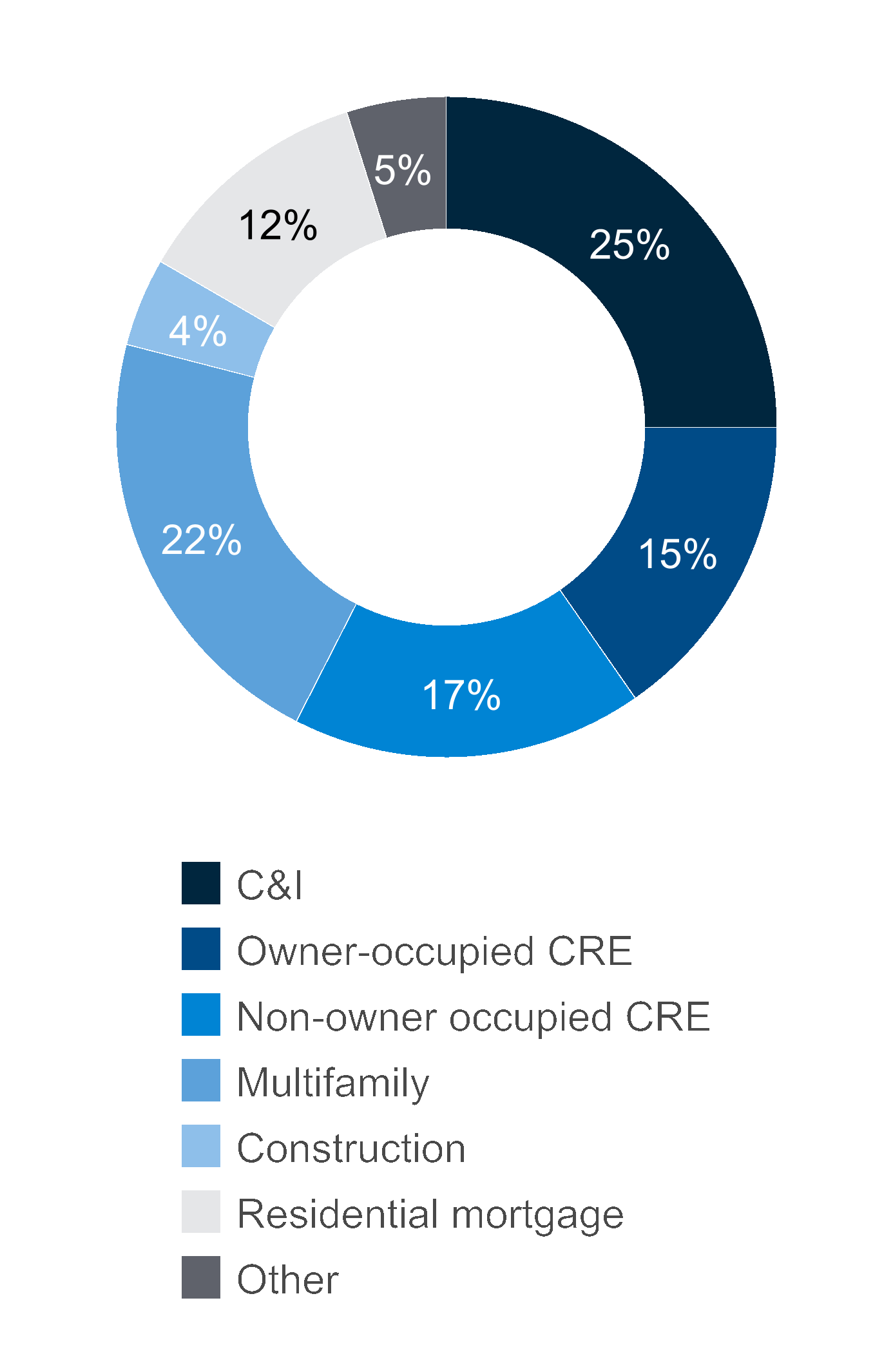
fiscal year 2025.
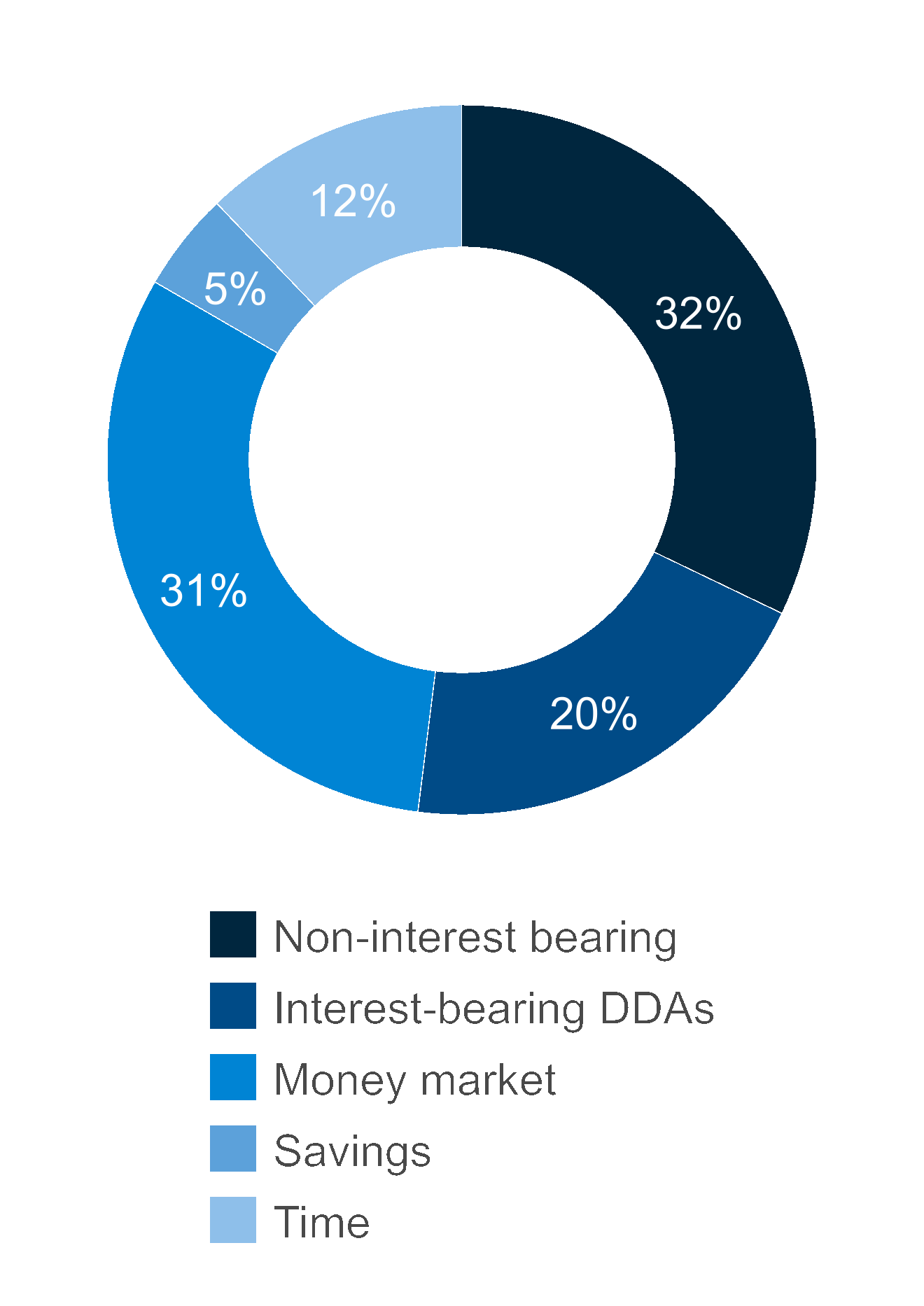
Management has the responsibility for the preparation of the financial statements and the reporting process, including the systems
of internal controls. The independent auditors are responsible for auditing the Company’s financial statements, expressing an

opinion as to their conformity with GAAP and annually auditing the Company’s internal control over financial reporting. The Audit

Committee is responsible for overseeing Columbia’s financial reporting processes on behalf of the Board. With respect to fiscal year
2025, the Audit Committee has:
(1)reviewed and discussed the audited financial statements with management, and management represented to the Audit Committee that
Columbia’s consolidated financial statements were prepared in accordance with GAAP;
(2)discussed with Deloitte & Touche LLP (“Deloitte”) the matters required to be discussed by the applicable requirements of the Public Company
Accounting Oversight Board (“PCAOB”) and the SEC;
(3)received from Deloitte the written communications required by applicable requirements of the PCAOB regarding the independent accountant’s
communications with the Audit Committee concerning independence, and the Audit Committee discussed with Deloitte that firm’s independence;
(4)discussed with Columbia’s internal and independent accountants the overall scope and plans for their respective audits; and
(5)met with the internal and independent auditors, with and without management present, to discuss the results of their examinations, the
evaluations of Columbia’s internal controls, and the overall quality of Columbia’s financial reporting.
The members of the Audit Committee are not employees of the Company and are not performing the functions of auditors or
accountants. As such, it is not the duty or responsibility of the Audit Committee or its members to conduct “field work” or other types
of auditing or accounting reviews or procedures or to set auditor independence standards. Members of the Audit Committee
necessarily rely on the information provided to them by management and the independent accountants. Accordingly, the Audit
Committee’s considerations and discussions referred to above do not assure that the audits of the Company’s financial statements
and internal control over financial reporting have been carried out in accordance with generally accepted auditing standards, that
the financial statements are presented in accordance with GAAP or that the Company’s auditors are in fact “independent.”
The Audit Committee recognizes the importance of maintaining the independence of the Company’s independent auditor, both
in fact and appearance. Each year, the Audit Committee evaluates the qualifications, performance and independence of the
Company’s independent auditor and determines whether to re-engage the current independent auditor. In doing so, the Audit
Committee considers the quality and efficiency of the services provided by the auditors, the auditors’ capabilities, and the auditors’
technical expertise and knowledge of the Company’s operations and industry. Based on this evaluation, the Audit Committee has
retained Deloitte as the Company’s independent auditor for 2026. Deloitte has been the independent auditor for Columbia
since 2018. The members of the Audit Committee and the Board believe that, due to Deloitte’s knowledge of the Company and its
industry, it is in the best interests of the Company and its shareholders to continue retention of Deloitte to serve as the Company’s
independent auditor. Although the Audit Committee has sole authority to appoint the independent auditor, the Audit Committee will
continue to recommend that the Board ask the shareholders, at the Annual Meeting, to ratify the appointment of the independent
auditors. Based on the review and discussions referred to in items (1) through (5) above, the Audit Committee has recommended to
the Board that the audited financial statements be included in Columbia’s Annual Report on Form 10-K for the fiscal year ended
December 31, 2025, for filing with the SEC.
Audit Committee Members
Randal L. Lund (Chair)
John F. Schultz
M. Christian Mitchell
Elizabeth W. Seaton
S. Mae Fujita Numata
Anddria Varnado
79
Table of Contents
Proposal 3 – Ratification of Appointment of Independent Registered Public
Accounting Firm
Deloitte currently serves as our independent registered public accounting firm, and that firm has conducted the audits of our
financial statements since the fiscal year ended December 31, 2018. The Audit Committee has appointed Deloitte to serve as the
Company’s independent registered public accounting firm to conduct an audit of the financial statements for fiscal year 2026.
Appointment of the Company’s independent registered public accounting firm is not required to be submitted to a vote of our
shareholders for approval or ratification. However, upon the recommendation of the Audit Committee, the Board has determined
to submit the appointment of auditors to our shareholders for ratification. In the event our shareholders do not vote to ratify the
appointment, the Audit Committee may reconsider whether to retain Deloitte, and may retain Deloitte or another firm without
re-submitting the matter to our shareholders. Even if the appointment is ratified, the Audit Committee, in its discretion, may direct
the appointment of a different independent registered public accounting firm at any time during the year if it determines that such a
change would be in the Company’s and its shareholders’ best interest.
Representatives of Deloitte are expected to be present virtually at the Annual Meeting and will have the opportunity to make a
statement if they desire to do so. It is also expected that they will be available to respond to appropriate questions.
Vote Required and Board Recommendation
Ratification of the appointment of Deloitte as our independent registered public accounting firm requires that the votes cast “FOR”
the proposal exceed the votes cast “AGAINST” at the virtual Annual Meeting or by proxy and voting on this proposal. Abstentions
and broker non-votes will have no effect on the outcome of this proposal.
The Board of Directors unanimously recommends a vote “FOR” ratification
of the selection of Deloitte & Touche LLP as the Company’s independent
registered public accounting firm for the fiscal year ending December 31, 2026.
Independent Registered Public Accounting Firm
Fees Paid to Independent Registered Public Accounting Firm
The following table sets forth the aggregate fees charged to Columbia by Deloitte for audit services rendered in connection with the
audited consolidated financial statements and reports for the 2025 and 2024 fiscal years and for other services rendered during the
2025 and 2024 fiscal years.
Fee Category
Fiscal 2025
% of Total
Fiscal 2024
% of Total
Audit Fees
$4,553,371
95.1%
$3,169,000
94.3%
Audit-Related Fees
%
97,000
2.9%
Tax Fees
233,705
4.9%
92,967
2.8%
All Other Fees
2,066
%
2,066
0.1%
Total Fees
$4,789,142
100%
$3,361,033
100%
80
Table of Contents
Audit Fees
Consists of fees billed to Columbia for professional services rendered by Deloitte in connection with the audit of our financial
statements included in Columbia’s Annual Report on Form 10-K, review of financial statements included in Columbia’s Quarterly
Reports on Form 10-Q, or services to Columbia in connection with statutory or regulatory filings or engagements, including
consents. Amount includes $1,269,371 for items associated with the acquisition of Pacific Premier, including audit services
associated with purchase accounting and regulatory filings associated with the acquisition as well as $124,000 for expenses.
Audit-Related Fees
Audit-related fees for 2024 represented billings by Deloitte for services provided during the 12 months ended December 31, 2024,
including the audit of the 401(k) Plan for the plan year ended December 31, 2023, which was audited during 2024. Deloitte did not
perform the audit of Columbia’s 401(k) Plan for the year ended December 31, 2024.
Tax Fees
Consists of tax compliance, tax advice, and tax consulting services.
All Other Fees
Consists of accounting research subscriptions. In considering the nature of the services provided by Deloitte, the Audit Committee
determined that such services are compatible with the provision of independent audit services. The Audit Committee discussed
these services with Deloitte and Company management to determine that they are permitted under the rules and regulations
concerning auditor independence promulgated by the SEC to implement Sarbanes-Oxley, as well as the American Institute of
Certified Public Accountants.
Audit Committee Pre-Approval of Audit and Permissible Non-Audit Services of
Independent Auditors
The Audit Committee pre-approved services performed by Deloitte in 2025 and 2024 in accordance with the pre-approval policy
outlined in the Audit Committee’s charter. The policy specifies that pre-approval of all permissible auditing and non-auditing services
to be provided by the Company’s independent auditors is the sole responsibility of the Audit Committee. Prior to commencing such
services, pre-approval is required by the Audit Committee or as delegated to the Audit Committee Chair by the Audit Committee.
Certain Relationships and Related Transactions
Transactions between Columbia or its affiliates and related persons (including directors and executive officers of Columbia and
Columbia Bank, or their immediate family members) must generally be approved by the Audit Committee, in accordance with the
policies and procedures set forth in the Related Party Transaction Policy adopted by the Board. Under the Related Party
Transaction Policy, a transaction with a “related person” will be consummated only if the Audit Committee, or a majority of the
disinterested independent members of the Board, approves or ratifies such transaction in accordance with the guidelines set forth
in the policy and if the transaction is on terms comparable to those that could be obtained in arm’s length dealings with an unrelated
third party.
During 2025 and continuing through the date of this Proxy Statement, certain directors and executive officers of Columbia and
Columbia Bank, and their immediate family members, were customers of Columbia Bank, and it is anticipated that such individuals
will continue to be customers of Columbia Bank in the future. All transactions between Columbia Bank and its executive officers and
directors, and their associates, were made in the ordinary course of business on substantially the same terms, including interest
rates and collateral, as those prevailing at the time for comparable transactions with other persons not related to the Company, and,
in the opinion of management, did not involve more than the normal risk of collectability or present other unfavorable features.
On September 2, 2025, Mr. Gardner, the former board chair, chief executive officer and president of Pacific Premier, entered into a
consulting agreement (the “Gardner Consulting Agreement”) with Columbia and Columbia Bank, pursuant to which Mr. Gardner will
provide consulting services related to (i) the integration of the business operations of Pacific Premier and Pacific Premier Bank into
81
Table of Contents
Columbia’s and its subsidiaries’ business and operations; (ii) client relations services; (iii) investor relations services; and (iv) other
strategic matters as may be reasonably determined by Columbia’s Chief Executive Officer (collectively, the “Services”). Pursuant to
the Gardner Consulting Agreement, Mr. Gardner will provide the Services for a period of one year and one day following September
2, 2025, and will receive $2.2 million payable in equal monthly installments.
Annual Report to Shareholders and Form 10-K
Columbia’s 2025 Annual Report and Form 10-K for the year ended December 31, 2025 (which is not a part of Columbia’s proxy
soliciting materials) have been filed with the SEC and are also available on our website. Copies of the 2025 Annual Report and
Form 10-K will be furnished to shareholders upon request and can be requested by writing to Columbia Banking System, Inc., Attn:
Investor Relations, 1301 A Street, Tacoma, Washington 98402-4200, by emailing shareholders@columbiabank.com, or by calling
(503) 727-4100.
Delivery of Documents to Shareholders Sharing an Address
In some cases, only one copy of the Proxy Statement or Notice, as applicable, is being delivered to multiple shareholders sharing
an address unless we have received contrary instructions from one or more of the shareholders. We will deliver promptly, upon
written or oral request, a separate copy of the Proxy Statement or Notice, as applicable, to a shareholder at a shared address to
which a single copy of the document was delivered. To request a separate delivery of these materials now or in the future, a
shareholder may submit a written or oral request to the Corporate Secretary at the address and number written above. Additionally,
any shareholders who are presently sharing an address and receiving multiple copies of the Proxy Statement, annual reports or the
Notice and who would rather receive a single copy of such materials may instruct us accordingly by directing their request to us in
the manner provided above.
Other Business
The Board knows of no other matters to be brought before shareholders at the Annual Meeting. If other matters are properly
presented for a vote at the meeting, the proxy holders will vote shares represented by proxies at their discretion in accordance with
their judgment on such matters. At the meeting, management will report on our business and shareholders will have the opportunity
to ask questions.
Questions and Answers About Voting and the Annual Meeting
When is the annual meeting? The Annual Meeting will be a virtual meeting conducted exclusively via live webcast at
www.virtualshareholdermeeting.com/COLB2026 at 10:00 a.m. Pacific Time on Thursday, May 14, 2026.
The Board set March 20, 2026 as the record date for the meeting (the “Record Date”). Shareholders who owned Columbia common
stock at the close of business on that date are entitled to vote at the Annual Meeting, with each share entitled to one vote for each
matter to be voted on at the meeting. There were 289,993,853 shares of Columbia common stock outstanding on the Record Date.
Under the rules of the SEC, we are furnishing proxy materials to our shareholders on the Internet, rather than mailing paper copies
of the materials (including the 2025 Annual Report) to each shareholder. As a result, unless you previously elected to receive paper
copies or request them this year, you will not receive paper copies of these proxy materials. We are sending to our shareholders
(other than those that previously elected to receive paper copies) a copy of the Notice, which will instruct you as to how you may
access and review the proxy materials online. The Notice will also instruct you as to how you may access your proxy card to vote
your shares by telephone or online. If you would like to receive a paper copy of our proxy materials, free of charge, please follow
the instructions included in the Notice.
The Notice was mailed, and the accompanying Notice of Annual Meeting of Shareholders and this Proxy Statement are first being
made available, to shareholders on March 31, 2026.
For additional information regarding the matters to be voted on at the Annual Meeting including, among others, who is entitled to
vote at the Annual Meeting, how to vote, and the minimum vote required for each proposal, please see the “Questions and Answers
About Voting and the Annual Meeting” section.
82
Table of Contents
How can I be admitted and participate? You will be able to participate in the Annual Meeting online by visiting
www.virtualshareholdermeeting.com/COLB2026. To be admitted into the virtual Annual Meeting and to participate, you will
need the 16-digit control number included on your Notice, on your proxy card, or on the instructions that accompanied your proxy
materials. If you misplace your 16-digit control number and your shares are held in street name, please contact your broker for
assistance. If you are the registered holder of your shares and misplace your 16-digit control number, please contact
shareholder@broadridge.com or 1-866-232-0399 (toll-free). Contact 1-844-986-0822 (toll-free) if you have any technical difficulties
or trouble accessing the virtual meeting.
How can I ask a question? Prior to the meeting, questions pertinent to meeting matters can be submitted to
shareholders@columbiabank.com or mailed to: Columbia Banking System, Inc., Attn: Corporate Secretary, 1301 A Street, Tacoma,
Washington 98402-4200. During the meeting questions pertinent to meeting matters can only be submitted in the question box
provided at: www.virtualshareholdermeeting.com/COLB2026. We reserve the right to edit or reject questions we deem
inappropriate, and to consolidate similar questions into one. Pertinent questions will be answered during the meeting, subject to
time limitations.
Why did I receive a Notice of Internet Availability of Proxy Materials instead of paper copies of the proxy materials?
Instead of mailing a printed copy of our proxy materials to each shareholder of record, the SEC permits us to furnish proxy
materials to our shareholders over the Internet. If you received the Notice by mail, you will not receive a printed copy of the proxy
materials. Instead, the Notice will instruct you as to how you may access and review the proxy materials and submit your vote via
the Internet. If you received the Notice by mail and would like to receive a printed copy of the proxy materials, please follow the
instructions included in the Notice for requesting such materials.
We mailed the Notice on March 31, 2026 to all shareholders entitled to vote at the Annual Meeting. As of the date of mailing of the
Notice, all shareholders and beneficial owners have the ability to access all of our proxy materials on a website referred to in the
Notice. These proxy materials are available free of charge.
How can I receive e-delivery in the future? Prefer to receive an email instead? While voting on www.proxyvote.com, be sure to
click “Delivery Settings.” Opting for e-delivery of proxy materials is a voluntary choice that reduces environmental impact. By
choosing email notifications and electronic delivery of annual meeting materials, you help conserve natural resources, reduce paper
waste, and lower carbon emissions associated with printing and mailing.
What is being voted on at the Annual Meeting?
At the Annual Meeting you will be asked to vote on the following items of business:
Proposal 1: Election of 12 nominees for director to serve on the Board until the 2027 annual meeting of shareholders or until their successors
have been elected and have qualified;
Proposal 2: Advisory (non-binding) vote on the compensation of the Company’s named executive officers; and
Proposal 3: Ratification (non-binding) of the appointment of Deloitte & Touche LLP as the Company’s independent registered public
accounting firm for the fiscal year ending December 31, 2026.
Who is entitled to vote? Only shareholders who owned Columbia common stock, either directly or beneficially, as of the close of
business on the Record Date are entitled to receive notice of the Annual Meeting and to vote the shares that they held on that date
at the Annual Meeting, or any postponement or adjournment of the Annual Meeting.
How do I vote?
By Internet. For shares registered in your name, you may go to www.proxyvote.com to transmit a proxy to vote your shares by means of the
Internet. You will be required to provide your control number which is contained on the Notice or the proxy card, as applicable. You will then
be asked to complete an electronic proxy card. The votes represented by such proxy will be generated on the computer screen, and you will
be prompted to submit or revise them as desired. We must receive votes submitted via the Internet for shares held by common shareholders
by 11:59 p.m. Eastern Time on May 13, 2026, and for shares held in an employee benefit plan sponsored by the Company by 11:59 p.m.
Eastern Time on May 12, 2026.
By telephone. For shares registered in your name, you may grant a proxy to vote your shares by telephone by calling 1-800-690-6903.
Please see the instructions on the Notice or the proxy card, as applicable. The telephone voting procedures are designed to authenticate
your identity, to allow you to grant a proxy to vote your shares, and to confirm that your instructions have been recorded properly. We must
receive votes submitted via telephone for shares held by common shareholders by 11:59 p.m. Eastern Time on May 13, 2026, and for shares
held in an employee benefit plan sponsored by the Company by 11:59 p.m. Eastern Time on May 12, 2026.
By mail. For shares registered in your name, shareholders who ask for and receive a paper proxy card may vote by mail and should
complete, sign and date their proxy card and mail it in the pre-addressed envelope that will accompany the delivery of the paper proxy card.
Proxy cards submitted by mail must be received by the date and time of the Annual Meeting in order for your shares to be voted.
83
Table of Contents
At the virtual meeting. For shares registered in your name, you may vote online at the Annual Meeting at
www.virtualshareholdermeeting.com/COLB2026. Shares held beneficially in “street name” may be voted by you online at the Annual
Meeting only if you obtain a legal proxy from the broker or other agent that holds your shares, giving you the right to vote the shares. Have
the legal proxy available when you access the virtual meeting web page. A technical assistance phone number will be made available on the
virtual meeting registration page starting 15 minutes prior to the start time of the Annual Meeting to assist with any difficulties you might have
while accessing the virtual meeting during the check-in or meeting time.
For shares registered in the name of a broker or bank. Most beneficial owners, whose stock is held in “street name,” receive instructions
for granting proxies from their banks, brokers or other agents, rather than a proxy card. If your shares are held in a stock brokerage account
or by a bank or other nominee, you are considered the beneficial owner of shares held in “street name,” and as the beneficial owner, you
have the right to direct your broker on how to vote. A number of brokers and banks are participating in a program provided through
Broadridge Financial Solutions, Inc. that offers the means to grant proxies to vote shares over the Internet and telephone. If your shares are
held in an account with a broker or bank participating in the Broadridge program, you may grant a proxy to vote those shares by visiting the
website or calling the telephone number shown on the instruction form received from your broker or bank.
For shares in an employee benefit plan sponsored by the Company. You will be given the opportunity to instruct the trustee of the 401(k)
Plan and the Supplemental Retirement and Deferred Compensation Plan how to vote the shares that you hold in your account. To the extent
that you do not timely give such instructions, the trustee will vote all unvoted shares held in the 401(k) Plan in proportion to the voted shares,
and the trustee will vote the unvoted shares in the Supplemental Retirement and Deferred Compensation Plan as directed by the plan
sponsor as recommended by the Board.
Can I revoke my proxy and/or change my vote? Yes. You may revoke your proxy and change your vote at any time before the
proxy is exercised by filing with Columbia’s Corporate Secretary a notice of revocation, voting again by Internet or telephone
(only your last Internet or telephone proxy submitted prior to the meeting will be counted), signing and returning a new proxy card
with a later date, obtaining a legal proxy from the broker or other agent that holds your shares, or attending the virtual Annual
Meeting and voting online. The powers of the proxy holders will be suspended if you attend the Annual Meeting and so request,
although attendance at the meeting will not by itself revoke a previously granted proxy.
What are the Board’s recommendations? The Board recommends a vote (i) FOR the election of the director nominees listed in
this Proxy Statement, (ii) FOR the approval, on an advisory basis, of the compensation of the Company’s named executive officers,
and (iii) FOR the ratification of the appointment of Deloitte & Touche LLP as the Company’s independent registered public
accounting firm for the fiscal year ending December 31, 2026. If you indicate when voting by Internet or by telephone that you
wish to vote as recommended by the Board, or if you sign and return a proxy card without specific instructions as to how to vote,
Ms. Pope and Mr. Stein, as the persons named as proxy holders on the proxy card, will vote as recommended by the Board. If any
other matters are considered at the meeting, Ms. Pope and Mr. Stein will vote as recommended by the Board. If the Board does not
give a recommendation, Ms. Pope and Mr. Stein will have discretion to vote as they think best.
Will my shares be voted if I do not vote? If your shares are registered in your name and you do not vote by Internet, by
telephone, by mail, or at the virtual meeting, your shares will not be voted. If your shares are held in “street name” and you do not
submit voting instructions to your broker, your broker may vote your shares at this meeting on the ratification of the appointment of
the independent registered public accounting firm only. If no instructions are given with respect to the election of directors or the
advisory vote on the compensation of the Company’s NEOs, your broker cannot vote your shares on these proposals.
How many votes are needed to hold the Annual Meeting? A majority of Columbia’s outstanding shares as of the Record Date
(a quorum) must be present at the Annual Meeting in order to hold the meeting and conduct business. Shares are counted as
present at the meeting if a shareholder is present and votes online at the virtual meeting or has properly submitted a proxy card.
As of the Record Date for the Annual Meeting, 289,993,853 shares of Columbia common stock were outstanding and eligible to
vote. Both abstentions and broker non-votes are counted as present for the purpose of determining the presence of a quorum.
Generally, broker non-votes occur when shares held by a broker for a beneficial owner are not voted with respect to a particular
proposal because (i) the broker has not received voting instructions from the beneficial owner and (ii) the broker lacks discretionary
voting power to vote such shares.
What vote is required to elect directors? In an uncontested election, a nominee for election to a position on the Board will be
elected as a director if such nominee receives a majority of the votes cast. The term of any director who does not receive a majority
of votes cast in an election held under that standard terminates on the earliest to occur of: (i) 90 days after the date election results
are certified; (ii) the date the director resigns; and (iii) the date the Board fills the position. Our Bylaws provide that an election is
considered “contested,” and will be held under a plurality standard, if there are shareholder nominees for director pursuant to the
advance notice provision in Section 1.17 of our Bylaws who are not withdrawn by the advance notice deadline set forth in that
section. You may vote For, Against, or Abstain from voting for the listed nominees. The following will not be considered votes cast
and will have no effect on the election of any director nominee: (i) a share whose ballot is marked as abstain; (ii) a share otherwise
present at the meeting but for which there is an abstention; and (iii) a share otherwise present at the meeting as to which a
shareholder gives no authority or direction. Shareholders may not cumulate their votes in the election of directors.
84
Table of Contents
What vote is required to approve the advisory resolution on the compensation of the Company’s named executive
officers? The proposal to approve, on an advisory basis, the compensation of the Company’s named executive officers will be
adopted if the votes cast For this proposal exceed the votes cast Against at the virtual Annual Meeting or by proxy and voting on
this proposal. You may vote For, Against or Abstain from voting on this proposal. Abstentions and broker non-votes will have no
effect on the outcome of this proposal.
What vote is required to ratify the appointment of the Company’s independent registered public accounting firm?
The proposal to ratify the appointment of Deloitte & Touche LLP as the Company’s independent registered public accounting firm
will be adopted if votes cast For this proposal exceed the votes cast Against at the virtual Annual Meeting or by proxy and voting
on this proposal. You may vote For, Against or Abstain from voting on this proposal. Abstentions and broker non-votes will have no
effect on the outcome of this proposal.
Can I vote on other matters? We have not received timely notice of any shareholder proposals to be considered at the Annual
Meeting, and the Board does not know of any other matters to be brought before the Annual Meeting.
Who is soliciting my proxy and who is paying the cost of solicitation? The Board is soliciting proxies for use at the Annual
Meeting. Certain directors, officers and associates of Columbia and its banking subsidiary, Columbia Bank, may solicit proxies by
mail, telephone, facsimile, or in person. We will pay for the costs of solicitation. We do not expect to pay any compensation for the
solicitation of proxies, except to brokers, nominees and similar record holders for reasonable expenses in mailing proxy materials to
beneficial owners of our common stock. However, management may, if it determines it necessary to obtain the requisite
shareholder vote, retain the services of a proxy solicitation firm.
How can I find out the results of the voting at the Annual Meeting? Preliminary voting results will be announced at the Annual
Meeting. We will publish final results in a Current Report on Form 8-K to be filed with the SEC within four business days after the
Annual Meeting. After the Form 8-K is filed, you may obtain a copy by visiting our website at www.columbiabankingsystem.com, the
SEC’s website at www.sec.gov, or by writing to: Columbia Banking System, Inc., Attn: Corporate Secretary, 1301 A Street, Tacoma,
Washington 98402-4200.
When are proposals and director nominations for the 2027 Annual Meeting due? In order to be considered for inclusion in our
proxy statement and proxy card, proposals by shareholders to transact business at Columbia’s 2027 Annual Meeting must be
delivered to Columbia’s Corporate Secretary no later than December 1, 2026, and should contain such information as is required
under our Bylaws. Such proposals will also need to comply with the SEC’s regulations regarding the inclusion of shareholder
proposals in Columbia-sponsored proxy materials. In order for a shareholder proposal to be raised from the floor during next year’s
annual meeting, or for a shareholder to nominate a person or persons for a director, written notice must be received by us no earlier
than the 150th day and no later than the 120th day prior to the first anniversary of the 2026 Annual Meeting (meaning no earlier
than December 15, 2026, and no later than January 14, 2027), and should contain such information as required under our Bylaws.
However, if the date of the 2027 Annual Meeting is more than 30 days before or more than 60 days after the anniversary of the
2026 Annual Meeting, notice must be delivered no earlier than the 150th day and no later than the 120th day prior to the date of the
2027 Annual Meeting or, if the first public announcement of the 2027 Annual Meeting date is less than ten days before the meeting
date, notice must be delivered no later than the tenth day following the date of the Company’s first public announcement of the
2027 Annual Meeting date.
In addition to satisfying the foregoing requirements, to comply with the new universal proxy rules, shareholders who intend to solicit
proxies in support of director nominees other than Columbia’s nominees must provide notice that sets forth the information required
by Rule 14a-19 under the Exchange Act no later than March 15, 2027. To be in proper form, a shareholder’s notice must include the
specified information concerning the proposal or director nominee as described in our Bylaws. The Company will not consider any
proposal or nomination that is not timely or otherwise does not meet the Bylaw and SEC requirements for submitting a proposal
or nomination. Notice of intention to present proposals at the 2027 Annual Meeting, or to obtain a copy of the detailed procedures
regarding notice requirements for proposals or director nominations, should be directed to: Columbia Banking System, Inc., Attn:
Corporate Secretary, 1301 A Street, Tacoma, Washington 98402-4200.
WE URGE YOU TO VOTE VIA THE INTERNET OR TELEPHONE ACCORDING TO THE INSTRUCTIONS ON THE NOTICE OR
REQUEST A PROXY CARD AND SIGN AND RETURN IT WHEN RECEIVED AS PROMPTLY AS POSSIBLE, WHETHER OR
NOT YOU PLAN TO ATTEND THE VIRTUAL ANNUAL MEETING. IF YOU DO ATTEND THE ANNUAL MEETING, YOU MAY
THEN WITHDRAW YOUR PROXY. THE PROXY MAY BE REVOKED AT ANY TIME PRIOR TO ITS EXERCISE.
A-1
Appendix A
Non-GAAP Financial Measures
The Company considers its operating PPNR, operating PPNR excluding Pacific Premier results from the acquisition date through
year-end 2025, operating net income, operating EPS – diluted, operating efficiency ratio, operating ROAA, ROTCE and operating
ROTCE to be important measurements as they reflect the ongoing operating leverage of the Company. Additionally, presentation of
these measures allows readers to compare certain aspects of the Company’s financial success to other organizations, and the
Company also uses operating PPNR, operating PPNR excluding Pacific Premier results from the acquisition date through year-end
2025, and ROTCE as part of our incentive compensation program for our executive officers. Despite the importance of these
measures to the Company, there are no standardized definitions for them and, as a result, the Company’s calculations may not be
comparable with other organizations. The Company encourages readers to consider its consolidated financial statements in their
entirety and not to rely on any single financial measure.
checkmark_hres.gif
The following table reconciles the Company’s calculation of operating PPNR:
Twelve Months Ended December 31,
Operating PPNR:
2025
2024
2023*
2022*
2021*
($ in thousands)
Net Income
$550,292
$533,675
$348,715
$336,752
$420,300
Exit and disposal costs
1,838
3,993
10,218
6,805
12,763
Merger-related expense
148,309
23,713
171,659
17,356
15,183
Legal settlement and other non-operating expense
58,840
Acquisition-related provision expense
70,322
FDIC special assessment
(5,936)
5,732
32,923
Mortgage servicing rights hedge gain
(4,564)
8,603
4,693
14,476
Change in fair value of mortgage servicing rights due to
valuation inputs or assumptions
3,745
(5,229)
6,122
(57,537)
(11,089)
Change in fair value of certain loans held for investment
(10,968)
10,476
(2,630)
58,464
(3,032)
Loss on swap derivatives
2,348
(1,667)
4,597
(16,249)
(8,395)
Gain on investment securities
(6,497)
368
(2,313)
7,097
1,503
Goodwill impairment
Tax effect of adjustment
(61,081)
(11,497)
(52,567)
(7,479)
1,014
Operating net income
746,648
568,167
521,417
359,685
428,247
Provision for credit losses
79,223
105,924
213,199
84,016
(42,651)
Provision for income taxes (excluding tax effect of
adjustments above)
238,672
196,572
175,051
121,305
136,846
Operating PPNR
$1,064,543
$870,663
$909,667
$565,006
$522,442
Exclusion of Pacific Premier results
(116,536)
Operating PPNR excluding Pacific Premier results from
the acquisition date through year-end 2025
$948,007
$870,663
$909,667
$565,006
$522,442
*Financial results for periods ended prior to February 28, 2023 reflect Umpqua results on a standalone basis.
A-2
checkmark_hres.gif
The following table reconciles the Company’s calculation of operating return on average assets:
Twelve Months Ended December 31,
Return on average assets:
2025
2024
2023*
2022*
2021*
($ in thousands)
Operating net income (numerator)
$746,648
$568,167
$521,417
$359,685
$428,247
Average assets (denominator)
$56,778,735
$51,915,054
$49,496,319
$30,817,396
$30,267,372
Operating return on average assets
(numerator / denominator)
1.31%
1.09%
1.05%
1.17%
1.41%
*Financial results for periods ended prior to February 28, 2023 reflect Umpqua results on a standalone basis.
checkmark_hres.gif
The following table reconciles the Company’s calculation of operating earnings per share – diluted:
EPS - Diluted and Operating EPS - Diluted:
2025
2024
Q4 2025
Q4 2024
($ in thousands except per share data)
Net Income (numerator 1)
$550,292
$533,675
$214,913
$143,269
Operating net income (numerator 2)
$746,648
$568,167
$242,670
$149,746
Weighted average diluted shares outstanding (denominator)
239,121
209,337
296,760
209,889
Earnings per share - diluted (numerator 1 / denominator)
$2.30
$2.55
$0.72
$0.68
Operating earnings per share - diluted (numerator 2 /
denominator)
$3.12
$2.71
$0.82
$0.71
A-3
checkmark_hres.gif
The following table reconciles the Company’s calculation of operating efficiency ratio:
Efficiency Ratio and Operating Efficiency Ratio:
2025
2024
Q4 2025
Q4 2024
($ in thousands)
Non-interest expense (numerator 1)
$1,423,417
$1,104,694
$412,141
$266,576
Merger-related expense
(148,309)
(23,713)
(39,278)
(2,230)
Exit and disposal costs
(1,838)
(3,993)
(395)
(872)
FDIC special assessment
5,936
(5,732)
4,683
Legal settlement and other non-operating expense
(58,840)
(3,640)
B&O taxes
(12,364)
(13,149)
(3,215)
(3,495)
Operating non-interest expense (numerator 2)
$1,208,002
$1,058,107
$370,296
$259,979
Net interest income (tax equivalent)(1)
$2,008,916
$1,722,386
$628,721
$438,424
Non-interest income
297,975
210,966
89,284
49,747
Revenue (tax equivalent) (denominator 1)(1)
2,306,891
1,933,352
718,005
488,171
BOLI tax equivalent adjustment(1)
7,758
7,758
2,623
1,390
(Gain) loss on investment securities, net
(6,497)
368
(2,102)
1,414
Loss (gain) on swap derivatives
2,348
(1,667)
488
(3,642)
Change in fair value of certain loans held for investment
(10,968)
10,476
(212)
7,355
Change in fair value of MSR due to valuation inputs or
assumptions
3,745
(5,229)
426
(7,414)
MSR hedge gain (loss)
(4,564)
8,603
(758)
7,819
Operating Revenue (tax equivalent) (denominator 2)(1)
$2,298,713
$1,953,661
$718,470
$495,093
Efficiency ratio (numerator 1 / denominator 1)(1)
61.68%
57.14%
57.30%
54.61%
Operating efficiency ratio (numerator 2 / denominator 2)(1)
52.54%
54.22%
51.39%
52.51%
(1)  Tax-exempt income was adjusted to a taxable equivalent basis using a 21% tax rate and added to stated revenue for this calculation. Tax-exempt income was adjusted
to a taxable equivalent basis using a 21% tax rate and added to stated revenue for this calculation.
A-4
checkmark_hres.gif
The following table reconciles the Company’s calculation of ROTCE and operating ROTCE:
ROTCE and operating ROTCE:
2025
2024
Q4 2025
Q4 2024
($ in thousands)
Total average shareholders’ equity (denominator 1)
$6,125,745
$5,060,365
$7,813,563
$5,226,289
Less: Average goodwill and intangibles
1,729,397
1,573,712
2,217,116
1,528,431
Average tangible common shareholders’ equity (denominator 2)
$4,396,348
$3,486,653
$5,596,447
$3,697,858
Net income (numerator 1)
$550,292
$533,675
$214,913
$143,269
Return on average common equity (numerator 1 / denominator 1)
8.98%
10.55%
10.92%
10.91%
Return on average tangible common equity (numerator 1 /
denominator 2)
12.51%
15.31%
15.24%
15.41%
Operating net income (numerator 2)
$746,648
$568,167
$242,670
$149,746
Operating return on average tangible common equity (numerator
2 / denominator 2)
16.97%
16.30%
17.22%
16.11%
COLUMBIA BANKING SYSTEM, INC._V_PRXY_GT20_P46176_26(#94419) - C2_PC_Page_1.jpg
COLUMBIA BANKING SYSTEM, INC._V_PRXY_GT20_P46176_26(#94419) - C2_PC_Page_2.jpg