Please wait
0000890926falseDEF 14A0000890926ecd:YrEndFrValOfEqtyAwrdsGrntdInCvrdYrOutsdngAndUnvstdMemberecd:PeoMember2025-01-012025-12-310000890926ecd:NonPeoNeoMemberecd:ChngInFrValOfOutsdngAndUnvstdEqtyAwrdsGrntdInPrrYrsMember2025-01-012025-12-310000890926ecd:NonPeoNeoMemberecd:ChngInFrValOfOutsdngAndUnvstdEqtyAwrdsGrntdInPrrYrsMember2023-01-012023-12-310000890926ecd:EqtyAwrdsInSummryCompstnTblForAplblYrMemberecd:PeoMember2025-01-012025-12-310000890926ecd:NonPeoNeoMemberecd:EqtyAwrdsInSummryCompstnTblForAplblYrMember2021-01-012021-12-310000890926ecd:ChngInFrValOfOutsdngAndUnvstdEqtyAwrdsGrntdInPrrYrsMemberecd:PeoMember2022-01-012022-12-310000890926ecd:EqtyAwrdsInSummryCompstnTblForAplblYrMemberecd:PeoMember2022-01-012022-12-31000089092612025-01-012025-12-310000890926ecd:EqtyAwrdsInSummryCompstnTblForAplblYrMemberecd:PeoMember2021-01-012021-12-310000890926ecd:NonPeoNeoMemberecd:ChngInFrValAsOfVstngDtOfPrrYrEqtyAwrdsVstdInCvrdYrMember2022-01-012022-12-310000890926ecd:ChngInFrValAsOfVstngDtOfPrrYrEqtyAwrdsVstdInCvrdYrMemberecd:PeoMember2024-01-012024-12-310000890926ecd:ChngInFrValAsOfVstngDtOfPrrYrEqtyAwrdsVstdInCvrdYrMemberecd:PeoMember2023-01-012023-12-310000890926ecd:NonPeoNeoMemberecd:YrEndFrValOfEqtyAwrdsGrntdInCvrdYrOutsdngAndUnvstdMember2022-01-012022-12-310000890926ecd:NonPeoNeoMemberecd:ChngInFrValOfOutsdngAndUnvstdEqtyAwrdsGrntdInPrrYrsMember2022-01-012022-12-310000890926ecd:EqtyAwrdsInSummryCompstnTblForAplblYrMemberecd:PeoMember2024-01-012024-12-310000890926ecd:EqtyAwrdsInSummryCompstnTblForAplblYrMemberecd:PeoMember2023-01-012023-12-3100008909262021-01-012021-12-310000890926ecd:ChngInFrValOfOutsdngAndUnvstdEqtyAwrdsGrntdInPrrYrsMemberecd:PeoMember2023-01-012023-12-310000890926ecd:YrEndFrValOfEqtyAwrdsGrntdInCvrdYrOutsdngAndUnvstdMemberecd:PeoMember2021-01-012021-12-310000890926ecd:YrEndFrValOfEqtyAwrdsGrntdInCvrdYrOutsdngAndUnvstdMemberecd:PeoMember2022-01-012022-12-310000890926ecd:NonPeoNeoMemberecd:ChngInFrValOfOutsdngAndUnvstdEqtyAwrdsGrntdInPrrYrsMember2024-01-012024-12-310000890926ecd:YrEndFrValOfEqtyAwrdsGrntdInCvrdYrOutsdngAndUnvstdMemberecd:PeoMember2023-01-012023-12-310000890926ecd:NonPeoNeoMemberecd:VstngDtFrValOfEqtyAwrdsGrntdAndVstdInCvrdYrMember2024-01-012024-12-310000890926ecd:NonPeoNeoMemberecd:VstngDtFrValOfEqtyAwrdsGrntdAndVstdInCvrdYrMember2022-01-012022-12-310000890926ecd:ChngInFrValOfOutsdngAndUnvstdEqtyAwrdsGrntdInPrrYrsMemberecd:PeoMember2024-01-012024-12-310000890926ecd:NonPeoNeoMemberecd:VstngDtFrValOfEqtyAwrdsGrntdAndVstdInCvrdYrMember2023-01-012023-12-3100008909262022-01-012022-12-310000890926ecd:NonPeoNeoMemberecd:ChngInFrValAsOfVstngDtOfPrrYrEqtyAwrdsVstdInCvrdYrMember2025-01-012025-12-310000890926ecd:NonPeoNeoMemberecd:ChngInFrValAsOfVstngDtOfPrrYrEqtyAwrdsVstdInCvrdYrMember2024-01-012024-12-310000890926ecd:ChngInFrValAsOfVstngDtOfPrrYrEqtyAwrdsVstdInCvrdYrMemberecd:PeoMember2025-01-012025-12-310000890926ecd:NonPeoNeoMemberecd:ChngInFrValAsOfVstngDtOfPrrYrEqtyAwrdsVstdInCvrdYrMember2023-01-012023-12-310000890926ecd:NonPeoNeoMemberecd:ChngInFrValOfOutsdngAndUnvstdEqtyAwrdsGrntdInPrrYrsMember2021-01-012021-12-310000890926ecd:NonPeoNeoMemberecd:YrEndFrValOfEqtyAwrdsGrntdInCvrdYrOutsdngAndUnvstdMember2021-01-012021-12-3100008909262023-01-012023-12-310000890926ecd:NonPeoNeoMemberecd:VstngDtFrValOfEqtyAwrdsGrntdAndVstdInCvrdYrMember2025-01-012025-12-310000890926ecd:NonPeoNeoMemberecd:YrEndFrValOfEqtyAwrdsGrntdInCvrdYrOutsdngAndUnvstdMember2024-01-012024-12-310000890926ecd:NonPeoNeoMemberecd:VstngDtFrValOfEqtyAwrdsGrntdAndVstdInCvrdYrMember2021-01-012021-12-310000890926ecd:ChngInFrValOfOutsdngAndUnvstdEqtyAwrdsGrntdInPrrYrsMemberecd:PeoMember2021-01-012021-12-3100008909262024-01-012024-12-310000890926ecd:NonPeoNeoMemberecd:YrEndFrValOfEqtyAwrdsGrntdInCvrdYrOutsdngAndUnvstdMember2023-01-012023-12-310000890926ecd:NonPeoNeoMemberecd:EqtyAwrdsInSummryCompstnTblForAplblYrMember2022-01-012022-12-310000890926ecd:NonPeoNeoMemberecd:EqtyAwrdsInSummryCompstnTblForAplblYrMember2025-01-012025-12-310000890926ecd:NonPeoNeoMemberecd:EqtyAwrdsInSummryCompstnTblForAplblYrMember2023-01-012023-12-310000890926ecd:NonPeoNeoMemberecd:YrEndFrValOfEqtyAwrdsGrntdInCvrdYrOutsdngAndUnvstdMember2025-01-012025-12-310000890926ecd:ChngInFrValAsOfVstngDtOfPrrYrEqtyAwrdsVstdInCvrdYrMemberecd:PeoMember2022-01-012022-12-3100008909262025-01-012025-12-310000890926ecd:YrEndFrValOfEqtyAwrdsGrntdInCvrdYrOutsdngAndUnvstdMemberecd:PeoMember2024-01-012024-12-310000890926ecd:ChngInFrValAsOfVstngDtOfPrrYrEqtyAwrdsVstdInCvrdYrMemberecd:PeoMember2021-01-012021-12-31000089092622025-01-012025-12-310000890926ecd:ChngInFrValOfOutsdngAndUnvstdEqtyAwrdsGrntdInPrrYrsMemberecd:PeoMember2025-01-012025-12-31000089092632025-01-012025-12-310000890926ecd:NonPeoNeoMemberecd:EqtyAwrdsInSummryCompstnTblForAplblYrMember2024-01-012024-12-310000890926ecd:NonPeoNeoMemberecd:ChngInFrValAsOfVstngDtOfPrrYrEqtyAwrdsVstdInCvrdYrMember2021-01-012021-12-31000089092642025-01-012025-12-31rdn:UsdSharesrdn:UsdPerSharesiso4217:USD


UNITED STATES

SECURITIES AND EXCHANGE COMMISSION

WASHINGTON, D.C. 20549

SCHEDULE 14A

(Rule 14a-101)

INFORMATION REQUIRED IN PROXY STATEMENT

SCHEDULE 14A INFORMATION

Proxy Statement Pursuant to Section 14(a) of the

Securities Exchange Act of 1934

(Amendment No. )

Filed by the Registrant ☑

Filed by a Party other than the Registrant ☐

Check the appropriate box:


Preliminary Proxy Statement

Confidential, for Use of the Commission Only (as permitted by Rule 14a-6(e)(2))

Definitive Proxy Statement

Definitive Additional Materials

Soliciting Material under §240.14a-12


Radian Group Inc.


(Name of Registrant as Specified in its Charter)


(Name of Person(s) Filing Proxy Statement if Other Than the Registrant)

Payment of Filing Fee (Check all boxes that apply):


No fee required.

Fee paid previously with preliminary materials.

Fee computed on table in exhibit required by Item 25(b) per Exchange Act Rules 14a-6(i)(1) and 0-11.


Notice of 2026 Annual Meeting of

Stockholders and Proxy Statement

DATE: Thursday, May 21, 2026

TIME: 9:00 a.m. Eastern Daylight Time

PLACE: Live via the Internet. Please visit: https://meetnow.global/MKZWLC7


img218658603_0.jpg


gfx218658603_0.jpg


gfx218658603_1.jpg


OUR CORE VALUES

We embrace six core organizational values that we live by, and that define who we are as an enterprise:

img218658603_2.jpg

Deliver the Brand Promise

We are a customer-centric enterprise striving to be the market leading brand as defined by our customers.


img218658603_3.jpg

Our People are the Difference

We recognize that our people make the difference in our franchise.

img218658603_4.jpg

Innovate for the Future

We embrace innovative technologies to strategically differentiate the delivery of our products and services.


img218658603_5.jpg

Do What’s Right

We will always do the right thing, without compromise.

img218658603_6.jpg

Create Shareholder Value

We build long-term shareholder value through sustainable growth and profitability.


img218658603_7.jpg

Partner to Win

We recognize that we cannot reach our goals alone, so we will develop intelligent strategic alliances with best-in-class partners.


OUR IMPACT

img218658603_1.jpg

I am proud to be part of a company that stands by its values and is committed to making a positive impact for our customers, employees and communities.


Rick Thornberry, CEO


At Radian, we recognize our responsibility to our employees, customers and communities, and we believe socially responsible and sustainable practices are the right way to do business. Visit https://www.radian.com/our-impact to learn more about our Corporate Responsibility program. You will also find additional disclosures of relevant metrics related to our company, including those relevant to the Sustainability Accounting Standards Board (SASB) standards for the insurance industry, Task Force on Climate-Related Financial Disclosures (TCFD), and a discussion of how we help support certain United Nations Sustainable Development Goals (UN SDGs).


img218658603_8.jpg

April 2, 2026


Dear Stockholder:

You are cordially invited to attend the 2026 Annual Meeting of Stockholders of Radian Group Inc. (the “Annual Meeting”), which will be held exclusively in virtual format via live audio webcast at 9:00 a.m. Eastern Daylight Time on May 21, 2026. The accompanying Notice of 2026 Annual Meeting of Stockholders and 2026 Proxy Statement describe the items to be considered and acted upon by the stockholders at the Annual Meeting. There is no physical location for the Annual Meeting.

For our Annual Meeting, we have elected to use the internet as the primary means of providing our proxy materials to stockholders. Stockholders of record on the record date will receive a Notice of Internet Availability of Proxy Materials (the “Notice”) with instructions for accessing the proxy materials. The Notice also provides information on how to vote, how to attend the Annual Meeting, and how stockholders who wish to request paper copies of our proxy materials, including a proxy card, may obtain them free of charge.

Regardless of whether you plan to attend the virtual Annual Meeting, we hope you will vote as soon as possible. Stockholders of record can vote their shares by using the internet. If you received your materials by mail, you also may vote your shares by telephone or by marking your votes on the enclosed proxy card, signing and dating it, and mailing it in the enclosed envelope. If you attend the virtual Annual Meeting, you may revoke your proxy, if you wish, and vote your shares during the meeting electronically via the internet. Because the representation of stockholders at the Annual Meeting is very important, we thank you in advance for your participation.

Sincerely,


img218658603_9.gif


Elizabeth A. Diffley

Senior Corporate Counsel and Corporate Secretary


Radian Group Inc.

550 East Swedesford Road, Suite 350 | Wayne, PA 19087 | 800.523.1988 | radian.com


img218658603_10.jpg


NOTICE OF 2026 ANNUAL MEETING OF STOCKHOLDERS


DATE:

Thursday, May 21, 2026

TIME:

9:00 a.m. Eastern Daylight Time

PLACE:

Live via the internet

Please visit: https://meetnow.global/MKZWLC7

RECORD DATE:

Stockholders of record as of the close of business on March 23, 2026, will be entitled to notice of, and to vote at, the annual meeting or any adjournment or postponement of the meeting.


ITEMS OF BUSINESS:

1

Elect eleven directors, each for a one-year term, to serve until their successors have been duly elected and qualified;

2

Conduct an advisory vote to approve the compensation of our named executive officers;

3

Approve the Radian Group Inc. 2026 Equity Compensation Plan;

4

Ratify the appointment of PricewaterhouseCoopers LLP as our independent registered public accounting firm for the year ending December 31, 2026; and

5

In addition to the items above, the Company may transact such other business as may properly come before the meeting or any adjournment or postponement of the meeting.


Instead of paper copies of this notice of meeting, our 2026 Proxy Statement and our 2025 Annual Report to Stockholders, many stockholders received a Notice of Internet Availability of Proxy Materials (the “Notice”), which Notice was mailed to stockholders beginning on or about April 2, 2026. The Notice provides instructions on how to access these documents over the internet and information on how stockholders who wish to request paper copies of these proxy materials, including a proxy card, may obtain them free of charge. Electronic delivery enables us to more cost effectively provide you with the information you need while reducing the environmental impact of printing and mailing paper copies.

We have determined that it is in the best interest of Radian and its stockholders to hold the 2026 Annual Meeting of Stockholders (the “Annual Meeting”) virtually via live audio webcast. To attend the Annual Meeting or to examine a list of stockholders, go to https://meetnow.global/MKZWLC7 at the meeting date and time described above and in the accompanying 2026 Proxy Statement. There is no physical location for the Annual Meeting.

Regardless of whether you plan to attend Radian’s virtual Annual Meeting, we hope you will vote as soon as possible. For instructions about voting, please see “How Shares May Be Voted by Registered Stockholders” and “How Shares May Be Voted if Held in ‘Street Name’” beginning on page 2 of the 2026 Proxy Statement.

By Order of the Board of Directors,

img218658603_11.gif

Elizabeth A. Diffley

Senior Corporate Counsel and Corporate Secretary

Wayne, Pennsylvania

April 2, 2026


IMPORTANT NOTICE REGARDING THE AVAILABILITY OF PROXY MATERIALS FOR THE ANNUAL MEETING OF STOCKHOLDERS TO BE HELD ON MAY 21, 2026:

Our 2026 Proxy Statement and 2025 Annual Report to Stockholders are available at
www.radian.com/StockholderReports.

Radian Group Inc.

550 East Swedesford Road, Suite 350 | Wayne, PA 19087 | 800.523.1988 | radian.com


TABLE OF CONTENTS


Page

Information About Voting

1

Proposal 1—Election of Directors

6

Corporate Governance and Board Matters

21

Proposal 2—Advisory Vote to Approve the Compensation of the Company’s Named Executive Officers

36

Proposal 3—Approval of Radian Group Inc. 2026 Equity Compensation Plan

38

Proposal 4—Ratification of the Appointment of PricewaterhouseCoopers LLP

51

Executive Officers

53

Beneficial Ownership of Common Stock

56

Compensation of Executive Officers and Directors

59

Other Information

110

Appendix A—Radian Group Inc. 2026 Equity Compensation Plan

A-1

Appendix B—Reconciliation of Non-GAAP Measures

B-1

Website References

Websites referred to in the proxy materials, including this Proxy Statement, are provided for reference only and are not incorporated by reference into this Proxy Statement.

Forward-Looking Statements

This Proxy Statement includes “forward-looking statements” within the meaning of Section 27A of the Securities Act, Section 21E of the Exchange Act and the U.S. Private Securities Litigation Reform Act of 1995. In most cases, forward-looking statements may be identified by words such as “anticipate,” “may,” “will,” “could,” “should,” “would,” “expect,” “intend,” “plan,” “goal,” “pursue,” “contemplate,” “believe,” “estimate,” “predict,” “project,” “potential,” “continue,” “seek,” “strategy,” “future,” “likely” or the negative or other variations on these words and other similar expressions. These statements, which may include, without limitation, projections regarding our future performance, results of operations and financial condition, are made on the basis of management’s current views and assumptions with respect to future events and are not a guarantee of future performance. The forward-looking statements, as well as our prospects as a whole, are subject to risks and uncertainties that could cause actual results to differ materially from those set forth in the forward-looking statements. These risks and uncertainties include those associated with our acquisition of Inigo (as defined herein) and with our plans to divest or otherwise exit our mortgage conduit, title and real estate businesses. For more information regarding these risks and uncertainties as well as certain additional risks that we face, you should refer to the Cautionary Note Regarding Forward-Looking Statements—Safe Harbor Provisions section and the Risk Factors detailed in Part I, Item 1A of our Annual Report on Form 10-K for the year ended December 31, 2025. We caution you not to place undue reliance on these forward-looking statements, which are current only as of the date of this Proxy Statement. We do not intend to, and we disclaim any duty or obligation to, update or revise any forward-looking statements to reflect new information or future events or for any other reason.


i

2026 Proxy Statement

img218658603_12.jpg


RADIAN GROUP INC.

550 East Swedesford Road, Suite 350

Wayne, Pennsylvania 19087

www.radian.com

PROXY STATEMENT
FOR 2026 ANNUAL MEETING OF STOCKHOLDERS

The board of directors (the “Board”) of Radian Group Inc. (“Radian” or the “Company”) is furnishing this Proxy Statement to solicit proxies from the Company’s stockholders for use at Radian’s 2026 Annual Meeting of Stockholders (the “Annual Meeting”). For our Annual Meeting, we have elected to use the internet as the primary means of providing our proxy materials to stockholders. Stockholders of record on the record date will receive a Notice of Internet Availability of Proxy Materials (the “Notice”) with instructions for accessing the proxy materials. The Notice also provides information on how to vote, how to attend the meeting, and how stockholders who wish to request paper copies of our proxy materials, including a proxy card, may obtain them free of charge. This Proxy Statement and our 2025 Annual Report to Stockholders (the “Proxy Materials”) are first being released, and the Notice is being mailed, to stockholders beginning on or about April 2, 2026, to furnish information relating to the business to be transacted at the Annual Meeting. If you would like to receive a printed copy of the Proxy Materials, please follow the instructions included in the Notice. Upon request, we will promptly mail you paper copies of these materials free of charge.

Our Proxy Materials are also available at www.investorvote.com/RDN and at www.radian.com/StockholderReports.

We have determined that it is in the best interest of Radian and its stockholders to hold the Annual Meeting “virtually” via live audio webcast. The virtual Annual Meeting affords our stockholders the same rights and opportunities as an in-person meeting, while allowing them to attend the meeting regardless of their geographic location or other circumstances that could limit their ability to attend an in-person meeting. You will be able to attend the Annual Meeting online, and subject to the eligibility requirements below, you will be able to vote your shares electronically and submit your questions during the meeting by visiting https://meetnow.global/MKZWLC7 at the meeting date and time described below. There is no physical location for the Annual Meeting.

Information About Voting


SECTION CONTENTS

Page

Who May Vote

2

What Shares May Be Voted

2

How Shares May Be Voted by Registered Stockholders

2

How Shares May Be Voted if Held in “Street Name”

3

How to Participate in the Virtual Annual Meeting

3

Where to Find Voting Results

4

Quorum and Votes Required for Approval

4


Information About Voting

1

2026 Proxy Statement

img218658603_13.jpg


Who May Vote

Only stockholders of record on the close of business on March 23, 2026, the record date for the Annual Meeting, may vote at the Annual Meeting. On the record date, 134,826,669 shares of our common stock were outstanding and entitled to vote at the Annual Meeting. For each share of common stock you held on the record date, you will be entitled to one vote on each matter submitted to a vote of stockholders. There is no cumulative voting.

What Shares May Be Voted

You may vote all shares of our common stock owned by you as of the close of business on the record date.

These shares include:

Shares held directly in your name as the stockholder of record (“Registered Stockholder”); and
Shares of which you are the beneficial owner but not the stockholder of record. These are shares not registered in your name, but registered in “street name” through an account you have with a bank, broker or other holder of record (a “Nominee”), including shares owned by the Radian Group Inc. Savings Incentive Plan (the “Savings Plan”) Stock Fund.

How Shares May Be Voted by Registered Stockholders

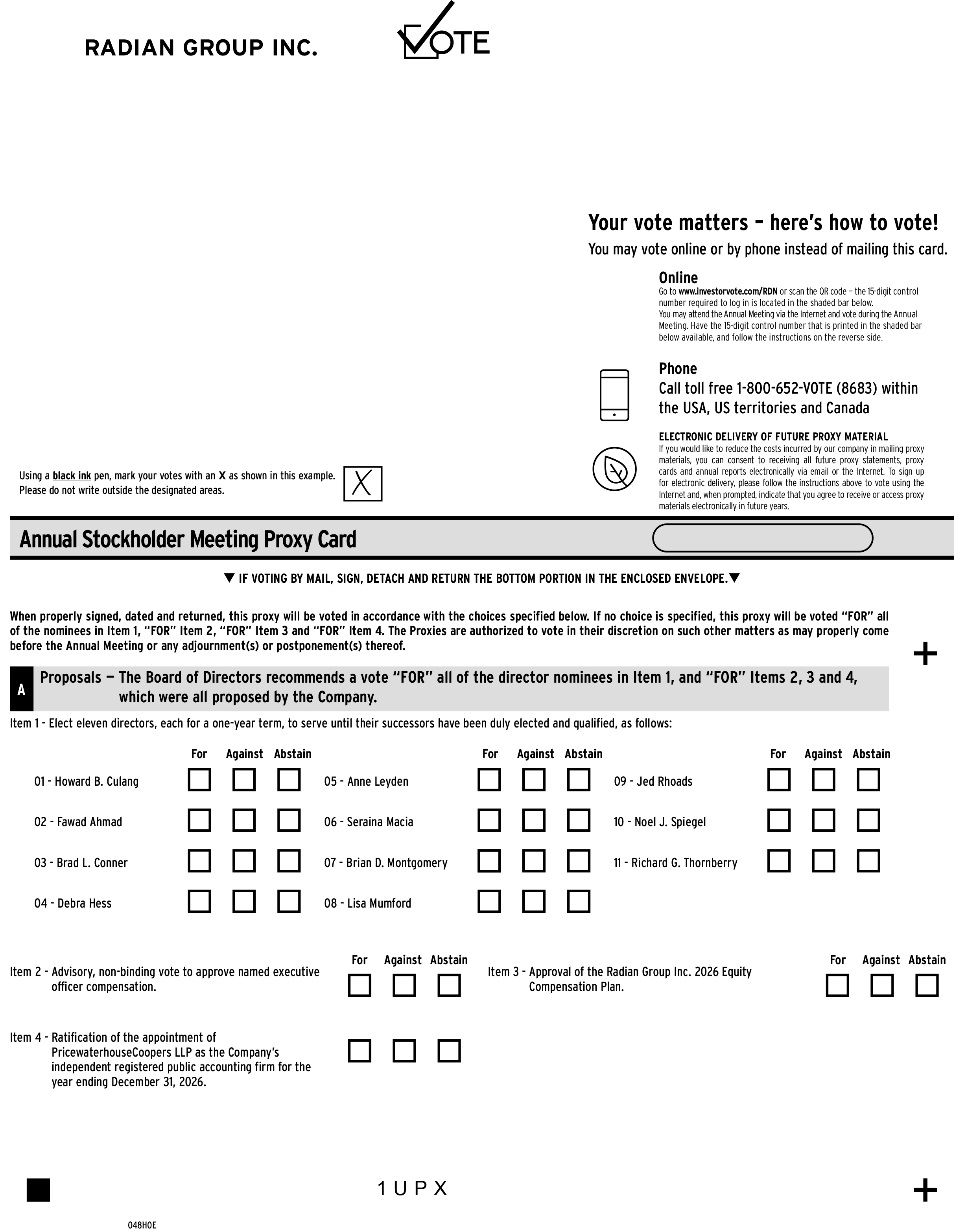
If you are a Registered Stockholder, as described above, you may submit a proxy to vote your shares before the Annual Meeting, as follows:


img218658603_14.jpg


img218658603_15.jpg


img218658603_16.jpg


By Mail:

If you received a paper proxy card or voting instruction form, complete, sign, date and return the proxy card by mail. If you received a Notice and wish to vote by mail, you can request a paper copy of the full set of Proxy Materials by following the instructions in the Notice.


Online:

Go to www.investorvote.com/RDN and follow the instructions on the screen. It will be necessary to have your Notice or proxy card available for reference when you access the web page.


By Telephone:

If you received a paper proxy card or voting instruction form, call toll free 1-800-652-VOTE (1-800-652-8683) within the United States and its territories or Canada, and follow the instructions. It will be necessary to have your proxy card available for reference when you call.


In addition to the above alternatives, you may vote your shares at the Annual Meeting if you attend online. See “How to Participate in the Virtual Annual Meeting” below.

You may revoke your proxy at any time before your shares are voted at the Annual Meeting, as follows:

Notify our Corporate Secretary in writing that you wish to revoke your proxy;
Submit another proxy with a later date by mail, internet or telephone, as described above and by the deadline set forth on your Notice or proxy card for voting by internet or telephone; or
Attend the Annual Meeting online and give notice of revocation of your proxy (attendance at the Annual Meeting online, by itself, will not constitute revocation).

Information About Voting

2

2026 Proxy Statement

img218658603_13.jpg


How Shares May Be Voted if Held in “Street Name”

If you hold your shares in “street name,” meaning your shares are held by a Nominee, you will have received voting instructions from that Nominee containing instructions that you must follow in order for your shares to be voted. If you hold your shares in “street name,” you should review and follow the voting instructions provided by your Nominee, including any instructions relating to revoking voting instructions. If your shares are held in “street name” and you wish to vote at the Annual Meeting online, you must obtain a legal proxy from your Nominee.

Your vote is important to Radian. Whether you are a Registered Stockholder or your shares are held by a Nominee, we encourage you to submit your proxy or voting instructions, as described above, even if you plan to attend the Annual Meeting online. You can always change your vote or revoke your proxy or voting instructions before the meeting or vote online at the meeting, as described above.

How to Participate in the Virtual Annual Meeting

The Annual Meeting will be a completely virtual meeting of stockholders and will be conducted exclusively by live audio webcast. No physical meeting will be held. You will only be able to attend the Annual Meeting online, and, subject to the eligibility requirements below, you will be able to participate by voting and submitting questions, by visiting https://meetnow.global/MKZWLC7.

The virtual Annual Meeting will begin promptly at 9:00 a.m., Eastern Daylight Time, on May 21, 2026. We encourage you to access the Annual Meeting before the start time to leave ample time for check-in and to ensure that you can hear streaming audio. The virtual Annual Meeting will be accessible on desktop and laptop computers, as well as tablets and smartphones.

Participation by Registered Stockholders

To participate in the Annual Meeting, you must have been a stockholder of the Company as of the close of business on the record date, or you must hold a valid proxy for the Annual Meeting. If you are a stockholder of record, you will need to review the information included on your Notice or proxy card, including the 15-digit control number provided in the shaded bar and log in using that control number.

Participation if Shares Held in “Street Name”

If you hold your shares through a Nominee, you must register in advance to attend the Annual Meeting.

To register, you must obtain a legal proxy, executed in your favor, from the Nominee and submit proof of your legal proxy reflecting the number of shares of Radian common stock you held as of the record date, along with your name and email address to Computershare (contact information below). Requests for registration must be labeled as “Legal Proxy” and be received no later than 5:00 p.m., Eastern Daylight Time, on May 11, 2026. You will receive a confirmation of your registration by email after Computershare receives your registration materials.

Information About Voting

3

2026 Proxy Statement

img218658603_13.jpg


Requests for registration should be sent to the following:

By email

Forward the email from your Nominee,
or attach an image of your legal proxy, to legalproxy@computershare.com

By mail

Computershare
Radian Group Inc. Legal Proxy
P.O. Box 43001
Providence, RI 02940-3001

img218658603_17.jpg

img218658603_18.jpg

Submitting Questions

Stockholders who are eligible and log in to the Annual Meeting following the instructions above will have the ability to submit questions in writing during the Annual Meeting via the meeting portal at https://meetnow.global/MKZWLC7.

Troubleshooting Technical Difficulties

If you experience any technical difficulties accessing the Annual Meeting or during the Annual Meeting, please call 888-724-2416 for assistance. We will have technicians ready to assist you with any technical difficulties you may have beginning 15 minutes before the start of the Annual Meeting.

Where to Find Voting Results

We will announce the preliminary voting results at the conclusion of the Annual Meeting, if practicable, and we will publish the voting results in a Current Report on Form 8-K that will be filed with the United States Securities and Exchange Commission (the “SEC”) within four business days after the conclusion of the Annual Meeting.

Quorum and Votes Required for Approval

A quorum of our stockholders is necessary for us to conduct the business of the Annual Meeting. This means that holders of at least a majority of the shares entitled to vote must be present at the meeting, either live at the virtual meeting or represented by proxy. Your shares are counted as present at the Annual Meeting if you attend and vote during the Annual Meeting online or if you properly submit a proxy or follow the voting instructions provided by your Nominee, as applicable.

The following table summarizes the vote required for approval of each item of business to be transacted at the Annual Meeting. In addition, the table shows the effect on the outcome of the vote of: (i) abstentions; (ii) uninstructed shares held by a Nominee (which result in “broker non-votes” when a beneficial owner of shares held in “street name” does not provide voting instructions and, as a result, the Nominee is prohibited from voting those shares on certain proposals); and (iii) signed but unmarked (i.e., unvoted) proxy cards.

Information About Voting

4

2026 Proxy Statement

img218658603_13.jpg


Proposal

Votes Required
for Approval

Effect of
Abstentions
(1)

Uninstructed
Shares/Effect of
Broker Non-votes
(1)

Signed but
Unmarked
Proxy Cards
(2)

Proposal 1


Election of directors

Majority of votes cast with respect to each nominee (3)

No effect (4)

Not voted/
No effect

Voted “For”
each nominee

Proposal 2


Advisory, non-binding vote to approve named executive officer compensation

Majority of shares present or represented by proxy and entitled to vote

Same effect as a vote “Against”

Not voted/
No effect

Voted “For”

Proposal 3


Approval of Radian Group Inc. 2026 Equity Compensation Plan

Majority of shares present or represented by proxy and entitled to vote

Same effect as a vote “Against”


Not voted/
No effect


Voted “For”


Proposal 4


Ratification of the appointment of PricewaterhouseCoopers LLP as Radian’s independent registered public accounting firm for the year ending December 31, 2026

Majority of shares present or represented by proxy and entitled to vote

Same effect as a vote “Against”

Discretionary vote by the Nominee (5)

Voted “For”

(1)
Abstentions and broker non-votes are included for purposes of determining whether a quorum is present; however, abstentions are considered “entitled to vote” whereas broker non-votes are not.
(2)
If you complete and return your proxy card properly, but do not provide instructions on your proxy card as to how to vote your shares, your shares will be voted as shown in this column and in accordance with the judgment of the individuals named as proxies on the proxy card as to any other matter properly brought before the Annual Meeting.
(3)
See below for an explanation of this majority voting standard, which applies with respect to uncontested director elections.
(4)
Under Section 4.13(f) of our Fourth Amended and Restated By-Laws (the “By-Laws”), abstentions are not counted as votes “For” or “Against” a director’s election.
(5)
The Nominee is permitted to vote in its discretion with respect to Proposal 4 despite not having received instructions from the beneficial owner.

This year’s election of directors is an uncontested election of directors, meaning that there are not more director nominees than the number of directors to be elected at the meeting. As described in the table above, in an uncontested election, our directors are elected by majority voting (Proposal 1). Under the majority voting standard, a director is elected only if the number of shares voted “For” that director exceeds the number of shares voted “Against” that director. In accordance with our By-Laws, each of our incumbent directors submits a conditional resignation in advance of the Annual Meeting that will become effective if the number of shares voted “For” that director does not exceed the number of shares voted “Against” that director and the Board accepts the director’s resignation. An incumbent director who fails to receive a majority of the votes cast may voluntarily retire from the Board before the resignation becomes effective. If a sitting director fails to receive a majority of the votes cast, our Board will determine within 90 days of the Annual Meeting whether to accept the resignation of such director, unless the director retires during this 90-day period. If a nominee fails to receive a majority of the votes cast and the Board accepts the director’s resignation or the director retires, there would be a vacancy created on the Board. Our Board would then have the option under our By-Laws to appoint someone to fill the vacancy, leave the seat vacant or reduce the size of the Board.

Information About Voting

5

2026 Proxy Statement

img218658603_13.jpg


Proposal 1 – Election of Directors


SECTION CONTENTS

Page

Board Composition and Succession Planning

6

Overview of Board Composition

8

Biographical Information for Director Nominees

10

Additional Information Regarding Directors

20

Recommendation 1

20


Our Amended and Restated Certificate of Incorporation and our By-Laws provide for the annual election of directors, with the number of directors determined by our Board. Upon election, each of our directors serves for a one-year term and until the director’s successor has been duly elected and qualified, or until the director’s earlier removal or resignation. Our Board currently consists of Howard B. Culang (Non-executive Chairman), Fawad Ahmad, Brad L. Conner, Debra Hess, Anne Leyden, Seraina Macia, Brian D. Montgomery, Lisa Mumford, Jed Rhoads, Gregory V. Serio, Noel J. Spiegel and Richard G. Thornberry.

Upon completion of Mr. Serio’s current term at the Annual Meeting, he will be retiring from the Board, and therefore, will not be standing for re-election at the Annual Meeting. The Board has approved a reduction in the size of the Board from 12 to 11 members, which will be effective upon Mr. Serio’s retirement. Upon the recommendation of the Governance Committee of our Board, the Board has nominated each of our incumbent directors for re-election other than Mr. Serio. Proxies cannot be voted for a greater number of persons than 11, which is the number of nominees named in this Proxy Statement. All directors and nominees (other than our Chief Executive Officer (“CEO”), Mr. Thornberry) are independent under applicable independence rules of the SEC and the New York Stock Exchange (the “NYSE”), and all nominees have consented to be named in this Proxy Statement and to serve if elected. If, at the time of the Annual Meeting, any nominee is not available for election, proxies may be voted for another person nominated by the Board, the Board seat may become vacant or the size of the Board may be reduced.


Board Composition and Succession Planning


The Board considers Board succession planning a top priority. Board succession planning is a standing agenda item for the Governance Committee of the Board, and the full Board regularly engages on this topic to ensure Board composition is appropriately aligned with the Company’s needs. In recent years, the Governance Committee has engaged the services of an independent advisor to bring independent, objective perspective and advice on best practices regarding Board succession planning.

Each year, the Governance Committee seeks to nominate a Board that will be most effective in overseeing the affairs of the Company and in supporting the development and execution of the Company’s strategic plan. In 2025, following a comprehensive strategic review, the Company announced it had entered into a definitive agreement to acquire Inigo Limited (“Inigo”), a Lloyd’s of London (“Lloyd’s”) specialty insurer, as part of the Company’s planned strategic transformation to a global multi-line specialty insurer. The acquisition was completed on February 2, 2026. Also, following this strategic review, in September 2025, the Company announced the planned divestiture of our mortgage conduit, title and real estate services businesses.

The acquisition of Inigo advances our strategic focus to grow and diversify. With the acquisition, Radian is expanding from a leading U.S. private mortgage insurer into a global multi-line specialty insurer with a diverse portfolio of private mortgage insurance, specialty insurance and reinsurance lines.

Proposal 1 – Election of Directors

6

2026 Proxy Statement

img218658603_19.jpg


Our Board’s focus on succession planning is evident from the significant changes in our Board composition in recent years. Over the past five years, our Board has appointed five independent directors to the Board based on skill sets identified by the Board during its succession planning discussions and through searches conducted with the support of a third-party search firm. During this period and into early 2026, the Board appointed the following directors: Brian D. Montgomery (2021) (who rejoined the Board in 2021 after stepping down in 2018 upon his appointment to serve as the Federal Housing Administration (“FHA”) Commissioner in the Department of Housing and Urban Development (“HUD”)), Fawad Ahmad (2023), Anne Leyden (2023), Jed Rhoads (2025) and Seraina Macia (2026).

In 2026, the Governance Committee recommended Seraina Macia as a director following a search, conducted with the support of a third-party search firm that helped identify and vet candidates, focused on identifying a candidate with C-suite level experience in financial services and prior experience serving on a public company board. As a result of this search and based on the recommendation of the Governance Committee, the Board appointed Ms. Macia as a director in February 2026. With the recent appointments of Jed Rhoads and Seraina Macia, the Board gained members with expertise in global specialty insurance markets, which is expected to be particularly useful in overseeing our expansion into new markets and lines of business with our recent acquisition of Inigo.

Succession planning also requires the Governance Committee and Board to proactively plan for director departures from the Board, and over the past five years, three long-serving directors have retired from our Board and a fourth director, Gregory V. Serio, announced his intention in January 2026, not to stand for re-election at the Annual Meeting and to retire from the Board at the conclusion of his current term in May 2026. The following diagram highlights the Board’s commitment to Board refreshment and succession planning:


June 2021:
Brian D. Montgomery rejoined Board


February 2023:
Fawad Ahmad appointed to Board


August 2023:
Anne Leyden appointed to Board


February 2025:
Jed Rhoads appointed to Board


February 2026:
Seraina Macia appointed to Board


2021


2022


2023


2024


2025


2026


December 2021:
Non-executive Chairman Herbert Wender retired (29 years on Board). Howard B. Culang appointed as Non-executive Chairman


May 2024:
Gaetano J. Muzio retired (12 years on Board)


May 2025:
Lisa Hess retired (14 years on Board)


January 2026:
Gregory V. Serio announced his intent not to stand for re-election in 2026 (14 years on Board)


Proposal 1 – Election of Directors

7

2026 Proxy Statement

img218658603_19.jpg


Overview of Board Composition


The Board recognizes that directors with diverse perspectives, backgrounds and experiences can help to generate a comprehensive discussion of issues from multiple perspectives, which contributes to effective decision making and oversight of our businesses. Accordingly, the Governance Committee regularly evaluates our Board’s composition to ensure it includes naturally varying perspectives and experiences that are positively contributing to the development and execution of our strategic plan in the best interest of our stockholders. The Board considers diversity in a broad sense to mean differences of background, education, professional experience and skills, race, ethnicity, gender, age and tenure with Radian. When considering candidates for nomination as new directors, the Board first identifies the skill sets it seeks to bring to the Board as well as other potential characteristics that would benefit the composition of the Board. The Governance Committee then conducts a search that prioritizes the desired skill sets, while also ensuring that the pool of candidates the committee evaluates includes qualified persons who reflect a broad range of experiences and backgrounds, including underrepresented areas of race, ethnicity and gender.

All of our directors have extensive senior leadership skills and business knowledge. The table below identifies our directors’ key skills, expertise and experience for those areas considered most relevant to the Board’s oversight over our Company and strategy:


Knowledge, Skills & Experience (1)


Ahmad

Conner

Culang

Hess

Leyden

Macia

Montgomery

Mumford

Rhoads

Serio

Spiegel

Thornberry

Business Development


ü

ü


ü

ü

ü


ü


ü

ü

CEO or other C-Suite

ü

ü

ü

ü

ü

ü

ü

ü

ü


ü

ü

Financial


ü


ü


ü


ü

ü


ü

ü

Global Specialty Insurance


ü


ü


Government / Regulatory


ü


ü


Human Capital Management

ü


ü


ü


ü

Information Technology / Digital Technology

ü

ü

ü


ü

ü


ü

ü

Insurance / Reinsurance

ü

ü


ü

ü

ü

ü

ü


ü

Investments


ü


ü


ü

Mortgage / Real Estate


ü

ü

ü


ü

ü


ü


ü

Operations

ü

ü

ü


ü

ü

ü


ü


ü

Other Public Co. Board


ü


ü


ü


ü


Risk Management


ü

ü

ü


ü

ü

ü

ü

ü

ü

ü


Veteran


ü


(1)
For directors with a marked checkbox, the check represents specific knowledge, skills and experience acquired by having served in roles (other than as a Radian Board member) that included oversight responsibilities in the identified area.

Proposal 1 – Election of Directors

8

2026 Proxy Statement

img218658603_19.jpg


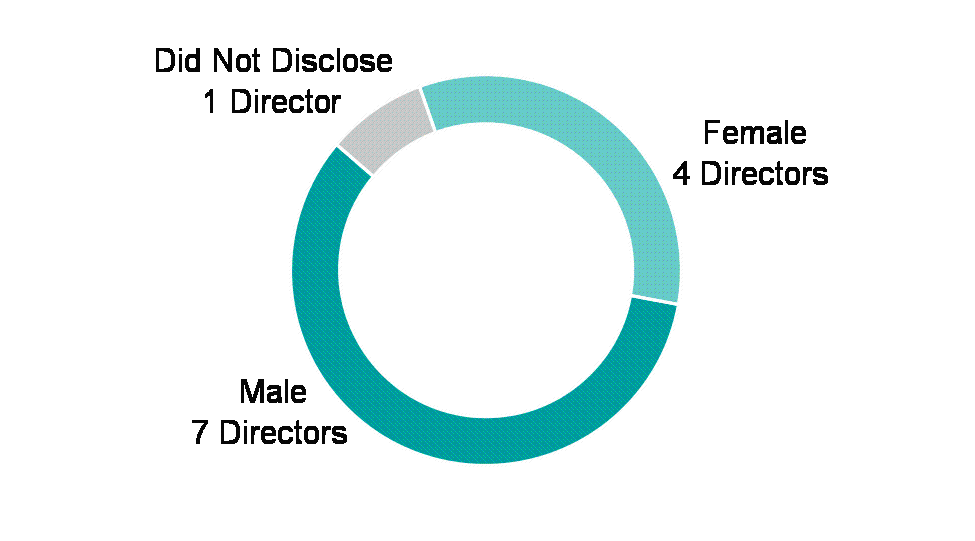
Gender Demographics


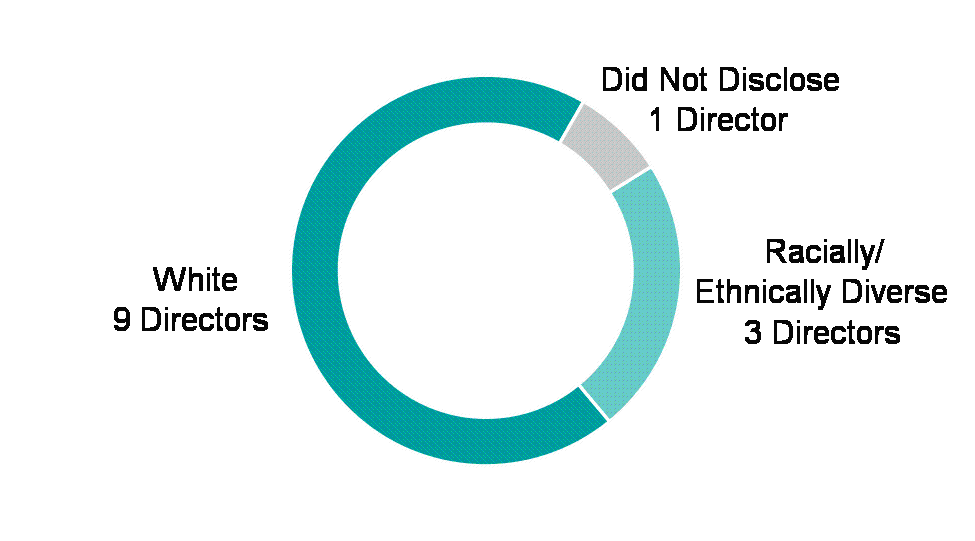
Racial / Ethnic Demographics (1)


img218658603_20.gif


img218658603_21.gif


(1) One director self-identifies as both Hispanic and White, and therefore, is reflected in the numbers for both areas.


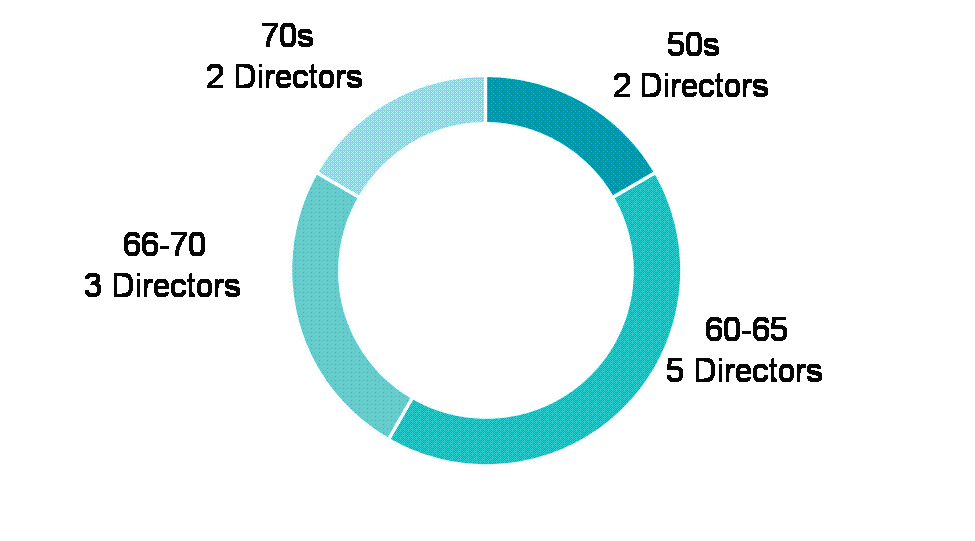
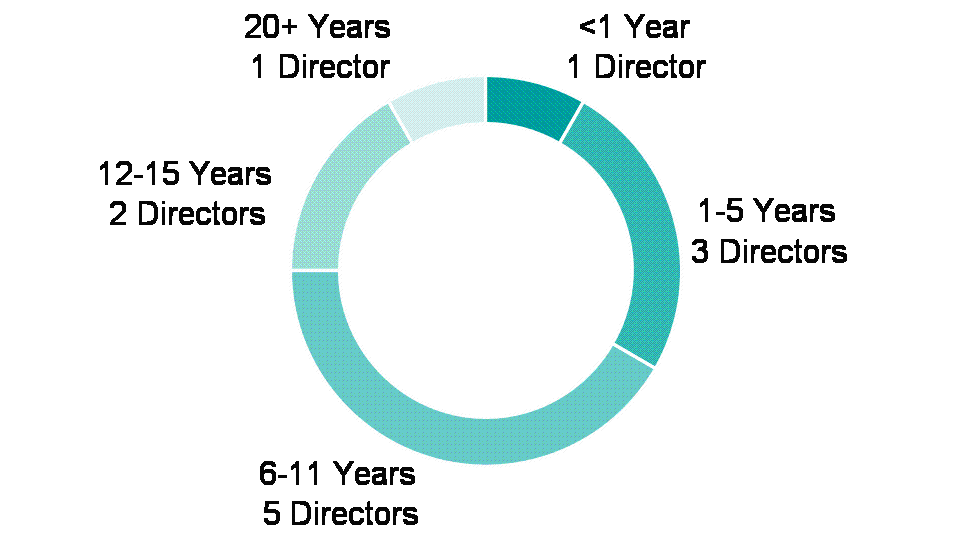
Our Board believes a balance of different ages and tenures is a critical component of our Board composition, allowing for both new perspectives and continuity. A mix of age and tenure helps further ensure that our Board oversight is well-rounded, with varying perspectives to address the complexity of matters that the Company frequently must navigate in today’s ever evolving markets and operating environment. The Governance Committee believes that a balance of director age and tenures best enables the Board to effectively oversee our businesses and support the execution of the financial and strategic objectives that are critical to driving long-term value for our stockholders during various economic and operating environments.


Mix of Age


Mix of Tenure (Median Tenure: 7 Years)


img218658603_22.gif


img218658603_23.gif


Proposal 1 – Election of Directors

9

2026 Proxy Statement

img218658603_19.jpg


Biographical Information for Director Nominees


Biographical information for each of the director nominees is provided below along with a discussion of each nominee’s specific experience, qualifications, attributes or skills that have led the Board to conclude that each director should be nominated for election or re-election.


Howard B. Culang


img218658603_24.jpg

Non-executive Chairman of the Board

Independent

Age: 79

Director Since: June 1999

Director Skills / Experience:

• Business Development

• CEO or other C-Suite

• Information Technology / Digital Technology

• Mortgage / Real Estate

• Operations

• Risk Management

Skills and Qualifications

Mr. Culang is highly qualified to serve as our Non-executive Chairman of the Board based on his deep institutional knowledge of Radian, his professional background and his decades of experience in the mortgage and financial services industries. Based on his tenure with Radian through multiple economic cycles, including his 17 years of leadership as Chair of the Board’s Risk Committee, Mr. Culang is uniquely positioned to lead our Board and ensure that the Board remains focused on supporting long-term growth for our stockholders. His past management experiences in both mortgage credit and real estate services, in combination with his service on the board of a privately-owned artificial intelligence technology company, provide him with important insights regarding the most critical aspects of our businesses, including how best to support the Company in developing and executing our strategic vision.

Experience

Mr. Culang has been a director of Radian since June 1999, serving as Chair of the Board’s Risk Committee for 17 years before assuming the role of Non-executive Chairman of our Board in December 2021. From November 1985 to December 2005, Mr. Culang worked in various roles for the Prudential Home Mortgage Company (“Prudential”), a mortgage lender, including as a Managing Director and member of the Executive Committee and as Vice Chairman of Residential Services Corporation of America, the holding company for Prudential’s mortgage lending, servicing and real estate services companies. Prior to joining Prudential, Mr. Culang held a number of senior management positions with Citibank, N.A., including as a Senior Credit Officer. In addition, Mr. Culang served as President of Laurel Corporation, a financial services firm, from January 1996 through December 2011; served as a Managing Member of JH Capital Management LLC, a management company for a private equity fund, from July 1998 to December 2010; and served as Managing Member of Cognitive Capital Management LLC, a management company for a fund of hedge funds, from April 2001 to December 2005. Mr. Culang currently serves as a director of Phase Change Software, LLC (formerly ioSemantics, LLC), a privately-owned artificial intelligence software company.


Proposal 1 – Election of Directors

10

2026 Proxy Statement

img218658603_19.jpg


Fawad Ahmad

img218658603_25.jpg

Independent

Age: 50

Director Since: February 2023

Committees:

• Compensation and Human Capital Management

• Governance

• Risk

Director Skills / Experience:

• CEO or other C-Suite

• Human Capital Management

• Information Technology / Digital Technology

• Insurance / Reinsurance

• Operations

Skills and Qualifications

Mr. Ahmad brings current experience leading innovative digital, data and analytical organizations, including transformational digital initiatives at several industry-leading companies across the high-tech, e-commerce, retail, and insurance industries. This skill set and experience is highly valuable to our Company, as we continue to pursue opportunities to leverage data, analytics and technology and transform how we conduct our businesses. In addition, Mr. Ahmad’s perspective as a people leader with insights into digital transformations occurring across the financial markets, and more broadly the consumer markets, is highly valuable in supporting the Board’s oversight of the execution of our strategic objectives, including human capital management in a time of digital transition.

Experience

Mr. Ahmad serves as Executive Vice President, Chief Operating and Customer Officer of ADT Inc. (“ADT”), a leading provider of security, interactive, and smart home solutions serving residential and small business customers in the United States. Before joining ADT in April 2025, Mr. Ahmad served as Senior Vice President, Chief Strategy and Transformation Officer at State Farm Mutual Automobile Insurance Company (“State Farm”), a property and casualty insurance provider that, with its affiliates, is the largest provider of auto and home insurance in the United States. Mr. Ahmad joined State Farm in 2016 as Vice President of Digital, and in 2017, was promoted to Vice President in Enterprise Technology – Customer Experience. In 2019 he became State Farm’s Senior Vice President and Chief Digital Officer, a role that he held until assuming the Chief Strategy and Transformation Officer position in March 2024. Before joining State Farm, from 2013 to 2016, Mr. Ahmad held leadership roles at Staples Inc., an industry leader in workspace products, including General Manager of Global Omnichannel Product and Strategy. Before that, Mr. Ahmad held the role of General Manager of the North America Core Shipping Platform at eBay Inc., a global commerce leader, responsible for leading the function’s strategy, operations, and strategic partnerships.


Proposal 1 – Election of Directors

11

2026 Proxy Statement

img218658603_19.jpg


Brad L. Conner

img218658603_26.jpg

Independent

Age: 64

Director Since: February 2020

Committees:

• Risk (Chair)

• Compensation and Human Capital Management

• Governance

Director Skills / Experience:

• Business Development

• CEO or other C-Suite

• Financial

• Information Technology / Digital Technology

• Insurance / Reinsurance

• Mortgage / Real Estate

• Operations

• Risk Management

Skills and Qualifications

Mr. Conner brings recent C-suite level experience in banking and lending solutions in large, publicly-traded financial institutions, which is a skill set that is highly valuable in supporting the Board’s oversight over virtually all aspects of our business. In addition, his deep knowledge of the mortgage industry provides him with valuable insight into the industries in which we operate and complements the Board’s role in overseeing our strategic direction and supporting the execution of our strategic objectives. These experiences are particularly relevant in Mr. Conner’s role as the Chair of the Risk Committee of our Board.

Experience

Mr. Conner recently served as Vice Chairman, Head of Consumer Banking for Citizens Financial Group, Inc. (“Citizens”), a publicly-traded financial institution, beginning in January 2014 and through his retirement from this role in January 2020. In this role, Mr. Conner was responsible for Retail Banking, Business Banking, Wealth Management, Home Lending Solutions, Auto Finance and Education Finance, as well as Citizens’ Consumer Phone Bank and online channels. Before joining Citizens in 2008, Mr. Conner served as President of the Home Equity and Mortgage Home Loan Direct business of J.P. Morgan Chase & Co., a publicly-traded global financial services firm. Prior to this, he oversaw the combined Home Equity business of Chase and Bank One Corporation, a publicly-traded global financial services firm, after the companies merged in 2004, and served as Chief Executive Officer of Chase’s Education Finance businesses. Mr. Conner currently serves as a director of United Services Automobile Association (“USAA”), a diversified financial services group of companies that provides insurance, investing and banking solutions to members of the U.S. military, veterans and military families and serves as chairman of the board of USAA Federal Savings Bank, a bank owned by USAA.


Proposal 1 – Election of Directors

12

2026 Proxy Statement

img218658603_19.jpg


Debra Hess

img218658603_27.jpg

Independent

Age: 61

Director Since: March 2019

Committees:

• Audit (Chair)

• Finance and Investment

Director Skills / Experience:

• CEO or other C-Suite

• Financial

• Investments

• Mortgage / Real Estate

• Other Public Co. Board

• Risk Management

Current Public Company Directorship:

• TPG Mortgage Investment Trust, Inc. (NYSE: MITT)

Former Public Company Directorship:

• Crombie Real Estate
Investment Trust (TSX: CRR.UN)

Skills and Qualifications

Ms. Hess’ extensive banking, finance and real estate asset management experience provides her with valuable insight into our businesses, the industries in which we operate and the various factors impacting our strategic direction. In addition, her roles as the Chief Financial Officer of various publicly-traded companies and her executive management experience with companies in the financial services and mortgage and real estate industries provide her with significant financial, accounting and compliance expertise in areas that are valuable to the Board’s oversight responsibilities and in particular to her role as Chair of the Audit Committee of our Board.

Experience

Ms. Hess served as Chief Financial Officer of both NorthStar Asset Management Group, a global asset management firm focused on strategically managing real estate and other investment platforms, and NorthStar Realty Finance Corp., a publicly-traded real estate investment company (together with NorthStar Asset Management Group, “Northstar”), from July 2011 until January 2017. Additionally, from 2011 until 2015, Ms. Hess held various other positions, including Chief Financial Officer and Treasurer for NorthStar’s non-publicly-traded companies. Prior to joining NorthStar, from August 2008 to June 2011, Ms. Hess served as Chief Financial Officer of H/2 Capital Partners, a privately- owned fund sponsor that invests in real estate related assets. From March 2003 to July 2008, Ms. Hess was a managing director at Fortress Investment Group (“Fortress”), an investment management firm, where she also served as Chief Financial Officer of Newcastle Investment Corp., a Fortress portfolio company and a NYSE-listed real estate investment trust. Prior to joining Fortress, Ms. Hess served in various positions at Goldman, Sachs & Co. (“Goldman Sachs”), including as Vice President in Goldman Sachs’ Principal Finance Group and as a Manager of Financial Reporting in Goldman Sachs’ Finance Division. Ms. Hess currently serves on the board of directors of TPG Mortgage Investment Trust, Inc., a publicly-traded mortgage and real estate investment trust, where she serves as non-executive chair of the board, chair of the nominating and corporate governance committee and as a member of the audit and compensation committees. She also serves on the board of CenterPoint Properties Trust, a privately-owned company that acquires, develops, and manages state-of-the-art industrial facilities near major transportation nodes, ports, and population centers in America’s top markets, where she chairs the audit committee and serves as a member of the compensation committee.


Proposal 1 – Election of Directors

13

2026 Proxy Statement

img218658603_19.jpg


Anne Leyden

img218658603_28.jpg

Independent

Age: 65

Director Since: August 2023

Committees:

• Compensation and Human
Capital Management (Chair)

• Finance and Investment

Director Skills / Experience:

• Business Development

• CEO or other C-Suite

• Human Capital Management

• Operations

Skills and Qualifications

Ms. Leyden brings executive level experience in human capital management in large publicly-traded global information and financial institutions, including experience in succession planning, integration of strategic acquisitions and the development of operating models. In addition, her executive management experience with companies operating in the mortgage, consumer lending and other financial services industries provides her with valuable knowledge and insights about the industries in which we operate. This skill set and experience is highly valuable to our Company and complements our Board’s other expertise, as we further our commitment to maximizing talent within our organization in support of our strategic objectives.

Experience

Ms. Leyden is a senior human resources executive with broad-based business leadership experience in the financial services and consumer credit sectors. From 2014 until 2021, Ms. Leyden served as Executive Vice President, Chief Human Resources Officer for TransUnion, a consumer credit reporting agency and a leading global information and insights company operating in 30 countries. Prior to joining TransUnion, from 1994 to 2012, Ms. Leyden spent 18 years in various roles with JP Morgan Chase (“JP Morgan”) and Bank One (before its acquisition by JP Morgan), including as Senior Vice President and Head of Human Resources for JP Morgan’s Retail Financial Services division, which included its nationwide Mortgage, Retail Banking, Auto and other Consumer Lending organizations. Following her retirement from TransUnion, from time-to-time, Ms. Leyden provided human capital management advisory services to various companies.


Proposal 1 – Election of Directors

14

2026 Proxy Statement

img218658603_19.jpg


Seraina Macia

img218658603_29.jpg

Independent

Age: 57

Director Since: February 2026


Director Skills / Experience:

• Business Development

• CEO or other C-Suite

• Financial

• Global Specialty Insurance

• Information Technology / Digital Technology

• Insurance / Reinsurance

• Operations

• Other Public Co. Board

• Property & Casualty

• Risk Management

Former Public Company Directorships:

• Credit Suisse Group

• Portage Fintech Acquisition Corporation

Skills and Qualifications

Ms. Macia brings more than 35 years of global insurance experience across a range of senior roles, including C-suite and Chief Executive Officer positions. Her leadership in the industry has provided her with deep expertise in strategic growth initiatives and navigating complex organizational transformations, key areas that align with Radian’s strategic priorities. In addition to her executive experience, Ms. Macia currently serves as a strategic advisor and has a proven track record of board service, contributing valuable perspectives on board leadership and governance. Her broad industry knowledge and multifaceted experience add significant value to the Board as Radian continues to grow as a global multi-line specialty insurer.

Experience

Ms. Macia is a seasoned global insurance executive with experience across property and casualty (“P&C”), specialty insurance, and reinsurance markets. She serves as a Senior Advisor to Warburg Pincus LLC, a global private equity firm, where she advises the Financial Services Group regarding P&C insurance opportunities and investments, a role she has held since January 2025. Ms. Macia previously served on the global advisory board of Intact Financial Corporation, a P&C and specialty insurance company, from January 2024 to January 2026. From July 2020 to March 2025, she served as founder and Chief Executive Officer of Joyn Insurance, which was a technology-focused underwriter of small and middle market insurance in the U.S. Additionally, from 2013 to 2020, Ms. Macia held multiple C-suite positions at AIG, a global P&C insurance company, including Executive Vice President from 2017 to 2020, Chief Executive Officer of Country Management & Operations from 2015 to 2016, and Chief Executive Officer of AIG Europe, Middle East and Africa from 2013 to 2015. Ms. Macia also served as Chief Executive Officer of Blackboard Insurance, AIG’s technology-focused insurance subsidiary, from 2017 to 2020. In addition, she served as Chief Executive Officer of North America of Hamilton Insurance Company, a global insurer and reinsurer, from 2016 to 2017. Earlier in her career, from 2010 to 2013, Ms. Macia served as Chief Executive Officer of XL North America, a commercial P&C insurance provider. She also held leadership roles at Zurich Insurance in Switzerland and New York, a global multi-line insurer from 2002 to 2010, NZB Neue Zuricher Bank, a private Swiss bank, from 2000 to 2002 and Swiss Re, a global reinsurance company, from 1990 to 2000. Ms. Macia also has experience serving on public company boards, including Credit Suisse Group, a global financial services company, from 2015 to 2023, and Portage Fintech Acquisition Corporation, a special purpose acquisition company, from 2021 to 2023. Ms. Macia currently serves as Chair of the Board of Food Bank for New York City, a non-profit hunger relief program.


Proposal 1 – Election of Directors

15

2026 Proxy Statement

img218658603_19.jpg


Brian D. Montgomery

img218658603_30.jpg

Independent

Age: 69

Director Since: May 2012
(rejoined June 2021 after serving in HUD from 2018-2021)

Committees:

• Audit

• Governance

• Risk

Director Skills / Experience:

• Business Development

• CEO or other C-Suite

• Government / Regulatory

• Human Capital Management

• Information Technology / Digital Technology

• Insurance / Reinsurance

• Mortgage / Real Estate

• Operations

• Risk Management

Skills and Qualifications

As the only person to have been confirmed twice by the U.S. Senate to lead the FHA while also serving concurrently as HUD Deputy Secretary, Mr. Montgomery possesses a deep working knowledge of the mortgage finance industry, federal housing policies and the federal regulation of housing. This expertise is extremely valuable in supporting the Board’s oversight over the Company’s mortgage insurance business generally, and specifically over the operations and the credit and risk management aspects of our businesses, as well as helping the Company develop the most effective strategy for navigating the regulatory and legislative landscape in the housing and mortgage finance industries. In April 2023, Mr. Montgomery achieved the CERT Certificate in Cyber Security Oversight from Carnegie Mellon University-Software Engineering Institute and NACD.

Experience

Mr. Montgomery completed his second tenure at HUD in January 2021, most recently serving as the Deputy Secretary of HUD. Prior to his most recent role as Deputy Secretary, Mr. Montgomery served as FHA Commissioner from 2005 to 2009 and from 2018 to 2020. Since May 2021, Mr. Montgomery has been a partner with Gate House Strategies, LLC, an advisory firm he co-founded that is focused on housing finance-related compliance, as well as other housing-related areas such as technology, business strategy, and affordable/public housing. From August 2009 until 2017, Mr. Montgomery served in various executive leadership roles with The Collingwood Group, LLC, a consulting firm, including serving as Vice Chairman. He previously served as a director of the Company from 2012 to 2018, stepping down upon his appointment to rejoin HUD as FHA Commissioner in May 2018. Mr. Montgomery is a member of the Board of The Mortgage Collaborative, an independent network of mortgage lending institutions focused on empowering mortgage lending across the country and the Advisory Board of the American Institute of Servicing and Legal Executives (AISLE) Institute, which is a high-level forum for executives in the creditors’ rights industry. Mr. Montgomery also serves on the Advisory Board of NewDay USA, a leader in veteran mortgage lending, and is a member of the Fannie Mae Affordable Housing Council.


Proposal 1 – Election of Directors

16

2026 Proxy Statement

img218658603_19.jpg


Lisa Mumford

img218658603_31.jpg

Independent

Age: 62

Director Since: February 2020

Committees:

• Finance and Investment (Chair)

• Audit

Director Skills / Experience:

• CEO or other C-Suite

• Financial

• Insurance / Reinsurance

• Investments

• Mortgage / Real Estate

• Other Public Co. Board

• Risk Management

Current Public Company Directorship:

• Ellington Financial, Inc. (NYSE: EFC)

Former Public Company Directorship:

• Ellington Residential Mortgage REIT (NYSE: EARN)

Skills and Qualifications

Ms. Mumford brings highly valuable C-suite level experience and insight that benefits the Board in overseeing virtually all aspects of our business. Her past experience as the Chief Financial Officer of insurance company enterprises provides her with extensive risk management experience, which is a core area of focus for Radian. Her public company experience and her ongoing service on another public company board provide additional perspectives on board leadership and governance that complement the Board’s collective strengths. In addition, her deep knowledge and experience in finance and real estate management provides her with valuable knowledge about the industries in which we operate. These experiences are particularly relevant in Ms. Mumford’s role as Chair of the Finance and Investment Committee of our Board.

Experience

Ms. Mumford served as the Chief Financial Officer of Ellington Financial LLC (“Ellington Financial”), a publicly-traded asset management company, and as Chief Financial Officer of Ellington Financial Management LLC (Ellington Financial’s external manager), from October 2009 through her retirement in March 2018. Ms. Mumford also served as the Chief Financial Officer of Ellington Residential Mortgage REIT, a publicly-traded real estate investment trust, from April 2013 until her retirement in March 2018. From August 2008 to October 2009, Ms. Mumford served as Chief Financial Officer of ACA Financial Guaranty Corporation, a monoline bond insurance company, and prior to this, from 2003 until August 2008, Ms. Mumford served as the Chief Accounting Officer of ACA Capital Holdings, Inc. (“ACA”), a publicly-traded holding company providing financial guaranty insurance products and asset management services. Prior to joining ACA, and beginning in 1988, Ms. Mumford was with ACE Guaranty Corp., a financial guaranty company, where she held the positions of Chief Financial Officer and Controller. Ms. Mumford currently serves as a member of the board of directors of Ellington Financial, Inc.


Proposal 1 – Election of Directors

17

2026 Proxy Statement

img218658603_19.jpg


Jed Rhoads

img218658603_32.jpg

Independent

Age: 67

Director Since: February 2025

Committees:

• Audit

• Finance and Investment

• Risk

Director Skills / Experience:

• Business Development

• CEO or other C-Suite

• Financial

• Global Specialty Insurance

• Insurance / Reinsurance

• Operations

• Risk Management

Skills and Qualifications

Mr. Rhoads brings more than 40 years of experience as a reinsurance executive, including responsibility for overseeing offices and underwriting decisions for global reinsurance businesses. With his recent executive experience in reinsurance, Mr. Rhoads brings a variety of skills that align with the Company’s core business and strategic goals. His vast experience in leading global reinsurance operations and assessing and managing risk is highly valuable to the Company and provides him with insights and perspectives that further strengthen and broaden the Boards oversight to align with Radians strategic evolution as a global multi-line specialty insurer.

Experience

Mr. Rhoads is a seasoned reinsurance executive with more than 40 years of experience, including nearly two decades in senior executive roles at Markel Corporation (“Markel”), a financial holding company that markets and underwrites specialty insurance products. Most recently, from 2015 until December 2022, when he retired, Mr. Rhoads served as Markel’s President and Chief Underwriting Officer for the Global Reinsurance Division. In this role, he was responsible for Markel’s global reinsurance business, which wrote more than 25 lines of reinsurance including mortgage, directors and officers liability, general liability, property, catastrophe, surety, marine, aviation, energy and cargo. From 2013 until 2015, Mr. Rhoads was Markel’s President, Property Reinsurance, Global Reinsurance Division. Before joining Markel, Mr. Rhoads spent four years with Alterra Capital Holdings Ltd. (“Alterra”) (before its acquisition by Markel) serving as President and Chief Underwriting Officer, Property from 2011 until 2012 and as its Managing Director prior to that. Before his tenure at Alterra, Mr. Rhoads held senior positions at Harbor Point Re Bermuda and Chubb Re Bermuda, and he also previously served as Executive Vice President of Reinsurance and Chief Underwriting Officer for Overseas Partners Limited and as a principal and underwriter for Stockton Reinsurance Bermuda.


Proposal 1 – Election of Directors

18

2026 Proxy Statement

img218658603_19.jpg


Noel J. Spiegel

img218658603_33.jpg

Independent

Age: 78

Director Since: February 2011

Committees:

• Governance (Chair)

• Compensation and Human Capital Management

Director Skills / Experience:

• Business Development

• CEO or other C-Suite

• Financial

• Information Technology / Digital Technology

• Other Public Co. Board

• Risk Management

Current Public Company Directorship:

• American Eagle Outfitters, Inc. (NYSE: AEO)

Former Public Company Directorships:

• Vringo, Inc.

• vTv Therapeutics, Inc. (NASDAQ: VTVT)

Skills and Qualifications

Mr. Spiegel’s public company board experience provides him with a depth of experience in management, corporate governance and strategy, board leadership, risk management and financial reporting. In October 2020, the NACD named Mr. Spiegel to the 2020 NACD Directorship 100, an annual award that recognizes leading corporate directors, corporate governance experts, policymakers, and influencers who significantly impact boardroom practices and performance. Mr. Spiegel’s experience and recognized expertise are particularly relevant in his role as Chair of the Governance Committee of our Board.

Experience

Mr. Spiegel was a partner at Deloitte & Touche, LLP (“Deloitte”) where he practiced from September 1969 until May 2010. In his career at Deloitte, he served in numerous senior management positions, including as Deputy Managing Partner; a member of Deloitte’s Executive Committee; Managing Partner of Deloitte’s Transaction Assurance practice, Global Offerings and International Financial Reporting Standards practice and Technology, Media and Telecommunications practice (Northeast Region); and as Partner-in-Charge of Audit Operations in Deloitte’s New York Office. Mr. Spiegel currently serves as Lead Independent Director, chairs the audit committee and serves on the nominating and governance committee of American Eagle Outfitters, Inc., a publicly-traded retail company.


Proposal 1 – Election of Directors

19

2026 Proxy Statement

img218658603_19.jpg


Richard G. Thornberry

img218658603_34.jpg

Age: 67

Director Since: March 2017

Director Skills / Experience:

• Business Development

• CEO or other C-Suite

• Financial

• Human Capital Management

• Information Technology / Digital Technology

• Mortgage / Real Estate

• Operations

• Risk Management

Skills and Qualifications

Mr. Thornberry possesses a broad understanding of the insurance, mortgage and real estate industries and has significant experience building and leading innovative and values-driven organizations. In addition, his past experiences provide him with financial management, human capital management and risk management expertise that gives him a unique perspective and set of skills to lead our Company and contribute to the Board.

Experience

Mr. Thornberry has served as Radian’s Chief Executive Officer since March 2017. Before joining Radian, from 2006 until 2017, Mr. Thornberry served as the Chairman and Chief Executive Officer of NexSpring Group, LLC (“NexSpring Group”), a company that he co-founded in 2006. NexSpring Group has provided mortgage industry advisory and technology services to private equity investors, mortgage lenders, financial institutions, mortgage investors and other mortgage industry participants. Mr. Thornberry also has served as the Chairman and Chief Executive Officer of NexSpring Financial, LLC, a fintech company that he co-founded to focus on improving the overall value proposition for all participants in a residential mortgage origination transaction. During the financial crisis, he also served as a senior advisor to the financial institution investment team at a leading global private equity firm. Prior to founding NexSpring Group, from 1999 until 2005, Mr. Thornberry served as President and Chief Executive Officer of Nexstar Financial Corporation, an end-to-end mortgage business process outsourcing firm, which he co-founded in 1999 and sold to MBNA in 2005. Under his leadership, Nexstar was recognized as one of the nation’s fastest growing companies and best places to work. Following the sale of Nexstar, Mr. Thornberry held executive positions with MBNA from 2005 until 2006. Prior to Nexstar, Mr. Thornberry was the president and chief operating officer of Citicorp Mortgage Inc. from 1996 until 1998, and he also held executive-level financial and operating positions at Residential Services Corporation of America/Prudential Home Mortgage Company from 1987 until 1996, including as chief financial officer, until the company was sold in 1996. Mr. Thornberry began his career as a certified public accountant at Deloitte where he primarily worked with financial services clients and entrepreneurial businesses. Mr. Thornberry currently serves as an executive council member of the Housing Policy Council and rejoined the board of directors of the Mortgage Bankers Association in October 2025. Mr. Thornberry also serves on the board of directors of MBA Open Doors Foundation, which provides mortgage and rental payment assistance to families with a critically ill or injured child.


Additional Information Regarding Directors


For additional information regarding our Board, its standing committees, and our standards for corporate governance and director independence, refer to the sections entitled “Corporate Governance and Board Matters” and “Compensation of Executive Officers and Directors—Director Compensation” below.


img218658603_35.jpg

Recommendation

Radian’s Board of Directors recommends a vote “FOR” each of the director nominees. Signed proxies will be voted “FOR” each of the director nominees unless a stockholder provides other instructions on the proxy card.


Proposal 1 – Election of Directors

20

2026 Proxy Statement

img218658603_19.jpg


Corporate Governance and Board Matters


SECTION CONTENTS

Page

Corporate Governance Highlights

21

Board of Directors and its Standing Committees

22

Board Leadership Structure

25

Board and Board Committee Roles in Risk Oversight

25

CEO and Management Succession Planning

27

Director Independence

27

Consideration of Director Nominees

28

Board, Standing Committee and Individual Director Performance Evaluations

29

Engagement and Outreach

31

Compensation and Human Capital Management Committee Interlocks and Insider Participation

32

Policies and Procedures for Approval of Related Party Transactions

32

Anti-Hedging Policy and Anti-Pledging Policy

33

Information on Our Website

33

Audit Committee Report

35

Corporate Governance Highlights


As further discussed below, we maintain the following strong governance practices:


Comprehensive Board succession planning to ensure regular Board refreshment and alignment of skills against our strategic plan

Strong Board independence, with all directors independent other than the CEO

Independent Non-executive Chairman with robust responsibilities

Board diversity of background, experience, skills, gender, race/ethnicity and age/tenure

Regular executive sessions of independent directors without management

Comprehensive process for annual Board, committee and individual director evaluations to ensure accountability and leadership growth

Proactive communication and engagement with stockholders

Dedicated standing Risk Committee to ensure effective Board and committee oversight of Enterprise Risk Management (“ERM”) and material risks

Annual elections of all directors with majority voting resignation policy for directors in uncontested elections

Stockholder right to call special meetings

Simple majority vote standard for Certificate of Incorporation and By-Law amendments and transactions

Robust stock ownership guidelines

Anti-hedging, anti-pledging and comprehensive compensation clawback policies

Robust CEO evaluation process, conducted by the independent directors

Director overboarding policy


Corporate Governance and Board Matters

21

2026 Proxy Statement

img218658603_36.jpg


Board of Directors and its Standing Committees


Our Board holds regularly scheduled quarterly meetings and a regularly scheduled annual strategic planning session. In addition, the Board holds special meetings as and when necessary. During 2025, a year of strategic and transformational decisions, our Board held its customary four regularly scheduled quarterly meetings, as well as thirteen special meetings. Our independent directors meet in one or more executive sessions in connection with each regularly scheduled Board meeting and frequently meet in executive session in connection with special meetings of the Board. Each director participated in at least 75% of the meetings of the Board and the committees on which the director served during 2025.

In 2025, the Company completed a comprehensive strategic review, which led to a decision to acquire Inigo, a Lloyd’s specialty insurer. This acquisition advances our strategic focus to grow and diversify and expands our business from a leading U.S. private mortgage insurer into a global multi-line specialty insurer. Also, following the strategic review, we announced our planned divestiture of our mortgage conduit, title and real estate services businesses. These decisions reflect the Company’s go-forward growth strategy centered on its core expertise in risk management and insurance, while allowing for opportunities to deploy capital in businesses aligned with that expertise and vision. The Inigo acquisition closed in February 2026, and we expect that by the end of the third quarter of 2026, our plan to divest or otherwise exit our mortgage conduit, title and real estate businesses will be completed. The Board provided active oversight and strategic guidance related to these matters, receiving regular briefings, providing valuable insights, and participating in the evaluation of the strategic, financial and risk considerations. This process required numerous additional Board meetings throughout the year, culminating in the Board’s approval of these actions.

Our Non-executive Chairman of the Board presides over all meetings of the Board, including executive sessions of the independent members of the Board. Our policy is that all of our director nominees are expected to attend our annual meeting, and all of our director nominees who were serving as directors last year attended the 2025 annual meeting. As discussed below under “Director Independence,” all of our directors, except our CEO, Mr. Thornberry, satisfy the requirements for independent directors under the NYSE listing standards and SEC rules.

Directors are expected to devote the time, effort and attention required to serve effectively on the Board. The Company’s Guidelines of Corporate Governance limit directors to serve on no more than two boards of publicly traded companies in addition to the Company’s Board. For the Company’s CEO, the limit is no more than one board of a publicly traded company in addition to the Company’s Board. Finally, a director who is a member of the Audit Committee may not serve on the audit committees of more than two publicly traded companies in addition to the Company’s Audit Committee.

Corporate Governance and Board Matters

22

2026 Proxy Statement

img218658603_36.jpg


Board Standing Committees

The Board currently has five standing committees and also forms special committees from time-to-time, as necessary. The current composition of the Board’s standing committees is as follows:


Director Name

Audit

Compensation &
Human Capital
Management

Finance & Investment

Governance

Risk

Fawad Ahmad


ü


ü

ü

Brad L. Conner


ü


ü

Chair

Debra Hess (1)

Chair


ü


Anne Leyden


Chair

ü


Seraina Macia (2)


Brian D. Montgomery

ü


ü

ü

Lisa Mumford (1)

ü


Chair


Jed Rhoads

ü


ü


ü

Gregory V. Serio

ü


ü


ü

Noel J. Spiegel


ü


Chair


(1)
Our Board has determined that each of Mses. Hess and Mumford qualify as an “audit committee financial expert” under the SEC’s rules.
(2)
As part of our Board orientation process, Ms. Macia is expected to attend all meetings of the Board’s standing committees for the first two quarters following her appointment in February 2026. The Board expects to appoint Ms. Macia to at least one standing committee later in 2026.


Audit Committee

No. of meetings in 2025: 8


Members*:

Debra Hess (Chair)

Brian D. Montgomery

Lisa Mumford

Jed Rhoads

Greg V. Serio


Key responsibilities:

Appoints and oversees the work of our independent registered public accounting firm.
Reviews our annual audited and interim financial statements and related disclosures.
Reviews our accounting and reporting principles and policies and oversees the effectiveness of internal control over financial reporting.


See “Audit Committee Report” below for additional information regarding the work of this committee.


* Each Audit Committee member meets the additional NYSE independence criteria applicable to audit committee members.


Corporate Governance and Board Matters

23

2026 Proxy Statement

img218658603_36.jpg


Compensation and Human Capital Management Committee

No. of meetings in 2025: 9


Members*:

Anne Leyden (Chair)

Fawad Ahmad

Brad L. Conner

Noel J. Spiegel


Key responsibilities:

Oversees our human capital management policies, programs and practices, as well as our work environment, including our culture, the “people” aspects of our corporate responsibility program and our compensation and benefits policies and programs.
Oversees our executive compensation program and approves compensation for our executive officers, other than our CEO’s compensation which it recommends to the independent directors for approval.
Reviews long-term and interim succession plans for Radian’s CEO and other officers, as well as our overall talent development and succession practices and programs.


See “Compensation of Executive Officers and Directors—Compensation Discussion and Analysis” for additional information regarding the work of this committee.

* Each Compensation and Human Capital Management (“CHCM”) Committee member meets the additional NYSE independence criteria applicable to compensation committee members.


Finance and Investment Committee

No. of meetings in 2025: 5


Members:

Lisa Mumford (Chair)

Debra Hess

Anne Leyden

Jed Rhoads

Greg V. Serio


Key responsibilities:

Reviews and monitors the Company’s capital structure, capital sourcing and liquidity management.
Provides oversight with respect to our capital and liquidity strategies and activities, including our capital markets and borrowing activities and share repurchase strategies.
Monitors and evaluates the performance of our investment portfolio and the investment managers and oversees adherence to our investment policy guidelines.


Governance Committee

No. of meetings in 2025: 7


Members:

Noel J. Spiegel (Chair)

Fawad Ahmad

Brad L. Conner

Brian D. Montgomery


Key responsibilities:

Oversees regular Board, committee and individual director assessments, reviews director skills and ensures that Board succession planning and Board refreshment is conducted to support the Board’s oversight over the Company’s evolving needs and strategic focus.
Oversees Board governance and ensures that the results of assessments drive actions to continuously improve performance.
Examines our overall corporate governance processes, oversees our stockholder engagement program, and monitors compliance with our Guidelines of Corporate Governance.


See “Consideration of Director Nominees” below for additional information regarding the work of this committee.


Risk Committee

No. of meetings in 2025: 4


Members:

Brad L. Conner (Chair)

Fawad Ahmad

Brian D. Montgomery

Jed Rhoads

Greg V. Serio


Key responsibilities:

Oversees the Company’s management of risks and exposures that could materially impact the Company (“Material Risks”), including by overseeing the Company’s ERM function.
Coordinates with the Board and other committees to ensure the effective oversight over Material Risks.
Oversees certain Material Risks facing the Company, including risks related to the Company’s risk-taking businesses, which, in 2025, comprised our mortgage insurance, mortgage conduit and title insurance businesses and which now also includes our specialty insurance business.


In addition to the key responsibilities of the standing committees described above, see “Board and Board Committee Roles in Risk Oversight” for more information about the work of these committees.

Corporate Governance and Board Matters

24

2026 Proxy Statement

img218658603_36.jpg


Board Leadership Structure


Our Non-executive Chairman of the Board and CEO are separate positions. We believe that separating these positions enhances the independent oversight of the Company and the effective functioning of the Board, as well as the Board’s monitoring and objective evaluation of the CEO’s performance. In addition, by separating these positions, the Board is able to remain fully engaged and objective in providing perspective with respect to the Company’s strategy and effectively evaluating the implementation of this strategy.

Our Non-executive Chairman of the Board is independent of management and, as provided in our Guidelines of Corporate Governance, is responsible for the management, development and effective performance of the Board and for serving in an advisory capacity to the CEO and to other members of management on all matters concerning the interests of the Board. The Non-executive Chairman of the Board sets the agenda for Board meetings and presides over meetings of the Board.

The CEO is responsible for the strategic direction and day-to-day leadership and performance of the Company. As described in our Guidelines of Corporate Governance, the responsibilities of the CEO include:

providing strong, ethical and principled leadership of the Company’s businesses;
establishing and promoting the Company’s mission, culture and core values;
determining and implementing corporate strategies and policies and managing the Company’s capital and liquidity positions;
overseeing risk management, including the design and maintenance of policies, processes and controls for identifying, monitoring and mitigating material risks;
facilitating an effective framework for Board and management interactions;
ensuring complete and accurate disclosures of financial, operational and management matters to the Board for its consideration and approval, as necessary;
ensuring regulatory compliance and the integrity of all financial filings and other corporate communications; and
providing information to the Board so that the directors may be current with respect to Company, industry and corporate governance matters.

Board and Board Committee Roles in Risk Oversight


Our Board is actively involved in the oversight of Material Risks. The Board seeks to understand and oversee the most critical risks relating to our business and to ensure there is an effective governance process in place for reviewing the systems and processes management has developed to manage and mitigate Material Risks, including those that could arise in the future. The Board has formed a standing committee, the Risk Committee, for the primary purpose of overseeing the Company’s management of Material Risks. In carrying out this responsibility, the Risk Committee’s primary role is coordination, working with the Board and other committees to ensure the effective oversight over Material Risks.

Corporate Governance and Board Matters

25

2026 Proxy Statement

img218658603_36.jpg


In conducting its risk oversight responsibilities, the Risk Committee oversees the Company’s ERM function, including by:

reviewing the methodologies, policies, processes, resources and reporting structures established by management to identify, assess, monitor and ensure appropriate mitigation of Material Risks;
reviewing and approving the Company’s enterprise risk appetite statements and management’s procedures for ensuring the Company is operating in a manner consistent with those statements;
receiving reports regarding management’s compliance with regulatory requirements related to ERM, including any related filings or disclosures; and
regularly reviewing and analyzing management’s assessment of Material Risks, including any significant changes or developments with respect to existing risks or the emergence of new risks or risk trends.

The Risk Committee uses the information derived from its oversight over ERM to allocate and coordinate oversight responsibilities over Material Risks among the Board and its committees as follows:

Audit Committee

The Audit Committee oversees Materials Risks that could impact the Company’s financial statements and internal control over financial reporting, such as the risk of fraud or illegal acts, and oversees our enterprise compliance program and risks pertaining to the Company’s Code of Conduct and Ethics.

Compensation and Human Capital Management Committee

The CHCM Committee oversees Material Risks pertaining to the Company’s compensation and human capital management policies and practices. In conducting this oversight, this committee reviews and discusses with management an annual risk assessment of the Company’s compensation policies and practices prepared by the Company’s independent compensation consultant.

Finance and Investment Committee

The Finance and Investment Committee oversees Material Risks pertaining to the Company’s investment portfolio, liquidity position, capital structure and credit and financial strength ratings.

Governance Committee

The Governance Committee oversees Material Risks pertaining to the Company’s corporate governance structure and practices, including by overseeing: the Company’s Policy Regarding Related Person Transactions to ensure that the Company does not engage in transactions that would create or give the impression of a conflict of interest or that could cause harm to the Company; and risks associated with the Company’s interactions and engagement with stockholders.

Risk Committee

In addition to its oversight over ERM and its role in coordinating risk oversight among the Board and its committees, the Risk Committee directly oversees Material Risks related to: our risk-taking businesses; our information security function, including the management of risks related to data security, cybersecurity and privacy; our policies and procedures for monitoring and managing counterparty risk; our enterprise insurance program for managing business risks; and our program for maintaining business continuity and resilience.

Full Board

Primary oversight of certain Material Risks remains with the full Board, including those pertaining to business planning and decision-making, emerging technology implementation, information governance, operating expense management and compliance with laws governing data privacy protections and the use of artificial intelligence (“AI”).

The committee chairs provide regular reports to the full Board regarding their committee’s risk oversight responsibilities as discussed above. The Board conducts its risk oversight responsibility in the areas discussed above through these reports, as well as through regular discussions and reports from management regarding other Material Risks not otherwise allocated to the committees, including risks associated with AI as discussed below. Finally, the full Board also

Corporate Governance and Board Matters

26

2026 Proxy Statement

img218658603_36.jpg


considers current and potential future strategic risks facing the Company, as part of its annual strategic planning session with management.

To assist the Board in its oversight of the use of AI, we have established a management committee, the Artificial Intelligence Governance Committee (the “AI Governance Committee”), that is responsible for implementing our Artificial Intelligence Governance Policy (the “AI Policy”) and for establishing, overseeing and enforcing our AI governance framework, including assisting executive management in fulfilling its oversight responsibilities regarding the Company’s use of AI. Our AI Policy provides for a risk-based governance framework for our use and management of AI and is designed to comply with applicable laws, regulations, ethical standards, our business objectives and values, and our Code of Conduct and Ethics. The AI Policy also allows for responsible innovation and realization of the benefits of AI in line with our business objectives. Among other things, the AI Governance Committee: sets standards for AI evaluation, approval, lifecycle management, and ethical use; measures and reports on AI use; and promotes AI awareness and education among stakeholders. The AI Governance Committee meets regularly to review proposed AI initiatives and to evaluate, among other things, data privacy and security concerns. The Board regularly receives updates on our AI development, including AI governance, from members of executive management, as well as educational and market updates from outside experts.

CEO and Management Succession Planning


Our CHCM Committee reviews the quality and depth of officers throughout Radian, as well as our talent development and succession practices and programs. These include leadership programs, mentorship initiatives and cross-functional training experiences to ensure that our leadership bench is deep and well prepared to meet the opportunities of an ever-evolving business landscape.

Consistent with its charter, the CHCM Committee reviews long-term and interim succession planning for the CEO and other senior officers. As part of this process, the CHCM Committee meets regularly with the CEO and Chief People and Operating Officer (“CP&OO”) to review the Company’s top and emerging talent and their development plans. In addition, to further increase Board visibility to the Company’s top talent, the Board and management regularly pursue opportunities to facilitate interactions among the Board and these individuals inside and outside the boardroom.

Director Independence


Our Guidelines of Corporate Governance provide that a substantial majority of our Board must consist of independent directors, as independence is determined under the NYSE’s listing standards and applicable SEC rules. Our Board has determined that all of the members of the Board, except our CEO, Richard G. Thornberry, are “independent” under current NYSE listing standards and SEC rules. In determining that each of our non-executive directors is independent, the Board considered whether there were any related person transactions (within the meaning of our related person transaction policy) or other facts and circumstances that might impair the independence of each director, as further discussed below. The Board concluded that no material direct or indirect relationship exists between the Company and any of its non-executive directors, other than those compensatory matters that are a direct consequence of serving on our Board and which are detailed below in “Compensation of Executive Officers and Directors—Director Compensation.”

In concluding that each of our non-executive directors is independent, the Governance Committee and the Board considered that certain director nominees hold board positions with other entities that are either Radian customers, potential Radian customers or otherwise involved in related businesses or activities. Specifically, the Governance Committee and the Board considered the following relationships.

Mr. Conner serves as a director of USAA and chairman of the board of USAA Federal Savings Bank, a bank owned by USAA. USAA is a current customer of Radian’s Mortgage Insurance and Title Insurance businesses.

Corporate Governance and Board Matters

27

2026 Proxy Statement

img218658603_36.jpg


Ms. Hess serves as the non-executive chair of the board of directors of TPG Mortgage Investment Trust, Inc., a publicly-traded mortgage and real estate investment trust that owns a non-controlling interest in Arc Home LLC (“Arc”). Arc is a mortgage enterprise that, among other things, originates loans purchased by the government-sponsored enterprises (“GSEs”) and is a current customer of Radian’s Mortgage Insurance business.
Ms. Mumford serves on the Board of Ellington Financial, a publicly-traded company that invests in a diverse array of financial assets, including residential and commercial mortgage-backed securities and residential and commercial mortgage loans. Ellington Financial is a customer of Radian Mortgage Capital.

With regard to each of the foregoing relationships, the Governance Committee determined that the dual board positions did not impair the director’s independence based on, among other factors, the current size of the relevant customer relationships, that the customer relationships are arms-length transactions on customary terms and the director’s lack of oversight and compensation benefits related to the business relationships. Based on the recommendation of the Governance Committee, the Board considered these relationships and concluded, in each case, that it did not impair the applicable director’s independence.

Consideration of Director Nominees


Director Qualifications

Our Governance Committee recommends candidates for nomination to our Board based on a number of factors, including the following minimum criteria:

the highest standards of personal character, conduct and integrity;
the intention and ability to act in the best interests of our stockholders;
the ability to understand and exercise sound judgment on issues related to Radian and its businesses;
the ability and commitment to devote the time and effort required to serve effectively on our Board, including preparation for and attendance at the annual meeting of stockholders and Board and committee meetings; and
for non-executive directors, the lack of any interests or affiliations that could give rise to a biased approach to directorship responsibilities and/or a conflict of interest, actual or perceived.

Identifying and Evaluating Director Nominees

In evaluating candidates for the Board, the Governance Committee and the Board seek to foster a board that collectively possesses the qualifications and characteristics to most effectively oversee the Company’s businesses and to support our strategic focus. The Board’s director search process has, in recent years, been guided by initially identifying the desired skill sets to best oversee the Company’s businesses and strategic plan in light of existing and emerging risks and opportunities. The Governance Committee then conducts a search that prioritizes the desired skill sets, while also ensuring that the pool of candidates it evaluates includes qualified persons who reflect a broad range of experiences and backgrounds, including underrepresented areas of race, ethnicity and gender. See “Proposal 1 – Election of Directors” for additional information.

When seeking and evaluating candidates for the Board, the Governance Committee considers qualified candidates identified by members of the Governance Committee, by other members of the Board, by senior management, by stockholders (if their recommendations of candidates are submitted in accordance with the procedures described below) and by national search firms. In all cases, the Governance Committee will facilitate several interviews of a candidate if the committee believes the candidate to be suitable after an initial evaluation, and will perform a

Corporate Governance and Board Matters

28

2026 Proxy Statement

img218658603_36.jpg


comprehensive background investigation on the candidate. The Governance Committee also may discuss a candidate at multiple meetings and provide the candidate with the opportunity to meet with members of senior management and the full Board.

Stockholder Nominations and Recommendations

Our By-Laws describe the procedures for stockholders to follow for nominating candidates to our Board. For our 2027 annual meeting of stockholders, stockholders may nominate a candidate for election to our Board by sending written notice to our Corporate Secretary at our principal office, which must be received on or before February 20, 2027, but no earlier than January 21, 2027 (except that if the date of the 2027 annual meeting of stockholders is more than 30 days before or more than 60 days after the anniversary date of the Annual Meeting, notice by the stockholder must be received between the close of business on the 120th day and 90th day before the date of the 2027 annual meeting or, if the first public announcement of the date of the 2027 annual meeting is less than 100 days before the date of the meeting, then the notice by the stockholder must be received by the 10th day after the public announcement).

The notice to our Corporate Secretary must contain or be accompanied by the information required by Section 4.13 of our By-Laws, which includes, among other things: (i) the name, age, principal occupation, and business and residence address of each person nominated; (ii) the class and number of shares of our capital stock which are directly or indirectly beneficially owned by each person nominated; (iii) the name and record address of the stockholder making the nomination and the beneficial owner, if any, on whose behalf the nomination is made; (iv) the class and number of shares of our capital stock owned directly or indirectly by the stockholder making the nomination or the beneficial owner, if any, on whose behalf the nomination is made; (v) a description of any direct or indirect compensation or other material monetary agreements, arrangements or understandings, or any other material relationships (including any familial relationships) between the stockholder giving notice (or the beneficial owner) and the nominee or any respective affiliates, associates or others with whom they are acting; and (vi) a representation regarding whether the nominating stockholder or beneficial owner, if any, or any of their respective affiliates, associates or others with whom they are acting intend to solicit proxies in support of director nominees other than the Company’s nominees in accordance with Rule 14a-19 promulgated under the Exchange Act (“Rule 14a-19”), as well as certain other information. A copy of the full text of the relevant By-Law provisions, which includes the complete list of the information that must be submitted to nominate a director, may be obtained upon written request directed to our Corporate Secretary at our principal office. A copy of our By-Laws is also posted on the Corporate Governance section of our website (www.radian.com).

To comply with the SEC’s universal proxy rules, stockholders intending to solicit proxies in support of director nominees other than the Company’s nominees must provide in their notice of nomination the information required by Rule 14a-19 during the period prescribed by our By-Laws as set forth above.

In addition to a stockholder’s ability to nominate candidates to serve on our Board as described above, stockholders also may recommend candidates to the Governance Committee for its consideration. The Governance Committee is pleased to consider recommendations from stockholders regarding director nominee candidates that are received in writing and accompanied by sufficient information to enable the Governance Committee to assess the candidate’s qualifications, along with confirmation of the candidate’s consent to serve as a director if elected. Such recommendations should be sent to our Corporate Secretary at our principal office. Any recommendation received from a stockholder after January 1st of any year is not assured of being considered for nomination in that year.

Board, Standing Committee and Individual Director Performance Evaluations


The Board recognizes that a constructive board evaluation is an important component of good governance practices and promotes board effectiveness and accountability. In accordance with our Guidelines of Corporate Governance, the

Corporate Governance and Board Matters

29

2026 Proxy Statement

img218658603_36.jpg


Governance Committee facilitates an annual assessment of each director’s board performance (including the Non-executive Chairman), as well as the performance of the Board as a whole and the performance of each of the Board’s standing committees. The Governance Committee facilitates this process for the Board by conducting it internally, and on occasion, may engage an independent governance consultant to conduct the process and to provide a third party perspective on performance, effectiveness, and board dynamics, as well as board succession planning.

Individual Director Performance

For individual director assessments, each director conducts a self-assessment, comparing their performance to the expectations set forth in our Guidelines of Corporate Governance. Our Non-executive Chairman also performs an assessment of each director’s performance compared to these expectations and meets with each director to discuss their performance, taking into consideration the director’s self-assessment, with the primary goal of identifying opportunities for improvement and growth and interest in leadership roles, as well as to identify whether they have sufficient time to dedicate to Board responsibilities. Each member of the Board completes a review of the Non-executive Chairman’s performance against the expectations set forth in the Guidelines of Corporate Governance, and the Governance Committee Chair meets with the Non-executive Chairman to provide the directors’ feedback, taking into consideration the Non-executive Chairman’s self-assessment. The results of the director evaluation process are reported by the Non-executive Chairman (by the Governance Committee Chair for the Non-executive Chairman’s evaluation) to the Governance Committee for consideration by the Governance Committee as part of its determination as to whether to recommend each director’s nomination for reelection to our Board.

Board and Standing Committee Performance

For the full Board and each of its standing committees, the Board and the committees conduct an annual self-assessment compared to the expectations set forth in our Guidelines of Corporate Governance. Each Board committee reviews their self-assessment to identify areas for potential improvement, and the results of all assessments (i.e., each committee and the full Board assessments) are reviewed by the Governance Committee and discussed with the full Board. For 2025, the annual Board evaluation focused on the following areas:

Overall Board effectiveness;
Board meetings, with an emphasis on structure, conduct, outcome and effectiveness;
Board dynamics, operations and culture;
The Board’s oversight over strategy;
The Board’s oversight of the Inigo acquisition and strategic execution;
Financial monitoring, risk management and crisis preparedness;
The Board’s relationship with the CEO and other members of management; and
Our corporate governance practices, including:
Board and committee composition, structure, roles and responsibilities;
Board succession planning; and
Stockholder relations and stockholder priorities.

The Board is committed to continuous improvement in fulfilling its oversight role. The Board and committee self-assessment evaluations, as well as the individual director assessments, provide the primary basis for the development by the Governance Committee, upon the recommendation of the Non-executive Board Chairman, of the Board’s improvement and development priorities. The evaluation process also informs Board committee assignments and board and committee leadership succession planning. Taking into consideration the information and feedback derived from the 2025 evaluations, the Board continues to be focused on improvement in the following areas:

Corporate Governance and Board Matters

30

2026 Proxy Statement

img218658603_36.jpg


Strategic oversight and driving accountability in support of value creation;
The Board-management relationship, management succession planning, and talent development and retention;
Risk management oversight and understanding the market and competitive landscape;
Board dynamics and decision making; and
Board succession planning and refreshment to ensure the Board’s collective skills align with the Company’s strategic plan and direction.

Engagement and Outreach


We value regular communication with our stockholders and other stakeholders to gather their perspectives and feedback. As part of our commitment to engage with our investors, in the ordinary course, management frequently meets with stockholders to discuss strategy, financial performance, capital allocation, governance and board oversight, corporate responsibility initiatives, our executive compensation program and any other matters of significance to them.


img218658603_37.gif

Who we engage

img218658603_38.gif

How we engage

img218658603_39.gif

Topics of engagement

We engage with our stockholders and a range of other parties who might influence stockholder relations, including:


Our stockholders
Research analysts
Proxy advisory firms
Sustainability rating firms
Regulatory and government agencies


We engage in various ways, including:


One-on-one meetings
Quarterly financial results conference calls
Regular participation in industry conferences
Press releases and investor website
Annual stockholder outreach program

Our discussions cover a range of topics, including:


Purpose and long-term strategy
Rationale for Inigo transaction
Financial performance
Capital management
MI market and credit trends
Board refreshment and succession planning practices
Compensation and corporate responsibility programs


Through our annual stockholder engagement process conducted each fall, we endeavor to learn about our stockholders’ voting considerations, influences and processes, as well as their perspectives and priorities with respect to executive compensation, human capital management and how our programs are designed to support our strategy and corporate purpose. In 2025, we extended invitations to 67% of the Company’s stockholder base to engage on topics related to governance, executive compensation and corporate responsibility. The key themes discussed during our 2025 annual engagement included: financial and business overview; strategy and the Inigo acquisition; Board composition, succession and alignment with strategy; Board evaluation process/continuous improvement; corporate governance practices; and our executive compensation program, including alignment of variable pay with stockholders’ interests, and the feedback we received was generally positive.


Management shares information learned through our engagement process with the CHCM Committee and with the Governance Committee, as relevant, and our Board committees regularly report on these matters to the full Board. In addition, our Board receives quarterly reports summarizing our investor relations and stockholder engagement activities and the feedback received. We continually consider potential enhancements to our corporate governance, executive

Corporate Governance and Board Matters

31

2026 Proxy Statement

img218658603_36.jpg


compensation and disclosure practices, including incorporating the valuable feedback received through our stockholder engagement program. We believe our stockholders are generally appreciative of our focus on board succession planning, our compensation practices and our related disclosure.

Compensation and Human Capital Management Committee Interlocks and Insider Participation


Ms. Leyden (Chair) and Messrs. Ahmad, Conner and Spiegel currently serve on the CHCM Committee and served on this committee during 2025. In addition, former director Ms. Lisa Hess served as a member of the CHCM Committee until her retirement from the Board in May 2025. No director who served on the CHCM Committee during 2025: (i) has ever been an officer or employee of Radian or any of its subsidiaries or (ii) had any relationship with Radian or its subsidiaries during 2025 that would require disclosure under Item 404 of the SEC’s Regulation S-K.

During 2025, none of our executive officers served as a director or member of the compensation committee (or other Board committee performing equivalent functions or, in the absence of any such committee, the entire board) of any other entity, one of whose executive officers is or has been a director of Radian or a member of the CHCM Committee.

Policies and Procedures for Approval of Related Party Transactions


Our Board has adopted a written policy regarding related person transactions. This policy establishes procedures by which the Governance Committee must review certain transactions that could present a conflict of interest based on the interests of the Company and a related party in such transaction. The policy applies to any transaction, other than certain excluded transactions (e.g., compensation arrangements with executive officers or directors that have been approved by the CHCM Committee), in which: (i) Radian or any of its subsidiaries was or is to be a participant and (ii) any related person had or will have a direct or indirect material interest. For purposes of this policy, a related person is any of our directors or nominees for director, any of our executive officers, any stockholder known to us to own in excess of 5% of our common stock (“5% Stockholders”), and any immediate family member of one of our directors, nominees for director, executive officers or 5% Stockholders. Under the policy, in order for a related person transaction to proceed, it must be reviewed and approved or ratified by our Governance Committee. Our Governance Committee is also responsible for providing ongoing oversight of any related person transaction.

The policy regarding related person transactions provides that the Governance Committee may approve or ratify a related person transaction (including, if applicable, as modified) only upon affirmatively concluding that the transaction: (i) is on terms no less favorable to the Company than those that could be obtained in arm’s length dealings with an unrelated third-party; (ii) is consistent with the applicable independence rules of the SEC and NYSE; and (iii) does not create or otherwise give the impression of a conflict of interest that could result in harm to the Company. If the Governance Committee determines that an existing related person transaction has failed to meet this standard for ratification, the transaction must be unwound promptly unless the Governance Committee further determines that: (i) the transaction was entered into in good faith (i.e., in the absence of fraud and not with the intention of circumventing the pre-approval requirements of our related person transactions policy) and (ii) the risks to the Company of unwinding the transaction outweigh the risks associated with not unwinding the transaction.

See “Corporate Governance and Board Matters—Director Independence.”

There are no related person transactions to disclose regarding the Company’s directors or executive officers. In the ordinary course of business, affiliates of BlackRock, Inc., a holder of greater than 5% of the Company’s common stock,

Corporate Governance and Board Matters

32

2026 Proxy Statement

img218658603_36.jpg


provide the Company and its affiliates with investment management services for their investment portfolios. During 2025, Radian paid affiliates of BlackRock, Inc. approximately $1,900,000. In 2025, Inigo (which Radian acquired on February 2, 2026) incurred approximately £1,196,728 of fees for services from BlackRock, Inc. of which £736,016 was paid in 2025 and £460,712 will be paid in 2026 (totaling approximately $1,610,000 applying the exchange rate of $1.3448 = £1 at December 31, 2025). Investment management services from affiliates of BlackRock, Inc. are expected to continue in 2026. These investment management services are unrelated to BlackRock, Inc.’s common stock ownership, and the Governance Committee reviewed and ratified these arrangements in accordance with the Company’s related person transaction policy. For information on BlackRock, Inc.’s ownership of our common stock, see “Beneficial Ownership of Common Stock – Security Ownership of Certain Stockholders.”

Anti-Hedging Policy and Anti-Pledging Policy


Radian’s Insider Trading Policy prohibits all Radian employees, temporary or contract workers and Board members, while employed by or providing services to Radian, from engaging in any form of hedging or monetization transaction that allows a covered person to continue to own Radian securities without taking on the full risks and rewards of such ownership; and from the pledging of Radian securities that could result in a forced sale when a person may possess material nonpublic information. This general prohibition specifically includes: (i) short sales of Radian securities; (ii) buying or selling puts or calls of Radian securities; and (iii) pledging Radian securities as collateral for a loan or holding Radian securities in a margin account. The Insider Trading Policy is available in the Corporate Governance section of our website (www.radian.com).

Information on Our Website


In addition to our Amended and Restated Certificate of Incorporation and our By-Laws, the Corporate Governance section of our website (www.radian.com) includes the following corporate governance materials, any of which are also available in print and free of charge upon request.

Board Committee Charters

Each of the standing committees of our Board operates under a written charter adopted by the full Board upon the recommendation of the Governance Committee. Each committee considers the need for amendments or enhancements to its charter at least annually and more frequently as necessary.

Guidelines of Corporate Governance

In addition to our By-Laws, our Board has adopted Guidelines of Corporate Governance to manage its operations. Among other things, these guidelines delineate the qualifications for our directors and the relative responsibilities of our Board, its standing committees, our Non-executive Chairman, our CEO and our Corporate Secretary. The Governance Committee and Board consider the need for amendments or enhancements to our Guidelines of Corporate Governance at least annually and more frequently as necessary.

Corporate Governance and Board Matters

33

2026 Proxy Statement

img218658603_36.jpg


Code of Conduct and Ethics

Our Code of Conduct and Ethics (the “Code of Conduct”) is binding on all of our employees and directors, and includes a “code of ethics” applicable to our senior executive officers. Any material or substantive amendments to the Code of Conduct must be reviewed and approved by the Board.

Certain provisions of the Code of Conduct also apply to former employees and directors. We intend to post on our website any amendments to, or waivers of, any provision of the Code of Conduct that applies to our CEO, principal financial officer or principal accounting officer or that relates to any element of the SEC’s definition of a “code of ethics.”

Stockholder Communications

We encourage stockholders to freely communicate with management and our Board. In that regard, we have established an email address that enables stockholders to convey their concerns, questions and comments to the members of our Board. The address is: directors@radian.com. In addition, interested persons may write to the Non-executive Chairman at Radian Group Inc., 550 East Swedesford Road, Suite 350, Wayne, Pennsylvania 19087, or to Elizabeth A. Diffley, Senior Corporate Counsel and Corporate Secretary, at the same address. This contact information also is available on our website.

Annual Report and Proxy Statement

This Proxy Statement and our 2025 Annual Report to Stockholders are available at www.radian.com/StockholderReports.

Any updated or amended versions of the items listed above will be posted to our website promptly after adoption. The information contained on our website is not deemed to be incorporated by reference into this Proxy Statement.

Corporate Governance and Board Matters

34

2026 Proxy Statement

img218658603_36.jpg


Audit Committee Report


The functions of the Audit Committee are outlined in its charter posted on the Corporate Governance section of the Company’s website (www.radian.com) and, as more fully described in the Audit Committee’s charter, include general responsibilities within the categories of oversight, audit and financial reporting, compliance and risk. The Audit Committee is directly responsible for the appointment, retention, compensation and oversight of an independent registered public accounting firm to audit the Company’s financial statements each year. The committee is also assigned other responsibilities, including, without limitation, to: (i) monitor the independent registered public accounting firm’s independence; (ii) monitor the professional services provided by the independent registered public accounting firm, including pre-approving all audit and permissible non-audit services provided by the independent registered public accounting firm in accordance with federal law and the rules and regulations of the SEC; (iii) review audit results with the independent registered public accounting firm; (iv) review and discuss with management and the independent registered public accounting firm the Company’s financial statements and other financial disclosures in the Company’s filings with the SEC; (v) establish procedures for receiving, retaining and treating complaints regarding the Company’s accounting and internal accounting controls or other auditing matters; (vi) review with management, the independent registered public accounting firm and the Company’s internal audit department the Company’s accounting and reporting principles, practices and policies and the adequacy of the Company’s internal control over financial reporting; and (vii) provide oversight regarding certain significant risks or exposures facing the Company, including in particular, financial and accounting risk exposures, such as the risk of fraud, as well as legal and compliance risk exposures.

The Audit Committee discusses with the independent registered public accounting firm and the Company’s Chief Audit Executive the overall scope and plans for their respective audits and meets with them, with and without management present, to discuss their respective audits. Further, the Audit Committee meets in separate, executive sessions regularly with management, the independent registered public accounting firm and the Chief Audit Executive to discuss the adequacy and effectiveness of internal accounting and financial controls of the Company.

Before the 2025 Annual Report on Form 10-K was filed with the SEC, the Audit Committee reviewed and discussed with management the Company’s audited Consolidated Financial Statements for the year ended December 31, 2025, and the notes thereto and other financial information included in the report, including the section of the report entitled “Management’s Discussion and Analysis of Financial Condition and Results of Operations.” The Audit Committee also discussed with PricewaterhouseCoopers LLP (“PwC”), the Company’s independent registered public accounting firm for 2025, the matters required to be discussed by the applicable requirements of the Public Company Accounting Oversight Board (“PCAOB”) and the SEC including, among other things, matters related to the conduct of the audit of the Company’s financial statements as well as PwC’s identification and communication of Radian’s critical audit matter in PwC’s report included in the 2025 Annual Report on Form 10-K. The Audit Committee has received the written disclosures and the letter from PwC required by applicable requirements of the PCAOB regarding PwC’s communications with the Audit Committee concerning independence, and has discussed with PwC their independence from the Company.

Based on its reviews and discussions described in this report, the Audit Committee recommended to the Board that the Company’s audited financial statements be included in the 2025 Annual Report on Form 10-K for filing with the SEC.


Members of the Audit Committee

Debra Hess (Chair)

Brian D. Montgomery

Lisa Mumford

Jed Rhoads

Gregory V. Serio


Corporate Governance and Board Matters

35

2026 Proxy Statement

img218658603_36.jpg


Proposal 2 – Advisory Vote to Approve the Compensation of the Company’s Named Executive Officers

Pursuant to Section 14A of the Securities Exchange Act of 1934, as amended (the “Exchange Act”), we are providing our stockholders with the opportunity to approve, on an advisory, non-binding basis, the compensation of our named executive officers (“NEOs”), as disclosed in the “Compensation of Executive Officers and Directors—Compensation Discussion and Analysis” section of this Proxy Statement (“CD&A”) and the accompanying tabular and narrative disclosures. This vote is intended to provide an overall assessment of our executive compensation program rather than focus on any specific item of compensation.

Our executive compensation program is designed under the direction of the CHCM Committee to attract, motivate and retain high quality executive officers and to align our pay-for-performance philosophy with our overall business and strategic objectives. This pay-for-performance philosophy is intended to incentivize long-term value creation to align our NEOs’ interests with those of our stockholders, while discouraging inappropriate actions, including unnecessary or excessive risk taking. We urge you to read the CD&A in its entirety for a discussion regarding our 2025 executive compensation program, including the CHCM Committee’s application of our pay-for-performance philosophy.

Key features of our compensation program include:

Compensation that is heavily weighted towards non-fixed, variable pay;
Competitive base salaries that are independently benchmarked against two different external market benchmark reference points;
A short-term incentive program (“STI”) that is primarily quantitative and tied to robust objectives in furtherance of our strategic plan;
A long-term incentive program (“LTI”) that is allocated between performance-based and time-based awards, with approximately 60% of each NEO’s LTI awards comprised of a performance-based award that requires strong growth in LTI Book Value per Share (as defined in the CD&A below), with the award payout modified based on our total stockholder return (“TSR”) compared to the average TSR of a peer group comprised of our closest mortgage insurance peers;
Accountability through a strong clawback policy that goes beyond applicable legal requirements; rigorous stock ownership thresholds; and a one-year post-vesting hold for performance-based equity awards; and
No problematic pay practices:
We do not provide: excessive perquisites; gross-ups for excise taxes (except for limited circumstances such as relocation costs); “single-trigger” change of control payments; excessive termination or change of control severance payments; or dividends paid on unvested equity awards; and
We do not permit hedging, pledging or other speculative transactions in Radian stock.

Proposal 2 – Advisory Vote to Approve the Compensation

of the Company’s Named Executive Officers

36

2026 Proxy Statement

img218658603_40.jpg


The Company currently holds advisory votes on an annual basis. Although the vote on the compensation of our NEOs is advisory and non-binding, our Board values the opinions of our stockholders and will take into account the outcome of the vote when considering future executive compensation matters. We are asking our stockholders to indicate their support for the compensation of our NEOs by voting “FOR” this proposal and the following resolution:

“RESOLVED, that the Company’s stockholders approve, on an advisory basis, the compensation of the named executive officers, as disclosed in the Company’s Proxy Statement for the 2026 Annual Meeting of Stockholders pursuant to Item 402 of Regulation S-K, including the Compensation Discussion and Analysis, the 2025 Summary Compensation Table and the other related tables and disclosures.”


img218658603_35.jpg

Recommendation

Radian’s Board of Directors recommends a vote “FOR” approval of the compensation of the Company’s named executive officers as disclosed in this Proxy Statement. Signed proxies will be voted “FOR” approval unless a stockholder gives other instructions on the proxy card.


Proposal 2 – Advisory Vote to Approve the Compensation

of the Company’s Named Executive Officers

37

2026 Proxy Statement

img218658603_40.jpg


Proposal 3 – Approval of Radian Group Inc. 2026 Equity Compensation Plan


SECTION CONTENTS

Page

Determination of Shares to be Available for Issuance

38

Dilution Analysis

39

Burn Rate

40

Key Features of the Equity Plan

41

Description of the Equity Plan

41

Federal Income Tax Consequences

48

Registration under the Securities Act of 1933

49

New Plan Benefits

49

Equity Compensation Plan Information

50

Recommendation 3

50

On February 11, 2026, our Board of Directors approved the Radian Group Inc. 2026 Equity Compensation Plan (the “Equity Plan”), subject to stockholder approval at the Annual Meeting. The Equity Plan will become effective on the date it is approved by our stockholders (the “Effective Date”).

The purpose of the Equity Plan is to promote the interests of the Company by providing employees, non-employee directors, independent contractors, consultants and advisors of the Company with appropriate incentives and aligning their long-term interests with those of our stockholders. The Equity Plan supports our commitment to aligning our global workforce and businesses to achieve common performance goals and serves as a valuable hiring and retention tool to attract, motivate and retain officers and other talent who we expect will contribute to our success. We believe that the Equity Plan is necessary to enable the Company to further these objectives by providing these individuals, in most cases as a core component of their compensation, an opportunity to acquire a direct proprietary interest in the future success of the Company. The Equity Plan will allow us to continue to incentivize these individuals to execute our strategic plan and grow and diversify our businesses with a primary overall objective of enhancing long-term value for stockholders. As a result, we believe the Equity Plan is critical to continue to closely align the interests of Equity Plan participants with those of our stockholders.

The terms of the Equity Plan will apply only to awards granted on or after the Effective Date, and awards granted prior to the Effective Date will continue to be governed by the applicable grant letters and the terms of our current equity compensation plan, the Radian Group Inc. 2021 Equity Compensation Plan, that was approved by our stockholders on May 12, 2021 (the “2021 Equity Plan”), as well as our other Prior Equity Plans (as described below), as applicable. The 2021 Equity Plan was a successor to the Radian Group Inc. Equity Compensation Plan, which was approved by our stockholders on May 10, 2017, as amended (the “2017 Equity Plan”), and amended and restated the Radian Group Inc. 2014 Equity Compensation Plan, which was a successor to the Radian Group Inc. Amended and Restated 2008 Equity Compensation Plan (the “2008 Equity Plan,” collectively with the 2021 Equity Plan, the 2017 Equity Plan and any other prior equity compensation plan of the Company, the “Prior Equity Plans”).

Determination of Shares to be Available for Issuance


Our Board believes that our executive compensation program, and particularly the granting of equity awards, allows us to align the interests of officers, directors, employees and other individuals who are selected to receive awards with the long-term interests of our stockholders. The Equity Plan is designed to enable us to formulate and implement a compensation program that will attract, motivate and retain officers and other employees who we expect will contribute

Proposal 3 – Approval of Radian Group Inc.
2026 Equity Compensation Plan

38

2026 Proxy Statement

img218658603_41.jpg


to our financial success. Our Board believes that awards granted pursuant to the Equity Plan are a vital component of our compensation program and, accordingly, that it is important that an appropriate number of shares be authorized for issuance under the Equity Plan. See “Compensation of Executive Officers and Directors—Compensation Discussion and Analysis—IV. Primary Components of Compensation—C. Long-Term Incentive Program.”

If this Proposal 3 is approved by our stockholders at the Annual Meeting, the maximum aggregate number of new shares that may be issued under the Equity Plan is 2,000,000 shares of common stock. In addition, (i) any shares of common stock that remain available for awards under the 2021 Equity Plan as of the Effective Date may be issued with respect to awards under the Equity Plan and (ii) any shares of common stock subject to outstanding awards under the 2021 Equity Plan as of the Effective Date that are payable in shares and that terminate, expire or are cancelled without having been exercised, vested, or settled in full, as applicable, on or after the Effective Date, may be issued with respect to awards under the Equity Plan. The aggregate number of shares that may be issued under the Equity Plan is subject to adjustments under the Equity Plan, as described in “Adjustment Provisions; Change of Control of Radian” below.

In determining the number of shares to reserve for issuance under the Equity Plan, we considered many factors, including our share availability under the 2021 Equity Plan, our historical grant levels or “burn rate,” and our projected burn rate under the Equity Plan, as well as the potential costs and benefits to our stockholders of the share request under the Equity Plan.

Dilution Analysis


The table below shows our potential dilution (often referred to as “overhang”) levels based on the shares of our common stock outstanding combined with our total equity awards outstanding, the shares currently available for grant under the 2021 Equity Plan and our proposal for 2,000,000 new shares of our common stock to be available for awards under the Equity Plan. The 2,000,000 new shares represent potential dilution of approximately 1.39% of the “Total Potential Overhang plus Shares of Common Stock Outstanding as of February 18, 2026, as described in the table below. We believe that this number of shares of common stock under the Equity Plan represents a reasonable amount of potential equity dilution, which will allow us to continue granting equity awards in furtherance of the Company’s objectives and the goals of our equity compensation program, including our performance-based compensation practices.

Potential Overhang as of February 18, 2026, with 2,000,000 New Shares


Stock Options Outstanding as of February 18, 2026


58,800


Weighted Average Exercise Price of Stock Options Outstanding as of February 18, 2026


$

12.16


Weighted Average Remaining Term of Stock Options Outstanding as of February 18, 2026


0.22 years


Outstanding Phantom Stock Units (1), Time-Based Restricted Stock Units (“RSUs”) and Performance-Based RSUs as of February 18, 2026 (2)


4,132,857


Total Equity Awards Outstanding as of February 18, 2026 (3)


4,191,657


Shares Available for Grant under the 2021 Equity Plan as of February 18, 2026 (4)


1,466,065


New Shares Requested


2,000,000


Total Potential Overhang under the Equity Plan (including all Prior Equity Plans) as of February 18, 2026


7,317,188


Shares of Common Stock Outstanding as of February 18, 2026


136,272,409


Total Potential Overhang plus Shares of Common Stock Outstanding as of February 18, 2026


143,589,597


Potential Dilution of 2,000,000 New Shares as a Percentage of the Sum of Total Potential Overhang plus Shares of Common Stock Outstanding as of February 18, 2026


1.39

%


(1)
Phantom Stock Units represent units awarded to our non-employee directors prior to 2009.
(2)
The Outstanding Phantom Stock Units, Time-Based RSUs and Performance-Based RSUs represents the number of outstanding phantom stock units, time-based RSUs and performance-based RSUs , with the performance-based RSUs measured at target (performance-based RSUs can be paid at, above or below target), and includes accrued dividend equivalents on phantom stock units that are payable in shares of common stock with respect to awards granted to our non-employee directors.

Proposal 3 – Approval of Radian Group Inc.
2026 Equity Compensation Plan

39

2026 Proxy Statement

img218658603_41.jpg


(3)
Represents the number of shares issuable pursuant to outstanding equity awards under Prior Equity Plans.
(4)
The Shares Available for Grant reflects the number of shares remaining available for grant under the 2021 Equity Plan, after subtracting the number of shares underlying outstanding grants, taking into account the 1.31 to one share counting provision for time-based and performance-based RSUs (also referred to as “full value awards”) under the 2021 Equity Plan and assuming solely for purposes of this calculation that performance-based RSUs are earned at maximum. The number of performance-based RSUs earned under outstanding performance-based RSU awards will depend on actual performance, as measured against the performance metrics established for such awards.

Based on our current equity award practices, we estimate that the share reserve under the Equity Plan may be sufficient to provide us with an opportunity to grant equity awards under the Equity Plan for approximately two years, in amounts determined appropriate by the Compensation and Human Capital Management Committee of the Board (the “Committee”), which will administer the Equity Plan. This is only an estimate, and circumstances could cause the share reserve to be used more quickly or more slowly. These circumstances include, but are not limited to, the future price of shares of our common stock, the type of equity instruments we issue as long-term incentive compensation, any change to our compensation program involving a different percentage of equity-based compensation compared to cash-based compensation, payouts of performance-based awards in excess of target in the event of superior performance, hiring activity and promotions.

Burn Rate


The table below sets forth the following information regarding the awards granted under the 2021 Equity Plan: (a) the burn rate for each of the last three calendar years and (b) the average burn rate over the last three calendar years. The burn rate for each year has been calculated as follows:

(i)
the number of stock options, time-based RSUs, and target performance-based RSUs granted in the applicable year divided by
(ii)
the weighted average number of shares of our common stock outstanding for the applicable year.

Dividend equivalents under outstanding awards granted to employees and non-employee directors for each of the last three calendar years are not included in the burn rate calculation because they are paid in cash.

For completeness, we have also included in the table below a burn rate calculation based on the number of stock options granted, time-based RSUs granted and performance-based RSUs earned in the applicable year, divided by the weighted average number of shares of our common stock outstanding for the applicable year.

Element


2025


2024


2023


Three-Year
Average


Time-Based RSUs granted


413,572


434,233


551,093


466,299


Performance-Based RSUs granted


492,170


484,480


911,550


629,400


Total Full Value Awards granted


905,742


918,713


1,462,643


1,095,699


Stock Options granted


-


-


-


-


Total Full Value Awards and Stock Options granted


905,742


918,713


1,462,643


1,095,699


Weighted Average Number of Shares of Common Stock Outstanding as of December 31


139,445,000


152,465,000


158,140,000


150,016,667


Burn Rate (Stock Options, Time-Based RSUs and target Performance-Based RSUs granted)


0.65

%


0.60

%


0.92

%


0.70

%


Total Time-Based RSUs granted, Stock Options granted, and Performance-Based RSUs earned


1,572,057


1,778,812


1,634,173


1,661,681


Burn Rate (Stock Options and Time-Based RSUs granted, and earned Performance-Based RSUs)


1.13

%


1.17

%


1.03

%


1.11

%


Proposal 3 – Approval of Radian Group Inc.
2026 Equity Compensation Plan

40

2026 Proxy Statement

img218658603_41.jpg


This burn rate information demonstrates that we used a three-year average of less than 1% of the weighted average shares outstanding for awards granted over the past three years under the 2021 Equity Plan and less than 2% of the weighted average shares outstanding for stock options and time-based RSUs granted and performance-based RSUs earned over the past three years under the 2021 Equity Plan.

Key Features of the Equity Plan


The Equity Plan contains numerous provisions that are consistent with best practices in equity compensation and that reinforce the alignment between our equity compensation arrangements and our stockholders’ interests, including the following:

No evergreen feature. The Equity Plan does not contain an automatic reload or “evergreen” share reserve, meaning that the share reserve will not be increased without further stockholder approval.
No liberal share recycling provisions. The Equity Plan prohibits the re-use of shares withheld or delivered to satisfy the exercise price of a stock option or a stock appreciation right (“SAR”) or to satisfy tax withholding requirements associated with any award. The Equity Plan also prohibits “net share counting” upon the exercise of stock options or SARs and prohibits the re-use of shares purchased on the open market with the proceeds of option exercises.
Limit on awards to non-employee directors. The Equity Plan imposes an aggregate cash denominated limit on the value of awards that may be granted, when aggregated with cash fees that may be paid, to each non-employee director for services as a non-employee director in any year.
Minimum vesting requirements. The Equity Plan requires that all awards be subject to regular vesting schedules such that no portion of the award is scheduled to vest prior to the first anniversary of the date of grant, except that (i) up to 5% of the shares reserved for issuance (subject to certain adjustments) are available for grant without regard to this requirement, and (ii) awards granted to non-employee directors on the date of an annual stockholders’ meeting satisfy this requirement if they provide for vesting at the stockholders’ meeting immediately following the grant date (but in any event not less than 50 weeks following the date of grant).
No discounted stock options or SARs. The Equity Plan prohibits the grant of stock options or SARs with an exercise price that is less than fair market value on the date of grant.
No repricing or grant of discounted stock options or SARs. The Equity Plan prohibits repricing of options or SARs by amending an existing award to reduce the exercise price, substituting a new award for a cancelled award that has an exercise price less than the exercise price applicable to the original award, or cashing out underwater options or SARS, in each case without stockholder approval.
No dividends on unvested awards. The Equity Plan prohibits dividends or dividend equivalents in connection with stock options or SARs and does not permit the payment of dividends or dividend equivalents on unvested awards until the underlying awards have vested.
No automatic single-trigger acceleration. Under the Equity Plan, vesting of awards does not automatically accelerate in connection with a change of control.
No tax gross-ups. The Equity Plan does not provide for any tax gross-ups with respect to equity awards.
Subject to applicable recoupment and other policies. Awards granted under the Equity Plan are subject to any applicable recoupment policies, trading policies, and other policies that may be approved or implemented by the Board from time to time.
Administered by an independent committee. The Equity Plan will be administered by an independent committee of the Board.

Description of the Equity Plan


The following is a description of the Equity Plan, which is qualified by reference to the full text of the Equity Plan set forth on Appendix A to this Proxy Statement. If the Equity Plan is approved by our stockholders at the Annual Meeting, it

Proposal 3 – Approval of Radian Group Inc.
2026 Equity Compensation Plan

41

2026 Proxy Statement

img218658603_41.jpg


will become immediately effective. If the Equity Plan is not approved by our stockholders, the 2021 Equity Plan will continue as currently in effect, and we will remain subject to the remaining share reserve under the 2021 Equity Plan.

Grants. Incentive awards under the Equity Plan may consist of stock options that are not intended to qualify as “incentive stock options” within the meaning of Section 422 of the Internal Revenue Code of 1986, as amended (the “Code”), restricted stock grants, RSUs, stand-alone stock appreciation rights (“SARs”), SARs granted in conjunction with all or part of any stock option, and other awards that are based on or measured by shares of our common stock (“Other Stock-Based Awards”). Incentive awards granted under the Equity Plan are hereinafter referred to collectively as “Grants.”

Shares Subject to the Plan. Subject to adjustments set forth in the Equity Plan and described in “Adjustment Provisions; Change of Control of Radian” below, the maximum aggregate number of new shares of common stock that may be issued under the Equity Plan with respect to Grants is 2,000,000. In addition, subject to adjustments set forth in the Equity Plan and described in “Adjustment Provisions; Change of Control of Radian” below, any shares of common stock that remain available for awards under the 2021 Equity Plan as of the Effective Date, and any shares of common stock subject to outstanding awards under the 2021 Equity Plan that are payable in shares and that terminate, expire or are cancelled without having been exercised, vested, or settled in full, as applicable, on or after the Effective Date, may be issued with respect to Grants under the Equity Plan. The aggregate number of shares reserved for issuance under the Equity Plan as of the Effective Date as described above in this paragraph is referred to as the “2026 Equity Plan Reserve.”

Share Counting Rules under the Equity Plan. Stock-based awards that are settled solely in cash will not count against the 2026 Equity Plan Reserve. Shares of common stock will be issued under the Equity Plan with respect to dividend equivalents that are credited on outstanding phantom stock units awarded under a Prior Equity Plan to the extent such dividend equivalents are credited on or after the Effective Date, and such shares will count against the 2026 Equity Plan Reserve. Shares subject to stock options or SARs granted under the Equity Plan that terminate, expire or are cancelled without having been exercised, and shares of restricted stock, RSUs, or Other Stock-Based Awards granted under the Equity Plan that are forfeited or otherwise terminate or are cancelled without being vested or settled in full shall be restored to the 2026 Equity Plan Reserve on a one-for-one basis and shall again be available for Grants under the Plan. Other shares, such as shares not issued as a result of the net settlement of a stock-settled SAR, shares tendered or withheld to pay the exercise price or withholding taxes related to a Grant, or shares repurchased on the open market with the proceeds of the exercise price of any grant, will not be restored to the 2026 Equity Plan Reserve.

Treatment of 2021 Plan Awards for purposes of determining the 2026 Equity Plan Reserve. A “2021 Plan Award” is a full value award granted under the 2021 Equity Plan that is payable in shares and that is outstanding as of the Effective Date. A 2021 Plan Award that terminates, expires or is cancelled without having been exercised, vested or settled in full, as applicable, on or after the Effective Date will increase the 2026 Equity Plan Reserve by 1.31 shares for each share so restored. No stock options or SARs were granted under the 2021 Equity Plan. Other shares subject to 2021 Plan Awards, such as shares withheld for taxes, will not be restored to the 2026 Equity Plan Reserve.

Administration of the Plan. The Equity Plan is administered by the Committee, with grant decisions made by at least two non-employee directors, each of whom is a “non-employee director” as defined in Rule 16b-3 under the Exchange Act, and otherwise an independent director under the rules and regulations of the NYSE or such other securities exchange on which our common stock is then listed. The Committee has been appointed by the Board to administer the Equity Plan. Except as otherwise provided in the Equity Plan, the Committee has the sole authority to determine:

who will receive grants under the Equity Plan;
the type, size and terms of each grant;
when the awards will be granted and the duration and terms of any exercise, vesting or restriction periods (subject to the restriction described under “Minimum Vesting Restriction” below), including whether terms of any exercise, vesting or restriction periods will be based upon the achievement of specific performance goals;
any restrictions on resale applicable to the shares to be issued or transferred pursuant to a grant;
whether any grant will be subject to any non-competition, non-solicitation, confidentiality, clawback or other covenants or conditions; and
any other matters arising under the Equity Plan.

Proposal 3 – Approval of Radian Group Inc.
2026 Equity Compensation Plan

42

2026 Proxy Statement

img218658603_41.jpg


The Committee has authority to delegate to the CEO the authority to make grants under the Equity Plan to employees, independent contractors, consultants, and advisors who are not subject to the restrictions of Section 16(b) of the Exchange Act. All grants must be made in accordance with appropriate parameters set by the Committee. Any delegation of authority will be subject to the conditions and limitations as may be determined by the Committee and will be subject to applicable law, including Delaware law, and the rules of the NYSE or such other securities exchange on which our common stock is then listed.

Eligibility for Participation; Individual Limits. The Company’s approximately 900 employees, including its nine executive officers, and ten non-employee directors are eligible to participate in the Equity Plan. Although our independent contractors, consultants and advisors are eligible to participate in the Equity Plan, historically we have not awarded grants to these potential participants under any of the Prior Equity Plans and we have no current plans to award any Grants to independent contractors, consultants or advisors under the Equity Plan. If we later decide to award Grants to our independent contractors, consultants or advisors under the Equity Plan, we expect that such Grants would be awarded only in limited circumstances for a limited number of such potential participants. The Company’s executive officers and directors have an interest in approval of the Equity Plan because it relates to the issuance of equity awards for which they may be eligible.

The maximum grant date fair value of shares subject to Grants awarded to any non-employee director of the Company during any calendar year, taken together with any cash fees payable to such non-employee director for services rendered as a non-employee director during the calendar year, will not exceed $1,000,000 in total value.

For purposes of the Equity Plan, unless provided otherwise by the Committee in the grant letter, a grantee’s employment or service will not be deemed to have terminated merely because of a change in the capacity in which the grantee renders service to the Company as an employee, non-employee director, independent contractor, consultant or advisor, or a change in the Company entity for which the grantee renders such service, provided that there is no interruption or termination of the grantee’s continuous employment or service to the Company. Likewise, certain leaves of absence will not be deemed a termination or interruption of continuous employment. The provisions of the Equity Plan that refer to “retirement” and “disability” will not apply to a grantee who is an independent contractor, consultant or advisor.

No Repricing. Except in connection with a corporate transaction such as a merger, spin-off or reorganization, the Company may not, without first obtaining stockholder approval: (i) amend the terms of outstanding stock options or SARs to reduce their exercise price; (ii) cancel outstanding stock options or SARs in exchange for stock options or SARs with a lower exercise price; or (iii) cancel outstanding stock options or SARs with an exercise price above the current stock price in exchange for cash or other securities.

Minimum Vesting Restriction. All Grants under the Equity Plan will be subject to regular vesting schedules pursuant to which no portion is scheduled to vest prior to the first anniversary of the date of grant, subject to exceptions for: (i) a maximum of 5% of the 2026 Equity Plan Reserve, and (ii) Grants awarded to non-employee directors on the date of the Company’s annual meeting of stockholders that vest on the date of the annual meeting of stockholders immediately following the date of grant (but not less than 50 weeks following the date of grant).

Stock Options: Exercise Price, Term, Vesting and Method of Exercise. The Equity Plan provides that the exercise price of a stock option may not be less than the fair market value of our common stock on the date the stock option is granted. Holders of stock options will not have any rights as a stockholder with respect to any share of common stock subject to the stock option unless and until such holder becomes the holder of record of such share.

The Committee will determine the exercise period for each stock option, up to a 10-year maximum. Subject to the restrictions described under “Minimum Vesting Restriction” above, the Committee will determine the vesting terms for stock options, including, without limitation, whether stock options will vest based upon the achievement of specific performance goals. The Committee may provide in the grant letter to what extent a stock option would vest in certain circumstances, including in the event of the grantee’s termination of employment or service, retirement, disability or death, or a change of control. For additional information, see “Adjustment Provisions; Change of Control of Radian” below.

Payment of the stock option exercise price and applicable tax withholding upon the exercise of a stock option may be made (i) in cash, (ii) by authorizing a third party to sell shares of common stock acquired upon exercise of the stock option and remitting to the Company a sufficient portion of the sale proceeds to pay the exercise price and any

Proposal 3 – Approval of Radian Group Inc.
2026 Equity Compensation Plan

43

2026 Proxy Statement

img218658603_41.jpg


applicable tax withholding resulting from such exercise, or (iii) if so permitted by the Committee, by tendering shares of common stock owned by the grantee, by having shares of common stock that are subject to the exercisable stock option withheld to pay the exercise price and applicable tax withholding, or by any combination of the foregoing payment methods.

Restricted Stock and RSUs. The Committee may issue shares of our common stock in the form of a restricted stock grant, or grant the right to receive shares of our common stock (or cash equal to the fair market value of the shares) under a grant of RSUs. Unless otherwise specified by the Committee, holders of restricted stock will have the rights of a stockholder with respect to the shares that are subject to the restricted stock grant, including the right to vote the shares and, subject to the conditions described below, the right to receive any cash dividends. Any dividends on restricted stock grants will accrue and be subject to the same restrictions as the underlying restricted stock grant, and those restrictions will lapse when the restrictions on the underlying restricted stock grant lapse, and, except as provided otherwise in a grant letter, the vested dividends will be payable when the restrictions on the underlying restricted stock grant lapse (unless the dividends are deferred pursuant to Section 409A of the Code). Unless otherwise specified in the grant letter, accrued dividends will not accrue interest.

Conversely, holders of RSUs do not have any rights of a stockholder with respect to the shares that are subject to the grant of RSUs, including voting or dividend rights. Holders of RSUs are unsecured creditors of the Company. The Committee may provide in the grant letter, however, that, subject to the conditions described below, the holder is entitled to dividend equivalent rights, which would result in dividend equivalents on the underlying RSUs being credited to a bookkeeping account as and when dividends are payable on our common stock. The restrictions with respect to any dividend equivalents on RSUs will lapse when the restrictions on the underlying RSUs lapse, and, except as provided otherwise in a grant letter, vested dividend equivalents will become payable when the restrictions on the underlying RSUs lapse and the RSUs become payable (unless the payment of dividend equivalents is deferred pursuant to Section 409A of the Code). Unless otherwise specified in the grant letter, deferred dividend equivalents will not accrue interest.

All restrictions imposed under a restricted stock grant or RSU grant lapse after the date or dates as the Committee may specify, subject to the restrictions described under “Minimum Vesting Restriction” above, and may be based upon the achievement of specific performance goals, as determined by the Committee.

Unless otherwise provided in the applicable grant letter, if a grantee’s employment or service relationship with the Company terminates while shares or units are subject to restrictions, the restricted stock grant or RSU grant will terminate with respect to all shares that are subject to restrictions, and such shares or units will be immediately forfeited.

Notwithstanding the foregoing, the Committee may provide in the grant letter to what extent the restriction period or restrictions may lapse in certain circumstances, including without limitation in the event of the grantee’s termination of employment or service, retirement, disability or death, or a change of control. For additional information, see “Adjustment Provisions; Change of Control of Radian” below.

While shares or units are subject to restrictions, a grantee may not sell, assign, transfer, pledge or otherwise dispose of them, except to a successor grantee in the event of the grantee’s death.

SARs. The Committee may grant either stand-alone SARs or SARs in conjunction with all or part of a stock option. Holders of SARs will not have any rights as a stockholder with respect to any share of common stock subject to the SAR unless and until such holder becomes the holder of record of such share.

The Committee will determine the exercise period for each SAR, up to a 10-year maximum. Subject to the restrictions described under “Minimum Vesting Restriction” above, the Committee will determine the vesting terms for SARs, including, without limitation, whether SARs will vest based upon the achievement of specific performance goals. The Committee may provide in the grant letter to what extent a SAR would vest in certain circumstances, including in the event of the grantee’s termination of employment or service, retirement, disability or death, or a change of control. For additional information, see “Adjustment Provisions; Change of Control of Radian” below.

Upon a grantee’s exercise of some or all of his or her SARs, the grantee will receive in settlement of such SARs an amount equal to the value of the stock appreciation for the number of SARs exercised, payable in cash or shares of our common stock or a combination thereof, as the Committee may determine and as specified in the grant letter. The stock

Proposal 3 – Approval of Radian Group Inc.
2026 Equity Compensation Plan

44

2026 Proxy Statement

img218658603_41.jpg


appreciation for a SAR is the amount by which the fair market value of the underlying common stock on the date of exercise of the SAR exceeds the exercise price of the SAR. The exercise price of a SAR will be at least equal to the fair market value of a share of our common stock on the grant date of the SAR. No shares of common stock or cash will be issued upon the exercise of a SAR unless the exercise price and applicable tax withholding are paid in full at the time of exercise.

Other Stock-Based Awards. Subject to the restrictions described under “Minimum Vesting Restriction” above, the Committee may grant Other Stock-Based Awards on such terms and conditions as the Committee deems appropriate which may include, but are not limited to, the achievement of specific performance goals. The Committee may provide in the grant letter to what extent an Other Stock-Based Award is payable in cash, in common stock, or in a combination of the two. The Committee may also provide in the grant letter whether a grantee is entitled to dividend equivalent rights with respect to an Other Stock-Based Award. The restrictions with respect to any dividend equivalents on Other Stock-Based Awards will lapse when the restrictions on the underlying Other Stock-Based Awards lapse, and, except as provided otherwise in a grant letter, vested dividend equivalents will become payable when the restrictions on the underlying Other Stock-Based Awards lapse and the Other Stock-Based Awards become payable (unless the payment of dividend equivalents is deferred pursuant to Section 409A of the Code). Unless otherwise specified in the grant letter, deferred dividend equivalents will not accrue interest.

Performance Goals. The Committee has the sole authority to determine the vesting or restriction periods applicable to Grants, including whether terms of any exercise, vesting or restriction periods will be based upon the achievement of specific performance goals.

Performance goals established by the Committee may be based on one or more of the following criteria, or derivations of such criteria or such other criteria as determined by the Committee: stock price, earnings per share, price-earnings multiples, stock price to book value multiple, net earnings, operating earnings, operating pre-tax earnings, revenue or revenue growth, productivity, margin, EBITDA (earnings before interest, taxes, depreciation, and amortization), net capital employed, return on assets, return on equity, return on capital employed, growth in assets, unit volume, sales, cash flow, losses incurred, losses paid, loss ratio (including as may be measured and reported over a specified period), paid loss ratio, combined ratio, gains to losses on sales of assets or investments, market share, market value added, capital management, margin growth, contribution margin, labor margin, EBITDA margin, stockholder return, operating profit or improvements in operating profit, improvements in asset or financial measures (including working capital and the ratio of revenues to working capital), credit quality, risk/credit characteristics (including FICO, debt to income, or loan to value), early default experience, expense management and expense ratios, pre-tax earnings or variations of income criteria in varying time periods, economic value added, book value, book value per share, book value growth, or comparisons with other peer companies or industry groups or classifications with regard to one or more of these criteria, or strategic business criteria consisting of one or more objectives based on meeting specified revenue goals, market penetration goals, customer growth, employee retention rates, customer retention rates, customer attraction rates, geographic business expansion goals, cost targets or goals relating to acquisitions, or divestitures, capital and liquidity management, portfolio and risk management, human capital management and other people related criteria and any other criteria that any regulatory body requires the Company or its subsidiaries or affiliates to measure.

The performance goals may relate to one or more business units or the performance of the Company and its subsidiaries as a whole, or any combination of the foregoing. To the extent applicable and unless the Committee determines otherwise, the determination of the achievement of performance goals shall be determined based on the relevant financial measure, computed in accordance with U.S. generally accepted accounting principles (“GAAP”), and in a manner consistent with the methods used in the Company’s audited financial statements. The Committee may provide for adjustment as it deems appropriate, including but not limited to for one or more of the following items: asset write-downs; litigation or claim judgments or settlements; changes in accounting principles; changes in tax law or other laws affecting reported results; severance, contract termination, and other costs related to exiting, modifying, or reducing any business activities; costs of, and gains and losses from, the acquisition, disposition, or abandonment of businesses or assets; gains and losses from the early extinguishment of debt; stock compensation costs and other non-cash expenses; unrealized gains and losses relating to fair valuations of derivatives; any unusual or infrequently occurring items, as defined in the Financial Accounting Standards Board Accounting Standards Codification and/or as described in management’s discussion and analysis of financial condition and results of operation appearing in the Company’s annual report to stockholders for the applicable year; business or other structural changes in the total shareholder return peer group; and any other specified non-operating items as determined by the Committee in setting performance goals.


Proposal 3 – Approval of Radian Group Inc.
2026 Equity Compensation Plan

45

2026 Proxy Statement

img218658603_41.jpg


Amendment and Termination of the Equity Plan. Our Board may amend or terminate the Equity Plan at any time. However, our stockholders must approve any amendment to the extent required by applicable law or the regulations of the SEC or NYSE or such other securities exchange on which our common stock is then listed.

The Equity Plan will terminate on May 20, 2036, unless terminated earlier by our Board or further extended by the Board with the approval of our stockholders.

Amendment and Termination of Outstanding Grants. A termination or amendment of the Equity Plan that occurs after a Grant is made will not terminate or amend the Grant unless the grantee consents or unless the Committee revokes or modifies a Grant that is contrary to applicable law. The grantee’s consent is not required for an amendment to a Grant that merely accelerates the vesting or extends the post-termination exercise period of a Grant or that does not adversely affect the rights of the grantee with respect to the Grant.

Transferability of Awards. Grants under the Equity Plan are generally not transferable, and all rights with respect to a Grant awarded to a grantee generally will be available only to the grantee during a grantee’s lifetime. The Committee may not implement any program that would give grantees the opportunity to transfer for value any outstanding Grants without stockholder approval.

Adjustment Provisions; Change of Control of Radian. The number or kind of shares of our common stock available for Grants or subject to outstanding Grants, as well as the exercise price of any stock option or SAR grants, may change as a result of changes made to our common stock, for example by reason of merger, consolidation, reorganization, recapitalization, stock dividend, stock split, reverse stock split, combination of shares, exchange of shares, or if the value of outstanding shares of common stock is substantially reduced as a result of a spinoff or the Company’s payment of an extraordinary dividend or distribution, or any other change in capital structure made without receipt of consideration.

Notwithstanding the foregoing, no adjustment will be made for dividends or dividend equivalents paid in cash with respect to Grants.

If any such event occurs, unless such event or change results in the termination of all outstanding Grants under the Equity Plan, the Committee will then preserve the value of the outstanding Grants by adjusting the maximum number and class of shares issuable under the Equity Plan to reflect the effect of such event or change in the Company’s capital structure, and by making appropriate adjustments to the number and class of shares, the exercise price of each outstanding Grant, any performance goals, and other terms, as applicable.

For purposes of the Equity Plan, a change of control of the Company occurs when:

a person (other than an employee or his or her family, the Company, any Company or affiliate employee benefit plan, any person or entity organized, appointed or established by the Company for or pursuant to the terms of any such employee benefit plan), together with all affiliates or associates of such person, acquires 40% or more of our shares then outstanding and entitled to vote for directors generally;
any person (other than an employee and his or her family), together with all affiliates or associates of such person, purchases substantially all of the assets of the Company; or
the following individuals cease for any reason to constitute a majority of the Board: individuals who, as of the Effective Date, constitute the Board and any new director (other than a director whose initial assumption of office is in connection with an actual or threatened election contest, including, but not limited to, a consent solicitation relating to the election of directors of the Company) whose appointment or election by the Board or nomination for election by our stockholders was approved and recommended by a vote of at least two-thirds of the directors then still in office who either were directors on the Effective Date or whose appointment, election or nomination for election was previously so approved or recommended.

Notwithstanding the foregoing, if a Grant constitutes nonqualified deferred compensation subject to Section 409A of the Code and provides for payment upon a change of control, then, for purposes of such payment provisions, no change of control will be deemed to have occurred upon an event described above unless the event would also constitute a “change in the ownership of a corporation,” “change in the effective control of a corporation,” or a “change in the ownership of a substantial portion of a corporation’s assets” within the meaning of Section 409A of the Code.

Proposal 3 – Approval of Radian Group Inc.
2026 Equity Compensation Plan

46

2026 Proxy Statement

img218658603_41.jpg


If there is a change of control of the Company:

if Grants remain outstanding after the change of control (or are assumed by, or converted to similar awards with equivalent value as of the date of the change of control of, the surviving corporation (or a parent or subsidiary of the surviving corporation)), and the Company or its successor terminates a grantee’s employment or service without cause (as defined in the applicable grant letter), or, to the extent applicable and set forth in the applicable grant letter, the grantee terminates employment or service for good reason (as defined in the applicable grant letter), in each case during the 90 days before, or upon or within one year after, the change of control, then (i) the grantee’s outstanding stock options and SARs will vest and become exercisable; (ii) any restrictions on restricted stock grants will lapse; (iii) RSUs or Other Stock-Based Awards will become payable; and (iv) Grants that are based on performance goals will vest and be payable based on actual performance as determined by the Committee, unless otherwise set forth in the applicable grant letter; and
if Grants do not remain outstanding after the change of control (and are not assumed by, or converted to similar awards with equivalent value as of the date of the change of control of, the surviving corporation (or a parent or subsidiary of the surviving corporation)), then as of the date of the change of control (i) all outstanding stock options and SARs will immediately vest and become exercisable; (ii) any restrictions on restricted stock grants will lapse; (iii) RSUs or Other Stock-Based Awards will become payable; and (iv) Grants that are based on performance goals will vest and be payable based on actual performance as determined by the Committee, unless otherwise set forth in the applicable grant letter.

Notwithstanding the foregoing, the Committee may also establish and set forth in a grant letter additional restrictions relating to the effect of a change of control on Grants as the Committee deems appropriate. To the extent stock options and SARs become vested and exercisable in connection with a change of control of the Company, the Committee may require that grantees surrender their outstanding stock options and SARs for cancellation and the grantees will receive one or more payments, in cash, common stock or other property, in an amount equal to the amount, if any, by which the then fair market value of the shares of our common stock subject to the unexercised stock options and SARs exceeds the exercise price. If the per share fair market value of the common stock does not exceed the per share exercise price of a stock option or SAR, the Company will not be required to make any payment to the grantee upon surrender of the stock option or SAR. Alternatively, after giving grantees an opportunity to exercise their stock options and SARs, the Committee may terminate any or all unexercised stock options and SARs at such time as the Committee deems appropriate. To the extent RSUs or Other Stock-Based Awards become vested in connection with a change of control of the Company, the Committee may determine that such grantees will receive one or more payments in settlement of such Grants, in such amount and form and on such terms as may be determined by the Committee.

Company Policies. All Grants and amounts payable under the Plan will be subject to any applicable clawback or recoupment policies, share trading policies and other policies that may be implemented by our Board from time to time or otherwise applicable to a grantee, whether approved before or after the Effective Date. To the extent permitted by applicable law, all amounts payable under the Equity Plan are subject to offset if a grantee has an outstanding clawback, recoupment or forfeiture obligation to the Company. In the event of a clawback, recoupment or forfeiture event under an applicable clawback or recoupment policy, the amount required to be clawed back, recouped or forfeited shall be deemed not to have been earned under the terms of the Equity Plan, and the Company shall be entitled to recover from the grantee the amount specified under the applicable clawback or recoupment policy to be clawed back, recouped or forfeited.

Tax Withholding. The Company has the right to deduct from all Grants paid in cash any federal, state, or local taxes required by law to be withheld. In the case of Grants paid in common stock, the Company will have the right to require the grantee to pay to the Company the amount of any taxes which the Company is required to withhold or to take whatever action it deems necessary to protect the interests of the Company with respect to such tax liabilities, including, without limitation, subject to any such terms as the Committee may approve, withholding a portion of the shares of our common stock otherwise deliverable pursuant to the Equity Plan.

Non-U.S. Grants. The Committee may modify the terms and conditions of Grants made to persons outside the United States, establish subplans for such persons with modified procedures, or otherwise take action to conform with the provisions of local laws and regulations or local practices and policies in foreign countries.

Proposal 3 – Approval of Radian Group Inc.
2026 Equity Compensation Plan

47

2026 Proxy Statement

img218658603_41.jpg


Federal Income Tax Consequences


The following summarizes the U.S. federal income tax consequences of Grants made under the Equity Plan. Grantees are urged to consult with their personal tax advisors concerning the application of the principles discussed below to their own situations and the application of state and local tax laws. This discussion is intended for the information of the stockholders considering how to vote at the Annual Meeting and not as tax guidance to individuals who will participate in the Equity Plan. The summary does not address the effects of other federal taxes or taxes imposed under state, local, or foreign tax laws.

Stock Options. All stock options are non-qualified stock options. There are no federal income tax consequences to grantees or to the Company upon the grant of a stock option. Upon the exercise of stock options, grantees will recognize ordinary income in an amount equal to the excess of the fair market value of the acquired shares when exercised over the exercise price of the stock option. The Company generally will be entitled to a corresponding income tax deduction, subject to the limit on deductible compensation for “covered employees” (as defined below) under Section 162(m) of the Code. Grantees who are employees will be subject to applicable tax withholding requirements. Upon the sale of shares acquired upon exercise of a stock option, a grantee will have a long-term or short-term capital gain or loss, depending on the length of time the grantee holds the shares prior to sale, in an amount equal to the difference between the amount realized upon the sale and the grantee’s basis in the shares.

Restricted Stock. A grantee normally will not recognize taxable income upon the grant of restricted stock, and the Company will not be entitled to a deduction, until such stock is transferable by the grantee or no longer subject to a substantial risk of forfeiture, whichever occurs earlier. However, a grantee will recognize ordinary compensation income on amounts paid to the grantee as dividends on shares of restricted stock while the stock remains subject to restrictions. The Company generally will be entitled to a deduction in the same amount when such amount is included in the grantee’s income, subject to the limit on deductible compensation for covered employees under Section 162(m) of the Code. When restricted stock is either transferable or is no longer subject to a substantial risk of forfeiture, the grantee will recognize ordinary compensation income in an amount equal to the difference between the fair market value of the common stock at that time and the amount paid by the grantee for the shares, if any, or the grantee’s other tax basis in the shares.

However, a grantee, within 30 days of receiving restricted stock, may elect under Section 83(b) of the Code to recognize ordinary compensation income in the year the restricted stock grant is awarded in an amount equal to the difference between the fair market value of our common stock at that time, determined without regard to the restrictions, and the amount paid by the grantee for the shares, if any. In this event, subject to the limit on deductible compensation for covered employees under Section 162(m) of the Code, the Company generally will be entitled to a deduction in the same year.

Any gain or loss recognized by the grantee upon subsequent disposition of our common stock will be a long-term or short-term capital gain or loss, depending on the length of time the grantee holds the shares prior to sale. If, after making the election, any of the Company’s common stock subject to a restricted stock grant is forfeited, or if the market value declines during the restriction period, the grantee is not entitled to any tax deduction or tax refund.

RSUs. There are no immediate tax consequences to a grantee upon receiving an award of RSUs under the Equity Plan. If the grantee is an employee, the RSUs will be taxable for purposes of the Federal Insurance Contributions Act (“FICA”) and the Federal Unemployment Tax Act when the RSUs are no longer subject to a substantial risk of forfeiture, regardless of whether the grantee has received a distribution with respect to such award at that time. A grantee who is awarded RSUs will recognize ordinary income in an amount equal to the fair market value of shares issued to such grantee on the payment date. At that time, the grantee will be required to satisfy the tax withholding requirements applicable to such income. To the extent that the grantee has already paid FICA taxes with respect to the RSUs, no additional FICA amounts will be owed on the payment date. The Company generally will be entitled to a deduction in the same amount and at the same time as the grantee includes the recognized amount in ordinary income, subject to the limit on deductible compensation for covered employees under Section 162(m) of the Code.

SARs. The grantee will not recognize any income upon the grant of a SAR. Upon the exercise of a SAR, the grantee will recognize ordinary compensation income in the amount of the cash and the fair market value of our shares of common

Proposal 3 – Approval of Radian Group Inc.
2026 Equity Compensation Plan

48

2026 Proxy Statement

img218658603_41.jpg


stock received upon such exercise. The Company generally will be entitled to a corresponding income tax deduction, subject to the limit on deductible compensation for covered employees under Section 162(m) of the Code.

Section 162(m). Section 162(m) of the Code generally disallows a publicly held corporation’s tax deduction for compensation in excess of $1 million in any year that is paid to its chief executive officer, chief financial officer or any of its three other most highly compensated officers (“covered employees”), or other persons who have been covered employees after 2017. While deductibility of executive compensation for federal income tax purposes is among the factors the Committee considers when structuring our executive compensation arrangements, it is not the sole or primary factor considered. We retain the flexibility to authorize compensation that may not be deductible if we believe it is in the best interests of the Company.

Section 280G. To the extent payments that are contingent on a change of control are determined to exceed certain Code limitations, they may be subject to a 20% nondeductible excise tax payable by the grantee and our deduction with respect to the associated compensation expense may be disallowed in whole or in part.

Section 409A. Certain awards under the Equity Plan, such as RSUs, may involve elements of deferred compensation, which is governed by Section 409A of the Code. In addition, the Committee may permit a grantee to defer receipt of the payment of cash or the delivery of shares that would otherwise be delivered under the Equity Plan. The Committee may establish such rules and procedures as it may deem advisable in the event that Section 409A of the Code is implicated by any grant under the Equity Plan. If an amount constitutes “deferred compensation” under Section 409A of the Code and the requirements of Section 409A of the Code are not satisfied, the grantee may be subject to a 20% tax in addition to ordinary income tax inclusion at the time the award becomes vested, plus a penalty rate of interest. In addition, the Company may be subject to penalties for under-withholding, reporting or depositing taxes.

Registration under the Securities Act of 1933


We intend to file with the SEC a Registration Statement on Form S-8 to register the additional shares of our common stock available for issuance under the Equity Plan as soon as practicable after receiving stockholder approval of the Equity Plan.

New Plan Benefits


The Committee has not granted any awards under the Equity Plan subject to stockholder approval of the Equity Plan. Participation and the types of awards under the Equity Plan are subject to the discretion of the Committee, consistent with the terms and limitations of the Equity Plan, and as a result, the benefits or amounts that will be received by our executive officers and employees under the Equity Plan are not currently determinable. For information on awards made in 2025 to our NEOs, please refer to the “Summary Compensation Table” and “Grants of Plan-Based Awards Table” under the heading “Executive Compensation” elsewhere in this Proxy Statement. Pursuant to our non-executive director compensation program, we expect to grant the annual equity awards to our non-executive directors during the regular quarterly Board meeting held in conjunction with and immediately following the Annual Meeting, in the form of time-based RSUs with a value of $160,000 for each non-executive director, other than the Non-executive Chairman’s award that will have a value of $285,000. The closing price of the Company’s common stock on the NYSE on March 23, 2026, the record date for the Annual Meeting, was $32.83 per share.

Proposal 3 – Approval of Radian Group Inc.
2026 Equity Compensation Plan

49

2026 Proxy Statement

img218658603_41.jpg


Equity Compensation Plan Information


The following table provides information about our current equity compensation plans and arrangements in the aggregate as of December 31, 2025, not including the shares that would be available under the Equity Plan under this Proposal 3. Each number of securities reflected in the table is a reference to shares of our common stock.

Equity compensation plans


Plan category (1)


(a)
Number of
securities to
be issued upon
exercise
of outstanding
options, warrants
and rights


(b)
Weighted-average
exercise price of
outstanding options,
warrants and rights


(c)
Number of securities
remaining available
for future issuance
under equity
compensation plans
(excluding securities
reflected in column (a))

Equity compensation plans approved by stockholders (2)


3,965,200


(3)


$

0.20


(4)


3,153,691


(5)

Equity compensation plans not approved by stockholders


Total


3,965,200


(3)


$

0.20


(4)


3,153,691


(5)

(1)
The table does not include information for equity compensation plans assumed by us in mergers, under which we do not grant additional awards.
(2)
These plans consist of our Prior Equity Plans and our ESPP.
(3)
Represents 70,749 shares of phantom stock, 63,880 non-qualified stock options, and 3,830,571 RSUs issued under our Prior Equity Plans. Of the RSUs included herein, 2,495,801 are performance-based stock-settled RSUs that could potentially vest in a number of shares equal to between 0% and 200% of this number of RSUs.
(4)
The shares of phantom stock and RSUs were granted at full value, and therefore, have a weighted-average exercise price of $0. Excluding shares of phantom stock and RSUs from this calculation, the weighted-average exercise price of outstanding non-qualified stock options was $12.16 at December 31, 2025.
(5)
Includes 1,860,663 shares available for issuance under our Prior Equity Plans and 1,293,028 shares available for issuance under our ESPP, in each case as of December 31, 2025. In January 2026, we issued 34,982 shares from the shares available for issuance under our ESPP. As of March 23, 2026, 1,258,046 shares remain available for issuance under the ESPP.


img218658603_42.jpg

Recommendation

Radian’s Board of Directors recommends a vote “FOR” approval of the Radian Group Inc. 2026 Equity Compensation Plan. Signed proxies will be voted “FOR” approval unless a stockholder gives other instructions on the proxy card.


Proposal 3 – Approval of Radian Group Inc.
2026 Equity Compensation Plan

50

2026 Proxy Statement

img218658603_41.jpg


Proposal 4 – Ratification of the Appointment of PricewaterhouseCoopers LLP

General


The Audit Committee of our Board is responsible for selecting an independent registered public accounting firm to perform the annual audit of our financial statements. In determining to reappoint PwC as the Company’s independent registered public accounting firm for 2026, the Audit Committee took into consideration a number of factors, including PwC’s independence and objectivity, PwC’s capability and expertise and information with respect to audit quality, including recent PCAOB inspection reports of PwC. The Audit Committee’s appointment of PwC as our independent registered public accounting firm for 2026 is being submitted to our stockholders for ratification. PwC has been Radian’s independent registered public accounting firm since 2007. The Audit Committee believes that the continued engagement of PwC as the Company’s independent registered public accounting firm is in the best interests of the Company and its stockholders. A representative of PwC is expected to attend our Annual Meeting, and will have an opportunity to make a statement if he or she desires and be available to respond to questions.

If the stockholders fail to ratify the appointment of PwC, the Audit Committee will reconsider whether to retain the firm. Regardless of whether the stockholders ratify the appointment of PwC at the Annual Meeting, the Audit Committee, in its discretion, may retain PwC or select a new independent registered public accounting firm at any time if it determines that doing so would be in the Company’s best interests and those of our stockholders.

Independent Registered Public Accounting Firm Fees and Services


The following is a summary of the fees billed for professional services rendered to Radian by PwC for the fiscal years ended December 31, 2025, and December 31, 2024.


Type of Fees


2025


2024


Audit Fees


$3,285,650


$3,895,775


Audit-Related Fees


1,591,000


235,000


Tax Fees


498,309


362,163


All Other Fees


2,120


2,120


Total


$5,377,079


$4,495,058


Proposal 4 – Ratification of the Appointment
of PricewaterhouseCoopers LLP

51

2026 Proxy Statement

img218658603_43.jpg


For purpose of the above table, in accordance with the SEC’s definitions and rules:

“Audit Fees” are for professional services for the audit of the financial statements included in our Annual Report on Form 10-K (which includes an audit of our internal control over financial reporting as required by Section 404 of the Sarbanes-Oxley Act of 2002), for the review of our financial statements included in our Quarterly Reports on Form 10-Q, for the review of registration statements filed under the Securities Act of 1933, as amended (the “Securities Act”), and for services that normally are provided in connection with statutory and regulatory filings. Audit fees for 2024 also include fees for the issuance of a comfort letter in connection with our public debt offering in March 2024.
“Audit-Related Fees” are for assurance and related services that are reasonably related to the performance of the audit or review of our financial statements and are not reported under “Audit Fees.” For 2025, audit-related fees relate primarily to due diligence services rendered in connection with the Company’s acquisition of Inigo, which closed in February 2026. For both 2025 and 2024, the amounts also include fees related to audits of our Service Organization Controls (SOC).
“Tax Fees” are for professional services for tax compliance and tax consulting.
“All Other Fees” are for products and services provided by PwC other than those services reported above. For 2025 and 2024, these fees relate to licenses for accounting research software.

Pre-Approval Policy


In addition to retaining PwC to audit our consolidated financial statements for 2025, we retained PwC to provide other auditing and advisory services as discussed above. We understand the need for PwC to maintain objectivity and independence in its audit of our financial statements. To minimize relationships that could impair (or appear to impair) the objectivity of PwC, our Audit Committee is required to pre-approve all non-audit work performed by PwC in accordance with applicable SEC rules and our pre-approval policy. Under our pre-approval policy, the Audit Committee approves in advance all audit, audit-related, tax, and other services performed by our independent registered public accounting firm. The Audit Committee pre-approves these services by pre-approving specific categories of services up to pre-established fee thresholds. Unless the type of service has previously been pre-approved, the Audit Committee must approve that specific service before the independent registered public accounting firm may perform it. In addition, separate approval is required if the amount of fees for any pre-approved category of service exceeds the fee thresholds established by the Audit Committee. The Audit Committee may delegate to the Chair of the Audit Committee pre-approval authority with respect to permitted services, provided that the Chair of the Audit Committee reports any pre-approval decisions to the Audit Committee at its next scheduled meeting. All services and fees provided by PwC and listed in the table above were pre-approved by the Audit Committee in accordance with our pre-approval policy.

The Audit Committee considered the nature and proposed extent of the non-audit services provided by PwC and determined that those services were in compliance with the provision of independent audit services by the firm.


img218658603_42.jpg

Recommendation

Radian’s Board of Directors recommends a vote “FOR” ratification of the appointment of PricewaterhouseCoopers LLP as Radian’s independent registered public accounting firm for the year ending December 31, 2026. Signed proxies will be voted “FOR” ratification unless a stockholder gives other instructions on the proxy card.


Proposal 4 – Ratification of the Appointment
of PricewaterhouseCoopers LLP

52

2026 Proxy Statement

img218658603_43.jpg


Executive Officers

The following information is provided with respect to each of our current executive officers other than our CEO whose information is set forth under “Proposal 1 – Election of Directors.” Our executive officers are appointed by our Board to serve in their respective capacities until their successors are duly appointed and qualified or until their earlier resignation or removal.


img218658603_44.jpg


Daniel Kobell

Senior Executive Vice President and interim Chief Financial Officer

Age: 47


Mr. Kobell was appointed Senior Executive Vice President, Interim Chief Financial Officer in February 2026. In this role, he is responsible for overseeing the Company’s finance functions. Mr. Kobell has served in the Company’s Finance Department in roles of increasing responsibility for 11 years, most recently serving as Executive Vice President, Finance, a role to which he was appointed in August 2025, in which he oversaw corporate planning, capital planning, corporate development, treasury and investment portfolio management, and investor relations. From September 2024 to August 2025, Mr. Kobell served as Executive Vice President, Capital Management and Investor Relations, and prior to September 2024, he held various other finance roles since joining the Company in 2015. Before joining Radian, Mr. Kobell spent eight years at Wells Fargo. He began his career in public accounting with KPMG US LLP and then Fesnak and Associates, LLP and PricewaterhouseCoopers LLP.


img218658603_45.jpg


Meghan C. Bartholomew

Senior Executive Vice President, Co-Head of Mortgage Insurance

Age: 52


Ms. Bartholomew was appointed Senior Executive Vice President, Co-Head of Mortgage Insurance in February 2026. In this role, Ms. Bartholomew is responsible for leading our mortgage insurance business, and specifically for overseeing the Company’s mortgage insurance credit and counterparty risk management, claims management, GSE relationships, housing policy, and government relations. Ms. Bartholomew joined Radian in 2002 and has served in the Company’s mortgage insurance business in roles of increasing responsibility for the past 24 years, most recently serving as Executive Vice President, Credit and Counterparty Risk Management from 2020 until February 2026. Prior to that, from 2002 to 2020, Ms. Bartholomew served as Senior Vice President, Credit and Counterparty Risk Management. Before joining Radian, Ms. Bartholomew served as a Financial Services Consultant for Accenture, a global professional services and consulting firm, from 1996 until 2002. Ms. Bartholomew is also a member of the Mortgage Bankers Association’s Affordable Homeownership Advisory Council and Fannie Mae’s Chief Risk Officer roundtable. She currently serves on the board of directors of USMI, the public policy trade group for private mortgage insurance businesses.


img218658603_46.jpg


Mary C. Dickerson

Senior Executive Vice President, Chief People and Operating Officer

Age: 53


Ms. Dickerson joined Radian in January 2021 and is responsible for Radian’s Title and Real Estate Services businesses, marketing, communications, human resources (people), supplier relations, facilities, administration, safety, security and business resiliency. Before joining Radian, Ms. Dickerson held executive level human resources roles at DLL Group, a subsidiary of Rabobank, XL Catlin plc, and Accolade Inc.


Executive Officers

53

2026 Proxy Statement

img218658603_47.jpg


img218658603_48.jpg


Edward J. Hoffman

Senior Executive Vice President, General Counsel

Age: 52


Mr. Hoffman was appointed General Counsel of Radian in 2008 and Senior Executive Vice President in January 2018. In addition to serving as the Company’s General Counsel, Mr. Hoffman also provides executive oversight for the Company’s ERM function and has provided executive oversight over other enterprise functions in the past, including our information security function from 2022 through 2024, our government relations function from 2017 through 2021, and human resources function from 2011 through 2020. He also served as Radian’s Corporate Secretary from the time of his appointment as General Counsel in 2008 until January 2025. Before joining Radian in 2005, Mr. Hoffman practiced in the Corporate and Securities Group of Drinker Biddle & Reath LLP in Philadelphia.


img218658603_49.jpg


Stephen M. Keleher

Senior Executive Vice President, Co-Head of Mortgage Insurance

Age: 44


Mr. Keleher was appointed Senior Executive Vice President, Co-Head of Mortgage Insurance in February 2026. In this role, Mr. Keleher is responsible for leading our mortgage insurance business, and specifically for overseeing the Company’s mortgage insurance pricing, portfolio management, underwriting, policy administration, mortgage insurance analytics, and sales. Mr. Keleher joined Radian in 2008 and has served in the Company’s mortgage insurance business in roles of increasing responsibility, most recently serving as Executive Vice President, Pricing and Portfolio Management from 2020 until February 2026. Prior to that, he served as Senior Vice President, Portfolio Management from 2014 to 2020 and Vice President, Risk Management from 2008 until 2014. Before joining Radian, Mr. Keleher held various roles at RiskSpan and Freddie Mac. Mr. Keleher is a member of the Mortgage Bankers Association Secondary and Capital Markets Committee.


img218658603_50.jpg


Eric R. Ray

Senior Executive Vice President, Chief Digital Officer

Age: 64


Mr. Ray oversees our enterprise digital strategy and our information technology and information security organizations. Before joining Radian in 2018, Mr. Ray served in various roles with IBM Corporation (“IBM”) from 1983 until 2018. Mr. Ray served as IBM’s General Manager, Global Technology Services from 2015 until 2018 and was responsible for the IBM North American technology consulting business, project-based services and enterprise-wide technology offerings. Prior to that, he served as IBM’s General Manager, Global Financial Services Sector from 2009 until 2014 and General Manager, Financial Services Sector from 2007 until 2009.


Executive Officers

54

2026 Proxy Statement

img218658603_47.jpg


img218658603_51.jpg


Robert J. Quigley

Senior Executive Vice President, Chief Accounting Officer

Age: 54


Mr. Quigley has served as the Company’s principal accounting officer since November 2018 and was appointed to his current title of Senior Executive Vice President, Chief Accounting Officer in March 2026. In this role, he is responsible for overseeing all accounting policies and operations, SEC and statutory financial reporting, tax, and internal financial controls, including Sarbanes-Oxley compliance. Since 2020, Mr. Quigley has performed these same functions and responsibilities with the titles Senior Executive Vice President, Controller and Chief Accounting Officer (February 2026 to March 2026) and Executive Vice President, Controller and Chief Accounting Officer (August 2020 to February 2026). Mr. Quigley has served in the Company’s Finance Department for 17 years. Before joining Radian, Mr. Quigley spent 10 years with Capmark Financial Group Inc., where he held positions of increasing responsibility leading to his appointment as Senior Vice President, Chief Accounting Officer, North America. Mr. Quigley began his career in public accounting with KPMG US LLP and then Ernst & Young LLP.


img218658603_52.jpg


Richard Watson

Chief Executive Officer, Inigo

Age: 62


Mr. Watson serves as Chief Executive Officer and co-founder of Inigo, a Lloyds specialty insurance company that launched in 2021 and was acquired by Radian in 2026. With over three decades of insurance and reinsurance experience, Mr. Watson has helped build Inigo’s customer-focused approach, emphasizing close partnerships, and market-leading analytics to deliver superior underwriting results. Before founding Inigo, Mr. Watson spent 33 years at Hiscox Ltd., an international specialist insurance and reinsurance company, where he held various leadership positions, including Chief Underwriting Officer from 2012 to 2019, Chief Executive Officer of Hiscox USA from 2009 to 2012, Chief Executive Officer of Hiscox Global Markets from 2006 to 2009, and Managing Director from 1986 to 2006.


Executive Officers

55

2026 Proxy Statement

img218658603_47.jpg


Beneficial Ownership of Common Stock


SECTION CONTENTS

Page

Security Ownership of Management

56

Security Ownership of Certain Stockholders

58

Delinquent Section 16(a) Reports

58

Security Ownership of Management


The following table shows all shares of our common stock that were beneficially owned, as of March 23, 2026, by: (i) each of our current directors and nominees for director at the Annual Meeting; (ii) our NEOs; and (iii) all of our current directors and executive officers as a group. In general, a person “beneficially owns” shares if that person has, or shares with others, the right to vote or dispose of them, or if that person has the right to acquire them within 60 days of March 23, 2026 (such as by the conversion of stock-settled restricted stock units (“RSUs”) or exercising options).


Name (1)


Shares
Beneficially
Owned (#)
 (2)


Percent
of Class


Fawad Ahmad


15,820


*


Derek V. Brummer


181,189


*


Brad L. Conner


38,852


*


Howard B. Culang


261,434


*


Mary Dickerson


40,406


*


Debra Hess


20,781


*


Edward J. Hoffman


247,113


*


Daniel Kobell


7,685


*


Anne Leyden


8,938


*


Seraina Macia (3)


1,237


*


Brian D. Montgomery


14,922


*


Lisa Mumford


27,166


*


Sumita Pandit


18,360


*


Eric. R. Ray


75,142


*


Jed Rhoads


6,152


*


Gregory V. Serio


109,011


*


Noel J. Spiegel


154,377


*


Richard G. Thornberry


1,347,078


1.00

%


All current directors and executive officers as a group (20 persons)


2,731,247


2.03

%


* Less than one percent of class. Percentages are calculated in accordance with Rule 13d-3 under the Exchange Act.

(1)
The address of each person listed is c/o Radian Group Inc., 550 East Swedesford Road, Suite 350, Wayne, Pennsylvania, 19087.

Beneficial Ownership of Common Stock

56

2026 Proxy Statement

img218658603_53.jpg


(2)
Each individual has or is entitled to have within 60 days of March 23, 2026, sole voting or dispositive power with respect to the shares reported as beneficially owned, other than: (i) Mr. Hoffman, who shares voting and dispositive power with his spouse with respect to 19,500 of the shares reported as beneficially owned and (ii) Mr. Spiegel, whose spouse owns 10,004 of the shares reported as beneficially owned and as to which shares Mr. Spiegel disclaims beneficial ownership. In addition to shares owned outright, the amounts reported include:
Shares of our common stock allocable to our NEOs based on their holdings in the Radian Group Inc. Stock Fund under the Savings Plan as of March 23, 2026.
Shares that may be acquired within 60 days of March 23, 2026, through the exercise of non-qualified stock options, as follows: Mr. Hoffman—12,880 shares; and all current directors and executive officers as a group—18,950 shares.
Shares that may be acquired within 60 days of March 23, 2026, upon the conversion of stock-settled RSUs awarded to our non-executive directors and executive officers as follows: Mr. Ahmad—4,837 shares; Mr. Brummer—100,549 shares; Mr. Conner—4,837 shares; Mr. Culang—182,090 shares; Ms. Dickerson—25,660 shares; Ms. Hess—4,837 shares; Mr. Hoffman—80,525 shares; Mr. Kobell— 4,374 shares; Ms. Leyden—4,837 shares; Ms. Macia—1,237 shares; Ms. Mumford—4,837 shares; Mr. Ray—75,142 shares; Mr. Rhoads—4,837 shares; Mr. Serio—103,569 shares; Mr. Spiegel—124,365 shares; Mr. Thornberry—448,200 shares; and all current directors and executive officers as a group—1,099,576 shares.
For our directors, the amounts referenced above include shares payable upon: (i) the vesting in May 2026 of time-based RSUs issued in 2025 (or, in the case of Ms. Macia, issued upon her appointment to the Board in
February 2026) and (ii) the conversion of vested RSUs for which conversion remains subject to a director’s departure from the Board. The amounts referenced in the table above exclude RSUs that have been deferred by directors pursuant to the Radian Voluntary Deferred Compensation Plan For Directors as follows: Ms. Hess—18,091 RSUs; Ms. Leyden—5,109 RSUs; and Mr. Montgomery—13,488 RSUs.
For our executive officers, the amounts referenced above include shares payable upon: (i) the vesting in May 2026 of time-based RSUs and (ii) the conversion in May 2026 of vested RSUs that have been subject to a one-year post vest hold.
Shares that may be issued within 60 days of March 23, 2026, upon the conversion of phantom stock awards granted to Mr. Culang—71,294 shares, which amount is also included for all current directors and executive officers as a group. All phantom stock awards granted to Mr. Culang are vested and will be converted into shares of our common stock upon his departure from our Board.
(3)
Ms. Macia joined the Board on February 9, 2026, and received a pro-rated award of RSUs.

Beneficial Ownership of Common Stock

57

2026 Proxy Statement

img218658603_53.jpg


Security Ownership of Certain Stockholders


The following table provides information concerning the beneficial ownership of our common stock by the only persons shown by our records or the SEC’s public records as beneficially owning more than 5% of our common stock. For purposes of determining the existence and identity of, and the amount of common stock owned by, any stockholder, we rely on filings of Schedules 13D and 13G with the SEC as of any date and filed on or before March 27, 2026, subject to our actual knowledge of the ownership of our common stock.


Name and Business Address (1)


Shares
Beneficially
Owned (#)


Percent
of Class*


BlackRock, Inc. (2)
50 Hudson Yards
New York, NY 10001


20,974,388


15.6

%


* Based on 134,826,669 shares of common stock outstanding at March 23, 2026.

(1)
Based on a Schedule 13G/A filed with the SEC on March 27, 2026, The Vanguard Group, Inc. reports that, due to an internal realignment effective January 12, 2026 and following which certain of its subsidiaries or business divisions of subsidiaries will report beneficial ownership separately, The Vanguard Group, Inc. itself no longer has, or is deemed to have, beneficial ownership over securities beneficially owned by such subsidiaries and/or business divisions.
(2)
Based on a Schedule 13G/A filed with the SEC on February 5, 2025, BlackRock, Inc. reports that it has sole dispositive power with respect to 20,974,388 shares and sole voting power with respect to 20,680,599 shares. These shares are beneficially owned by funds and accounts managed by BlackRock, Inc. and its subsidiaries.

Delinquent Section 16(a) Reports


Section 16(a) of the Exchange Act requires our executive officers and directors and persons who own more than ten percent of a registered class of our equity securities to file reports of ownership and changes in ownership with the SEC. Based solely on the review of such reports, and written representations received from our executive officers and directors with respect to the filing of reports on Forms 3, 4 and 5, we believe that all filings required to be made during 2025 were made on a timely basis.

Beneficial Ownership of Common Stock

58

2026 Proxy Statement

img218658603_53.jpg


Compensation of Executive Officers and Directors


SECTION CONTENTS

Page


Compensation Discussion and Analysis

59


I. Compensation Principles and Objectives

60


II. Executive Summary

61


III. Compensation Process and Oversight

63


IV. Primary Components of Compensation

67


V. Other Compensation

83


VI. Severance Agreements

84


VII. Compliance with Internal Revenue Code Section 162(m)

85


VIII. Anti-Hedging, Anti-Pledging and Clawbacks

85


IX. Insider Trading Policy

86

Compensation and Human Capital Management Committee Report

86

Director Compensation

86

Executive Compensation

91

Nonqualified Deferred Compensation

96

CEO Employment Agreement

98

Potential Payments Upon Termination of Employment or Change of Control

100

Pay Ratio Disclosure

106

Pay vs. Performance Disclosure

106


Compensation Discussion and Analysis


In this CD&A, we discuss the executive compensation program for our NEOs, consisting of: (i) our Chief Executive Officer (“CEO”); (ii) our former President and Chief Financial Officer, who served as our principal financial officer during all of 2025; (iii) our three other most highly compensated executive officers who were serving as executive officers as of December 31, 2025; and (iv) a former executive officer who, had he been serving as an executive officer at December 31, 2025, would have been one of our three other most highly compensated executive officers during 2025. Accordingly, for 2025, our NEOs were as follows:


Our Named Executive Officers*

Richard G. Thornberry

Chief Executive Officer

(principal executive officer)

Sumita Pandit

Former President and Chief Financial Officer (principal financial officer)**

Edward J. Hoffman

Senior EVP,
General Counsel


Mary C. Dickerson

Senior EVP,

Chief People & Operating Officer


Eric R. Ray

Senior EVP,
Chief Digital Officer

Derek V. Brummer

Former President, Mortgage Insurance***


*
See “Executive Officers” above for additional information regarding our NEOs who are current executive officers.

** Ms. Pandits employment with the Company ended on February 12, 2026.

*** Mr. Brummer retired from the Company on July 3, 2025.

Compensation of Executive Officers and Directors

59

2026 Proxy Statement

img218658603_54.jpg


I. Compensation Principles and Objectives

Our executive compensation program is designed under the direction of the CHCM Committee to attract, motivate and retain high-quality executive officers and to align our pay-for-performance philosophy with our overall business and strategic objectives. This pay-for-performance philosophy is intended to ensure that our NEOs’ interests are aligned with those of our stockholders by incentivizing long-term value creation, while discouraging inappropriate actions, including unnecessary or excessive risk taking. The CHCM Committee has developed a set of principles and objectives to guide decisions about how to compensate executive officers appropriately for their contributions toward achieving our strategic, operational and financial objectives. Specifically, the CHCM Committee believes our executive compensation program should:

Support the execution of our business strategy and performance;
Focus executives on long-term performance that aligns with stockholders’ interests;
Maintain an appropriate balance between short-term and long-term compensation, while weighting total compensation in favor of longer-term variable pay;
Manage risk with appropriate protections and controls;
Maintain pay practices that are reasonable and externally competitive; and
Remain flexible to respond to changes in our businesses and strategies and to current market developments.

Compensation of Executive Officers and Directors

60

2026 Proxy Statement

img218658603_54.jpg


II. Executive Summary

As background for the discussion that follows, we provide the following summary information regarding our 2025 financial performance and the 2025 compensation program for our NEOs.

OUR 2025 FINANCIAL PERFORMANCE


$1.2 billion

Total Revenues from Continuing Operations


Compared to $1.2 billion in 2024


$430 million

Shares Repurchased


$146 million

Dividends Paid


Purchased $430 million or 13.4 million shares of our common stock and paid $146 million in dividends in 2025 after increasing our dividend 4% to $0.255 per share in February 2025.

$618 million

Net Income from Continuing Operations


Compared to $660 million in 2024


$55.2 billion

New Insurance

Written (“NIW”)

Compared to $52.0 billion in 2024

$4.39

Diluted Net Income

Per Share from Continuing Operations


Compared to $4.28 in 2024


$282.5 billion

Primary Insurance

in Force (“IIF”)


Increased year-over-year to an all-time high, compared to $275.1 billion as of December 31, 2024.

$4.45

Adjusted Diluted Net

Operating Income

Per Share from Continuing Operations (1)

Compared to $4.39 in 2024


$795 million

Distributions from Radian Guaranty to Radian Group

Compared to $675 million in 2024

13.1%

Return on Equity from Continuing Operations


Compared to 14.6% in 2024


$1.8 billion

Available Holding Company Liquidity


Represents available liquidity as of December 31, 2025. In February 2026, we funded the $1.67 billion

purchase price for Inigo from available liquidity, as well as a $200 million draw on our unsecured revolving credit facility.

$35.29

Book Value Per

Share

Compared to $31.33 as of December 31, 2024


18.3%

Holding Company Debt-to-Capital

Compared to 18.7% as of December 31, 2024

17.0%

Absolute Total Shareholder Return (“TSR”) (2)


(1)
Adjusted diluted net operating income per share from continuing operations is a non-GAAP financial measure. See Appendix B for definitions of our non-GAAP financial measures, including a reconciliation of the most comparable GAAP (generally accepted accounting principles in the U.S.) measure of diluted net income per share from continuing operations to our non-GAAP financial measure of adjusted diluted net operating income per share from continuing operations.
(2)
Reflects Radian’s stock price return between December 31, 2024, through December 31, 2025, adjusted for dividends paid during that time period and assuming dividend reinvestment.

For a discussion regarding our 2025 strategic performance, see “IV. Primary Components of Compensation—B. SHORT-TERM INCENTIVE PROGRAM—2025 STI ANALYSIS—2025 STI CORPORATE FUNDING LEVEL—Strategic Objectives.”

For a detailed discussion of the primary factors driving our financial results, see our Annual Report on Form 10-K for the year ended December 31, 2025.

Compensation of Executive Officers and Directors

61

2026 Proxy Statement

img218658603_54.jpg


OUR 2025 COMPENSATION PROGRAM

89%

of CEO’s Total Target Compensation is Non-Fixed, Variable Pay

The substantial majority of our NEOs compensation is variable incentive-based compensation tied to, and contingent upon, Company and individual performance. Fixed compensation represents a limited portion of our NEOs’ total compensation. Base salary represented only 11% of Mr. Thornberry’s 2025 total target compensation and, on average, only 20% of the total target compensation for our other NEOs.


60%

of 2025 LTI Awards are Performance Based

+/- 25%

Potential Modification

based on Relative TSR Performance


2025 LTI awards are 60% performance based, requiring strong growth in LTI Book Value per Share (as defined below) and with the award payout modified based on how our TSR compares to the average TSR of a peer group comprised of our closest mortgage insurance peers.


82%

2025 Average STI Payout for NEOs as Compared to Maximum Payout Opportunity


The CHCM Committee recognized the strong performance of our NEOs in 2025, including another year of strong financial results, as highlighted above. Their actions to optimize our capital and liquidity positions while driving execution of our strategic plan, including the acquisition of Inigo, positioned the Company to become a global multi-line specialty insurer, as discussed in more detail in “IV. Primary Components of Compensation— B. SHORT-TERM INCENTIVE PROGRAM—2025 STI ANALYSIS — 2025 STI CORPORATE FUNDING LEVEL—Strategic Objectives.”


75%

Average 10-year CEO STI Payout as Compared to Maximum Payout Opportunity


STI awards for our NEOs have consistently demonstrated a strong correlation between pay and performance.


img218658603_55.gif


(1)
For each STI plan year, represents the percentage resulting from dividing the closing price of Radian’s common stock on the last trading day of the year by the closing stock price on the last trading day of the previous year.


What We Do


What We Do Not Do

Maintain a fully independent CHCM Committee that engages an independent compensation consultant to support NEO compensation determinations
Impose a strong compensation clawback policy that goes beyond applicable legal requirements and is triggered in the event of a material restatement of the Company’s financial results among other circumstances
Impose rigorous stock ownership thresholds and a one-year post-vesting holding period
Hold an annual “say-on-pay” vote


Provide excessive perquisites
Pay gross-ups for excise taxes (except for limited circumstances such as relocation costs)
Permit hedging, pledging or other speculative transactions in Radian stock
Provide excessive or “single-trigger” termination or change of control severance payments (only “double-trigger” for payments upon a change of control)
Pay dividends on unvested equity awards (only accrued and not paid until, and at the level of, vesting)


Compensation of Executive Officers and Directors

62

2026 Proxy Statement

img218658603_54.jpg


III. Compensation Process and Oversight

A. COMMITTEE PROCESS AND ROLE

The CHCM Committee provides direction and oversight over our compensation and human resources programs, processes and functions. The CHCM Committee is supported by our CP&OO, who serves as a liaison to the CHCM Committee. The CHCM Committee has the sole authority to engage and terminate consulting firms and legal counsel as it deems appropriate to advise it and the Board with respect to executive compensation and human capital management related matters, including the sole authority to approve the compensation and other terms related to their engagement.

The CHCM Committee currently retains Meridian Compensation Partners (“Meridian”), one of the largest independent executive compensation advisory firms with expertise in compensation program design, research and competitive market intelligence and executive pay and governance matters, as its sole independent consultant on compensation matters. The CHCM Committee began working with Meridian in August 2025, and before this appointment, was working with Korn Ferry, another leading independent compensation consultant. The CHCM Committee’s decision to change independent compensation consultants in 2025 followed a competitive request for proposal (“RFP”) process involving multiple leading executive compensation consulting firms and was not the result of any dispute over executive compensation matters. Both Meridian and Korn Ferry reported directly to the CHCM Committee while engaged in 2025.

The independent compensation consultant provides advisory services to the CHCM Committee relating to the compensation of executive officers and non-executive directors. Generally, these services include advising the CHCM Committee on the principal aspects of our compensation programs and evolving industry practices and providing market information, risk assessments and other analyses regarding our compensation program design and practices. Other than this work, neither Meridian nor Korn Ferry has performed any other services for the Company. The Chair of the CHCM Committee approves the payment of all work performed by the independent compensation consultant, and the CHCM Committee annually reviews the independence and performance of the consultant. The CHCM Committee assessed the independence of each of Korn Ferry and Meridian and concluded that the work performed by these advisors does not raise any conflict of interest.

For a complete discussion of the responsibilities delegated by our Board to the CHCM Committee, please see the CHCM Committee charter, which is available on our website at https://www.radian.com/who-we-are/corporate-governance/board-committee-charters.

B. CONSIDERATION OF STOCKHOLDER INPUT REGARDING OUR EXECUTIVE COMPENSATION PROGRAM

In the ordinary course of our stockholder engagement program, management meets with stockholders to discuss matters of significance to stockholders, including our executive compensation program. Management shares feedback from these meetings with the CHCM Committee and with the Governance Committee of the Board, as relevant, and these committees regularly report to the full Board. Management and the CHCM Committee consider the outcome of our most recent say-on-pay vote and the information we learn from our engagement and outreach efforts when designing our executive compensation program each year. At our 2025 annual meeting of stockholders, approximately 96% of the votes cast were voted in support of our executive compensation program. We appreciate this support from our stockholders. For more information about our annual stockholder engagement process, see “Corporate Governance and Board Matters—Engagement and Outreach.”

For our 2025 executive compensation program, the CHCM Committee considered feedback from various stakeholders, including the positive feedback we received from stockholders through our annual outreach efforts, including favorable commentary from stockholders regarding the program’s alignment with our strategy and the quality of our executive compensation disclosure. Based on these considerations, the CHCM Committee determined not to make any significant changes to the overall structure of the executive compensation program in 2025. In addition, in response to stockholder

Compensation of Executive Officers and Directors

63

2026 Proxy Statement

img218658603_54.jpg


feedback in recent years, we now include enhanced disclosure about CEO and management succession planning, see “Corporate Governance and Board Matters—CEO and Management Succession Planning,” and about performance-based equity awards that vested in 2025, see “IV. Primary Components of Compensation—C. LONG-TERM INCENTIVE PROGRAM—2025 VESTING OF 2022 PERFORMANCE-BASED RSUs.”

C. SETTING COMPENSATION

To set compensation for the NEOs, the CHCM Committee uses different compensation tools, including benchmarking analyses. These collectively represent the CHCM Committee’s “primary compensation tools” for establishing appropriate compensation levels for our NEOs. In addition, when evaluating a NEO’s compensation, the CHCM Committee typically assesses the NEO’s overall performance, skill sets and experience, as well as the NEO’s current and potential future career path within the Company. For the compensation of the NEOs other than the CEO, the main participants in our compensation process are the CHCM Committee, its independent compensation consultant and two members of management—the CEO and the CP&OO. The CHCM Committee has ultimate authority over compensation decisions for the NEOs other than the CEO. The process for establishing the compensation of our NEOs other than for the CEO is as follows:

Independent Compensation Consultant


Annually prepares an analysis of competitive market compensation data for these NEO positions, which is provided to the CHCM Committee and the CP&OO

à

CP&OO


Prepares and provides to the CEO initial compensation proposals for the NEOs using the competitive market compensation data along with data from the primary compensation tools

à

CEO


Prepares a recommendation to the CHCM Committee, taking into consideration the recommendations of the CP&OO and the competitive market compensation data provided by the independent compensation consultant

à

CHCM Committee


Reviews the recommendations of the CEO. It may approve the proposals or may make adjustments based on its own review of the primary compensation tools, additional information it seeks from the CEO, the CP&OO or the independent compensation consultant or other factors before making a final determination with respect to the compensation for each NEO

We believe that management’s participation in the compensation process is critical to creating an equitable program that effectively motivates our NEOs, and to ensure that the process appropriately reflects our pay-for-performance culture, current strategies and our focus on risk management. Our NEOs annually develop a set of shared performance goals and associated metrics, which are predominantly based on the Company’s annual operating plan that is approved by our Board, including annual objectives that are intended to further drive our long-term strategic vision. In addition, each NEO develops a set of individual performance goals and presents them to the CEO, who reviews and adjusts them, as necessary, and then presents them to the CHCM Committee. Achievement against these shared and individual performance goals and metrics serves as the primary basis for determining a NEO’s STI award. The process for assessing performance against these objectives is discussed in greater detail below. See “IV. Primary Components of Compensation—B. SHORT-TERM INCENTIVE PROGRAM.”

Compensation of Executive Officers and Directors

64

2026 Proxy Statement

img218658603_54.jpg


With respect to the CEO, the independent directors of our Board have the ultimate authority over all compensation decisions. The process for establishing the compensation of our CEO is as follows:

Independent Compensation Consultant


Annually prepares an analysis of competitive market compensation data for the CEO, which is provided to the CHCM Committee and made available to the Independent Directors

à

CHCM Committee


The CHCM Committee solely develops an annual compensation recommendation, utilizing the primary compensation tools and the competitive compensation market data analysis developed by the independent compensation consultant

à

Independent Directors


Review the recommendation of the CHCM Committee. They may approve the recommendation or may make adjustments based on their own review of the primary compensation tools, additional information they seek from the CHCM Committee or the independent compensation consultant or other factors before making a final determination with respect to compensation for the CEO

BENCHMARKING COMPENSATION

We consider external benchmarking to be an important analytical tool to help us establish competitive points of reference for evaluating executive compensation. We benchmark each executive officer position annually and, if necessary, when a search for a new executive officer position is undertaken. It has been our practice to collaborate with the CHCM Committee’s independent compensation consultant in this process to apply a consistent and disciplined approach in the preparation of the benchmarking methodology, philosophy and analysis.

In addition to external benchmarking, we may also consider each executive officer’s compensation in relation to our other executive officers, while recognizing that individual compensation should continue to be reflective of each executive’s responsibilities and contributions to value creation. As a result, when setting compensation for our NEOs, we may make adjustments to compensation to achieve a degree of internal alignment and consistency among our executive officers, as appropriate.

For 2025 compensation, we benchmarked each of the primary components of our 2025 compensation program, as well as the 2025 total target cash and direct compensation for each NEO, against external market reference points. In benchmarking a NEO’s total target cash compensation, we consider base salary plus cash-based short-term incentives. A NEO’s total target direct compensation consists of total target cash compensation plus the target value of long-term incentives. To the extent information was available, our NEOs’ compensation was benchmarked against similarly situated executive positions at other companies using one or both of the peer group and financial services industry reference points (collectively referred to as the “benchmark references”) described below, as appropriate.

Primary Compensation Peer Group Reference Point. On an annual basis, the independent compensation consultant supports management in preparing, and the CHCM Committee reviews and approves, a group of peer companies to serve as the primary compensation peer group that the CHCM Committee references for evaluating executive officer compensation. The primary compensation peer group approved by the CHCM Committee for benchmarking 2025 executive officer compensation was as follows:


Compensation of Executive Officers and Directors

65

2026 Proxy Statement

img218658603_54.jpg


2025 Peer Group


Mortgage Insurance Competitor


Other
Competitor


List Radian
as a Peer


Primary Business


Arch Capital Group Ltd. (NASDAQ: ACGL)


X


Multi-line Insurer and Reinsurer

Assured Guaranty Ltd. (NYSE: AGO)


X


Insurance and Other Real Estate Services

Enact Holdings, Inc. (NASDAQ: ACT)


X


X


Mortgage Insurance

Essent Group Ltd. (NYSE: ESNT)


X


X


Mortgage Insurance

First American Financial Corporation (NYSE: FAF)


X


Title & Other Real Estate Services

MGIC Investment Corporation (NYSE: MTG)


X


X


Mortgage Insurance

Mr. Cooper Group, Inc. (NASDAQ: COOP)


X


X


Mortgage Servicing and Lending

NMI Holdings, Inc. (NASDAQ: NMIH)


X


X


Mortgage Insurance

Old Republic International Corporation (NYSE: ORI)


X


Title & Other Real Estate Services

PennyMac Financial Services, Inc. (NYSE: PFSI)


X


X


Mortgage Servicing and Lending

RenaissanceRe Holdings Ltd. (NYSE: RNR)


X


Multi-line Insurer and Reinsurer

Stewart Information Services Corp. (NYSE: STC)


X


X


Title & Other Real Estate Services

Walker & Dunlop, Inc. (NYSE: WD)


X


X


Insurance and Other Real Estate Services


(In millions)


2025 Peer Median (1)


Radian (1)


Revenue


$1,794


$1,241

Market Cap


$5,257


$4,683


(1)
Determined as of August 2024 in connection with the CHCM Committee’s assessment of our primary compensation peer group for benchmarking 2025 compensation.

We believe the companies included within our 2025 primary compensation peer group were appropriate to consider in evaluating our NEOs’ 2025 compensation based on the following:

In most cases, the roles and responsibilities of our NEOs were sufficiently similar to the equivalent executive positions within the primary compensation peer companies;
These peers represented our primary competition for talent; and
We considered each of these peers to be a primary competitor of our businesses or otherwise to have significant operations in the insurance, mortgage or real estate industries.

Third parties such as proxy advisory institutions also establish peer groups for the Company for the purpose of assessing the Company’s relative performance and compensation. The CHCM Committee reviews these peer groups in the ordinary course, including when constructing our primary compensation peer group. However, the CHCM Committee does not use these peer groups for the purpose of evaluating our NEOs’ compensation and the Company’s performance, mainly because the CHCM Committee believes the primary compensation peer group approved by the CHCM Committee represents the most appropriate compensation peer group for the Company for the reasons discussed above.

Compensation of Executive Officers and Directors

66

2026 Proxy Statement

img218658603_54.jpg


Financial Services Reference Point. Because we compete for talent in markets other than those in which we compete for business, we also use a broader financial services compensation reference point.

For benchmarking 2025 compensation, the financial services data was compiled by Willis Towers Watson, an independent third-party, from 292 organizations that participate in Willis Towers Watson’s Financial Services Executive Compensation Database (Financial Services).

For the financial services benchmark reference, we used pre-established subsets of companies contained in the databases of Willis Towers Watson, so that we compared our NEOs’ compensation to that of companies of reasonably similar size to us. The subsets were based on standard revenue ranges that are provided in published compensation surveys. We did not select or have any influence over the companies that participated in these surveys, and we were not made aware of the companies that constituted these reference points. The subset of companies we used consisted of a broad array of companies in the financial services industry, including property/casualty insurance, life/health insurance, and investment, brokerage and retail and commercial bank organizations. The financial services data was focused on companies with revenues of between $300 million and $2 billion to ensure an appropriate alignment to market.

We use one or both of the benchmark references discussed above to identify a competitive compensation range for each executive officer position. From a quantitative perspective, we generally consider an executive officer’s compensation to be market competitive if it is within a 15% range of the median of the applicable benchmark references. However, because executive officer roles and responsibilities often vary within the industries in which we participate and in the broader financial services segment, our benchmarking process is tailored for each executive officer position with an emphasis on benchmark data for comparable positions and, in particular, comparable positions in our primary compensation peer group, if available. For each executive officer, the CHCM Committee may use one or both of the benchmark references or, in some cases, a subset of the primary compensation peer group, depending on its judgment concerning the comparability of executive officer roles to these benchmark references. As a result, the CHCM Committee’s assessment of market competitiveness, in addition to the quantifiable benchmark data, may take into consideration other factors such as the scale and scope of the companies as well as specific roles against which our executive officer positions are being compared and the potential market demand for such positions.

IV. Primary Components of Compensation

Our executive compensation program provides a balanced mix of pay through three primary components, as highlighted by our NEOs’ pay mix discussed below. The following charts highlight, for the CEO and our other NEOs, the percentage of 2025 total target compensation that was attributable to each primary component of compensation (average of each component for the other NEOs). The information presented is based on components of compensation at target, and therefore is not directly comparable to amounts set forth in the 2025 Summary Compensation Table.


Compensation of Executive Officers and Directors

67

2026 Proxy Statement

img218658603_54.jpg


CEO and NEO 2025 Compensation


(1) Base Salary

CEOs Percentage of Total Target Compensation


img218658603_56.jpg


Other NEOs Average Percentage

of Total Target Compensation


img218658603_57.jpg


Provides a competitive level of compensation for day-to-day performance of job responsibilities

(2) Short-Term Incentive

100% performance-based, ensuring that a significant portion of annual compensation is at risk
Performance metrics designed to incent achievement of short-term corporate and individual performance goals that are critical to our strategic plan and drivers of long-term shareholder value

(3) Long-Term Incentive

Designed to drive sustained business performance, encourage retention, and align NEOs’ interests with stockholders’ long-term interests through time-based and performance-based RSUs
Performance-based RSU awards (60% of LTI) are payable only if performance targets are met, while time-based RSU awards (40% of LTI) vest in equal installments over three years


A. BASE SALARY

Base salaries are paid to executive officers to provide them with a competitive level of compensation for the day-to-day performance of their job responsibilities. As discussed above, base salaries for the NEOs primarily are established based on competitive market compensation data. See “III. Compensation Process and Oversight—C. SETTING COMPENSATION—BENCHMARKING COMPENSATION” above for more information on the benchmarking process.

The following table provides the 2024 and 2025 base salaries, and base salaries as of March 23, 2026, for each of the NEOs.


Executive Officer

2024 Base Salary

2025 Base Salary (1)

March 2026 Base Salary (2)


Mr. Thornberry

$1,000,000


$1,000,000


$1,000,000


Ms. Pandit

$550,000


$600,000


N/A


Mr. Hoffman

$525,000


$525,000


$525,000


Ms. Dickerson

$500,000


$525,000


$525,000


Mr. Ray

$475,000


$475,000


$475,000


Mr. Brummer

$600,000

(3)


$600,000


N/A


(1)
The base salary for Ms. Pandit was increased for 2025 to improve competitiveness against the primary peer group established for 2025 compensation benchmarking. The base salary for Ms. Dickerson was increased for 2025 to reflect the expanded scope of her role that went into effect in 2024.
(2)
The CHCM Committee (independent directors in the case of Mr. Thornberry) did not make any changes to the NEOs’ base salaries for 2026 as compared to 2025.
(3)
Reflects Mr. Brummer's full-year annual salary. Mr. Brummer retired from the Company in July 2025, and as reported in “Executive Compensation—2025 Summary Compensation Table”, Mr. Brummer was paid $309,231 in salary during 2025.

Compensation of Executive Officers and Directors

68

2026 Proxy Statement

img218658603_54.jpg


B. SHORT-TERM INCENTIVE PROGRAM

This discussion refers to the 2025 performance objectives for the Company and the NEOs, as well as to the Company’s and NEOs’ actual 2025 performance results. These objectives and results are disclosed in the limited context of our compensation programs. We specifically caution investors not to apply these statements to other contexts.

OVERVIEW OF ANNUAL PROGRAM DESIGN

Each year, the CHCM Committee considers the design of our STI program, with a primary focus on creating a program that appropriately motivates the NEOs to achieve those financial and strategic objectives that are critical to driving long-term value for our stockholders. In designing the STI program each year, the CHCM Committee is guided by the following principles:

Metrics should align with and support our strategic plan;
Metrics should be appropriately tailored to drive short-term objectives that are intended to contribute to long-term value creation, and should not incent excessive risk-taking;
STI and LTI metrics should be complementary, but should consist of different types of metrics;
To ensure a continuity of focus, significant year-to-year changes should be avoided, unless changes are necessary to align our compensation programs with changing business needs and priorities;
Unnecessary complexity should be avoided wherever possible to increase transparency and clarity for the NEOs and others; and
Discretion should be limited and used only where necessary.

The CHCM Committee (or the independent directors in the case of the CEO) retains ultimate authority with respect to amounts awarded to the NEOs under the STI Plan. The NEOs’ STI awards are determined based on:
 

(i)
the Company’s financial and strategic performance over the performance period (represented by the “2025 STI ANALYSIS —2025 STI CORPORATE FUNDING LEVEL” discussed below); and
(ii)
each NEO’s performance against their individual performance goals. See “III. Compensation Process and Oversight—C. SETTING COMPENSATION” above for a discussion of how each NEO’s individual performance objectives are established.

Following each year, the CHCM Committee determines the STI Corporate Funding Level based on the Company’s performance against a shared set of financial and strategic goals that were previously approved by the CHCM Committee for that year. The STI Corporate Funding Level serves as a baseline payout level for the NEOs’ STI awards, and therefore, is the primary consideration for the amount to be awarded to each NEO. However, the amount of STI ultimately awarded to each NEO is then determined based on the CHCM Committee’s assessment of how the NEO performed against the NEO’s individual performance objectives. The CEO initially makes this determination for each of the other NEOs based on his evaluation of the performance of each NEO and recommends an STI award for each NEO to the CHCM Committee for its consideration and ultimate determination. For the CEO, the independent directors conduct a performance review of the CEO, and based on this assessment, the CHCM Committee recommends an STI award for the CEO to the independent directors.

The CHCM Committee or the independent directors, as applicable, may weigh each NEO’s performance differently in light of the NEO’s role, giving appropriate consideration to the degree to which each NEO impacted our performance and contributed to the STI Corporate Funding Level. Based on this assessment, the CHCM Committee or the independent directors may, as applicable and depending on the circumstances, award the NEO an STI award at a level relative to the NEO’s target that is equal to, or greater or less than, the STI Corporate Funding Level. See “2025 STI

Compensation of Executive Officers and Directors

69

2026 Proxy Statement

img218658603_54.jpg


ANALYSIS — 2025 STI PAYOUTS FOR NEOs” below for a discussion regarding how this process was applied to the NEOs’ 2025 STI awards.

2025 STI ANALYSIS — 2025 STI CORPORATE FUNDING LEVEL

For 2025, the STI Corporate Funding Level for the NEOs’ STI awards was determined based on the CHCM Committee’s assessment of the Company’s performance against a pre-established set of shared financial performance metrics and strategic objectives. Considering the design principles set forth above under “OVERVIEW OF ANNUAL PROGRAM DESIGN” and the positive feedback we received from stockholders regarding our executive compensation program, the CHCM Committee did not make any design changes to the 2025 STI program, as compared to the 2024 STI program, concluding that the design is well-aligned with market practice and employs a robust and balanced approach.

Financial Performance Metrics

With respect to the financial performance metrics category of the 2025 STI program, the following table highlights: (i) the 2025 metrics with corresponding targets and weightings; (ii) the Company’s actual performance against these targets; and (iii) the percentage of target achievement for each performance metric.


2025 Performance Level (1)


Performance Area and Weighting

Metric

Threshold

Target:
Low End

Target

Target:
High End

Maximum

2025
Result

Metric
Weighting

% of Target Payout Achieved

Financial

Adjusted Diluted Net Operating EPS

$2.09

$2.93

$3.24

$3.55

$4.15

$4.27

 (2)

35%

200%

Performance Metrics (70%

Adjusted Pretax Operating Income

$391M

$555M

$614M

$674M

$791M

$761M

 (2)

35%

177%

Weighting)

New Insurance Written

$23B

$43B

$54B

$63B

$83B

$55B


30%

101%

Achievement Prior to Plan Permitted Discretionary Adjustment

162%

Plan Permitted Discretionary Adjustment (3):

0%

Final Achievement of Financial Performance Metrics:

162%

Weighted Achievement of Financial Performance Objectives (162% x 70%):

113%


(1)
Measured quantitatively, with performance relative to target resulting in the following funding levels: at or below Threshold = 0%; Target Low End = 90%; Target = 100%; Target High End = 110%; at or above Maximum = 200%. Funding percentages are interpolated for results between the referenced funding levels.
(2)
See Appendix B for the calculation of these metrics as used in our 2025 STI Plan.
(3)
For the financial performance metrics, within the parameters of the annual STI program design structure, the CHCM Committee has discretion to adjust the quantitative results negatively or positively by up to 15%, primarily to reflect factors impacting results that were not foreseeable at the time targets were established. For 2025 STI, consistent with its STI design principles, the CHCM Committee determined that it was unnecessary to use this structural program discretion.


Compensation of Executive Officers and Directors

70

2026 Proxy Statement

img218658603_54.jpg


Adjusted Diluted Net Operating EPS (200% Target Payout Achieved)

Adjusted diluted net operating EPS as used in our 2025 STI Plan is measured as (A) adjusted pretax operating income, net of taxes computed using the Company’s statutory tax rate, divided by (B) the sum of the weighted average number of shares of common stock outstanding and all dilutive potential shares of common stock outstanding.

Adjusted pretax operating income and adjusted diluted net operating EPS as used in our 2025 STI Plan are non-GAAP financial measures. See Appendix B for reconciliations of the most comparable GAAP measures of consolidated pretax income and diluted net income per share from continuing operations to our non-GAAP financial measures of adjusted pretax operating income and adjusted diluted net operating EPS as used in our 2025 STI Plan.

2025 Target Setting

The 2025 STI target for adjusted diluted net operating EPS as used in our 2025 STI Plan ($3.24 per share) represented a 21% decrease from our 2024 actual performance of $4.11 per share, but a 4% increase over our 2024 STI target of $3.12 per share.

Our performance in both 2024 and in 2025 was positively impacted by management’s actions to write high-quality NIW, proactively manage mortgage insurance claims, reduce expenses, and optimize our capital and liquidity positions. In addition, our performance in both years was further positively impacted by favorable changes in our mortgage insurance loss reserve estimates for defaults occurring in prior periods (“prior period defaults”), in particular due to a greater number of these prior period defaults becoming current on payments or “curing” than we previously assumed would be the case. Because we make favorable reserve adjustments only after we determine, based on recently observed trends in prior period defaults, that they are warranted, we are not able to forecast potential loss reserve developments on prior period defaults in setting our targets each year, including in setting our target for 2025. As a result, for comparability purposes, our adjusted diluted net operating EPS target for a particular year is best compared against the target set for the prior performance year (rather than against actual results for the prior performance year) given that both targets exclude the potential impact of reserve development on prior period defaults.

When established, our 2025 target was particularly challenging compared to our 2024 target in light of: (i) the ongoing uncertainty presented by the macroeconomic environment, with modest declines in interest rates but mortgage rates that remained elevated, and persistent inflationary pressures; (ii) the size of the mortgage insurance market and the anticipated decrease in the penetration rate or share of private mortgage insurance in the overall insurable market; (iii) the ambitious operating expense reduction targets we established; (iv) anticipated lower net premiums earned resulting from anticipated lower persistency across our large mortgage insurance-in-force portfolio; and (v) the ambitious income growth targets we established for our mortgage conduit, title and real estate businesses as compared to their 2024 income.


Compensation of Executive Officers and Directors

71

2026 Proxy Statement

img218658603_54.jpg


Adjusted Pretax Operating Income (177% Target Payout Achieved)

Adjusted pretax operating income (loss) as used in our 2025 STI Plan is defined as GAAP consolidated pretax income (loss) excluding the effects of: (i) net gains (losses) on investments and other financial instruments; (ii) amortization and impairment of goodwill and other acquired intangible assets; and (iii) impairment of other long-lived assets and other non-operating items, if any, such as gains (losses) from the sale of lines of business, acquisition-related income and expenses and gains (losses) on extinguishment of debt.

Adjusted pretax operating income as used in our 2025 STI Plan is a non-GAAP financial measure. See Appendix B for a reconciliation of the most comparable GAAP measure of consolidated pre-tax income from continuing operations to our non-GAAP financial measure of adjusted pretax operating income as used in our 2025 STI Plan.

2025 Target Setting

The 2025 STI target for adjusted pretax operating income as used in our 2025 STI Plan ($614 million) represented a 24% decrease from our 2024 actual performance of $803 million, but a 1% increase over our 2024 STI target of $608 million.

As discussed above with respect to adjusted diluted net operating EPS, in addition to managements actions, our financial performance in both 2024 and in 2025 was positively impacted by favorable changes in our mortgage insurance loss reserve estimates for prior period defaults, which we do not consider in setting our targets each year, including in setting our target for 2025. As a result, for comparability purposes, our pretax operating income target for a particular year is best compared against the target set for the prior performance year (rather than against actual results for the prior performance year) given that both targets exclude the potential impact of reserve development on prior period defaults.

When established, our 2025 target was particularly challenging compared to our 2024 target in light of: (i) the ongoing uncertainty presented by the macroeconomic environment, with modest declines in interest rates but mortgage rates that remained elevated, and persistent inflationary pressures; (ii) the size of the mortgage insurance market and the anticipated decrease in the penetration rate or share of private mortgage insurance in the overall insurable market; (iii) the ambitious operating expense reduction targets we established; (iv) anticipated lower net premiums earned resulting from anticipated lower persistency across our large mortgage insurance-in-force portfolio; and (v) the ambitious income growth targets we established for our mortgage conduit, title and real estate businesses as compared to their 2024 income.


NIW Achievement (101% Target Payout Achieved)

NIW is measured as new mortgage insurance written, which represents the aggregate original principal amount of the mortgages underlying the primary mortgage insurance, plus insurance written on mortgage credit risk transfer transactions.

2025 Target Setting

NIW targets for any particular year may not be directly comparable to actual NIW performance in the prior year given that our NIW expectations are fully reset each year based on the projected size and composition of the expected mortgage and mortgage insurance markets, among other variables.

The NIW target for 2025 STI ($54 billion) represented a 4% increase compared to our 2024 actual performance of $52 billion. Our target for 2025 NIW was established primarily based on: (i) the projected small increase in the size of the mortgage market (using an average of estimates from the Mortgage Bankers Association and Fannie Mae); (ii) our estimate of the private mortgage insurance industry’s anticipated decreased share of the mortgage origination market; and (iii) our projection regarding our market share, taking into consideration competition in the mortgage insurance industry and our strategic focus on writing NIW that we view as generating an attractive level of economic value.


Compensation of Executive Officers and Directors

72

2026 Proxy Statement

img218658603_54.jpg


Strategic Objectives

Strategic objectives are measured qualitatively, taking into consideration the various factors that influence our NEOs’ decision-making throughout the performance period. The following table highlights: (i) our 2025 strategic objectives and their weightings and (ii) the percentage payout achieved for each performance metric.


Performance Area
and Weighting


Metric


Metric Weighting


% of Target Achievement


Strategic Execution


40%


150%

Strategic Objectives


Portfolio and Risk Management


20%


125%

(30% Weighting)


Capital and Liquidity


20%


200%


Human Capital Management


20%


90%


Achievement of Strategic Objectives:


143%

Weighted Achievement of Strategic Objectives (143% x 30%):


43%


Strategic Execution (150% of Target Payout Achieved)

Strategic Execution is defined as execution of the Company’s strategic plan to drive increased stockholder value by continuing to execute our Mortgage Insurance business plan and pursuing growth through strategic diversification leveraging our market position, customer relationships, innovative business models, effective risk management and operational excellence.


Performance Rationale: We achieved our plan to become a global multi-line specialty insurer, enhanced the value of our mortgage insurance portfolio and took other steps to reduce costs and improve returns.

We achieved our strategic plan to become a global multi-line specialty insurer by entering into an agreement to acquire Inigo - a transaction that closed in February 2026. We grew our primary insurance in force (“IIF”) in our mortgage insurance business by 3% to another all-time high of $282.5 billion in 2025, experienced an above plan increase in NIW despite a smaller than expected mortgage origination market, and increased the projected economic value of our mortgage insurance portfolio by deploying a pricing strategy enabled by our proprietary data and analytics capabilities. We also leveraged the use of reinsurance to help manage our risk and capital position, all at a low cost of capital, initiated our divestiture plan for our mortgage conduit, title and real estate services businesses, and took other process improvement actions to drive operating expense savings.


Portfolio and Risk Management (125% of Target Payout Achieved)

Portfolio and Risk Management is defined as managing the credit portfolios of our risk-taking businesses by focusing on growing economic value and long-term profitability, as well as ensuring that the Company maintains comprehensive enterprise risk management.


Performance Rationale: We grew the value of our mortgage insurance portfolio through focused credit management, pricing discipline and claims management while proactively managing our investment portfolio and leveraging risk distribution strategies.

Our mortgage insurance business produced strong results in 2025, with our insured portfolio experiencing strong cure activity and low claim levels, demonstrating our ongoing focus on credit and risk management, pricing discipline and claims management. Through proactive management of our approximately $6 billion investment portfolio of well-diversified, highly rated securities and quality assets, we generated approximately $250 million of investment income in 2025. We successfully executed three forward quota-share reinsurance arrangements, as well as an excess-of-loss (“XOL”) reinsurance agreement, diversifying our reinsurance counterparty panel and providing risk mitigation and proactive capital relief at a low cost of capital.


Compensation of Executive Officers and Directors

73

2026 Proxy Statement

img218658603_54.jpg


Capital and Liquidity (200% of Target Payout Achieved)

Capital and Liquidity is defined as managing our enterprise capital and liquidity resources to optimize returns for stockholders and achieve strategic objectives.


Performance Rationale: We benefited from the strength of our capital and liquidity positions to efficiently execute a strategic acquisition, while continuing to strengthen our financial flexibility and enhance stockholder value.

We successfully executed our capital and liquidity management plans in 2025, including by: (i) positioning the Company to deploy $1.67 billion of investment assets to purchase Inigo, funding the acquisition through available liquidity and excess capital from Radian Guaranty without raising new equity; (ii) successfully extracting more than $1.4 billion of capital from our insurance subsidiaries, including by using an innovative intercompany note to enable Radian Group to borrow $600 million from Radian Guaranty as part of the Inigo acquisition funding; (iii) extending and expanding the size of our revolving credit facility while reducing its cost; and (iv) returning approximately $576 million of capital to our stockholders through a combination of dividends and share repurchases.


Human Capital Management (90% of Target Payout Achieved)

Human Capital Management is defined as maximizing the power of our Radian team by fostering a culture based on our values, including celebrating our inclusiveness; developing our talent for future success; encouraging innovation to build better ways of doing business; and utilizing data and analytics to adapt for the future.


Performance Rationale: Guided by our values, we remained focus on employee development and engagement to maximize individual contributions and organizational efficiency and performance.

2025 represented a demanding year for our workforce given the significant challenges resulting from the execution of our business strategy. We supported our employees through organizational changes, including changes related to the Inigo acquisition and the planned divestiture of our mortgage conduit, title and real estate businesses, as well as workforce reductions to achieve efficiencies and control costs. Despite these changes, we continued to receive employee engagement scores above benchmark and achieved a low voluntary turnover rate of 4.8%. We also enhanced our overall talent development and succession planning efforts, modernized our performance goal setting process and modernized our Total Rewards program while reducing vendor expenses.

Total 2025 STI Corporate Funding Level

The STI Corporate Funding Level for the 2025 STI awards was derived based on the combined percentages of target achieved for the financial performance metrics and strategic objectives discussed above, weighted 70% and 30%, respectively. As described above regarding 2025 performance against the metrics, the 2025 STI Corporate Funding Level was calculated as follows:

2025 STI Corporate Funding Level

(as a percent of target)

Financial Performance
Objectives

+

Strategic

Objectives

=

STI Corporate

Funding Level

162% x 70% = 113%


143% x 30% = 43%


156%


Compensation of Executive Officers and Directors

74

2026 Proxy Statement

img218658603_54.jpg


2025 STI ANALYSIS — 2025 STI PAYOUTS FOR NEOs

The amount of STI awarded to a NEO is based on the NEO’s achievement of specified individual performance goals for the applicable year. As discussed above, corporate and business unit/departmental goals are established each year in the context of our annual business planning process and are approved by our Board. Using these objectives, individual performance goals are established by each NEO and adjusted and approved by the CEO and reviewed with the CHCM Committee (or approved by the independent directors in the case of the CEO), as discussed in “III. Compensation Process and Oversight—C. SETTING COMPENSATION” above. By tying the STI award to our annual operating plan, the CHCM Committee aims to ensure accountability, focus and alignment throughout the Company with respect to those matters determined to be most critical to driving long-term stockholder value.

At the end of each performance year, each NEO (other than the CEO) provides a performance self-assessment to the CEO, and the CEO provides a similar self-assessment to the CHCM Committee, in each case including their assessment of their level of attainment of their individual performance goals. The CEO reviews the performance of each of the other NEOs against their respective performance goals and makes a recommendation to the CHCM Committee regarding the amount of STI, if any, to be awarded. To support the CHCM Committee’s STI award determination, the CHCM Committee is provided with a copy of each NEO’s performance self-assessment as well as the CEO’s performance assessment for each NEO. Maximum achievement can result in an STI award of up to 200% of the target amount, while performance below expectations can result in a below-target award or no award.

The following table sets forth, for each NEO: (i) the maximum amount that could have been awarded under the STI Plan for 2025 STI performance; (ii) the NEO’s target 2025 STI award; (iii) the total amount actually awarded to the NEO based on 2025 STI performance; and (iv) the percentage of target and maximum that the payout represents. Following the table are individual performance highlights for each NEO supporting their 2025 STI award relative to the STI Corporate Funding Level.

2025 STI Awards


2025 Total Amount Awarded

Name (1)


2025 Maximum
STI Award


2025 Target
STI Award


2025 Total
Amount Awarded


% of Target


% of Maximum
STI Award


Mr. Thornberry


$4,000,000


$2,000,000


$3,120,000


156%


78%

Ms. Pandit


$1,705,754


$852,877

(2)


$1,330,488


156%


78%

Mr. Hoffman


$1,050,000


$525,000


$945,000


180%


90%

Ms. Dickerson


$1,048,630


$524,315

(2)


$867,000


165%


83%

Mr. Ray


$950,000


$475,000


$740,000


156%


78%


(1)
As a result of his retirement from the Company on July 3, 2025, Mr. Brummer was not entitled to receive a 2025 STI payout. For more information about the payments and other benefits Mr. Brummer received in connection with his retirement, see “Potential Payments Upon Termination of Employment or Change of Control.”
(2)
Ms. Pandit’s and Ms. Dickerson’s Target STI awards reflect increases in their target awards during 2025 that were prorated from the effective date of the increases in accordance with the terms of the STI Plan.

Compensation of Executive Officers and Directors

75

2026 Proxy Statement

img218658603_54.jpg


2025 Individual Performance Highlights


Mr. Thornberry - Performance Highlights


Mr. Thornberry received an award at the 2025 STI Corporate Funding Level based on his leadership in:

Producing the Company’s strong 2025 financial results and advancing our strategic plan to become a global multi-line specialty insurer with the Inigo acquisition that was completed in early 2026 and the initiation of the divestiture plans for our mortgage conduit, title and real estate services businesses;
Effectively managing our capital and liquidity positions, including by: (i) effectively securing $795 million total distributions from Radian Guaranty to Radian Group Inc. during 2025 and implementing an innovative intercompany note structure to use a portion of Radian Guaranty’s excess capital as part of the Inigo acquisition funding structure, (ii) executing QSR and XOL reinsurance transactions at a low cost of capital, and (iii) returning $576 million of capital to stockholders through dividends and share repurchases during 2025;
Supporting our mortgage insurance business to achieve $55 billion of NIW, while winning a meaningful share of the economic value in the markets we were targeting through enhancements to our proprietary MI pricing data and analytics, and growing our primary IIF to $282.5 billion; and
Leading our employees through a period of organizational change with the Inigo acquisition and planned divestitures, including supporting efforts to maintain the Company’s strong culture and employee engagement.

See “II. Executive Summary—OUR 2025 FINANCIAL PERFORMANCE” and “IV. Primary Components of Compensation—B. SHORT-TERM INCENTIVE PROGRAM—2025 STI ANALYSIS—2025 STI CORPORATE FUNDING LEVEL” for additional information regarding our performance.


Ms. Pandit - Performance Highlights


Ms. Pandit received an award at the 2025 STI Corporate Funding Level based on her leadership in:

Contributing meaningfully to the Company’s strong financial results;
Assuming leadership of our mortgage insurance business, delivering $55 billion in NIW, growing our primary IIF to $282.5 billion, and, through the use of proprietary data and analytics, capturing a meaningful share of the economic value in the markets we were targeting;
Partnering with the CEO and senior leadership in the pursuit and evaluation of strategic initiatives and M&A opportunities, including most notably the Inigo acquisition in which Ms. Pandit led the financial analysis and development of the funding structure for the transaction; and
Leading the Company’s capital planning initiatives including; (i) executing QSR and XOL reinsurance transactions, (ii) implementing an innovative intercompany note structure that enabled the efficient use of capital at Radian Guaranty as part of the Inigo acquisition funding, (iii) expanding the size of our credit facility at a lower cost, and (iv) returning $576 million of capital to stockholders through dividends and share repurchases during 2025.


Mr. Hoffman - Performance Highlights


Mr. Hoffman received an award above the 2025 STI Corporate Funding Level based on his leadership in:

Providing leadership and legal support in connection with the ongoing execution of our strategic plan, including: (i) the pursuit, evaluation and execution of strategic initiatives and M&A opportunities; (ii) broad involvement in the Inigo acquisition, serving as a lead advisor on legal and other aspects of the transaction; (iii) the planned divestitures of our mortgage conduit, title and real estate services businesses; and (iv) the successful execution of various transactions that enhanced our capital and liquidity positions;
Serving as an advisor to the Board, CEO and senior leadership, including with respect to: (i) Board and executive succession planning; and (ii) enterprise risk management and compliance matters;
Enhancing the Company’s Corporate Secretary function to support the Company’s high-quality disclosure controls and procedures, governance and stockholder relations, and Board management and operations;
Successfully overseeing the completion of a five-year comprehensive examination by the Pennsylvania Insurance Department of Radian Guaranty and maintaining strong relationships with the Company’s primary regulators; and
Enhancing the Company’s ERM and Enterprise Compliance programs to align with the growing and changing nature of the Company’s businesses, while increasing each program’s efficiency and effectiveness.


Compensation of Executive Officers and Directors

76

2026 Proxy Statement

img218658603_54.jpg


Ms. Dickerson - Performance Highlights


Ms. Dickerson received an award slightly above the 2025 STI Corporate Funding Level based on her leadership in:

Providing operational and human capital management support in connection with the ongoing execution of our strategic plan, including: (i) the pursuit and evaluation of strategic initiatives and M&A opportunities, (ii) leading the operational and people due diligence work streams for the Inigo acquisition, (iii) the planned divestitures of our mortgage conduit, title and real estate services businesses, and (iv) our new marketing and communications strategy;
Leading human capital management and retention efforts through a period of organizational change with the planned acquisition of Inigo and plans to divest our mortgage conduit, title and real estate businesses, including (i) achieving a strong employee engagement score, (ii) maintaining low voluntary turnover, (iii) leading employee skill development, and (iv) succession planning, building our talent bench and developing high potential talent to enable the Company’s future success;
Improving the supplier relations function resulting in significant vendor cost savings; and leading business resiliency, real estate and corporate administration efforts to ensure well planned operations and contingencies; and
Managing the Real Estate Services and Title businesses effectively during challenging economic and mortgage environments moving the businesses forward strategically.


Mr. Ray - Performance Highlights


Mr. Ray received an award at the 2025 STI Corporate Funding Level based on his leadership in:

Leading the technology, infrastructure and information security teams through the successful delivery of several important projects that expanded operational capabilities and improved operational effectiveness and efficiency through technology;
Executing the closing of our data center and moving to a new location, reducing risk and IT operating expenses;
Co-leading an enterprise vendor and expense reduction initiative, reducing vendor complexity and delivering meaningful savings;
Supporting Radian’s mentoring program and championing the launch of intergenerational mentoring;
Protecting Radian’s data and assets through cybersecurity protection and preparedness; and
Promoting the responsible use of AI within the Company.

C. LONG-TERM INCENTIVE PROGRAM

Each year, in designing the annual LTI awards for the NEOs, the CHCM Committee reviews and assesses the types of awards that would best complement our existing LTI program to enhance long-term stockholder value. As part of its assessment, the CHCM Committee considers, among other things, the following factors:

Whether the awards will motivate the NEOs to achieve rigorous, performance-based objectives in line with our long-term strategic vision for the Company;
Whether the awards will remain both motivational and retentive through various economic cycles;
Whether the award objectives will be clear to the NEOs, stockholders and other constituencies;
The potential impact of the awards on risk behavior;
The potential financial, accounting and tax impact of the awards; and
Input, if any, from our stockholders with respect to the design and performance metrics for our awards.

Compensation of Executive Officers and Directors

77

2026 Proxy Statement

img218658603_54.jpg


ANNUAL LTI AWARDS GRANTED IN 2025

For 2025, the CHCM Committee granted the following annual LTI awards to our NEOs: (i) performance-based restricted stock units (the “BV RSUs”) that will vest based on growth in our “LTI Book Value per Share” (as defined below) over a three-year performance period, subject to a performance modifier (as defined below, the “Relative TSR Modifier”) based on how our TSR during the performance period compares to the average TSR of a peer group of our closest mortgage insurance peers, comprised of Enact Holdings, Inc., Essent Group Ltd., MGIC Investment Corporation and NMI Holdings, Inc. (collectively, the “MI Peers”), subject to potential changes in circumstances specified in the award agreements and (ii) time-based restricted stock units that will vest over three years in pro rata installments (“Time-Based RSUs”). The CHCM Committee chose the combination of these LTI components to:

Incentivize our NEOs to drive growth in our book value, which more than any other financial performance metric, best reflects our ultimate success in executing upon our strategic plan;
Incentivize our NEOs to outperform our MI Peers, which consist of our closest peers at the time of grant in terms of primary business focus, revenue generation and trading correlation, by including a performance modifier for the BV RSUs that adjusts the number of BV RSUs that will vest, if any, based on how our TSR compares to these peers; and
Ensure that the annual LTI awards continue to include a retention component through various business and economic cycles.

Consistent with our pay-for-performance philosophy, the performance-based BV RSUs comprise approximately 60% of each NEO’s 2025 LTI Award. The allocation between performance-based and time-based awards is designed to ensure the LTI award is predominantly performance-based, but also to ensure that a meaningful number of RSUs would vest annually for our NEOs, creating an on-going retention element to our LTI program that would persist through various business and economic cycles.

2025 PERFORMANCE-BASED RSUs

On May 21, 2025, the CHCM Committee granted each NEO a target number of BV RSUs (the “BV RSU Target”). The 2025 BV RSUs will vest on May 15, 2028, subject to the attainment of specified performance goals (as defined below) as well as certain conditions described below under “TERMINATION OF EMPLOYMENT EVENTS.” Each vested BV RSU will be payable in one share of the Company’s common stock following a one-year holding period after vesting.

On the vesting date, each NEO will become vested in a number of BV RSUs (from 0% to 200% of the NEO’s BV RSU Target, the “BV Performance Level”) based on the Company’s cumulative growth in LTI Book Value per Share (resulting in the “BV Payout Percentage”), as modified by the Relative TSR Modifier, over a three-year performance period from April 1, 2025, through March 31, 2028 (“Performance Period”). In establishing the payout reference points for the BV Payout Percentage, the CHCM Committee evaluated the Company’s strategic plan, together with various performance sensitivities related to potential future macroeconomic and other conditions, to ensure that there is an appropriate degree of rigor in the reference points established.

The BV Payout Percentage associated with the cumulative growth in LTI Book Value per Share will be determined based on a comparison to the following reference points:


Cumulative Growth in LTI Book
Value per Share
(1)


BV Payout Percentage (1) 
(Percentage of BV RSU Target)


≥48%


200%

=33%


100%

≤18%(2)


0%


(1)
If the Company’s cumulative growth in LTI Book Value per Share falls between two referenced percentages, the BV Payout Percentage will be interpolated. The Company’s “LTI Book Value per Share” as of any measurement date is

Compensation of Executive Officers and Directors

78

2026 Proxy Statement

img218658603_54.jpg


defined as: (A) book value adjusted to exclude: (i) accumulated other comprehensive income/(loss) and (ii) the impact, if any, during the Performance Period from declared dividends on shares of common stock and dividend equivalents on outstanding equity awards; divided by (B) basic shares of common stock outstanding as of the measurement date.
(2)
If the Company’s cumulative growth in LTI Book Value per Share is less than or equal to 18%, the BV Payout Percentage will be zero, and no BV RSUs will vest.

For the 2025 BV RSUs, the Company’s LTI Book Value per Share as of April 1, 2025, was $34.57. The following chart illustrates the reference points for the cumulative growth performance measure under the BV RSUs, expressed in terms of the Company’s LTI Book Value per Share.

2025 Performance-Based RSUs Book Value Per Share Growth Measures (beginning April 1, 2025)


img218658603_58.jpg

The results of the BV Payout Percentage, as described above, will be modified by a Relative TSR Modifier based on the Company’s cumulative three-year total stockholder return for the Performance Period (“Company Absolute TSR”) as compared to a simple average total stockholder return of the MI Peers (“Average Peer Group TSR”) based on the following reference points:


Company Absolute TSR vs. Average Peer Group TSR
(“Relative TSR Performance”)


Relative TSR Modifier (1) (2)


≥10.5%


25.00%

8.0%


18.75%

5.5%


12.50%

3.0%


6.25%

0.5%


0.00%

(2.0)%


(6.25)%

(4.5)%


(12.50)%

(7.0)%


(18.75)%

≤(9.5)%


(25.00)%


(1)
If the Relative TSR Performance falls between two referenced percentages, the Relative TSR Modifier will be interpolated.
(2)
Pursuant to the terms of the BV RSU Awards, if the Company Absolute TSR is negative, no positive adjustment will be made to the BV Payout Percentage as a result of the Relative TSR Modifier.

The BV Payout Percentage will be adjusted by the Relative TSR Modifier by adding or subtracting the Relative TSR Modifier to the BV Payout Percentage. The actual number of BV RSUs that vest with respect to the Performance Period

Compensation of Executive Officers and Directors

79

2026 Proxy Statement

img218658603_54.jpg


will be determined by multiplying the NEO’s BV RSU Target by the BV Payout Percentage, after adjustment by the Relative TSR Modifier, but in no event will the number of BV RSUs that vest exceed 200% of the NEO’s BV RSU Target.

The BV RSUs include a one-year holding period after vesting, such that the vested BV RSUs will not be convertible into shares (other than shares withheld to pay taxes due at vesting) until the one-year anniversary of the vesting date of the BV RSUs. However, as set forth in the applicable grant instrument, the post-vesting holding period will cease to apply in certain circumstances, such as: (i) the NEO’s death or disability; (ii) the NEO’s Involuntary Termination (as defined below) in connection with a change of control before the end of the Performance Period; or (iii) the occurrence of a change of control after the end of the Performance Period.

The treatment of the BV RSU awards upon the occurrence of certain employment termination events is described under “TERMINATION OF EMPLOYMENT EVENTS” below. The BV RSU awards provide for “double-trigger” vesting in the event of a change of control. In the event of a change of control of the Company before the end of the three-year performance period, absent an Involuntary Termination (as defined below), the BV RSUs will become vested on the vesting date of the BV RSUs following the end of the three-year performance period in an amount equal to the projected BV Payout Percentage for the full performance period, estimated as of the end of the fiscal quarter immediately prior to the change of control, and as modified by the Relative TSR Modifier by applying the Relative TSR Modifier as of the end of the fiscal quarter immediately prior to the change of control (the “CoC Performance Level”); provided that, if the change of control occurs on the last day of the fiscal quarter, both the BV Payout Percentage and the Relative TSR Modifier will be calculated as of the date of the change of control.

Dividend equivalents will accrue on unvested BV RSUs in a non-interest-bearing book account and will not be paid to the NEOs prior to vesting of the BV RSUs. For more information regarding dividend equivalents on the BV RSUs, see “DIVIDENDS ON LTI AWARDS” below.

2025 TIME-BASED RSUs

The Time-Based RSUs granted in 2025 are scheduled to vest in pro rata installments on May 15th of 2026, 2027 and 2028, as long as the NEO is an employee of Radian on the vesting date, subject to the occurrence of certain termination of employment events.

The treatment of the Time-Based RSUs upon the occurrence of certain employment termination events is described under “TERMINATION OF EMPLOYMENT EVENTS” below. Dividend equivalents will accrue on unvested Time-Based RSUs in a non-interest-bearing book account and will not be paid to the NEOs before vesting of the Time-Based RSUs as described below under “DIVIDENDS ON LTI AWARDS.”

Compensation of Executive Officers and Directors

80

2026 Proxy Statement

img218658603_54.jpg


TERMINATION OF EMPLOYMENT EVENTS

Pursuant to their terms, the 2025 annual LTI awards would be treated as follows upon a termination of the NEO’s employment.


Termination Event

BV RSUs

Time-Based RSUs

Voluntary Termination

Unless Retirement Eligible, all unvested BV
RSUs are forfeited

Unless Retirement Eligible, all unvested Time-Based RSUs are forfeited

Involuntary Termination (1)
(No Change of Control)

Except as set forth below, the target number of BV RSUs will be prorated for the number of months served between the grant date and the date of termination, with vesting occurring on the original vesting date at the BV Performance
 Level

If terminated on or before the first vesting date, 33% of the Time-Based RSUs will automatically vest, and the remaining Time-Based RSUs will be forfeited (unless there is a Change of Control within 90 days after such termination)

If terminated within six months of the grant date, the BV RSUs will be forfeited
If terminated during the six months prior to
the original vesting date, the target BV RSUs will not be prorated (NEO is eligible for full value of award)

If terminated after the first vesting date, any unvested Time-Based RSUs will automatically vest on the date of termination

Involuntary Termination (1)
(Occurring 90 Days Before or Within One Year After Change of Control)

Accelerate vesting of BV RSUs as of the termination date (or, if later, on the date of the Change of Control) at the CoC Performance
Level

Accelerate vesting of Time-Based RSUs in full on the termination date (or, if later, on the date of the Change of Control)

Death / Disability

Accelerate vesting of BV RSUs as of the date of death or disability at the BV RSU Target or, if a change of control has occurred, at the CoC Performance Level

Accelerate vesting of Time-Based RSUs in full on date of death or disability

Retirement

BV RSUs are not forfeited and vest on the
original vesting date at the BV Performance
Level or, if a change of control has occurred, at the CoC Performance Level

Accelerate vesting of Time-Based RSUs in full on retirement date


(1)
An “Involuntary Termination” is generally defined as a termination of the NEO’s employment by the Company other than for “cause” or an executive’s termination of employment for “good reason,” as each term is defined in the NEO’s severance agreement.

The 2025 LTI awards include a provision that prohibits the NEO from competing with the Company and from soliciting the Company’s employees or customers for the “Restricted Period” (a period of 18 months with respect to Mr. Thornberry and a period of 12 months for each of the other NEOs) following termination of the NEO’s employment for any reason.

DIVIDENDS ON LTI AWARDS

NEOs are entitled to receive dividend equivalents on their 2025 LTI awards. In general, these awards provide that upon the declaration and payment by the Company of a cash dividend on its common stock, each NEO will be entitled to receive a cash amount equal to the per-share cash dividend paid by the Company (a “dividend equivalent”), multiplied by the total number of BV RSUs and Time-Based RSUs subject to such award, with the number of BV RSUs initially measured at target and adjusted at vesting based on actual performance under the awards. Any dividend equivalents credited to a 2025 LTI award are subject to the same vesting, payment, forfeiture and other terms and conditions as the

Compensation of Executive Officers and Directors

81

2026 Proxy Statement

img218658603_54.jpg


related award, including, as it relates to the BV RSUs, the requirement that certain specified performance conditions be met.

Dividend equivalents will accrue on unvested 2025 LTI awards in a non-interest-bearing book account and will not be paid to the NEOs prior to vesting of the 2025 LTI awards. Unless the 2025 LTI award is otherwise deferred under the Company’s deferred compensation plan for executive officers, such dividend equivalents, as adjusted to take into account achievement of the applicable performance goals with respect to the BV RSUs, will be paid when the 2025 LTI awards vest. If the underlying 2025 LTI awards are forfeited, all related dividend equivalents will be forfeited. With respect to the BV RSUs, which are subject to a one-year holding period after vesting, dividend equivalents will be paid following the vesting of the BV RSUs when dividends are paid on the underlying common stock of the Company.

2025 VESTING OF 2022 PERFORMANCE-BASED RSUs

In 2022, the NEOs who were executive officers at the time were awarded performance-based RSUs having a three-year performance period beginning on April 1, 2022, and ending on March 31, 2025, and subject to a one-year post-vesting holding period from the May 15, 2025, vesting date (the “2022 BV RSUs”). The number of vested 2022 BV RSUs was based on the cumulative growth in the Company’s LTI Book Value per Share (defined in the same manner as the BV RSUs granted in 2025), ranging from 0% at a growth rate of less than 15% to a maximum of 200% for a growth rate equal to or greater than 55%.

Over the three-year performance period, the Company’s LTI Book Value per Share grew 54%. Consequently, the 2022 BV RSUs vested at 192% of the NEO’s target number of RSUs on May 15, 2025. The number of 2022 BV RSUs that vested for each NEO is included in the “Options Exercises and Stock Vested During 2025” table below. The 2022 BV RSUs will convert to shares on May 15, 2026, following the one-year holding period after vesting.

TIMING OF LTI AWARDS

The Company’s practice has been to grant annual LTI awards to employees and to grant the annual equity compensation award to non-executive directors during the CHCM Committee and Board meetings held in conjunction with the Company’s annual meeting of stockholders. The CHCM Committee generally meets in May of each year, at which time it reviews and approves the LTI plan for the coming year, approves grants of LTI awards to executive and non-executive employees, with the CEO’s award subject to approval by the independent directors of the Board, and approves, subject to the approval of the Board, grants of the annual equity awards to those non-executive directors who have been duly elected by the Company’s stockholders at the completed annual meeting of stockholders. The Board generally meets shortly after the CHCM Committee, during which meeting it reviews and approves the CEO’s LTI award and the non-executive directors’ annual equity awards.

In addition to the annual grants, equity awards may be granted at other times during the year to new hires, to employees receiving promotions and for other special circumstances. The CHCM Committee approves any such off-cycle grants to executive officers (other than awards to the CEO, which must be approved by the independent directors of the Board), and has delegated to Mr. Thornberry the authority to make off-cycle awards to employees other than executive officers, subject to annual individual limits and annual aggregate limits.

We do not grant equity awards in anticipation of the release of material, nonpublic information or time the release of material, nonpublic information based on equity award grant dates, vesting events or sale events. Although permitted by our plan, we stopped granting stock options with our 2017 LTI awards and do not currently use stock options as part of our equity compensation arrangements.

Compensation of Executive Officers and Directors

82

2026 Proxy Statement

img218658603_54.jpg


STOCK OWNERSHIP

Consistent with our compensation philosophy, we believe that executive management, including the NEOs, should have a significant equity investment in the Company to further align their interests and actions with the long-term interests of our stockholders.

Under our stock ownership guidelines, within five years of being designated an executive officer, Mr. Thornberry and the other NEOs are required to hold shares with a minimum aggregate market value equal to 7.0 times base salary and 2.5 times base salary, respectively. In determining compliance with these guidelines, shares of common stock, unvested time-based RSUs, vested performance-based RSUs and in-the-money options are included in the calculation of ownership, while unvested performance-based RSUs are not counted.

As of December 31, 2025, each of our NEOs was in compliance with our stock ownership guidelines. A NEO’s failure to comply with the guidelines will be considered by the CHCM Committee in determining subsequent equity compensation awards to the NEO, including potentially reducing or eliminating future equity awards and making awards otherwise paid in cash, such as STI awards, payable in stock and subject to these guidelines. Willful or intentional violations may also be considered “cause” for purposes of termination from employment.

V. Other Compensation

In addition to the primary components of their compensation, the NEOs receive additional compensation through their participation in our benefit plans as well as, to a limited extent, through perquisites.

A. RETIREMENT COMPENSATION

We are committed to providing all of the Company’s employees with competitive benefits that make sense for their financial security.

SAVINGS PLAN

The Savings Plan serves as the primary retirement savings plan for the NEOs and other U.S. employees. The Savings Plan, among other things, provides for quarterly matching contributions by Radian equal to 100% of employee contributions (up to 6% of eligible pay for 2025). Each of the NEOs participated in the Savings Plan in 2025.

BENEFIT RESTORATION PLAN

We maintain the Radian Group Inc. Benefit Restoration Plan (“BRP”) to provide additional retirement benefits to eligible U.S. employees whose benefits are limited by applicable Internal Revenue Service (“IRS”) limits on eligible compensation, as a supplement to the benefits available under the Savings Plan. We believe the BRP is an appropriate plan for the following reasons.

Participation is limited to Radian’s U.S. employees who are employed by Radian or one of its U.S. subsidiaries and affiliates and is predominately based on compensation earned rather than an employee’s title or position. All such employees whose eligible pay exceeds the IRS compensation limit are eligible to participate in the BRP in the same year in which they exceed the IRS limit. The Company makes annual contributions to each participant’s account based on eligible compensation;

Compensation of Executive Officers and Directors

83

2026 Proxy Statement

img218658603_54.jpg


The same formula for calculating benefits under the BRP is used for all participants, creating alignment throughout the organization; and
In determining benefits under the BRP, bonus and commissions will affect a participant’s total contribution (capped at 125% of base salary) only for the year in which they occur. As a result, compensation in one year is not locked into the benefit formula going forward.

B. DEFERRED COMPENSATION

We maintain a voluntary deferred compensation plan for the Company’s executive officers. The deferred compensation plan allows executive officers to defer receipt of all or a portion of cash received under their STI awards and the shares and accumulated cash dividends associated with RSUs. In deferring cash compensation, including STI awards and accumulated dividends on deferred RSUs, executive officers are able to receive credits based on notional investments during the deferral period. The deferred compensation program complies with the requirements of applicable IRS regulations. See “Nonqualified Deferred Compensation” below.

C. OTHER BENEFITS

Other than our health and welfare benefits provided broadly to our employees, we provide limited benefits to our executive officers. In the ordinary course, perquisites generally represent an immaterial component of our NEOs’ compensation. The primary personal benefit offered to our NEOs is the Company’s matching gift program, pursuant to which the Company will match contributions made by employees to eligible non-profit organizations in accordance with specified annual limits (up to $25,000 for the CEO and up to $10,000 for other NEOs). In addition, we maintain an executive relocation program (which may include gross-ups for related taxes) that may be offered to certain key employees to facilitate relocations that support our business priorities.

For additional information, see the “All Other Compensation” column and related footnote in the 2025 Summary Compensation Table herein.

VI. Severance Agreements

The CHCM Committee believes that maintaining severance arrangements is a necessary means for recruiting, motivating and retaining executive officers in the competitive industries in which we participate. We want our NEOs’ sole focus to be on our business and the interests of our stockholders. Further, we believe it is important to be transparent with respect to amounts that the NEOs could receive in the event of their termination. We believe the existing severance agreements with our NEOs, including the benefits provided, are consistent with, and in some cases more conservative than, current market practice.

The CHCM Committee regularly evaluates the ongoing need for severance agreements for the NEOs. We have designed and implemented a termination pay strategy for the Company with the primary purposes of:

Responsibly tailoring termination payment levels based on current market standards;
Providing clarity regarding future potential severance payments to the NEOs;
Applying a consistent approach to severance among the Company’s executive officers;
Imposing certain restrictive covenants that are important to the Company; and
Avoiding excessive payouts on an executive officer’s termination in connection with a change of control of the Company.

Compensation of Executive Officers and Directors

84

2026 Proxy Statement

img218658603_54.jpg


Consistent with these objectives, our current severance agreements provide for a multiple of the sum of the NEO’s base salary and target incentive award under our STI Plan (two times for Mr. Thornberry and 1.5 times for all other NEOs currently employed by the Company) as well as a pro-rated target STI incentive award for the year of termination. Under these agreements, there is no accelerated or enhanced payment in the event of a change of control absent termination of employment and no gross-up for taxes.

See “Potential Payments Upon Termination of Employment or Change of Control” below for a detailed discussion, including a quantification of, potential payments to the NEOs in connection with a termination event.

VII. Compliance with Internal Revenue Code Section 162(m)

Section 162(m) of the Internal Revenue Code of 1986, as amended (the “Code”) precludes deduction for compensation paid to our “covered employees” in excess of $1.0 million (other than with respect to certain arrangements that were in place on November 2, 2017, and that were not later materially modified). While the CHCM Committee considers tax deductibility in structuring compensation paid to executive officers, the primary goals of our executive compensation program are to attract, incentivize and retain key employees and align pay with performance. The CHCM Committee retains the ability to provide compensation that exceeds deductibility limits as it determines appropriate.

VIII. Anti-Hedging, Anti-Pledging and Clawbacks

Our Insider Trading Policy specifically prohibits our employees and directors from engaging in all forms of speculative transactions in Radian securities. See “Corporate Governance and Board Matters—Anti-Hedging Policy and Anti-Pledging Policy” for additional information.

In addition, the Company has long maintained a comprehensive compensation recovery, or clawback, policy. Effective October 2, 2023, the Board updated this long-standing policy by adopting a new clawback policy (the “2023 Clawback Policy”) to: (i) comply with new rules implemented by the SEC under Dodd-Frank and corresponding NYSE listing standards that require the Company to clawback compensation of executive officers under certain circumstances (the “Mandatory Clawback Requirements”) and (ii) to preserve certain additional clawback provisions from the Company’s long-standing clawback policy that go beyond the SEC and NYSE requirements in granting the Company discretion to clawback compensation for any officer under a broader set of circumstances.

Under the 2023 Clawback Policy, the Mandatory Clawback Requirements apply to current and former executive officers of the Company, including the NEOs. Under the Mandatory Clawback Requirements, in the event of an accounting restatement due to the material noncompliance of the Company with any financial reporting requirement under the federal securities laws, the Company must recoup any erroneously received Incentive-Based Compensation (as defined in the 2023 Clawback Policy) that was in excess of the amount that would have been received by the executive officer had such Incentive-Based Compensation been based on the restated results, without respect to any tax liabilities incurred or paid by the executive officer. Recovery of any erroneously awarded compensation under the Mandatory Clawback Requirements is not dependent on fraud or misconduct by any executive officer in connection with a material restatement.

In addition to the Mandatory Clawback Requirements, the 2023 Clawback Policy goes beyond the SEC and NYSE requirements in providing the CHCM Committee with the authority, in its sole discretion, to seek to recoup incentive-based compensation from: (i) executive officers in connection with a material overstatement of the level of achievement of an objectively quantifiable financial performance measure or goal, including a material overstatement of measures or goals that would not require a restatement covered by the Mandatory Clawback Requirements and (ii) any officer of the Company (including executive officers) who engaged in fraud or other misconduct in connection with a restatement or material overstatement of an objectively quantifiable financial performance measure.

Compensation of Executive Officers and Directors

85

2026 Proxy Statement

img218658603_54.jpg


IX. Insider Trading Policy

We have adopted an Insider Trading Policy governing purchases, sales and other transactions in the Company’s securities that is applicable to all employees (whether full-time, part-time, temporary or contract), all board members and everyone else who acts on behalf of Radian Group Inc., its subsidiaries and controlled affiliates, which is reasonably designed to promote compliance with insider trading laws, rules and regulations and the NYSE listing standards. A copy of our current Insider Trading Policy is filed as Exhibit 19 to the Company’s Annual Report on Form 10-K for the year ended December 31, 2025.

Radian’s Insider Trading Policy does not apply to the Company’s transactions in its own securities. However, the Company conducts transactions in its own securities in compliance with insider trading laws, rules and regulations and other applicable securities laws and exchange listing requirements.

Compensation and Human Capital Management Committee Report


The CHCM Committee of our Board has reviewed the “Compensation Discussion and Analysis” section included above and discussed that analysis with our management. Based on its review and discussions with management, the CHCM Committee has recommended to our Board that the CD&A be included in this Proxy Statement and incorporated into our Annual Report on Form 10-K for the year ended December 31, 2025. This report is provided by the following independent directors, who constitute the CHCM Committee.


Members of the Compensation and Human Capital Management Committee

Anne Leyden (Chair)

Fawad Ahmad

Brad L. Conner

Noel J. Spiegel


Director Compensation


Each year, the CHCM Committee reviews and discusses the form and amount of our non-executive director compensation. As part of this process, the CHCM Committee engages the CHCM Committee’s independent compensation consultant to perform an annual analysis of the competitive positioning of our director compensation program and to suggest changes, as necessary. In evaluating director compensation, the CHCM Committee is guided by the following principles:

director compensation should be in proportion to the amount of work required of our directors, as well as in proportion to the compensation of directors in companies of a comparable size and/or complexity to that of the Company, and in light of the current business environment;
directors’ interests should be aligned with the long-term interests of our stockholders;
the structure of the compensation should be transparent so that it can be easily understood by our stockholders; and
compensation should be consistent with director independence.

Compensation of Executive Officers and Directors

86

2026 Proxy Statement

img218658603_54.jpg


Guided by these principles, the CHCM Committee annually assesses whether changes should be made to our non-executive director compensation, and if the CHCM Committee determines such changes to be appropriate, the CHCM Committee then recommends such changes to our full Board for consideration and approval. In August 2025, upon the CHCM Committee’s recommendation, the Board approved changes to our non-executive director compensation program, effective January 1, 2026, to reflect the increased scope of responsibility and time commitment required of certain committee chairs.

The following table shows the components of our non-executive director compensation program prior to, and after, these changes to our non-executive director compensation program.


2025 Compensation
($)


2026 Compensation (1)
($)


Annual Cash Retainer (2)


Non-executive Chairman


240,000


240,000


Other Non-executive Directors


140,000


140,000


Committee Chair Annual Additional Retainer


Audit


40,000


40,000


Compensation & Human Capital Management


25,000


30,000


Finance & Investment


25,000


30,000


Governance


25,000


40,000


Risk


40,000


40,000


Board Meeting Fee (3)


5,000


5,000


Annual Equity Compensation (4)


Non-executive Chairman


285,000


285,000


Other Non-executive Directors


160,000


160,000


(1)
All changes to non-executive director compensation were effective January 1, 2026.
(2)
All non-executive directors receive an annual fee for their Board service, and the chairs of our standing committees receive an additional annual fee for their chair services. All cash retainers are paid to directors quarterly for the prior completed quarter. Non-executive directors who join the Board during the year, and therefore do not serve for the full year, receive a prorated annual fee for their Board service.
(3)
A Board Meeting Fee in the amount of $5,000 is paid to our non-executive directors for any Board meetings that are in excess of the number of Board meetings that are two more than the average number of regularly scheduled meetings held in the prior three years (meetings in excess of seven for both 2025 and 2026).
(4)
Non-executive directors receive an annual equity award to compensate them for services rendered as well as to further align their long-term interests with those of our stockholders. The amounts in the table represent the grant date fair value of awards granted to our non-executive directors. See “Equity Compensation” below. Non-executive directors who join the Board during the year, and therefore do not serve for the full year, receive a prorated equity award upon joining the Board.

Equity Compensation

Each year, the CHCM Committee considers and recommends to our Board the form of annual equity awards to be granted to our non-executive directors. The form of annual equity awards may include any equity instrument that is available for issuance to non-executive directors under the Company’s equity plan. The terms of the awards (e.g., cash vs. share settled, vesting, change of control, and retirement provisions) are approved by the Board upon the recommendation by the CHCM Committee. Most recently, the annual equity awards granted to non-executive directors have been in the form of time-based RSUs. Unless the CHCM Committee determines otherwise (before the beginning of the year for which equity awards are earned), we anticipate that future equity awards will continue to be granted in the form of time-based RSUs. As discussed in “Compensation Disclosure and Analysis - Timing of LTI Awards,” the annual equity awards to our non-executive directors typically are granted during the regular quarterly Board meeting held in conjunction with and immediately following the annual meeting of stockholders.

Compensation of Executive Officers and Directors

87

2026 Proxy Statement

img218658603_54.jpg


VESTING OF AWARDS

RSUs granted to our non-executive directors in 2025 vest in their entirety on May 15, 2026, or earlier upon the director’s retirement, death or disability. For 2025, non-executive directors who join the Board during the year, and therefore do not serve for the full year, receive a prorated equity award upon joining the Board that vests concurrently with the other directors' annual grants. Messrs. Culang, Montgomery, Serio and Spiegel currently are retirement eligible (defined as at least age 65 with five years of service or age 55 to 64 with 10 years of service). In addition, the CHCM Committee, in its discretion, may accelerate vesting under certain circumstances if the non-executive director has a separation from service, including a separation from service following a change of control.

CONVERSION OF AWARDS INTO SHARES

Since 2020, RSUs granted to our non-executive directors have been convertible into shares at the time they vest (generally one year from the date of grant). The equity awards granted to our non-executive directors prior to 2020, including phantom shares and RSUs, generally are not converted into shares until the director’s termination of service with us, notwithstanding the earlier vesting of these awards. Each phantom share or RSU is convertible into one share of our common stock. The outstanding equity awards do not entitle our non-executive directors to voting rights. Separately, in order to ensure that our directors’ interests are aligned with our stockholders’ interests, non-executive directors are required to hold equity in Radian equal to a multiple of at least five times their annual cash retainer (excluding committee chair retainers). See “Stock Ownership Requirements” below. This ownership requirement is in addition to the structural ownership requirement for our independent directors’ outstanding RSUs granted prior to 2020, which remain non-convertible into shares until the director’s termination of service with us, as discussed above.

DIVIDENDS

For the non-executive directors’ outstanding equity awards, dividend equivalents are credited in an amount equal to the per-share cash dividend paid by the Company multiplied by the total number of RSUs subject to such award when dividends are paid on shares of Company common stock. Dividend equivalents accrue on unvested equity awards in a non-interest-bearing book account and will not be paid to non-executive directors before vesting of the awards. The dividend equivalents will be paid in cash when the equity awards vest. Any dividend equivalents credited to an RSU award are subject to the same vesting, payment, forfeiture and other terms and conditions as the related award. If and to the extent that the underlying equity awards are forfeited, all related dividend equivalents will be forfeited. For vested equity awards that remain subject to post-vesting holding until a director’s termination of service, dividend equivalents will be paid in cash when dividends are paid on the underlying common stock of the Company, unless the equity award is deferred under the Company’s deferred compensation plans as discussed below.

Nonqualified Deferred Compensation

We maintain a voluntary deferred compensation plan for our non-executive directors. The voluntary deferred compensation plan allows non-executive directors to defer (or if amounts were previously deferred, to re-defer subject to certain limitations) receipt of all or a portion of their cash compensation and shares underlying equity awards, including accrued dividends on such shares. Our non-executive directors are not entitled to participate in our retirement plans. See “Executive Compensation” and “Nonqualified Deferred Compensation” below for more information.

Compensation of Executive Officers and Directors

88

2026 Proxy Statement

img218658603_54.jpg


Stock Ownership Requirements

Our Board views equity ownership in Radian as an important means of aligning directors’ and stockholders’ interests, and it has adopted meaningful stock ownership guidelines for the Company’s non-executive directors. Under these guidelines, our non-executive directors are required to hold equity in Radian equal to a multiple of at least five times their annual cash retainer (excluding committee chair retainers). Each non-executive director has a period of five years, measured from the time the director joins the Board, to comply with the ownership requirement. Unless a director holds more than the applicable ownership requirement, that director is not permitted to sell Company shares, subject to certain limited exceptions. Giving effect to the compliance period, each of our non-executive directors is currently in compliance with our stock ownership requirements.

Other Items

In addition to the compensatory items discussed above, we also pay directly, or reimburse directors for, travel expenses related to attending Board, committee or other company business meetings.

We hold educational sessions on particular topics during our regular Board and Board committee meetings, and we also encourage our directors to attend third-party director education sessions to enhance their effectiveness as a director. We reimburse reasonable and customary expenses incurred for third-party director education programs and related travel.

The following table provides information about compensation paid to each of our non-executive directors in 2025.

2025 Director Compensation


Name


Fees Earned or Paid in Cash (1)
($)


Stock
Awards
(2)
($)


Change to Nonqualified Deferred Compensation Earnings (3)
($)


All Other
Compensation
($)


Total
($)


Howard B. Culang


271,250


285,000


556,250


Fawad Ahmad


156,250


160,000


316,250


Brad L. Conner


193,750


160,000


353,750


Debra Hess


198,750


160,000


358,750


Lisa W. Hess (4)


85,865


10,000


(5)


95,865


Anne Leyden


191,250


160,000


351,250


Seraina Macia (6)


Brian D. Montgomery


171,250


160,000


331,250


Lisa Mumford


196,250


160,000


356,250


Jed Rhoads


119,444


160,000


279,444


Gregory V. Serio


161,250


160,000


321,250


Noel J. Spiegel


196,250


160,000


356,250


(1)
Represents amounts paid to directors in 2025, including for service in the fourth quarter of 2024. The Board provided active oversight and strategic guidance related to the Inigo acquisition and other strategic matters, meeting 17 times as a Board in 2025. As a result of the number of meetings, Board Meeting Fees were paid to directors in 2025 and are included in the amounts in this column.
(2)
Represents the grant date fair value of annual RSU awards computed in accordance with Financial Accounting Standards Board (“FASB”) Accounting Standards Codification (“ASC”) Topic 718 fair valuation methodology used to account for share-based compensation payments for financial accounting purposes consistent with GAAP. On May 21, 2025, Mr. Culang, our Non-executive Chairman, was awarded 8,616 RSUs, and each other non-executive director who was elected

Compensation of Executive Officers and Directors

89

2026 Proxy Statement

img218658603_54.jpg


at our 2025 annual meeting of stockholders was awarded 4,837 RSUs, with a grant date fair value of $33.08 per RSU. For a discussion of the assumptions used in calculating the grant date fair values, see Note 2 “Significant Accounting Policies” and Note 17, “Share-Based Compensation and Other Benefit Programs” of Notes to Consolidated Financial Statements in our 2025 Annual Report on Form 10-K.

As of December 31, 2025, each of our non-executive directors held the following number of RSUs.


Name


Restricted
Stock Units (#)


Mr. Culang (a)


182,090


Mr. Ahmad


4,837


Mr. Conner


4,837


Ms. Hess


28,696


Ms. Leyden


9,946


Mr. Montgomery


13,488


Ms. Mumford


4,837


Mr. Rhoads


4,837


Mr. Serio


103,569


Mr. Spiegel


124,365


(a)
Mr. Culang also held 70,749 shares of phantom stock.
(3)
We do not pay above-market or preferential interest or earnings on amounts deferred under the Radian Director Deferred Compensation Plan.
(4)
Ms. Lisa Hess retired from the Board on May 21, 2025.
(5)
Represents a charitable contribution made by the Company to the John S. Guggenheim Foundation on behalf of Ms. Lisa Hess upon her retirement in recognition of her service to the Company.
(6)
Ms. Macia joined the Board on February 9, 2026, and therefore did not earn or receive compensation for 2025.

Compensation of Executive Officers and Directors

90

2026 Proxy Statement

img218658603_54.jpg


Executive Compensation


The following table describes our compensatory arrangements with our NEOs, consisting of: (i) our CEO; (ii) our former President and Chief Financial Officer; (iii) our three other most highly compensated executive officers who were serving as executive officers as of December 31, 2025; and (iv) a former executive officer who, had he been serving as an executive officer at December 31, 2025, would have been one of our three other most highly compensated executive officers during 2025.

2025 Summary Compensation Table

Year

Salary
($)


Stock Awards (1)
($)


Non-Equity
Incentive Plan
Compensation
(2)
($)


All Other
Compensation
(3)
($)


Total
($)


Richard G. Thornberry
Chief Executive Officer (Principal Executive Officer)


2025


1,000,000


7,085,347


3,120,000


113,620


11,318,967


2024


1,000,000


6,000,252


3,020,000


83,687


10,103,939


2023


1,000,000


9,080,151


2,600,000


108,189


12,788,340


Sumita Pandit
Former President and Chief Financial Officer (Principal Financial Officer)


2025


598,077


2,725,003


1,330,488


66,093


4,719,661


2024


550,000


1,700,503


1,025,000


655,891


3,931,394


2023


413,462


2,250,353


540,000


31,924


3,235,739


Edward J. Hoffman
Senior EVP, General Counsel


2025


525,000


1,471,803


945,000


45,810


2,987,613


2024


525,000


1,300,235


830,000


42,778


2,698,013


2023


500,000


1,200,181


650,000


40,477


2,390,658


Mary C. Dickerson
Senior EVP, Chief People and Operating Officer


2025


524,039


872,404


867,000


56,362


2,319,805


Eric R. Ray
Senior EVP, Chief Digital Officer


2025


475,000


981,540


740,000


41,035


2,237,575


2024


475,000


900,253


600,000


42,972


2,018,225


Derek V. Brummer
Former President, Mortgage Insurance


2025


309,231


2,180,337


63,480


2,553,048


2024


600,000


2,000,483


1,360,000


48,323


4,008,806


2023


575,000


2,000,213


975,000


46,592


3,596,805


(1)
Grant Date Fair Value of Equity Awards. Represents the grant date fair value of the equity awards computed in accordance with FASB ASC Topic 718 fair valuation methodology used to account for share-based compensation payments for financial accounting purposes consistent with GAAP. For each year presented, the amounts represent the grant date fair value of the BV RSUs and Time-Based RSUs that comprise our annual LTI awards. In addition, for 2023, the amounts presented include the grant date fair value of: (i) the Outperformance BV RSUs and Outperformance Relative TSR RSUs that comprise the one-time special outperformance award of RSUs (the “One-Time Outperformance Award”) granted to Mr. Thornberry in 2023 with a performance period from July 1, 2023, through December 31, 2026 (the “Outperformance Period”), and (ii) 32,823 time-based RSUs granted to Ms. Pandit upon joining the Company.

In accordance with SEC rules, the grant date fair values of the BV RSUs that are reflected in the “Stock Awards” column take into account our estimate, as of the applicable grant date, regarding the probability for payout of the awards (115%, 100% and 100% of target for the 2025, 2024, and 2023 awards, respectively). In addition, the grant date fair value of the

Compensation of Executive Officers and Directors

91

2026 Proxy Statement

img218658603_54.jpg


BV RSUs that are reflected in the “Stock Awards” column also incorporate the estimated impact of the Relative TSR Modifier that modifies the payout of the award based on how our TSR compares to the average TSR of a peer group comprised of our closest mortgage insurance peers.

Of the amount reflected for Mr. Thornberry in the “Stock Awards” column for 2023, $3,080,000 reflects the grant date fair value of the One-Time Outperformance Award granted to Mr. Thornberry in 2023. For the 50% portion of the One-Time Outperformance Award that is based on the Company’s cumulative growth in book value per share over the Outperformance Period (the “Outperformance BV RSUs”), this amount takes into account our estimate, as of the applicable grant date, regarding the probability for payout of this component of the One-Time Outperformance Award (0% of target as of the grant date, due to the significant outperformance required under the Outperformance BV RSUs), as well as the estimated impact of the absolute TSR condition attached to the vesting of this award that requires the Company to have a positive TSR over the Outperformance Period for any of the Outperformance RSUs to vest. The grant date fair value of the other 50% portion of the One-Time Outperformance Award that is based on the Company’s TSR over the Outperformance Period as compared to the average TSR of the MI Peers (the “Outperformance Relative TSR RSUs”) is based on a Monte Carlo simulation analysis based on multiple input variables, including expected volatility, correlation coefficients and risk-free interest rates, used to simulate a range of possible future stock prices for the Company and each member of the MI Peers over the Outperformance Period.

For further discussion of the assumptions used in calculating the grant date fair values, see Note 2 “Significant Accounting Policies” and Note 17, “Share-Based Compensation and Other Benefit Programs” of Notes to Consolidated Financial Statements in our 2025 Annual Report on Form 10-K.

The actual value that may be received by our NEOs upon vesting of the performance-based equity awards will depend on our performance against the applicable performance metrics for the awards at the end of the performance period.

In the following table we show: (i) the grant date fair value of equity awards granted in 2025 based on the fair values of the 2025 Time-Based RSUs and the 2025 BV RSUs as of the applicable grant date taking into account our estimate, as of the applicable grant date, of the probable outcome for payout of the 2025 BV RSUs (115% of target) and (ii) the grant date fair value of equity awards granted in 2025 assuming that the highest level of the applicable performance conditions for the 2025 BV RSUs was achieved (200%).


2025 Stock Awards


Name


Probable
Outcome
($)


Highest Level of
Performance
($)


Richard G. Thornberry


7,085,347


11,570,606


Sumita Pandit


2,725,003


4,449,997


Edward J. Hoffman


1,471,803


2,403,409


Mary C. Dickerson


872,404


1,424,594


Eric R. Ray


981,540


1,602,839


Derek V. Brummer


2,180,337


3,560,470


(2)
Represents the STI award paid to each of our NEOs for 2025, 2024 and 2023 performance. Under the STI Plan, Mr. Brummer was not eligible to receive an STI award for 2025 given his retirement from the Company on July 3, 2025.
(3)
For 2025, “All Other Compensation” includes the following amounts.


Name


Savings
Plan
Contributions
($)


Benefit
Restoration Plan
Contributions
($)


Imputed Income
for Long-term
Disability
Insurance
($)


Imputed
Income for
Life Insurance
($)


Other
($)

Tax
Gross-Ups
($)


Total
($)


Richard G. Thornberry


21,000


54,000


2,243


20,877


15,500


(a)


113,620


Sumita Pandit


21,000


23,856


2,787


8,450


10,000


(a)


66,093


Edward J. Hoffman


21,000


18,375


2,167


1,768


2,500


(a)


45,810


Mary C. Dickerson


21,000


18,303


3,120


4,039


9,900


(a)


56,362


Eric R. Ray


21,000


14,625


3,981


1,329


100


(a)


41,035


Derek V. Brummer


21,000


1,121


974


40,385


(b)


63,480


Compensation of Executive Officers and Directors

92

2026 Proxy Statement

img218658603_54.jpg


(a)
Represents contributions to charitable organizations made pursuant to the Company’s matching charitable gift program.
(b)
For Mr. Brummer, represents the amount paid for accrued and unused paid time off in connection with his retirement. In addition, the vesting of Mr. Brummer’s outstanding RSUs was accelerated as described above under “Compensation Discussion and Analysis—Termination of Employment Events.” See “Potential Payments upon Termination of Employment or Change of Control—Payments and Benefits Upon Retirement” for the dollar value associated with such acceleration.

2025 Grants of Plan Based Awards


Estimated Future
Payouts under
Non-Equity Incentive
Plan Awards
(1)


Estimated Future Payouts
under Equity Incentive
Plan Awards
(2)


All Other Stock
Awards: Number
of Shares of
Stock or

Grant Date Fair
Value of Stock
and Option


Name

Grant
Date


Target
($)


Maximum
($)


Target
(#)


Maximum
(#)


Units
(#)

Awards (3)
($)


Richard G.


2025


2,000,000


4,000,000


Thornberry

5/21/2025


78,600


(4)


2,600,088


5/21/2025


131,100


262,200


4,485,259


Sumita


2025


852,877


1,705,754


Pandit

5/21/2025


30,230


(4)


1,000,008


5/21/2025


50,420


100,840


1,724,994


Edward J.


2025


525,000


1,050,000


Hoffman

5/21/2025


16,330


(4)


540,196


5/21/2025


27,230


54,460


931,606


Mary C.


2025


524,315


1,048,630


Dickerson

5/21/2025


9,680


(4)


320,214


5/21/2025


16,140


32,280


552,190


Eric R.


2025


475,000


950,000


Ray

5/21/2025


10,890


(4)


360,241


5/21/2025


18,160


36,320


621,299


Derek V.


2025


900,000


1,800,000


Brummer

5/21/2025


24,190


(4)


800,205


5/21/2025


40,340


80,680


1,380,132


(1)
Represents the target and maximum STI awards granted under the STI Plan for 2025. For more information on these target and maximum amounts, see “Compensation Discussion and Analysis—IV. Primary Components of Compensation—B. SHORT-TERM INCENTIVE PROGRAM.” These awards can pay out at any amount between 0% to 200% of target depending on achievement; there is no minimum amount payable for a certain level of performance under the plan.
(2)
Represents the target and maximum number of shares (100% and 200% of target, respectively) that may be issued pursuant to the BV RSU awards granted to each of the NEOs on May 21, 2025, as part of their annual LTI awards. At the end of the performance period, the NEOs will be entitled to receive a number of RSUs (from 0% to 200% of target) based on the Company’s absolute growth in LTI Book Value per Share (as defined under the awards), as modified based on how the Company’s TSR during the performance period compares to the average TSR of our peer group. For more information, see “Compensation Discussion and Analysis—IV. Primary Components of Compensation—C. LONG-TERM INCENTIVE PROGRAM—ANNUAL LTI AWARDS GRANTED IN 2025—2025 PERFORMANCE-BASED RSUs.” These awards do not have any minimum amount payable for achievement of a certain level of performance under the plan.
(3)
Represents the grant date fair value of the awards computed in accordance with GAAP pursuant to FASB ASC Topic 718 fair valuation methodology used to account for share-based compensation payments for financial accounting purposes. For a discussion of the assumptions used in calculating these amounts, see Note 2 “Significant Accounting Policies” and Note 17, “Share-Based Compensation and Other Benefit Programs” of Notes to Consolidated Financial Statements in our 2025 Annual Report on Form 10-K. For the BV RSUs, the grant date fair value reflects the probable outcome for payout of the 2025 BV RSUs (115% of target). Actual amounts to be paid to our NEOs will depend on the Company’s performance against the applicable performance conditions.

Compensation of Executive Officers and Directors

93

2026 Proxy Statement

img218658603_54.jpg


(4)
Represents the 2025 Time-Based RSUs granted to our NEOs. For more information, see “Compensation Discussion and Analysis—IV. Primary Components of Compensation—C. LONG-TERM INCENTIVE PROGRAM—ANNUAL LTI AWARDS GRANTED IN 2025—2025 TIME-BASED RSUs.”

Outstanding Equity Awards at 2025 Fiscal Year-End

Option Awards


Stock Awards


Name

Number of
Securities
Underlying
Unexercised
Options
Exercisable
(#)

Number of
Securities
Underlying
Unexercised
Options
Unexercisable
(#)


Option
Exercise
Price
($)


Option
Expiration
Date


Number of Shares or
Units of Stock that
Have Not Vested
(#)

Market Value
of Shares or
Units of Stock
that Have
Not Vested
(1)
($)


Equity Incentive
Plan Awards:
Number of
Unearned Shares
or Units of Stock
That Have Not
Vested
(#)

Equity Incentive
Plan Awards:
Market or Payout
Value of
Unearned Shares
or Units of Stock
that Have Not
Vested
(1)
($)


 Richard G. Thornberry


31,460


(2)


1,132,245


296,180


(3)


10,659,518


51,087


(4)


1,838,621


126,190


(5)


4,541,578


78,600


(6)


2,828,814


131,100


(7)


4,718,289


175,000


(8)


6,298,250


175,000


(9)


6,298,250


 Sumita Pandit


7,867


(2)


283,133


74,060


(3)


2,665,419


14,480


(4)


521,135


35,760


(5)


1,287,002


30,230


(6)


1,087,978


50,420


(7)


1,814,616


 Edward J. Hoffman


12,880


$

12.16


5/10/2026


6,294


(2)


226,521


59,240


(3)


2,132,048


11,074


(4)


398,553


27,340


(5)


983,967


16,330


(6)


587,717


27,230


(7)


980,008


 Mary C. Dickerson


2,624


(2)


94,438


24,700


(3)


888,953


5,114


(4)


184,053


12,620


(5)


454,194


9,680


(6)


348,383


16,140


(7)


580,879


 Eric R. Ray


4,720


(2)


169,873


44,440


(3)


1,599,396


7,667


(4)


275,935


18,930


(5)


681,291


10,890


(6)


391,931


18,160


(7)


653,578


 Derek Brummer


98,740


(3)


3,553,653


42,070


(5)


1,514,099


40,340


(7)


1,451,837


(1)
The dollar amounts shown were calculated based on the closing price of our common stock on the NYSE on December 31, 2025, of $35.99.
(2)
Remaining Time-Based RSUs granted on May 17, 2023, that are scheduled to vest on May 15, 2026, subject to certain conditions.
(3)
BV RSUs granted on May 17, 2023, that are scheduled to vest on May 15, 2026, with a post-vesting holding period (net of shares withheld for taxes) of one year. These performance-based RSUs have a potential payout ranging from 0% to 200% of the target RSUs granted, subject to certain conditions. Based on actual results for completed performance through December 31, 2025, our NEOs would have vested in a number of RSUs above the target amount. Accordingly, pursuant to SEC rules and guidance, we have reported the maximum number of RSUs that potentially may vest under these awards. The final number of RSUs that vest will not be determined until the vesting date, based on the Company’s actual performance through that time.

Compensation of Executive Officers and Directors

94

2026 Proxy Statement

img218658603_54.jpg


(4)
Remaining Time-Based RSUs granted on May 22, 2024, that are scheduled to vest pro rata on May 15, 2026, and 2027, respectively, subject to certain conditions.
(5)
BV RSUs granted on May 22, 2024, that are scheduled to vest on May 15, 2027, with a post-vesting holding period (net of shares withheld for taxes) of one year. These performance-based RSUs have a potential payout ranging from 0% to 200% of the target RSUs granted, subject to certain conditions. Based on actual results for completed performance through December 31, 2025, our NEOs would have vested in a number of RSUs below the target amount. Accordingly, pursuant to SEC rules and guidance, we have reported the target number of RSUs that potentially may vest under these awards. The final number of RSUs that vest will not be determined until the vesting date, based on the Company’s actual performance through that time.
(6)
Time-Based RSUs granted on May 21, 2025, that are scheduled to vest pro rata on May 15, 2026, 2027 and 2028, respectively, subject to certain conditions.
(7)
BV RSUs granted on May 21, 2025, that are scheduled to vest on May 15, 2028, with a post-vesting holding period (net of shares withheld for taxes) of one year. These performance-based RSUs have a potential payout ranging from 0% to 200% of the target RSUs granted, subject to certain conditions. Based on actual results for completed performance through December 31, 2025, our NEOs would have vested in a number of RSUs below the target amount. Accordingly, pursuant to SEC rules and guidance, we have reported the target number of RSUs that potentially may vest under these awards. The final number of RSUs that vest will not be determined until the vesting date, based on the Company’s actual performance through that time.
(8)
Outperformance BV RSUs scheduled to vest on December 31, 2026. These performance-based RSUs have a potential payout ranging from 0% to 150% of the target RSUs granted, subject to certain conditions. Based on actual results for completed performance through December 31, 2025, under this component of the One-Time Outperformance Award Mr. Thornberry would have vested in a number of RSUs below the target amount. This award does not have any minimum amount payable for achievement of a certain level of performance. Accordingly, pursuant to SEC rules and guidance, we have reported the target number of Outperformance BV RSUs that potentially may vest under the Outperformance BV RSUs. The final number of Outperformance BV RSUs that vest will not be determined until the vesting date, based on the Company’s actual performance through that time.
(9)
Outperformance Relative TSR RSUs scheduled to vest on December 31, 2026. These performance-based RSUs have a potential payout ranging from 0% to 150% of the target RSUs granted, subject to certain conditions. Based on actual results for completed performance through December 31, 2025, Mr. Thornberry would not have vested in any RSUs under this component of the One-Time Outperformance Award. This Award does not have any minimum amount payable for achievement of a certain level of performance. Accordingly, pursuant to SEC rules and guidance, we have reported the target number of Outperformance Relative TSR RSUs that potentially may vest under the One-Time Outperformance awards. The final number of Outperformance Relative TSR RSUs that vest will not be determined until the vesting date, based on the Company’s actual performance through that time.


Compensation of Executive Officers and Directors

95

2026 Proxy Statement

img218658603_54.jpg


Option Exercises and Stock Vested During 2025


Option Exercises


Stock Awards


Name


Number of Shares
Acquired on Exercise
(#)


Value Realized
on Exercise
($)


Number of Shares
Acquired on Vesting
(1)
(#)


Value Realized
on Vesting
(2)
($)


Richard G. Thornberry


387,712


13,197,716


Sumita Pandit


47,930


1,552,762


Edward J. Hoffman


7,640


131,561


84,592


2,879,512


Mary C. Dickerson


25,040


852,362


Eric R. Ray


68,095


2,317,954


Derek V. Brummer


23,600


475,903


134,756


4,587,094


(1)
Shares represent the total number of RSUs that vested during 2025, of which the following performance-based RSUs that were granted to each of the NEOs in 2022 (other than Ms. Pandit who was not employed by the Company during 2022) remain subject to a one-year post-vesting holding period: Mr. Thornberry—287,053 RSUs; Mr. Hoffman—63,251 RSUs; Ms. Dickerson—17,253 RSUs; Mr. Ray—51,865 RSUs; and Mr. Brummer—100,549 RSUs.
(2)
Value realized on vesting reflects the number of RSUs that vested multiplied by the closing price of the Company’s common stock as reported on the NYSE on the vesting date and excludes dividend equivalents attributable to such RSUs. The following amount of dividend equivalents were paid upon the vesting of the RSUs but are not included in this column:


Name


Dividend Equivalents Paid
($)


Richard G. Thornberry


1,278,821


Sumita Pandit


84,886


Edward J. Hoffman


282,717


Mary C. Dickerson


78,866


Eric R. Ray


229,636


Derek V. Brummer


447,239


Nonqualified Deferred Compensation


Directors and Officers Deferred Compensation Plans

We maintain a voluntary deferred compensation plan for senior officers and a voluntary deferred compensation plan for our non-executive directors. The voluntary deferred compensation plan for officers allows eligible officers (including the NEOs) to defer the receipt of: (i) all or a portion of amounts payable under the STI Plan and (ii) shares and dividend equivalents that would otherwise be payable upon the vesting of RSUs. The deferred compensation plan for non-executive directors allows the directors to defer the receipt of: (i) all or a portion of their cash compensation and (ii) shares and dividend equivalents that would otherwise be payable upon the vesting of RSUs.

With respect to cash compensation, a participant must generally make a binding written election before the calendar year in which the compensation is earned (or in the case of a multi-year performance period, before the first year of the performance period) to defer payment of such compensation for at least two full calendar years beyond the year for which the election is made (or until such other time as is specified under the applicable plan). With respect to RSUs, the election must generally be made before the calendar year in which the services related to the RSUs will be performed; provided that in the case of the officers’ deferred compensation plan, if the RSUs qualify as “performance-based compensation,” as set forth in Section 409A of the Code, a deferral election may be made no later than six months before the end of the performance period for which the RSUs are earned (and in no event later than the date on which

Compensation of Executive Officers and Directors

96

2026 Proxy Statement

img218658603_54.jpg


the number of the RSUs to be issued becomes known). Subject to certain requirements and conditions set forth in the plan, non-executive directors may elect to further defer amounts previously deferred under the plan.

Cash amounts deferred under the plans that are credited to a participant’s deferred compensation account are credited with earnings and debited with losses based on a hypothetical investment selected by the participant in one or more investment funds designated by the CHMC Committee (the “Notional Fund Return”). We do not pay guaranteed, above-market or preferential interest or earnings on deferred amounts. The value of a participant’s account that is related to vested and unvested deferred stock-settled RSUs is based on the value of Radian’s common stock, and is adjusted to reflect any dividend equivalents credited, if applicable. Under the officers’ deferred compensation plan, if stock-settled RSUs are deferred, the accrued dividend equivalents with respect to such deferred RSUs will be paid in cash when the RSUs are distributed to the participants. Under the directors’ deferred compensation plan, if stock-settled RSUs are deferred, accrued dividend equivalents with respect to such deferred RSUs will be credited to the participant’s account to the extent that the grant agreement for such deferred RSUs provides for dividend equivalents, and will be payable in the form (cash or Radian’s common stock) that the grant agreement provides. Subject to the requirements of Section 409A of the Code, participants’ accounts are distributed on the dates specified in their deferral election forms or, in certain cases, upon an earlier termination of employment or service, in the form elected by the participant (either lump sum or installments in accordance with the terms of the plans), unless another form is specified by the terms of the applicable plan.

Deferring compensation defers income tax liability on that compensation until it is paid to the participant. The plans are not funded, and the deferred amounts are not segregated from our general assets. Accordingly, participants in each plan are general unsecured creditors of Radian with respect to the amounts due under the plans.

Benefit Restoration Plan

We maintain the BRP to provide additional retirement benefits to our employees who are eligible to participate in the Savings Plan and whose benefits under the Savings Plan are limited by applicable IRS limits on eligible compensation. For each plan year, we credit each participant’s account (regardless of whether the participant contributed any amount to the Savings Plan during the plan year) with an amount equal to a percentage (6% for 2025) of the participant’s “eligible compensation,” defined generally as base salary, plus certain bonus and commission income (up to 125% of the participant’s base salary), if applicable, that is in excess of applicable IRS limits ($350,000 for 2025) with regard to contributions to the Savings Plan.

Participants are immediately vested in all amounts credited by us (along with any notional income and/or gains attributable to the credits) as part of the company credit and transition credits. Our Board also may make discretionary, pro rata (based on eligible compensation) credits to participants under the BRP. Discretionary credits, if any, would generally vest upon completion of three years of service with us. To date, our Board has not made any discretionary credits to participants under the BRP.

A participant’s interest in the BRP is an unfunded bookkeeping account that the participant may elect to invest in one or more notional investment alternatives designated by the CHCM Committee. Participants are not permitted to make voluntary contributions under the BRP. Subject to compliance with applicable tax rules, payouts under the plan are made in a lump sum following the participant’s death or separation from service.

The following table sets forth information relating to our voluntary deferred compensation plan for officers and the BRP for each of the NEOs.

Compensation of Executive Officers and Directors

97

2026 Proxy Statement

img218658603_54.jpg


Fiscal Year 2025 Nonqualified Deferred Compensation

The table below provides information on the nonqualified deferred compensation of our NEOs in and as of the end of 2025.


Name


Plan Name (1)

Executive Contributions in Last FY
($)


Registrant Contributions in Last FY (2)
($)


Aggregate Earnings (Losses) in Last FY
($)


Aggregate Withdrawals / Distributions
($)


Aggregate Balance at Last FYE
($)


Richard G. Thornberry


DCP


BRP

*


54,000


75,534


592,713


Sumita Pandit


DCP


BRP

*


23,856


4,908


54,819


Edward J. Hoffman


DCP


BRP

*


18,375


58,345


423,718


Mary Dickerson


DCP


BRP

*


18,303


6,618


74,057


Eric R. Ray


DCP


BRP

*


14,625


23,131


168,713


Derek V. Brummer


DCP


BRP

*


91,334


610,948


*
Not applicable. Participants are not permitted to make voluntary contributions under the BRP.
(1)
The Radian Voluntary Deferred Compensation Plan for Officers (“DCP”) and the BRP.
(2)
These amounts are also included in the “All Other Compensation” column of the 2025 Summary Compensation Table.


CEO Employment Agreement


On August 9, 2023, the Company and Mr. Thornberry entered into an Amended and Restated Employment Agreement (the “2023 Employment Agreement”) effective as of July 1, 2023 (the “Effective Date”) pursuant to which Mr. Thornberry will continue to serve as the Company’s CEO through December 31, 2026, unless earlier terminated (the “Term”).

The 2023 Employment Agreement amends and restates Mr. Thornberry’s prior employment agreement with the Company, which was entered into as of November 19, 2019, and amended as of March 26, 2021 (the “Prior Agreement”), primarily to: (i) extend the term of the Mr. Thornberry’s employment through December 31, 2026; (ii) increase Mr. Thornberry’s total minimum annual target compensation to $9,000,000; and (iii) provide Mr. Thornberry with the One-Time Outperformance Award to incent Mr. Thornberry to further drive significant growth in the Company’s book value per share and to favorably differentiate the Company relative to our MI Peers by producing an outsized TSR relative to these companies.

Pursuant to the 2023 Employment Agreement, Mr. Thornberry will receive the following compensation: (i) an annual base salary of $1,000,000 (which will be reviewed annually and may be increased, but not decreased, during the Term); (ii) eligibility to earn an incentive award under the STI Plan (including any successor plan) in each fiscal year of the Term; and (iii) eligibility to receive long-term equity incentive awards in each fiscal year of the Term under the Company’s LTI program in amounts and on terms established by the independent directors of the Board. The 2023 Employment Agreement also provides that for each full fiscal year of the Term, Mr. Thornberry’s total target compensation (comprised of annual base salary, target award under the STI Plan and target LTI awards) will not be

Compensation of Executive Officers and Directors

98

2026 Proxy Statement

img218658603_54.jpg


less than $9,000,000, with his STI target and LTI target in each year to be established by the independent directors of the Board in accordance with the Company’s process (for information on the Company’s process, see “Compensation Discussion and Analysis—III. Compensation Process and Oversight—C. SETTING COMPENSATION.”)

Pursuant to the 2023 Employment Agreement, Mr. Thornberry will receive the following severance benefits, in each case payable in accordance with the terms of the 2023 Employment Agreement, if his employment is terminated without “Cause” or if he terminates employment for “Good Reason” (each as defined in the 2023 Employment Agreement) and only if he executes and does not revoke a written release of any claims against the Company:

(1)
two times his base salary;
(2)
an amount equal to two times the greater of: (a) his target incentive award under the STI Plan for the year in which the termination occurs (or if it has not yet been established, the target incentive award for the immediately preceding fiscal year); or (b) the 2023 STI Target;
(3)
a prorated target incentive award under the STI Plan equal to a pro rata portion of the greater of: (a) his target incentive award for the year in which the termination occurs (or if it has not yet been established, the target incentive award for the immediately preceding fiscal year); or (b) the 2023 STI Target;
(4)
the monthly cost of continued medical coverage at or below the level of coverage in effect on the date of his termination until the earlier of: (a) 18 months after the termination date; (b) the date on which Mr. Thornberry becomes eligible to elect medical coverage under Social Security Medicare or otherwise ceases to be eligible for continued coverage under the Company’s health plan under the Consolidated Omnibus Budget Reconciliation Act of 1985, as amended (“COBRA”); or (c) the date he is eligible to elect medical coverage under a plan maintained by a successor employer. During any period of continued medical coverage, the Company has agreed to pay the monthly COBRA premiums for such continued health coverage, less an amount equal to the active employee premium charge paid by Mr. Thornberry for such coverage under the Company’s health plan immediately prior to the date of his termination;
(5)
other than the One-Time Outperformance Award, vesting of any outstanding equity grants in accordance with the requirements for retirement under the applicable grant agreements;
(6)
vesting of the One-Time Outperformance Award, in whole or part, in accordance with the terms of the award;
(7)
vesting of any retirement benefits under the Company’s BRP; and
(8)
the Accrued Obligations (as defined in the 2023 Employment Agreement).

The 2023 Employment Agreement does not provide for any additional benefits to Mr. Thornberry beyond those outlined above if his termination occurs in connection with a change of control; provided however, that the vesting of his equity awards would be treated in accordance with the terms of the awards as a termination in connection with a change of control. See “Compensation Discussion and Analysis—IV. Primary Components of Compensation—C. LONG-TERM INCENTIVE PROGRAM—TERMINATION OF EMPLOYMENT EVENTS.”

The 2023 Employment Agreement does not include any tax gross up for excise taxes. If an excise tax under section 4999 of the Code is triggered by any payments upon a change of control, the aggregate present value of the payments to be made under the 2023 Employment Agreement will be reduced to an amount that does not cause any amounts to be subject to this excise tax so long as the net amount of the reduced payments, on an after-tax basis, is greater than or equal to the net amount of the payments without such reduction, but taking into consideration this excise tax.

The compensation payable to Mr. Thornberry under the 2023 Employment Agreement is subject to the Company’s written policies, including the Code of Conduct, Incentive Compensation Recoupment Policy, and stock ownership guidelines, as currently in place or as may be amended by the Board. The 2023 Employment Agreement further provides that Mr. Thornberry will comply with the Restrictive Covenants Agreement (described below) and other written restrictive covenant agreements with the Company.

Compensation of Executive Officers and Directors

99

2026 Proxy Statement

img218658603_54.jpg


Mr. Thornberry has also entered into a Restrictive Covenants Agreement with the Company pursuant to which he has agreed that for 18 months following termination of his employment for any reason he will not compete with the Company. In addition, during this period, he has agreed to restrictions on hiring and soliciting the Company’s employees and on soliciting the Company’s customers.

Potential Payments Upon Termination of Employment or Change of Control


This section provides an estimate of the value of compensation and benefits that our NEOs serving as executive officers at December 31, 2025, would have received in the event of employment termination under specific circumstances. For Mr. Brummer, the amounts provided reflect the compensation and other benefits he received (or remains eligible to receive) in connection with his retirement effective July 3, 2025.

For the NEOs other than Mr. Brummer, the calculation of the hypothetical amounts that would be paid to each of the NEOs in the circumstances described below relies on certain assumptions. Due to the number of factors that affect the nature and amount of any benefits provided upon the events discussed below, any actual amounts paid or distributed may be higher or lower than those reported below and can only be determined at the time of any such event. Additionally, in connection with any actual termination of employment or change of control transaction, we may decide to enter into an agreement or establish an arrangement providing different amounts, or altering the terms of the benefits described below, as the CHCM Committee, or for Mr. Thornberry, the independent directors, may determine to be appropriate.

Unless otherwise specified, the information set forth in the tables below is estimated as of December 31, 2025, and assumes that a change of control of Radian or termination of the NEO’s employment with us, as the case may be, took place as of such date. The abbreviation “COC” in the tables refers to a “change of control” of Radian as defined in the applicable plan or agreement.

The Company’s compensation plans do not provide for the acceleration of any payments or the vesting of any equity LTI awards in the event of a change of control of the Company unless there is also a “Qualifying Termination” of employment. A Qualifying Termination occurs if a NEO’s employment is terminated without cause or the NEO terminates employment for good reason during the period beginning 90 days before the change of control and ending on the one-year anniversary of the change of control.

Compensation of Executive Officers and Directors

100

2026 Proxy Statement

img218658603_54.jpg


CEO Payments and Benefits Upon Termination or Change of Control

The following table describes the potential payments and benefits that Mr. Thornberry would be entitled to under the terms of his 2023 Employment Agreement, as well as under our other plans and arrangements, assuming the triggering events listed in each column had occurred on December 31, 2025. The terms of the 2023 Employment Agreement are discussed above. The footnotes to the table for Mr. Thornberry appear below the tables for our Other NEOs (as defined below).


Termination without Cause or Resignation for Good Reason (No COC)
($)


Termination without Cause or Resignation for Good Reason (In Connection with COC)
($)


Retirement
($)


Death / Disability
($)


Richard G. Thornberry


Cash Severance:

Base Salary


2,000,000


2,000,000


Bonus


6,000,000


6,000,000


STI: (1)


3,120,000


3,120,000


3,120,000


3,120,000


Equity-Based Performance Plans:

Outperformance RSUs (2)


928,967


1,345,400


13,454,000


Performance-based RSUs (2)


20,750,204


20,750,204


20,750,204


15,307,522


Time-based RSUs (3)


6,033,623


6,033,623


6,033,623


6,033,623


Plan Benefits (4) and Perquisites:

Continued Health and Welfare Benefits (5)


26,866


26,866


38,859,660


39,276,093


29,903,827


37,915,145


Other Named Executive Officers – Compensation Related Agreements

Throughout the discussion that follows, Mses. Dickerson and Pandit and Messrs. Hoffman and Ray are referred to collectively as our “Other NEOs.” We have entered into severance agreements on substantially similar terms with each of our Other NEOs.

Under these severance agreements, if the Other NEO’s employment is terminated by the Company for any reason other than cause or disability or is terminated by the Other NEO for good reason, the Other NEO will be entitled to the following cash severance amounts.

(i)
150% of the NEO’s annual base salary, as described below, at the time of termination, to be paid in accordance with the Company’s normal payroll practices;
(ii)
150% of the NEO’s target incentive award (the “Target Incentive Award”), as described below, under the STI Plan, or any successor plan, for the year in which the termination occurs, to be paid in one lump sum payment on the 30th day following the termination date; and
(iii)
A prorated Target Incentive Award amount equal to the NEO’s Target Incentive Award for the year in which the termination occurs multiplied by a fraction, the numerator of which is the number of days that the NEO was employed by the Company during the year of termination and the denominator of which is 365, to be paid in one lump sum payment on the 30th day following the termination date.

Compensation of Executive Officers and Directors

101

2026 Proxy Statement

img218658603_54.jpg


For an Other NEO to receive any severance amounts under the severance agreements, the Other NEO must execute a general release of claims against the Company and its affiliates. The severance agreements do not provide for accelerated vesting of equity awards granted to the Other NEOs (outside of the terms of such awards) or a tax gross-up. In addition, under the severance agreements, each Other NEO has agreed not to compete with the Company and not to solicit the Company’s employees or customers for the Restricted Period (12 months for each of the Other NEOs) following termination of the Other NEO’s employment for any reason.

Consistent with the Company’s standard severance policy for senior executive officers, the severance agreements also provide that: (i) the Company will reimburse the monthly cost of continued health coverage for the Other NEO and his/her spouse and dependents under the Company’s health plan for a period of 18 months and (ii) the Company will provide executive outplacement services for up to 12 months after termination. The severance agreements automatically renew at each year end for additional one-year periods unless the Company provides at least 45 days prior written notice that the severance agreements will not be extended.

Compensation of Executive Officers and Directors

102

2026 Proxy Statement

img218658603_54.jpg


Other Named Executive Officers – Payments and Benefits upon Termination or Change of Control

The following table describes, for each Other NEO, the estimated potential payments and benefits to which the NEO would be entitled under his or her severance agreement, as well as under our other plans and arrangements, assuming the triggering events listed in each column had occurred on December 31, 2025.


Termination without Cause or Resignation for Good Reason (No COC)
($)


Termination without Cause or Resignation for Good Reason (In Connection with COC)
($)


Death / Disability
($)


Sumita Pandit


Cash Severance:

Base Salary


900,000


900,000


Bonus


2,250,000


2,250,000


STI: (1)


1,330,488


1,330,488


1,330,488


Equity-Based Performance Plans:

Performance-based RSUs (2)


3,726,889


6,121,083


4,634,713


Time-based RSUs (3)


1,759,044


1,961,829


1,961,829


Plan Benefits (4) and Perquisites:

Continued Health and Welfare Benefits (5)


33,004


33,004


Outplacement Services (5)


20,000


20,000


10,019,425


12,616,404


7,927,030


Edward J. Hoffman


Cash Severance:

Base Salary


787,500


787,500


Bonus


1,312,500


1,312,500


STI: (1)


945,000


945,000


945,000


Equity-Based Performance Plans:

Performance-based RSUs (2)


2,826,805


4,294,884


3,178,044


Time-based RSUs (3)


1,099,316


1,261,555


1,261,555


Plan Benefits (4) and Perquisites:

Continued Health and Welfare Benefits (5)


29,426


29,426


Outplacement Services (5)


20,000


20,000


7,020,547


8,650,865


5,384,599


Mary C. Dickerson


Cash Severance:

Base Salary


787,500


787,500


Bonus


1,312,500


1,312,500


STI: (1)


867,000


867,000


867,000


Equity-Based Performance Plans:

Performance-based RSUs (2)


1,255,692


2,047,678


1,547,080


Time-based RSUs (3)


582,635


650,273


650,273


Plan Benefits (4) and Perquisites:

Continued Health and Welfare Benefits (5)


33,782


33,782


Outplacement Services (5)


20,000


20,000


4,859,109


5,718,733


3,064,353


Eric R. Ray


Cash Severance:

Base Salary


712,500


712,500


Bonus


1,187,500


1,187,500


STI: (1)


740,000


740,000


740,000


Equity-Based Performance Plans:

Performance-based RSUs (2)


2,056,781


3,051,052


2,241,120


Time-based RSUs (3)


750,486


872,152


872,152


Plan Benefits (4) and Perquisites:

Continued Health and Welfare Benefits (5)


27,115


27,115


Outplacement Services (5)


20,000


20,000


5,494,382


6,610,319


3,853,272


The following footnotes relate to the preceding tables for both our CEO and our Other NEOs.


(1)
Under our STI Plan, if a NEO’s employment is terminated by us without cause on or after December 31st of the STI period, but prior to the payment date of the STI award, the NEO will remain eligible to receive a STI award, with the amount to be paid at the same time as amounts are paid to other participants. In addition, if a NEO’s employment terminates on account of death or disability at any point during the performance period, the NEO’s personal representatives, or, in the case of death the NEO’s estate, heirs or beneficiaries, as applicable, remain eligible to receive a pro rata portion of the NEO’s STI award, following the end of the applicable performance period. As set forth in the tables, the amounts deemed to be paid to

Compensation of Executive Officers and Directors

103

2026 Proxy Statement

img218658603_54.jpg


each NEO for termination without cause or upon death or disability as of December 31, 2025, represent the STI award that was paid to each NEO for 2025 performance.

Our NEOs are not entitled to receive a STI award if: (i) the NEO’s employment is terminated for any reason other than death or disability before December 31st of the STI Plan performance year; (ii) the NEO’s employment is terminated for cause; or (iii) the NEO voluntarily terminates employment after December 31st of a performance year but before the STI award is paid.

For additional information on our STI program, see “Compensation Discussion and Analysis—IV. Primary Components of Compensation—B. SHORT-TERM INCENTIVE PROGRAM.”

(2)
Under our equity award agreements, performance-based equity awards would be treated as follows.

Change of Control. Vesting of performance-based RSUs granted to a NEO will be accelerated in connection with a Qualifying Termination associated with a change of control at the estimated performance achievement for the full performance period, which is estimated for the 2023, 2024 and 2025 performance-based RSUs and the Outperformance RSUs, using projected performance through the end of the performance period based on actual results as of the last day of the fiscal quarter immediately preceding the fiscal quarter in which the change of control occurs or the date of the change of control if the change of control occurs on the last day of the fiscal quarter. Based on this, we have assumed in the tables that the 2023, 2024 and 2025 performance-based RSUs for each NEO would vest at 160%, 130% and 112% of target, respectively, and for the Outperformance RSUs granted to Mr. Thornberry, that the award would vest at 10% of target.

Death/Disability. Vesting of performance-based RSUs granted to a NEO will be accelerated and paid at target upon a NEO’s death or disability.

Retirement. As noted above, Mr. Thornberry met the retirement eligibility requirements as of December 31, 2025, and in the event of his retirement, all performance-based RSUs other than the Outperformance RSUs would remain outstanding and would vest and become payable only upon the attainment of performance goals set forth in such RSU agreement at the same time as those of other participants. The Outperformance RSUs are not retirement eligible and, therefore, upon Mr. Thornberry’s retirement, any outstanding Outperformance RSUs would be forfeited.

Termination without Cause/Resignation for Good Reason – Non-Retirement Eligible NEOs. For those NEOs who are not retirement eligible (i.e., all NEOs other than Mr. Thornberry), in the event the NEO’s employment is involuntarily terminated without cause or the NEO terminates employment for good reason, the target number of performance-based RSUs would be prorated in accordance with the terms of the grant instrument and the prorated award would continue to remain outstanding and would vest and become payable at the same time as for other participants based upon the attainment of the performance goals set forth in such RSU agreement. Notwithstanding the foregoing, in the event a NEO’s employment was terminated within six months of the grant date, the performance-based RSUs would be forfeited, and if terminated during the six months prior to the original vesting date, the full target award of performance-based RSUs would remain outstanding and would vest and become payable at the same time as for other participants only upon the attainment of performance goals set forth in such RSU agreement.

Termination without Cause/Resignation for Good Reason – Retirement Eligible NEOs. In the event that Mr. Thornberry was involuntarily terminated without cause or resigned for good reason, with the exception of the Outperformance RSUs granted to Mr. Thornberry, his performance-based RSUs would be treated as if he had retired as set forth above in this footnote. With regard to the One-Time Outperformance Award granted to Mr. Thornberry, the target number of Outperformance RSUs would be prorated in accordance with the terms of the grant instrument and the prorated award would remain outstanding and would vest and become payable only upon the attainment of the performance goals set forth in the RSU agreement. Further, notwithstanding the foregoing, in the event Mr. Thornberry’s employment was involuntarily terminated without cause or he resigned for good reason during the six months prior to the vesting date, the Outperformance RSUs would not be prorated and would vest and become payable only upon the attainment of performance goals set forth in such RSU agreement.

For purposes of the table above, the value of the performance-based RSUs is based on the closing price of our common stock on the NYSE at December 31, 2025 ($35.99), and except as provided for above with respect to a change of control and death/disability, reflects the estimated number of performance-based RSUs that would continue to remain outstanding based on projected performance through the end of the performance period using actual results for completed performance through December 31, 2025, as well as any accumulated dividend equivalents attributable to such RSUs. Based on this, except in relation to a change of control or death/disability, we have assumed in the tables that the 2023, 2024 and 2025 performance-based RSUs for each NEO would vest at 160%, 130% and 112% of target, respectively, and for the Outperformance RSUs granted to Mr. Thornberry, that the award would vest at 10% of target.

Compensation of Executive Officers and Directors

104

2026 Proxy Statement

img218658603_54.jpg


(3)
Unless a NEO is retirement eligible, vesting of time-based RSUs granted to a NEO will be accelerated (i) in connection with a Qualifying Termination associated with a change of control and (ii) upon a NEO’s death or disability. In the event a NEO’s employment is involuntarily terminated without cause or the NEO terminates employment for good reason, vesting of the time-based RSUs will be accelerated in accordance with the terms of the awards such that: (i) if the termination occurs up through and including the first anniversary of the grant date, one-third of the time based RSU award would become vested and the remaining time-based RSU award would be forfeited and (ii) if the termination occurred after the first anniversary of the grant date, all unvested time-based RSUs subject to the award would vest.

For NEOs who are retirement eligible, all time-based RSUs would vest.

The value of the time-based RSUs included in the tables above represent the aggregate value of the RSUs that would be accelerated based on the closing price of our common stock on the NYSE at December 31, 2025 ($35.99), as well as any accumulated dividend equivalents attributable to such RSUs on that date.

(4)
Upon termination of a NEO’s employment with us, the NEO may be entitled to other amounts under our benefit plans, as discussed above. Amounts payable under these plans are not subject to enhancement upon a termination or change of control and therefore are not presented in the tables above.
(5)
Under the agreements for the NEOs, each officer is entitled to: (i) reimbursement for the monthly cost of continued health coverage under the Company’s health plan for the applicable Restricted Period (18 months) and (ii) outplacement services for the Other NEOs for up to 12 months after termination (up to $20,000) in the event the NEO is terminated other than for cause or such NEO terminates employment for good reason.

Under the applicable agreements with the NEOs, if amounts payable constitute an “excess parachute payment” within the meaning of Section 280G of the Code, we are required to reduce (but not below zero) the amount of such payments if reducing such payments would, because of the impact of such reduction on the excise taxes payable in such situations, provide such NEO with a greater net after-tax amount than would be the case if no reduction was made.

In all cases, the actual payments to a NEO are subject to the terms and conditions of the actual agreements, plans, awards and programs described above.

Unless otherwise specified: (i) all of the payments described in this section would be made from the funds of, and the benefits described would be provided by, us, or by the surviving company in the event of a change of control of Radian, and (ii) all payments would be made in the form of a single lump sum.

Payments and Benefits Upon Retirement

The following table describes the payments Mr. Brummer received in connection with his retirement from the Company on July 3, 2025.

Derek V. Brummer


Equity-Based Performance Plans: (1)

Performance-based RSUs


$6,779,158


Time-based RSUs


1,979,418


Perquisites:

Accrued and Unused Paid Time Off


40,385


$8,798,961


(1)
When Mr. Brummer retired on July 3, 2025, he was retirement eligible under his outstanding equity awards. Accordingly, Mr. Brummer’s outstanding equity awards were treated as follows:
The performance-based RSUs will continue to remain outstanding and vest and become payable at the same time as for other participants based upon the Company’s actual performance through that time. The performance-based RSUs have a potential payout ranging from 0% to 200% of the target RSUs granted, subject to certain conditions. The amount set forth in the table for performance-based RSUs is equal to the number of RSUs that potentially may vest under these awards based on projected performance through the end of the performance period using actual results for completed performance through December 31, 2025, multiplied by the closing price of our common stock on the NYSE on December 31, 2025 ($35.99). Based on this, we have assumed in the table above that the 2023, 2024 and 2025 performance-based RSUs would vest at 160%, 130% and 112% of target, respectively.
The time-based RSUs were subject to accelerated vesting as of his retirement date. The amount set forth in the table for time-based RSUs represents the aggregate value of Mr. Brummer’s time-based RSUs based on the closing price of our common stock on the NYSE on July 3, 2025 ($36.80).

Compensation of Executive Officers and Directors

105

2026 Proxy Statement

img218658603_54.jpg


Pay Ratio Disclosure


In this Proxy Statement, we have calculated the ratio of the annual total compensation of our CEO relative to the annual total compensation of our median employee (the “CEO Pay Ratio”), in accordance with certain procedures mandated by the SEC (the “Pay Ratio Rules”).

For purposes of calculating the CEO Pay Ratio for 2025, we selected December 31, 2025, as the date on which to determine our median employee. To identify the median employee, we used direct cash compensation plus the grant date fair value of equity awards granted in 2025 as our consistently applied compensation measure, as permitted by the Pay Ratio Rules.

Direct cash compensation included base pay, annualized base pay for employees who began employment after the start of the fiscal year, overtime, sales commissions paid in 2025 and bonuses paid for 2025 performance.

For 2025, total compensation for our median employee was calculated using the same methodology we used for our NEOs as set forth in the 2025 Summary Compensation Table above. Calculated on this basis, our median employee’s 2025 annual total compensation was $145,382.

Mr. Thornberry’s annual total compensation for 2025 as reflected in the Summary Compensation Table was $11,318,967. Based on the above, our CEO Pay Ratio for the year ended December 31, 2025, is 78:1.

Pay vs. Performance Disclosure


As required by SEC regulations, we are providing the following information for the years ended December 31, 2025, 2024, 2023, 2022 and 2021: (i) a comparison of the total compensation of our CEO and the average total compensation of our other NEOs, each as presented in the Summary Compensation Table above, to “compensation actually paid” (“CAP”) for our CEO and average CAP for our other NEOs, each as calculated in accordance with the SEC’s rules; (ii) the performance of the Company under certain financial performance measures; and (iii) the relationship between the CAP for our CEO and the average CAP for our other NEOs as compared to the performance of the Company under certain financial performance measures. The definition of CAP is determined in accordance with the SEC’s rules and is not used by the CHCM Committee in establishing pay for our NEOs or as part of the CHCM Committee’s pay-for-performance assessments for our NEOs. See “Compensation Discussion and Analysis” above for a discussion of the Company’s compensation philosophy, practices and programs.

Pay vs. Performance Table


Value of Initial
Fixed $100 Investment
Based On:


Summary
Compensation
Table Total
for CEO
(1)
($)


CAP to
CEO
(1) (2) (3)
($)


Average
Summary
Compensation
Table Total for
Non-CEO
NEOs
(4)
($)


Average
CAP
to Non-CEO
NEOs
(2) (4) (5)
($)


TSR (6)
($)


Peer Group
TSR
(6)
($)


Net Income
($ in
thousands)


Company-
Selected
Measure -
Adjusted
Book Value
Per Share
(7)
($)

2025


11,318,967


18,609,784


2,963,540


4,470,063


208.36


149.81


582,640


36.93

2024


10,103,939


14,442,687


3,150,615


4,117,360


147.58


125.72


604,440


33.71

2023


12,788,340


23,724,432


2,434,119


4,462,851


128.84


105.65


603,119


30.87

2022


8,386,720


9,643,406


2,195,925


2,473,982


82.95


100.43


742,934


27.86

2021


9,286,766


16,605,932


2,685,012


4,480,327


88.57


116.80


600,671


23.59


(1)
Richard G. Thornberry was the CEO for all periods shown.

Compensation of Executive Officers and Directors

106

2026 Proxy Statement

img218658603_54.jpg


(2)
In calculating CAP, we determined the fair value of outstanding, vested and forfeited equity awards in the applicable year in a manner consistent with FASB ASC Topic 718 fair valuation methodology used to account for share-based compensation payments for financial accounting purposes consistent with GAAP. For a discussion of the assumptions used in calculations for values of share-based compensation, see Note 2 “Significant Accounting Policies” and Note 17 “Share-Based Compensation and Other Benefit Programs” of Notes to Consolidated Financial Statements in our 2025 Annual Report on Form 10-K. RSUs were valued based on the closing price of our common stock on the NYSE on the relevant measurement date and, for performance-based RSUs, incorporates the estimated probability of achievement as of the measurement date. For more information about the probability of achievement, see “Outstanding Equity Awards at 2025 Fiscal Year-End” table.
(3)
A reconciliation of amounts reported under the “Summary Compensation Table Total for CEO” column in the table above to the “CAP to CEO” column is as follows:


Summary
Compensation
Table Total for
CEO
($)


Less: Stock
and Option
Award Values
Reported in
Summary
Compensation
Table for the
Covered Year
($)


Plus: Fair Value
as of Year End
for Stock and
Option Awards
Granted in the
Covered Year
($)


Change in Fair
Value from End
of Prior Year to
End of Covered
Year of
Outstanding
Unvested Stock
and Option
Awards from
Prior Years
($)


Change in Fair
Value from End
of Prior Year to
Vesting Date of
Stock and
Option Awards
from Prior
Years that
Vested in the
Covered Year
($)


CAP to CEO
($)


2025


11,318,967


7,085,347


7,987,643


4,628,431


1,760,090


18,609,784


2024


10,103,939


6,000,252


6,827,963


2,399,204


1,111,833


14,442,687


2023


12,788,340


9,080,151


10,246,073


6,965,367


2,804,803


23,724,432


2022


8,386,720


5,000,140


5,227,267


926,737


102,822


9,643,406


2021


9,286,766


4,600,186


6,715,692


3,595,606


1,608,054


16,605,932


(4)
The Non-CEO NEOs for each of the years presented were as follows:
2025: Sumita Pandit, Edward J. Hoffman, Mary C. Dickerson, Eric R. Ray and Derek B. Brummer.
2024: Sumita Pandit, Derek B. Brummer, Edward J. Hoffman, Eric R. Ray and Brien J. McMahon.
2023: Sumita Pandit, Robert J. Quigley, Derek B. Brummer, Edward J. Hoffman and Brien J. McMahon.
2022: Robert J. Quigley, Derek V. Brummer, Edward J. Hoffman, Brien J. McMahon and J. Franklin Hall.
2021: Derek V. Brummer, Edward J. Hoffman, Brien J. McMahon and J. Franklin Hall.
(5)
A reconciliation of amounts reported in the table above under “Average Summary Compensation Table Total for Non-CEO NEOs” column to “Average CAP to Non-CEO NEOs” column is as follows:


Average
Summary
Compensation
Table Total for
Non-CEO NEOs
($)


Less: Stock
and Option
Award Values
Reported in
Summary
Compensation
Table for the
Covered Year
($)


Plus: Fair Value
as of Year End
for Stock and
Option Awards
Granted in the
Covered Year
($)


Plus: Fair Value as of Vesting Date of Awards Granted and Vested in the Covered Year
($)


Change in Fair
Value from End
of Prior Year
to End of
Covered Year of
Outstanding
Unvested Stock
and Option
Awards from
Prior Years
($)


Change in Fair
Value from End
of Prior Year
to Vesting Date
of Stock and
Option Awards
from Prior
Years that
Vested in the
Covered Year
($)


Average CAP
to Non-CEO
NEOs
($)


2025


2,963,540


1,646,217


1,678,035


179,272


971,435


323,998


4,470,063


2024


3,150,615


1,360,346


1,473,338


81,926


519,889


251,938


4,117,360


2023


2,434,119


1,330,234


1,703,642


1,178,583


476,741


4,462,851


2022


2,195,925


1,135,301


1,186,226


205,320


21,812


2,473,982


2021


2,685,012


1,253,944


1,830,574


920,129


298,556


4,480,327


Compensation of Executive Officers and Directors

107

2026 Proxy Statement

img218658603_54.jpg


(6)
TSR was calculated assuming a fixed investment of $100, including reinvestment of dividends (as applicable) measured from the market close on December 31, 2020, through and including the end of the year for each year reported in the table. Our peer group used for this TSR calculation is the S&P SmallCap 600 Financials index.
(7)
Our company-selected measure, Adjusted Book Value Per Share, is the measure that we believe represents the most important financial performance not otherwise presented in the table above that we use to link the compensation paid to our NEOs to our Company’s performance for the year ended December 31, 2025. “Adjusted Book Value Per Share” is calculated as: (A) total stockholders’ equity, adjusted to exclude accumulated other comprehensive income (loss); divided by (B) basic shares of common stock outstanding. As compared to Adjusted Book Value Per Share, the Company’s LTI Book Value per Share measure (used to determine the performance of our BV RSUs) also excludes the impact, if any, during the three-year performance period from declared dividends on common shares and dividend equivalents on outstanding equity awards. Since this dividend-related adjustment varies by award depending on, among other things, the beginning and ending dates of each distinct three-year performance period, we do not add back any declared dividends or dividend equivalents to the Adjusted Book Value Per Share measure shown as of December 31, 2025, 2024, 2023, 2022 or 2021.

List of Performance Measures

The following are the most important financial performance measures used by the Company to link the compensation paid to our NEOs to the performance of the Company for the year ended December 31, 2025:

Adjusted Book Value Per Share;
Adjusted diluted net operating income per share;
Adjusted pretax operating income; and
New Insurance Written.

See “Compensation Discussion and Analysis” above for further details on how these measures or a similar measure in the case of the Adjusted Book Value Per Share are utilized in our compensation plans.

Relationship between Compensation Actually Paid and Performance

The following charts demonstrate the relationship between CAP to the CEO and average CAP to the other NEOs as set forth in the Pay vs. Performance table above to the following performance measures: (i) Company TSR and Peer Group TSR; (ii) Company net income; and (iii) Company Adjusted Book Value Per Share and, on a supplemental basis, Book Value Per Share.

Compensation of Executive Officers and Directors

108

2026 Proxy Statement

img218658603_54.jpg


CAP vs. TSR

($ in millions, except TSR)

img218658603_59.jpg

CAP vs. Net Income

($ in millions)

img218658603_60.jpg

CAP vs. Adjusted Book Value Per Share

($ in millions, except per-share amounts)


img218658603_61.jpg

Compensation of Executive Officers and Directors

109

2026 Proxy Statement

img218658603_54.jpg


Other Information


SECTION CONTENTS

Page

Expenses of Solicitation

110

Incorporation by Reference

110

Stockholder Proposals for the 2027 Annual Meeting

110

Annual Report on Form 10-K

111

Important Notice of Internet Availability of Proxy Materials for the Annual Meeting

111

Householding Proxy Materials

112

Other Matters

112


Expenses of Solicitation


We will bear the entire cost of preparing and soliciting proxies. In addition to the solicitation of proxies by mail, we will request that Nominees send Notices or Proxy Materials to the beneficial owners of our common stock and secure their voting instructions, if necessary. We will reimburse Nominees for their reasonable expenses in taking those actions. We have also made arrangements with D.F. King & Co., Inc. to assist us in soliciting proxies for the Annual Meeting and have agreed to pay them a fee not expected to exceed $25,000 plus reasonable and approved expenses for these services. If necessary, we may use several of our regular employees or directors to solicit proxies from our stockholders, either personally or by telephone, email, facsimile or letter. These individuals will not be specially compensated, but will be entitled to reimbursement for actual expenses incurred in connection with the solicitation.

Incorporation by Reference


The information contained in this Proxy Statement under the headings “Compensation of Executive Officers and Directors—Compensation and Human Capital Management Committee Report” and “Corporate Governance and Board Matters—Audit Committee Report” is not “soliciting material,” nor shall it be deemed “filed” with the SEC nor incorporated by reference into any future filing under the Securities Act or the Exchange Act, except to the extent that we specifically incorporate it by reference in such filing.

Stockholder Proposals for the 2027 Annual Meeting


Stockholders interested in submitting a proposal for inclusion in our Proxy Statement for next year’s annual meeting must do so in compliance with applicable SEC rules and regulations. Under Rule 14a-8 adopted by the SEC, to be considered for inclusion in our proxy materials for our 2027 annual meeting, a stockholder proposal must be received in writing by our Corporate Secretary at our principal office at 550 East Swedesford Road, Suite 350, Wayne, Pennsylvania 19087, no later than December 3, 2026. If the date of our 2027 annual meeting of stockholders is moved more than 30 days before or after the anniversary date of this year’s meeting, the deadline for inclusion of proposals in our Proxy Statement will instead be a reasonable time before we begin to print and mail our proxy materials next year. Any such proposals will also need to comply with the various provisions of Rule 14a-8, which governs the basis on which such stockholder proposals can be included or excluded from company-sponsored proxy materials.

Other Information

110

2026 Proxy Statement

img218658603_62.jpg


If a stockholder desires to submit a proposal for consideration at the 2027 annual meeting, but not have the proposal included with our proxy solicitation materials relating to the 2027 annual meeting, the stockholder must comply with the procedures set forth in our By-Laws. This means that the written proposal must be received by our Corporate Secretary at our principal office set forth on the cover page of this Proxy Statement on or before February 20, 2027, but no earlier than January 21, 2027 (except that if the date of the 2027 annual meeting of stockholders is more than 30 days before or more than 60 days after the anniversary date of the Annual Meeting, notice by the stockholder must be received between the close of business on the 120th day and 90th day before the date of the 2027 annual meeting or, if the first public announcement of the date of the 2027 annual meeting is less than 100 days before the date of the meeting, then the notice by the stockholder must be received by the 10th day after the public announcement). The notice to our Corporate Secretary must contain or be accompanied by the information required by Sections 3.05 and 3.06 of our By-Laws including, among other things: (i) the name and record address of the stockholder making the proposal or the beneficial owner, if any, on whose behalf the proposal is made; (ii) the class and number of shares of our capital stock owned by the stockholder making the proposal or the beneficial owner, if any, on whose behalf the proposal is made; (iii) a brief description of the business desired to be brought before the meeting, the reasons for conducting such business at the meeting, and any material interest of the stockholder making the proposal or the beneficial owner, if any, on whose behalf the proposal is made, in such business; and (iv) a description of any agreements, arrangements and understandings between such stockholder and beneficial owner and any other person or persons (including their names) related to the proposal, as well as certain other information. A copy of the full text of the relevant By-Law provisions, which includes the complete list of the information that must be submitted to us before a stockholder may submit a proposal at the 2027 annual meeting, may be obtained upon written request directed to our Corporate Secretary at our principal office set forth on the cover page of this Proxy Statement. A copy of our By-Laws is also posted on the Corporate Governance section of our website (www.radian.com).

The procedures for stockholders to follow to nominate candidates for election to our Board are described in the section of this Proxy Statement entitled “Corporate Governance and Board Matters—Consideration of Director Nominees—Stockholder Nominations and Recommendations.” We did not receive any such proposals with respect to the 2026 Annual Meeting.

Annual Report on Form 10-K


We filed the 2025 Annual Report on Form 10-K with the SEC on February 20, 2026. We will mail to you without charge, upon written request, a copy of the 2025 Annual Report on Form 10-K, excluding exhibits. Please send a written request to Investor Relations, Radian Group Inc., 550 East Swedesford Road, Suite 350, Wayne, Pennsylvania 19087.

The 2025 Annual Report on Form 10-K may also be accessed and printed directly from the Investor Relations section of our website at www.radian.com. Our 2025 Annual Report to Stockholders, which includes the 2025 Annual Report on Form 10-K, is not incorporated into this Proxy Statement and is not considered proxy soliciting material.

Important Notice of Internet Availability of Proxy Materials for the Annual Meeting


Pursuant to rules issued by the SEC, we have elected to provide access to our Proxy Materials by notifying you of the availability of our Proxy Statement on the internet. This Proxy Statement and our 2025 Annual Report to Stockholders are available on the Investor Relations page of our website at www.radian.com/StockholderReports.

Other Information

111

2026 Proxy Statement

img218658603_62.jpg


Householding Proxy Materials


Stockholders residing in the same household who hold their stock through a Nominee may receive only one Notice or one copy of Proxy Materials in accordance with a notice sent earlier by their Nominee. This practice will continue unless instructions to the contrary are received by your Nominee from one or more of the stockholders within the same household. This practice of sending only one Notice or one copy of Proxy Materials is called “householding” and it saves us money in printing and distribution costs. We undertake to deliver promptly to any stockholder at a shared address, upon written or oral request, a copy of our Proxy Materials. You may request such additional copies by calling 215-231-1570 or writing to Investor Relations, Radian Group Inc., 550 East Swedesford Road, Suite 350, Wayne, Pennsylvania 19087.

If you hold your shares in “street name” and reside in a household that received only one Notice or one copy of the Proxy Materials, you can request to receive a separate copy in the future by following the instructions sent by your Nominee. If your household is receiving multiple copies of the Proxy Materials, you may request that only a single set of Proxy Materials be sent by following the instructions sent by your Nominee.

Other Matters


Management knows of no matters to be presented for action at the Annual Meeting other than those discussed in this Proxy Statement. However, if any other matters properly come before the Annual Meeting, it is intended that the persons named as proxies will vote on such other matters in accordance with their judgment of the best interests of Radian.

Other Information

112

2026 Proxy Statement

img218658603_62.jpg


Appendix A


RADIAN GROUP INC.

2026 EQUITY COMPENSATION PLAN


The purpose of this Radian Group Inc. 2026 Equity Compensation Plan, as may be amended from time to time (the “Plan”), is to promote the interests of Radian Group Inc., a Delaware corporation (“Radian,” together with its Subsidiaries, the “Company”), by providing employees, non-employee directors, independent contractors, consultants, and advisors of the Company with appropriate incentives and by aligning their long-term interests with those of Radian’s stockholders. The Plan is the successor to the Radian Group Inc. 2021 Equity Compensation Plan, which was originally effective as of May 12, 2021 (the “2021 Plan”). No incentive awards will be granted under the 2021 Plan on or after the Effective Date (as defined below) of the Plan.

The Plan shall be effective as of May 21, 2026, subject to approval by Radian’s stockholders (the “Effective Date”) at Radian’s 2026 annual meeting of stockholders. Outstanding incentive awards granted under the 2021 Plan and any predecessor equity incentive plan shall remain outstanding in accordance with the terms set forth in the applicable plan and grant agreement.

1.
Definitions

Capitalized terms used in the Plan shall have the definitions specified or otherwise referenced in Section 22 below, unless the context otherwise requires.

2.
Grants under the Plan
a.
Types of Grants. The following incentives may be granted under the Plan: Stock Options (as defined in Section 6(a) below), Restricted Stock Grants (as defined in Section 7 below), Restricted Stock Units (as defined in Section 7 below), SARs (as defined in Section 8 below) and Other Stock-Based Awards (as defined in Section 9). Each award of an incentive under the Plan is referred to herein as a “Grant.”
b.
Terms and Conditions of Grants. All Grants shall be subject to the terms and conditions set forth herein and to such other terms and conditions of any nature as the Committee deems appropriate and specifies in writing to the Grantee in order to evidence the Grant (including all amendments thereto, the “Grant Letter”), as long as they are not inconsistent with the Plan. Grants under any Section of the Plan need not be uniform as among the Grantees receiving the same type of Grant, and Grants under two or more Sections of the Plan may be combined in one Grant Letter.
c.
Minimum Vesting. Notwithstanding anything to the contrary herein, all Grants shall be subject to regular vesting schedules pursuant to which no portion of the Grant is scheduled to vest prior to the first anniversary of the date of grant. However, (i) for purposes of Grants granted to non-employee members of the Board, any such Grant shall be deemed to satisfy this minimum vesting requirement if such Grant is granted on the date of Radian’s annual meeting of stockholders and vests on the date of Radian’s annual meeting of stockholders immediately following the date of grant (but not less than 50 weeks following the date of grant), and (ii) subject to adjustments made in accordance with Section 3(d) below, up to 5% of the 2026 Plan Reserve (as defined below) may be granted without regard to this minimum vesting requirement.
3.
Shares subject to the Plan
a.
Maximum Number of Shares. Subject to adjustment as provided in Section 3(d) below, the maximum aggregate number of shares of Radian’s common stock, par value $0.001 (“Common Stock”), that may be issued under the Plan with respect to Grants made on or after the Effective Date, is 2,000,000 shares of Common Stock. In addition, any shares of Common Stock that remained available for awards under the 2021 Plan as of the Effective Date and any shares of Common Stock subject to outstanding awards under the 2021 Plan as of the Effective Date that are payable in shares and that terminate, expire, or are canceled without having been exercised, vested or settled in full, as applicable, on or after the Effective Date, subject to adjustment as provided in Section 3(d) below) (collectively, the “2021

Appendix A

A-1

2026 Proxy Statement

img218658603_63.jpg


Plan Shares”), may be issued with respect to Grants under this Plan. The aggregate number of shares reserved for issuance under this Plan as of the Effective Date, including the 2021 Plan Shares, is referred to as the “2026 Plan Reserve.” Shares of Common Stock shall be issued under the Plan with respect to dividend equivalents that are credited on outstanding awards granted under the 2021 Plan or any predecessor equity incentive plan, and, to the extent such dividend equivalents are credited on or after the Effective Date, such shares shall count against the 2026 Plan Reserve.
b.
Non-Employee Director Limit. The maximum grant date value of shares subject to Grants granted to any non-employee director during any calendar year, taken together with any cash fees payable to such non-employee director for services rendered as a non-employee director during the calendar year, shall not exceed $1,000,000 in total value. For purposes of this limit, the value of such Grants shall be calculated based on the grant date fair value of such Grants for financial reporting purposes.
c.
Shares Restored to the 2026 Plan Reserve. The shares issued under the Plan may be authorized but unissued shares or reacquired shares. If and to the extent that (i) Stock Options or SARs granted under the Plan terminate, expire, or are canceled without having been exercised, (ii) any shares of Restricted Stock or any Restricted Stock Units or Other Stock-Based Awards granted under the Plan are forfeited or otherwise terminate or are cancelled without being vested or settled in full, or (iii) any outstanding awards under the 2021 Plan as of the Effective Date that are payable in shares (“2021 Plan Awards”) terminate, expire, or are canceled without having been exercised, vested or settled in full, as applicable, on or after the Effective Date, the shares subject to such Grants or 2021 Plan Awards shall be restored to the 2026 Plan Reserve on a one-for-one basis and shall again be available for Grants under the Plan; provided that shares subject to 2021 Plan Awards in the form of restricted stock units payable in shares that terminate, expire, or are canceled without having been settled in full on or after the Effective Date shall increase the 2026 Plan Reserve available for grant under the Plan by 1.31 shares for each share so restored. With respect to stock-based Grants that are settled solely in cash (and not Common Stock), the Common Stock on which the Grants are based shall not count against the 2026 Plan Reserve. For the avoidance of doubt, the following shares shall not again be made available for subsequent Grants under the Plan: (1) shares not issued as a result of the net settlement of any Grant or 2021 Plan Award that is a stock-settled SAR; (2) shares tendered or withheld to pay the exercise price or withholding taxes related to a Grant or 2021 Plan Award; or (3) shares repurchased on the open market with the proceeds of the exercise price of any Grant or 2021 Plan Award.
d.
Adjustment upon Changes in Capitalization. If any change is made to the Common Stock (whether by reason of merger, consolidation, reorganization, recapitalization, stock dividend, stock split, reverse stock split, combination of shares, or exchange of shares, or if the value of outstanding shares of Common Stock is substantially reduced as a result of a spinoff or Radian’s payment of an extraordinary dividend or distribution, or any other change in capital structure made without receipt of consideration), then unless such event or change results in the termination of all outstanding Grants under the Plan, the Committee shall preserve the value of the outstanding Grants by adjusting the maximum number and class of shares issuable under the Plan to reflect the effect of such event or change in Radian’s capital structure, and by making appropriate adjustments to the number and class of shares, the exercise price of each outstanding Grant, any Performance Goals, and other terms, as applicable. Any fractional shares resulting from such adjustments shall be eliminated by rounding any portion of a share equal to .500 or greater up, and any portion of a share equal to less than .500 down, in each case to the nearest whole number.
4.
Administration
a.
Composition of Committee. The Plan shall be administered and interpreted by the Compensation and Human Capital Management Committee of the Board or such other committee of the Board as may be appointed from time to time by the Board (the “Committee”); provided, however, that grant decisions made hereunder shall be made (i) by at least two members of the Committee and (ii) each member of the Committee shall be (1) a “non-employee director” as defined in Rule 16b-3 under the Exchange Act and (2) an “independent director” under the rules and regulations of the New York Stock Exchange or such other securities exchange on which the Common Stock is then listed. Subject to the requirements above in Sections 4(a)(ii)(1) and (2), a majority of the independent directors of Radian,

Appendix A

A-2

2026 Proxy Statement

img218658603_63.jpg


in their sole discretion, may exercise any or all authority of the Committee under the Plan in lieu of the Committee, and in such instances references herein to the Committee shall be deemed to refer to such directors.
b.
Powers of the Committee. Subject to the express provisions and limitations set forth in this Plan, the Committee shall have the sole authority to determine: (i) who from among the Eligible Participants will receive Grants under the Plan; (ii) the type, size, and terms of each Grant under the Plan; (iii) the time when each Grant will be made and the duration and terms of any exercise, vesting or restriction periods (subject to the limitations on vesting set forth in the Plan, including without limitation, the limitations in Section 2(c)), including whether terms of any exercise, vesting or restriction periods will be based upon the achievement of specific Performance Goals; (iv) any restrictions on resale applicable to the shares to be issued or transferred pursuant to the Grant; (v) whether any Grant shall be subject to any non-competition, non-solicitation, confidentiality, clawback, or other covenants or conditions; and (vi) any other matters arising under the Plan. Subject to the requirements in Section 4(a), the actions of a majority of the members of the Committee at a meeting at which a quorum is present, or actions unanimously approved in writing by all members of the Committee, shall constitute actions of the Committee for purposes of the Plan; provided, however, that the Committee may also act by delegated authority pursuant to Section 4(c) below. The Committee shall have full power and discretionary authority to administer and interpret the Plan and to adopt or amend such rules, procedures, agreements and instruments as it may deem appropriate for the proper administration of the Plan. The Committee’s interpretations of the Plan and all determinations made by the Committee pursuant to the powers vested in it hereunder shall be conclusive and binding on all persons having any interest in the Plan or in any Grants under the Plan. No person acting under this Section 4 shall be held liable for any action or determination made with respect to the Plan or any Grant under the Plan, except for the willful misconduct or gross negligence of such person. All Grants shall be made conditional upon the Eligible Participant’s acknowledgment, by acceptance of the Grant (whether electronic or otherwise), that all decisions and determinations of the Committee shall be final and binding on the Eligible Participant, the Eligible Participant’s beneficiaries and any other person having or claiming an interest under such Grant.
c.
Delegation and Administrative Action. The Committee may delegate to one or more separate committees (any such committee, a “Subcommittee”) composed of at least two members of the Committee who meet the requirements of Sections 4(a)(i) and (ii), one of whom shall be the member then serving as the chairman of the Committee, the ability to make Grants, as provided in Section 4(b) above, and to exercise all powers of the Committee described herein. Any such actions of a Subcommittee shall be treated for all purposes as if taken by the Committee. The Committee may also delegate to the Chief Executive Officer of Radian the authority to make Grants under the Plan to employees, independent contractors, consultants, and advisors who are not subject to the restrictions of Section 16(b) of the Exchange Act, provided the Grants are made in accordance with appropriate parameters set by the Committee in accordance with applicable law. Furthermore, the Committee may delegate certain administrative matters under the Plan to such other officer or officers of Radian as determined in the Committee’s discretion, and such administrator(s) may have the authority to execute and distribute Grant Letters in accordance with the Committee’s determinations, to maintain records relating to the granting, vesting, exercise, forfeiture or expiration of Grants, to process or oversee the issuance of shares or cash upon the exercise, vesting and/or settlement of a Grant, and to take such other administrative actions as the Committee may specify. Any delegation by the Committee pursuant to this Section 4(c) shall be subject to such conditions and limitations as may be determined by the Committee and shall be subject to and limited by applicable law or regulation, including without limitation the General Corporation Law of the State of Delaware and the rules and regulations of the New York Stock Exchange or such other securities exchange on which the Common Stock is then listed.
5.
Eligibility for Participation
a.
Eligibility. Employees of the Company, non-employee members of the Board, and independent contractors, consultants, and advisors to the Company shall be eligible to participate in the Plan (referred to individually as an “Eligible Participant” and collectively as “Eligible Participants”). All Eligible Participants shall be eligible to receive Stock Options, Restricted Stock Grants, Restricted Stock Units, SARs and Other Stock-Based Awards. Those Eligible Participants who are selected by the Committee to receive Grants under the Plan are referred to individually as a “Grantee” and collectively as the “Grantees.”
b.
Continued Service. With respect to a Grantee who is an employee of the Company, a leave of absence by the Grantee, if in accordance with Company policy or otherwise approved by the Company, shall not be

Appendix A

A-3

2026 Proxy Statement

img218658603_63.jpg


deemed a termination or interruption of the continuous employment of the Grantee for purposes of the Plan. For purposes of this Plan, unless provided otherwise by the Committee in the Grant Letter, a Grantee’s employment or service will not be deemed to have terminated merely because of a change in the capacity in which the Grantee renders service to the Company as an employee, non-employee member of the Board, independent contractor, consultant, or advisor or a change in the Company entity for which the Grantee renders such service, provided that there is no interruption or termination of the Grantee’s continuous employment or service to the Company. For the avoidance of doubt, the provisions of the Plan that refer to “retirement” and “disability” shall not apply to a Grantee who is an independent contractor, consultant, or advisor.
6.
Stock Options
a.
Grant and Number of Shares. The Committee may grant stock options that are not intended to qualify as “incentive stock options” within the meaning of Section 422 of the Code (“Stock Options”), in accordance with the terms and conditions set forth in this Section 6. The Committee, in its sole discretion, shall determine the number of shares of Common Stock that will be subject to each Stock Option.
b.
Exercise Price. The option exercise price per share of each Stock Option shall not be less than the Fair Market Value of a share of Common Stock on the date of grant (as determined pursuant to this subsection (b)). For valuation purposes under the Plan, the “Fair Market Value” of a share of Common Stock shall be the closing price at which the Common Stock shall have been sold regular way on the New York Stock Exchange on the date as of which such value is being determined or, if no sales occurred on such day, then on the next preceding day on which there were such sales, or, if at any time the Common Stock shall not be listed on the New York Stock Exchange, the Fair Market Value as determined by the Committee on the basis of available prices for such Common Stock or in such manner as may be authorized by applicable regulations under the Code.
c.
Exercise Period. The Committee shall determine the option exercise period of each Stock Option. The exercise period shall not exceed ten years from the date of grant.
d.
Vesting of Options; Restrictions on Shares; Acceleration of Vesting. Subject to Section 2(c), the Committee shall determine the vesting terms for Stock Options, including, without limitation, whether Stock Options will vest based upon the achievement of specific Performance Goals. The Committee may impose upon the shares of Common Stock issuable upon the exercise of a Stock Option such restrictions as it deems appropriate and specified in the Grant Letter. The vesting of Stock Options may accelerate as determined by the Committee and specified in the Grant Letter, including in the event of the Grantee’s retirement, disability, other termination of employment, or death, or upon a Change of Control.

e.
Manner of Exercise. A Grantee may exercise a Stock Option by delivering a duly completed notice of exercise to Radian or its designee. Unless other arrangements satisfactory to Radian are made, no shares of Common Stock shall be issued on the exercise of a Stock Option unless the exercise price and applicable tax withholding are paid in full at the time of exercise. Payment for shares of Common Stock purchased upon the exercise of a Stock Option and the applicable tax withholding resulting from such exercise shall be made (i) in cash, (ii) by authorizing a third party to sell shares of Common Stock acquired upon exercise of the Stock Option and remit to the Company a sufficient portion of the sale proceeds to pay the exercise price and any applicable tax withholding resulting from such exercise, or (iii) if so permitted by the Committee and subject to such conditions as may be established by the Committee, (1) by tendering (actually or by attestation) shares of Common Stock owned by the Grantee and valued at the then Fair Market Value thereof, (2) by having shares subject to the exercisable Stock Option withheld to pay the exercise price and applicable tax withholding, with the shares valued at the then Fair Market Value thereof, or (3) by any combination of the foregoing. The shares of Common Stock so purchased will be issued and delivered to the person entitled thereto by book entry into a brokerage or other account designated by Radian for such purpose. No person shall have any rights as a stockholder with respect to any share of Common Stock covered by a Stock Option unless and until such person shall have become the holder of record of such share. Except as otherwise permitted in Section 3(d) hereof, no adjustment shall be made for dividends or dividend equivalents (ordinary or extraordinary, whether in cash, securities, or other property or distributions or other rights) with respect to Stock Options.

Appendix A

A-4

2026 Proxy Statement

img218658603_63.jpg


7.
Restricted Stock Grants and Restricted Stock Units

The Committee may (i) issue shares of Common Stock to an Eligible Participant subject to such restrictions as the Committee shall determine (a “Restricted Stock Grant”), or (ii) grant to an Eligible Participant the right to receive shares of Common Stock, or, if so designated in the Grant Letter, cash equal to the Fair Market Value of shares of Common Stock, upon the lapsing of such restrictions as the Committee shall determine (“Restricted Stock Units”).

a.
General Requirements. All conditions and restrictions imposed under each Restricted Stock Grant or Grant of Restricted Stock Units, including (as applicable) the employment or service period and the performance period, during which the Restricted Stock Grant or Restricted Stock Units will remain subject to such restrictions, if any, shall be set forth in the Grant Letter and designated therein as the “Restriction Period.” Subject to Section 2(c), any restrictions imposed under any Restricted Stock Grant or grant of Restricted Stock Units shall lapse on such date or dates as the Committee may specify, and may be based upon the achievement of specific Performance Goals, as determined by the Committee. In the case of a Restricted Stock Grant, on the grant date, the specified number of shares of Restricted Stock shall be issued subject to the provisions of this Section 7. In the case of Restricted Stock Units, on the grant date, Radian shall credit to a bookkeeping account established on its records the specified number of Restricted Stock Units awarded to the Grantee (without the creation of any trust or segregated account).
b.
Number of Shares and Form of Payment. The Committee, in its sole discretion, shall determine the number of shares of Common Stock that will be subject to each Restricted Stock Grant or the number of Restricted Stock Units to be granted. Payments with respect to Restricted Stock Units may be made in cash, in Common Stock, or in a combination of the two, as determined by the Committee and specified in the Grant Letter.
c.
Requirement of Employment or Service Relationship with the Company. Except as otherwise specified in the Grant Letter, if the Grantee’s employment or service relationship with the Company terminates during the period designated in the Grant Letter as the Restriction Period, the Restricted Stock Grant or Grant of Restricted Stock Units shall terminate as to all shares covered by the Grant for which the restrictions have not lapsed, and in the case of Restricted Stock, such shares shall be immediately forfeited to Radian. The lapse of the restrictions on a Restricted Stock Grant or Grant of Restricted Stock Units may accelerate as determined by the Committee and specified in the Grant Letter, including in the event of the Grantee’s retirement, disability, other termination of employment, or death, or upon a Change of Control.
d.
Restrictions on Transfer and Issuance of Stock Certificates. During the Restriction Period, a Grantee may not sell, assign, transfer, pledge, or otherwise dispose of the shares of Restricted Stock for which the restrictions have not yet lapsed, except to a Successor Grantee pursuant to Section 10(a) below. The Grantee shall not be entitled to the delivery of any stock certificate or certificates representing unrestricted shares subject to a Restricted Stock Grant or a Grant of Restricted Stock Units until any and all restrictions on such Grant and shares shall have lapsed. With respect to a Restricted Stock Grant, Radian may issue shares subject to such restrictive legends or stop-transfer instructions as it deems appropriate, and may provide for the escrow or retention of custody of such shares, including in book-entry form, during the Restriction Period.
e.
Restricted Stock Grants—Stockholder Rights; Dividends. In the case of a Restricted Stock Grant, except as provided in this Section 7 and except as the Committee otherwise specifies, during the Restriction Period, the Grantee shall have all of the rights of a stockholder with respect to the shares subject to the Restricted Stock Grant, including the right to vote the shares and the right to receive any cash dividends, as described below. Any such dividends on Restricted Stock Grants shall accrue and be subject to the same restrictions as the underlying Restricted Stock Grant, such restrictions shall lapse at the same time as the restrictions on the underlying Restricted Stock Grant lapse, and, except as provided otherwise in the Grant Letter, the vested dividends shall become payable at the same time as the restrictions on the underlying Restricted Stock Grant lapse (unless the dividends are deferred pursuant to Section 409A of the Code). Unless otherwise specified in the Grant Letter, accrued dividends will not accrue interest.
f.
Restricted Stock Units—No Stockholder Rights; Dividend Equivalents. In the case of Restricted Stock Units, during the Restriction Period, the Grantee shall not have any of the rights of a stockholder with respect to the shares subject to such Restricted Stock Units, including voting or dividend rights, and shall be an unsecured creditor of Radian. The Committee may provide in the Grant Letter that the Grantee shall be entitled to dividend equivalent rights

Appendix A

A-5

2026 Proxy Statement

img218658603_63.jpg


with respect to Restricted Stock Units as and when dividends are payable on Common Stock. Any such dividend equivalents shall be credited to the Grantee’s bookkeeping account on the dividend payment date and shall be accrued as a cash obligation or additional Restricted Stock Units, as determined by the Committee. The restrictions with respect to any dividend equivalents underlying Restricted Stock Units shall lapse at the same time as the restrictions on the underlying Restricted Stock Units lapse, and, except as provided otherwise in the Grant Letter, the vested dividend equivalents shall become payable at the same time as the underlying Restricted Stock Units are payable (unless the dividend equivalents are deferred pursuant to Section 409A of the Code). Unless otherwise specified in the Grant Letter, deferred dividend equivalents will not accrue interest.
g.
Settlement. With respect to Restricted Stock Grants, and Restricted Stock Units that are to be settled in shares of Common Stock, during a period specified in the Grant Letter, Radian shall cause the applicable number of shares of Common Stock to be issued in the name of, and delivered to, the Grantee by book entry into a brokerage or other account designated by Radian for such purpose, whereupon the Grantee shall have all of the rights of a stockholder with respect to such shares. Fractional shares will be paid in cash. Settlement of Restricted Stock Units that are payable in cash shall be made during a period specified in the Grant Letter.
8.
Stock Appreciation Rights
a.
General Provisions. The Committee may grant stock appreciation rights (“SARs”) as provided in this Section 8. The Committee may grant stand-alone SARs, or may grant SARs in conjunction with all or part of any Stock Option granted under the Plan. The exercise price of each SAR shall not be less than the Fair Market Value of a share of Common Stock as of the date of grant of the SAR.
b.
Number of SARs. The Committee shall determine the number of SARs granted to any Grantee.
c.
Settlement Amount. Upon a Grantee’s exercise of SARs, the Grantee shall receive in settlement of such SARs an amount equal to the stock appreciation for the number of SARs exercised, payable in cash, Common Stock, or a combination thereof (as determined by the Committee and specified in the Grant Letter). The “stock appreciation” for an SAR is the amount by which the Fair Market Value of the underlying Common Stock on the date of exercise of the SAR exceeds the exercise price of the SAR.
d.
Exercise Period. The Committee shall determine the option exercise period of each SAR Grant. The exercise period shall not exceed ten years from the date of grant.
e.
Manner of Exercise. A Grantee may exercise an SAR by delivering a duly completed notice of exercise to Radian or its designee. Unless other arrangements satisfactory to the Company are made, no shares of Common Stock or cash shall be issued upon the exercise of an SAR unless the applicable tax withholding is paid in full at the time of exercise as described in Section 16(a). If shares of Common Stock are issued upon exercise of an SAR, such shares will be issued and delivered to the person entitled thereto by book entry into a brokerage or other account designated by Radian for such purpose. No person shall have any rights as a stockholder with respect to any share of Common Stock covered by an SAR unless and until such person shall have become the holder of record of such share. Except as otherwise permitted in Section 3(d) hereof, no adjustment shall be made for dividends or dividend equivalents (ordinary or extraordinary, whether in cash, securities, or other property or distributions or other rights) with respect to SARs.
f.
Vesting of SARs; Restrictions on Shares; Acceleration of Vesting. Subject to Section 2(c), the Committee shall determine the vesting terms for SARs including, without limitation, whether SARs will vest based upon the achievement of specific Performance Goals. The Committee may impose upon the shares of Common Stock issuable upon the exercise of an SAR such restrictions as it deems appropriate and specifies in the Grant Letter. The vesting of SARs may accelerate as determined by the Committee and specified in the Grant Letter, including in the event of the Grantee’s retirement, disability, other termination of employment, or death, or upon a Change of Control.

9.
Other Stock-Based Awards

Appendix A

A-6

2026 Proxy Statement

img218658603_63.jpg


a.
General Provisions. The Committee may grant to Eligible Participants other awards not specified in Sections 6, 7 or 8 above that are based on or measured by shares of Common Stock (“Other Stock-Based Awards”), on such terms and conditions as the Committee deems appropriate. Subject to Section 2(c), Other Stock-Based Awards may be granted subject to achievement of Performance Goals or other conditions and may be payable in cash, in Common Stock, or in a combination of the two, as determined by the Committee and specified in the Grant Letter.
b.
Dividend Equivalents. The Committee may provide in the Grant Letter that the Grantee shall be entitled to dividend equivalent rights with respect to Other Stock-Based Awards as and when dividends are payable on Common Stock. Any such dividend equivalents shall be credited to the Grantee’s bookkeeping account on the dividend payment date and shall be accrued as a cash obligation or Restricted Stock Units, as determined by the Committee. The restrictions with respect to any dividend equivalents underlying Other Stock-Based Awards shall lapse at the same time as the restrictions on the underlying award lapses, and, except as provided otherwise in the Grant Letter, the vested dividend equivalents shall become payable at the same time as the underlying award is payable (unless the dividend equivalents are deferred pursuant to Section 409A of the Code). Unless otherwise specified in the Grant Letter, deferred dividend equivalents will not accrue interest.
10.
Transferability of Options and Grants
a.
Restrictions on Transferability. Only a Grantee (or, in the case of an individual Grantee, Grantee’s authorized legal representative) may exercise rights under a Grant except as otherwise stated herein and in Section 10(b) below. No individual Grantee may transfer those rights except (i) by will or by the laws of descent and distribution, or (ii) as may be provided under Section 10(b) below. Upon the death of an individual Grantee, the legal representative or other person entitled to succeed to the rights of the Grantee (“Successor Grantee”) may exercise such rights. A Successor Grantee shall furnish proof satisfactory to Radian of such person’s right to receive the benefit of the Grant under the Grantee’s will or under the applicable laws of descent and distribution.
b.
Stock Options and SARs. Notwithstanding the foregoing, the Committee may provide in its sole discretion that a Grantee may transfer Stock Options or SARs to family members, one or more trusts for the benefit of family members, or one or more partnerships of which family members are the only partners, according to such terms as the Committee may determine; provided that any such transfer shall not be for value, the Grantee shall receive no consideration for the transfer of such Stock Options or SARs, and the transferred Stock Options or SARs shall continue to be subject to the same terms and conditions as were applicable immediately before the transfer.
11.
Change of Control of Radian
a.
Change of Control. As used in this Plan, a “Change of Control” shall be deemed to have taken place if (i) any Person (except for an employee or the employee’s family, Radian, or any employee benefit plan of the Company or of any Affiliate, or any Person or entity organized, appointed, or established by Radian for or pursuant to the terms of any such employee benefit plan), together with all Affiliates and Associates of such Person, shall become the Beneficial Owner in the aggregate of 40% or more of the shares of Radian then outstanding and entitled to vote for directors generally, (ii) any Person (except an employee and the employee’s family), together with all Affiliates and Associates of such Person, purchases substantially all of the assets of Radian, or (iii) the following individuals cease for any reason to constitute a majority of the Board: individuals who, as of the Effective Date, constitute the Board and any new director (other than a director whose initial assumption of office is in connection with an actual or threatened election contest, including, but not limited to, a consent solicitation relating to the election of directors of Radian) whose appointment or election by the Board or nomination for election by Radian’s stockholders was approved and recommended by a vote of at least two-thirds of the directors then still in office who either were directors on the Effective Date or whose appointment, election or nomination for election was previously so approved or recommended.

Notwithstanding the foregoing in this Section 11(a), for purposes of a Grant that constitutes nonqualified deferred compensation subject to Section 409A of the Code and that provides for payment upon a Change of Control, then, for purposes of such payment provisions, no Change of Control shall be deemed to have occurred upon an event described in items (i), (ii) and (iii) unless the event would also constitute a “change in the ownership of a corporation,” “change in the effective control of a corporation,” or a “change in the ownership of a substantial portion of a corporation’s assets” within the meaning of Section 409A of the Code.

Appendix A

A-7

2026 Proxy Statement

img218658603_63.jpg


b.
Affiliate, Associate, Person, Beneficial Owner. For purposes of this definition, “Affiliate” and “Associate” shall have the respective meanings ascribed to such terms in Rule 12b-2 under the Exchange Act; “Person” shall mean any individual, firm, corporation, partnership, or other entity (which, for the avoidance of doubt, does not include the United States government, any of its states, or any of their respective political subdivisions, departments, agencies, or instrumentalities), as determined by the Committee in its sole discretion; and a Person shall be deemed the “Beneficial Owner” of any securities:
1.
that such Person or any of such Person’s Affiliates or Associates, directly or indirectly, has the right to acquire (whether such right is exercisable immediately or only after the passage of time) pursuant to any agreement, arrangement, or understanding (whether or not in writing) or upon the exercise of conversion rights, exchange rights, rights, warrants, or options, or otherwise; provided, however, that a Person shall not be deemed the “Beneficial Owner” of securities tendered pursuant to a tender or exchange offer made by such Person or any of such Person’s Affiliates or Associates until such tendered securities are accepted for payment, purchase, or exchange;
2.
that such Person or any of such Person’s Affiliates or Associates, directly or indirectly, has the right to vote or dispose of or has “beneficial ownership” of (as determined pursuant to Rule 13d-3 under the Exchange Act), including without limitation, pursuant to any agreement, arrangement, or understanding (whether or not in writing); provided, however, that a Person shall not be deemed the “Beneficial Owner” of any security under this subsection (ii) as a result of an oral or written agreement, arrangement, or understanding to vote such security if such agreement, arrangement, or understanding (A) arises solely from a revocable proxy given in response to a public proxy or consent solicitation made pursuant to, and in accordance with, the applicable provisions of the General Rules and Regulations under the Exchange Act, and (B) is not then reportable by such Person on Schedule 13D under the Exchange Act (or any comparable successor report); or
3.
to the extent that such Person or any of such Person’s Affiliates or Associates has any agreement, arrangement, or understanding (whether or not in writing) with any other Person for the purpose of acquiring, holding, voting (except pursuant to a revocable proxy described in the proviso to subsection (ii) above), or disposing of any voting securities of Radian, in which case such Person shall be the Beneficial Owner of all securities that are Beneficially Owned, directly or indirectly, by such other Person (or any Affiliate or Associate thereof) within the meaning of subsection (i) or (ii) above; provided, however, that nothing in this definition shall cause a Person engaged in business as an underwriter of securities to be the “Beneficial Owner” of any securities acquired through such Person’s participation in good faith in a firm commitment underwriting until the expiration of 40 days after the date of such acquisition.
c.
Effect of Change of Control. The following provisions shall apply in the event of a Change of Control:
1.
If there is a Change of Control of Radian, and if Grants remain outstanding after the Change of Control (or are assumed by, or converted to similar awards with equivalent value as of the date of the Change of Control of, the surviving corporation (or a parent or subsidiary of the surviving corporation)), and the Company or its successor terminates a Grantee’s employment or service without cause (as defined in the Grant Letter) or, to the extent applicable and set forth in the Grant Letter, the Grantee terminates employment or service for good reason (as defined in the Grant Letter), in each case during the 90 days before, or upon or within one year after, the Change of Control, the Grantee’s outstanding Stock Options and SARs shall vest and become exercisable, any restrictions on Restricted Stock Grants shall lapse and Restricted Stock Units or Other Stock-Based Awards shall become payable. In that event, Grants that vest based on attainment of Performance Goals will vest and be payable based on actual performance as determined by the Committee, unless otherwise set forth in the applicable Grant Letter.
2.
If there is a Change of Control of Radian, and if Grants do not remain outstanding after the Change of Control (and are not assumed by, or converted to similar awards with

Appendix A

A-8

2026 Proxy Statement

img218658603_63.jpg


equivalent value as of the date of the Change of Control of, the surviving corporation (or a parent or subsidiary of the surviving corporation)), then all outstanding Stock Options and SARs shall immediately vest and become exercisable, any restrictions on Restricted Stock Grants shall lapse, and Restricted Stock Units or Other Stock-Based Awards shall become payable as of the date of the Change of Control. In that event, Grants that vest based on Performance Goals will vest and be payable based on actual performance as determined by the Committee, unless otherwise set forth in the applicable Grant Letter.
3.
Notwithstanding the foregoing in this Section 11(c), the Committee may establish and set forth in a Grant Letter additional restrictions relating to the effect of a Change of Control on Grants as the Committee deems appropriate. To the extent Options and SARs become vested and exercisable in connection with a Change in Control as set forth in Section 11(c)(ii), the Committee may require that Grantees surrender their outstanding Stock Options and SARs for cancellation and the Grantees shall receive one or more payments by the Company, in cash, Common Stock, or other property (including the property, if any, payable in the transaction), as determined by the Committee, in an amount equal to the amount, if any, by which the then Fair Market Value of the shares of Common Stock subject to the Grantee’s unexercised Stock Options and SARs exceeds the exercise price, and on such terms as the Committee determines. Without limiting the foregoing, if the per share Fair Market Value of the Common Stock does not exceed the per share exercise price of a Stock Option or SAR, the Company shall not be required to make any payment to the Grantee upon surrender of the Stock Option or SAR. Alternatively, after giving Grantees an opportunity to exercise their outstanding Stock Options and SARs, the Committee may terminate any or all unexercised Stock Options and SARs at such time as the Committee deems appropriate. To the extent Restricted Stock Units or Other Stock-Based Awards become vested in connection with a Change in Control as set forth in Section 11(c)(ii), the Committee may determine that such Grantees shall receive one or more payments in settlement of such Grants, in such amount and form and on such terms as may be determined by the Committee. Any acceleration, surrender, termination, settlement, or conversion shall take place as of the date of the Change of Control or such other date as the Committee may specify.
12.
Dissolution, Liquidation or Winding Up

If Radian is to be dissolved or liquidated, then the Committee may, in its discretion, take any of the actions set forth in Section 11(c).

13.
Amendment and Termination of the Plan and Grants
a.
Amendment. The Board may amend or terminate the Plan at any time, provided that the approval by the stockholders of Radian shall be required in respect of any amendment to the extent then required by applicable law (including the Code) or by the regulations of the U.S. Securities and Exchange Commission or the New York Stock Exchange or such other securities exchange on which the Common Stock is then listed.
b.
Termination of Plan. The Plan shall terminate on May 20, 2036, unless earlier terminated by the Board or unless extended by the Board with the approval of the stockholders.
c.
Termination and Amendment of Outstanding Grants.
i.
General. A termination or amendment of the Plan that occurs after a Grant is made shall not result in the termination or amendment of the Grant unless the Grantee consents, unless the Committee acts under Section 21(c) below or as described below. The termination of the Plan shall not impair the power and authority of the Committee with respect to an outstanding Grant. Whether or not the Plan has terminated, an outstanding Grant may be terminated or amended under Section 21(c) below or may be amended by mutual agreement of Radian and the Grantee which is consistent with the Plan; provided, however, that an amendment of the Plan or of the Grant that merely accelerates the vesting or extends the post-termination exercise period of the Grant or that does not adversely affect the rights of the Grantee with respect to the Grant shall become effective without the consent of the Grantee.

Appendix A

A-9

2026 Proxy Statement

img218658603_63.jpg


ii.
No Repricing. Except in connection with a corporate transaction involving Radian (including, without limitation, any stock dividend, distribution (whether in the form of cash, shares of Common Stock, other securities, or other property), stock split, extraordinary cash dividend, recapitalization, change of control, reorganization, merger, consolidation, split-up, spin-off, combination, repurchase or exchange of shares of Common Stock or other securities, or similar transactions), Radian may not, without obtaining stockholder approval: (1) amend the terms of outstanding Options or SARs to reduce the exercise price of such outstanding Options or SARs; (2) cancel outstanding Options or SARs in exchange for Options or SARs with an exercise price that is less than the exercise price of the original Options or SARs; or (3) cancel outstanding Options or SARs with an exercise price above the current stock price in exchange for cash or other securities. This Section 13(c)(ii) is intended to govern the repricing or exchange of “underwater” Stock Options and SARs and shall not be construed to prohibit the adjustments provided for in Section 3(d) of this Plan.
14.
Funding of the Plan

The Plan shall be unfunded. The Company shall not be required to establish any special or separate fund or to make any other segregation of assets to assure the payment of any Grants under the Plan. In no event shall interest be paid or accrued on any Grant, including unpaid installments of Grants.

15.
Rights of Eligible Participants

Nothing in the Plan shall entitle any Eligible Participant or other person to any claim or right to any Grant under the Plan. Neither the Plan nor any action taken hereunder shall be construed as giving any Eligible Participant or Grantee any rights to be retained by the Company in any capacity, whether as an employee, non-employee member of the Board, independent contractor, consultant, advisor, or otherwise.

16.
Tax Matters
a.
Withholding of Taxes. The Company shall have the right to deduct from all Grants paid in cash any federal, state, or local taxes required by law to be withheld with respect to such Grants paid in cash. In the case of Grants paid in Common Stock, the Company shall have the right to require the Grantee to pay to the Company the amount of any taxes which the Company is required to withhold in respect of such Grants or to take whatever action it deems necessary to protect the interests of the Company in respect of such tax liabilities, including, without limitation, subject to any such terms as the Committee may approve, Radian withholding a portion of the shares of Common Stock otherwise deliverable pursuant to the Plan. Radian’s obligation to issue or transfer shares of Common Stock in connection with any Grant shall be conditioned upon the Grantee’s compliance with the requirements of this Section 16(a) to the satisfaction of the Committee.
b.
Deferrals and Code Section 409A. The Committee, in its sole discretion, may permit a Grantee to defer receipt of the payment of cash or the delivery of shares that would otherwise be delivered under the Plan. In the event of such a deferral, the Committee may, if applicable, provide that the payment of dividend equivalents attributable thereto shall be also deferred until such time as the Grant will be settled in accordance with the Grantee’s deferral election. Any such deferral election shall be subject to such rules and procedures as shall be determined by the Committee in its sole discretion. The Committee may establish such rules and procedures as it may deem advisable and in the best interests of the Company in the event that Section 409A of the Code is implicated by any transaction under the Plan.
c.
Section 409A. The Plan is intended to comply with the requirements of Section 409A of the Code, to the extent applicable. All Grants shall be construed and administered such that the Grant either (i) qualifies for an exemption from the requirements of Section 409A of the Code or (ii) satisfies the requirements of Section 409A of the Code. If a Grant is subject to Section 409A of the Code, (i) distributions shall only be made in a manner and upon an event permitted under Section 409A of the Code, (ii) payments to be made upon a termination of employment or service shall only be made upon a “separation from service” under Section 409A of the Code, (iii) payments to be made upon a Change of Control shall only be made upon a “change of control event” under Section 409A of the Code, (iv) unless the Grant specifies otherwise, each payment shall be treated as a separate payment for purposes of Section 409A of the

Appendix A

A-10

2026 Proxy Statement

img218658603_63.jpg


Code, and (v) in no event shall a Grantee, directly or indirectly, designate the calendar year in which a distribution is made except in accordance with Section 409A of the Code. If any Grant is subject to Section 409A of the Code and payment is subject to the execution of a release of claims in favor of the Company and its affiliates, in no event shall the timing of a Grantee’s execution of the release result in the Grantee designating, directly or indirectly, the calendar year of payment, and if such a payment that is subject to execution of the release could be made in more than one taxable year, payment shall be made in the later taxable year. Any Grant granted under the Plan that is subject to Section 409A of the Code and that is to be distributed to a key employee (as defined below) upon separation from service shall be administered so that any distribution with respect to such Grant shall be postponed for six months following the date of the Grantee’s separation from service, if required by Section 409A of the Code. If a distribution is delayed pursuant to Section 409A of the Code, the distribution shall be paid within 30 days after the end of the six-month period. If the Grantee dies during such six-month period, any postponed amounts shall be paid within 60 days of the Grantee’s death. The determination of key employees, including the number and identity of persons considered key employees and the identification date, shall be made by the Committee or its delegate each year in accordance with Section 416(i) of the Code and the “specified employee” requirements of Section 409A of the Code.
17.
Agreements with Grantees

Each Grant made under the Plan shall be evidenced by a Grant Letter containing such terms and conditions as the Committee shall approve. In the event of a conflict between the provisions of the Plan and the provisions of any Grant Letter, the provisions of the Plan shall control.

18.
Requirements for Issuance of Shares

No Common Stock shall be issued or transferred under the Plan unless and until all applicable legal requirements have been complied with to the satisfaction of the Committee. The Committee shall have the right to condition any Grant on the Grantee’s undertaking in writing to comply with such restrictions on any subsequent disposition of the shares of Common Stock issued or transferred thereunder as the Committee shall deem necessary or advisable as a result of any applicable law, regulation, or official interpretation thereof, and certificates representing such shares may be legended to reflect any such restrictions. Any such restrictions are in addition to and not in lieu of the restrictions on shares provided for elsewhere in the Plan, including in Section 7 hereof in the case of Restricted Stock or Restricted Stock Units.

19.
Non-U.S. Grants

In order to conform with the provisions of local laws and regulations, or with local compensation practices and policies, in foreign countries in which Radian or any of its Subsidiaries or Affiliates operate, but subject to the limitations set forth herein regarding the maximum number of shares issuable hereunder, the Committee may (a) modify the terms and conditions of Grants to Grantees employed or engaged outside the United States, (b) establish subplans with modified exercise procedures and such other modifications as may be necessary or advisable under the circumstances, and (c) take any action which it deems advisable to obtain, comply with, or otherwise reflect any necessary governmental regulatory procedures, exemptions, or approvals with respect to the Plan. The decision to grant non-US Grants or to establish subplans shall be at the sole discretion of the Committee. The Committee may amend, modify, or terminate any subplans at any time, and such amendment, modification, or termination may be made without prior notice to the Grantees. Radian, its Subsidiaries, its Affiliates, and members of the Committee shall not incur any liability of any kind to any Grantee as a result of any change, amendment, or termination of any subplan at any time. The benefits and rights provided under any subplan or by any non-US Grants (i) are wholly discretionary and, although provided by either Radian, a Subsidiary, or Affiliate, do not constitute regular or periodic payments, and (ii) are not to be considered part of the Grantee’s salary or compensation under the Grantee’s employment or service with the Grantee’s local employer for purposes of calculating any severance, resignation, redundancy, or other end of service payments, vacation, bonuses, long-term service awards, indemnification, pension or retirement benefits, or any other payments, benefits, or rights of any kind. If a subplan is terminated, the Committee may direct the payment of non-US Grants (or direct the deferral of payments whose amount shall be determined) prior to the dates on which payments would otherwise have been made, and, in the Committee’s discretion, such payments may be made in a lump sum or in installments, subject to applicable law.

Appendix A

A-11

2026 Proxy Statement

img218658603_63.jpg


20.
Effective Dates
a.
Effective Date of the Plan. The Plan shall be effective as of the Effective Date.
b.
Effectiveness of Section 16 Provisions. The provisions of the Plan that refer to, or are applicable to persons subject to, Section 16 of the Exchange Act shall remain in effect for so long as the Common Stock is registered under the Exchange Act.
21.
Miscellaneous
a.
Company Policies. All Grants and amounts payable under the Plan shall be subject to any applicable clawback or recoupment policies, share trading policies, and other policies that may be implemented by the Board from time to time, whether or not approved before or after the Effective Date. To the extent permitted by applicable law, including without limitation Section 409A of the Code, all amounts payable under the Plan are subject to offset in the event that a Grantee has an outstanding clawback, recoupment or forfeiture obligation to the Company under the terms of any applicable clawback or recoupment policy. In the event of a clawback, recoupment or forfeiture event under an applicable clawback or recoupment policy, the amount required to be clawed back, recouped or forfeited pursuant to such policy shall be deemed not to have been earned under the terms of the Plan, and the Company shall be entitled to recover from the Grantee the amount specified under the applicable clawback or recoupment policy to be clawed back, recouped or forfeited (which amount, as applicable, shall be deemed an advance that remained subject to the Grantee satisfying all eligibility conditions for earning the amounts deferred, accrued, or credited under this Plan).
b.
Substitute Grants. The Committee may make a Grant to an employee, a non-employee director, or an independent contractor, consultant, or advisor of another corporation or other entity, if such person shall become an Eligible Participant by reason of a corporate merger, consolidation, acquisition of stock or property, reorganization, or liquidation involving Radian and such entity. Any such Grant shall be made in substitution for a stock option, restricted stock grant, or other incentive award granted by such entity, but the terms and conditions of the substitute Grant may vary from the terms and conditions required by the Plan and from those of the substituted stock incentives. The Committee shall prescribe the provisions of the substitute Grants.
c.
Compliance with Law. Notwithstanding anything in the Plan or any Grant Letter to the contrary, the Plan, the exercise of Grants, and the obligations of Radian to issue or transfer shares of Common Stock under Grants shall be subject to all applicable laws and required approvals by any governmental or regulatory agencies. With respect to persons subject to Section 16 of the Exchange Act, it is the intent of Radian that the Plan and all transactions under the Plan shall comply with all applicable conditions of Rule 16b-3 or any successor provisions under the Exchange Act. The Committee may revoke any Grant if it is contrary to law or modify any Grant to bring it into compliance with any valid and mandatory government regulations. The Committee may, in its sole discretion, agree to limit its authority under this Section 21(c). All Grants shall be subject to any required approvals by any governmental or regulatory agencies. Notwithstanding anything in this Plan or a Grant Letter to the contrary, the Plan, the Grant Letter, and a Grant awarded hereunder shall be subject to all applicable laws, including any laws, regulations, restrictions, or governmental guidance that becomes applicable in the event of the Company’s participation in any governmental programs, and the Committee reserves the right to modify a Grant Letter and a Grant as necessary to conform to any restrictions imposed by any such laws, regulations, restrictions, or governmental guidance or to conform to any applicable clawback or recoupment policies, share trading policies, and other policies that may be implemented by the Board from time to time, or is otherwise applicable to the Grantee. As a condition of participating in the Plan, and by the Grantee’s acceptance of the Grant, the Grantee is deemed to have agreed to any such modifications that may be imposed by the Committee, and agrees to sign such waivers or acknowledgments as the Committee may deem necessary or appropriate with respect to such modifications.
d.
Governing Law. Except to the extent preempted by any applicable federal law, the Plan and the Grant Letters shall be construed and administered in accordance with the laws of the State of Delaware, without reference to the principles of conflicts of laws thereunder.
e.
Severability. In the event any provision of the Plan or of any Grant Letter shall be held to be illegal or invalid for any reason, the illegality or invalidity shall not affect the remaining provisions of the Plan or Grant

Appendix A

A-12

2026 Proxy Statement

img218658603_63.jpg


Letter, and the Plan or Grant Letter shall be construed or enforced as though the illegal or invalid provision had not been included.
f.
Headings. The section headings of the Plan are for reference only. In the event of a conflict between a section heading and the content of a Section of the Plan, the content of the Section shall control.
22.
Index of Defined Terms

For purposes of the Plan:

Affiliate” is defined in Section 11(b).

Associate” is defined in Section 11(b).

Beneficial Owner” is defined in Section 11(b).

Board” shall mean the Board of Directors of Radian Group Inc. The term “director” shall refer to an individual member of the Board.

Change of Control” is defined in Section 11(a).

Code” shall mean the Internal Revenue Code of 1986, as amended.

Committee” is defined in Section 4(a).

Common Stock” is defined in Section 3(a).

Company” is defined in the preamble to the Plan. For purposes of the Plan, the term “Company” includes Radian Group Inc. and all of its Subsidiaries as a group.

Effective Date” is defined in the preamble of the Plan.

Eligible Participant” is defined in Section 5(a).

Exchange Act” shall mean the Securities Exchange Act of 1934, as amended.

The “Fair Market Value” of a share of Common Stock shall be as determined in Section 6(b).

GAAP” is defined in the definition of “Performance Goals” below.

Grant” is defined in Section 2.

Grantee” is defined in Section 5(a).

Grant Letter” is defined in Section 2.

Other Stock-Based Awards” is defined in Section 9.

Performance Goals” shall be established by the Committee based on one or more of the following criteria, or derivations of such criteria or such other criteria as determined by the Committee: stock price, earnings per share, price-earnings multiples, stock price to book value multiple, net earnings, operating earnings, operating pre-tax earnings, revenue or revenue growth, productivity, margin, EBITDA (earnings before interest, taxes, depreciation, and amortization), net capital employed, return on assets, return on equity, return on capital employed, growth in assets, unit volume, sales, cash flow, losses incurred, losses paid, loss ratio (including as may be measured and reported over a specified period), paid loss ratio, combined ratio, gains to losses on sales of assets or investments, market share, market

Appendix A

A-13

2026 Proxy Statement

img218658603_63.jpg


value added, capital management, margin growth, contribution margin, labor margin, EBITDA margin, stockholder return, operating profit or improvements in operating profit, improvements in asset or financial measures (including working capital and the ratio of revenues to working capital), credit quality, risk/credit characteristics (including FICO, debt to income, or loan to value), early default experience, expense management and expense ratios, pre-tax earnings or variations of income criteria in varying time periods, economic value added, book value, book value per share, book value growth, or comparisons with other peer companies or industry groups or classifications with regard to one or more of these criteria, or strategic business criteria consisting of one or more objectives based on meeting specified revenue goals, market penetration goals, customer growth, employee retention rates, customer retention rates, customer attraction rates, geographic business expansion goals, cost targets or goals relating to acquisitions, divestitures, capital and liquidity management, portfolio and risk management, human capital management and other people related criteria, and any other criteria that any regulatory body requires Radian, or any of its Subsidiaries or Affiliates to measure. The Performance Goals may relate to one or more business units, Subsidiaries, Affiliates of Radian or the performance of the Company as a whole, or any combination of the foregoing. To the extent applicable and unless the Committee determines otherwise, the determination of the achievement of Performance Goals shall be determined based on the relevant financial measure, computed in accordance with U.S. generally accepted accounting principles (“GAAP”), and in a manner consistent with the methods used in the Company’s audited financial statements. The Committee may provide for adjustment as it deems appropriate, including but not limited to for one or more of the following items: asset write-downs; litigation or claim judgments or settlements; changes in accounting principles; changes in tax law or other laws affecting reported results; severance, contract termination, and other costs related to exiting, modifying, or reducing any business activities; costs of, and gains and losses from, the acquisition, disposition, or abandonment of businesses or assets; gains and losses from the early extinguishment of debt; stock compensation costs and other non-cash expenses; unrealized gains and losses relating to fair valuations of derivatives; any unusual or infrequently occurring items, as described in applicable Accounting Standards Codification opinions and/or in management’s discussion and analysis of financial condition and results of operation appearing in Radian’s annual report to stockholders for the applicable year; business or other structural changes in the total shareholder return peer group; and any other specified non-operating items as determined by the Committee in setting Performance Goals.

Person” is defined in Section 11(b).

Plan” is defined in the preamble to the Plan.

Radian” shall mean Radian Group Inc., as defined in the preamble to the Plan, and shall include any successor thereto.

A share of “Restricted Stock” shall mean a share of Common Stock which is granted pursuant to a Restricted Stock Grant.

Restricted Stock Grant” is defined in Section 7.

Restricted Stock Units” is defined in Section 7.

Restriction Period” is defined in Section 7(a).

SAR” is defined in Section 8(a).

Stock Option” is defined in Section 6(a).

Subcommittee” is defined in Section 4(c).

Subsidiary” shall mean any corporation or other entity in which, at the time of reference, Radian owns, directly or indirectly, stock or similar interests comprising more than 50% of the combined voting power of all outstanding securities of such entity.

Successor Grantee” is defined in Section 10(a).

Appendix A

A-14

2026 Proxy Statement

img218658603_63.jpg


2021 Plan” is defined in the preamble to the Plan.

2021 Plan Awards” is defined in Section 3(c).

2021 Plan Shares” is defined in Section 3(a).

2026 Plan Reserve” is defined in Section 3(a), subject to adjustment from time to time as provided in Section 3.

* * *


Appendix A

A-15

2026 Proxy Statement

img218658603_63.jpg


Appendix B

The Proxy Statement to which this Appendix B is attached discusses “adjusted pretax operating income” and “adjusted diluted net operating income per share,” which are non-GAAP financial measures for the consolidated company. Presented below are reconciliations of these non-GAAP financial measures to the most directly comparable financial measures prepared in accordance with GAAP. These non-GAAP financial measures may not be comparable to similar measures reported by other companies and should be considered in addition to, and not as a substitute for, or superior to, other measures prepared in accordance with GAAP.

These non-GAAP financial measures align with the way our business performance is evaluated by both management and by our board of directors. These measures have been established in order to increase transparency for the purposes of evaluating our operating trends and enabling more meaningful comparisons with our peers. Although on a consolidated basis adjusted pretax operating income and adjusted diluted net operating income per share are non-GAAP financial measures, for the reasons discussed above we believe these measures aid in understanding the underlying performance of our operations.


Adjusted pretax operating income is defined as GAAP pretax income from continuing operations excluding the effects of: (i) net gains (losses) on investments and other financial instruments and (ii) impairment of other long-lived assets and other non-operating items, if any, such as gains (losses) from the sale of lines of business, acquisition-related income (expenses) and gains (losses) on extinguishment of debt, among others.

Although adjusted pretax operating income excludes certain items that have occurred in the past and are expected to occur in the future, the excluded items represent those that are: (i) not viewed as part of the operating performance of our primary activities or (ii) not expected to result in an economic impact equal to the amount reflected in pretax income (loss) from continuing operations. These adjustments, along with the reasons for their treatment, are described in Note 5 of Notes to Consolidated Financial Statements in our Annual Report on Form 10-K for the year ended December 31, 2025.

The non-GAAP measures we have presented in the tables below are consistent with how management analyzes and assesses the operating performance of the Company, and provides our investors with insight into management’s view of the business.

The results of our mortgage conduit, title and real estate services businesses are included in income (loss) from discontinued operations, net of tax, for all periods presented. The calculation of adjusted pretax operating income, as detailed below, excludes income (loss) from discontinued operations, net of tax, for all periods presented. As a result, the calculation of adjusted diluted net operating income per share also excludes income (loss) from discontinued operations, net of tax, for all periods presented.


Reconciliation of pretax income from continuing operations
to adjusted pretax operating income


Years Ended December 31,


(In thousands)


2025


2024


Pretax income from continuing operations


$

791,228


$

845,607


Less: income (expense) items


Net gains (losses) on investments and other financial instruments


(24

)


(4,347

)

Impairment of other long-lived assets and other non-operating items


(10,435

)


(17,260

)

Adjusted pretax operating income


$

801,687


$

867,214


Appendix B

B-1

2026 Proxy Statement

img218658603_64.jpg


Reconciliation of diluted net income from continuing operations per share
to adjusted diluted net operating income per share


Years Ended December 31,


2025


2024


Diluted net income from continuing operations per share


$

4.39


$

4.28


Less: per-share impact of reconciling income (expense) items


Net gains (losses) on investments and other financial instruments


(0.03

)

Impairment of other long-lived assets and other non-operating items


(0.08

)


(0.11

)

Income tax (provision) benefit on reconciling income (expense) items (1)


0.02


0.03


Per-share impact of reconciling income (expense) items


(0.06

)


(0.11

)

Adjusted diluted net operating income per share


$

4.45


$

4.39


(1)
Calculated using the Company’s federal statutory tax rate of 21%.

The non-GAAP measures we have presented in the tables below as used for STI purposes are consistent with how management analyzed and assessed the operating performance of the Company at the time the 2025 STI program was approved, and therefore are not limited to income from continuing operations.

Adjusted pretax operating income as used in our 2025 STI Plan is defined as GAAP pretax income from continuing operations and GAAP pretax loss from discontinued operations, and excluding the effects of: (i) net gains (losses) on investments and other financial instruments and (ii) impairment of other long-lived assets and other non-operating items, if any, such as gains (losses) from the sale of lines of business, acquisition- and divestiture-related income (expenses) and gains (losses) on extinguishment of debt, among others. Adjusted diluted net operating income per share as used in our 2025 STI Plan is calculated by dividing adjusted pretax operating income as used in our 2025 STI plan, net of taxes computed using the Company’s statutory tax rate, by the sum of the weighted average number of common shares outstanding and all dilutive potential common shares outstanding.

The following tables show the calculation of adjusted pretax operating income and adjusted diluted net operating income per share, each as used in our 2025 STI Plan.

Reconciliation of pretax income from continuing operations
to adjusted pretax operating income as used in our 2025 STI Plan


Years Ended December 31,


(In thousands)


2025


Pretax income from continuing operations


$

791,228


Pretax loss from discontinued operations


(47,047

)

 Total pretax income


744,181


Less: income (expense) items


Net gains (losses) on investments and other financial instruments


(24

)

Impairment of other long-lived assets and other non-operating items (1)


(17,092

)

Adjusted pretax operating income as used in our 2025 STI Plan


$

761,297


(1)
Includes $6.7 million of divestiture-related expenses regarding discontinued operations.


Appendix B

B-2

2026 Proxy Statement

img218658603_64.jpg


Reconciliation of diluted net income from continuing operations per share to adjusted diluted
net operating income per share as used in our 2025 STI Plan


Years Ended December 31,


(In thousands)


2025


]


Diluted net income from continuing operations per share


$

4.39


Diluted net loss from discontinued operations per share


(0.26

)

 Total diluted net income per share


4.13


Less: per-share impact of reconciling income (expense) items


Net gains (losses) on investments and other financial instruments


Impairment of other long-lived assets and other non-operating items


(0.12

)

Income tax (provision) benefit on reconciling income (expense) items (1)


(0.02

)

Per-share impact of reconciling income (expense) items


(0.14

)

Adjusted diluted net operating income per share as used in our 2025 STI Plan


$

4.27


(1)
Calculated using the Company’s federal statutory tax rate of 21%.


Appendix B

B-3

2026 Proxy Statement

img218658603_64.jpg


img218658603_65.jpg


Radian Group Inc.


www.radian.com


img218658603_66.jpgRADIAN GROUP INC. Using a black ink pen, mark


your votes with an X as shown in this example. Please do not write outside the designated areas. Your vote matters – here’s how to vote! You may vote online or by phone instead of mailing this card. Online Go to www.investorvote.com/RDN or scan the QR code — the 15-digit control number required to log in is located in the shaded bar below. You may attend the Annual Meeting via the Internet and vote during the Annual Meeting. Have the 15-digit control number that is printed in the shaded bar below available, and follow the instructions on the reverse side. Phone Call toll free 1-800-652-VOTE (8683) within the USA, US territories and Canada ELECTRONIC DELIVERY OF FUTURE PROXY MATERIAL If you would like to reduce the costs incurred by our company in mailing proxy materials, you can consent to receiving all future proxy statements, proxy cards and annual reports electronically via email or the Internet. To sign up for electronic delivery, please follow the instructions above to vote using the Internet and, when prompted, indicate that you agree to receive or access proxy materials electronically in future years. Annual Stockholder Meeting Proxy Card • IF VOTING BY MAIL, SIGN, DETACH AND RETURN THE BOTTOM PORTION IN THE ENCLOSED ENVELOPE.• When properly signed, dated and returned, this proxy will be voted in accordance with the choices specified below. If no choice is specified, this proxy will be voted “FOR” all of the nominees in Item 1, “FOR” Item 2, “FOR” Item 3 and “FOR” Item 4. The Proxies are authorized to vote in their discretion on such other matters as may properly come before the Annual Meeting or any adjournment(s) or postponement(s) thereof. A Proposals — The Board of Directors recommends a vote “FOR” all of the director nominees in Item 1, and “FOR” Items 2, 3 and 4, which were all proposed by the Company. Item 1 -Elect eleven directors, each for a one-year term, to serve until their successors have been duly elected and qualified, as follows: For Against Abstain For Against Abstain 01 -Howard B. Culang 05 -Anne Leyden 09 -Jed Rhoads For Against Abstain 02 -Fawad Ahmad 06 -Seraina Macia 10 -Noel J. Spiegel 03 -Brad L. Conner 07 -Brian D. Montgomery 11 -Richard G. Thornberry 04 -Debra Hess 08 -Lisa Mumford For Against Abstain For Against Abstain Item 2 -Advisory, non-binding vote to approve named executive Item 3 -Approval of the Radian Group Inc. 2026 Equity officer compensation. Compensation Plan. Item 4 -Ratification of the appointment of PricewaterhouseCoopers LLP as the Company’s independent registered public accounting firm for the year ending December 31, 2026. 1UPX 048H0E


img218658603_67.jpg

The 2026 Annual Meeting of Stockholders of Radian Group Inc. will be held on Thursday, May 21, 2026 at 9:00 a.m. Eastern Daylight Time, virtually via the Internet at https://meetnow.global/MKZWLC7. To access the virtual meeting, you must have the 15-digit control number that is printed in the shaded bar located on the reverse side of this form. ELECTRONIC DELIVERY OF FUTURE PROXY MATERIALS If you would like to reduce the costs incurred by our company in mailing proxy materials, you can consent to receiving all future proxy statements, proxy cards and annual reports electronically via email or the Internet. To sign up for electronic delivery, please follow the instructions above to vote using the Internet and, when prompted, indicate that you agree to receive or access proxy materials electronically in future years. • IF VOTING BY MAIL, SIGN, DETACH AND RETURN THE BOTTOM PORTION IN THE ENCLOSED ENVELOPE.• Proxy — RADIAN GROUP INC. PROXY FOR THE 2026 ANNUAL MEETING OF STOCKHOLDERS TO BE HELD MAY 21, 2026 THIS PROXY IS SOLICITED BY AND ON BEHALF OF THE BOARD OF DIRECTORS OF THE COMPANY The undersigned hereby authorizes Elizabeth A. Diffley, Edward J. Hoffman and Richard G. Thornberry, and each of them, individually, as proxies and agents of the undersigned (the “Proxies”), with the power of substitution to vote and otherwise represent, as indicated on the reverse side hereof, all of the shares of common stock of Radian Group Inc. (the “Company”) which the undersigned is entitled to vote at the 2026 Annual Meeting of Stockholders of the Company (the “Annual Meeting”) to be held virtually via the internet at https://meetnow.global/MKZWLC7 on May 21, 2026 at 9:00 a.m. Eastern Daylight time, and any postponements or adjournments thereof. The undersigned acknowledges receipt of the Notice of 2026 Annual Meeting of Stockholders, the Proxy Statement and the 2025 Annual Report. All other proxies heretofore given by the undersigned to vote shares of the Company’s common stock at the Annual Meeting are expressly revoked. Authorized Signatures — This section must be completed for your vote to be counted. — Date and Sign Below B NOTE: Please sign as name appears hereon. Joint owners should each sign. When signing as attorney, executor, administrator, trustee or guardian, please give full title as such. Date (mm/dd/yyyy) — Please print date below. Signature 1 — Please keep signature within the box. Signature 2 — Please keep signature within the box. Non-Voting Items C Change of Address — Please print new address below.