KT Corporation Separate Financial Statements December 31, 2025 and 2024 ATTACHMENT : INDEPENDENT AUDITOR’S REPORT KT Corporation
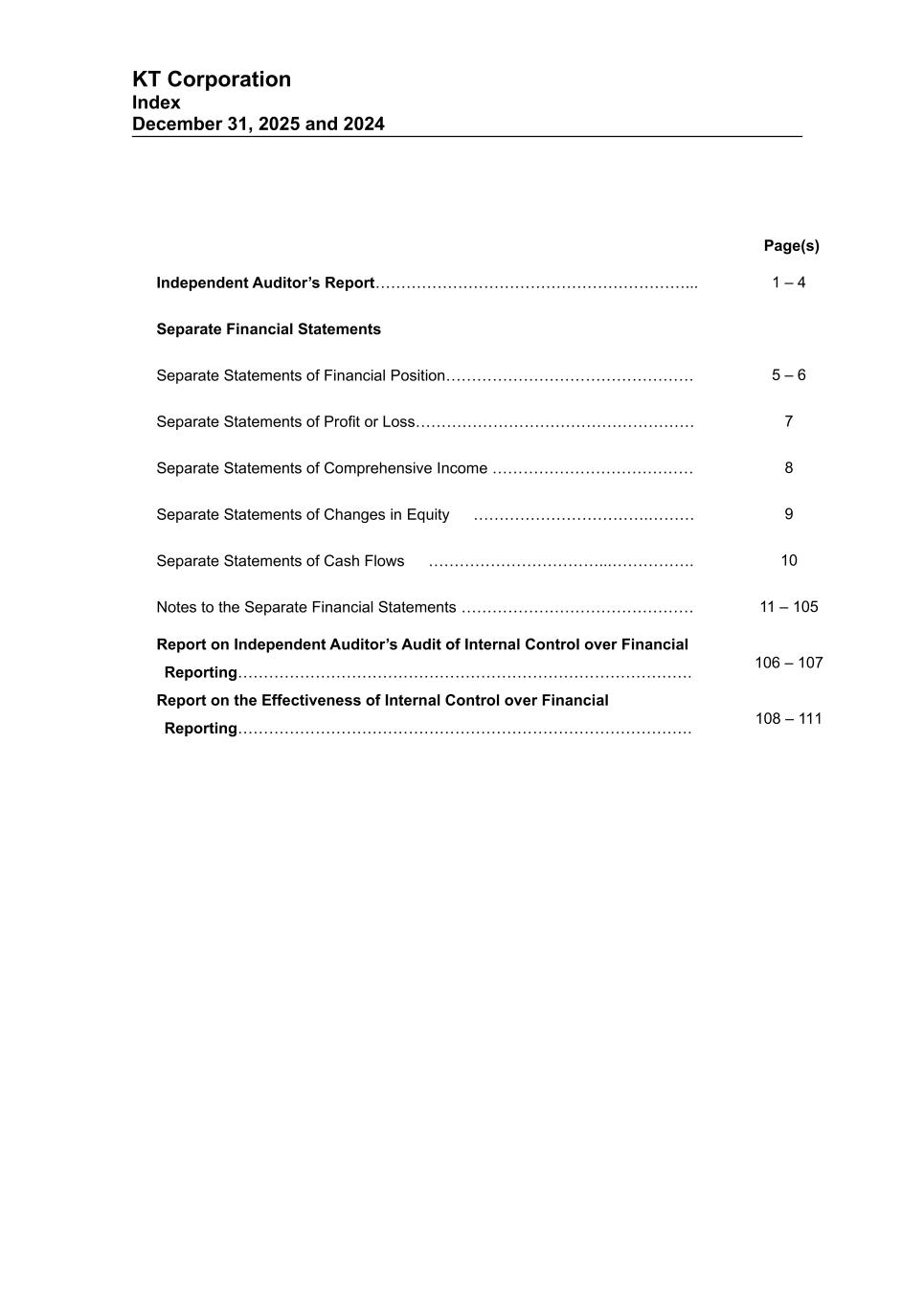
KT Corporation Index December 31, 2025 and 2024 Page(s) Independent Auditor’s Report……………………………………………………... 1 – 4 Separate Financial Statements Separate Statements of Financial Position………………………………………… 5 – 6 Separate Statements of Profit or Loss……………………………………………… 7 Separate Statements of Comprehensive Income ………………………………… 8 Separate Statements of Changes in Equity …………………………….……… 9 Separate Statements of Cash Flows ……………………………...……………. 10 Notes to the Separate Financial Statements ……………………………………… 11 – 105 Report on Independent Auditor’s Audit of Internal Control over Financial Reporting……………………………………………………………………………. 106 – 107 Report on the Effectiveness of Internal Control over Financial Reporting……………………………………………………………………………. 108 – 111
INDEPENDENT AUDITOR’S REPORT English Translation of Independent Auditor’s Report Originally Issued in Korean on March 13, 2026 To the Shareholders and the Board of Directors of KT Corporation: Audit Opinion We have audited the separate financial statements of KT Corporation (the “Company”), which comprise the separate statements of financial position as of December 31, 2025 and 2024, respectively, and the separate statements of profit or loss, the separate statements of comprehensive income, separate statements of changes in equity and separate statements of cash flows, for the years then ended, and notes to the separate financial statements, including material accounting policy information. In our opinion, the separate accompanying financial statements present fairly, in all material respects, the financial position of the Company as of December 31, 2025 and 2024, respectively, and its financial performance and its cash flows for the years then ended in accordance with Korean International Financial Reporting Standards (“K-IFRS”). We have also audited, in accordance with the Korean Standards on Auditing (“KSAs”), the internal control over financial reporting of the Company as of December 31, 2025, based on the Conceptual Framework for Design and Operation of Internal Control over Financial Reporting, and our report dated March 13, 2026 expressed an unqualified opinion. Basis for Audit Opinion We conducted our audits in accordance with the KSAs. Our responsibilities under those standards are further described in the Auditor’s Responsibilities for the Audit of the Separate Financial Statements section of our report. We are independent of the Company in accordance with the ethical requirements that are relevant to our audit of the separate financial statements in the Republic of Korea, and we have fulfilled our other ethical responsibilities in accordance with these requirements. We believe that the audit evidence we have obtained is sufficient and appropriate to provide a basis for our audit opinion. Key Audit Matters The key audit matters are those matters that, in our professional judgment, were of most significance in our audit of the separate financial statements of the current period. These matters were addressed in the context of our audit of the separate financial statements as a whole, and in forming our opinion thereon, and we do not provide a separate opinion on these matters. Deloitte Anjin LLC 9F., One IFC, 10, Gukjegeumyung-ro, Youngdeungpo-gu, Seoul 07326, Korea Tel: +82 (2) 6676 1000 Fax: +82 (2) 6674 2114 www.deloitteanjin.co.kr
- Occurrence and accuracy of mobile service revenue and revenue related to sale of handset for mobile service ("Mobile revenue") (1) Reasons for determining the matter as a Key Audit Matter As described in Note 2.22 to the separate financial statements, the Company recognizes revenue at the point in time when it fulfills its performance obligations identified from contracts with customers. The Company provides various services and rate plans related to Mobile revenue, and due to the large volume of transactions with customers, needs complex and elaborate information technology systems to accurately record occurrence of mobile revenue. The amount of Mobile revenue recorded through the billing system is significant, and given the complexity of the billing system used for revenue recognition, we determined the occurrence and accuracy of Mobile revenue recognized through the billing system as a key audit matter. (2) How the matter has been addressed in the audit Key audit procedures performed regarding the occurrence and accuracy of Mobile revenue recorded through the billing system include the following: ⚫ During the audit planning phase, we obtained an understanding of the Company's accounting policies and processes related to Mobile revenue recognition. ⚫ We performed procedures to obtain an understanding of the IT systems used throughout Mobile revenue recording process—including the aggregation of the usage of voice, messaging, and data, as well as, rating and billing—and performed tests of the general information technology controls over those systems. ⚫ We performed tests of relevant manual and automated controls across the end-to-end Mobile revenue recording process. ⚫ To verify the occurrence and accuracy of Mobile revenue, we selected samples to examine the contractual terms agreed between the Company and its customers and reconciled billed amounts to amounts collected. ⚫ To verify the occurrence and accuracy of mobile service revenue, we performed substantive analytical procedures using mobile service revenue by pricing plan and subscriber count information. Responsibilities of Management and Those Charged with Governance for the Separate Financial Statements Management is responsible for the preparation and fair presentation of the accompanying separate financial statements in accordance with K-IFRS, and for such internal control as they determine is necessary to enable the preparation of separate financial statements that are free from material misstatement, whether due to fraud or error. In preparing the separate financial statements, management of the Company is responsible for assessing the Company’s ability to continue as a going concern, disclosing, as applicable, matters related to going concern and using the going concern basis of -2-
accounting unless management either intends to liquidate the Company or to cease operations, or has no realistic alternative but to do so. Those charged with governance are responsible for overseeing the Company’s financial reporting process. Auditor’s Responsibilities for the Audit of the Separate Financial Statements Our objectives are to obtain reasonable assurance about whether the separate financial statements as a whole are free from material misstatement, whether due to fraud or error, and to issue an auditor’s report that includes our opinion. Reasonable assurance is a high level of assurance, but is not a guarantee that an audit conducted in accordance with KSAs will always detect a material misstatement when it exists. Misstatements can arise from fraud or error and are considered material if, individually or in the aggregate, they could reasonably be expected to influence the economic decisions of users taken on the basis of these separate financial statements. As part of an audit in accordance with KSAs, we exercise professional judgment and maintain professional skepticism throughout the audit. We also: ⚫ Identify and assess the risks of material misstatement of the separate financial statements, whether due to fraud or error, design and perform audit procedures responsive to those risks, and obtain audit evidence that is sufficient and appropriate to provide a basis for our audit opinion. The risk of not detecting a material misstatement resulting from fraud is higher than for one resulting from error, as fraud may involve collusion, forgery, intentional omissions, misrepresentations, or the override of internal control. ⚫ Obtain an understanding of internal control relevant to the audit in order to design audit procedures that are appropriate in the circumstances. ⚫ Evaluate the appropriateness of accounting policies used and the reasonableness of accounting estimates and related disclosures made by management. ⚫ Conclude on the appropriateness of management’s use of the going concern basis of accounting and, based on the audit evidence obtained, whether a material uncertainty exists related to events or conditions that may cast significant doubt on the Company’s ability to continue as a going concern. If we conclude that a material uncertainty exists, we are required to draw attention in our auditor’s report to the related disclosures in the separate financial statements or, if such disclosures are inadequate, to modify our opinion. Our conclusions are based on the audit evidence obtained up to the date of our auditor’s report. However, future events or conditions may cause the Company to cease to continue as a going concern. ⚫ Evaluate the overall presentation, structure and content of the separate financial statements, including the disclosures, and whether the separate financial statements represent the underlying transactions and events in a manner that achieves fair presentation. We communicate with those charged with governance regarding, among other matters, the planned scope and timing of the audit and significant audit findings, including any significant deficiencies in internal control that we identify during our audit. -3-
We also provide those charged with governance with a statement that we have complied with relevant ethical requirements regarding independence, and to communicate with them all relationships and other matters that may reasonably be thought to bear on our independence, and where applicable, related safeguards. From the matters communicated with those charged with governance, we determine those matters that were of most significance in the audit of the separate financial statements of the current period and are therefore the key audit matters. We describe these matters in our auditor’s report unless law or regulation precludes public disclosure about the matter or when, in extremely rare circumstances, we determine that a matter should not be communicated in our report because the adverse consequences of doing so would reasonably be expected to outweigh the public interest benefits of such communication. The engagement partner on the audit resulting in this independent auditor’s report is Ho Gye, Choi. March 13, 2026 Notice to Readers This report is effective as of March 13, 2026, the auditor’s report date. Certain subsequent events or circumstances may have occurred between the auditor’s report date and the time the auditor’s report is read. Such events or circumstances could significantly affect the separate financial statements and may result in modifications to the auditor’s report. -4-
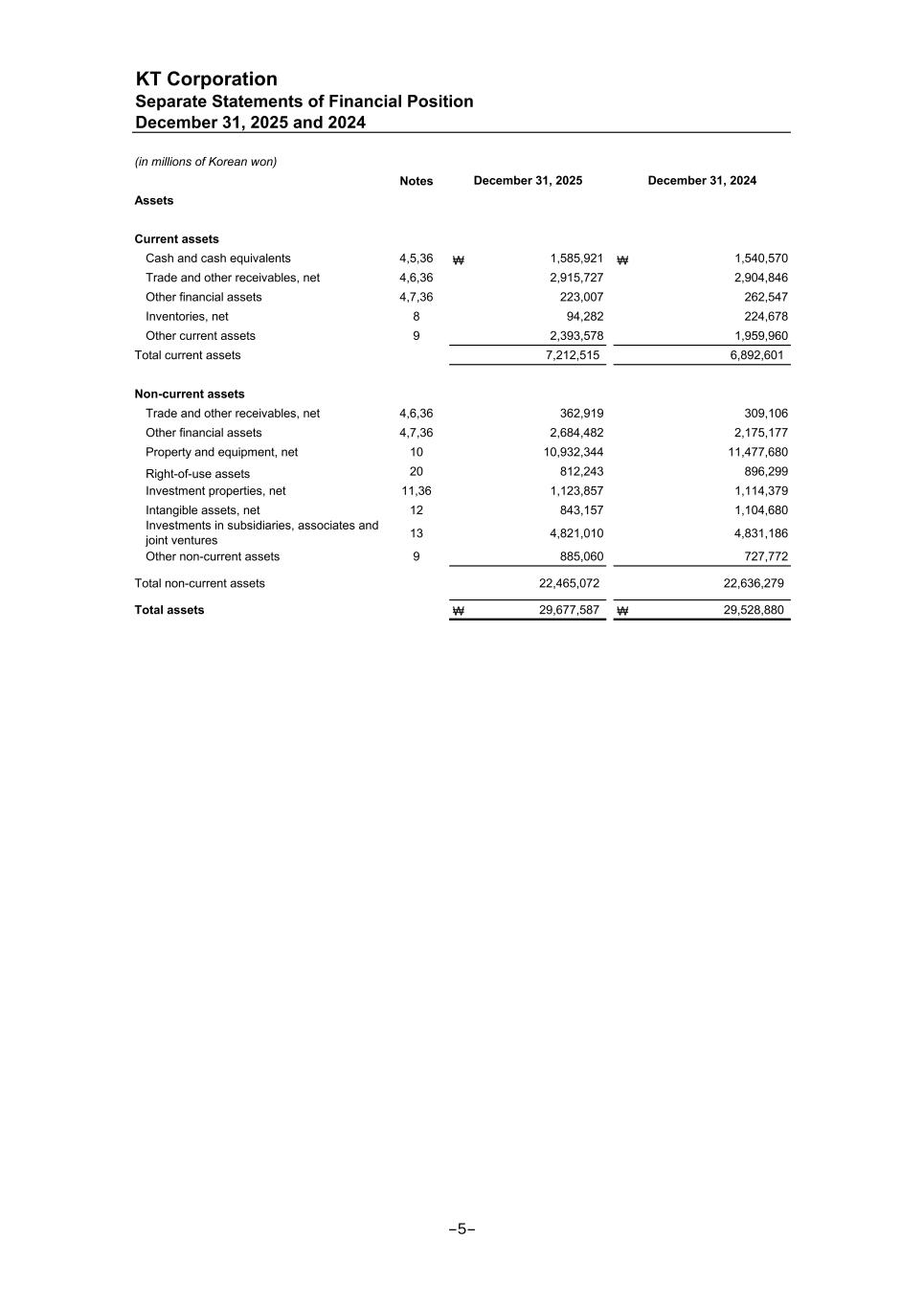
KT Corporation Separate Statements of Financial Position December 31, 2025 and 2024 (in millions of Korean won) Notes Assets Current assets Cash and cash equivalents 4,5,36 ₩ 1,585,921 ₩ 1,540,570 Trade and other receivables, net 4,6,36 2,915,727 2,904,846 Other financial assets 4,7,36 223,007 262,547 Inventories, net 8 94,282 224,678 Other current assets 9 2,393,578 1,959,960 Total current assets 7,212,515 6,892,601 Non-current assets Trade and other receivables, net 4,6,36 362,919 309,106 Other financial assets 4,7,36 2,684,482 2,175,177 Property and equipment, net 10 10,932,344 11,477,680 Right-of-use assets 20 812,243 896,299 Investment properties, net 11,36 1,123,857 1,114,379 Intangible assets, net 12 843,157 1,104,680 13 4,821,010 4,831,186 Other non-current assets 9 885,060 727,772 Total non-current assets 22,465,072 22,636,279 Total assets ₩ 29,677,587 ₩ 29,528,880 Investments in subsidiaries, associates and joint ventures December 31, 2025 December 31, 2024 -5-
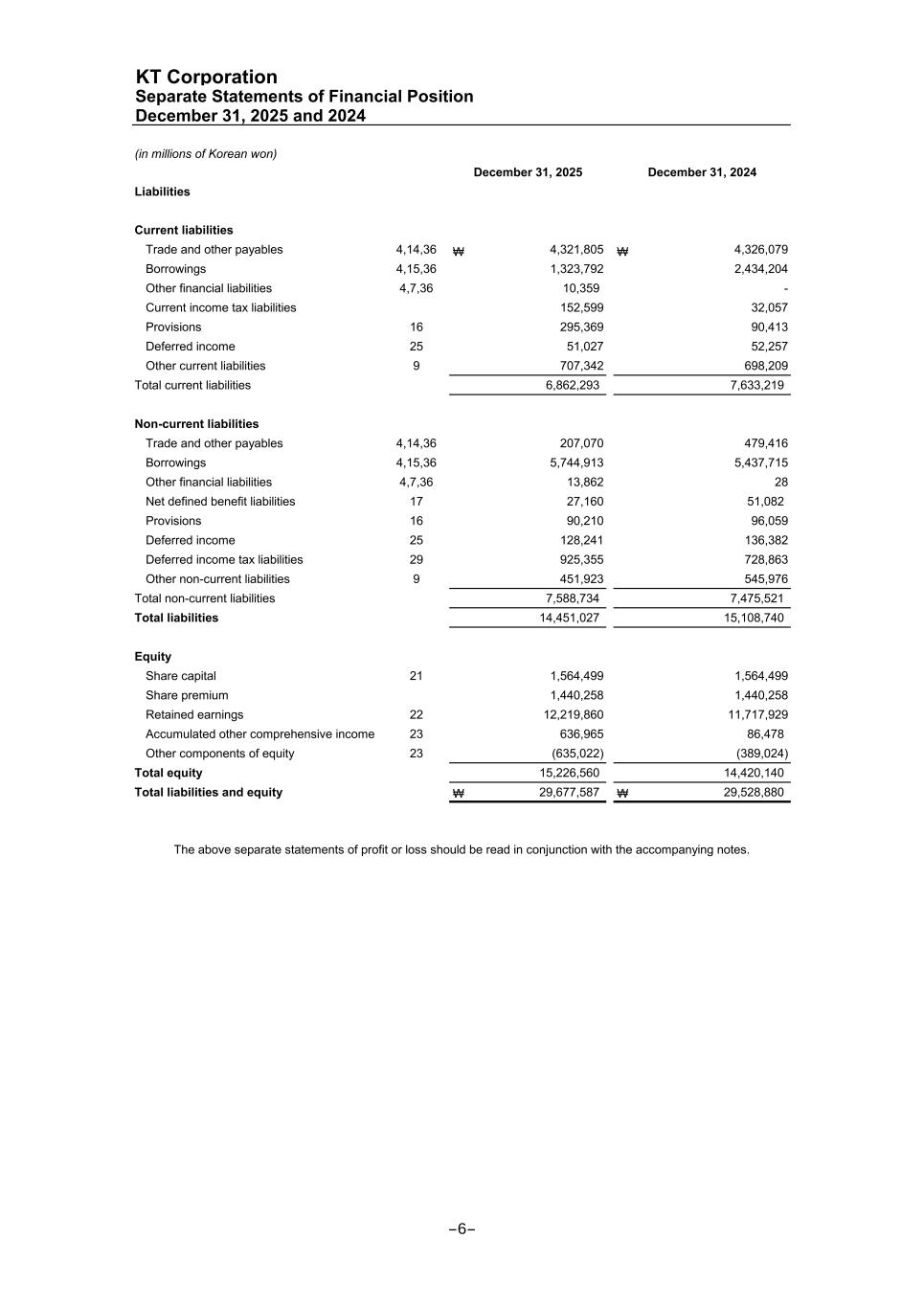
KT Corporation Separate Statements of Financial Position December 31, 2025 and 2024 (in millions of Korean won) Liabilities Current liabilities Trade and other payables 4,14,36 ₩ 4,321,805 ₩ 4,326,079 Borrowings 4,15,36 1,323,792 2,434,204 Other financial liabilities 4,7,36 10,359 - Current income tax liabilities 152,599 32,057 Provisions 16 295,369 90,413 Deferred income 25 51,027 52,257 Other current liabilities 9 707,342 698,209 Total current liabilities 6,862,293 7,633,219 Non-current liabilities Trade and other payables 4,14,36 207,070 479,416 Borrowings 4,15,36 5,744,913 5,437,715 Other financial liabilities 4,7,36 13,862 28 Net defined benefit liabilities 17 27,160 51,082 Provisions 16 90,210 96,059 Deferred income 25 128,241 136,382 Deferred income tax liabilities 29 925,355 728,863 Other non-current liabilities 9 451,923 545,976 Total non-current liabilities 7,588,734 7,475,521 Total liabilities 14,451,027 15,108,740 Equity Share capital 21 1,564,499 1,564,499 Share premium 1,440,258 1,440,258 Retained earnings 22 12,219,860 11,717,929 Accumulated other comprehensive income 23 636,965 86,478 Other components of equity 23 (635,022) (389,024) Total equity 15,226,560 14,420,140 Total liabilities and equity ₩ 29,677,587 ₩ 29,528,880 - - December 31, 2025 December 31, 2024 The above separate statements of profit or loss should be read in conjunction with the accompanying notes. -6-
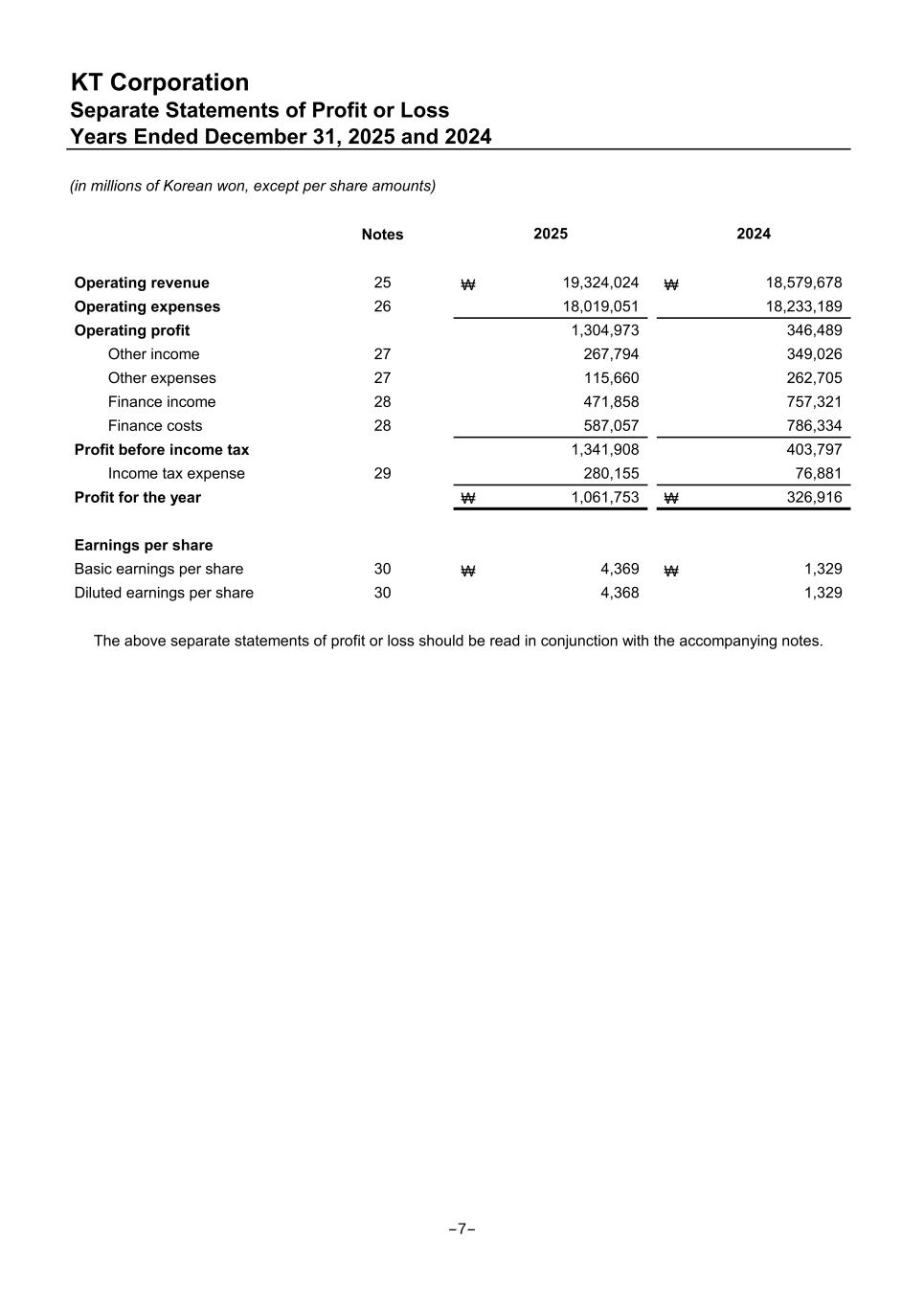
KT Corporation Separate Statements of Profit or Loss Years Ended December 31, 2025 and 2024 (in millions of Korean won, except per share amounts) Notes Operating revenue 25 ₩ 19,324,024 ₩ 18,579,678 Operating expenses 26 18,019,051 18,233,189 Operating profit 1,304,973 346,489 Other income 27 267,794 349,026 Other expenses 27 115,660 262,705 Finance income 28 471,858 757,321 Finance costs 28 587,057 786,334 Profit before income tax 1,341,908 403,797 Income tax expense 29 280,155 76,881 Profit for the year ₩ 1,061,753 ₩ 326,916 Earnings per share Basic earnings per share 30 ₩ 4,369 ₩ 1,329 Diluted earnings per share 30 4,368 1,329 2025 2024 The above separate statements of profit or loss should be read in conjunction with the accompanying notes. -7-
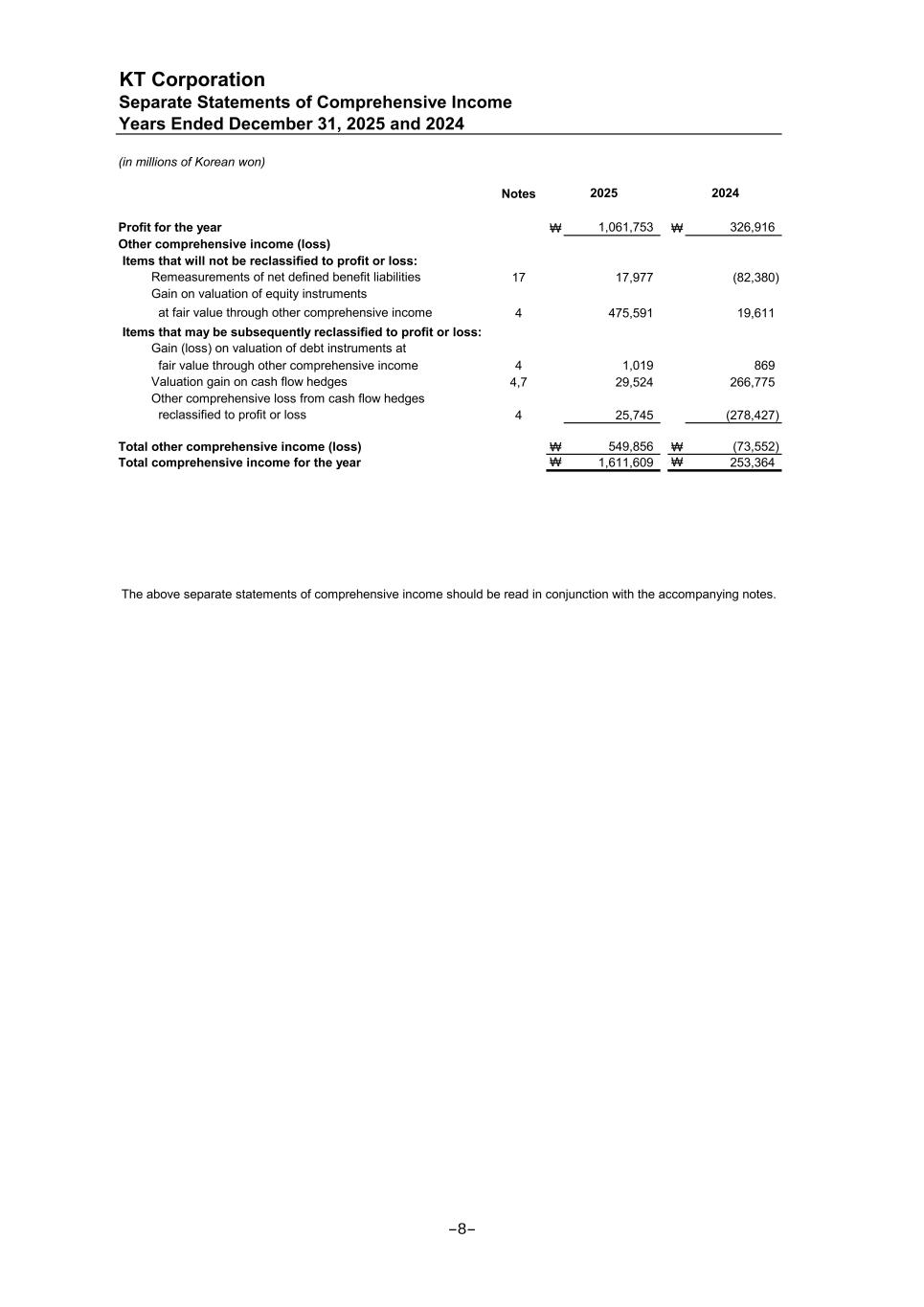
KT Corporation Separate Statements of Comprehensive Income Years Ended December 31, 2025 and 2024 (in millions of Korean won) Notes Profit for the year ₩ 1,061,753 ₩ 326,916 Other comprehensive income (loss) Items that will not be reclassified to profit or loss: 17 17,977 (82,380) 4 475,591 19,611 Items that may be subsequently reclassified to profit or loss: fair value through other comprehensive income 4 1,019 869 4,7 29,524 266,775 4 25,745 (278,427) Total other comprehensive income (loss) ₩ 549,856 ₩ (73,552) Total comprehensive income for the year ₩ 1,611,609 ₩ 253,364 The above separate statements of comprehensive income should be read in conjunction with the accompanying notes. at fair value through other comprehensive income Gain (loss) on valuation of debt instruments at Valuation gain on cash flow hedges Other comprehensive loss from cash flow hedges reclassified to profit or loss Gain on valuation of equity instruments 2025 2024 Remeasurements of net defined benefit liabilities -8-
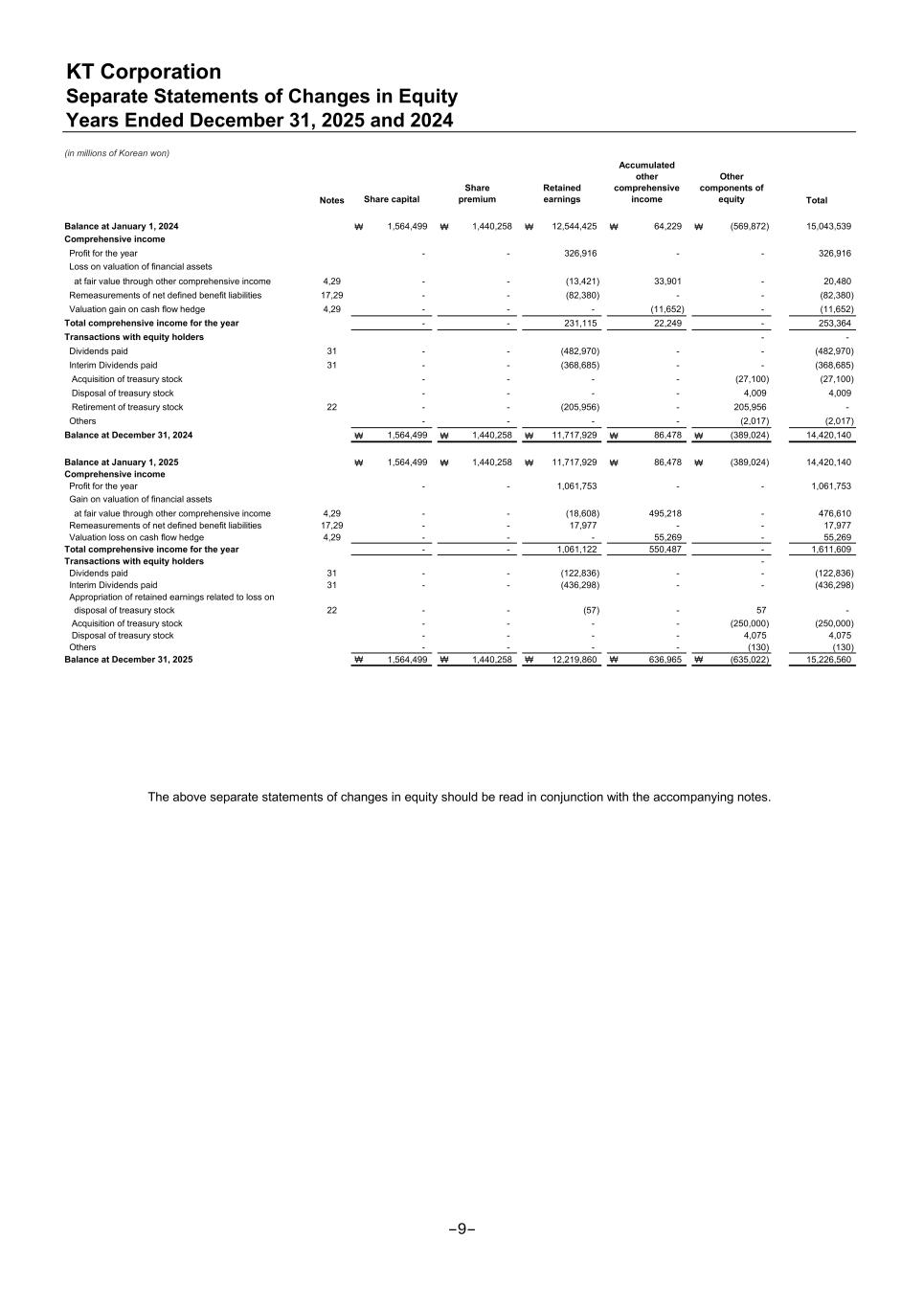
KT Corporation Separate Statements of Changes in Equity Years Ended December 31, 2025 and 2024 (in millions of Korean won) Notes Balance at January 1, 2024 ₩ 1,564,499 ₩ 1,440,258 ₩ 12,544,425 ₩ 64,229 ₩ (569,872) 15,043,539 Comprehensive income Profit for the year - - 326,916 - - 326,916 at fair value through other comprehensive income 4,29 - - (13,421) 33,901 - 20,480 Remeasurements of net defined benefit liabilities 17,29 - - (82,380) - - (82,380) Valuation gain on cash flow hedge 4,29 - - - (11,652) - (11,652) Total comprehensive income for the year - - 231,115 22,249 - 253,364 Transactions with equity holders - - Dividends paid 31 - - (482,970) - - (482,970) Interim Dividends paid 31 - - (368,685) - - (368,685) Acquisition of treasury stock - - - - (27,100) (27,100) Disposal of treasury stock - - - - 4,009 4,009 Retirement of treasury stock 22 - - (205,956) - 205,956 - Others - - - - (2,017) (2,017) Balance at December 31, 2024 ₩ 1,564,499 ₩ 1,440,258 ₩ 11,717,929 ₩ 86,478 ₩ (389,024) 14,420,140 Balance at January 1, 2025 ₩ 1,564,499 ₩ 1,440,258 ₩ 11,717,929 ₩ 86,478 ₩ (389,024) 14,420,140 Comprehensive income Profit for the year - - 1,061,753 - - 1,061,753 at fair value through other comprehensive income 4,29 - - (18,608) 495,218 - 476,610 Remeasurements of net defined benefit liabilities 17,29 - - 17,977 - - 17,977 Valuation loss on cash flow hedge 4,29 - - - 55,269 - 55,269 Total comprehensive income for the year - - 1,061,122 550,487 - 1,611,609 Transactions with equity holders - Dividends paid 31 - - (122,836) - - (122,836) Interim Dividends paid 31 - - (436,298) - - (436,298) Appropriation of retained earnings related to loss on disposal of treasury stock 22 - - (57) - 57 - Acquisition of treasury stock - - - - (250,000) (250,000) Disposal of treasury stock - - - - 4,075 4,075 Others - - - - (130) (130) Balance at December 31, 2025 ₩ 1,564,499 ₩ 1,440,258 ₩ 12,219,860 ₩ 636,965 ₩ (635,022) 15,226,560 Loss on valuation of financial assets Gain on valuation of financial assets The above separate statements of changes in equity should be read in conjunction with the accompanying notes. TotalShare capital Share premium Retained earnings Accumulated other comprehensive income Other components of equity -9-
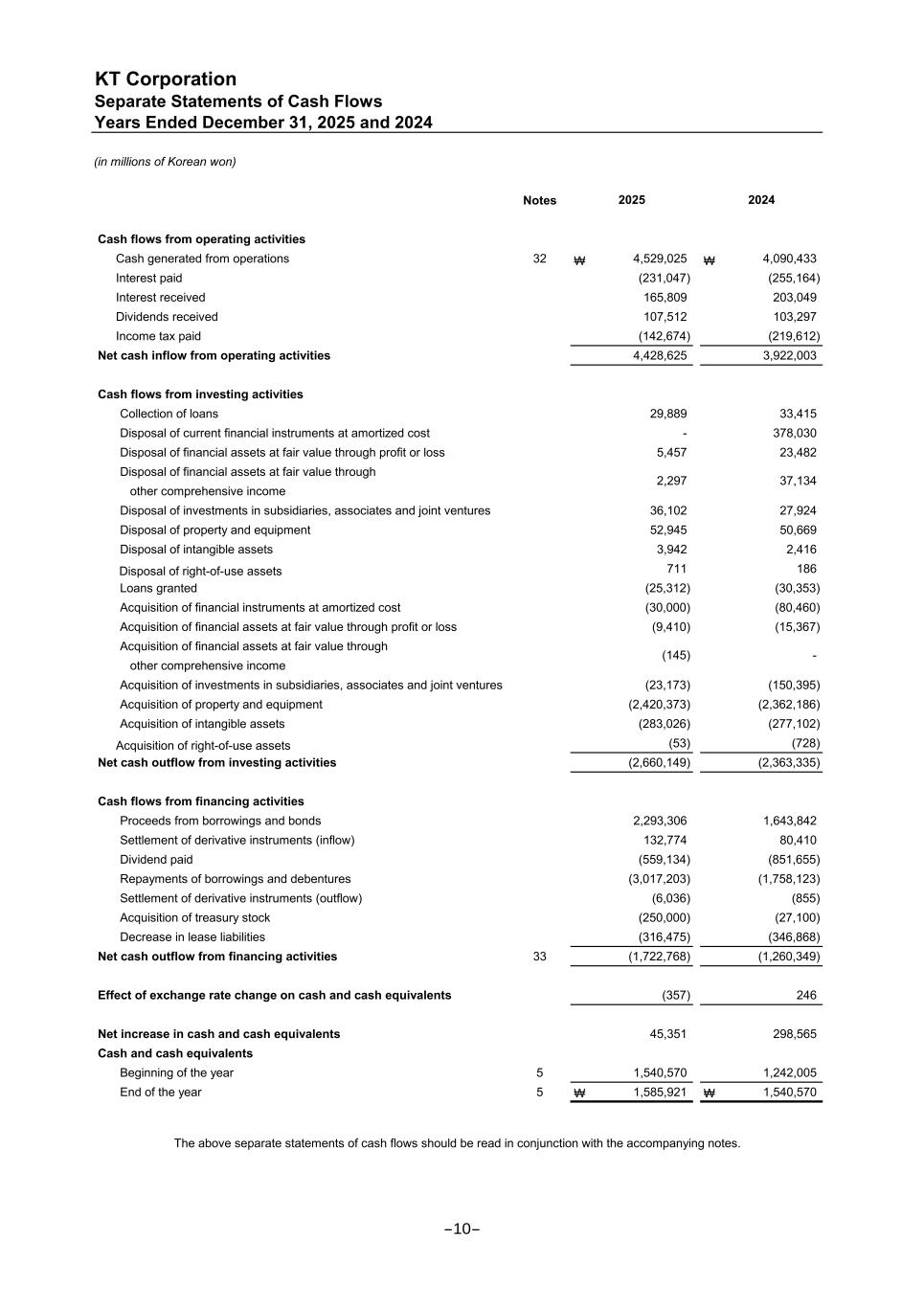
KT Corporation Separate Statements of Cash Flows Years Ended December 31, 2025 and 2024 (in millions of Korean won) Notes Cash flows from operating activities Cash generated from operations 32 ₩ 4,529,025 ₩ 4,090,433 Interest paid (231,047) (255,164) Interest received 165,809 203,049 Dividends received 107,512 103,297 Income tax paid (142,674) (219,612) Net cash inflow from operating activities 4,428,625 3,922,003 Cash flows from investing activities Collection of loans 29,889 33,415 Disposal of current financial instruments at amortized cost - 378,030 Disposal of financial assets at fair value through profit or loss 5,457 23,482 Disposal of financial assets at fair value through other comprehensive income Disposal of investments in subsidiaries, associates and joint ventures 36,102 27,924 Disposal of property and equipment 52,945 50,669 Disposal of intangible assets 3,942 2,416 Disposal of right-of-use assets 711 186 Loans granted (25,312) (30,353) Acquisition of financial instruments at amortized cost (30,000) (80,460) Acquisition of financial assets at fair value through profit or loss (9,410) (15,367) Acquisition of financial assets at fair value through other comprehensive income Acquisition of investments in subsidiaries, associates and joint ventures (23,173) (150,395) Acquisition of property and equipment (2,420,373) (2,362,186) Acquisition of intangible assets (283,026) (277,102) Acquisition of right-of-use assets (53) (728) Net cash outflow from investing activities (2,660,149) (2,363,335) Cash flows from financing activities Proceeds from borrowings and bonds 2,293,306 1,643,842 Settlement of derivative instruments (inflow) 132,774 80,410 Dividend paid (559,134) (851,655) Repayments of borrowings and debentures (3,017,203) (1,758,123) Settlement of derivative instruments (outflow) (6,036) (855) Acquisition of treasury stock (250,000) (27,100) Decrease in lease liabilities (316,475) (346,868) Net cash outflow from financing activities 33 (1,722,768) (1,260,349) Effect of exchange rate change on cash and cash equivalents (357) 246 Net increase in cash and cash equivalents 45,351 298,565 Cash and cash equivalents Beginning of the year 5 1,540,570 1,242,005 End of the year 5 ₩ 1,585,921 ₩ 1,540,570 2025 2024 2,297 37,134 The above separate statements of cash flows should be read in conjunction with the accompanying notes. (145) - -10-
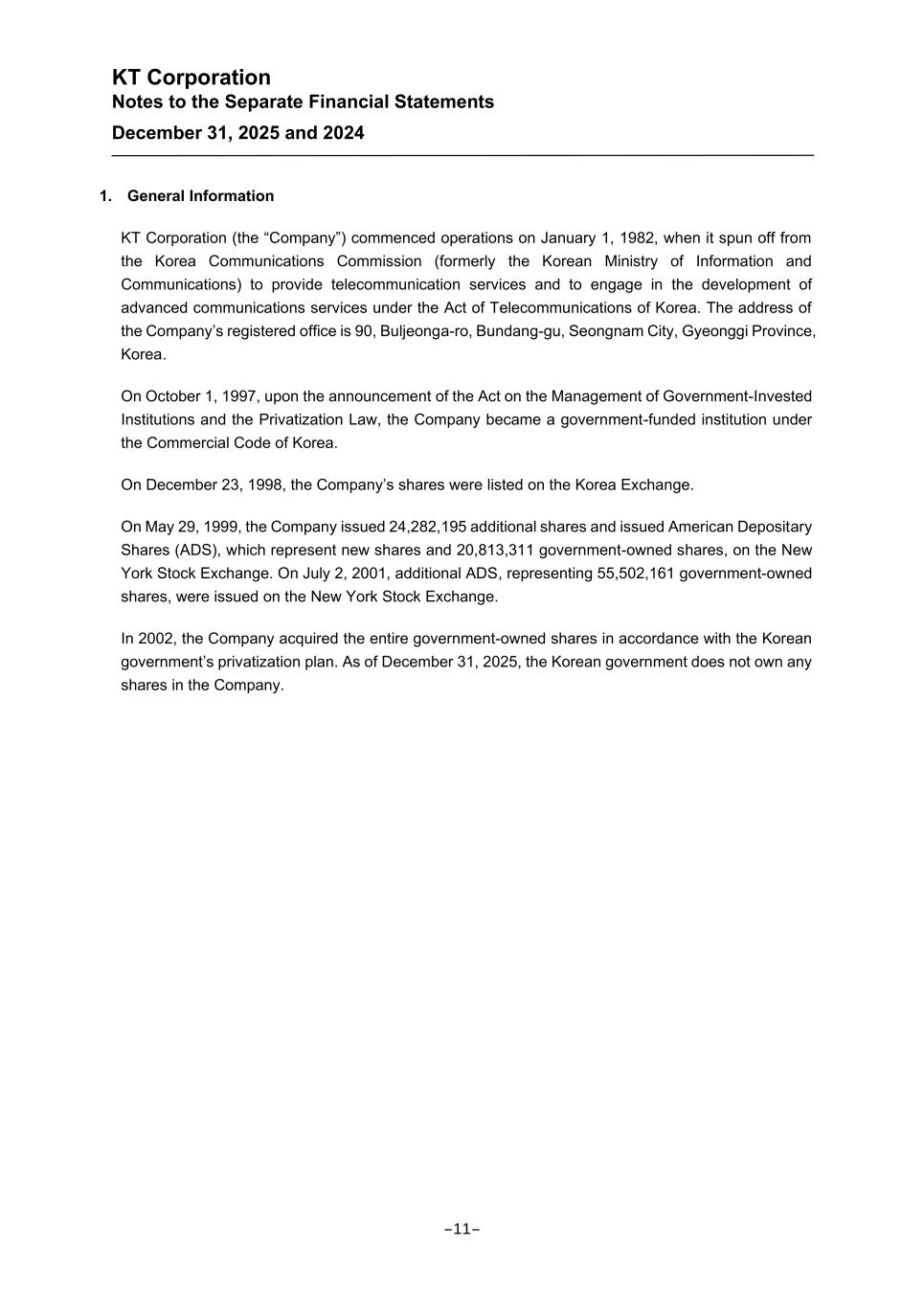
KT Corporation Notes to the Separate Financial Statements December 31, 2025 and 2024 1. General Information KT Corporation (the “Company”) commenced operations on January 1, 1982, when it spun off from the Korea Communications Commission (formerly the Korean Ministry of Information and Communications) to provide telecommunication services and to engage in the development of advanced communications services under the Act of Telecommunications of Korea. The address of the Company’s registered office is 90, Buljeonga-ro, Bundang-gu, Seongnam City, Gyeonggi Province, Korea. On October 1, 1997, upon the announcement of the Act on the Management of Government-Invested Institutions and the Privatization Law, the Company became a government-funded institution under the Commercial Code of Korea. On December 23, 1998, the Company’s shares were listed on the Korea Exchange. On May 29, 1999, the Company issued 24,282,195 additional shares and issued American Depositary Shares (ADS), which represent new shares and 20,813,311 government-owned shares, on the New York Stock Exchange. On July 2, 2001, additional ADS, representing 55,502,161 government-owned shares, were issued on the New York Stock Exchange. In 2002, the Company acquired the entire government-owned shares in accordance with the Korean government’s privatization plan. As of December 31, 2025, the Korean government does not own any shares in the Company. -11-
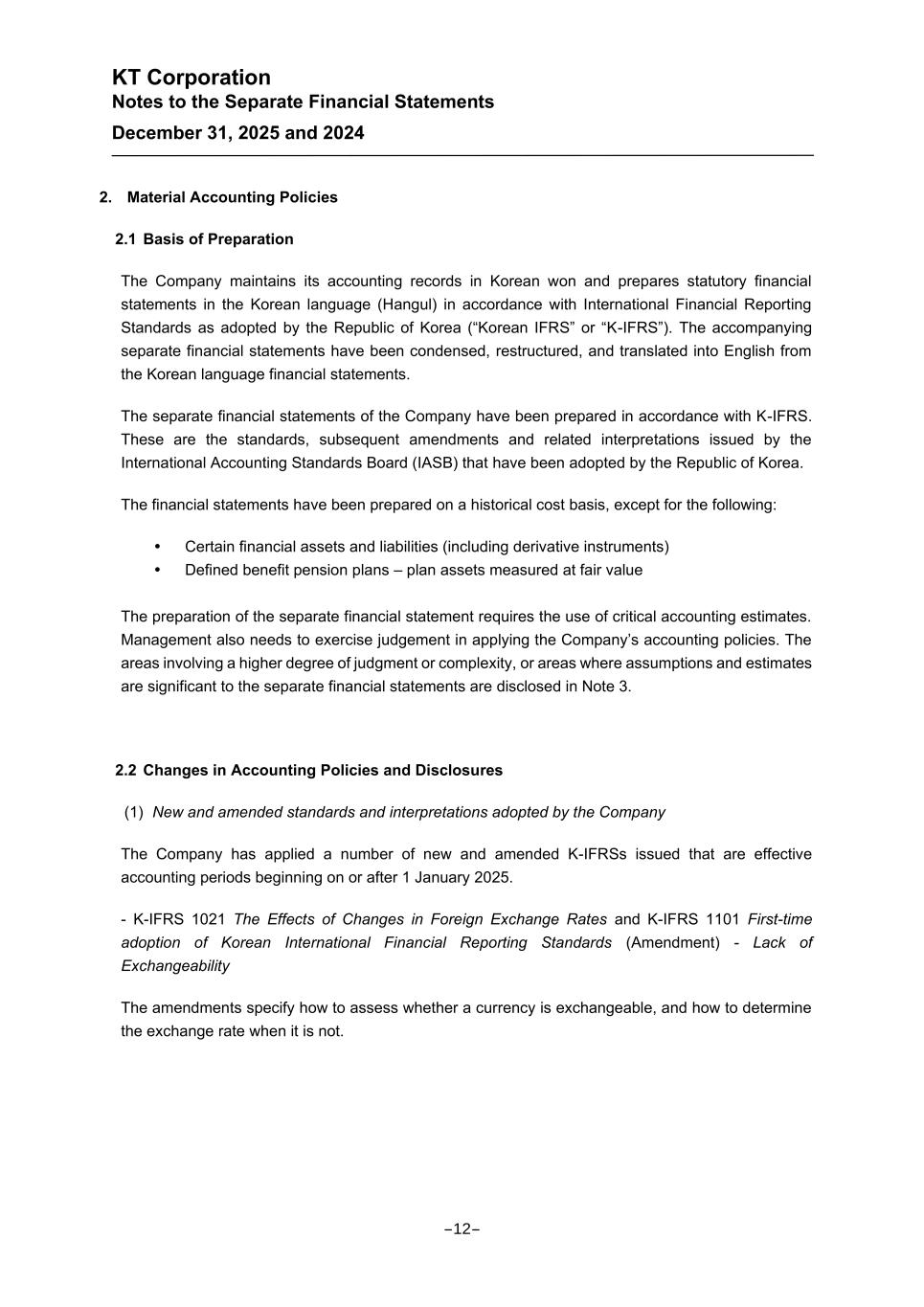
KT Corporation Notes to the Separate Financial Statements December 31, 2025 and 2024 2. Material Accounting Policies 2.1 Basis of Preparation The Company maintains its accounting records in Korean won and prepares statutory financial statements in the Korean language (Hangul) in accordance with International Financial Reporting Standards as adopted by the Republic of Korea (“Korean IFRS” or “K-IFRS”). The accompanying separate financial statements have been condensed, restructured, and translated into English from the Korean language financial statements. The separate financial statements of the Company have been prepared in accordance with K-IFRS. These are the standards, subsequent amendments and related interpretations issued by the International Accounting Standards Board (IASB) that have been adopted by the Republic of Korea. The financial statements have been prepared on a historical cost basis, except for the following: Certain financial assets and liabilities (including derivative instruments) Defined benefit pension plans – plan assets measured at fair value The preparation of the separate financial statement requires the use of critical accounting estimates. Management also needs to exercise judgement in applying the Company’s accounting policies. The areas involving a higher degree of judgment or complexity, or areas where assumptions and estimates are significant to the separate financial statements are disclosed in Note 3. 2.2 Changes in Accounting Policies and Disclosures (1) New and amended standards and interpretations adopted by the Company The Company has applied a number of new and amended K-IFRSs issued that are effective accounting periods beginning on or after 1 January 2025. - K-IFRS 1021 The Effects of Changes in Foreign Exchange Rates and K-IFRS 1101 First-time adoption of Korean International Financial Reporting Standards (Amendment) - Lack of Exchangeability The amendments specify how to assess whether a currency is exchangeable, and how to determine the exchange rate when it is not. -12-
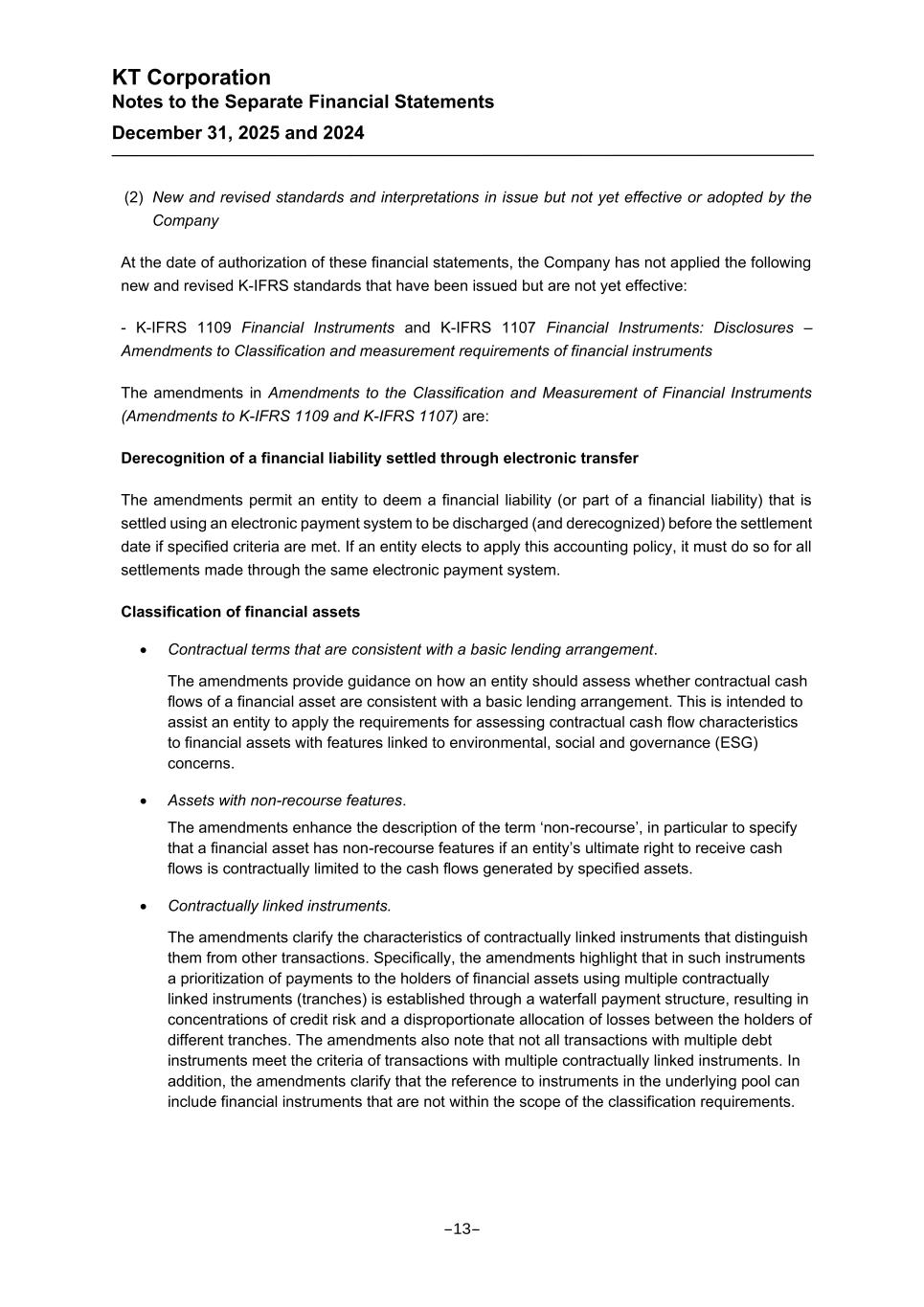
KT Corporation Notes to the Separate Financial Statements December 31, 2025 and 2024 (2) New and revised standards and interpretations in issue but not yet effective or adopted by the Company At the date of authorization of these financial statements, the Company has not applied the following new and revised K-IFRS standards that have been issued but are not yet effective: - K-IFRS 1109 Financial Instruments and K-IFRS 1107 Financial Instruments: Disclosures – Amendments to Classification and measurement requirements of financial instruments The amendments in Amendments to the Classification and Measurement of Financial Instruments (Amendments to K-IFRS 1109 and K-IFRS 1107) are: Derecognition of a financial liability settled through electronic transfer The amendments permit an entity to deem a financial liability (or part of a financial liability) that is settled using an electronic payment system to be discharged (and derecognized) before the settlement date if specified criteria are met. If an entity elects to apply this accounting policy, it must do so for all settlements made through the same electronic payment system. Classification of financial assets • Contractual terms that are consistent with a basic lending arrangement. The amendments provide guidance on how an entity should assess whether contractual cash flows of a financial asset are consistent with a basic lending arrangement. This is intended to assist an entity to apply the requirements for assessing contractual cash flow characteristics to financial assets with features linked to environmental, social and governance (ESG) concerns. • Assets with non-recourse features. The amendments enhance the description of the term ‘non-recourse’, in particular to specify that a financial asset has non-recourse features if an entity’s ultimate right to receive cash flows is contractually limited to the cash flows generated by specified assets. • Contractually linked instruments. The amendments clarify the characteristics of contractually linked instruments that distinguish them from other transactions. Specifically, the amendments highlight that in such instruments a prioritization of payments to the holders of financial assets using multiple contractually linked instruments (tranches) is established through a waterfall payment structure, resulting in concentrations of credit risk and a disproportionate allocation of losses between the holders of different tranches. The amendments also note that not all transactions with multiple debt instruments meet the criteria of transactions with multiple contractually linked instruments. In addition, the amendments clarify that the reference to instruments in the underlying pool can include financial instruments that are not within the scope of the classification requirements. -13-
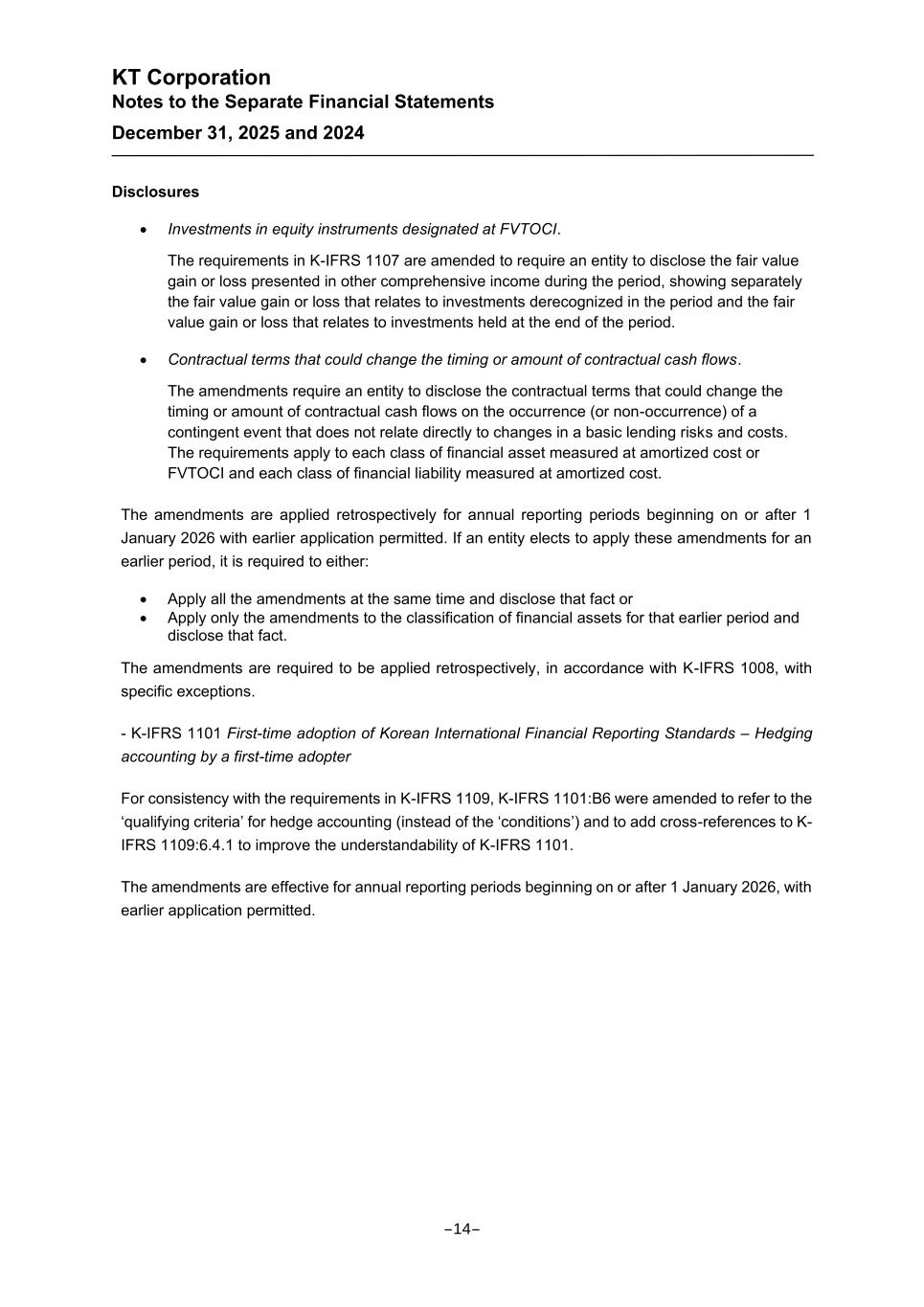
KT Corporation Notes to the Separate Financial Statements December 31, 2025 and 2024 Disclosures • Investments in equity instruments designated at FVTOCI. The requirements in K-IFRS 1107 are amended to require an entity to disclose the fair value gain or loss presented in other comprehensive income during the period, showing separately the fair value gain or loss that relates to investments derecognized in the period and the fair value gain or loss that relates to investments held at the end of the period. • Contractual terms that could change the timing or amount of contractual cash flows. The amendments require an entity to disclose the contractual terms that could change the timing or amount of contractual cash flows on the occurrence (or non-occurrence) of a contingent event that does not relate directly to changes in a basic lending risks and costs. The requirements apply to each class of financial asset measured at amortized cost or FVTOCI and each class of financial liability measured at amortized cost. The amendments are applied retrospectively for annual reporting periods beginning on or after 1 January 2026 with earlier application permitted. If an entity elects to apply these amendments for an earlier period, it is required to either: • Apply all the amendments at the same time and disclose that fact or • Apply only the amendments to the classification of financial assets for that earlier period and disclose that fact. The amendments are required to be applied retrospectively, in accordance with K-IFRS 1008, with specific exceptions. - K-IFRS 1101 First-time adoption of Korean International Financial Reporting Standards – Hedging accounting by a first-time adopter For consistency with the requirements in K-IFRS 1109, K-IFRS 1101:B6 were amended to refer to the ‘qualifying criteria’ for hedge accounting (instead of the ‘conditions’) and to add cross-references to K- IFRS 1109:6.4.1 to improve the understandability of K-IFRS 1101. The amendments are effective for annual reporting periods beginning on or after 1 January 2026, with earlier application permitted. -14-
KT Corporation Notes to the Separate Financial Statements December 31, 2025 and 2024 - K-IFRS 1107 Financial Instruments: Disclosures – Gain or loss on derecognition The amendments remove an obsolete cross-reference in K-IFRS 1107:B38 to a paragraph that had been deleted when K-IFRS 1113 was issued and aligned the wording of this paragraph with the terms used in K-IFRS 1113. Guidance on implementing K-IFRS 1107—Disclosure of deferred difference between fair value and transaction price The amendments update K-IFRS 1107:IG14 to make the wording of that paragraph consistent with K- IFRS 1107:28 and improve the internal consistency of the wording in the example in K-IFRS 1107:IG14. Guidance on implementing K-IFRS 1107—Introduction and credit risk disclosures The amendments add a statement to K-IFRS 1107:IG1 clarifying that the guidance does not necessarily illustrate all the requirements in the referenced paragraphs of K-IFRS 1107. The amendments also simplify the explanation of the aspects of the requirements that are not illustrated in K-IFRS 1107:IG20B. The amendments are effective for annual reporting periods beginning on or after 1 January 2026, with earlier application permitted. - K-IFRS 1109 Financial Instruments – Derecognition of lease liabilities and Transaction price The amendments add a cross-reference to K-IFRS 1109:3.3.3 in K-IFRS 1109:2.1(b)(ii) to clarify that when a lessee has determined that a lease liability has been extinguished in accordance with K-IFRS 1109, the lessee is required to apply K-IFRS 1109:3.3.3 and therefore recognize any resulting gain or loss in profit or loss. Additionally, the amendments replace ‘their transaction price (as defined in K-IFRS 1115)’ in K-IFRS 1109:5.1.3 with ‘the amount determined by applying K-IFRS 1115’ which may require a receivable to be measured at an amount that differs from the amount of the transaction price recognized as revenue. The reference to ‘transaction price’(as defined in K-IFRS 1115) is deleted from Appendix A of K-IFRS 1109. The amendments are effective for annual reporting periods beginning on or after 1 January 2026, with earlier application permitted. An entity is required to apply the amendments to K-IFRS 1109:2.1(b)(ii) to lease liabilities that are extinguished on or after the beginning of the annual reporting period in which the entity first applies that amendment. -15-
KT Corporation Notes to the Separate Financial Statements December 31, 2025 and 2024 - K-IFRS 1110 Consolidated Financial Statements – Determination of ‘de facto agent’ The amendments address concerns that the requirements in K-IFRS 1110:B73-B74 might, in some situations, be contradictory. K-IFRS 1110:B73 refers to ‘de facto agents’ as parties acting on the investor’s behalf and states that the determination of whether other parties are acting as de facto agents requires judgement. However, the second sentence of K-IFRS 1110:B74 includes more conclusive language and states that a party is a de facto agent when those that direct the activities of the investor have the ability to direct that party to act on the investor’s behalf. The amendments update K-IFRS 1110:B74 to use less conclusive language and to clarify that the relationship described in K- IFRS 1110:B74 is just one example of a circumstance in which judgement is required to determine whether a party is acting as a de facto agent. The amendments are effective for annual reporting periods beginning on or after 1 January 2026, with earlier application permitted. - K-IFRS 1007 Statement of Cash Flows: Cost method The amendment replaces the term ‘cost method’ with ‘at cost’ in K-IFRS 1007:37 in line with the removal of the definition of ‘cost method’ from the IFRS Accounting Standards. The amendments are effective for annual reporting periods beginning on or after 1 January 2026, with earlier application permitted. - K-IFRS 1109 Financial Instruments and K-IFRS 1107 Financial Instruments: Disclosures (Amendment) - Amendments to K-IFRS 1109 Financial Instruments The following requirements of K-IFRS 1109 are affected by the amendments: • the “own-use” requirements in K-IFRS 1109 are amended to include factors an entity is required to consider when applying K-IFRS 1109:2.4 to contracts to buy and take delivery of renewable electricity for which the source of production of the electricity is nature-dependent; and • the hedge accounting requirements in K-IFRS 1109 are amended to permit an entity using a contract for nature-dependent renewable electricity with specified characteristics as a hedging instrument: o to designate a variable volume of forecast electricity transactions as the hedged item if specified criteria are met; and o to measure the hedged item using the same volume assumptions as those used for the hedging instrument. -16-
KT Corporation Notes to the Separate Financial Statements December 31, 2025 and 2024 Amendments to K-IFRS 1107 Financial Instruments: Disclosures K-IFRS 1107 was amended to introduce disclosure requirements about contracts for nature- dependent electricity with specified characteristics. The amendments are effective for annual periods beginning on or after 1 January 2026, with earlier application permitted. The amendments to the “own use exemption” are required to be applied retrospectively in accordance with K-IFRS 1008 using the facts and circumstances at the date of initial application. The amendments to the hedge accounting requirements are to be applied prospectively to new hedging relationships designated on or after the date of initial application. - K-IFRS 1118 Presentation and Disclosures in Financial Statements K-IFRS 1118 replaces K-IFRS 1001, carrying forward many of the requirements in K-IFRS 1001 unchanged and complementing them with new requirements. In addition, some paragraphs from K- IFRS 1001 have been moved to K-IFRS 1008 and K-IFRS 1107. Furthermore, minor amendments have been made to K-IFRS 1007 and K-IFRS 1033 Earnings per Share. K-IFRS 1118 introduces new requirements to: • present specified categories and defined subtotals in the statement of profit or loss • provide disclosures on management-defined performance measures (MPMs) in the notes to the financial statements • improve aggregation and disaggregation. An entity is required to apply K-IFRS 1118 for annual reporting periods beginning on or after 1 January 2027, with earlier application permitted. The amendments to K-IFRS 1007 and K-IFRS 1033, as well as the revised K-IFRS 1008 and K-IFRS 1107, become effective when an entity applies K-IFRS 1118. K-IFRS 1118 requires retrospective application with specific transition provisions. The Company is evaluating the impact of the aforementioned amendments on the financial statements. 2.3 Subsidiaries, Associates and Joint Ventures The financial statements of the Company are the separate financial statements prepared in accordance with K-IFRS 1027 Separate Financial Statements. Investments in subsidiaries, joint ventures and associates are recognized at cost under the direct equity method. Management applied the carrying amounts under the previous Financial Reporting Standards as adopted by the Republic of Korea (“Korean GAAP” or “K-GAAP”) at the time of transition to K-IFRS as deemed cost of investments. The Company recognizes dividend income from subsidiaries, joint ventures and associates in profit or loss when its right to receive the dividend is established. -17-
KT Corporation Notes to the Separate Financial Statements December 31, 2025 and 2024 2.4 Foreign Currency Translation (a) Functional and presentation currency Items included in the financial statements of the Company are measured using the currency of the primary economic environment in which the Company operates (its functional currency). The financial statements are presented in Korean won, which is the functional currency of the Company and the presentation currency for the financial statements. (b) Transactions and balances Foreign currency transactions are translated into the functional currency using the exchange rates at the dates of the transactions. Foreign exchange gains and losses resulting from the settlement of such transactions and from the translation of monetary assets and liabilities denominated in foreign currencies at year end exchange rates are generally recognized in profit or loss. They are deferred in other comprehensive income if they relate to qualifying cash flow hedges and qualifying effective portion of net investment hedges or are attributable to monetary part of the net investment in a foreign operation. Foreign exchange gains and losses that relate to financial instruments are presented in the statement of profit or loss, within finance costs. All other foreign exchange gains and losses are presented in the statement of profit or loss within ‘other income’ or ‘other expense’. Non-monetary items that are measured at fair value in a foreign currency are translated using the exchange rates at the date when the fair value was determined. Translation differences on assets and liabilities carried at fair value are reported as part of the fair value gain or loss. For example, translation differences on non-monetary assets and liabilities, such as equities held at fair value through profit or loss, are recognized in profit or loss as part of the fair value gain or loss and translation differences on non-monetary assets, such as equity instruments measured at fair value through other comprehensive income, are recognized in other comprehensive income. -18-
KT Corporation Notes to the Separate Financial Statements December 31, 2025 and 2024 2.5 Financial Assets (a) Classification The Company classifies its financial assets in the following measurement categories: those to be measured at fair value through profit or loss those to be measured at fair value through other comprehensive income, and those to be measured at amortized cost. The classification depends on the Company’s business model for managing the financial assets and the contractual terms of the cash flows. For financial assets measured at fair value, gains and losses will either be recorded in profit or loss or other comprehensive income. For investments in debt instruments, this will depend on the business model in which the investment is held. The Company reclassifies debt investments when, and only when, its business model for managing those assets changes. For investments in equity instruments that are not held for trading, this will depend on whether the Company has made an irrevocable election at the time of initial recognition to account for the equity investment at fair value through other comprehensive income. Changes in fair value of the investments in equity instruments that are not accounted for as other comprehensive income are recognized in profit or loss. (b) Measurement At initial recognition, the Company measures a financial asset at its fair value plus, in the case of a financial asset not at fair value through profit or loss, transaction costs that are directly attributable to the acquisition of the financial asset or the issuance of the financial liabilities. Transaction costs of financial assets carried at fair value through profit or loss are expensed in profit or loss. Hybrid (combined) contracts with embedded derivatives are considered in their entirety when determining whether their cash flows are solely payment of principal and interest. -19-
KT Corporation Notes to the Separate Financial Statements December 31, 2025 and 2024 A. Debt instruments Subsequent measurement of debt instruments depends on the Company’s business model for managing the asset and the cash flow characteristics of the asset. The Company classifies its debt instruments into one of the following three measurement categories: Amortized cost: Assets that are held for collection of contractual cash flows where those cash flows represent solely payments of principal and interest are measured at amortized cost. A gain or loss on a debt investment that is subsequently measured at amortized cost and is not part of a hedging relationship is recognized in profit or loss when the asset is derecognized or impaired. Interest income from these financial assets is included in ‘finance income’ using the effective interest rate method. Fair value through other comprehensive income: Assets that are held for collection of contractual cash flows and for selling the financial assets, where the assets’ cash flows represent solely payments of principal and interest, are measured at fair value through other comprehensive income. Movements in the carrying amount are taken through other comprehensive income, except for the recognition of impairment loss (and reversal of impairment loss), interest income and foreign exchange gains and losses which are recognized in profit or loss. When the financial asset is derecognized, the cumulative gain or loss previously recognized in other comprehensive income is reclassified from equity to profit or loss. Interest income from these financial assets is included in ‘finance income’ using the effective interest rate method. Foreign exchange gains and losses are presented in 'finance income’ or ‘finance costs’ and impairment loss in ‘finance costs’ or ‘operating expenses’. Fair value through profit or loss: Assets that do not meet the criteria for amortized cost or fair value through other comprehensive income are measured at fair value through profit or loss. A gain or loss on a debt investment that is subsequently measured at fair value through profit or loss and is not part of a hedging relationship is recognized in profit or loss and presented net in the statement of profit or loss within ‘finance income or finance costs’ in the period in which it arises. B. Equity instrument The Company subsequently measures all equity investments at fair value. Where the Company’s management has elected to present fair value gains and losses on equity investments in other comprehensive income, there is no subsequent reclassification of fair value gains and losses to profit or loss following the derecognition of the investment. Dividend income from such investments continue to be recognized in profit or loss as ‘finance income’ when the Company’s right to receive payments is established. Changes in the fair value of financial assets at fair value through profit or loss are recognized in ‘finance income’ or ‘finance costs’ in the statement of profit or loss as applicable. Impairment loss (reversal of impairment loss) on equity investments, measured at fair value through other comprehensive income, are not reported separately from other changes in fair value. -20-
KT Corporation Notes to the Separate Financial Statements December 31, 2025 and 2024 (c) Impairment The Company assesses on a forward looking basis the expected credit losses associated with its debt instruments carried at amortized cost and fair value through other comprehensive income. The impairment methodology applied depends on whether there has been a significant increase in credit risk. For trade receivables and lease receivables, the Company applies the simplified approach, which requires expected lifetime credit losses to be recognized from initial recognition of the receivables. (d) Recognition and derecognition Regular way purchases and sales of financial assets are recognized or derecognized on trade-date, the date on which the Company commits to purchase or sell the asset. Financial assets are derecognized when the rights to receive cash flows from the financial assets have expired or have been transferred and the Company has transferred substantially all the risks and rewards of ownership. If a transfer does not result in derecognition because the Company has retained substantially all the risks and rewards of ownership of the transferred asset, the Company continues to recognize the transferred asset in its entirety and recognizes a financial liability for the consideration received. (e) Offsetting of financial instruments Financial assets and liabilities are offset and the net amount reported in the statements of financial position where there is a legally enforceable right to offset the recognized amounts and there is an intention to settle on a net basis or realize the assets and settle the liability simultaneously. The legally enforceable right must not be contingent on future events and must be enforceable in the normal course of business and in the event of default, insolvency or bankruptcy of the Company or the counterparty. 2.6 Derivative Instruments Derivatives are initially recognized at fair value on the date a derivative contract is entered into and are subsequently remeasured to their fair value at the end of each reporting period. The accounting treatment for subsequent changes in fair value depends on whether the derivative is designated as a hedging instrument, and if so, the nature of the item being hedged. The Company has hedge relationships and designates certain derivatives as: hedges of a particular risk associated with the cash flows of recognized assets and liabilities and highly probable forecast transactions (cash flow hedges) At inception of the hedge relationship, the Company documents the economic relationship between hedging instruments and hedged items including whether changes in the cash flows of the hedging instruments are expected to offset changes in the cash flows of hedged items. The fair values of derivative financial instruments designated in hedge relationships are disclosed in Note 36. -21-
KT Corporation Notes to the Separate Financial Statements December 31, 2025 and 2024 The full fair value of a hedging derivative is classified as a non-current asset or non-current liability when the remaining maturity of the hedged item is more than 12 months; it is classified as a current asset or liability when the remaining maturity of the hedged item is less than 12 months. A non- derivative financial asset and a non-derivative financial liability is classified as a current or non-current based on its expected maturity and its settlement, respectively. The effective portion of changes in fair value of derivatives that are designated and qualify as cash flow hedges is recognized in the cash flow hedge reserve within equity, and the ineffective portion is recognized in ‘finance income (costs)’. Amounts of changes in fair value of effective hedging instruments accumulated in equity are recognized as ‘finance income (costs)’ for the periods when the corresponding transactions affect profit or loss. When a hedging instrument expires, or is sold, terminated, exercised, or when a hedge no longer meets the criteria for hedge accounting, any accumulated cash flow hedge reserve at that time remains in equity until the forecast transaction occurs, resulting in the recognition of a non-financial asset such as inventory. When the forecast transaction is no longer expected to occur, the cash flow hedge reserve and deferred costs of hedging that were reported in equity are immediately reclassified to profit or loss. 2.7 Trade Receivables Trade receivables are recognized initially at the amount of consideration that is unconditional, unless they contain significant financing components when they are recognized at fair value. Trade receivables are recognized initially at fair value and subsequently measured at amortized cost using the effective interest method, less loss allowance. See Note 6 for further information about the Company’s accounting treatment for trade receivables and Note 2.5 (c) for a description of the Company’s accounting policy on impairment. 2.8 Inventories Inventories are stated at the lower of cost and net realizable value. Cost is determined using the moving average method, except for inventories in-transit (specific identification method). -22-
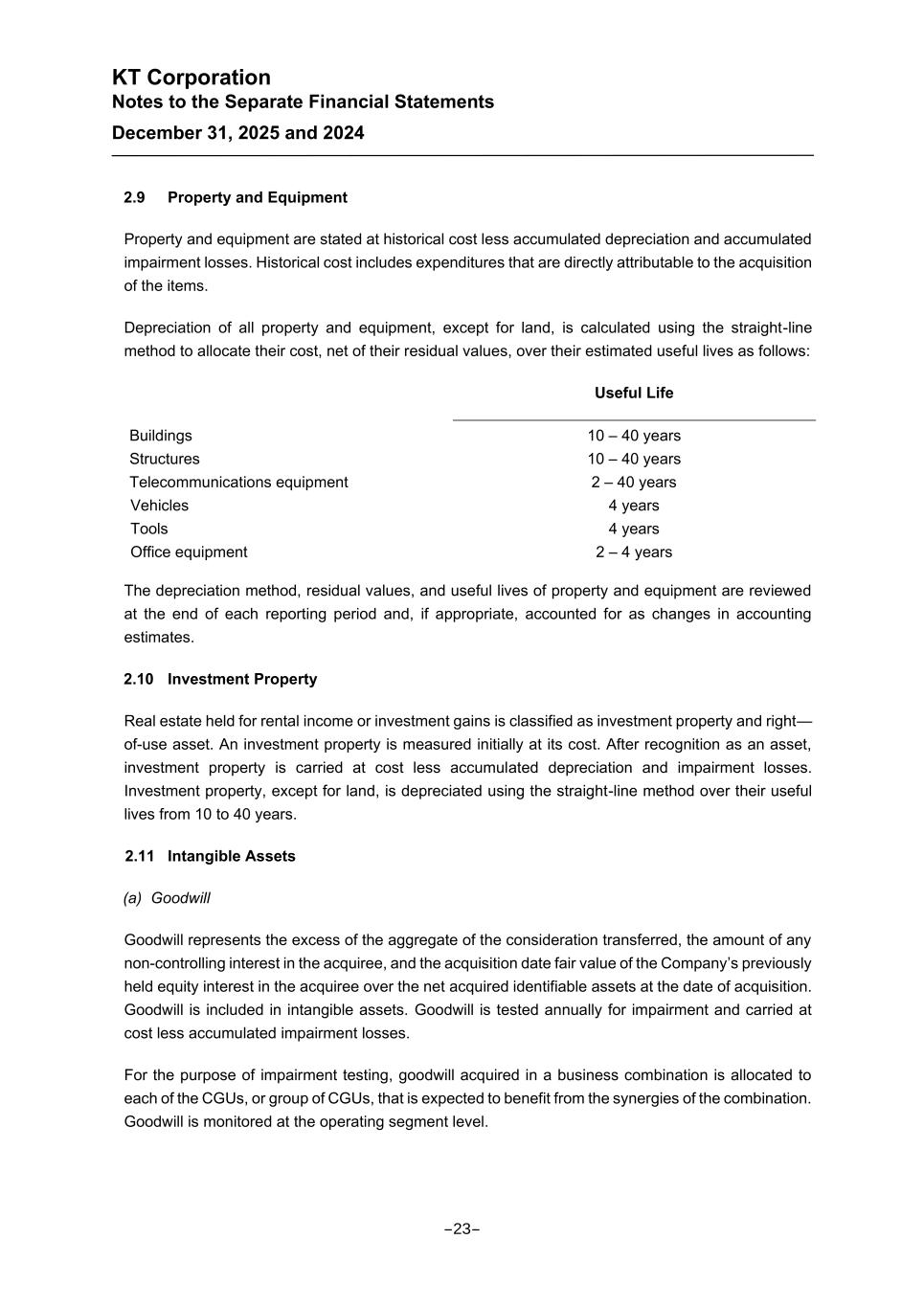
KT Corporation Notes to the Separate Financial Statements December 31, 2025 and 2024 2.9 Property and Equipment Property and equipment are stated at historical cost less accumulated depreciation and accumulated impairment losses. Historical cost includes expenditures that are directly attributable to the acquisition of the items. Depreciation of all property and equipment, except for land, is calculated using the straight-line method to allocate their cost, net of their residual values, over their estimated useful lives as follows: Useful Life Buildings 10 – 40 years Structures 10 – 40 years Telecommunications equipment 2 – 40 years Vehicles 4 years Tools 4 years Office equipment 2 – 4 years The depreciation method, residual values, and useful lives of property and equipment are reviewed at the end of each reporting period and, if appropriate, accounted for as changes in accounting estimates. 2.10 Investment Property Real estate held for rental income or investment gains is classified as investment property and right— of-use asset. An investment property is measured initially at its cost. After recognition as an asset, investment property is carried at cost less accumulated depreciation and impairment losses. Investment property, except for land, is depreciated using the straight-line method over their useful lives from 10 to 40 years. 2.11 Intangible Assets (a) Goodwill Goodwill represents the excess of the aggregate of the consideration transferred, the amount of any non-controlling interest in the acquiree, and the acquisition date fair value of the Company’s previously held equity interest in the acquiree over the net acquired identifiable assets at the date of acquisition. Goodwill is included in intangible assets. Goodwill is tested annually for impairment and carried at cost less accumulated impairment losses. For the purpose of impairment testing, goodwill acquired in a business combination is allocated to each of the CGUs, or group of CGUs, that is expected to benefit from the synergies of the combination. Goodwill is monitored at the operating segment level. -23-
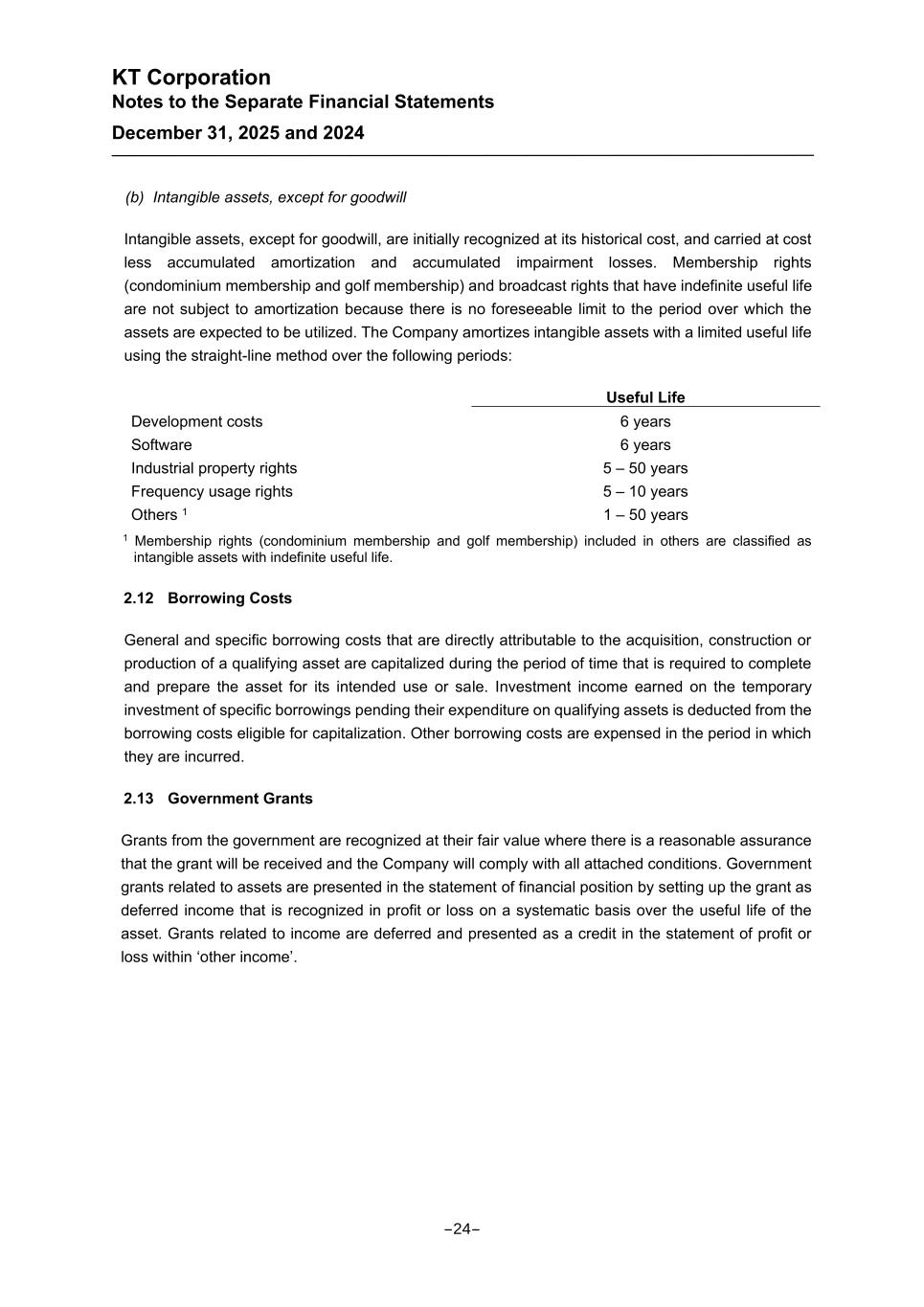
KT Corporation Notes to the Separate Financial Statements December 31, 2025 and 2024 (b) Intangible assets, except for goodwill Intangible assets, except for goodwill, are initially recognized at its historical cost, and carried at cost less accumulated amortization and accumulated impairment losses. Membership rights (condominium membership and golf membership) and broadcast rights that have indefinite useful life are not subject to amortization because there is no foreseeable limit to the period over which the assets are expected to be utilized. The Company amortizes intangible assets with a limited useful life using the straight-line method over the following periods: Useful Life Development costs 6 years Software 6 years Industrial property rights 5 – 50 years Frequency usage rights 5 – 10 years Others 1 1 – 50 years 1 Membership rights (condominium membership and golf membership) included in others are classified as intangible assets with indefinite useful life. 2.12 Borrowing Costs General and specific borrowing costs that are directly attributable to the acquisition, construction or production of a qualifying asset are capitalized during the period of time that is required to complete and prepare the asset for its intended use or sale. Investment income earned on the temporary investment of specific borrowings pending their expenditure on qualifying assets is deducted from the borrowing costs eligible for capitalization. Other borrowing costs are expensed in the period in which they are incurred. 2.13 Government Grants Grants from the government are recognized at their fair value where there is a reasonable assurance that the grant will be received and the Company will comply with all attached conditions. Government grants related to assets are presented in the statement of financial position by setting up the grant as deferred income that is recognized in profit or loss on a systematic basis over the useful life of the asset. Grants related to income are deferred and presented as a credit in the statement of profit or loss within ‘other income’. -24-
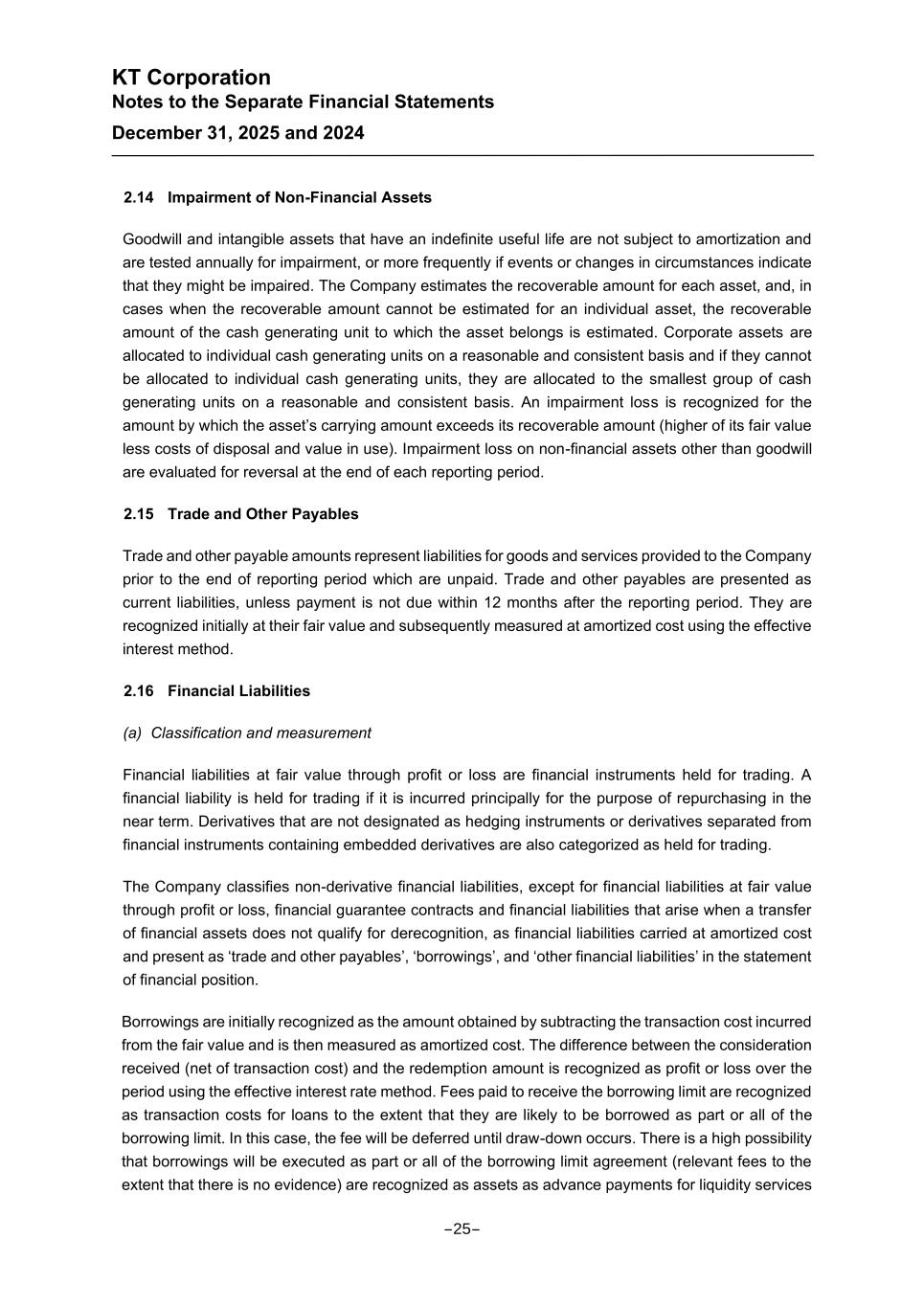
KT Corporation Notes to the Separate Financial Statements December 31, 2025 and 2024 2.14 Impairment of Non-Financial Assets Goodwill and intangible assets that have an indefinite useful life are not subject to amortization and are tested annually for impairment, or more frequently if events or changes in circumstances indicate that they might be impaired. The Company estimates the recoverable amount for each asset, and, in cases when the recoverable amount cannot be estimated for an individual asset, the recoverable amount of the cash generating unit to which the asset belongs is estimated. Corporate assets are allocated to individual cash generating units on a reasonable and consistent basis and if they cannot be allocated to individual cash generating units, they are allocated to the smallest group of cash generating units on a reasonable and consistent basis. An impairment loss is recognized for the amount by which the asset’s carrying amount exceeds its recoverable amount (higher of its fair value less costs of disposal and value in use). Impairment loss on non-financial assets other than goodwill are evaluated for reversal at the end of each reporting period. 2.15 Trade and Other Payables Trade and other payable amounts represent liabilities for goods and services provided to the Company prior to the end of reporting period which are unpaid. Trade and other payables are presented as current liabilities, unless payment is not due within 12 months after the reporting period. They are recognized initially at their fair value and subsequently measured at amortized cost using the effective interest method. 2.16 Financial Liabilities (a) Classification and measurement Financial liabilities at fair value through profit or loss are financial instruments held for trading. A financial liability is held for trading if it is incurred principally for the purpose of repurchasing in the near term. Derivatives that are not designated as hedging instruments or derivatives separated from financial instruments containing embedded derivatives are also categorized as held for trading. The Company classifies non-derivative financial liabilities, except for financial liabilities at fair value through profit or loss, financial guarantee contracts and financial liabilities that arise when a transfer of financial assets does not qualify for derecognition, as financial liabilities carried at amortized cost and present as ‘trade and other payables’, ‘borrowings’, and ‘other financial liabilities’ in the statement of financial position. Borrowings are initially recognized as the amount obtained by subtracting the transaction cost incurred from the fair value and is then measured as amortized cost. The difference between the consideration received (net of transaction cost) and the redemption amount is recognized as profit or loss over the period using the effective interest rate method. Fees paid to receive the borrowing limit are recognized as transaction costs for loans to the extent that they are likely to be borrowed as part or all of the borrowing limit. In this case, the fee will be deferred until draw-down occurs. There is a high possibility that borrowings will be executed as part or all of the borrowing limit agreement (relevant fees to the extent that there is no evidence) are recognized as assets as advance payments for liquidity services -25-
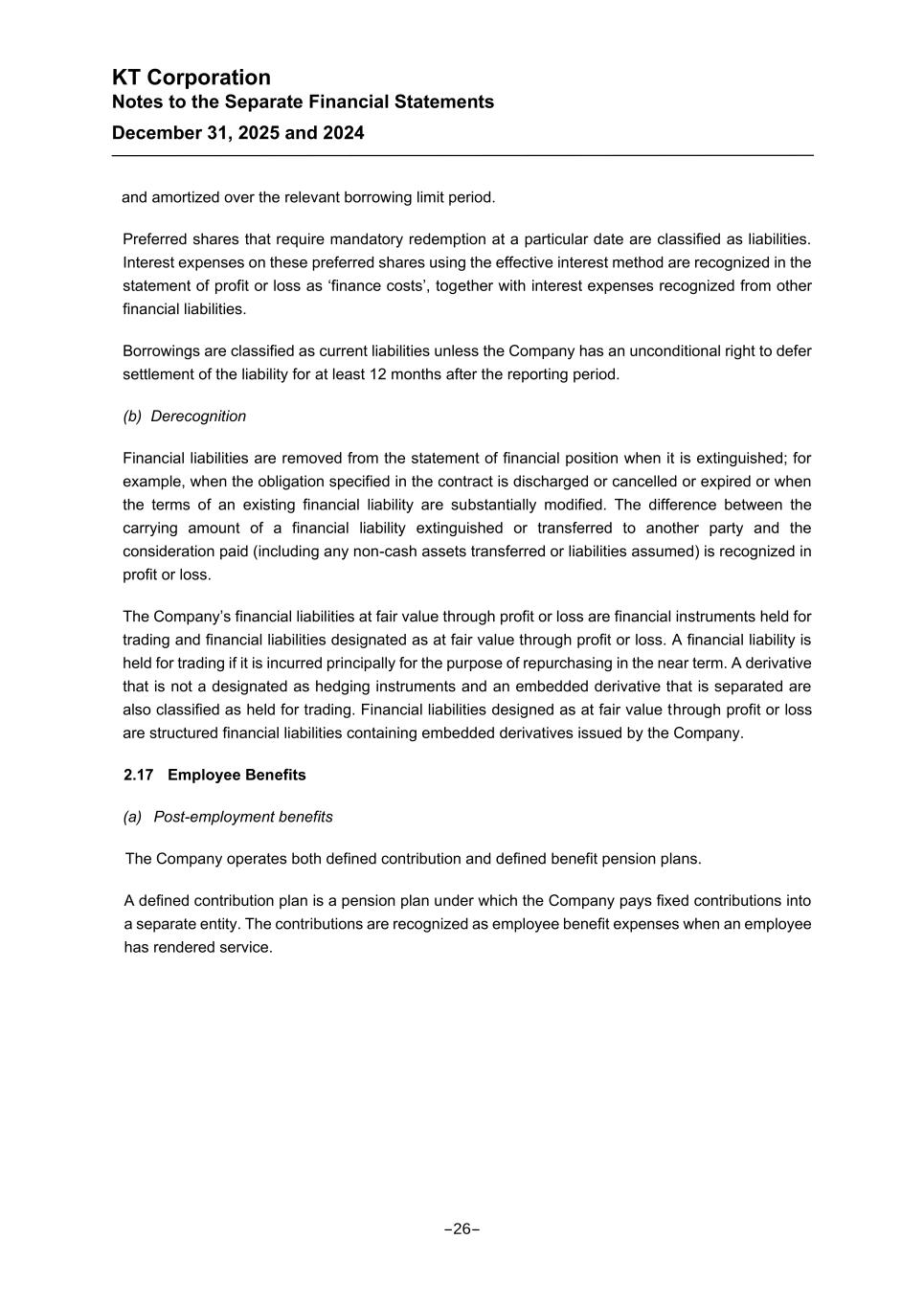
KT Corporation Notes to the Separate Financial Statements December 31, 2025 and 2024 and amortized over the relevant borrowing limit period. Preferred shares that require mandatory redemption at a particular date are classified as liabilities. Interest expenses on these preferred shares using the effective interest method are recognized in the statement of profit or loss as ‘finance costs’, together with interest expenses recognized from other financial liabilities. Borrowings are classified as current liabilities unless the Company has an unconditional right to defer settlement of the liability for at least 12 months after the reporting period. (b) Derecognition Financial liabilities are removed from the statement of financial position when it is extinguished; for example, when the obligation specified in the contract is discharged or cancelled or expired or when the terms of an existing financial liability are substantially modified. The difference between the carrying amount of a financial liability extinguished or transferred to another party and the consideration paid (including any non-cash assets transferred or liabilities assumed) is recognized in profit or loss. The Company’s financial liabilities at fair value through profit or loss are financial instruments held for trading and financial liabilities designated as at fair value through profit or loss. A financial liability is held for trading if it is incurred principally for the purpose of repurchasing in the near term. A derivative that is not a designated as hedging instruments and an embedded derivative that is separated are also classified as held for trading. Financial liabilities designed as at fair value through profit or loss are structured financial liabilities containing embedded derivatives issued by the Company. 2.17 Employee Benefits (a) Post-employment benefits The Company operates both defined contribution and defined benefit pension plans. A defined contribution plan is a pension plan under which the Company pays fixed contributions into a separate entity. The contributions are recognized as employee benefit expenses when an employee has rendered service. -26-
KT Corporation Notes to the Separate Financial Statements December 31, 2025 and 2024 A defined benefit plan is a pension plan that is not a defined contribution plan. Generally, post- employment benefits are payable after the completion of employment, and the benefit amount depended on the employee’s age, periods of service or salary levels. The liability recognized in the statement of financial position in respect of defined benefit pension plans is the present value of the defined benefit obligation at the end of the reporting period less the fair value of plan assets. The defined benefit obligation is calculated annually by independent actuaries using the projected unit credit method. The present value of the defined benefit obligation is determined by discounting the estimated future cash outflows using interest rates of high-quality corporate bonds that are denominated in the currency in which the benefits will be paid, and that have terms approximating to the terms of the related obligation. Remeasurement gains and losses arising from experience adjustments and changes in actuarial assumptions are recognized in the period in which they occur, directly in other comprehensive income. Changes in the present value of the defined benefit obligation resulting from plan amendments or curtailments are recognized immediately in profit or loss as past service costs. (b) Termination benefits Termination benefits are payable when employment is terminated by the Company before the normal retirement date, or whenever an employee accepts voluntary redundancy in exchange for these benefits. The Company recognizes termination benefits at the earlier of the following dates: when the entity can no longer withdraw the offer of those benefits or when the entity recognizes costs for a restructuring. (c) Long-term employee benefits Certain entities within the Company provide long-term employee benefits that are entitled to employees with service period at least five years and above. The expected costs of these benefits are accrued over the period of employment using the same accounting methodology as used for defined benefit pension plans. The Company recognizes service cost, net interest on other long-term employee benefits and remeasurements as profit or loss for the year. These liabilities are valued annually by an independent qualified actuary. 2.18 Share-Based Payments Equity-settled share-based payment is recognized at fair value of equity instruments granted, and employee benefit expense is recognized over the vesting period. At the end of each period, the Company revises its estimates of the number of options that are expected to vest based on the non- market vesting and service conditions. It recognizes the impact of the revision to original estimates, if any, in profit or loss, with a corresponding adjustment to equity. -27-
KT Corporation Notes to the Separate Financial Statements December 31, 2025 and 2024 2.19 Provisions Provisions for service warranties, make good obligation, and legal claims are recognized when the Company has a present legal or constructive obligation as a result of past events, it is probable that an outflow of resources will be required to settle the obligation and the amount can be reliably estimated. Provisions are measured at the present value of management’s best estimate of the expenditure required to settle the present obligation at the end of the reporting period, and the increase in the provision due to the passage of time is recognized as interest expense. 2.20 Leases (a) Lessee The Company leases various repeater server racks, offices, communication line facilities, machinery, and cars. Contracts may contain both lease and non-lease components. The Company allocates the consideration in the contract to the lease and non-lease components based on their relative stand- alone prices. Assets and liabilities arising from a lease are initially measured on a present value basis. Lease liabilities include the net present value of the following lease payments: Fixed payments (including in-substance fixed payments), less any lease incentives receivable Variable lease payments that are based on an index or a rate, initially measured using the index or rate as at the commencement date Amounts expected to be payable by the Company (the lessee) under residual value guarantees The exercise price of a purchase option if the Company (the lessee) is reasonably certain to exercise that option, and Payments of penalties for terminating the lease, if the lease term reflects the Company (the lessee) exercising that option Measurement of lease liability also includes payments to be made in optional periods if the lessee is reasonably certain to exercise an option to extend the lease. The Company determines the lease term as the non-cancellable period of a lease, together with both (a) periods covered by an option to extend the lease if the lessee is reasonably certain to exercise that option; and (b) periods covered by an option to terminate the lease if the lessee is reasonably certain not to exercise that option. When the lessee and the lessor each has the right to terminate the lease without permission from the other party, the Company should consider a termination penalty in determining the period for which the contract is enforceable. -28-
KT Corporation Notes to the Separate Financial Statements December 31, 2025 and 2024 The lease payments are discounted using the interest rate implicit in the lease. If that rate cannot be determined, the lessee’s incremental borrowing rate is used, which is the rate that the lessee would have to pay to borrow the funds necessary to obtain an asset of similar value in a similar economic environment with similar terms and conditions. The Company is exposed to potential future increases in variable lease payments based on an index or rate, which are not included in the lease liability until they take effect. When adjustments to lease payments based on an index or rate take effect, the lease liability is reassessed and adjusted against the right-of-use asset. Each lease payment is allocated between the liability and finance cost. The finance cost is charged to profit or loss over the lease period in order to produce a constant periodic rate of interest on the remaining balance of the liability for each period. Right-of-use assets are measured at cost comprising the following: the amount of the initial measurement of lease liability any lease payments made at or before the commencement date less any lease incentives received any initial direct costs restoration costs The right-of-use asset is depreciated over the shorter of the asset's useful life and the lease term on a straight-line basis. If the Company is reasonably certain to exercise a purchase option, the right-of- use asset is depreciated over the underlying asset’s useful life. Payments associated with short-term leases and leases of low-value assets are recognized on a straight-line basis as an expense in profit or loss. Short-term leases are leases with a lease term of 12 months or less, such as vehicles, machinery, and others. Low-value assets are comprised of tools, office equipment, and others. (b) Lessor Lease income from operating leases where the Company is a lessor is recognized in income on a straight-line basis over the lease term. Initial direct costs incurred in obtaining an operating lease are added to the carrying amount of the underlying asset and recognized as expense over the lease term on the same basis as lease income. The respective leased assets are included in the statement of financial position based on their nature. (c) Extension and termination options Extension and termination options are included in a number of property and equipment leases across the Company. These terms are used to maximize operational flexibility in terms of managing contracts. The majority of extension and termination options held are exercisable only by the Company and not by the respective lessor. Information on critical accounting estimates and assumptions related to the determination of the lease term is presented in Note 3. -29-
KT Corporation Notes to the Separate Financial Statements December 31, 2025 and 2024 2.21 Share Capital The Company classifies ordinary shares as equity. Where the Company purchases its own shares, the consideration paid including any directly attributable incremental costs is deducted from equity attributable to the equity holders of the Company until the shares are cancelled or reissued. When these treasury shares are reissued, any consideration received is included in equity attributable to the equity holders of the Company. 2.22 Revenue Recognition (a) Identifying performance obligations The Company mainly provides telecommunication services and sells handsets. The Company identifies performance obligations with a customer such as providing telecommunication services, selling handsets, and others. Revenue from handsets is recognized when a performance obligation is satisfied by transferring promised goods to customers, and the revenue from telecommunication services is recognized over the estimated contract periods of each service by transferring promised services to customers. (b) Allocation of the transaction price and revenue recognition The Company allocates the transaction price to each performance obligation identified in the contract based on a relative stand-alone selling price of the goods or services being provided to the customer. To allocate the transaction price to each performance obligation on a relative stand-alone price basis, the Company determines the stand-alone selling price at contract inception of the distinct good or service underlying each performance obligation in the contract and allocates the transaction price on a relative stand-alone selling price basis. The stand-alone selling price is the price at which the Company would sell a promised good or service separately to the customer. The best evidence of a stand-alone selling price is the observable price of a good or service when the Company sells that good or service separately in similar circumstances and to similar customers. The Company recognizes the allocated amount as contract assets or contract liabilities, and amortizes it through the remaining period which is adjusted in operating income. (c) Incremental contract acquisition costs The Company pays commission fees when new customers subscribe to telecommunication services. The incremental contract acquisition costs are those commission fees that the Company incurs to acquire a contract with a customer that would not have been incurred if the contract had not been acquired. The Company recognizes the incremental contract acquisition costs as an asset and amortizes it over the expected period of benefit. However, as a practical expedient, the Company may recognize the incremental contract acquisition cost as an expense when it is incurred if the amortization period of the asset is one year or less. -30-
KT Corporation Notes to the Separate Financial Statements December 31, 2025 and 2024 2.23 Current and Deferred Tax The tax expense for the period consists of current and deferred tax. Current and deferred tax is recognized in profit or loss, except to the extent that it relates to items recognized in other comprehensive income or directly in equity. In this case, the tax is also recognized in other comprehensive income or directly in equity, respectively. The current income tax expense is measured at the amount expected to be paid to taxation authorities, using the tax rates (and tax laws) that have been enacted or substantively enacted by the end of the reporting period. Management periodically evaluates positions taken in tax returns with respect to situations in which applicable tax regulation is subject to interpretation, and considers whether it is probable that a taxation authority will accept an uncertain tax treatment. The Company measures its tax balances either based on the most likely amount or the expected value, depending on which method provides a better prediction of the resolution of the uncertainty. Deferred income tax is provided in full, using the liability method, on temporary differences arising between the tax bases of assets and liabilities and their carrying amounts in the separate financial statements. However, deferred income tax is not accounted for if it arises from initial recognition of an asset or liability in a transaction other than a business combination that at the time of the transaction affects neither accounting profit nor taxable profit or loss. Deferred tax assets are recognized only if it is probable that future taxable amounts will be available to utilize those temporary differences and losses. The Company recognizes a deferred tax liability for all taxable temporary differences associated with investments in subsidiaries, associates, and interests in joint arrangements, except to the extent that the Company is able to control the timing of the reversal of the temporary difference and it is probable that the temporary difference will not reverse in the foreseeable future. In addition, the Company recognizes a deferred tax asset for all deductible temporary differences arising from such investments to the extent that it is probable the temporary difference will reverse in the foreseeable future and taxable profit will be available against which the temporary difference can be utilized. Deferred tax assets and liabilities are offset when there is a legally enforceable right to offset current tax assets and liabilities and when the deferred tax balances relate to the same taxation authority. Current tax assets and liabilities are offset when the Company has a legally enforceable right to offset and intends either to settle on a net basis, or to realize the assets and settle the liability simultaneously. The Company is subject to Pillar Two income taxes. The impact of Pillar Two income taxes is described in Note 29. -31-
KT Corporation Notes to the Separate Financial Statements December 31, 2025 and 2024 2.24 Dividend Dividend distribution to the Company’s shareholders is recognized as a liability in the financial statements in the period in which the dividends are approved by the Company’s shareholders. 2.25 Approval on Issuance of the Separate Financial Statements The separate financial statements of 2025 were approved for issuance by the Board of Directors on Feb. 10, 2026 and are subject to change with the approval of shareholders at their Annual General Meeting. 3. Critical Accounting Estimates and Assumptions The preparation of financial statements requires the Group to make estimates and assumptions about the future. Management also needs to exercise judgment in applying the Group’s accounting policies. Estimates and assumptions are evaluated continuously and are based on historical experience and other factors, including reasonable expectations of future events under the given circumstances. As it is rare for the results of accounting estimates to be identical to actual results, significant risks exist that may lead to material adjustments. Estimates and assumptions that have significant risks of causing a material adjustment to the carrying amounts of assets and liabilities within the next financial year are discussed below. Additional information of significant judgement and assumptions of certain items are included in relevant notes. 3.1 Impairment of Non-Financial Assets (including Goodwill) The Company determines the recoverable amount of a cash generating unit (CGU) based on fair value or value-in-use calculations to assess non-financial assets (including goodwill) for impairment (Notes 12 and 13). 3.2 Income Taxes The Company’s taxable income generated from these operations is subject to income taxes based on tax laws and interpretations of tax authorities in numerous jurisdictions. There are many transactions and calculations for which the ultimate tax determination is uncertain (Note 29). If a certain portion of the taxable income is not used for investments or increase in wages in accordance with the Tax System for Recirculation of Corporate Income, the Company is liable to pay additional income tax calculated based on the tax laws. Accordingly, the measurement of current and deferred income tax is affected by the tax effects from the new system. As the Company’s income tax is dependent on the investments as well as wage increase, there is uncertainty in measuring the final tax effects. -32-
KT Corporation Notes to the Separate Financial Statements December 31, 2025 and 2024 3.3 Fair Value of Financial Instruments The fair value of financial instruments that are not traded in an active market is determined by using valuation techniques. The Company uses its judgment to select a variety of methods and makes assumptions that are mainly based on market conditions existing at the end of each reporting period (Note 36). 3.4 Net Defined Benefit Liability The present value of net defined benefit liability depends on a number of factors that are determined on an actuarial basis using a number of assumptions including the discount rate (Note 17). 3.5 Amortization of Contract Assets, Contract Liabilities and Contract Cost Assets Contract assets, contract liabilities and contract cost assets recognized under the application of K- IFRS 1115 are amortized over the expected periods of customer relationships. The estimate of the expected terms of customer relationship is based on the historical data. If management’s estimate changes, it may cause significant differences in the timing of revenue recognition and amounts recognized. 3.6 Critical Judgements in Determining the Lease Term In determining the lease term, management considers all facts and circumstances that create an economic incentive to exercise an extension option, or not exercise a termination option. Extension options (or periods after termination options) are only included in the lease term if the lease is reasonably certain to be extended (or not terminated). For leases of properties, machinery, and communication line facilities, the following factors are normally the most relevant: If there are significant penalties to terminate (or not extend), the Company is typically reasonably certain to extend (or not terminate). If any leasehold improvements are expected to have a significant remaining value, the Company is typically reasonably certain to extend (or not terminate). Otherwise, the Company considers other factors including historical lease durations and the costs and business disruption required to replace the leased asset. The lease term is reassessed if an option is actually exercised (or not exercised) or the Company becomes obliged to exercise (or not exercise) it. The assessment of reasonable certainty is only revised if a significant event or a significant change in circumstances occurs, which affects this assessment, and that is within the control of the lessee. -33-
KT Corporation Notes to the Separate Financial Statements December 31, 2025 and 2024 4. Financial Instruments by Category (1) Financial instruments by category as of December 31, 2025 and 2024, are as follows: (In millions of Korean won) December 31, 2025 Financial assets Financial assets at amortized cost Financial assets at FVTPL Financial assets at FVOCI Derivatives used for hedging Total Cash and cash equivalents ₩ 1,585,921 - - - 1,585,921 Trade and other receivables 3,171,002 - 107,644 - 3,278,646 Other financial assets 110,465 344,938 2,139,753 312,333 2,907,489 (In millions of Korean won) December 31, 2025 Financial liabilities Financial liabilities at amortized cost Financial liabilities at FVTPL Derivatives used for hedging Others Total Trade and other payables1 ₩ 4,328,561 - - - 4,328,561 Borrowings 7,068,705 - - - 7,068,705 Other financial liabilities - 10,359 13,862 - 24,221 Lease liabilities - - - 685,732 685,732 1 Amounts related to employee benefit plans are excluded in Trade and other payables. (In millions of Korean won) December 31, 2024 Financial assets Financial assets at amortized cost Financial assets at FVTPL Financial assets at FVOCI Derivatives used for hedging Total Cash and cash equivalents ₩ 1,540,570 - - - 1,540,570 Trade and other receivables 3,099,178 - 114,774 - 3,213,952 Other financial assets 80,465 456,224 1,458,891 442,144 2,437,724 (In millions of Korean won) December 31, 2024 Financial liabilities Financial liabilities at amortized cost Financial liabilities at FVTPL Derivatives used for hedging Others Total Trade and other payables1 ₩ 4,315,375 - - - 4,315,375 Borrowings 7,871,919 - - - 7,871,919 Other financial liabilities - 28 - - 28 Lease liabilities - - - 759,743 759,743 1 Amounts related to employee benefit plans are excluded in Trade and other payables. -34-
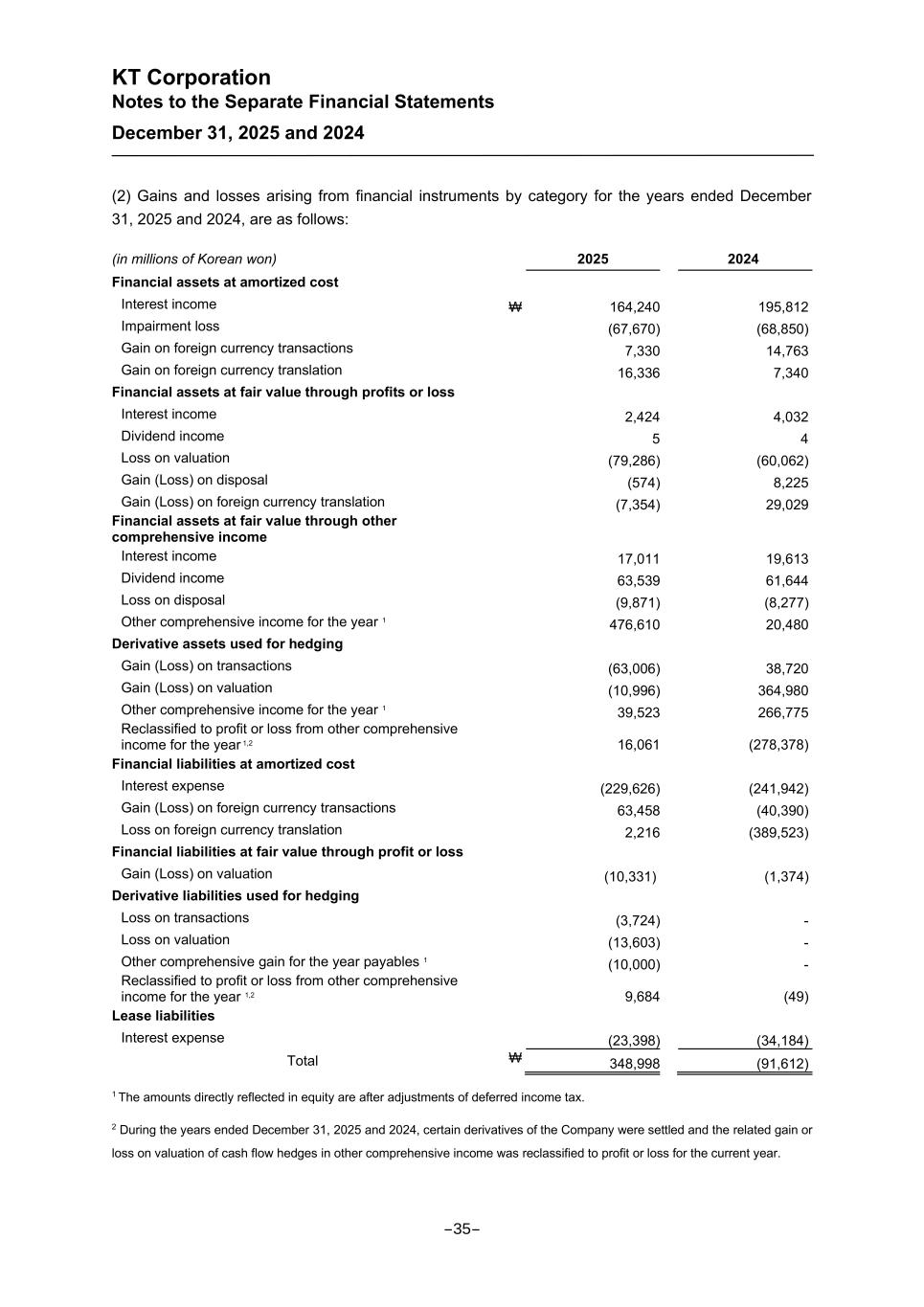
KT Corporation Notes to the Separate Financial Statements December 31, 2025 and 2024 (2) Gains and losses arising from financial instruments by category for the years ended December 31, 2025 and 2024, are as follows: (in millions of Korean won) 2025 2024 Financial assets at amortized cost Interest income ₩ 164,240 195,812 Impairment loss (67,670) (68,850) Gain on foreign currency transactions 7,330 14,763 Gain on foreign currency translation 16,336 7,340 Financial assets at fair value through profits or loss Interest income 2,424 4,032 Dividend income 5 4 Loss on valuation (79,286) (60,062) Gain (Loss) on disposal (574) 8,225 Gain (Loss) on foreign currency translation (7,354) 29,029 Financial assets at fair value through other comprehensive income Interest income 17,011 19,613 Dividend income 63,539 61,644 Loss on disposal (9,871) (8,277) Other comprehensive income for the year 1 476,610 20,480 Derivative assets used for hedging Gain (Loss) on transactions (63,006) 38,720 Gain (Loss) on valuation (10,996) 364,980 Other comprehensive income for the year 1 39,523 266,775 Reclassified to profit or loss from other comprehensive income for the year 1,2 16,061 (278,378) Financial liabilities at amortized cost Interest expense (229,626) (241,942) Gain (Loss) on foreign currency transactions 63,458 (40,390) Loss on foreign currency translation 2,216 (389,523) Financial liabilities at fair value through profit or loss Gain (Loss) on valuation (10,331) (1,374) Derivative liabilities used for hedging Loss on transactions (3,724) - Loss on valuation (13,603) - Other comprehensive gain for the year payables 1 (10,000) - Reclassified to profit or loss from other comprehensive income for the year 1,2 9,684 (49) Lease liabilities Interest expense (23,398) (34,184) Total ₩ 348,998 (91,612) 1 The amounts directly reflected in equity are after adjustments of deferred income tax. 2 During the years ended December 31, 2025 and 2024, certain derivatives of the Company were settled and the related gain or loss on valuation of cash flow hedges in other comprehensive income was reclassified to profit or loss for the current year. -35-
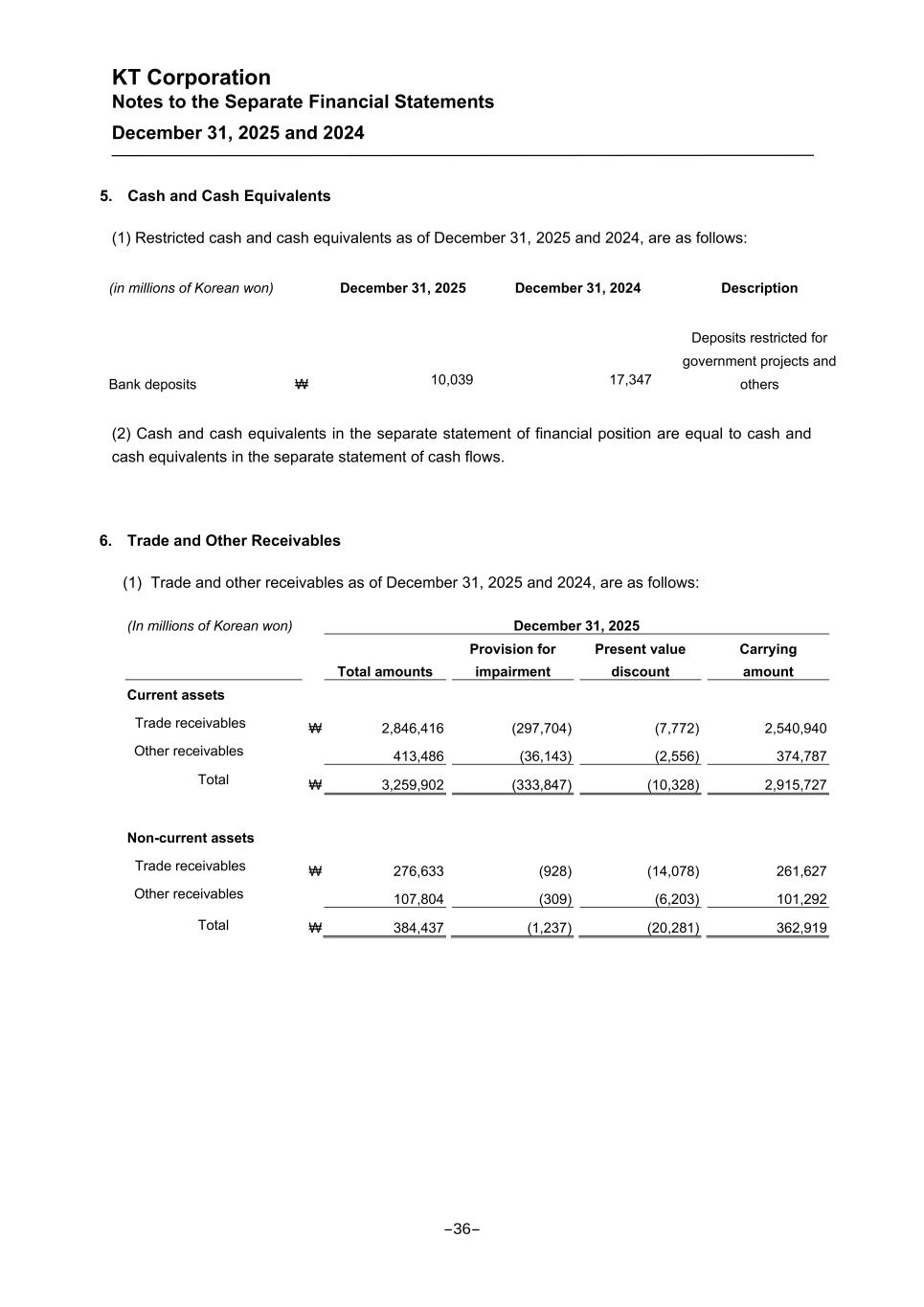
KT Corporation Notes to the Separate Financial Statements December 31, 2025 and 2024 5. Cash and Cash Equivalents (1) Restricted cash and cash equivalents as of December 31, 2025 and 2024, are as follows: (in millions of Korean won) December 31, 2025 December 31, 2024 Description Bank deposits ₩ 10,039 17,347 Deposits restricted for government projects and others (2) Cash and cash equivalents in the separate statement of financial position are equal to cash and cash equivalents in the separate statement of cash flows. 6. Trade and Other Receivables (1) Trade and other receivables as of December 31, 2025 and 2024, are as follows: (In millions of Korean won) December 31, 2025 Total amounts Provision for impairment Present value discount Carrying amount Current assets Trade receivables ₩ 2,846,416 (297,704) (7,772) 2,540,940 Other receivables 413,486 (36,143) (2,556) 374,787 Total ₩ 3,259,902 (333,847) (10,328) 2,915,727 Non-current assets Trade receivables ₩ 276,633 (928) (14,078) 261,627 Other receivables 107,804 (309) (6,203) 101,292 Total ₩ 384,437 (1,237) (20,281) 362,919 -36-
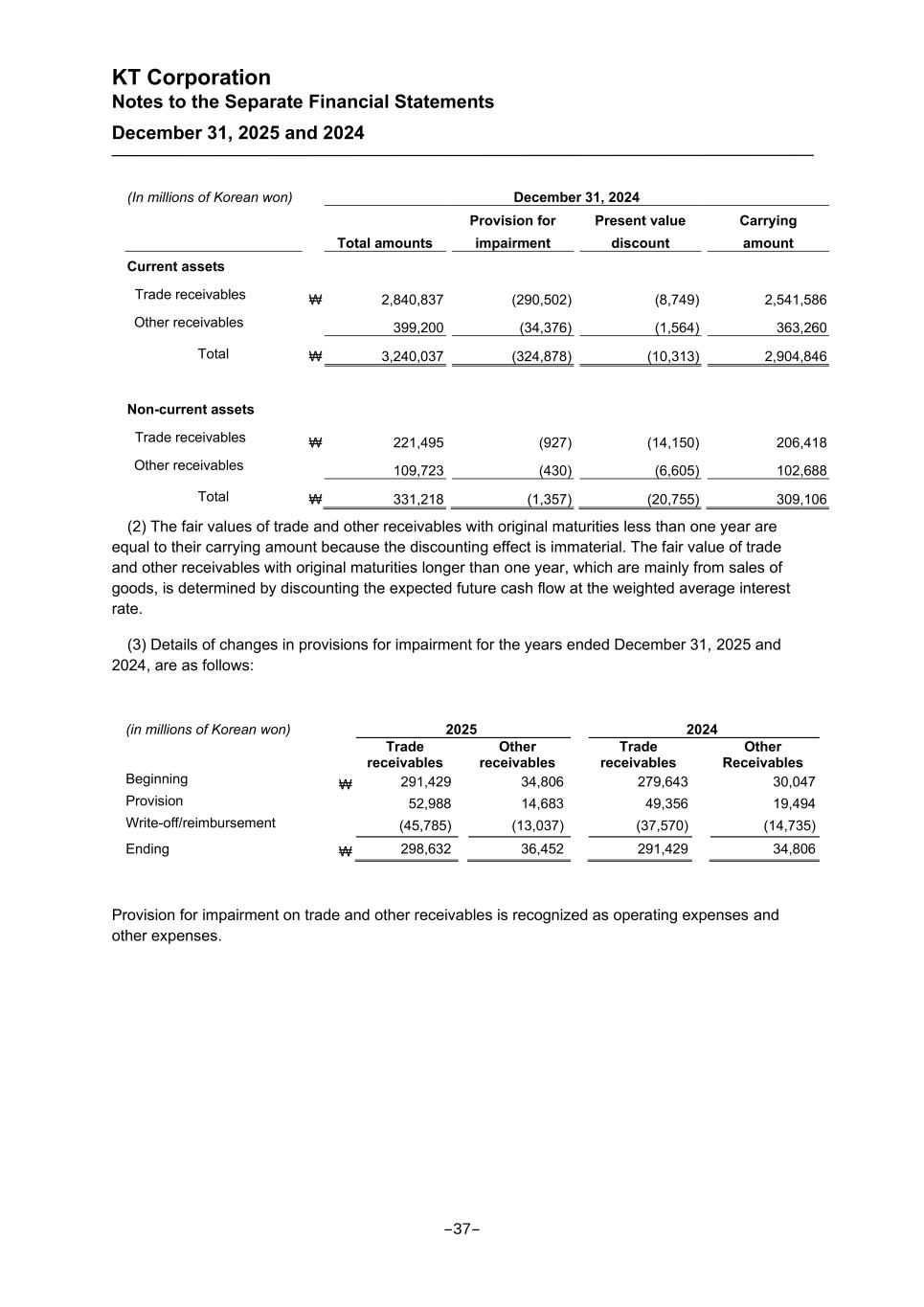
KT Corporation Notes to the Separate Financial Statements December 31, 2025 and 2024 (In millions of Korean won) December 31, 2024 Total amounts Provision for impairment Present value discount Carrying amount Current assets Trade receivables ₩ 2,840,837 (290,502) (8,749) 2,541,586 Other receivables 399,200 (34,376) (1,564) 363,260 Total ₩ 3,240,037 (324,878) (10,313) 2,904,846 Non-current assets Trade receivables ₩ 221,495 (927) (14,150) 206,418 Other receivables 109,723 (430) (6,605) 102,688 Total ₩ 331,218 (1,357) (20,755) 309,106 (2) The fair values of trade and other receivables with original maturities less than one year are equal to their carrying amount because the discounting effect is immaterial. The fair value of trade and other receivables with original maturities longer than one year, which are mainly from sales of goods, is determined by discounting the expected future cash flow at the weighted average interest rate. (3) Details of changes in provisions for impairment for the years ended December 31, 2025 and 2024, are as follows: (in millions of Korean won) 2025 2024 Trade receivables Other receivables Trade receivables Other Receivables Beginning ₩ 291,429 34,806 279,643 30,047 Provision 52,988 14,683 49,356 19,494 Write-off/reimbursement (45,785) (13,037) (37,570) (14,735) Ending ₩ 298,632 36,452 291,429 34,806 Provision for impairment on trade and other receivables is recognized as operating expenses and other expenses. -37-
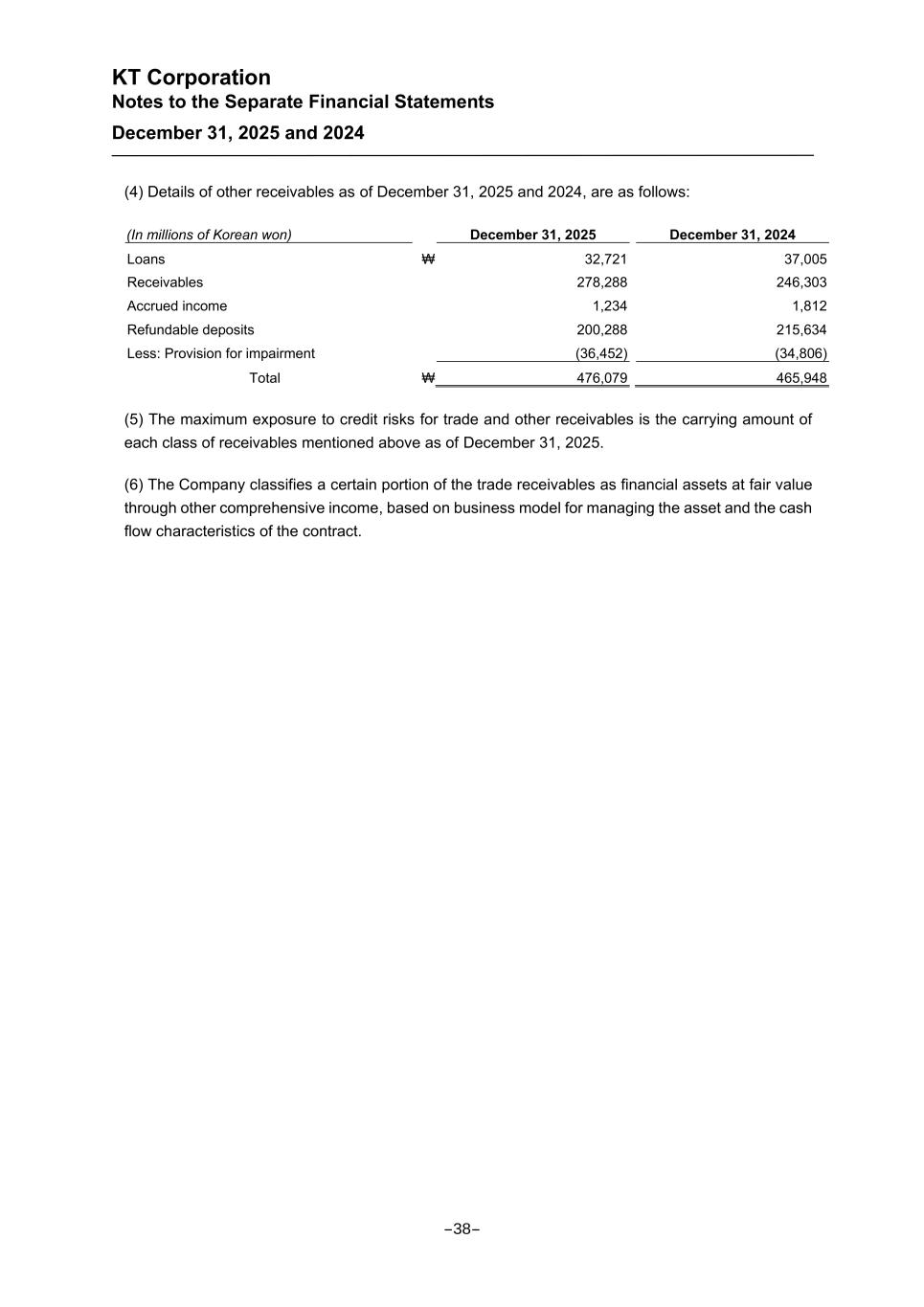
KT Corporation Notes to the Separate Financial Statements December 31, 2025 and 2024 (4) Details of other receivables as of December 31, 2025 and 2024, are as follows: (In millions of Korean won) December 31, 2025 December 31, 2024 Loans ₩ 32,721 37,005 Receivables 278,288 246,303 Accrued income 1,234 1,812 Refundable deposits 200,288 215,634 Less: Provision for impairment (36,452) (34,806) Total ₩ 476,079 465,948 (5) The maximum exposure to credit risks for trade and other receivables is the carrying amount of each class of receivables mentioned above as of December 31, 2025. (6) The Company classifies a certain portion of the trade receivables as financial assets at fair value through other comprehensive income, based on business model for managing the asset and the cash flow characteristics of the contract. -38-
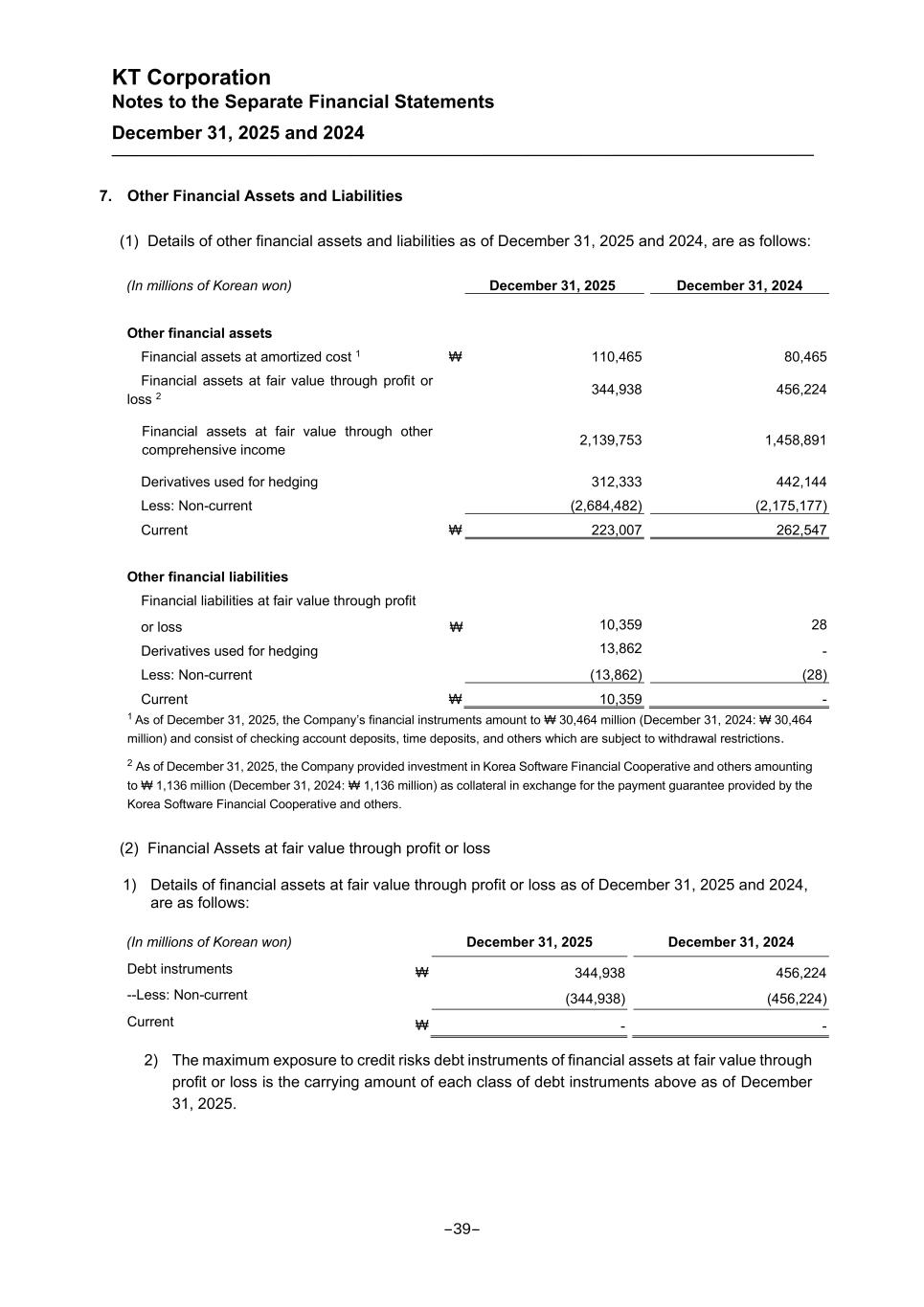
KT Corporation Notes to the Separate Financial Statements December 31, 2025 and 2024 7. Other Financial Assets and Liabilities (1) Details of other financial assets and liabilities as of December 31, 2025 and 2024, are as follows: (In millions of Korean won) December 31, 2025 December 31, 2024 Other financial assets Financial assets at amortized cost 1 ₩ 110,465 80,465 Financial assets at fair value through profit or loss 2 344,938 456,224 Financial assets at fair value through other comprehensive income 2,139,753 1,458,891 Derivatives used for hedging 312,333 442,144 Less: Non-current (2,684,482) (2,175,177) Current ₩ 223,007 262,547 Other financial liabilities Financial liabilities at fair value through profit or loss ₩ 10,359 28 Derivatives used for hedging 13,862 - Less: Non-current (13,862) (28) Current ₩ 10,359 - 1 As of December 31, 2025, the Company’s financial instruments amount to ₩ 30,464 million (December 31, 2024: ₩ 30,464 million) and consist of checking account deposits, time deposits, and others which are subject to withdrawal restrictions. 2 As of December 31, 2025, the Company provided investment in Korea Software Financial Cooperative and others amounting to ₩ 1,136 million (December 31, 2024: ₩ 1,136 million) as collateral in exchange for the payment guarantee provided by the Korea Software Financial Cooperative and others. (2) Financial Assets at fair value through profit or loss 1) Details of financial assets at fair value through profit or loss as of December 31, 2025 and 2024, are as follows: (In millions of Korean won) December 31, 2025 December 31, 2024 Debt instruments ₩ 344,938 456,224 --Less: Non-current (344,938) (456,224) Current ₩ - - 2) The maximum exposure to credit risks debt instruments of financial assets at fair value through profit or loss is the carrying amount of each class of debt instruments above as of December 31, 2025. -39-
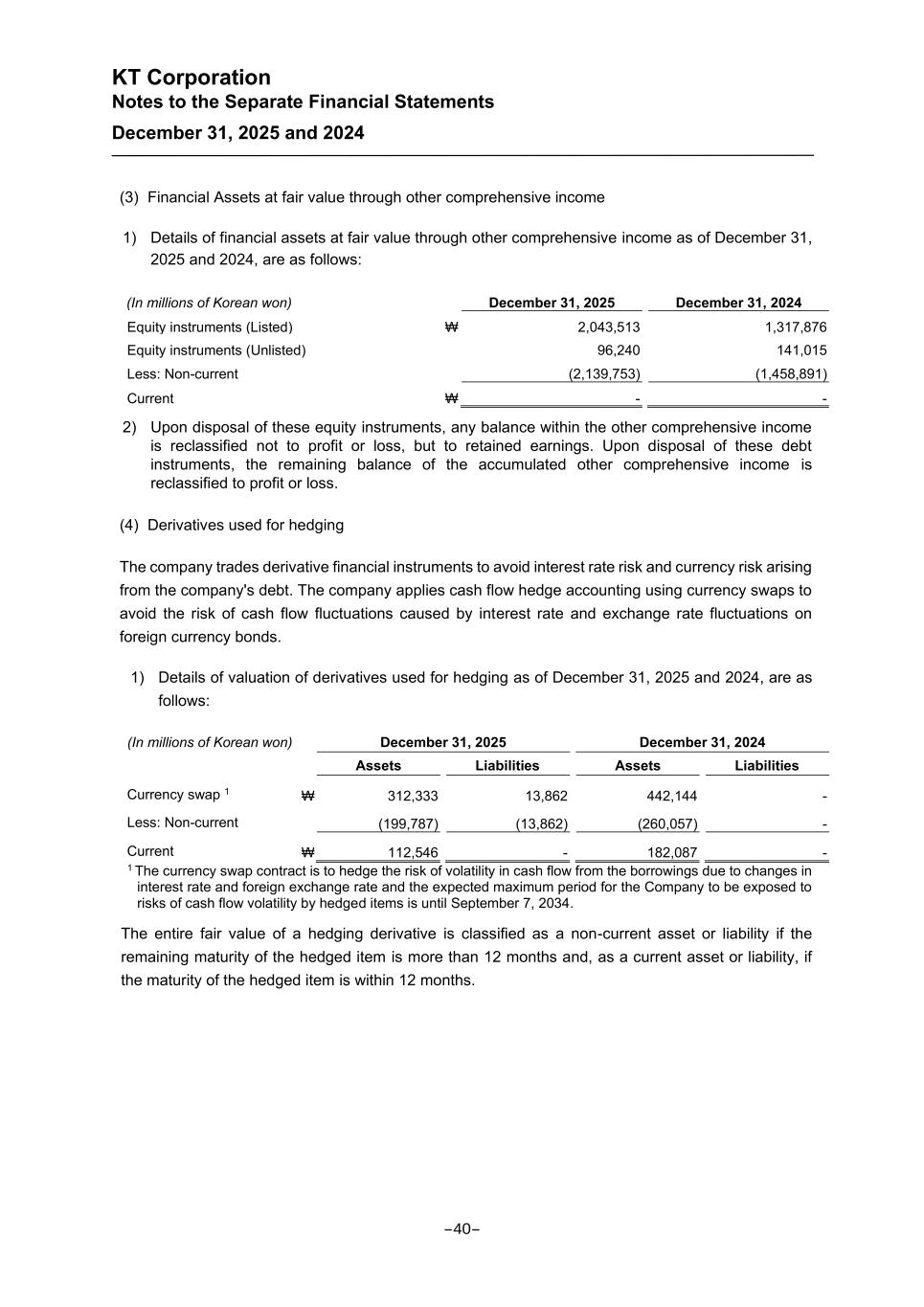
KT Corporation Notes to the Separate Financial Statements December 31, 2025 and 2024 (3) Financial Assets at fair value through other comprehensive income 1) Details of financial assets at fair value through other comprehensive income as of December 31, 2025 and 2024, are as follows: (In millions of Korean won) December 31, 2025 December 31, 2024 Equity instruments (Listed) ₩ 2,043,513 1,317,876 Equity instruments (Unlisted) 96,240 141,015 Less: Non-current (2,139,753) (1,458,891) Current ₩ - - 2) Upon disposal of these equity instruments, any balance within the other comprehensive income is reclassified not to profit or loss, but to retained earnings. Upon disposal of these debt instruments, the remaining balance of the accumulated other comprehensive income is reclassified to profit or loss. (4) Derivatives used for hedging The company trades derivative financial instruments to avoid interest rate risk and currency risk arising from the company's debt. The company applies cash flow hedge accounting using currency swaps to avoid the risk of cash flow fluctuations caused by interest rate and exchange rate fluctuations on foreign currency bonds. 1) Details of valuation of derivatives used for hedging as of December 31, 2025 and 2024, are as follows: (In millions of Korean won) December 31, 2025 December 31, 2024 Assets Liabilities Assets Liabilities Currency swap 1 ₩ 312,333 13,862 442,144 - Less: Non-current (199,787) (13,862) (260,057) - Current ₩ 112,546 - 182,087 - 1 The currency swap contract is to hedge the risk of volatility in cash flow from the borrowings due to changes in interest rate and foreign exchange rate and the expected maximum period for the Company to be exposed to risks of cash flow volatility by hedged items is until September 7, 2034. The entire fair value of a hedging derivative is classified as a non-current asset or liability if the remaining maturity of the hedged item is more than 12 months and, as a current asset or liability, if the maturity of the hedged item is within 12 months. -40-
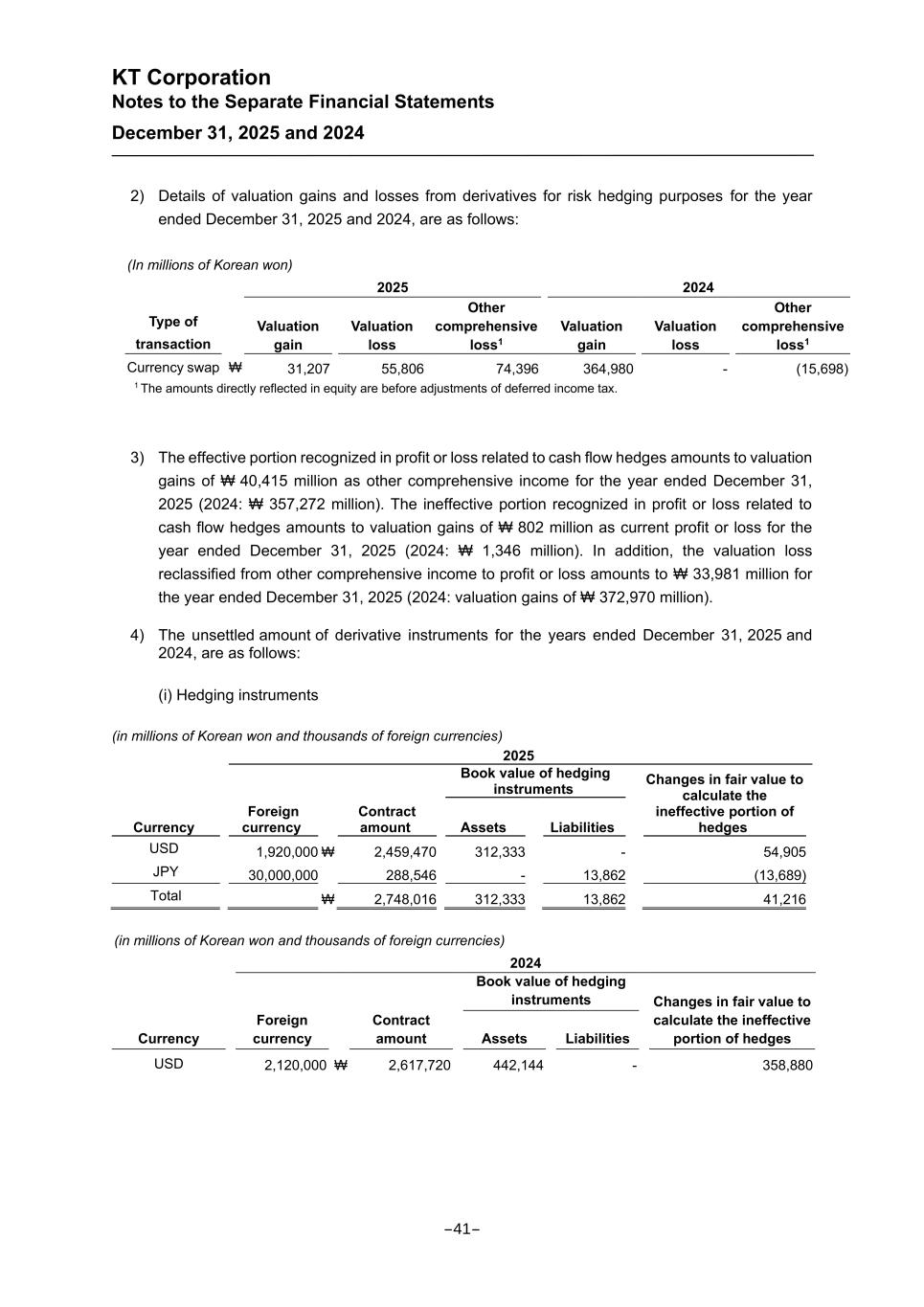
KT Corporation Notes to the Separate Financial Statements December 31, 2025 and 2024 2) Details of valuation gains and losses from derivatives for risk hedging purposes for the year ended December 31, 2025 and 2024, are as follows: (In millions of Korean won) 2025 2024 Type of transaction Valuation gain Valuation loss Other comprehensive loss1 Valuation gain Valuation loss Other comprehensive loss1 Currency swap ₩ 31,207 55,806 74,396 364,980 - (15,698) 1 The amounts directly reflected in equity are before adjustments of deferred income tax. 3) The effective portion recognized in profit or loss related to cash flow hedges amounts to valuation gains of ₩ 40,415 million as other comprehensive income for the year ended December 31, 2025 (2024: ₩ 357,272 million). The ineffective portion recognized in profit or loss related to cash flow hedges amounts to valuation gains of ₩ 802 million as current profit or loss for the year ended December 31, 2025 (2024: ₩ 1,346 million). In addition, the valuation loss reclassified from other comprehensive income to profit or loss amounts to ₩ 33,981 million for the year ended December 31, 2025 (2024: valuation gains of ₩ 372,970 million). 4) The unsettled amount of derivative instruments for the years ended December 31, 2025 and 2024, are as follows: (i) Hedging instruments (in millions of Korean won and thousands of foreign currencies) 2025 Book value of hedging instruments Changes in fair value to calculate the ineffective portion of hedges Currency Foreign currency Contract amount Assets Liabilities USD 1,920,000 ₩ 2,459,470 312,333 - 54,905 JPY 30,000,000 288,546 - 13,862 (13,689) Total ₩ 2,748,016 312,333 13,862 41,216 (in millions of Korean won and thousands of foreign currencies) 2024 Book value of hedging instruments Changes in fair value to calculate the ineffective portion of hedges Currency Foreign currency Contract amount Assets Liabilities USD 2,120,000 ₩ 2,617,720 442,144 - 358,880 -41-
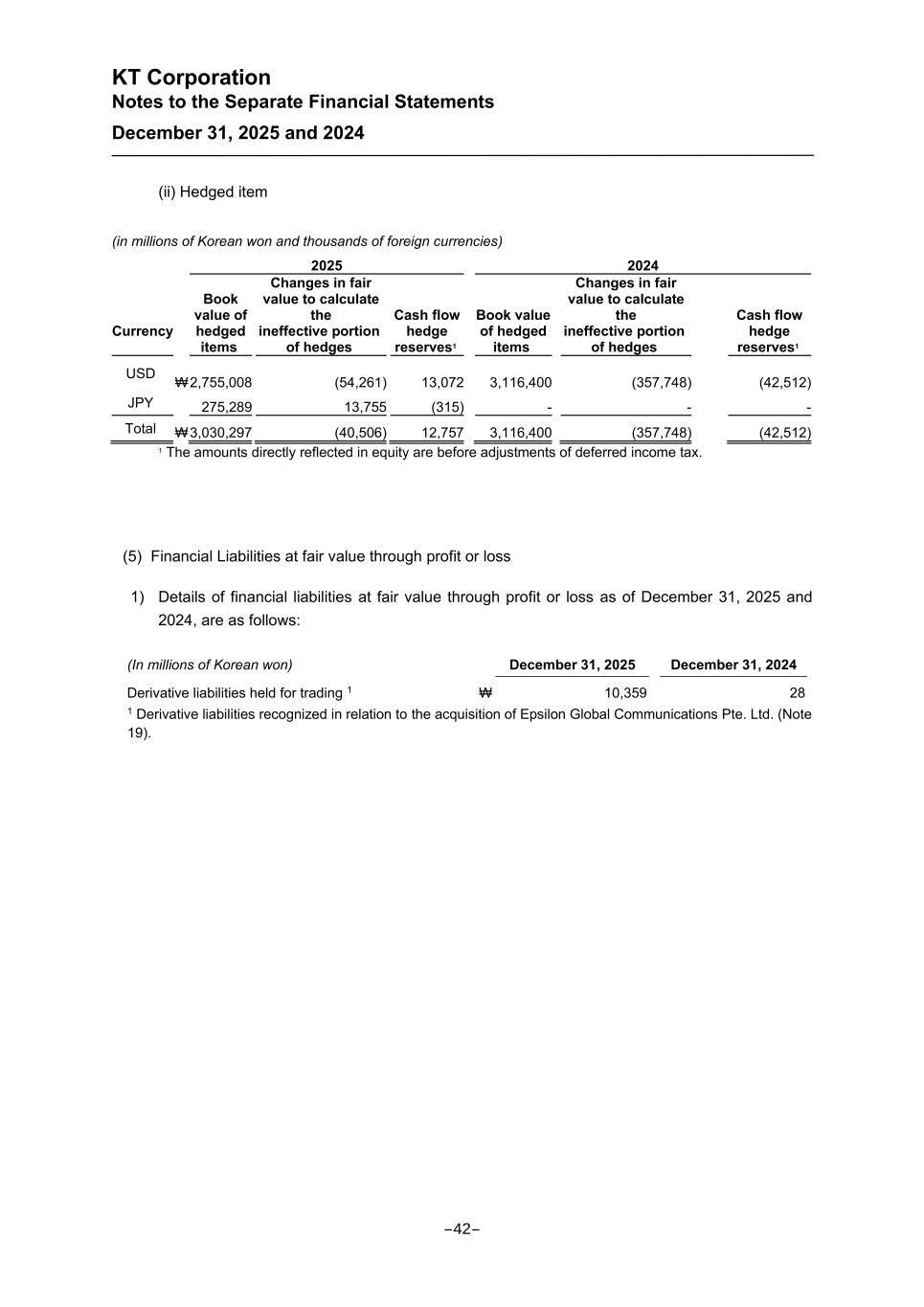
KT Corporation Notes to the Separate Financial Statements December 31, 2025 and 2024 (ii) Hedged item (in millions of Korean won and thousands of foreign currencies) 2025 2024 Currency Book value of hedged items Changes in fair value to calculate the ineffective portion of hedges Cash flow hedge reserves1 Book value of hedged items Changes in fair value to calculate the ineffective portion of hedges Cash flow hedge reserves1 USD ₩ 2,755,008 (54,261) 13,072 3,116,400 (357,748) (42,512) JPY 275,289 13,755 (315) - - - Total ₩ 3,030,297 (40,506) 12,757 3,116,400 (357,748) (42,512) 1 The amounts directly reflected in equity are before adjustments of deferred income tax. (5) Financial Liabilities at fair value through profit or loss 1) Details of financial liabilities at fair value through profit or loss as of December 31, 2025 and 2024, are as follows: (In millions of Korean won) December 31, 2025 December 31, 2024 Derivative liabilities held for trading 1 ₩ 10,359 28 1 Derivative liabilities recognized in relation to the acquisition of Epsilon Global Communications Pte. Ltd. (Note 19). -42-
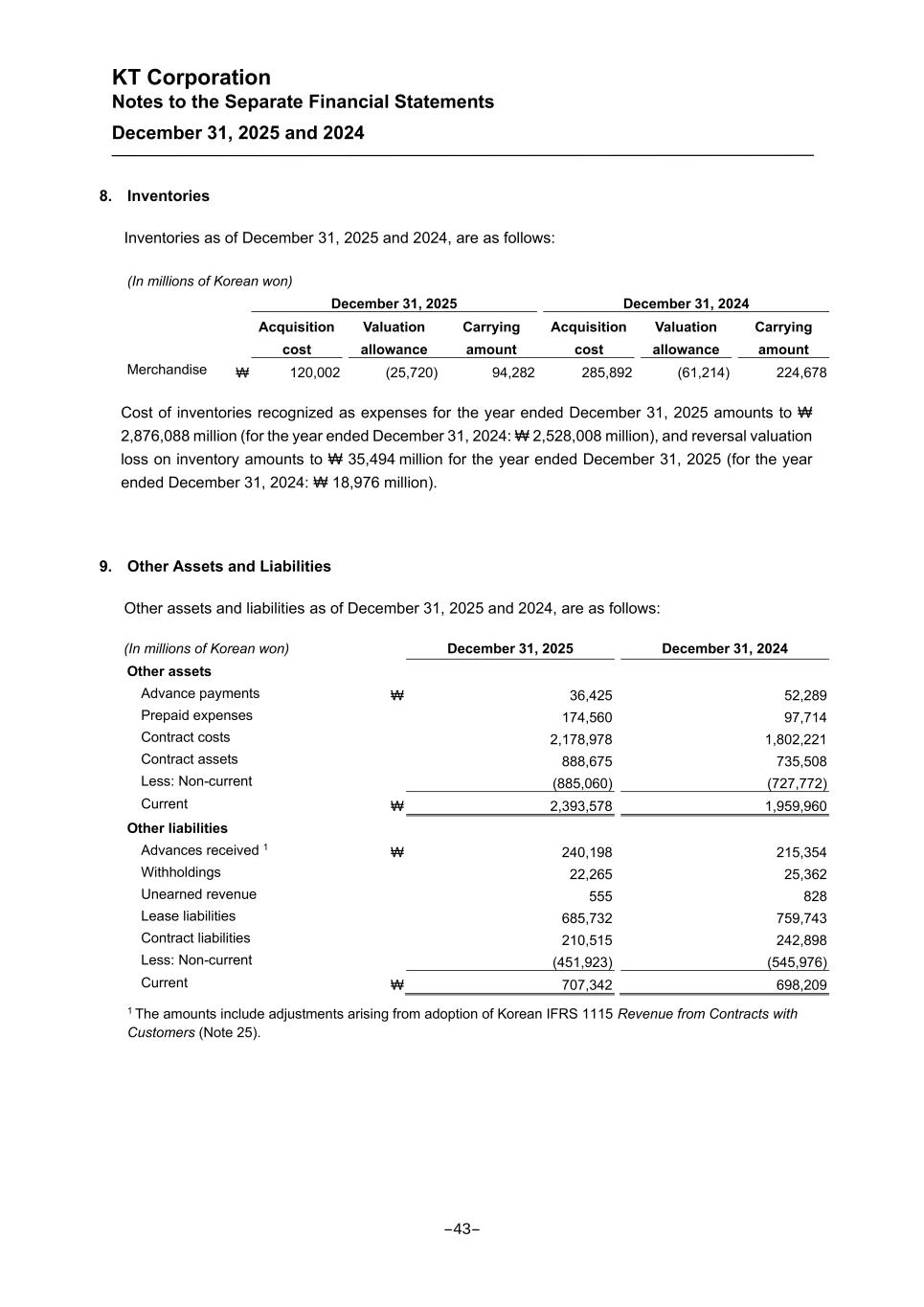
KT Corporation Notes to the Separate Financial Statements December 31, 2025 and 2024 8. Inventories Inventories as of December 31, 2025 and 2024, are as follows: (In millions of Korean won) December 31, 2025 December 31, 2024 Acquisition cost Valuation allowance Carrying amount Acquisition cost Valuation allowance Carrying amount Merchandise ₩ 120,002 (25,720) 94,282 285,892 (61,214) 224,678 Cost of inventories recognized as expenses for the year ended December 31, 2025 amounts to ₩ 2,876,088 million (for the year ended December 31, 2024: ₩ 2,528,008 million), and reversal valuation loss on inventory amounts to ₩ 35,494 million for the year ended December 31, 2025 (for the year ended December 31, 2024: ₩ 18,976 million). 9. Other Assets and Liabilities Other assets and liabilities as of December 31, 2025 and 2024, are as follows: (In millions of Korean won) December 31, 2025 December 31, 2024 Other assets Advance payments ₩ 36,425 52,289 Prepaid expenses 174,560 97,714 Contract costs 2,178,978 1,802,221 Contract assets 888,675 735,508 Less: Non-current (885,060) (727,772) Current ₩ 2,393,578 1,959,960 Other liabilities Advances received 1 ₩ 240,198 215,354 Withholdings 22,265 25,362 Unearned revenue 555 828 Lease liabilities 685,732 759,743 Contract liabilities 210,515 242,898 Less: Non-current (451,923) (545,976) Current ₩ 707,342 698,209 1 The amounts include adjustments arising from adoption of Korean IFRS 1115 Revenue from Contracts with Customers (Note 25). -43-
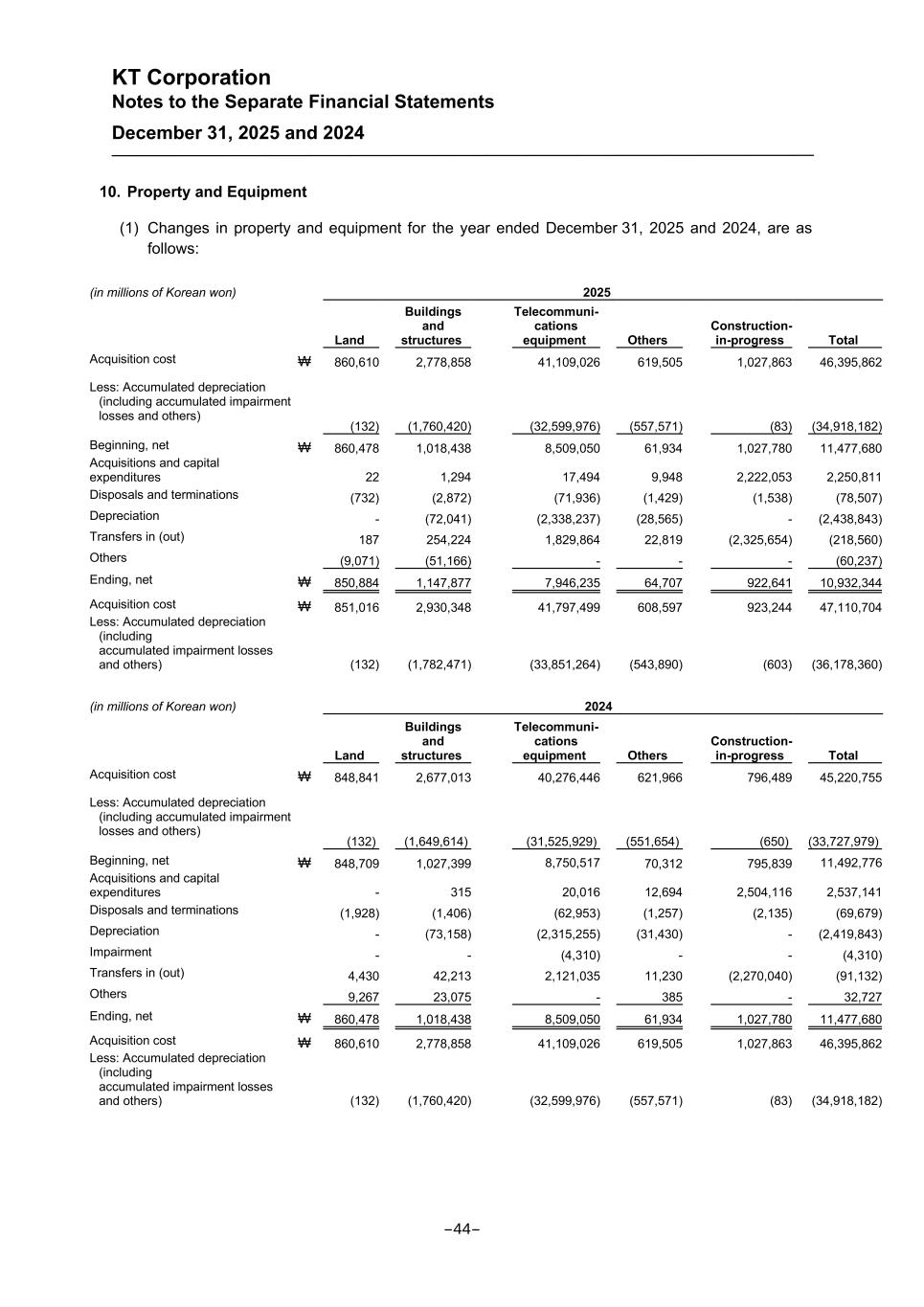
KT Corporation Notes to the Separate Financial Statements December 31, 2025 and 2024 10. Property and Equipment (1) Changes in property and equipment for the year ended December 31, 2025 and 2024, are as follows: (in millions of Korean won) 2025 Land Buildings and structures Telecommuni- cations equipment Others Construction- in-progress Total Acquisition cost ₩ 860,610 2,778,858 41,109,026 619,505 1,027,863 46,395,862 Less: Accumulated depreciation (including accumulated impairment losses and others) (132) (1,760,420) (32,599,976) (557,571) (83) (34,918,182) Beginning, net ₩ 860,478 1,018,438 8,509,050 61,934 1,027,780 11,477,680 Acquisitions and capital expenditures 22 1,294 17,494 9,948 2,222,053 2,250,811 Disposals and terminations (732) (2,872) (71,936) (1,429) (1,538) (78,507) Depreciation - (72,041) (2,338,237) (28,565) - (2,438,843) Transfers in (out) 187 254,224 1,829,864 22,819 (2,325,654) (218,560) Others (9,071) (51,166) - - - (60,237) Ending, net ₩ 850,884 1,147,877 7,946,235 64,707 922,641 10,932,344 Acquisition cost ₩ 851,016 2,930,348 41,797,499 608,597 923,244 47,110,704 Less: Accumulated depreciation (including accumulated impairment losses and others) (132) (1,782,471) (33,851,264) (543,890) (603) (36,178,360) (in millions of Korean won) 2024 Land Buildings and structures Telecommuni- cations equipment Others Construction- in-progress Total Acquisition cost ₩ 848,841 2,677,013 40,276,446 621,966 796,489 45,220,755 Less: Accumulated depreciation (including accumulated impairment losses and others) (132) (1,649,614) (31,525,929) (551,654) (650) (33,727,979) Beginning, net ₩ 848,709 1,027,399 8,750,517 70,312 795,839 11,492,776 Acquisitions and capital expenditures - 315 20,016 12,694 2,504,116 2,537,141 Disposals and terminations (1,928) (1,406) (62,953) (1,257) (2,135) (69,679) Depreciation - (73,158) (2,315,255) (31,430) - (2,419,843) Impairment - - (4,310) - - (4,310) Transfers in (out) 4,430 42,213 2,121,035 11,230 (2,270,040) (91,132) Others 9,267 23,075 - 385 - 32,727 Ending, net ₩ 860,478 1,018,438 8,509,050 61,934 1,027,780 11,477,680 Acquisition cost ₩ 860,610 2,778,858 41,109,026 619,505 1,027,863 46,395,862 Less: Accumulated depreciation (including accumulated impairment losses and others) (132) (1,760,420) (32,599,976) (557,571) (83) (34,918,182) -44-
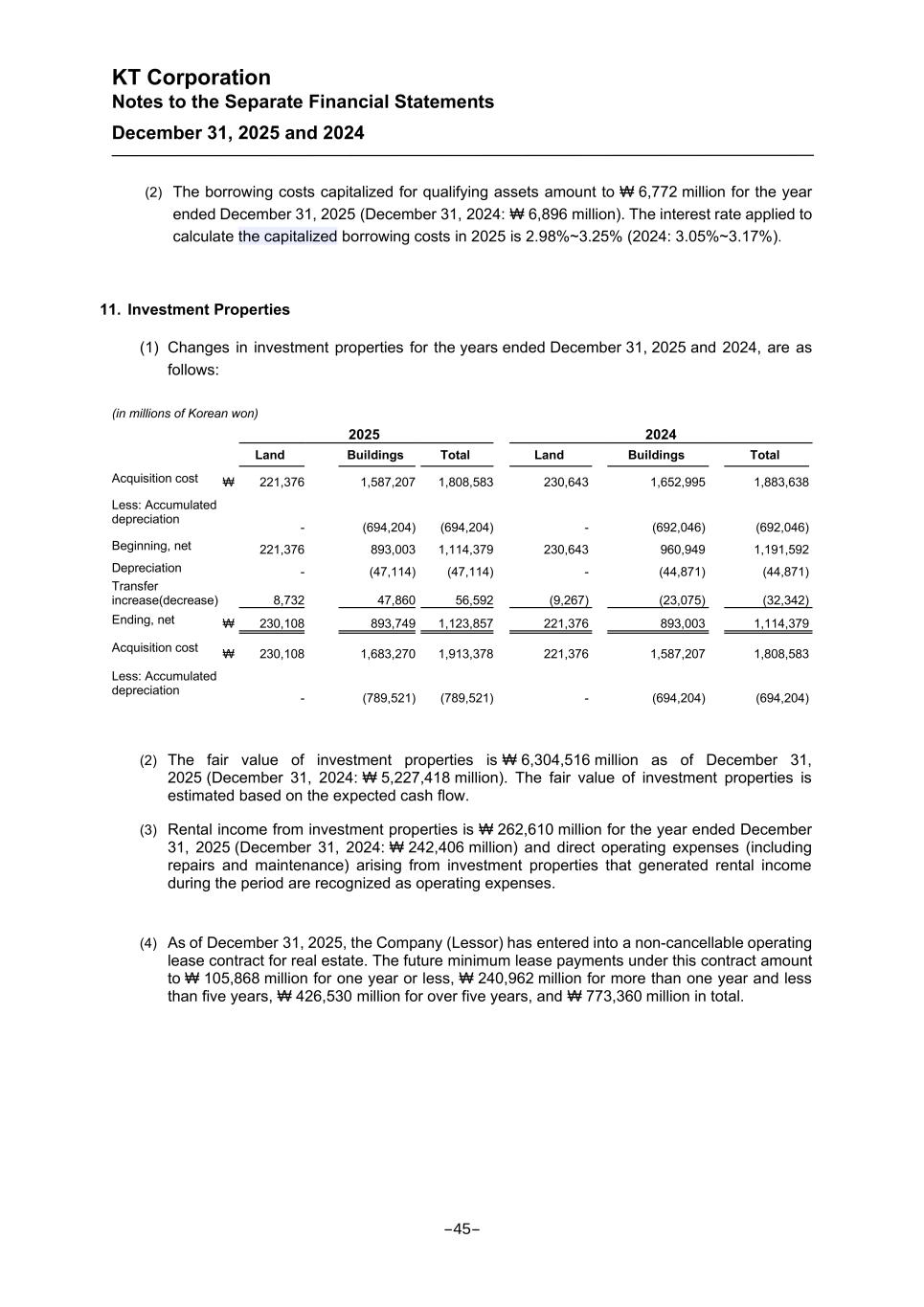
KT Corporation Notes to the Separate Financial Statements December 31, 2025 and 2024 (2) The borrowing costs capitalized for qualifying assets amount to ₩ 6,772 million for the year ended December 31, 2025 (December 31, 2024: ₩ 6,896 million). The interest rate applied to calculate the capitalized borrowing costs in 2025 is 2.98%~3.25% (2024: 3.05%~3.17%). 11. Investment Properties (1) Changes in investment properties for the years ended December 31, 2025 and 2024, are as follows: (in millions of Korean won) 2025 2024 Land Buildings Total Land Buildings Total Acquisition cost ₩ 221,376 1,587,207 1,808,583 230,643 1,652,995 1,883,638 Less: Accumulated depreciation - (694,204) (694,204) - (692,046) (692,046) Beginning, net 221,376 893,003 1,114,379 230,643 960,949 1,191,592 Depreciation - (47,114) (47,114) - (44,871) (44,871) Transfer increase(decrease) 8,732 47,860 56,592 (9,267) (23,075) (32,342) Ending, net ₩ 230,108 893,749 1,123,857 221,376 893,003 1,114,379 Acquisition cost ₩ 230,108 1,683,270 1,913,378 221,376 1,587,207 1,808,583 Less: Accumulated depreciation - (789,521) (789,521) - (694,204) (694,204) (2) The fair value of investment properties is ₩ 6,304,516 million as of December 31, 2025 (December 31, 2024: ₩ 5,227,418 million). The fair value of investment properties is estimated based on the expected cash flow. (3) Rental income from investment properties is ₩ 262,610 million for the year ended December 31, 2025 (December 31, 2024: ₩ 242,406 million) and direct operating expenses (including repairs and maintenance) arising from investment properties that generated rental income during the period are recognized as operating expenses. (4) As of December 31, 2025, the Company (Lessor) has entered into a non-cancellable operating lease contract for real estate. The future minimum lease payments under this contract amount to ₩ 105,868 million for one year or less, ₩ 240,962 million for more than one year and less than five years, ₩ 426,530 million for over five years, and ₩ 773,360 million in total. -45-
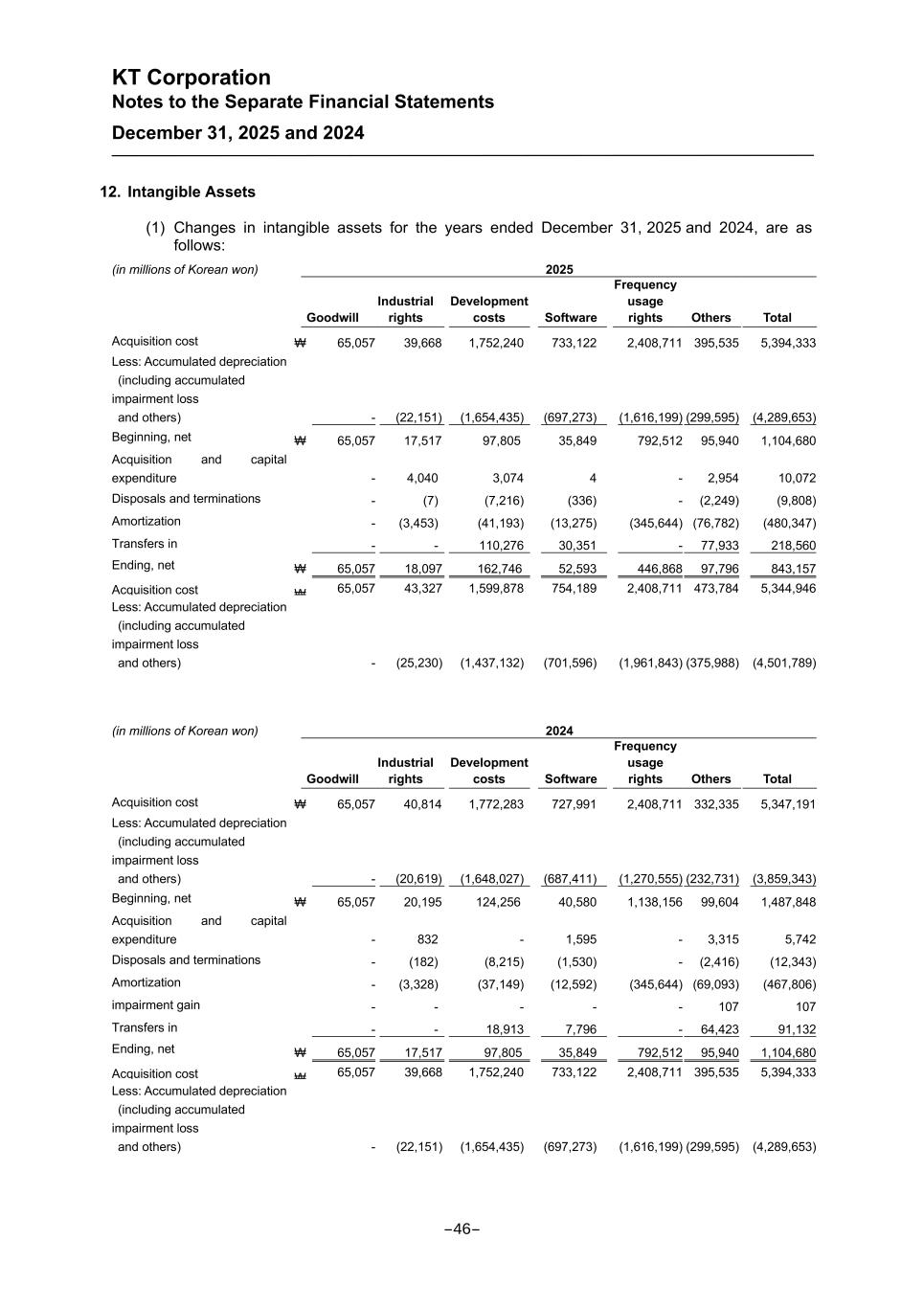
KT Corporation Notes to the Separate Financial Statements December 31, 2025 and 2024 12. Intangible Assets (1) Changes in intangible assets for the years ended December 31, 2025 and 2024, are as follows: (in millions of Korean won) 2025 Goodwill Industrial rights Development costs Software Frequency usage rights Others Total Acquisition cost ₩ 65,057 39,668 1,752,240 733,122 2,408,711 395,535 5,394,333 Less: Accumulated depreciation (including accumulated impairment loss and others) - (22,151) (1,654,435) (697,273) (1,616,199) (299,595) (4,289,653) Beginning, net ₩ 65,057 17,517 97,805 35,849 792,512 95,940 1,104,680 Acquisition and capital expenditure - 4,040 3,074 4 - 2,954 10,072 Disposals and terminations - (7) (7,216) (336) - (2,249) (9,808) Amortization - (3,453) (41,193) (13,275) (345,644) (76,782) (480,347) Transfers in - - 110,276 30,351 - 77,933 218,560 Ending, net ₩ 65,057 18,097 162,746 52,593 446,868 97,796 843,157 Acquisition cost ₩ 65,057 43,327 1,599,878 754,189 2,408,711 473,784 5,344,946 Less: Accumulated depreciation (including accumulated impairment loss and others) - (25,230) (1,437,132) (701,596) (1,961,843) (375,988) (4,501,789) (in millions of Korean won) 2024 Goodwill Industrial rights Development costs Software Frequency usage rights Others Total Acquisition cost ₩ 65,057 40,814 1,772,283 727,991 2,408,711 332,335 5,347,191 Less: Accumulated depreciation (including accumulated impairment loss and others) - (20,619) (1,648,027) (687,411) (1,270,555) (232,731) (3,859,343) Beginning, net ₩ 65,057 20,195 124,256 40,580 1,138,156 99,604 1,487,848 Acquisition and capital expenditure - 832 - 1,595 - 3,315 5,742 Disposals and terminations - (182) (8,215) (1,530) - (2,416) (12,343) Amortization - (3,328) (37,149) (12,592) (345,644) (69,093) (467,806) impairment gain - - - - - 107 107 Transfers in - - 18,913 7,796 - 64,423 91,132 Ending, net ₩ 65,057 17,517 97,805 35,849 792,512 95,940 1,104,680 Acquisition cost ₩ 65,057 39,668 1,752,240 733,122 2,408,711 395,535 5,394,333 Less: Accumulated depreciation (including accumulated impairment loss and others) - (22,151) (1,654,435) (697,273) (1,616,199) (299,595) (4,289,653) -46-
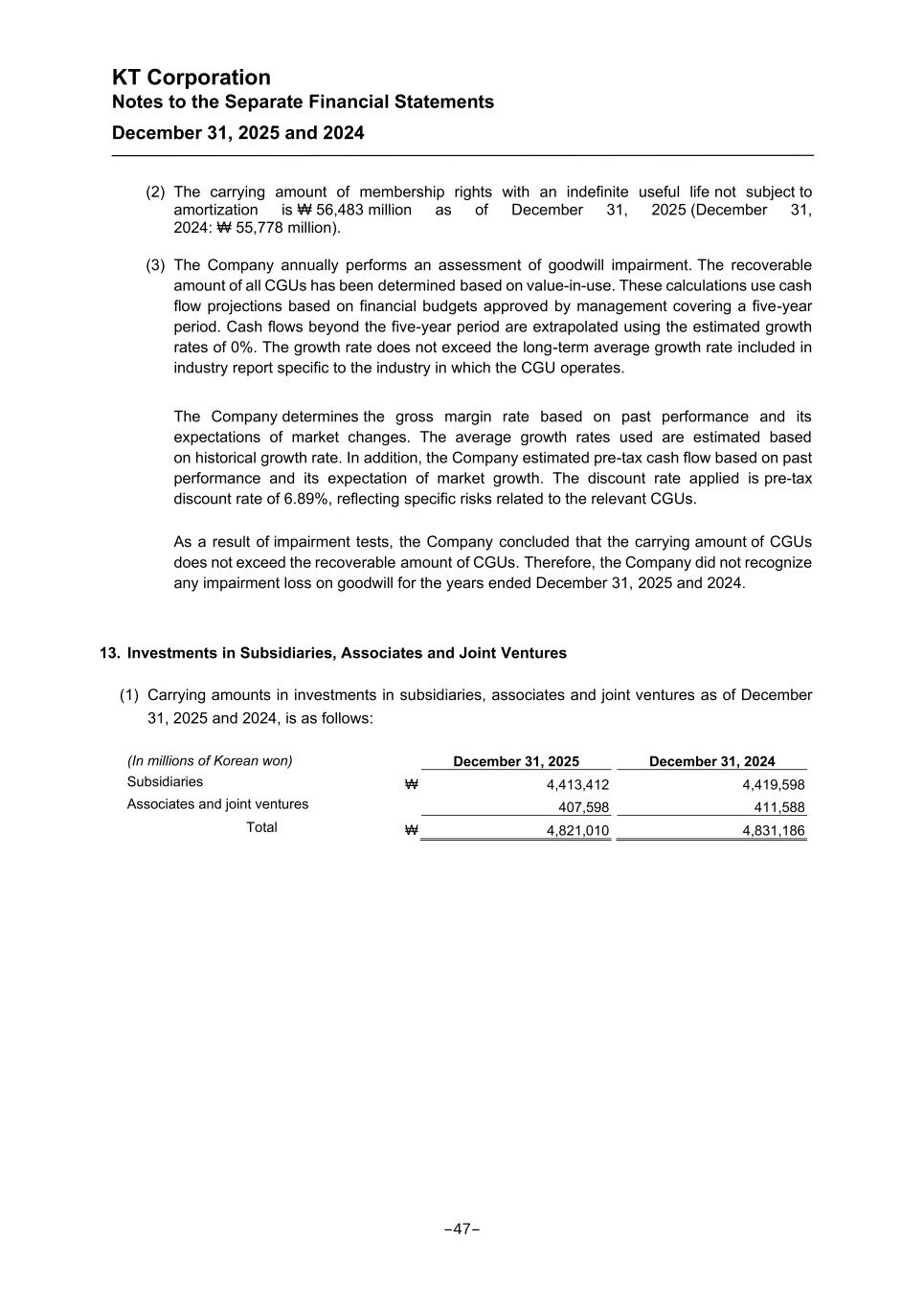
KT Corporation Notes to the Separate Financial Statements December 31, 2025 and 2024 (2) The carrying amount of membership rights with an indefinite useful life not subject to amortization is ₩ 56,483 million as of December 31, 2025 (December 31, 2024: ₩ 55,778 million). (3) The Company annually performs an assessment of goodwill impairment. The recoverable amount of all CGUs has been determined based on value-in-use. These calculations use cash flow projections based on financial budgets approved by management covering a five-year period. Cash flows beyond the five-year period are extrapolated using the estimated growth rates of 0%. The growth rate does not exceed the long-term average growth rate included in industry report specific to the industry in which the CGU operates. The Company determines the gross margin rate based on past performance and its expectations of market changes. The average growth rates used are estimated based on historical growth rate. In addition, the Company estimated pre-tax cash flow based on past performance and its expectation of market growth. The discount rate applied is pre-tax discount rate of 6.89%, reflecting specific risks related to the relevant CGUs. As a result of impairment tests, the Company concluded that the carrying amount of CGUs does not exceed the recoverable amount of CGUs. Therefore, the Company did not recognize any impairment loss on goodwill for the years ended December 31, 2025 and 2024. 13. Investments in Subsidiaries, Associates and Joint Ventures (1) Carrying amounts in investments in subsidiaries, associates and joint ventures as of December 31, 2025 and 2024, is as follows: (In millions of Korean won) December 31, 2025 December 31, 2024 Subsidiaries ₩ 4,413,412 4,419,598 Associates and joint ventures 407,598 411,588 Total ₩ 4,821,010 4,831,186 -47-
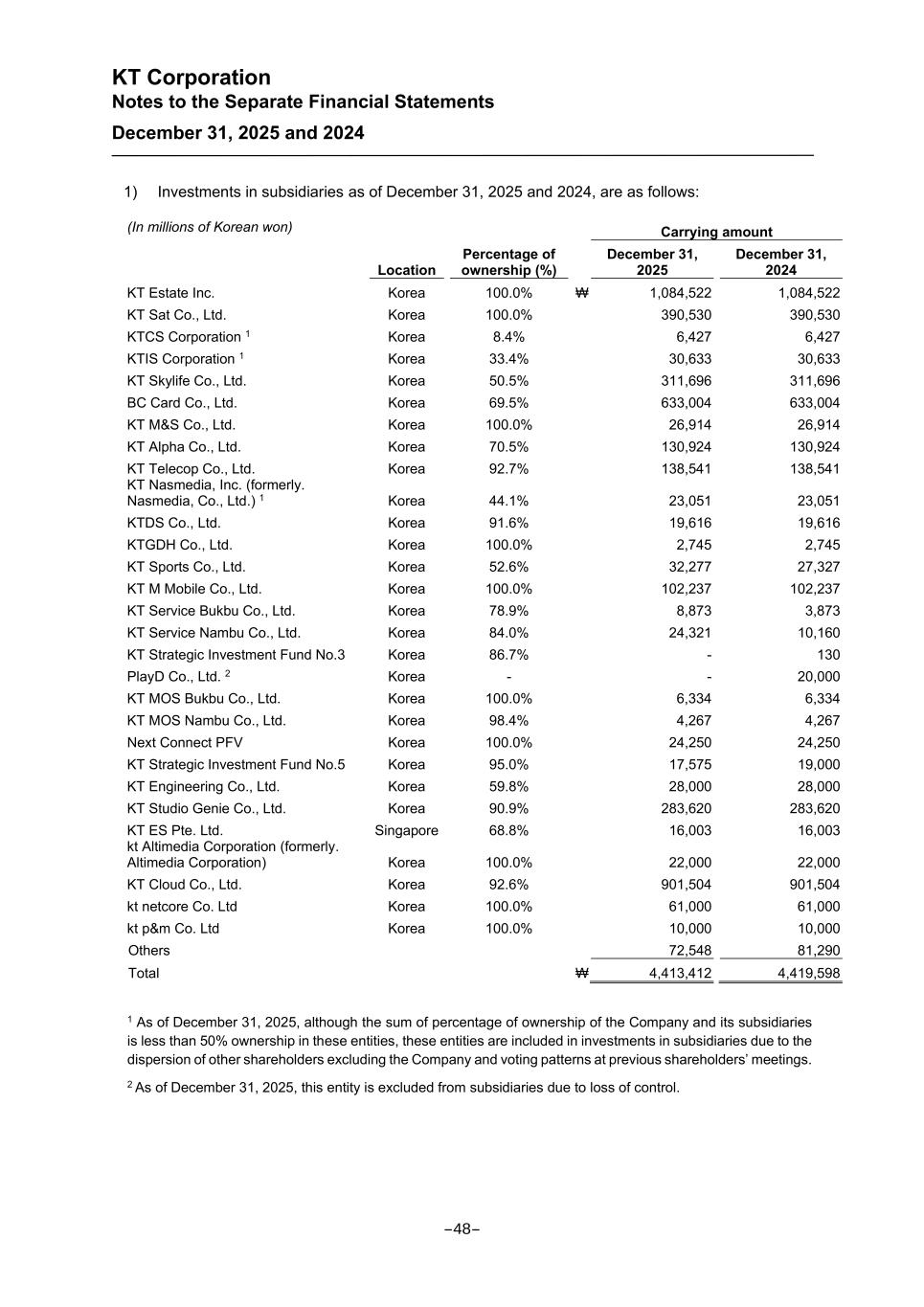
KT Corporation Notes to the Separate Financial Statements December 31, 2025 and 2024 1) Investments in subsidiaries as of December 31, 2025 and 2024, are as follows: (In millions of Korean won) Location Percentage of ownership (%) Carrying amount December 31, 2025 December 31, 2024 KT Estate Inc. Korea 100.0% ₩ 1,084,522 1,084,522 KT Sat Co., Ltd. Korea 100.0% 390,530 390,530 KTCS Corporation 1 Korea 8.4% 6,427 6,427 KTIS Corporation 1 Korea 33.4% 30,633 30,633 KT Skylife Co., Ltd. Korea 50.5% 311,696 311,696 BC Card Co., Ltd. Korea 69.5% 633,004 633,004 KT M&S Co., Ltd. Korea 100.0% 26,914 26,914 KT Alpha Co., Ltd. Korea 70.5% 130,924 130,924 KT Telecop Co., Ltd. Korea 92.7% 138,541 138,541 KT Nasmedia, Inc. (formerly. Nasmedia, Co., Ltd.) 1 Korea 44.1% 23,051 23,051 KTDS Co., Ltd. Korea 91.6% 19,616 19,616 KTGDH Co., Ltd. Korea 100.0% 2,745 2,745 KT Sports Co., Ltd. Korea 52.6% 32,277 27,327 KT M Mobile Co., Ltd. Korea 100.0% 102,237 102,237 KT Service Bukbu Co., Ltd. Korea 78.9% 8,873 3,873 KT Service Nambu Co., Ltd. Korea 84.0% 24,321 10,160 KT Strategic Investment Fund No.3 Korea 86.7% - 130 PlayD Co., Ltd. 2 Korea - - 20,000 KT MOS Bukbu Co., Ltd. Korea 100.0% 6,334 6,334 KT MOS Nambu Co., Ltd. Korea 98.4% 4,267 4,267 Next Connect PFV Korea 100.0% 24,250 24,250 KT Strategic Investment Fund No.5 Korea 95.0% 17,575 19,000 KT Engineering Co., Ltd. Korea 59.8% 28,000 28,000 KT Studio Genie Co., Ltd. Korea 90.9% 283,620 283,620 KT ES Pte. Ltd. Singapore 68.8% 16,003 16,003 kt Altimedia Corporation (formerly. Altimedia Corporation) Korea 100.0% 22,000 22,000 KT Cloud Co., Ltd. Korea 92.6% 901,504 901,504 kt netcore Co. Ltd Korea 100.0% 61,000 61,000 kt p&m Co. Ltd Korea 100.0% 10,000 10,000 Others 72,548 81,290 Total ₩ 4,413,412 4,419,598 1 As of December 31, 2025, although the sum of percentage of ownership of the Company and its subsidiaries is less than 50% ownership in these entities, these entities are included in investments in subsidiaries due to the dispersion of other shareholders excluding the Company and voting patterns at previous shareholders’ meetings. 2 As of December 31, 2025, this entity is excluded from subsidiaries due to loss of control. -48-
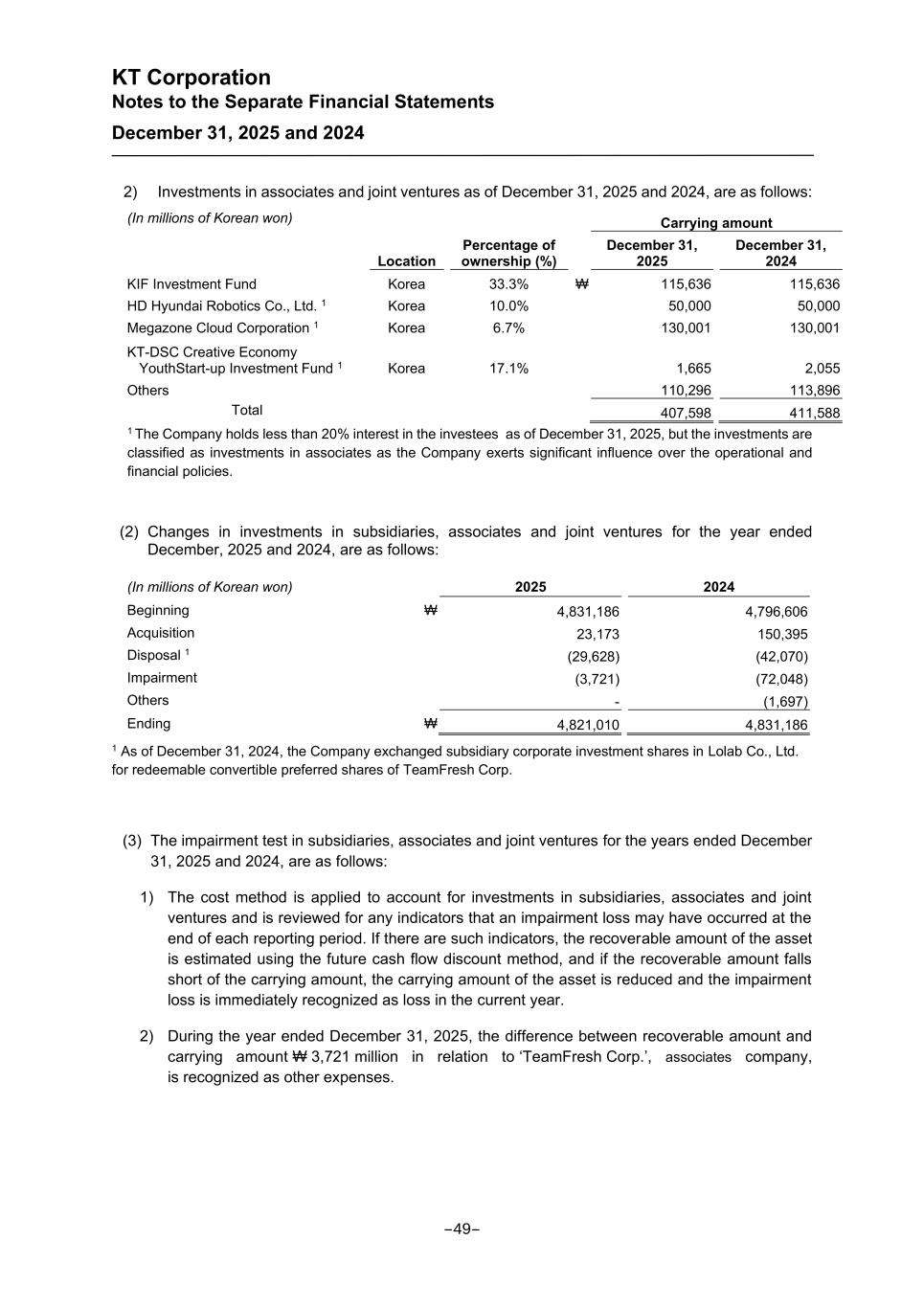
KT Corporation Notes to the Separate Financial Statements December 31, 2025 and 2024 2) Investments in associates and joint ventures as of December 31, 2025 and 2024, are as follows: (In millions of Korean won) Location Percentage of ownership (%) Carrying amount December 31, 2025 December 31, 2024 KIF Investment Fund Korea 33.3% ₩ 115,636 115,636 HD Hyundai Robotics Co., Ltd. 1 Korea 10.0% 50,000 50,000 Megazone Cloud Corporation 1 Korea 6.7% 130,001 130,001 KT-DSC Creative Economy YouthStart-up Investment Fund 1 Korea 17.1% 1,665 2,055 Others 110,296 113,896 Total 407,598 411,588 1 The Company holds less than 20% interest in the investees as of December 31, 2025, but the investments are classified as investments in associates as the Company exerts significant influence over the operational and financial policies. (2) Changes in investments in subsidiaries, associates and joint ventures for the year ended December, 2025 and 2024, are as follows: (In millions of Korean won) 2025 2024 Beginning ₩ 4,831,186 4,796,606 Acquisition 23,173 150,395 Disposal 1 (29,628) (42,070) Impairment (3,721) (72,048) Others - (1,697) Ending ₩ 4,821,010 4,831,186 1 As of December 31, 2024, the Company exchanged subsidiary corporate investment shares in Lolab Co., Ltd. for redeemable convertible preferred shares of TeamFresh Corp. (3) The impairment test in subsidiaries, associates and joint ventures for the years ended December 31, 2025 and 2024, are as follows: 1) The cost method is applied to account for investments in subsidiaries, associates and joint ventures and is reviewed for any indicators that an impairment loss may have occurred at the end of each reporting period. If there are such indicators, the recoverable amount of the asset is estimated using the future cash flow discount method, and if the recoverable amount falls short of the carrying amount, the carrying amount of the asset is reduced and the impairment loss is immediately recognized as loss in the current year. 2) During the year ended December 31, 2025, the difference between recoverable amount and carrying amount ₩ 3,721 million in relation to ‘TeamFresh Corp.’, associates company, is recognized as other expenses. -49-
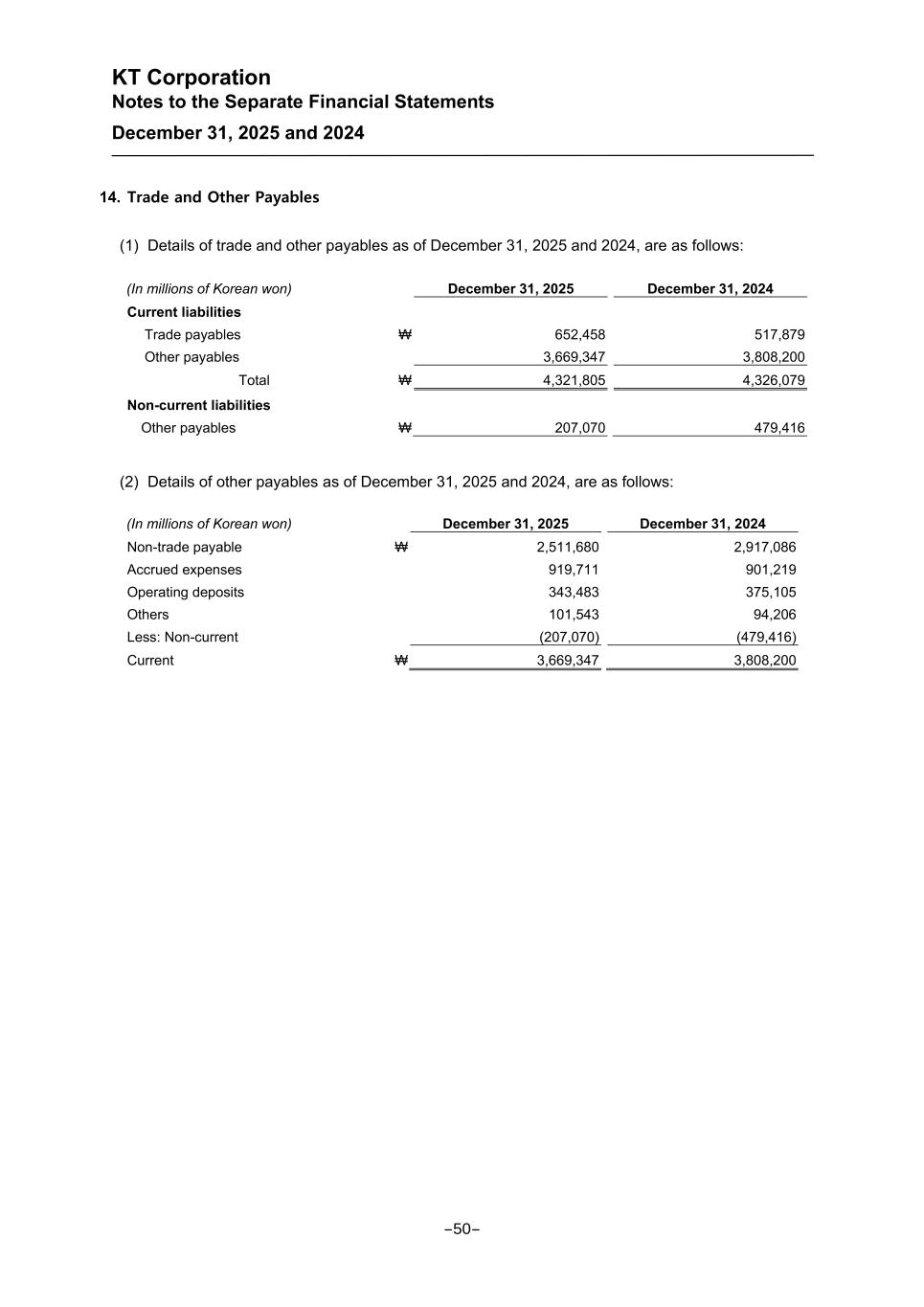
KT Corporation Notes to the Separate Financial Statements December 31, 2025 and 2024 14. Trade and Other Payables (1) Details of trade and other payables as of December 31, 2025 and 2024, are as follows: (In millions of Korean won) December 31, 2025 December 31, 2024 Current liabilities Trade payables ₩ 652,458 517,879 Other payables 3,669,347 3,808,200 Total ₩ 4,321,805 4,326,079 Non-current liabilities Other payables ₩ 207,070 479,416 (2) Details of other payables as of December 31, 2025 and 2024, are as follows: (In millions of Korean won) December 31, 2025 December 31, 2024 Non-trade payable ₩ 2,511,680 2,917,086 Accrued expenses 919,711 901,219 Operating deposits 343,483 375,105 Others 101,543 94,206 Less: Non-current (207,070) (479,416) Current ₩ 3,669,347 3,808,200 -50-
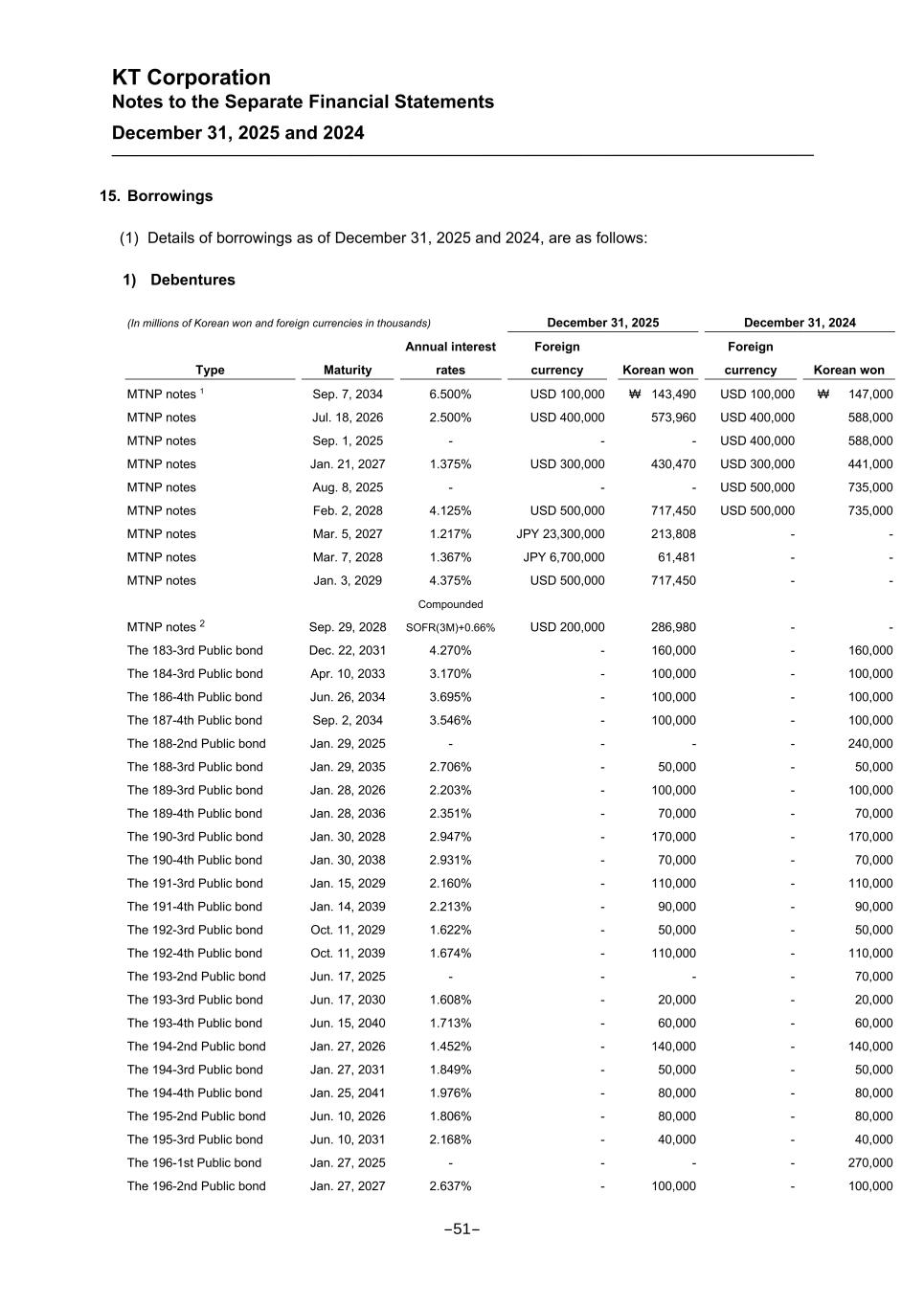
KT Corporation Notes to the Separate Financial Statements December 31, 2025 and 2024 15. Borrowings (1) Details of borrowings as of December 31, 2025 and 2024, are as follows: 1) Debentures (In millions of Korean won and foreign currencies in thousands) December 31, 2025 December 31, 2024 Type Maturity Annual interest rates Foreign currency Korean won Foreign currency Korean won MTNP notes 1 Sep. 7, 2034 6.500% USD 100,000 ₩ 143,490 USD 100,000 ₩ 147,000 MTNP notes Jul. 18, 2026 2.500% USD 400,000 573,960 USD 400,000 588,000 MTNP notes Sep. 1, 2025 - - - USD 400,000 588,000 MTNP notes Jan. 21, 2027 1.375% USD 300,000 430,470 USD 300,000 441,000 MTNP notes Aug. 8, 2025 - - - USD 500,000 735,000 MTNP notes Feb. 2, 2028 4.125% USD 500,000 717,450 USD 500,000 735,000 MTNP notes Mar. 5, 2027 1.217% JPY 23,300,000 213,808 - - MTNP notes Mar. 7, 2028 1.367% JPY 6,700,000 61,481 - - MTNP notes Jan. 3, 2029 4.375% USD 500,000 717,450 - - MTNP notes 2 Sep. 29, 2028 Compounded SOFR(3M)+0.66% USD 200,000 286,980 - - The 183-3rd Public bond Dec. 22, 2031 4.270% - 160,000 - 160,000 The 184-3rd Public bond Apr. 10, 2033 3.170% - 100,000 - 100,000 The 186-4th Public bond Jun. 26, 2034 3.695% - 100,000 - 100,000 The 187-4th Public bond Sep. 2, 2034 3.546% - 100,000 - 100,000 The 188-2nd Public bond Jan. 29, 2025 - - - - 240,000 The 188-3rd Public bond Jan. 29, 2035 2.706% - 50,000 - 50,000 The 189-3rd Public bond Jan. 28, 2026 2.203% - 100,000 - 100,000 The 189-4th Public bond Jan. 28, 2036 2.351% - 70,000 - 70,000 The 190-3rd Public bond Jan. 30, 2028 2.947% - 170,000 - 170,000 The 190-4th Public bond Jan. 30, 2038 2.931% - 70,000 - 70,000 The 191-3rd Public bond Jan. 15, 2029 2.160% - 110,000 - 110,000 The 191-4th Public bond Jan. 14, 2039 2.213% - 90,000 - 90,000 The 192-3rd Public bond Oct. 11, 2029 1.622% - 50,000 - 50,000 The 192-4th Public bond Oct. 11, 2039 1.674% - 110,000 - 110,000 The 193-2nd Public bond Jun. 17, 2025 - - - - 70,000 The 193-3rd Public bond Jun. 17, 2030 1.608% - 20,000 - 20,000 The 193-4th Public bond Jun. 15, 2040 1.713% - 60,000 - 60,000 The 194-2nd Public bond Jan. 27, 2026 1.452% - 140,000 - 140,000 The 194-3rd Public bond Jan. 27, 2031 1.849% - 50,000 - 50,000 The 194-4th Public bond Jan. 25, 2041 1.976% - 80,000 - 80,000 The 195-2nd Public bond Jun. 10, 2026 1.806% - 80,000 - 80,000 The 195-3rd Public bond Jun. 10, 2031 2.168% - 40,000 - 40,000 The 196-1st Public bond Jan. 27, 2025 - - - - 270,000 The 196-2nd Public bond Jan. 27, 2027 2.637% - 100,000 - 100,000 -51-
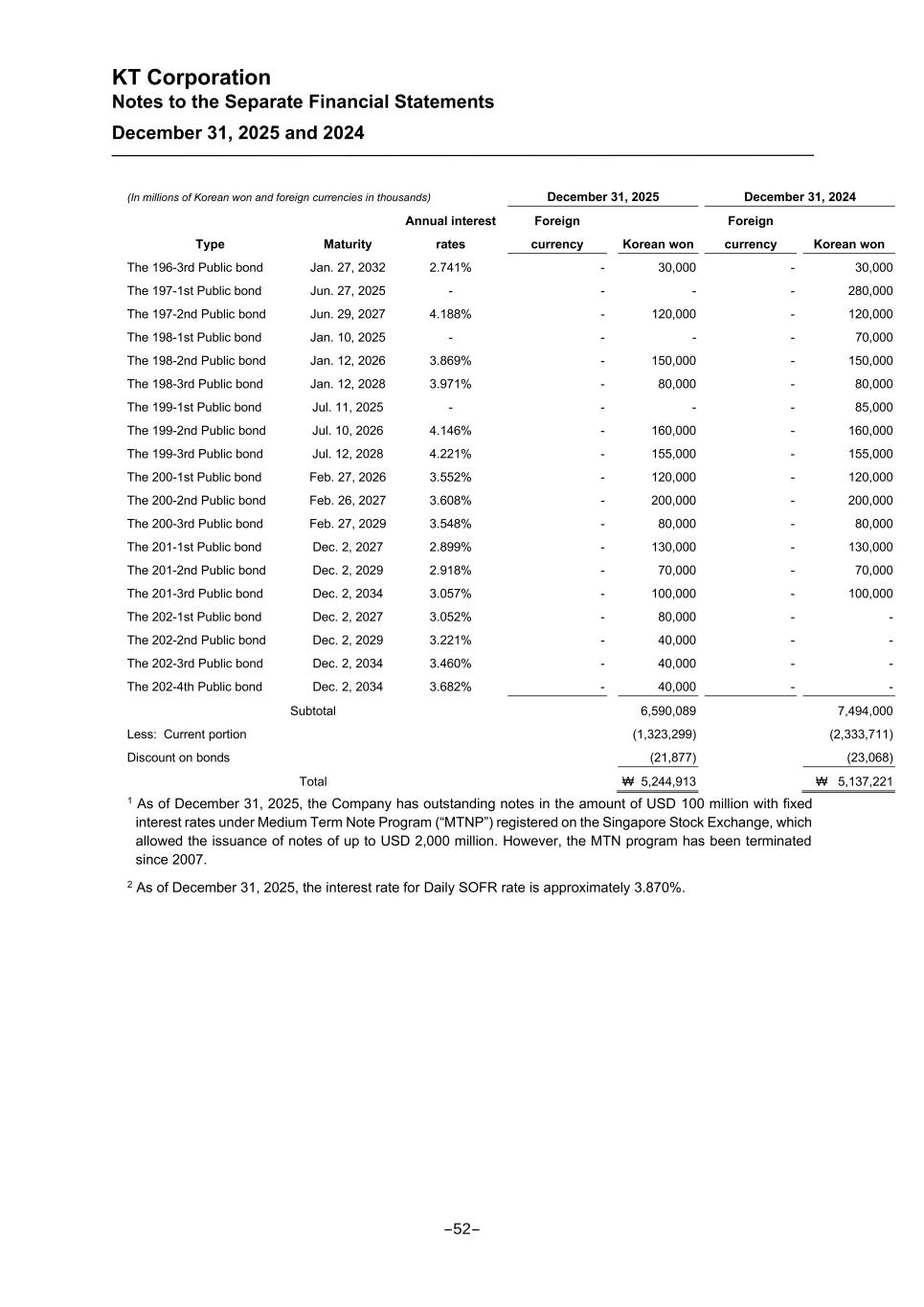
KT Corporation Notes to the Separate Financial Statements December 31, 2025 and 2024 (In millions of Korean won and foreign currencies in thousands) December 31, 2025 December 31, 2024 Type Maturity Annual interest rates Foreign currency Korean won Foreign currency Korean won The 196-3rd Public bond Jan. 27, 2032 2.741% - 30,000 - 30,000 The 197-1st Public bond Jun. 27, 2025 - - - - 280,000 The 197-2nd Public bond Jun. 29, 2027 4.188% - 120,000 - 120,000 The 198-1st Public bond Jan. 10, 2025 - - - - 70,000 The 198-2nd Public bond Jan. 12, 2026 3.869% - 150,000 - 150,000 The 198-3rd Public bond Jan. 12, 2028 3.971% - 80,000 - 80,000 The 199-1st Public bond Jul. 11, 2025 - - - - 85,000 The 199-2nd Public bond Jul. 10, 2026 4.146% - 160,000 - 160,000 The 199-3rd Public bond Jul. 12, 2028 4.221% - 155,000 - 155,000 The 200-1st Public bond Feb. 27, 2026 3.552% - 120,000 - 120,000 The 200-2nd Public bond Feb. 26, 2027 3.608% - 200,000 - 200,000 The 200-3rd Public bond Feb. 27, 2029 3.548% - 80,000 - 80,000 The 201-1st Public bond Dec. 2, 2027 2.899% - 130,000 - 130,000 The 201-2nd Public bond Dec. 2, 2029 2.918% - 70,000 - 70,000 The 201-3rd Public bond Dec. 2, 2034 3.057% - 100,000 - 100,000 The 202-1st Public bond Dec. 2, 2027 3.052% - 80,000 - - The 202-2nd Public bond Dec. 2, 2029 3.221% - 40,000 - - The 202-3rd Public bond Dec. 2, 2034 3.460% - 40,000 - - The 202-4th Public bond Dec. 2, 2034 3.682% - 40,000 - - Subtotal 6,590,089 7,494,000 Less: Current portion (1,323,299) (2,333,711) Discount on bonds (21,877) (23,068) Total ₩ 5,244,913 ₩ 5,137,221 1 As of December 31, 2025, the Company has outstanding notes in the amount of USD 100 million with fixed interest rates under Medium Term Note Program (“MTNP”) registered on the Singapore Stock Exchange, which allowed the issuance of notes of up to USD 2,000 million. However, the MTN program has been terminated since 2007. 2 As of December 31, 2025, the interest rate for Daily SOFR rate is approximately 3.870%. -52-
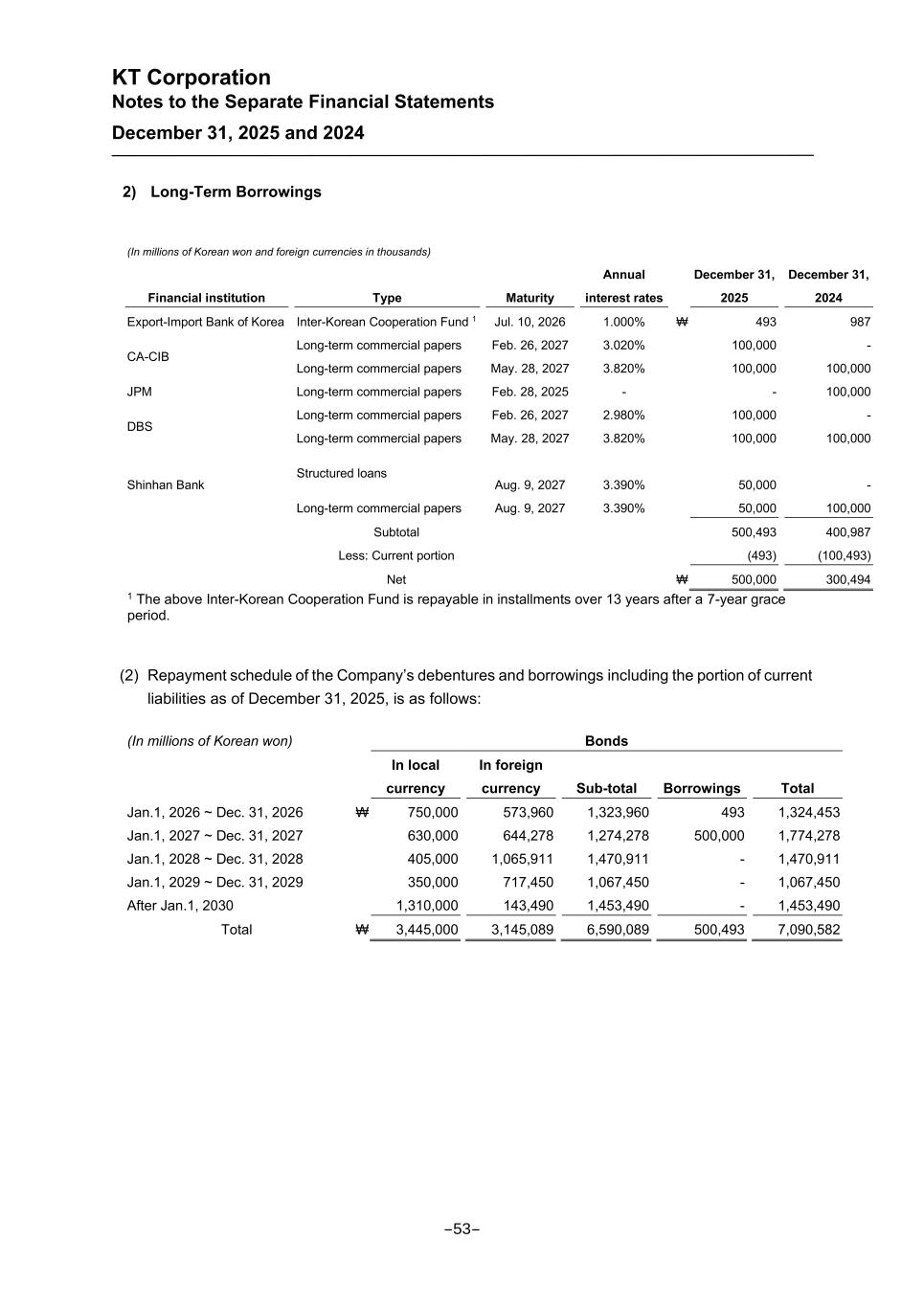
KT Corporation Notes to the Separate Financial Statements December 31, 2025 and 2024 2) Long-Term Borrowings (In millions of Korean won and foreign currencies in thousands) Financial institution Type Maturity Annual interest rates December 31, 2025 December 31, 2024 Export-Import Bank of Korea Inter-Korean Cooperation Fund 1 Jul. 10, 2026 1.000% ₩ 493 987 CA-CIB Long-term commercial papers Long-term commercial papers Long-term commercial papers Feb. 26, 2027 3.020% 100,000 - May. 28, 2027 3.820% 100,000 100,000 JPM Feb. 28, 2025 - - 100,000 DBS Long-term commercial papers Long-term commercial papers Feb. 26, 2027 2.980% 100,000 - May. 28, 2027 3.820% 100,000 100,000 Shinhan Bank Structured loans Aug. 9, 2027 3.390% 50,000 - Long-term commercial papers Aug. 9, 2027 3.390% 50,000 100,000 Subtotal 500,493 400,987 Less: Current portion (493) (100,493) Net ₩ 500,000 300,494 1 The above Inter-Korean Cooperation Fund is repayable in installments over 13 years after a 7-year grace period. (2) Repayment schedule of the Company’s debentures and borrowings including the portion of current liabilities as of December 31, 2025, is as follows: (In millions of Korean won) Bonds In local currency In foreign currency Sub-total Borrowings Total Jan.1, 2026 ~ Dec. 31, 2026 ₩ 750,000 573,960 1,323,960 493 1,324,453 Jan.1, 2027 ~ Dec. 31, 2027 630,000 644,278 1,274,278 500,000 1,774,278 Jan.1, 2028 ~ Dec. 31, 2028 405,000 1,065,911 1,470,911 - 1,470,911 Jan.1, 2029 ~ Dec. 31, 2029 350,000 717,450 1,067,450 - 1,067,450 After Jan.1, 2030 1,310,000 143,490 1,453,490 - 1,453,490 Total ₩ 3,445,000 3,145,089 6,590,089 500,493 7,090,582 -53-
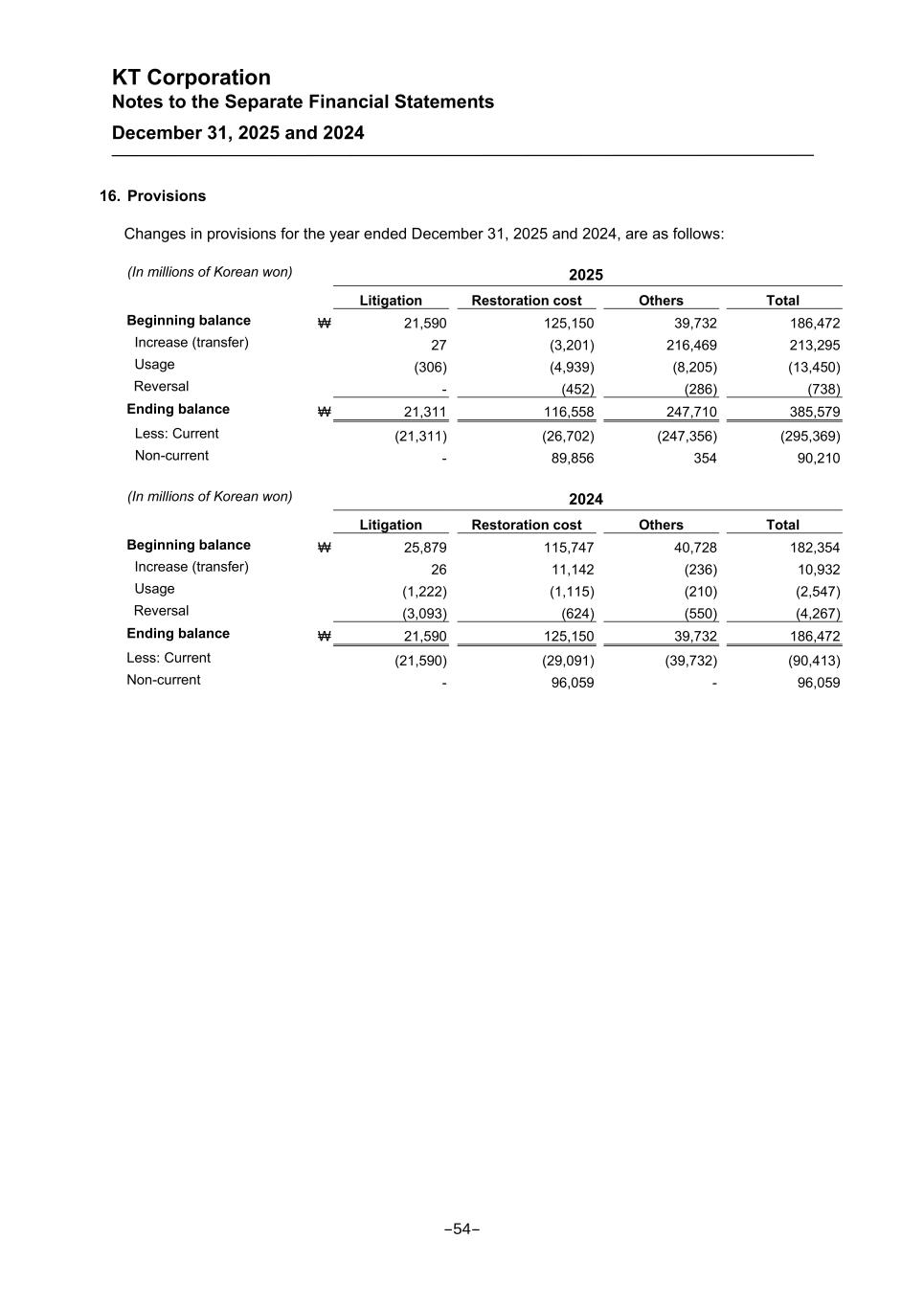
KT Corporation Notes to the Separate Financial Statements December 31, 2025 and 2024 16. Provisions Changes in provisions for the year ended December 31, 2025 and 2024, are as follows: (In millions of Korean won) 2025 Litigation Restoration cost Others Total Beginning balance ₩ 21,590 125,150 39,732 186,472 Increase (transfer) 27 (3,201) 216,469 213,295 Usage (306) (4,939) (8,205) (13,450) Reversal - (452) (286) (738) Ending balance ₩ 21,311 116,558 247,710 385,579 Less: Current ₩ (21,311) (26,702) (247,356) (295,369) Non-current - 89,856 354 90,210 (In millions of Korean won) 2024 Litigation Restoration cost Others Total Beginning balance ₩ 25,879 115,747 40,728 182,354 Increase (transfer) 26 11,142 (236) 10,932 Usage (1,222) (1,115) (210) (2,547) Reversal (3,093) (624) (550) (4,267) Ending balance ₩ 21,590 125,150 39,732 186,472 Less: Current (21,590) (29,091) (39,732) (90,413) Non-current - 96,059 - 96,059 -54-
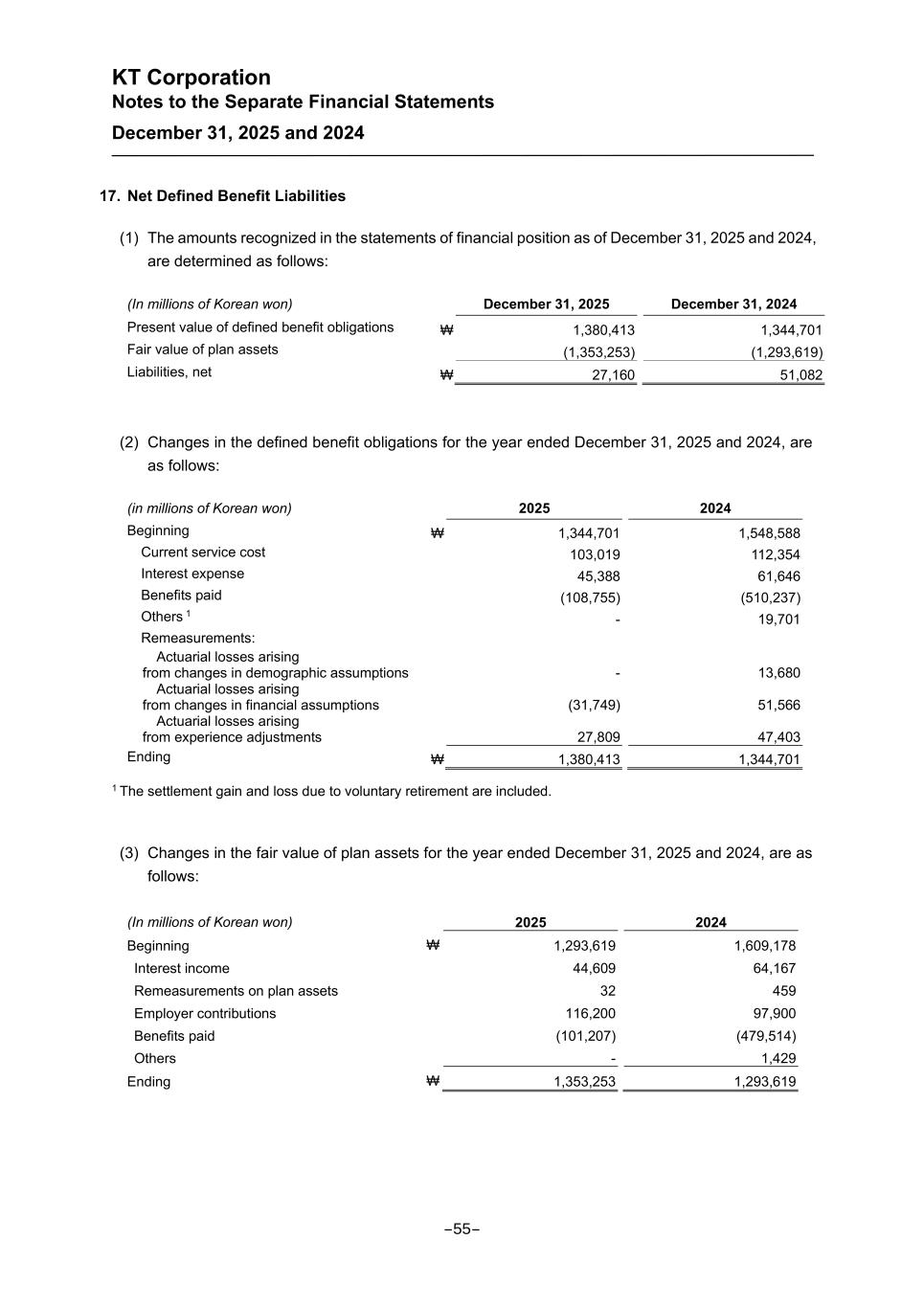
KT Corporation Notes to the Separate Financial Statements December 31, 2025 and 2024 17. Net Defined Benefit Liabilities (1) The amounts recognized in the statements of financial position as of December 31, 2025 and 2024, are determined as follows: (In millions of Korean won) December 31, 2025 December 31, 2024 Present value of defined benefit obligations ₩ 1,380,413 1,344,701 Fair value of plan assets (1,353,253) (1,293,619) Liabilities, net ₩ 27,160 51,082 (2) Changes in the defined benefit obligations for the year ended December 31, 2025 and 2024, are as follows: (in millions of Korean won) 2025 2024 Beginning ₩ 1,344,701 1,548,588 Current service cost 103,019 112,354 Interest expense 45,388 61,646 Benefits paid (108,755) (510,237) Others 1 - 19,701 Remeasurements: Actuarial losses arising from changes in demographic assumptions - 13,680 Actuarial losses arising from changes in financial assumptions (31,749) 51,566 Actuarial losses arising from experience adjustments 27,809 47,403 Ending ₩ 1,380,413 1,344,701 1 The settlement gain and loss due to voluntary retirement are included. (3) Changes in the fair value of plan assets for the year ended December 31, 2025 and 2024, are as follows: (In millions of Korean won) 2025 2024 Beginning ₩ 1,293,619 1,609,178 Interest income 44,609 64,167 Remeasurements on plan assets 32 459 Employer contributions 116,200 97,900 Benefits paid (101,207) (479,514) Others - 1,429 Ending ₩ 1,353,253 1,293,619 -55-
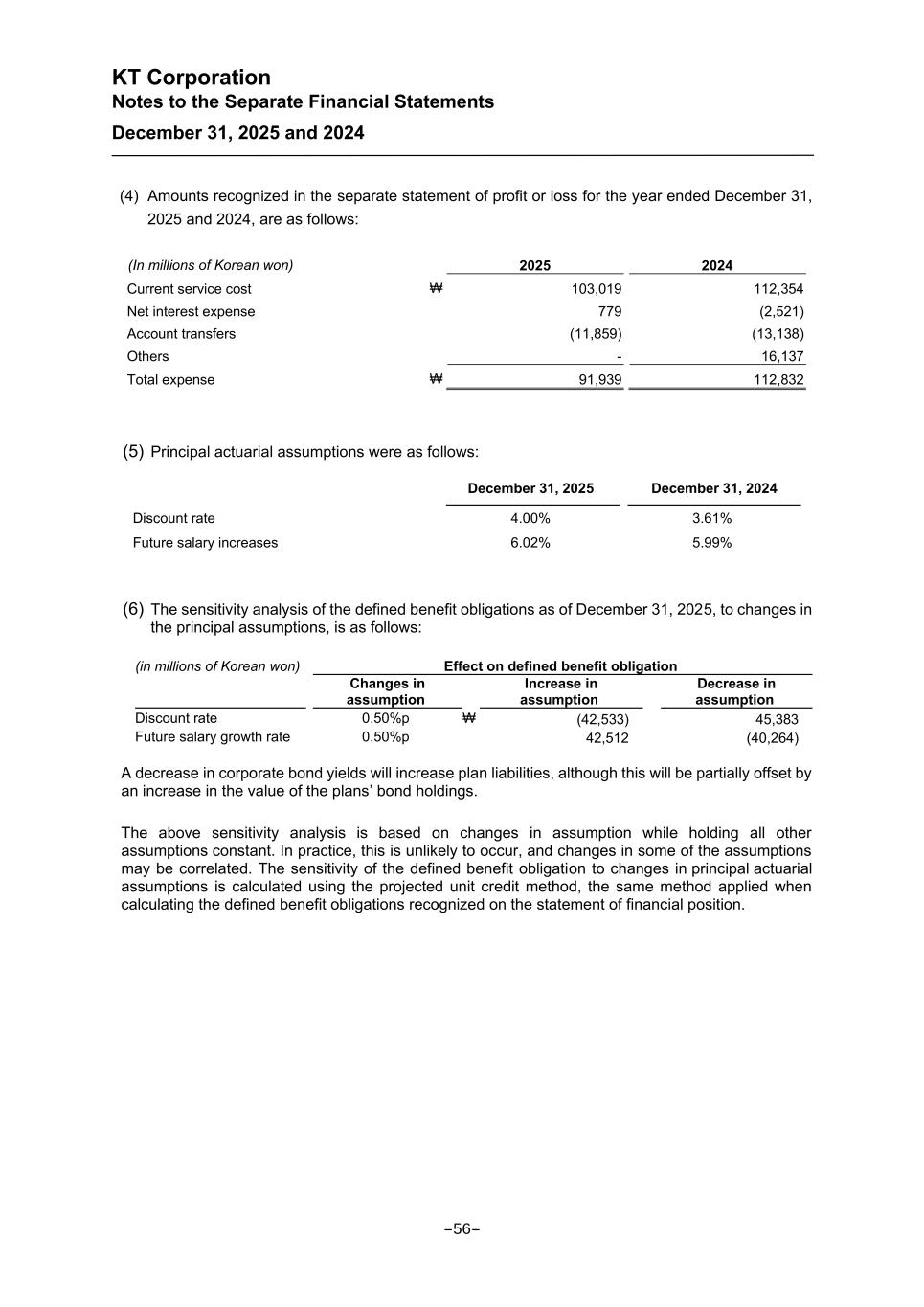
KT Corporation Notes to the Separate Financial Statements December 31, 2025 and 2024 (4) Amounts recognized in the separate statement of profit or loss for the year ended December 31, 2025 and 2024, are as follows: (In millions of Korean won) 2025 2024 Current service cost ₩ 103,019 112,354 Net interest expense 779 (2,521) Account transfers (11,859) (13,138) Others - 16,137 Total expense ₩ 91,939 112,832 (5) Principal actuarial assumptions were as follows: December 31, 2025 December 31, 2024 Discount rate 4.00% 3.61% Future salary increases 6.02% 5.99% (6) The sensitivity analysis of the defined benefit obligations as of December 31, 2025, to changes in the principal assumptions, is as follows: (in millions of Korean won) Effect on defined benefit obligation Changes in assumption Increase in assumption Decrease in assumption Discount rate 0.50%p ₩ (42,533) 45,383 Future salary growth rate 0.50%p 42,512 (40,264) A decrease in corporate bond yields will increase plan liabilities, although this will be partially offset by an increase in the value of the plans’ bond holdings. The above sensitivity analysis is based on changes in assumption while holding all other assumptions constant. In practice, this is unlikely to occur, and changes in some of the assumptions may be correlated. The sensitivity of the defined benefit obligation to changes in principal actuarial assumptions is calculated using the projected unit credit method, the same method applied when calculating the defined benefit obligations recognized on the statement of financial position. -56-
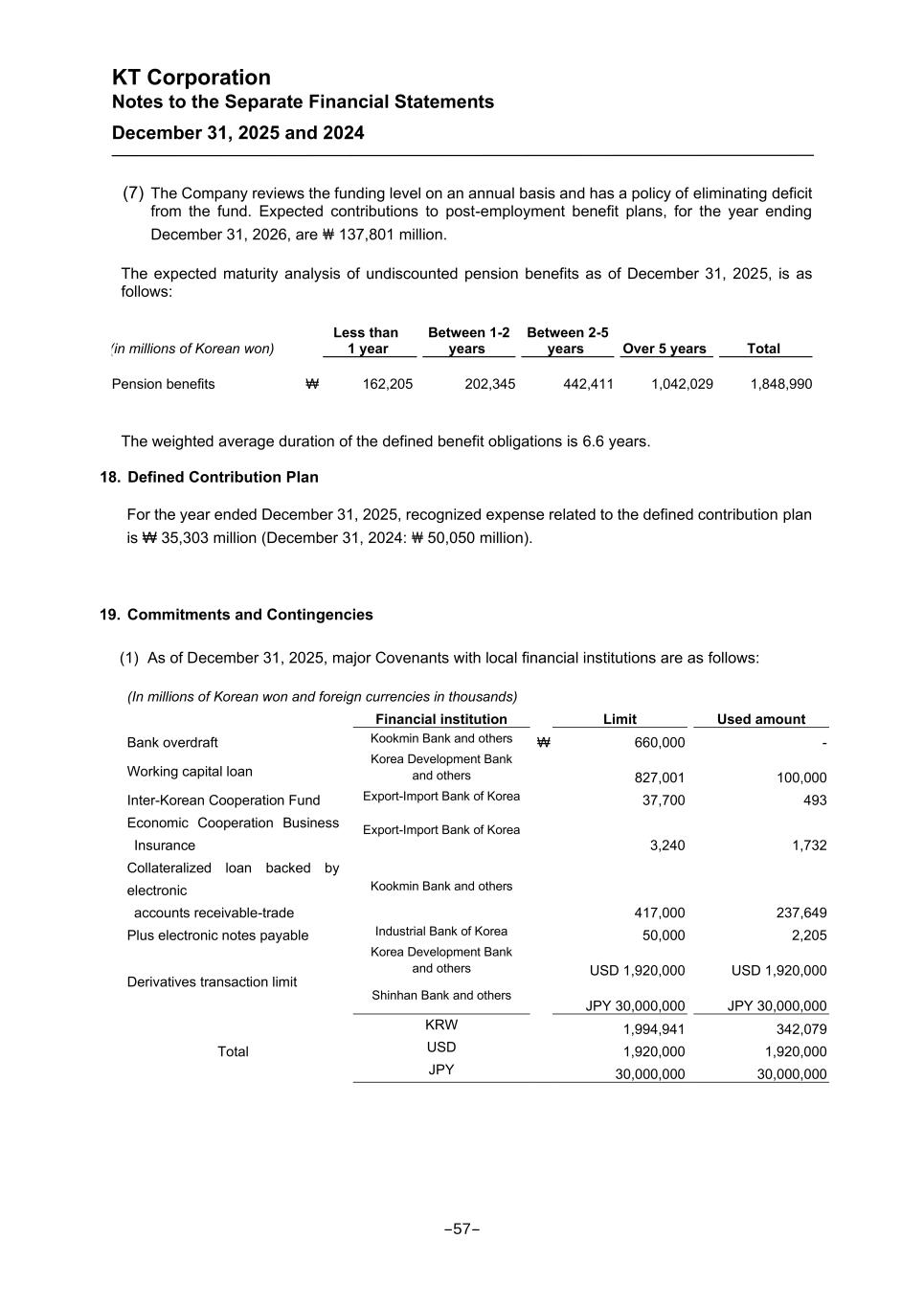
KT Corporation Notes to the Separate Financial Statements December 31, 2025 and 2024 (7) The Company reviews the funding level on an annual basis and has a policy of eliminating deficit from the fund. Expected contributions to post-employment benefit plans, for the year ending December 31, 2026, are ₩ 137,801 million. The expected maturity analysis of undiscounted pension benefits as of December 31, 2025, is as follows: (in millions of Korean won) Less than 1 year Between 1-2 years Between 2-5 years Over 5 years Total Pension benefits ₩ 162,205 202,345 442,411 1,042,029 1,848,990 The weighted average duration of the defined benefit obligations is 6.6 years. 18. Defined Contribution Plan For the year ended December 31, 2025, recognized expense related to the defined contribution plan is ₩ 35,303 million (December 31, 2024: ₩ 50,050 million). 19. Commitments and Contingencies (1) As of December 31, 2025, major Covenants with local financial institutions are as follows: (In millions of Korean won and foreign currencies in thousands) Financial institution Limit Used amount Bank overdraft Kookmin Bank and others ₩ 660,000 - Working capital loan Korea Development Bank and others 827,001 100,000 Inter-Korean Cooperation Fund Export-Import Bank of Korea 37,700 493 Economic Cooperation Business Insurance Export-Import Bank of Korea 3,240 1,732 Collateralized loan backed by electronic accounts receivable-trade Kookmin Bank and others 417,000 237,649 Plus electronic notes payable Industrial Bank of Korea 50,000 2,205 Derivatives transaction limit Korea Development Bank and others USD 1,920,000 USD 1,920,000 Shinhan Bank and others JPY 30,000,000 JPY 30,000,000 Total KRW 1,994,941 342,079 USD 1,920,000 1,920,000 JPY 30,000,000 30,000,000 -57-
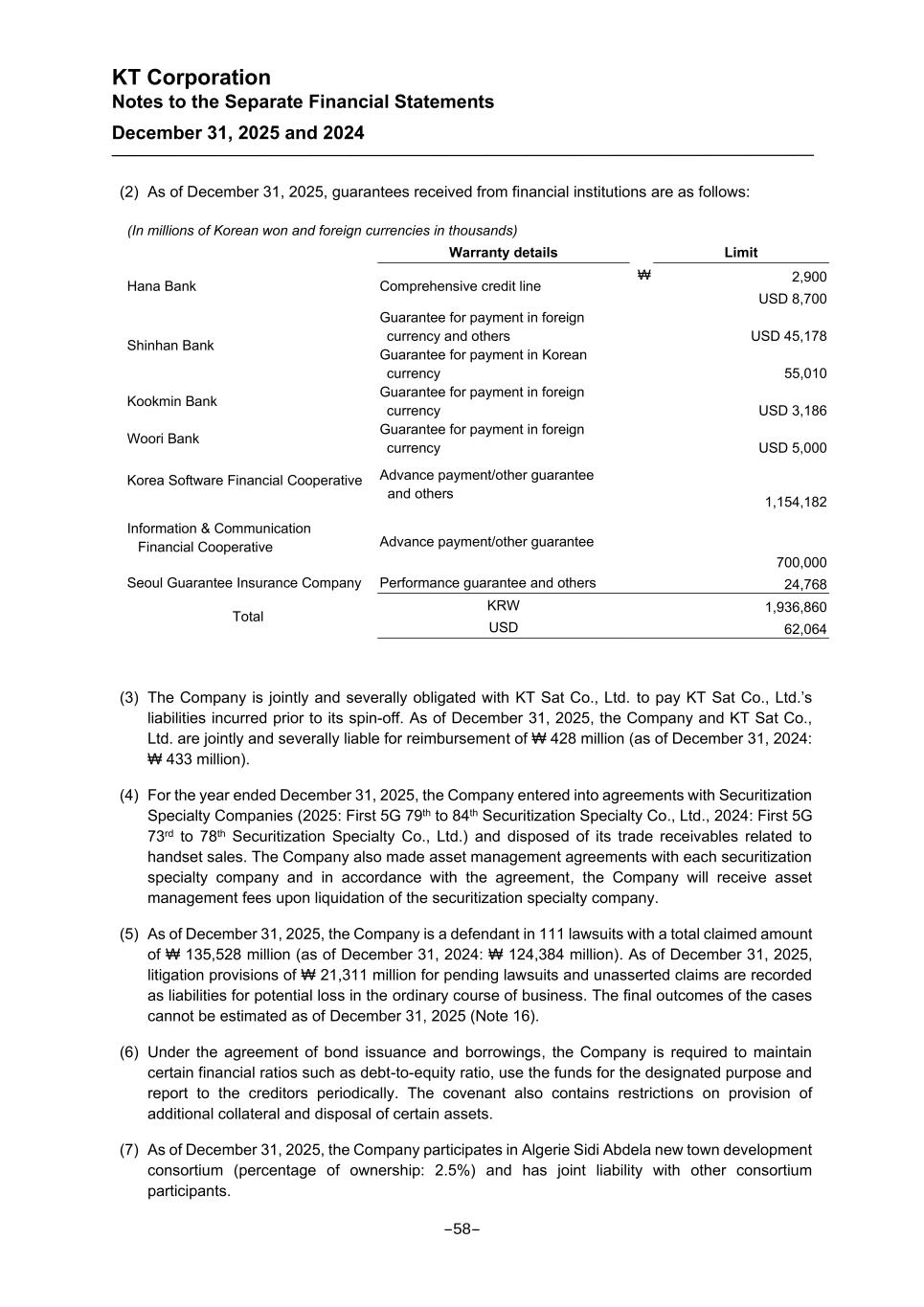
KT Corporation Notes to the Separate Financial Statements December 31, 2025 and 2024 (2) As of December 31, 2025, guarantees received from financial institutions are as follows: (In millions of Korean won and foreign currencies in thousands) Warranty details Limit Hana Bank Comprehensive credit line ₩ 2,900 USD 8,700 Shinhan Bank Guarantee for payment in foreign currency and others USD 45,178 Guarantee for payment in Korean currency 55,010 Kookmin Bank Guarantee for payment in foreign currency USD 3,186 Woori Bank Guarantee for payment in foreign currency USD 5,000 Korea Software Financial Cooperative Advance payment/other guarantee and others 1,154,182 Information & Communication Financial Cooperative Advance payment/other guarantee 700,000 Seoul Guarantee Insurance Company Performance guarantee and others 24,768 Total KRW 1,936,860 USD 62,064 (3) The Company is jointly and severally obligated with KT Sat Co., Ltd. to pay KT Sat Co., Ltd.’s liabilities incurred prior to its spin-off. As of December 31, 2025, the Company and KT Sat Co., Ltd. are jointly and severally liable for reimbursement of ₩ 428 million (as of December 31, 2024: ₩ 433 million). (4) For the year ended December 31, 2025, the Company entered into agreements with Securitization Specialty Companies (2025: First 5G 79th to 84th Securitization Specialty Co., Ltd., 2024: First 5G 73rd to 78th Securitization Specialty Co., Ltd.) and disposed of its trade receivables related to handset sales. The Company also made asset management agreements with each securitization specialty company and in accordance with the agreement, the Company will receive asset management fees upon liquidation of the securitization specialty company. (5) As of December 31, 2025, the Company is a defendant in 111 lawsuits with a total claimed amount of ₩ 135,528 million (as of December 31, 2024: ₩ 124,384 million). As of December 31, 2025, litigation provisions of ₩ 21,311 million for pending lawsuits and unasserted claims are recorded as liabilities for potential loss in the ordinary course of business. The final outcomes of the cases cannot be estimated as of December 31, 2025 (Note 16). (6) Under the agreement of bond issuance and borrowings, the Company is required to maintain certain financial ratios such as debt-to-equity ratio, use the funds for the designated purpose and report to the creditors periodically. The covenant also contains restrictions on provision of additional collateral and disposal of certain assets. (7) As of December 31, 2025, the Company participates in Algerie Sidi Abdela new town development consortium (percentage of ownership: 2.5%) and has joint liability with other consortium participants. -58-
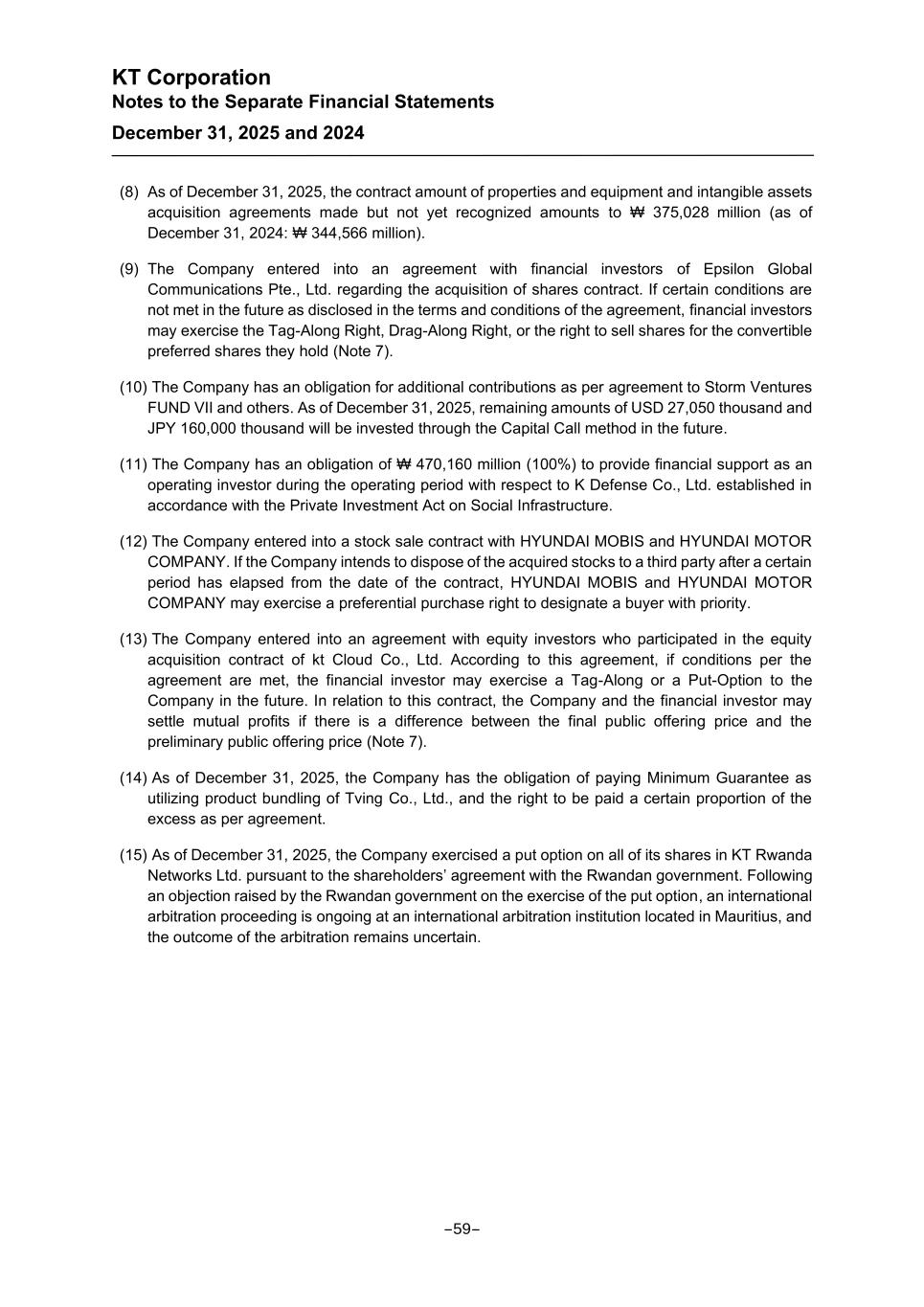
KT Corporation Notes to the Separate Financial Statements December 31, 2025 and 2024 (8) As of December 31, 2025, the contract amount of properties and equipment and intangible assets acquisition agreements made but not yet recognized amounts to ₩ 375,028 million (as of December 31, 2024: ₩ 344,566 million). (9) The Company entered into an agreement with financial investors of Epsilon Global Communications Pte., Ltd. regarding the acquisition of shares contract. If certain conditions are not met in the future as disclosed in the terms and conditions of the agreement, financial investors may exercise the Tag-Along Right, Drag-Along Right, or the right to sell shares for the convertible preferred shares they hold (Note 7). (10) The Company has an obligation for additional contributions as per agreement to Storm Ventures FUND VII and others. As of December 31, 2025, remaining amounts of USD 27,050 thousand and JPY 160,000 thousand will be invested through the Capital Call method in the future. (11) The Company has an obligation of ₩ 470,160 million (100%) to provide financial support as an operating investor during the operating period with respect to K Defense Co., Ltd. established in accordance with the Private Investment Act on Social Infrastructure. (12) The Company entered into a stock sale contract with HYUNDAI MOBIS and HYUNDAI MOTOR COMPANY. If the Company intends to dispose of the acquired stocks to a third party after a certain period has elapsed from the date of the contract, HYUNDAI MOBIS and HYUNDAI MOTOR COMPANY may exercise a preferential purchase right to designate a buyer with priority. (13) The Company entered into an agreement with equity investors who participated in the equity acquisition contract of kt Cloud Co., Ltd. According to this agreement, if conditions per the agreement are met, the financial investor may exercise a Tag-Along or a Put-Option to the Company in the future. In relation to this contract, the Company and the financial investor may settle mutual profits if there is a difference between the final public offering price and the preliminary public offering price (Note 7). (14) As of December 31, 2025, the Company has the obligation of paying Minimum Guarantee as utilizing product bundling of Tving Co., Ltd., and the right to be paid a certain proportion of the excess as per agreement. (15) As of December 31, 2025, the Company exercised a put option on all of its shares in KT Rwanda Networks Ltd. pursuant to the shareholders’ agreement with the Rwandan government. Following an objection raised by the Rwandan government on the exercise of the put option, an international arbitration proceeding is ongoing at an international arbitration institution located in Mauritius, and the outcome of the arbitration remains uncertain. -59-
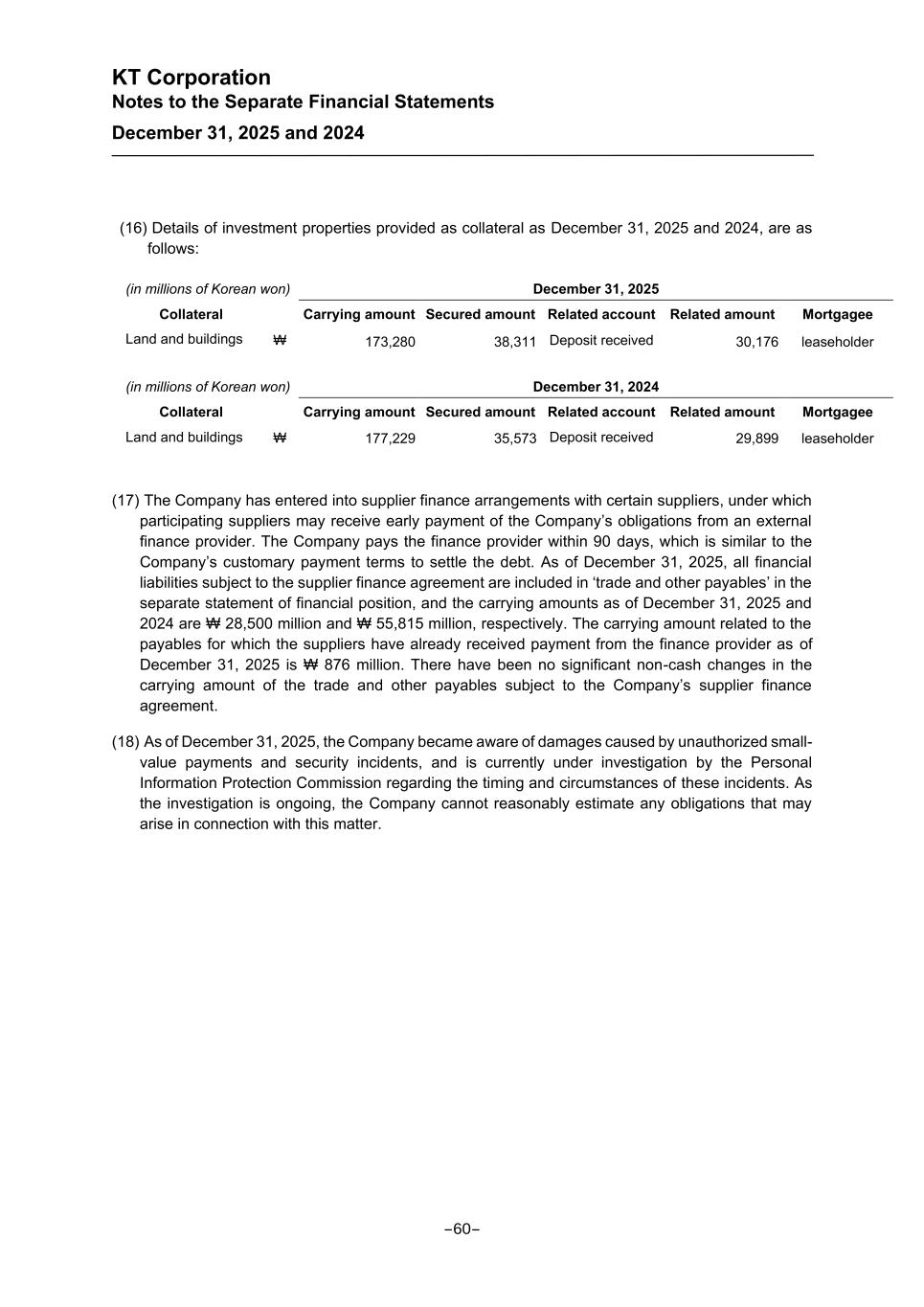
KT Corporation Notes to the Separate Financial Statements December 31, 2025 and 2024 (16) Details of investment properties provided as collateral as December 31, 2025 and 2024, are as follows: (in millions of Korean won) December 31, 2025 Collateral ₩ Carrying amount Secured amount Related account Related amount Mortgagee Land and buildings 173,280 38,311 Deposit received 30,176 leaseholder (in millions of Korean won) December 31, 2024 Collateral ₩ Carrying amount Secured amount Related account Related amount Mortgagee Land and buildings 177,229 35,573 Deposit received 29,899 leaseholder (17) The Company has entered into supplier finance arrangements with certain suppliers, under which participating suppliers may receive early payment of the Company’s obligations from an external finance provider. The Company pays the finance provider within 90 days, which is similar to the Company’s customary payment terms to settle the debt. As of December 31, 2025, all financial liabilities subject to the supplier finance agreement are included in ‘trade and other payables’ in the separate statement of financial position, and the carrying amounts as of December 31, 2025 and 2024 are ₩ 28,500 million and ₩ 55,815 million, respectively. The carrying amount related to the payables for which the suppliers have already received payment from the finance provider as of December 31, 2025 is ₩ 876 million. There have been no significant non-cash changes in the carrying amount of the trade and other payables subject to the Company’s supplier finance agreement. (18) As of December 31, 2025, the Company became aware of damages caused by unauthorized small- value payments and security incidents, and is currently under investigation by the Personal Information Protection Commission regarding the timing and circumstances of these incidents. As the investigation is ongoing, the Company cannot reasonably estimate any obligations that may arise in connection with this matter. -60-
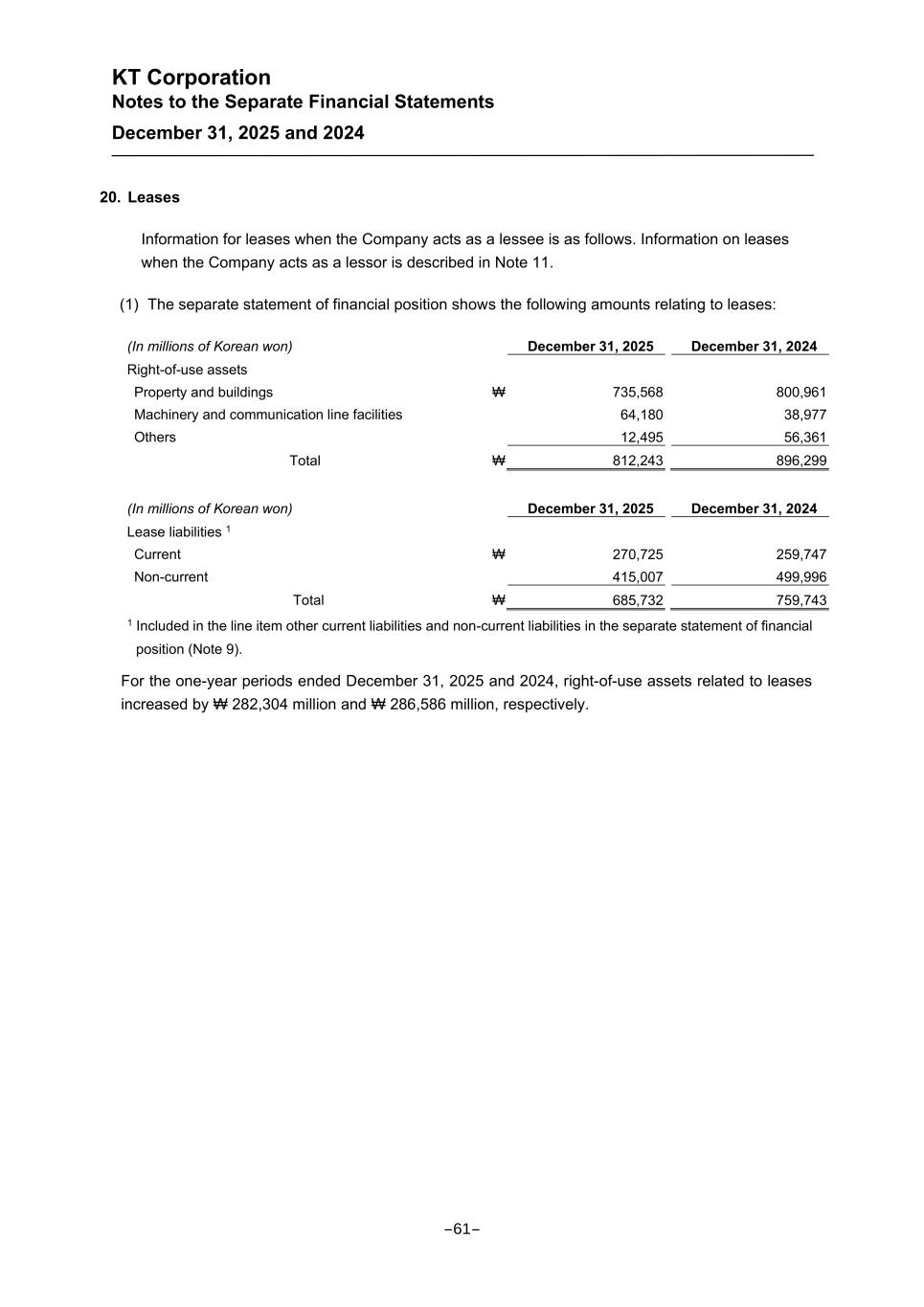
KT Corporation Notes to the Separate Financial Statements December 31, 2025 and 2024 20. Leases Information for leases when the Company acts as a lessee is as follows. Information on leases when the Company acts as a lessor is described in Note 11. (1) The separate statement of financial position shows the following amounts relating to leases: (In millions of Korean won) December 31, 2025 December 31, 2024 Right-of-use assets Property and buildings ₩ 735,568 800,961 Machinery and communication line facilities 64,180 38,977 Others 12,495 56,361 Total ₩ 812,243 896,299 (In millions of Korean won) December 31, 2025 December 31, 2024 Lease liabilities 1 Current ₩ 270,725 259,747 Non-current 415,007 499,996 Total ₩ 685,732 759,743 1 Included in the line item other current liabilities and non-current liabilities in the separate statement of financial position (Note 9). For the one-year periods ended December 31, 2025 and 2024, right-of-use assets related to leases increased by ₩ 282,304 million and ₩ 286,586 million, respectively. -61-
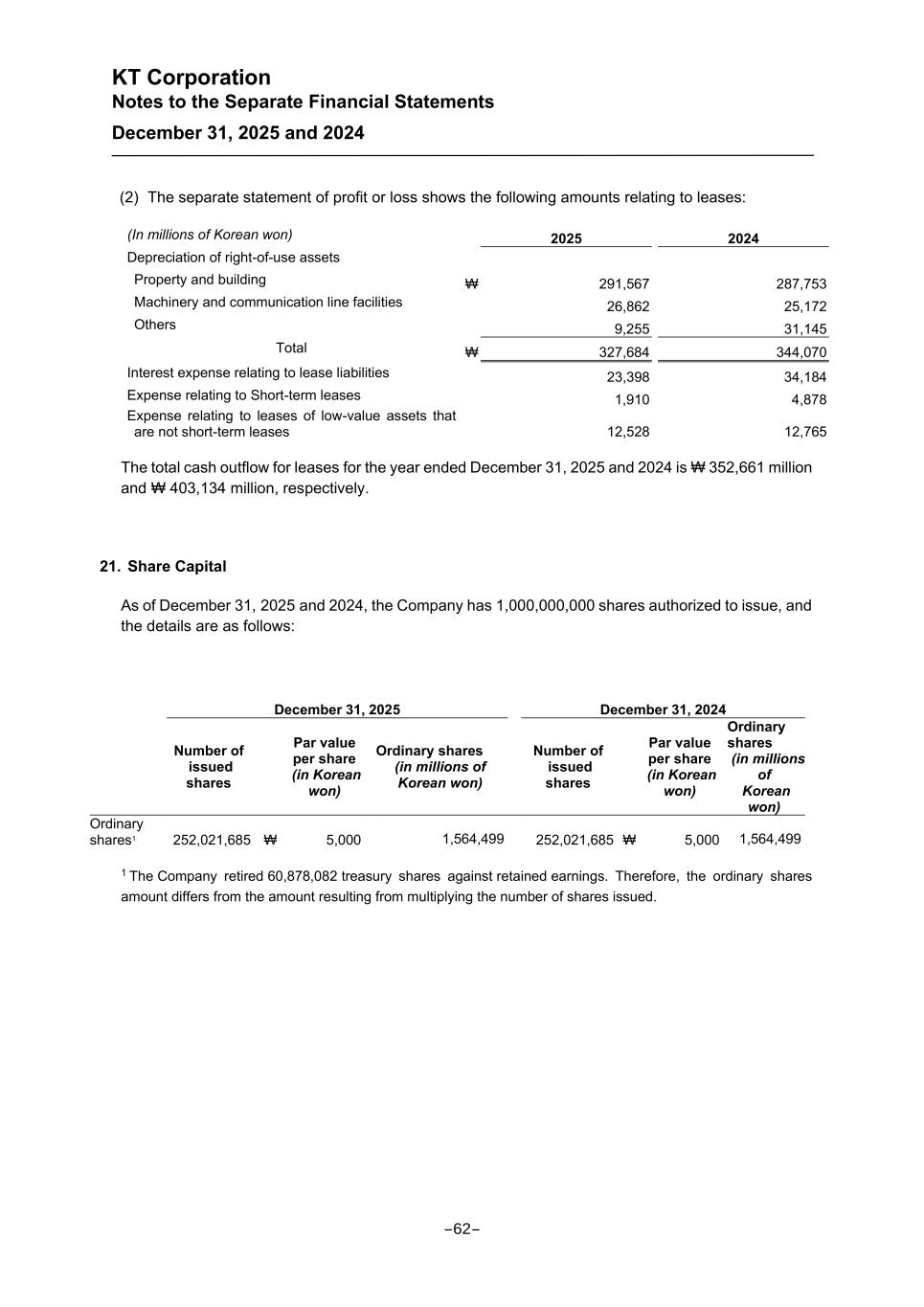
KT Corporation Notes to the Separate Financial Statements December 31, 2025 and 2024 (2) The separate statement of profit or loss shows the following amounts relating to leases: (In millions of Korean won) 2025 2024 Depreciation of right-of-use assets Property and building ₩ 291,567 287,753 Machinery and communication line facilities 26,862 25,172 Others 9,255 31,145 Total ₩ 327,684 344,070 Interest expense relating to lease liabilities 23,398 34,184 Expense relating to Short-term leases 1,910 4,878 Expense relating to leases of low-value assets that are not short-term leases 12,528 12,765 The total cash outflow for leases for the year ended December 31, 2025 and 2024 is ₩ 352,661 million and ₩ 403,134 million, respectively. 21. Share Capital As of December 31, 2025 and 2024, the Company has 1,000,000,000 shares authorized to issue, and the details are as follows: December 31, 2025 December 31, 2024 Number of issued shares Par value per share (in Korean won) Ordinary shares (in millions of Korean won) Number of issued shares Par value per share (in Korean won) Ordinary shares (in millions of Korean won) Ordinary shares1 252,021,685 ₩ 5,000 1,564,499 252,021,685 ₩ 5,000 1,564,499 1 The Company retired 60,878,082 treasury shares against retained earnings. Therefore, the ordinary shares amount differs from the amount resulting from multiplying the number of shares issued. -62-
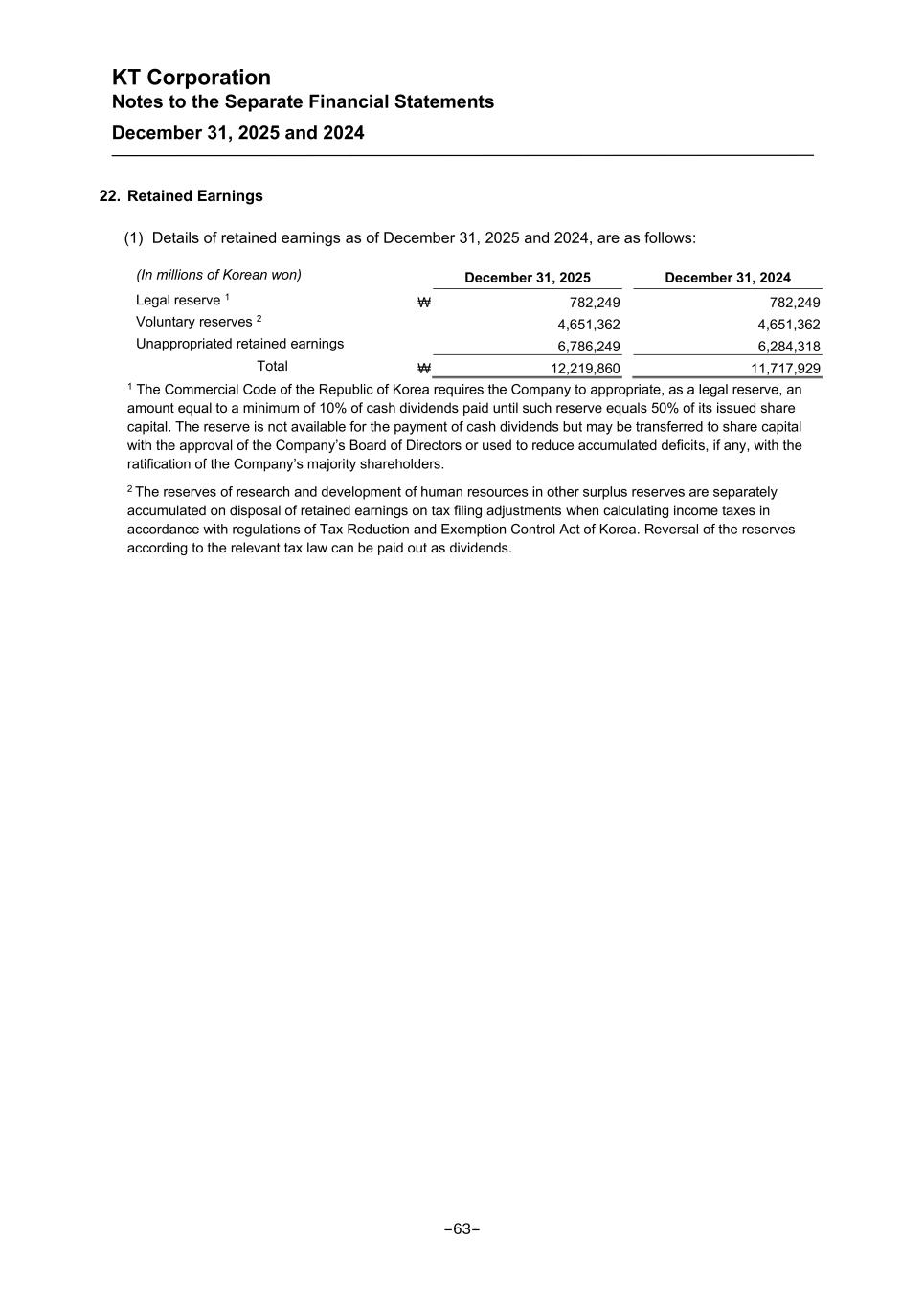
KT Corporation Notes to the Separate Financial Statements December 31, 2025 and 2024 22. Retained Earnings (1) Details of retained earnings as of December 31, 2025 and 2024, are as follows: (In millions of Korean won) December 31, 2025 December 31, 2024 Legal reserve 1 ₩ 782,249 782,249 Voluntary reserves 2 4,651,362 4,651,362 Unappropriated retained earnings 6,786,249 6,284,318 Total ₩ 12,219,860 11,717,929 1 The Commercial Code of the Republic of Korea requires the Company to appropriate, as a legal reserve, an amount equal to a minimum of 10% of cash dividends paid until such reserve equals 50% of its issued share capital. The reserve is not available for the payment of cash dividends but may be transferred to share capital with the approval of the Company’s Board of Directors or used to reduce accumulated deficits, if any, with the ratification of the Company’s majority shareholders. 2 The reserves of research and development of human resources in other surplus reserves are separately accumulated on disposal of retained earnings on tax filing adjustments when calculating income taxes in accordance with regulations of Tax Reduction and Exemption Control Act of Korea. Reversal of the reserves according to the relevant tax law can be paid out as dividends. -63-
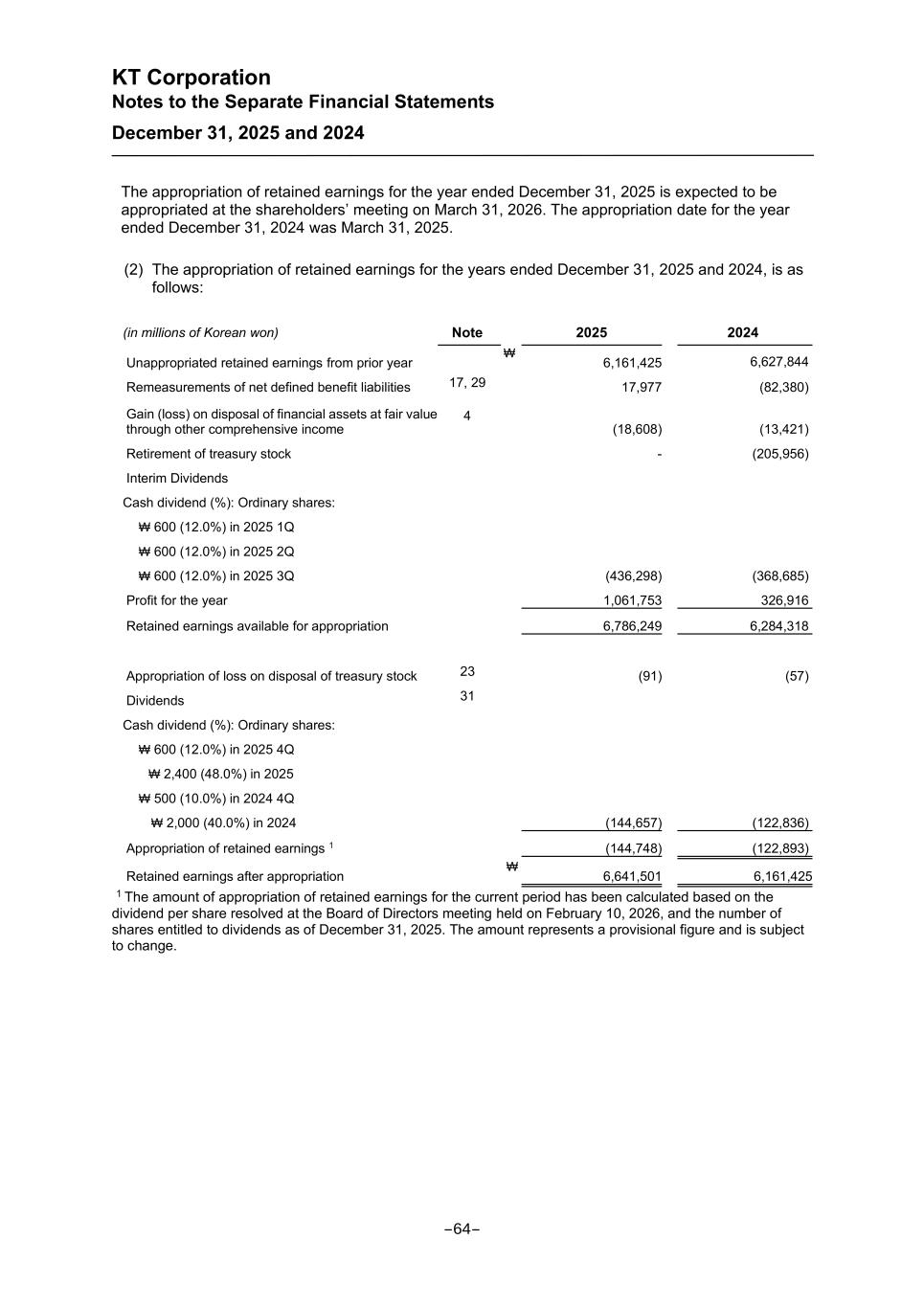
KT Corporation Notes to the Separate Financial Statements December 31, 2025 and 2024 The appropriation of retained earnings for the year ended December 31, 2025 is expected to be appropriated at the shareholders’ meeting on March 31, 2026. The appropriation date for the year ended December 31, 2024 was March 31, 2025. (2) The appropriation of retained earnings for the years ended December 31, 2025 and 2024, is as follows: (in millions of Korean won) Note 2025 2024 Unappropriated retained earnings from prior year ₩ 6,161,425 6,627,844 Remeasurements of net defined benefit liabilities 17, 29 17,977 (82,380) Gain (loss) on disposal of financial assets at fair value through other comprehensive income 4 (18,608) (13,421) Retirement of treasury stock - (205,956) Interim Dividends (436,298) (368,685) Cash dividend (%): Ordinary shares: ₩ 600 (12.0%) in 2025 1Q ₩ 600 (12.0%) in 2025 2Q ₩ 600 (12.0%) in 2025 3Q Profit for the year 1,061,753 326,916 Retained earnings available for appropriation 6,786,249 6,284,318 Appropriation of loss on disposal of treasury stock 23 (91) (57) Dividends 31 (144,657) (122,836) Cash dividend (%): Ordinary shares: ₩ 600 (12.0%) in 2025 4Q ₩ 2,400 (48.0%) in 2025 ₩ 500 (10.0%) in 2024 4Q ₩ 2,000 (40.0%) in 2024 Appropriation of retained earnings 1 (144,748) (122,893) Retained earnings after appropriation ₩ 6,641,501 6,161,425 1 The amount of appropriation of retained earnings for the current period has been calculated based on the dividend per share resolved at the Board of Directors meeting held on February 10, 2026, and the number of shares entitled to dividends as of December 31, 2025. The amount represents a provisional figure and is subject to change. -64-
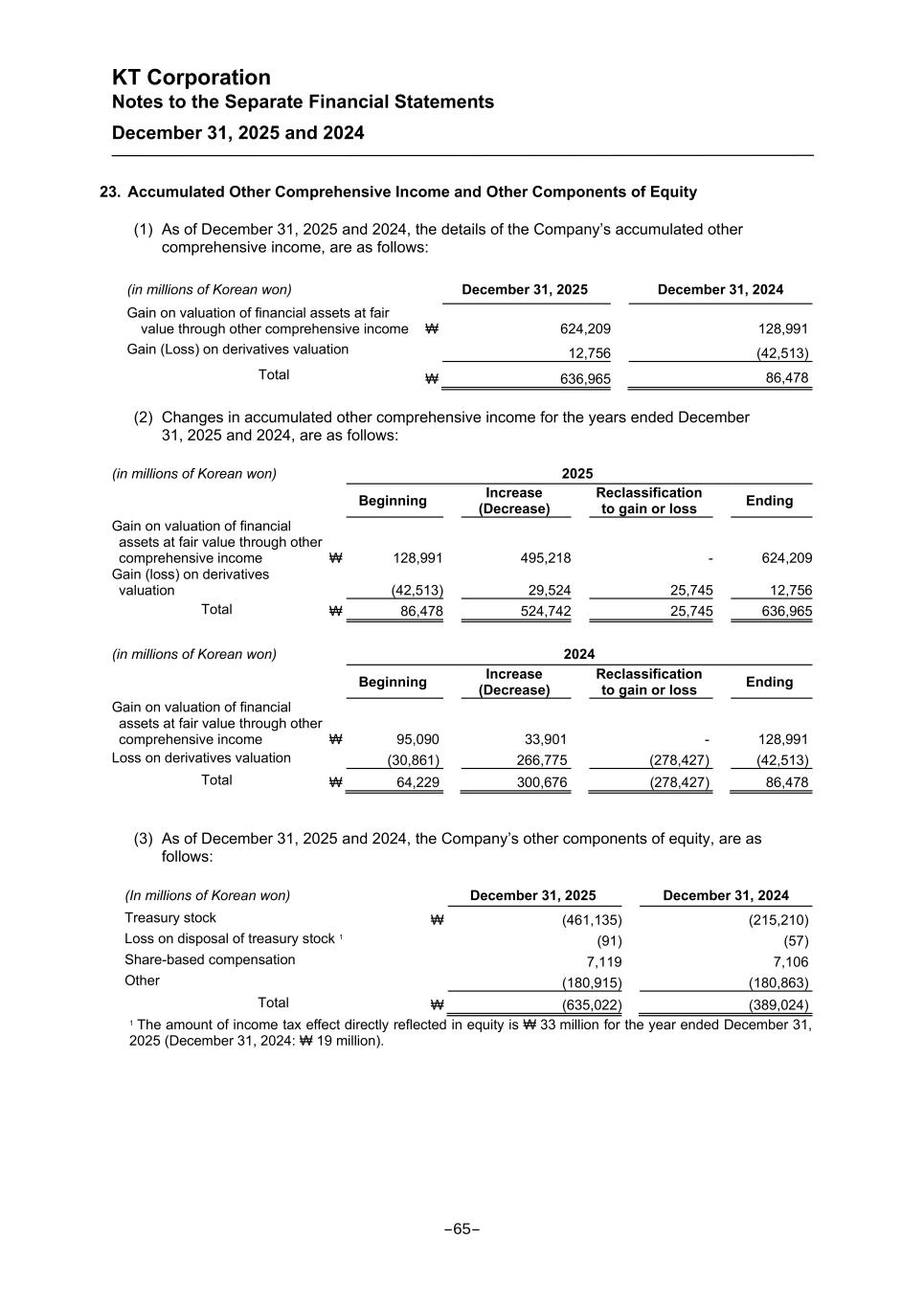
KT Corporation Notes to the Separate Financial Statements December 31, 2025 and 2024 23. Accumulated Other Comprehensive Income and Other Components of Equity (1) As of December 31, 2025 and 2024, the details of the Company’s accumulated other comprehensive income, are as follows: (in millions of Korean won) December 31, 2025 December 31, 2024 Gain on valuation of financial assets at fair value through other comprehensive income ₩ 624,209 128,991 Gain (Loss) on derivatives valuation 12,756 (42,513) Total ₩ 636,965 86,478 (2) Changes in accumulated other comprehensive income for the years ended December 31, 2025 and 2024, are as follows: (in millions of Korean won) 2025 Beginning Increase (Decrease) Reclassification to gain or loss Ending Gain on valuation of financial assets at fair value through other comprehensive income ₩ 128,991 495,218 - 624,209 Gain (loss) on derivatives valuation (42,513) 29,524 25,745 12,756 Total ₩ 86,478 524,742 25,745 636,965 (in millions of Korean won) 2024 Beginning Increase (Decrease) Reclassification to gain or loss Ending Gain on valuation of financial assets at fair value through other comprehensive income ₩ 95,090 33,901 - 128,991 Loss on derivatives valuation (30,861) 266,775 (278,427) (42,513) Total ₩ 64,229 300,676 (278,427) 86,478 (3) As of December 31, 2025 and 2024, the Company’s other components of equity, are as follows: (In millions of Korean won) December 31, 2025 December 31, 2024 Treasury stock ₩ (461,135) (215,210) Loss on disposal of treasury stock 1 (91) (57) Share-based compensation 7,119 7,106 Other (180,915) (180,863) Total ₩ (635,022) (389,024) 1 The amount of income tax effect directly reflected in equity is ₩ 33 million for the year ended December 31, 2025 (December 31, 2024: ₩ 19 million). -65-
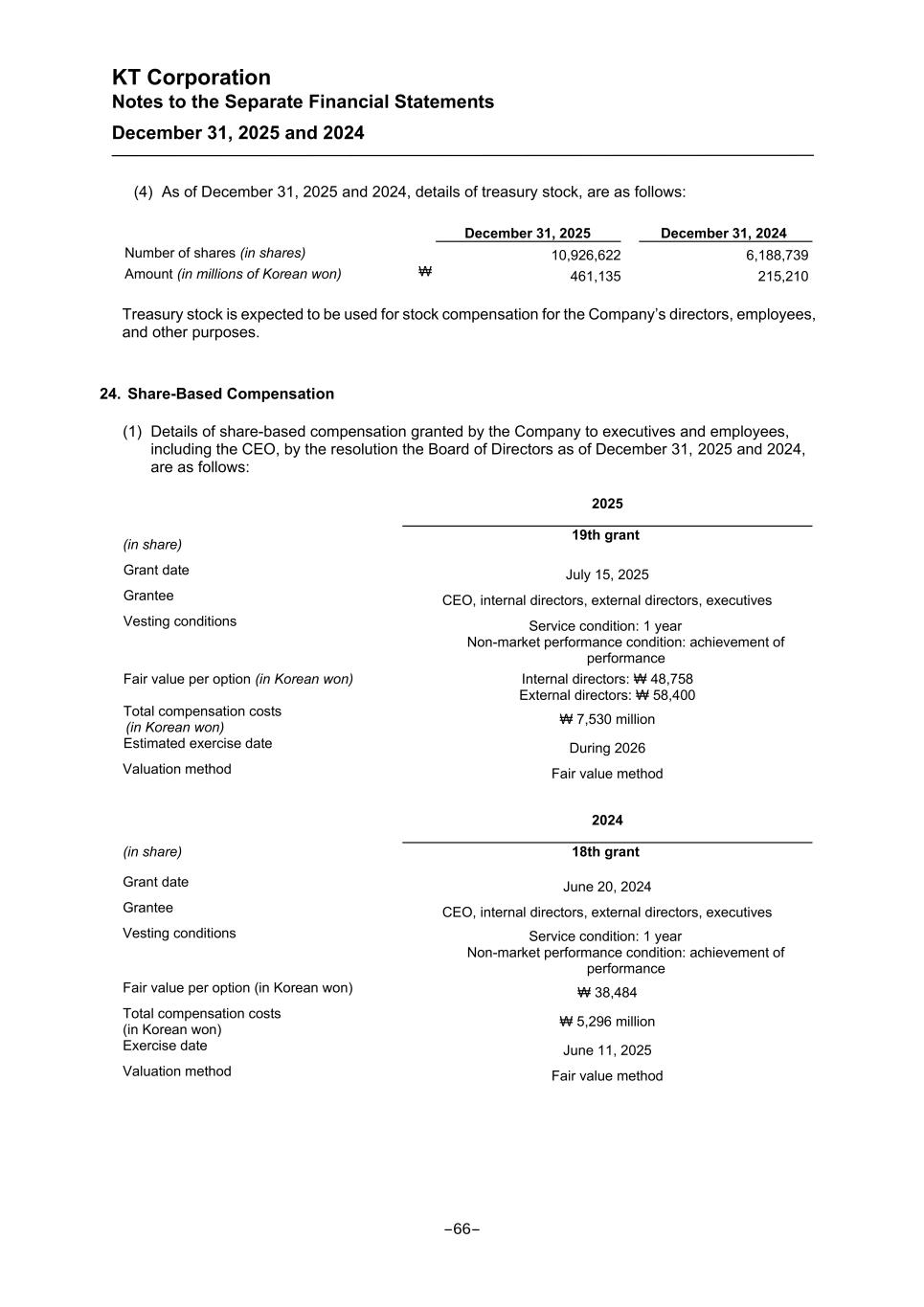
KT Corporation Notes to the Separate Financial Statements December 31, 2025 and 2024 (4) As of December 31, 2025 and 2024, details of treasury stock, are as follows: December 31, 2025 December 31, 2024 Number of shares (in shares) 10,926,622 6,188,739 Amount (in millions of Korean won) ₩ 461,135 215,210 Treasury stock is expected to be used for stock compensation for the Company’s directors, employees, and other purposes. 24. Share-Based Compensation (1) Details of share-based compensation granted by the Company to executives and employees, including the CEO, by the resolution the Board of Directors as of December 31, 2025 and 2024, are as follows: 2025 (in share) 19th grant Grant date July 15, 2025 Grantee CEO, internal directors, external directors, executives Vesting conditions Service condition: 1 year Non-market performance condition: achievement of performance Fair value per option (in Korean won) Internal directors: ₩ 48,758 External directors: ₩ 58,400 Total compensation costs (in Korean won) ₩ 7,530 million Estimated exercise date During 2026 Valuation method Fair value method 2024 (in share) 18th grant Grant date June 20, 2024 Grantee CEO, internal directors, external directors, executives Vesting conditions Service condition: 1 year Non-market performance condition: achievement of performance Fair value per option (in Korean won) ₩ 38,484 Total compensation costs (in Korean won) ₩ 5,296 million Exercise date June 11, 2025 Valuation method Fair value method -66-
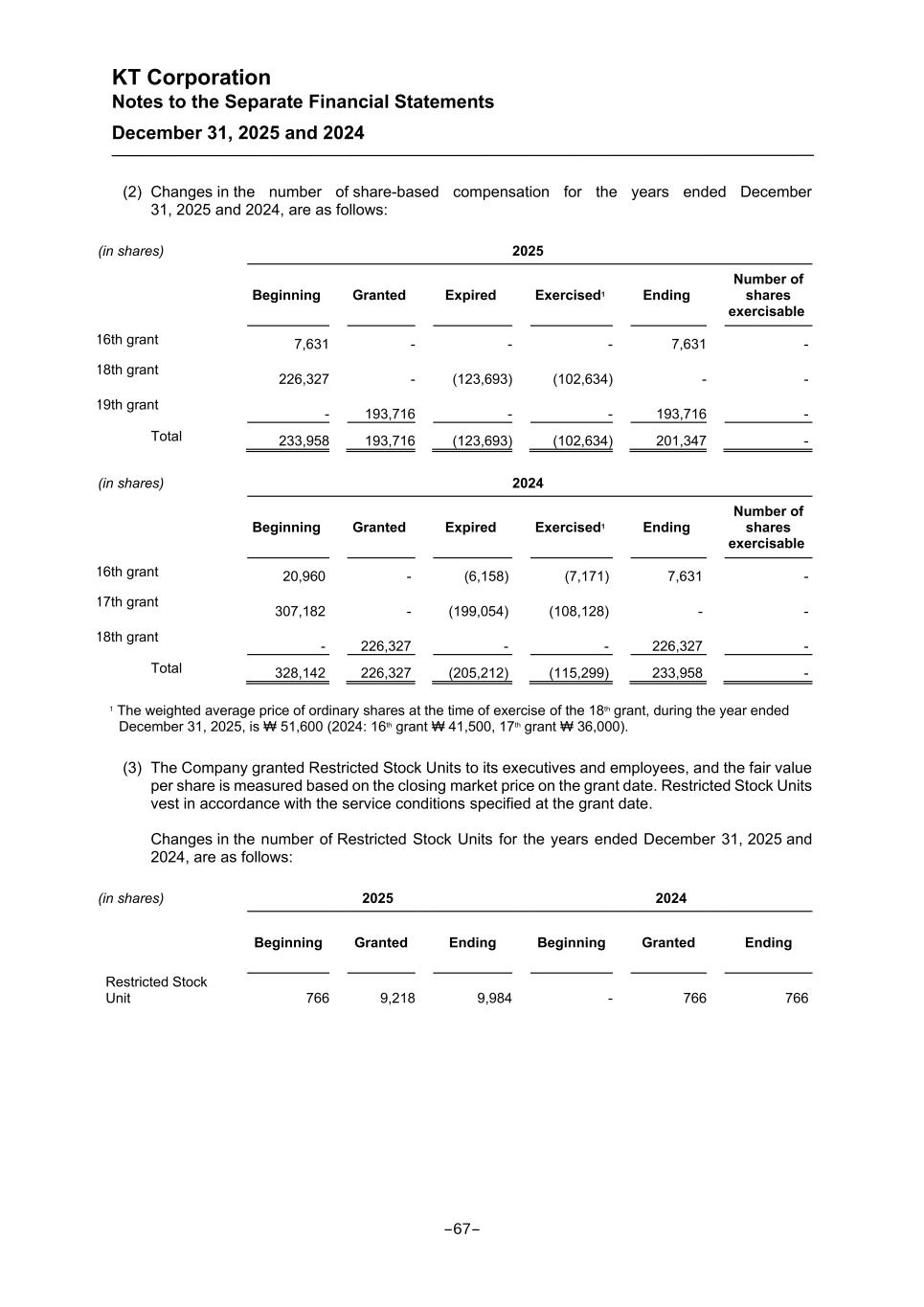
KT Corporation Notes to the Separate Financial Statements December 31, 2025 and 2024 (2) Changes in the number of share-based compensation for the years ended December 31, 2025 and 2024, are as follows: (in shares) 2025 Beginning Granted Expired Exercised1 Ending Number of shares exercisable 16th grant 7,631 - - - 7,631 - 18th grant 226,327 - (123,693) (102,634) - - 19th grant - 193,716 - - 193,716 - Total 233,958 193,716 (123,693) (102,634) 201,347 - (in shares) 2024 Beginning Granted Expired Exercised1 Ending Number of shares exercisable 16th grant 20,960 - (6,158) (7,171) 7,631 - 17th grant 307,182 - (199,054) (108,128) - - 18th grant - 226,327 - - 226,327 - Total 328,142 226,327 (205,212) (115,299) 233,958 - 1 The weighted average price of ordinary shares at the time of exercise of the 18th grant, during the year ended December 31, 2025, is ₩ 51,600 (2024: 16th grant ₩ 41,500, 17th grant ₩ 36,000). (3) The Company granted Restricted Stock Units to its executives and employees, and the fair value per share is measured based on the closing market price on the grant date. Restricted Stock Units vest in accordance with the service conditions specified at the grant date. Changes in the number of Restricted Stock Units for the years ended December 31, 2025 and 2024, are as follows: (in shares) 2025 2024 Beginning Granted Ending Beginning Granted Ending Restricted Stock Unit 766 9,218 9,984 - 766 766 -67-
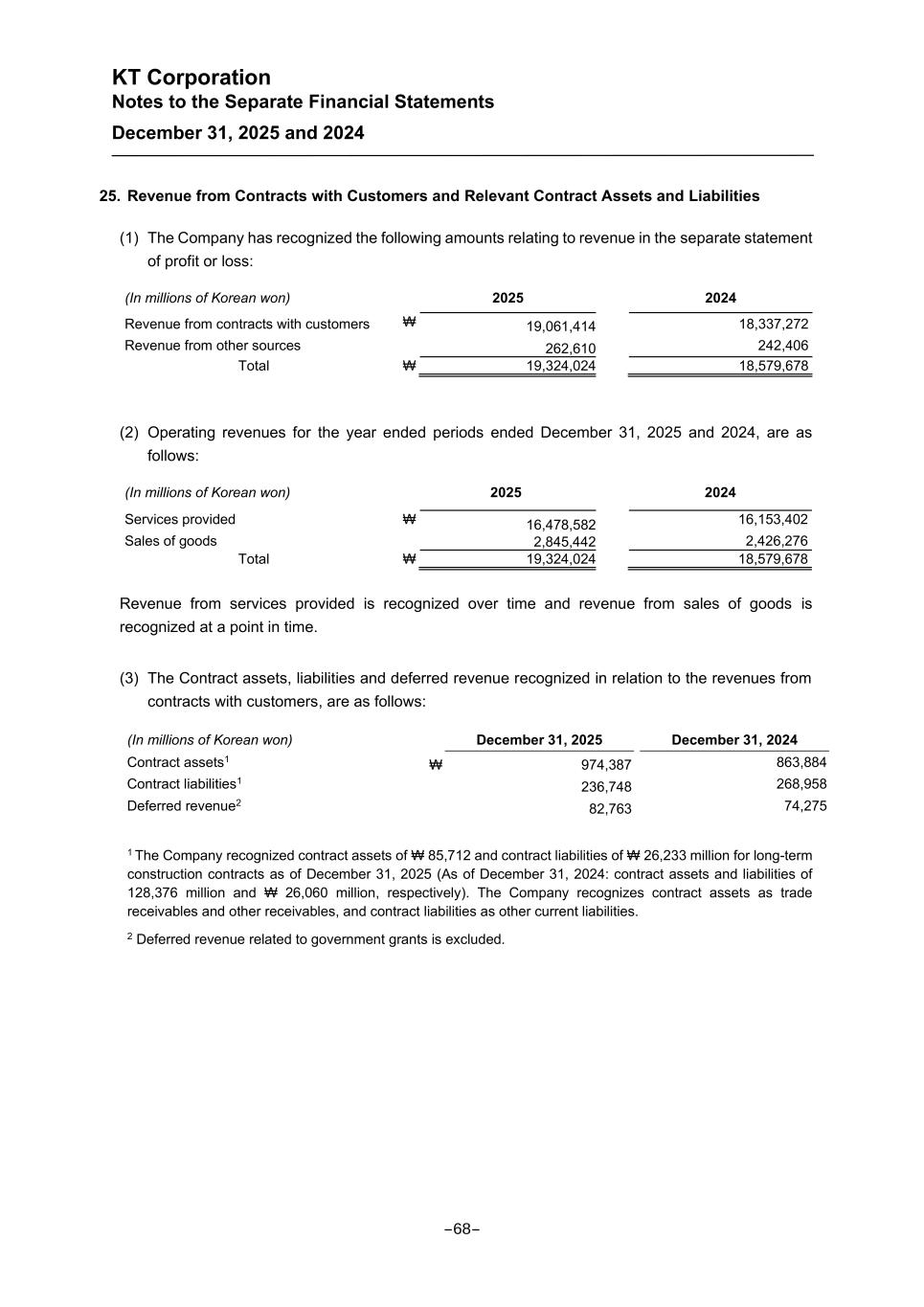
KT Corporation Notes to the Separate Financial Statements December 31, 2025 and 2024 25. Revenue from Contracts with Customers and Relevant Contract Assets and Liabilities (1) The Company has recognized the following amounts relating to revenue in the separate statement of profit or loss: (In millions of Korean won) 2025 2024 Revenue from contracts with customers ₩ 19,061,414 18,337,272 Revenue from other sources 262,610 242,406 Total ₩ 19,324,024 18,579,678 (2) Operating revenues for the year ended periods ended December 31, 2025 and 2024, are as follows: (In millions of Korean won) 2025 2024 Services provided ₩ 16,478,582 16,153,402 Sales of goods 2,845,442 2,426,276 Total ₩ 19,324,024 18,579,678 Revenue from services provided is recognized over time and revenue from sales of goods is recognized at a point in time. (3) The Contract assets, liabilities and deferred revenue recognized in relation to the revenues from contracts with customers, are as follows: (In millions of Korean won) December 31, 2025 December 31, 2024 Contract assets1 ₩ 974,387 863,884 Contract liabilities1 236,748 268,958 Deferred revenue2 82,763 74,275 1 The Company recognized contract assets of ₩ 85,712 and contract liabilities of ₩ 26,233 million for long-term construction contracts as of December 31, 2025 (As of December 31, 2024: contract assets and liabilities of 128,376 million and ₩ 26,060 million, respectively). The Company recognizes contract assets as trade receivables and other receivables, and contract liabilities as other current liabilities. 2 Deferred revenue related to government grants is excluded. -68-
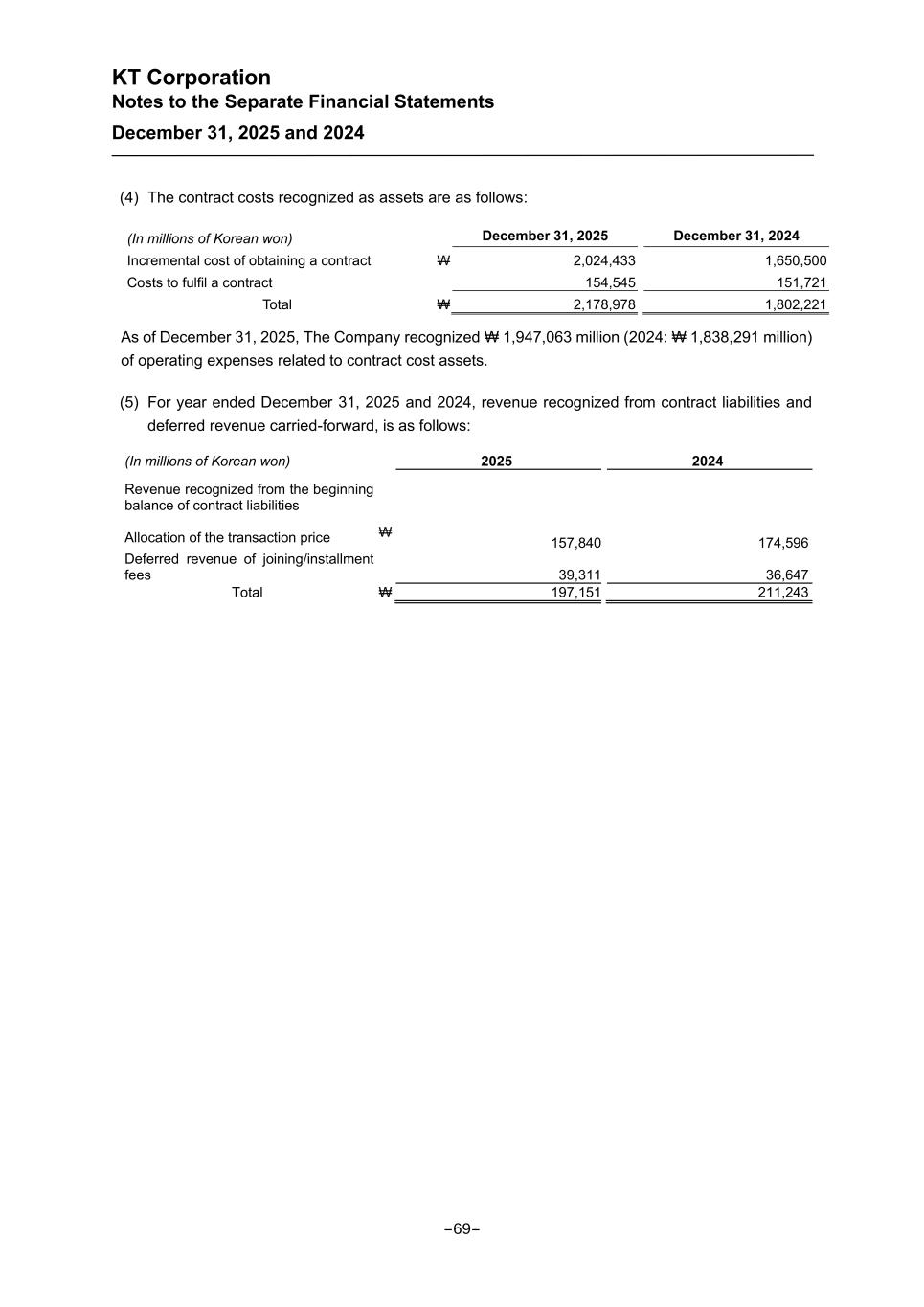
KT Corporation Notes to the Separate Financial Statements December 31, 2025 and 2024 (4) The contract costs recognized as assets are as follows: (In millions of Korean won) December 31, 2025 December 31, 2024 Incremental cost of obtaining a contract ₩ 2,024,433 1,650,500 Costs to fulfil a contract 154,545 151,721 Total ₩ 2,178,978 1,802,221 As of December 31, 2025, The Company recognized ₩ 1,947,063 million (2024: ₩ 1,838,291 million) of operating expenses related to contract cost assets. (5) For year ended December 31, 2025 and 2024, revenue recognized from contract liabilities and deferred revenue carried-forward, is as follows: (In millions of Korean won) 2025 2024 Revenue recognized from the beginning balance of contract liabilities Allocation of the transaction price ₩ 157,840 174,596 Deferred revenue of joining/installment fees 39,311 36,647 Total ₩ 197,151 211,243 -69-
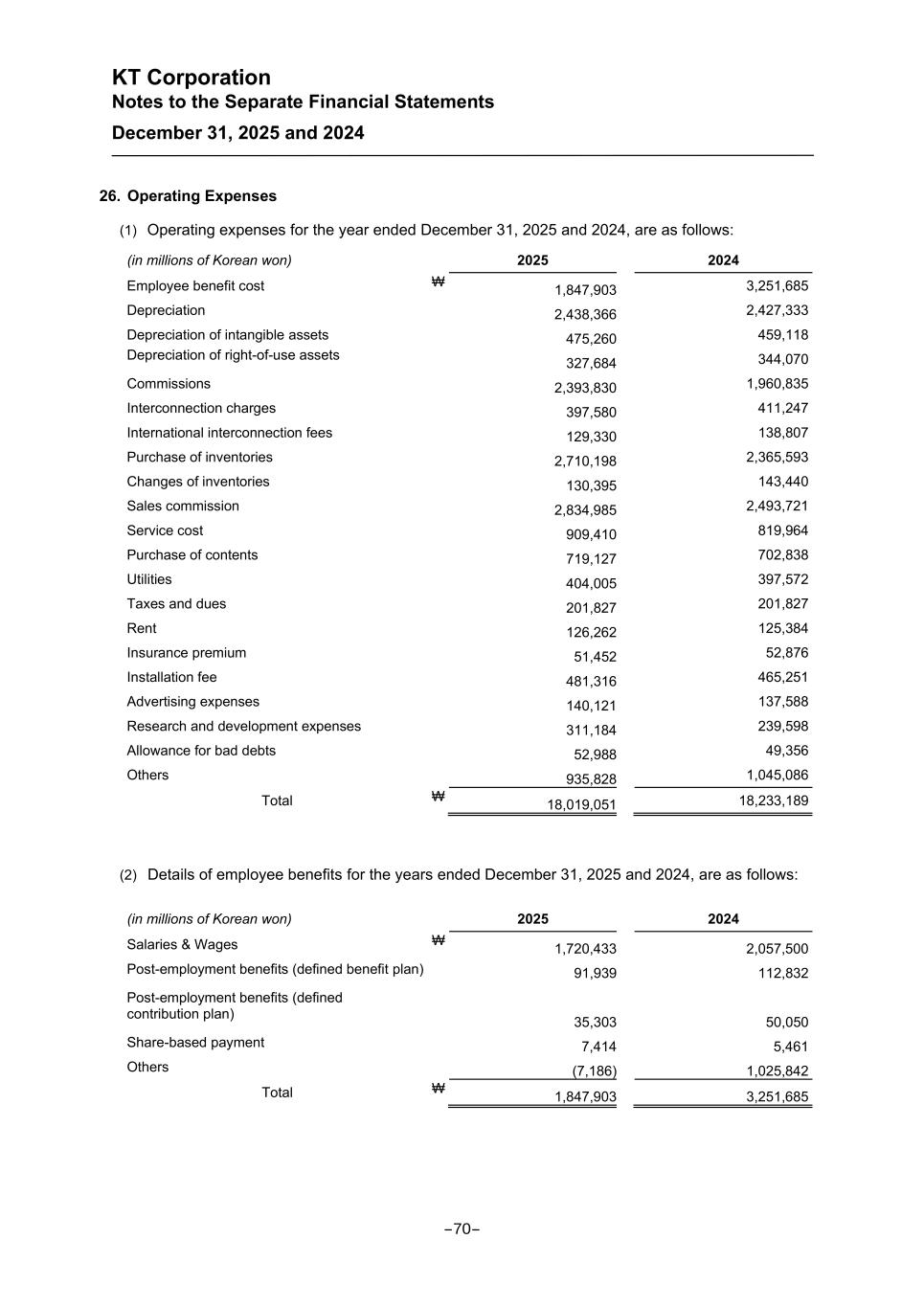
KT Corporation Notes to the Separate Financial Statements December 31, 2025 and 2024 26. Operating Expenses (1) Operating expenses for the year ended December 31, 2025 and 2024, are as follows: (in millions of Korean won) 2025 2024 Employee benefit cost ₩ 1,847,903 3,251,685 Depreciation 2,438,366 2,427,333 Depreciation of intangible assets 475,260 459,118 Depreciation of right-of-use assets 327,684 344,070 Commissions 2,393,830 1,960,835 Interconnection charges 397,580 411,247 International interconnection fees 129,330 138,807 Purchase of inventories 2,710,198 2,365,593 Changes of inventories 130,395 143,440 Sales commission 2,834,985 2,493,721 Service cost 909,410 819,964 Purchase of contents 719,127 702,838 Utilities 404,005 397,572 Taxes and dues 201,827 201,827 Rent 126,262 125,384 Insurance premium 51,452 52,876 Installation fee 481,316 465,251 Advertising expenses 140,121 137,588 Research and development expenses 311,184 239,598 Allowance for bad debts 52,988 49,356 Others 935,828 1,045,086 Total ₩ 18,019,051 18,233,189 (2) Details of employee benefits for the years ended December 31, 2025 and 2024, are as follows: (in millions of Korean won) 2025 2024 Salaries & Wages ₩ 1,720,433 2,057,500 Post-employment benefits (defined benefit plan) 91,939 112,832 Post-employment benefits (defined contribution plan) 35,303 50,050 Share-based payment 7,414 5,461 Others (7,186) 1,025,842 Total ₩ 1,847,903 3,251,685 -70-
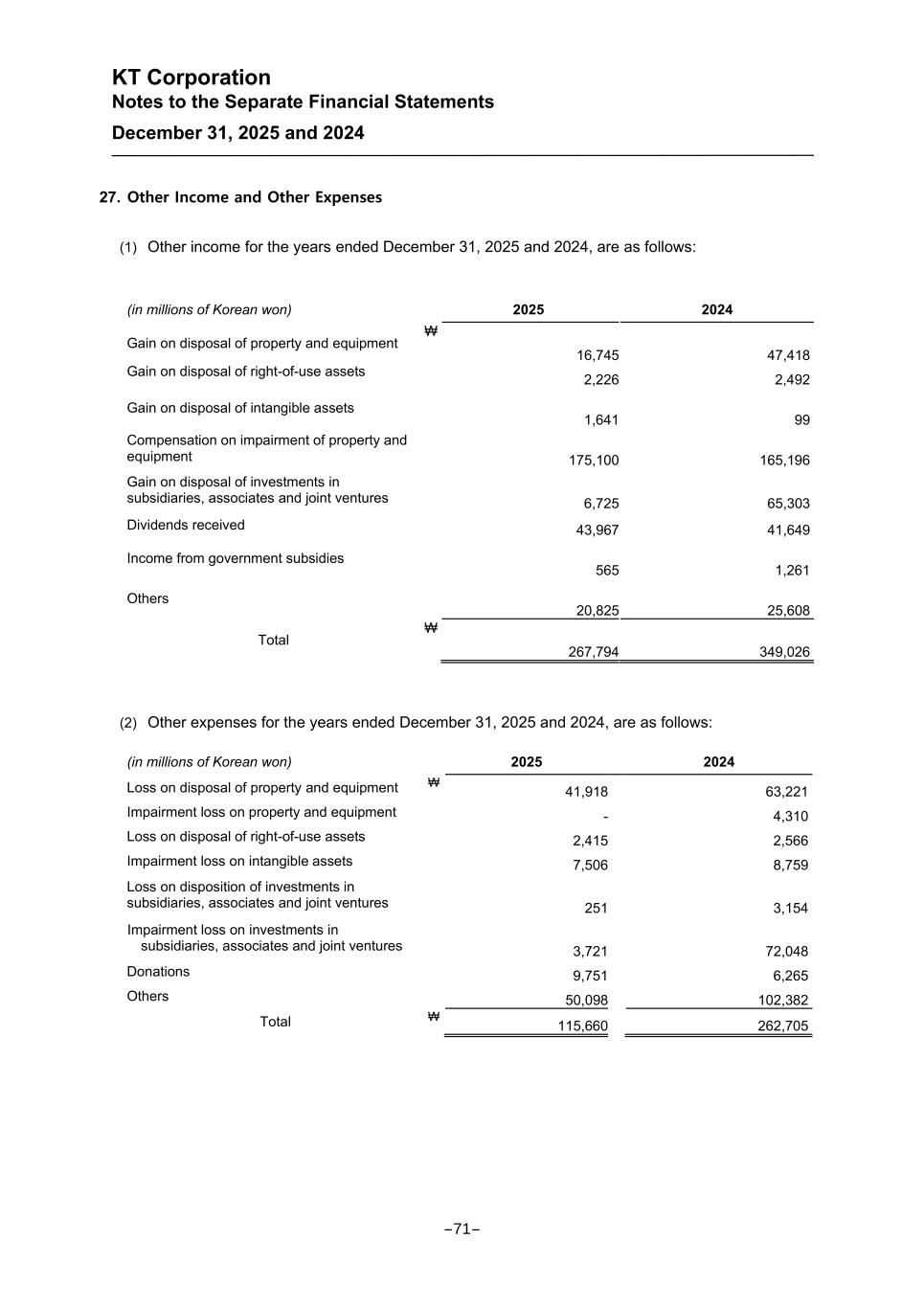
KT Corporation Notes to the Separate Financial Statements December 31, 2025 and 2024 27. Other Income and Other Expenses (1) Other income for the years ended December 31, 2025 and 2024, are as follows: (in millions of Korean won) 2025 2024 Gain on disposal of property and equipment ₩ 16,745 47,418 Gain on disposal of right-of-use assets 2,226 2,492 Gain on disposal of intangible assets 1,641 99 Compensation on impairment of property and equipment 175,100 165,196 Gain on disposal of investments in subsidiaries, associates and joint ventures 6,725 65,303 Dividends received 43,967 41,649 Income from government subsidies 565 1,261 Others 20,825 25,608 Total ₩ 267,794 349,026 (2) Other expenses for the years ended December 31, 2025 and 2024, are as follows: (in millions of Korean won) 2025 2024 Loss on disposal of property and equipment ₩ 41,918 63,221 Impairment loss on property and equipment - 4,310 Loss on disposal of right-of-use assets 2,415 2,566 Impairment loss on intangible assets 7,506 8,759 Loss on disposition of investments in subsidiaries, associates and joint ventures 251 3,154 IImpairment loss on investments in subsidiaries, associates and joint ventures 3,721 72,048 Donations 9,751 6,265 Others 50,098 102,382 Total ₩ 115,660 262,705 -71-
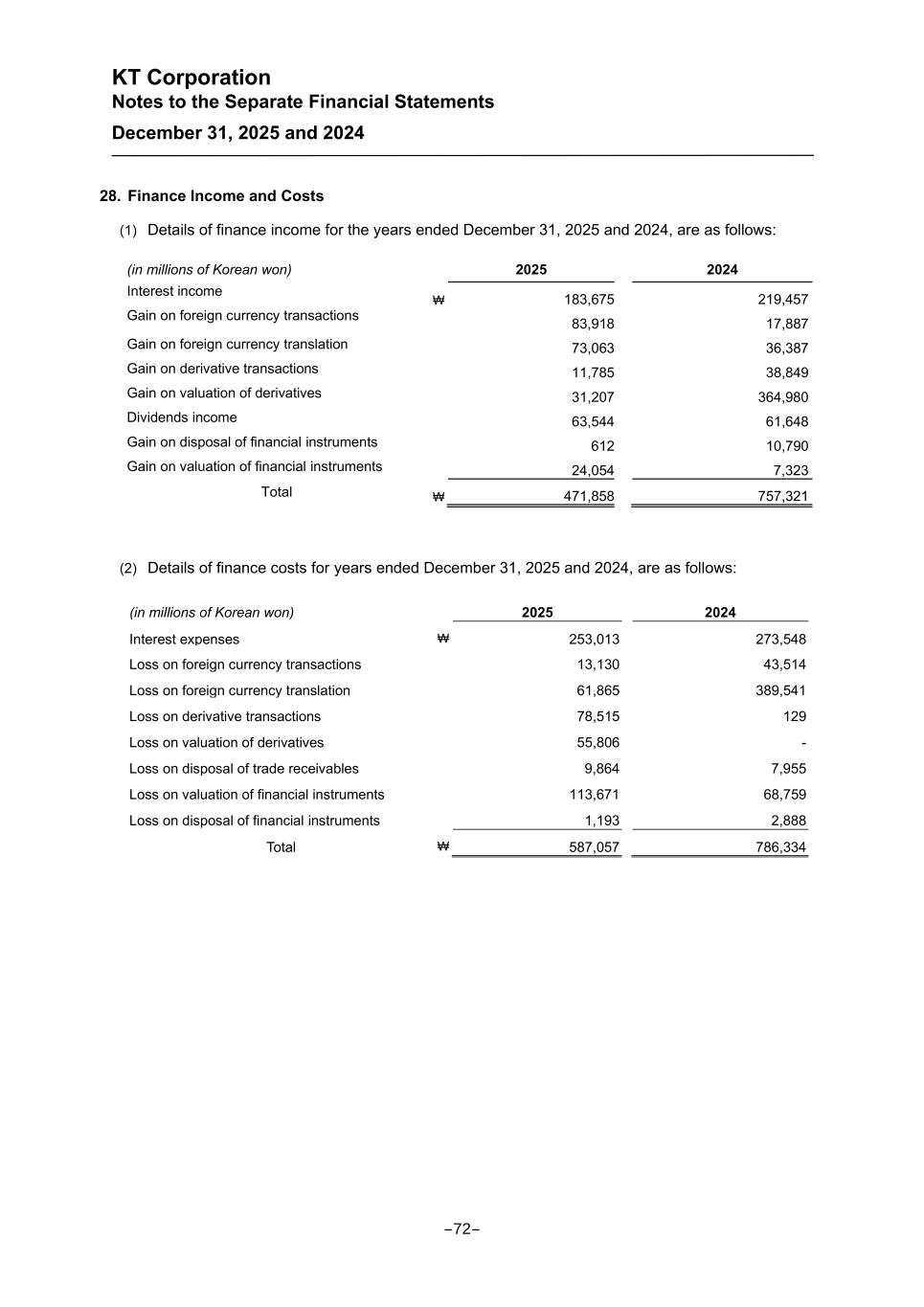
KT Corporation Notes to the Separate Financial Statements December 31, 2025 and 2024 28. Finance Income and Costs (1) Details of finance income for the years ended December 31, 2025 and 2024, are as follows: (in millions of Korean won) 2025 2024 Interest income ₩ 183,675 219,457 Gain on foreign currency transactions 83,918 17,887 Gain on foreign currency translation 73,063 36,387 Gain on derivative transactions 11,785 38,849 Gain on valuation of derivatives 31,207 364,980 Dividends income 63,544 61,648 Gain on disposal of financial instruments 612 10,790 Gain on valuation of financial instruments 24,054 7,323 Total ₩ 471,858 757,321 (2) Details of finance costs for years ended December 31, 2025 and 2024, are as follows: (in millions of Korean won) 2025 2024 Interest expenses ₩ 253,013 273,548 Loss on foreign currency transactions 13,130 43,514 Loss on foreign currency translation 61,865 389,541 Loss on derivative transactions 78,515 129 Loss on valuation of derivatives 55,806 - Loss on disposal of trade receivables 9,864 7,955 Loss on valuation of financial instruments 113,671 68,759 Loss on disposal of financial instruments 1,193 2,888 Total ₩ 587,057 786,334 -72-
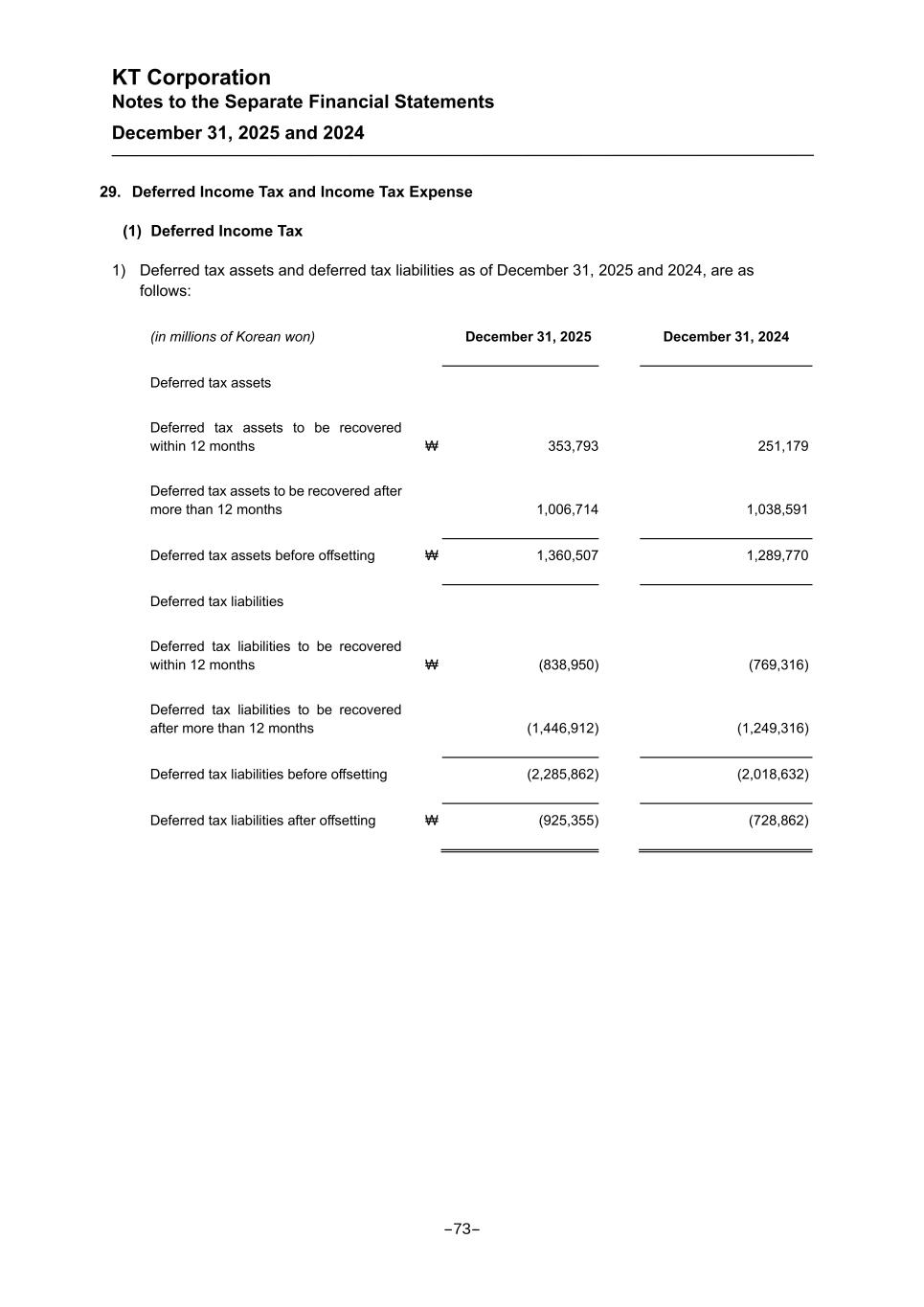
KT Corporation Notes to the Separate Financial Statements December 31, 2025 and 2024 29. Deferred Income Tax and Income Tax Expense (1) Deferred Income Tax 1) Deferred tax assets and deferred tax liabilities as of December 31, 2025 and 2024, are as follows: (in millions of Korean won) December 31, 2025 December 31, 2024 Deferred tax assets Deferred tax assets to be recovered within 12 months ₩ 353,793 251,179 Deferred tax assets to be recovered after more than 12 months 1,006,714 1,038,591 Deferred tax assets before offsetting ₩ 1,360,507 1,289,770 Deferred tax liabilities Deferred tax liabilities to be recovered within 12 months ₩ (838,950) (769,316) Deferred tax liabilities to be recovered after more than 12 months (1,446,912) (1,249,316) Deferred tax liabilities before offsetting (2,285,862) (2,018,632) Deferred tax liabilities after offsetting ₩ (925,355) (728,862) -73-
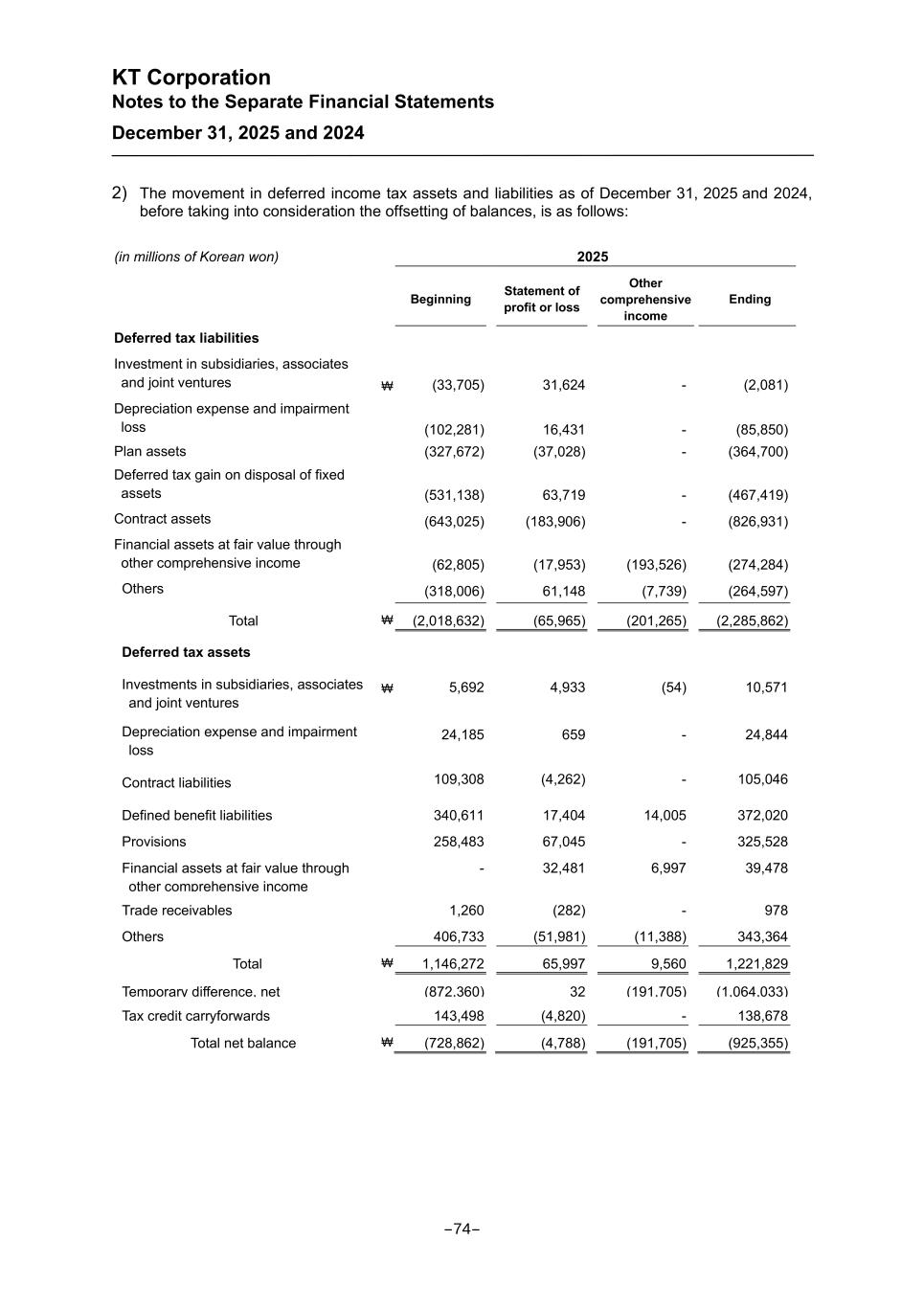
KT Corporation Notes to the Separate Financial Statements December 31, 2025 and 2024 2) The movement in deferred income tax assets and liabilities as of December 31, 2025 and 2024, before taking into consideration the offsetting of balances, is as follows: (in millions of Korean won) 2025 Beginning Statement of profit or loss Other comprehensive income Ending Deferred tax liabilities Investment in subsidiaries, associates and joint ventures ₩ (33,705) 31,624 - (2,081) Depreciation expense and impairment loss (102,281) 16,431 - (85,850) Plan assets (327,672) (37,028) - (364,700) Deferred tax gain on disposal of fixed assets (531,138) 63,719 - (467,419) Contract assets (643,025) (183,906) - (826,931) Financial assets at fair value through other comprehensive income (62,805) (17,953) (193,526) (274,284) Others (318,006) 61,148 (7,739) (264,597) Total ₩ (2,018,632) (65,965) (201,265) (2,285,862) Deferred tax assets Investments in subsidiaries, associates and joint ventures ₩ 5,692 4,933 (54) 10,571 Depreciation expense and impairment loss 24,185 659 - 24,844 Contract liabilities 109,308 (4,262) - 105,046 Defined benefit liabilities 340,611 17,404 14,005 372,020 Provisions 258,483 67,045 - 325,528 Financial assets at fair value through other comprehensive income - 32,481 6,997 39,478 Trade receivables 1,260 (282) - 978 Others 406,733 (51,981) (11,388) 343,364 Total ₩ 1,146,272 65,997 9,560 1,221,829 Temporary difference, net (872,360) 32 (191,705) (1,064,033) Tax credit carryforwards 143,498 (4,820) - 138,678 Total net balance ₩ (728,862) (4,788) (191,705) (925,355) -74-
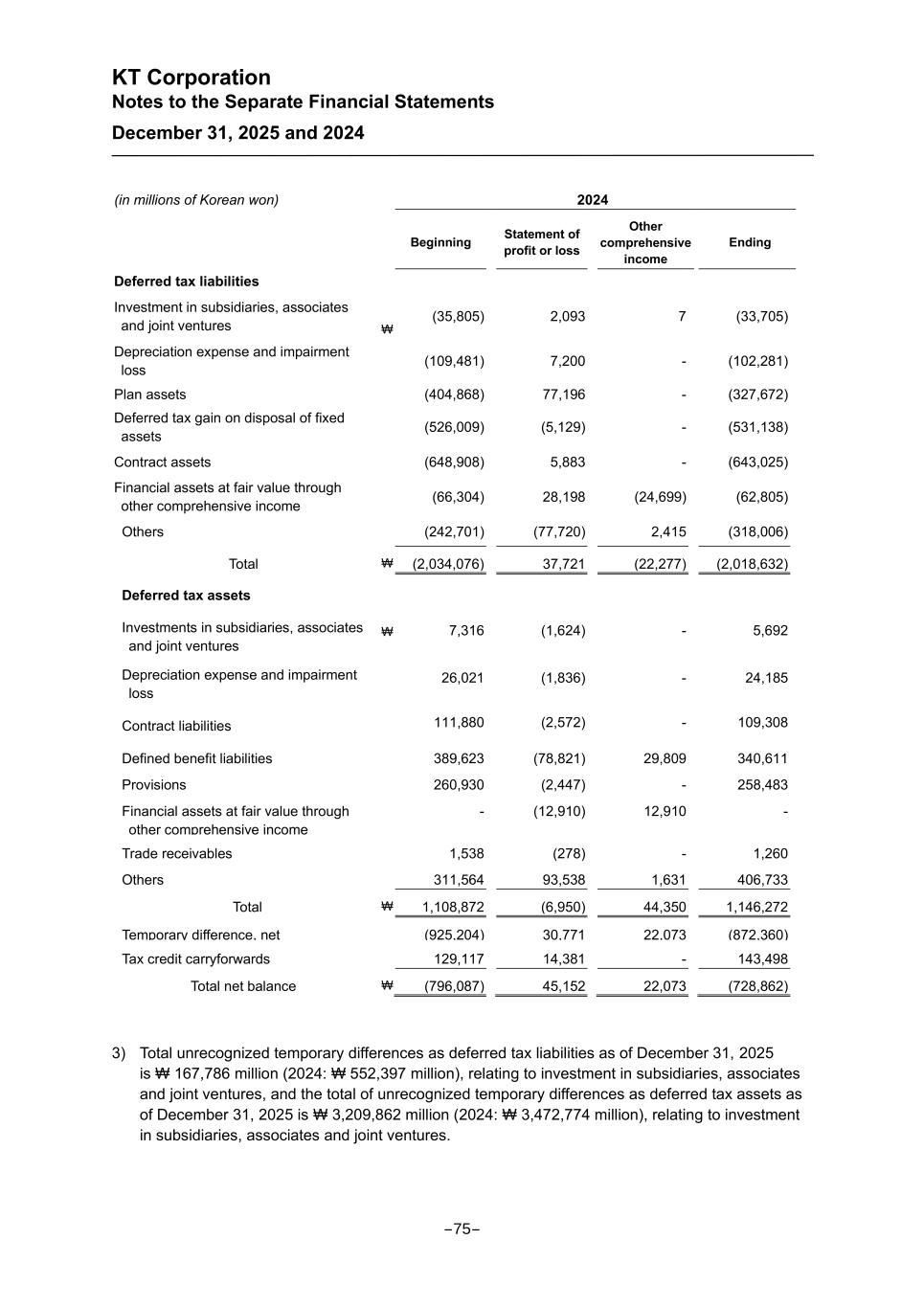
KT Corporation Notes to the Separate Financial Statements December 31, 2025 and 2024 (in millions of Korean won) 2024 Beginning Statement of profit or loss Other comprehensive income Ending Deferred tax liabilities Investment in subsidiaries, associates and joint ventures ₩ (35,805) 2,093 7 (33,705) Depreciation expense and impairment loss (109,481) 7,200 - (102,281) Plan assets (404,868) 77,196 - (327,672) Deferred tax gain on disposal of fixed assets (526,009) (5,129) - (531,138) Contract assets (648,908) 5,883 - (643,025) Financial assets at fair value through other comprehensive income (66,304) 28,198 (24,699) (62,805) Others (242,701) (77,720) 2,415 (318,006) Total ₩ (2,034,076) (2,034,076) 37,721 (22,277) (40,958) (2,018,632) Deferred tax assets Investments in subsidiaries, associates and joint ventures ₩ 7,316 (1,624) - 5,692 Depreciation expense and impairment loss 26,021 (1,836) - 24,185 Contract liabilities 111,880 (2,572) - 109,308 Defined benefit liabilities 389,623 (78,821) 29,809 340,611 Provisions 260,930 (2,447) - 258,483 Financial assets at fair value through other comprehensive income - (12,910) 12,910 - Trade receivables 1,538 (278) - 1,260 Others 311,564 93,538 1,631 406,733 Total ₩ 1,108,872 (6,950) 44,350 1,146,272 Temporary difference, net (925,204) 30,771 22,073 (872,360) Tax credit carryforwards 129,117 14,381 - 143,498 Total net balance ₩ (796,087) 45,152 22,073 (728,862) 3) Total unrecognized temporary differences as deferred tax liabilities as of December 31, 2025 is ₩ 167,786 million (2024: ₩ 552,397 million), relating to investment in subsidiaries, associates and joint ventures, and the total of unrecognized temporary differences as deferred tax assets as of December 31, 2025 is ₩ 3,209,862 million (2024: ₩ 3,472,774 million), relating to investment in subsidiaries, associates and joint ventures. -75-
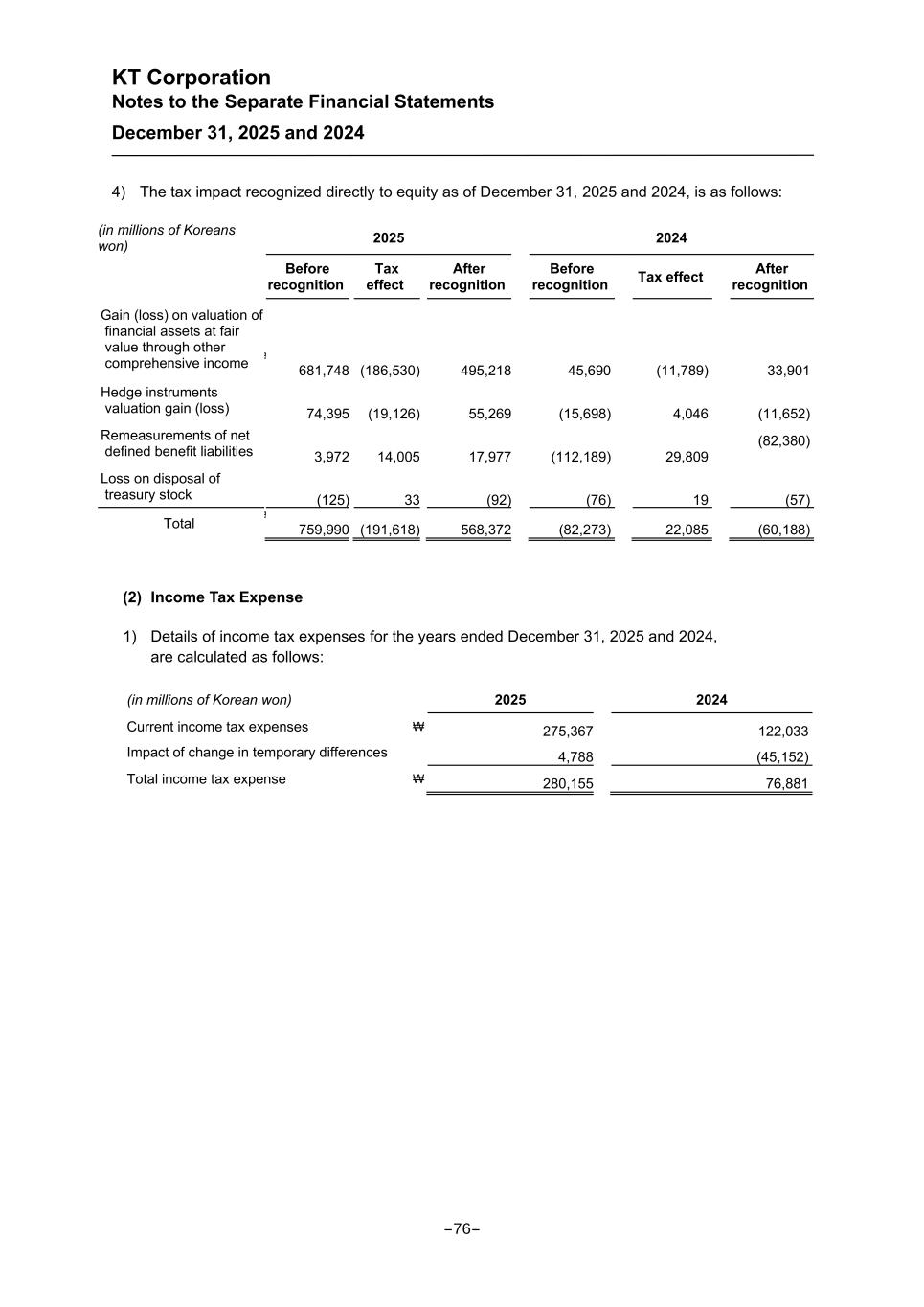
KT Corporation Notes to the Separate Financial Statements December 31, 2025 and 2024 4) The tax impact recognized directly to equity as of December 31, 2025 and 2024, is as follows: (in millions of Koreans won) 2025 2024 Before recognition Tax effect After recognition Before recognition Tax effect After recognition Gain (loss) on valuation of financial assets at fair value through other comprehensive income ₩ 681,748 (186,530) 495,218 45,690 (11,789) 33,901 Hedge instruments valuation gain (loss) 74,395 (19,126) 55,269 (15,698) 4,046 (11,652) Remeasurements of net defined benefit liabilities 3,972 14,005 17,977 (112,189) 29,809 (82,380) Loss on disposal of treasury stock (125) 33 (92) (76) 19 (57) Total ₩ 759,990 (191,618) 568,372 (82,273) 22,085 (60,188) (2) Income Tax Expense 1) Details of income tax expenses for the years ended December 31, 2025 and 2024, are calculated as follows: (in millions of Korean won) 2025 2024 Current income tax expenses ₩ 275,367 122,033 Impact of change in temporary differences 4,788 (45,152) Total income tax expense ₩ 280,155 76,881 -76-
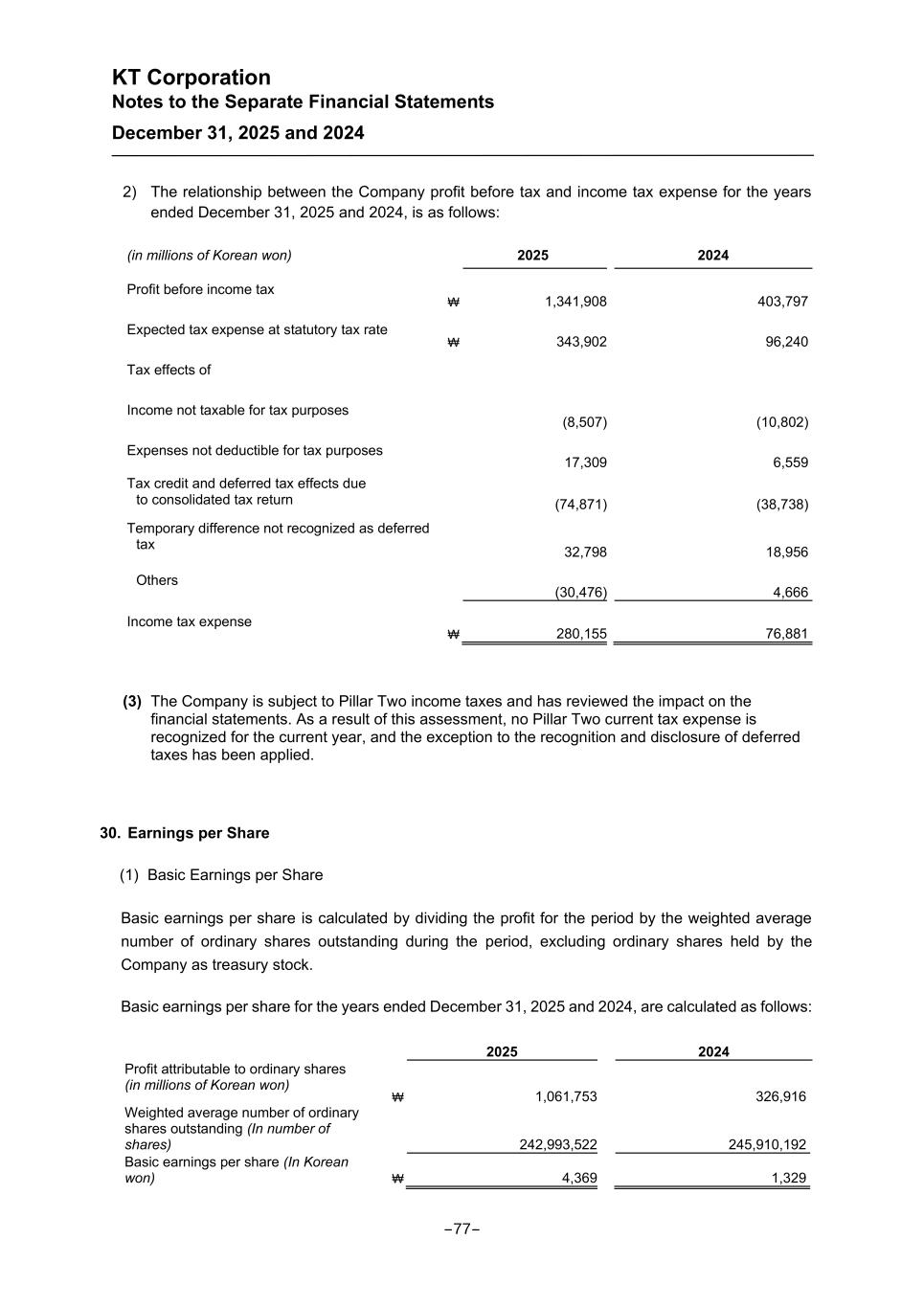
KT Corporation Notes to the Separate Financial Statements December 31, 2025 and 2024 2) The relationship between the Company profit before tax and income tax expense for the years ended December 31, 2025 and 2024, is as follows: (in millions of Korean won) 2025 2024 Profit before income tax ₩ 1,341,908 403,797 Expected tax expense at statutory tax rate ₩ 343,902 96,240 Tax effects of Income not taxable for tax purposes (8,507) (10,802) Expenses not deductible for tax purposes 17,309 6,559 Tax credit and deferred tax effects due to consolidated tax return (74,871) (38,738) Temporary difference not recognized as deferred tax 32,798 18,956 Others (30,476) 4,666 Income tax expense ₩ 280,155 76,881 (3) The Company is subject to Pillar Two income taxes and has reviewed the impact on the financial statements. As a result of this assessment, no Pillar Two current tax expense is recognized for the current year, and the exception to the recognition and disclosure of deferred taxes has been applied. 30. Earnings per Share (1) Basic Earnings per Share Basic earnings per share is calculated by dividing the profit for the period by the weighted average number of ordinary shares outstanding during the period, excluding ordinary shares held by the Company as treasury stock. Basic earnings per share for the years ended December 31, 2025 and 2024, are calculated as follows: 2025 2024 Profit attributable to ordinary shares (in millions of Korean won) ₩ 1,061,753 326,916 ⚫ Weighted average number of ordinary shares outstanding (In number of shares) 242,993,522 245,910,192 Basic earnings per share (In Korean won) ₩ 4,369 1,329 -77-
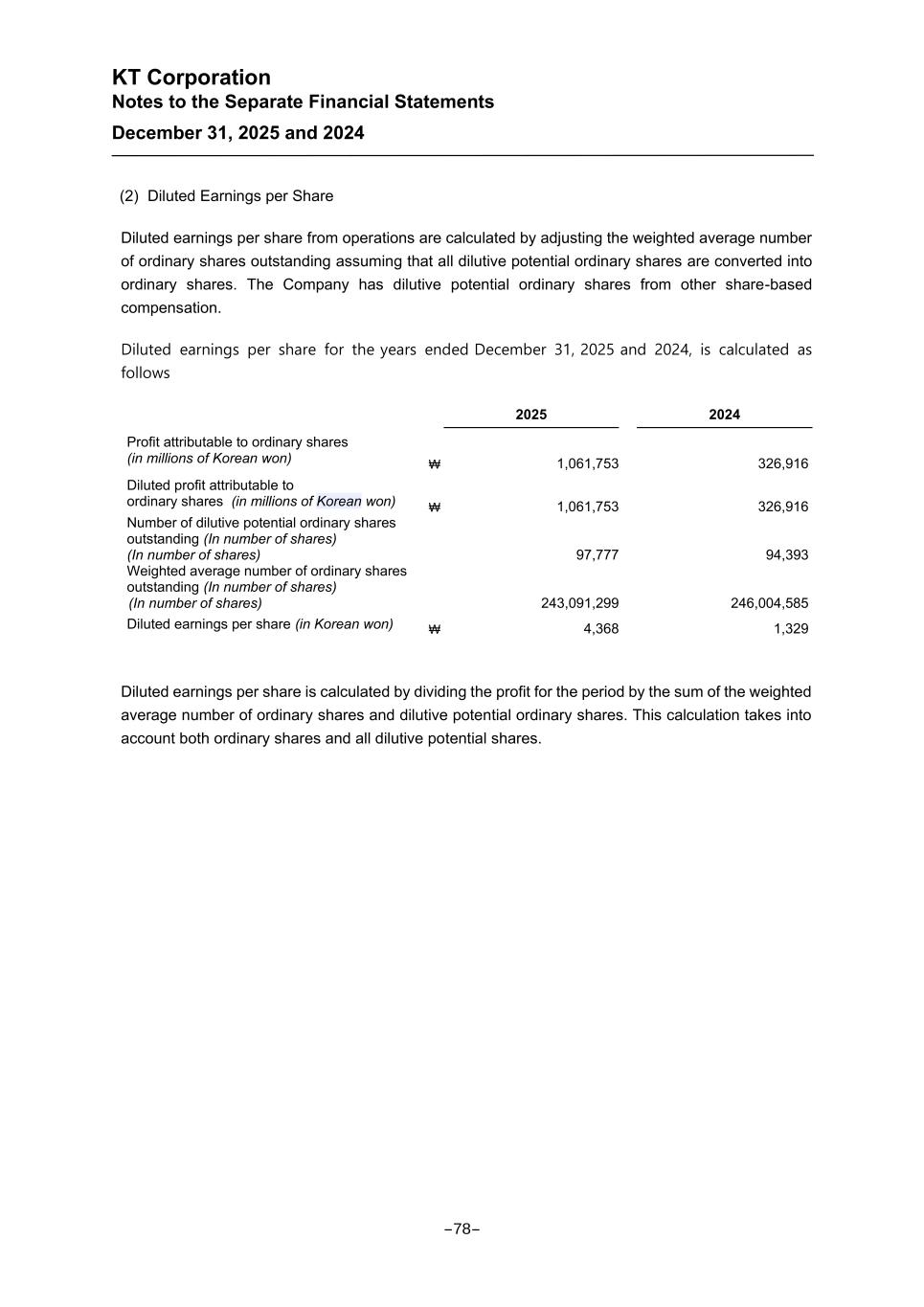
KT Corporation Notes to the Separate Financial Statements December 31, 2025 and 2024 (2) Diluted Earnings per Share Diluted earnings per share from operations are calculated by adjusting the weighted average number of ordinary shares outstanding assuming that all dilutive potential ordinary shares are converted into ordinary shares. The Company has dilutive potential ordinary shares from other share-based compensation. Diluted earnings per share for the years ended December 31, 2025 and 2024, is calculated as follows 2025 2024 Profit attributable to ordinary shares (in millions of Korean won) ₩ 1,061,753 326,916 Diluted profit attributable to ordinary shares (in millions of Korean won) ₩ 1,061,753 326,916 Number of dilutive potential ordinary shares outstanding (In number of shares) (In number of shares) 97,777 94,393 Weighted average number of ordinary shares outstanding (In number of shares) (In number of shares) 243,091,299 246,004,585 Diluted earnings per share (in Korean won) ₩ 4,368 1,329 Diluted earnings per share is calculated by dividing the profit for the period by the sum of the weighted average number of ordinary shares and dilutive potential ordinary shares. This calculation takes into account both ordinary shares and all dilutive potential shares. -78-
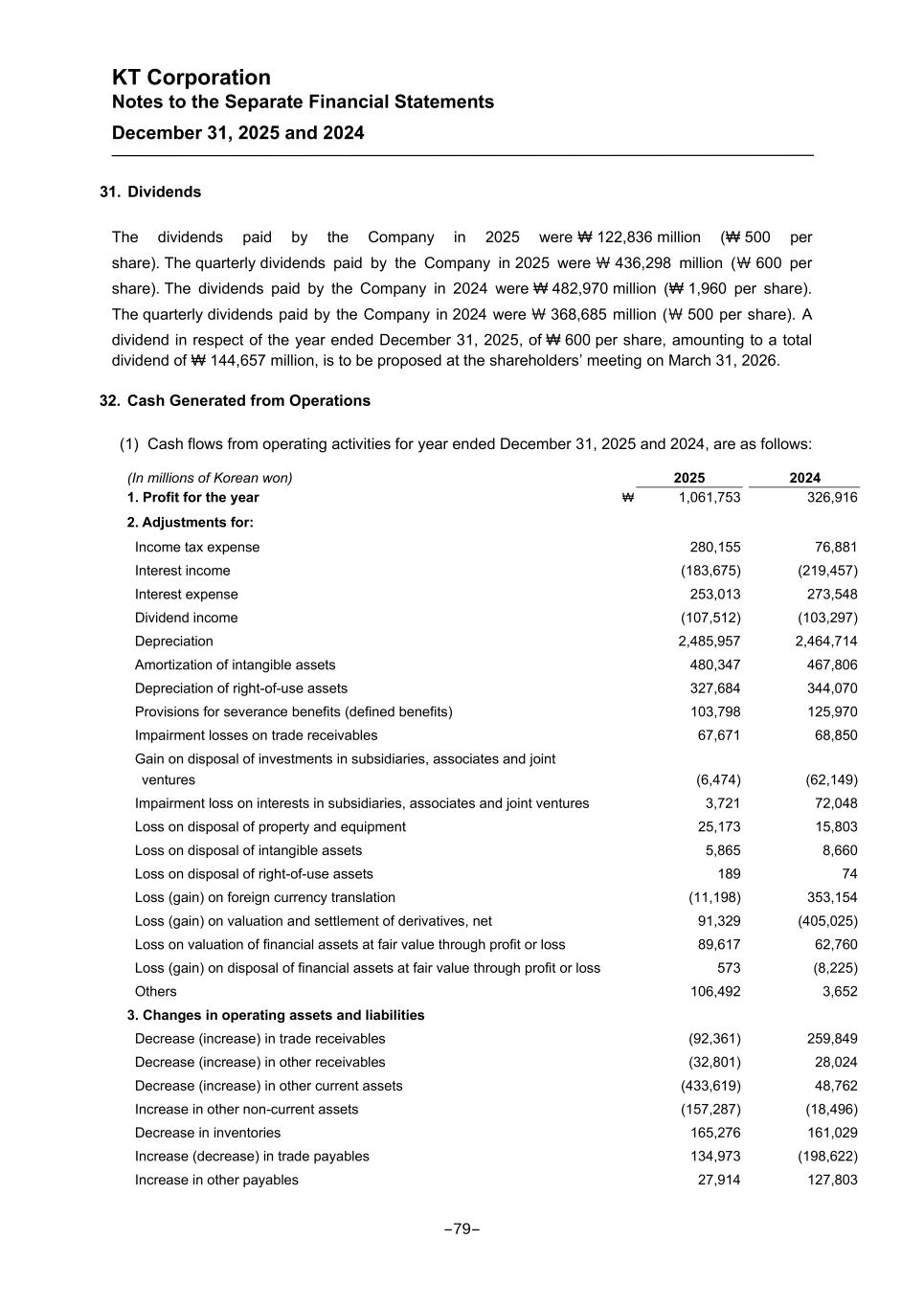
KT Corporation Notes to the Separate Financial Statements December 31, 2025 and 2024 31. Dividends The dividends paid by the Company in 2025 were ₩ 122,836 million (₩ 500 per share). The quarterly dividends paid by the Company in 2025 were ₩ 436,298 million (₩ 600 per share). The dividends paid by the Company in 2024 were ₩ 482,970 million (₩ 1,960 per share). The quarterly dividends paid by the Company in 2024 were ₩ 368,685 million (₩ 500 per share). A dividend in respect of the year ended December 31, 2025, of ₩ 600 per share, amounting to a total dividend of ₩ 144,657 million, is to be proposed at the shareholders’ meeting on March 31, 2026. 32. Cash Generated from Operations (1) Cash flows from operating activities for year ended December 31, 2025 and 2024, are as follows: (In millions of Korean won) 2025 2024 1. Profit for the year ₩ 1,061,753 326,916 2. Adjustments for: Income tax expense 280,155 76,881 Interest income (183,675) (219,457) Interest expense 253,013 273,548 Dividend income (107,512) (103,297) Depreciation 2,485,957 2,464,714 Amortization of intangible assets 480,347 467,806 Depreciation of right-of-use assets 327,684 344,070 Provisions for severance benefits (defined benefits) 103,798 125,970 Impairment losses on trade receivables 67,671 68,850 Gain on disposal of investments in subsidiaries, associates and joint ventures (6,474) (62,149) Impairment loss on interests in subsidiaries, associates and joint ventures 3,721 72,048 Loss on disposal of property and equipment 25,173 15,803 Loss on disposal of intangible assets 5,865 8,660 Loss on disposal of right-of-use assets 189 74 Loss (gain) on foreign currency translation (11,198) 353,154 Loss (gain) on valuation and settlement of derivatives, net 91,329 (405,025) Loss on valuation of financial assets at fair value through profit or loss 89,617 62,760 Loss (gain) on disposal of financial assets at fair value through profit or loss 573 (8,225) Others 106,492 3,652 3. Changes in operating assets and liabilities Decrease (increase) in trade receivables (92,361) 259,849 Decrease (increase) in other receivables (32,801) 28,024 Decrease (increase) in other current assets (433,619) 48,762 Increase in other non-current assets (157,287) (18,496) Decrease in inventories 165,276 161,029 Increase (decrease) in trade payables 134,973 (198,622) Increase in other payables 27,914 127,803 -79-
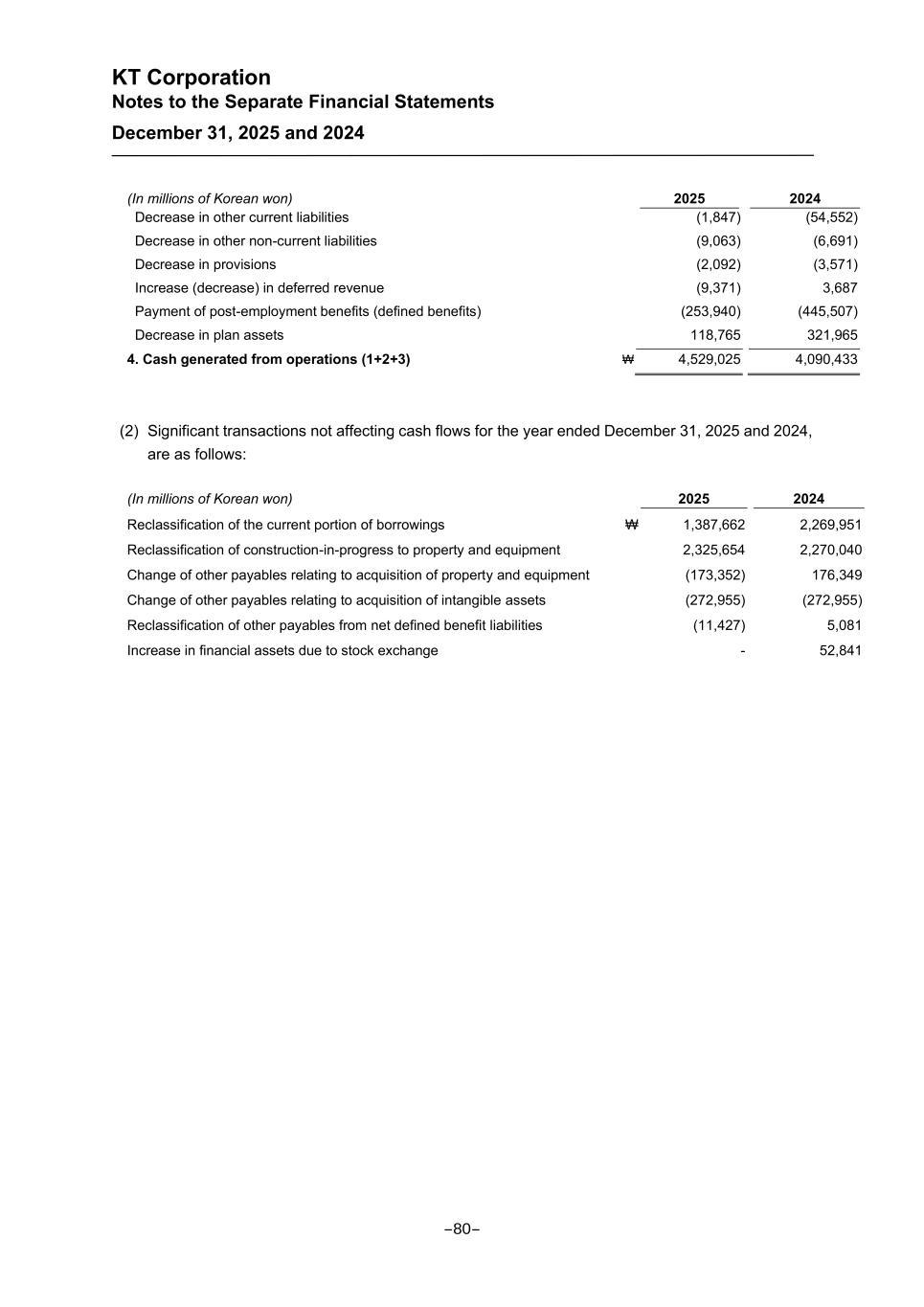
KT Corporation Notes to the Separate Financial Statements December 31, 2025 and 2024 (In millions of Korean won) 2025 2024 Decrease in other current liabilities (1,847) (54,552) Decrease in other non-current liabilities (9,063) (6,691) Decrease in provisions (2,092) (3,571) Increase (decrease) in deferred revenue (9,371) 3,687 Payment of post-employment benefits (defined benefits) (253,940) (445,507) Decrease in plan assets 118,765 321,965 4. Cash generated from operations (1+2+3) ₩ 4,529,025 4,090,433 (2) Significant transactions not affecting cash flows for the year ended December 31, 2025 and 2024, are as follows: (In millions of Korean won) 2025 2024 Reclassification of the current portion of borrowings ₩ 1,387,662 2,269,951 Reclassification of construction-in-progress to property and equipment 2,325,654 2,270,040 Change of other payables relating to acquisition of property and equipment (173,352) 176,349 Change of other payables relating to acquisition of intangible assets (272,955) (272,955) Reclassification of other payables from net defined benefit liabilities (11,427) 5,081 Increase in financial assets due to stock exchange - 52,841 -80-
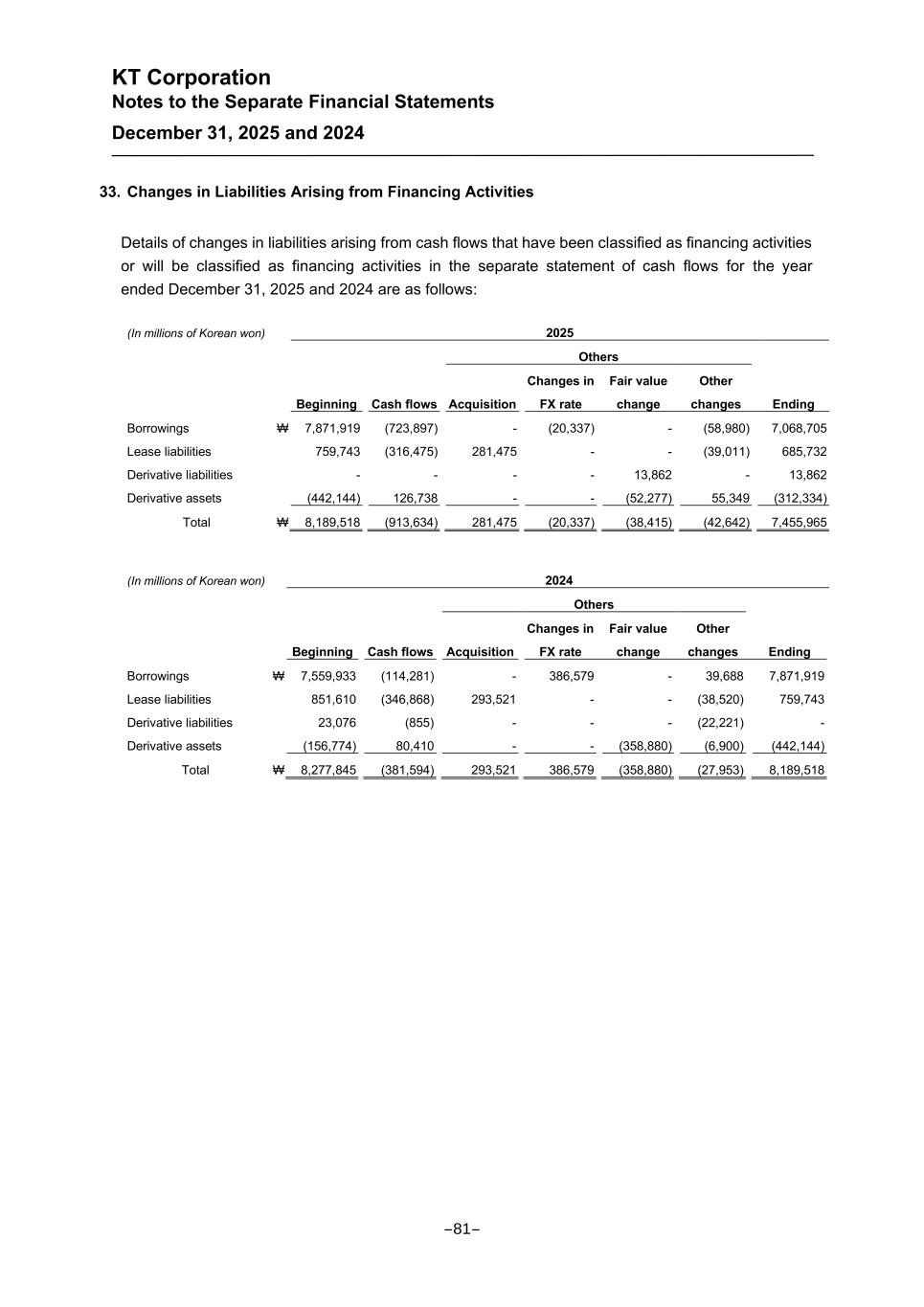
KT Corporation Notes to the Separate Financial Statements December 31, 2025 and 2024 33. Changes in Liabilities Arising from Financing Activities Details of changes in liabilities arising from cash flows that have been classified as financing activities or will be classified as financing activities in the separate statement of cash flows for the year ended December 31, 2025 and 2024 are as follows: (In millions of Korean won) 2025 Others Beginning Cash flows Acquisition Changes in FX rate Fair value change Other changes Ending Borrowings ₩ 7,871,919 (723,897) - (20,337) - (58,980) 7,068,705 Lease liabilities 759,743 (316,475) 281,475 - - (39,011) 685,732 Derivative liabilities - - - - 13,862 - 13,862 Derivative assets (442,144) 126,738 - - (52,277) 55,349 (312,334) Total ₩ 8,189,518 (913,634) 281,475 (20,337) (38,415) (42,642) 7,455,965 (In millions of Korean won) 2024 Others Beginning Cash flows Acquisition Changes in FX rate Fair value change Other changes Ending Borrowings ₩ 7,559,933 (114,281) - 386,579 - 39,688 7,871,919 Lease liabilities 851,610 (346,868) 293,521 - - (38,520) 759,743 Derivative liabilities 23,076 (855) - - - (22,221) - Derivative assets (156,774) 80,410 - - (358,880) (6,900) (442,144) Total ₩ 8,277,845 (381,594) 293,521 386,579 (358,880) (27,953) 8,189,518 -81-
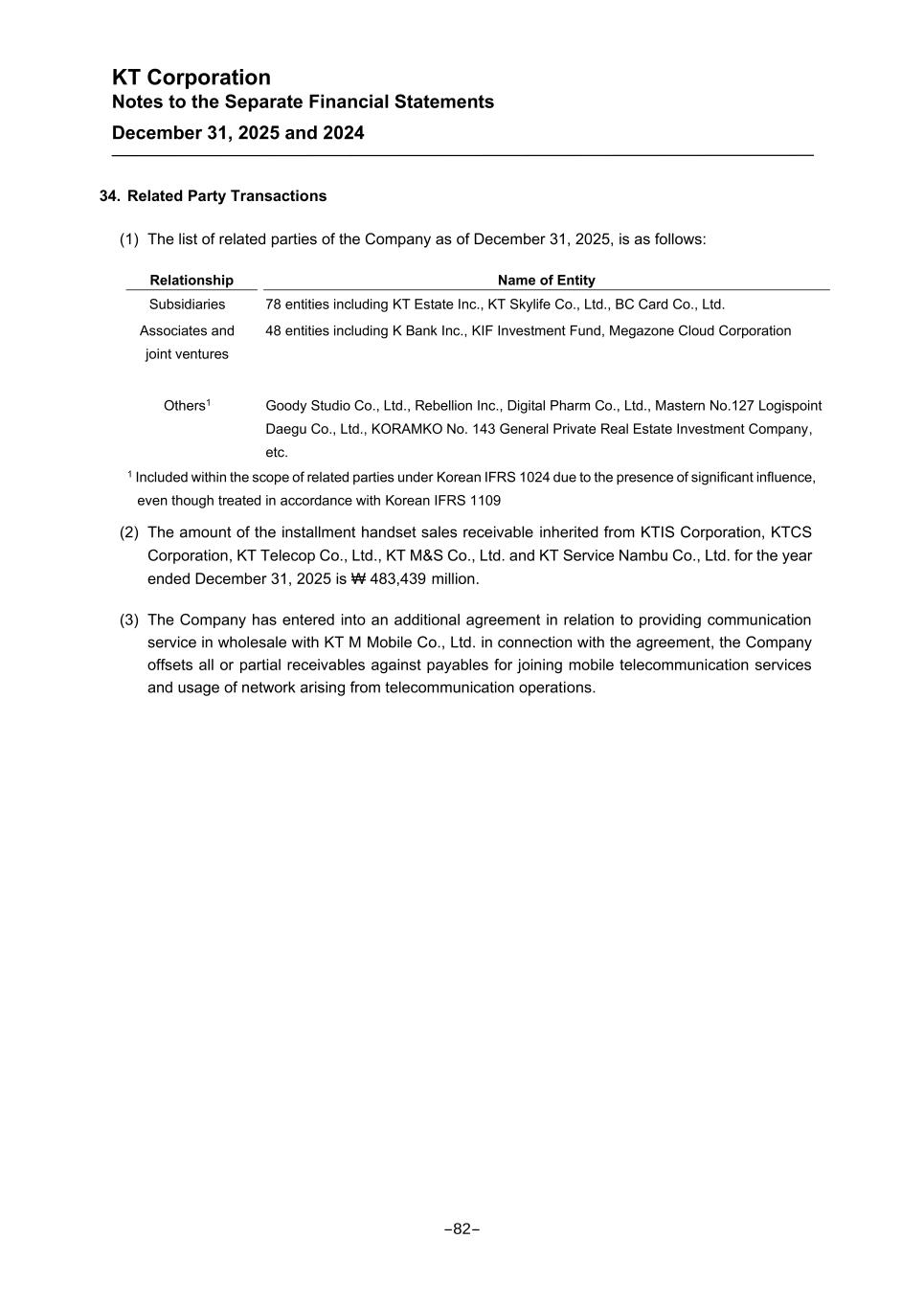
KT Corporation Notes to the Separate Financial Statements December 31, 2025 and 2024 34. Related Party Transactions (1) The list of related parties of the Company as of December 31, 2025, is as follows: Relationship Name of Entity Subsidiaries 78 entities including KT Estate Inc., KT Skylife Co., Ltd., BC Card Co., Ltd. Associates and joint ventures 48 entities including K Bank Inc., KIF Investment Fund, Megazone Cloud Corporation Others1 Goody Studio Co., Ltd., Rebellion Inc., Digital Pharm Co., Ltd., Mastern No.127 Logispoint Daegu Co., Ltd., KORAMKO No. 143 General Private Real Estate Investment Company, etc. 1 Included within the scope of related parties under Korean IFRS 1024 due to the presence of significant influence, even though treated in accordance with Korean IFRS 1109 (2) The amount of the installment handset sales receivable inherited from KTIS Corporation, KTCS Corporation, KT Telecop Co., Ltd., KT M&S Co., Ltd. and KT Service Nambu Co., Ltd. for the year ended December 31, 2025 is ₩ 483,439 million. (3) The Company has entered into an additional agreement in relation to providing communication service in wholesale with KT M Mobile Co., Ltd. in connection with the agreement, the Company offsets all or partial receivables against payables for joining mobile telecommunication services and usage of network arising from telecommunication operations. -82-
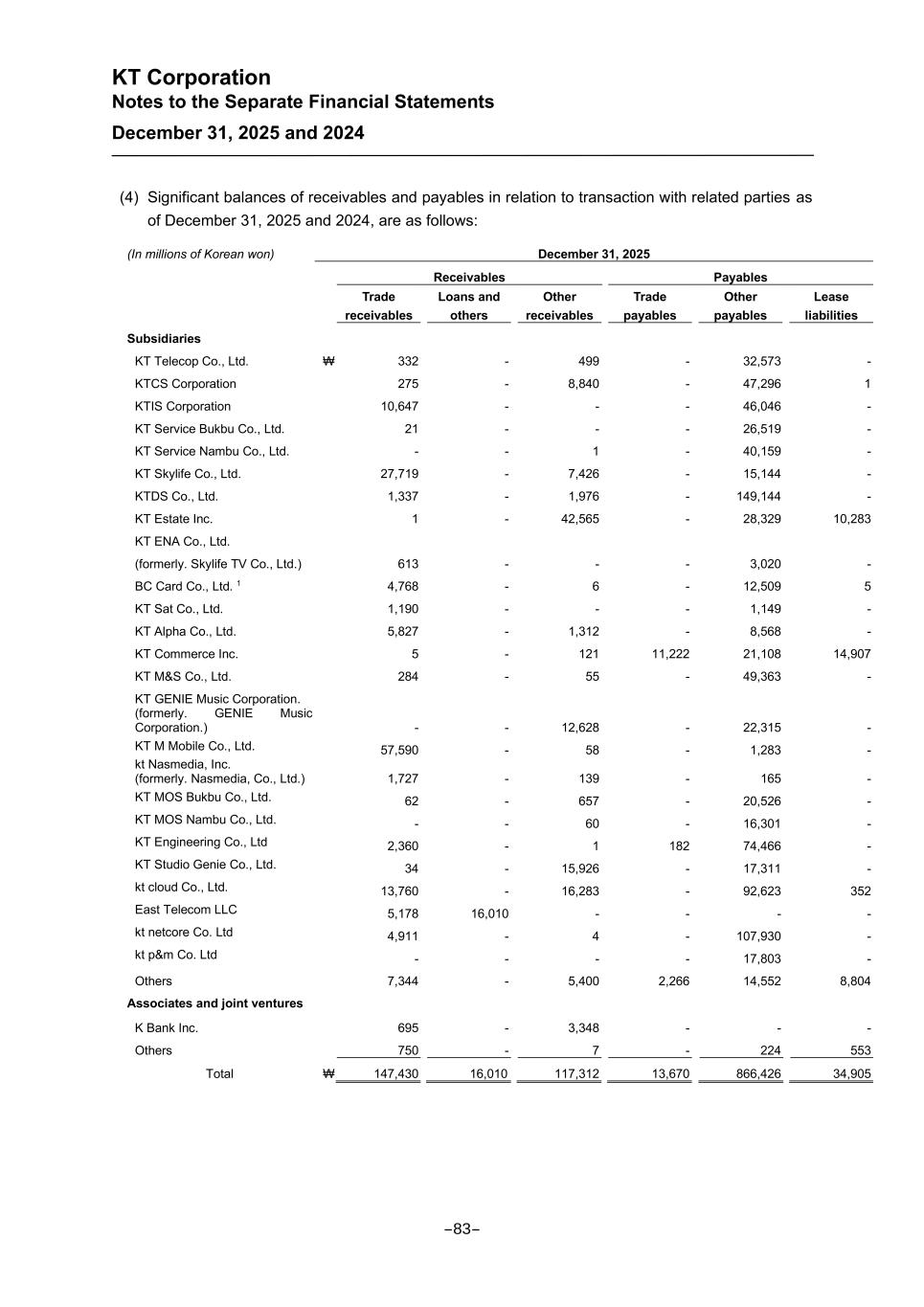
KT Corporation Notes to the Separate Financial Statements December 31, 2025 and 2024 (4) Significant balances of receivables and payables in relation to transaction with related parties as of December 31, 2025 and 2024, are as follows: (In millions of Korean won) December 31, 2025 Receivables Payables Trade receivables Loans and others Other receivables Trade payables Other payables Lease liabilities Subsidiaries KT Telecop Co., Ltd. ₩ 332 - 499 - 32,573 - KTCS Corporation 275 - 8,840 - 47,296 1 KTIS Corporation 10,647 - - - 46,046 - KT Service Bukbu Co., Ltd. 21 - - - 26,519 - KT Service Nambu Co., Ltd. - - 1 - 40,159 - KT Skylife Co., Ltd. 27,719 - 7,426 - 15,144 - KTDS Co., Ltd. 1,337 - 1,976 - 149,144 - KT Estate Inc. 1 - 42,565 - 28,329 10,283 KT ENA Co., Ltd. (formerly. Skylife TV Co., Ltd.) 613 - - - 3,020 - BC Card Co., Ltd. 1 4,768 - 6 - 12,509 5 KT Sat Co., Ltd. 1,190 - - - 1,149 - KT Alpha Co., Ltd. 5,827 - 1,312 - 8,568 - KT Commerce Inc. 5 - 121 11,222 21,108 14,907 KT M&S Co., Ltd. 284 - 55 - 49,363 - KT GENIE Music Corporation. (formerly. GENIE Music Corporation.) - - 12,628 - 22,315 - KT M Mobile Co., Ltd. 57,590 - 58 - 1,283 - kt Nasmedia, Inc. (formerly. Nasmedia, Co., Ltd.) 1,727 - 139 - 165 - KT MOS Bukbu Co., Ltd. 62 - 657 - 20,526 - KT MOS Nambu Co., Ltd. - - 60 - 16,301 - KT Engineering Co., Ltd 2,360 - 1 182 74,466 - KT Studio Genie Co., Ltd. 34 - 15,926 - 17,311 - kt cloud Co., Ltd. 13,760 - 16,283 - 92,623 352 East Telecom LLC 5,178 16,010 - - - - kt netcore Co. Ltd 4,911 - 4 - 107,930 - kt p&m Co. Ltd - - - - 17,803 - Others 7,344 - 5,400 2,266 14,552 8,804 Associates and joint ventures K Bank Inc. 695 - 3,348 - - - Others 750 - 7 - 224 553 Total ₩ 147,430 16,010 117,312 13,670 866,426 34,905 -83-
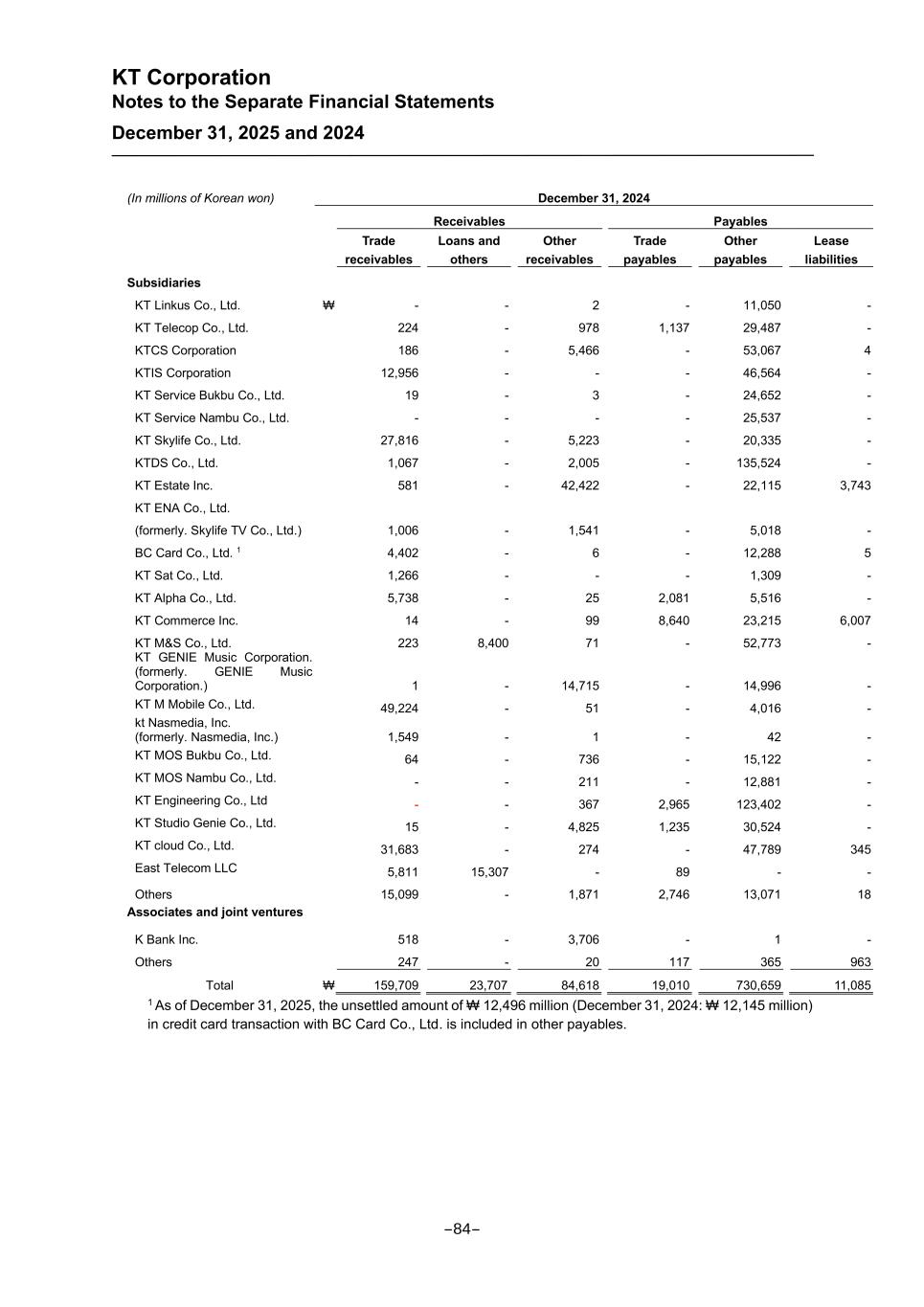
KT Corporation Notes to the Separate Financial Statements December 31, 2025 and 2024 (In millions of Korean won) December 31, 2024 Receivables Payables Trade receivables Loans and others Other receivables Trade payables Other payables Lease liabilities Subsidiaries KT Linkus Co., Ltd. ₩ - - 2 - 11,050 - KT Telecop Co., Ltd. 224 - 978 1,137 29,487 - KTCS Corporation 186 - 5,466 - 53,067 4 KTIS Corporation 12,956 - - - 46,564 - KT Service Bukbu Co., Ltd. 19 - 3 - 24,652 - KT Service Nambu Co., Ltd. - - - - 25,537 - KT Skylife Co., Ltd. 27,816 - 5,223 - 20,335 - KTDS Co., Ltd. 1,067 - 2,005 - 135,524 - KT Estate Inc. 581 - 42,422 - 22,115 3,743 KT ENA Co., Ltd. (formerly. Skylife TV Co., Ltd.) 1,006 - 1,541 - 5,018 - BC Card Co., Ltd. 1 4,402 - 6 - 12,288 5 KT Sat Co., Ltd. 1,266 - - - 1,309 - KT Alpha Co., Ltd. 5,738 - 25 2,081 5,516 - KT Commerce Inc. 14 - 99 8,640 23,215 6,007 KT M&S Co., Ltd. 223 8,400 71 - 52,773 - KT GENIE Music Corporation. (formerly. GENIE Music Corporation.) 1 - 14,715 - 14,996 - KT M Mobile Co., Ltd. 49,224 - 51 - 4,016 - kt Nasmedia, Inc. (formerly. Nasmedia, Inc.) 1,549 - 1 - 42 - KT MOS Bukbu Co., Ltd. 64 - 736 - 15,122 - KT MOS Nambu Co., Ltd. - - 211 - 12,881 - KT Engineering Co., Ltd - - 367 2,965 123,402 - KT Studio Genie Co., Ltd. 15 - 4,825 1,235 30,524 - KT cloud Co., Ltd. 31,683 - 274 - 47,789 345 East Telecom LLC 5,811 15,307 - 89 - - Others 15,099 - 1,871 2,746 13,071 18 Associates and joint ventures K Bank Inc. 518 - 3,706 - 1 - Others 247 - 20 117 365 963 Total ₩ 159,709 23,707 84,618 19,010 730,659 11,085 1 As of December 31, 2025, the unsettled amount of ₩ 12,496 million (December 31, 2024: ₩ 12,145 million) in credit card transaction with BC Card Co., Ltd. is included in other payables. -84-
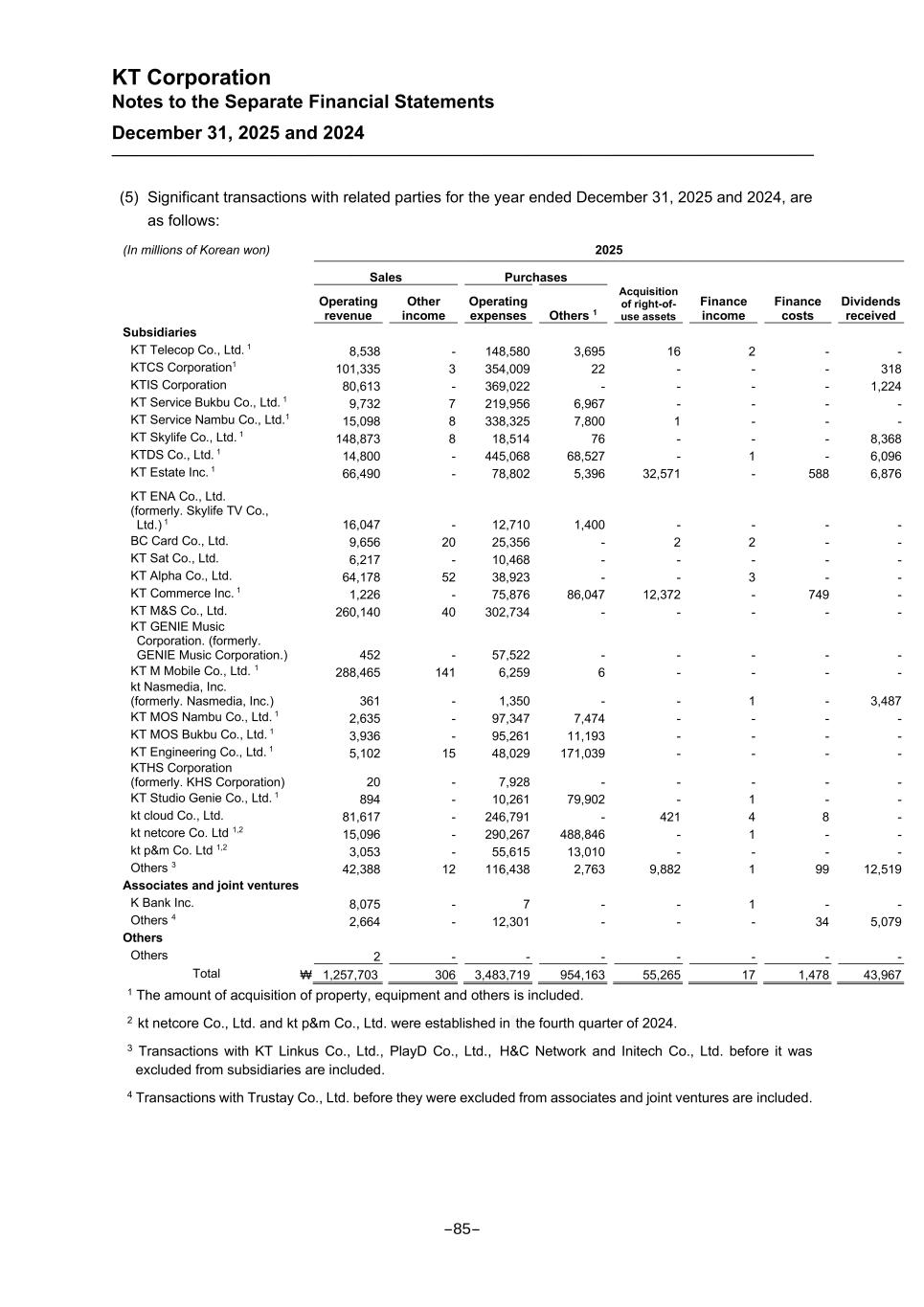
KT Corporation Notes to the Separate Financial Statements December 31, 2025 and 2024 (5) Significant transactions with related parties for the year ended December 31, 2025 and 2024, are as follows: (In millions of Korean won) 2025 Sales Purchases Operating revenue Other income Operating expenses Others 1 Acquisition of right-of- use assets Finance income Finance costs Dividends received Subsidiaries KT Telecop Co., Ltd. 1 8,538 - 148,580 3,695 16 2 - - KTCS Corporation1 101,335 3 354,009 22 - - - 318 KTIS Corporation 80,613 - 369,022 - - - - 1,224 KT Service Bukbu Co., Ltd. 1 9,732 7 219,956 6,967 - - - - KT Service Nambu Co., Ltd.1 15,098 8 338,325 7,800 1 - - - KT Skylife Co., Ltd. 1 148,873 8 18,514 76 - - - 8,368 KTDS Co., Ltd. 1 14,800 - 445,068 68,527 - 1 - 6,096 KT Estate Inc. 1 66,490 - 78,802 5,396 32,571 - 588 6,876 KT ENA Co., Ltd. (formerly. Skylife TV Co., Ltd.) 1 16,047 - 12,710 1,400 - - - - BC Card Co., Ltd. 9,656 20 25,356 - 2 2 - - KT Sat Co., Ltd. 6,217 - 10,468 - - - - - KT Alpha Co., Ltd. 64,178 52 38,923 - - 3 - - KT Commerce Inc. 1 1,226 - 75,876 86,047 12,372 - 749 - KT M&S Co., Ltd. 260,140 40 302,734 - - - - - KT GENIE Music Corporation. (formerly. GENIE Music Corporation.) 452 - 57,522 - - - - - KT M Mobile Co., Ltd. 1 288,465 141 6,259 6 - - - - kt Nasmedia, Inc. (formerly. Nasmedia, Inc.) 361 - 1,350 - - 1 - 3,487 KT MOS Nambu Co., Ltd. 1 2,635 - 97,347 7,474 - - - - KT MOS Bukbu Co., Ltd. 1 3,936 - 95,261 11,193 - - - - KT Engineering Co., Ltd. 1 5,102 15 48,029 171,039 - - - - KTHS Corporation (formerly. KHS Corporation) 20 - 7,928 - - - - - KT Studio Genie Co., Ltd. 1 894 - 10,261 79,902 - 1 - - kt cloud Co., Ltd. 81,617 - 246,791 - 421 4 8 - kt netcore Co. Ltd 1,2 15,096 - 290,267 488,846 - 1 - - kt p&m Co. Ltd 1,2 3,053 - 55,615 13,010 - - - - Others 3 42,388 12 116,438 2,763 9,882 1 99 12,519 Associates and joint ventures K Bank Inc. 8,075 - 7 - - 1 - - Others 4 2,664 - 12,301 - - - 34 5,079 Others Others 2 - - - - - - - Total ₩ 1,257,703 306 3,483,719 954,163 55,265 17 1,478 43,967 1 The amount of acquisition of property, equipment and others is included. 2 kt netcore Co., Ltd. and kt p&m Co., Ltd. were established in the fourth quarter of 2024. 3 Transactions with KT Linkus Co., Ltd., PlayD Co., Ltd., H&C Network and Initech Co., Ltd. before it was excluded from subsidiaries are included. 4 Transactions with Trustay Co., Ltd. before they were excluded from associates and joint ventures are included. -85-
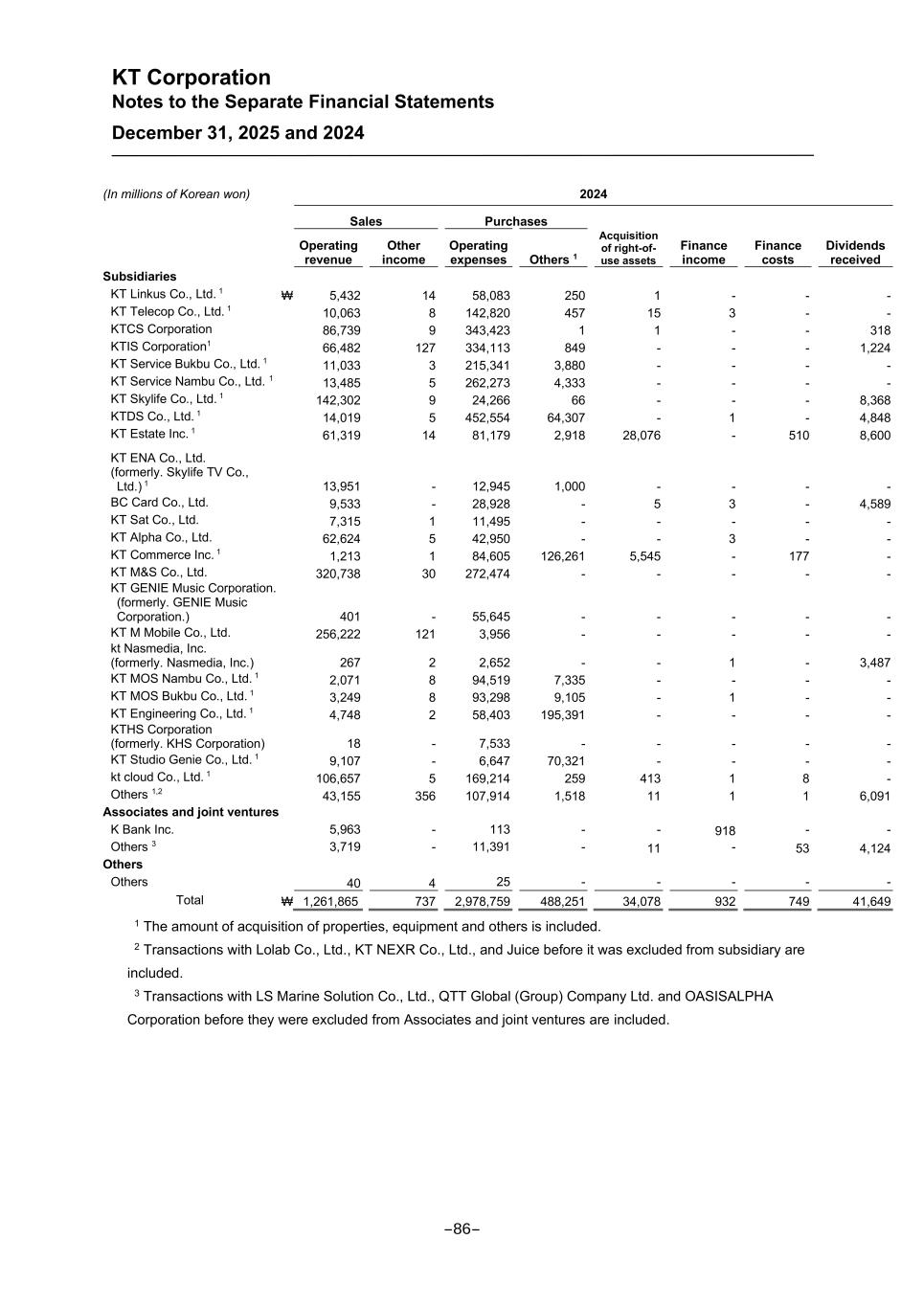
KT Corporation Notes to the Separate Financial Statements December 31, 2025 and 2024 (In millions of Korean won) 2024 Sales Purchases Operating revenue Other income Operating expenses Others 1 Acquisition of right-of- use assets Finance income Finance costs Dividends received Subsidiaries KT Linkus Co., Ltd. 1 ₩ 5,432 14 58,083 250 1 - - - KT Telecop Co., Ltd. 1 10,063 8 142,820 457 15 3 - - KTCS Corporation 86,739 9 343,423 1 1 - - 318 KTIS Corporation1 66,482 127 334,113 849 - - - 1,224 KT Service Bukbu Co., Ltd. 1 11,033 3 215,341 3,880 - - - - KT Service Nambu Co., Ltd. 1 13,485 5 262,273 4,333 - - - - KT Skylife Co., Ltd. 1 142,302 9 24,266 66 - - - 8,368 KTDS Co., Ltd. 1 14,019 5 452,554 64,307 - 1 - 4,848 KT Estate Inc. 1 61,319 14 81,179 2,918 28,076 - 510 8,600 KT ENA Co., Ltd. (formerly. Skylife TV Co., Ltd.) 1 13,951 - 12,945 1,000 - - - - BC Card Co., Ltd. 9,533 - 28,928 - 5 3 - 4,589 KT Sat Co., Ltd. 7,315 1 11,495 - - - - - KT Alpha Co., Ltd. 62,624 5 42,950 - - 3 - - KT Commerce Inc. 1 1,213 1 84,605 126,261 5,545 - 177 - KT M&S Co., Ltd. 320,738 30 272,474 - - - - - KT GENIE Music Corporation. (formerly. GENIE Music Corporation.) 401 - 55,645 - - - - - KT M Mobile Co., Ltd. 256,222 121 3,956 - - - - - kt Nasmedia, Inc. (formerly. Nasmedia, Inc.) 267 2 2,652 - - 1 - 3,487 KT MOS Nambu Co., Ltd. 1 2,071 8 94,519 7,335 - - - - KT MOS Bukbu Co., Ltd. 1 3,249 8 93,298 9,105 - 1 - - KT Engineering Co., Ltd. 1 4,748 2 58,403 195,391 - - - - KTHS Corporation (formerly. KHS Corporation) 18 - 7,533 - - - - - KT Studio Genie Co., Ltd. 1 9,107 - 6,647 70,321 - - - - kt cloud Co., Ltd. 1 106,657 5 169,214 259 413 1 8 - Others 1,2 43,155 356 107,914 1,518 11 1 1 6,091 Associates and joint ventures K Bank Inc. 5,963 - 113 - - 918 - - Others 3 3,719 - 11,391 - 11 - 53 4,124 Others Others 40 4 25 - - - - - Total ₩ 1,261,865 737 2,978,759 488,251 34,078 932 749 41,649 1 The amount of acquisition of properties, equipment and others is included. 2 Transactions with Lolab Co., Ltd., KT NEXR Co., Ltd., and Juice before it was excluded from subsidiary are included. 3 Transactions with LS Marine Solution Co., Ltd., QTT Global (Group) Company Ltd. and OASISALPHA Corporation before they were excluded from Associates and joint ventures are included. -86-
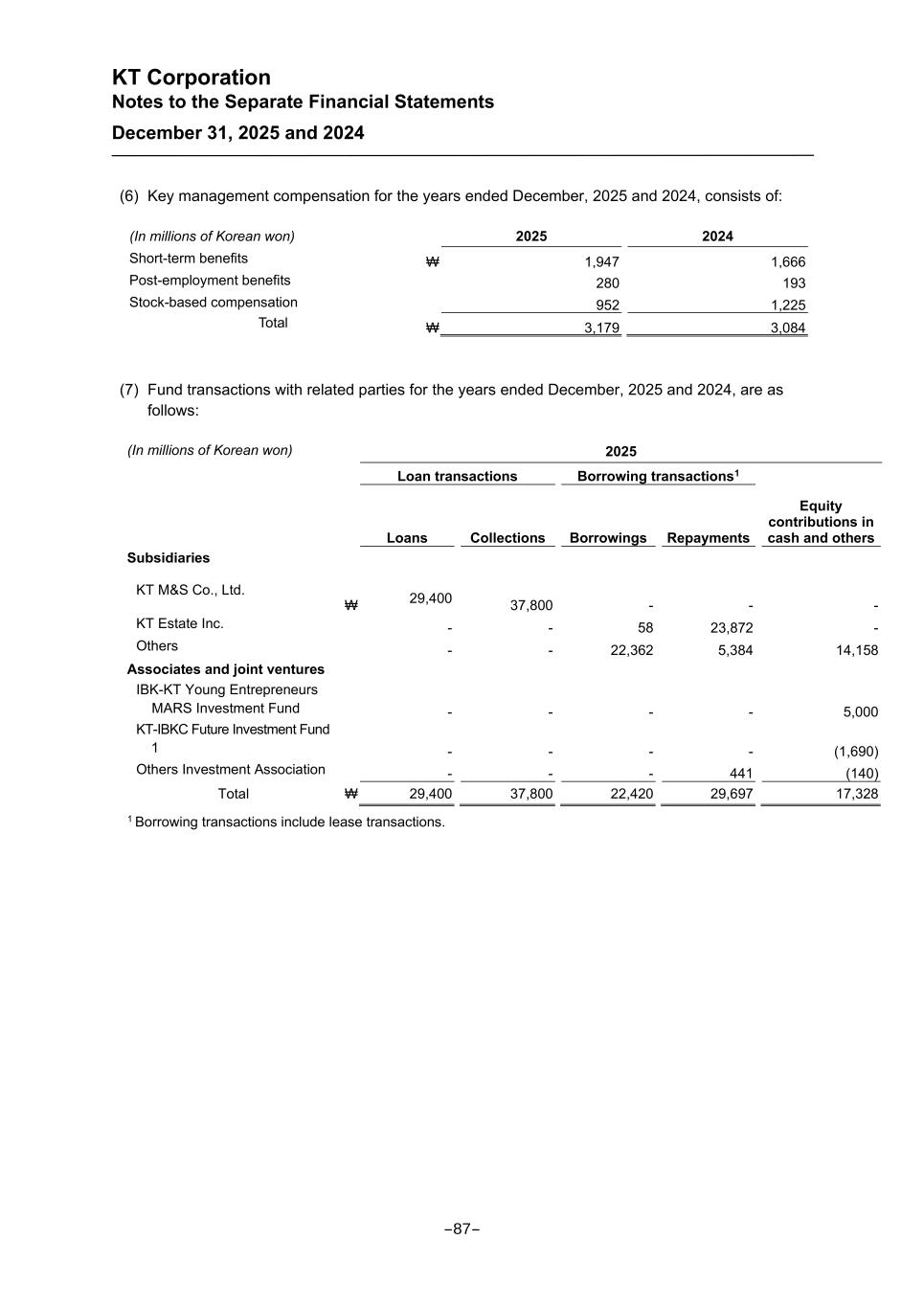
KT Corporation Notes to the Separate Financial Statements December 31, 2025 and 2024 (6) Key management compensation for the years ended December, 2025 and 2024, consists of: (In millions of Korean won) 2025 2024 Short-term benefits ₩ 1,947 1,666 Post-employment benefits 280 193 Stock-based compensation 952 1,225 Total ₩ 3,179 3,084 (7) Fund transactions with related parties for the years ended December, 2025 and 2024, are as follows: (In millions of Korean won) 2025 Loan transactions Borrowing transactions1 Loans Collections Borrowings Repayments Equity contributions in cash and others Subsidiaries KT M&S Co., Ltd. ₩ 29,400 37,800 - - - KT Estate Inc. - - 58 23,872 - Others - - 22,362 5,384 14,158 Associates and joint ventures IBK-KT Young Entrepreneurs MARS Investment Fund - - - - 5,000 KT-IBKC Future Investment Fund 1 - - - - (1,690) Others Investment Association - - - 441 (140) Total ₩ 29,400 37,800 22,420 29,697 17,328 1 Borrowing transactions include lease transactions. -87-
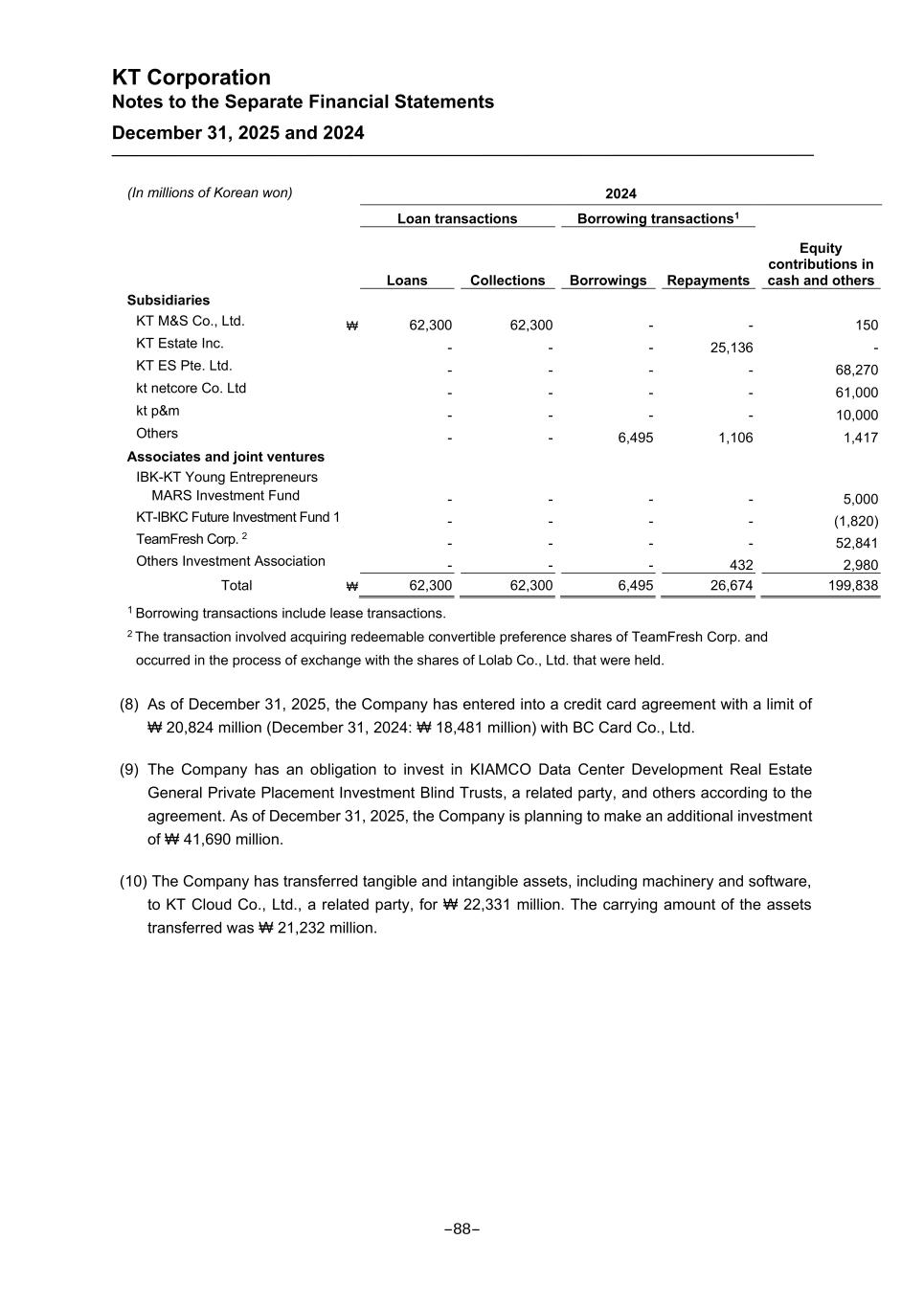
KT Corporation Notes to the Separate Financial Statements December 31, 2025 and 2024 (In millions of Korean won) 2024 Loan transactions Borrowing transactions1 Loans Collections Borrowings Repayments Equity contributions in cash and others Subsidiaries KT M&S Co., Ltd. ₩ 62,300 62,300 - - 150 KT Estate Inc. - - - 25,136 - KT ES Pte. Ltd. - - - - 68,270 kt netcore Co. Ltd - - - - 61,000 kt p&m - - - - 10,000 Others - - 6,495 1,106 1,417 Associates and joint ventures IBK-KT Young Entrepreneurs MARS Investment Fund - - - - 5,000 KT-IBKC Future Investment Fund 1 - - - - (1,820) TeamFresh Corp. 2 - - - - 52,841 Others Investment Association - - - 432 2,980 Total ₩ 62,300 62,300 6,495 26,674 199,838 1 Borrowing transactions include lease transactions. 2 The transaction involved acquiring redeemable convertible preference shares of TeamFresh Corp. and occurred in the process of exchange with the shares of Lolab Co., Ltd. that were held. (8) As of December 31, 2025, the Company has entered into a credit card agreement with a limit of ₩ 20,824 million (December 31, 2024: ₩ 18,481 million) with BC Card Co., Ltd. (9) The Company has an obligation to invest in KIAMCO Data Center Development Real Estate General Private Placement Investment Blind Trusts, a related party, and others according to the agreement. As of December 31, 2025, the Company is planning to make an additional investment of ₩ 41,690 million. (10) The Company has transferred tangible and intangible assets, including machinery and software, to KT Cloud Co., Ltd., a related party, for ₩ 22,331 million. The carrying amount of the assets transferred was ₩ 21,232 million. -88-
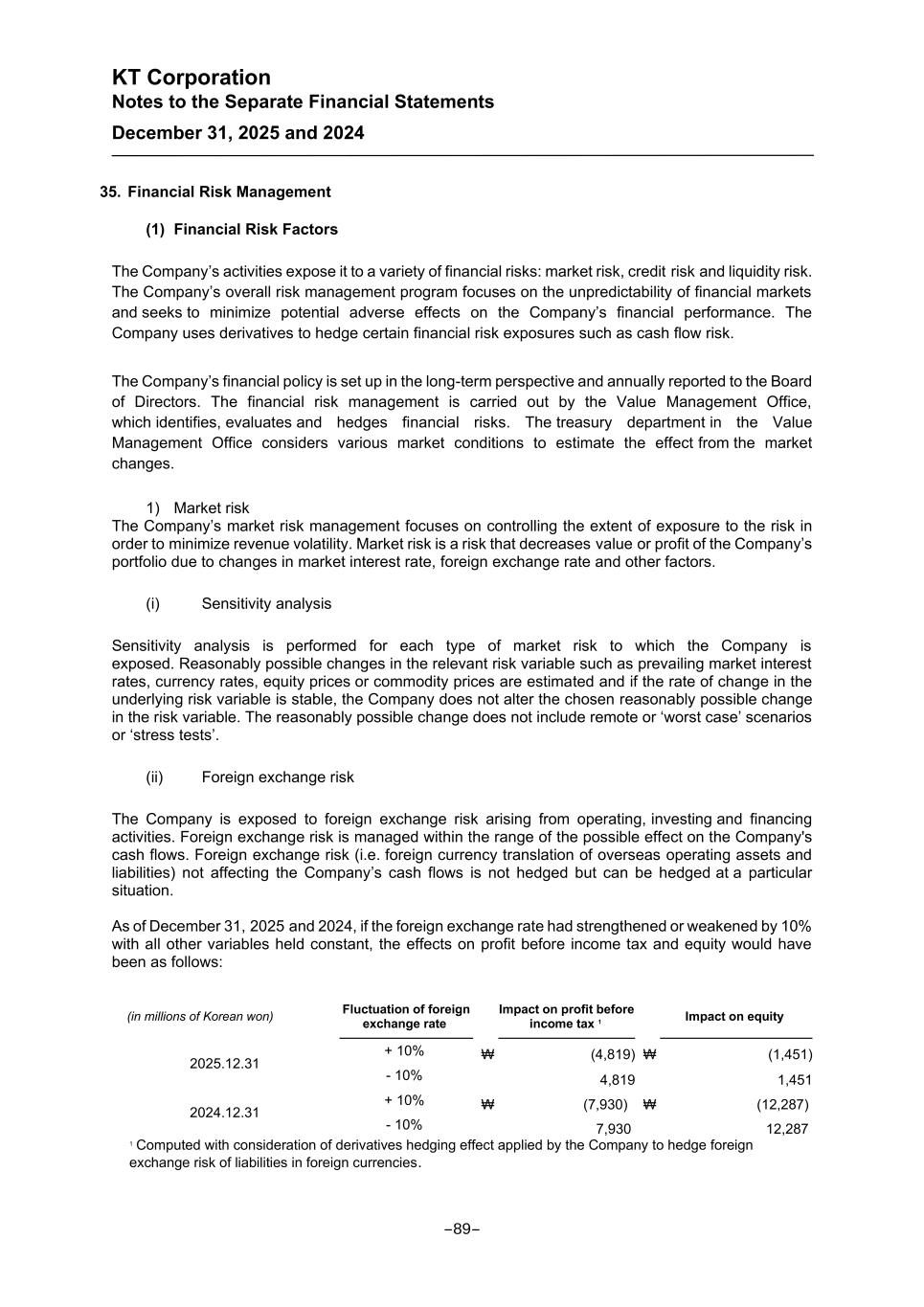
KT Corporation Notes to the Separate Financial Statements December 31, 2025 and 2024 35. Financial Risk Management (1) Financial Risk Factors The Company’s activities expose it to a variety of financial risks: market risk, credit risk and liquidity risk. The Company’s overall risk management program focuses on the unpredictability of financial markets and seeks to minimize potential adverse effects on the Company’s financial performance. The Company uses derivatives to hedge certain financial risk exposures such as cash flow risk. The Company’s financial policy is set up in the long-term perspective and annually reported to the Board of Directors. The financial risk management is carried out by the Value Management Office, which identifies, evaluates and hedges financial risks. The treasury department in the Value Management Office considers various market conditions to estimate the effect from the market changes. 1) Market risk The Company’s market risk management focuses on controlling the extent of exposure to the risk in order to minimize revenue volatility. Market risk is a risk that decreases value or profit of the Company’s portfolio due to changes in market interest rate, foreign exchange rate and other factors. (i) Sensitivity analysis Sensitivity analysis is performed for each type of market risk to which the Company is exposed. Reasonably possible changes in the relevant risk variable such as prevailing market interest rates, currency rates, equity prices or commodity prices are estimated and if the rate of change in the underlying risk variable is stable, the Company does not alter the chosen reasonably possible change in the risk variable. The reasonably possible change does not include remote or ‘worst case’ scenarios or ‘stress tests’. (ii) Foreign exchange risk The Company is exposed to foreign exchange risk arising from operating, investing and financing activities. Foreign exchange risk is managed within the range of the possible effect on the Company's cash flows. Foreign exchange risk (i.e. foreign currency translation of overseas operating assets and liabilities) not affecting the Company’s cash flows is not hedged but can be hedged at a particular situation. As of December 31, 2025 and 2024, if the foreign exchange rate had strengthened or weakened by 10% with all other variables held constant, the effects on profit before income tax and equity would have been as follows: (in millions of Korean won) Fluctuation of foreign exchange rate Impact on profit before income tax 1 Impact on equity 2025.12.31 + 10% ₩ (4,819) ₩ (1,451) - 10% 4,819 1,451 2024.12.31 + 10% ₩ (7,930) ₩ (12,287) - 10% 7,930 12,287 1 Computed with consideration of derivatives hedging effect applied by the Company to hedge foreign exchange risk of liabilities in foreign currencies. -89-
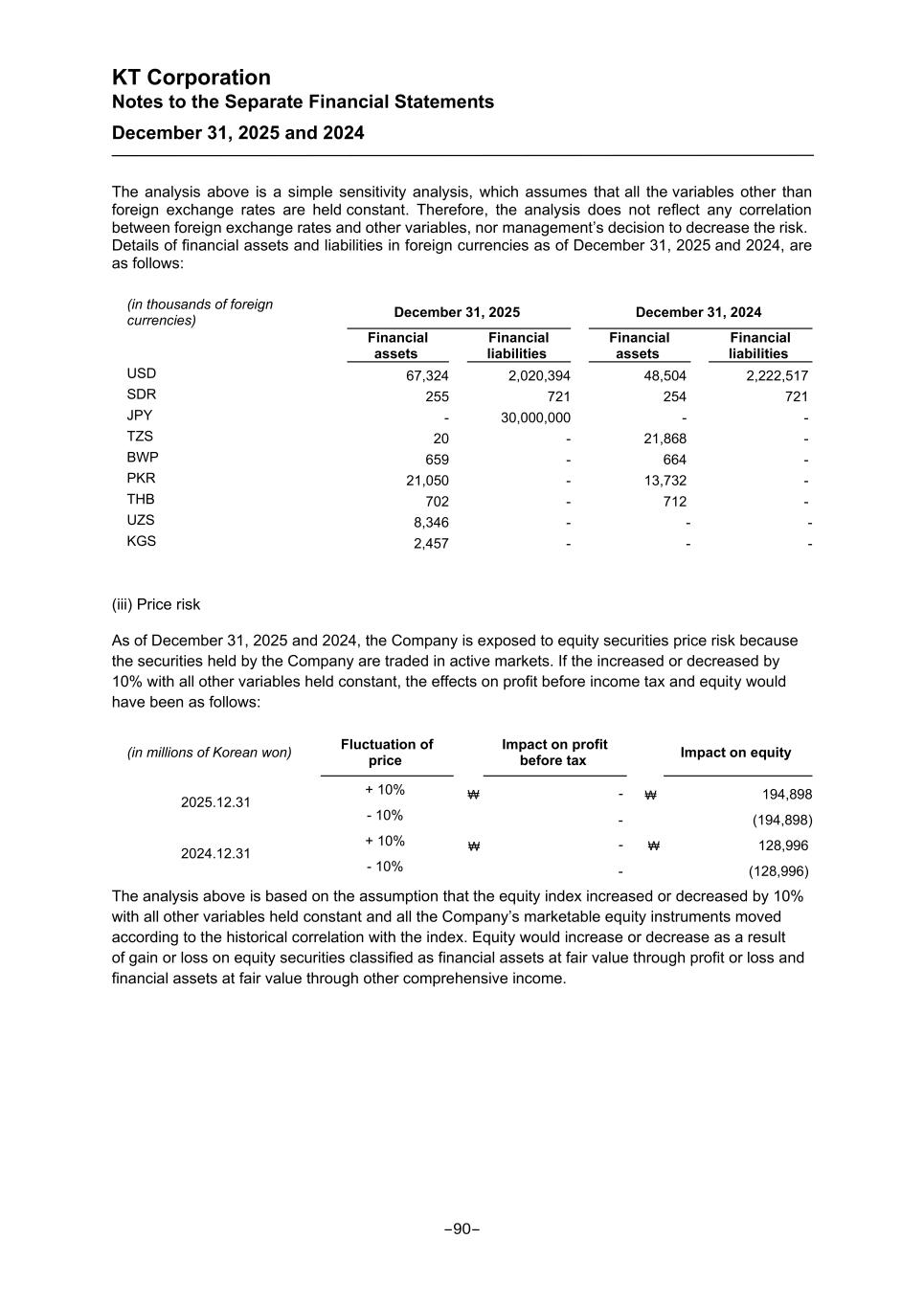
KT Corporation Notes to the Separate Financial Statements December 31, 2025 and 2024 The analysis above is a simple sensitivity analysis, which assumes that all the variables other than foreign exchange rates are held constant. Therefore, the analysis does not reflect any correlation between foreign exchange rates and other variables, nor management’s decision to decrease the risk. Details of financial assets and liabilities in foreign currencies as of December 31, 2025 and 2024, are as follows: (in thousands of foreign currencies) December 31, 2025 December 31, 2024 Financial assets Financial liabilities Financial assets Financial liabilities USD 67,324 2,020,394 48,504 2,222,517 SDR 255 721 254 721 JPY - 30,000,000 - - TZS 20 - 21,868 - BWP 659 - 664 - PKR 21,050 - 13,732 - THB 702 - 712 - UZS 8,346 - - - KGS 2,457 - - - (iii) Price risk As of December 31, 2025 and 2024, the Company is exposed to equity securities price risk because the securities held by the Company are traded in active markets. If the increased or decreased by 10% with all other variables held constant, the effects on profit before income tax and equity would have been as follows: (in millions of Korean won) Fluctuation of price Impact on profit before tax Impact on equity 2025.12.31 + 10% ₩ - ₩ 194,898 - 10% - (194,898) 2024.12.31 + 10% ₩ - ₩ 128,996 - 10% - (128,996) The analysis above is based on the assumption that the equity index increased or decreased by 10% with all other variables held constant and all the Company’s marketable equity instruments moved according to the historical correlation with the index. Equity would increase or decrease as a result of gain or loss on equity securities classified as financial assets at fair value through profit or loss and financial assets at fair value through other comprehensive income. -90-
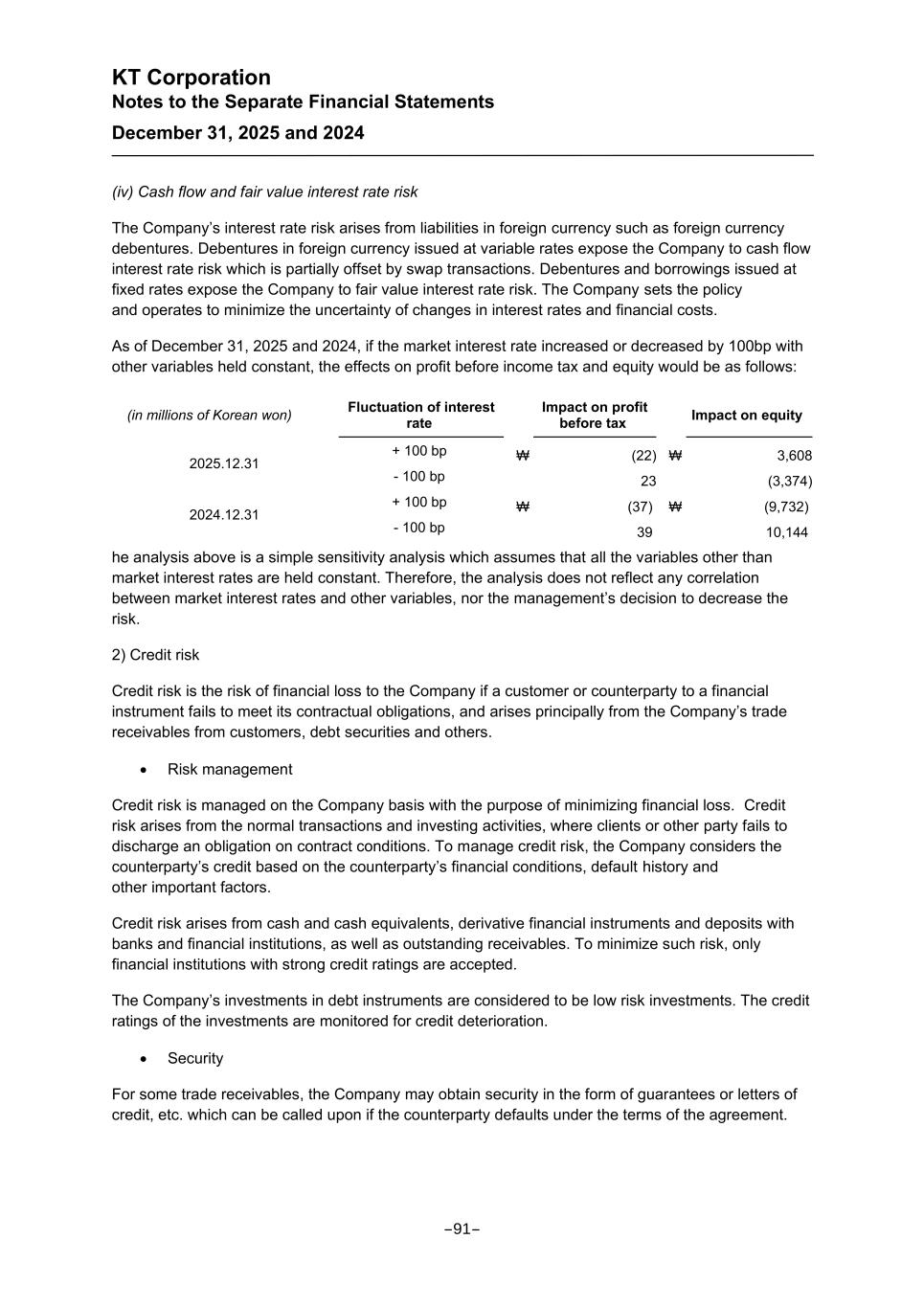
KT Corporation Notes to the Separate Financial Statements December 31, 2025 and 2024 (iv) Cash flow and fair value interest rate risk The Company’s interest rate risk arises from liabilities in foreign currency such as foreign currency debentures. Debentures in foreign currency issued at variable rates expose the Company to cash flow interest rate risk which is partially offset by swap transactions. Debentures and borrowings issued at fixed rates expose the Company to fair value interest rate risk. The Company sets the policy and operates to minimize the uncertainty of changes in interest rates and financial costs. As of December 31, 2025 and 2024, if the market interest rate increased or decreased by 100bp with other variables held constant, the effects on profit before income tax and equity would be as follows: (in millions of Korean won) Fluctuation of interest rate Impact on profit before tax Impact on equity 2025.12.31 + 100 bp ₩ (22) ₩ 3,608 - 100 bp 23 (3,374) 2024.12.31 + 100 bp ₩ (37) ₩ (9,732) - 100 bp 39 10,144 he analysis above is a simple sensitivity analysis which assumes that all the variables other than market interest rates are held constant. Therefore, the analysis does not reflect any correlation between market interest rates and other variables, nor the management’s decision to decrease the risk. 2) Credit risk Credit risk is the risk of financial loss to the Company if a customer or counterparty to a financial instrument fails to meet its contractual obligations, and arises principally from the Company’s trade receivables from customers, debt securities and others. • Risk management Credit risk is managed on the Company basis with the purpose of minimizing financial loss. Credit risk arises from the normal transactions and investing activities, where clients or other party fails to discharge an obligation on contract conditions. To manage credit risk, the Company considers the counterparty’s credit based on the counterparty’s financial conditions, default history and other important factors. Credit risk arises from cash and cash equivalents, derivative financial instruments and deposits with banks and financial institutions, as well as outstanding receivables. To minimize such risk, only financial institutions with strong credit ratings are accepted. The Company’s investments in debt instruments are considered to be low risk investments. The credit ratings of the investments are monitored for credit deterioration. • Security For some trade receivables, the Company may obtain security in the form of guarantees or letters of credit, etc. which can be called upon if the counterparty defaults under the terms of the agreement. -91-
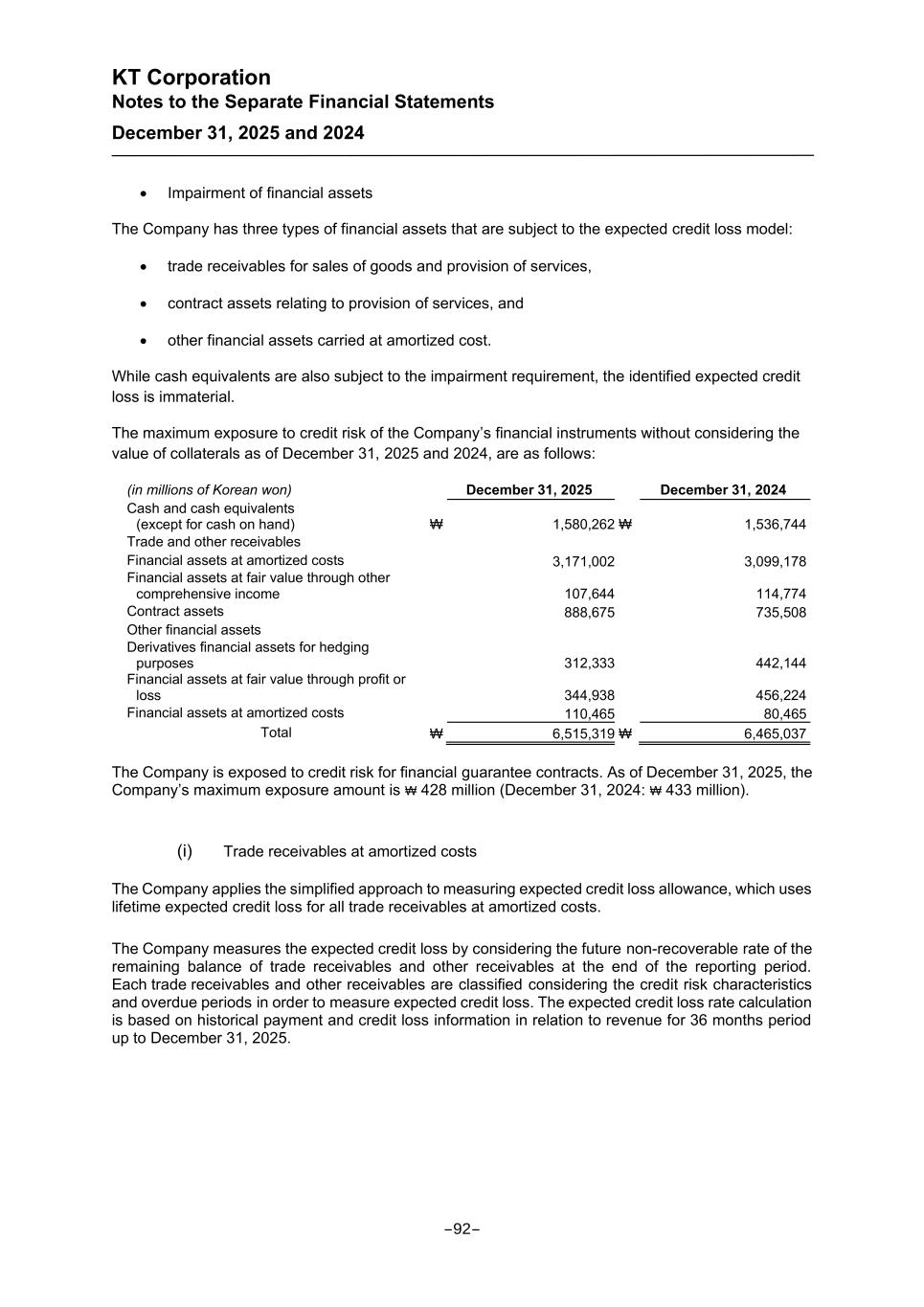
KT Corporation Notes to the Separate Financial Statements December 31, 2025 and 2024 • Impairment of financial assets The Company has three types of financial assets that are subject to the expected credit loss model: • trade receivables for sales of goods and provision of services, • contract assets relating to provision of services, and • other financial assets carried at amortized cost. While cash equivalents are also subject to the impairment requirement, the identified expected credit loss is immaterial. The maximum exposure to credit risk of the Company’s financial instruments without considering the value of collaterals as of December 31, 2025 and 2024, are as follows: (in millions of Korean won) December 31, 2025 December 31, 2024 Cash and cash equivalents (except for cash on hand) ₩ 1,580,262 ₩ 1,536,744 Trade and other receivables Financial assets at amortized costs 3,171,002 3,099,178 Financial assets at fair value through other comprehensive income 107,644 114,774 Contract assets 888,675 735,508 Other financial assets Derivatives financial assets for hedging purposes 312,333 442,144 Financial assets at fair value through profit or loss 344,938 456,224 Financial assets at amortized costs 110,465 80,465 Total ₩ 6,515,319 ₩ 6,465,037 The Company is exposed to credit risk for financial guarantee contracts. As of December 31, 2025, the Company’s maximum exposure amount is ₩ 428 million (December 31, 2024: ₩ 433 million). (i) Trade receivables at amortized costs The Company applies the simplified approach to measuring expected credit loss allowance, which uses lifetime expected credit loss for all trade receivables at amortized costs. The Company measures the expected credit loss by considering the future non-recoverable rate of the remaining balance of trade receivables and other receivables at the end of the reporting period. Each trade receivables and other receivables are classified considering the credit risk characteristics and overdue periods in order to measure expected credit loss. The expected credit loss rate calculation is based on historical payment and credit loss information in relation to revenue for 36 months period up to December 31, 2025. -92-
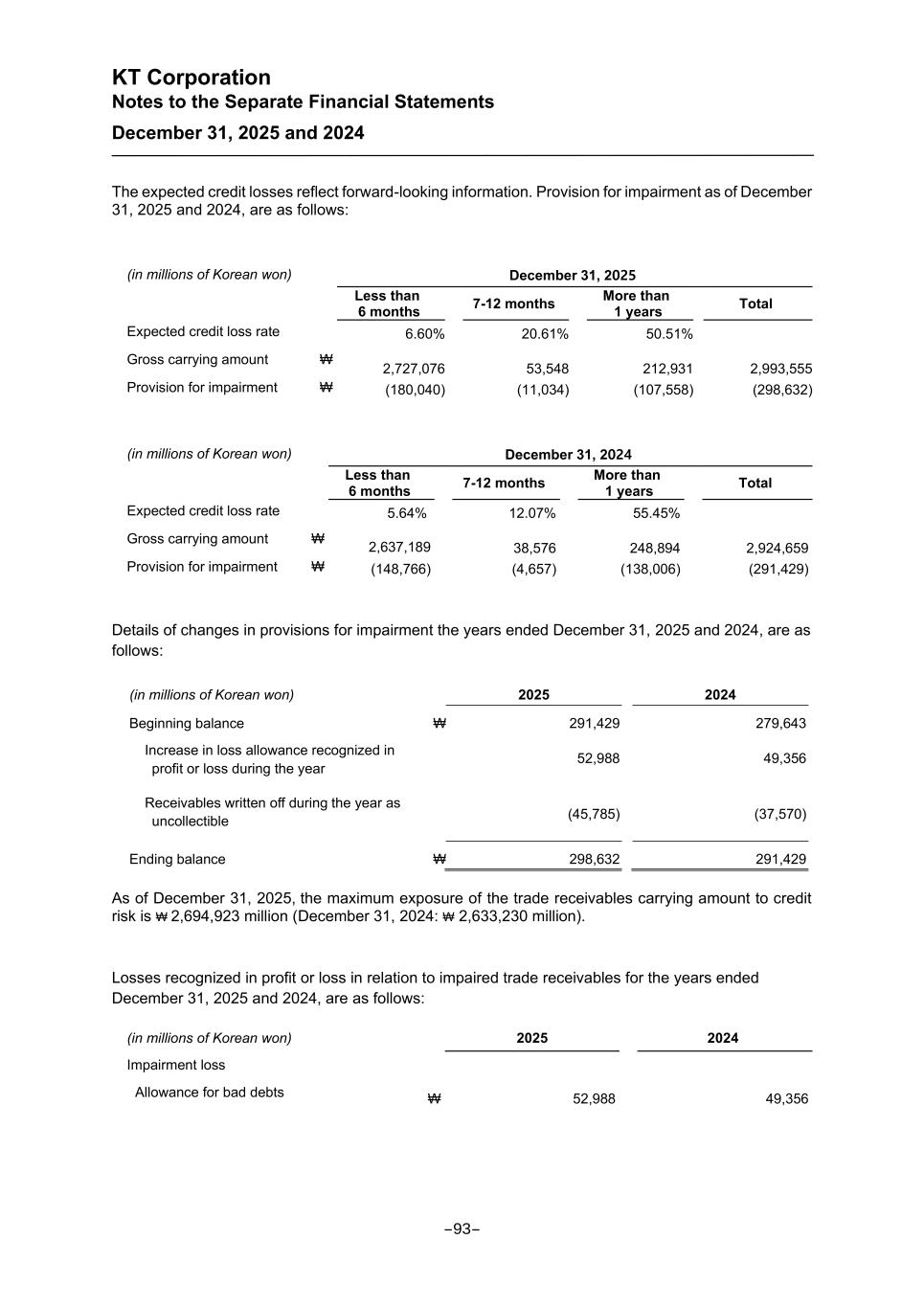
KT Corporation Notes to the Separate Financial Statements December 31, 2025 and 2024 The expected credit losses reflect forward-looking information. Provision for impairment as of December 31, 2025 and 2024, are as follows: (in millions of Korean won) December 31, 2025 Less than 6 months 7-12 months More than 1 years Total Expected credit loss rate 6.60% 20.61% 50.51% Gross carrying amount ₩ 2,727,076 53,548 212,931 2,993,555 Provision for impairment ₩ (180,040) (11,034) (107,558) (298,632) (in millions of Korean won) December 31, 2024 Less than 6 months 7-12 months More than 1 years Total Expected credit loss rate 5.64% 12.07% 55.45% Gross carrying amount ₩ 2,637,189 38,576 248,894 2,924,659 Provision for impairment ₩ (148,766) (4,657) (138,006) (291,429) Details of changes in provisions for impairment the years ended December 31, 2025 and 2024, are as follows: (in millions of Korean won) 2025 2024 Beginning balance ₩ 291,429 279,643 Increase in loss allowance recognized in profit or loss during the year t t t t loss dur 52,988 49,356 Receivables written off during the year as uncollectible (45,785) (37,570) Ending balance ₩ 298,632 291,429 As of December 31, 2025, the maximum exposure of the trade receivables carrying amount to credit risk is ₩ 2,694,923 million (December 31, 2024: ₩ 2,633,230 million). Losses recognized in profit or loss in relation to impaired trade receivables for the years ended December 31, 2025 and 2024, are as follows: (in millions of Korean won) 2025 2024 Impairment loss Allowance for bad debts ₩ 52,988 49,356 -93-
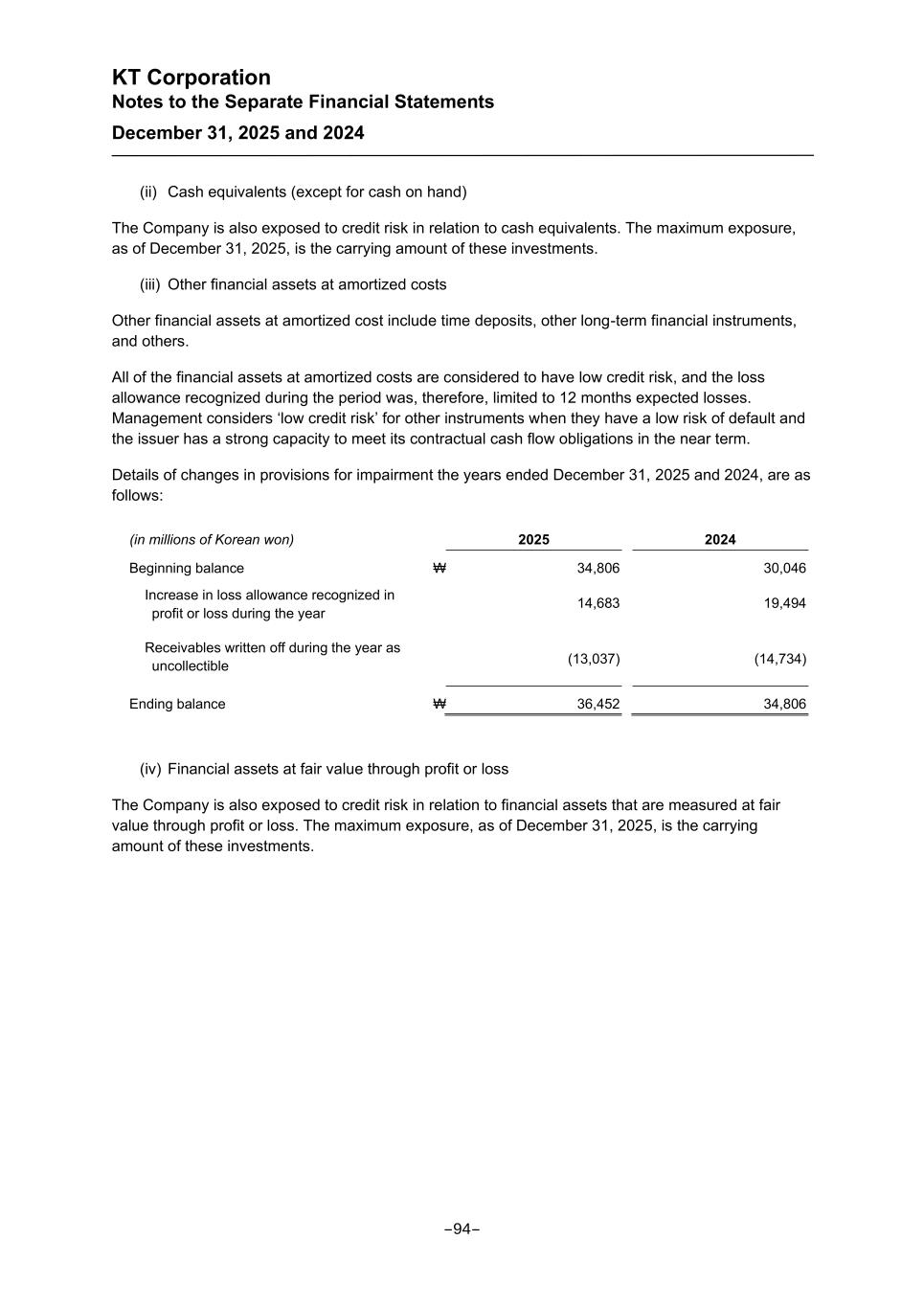
KT Corporation Notes to the Separate Financial Statements December 31, 2025 and 2024 (ii) Cash equivalents (except for cash on hand) The Company is also exposed to credit risk in relation to cash equivalents. The maximum exposure, as of December 31, 2025, is the carrying amount of these investments. (iii) Other financial assets at amortized costs Other financial assets at amortized cost include time deposits, other long-term financial instruments, and others. All of the financial assets at amortized costs are considered to have low credit risk, and the loss allowance recognized during the period was, therefore, limited to 12 months expected losses. Management considers ‘low credit risk’ for other instruments when they have a low risk of default and the issuer has a strong capacity to meet its contractual cash flow obligations in the near term. Details of changes in provisions for impairment the years ended December 31, 2025 and 2024, are as follows: (in millions of Korean won) 2025 2024 Beginning balance ₩ 34,806 30,046 Increase in loss allowance recognized in profit or loss during the year t t t t loss dur 14,683 19,494 Receivables written off during the year as uncollectible (13,037) (14,734) Ending balance ₩ 36,452 34,806 (iv) Financial assets at fair value through profit or loss The Company is also exposed to credit risk in relation to financial assets that are measured at fair value through profit or loss. The maximum exposure, as of December 31, 2025, is the carrying amount of these investments. -94-
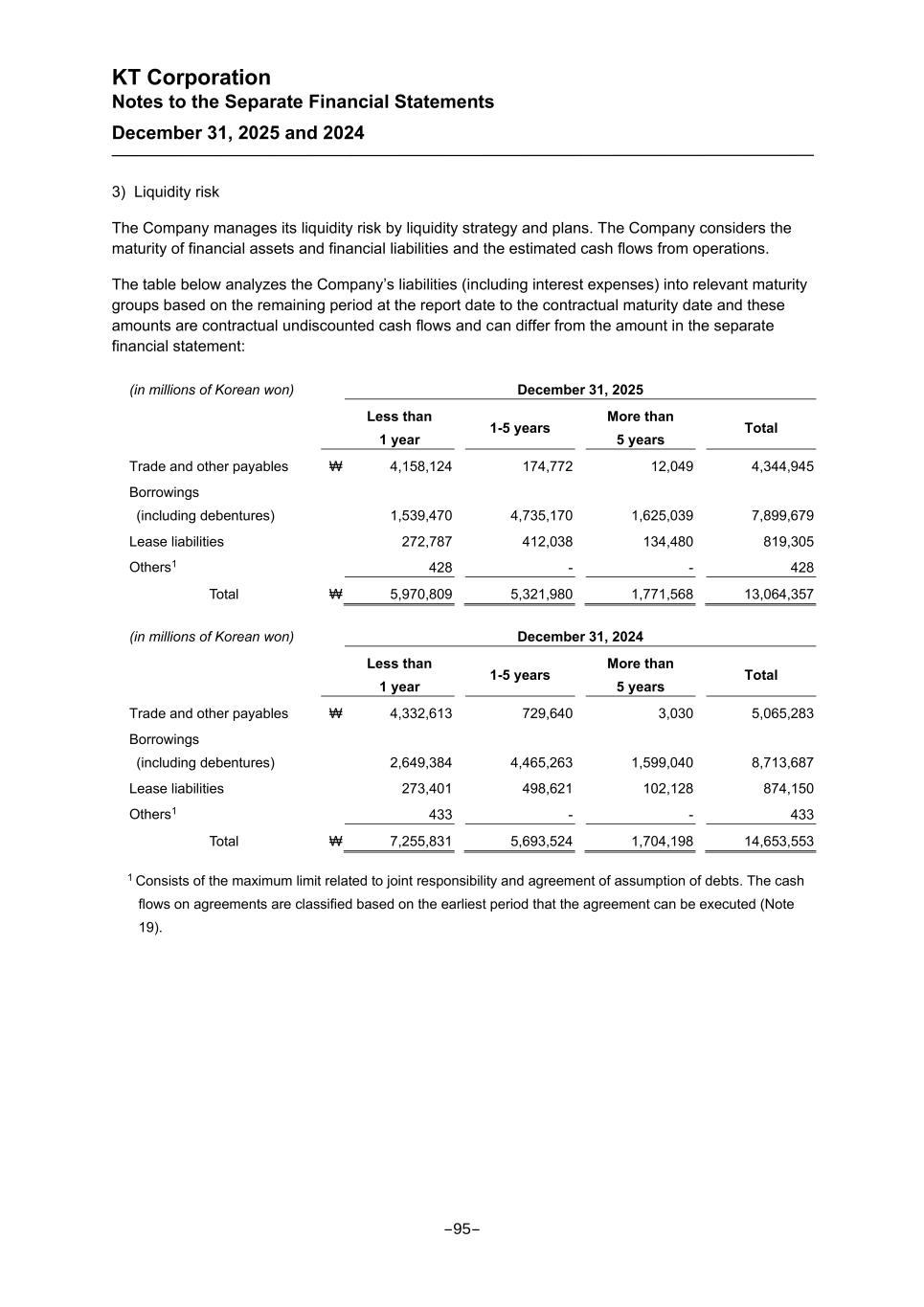
KT Corporation Notes to the Separate Financial Statements December 31, 2025 and 2024 3) Liquidity risk The Company manages its liquidity risk by liquidity strategy and plans. The Company considers the maturity of financial assets and financial liabilities and the estimated cash flows from operations. The table below analyzes the Company’s liabilities (including interest expenses) into relevant maturity groups based on the remaining period at the report date to the contractual maturity date and these amounts are contractual undiscounted cash flows and can differ from the amount in the separate financial statement: (in millions of Korean won) December 31, 2025 Less than 1 year 1-5 years More than 5 years Total Trade and other payables ₩ 4,158,124 174,772 12,049 4,344,945 Borrowings (including debentures) 1,539,470 4,735,170 1,625,039 7,899,679 Lease liabilities 272,787 412,038 134,480 819,305 Others1 428 - - 428 Total ₩ 5,970,809 5,321,980 1,771,568 13,064,357 (in millions of Korean won) December 31, 2024 Less than 1 year 1-5 years More than 5 years Total Trade and other payables ₩ 4,332,613 729,640 3,030 5,065,283 Borrowings (including debentures) 2,649,384 4,465,263 1,599,040 8,713,687 Lease liabilities 273,401 498,621 102,128 874,150 Others1 433 - - 433 Total ₩ 7,255,831 5,693,524 1,704,198 14,653,553 1 Consists of the maximum limit related to joint responsibility and agreement of assumption of debts. The cash flows on agreements are classified based on the earliest period that the agreement can be executed (Note 19). -95-
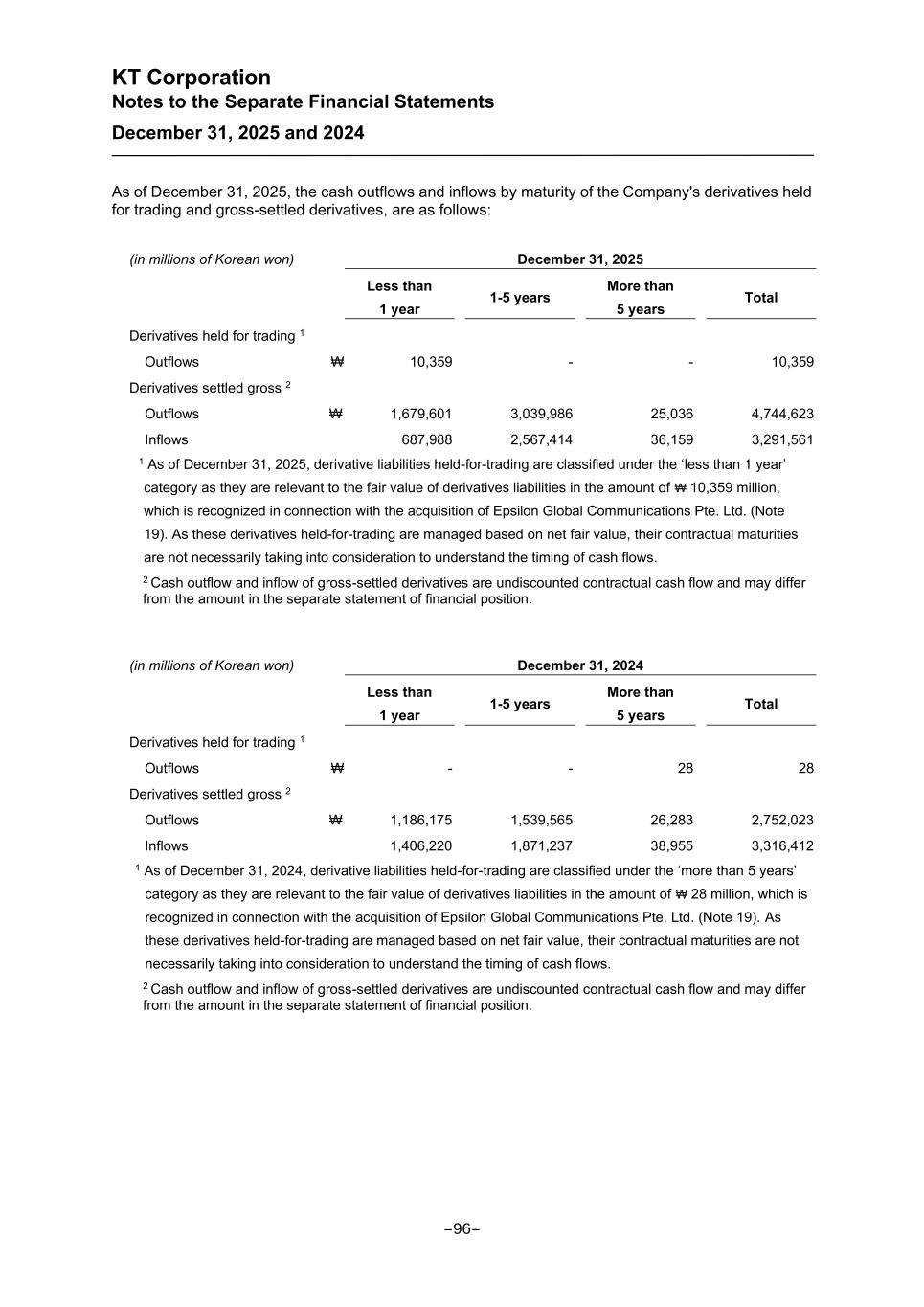
KT Corporation Notes to the Separate Financial Statements December 31, 2025 and 2024 As of December 31, 2025, the cash outflows and inflows by maturity of the Company's derivatives held for trading and gross-settled derivatives, are as follows: (in millions of Korean won) December 31, 2025 Less than 1 year 1-5 years More than 5 years Total Derivatives held for trading 1 Outflows ₩ 10,359 - - 10,359 Derivatives settled gross 2 Outflows ₩ 1,679,601 3,039,986 25,036 4,744,623 Inflows 687,988 2,567,414 36,159 3,291,561 1 As of December 31, 2025, derivative liabilities held-for-trading are classified under the ‘less than 1 year’ category as they are relevant to the fair value of derivatives liabilities in the amount of ₩ 10,359 million, which is recognized in connection with the acquisition of Epsilon Global Communications Pte. Ltd. (Note 19). As these derivatives held-for-trading are managed based on net fair value, their contractual maturities are not necessarily taking into consideration to understand the timing of cash flows. 2 Cash outflow and inflow of gross-settled derivatives are undiscounted contractual cash flow and may differ from the amount in the separate statement of financial position. (in millions of Korean won) December 31, 2024 Less than 1 year 1-5 years More than 5 years Total Derivatives held for trading 1 Outflows ₩ - - 28 28 Derivatives settled gross 2 Outflows ₩ 1,186,175 1,539,565 26,283 2,752,023 Inflows 1,406,220 1,871,237 38,955 3,316,412 1 As of December 31, 2024, derivative liabilities held-for-trading are classified under the ‘more than 5 years’ category as they are relevant to the fair value of derivatives liabilities in the amount of ₩ 28 million, which is recognized in connection with the acquisition of Epsilon Global Communications Pte. Ltd. (Note 19). As these derivatives held-for-trading are managed based on net fair value, their contractual maturities are not necessarily taking into consideration to understand the timing of cash flows. 2 Cash outflow and inflow of gross-settled derivatives are undiscounted contractual cash flow and may differ from the amount in the separate statement of financial position. -96-
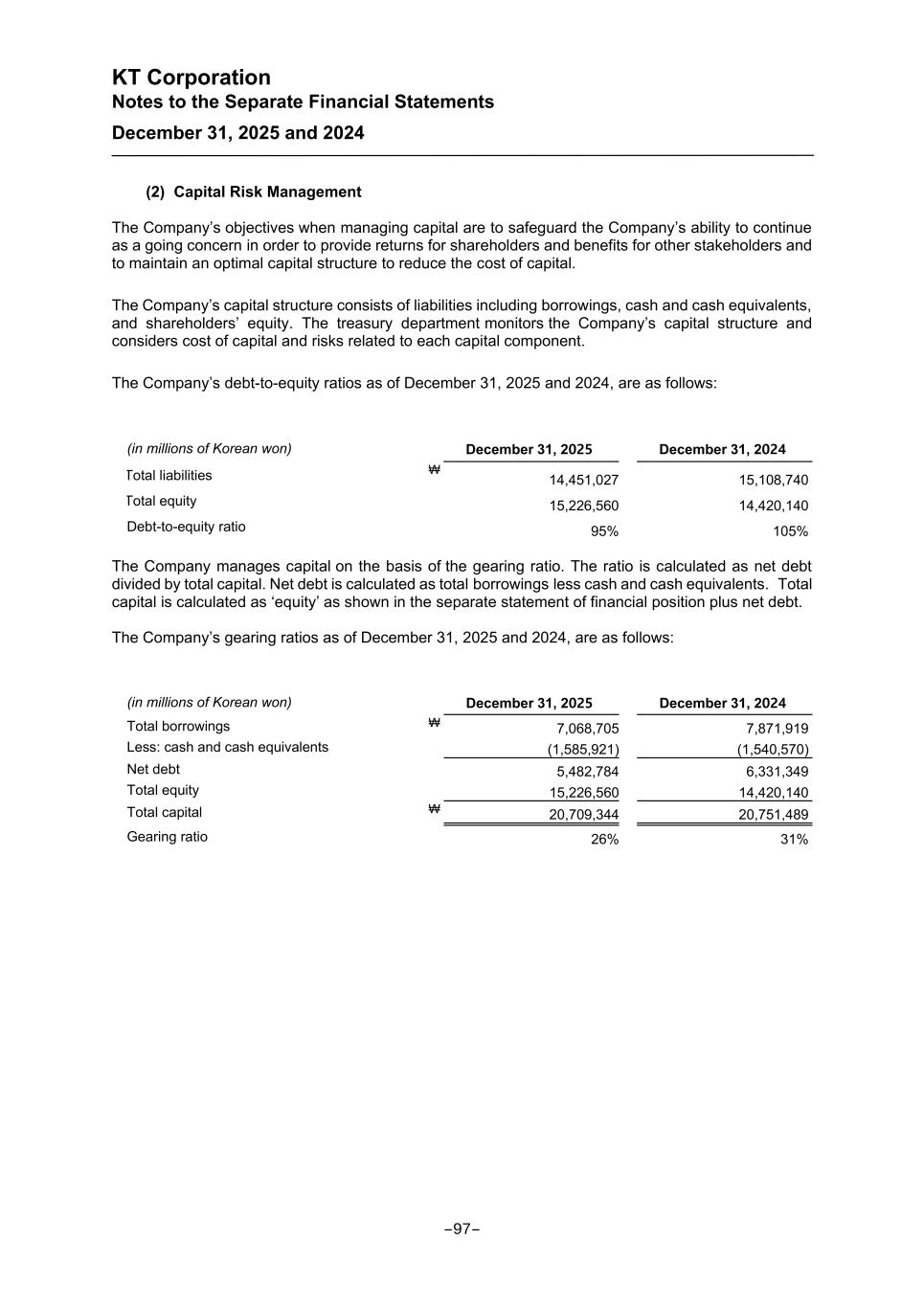
KT Corporation Notes to the Separate Financial Statements December 31, 2025 and 2024 (2) Capital Risk Management The Company’s objectives when managing capital are to safeguard the Company’s ability to continue as a going concern in order to provide returns for shareholders and benefits for other stakeholders and to maintain an optimal capital structure to reduce the cost of capital. The Company’s capital structure consists of liabilities including borrowings, cash and cash equivalents, and shareholders’ equity. The treasury department monitors the Company’s capital structure and considers cost of capital and risks related to each capital component. The Company’s debt-to-equity ratios as of December 31, 2025 and 2024, are as follows: (in millions of Korean won) December 31, 2025 December 31, 2024 Total liabilities ₩ 14,451,027 15,108,740 Total equity 15,226,560 14,420,140 Debt-to-equity ratio 95% 105% The Company manages capital on the basis of the gearing ratio. The ratio is calculated as net debt divided by total capital. Net debt is calculated as total borrowings less cash and cash equivalents. Total capital is calculated as ‘equity’ as shown in the separate statement of financial position plus net debt. The Company’s gearing ratios as of December 31, 2025 and 2024, are as follows: (in millions of Korean won) December 31, 2025 December 31, 2024 Total borrowings ₩ 7,068,705 7,871,919 Less: cash and cash equivalents (1,585,921) (1,540,570) Net debt 5,482,784 6,331,349 Total equity 15,226,560 14,420,140 Total capital ₩ 20,709,344 20,751,489 Gearing ratio 26% 31% -97-
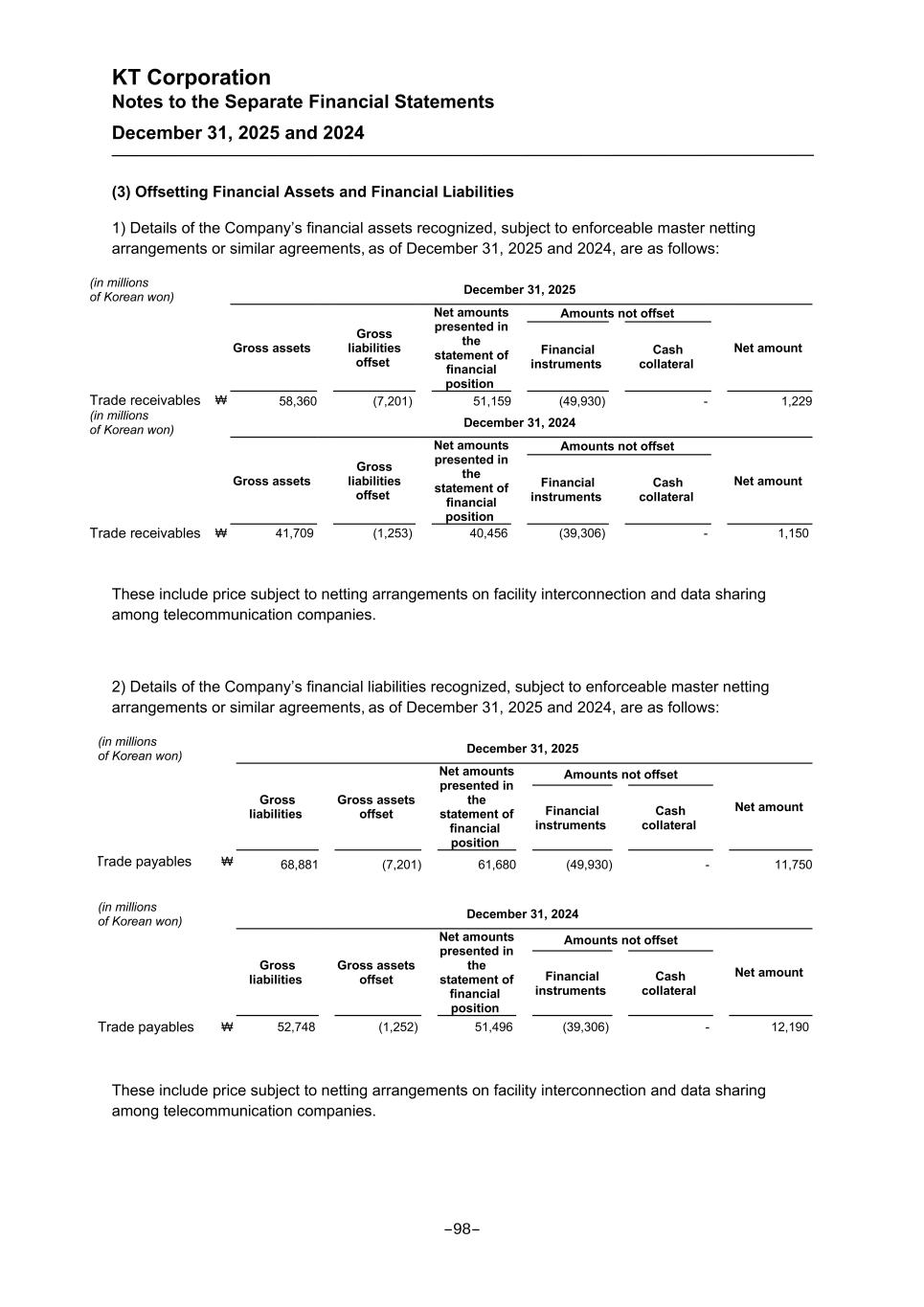
KT Corporation Notes to the Separate Financial Statements December 31, 2025 and 2024 (3) Offsetting Financial Assets and Financial Liabilities 1) Details of the Company’s financial assets recognized, subject to enforceable master netting arrangements or similar agreements, as of December 31, 2025 and 2024, are as follows: (in millions of Korean won) December 31, 2025 Gross assets Gross liabilities offset Net amounts presented in the statement of financial position Amounts not offset Net amount Financial instruments Cash collateral Trade receivables ₩ 58,360 (7,201) 51,159 (49,930) - 1,229 (in millions of Korean won) December 31, 2024 Gross assets Gross liabilities offset Net amounts presented in the statement of financial position Amounts not offset Net amount Financial instruments Cash collateral Trade receivables ₩ 41,709 (1,253) 40,456 (39,306) - 1,150 These include price subject to netting arrangements on facility interconnection and data sharing among telecommunication companies. 2) Details of the Company’s financial liabilities recognized, subject to enforceable master netting arrangements or similar agreements, as of December 31, 2025 and 2024, are as follows: (in millions of Korean won) December 31, 2025 Gross liabilities Gross assets offset Net amounts presented in the statement of financial position Amounts not offset Net amount Financial instruments Cash collateral Trade payables ₩ 68,881 (7,201) 61,680 (49,930) - 11,750 (in millions of Korean won) December 31, 2024 Gross liabilities Gross assets offset Net amounts presented in the statement of financial position Amounts not offset Net amount Financial instruments Cash collateral Trade payables ₩ 52,748 (1,252) 51,496 (39,306) - 12,190 These include price subject to netting arrangements on facility interconnection and data sharing among telecommunication companies. -98-
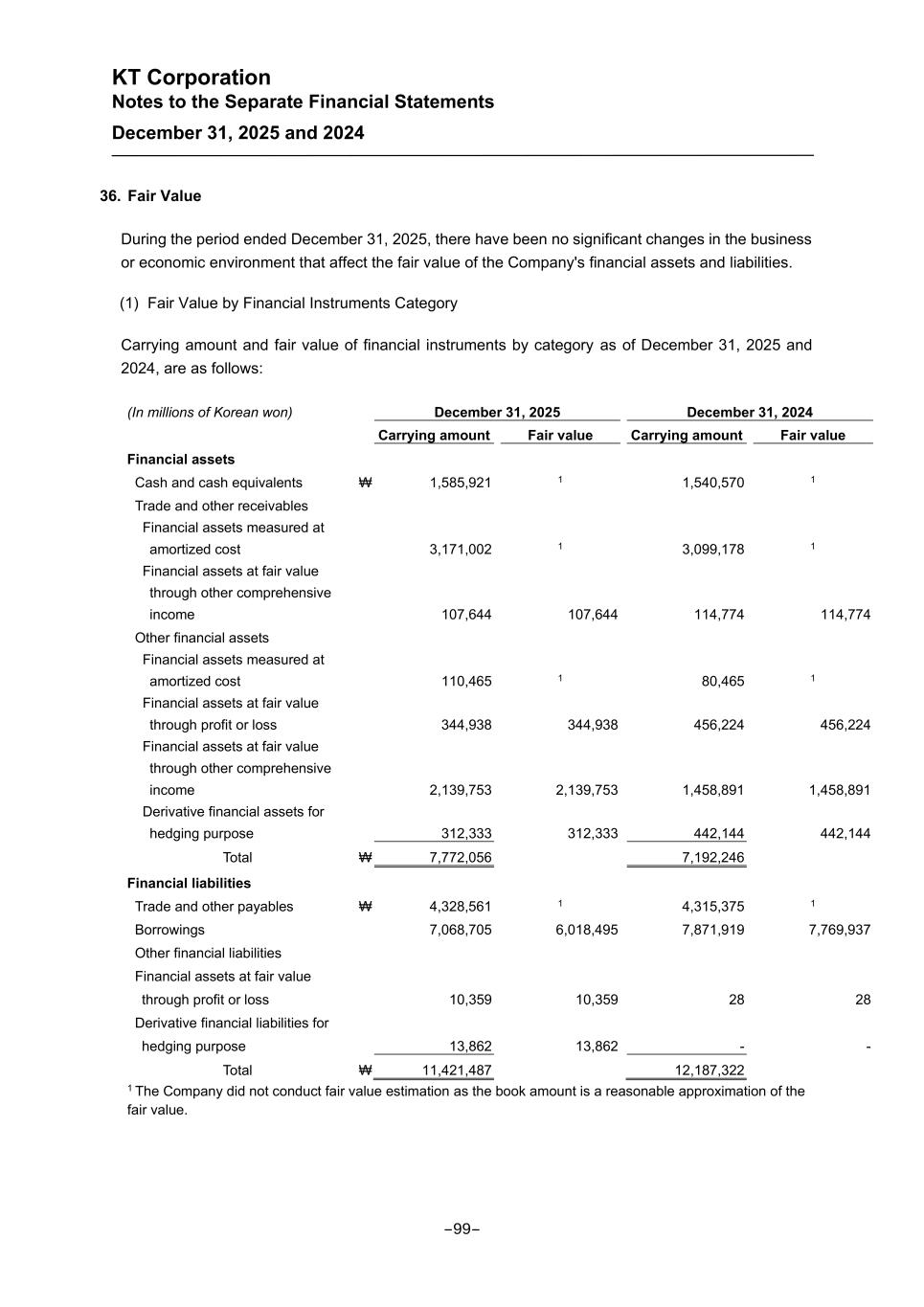
KT Corporation Notes to the Separate Financial Statements December 31, 2025 and 2024 36. Fair Value During the period ended December 31, 2025, there have been no significant changes in the business or economic environment that affect the fair value of the Company's financial assets and liabilities. (1) Fair Value by Financial Instruments Category Carrying amount and fair value of financial instruments by category as of December 31, 2025 and 2024, are as follows: (In millions of Korean won) December 31, 2025 December 31, 2024 Carrying amount Fair value Carrying amount Fair value Financial assets Cash and cash equivalents ₩ 1,585,921 1 1,540,570 1 Trade and other receivables Financial assets measured at amortized cost 3,171,002 1 3,099,178 1 Financial assets at fair value through other comprehensive income 107,644 107,644 114,774 114,774 Other financial assets Financial assets measured at amortized cost 110,465 1 80,465 1 Financial assets at fair value through profit or loss 344,938 344,938 456,224 456,224 Financial assets at fair value through other comprehensive income 2,139,753 2,139,753 1,458,891 1,458,891 Derivative financial assets for hedging purpose 312,333 312,333 442,144 442,144 Total ₩ 7,772,056 7,192,246 Financial liabilities Trade and other payables ₩ 4,328,561 1 4,315,375 1 Borrowings 7,068,705 6,018,495 7,871,919 7,769,937 Other financial liabilities Financial assets at fair value through profit or loss 10,359 10,359 28 28 Derivative financial liabilities for hedging purpose 13,862 13,862 - - Total ₩ 11,421,487 12,187,322 1 The Company did not conduct fair value estimation as the book amount is a reasonable approximation of the fair value. -99-
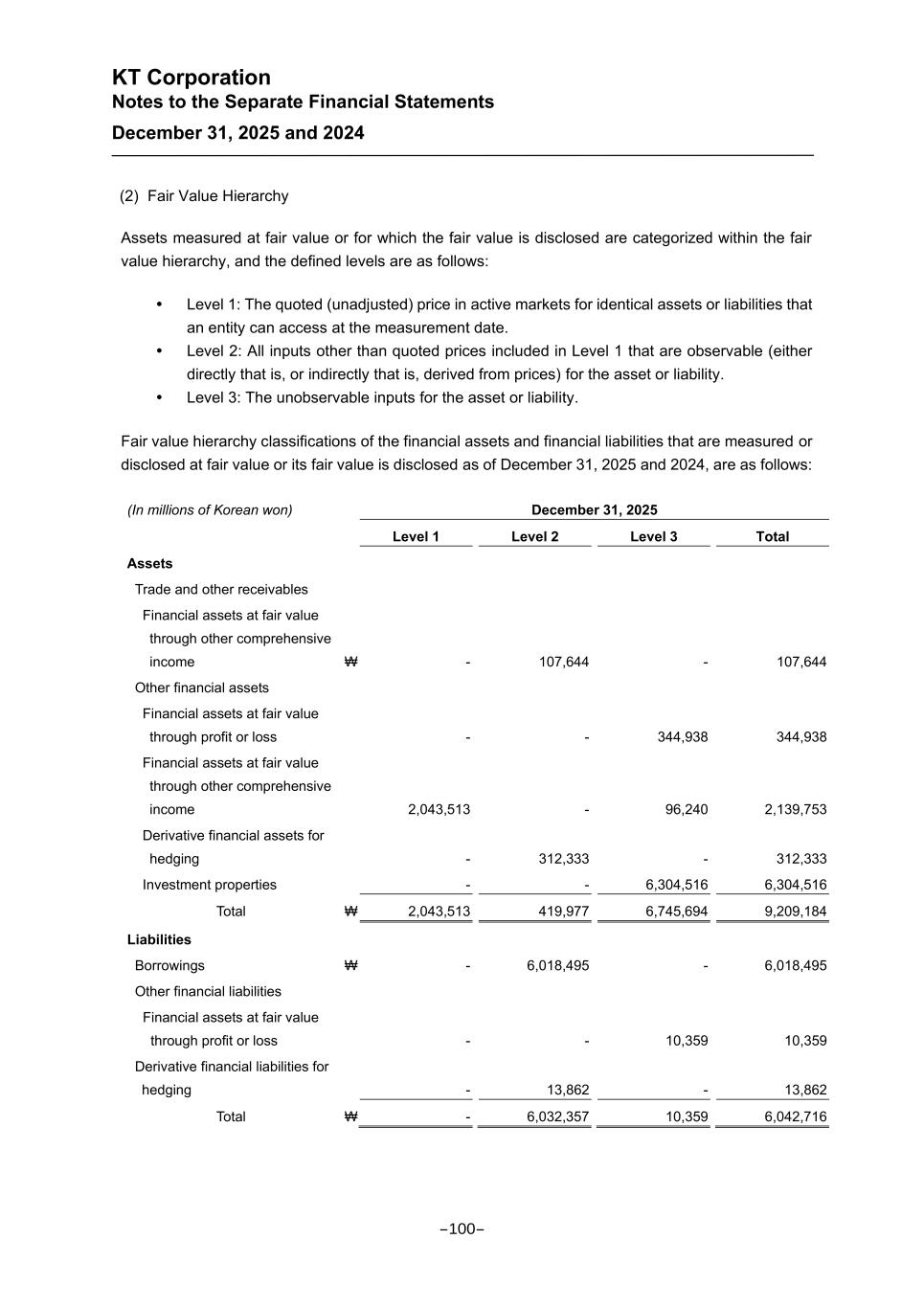
KT Corporation Notes to the Separate Financial Statements December 31, 2025 and 2024 (2) Fair Value Hierarchy Assets measured at fair value or for which the fair value is disclosed are categorized within the fair value hierarchy, and the defined levels are as follows: Level 1: The quoted (unadjusted) price in active markets for identical assets or liabilities that an entity can access at the measurement date. Level 2: All inputs other than quoted prices included in Level 1 that are observable (either directly that is, or indirectly that is, derived from prices) for the asset or liability. Level 3: The unobservable inputs for the asset or liability. Fair value hierarchy classifications of the financial assets and financial liabilities that are measured or disclosed at fair value or its fair value is disclosed as of December 31, 2025 and 2024, are as follows: (In millions of Korean won) December 31, 2025 Level 1 Level 2 Level 3 Total Assets Trade and other receivables Financial assets at fair value through other comprehensive income ₩ - 107,644 - 107,644 Other financial assets Financial assets at fair value through profit or loss - - 344,938 344,938 Financial assets at fair value through other comprehensive income 2,043,513 - 96,240 2,139,753 Derivative financial assets for hedging - 312,333 - 312,333 Investment properties - - 6,304,516 6,304,516 Total ₩ 2,043,513 419,977 6,745,694 9,209,184 Liabilities Borrowings ₩ - 6,018,495 - 6,018,495 Other financial liabilities Financial assets at fair value through profit or loss - - 10,359 10,359 Derivative financial liabilities for hedging - 13,862 - 13,862 Total ₩ - 6,032,357 10,359 6,042,716 -100-
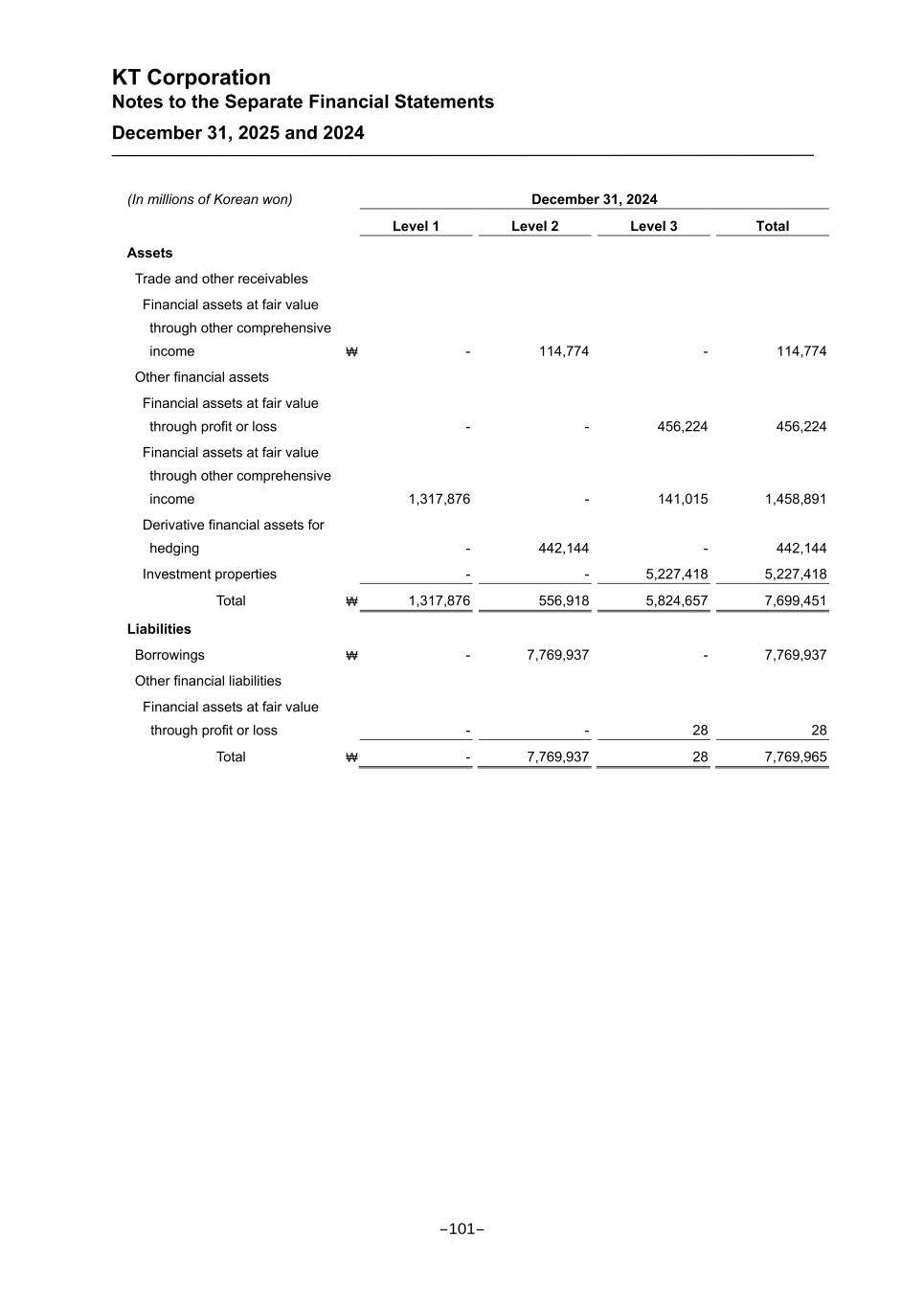
KT Corporation Notes to the Separate Financial Statements December 31, 2025 and 2024 (In millions of Korean won) December 31, 2024 Level 1 Level 2 Level 3 Total Assets Trade and other receivables Financial assets at fair value through other comprehensive income ₩ - 114,774 - 114,774 Other financial assets Financial assets at fair value through profit or loss - - 456,224 456,224 Financial assets at fair value through other comprehensive income 1,317,876 - 141,015 1,458,891 Derivative financial assets for hedging - 442,144 - 442,144 Investment properties - - 5,227,418 5,227,418 Total ₩ 1,317,876 556,918 5,824,657 7,699,451 Liabilities Borrowings ₩ - 7,769,937 - 7,769,937 Other financial liabilities Financial assets at fair value through profit or loss - - 28 28 Total ₩ - 7,769,937 28 7,769,965 -101-
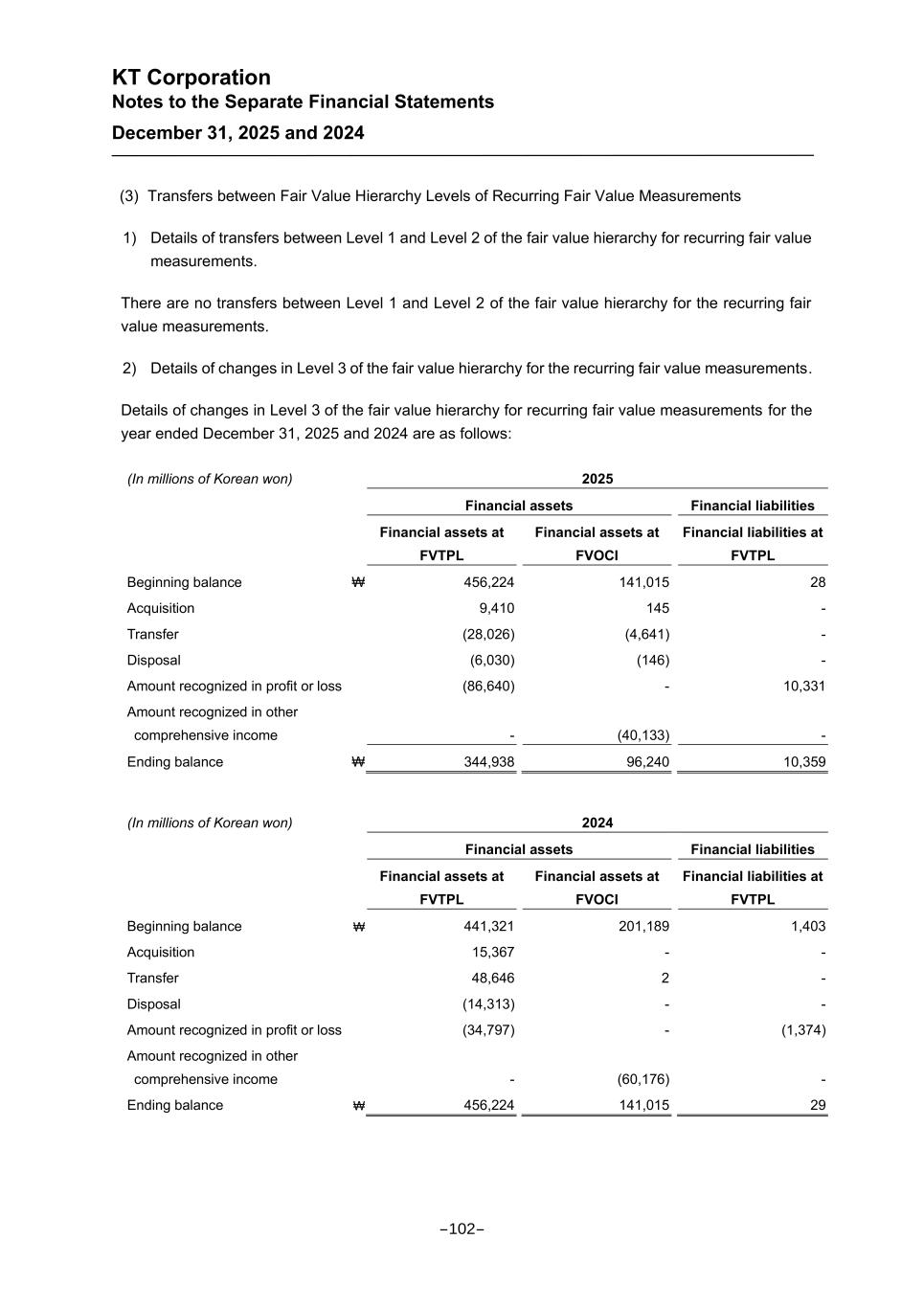
KT Corporation Notes to the Separate Financial Statements December 31, 2025 and 2024 (3) Transfers between Fair Value Hierarchy Levels of Recurring Fair Value Measurements 1) Details of transfers between Level 1 and Level 2 of the fair value hierarchy for recurring fair value measurements. There are no transfers between Level 1 and Level 2 of the fair value hierarchy for the recurring fair value measurements. 2) Details of changes in Level 3 of the fair value hierarchy for the recurring fair value measurements. Details of changes in Level 3 of the fair value hierarchy for recurring fair value measurements for the year ended December 31, 2025 and 2024 are as follows: (In millions of Korean won) 2025 Financial assets Financial liabilities Financial assets at FVTPL Financial assets at FVOCI Financial liabilities at FVTPL Beginning balance ₩ 456,224 141,015 28 Acquisition 9,410 145 - Transfer (28,026) (4,641) - Disposal (6,030) (146) - Amount recognized in profit or loss (86,640) - 10,331 Amount recognized in other comprehensive income - (40,133) - Ending balance ₩ 344,938 96,240 10,359 (In millions of Korean won) 2024 Financial assets Financial liabilities Financial assets at FVTPL Financial assets at FVOCI Financial liabilities at FVTPL Beginning balance ₩ 441,321 201,189 1,403 Acquisition 15,367 - - Transfer 48,646 2 - Disposal (14,313) - - Amount recognized in profit or loss (34,797) - (1,374) Amount recognized in other comprehensive income - (60,176) - Ending balance ₩ 456,224 141,015 29 -102-
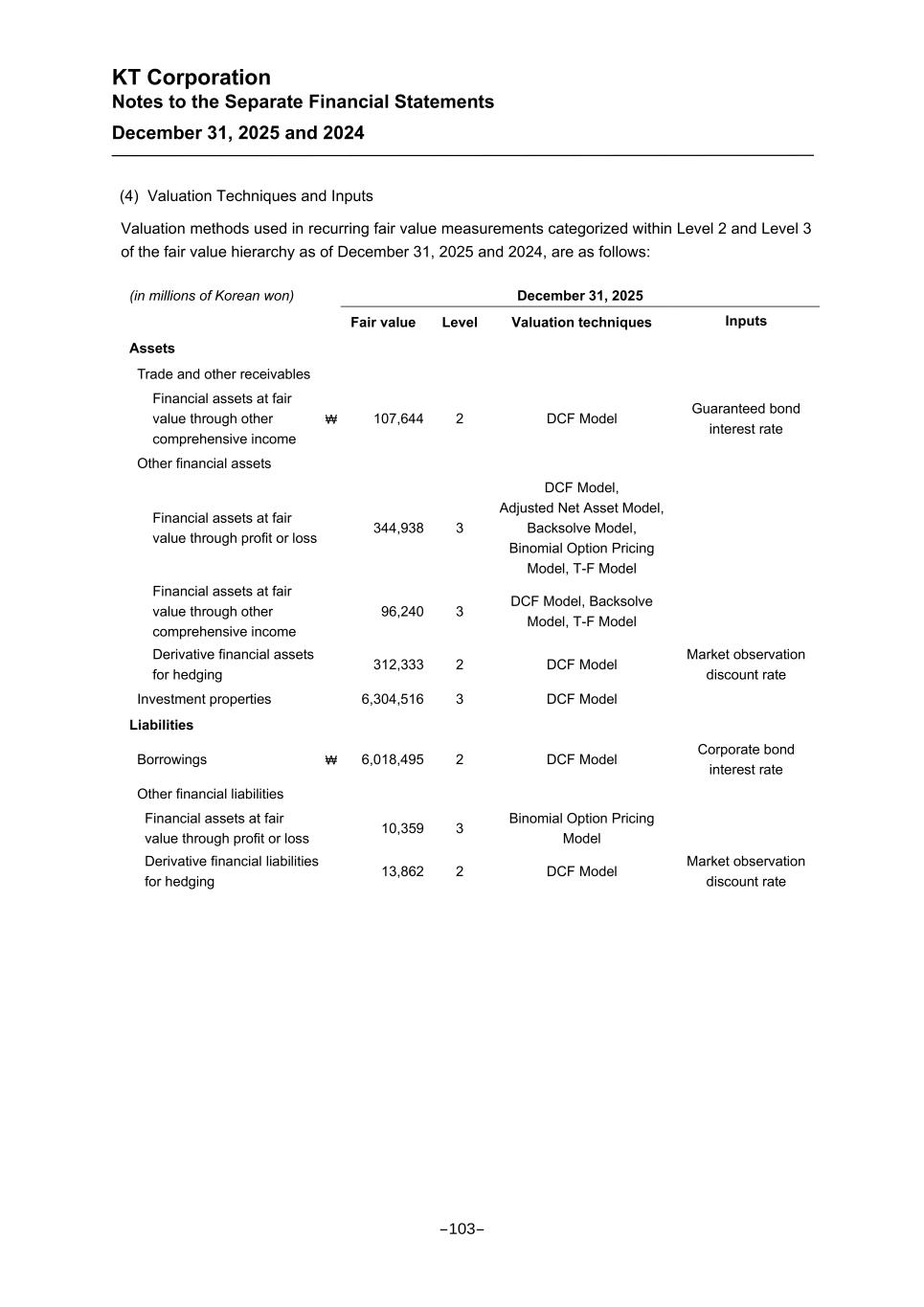
KT Corporation Notes to the Separate Financial Statements December 31, 2025 and 2024 (4) Valuation Techniques and Inputs Valuation methods used in recurring fair value measurements categorized within Level 2 and Level 3 of the fair value hierarchy as of December 31, 2025 and 2024, are as follows: (in millions of Korean won) December 31, 2025 Fair value Level Valuation techniques Inputs Assets Trade and other receivables Financial assets at fair value through other comprehensive income ₩ 107,644 2 DCF Model Guaranteed bond interest rate Other financial assets Financial assets at fair value through profit or loss 344,938 3 DCF Model, Adjusted Net Asset Model, Backsolve Model, Binomial Option Pricing Model, T-F Model Financial assets at fair value through other comprehensive income 96,240 3 DCF Model, Backsolve Model, T-F Model Derivative financial assets for hedging 312,333 2 DCF Model Market observation discount rate Investment properties 6,304,516 3 DCF Model Liabilities Borrowings ₩ 6,018,495 2 DCF Model Corporate bond interest rate Other financial liabilities Financial assets at fair value through profit or loss 10,359 3 Binomial Option Pricing Model Derivative financial liabilities for hedging 13,862 2 DCF Model Market observation discount rate -103-
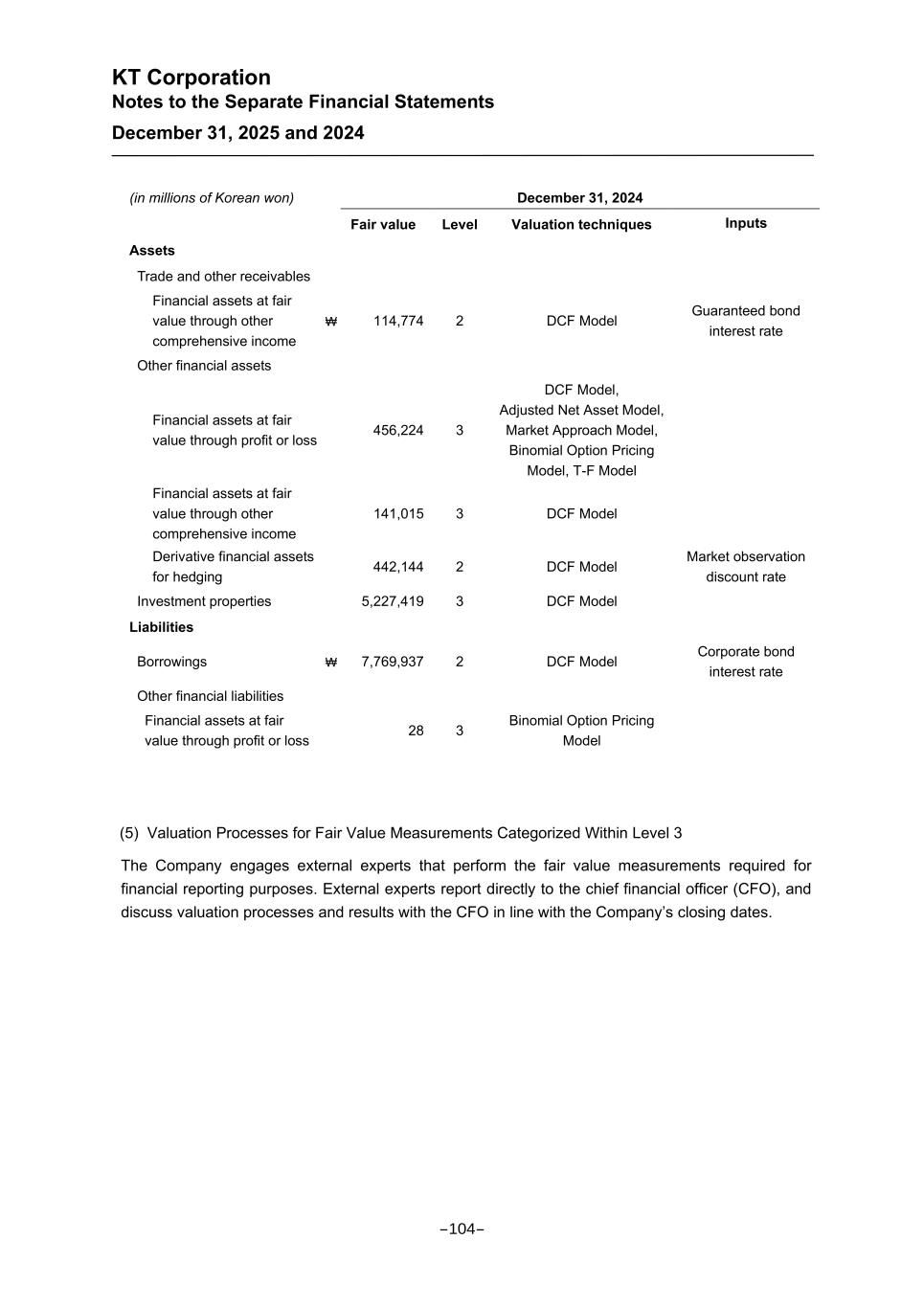
KT Corporation Notes to the Separate Financial Statements December 31, 2025 and 2024 (in millions of Korean won) December 31, 2024 Fair value Level Valuation techniques Inputs Assets Trade and other receivables Financial assets at fair value through other comprehensive income ₩ 114,774 2 DCF Model Guaranteed bond interest rate Other financial assets Financial assets at fair value through profit or loss 456,224 3 DCF Model, Adjusted Net Asset Model, Market Approach Model, Binomial Option Pricing Model, T-F Model Financial assets at fair value through other comprehensive income 141,015 3 DCF Model Derivative financial assets for hedging 442,144 2 DCF Model Market observation discount rate Investment properties 5,227,419 3 DCF Model Liabilities Borrowings ₩ 7,769,937 2 DCF Model Corporate bond interest rate Other financial liabilities Financial assets at fair value through profit or loss 28 3 Binomial Option Pricing Model (5) Valuation Processes for Fair Value Measurements Categorized Within Level 3 The Company engages external experts that perform the fair value measurements required for financial reporting purposes. External experts report directly to the chief financial officer (CFO), and discuss valuation processes and results with the CFO in line with the Company’s closing dates. -104-
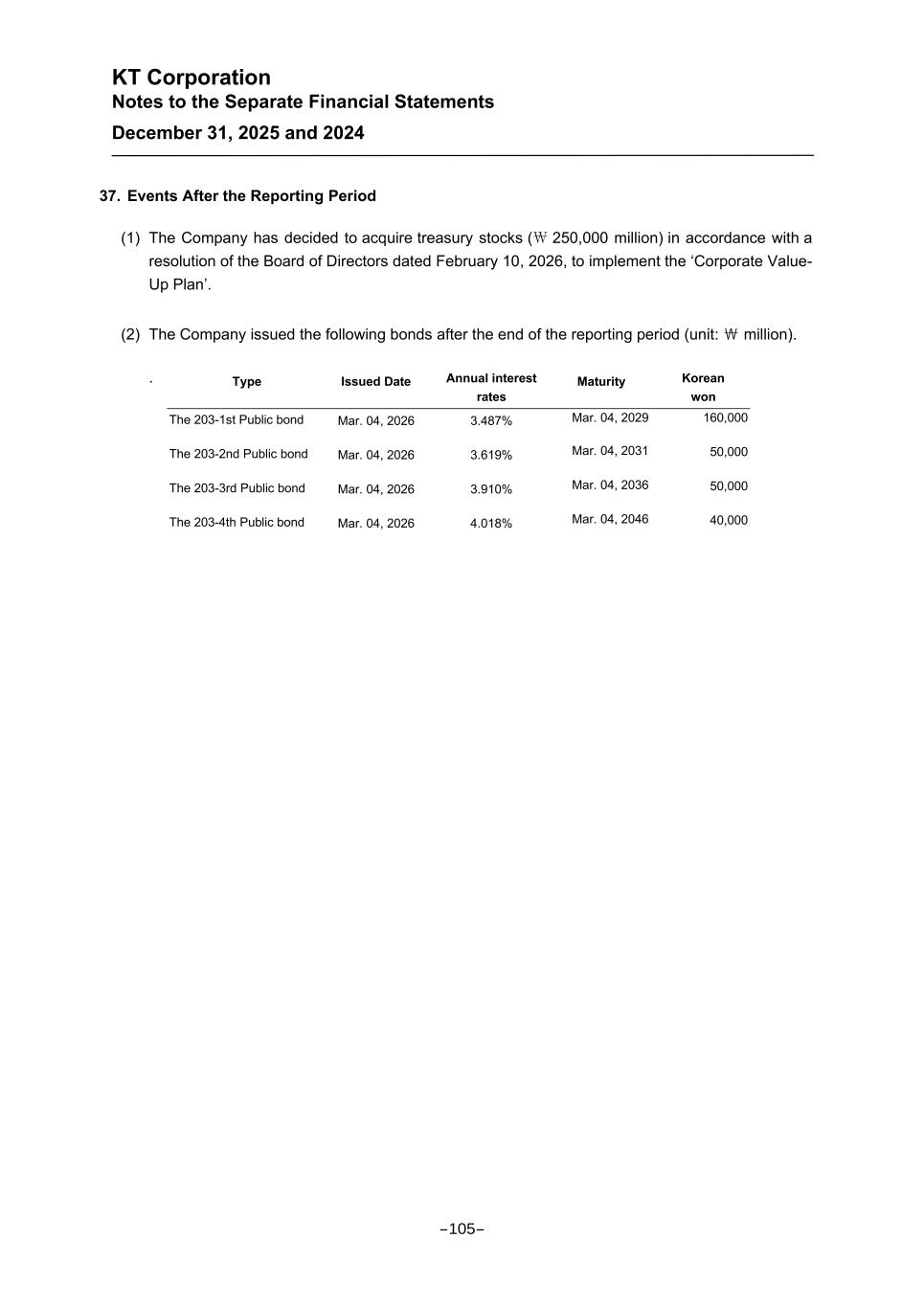
KT Corporation Notes to the Separate Financial Statements December 31, 2025 and 2024 37. Events After the Reporting Period (1) The Company has decided to acquire treasury stocks (₩ 250,000 million) in accordance with a resolution of the Board of Directors dated February 10, 2026, to implement the ‘Corporate Value- Up Plan’. (2) The Company issued the following bonds after the end of the reporting period (unit: \ million). . Type Issued Date Annual interest rates Maturity Korean won The 203-1st Public bond Mar. 04, 2026 3.487% Mar. 04, 2029 160,000 The 203-2nd Public bond Mar. 04, 2026 3.619% Mar. 04, 2031 50,000 The 203-3rd Public bond Mar. 04, 2026 3.910% Mar. 04, 2036 50,000 The 203-4th Public bond Mar. 04, 2026 4.018% Mar. 04, 2046 40,000 -105-
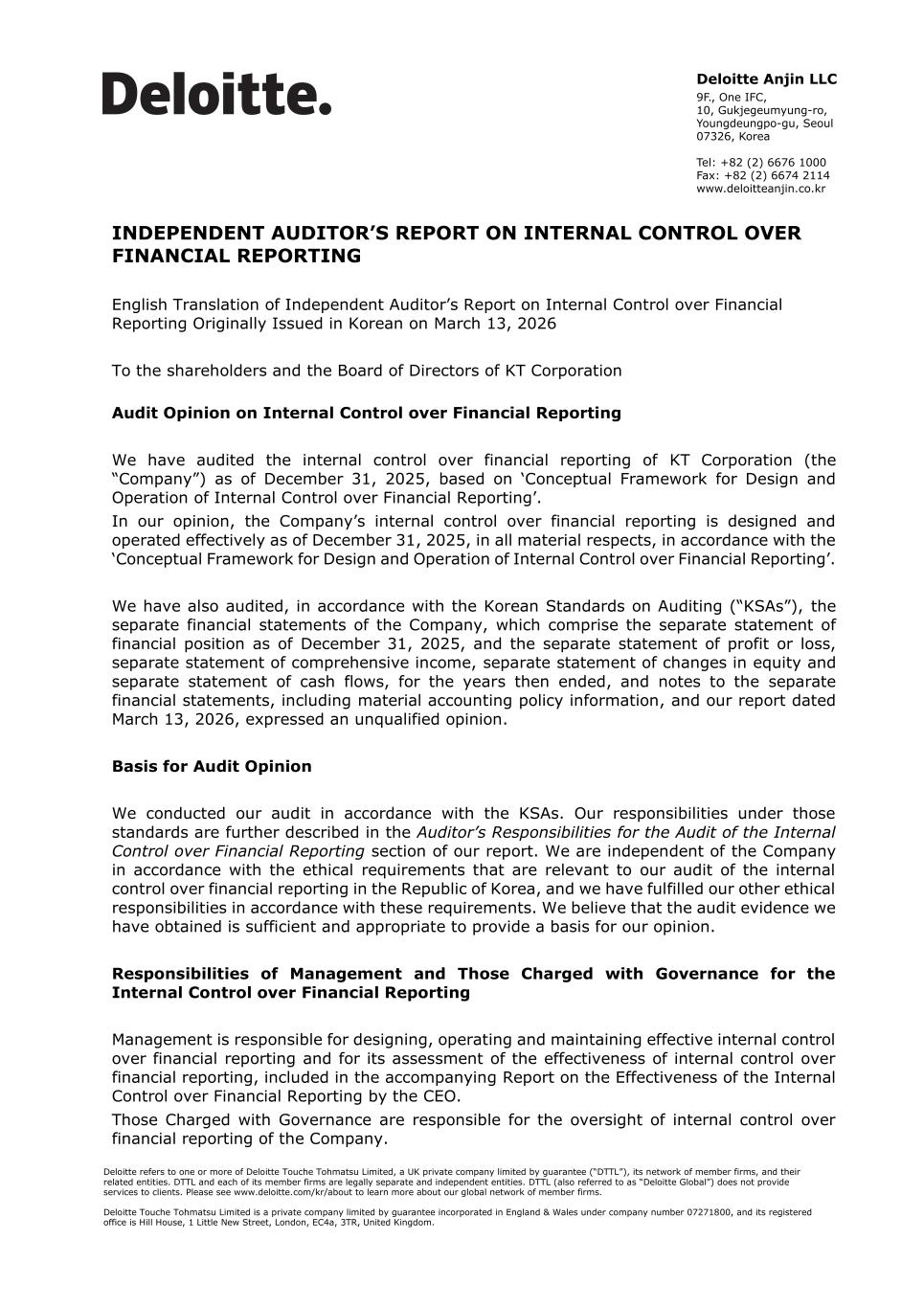
INDEPENDENT AUDITOR’S REPORT ON INTERNAL CONTROL OVER FINANCIAL REPORTING English Translation of Independent Auditor’s Report on Internal Control over Financial Reporting Originally Issued in Korean on March 13, 2026 To the shareholders and the Board of Directors of KT Corporation Audit Opinion on Internal Control over Financial Reporting We have audited the internal control over financial reporting of KT Corporation (the “Company”) as of December 31, 2025, based on ‘Conceptual Framework for Design and Operation of Internal Control over Financial Reporting’. In our opinion, the Company’s internal control over financial reporting is designed and operated effectively as of December 31, 2025, in all material respects, in accordance with the ‘Conceptual Framework for Design and Operation of Internal Control over Financial Reporting’. We have also audited, in accordance with the Korean Standards on Auditing (“KSAs”), the separate financial statements of the Company, which comprise the separate statement of financial position as of December 31, 2025, and the separate statement of profit or loss, separate statement of comprehensive income, separate statement of changes in equity and separate statement of cash flows, for the years then ended, and notes to the separate financial statements, including material accounting policy information, and our report dated March 13, 2026, expressed an unqualified opinion. Basis for Audit Opinion We conducted our audit in accordance with the KSAs. Our responsibilities under those standards are further described in the Auditor’s Responsibilities for the Audit of the Internal Control over Financial Reporting section of our report. We are independent of the Company in accordance with the ethical requirements that are relevant to our audit of the internal control over financial reporting in the Republic of Korea, and we have fulfilled our other ethical responsibilities in accordance with these requirements. We believe that the audit evidence we have obtained is sufficient and appropriate to provide a basis for our opinion. Responsibilities of Management and Those Charged with Governance for the Internal Control over Financial Reporting Management is responsible for designing, operating and maintaining effective internal control over financial reporting and for its assessment of the effectiveness of internal control over financial reporting, included in the accompanying Report on the Effectiveness of the Internal Control over Financial Reporting by the CEO. Those Charged with Governance are responsible for the oversight of internal control over financial reporting of the Company. Deloitte Anjin LLC 9F., One IFC, 10, Gukjegeumyung-ro, Youngdeungpo-gu, Seoul 07326, Korea Tel: +82 (2) 6676 1000 Fax: +82 (2) 6674 2114 www.deloitteanjin.co.kr
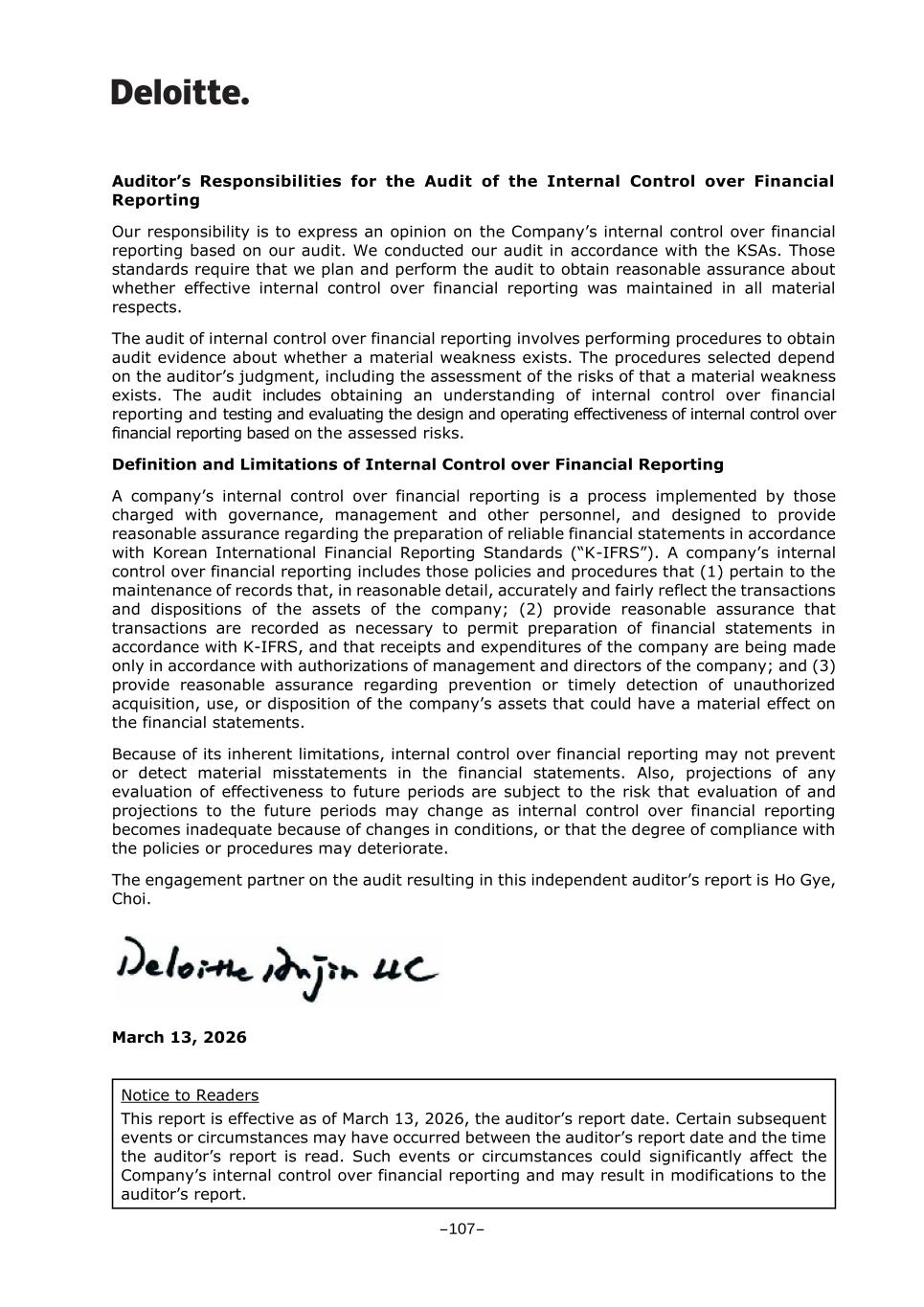
Auditor’s Responsibilities for the Audit of the Internal Control over Financial Reporting Our responsibility is to express an opinion on the Company’s internal control over financial reporting based on our audit. We conducted our audit in accordance with the KSAs. Those standards require that we plan and perform the audit to obtain reasonable assurance about whether effective internal control over financial reporting was maintained in all material respects. The audit of internal control over financial reporting involves performing procedures to obtain audit evidence about whether a material weakness exists. The procedures selected depend on the auditor’s judgment, including the assessment of the risks of that a material weakness exists. The audit includes obtaining an understanding of internal control over financial reporting and testing and evaluating the design and operating effectiveness of internal control over financial reporting based on the assessed risks. Definition and Limitations of Internal Control over Financial Reporting A company’s internal control over financial reporting is a process implemented by those charged with governance, management and other personnel, and designed to provide reasonable assurance regarding the preparation of reliable financial statements in accordance with Korean International Financial Reporting Standards (“K-IFRS”). A company’s internal control over financial reporting includes those policies and procedures that (1) pertain to the maintenance of records that, in reasonable detail, accurately and fairly reflect the transactions and dispositions of the assets of the company; (2) provide reasonable assurance that transactions are recorded as necessary to permit preparation of financial statements in accordance with K-IFRS, and that receipts and expenditures of the company are being made only in accordance with authorizations of management and directors of the company; and (3) provide reasonable assurance regarding prevention or timely detection of unauthorized acquisition, use, or disposition of the company’s assets that could have a material effect on the financial statements. Because of its inherent limitations, internal control over financial reporting may not prevent or detect material misstatements in the financial statements. Also, projections of any evaluation of effectiveness to future periods are subject to the risk that evaluation of and projections to the future periods may change as internal control over financial reporting becomes inadequate because of changes in conditions, or that the degree of compliance with the policies or procedures may deteriorate. The engagement partner on the audit resulting in this independent auditor’s report is Ho Gye, Choi. March 13, 2026 Notice to Readers This report is effective as of March 13, 2026, the auditor’s report date. Certain subsequent events or circumstances may have occurred between the auditor’s report date and the time the auditor’s report is read. Such events or circumstances could significantly affect the Company’s internal control over financial reporting and may result in modifications to the auditor’s report. -107-
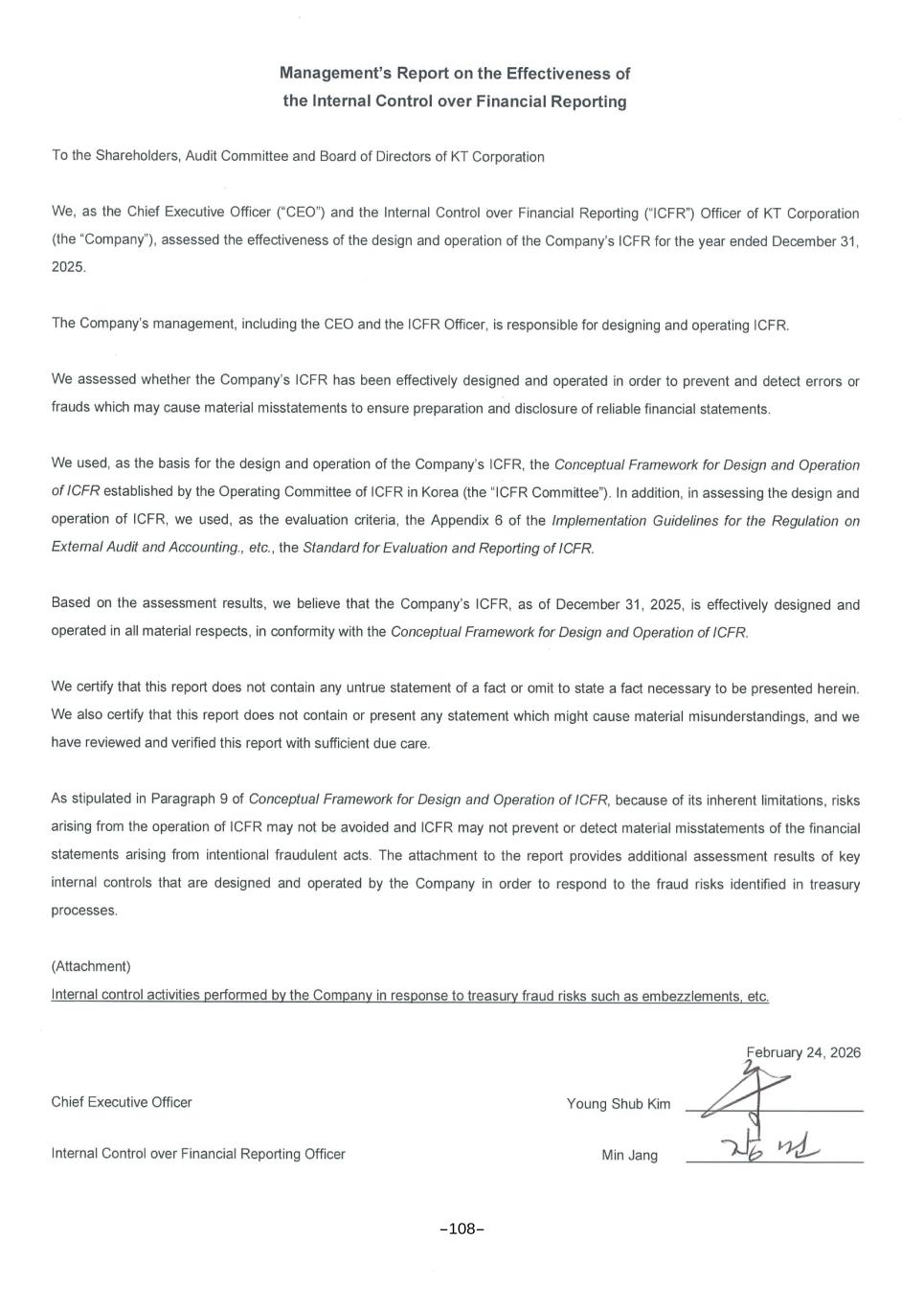
-108-
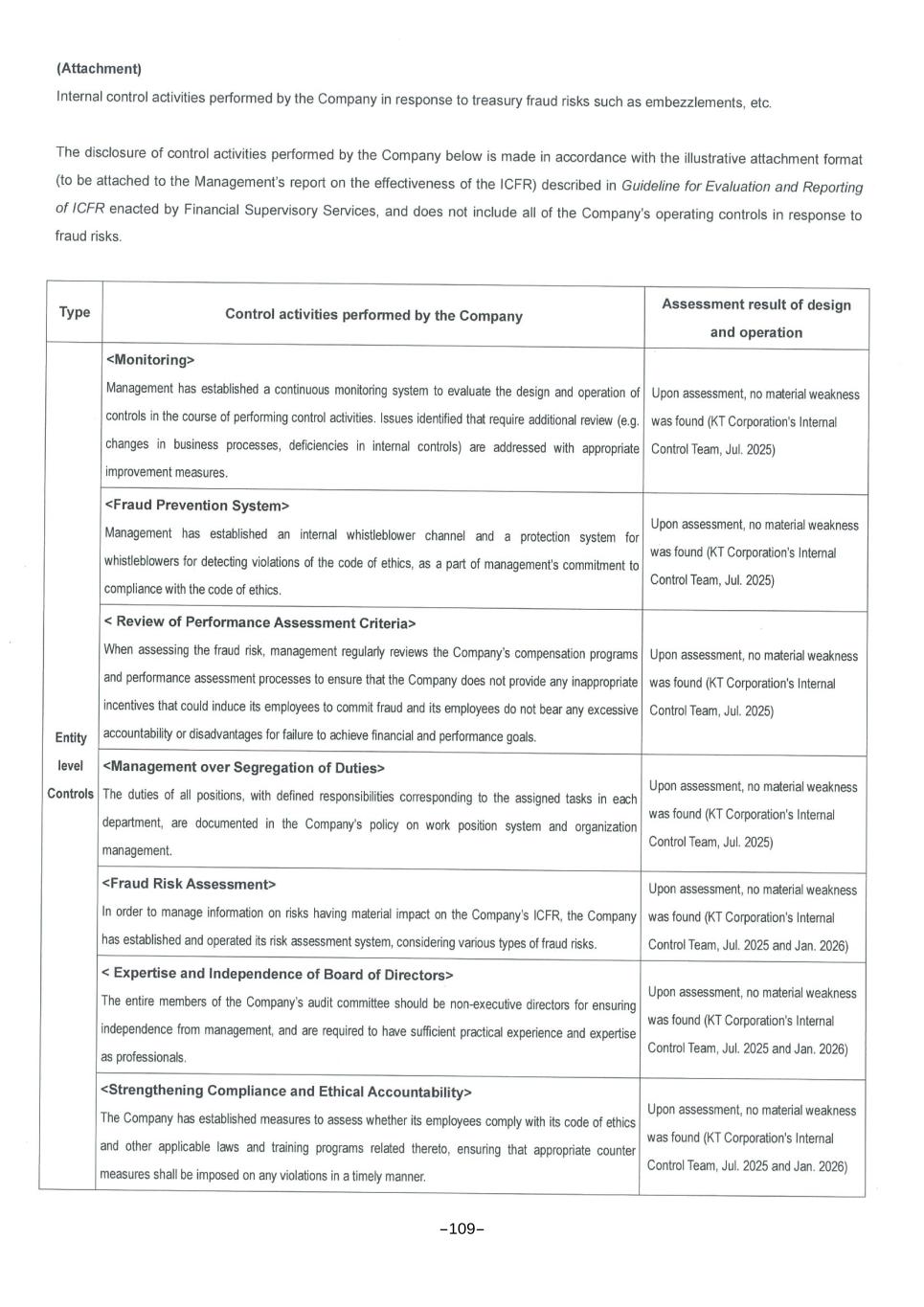
-109-
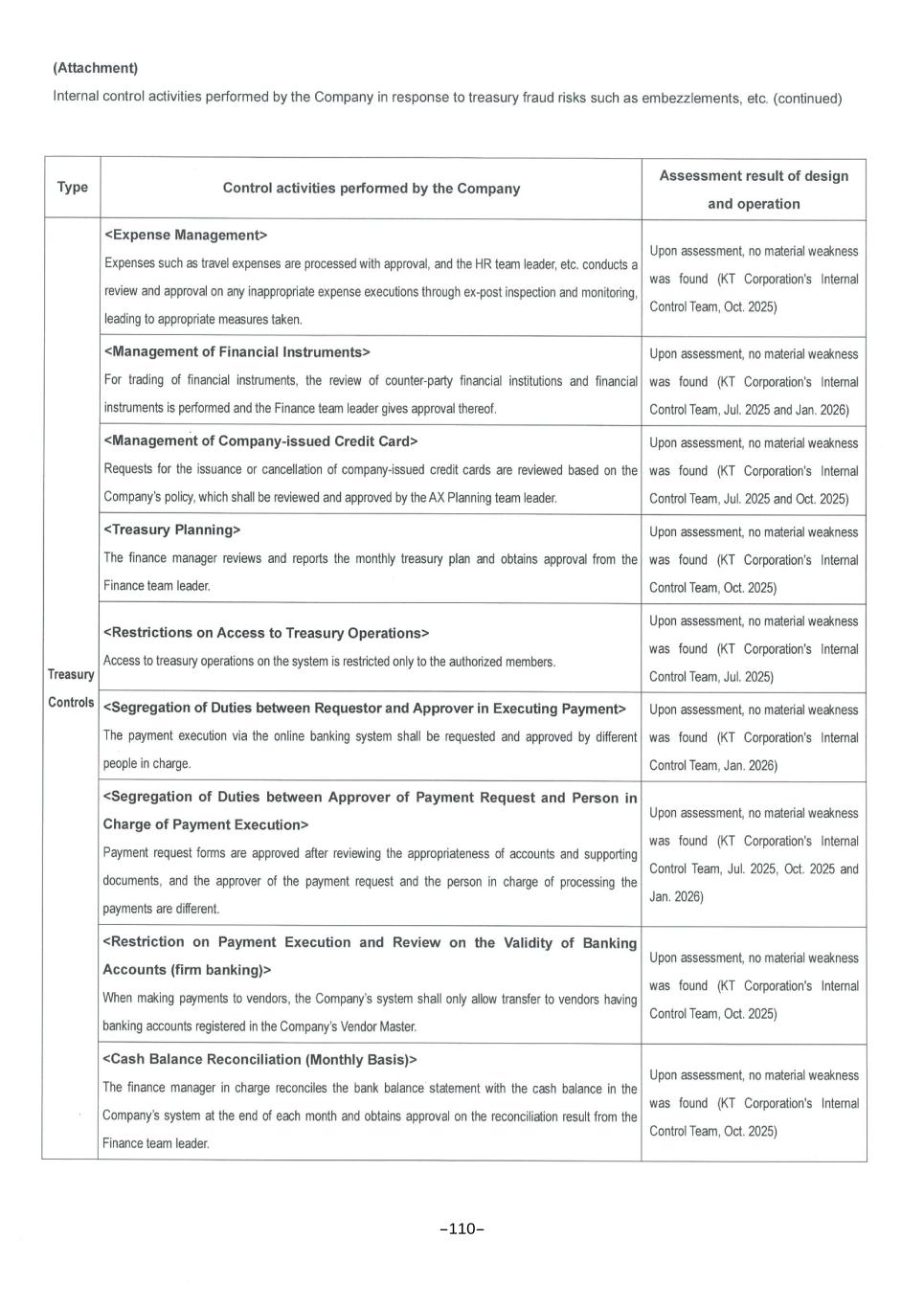
-110-
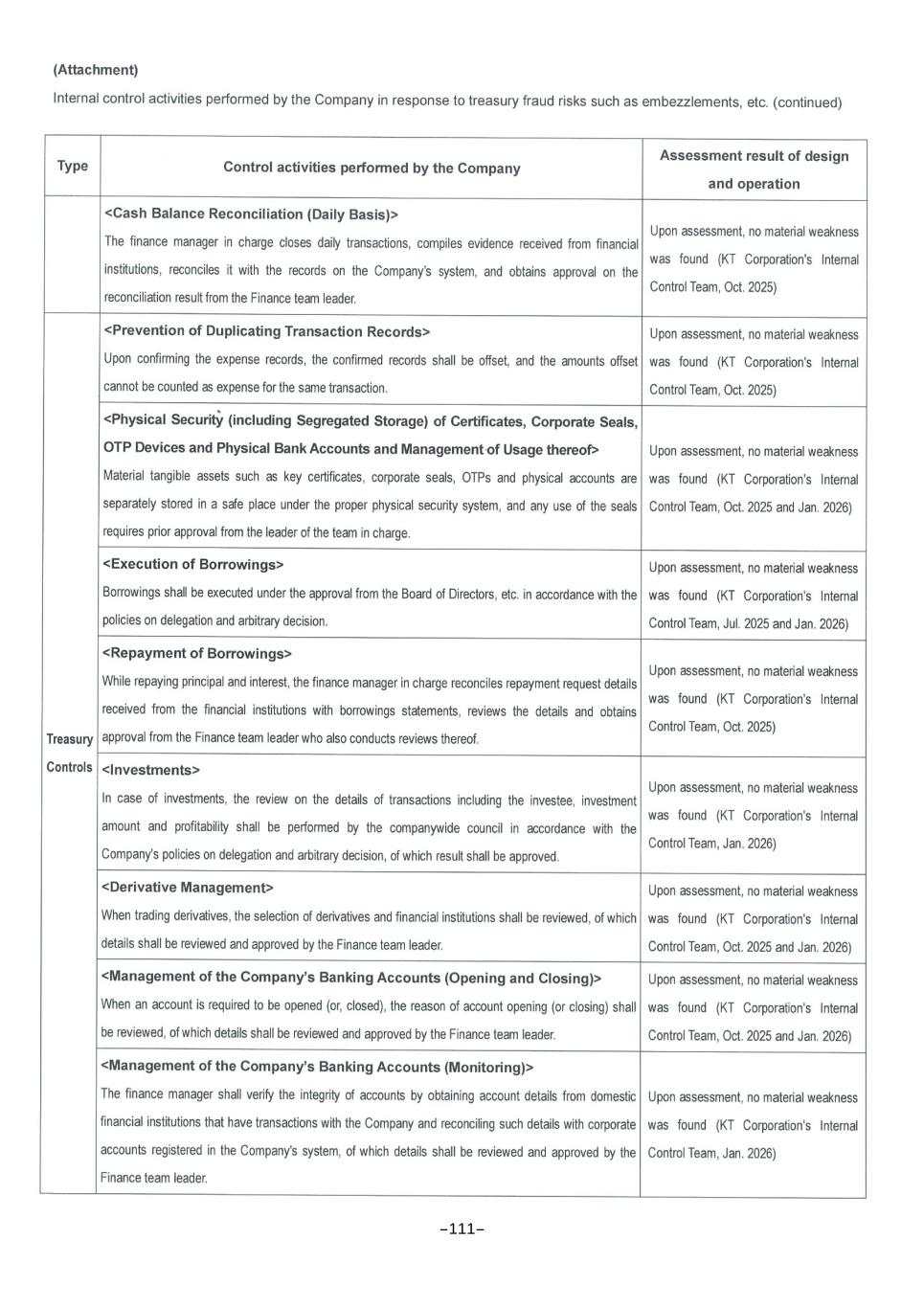
-111-