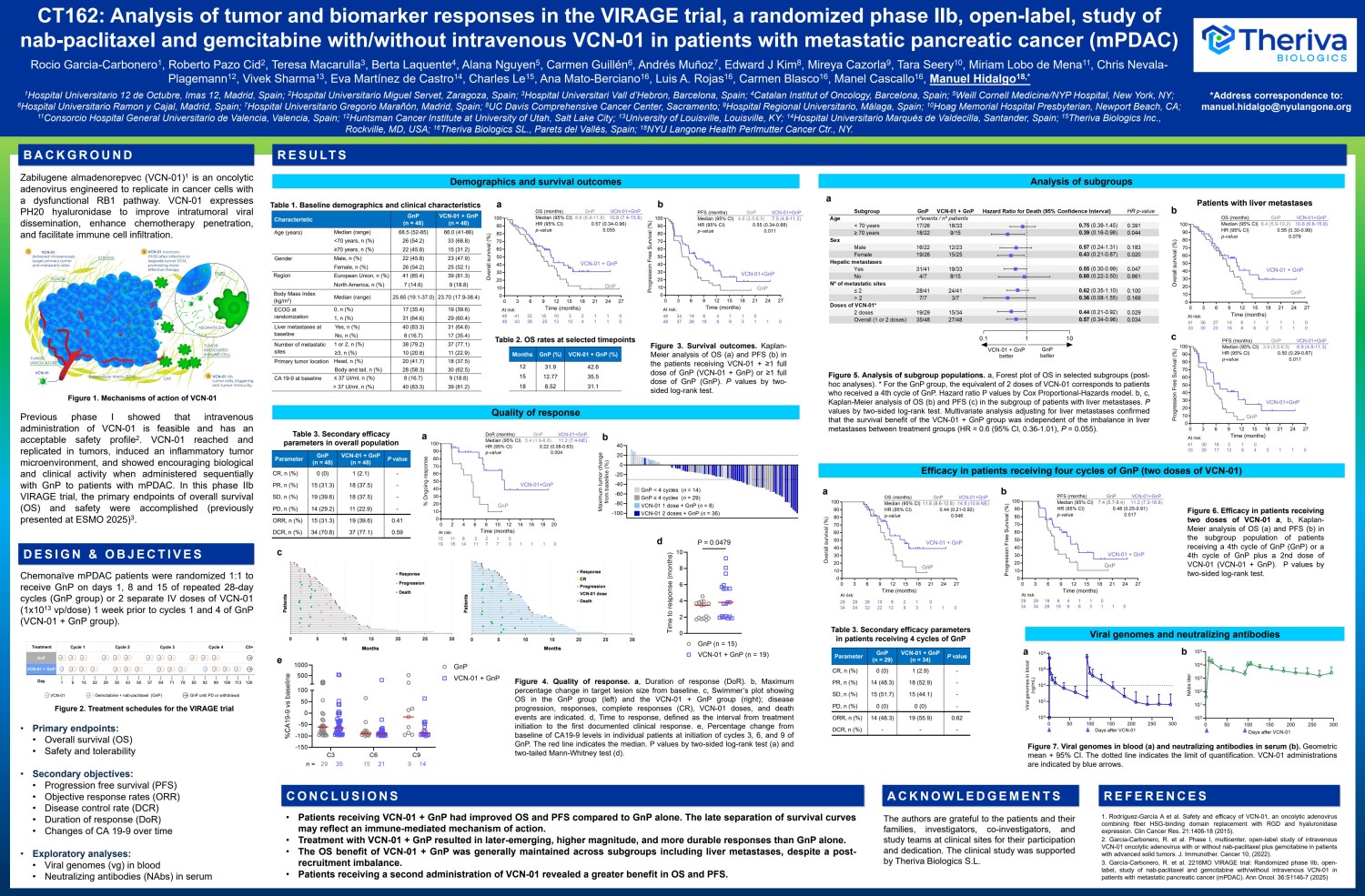
| *Address correspondence to: manuel.hidalgo@nyulangone.org CT162: Analysis of tumor and biomarker responses in the VIRAGE trial, a randomized phase IIb, open-label, study of nab-paclitaxel and gemcitabine with/without intravenous VCN-01 in patients with metastatic pancreatic cancer (mPDAC) Rocio Garcia-Carbonero1 , Roberto Pazo Cid2 , Teresa Macarulla 3 , Berta Laquente 4 , Alana Nguyen 5 , Carmen Guillén 6 , Andrés Muñoz 7 , Edward J Kim8 , Mireya Cazorla 9 , Tara Seery 10 , Miriam Lobo de Mena 11 , Chris Nevala-Plagemann12, Vivek Sharma13, Eva Martínez de Castro 14 , Charles Le 15 , Ana Mato-Berciano 16 , Luis A. Rojas 16 , Carmen Blasco 16 , Manel Cascallo 16 , Manuel Hidalgo18,* 1Hospital Universitario 12 de Octubre, Imas 12, Madrid, Spain; 2Hospital Universitario Miguel Servet, Zaragoza, Spain; 3Hospital Universitari Vall d’Hebron, Barcelona, Spain; 4Catalan Institut of Oncology, Barcelona, Spain; 5Weill Cornell Medicine/NYP Hospital, New York, NY; 6Hospital Universitario Ramon y Cajal, Madrid, Spain; 7Hospital Universitario Gregorio Marañón, Madrid, Spain; 8UC Davis Comprehensive Cancer Center, Sacramento; 9Hospital Regional Universitario, Málaga, Spain; 10Hoag Memorial Hospital Presbyterian, Newport Beach, CA; 11Consorcio Hospital General Universitario de Valencia, Valencia, Spain; 12Huntsman Cancer Institute at University of Utah, Salt Lake City; 13University of Louisville, Louisville, KY; 14Hospital Universitario Marqués de Valdecilla, Santander, Spain; 15Theriva Biologics Inc., Rockville, MD, USA; 16Theriva Biologics SL., Parets del Vallès, Spain; 18NYU Langone Health Perlmutter Cancer Ctr., NY. VCN-01 is a clinical-stage oncolytic adenovirus engineered to replicate selectively in cancer cells with an aberrant RB1-E2F pathway. The VCN-01 E1A promoter is modified by inclusion of eight E2F1 binding sites and a 24-bp deletion that promotes viral transcription in cells with elevated free E2F1 and renders the virus replication-deficient in RB1-functional, normal cells. Here, human pancreatic cancer cell lines were exposed to topoisomerase I (topo1) inhibiting chemotherapeutics, irinotecan (IRI), its active metabolite, SN-38, and topotecan (topo; see Figure A). Notably, in NP-18 cells, E2F1 mRNA was increased ~3-fold compared to untreated cells, and E1A mRNA was boosted ~5-fold in cells treated with VCN-01 + topo1 inhibitors compared to VCN-01 alone. These data suggest that topo1 inhibitor-mediated elevations in E2F1 increase VCN-01 transcription. Based on these promising in vitro results, the potential synergy of VCN-01 plus the liposomal formulation of IRI ( B A C K G R O U N D Zabilugene almadenorepvec (VCN-01) 1 is an oncolytic adenovirus engineered to replicate in cancer cells with a dysfunctional RB1 pathway. VCN-01 expresses PH20 hyaluronidase to improve intratumoral viral dissemination, enhance chemotherapy penetration, and facilitate immune cell infiltration. Previous phase I showed that intravenous administration of VCN-01 is feasible and has an acceptable safety profile2 . VCN-01 reached and replicated in tumors, induced an inflammatory tumor microenvironment, and showed encouraging biological and clinical activity when administered sequentially with GnP to patients with mPDAC. In this phase IIb VIRAGE trial, the primary endpoints of overall survival (OS) and safety were accomplished (previously presented at ESMO 2025) 3 . Figure 1. Mechanisms of action of VCN-01 Chemonaïve mPDAC patients were randomized 1:1 to receive GnP on days 1, 8 and 15 of repeated 28-day cycles (GnP group) or 2 separate IV doses of VCN-01 (1x10¹³ vp/dose) 1 week prior to cycles 1 and 4 of GnP (VCN-01 + GnP group). • Primary endpoints: • Overall survival (OS) • Safety and tolerability • Secondary objectives: • Progression free survival (PFS) • Objective response rates (ORR) • Disease control rate (DCR) • Duration of response (DoR) • Changes of CA 19-9 over time • Exploratory analyses: • Viral genomes (vg) in blood • Neutralizing antibodies (NAbs) in serum Figure 2. Treatment schedules for the VIRAGE trial D E S I G N & O B J E C T I V E S • Patients receiving VCN-01 + GnP had improved OS and PFS compared to GnP alone. The late separation of survival curves may reflect an immune-mediated mechanism of action. • Treatment with VCN-01 + GnP resulted in later-emerging, higher magnitude, and more durable responses than GnP alone. • The OS benefit of VCN-01 + GnP was generally maintained across subgroups including liver metastases, despite a post-recruitment imbalance. • Patients receiving a second administration of VCN-01 revealed a greater benefit in OS and PFS. C O N C L U S I O N S R E S U LT S Demographics and survival outcomes Figure 3. Survival outcomes. Kaplan-Meier analysis of OS (a) and PFS (b) in the patients receiving VCN-01 + ≥1 full dose of GnP (VCN-01 + GnP) or ≥1 full dose of GnP (GnP). P values by two-sided log-rank test. Quality of response Table 2. OS rates at selected timepoints Analysis of subgroups 1. Rodríguez-García A et al. Safety and efficacy of VCN-01, an oncolytic adenovirus combining fiber HSG-binding domain replacement with RGD and hyaluronidase expression. Clin Cancer Res. 21:1406-18 (2015). 2. Garcia-Carbonero, R. et al. Phase I, multicenter, open-label study of intravenous VCN-01 oncolytic adenovirus with or without nab-paclitaxel plus gemcitabine in patients with advanced solid tumors. J. Immunother. Cancer 10, (2022). 3. García-Carbonero, R. et al. 2216MO VIRAGE trial: Randomized phase IIb, open-label, study of nab-paclitaxel and gemcitabine with/without intravenous VCN-01 in patients with metastatic pancreatic cancer (mPDAC). Ann Oncol. 36:S1146-7 (2025) The authors are grateful to the patients and their families, investigators, co-investigators, and study teams at clinical sites for their participation and dedication. The clinical study was supported by Theriva Biologics S.L. A C K N O W L E D G E M E N T S R E F E R E N C E S Efficacy in patients receiving four cycles of GnP (two doses of VCN-01) Patients with liver metastases Table 3. Secondary efficacy parameters in patients receiving 4 cycles of GnP Figure 6. Efficacy in patients receiving two doses of VCN-01 a, b, Kaplan-Meier analysis of OS (a) and PFS (b) in the subgroup population of patients receiving a 4th cycle of GnP (GnP) or a 4th cycle of GnP plus a 2nd dose of VCN-01 (VCN-01 + GnP). P values by two-sided log-rank test. Viral genomes and neutralizing antibodies Figure 7. Viral genomes in blood (a) and neutralizing antibodies in serum (b). Geometric mean + 95% CI. The dotted line indicates the limit of quantification. VCN-01 administrations are indicated by blue arrows. Figure 5. Analysis of subgroup populations. a, Forest plot of OS in selected subgroups (post-hoc analyses). * For the GnP group, the equivalent of 2 doses of VCN-01 corresponds to patients who received a 4th cycle of GnP. Hazard ratio P values by Cox Proportional-Hazards model. b, c, Kaplan-Meier analysis of OS (b) and PFS (c) in the subgroup of patients with liver metastases. P values by two-sided log-rank test. Multivariate analysis adjusting for liver metastases confirmed that the survival benefit of the VCN-01 + GnP group was independent of the imbalance in liver metastases between treatment groups (HR = 0.6 (95% CI, 0.36-1.01), P = 0.055). a b a c b d a c b a b a b Table 3. Secondary efficacy parameters in overall population e Figure 4. Quality of response. a, Duration of response (DoR). b, Maximum percentage change in target lesion size from baseline. c, Swimmer’s plot showing OS in the GnP group (left) and the VCN-01 + GnP group (right); disease progression, responses, complete responses (CR), VCN-01 doses, and death events are indicated. d, Time to response, defined as the interval from treatment initiation to the first documented clinical response. e, Percentage change from baseline of CA19-9 levels in individual patients at initiation of cycles 3, 6, and 9 of GnP. The red line indicates the median. P values by two-sided log-rank test (a) and two-tailed Mann-Whitney test (d). Table 1. Baseline demographics and clinical characteristics Characteristic GnP (n = 48) VCN-01 + GnP (n = 48) Age (years) Median (range) 68.5 (52-85) 66.0 (41-86) <70 years, n (%) 26 (54.2) 33 (68.8) ≥70 years, n (%) 22 (45.8) 15 (31.2) Gender Male, n (%) 22 (45.8) 23 (47.9) Female, n (%) 26 (54.2) 25 (52.1) Region European Union, n (%) 41 (85.4) 39 (81.3) North America, n (%) 7 (14.6) 9 (18.8) Body Mass Index (kg/m2 ) Median (range) 25.65 (19.1-37.0) 23.70 (17.9-38.4) ECOG at randomization 0, n (%) 17 (35.4) 19 (39.6) 1, n (%) 31 (64.6) 29 (60.4) Liver metastases at baseline Yes, n (%) 40 (83.3) 31 (64.6) No, n (%) 8 (16.7) 17 (35.4) Number of metastatic sites 1 or 2, n (%) 38 (79.2) 37 (77.1) ≥3, n (%) 10 (20.8) 11 (22.9) Primary tumor location Head, n (%) 20 (41.7) 18 (37.5) Body and tail, n (%) 28 (58.3) 30 (62.5) CA 19-9 at baseline ≤ 37 UI/ml, n (%) 8 (16.7) 9 (18.8) > 37 UI/ml, n (%) 40 (83.3) 39 (81.2) Months GnP (%) VCN-01 + GnP (%) 12 31.9 42.6 15 12.77 35.5 18 8.52 31.1 Parameter GnP (n = 48) VCN-01 + GnP (n = 48) P value CR, n (%) 0 (0) 1 (2.1) - PR, n (%) 15 (31.3) 18 (37.5) - SD, n (%) 19 (39.6) 18 (37.5) - PD, n (%) 14 (29.2) 11 (22.9) - ORR, n (%) 15 (31.3) 19 (39.6) 0.41 DCR, n (%) 34 (70.8) 37 (77.1) 0.59 Parameter GnP (n = 29) VCN-01 + GnP (n = 34) P value CR, n (%) 0 (0) 1 (2.9) - PR, n (%) 14 (48.3) 18 (52.9) - SD, n (%) 15 (51.7) 15 (44.1) - PD, n (%) 0 (0) 0 (0) - ORR, n (%) 14 (48.3) 19 (55.9) 0.62 DCR, n (%) - - - |