
TECHNICHAL REPORT SUMMARY OF THE PAMPA BLANCA OPERATION YEAR 2025 Date: April, 2026 Exhibit 96.3 Summary This report provides the methodology, procedures and classification used to obtain SQM´s nitrate and iodine mineral resources and mineral reserves, at the Pampa Blanca Site. The mineral resources and reserves that are delivered correspond to the update as of December 31, 2025. The results obtained are summarized in the following tables: Mineral Resources 2025 Mining Total Inferred Resource Total Indicated Resource Total Measured Resource Tonnage (Mt) Nitrate Grade (%) Iodine Grade (ppm) Tonnage (Mt) Nitrate Grade (%) Iodine Grade (ppm) Tonnage (Mt) Nitrate Grade (%) Iodine Grade (ppm) Pampa Blanca 217.8 5.38 513 526.4 6.33 559 99.5 5.31 385 Mining Property Proven Reserves (1) Average grade Nitrates Average grade Iodine (million metric tons) (Percentage by weight) (Parts per million) Pampa Blanca 76.4 5.39% 399 Mining Property Probable Reserves Average grade Nitrate Average grade Iodine (million metric tons) (Percentage by weight) (Parts per million) Pampa Blanca (1) The tables above show the proven and probable reserves before losses related to the exploitation and treatment of the mineral. Proven and probable reserves are affected by mining methods, resulting in differences between the estimated reserves that are available for exploitation in the mine plan and the recoverable material that is ultimately transferred to the leach pads. The global average metallurgical recovery of nitrate and iodine processes contained in the recovered material is variable in each pampa (60% to 80 %). Proven and probable reserves have a caliche thickness ≥ 2.0 m and a slope which should not exceed 8%. (2) All the most proven mining reserves are with the block model valued method, for which each pampa will have a cut-off benefit (BC), to maximize the economic value of each block. TRS Pampa Blanca 2025 Pag. 2 TABLE OF CONTENT TABLE OF CONTENT .................................................................................................... 3 TABLES ............................................................................................................................ 6 1 EXECUTIVE SUMMARY ................................................................................... 9 1.6.1 Metallurgical Testing Summary .................................................................. 14 1.6.2 Mining and Mineral Processing Summary .................................................. 14 2 INTRODUCTION ................................................................................................. 15 3 DESCRIPTION AND LOCATION ...................................................................... 20 4 ACCESSIBILITY, CLIMATE, LOCAL RESOURCES, INFRASTRUCTURE AND PHYSIOGRAPHY .................................................................................................. 23 5 HISTORY .............................................................................................................. 26 6 GEOLOGICAL SETTING, MINERALIZATION AND DEPOSIT .................... 26 6.3.7 Pampa Blanca .............................................................................................. 35 6.3.8 Enlargement Pampa Blanca ........................................................................ 37 6.3.9 Blanco Encalada .......................................................................................... 37 6.5.1 Genesis of Caliche Deposits ........................................................................ 40 6.5.2 Local Mineral Deposit ................................................................................. 40 7 EXPLORATION ................................................................................................... 40 7.3.1 2025 Campaigns. ......................................................................................... 44 7.3.2 Exploration Drill Sample Recovery ............................................................. 45 7.3.3 Exploration Drill Hole Logging ................................................................... 45 7.3.4 Exploration Drill Hole Location of Data Points ........................................... 46 7.3.5 Qualified Person’s Statement on Exploration Drilling ................................. 46 8 SAMPLE PREPARATION, ANALYSIS AND SECURITY ............................... 46 8.1.1 RC Drilling ................................................................................................... 46 8.1.2 Sample Preparation ....................................................................................... 47 Nitrate Determination .................................................................................................... 50 Iodine Determination ..................................................................................................... 50 8.3.1 Laboratory quality control ............................................................................ 51 Precision Control ........................................................................................................... 51 Batch Composition ........................................................................................................ 51 8.3.2 Quality Control and Quality Assurance Programs ...................................... 51 8.3.3 Sample Security ............................................................................................ 56 9 DATA VERIFICATION ....................................................................................... 61 10 MINERAL PROCESSING AND METALLURGICAL TESTING ..................... 63 10.2.1 Sample Preparation ..................................................................................... 65 10.2.2 Caliche Mineralogical and Chemical Characterization .............................. 68 10.2.3 .................................................................................................................... 69 10.2.4 Caliche Physical Properties ........................................................................ 70 10.2.5 Industrial Scale Yield Estimation ............................................................... 75 11 MINERAL RESOURCE ESTIMATE .................................................................. 77 11.1.1 Sample Database ....................................................................................... 78 TRS Pampa Blanca 2025 Pag. 3 11.1.2 Geological Domains and Modeling ............................................................ 78 11.1.3 Assay Compositing ..................................................................................... 79 11.1.4 Evaluation of Outlier Grades, Cut-offs, and Grade Capping ..................... 79 11.1.5 Specific Gravity (SG) ................................................................................. 79 11.1.6 Block Model Mineral Resource Evaluation .............................................. 82 11.1.7 Polygon Mineral Resources Evaluation ..................................................... 92 12 MINERAL RESERVE ESTIMATE ..................................................................... 94 13. MINING METHODS ............................................................................................ 98 14. PROCESSING AND RECOVERY METHODS ................................................... 109 14.1.1 Heap Leaching: .......................................................................................... 111 14.1.2 Iodide Plant ................................................................................................. 113 14.1.3 Florencia evaporation solar Ponds .............................................................. 113 14.2.1 Process Criteria ........................................................................................... 115 14.2.2 Solar Pond Specifications ........................................................................... 115 14.2.3 Production Balance and Yields .................................................................. 116 14.2.4 Production Estimation ............................................................................... 117 14.3.1. Energy and Fuel Requirements ................................................................. 118 14.3.2. Water Supply and Consumption ................................................................ 118 Water Consumption ............................................................................................... 119 15 PROJECT INFRASTRUCTURE ................................................................................. 122 15.2.1 Mine ............................................................................................................ 126 15.2.2 Leaching ..................................................................................................... 127 15.2.3 Iodide Plant ................................................................................................. 128 15.2.4 Evaporation Ponds ...................................................................................... 130 16 MARKET STUDIES .............................................................................................. 135 16.1.3.1.1 Market ................................................................................................. 136 16.1.3.1.3 Marketing and Customers .................................................................... 138 16.1.3.1.4 Competition .......................................................................................... 138 17 ENVIRONMENTAL STUDIES, PERMITTING AND SOCIAL OR COMMUNITY IMPACT .................................................................................................. 147 17.1.1 Baseline studies .......................................................................................... 148 17.1.2 .................................................................................................................... 153 17.2.1 .................................................................................................................... 154 .............................................................................................................................. 154 17.2.2 M ............................................................................................................... 154 17.4.1 .................................................................................................................... 156 .............................................................................................................................. 156 17.4.2 Local hiring commitments ......................................................................... 157 17.4.3 Social Risk Matrix ..................................................................................... 157 17.5.1 .................................................................................................................... 158 ............................................................................................................................. 158 17.5.2 Closing costs ............................................................................................... 162 18 CAPITAL AND OPERATING COSTS .............................................................. 164 TRS Pampa Blanca 2025 Pag. 4

18.1.1 Caliche Mining ........................................................................................... 164 18.1.2 Heap Leaching ............................................................................................ 164 18.1.3 Iodide and Iodine Plants ............................................................................. 165 18.1.4 Solar Evaporation Ponds ............................................................................ 165 18.1.5 Water Resources ......................................................................................... 165 19 ECONOMIC ANALYSIS ...................................................................................... 166 20 ADJACENT PROPERTIES ................................................................................... 173 21 OTHER RELEVANT DATA AND INFORMATION .......................................... 177 22 INTERPRETATION AND CONCLUSIONS ...................................................... 177 23 RECOMMENDATIONS ....................................................................................... 178 24 REFERENCES ................................................................................................... 180 25 RELIANCE ON INFORMATION PROVIDED BY REGISTRANT ................... 181 TRS Pampa Blanca 2025 Pag. 5 TABLES Table 1-1. Pampa Blanca Mineral Resources as of December 31, 2023. Table 1-2. Environmental Status at Pampa Blanca Mine. 11 Table 1-3. Mineral Reserve at the Pampa Blanca Mine (Effective 31 December 2023) 12 Table 2-1. Summary of site visits made by QPs to Pampa Blanca in support of TRS Review Table 3-1. Total Number of Mining Properties to Pampa Blanca Site. 22 Table 4-1. Relative Slope value Rr, its classification and resulting value factor Sr. 24 Table 7-1. Detail of the Number of Drill Holes and Total Meters Drilled by sector in Pampa Blanca Properties 41 Table 7-2. Meters Drilled in Campaigns 2023 Table 7-3. Campaigns Average NaNO3 and I2 Table 7-4. Recovery Percentages at Pampa Blanca by Sectors Table 10-1. Methodologies to address the most important aspects of heaps leaching of Caliche. 64 Table 10-2. Chemical Analysis Methodologies for Different Species 68 Table 10-3. Determination of Physical Properties of Caliche Minerals. ## Table 10-4. Comparative Results of Physical tests for caliches of Sector 4 Pampa Blanca. ## Table 10-5. Successive leaching test results, caliches Pampa Blanca Sector 4 ## Table 10-6 Comparison of the Composition Determined for the 583 Heap Leaching Pile in Operation at Nueva Victoria. Table 11-1. Basic sample statistics for Iodine and Nitrate in Pampa Blanca Sector 5 78 Table 11.2 Specific Gravity Samples in Pampa Blanca 80 Table 11-3. Block Model Dimensions Table 11-4. Variogram Models for Iodine in Pampa Blanca Sector 5 83 Table 11-5. Sample Selection for Sector 5. 85 Table 11-6. Global Statistics Comparison for Iodine 87 Table 11-7. Global Statistics comparison for Nitrate 91 Table 11-8. Comparison Between Block Model Grade and the Grade Measured from Different Piles, Pampa Blanca 91 Table 11-9. Parameters Used to Inverse Distance Weighted IDW in Pampa Blanc 92 Table 11-10. Mineral Resource Estimate, Inclusive of Mineral Reserves, as December 31, 2023 93 Table 12-1. Resources to Reserves Conversion Factors at the Pampa Blanca Mine Table 12-2. Mineral Reserves at the Pampa Blanca Mine (Effective 31 December 2023) 97 Table 12-3. Reserves at the Pampa Blanca Mine by Sector (Effective 31 December 2023) 98 Table 13-1. Summary of Pampa Blanca-SQM caliche mine characteristics Table 13-2. Summary results of slope stability analysis of closed heap leaching. 101 Table 13-3. Mining Plan planned for 2023-2029. Table 13-4. Blasting pattern in Pampa Blanca mine 105 Table 13-5 Equipment fleet and Pampa Blanca mine 107 Table 13-6. Mine and PAD leaching production for Pampa Blanca Mine – period 2023-2029 Table 14-1 Summary of process criteria. Mine site caliche heap leaching and productive iodine process. Table 14-2 Description of Inflows and Outflows of the Solar Evaporation System Table 14-3 Summary of 2023 Iodine and Nitrate at Pampa Blanca Table 14-4 Pampa Blanca Process Plant Production Summary. 113 Table 14-5 Rates Industrial Water Supply Table 14-6 Pampa Blanca Industrial and Potable Water Consumption Table 16-1. Percentage Breakdown of SQM's Revenues for 2021, 2020, 2019 and 2018 TRS Pampa Blanca 2025 Pag. 6 Table 16-2. Iodine and derivatives volumes and revenues, 2018 - 2021 Table 16-3. Geographical Breakdown of the Revenues Table 16-4. Sales Volumes and Revenue for Specialty Plant Nutrients, 2021, 2020, 2019, 2018 Table 16-5. Geographical Breakdown of the Sales Table 16-6. Sales Volumes of Industrial Chemicals and Total Revenues for 2021, 2020, 2019 and 2018 Table 16-7. Geographical Breakdown of the Revenues Table 17-1. Environmental impacts of the Pampa Blanca project and committed measures 153 Table 17-2. Mitigation, Remediation and Compensation Plan ## Table 17-3. Environmental Monitoring Plan 155 Table 17-4. Sectorial Environmental Permits. 155 Table 17-5. Closure measures and actions of the Closure Plan for the Pampa Blanca Mine for the remaining installations. 158 Table 17-6. Risk assessment of the main facilities of the Pampa Blanca Site 160 Table 17-7. Pampa Blanca Mine site closure Costs 162 Table 17-8. Post-closure costs of Pampa Blanca 162 Table 17-9. Constitution of the Guarantees of Pampa Blanca Mine Closure Plan. 163 Table 18-1. Summary of Capital Expenses for the Pampa Blanca Operations 2025 164 Table 18-2 Estimated Investment 165 Table 18-3 Pampa Blanca Operating Cost 166 Table 19-1. Pampa Blanca Long Term of Mine Production Table 19-2. Pampa Blanca Iodine and Nitrate Price and Revenues Table 19-3. Pampa Blanca Operating Costs. Table 19-4. Estimated Net Present Value (NPV) for the Period FIGURES Figure 3-1. General Location Map 21 Figure 4-1. Slope parameter map Sr and elevation profile trace AA" Figure 6-1. Geomorphological scheme of saline deposits in northern Chile. 27 Figure 6-2. a) Current Climatic Zones in the western margin of South America 27 Figure 6-3. Simplified Geologic map. Figure 6-4. Geological map at Pampa Blanca. Figure 6-5. Stratified Units of The Superficial Unit Qcp in Pampa Blanca Figure 6-6. Stratigraphic Column and Stratigraphic Cross Section in Pampa Blanca 36 Figure 6-7. Stratigraphic Column and Stratigraphic Cross Section in the Expansion Pampa Blanca Figure 6-8. Mineralogy of Pampa Blanca Caliche. Figure 6-9. Maps of the Central Andes of South America (A) Digital Elevation Map with Principal Morphotectonic provinces of the Southern Central Andes labelled Figure 7-1. Wingtra One fixed-wing aircraft Figure 7-2. Pampa Blanca Drill hole location map 42 Figure 8-1. A) Drilling Point Marking B) Drill Rig Positioning C) RC Drilling D) RC Samples at Platform Figure 8-2. A) Transportation Truck. B) Pallets with RC Samples 47 Figure 8-3. Sample Preparation Flow Diagram Figure 8-4. A) Sample Division B) Cone Crusher C) Riffle Cutter D) Sample Pulverizing E) Packaging 49 Figure 8-5. Flow Chart for Approval of Laboratory Chemical Analysis Results ## Figure 8-6. Statistics of Nitrate and Iodine duplicates samples in Pampa Blanca IV and V Sector TRS Pampa Blanca 2025 Pag. 7 Figure 8-7. A) Samples Storage B) Drill Hole and Samples Labeling Figure 8-8. Iris – TEA Warehouse at Nueva Victoria Figure 10-1. General stages of the Methodology of Sampling and Development of Metallurgical Tests in Pampa Blanca. Figure 10-2Map of the Diamond Drilling Campaign for Composite Samples Faena Pampa Blanca Sector 4 for Metallurgical Testing. Figure 10-3. Rigaku NEX QC Series of EDXRF Spectrometers Figure 10-4. UDK 169 with AutoKjel Auto Sampler - Kjeldahl Automatic Nitrogen Protein Analyzer 69 Figure 10-5. Embedding, Compaction and Sedimentation Tests carried out in the Iris Pilot Plant Laboratory. ## Figure 10-6. Successive leach test development procedure Figure 10-7. Iodine Recovery as a Function of total Salts Content. Figure 10-8. Parameter Scales and Irrigation Strategy in the Impregnation Stage. Figure 10-9. Irrigation Strategy Selection Figure 10-10. Nitrate and Iodine Yield Estimation and Industrial Correlation Figure 11-1. Block model location in Pampa Blanca Sector 4 - 5. Figure 11-2. Variogram Models for Iodine in Pampa Blanca Sector 5. Figure 11-3. Plan view of the polygons bordering The Mineral Resources Pampa Blanca Sector 5 Figure 11-4. Swath Plots for Iodine – PB5 Figure 11-5. Swath Plots for Nitrate – PB5 Figure 11-6. Visual Validation of Iodine (Up) and Nitrate (Down) Estimation, Plan View – PB5 Figure 12-1. Map of Reserves Sectors in Pampa Blanca Figure 13-1. Stratigraphic column and schematic profile in Pampa Blanca mine Figure 13-2. Geotechnical analysis results: Heap n#300, Hypothesis maximum credible earthquake 102 Figure 13-3. Pad construction and morphology in Pampa Blanca mine (caliches). Figure 13-4. Picture of a typical blast in Pampa Blanca mine (caliches) 106 Figure 13-5. Pampa Blanca Mining Plan 2024-2030 Figure 14-1. Location of Pampa Blanca's production plant and facilities. Figure 14-2. General diagram of the block process for the treatment of caliche ore at the Pampa Blanca processing plant. 111 Figure 14-3. Schematic process flow of caliche leaching 112 Figure 14-4. Iodide Plant Process Diagram 113 Figure 14-5 Expansion of the Evaporation Pools plan at the Florencia de Pampa Blanca Plant. Figure 14-6. Projected Water and Reagent Consumption at Pampa Blanca Figure 15-1. General Location Project Pampa Blanca 123 Figure 15-2. Status of the Plant Pampa Blanca Figure 15-3. Iodide Plant Figure 15-4. Truck Workshop. Figure 15-5. Operation Center. Figure 15-6. Solar Evaporation Pools. Figure 15-7. Neutralization Plant. Figure 19-1. Sensitivity Analysis 173 Figure 20-1. Pampa Blanca Adjacent Properties Figure 20-2. Other properties adjacent to the Project that is exploited by others TRS Pampa Blanca 2025 Pag. 8

1 EXECUTIVE SUMMARY 1.1 PROPERTY SUMMARY AND OWNERSHIP Located in Sierra Gorda, province of Antofagasta, the Pampa Blanca Mine has deposits located on flatlands or "pampas" covering an area of 51,201 hectares. Exploration program results have indicated that explored areas reflect a mineralized trend hosting nitrate and iodine. Exploration has generated discoveries that, in some cases, may lead to exploitation, sales of the discovery, and generation of royalties in the future. Within this framework, in 2013 the company recorded a royalty sale of the Antucoya project to Antofagasta Minerals (copper mining). As part of the limits belonging to SQM-Pampa Blanca, there are other properties adjacent to the project being exploited by others and there are some mining rights, which include: Algorta Norte S.A., Antofagasta Minerals, and Mina Rencoret. 1.2 GEOLOGY AND MINERALIZATION Pampa Blanca is in the physiographic unit of the Central Depression, influenced by modelling processes generated from stratigraphic units located on the eastern slopes of the Cordillera de la Costa and on the western slopes of the intermediate mountain ranges that develop to the east, where units from the Paleozoic to the recent age are found. The nitrate - iodine deposits located at Pampa Blanca are immersed in an alluvial fan sedimentary environment, with the mineralization being associated with clastic sedimentary rocks (conglomerate sequences, conglomerate breccias, brecciated conglomerates and sandstones) and to a lesser extent with volcanic rocks. The main structures affecting the sector correspond to two main systems of NS and NW-SE orientations respectively, these systems generate a tectonically uplifted basin which hosts this deposit. These structures also affect the morphology of the sector, contributing to the formation of deep ravines and controlling the drainage networks. Mineralization at Pampa Blanca is mantiform, with a wide areal distribution, forming "spots" of several kilometers in extension; the mineralization thicknesses are variable, with mantles of approximately 1.0 to 5.0 meters. The mineralogical association identified corresponds mainly to soluble sulfates of Na - K, less soluble sulfates of Ca, chlorides, nitrates and iodates. Within the mineral species of interest, for nitrates; nitratine (NaNO3) - KNO3 (potassium nitrate); hectorfloresite, lautarite, bruggenite as iodates. In 2025, there was no detailed exploration program. Currently, drilling totals 20,952 reverse circulation (RC) drill holes (125,286 meter). All the drill holes were vertical. Drilling is carried out with wide grid in the first reconnaissance stage (1000 x 1000; 800 x 800; 400 x 400); to later reduce this spacing to define the resources in their different categories. 1.3 MINERAL RESOURCE STATEMENT This sub-section contains forward-looking information related to mineral resource estimates for the project. The material factors that could cause actual results to differ materially from the conclusions, estimates, designs, forecast or projections in the forward-looking information include any significant differences form one or more of the material factors or assumptions that were set forth in this sub-section including a geological grade interpretation a controls and assumptions a forecast associated with establishing the prospects for economic extraction. All available samples were used without compositing and no capping, or other outlier restriction, to develop a geological model in support of estimating mineral resources. Hard contacts were used between different geological units. Sectors with a drill hole grid of 50 x 50 m and up to 100 x 100 m were estimated in a three-dimensional block model using the ordinary kriging (KO) interpolation method in one pass. Additionally, variograms were constructed and used to support the search for ellipsoid anisotropy and linear trends observed in the data. Iodine and nitrate grade interpolation was performed using the same variogram model calculated for Iodine. In the case of sectors with drill holes grids greater than 100 x 100 m and up to 200 x 200 m were estimated in a three-dimensional block model using the Inverse Distance Weighted (IDW) interpolation method. For areas with drill holes grids of 400 x 400 m were estimated in two dimensional using the polygon method. TRS Pampa Blanca 2025 Pag. 9 Mineral resources were classified using the drill hole grid. Zones with grid of 50 x 50 m up to 100 x 100 m were classified as measured. For indicated mineral resources, the zone should have a 200 x 200 m drill hole grid. To define inferred resources a 400 x 400 m drill hole grid was used. The mineral resources involves a new methodology, "block valorization", which considers for the resource, an optimal economic envelope of each pampa for a cut-off benefit (USD/t of ore) greater than 0.1 (BC). The parameters included in the calculation of the value of the block are: Iodine price, nitrate price, iodine recovery, nitrate recovery, mine cost, iodine plant cost and nitrate plant cost". The block valuation methodology is stacked for measured and indicated resources (excluding reserves). The resulting inferred resources are not valued and are reported on an iodine cut-off grade (300 ppm). The Mineral Resource Estimate, excluding Mineral Reserves, is presented in Table 1-1. Table 1-1. Pampa Blanca Mineral Resources excluding Mineral Reserves as of December 31, 2025. Pampa Blanca Measured Indicated M+1 Inferred Tonnage (Mt) Nitrate Grade (%) Iodine Grade (ppm) Tonnage (Mt) Nitrate Grade (%) Iodine Grade (ppm) Tonnage (Mt) Nitrate Grade (%) Iodine Grade (ppm) Tonnage (Mt) Nitrate Grade (%) Iodine Grade (ppm) 23.1 5.0 336 526.4 6.33 559 549.5 6.28 550 217.8 5.38 513 (a) Mineral resources are not mineral reserves and do not have demonstrated economic viability. There is no certainty that all or any part of the mineral resource will be converted into mineral reserves upon the application of modifying factors. (b) The mineral resources are based on the application of modifying factors and due to the fact that the caliche deposits are located on the surface, part of the measured and indicated mineral resources with environmental permits and that are within the envelope of the valorization of the block greater than 3, have been converted into mineral reserves. As a consequence of the above, geological resources are provided excluding mining reserves, or which they are included in this report of measured geological resources, indicated and inferred in this Summary of the Technical Report. (c) Comparisons of values may not add up due to rounding of numbers and the differences caused by use of averaging methods. (d) The units “Mt”, “ppm” and “%” refer to million tons, parts per million, and weight percent respectively. (e) The resource mineral involves a cut-off benefit (USD/t of ore) greater than 0.1 and caliche thickness ≥ 2.0 m. (f) As the mineral resources estimation process is reviewed and improved each year, mineral resources could change in terms of geometry, tonnage or grades. Density was assigned to all materials with a default value of 2.1 (t/m3), this value comes from several analysis made by SQM in Pampa Blanca and other operations. The QP is not aware of any environmental, permitting, legal, title, taxation, socioeconomic, marketing, political or other relevant factors that could materially affect the mineral resource estimate that are not discussed in this Technical Report. 1.4 MINERAL RESERVE STATEMENT This sub-section contains forward-looking information related to mineral reserve estimates for the project. The material factors that could cause actual results to differ materially from the conclusions, estimates, designs, forecast or projections in the forward-looking information include any significant differences from one or more of the material factors or assumptions that were set forth in this sub-section including mineral resource model tons and grade, modifying factors including mining and recovery factors, production rate and schedule, mining equipment productivity, commodity market and prices and projected operating and capital costs. TRS Pampa Blanca 2025 Pag. 10 The measure mineral resources defined by drill hole grid 50 x 50 m and up to 100 x 100 m; and evaluated using 3D blocks and ordinary kriging are considered as high level of geological confidence are qualified as proven mineral reserves.(See Table 12.2). The indicate mineral resources defined by drill holes grids greater than 100 x 100 m up to 200 x 200 m; and evaluated using 3D blocks model and Inverse Distance Weighted (IDW) interpolation method is considered as medium level of geological confidence and qualified as probable mineral reserves. The mineral reserves are based on the block valuation methodology, which considers for the resource, an optimal economic envelope of each pampa for a Cut-off Benefit (USD/t of ore) greater than 3. The parameters included in the calculation of the value of the block are: iodine price, nitrate price, iodine recovery, nitrate recovery, mine cost, iodine plant cost and nitrate plant cost", another restriction for reserves is a caliche thickness ≥ 2.0 m and a slope, which should not exceed 8%. Economic viability is demonstrated in discounted cash flow after taxes (see Section 19). All mineral reserves are defined in sectors with environmental permits (RCA). Some sectors belong to Pampa Blanca mine started the exploitation prior the year 1997, thus it didn´t need developing an EIA and obtain the administrative authorization (RCA) to operate according to the current environmental legislation in Chile (Ley 19.300 Bases Generales del Medio Ambiente, 01-March-1994). These sectors have an “Authorization Sectorial” (operation permit) that allow to SQM operates and extract the resources estimated using heap leaching structures (operation permit with heap leaching) or traditional methods (“bateas”) (operation permit without heap leaching) to obtain enriched fresh brine in iodine and nitrates. SQM has some sector of Pampa Blanca mine with different status process of environmental license or operational permit, thus, the estimated resources without RCA can´t be consider as reserves (Table 1-2). Table 1-2. Environmental Status at Pampa Blanca Mine. Pampa Blanca RCA Without RCA Measured Resources 23.1 14.4 Proven Reserves 99.5 Indicated Resources 526 Probable Reserves RCA Environmental Qualification Resolution Administrative document that establishes that the environmental Impact Assessment Process has been Approved, Rejected, or Approved with Conditions Operational Permit Operation permit ("Autorización Sectorial") that corresponds to mines that began activity prior to 1997. The method of exploitation considered in the permit can't be modified, unless an EIA is carried out to obtain the corresponding permits (RCA) Without RCA Sectors without RCA; so the Resources Indicated under this category are not considered as Probable Reserves In these criteria, proven reserves mineral at Pampa Blanca are estimated in to 76.4 million tons (Mt) with an estimated average nitrate grade of 5.4% and 399 ppm iodine. All probable reserves were recategorized to proven reserves, therefore there are no longer proven reserves for this update. Mineral reserves are stated as in-situ ore. TRS Pampa Blanca 2025 Pag. 11 Table 1-3. Mineral Reserve at the Pampa Blanca Mine (Effective 31 December 2025) Proven Reserves Probable Reserves Total Reserves Tonnage (Mt) 76.4 76.4 Iodine Grade (ppm) 399 399 Nitrate Grade (%) 5.4% 5.4% Iodine (kt) 30.5 30.5 Nitrate (kt) 4,126 4,126 Notes: (1) The mineral reserves are based on a Cut-off Benefit (BC) greater than 3 USD/t, a caliche thickness ≥ 2.0 m. and a restriction of sectors with slopes not greater than 8%. (2) Proven minerals reserves are based on measured mineral resources at the criteria described in (a) above. (3) Probable mineral reserves are based on indicated mineral resources based on the criteria described in (a) above, calculations were made using a model estimated by IDW. (4) Mineral reserves are stated as in-situ ore (caliche) as the point of reference. (5) The units “Mt”, “kt”; “ppm” and “%” refer to million tons, kilotons; parts per million, and weight percent respectively. (6) Mineral reserves are based on an Iodine price of 42.0 USD/kg. Miner is also based on economic viability as demonstrated in an after- tax discounted cashflow (see Section 19). (7) Marco Fazzi is the QP responsible for the mineral resources. (8) The QP is not aware of any environmental, permitting, legal, title, taxation, socioeconomic, marketing, political or other relevant factors that could materially affect the mineral reserve estimate. (9) Comparison of values may not total due to rounding of numbers and the differences caused by use of averaging methods. 1.5 MINE DESIGN, OPTIMIZATION, AND SCHEDULING At Pampa Blanca the total amount of Caliche extraction reached in 2025 was 4.7 million tons (Mt). Caliche production for the long term (MP) form 2026 through 2040 is 5.5 Mt per year and for the period 2041 is 4 Mt; with an average iodine grade of 399 ppm and nitrate grade of 5.41%. The mining procedure at Pampa Blanca involves the following processes: – Removal of surface layer and overload (between 0.50 to 2.0 m thick). – Caliche extraction, up to a maximum depth of 6 m, through explosives (drill & blast). – Caliche loading, using front-end loaders. – Transport of the mineral to heap leach, using mining trucks (rigid hopper) of high tonnage (100 to 150 Tones). – Construction of heap leach to accumulate a total of 0.5 to 1 Mt, with heights of 7 to 15 m and a crown area of 40,000 to 65,000 square meters (m²). – The physical stability analysis performed by SQM indicates that these heaps are stable for long-term stable, and no slope modification is required for closure. – Continuous irrigation of heap leach is conducted to complete the leach cycle. The cycle of each heap lasts approximately 400 to 500 days and during this time, heap height decreases by 15% to 20%. The criteria set by SQM to establish the mining plan correspond to the following: TRS Pampa Blanca 2025 Pag. 12

– Caliche thickness ≥ 2.0 m – Overburden thickness ≤ 3.0 m – Barren / Mineral Ratio < 1.0 – Unit sales price for prilled Iodine 42 USD/kg and a unit total cost of 33,601 USD/t (mining, leaching and plant processing). The caliche will be extracted using the traditional methods of drill & blast. In Pampa Blanca mine, initial concentration process started with leaching in situ by means of heaps (leaching pad) irrigated by drip/spray to obtain an iodine and nitrate enriched solution that is sent to treatment plants to obtain the final products. In heap leaching processes, the total water consumptions range from 0.49 to 0.51 m³/t of “caliches”. Leaching process yields are set at around 60% for iodine and 40% for nitrate in ROM heap leaching (material extracted with traditional method drill & blast). Other mining facilities besides heaps are solutions ponds (brine, blending, intermediate solution -SI-) and water and back-up ponds (brine and intermediate solution). From brine pond, the enriched solutions were sent to the iodide plants via HPDE pipes. Given the production factors set in mining and leaching processes (64.5% for prilled Iodine and 23.8% for nitrates salts that are average values), a total production of 22.4 kt of iodine and 1,121 kt of nitrate salts for fertilizers is expected for this period (2026- 2041) from leaching process to treatment plants. TRS Pampa Blanca 2025 Pag. 13 1.6 METALLURGY AND MINERAL PROCESSING 1.6.1 Metallurgical Testing Summary The test work developed is aimed at determining the susceptibility of raw materials to production by means of separation and recovery methods established in the plant, evaluating deleterious elements, to establish mechanisms in the operations and optimize the process to guarantee a recovery that will be intrinsically linked to the mineralogical and chemical characterization, as well as physical and granulometric of the mineral to be treated. Historically, SQM nitrates, through its Research and Development area, has conducted tests at plant and/or pilot scale that have allowed improving knowledge about the recovery process and product quality through chemical oxidation tests, solution cleaning and recently, optimization tests of leaching heap operations, through the prior categorization of the ore to be leached. SQM's analysis laboratories located in the city of Antofagasta and the Iris Pilot Plant Laboratory (Nueva Victoria) perform physicochemical, mineralogical, and metallurgical tests. The latter allows to know the behavior of the caliche bed against water leaching and thus support future performance. In addition, the knowledge generated contributes to the selection of the best irrigation strategy to maximize profit and the estimation of recovery at industrial scale by means of empirical correlations between the soluble content of caliches and the metallurgical yields of the processes. 1.6.2 Mining and Mineral Processing Summary The production process begins with mining of “Caliche” ore. The ore is heap-leached to generated iodate & nitrate rich leaching solutions referred to by SQM as “Brines”. The brines are piped to processing plants where the iodate is converted to iodide, which is then processed to obtain pelleted (“Prilled”) iodine. The operation of Pampa Blanca mine was suspended in 2010; During the second half of 2022, it reopens, with an initial production of 0.7 Mt charged to leach heaps during 2022. The iodate plant is in operation at the end of March 2023. The material collected in a "final product" field corresponds to salt harvesting from the "Florencia Solar Evaporation Plant" resulting from an extraction process where waste salts (sodium chloride, magnesium, and sodium sulfates) and high sodium nitrate (NaNO3) salts were separated and harvested. The high sulfate salts are used in the impurity abatement system where they allow an increase in nitrate recovery in the evaporation ponds process. The surface area authorized for mining at Pampa Blanca is 10,187 ha; caliche extraction at Pampa Blanca is 4.7 million tonnes per year (Mtpy) in 2025. 1.7 CAPITAL AND OPERATING COSTS This section contains forward-looking information related to capital and operating cost estimates for the project. The material factors that could cause actual results to differ materially from the conclusions, estimates, designs, forecast or projection in the forward-looking information include any significant differences from one or more of the materials factors or assumptions that were set forth in this section including prevailing economic conditions continue such that projected capital costs, labor and equipment productivity levels and that contingency is sufficient to account for changes in material factors or assumptions. The annual production estimates were used to determine annual estimates of capital and operating costs. All cost estimates were in 2025 USD. Annual operating costs were based on historical operating costs, material movements and estimated unit costs provided for SQM. These include mining, leaching, iodine and nitrate production. Ore capital costs included working capital and closure costs. Annual total operating cost of 9.4 USD/t caliche to 10.9 USD/t of caliche, with an average total operating cost of 9.9 USD/t of caliche over the long term (MP). TRS Pampa Blanca 2025 Pag. 14 1.8 ECONOMIC ANALYSIS This section contains forward-looking information related to economic analysis for the Project. The material factors that could cause actual results to differ materially from the conclusions, estimates, designs, forecast or projection in the forward-looking information include any significant differences from one or more of the materials factors or assumptions that were set forth in this sub section including estimated capital and operating costs, project schedule and approvals timing, availability of funding, projected commodities markets and prices. All costs were assumed in 2025 USD. For the economic analysis a Discounted Cashflow (DCF) model was developed. An iodine sales price of 42,000 USD/t and a nitrate salt for fertilizer price of 323 USD/t was used in the discounted cashflow. The imputed nitrate salts for fertilizer price of 323 USD/t were estimated based on average price for finished fertilizer products sold at Coya Sur of 820 USD/t, less 497 USD/t for production cost at Coya Sur. QP believes these prices reasonably reflect current market prices and are reasonable to use as sales prices for the economic analysis for this Study. The discounted cashflow establishes that the mineral reserves estimate provided in this report are economically viable. The base case NPV is estimated to be MUSD 202. The Net Present Value for this study is most sensitive to operating cost and sales prices of both iodine and nitrates. QP considers the accuracy and contingency of cost estimates to be well within a prefeasibility study (PFS) standard and enough for the economic analysis supporting the mineral reserve estimated for SQM. 1.9 CONCLUSIONS AND RECOMMENDATIONS Marco Fazzi QP of mineral resources and mineral reserves concludes that the work done in the review of this TRS includes adequate details and information to declare the mineral reserves. In relation to the resource treatment processes, the conclusion of the responsible QP, Jesús Casas de Prada, is that appropriate work practices and equipment, design methods and processing equipment selection criteria have been used. In addition, the company has developed new processes that have continuously and systematically optimized its operations. Some recommendations are given in the following areas: – It is considered important to evaluate the leachable material through heap leaching simulation, which allows the construction of a conceptual model of caliche leaching with a view to secondary processing of the riprap to increase the overall recovery. It is recommended to continue with the research work of the geometallurgical model to determine the real recovery to the increase of water. – Environmental issues include leachate or acid water management, air emissions management, tailings dump management, and leachate riprap. – Audit with an external company of the entire resource estimation process, that is, expert review of drilling database, resource estimation, and reserve valuation All the above recommendations are considered within the declared CAPEX/OPEX and do not imply additional costs for their execution. 2 INTRODUCTION TRS Pampa Blanca 2025 Pag. 15 This Technical Summary Report (TRS) was prepared by SQM's team of professionals and external advisors for Sociedad Química y Minera de Chile (SQM), in accordance with the requirements of Regulation SK, Subpart 1300 of the United States Securities Exchange Commission (SEC), hereinafter referred to as SK 1300. 2.1 TERMS OF REFERENCE AND PURPOSE OF THE REPORT At Pampa Blanca, SQM produces nitrate salts (sodium nitrate and potassium nitrate) and iodine, by heap leaching and evaporation. The effective date of this TRS report is December 31, 2025. This TRS uses English spelling and metric units of measure. Grades are presented in weight percent (wt.%). Costs are presented in constant US Dollars as of December 31, 2025. Except where noted, coordinates in this TRS are presented in metric units using the World Geodesic Reference System (PSAD) 1956 Universal Transverse Mercator (UTM) ZONE 19 South (19S). The purpose of this TRS is to report mineral resources and mineral reserves for SQM’s Pampa Blanca operation. 2.2 SOURCE OF DATA AND INFORMATION This TRS is based on information from SQM and public domain data. All information is cited throughout this document and is listed in the final "References" section at the end of this report. Table 2-1 provides the abbreviations (abbv.) and acronyms used in this TRS. Table 2-1 Abbreviations (abbv.) and acronyms Acronym/Abbv. Definition ’ minute second % percent ° degrees °C degrees Celsius 100T 100 truncated grid AA Atomic absorption AAA Andes Analytical Assay AFA weakly acidic water AFN/FNW Feble Neutral Water Ajay Ajay Chemicals Inc. AS Auxiliary Station ASG Ajay-SQM Group BF Brine Feble BFN Neutral Brine Feble BWn abundant cloudiness CIM Centro de Investigación Minera y Metalúrgica Acronym/Abbv. Definition cm centimeter TRS Pampa Blanca 2025 Pag. 16

CU Water consumption COM Mining Operations Center CSP Concentrated solar power CONAF National Forestry Development Corporation DDH diamond drill hole DGA General Directorate of Water DTH down-the-hole EB 1 Pumping Station No. 1 EB2 Pumping Station No. 2 EIA environmental impact statement EW east-west FC financial cost FNW feble neutral water g gram G gravity GU geological unit g/cm3 grams per cubic centimeter g/mL grams per milliliter g/t grams per tonne g/L grams per liter GPS global positioning system h hour ha hectare ha/y hectares per year HDPE High-density Polyethylene ICH Industrial chemicals ICP Inductively coupled plasma ISO International Organization for Standardization kg kilogram kh horizontal seismic coefficient kg/m3 kilogram per cubic meter km kilometer kv vertical seismic coefficient kN/m3 kilonewton per cubic meter km2 square kilometer kPa kiloPascal kt kilotonne ktpd thousand tons per day ktpy kilotonne per year Acronym/Abbv. Definition kUSD thousand USD TRS Pampa Blanca 2025 Pag. 17 kV kilovolt kVA kilovolt-amperes L/m2/h liters per square meter per hour L/m2 /d liters per square meter per day L/s liters per second LR Leaching rate LCD/LED liquid crystal displays/light-emitting diode LCY Caliche and Iodine Laboratories LdTE medium voltage electrical transmission line LIMS Laboratory Information Management System LOM life-of-mine m meter M&A mergers and acquisitions m/km2 meters per square kilometer m/s meters per second m2 square meter m3 cubic meter m3 /d cubic meter per day m3 /h cubic meter per hour m3 /ton cubic meter per tonne masl meters above sea level mbgl meter below ground level mbsl meters below sea level mm millimeter mm/y millimeters per year MPa megapascal Mt million tonne Mtpy million tonnes per year MW megawatt MWh/y Megawatt hour per year NNE north-northeast NNW north-northwest NPV net present value NS north south O3 ozone ORP oxidation reduction potential PLS pregnant leach solution PMA particle mineral analysis ppbv parts per billion volume ppm parts per million Acronym/Abbv. Definition TRS Pampa Blanca 2025 Pag. 18 PVC Polyvinyl chloride QA Quality assurance QA/QC Quality Assurance/Quality Control QC Quality control QP Qualified Person RC reverse circulation RCA environmental qualification resolution RMR Rock Mass Rating ROM run-of-mine RPM revolutions per minute RQD rock quality index SG Specific gravity SEC Securities Exchange Commission of the United States SSE South-southeast SEIA Environmental Impact Assessment System MMA Ministry of Environment SMA Environmental Superintendency SNIFA National Environmental Qualification Information System (SMA online System) PSA Environmental Following Plan (Plan de Seguimiento Ambiental) SEM Terrain Leveler Surface Excavation Machine SFF specialty field fertilizer SI intermediate solution SING Norte Grande Interconnected System S-K 1300 Subpart 1300 of the Securities Exchange Commission of the United States SM Surface Mining SM (%) salt matrix SPM sedimentable particulate matter Sr relief value, or maximum elevation difference in an area of 1 km² SS soluble salt SX solvent extraction t tonne TR Irrigation rate TAS sewage treatment plant TEA project Tente en el Aire Project tpy tonnes per year t/m3 tonnes per cubic meter tpd tonnes per day TRS Technical Report Summary ug/m3 microgram per cubic meter USD United States Dollars USD/kg United States Dollars per kilogram USD/ton United States Dollars per ton Acronym/Abbv. Definition TRS Pampa Blanca 2025 Pag. 19 UTM Universal Transverse Mercator UV ultraviolet VEC Voluntary Environmental Commitments WGS World Geodetic System WSF Water soluble fertilizer wt.% weight percent XRD X-Ray diffraction XRF X-ray fluorescence 2.3 DETAILS OF INSPECTION The most recent site visit dates for each Qualified Person (QP) are listed in Table 2-2: Table 2-2. Summary of site visits made by QPs to Pampa Blanca in support of TRS Review Qualified Person (QP) Expertis Date of Visit Details of Visit Marco Fazzi Geology mar-26 Pampa Blanca Mine and Facilities Jesús Casas de Prada Metallurgy and Mineral Processing mar-26 Inspection of Iodine Plants, Mine and Leach heaps During the site visits to the Pampa Blanca Property, the QPs, accompanied by SQM technical staffs: – Visited the mineral deposit (caliche) areas. – Inspected drilling operations and reviewed sampling protocols. – Reviewed core samples and drill holes logs. – Assessed access to future drilling locations. – Viewed the process through mining and heap leaching. – Reviewed and collated data and information with SQM personnel for inclusion in the TRS. 2.4 PREVIOUS REPORTS ON PROJECT – Technical Report Summary prepared by WSP Consulting Chile (WSP), March 2022. – Technical Report Summary prepared by SQM S.A, March 2023. – Technical Report Summary prepared by SQM S.A, April 2024. 3 DESCRIPTION AND LOCATION 3.1 LOCATION The Project is located in the Antofagasta Region, Sierra Gorda commune, approximately 100 km northeast of the city of Antofagasta and 25 km northeast of the town of Baquedano (SQM, 2019). The property is located between the UTM coordinates (WGS 84, zone 19S) 430,000 E - 7,460,000 N and 430,000 E - 7,400,000 N. TRS Pampa Blanca 2025 Pag. 20

Figure 3-1. General Location Map 3.2 MINERAL TITLES, CLAIMS, RIGHTS, LEASES AND OPTIONS SQM currently has 4 mineral properties located in the north of Chile, in the First Region of Tarapacá (I) and Second Region of Antofagasta (II). These are the Nueva Victoria, María Elena, Pedro de Valdivia and Pampa Blanca properties. All properties cover a combined area of approximately 289,781 ha and has been making prospecting grid resolution of 400 x 400 m or finer. The Pampa Blanca Property covers an area of approximately 75,802 hectares and is comprised of 53 mining properties Table 3-1. TRS Pampa Blanca 2025 Pag. 21 Table 3-1. Total Number of Mining Properties to Pampa Blanca Site. Mining Properties LENKA 101 1-20 COLINA 1 1-30 LENKA 65 1-30 LENKA 65 61-90 LENKA 64 II 1-30 MIEDO 52 1-90 CELIA 1-33 LENKA 55 91-120 COLINA 6 1-10 LENKA 75 II 31-60 COPO 1 1-30 LENKA 65 31-60 LENKA 65 91-120 LENKA 64 II 31-60 MIEDO 54 1-40 CARBONATO 13 41-70 LENKA 54 121-150 CARBONATO 12 31-60 LENKA 75 II 61-90 COPO 2 1-30 MIEDO 60 1-60 LENKA 65 121-150 LENKA 64 II 61-90 PAULO I 1-28 CARNONATO 13 71-100 LENKA 54 61-90 CARBONATO 12 61-80 LENKA 75 II 91-120 MIEDO 55 1-60 MIEDO 61 1-40 LENKA 55 1-30 LENKA 64 II 91-120 CHACABUCO 1-9 COLINA 2 1-30 LENKA 54 91-120 CARBONATO 13 1-40 LENKA 75 II 1-30 MIEDO 50 1-17 MIEDO 63 1-90 LENKA 55 31-60 LENKA 56 III 1-50 AURELIA 1-9 COLINA 3 1-30 LENKA 55 121-150 CARBONATO 12 1-30 LENKA 64 II 121-150 MIEDO 51 1-14 PAULO IV 1-12 LENKA 55 61-90 COLINA 5 1-20 ESTACA BOLIVIANA V COLINA 4 1-30 CONDELL 1-39 3.3 MINERAL RIGHTS SQM owns mineral exploration rights over 1,636,259 ha of land (Caliche Interest Area) in the I and II Regions of northern Chile and is currently exploiting the mineral resources over less of 1% of this area (as of Dec. 2025). 3.4 ENVIRONMENTAL IMPACTS AND PERMITTING The Plant has the following environmental authorizations, whose approval is detailed in the corresponding Environmental Qualification Resolution (RCA) issued by the authority (Environmental Evaluation Service "SEA") – Environmental Qualification Resolution No. 021/1999 approves the Environmental Impact Assessment (EIA) "Florencia Solar Evaporation Plant". – Environmental Qualification Resolution No. 278/2010 approves the EIA "Pampa Blanca Mine Zone". – Environmental Qualification Resolution No. 319/2013 approves EIA "Pampa Blanca Expansion" (this project has not been executed to date; this request is not considered). – Environmental Qualification Resolution No.202502101573 approves the DIA "Modification of the Pampa Blanca Mining Facility through the Incorporation of a New Waste Salt Storage Area" Additionally, the environmental assessment of the Pampa Blanca seawater pumping system project is being prepared, which includes the mine area and the seawater pumping system for future operation. On the other hand, the exempt resolutions issued by the National Geology and Mining Service (SERNAGEOMIN) associated with the site correspond to: TRS Pampa Blanca 2025 Pag. 22 – Exempt Resolution N°821/2009 authorizing Pampa Blanca Closure Plan. – Exempt Resolution N°368/2010 authorizing the Temporary Closure of Pampa Blanca. – Exempt Resolution N°1346/2012 authorizing the extension of the Temporary Closure, Pampa Blanca Closure Plan. – Exempt Resolution N°1424/2015 that approves the project (Valorization) of the Closure Plan of the Pampa Blanca Mining Plant. – Exempt Resolution N°2873/2017 that favorably qualifies the guarantee accumulated to 2017 of the valorization projects for the Closure Plan of the Mining Mine "Pampa Blanca". – Exempt Resolution N°802/2019 that approves the project Temporary Closure Plan for the Pampa Blanca Mine. – Exempt Resolution N°1304/2020 that approves the Expansion of the Temporary Closure Plan for the Pampa Blanca Mine. – Exempt Resolution N°0292/2023 that approves of the Closure, Pampa Blanca Closure Plan. – Exempt Resolution N°0292/2023 Authorization for waste disposal -Storage of waste as a waste dump” – Exempt Resolution N°0355/2025 Postponing Pampa Blanca Audit. – Exempt Resolution N°942/2025 Approving Pampa Blanca Beneficiation Plant. 3.5 OTHER SIGNIFICANT FACTORS AND RISKS SQM’s operations are subject to certain risk factors that may affect the business, financial conditions, cash flow, or SQM’s operational results. The factors or risks are described below: – The risk of obtaining final environmental approvals from the necessary authorities promptly. Sometimes, obtaining permits can cause significant delays in the execution and implementation of new projects. – Risks related to be a company based in Chile; potential political risks as well as changes to the Chilean Constitution and legislation that could conceivably affect development plans, production levels, royalties and other costs. – Risks related to financial markets. 3.6 ROYALTIES AND AGREEMENTS Apart from paying standard mineral royalties to the Government of Chile, in compliance with the Chilean Royalty Law, SQM has no obligations to any third party in respect of payments related to licenses, franchises or royalties for its Pampa Blanca Property. 4 ACCESSIBILITY, CLIMATE, LOCAL RESOURCES, INFRASTRUCTURE AND PHYSIOGRAPHY This section of the TRS provides a summary of the physical setting of the Pampa Blanca Property, access to the property and relevant civil infrastructure. 4.1 TOPOGRAPHY Sierra Gorda is located at an average elevation of 1.100 masl, it is geographically located in the Atacama Desert, which extends over a semi-plain between the east of the pre-Andean foothills and the eastern slopes of the coastal mountain range (SQM, 2019). In addition, considering as relief (Sr) represents the rugosity of the landscape within a unit area, the Sr factor is defined as the maximum difference in elevation in an area of 1 km² (Table 4-1). TRS Pampa Blanca 2025 Pag. 23 Table 4-1. Relative Slope value Rr, its classification and resulting value factor Sr. Slope Category From To Slope Value Rr (m/km2) Sr factor Very Low 0° 4.3° 0-75 0 Low 4.3° 9.94° 76-175 1 Moderate 9.94° 16.71° 176-300 2 Medium 16.71° 26.58° 301-500 3 High 26.58° 501-800 4 Very High Slopes > 38.66 >800 5 Figure 4-1 shows that the study area has slopes ranging from 0 to 39°. Although most of the area is almost flat (Figure 4-1), the lower slopes represent a low relief factor, close to 4 and 9 degrees, especially in the property area. The steepest slopes are seen in the western sector, close to the coast, due to the coastal escarpment. Due to the extreme natural and anthropogenic intervention characteristics of the study area, the area lacks the presence of flora communities or wildlife populations and is not an area with potential for the establishment and development of flora and fauna communities, except in some sectors with the presence of brackish groundwater where it would be possible to observe the species Tessaria absinthioides (Soroma or Brea), but this was not recorded in the project area (SQM, 2019). Figure 4-1. Slope parameter map Sr and elevation profile trace AA" TRS Pampa Blanca 2025 Pag. 24

4.2 VEGETATION The Pampa Blanca Property is a desert landscape devoid of vegetation cover. 4.3 ACCESSIBILITY AND TRANSPORTATION TO THE PROPERTY At Pampa Blanca, the Company operates mining operations located 100 kilometers northeast of Antofagasta. There is access by plane from the Andrés Sabella airport, located in Antofagasta, and then the Ruta 5 Norte highway in the town of Sierra Gorda. 4.4 CLIMATE AND LENGTH OF OPERATING SEASON The area is predominantly a normal desert climate with clear skies almost all year round, low rainfall, minimum atmospheric humidity levels, and significant daily temperature fluctuations. The average rainfall in the area is 1 mm per year and occurs mainly in the winter months. Intense precipitation does not exceed 10 mm, with years without precipitation most frequently. The average annual temperature is around 18°C with a seasonal amplitude of 7° and an average daily amplitude of 20°C in the winter months and 15° in the summer months. Regarding evaporation, the annual average is 8 mm/day with a fluctuation between 4.5 mm/day in the winter months and 12.5 mm/day in the summer months. Winds in a predominantly westerly direction are present in the area, although with daily variations. Wind speeds average between 20 - 25 km/h, with the highest speeds occurring around 14:00 hours with figures in the order of 30 km/h (eventually generating gusts of up to 50 km/h), and the lowest speeds during the morning, around 8:00 hours between 10 to 15 km/h. No accentuated changes are observed throughout the year' s seasons. 4.5 INFRASTRUCTURE AVAILABILITY AND SOURCES In the Pampa Blanca mining area, the following facilities and infrastructures can be found. – Caliche mining areas. – Industrial water supply. – Heap leaching operation. – Mine Operation Centers (COM): Ponds for brine accumulation (poor solution, intermediate and rich solution ponds), recirculated feble brine ponds, industrial water ponds, and their respective pumping and impulsion systems. – Iodide plant: includes furnaces for SO2 generation, absorption towers with their respective tanks, gas scrubbing system, solvent extraction plants (SX) and their respective tanks, and brine wells with their pump systems. – Evaporation Ponds: includes neutralization plant and solar evaporation ponds. – Auxiliary facilities: staff offices and facilities, reverse osmosis plant, and wastewater treatment plant (TAS). – Ancillary facilities: offices, warehouses, temporary waste storage yard, among others. TRS Pampa Blanca 2025 Pag. 25 Water rights for the supply of surface and groundwater exist near production facilities. The main water sources for nitrate and iodine facilities in Pedro de Valdivia, Pampa Blanca and Coya Sur were the Loa and Salvador rivers that run near the production facilities. Currently the water used in the operation is purchased from Aguas Antofagasta. There are external suppliers to provide industrial water supply. Water is extracted, pumped and transported through a network of pipes, pumping stations and power lines that allow industrial water where it is required. 5 HISTORY Commercial exploitation of caliche mineral deposits in northern Chile began in 1830's when sodium nitrate was extracted from the mineral for use in explosives and fertilizers production. By the end nineteenth century, nitrate production had become Chile's leading industry, and, with it, Chile became a world leader in nitrates production and supply. This boom brought a surge of direct foreign investment and the development of the nitrate “Offices” or “Oficinas Salitreras” as they were called. Synthetic nitrates' commercial development in 1920´s and global economic depression in l930´s caused a serious contraction of the Chilean nitrate business, which did not recover in any significant way until shortly after World War II. Post-war, widely expanded commercial production of synthetic nitrates resulted in a further contraction in Chile's natural nitrate industry, which continued to operate at depressed levels into their 1960´s. Numerous companies operated in this sector during the first decades of the 20th century, including the Oficina Salitrera Chacabuco, located in the central canton of Antofagasta and built between 1920 and 1924, which ceased operations in 1940. Its owners were Anglo Nitrate Company Ltd. and later Anglo Lautaro Nitrate Company. In 1968 the latter company sold the office to Sociedad Química y Minera de Chile, and in 1971 it was declared a National Monument to preserve the testimony of what was the industrial development of nitrate in Chile. SQM has worked on waste material from previous operations since 1987, and in 1997 began extracting ore in situ. The ore from Pampa Blanca, at that time, was transported in trucks to the leach heaps to obtain iodine and nitrate. In February 2010, mining operations in Pampa Blanca were stopped, with the subsequent temporary closure of the mine, until its reopening in the second half of 2022. 6 GEOLOGICAL SETTING, MINERALIZATION AND DEPOSIT 6.1 REGIONAL GEOLOGICAL SETTING In Chile, the nitrate-iodine deposits are in the intermediate basin, limited to the east by the Coastal Range (representing the Jurassic magmatic arc) and the Precordillera (associated to the magmatic activity originating from the mega Cu-Au deposits in northern Chile), generating a natural barrier for their deposition and concentration. The salt and nitrate deposits of northern Chile occur in all topographic positions from hilltops and ridges to the centers of broad valleys (Ericksen, 1981). They are hosted in rocks of different ages and present very varied lithologies; however, a distinctive feature is that they are always related in some way to a key unit known as the Saline Clastic Series (CSS - Late Oligocene to Neogene). The CSS comprises mainly siliciclastic and volcanoclastic sandstones and conglomerates produced by erosion and re-sedimentation of pre-existing rocks of the Late Cretaceous-Eocene volcanic arc. This key stratigraphic unit includes rocks deposited under a range of sedimentary environments including fluvial, eolian, lacustrine, and alluvial, but all were developed primarily under arid conditions. The upper parts of CSS include lacustrine and evaporitic rocks composed mainly of sulfates and chlorides. The outcrop of CSS always lies to the west of the ancient Late Cretaceous-Eocene volcanic arc, covering the present-day topography (Chong et al., 2007). TRS Pampa Blanca 2025 Pag. 26 Figure 6-1. Geomorphological scheme of saline deposits in northern Chile. Note: Nitrate deposits are restricted to the eastern edge of the Coastal Range and in the Central Basin (Taken from Gajardo, A & Carrasco, R. (2010). Salares del Norte de Chile: Potential Lithium Source. SERNAGEOMIN, Chile). Most of the nitrate deposits in Chile are found in the provinces of Tarapacá and Antofagasta, with more northerly occurrences in Tarapacá largely restricted to a narrow band along the eastern side of the Coastal Range; while, to the south they extended extensively not only in the Coastal Range, but also in the Central Valley and the Andean Front (Garret, 1983). Extremely rare minerals are present in this type of deposits, among which we find nitrates, nitrate- sulphates, chlorides, perchlorates, iodates, borates, carbonates and chromates. The mineralization occurs as veins or impregnations filling pores, cavities, desiccation polygons and fractures of unconsolidated sedimentary deposits; or as a massive deposit forming a consolidated to semi-consolidated cement as extensive uniform mantles cementing the regolith, called caliche. In this region are recognized 5 morpho structural units of N-S direction. (Perez, 2013). (Figure 6-2) In the extreme west is the Coastal Cordillera, with elevations between 1,500 and 2,000 masl where Middle Jurassic to Early Cretaceous intrusive and volcano-sedimentary rocks outcrop and are cut by the Atacama fault zone. To the east, the Central Depression with an altitude of 1,000 to 1,200 masl, where the nitrate deposits are found, is filled mainly with Neogene alluvial deposits and Meso-Cenozoic volcano sedimentary rocks. Bordering the Central Depression to the east is the precordillera relief, which rises to 3,000 to 4,000 masl., and where metamorphic and intrusive Paleozoic rocks outcrop and Mesozoic marine sedimentary rocks, thanks to the Domeyko fault system. The Western Cordillera contains the current volcanic zone and reaches heights of over 6,000 m. in the volcanic edifices, marking the western limit of the Andes Mountains. Finally, to the east, we find the Altiplano-Puna plateau zone, where the precambrian basalt Puna plateau, up precambrian to paleozoic basement is extensively covered by neogene to quaternary volcanic deposits (Kay and Coira, 2009). Figure 6-2. a) Current climatic zones in the western margin of South America (Hartley and Chong, 2002). b) Morpho structural domains according to Hartley et al.(2005). AFS: Atacama Fault System. DFS: Domeyko TRS Pampa Blanca 2025 Pag. 27 Fault System. c) SRTM 90 digital elevation model and nitrate deposits of the Atacama Desert according to Ericksen (1981). Boxes show current precipitation occurrence (Vargas et al. 2006). TRS Pampa Blanca 2025 Pag. 28

Figure 6-3. Simplified geologic map. Modified from Marinovic et al. (1995), Marinovic and García (1999), Geologic Map of Chile, 2003 The Atacama Desert forms a large part of the hyperarid portion of the most important desert in western South America, the Peru-Chile Desert. The hyperaridity is due to the scarcity of precipitation in the area, which does not exceed 10 mm/year (Vargas et al., 2006; Garreaud et al., 2010). Due to the above, in the Atacama Desert there are very low erosion rates (Nishizumi et al., 1998), which has favored the accumulation and preservation of diverse and highly soluble minerals in the soil and in the nitrate crust beneath it. The nitrate deposits of Atacama are also singular due to the presence of unusual, oxidized components such as iodates, chromates, and perchlorates, hosted by a complex mineral bed ~0.2 to 3.0 m thick composed of nitrates, sulfates and chlorides. TRS Pampa Blanca 2025 Pag. 29 6.2 LOCAL GEOLOGY The Nitrate - Iodine deposits located in the sector called Pampa Blanca are immersed in an alluvial fan sedimentary environment. The mineralization is associated with clastic sedimentary rocks (conglomerate sequences, conglomerate breccias, brecciated conglomerates and sandstones) and in lesser occurrence with volcanic rocks. The mineralization is found in the form of vein lets in volcanic rocks and as cement in sedimentary rock. The main structure affecting the sector corresponds to two main systems of NS and NW - SE orientations respectively. These systems generate a tectonically uplifted basin which hosts the deposit. Likewise, the structures affect the morphology of the sector contributing to the formation of deep creeks and controlling drainage networks. The lithological units are described below (Figure 6-4): Azabache Formation (TT) The outcrops of this formation are constituted by a sequence of lavas of intermediate to acid composition; mainly formed by andesites, lithics tuffs and rhyolites. Salar De Navidad Strata (PZ) This name has been given to a sequence of meta-sedimentary rocks made up of quartzifer continental sediments, shales, siltstones and slates. This unit is assigned to the paleozoic and outcrops in reliefs located south of the Mar Muerto Salt Lake. La Negra Formation (JV) These units are widely distributed throughout the Central Depression, constituting the ridges and island hills that interrupt the monotony of the saline sedimentary fills. The stratigraphic sequence corresponds to porphyritic and aphanitic andesitic lavas of continental origin, with intercalations of breccias and coarse-grained sandstones and some tuffaceous levels that separate the stratifications of the andesitic lavas. This formation has been assigned a middle to upper Jurassic age. Rencoret Strata (JS Inf) Formation composed of a sequence of marine limestones, conglomerates, sandstones and calcareous shales, assigned to the lower Jurassic age, it is found outcropping in the eastern sector of Pampa Algorta. Sierra El Cobre Formation (JS Sup) Formation constituted by a sequence of marine limestones, conglomerates, sandstones and calcareous shales, assigned to the lower Jurassic age, intercalated with transitional sedimentary episodes. It is found outcropping in the eastern sector of the coastal mountain range, and in the eastern portion of the San Cristobal valley. Augusta Victoria Formation (KV) Sequence of andesitic lava flows, volcanic breccias at the base and ignimbrites in the upper part, assigned to a middle Cretaceous age. It is found irregularly as outcrops in most of the Pampa Blanca and expansion sectors. Caleta Coloso Formation (K Inf) Continental sedimentary sequence consisting of a finely stratified group of sandstones, arkoses, fine breccias and conglomerates. It is characterized by the lenticulosity of its strata and frequent lenses of sandstones with cross stratification and conglomerates. It is located in the intermediate terraces and basins along the central depression. El Way Formation (K Sup) TRS Pampa Blanca 2025 Pag. 30 Marine sedimentary sequence consisting of a finely stratified group of calcareous sandstones, fossiliferous limestones, fine breccias and conglomerates. It is characterized by the lenticulosity of its strata and frequent lenses of cross-stratified sandstones and conglomerates. It is located in the intermediate terraces and basins along the central depression focused on the southern end of the area. Intrusive Rocks Correspond to dacites, latites, granites and diorites assigned from the Paleozoic to the Tertiary, they outcrop in isolation within the Central Depression, their major occurrence is observed in the reliefs of the Coastal Range and the Intermediate Range to the west and east of the central basin. Unconsolidated Sedimentary Deposits The unconsolidated sedimentary units or deposits correspond to important alluvial, alluvial-colluvial, saline and lacustrine deposits, generated by large pluvial events that occurred in the Tertiary and Pleistocene. These sedimentary filling units occupy a large part of the Central Depression area, currently forming the erosion level of the filling depression or basin in a gently undulating topography and where its depressions present saline accumulations. The constituent materials of these deposits correspond essentially to muds and heterogeneous accumulations of gravels, sands, silts and clays that coexist with the current alluvial deposits of the ephemeral drainages developed in the basin. Figure 6-4. Geological map at Pampa Blanca. Internal Document SQM TRS Pampa Blanca 2025 Pag. 31 6.3 PROPERTY GEOLOGY Through the collection of geological information by logging of drill holes and surface mapping, five stratified subunits have been identified within the Quaternary Unit (Qcp) (Units A to E). (Figure 6-5). These units correspond to sediments and sedimentary rocks that host the non-metallic or industrial ores of interest, i.e., iodine and nitrate. Each of the units are described below. 6.3.1 Unit A: It is located in the upper part of the profile, and corresponds to a sulfated soil or petrogypsic saline - detrital horizon of light brown color, with an average thickness of approximately 40 cm. It consists mainly of sand and silt-sized grains, and to a lesser extent gravel-sized clast, which together define a well-cemented sulfate horizon at depth, while on the surface it is porous and friable as a result of weathering and leaching of the more soluble components, which generates a cover of fine and massive sediments approximately 20 cm thick, known as "chuca" or "chusca". This unit is characterized by exposing vertical cracks, which may or may not be filled. 6.3.2 Unit B: It is located below unit A and corresponds to a light brown detrital sulfate soil formed by anhydrite nodules immersed in a medium to coarse sand matrix. It reaches variable thickness between 0.5 to 1.0 m. It is characterized by the presence of detrital-saline dikes, which are also exposed in the underlying units. This unit loses continuity in the horizontal. TRS Pampa Blanca 2025 Pag. 32

6.3.3 Unit C: It is under unit B and corresponds to a massive sedimentary deposit of fine to medium sandstones, dark brown in color with intercalations of thicker breccia-type sediments. The thickness of this unit is variable, identifying strata from 0.5 to 2.0 m thick approximately. The sandstones are well consolidated and cemented by salts (sulfates, chlorides and nitrates). The salts, in addition to cementing the deposit, occur as enveloping clasts, filling cavities and as saline aggregates resulting from saline efflorescence. 6.3.4 Unit D: Located below unit C, it corresponds to a massive sedimentary deposit of dark brown polymictic breccias with matrix supported sedimentary fabric. The thickness varies between 1 to 5 meters approximately, the clasts are angular to sub rounded with sizes ranging from 2 mm to 8 cm, lithologically consisting of fragments of porphyritic andesites, amygdaloid andesites, intrusive and highly altered lithics, while the matrix consists of medium to coarse sand-sized grains. The breccia is well consolidated and cemented by salts (sulfates, chlorides and nitrates). The salts, besides cementing the deposit, occur as enveloping clasts, filling cavities and as saline aggregates resulting from saline efflorescence. 6.3.5 Unit E: Similar to unit D, except for the sedimentary fabric and structure, unit E consists of a sedimentary deposit of dark brown polymictic conglomerate breccias with clastic supported sedimentary fabric and diffuse horizontal stratification, the clasts are sub rounded. Their granulometry varies considerably, increasing the size of the clasts finding sizes greater than 10 cm and lithologically correspond to fragments of porphyritic andesites, intensely epidotized and chloritized porphyritic andesites, fragments of indeterminate altered intrusive rocks and lithics with abundant iron oxide. The deposit is highly consolidated by salts, which are observed as cement, enveloping clasts, filling cavities and as aggregates or accumulations of salts formed by saline efflorescence. 6.3.6 Unit F: Corresponds to the igneous basement of the sedimentary sequence; in Pampa Blanca this corresponds mainly to Cretaceous volcanic rocks, andesitic to dioritic lavas, and granitic igneous bodies. The basement is scarcely mineralized; restricted to sectors where it is fractured, mineralization is found as fracture fillings. TRS Pampa Blanca 2025 Pag. 33 Figure 6-5. Stratified units of the superficial unit Qcp in Pampa Blanca TRS Pampa Blanca 2025 Pag. 34 6.3.7 Pampa Blanca The Pampa Blanca sector is part of an extensive sedimentary basin filled by a sequence of sandstones, breccias and conglomerates. The sector is affected by structures that shaped the landscape, generating a morphology of raised and depressed blocks. The sector has 3 main systems identified • Northeast - North South • Northeast • East-West. The temporality of the deformation indicates an activity of these systems after the formation of the deposit. The activity of the faults in the sector, as well as the subsequent action of surface runoffs were the main controllers and modelers of the geomorphology of the sector. The lithology of this sector is constituted by (Figure 6-6) • Medium Sandstones: Medium-grained rocks of brownish color, cemented by salts, where major clasts of andesites and diorites are observed. The clasts correspond to 10-15% of the rock. • Matrix Supported Conglomerate Breccia: Matrix supported rocks, polymictic, made up of clasts of andesite and dioritic intrusive; the size of clasts varies between 2 to 4 cm. This unit shows poor sorting, cemented by salts with 25 to 30% of clasts. • Matrix Supported Brecciated Conglomerate: Matrix supported rocks, polymictic, made up of clasts of andesite, tuffs and dioritic intrusive; the size of clasts varies between 4 to 10 cm. This unit shows a better selection, cemented by salts with 35 to 40% of clasts. • Clast-Supported Conglomerate: Clast-supported rocks, polymictic, made up of clasts of andesite, tuffs, Fe oxides; silicified; the size of clasts varies between 8 to 30 cm. This unit shows a good selection, cemented by salts with 50 to 60% of clasts. TRS Pampa Blanca 2025 Pag. 35 Figure 6-6. Stratigraphic Column and Stratigraphic Cross Section in Pampa Blanca. typical sequence, formed by a Level of Fine Sandstones, Over a Sequence of Conglomerate Breccias and Conglomerates. The occurrence of mineralization is disseminated in the matrix and in cement. Spatially it corresponds to sub horizontal mineralized mantles reaching average thicknesses of 3.5 meters. Nitrate and iodine grades average 5.0 – 7.0% and 450 - 550 ppm respectively. TRS Pampa Blanca 2025 Pag. 36

6.3.8 Enlargement Pampa Blanca The geomorphology of the area consists of a large central NNE basin 10 km long by 5 km wide, which is affected by drainage in an approximate north-south direction, with waterfalls to the south. Lithologies are described in a vertical column from top to bottom: • Sun-crusted sandstones: usually associated with structures, the mineralization is in the form of cement in the matrix of these rocks. There are lateral gradations to conglomerate sandstones. This unit has a thickness of 0.3 m to 1.5 m. • Polymictic breccias: formed by subangular clasts surrounded by sandstones in a generally matrix-supported packing. Where the proportion of clasts is less than the proportion of matrix. Mineralization is found in both matrix and cement. This unit is 0.5 m to 3.0 m thick. • Clast-supported to matrix-supported conglomerates: Lithics are generally sub rounded; the clast/matrix ratio is variable between 50% to 70%. Mineralization is found filling the porosity of the rock, in the form of sub horizontal and subvertical fracture fillings and in the form of a film surrounding clasts. Laterally, gradations to conglomerate breccias are recognized. The base of this unit has not been determined. • Volcanic and intrusive units: oldest rocks in the area constituting the basement, on which the conglomerates are deposited. These units are locally mineralized in some sectors as filler in fractures and porosities of the rocks. 6.3.9 Blanco Encalada This area is part of an extensive sedimentary basin filled by a sequence of sandstones, breccias and conglomerates. The sector is affected by structures that shaped the landscape, generating a morphology of raised and depressed blocks. The lithologies present in the area from top to bottom are as follows: • Medium Sandstones: Medium-grained rocks of brownish color, cemented by salts, where major clasts of andesites and diorites are observed. The clasts correspond to 10-15% of the rock. • Matrix Supported Conglomerate Breccia: Matrix supported rocks, polymictic, made up of clasts of andesite and dioritic intrusive; the size of clasts varies between 2 to 4 cm. This unit shows poor sorting, cemented by salts with 25 to 30% of clasts. • Matrix Supported Breccia Conglomerate: Matrix supported rocks, polymictic, composed of clasts of andesite, tuffs and dioritic intrusive; the size of clasts varies between 4 to 10 cm. • Clast-Supported Conglomerate: Clast-supported rocks, polymictic, made up of clasts of andesite, tuffs, Fe oxides; silicified; the size of clasts varies between 8 to 30 cm. The occurrence of mineralization is disseminated in the matrix and in cement. Spatially it corresponds to sub horizontal mineralized mantos that reach average thicknesses of 3.0 meters with average nitrate and iodine grades of 7.0 – 7.5% and 400 – 450 ppm respectively. TRS Pampa Blanca 2025 Pag. 37 6.4 MINERALIZATION Mineralization is concentrated as saline cement in sandstone, breccia and conglomerate units, where the main ore is iodine and nitrate. As a result of geological activity over time (volcanism, weathering, faulting) the deposits can be found in: Continuous Mantles: Continuous mineralization throughout the stratigraphic level, sandstones and breccias with mineralization in matrix and cement clasts; presenting variable thicknesses between 2.0 to 4.0 meters. An enrichment in nitrate grades is observed at greater thickness, compared to the iodine ore which is diluted at depth. These mantles are cut by the so-called "sand dykes", fractures filled with fine mineralized material, mainly sandstones of high compaction. These structures are observed along the entire mineralized mantle and at the contact between stratification planes. Thin Salt Crusts and Superficial Caliche ("caliche in the sun"): Discontinuous mineralization, associated to sectors contiguous to saline and/or evaporite deposits. This occurrence generates sectors of high grade and low thickness (0.5 to 1.2 m), associated to fine sandstones of high competence; we can find concentrations over 1,500 ppm of iodine and 20% of nitrate. "Stacked" Caliche: Mineralized caliches immersed in leached sedimentary rocks. This type of occurrence is found in sectors with a high degree of leaching (associated to alluvial fans), which produces a loss of competence of the host rock, generating poor quality mantles with more competent accumulations of mineralized caliches. The thickness of these levels or potatoes is variable, reaching averages of 2.0 m. The grades of these caliches are low, being considered low quality caliches. The main agents controlling the occurrence of mineralization are the product of geological activity over time: • Subway and surface runoff (produce vertical and horizontal remobilization of salts, causing zones of mineral concentration within the patches). • Magmatic activity (through geologic time will continue to contribute hydrothermal solutions that will cause precipitation and remobilization of salts). • Chemical weathering; mainly by surface waters that through geologic time have produced remobilization of salts, until finding the current deposits. • Faults/Structures; salt concentrations (nitratine) have been identified in fracture fillings between sedimentary levels (clastic dikes) and in recent fault scarps. The mineralization associated with structure / faults is massive, high grade and low thickness. The mineralogical association identified corresponds mainly to soluble sulfates of Na - K, less soluble sulfates of Ca, Chlorides, Nitrates and Iodates. Within the mineral species of interest, for nitrates; nitratine (NaNO3) - KNO3 (Potassium Nitrate); hectorfloresite, lautarite, bruggenite as iodates. Table 6-7 presents a summary of the mineralogy of the Pampa Blanca property. The number of samples included in the database on which the table is based are indicated by the “n = “value in the table header. Pampa Blanca Sector IV has by far the greatest number of samples with n=23. The mineral recorded are indicated as percentage. The table uses the following color coding to indicate the percentage content by mass of dry sample of each mineral of interest: – Red fill indicates that the mineral accounts for 10% or greater of the mass of the dry samples. – Orange fill indicates that the mineral accounts for between 5% and 10% of the mass of the dry samples. – Yellow fill indicates that the mineral accounts for between 1% and 5% of the mass of the dry samples. – In a cell with no color fill indicates that the mineral of interest accounts for less than 1% of the mass of the dry samples. TRS Pampa Blanca 2025 Pag. 38 Table 6-7. Mineralogy of Pampa Blanca Caliche. Group Mineral Species PB S4 (N°=30) PB S5 (N°=23) Iodate Hectorfloresite 1% 1% Chloride Halite 2% 2% Alkaline feldspars Nitratina-Sodium nitrate 4% 7% Mica group Fuenzalidaite —% 1% Mica group Humberstonite 2% 1% Feldspars plagioclases Blodita 2% 1% Alkaline feldspars Hexahidrite 1% —% Alkaline feldspars Loweite 3% 4% Feldspars plagioclases Bassanite 1% 2% Amphiboles (inosilicates) Edenite 1% 1% Mica group Darapskite 1% —% Carbonates Bruggenite 1% 1% Zeolites (tectosilicates) Lautarite —% 1% Phyllosilicates (serpentine) Kieserite 2% 1% Amphiboles (inosilicates) Polihalite 5% 6% Arsenates Gypsum 1% —% Tectosilicates Anhidrite 9% 11% Tectosilicates Caolinite 1% 1% Amphiboles (inosilicate) Paligorskite 1% 2% Zeolite group Rectorite —% 1% Zeolite group Biotite —% —% Feldspars plagioclases Clinochlorite —% —% Phyllosilicate Fe-Clinochlorite —% —% Phyllosilicate Muscovite 3% 2% Plagioclase Albite 4% 4% Tectosilicate Quartz 4% 3% K - feldspar Microcline 2% 1% K - feldspar Ortoclase 2% 1% Sulphate Starkeyite —% —% Plagioclase Anorthite 7% 6% Iron Oxide Hematite —% —% Iron Oxide Magnetite —% —% Sulphate Glauberite 4% 3% Iron Oxide Ti-Hematite —% —% Amphibole Mg-Hornblenda —% 1% Amphibole Pargasita 1% 1% Amphibole K-Pargasite 1% 2% Zeolite Stilbite —% —% Zeolite Stellerite 3% 1% Clay Montmorillonite —% —% Carbonate Calcite —% 3% Nitrates (carbonates/nitrates) Niter —% —% Alkaline feldspars K-Sanidine 1% —% Micas group Illite 2% 2% Micas Group Fe-Muscovite 1% 3% Feldspar plagioclases Ca-Albite 8% 5% Alkaline feldspars Anortoclase 1% 1% Alkaline feldspars Sanidine 1% 2% Inosilicates (chain silicate) Wollastonite 1% 1% Feldspar plagioclases Na-Anorthite 7% 5% Amphiboles (inosilicates) Hornblenda 1% —% Micas group Phlogopite —% —% Carbonates Boggsite —% —% Zeolites (tectosilicates) Willhendersonite 2% —% Phyllosilicates (serpentine Lizardite —% —% Amphiboles (inosilicates) Pargasite K Ti 1% —% Arsenates Rostite 1% —% Tectosilicates Sodium aluminosilicate —% —% Tectosilicates Calcium aluminosilicate —% —% Sulphates (alunite subgroup) Alunite —% 1% Amphiboles (inosilicates) Na-Edenite —% 1% Zeolite group Na-Heulandite —% 3% Zeolite group Ca-Heulandite —% 1% Feldspar plagioclases Plagioclase —% 4% TRS Pampa Blanca 2025 Pag. 39 6.5 DEPOSIT TYPES 6.5.1 Genesis of Caliche Deposits The hyperarid core of the Atacama Desert experiences negligible precipitation (<2 mm per year) (Figure 6-7). The estimated ages for the onset of hyperaridity range from the late Paleogene through the Pleistocene, although the exact timing is still debated. Geochronological, sedimentological, and geomorphological evidence point to a long history of semi-arid climate from ~45 Ma (middle Eocene) to 15 Ma (middle Miocene), followed by a stepwise aridification. The geological evolution in the zone shows strong feedback between climate and tectonics that is specific to the way that the rapidly uplifting Central Andean convergent margin (Schildgen and Hoke 2018 this issue) experienced pronounced desiccation between ~20 Ma and 10 Ma (i.e. a decrease in precipitation from >200 mm/y down to <20 mm/y). This led to the development of an exclusively endorheic drainage system an enclosed basin system that receives water but does not have any way for that water to flow out to other bodies of water that is recharged in the high Andes, where increased elevation creates favorable conditions for increased groundwater flow and mineral precipitation towards the Central Valley (Pérez-Fodich et al. 2014). The sum of these tectonic, climatic, and hydrologic characteristics has shaped, in a singular manner, the supergene metallogenesis of the Atacama Desert. The preservation of these specific supergene deposits is due to the hyperaridity that is the principal factor in this region becoming the world’s greatest producer of commodities such as nitrate, iodine, copper, and lithium (Reich et al, 2018). Figure 6-7. Maps of the Central Andes of South America (A) Digital Elevation Map with Principal Morphotectonic provinces of the Southern Central Andes labelled. The red rectangle shows the area depicted in Figure 1B. (B) Map of the Nitrate Deposits of the Atacama 6.5.2 Local Mineral Deposit In the Norte Grande region of Chile (18°-27°South Lat.) the presence of salts has a wide distribution in soils, sedimentary sequences, evaporitic basins, underground and surface waters and in dynamic fogs. The majority presence of chlorides, sulfates, carbonates, borates, and other rather unusual salts in Nature such as nitrates, iodates, chromates, dichromats, chlorates and perchlorates are recognized. 7 EXPLORATION TRS Pampa Blanca 2025 Pag. 40

Ongoing exploration is conducted by SQM with primary purpose of supporting mine operations and increasing estimated Mineral Resources. The exploration strategy is focused on preliminary background information on the tonnage and grade of the ore bodies and will be the basis for decision making for the next recategorization campaigns. Exploration work was completed by mine personnel. 7.1 SURFACE SAMPLES SQM does not collect surface samples for effect of exploration. 7.2 TOPOGRAPHIC SURVEY Detailed topographic mapping was created in the different sectors of Pampa Blanca by aerial photography, using an unmanned aircraft operated by remote control, Wingtra One (Figure 7-1); equipment with 61 mega pixels resolution, maximum flight altitude 600 m, flight autonomy 55 minutes. The accuracy in the survey is 5 to 2 cm. The measurement was contracted to STG since 2015. Figure 7-1. Wingtra One fixed-wing aircraft Prior to 2015, the topography survey was done by data measurement profiles every 25 meters; these profiles were done by walking and collecting information from points as the land surveyor made the profile. With this information, the corresponding interpolations were generated to obtain sector surfaces and contour lines. 7.3 DRILLING METHODS AND RESULTS The Pampa Blanca geologic and drill hole database included 21,102 holes that represented 126,280 m of drilling. Table 7-1 summarizes the drilling by sector. Figure 7-2 shows the drill hole location. As for the type of drilling used, it corresponds to RC holes, with a maximum depth of 7 meters. All the Pampa Blanca drilling was done with vertical holes. Table 7-1. Detail of the Number of Drill Holes and Total Meters Drilled by sector in Pampa Blanca Properties Sector Grid N° of Drill Holes Total meters Thickness (m) Core Recover Pampa Blanca 3 200 179 1,074 6.0 91 Pampa Blanca 4 50-100-100T-200-400 10,439 62,046 6.0 96 Pampa Blanca 5 50-100-200-400 4,080 24,534 6.0 82 Blanco Encalada 200-400-800 404 2,626 6.5 No Data Pampa Blanca Expansion 50-200-400 6,000 36,000 6.0 91 21,102 126,280 TRS Pampa Blanca 2025 Pag. 41 The standard exploration work procedures described by SQM are summarized in the following sections. All exploration activities consider the importance of health and safety within all mining activities. The exploration procedures are regularly revised and improved. The drilling campaigns were carried out according to the resource projection priorities of the mineral resources and long term planning management. Subsequently, this prospecting plan was presented to the respective VPs to ratify if they comply with the reserve projections to be planned, if they do not coincide, the prospecting plan is modified. Drilling at Pampa Blanca were completed with prospecting grids of 400 x 400 m, 200 x 200 m, 100 x 100 m, 100 locked and 50 x 50 m. The resources measured in Pampa Blanca are reduced to mesh 50; however, the current recategorization to measure resources is being done in M100T. Figure 7-2. Pampa Blanca Drill hole location map TRS Pampa Blanca 2025 Pag. 42 Grid > 400 m Areas that have been recognized and that present some mineralization potential are initially prospected in wide mesh reverse air holes, generally greater than 400 m with variable depths of 6 to 8 m depending on the depth at which the ore is encountered. In consideration of the type of mesh and the fact that the estimations of tonnage and grades are affected in accuracy, this resource is defined as a hypotheticals and speculative resources, exploration target grid > 400 m. 400 m Grid Once the Inferred sectors with expectations are identified, 400 x 400 m drill hole grids are carried out. In areas of recognized presence of caliche or areas where 400 x 400 m grid drilling is accompanied by localized closer spaced drilling that confirms the continuity of mineralization, the 400 m grid drilling provides a reasonable level of confidence and therefore define dimensions, thickness, tonnages and grades of the mineralized bodies, used for defining exploration targets and future development. The information obtained is complemented by surface geology and the definition of geological units. In other cases when there is no reasonable level of confidence the 400 x 400 m drill hole grid will be defined as a potential resource. 200 m Grid Subsequently, the potential sectors are redefined, and the 200 x 200 m drill hole grid are carried out, which in this case allows to delimit, with a significant level of confidence, the dimensions, power, tonnage and grades of the mineralized bodies as well as the continuity of the mineralization. At this stage, detailed geology is initiated, the definition of geological units on surface continues to be complemented and sectors are defined to carry out geometallurgical assays. This area is used to estimated indicated mineral resources. 100 m, 100T and 50 m Grid The 50 x 50 m, 100x 100 m and 100T ~ 100x50 m drill hole grid allows to delimit with a significant level of confidence (amount of information associated to the drilling grid) the dimensions, powers, tonnages and grades of the mineralized bodies as well as the continuity of the mineralization. The definition of geological units and collecting information on geometallurgical assays from the pilot plants depending on the prospecting site is then continued. This area is used to estimate Measured Mineral Resources. TRS Pampa Blanca 2025 Pag. 43 Figure 7-3. Iso Iodine Pampa Blanca The results of the drilling campaigns in the Pampa Blanca can be seen in Figure 7-3, where it is highlighted in red the sectors with iodine greater than 450 ppm, in magenta the iodine between 400 - 450 ppm; in blue the iodine between 350 - 400 ppm; in green the iodine between 300 – 350 ppm and in yellow the iodine less than 300 ppm. 7.3.1 2025 Campaigns. In previous years, SQM has carried out program of exploration, recategorization and resource evaluation in the areas surrounding the Pampa Blanca mine, which is currently in operation. In 2025, no recategorization projects of Mineral Resources were carried out in Pampa Blanca and its surroundings. However, there were drillings campaigns for geometallurgical purposes, and the samples were analyzed for iodine and nitrate. A summary of these campaigns is shown in the table 7-2. The results confirm previous estimate. TRS Pampa Blanca 2025 Pag. 44

Table 7-2. Meters Drilled in Campaigns 2025 Project/Area Holes Drilled Total Meters Pampa Blanca 4 42 283 Pampa Blanca 5 108 711 Total 150 994 7.3.2 Exploration Drill Sample Recovery Core recovery has been calculated for all RC holes completed to date. In historical campaigns, the recovery was lower due to the type of drilling rig used. It should be noted that the recoveries are above 80%, a value that fluctuates in direct relation to the degree of competence of the rock to be drilled. Table 7-3 details the recovery percentages by sector in Pampa Blanca. Table 7-3. Recovery Percentages at Pampa Blanca by Sectors Sector Grid N° of Drill Holes Total meters Thickness (m) Core Recover Pampa Blanca 3 200 179 1,074 6.0 91 Pampa Blanca 4 50-100-100T-20 0-400 10,439 62,046 6.0 96 Pampa Blanca 5 50-100-200-400 4,080 24,534 6.0 82 Blanco Encalada 200-400-800 404 2,626 6.5 No Data Pampa Blanca Expansion 50-200-400 6,000 36,000 6.0 91 21,102 126,280 7.3.3 Exploration Drill Hole Logging For all the samples drill hole logging was carried out by SQM geologist, which was done in the field. Logging procedures used documented protocols. Geology logging recorded information about rock type, mineralogy, alteration and geomechanics. The logging process included the following steps: - Measurement of the “destace” and drill hole using a tool graduated in cm. - Mapping of cutting (RC) and/or drill hole cores (DDH), defining their color, lithology, type and intensity of alteration and/or mineralization. - Determination of geomechanical units a leached, smooth, rough and intercalations. The information is recorded digitally with a Tablet and/or computer, using a predefined format with control system and data validation in Acquire system. The Logging Geologist was responsible for: - Generate geological data of the highest possible quality and internal consistency, using established procedures and employing System in Acquire. - Locate and verify information of work to be mapped. TRS Pampa Blanca 2025 Pag. 45 - Execute geomechanical and lithological drill hole mapping procedures. 7.3.4 Exploration Drill Hole Location of Data Points The process of measuring the coordinates of drill holes collars was performed in 2 stages. Prior to the drilling of the drill holes, the geology area generates a plan and list with the number of drill holes by Acquire, to be marked and coordinates to the personnel of the external contractor of the STG company. A Land surveyor measured the point in the field and identified the point with a wooden stake and an identification card with contain barcode with information of number of drill hole recommended, coordinates and elevation. Holes are surveyed, after drilling, with GNSS equipment, for subsequent processing by specialized software with all the required information. Once the complete campaign is finished, the surveyed data was reviewed, and a list was sent with the drill ID information and its coordinates. Collar coordinates were entered into Microsoft® Excel sheets and later aggregated into a final database in Acquire by personnel from SQM. At the completion of drilling, the drill casing was removed, and the drill collars were marked with a permanent concrete monument with the drill hole name recorded on a metal tag on the monument. 7.3.5 Qualified Person’s Statement on Exploration Drilling The Qualified Person believes that the selection of sampling grids of gradually decreasing spacing as mineral resources areas are upgrades from inferred to Measured Mineral Resources and as they are further converted to proven, and probable mineral reserves where production plans have been applied, is appropriate and consistent with good business practices for caliche mining. The level of detail in data collection is appropriate for the geology and mining method of these deposits. 8 SAMPLE PREPARATION, ANALYSIS AND SECURITY 8.1 SITE SAMPLE PREPARATION METHODS AND SECURITY Analytical samples informing Pampa Blanca mineral resources were prepared and assayed at the Iris plant and Internal Laboratory located in city of Antofagasta. All sampling was completed by the external operators. Based on review of the procedures during the site visit and subsequent review of the data, it is the opinion of the QP that the measures taken to ensure sample representativeness were reasonable for estimating mineral resources. 8.1.1 RC Drilling The RC drilling is focused on collecting lithological and grade data of chemical variables from the “caliche mantle”. RC Drilling was carried out with a 5 ¼ inch diameter by an external company "Perforations RMuñoz" under the supervision of SQM. SQM designed the drilling campaigns and points of interest to obtain new information on caliche mantle grades. Once the drilling point was designated, the positioning of the drilling rig was surveyed, and the drill rig was set up on the surveyed drill hole location, continue with the drilling (Figure 8-1 A, B y C). At the beginning of each drill hole, the drilling point was cleaned or uncovered, eliminating the soft overburden, or chusca, with a backhoe. Samples were collected from the cyclone at continuous 50 cm intervals in plastic bags. The samples were weighed and quartered at the platform. A cutting sample was taken and left on the floor as a control sample. The sample bag was tied, and a number card was inserted. (Figure 8-1 D). Figure 8-1. A) Drilling Point Marking B) Drill Rig Positioning C) RC Drilling D) RC Samples at Platform TRS Pampa Blanca 2025 Pag. 46 Samples were transported by truck to the plant for mechanical preparation and chemical analysis. Samples were unloaded from the truck in the correct correlative order and positioned on pallets supplied by the plant manager (Figure 8-2). Figure 8-2. A) Transportation Truck. B) Pallets with RC Samples 8.1.2 Sample Preparation Mechanical sample preparation was carried out by Pilot Plant Iris V7 located at Nueva Victoria. Sample preparation includes: TRS Pampa Blanca 2025 Pag. 47 • Samples of 12 to 18 kg are divided in a cone splitter; the sample obtained should weigh between 1.0 to 2.5 kg (equivalent from 10 to 14% of the initial sample mass) • Drying of the sample in case of humidity. • Sample size reduction using cone crushers to produce an approximately 1 to 2.5 kg sample passing a number 10 mesh (-#10). • The sample is divided using a 12-slot cutter, each slot being 1/2". The sample is divided into three parts: one part is discarded, another is sent to the pulverizer, and the third is sent directly to packaging. • Sample pulverizing. • Packaging and labeling, generating 3 sample bags, one will be for the composites in which 100 to 130 g are required, the other will be for the laboratory in which 100 to 130 g are required and the other will remain as a backup (Figure 8-4) Insertion points for quality control samples in the sample stream were determined. Standards samples were incorporated every 20 samples, including the first sample. Samples were shipped in boxes containing a maximum of 63 samples (weighing approximately 15 kg) to the caliche iodine internal laboratory. Figure 8-3. Sample Preparation Flow Diagram TRS Pampa Blanca 2025 Pag. 48

Figure 8-4. A) Sample Division B) Cone Crusher C) Riffle Cutter D) Sample Pulverizing E) Packaging 8.2 LABORATORIES, ASSAYING AND ANALYTICAL PROCEDURES This section describes the laboratory facilities, certification standards, and analytical protocols applied to the determination of nitrate (NO₃⁻) and iodine in caliche and drill-hole samples. All procedures are conducted in compliance with ISO 9001:2015 quality management standards, ensuring traceability, reproducibility, and adherence to international best practices. Analytical operations are performed at the caliche iodine laboratory, located in Antofagasta, which is equipped for high-throughput analysis with a capacity of up to 500 samples per day. The laboratory workflow encompasses sample reception, preparation, and chemical analysis, structured into controlled areas to minimize cross- contamination and maintain integrity. The methodologies employed include UV-Visible Molecular Absorption Spectroscopy for nitrate quantification and redox volumetric titration for iodine determination. Each analytical batch incorporates rigorous Quality Assurance and Quality Control (QA/QC) measures, including secondary standards for accuracy and duplicate samples for precision, with all data managed through the Laboratory Information Management System (LIMS). TRS Pampa Blanca 2025 Pag. 49 Nitrate Determination Nitrate concentrations were quantified using UV-Visible Molecular Absorption Spectroscopy, following standardized analytical protocols. The minimum concentration threshold recorded in the Laboratory Information Management System (LIMS) was 1.0%, and results were expressed in grams per liter (g/L) of NaNO₃. Figure 8-5: Nitrate Analysis Iodine Determination Iodine analysis was performed via redox volumetric titration, ensuring compliance with internal quality control procedures. The minimum reportable concentration entered into LIMS was 0.005%. Figure 8-6: Iodine Analysis TRS Pampa Blanca 2025 Pag. 50 8.3 RESULTS, QC PROCEDURES AND QA ACTIONS 8.3.1 Laboratory quality control To ensure accuracy and precision in the determination of nitrate (NO₃⁻) and iodine concentrations, the following Quality Assurance and Quality Control (QA/QC) measures are implemented within each analytical batch of 40 samples: Accuracy Control – Three secondary standards are included in each batch. – These standards are prepared from certified reference materials or previously validated solutions. – Their purpose is to verify the analytical system’s ability to produce results within the acceptable bias range. Acceptance criteria: Recovery within ±2% of the certified value for nitrate and iodine. If any standard falls outside the tolerance, corrective actions are initiated (instrument recalibration, method check). Precision Control – Two duplicate samples are randomly selected within the set of 40 samples. – Both duplicates are processed and analyzed under identical conditions. – Precision is evaluated by calculating the Relative Percent Difference (RPD) between duplicates. – Acceptance criteria: RPD ≤ 5% for nitrate and iodine. Batch Composition Total samples per batch: 40 routine samples + 3 secondary standards + 2 duplicates = 45 analyses per batch. All QA/QC data are recorded in the Laboratory Information Management System (LIMS) for traceability. Figure 8-7: QA/QC for nitrate and iodine analysis 8.3.2 Quality Control and Quality Assurance Programs (QA-QC) TRS Pampa Blanca 2025 Pag. 51 QA/QC programs were typically set in place to ensure the reliability and assurance of the exploration data. They include written field procedures of aspects such as drilling, surveying, sampling, and assaying, data management, and database integrity. The quality control program aims to ensure the quality of the data from the drilling campaigns so that the grade data entered into the estimation databases have sufficient precision and accuracy to be considered reliable. For this purpose, blind control samples are inserted into batches, which consist of racks of 70 samples. The insertion templates A and B are generated and controlled by the AcQuire software, which distributes the controls as follows, adding 16.7%, including high-grade standards, low-grade standards, blanks (known and certified values), and duplicate samples (Table 8-1). Table 8-1. Quantity and Type of Control for Insertion. Sample Template A % Template A Template B % Template B Samples Primary 60 100% 60 100% DUPG (Coarse Duplicate) 1 1.7% 1 1.7% DUPP (Fine Duplicate) 2 3.3% 2 3.3% STDA (High Grade Standard) 2 3.3% 1 1.7% STDB (Low Grade Standard) 1 1.7% 2 3.3% DUP (Duplicate Field) 1 1.7% 1 1.7% BK (Blank) 3 5% 3 5% The number of controls entered is directly proportional to the number of samples per box, according to the formula: STD (A, B, BK & DUP, DUPG, DUPP) = (Template / Number of samples per box) *100 To prepare the boxes with quality controls, trained technical personnel is used for sample handling and the use of the AcQuire software. Their responsibility is to ensure proper sample handling to avoid contamination and correct insertion of all controls, ensuring that the samples are numbered sequentially. Once this is done, the box is sealed for transportation to the SQM laboratory. The AcQuire system uses a barcode system with digital reading, which minimizes human error, as it does not allow the process to continue if the barcode codes are not sequential. Additionally, the box that transports the samples has encoding and a QR code to ensure traceability. Figure 8-8. Creation of boxes, indicating samples with barcodes. TRS Pampa Blanca 2025 Pag. 52

These batches are analyzed in the laboratory in order to quantify the precision, accuracy and contamination of the process as detailed below: -Precision: It is quantified through the percentage of failures of duplicate pairs. The acceptability limit is no more than 10% of failures that exceed 3 times the practical detection limit. -Accuracy: With the results of the analysis of standards, the relative bias and the coefficient of variation are calculated and the process control is also analyzed through a control chart. The acceptability ranges are a maximum of 5% bias (positive or negative) with a coefficient of variation of no more than 5% and it is recommended to investigate when the processes go out of control, whether due to gross, analytical, systematic or other errors. A sample is defined as being out of control when it exceeds 3 standard deviations, or if 2 or more consecutive samples exceed 2 standard deviations. -Contamination: Fine white samples must not exceed 5% with a value exceeding 3 times the practical detection limit of the laboratory. If these deliver results outside the established parameters, the batch (rack) is rejected, and the root cause of the problem is investigated to subsequently reanalyze the racks involved. The AcQuire and LIMS systems function as our databases to obtain information and perform the tracking of all samples, optimizing the time for results and their reliability regarding traceability. 8.3.2.1 QA-QC Program Results The results of the QA-QC program for the Pampa Blanca sector from 2023 to end 2024. The results of the QA-QC program are delivered in detail for each pampa that results were obtained. Standards Table 8-2 details a summary table of control results for each pampa. Table 8-2. Summary Table of Results of Controls (Standard) – Pampa Blanca Sector STD MV Element Unit Average Samples OCS OCS (%) Bias (%) CV (%) Pampa Blanca (S4) STD_A_2 560 I2 ppm 534 20 1 5.00 -2.73 9.26 Pampa Blanca (S4) STD_A_2 5.41 NaNO3 % 4.98 20 1 5.00 -8.94 5.59 Pampa Blanca (S4) STD_B_2 260 I2 ppm 255 24 0 0.00 -2.08 3.84 Pampa Blanca (S4) STD_B_2 2.7 NaNO3 % 2.35 24 0 0.00 -13.12 3.55 Pampa Blanca The following figures provide the results for accuracy graphs in Pampa Blanca for the iodine (Figure 8.9) and nitrate (Figure 8.10) variables. Figure 8-9. STD A-1 and B-1 Iodine Accuracy Evaluation (560 ppm and 260 ppm). TRS Pampa Blanca 2025 Pag. 53 Figure 8-10. STD A-1 and B-1 Nitrate Accuracy Evaluation (5.41 % and 2.7 %). Duplicates Pampa Blanca Coarse and Fines Duplicates In the results of duplicates for iodine and nitrate in coarse (Table 8-3) and pulp (Table 8-4) for Pampa Blanca, the following accuracy results were observed. Table 8-3. Summary Table of Results Duplicates Coarse – Pampa Blanca TRS Pampa Blanca 2025 Pag. 54 Statisticians Nitrate Grade % Difference Statisticians Iodine Grade ppm Difference Original Check Original - Check Original Check Original - Check Number 14 14 Number 14 14 Mean 5.43 5.16 0.26 Mean 220.14 228.57 -8.43 Stand. Deviation 4.21 4.17 0.04 Stand. Deviation 152.88 166.22 -13.34 % Difference 4.87 % Difference -3.83 Minimum 1.4 1 Minimum 50 90 Percentile 25 2.23 2.63 Percentile 25 133 140 Median 3.65 4.15 Median 186 180 Percentile 75 8.45 5.6 Percentile 75 225 245 Maximum 15.3 16.2 Maximum 680 740 Correlation Index 0.92 Correlation Index 0.9 Table 8-4. Summary Table of Results Duplicates Pulp – Pampa Blanca Statisticians Nitrate Grade % Difference Statisticians Iodine Grade ppm Difference Original Check Original - Check Original Check Original - Check Number 47 47 Number 47 47 Mean 4.08 4.08 0 Mean 275.53 279.45 -3.91 Stand. Deviation 3.43 3.42 0.01 Stand. Deviation 257.46 251.92 5.54 % Difference 0 % Difference -1.42 Minimum 1 1 Minimum 50 50 Percentile 25 2 1.9 Percentile 25 145 150 Median 2.7 2.8 Median 180 190 Percentile 75 5.3 5.3 Percentile 75 300 315 Maximum 16.4 16.4 Maximum 1,420 1,380 Correlation Index 1 Correlation Index 0.99 Blanks Contamination in quality control is indicated by controls of white samples, below is a summary table of the results of blanks controls in the pampas of Pampa Blanca (Figure 8-5). + Table 8-5. Summary Table of Results Blanks – Pampa Blanca Sector I2 NO3 Samples Average Desv Stand OCS %OCS Samples Average Desv Stand OCS %OCS Pampa Blanca 16 50.625 2.5 0 0.0% 16 1 0 0 0.0% TRS Pampa Blanca 2025 Pag. 55 The following figures correspond to the 4 pampas that have the highest number of white control samples in Pampa Blanca (Figure 8-11). Figure 8-11. Figure of Blanks (I2 and Nitrate) – Pampa Blanca 8.3.3 Sample Security SQM maintains strict control over sampling, mechanical sample preparation and chemical analysis. In each of the stages, the safety and chain of custody of the samples was safeguarded, using protocols that describe the steps to be followed for this purpose. All these controls are managed and controlled through the Acquire platform, in process of implement by SQM since Q3 2022, according to the following sections. This section highlights your current processes and procedures and introduces data management processes recommended for deployment in GIM Suite. The following workflow architecture demonstrates the data flow and object requirements of GIM Suite. TRS Pampa Blanca 2025 Pag. 56

8.3.3.1 Planning RC Drilling The drilling are planned by the geology area using modeling software, which generates an Excel file containing a previous identification of the drilling, which will later be modified for the final identification, along with the east and north coordinates and the planned depths are also indicated. This planning drilling is task developed into “Arena”, AcQuire's web application, allowing the user to import the planned drill hole data from the file. Coordinates must be entered in PSAD56. Table 8-12: Task in "Arena" that will show the information of the planned drilling. TRS Pampa Blanca 2025 Pag. 57 8.3.3.2 Header In general, a drilling plan can take up to 30 thousand meters of drilling or more, depending on the objectives that are in the year, between 4 thousand and 5 thousand meters are drilled in the month for each drilling rig, the contractor company executes the drilling and monthly delivers to the geology area the file with the information taken in the field. Some drilling that was ultimately planned may not be executed due to poor facility conditions. Import Final Drills: Acquire 4 that allows the user to import the collar data of the final drilling, also considering the import of the original samples and their respective duplicates of terrain. Data Capture Collar: Acquire element that allows assigning the samples collected during drilling to a drillhole, as well as to the section they correspond to and their sequential number. In this same object, the status of planned wells is changed to executed or canceled if, for some operational reason, they cannot be developed. Import Final Coordinates: With this importer object of the Acquire 4 software, the user will enter the final coordinates data of the drilling that were collected by surveying. The importer will validate if the final coordinates contain a difference in meters greater than 10% in relation to the planned coordinates, indicating a message to the user at the time of data entry. Dashboard Planned vs Executed Meters: Acquire allows to follow up the campaign through a dashboard in Sand that presents a graph and grid with information of the planned meters on the perforated meters, thus providing additional information to control the meters of the drilling campaigns. The data can be filtered by date of execution of the drilling and sector of the mine. Choose Sample Correlates: Data Entry object in Acquire 4 that will allow the user to enter a range of correlative samples making it possible to choose which samples will be printed on the labels. The object must indicate the initial SAMPLE ID to be printed, so that user error is avoided. Sample Label Report: Report in Acquire 4 that allows the user to print sample labels in the format of the checkbook, the report will be applied on an A4 or Letter size paper, considering that the printing will be made on a cardboard paper. The label will have the barcode with the identification of each sample, thus enabling the user to read the barcode with the tablet camera when entering the identification of the first sample. 8.3.3.3 Geological mapping In the geological mapping, data on lithology, clast, clays, color, sulfate, salt crust, anhydrite crust, sulfate destace, percentage of clast and observation are captured. Geological Mapping: Data capture in "Arena" software that allows the user to perform the geological mapping of the drilling, this tool must allow the user to perform the mapping in the field so that it is not connected to the mine network. Import Geologic Mapping: Importer in "Arena" that allows to enter the geological mapping data carried out in the field. Geomechanics Mapping: Data capture in "Arena" where the geomechanical parameters of the drillhole wall are collected. Import Geomechanics Mapping: Importer in "Arena" that allows to enter the geomechanical mapping data carried out in the field. Consult Geology of Drilling: Task in "Arena" that will show the information of the geology of the drilling. Consult Geomechanics of Drilling: Task in "Arena" that will show the information of the geomechanics of the drilling. 8.3.3.4 Dispatch of samples for mechanical preparation TRS Pampa Blanca 2025 Pag. 58 Create dispatch order for Physical Sample Preparation: In this object the user can generate the order of dispatch of samples for physical preparation. Create a correlative and identifier for the office number. Print dispatch order for Physical Sample Preparation: Object that will allow to execute the printing of the report of shipment order to physical preparation. Physical Office Reception: Script object in Acquire that allows the user to indicate the samples received in the pilot plant, the object must be filtered by physical dispatch number where it will make available the samples associated with this dispatch, thus enabling the user to select the samples and indicate in the system that these samples were received. The object must indicate and automatically create the pulp samples indicating the position where each one was generated. Consult Drilling Dispatch to Preparation: Task in Arena that will show the information of the dispatch of the samples of the drilling that were sent to mechanical preparation. Consult Pulp Samples: Task in Arena that will have the information of the pulp samples in a grid of data associated with the number of the physical dispatch received by the pilot plant. In the drilling stage, before drilling begins, the drill rod was marked to indicate the distance for sampling. The drilling rig was equipped with a cyclone to slow down the particle velocity, under it, a bag is placed to collect the samples. The collected sample from the cyclone is carefully stored in a plastic bag, then it was identified with a sequential card with a barcode and tied. The Supervisor oversaw requesting a revision to a determined sample of the drilling (coarse sample), originating another sample and of noting the weights obtained in the balance for each cut sample. This data collection is done through the Acquire platform. The samples were loaded daily onto the truck that will transport them to the sample plant, the following steps are followed: • Supervisor delivers a dispatch guide with the drill holes and the total number of samples to be collected and also mentions to the person in charge of the sample plant, the number of samples and the number of samples without recovery, if any. This dispatch guide is generated for Acquire platform. • Samples are loaded sequentially according to the drilling and unloaded in the same way. • Upon arrival at the plant, the corresponding permit must be requested from the area manager, who will provide an unloading guideline, which contemplates how the samples should be positioned on the pallets. • The pallets with samples are moved to the sample preparation area from their storage place to the place where the cone splitter is located. During all stages of sample preparation, special care was taken to maintain the identification of the samples and to clean the equipment after use. The samples already packed and labeled were collected following the instructions for filling boxes of “caliche” samples, respecting the correlative order of the samples, the order in which they must be deposited in the box and the quantity of samples according to the capacity of the box. TRS Pampa Blanca 2025 Pag. 59 The trays were labeled indicating the corresponding information and date (Figure 8-13) are then transferred to the storage place at core warehouse Iris and core warehouse TEA located at Nueva Victoria (Figure 8-14), either transitory or final, after being sent to the laboratory. Figure 8-13. A) Samples Storage B) Drill Hole and Samples Labeling Figure 8-14. Iris – TEA Warehouse at Nueva Victoria Assay samples were collected by appropriately qualified staff at the laboratories. The analysis results of the samples were reported by the specialty analyst to the LIMS software system, integrated into platform Acquire. Automatically LIMS triggering an e-mail to the users and only to those who are authorized to send the information. 8.4 OPINION OF ADEQUACY In the QP's opinion, sample preparation, sample safety, and analytical procedures used by SQM in Pampa Blanca, follow industry standards with no relevant issues that suggest insufficiency. SQM has detailed procedures that allow for the viable execution of the necessary activities, both in the field and in the laboratory, for an adequate assurance of the results. TRS Pampa Blanca 2025 Pag. 60

9 DATA VERIFICATION 9.1 PROCEDURES Verification by the QP focuses on drilling, sample collection, handling and quality control procedures, geological mapping of drill cores and cuttings, and analytical and quality assurance laboratory procedures. Based on the review of SQM's procedures and standards, the protocols are considered adequate to guarantee the quality of the data obtained from drilling campaigns and laboratory analysis. 9.2 DATA MANAGEMENT Using the drilling, the recognition of the deposit is carried out in depth and to this is used prospecting grids 400 x 400 m, 200 x 200 m, 100 x 100 m, 100T and 50 x 50 m. Depend on the size of drillhole grid, the resources are estimated by different interpolations methods (for details see 1.3 Mineral Resources Statement). The samples obtained from these reverse air drilling campaigns are sent to the internal laboratory of SQM who have quality control standards regarding its mechanical and chemical treatment. QA-QC analyzes are performed on control samples in all prospecting grid (400 x 400 m, 200 x 200 m, 100 x 100; 100T and 50 x 50m). This QA-QC consists of the analysis of NaNO3 and Iodine concentrations in duplicate vs. original (or primary) samples. 9.3 TECHNICAL PROCEDURES The QP reviewed data collection procedures, associated to drilling, sample handling and laboratory analysis. The set of procedures seek to establish a technical and security standard that allows field and lab data to be optimally obtained, while guaranteeing worker’s safety. 9.4 QUALITY CONTROL PROCEDURES The competent person indicates that in SQM quality control ensures the monitoring of samples accurately from the preparation of the sample and the consequent chemical analysis through a protocol that includes regular analysis of duplicates and insertion of samples for quality control. 9.5 PRECISION EVALUATION Regarding the accuracy assessment, the competent person indicates that the iodine and nitrate grades of the duplicate samples in the 400 x 400, 200 x 200, and 100 x 100 meshes have good correlation with the grades of the original samples; however, it is recommended to always maintain permanent control. In this process, to prevent and detect in time any anomaly that could happen. TRS Pampa Blanca 2025 Pag. 61 9.6 ACCURACY EVALUATION A QA-QC analysis of the campaign is carried out in the Pampa Blanca Sectors for standard/pattern samples, which were carried out and analyzed by the laboratory, the results obtained show that the variation of the analyzes with respect to the standards used by SQM show acceptable margins, with a maximum of ± 0.53% of NaNO3 and 60 ppm of iodine. 9.7 LABORATORY CERTIFICATION The Nitrate-Iodine Laboratory is ISO 9001:2015 certified by the international certification organism TÜV Rheinland, from the 16 of March 2020, to the 15 of March 2023 (TÜV Rheinland(a), 2019) (TÜV Rheinland(b), 2019). There is no previous certification available. 9.8 QUALIFIED PERSON’S OPINION OF DATA ADEQUACY The Competent Person indicates that the methodologies used by SQM to estimate geological resources and reserves in Pampa Blanca are adequate. The 400 x 400 m drilling grid may imply continuity, average grade of mineralization with a moderate confidence level since there is no certainty that all or part of these resources will become mineral reserves after the application of the modifying factors. The 200 x 200 m drilling grid generate geological information of greater detail being possible to define geological units, continuity, grades and power. Therefore, at this stage of exploration, sectors for geometallurgical tests can be defined. These resources are qualified as indicated resources. To the extent that the exploration grid is sequentially reduced with drilling 100 x 100 m, 100T and 50 x 50 m, the geological information is more robust, solid which allows a characterization of the mineral deposit with a significant level of confidence. These resources are qualified as Measured Resources. TRS Pampa Blanca 2025 Pag. 62 10 MINERAL PROCESSING AND METALLURGICAL TESTING The operations of the Pampa Blanca Site were suspended in 2010 so it was under temporary closure in accordance with Exempt Resolution No. 1346/2012 and request for extension in accordance with Resolution No. 1304-20 approves Extension of the Temporary Closure Plan of Pampa Blanca. Since the second half of 2022, the extraction of caliche and heap loading operations have resumed; from March 2023 to start with the operation of iodide production and brine feeding to solar evaporation plant to produce nitrate salts. During 2025, Pampa Blanca processes operated continuously, mine, leaching process, iodide plant and solar evaporation ponds. 10.1 HISTORICAL DEVELOPMENT OF METALLURGICAL TESTS In 2009, SQM created a working group tasked with developing tests to continuously improve the estimation of yield and the recovery of valuable elements, such as iodine and nitrate, from heaps and evaporation ponds. At the beginning of February 2010, the first metallurgical test work program was presented at the facilities of the pilot plant located in the Iris sector. Its main objective is to provide, through pilot-scale tests, all the necessary data to guide, simulate, strengthen and generate sufficient knowledge to understand the phenomenology behind production processes. The initial work program was framed around the following topics: • Reviewing constructive aspects of heaps. • Study thermodynamic, kinetic, and hydraulic phenomena of the heap leaching. • Designing a configuration in terms of performance and production level. Work program activities are divided into specializations and the objectives of each activity and methodology followed are summarize in the following table. TRS Pampa Blanca 2025 Pag. 63 Table 10-1. Methodologies to address the most important aspects of heaps leaching of Caliche. Activity Objective Methodology Heap physical aspects Pile geometry and height Optimum dimensions and the effect of height on performance Mathematical methods and column leaching tests at different heights. Granulometry Impact of size and determination of maximum optimum Leaching tests at three levels of granulometry. Loading Impact of loading shape and optimization of the operation. Column percolability with different size segregation in loading. Wetting requirements Determination of impact on yield due to wetting effect. Column tests, dry and wet ore Caliche characterization Characterization by mining sector Chemical analysis, XRD and treatability tests. Hydraulics Impregnation rate, irrigation, and irrigation system configuration Establish optimums Mathematical methods and industrial level tests. Kinetics Species solubilities Establish concentrations of interferents in iodine and nitrate leaching. Successive leaching tests Effect of irrigation configuration Effect of type of lixiviant Column tests Sequestering phases Impact of clays on leaching Stirred reactor tests System configuration Pile reworking study Evaluate impact on yield Column tests Solar evaporation ponds AFN/brine mixture study Reduction of salt harvesting times. Stirred and tray reactor tests Routine Sample processing Preparation and segregation of test samples --- Treatability tests Data on the behavior of caliche available in heaps according to the exploited sector. Column tests Quality control of irrigation elements and flowmeters Review of irrigation assurance control on a homogeneous basis This first metallurgical test work plan results in the establishment of appropriate heap dimensions, maximum ROM size and heap irrigation configuration. In addition to giving way to studies of caliche solubilities and their behavior towards leaching. Diagram of chemical, physical, mineralogical, and metallurgical characterization tests applied to all company resources. Currently, the metallurgical tests performed are related to the physicochemical properties of the material and the behavior during leaching. The procedures associated with these tests are described below. 10.2 METALLURGICAL TESTING The main objective of the tests developed is to assess different minerals' response to leaching. In the pilot plant- laboratory, test data collection for the characterization and recovery database of composites are generated. Tests detailed below have the following specific objectives: – Determine whether analyzed material is sufficiently amenable to concentration production by established separation and recovery methods in plant. – Optimize this process to guarantee a recovery that will be linked intrinsically to mineralogical and chemical characterization, as well as physical and granulometric characterization of mineral to be treated. TRS Pampa Blanca 2025 Pag. 64

– Determine deleterious elements, to establish mechanisms for operations to keep them below certain limits that guarantee a certain product quality. SQM's analytical and pilot test laboratories perform the following chemical, mineralogical and metallurgical tests: – Microscopy and chemical composition – Physical properties: fine granulometry and suction curve. – Leaching test 10.2.1 Sample Preparation Samples for metallurgical testing are obtained through specific sampling campaigns, the methodologies used correspond to different campaigns to obtain drilling samples, for analysis through a drilling campaign with 100T-200T mesh and diamond drilling. With the classified material from the test wells, composite samples are prepared to determine the grades of iodine and nitrate, and to determine the physicochemical properties of the material to predict its behavior during leaching. The samples are segregated according to a mechanical preparation guide, which aims to provide effective guidance for the minimum mass required and characteristic sizes for each test, to optimize the use of available material. This allows successful metallurgical tests, ensuring the validity of the results and reproducibility. The method of sampling and development of metallurgical tests on samples, for the projection of future mineral resources, consists of a summary of the steps described in Figure 10-1. Figure 10-1. General stages of the Methodology of Sampling and Development of Metallurgical Tests in Pampa Blanca. TRS Pampa Blanca 2025 Pag. 65 As for the development of metallurgical tests, characterization, leaching and physical properties, these are developed by teams of specialized professionals with extensive experience in the mining-geometallurgical field. The metallurgical testing work program contemplates that the samples are sent to internal laboratories to carry out the analysis and testing work according to the following detail: • The analysis laboratories located in Antofagasta provide chemical and mineralogical analysis. • Pilot Plant Laboratory, located in Iris- Nueva Victoria, to perform physical response and leaching tests. Details of the names, locations and responsibilities of each laboratory involved in the development of metallurgical testing are presented in Section 10.2 Analytical and testing laboratories. Reports documenting drilling programs provide detailed descriptions of sampling and sample preparation methodologies, analytical procedures that meet current industry standards. Quality control was implemented at all stages to ensure and verify that the process of harvesting occurs at each stage successfully and is representative. To establish the representativeness of the samples, below is a map of a diamond drilling campaign in Pampa Blanca, Sector 4, to estimate the physical and chemical properties of the caliche of the resource to be exploited (Figure 10-2). TRS Pampa Blanca 2025 Pag. 66 Figure 10-2 Map of the Diamond Drilling Campaign for Composite Samples Faena Pampa Blanca Sector 4 for Metallurgical Testing. TRS Pampa Blanca 2025 Pag. 67 10.2.2 Caliche Mineralogical and Chemical Characterization As part of the work, mineralogical tests were performed on composite samples. To develop its mineralogical characteristics and alterations, a study of the elemental composition is carried out by X-Ray Diffraction (XRD). A particle mineral analysis ("PMA") to determine mineral content of the sample is carried out. Caliche mineralogical characterization runs for the following components: Nitrate, Chloride Iodate, Sulphate and Silicate. On the other hand, caliche chemical characterization in iodine (ppm), nitrate (%) and Na2SO4 (%), Ca (%), K (%), Mg (%), KClO4 (%), NaCl (%), Na (%), Na (%), H3BO3 (%), and SO4 (%) were obtained from chemical analyses obtained from an internal laboratory of the company. The methods of analysis are shown in Table 10-2. The protocols used for each of the methods were properly documented with respect to materials, equipment, procedures and control measures. Details of the procedure used to calculate iodine and nitrate grades are provided in Section 10.2.3. Table 10-2. Chemical Analysis Methodologies for Different Species Parameter Unit Method Iodine grade (ppm) Volumetric redox Nitrate grade (%) UV-Vis Na2SO4 (%) Gravimetric/ICP Ca (%) Potentiometric/Direct Aspiration-AA or ICP Finish Mg (%) Potentiometric/Direct Aspiration-AA or ICP Finish K (%) Direct Aspiration-AA or ICP Finish SO4 (%) Gravimetric/ICP KClO4 (%) Potentiometric NaCl (%) Volumetric Na (%) Direct Aspiration-AA/ICP or ICP Finish H3BO3 (%) Volumetric or ICP Finish In-house analytical laboratories operated by company personnel are responsible for the chemical and mineralogical analysis of samples. These laboratories are in the city of Antofagasta and correspond to the following facilities: – Caliche-Iodine Laboratory – Research and Development Laboratory – Quality Control Laboratory – SEM and XRD Laboratory Results reported by the company are conclusive on the following points: – The most soluble part of the saline matrix is composed of sulphates, nitrates and chlorides. – There are differences in the ion compositions present in salt matrix (SM). TRS Pampa Blanca 2025 Pag. 68

– Anhydrite, polyhalita, glauberite and less soluble minerals have calcium sulphate associations. – From a chemical-salt point of view, this deposit is favorable in terms of the extraction process, as it contains an average of 49% of soluble salts, high contents of calcium (>2.5), good concentrations of chlorides and sulphates (about 11% and 13% respectively). – Being a mostly semi-soft deposit, allows to develop Surface Mining, in almost all the deposit, this geomechanical condition together with a low clastic content and low abrasiveness (proven by “calicatas”) would allow to estimate a low mining cost when applying this technology. 10.2.3 Caliche Nitrate and Iodine Grade Determination Composite samples were analyzed using iodine and nitrate grades. The analyzes were carried out by the Caliche and Iodine laboratory located in the city of Antofagasta. Facilities for iodine and nitrate analysis have qualified under ISO-9001:2015 in which TÜV Rheinland provides quality management system certification. The latest recertification process was approved in November 2020 and is valid until March 15, 2023. 10.2.3.1 Iodine determination The methodology to determine iodine in caliche is the redox volumetry, it is based on titration of an exactly known concentration solution, called standard solution, which was gradually added to another solution of unknown concentration, until chemical reaction between both solutions is complete (equivalence point). Quality control controls consist of equipment condition checks, sample reagent blanks, titrator concentration checks, repeat analysis for a standard with sample configured to confirm its value. 10.2.3.2 Nitrate determination Nitrate grade in caliches is determined by UV-Visible Molecular Absorption Spectroscopy. This technique allows to quantify parameters in solution, based on their absorption at a certain wavelength of the UV visible spectrum (between 100 and 800 nm). This determination uses a Molecular Absorption Spectrophotometer POE-011-01 or POE-17-01, in which a glass test tube containing a filtered solution obtained by leaching with filtered distilled water is used. Results are reported in % nitrate. Quality assurance criteria and result validity are as follows: – Prior equipment verification. – Perform comparative nitrate analysis once a shift, by contrasting readings of the same samples with other UV-VIS equipment and checking readings in Kjeldahl’s method distillation equipment, for nitrogen determination. – Standard and QC sample input every 10 samples. Although the certification is specific to iodine and nitrate grade determination, this laboratory specializes in chemical and mineralogical analysis of mineral resources, with long-standing experience in this field. According to the authors, quality control and analytical procedures used at the Antofagasta caliches and iodine laboratory are of high quality. Figure 10-4. UDK 169 with AutoKjel Auto Sampler - Kjeldahl Automatic Nitrogen Protein Analyzer TRS Pampa Blanca 2025 Pag. 69 10.2.4 Caliche Physical Properties Since 2024, a modification to the physical tests was implemented, in order to automate those currently being performed., Since 2025 moisture retention curve tests were implemented. Selection and Sampling From each reverse air samples delivered by mining resources to the pilot plant was processed as follows: Mesh 200: A 600 g sample was taken for fine granulometry and moisture retention curve; it is prepared at #-10. Figure 10-6. Mechanical preparation of reverse air samples. TRS Pampa Blanca 2025 Pag. 70 Physical Characterization of Samples The 600 g sample was divided into two according to the sample preparation protocol of the Iris pilot plant for fine granulometry curve testing and moisture retention curve. If the relative error of the fine granulometry estimation remains below 15%, the sample analysis is stopped. If the calculated relative error is higher, samples characterized at mesh 100 must be analyzed. Samples composing each drilling in mesh 200 are selected for the moisture retention curve, and a composite of the drilling ore layer is made. Analysis of Physical Characterization Results Interpolated values were calculated for each pressure of the moisture retention curve from 1 to 500 Pa for each pampa, subsector, or polygon. For this, co-kriging, or alternatively regression kriging, was performed using the values of the fine granulometry curve at mesh 200 every 0.5 m of depth and the values of the moisture retention curve at mesh 200 composited for each pressure between 1 and 500 Pa. It is important to note that this interpolation makes sense since both tests measure the texture of the sample (granulometry), and the fits are of very good quality. The values of the moisture retention curve (moisture, % vs pressure, Pa) were included in the block model. Modeling of Physical Characterization Using the minimum, maximum, and average values of each pressure for each polygon going to a heap, the Van Genuchten’s parameters were calculated (empirical parameters describing water retention in soil: saturated moisture, residual moisture, Alpha: related to pore size, and n: associated with pore size distribution). These empirical parameters were calculated after defining the polygons and did not included in the block model since they do not meet the requirements to be estimated by kriging (they are not additive). Subsequently, the movement of solutions inside the heap was modeled for extreme and average operating cases using the FEEFLOW software, hydraulic efficiency and irrigation recommendations for the heap leaching operation to achieve iodine recoveries above 80-85% of iodine were based on the following conditions: 1. RL 2. Irrigation rate 3. Estimation of days to breakthrough TRS Pampa Blanca 2025 Pag. 71 (Diagram: Information flow to determine hydraulic efficiency associated with heaps based on modeled physical properties for each pampa or subsector) Automated Soil Particle Size Analysis: It calculates the particle size distribution by Stokes’ law, with a range spanning from 63 μm to 2 μm, instead of just a few measurements at discrete time points. It allows for unattended, automated operation. This results in an overall error rate of 0.5%—lower conventional particle size analysis method. Results analysis: This type of information allows estimating the amount of fine material (-10#) that can cause percolation problems in the leaching heap being all particle sizes smaller than 50 micrometers, or so called silt (limo) and clay (arcilla), that affect percolation. Figure 10-6. Silt content in Pampa Blanca TRS Pampa Blanca 2025 Pag. 72

Figure 10-7. Silt variogram in Pampa Blanca At Pampa Blanca the variability is greater, the nugget is smaller in relative terms and the effect of distance is more appreciable. Moisture Retention Curve The moisture retention curve (MRC) shows the relationship between moisture content (how "wet" the soil is) and suction (the "force" with which the soil retains water). When the soil is saturated, the pores are full of water, and suction is almost zero (water is available to move easily). As the soil dries (less water in the pores), suction increases because the remaining water is in smaller pores and is retained more strongly. The curve helps to know how much water remains in the soil at different suction levels. This is important to predict how water will behave under different conditions (e.g., when irrigated a lot or a little). When irrigated for a prolonged period, the soil becomes saturated. The MRC indicates that as moisture content increases, suction decreases (eventually becoming null if the soil is completely saturated), making it easier for water to move through the soil. If the saturation point of the soil is known (using the curve), it can be predicted whether water or solution will begin to move to deeper layers or, on the contrary, accumulate and could cause problems such as waterlogging or even landslides on sloped terrain. In the absence of irrigation, the soil begins to lose moisture. The retention curve indicates that as the soil dries, suction increases, meaning the soil retains water more strongly. Soils with high suction, such as silts and clays, moving water again may require considerable time. The available information for interpretation corresponds to that obtained from sample tests with pressure plate or suction pot operated at the Iris Pilot Plant in Nueva Victoria. For this, reverse air samples from different pampas were used, and moisture content measurements at different pressures are reported for samples prepared to a size smaller than mesh or sieve #10 (1/4” or 6.3 mm) using the following pressures, in kPa: 1, 10, 20, 40, 60, 100, 500. Suction Curves for Mina Oeste, Pampa Hermosa, and Pampa Blanca TRS Pampa Blanca 2025 Pag. 73 TRS Pampa Blanca 2025 Pag. 74 10.2.5 Industrial Scale Yield Estimation All the knowledge generated from the metallurgical tests carried out, was translated into the execution of a procedure for the estimation of the industrial scale performance of the pile. Heap yield estimation and irrigation strategy selection procedure is as follows: 1. A review of the actual heap salt matrix was compared to results obtained from diamond drill hole samples from the different mining polygons. The correlation factor between the two was obtained, which allows determining, from the tests applied to diamond drill hole samples, how the heap performs in a more precise way. 2. With the salt matrix value, a yield per exploitation polygon was estimated and then, through a percentage contribution of each polygon's material to heap construction, a heap yield was estimated. 3. Based on percentage physical quality results for each polygon, an irrigation strategy is selected for each heap. ie irrigation rate and composition of solutions.. Figure 10-11. Irrigation Strategy Selection Participation of Polygon PLANNED Polygon 1 32% Polygon 2 14% Polygon 3 36% Polygon 4 18% REAL Polygon 1 28% Polygon 2 25% Polygon 3 20% Polygon 4 7% Extra 20% The annual industrial throughput values with the values predicted by the model are shown in the Figure 10-12 in which a good degree of correlation is observed. The annual industrial throughput values with the values predicted by the model are shown in the following figures and in which a good degree of correlation is observed. Figure 10-12. Nitrate and Iodine Yield Estimation and Industrial Correlation TRS Pampa Blanca 2025 Pag. 75 The new correlation to project nitrate and iodine yield is made with data from 10 years of industrial operation. This correlation relates the availability of water (CU) to the amount of soluble salts present in the caliche (Caliche*SS*MS) is directly related to the species of interest (iodine and nitrate). Pampa Blanca operates in ranges of CU 0.48 m3/t and 1,05 (m3/t). The higher the CU, the lower the CRS (Recirculating charge Salt), therefore the better the performance. Caliches with high soluble salts (SS), the CRS increases, the increase in CU is more significant. Caliche with low SS, less steep slope, the CU is not as significant ST Purge to Ponds: Total salts present in Afa to evaporating solar ponds. Unit Consumption: Corresponds to fresh water to leachate by mass of treated caliche. MS: total salt contained in caliche SS: soluble salts TRS Pampa Blanca 2025 Pag. 76

10.3 QUALIFIED PERSON´S OPINION Jesús Casas de Prada, QP responsible for metallurgy and resource treatment, points out the following aspects: Physical and Chemical Characterization Mineralogical and chemical characterization results, as well as physical and granulometric characterization of the mineral to be treated, which are obtained from the tests performed, allow to continuously evaluate different processing routes, both in initial conceptual stages of the project and during established processes, in order to ensure that such process is valid and up to date, and/or also to review optimal alternatives to recover valuable elements based on the nature of the resource. Additionally, analytical methodologies determine deleterious elements, in order to establish mechanisms in operations so that these can be kept below the limits to ensure a certain product quality. Chemical-Metallurgical Tests Metallurgical test work performed in laboratories and pilot plants are adequate to establish proper processing routes for caliche resources. Testing program has evidenced adequate scalability of separation and recovery methods established in plant to produce iodine and nitrate salts. In this way, it has been possible to generate a model that can determine, before initiating the operation, to plan the initial irrigation stage to improve iodine and nitrate recovery in leaching. Samples used to generate metallurgical data are sufficiently representative to support estimates of planning performance and are suitable in terms of estimating recovery from the mineral resources. Innovation and Development The company has a research and development team that has demonstrated important advances regarding development of new processes and products in order to maximize returns from exploited resources. Research is developed by three different units covering topics such as chemical process design, phase chemistry, chemical analysis methodologies and physical properties of finished products. Properly covering raw material characterization, operations traceability and finished product. 11 MINERAL RESOURCE ESTIMATE 11.1 KEY ASSUMPTIONS, PARAMETERS AND METHODS This sub-section contains forward-looking information related to a density grade for the Project. The material factors that could cause actual results to differ materially from the conclusions, estimates, designs, forecast or projections in the forward-looking information include any significant differences from one or more of the material factors or assumptions that were set forth in this sub-section including actual in-situ characteristics that are different from the samples collected and tested to date, equipment and operational performance that yield different results from current test work results. The resource estimation process is different depending on the drill hole spacing grid available in each sector: – Measured Mineral Resources: Sectors with a block model, with a drill hole spacing grid of 50 x 50 m, 100 x 100 m and 100T were estimated with a full 3D block model using Ordinary Kriging (OK), which contains variables, such as Iodine, Nitrate, soluble salts, geology, geotechnics, topography, etc. For Pampa Blanca all sectors defined Measured Resources have an available Block Model. – Indicated Mineral Resources: Sectors with a Block Model, with a drill hole spacing grid of 200 x 200 m were estimated with a block model using Inverse of Distance Weighted (IDW) which contains variables, such as iodine, nitrate, elements, geology, geotechnics, topography, etc. For Pampa Blanca all sectors defined indicate resources have an available block model. – Inferred Mineral Resources: Sectors with a drill hole spacing grid greater than 200 x 200 m up to 400 x 400m were estimated in 2D using the polygon method. This inferred resources do not have block model. The output are polygons which are then transformed to tonnage by multiplying by the area, thickness and density. TRS Pampa Blanca 2025 Pag. 77 11.1.1 Sample Database The 2025 Pampa Blanca model included the estimate of iodine and nitrate, and in the case of smaller grids measured mineral resources includes soluble salts, elements, lithology and hardness parameters. Table 11-1 and Table 11-2 summarizes the basis statistics of iodine and nitrate for Pampa Blanca Sector 4 and Sector 5, sectors that are all reserves. Table 11-1. Basic sample statistics for Iodine in Pampa Blanca Sector 4 and 5 Sector Variable Number of Samples Minimum Maximum Mean Std. Dev. Variance Pampa Blanca S4 Iodine 92,419 50 2,595 388.9 341.2 116,421 Pampa Blanca S5 Iodine 33,024 50 2,000 446.2 406.9 165,648 Table 11-2. Basic sample statistics for Nitrate in Pampa Blanca Sector 4 and 5 Sector Variable Number of Samples Minimum Maximum Mean Std. Dev. Variance Pampa Blanca S4 Nitrate 92,419 1 22 5.57 4.08 16.61 Pampa Blanca S5 Nitrate 33,024 1 20 5.73 3.94 16 11.1.2 Geological Domains and Modeling For the estimation of each block within a geological unit (UG) only the composite grades, elements and hardness parameters found in that domain are used (Hard contact between UG). The main UG are described as: – Overburden, Cover (UG 1). – Mineralized mantle, Caliche (UG 2). – Underlying (UG 3). Figure 11-1. Pampa Blanca Sector IV Geological Model TRS Pampa Blanca 2025 Pag. 78 11.1.3 Assay Compositing Considering that all the samples are the same length (0.5 m) and the block height is also 0.5 m, SQM did not composite the sample database and used directly in the estimation process. 11.1.4 Evaluation of Outlier Grades, Cut-offs, and Grade Capping Definition and control of outliers is a common industry practice that is necessary and useful to prevent potential overestimation of volumes and grades. SQM has not established detection limits (upper limit) in the determined grades of Iodine and Nitrates in the analyzed samples. The distribution of grades for both Iodine and Nitrates within the deposit were such that not samples were judged to be extreme, so no sample restrictions were used in the estimation process. 11.1.5 Specific Gravity (SG) At the Pampa Blanca Site, 193 density measurements were carried out with the Archimedes principle in the different sectors. This method is applicable to any type of sample, whether irregular samples (control) or cylindrical samples (test tube). The associated standards and recommendations correspond to those specified by ASTM. In this case, the following ASTM D-4531 and ASTM D-4543 will be used. The test consists of weighing a previously dried sample, submerging a rock sample or a test tube in melted paraffin and weighing its weight in air and submerged in water. This process will determine the unit weight of the sample, in relation to the properties of the water (density) and the weight differences that the sample presents in 3 environments: dry, dried with paraffin and immersed with paraffin. TRS Pampa Blanca 2025 Pag. 79 A geophysical study was also carried out using the well profiling technique at the Pampa Blanca. This study has provided a detailed view of key physical properties in the characterization of subsurface lithology through the use of Caliper, Natural Gamma and Density probes. In this process, measurements were made in 15 wells, covering a maximum depth of 6 meters, providing valuable data for the evaluation of the strata of interest. The data obtained from the drilling carried out, with sampling at intervals of one centimeter, were processed independently for each well. Finally, a comparison was made between the densities obtained through profiling and those calculated in the laboratory, provided by the client for analysis. This comparison allows the precision of in situ measurements to be evaluated against laboratory results, offering a comprehensive perspective on the consistency and reliability of the data collected. Table 11-3 shows the sector, the laboratory, the samples and drilling analyzed and the specific gravity. These results justified the historical value used by SQM (2.1 gr/cm3). Table 11-3 Specific Gravity Samples in Pampa Blanca Mining Laboratory N° Sample Specific Gravity gr/cc Pampa Blanca Internal 68 2.2 External 125 2.2 Gamma - Gamma 15 2.0 Average 2.13 TRS Pampa Blanca 2025 Pag. 80

Figure 11-2. Pampa Blanca density study sample distribution plan. TRS Pampa Blanca 2025 Pag. 81 11.1.6 Block Model Mineral Resource Evaluation As mentioned before, sectors with a drill hole spacing grid greater than 50 x 50 m up to 100 x 100 m were estimated with a full 3D block model using Ordinary Kriging and the sector with a drill hole grid greater than 100 x 100 m and up to 200 x 200 m were estimated using Inverse Distance Weighted also using block model, for interpolation of Iodine, Nitrate, soluble salts, geology, geotechnics, topography, etc. For Pampa Blanca all sectors defined measured and indicated resources have an available block model. 11.1.6.1 Block Model Parameters and Domaining Table 11-4 shows the definition for the block model built in Datamine Studio 3 software. The block size is 25 x 25 x 0.5 m in all sectors. Table 11-4. Block Model Dimensions Sector Parameters East North Elevation Pampa Blanca S4 Origin (m) 432,175 7,440,525 1,366 Range (m) 7,650 8,600 143 Final (m) 439,825 7,449,125 1,509 Block Size 25 25 0.5 N° of Blocks 306 344 286 Pampa Blanca S5 Origin (m) 428,175 7,441,125 1,365 Range (m) 3,950 2,400 56 Final (m) 432,125 7,443,525 1,421 Block Size 25 25 0.5 N° of Blocks 158 96 112 TRS Pampa Blanca 2025 Pag. 82 Figure 11-3. Block model location in Pampa Blanca Sector 4 - 5. Variography Experimental variogram where constructed using all the drill hole samples independent of the UG. The variogram is modeled and adjusted, obtaining parameters such as structure range and sill, nugget effect and the main direction of mineralization. Experimental variograms were calculated and modeled for Iodine and used in the estimation of both iodine and nitrate. Table 11-5 describes the variogram models for Iodine used in each zone for the estimation of iodine and nitrate. Table 11-5. Variogram Models for Iodine in Pampa Blanca Sectors 4 and 5 TRS Pampa Blanca 2025 Pag. 83 Sector Variable Rotation Nugget Effect Range 1 Sill 1 Z Y X Z Y X PB Iodine 0 0 0 34,077 0.50 163 123 44,124 Nitrate 0 0 0 5.59 0.50 154 163 7 The nugget effect is 18.9% of the total sill, this suggests different behavior of iodine between each zone. The total ranges are around 100 m to a maximum of 150 m. These variogram ranges are in line with the SQM´s definition of measured mineral resources, namely estimates blocks using a drill hole grid greater then 50 x 50 m up to 100 x 100 m (block model evaluation). The QP performed an independent analysis to confirm the variogram models used by SQM, in general, obtains similar nugget effect, total sill and variogram ranges to those used by SQM. Figure 11-4. Variogram Models for Iodine in Pampa Blanca Sectors 4 and 5. Interpolation and Extrapolation Parameters The estimation of iodine and nitrate grades for Pampa Blanca has been conducted using Ordinary Kriging (KO) in one pass for each UG. SQM used cross-validation to determine the estimation parameters such as search radius, minimum and maximum number of samples used, etc. In the cross-validation approach, the validation was performed on the data by removing each observation and using the remaining to predict the value of remove sample. In the case of stationary processes, it would allow to diagnose whether the variogram model and other search parameter adequately describes the spatial dependence of the data. The block model is intercepted with the geological model to flag the geological units used in the estimation process. TRS Pampa Blanca 2025 Pag. 84

The OK plan included the following criteria and restrictions: – No capping used in the estimation process. – Hard contacts have been implemented between all UG. – No octant restrictions have been used for any UG. – No samples per drill hole restrictions have been implemented for any UG. Table 11-6 summarizes the orientation, radio of searches implemented and the scheme of samples selection for each UG and sector. Search ellipsoid radio were chosen based on the variogram ranges. 11-6. Sample Selection for Sectors 4 and 5. Sector Variable Rotation Range 1 Samples Z Y X Z Y X Minimum Maximum PB Iodine 0 0 0 0.50 163.00 123.00 3.0 20.0 Nitrate 0 0 0 0.50 154.00 163.00 3.0 20.0 After the estimation is done, a vertical reblocking was performed transforming the 3D block model in a 2D grid of points (coordinates X and Y) with the mean grades of all estimated variables. When the 2D grid points are available, operational and mine planning parameters are applied to determine tonnage/grade curves according to iodine grades required. Finally, GIS software (Arcview and Mapinfo) is used to draw the polygons, limiting the estimated mineral resources with economic potential. An example of this methodology is shown in for Pampa Blanca Sector V. The black line defines polygons above the cutoff grade and that comply with several operational conditions (at least 50 x 50 m, not isolated polygons, no infrastructure nearby, etc.). TRS Pampa Blanca 2025 Pag. 85 Figure 11-5. Plan view of the polygons bordering The Mineral Resources Pampa Blanca Sector 5 Block Model Validation A validation of the block model was carried out to assess the performance of the OK and the conformity of input values. The block model validation considers: – Statistical comparison between estimated blocks and samples grades of drill holes. – Global and local comparison between estimated blocks and samples through each direction (East, North and elevation) performing the following test: anisotropy analysis, search neighborhood, similarity analysis, seasonality analysis, multivariate comparison, cumulative distribution function, trend analysis near neighbor (NN). – Visual validation to check if the lock model matches the sample data. TRS Pampa Blanca 2025 Pag. 86 11.1.6.2 Global Statistics The QP carried out a statistical validation between sample grades and estimated blocks. Global statistics of mean grades for the samples can be influenced by several factors, such as sample density, grouping and, to a greater extent, the presence of high grades. Consequently, global statistics of samples grades were calculated using the Nearest-Neighbor (NN) method with search ranges like the one used in the estimation. A summary of this comparison is shown in Table 11-7 and Table 11-8 for Iodine and Nitrate respectively, where the negative values indicate a negative difference between block mean grades in relation to composite mean grades, and vice-versa. In general, differences under 5% are satisfactory, and differences above 10% require attention. The result of the estimate shows that relative differences were found within acceptable limits. Table 11-7. Global Statistics Comparison for Iodine Sector # Data - Block Minimum Maximum Mean Std. Dev Pampa Blanca S4 613,483 18 2,000 322 182 Pampa Blanca S5 116,189 50 1,317 446 183 Table 11-8. Global Statistics comparison for Nitrate Sector # Data- Block Minimum Maximum Mean Std. Dev Pampa Blanca S4 613,483 0.3 20.0 4.8 2.3 Pampa Blanca S5 116,189 1.0 17.0 5.7 1.7 11.1.6.3 Swath Plots To evaluate how robust block grades are in relation to data, the following tests were performed to validate the robustness of the generated model (anisotropy analysis, search neighborhood, similarity analysis, seasonality analysis, multivariate comparison, cumulative distribution function, trend analysis near neighbor NN). Figure 11-6, provides a summary of plots for each variable. In general, results indicate that estimates reasonably follow the trends found in the deposit’s grades at a local and global scale without observing an excessive degree of smoothing. TRS Pampa Blanca 2025 Pag. 87 Figure 11-6. Swath Plots for Iodine – PB5 TRS Pampa Blanca 2025 Pag. 88

Figure 11-7. Swath Plots for Nitrate – PB5 TRS Pampa Blanca 2025 Pag. 89 Visual Validation To visually validate the iodine and nitrate estimation, the QP completed a review of a set of cross-sectional and plan views. The validation shows a suitable representation of samples in blocks. Locally, the blocks match the estimation composites both in cross-section and plant views. In general, there is an adequate match between composite data and block model data for iodine and nitrate grades. High grade areas are suitably represented, and high-grade samples exhibit suitable control, which validates the treatment of outliers used. Figure 11-8 present a series of horizontal plant views with the estimated model and the samples for nitrate and iodine in PB5. Figure 11-8. Visual Validation of Iodine (Up) and Nitrate (Down) Estimation, Plan View – PB5 TRS Pampa Blanca 2025 Pag. 90 Reconciliation During the period between June 1999 and December 2002, SQM compared the block model estimation with the material 18 leach heaps in Pampa Blanca. Comparing the grade determined by SQM in the block model versus CESMEC mass balance head grade of the leaching heap, 16 leach heaps were considered acceptable for nitrate (error less than 15%) and 15 leach heaps good for Iodine (error less than 20%), validating in this way the geological model and the estimation through geostatistics techniques. Table 11-8 shows this comparison for the 18 selected leach heaps in Pampa Blanca. Table 11-8. Comparison Between Block Model Grade and the Grade Measured from Different Leach Heaps, Pampa Blanca TRS Pampa Blanca 2025 Pag. 91 Pile Nitrate (%) Iodine (ppm) Block Model Pile Error Block Model Pile Error 24 8.1 7.3 11.0 464 436 6.4 25 7.9 7.6 3.9 488 443 10.2 26 7.1 6.6 7.6 477 439 8.7 27 7.9 7.4 6.8 538 439 22.6 28 7.6 7.3 4.1 467 403 15.9 29 8.3 7.0 18.6 529 508 4.1 31 7.9 7.7 2.6 368 346 6.4 33 7.3 6.9 5.8 466 417 11.8 41 7.1 5.4 31.5 570 425 34.1 44 7.3 7.3 0.0 487 434 12.2 45 6.7 6.7 0.0 393 371 5.9 46 7.4 7.2 2.8 443 394 12.4 47 7.2 6.8 5.9 418 401 4.2 48 7.3 7.7 -5.2 411 456 -0.9 49 7.1 7.0 1.4 412 414 -0.5 50 7.4 6.6 12.1 415 392 5.9 51 6.9 6.0 15.0 395 357 10.6 52 7.1 6.9 2.9 440 352 25 Average 7.4 7.0 6.5 455 413 10.2 11.1.7 Polygon Mineral Resources Evaluation This subsection contains forward-looking information related to the establishment of the economic extraction prospects of mineral resources for the project. Material factors that could cause actual results to differ materially from the conclusions, estimates, designs, forecasts or projections in the forward-looking information include any material difference from one or more of the material factors or assumptions set forth in this subsection, including cut- off profit assumptions, cost forecasts and product price forecasts. For the sectors with a drill hole spacing grid greater than 200 x 200 m up to 400 x 400 m the resource evaluation was performed using at the polygon method. Table 11-9 shows the economic and operational parameters used to define economic intervals in each drill hole in Pampa Blanca. Table 11-9. Economic and Operational Parameters Used to Define Intervals for each Drillhole in Pampa Blanca Parameter Value Mantle Thickness ≥ 2.0 m Cover Thickness ≤ 3.0 m Waste/Mineral Ratio 1 TRS Pampa Blanca 2025 Pag. 92

11.2. MINERAL RESOURCE ESTIMATE This sub-section contains forward-looking information related to mineral resources estimates for the project. The material factors that could cause actual results to differ materially from the conclusions, estimates, designs, forecast or projections in the forward-looking information include any significant differences from one or more of the material factors or assumptions that were set forth in this sub-section including geological a grade interpretations and controls and assumptions and forecast associated with establishing the prospect for economic extraction. Table 11-10 summarizes The mineral resources estimate, inclusive of reserves, for nitrate and iodine in Pampa Blanca. Table 11-10. Mineral Resource Estimate, Exclusive of Mineral Reserves, as December 31, 2025 Mining Total Inferred Resource Total Indicated Reosurce Total Measured Resource Tonnage (Mt) Nitrate Grade (%) Iodine Grade (ppm) Tonnage (Mt) Nitrate Grade (%) Iodine Grade (ppm) Tonnage (Mt) Nitrate Grade (%) Iodine Grade (ppm) Pampa Blanca 217.8 5.38 513 526.4 6.33 559 23.1 5.04 336 Notes: (1) Mineral resources are not mineral reserves and do not have demonstrated economic viability. There is no certainty that all or any part of the mineral resource will be converted into mineral reserves upon the application of modifying factors. (2) The mineral resources are based on the application of modifying factors and due to the fact that the caliche deposits are located on the surface, part of the measured and indicated mineral resources with environmental permits and that are within the envelope of the valorization of the block greater than 3, have been converted into mineral reserves. As a consequence of the above, geological resources are provided excluding mining reserves, or which they are included in this report of measured geological resources, indicated and inferred in this Summary of the Technical Report. (3) Comparisons of values may not add due to rounding of numbers and the differences caused by use of averaging methods. (4) The units “Mt”, “ppm” and “%” refer to million tons, parts per million, and weight percent respectively. (5) The resource mineral involves a cut-off benefit (USD/Ton of ore) greater than 0.1 and caliche thickness ≥ 2.0 m. (6) As the mineral resources estimation process is reviewed and improved each year, mineral resources could change in terms of geometry, tonnage or grades. (7) Marco Fazzi is the QP responsible for the mineral resources. 11.3. MINERAL RESOURCE CLASSIFICATION This sub-section contains forward-looking information related to mineral resources classification for the project. The material factors that could cause actual results to differ materially from the conclusions, estimates, designs, forecast or projections in the forward-looking information include any significant differences from one or more of the material factors or assumptions that were set forth in this sub-section including geological and grade continuity analysis and assumptions. The Mineral Resources classification defined by SQM is based on drill hole spacing grid: – Measured resources were defined using the prospecting grids greater than 50 x 50 m up to 100 x 100 m, which allows to delimit with a significant level of confidence the dimensions, mantle thickness and grades of the mineralized bodies as well as the continuity of the mineralization. Variability and uncertain studies carried out by SQM show a relative estimation error less than 5 % . – Indicated resources were defined using drill holes grid greater than 100 x 100 m up to 200 x 200 m, which allows to delimit with a reasonable level of confidence the dimensions, mantle thickness, tonnage, and grades of the mineralized bodies. Variability and uncertain studies carried out by SQM show a relative estimation error less than 8%. TRS Pampa Blanca 2025 Pag. 93 – Inferred mineral resources were defined using drill holes grid greater than the 200 x 200 m and up to 400 x 400 m. When prospecting is carried out in districts or areas of recognized presence of caliche, or when the drill hole grids is accompanied by some prospecting in a smaller grid, confirming the continuity of mineralization, it is possible to anticipate that such resources have a sustainable base to give them a reasonable level of confidence, and therefore, to define dimensions, mantle thickness, tonnages, and grades of the mineralized bodies. The information obtained was complemented by surface geology the definition of UGs. 11.4 MINERAL RESOURCE UNCERTAINTY DISCUSSION Mineral resource estimates may be materially affected by the quality of data, natural geological variability of mineralization and / or metallurgical recovery and the accuracy of the economic assumptions supporting reasonable prospects for economic extraction including metal prices, and mining and processing costs. Inferred mineral resources are too speculative geologically to have economic considerations applied to them to enable them to be categorized as mineral reserves. Mineral resources may also be affected by the estimation methodology and parameters and assumptions used in the grade estimation process including top-cutting (capping) of data or search and estimation strategies although it is the QP’s opinion that there is a low likelihood of this having a material impact on the mineral resource estimate. 11.5 QUALIFIED PERSON’S OPINION ON FACTORS THAT ARE LIKELY TO INFLUENCE THE PROSPECT OF ECONOMIC EXTRACTION With the reopening of Pampa Blanca added to the operational expertise and information available, it is the opinion of the QP that the relevant technical and economic factors necessary to support the economic extraction of the mineral resource have been adequately accounted for in the mine. The QP is not aware of any environmental, permitting, legal, title, taxation, socioeconomic, marketing, political or other relevant factors that could materially affect the mineral resource estimate that are not discussed in this Technical Report. 12 MINERAL RESERVE ESTIMATE 12.1. ESTIMATION METHODS, PARAMETERS AND METHODS This sub-section contains forward-looking information related to the key assumptions, parameters and methods for the mineral reserve estimates for the project. The materials factors that could cause actual results to differ materially from the conclusion, estimates, designs, forecast or projection in the forward-looking include any significant differences from one or more of the material factors or assumptions that were set forth in this sub-section including mineral resource model tons and grade and mine design parameters. Mineral reserves estimates are based on sample grades obtained from drill holes executed with reverse air drilling rigs in 200x200 m, 100x100 m, 100 T m (100 x 50 m) and 50x50 m grid spacing. Measured resources are evaluated from 3D block model by numerical interpolation techniques (Ordinary Kriging), where nitrate, iodine, and soluble salt content information available from data obtained in drill hole grids with a spacing equal to or less than 100 x100 m. The indicated resources are evaluated from 3D block model by Inverse Distance Weighted (IDW) interpolation technique and defined by drill hole spacing of 200x200 m. Mineral reserves considers SQM’s criteria for the mining plan which correspond to the following: – Caliche Thickness ≥ 2.0 m – Overload thickness ≤ 3.0 m – Waste / Mineral Ratio ≤ 1.0 TRS Pampa Blanca 2025 Pag. 94 – Cut-off benefit ≥ 3 USD/t – The average production cost corresponds to 33,601 USD/t and the sales price for iodine derivatives is 42 USD/kg. For nitrate concentrate brine, the average production unit cost is 99 USD/t (mining, leaching, neutralization, and pond treatment) and the unit internal price is 323 USD/t for nitrates salts for fertilizer The mining sectors consider in the mining plans (Figure 12-1) are delimited in base of the environmental licenses obtained by SQM and a series of additional factors (layout of main accesses, heap and ponds locations, distance to treatment plants, etc.). Mining was executed in blocks of 25x25 m and the volumes of caliche to be extracted are established considering an average density value applied to 2.1 t/m³ for the deposit. Using these criteria SQM estimated volumes (caliche) to be considered as proven reserves based on the 3D block models built, to define measured mineral resources, and applying the criteria defined above to determine the mining plan. The indicated resources estimated by Inverse Distance Weighted method using the nitrate and iodine grades and other relevant data obtained from medium density drill hole prospecting grids (200 x 200 m) are stated as probable reserves using the same criteria for mineral reserves describes above, caliche and overload thickness, waste/mineral rates ans cut-off benefit ( ≥ 3 USD/t). Figure 12-1. Map of Reserves Sectors in Pampa Blanca TRS Pampa Blanca 2025 Pag. 95 12.2 CUT-OFF GRADE SQM has historically used an iodine cut-off grade of 300 ppm, since last year it considers an Cut-off Benefit (BC), to maximize the economic value of each block. This method generates an optimal economic envelope for each pampa for a cut-off benefit (USD/t of mineral) greater than 0.1. In each pampa, the following must be considered: • The accumulated benefit per ton of mineral in the column must be greater than or equal to the cut-off benefit. • The last block in the column where the previous condition is met must have a value per ton greater than or equal to the cutoff benefit; otherwise, a vertical search was performed upwards. 12.3 CLASSIFICATION AND CRITERIA This sub-section contains forward-looking information related to the mineral reserve classification for the project. The material factors that could cause actual results to differ materially from the conclusions, estimate, designs, forecast or projections in the forward-looking information include any significant differences from one or more of the material factors or assumptions that were set forth in this sub-section including mineral resources model tones, grade, and classification. The geological features of the mineral deposits (sub-horizontal, superficial and limited thickness) allow to consider all the mineral reserves, because, regardless, the method of mining extraction used by SQM (drill & blast, surface mining), the entire volume/mass of proven and probable reserves can be extracted. Any mining block (25x25m) that can´t be extracted due to temporary infrastructure limitations (pond, pipes, roads, etc.), are still counted as mineral reserves since they may be mined once the temporary limitations are removed. Proved reserves have been determined based on measured resources, are classified as describe in Section 11.3 with modifying factors, as described in Section 12.1. Probable reserves has been determined from indicated resources, which are classified as described in Section 11.3. Additional criteria as described in Section 12.1 and Section 12.2. 12.4 MINERAL RESERVES This sub-section contains forward-looking information related to the mineral reserve estimates for the project. The material factors that could cause actual results to differ materially from the conclusions, estimate, designs, forecast or projections in the forward-looking information include any significant differences from one or more of the material factors or assumptions that were set forth in this sub-section including mineral resources model tone and grade, modifying factors including mining and recovery factors, production rate and schedule, mining equipment productivity, commodity market and prices and projected operating and capital costs. Pampa Blanca mine is divided into three sectors: Pampa Blanca, Ampliación Pampa Blanca, and Blanco Encalada. The Pampa Blanca sector is further subdivided into exploitation sub-sectors (see Figure 12-1). The Pampa Blanca Sector (located at the Center of Sector) contains the following sub-sectors: – Pampa Blanca Sectors 3 – 4 and 5. SQM extracts “caliches” from these sectors within areas having environmental license currently approved by the Chilean authorities. SQM exploits caliche at a rate of up to 5 Mt/y for Pampa Blanca plant site (Exempt Resolution N°0515/2012). TRS Pampa Blanca 2025 Pag. 96

SQM's Mining Plan for 2026-2041 (Pampa Blanca-SQM Industrial Plan) sets a total extraction of 87.0 Mt of caliche with production ranging between 1.1 Ktpy and 1.7 Ktpy. Iodine average grade is 399 ppm and Nitrate average grade is 5.4% for the life-of-mine (LOM). The criteria for estimating mineral reserves are as described below: 1. Measured mineral resources defined by 3D Model block and ordinary Kriging using data from high resolution drill hole spacing campaigns (100 x 100 m, 100T m or 50 x 50 m) are used to establish proven mineral reserves. 2. Indicated mineral resources defined by 3D model block an Inverse Distance Weighted using data from medium resolution drill hole spacing campaigns (200 x 200 m) are used to establish probable mineral reserves. 3. All the prospected sectors at Pampa Blanca have an environmental license to operate, considering the mining method used by SQM (drill-and-blast and SM) and the treatment by heap leach structures to obtain enriched brines of iodine and nitrates. The modifying factors are considered herein. All permits are current and although there are no formal agreements, the operations have longstanding relationships with the communities, some of which are company towns. Mining, processing, downstream costs, mining loss, dilution, and recoveries are accounted for in the operational cut-off grade. As the project has been in operation since 1997, the risks associated with operating costs and recoveries are considered minimal. Based on the described rules for resources to reserves conversion and qualification, the proven mineral reserves and probable mineral reserves of Pampa Blanca has been estimated as shown in Table 12-2 summarizes the estimated mineral reserves in the different sectors investigated by SQM in the Pampa Blanca mine. Table 12-2. Mineral Reserves at the Pampa Blanca Mine (Effective 31 December 2025) Proven Reserves Probable Reserves Total Reserves Tonnage (Mt) 76.4 0 76.4 Iodine Grade (ppm) 399 0 399 Nitrate Grade (%) 5.4% —% 5.4% Iodine (kt) 30.5 0 30.5 Nitrate (kt) 4,118 0 4,118 Notes: a) The mineral reserves are based on a cut-off benefit (BC) greater than 3 USD/t, a caliche thickness ≥ 2.0 m. and a restriction of sectors with slopes not greater than 8%. b) Proven mineral reserves are based on measured mineral resources at the criteria described in (a) above. c) Mineral reserves are declared as in-situ ore (caliche). d) The units “Mt”, “kt”, “ppm” and % refer to million tons, kilotons, parts per million, and weight percent respectively. e) Mineral reserves are based on a nitrates salts for fertilizer price of 323 USD/ton and an Iodine price of 42.0 USD/Kg. mineral reserves are also based on economic viability as demonstrated in an after-tax discounted cashflow (see Section 19). f) Marco Fazzi is the QP responsible for the mineral reserves. g) The QP is not aware of any environmental, permitting, legal, title, taxation, socioeconomic, marketing, political or other relevant factors that could materially affect the mineral reserve estimate that are not discussed in this TRS. h) Comparisons of values may not total due to rounding of numbers and the differences caused by use of averaging methods. TRS Pampa Blanca 2025 Pag. 97 The final estimates of mineral reserves by sector are summarized in the Table 12-3. The procedure used to check the estimates as follows: • Verified tonnage and average grades (iodine and nitrate) as mineral reserves by sectors with the measured and indicated resources previously analyzed. • Checked that the sectors with estimated mineral reserves by SQM are in areas with environmental licenses approved by the Chilean authorities while also considering application of modifying factors. • Confirmed that each sector with mineral reserves is considered in the long term mine plan (2026-2041) and the total volume of mineral ore (caliche) is economically mineable. • Considered the judgment of the Qualified Person in respect of the technical and economic factors likely to influence the prospect of economic extraction. Table 12-3. Reserves at the Pampa Blanca Mine by Sector (Effective 31 December 2025) Sector Proved Probable Total Reserves Tonnage (Mt) Nitrate (%) Iodine (ppm) Tonnage (Mt) Nitrate (%) Iodine (ppm) Tonnage (Mt) Nitrate (%) Iodine (ppm) Pampa Blanca-5 13.2 6.27 553 0 0 0 13.2 6.27 553 Pampa Blanca-4 63.1 5.21 367 0 0 0 63.1 5.21 367 Ampliacion PB Sin RCA 0 0 0 0 0 0 0 0 0 Total 76.4 5.39 399 0 0 0 76.4 5.39 399 12.5 QUALIFIED PERSON’S OPINION The estimate of mineral reserves is based on measured and indicated mineral resources. This information has been provided in reference to Pampa Blanca. The competent person has audited the mineral resource estimate and modifying factors to convert the measured and indicated resources into proven and probable reserves. The competent person has also reconciled mineral reserves with production and indicates that such reserves are appropriate for use in mine planning. 13. MINING METHODS SQM provided with production forecasts for the period from 2026 to 2041 (mining plan MP). This mining plan was checked that the planned exploitation sectors had environmental licenses approved by the Chilean authorities (Prior to Environmental Law); the total tonnage and average iodine and nitrate grades were consistent with estimated mineral reserves; the total volume of mineral ore (caliche) is economically mineable and the production of prilled iodine and brine nitrate concentrate (Brine Nitrate) set by SQM is attainable, considering the dilution and mass losses for mining and recovery factors for leaching and processing. Mining at the Pampa Blanca mine comprises soil and overload removal, mineral extraction from the surface, loading and transport of the mineral (caliche) to make heap leach pads to obtain iodine and nitrate-enriched solutions (brine leach solution). TRS Pampa Blanca 2025 Pag. 98 Mineralization can be described as stratified, sub-horizontal, superficial (≤ 7.5 m), and limited thickness (3.0 m average). The extraction process of the mineral is constrained by the tabular and superficial bedding disposition of the geological formations that contain the mineral resource (caliches). This mining process has been approved by local mining authorities in Chile (SERNAGEOMIN). Generally, extraction consists of a few meters’ thick excavation (one continuous bench of up to 6.0 m in height (overburden + caliche)) where the mineral is extracted using traditional methods - drilling and blasting. Extracted ore is loaded by front loaders and/or shovels and transported by rigid hopper mining trucks to heap leach structures. The concentration process starts with leaching in situ by means of heap leach pads irrigated by drip/spray to obtain an iodine and nitrate enriched solution that is sent to treatment plants to obtain the final products. The mining and extraction process is summarized in Table 13-1. Table 13-1. Summary of Pampa Blanca-SQM caliche mine characteristics Mining Sistem Opencast with a single and continuous bench with a height of up to 6 m Drilling Atlas Copco Model F9, D7 and Smart T45 Blast Mining (Explosive) ANFO, detonating cord, 150 gr APD booster and non-electric detonators. Power factor 0,365 kg/tonne Loading and Transportation Front loaders (12 to 14 m3), 100 to 150 t trucks (60 m3 to 94 m3 capacity) Top Soil Stripping (overburden removal) 0.15 m3 of soils and overburden/tonne of caliche Caliche Production 15.000 tonnes per day (tpd) Dilution Factor ± 10 ppm Iodine (<2.5%) Recovery Factor 53.9% of Iodine and 17% of Nitrate (2023-2025 period) Heap Leaching Water Consumption 0.36 to 0.51 m3/tonne leached caliche (2023-2025 period) Sterile(a)/Ore Mass Ratio 1 t: 2.36t (a)This material is used by SQM to build the base of the heap pads. The final volume of waste material is negligible. 13.1. GEOTECHNICAL AND HYDROLOGICAL MODELS, AND OTHER PARAMETERS RELEVANT TO MINE DESIGNS AND PLANS This sub-section contains forward-looking information related to mine design for the Project. The material factors that could cause actual results to differ materially from the conclusions, estimates, designs, forecasts, or projections in the forward-looking information include any significant differences from one or more of the material factors or assumptions that were set forth in this sub-section. Mining at Pampa Blanca is relatively simple, as it is only necessary to remove a surface layer of sterile material (soil + overburden) up to 2.0 m thick (sandstone, breccia, and anhydrite crusts), which is removed. Subsequently the ore (caliche) is extracted, which has a thickness of 1.50 to 6.0 m (average of 3.0 m). Caliche's geotechnical characteristics (Polymictic Sedimentary Breccia) allow a vertical mining bench face, allowing increased efficiency in the exploitation of the mining resources. The mining conditions do not require physical stability analysis of the mining working face; therefore, no specific geotechnical field investigations and designs are required. One single final bench of about 4.70 m average height (1.0 m of soil + overburden and 3.2 m of caliche) is typical of the operations (Figure 13-1). Figure 13-1. Stratigraphic column and schematic profile in Pampa Blanca mine. TRS Pampa Blanca 2025 Pag. 99 Due to its practically non-existent surface runoff and surface infiltration (area with very low rainfall) and its shallow mining depth, the water table is not reached during excavation. Therefore, no surface water management and/or mine drainage plans are required to control groundwater and avoid problems arising from the existence of pore pressures. Therefore, this mining operation does not require detailed geotechnical, hydrological and hydrogeological models for its operation and/or mining designs and mining plans. The hardness is established during geological surveys and exploration and relates to the following qualitative technical criteria as judged by the geologist in the field from boreholes: • Caliche drilled borehole section that exhibits collapse and/or roughness in diameter is rated as soft (hardness 1) or semi-soft (hardness 2). • Borehole section drilled in caliche that exhibits a consistent and smooth borehole diameter is rated as hard (hardness 3). • This parameter is included in the block model and is used in decision-making on mining and heap leach shaping. Extracted mineral is stockpiled in heaps located in same general area of exploitation. Heap leach pads are constructed in previously mined-out areas. The pads are irrigated to leach the target components (iodine and nitrates) by aqueous dissolution (pregnant brine solution). SQM has analyzed heap leach stability1 to verify the physical long-term stability of these mining structures under adverse conditions (maximum credible earthquake). Geomechanical conditions analyzed for heap leaching facilities that are already closed have been considered, which have the following characteristics: • Wet density of 20.4 kilonewtons per cubic meter (kN/m³). • Internal friction angle of 32º. • Cohesion of 2.8 kPa. A graded compacted material is used to support the liner on which the leach heap rest. The specification is based on experience and is generally defined by a wet density of 18.5 kN/m³, an angle of friction (𝜙 ) of 38° and no cohesion. Between the soil base and heap material there is an HDPE sheet that waterproofs the heap leach pad foundation. The interface between geomembrane HDPE or PVC and the drainage layer material is modelled as a 50 cm thick layer of material and a friction angle 𝜙 = 25° is adopted, which represents generated friction between the soil and the geomembrane. TRS Pampa Blanca 2025 Pag. 100 1 TECHNICAL REPORT ‘’ANÁLISIS DE ESTABILIDAD DE TALUDES PILAS 300 Y 350’’. Document SQM N° 14220M-6745-800-IN-001. PROCURE Servicios de Ingeniería (21146-800-IN-001), mayo 2021.

Maximum acceleration value for the maximum credible earthquake is set at 0.86 G (G = 9.8 m/s2) and for the design earthquake it is set at 0.35 G. The horizontal seismic coefficient (Kh) was set through expressions commonly used in Chile and the vertical seismic coefficient (Kv) was set according to NCh 2369 Of. 2003, as 2/3 of the horizontal coefficient. Therefore, in the stability analysis of heaps, a Kh value of 0.21 and Kv of 0.14 was used for the maximum credible earthquake; and a Kh of 0.11 and Kv of 0.07 were used for the design earthquake. The stability analysis was executed using the static dowel equilibrium methodology (Morgenstern-price limit equilibrium method) and GeoStudio’s Slope software, with results that comply with the minimum factor of safety criteria. Based on the analysis developed in this document, it is possible to draw the following conclusions (Table 13-2 and Figure 13-2): • The slopes of the heaps analyzed in their current condition are stable against sliding. • None of the heaps will require slope profiling treatment after closure. Table 13-2. Summary results of slope stability analysis of closed heap leaching. Slope Static case (FS adm = 1.4) Pseudo-static design earthquake (FS adm = 1.2) Pseudo-static maximum credible earthquake (FS adm = 1.0) 300 1.93 1.42 1.09 350 1.91 1.42 1.10 TRS Pampa Blanca 2025 Pag. 101 Figure 13-2. Geotechnical analysis results: Heap n#300, Hypothesis maximum credible earthquake 13.2 PRODUCTION RATES, EXPECTED MINE LIFE, MINING UNIT DIMENSIONS, AND MINING DILUTION AND RECOVERY FACTORS The MP considers a total caliche extraction of 87.0 Mt, with a steady production of 5.5 Mtpy, as shown in Table 13-3. For the MP total caliche to be extracted is projected to have iodine grades ranging between 390 to 440 ppm and nitrate grades between 5.1% and 6.5%. With an average iodine grade of 399 ppm, gross, iodine prill production is estimated to be at 3.8 tpd (1,397 tpy of iodine). Likewise, for a nitrate average grade of 5.4%, average nitrate salts for fertilizer production is estimated to be at 192 tpd (70.1 ktpy of nitrate salts for fertilizer). The mining area extends over an area of 40 km x 50 km. The mining sequence is defined based on the productive thickness data established for caliche from geological investigations, approved mining licenses exist, distances to treatment plants and ensuring that mineral is not lost under areas where infrastructure is planned to be installed (heap bases, pipelines, roads, channels, trunk lines, etc.). Areas with future planned infrastructure are targeted for mining prior to establishing these elements or mined after the infrastructure is demobilized. Mineral reserves considers SQM's criteria for the mining plan which includes the following: • Caliche thickness ≥ 2.0 m. • Slope ≤ 8.0%. • Waste / mineral ratio ≤ 1.0. • Cut-off benefit ≥ 3.0 USD/t In addition to the above-mentioned operational parameters, the following geological parameters are also considered for determining the mining areas: • Lithologies. • Hardness parameters. • Total salts (caliche salt matrix) which impact caliche leaching. • Total salts elements (majority ions) which impact caliche leaching. TRS Pampa Blanca 2025 Pag. 102 GPS control over the mining area floor is executed during mining to minimize dilution of the target iodine and nitrate grades. Table 13-3. Mining Plan planned for 2026-2040. MATERIAL MOVEMENT UNITS 2026 2027 2028 2029 2030 2031-2035 2036-2041 TOTAL Pampa Blanca Sector Ore Tonnage Mt 5.5 5.5 5.5 5.5 5.5 28 32 87 Iodine (I2) in situ ppm 440 427 413 407 400 390 390 399 Average grade Nitrate Salts (NaNO3) % 6.50% 6.50% 6.00% 6.00% 5.50% 5.09% 5.09% 5.41% TOTAL ORE MINED (CALICHE) Mt 5.5 5.5 5.5 5.5 5.5 28 32 87 Iodine (I2) in situ kt 2.42 2.35 2.27 2.24 2.20 10.72 12.47 34.7 Yield process to produce prilled Iodine % 72.0% 72.0% 72.0% 71.0% 70.0% 61.0% 61.0% 64.5% Prilled Iodine produced kt 1.7 1.7 1.6 1.6 1.5 6.5 7.6 22.4 Nitrate Salts in situ kt 358 358 330 330 303 1,400 1,628 4,706 Yield process to produce Nitrates % 27% 26% 26% 25% 25% 23% 23% 23.8% Nitrate Salts for Fertilizers kt 97 93 86 83 76 318 370 1,121 Grade dilution from mining is estimated to be less than 2.5% (± 10 ppm iodine) and less than 2.3% for nitrate (± 0.12% nitrate). During the caliche mining process, as the mineralized thicknesses are low (≤ 5.0 m), there is a double effect on the mineralized mantle floor resulting from the blasting process: with the inclusion of underlying material as well as over-excavation. These tend to compensate, with dilution or loss of grade is minor or negligible (± 10 ppm for iodine). The excavation depth is controlled by GPS on the loading equipment. SQM considers a planned mining recovery of 95%, (average value for MP 2026-2041). The processes of extraction, loading and transport of the mineral (caliche) include: 1. Surface layer and overburden removal (between 0.5 to 2.5 m thick) that is deposited in nearby mined out or barren sectors. This material is used to build the base of the heap leaching structures. 1. Caliche extraction, to a maximum depth of 6 meters, using explosives (drill & blast). Blasting is performed to achieve a high degree of fluffing, good fragmentation, good floor control, mineral sizes suitable for the type of loading equipment and not requiring further handling (20% of fragments below 5.0-6.0 cm, 80% of fragments feed to heap leach below 37.0 cm and maximum diameter of 100 cm). The SM is not applicable in Pampa Blanca due to the excess of clasts and megaclasts that affect the consumption of cutting tips of the equipment. The 2026 mining plan targets an annual production of 5.5 Mt of fresh caliche (6.50% NaNO3, 440 ppm iodine and 47.2% soluble salts) of which 5.5 Mt will be extracted by traditional mining and 0 Mt by surface mining. 1. Caliche loading, using front-end loaders and/or shovels. 1. Transport of the mineral to heap leach pads, using mining trucks (rigid hopper, 100 t to 150 t). Heap leach pads (Figure 13-3) are built to accumulate a total of 0.5 a 1.0 Mt, with heights between 7 to 15 m and crown area of 40,000 a 65,000 m2. TRS Pampa Blanca 2025 Pag. 103 Figure 13-3. Pad construction and morphology in Pampa Blanca mine (caliches). Physical stability analysis performed by SQM reports that these heaps are stable in the long term (closed heaps) and no slope modification is required for closure. Pampa Blanca mine operates with "Run of Mine" (ROM) material, which is material directly from the mine, coming from a traditional extraction process (drilling and blasting), loading and transport, where it is possible to find particles ranging in size from a few millimeters to 1 meter in diameter. There are several stages in the heap construction process: – Site preparation (soil removal by tractor) and construction of the heap base and perimeter parapets to facilitate collection of enriched solutions. – The base of the heaps has an area of 60,000 to 84,000 m² and a maximum cross slope of 2.5% (to facilitate the drainage of solutions enriched in iodine and nitrate salts). – Heap base construction material (0.40 m thick) comes from the sterile material and is roller-compacted to 95% of normal proctor (moisture and/or density is not tested on site). – An HDPE waterproof geomembrane is laid on top of this base layer. – To protect the geomembrane, a 0.5 m thick layer of barren material is placed on top (to avoid damage to the membrane by ROM / SM fragments stored in the heap). – Heap loading by high-tonnage trucks (100 to 150 tons). The leach pads are built in two lifts, each one of 3.25 m high on average. The average high of a heap pad is 6.5 m. – Impregnation, which consists of an initial wetting of the heap with industrial water, in alternating cycles of irrigation and rest, for a period of 60 days. During this stage the pile begins its initial solution drainage (Brine). Continuous irrigation until leaching cycle is completed, taking into account the following stages: • Irrigation SI: stage where drained solutions are irrigated by the oldest half of heaps in the system. It lasts up to 280 days. • Mixing: irrigation stage consisting of a mixture of recirculated BF and water. Drainage from these heaps is considered as SI and are used to irrigate other heaps. This stage lasts about 20 days. • Washing: last stage of a heap's life, with a final irrigation of water, for approximately 60 days. In total, there is a cycle of approximately 400 to 500 days for each heap, during which time the heap drops in height by 15-20%. The irrigation system used is a mixed system, that is, drippers and sprinklers are used. In the case of drippers, an alternative is to cover heaps with a plastic sheet or blanket to reduce evaporation losses and improve the efficiency of the irrigation system. TRS Pampa Blanca 2025 Pag. 104

– Leaching solutions are collected by gravity via channels, which will lead the liquids to a sump where they will be recirculated by means of a portable pump and pipes to the Brine reception and accumulation ponds. – Once the heaps are out of operation, tailings can either be used for base construction of other heaps or remain on site (exhausted heaps). In the long term (MP) for 2026-2041 period, the unit water consumptions of caliche leached with an average of 0.5 m³/t. Leaching process yields are set at 64.5% for prill iodine and 23.8% for nitrate in ROM heap leaching (drill and blast material), for the long term from 2026 to 2041 period. Heap leaching process performance constraints include the amount of water available, slope shaping2 (slopes cannot be irrigated), re-impregnation and resource/reserve modelling errors, this last factor being the one that most influences annual target production deviations from the one finally achieved. Such deviations are typically as high as -5% for iodine and -7% for nitrate. From brine pond, the enriched solutions are sent to the iodide plants via HPDE pipes. 13.3 REQUIREMENTS FOR STRIPPING, UNDERGROUND DEVELOPMENT, AND BACKFILLING Initial ground preparation work requires an excavation of a surface layer of soil-type material (50 cm average thickness) and overload or waste material above the mineral (caliche) that reaches average thicknesses of between 50 cm to 100 cm. This is done by bulldozer-type tracked tractors and wheeldozer-type wheeled tractors. This waste material is deposited in nearby sectors already mined or without mineral. SQM has 4 bulldozer-type tractors of 50 to 70 tons and 2 wheeldozers-type tractors of 25 to 35 tonnes for these tasks. Caliche mining is executed through use of explosives to a maximum depth of 6 m (3.0 m average and 1.5 m minimum mineable thickness), with an annual caliche production rate at Pampa Blanca of 5.5 Mtpy. Caliche extraction by drilling and blasting is executed by means of rectangular blasting patterns, which are drilled considering an average caliche thickness of 3.0 m. Table 13-4. Blasting pattern in Pampa Blanca mine Diameter (inches) Burden (m) Spacing (m) Subgrade (m) 3.5 2.8 to 3.2 2.2 to 2.8 0.5 to 0.8 4.0 2.8 to 3.4 2.8 to 3.4 0.7 to 1.2 4.5 3.4 to 3.8 3.4 to 3.8 1.0 to 1.5 Usually, drilling grid used in Pampa Blanca is 2.8mx3.0m and 3.00x3.2m, for a drilling diameter of 4". Atlas Copco rigs are used in drilling - F9 and D7 equipment (Percussion drilling with DTH hammer) and Smatr T45. The explosive used is ANFO, which is composed of 94% ammonium nitrate and 6% petroleum, which has a density of 0.82-0.84 g/cm3, with a detonation velocity between 3,800 to 4,100 m/s. The charge is 24.3 kg per drill hole. A backfill (stemming) of 0.80 m is provided with sterile material. For detonation, 150 gr APD boosters and non- electric detonators are used as detonators, which start with a detonating cord. The over-excavation (subgrade) is variable from 0.50 to 1.50 m. Blasting will be executed considering a rock density of 2.1 t/m³ of intact rock, with an explosives load factor of 365 g/t (load factor of 0.767 kg/m³ of blasted caliche), for an extraction of 15,000 tpd of caliche. TRS Pampa Blanca 2025 Pag. 105 Figure 13-4. Picture of a typical blast in Pampa Blanca mine (caliches) The unit cost of mine production at Pampa Blanca based on traditional mining is set at 3.34 USD/t. 13.4 REQUIRED MINING EQUIPMENT FLEET AND PERSONNEL This sub-section contains forward-looking information related to equipment selection for the project. The material factors that could cause actual results to differ materially from the conclusions, estimates, designs, forecasts or projections in the forward-looking information include any significant differences from one or more of the material factors or assumptions that were set forth in this sub-section including labor and equipment availability and productivity. SQM has sufficient equipment at the Pampa Blanca mine to produce enough caliche as required, to mine and build heap leach pads, and to obtain enriched liquors that are sent to treatment plants to obtain iodine and nitrate end- products. The equipment available to achieve Pampa Blanca current production mining plan (2026-2041) of caliche is summarized in Table 13-5. The current equipment capacity has been evaluated by the QP and will meet the future production requirements. TRS Pampa Blanca 2025 Pag. 106 Table 13-5 Equipment fleet and Pampa Blanca mine Equipment Quantity Type or size Replacement (h) Front loader 3 12.5 y 15 m3 30 Shovels 1 13 a 15 m3 30 150 a 200 ton Trucks 7 100 - 150 ton-c 30 Bulldozer 4 50 a 70 ton 25 Wheeldozer 2 35 ton 25 Drill 4 Top hammer de 3,5” a 4,5” (diameter) 20 Grader 2 16 - 24 feets 20 Roller 1 10-15 ton 20 Excavator 2 Bucket capacity 1 -1,5 m3 20 The staff at Pampa Blanca mining operation consists of 165 professionals dedicated to mining and heap leach operation. Also, a total of 35 professionals are employed for heap leaching and ponds maintenance. The Pampa Blanca mine operation includes some general service facilities for site personnel: offices, bathrooms, truck maintenance and washing shed, change rooms, canteens (fixed or mobile), warehouses, drinking water plant (reverse osmosis) and/or drinking water storage tank, sewage treatment plant and transformers. 13.5 PRODUCTION AND FINAL MINE OUTLINE SQM works with an initial topography of the land where, by continuous topography and control of the mining operations, the soil and overload are removed (total thickness of 1.5 m on average at Pampa Blanca) and caliche is extracted (average thickness of 3.0 m). Given that the excavations are small (4.7 m on average) in relation to the surface area involved (655 Ha/year), it is not possible to correctly visualize a topographic map showing the final situation of mine. Figure 13-4 depicts the final mine outline for the 2026 to 2041 period (long term plan). TRS Pampa Blanca 2025 Pag. 107 Figure 13-5. Pampa Blanca Mining Plan 2026-2041 TRS Pampa Blanca 2025 Pag. 108

Caliche production data for the 2026-2041 LoM involves a total production of 87.0 Mt, with average grades of 399 ppm of iodine and 5.4% of nitrates. The total of water consumption expected is 40.1 Mm³(mining plan 2026-2041). Based on production factors set in mining and leaching processes, a total production of 22.4 kt of iodine prill and 1,121 kt of nitrate salts is expected for this period (2026-2041), which means to produce fresh brine solution (6,700 m³/d) with average contents of 4.0 tpd of iodine (0.60 g/L) and 362 tpd of nitrate salts (141 g/l) that would be sent to the processing plants. Note that dilution factors considered herein are in addition to the indicated resource to probable reserve factors described above. Table 13-6. Mine and PAD leaching production for Pampa Blanca Mine – period 2026-2041 LoM 2025-2041 Caliches %/Ratios Iodine Nitrates Production (Mt) 87 Average grades (Iodine ppm / Nitrate %) 399 5.41% Mineral in situ (kt) RESERVES 34.7 4,707 Traditional mining (kt) 87 100% Mining yield (%) 95% Grade Dilution Factor (%) 2.25% 2.5% Grade dilution (%) ±8.98% ±0.14% Mining process efficiency (%) 92% 92% Mineral charged in heap leach (kt) 34.7 4,707 Heap Leach ROM recovery from traditional mining (%) 69% 40% Heap ROM production from traditional mining heaps (kt) 24.05 1,867 TOTAL Heap Leach production (kt) 24.05 1,867 Heap Leaching recovery coefficient (%) 69% 40% Recovery Average Coefficient for Finished Product (%) 64.5% 23.8% Total Industrial Plant Processing Pampa Blanca (kt) 22.39 1,120 14. PROCESSING AND RECOVERY METHODS Pampa Blanca is one of SQM's production centers located in Sierra Gorda, province of Antofagasta, approximately 100 km northeast of the city of Antofagasta and 25 km northeast of Baquedano. The property was an operations recess stage by Exempt Resolution N°1346/2012 which authorizes the extension of the Pampa Blanca Temporary Closure. The site contemplated caliche extraction processes (mine), heap leaching, and processing plants to obtain iodine as the main product and nitrate (nitrate-rich salts) as a byproduct. In October 2022, Pampa Blanca was reopened with caliche extraction, heap leaching construction, construction of iodide and alkalinization plants, and reconditioning of evaporation solar ponds. The continuous operation of the iodide plant and pump brines to evaporation ponds started in March 2023. Pampa Blanca operations currently have the following facilities TRS Pampa Blanca 2025 Pag. 109 1.Caliche mine and mine leaching operation centers. 2. Electric power generating plant 2. Industrial water Supply 3. Iodine Plant 4. Neutralization Plant 5. Evaporation Ponds 6. Auxiliary Facilities Show a general plan of the location of the Iodide and Solar Evaporation Plant plants is shown. Figure 14-1. Location of Pampa Blanca's production plant and facilities. TRS Pampa Blanca 2025 Pag. 110 14.1. PROCESS DESCRIPTION The SQM operation in Pampa Blanca is focused on the production of iodide and sodium nitrate salts. First stage of the process is the extraction of caliche from different mining reserves. This extraction involves several activities: preparation of heap base, overload removal, drilling, blasting loading, loading and transport of caliche and sterile to heap leaching. Pampa Blanca Mine is authorized to operate at a rate of 7,000,000 tonnes / year. Once heaps have been charged, the caliche wetting stage begins. Heaps are irrigated with different solutions (water and recirculated process solution) from operations centers for approximately a year. When heaps start to drain, iodine rich brine is pumped to iodide plant. The brine sent to the plant is treated to produce iodide rich solution. This product is sent to iodine plant located at Pedro de Valdivia or Nueva Victoria. Subsequently, the poor iodine brine that comes out from Iodide plant, one part is alkalized and pumped to Evaporation solar pond and the second part in returned to leaching process to irrigate heaps. The last stage of the Pampa Blanca Process, Evaporation Solar Ponds, produces high nitrate salts. This product is harvested, stored and sent to SQM Coya Sur facility for further refinement prior to sale. The flowchart shows the overall process to produce iodine and salts with high nitrate content, see Figure 14-2. Figure 14-2. General diagram of the block process for the treatment of caliche ore at the Pampa Blanca processing plant. Mining waste from operations consists of heap leaching landfills, overload, and waste salts. The mining process involves the extraction, loading and transportation of caliche according to the following stages: – Elimination of chusca (surface layer approximately 50 cm thick) and overload (intermediate layer of 50 cm to 2 m thick) using harvester tractors, which deposit them in nearby sectors already extracted or lacking minerals. – Extraction of caliche with explosives and/or mining equipment at a maximum rate of 7,000,000 tonnes/ year. – Caliche loading, using front loaders, and transfer of ore to leaching heaps, using high tonnage trucks (50, 65 or 100 tonnes). 14.1.1 Heap Leaching: TRS Pampa Blanca 2025 Pag. 111 Heaps are constructed on non-mineralized ground, so as not to cover valuable caliche resource. The land is prepared before to construction of the heap leaching pads. The base of the leaching heap should have a slope of between 1 and 4% to promote gravitational drainage.. It is covered with an impermeable geomembrane (PVC, or HDPE) to prevent seepage of leaching solutions into the ground, allowing the solutions to be collected at the toe of the heap. A protective 40-50 cm thick layer of fine material (non-mineralized chusca (weathered material) or spent leached caliche) is spread over geomembrane to protect it against being damaged by the transit of mine vehicles or punctured by sharp stones. The heap is constructed with a rectangular base and heights between 6 to 15 m and a crown area of 65,000 m². Once the stacking of caliche is complete, heap is irrigated to dissolve the soluble mineral salts present in the caliche. The heap leaching operation applies alternating cycles of irrigation and resting. The irrigation system used incorporates both sprinklers and drip irrigation. The process typically takes around 450 days from start to finish (in general, the operating range is of approximately 300- 600 days for each heap). Over the leaching cycle, the removal of soluble mineral salts results in a 15% to 20% drop in height of each leach heap. Figure 14-3 presents a schematic of the heap leaching process. The leach heaps are organized in such a way as to reuse the solutions they deliver production heaps (the newest ones), which produce iodine rich solution to be sent to the iodide plant, and older heap whose drainage feeds the production heap. At the end of its irrigation cycle, an (old) heap leaves the system as inert debris, and a new heap enters at the other end, thus forming a continuous process. Figure 14-3. Schematic process flow of caliche leaching The stages in the heap leaching process (Figure 14-3) are as follows: • Heap Impregnation Stage : corresponds to the initial irrigation of the leach heap with industrial water. During this stage the heap begins generating salt-bearing leach solution at its base, termed brine. Stage 1 lasts about 50-70 days. • Irrigation Stage: During 190-280 days the heap is irrigating with Pregnant leaching solution (PLS) or iodine rich Brine. After that, the heap is irrigated with a mixture of recirculated AFA and referred to by SQM as BF and industrial water during aprox. 60-120 days. • Final Stage: final water irrigation of the heap with industrial water to maximize total extraction of soluble salts. This stage lasts about 20-30 days. TRS Pampa Blanca 2025 Pag. 112

The PLS obtained during heap leaching process is referred to as brine by the operation. The leaching solutions (brines) which drain from the heaps leaching are piped, according to their chemical quality to poor solution, intermediate solution, and rich brine solution storage ponds (accumulation ponds) at the COM. Brine is piped to iodide plant from COM. 14.1.2 Iodide Plant SQM's leaching facilities located in mining areas are used to obtain brine, which is transported through pipelines to the iodide plant's existing facilities. The iodide plant process generates a concentrated solution of iodide, which is sent to SQM's iodine plants, followed by a residual stream of brine feble (BF), a solution of low iodine concentration. The brine Feble generated is reused in two processes: a) part was recirculated to the Operation Center (COP) located in the mining areas for the leaching process, and b) the remaining fraction is sent to the solar evaporation pools after alkalization with lime or sodium carbonate. The main equipment or infrastructure for iodide production is as follows: – SO2 generation system. – Absorption towers with their respective tanks. – Solvent extraction plants (SX) and their tanks. – Brine storage ponds with their respective pumps. For the storage of inputs, there were: – Sulphur reserves. – Paraffin tank – Sulfuric acid tank – Sodium hydroxide tank – Fuel tanks Figure 14-4. Iodide Plant Process Diagram 14.1.3 Florencia evaporation solar Ponds Evaporation solar ponds is a functional unit involving brine preconcentration, control pond, production, harvest and transport High grade nitrate salts (see Figure 14-5). The fundamental purpose of the ponds is to evaporate part of the feed water, separate the residual salts (sodium chloride, magnesium, and sodium sulfates) and harvest the salts with a high degree of sodium nitrate (NaNO3). When the precipitate of the high-nitrate salt is ready, the salt is harvested, stored and sent to SQM Coya Sur facility for further refinement prior to sale. TRS Pampa Blanca 2025 Pag. 113 The following facilities were in the area: – Alkalization: unit responsible for alkalizing BF with a lime suspension (sodium carbonate can also be used). For neutralization, a slurry preparation system can be used. Neutralization takes place in mixing tanks that discharge into ponds that have the function of decanting insoluble gypsum and lime. The neutralized and clarified solution is finally fed into the solar evaporation circuit. – Solar evaporation ponds: The processing unit is divided into pre-concentration ponds, control pond and production ponds. The preconcentration ponds are where waste salts precipitate that are harvested and placed in the residual salt reserves, with an impermeable base that allows the recovery of the impregnation solution. Nitrate salts precipitated in production pools are harvested and stored in product stockpiles. Figure 14-5 Expansion of the Evaporation Pools plan at the Florencia Pampa Blanca Plant. 14.2. PRODUCTION SPECIFICATIONS AND EFFICIENCIES TRS Pampa Blanca 2025 Pag. 114 14.2.1 Process Criteria Table 14-1 contains a summary of the main criteria for the Pampa Blanca processing circuit. Table 14-1 Summary of process criteria. Mine site caliche heap leaching and productive iodine process. Criteria Mining Capacity and Grades Caliche Mine Exploitation 4 to 7 Mtpy Exploitation of Future Proven Areas 12 Mtpy Average Grades 5.4 % Nitrate ; 399 ppm Iodine Availability / Use of Availability Mining Exploitation Factor 80 - 90 % Plant Availability Factors 96.7% Caliche Iodine PO Factor 3.7 Mt Caliche per tonne of Prilled Iodine Caliche Nitrate PO Factor 56 Tonnes Caliche / Nitrate Salts Caliche Iodine Iris Factor Heap Leaching Impregnation Stage 300 to 500 Days for Each Heap Intermediate Solution Mixed Irrigation Stage Washing Stage with Industrial Water Criteria Heap Leaching Water + AFA Mixed Irrigation 40% dilution of AFA Heap Drainage 250 to 450 days Iodate Brine Turbidity <150 NTU Yield and Plant Capacity Iodate / Iodide Yield 92 - 95% Iodide / Iodine Yield 98% Production Capacity at Pampa Blanca 1.5 Ktpy Iodide at Pampa Blanca Iodine Prill Product Purity 99.8% High - Nitrate Salts Production Capacity 140 ktpy 14.2.2 Solar Pond Specifications TRS Pampa Blanca 2025 Pag. 115 The specific criteria for the operation of evaporation ponds are summarize in Table 14-2: Table 14-2 Description of Inflows and Outflows of the Solar Evaporation System System Input Flows Unit Value AFA Feed Flow m3 / h 85 Sodium Nitrate (NaNO3) g/l 155 Potassium (K) 11.0 Potassium Perchlorate (KClO4) 1.2 Magnesium (Mg) 17 Boron w/boric acid (H3BO3) 6.8 System outflows Unit Value Discard Salts t/y 60,000 Sodium sulfate % 75 Sodium Chloride % 25 High Nitrate Salt Production t/y 180,000 Sodium Nitrate (NaNO3) 75,000 14.2.3 Production Balance and Yields Pampa Blanca reopened its operations in the second half of 2022 with a cargo equivalent to 4.5 million tonnes per year, with an iodine equivalent production of 1,130 tonnes/year. Iodine production began in March 2023. During 2024 and 2025, Pampa Blanca processes operated continuously, from the mine, leaching, iodide plant and evaporation ponds. Table 14-3 presents a summary of 2025 iodine and nitrate production at Pampa Blanca Table 14-3 Summary of 2025 Iodine and Nitrate at Pampa Blanca Iodine Balance PB Unit Total Year 2025 Caliche Processed Mt 4.7 Caliche Nitrate Grade % 6.3% Caliche Iodine Grade ppm 448 Iodine Heap Yield % 57% Brine sent to plant Mm3 2,342 Concentration g/L 0.51 Iodide Produce t/y 1,143 Iodine Plant Yield % 98.0% Iodine Produced t/y 1,118 Iodide Plant Yield % 95% Iodide Global Yield % 52,9% Nitrate Balance PB Unit Total Year 2025 AFA Sent to Evaporation Ponds km3 672 Nitrate in AFA Sent to Evaporation Ponds tonnes NaNO3 92,282 Nitrate Concentration in AFA Sent to Evaporation Ponds g/L 151 NaNO3 Grade % NA Yield of NaNO3 from Evaporation Ponds 39.56% TRS Pampa Blanca 2025 Pag. 116

14.2.4 Production Estimation In terms of future, Pampa Blanca Mining (see Section 13.2, see Table 13-3) and industrial plan, an economic analysis of which is discussed later in Chapter 19 (see Table 19-1) considers caliche extraction at a current rate of 5.5 Mt and estimates an decrease in iodine and nitrate production to the year 2041. Table 14-4 shows that to achieve the committed production it is required to increase water consumption to 0.5 m3/t for the years 2026-2041 and the heap leach yield for iodine must be increased to 72.0%. The indicated yield values for each year have been calculated using empirical yield ratios as a function of soluble salt content, nitrate grade and unit consumption. Table 14-4 Pampa Blanca Process Plant Production Summary. Parameter UNITS 2026 2027 2028 2029 2030 2031-2035 2036-2041 TOTAL Mass of Caliche ore Processed (Mt) Mt 5.5 5.5 5.5 5.5 5.5 28 32 87 Water Consumption (m3 / Ton Caliche) 0.50 0.50 0.50 0.50 0.50 0.50 0.50 0.50 0.5 Ore Grade (ppm, I2) ppm 440 427 413 407 400 390 390 399 Ore Grade (Nitrate, %) % 6.50% 6.50% 6.00% 6.00% 5.50% 5.09% 5.09% 5.41% Soluble Salts, % % 47.2% 48.2% 46.9% 43.7% 46.6% 49.9% 47.6% 47.2% Yield process to produce prilled Iodine, % % 72.0% 72.0% 72.0% 71.0% 70.0% 61.0% 61.0% 64.5% Yield process to produce Nitrates, % % 27% 26% 26% 25% 25% 23% 23% 23.8% Prilled Iodine produced (kt) kt 1.7 1.7 1.6 1.6 1.5 6.5 7.6 22.4 Nitrate Salts for Fertilizers (kt) kt 97 93 86 83 76 318 370 1,121 14.3. PROCESS REQUIREMENTS This sub-section contains forward-looking information related to the projected requirements for energy, water, process materials and personnel for the Project. The material factors that could cause actual results to differ materially from the conclusions, estimates, designs, forecasts, or projections in the forward-looking information include any significant differences from one or more of the material factors, or assumptions, that were set forth in this sub-section including actual plant requirements that yield different results from the historical operations. Figure 14-6 shows Pampa Blanca's production process balance. It is important to note that input quantities will depend on caliche chemical properties, as well as iodide plant operation but will not exceed those indicated in the diagram. TRS Pampa Blanca 2025 Pag. 117 Figure 14-6. Projected Water and Reagent Consumption at Pampa Blanca The balance scenario shown corresponds to the situation of treatment of 7 Mtpy of caliche with 2 ktpy of iodine production. The following sections detail energy, water, staff, and process input consumption. 14.3.1. Energy and Fuel Requirements 14.3.1.1.Power and Energy The electrical energy required for Pampa Blanca operations comes from self-generation of energy. Having an installed capacity of 3MW. In 2025 Pampa Blanca power generation was 8,721 MWh. 2,421 m3 of diesel was used for power generation. 14.3.1.2 Fuels The operation required 3,369 m3/y diesel was supplied by duly authorized fuel trucks for construction operation 14.3.2. Water Supply and Consumption TRS Pampa Blanca 2025 Pag. 118 Water supplies are required for basic consumption, drinking water consumption (treated and available in drums, dispensed by an external supplier) and for industrial quality work. As reported, the entire sector is supplied by an industrial water supply center located in PB. For industrial water supply, groundwater will be extracted at an average max rate of 85 L/s, from our own wells and water purchases from third parties. Water Consumption Table 14-5 summarizes the rate from industrial water supply by SQM and ADASA, for the year 2025. Table 14-5 Rates Industrial Water Supply Year Pozo Carolina (L/s) Pozo Puelma (L/s) SPU7 (L/s) ADASA (L/s) Total (L/s) 2025 4.6 0.52 3.54 66.1 74.76 Potable water will be required to cover all workers' consumption and sanitary needs. Potable water supply considers a use rate of 100 L/person/d, of which 2 L/person/d corresponds to drinking water at the work fronts and cafeterias. Commercial bottled water will be provided to staff. Sanitary water will be supplied from storage tanks located in the camp and office sectors, which will be equipped with a chlorination system. A total of 200 workers per month are required, considering the Pampa Blanca operations together, so the total amount of potable water will be 20 m3/day (0.23 L/s). Table 14-6 provides a breakdown of the estimated annual water requirement by potable and industrial water for year 2025. The heap leaching process corresponds to the greatest water demand. Table 14-6 Pampa Blanca Industrial and Potable Water Consumption Process Annual Volume (M³/ Year) Equivalent Rate (L/s) Industrial Water Heap Leach 2,221,605 70.5 Mine 74,952 2.4 Iodide Plant 28,811 0.9 Neutralization Plant Solar Evaporation Ponds 16,618 0.5 Total Industrial Water 2,341,986.000 74.3 Drinking Water 70 0,23 14.3.3. Staffing Requirements An estimated 160 workers are required during Pampa Blanca operations, Table 14-11 summarizes current workforce requirements. TRS Pampa Blanca 2025 Pag. 119 Table 14-11 Personnel Required by Operational Activity Operational Activity Pampa Blanca Caliche Mining 105 Maintenance (mine-plant-SEP) 28 Iodide Production 15 Evaporation System-Operations 12 Total 160 Process Plant Consumables Raw materials such as sulfur, chlorine, kerosene, sodium hydroxide, or sulfuric acid, are added to the plants to produce a concentrated iodide solution which is then used in iodine production. These materials are transported by trucks from different parts of the country. A-412, which connects with Route 5, is the main route for vehicular flows required for input supply and raw material shipment. Reagent Consumption Summary Table 14-12 summarizes the main annual materials required for Pampa Blanca's operations to the nominal production rate of 2 kt iodine prill. It is worth noting that some of the inputs can be replaced by an alternative compound; for example, sulfur can be replaced by liquid sulfur dioxide, kerosene can be replaced by sodium hydroxide and finally, lime can be replaced by sodium carbonate. It is important to note that there are ranges of consumption factors that have been studied through historical operational data of plant treatment. The ranges are established according to the different qualities of brine obtained from the treated resource. These factors allow projecting the requirements of reagents and process inputs, both for annual, short- and long- term planning. Table 14-12 Process Reagents and Consumption Rates per Year, PB Reagent and Consumables Function or Process Area Units Pampa Blanca 2,000 tonne Prill Ammonium Nitrate Necessary for Blasting Tpy 2,600 Sulfuric Acid Iodide Plant Tpy 4,070 Sulfur Iodide And Iodine Plants Tpy 2,205 Liquid Sulfur Dioxide Used as an Alternative to Solid Sulfur Tpy 3,965 Kerosene At the Iodide Plant as a Solvent Tpy 1,620 Sodium Hydroxide At the Iodine Plants and at the Iodide Plant as Replacement of Kerosene Tpy 3,005 Chlorine Supply Chlorine to the Iodine Plants as an Oxidizer Tpy 205 Filter Aid Alpha Cellulose Powder used to Iodide and Iodine Plants Tpy 9 Lime (95 % Cao) Neutralization Plant for Lime Replacement Tpy 825 Sodium Carbonate Neutralization Plant for Lime Replacement Tpy 150 TRS Pampa Blanca 2025 Pag. 120

Reagent handling and storage To operate, inputs used are stored in stockpiles and tanks, facilities available in the area known as the input reception and storage area. To store the inputs used in the Pampa Blanca plant, the following infrastructure are used: 1. Sulfur storage facilities. 2. Kerosene tank 3. Sulfuric acid tank 4. Diesel oil tanks. 5. Caustic soda tank. Each reagent storage system assembly is segregated based on compatibility and is located within curbed containment areas to prevent spill spreading and incompatible reagents from mixing. Drainage sumps and pump sumps are provided for spill control. 14.4. QUALIFIED PERSON´S OPINION According to Jesús Casas de Prada, QP responsible for metallurgy and resource treatment: – Metallurgical test data on the resources planned to be processed in the projected production plan to 2022 indicate that recovery methods are adequate. The laboratory, bench and pilot plant scale test programmed conducted over the last few years has determined that feedstock is reasonably suitable for production and has demonstrated that it is technically possible using plant established separation and recovery methods to produce iodine and nitrate salts. Based on this analysis, the most appropriate process route, based on test results and further economic analysis of the material, are the unit operations selected which are otherwise typical for the industry. – In addition, historical process performance data demonstrates reliability of recovery estimation models based on mineralogical content. Reagent forecasting and dosing will be based on analytical processes that determine mineral grades, valuable element content and impurity content to ensure that system treatment requirements are effective. Although there are known deleterious elements and processing factors that can affect operations and products, the company has incorporated proprietary methodologies for their proper control and elimination. These are supported by the high level of expertise of its professionals, which has been verified at the different sites visited. – The mineralogical, chemical, physical and granulometric characterization results of the mineral to be treated, obtained from trials obtained, allow continuous evaluation of processing routes, either at the initial conceptual stages of the project or during the process already established, in order to ensure that the process is valid and in force, and/or to review optimal alternatives to recover valuable elements based on resource nature. Additionally, analysis methodologies determine deleterious elements, in order to establish mechanisms in operations so that these can be kept below the limits to ensure a certain product quality. TRS Pampa Blanca 2025 Pag. 121 15 PROJECT INFRASTRUCTURE This section contains forward-looking information related to locations and designs of facilities comprising infrastructure for the Project. The material factors that could cause actual results to differ materially from the conclusions, estimates, designs, forecasts, or projections in the forward-looking information include any significant differences from one or more of the material factors or assumptions that were set forth in this sub-section including Project development plan and schedule, available routes and facilities sites with the characteristics described, facilities design criteria, access, and approvals timing. Pampa Blanca's infrastructure analysis considers the existing facilities and the requirements associated with future projects. This section describes both the existing facilities and planned expansion projects. The Pampa Blanca mine is located at Sierra Gorda, province of Antofagasta, Antofagasta Region, approximately 100 km northeast of the city of Antofagasta. It is accessed by Highway 5 North. These works as a whole involve a surface area of approximately 104.4 km2. The geographical reference location is 7,438,578 N, 434,651 E, with an average elevation of 1.353 masl. Figure 15-1 shows Pampa Blanca's geographic location. It also shows, for reference purposes, other sites belonging to SQM (Nueva Victoria, Coya Sur, Salar de Atacama, and Salar del Carmen), and facilities used to distribute its products (Port of Tocopilla, Port of Antofagasta, and Port of Iquique). In February 2010, mining operations in Pampa Blanca were halted, with the subsequent temporary closure of the site. In 2021, SQM makes the decision to reactivate the operations of the Pampa Blanca project, to develop a productive strategy to face the future growing demand for iodine and nitrate, and to be able to cover the expected growth. Strengthening the supply of iodine, reactivating the operations of the Iodide Plant of the Pampa Blanca Project in the II Region (Antofagasta) to produce 1,000 tonnes of iodine and 70,000 tonnes of nitrates per year. Since November of 2023 the Pampa Blanca mine had been running as expected. The Pampa Blanca expansion project aims to incorporate new mine areas for iodide, iodine, and nitrate-rich salts production at Pampa Blanca mine, which will increase the total amount of caliche to be extracted and the use of the sea water for these processes. This project consists of modifying Pampa Blanca mine, which consists of: – New mine areas (115 km2 ), with a caliche extraction rate of 12 Mtpy – One new Iodide production plants to increase on 3,000 tpy the production – One new iodine production plant (7,000 tpy) for a total of 7,000 tpy – New evaporation ponds to produce nitrate-rich salts (470,000 tpy) – New operational irrigation centers and distribution pipe solutions which should cover the new mine area – New truck workshops and supporting infrastructure such as roads, casinos, offices, control rooms, etc. – A new neutralization system – A Construction of a seawater adduction pipeline from Mejillones Bay to the mining area, to meet the water needs during the operation phase, with a maximum flow of up to 1,950 L/s – Connection of the industrial areas of the Project to the Norte Grande Interconnected System (SING), to provide sufficient energy for their electrical requirements TRS Pampa Blanca 2025 Pag. 122 Figure 15-1. General Location Project Pampa Blanca Figure 15-2. General Location of Pampa Blanca Expansion Project TRS Pampa Blanca 2025 Pag. 123 TRS Pampa Blanca 2025 Pag. 124

15.1. ACCESS TO PRODUCTION, STORAGE AND PORT LOADING AREAS General access to the Project, suitable for all types of vehicles, is near the 1,463 kilometer point of Route 5 that connects with a private road of SQM. SQM's products and raw materials are transported by trucks, which are operated by third parties under long-term, dedicated contracts. 15.2. PRODUCTION AREAS AND INFRASTRUCTURE The main facilities of the Pampa Blanca production area are as follows: – Caliche extraction mine. – Mine Maintenance workshop. – Industrial water supply. – Leaching – Iodide plants. – Evaporation ponds. – Offices. – Domestic waste disposal site. – Hazardous Waste Yard. – Non-hazardous industrial waste. TRS Pampa Blanca 2025 Pag. 125 Figure 15-3. Status of the Plant Pampa Blanca The Pampa Blanca mining areas and process facilities are described in more detail below. 15.2.1 Mine Caliche ore is blasted and dug at Pampa Blanca. The minimum thickness of caliche ore that SQM will mine is 1.5 m. The ore deposits are mined on a 25 x 25 m grid pattern. The surface area authorized for mining at Pampa Blanca is 52.4 km2. The following sectors are in the mine: – Exploitation and earthmoving sectors. – Roads – Powder magazine and silos for ammonium nitrate storage. – Maintenance workshop – General services staff facilities TRS Pampa Blanca 2025 Pag. 126 Figure 15-4. Truck Workshop. Figure 15-5. Temporary Industrial waste storage yard. 15.2.2 Leaching The Leaching facility inside the mine area comprises the following areas: – Heap Leaching – Mine Operation Centers (COM) – Auxiliary facilities TRS Pampa Blanca 2025 Pag. 127 Heap leaching They correspond to caliche accumulation cakes in the shape of a pyramidal trunk, with a rectangular base, and a leachate collection system. They correspond to caliche accumulation platform (normally area of 40,000 - 65,000 m2.) in the shape of a pyramidal trunk, with a rectangular base, with bottom waterproofed with HDPE membranes. They are loaded with required caliche (between 0.5 a 1.0 Mt, with heights between 7 to 15 m) and are irrigated with different solutions (industrial water, industrial water + BF mix or intermediate solution) with a leachate collection system. Mine Operation Centers (COM) The COMs include the facilities associated with a set of leach heaps. The COMs have brine accumulation ponds (poor solution, intermediate and rich solution ponds), recirculated feble brine ponds, industrial water ponds, and their respective pumping and impulsion systems. COM locations are defined according to mine planning. Auxiliary facilities General service staff facilities. Figure 15-6. Operation Center. 15.2.3 Iodide Plant The Iodide Plant facility has the following areas: – Iodide Plant – Auxiliary facilities Iodide Plant The principal equipment or infrastructure for iodide production includes the following: – Storage ponds to hold the brine received from the heap leaching operation TRS Pampa Blanca 2025 Pag. 128

– Furnaces for SO2 generation – Absorption towers with their respective tanks – Gas scrubbing system – Stripping System – Solvent extraction plants (SX) and their tanks – Brine feble wells with their respective pumps. Auxiliary facilities The following facilities are available for the storage of consumables used in the iodide plant: – Sulfur stockpile ponds – Kerosene tanks – Sulfuric acid tanks – Diesel storage tanks – Water pond – Ponds with intermediate process solutions. The following facilities are in the plant sector: – Fire Network System: water storage tank with its respective pump and piping system distributed throughout the plant installation. – Generator room. – Compressor room. – Electrical rooms. – Control room. – Maintenance workshop and yard for materials and spare parts. Ancillary facilities Correspond to: – Offices – Warehouses – Exchange office – Polyclinic – Casino – Temporary waste storage yard. TRS Pampa Blanca 2025 Pag. 129 Figure 15-7. Iodide Plant Figure 15-8. Iodide Plant 15.2.4 Evaporation Ponds A solar evaporation plant is a functional unit that involves solution conditioning (neutralization of brine feble generated by the Iodide Plant), ponds, transfers, and salt harvesting and conveying systems. The principal purpose of the ponds is to evaporate all the feed water, separate the waste salts (sodium chloride, magnesium, and sodium sulfates), and harvest the salts with high sodium nitrate (NaNO3) grade. The harvested waste salts are stored in a salt disposal field. The nitrate-rich production salts are stored in the final product storage area. The following facilities are in the area: – Neutralization Plant. – Solar evaporation ponds. TRS Pampa Blanca 2025 Pag. 130 – Auxiliary installations. Neutralization Plant The BF is neutralized with a lime slurry (sodium carbonate can also be used). For neutralization, there are slurry preparation plants. Neutralization takes place in mixing tanks that discharge into ponds that have the function of decanting the gypsum and lime insoluble. The neutralized and clarified solution is then fed to the solar evaporation circuit. Figure 15-9. Neutralization Plant. Solar Evaporation Ponds This is divided into pre-concentration ponds, production ponds, and purge ponds and cover an approximate area of 630,000 m2. In the pre-concentration ponds, discard salts precipitate, which is harvested and placed in the discard salts stockpiles, which have a waterproofed base that allows the recovery of the stripping or impregnation solution. Nitrate-rich salts precipitate in the production ponds and are harvested and stockpiled in product ponds, which are then shipped by truck to Coya Sur in the Antofagasta Region or other SQM plants or third parties. Auxiliary facilities In the area, there are offices, bathrooms, dressing rooms, and a casino for the staff working in the area and TAS plant. Figure 15-10. Solar Evaporation Pools. TRS Pampa Blanca 2025 Pag. 131 Figure 15-11. Solar Evaporation Pools. TRS Pampa Blanca 2025 Pag. 132

15.3. COMMUNICATIONS The facilities have telephone, internet, and television services via satellite link or by fiber optics supplied by an external provider. Communication for operations staff is via communication radios with the same frequency. Communication to the control system, CCTV, internal telephony, energy, and data monitoring is via its own fiber optics, which connects process plants and control rooms. 15.4. WATER SUPPLY Industrial water is supplied by groundwater extraction ponds and third-party suppliers. A network of pipelines, pumping stations, and power lines are used to extract, pump, transport, and distribute industrial water to the different points where it is required. 15.5. WATER TREATMENT The project has 3 water treatment plants that process workers' wastewater Table 15-1. Approved Water treatment unit by Sector Plant Area Capacity [persons] Capacity [Liters/day] Approved resolution Iodide Plant 50 11,250 l/d RES. Ex. N° 2302298535 Neutralization Plant 25 5,625 l/d RES. Ex. N° 2302298523 Truck Workshop 100 15,000 l/d RES. Ex. N° 2302298541 15.6. POWER SUPPLY Pampa Blanca has its own power supply system, that is not connected to the National Electric System. The supply systems consist of 4 diesel generators of 1 MVA each one with an electrical Substation of 3 MVA 0.380/23 kV that distributes energy through a 23 kV MT line to the different areas. TRS Pampa Blanca 2025 Pag. 133 Figure 15-11. Force House TRS Pampa Blanca 2025 Pag. 134 16 MARKET STUDIES This section contains forward-looking information related to commodity demand and prices for the Project. The material factors that could cause actual results to differ materially from the conclusions, estimates, designs, forecasts, or projections in the forward-looking information include any significant differences from one or more of the material factors or assumptions that were set forth in this section including prevailing economic conditions, commodity demand and prices are as forecasted over the long-term period. 16.1 IODINE AND ITS DERIVATIVES 16.1.1 The Company Iodine and iodine derivatives are used in a wide range of medical, agricultural, and industrial applications as well as in human and animal nutrition products. They are mainly used in the X-Ray contrast media, polarizing film and pharmaceuticals. Industrial chemicals have a wide range of applications in certain chemical processes such as the manufacturing of glass, explosives and ceramics. Industrial nitrates are also being used in concentrated solar power plants as a means for energy storage. Iodine and its Derivatives: We believe that we are the world’s leading producer of iodine and iodine derivatives, which are used in a wide range of medical, pharmaceutical, agricultural and industrial applications, including X-Ray contrast media, polarizing films for LCD and LED, antiseptics, biocides and disinfectants, in the synthesis of pharmaceuticals, electronics, pigments and dye components. Industrial Chemicals: We produce and sell three industrial chemicals: sodium nitrate, potassium nitrate and potassium chloride. Sodium nitrate is used primarily in the production of glass, explosives, and metal treatment, metal recycling and the production of insulation materials, among other uses. Potassium nitrate is used in the manufacturing of specialty glass, and it is also an important raw material for the production of frits for the ceramics, enamel industries, metal treatment and pyrotechnics. Solar salts, a combination of potassium nitrate and sodium nitrate, are used as a thermal storage medium in concentrated solar power plants. Potassium chloride is a basic chemical used to produce potassium hydroxide, and it is also used as an additive in oil drilling as well as in food processing, among other uses. Table 16-1. Percentage Breakdown of SQM's Revenues for 2024, 2023 and 2022 Revenue breakdown 2025 2024 2023 Specialty Plant Nutrition 21% 21% 12% Lithium and derivatives 50% 49% 69% Iodine and derivatives 23% 21% 12% Potassium 3% 6% 4% Industrial chemicals 2% 2% 2% Other products and services 1% 1% 0% Total 100% 100% 100% 16.1.2 Business Strategy Iodine and its Derivatives TRS Pampa Blanca 2025 Pag. 135 Our strategy in our iodine business is to (i) encourage demand growth and promote new uses for iodine; (ii) provide a product of consistent quality according to the requirements of the customers; (iii) build a local and trustful relationship with our customers through warehouses placed in every major region; (iv) to achieve and maintain sufficient market share to optimize our cost and the use of the available production capacity; (v) participate in the iodine recycling projects through the Ajay-SQM Group (“ASG”), a joint venture with the US company Ajay Chemicals Inc. (“Ajay”) and reduce the production costs through improved processes and increased productivity to compete more effectively. Industrial Chemicals Our strategy in our industrial chemical business is to: (i) maintain our leadership position in the industrial nitrates market; (ii) encourage demand growth in different applications as well as exploring new potential applications; (iii) position ourselves as a long-term, reliable supplier for the e industry, maintaining close relationships with R&D programs and industrial initiatives; (iv) reduce our production costs through improved processes and higher productivity in order to compete more effectively and (v) supply a product with consistent quality according to the requirements of our customers. 16.1.3 Main Business Lines 16.1.3.1 Iodine and its Derivatives We believe that we are the world’s largest producer of iodine. In 2025, our revenues from iodine and iodine derivatives amounted to US$1.042.8 million, representing 23% of our total revenues in that year and an increase from US$968.3 million in 2024. This increase was attributable to higher prices than in 2024. Average iodine prices were approximately 7.4% higher in 2025 than in 2024. Our sales volumes increased approximately 0.2% in 2025. We estimate that our sales accounted for approximately 37% of global iodine sales by volume in 2025. The following table shows our total sales volumes and revenues from iodine and iodine derivatives for 2025, 2024 and 2023: Table 16-2. Iodine and derivatives volumes and revenues, 2022 - 2024 Sales volumes (Thousands of metric tons) 2025 2024 2023 Iodine and derivatives 14.5 14.5 13.1 Total revenues (In US$ millions) 1,042.8 968.3 892.2 16.1.3.1.1 Market Iodine and iodine derivatives are used in a wide range of medical, agricultural and industrial applications as well as in human and animal nutrition products. Iodine and iodine derivatives are used as raw materials or catalysts in the formulation of products such as X-ray contrast media, biocides, antiseptics and disinfectants, pharmaceutical intermediates, polarizing films for LCD and LED screens, chemicals, organic compounds and pigments. Iodine is also added in the form of potassium iodate or potassium iodide to edible salt to prevent iodine deficiency disorders. X-ray contrast media is the leading application of iodine, accounting for approximately 38% of demand. Iodine’s high atomic number and density make it ideally suited for this application, as its presence in the body can help to increase contrast between tissues, organs, and blood vessels with similar X-ray densities. Other applications include pharmaceuticals, which we believe account for 13% of demand; LCD and LED screens, 13%; iodophors and povidone-iodine, 6%; animal nutrition, 7%; fluoride derivatives, 6%; biocides, 5%; nylon, 3%; human nutrition, 3% and other applications, 6%. TRS Pampa Blanca 2025 Pag. 136

In 2025, our estimates indicate that the market experienced a growth of approximately 0,6% compared to the previous year. Iodine demand expanded modestly during the year, reflecting a market driven more by resilience than momentum. Core applications, particularly medical and health-related uses, continued to support demand, reinforcing confidence in the structural fundamentals of the market. However, sentiment across other segments remained cautious. Elevated prices weighed on more price-sensitive applications, where customers remained conservative and focused on efficiency. At the same time, several legacy and non-core uses continued to decline due to structural factors. Overall, the iodine market was characterized by a clear divergence between stable, high-value uses and weaker traditional segments, resulting in a steady but subdued demand environment. Conversely, the demand for X-ray contrast media emerged as a primary driver of growth in the iodine market. This increase is largely due to heightened healthcare expenditures, increased prevalence of chronic diseases necessitating diagnostic imaging, rising volume of CT procedures, advancements in imaging technology and demographic shift towards an aging population. The growing use of diagnostic imaging, particularly in China, Europe and the US, has significantly bolstered the demand for iodine-based contrast agents, counterbalancing some of the declines seen in other sectors. 16.1.3.1.2 Products We produce iodine in our Nueva Victoria plant, near Iquique, Chile, Pedro de Valdivia plant and in our newest addition, Pampa Blanca mining site, both located close to María Elena, Chile. We have a total production capacity of approximately 14,300 metric tons per year of iodine. Through Ajay SQM Group (“ASG”), we produce organic and inorganic iodine derivatives. ASG was established in the mid-1990s and has production plants in the United States, Chile and France. ASG is one of the world’s leading inorganic and organic iodine derivatives producer. Consistent with our iodine business strategy, we are constantly working on the development of new applications for our iodine-based products, pursuing a continuing expansion of our businesses and maintaining our market leadership. We manufacture our iodine and iodine derivatives in accordance with international quality standards and have qualified our iodine facilities and production processes under the ISO 9001:2015 program, providing third party certification of the quality management system and international quality control standards that we have implemented. TRS Pampa Blanca 2025 Pag. 137 16.1.3.1.3 Marketing and Customers In 2025, we sold our iodine products in approximately 30 countries to 113 customers, and most of our sales were exports. Two customers individually accounted for at least 10% of sales in this segment, representing approximately 30% of iodine sales. The 10 largest customers together accounted for approximately 75% of sales during this period. On the other hand, no supplier had an individual concentration of at least 10% of the cost of sales of this line of business. The following table shows the geographical breakdown of our revenues: Table 16-3. Geographical Breakdown of the Revenues: Iodine and its derivatives Revenues Breakdown 2025 2024 2023 North America 13% 16% 14% Europe 37% 38% 41% Chile 0% 0% 0% Central and South America (excluding Chile) 2% 2% 2% Asia and Others 48% 43% 42% We sell iodine through our own worldwide network of representative offices and through our sales, support and distribution affiliates. We maintain inventories of iodine at our facilities throughout the world to facilitate prompt delivery to customers. Iodine sales are made pursuant to spot purchase orders or within the framework of supply agreements. Supply agreements generally specify annual minimum and maximum purchase commitments, and prices are adjusted periodically, according to prevailing market prices. 16.1.3.1.4 Competition The world’s main iodine producers are based in Chile, Japan and the United States. Iodine is also produced in Russia, Turkmenistan, Azerbaijan, Indonesia and China. Iodine is produced in Chile from a unique mineral known as caliche ore, whereas in Japan, the United States, Russia, Turkmenistan, Azerbaijan, and Indonesia, producers extract iodine from underground brines that are mainly obtained together with the extraction of natural gas and petroleum. The recycled iodine waste production comes mainly from China and Japan. Five Chilean companies accounted for approximately 61% of total global sales of iodine in 2025, including SQM, with approximately 37%, and four other producers accounting for the remaining 24%. The other Chilean producers are S.C.M. Cosayach (Cosayach), controlled by the Chilean holding company Inverraz S.A.; ACF Minera S.A., owned by the Chilean Urruticoechea family; Algorta Norte S.A., a joint venture between ACF Minera S.A. and Toyota Tsusho; and Atacama Minerals, which is owned by Chinese company Tewoo. We estimate that eight Japanese iodine producers accounted for approximately 22% of global iodine sales in 2025, including recycled iodine. We estimate that iodine producers in the United States accounted for nearly 5% of world iodine sales in 2025. Iodine recycling is a growing trend worldwide. Several producers have recycling facilities where they recover iodine and iodine derivatives from iodine waste streams. We estimate 16% of the iodine supply comes from iodine recycling. Through ASG or alone, we are also actively participating in the iodine recycling business using iodinated side-streams from a variety of chemical processes in Europe and the United States. TRS Pampa Blanca 2025 Pag. 138 The prices of iodine and iodine derivative products are determined by market conditions. World iodine prices vary depending upon, among other things, the relationship between supply and demand at any given time. Iodine supply varies primarily as a result of the production levels of the iodine producers (including us) and their respective business strategies. In 2025, our annual average iodine sales prices increased compared to 2024, reaching approximately USD72 per kilogram in 2025, from the average sales prices of approximately USD67 per kilogram observed in 2024. Demand for iodine varies depending upon overall levels of economic activity and the level of demand in the medical, pharmaceutical, industrial and other sectors that are the main users of iodine and iodine-derivative products. Certain substitutes for iodine are available for certain applications, such as antiseptics and disinfectants, which could represent a cost-effective alternative to iodine depending on prevailing prices. The main factors of competition in the sales of iodine and iodine derivative products are reliability, price, quality, customer service and the price and availability of substitutes. We believe we have competitive advantages compared to other producers due to the size and quality of our mining reserves and the available production capacity. We believe our iodine is competitive with that produced by other manufacturers in certain advanced industrial processes. We also believe we benefit competitively from the long-term relationships we have established with our largest customers. 16.1.3.2 Industrial Chemicals In 2025, our revenues from industrial chemicals were US$D 75.4 million, representing approximately 2% of our total revenues for that year and a 4% decrease from US$D 78.2 million in 2024, as a result of lower sales volumes in this business line. Sales volumes in 2025 decreased 3% compared to sales volumes reported last year. The following table shows our sales volumes of industrial chemicals and total revenues for 2025, 2024 and 2023: Table 16-4. Industrial chemicals volumes and revenues, 2023 - 2025 Sales volumes (Thousands of metric tons) 2025 2024 2023 Industrial Chemicals 51.0 52.6 180.4 Total revenues (In US$ millions) 75.4 78.2 175.2 16.1.3.2.1 Market Industrial sodium and potassium nitrates are used in a wide range of industrial applications, including the production of glass, ceramics and explosives, metal recycling, insulation materials, metal treatments, thermal solar and various chemical processes. We are also experiencing a growing interest in using solar salts in thermal storage solutions related to CSP (Concentrated Solar Power) technology. Due to their proven performance, solar salts are being tested in industrial heat processes and heat waste solutions. These new applications may open new opportunities for solar salts uses in the near future, such as retrofitting coal plants. 16.1.3.2.2 Products TRS Pampa Blanca 2025 Pag. 139 We produce and sell three industrial chemicals: sodium nitrate (NaNO3), potassium nitrate (KNO3) and potassium chloride (KCl). Sodium nitrate is used primarily in the production of glass, explosives, metal treatment, metal recycling and the production of insulation materials, adhesives, among other uses. Potassium nitrate is used in the manufacturing of specialty glass, and it is also an important raw material for the production of frits for ceramics, enamel industries, metal treatment and pyrotechnics. Solar salts, a combination of potassium nitrate and sodium nitrate, are used as a thermal storage medium in concentrated solar power plants. Potassium chloride is a basic chemical used to produce potassium hydroxide, and it is also used as an additive in oil drilling and in food processing, among other uses. In addition to producing sodium and potassium nitrate for agricultural applications, we produce different grades of these products, including prilled grades, for industrial applications. The grades differ mainly in their chemical purity. We have operational flexibility in producing industrial grade nitrates, because they are produced from the same process as their equivalent agricultural grades, needing only an additional step of purification. We may, with certain constraints, shift production from one grade to the other in response to market conditions. This flexibility allows us to maximize yields and to reduce commercial risk. In addition to producing industrial nitrates, we produce, market and sell industrial-grade potassium chloride. 16.1.3.2.3 Marketing and Customers In 2025, we sold our industrial nitrate products in 53 countries, to approximately 290 customers . No single customer accounted for at least 10% of this segment's sales, and the 10 largest customers together accounted for approximately 28% of this segment's revenues. No supplier accounts for more than 10% of this business line's cost of sales. We make lease payments to Corfo which are associated with the sale of different products produced in the Salar de Atacama, including lithium carbonate, lithium hydroxide and potassium chloride. See Note 22.2 to our consolidated financial statements for the disclosure of lease payments made to Corfo for all periods presented. The following table shows the geographical breakdown of our revenues: Table 16-5. Geographical Breakdown of the Revenues: Industrial chemicals Revenues Breakdown 2025 2024 2023 North America 57% 56% 27% Europe 21% 24% 12% Chile 1% 1% 1% Central and South America (excluding Chile) 11% 10% 6% Asia and Others 10% 9% 54% Our industrial chemical products are marketed mainly through our own network of offices, logistic platforms, representatives and distributors. We maintain updated inventories of our stocks of sodium nitrate and potassium nitrate, classified according to graduation, to facilitate prompt dispatch from our warehouses. We provide support to our customers and continuously work with them to improve our service and quality, together with developing new products and applications for our products. 16.1.3.2.4 Competition We believe that we are one of the world’s largest producers of industrial sodium nitrate and potassium nitrate. In 2025, our estimated market share by volume for industrial potassium nitrate was approximately 13% and for industrial sodium nitrate was around 21% (excluding domestic demand in China and India). Our competitors in sodium nitrate are mainly based in Europe and Asia, producing sodium nitrate as a by-product of other production processes. In sodium nitrate, BASF AG, a German corporation, and several producers in Eastern Europe and China are competitive since they produce industrial sodium nitrate as a by-product. Our industrial sodium nitrate grades also compete indirectly with substitute chemicals, including sodium carbonate, sodium sulfate, calcium nitrate and ammonium nitrate, which may be used in certain applications in place of sodium nitrate and are available from a large number of producers worldwide. TRS Pampa Blanca 2025 Pag. 140

Our main competitors in the industrial potassium nitrate business are Haifa Chemicals, Kemapco and some Chinese producers, which we estimate had a market share of 45%, 6% and 6%, respectively, in 2025. Producers of industrial sodium nitrate and industrial potassium nitrate compete in the marketplace based on attributes such as product quality, delivery reliability, price, and customer service. Our operation offers both products at high quality and with low cost. In the industrial potassium chloride market, we are a relatively small producer, mainly focused on supplying regional needs. 16.2 SPECIALTY PLANT NUTRITION 16.2.1 The Company Specialty plant nutrients are premium fertilizers that enhance crop yields and quality. Our key product is potassium nitrate, mainly used in fertigation for high-value crops. We also produce and sell potassium chloride globally as a commodity fertilizer. Additionally, we trade other complementary fertilizers worldwide to diversify our offerings. Specialty Plant Nutrition: We offer three main types of specialty plant nutrients for fertigation, direct soil, and foliar applications: potassium nitrate, sodium nitrate, and specialty blends. We also sell other specialty fertilizers, including third- party products. These products, available in solid or liquid forms, are mainly used on high-value crops like fruit, flowers, and some vegetables. They are widely utilized in modern agricultural techniques such as hydroponics, greenhouses, and fertigation (where fertilizer is dissolved in water before irrigation). Specialty plant nutrients offer advantages over commodity fertilizers, such as quick absorption, excellent water solubility, and low chloride content. Potassium nitrate, a key product, comes in crystalline and prill forms for various applications. Crystalline potassium nitrate suits fertigation and foliar use, while prills are ideal for direct soil application. We market our products under the following brands: Ultrasol® (fertigation), Qrop® (soil application), Speedfol® (foliar application), and Allganic® (organic agriculture). Sophisticated customers now seek integrated solutions rather than single products. Our offerings include customized blends and agronomic services, enhancing plant nutrition for better yields and quality. Derived from natural nitrate compounds or potassium brines, our products feature beneficial trace elements, offering advantages over synthetic fertilizers. Consequently, specialty nutrients command a premium price compared to standard fertilizers. Potassium: Potassium chloride is produced from brines extracted from the Salar de Atacama. This commodity fertilizer is used to nourish various crops, including corn, rice, sugarcane, soybeans, and wheat. Other Products and Services: We sell a variety of fertilizers and blends, including those we don't produce. We are the largest producer of potassium nitrate and distributor of potassium nitrate, sulfate, and chloride. 16.2.2 Business Strategy Specialty Plant Nutrition Our strategy in our specialty plant nutrition business offers smart and sustainable nutritional solutions to our customers. To that end, we seek to: • Leverage the advantages of our specialty products over commodity-type fertilizers applied to high-value crops • Selectively expand our business by increasing our sales of higher margin specialty plant nutrients based on natural potassium and nitrates, particularly soluble potassium nitrate and specialty blends • Seek investment opportunities in complementary businesses to develop new products and business models to add value to our customers TRS Pampa Blanca 2025 Pag. 141 • Develop new specialty nutrient blends produced in our blending plants that are strategically located in or near our core markets to meet specific customer needs. • Focus primarily on markets where we can sell our plant nutrients in soluble applications to establish a leadership position. • Further develop our global distribution and marketing system directly and through strategic alliances. • Supply a product with consistent quality in accordance with our customers' specific requirements. • Invest in research and technology to improve our process yields, reduce our production costs and maximize productivity. • Maintain production flexibility to capture emerging market opportunities. Potassium Our strategy in our potassium business is to: • Have the flexibility to offer products in crystallized (standard) or granular (compacted) form according to market requirements. • Focus on markets where we have logistical advantages and synergies with our specialty plant nutrition business. • Supply a product with consistent quality according to our customers' specific requirements. 16.2.3 Main Business Lines 16.2.3.1 Specialty Plant Nutrition In 2025, specialty plant nutrients revenues increased to US$982.4 million, representing 21% of our total revenues for that year and a 4.3% increase from US$941.9 million in specialty plant nutrients revenues in 2024. We believe that we are the world’s largest producer of potassium nitrate. We estimate that our sales accounted for approximately 39% of global potassium nitrate sales for all agricultural uses by volume in 2025. Table 16-6. Specialty Plant Nutrition volumes and revenues, 2023 - 2025 Sales volumes (Thousands of metric tons) 2025 2024 2023 Sodium nitrate 8.6 12.5 16.7 Potassium nitrate and sodium potassium nitrate 517.5 534.0 443.5 Specialty blends 301.6 276.7 243.4 Other specialty plant nutrients 185.3 159.7 136.5 Total revenues (MUSD) 982.4 941.9 913.9 16.2.3.1.1 Market Specialty plant nutrients serve various agricultural purposes, including fertigation for high-value crops like vegetables and fruits. These fertilizers must be highly soluble and free of impurities for modern irrigation methods such as drip and micro- sprinkler systems. Potassium nitrate stands out among these nutrients due to its chlorine-free composition, high solubility, proper pH, and lack of impurities, allowing it to command a premium price over alternatives like potassium chloride and sulfate. Modern irrigation systems are widely used in protected crops and high-value fruit plantations like greenhouses, tunnels (for berries), and shade houses (for tomatoes). Specialty nutrients are also applied for foliar and granular soil applications in niches such as potato and tobacco production. TRS Pampa Blanca 2025 Pag. 142 Specialty plant nutrients have distinct characteristics that can increase productivity and improve quality when applied to specific crops and soils. These products offer certain benefits over commodity fertilizers derived from other sources of nitrogen and potassium, such as urea and potassium chloride. Since 1990, the international market for specialty plant nutrients has expanded at a quicker pace than the market for commodity fertilizers. Contributing factors include: (i) the adoption of new agricultural technologies like fertigation, hydroponics, and greenhouses; (ii) rising land costs and water scarcity, which have prompted farmers to enhance yields and reduce water consumption; and (iii) growing demand for higher-quality crops. However, during 2022 and 2023, the market for agricultural soluble potassium nitrate saw a reduction in consumption by approximately 12% and 8%, respectively, due to significant price increases, adverse climate conditions, and high inflation rates. These estimates exclude locally produced and sold potassium nitrate in China and only account for net imports and exports. We estimate that the Specialty Plant Nutrition (SPN) market experienced continued recovery in 2025. We estimate that the market grew by approximately 3% compared to the previous year and has now reached and slightly exceeded 2020 levels by around 5%, clearly reflecting a sustained recovery in market conditions. 16.2.3.1.2 Products We produce three main types of specialty plant nutrients that provide nutritional solutions for fertigation, direct soil applications and foliar fertilizers: potassium nitrate (KNO3), sodium nitrate (NaNO3) and specialty blends. We also sell other specialty fertilizers, including products produced by third parties. All of these products are used in solid or liquid form primarily on high-value crops such as fruits, flowers and some vegetables. These fertilizers are widely used in crops using modern agricultural techniques such as hydroponics, greenhouses and crops with foliar application and fertigation (in the latter case, the fertilizer is dissolved in water prior to irrigation). Specialty plant nutrients have certain advantages over commercial fertilizers, such as fast and effective absorption (without requiring nitrification), superior water solubility, and low chloride content. One of the most important products in this business line is potassium nitrate, which is marketed in crystalline or prilled form, allowing for different application methods. Crystalline potassium nitrate products are ideal for fertigation and foliar applications, and potassium nitrate beads are suitable for direct soil applications. Special blends are produced using our own special plant nutrients and other components in blending plants operated by us or our affiliates and related companies around the world. We have developed brands for commercialization of our Specialty Plant Nutrition products according to the different applications and uses of our products. Our main brands are: Ultrasol® (fertigation), Qrop® (soil application), Speedfol® (foliar application) and Allganic® (organic agriculture). The advantages of our special Ultrasol® vegetable blends include the following: • Fully water soluble for efficient use in hydroponics, fertigation, foliar applications, and advanced agricultural techniques, reducing water usage. • Chloride-free to prevent toxicity in chlorine-sensitive crops. • Provides nitrogen in nitric form for faster nutrient absorption compared to urea- or ammonium-based fertilizers. In 2025, we continued to grow sales of differentiated fertilizers such as Ultrasoline® for improved root growth and optimal nitrogen metabolism, ProP® for more efficient phosphorus absorption, and Prohydric® for more efficient fertilization and water use. Specialty nutrients can be classified as either specialty field fertilizers or water-soluble fertilizers based on their application methods. TRS Pampa Blanca 2025 Pag. 143 Specialty field fertilizers are applied directly to the soil either manually or mechanically. Their high solubility, chloride- free nature, and non-acidic reactions make them ideal for crops like tobacco, potatoes, coffee, cotton, and certain fruits and vegetables. Water-soluble fertilizers are delivered through modern irrigation systems and must be highly soluble, rich in nutrients, free of impurities, and have a low salinity index. Potassium nitrate is a key nutrient here due to its balance of nitric nitrogen and chloride-free potassium, essential for plant nutrition in these systems. Potassium nitrate is crucial in foliar feeding to prevent and correct nutritional deficiencies and avoid stress. It aids in balancing fruit production and plant growth, especially in crops with physiological disorders. 16.2.3.1.3 Marketing and Customers In 2025, we sold our specialty plant nutrients in approximately 100 countries and to more than 1,500 customers. No single customer individually accounted for at least 10% of sales in this segment during 2025. The 10 largest customers collectively accounted for approximately 24% of sales during that period. No supplier accounted for more than 10% of this business line’s cost of sales. The table below shows the geographical breakdown of our revenues: Table 16-7. Geographical Breakdown of the Sales: Specialty plant nutrition Revenues Breakdown 2025 2024 2023 Chile 13% 13% 12% Central and South America (excluding Chile) 12% 12% 8% Europe 18% 16% 14% North America 39% 38% 45% Asia and Others 18% 20% 21% We distribute our specialty plant nutrition products globally through our network of commercial offices and distributors. We maintain inventory of our specialty plant nutrients at our commercial offices in key markets to facilitate prompt deliveries to customers. Sales are conducted through spot purchase orders or short-term contracts. As part of our marketing strategy, we offer technical and agronomical assistance to clients. Our knowledge is based on extensive research and studies conducted by our agronomical teams in collaboration with producers worldwide. This expertise supports the development of specific formulas and hydroponic and fertigation nutritional plans, enabling us to provide informed advice. By working closely with our customers, we identify the needs for new products and potential high-value markets. Our specialty plant nutrients are used on various crops, especially value-added ones, where they help customers increase yields and quality to achieve premium pricing. Our customers are located in diverse regions, and as a result, we do not expect any seasonal or cyclical factors to significantly impact the sales of our specialty plant nutrients. 16.2.3.1.4 Competition The primary factors influencing competition in the sale of specialty nutrients include product quality, logistics, agronomic service expertise, and pricing. We consider ourselves the world's largest producer of potassium nitrate for agricultural purposes. Our potassium nitrate faces indirect competition from both specialty and commodity substitutes, which some customers may opt for depending on the soil type and crops involved. TRS Pampa Blanca 2025 Pag. 144

In 2025, our sales represented approximately 39% of the global agricultural potassium nitrate market by volume. In the 100% soluble potassium nitrate segment, our main competitor is Haifa Chemicals Ltd. ("Haifa") of Israel. We estimate that Haifa's sales accounted for around 19% of global agricultural potassium nitrate sales in 2025 (excluding sales by Chinese producers within the domestic Chinese market). Kemapco, a Jordanian producer owned by Arab Potash, operates a production facility near the Port of Aqaba, Jordan. We estimate that Kemapco's sales comprised roughly 14% of global agricultural potassium nitrate sales in 2025. ACF, another Chilean producer primarily focused on iodine production, has produced potassium nitrate from caliche ore since 2005. Additionally, several potassium nitrate manufacturers operate in China, with most of their production consumed domestically within China. 16.2.3.2 Potassium In 2025, our potassium chloride and potassium sulfate revenues amounted to US$327.6 million, representing 3% of our total revenues and a 43% decrease compared to 2024, due to planned lower volumes, partially offset by higher prices during the year. The average price for 2025 was approximately US$474.7 per tonne, 21.8% higher than the average prices in 2024. Our sales volumes in 2025 were approximately 53% lower than sales volumes reported during 2024. The following table shows our sales volumes of and revenues from potassium chloride and potassium sulfate for 2025, 2024 and 2023: Table 16-8. Potassium volumes and revenues, period 2023 - 2025 Sales volumes (Thousands of metric tons) 2025 2024 2023 Potassium chloride and potassium sulfate 327.6 695.0 543.1 Total revenues (MUSD) 105.5 270.8 279.1 16.2.3.2.1 Market as a growing world population, higher demand for protein-based diets, and less arable land. These factors contribute to fertilizer demand growth as a result of efforts to maximize crop yields and continue to use resources more efficiently. We estimate that global demand in 2025 reached approximately 73.6 million metric tons, an increase from approximately 72.8 million tons during 2024, reflecting sustained structural fundamentals in the global fertilizer market. Studies by the International Fertilizer Association indicate that cereals account for approximately 39% of global potassium demand, including maize (17%), rice (12%), and wheat (8%). Oil crops represent 25% of global consumption, with soybeans at 13% and oil palm at 9%. Other uses make up about 36%. 16.2.3.2.2 Products We produce potassium chloride (KCl) by extracting brines from the Salar de Atacama, which are rich in potassium and other salts. Potassium chloride is the most used and cost-effective potassium-based fertilizer for various crops. We offer potassium chloride in two grades: standard and compacted. Potassium is one of the three essential macronutrients required for plant development. It is suitable for fertilizing crops that can tolerate relatively high levels of chloride and those grown under conditions with sufficient rainfall or irrigation to prevent chloride accumulation in the rooting systems. The benefits of using potassium include: • Increased yield and quality TRS Pampa Blanca 2025 Pag. 145 • Enhanced protein production • Improved photosynthesis • Intensified transport and storage of assimilates • Better water efficiency Potassium chloride is also utilized as a raw material to produce potassium nitrate and other specialty nutrients granulated blends (NPK). Since 2009, our effective end product capacity has increased to over 2 million metric tonnes per year, providing us with greater flexibility and market coverage. 16.2.3.2.3 Marketing and Customers In 2024, we sold potassium chloride and potassium sulfate to approximately 729 customers in 39 countries. No single customer individually accounted for at least 10% of this segment's sales in 2024. We estimate that the 10 largest customers together accounted for approximately 35% of sales during this period . No single supplier has a concentration of at least 10% of the cost of sales of this line of business. We make lease payments to Corfo which are associated with the sale of different products produced in the Salar de Atacama, including lithium carbonate, lithium hydroxide and potassium chloride. See Note 22.2 to our consolidated financial statements for the disclosure of lease payments made to Corfo for all periods presented. The following table shows the geographical breakdown of our revenues: Table 16-9. Geographical Breakdown of the Sales: Potassium Revenues Breakdown 2025 2024 2023 North America 32% 23% 24% Europe 12% 15% 11% Chile 10% 13% 11% Central and South America (excluding Chile) 22% 33% 34% Asia and Others 23% 16% 20% 16.2.3.2.4 Competition We estimate that in 2025 we accounted for less than 1% of global sales of potassium chloride. Our main competitors are Uralkali, Belaruskali, Nutrien and Mosaic. In 2025, Uralkali was estimated to account for approximately 17% of global sales, Belaruskali for approximately 14%, Nutrien for approximately 19%, and Mosaic for approximately 12%. 16.2.3.3 Other Products SQM generates revenue from the sale of third-party fertilizers (both specialty and commodity). These fertilizers are traded globally in substantial volumes and are used either as raw materials for specialty mixes or to enhance our product portfolio. We have established capabilities in commercial management, supply, flexibility, and inventory management, enabling us to respond to the evolving fertilizer market and secure profits from these transactions. Table 16-7. Geographical Breakdown of the Sales: Other products Revenues Breakdown 2025 2024 North America 51% 74% Europe 12% 16% Chile 0% 2% Central and South America (excluding Chile) 13% 5% Asia and Others 24% 3% TRS Pampa Blanca 2025 Pag. 146 17 ENVIRONMENTAL STUDIES, PERMITTING AND SOCIAL OR COMMUNITY IMPACT The following section details the regulatory environment of the Site. It presents the applicable laws and regulations and lists the permits that will be needed to begin the mining operations. The environmental impact assessment process requires data collection on many components and consultations to inform relevant stakeholders on site. The main results of this inventory and consultation process are also documented in this section. The design criteria for the water and mining waste infrastructure are also described. Finally, the general outline of the mine’s rehabilitation plan is presented to the extent of the information available now. TRS Pampa Blanca 2025 Pag. 147 17.1 ENVIRONMENTAL STUDIES The Law 19.300/1994 General Bases of the Environment (Law 19.300 or Environmental Law), its modification by Law 20.417/2010 and Supreme Decree N°40/2012 Environmental Impact Assessment Service regulations (D.S. N°40/2012 or RSEIA)) determines how projects that generate some type of environmental impact must be developed, operated, and closed. Regarding mining projects, the art. 3.i of the Environmental Law defines that mining project must be submitted to the Environmental Impact Assessment System (SEIA) before being developed. – Florence Solar Evaporation Plant, submitted through EIA and approved by RCA 021/1999 – New Pampa Blanca Salt Disposal Field, submitted through a DIA, and approved by RCA N° 232/2009 – Pampa Blanca Mine Area, submitted through an EIA and approved by RCA N° 278/2010 – Pampa Blanca Expansion, submitted through an EIA and approved by RCA N° 319/2013 – Environmental Qualification Resolution No.202502101573 approves the DIA "Modification of the Pampa Blanca Mining Facility through the Incorporation of a New Waste Salt Storage Area" Only the first of these projects was executed, this was because in 2011 the Pampa Blanca operation began a temporary closure, which was extended until 2022. Currently, the environmental assessment of the Pampa Blanca Seawater Pumping System project is being prepared, which includes the mine area and the seawater pumping system for future operation. 17.1.1 Baseline studies Below is the information obtained for the environmental baseline of the EIS "Modification of the Pampa Blanca Mining Facility through the Incorporation of a New Salt Storage Area", and for the Environmental Impact Study under preparation: Climate and Meteorology The location area is characterized by some climatic indices relevant to the component, with accumulated annual rainfall of 3 mm, average annual temperatures of approximately 7°C and an average wind speed of 3.1 m/s. Air Quality Regarding the location of the Project in Sierra Gorda, it is indicated that there are no Atmospheric Decontamination Plans (PDA) or Atmospheric Prevention and Decontamination Plans (PPDA) in force. The characterization of air quality was carried out with 4 monitoring stations. In order to have a representative characterization, the use of the most recent air quality information is privileged, limited to a maximum of 5 years prior to the year before the Project's entry. With this, the main results were the following: • There is no exceedance of the standard for respirable fine particulate matter (PM2.5) during the period under study, however, the Sierra Gorda station (Spence) presents for the daily standard of the pollutant values of the 98th percentile of the 24-hour concentration above the latency threshold. • For respirable particulate matter (PM10), for the daily standard, associated with the 98th percentile of the daily concentrations of the pollutant, all the Sierra Gorda (SCM), Sierra Gorda (Spence) and Sierra Gorda (Centinela) stations present values above the saturation value of the standard, while the Sierra Gorda (SQM) station presents values above the latency threshold. Regarding the annual standard of the pollutant, all the stations present values above the saturation value of the standard. • Regarding the primary quality standards of the gaseous pollutants carbon monoxide (CO), nitrogen dioxide (NO2) and sulfur dioxide (SO2), it is indicated that the statistics obtained represent a maximum of 40.5% of their respective standards, this situation being observed in the hourly standard of NO2 at the Sierra Gorda (SQM) station. Hydrology TRS Pampa Blanca 2025 Pag. 148

The statistical analysis of precipitation leads to the conclusion that the study area has practically no precipitation, with an average annual value of no more than 3 mm. Because of this, possible infiltration into groundwater is dismissed. Based on hydrographic and hydrologic background, it can be concluded that in the project site area, that is, in the mine areas, in the Pampa Blanca industrial facilities, there are no significant permanent surface runoffs that could be affected. Average evaporation in the study area is 10.1 mm/day, with peaks between October and March. The monthly distribution of evaporation is consistent with the behavior of existing stations in the northern part of the country. Actual evaporation in the area is restricted by the lack of available water to be evaporated. As a result, a large part of the rainfall in the area is consumed by evaporation processes. Hydrogeology Linear Works (Linear Sector A, B and C) Based on geological and hydrogeological background, it can be concluded that in the area where the linear works are located, there are at least seven sectors where the hydrogeological characteristics, inferred from the surface information, would favor the presence of groundwater. However, there are no records of recognized aquifers in this sector except for the southwest sector of the industrial areas and the power line near these facilities, where the Sierra Gorda aquifer is located. The Sierra Gorda aquifer, in this sector, has superficial layers of very low permeability. These layers would be approximately 30 m thick and would be made up of fine clastic material such as silts and clays. In this sector the depth of the water table varies between 8 and 39 m. Areal Works (Mine and Industrial Sector) Based on the geological and hydrogeological background presented, it can be concluded that there are no aquifers of interest in the area where the areal works are located, apart from the industrial zone located to the south. It was determined that in the site area the rock, which has a very low permeability, practically outcrops on the surface and that in the areas where there is fill, it has small thicknesses (3 m). This implies that there is no potential to host an aquifer. The industrial sector located in the southern part of the study area is partially located within the limits of the Sierra Gorda aquifer. However, the Sierra Gorda aquifer, in front of this industrial area, has superficial layers of very low permeability. These layers correspond to Hydrogeological Units 4 and 5, which are approximately 30 m thick. In this sector, the depth of the water table varies between 8 and 39. Soils Regarding the main findings of the soil resources present in the area of influence, highly saline and fragile soils are observed, which correspond to soils where the establishment of vegetation is not viable, therefore they are very susceptible to erosion, either by the action of water or wind agents, implying that they are also erodible soils, which present limited pedogenic development in depth, which shows a low capacity to sustain biodiversity in the soils present in the Project area. Regarding the Biodiversity Sustaining Capacity (BSC) in the influence area, it presents very low BSC. This is due to the conditions of the origin of the parent material, the aridic humidity regime characteristic of the region and the high saline and sodium concentration of the soil. Currently, there are restrictive conditions in the capacity to sustain biodiversity, which is consistent with the absence of vegetation cover seen throughout the area. Flora and vegetation -Vegetation The area of influence (AI) defined for the project covers a total area of 12,248.22 ha and 99.99% of the AI corresponds to areas without vegetation and industrial zones. This is clearly consistent with an Absolute Desert condition. On the other hand, areas of scarce vegetation were detected that cover an area of 0.60 ha (0.005%) where the only recorded species corresponds to Nolana clivicola. According to the above and under the sampling effort of 1,448 sampling points, within the AI there are no formations regulated by Chilean legislation. - Flora TRS Pampa Blanca 2025 Pag. 149 Within the AI, the presence of only one taxa identified as Nolana clivicola was detected, an endemic shrub, distributed only in the northern zone of Chile, in the Antofagasta and Atacama Regions. This taxa is not registered under any conservation category and represents 0.02% of the national vascular flora. It is worth mentioning that the record was of isolated individuals in only two sampling points. Terrestrial fauna In the EIA study area, three [3] environments for wildlife were identified. Among these, the environment with the largest surface area corresponded to the interior desert, covering 90.47% of the total study area, while the coastal desert environments of Tocopilla and the coastal border comprised 8.18% and 1.35%, respectively. During the seven campaigns for characterizing Wild Animals, a sampling effort of 4,197 points was obtained. In these, 37 species of terrestrial fauna were identified, of which 35 correspond to native species and two [2] are of exotic origin. Of the 35 native species, 3 are endemic, a total of 3 reptiles, 28 birds and 4 native mammals were recorded. The environment that presented the greatest richness corresponded to the coastal border, with a total of 24 species, and with a predominance of the bird class (23 species recorded). In the interior desert environment, 13 species were recorded, with the coastal desert environment of Tocopilla being where the lowest richness was observed, with 9 species detected. Of the total number of native species, 15 species classified in the regulations for the classification of wild species of Chile were recorded, and 20 species presented some singularity. Regarding the classified species, six [6] are in the category of Least Concern (LC), one [1] species in the Data Deficient (DD) category, six [6] Near Threatened (NT), one [1] Vulnerable (VU) and one [1] in the Endangered (EN) category. Among the singular species, the bird class stands out, which constitutes 53.57% of species considered as singular fauna. Regarding abundance and density, the reptile with the greatest abundance was the Atacama runner (M. atacamensis), presenting its highest average density in the coastal environment. Similarly, in this same environment, a great abundance of the garuma gull (L. modestus) was observed through the censuses carried out. In the coastal desert environment of Tocopilla, the lesser sleepyhead (M. maculirostris) had the highest average density, while, for the mammal class, the olive-bellied mouse (A. olivaceo) recorded the highest density. In the case of macromammals, the culpeo fox (L. culpaeus) was identified by camera trap in the coastal desert environments of Tocopilla and the interior desert, while indirect records (footprints, feces and bone remains) of fox were obtained in both environments. No species of the order Chiroptera were recorded, nor were there specimens or suitable conditions for the presence of amphibians. Regarding daytime air traffic, 23 species were recorded in the surveyed sector, of which 12 presented some singularity. The most frequent species was the red-headed vulture (C. aura), and the rest of the species were concentrated exclusively in the coastal environment. Two particularly sensitive species were identified using the avifauna sensitivity index (ISA): the garuma gull (L. modestus) and the little tern (S. lorata). It should be noted that all the species recorded (with the exception of the red- headed vulture) are characterized by mainly traveling to the sea in search of food. There were no records of birds with the nocturnal air transit methodology. Regarding the prospecting of nesting birds, three [3] species were identified: the garuma gull (L. modestus), the little tern (O. gracilis) and the little tern (S. lorata), in addition to a record of a tern carcass not identified at the species level. By actively searching for nests, the presence of active nests of the little tern (S. lorata) was found near the coastal edge of Mejillones, coinciding with records of colonies in the literature. In addition, inactive nesting sites for the Garuma Gull (L. modestus) were identified towards the interior of the desert. Through different methodologies (transects and camera traps) their activity was ruled out during two reproductive periods. TRS Pampa Blanca 2025 Pag. 150 Finally, with respect to the sea swallows, no suitable surfaces for nesting of these species (salt crusts and/or cavities) were found near the study area of the Project, only three [3] Procellariiformes carcasses were recorded in the Project area, which would be associated with falls in sectors with facilities and associated lighting. Diversity indices and species accumulation curves indicate a medium diversity in the coastal edge environment and a low diversity in the coastal desert of Tocopilla, together with the interior desert environment, which can be explained by the low availability of water and food in desert environments. Species accumulation curves indicate a high sampling coverage for all environments. Human Environment The area of influence of the human component is determined by the administrative boundaries of the towns of El Oasis and Baquedano, where the human groups closest to the Project live. In the Sierra Gorda commune, mining is the main economic driver, since 71.06% of its inhabitants work in this sector. This industry is responsible for significant demographic fluctuations due to the floating population and migration linked to employment opportunities. In relation to the Area of Influence, the El Oasis hamlet acts as a temporary stop for vehicles, especially public transport and freight, that travel along Route 5. This circulation has led to the development of a small community established next to a service station, serving as a rest point. With respect to the village of Baquedano, the main activities revolve around mining support services, following a trend similar to that of the communal context. In El Oasis, the service station-related trade prevails, although there are no strong ties to the territory or deep-rooted cultural practices due to the itinerant nature of the population and its function as an access route for the mining industry in the region. Similarly, the village of Baquedano is characterized by retail businesses, as well as lodging and restaurant services. Additionally, the local council is an important provider of employment, both in professional and technical and trade positions. It has been identified that in the village of El Oasis, apart from having a service station, there are no education, health or security facilities nearby, the closest being located about 26 km to the southwest in Baquedano or about 45 km to the northeast in Sierra Gorda. Regarding the access roads in El Oasis, routes 5 and 25 stand out, which join near the service station and facilitate the connection with the town. Additionally, in Baquedano, Route 5 North connects with Salvador Allende Avenue, the main road in the area. These roads, paved and suitable for heavy traffic, link the area of influence and other local towns with the cities of Antofagasta to the west and Calama to the east. Regarding the possible effects of climate change, the risks of drought in mining operations and the increase in population morbidity are not linked to the Project activities. The threats mentioned in the ARClim platform related to the increase in temperatures and precipitation are not expected to generate significant impacts on the installation of the Project in the area during its three years of operation. Thus, it is concluded that the area of influence and in particular the communities of the human groups that inhabit the hamlet of El Oasis and the village of Baquedano, would not experience significant changes in their life systems and customs due to climate change or the actions carried out by the project. Cultural Heritage Terrestrial archaeology The results of the archaeological survey for the archaeological baseline of the project yielded a total of 1,109 archaeological findings during the survey, plus 9 findings identified in the review of bibliographical background, so that in total the area presents 1,118 findings. Among the findings, those of carving events, concentrations and isolated lithics findings predominate considerably, while among the historical findings there are cart tracks and dispersion of historical garbage associated with nearby saltpeter offices. According to the above, it is concluded that the area of influence of the project had occupations in pre-Hispanic times oriented towards obtaining raw materials for the elaboration of lithics tools, while in historical times it was a transit area from the saltpeter offices to the production sectors. TRS Pampa Blanca 2025 Pag. 151 It should be noted that during the survey, a significant number of lithics events associated with thermal fractures were observed. It is important to mention that not everything observed is truly artificial, since there are places where there are good raw materials, but they are naturally fractured. The most indicative of this is when pseudo-flakes are found gathered in a very limited space, most of them of primary nature, with ample capacity for reassembly, without missing pieces that could have been useful to the presumed carver and without the presence of flakes with any retouching. Less of any hammer. In short, there is no reduction chain in the place, everything is very limited and nothing is missing. For the large number of lithics sites, it is worth highlighting that these extensive desert pampas, typical of the Intermediate Depression of the Atacama Desert, have been conceptualized by regional archaeology as a marginal or internodal space, whose vestiges of human activities refer mainly to the access of coastal populations to its lithics quarries and minerals (Blanco et al 2010, Blanco 2015, Gallardo and Ballester 2010), or to the caravan transits that connected the populations of the highlands with the coastal populations since the Middle Formative (Berenguer 2004, Berenguer and Pimentel 2006, Blanco et al 2010, Blanco 2012). Paleontology In the Project's area of influence, it was possible to corroborate the presence of paleontological objects (fossils) in the geological unit called Marine Deposits (low succession). In addition to these findings, in a ravine near the Pampa Blanca sector, limestone rocks were identified, transported from the Rencoret Strata unit, a unit that has numerous paleontological antecedents. These transported limestones were found redeposited and currently contained in the Modern Alluvial and Colluvial Deposits unit. Based on the geological and paleontological antecedents, added to the observations and findings made in the field, a Medium to High paleontological potential and a Fossiliferous paleontological category for the Marine Deposits were determined. In turn, for the alluvial and colluvial deposits, a medium to low paleontological potential and a Susceptible category were determined, except for the aforementioned ravine, where blocks from the Rencoret Strata occur. For this exclusive sector, a medium to high paleontological potential was determined, and a corresponding Fossiliferous category, following the current CMN criteria (2016). In the case of regoliths, in addition to the units called La Negra Formation, Quebrada Mala Formation, Cerro Cortina Strata, Algorta Strata, Oligocene-Lower Lower Miocene alluvial deposits, Baquedano Gravels, Lower Miocene-Lower Upper Miocene alluvial deposits, Ancient alluvial and colluvial deposits, Modern alluvial and colluvial deposits, and Holocene alluvial and lagoonal deposits, a Low to Medium potential and a Susceptible paleontological category were determined for all of them. Finally, the intrusive units Oficina Ercilla Batholith, Mejillones Gabro, Cerro Fortuna Dioritoides, Naguayán Plutonic Complex, Los Dones Plutonic Complex, Hypabyssal Intrusives; Sierra Miranda-Cerro Camaleón Rhyolites volcanic unit; and anthropic unit Anthropic deposits, were assigned a Low to Null paleontological potential and a Sterile paleontological category, due to their genesis. TRS Pampa Blanca 2025 Pag. 152

17.1.2 Environmental Impact Declaration Regarding the DIA "Modification of the Pampa Blanca Mining Facility through the Incorporation of a new waste Salt Storage Area", approved in 2025 by RCA N°.202502101573, enables a new waste Salt Storage Area (composed for three 3 sections). The following table shows the main requirements must be met accordingly with the information submitted in the environmental process. Table 17-1. Mainly requirements of the last Pampa Blanca project approved Phase Environmental component Requirement Details Construction Archeology Archaeological monitoring Prevent the disturbance of archaeological findings within the project site area during earthmoving works. Training in archaeology Prevent the disturbance of archaeological findings within the project site area during earthmoving works and to provide the knowledge for the timely detection of unforeseen findings and the safeguarding of said heritage. All phases Other Identification of light and heavy vehicles, transport of personnel and equipment in general Identify vehicles and equipment that participate in all phases of the Project with SQM logo. Communities Local coexistence, history and development To prevent disruption to the way of life and customs of nearby towns, and to prevent situations of possible street harassment, among other negative externalities caused by the Project's workforce. Communities Replacement and/or repair of supplies used in emergencies by Firefighters of Chile Replacement and/or repair of those supplies used by the Chilean Fire Department exclusively for the control of any emergencies occurring from the beginning of the construction phase until the end of the project closure phase. Additionally, the following voluntary environmental commitments (CAV) were established: Table 17-2. Voluntary environmental Commitments (CAV) Phase Environmental Component Voluntary environmental Commitments Details All phases Communities Hiring Local Labor Prioritize the hiring of local workers from the Sierra Gorda (Baquedano and Sierra Gorda towns) and/or the Antofagasta Region, considering gender equity and diversity during the selection process. Communities Communication mechanism with Baquedano and El Oasis (Carmen Alto) communities Inform the Baquedano and El Oasis (Carmen Alto) communities regarding the main works, projects and activities of the Project. Communities Requests and complaints channel Formally manage the inquiries, observations and complaints made by the population during all phases of the Project. Operation and closure Water Groundwater Quality Monitoring Verify the absence of infiltration from the waste salt storage sections into the Sierra Gorda aquifer TRS Pampa Blanca 2025 Pag. 153 17.2 OPERATING AND POST CLOSURE REQUIREMENTS AND PLANS 17.2.1 Waste Disposal Requirements and Plans Two types of waste are generated during mining operations. Mineral and non-mineral wastes. 1. Mineral waste Mining waste corresponding to discarded salts from evaporation ponds which are deposited in area authorized by Sernageomin 2. Non-mineral waste. Non-hazardous industrial waste such as liner, pipes, scrap metal, among others, and hazardous waste such as oil and batteries which are deposited in an authorized location. 17.2.2 Monitoring and Management Plan Established in the Environmental Authorization The last project presented through an Environmental Impact Declaration (DIA) system called “Modification of the Pampa Blanca Mining Facility through the Incorporation of a New Waste Salt Storage Area", approved through RCA 202502101397. The following table shows some monitoring activities to follow up the different components during the construction, operation and closure of the project Table 17-2. Mainly requirements of the last Pampa Blanca project approved Phase Environmental component Requirement Details Construction Archeology Archaeological monitoring Prevent the disturbance of archaeological findings within the project site area during earthmoving works. Training in archaeology Prevent the disturbance of archaeological findings within the project site area during earthmoving works and to provide the knowledge for the timely detection of unforeseen findings and the safeguarding of said heritage. All phases Other Identification of light and heavy vehicles, transport of personnel and equipment in general Identify vehicles and equipment that participate in all phases of the Project with SQM logo. Communities Local coexistence, history and development To prevent disruption to the way of life and customs of nearby towns, and to prevent situations of possible street harassment, among other negative externalities caused by the Project's workforce. Communities Replacement and/or repair of supplies used in emergencies by Firefighters of Chile Replacement and/or repair of those supplies used by the Chilean Fire Department exclusively for the control of any emergencies occurring from the beginning of the construction phase until the end of the project closure phase. Additionally, the following voluntary environmental commitments (CAV) were established: TRS Pampa Blanca 2025 Pag. 154 Table 17-3. Voluntary environmental Commitments (CAV) Phase Environmental Component Voluntary environmental Commitments Details All phases Communities Hiring Local Labor Prioritize the hiring of local workers from the Sierra Gorda (Baquedano and Sierra Gorda towns) and/or the Antofagasta Region, considering gender equity and diversity during the selection process. Communities Communication mechanism with Baquedano and El Oasis (Carmen Alto) communities Inform the Baquedano and El Oasis (Carmen Alto) communities regarding the main works, projects and activities of the Project. Communities Requests and complaints channel Formally manage the inquiries, observations and complaints made by the population during all phases of the Project. Operation and closure Water Groundwater Quality Monitoring Verify the absence of infiltration from the waste salt storage sections into the Sierra Gorda aquifer Source: own elaboration 17.3 ENVIRONMENTAL AND SECTORIAL PERMITS STATUS The Pampa Blanca mine, as indicated in Section 1.1 to the Environmental Impact Assessment System (SEIA) a total of 4 times. – Florence Solar Evaporation Plant, (EIA, 1999) – New Pampa Blanca Salt Disposal Field (DIA, 2009) – Pampa Blanca Mine Zone (EIA, 2010) – Pampa Blanca Expansion (EIA, 2013) – Modification of the Pampa Blanca Mining Operation through the Incorporation of a New Discarded Salt Stockpile Area (DIA, 2025) Currently, the environmental assessment of the Pampa Blanca Seawater Pumping System project is being prepared, which includes the mine area and the seawater pumping system for future operation. All these studies were approved by the corresponding environmental authority, however, the EIA Florencia Solar Evaporation Plant was executed. According to current legislation, the General Environmental Law and Supreme Decree 132 of 2002, which approves the Mining Safety Regulations, there are a series of permits required to operate a mining project. These are the sectorial permits, which can be filed with SERNAGEOMIN, or another service with competence of sectoral environmental permits. In the following table are mentioned the sectorial permits requested for the RCA of the projects under execution. Table 17-4 Sectorial Permits defined the RCA . Table 17-4. Sectorial Environmental Permits. TRS Pampa Blanca 2025 Pag. 155 Project RCA Permits N° Permit Name Solar evaporation plant Florence 021/1999 138 Resolution N°2402509618/2025 Approving the Private Wastewater System Project; Resolution N °1303/2025 Resolving Appeal for Reconsideration against Resolution N°2502181400 "Private Wastewater System Project"; Resolution N °2502146957/2025 Approving operation of PTAS Neutralization Plant. 142 Resolution N°2502273883/2025 Authorizing the Hazardous Waste Storage Site; Resolution N °2302677107/2025 Authorizing Site for Hazardous Waste Storage. These permits are found in the old regulations of the environmental impact assessment system, repealed by decree 40 of 2013. In addition, Pampa Blanca has an Exploitation Method and benefit authorized by Sernageomin through: • Resolution Ex 1499/2000. Modification of the Exploitation of Calichera Quarries. On the other hand, the Exempt Resolutions issued by the National Geology and Mining Service (SERNAGEOMIN) associated with the site correspond to: • Exempt Resolution N°821/2009 authorizing Pampa Blanca Closure Plan. • Exempt Resolution N°368/2010 authorizing the Temporary Closure of Pampa Blanca. • Exempt Resolution N°1346/2012 authorizing the extension of the Temporary Closure, Pampa Blanca Closure Plan. • Exempt Resolution N°1424/2015 that approves the project (Valorization) of the Closure Plan of the Pampa Blanca Mining Plant. • Exempt Resolution N°2873/2017 that favorably qualifies the guarantee accumulated to 2017 of the valorization projects for the Closure Plan of the Mine "Pampa Blanca". • Exempt Resolution N°802/2019 that approves the project Temporary Closure Plan for the Pampa Blanca Mine. • Exempt Resolution N°1304/2020 that approves the Expansion of the Temporary Closure Plan for the Pampa Blanca Mine. • Exempt Resolution N°0292/2023 that approves of the Closure, Pampa Blanca Closure Plan. • Exempt Resolution N°0224/2024 Authorization for waste disposal -Storage of waste as a waste dump” • Exempt Resolution N°942/2025 Approving Pampa Blanca Beneficiation Plant. 17.4 SOCIAL AND COMMUNITY 17.4.1 Plans, Negotiations or Agreements with Individuals or Local Groups TRS Pampa Blanca 2025 Pag. 156

The company has a specialized community relations team that works on an ongoing and coordinated basis with the localities located near its operations, under an approach focused on trust-building, collaboration, and long-term territorial development. Within this framework, five strategic pillars of action have been defined to guide the company’s shared social value programs: i) Desert agriculture; ii) Health; iii) Entrepreneurship and local suppliers; iv) Cultural and historical nitrate heritage; and v) Education and inclusion. Within the area of influence of the Pampa Blanca operation, community engagement activities are primarily carried out with the town of Baquedano, in the district of Sierra Gorda, through the following initiatives: – Protection and enhancement of saltpeter heritage, through sustained support for the Chacabuco Corporation, aimed at the preservation, dissemination, and cultural activation of the former Chacabuco nitrate office, recognized as a heritage landmark of regional and national significance. – Strengthening educational quality through the AntofaEduca program, implemented in partnership with the Entrepreneur Foundation. This initiative seeks to promote the adoption of best practices inspired by the Finnish educational model in public schools in the locality, specifically at the Caracoles Educational Complex G-101 and the Baquedano Station School G-130. – Support for territorial intelligence in public and community decision-making, through the implementation of the Territorial Intelligence System (SIT), led by the Institute of Public Policy of the North at the Catholic University of the North. This initiative provides strategic information and territorial analysis to support improved local planning. – Collaboration on the Barometer Survey, an annual citizen consultation tool applied at the regional level and across the municipalities of Antofagasta, aimed at capturing public perceptions, priorities, and territorial gaps. This initiative is developed by the same institutions responsible for the SIT, strengthening coherence between diagnosis, analysis, and action. – Program for the diagnosis and care of neurodivergent children, implemented in partnership with the Clinical Hospital of the University of Antofagasta. The program includes specialized assessments and access to psychiatric treatment and occupational therapy for 30 children, contributing to timely and comprehensive care in the field of child mental health. – The development of the Saltpeter Route, together with the Municipality of María Elena, the Municipality of Sierra Gorda, and other public-private stakeholders, aimed at boosting tourism development in the area. 17.4.2 Local hiring commitments Communication has been established with the OMIL of the Sierra Gorda Municipality, where job vacancies are sent via email on a weekly basis. 17.4.3 Social Risk Matrix The social risk matrix classifies the various impacts that SQM's activities could have on its operations, reputation, regulatory compliance and commitment to sustainability. In this way, the impacts are classified by probability of occurrence, from improbable to almost certain, and their consequences, from negligible to very high. TRS Pampa Blanca 2025 Pag. 157 Based on the results of this classification, an analysis can be made to distinguish between the locations analyzed, the associated risk level (low, medium, significant or extreme), priority (low, medium or high) and the operation to which it is associated. This allows a clear focus on the sectors and areas that could be affected and based on the results provided by the risk matrix, to monitor and establish programs to identify threats and opportunities for improvement. Although it is not possible to provide detailed information on the matrix due to the company's confidential analysis, it can be noted that no risks classified as extreme have been identified. 17.5 MINE CLOSURE 17.5.1 Closure, Remediation, and Reclamation Plans In accordance with the provisions of Law No. 20,551, Res. Ex. No. 0040/2020 and Res. Ex. No. 1092/2020, the Update of the Pampa Blanca Slaughter Closure Plan, approved by Res. Ex. 292/2023. During the abandonment stage of the Project, the measures established in the Update of the Closure Plan "Faena Minera Pampa Blanca" approved by the National Geology and Mining Service (SNGM), through Resolution N° 292/2023, will be complied with. Among the measures to be implemented are the removal of metal structures, equipment, materials, panels and electrical systems, de-energization of facilities, closure of access and installation of signage. The activities related to the cessation of operation of the site will be carried out in full compliance with the legal provisions in force at the date of closure of the site, especially those related to the protection of workers and the environment. • Closing measures The definitive total closure of the operation is estimated for the year 2044, according to Res Exe. N° 1.424/2015. The activities associated with this partial temporary closure are the removal of remaining explosives, closure of the explosive’s storage area, road closures, and installation of signage. During the shutdown period there will be monthly visual inspections and an inspection after relevant natural events, such as earthquakes, heavy rains or other. The last report of closure mine plan includes all closure measures and actions included in the documents of the Environmental Qualification Resolution (RCA) and sectorial resolutions, including the closure plans approved by Resolution No. 1424/2015. The closure measures and actions are presented below, See Table 17-5. Table 17-5. Closure measures and actions of the Closure Plan for the Pampa Blanca Mine for the remaining installations. Installation Closure measure Description Fountain Mine (Caliche) Overload deposition and Leaching heap materials as sector backfill already exploited. Overhead deposited on sites Previously used in mine operation Resolution No. 0292/2023 RCA 278/2010 Explosives removal Remnants and closure of powder magazine. The trigger storage enclosure shall be closed, detonating cord and Resolution No. 0292/2023 RCA 278/2010 Road closures Closing parapet with overload at the main entrances. The parapet will have a volume of 5.25 m3 triangular section Resolution No. 0292/2023 RCA 278/2010 Signage Installation of Signage indicating the prohibition of income Resolution No. 0292/2023 RCA 278/2010 TRS Pampa Blanca 2025 Pag. 158 Leaching Slope stabilization of leach heaps Once the Closure Plan has begun, your risk will be evaluated and analyzed, taking measures to ensure the stability Resolution No. 0292/2023 RCA 278/2010 In COM I protect and / or remove structures, ponds, panels, equipment, and electrical systems. It will be dismantled (in if necessary) Resolution No. 0292/2023 RCA 278/2010 Drying pools in COM They will remain full until they dry by evaporation. Resolution No. 0292/2023 RCA 278/2010 Removal of pipes and pumps Elimination of hydraulic and electrical irrigation systems and solution management Resolution No. 0292/2023 RCA 278/2010 Removal and de-energization of power lines Connections to electrical substations will be removed Resolution No. 0292/2023 RCA 278/2010 Road closures Closing parapet with overload at the main entrances the parapet will have a volume of 5.25 m3 Triangular section Resolution No. 0292/2023 RCA 278/2010 Signage Installation of Signage indicating the prohibition of income Resolution No. 0292/2023 RCA 278/2010 Industrial water supply Removal of structures, panels, system electrical and equipment. Removal of structures Resolution No. 0292/2023 Removal of pipes and pumps Removal of structures Resolution No. 0292/2023 Removal and de-energization of power lines Connections to the Electrical substations Resolution No. 0292/2023 Road closures Closing parapet with overload on Main Entrances The parapet will have a volume of 5.25 m3 Triangular section Resolution No. 0292/2023 Signage Installation of Signage indicating the prohibition of income Resolution No. 0292/2023 Iodide plant Safeguarding and/or removal of structures, ponds, panels, equipment, substations, and electrical systems It will be dismantled Structures Resolution No. 0292/2023 De-energization of installations The Connections to the Substations Electrical Resolution No. 0292/2023 Safeguarding and dismantling of buildings It will be dismantled Structures Resolution No. 0292/2023 Road closures Closing parapet with overload on Main Entrances The parapet will have a Volume of 5.25 m3 Triangular section Resolution No. 0292/2023 Signage Installing Señaléticas indicating the Prohibition of income Resolution No. 0292/2023 Evaporation pools Removal of metal structures, pipes, pumps, electrical systems, and equipment Removal of structures (if necessary) Resolution No. 0292/2023 De-energization of installations The Connections to the Substations Electrical Resolution No. 0292/2023 Road closures Closing parapet with Main Entrances The parapet will have a Volume of 5.25 m3 Triangular section Resolution No. 0292/2023 Signage Installation of Signage indicating the prohibition of income Resolution No. 0292/2023 TRS Pampa Blanca 2025 Pag. 159 Support facilities System retirement electrical and Structures Connections to the Electrical substations Resolution No. 0292/2023 De-energization of installations The Connections to substations Electrical Resolution No. 0292/2023 Hazardous Waste Removal and Final Disposal Waste Removal Dangerous from Patio authorized to Final Provision Resolution No. 0292/2023 Non-Hazardous Waste Removal Waste Removal Non-Hazardous from Patio authorized to Final Provision Resolution No. 0292/2023 Source: Res Exe. N°0292/2023 There are no post-closure commitments associated with sectoral resolutions or environmental qualification resolutions (RCA). 1. Risk analysis SERNAGEOMIN, in consideration of Law 20,551 and Supreme Decree No. 41/2012, requests owners to carry out a risk assessment that considers the impacts on the health of people and the environment in the context of the closure of the mining site at the end of its useful life. This risk assessment was carried out considering the Risk Assessment Methodology for Mine Closure currently in force. The results of the evaluation indicate that the risks associated with the remaining facilities of the Pampa Blanca are indicated below: Table 17-6. Risk assessment of the main facilities of the Pampa Blanca Site Registration Risks Level Significance MR1 MR1. P To people for failure in the slope of the pit, which exceeds the exclusion zone due to an earthquake Low Not significant MR1.MA To the environment due to fault in the slope of the pit, which exceeds the exclusion zone due to an earthquake Low Not significant MR2 MR2. P To people for infiltration of DAR from the mine Low Not significant MR2.MA To the environment by infiltration of DAR from the mine Low Not significant Leach heaps DE 1 DE1. P People from groundwater pollution due to rain LOW Non- Significan t DE1.M A To the Environment due to groundwater pollution due to rain LOW Non- Significan t DE 2 DE2. P People for groundwater contamination due to flooding LOW Non- Significan t DE2.M A To the Environment due to groundwater pollution due to a flood LOW Non- Significan t DE 3 DE3. P People due to emissions of particles into the atmosphere due to wind LOW Non- Significan t DE3.M A To the Environment due to emissions of particles into the atmosphere due to wind LOW Non- Significan t DE 4 DE4. P People for surface water pollution due to heavy rain LOW Non- Significan t DE4.M A To the Environment due to contamination of surface water due to heavy rain LOW Non- Significan t TRS Pampa Blanca 2025 Pag. 160

Registration Risks Level Significance DE5 DE5. P People due to flooding of surface water LOW Non-Significant DE5.M A To the Environment due to flooding of surface water LOW Non-Significant DE6 DE6. P People due to water erosion due to heavy rain or delayed snowmelt LOW Non-Significant DE6.M A To the Environment due to water erosion due to rain or heavy delayed snowmelt LOW Non-Significant DE7 DE7. P People by landslide because of an earthquake. LOW Non-Significant DE7.M A To the Environment by landslide due to an earthquake. LOW Non-Significant Solar evaporation pools DE3 DE3. P People for particulate matter suspended by wind Low Not significant DE3.M A To the Environment for particulate matter suspended due to wind Low Not significant DE6 DE6. P People due to slope failure due to water erosion Low Not significant DE6.M A To the Environment due to slope failure due to water erosion Low Not significant DE7 DE7. P People due to slope failure due to an earthquake Low Not significant Registration Risks Level Significance DE7.MA To the Environment due to slope failure due to an earthquake Low Not significant Discard salts DE3 DE3. P People for particulate matter suspended by wind Low Not significant DE3.MA To the Environment for particulate matter suspended due to wind Low Not significant DE6 DE6. P People due to slope failure due to water erosion Low Not significant DE6.MA To the Environment due to slope failure due to water erosion Low Not significant DE7 DE7. P People due to slope failure due to an earthquake Low Not significant DE7.MA To the Environment due to slope failure due to an earthquake Low Not significant TRS Pampa Blanca 2025 Pag. 161 17.5.2 Closing costs The total amount of the closure of the Pampa Blanca mine site, considering closure detail in the valorization of de closure plan approved by Res Exe. N°0292/2023, sum 42.841 UF: Table 17-7. Pampa Blanca Mine site closure Costs Item Total (UF) Total direct closing cost 21,555 Indirect cost and engineering 2,155 Contingencies (20% CD + CI) 5,928 Subtotal 29,638 IVA (19%) 5,361 Closing Plan Amount (UF) 35,269 Source: Valorization of de closure plan approved by Res Exe. N°0292/2023, Table 17-8. Post-closure costs of Pampa Blanca Article Total (UF) Cost them directly 4,628 Indirect costs and administration 463 Contingencies 1,273 VAT (19%) 1,209 Contribution to the amount of Post Closing (UF) 7,572 The result of the calculation of the useful life for the Pampa Blanca mine according to the Res Exe. N°0292/2023 is 30 years. The constitution of the guarantees will be carried out as follows. The end of operations will be 2035, and the closure period will be from 2036 to 2040. TRS Pampa Blanca 2025 Pag. 162 Table 17-9. Constitution of the Guarantees of Pampa Blanca Mine Closure Plan. Year Guarantee UF 7 16.626 8 18.646 9 20.722 10 22.855 11 25.046 12 27.297 13 29.608 14 31.982 15 34.419 16 34.924 17 35.438 18 35.959 19 36.487 20 36.572 21 36.659 22 38.120 23 38.681 24 39.249 25 39.826 26 40.412 27 41.006 28 41.608 29 42.220 30 42.841 31 42.841 32 42.841 33 42.841 34 42.841 35 42.841 Source: Valorization of de closure plan approved by Res Exe. N°0292/2023. TRS Pampa Blanca 2025 Pag. 163 18 CAPITAL AND OPERATING COSTS This section contains forward-looking information related to capital and operating cost estimates for the Project. The material factors that could cause actual results to differ materially from the conclusions, estimates, designs, forecasts or projections in the forward-looking information include any significant differences from one or more of the material factors or assumptions that were set forth in this section including prevailing economic conditions continue such that unit costs are as estimated in constant (or real) dollar terms, projected labor and equipment productivity levels and that contingency is sufficient to account for changes in material factors or assumptions. The main facilities for producing iodine and nitrate salts at the Pampa Blanca Site are as follows: – Caliche Mining – Heap Leaching – Iodide & Iodine Plants – Solar Evaporation Ponds – Water Resource Provision – Electrical Distribution System – General Facilities 18.1. CAPITAL COSTS The main facilities are already developed, it is necessary to generate the reopening of this facilities. These facilities are for the production operations of iodine and nitrate salts, including caliche extraction, leaching, water resources, iodide production plant, solar evaporation ponds, as well as other minor facilities. Offices and services include, among others, the following: common areas, supply areas, powerhouse, laboratory and warehouse. The capital cost that will be invested in 2025 is about MUSD 101,685 with the relative expenditure by major category as shown in Table 18-1. Table 18-1. Summary of Capital Expenses for the Pampa Blanca Operations 2025 Capital Cost % Total MM USD Category 100% 101,685 Caliche Mining (*) 26% 26,942 Heap Leaching 16% 16,298 Iodide & Iodine Plant 37% 37,738 Solar Evaporation Ponds 17% 17,535 Water Resources Provision 1% 722 Seawater 2% 2,450 18.1.1 Caliche Mining SQM produces salts rich in iodide in Pampa Blanca and iodine at Nueva Victoria, near Iquique, Chile, mineral caliche extracted from mines at Pampa Blanca. Capital investment in the mine is primarily for buildings and support facilities and associated equipment. The equipment including trucks, front loaders, bulldozers, drills, wheel-dozers and motor graders has a finished useful life. 18.1.2 Heap Leaching TRS Pampa Blanca 2025 Pag. 164
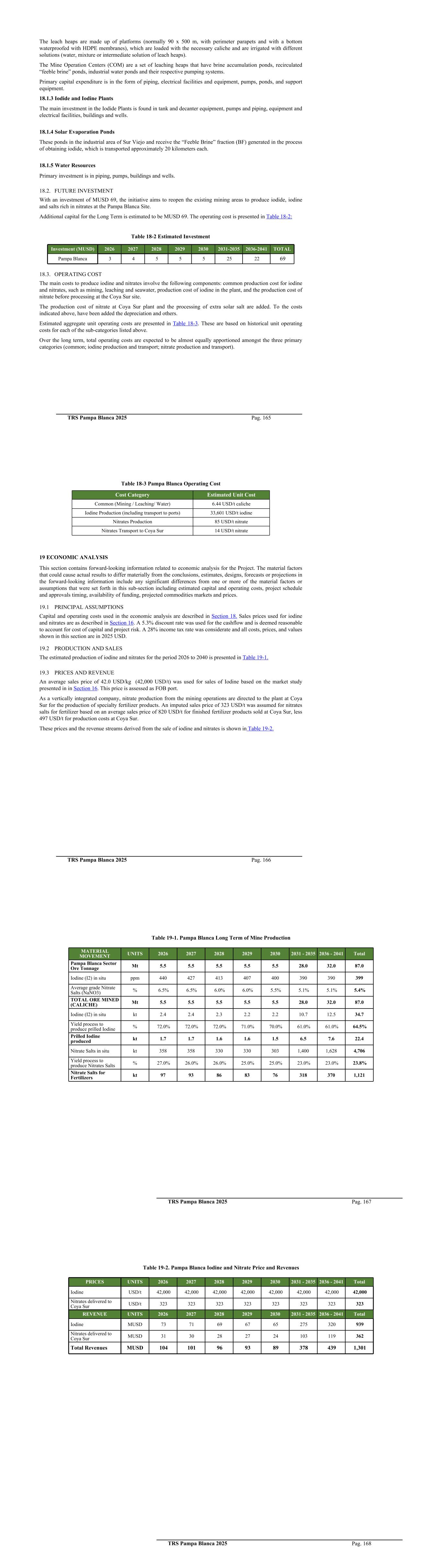
The leach heaps are made up of platforms (normally 90 x 500 m, with perimeter parapets and with a bottom waterproofed with HDPE membranes), which are loaded with the necessary caliche and are irrigated with different solutions (water, mixture or intermediate solution of leach heaps). The Mine Operation Centers (COM) are a set of leaching heaps that have brine accumulation ponds, recirculated “feeble brine” ponds, industrial water ponds and their respective pumping systems. Primary capital expenditure is in the form of piping, electrical facilities and equipment, pumps, ponds, and support equipment. 18.1.3 Iodide and Iodine Plants The main investment in the Iodide Plants is found in tank and decanter equipment, pumps and piping, equipment and electrical facilities, buildings and wells. 18.1.4 Solar Evaporation Ponds These ponds in the industrial area of Sur Viejo and receive the “Feeble Brine” fraction (BF) generated in the process of obtaining iodide, which is transported approximately 20 kilometers each. 18.1.5 Water Resources Primary investment is in piping, pumps, buildings and wells. 18.2. FUTURE INVESTMENT With an investment of MUSD 69, the initiative aims to reopen the existing mining areas to produce iodide, iodine and salts rich in nitrates at the Pampa Blanca Site. Additional capital for the Long Term is estimated to be MUSD 69. The operating cost is presented in Table 18-2: Table 18-2 Estimated Investment Investment (MUSD) 2026 2027 2028 2029 2030 2031-2035 2036-2041 TOTAL Pampa Blanca 3 4 5 5 5 25 22 69 18.3. OPERATING COST The main costs to produce iodine and nitrates involve the following components: common production cost for iodine and nitrates, such as mining, leaching and seawater, production cost of iodine in the plant, and the production cost of nitrate before processing at the Coya Sur site. The production cost of nitrate at Coya Sur plant and the processing of extra solar salt are added. To the costs indicated above, have been added the depreciation and others. Estimated aggregate unit operating costs are presented in Table 18-3. These are based on historical unit operating costs for each of the sub-categories listed above. Over the long term, total operating costs are expected to be almost equally apportioned amongst the three primary categories (common; iodine production and transport; nitrate production and transport). TRS Pampa Blanca 2025 Pag. 165 Table 18-3 Pampa Blanca Operating Cost Cost Category Estimated Unit Cost Common (Mining / Leaching/ Water) 6.44 USD/t caliche Iodine Production (including transport to ports) 33,601 USD/t iodine Nitrates Production 85 USD/t nitrate Nitrates Transport to Coya Sur 14 USD/t nitrate 19 ECONOMIC ANALYSIS This section contains forward-looking information related to economic analysis for the Project. The material factors that could cause actual results to differ materially from the conclusions, estimates, designs, forecasts or projections in the forward-looking information include any significant differences from one or more of the material factors or assumptions that were set forth in this sub-section including estimated capital and operating costs, project schedule and approvals timing, availability of funding, projected commodities markets and prices. 19.1 PRINCIPAL ASSUMPTIONS Capital and operating costs used in the economic analysis are described in Section 18. Sales prices used for iodine and nitrates are as described in Section 16. A 5.3% discount rate was used for the cashflow and is deemed reasonable to account for cost of capital and project risk. A 28% income tax rate was considerate and all costs, prices, and values shown in this section are in 2025 USD. 19.2 PRODUCTION AND SALES The estimated production of iodine and nitrates for the period 2026 to 2040 is presented in Table 19-1. 19.3 PRICES AND REVENUE An average sales price of 42.0 USD/kg (42,000 USD/t) was used for sales of Iodine based on the market study presented in in Section 16. This price is assessed as FOB port. As a vertically integrated company, nitrate production from the mining operations are directed to the plant at Coya Sur for the production of specialty fertilizer products. An imputed sales price of 323 USD/t was assumed for nitrates salts for fertilizer based on an average sales price of 820 USD/t for finished fertilizer products sold at Coya Sur, less 497 USD/t for production costs at Coya Sur. These prices and the revenue streams derived from the sale of iodine and nitrates is shown in Table 19-2. TRS Pampa Blanca 2025 Pag. 166 Table 19-1. Pampa Blanca Long Term of Mine Production MATERIAL MOVEMENT UNITS 2026 2027 2028 2029 2030 2031 - 2035 2036 - 2041 Total Pampa Blanca Sector Ore Tonnage Mt 5.5 5.5 5.5 5.5 5.5 28.0 32.0 87.0 Iodine (I2) in situ ppm 440 427 413 407 400 390 390 399 Average grade Nitrate Salts (NaNO3) % 6.5% 6.5% 6.0% 6.0% 5.5% 5.1% 5.1% 5.4% TOTAL ORE MINED (CALICHE) Mt 5.5 5.5 5.5 5.5 5.5 28.0 32.0 87.0 Iodine (I2) in situ kt 2.4 2.4 2.3 2.2 2.2 10.7 12.5 34.7 Yield process to produce prilled Iodine % 72.0% 72.0% 72.0% 71.0% 70.0% 61.0% 61.0% 64.5% Prilled Iodine produced kt 1.7 1.7 1.6 1.6 1.5 6.5 7.6 22.4 Nitrate Salts in situ kt 358 358 330 330 303 1,400 1,628 4,706 Yield process to produce Nitrates Salts % 27.0% 26.0% 26.0% 25.0% 25.0% 23.0% 23.0% 23.8% Nitrate Salts for Fertilizers kt 97 93 86 83 76 318 370 1,121 TRS Pampa Blanca 2025 Pag. 167 Table 19-2. Pampa Blanca Iodine and Nitrate Price and Revenues PRICES UNITS 2026 2027 2028 2029 2030 2031 - 2035 2036 - 2041 Total Iodine USD/t 42,000 42,000 42,000 42,000 42,000 42,000 42,000 42,000 Nitrates delivered to Coya Sur USD/t 323 323 323 323 323 323 323 323 REVENUE UNITS 2026 2027 2028 2029 2030 2031 - 2035 2036 - 2041 Total Iodine MUSD 73 71 69 67 65 275 320 939 Nitrates delivered to Coya Sur MUSD 31 30 28 27 24 103 119 362 Total Revenues MUSD 104 101 96 93 89 378 439 1,301 TRS Pampa Blanca 2025 Pag. 168
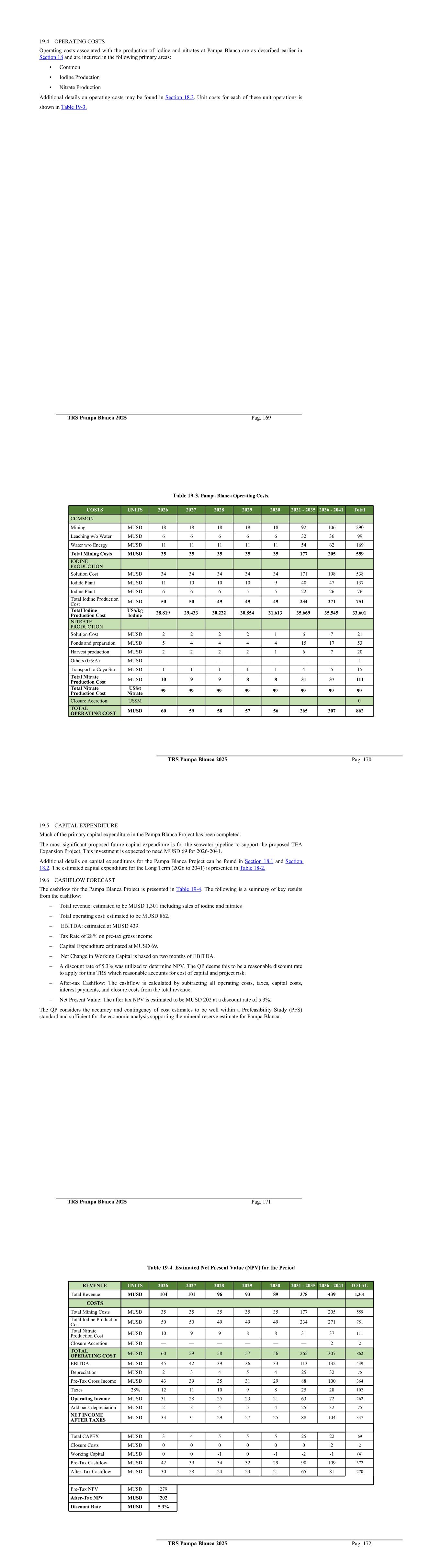
19.4 OPERATING COSTS Operating costs associated with the production of iodine and nitrates at Pampa Blanca are as described earlier in Section 18 and are incurred in the following primary areas: • Common • Iodine Production • Nitrate Production Additional details on operating costs may be found in Section 18.3. Unit costs for each of these unit operations is shown in Table 19-3. TRS Pampa Blanca 2025 Pag. 169 Table 19-3. Pampa Blanca Operating Costs. COSTS UNITS 2026 2027 2028 2029 2030 2031 - 2035 2036 - 2041 Total COMMON Mining MUSD 18 18 18 18 18 92 106 290 Leaching w/o Water MUSD 6 6 6 6 6 32 36 99 Water w/o Energy MUSD 11 11 11 11 11 54 62 169 Total Mining Costs MUSD 35 35 35 35 35 177 205 559 IODINE PRODUCTION Solution Cost MUSD 34 34 34 34 34 171 198 538 Iodide Plant MUSD 11 10 10 10 9 40 47 137 Iodine Plant MUSD 6 6 6 5 5 22 26 76 Total Iodine Production Cost MUSD 50 50 49 49 49 234 271 751 Total Iodine Production Cost US$/kg Iodine 28,819 29,433 30,222 30,854 31,613 35,669 35,545 33,601 NITRATE PRODUCTION Solution Cost MUSD 2 2 2 2 1 6 7 21 Ponds and preparation MUSD 5 4 4 4 4 15 17 53 Harvest production MUSD 2 2 2 2 1 6 7 20 Others (G&A) MUSD — — — — — — — 1 Transport to Coya Sur MUSD 1 1 1 1 1 4 5 15 Total Nitrate Production Cost MUSD 10 9 9 8 8 31 37 111 Total Nitrate Production Cost US$/t Nitrate 99 99 99 99 99 99 99 99 Closure Accretion US$M 0 TOTAL OPERATING COST MUSD 60 59 58 57 56 265 307 862 TRS Pampa Blanca 2025 Pag. 170 19.5 CAPITAL EXPENDITURE Much of the primary capital expenditure in the Pampa Blanca Project has been completed. The most significant proposed future capital expenditure is for the seawater pipeline to support the proposed TEA Expansion Project. This investment is expected to need MUSD 69 for 2026-2041. Additional details on capital expenditures for the Pampa Blanca Project can be found in Section 18.1 and Section 18.2. The estimated capital expenditure for the Long Term (2026 to 2041) is presented in Table 18-2. 19.6 CASHFLOW FORECAST The cashflow for the Pampa Blanca Project is presented in Table 19-4. The following is a summary of key results from the cashflow: – Total revenue: estimated to be MUSD 1,301 including sales of iodine and nitrates – Total operating cost: estimated to be MUSD 862. – EBITDA: estimated at MUSD 439. – Tax Rate of 28% on pre-tax gross income – Capital Expenditure estimated at MUSD 69. – Net Change in Working Capital is based on two months of EBITDA. – A discount rate of 5.3% was utilized to determine NPV. The QP deems this to be a reasonable discount rate to apply for this TRS which reasonable accounts for cost of capital and project risk. – After-tax Cashflow: The cashflow is calculated by subtracting all operating costs, taxes, capital costs, interest payments, and closure costs from the total revenue. – Net Present Value: The after tax NPV is estimated to be MUSD 202 at a discount rate of 5.3%. The QP considers the accuracy and contingency of cost estimates to be well within a Prefeasibility Study (PFS) standard and sufficient for the economic analysis supporting the mineral reserve estimate for Pampa Blanca. TRS Pampa Blanca 2025 Pag. 171 Table 19-4. Estimated Net Present Value (NPV) for the Period REVENUE UNITS 2026 2027 2028 2029 2030 2031 - 2035 2036 - 2041 TOTAL Total Revenue MUSD 104 101 96 93 89 378 439 1,301 COSTS Total Mining Costs MUSD 35 35 35 35 35 177 205 559 Total Iodine Production Cost MUSD 50 50 49 49 49 234 271 751 Total Nitrate Production Cost MUSD 10 9 9 8 8 31 37 111 Closure Accretion MUSD — — — — — — 2 2 TOTAL OPERATING COST MUSD 60 59 58 57 56 265 307 862 EBITDA MUSD 45 42 39 36 33 113 132 439 Depreciation MUSD 2 3 4 5 4 25 32 75 Pre-Tax Gross Income MUSD 43 39 35 31 29 88 100 364 Taxes 28% 12 11 10 9 8 25 28 102 Operating Income MUSD 31 28 25 23 21 63 72 262 Add back depreciation MUSD 2 3 4 5 4 25 32 75 NET INCOME AFTER TAXES MUSD 33 31 29 27 25 88 104 337 Total CAPEX MUSD 3 4 5 5 5 25 22 69 Closure Costs MUSD 0 0 0 0 0 0 2 2 Working Capital MUSD 0 0 -1 0 -1 -2 -1 (4) Pre-Tax Cashflow MUSD 42 39 34 32 29 90 109 372 After-Tax Cashflow MUSD 30 28 24 23 21 65 81 270 Pre-Tax NPV MUSD 279 After-Tax NPV MUSD 202 Discount Rate MUSD 5.3% TRS Pampa Blanca 2025 Pag. 172

19.7 SENSITIVITY ANALYSIS The sensitivity analysis was carried out by independently varying the commodity prices (Iodine, Nitrate), operating cost, and capital cost. The results of the sensitivity analysis are shown in Figure 19-1 shows the relative sensitivity of each key metric. Figure 19-1. Sensitivity Analysis % Variation of Base Parameter % V ar ia tio n fro m B as e N P V OPEX CAPEX I2 Price Nitrate Price -30% -20% -10% 0% 10% 20% 30% -150% -120% -90% -60% -30% 0% 30% 60% 90% 120% 150% As seen in the above figure, the project NPV is equally sensitive to operating cost and commodity price while being least sensitive to capital costs. This is to be expected for a mature, well-established project with much of its infrastructure already in place and no significantly large projects currently planned during the LOM discussed in this Study. Both iodine and nitrate prices have a similar impact on the NPV with nitrate prices having a slightly larger impact. 20 ADJACENT PROPERTIES The company's deposits are laid on flat land or "pampas" at the Pampa Blanca mine site and facilities cover a mine area of 51,201 hectares. Pampa Blanca mine site has an approximate area of 104.41 km2 (10,441 ha). Prospect deposits (see Figure 20-1, Figure 20-2.) corresponding to the Pampa Blanca mine properties are as follows: • Celia • Condell • Paulo • Miedo • Lenka • Carbonato • Colina TRS Pampa Blanca 2025 Pag. 173 • Chacabuco • Copo • Condell • Aurelia • Paulo IV • Estaca Boliviana • Celia Of all the areas prospected in the Sierra Gorda sector, the following have been explored: • Pampa Blanca • Blanco Encalada • Baquedano • Qb. San Cristobal • Eugenia (Ex Olympia) • Ampliación Carbonato Exploration program results show that these prospects reflect a mineralized trend hosting nitrate and iodine. On the other hand, exploration efforts are focused on possible metallic mineralization beneath the caliche. The area has significant potential for metallic mineralization, especially copper and gold. Exploration has generated discoveries that, in some cases, may lead to exploitation, sales of the discovery, and generation of royalties in the future. Within this framework, in 2013, we recorded a royalty sale of the Antucoya project to Antofagasta Minerals (copper mining). Within the boundary belonging to SQM-Pampa Blanca, as presented in Figure 20-2., it is stated that there are other properties adjacent to the Project that is exploited by others, and there are some mining rights. In total there are three mining lots, which include: 1. Algorta Norte S.A. is a joint venture between ACF Minera S.A. and Toyota Tsusho: • Surface 2. Antofagasta Minerals; • Surface • Rencoret Mine • Surface TRS Pampa Blanca 2025 Pag. 174 Figure 20-1. Pampa Blanca Adjacent Properties TRS Pampa Blanca 2025 Pag. 175 Figure 20-2. Other properties adjacent to the Project that is exploited by others TRS Pampa Blanca 2025 Pag. 176

21 OTHER RELEVANT DATA AND INFORMATION The QP is not aware of any other relevant data or information to disclose in this TRS. 22 INTERPRETATION AND CONCLUSIONS The work done in this report has demonstrated that the mine, heap leach facility and the iodine and nitrate operations correspond to those of a technically feasible and economically viable project. The most appropriate process route is determined to be the selected unit operations of the existing plants, which are otherwise typical of the industry. The current needs of the nitrate and iodine process, such as power, water, labor, and supplies, are met as this is a mature operation with many years of production supported by the current project infrastructure. As such, performance information on the valuable nitrate and iodine species consists of a significant amount of historical production data, which is useful for predicting metallurgical recoveries from the process plant. Along with this, metallurgical tests are intended to estimate the response of different caliche ores to leaching. Mrs. Marco Fazzi QP of Reserves, concludes that the work done in the preparation of this technical report includes adequate details and information to declare the Mineral Reserves. In relation to the resource treatment processes, the conclusion of the responsible QP, Jesús Casas de Prada, is that appropriate work practices and equipment, design methods and processing equipment selection criteria have been used. In addition, the company has developed new processes that have continuously and systematically optimized its operations. 22.1 RESULTS Geology and Mineral Resources 1. The Pampa Blanca geology team has a clear understanding of mineralization controls and the geological and deposit related knowledge has been appropriately used to develop and guide the exploration, modeling and estimation processes. 2. Sampling methods, sample preparation, analysis and security were acceptable for mineral resource estimation. The collected sample data adequately reflect deposit dimensions, true widths of mineralization, and the style of the deposits. Sampling is representative of the Iodine and Nitrate Grades. 3. The average mineral resource concentrations are above the cut- off benefit of 3.0 USD/t, reflecting that the potential extraction is economically viable. Metallurgy and Mineral Processing According to Jesús Casas de Prada, the QP in charge of metallurgy and resource treatment: 1. There is a duly documented verification plan for the cover system to limit infiltration during leaching. The document establishes installation and leak detection procedures in accordance with environmental compliance criteria. 2. Metallurgical test work performed to date has been adequate to establish appropriate processing routes for the caliche resource. The metallurgical test results show that the recoveries are dependent on the saline matrix content and, on the other hand, the maximization of this is linked to the impregnation cycle which has been studied, establishing irrigation scales according to the classified physical nature. The derived data are suitable for the purpose of estimating recovery from mineral resources. 3. Based on the annual, short- and long-term production program, the yield is estimated for the different types of material to be exploited according to the mining plan, according to their classification of physical and chemical properties, obtaining a projection of recoveries that is considered quite adequate for the resources. – Reagent forecasting and dosing are based on analytical processes that determine ore grades, valuable element content and impurity content to ensure that the system's treatment requirements are effective. These are translated into consumption rate factors that are maturely studied. TRS Pampa Blanca 2025 Pag. 177 – Since access to water can be affected by different natural and anthropogenic factors, the use of seawater is a viable alternative for future or current operations. However, this may increase operating costs, resulting in additional maintenance days. – During operations, the content of impurities fed to the system and also the concentration in the mother liquor is monitored in order to eventually detect any situation that may impact the treatment methodologies and the characteristics of its products. 22.2 RISKS Geology and Mineral Resources • As mining proceeds into new areas, such as Pampa Blanca Sector 5, the production, dilution, and recovery factors may change based on geological, geometallurgial and operational factors. These factors and mining costs should be evaluated on a sector-by-sector basis. Metallurgy and Mineral Processing • The risk that the process, as currently defined, will not produce the expected quantity and/or quality required. However, exhaustive characterization tests have been carried out on the treated material and, moreover, at all stages of the process, controls are in place to manage within certain ranges a successful operation. • The risks of a meteorological event or changes in local climatic conditions, which may result in lower production due to lower availability of the treated resource in the process plants. • The risk that the degree of impurities in the natural resources may increase over time more than predicted by the model, which may result in non-compliance with certain product standards. Consequently, it may be necessary to incorporate other process stages, with the development of previous engineering studies, to comply with the standards. 22.3 SIGNIFICANT OPPORTUNITIES Geology and Mineral Resources There is a big opportunity to improve the resource estimation simplicity and reproducibility using the block model approach not only in the case of smaller drill hole grids of 50 x 50 m and up to 200 x 200m, but also for larger drill hole grids to avoid separating the resource model and databases by drill hole spacing, bringing the estimation and management of the resource model to industry standards. Metallurgy and Mineral Processing 1. Improve heap slope irrigation conditions to increase iodine and nitrate recovery. 2. Use of clayey materials (low permeability) available in discards as soil cover for infiltration management. 23 RECOMMENDATIONS 23.1 GEOLOGY AND MINERAL RESOURCES – Continuing with the QAQC program using certified standards to ensure the control of precision, accuracy and contamination in the chemical analysis of SQM Caliche Yodo Laboratory with the objective of having an auditable database according to industry best practices. – Expand the block model approach for resource estimation to larger drillhole grids to avoid separating the resource model and databases by drillhole spacing. – Audit with an external company of the entire resource estimation process, that is, expert review of drilling database, resource estimation, and reserve valuation TRS Pampa Blanca 2025 Pag. 178 23.2 METALLURGY AND MINERAL PROCESSING – Regarding irrigation, alternatives that allow an efficient use of water should be reviewed, considering the irrigation of the lateral areas of the heaps to increase the recovery of iodine and nitrates. – A relevant aspect is the incorporation of seawater in the process, a decision that is valued given the current water shortage and that ultimately is a contribution to the project, however, a study should be made of the impact of processing factors such as impurities from this source. – It is advisable to carry out tests to identify the hydrogeological parameters that govern the behavior of the water inside the heap. Review the properties of the mineral bed, which acts as a protector of the binders at the base of the heaps, which is currently a fine material called "chusca", which could be replaced by classified particulate material, favoring the percolability of the solutions and saving water. – It is considered important to evaluate the leachable material through heap leaching simulation, which allows the construction of a conceptual model of caliche leaching with a view to secondary processing of the riprap to increase the overall recovery. – It is contributive and relevant to work on the generation of models that represent heap leaching, the decrease in particle size (ROM versus scarious granulometry) and, therefore, of the whole heap and the simultaneous dissolution of different species at different rates of nitrate iodine extraction. – With respect to generating material use options, detailed geotechnical characterization of the available clays within the mine property boundaries is suggested to assess whether there are sufficient clay materials on site to use as a low permeable soil liner bed under the leach pad. – Environmental issues include leachate or acid water management, air emissions management, tailings dump management, and leachate riprap. All the above recommendations are considered within the declared CAPEX/OPEX and do not imply additional costs for their execution. TRS Pampa Blanca 2025 Pag. 179 24 REFERENCES • Chong, G., Gajardo, A., Hartley, A., Moreno, T. 2007. Industrial Minerals and rocks. In Moreno, T. & Gibbons, W. (eds) The Geology of Chile 7, 201-214 • Ericksen, G.E. 1981. Geology and origin of the Chilean nitrate deposits. U.S. Geological Survey Professional Paper 1188-B. • Fiesta, B. 1966. El origen del salitre de Chile. Sociedad Española de Historia Natural Boletín, Sección Geológica 64(1), 47-56. • Mueller, G. 1960. The theory of formation of north Chilean nitrate deposits through ((capillary concentration)). International Geological Congress, 21st, Copenhagen 1960, Report 1, 76-86. • Pueyo, J.J.; Chong, G.; Vega, M. 1998. Mineralogía y evolución de las salmueras madres en el yacimiento de nitratos Pedro de Valdivia, Antofagasta, Chile. Revista Geológica de Chile, Vol. 25, No. 1, p. 3-15. • Reich, M., Snyder, G.T., Alvarez, F., Pérez, A., Palacios, C., Vargas, G., Cameron, E.M., Muramatsu, Y., Fehn, U. 2013. Using iodine to constrain supergene fluid sources in arid regions: Insights from the Chuquicamata oxide blanket. Economic Geology 108, 163-171. • Reich, M., Bao, H. 2018. Nitrate Deposits of the Atacama Desert: A Marker of Long-Term Hyperaridity. Elements, Vol. 14, 251–256 • Kay, S.M.; Coira, B.L. 2009. Shallowing and steepening subduction zones, continental lithospheric loss, magmatism and crustal flow under the Central Andean Altiplano–Puna Plateau. Geological Society of America Memoir 204, p. 229–259. • Schildgen, T.F.; Hoke, G.D. 2018. The topographic evolution of the Central Andes. Elements, Vol. 14, p. 231–236. • Pérez-Fodich, A.; Reich, M.; Álvarez, J.P.; et al. 2014. Climate change and tectonic uplift triggered the formation of the Atacama Desert’s giant nitrate deposits. Geology, Vol. 42, No. 3, p. 251–254. • Vargas, G.; Rutllant, J.; Ortlieb, L. 2006. Holocene coastal uplift and tsunami record along the northern Chilean coast. Quaternary Science Reviews, Vol. 25, p. 2597–2609. • Garreaud, R.D.; Molina, A.; Farias, M. 2010. Andean uplift, ocean cooling and Atacama hyperaridity: A climate modeling perspective. Earth and Planetary Science Letters, Vol. 292, p. 39–50. • Nishizumi, K.; Caffee, M.W.; Finkel, R.C.; Brimhall, G.; Mote, T. 1998. Cosmogenic exposure ages of surfaces in the Atacama Desert, northern Chile. Geology, Vol. 26, p. 243–246. • Hartley, A.J.; Chong, G. 2002. Late Pliocene age for the Atacama Desert: Implications for the desertification of western South America. Geology, Vol. 30, No. 1, p. 43–46. • Hartley, A.J.; Chong, G.; Houston, J.; Mather, A.E. 2005. 30 million years of climatic stability: Evidence from the Atacama Desert, northern Chile. Journal of the Geological Society, Vol. 162, p. 421–424. • Marinovic, N.; Smoje, I.; Maksaev, V. 1995. Hoja Pampa Unión, Región de Antofagasta. Servicio Nacional de Geología y Minería, Carta Geológica de Chile. • Marinovic, N.; García, M. 1999. Hoja Sierra Gorda, Región de Antofagasta. Servicio Nacional de Geología y Minería, Carta Geológica de Chile. TRS Pampa Blanca 2025 Pag. 180

25 RELIANCE ON INFORMATION PROVIDED BY REGISTRANT The qualified person has relied on information provided by the registrant in preparing his findings and conclusions regarding the following aspects of modifying factors: 1. Macroeconomic trends, data and assumptions, and interest rates. 2. Projected sales quantities and prices. 3. Marketing information and plans within the control of the registrant. Environmental matters are outside the expertise of the qualified person. TRS Pampa Blanca 2025 Pag. 181