
Technical Report Summary OPERATION REPORT SALAR DE ATACAMA Novandino Litio SpA (formerly SQM Salar SpA) April 13, 2026 TECHNICAL REPORT SUMMARY OPERATION REPORT SALAR DE ATACAMA Novandino Litio SpA (formerly SQM Salar SpA) April 13, 2026 TABLES TABLE 1-1. NOVANDINO LITIO SPA’S SALAR DE ATACAMA LITHIUM AND POTASSIUM MINERAL RESOURCES, EXCLUSIVE OF MINERAL RESERVES (EFFECTIVE DECEMBER 31, 2025) ................................................. 2 TABLE 1-2. NOVANDINO LITIO SPA’S SALAR DE ATACAMA LITHIUM AND POTASSIUM MINERAL RESERVES, FACTORING PROCESS RECOVERIES (EFFECTIVE DECEMBER 31, 2025) .................................................. 3 TABLE 1-3. CAPITAL COSTS FOR LITHIUM AND POTASSIUM OPERATIONS ........................................................... 5 TABLE 1-4. ESTIMATED CASHFLOW ANALYSIS .................................................................................................... 7 TABLE 2-1. ACRONYMS AND ABBREVIATIONS ..................................................................................................... 9 TABLE 2-2. SITE VISITS ...................................................................................................................................... 12 TABLE 3-1 PAYMENT AGREEMENTS WITH CORFO ............................................................................................ 15 TABLE 7-1. SUMMARY OF THE CONDUCTED GEOPHYSICAL DATASETS .............................................................. 28 TABLE 7-2. SUMMARY OF THE CONDUCTED BOREHOLE GEOPHYSICS ............................................................... 28 TABLE 7-3. SUMMARY OF BOREHOLES WITH POROSITY MEASUREMENTS ......................................................... 30 TABLE 7-4. HYDROGEOLOGICAL UNIT DESCRIPTION ......................................................................................... 35 TABLE 7-5. HYDRAULIC CONDUCTIVITY RANGES FOR EACH HYDROGEOLOGICAL UNIT ................................... 37 TABLE 8-1. EVALUATION OF ANALYTICAL AND FIELD DUPLICATES IN LAB SA ................................................ 44 TABLE 8-2. SUMMARY OF ACCURACY — LAB SA VS. BEST VALUE (BV). ........................................................ 46 TABLE 8-3. SUMMARY OF POSSIBLE POLLUTION RATIOS OF BLANK SAMPLES DURING ANALYSIS. ................... 48 TABLE 8-4. DUPLICATE SAMPLE EVALUATION IN THE POROSITY LAB ............................................................... 49 TABLE 10-1. LIST OF LABORATORY FACILITIES AVAILABLE FOR ANALYSIS IN SALAR DE ATACAMA ............... 58 TABLE 10-2. LIST OF INSTALLATIONS AVAILABLE FOR ANALYSIS AT PQC ....................................................... 59 TABLE 10-3. CATEGORIZATION OF BRINE SAMPLES FROM WELLS ..................................................................... 60 TABLE 10-4. LIST OF ANALYSES FOR CHEMICAL CHARACTERIZATION. ............................................................. 63 TABLE 10-5. MEAN ANNUAL EVAPORATION RATES FOR EACH SUBSYSTEM IN THE 2023-2025 PERIOD ............ 65 TABLE 10-6. LIST OF REQUESTED ANALYSES FOR PLANT CONTROL .................................................................. 67 TABLE 10-7. ANALYSIS OF PRODUCTS (LI2CO3/LIOH) ...................................................................................... 67 TABLE 11-1. TOTAL NUMBER OF WELLS USED FOR CONSTRUCTION OF THE GEOLOGICAL MODEL ................... 75 TABLE 11-2. TOTAL NUMBER OF DRILLHOLES USED TO ESTIMATE THE BRINE VOLUME. .................................. 75 TABLE 11-3. TOTAL NUMBER OF WELLS USED FOR CHEMISTRY INTERPOLATION. ............................................ 75 TABLE 11-4. BLOCK MODEL DISCRETIZATION ................................................................................................... 76 TABLE 11-5. CONDITIONS AND ASSUMPTIONS FOR FILTERING CELLS IN THE BLOCK MODEL............................ 76 TABLE 11-6. UNIVARIATE STATISTICS OF PE AND NATURAL GAMMA RAY DATA .............................................. 78 TABLE 11-7. EFFECTIVE POROSITY ESTIMATION DOMAINS ............................................................................... 78 TABLE 11-8. EFFECTIVE POROSITY (%) INTERPOLATION SUMMARY.................................................................. 82 TABLE 11-9. EQUIVALENCE BETWEEN HYDROGEOLOGICAL UNITS AND BRINE CHEMISTRY DOMAINS ............. 87 TABLE 11-10. SEARCH RADIUS PARAMETERS, LI AND K INTERPOLATION (SQM, 2024A). ................................ 90 TABLE 11-11. VARIOGRAM MODEL PARAMETERS, LI AND K INTERPOLATION (SQM, 2024A). ......................... 91 TABLE 11-12. AVERAGE LI AND K CONCENTRATIONS AFTER INTERPOLATION, OMA EXTRACTION AREA ....... 92 TABLE 11-13. UNIVARIATE STATISTICS OF DENSITY WEIGHTED BY SAMPLE LENGTH ...................................... 93 TABLE 11-14. VARIOGRAM MODEL PARAMETERS FOR THE BRINE DENSITY INTERPOLATION (SQM, 2024A) ... 94 TABLE 11-15. BRINE CHEMISTRY DOMAINS AND LEVEL OF HYDROGEOLOGICAL CHARACTERIZATION ............ 96 TABLE 11-16. CATEGORIZATION OF MEASURED, INDICATED, AND INFERRED MINERAL RESOURCES ................ 97 TABLE 11-17. NOVANDINO LITIO SPA’S SALAR DE ATACAMA LITHIUM AND POTASSIUM RESOURCE STATEMENT, EXCLUSIVE OF MINERAL RESERVES (EFFECTIVE DECEMBER 31, 2025) ......................... 99 TABLE 12-1. GRID SPECIFICS AND LAYERS ...................................................................................................... 101 TABLE 12-2. AVERAGE SIMULATED WATER BALANCE COMPONENTS, 2015-2025 HISTORICAL SIMULATED PERIOD ............................................................................................................................................... 104 TABLE 12-3. SUMMARY OF ASSIGNED MODEL PARAMETERS .......................................................................... 108 TABLE 12-4. SIMULATED LI AND LCE EXTRACTION BY YEAR ........................................................................ 118 TABLE 12-5. SIMULATED K AND KCL EXTRACTION BY YEAR ......................................................................... 118 TABLE 12-6. NOVANDINO LITIO SPA’S SALAR DE ATACAMA LITHIUM MINERAL RESERVE ESTIMATE, CONSIDERING PROCESS RECOVERIES (EFFECTIVE DECEMBER 31, 2025) ........................................... 119 TABLE 12-7. NOVANDINO LITIO SPA’S SALAR DE ATACAMA POTASSIUM RESERVE ESTIMATE CONSIDERING PROCESS RECOVERIES (EFFECTIVE DECEMBER 31, 2025) .................................................................. 121 TABLE 14-1. FACILITIES AVAILABLE FOR PRODUCTION. .................................................................................. 131 TABLE 14-2. PRODUCTS OF THE SALAR DE ATACAMA ..................................................................................... 133 TABLE 14-3. NOMINAL PRODUCTION CAPACITY PER PROCESS PLANT ............................................................. 142 TABLE 14-4. PRODUCTION DATA FOR 2023 TO 2025. ....................................................................................... 143 TABLE 14-5. AVERAGE VOLUME OF BRINE EXTRACTED AND RE-INJECTED PER YEAR .................................... 144 TABLE 14-6. LITHIUM AND POTASSIUM SALAR DE ATACAMA YIELD FOR 2023 AND 2025 .............................. 144 TABLE 14-7. INDUSTRIAL PLAN FOR 2026 TO 2030 FOR THE SALAR DE ATACAMA AND LCP OPERATIONS ..... 145 TABLE 14-8. SUMMARY OF ENERGY CONSUMPTION PER YEAR (APPROXIMATE VALUES - REFERENCE 2024) . 146 TABLE 14-9. ANNUAL INDUSTRIAL WATER EXTRACTION FROM WELLS .......................................................... 147 TABLE 14-11. PERSONNEL BY AREA ................................................................................................................. 147 TABLE 14-12. APPROXIMATE PROCESS REAGENTS AND CONSUMPTION RATES FOR 2025. ............................... 148 TABLE 17-1. HYDROLOGICAL ZONES DEFINED IN SALAR BASIN ..................................................................... 168 TABLE 17-2 LAND USE UNITS OBSERVED IN THE PROJECT AREA (USDA, 2001) ............................................... 172 TABLE 17-3. SPECIES RICHNESS BY FAUNAL ENVIRONMENT ........................................................................... 173 TABLE 17-4. SYSTEMS TO BE PROTECTED. ....................................................................................................... 185 TABLE 17-5. INDUSTRIAL WATER EXTRACTION .............................................................................................. 186 TABLE 17-6. HISTORICAL EIAS/DIAS, CARRIED OUT IN THE SALAR DE ATACAMA AND THE SALAR DEL CARMEN PLANT, SENT TO THE COMPETENT AUTHORITY (SEIA) ...................................................... 190 TABLE 17-7. FACTS CONSIDERED (CHARGES) .................................................................................................. 192 TABLE 17-8. PDC ACTIONS .............................................................................................................................. 194 TABLE 17-9. CLOSURE MEASURES AND ACTIONS OF THE CLOSURE PLAN FOR THE SALAR DE ATACAMA MINE. .......................................................................................................................................................... 206 TABLE 17-10. POST-CLOSURE MEASURES OF THE CLOSURE PLAN OF THE SALAR DE ATACAMA MINE. ........... 207 TABLE 17-11. SALAR DE ATACAMA MINE SITE CLOSURE COSTS .................................................................... 207 TABLE 17-12. SALAR DE ATACAMA MINING SITE POST-CLOSURE COSTS....................................................... 207 TABLE 17-13. GUARANTEE UPDATE OF THE SALAR DE ATACAMA PLANT CLOSURE PLAN (REFERENTIAL TABLE) .......................................................................................................................................................... 208 TABLE 18-1. CAPITAL COSTS ........................................................................................................................... 210 TABLE 18-2. LITHIUM PLANT INVESTMENTS .................................................................................................... 211

TABLE 18-3. INVESTMENT IN THE LITHIUM CARBONATE PLANT ...................................................................... 212 TABLE 18-4. INVESTMENTS IN THE LITHIUM HYDROXIDE PLANT .................................................................... 213 TABLE 18-5. INVESTMENTS IN THE LITHIUM SULFATE PLANT ......................................................................... 214 TABLE 18-6. MAIN INVESTMENTS IN EVAPORATION AND HARVEST PONDS ..................................................... 216 TABLE 18-7. MAIN INVESTMENTS IN MOP I AND MOP II PONDS .................................................................... 217 TABLE 18-8. MAIN INVESTMENTS IN SOP PONDS ............................................................................................ 217 TABLE 18-9. MAIN INVESTMENTS IN LITHIUM PONDS ..................................................................................... 217 TABLE 18-10. MAIN INVESTMENTS IN WET PLANTS ........................................................................................ 217 TABLE 18-11. DETAILED INVESTMENTS IN WET PLANTS ................................................................................. 218 TABLE 18-12. MAIN INVESTMENTS IN BRINE EXTRACTION WELLS ................................................................. 218 TABLE 18-13. DETAILED INVESTMENTS IN BRINE EXTRACTION WELLS .......................................................... 218 TABLE 18-14. PROJECTS IN EXECUTION (2026 TO 2027 PERIOD) ..................................................................... 219 TABLE 18-15. DISTRIBUTION OF OPERATING COSTS ........................................................................................ 220 TABLE 18-16. PAYMENT AGREEMENTS WITH CORFO ..................................................................................... 221 TABLE 19-1. REVENUES OF LITHIUM AND KCL ................................................................................................ 223 TABLE 19-5. ESTIMATED CASHFLOW ANALYSIS .............................................................................................. 224 TABLE 19-6. ESTIMATED SUM OF PAYMENTS TO CORFO AND OTHER AGREEMENTS AND TAXES (2026-2030) .......................................................................................................................................................... 224 TABLE 19-2. MAIN COSTS OF LITHIUM AND KCL PRODUCTION ....................................................................... 225 TABLE 19-3. OPERATING COSTS ...................................................................................................................... 225 TABLE 19-4. ESTIMATED CAPITAL INVESTMENTS ............................................................................................ 226 TABLE 19-7. ASSUMPTIONS FOR THE BASE CASE ............................................................................................. 226 TABLE 19-8. LITHIUM CARBONATE PRICE SENSITIVITY................................................................................... 227 TABLE 19-9. COST SENSITIVITIES .................................................................................................................... 227 TABLE 19-10. KCL PRICE SENSITIVITY ............................................................................................................ 227 TABLE 19-11. CORFO RIGHTS AND OTHER AGREEMENTS SENSITIVITIES ....................................................... 228 TABLE 19-12. TAX SENSITIVITIES .................................................................................................................... 228 TABLE 19-13. PROFITS TO CODELCO SENSITIVITIES ..................................................................................... 228 TABLE 19-14. CONTRIBUTION TO THE STATE OF CHILE (TAXES, PROFITS TO CODELCO, CORFO RIGHTS AND OTHERS) ............................................................................................................................................ 229 TABLE 25-1. INFORMATION PROVIDED BY THE REGISTRANT (NOVANDINO LITIO SPA) ................................... 246 FIGURES FIGURE 6-1. LOCAL GEOLOGICAL MAP OF THE SALAR DE ATACAMA ................................................................ 21 FIGURE 6-2. GEOLOGICAL CROSS SECTIONS ...................................................................................................... 24 FIGURE 6-3. STRATIGRAPHIC COLUMNS OF THE WESTERN AND EASTERN BLOCKS ........................................... 25 FIGURE 6-4. MATURE AND IMMATURE SALT FLATS (HOUSTON ET AL., 2011) ................................................... 26 FIGURE 7-1. SEISMIC REFLECTION SURVEY (AGUAEX, 2020) ............................................................................ 27 FIGURE 7-2. DISTRIBUTION OF WELLS THAT PROVIDE GEOLOGICAL AND HYDROGEOLOGICAL INFORMATION FOR THE PROJECT. ................................................................................................................................ 29 FIGURE 7-3. DISTRIBUTION OF BOREHOLES WITH POROSITY MEASUREMENTS. ................................................. 31 FIGURE 7-4. EFFECTIVE POROSITY (%) HISTOGRAM OF SAMPLES USED FOR MINERAL RESOURCE ESTIMATION 31 FIGURE 7-5. DISTRIBUTION OF BOREHOLES WITH BRINE CHEMISTRY MEASUREMENTS .................................... 33 FIGURE 7-6. HISTOGRAM OF LI AND K CONCENTRATIONS (%) USED FOR MINERAL RESOURCE ESTIMATION .... 33 FIGURE 7-7. HYDRAULIC TESTING LOCATIONS, OMA EXPLORATION ............................................................... 36 FIGURE 7-8. W – E CROSS SECTION OF THE HYDROGEOLOGICAL MODEL.......................................................... 38 FIGURE 7-9. SW - NE CROSS SECTION OF THE HYDROGEOLOGICAL MODEL ..................................................... 39 FIGURE 8-1. ERROR RATIO PLOTS, ANALYTICAL DUPLICATES. ......................................................................... 45 FIGURE 8-2. ERROR RATIO PLOTS, FIELD DUPLICATES. ..................................................................................... 45 FIGURE 8-3. ACCURACY PLOTS FOR REFERENCE MATERIALS (LAB SA VS. BEST VALUE, JAN 2024–SEP 2025) ............................................................................................................................................................ 47 FIGURE 8-5. CONTAMINATION PLOTS, BLANK SAMPLES .................................................................................... 48 FIGURE 8-6. SCATTER PLOT FOR PAIRS ANALYZED WITH ACCUPYC. ................................................................. 50 FIGURE 8-7. SCATTER PLOT FOR PAIRS ANALYZED WITH GEOPYC ..................................................................... 51 FIGURE 10-1. DETERMINATION OF IN-SITU BRINE PARAMETERS AT PUMPING WELLS ....................................... 61 FIGURE 10-2. IMPROVED TREATMENT SCHEME FOR BISCHOFITE PLATFORMS ................................................... 71 FIGURE 11-1. MINERAL RESOURCE ESTIMATE GENERAL FLOWCHART .............................................................. 74 FIGURE 11-2. CORRELOGRAMS OF POROSITY AND NATURAL GAMMA DOMAIN 1 (INTERMEDIATE HALITE WEST BLOCK). ............................................................................................................................................... 80 FIGURE 11-3. CORRELOGRAMS OF POROSITY AND NATURAL GAMMA DOMAIN 1 (INTERMEDIATE HALITE EAST BLOCK). ............................................................................................................................................... 81 FIGURE 11-4. BLOCK MODEL WITH PE DOMAINS AND INTERPOLATED VALUES, OMA EXTRACTION ZONE ...... 83 FIGURE 11-5. SWATH PLOTS FOR PE SAMPLES AND ESTIMATED POROSITY......................................................... 84 FIGURE 11-6. LITHIUM VARIOGRAMS OF BRINE CHEMISTRY DOMAIN 1. ........................................................... 88 FIGURE 11-7. POTASSIUM VARIOGRAMS OF BRINE CHEMISTRY DOMAIN 1. ...................................................... 89 FIGURE 11-8. INTERPOLATED LI (WT %) IN THE BLOCK MODEL, SATURATED AREA OF THE OMA ZONE. ........ 92 FIGURE 11-9. BOX PLOTS OF MEASURED SAMPLE VALUES VERSUS ESTIMATED BLOCK MODEL VALUES, LI AND K. ......................................................................................................................................................... 93 FIGURE 11-10. DENSITY HISTOGRAM AND SPATIAL DISTRIBUTION ................................................................... 93 FIGURE 11-11. DENSITY ESTIMATE VARIOGRAM ............................................................................................... 94 FIGURE 11-12. RESOURCE CATEGORIZATION IN 3 DIMENSIONS ......................................................................... 98 FIGURE 12-1. NUMERICAL MODEL DOMAIN AND GRID .................................................................................... 102 FIGURE 12-2. DIRECT RECHARGE AND LATERAL RECHARGE ZONES ............................................................... 105 FIGURE 12-3. EVAPORATION ZONES IN THE NUMERICAL MODEL .................................................................... 106 FIGURE 12-4. REPRESENTATIVE HYDRAULIC CONDUCTIVITY (KH) AND SPECIFIC YIELD - EFFECTIVE POROSITY (SY -PE) DISTRIBUTION IN NUMERICAL MODEL ................................................................................ 108 FIGURE 12-5. HEAD OBSERVATION TARGETS AND SIMULATED WATER TABLE FOR THE END OF THE HISTORICAL PERIOD .......................................................................................................................... 110 FIGURE 12-6. HEAD HISTORICAL PERIOD RESULTS .......................................................................................... 112 FIGURE 12-7. EXTRACTED CONCENTRATION FIT DURING THE HISTORICAL PERIOD (2015 – 2025) ................. 113 FIGURE 12-8. LITHIUM CONCENTRATION (%) DISTRIBUTION FOLLOWING THE HISTORICAL PERIOD ............... 114 FIGURE 12-9. NOVANDINO LITIO SPA’S FUTURE BRINE PUMPING AND VOLUNTARY REDUCTION .................. 115 FIGURE 12-10. SIMULATED NOVANDINO LITIO SPA PUMPING RATES, RESERVE SIMULATION ........................ 116 FIGURE 12-11. AVERAGE WEIGHTED CONCENTRATIONS EXTRACTED FROM NOVANDINO LITIO SPA’S PRODUCTION WELLS, RESERVE SIMULATION .................................................................................... 116 FIGURE 12-12. PREDICTED CUMULATIVE ANNUAL LCE PRODUCTION (CONSIDERING PROCESS RECOVERIES) .......................................................................................................................................................... 118 FIGURE 12-13. PREDICTED ANNUAL KCL PRODUCTION (CONSIDERING PROCESS RECOVERIES) ..................... 119 FIGURE 12-14. NOVANDINO LITIO SPA’S SALAR DE ATACAMA LITHIUM MINERAL RESERVE ESTIMATE CONSIDERING PROCESS RECOVERIES (EFFECTIVE DECEMBER 31, 2025) ........................................... 121 FIGURE 12-15. NOVANDINO LITIO SPA’S SALAR DE ATACAMA POTASSIUM RESERVE ESTIMATE CONSIDERING PROCESS RECOVERIES (EFFECTIVE DECEMBER 31, 2025) .................................................................. 122 FIGURE 13-1. FIELD PICTURES OF A TYPICAL SALAR DE ATACAMA BRINE PRODUCTION WELL, PIPE, AND GATHERING POND.............................................................................................................................. 128 FIGURE 13-2. FINAL MINE OUTLINE ................................................................................................................ 129 FIGURE 14-1. SIMPLIFIED PROCESS FLOWSHEET FOR THE SALAR DE ATACAMA. ............................................. 130 FIGURE 14-2. GENERAL BLOCK PROCESS DIAGRAM FOR LITHIUM SALTS PRODUCTS. ..................................... 131 FIGURE 14-3. GENERAL BLOCK PROCESS DIAGRAM FOR POTASSIUM SALTS PRODUCTS .......................... 134 FIGURE 14-4. MAP OF THE LOCATION OF THE BRINE EXTRACTION AREA. NOVANDINO LITIO SPA SALAR DE ATACAMA .......................................................................................................................................... 135 FIGURE 14-5. LOCATION OF SOLAR EVAPORATION PONDS (LIGHT BLUE ZONE) AND SALT DEPOSITS (GREEN ZONE), SALAR DE ATACAMA .............................................................................................................. 137 FIGURE 14-6. BLOCK PROCESS DIAGRAM OF LCP’S OPERATIONS. ................................................................... 140 FIGURE 15-1. GENERAL LOCATION SALAR DE ATACAMA SITE ........................................................................ 151 FIGURE 15-2 LOCATION SOP AND MOP PLANTS ............................................................................................. 153 FIGURE 15-3. FACILITIES MOP ........................................................................................................................ 153 FIGURE 15-4. FACILITIES SOP .......................................................................................................................... 154 FIGURE 15-5. MAIN FACILITIES IN SALAR DEL CARMEN .................................................................................. 156 FIGURE 16-1. LITHIUM FEEDSTOCK, SUPPLY FORECAST ................................................................................... 162 FIGURE 16-2. LITHIUM CHEMICAL SUPPLY BREAKDOWN ................................................................................ 163 FIGURE 16-4. LITHIUM HISTORIC PRICE EVOLUTION ........................................................................................ 164 FIGURE 16-5. LITHIUM CHEMICAL PRICE FORECAST........................................................................................ 165 FIGURE 17-1. RAMSAR SITE, SONCOR HYDROGEOLOGICAL SYSTEM AND RESERVA NACIONAL LOS FLAMENCOS PROTECTED AREA BOUNDARIES. ....................................................................................................... 167 FIGURE 17-2: SALAR DE ATACAMA MORPHOMETRIC ZONES .......................................................................... 169 FIGURE 17-3. HYDROGRAPHIC NETWORK OF THE SALAR DE ATACAMA BASIN ............................................... 170 FIGURE 17-4: ENVIRONMENTAL MONITORING ZONES RCA226/2006 ............................................................. 171 FIGURE 17-5. FAUNAL ENVIRONMENTS ........................................................................................................... 173 FIGURE 17-6. SECTORS IN THE AREA OF INFLUENCE (AI) OF INLAND AQUATIC ECOSYSTEMS ......................... 175 FIGURE 17-7. SALAR DE ATACAMA’S HUMAN ENVIRONMENT. ........................................................................ 177 FIGURE 17-8. SCHEMATIC LOCATION OF THE ENVIRONMENTAL SYSTEMS AND SECTORS OF THE HYDROGEOLOGICAL PES................................................................................................................... 182 FIGURE 17-9. PES SCHEMATIC LOCATION ....................................................................................................... 184 FIGURE 17-10. ANNUAL AND DAILY EXTRACTIONS OF WATER INDUSTRIAL WELLS ....................................... 186 FIGURE 17-11: BRINE EXTRACTION REDUCTION PLAN (2020-2026) ............................................................... 188 FIGURE 18-1. CAPITAL COST OF LITHIUM OPERATIONS ................................................................................... 211 FIGURE 18-2. CAPITAL COSTS FOR LITHIUM PLANTS ....................................................................................... 212 FIGURE 18-3. CAPITAL COST FOR THE LITHIUM CARBONATE PLANT ............................................................... 213 FIGURE 18-4. CAPITAL COSTS FOR THE LITHIUM HYDROXIDE PLANT.............................................................. 214 FIGURE 18-5. CAPITAL COST LITHIUM SULFATE PLANT .................................................................................. 215 FIGURE 18-6. CAPITAL COST SOLUTION RECOVERY PLANT ............................................................................. 215 FIGURE 18-7. CAPITAL COST EVAPORATION AND HARVEST PONDS ................................................................ 216 FIGURE 19-1. PROPERTIES ADJACENT TO NOVANDINO LITIO SPA’S CONCESSIONS, SALAR DE ATACAMA. ..... 231

1 1 EXECUTIVE SUMMARY This Technical Report Summary (TRS) was prepared on behalf of Novandino Litio SpA (formerly SQM Salar SpA) for their operations in the Salar de Atacama (the “Project”). Since the previously filed TRS (SQM, 2024), it is the QPs’ opinion that there have been material changes related to the Mineral Resource disclosure, which warrant the issue of an updated TRS. 1.1 Property and Mineral Rights The Project is located in the Antofagasta Region of Chile which covers the Loa Province and San Pedro de Atacama commune. The Salar de Atacama mine tenements are owned by the Corporación de Fomento de la Producción (CORFO) of Chile which grants special operating contracts, or administrative leases, to private companies for the extraction of brine over a certain period. Novandino Litio SpA has a lease agreement with CORFO, signed in 1993, to extract and generate lithium (Li) and potassium (K) products from brines in the Salar de Atacama deposit. In 2018, Novandino Litio SpA and CORFO performed a reconciliation process that modified the pre-existing lease and Project contracts. The expiration date of the current Novandino Litio SpA-CORFO lease agreement is December 31, 2030, and Novandino Litio SpA holds leases for a total area of approximately 1,400 square kilometers (km2) with permission to extract brines from an area of approximately 820 km2. In 2025, a revised version of the contract with CORFO was signed, maintain the commercial and operational conditions of the previous contract. 1.2 Geology and Mineralization The general geology of the Salar de Atacama Basin is characterized by Paleozoic to Holocene igneous and sedimentary rocks as well as recent, unconsolidated clastic deposits and evaporitic sequences. The salt flat resides in a tectonic basin, where important subsidence and sediment deposition have historically occurred. Over time, the process of evaporation has precipitated salts, and at depth, evaporitic, clastic, and volcanic ash deposits host brine. Several structural blocks and fault systems have been identified, where displacement and deformation of the geological units have occurred. According to Houston et. al. (2011), the Salar de Atacama is a mature salt flat with mineralization characterized by Li- and K-rich brine, residing in the porous media of the subsurface reservoir along with elevated concentrations of other dissolved constituents (e.g., boron and sulfate). The explored reservoir covers an area of 1,100 km2 and depth of up to 900 meters (m), where a thick section of halite (> 90%) and sulfate can be found in addition to a minor percentage of clastic sediments, volcanic ash, and interbedded evaporites ( (Bevacqua, 1992); (Xterrae, 2011)). The arithmetic mean concentrations of Li and K from all brine samples (and all units) correspond to 0.16 weight percent (wt.%) and 1.7 wt.%, respectively. 2 1.3 Mineral Resource Estimate This sub-section contains forward-looking information related to Mineral Resource estimates for the Project. The material factors that could cause actual results to differ materially from the conclusions, estimates, designs, forecasts, or projections in the forward-looking information include any significant differences from one or more of the material factors or assumptions that were set forth in this sub-section including geological and grade interpretations, as well as controls, assumptions, and forecasts associated with establishing the prospects for economic extraction. Novandino Litio SpA’s Mineral Resource estimate for the Salar de Atacama comprises in-situ Li- and K- enriched brine situated below the surface of the salt flat. The Mineral Resource estimates include consideration of brine concentration, reservoir geometry, and drainable, interconnected pore volume. Within Novandino Litio SpA’s leased mining concessions, the Mineral Resource is supported by extensive exploration and a large dataset of depth-specific brine and porosity samples from each unit. A geological model was developed, using Leapfrog Geo software, from which the block model was constructed, and the Mineral Resource was estimated using Leapfrog Edge. The Mineral Resource was classified into Measured, Indicated, and Inferred categories, according to the amount of information from the hydrogeological units as well as geostatistical criteria. Hydrogeological knowledge was prioritized based on exploration, monitoring, and historical production data, while geostatistical variables were used as secondary criteria. The in-situ Li and K Mineral Resource estimate, exclusive of Mineral Reserves (without processing losses), is summarized in Table 1-1Table 1-1. Mean Li and K grades are reported above the designated cut-off grades of 0.095 wt.% for Li and 1.0 wt.% for K. This indicates that the prospective extraction of the Mineral Resource is economically feasible. Table 1-1. Novandino Litio SpA’s Salar de Atacama Lithium and Potassium Mineral Resources, Exclusive of Mineral Reserves (Effective December 31, 2025) Resource Classification Brine Volume Mean Grade (wt. %) Mass (Million tonnes) (Mm3) K Li K Li Measured 3,036 1.91 0.19 72.9 8.35 Indicated 1,874 1.66 0.15 38.6 4.07 Measured + Indicated 4,910 1.81 0.17 111.6 12.42 Inferred 3,204 1.66 0.15 65.65 5.63 Total 8,114 1.75 0.16 177.2 18.05 Notes: (1) Mineral Resources are not Mineral Reserves and do not have demonstrated economic viability. There is no certainty that all or any part of the Mineral Resource will be converted into Mineral Reserves upon the application of modifying factors. (2) Mineral Resources are reported as in-situ and exclusive of Mineral Reserves, where the estimated Mineral Reserve without processing losses during the reported LOM (Chapter 12) were subtracted from the Mineral Resource inclusive of Mineral Reserves. A direct correlation between Proven Reserves and Measured Resources, as well as Probable Reserves and Indicated Resources was assumed. (3) Effective porosity was utilized to estimate the drainable brine volume based on the measurement techniques of the Novandino Litio SpA porosity laboratory (Gas Displacement Pycnometer). Although specific yield is not used for the estimate, the QP considers that the high frequency sampling of effective porosity, its large dataset, and general lack of material where specific retention can be dominant permits effective porosity to be a reasonable parameter for the Mineral Resource estimate. (4) The conversion of brine volume to Li and K tonnes considered the estimated brine density in each block model cell. (5) Comparisons of values may not add due to rounding of numbers and the differences caused by using averaging methods. (6) The estimated economic cut-off grade (COG) utilized for resource reporting purposes is 0.095 wt.% Li, based on the following assumptions: a. A long-term lithium carbonate (Li₂CO₃) price of US$18,000/tonne was used (approximately 20% higher than the optimistic price scenario, Chapter 19) for the CoG economic evaluation. b. Royalties associated with lithium production were included in the calculation at US$2,000/tonne Li₂CO₃. c. A global lithium recovery of 49% was applied. d. The economic model assumes an annual brine production of 33.12 million m³ and an average brine density of 1.225 tonne/m³. e. Extraction, processing, and general and administrative (G&A) costs were estimated at US$48.4 per m³ of brine. (7) A cut-off grade of 1 wt.% for K based on Novandino Litio SpA’s economic analysis. 3 1.4 Mineral Reserve Estimate This sub-section contains forward-looking information related to Mineral Reserve estimates for the Project. The material factors that could cause actual results to differ materially from the conclusions, estimates, designs, forecasts or projections in the forward-looking information include any significant differences from one or more of the material factors or assumptions that were set forth in this sub-section including Mineral Resource model tonnes and grade, modifying factors including pumping and recovery factors, production rate and schedule, equipment and plant performance, commodity market and prices, and projected operating and capital costs. A groundwater flow and solute transport model was developed using the Groundwater Vistas interface and Modflow- USG code to evaluate the extraction of Li and K-rich brine from pumping wells during the 5-year life-of-mine (LOM). The numerical model was constructed based on the geometry of the geological and resource block model parameters. The transfer of relevant resource estimate parameters (concentrations and effective porosity) was performed to ensure consistency between the Resource and Reserve model properties. To confirm sufficient calibration of the aquifer parameters (e.g., hydraulic conductivity) and representation of the water balance components in the salt flat nucleus, the numerical model was validated by comparing with observed brine levels and extracted brine concentrations during 2015 to 2025, while the extracted mass was subsequently verified for the 2024 to 2025 period. The Mineral Reserve estimate considers the modifying factors of converting Mineral Resources to Mineral Reserves, including the production wellfield design and efficiency (e.g., location and screen of the production wells), environmental considerations (e.g., pumping schedule), and recovery factors for Li and K. The simulated mass of extracted Li and K after 5 years of pumping is summarized in Table 1-2Table 1-2. The table considers process recovery factors, where the model extracted mass at the production wellheads was multiplied by a pond recovery factor associated with the type of extracted brine. Thus, the reserve was estimated from the point of reference of processed brine after passing through the evaporation ponds (rather than at the production wellheads). The Mineral Reserve was classified into Proven and Probable Reserves based on industry standards for brine projects, the Qualified Person’s (QP’s) experience, and the confidence generated by Novandino Litio SpA’s historical production in Salar de Atacama. A majority of the extracted mass is sourced from Measured Resources; nonetheless, Proven Reserves were specified by the QP for the first 2 years given the adequate model validation during the 2015 - 2023 period and overall verification of simulated production in 2024 and 2025. Probable Reserves were conservatively assigned for the last 3 years of the LOM considering that the numerical model will be continually improved and recalibrated in the future due to potential changes to neighboring pumping, hydraulic parameters, and the water balance, among other factors. Table 1-2. Novandino Litio SpA’s Salar de Atacama Lithium and Potassium Mineral Reserves, Factoring Process Recoveries (Effective December 31, 2025) Classification Brine Volume (Mm3) Pumped Average Extracted Lithium Grade (wt.%) Extracted Mass Average Extracted Potassium Grade (wt.%) Extracted Mass Li (Million tonnes) LCE (Million tonnes) K (Million tonnes) KCl (Million tonnes) Proven Reserves 62 0.25 0.09 0.50 2.36 1.35 2.58 Probable Reserves 78 0.27 0.13 0.67 2.38 1.73 3.29 Total 140 0.27 0.22 1.17 2.38 3.08 5.87 (1) The mineral reserves reported in this Technical Report Summary reflect production only through December 31, 2030. The agreement between SQM and CODELCO, announced on December 27, 2023 and subsequently confirmed by the authorities in December 2025, establishes the framework for extending operations in the Salar de Atacama beyond that date. Throughout 2026, additional engineering studies, technical assessments, and regulatory processes are expected to advance in support of a new production plan that could potentially enable operations to continue until 2060. (2) The process efficiency of Novandino Litio SpA is summarized in Section 12.4.1; based on the type of extracted brine at each well over the course of the simulation, 4 the average process efficiency is approximately 49% for Li and approximately 76% for K. (3) Lithium carbonate equivalent (“LCE”) is calculated using mass of LCE = 5.323 multiplied by the mass of lithium metal, and potassium chloride equivalent (“KCl”) is calculated using mass of KCl = 1.907 multiplied by the mass of potassium metal. (4) The values in the columns for “Li” and “LCE”, as well as “K” and “KCl”, above are expressed as total contained metals. (5) The average lithium and potassium concentration is weighted by the simulated extraction rates in each well, and it is subsequently weighted by pumping over the indicated period. (6) Comparisons of values may not add due to the rounding of numbers and differences caused by averaging. (7) The Mineral Reserve estimate considers a 0.095 wt.% cut-off grade for Li based on the cost of generating Li product, lithium carbonate sales, and the respective cost margin. A similar pricing basis and analysis was undertaken for K where the cut-off grade of 1 wt.% has been set by Novandino Litio SpA. The results show that the average weighted concentrations pumped from Novandino Litio SpA’s wells far exceed the designated cut-off grades for Li and K, signifying that their extraction is economically viable. (8) This Reserve estimate differs from the in-situ base Reserve previously reported (SQM, 2020) and considers the modifying factors of converting mineral resources to Mineral Reserves, including the production wellfield design and efficiency, as well as environmental and process recovery factors. It is the QP’s opinion that the declared Reserve estimate and corresponding methods conform with SEC regulations. Furthermore, the reserve classification is considered appropiate, given that Novandino Litio SpA’s brine production has been ongoing for decades. The presented analysis includes a detailed calibration process and time-based reserve classification to account for potential future changes in hydraulic parameters (with more field data and testing), the water balance, and neighboring pumping, among other factors. 1.5 Mining Method In Salar de Atacama, Novandino Litio SpA’s mining method corresponds to brine extraction. Production is characterized by the construction of pumping wells capable of extracting brine from different reservoirs of interest. Subsequently, the brine extracted from each of the production wells is accumulated in gathering ponds for distribution to evaporation ponds and metallurgical plants. Based on the modifying factors that are fully supported as of the effective date of this report, the expected mine life of Novandino Litio SpA’s Salar de Atacama Project is 5 years, from the start of 2026 to the end of 2030. The expected brine production had been evaluated with a decreasing total brine extraction rate from 1,051 L/s (2026) to 822 L/s (2030). However, Geological and hydrogeological studies demonstrate the existence of Measured and Indicated Mineral Resources to support the evaluation of the Salar Futuro Project with a post-2030 planning horizon. 1.6 Metallurgy and Mineral Processing 1.6.1 Metallurgical Testing The developed test work is aimed at estimating the response of different brines by concentration, via solar evaporation, and overall metallurgical recoveries of the process plants, in addition to assessing raw material treatability for finished lithium and potassium products. Novandino Litio SpA employees regularly collect brine samples and complement this by considering temporal, geological, spatial, and operational criteria of the wells, with an emphasis on maintaining an updated and accurate dataset of brine chemistry characteristics. The Salar de Atacama laboratory, through its facilities, generates metallurgical assay databases which include the chemical composition, density, and porosity test results, among other assays which allow for process control and planning. Historically, Novandino Litio SpA has analyzed the different plant and/or pilot scale tests through its Research and Development Area, allowing them to improve the recovery process and product quality. Currently, there is a plan to increase yield at the Salar de Atacama which consists of a series of operational improvement initiatives, development and expansion projects, as well as new process evaluations to recover a greater amount of lithium in the LiCl production system.

5 1.6.2 Brine and Salt Processing Novandino Litio SpA has developed a process model to convert the brine extracted from available salt properties containing potassium, lithium, sulfates, boron, and magnesium into commercial potassium and lithium salts products. The process follows industry standards, considering the stages of brine pumping from the reservoirs to concentrate it by sequential evaporation, treating the harvested potassium salts to obtain refined salts, and treating the brine concentrate in a plant to produce high quality lithium carbonate and lithium derivatives. Thus, the objective of the Project is to produce lithium salts such as lithium carbonate (Li2CO3) and lithium hydroxide (LiOH) as well as potassium salts. There are two production lines, one focused on obtaining lithium products as the production of lithium carbonate and hydroxide (Novandino Litio SpA’s Lithium Chemical Plant) by brine or lithium sulfate salt1, and another, to potassium products (Novandino Litio SpA’s Salar de Atacama process plants), both of which are two facilities that make up Novandino Litio SpA’s operations. Novandino Litio SpA's production process is characterized by being integrated (i.e., exchanging raw materials and products with each other). The Lithium Chemical Plant (LCP), located near Antofagasta, has production facilities that comprise a Lithium Carbonate Plant and a Lithium Hydroxide Plant. The production capacity of the lithium carbonate plant at LCP until the year 2025 was 210,000 tonnes per year (Mtpy). Additionally, the lithium hydroxide plant had a production capacity of 40,000 tonnes per year (Mtpy), with plans to increase production capacity to 100,000 (Mtpy). 1.7 Capital Costs, Operating Costs, and Financial Analysis 1.7.1 Capital and Operating Costs This section contains forward-looking information related to capital and operating cost estimates for the Project. The material factors that could cause actual results to differ materially from the conclusions, estimates, designs, forecasts or projections in the forward-looking information include any significant differences from one or more of the material factors or assumptions that were set forth in this section. These include prevailing economic conditions which continue in a manner that the unit costs are as estimated, projected labor and equipment productivity levels are maintained, and that contingency is sufficient to account for changes in material factors or assumptions. The facilities for lithium and potassium production include brine extraction wells, evaporation and harvest ponds, lithium carbonate and lithium hydroxide production plants, dry plants and wet plants for potassium chloride and lithium sulfate, as well as other minor facilities. Offices and services include common areas, hydrogeological assets, water resources, supply areas, powerhouse, laboratories, and research areas. At the end of 2025, the total capital cost that had been invested (reposition cost) in these facilities was close to 3,600 million dollars. The cost of capital distributed in the area related to lithium and potassium production is shown in Table 1-3. As indicated, the main investments in lithium and potassium production are the “Lithium Plants”, as well as the “Evaporation and Harvest Ponds”, accounting for about 67% of the total investment. Table 1-3. Capital Costs for Lithium and Potassium Operations Capital Cost Lithium and Potassium Operations % 1 Lithium plants 46% 2 Evaporation and harvest ponds 21% 1 The lithium sulfate is sent to China to be refined (tolling) as Lithium Carbonate or Lithium Hydroxide 6 3 Wet Plants 14% 4 Brine extraction wells 11% 5 Dry Plants 5% 6 Offices, services, warehouses, others 4% Novandino Litio SpA has plans to continue the capacity expansion of its plants, complying with the CORFO quota agreements. As mentioned in Chapter 1.6.2, the Lithium Carbonate Plant was upgraded and expanded to reach 210,000 tonnes per year by 2025. Investments in the Lithium Hydroxide plant are ongoing to increase its production capacity to 100,000 tonnes per year; this capacity is expected to be achieved completely at the end of 2026. The highest operating cost corresponds to raw material, representing about 30% during 2025. In general, CORFO rights represent the highest operating cost, about 21% in 2025; however, this is not the case in 2025 due to the lithium prices that year. The other major items are depreciation expense, contractor works and employee benefit expenses, representing 44% of the operating cost. During 2025, the operating cost that has been spent to produce lithium carbonate, lithium hydroxide, lithium sulfate and potassium chloride at Salar de Atacama and Lithium Chemical Plant was close to 1,397 million dollars. 1.7.2 Economic Analysis This section contains forward-looking information related to economic analysis for the Project. The material factors that could cause actual results to differ materially from the conclusions, estimates, designs, forecasts, or projections in the forward-looking information include any significant differences from one or more of the material factors or assumptions that were set forth in this sub-section including estimated capital and operating costs, project schedule and approvals timing, availability of funding, projected commodities markets, and prices. The Economic Analysis considers the actual concession agreement with CORFO, as it is at the end of 2023, where the Project Agreement expires on December 31, 2030. Novandino Litio SpA declares that, on December 27, 2023, SQM and CODELCO, Chilean state-owned company which had been mandated by the Chilean Government to negotiate its participation in the lithium operations in the Salar de Atacama, signed a memorandum of understanding (MoU), which, among other matters, established the ground terms and conditions for the definitive agreements which will allow Novandino Litio SpA to exploit mineral resources in the Salar de Atacama until 2060. The full text of the MoU is referenced in Exhibit 94.4 of the Report on Form 20-F. See also “— Risks Relating to Chile — On May 31, 2024, CODELCO and SQM signed a partnership agreement aimed at developing lithium production in the Salar de Atacama, within the framework of the National Lithium Strategy promoted by the Chilean government. The agreement came into effect on December 27, 2025, through the merger between SQM Salar SpA and Minera Tarar SpA, an operation that gave rise to Novandino Litio SpA. The company's first Board of Directors meeting was held on December 29, 2025. The investments projected for a 240,000 tonnes per year carbonate plant and 100,000 tonnes per year hydroxide plant expansion have been considered to obtain an income flow in relation to the production of Li2CO3, LiOH and KCl for the period 2026 to 2030. In the case of the long-term price of Li2CO3, a base value of 12,500 USD/tonne has been considered with a long-term KCl price of 220 USD/ton. The price of LiOH was assumed to be the same as the price of Li2CO3. For this analysis, a conservative scenario is assumed, based on the market study described in chapter 16, where the long-term lithium carbonate price at 12,500 USD/tonne will be required to sustain new project development The Net Present Value (NPV) estimates for Salar de Atacama and Lithium Chemical Plant production are provided in Table 1-4Table 1-4. 5. 7 Table 1-4. 5Estimated Cashflow Analysis 2026 2027 2028 2029 2030 Lithium Carbonate ktpy 220 193 223 218 198 Lithium Hydroxide ktpy 30 77 77 82 82 Potassium Chloride ktpy 550 531 628 688 666 Lithium Carbonate Price USD/tonne 12,500 12,500 12,500 12,500 12,500 Lithium Hydroxide Price USD/tonne 12,500 12,500 12,500 12,500 12,500 Potassium Chloride Price USD/tonne 220 220 220 220 220 Lithium Revenues MUS$ 3,125 3,375 3,750 3,750 3,500 KCl Revenues MUS$ 121 117 138 151 147 1.8 Conclusions This study concludes that the Salar de Atacama Project in operation for the treatment of brines to obtain Li and K salts is economically feasible, according to financial and reserve parameters. Furthermore, Novandino Litio SpA has vast experience in the treatment of brines and salts. Their track record includes knowledge of the Mineral Resources and raw materials during the different processing stages, including operational data on reagent consumption and costs. All reported categories were prepared in accordance with the resource classification pursuant to SEC’s new mining rules under subpart 1300 and Item 601(96)(B)(iii) of Regulation S-K (the "New Mining Rules"). 8 2 INTRODUCTION AND TERMS OF REFERENCE This Technical Report Summary (TRS) was prepared for Novandino Litio SpA and its aim is to provide investors with a comprehensive understanding of the mining property based on the requirements of Regulation S-K, Subpart 1300 of the United States Securities Exchange Commission (SEC), which hereafter is referred to as the S-K1300. 2.1 Terms of Reference and Purpose of the Report Novandino Litio SpA produces a wide variety of commercial chemicals from the naturally occurring brines in the Salar de Atacama salt crust found in northern Chile. Products derived from the brines include potassium nitrate, lithium derivatives, iodine derivatives, potash, and other industrial chemicals. This TRS provides technical information to support Mineral Resource and Mineral Reserve estimates for the operations of Novandino Litio SpA in the Salar de Atacama (the Project). It also details related brine processing information in the Carmen Lithium Chemical Plant (LCP). The effective date of this TRS Report is April 13, 2026, while the effective date of the Mineral Resource and Mineral Reserve estimates is December 31, 2025. It is the QP’s opinion that there are no known material changes impacting the Mineral Resource and Mineral Reserve estimates between December 31, 2025, and April 13, 2026. This TRS uses English spelling and Metric units of measure. Grades are presented in weight percent (wt.%). Costs are presented in constant US Dollars (USD), as of December 31, 2025. Except where noted, coordinates in this TRS are presented in Metric units, using the World Geodetic System (WGS) 1984 Universal Transverse Mercator (UTM) ZONE 19 South (19S). The purpose of this TRS is to report Mineral Resources and Mineral Reserves for Novandino Litio SpA’s Salar de Atacama operation. Table 2-1Table 2-1 details the acronyms and abbreviations used in this TRS.

9 Table 2-1. Acronyms and Abbreviations Abbreviation/Acronym Definition °C degrees Celsius AA atomic absorption AAE Authorized Areas of Extraction AAS Atomic Absorption Spectrometry acQuire acQuire database ADI Indigenous Location Area ADUP Analytical duplicates AR average B boron BLK blanks CCHEN Chilean Nuclear Energy Commission CCTV closed-circuit TV CM counter sample CONAMA Comisión Nacional del Medio Ambiente COREMA Comisión Regional del Medio Ambiente CORFO Corporación de Fomento de la Producción DDH diamond drill hole DICTUC Dirección de Investigaciones Científicas y Tecnológicas de la UC DPS salt deposit EDA exploratory data analysis ER error ratio ERT Electrical Resistivity Tomography ETS Evapotranspiration Segments ETFA Enforcement Technical Entity FDUP Field Duplicates GHS Novandino Litio SpA’s’s Hydrogeology Department GPS Salar de Atacama Production Management GU geological units Ha (with capital H) Recent Alluvial and Fluvial Deposits Ha hectare ICP inductively coupled plasma analysis IIG Instituto de Investigaciones Geológicas K potassium K2SO4 potassium sulfate KCL potassium chloride or potassium chloride equivalent Kh hydraulic conductivity km2 square kilometer Kt kilotonnes Ktpy kilotonnes per year kV kilovolt Kv/Kh vertical-horizontal anisotropy 10 Abbreviation/Acronym Definition KvA kilovolt amperes L/s liter per second Lab POR Laboratorio de Porosidad del Salar de Atacama – Porosity Laboratory Lab SA Laboratorio Analítico Salar de Atacama – Analytical Laboratory Lab UA Laboratory of the University of Antofagasta LCE Lithium carbonate equivalent LFP Lithium Ferro Phosphate Li lithium Li2CO3 lithium carbonate LIMS laboratory information management system LiOH lithium hydroxide LNG Natural gas LOM life-of-mine LPG Liquefied gas LCL Lithium Chemical Laboratory M meter mE meters East (coordinates) mS meters South (coordinates) M million m/d meters per day m2 square meter m3 cubic meter Mm3 million cubic meters Masl meters above sea level MINSAL Sociedad Minera Salar de Atacama Limitada mL milliliter Mm millimeters mm3 cubic millimeters MMBTU million British thermal unit MOP muriato de potasio (potassium chloride product) MT Magnetotelluric Mt Metric ton Mtpy Metric ton per year MW megawatt MWh megawatt hour Na2CO3 Sodium Carbonate NCM Nickel, Cadmium and Manganese NMR/BMR Natural Gamma, and Borehole Nuclear Magnetic Resonance NNW-SSE north-northwest-south-southeast Nobody's Land Tierra de Nadie NPV Net Present Value NW northwest 11 Abbreviation/Acronym Definition OK Ordinary Kriging OMA Exploration Novandino Litio SpA’s distinct areas of exploration OMA Extraction Novandino Litio SpA’s distinct areas of extraction PCA Environmental control points PdC compliance program Pe Effective Porosity PlHa Alluvial Deposits PlHs Salar de Atacama Saline Deposits PPR Possible Pollution Ratios LCP Lithium Chemical Plant PSA Environmental monitoring plan QA/QC quality assurance and quality control QC duplicate samples QP Qualified Person RC reverse circulation RCA Resolución de Calificación Ambiental RIL liquid waste RIS solid waste RM reference materials RMS Root Mean Square RS Reference Samples Salar Salar SCL Sociedad Chilena de Litio SEC Securities Exchange Commission SERNAGEOMIN Servicio Nacional de Geología y Minería SING Sistema Interconectado Norte Grande S-K 1300 Subpart 1300 of the United States Securities Exchange Commission SMA Enforcement Authority SOC Samples Out of Control SOP sulfato de potasio (potassium sulfate product) Novandino Litio SpA SQM subsidiary, formerly SQM Salar SpA SRK SRK Consulting (U.S.), Inc. Ss specific storage SW southwest Sy specific yield t/h tonnes per hour t/y tonnes per year TEM transient electromagnetic method Thousand United States Dollars KUSD TRS Technical Report Summary UA Unit A UB Unit B 12 Abbreviation/Acronym Definition USD United States Dollars USD/t United States Dollars per tonne UTM Universal Transverse Mercator V volt WGS World Geodetic System wt.% weight percent or % AAE Zona Autorizada de Extracción, or Authorized Areas of Extraction 2.2 Source of Data and Information This TRS is based on information provided by Novandino Litio SpA. All the utilized information is cited throughout this TRS and is referenced in Chapter 24 (References) at the end of this Report. 2.3 Details of Inspection The details of the site inspections by the QPs are summarized in Table 2-2Table 2-2. Table 2-2. Site visits Qualified Person (QP) Relation to Registrant and their Role Company Date of Site Visit Detail of Visit Years of Relevant Experience Responsible for disclosure of Juan Becerra Superintendent of Geology. Resource QP Novandino Litio SpA Several visits between 2017 - 2025 Operations, extraction wells, evaporation ponds, processing plants 15 Sections 1.1, 1.2, 1.3, 1.6, 1.8, 2, 3, 4, 5, 6, 7, 8, 9, 10 11, 12, 20, 21, 22, 23, 24 & 25 Rodrigo Riquelme M.A. Economics Georgetown University. Reserve QP Geoinnova Consultores Ltda. Several visits between 2022 - 2025 Operations, extraction wells, evaporation ponds, processing plants +20 Sections 1.4, 1.5, 1.7, 1.8 12, 13, 14, 16, 18, 19, 21, 22, 23, 24 & 25 During the various site visits, the QPs toured the general areas of mineralization, the historical and current mine, as well as the drill sites. The group also reviewed existing infrastructure, evaporation ponds, processing plants, wells, drill cores, and project data files with Novandino Litio SpA technical staff. 2.4 Previous Reports on Project This is the TRS prepared for Novandino Litio SpA's Salar de Atacama brine deposit. This TRS is an update of a previously filed TRS (2024).

13 3 PROPERTY DESCRIPTION 3.1 Property Location The Salar de Atacama Basin is located in the El Loa Province, within the Antofagasta Region of northern Chile, between 548,420 mE and 589,789 mE and 7,394,040 mS and 7,393,788 mS (Coordinate Reference System WGS84, UTM 19S). As shown on Figure 3, the mining property operated by Novandino Litio SpA extends between approximately 550,000 mE and 593,000 mE, and 7,371,000 mS and 7,420,000 mS. Novandino Litio SpA’s distinguishes, within OMA areas, those that are susceptible to exploitation and detailed description are in the following subsection. Figure 3-. Location of Novandino Litio SpA’s Salar de Atacama Project 14 3.2 Lease Agreement and Mineral Rights In 1993, SQM (now Novandino Litio SpA) entered a lease agreement with the Corporación de Fomento de la Producción or Production Development Corporation of Chile (CORFO), the governmental agency that owns the mineral rights in the Salar de Atacama. The lease between CORFO and SQM will last until December 31, 2030, granting SQM exclusive rights to Mineral Resources beneath 140,000 hectares (ha) (28,054 mineral concessions) of the Salar de Atacama. SQM is permitted to extract minerals from a subset of 81,920 ha (16,384 mineral concessions), corresponding to 59.5% of the total area of the leased land. The 140,000 ha of land leased by CORFO to SQM are referred to as the “OMA” concessions, a name devised by CORFO in 1977. SQM refers to the 81,920-ha subset, where extraction can occur as the “OMA Extracción” (OMA Extraction) Area. The terms of the agreement established that CORFO will not allow any other entity aside from SQM to explore or exploit any Mineral Resource in the indicated 140,000 ha area of the Salar de Atacama. In 2018, SQM and CORFO undertook a reconciliation process that modified the pre-existing lease and project contracts. As part of this Arbitration Agreement, SQM generated additional resources for the state and local communities of Antofagasta as well as for research and development. As a result of the creation of Novandino Litio SpA, the existing lease and project agreements are amended, maintaining the originally established end date (December 31, 2030). However, new clauses are incorporated, including various obligations that the company must comply with within the established deadlines, in order to enable the commencement of the new contracts with CORFO, which will be in force between January 1, 2031, and December 31, 2060. Regarding brine production, in the lease agreement, Comisión Chilena de Energía Nuclear, or Chilean Nuclear Energy Commission (CCHEN) established a total accumulated sales limit of up to 405.914 tonnes of metallic lithium (2.160.600 tonnes of lithium carbonate equivalent) in addition to approximately 43.352 tonnes of metallic lithium (230.754 tonnes of lithium carbonate equivalent) remaining from the originally authorized quantity of the CORFO Arbitration Agreement of 2018. In 2025, a revised version of the contract with CORFO was signed, maintaining the commercial and operational conditions of the previous contract. 3.3 Environmental Impacts and Permitting The environmental permit, “Resolución de Calificación Ambiental, RCA N° 226/2006,” issued on October 19, 2006, by the Comisión Regional del Medio Ambiente, or Regional Environmental Commission (COREMA), authorizes Novandino Litio SpA to extract brines via pumping wells from a specific portion of the OMA Exploration Area. Novandino Litio SpA refers to these brine extraction areas as Áreas Autorizadas para la Extracción, or Authorized Areas of Extraction (AAE), and they are further divided based on the products historically generated in each sector (Figure 3). The northern portion is denominated the AAE-SOP, where “SOP” signifies sulfato de potasio (potassium sulfate product) and covers a surface area of 10,512 ha equivalent to 29.27% of the total AAE. The southern portion is referred to as AAE-MOP, where “MOP” indicates muriato de potasio (potassium chloride product), covering a surface area of 25,399 ha equivalent to 70.73% of the total AAE. The water that Novandino Litio SpA uses for its mineral production in Salar de Atacama is obtained from wells located in the alluvial aquifer on the eastern edge of the salt flat, for which the company has water rights and the corresponding environmental permit (RCA 226/2006) to use groundwater. As part of the voluntary sustainability commitment assumed by Novandino Litio SpA in 2020, and as an element of its broader compliance program and the ongoing environmental assessment of the Project “Extraction Reduction Plan in Salar de Atacama”, the company will reduce its water consumption by up to 50% in 2030 (SQM I, 2021). 3.4 Other Significant Factors and Risks Novandino Litio SpA’s operations are subject to certain risk factors that may affect the business, financial conditions, 15 cashflow, or Novandino Litio SpA’s operational results. Potential risk factors are summarized below: • Risks related to being a company based in Chile; potential political risks and changes in legislation may affect development plans, production levels, and costs. • Risks related to financial markets. 3.5 Royalties and Agreements Novandino Litio SpA made payments to the Chilean government for the exploration and exploitation concessions. These payments do not include those made directly to CORFO by virtue of the lease agreement, according to the established percentages related to the sale value of the resulting products of brine exploitation (Table 3-1Error! Reference source not found.) Novandino Litio SpA does not have contracts that require other payments for: licenses, franchises, or royalties (not contemplated in the Royalty Law of Chile). Novandino Litio SpA carries out its own operations through mining rights, production facilities, as well as transportation and storage facilities. Table 3-1 Payment Agreements with CORFO Payments 1 Li2CO3 LiOH US$/MT % US$/MT % <4,000 6.80 <5,000 6.80 4,000-5,000 8.00 5,000-6,000 8.00 5,000-6,000 10.00 6,000-7,000 10.00 6,000-7,000 17.00 7,000-10,000 17.00 7,000-10,000 25.00 10,000-12,000 25.00 >10,000 40.00 >12,000 40.00 Source Company (1) Effective as of April 10, 2018 (2) % of final sale price (3) % of FOB price 16 4 ACCESSIBILITY, CLIMATE, LOCAL RESOURCES, INFRASTRUCTURE AND PHYSIOGRAPHY 4.1 Topography, Elevation, and Vegetation The Salar de Atacama salt crust covers an area of approximately 2,200 km2 with a greater north-south distance of 85 km and maximum west-east width of 50 km. The average elevation of the salt flat nucleus is approximately 2,300 meters above sea level (m a.s.l.). Vegetation is mainly found along the marginal zone of the basin and is associated with a desert ecosystem and low- precipitation environment (SRK, 2020). There are four main vegetation types in the basin which correspond to crops, vegas, tamarugos, and bofedales. 4.2 Accessibility and Transportation to the Property The Novandino Litio SpA facilities of the Salar de Atacama Project are located 35.6 km from Peine and 57.4 km from Toconao. The closest cities are Calama, located 160 km to the west of the basin, and Antofagasta, which is located 230 km to the west. It is possible to travel to the site by plane, via the Loa Airport, or the Andrés Sabella Airport, located in Calama and Antofagasta, respectively. From Calama, the road to the site is through Route R-23 over 220 km, and from Antofagasta, it is via Route B-385 for 272 km. It is also possible to access the area through two public roads, Route B-355 that runs from Toconao to Peine, as well as Route B-385 which connects Baquedano to Salar de Atacama. 4.3 Climate Recorded temperatures at the Novandino Litio SpA station Campamento Andino vary between -6 degrees Celsius (°C) and 33°C, with an annual average lower than 18°C, which is characteristic of a cold desert environment. Precipitation is registered both in the winter and summer, with most of the precipitation occurring in summer (December, January, and February). Maximum values range between 29.3 mm (KCL Station, March 2002) and 88 mm (Toconao Station, February 2012). Operations occur year-round (continuously), with higher evaporation rates in summer and lower rates in winter. 4.4 Infrastructure Availability and Sources Since 2017, the operations at Salar de Atacama are connected to the national electrical system that provides energy to most of the cities and industries in Chile. Most energy needs are covered by the Electric Power Supply Agreement which was enacted with AES Gener S.A. on December 31, 2012. For natural gas, Novandino Litio SpA has a five- year contract with Engie since 2019, and liquid gas is supplied by Lipigas. The freshwater supply for Salar de Atacama is obtained from nearby freshwater wells in the basin for which the company has the corresponding rights and environmental authorization.

17 5 HISTORY Between 1994 and 1999, Novandino Litio SpA invested in the development of the Salar de Atacama Project to produce potassium chloride, and lithium carbonate among other products (SQM, 2020). Prior to Novandino Litio SpA’s involvement in the Project, numerous historical studies were completed in the Salar de Atacama Basin to investigate the geology, surface and groundwater hydrology, hydrogeochemistry, and water and brine resources. The most relevant technical studies, previous operations, and relevant exploration and development work are summarized below: • Brüggen (1942): General description of the geology setting of the Atacama salt flats and their surroundings. • Dingman (1965): Surface geological mapping of the Salar de Atacama Basin. • Dingman (1967): In collaboration with the IIG and CORFO, the first published analysis of brines in the nucleus of the Salar de Atacama which reported the high concentrations of potassium and lithium. • Díaz del Río et al. (1972): Evaluation of the brine resource and the groundwaters to the east and north of the salt flat nucleus for the IIG and CORFO. • Moraga et al. (1974): Built on the work of Díaz del Río et al. (1972), including: (a) the preparation of an economic evaluation of the brine resource; and (b) the development of topographic cartography of the Salar de Atacama Basin at a 1:250,000 scale. • Ide (1978): University of Chile Thesis for the degree of Mining Engineer (sponsored by CORFO), which provided an estimate of the mass of the various crystalline salts within the nucleus of the Salar de Atacama and presented a brine resource characterization based on the analysis of over 400 samples. • Harza Engineering Company Ltd (1978): Water Resources Evaluation, including the completion of hydrogeological investigation wells in the marginal zone to the east and north of the nucleus of the Salar de Atacama. Study associated with the United Nations Project CHI-69/535 titled, “Desarrollo de los Recursos Hídricos en el Norte Grande de Chile” (Development of the Water Resources of the Norte Grande of Chile). • Dalannais (1979): Católica del Norte University, Antofagasta, Chile. Thesis for the degree of Geologist titled, “Hidrogeología del Borde Oriental del Salar de Atacama” (Hydrogeology of the Eastern Border of the Salar de Atacama). • During the 1980s, the Chilean National Petroleum Company, or Empresa Nacional del Petróleo (ENAP), conducted seismic reflection surveys in the Salar de Atacama Basin. This data was subsequently analyzed and interpreted by several groups that concluded that the data demonstrated good lateral continuity of the deposited sediment and evaporite units in the Salar de Atacama Basin over the last 23 million years, between the Miocene and the present day. • Ramírez & Gardeweg (1982): SERNAGEOMIN geological map of the Salar de Atacama Basin at 1:250,000 scale with an accompanying 117-page Memorandum (Carta Geológica de Chile, Serie Geología Básica, N° 54, Hoja Toconao). • Hydrotechnica (1987). Evaluation of Brine Reserves in the Salar de Atacama. Report that summarizes a drilling campaign, hydraulic test, and drainable porosity studies to characterize hydraulic parameters in the nucleus of Salar de Atacama as well as the reserves. • Bevacqua (1992): Universidad Católica del Norte, Antofagasta, Chile. Geology thesis titled, “Geomorfología del Salar de Atacama y Estratigrafía de su Núcleo y Delta” (Geomorphology of the Salar de Atacama and Stratigraphy of its Nucleus and Delta). • Includes the evaluation of hydraulic parameters of the salt flat nucleus based on data from field campaigns, 18 conducted by Sociedad Minera Salar de Atacama Ltda. (MINSAL S.A.) and CORFO. Information analyzed includes diamond core data, pumping test results, and drainable porosity estimates. • SQM (1993): In 1993, based on an agreement with MINSAL S.A., SQM implemented a project to produce potassium chloride from the Salar de Atacama for use in fertilizer production. A pilot production wellfield began brine extraction in 1994, and was expanded in 1996, with technical support provided by the consulting firm, Water Management Consultants (WMC). • Water Management Consultants. (1993). Salar de Atacama. Southwest Corner Investigation. 1150/2, Prepared for Minsal S.A. Geological and hydrogeological characterization of the southeast corner of Salar de Atacama. Includes drainable porosity characterization. • Alonso & Risacher (1996): Evaluation of the water balance and geochemistry of the Salar de Atacama Basin. • Carmona (2002): Doctoral thesis that further develops the evaluation of the water balance and geochemistry of the Salar de Atacama Basin. • EIA (2005): EIA submitted by SQM in January 2005 in support of the project titled, “Cambios y Mejoras de la Operación Minera en el Salar de Atacama” (Changes and Improvements of the Mining Operation in the Salar de Atacama). SQM received the corresponding environmental approval (RCA 226/2006) for the project in October 2006. A numerical model was developed to evaluate how the hydrological system of the Salar de Atacama would react over time due to the extraction of (a) brine from the salt flat nucleus for mineral extraction; and (b) fresh groundwater from the marginal zone to supply Novandino Litio SpA’s mining operation. • Jordan et al. (2002; 2007), and Arriagada et al. (2006): Evaluation of seismic reflection data obtained by ENAP during the 1980s. The analysis identified compressive deformation and a correlation between sediment deposition and tectonic events. • Geohidrología Consultores (2007): Supervision of the construction of monitoring wells in accordance with the conditions of the environmental permit awarded with respect to the 2005 EIA. • AMPHOS 21 Consulting (2008): Hydrogeological analysis of data collected during the 2007 monitoring well construction campaign, and development of a hydrogeological model to support the hydrogeological evaluation of the Soncor wetland system in the marginal zone to the northeast of the nucleus of the Salar de Atacama. • Xterrae Geología (2011): Preparation of a digital model of the 3D distribution of hydrogeological units of the Salar de Atacama Basin based on field and laboratory data compiled by SQM. Model prepared by Xterrae Geología, a consulting firm based in Santiago, Chile. • Niemeyer (2013): Geological mapping of the high ground of the Cordón de Lila, to the south of the nucleus of the Salar de Atacama, at a scale of 1: 100,000. • Becerra et al. (2014): “Geología del área Salar de Atacama, región de Antofagasta. Servicio Nacional de Geología y Minería” (Geology of the Salar de Atacama Area, Antofagasta Region, SERNAGEOMIN). A geological survey of the Salar de Atacama area (scale 1: 100,000). • Xterrae Geología (2015): Update of the model of the 3D distribution of hydrogeological units of the Salar de Atacama Basin, incorporating field and laboratory data compiled by SQM since completion of the 2011 model. • SQM (2018): Updated estimate of the Salar de Atacama brine resource, supported by the development of a 19 detailed model of the hydrogeological stratigraphy within the salt flat nucleus. • SQM (2019): Update of the model of the 3D distribution of hydrogeological units of the Salar de Atacama Basin, incorporating field and laboratory data compiled by SQM since the 2015 update of the model by Xterrae Geología. The data set for this update includes information from SQM drilling campaigns up until January 2019 and the local detailed model of the hydrogeological stratigraphy within the nucleus of the salt flat developed by SQM in 2018. 20 6 GEOLOGICAL SETTING, MINERALIZATION, AND DEPOSIT The focus of the mineralization for the Project is lithium and potassium bearing brine, occurring within the aquifer in Novandino Litio SpA’s mining concessions of the Salar de Atacama. The following subsections summarize the regional, local, and property geology as well as the mineralized zones and deposit type. 6.1 Regional Geology The general geology in the vicinity of the Project is characterized by Paleozoic to Holocene igneous and sedimentary rocks, as well as recent unconsolidated clastic deposits and evaporitic sequences. The salt flat itself resides in a tectonic basin of important subsidence and recent compressive-transpressive behavior. It is bounded by high angle reverse and strike-slip faults that have affected the Paleozoic basement and the current cover (Jordan et al., 2002; Mpodozis et al., 2005; Arriagada et al., 2006; Jordan et al., 2007). Toward the south of the salt flat, the Cordón de Lila igneous- sedimentary complex is found; and in the north-central portion, surficial sediments are present that are associated with the San Pedro River Delta. Since the Mesozoic Era, the space generated from the movement of regional faults has controlled the deposition of the distinct geological formations in the area, as well as the current morphology (Mpodozis et al., 2005; Arriagada et al., 2006). The basement rock represents the oldest consolidated units of the Salar de Atacama Basin that crop out in the higher peaks of the Cordillera de Domeyko and Cordón de Lila. It is constituted by Paleozoic to Paleocene intrusive rocks, Paleozoic fluvial and marine deltaic sequences, as well as Paleozoic to Cretaceous continental and volcanic sequences. These outcrops are partially covered by continental sedimentary sequences. Consolidated ash flows from ignimbrite deposits of the Miocene age to present day unconformably overlie basement rock and cover large areas of the Cordillera Occidental and slopes of the Cordón de Lila. Furthermore, Oligocene to Holocene unconsolidated deposits of alluvial, fluvial, and eolian origin crop out in the Llano de la Paciencia, west of Cordillera de la Sal, as well as along the slopes of the Cordón de Lila. 6.2 Local Geology The surficial geology in the Salar de Atacama area comprises recent evaporitic deposits where, over time, the process of evaporation has precipitated salts, as well as unconsolidated surficial sediments along the salt flat margins (Figure 6-1). The salt crust principally comprises halite, sulfate, and occasional organic matter. At depth, evaporitic, clastic, and thin volcanic ash deposits host brine delimitated and cut by local fault systems. Several structural blocks were identified due to observed displacement and deformation of the geological units (Chapter 7). The north-northwest-south-southeast (NNW-SSE) trending Salar Fault System is the most important structural system, spanning from the southern limit of the San Pedro River Delta and deepening toward the north (Arriagada, 2009). Within the Salar de Atacama, the high angle reverse Salar Fault represents the most important structural feature with significant displacement of the lithologic units on either side, defining two main structural domains, the West Block and East Block (Figure 6-1Figure 6-1). Another important fault system in the salt flat corresponds to the Cabeza de Caballo Fault System that extends from the Lila Range to the north. Several other NNW-SSE trending faults systems were also identified.

21 Figure 6-1. Local Geological Map of the Salar de Atacama 6.3 Property Geology The stratigraphic units within the property are briefly described and presented below from youngest to oldest (SQM, 2021). The following sub-section presents geological cross sections through the property geology and the general stratigraphic sequence (Figure 6-2Figure 6-2Figure 6-3). 22 6.3.1 Upper Halite This unit comprises pure halite and halite with clastic sedimentary material and/or gypsum. The clastic sedimentary material comprises clay, silt, and sand, which are more abundant near the surface, and which decrease with increasing depth. The Upper Halite has a mean thickness of 17 m in the West Block and 23 m in the East Block. In the West Block, the Upper Halite is underlain by clay, gypsum, or carbonate units, depending on the specific area. In the East Block, the Upper Halite overlies halite with organic matter. 6.3.2 Clastic and Upper Evaporites Clastic and evaporitic unit underlying the Upper Halite, which is mainly constituted by plastic clays, evaporites (halite and gypsum) and carbonates. This unit is mainly recognized in the West Block, and it presents a variable thickness between 0.3 m and 16 m, with a mean thickness of 1 m. This unit also includes two clay layers located in the SW and NW areas of the West Block. 6.3.3 Halite, Gypsum, and Carbonates with Organic Matter This unit is mainly constituted by halite with interbedded gypsum, carbonates, and organic matter (black to gray colored). It is found in the East Block, with a minimum thickness of 3 m near the Salar Fault and maximum thickness of 242 m along the eastern edge of the salt flat (with a mean thickness of 64 m throughout the area). This unit separates the Upper Halite unit from the Intermediate Halite Unit in the East Bock. 6.3.4 Intermediate Halite The Intermediate Halite is divided into three distinct blocks according to observed spatial differences: (i) Northwest Block from the coordinate 7,385,626 m S, (ii) Southwest Block from the coordinate 7,385,626 m S, and the East Block. The three blocks are characterized by pure halite and halite with clastic sedimentary material and/or gypsum, with less than 25% of intercrystallite and intracrystalline content. In the East Block, minor traces of organic matter and carbonates are also present. The Intermediate Halite unit thickness differs between the West Block and East Block: in the northwest (West Block), its maximum thickness is 25 m, while in the East Block, its maximum thickness reaches 429 m (with a mean thickness of 238 m). The lower portion of the unit in the East Block (below around 2,150 m a.s.l.) presents noticeably lower porosity than its upper counterpart. 6.3.5 Evaporites and Intermediate Volcanoclastics The Evaporite and Intermediate Volcanoclastic Unit represents an erosional unconformity and is composed of interbedded gypsum, tuff, and reworked volcanoclastic material. In total, at least 10 tuff layers are found in this unit that are affected by local wedging, folding, and truncation. Toward the north of the salt flat, a change of facies is present where the gypsum grades to halite and the thickness increases (to the north) and is wedged to the south. In the western block, this sequence has a recognized thickness of between 0 and 157 m and a mean thickness of 84 m. Its top, on average, is located at a depth of 51 m below the surface of the salt flat. Between the Salar and Cabeza de Caballo Faults, a sequence of sediments and evaporites called Sequence 1 is found which is composed mainly of clay, halite, and gypsum. This sequence decreases towards the south and towards the Salar Fault, with thickness ranging 23 from 7 to 36 m and a mean thickness of 20 m, where its greatest thickness is observed in the SOP deposit. In the East Block, the Intermediate Evaporitic and Volcanoclastic unit is similar in composition to that described in the West Block. The only difference is that its mean thickness is on the order of 100 m, and the top of this unit is located at a mean depth of 318 m below surface. 6.3.6 Lower Halite The Lower Halite comprises pure halite, halite with clasitic sedimentary material and/or gypsum, as well as halite with clay and/or sand. The halite generally presents a mosaic texture, and the clastic sedimentary material represent less than 25% of the rock, and they are clays, silt, and brown to red sands. The gypsum content represents less than 10% of the unit. This unit is recognized in both West and East Blocks; in the West Block it has a variable thickness with a mean of 69 m in the West Block. 6.3.7 Regional Clays A deep layer of clays, with a minimum depth below the surface of 60 m (West Block) and a maximum depths o of 400 m (East Block). This unit represents an erosional unconformity according to the interpretation of the seismic profile (Arriagada et al, 2006). Underlying the shallower sections of the Regional Clays, a deep tuff layer can be found with a mean thickness of 5 m. It consists of a thin crystalline - pumice tuff with abundant biotite, feldspars, and sparse quartz. 6.3.8 Geological Sections and Stratigraphic Column Two cross sections of the geological units that intersect Novandino Litio SpA’s properties are shown in Figure 6-2Figure 6-2; this geological model was built using software Leapfrog Geo, and is based on well lithologic logs as well as geophysical sections (Chapter 7; SQM, 2020). As a result of fault displacement and deformation, the East and the West blocks of the Salar de Atacama present important differences in the depths of the lithologic contacts. The west-east cross section highlights the displacement of the units due to the Salar and Cabeza de Caballo faults and shows the deepening of the units in the East Block. In the north-south cross section, the gypsum grades to halite toward the north, and its thickness increases 60 m. 24 Figure 6-2. Geological Cross Sections

25 Two stratigraphic columns representing the West and East blocks are also presented in Figure 6-3Figure 6-3. The most recently characterized type column for the East and West blocks were developed in 2018 by the Hydrogeology Department of Novandino Litio SpA (GHS) using lithological information from diamond drillholes. Figure 6-3. Stratigraphic Columns of the Western and Eastern Blocks 6.4 Deposit Types The Salar de Atacama brine deposit is contained within porous media filled with interstitial brine rich in Li, K, and boron, among other ions. Houston et al. (2011) defined two types of salt flats: • Mature Salt Flats: “Dry” salt flats have a lower moisture flux and a well-defined halite nucleus. They are characterized by the development of a relatively uniform sequence of deposited halite in subaqueous to subaerial conditions. Brines are normally found above the saturation point of halite, and solute concentrations are generally higher than those of immature salt flats. • Immature Salt Flats: “Wet” salt flats, which are characterized by a sequence of alternating fine clastic sediments and evaporites (halite, ulexite, and/or gypsum). The contained brines rarely reach halite saturation, suggesting the absence of a hyper arid climate during their formation. Immature salt flats tend to be more frequent at higher elevations and toward the wetter northern and eastern portions of the Altiplano-Puna region. Figure 6-4Figure 6-4 shows the different distribution of facies and main lithological components in both mature and immature salt flats. The Salar de Atacama nucleus is constituted by a thick section of evaporites over a surface area of 1,100 km2 and down to a depth of 900 m( (Bevacqua, 1992) (Xterrae, 2011)(Arriagada, 2009)). It is surrounded by a marginal zone of clastic sediments over an area of about 2,000 km2 of extension (Díaz del Río et al., 1972). The nucleus is mainly 26 constituted by halite (>90%) with sulfate and a minor percentage of clastic sediments, as well as some interbedded clay sediments and sulfates. Therefore, the Salar de Atacama is classified as a mature salt flat, according to the site geology and the classification by Houston et al. (2011). Figure 6-4. Mature and Immature Salt Flats (Houston et al., 2011) 27 7 EXPLORATION This chapter provides an overview of exploration work that has contributed to the development of the geological and hydrogeological conceptual models of the Project. 7.1 Geophysical Surveys Geophysical information collected and utilized by Novandino Litio SpA includes data obtained from surface survey lines and downhole geophysical instruments deployed in wells. The surface geophysical dataset is comprised of data collected by the transient electromagnetic method (TEM), nanoTEM, Electrical Resistivity Tomography (ERT), Magnetotelluric method (MT), and seismic reflection. The downhole geophysical dataset complements the geological, stratigraphical, and hydrogeological logging of wells, providing guidance for the cross correlation of stratigraphic units between boreholes to facilitate the continual improvement of the 3D stratigraphic, structural, and hydrogeological models of the salt flat. Downhole logs routinely run by Novandino Litio SpA in drilled wells include Caliper logs, Natural Gamma, and Borehole Nuclear Magnetic Resonance (NMR/BMR, Vista Clara Inc). Each layer (stratigraphic unit) presents a characteristic combination of responses to these three logs, assisting in the cross-correlation of stratigraphy. Seismic reflection surveys in the salt flat nucleus have contributed to a better understanding of the layering of the reservoir, its depth, and the influence of the present structural features. Figure 7-1Figure 7-1. shows the latest seismic reflection interpretation (AguaEx SPA, 2020), highlighting the ductile deformation of the stratigraphic units due to displacement of the Cabeza de Caballo and Salar faults (eastern portion of the section). Resistivity methods (e.g., TEM and nanoTEM) were undertaken, mainly along the marginal areas of the Salar de Atacama, aiding in delineating the brine-freshwater interface and lithologic changes with depth. Figure 7-1. Seismic Reflection Survey (AguaEx, 2020) Note: The lines on the map indicate the seismic profile locations. The red line indicates the location of the profile shown in Figure 7-1.. 28 Table 7-1 summarizes the surface geophysical dataset utilized by Novandino Litio SpA. Table 7-1Table 7-2 shows the quantity and length of all downhole logs reviewed by Novandino Litio SpA. Table 7-1. Summary of the Conducted Geophysical Datasets Surface geophysical method Number of survey lines Total length of survey lines TEM 120 lines 643 km TEM & NanoTEM 9 lines 54 km MT 5 lines 67 km ERT 6 lines 7.3 km Seismic Reflection 6 lines 76.8 km Total 146 lines 848.1 km Table 7-2. Summary of the Conducted Borehole Geophysics Borehole geophysical method Number of borehole logs Total length of logs Caliper Log, NMR, or BMR 1,163 logs 120.77 km 7.2 Exploration Drilling The Salar de Atacama nucleus is densely covered by wells that provide geological, hydrogeological, geophysical and hydrogeochemical data. A total of 4,265 wells (more details in Chapter 11, Figure 7-2Table 11-1), covering an approximate total drill length of 164 km, were used to construct the geological conceptual model for the Project.

29 Figure 7-2 shows the well distribution in the OMA Exploration Area of the Salar de Atacama nucleus. The well data is stored and managed by Novandino Litio SpA in an acQuire™ database. Tableau™ is used as a front-end process to facilitate the review and analysis of well data held in the acQuire™ database. 30 Figure 7-2. Distribution of Wells that provide Geological and Hydrogeological Information for the Project. 31 7.2.1 Porosity Characterization The total porosity of an earth material is the percentage of its total volume that corresponds to fluid-filled voids. Pumpable brine is hosted in the network of interconnected pores of the geological material that hosts the brine. This interconnected network of drainable, or pumpable, pore space comprises the effective porosity of the material. The volume of water that will drain naturally under gravity at atmospheric pressure from the effective porosity as a water table descends through the geological medium is termed the drainable porosity or specific yield. The fraction of the water that is retained in the interconnected pore space by capillary forces is termed the specific retention. Isolated (non-connected) pores form a minor part of the total porosity of the system. These pores will not drain under gravity and are non-pumpable. Novandino Litio SpA’s brine volume estimate in the nucleus of the Salar de Atacama is based on over 19,000 porosity measurements (Figure 7-3Table 7-3 and Figure 7-4Figure 7-3) evenly distributed across the surface of the salt flat nucleus. Table 7-3Figure 7-4 summarizes the distribution of effective porosity in the Upper Halite, Intermediate Halite, and Halite with Organic Matter units. Table 7-3. Summary of Boreholes with Porosity Measurements Porosity measured by Quantity of wells Porosity measurements Measurements n % (of total) CORFO (1977) 8 85 0.4% Total porosity & effective porosity Hydrotechnica (1987) 37 3,625 18.2% Effective porosity & drainable porosity Water Management Consultants (1993) 6 375 1.9% Effective porosity & drainable porosity Novandino Litio SpA (2011 to 2025) 115 15,859 79.5% Effective porosity Total 166 19,944 100% 32 Figure 7-3. Distribution of Boreholes with Porosity Measurements. Figure 7-4. Effective Porosity (%) Histogram of samples used for Mineral Resource Estimation

33 7.2.2 Brine Sampling In the Salar de Atacama, Novandino Litio SpA’s operational wells are constantly sampled. Wells can also be monitored in areas where production wells are not allowed. In all, brine chemistry sampling from wells has been performed using: • Pumping Tests • Chemical sampling during drilling • Bailer sampling • Sampling during packer tests Chemical samples are collected under field standards and procedures followed by Novandino Litio SpA’s field team. In general, the sampling of each chemical record consists of the collection of brine in two plastic bottles, a 125 milliliter (mL) bottle for chemical analysis and a 250 mL bottle for density analysis. A third sample is taken to verify the analysis, or original sample. The analyzed chemical constituents correspond to: • K • Na • Mg • Li • Ca • SO4 • H3BO3 (Boric Acid) • Cl • Density Potassium is analyzed by inductively coupled plasma (ICP) analysis, and Li is analyzed by atomic absorption spectroscopy (AA). During this process, several quality assurance and quality control (QA/QC) standards are followed before and during the analysis (Chapter 8), and then during data reporting. Figure 7-5 34 Figure 7-5 shows the spatial distribution of the utilized brine chemistry measurements. As shown, the brine chemistry distribution is considerably dense, and most samples come from pumping wells, increasing the confidence in the brine chemistry distribution and its representativeness of the reservoir chemistry. 35 Figure 7-5. Distribution of Boreholes with Brine Chemistry Measurements Figure 7-6Figure 7-6 shows the histograms of the brine chemistry dataset for Li and K after filtering the data for potential anomalies and errors. Mean, minimum (min), and maximum (max) concentrations for each analyzed solute are also included (Figure 7-6Figure 7-6) from the extensive dataset of nearly 4,500 brine samples. Figure 7-6. Histogram of Li and K Concentrations (%) used for Mineral Resource Estimation 36 7.3 Conceptual Hydrogeology In the Salar de Atacama nucleus, Novandino Litio SpA has its own equipment and personnel to carry out hydraulic tests, enabling the continuous characterization of reservoir permeability. All these tests are constantly supervised in the field by Novandino Litio SpA's team of geologists and hydrogeologists under standardized procedures that are updated every year. Transmissivity0F 2 was estimated from two types of hydraulic tests, pumping tests and packer tests. The former tends to be more representative, since they can pump high flow rates (up to 100 L/s, depending on the screened unit), and usually last for four days, or more. Packer tests allow for more representative results of select lithologies (pumping sections between 1.5 m and 9 m). In general, the conducted packer tests are of short duration and lower flow rates (less than 1 L/s for less than 24 hours). 7.3.1 Hydrogeological Units The current hydrogeological conceptual model of the Salar de Atacama considers ten “grouped” hydrogeological units described in Table 7-4Table 7-4. The third column of Table 7-4 indicates the hydraulic character of the units. HU1, Unit A (UA), is characterized as an unconfined brine unit, while HU3, Unit B (UB), is characterized as a confined brine system due to massive halite of generally low porosity. In the case of the UB, the hydraulic confinement in certain sectors is due to the overlying aquitard (low permeability layer) of the interbedded halite and gypsum with organic sediments of HU2, Aquitard UAB. Unit UC is confined and comprises thin, but permeable tuffs and interbedded gypsum of low permeability. Unit UD is also confined and is characterized by low permeability. The other units (UH6 to UH9) correspond to marginal facies along the boundaries of the salt flat nucleus. The description in the fifth column of Table 7-4Table 7-4 highlights the importance of the structural control and tectonics on the Atacama Basin. Units that exist east of the Salar Fault (East Block) have a significantly greater thicknesses when compared to those west of the Salar Fault (West Block). The majority of the brine extraction wells operated by Novandino Litio SpA and Albemarle are located in the West Block. 2 The term transmissivity (T) is used to describe an aquifer’s capacity to transmit water. Transmissivity is equal to the product of the aquifer thickness (m) and hydraulic conductivity (K).
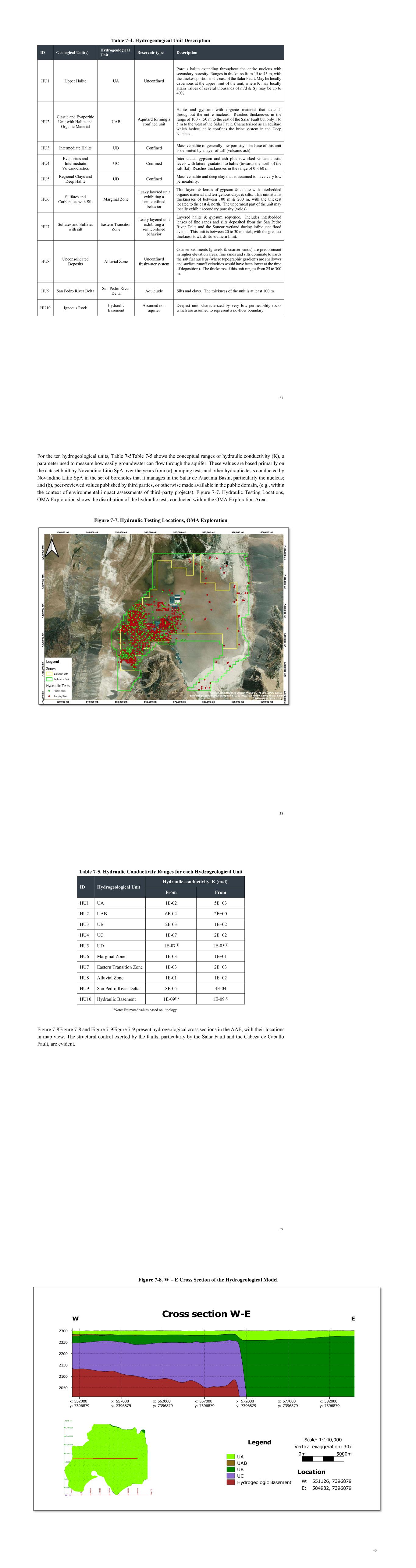
37 Table 7-4. Hydrogeological Unit Description ID Geological Unit(s) Hydrogeological Unit Reservoir type Description HU1 Upper Halite UA Unconfined Porous halite extending throughout the entire nucleus with secondary porosity. Ranges in thickness from 15 to 45 m, with the thickest portion to the east of the Salar Fault. May be locally cavernous at the upper limit of the unit, where K may locally attain values of several thousands of m/d & Sy may be up to 40%. HU2 Clastic and Evaporitic Unit with Halite and Organic Material UAB Aquitard forming a confined unit Halite and gypsum with organic material that extends throughout the entire nucleus. Reaches thicknesses in the range of 100 - 150 m to the east of the Salar Fault but only 1 to 5 m to the west of the Salar Fault. Characterized as an aquitard which hydraulically confines the brine system in the Deep Nucleus. HU3 Intermediate Halite UB Confined Massive halite of generally low porosity. The base of this unit is delimited by a layer of tuff (volcanic ash) HU4 Evaporites and Intermediate Volcanoclastics UC Confined Interbedded gypsum and ash plus reworked volcanoclastic levels with lateral gradation to halite (towards the north of the salt flat). Reaches thicknesses in the range of 0 -160 m. HU5 Regional Clays and Deep Halite UD Confined Massive halite and deep clay that is assumed to have very low permeability. HU6 Sulfates and Carbonates with Silt Marginal Zone Leaky layered unit exhibiting a semiconfined behavior Thin layers & lenses of gypsum & calcite with interbedded organic material and terrigenous clays & silts. This unit attains thicknesses of between 100 m & 200 m, with the thickest located to the east & north. The uppermost part of the unit may locally exhibit secondary porosity (voids). HU7 Sulfates and Sulfates with silt Eastern Transition Zone Leaky layered unit exhibiting a semiconfined behavior Layered halite & gypsum sequence. Includes interbedded lenses of fine sands and silts deposited from the San Pedro River Delta and the Soncor wetland during infrequent flood events. This unit is between 20 to 30 m thick, with the greatest thickness towards its southern limit. HU8 Unconsolidated Deposits Alluvial Zone Unconfined freshwater system Coarser sediments (gravels & coarser sands) are predominant in higher elevation areas; fine sands and silts dominate towards the salt flat nucleus (where topographic gradients are shallower and surface runoff velocities would have been lower at the time of deposition). The thickness of this unit ranges from 25 to 300 m. HU9 San Pedro River Delta San Pedro River Delta Aquiclude Silts and clays. The thickness of the unit is at least 100 m. HU10 Igneous Rock Hydraulic Basement Assumed non aquifer Deepest unit, characterized by very low permeability rocks which are assumed to represent a no-flow boundary. 38 For the ten hydrogeological units, Table 7-5Table 7-5 shows the conceptual ranges of hydraulic conductivity (K), a parameter used to measure how easily groundwater can flow through the aquifer. These values are based primarily on the dataset built by Novandino Litio SpA over the years from (a) pumping tests and other hydraulic tests conducted by Novandino Litio SpA in the set of boreholes that it manages in the Salar de Atacama Basin, particularly the nucleus; and (b), peer-reviewed values published by third parties, or otherwise made available in the public domain, (e.g., within the context of environmental impact assessments of third-party projects). Figure 7-7. Hydraulic Testing Locations, OMA Exploration shows the distribution of the hydraulic tests conducted within the OMA Exploration Area. Figure 7-7. Hydraulic Testing Locations, OMA Exploration 39 Table 7-5. Hydraulic Conductivity Ranges for each Hydrogeological Unit ID Hydrogeological Unit Hydraulic conductivity, K (m/d) From From HU1 UA 1E-02 5E+03 HU2 UAB 6E-04 2E+00 HU3 UB 2E-03 1E+02 HU4 UC 1E-07 2E+02 HU5 UD 1E-07(1) 1E-05(1) HU6 Marginal Zone 1E-03 1E+01 HU7 Eastern Transition Zone 1E-03 2E+03 HU8 Alluvial Zone 1E-01 1E+02 HU9 San Pedro River Delta 8E-05 4E-04 HU10 Hydraulic Basement 1E-09(1) 1E-09(1) (1)Note: Estimated values based on lithology Figure 7-8Figure 7-8 and Figure 7-9Figure 7-9 present hydrogeological cross sections in the AAE, with their locations in map view. The structural control exerted by the faults, particularly by the Salar Fault and the Cabeza de Caballo Fault, are evident. 40 Figure 7-8. W – E Cross Section of the Hydrogeological Model
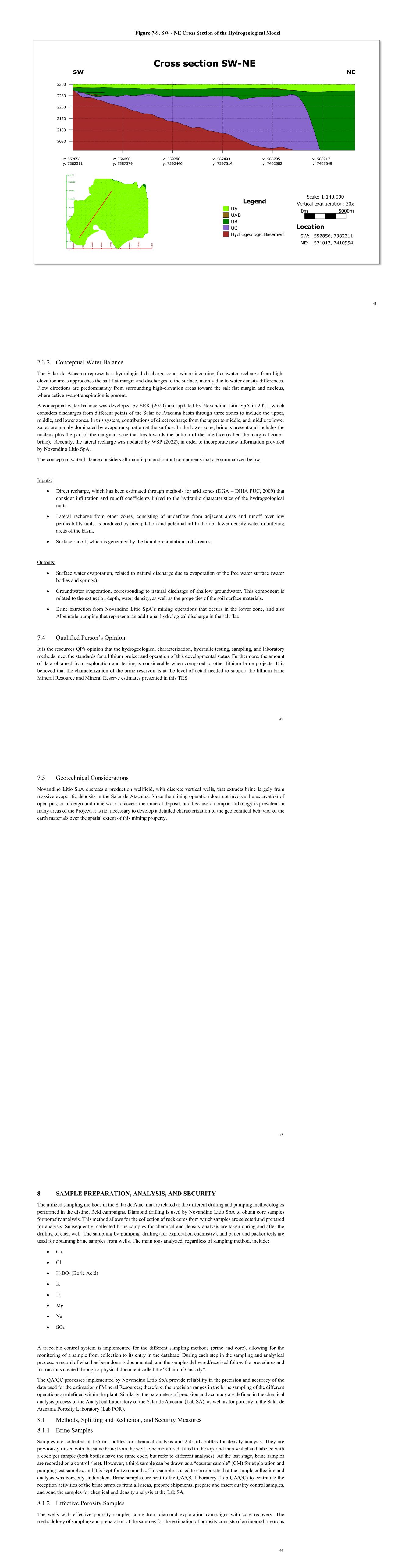
41 Figure 7-9. SW - NE Cross Section of the Hydrogeological Model 42 7.3.2 Conceptual Water Balance The Salar de Atacama represents a hydrological discharge zone, where incoming freshwater recharge from high- elevation areas approaches the salt flat margin and discharges to the surface, mainly due to water density differences. Flow directions are predominantly from surrounding high-elevation areas toward the salt flat margin and nucleus, where active evapotranspiration is present. A conceptual water balance was developed by SRK (2020) and updated by Novandino Litio SpA in 2021, which considers discharges from different points of the Salar de Atacama basin through three zones to include the upper, middle, and lower zones. In this system, contributions of direct recharge from the upper to middle, and middle to lower zones are mainly dominated by evapotranspiration at the surface. In the lower zone, brine is present and includes the nucleus plus the part of the marginal zone that lies towards the bottom of the interface (called the marginal zone - brine). Recently, the lateral recharge was updated by WSP (2022), in order to incorporate new information provided by Novandino Litio SpA. The conceptual water balance considers all main input and output components that are summarized below: Inputs: • Direct recharge, which has been estimated through methods for arid zones (DGA – DIHA PUC, 2009) that consider infiltration and runoff coefficients linked to the hydraulic characteristics of the hydrogeological units. • Lateral recharge from other zones, consisting of underflow from adjacent areas and runoff over low permeability units, is produced by precipitation and potential infiltration of lower density water in outlying areas of the basin. • Surface runoff, which is generated by the liquid precipitation and streams. Outputs: • Surface water evaporation, related to natural discharge due to evaporation of the free water surface (water bodies and springs). • Groundwater evaporation, corresponding to natural discharge of shallow groundwater. This component is related to the extinction depth, water density, as well as the properties of the soil surface materials. • Brine extraction from Novandino Litio SpA’s mining operations that occurs in the lower zone, and also Albemarle pumping that represents an additional hydrological discharge in the salt flat. 7.4 Qualified Person’s Opinion It is the resources QP's opinion that the hydrogeological characterization, hydraulic testing, sampling, and laboratory methods meet the standards for a lithium project and operation of this developmental status. Furthermore, the amount of data obtained from exploration and testing is considerable when compared to other lithium brine projects. It is believed that the characterization of the brine reservoir is at the level of detail needed to support the lithium brine Mineral Resource and Mineral Reserve estimates presented in this TRS. 43 7.5 Geotechnical Considerations Novandino Litio SpA operates a production wellfield, with discrete vertical wells, that extracts brine largely from massive evaporitic deposits in the Salar de Atacama. Since the mining operation does not involve the excavation of open pits, or underground mine work to access the mineral deposit, and because a compact lithology is prevalent in many areas of the Project, it is not necessary to develop a detailed characterization of the geotechnical behavior of the earth materials over the spatial extent of this mining property. 44 8 SAMPLE PREPARATION, ANALYSIS, AND SECURITY The utilized sampling methods in the Salar de Atacama are related to the different drilling and pumping methodologies performed in the distinct field campaigns. Diamond drilling is used by Novandino Litio SpA to obtain core samples for porosity analysis. This method allows for the collection of rock cores from which samples are selected and prepared for analysis. Subsequently, collected brine samples for chemical and density analysis are taken during and after the drilling of each well. The sampling by pumping, drilling (for exploration chemistry), and bailer and packer tests are used for obtaining brine samples from wells. The main ions analyzed, regardless of sampling method, include: • Ca • Cl • H3BO3 (Boric Acid) • K • Li • Mg • Na • SO4 A traceable control system is implemented for the different sampling methods (brine and core), allowing for the monitoring of a sample from collection to its entry in the database. During each step in the sampling and analytical process, a record of what has been done is documented, and the samples delivered/received follow the procedures and instructions created through a physical document called the “Chain of Custody”. The QA/QC processes implemented by Novandino Litio SpA provide reliability in the precision and accuracy of the data used for the estimation of Mineral Resources; therefore, the precision ranges in the brine sampling of the different operations are defined within the plant. Similarly, the parameters of precision and accuracy are defined in the chemical analysis process of the Analytical Laboratory of the Salar de Atacama (Lab SA), as well as for porosity in the Salar de Atacama Porosity Laboratory (Lab POR). 8.1 Methods, Splitting and Reduction, and Security Measures 8.1.1 Brine Samples Samples are collected in 125-mL bottles for chemical analysis and 250-mL bottles for density analysis. They are previously rinsed with the same brine from the well to be monitored, filled to the top, and then sealed and labeled with a code per sample (both bottles have the same code, but refer to different analyses). As the last stage, brine samples are recorded on a control sheet. However, a third sample can be drawn as a “counter sample” (CM) for exploration and pumping test samples, and it is kept for two months. This sample is used to corroborate that the sample collection and analysis was correctly undertaken. Brine samples are sent to the QA/QC laboratory (Lab QA/QC) to centralize the reception activities of the brine samples from all areas, prepare shipments, prepare and insert quality control samples, and send the samples for chemical and density analysis at the Lab SA. 8.1.2 Effective Porosity Samples The wells with effective porosity samples come from diamond exploration campaigns with core recovery. The methodology of sampling and preparation of the samples for the estimation of porosity consists of an internal, rigorous

45 and standardized Novandino Litio SpA process, including the determination of the sampling frequency during drilling (currently, one sample every 1 m), the regularization and lithological description of the core sample (established every 10 cm in length), determination of analyzed samples, selection of samples for porosity, lithological description of the sample, labeling of samples (with a unique sample code), and recording of samples in the database. Before conducting the porosity analysis, the samples go through a documentation review process and are measured to record their mass, diameter, and length. They are then photographed and analyzed. 8.2 Sample Preparation, Assaying and Analytical Procedures 8.2.1 Brine Samples All samples go through a process that involves both Novandino Litio SpA’s Hydrogeology Department (GHS) and Lab SA of the Salar de Atacama Production Management (GPS). The GHS oversees sampling, preparation of dispatch, entry into systems, shipment of samples to laboratory, importing, interpreting, and uploading the results to the database. The SA Lab is responsible for the analysis of the samples and publication of the results in the database. The process of preparing samples for laboratory analysis goes through a treatment that spans the determination of the calibration curve, dissolution of salt precipitates, and weightings until the matrix is prepared for chemical analysis. Each sample is analyzed by different processes. Different equipment is used, depending on the requested analyte. Different matrices are prepared for each sample with different dilutions. Potassium is analyzed by inductively coupled plasma analysis (ICP). Li is analyzed by atomic absorption spectroscopy (AA). 8.2.1.1 Laboratories Lab SA and Lab QAQC are internal to support production and are currently not accredited. Nevertheless, Novandino Litio SpA completed a round robin analysis for four laboratories, three of which were external laboratories (LSA of the Universidad Católica del Norte, Geo Assay Group, Universidad de Antofagasta Asistencia Técnica S.A.). The evaluation of accuracy was undertaken for the different certified analytes and standards. 8.2.2 Effective Porosity Samples Historically, different direct methods were used to estimate the porosity of the samples. Since 2011, Novandino Litio SpA has used pycnometers to measure the grain volume of rock samples and apparent density. These pycnometers are found in the Novandino Litio SpA Porosity Laboratory, located in Salar de Atacama. Through a double-chamber helium pycnometer (Accupyc), and according to Boyle's Law, the volume of grains in the sample is obtained. The volume of the envelope is calculated using a Geopyc, which determines the volume and density of the rock by displacement of a solid medium of small and rigid spheres with a high degree of fluidity (Dry Flow), wrapping the analyzed object without invading its pores. The Salar de Atacama Porosity Laboratory is internal to support production, and it is currently not accredited. 8.2.3 Quality Control procedures and Quality Assurance Novandino Litio SpA has implemented standardized protocols for both the analysis of brine chemistry, as well as the analysis of effective porosity to ensure good practices when determining both the evolution of brine chemistry and the porosities of the different units present in the Salar. For brines, a QA/QC program was implemented to maintain orderly data flow, providing monitoring from sample collection to the entry of the results into the database. Comparisons are made between duplicate and original (primary) samples, taking triplicate samples both in original and duplicate samples. Assays are performed with reference materials to monitor accuracy, and analytical blanks are included to determine potential contamination during sample collection. In the case of effective porosity analysis, as with brines, there is a QA/QC program that generates standardization throughout the process, including the insertion of control duplicates. In addition, to ensure correct quality control, three stages are implemented for the general process to include calibration of the equipment during the 46 analysis of the samples, validation, and exclusion of data after entering the database in acQuire. 8.2.4 Brine Chemistry The Novandino Litio SpA brine chemistry QA/QC program was created for the implementation of good practices for the utilized protocols. They range from brine sampling activities to receipt of samples, dispatch preparation, laboratory analysis, and receipt and review of results. The systematic inclusion of QC samples is carried out to monitor the precision, accuracy, and potential contamination of analytical processes and conducted sampling. This monitoring is based on the following: 1. Inserting duplicates for precision monitoring: • Analytical duplicates (ADUP). • Field Duplicates (FDUP). 2) Inserting reference materials (standards or RM’s) for accuracy monitoring: • High-grade lithium standard. • Lithium average grade standard. • Low-grade lithium standard. 3) Inserting blanks (BLK) for monitoring potential contamination: • Analytical blanks As of today, Novandino Litio SpA processes 40 samples per day distributed in two dispatches (20 each). The QC insertion is targeted at ~15% of the daily lot, that is, 6 of 40 samples (currently 4 reference standards [RM], 1 blank, and 1 duplicate), with 34 primary samples (85%). This proportion may vary slightly with daily duplicate availability and scheduled RM/analytical targets. A fixed protocol governs QC insertion so that their positions are known relative to the primary samples. With the processing of 680 analytical duplicates and 406 field duplicates analyzed at Lab SA, the Max-Min graphs were made for Li and K considering an error ratio (ER) acceptance limit of 10% (SQM, 2020). The errors of Li and K for the analytical and field duplicates are shown in Table 8-1Table 8-1. Figure 8-1Figure 8-1 and Figure 8-2Figure 8-2 shows the plots for the evaluation of analytical and field duplicates, respectively. Table 8-1. Evaluation of Analytical and Field Duplicates in Lab SA Duplicate Type Analyte Pairs Failures Error Ratio (%) Analytical Duplicates K 680 2 0.9 Li 680 6 0.3 Field Duplicate K 406 0 0.0 Li 406 1 0.2 *This table includes analytical and field duplicates from January 2024 through September 2025 (Q1 2024–Q3 2025) 47 Figure 8-1. Error Ratio Plots, Analytical Duplicates. Figure 8-2. Error Ratio Plots, Field Duplicates. The conventionally accepted maximum ER is 10%. Therefore, it is concluded that the analytical precision and that of the sampling of the elements evaluated until the end of September 2025 (Q3 2025) in Lab SA were, in practical terms, within acceptable limits, and that the sampling and analysis methods were adequate for the brine samples. Standards are included in shipments sent to the primary laboratory to evaluate the variability and stability of the RM’s. Control Charts are prepared to check, identify, and exclude any Out-of-Control samples (SOC). 2,190 samples of these RM’s were sent to Lab SA throughout the period for their respective chemical analysis. The standard shipment process consists of daily extraction of the necessary reference material samples, which are placed in 125 mL containers, labeled, and inserted anonymously in the dispatch for analysis at Lab SA. The bias was assessed during the analyzed period (January 2024–September 2025) using the Reduced Major Axis (RMA) regression between results reported by Lab SA and the Best Value (BV) for each control standard (RM) derived from the inter-laboratory Round Robin. For each quarter, four standards (three concentration levels plus one duplicate) were prepared and submitted to four laboratories—three external laboratories (UCN-LSA, GeoAssay Group, and 48 Universidad de Antofagasta Asistencia Técnica S.A.) and an internal laboratory (Analytical Laboratory, Salar de Atacama). Each laboratory analyzed every standard in triplicate; laboratory means were then computed, and the BV for each standard was defined as the median of the three external laboratories. The RMA comparison of Lab SA vs. BV provides the bias estimates. Table 8-2 summarizes the resulting accuracy. Table 8-2. Summary of Accuracy — Lab SA vs. Best Value (BV). Summary for Accuracy Analyte Quantity Unit Lab SA BV Labs Global Bias K 21 % 4.703 4.328 14.0 2.097 2.03 2.783 2.582 4.43 4.444 2.09 2.123 2.79 2.837 4.41 4.248 2.03 2.05 2.69 2.67 4.28 4.15 1.97 1.968 2.59 2.608 4.687 4.303 2.167 2.06 2.7 2.563 4.927 4.244 2.17 2.163 2.787 2.691 4.787 4.134 1.843 1.849 2.827 2.669 Li 21 % 0.64 0.649 -0.1 0.155 0.155 0.329 0.328 0.684 0.702 0.163 0.167 0.345 0.355 0.699 0.685 0.185 0.174

49 0.354 0.35 0.643 0.644 0.176 0.173 0.348 0.348 0.675 0.677 0.183 0.181 0.353 0.344 0.705 0.684 0.184 0.188 0.347 0.346 0.723 0.724 0.182 0.183 0.344 0.346 Figure 8-3. Accuracy Plots for Reference Materials (Lab SA vs. Best Value, Jan 2024–Sep 2025) For January 2024–September 2025, the Li results support Lab SA's excellent performance for accuracy in brine chemical analyses, without presenting issues related to bias, which are below the recommended 10%. As for K results, the global RMA indicates a positive mean relative difference of +14.0 % (SD ≈ 5.2 %). However, this bias is largely driven by a limited number of samples with K concentrations above 3.5 %. For samples with K < 3.5 %, the mean relative difference is markedly lower, and remains within ±10 % of BV (Figure 8-3). A few high-concentration results (BV ≳ 4.2) show larger positive deviations (up to ≈ 16 %), consistent with an RMA trend of SA vs. BV with slope > 1 and a negative intercept, as illustrated in Figure 8-3 (left panel). This positive bias in K lies outside the range that materially influences the potassium grade model, as it occurs only in samples above 3.5 % K (less than 1 % of the estimated blocks). The insertion of analytical blanks in the shipments sent to the primary laboratory aids in determining if there is any 50 degree of contamination in the laboratory analysis process. The blank was analyzed in the primary laboratory. Table 8-3 shows that the possible pollution ratios (PPR) were 0.5% for K (4/835) and 1.6% for Li (13/836), with maximum blank values of 0.44% (K) and 0.06% (Li). These low frequencies indicate no systematic contamination; the few flagged cases are consistent with measurement noise/limited precision at near-blank levels rather than true contamination. Overall, it can be concluded that potassium and lithium results do not exhibit contamination issues. Table 8-3. Summary of Possible Pollution Ratios of Blank Samples during Analysis. Summary for analytical blanks Analyte Quantity Unit Max Blank Contaminated Possible contamination ratio (%) K 835 % 0.44 4 0.5 Li 836 % 0.06 13 1.6 Figure 8-4. Contamination Plots, Blank Samples 8.2.4.1 Effective Porosity QA/QC is implemented in three different stages of the general process, including in the equipment during the analysis of the samples, after entering the results in the database, and through scatter charts for the control and analysis of the precision of the process. Stage 1: In the equipment during analysis of the samples The precision of an assay is validated by both instruments (Geopyc and Accupyc), using a range acceptance of the results, where results are guaranteed to be within this range, or the analysis is repeated. Through the software for each instrument, different processes of calibration, and review of their accuracy is undertaken using manufacturer standards. Stage 2: After entering results in the database The purpose of this system is to establish parameters for validation and exclusion of samples automatically when entering the data into the acQuire database, leaving these flagged and included/excluded from the dataset for estimation, if applicable. Of the 18,878 total samples registered in the GHS database, drawn from 115 wells, 3,019 samples were excluded using QA/QC parameters after data entry into acQuire (16.0% of the total population), resulting 51 in 15,859 validated samples (84.0% of the total population) for the brine volume estimation dataset. Stage 3: Through scatter charts for the control and analysis of the process precision This control measure is based on the systematic insertion of duplicate samples (QC) in analysis for porosity that are later analyzed using scatter charts displayed directly in acQuire. For January 2024–September 2025, 2,865 samples were registered in the database for porosity results and have been obtained from 2,612 primary samples and 253 duplicate samples, for 8.8% of controls. Table 8-4Table 8-4 shows the duplicate sample evaluation and summarizes the error ration in the porosity lab. Figure 8-5 and Figure 8-6 shows the scatter plots of the pairs analyzed with Accupyc and Geopyc, respectively. Table 8-4. Duplicate Sample Evaluation in the Porosity Lab Equipment Analysis Duplicates Failures Error Ratio (%) Accupyc Grain Volume 253 0 0.0 Geopyc Envelope Volume 229 1 0.0 52 Figure 8-5. Scatter Plot for Pairs Analyzed with Accupyc.

53 Figure 8-6. Scatter Plot for pairs analyzed with Geopyc 54 55 The conventionally accepted maximum ER is 10%. Therefore, it is concluded that the analytical precision of the elements evaluated during this period in the POR Lab was within acceptable limits. Further, the rock sampling method and volume analysis were adequate for the samples of porosity. 8.3 Opinion of Adequacy In the QP's opinion, sample preparation, sample safety, and analytical procedures used by Novandino Litio SpA in the Salar de Atacama follow industry standards with no relevant issues that suggest insufficiency. Novandino Litio SpA has detailed procedures that allow for the viable execution of the necessary activities, both in the field and in the laboratory, for adequate assurance of the results. 56 9 DATA VERIFICATION 9.1 Data Verification Procedures Verification by the QP covered field exploration, drilling and hydraulic testing procedures, (including descriptions of drill core and cuttings), laboratory results for effective porosity and chemical analyses, QA/QC results, review of surface and borehole geophysical surveys, and review of the data entry and data storage systems. Based on the review of Novandino Litio SpA’s procedures and standards, it is the QP’s opinion that Novandino Litio SpA has data verification standards capable of ensuring good control and quality of the data obtained during drilling as well as from hydraulic and geophysical testing. Based on the review of the QA/QC data during the period, the QP considers the sampling procedures as well as those of preparation and analysis for K and Li in the primary laboratory adequate for the brine and rock samples. Furthermore, the QP considers the resulting analytical data to be sufficiently accurate. There are no limitations on the review, analysis, and verification of the data supporting Mineral Resource estimates within this TRS. It is the opinion of the QP that the geologic, chemical, and hydrogeologic data presented in this TRS are of appropriate quality and meet industry standards of data adequacy for the Mineral Resource and Mineral Reserve estimates. 9.2 Data Management Since 2021, Novandino Litio SpA has used acQuire™, a geoscientific information management software. This has allowed Novandino Litio SpA to centralize data management and avoid the use of data sheets, such as Excel, that can lead to a greater possibility of error. This software implements a series of rules to assure the quality control of data entry, preventing common mistakes, such as out-of-range values, incomplete data, etc. 9.3 Technical Procedures The QP reviewed the data collection procedures associated with drilling, hydraulic tests, and geophysics surveys. Novandino Litio SpA has a set of technical procedures for each of its field activities. These procedures seek to establish a technical and security standard that allows field data to be optimally obtained while also guaranteeing the safety of workers. 9.4 Quality Control Procedures The QP reviewed Novandino Litio SpA’s data collection and QC procedures. Regarding the analysis of brine, these procedures are considered adequate. It is evident that they used adequate insertion rates for different controls. As for porosity tests, the Novandino Litio SpA QC protocol considers the analysis of duplicate samples that are repeated adequately for this type of control. 9.5 Precision Evaluation The QP reviewed the error rates of K and Li as well as the rates of analytical duplicates and field duplicates in brines. It was found that they remained within limits conventionally considered acceptable (below 10.0%). Error rates for both Accupyc and Geopyc analysis for porosity were also within conventional limits and were considered acceptable (below

57 10.0%). The QP concludes that the sampling, preparation, and analysis procedures of brine samples as well as rock and analysis of volumes for porosity to be adequate for the evaluated period. 9.6 Accuracy Evaluation Novandino Litio SpA performs a round robin analysis at four laboratories. Three of the laboratories are external (ALS Patagonia S.A., LSA of the Universidad Católica del Norte, and the Geo Assay Group). The fourth is an internal laboratory (Lab SA). Novandino Litio SpA uses these laboratories to evaluate bias for the different certified analytes and standards. Additionally, external control of the results is carried out in the laboratory of the University of Antofagasta (Lab UA). The QP considers that this evaluation supports the accuracy of the brine chemistry data for the purpose of its use in preparing geological models and estimating Mineral Resources and Mineral Reserves. 9.7 Pollution Evaluation During the data review for the period that the samples were evaluated, there was no significant contamination of any of the analytes evaluated for brines during primary laboratory analysis. Li results showed a possible contamination ratio of 1.6 % (13 contaminated blanks out of 836), which is below conventional concern thresholds and consistent with measurement noise at near-blank levels rather than true contamination. 9.8 Qualified Person’s Opinion of Data Adequacy It is the QP’s opinion that the analytical results of the geologic, chemical, and hydrogeologic data presented in this TRS are of appropriate quality and are sufficiently reliable to meet industry standards of data adequacy for the Mineral Resource and Mineral Reserve estimates. 58 10 MINERAL PROCESSING AND METALLURGICAL TESTING This sub-section contains forward-looking information related to recoveries for the Project. The material factors that could cause actual results to differ materially from the conclusions, estimates, designs, forecasts or projections in the forward-looking information include any significant differences from one or more of the material factors or assumptions that were set forth in this sub-section including actual brine characteristics that are different from the historical operations or from samples tested to date, equipment and operational performance that yield different results from the historical operations, and historical and current test work results. Brine chemistry exploration in the Salar de Atacama was the first step in designing a lithium recovery process, and this was followed by the planning and confirmation of the Project’s operational success. The basis of the process methods was tested and supported by laboratory evaporation as well as historical metallurgical response tests. Since 2015, additional research and projects were implemented to improve yield and recovery, and they have also continuously improved the accuracy of lithium and potassium salt recovery modeling for each of the brine extraction well areas. Historical test development has allowed for the differentiation of main categories for brine types based on composition and proportion between species. Such tests have been designed to optimize the extraction processes and ensure that customer product specifications are achieved. Furthermore, these tests ensure that deleterious elements remain below the established limits. Summaries of the analytical and experimental procedures as well as the main test results are presented in the following subsections. 10.1 Test Procedures Testing has been conducted to estimate how different brines respond to concentration via solar evaporation and overall metallurgical recoveries from the process plant. Testing also aims to evaluate treatability of the raw material for finished lithium and potassium products. Laboratory tests generate data for the characterization and recovery baselines. The tests detailed below have the following objectives: • Determine if analyzed material is reasonably amenable to concentration by established in-plant separation and recovery methods. • Optimize processes to ensure a recovery that will be intrinsically linked to both the chemical and physical characterization of the treated brine. • Determine deleterious elements and establish mechanisms to keep such elements below limits which guarantee a certain product quality. The testing program requires that Novandino Litio SpA staff collect brine samples from wells on a regular basis for testing. Sample collection takes place throughout the year with specific campaigns defined in an annual plan. Once each sampling program is completed, the samples are sent to internal labs for chemical analysis. Complementary sampling then considers the temporal, hydrogeological, spatial, and operational criteria of the wells. The chemical concentrations of the wells are also updated. In all, this process generates data that provides accuracy in the estimation of brine chemistry. It should be noted that Novandino Litio SpA's Salar de Atacama brine exploitation system focuses on detecting, differentiating, and segregating brine wells based on their concentration. If the criteria are met, the brine is directed directly into the well system, but if not, it goes into the collector system. This approach helps to prevent dilution of the brine grade by mixing with brines that are lower in potassium and lithium or contain higher levels of magnesium, 59 calcium, boron, and sulfate. The analytical laboratories at Salar de Atacama support this well categorization approach, making the system more efficient in terms of resource utilization and well availability. The Salar de Atacama laboratories, via its three sub-facilities (Table 10-1), i.e., QA/QC Laboratory, Analytical Laboratory, and Metallurgical Laboratory, produce metallurgical test databases which include results for: • Chemical composition (brines and salts) • Density • Evaporation rate based on brine chemical composition. The metallurgical tests are designed to estimate the distinct responses of brine and salt when exposed to productive treatment and also evaluate the most appropriate route for treatability. The internal laboratories oversee support for these operations, providing data from tests to create a database of characterization of feed salts and production performance. For this purpose, samples are collected and subjected to chemical and mineralogical analysis. Historically, Novandino Litio SpA has conducted these tests at the plant and/or pilot scale through its research and development department, allowing for (i) an improved recovery process and product quality, (ii) lithium recovery from lithium carnallite, (iii) increased LiOH.H2O production capacity, and (iv) increased Li2CO3 production capacity. Samples for metallurgical testing are obtained through well sampling, pond sampling, and salt sampling campaigns. Quality Control is implemented at all stages to ensure and verify that the collection process occurs successfully and remains representative. Laboratory facilities available to analyze samples are located at Salar de Atacama and LCP. In the following subsections, a discussion is provided on brine sampling, preparation, and characterization procedures as well as monitoring activities at LCP and Salar de Atacama. 60 Table 10-1. List of Laboratory Facilities Available for Analysis in Salar de Atacama Laboratory name Location Analyses performed Description QA/QC Laboratory (Lab QA/QC) Salar de Atacama --- Brine sample centralization, QC sample insertion, Data Base dispatch registers. ANALYTICAL LABORATORY OF THE SALAR DE ATACAMA (LAB SA) Salar de Atacama Ca, Cl, H3BO3, K, Li, Mg, Na, SO4 and density. ICP-OES: based on vaporization, dissociation, ionization and excitation of various chemical elements of a sample inside a plasma. FAAS: Atomic absorption spectroscopy is based on radiation absorption at a specific wavelength. Mg volumetry: Magnesium determination is an electro- analytical technique to determine the concentration of an electroactive species in a solution using a reference electrode and working electrode. Determination of chlorides by volumetry: This method is used to determine chloride ions by precipitation titration, where chloride ion precipitates as AgCl (silver chloride). Gravimetry: This is a quantitative analytical method, i.e., it determines quantity of substance by measuring the weight of the substance by gravity. Metallurgical Laboratory Salar de Atacama Sample Preparation, Moisture Determination, Particle Size Analysis, Solids Percentage Sample Preparation is an essential stage in analytical processes. Sample procedure and preparation will produce a homogeneous sub-sample that is representative of the total sample through an alternating paddle. Moisture is determined by a gravimetric method with constant weight where the sample is reduced by the alternating paddle technique and then is transferred to an oven. Granulometric Analysis: Evaluation of granulometric distribution of different salts in the system, by means of a master sizer and magnetic stirrer. Solids Percentage: The solid/liquid separation of pulps from different processes, where the amount of solids in the sample is determined. Novandino Litio SpA 's new initiatives to improve the recovery of lithium from the LiCl production process are supported by internal laboratories in Salar de Atacama, which carry out chemical analysis of brines and salts. Further information on these initiatives can be found in section 10.6Error! Reference source not found.. With regards to the production of lithium carbonate and lithium hydroxide, the Lithium Chemical Laboratory (LCL) in LCP conducts quality control tests on liquid and solid samples, as well as finished products (see Table 10-2Table 10-2).

61 Table 10-2. List of Installations Available for Analysis at PQC Laboratory Location Analyses Performed Description Lithium Chemical Laboratory (LCL) Lithium Chemical Plant (LCP) Chloride, sulfate, sodium, potassium, calcium, magnesium, iron, nickel, copper, lead, aluminum, manganese, chromium, zinc, silicon, insoluble, lithium carbonate, boron, moisture pH, magnetic particle density Chemical and physical analysis of finished products. Chemical analysis of solution and solid samples. The following subsections discuss brine sampling, preparation, and characterization procedures, as well as monitoring activities at the LCP and Salar de Atacama. 10.1.1 Well Sampling and Sample Preparation In the Salar de Atacama, wells involved in the Project’s operation are constantly sampled. Well sampling for brine operations is determined through planning and production management, according to internal requirements. Samples for the chemical characterization of brine are taken from the wells involved in the Project’s operation, which, together with other samples from the database, are used for the evaluation of Mineral Reserves. Brine samples from pumping are collected for chemical and density analysis. These wells are called "Operational", while those wells which are used for exploration are called "Non-operational". The latter are sampled to assist in mine planning for future extraction scheduling. Brine sampling, obtained by pumping a well and enabled in one or more reservoirs, is categorized according to the status of the well, as detailed in Table 10-3Table 10-3. 62 Table 10-3. Categorization of Brine Samples from Wells Category/Status Type Detail Operational Operating well Sample taken from a production well Inactive well Sample obtained from a production well that is stopped at the time of sampling Non-operational (exploratory) Short pumping sampling Sample obtained from a non-production well, after pumping, which can last from 5 to 30 minutes. Pumping test Brine sample taken during a pumping test to evaluate aquifer parameters. A preliminary pumping test is undertaken to detect anomalous transmissivities that could invalidate a production well. Pumping well sampling and measurements are aimed to reach a maximum dynamic level, take brine samples, and measure basic parameters, such as level, flow, viscosity (Marsh funnel determination), clarity, and presence of fine sediments (by measuring both parameters in an Imhoff cone) as well as temperature, pH, and electric conductivity using a multiparametric probe (Figure 10-1Figure 10-1). Sampling is executed in a plastic jug, directly from the well head (at the pump outlet), by opening a tap placed for said purpose. Before taking the sample, fresh brine is added to the jug in order to remove any residue from a previous sample. This procedure is repeated each time a sample is taken or transferred to sample containers. The final brine sample is discharged into a receptacle from which samples are drawn for chemical analysis, covering a range of dissolved metals, including lithium and brine density (125 mL for chemical analysis and 250 mL for brine density analysis); afterwards, each container is primed and fully filled. Containers for samples are properly identified with self-adhesive labels with barcodes. 63 Figure 10-1. Determination of In-situ Brine Parameters at Pumping Wells a) Sampling b) Clarity and fine sediment measurement c) Viscosity measurement. d) pH, temperature, and conductivity measurement Brines are not exposed to any preparation, or acid preservation, as a pre-treatment before being submitted for chemical analysis at the destination facilities. Brine sampling operation quality control includes taking field duplicates every 15 samples (through repetition of the sampling procedure) and analytical duplicates (by taking a duplicate from the same jar). The operations outlined above are implemented depending on sampling requests and operational capacity. It must be noted that brine in the salt flat acts as a "mobile resource;" and in some cases, where formation permeability is low, it is not possible to collect a brine sample after a waiting period. For sampling campaigns, some factors that make sampling impossible must be considered, such as the following: • Temporary well blockage • Dry well at the time of the static water level measurement. • Interruption of brine pumping due to brine depletion in the well, before, or during, sampling It should also be noted that to obtain more representative samples from the wells, bailer sampling is not performed in inactive operating wells, considering that when the well is no longer operative its chemistry might be stratified. As such, bailers are used for sampling in disassembled wells, while shutdown wells are turned on and operated until the 64 well volume is renewed three times before samples are taken. Internal laboratories involved in brine sampling, analysis, and testing are listed in Error! Reference source not found., and they are also detailed in the following subsections. 10.1.2 Sampling in Brine Build-up Pools This task is carried out by mine operation staff. At the pumping station, samples are regularly taken from the pond outlet to the brine treatment plant, allowing for improved verification, adjustment, and planning. Samples are taken by a device installed in the pond outlet line behind the pumps, allowing 8 ml to be extracted from the lines every 7 minutes to form a brine composite. Chemical composition measurements of this brine feed are described in the following subsection. 10.1.3 Chemical Characterization of Brines Analytical methods for the determination of lithium, potassium, magnesium, and calcium concentrations in solution are applied using Atomic Absorption Spectrometry (AAS) and ICP techniques. The latter analysis is generally used on a broad set of elements (multi-elemental analysis), including the detection of trace metals. The analytes K, SO4 and H3BO3 are analyzed by ICP mass spectrometry. Li is analyzed by AA spectroscopy in conjunction with the determination methodology. Analysis, methodology, and the equipment used in the determinations are indicated in Table 10-4Table 10-4. Sample preparation process for laboratory analysis goes through a treatment that includes calibration curve determination, dissolution of precipitated salts, and weighing to matrix preparation for chemical analysis. Each sample is analyzed by means of different processes and equipment. Depending on the required analyte, different matrices with different dilutions are prepared for each sample. Protocols used for each sample are documented in relation to materials, equipment, procedures, and control measures. Brine samples collected are analyzed by testing specially prepared blanks and standards inserted as blind control samples in the analytical chain. Regarding quality assurance checks of results, the following criteria were established: • Analyze QC results, according to insertion rate per analysis (blanks, standards and duplicates) and verify that the observed error is within ±2% in AA and ±5% in ICP. • Analyze control sample (MC) every 10 samples and verify that error is within ±2% of initial reference. • Calibration curve with R2 = 0.999.

65 Table 10-4. List of Analyses for Chemical Characterization. Analysis Method Standard Method Temperature (°C) Thermometry APHA 2550 pH Potentiometry APHA 4500 H+ B. Conductivity(mS/c m) Electrometric method APHA 2510 B. Total suspended solids Solids Dried at 103-105°C APHA 2540 D %Li ICP-OES or Atomic Absorption Spectrophotometry with direct air-acetyleneflame aspiration NCh3349:2020 Brines-Determination of alkali metals by flame atomic absorption spectrometry. ASTM D3561- 16: Standard test method for lithium, potassium and sodium ions in brackish water, seawater and brines by atomic absorption spectrophotometry. %K ICP-OES or Atomic Absorption Spectrophotometry with direct air-acetylene flame aspiration NCh3349:2020 Brines-Determination of alkali metals by flame atomic absorption spectrometry. ASTM D3561- 16: Standard test method for lithium, potassium and sodium ions in brackish water, seawater and brines by atomic absorption spectrophotometry. %Mg ICP-OES or Atomic Absorption Spectrophotometry with direct air-acetylene flame aspiration NCh3349:2020 Brines-Determination of alkali metals by flame atomic absorption spectrometry. %SO4 Determination of Sulfate with residue drying SM 45002-C/D (Drying of Residue) %Ca Atomic Absorption Spectrophotometry with direct aspiration of nitrous oxide-acetylene flame. NCh3349:2020 Brines-Determination of alkali metals by flame atomic absorption spectrometry. %Cl Argentometric method SM 4500-Cl-B %Na ICP-OES or Atomic Absorption Spectrophotometry with direct air-acetylene flame aspiration SM 3111 B %H3BO3 Acid-base volumetry. Determination of boric acid content - Volumetric method. NCh3358:2020 Brines-Determination of boron by acid- base potentiometric titration. 10.1.4 Brine Density Determination For the determination of brine density, a representative sample is taken by filling a 16-mL plastic vial and placing it in a sampler, where each vial is introduced into a DMA4500 automatic densimeter which registers the density. This measurement is reported through the LIMS laboratory system, which is an integrated data management software, where reports are created. Quality assurance controls include equipment status checks, analysis of a reagent blank together with the samples, verification of the titrant concentration, and a repeated analysis for a standard together with the set of samples to confirm its value. The reference methods followed by the in-house laboratories for the determination of certain analytes ensure a certain degree of reliability of the determination methodology and results. The chemical characterization of the samples takes as reference the methods indicated in: • American Public Health Association (APHA) Standard Methods for the Examination of Water and 66 Wastewater. • Chilean Standard (NCh) 3349:2020 for the determination of alkali metals. Standard Methods (SM) produced by the American Public Health Association (APHA), the American Water Works Association (AWWA), and the Water Environment Federation (WEF). For precipitated salts in the ponds, the same chemical analysis parameters (Li, K, Na, Ca, Mg, SO4, H3BO3, Cl) are determined according to the methodology described in the Table 10-4, for their characterization and evaluation of the evaporation-concentration process. 10.1.5 Calculated Evaporation Rate Evaporation monitoring represents an important factor in well management and production scheduling; however, it is complex due to the extreme conditions faced by solutions, producing potential errors. Therefore, to validate evaporation well data, calculations were conducted using supplementary meteorological parameters collected at stations installed in the Salar de Atacama. Solar radiation, humidity, wind speed, and temperature represent the dominant processes controlling evaporation. Salt composition effects are also considered, so that evaporation is modeled empirically, with consideration of magnesium and lithium concentration in the free brine, as well as Novandino Litio SpA’s weather station data on-site. Evaporation estimates are obtained by correlating water evaporation at a weather station (variable by seasonality) with well area/shape and well activity over a given period. To estimate evaporation, the equations (correlations of J.A. Lukes & G.C. Lukes [1993]) are applied to the wells. Lukes equation (1993) is applied to ponds with brine (free brine height). The equations relate evaporation area and evaporative activity associated with magnesium, sulfate, lithium, and potassium concentration. As an exercise, according to the operational statistics reviewed, Table 10-5Table 10-5 summarizes the evaporation rate calculated by the production system (with emphasis on lithium and potassium), which are associated with the type of pond in the period 2023-2025. 67 Table 10-5. Mean Annual Evaporation Rates for each Subsystem in the 2023-2025 Period Brine evaporation rate Minimum rate (mm/month) Maximum rate (mm/month) Average rate (mm/month) 2023 Low Sulfate Halite 915 4,623 2,398 Sylvinite 2,604 8,309 5,078 Carnallite 1,474 4,840 2,980 Bischofite 805 2,870 1,499 Productive 807 2,608 1,646 Hight Sulfate Halite 976 4,239 2,454 SX 1,766 5,199 3,572 CX 774 3,870 1,991 2024 Low Sulfate Halite 942 4,137 2,408 Sylvinite 2,165 8,222 4,982 Carnallite 1,356 6,221 3,171 Bischofite 822 3,163 2,004 Productive 644 2,208 1,586 Hight Sulfate Halite 454 2,395 1,056 SX 1,042 4,067 2,547 CX 684 3,294 1,699 2025 Low Sulfate Halite 667 2,870 1,658 Sylvinite 1,282 5,886 3,187 Carnallite 3,278 9,691 5,871 Bischofite 939 3,200 2,097 Productive 826 2,874 1,827 Hight Sulfate Halite 335 2,143 841 SX 1,060 3,725 2,386 CX 492 2,991 1,232 10.1.6 Control Procedures Currently, QC procedures for the brine production operation and finished products are in place. These procedures include monitoring efforts from input brine characterization to brine sampling and concentration characterization. These QC procedures also apply to products obtained from the MOP, SOP, and lithium chemical processing plants. In this regard, the laboratories involved support operations to ensure that the system’s treatment requirements are effective. 68 10.1.6.1 Salar de Atacama Control Laboratory The operation of solar evaporation wells is based on controlling the chemical balance of the solutions to be extracted and by verifying ion levels that are part of the product (Li, K) as well as the ions which can affect (positively or negatively) their recovery (SO4, Ca, Mg). For this reason, mine programs are focused on obtaining solutions with concentration parameters that meet solar well operational requirements in its two lines to include MOP wells (focused on concentrated lithium solution production) and SOP wells (focused on potassium and lithium sulfate production). These requirements are fulfilled through the determination of direct delivery of solutions, or through a mixture of brines with complementary chemical characteristics to produce a mixture that complies with feed specifications (maximum ranges of ion concentration fed to each production line) and well systems. During brine concentration, sequential salts precipitate in the pond system and are harvested, while others are discarded as impurities. For the lithium-focused system, sodium chloride (NaCl) precipitation occurs followed immediately by potassium chloride (KCl) salts, resulting in a brine that is sent to the solar evaporation ponds to concentrate the solution to ~4% - 5% lithium concentration. These ponds are the so-called Lithium System. Once the pond systems are in operation, sampling and test procedures for evaporation tests are as follows: • Collection of brine samples on a regular basis to measure brine properties, such as chemical analysis, density, brine activity, etc. • Collection of precipitated salts from the ponds for chemical analysis to assess evaporation pathways, brine evolution, as well as salt physical and chemical properties. Laboratory determination of the brine and salt concentration is then used to perform a material balance of the evaporation and crystallization circuits based on this composition of feed, transfers, harvests, and discards. These results are then used to estimate evaporation rates (and hence salt concentrations) reached at each stage. The following subsection details the estimation of the evaporation rate per concentration pool according to the composition of the brine. As such, samples taken from each production pond that will feed the solar evaporation ponds are continuously monitored. The solutions from each stage of the ponds are also monitored to ensure efficient operational control. Concentration control in each of the ponds of the lithium system (MOP) is also maintained within the range established for optimum performance and compliance with production plans. 10.1.6.2 Lithium Chemical Plant (LCP) Control Laboratory The Lithium Chemical Plant aims to refine lithium-rich brines from remaining impurities and also perform lithium carbonate synthesis. A part of the carbonate is then used for the synthesis of lithium hydroxide. Customer requirements for lithium products require lithium carbonate to be 99.5% pure with a maximum concentration of magnetic particles which is less than 500 ppb, and a maximum concentration of sodium, magnesium, and calcium ≤0.05%. The requirements also specify that lithium hydroxide has maximum trace levels of iron, chromium, copper, and zinc no greater than 1 ppm. The analyses performed for product QC are related to each of the following purification stages: • Boron removal. • Magnesium removal. • Calcium removal.

69 • Carbonation. Analytical methodologies identify deleterious elements (boron, magnesium, calcium, and sulphate) to establish mechanisms in the operation to keep such elements below acceptable limits and also ensure product quality.Table 10-6 Table 10-6 lists the basic set of analyses requested from laboratories as well as the methodologies used in determining solutions and solids. Table 10-6. List of Requested Analyses for Plant Control Parameter Method Liquid Sample Analysis Lithium Atomic Absorption Calcium and Magnesium Atomic Absorption/Volumetry Carbonate and Boron Volumetry Silicon ICP pH pH meter Sulfate UV visible Solid Sample Analysis Chloride UV visible Sodium, Magnesium, Calcium, Sulfate, Silicon and Boron ICP Humidity Stove D50 Mastersizer Chemical and physical parameters are evaluated, and the finished product then undergoes strict QC. Methodologies used for determining the chemical and physical parameters are recorded in Table 10-7Table 10-7. Table 10-7. Analysis of Products (Li2CO3/LiOH) Parameter Method Chemical Analysis Chloride UV visible Sulfate, Sodium, Potassium, Calcium, Magnesium, Iron, Nickel, Copper Lead, Aluminium, Manganese, Chromium, Zinc, Silicon ICP Insoluble Stove LOI Muffle LiOH Volumetry Physical Analysis 70 Parameter Method Magnetic particles ICP #60 mesh Rotap/Air jet Density FFD / Tap density D50 Mastersizer /Rotap 71 10.2 Analytical and Testing Laboratories Salar de Atacama's metallurgical test work program requires that samples are sent to internal laboratories located on-site. Table 10-1Error! Reference source not found. details the name, location, and analysis conducted. Lab SA is not certified by the International Standards Organization (ISO), but it specializes in chemical analysis of brines and inorganic salts with extensive experience since 1995. It should be noted that none of the three internal laboratory facilities owned by Novandino Litio SpA and operated by company personnel are certified by ISO standards. Lab QA/QC is in charge of sample custody regarding the reception of brine samples from all areas. The Lab is also in charge of dispatching arrangements, preparation and insertion of QC samples and sending them for chemical analysis to Lab SA. From there, Lab QA/QC publishes the results. The QA/QC and traceability control program is detailed in Chapter 8. Lab SA services are needed in several areas, including exploration, operation, pumping, and monitoring. Samples arriving undergo a preliminary filtering process to eliminate solid materials that remain in suspension. The Salar de Atacama laboratories continuously improve their procedures with visits from expert advisors and round robin testing. The interlaboratory comparison seeks to share experiences and results with external laboratories that have similar experience in analysis development and implementation. The purpose of this process is to continuously improve the techniques and procedures employed as well as to detect gaps. Therefore, samples are sent to both of Novandino Litio SpA's external and independent analytical laboratories which are accredited and/or certified by the ISO: • Geo Assay Group (ISO 9001 Certification). • LSA of the Universidad Católica del Norte (Accreditation with the international standard ISO/IEC 17025). During the interlaboratory comparison, a bias assessment is conducted for all relevant analytes using certified reference standards. Accuracy is further validated through an external quality control program, with selected samples analyzed by the University of Antofagasta laboratory. During round robin tests, no significant contamination of any of the analytes evaluated for the brines was detected during the analysis, demonstrating that: • The sampling, preparation and analystical procedures of the brine samples are adequate. • The quality control and analytical procedures used in the laboratory are of high quality and similar to those used by ISO certified laboratories specialized in brine and inorganic salt analysis. At LCP and according to sampling and analysis protocols provided, adequate procedural management in both activities was identified. Staff responsible for carrying out the procedures are properly instructed, trained, and aware of handling the materials and equipment to be used. The staff relies on clearly defined roles in order to comply with the standards defined for each procedure. This includes prior verifications and reporting in case deficiencies are detected, or irregularities in sampling as well as reporting problems with the samples and equipment. 10.3 Sample Representativeness The characterization approach and sample collection procedures used by the most recent explorations program have demonstrated the validity of the sampling methodology and documentation procedures. Metallurgical test development is developed by teams of specialized professionals with extensive experience in mining and metallurgy. Samples selected for testing and/or assays are taken by qualified laboratory personnel and correspond to areas 72 indicated in the sampling plan along the production chain. The samples used to generate metallurgical data are sufficiently representative to support planning yield estimates and are adequate for the purposes of estimating recovery of raw materials from different processing sectors of the company. QA/QC measures include written field procedures and checks, such as monitoring, to detect and correct any errors identified in the project during drilling, prospecting, sampling, preparation and testing, data management, or database integrity checks. This ensures that reliable data is used for Resource and Reserve estimates. Novandino Litio SpA applies a protocol that requires the laboratory to receive brine samples from all areas developed in accordance with the campaign, address and arrange the dispatch together with shipment documentation of samples and prepare and insert quality controls to confirm the precision and accuracy of the results. By chemical species analysis, an insertion rate of standard, or standard QA/QC samples, blanks, and duplicates is established. Details are provided in Chapter 8 of this Report. 10.4 Testing and Relevant Results 10.4.1 Salar de Atacama Testwork At Salar de Atacama and for chemical analysis, analytical work has focused on increasing the quality and optimizing the yield of brine products. The specific objectives include the following: • Establish a balance between efficiency and maximum allowable lithium concentration. • Determine brine purification conditions and recovery of valuable species from impregnated salts. • Investigate process equipment and operating conditions for the removal of impurities and maximization of production. The Salar de Atacama’s yield enhancement plan includes a set of operational improvement initiatives, project development and scale-up initiatives, as well as new process evaluation initiatives with an objective to recover more lithium from the LiCl production system.

73 Currently, the following initiatives are underway: 1. Bischofite platforms: Focused on recovering losses due to impregnation. 2. Li2SO4 project: Processes and purifies lithium sulfate salt for use in refined lithium production processes. 3. Calcium Source: Eliminate losses due to lithium sulfate precipitation. 4. Improved C-Li recovery: Optimization of lithium carnallite leaching process. All measures/initiatives are focused on optimizing the Salar de Atacama's operations to capture brine product which could be lost due to infiltration, impregnation, and precipitation. Each measure occurs at different stages of development according to each case. A brief description of the experimental procedures and relevant or expected results of the initiatives include: • Bischofite platforms • Calcium Source 10.4.1.1 Bischofite Platforms A lithium recovery initiative based on bischofite squeezing platforms has been developed to recover brine impregnated in salts generated during the final stages of brine concentration, where elevated brine concentrations result in significant salt formation and partial retention of lithium‑bearing brine within the salt mass. The initiative was evaluated during an initial development phase in 2018 through laboratory‑scale and pilot‑scale testing, which demonstrated the technical and economic feasibility of recovering impregnated brine. Based on these results and subsequent operational assessments, the Company proceeded with the construction of bischofite squeezing platforms. By the end of 2021, five (5) platforms had been implemented. Two (2) additional platforms were implemented in 2022, followed by the implementation of two (2) more platforms during the 2023-2024 period. As of the reporting date, a total of nine (9) bischofite squeezing platforms are operational with a total installed area of approximately 500,000 m². Figure 10-2. Improved Treatment Scheme for Bischofite Platforms Based on processing and recovery assessments, this initiative is estimated to contribute incremental recovery of approximately 11,000 tonnes of lithium carbonate equivalent (LCE) per year. 74 10.4.1.2 Calcium Source The lithium concentration process is based on solar evaporation of natural brines, during which various salts precipitate sequentially as brine concentration increases. Certain sulfate‑bearing phases formed during this process may incorporate lithium, resulting in recoverable lithium losses. To mitigate these losses, a sulfate abatement concept based on calcium addition has been evaluated. This approach promotes preferential sulfate removal through the formation of non‑lithium‑bearing sulfate phases, thereby increasing lithium availability in the concentrated brine stream and improving downstream lithium recovery. Production assessments indicate that reducing or avoiding the formation of lithium‑bearing sulfate phases within the lithium chloride production stream could result in incremental recovery of approximately 9,100 tonnes of lithium carbonate equivalent (LCE) per year. The technical viability of the sulfate abatement concept was evaluated through testwork using natural brine and calcium‑treated brine. Based on the results, the process was advanced through a phased development strategy, including initial field application and subsequent engineering development to support potential plant‑scale implementation. 10.5 Lithium Chemical Plant (LCP) Testing The processes of obtaining refined lithium products were developed over a long period. Operational experience and constant search for operational improvements have led to testwork with the following objectives: • Complete testing and design of the boron solvent extraction facility with a performance guarantee provided by the equipment supplier. • Determine reagent consumption and brine purification conditions. • Investigate process equipment and operational conditions for impurity removal. • Determine lithium carbonate conditions to produce a high purity product. As such, tests are being developed to increase Li2CO3 and LiOH.H2O production capacity mainly using the proven design of production trains, which allows a rapid upscaling of production capacity. Industrial scale tests are being conducted in this way for each incorporated train to verify and establish a balance between performance and maximum allowable lithium concentration along the production train. This is achieved by reviewing conditions at each stage. The following is a brief example of the verifications made by the operating train incorporated for the carbonate line: • The raw material conditioning review (dilution) stage involves an increase in brine ion activity (due to a dilution process) by adding water or mother liquor. • During the lime check stage, lime is added (also known as lime milk, a mixture of lime and water). • Carbonate doses: in the first stage, Sodium Carbonate (Na2CO3) is added to the above solution and the system is heated to operative temperature by checking output concentrations. • Filtering: Once Li2CO3 has been obtained by filtering, the precipitate is washed and separated in order to verify the operational capabilities of the process equipment. In the same way, controls are checked for conditioning, dosing, and obtained product for the hydroxide line. Samples taken from these trains are subjected to the chemical and physical analyses described above. 75 10.6 Significant Risk Factors The most significant risk considerations regarding brine processing as well as the factors detrimental to recovery, or quality of the obtained product, are the potentially present deleterious elements. Harmful elements, especially magnesium, can impede recoveries, as well as affect product quality and selling prices. Brines can be used to produce battery chemicals, however, produced Li2CO3 can be of poor quality (both the grade and with deleterious elements). Raw material risks factors are insoluble material and carnallite content. Information has been provided in this report regarding conducted tests to process input and output streams, such as salts and brine, as well as finished potassium and lithium products, for elements such as magnesium and other impurities. This shows the continued attention to improve the operation and obtain the best product, as well as an interest to develop or incorporate a new stage, process, or technology to mitigate the impact of risk factors. There are other elements that must be removed during brine processing which are deleterious and mainly consist of magnesium, sulfate, and calcium; these are represented by the Mg/Li, Ca/Li, and SO4/Li ratios. Furthermore, elevated carnallite causes elevated magnesium levels in the brine. Having then elevated magnesium causes lower KCl concentrations in the brine, reducing plant efficiency and recovery. Plant control systems analyze carnallite grades and ensure that they will not affect brine KCl concentration and plant performance. When brines with high magnesium concentrations are used, they can be mixed with lower magnesium brines to keep magnesium levels in the plant feed within acceptable limits. 10.7 Qualified Person´s Opinion The current QP, as well as previous QPs responsible for this section, is of the opinion that: • The key to good recovery of ions participating in Novandino Litio SpA's products lies in managing the complex salt balance of the Salar de Atacama. • The Salar de Atacama's brine analysis plan, procedures, QA/QC protocols, sample and data custody are considered suitable for operational purposes, both in the production of potassium chloride and concentrated lithium solutions. • Physical and chemical metallurgical testwork to date has been adequate to establish suitable processing routes for the extracted brine. • Samples used to generate metallurgical data have been representative and support estimates of future throughput. Metallurgical test data for the extracted brine which is planned to be processed in the projected production plan indicates that the recovery methods are adequate. • The concept of optimizing the lithium production system is directly linked to the concentration and purification of the brine, aiming at the reduction of Mg, Ca, B and SO4 to allow optimal operation of the process plant. • Although there are processing factors where some deleterious elements may have an impact at some stage during brine extraction and processing, verified expert work by process and operations control teams serves to avoid significant disruption to economic extraction. • Three different research units cover topics such as the chemical process design, phase chemistry, chemical analysis methodologies, and physical properties of the finished products. 76 11 MINERAL RESOURCE ESTIMATE This section contains forward-looking information related to Mineral Resource estimates for the Project. The material factors that could cause actual results to differ materially from the conclusions, estimates, designs, forecasts, or projections in the forward-looking information include any significant differences from one or more of the material factors or assumptions that were set forth in this sub-section including geological and grade interpretations and controls and assumptions and forecasts associated with establishing the prospects for economic extraction. This section describes the Mineral Resource estimate for Li and K in Novandino Litio SpA’s tenements of the Salar de Atacama (OMA properties), which is based on the in-situ brine concentrations in the subsurface and drainable interconnected pore volume. The Mineral Resource was estimated by Novandino Litio SpA and was subsequently verified by the QP; although SO4 and B Mineral Resources were previously reported (SQM, 2020), only Li and K Mineral Resources are declared in this TRS given their expected economic viability. The Mineral Resource estimation process can be summarized in four major stages, as shown in Figure 11-1Figure 11-1. Figure 11-1. Mineral Resource Estimate General Flowchart The OMA properties in the salt flat nucleus have been characterized by Novandino Litio SpA using various methods that include the installation of exploration and production wells, shallow brine sampling, and geophysics. Given the continuity and subhorizontal disposition of the distinct geological units and aquifers which make up the reservoir (supported in part by previous work done in the salt flat with seismic reflection; see Chapter 7), the vertical direction of the drilling perpendicular to the stratigraphic units is optimal for the representation of the main characteristics of the deposit and it is thus emphasized in this analysis. 11.1 Estimation Methods, Parameters, and Assumptions This sub-section contains forward-looking information related to density and grade for the Project. The material factors that could cause actual results to differ materially from the conclusions, estimates, designs, forecasts or projections in the forward-looking information include any significant differences from one or more of the material factors or assumptions that were set forth in this sub-section including actual in-situ characteristics that are different from the samples collected and tested to date, equipment and operational performance that yield different results from current test work results. The Mineral Resource was estimated based on the lithology, effective porosity, geophysical correlations and concentration distributions within the OMA Extraction Zone limited to the nucleus of the Salar de Atacama. The Mineral Resource was estimated, as discussed below.

77 Construction of the Geological Model: lithologic information as well as available drillhole geophysics were utilized to generate geologic unit volumes in three dimensions using software Leapfrog Geo. The geological model was also used as a basis to construct the block model utilized for the Resource Estimate. The total number of wells and boreholes used for the construction of the geological model is summarized in Table 11-1Table 11-1; the total combined drill length corresponds to approximately 164 km. Table 11-1. Total Number of Wells used for Construction of the Geological Model Drilling Wells and Drillholes N° Reverse Circulation Piezometers 587 Collector wells 300 Brine production wells 1,548 Air reverse circulation (RC) drillholes 1,511 Direct Circulation Direct circulation drillholes 23 Diamond Diamond drillholes (DDH) 281 Other mixed drillholes (RC+DDH) 15 Total Total 4,265 Calculation of the Brine Volume: a block model was constructed using software Leapfrog Edge. The effective porosity of the cell was estimated by simple kriging with a porosity background model built on the tested correlation between porosity, gamma logs and stratigraphy. Only the saturated volume was considered based on the water table elevation. The total number of wells used to calculate the brine volume is summarized in Table 11-2Table 11-2. Table 11-2. Total Number of Drillholes used to Estimate the Brine Volume. Drillholes N° Diamond drillholes (DDH) 92 Gamma Logs 1,036 Stratigraphic Logs 1,063 Interpolation of Brine Concentrations: in the block model, concentrations of the ion of interest were estimated for each cell using ordinary kriging and Leapfrog Edge; the estimated ions (in wt.%) for the declared resource include K and Li. Brine density was also estimated by ordinary kriging using the complete dataset and a single estimation domain. The total number of wells used for the brine chemistry estimation is summarized in Table 11-3Table 11-3. Table 11-3. Total Number of Wells used for Chemistry Interpolation. Wells and Drillholes N° Diamond drillholes (DDH) 18 Air reverse circulation (RC) drillholes 724 Brine production wells 672 Piezometers 440 78 Collector Wells 174 Direct circulation drillholes 8 Other mixed drillholes (RC+DDH) 3 Total 2,039 Resource Estimate: Once the block model was built with the reservoir units, porosity, chemistry and brine density, the mass of the chemical element inside of a defined brine volume was estimated using the following formula: 𝑇𝑖 = 𝑉𝑖 𝑥 𝐶𝑖 𝑥 𝜌 100 Where: 𝑇𝑖 = Metric ton (tonne) of K or Li in cell i. 𝑉𝑖 = Drainable interconnected pore volume in cell i 𝐶𝑖 = Li or K concentration in cell i (in wt.%). 𝜌 = density in cell i (in g/cm3) 11.1.1 Estimation Parameters 11.1.1.1 Block Model Definition A block model was defined whose limits and cell sizes are presented in Table 11-4Table 11-4. The total number of cells in the block model is 19,780,200. This block count is necessary to adequately represent vertical variations in concentration and effective porosity. Table 11-4. Block Model Discretization Model Limit Min (m) Max (m) Block Spacing (m) East (x) 544,649 594,149 250 North (y) 7,375,753 7,420,753 250 Elevation (z) 1,791 2,346 1 *Coordinate System: WGS 84 / UTM Zone 19S In total, the block model covers the OMA Extraction Zone of 81,920 hectares which is designated for the exploration and exploitation of K and Li brines by Novandino Litio SpA. A series of cells were conservatively not considered in the estimation domain due to the reasons listed in Table 11-5Table 11-5. Table 11-5. Conditions and Assumptions for Filtering Cells in the Block Model Excluded Cells in the Block Model Reason 1 Hydrogeologic basement (Regional Clays). Less exploration information at that depth 2 Cells below a depth of 300 m. Less exploration information at that depth 3 Cells within Lower Halites and in Brine Chemistry Domain 4 are only considered for depths greater than 100 m below the surface. Less exploration information at that depth 4 Cells outside of the OMA or Authorized Extraction zones. Restrictions to explore and pump outside of the OMA and 79 Authorized Extraction zones 11.1.1.2 Effective Porosity and Brine Volume Determination The effective porosity (Pe) is defined as the drainable interconnected pore volume of the aquifer material (Hains, D. H., 2012). Novandino Litio SpA uses this parameter instead of the specific yield to estimate the brine volume due to the measurement techniques of their porosity laboratory (Gas Displacement Pycnometer). Although specific yield was not used for the estimate, the QP considers that the high frequency sampling of Pe, large dataset, and general lack of fine-grained sediments in the subsurface of the OMA Zone such as clay 1F 3 (where specific retention can be dominant) permits Pe to be a reasonable parameter for the Resource Estimate. Methodology and Estimation of Effective Porosity (Pe) The estimation of effective porosity was done first by validating a dataset that was selected under a series of restrictions according to the lithologies of each geological unit and acceptable porosity values (e.g., positive values, no duplicates, and non-overlapping values). The final dataset with these restrictions applied for the brine volume estimate corresponds to 13,886 samples. Furthermore, the data collected by Novandino Litio SpA was complemented with two external studies in the salt flat: Hydrotechnica (1987) and Water Management Consultants (1993). These studies were considered to improve data distribution along the entire exploration area. Following the validation, an interpolation of the effective porosity data per hydrogeologic unit was made based on its correlation with natural gamma ray logs, the latter of which are widely available in the estimation domain (Table 11- 2). A Simple Kriging (SK) estimation using a variable mean was employed, together with a porosity background model built using the Random Forest Regressor algorithm. This background model was generated using the good correlation found between effective porosity data, natural gamma ray logs, and stratigraphy (GEOINNOVA, 2023). Additionally, a detailed review of the correlation between effective porosity and natural gamma ray data was performed, accounting for the “delay” effect between measurements. This delay was quantified using cross- correlograms with a 0.1 m lag and 10 steps per borehole, allowing gamma data to be adjusted for optimal alignment with porosity values. The adjustment improved data consistency and strengthened correlations, forming an optimized database supported by stochastic models. Exploratory Data Analysis - Pe To increase confidence in the resource estimation, an exploratory data analysis (EDA) stage was first undertaken to identify effective porosity and natural gamma ray trends as a function of the geological units. The EDA involved the analysis of the univariate statistics of the data and its probability plots. Figure 7-4 shows the statistics of the effective porosity data considered to interpolate the hydrogeological units. The univariate statistics of the hydrogeological units can be found in Table 11-6: 3 Fine-grained sediments are principally found on the surface of the geological model and present a low thickness (1 m average). Additionally, the regional clay unit is found below the base of the resource block model. 80 Table 11-6. Univariate statistics of Pe and Natural Gamma Ray data Geological Unit (Chapter 6.3) Porosity Natural Gamma Ray (CPS) N Mean (%) Std. Dev. Mean (%) Std. Dev. Other 286 7.09 9.50 14.10 15.12 Upper Halite 594 6.84 4.22 8.19 7.99 Intermediate Halite 1,642 5.76 6.54 9.51 10.37 Deep Intermediate Halite (East Block) 1.033 3.13 3.86 9.59 14.60 Evaporites Intermediate Volcanoclastics 1,575 10.21 9.86 30.82 35.99 Lower Halite 1,313 3.14 3.05 9.07 7.53 Regional Clays 340 17.73 11.72 46.20 22.45 Total 6,783 6.64 7.92 16.30 23.20 Table 11-7 summarizes the distinct effective porosity domains and its comparison to the original data. Table 11-7. Effective Porosity Estimation Domains Grouped Unit (Chapter 6.3) Estimation Method Data Points (field samples) Simple Kriging Δ N Porosity Mean (%) Std. Dev. Porosity Mean (%) Std. Dev. Difference (%) Upper Halite Simple Kriging 435 7.50 3.92 7.52 2.92 0.2 Intermediate Halite Simple Kriging 1,139 6.89 8.99 6.90 8.15 0.2 Deep Intermediate Halite (East Block) Simple Kriging 661 2.62 2.58 2.73 2.15 4.3 Upper Evaporites Intermediate Volcanoclastics Simple Kriging 231 13.57 10.36 13.58 8.05 0.1 Lower Evaporites Intermediate Volcanoclastics Simple Kriging 326 7.11 7.13 7.32 4.87 3.94 Lower Halite Simple Kriging 700 3.11 2.44 3.11 1.79 1.31 Regional Clays Simple Kriging 116 20.38 8.84 20.12 7.73 6.17 Variography and Pe Estimation For the development of the variogram models, omni-horizontal directional correlograms (covering the entire horizontal plane and one vertical direction) for porosity and natural gamma ray data were created per hydrogeological unit. Both the nugget effect and the sills were defined from a covariance matrix, where the first term (a11) corresponded to the covariance of porosity, the second (a12) and third term (a21) to the cross-covariance, and the last value (a22) to the

81 covariance of natural gamma. The corresponding side of the matrix was used depending on the variable to be estimated. Figure 11-2 and Figure 11-3 present the correlograms for the Intermediate Halite in the West and East block, respectively. 82 Figure 11-2. Correlograms of Porosity and Natural Gamma Domain 1 (Intermediate Halite West Block). 83 Figure 11-3. Correlograms of Porosity and Natural Gamma Domain 1 (Intermediate Halite East Block). The interpolation results of Pe are summarized in Table 11-8, Figure 11-4 shows the block model with the Pe domains 84 and interpolated Pe values in OMA Extraction Zone. Table 11-8. Effective Porosity (%) Interpolation Summary Figure 11-4 Effective Porosity Domain Brine Volume [Mm3] Count Min Max Mean Standard Deviation Median All 9,387 2,592,416 0.000 46.64 5.808 5.002 4.370 Upper Halite 1,025 237,823 0.001 46.64 6.900 2.815 6.636 Intermediate Halite 3,451 876,352 0.001 46.64 6.301 4.907 5.029 Deep Intermediate Halite (East Block) 2,227 933,072 0.000 46.64 3.858 4.665 3.033 Upper Evaporites Intermediate Volcanoclastics 1,080 121,804 0.001 45.129 14.184 5.247 13.311 Lower Evaporites Intermediate Volcanoclastics 1,232 304,319 0.001 46.64 6.480 3.903 5.741 Lower Halite 197 83,534 0.001 31.718 3.775 1.996 3.328 Regional Clays 3 755 1.312 25.968 6.563 6.086 2.024

85 Figure 11-4. Block Model with Pe Domains and Interpolated Values, OMA Extraction Zone The resulting Pe values are consistent with the response of the reservoir units to pumping and are reasonable based on the QP’s experience. It is important to highlight that the values are also conservative considering that normally core samples used for the Pe measurements are recovered in more compact zones, compared to more porous and disaggregated zones which have a lower recovery rate. Brine Volume Validation The validation of brine volume was made by randomly selecting and removing 30% of the original drillhole database and performing a new estimation with the remaining 70% data, keeping the same parameters established for the full dataset. 86 The comparison between the partial database (70%) and the randomly selected drillholes (30%) shows that the distribution is respected with a slight decrease in variance due to the kriging interpolation. It is observed that in general the main trends are respected in all directions and the interpolation properly reproduces the variability in the vertical direction (Figure 11-5Figure 11-5.). Given that the difference in mean porosity is in general less than ∼5% and that the variability with depth is respected, the Pe interpolation within the estimation domains is considered adequate. Figure 11-5. Swath Plots for Pe samples and estimated porosity. 87 88 11.1.1.3 Brine Chemistry Interpolation Methodology and Estimation The data used for brine chemistry interpolation was analyzed in the Chemical Laboratory of the Salar de Atacama. Chemistry values were taken from bailer, packer, pumping, and exploration (RC borehole) samples and selected between January 2010 and June 17 of 2024. A total of 2,039 wells and 6,464 samples were selected for brine chemistry interpolation. Once the dataset was defined, exploratory and variography analyses were performed. Subsequently, the interpolation was made using Ordinary Kriging. Although additional sampling campaigns were conducted after June 2024, these data were collected in previously characterized areas and did not materially modify the existing geological, hydrogeological, or brine-chemistry dataset. An effective date may extend beyond the last sampling event when new information does not alter the technical basis of the estimate. Accordingly, the December 2025 effective date remains valid for the Mineral Resource estimation Exploratory Data Analysis The hydrochemical units were grouped into brine chemistry estimation units, or domains, according to the similarity of their statistical parameters and lithologies (see Hydrogeological Units in Section 7 of this TRS). This allows for greater continuity of the interpolation, an improved variographic analysis, and well-defined estimation parameters. From this analysis, the following brine chemistry domains were defined: • Domain 1: Brine from hydrogeological unit UA for every structural block in the Salar de Atacama and unit UB between the Cabeza de Caballo and Salar Fault Systems. This estimation unit is characterized by lithium concentrations between 0.004 and 1.665 wt.%, with an average of 0.199 wt.%. • Domain 2: Brine from hydrogeological unit UB with high K concentrations west of the Cabeza de Caballo Fault System. It is characterized by Li concentrations between 0.014 and 2.569 wt.%. • Domain 3: Brine from hydrogeological unit UC, with high Li located between the Salar Fault System and Lila Este Fault System. It is characterized by high Li concentrations with a range between 0.045 and 0.89 wt.%. • Domain 4: Brine from the UC and UD, limited to the west by the Lila East fault system. It is characterized by a low content of SO4 and high Ca & K. Lithium concentrations vary between 0.117 and 1.12 wt.%. • Domain 5: Brine from UC between the Salar Fault System and Lila East fault system. This unit is characterized by a low Li content between 0.02 and 0.487 wt.%. • Domain 6: Brine from hydrogeological units UA, UAB and UB east of the Salar Fault System. It presents overall low concentrations of Li and K. The minimum and maximum concentrations of Li are 0.009 and 0.79 wt.%, respectively. Table 11-9 summarizes the equivalence between the brine estimation domains and hydrogeological units.
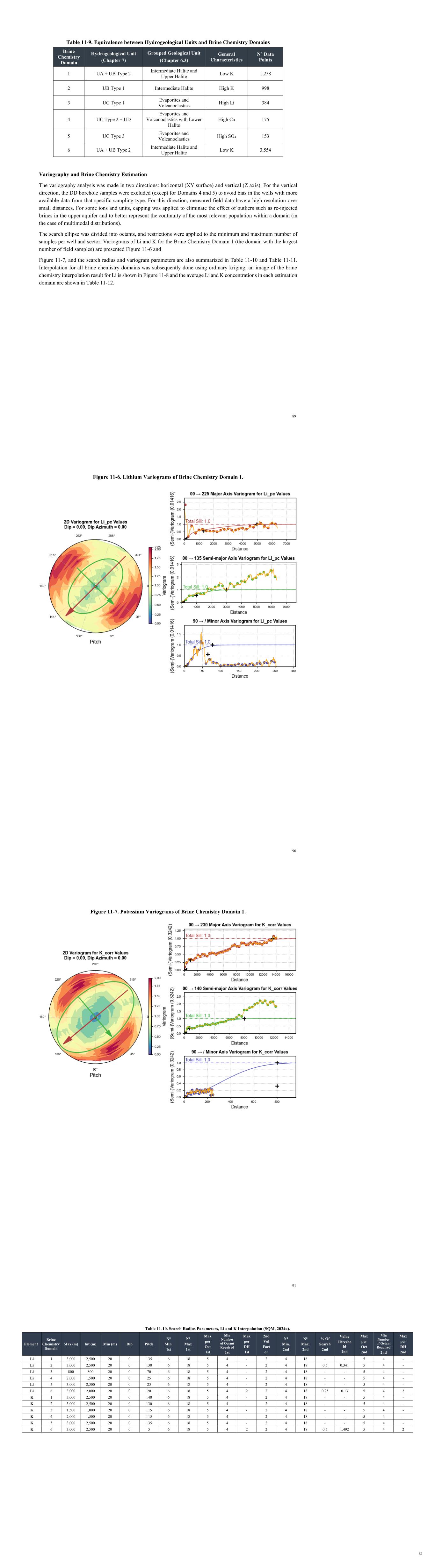
89 Table 11-9. Equivalence between Hydrogeological Units and Brine Chemistry Domains Brine Chemistry Domain Hydrogeological Unit (Chapter 7) Grouped Geological Unit (Chapter 6.3) General Characteristics N° Data Points 1 UA + UB Type 2 Intermediate Halite and Upper Halite Low K 1,258 2 UB Type 1 Intermediate Halite High K 998 3 UC Type 1 Evaporites and Volcanoclastics High Li 384 4 UC Type 2 + UD Evaporites and Volcanoclastics with Lower Halite High Ca 175 5 UC Type 3 Evaporites and Volcanoclastics High SO4 153 6 UA + UB Type 2 Intermediate Halite and Upper Halite Low K 3,554 Variography and Brine Chemistry Estimation The variography analysis was made in two directions: horizontal (XY surface) and vertical (Z axis). For the vertical direction, the DD borehole samples were excluded (except for Domains 4 and 5) to avoid bias in the wells with more available data from that specific sampling type. For this direction, measured field data have a high resolution over small distances. For some ions and units, capping was applied to eliminate the effect of outliers such as re-injected brines in the upper aquifer and to better represent the continuity of the most relevant population within a domain (in the case of multimodal distributions). The search ellipse was divided into octants, and restrictions were applied to the minimum and maximum number of samples per well and sector. Variograms of Li and K for the Brine Chemistry Domain 1 (the domain with the largest number of field samples) are presented Figure 11-6 and Figure 11-7, and the search radius and variogram parameters are also summarized in Table 11-10 and Table 11-11. Interpolation for all brine chemistry domains was subsequently done using ordinary kriging; an image of the brine chemistry interpolation result for Li is shown in Figure 11-8 and the average Li and K concentrations in each estimation domain are shown in Table 11-12. 90 Figure 11-6. Lithium Variograms of Brine Chemistry Domain 1. 91 Figure 11-7. Potassium Variograms of Brine Chemistry Domain 1. 92 Table 11-10. Search Radius Parameters, Li and K Interpolation (SQM, 2024a). Element Brine Chemistry Domain Max (m) Int (m) Min (m) Dip Pitch N° Min. 1st N° Max 1st Max per Oct 1st Min Number of Octant Required 1st Max per DH 1st 2nd Vol Fact or N° Min. 2nd N° Max. 2nd % Of Search 2nd Value Thresho ld 2nd Max per Oct 2nd Min Number of Octant Required 2nd Max per DH 2nd Li 1 3,000 2,500 20 0 135 6 18 5 4 - 2 4 18 - - 5 4 - Li 2 3,000 2,500 20 0 130 6 18 5 4 - 2 4 18 0.5 0.341 5 4 - Li 3 800 800 20 0 70 6 18 5 4 - 2 4 18 - - 5 4 - Li 4 2,000 1,500 20 0 25 6 18 5 4 - 2 4 18 - - 5 4 - Li 5 3,000 2,500 20 0 25 6 18 5 4 - 2 4 18 - - 5 4 - Li 6 3,000 2,000 20 0 20 6 18 5 4 2 2 4 18 0.25 0.13 5 4 2 K 1 3,000 2,500 20 0 140 6 18 5 4 - 2 4 18 - - 5 4 - K 2 3,000 2,500 20 0 130 6 18 5 4 - 2 4 18 - - 5 4 - K 3 1,500 1,000 20 0 115 6 18 5 4 - 2 4 18 - - 5 4 - K 4 2,000 1,500 20 0 115 6 18 5 4 - 2 4 18 - - 5 4 - K 5 3,000 2,500 20 0 135 6 18 5 4 - 2 4 18 - - 5 4 - K 6 3,000 2,500 20 0 5 6 18 5 4 2 2 4 18 0.5 1.492 5 4 2
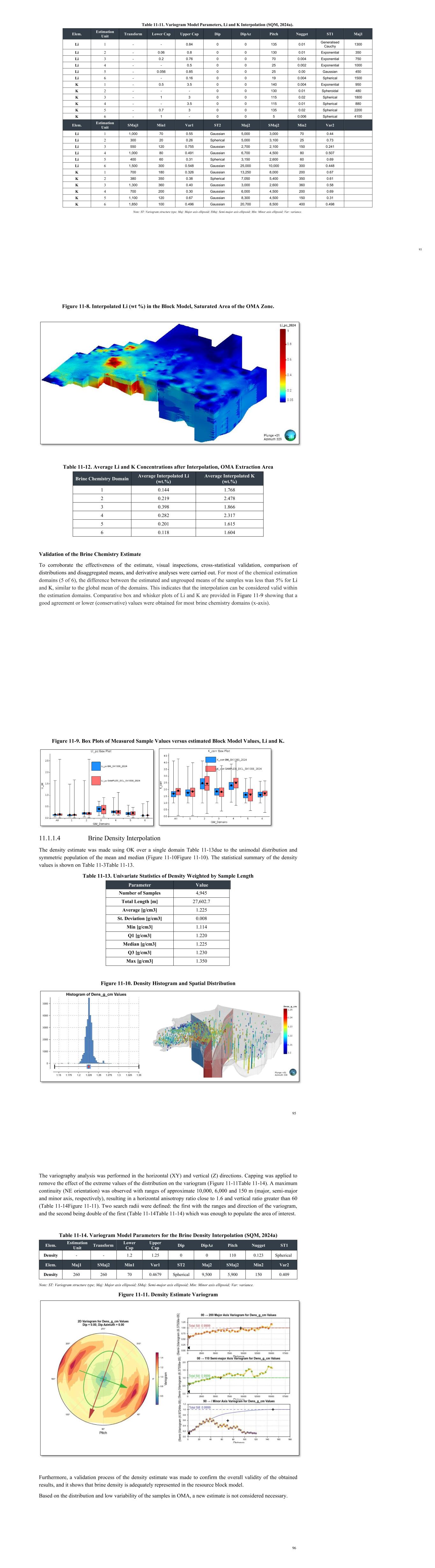
93 Table 11-11. Variogram Model Parameters, Li and K Interpolation (SQM, 2024a). Elem. Estimation Unit Transform Lower Cap Upper Cap Dip DipAz Pitch Nugget ST1 Maj1 Li 1 - - 0.84 0 0 135 0.01 Generalised Cauchy 1300 Li 2 - 0.06 0.8 0 0 130 0.01 Exponential 350 Li 3 - 0.2 0.76 0 0 70 0.004 Exponential 750 Li 4 - - 0.5 0 0 25 0.002 Exponential 1000 Li 5 - 0.056 0.85 0 0 25 0.00 Gaussian 450 Li 6 - - 0.16 0 0 19 0.004 Spherical 1500 K 1 - 0.5 3.5 0 0 140 0.004 Exponential 950 K 2 - - - 0 0 130 0.01 Spheroidal 480 K 3 - 1 3 0 0 115 0.02 Spherical 1800 K 4 - - 3.5 0 0 115 0.01 Spherical 880 K 5 - 0.7 3 0 0 135 0.02 Spherical 2200 K 6 - 1 - 0 0 5 0.006 Spherical 4100 Elem. Estimation Unit SMaj1 Min1 Var1 ST2 Maj2 SMaj2 Min2 Var2 Li 1 1,000 70 0.55 Gaussian 5,000 3,000 70 0.44 Li 2 300 20 0.26 Spherical 5,000 3,100 25 0.73 Li 3 550 120 0.755 Gaussian 2,700 2,100 150 0.241 Li 4 1,000 80 0.491 Gaussian 6,700 4,500 80 0.507 Li 5 400 60 0.31 Spherical 3,150 2,600 60 0.69 Li 6 1,500 300 0.548 Gaussian 25,000 10,000 300 0.448 K 1 700 180 0.326 Gaussian 13,250 8,000 200 0.67 K 2 380 350 0.38 Spherical 7,050 5,400 350 0.61 K 3 1,300 360 0.40 Gaussian 3,000 2,600 360 0.58 K 4 700 200 0.30 Gaussian 6,000 4,500 200 0.69 K 5 1,100 120 0.67 Gaussian 8,300 4,500 150 0.31 K 6 1,850 100 0.496 Gaussian 20,700 8,500 400 0.498 Note: ST: Variogram structure type; Maj: Major axis ellipsoid; SMaj: Semi-major axis ellipsoid; Min: Minor axis ellipsoid; Var: variance. Figure 11-8. Interpolated Li (wt %) in the Block Model, Saturated Area of the OMA Zone. Table 11-12. Average Li and K Concentrations after Interpolation, OMA Extraction Area Brine Chemistry Domain Average Interpolated Li (wt.%) Average Interpolated K (wt.%) 1 0.144 1.768 2 0.219 2.478 3 0.398 1.866 4 0.282 2.317 5 0.201 1.615 6 0.118 1.604 Validation of the Brine Chemistry Estimate To corroborate the effectiveness of the estimate, visual inspections, cross-statistical validation, comparison of distributions and disaggregated means, and derivative analyses were carried out. For most of the chemical estimation domains (5 of 6), the difference between the estimated and ungrouped means of the samples was less than 5% for Li and K, similar to the global mean of the domains. This indicates that the interpolation can be considered valid within the estimation domains. Comparative box and whisker plots of Li and K are provided in Figure 11-9 showing that a good agreement or lower (conservative) values were obtained for most brine chemistry domains (x-axis). 95 Figure 11-9. Box Plots of Measured Sample Values versus estimated Block Model Values, Li and K. 11.1.1.4 Brine Density Interpolation The density estimate was made using OK over a single domain Table 11-13due to the unimodal distribution and symmetric population of the mean and median (Figure 11-10Figure 11-10). The statistical summary of the density values is shown on Table 11-3Table 11-13. Table 11-13. Univariate Statistics of Density Weighted by Sample Length Parameter Value Number of Samples 4,945 Total Length [m] 27,602.7 Average [g/cm3] 1.225 St. Deviation [g/cm3] 0.008 Min [g/cm3] 1.114 Q1 [g/cm3] 1.220 Median [g/cm3] 1.225 Q3 [g/cm3] 1.230 Max [g/cm3] 1.350 Figure 11-10. Density Histogram and Spatial Distribution 96 The variography analysis was performed in the horizontal (XY) and vertical (Z) directions. Capping was applied to remove the effect of the extreme values of the distribution on the variogram (Figure 11-11Table 11-14). A maximum continuity (NE orientation) was observed with ranges of approximate 10,000, 6,000 and 150 m (major, semi-major and minor axis, respectively), resulting in a horizontal anisotropy ratio close to 1.6 and vertical ratio greater than 60 (Table 11-14Figure 11-11). Two search radii were defined: the first with the ranges and direction of the variogram, and the second being double of the first (Table 11-14Table 11-14) which was enough to populate the area of interest. Table 11-14. Variogram Model Parameters for the Brine Density Interpolation (SQM, 2024a) Elem. Estimation Unit Transform Lower Cap Upper Cap Dip DipAz Pitch Nugget ST1 Density - - 1.2 1.25 0 0 110 0.123 Spherical Elem. Maj1 SMaj2 Min1 Var1 ST2 Maj2 SMaj2 Min2 Var2 Density 260 260 70 0.4679 Spherical 9,500 5,900 150 0.409 Note: ST: Variogram structure type; Maj: Major axis ellipsoid; SMaj: Semi-major axis ellipsoid; Min: Minor axis ellipsoid; Var: variance. Figure 11-11. Density Estimate Variogram Furthermore, a validation process of the density estimate was made to confirm the overall validity of the obtained results, and it shows that brine density is adequately represented in the resource block model. Based on the distribution and low variability of the samples in OMA, a new estimate is not considered necessary.

97 11.2 Cut-off Grades This sub-section contains forward-looking information related to establishing the prospects of economic extraction for Mineral Resources for the Project. The material factors that could cause actual results to differ materially from the conclusions, estimates, designs, forecasts or projections in the forward-looking information include any significant differences from one or more of the material factors or assumptions that were set forth in this sub-section including cut-off grade assumptions, costing forecasts, and product pricing forecasts. As of the effective date of this Mineral Resource estimate (December 31, 2025), a cut-off grade of 0.095 wt.% Li was adopted based on an economic sensitivity analysis. Historically, Novandino Litio SpA has applied a cut-off grade of 0.05 wt.% Li for reporting Mineral Resources in the Salar de Atacama. However, for the present Technical Report Summary, an updated economic evaluation was conducted using a long-term lithium carbonate price of US$18,000/tonne, equivalent to approximately 20% higher than the optimistic scenario considered in the economic analysis (Chapter 19). Under these conditions, together with updated assumptions for royalties, operating costs, and process recoveries, the economically justified cut-off grade increased to 0.095 wt.% Li. This revised threshold reflects current cost structures and long-term market expectations, while the historical 0.05 wt.% Li cut-off remains relevant as a reporting reference under previous economic assumptions. A similar pricing basis and analysis was undertaken for K, where the cut-off grade of 1.0 wt.% has been set by Novandino Litio SpA based on respective costs, sales, and margins. Resource block model cell concentrations of Li and K were compared with the specified cut-off grades and a sensitivity analysis was performed with distinct product prices, costs, and cut-off values. The QP believes that the designated cut- off grades of 0.095 wt.% Li and 1.0 wt.% K are appropriate and do not have any material effect on the estimated Mineral Resource. Block model concentrations greatly exceed those cut-off values within the OMA Extraction Zone. 11.3 Mineral Resource Classification This sub-section contains forward-looking information related to Mineral Resource classification for the Project. The material factors that could cause actual results to differ materially from the conclusions, estimates, designs, forecasts or projections in the forward-looking information include any significant differences from one or more of the material factors or assumptions that were set forth in this sub-section including geological and grade continuity analysis and assumptions. The Mineral Resource was classified into three categories to include Measured, Indicated, and Inferred based on industry standards for brine projects inclusive of the level of characterization of the hydrogeological units (Table 11-5Table 11-15), as well as geostatistical criteria. The level of hydrogeological characterization was prioritized as the first classification based on exploration, monitoring, and historical production data. Geostatistical variables were used as a secondary criterion. Units were characterized based on pumping tests, Pe measurements from retrieved cores, the distribution of Pe and chemistry data, and the representativeness of the brine samples. Table 11-15Table 11-15 summarizes the distinct brine chemistry domains that were classified based on the level of hydrogeological understanding. 98 Table 11-15. Brine Chemistry Domains and Level of Hydrogeological Characterization Chemical Estimation Domain Method of determining Pe Historical production? Level of hydrogeological characterization 1 Interpolation Since 1994: MOP wellfield and sampling campaigns Unit well characterized. Also partially characterized in areas with the presence of brine reinjection. 2 Interpolation Since 2010 Unit well characterized. Partially characterized in areas with presence of reinjection solutions. 3 Interpolation Since 2004 Unit well characterized. 4 Interpolation Since 2020 Unit partially characterized; however, it is considered well characterized in the productive zone. 5 Interpolation - Partially characterized. 6 Interpolation - Unit well characterized from 2,200 masl upward. Below, it is considered to be partially characterized. In addition to the hydrogeological characterization criterion (Table 11-15Table 11-15), the following geostatistical factors were considered: • Search Volume: Given that the evaluated ions generally have a large spatial continuity, the Li-ion search radius was used to analyze the reliability of the estimate. It is considered as a Measured Mineral Resource up to the second search radius and Indicated and Inferred Mineral Resources up to the third search radius. • Presence of Reinjection Brines: Measured Mineral Resource zones in the shallow aquifer units (UA, UB, UE4: 1 and 2) with high Li levels associated with reinjected brine were conservatively downgraded to Indicated Mineral Resources. • Exclusion of high effective porosity areas associated with marginal facies: a sector of high uncertainty in the effective porosity of the East Block (hydrogeological unit UAB; to the east of the X coordinate: 584,625 m) was classified as Inferred Mineral Resources. 99 The above factors were combined to establish the Measured, Indicated and Inferred Mineral Resources (Table 11-16Table 11-16). Table 11-16. Categorization of Measured, Indicated, and Inferred Mineral Resources Resource Category Criteria Measured • Chemical Estimation Domains 1, 2, 3 and 6, within the first and second Li search radius for Domain 1 and 2, and within the first Li search radius for Domain 3. • For Chemical Estimation Domain 6, the cells are required to be above elevation 2,200 masl. • For Chemical Estimation Domain 4, the first Li search radius. Indicated • For the partially characterized Chemical Estimation Domain 4: inside of the second search radius for Li. • In the well characterized Chemical Estimation Domains 1, 2, 3 and 6: inside of the third search radius for Li. • For Chemical Estimation Domain 6, the cells are required to be above an elevation of 2,100 masl. • Lithium concentrations above 0.4% wt.% are considered in this category based on the reinjection solutions for Chemical Estimation Domain 1 and 2. • For Chemical Estimation Domain 5, for the first and second search radius. • For Chemical Estimation Domain 6, within the hydrogeological unit UAB, between X coordinates 584,500 and 587,500, above 2,200 masl for the first search radius. Inferred • Chemical Estimation Domain 4 is considered in this category for the third search radius. • Chemical Estimation Domain 5 is considered in this category for the third search radius. • The sector east of X coordinate: 584,500 m (in the UAB hydrogeological unit) with a high uncertainty in Pe values. Note: *See Table 11-15 for explanations of the Chemical Estimation Domain 100 Figure 11-12Figure 11-12 displays the zones of Measured, Indicated, and Inferred Mineral Resources in the block model. Figure 11-12. Resource Categorization in 3 Dimensions

101 102 11.4 Mineral Resource Statement This sub-section contains forward-looking information related to Mineral Resource estimates for the Project. The material factors that could cause actual results to differ materially from the conclusions, estimates, designs, forecasts, or projections in the forward-looking information include any significant differences from one or more of the material factors or assumptions that were set forth in this sub-section including geological and grade interpretations and controls and assumptions and forecasts associated with establishing the prospects for economic extraction. Table 11-17Table 11-17 presents the Mineral Resources in-situ exclusive of Mineral Reserves (Section 12) without processing losses. When calculating Mineral Resources exclusive of Mineral Reserves, the QP assumed a direct correlation between Measured Mineral Resources and Proven Mineral Reserves as well as Indicated Mineral Resources and Probable Mineral Reserves. Table 11-17. Novandino Litio SpA’s Salar de Atacama Lithium and Potassium Resource Statement, Exclusive of Mineral Reserves (Effective December 31, 2025) Resource Classification Brine Volume Mean Grade (wt. %) Mass (Million tonnes) (Mm3) K Li K Li Measured 3,036 1.91 0.19 72.9 8.35 Indicated 1,874 1.66 0.15 38.6 4.07 Measured + Indicated 4,910 1.81 0.17 111.6 12.42 Inferred 3,204 1.66 0.15 65.65 5.63 Total 8,114 1.75 0.16 177.2 18.05 Notes: (1) Mineral Resources are not Mineral Reserves and do not have demonstrated economic viability. There is no certainty that all or any part of the Mineral Resource will be converted into Mineral Reserves upon the application of modifying factors. (2) Mineral Resources are reported as in-situ and exclusive of Mineral Reserves, where the estimated Mineral Reserve without processing losses during the reported LOM (Chapter 12) A direct correlation between Proven Reserves and Measured Resources, as well as Probable Reserves and Indicated Resources was assumed. (3) Effective porosity was utilized to estimate the drainable brine volume based on the measurement techniques of the Novandino Litio SpA porosity laboratory (Gas Displacement Pycnometer). Although specific yield is not used for the estimate, the QP considers that the high frequency sampling of effective porosity, its large dataset, and general lack of material where specific retention can be dominant permits effective porosity to be a reasonable parameter for the Mineral Resource estimate. (4) The conversion of brine volume to Li and K tonnes considered the estimated brine density in each block model cell. (5) Comparisons of values may not add due to rounding of numbers and the differences caused by use of averaging methods. (6) The estimated economic cut-off grade (COG) utilized for resource reporting purposes is 0.095 wt.% Li, based on the following assumptions: a. A long-term lithium carbonate (Li₂CO₃) price of US$18,000/tonne was used (approximately 20% higher than the optimistic price scenario, Chapter 19) for the CoG economic evaluation. b. Royalties associated with lithium production were included in the calculation at US$2,000/tonne Li₂CO₃. c. A global lithium recovery of 49% was applied. d. The economic model assumes an annual brine production of 33.12 million m³ and an average brine density of 1.225 tonne/m³. e. Extraction, processing, and general and administrative (G&A) costs were estimated at US$48.4 per m³ of brine. (7) A cut-off grade of 1 wt.% based on Novandino Litio SpA’s economic analysis. 103 11.5 Uncertainty The QP considered the following sources of uncertainty in the Li and K Resource estimate: • The use of effective porosity versus specific yield could result in an overestimation of the estimated brine volume if fine-grained sediments are present. However, based on the geological and hydrogeological characterization of the OMA (Chapters 6 and 7), the reservoir does not present significant volumes of fine- grained material, such as clay, where specific retention can be significant (when compared to specific yield). Thus, the effective porosity is considered to be an adequate parameter for the brine volume estimate. It should be noted that the reservoir is also characterized by presence of caverns and karstic areas that were not considered in the brine volume estimation which would probably increase the estimation. This is because current field sampling methods do not allow for the taking of representative samples of this type of geological features for subsequent laboratory analysis. • Novandino Litio SpA’s brine chemistry and porosity labs are not accredited; however, a round robin analysis was performed for brine samples to confirm the QA/QC procedures and overall accuracy and precision. To further mitigate this uncertainty, various QA/QC procedures are in place for measured brine chemistry and effective porosity (Chapters 8 and 9). • Near the ponds, potential infiltration could have affected the reservoir chemistry, however those areas were conservatively categorized as less certain (e.g., Indicated instead of Measured). 11.6 Opinion and Recommendations It is the resources QP’s opinion that Mineral Resources were estimated in compliance with S-K 1300 regulations. Compared to other reported mineral resource estimates for brine deposits as well as related guidelines that are typically cited (Houston, Butcher, & Ehren, 2011), the QP believes that the declared Mineral Resource estimate is reliable given; (i), the large amount of wells and field information in the OMA Extraction Zone when compared to other lithium brine projects; (ii), Novandino Litio SpA’s historical brine production that increases certainty in the reservoir characterization and potential; (iii), utilized effective porosity values are generally low compared to specific yield/effective porosity values of other projects; and (iv), the Mineral Resource categorization integrates two separate methodologies (exploration/historical production and geostatistical parameters). The Mineral Resource estimate presented in this report is materially higher than previously reported. This increase reflects the incorporation of a substantially expanded porosity dataset, particularly within hydrogeological units that were previously underrepresented. Moreover, the updated estimation approach integrates secondary information, such as gamma-ray logs, which enhances the spatial distribution of key parameters and supports a more robust characterization of the reservoir. Future recommendations to increase the Mineral Resource and certainty of the Mineral Resource estimate include the utilization of a separate methodology on collected core (e.g., relative brine release capacity testing) to confirm the estimated brine volume. 104 12 MINERAL RESERVE ESTIMATE This sub-section contains forward-looking information related to the key assumptions, parameters and methods for the Mineral Reserve estimates for the Project. The material factors that could cause actual results to differ materially from the conclusions, estimates, designs, forecasts or projections in the forward-looking information include any significant differences from one or more of the material factors or assumptions that were set forth in this sub-section including Mineral Resource model tonnes and grade. Mineral Reserves for the Project were estimated considering the modifying factors for converting Mineral Resources to Mineral Reserves. The projection of future brine extraction was simulated using a groundwater flow and solute transport model; specifically, the Modflow USG-Transport code (Panday, 2021) and Groundwater Vistas interface (ESI, 2020) were utilized. Numerical modeling was supported by hydrogeological, geological, and hydrochemical data, and parameters utilized are consistent with the stated Mineral Resource estimate (Section 11). The following subsections describe the model parameters, calibration to field data, and projected results over the LOM. 12.1 Numerical Model Design The numerical groundwater model was constructed based on the resource block model (Section 11) and defined hydrogeological units (Section 7). The area of the active numerical model domain corresponds to 1,421.3 km2. A constant brine density was assumed based on the model limit (confined to the salt flat nucleus) as well as the near constant brine density measurements from pumping and observations wells. In total, the numerical model is characterized by 431,808 active numerical cells with 9 layers, covering all hydrogeological units included in the Resource model (see Table 12-1Table 12-1 and Figure 12-1Figure 12-1). Using the quadtree capabilities of Modflow-USG, horizontal cell lengths range from 100 m to 400 m. The most refined portion of the numerical model grid corresponds to the location of current wellfields to properly simulate the hydraulic gradient as well as to limit the number of pumping and observation wells in the same cells (Figure 12-1Figure 12-1). The top of layer 1 of the model was built based on the interpolation of well elevations from a topographic survey. Table 12-1. Grid Specifics and Layers Model Layer Hydrogeological Unit Layer Thickness (meters) General Unit Description 1 Unit A 4-6 Upper nucleus, halites (unconfined) 2 2-37 3 Unit AB 2-237 Evaporites with organic matter (aquitard) 4 Unit B 2-188 Lower halites (largely confined) 5 2-172 6 Unit C 2-69 Evaporites with volcanoclastics (confined) 7 2-69 8 2-59 9 Unit D 2-260 Deeper halites (confined with limited permeability)

105 Figure 12-1. Numerical Model Domain and Grid 106 12.1.1 Boundary Conditions and Water Balance To simulate site conditions, the following boundary conditions were assigned in the numerical model with monthly stress periods: • Direct recharge: using the recharge “RCH” package, monthly direct recharge from precipitation on the salt flat nucleus was applied in different zones based on the recharge estimated by SRK (2020) and SQM (2021). Figure 12-2 shows the zones of recharge due to natural precipitation with assigned concentrations of 0. Also, direct recharge due to infiltration from existing evaporation ponds in both SOP and MOP areas was applied during the historical simulated period (years 2015-2023) with the corresponding concentrations, based on information provided by Novandino Litio SpA. • Underflow: using the “WELL” package, brine inflow, originally sourced from adjacent watersheds and subsequently evapo-concentrated, was assigned along most limits of the numerical model using injection wells in layer 1; this shallow underflow was conceptualized and assigned in the shallowest layer because it is the most permeable unit. The lateral recharge zones are illustrated in Figure 12-2Figure 12-2. Rates of groundwater inflow were defined based on the water balance study developed by SRK (2020) which was subsequently updated by Novandino Litio SpA (SQM, 2021). Incoming concentrations were specified based on average measured concentrations in observation wells located near the model boundaries. • No-flow boundaries: certain limits, such as the east boundary, were specified as no-flow limits where brine was conservatively assumed not to enter the model domain. Assigned no-flow limits (Figure 12-2Figure 12-2) were consistent with the conceptual water balance study of the brine zone (SRK, 2020). • Evaporation: Evaporation from shallow groundwater (brine) in the salt flat nucleus was represented using the “ETS” (Evapotranspiration Segments) package of Modflow. It was utilized to simulate evaporation from different zones within the active domain, which were delineated based on areas defined in the water balance study (SRK, 2020). Evaporation decay curves estimated for each zone were represented in the model by several linear segments (up to four). Figure 12-3Figure 12-3 shows the distinct evaporation zones represented in the model; no evaporation from the aquifer was assumed where the ponds are located. • Production wells: pumping was simulated using the “CLN” package of Modflow-USG, allowing for more precise responses to pumping, skin factors, and flow reduction in the case that the dynamic pumping level reaches the bottom of the screened layer. Novandino Litio SpA and Albemarle pumping was simulated during the historical simulated period (2015 -2023) using available provided data. During the 2015 to 2025 period, the simulated water balance of hydrologic inflows (e.g., recharge) and outflows (e.g., evaporation and pumping) is given in Table 12-2 Table 12-2. It can be observed that the storage inflow term is important due to production pumping, and the error (i.e., difference between the simulated inflows and outflows) is only 0.02%, indicating that mass is properly conserved. Furthermore, the total inflows and outflows of the model are consistent with the conceptual basin recharge defined by SRK (2020) during the operational period (from 1994 onward) as well as with the recent Hydrogeological Conceptual model (SQM, 2021). 107 Table 12-2. Average Simulated Water Balance Components, 2015-2025 Historical Simulated Period Component Average Volumetric Flow (L/s) Total brine extraction in the salt flat nucleus 1,921.7 Evaporation from the salt flat nucleus 382.9 Storage outflow 599.7 TOTAL OUTFLOW 2,904.3 All direct recharge in the salt flat nucleus 630.5 All brine underflow from adjacent areas 461.5 Storage inflow 1,811.7 TOTAL INFLOW 2,903.7 Error (%) 0.02% 108 Figure 12-2. Direct Recharge and Lateral Recharge Zones Note: * Conceptual lateral recharge in Peine was modeled as a direct recharge zone of 7 L/s

109 Figure 12-3. Evaporation Zones in the Numerical Model *Indicated evaporation rates correspond to the maximum (surface) rates 110 12.1.2 Numerical Model Hydraulic Properties Hydraulic properties of the numerical model inherent to the brine reservoir correspond to hydraulic conductivity (K), specific storage (Ss), specific yield (Sy), and effective porosity (Pe). These parameters were largely defined based on lithology type. For example, the spatial distribution of Sy and Pe was assigned based on the resource block model (Section 11), and hydraulic conductivity was calibrated based on lithology to properly constrain the range of values. Dispersion was considered for simulating the spreading of solutes. Each hydraulic property is described below: • Hydraulic conductivity: representative model sections of the K zone distribution are shown in Figure 12-4. Representative Hydraulic Conductivity (Kh) and Specific Yield - Effective Porosity (Sy -Pe) Distribution in Numerical ModelFigure 12-4 and utilized model values are presented in Table 12-3. Summary of Assigned Model Parameters Table 12-3. The horizontal hydraulic conductivity (Kh) ranges between 1E-5 m/d to 5,000 m/d depending on the lithology with the wide range explained by the presence of caverns and structures. While K ranges were aimed to be consistent with the conceptual range for each hydrogeological unit defined by SQM (2020 b,c,d), the general trend of each unit at depth is consistent with the lithology type and presence/absence of secondary porosity (geometric mean of Table 12-3). The vertical-horizontal anisotropy (Kv/Kh) was also set during calibration (Table 12-3Table 12-3) and justified by the type of deposition of each unit. • Effective porosity/Specific yield: Effective porosity values were transferred from the resource block model (Section 11) and were obtained by averaging block model centroids within the corresponding numerical model cells. In areas with information gaps, the value of the nearest neighbor of calculated cells was adopted. Effective porosity was assumed to be equivalent to Sy due to the general lack of fine-grained material (e.g. clay) in the nucleus (Sections 6, 7, and 11). Representative sections of Pe are also shown in Figure 12-4. Figure 12-4 • Specific storage: The distribution of Ss was set based on the type of lithology and hydraulic conductivity zonation, where less permeable units were assumed to have lower compressibility. • Dispersion: Dispersion controls the rate of solute spreading, and the following values were specified: 10 m for longitudinal dispersion, 1 m for transverse dispersion, and 0.1 m for vertical dispersion. Molecular diffusion was not included in the numerical model, because it is assumed to be negligible in large-scale models, and the active domain covers an extensive area (Section 12.1). 111 Table 12-3. Summary of Assigned Model Parameters Layer(s) Hydrogeological Unit (HU) Horizontal Hydraulic Conductivity (Kh) (m/d) (3) Anisotropy (Kv/Kh) Specific Storage (Ss) (1/m) Specific Yield (Sy) and Effective Porosity (Pe) (2) Geometric mean (1) Min Max Min Max Min Max 1 and 2 UA 84.26 0.001 20 1E-05 1E-02 0.017 0.166 3 UAB 0.07 0.002 20 3.1E-05 5E-03 0.015 0.234 4 and 5 UB 1.01 0.001 100 1E-05 5E-03 0.007 0.234 6, 7, and 8 UC 0.16 0.0001 2,289 1E-07 5E-03 0.007 0.238 9 UD 2E-05 1E-05 10 1E-06 0.0177 Notes: (1) Within the most refined quadtree zone (2) Within the AAE (3) Parameters outside the conceptual range are limited to areas that have no impact on the reserve estimation. Figure 12-4. Representative Hydraulic Conductivity (Kh) and Specific Yield - Effective Porosity (Sy -Pe) Distribution in Numerical Model 112 12.2 Numerical Model Calibration Novandino Litio SpA‘s numerical groundwater model was upgraded to incorporate revised porosity parametrization based on the block model and was also temporally updated. The validation of these updates confirmed that the spatial distribution of hydraulic parameters remains consistent with the previously calibrated model. Therefore, the current work focused on validating model performance by comparing simulated results with observed monitoring and production data collected between January 2015 and December 2023, as well as a verification model performance between January 2024 and December 2025. This evaluation included groundwater level measurement from brine monitoring wells and Li and K concentration data obtained from Novandino Litio SpA’s production records. The validation results confirm that the model maintains an acceptable level of agreement with observed system responses and remains appropriate for supporting resource estimation and operational forecasting. For consistency of terminology, the validation and verification periods are collectively referred to as the model historical period. 12.2.1 Initial Conditions Initial conditions for hydraulic head were based on piezometric contours from the beginning of the year 2015. Initial conditions for transport include Li and K; their assignment was based on block model concentrations and transfer of values to the numerical model cells. 12.2.2 Historical Head Simulated brine levels were obtained from the numerical model based on composite heads from the screened well layers, and they were compared with registered brine levels from observation wells (Figure 12-5Figure 12-5) that span the model domain and various hydrogeological units. A simulated piezometric contour map at the end of December 2025 is shown in Figure 12-5 Figure 12-5.

113 Figure 12-5. Head Observation Targets and Simulated Water Table for the End of the Historical Period 114 Regarding head historical period statistics, results for the validation (2015 – 2023) and verification periods (2024 – 2025) for the entire model include the Mean Residual, Root Mean Square (RMS), Scaled Absolute Residual Mean and Scaled Root Mean Square (see Table 12-4). For the verification period (2024 – 2025), the results for the entire model include a mean residual of 2.03 m and RMS of 4.07 m, with most residuals within the range of 0 m to 3.0 m (see 115 Figure 12-6 116 Figure 12-6). The Scaled Absolute Residual Mean and Scaled Root Mean Square (RMS) error for the transient calibration were 2.3% and 4.5%, respectively. This is considered acceptable in accordance with international modeling guidelines ( (Reilly, T. E.; Harbaugh, A. W., 2004); (Anderson; Woessner, 2015)) and based on the QP´s opinion. Table 12-4. Summary of head calibration statistics Period Mean Residual (m) Scaled Absolute Residual Mean (%) Root Mean Square (m) Scaled Root Mean Square (%) Validation 2015 - 2023 1.95 2.15 4.05 4.46 Verification + 2024 - 2025 2.03 2.23 4.07 4.49

117 Figure 12-6. Head Historical Period Results a) Brine level residual histogram b) Simulated versus observed brine levels 0% 0% 0% 0% 0% 0% 0% 0% 0% 0% 0% 0% 0% 11%10% 25% 29% 10% 5% 3% 2% 1% 1% 0% 0% 2% 0% 10% 20% 30% 40% 50% 60% 1 0 0 t o 6 6 t o 5 .5 5 .5 t o 5 5 t o 4 .5 4 .5 t o 4 4 t o 3 .5 3 .5 t o 3 3 t o 2 .5 2 .5 t o 2 2 t o 1 .5 1 .5 t o 1 1 t o 0 .5 0 .5 t o 0 0 t o 0 .5 0 .5 t o 1 1 t o 1 .5 1 .5 t o 2 2 t o 2 .5 2 .5 t o 3 3 t o 3 .5 3 .5 t o 4 4 t o 4 .5 4 .5 t o 5 5 t o 5 .5 5 .5 t o 6 6 t o 1 0 0 P er c en ta g e o f O c u rr en ce ( % ) Resudual Range (m) 118 12.2.3 Historical Transport During the historical period, monthly Li and K concentration values for each production well were extracted during the simulation and compared to actual extracted values pumped from Novandino Litio SpA’s production wells. Figure 12-7 Figure 12-7 shows the monthly average weighted values for the model simulation and observed average weighted Li and K values. The average Li concentration extracted from the model adequately matches measured field production values between 2021 and 2025. Prior to 2021, the results indicate an overestimation of the weighted average, which is attributed primarily to the representation of the initial concentrations of Li. In the case of K, the results indicate an adequately match for measured field production values. Both averages were weighted using the individual pumping rates of each production well. Figure 12-7. Extracted Concentration Fit during the Historical Period (2015 – 2025) a) Extracted Li (weighted average) b) Extracted K (weighted average) 119 12.3 Projected Model Simulation Projected brine extraction was simulated for 7 years (2024 to 2030 period), but the first two years were verified with observed data; afterwards, the simulation period considers the 5-year LOM (2026 to 2030). Modifying factors related to extraction, potential brine mixing and dilution, and processing factors were considered in the predictive pumping simulation. 12.3.1 Initial Conditions (Reserve Simulation) At the start of the simulation, initial conditions for flow correspond to the hydraulic head solution at the end of 2023. For transport modeling, Li and K concentrations from the resource block model were assigned to the numerical model grid as initial conditions, to ensure consistency between the Resource and Reserve. Sulfate was also simulated to determine the process efficiency associated with the type of extracted brine in each pumping well over the course of the simulation. In addition, the initial distribution of SO4 was also taken from the block model. Given their distinct horizontal and vertical cell sizes, the specific process of transferring concentrations from the resource block model to the numerical model involved calculating mean values and searching nearest neighbors in all numerical model cells. The consistency of concentrations within the resource model was reviewed and deemed acceptable by the QP. Figure 12-8Figure 12-8 shows the concentration distribution of Li (%) in the numerical model after the calibration period. Figure 12-8. Lithium Concentration (%) Distribution following the Historical Period 120 12.3.2 Predictive Model Specifics The reserve model’s hydraulic properties are based on the historical numerical model (Section 12.2). Aside from pumping and direct pond recharge, the water balance specifics and lateral concentration boundary conditions over the LOM are assumed to be comparable to the historical period given its relatively short duration. To avoid artificial solute mass in the reservoir system, direct infiltration recharge from the evaporation ponds was conservatively assumed to have concentrations of 0 during the LOM, and future recharge rates from the ponds were set to be negligible (<0.1% of the total recharge). During the reserve simulation, pumping is restricted by Novandino Litio SpA’s voluntary reduction in annual brine extraction, which in turn, reduces production. The average annual brine extraction considered for the 2026 to 2030 period is given in Figure 12-9 Figure 12-9. The model simulated pumping depends on the simulated hydraulic head and bottom screened layer elevation (Option AutoFlowReduce of Modflow-USG). Figure 12-9. Novandino Litio SpA’s Future Brine Pumping and Voluntary Reduction The simulated wellfields were configured based on the pumping wells of Novandino Litio SpA and Albemarle. To consider the potential influence of neighboring pumping, it was conservatively assumed that the current Albemarle wellfield pumps a total of 442 L/s during the LOM. (maximum allowed based on their latest Environmental Assessment and confirmed in their SEC Technical Report Summary of 2023) The simulated Novandino Litio SpA wellfield pumping was based on the current pumping schedule implemented by the company and does not consider the installation of new wells in the future. The pumping scheme and rates were assigned by Novandino Litio SpA’s Production Well Ranking that takes into account the Li grade and process indicators (e.g., according to SO4 concentrations). This internal system has allowed Novandino Litio SpA to identify and optimize the brine chemistry of every production well as a function of the flow rates and dynamic brine levels. Given that the total allowable pumping is reduced every year (Figure 12-9Figure 12-9), only current wells that have a low to medium SO4 content were set to remain active for optimizing the Reserve estimate (considering process recovery factors). Figure 13-2 Figure 13-1 presents a map view of Novandino Litio SpA’s simulated pumping wells during the final year of the LOM. Figure 12-10 Figure 12-10 shows the monthly results for the simulated pumping rates during the simulation period as well as Novandino Litio SpA’s voluntary reduction in total brine extraction over the LOM. 0 100 200 300 400 500 600 700 800 900 1000 1100 1200 2026 2027 2028 2028 2029 2030 T o ta l B ri n e E x tr a ti o n ( L /s ) Time

121 Figure 12-10. Simulated Novandino Litio SpA Pumping Rates, Reserve Simulation 12.3.2.1 Extracted Concentrations Figure 12-11Figure 12-11 presents the average weighted Li and K concentrations extracted from all of Novandino Litio SpA’s production wells. Increases in extracted lithium concentrations coincide with the staged reductions in environmental pumping. This trend reflects the combined influence of prioritizing highergrade production wells and the updated porosity distribution incorporated into the resource estimation and hydrological model In the case of K, there is a slight reduction over the LOM (-0.5% annually). The averages of all simulations are 0.26 and 2.37%, for Li and K, respectively. Compared to the historical period (2015 to 2025, Figure 12-7 Figure 12-7), an increase in the maximum weighted average of Li is observed during the projected LOM (2026 to 2030, Figure 12-11Figure 12-11), because the projected extraction plan was also optimized to keep production wells with high Li and low SO4 active with the reduction in pumping. Figure 12-11. Average Weighted Concentrations Extracted from Novandino Litio SpA’s Production Wells, Reserve Simulation 0 200 400 600 800 1000 1200 1400 S im u la te d p u m p in g ( L /s ) Simulated Pumping (with flow reduction) 0.00 0.50 1.00 1.50 2.00 2.50 3.00 3.50 4.00 4.50 5.00 0.00 0.05 0.10 0.15 0.20 0.25 0.30 0.35 0.40 0.45 0.50 A v er ag e w e ig h te d K (% ) A v er ag e w e ig h te d L i ( % ) Avg. Weighted Li (%) Li Cutoff Grade Avg. Weighted K (%) K Cutoff Grade 122 12.4 Mineral Reserves While the Mineral Resource (Section 11) represents the amount of in-situ brine in the reservoir, only a certain portion can be extracted under the proposed wellfield configuration and pumping scheme. The Mineral Reserve estimate considers the modifying factors of converting Measured and Indicated Mineral Resources to Mineral Reserves, including the production wellfield design and efficiency (e.g., location and screen), environmental considerations (e.g., pumping scheme), and recovery factors for Li and K. Numerical model results from the predictive simulation were used to calculate the amount of extracted Li and K. The pumped mass of metallic Li and K was multiplied by a conversion factor of 5.323 and 1.907 to compute lithium carbonate equivalent (LCE) and potassium chloride equivalent (KCl), respectively. The resulting values from each production well were then summed for each production year to determine the predicted annual LCE and KCl. This sub-section contains forward-looking information related to the key assumptions, parameters and methods for the Mineral Reserve estimates for the Project. The material factors that could cause actual results to differ materially from the conclusions, estimates, designs, forecasts or projections in the forward-looking information include any significant differences from one or more of the material factors or assumptions that were set forth in this sub-section including Mineral Resource model tonnes and grade and process parameters. 12.4.1 Process Recovery Factors To estimate the reserve from a reference point of processed brine after passing through the evaporation ponds (rather than from the production wellheads), the extracted mass was multiplied by a process efficiency factor, as determined by Novandino Litio SpA through testing of their processing method (see Chapter 14). The recovery factor depends on the extracted brine type. Because the vast majority of projected pumping by Novandino Litio SpA originates from the MOP area, the recovery factors derived for MOP brines (approximately 49% for lithium and 76% for potassium) are considered representative of the brine processed in the reserve simulation. No material changes in the production matrix are expected during the evaluated reserve period. Therefore, the recovery factors described in this section are considered stable and will be used in the Life-of-Mine (LoM) Reserve estimation. 12.4.2 Extracted Lithium The extracted Li and LCE mass are summarized in Table 12-5Table 12-4. . During the 5-year LOM, results indicate that the total produced LCE, considering process recovery factors, corresponds to 1,167 kilotonnes (rounded to 1.17 million tonnes; Table 12-4. and Figure 12-12). 123 Table 12-4. Simulated Li and LCE Extraction by Year Period (year) Cumulative Brine Volume (Mm3) Pumped Average Extracted Lithium Grade (wt.%) Cumulative Mass Cumulative Mass (without process losses) (considering process recoveries) Li (Million tonnes) LCE (Million tonnes) Li (Million tonnes) LCE (Million tonnes) 2026 33.12 0.247 0.10 0.53 0.05 0.26 2027 62.35 0.258 0.19 1.02 0.09 0.50 2028 88.39 0.269 0.28 1.48 0.14 0.72 2029 114.36 0.268 0.36 1.93 0.18 0.95 2030 140.34 0.267 0.45 2.38 0.22 1.17 Notes: (1) The process recovery factors of Novandino Litio SpA are summarized in Section 12.4.1. Based on the type of extracted brine at each well over the course of the simulation, the average process recovery factor is approximately 49%. (2) Lithium carbonate equivalent (“LCE”) is calculated using mass of LCE = 5.323 multiplied by the mass of lithium metal. (3) The values in the columns for “Li” and “LCE” above are expressed as total contained metals. (4) The average lithium concentration is weighted by the simulated extraction rates in each well and is subsequently weighted by the volume pumped from each month. (5) Values may not add due to rounding and differences caused by averaging; comparisons of values may not add due to the rounding of numbers and differences caused by averaging. Figure 12-12. Predicted Cumulative Annual LCE Production (Considering Process Recoveries) 12.4.3 Extracted Potassium The extracted K and KCl over the course of the 5-year LOM, considering process recovery factors, sums up to 5,872 kilotonnes (rounded to 5.87 million tonnes; Table 12-5 and Figure 12-13). Table 12-5. Simulated K and KCl Extraction by Year Period (year) Cumulative Brine Volume (Mm3) Pumped Average Extracted Cumulative Mass Cumulative Mass (without process losses) (considering process recoveries) 0 200 400 600 800 1000 1200 1400 2026 2027 2028 2029 2030 C u m u la ti v e L C E ( K T o n n e s) Elapsed years of simulation Predicted LCE Production 124 Potassium Grade (wt.%) K (Million tonnes) KCl (Million tonnes) K (Million tonnes) KCl (Million tonnes) 2026 33.12 2.33 0.94 1.80 0.72 1.37 2027 62.35 2.36 1.78 3.40 1.35 2.58 2028 88.39 2.39 2.54 4.85 1.93 3.68 2029 114.36 2.39 3.30 6.29 2.51 4.78 2030 140.34 2.38 4.05 7.73 3.08 5.87 Notes: (1) The process recovery factors of Novandino Litio SpA are summarized in Section 12.4.1; based on the type of extracted brine at each well over the course of the simulation. The average process recovery factor is approximately 76%. (2) Potassium chloride equivalent (KCl) is calculated using the mass of KCl = 1.907 multiplied by the mass of potassium metal. (3) The values in the columns for K and KCl above are expressed as total contained metals. (4) The average potassium concentration is weighted by the simulated extraction rates at each well and is subsequently weighted by the volume pumped from each month. (5) Values may not add due to rounding and differences caused by averaging; comparisons of values may not add due to the rounding of numbers and differences caused by averaging. Figure 12-13. Predicted Annual KCl Production (Considering Process Recoveries) 12.4.4 Proven and Probable Reserves This sub-section contains forward-looking information related to Mineral Reserve estimates for the Project. The material factors that could cause actual results to differ materially from the conclusions, estimates, designs, forecasts or projections in the forward-looking information include any significant differences from one or more of the material factors or assumptions that were set forth in this sub-section including Mineral Reserve model tonnes and grade, modifying factors including pumping and recovery factors, production rate and schedule, equipment and plant performance, commodity market and prices and projected operating and capital costs. Table 12-6Table 12-6, Table 12-7Table 12-7, Figure 12-14 and Figure 12-15Figure 12-14, Figure 12-15 present the categorized Li and K Mineral Reserves, respectively, which are declared from a point of reference of processed brine, after passing through the evaporation ponds (Section 12.4.1). Table 12-6. Novandino Litio SpA’s Salar de Atacama Lithium Mineral Reserve Estimate, Considering Process Recoveries (Effective December 31, 2025) 0 1000 2000 3000 4000 5000 6000 7000 2026 2027 2028 2029 2030 C u m u la ti v e K C l (K T o n n e s) Elapsed years of simulation Predicted KCl Production

125 Classification Brine Volume (Mm3) Pumped Average Extracted Lithium Grade (wt.%) Mass Li (Million tonnes) LCE (Million tonnes) Proven Reserves 62 0.25 0.09 0.50 Probable Reserves 78 0.27 0.13 0.67 Total 140 0.27 0.22 1.17 Notes: (1) The mineral reserves reported in this Technical Report Summary reflect production only through December 31, 2030. The agreement between SQM and CODELCO, announced on December 27, 2023 and subsequently confirmed by the authorities in December 2025, establishes the framework for extending operations in the Salar de Atacama beyond that date. Throughout 2026, additional engineering studies, technical assessments, and regulatory processes are expected to advance in support of a new production plan that could potentially enable operations to continue until 2060. (2) The process recovery factors of Novandino Litio SpA are summarized in Section 12.4.1; based on the type of extracted brine at each well over the course of the simulation, the average process recovery factor is approximately 49%. (3) Lithium carbonate equivalent (“LCE”) is calculated using mass of LCE = 5.323 multiplied by the mass of lithium metal. (4) The values in the columns for “Li” and “LCE” above are expressed as total contained metals. (5) The average lithium concentration was weighted by the simulated extraction rates in each well and was subsequently weighted by the volume pumped from each month. (6) Comparisons of values may not add due to the rounding and differences caused by averaging. (7) The Mineral Reserve estimate considers a 0.095 wt.% cut-off grade for Li based on the cost of generating Li product, lithium carbonate sales, and the respective cost margin. The results show that the average weighted concentrations pumped from Novandino Litio SpA’s wells far exceed the designated cut-off grades for Li, signifying that their extraction is economically viable. (8) This Mineral Reserve estimate differs from the in-situ base reserve previously reported (SQM, 2020) and considers the modifying factors of converting Mineral Resources to Mineral Reserves, including the production wellfield design and efficiency, as well as environmental and process recovery factors. 126 Figure 12-14. Novandino Litio SpA’s Salar de Atacama Lithium Mineral Reserve Estimate Considering Process Recoveries (Effective December 31, 2025) Table 12-7. Novandino Litio SpA’s Salar de Atacama Potassium Reserve Estimate Considering Process Recoveries (Effective December 31, 2025) Classification Brine Volume (Mm3) Pumped Average Extracted Potassium Grade (wt.%) Mass K (Million tonnes) KCl (Million tonnes) Proven Reserves 62 2.36 1.35 2.58 Probable Reserves 78 2.38 1.73 3.29 Total 140 2.38 3.08 5.87 (1) The mineral reserves reported in this Technical Report Summary reflect production only through December 31, 2030. The agreement between SQM and CODELCO, announced on December 27, 2023 and subsequently confirmed by the authorities in December 2025, establishes the framework for extending operations in the Salar de Atacama beyond that date. Throughout 2026, additional engineering studies, technical assessments, and regulatory processes are expected to advance in support of a new production plan that could potentially enable operations to continue until 2060. (2) The process recovery factors of Novandino Litio SpA are summarized in Section 12.4.1; based on the type of extracted brine at each well over the course of the simulation, the average process recovery factor is approximately 76%. (3) Potassium chloride equivalent (“KCl”) is calculated using mass of KCl = 1.907 multiplied by the mass of potassium metal. (4) The values in the columns for “K” and “KCl” above are expressed as total contained metals. (5) The average potassium concentration was weighted by per well simulated extraction rates and was subsequently weighted by the volume pumped from each month. (6) Comparisons of values may not add due to the rounding of numbers and differences caused by averaging. (7) The Mineral Reserve estimate considers a 1 wt.% cut-off grade for K has been set by Novandino Litio SpA based on respective costs, sales, and margin. The results show that the average weighted concentrations pumped from Novandino Litio SpA’s wells far exceed the designated cut-off grades for K, signifying that their extraction is economically viable. (8) This Mineral Reserve estimate differs from the in-situ base reserve previously reported (SQM, 2020) and considers the modifying factors of converting Mineral Resources to Mineral Reserves, including the production wellfield design and efficiency, as well as environmental and process recovery factors. 0 50 100 150 200 250 300 2026 2027 2028 2029 2030E x tr ac te d M a ss o f L C E ( K T o n n es ) Proven and Probable Reserves Proven Reserves Probable Reserves 127 Figure 12-15. Novandino Litio SpA’s Salar de Atacama Potassium Reserve Estimate Considering Process Recoveries (Effective December 31, 2025) 12.4.5 Classification and Criteria This sub-section contains forward-looking information related to the Mineral Reserve classification for the Project. The material factors that could cause actual results to differ materially from the conclusions, estimates, designs, forecasts or projections in the forward-looking information include any significant differences from one or more of the material factors or assumptions that were set forth in this sub-section including Mineral Resource model tonnes, grade, and classification. The Mineral Reserve was classified by the QP based on industry standards for brine projects, as well as the confidence of the model predictions and potential future factors that could affect the estimation. Novandino Litio SpA’s production well locations are based on the Measured and Indicated Mineral Resource zones (Section 11.3). While the brine reserve simulation is dynamic, and mixing occurs over time due to production pumping, numerical model results indicate that most of the total extracted mass is derived from Measured Resources. Furthermore, certainty in the Mineral Reserve is increased because historical production has occurred for decades by Novandino Litio SpA in Salar de Atacama. The QP believes that the Proven and Probable Mineral Reserves are adequately categorized, as summarized below: • Proven Reserves were specified for the first 2 years of the LOM given that the model is adequately calibrated to the 2015 to 2023 period (Section 12.2) with an overall verification of simulated production in 2024 and 2025. In addition, the initial portion of the projected LOM has higher confidence due to less expected short-term changes in pumping, conceptual hydraulic parameters, and the water balance, among other factors. • Probable Reserves were conservatively assigned for the last 3 years of the LOM considering that the numerical model will be continually improved and recalibrated in the future due to potential medium to long term changes in neighboring pumping, conceptual hydraulic parameters, and the water balance, among other factors. These future improvements will increase certainty in the final years of the model prediction. 12.5 Cut-off Grades Consistent with the declared resource estimate (Section 11.4), the cut-off grade for Li has been set by Novandino Litio SpA at 0.095 wt.% based on the cost of generating Li products, lithium carbonate sales, and the respective cost margin. A similar pricing basis and analysis was undertaken for K, where the cut-off grade of 1 wt.% has been set by Novandino Litio SpA based on respective costs, sales, and margin. 0 200 400 600 800 1,000 1,200 1,400 1,600 2026 2027 2028 2029 2030E x tr ac te d M a ss o f K C L ( K T o n n es ) Proven and Probable Reserves Proven Reserves Probable Reserves 128 The QP believes that the designated cut-off grades of 0.095 wt.% Li and 1 wt.% K to be appropriate and do not have any material effect on the declared Mineral Reserve, as brine extracted from the production wells is transported to the evaporation ponds, where individual brine sources are mixed to form a composite solution. As such, the weighted average concentrations extracted from the production wells were compared with the cut-off grades (Figure 12-11Figure 12-11). The results show that the average weighted concentrations pumped from Novandino Litio SpA’s wells far exceed the designated cut-off grades for Li and K, signifying that their extraction is economically viable. 12.6 Uncertainty The QP considered the following sources of uncertainty in the Li and K Mineral Reserve estimate and corresponding numerical model, and certain measures were taken to minimize those uncertainties: • Potential brine dilution can vary over time due to lateral inflows. To address this, representative historical concentrations were assigned for modeled lateral inflows, and direct recharge concentrations during the LOM were set to 0. • Density driven flow could impact the hydraulic gradient; however, the model limit is set within the salt flat nucleus, where brine density does not vary significantly based on measured values. • Potential pond infiltration represents an additional source of uncertainty, and it was conservatively not modeled to avoid introducing an “artificial” source of Li and K in the reserve estimate. Hydraulic parameters were calibrated based on available site information. Future exploration and testing could improve the assigned model parameters and the water balance specifics could also be changed to alleviate this uncertainty. Probable Reserves were conservatively specified for the last 3 years of the LOM, even though Novandino Litio SpA production has occurred for decades.A steady-state model calibration was not conducted given the long period of Novandino Litio SpA’s historical production; however, a comprehensive flow and transport validation and verification were undertaken for the 2015 - 2025 (inclusive) period. • Future Albemarle pumping is unknown; however, a maximum rate of 442 L/s was conservatively assumed for the entire LOM based on their environmental assessment and confirmed in their recent SEC Technical Report Summary of 2023. • The potential dissolution of lithologies resulting from brine pumping, and its impact on chemical concentrations as well as permeability, have not been studied due to the complexity of this phenomenon. 12.7 Opinion and Recommendations The opinion of the QP of reserves is that the declared Mineral Reserve estimate and corresponding methods conform to S-K 1300 regulations. Furthermore, the reserve classification is considered appropriate, given that brine production has already been occurring historically by Novandino Litio SpA for decades. The presented analysis includes a detailed calibration process and time-based reserve classification to account for potential future changes in hydraulic parameters (with more field data and testing), the water balance, and neighboring Albemarle pumping, among other future uncertainties (Section 0). The transport-model calibration is adequate for the purposes of the Mineral Reserve estimate, given that lithium concentrations are well reproduced and potassium is slightly underpredicted, providing a conservative basis for reserve evaluation. The reserve classification and associated forward-looking projections comply with the requirements of S-K 1300 and incorporate a conservative treatment of uncertainty The QP reviewed historical production performance and notes that the operation has consistently met planned production targets. The flexibility provided by multiple pumping wells across different hydrogeological units enables operational adjustments that minimize deviations between forecasted and actual production. Historical operating data

129 also indicate a progressive improvement in lithium recovery over time as a result of process optimization and operational enhancements. Future recommendations to improve certainty in the reserve estimate include; (i), conducting a sensitivity analysis of key model parameters and specifics, such as the aquifer parameters; (ii), variable Albemarle pumping rates; and (iii), extension of the model’s calibration period annually and continually improving the model parameters based on new field data and hydraulic testing. According to company disclosures, the agreement between SQM and CODELCO (through Novandino Litio SpA) establishes the regulatory framework that enables the planning of operational continuity beyond 2030. Geological and hydrogeological studies confirm the presence of sufficient Measured and Indicated Mineral Resources to support the evaluation of project scenarios extending past 2030. In the opinion of the QP, the technical, economic, environmental, permitting, legal, and social components required under subpart 1300 of Regulation SK (“SK 1300”) to convert these Mineral Resources into Mineral Reserves for the post 2030 period are currently being developed as part of the long term project work. This includes the preparation of the new Environmental Impact Assessment (EIA) that is expected to govern operations beyond 2030, as well as the definition of long-term extraction criteria, life of mine planning, economic evaluations, and the calibration and validation of hydrogeological models for the 2031- period. As these workstreams advance, they will progressively establish the basis required to demonstrate an economically viable project over the extended horizon. 130 13 MINING METHODS Novandino Litio SpA’s mining operation at Salar de Atacama utilizes brine extraction from pumping wells. Brine extraction is characterized by the construction of vertical pumping wells capable of extracting brine from the subsurface reservoir. The brine is accumulated in different gathering ponds for distribution to the evaporation ponds and metallurgical plants. This method of brine extraction was authorized by Environmental Resolution N° 226/2006 (RCA 226/2006). In November 2021 (Res. 2389/2021), the SMA ordered provisional procedural measures, among others, to restrict the annual maximum (total) brine pumping rate to 1,280 L/s. This sub-section contains forward-looking information related to brine extraction for the Project. The material factors that could cause actual results to differ materially from the conclusions, estimates, designs, forecasts, or projections in the forward-looking information include any significant differences from one or more of the material factors or assumptions that were set forth in this sub-section including geotechnical and hydrological, pumping and production rates. 13.1 Brine Extraction: Geotechnical and Hydrological Models, and Other Relevant Parameters The utilized mining method of brine extraction by pumping wells does not require the development of geotechnical studies, because operations are executed without significant excavation. Furthermore, the dominant lithology in the salt flat nucleus (massive evaporites) is typically stable from a geotechnical perspective. However, the mining process includes some salt dumps. These salt dumps have a maximum height of 30 m (environmental restriction). Novandino Litio SpA undertook a geotechnical analysis, concluding that the design of the dumps is stable according to current operating conditions. Hydrological studies developed by Novandino Litio SpA for the purposes of this TRS have focused on the hydrogeological evaluation of natural recharge to the brine aquifer. The mining methods in this deposit and setting do not require runoff-rainfall models or a surficial water management plan to characterize peak flows for different return periods. Hydrogeological parameters, well specifics, and pond locations are mainly considered when defining the brine production wellfield (see Section 12). 131 13.2 Production Rates, Expected Mine Life, Mining Unit Dimensions, And Mining Dilution and Recovery Factors Based on the Modifying Factors that are fully supported as of the effective date of this report, the expected mine life of Novandino Litio SpA’s Salar de Atacama Project is 5 years, from the start of 2026 to the end of 2030. As of 2021, Novandino Litio SpA’s evaporation pond area was approximately 3,227 ha, and the OMA Extraction Area covered a total of 81,920 hectares. The current LOM ends on December 31, 2030. Until this date, the expected total brine production was evaluated in the numerical model (Section 12) to be 140 Mm³ for the 2026 to 2030 period, with decreasing pumping rates from 1,051 L/s (2026) to 822 L/s (2030Figure 12-9). The predicted Li concentration and K concentrations did not change substantially during the LOM and the average process recovery factors (from the numerical model simulation; Chapter 12) were approximately 49% for Li and 76% for K based on the type of extracted brine at each production well and SO4 content over time (Section 12.4.1). The hydrogeological analysis related to the evaluation of Li and K reserves in the Salar de Atacama (see Section 12) considers brine pumping that is restricted to the salt flat nucleus. As such, there is no significant dilution expected of the brine from lateral recharge of freshwater. Based on historical measurements from monitoring wells, the brine density of the Salar de Atacama nucleus does not vary because of pumping due to the large distance between the Novandino Litio SpA wellfield and salt flat margins. However, in contrast to traditional mining methods, the mining process to extract brine by pumping wells implies that only a fraction of the total declared resource can be extracted due to efficiency factors of the wellfield, location and screening of the production wells, potential retention of brine in the porous media, and environmental restrictions (reduction in pumping over time). 13.3 Requirements for Stripping, Underground Development, and Backfilling At Salar de Atacama, requirements for stripping, underground development, and backfilling do not apply, because the exploitation system involves pumping wells that extract brine from the reservoir. 13.4 Required Mining Equipment Fleet, Machinery, and Personnel The process used by Novandino Litio SpA for brine extraction includes different types of drilling equipment, or rigs, to obtain geological samples, conduct hydrogeological tests, and build pumping wells. Pumping and piping systems are used to extract and direct the brine to the homogenization ponds prior to the concentration process of Lithium and Potassium Chloride (KCl) in the evaporation ponds (Figure 13-1Figure 13-1). To obtain geological samples, Novandino Litio SpA uses a diamond drill rig (DDH) rig mounted on a truck (MASSENZA fu Giuseppe MI-6). Novandino Litio SpA has implemented specific procedures for the operation of this rig. To execute and build the vertical pumping wells, Novandino Litio SpA use three different Reverse Circulation (RC) rigs, specifically the Prominas model R-4H, Comacchio GE O900 GT, and the MASSENZA fu Giuseppe MI- 28. For each rig, Novandino Litio SpA has implemented an operational procedure to install vertical wells (injection and pumping wells). After drilling the wells and before installing the PVC casing (including the PVC-slotted screen), Novandino Litio SpA executes various geophysical logs. The procedure used for the pumping well construction includes a 5 ½-inch pilot well to obtain samples (brine every 3 m drilled and core every 1 m drilled). The final well is constructed with a diameter of 12 inches. Widening (reaming) of the pilot hole occurs to install the PVC casing and screen (diameter of 10 inches) as well as the annular seal without a gravel-filter pack. 132 The high salinity of the brine can result in production well efficiency problems as a consequence of chemical clogging and encrustation processes. Clogging reduces the hydraulic efficiency of the well and increases the energy required for pumping. In case this occurs, programs and treatment plans for rehabilitation, complemented by continual monitoring programs, are implemented. Novandino Litio SpA typically employs a combination of mechanical and chemical treatments to maintain and improve the operational performance of the production brine wells and piping systems to the gathering ponds.

133 Figure 13-1. Field Pictures of a Typical Salar de Atacama Brine Production Well, Pipe, and Gathering Pond a) Brine production wells with surface equipment b) General view - production brine well and HDPE pipe for directing brine to the homogenization ponds c) General view of a production brine well with an additional system for monitoring and control (telemetry) d) Gathering ponds 134 13.5 Final Mine Outline Figure 13-2Figure 13-2 shows the simulated Novandino Litio SpA production wellfield in December 2030 (see Section 12). The simulated Novandino Litio SpA wellfield contains current (pre-existing) production wells without newly installed (prospective) wells with a reduction of the total flow rate applied over time (Figure 12-10). Certain current wells remain active as the LOM progresses to optimize the Reserve estimate based on the type of extracted brine over time and corresponding process efficiency. During the last year of the LOM (2030), Novandino Litio SpA expects to pump a total of 822 L/s of brine. Figure 13-2. Final Mine Outline 135 14 PROCESSING AND RECOVERY METHODS This sub-section contains forward-looking information related to the pumping and process throughput and design, equipment characteristics, and specifications for the Project. The material factors that could cause actual results to differ substantially from the conclusions, estimates, designs, forecasts or projections in the forward-looking information include any significant differences from one or more of the material factors or assumptions that were set forth in this sub-section, including actual brine characteristics that are different from the historical operations or from samples tested to date, equipment and operational performance that yield different results from the historical operations, historical and current test work results, as well as recovery factors. The purpose of the Project is to produce lithium carbonate (Li2CO3), lithium hydroxide (LiOH), lithium sulfate (Li2SO4) and potassium chloride (KCl). The raw material for processes is brine extracted from available salt properties, containing potassium, lithium, sulfates, boron, and magnesium. Evaporation ponds are fed with brines, where different salts are precipitated. As a result of the evaporation step, brine enriched in Li+ ions is obtained. This lithium-rich brine is fed into a lithium carbonate production plant, where it undergoes several purification stages to remove boron, calcium, and magnesium, a lithium carbonate precipitation stage, and a solid/liquid separation stage. Finally, one part is diverted to a drying, micronization, and packaging stage, and another part is diverted for lithium hydroxide production. Novandino Litio SpA (formerly SQM Salar SpA)'s production process is characterized by being integrated (i.e., exchanging raw materials and products with each other). The processes involved in the Project’s production are managed at two facilities: 1. Novandino Litio SpA’s Salar de Atacama facilities: potassium chloride, lithium sulfate, and lithium brine are obtained after a series of processes. 2. Novandino Litio SpA’s Lithium Chemical Plant (LCP), near Antofagasta, Chile: complementary production occurs through its chemical plants, where lithium carbonate and lithium hydroxide are produced from brines. The simplified and global process flow diagram for the Salar de Atacama is shown in Figure 14-1. Figure 14-1. Simplified Process Flowsheet for the Salar de Atacama. To produce a lithium-rich solution that is processed in chemical plants and transformed into lithium salt and potassium salt, the Project has the features and installations indicated in Table 14-1. Brine Extraction Evaporation Ponds MOP/SOP & Lithium Lithium brine Salt harvesting Lithium Sulfate Plant MOP H II SOP S/C Lithium Sulfate Potasium Chloride Plant MOP H I MOP H II SOP H Dual PC1&PC3 MOP S/MOP SC MOP G III/MOP G Potassium chloride 136 Table 14-1. Facilities Available for Production. Production Area Available Facilities Salar de Atacama Mine - Mine (brine) and industrial water supply - Solar evaporation ponds - MOP H-I plant - SOP (SOP H and DUAL) and (MOP HII) plants - MOP-SC and MOP Standard Plant - Carnallite plants (PC1-PC2) - Plant SOP-SC - MOP-G/MOP G-III - - Salt storage Lithium Chemical Plant (LCP) Carbonate Plant Hydroxide Plant - Brine reception and storage - Boron removal plant - Magnesium and calcium removal plant - Carbonation plant - Solution Recovery Plant - Drying, micronization, and packaging stage - Feed and reaction area - Clarification and filtration area - Evaporation and crystallization area - Drying and cooling area Figure 14-2. General Block Process Diagram for Lithium Salts Products. Figure 14-2. General Block Process Diagram for Lithium Salts Products.

137 details the LCP's production system for lithium products from brine produced at Salar de Atacama. A description of the process is also provided in the following sections. Figure 14-2. General Block Process Diagram for Lithium Salts Products. 14.1 Process Description Novandino Litio SpA has developed a process model to convert lithium brine into lithium carbonate based on evaporation and metallurgical tests. This process is in line with industry standards and follows these general steps: • Pumping of brine from the reservoir. • Concentration of brine through sequential evaporation. • Treatment of brine concentrate in a plant to produce lithium carbonate and high-quality lithium derivatives. • Treatment of potassium salts harvested during sequential evaporation to obtain refined salts. 138 At Salar de Atacama, potassium- and lithium-rich brines are pumped and handled to produce potassium chloride, lithium sulfate, magnesium chloride (bischofite), and lithium chloride solutions. Refined finished products such as lithium carbonate and lithium hydroxide are produced at the LCP process plant (located close to the city of Antofagasta, Chile) based on solutions brought from Salar de Atacama. The production capacity to the year 2025 of the lithium carbonate at LCP plant was 210,000 tonnes per year, meanwhile, the lithium hydroxide plant has a production capacity of 40,000 tonnes per year, with potential to increase production capacity to 100,000 tonnes per year. The production process begins with the exploitation of natural resources, which are brines from the Salar de Atacama salt flats containing potassium, lithium, sulfates, boron, and magnesium. The brines are pumped from two different areas of the Salar (MOP Sector and SOP Sector) to solar evaporation ponds and salt harvesting sectors. The harvested salts are processed in on-site plants to produce potassium chloride, lithium sulfate, and lithium brine. The concentrated lithium chloride solution, obtained from lithium system, is transported by tanker truck to the LCP plant. This process at the LCP plant starts with boron removal by solvent extraction, followed by a second stage of magnesium removal by chemical precipitation. Magnesium carbonate, magnesium hydroxide, and calcium carbonate residues are sent to waste stockpiles. Subsequently, the boron- and magnesium-free brine is treated with soda ash to precipitate lithium carbonate. Finally, some of it is filtered, washed, dried, packaged and exported, and some of it is used in the production of lithium hydroxide. In the hydroxide plant, lithium carbonate is repulped in water and pumped to a battery of reactor ponds, where it is mixed and reacted with a slaked-lime solution to produce a mixture of lithium hydroxide and calcium carbonate. The following sub-section presents the treatment and production processes performed at the Salar de Atacama and LCP sites. 14.1.1 Salar De Atacama Production Process The production units of the Salar de Atacama correspond to: • Mine and water supply • Solar evaporation ponds: ▪ Sulfate of potash (SOP) sector ▪ Muriate of potash (MOP) sector • SOP Sector: ▪ Sulfate of potash plant SOP (SOP H and Dual) ▪ Muriate of potash plant (MOP-H II) ▪ Sulfate of potash drying and compacting plant (SOP - SC) ▪ Potassium Chloride Drying and Compaction Plant (MOP G / MOP G III) • MOP Sector: ▪ Potassium chloride KCl plant (MOP H I) ▪ Potassium chloride drying and compaction plant (MOP SC) ▪ Potassium Chloride Drying Plant (MOP Standard) ▪ Carnallite plants (PC1-PC3) 139 Potassium plants at Salar de Atacama are fed with salts from the potassium salts precipitation subsystems of both production processes. These salts are reduced in size through a crushing and grinding process, whereafter the particles of interest are released, and enter the flotation system. The flotation system is comprised of a 4-stage flotation circuit (rougher, cleaner, scavenger, and pneumatic), and with the aid of a collector that is selective of potassium, these salts are floated, and a concentrate with a high-potassium grade is obtained. The rougher flotation and pneumatic flotation tails, which are mainly oversized particles that could not be floated, go through a regrinding stage that is part of the same flotation circuit, and then re-enter the system to recover as much potassium as possible. Once these wet potassium products are concentrated, they go through a leaching stage in order to reach technical grade for the final product. Then, a solid-liquid separation is realized, by means of filtration in a disc filter, and the solid part is compacted and dispatched as a final potassium product. The liquid phase of this separation goes through a thickening stage, where part of the brine used in the process is recovered and returned to flotation system. Solid phase recovered in thickening stage is taken to a salt deposit (DPS). This system is shown in detail in Error! Reference source not found.. Novandino Litio SpA’s Salar de Atacama production process generates solid waste streams, salts with no commercial value that are discarded and disposed of in stockpiles. The products of the Salar de Atacama include brines, harvested salts, potassium and lithium products, which are detailed in Table 14-2 the according to the production units. Table 14-2. Products of the Salar de Atacama Production Unit Products Solar evaporation ponds Brines -Pre-concentrated brine sent to the lithium production system. -Remaining brine sent for re-injection. -Concentrated lithium brine for dispatch to LCP. Harvested salts -SOP sector lithium sulfate, potassium chloride is obtained. -MOP sector produces potassium chloride and lithium-rich brine. SOP sector Potassium chloride Lithium sulfate -Wet Potassium Chloride (SOP H). -Wet Potassium Chloride Potassium (MOP H II). -Potassium Chloride Granular (MOP G). -Wet Lithium Sulfate (MOP H II). -Dry Lithium Sulfate (SOP S). MOP sector Potassium chloride -Wet Potassium Chloride Potassium (MOP H). -Standard Potassium Chloride Standard (MOP S). Error! Reference source not found. shows each of the brine treatment stages required to achieve potassium products through the SOP and MOP line. In the diagram, it is possible to differentiate the nomenclature MOP BS and SOP- MOP AS. MOP BS corresponds to a system of evaporation ponds that due to their chemical quality have a productive focus on lithium (to produce lithium-concentrated brine dispatched to the LCP). While SOP-MOP AS corresponds to the denomination of the evaporation pond system focused on the production of lithium sulfate and potassium salts (mainly KCl). The following is a description of the operations involved in the treatment of natural brine and production of concentrated brine and potassium salts: 140 • Mine and water supply • Solar evaporation ponds • SOP Sector • MOP Sector Figure 14-3. General Block Process Diagram for Potassium Salts Products

141 14.1.1.1 Mine and Industrial Water Supply During 2025, the first stage of the process involved a net brine extraction rate of up to 1,017 L/s. For brine pumping, two areas (MOP and SOP sector) are defined to extract brine from wells (Figure 14-4) The MOP area is located farther south in the core of the Salar de Atacama and possesses a surface area of approximately 254 km2. The SOP area is located farther north, in the center of the Salar de Atacama, possessing a surface area of approximately 105 km2. Figure 14-4. Map of the location of the Brine extraction area. Novandino Litio SpA Salar de Atacama Compliance with project requirements is dependent on the hydrogeological properties of the soils in which the wells will be constructed. Wells have an approximate useful life of 10 years. There are currently around 400 brine extraction wells in operation. 142 During the QP site visit, the team was able to note that the brine exploitation system, with a lithium productive focus, has a differentiation of brine wells based on their chemical composition. With this differentiation of wells, direct entry into the system of evaporation wells after the halite precipitation stage is promoted. This differentiation allows for an efficient use of resources and significant improvement in terms of well availability in the pumping system, and consequently, for all operational tasks. Well discharge is pumped into collection troughs, where it is sampled, and the target well system is confirmed. This check makes it possible to keep feed as stable as possible in accordance with the established brine treatment ranges determined for each well system. The check also ensures production continuity and brine product quality. In order to be closely monitored, pipelines are equipped with online sampling. For industrial water supply, there are 4 groundwater extraction wells in operation. For the extraction, impulsion and transport of water, there is an infrastructure composed of lines, pumping stations and generators that allow for its distribution to the different required facilities. 14.1.1.2 Solar Evaporation Ponds Solar evaporation ponds are located in the core of Salar de Atacama and involve a set of ponds and solution transfer pumps between facilities. There are different types of ponds that vary in size depending on their function. Precipitated salts in ponds are harvested and transported by earthmoving equipment and trucks to the process plant sector. The ponds are located in two sectors (SOP and MOP) with five areas of evaporation ponds in the SOP sector, and nine areas of evaporation in the MOP sector. All ponds are built under the same procedure with each possessing a geomembrane and geotextile basal lining. The evaporation ponds system is categorized by productive approach: brine production system, salts production systems. Brine production system refers to an evaporation well system that aims to produce lithium-concentrated dispatch brine to the LCP (Lithium Chemical Plant) for Li2CO3 and LiOH production. This system is composed of evaporation ponds that receive brines from the MOP area that are low in sulfate (MOP: Muriate of potassium; BS: low sulfate). Fractional crystallization takes place in evaporation ponds due to evaporation, concentration and the solubilities of different salts. The salt production systems are composed of evaporations ponds that receive brines from MOP and SOP area that are focused on the production of lithium sulfate and potassium salts which are high in sulfate. Once brine is fed into the respective evaporation ponds, it follows a normal process of salt concentration and precipitation to obtain dispatched brine or salts, to feed the different process plants. Novandino Litio SpA has been able to maximize salt production by sectoring solar evaporation circuits, according to brine chemistry composition by establishing sulfate (SO4), calcium (Ca+2), lithium (Li+), magnesium (Mg+2), and potassium (K+) ion ratios in brine from a particular well. For the collection of salts from ponds, Novandino Litio SpA has implemented a technology that warns the shovel collector systems about the distance to the deck, avoiding breakage of the shovels. An infiltration detection system has also been implemented. Discarded salts produced from this process are disposed of in salt discard deposits, located in the core of Salar de Atacama, near solar evaporation ponds (Figure 14-5), as well as in others close to the process plants. Each deposit will reach a maximum of 30 meters. 143 Figure 14-5. Location of solar evaporation ponds (light blue zone) and salt deposits (green zone), Salar de Atacama a) SOP sector b) MOP sector 144 14.1.1.3 SOP Sector SOP and MOP H II Plant After sequential evaporation from brine with favorable concentrations of sulfate and additional potassium, sulfate and potassium salts precipitate in different concentrations that are harvested and sent to be processed at the sulfate plant SOP (SOP H and Dual) and MOP H II. The purpose of the plants is to simultaneously produce lithium sulfate and potassium chloride, through the different stages that include grinding and milling, flotation, leaching, and tailings processing. These stages are equipped with impact crushers, thickeners, flotation cells, solid-liquid separation equipment, vibratory dewaterers, hydrocyclones, mills and crushers. The production capacity of the lithium sulfate plant is approximately 120,000 tonnes per year, and 95,000 tonnes per year on potassium chloride production. Potassium Sulfate Drying and Compacting Plant (SOP - SC) This plant, intended for drying and compacting, allows for the processing of potassium, potassium chloride and lithium sulfate. These stages are undertaken with equipment such as feed hoppers, drying ovens, chutes and screws, conveyor belts, and bucket elevators. Existing equipment include: • Feed hopper • Horizontal and inclined conveyor belts • Chutes • Screws and bucket elevator • Dryer Potassium Chloride Drying and Compacting Plant (MOP G / MOP G III) This plant is intended for the drying and compaction of potassium chloride in different stages such as: drying and heating, compacting, grinding and classification, as well as the conditioning stage. These stages are equipped with conveyor belts, dryers, hood elevators, chain conveyors, stackers, blowers, pumps, dust collectors, cyclones, mixers, ponds, compacting lines, mills, screens, and rotating drums. 14.1.1.4 MOP sector Potassium chloride plant (MOP H-I) From the second evaporation stage, residual brine from the first stage is sent to the second line of evaporation ponds where it precipitates sylvinite salts (potassium chloride and sodium chloride mixture), which are harvested and then sent to the wet potassium chloride plants. MOP H-I plant is intended to produce high grade Potassium Chloride in different stages such as: wet milling, classification, flotation, leaching, thickener, solid/liquid separation, and additive preparation area. These stages are equipped with grinding equipment, flotation cells, pumping station, adduction ducts, blowers, agitators, and collectors.

145 Potassium Chloride Drying and Compacting Plant (MOP-SC) The Potassium Chloride Drying and Compacting Plant is designed to produce granular potassium chloride, which has a series of facilities that allow for normal operations through different stages. These stages are equipped with equipment such as: dryer, conveying equipment, feeder, conveyor belts, blowers, pumps, stackers, dust collectors, cyclone mixers, compressors, tanks, screws, among others. Potassium Chloride Drying Plant (Standard MOP) The Potassium Chloride Drying Plant is designed to produce granular potassium chloride, which has a series of associated installations that allow for normal operations to be executed through different stages. These stages are equipped with equipment such as: dryer, transport equipment, feeder, conveyor belts, blowers, pumps, stacker, dust collectors, cyclone mixers, compressors, and tanks, among others. Potassium Carnallite Plants (PC1- PC3) The Potassium Carnallite Plants (PC1 - PC3) are designed to operate under different usage modalities. Under current operating conditions, these plants are primarily used to improve brine quality through the removal of magnesium from the solution, thereby preventing lithium precipitation and allowing lithium to remain in the brine prior to its transfer to the Lithium Chemical Plant (LCP). In the event that undesired lithium salts precipitate, these may be leached and dissolved within the facility in order to reintroduce lithium into solution Additionally, the facility may be used for the processing of potash carnallite salts with the purpose of increasing the potassium chloride (KCl) content of unsaturated brine. This KCl-rich brine is fed to solar evaporation ponds, where sylvinite (KCl and sodium chloride (NaCl) mixture) is precipitated, and then fed into the existing KCl production plant, increasing the overall yield and efficiency of processed brine. The Potassium Carnallite plant contains several facilities that allow normal operations to run through the different stages, such as leaching and solid-liquid separation stages. These stages are equipped with equipment such as filters, tanks, and reactors, among others. 14.1.2 LCP Production Process The concentrated brine is shipped in tanker trucks to LCP's lithium chemical plant near Antofagasta. LCP's facilities produce lithium compounds and consist of a lithium carbonate plant and a lithium hydroxide plant. The production process at the lithium chemical plant, which involves lithium carbonate and lithium hydroxide production, is presented in Figure 14-6. 146 Figure 14-6. Block process diagram of LCP’s Operations. The production plants at this facility include the lithium carbonate plant, with a production capacity (2025 year) of 210,000 tonnes per year, and the lithium hydroxide plant, with a production capacity of 40,000 tonnes per year. The process generates solid and liquid waste, both abbreviated as RIS-Industrial Solid Residue and RIL-Industrial Liquid Residue. The process plant has an area for the final disposal of RIL and RIS industrial waste from the process. The composition of the process waste is as follows: • Liquid waste: water with boron and mother liquor. • Solid waste: magnesium carbonate pulp and magnesium hydroxide (processed pulp and ash, also with high boron content). For the RIS, it is noted that there is a solid discard control system to manage the evaporation of water still contained in the solids, reduce the size of the pile, and make better use of the storage surface. As for the RIL that correspond to mother solutions loaded with impurities, these are stored in ponds to concentrate the lithium and then sent to a recovery to recover water and lithium from this mother liquor and reduce the water that is finally sent as waste. In terms of technological changes, there is a constant search for continuous improvement that is focused on achieving a higher quality of generated products (i.e., by increasing the production quantity of both carbonate and lithium) with a lower generation of out-of-specification products, improving product quality. This continuous improvement has been achieved by integrating operators' knowledge, managers, and the Development and Integration Area, which are responsible for reviewing bottlenecks and new methodologies. The production units of the LCP correspond to: • Lithium carbonate plant 147 o Brine reception and supply o Boron removal plant o Calcium and magnesium removal plant. o Carbonation plant o Drying, micronization, and packaging stage • Lithium hydroxide plant Treatment products of the concentrated and purified Lithium Chloride Solution (LiCl) in Lithium Chemical Plants are: • Technical Grade Lithium Carbonate • Battery Grade Lithium Carbonate • Lithium Hydroxide Technical Grade • Lithium Hydroxide Battery Grade 14.1.2.1 Lithium Carbonate Plant The lithium carbonate process consists of reacting lithium chloride with sodium carbonate to produce lithium carbonate, which will be dried, compacted, and packaged for shipment and subsequent commercialization. However, prior to the final reaction, it is necessary to purify the brine of contaminants, namely boron, magnesium and calcium content are removed from the brine. Boron Removal Plant This plant removes boron by means of an extraction process via acidification with hydrochloric acid and solvent extraction of boron in mixer-decanter units. Brine from the salt flat with high lithium chloride and boron content is subjected to a dilution and acidification process prior to entering the solvent extraction units, whereby the action of an extractant and organic solvent extracts the boron to obtain a boron-free solution and an organic phase enriched in boron. This loaded organic phase is subjected to a regeneration process so that it can be reused again in the process, while the boron-free solution continues its purification process. Magnesium and calcium removal plant Magnesium and calcium extraction consists of a two-step process by changing the pH of the solution and the crystallization of the contaminants. This requires soda ash (soda ash) and calcium hydroxide solutions (slaked lime), both of which are prepared in the lithium chemical plant (LCP) using powdered soda ash in a mixer and quicklime in a stirred reactor as raw materials, with added water. Carbonation Plant The lithium chloride solution with low calcium and magnesium content is sent to a final carbonation stage where the solution is heated and sent to a battery of reactors to be mixed with a sodium carbonate solution. In these reactors, the lithium carbonate precipitates under sodium carbonate action and temperature. The product of the precipitation reactors is sent to a hydrocyclone battery where its underflow is passed to belt filters and is separated from the precipitated lithium carbonate. Wet lithium carbonate is sent to the final product area where it is dried. After drying, the product is conveyed to the 148 compacting area, where it is processed into micronized and fine fractions that are subsequently screened and converted into final product. According to market requirements, lithium carbonate is marketed as granular, micronized, crystallized, or fine. 14.1.2.2 Lithium HydroxidePlant Lithium hydroxide monohydrate is produced from lithium carbonate (Li₂CO₃), which is the primary feed material for the process. Lithium carbonate is dissolved in water and reacted with slaked lime to generate a lithium hydroxide solution and a calcium carbonate byproduct. The reaction slurry is clarified to separate the lithium hydroxide solution from the calcium carbonate solids. The lithium hydroxide solution is subsequently filtered to remove residual solids and then concentrated through evaporation, allowing for the crystallization of lithium hydroxide monohydrate (LiOH·H₂O). The resulting crystals are centrifuged to reduce entrained impurities and then dried and cooled under controlled conditions to produce the final product. The calcium carbonate byproduct is processed through washing and solid‑liquid separation stages to recover entrained lithium hydroxide, producing a calcium carbonate residue with low lithium content suitable for disposal. The main process steps correspond to the following (also see Figure 14-6). • Feed and reaction: Dissolution of lithium carbonate and reaction with slaked lime to form a lithium hydroxide solution and calcium carbonate solids. • Solid-Liquid Separation: Separation of the lithium hydroxide solution from calcium carbonate solids and removal of residual particulates. • Evaporation and crystallization: Concentration of the lithium hydroxide solution and crystallization of lithium hydroxide monohydrate. • Centrifugation: Separation of lithium hydroxide monohydrate crystals from the mother liquor and reduction of entrained impurities. • Drying and cooling: Final drying and cooling of lithium hydroxide monohydrate crystals in enclosed equipment under controlled conditions. The lithium hydroxide plant has a production capacity of approximately 40,000 tonnes per year. During 2025, progress was made on an expansion project involving the construction of an additional production module with an estimated capacity of 60,000 tonnes per year, which is expected to increase total lithium hydroxide production capacity to approximately 100,000 tonnes per year by mid‑2026. 14.2 Process Specifications and Efficiencies The nominal production capacities at Salar de Atacama and LCP facilities are summarized in Error! Reference source not found.. Table 14-3. Nominal Production Capacity per Process Plant Mine Production 2025-Nominal Capacity (thousands of tonnes/year) Salar de Atacama Potassium chloride (KCl) 2.285

149 Lithium Sulfate 120 Lithium Chemical Plant Lithium carbonate 210 Lithium hydroxide 40 Historical data indicate average lithium and potassium yields of approximately 43% and 63%, respectively. With recent process improvements implemented by Novandino Litio SpA, the lithium recovery rate has increased to roughly 49%. During the past year, the LCP lithium chemical plants achieved an average process yield of approximately 88% in lithium carbonate production and 86% in lithium hydroxide production. Error! Reference source not found. shows the production data for 2023 through 2025. Table 14-4. Production Data for 2023 to 2025. Salar de Atacama 2023 2024 2025 Thousand tonnes of lithium carbonate produced 165.3 179.5 184.0 Thousand tonnes of lithum hydroxide produced 23.0 21.4 28.7 Thousand tonnes of lithium sulfate produced 51.1 53.5 105.9 Thousand tonnes of potassium chloride and potassium sulfate and potassium salts produced 1,165 949 848 The following subsections provide a description of the brine extraction and re-injection values, with the potassium products generated, their yield, and projected production. 14.2.1 General Balance of Solar Evaporation Ponds The material balance of solar evaporation ponds is carried out taking into consideration the inflow, outflow and remaining streams of the system: • System inlet brine • Brine leaving the system. • Flow of water leaving the subsystem due to solar evaporation • Brine flow infiltrating into the salt flat. • Flow of salt leaving the well subsystem • Remaining brine flowing out of the well subsystem along with harvested salt. • Brine flow that is reinjected to the Salar, returning this flow to the reservoir. • Inventory 14.2.2 Brine Extraction 150 Brine extraction levels from the brine fields are regulated in the lease agreement. The extraction brine information is public and transparent, since it is automatically processed every day and reported online at https://www.sqmsenlinea.com/, where it is possible to find the average daily extraction rates. According to the information provided, the average volumes extracted, the re-injected values for the years 2023, 2024 and 2025 are shown in Error! Reference source not found.. Table 14-5. Average Volume of Brine Extracted and Re-injected per Year Average monthly Flow (L/s) 2023 2024 2025 Gross abstraction 1,419 1,214 1,134 Re-injection 204 130 117 Net Extraction 1,215 1,083 1,017 14.2.3 Plant Throughput and Forecast 14.2.3.1 Salar de Atacama and LCP Production Yields The values of lithium and potassium Salar de Atacama yield for 2023 through 2025 are shown in Error! Reference source not found.. Table 14-6. Lithium and Potassium Salar de Atacama Yield for 2023 and 2025 Yield Type 2023 2024 2025 Lithium Salar de Atacama Yield 40.01% 42.09% 48.86% Potassium Salar de Atacama Yield 69.59% 70.09% 75.99% This performance improvement is driven by the performance enhancement strategy, supported by several initiatives that have been implemented, including the following key actions: Bischofite platforms, Li2SO4 project, Calcium Source, Improved C-Li recovery and Soil repair. In the case of lithium processing plants, since the year 2017, a project was initiated to increase lithium carbonate and lithium hydroxide production capacity at the LCP to 70,000 tonnes/year and 32,000 tonnes/year, respectively, by means of new facilities, improvements in production processes, and waste management. Increased production of lithium carbonate from lithium concentrate solutions are achieved by optimization and/or technological improvements to production processes that consider the replacement of existing equipment with higher capacity and better technology, such as: • Solid-liquid separation systems which will optimize and provide more efficient cleaning processes at all stages. • Heating systems that will improve conversion and reaction in all processes. • Increased processing capacity of fluid transport systems and existing general equipment. • Operational control by improving field instrumentation. • Upgrading of technology and related changes to major equipment. 151 • Upgrading of operational control systems, including ongoing staff training. • Improvements to existing operational systems to improve overall plant performance and efficiency. 14.2.3.1 Production Forecast In 2020, a sustainable development plan was announced that includes the voluntary expansion of monitoring systems, encouraging conversations with neighboring communities, carbon neutral state, and reduction of water use to 120 L/s and brine extraction by 50% in 2030. The production program evaluated in this Reserve Estimate includes all improvements, strategies, and investments (Table 14-7). Table 14-7. Industrial Plan for 2026 to 2030 for the Salar de Atacama and LCP Operations Year Unit 2026 2027 2028 2029 2030 Total, Net Extraction L/s 1,051 927 822 822 822 Total, Gross Extraction L/s 1,113 927 822 822 822 Total Water L/s 240 240 240 240 240 Sustainability Strategy (Reduction) % 50% 50% 50% 50% 50% Sustainability Strategy L/s 120 120 120 120 120 For the period between 2026 and 2030, the production plan considers: • The production plan is based on the continuation of 2025 operational performance assumptions. Accordingly, the following recovery and performance parameters are considered: o Lithium recovery at the Salar de Atacama of approximately 49%. o Potassium recovery of approximately 76%. o Lithium carbonate plant recovery of approximately 88%. o Lithium hydroxide plant recovery of approximately 86%. • The average lithium grade in the concentrated brine during this period is expected to range between 4% and 5%. 14.3 Process Requirements This sub-section contains forward-looking information related to the projected requirements for energy, water, process materials and personnel for the Project. The material factors that could cause actual results to differ materially from the conclusions, estimates, designs, forecasts, or projections in the forward-looking information include any significant differences from one or more of the material factors or assumptions that were set forth in this sub-section including actual requirements that yield different results from the historical operations. The current needs of the lithium and potassium salt process, such as energy, water, labor and supplies are met as it is a mature operation with many years of production supported by the current project infrastructure. In terms of planned requirements, mining operations have a 2030 planning horizon, which will be described at the end of this section. 152 14.3.1 Power and Fuel Requirements The power supply is provided through permanent transmission lines installed to each worksite. The electrical system supplies energy to the industrial areas and the adduction system, primarily through existing substations. The Salar de Atacama (SdA) operations require approximately 158 GWh per year, while the Lithium Chemical Plant (LCP) operations require about 173 GWh per year. The total annual electricity consumption of the project is therefore on the order of 331 GWh per year. In addition to electricity, the SdA operations consume liquid and gas fuels. Annual consumption is approximately 12,500 m³ of diesel and 5,800 tonnes of liquefied petroleum gas (LPG). Diesel is supplied by authorized refuelling trucks and is used both for operational equipment and for generator units providing backup power in the event of grid outages. At the LCP, the principal energy sources are electricity and gas. The annual consumption of liquefied natural gas (LNG) is approximately 1,458,000 MMBTU, while LPG consumption is on the order of 1,800 tonnes per year. The approximate values indicated are shown in Error! Reference source not found.. Table 14-8. Summary of Energy Consumption per Year (Approximate values - Reference 2024) Site Process plant Electric energy Diesel LNG, liquefied natural gas LPG, liquefied petroleum gas Fuel GWh/Year m3/ Year MMBTU/ Year Tonne/ Year MMBTU/Year Salar de Atacama All plants 158 12,500 - 5,700 729,000 Lithium Chemical Plant Lithium carbonate 68 30 770,000 1,000 821,000 Lithium hydroxide 30 30 581,000 700 615,000 Recovery plant 73 - 107,000 100 111,000 Others 2 2,200 - - 81,000 All plants 173 2,300 1,458,000 1,800 1,630,000 Total 331 14,800 1,458,000 7,600 2,360,000 14.3.2 Water Supply and Consumption 14.3.2.1 Water Supply System Water supplies are covered for basic consumption to meet the essential needs of personnel working in the process plants (drinking water and sanitation), drinking water consumption (treated and available in water drums, dispensed by an external supplier), and that which is required for industrial quality work. There are four groundwater extraction wells considered as sources of industrial water in the Salar de Atacama, namely: Socaire, CA-2015, Allana, and Mullay. For water extraction, pumping, and transport, there is a line that connects wells to pumping stations, allowing it to be transported and distributed to the different points. The water is tested for quality control, which is recorded by the internal laboratory.

153 Water extraction will not exceed the committed rate of sequential reduction to 120 L/s . The extraction information is public and reported online at https://www.sqmsenlinea.com/, where it is possible to find the average daily extraction and consumption flow. Error! Reference source not found. shows water extraction records for the period of 2024 to 2025. Table 14-9. Annual Industrial Water Extraction from Wells Year 2024 2025 Industrial water extraction (L/s) 107.3 103.9 For the LCP process facilities, the Solution Recovery Plant accounts for 1,200,000 tonnes of the total industrial water demand. For the rest of the total water requirement corresponds to fresh water, which is supplied by authorized third‑party water delivery trucks. 14.3.2.2 Water Consumption Industrial Water In the Salar de Atacama, total water consumption in operations will reach approximately 3,384,000 m3/year. This comes from the water extraction system from wells and will be stored in the reception pond. Industrial water consumption reported for 2025 had an average of 98,4 l/s, approximately 3,103,000 m3/year. It should be noted that the "LCP Solutions Recovery Plant" project aims to reduce water consumption at its mine site, in line with its environmental commitment under RCA057, by recovering 148 m3/h of ultrapure water, mostly from the carbonate plant mother liquor and other secondary RIL flows. 14.3.3 Employee Requirements During 2025, the Novandino Litio SpA Lithium Vice Presidency had an average of 3,581 employees. Error! Reference source not found. presents the average number of employees per department: Table 14-10. Personnel by area Personnel per year 2025 N° of employees per area Average General Management 1 DIXIN 250 Lithium Finance 67 New Business Development Management 9 Strategic Development and Planning Management 18 Energy and Automation Management 178 Hydrogeology Management 276 Lithium Research and Process Management 292 Lithium Operations Management 577 154 Salar Operations Management 1.097 Supply Chain Management 283 Lithium Commercial 102 Lithium Projects 142 Lithium Services & Sustainability 290 Total Nova Andino Litio SpA 3,581 14.3.4 Process Plant Consumables The main consumables used in the production of potassium chloride and lithium derivatives for Novandino Litio SpA's two operations are shown in Error! Reference source not found.. Table 14-11. Approximate process Reagents and Consumption rates for 2025. Process Plant Process area Reagent & Consumables Units Consumption Salar de Atacama MOP-H I; MOP-H II; SOP-H (DUAL MOP) Flotation Agent KCl Tonnes 300 HCl Tonnes 100 Wet Lithium Sulfate Plant Flotation Agent Lithium Sulf. Tonnes 200 Potassium Pools Calcium chloride Tonnes 42,000 MOP-G3 Vegetable Oil m3 1,000 MOP-S Anti-caking agent/Antipowder Tonnes 200 LCP Lithium carbonate Soda Ash Tonnes 437,000 Lime Tonnes 18,000 Caustic Soda Tonnes 8,500 Calcium chloride Tonnes 124,000 Chlorohydric acid Tonnes 19,000 Scaid m3 1,500 Alcohol (Exxal) m3 600 Water m3 2,200,000 Lithium hydroxide Lime Tonnes 45,000 Water m3 185,000 Sulfuric acid Tonnes 2,500 14.4 Qualified Person´s Opinion The QP in charge of metallurgy and resource treatment, has the following opinions that were also stated by previous QPs: Recently, the company has been intensively searching for new technologies to improve lithium recovery from brines. Focusing on the chemistry of brine processing, sustainability of the process, as well as the environmental commitments, the company has developed a plan to improve the overall lithium production yield as well as new recovery methodologies to minimize impregnation losses. A significant methodology that has been implemented successfully is the “Bischofite Platform”, where the 155 lithium recovery is realized from impregnated salts. This initiative allows for a 3% increase in yield. Sulfate‑reduction strategies, commonly referred to as ‘calcium sourcing’, continue to be advanced to minimize lithium losses by preventing the formation of lithium sulfate through the addition of calcium chloride. In parallel, the ongoing Li₂SO₄ Project seeks to recover lithium that precipitates as lithium sulfate within the MOP and SOP systems. The QP recommends continuing to evaluate both approaches, including their operational performance and cost implications, as part of the broader process optimization work. Because the removal of CaCl2 per tonne of sulfate can be significantly costly, it is necessary to consider a liming process with an alternative calcium source. Alternatives should be evaluated by laboratory testing to allow for scalability to operating ponds. Resource variability in ratios of ions such as sulfate-magnesium (SO4/Mg), potassium-magnesium (K/Mg), sulfate-calcium (SO4/Ca) and lithium-magnesium (Li/Mg) must be studied and projected into the production plan since the ratios can directly impact compliance. The control of these parameters is of such importance that they can determine the decision to carry out engineering works for operational continuity. If studies confirm the variability of chemical composition of brines with a decrease of a specific species or ratio (e.g. sulfate-calcium), engineering studies should be carried out for early incorporation of the process to prevent any unfavorable, or detrimental, effects. 156 15 INFRASTRUCTURE This section contains forward-looking information related to the locations and designs of facilities comprising infrastructure for the Project. The material factors that could cause actual results to differ materially from the conclusions, estimates, designs, forecasts, or projections in the forward-looking information include any significant differences from one or more of the material factors or assumptions that were set forth in this sub-section including Project development plan and schedule, available routes and facilities sites with the characteristics described, facilities design criteria, access and approvals timing. The analysis of the infrastructure in the Salar de Atacama has been developed considering the existing facilities and requirements associated with future projects. This section describes existing facilities and planned expansion projects. The Salar de Atacama is located in the Antofagasta Region, province of El Loa, commune of San Pedro de Atacama. Figure 15-1Figure 15-1 shows the geographical location of Novandino Litio SpA's production areas, including the Salar de Atacama and the Lithium Chemical Plant-

157 Figure 15-1. General Location Salar de Atacama Site The Salar de Atacama production area is located within the salt flat, 270 km east of the city of Antofagasta; it includes sectors for the extraction of brine and industrial water, sectors for solar evaporation ponds and salt harvesting, potassium chloride plants, lithium sulfate plants and drying and compacting plants. The harvested salts are processed in the plants located at the site to produce potassium chloride, lithium sulfate and lithium carbonate brine. Potassium chloride and lithium-rich brine are obtained in the MOP sector. Potassium chloride and lithium sulfate are obtained in the SOP sector. The plant has the installed capacity to produce 2,285,000 tonnes/year of potassium chloride, and 120,000 tonnes/year of lithium sulfate. The Lithium Chemical Plant production area is located approximately 255 km from the Salar de Atacama and includes the area where the lithium carbonate and lithium hydroxide production plants are located. The concentrated lithium chloride brine comes from the Salar de Atacama which is transported via cistern trucks to the Lithium Chemical Plant. 158 The Lithium Chemical Plant site is located approximately 20 km east of the city of Antofagasta. The production plants of this site include the lithium carbonate plant, with a current capacity to produce 210,000 tonnes/year, and lithium hydroxide plant, with a current capacity to produce 40,000 tonnes/year. The finished products of the Lithium Chemical Plant (Lithium Carbonate and Lithium Hydroxide) are packed in large bags and later consolidated in containers, which are transported by trucks mainly to the ports of Antofagasta (15 km west of the Salar del Carmen), Mejillones (80 km north of the Salar del Carmen via the Route 1 or Route 5 and B-400 highways), or Iquique (430 km north of the Salar del Carmen via the Route 1 or Route 5 highway). 15.1 Access to Production Areas, Storage, and Port Shipping The finished products, which are provided in bulk from the Salar de Atacama for export, are transported by trucks to SQM Industrial to produce derivates such as Potassium Nitrate, or to the Port of Mejillones. The management of potassium products (sale and logistic area) is a SQM Industrial responsibility. The lithium chloride solution high in boron, produced at the Salar de Atacama facilities, is transported via route B-385 to the Lithium Chemical Plant (LCP) in Salar del Carmen area where the finished lithium carbonate product is made. Novandino Litio SpA's products and raw materials are transported by trucks operated by third parties through long- term contracts on a dedicated basis, using bischofite, or standard highway routes. The Salar de Atacama area has accessibility through the B-385 road that connects to the Route 5 highway. This standard highway (the main highway in the country) leads to the Lithium Chemical Plant, SQM Industrial facilities and the port of Tocopilla. In addition, routes B-367, 23, 24, or 25 can be used to connect to the north, through Route 5, as an alternative route to the three destinations indicated above. The maintenance of Route B-385 (Baquedano-Salar) is the responsibility of the local government; however, Novandino Litio SpA has a road repair crew, Excon, from km 22 to km 150, for machinery in the Salar de Atacama area. The maintenance of Route B-367 is also the responsibility of the local government. Interior work roads of the Salar de Atacama and the road to the Andean camp are maintained by the same road repair crew (Excon). The Lithium Chemical Plant (LCP) is located 20 km from the city of Antofagasta, close to the Route 5 highway, and serves as a route to its main destination (Tocopilla Port). Some of the lithium carbonate feeds the adjacent lithium hydroxide plant, where finished lithium hydroxide is produced. These two products from the Salar del Carmen are stored in the same facilities or external warehouses. Subsequently, they are consolidated in containers which are transported by truck to a transit warehouse or directly to port terminals for subsequent shipment. The terminals currently used are those suitable for receiving container ships located in Antofagasta, Mejillones, and Iquique. The facilities of the Terminal of the Port of Tocopilla allow for the loading of bulk products to ships and shipment of packaged products to ships (it has a 40-ton capacity crane). 15.2 Productive Areas and Infrastructure The main facilities of the Salar de Atacama production area correspond to: • Mine and water supply SOP Sector (producer of potassium chloride and lithium sulfate): o Evaporation ponds o Sulfate of potash plant SOP (Wet and Dual) o Muriate of potash plant II Wet Plant. o Sulfate of potash Drying and Compacting Plant (SOP – SC) o Potassium Chloride Drying and Compacting Plant (MOP G / MOP G III) 159 o Auxiliary facilities • MOP Sector (muriate of potash, lithium concentrated brine producer) (see Figure 15-2, Figure 15-3 and Figure 15-4) o Evaporation ponds o Potassium Chloride KCl Plant (MOP H I) o Potassium Chloride Drying Plant (Standard MOP) o Carnallite Plants (PC1-PC3) o Auxiliary facilities • “Cañón del Diablo” Non-Hazardous Industrial Waste Landfill • Hazardous Waste Storage Yard Figure 15-2 Location SOP and MOP Plants Figure 15-3. Facilities MOP 160 Figure 15-4. Facilities SOP The Salar de Atacama facilities can be summarized as follows: • Extraction Wells • Evaporation ponds • Process Plants:

161 o PC1 (Old Carnalite Plant) o PC2 (Carnalite Plant in disuse) o PC3 (Extended PC1 Carnallite Plant) o SOP H (Potassium Sulfate Wet Plant or Dual Plant) o MOP H (Potassium Chloride Wet Plant) o MOP H – II (Potassium Chloride Wet Plant 2) o MOP-S (Potassium Chloride Drying Plant) o MOP G (Granular Potassium Chloride Plant) o SOP S/C (Potassium Sulfate Drying/Compacting Plant). • Storage areas for intermediate or discarded products: o Halites discard salts o Sylvinite stockpile o Carnallite stockpile o Lithium sulfate stockpile o Bischofite stockpile o Carnallite lithium stockpile • Product storage areas for sale or dispatch • Machinery and equipment in product handling areas (stockpiling, discarding, and dispatch): o MOP-H Plant I Stockpile Feeding: 1 Loader and 1 Excon Bulldozer o Removal of Stacker MOP-H I and power supply MOP-S: 1 Excon Charger o Removal of Stacker MOP-S and Product Dispatch: 1 Excon Charger o Sylvinite Dispatch: 1 Excon Charger o Plant PC- I Feeding and Stacker removal: 1-2 Excon charger, depending on feed rate. o MOP-H II Plant Stockpiling Feeding: 1 Loader and 1 Excon Bulldozer o Plant SOP-H Stockpiling Feeding: 1 Excon Loader o Removal of Stacker MOP-H II and SOP-H: 1 Excon Charger o MOP-G III Power Plant: 1 Excon Charger o Planta MOP-G III Alimentación: 1 Cargador Excon o Removal Stacker MOP-G III: 1 Astudillo Charger o MOP/SOP Sales Deposit: 2 Excon Excavators • Camp (facilities and services): simultaneous capacity of 1,321 users • Offices • Workshops: 162 o Mine Maintenance ▪ Thermofusion equipment workshop ▪ Lathe workshop ▪ Welding shop (2) ▪ Main maintenance workshop o Plants Maintenance ▪ Turner store - (MOP H-I) ▪ Welding workshop ((MOP H-I)) ▪ Electric Store ▪ Mechanical store • Laboratories: o Chemical Laboratory o Metallurgical Laboratory • Inner Roads. The main facilities of the Lithium Chemical Plant production area correspond to(see Figure 15-5): • Storage Areas for Lithium Chloride and Raw Materials • Product storage areas for sale or dispatch • Process Plants: o Lithium Carbonate Plant o Lithium Hydroxide Plant • Offices • Workshops and Laboratories • Common areas (casinos, exchange house, polyclinic, interior roads) Figure 15-5. Main Facilities in Salar del Carmen 163 Infrastructure and main equipment in Lithium Carbonate Plant: • Buildings (offices, casino, supply warehouses, laboratories, maintenance, soda ash warehouse, product warehouse and other minors), Filters, Disposal wells, Water pools, Stockpiles of discarded salts, Centrifuges, Piping, Ponds (TK), Drying equipment, Electrical equipment installations), Laboratory equipment, Exchanger, Valves, Pumps, Instrumentation equipment, Boiler, Warehouse, Microfiltration System Infrastructure and main equipment in Lithium Hydroxide Plant: • Crystalizer, Buildings, Drying Equipment, Thickener Infrastructure and main equipment Powerhouse: • Transformer, Electrical equipment facilities Infrastructure and main equipment in stockpiling and dispatch: • Truck loading station, Trucks, Equipments, Scales, washing and sampling, Dumps. 15.3 Communications 15.3.1 Salar de Atacama and Lithium Chemical Plant: The Salar de Atacama facilities have telephone, internet and television services via satellite link. The Lithium Chemical Plant facilities have telephone, internet, and television services through fiber optics supplied by an external provider. 164 Communication for operations personnel is via communication radios with the same frequency. The communication for the control system, CCTV, internal telephony, energy and data monitoring is carried out through its own optical fiber, which communicates between the process plants and control rooms. 15.4 Power Supply The facilities are connected to the National Electric System. The electrical system in the north of the country is called “Sistema Interconectado Norte Grande,” or SING. 15.4.1 Salar de Atacama A 110-kV, high-voltage line reaches the Salar de Atacama. This line is called Minsal 110 kV – H3 Tap off West Line – Minsal, whose owner is the company AES Andes (former AES Gener S.A.), which in the Minsal substation lowers the voltage from 110 kV to 23 kV through a transformer. There is currently an electricity supply contract with company AES Andes (formerly AES Gener S.A., which is one of the main electricity producers in Chile). The supplied energy that is distributed by the facilities passes through an electrical transformer that allows it to be transformed to voltages lower than 380 V, which is required for the equipment of the facilities. The facilities also have diesel generators to serve as backup power, or to generate power during peak-rate hours: • 53 prime mode generators with capacities from 10 to 250 kVA, located in industrial water wells, brine wells, wells. • 33 stand-by mode generators to support power outages, from 15 to 1,000 kVA located in facilities, plants, wells, accumulation systems, powerhouse SW-34. Additionally, for the generation of electricity, there are solar panels which are distributed as follows: • 31 solar panels on grid system mine maintenance workshop • 45 solar panels well W-UB-53 • 10 solar panels in 5 wells with PV power on GPRS boards • 32 solar panels in industrial water wells • 7 solar panels in well flowmeters

165 16 MARKET STUDIES This section contains forward-looking information related to commodity demand and prices for the Project. The material factors that could cause actual results to differ materially from the conclusions, estimates, designs, forecasts or projections in the forward-looking information include any significant differences from one or more of the material factors or assumptions that were set forth in this section including prevailing economic conditions, commodity demand and prices are as forecast over the LOM period. The brine deposits of the Salar de Atacama, a salt-encrusted depression in the Atacama Desert in northern Chile, contain high concentrations of lithium and potassium as well as significant concentrations of sulfate and boron. In the Salar de Atacama, Novandino Litio SpA extracts brines rich in potassium, lithium, sulfate and boron in order to produce potassium chloride, lithium sulfate and lithium solutions. It produces lithium carbonate and lithium hydroxide in its plant near the city of Antofagasta (Lithium Chemical Plant), Chile, from the solutions brought from the Salar de Atacama. It markets all these products through an established worldwide distribution network. Lithium and its derivatives are mainly used in batteries, greases, and frits for the production of ceramics. Potassium chloride is a commodity fertilizer that is produced and sold all over the world. The Salar de Atacama produces mainly lithium and its derivatives, and potassium chloride as a subproduct. 16.1 Material Contracts for Salar de Atacama SQM subsidiary Novandino Litio SpA, as the leaseholder, holds exclusive and temporary rights to exploit mineral resources in the Salar de Atacama in northern Chile. These rights are owned by CORFO, a Chilean government entity, and leased to Novandino Litio SpA pursuant to 1993 lease agreement over mining exploitation concessions between Novandino Litio SpA and CORFO. The Lease Agreement expires on December 31, 2030. In addition, with the agreement between SQM-CODELCO and the creation of Nova Andino, a new lease agreement has also been created which, subject to various obligations, extends the term from January 1, 2031, to December 31, 2060. 166 16.2 Lithium and its Derivatives, Market, Competition, Products, Customers Novandino Litio SpA is a leading producer of lithium carbonate, which is used in a variety of applications, including electrochemical materials for batteries used in electric vehicles, battery energy storage systems, portable computers, tablets, cellular telephones and electronic apparatus, frits for the ceramic and enamel industries, heat-resistant glass (ceramic glass), air conditioning chemicals, continuous casting powder for steel extrusion, pharmaceuticals, and lithium derivatives. It is also a leading supplier of lithium hydroxide, which is primarily used as an input for the cathodes with high energy capacity batteries and lubricating greases industry. In 2025, Novandino Litio SpA revenues from lithium sales amounted to US$2,138.9 million. The Novandino Litio SpA lithium chemicals’ sales volumes accounted for approximately 14% of the global lithium sales volumes. 16.2.1 Lithium: Market The lithium market can be divided into: I. lithium minerals for direct use (currently, Novandino Litio SpA does not participate directly in this market) II. basic lithium chemicals, which include lithium carbonate and lithium hydroxide (as well as lithium chloride, from which lithium carbonate may be made), and III. inorganic and organic lithium derivatives, which include numerous compounds produced from basic lithium chemicals. (currently, Novandino Litio SpA does not participate directly in this market). Lithium carbonate and lithium hydroxide are principally used to produce cathodes for rechargeable batteries, which take advantage of lithium’s extreme electrochemical potential and density. Batteries are the leading application for lithium, accounting for approximately 95% of total lithium demand, including batteries for electric vehicles and for energy storage systems, which account for ~63% and ~27% respectively of total lithium demand. There are many other applications both for basic lithium chemicals and lithium derivatives, such as lubricating greases, heat-resistant or ceramic glass, chips for the ceramics and glaze industry, chemicals for air conditioning, and many others, including pharmaceutical synthesis and metal alloys. 16.2.2 Lithium: Products The annual production capacity of the Lithium Carbonate Plant at the Salar del Carmen is 210,000 tonnes per year. Utilized technologies, together with the high concentrations of lithium and the characteristics of the Salar de Atacama (such as high evaporation rates and concentrations of other minerals), allow Novandino Litio SpA to be one of the lowest cost producers worldwide. The lithium hydroxide facility has a production capacity of 40,000 tonnes per year and Novandino Litio SpA is in the process of increasing this production capacity to 100,000 tonnes per year. 16.2.3 Lithium: Marketing and Customers In 2025, Novandino Litio SpA sold lithium products in 38 countries to 165 customers, and most of the sales were to customers outside of Chile. Novandino Litio SpA made lease payments to CORFO which are associated with the sale of different products produced in the Salar de Atacama, including lithium carbonate and lithium hydroxide. During 2025, 94.5% of Novandino Litio SpA sales of lithium were in Asia. One customer accounted for approximately 14.5% of our lithium revenue in 2025. Our ten largest customers accounted in aggregate for approximately 63.6% of revenues. One supplier accounted for 8% of the cost of production from this business line. SQM lease payments to CORFO 167 which are associated with the sale of different products produced in the Salar de Atacama, including lithium carbonate, lithium hydroxide and potassium chloride. 16.2.4 Lithium: Competition Lithium is produced mainly from two sources: concentrated brines and minerals. During 2025, the main lithium brines producers were Chile, China and Argentina, while the main lithium mineral producers were Australia and China. With total sales of approximately 229,000 metric tons of lithium carbonate and hydroxide, Novandino Litio SpA’s market share of lithium chemicals was approximately 14% in 2025. The main competitors in the lithium market with their estimated market share are: Albemarle (12%), Jiangxi Ganfeng Lithium Co (6%), Tianqi Lithium Corp. (5%) and Rio Tinto (4%). Tianqi is also a major shareholder of ours, holding approximately ~22% of our shares as of November 2025. It is expected that future lithium production will continue to increase in response to an elevated demand. Several new projects to develop lithium deposits have been announced recently, some of which are already in the advanced stages of development and others which could materialize in the medium term. 168 16.3 Supply According to Benchmark Mineral Intelligence “Q4 2025 Forecast”, the 2025 mine supply has been revised up to 1,498,000 tonnes lithium carbonate equivalent (LCE) and estimates 521,000 tonnes of lithium hydroxide and 690,000 tonnes of lithium carbonate being produced in 2025. This increase is exceeding the rising demand, placing both chemicals in an oversupply position (see Figure 16-1Figure 16-1). Figure 16-1. Lithium Feedstock, supply forecast Source: Benchmark Mineral Intelligence Lithium Forecast Q4 2025 China is expected to produce approximately 909,000 tonnes LCE of lithium carbonate and 265.000kt LCE of lithium hydroxide in 2025. The majority of feedstock is imported, as most of the lithium chemical production in China is produced from Australian spodumene, in addition to smaller amounts imported from Brazil, Canada and Africa. In addition, largely feeding directly into battery demand, China imported 113,000 tonnes LCE of lithium carbonate from Chile and Argentina in 1H25. In Australia, there are eight spodumene producers currently operating, with around 445,000 tonnes LCE of spodumene concentrates expected to be produced in 2025. In Argentina, there are currently five lithium producers: Rio Tinto, LAC, Zijin Mining, Eramet and POSCO. These producers operate in Salar de Hombre Muerto, Cauchari, Olaroz, and Centenario-Ratones. Expectations on output for 2025 are expected to grow, as Eramet and POSCO continue to ramp up their operations to production capacity. Novandino Litio SpA is expected to produce, in 2026, 160,000 tonnes LCE of lithium carbonate at Lithium Chemical Plant. 16.4 Demand Demand for lithium in LFP cathodes (Lithium Ferro Phosphate) has significantly increased in 2025 and is expected to keep this trend in 2026. Medium and long-term demand has also been revised upwards as cell manufacturers continue to bring new LFP capacity into production. Increased demand for LFP cathodes comes at the expense of NCM (Nickel, Cobalt and Manganese) cathodes. LFP cathode market share is expected to make up roughly 69% of the cathode demand in 2030, while NCM has been

169 downgraded to 26% of the market. As LFP uses LC for its production (while NCM mainly uses mainly LH), the dominance of LFP is the main driver of LC in the actual and future demand (see Figure 16-2) Figure 16-2. Lithium Chemical Supply Breakdown Source: Benchmark Mineral Intelligence Lithium Forecast Q4 2025 16.5 Balance 16.5.1 Medium to Long Term Market Dynamics • 2025 is expected to be slightly oversupplied thanks to the strong growth in the demand and the increase in China’s production. • After the oversupply period, the significant increases in the demand have the potential to balance the market, but China’s under-utilized refineries and new projects worldwide have important production capacity to produce if the market needs to. • Many projects have been announced in recent years. Even in the unlikely event that new technologies become commercially viable and the price environment allows them to start operating, demand has the potential to balance the market during the early years of the next decadeError! Reference source not found.. 170 16.6 Lithium Price 16.6.1 Historical Price Evolution (in Chinese Yuan) Figure 16-3. Lithium historic Price Evolution Short term In the near-term, prices are expected to behave in response to market news, driven by the updates on Chinese environmental measures, the eventual restart of idled mines, confidence in the demand growth driven by BESS and the high supply capacity. Long term As prices are highly sensitive to market fluctuations, volatility is expected. However, price levels should remain sufficient to enable new projects to enter the market and meet growing demand. The potential shutdowns and reopenings of spodumene mines can influence market sentiment. Combined with increasing demand, these factors create dynamic conditions, resulting in a market that continues to grow while remaining subject to frequent changes. 171 Figure 16-4. Lithium Chemical Price Forecast Source: Benchmark Mineral Intelligence Lithium Forecast Q4 2025 172 17 ENVIRONMENTAL STUDIES, PERMITTING AND PLANS, NEGOTIATIONS OR AGREEMENT WITH LOCAL INDIVIDUAL OR GROUPS This sub-section contains forward-looking information related to environmental permitting requirements, plans and agreements with local individuals or groups as related to the Project. The material factors that could cause actual results to differ materially from the conclusions, estimates, designs, forecasts, or projections in the forward-looking information include any significant differences from one or more of the material factors or assumptions that were set forth in this sub-section. 17.1 Environmental Studies The Novandino Litio SpA operations are located in the nucleus of Salar de Atacama, sector belonging to the endorheic basin of the same name which showcases high environmental sensitivity, particularly within the Soncor Hydrological System, declared a Ramsar area on December 2nd, 1996, its surface got updated in 2010, which corresponds to a system of permanent brackish lagoons associated to altiplanic salt flats and in the Soncor and Aguas de Quelana sectors. These sectors are also part of the Reserva Nacional Los Flamencos, a protected area created through D.S. No. 50/1990 of the Ministry of Agriculture. In consideration of the above, in the project’s modifications it is relevant to examine the possible applicability of the typology p) of article 10 of Law No. 19,300, on General Bases of the Environment, and in letter p) of article 3 of the RSEIA, relating to the development of projects in national parks, national reserves, national monuments, and any type of official protected area, to the extent that such changes are implemented in or near areas under official protection, or if they are affected. Figure 17-1Figure 17-1 shows the boundaries of the Ramsar area, the Soncor Hydrological System, and the Los Flamencos National Reserve, and their relationship with Novandino Litio SpA.

173 Figure 17-1. Ramsar Site, Soncor Hydrogeological System and Reserva Nacional Los Flamencos Protected Area boundaries. Source: EIA Plan de Reducción de Extracciones en el Salar de Atacama. 17.1.1 Hydrology and Hydrogeology The Project’s interference with surface water resources is limited and only involves crossings of works with the official drainage network according to the Military Geographic Institute (IGM). The channels involved do not have permanent runoff and the Project design contemplates the necessary work to avoid altering the eventual runoff that may occur in these watercourses in case of events of very intense and infrequent precipitation. The Salar de Atacama basin is an endorheic basin, infiltrating much of its feed water as it moves towards the center of the Salar. Rainfall occurs mainly during the months of December to March. In the Salar basin five morphometric zones were observed Table 17-1Table 17-1 and Figure 17-2Figure 17-2 details each zone. 174 Table 17-1. Hydrological Zones Defined in Salar Basin Source: EIA Plan de Reducción de Extracciones en el Salar de Atacama, Chapter 4: Recursos hídricos continentales Zone Surface (Km2) Characteristics Nucleus 1,328.1 Has a low altitudinal variation, with an almost completely flat surface without surface runoff year-round. The lithology of this area is practically saline-crusted Sodium Chloride. This area is considered to represent the lowest level of the basin. Marginal 1,648 It is characterized by very low topographic gradients, with no surface runoff throughout the year, except for the Burro Muerto Channel, which originates from groundwater emergence. The lithology of this area is mainly carbonate, sulphated, and chloride, with grain size type fine sand, silt, and clay with organic matter. The moisture contents are visible in a satellite image as a result of shallow levels of groundwater, which in some sectors may justify the presence of lagoon bodies due to the dynamics with the water-brine interface. Alluvial 2,219.4 It is characterized by low to medium topographic gradients, without surface runoff almost year-round, except during flood events. The lithology of this zone is of the alluvial detrital type and in small proportions of the aeolian type. In this zone, runoff from the sub-basins’ seeps, recharging the associated aquifers. Sub basin 11,550.4 It has two domains divided by a north-south axis: the Andean subzone (east) is characterized by medium to high topographic gradients, with permanent or intermittent surface runoff throughout the year. In this subzone there are the streams and rivers that recharge the Salar, whose source comes from the precipitation in the upper and middle zones of the basin. In the Domeyko subzone (west) the gradients are generally high, with no permanent runoff throughout the year, except during significant rainfall events. Arheic 252.3 It is characterized by combined topographic and lithological characteristics that prevent them from being grouped in the previous classification and, in turn, do not allow the generation of any type of runoff during the year 175 Figure 17-2: Salar de Atacama Morphometric Zones Source: EIA Plan de Reducción de Extracciones en el Salar de Atacama, Chapter 4: Recursos hídricos continentales The hydrographic network of the Salar de Atacama Basin is composed of the San Pedro and Vilama rivers and numerous streams on the margin of the basin, some of which have a permanent runoff, such as the Zapar, Honar, Potor, Aguas Blancas, Camar, Socaire, Peine, Talabre, and Jerez streams. In the Marginal Morphometric Zone there are numerous lake systems, including: the Soncor lake system is composed of the Chaxa, Puilar, and Barros Negros lagoons; the Aguas de Quelana system, the Peine system with the Salada and Saladita lagoons, the Punta and Brava lagoons, and the Baltinache and Tebinquinche lagoons (Figure 17-3). 176 Figure 17-3. Hydrographic Network of the Salar de Atacama Basin Source: EIA Plan de Reducción de Extracciones en el Salar de Atacama, Chapter 4 Recursos hídricos continentales RCA 226/2006 establishes as objects of protection the Puilar, Chaxa, and Barros Negros lagoons (Soncor System); the vegetation of the Eastern Edge system, the lagoon bodies of the Aguas de Quelana system, the Salada, Saladita, and Interna lagoons (Peine system). Vegas de Tilopozo sector and Nucleus of the Salar de Atacama are considered also as monitoring zones. Figure 17-4 shows the systems and sector distribution.

177 Figure 17-4: Environmental Monitoring Zones RCA226/2006 Source: https://www.sqmsenlinea.com/ The baseline study of the hydrogeological component presented in the Environmental Impact Study of the Project "Extraction Reduction Plan in Salar de Atacama” (Plan de Reducción de Extracciones en el Salar de Atacama), under current environmental assessment (hereinafter EIA under assessment) determined that the water level in the core of the salar and the alluvial aquifer system have been affected by the water extraction carried out between 1986 and 2020. Regarding the core of the Salar, the largest declines occurred on the western edge. In the alluvial aquifer system, the drawdown cones of the extraction wells can be seen; however, in the marginal zone, the decrease is insignificant. In consideration of the above, the area of influence of hydrogeology was defined according to the projection of the declines, which depend on the hydraulic and geomorphological characteristics of the system, and on the density of the fluids. Regarding the hydrogeological component, in the third Consolidated Report of Request for Clarifications, Rectifications and/or Complementary Extensions (ICSARA 3) to the EIA under assessment, issued on November 22, 2023, the authority requests that the following complementary information be provided (the most relevant is listed): • Hydrological characterization of the Salar de Atacama basin, given that it is evident that floods from the north of the basin are only partially represented (there is no record for the Vilama River sub-basin), and those from the east are not recorded. • To complement the information presented with respect to the seasonal variation of the lagoon surface. To present an analysis of the trend presented in the environmental assessment regarding the decrease in lagoon surface area for the Soncor, Peine (Saladita and internal), Tilopozo, and Aguas de Quelana systems. To present more information on the validation of the methodology used to determine lagoon surface from satellite images. To make new efforts to obtain level information for the sectors "Desborde Cola de Pez, "Zona de Inundación II", and 178 "Zona de Inundación III", of the Soncor system, so that these subsystems can be fully understood. Complement characterization for the wells in relation to the conceptual and numerical hydrogeological model (subject of analysis). Addendum 3 responses to the observations included in the ICSARA 3. It was submitted on February 19, 2026, as required. 17.1.2 Soil, Climate and land use In the area of influence of the project were identified 5 soil units, which are (see Table 17-2Table 17-2). Soil in old alluvial fans: It is characterized by presenting moderately coarse to very coarse textures on the surface, predominating very coarse textures with the sandy textural class and predominant color in hue of 7.5YR (Munsell color Notation). The use observed in this unit was seasonal grasslands with very open cover or shrublands with very open to open canopy cover. Soil in active channels and recent alluvial fans: It is characterized by displaying very coarse textures on the surface with the sandy textural class, and a predominant color in in the shade of 7.5YR The observed use in all the sampling points is of seasonal grasslands with very open cover or shrublands. Soil in depressive area: It is characterized by presenting fine to coarse textures on the surface, mainly moderately fine and a predominant color the shade of 7.5YR Soil in evaporitic deposit in transition: It is characterized by presenting variables textures from very fine to very coarse, mainly with moderate textures, and a predominant color in hue 7.5YR (Munsell color Notation). It is observed covered by shrublands with variable cover between very open to dense. Soil in evaporitic deposit: Bare soil, characterized by presenting textures in surface from moderately fine to very coarse, mainly with coarse textures with sandy textural class; with predominant color in the shade of 7.5YR. Table 17-2 Land use units observed in the project area (USDA, 2001) Unit Soil use classification Surface (ha) Soil in old alluvial fans VI-VIII 3.56 Soil in active channels and recent alluvial fans VII-VIII 2.18 Soil in depressive area V 1,039.02 Soil in evaporitic deposit in transition VIII 1.74 Soil in evaporitic deposit VIII 8.62 The principal land uses are agriculture and livestock pasture. The Climate, according to the Köppen - Geiger (1936) classification, is mainly cold desert, and desert cold summer, characterized by marked aridity and water scarcity. Rainfall is concentrated in the summer (December to March), when humid air masses from the Atlantic Ocean arrive in the area. There is scarce vegetation, which defines a natural landscape called the Atacama Desert. 17.1.3 Terrestrial fauna Within the Project's area of influence, 14 environments used by wildlife species present in the sector were identified, including scrubland formations, grasslands, areas of sparse vegetation with variations in the dominant substrates, areas 179 of crusts typical of the salt flat and bodies of water. The fauna environment that comprises the largest extension within the area of influence of the Project corresponds to the sparse vegetation zone (62.74%), followed by the Brea scrubland and the marginal salt flat, as shown in Figure 17-5 Figure 17-5. Faunal Environments According to the EIA baseline under assessment, the fauna assemblage comprises a total of 60 species, represented by 1 amphibian species, 4 reptile species, 42 bird species, and 13 mammal species. Table 17-3 shows their distribution according to the fauna environment in which they were identified. Table 17-3. Species Richness by Faunal Environment Wildlife environment Amphibians Reptiles Birds Mammals Total Water body - 1 15 - 16 Watercourse 1 - 1 1 3 Marginal Salar - 3 1 5 9 Brea Scrub - 4 10 9 23 Cachiyuyo Scrubland - Ojalar - 1 11 7 19 Lizard Tail Thicket - 2 - 5 7 Rica rica scrub - Pingo pingo - 2 11 6 19 180 Wildlife environment Amphibians Reptiles Birds Mammals Total Tiquilia scrubland - 2 12 3 17 Uvilla scrub - - 1 3 4 Salar Nucleus - - - - 0 Pajonal - 3 9 3 15 Salt Grass Meadow - 3 6 5 14 Area of sparse vegetation - 4 22 12 38 Total 1 4 42 13 60 Source: EIA Extraction Reduction Plan for the Salar de Atacama, Chapter 4, Baseline Fauna Of the total number of species observed, 13 species are considered unique, and 10 of them are classified in a conservation category, 3 of them are endemic and 2 of them have populations with restricted distribution. Within this group, the Fabian’s lizard stands out, an endemic and endangered species. There are also 3 types of flamingos, the Chilean flamingo, the large Andean flamingo and the small Andean flamingo, which are threatened. As part of the observations included in the ICSARA 3, it is requested to inform the conservation status of the registered species of entomofauna of the sector of the eastern edge of the Salar de Atacama and its surroundings, due to the presence of at least 7 potential species in the area with conservation category. In addition, Novandino Litio SpA is required to carry out monitoring aimed at detecting individuals of the Euathlus spp genus prior to the start of construction of the project, based on the low number of Euathlus species in the area, all of which are categorized as Critically Endangered (CR). Addendum 3, submitted on February 19, 2026, and under current review by technical public bodies, includes responses to the requirements of the ICSARA 3. 17.1.4 Vegetation Approximately 72% of the project's area of influence corresponds to areas with sparse vegetation (less than 5% cover), while the rest is distributed between pure formations (dominance of one biological type), equivalent to 27.1% of the total, and mixed formations (dominance of two biological types), which occupy 1% of the total. One of the pure formations with the highest participation is scrubland, which occupies 19% of the project area. Of these, 0.7% correspond to xerophytic formations, which originate from the presence of Neltuma alba (formerly Prosopis alba) and Strombocarpa tamarugo (formerly Prosopis tamarugo) individuals in some vegetation units. In addition, grasslands (8%) and azonal scrub (12%) are identified. Mixed formations correspond exclusively to scrub with herbaceous plants. In terms of flora in the project area, a total of 35 species has been identified, 14 of which are shrubs, 19 are herbaceous, and 2 are trees. Their distribution throughout the country shows a greater affinity of the floristic elements of the area towards the northernmost distributions, that is, the Tarapacá region and especially the Arica and Parinacota Region. Of the total number of species in the project area, 3 species are recognized as being in the conservation category, namely: Neltuma alba (LC; D.S. Nº13/2013), Strombocarpa tamarugo (EN; D.S. Nº13/2013), and Nitrophila Atacamensis (EN; D.S Nº23/2019). These species require special authorization for their intervention. In addition, the area of influence is adjacent to priority sites for the conservation of the biodiversity of Salar de Atacama which includes part of the area under official protection (ABPO), Reserva Nacional Los Flamencos national reserve.

181 The background information presented in the EIA under assessment includes, in chapter 5 Prediction and Environmental Impact Assessment, the loss of vegetation coverage due to lower aquifer levels, being requested by the authority in the ICSARAs to complement the following background information in relation to this matter: • Clearly explain the causes for the decline in azonal vegetation. • Indicate the measures or actions that have been implemented and that would be adopted to mitigate this impact on the vegetation. • Adequately report the information provided, differentiating between zonal vegetation and azonal vegetation. • Provide the information requested for the flora component, indicating the species that have experienced a decrease in surface area and cover, explaining the causes and the measures adopted, when applicable, and that would be adopted to mitigate this type of impact. 17.1.5 Aquatic Flora and Fauna Due to the chemical and hydrological conditions of the salt flat, the aquatic flora and fauna found in the area are mainly microalgae and microinvertebrates that exist in the different lagoons of the sector, which serve as a food source for the flamingo populations. In the EIA under assessment, the area of influence was defined as the eastern and southern edge of the Salar de Atacama, divided into 5 sectors (Solor, Soncor, Aguas de Quelana, Peine, and Tilopozo) (See Figure 17-6). These systems showcased shallow silty substrates and sparse vegetation, with fluctuations in dry periods. High values of electrical conductivity were recorded, in accordance with the type of aquatic ecosystem immersed in Salar de Atacama, highlighting the sectors of Soncor and Aguas de Quelana. In relation to the parameters defined for aquatic life, it was concluded that in general, the sectors were within favorable habitat conditions for the development of aquatic biota based on the requirements of the Chilean Official Standard 1.333 Of.78. Some parameters presented values below the thresholds, but this had no biological implications, which is demonstrated by the presence of aquatic biota communities. As previously stated, the Addendum 3 (under current assessment) gives a response to each requirement incorporated in the ICSARA 3. Figure 17-6. Sectors in the Area of Influence (AI) of Inland Aquatic Ecosystems 182 Source: EIA Plan de Reducción de Extracciones en el Salar de Atacama, Chapter 4 Ecosistemas Acuáticos Regarding the aquatic biota, in all the systems the phytobenthos had the most abundant biotic component. Within the biological indexes, the richness of all the components stands out, it was higher in Aguas de Quelana. Finally, the fish and macrophytes were scarce in these sectors, with fish only being found in the Tambillo plain in the Solor sector. In the evaluation process of the EIA "Extraction Reduction Plan in the Salar de Atacama", the authority requested to improve the methodology, include fish fauna in the biological matrices, increase the frequency of monitoring of Ichthyofauna in the environmental monitoring associated with the PSAB, which were addressed by Novandino Litio SpA in the Addendum and no further information was required in this regard. 17.1.6 Cultural Heritage Regarding cultural heritage, the EIA submitted in 2022 did not find any heritage elements or archaeological findings in the area of influence. This is validated by the 1994 MOP cadastre, which rules out the presence of heritage elements protected by Law 17,288 on National Monuments. However, considering the characteristics and the bibliographic information available in this area, it is not possible to rule out the possibility of unexpected findings during the construction of the works. Regarding the paleontological component, the presence of Quaternary sedimentary units was confirmed in the field, which correspond to the Salar de Atacama Saline Deposits (PlHs), Alluvial Deposits (PlHa), and Recent Alluvial and Fluvial Deposits (Ha). In the case of the Alluvial Deposits (PlHa), paleontological findings were made at two control points, that corresponds to ichnofossils, which were granted as Medium to High paleontological potential and a Fossiliferous paleontological category.aOn the other hand, the Saline Deposits of the Salar de Atacama unit (PlHs) and Recent Alluvial and Fluvial Deposits unit (Ha) were assigned to a Medium to High paleontological potential and to a Fossiliferous paleontological category. 183 In this regard, in the consolidated report of request for clarifications, rectifications and/or extensions No. 1, it is requested to incorporate archaeological heritage protection actions in the Environmental Legislation Compliance Plan. On the other hand, in relation to this issue, it is mentioned that on October 31, 2023 a report was made on the sighting of potential heritage findings at surface level in the southwestern sector of the Camar ravine, in the sector near the intersection of routes B-371 and B-355, information entered into the Environmental Monitoring System of the Superintendence of the Environment by means of (voucher No. 1036371 31-10-2023). 17.1.7 Human Environment Socio-economic conditions The area of influence of the EIA was considered according to the potential interactions of human groups with the project, in this sense the towns of Camar, Talabre, Peine, Socaire, and Toconao were considered, in addition to the entities of Coyo, Solor, and Cucuter. Figure 17-7. Salar de Atacama’s Human Environment. Source: EIA Plan de Reducción de Extracciones en el Salar de Atacama Chapter 4 Medio Humano The San Pedro de Atacama commune represents 18.6% of the population of the region. Most of the land is utilized for agricultural activities (87%), being only 13% used for cultivation activities. This is explained by the fact that agriculture and livestock practices continue to be activities recognized as traditional. It is important to note that 96% of the territory of San Pedro de Atacama corresponds to indigenous people. The project and its area of influence are located within the “Atacama La Grande” Indigenous Development Area (ADI, by its Spanish acronym), a place historically inhabited by the Atacameño people. Here, they have developed grazing and natural resource gathering activities. The communities are located in the towns and villages of Toconao, Talabre, Camar, Socaire, Peine and in the rural entities of Coyo, Solor, and Cucuter. In addition to traditional activities, these communities practice work such as mining and quarrying. Novandino Litio SpA has been exploiting lithium reserves since the 1990s and the indigenous communities described 184 have filed various objections in response to the lack of scientific information on the functioning of the ecosystem and the effects of industrial activities on waterfowl habitat, requesting the revocation of operating permits. Only two communities, Talabre and Camar, agreed to provide information through the preparation of Human Environment Baselines (LBMH, by its Spanish acronym) produced by the communities themselves together with their advisors. While the directives of the communities of Toconao, Socaire, and Solor decided that they did not grant authorization to the owner to collect primary data, nor to provide information to prepare the LBMH; and no response was obtained from the communities of Peine, Coyo, and Cucuter. The EIA under assessment considers voluntary commitments associated with the human environment, which correspond to: Participatory Monitoring Program and Communication to the community the results of environmental monitoring. With respect to this, ICSARA N°1 requested additional information regarding its development. On the other hand, it is requested to extend the area of influence of the human environment, so that it covers all the works, including the monitoring wells and once again carry out a baseline information survey of the human component of the communities of Toconao, Socaire, Peine, Solor, Coyo, and Cucuter. In addition, it is requested to develop the analysis of susceptibility to affect the Human Groups Belonging to Indigenous Peoples. The Addendum presents the Baselines of the communities of Socaire, Talabre, and Camar prepared by these communities together with their professional advisors, and it is stated that in relation to the communities of Peine, Toconao, Cucuter, Solo, and Coyo, permission was requested to enter their territories to update the Baselines and they were also presented with the option of preparing their baselines with the support of their professional advisors, but no response was obtained for any of the showcased options. In the environmental assessment process of the EIA regarding the consolidated reports for the request for clarifications, rectifications, and/or extensions (N°202202103129 of April 26, 2022, and N°20230210394 of March 27, 2023); and addendum 1 of February 13, 2023, and the complementary addendum of October 6, 2023. It is resolved through exempt resolution N°202302101780 to initiate a new process of Citizen Participation within a 30 days term in the Environmental Assessment procedure of the EIA "Extraction Reduction Plan in the Salar de Atacama", based on the provisions of Articles 28 and 29 of Law No. 19300 which states that, "If during the evaluation procedure the Environmental Impact Study had been subject to clarifications, rectifications or extensions in accordance with the provisions of Article 28 and 29 of Law No. 19300, "If during the evaluation procedure the Environmental Impact Study had been subject to clarifications, rectifications or extensions in accordance with the provisions of Article 28 and 29 of Law No. 19300, rectifications or extensions in accordance with the provisions of Articles 38 and 39 of the Regulation, and these substantially modify the project or activity or the environmental impacts it generates or presents, the Evaluation Commission or the Executive Director, as appropriate, shall open a new stage of citizen participation, this time for thirty days, period in which the term of processing of the Environmental Impact Study shall be suspended as of right." Given that according to what was presented in the environmental assessment of the project "it is configured the generation of the susceptibility of affecting the environmental value of the territory of ancestral occupation of the Indigenous Communities of Toconao, Camar, Talabre, Peine, and Socaire due to the activities of transportation, transfer, displacement and maintenance and/or road improvements", which is evaluated as a significant effect. In addition, by resolution No. 202302101816 dated December 12, 2023, it is resolved to initiate a Consultation Process with Indigenous Peoples (PCPI), in accordance with the standards contained in ILO Convention No. 169 on Indigenous and Tribal Peoples in Independent Countries in the process of evaluating the EIA of the project "Extraction Reduction Plan in the Salar de Atacama", of the owner Novandino Litio SpA., which will be carried out with the Human Groups Belonging to Indigenous Peoples (GHPPI) of the Atacameño Community of Camar; Atacameño Community of Talabre; Atacameño Community of Socaire; Atacameño Community of Peine; and Atacameño Community of Toconao, of the Commune of San Pedro de Atacama, Antofagasta Region. Later, by resolution No. 202502101535

185 dated September 24, 2025, it is resolved to initiate a Consultation Process with Indigenous Peoples (PCPE), with GHPPI of the Atacameño Community of Solor. 17.1.8 Environmental Management Plana This sub-section contains forward-looking information related to waste and mineral waste disposal, site monitoring and water management for the Project. 17.1.9 Hazardous, Regulated, and Special wastese Novandino Litio SpA´s operations generate a wide range of wastes, such as waste oil, capacitors, grease, solids containing hydrocarbons, empty containers, spent batteries, and waste solvent. The management of the hazardous waste is highly regulated by law (DS. N°148/2004) so this waste is deposited temporarily in storages authorized by Resolución Sanitaria N° 107/09, where keep in a period until 6 months and then were moved to an authorized final landfill. The no hazardous Waste are mainly tires, metals, cleaning cloths, and debris. These types of residues are temporarily storage in Cañón del Diablo dump, located in project area and is authorized by Resolución 4458 of October 18, 2004, by Servicio de Salud de Antofagasta. In 2021, Sustainable Development Plan Novandino Litio SpA set a goal of 50% industrial waste reduction by 2025, including Salar de Atacama operations and implies the management for reuse, recycling, treatment, and disposal inside the Plant, or disposal by special subcontractors. According to Sustainability Report Q3-2023, in September in Salar de Atacama the generation of residues count for a total of 443 tons of hazard residues and 498 tons of non hazard residues. 17.1.10 Mineral Waste. The operations generate mining waste in the form of inert salts or waste salts, which vary according to the type of product. These salts are transported to certain areas for deposit and laid out on the ground in the form of piles located in the core of the Salar. The area of disposal was approved by the sectorial authority with a total surface of 20.35 km2 divided into 12 areas with a maximum height of 30 m per deposit. Currently the deposit area has a total surface of 17 km2. Regarding the management of these deposits, it should be noted that the hygroscopic properties of the salts that make up the deposits favor their high capacity for compaction and subsequent cementation. The storage area does not have a rainwater collection or management system, given that the porosity of the soil in the salt flat area allows rainwater to infiltrate naturally into the ground. Historically, there have been very few episodes of rainfall in the study area that could be considered for a rainwater collection or management solution. The waste salt deposits are monitored annually to verify that they are in accordance with the design variables. According to the information presented in the 2022 sustainability report, that year the project generated 28,203,001 tons of exhausted leach piles and 11,621,008 tons of waste salts. 17.2 Environmental Monitoring In the Environmental Impact Study for the “Cambios y Mejoras de la Operación Minera en el Salar de Atacama” project, one of the commitments established in the RCA (N°226/2006) corresponds to the implementation of an Environmental Monitoring Plan (Plan de Seguimiento Ambiental), which aims to evaluate the state of the Salar de Atacama systems over time and take actions in case of the detection of new impacts. Some monitoring is performed annually and others bi-annually. The update of the results is presented below in consideration of the latest information 186 available. 17.2.1 Bioetic Environmental Monitoring Plant (PSAB)2F 4 The Biotic Environmental Monitoring Plan (PSAB) contained in RCA No. 226 of 2006, is an environmental monitoring program designed to protect the main sensitive environmental systems, such as vegetation, vascular flora, fauna, and aquatic biota of the eastern edge of the Salar de Atacama, in order to identify the temporal evolution of the variables studied. In addition to the field visits, satellite evaluations of the vegetation are carried out in April of each year in order to detect the magnitude of the change at the end of the vegetative growth period of each season. In the report of campaign 17 corresponding to the monitoring carried out in April 2023, it was determined through the analysis of satellite images of the vegetation of the eastern edge that with respect to vitality, that 82% of the samples were classified in the normal growth category, followed by the exceptionally vigorous category (9%), and the weak category (7.9%). These results are consistent with what has been observed historically, in view of the fact that for all monitoring years the nor-bad growth category is the predominant one in the monitoring stations. The results obtained in 2023 indicate that the area covered with vegetation in the study area reached 14,100.73 ha and is made up of six vegetation types, with different degrees of cover. The Tessaria absinthioides (pitch) shrubland continues to be the predominant vegetation type in the area, occupying 52.2% of the area covered by vegetation (equivalent to 7,359.40 ha), followed by Distichlis spicata grassland (Grama salada), occupying 12.77% and Atriplex atacamensis - Atriplex imbricata (Cachiyuyo - Ojalar) scrubland occupying 15.96% of the vegetated area (1,801.89 ha and 2,251.66 ha respectively). In fourth place is the Juncus balticus - Schoenoplectus americanus - Baccharis juncea (Junquillo - Totora - Suncho) meadow, occupying 9.87% of the area with vegetation (1,392.25 ha). To monitor the vegetation in the vegetation-aquifer connection zone, the dominant species, vegetation cover, vitality, live crown, and phenological stage are evaluated on 19 fixed samples of Tessaria absinthioides (Brea) scrub in the months of January and April, in accordance with the provisions of recital 10.3.2 letter d) of RCA 226/2006. Analyzing the historical data, it is verified that the species composition between January and April 2023 monitoring remains relatively constant, with the presence of Tessaria absinthioides, Distichlis spicata and Atriplex atacamensis, with T. absinthioides being the most frequent and recorded in most of the monitoring points (17 monitoring points), followed by D. spicata (2 monitoring points), and in a smaller proportion by A. atacamensis (present in 9 monitoring points). Based on the results and discussions in this report, the vegetation in the aquifer connection zone is within the ranges observed historically, verifying that there are no effects of the project on this component. In the case of monitoring the carob specimens located in the sectors adjacent to the former Camar-2 pumping well (out of operation for water extraction), of the 71 specimens under study by RCA 226/2006, 14 individuals have been reported as missing in seasons prior to the 2023 campaign, the main cause corresponds to landslides due to the heavy rains of the Altiplano winter. Regarding the vitality status of these individuals, the results for the 2023 period indicate that 49.12% are dry (corresponding to 28 specimens). In the normal category, 42.11% (24 specimens) are reported, 7.02% are in the weak category (4 specimens), and 1.75% are reported as exceptionally vigorous. No specimens were reported in the very weak category. Finally, all live specimens presented some type of deterioration, mostly of the animal type. The vascular flora of the eastern edge of the Salar de Atacama is located in an area with a marked water deficit, characterized by the episodic incidence of precipitation that tends to develop mainly during the austral summer (December - March). The April 2023 monitoring identified a richness of 23 taxa, of which 15 were observed within the monitoring points and two (6) were recorded outside them, through free collections. These 23 taxa were grouped into 13 families, with Chenopodiaceae having the largest number of records. According to growth habit, it is observed 4 PSAB: Plan de Seguimiento Ambiental Biotico 187 that shrub and perennial herb habit predominates, while the biogeographic origin of the species was mostly native (in 12 taxa) and endemic (in 3 taxa). As in most of the previous monitoring, Nitrophila atacamensis, a species in the "Endangered" category, was detected. It was also possible to confirm that the dominant species in the strip of vegetation on the eastern edge of the Salar have remained stable over time, where the most frequent species in the sampling points correspond to Tessaria absinthioides, Distichlis spicata, and Juncus balticus. Considering that in the 2006 - 2023 monitoring campaigns the richness and frequency of the vascular flora are stable and do not show changes related to variations in pH and electrical conductivity, it can be stated that there are no effects of the Project on the vascular flora of the study area. Regarding fauna monitoring, which corresponds to the monitoring of wild animals (reptiles, land birds, mammals) on the eastern edge of the Salar de Atacama in the different habitats identified and aquatic avifauna in the Soncor, Aguas de Quelana and Peine lake systems, a richness of 26 species was determined, corresponding to: 3 reptiles, 17 birds, and 6 mammals. All the species recorded are native, of which one is endemic and belongs to the Reptilia class (L. fabiani); and twelve (12) are classified in conservation categories according to the Species Classification Regulation (RCE) (Process N°18, DS. N°10/2023), of which 6 are in threatened conservation categories. Regarding the monitoring of the aquatic biota of the hydrological systems of Soncor, Puilar, Aguas de Quelana and Peine. In general terms, there were differences between the Soncor, Aguas de Quelana, Puilar and Peine systems in the structure and composition of the microalgae assemblages (phytobenthos and phytoplankton) present. This result coincides with the differences in the physicochemical conditions of the lagoons. In the case of the aquatic fauna (zooplankton and zoobenthos), no variations were recorded, the assemblages being characterized by a reduced species richness. In terms of the historical record, both phytoplankton and phytobenthos have exhibited significant interannual variations in richness and abundance, which could be explained by the variability and dynamism of the different systems studied over time, which is reflected in the great heterogeneity in the values of the community parameters that do not follow a specific pattern. 17.2.2 Hydrogeological Environmental Monitoring Plan The Hydrogeological Environmental Monitoring Plan (PSAH), defined in RCA 226/2006, aims to increase the information on environmentally sensitive systems and their surroundings in order to improve knowledge of their hydrogeological and hydrological dynamics, and on the other hand, to identify deviations and, on this basis, to decide the relevance of implementing corrective measures, as defined in the Contingency Plan. In addition, all the information collected within the framework of the PSAH serves to feed the biennial updates of the Numerical Hydrogeological Model (Modflow) through which the project was evaluated. The PSAH considers the measurement in six systems of the Salar de Atacama. These systems are representative of the dynamics of the core; of the dynamics of the lake systems located in the periphery of the salar and of the freshwater table that feeds the vegetation of the eastern edge. The PSAH target systems are the following: • Soncor system (89 monitoring points); • Aguas de Quelana system (59 monitoring points); • Vegetación Borde Este system (21 monitoring points); • Peine system (19 monitoring points); • Vegas de Tilopozo system (5 monitoring points), and • Núcleo del Salar de Atacama (24 monitoring points). 188 Additionally, and as committed in the RCA of reference, the monitoring of the Saline Wedge has been carried out. The variables considered in this Plan correspond to; phreatic level of the brine, water table level, meteorology (precipitation, evaporation, wind speed, and temperature), lake level and surfaces, physical and chemical characteristics of fresh water and brine, pumping volumes (brine and water), and surface recharge flow to lake systems. The monitoring frequency is monthly, and the reporting periodicity is every six months. Figure 17-8. Schematic location of the Environmental Systems and Sectors of the Hydrogeological PES. Source: Informe Nº33 Plan de Seguimiento Ambiental Hidrogeológico

189 It is an extensive monitoring network that includes 225 monitoring points (see Figure 17-9), 196 groundwater monitoring wells; 5 industrial water pumping wells; 18 surface water monitoring rulers; 4 surface water gauging stations; and 2 meteorological stations. 190 Figure 17-9. PES Schematic Location Source: Informe Nº33 Plan de Seguimiento Ambiental Hidrogeológico The dynamics of the hydrogeological systems of the Salar de Atacama depend mainly on the water balance and anthropic activity in the different aquifer units present in the sector where the project is located. Notwithstanding the above, these dynamics may also be influenced by local phenomena identified in the basin. 17.2.3 Contingency plant The Early Warning Plans (called "Contingency Plan" in RCA No. 226/2006) are aimed at providing timely response 191 to impacts not foreseen in the EIA, during the operation of the project "Changes and Improvements in the Mining Operation in the Salar de Atacama". In this way, they constitute an environmental management tool associated with the pumping of brine and water, which allows maintaining the lake systems in their historical variation ranges, by means of an operational rule that ensures that the average annual pumping rates do not generate detrimental effects on the systems to be protected. Table 17-4 shows the characteristics of the systems subject to environmental protection considered in the Contingency Plan Table 17-4. Systems to be Protected. System Protection objects Soncor Habitat for biota associated with the lake systems Laguna Chaxa, Laguna Barros Negros, Laguna Puilar Aguas de Quelana Habitat for biota associated with dispersed surface water bodies. Peine Habitat for the biota associated with the Salada and Saladita lagoons and the overflow known as Laguna Interna. Vegetación Borde Este ➢ Hydromorphic vegetation zone. Located on the western boundary of the system and is composed of species that live where the substrate has high moisture content. ➢ Brea-Atriplex vegetation zone connected to the aquifer. Corresponds to a part of the Brea-Atriplex formation that may potentially be connected to the East Rim aquifer. Source: Report Nº33 Hydrogeological Environmental Monitoring Plan Under the current environmental permit (RCA N°226/2006), water and brine levels, measured in observation wells considered as indicators for each 4 systems, have reached thresholds that activate an early warning, due to the potential influence of pumping. As expected in the Contingency Plan, operational measures haves been taken and informed to the Superintendency of the Environment (SMA, environmental enforcement agency), as well as to the communities in the area of influence. Aquifer levels have fluctuated; in some cases, levels have risen and early warning systems have been deactivated; in others, extraction reductions are being maintained as a preventative measure, even though no environmental impacts have been observed. This is despite technical data showing that, with a better understanding of the hydrogeology of the Atacama Salt Flat, it is necessary to update the Early Warning Plan. Novandino Litio SpA is fully committed to implementing its plan to reduce the pumping of brine and water. The EIA under assessment incorporates a new Early Warning Plan that includes a greater number of indicator wells, additional control thresholds, and a broader set of measures to respond effectively to any potential impact of the operation that extends beyond the scope of the environmental assessment. Addendum 3, submitted on February 19, 2026, and under current review by technical public bodies, includes responses to the requirements of the ICSARA 3 on the proposed new Early Warning Plan. 17.3 Plans for Water Management 17.3.1.1 Project Water Management The water supply for the industrial operation is environmentally authorized by RCA 226/2006 for a flow of up to 240 L/s and through 5 intake wells (Mullay-1, Allana-1, Socaire-5, Camar-2 and CA-2015) of which one is already closed (Camar-2). The Sustainable Development Plan considers a goal to reduce freshwater consumption in the processes by 40% by 2030 and 65% by 2040, in aligned to the Compliance Program that considers the reduction in extraction of water resources. This compromise was presented in the EIA under assessment, that considers only 4 operational wells: Mullay-1, Allana-1, Socaire-5 and CA-2015 with a maximum extraction of 120 L/s. 192 In Table 17-5 the extraction rates approved in RCA N°226/2006 are detailed, activation extraction from PAT, extraction rate compromised in the Compliance Program (F-041-2016) and considered in the EIA under assessment, and the informed extraction rate in Novandino Litio SpA’s web platform for the year 2023. Table 17-5. Industrial Water Extraction Well RCA N°226/2006 Projected Declared extraction Authorized extraction (l/s) Reduction measure under Early Warning Plan (-50%) (l/s) total extraction (l/s) in SQM on line 2023 (l/s) Mullay-1 40 20 120 18.6 Allana-1 40 20 0.4 Socaire-5 65 32.5 63.3 CA-2025 35 17.5 32.7 Camar 2 60 N/A 0 N/A Source: Adenda complementaria. The water extraction has an online monitoring system that is part of the comprised measures in the Compliance Plan, available on the website: https://www.sqmenlínea.com/. In Figure 17-10, the annual and daily water consumption statistics (2025) from industrial water wells are showcased, verifying a reduction in consumption to ~120 l/s, in accordance with the commitment in the PdC. Figure 17-10. Annual and Daily Extractions of Water Industrial Wells

193 Source: https://www.sqmsenlinea.com/agua-industrial With respect to this matter, it is also mentioned that: In 2023 the DGA applied a fine of 265.1 UTM to Novandino Litio SpA ., after finding that they were not complying with the technical specifications established in the installation of the monitoring system of effective extractions (MEE) of the 5 groundwater wells, which have the respective water use right, (it did not present the visible QR code and in the other 4, the installed flowmeters did not have the corresponding calibration certificate. According to the information provided by Novandino Litio SpA, this deficiency was corrected, and it is confirmed that the MEE systems are operational and reporting to the DGA in compliance with D.G.A. Resolution No. 1238 (Exenta) of December 31, 2009. No. 1238 (Exenta) of June 21, 2019: "Determines the technical conditions and deadlines at the national level to comply with obligations to install and maintain a monitoring and transmission system of effective extractions in groundwater intake works" and DGA Exenta Resolution 199 of September 23, 2019 which orders the holders of groundwater exploitation rights whose intake points are located in the different hydrological sectors of common use in the region of Antofagasta, to install and maintain measurement and transmission systems of effective extractions. Within the framework of the 2023 Annual Audits Program of the DGA of the Antofagasta Region, 5 audit files were opened with respect to each of the water extraction wells CA-2015 (FO-0202-557), Socaire 5 (FO-0202-558), Camar 2 (FO-0202- 559), Allana 1 (FO-0202-560) and Mullay 1 (FO-0202-561). On November 10, 2023, by means of exempt resolution No. 297, audit files F0-0202-557, FO-0202-558, FO-0202-559, FO-0202-560 and F0-0202-561 were closed. Due to the fact that the Technical Inspection Report No. 037 of November 8, 2023, of the Inspection and Environment Unit of the D.G.A. Region of Antofagasta, concludes that having not verified extractions over the constituted right of use, in the wells CA-2015, Socaire 5, Allana 1, Mullay 1 and Camar 2, at the time of the inspection, there is no infraction to the Water Code whose responsibility should be investigated. 194 17.3.2 Brine Extraction Brine is pumped from wells located within the MOP and SOP extraction zones, as defined in recital 8 (Table 7) of RCA No. 226/2006. As shown in Figure 17-11, brine extraction flow rates have been steadily diminishing since 2020 and represents up to date a reduction of more than a third of the approved maximum brine flow (operational rule) established in recital 8.3.7 of RCA No. 226/2006. Figure 17-11: Brine Extraction Reduction Plan (2020-2026) Source: https://www.sqmsenlinea.com/salmuera. In relation to brine extraction, it is mentioned that Novandino Litio SpA's 2022 Sustainability Plan projects a 50% decrease in brine extraction by 2028, which is in line with the PdC and the EIA under assessment that considers the progressive reduction of brine extraction from the authorized areas in the core of the Salar (MOP and SOP sectors), reaching a maximum annual average pumping of 822 l/s by 2028, maintaining this rate until the end of the useful life of the operation authorized in RCA N°226/2006. This reduction implies modifying the Brine Extraction Operating Rule established in recital 8.3.7 of RCA No. 226/2006. The staggered increase up to 1700 l/s (year 20 of operation) is replaced by a progressive decrease up to 822 l/s when reaching year 2028 that will be maintained as maximum extraction until the end of the useful life of the operation authorized in RCA N°226/2006 (year 2030). According to the information presented in the XVII Brine Extraction and Reinjection Report for the period 2023-2024 (August 13, 2023 to August 12, 2024), for the evaluation period, gross extraction reached 40,800,542 m3 in the MOP area and 1,485,070 m3 from the SOP area, totaling 42,285,612 m3, which is equivalent to 1,311.75 l/s and 47.75 l/s of gross extraction3F 5 respectively. Regarding indirect reinjection, 3,421,537 m3 in the MOP area and 2,640,265 m3 in the SOP area were reinjected, equivalent to 110 l/s and 84.89 l/s of gross reinjection, which is within the range allowed by the RCA of 0-270 l/s. For direct reinjection of brine into the salt flat, during the period 666,484 m3 were reinjected into the MOP+SOP system, equivalent to 21.52 l/s. 5 Brutal extraction and reinjection correspond to what is actually extracted and re-injected, respectively. By applying the operational rule, the value of net extraction or average annual pumping is obtained. 195 Consequently, based on the information presented, Novandino Litio SpA complies with the net brine pumping approved by the RCA, for the seventeenth year was 1,159.01 l/s, within the operational rule. Additionally, it is stated in the report that during the period the annual average pumping is reduced to a weighted average of 1,166,72 l/s, due to the activation of the contingency plan in the Soncor, Aguas de Quelana and Peine systems which occurred during the period, and the implementation of the staggered reduction of brine extraction committed under Action 8 of the compliance program approved by the SMA through R.E N°38/F-041-2016. In any case, Novandino Litio SpA has continued reducing their brine and water extractions, as considered in its sustainability plan, compliance program and EIA under assessment, down to 822 l/s. 196 17.4 Permitting This sub-section contains forward-looking information related to permitting requirements for the Project. The material factors that could cause actual results to differ materially from the conclusions, estimates, designs, forecasts or projections in the forward-looking information include any significant differences from one or more of the material factors or assumptions that were set forth in this sub-section including regulatory framework is unchanged for Study period and no unforeseen environmental, social or community events disrupt timely approvals. 17.4.1 Permitting Requirements in Chile Law 19,300/1994 General Bases of the Environment (Law 19.300 or Environmental Law), together with its modification by Law 20.417/2010 and Supreme Decree N°40/2012 Environmental Impact Assessment System regulations (DS N°40/2012 or RSEIA)), determines how projects that generate some type of environmental impact must be developed, operated, and closed. Regarding mining projects, article 10.i of the Environmental Law defines that mining projects must be submitted to the Environmental Impact Assessment System (SEIA) before being developed. Also, some of Novandino Litio SpA’s installations are in protected areas, so new projects and modifications should be environmentally evaluated regarding article 10.p of the Environmental Law, which encompasses projects in national parks, national reserves, national monuments, and any kind of official protected area. 17.4.2 Environmental Impact Assessment SQM (Novandino Litio SpA) began its participation in the Salar de Atacama in 1993, prior to the entry into force of Supreme Decree No. 30/1997 of the Ministry General Secretariat of the Presidency, Regulation of the Environmental Assessment System (hereinafter S.D. No. 30/1997), the first regulation published to regulate the environmental assessment of projects that could cause environmental impact. Since it was built in the absence of environmental impact assessment regulations, Novandino Litio SpA did not need to be environmentally assessed for its construction and operation. However, since 1995, environmental assessment studies have been carried out for expansions and modifications to operations at Salar de Atacama, which have been authorized by the Environmental Assessment Service (SEA) of the Ministry of the Environment. To date, Novandino Litio SpA has 18 Environmental Impact Statements (EIS) and 4 Environmental Impact Studies approved, and one EIA in the process of environmental evaluation. Of these, 15 correspond to the Salar de Atacama and 8 to the Salar del Carmen. The following table details the different evaluations by facility Table 17-6. Historical EIAs/DIAs, carried out in the Salar de Atacama and the Salar del Carmen Plant, Sent to the Competent Authority (SEIA) Environmental Impact Assessment DIA/EIA4F 6 Resolution Date Salar de Atacama 300,000 tons/year of potassium chloride production EIA 0403/1995 25-09-1995 Potassium sulfate, boric acid production, with expansion of potassium chloride production capacity EIA 015/1997 07-08-1997 Potassium chloride drying and compacting plant DIA 110/1998 03-12-1998 6 Preventive evaluation system on the works that are developed in the territory and the impact that these generate on it. DIA: “Declaración de Impacto Ambiental” or Environmental Impact Statement. EIA: “Estudio de Impacto Ambiental” or Environmental impact assessment.

197 Environmental Impact Assessment DIA/EIA4F 6 Resolution Date Partial replacement of solar evaporation ponds of the project production of potassium sulfate and boric acid DIA 0115/1999 04-10-1999 Production of potassium chloride from potassium carnallite salts DIA 180/2002 16-08-2002 Changes and improvements in the mining operation at the Salar de Atacama EIA 226/2006 19-10-2006 Expansion of potassium chloride production Salar DIA 252/2009 15-07-2009 Potassium sulfate plant modification DIA 271/2009 03-08-2009 Increased drying and compacting capacity of potassium chloride DIA 294/2009 24-08-2009 New potassium chloride drying and compacting plant DIA 273/2010 15-09-2010 Sulfate of potash plant expansion DIA 030/2010 06-12-2010 Increase in potassium carnallite processing capacity DIA 001/2011 05-01-2011 Expansion of potassium chloride drying and compaction plant DIA 154/2013 20-06-2013 Expansion of lithium carbonate plant to 180,000 tons/year DIA 57/2019 26-03-2019 Lithium Chemical Plant 17,500 tons/year lithium carbonate production project EIA 381/1996 03-12-1996 Lithium carbonate plant auxiliary waste pit DIA 024/1999 18-02-1999 Fuel switch to natural gas at lithium carbonate plant DIA 109/2002 16-05-2002 Expansion of lithium carbonate plant to 32,000 tons/year DIA 083/2001 02-08-2001 Lithium hydroxide plant DIA 018/2004 30-01-2004 Expansion of lithium carbonate plant to 48,000 tons/year DIA 164/2007 31-05-2007 Expansion of the Salar del Carmen mine DIA 262/2017 31-07-2017 Capacity Increase and Production Optimization Lithium Chemical Plant DIA 202202001223/ 2022 16-12-2021 The current operation (brine extraction and water pumping, environmental monitoring, and early warning plans) is governed by Environmental Qualification Resolution (RCA) No. 226/2006, which approves the project "Changes and Improvements to the Mining Operation in the Salar de Atacama". This project contemplates increases in brine pumping up to a maximum flow rate of 1,700 l/s and the extraction of water from five wells with a maximum flow rate of up to 240 l/s. It also contains the Environmental Monitoring Plan to safeguard the sensitive systems of the Salar de Atacama, 198 such as wetlands, lagoons, and fauna and flora, focused on monitoring groundwater (quality and quantity), flora and vegetation, and fauna in six natural systems: Soncor Lake System, Quelana Water System, Peine System, East Edge Vegetation System, and Vegas de Tilopozo Sector. The EIA under assessment aims to reduce the maximum amount of brine to be pumped from the authorized extraction zones in the core of the Salar and water to be extracted from wells located in the alluvial zone on the eastern margin of the Salar de Atacama, as well as to introduce adjustments to the environmental monitoring plan and early warning plan. Addendum 3, in response to ICSARA 3, was submitted on February 16, 2026. An ongoing Indigenous Consultation Process, carried out by the State with 6 Atacameño People communities is still under development. At the date of issue of this report, the public bodies that take part in the environmental assessment are due to deliver their technical opinion on the responses. The deadline is mid-March 2026. Subsequently, a consolidated report will be prepared and the decision to grant the environmental permit will be taken by the Regional Environmental Assessment Commission. Related sectoral permits may be granted to the extent that the environmental permit has been previously granted. 17.4.3 Environmental compliance program (PdC) In 2016, the project was subject to an administrative sanction process by the Superintendency of the Environment (SMA) as a result of the infringement of Art.35 of its Organic Law (LOSMA). The administrative enforcement authority accused alleged six noncompliance breaches to Novandino Litio SpA’s environmental permit. The charges formulated by the SMA were the following: Table 17-7. Facts Considered (Charges) N° Fact Infringed Instrument Infringement (Art.35 LOSMA) Classification (Art. 36 LOSMA) 1 Extraction of brine in excess of that authorized, as described in Consideration No. 27, during the period between August 2013 and August 2015. RCA 226/2006 a) Failure to comply with the conditions, standards, and measures established in the resolutions of environmental qualification. Serious e) Serious non-compliance with the measures to eliminate or minimize the adverse effects of a project or activity, in accordance with the provisions of the respective Environmental Qualification Resolution. 2 Progressive affectation of the vitality status of carob trees (Prosopis flexuosa) in the area of Camar 2 well, as detailed in Table N° 3, without taking actions to control and mitigate such environmental effect or informing the authority, since 2013 to date. 3 Incomplete information on freshwater extraction, well levels, and vegetation formations, as shown in Table No. 11, which does not meet the objective of having traceable control information that allows the authority to verify the variables mentioned, in the period from 2013 to 2015. Slight Fact, acts, or omissions that contravene any mandatory precept or measure and that do not constitute a very serious or grave infraction, in accordance with the provisions of the preceding numbers. 4 The Contingency Plan for the Peine System does not have the same characteristics as the other environmental systems, and therefore does not guarantee the maintenance of the system's natural operating conditions. Serious e) Serious non-compliance with the measures to eliminate or minimize the adverse effects of a project or 199 N° Fact Infringed Instrument Infringement (Art.35 LOSMA) Classification (Art. 36 LOSMA) activity, in accordance with the provisions of the respective Environmental Qualification Resolution. 5 Lack of analysis of historical records of local and regional meteorology, monitoring of hydrogeological variables, and other background information from other studies conducted both locally and regionally, to identify the occurrence of variations due to natural factors in the study area (vegetation plots), considering that it was found that the soil pH and salinity variables were significantly affected in 2013, with an increase in 90% of the samples, going from moderately saline to strongly saline soils and an increase in the alkalinity of the pH. Slight Fact, acts or omissions that contravene any mandatory precept or measure and that do not constitute a very serious or grave infraction, in accordance with the provisions of the preceding numbers. 6 Modification of the variables considered in the contingency plans, without environmental authorization, according to the following: - Modification of the wells to be monitored, as well as the ground elevations of the monitoring wells for each of the control systems, used in the Contingency Plan, as set forth in Tables N° 4 and 5, respectively. - Alteration of the activation thresholds of phase I and II levels of the Soncor System, as shown in Tables N° 6 and 7, respectively. Very serious f) Involve the execution of projects or activities of Article 10 of Law No. 19,300 outside the Environmental Impact Assessment System, and any of the effects, characteristics or circumstances set forth in Article 11 of said law are found in them. Source: Exempt Resolution N 38/ROL F-041-2016. In order to present actions and measures to correct the aforementioned breaches, a Compliance Program (PdC) was proposed and later approved by the SMA, through Resolution N°24 of January 7, 2019, however, it was left without effect by the Environmental Court in December 2019 due to the filing of complaints by the Indigenous Communities located around the project and its processing process was restarted. An adjusted PdC was approved in August 2022, through Resolution No. 38 by the Superintendency of the Environment. The PdC actions proposed by Novandino Litio SpA comprise 52 measures, including several related to the communities surrounding the project. Table 17-8 details the level of compliance for the period 5F 7 , of the proposed actions and the respective evidence. 7 Some of the actions must be executed 18 months after the resolution approving the PdC is issued (e.g., Action No. 33, Preparation of an Ethnobotanical Study of the Flora and Vegetation of Camar). 200 Table 17-8. PdC Actions N° Short-term commitment Category Sub category Effective start date Form of implementation 1 Reduction of the total net brine extraction flow with respect to the authorized flow by 9,800,922 m3 Operational variables Production limitation 01-06-2018 The period from June 2018 to May 2020, the total volume of brine extracted was 12,178,604 m3 lower than the total authorized flow for the same period, materializing a reduction greater than the committed reduction (9,800,922 m3). In this way, the present action is considered completed. 2 Perform a diagnosis of the environmental monitoring information available in the Salar de Atacama Basin. Diagnosis Others 31-08-2021 In August 2021, the report "Survey of environmental monitoring information in the Salar de Atacama basin" was prepared, through which a comprehensive diagnosis of environmental monitoring by environmental component was developed, with a focus on increasing knowledge of the system from a spatial and temporal perspective, as well as incorporating new monitoring technologies available. 3 Application of Annual Net Brine Extraction Operational Rule Transaction variables Production limitation 07-12-2016 The "Procedure for net annual extraction of Permanent Brine" was updated, incorporating the conversion value of 1 l/s equivalent to 31,104 m3 /year. As of December 07, 2016, the operational rule was implemented committing its application during the validity of the PdC. 4 Brine extraction operator training Transaction variables Personnel training 01-01-2017 An initial training was conducted in January 2017, which accounted for the update of net brine draw procedures, subsequently monthly trainings have been conducted throughout the life of the PdC. 5 Increased frequency of monitoring of Contingency Plan and Peine Sector indicators Follow-up Surface water monitoring 30-11-2018 Effective December 1, 2018, and throughout the life of the PdC, the monitoring frequency was increased from monthly to daily. During 2023, 4 reports (March, May, August, and November) were submitted to SNIFA, regarding the daily monitoring of all the status indicators of the Contingency Plans of the following systems: Soncor, aguas de Quelana, Vegetación Borde Este, and Peine sector, with the exception of the indicators located within the Reserva Nacional Los Flamencos (monitored as established in CONAF Res Nº56/ 2019), according to situations of access restriction.

201 N° Short-term commitment Category Sub category Effective start date Form of implementation 6 Implementation of on-line monitoring system for brine and industrial water extraction Transaction variables Production limitation 03-06-2019 As of June 03, 2019, an online monitoring and reporting system for brine and industrial water extraction was developed and implemented. As of November 26, 2020, and throughout the life of the PdC, this system has monitored and delivered information to the SMA. 7 Make available to the community updated information on brine and industrial water extraction and biotic and hydrogeological monitoring through a website with free public access. Control and mitigation Others 07-06-2019 As of June 07, 2019, a publicly accessible web platform is operational, through the website www.sqmsenlinea.com and it shows the results of brine and industrial water extraction since September 2020. It has biotic and hydrogeological environmental monitoring information, continuous level monitoring data and the indication of activation of the Contingency Plans. In addition, metrics and graphs have been incorporated with the flow of visits received through the website, as well as other background information on the Environmental Monitoring System. 8 Progressively reduce the maximum brine drawdown rate Transaction variables Production limitation 01-11-2020 As of November 1, 2020, and throughout the duration of the PdC, the project has progressively reduced the maximum annual average brine drawdown flow rate to a maximum annual average flow rate of 1,187.96 l/s. 9 Limiting industrial water pumping flow rates Transaction variables Production limitation 01-12-2020 The reduction of the maximum industrial water flow began in December 2020, considering a 40% reduction of the authorized flow. As of October 1, 2021, the maximum water flow to be extracted is 120 l/s. 10 Environmental evaluation of the modification of the brine and industrial water extraction operating rule Environmental assessment RCA 19-07-2021 On January 24, 2022, the EIA for the "Extraction Reduction Plan in the Salar de Atacama" project was submitted to the SEIA, which was admitted for processing on January 31, 2022, in accordance with Exempt Resolution No. 20220200138. 202 N° Short-term commitment Category Sub category Effective start date Form of implementation 11 Design and implement a participatory monitoring program for the PSAH. Control and mitigation Others 30-09-2022 During 2023, the following activities have been carried out: training and participatory monitoring with the communities of Talabre and Socaire; activities with the communities of Toconao and Peine (community observers); and the PSAH participatory monitoring plan. In August 2023 the results workshop was held with the community of Socaire, and in September with the community of Talabre. Hydrogeological monitoring training was conducted in November in two (2) instances, both for the Toconao and Talabre communities. 12 Design and implement a community training program for environmental monitoring. Transaction variables Others 30-09-2022 Among the activities developed there are: the agreement with the Universidad Católica del Norte (UCN) to support: Community Training Program "Water Education Plan" (presentations, talks, field activities); Education Program "Aula Andina" (certifying skills in water resources) for the communities of Camar, Toconao, Socaire, Peine and Talabre; Program "Aula Salar" (certifying the skills of children and adults in water resources); Dissemination of the Community Training Program. 13 Install and operate additional hydrometeorological stations in the Salar de Atacama. Infrastructure Others 28-02-2023 Four hydrometeorological stations are implemented at Domeyko, Llano de la Paciencia, Cerro Cosor and El Tatio. 14 Increase the frequency of monitoring the vegetation cover of the Salar de Atacama basin using high resolution satellite images. Follow-up Flora monitoring 30-08-2022 Vegetation cover is monitored quarterly using satellite images. 15 Conduct an integrated analysis of the hydrogeological environmental monitoring information of the Salar de Atacama basin. Follow-up Groundwater monitoring 30-09-2022 During the month of September 2023, the preliminary version of the Annual Integrated Analysis Report was delivered for the 2021-2022 study period and was presented in SMA in December 2023. Progress reports will be delivered periodically. 16 Evaluate and update the PSAH based on the results of the analysis committed to in Action N° 15. Follow-up Groundwater monitoring 31-03-2023 Since the implementation of Action 16 is subject to the development of Action 15, the PSAH update proposal will be submitted to the SMA for evaluation and validation no later than March 31, 2024. Action reported in a later period. The committed reporting date was 28-05-2023 and the actual reporting date is 28-11-2023. 17 Report RCA 226/2006 and PdC monitoring variables to the SMA, through online connection. Follow-up Others 29-11-2022 The SMA continues to report RCA 226/2006 and PdC follow-up variables to the SMA. 18 Periodic communication of environmental monitoring results to the community Follow-up Others 30-08-2022 During the period we have reported: Notices of activation and deactivation of the Contingency Plan of RCA 226/2006; 203 N° Short-term commitment Category Sub category Effective start date Form of implementation and other stakeholders in the territory. Environmental Monitoring Reports (PSAH N°33 of the first half of 2023); PSAB Report N°17 2023; and Annual Monitoring Report Soil Moisture Content (CHS) 2023. 19 Strengthen the monitoring of the lagoon surface using high-resolution satellite images of the Soncor, Peine and Aguas de Quelana systems. Follow-up Surface water monitoring 30-08-2022 The frequency of monitoring of the lagoon surfaces of the Soncor and Peine systems was increased from annual to quarterly using satellite images. 20 Implement a pilot plan for continuous monitoring and on-line transmission of surface water quality in the Barros Negro, Chaxa, Burro Muerto and Saladita sectors. Follow-up Surface water monitoring 30-03-2023 There are surface water quality monitoring records for the Barros Negros, Chaxa, and Burro Muerto stations. The installation of the fourth station proposed in the Saladita sector is still pending, as it requires the prior consent of the Peine community. 21 Implement air quality monitoring in the eastern edge of the Salar de Atacama for the parameters MP10, MP2.5 and MPS. Follow-up Air quality monitoring 29-11-2022 There is continuous monitoring of Particulate Matter (PM10 and PM2.5) at Campamento Andino Station and of Sedimentable Particulate Matter (SPM) at Stations L2-25 and LZA7-2. 22 Stop pumping water from the Camar 2 well and shut down and dismantle the infrastructure associated with water pumping. Infrastructure Removal of infrastructure 11-01-2018 In the compliance plan report dated September 23, 2022, it is reported that the activities associated with the suspension of the operation, closure and dismantling of the Camar 2 industrial water well have been completed. 23 Include in the reports of the Biotic Environmental Monitoring Plan (PSAB), an analysis of the results of the vital and health status of carob trees. Follow-up Flora monitoring 21-03-2019 The inclusion of the analysis of the results of the vital and sanitary status has been carried out based on Report No. 12 PSAB sent to the SMA dated 21/03/2019. 24 Implement a monitoring program for the flora and vegetation of Camar Creek. Follow-up Flora monitoring 01-04-2021 During the month of April 2021, an initial cadaster of carob trees and vegetation formations present in the area surrounding Camar Creek was carried out. A bi-annual report of the Camar Creek Flora and Vegetation Monitoring Program is maintained. 204 N° Short-term commitment Category Sub category Effective start date Form of implementation 25 Provide forage to the Camar community to temporarily replace the loss of biomass associated with carob trees. Control and mitigation Others 02-09-2021 In the period it is reported that: the delivery of bales corresponding to the 1st semester of 2023 (7,993 bales of fodder, an amount that exceeds the six-month minimum of 600 bales or the compliance indicator for the entire PdC of 75 tons); completion of the construction of the community warehouse (shed) "Centro Agrícola Ganadero Camar", located at the entrance of Camar, whose purpose is to store bales and keep them protected from environmental conditions; delivery of 2,263 bales (September), which were stored in the constructed shed. Construction of a warehouse for the storage of bales inaugurated on October 10, 2023. 26 Evaluate environmentally necessary measures to mitigate and compensate for the progressive affectation of the vitality of the carob trees in the Camar well sector. Environmental Assessment RCA 19-07-2021 On January 24, 2022, the EIA for the "Extraction Reduction Plan in the Salar de Atacama" project was submitted to the SEIA, which was admitted for processing on January 31, 2022, in accordance with Exempt Resolution No. 20220200138. 27 Conduct studies to better understand the irrigation of the carob trees in the Camar 2 well sector. Diagnosis Elaboration of Studies 13-09-2021 Several studies have been carried out to better understand the irrigation of the carob trees in the Camar 2 well sector. 28 Implement carob tree irrigation program associated with the monitoring in RCA 226/2006. Follow-up Flora monitoring 30-09-2022 Irrigation of carob trees is maintained. 29 Implementation of a forage crop plot in Camar. Control and mitigation Others 30-08-2022 Among the activities carried out were the implementation of a forage crop plot (approx. 4 ha) in the Camar area. Since the land is located in a protected area, other plots had to be analyzed. On November 17, 2023, the community of Camar approved the selection of the polygon called CB-3B, for the implementation of the forage crop plot.

205 N° Short-term commitment Category Sub category Effective start date Form of implementation 30 Incorporation of the Camar community in the implementation of monitoring activities of relevant environmental variables. Control and mitigation Others 30-11-2022 The activities reported have; integrated the Camar community in training and follow-up through a participatory monitoring program (February to November 2023); Training Program 2023 (hydrogeological and biotic aspects); Hydrogeological Environmental Follow-up Plan Monitoring; Biotic environmental monitoring program (vegetation, flora, fauna, bird life, and aquatic biota associated with RCA N°226/2006); Air Quality monitoring program associated with the Compliance Program (PdC, by its Spanish Acronym). 31 Implement the Camar Algarrobo de Camar Conservation Plan. Follow-up Flora monitoring 30-08-2022 The following has been reported for the period: implementation of the Camar Carob Tree Conservation Plan (Carob Tree Production Program and Phytosanitary Control Program), nurseries, genetic studies, and others. 32 Evaluation of the potential impact of herbivory on the carob tree population in the Camar ravine. Diagnosis Elaboration of Studies 28-02-2022 On May 26, 2023, the Camar Community and Novandino Litio SpA agreed on the work structure for the development of herbivory characterization studies in the Camar Creek. Between October 23 and 27, 2023, the first sampling campaign was carried out, initiating the development of the study on the potential impact of herbivory on the population of carob trees in the Camar ravine. 33 Elaborate an ethnobotanical study of the flora and vegetation of Camar. Diagnosis Elaboration of Studies 2023 According to Novandino Litio SpA, the study must be submitted in the final report of the Compliance Program. 34 Inform the sectorial authority about changes in the presentation of vegetation cover data of the Biotic Environmental Monitoring Plan. Follow-up Flora monitoring 30-05-2019 On January 22, 2019, changes in the submission of PSAB vegetation cover data to the sectoral authority (CONAF) are reported. In addition, on February 7, 2019, a relevance consultation was submitted, which was solved through the Exempt Resolution Nº128 of May 30, 2019, which solved that the optimization of the submission of PSAB vegetation cover data does not require mandatory submission to the SEIA. 35 Provide tabulated information on net brine extraction, historical information since 2013 and throughout the implementation of the PdC. Follow-up Others 25-07-2018 Periodic progress reports on consolidated net brine extraction from August 2012 through October 2023 (as observed in the last report submitted). 206 N° Short-term commitment Category Sub category Effective start date Form of implementation 36 Provide information regarding freshwater extraction (industrial water) from Mullay, Allana, Camar 2, Socaire and P2 wells. Follow-up Others 07-01-2019 Semiannual extraction history is presented. 37 Include in the PSH Report results of the measurement of the level values of wells L4-10, L2-27, and L2-28. Follow-up Groundwater monitoring 07-01-2019 PSH reports include measurement results from the wells. 38 Provide information on the percentage variable of vegetation cover associated with the environmental monitoring of RCA 226/2006 and throughout the implementation of the PdC. Follow-up Flora monitoring 25-07-2018 The annual reports of the Biotic Environmental Monitoring Plan consider information on the percentage variable of vegetation cover. 39 Deliver to the SMA the missing information requested in the audit of March 27, 2014. Follow-up Others 10-04-2019 The information is submitted annually to the SMA through the Environmental Monitoring System (SSA). 40 Define the wells of the Peine System Monitoring Plan. Follow-up Groundwater monitoring 30-06-2018 A document is prepared defining the status indicator wells and activation thresholds (phase I and II) associated with the Peine system. In June 2018, the status indicators of the System are defined, assigning thresholds for the adoption of measures to ensure the maintenance of the natural operating conditions of the Peine lake system. 41 Define control measures to be implemented in case the activation condition of phase I and phase II is verified in the Peine System. Control and mitigation Others 30-11-2020 In November 2020, a report is prepared that establishes control measures to be implemented in the event of activation of phases I and/or phase II in the Peine System. Subsequently, it was updated in September 2021 with the observations of res. Ex. N/34/ ROL F-41-2016. 42 Apply the Phase I and/or II activation thresholds defined for the Comb System. Control and mitigation Others 01-10-2018 Monitoring and recording of field measurements of the Peine System wells are carried out. 43 Environmentally evaluate an updated Contingency Plan for the Peine System. Environmental Assessment RCA 19-07-2021 On January 24, 2022, the EIA for the "Extraction Reduction Plan in the Salar de Atacama" project was submitted to the SEIA, which was admitted for processing on January 31, 2022, in accordance with Exempt Resolution No. 20220200138. 207 N° Short-term commitment Category Sub category Effective start date Form of implementation 44 Correlation study of hydrological, hydrogeological, and meteorological variables with pH and salinity of the soil. Diagnosis Elaboration of Studies 12-07-2019 Two correlation studies were conducted (October 2017 and July 2019) to analyze the correlation between pH and salinity variables with respect to natural factors, including meteorological, hydrological series, hydrogeological, and vegetation parameters. 45 Correlation study of historical meteorological events with microenvironmental variables. Diagnosis Elaboration of Studies 12-04-2019 In February 2019, studies are being conducted to identify flora monitoring plots that show a relationship between historical meteorological events and salinity. Based on the results obtained, in March 2019, an analysis of the causal relationship between meteorological events and soil salinity will be carried out in order to define the existence of a causal or random relationship between the two variables. 46 Implement a protocol for trend analysis of vegetation environmental variables and/or microenvironmental variables. Follow-up Others 12-04-2019 Based on the follow-up report of PSAB N°15, the following applies the standardization factor. 47 Adjust the application of the Contingency Plans so that they are strictly in line with the status indicators (wells and rulers). Contingency Plan Implementation of contingency plans 06-12-2016 From December 2016 until the end of the PdC report, the evaluation and implementation of the Contingency Plans for the Soncor System, Quelana Waters and Border Vegetation will be carried out in the Hydrogeological Environmental Monitoring Report (PSAH, by its Spanish Acronym). 48 To apply the activation thresholds included in RCA No. 226/2006, recital 11.2.1 "Status indicators and activation values" (Soncor System). Follow-up Groundwater monitoring 07-12-2016 In the semiannual reports of the Follow-up Plan The thresholds (activation values) for each of the phases of the Soncor system contingency plan will be considered. 49 Update and implement the updated PSH Plan monitoring procedure. Follow-up Others 07-02-2019 In accordance with the provisions of Action 49, training of Novandino Litio SpA personnel is considered regarding the dissemination of the monitoring procedure for hydrogeological follow-up, which are carried out every six months. 50 Environmentally evaluate adjustments to the Environmental Assessment RCA 19-07-2021 On January 24, 2022, the EIA for the "Extraction Reduction Plan in the Salar de 208 N° Short-term commitment Category Sub category Effective start date Form of implementation Contingency Plans of the project "Changes and Improvements in the Mining Operation of the Salar de Atacama". Atacama" project was submitted to the SEIA, which was admitted for processing on January 31, 2022, in accordance with Exempt Resolution No. 20220200138. 51 Inform the SMA of the reports and means of verification that prove the execution of the actions committed to in the PdC. Follow-up Reporting 13-09-2022 PdC and follow-up reports uploaded to the SPDC digital system. 17.5 Social and Community Aspect This subsection contains forward-looking information related to plans, negotiations or agreements with local individuals or groups for the Project. Material factors that could cause actual results to differ materially from the conclusions, estimates, designs, forecasts, or projections in the forward-looking information are described in this section. The section considers that the regulatory framework has not changed for the Project, and that eventual environmental, social or community events could affect ongoing procedures. 17.5.1 Social Commitments Defined in the Environmental Instruments In the EIA under assessment, several measures7F 8 have been undertaken regarding the Atacameño Community of Camar: • Burial of the Camar Sector Pipe, to mitigate the affectation of carob trees in the Camar Creek. • Reforestation of carob trees, with the planting of 112 carob trees in the Quebrada de Camar. • Technical Support Program for Fodder Cultivation, through periodic visits (quarterly). • Agricultural Development Fund, for initiatives such as: water supply/use; soil, among others. • Delivery of Fodder, intended for livestock within the territory of the Camar Community. An ongoing Indigenous Consultation with the Atacameño Community of Camar, led by the State, seeks to determine whether additional measures are required to properly assess potential impacts over this indigenous organization. As shown in Table 17-8, the Compliance Program (PdC, by its Spanish Acronym) includes the design and implementation of a Participatory Monitoring Program for the Environmental Monitoring Plan, for actions 11 (incorporating the communities of Toconao, Talabre, Socaire, Peine, and Asociación Indígena Consejo de Pueblos Atacameños); and 30 (for the community of Camar), for the biotic variables (actions 23 and 24 of the PdC) and those linked to the PSAH. In this context, the PdC contemplates a training program focused on the implementation of monitoring techniques, both theoretical and practical, as well as risk prevention. Accordingly, a program was developed for 2023, including reinforcement activities, instruction for new stakeholders, and open dissemination to interested communities. The latter was carried out in August 2023. Quarterly reports were generated on the Participatory Monitoring Program. 8 Previous environmental procedures associated with the operation of the project do not define specific social commitments, as reported in a previous report.

209 According to the 2022 Sustainability Report, 15% of the actions implemented were achieved and 77% of the actions are in progress. The commitments made include implementing participatory monitoring for the Hydrogeological Environmental Monitoring Plan; designing and implementing a community training program associated with environmental monitoring; reducing the maximum brine extraction limit; and reducing the total industrial water flow to 120 l/s, equivalent to a 50% reduction of the authorized flow. Within the framework of community relations, there is an agreement in place with the Atacameño Indigenous Community of Camar with respect to the Environmental working table. In relation to the Atacameño Indigenous Community of Toconao, work is underway on participatory monitoring, accompanying the company in the monitoring of the Environmental Monitoring Plan. The following organizations have joined working groups and agreements in different areas: Working Group with the Atacameño Community of Talabre; Working Group with the Atacameño Indigenous Community of Socaire; Río Grande Working Group; Viticulture Working Group; Environmental Thematic Meetings (Socaire, San Pedro de Atacama, Talabre). In the area of environmental monitoring, Novandino Litio SpA has implemented an online platform for the Salar de Atacama (www.sqmsenlinea.com), allowing anyone to access the information that the company collects in relation to its commitments in this area. On the other hand, in the context of the legal citizen participation process, the environmental authority decreed the realization of a new stage of citizen participation for a period of 30 days, from the provisions of Article 28 of Law No. 19,300, regarding clarifications, rectifications and extensions that substantively affect the environmental impacts of the project. Specifically, the conclusion of Article 8 of the RSEIA: "the generation of the susceptibility to affect the environmental value of the territory of ancestral occupation of the Indigenous Communities of Toconao, Camar, Talabre, Peine, and Socaire is configured due to the activities of transportation, transfer, displacement and maintenance, and/or road improvements" (Annex 6-1, Annex 8-1, among others). The practical consequence of the resolution alludes to the extension of the processing timeframes established in the environmental regulations. In parallel within the framework of the environmental processing of the project, on June 22, 2022, Novandino Litio SpA presented a Reversal Appeal to the regional environmental authority, requesting to increase the number of indigenous organizations subject to the Indigenous Consultation process. On August 19, the Antofagasta Region Environmental Assessment Service did not accept the appeal. However, as the environmental assessment process progressed, it was decided to expand the process, including: • Atacameña Community of Camar. • Atacameña Community of Talabre. • Atacameña Community of Socaire.Atacameña Community of Peine. • Atacama Community of Toconao, in the Commune of San Pedro de Atacama. E Specifically, the foregoing was taken into consideration with respect to Article 8 of the RSEIA (generation of the susceptibility of affecting the environmental value of the territory of ancestral occupation of the Indigenous Communities of Toconao, Camar, Talabre, Peine and Socaire due to the activities of transport, transfer, displacement and maintenance, and/or habilitation of roads", based on Annex 6-1, Annex 8-2, Annex "Sections 6 and 7", Annex 8- 1 of the Supplemental Addendum). Accordingly, the resolution has the consequence that the project may be delayed, considering that until the consultation process is concluded, the processing deadlines are suspended under the SEIA. 210 17.5.1 Plans, Negotiations, or Agreements with Individuals or Local Groups As indicated in a previous report, in August 2020 the Camar Indigenous Community entered into an out-of-court agreement called “Mutual benefit due diligence, cooperation, and sustainability agreement for a new stage of community relations” with Novandino Litio SpA, based on a document with format standard 8F 9. According to the background review in secondary sources, there are no observations on its implementation during the period. Based on the background check, it is understood that the programs are under development, with means of verification related to the 2022 Sustainability Report, highlighting the implementation and start-up of a Community Portal by Novandino Litio SpA (questions, complaints, requests, among others online through the page https://portaldecomunidades.sqm.com). Additionally, in the previous period report, information was found about Multi-stakeholder Roundtable9F 10 in the Salar de Atacama basin, as a space for dialogue between representatives of organizations, communities, and institutions that carry out productive, social, and/or cultural activities in the Salar de Atacama basin, which aims to resolve information gaps in the basin and generate agreements on priority issues for the participants related to the sustainability of the territory in a collaborative manner. After the end of the involvement of the German Society for International Cooperation (GIZ) on the technical facilitation of this multi-level governance initiative in 2025, the Multi-stakeholder Roundtable was transformed into a foundation (“Fundación Mesa Multiactor”), where a relevant part of the participants remains committed to the initiative, including Novandino Litio SpA. Regarding the company's community relations programs, both the 2022 Sustainability Report and the press report on Novandino Litio SpA's regular activities, such as support for: neighborhood baby soccer tournaments; kindergartens; seminars (lithium); open houses; agricultural, women's, artisan, Ckunza language, elderly, health (cancer of mothers), culture (Filzic), recycling, inclusion, certifications (IRMA 75) programs. In addition, there are projects such as: Drinking water plant in Camar community; itinerant dental clinics (2) and community pharmacy in San Pedro de Atacama, among others. Regarding voluntary contributions and social value-sharing programs executed for the commune of San Pedro de Atacama in 2022, the company reports an item of USS 11,605,616. In relation to the CORFO-SQM lease agreement associated with the Salar de Atacama, the contributions are broken down as follows: • US$ 29.5 million (2025 contribution) for the Regional Government and Municipalities of San Pedro de Atacama, María Elena, and Antofagasta. • US$ 6.9 million to CORFO for research and development (R&D) activities. • US$ 15.3 million to the communities that signed an agreement with CORFO. With regard to the National Lithium Strategy, in April 2023 - thirteen months into the government's term of office - the President of the Republic announced the National Lithium Strategy, an inter-ministerial work consisting of five axes that seek to give the State control of lithium production, allow private participation and renegotiate the agreements 9 Basic contents: general background of the agreement; history of the community relationship; Long-term relationship; validation of agreements; contributions; provision of funds; external audit; work group and operation; obligations of the parties; environmental commitments for the sustainability of the territory; communications between the parties; conflict resolution; agreement review mechanisms; Assignment of rights; anti- corruption clause; other commitments; term of the agreement; address. 10 The initiative comes from some companies involved in the battery value chain (Volkswagen Group, Mercedes Benz AG, Daimler Trucks AG, BMW Group, BASF AG and Fairphone. The entity responsible for accompanying and coordinating the process is the GIZ (German Society for International Cooperation). Link: "https://www.mch.cl/2022/09/08/sqm-explica-los-alcances-de-la-mesa-multiactor-en-la-cuenca-del-salar-de- atacama/" 211 with SQM and Albemarle, the two companies that currently produce lithium, specifically in the Salar de Atacama. In response to the announcement, the Council of Atacameño People (CPA), an organization that groups 18 indigenous communities, expressed its rejection of the National Lithium Strategy, accusing the lack of dialogue with the executive and regretting the role of CODELCO as a state-owned company that has shown disrespectful behavior towards the communities. In December 2023, CODELCO and SQM reached a memorandum of understanding that opens a negotiation stage to finalize in a public-private partnership. In this context, the Minister of Mining met with CPA, within the framework of the dialogue spaces that have been requested by the indigenous organizations. 17.5.2 Local Hiring Commitments In the RCA No. 226/2006 of the " Proyecto Cambios y Mejoras de la Operación Minera en el Salar de Atacama" is stablished the volunteer compromise of annual reporting of local labor contracted for the operation of the project. In based on the check of available in the Project file in the “Sistema Nacional de Información de Fiscalización Ambiental” (SNIFA), there is no information after February 2020, background information provided in the previous report. Notwithstanding the foregoing, Novandino Litio SpA has developed several training workshops and seminaries between November 22 to October 2023, based on processes made and raised from the territories. Also, programs aimed at hiring local labor were implemented, such as: Employability workshops aimed at improving the situation of the resume and the job interview, or Puerto Cowork, among others. 17.5.3 Social Risk Matrix Novandino Litio SpA has a Human Rights Risk Matrix, focused on communities and indigenous peoples in the communes of Huara, Pozo Almonte, María Elena, and San Pedro de Atacama, located in the vicinity of the company's operations. In addition, it identifies Novandino Litio SpA suppliers and workers. According to information provided by Novandino Litio SpA, by Q1, 2023, have been implemented to date: • Information gathering (Human Rights Impact Assessment (HRIA)) to identify, understand and evaluate potential adverse effects on the human rights of key stakeholders (workers, communities surrounding the project, suppliers). • Participatory study through surveys and interviews with three stakeholders in the Salar de Atacama (SdA) (communities, workers, and suppliers). • Notwithstanding the foregoing, Novandino Litio SpA has developed seveSurvey of controls and action plans that mitigate the identified risks (SoA). • Consolidation and unification of information to generate the Human Rights Risk Matrix (SoA). Accordingly, the next steps refer to: • Conduction of the participatory study for the Carmen Lithium Chemical Plant (LCP) • Development of a Human Rights Risk Matrix for LCP. 17.6 Mine closure This sub-section contains forward-looking information related to mine closure for the Project. The material factors that could cause actual results to differ materially from the conclusions, estimates, designs, forecasts or projections in the forward-looking information include any significant differences from one or more of the material factors or assumptions that were set forth in this sub-section including prevailing economic conditions continue such that costs are as estimated, projected labor and equipment productivity levels are appropriate at time of closure and estimated 212 infrastructure and mining facilities are appropriate at the time of closure. 17.6.1 Closure, remediation, and reclamation plans During the abandonment stage of the Project, the measures established in the Closure Plan "Faena Salar de Atacama", whose current version was approved by the National Geology and Mining Service (SERNAGEOMIN), through Resolution N°. 1381 of August 09, 2022, will be implemented. Among the measures to be implemented are the removal of metal structures, equipment, materials, panels and electrical systems, de-energization of facilities, closure of access and installation of signage. The activities related to the cessation of operation of the Project will be carried out in full compliance with the legal provisions in force at the date of closure of the Project, especially those related to the protection of workers and the environment. The Closure Plan Update was approved by the authority, in compliance with the provisions of Law 20.551 that "Regulates the Closure of Mining Sites and Facilities" since 2012. This update includes all closure measures and actions included in the documents of the Environmental Qualification Resolution (RCA) and sectorial Resolutions, including the closure plans Res Exe. N° 768/2009 that approves the project "Planta de Beneficio y Plan de Cierre Faena Salar de Atacama"; Res Exe. N°1909/2012 approving the project "Actualización Planta de Beneficio y Plan de Cierre Faena Salar de Atacama ", and Res Exe. N°1381/2022 approving the Salar de Atacama Mine Closure Plan Update. These actions and measures seek to ensure the physical and chemical stability of the mine after operational cessation. 17.6.2 Risk Assessment The risk assessment carried out is based on what is indicated in the "Risk Assessment Methodological Guide for the Closure of Mining Works" of March 2014 issued by SERNAGEOMIN. The results of the risk assessment of the remaining facilities indicated that both the evaporation ponds and the waste salt deposits are remaining facilities and will maintain physical and chemical stability. Therefore, the level of risk is low and not significant, so they do not present a risk to people and the environment. 17.6.3 Closing Measures The following are the closure and post-closure measures for the main or remaining facilities, i.e., those that remain on site after the end of the mine's useful life. In the particular case of lithium mining, the remaining facilities are evaporation ponds (currently 45 km2) and waste salt deposits (currently 17 km2). Evaporation ponds closure measures include land leveling, road closures, and installation of signage. The waste salts will remain in the disposal areas. Warning signs or signage will be installed, and slopes will be stabilized and shaped to avoid risks to the environment and people. For the rest of the complementary and auxiliary facilities, the measures also have the objective of protecting the safety of people and animals, and these are basically the removal of structures, road closures, installation of signage, de- energization of facilities and perimeter closures, and land leveling (see Table 17-9Table 17-9). Table 17-9. Closure measures and actions of the Closure Plan for the Salar de Atacama Mine. Facility Name Installation Type Closing Measure Source Type of Measure Means of Verification Wells Principal Land leveling m2 well Update Closure Plan (Res. Exe. N°1381/2022) Personal safety Photographic report Road Closure Update Closure Plan (Res. Exe. N°1381/2022) Personal safety Photographic report Signage Update Closure Plan (Res. Exe. N°1381/2022) Personal safety Photographic report

213 Facility Name Installation Type Closing Measure Source Type of Measure Means of Verification Salt Deposit Principal Slope stabilization and profiling Risk assessment Closure Plan in process Personal safety Photographic report Signage Risk assessment Closure Plan in process Personal safety Photographic report Post-closure measures are aimed at ensuring the physical and chemical stability of the facilities, for the care of the environment and people's health. These correspond to maintenance and inspection measures, detailed below (see Table 17-10Table 17-10) Table 17-10. Post-closure measures of the Closure Plan of the Salar de Atacama Mine. Post-closure Measure Type of Measure Frequency Duration of the Measure Maintenance of access closure Maintenance Every 5 years Perpetuity Maintenance of signage Maintenance Every 5 years Perpetuity Inspections Monitoring 1 month Perpetuity 17.6.4 Closing Costs The total amount of the closure of the Salar de Atacama mine site, considering closure and post-closure activities, adds up to 485,807 UF (319,504 UF for closure and 166,303 UF for post-closure). Below is a summary of the costs reported to the authority in the Salar de Atacama Mine Closure Plan Update (see Table 17-11Table 17-11 and Table 17-12Table 17-12). Table 17-11. Salar De Atacama Mine Site Closure Costs Item Total (UF) Total direct closing cost 153,941 Indirect cost and engineering 69,801 Contingencies (20% CD + CI) 44,749 Subtotal 268,491 IVA (19%) 51,013 Closing Plan Amount (UF) 319,504 Source: R.E 1381/2022 Closure Plan Update "Faena Salar de Atacama" Table 17-12. Salar De Atacama Mining Site Post-Closure Costs Item Total (UF) Total direct post-closing cost 101,268 Indirect cost and engineering 15,190 Contingencies (20% CD+CI) 23,292 Subtotal 139,750 IVA (19%) 26,553 214 Post-Closure Plan Amount (UF) 166,303 Source: R.E 1381/2022 Closure Plan Update "Faena Salar de Atacama" The result of the calculation of the useful life for the Salar de Atacama mine in accordance with the provisions of RCA 226/2006 and the Reserves (Annual Report 2019; SQM S.A., 2020) is 22.2 years 20F 11. However, the constitution of the guarantees was carried out considering the total cost of the Closure Plan, and a useful life of 8 years, as stated in the Closure Plan. The development of the constitution of guarantees is shown below. Table 17-13. Guarantee Update of the Salar de Atacama Plant Closure Plan (referential table) Period (year) Amount (UF) 1 82,579 2 116,871 3 151,901 4 187,680 5 224,221 6 261,537 7 299,639 8 338,541 9 378,256 10 418,796 11 460,175 12 465,190 13 470,261 14 475,387 15 480,569 16 485,807 17 485,807 18 485,807 Source: R.E 1381/2022 Closure Plan Update "Faena Salar de Atacama" 17.6.5 Closure Plan Update According to the provisions of Law 20.551, the current Closure Plan needs to be updated during 2026, as required by SERNAGEOMIN through Resolution No. 198, issued by February 04, 2026. The deadline is mid-June 2026, when an updated closure plan shall be submitted to SERNAGEOMIN. 11 As of January 2020, the years of remaining useful life begin to be counted. 215 17.7 Qualified Person´s Opinion In terms of environmental studies, permits, plans and relations with local groups, the most relevant situation for Novandino Litio SpA's Salar de Atacama mine is that it’s currently undergoing an administrative sanction process (Sanctioning File F-041-2016) due to allegations of noncompliance with its environmental permit, as set by the administrative authority (Superintendency of the Environment), during 2016. In this line, Novandino Litio SpA has a suitable plan to address this problem that consists of a Compliance Program, approved in August 2022, currently under application, which establishes concrete actions to correct detected breaches, improve knowledge of the environmental systems that make up the Salar de Atacama, recognize the role of the communities and provide greater transparency in the monitoring of environmental variables. Up to date, 14 quarterly reports show evidence of the implementation of each action (52 actions). The submission of an Environmental Impact Study (EIA) is part of these actions. The EIA of the Project “Extraction Reduction Plan in Salar de Atacama” was submitted to the SEIA in January 2022, to assess the modification to the Contingency Plan, proposing a new Early Warning Plan. Addendum 3, including an appropriate response to observations issued by the Authority through ICSARA 3, has been submitted in February 2026. Addendum 3 includes additional information, so that the authority has sufficient background information to decide regarding the environmental qualification of the EIA under assessment. At the date of issue of this report, the public bodies that take part in the environmental assessment are due to deliver their technical opinion on the responses. The deadline is mid-March 2026. Subsequently, a consolidated report will be prepared and the decision to grant the environmental permit will be taken by the Regional Environmental Assessment Commission. Once the new environmental permit is granted, the Compliance Program will be fully implemented and completed. 216 18 CAPITAL AND OPERATING COST This section contains forward-looking information related to capital and operating cost estimates for the Project. The material factors that could cause actual results to differ materially from the conclusions, estimates, designs, forecasts or projections in the forward-looking information include any significant differences from one or more of the material factors or assumptions that were set forth in this section including prevailing economic conditions continue such that unit costs are as estimated, projected labor and equipment productivity levels, and that contingency is sufficient to account for changes in material factors or assumptions. As mentioned in previous chapters, Nova Andino SpA is one of the world’s largest lithium producers. The main facilities to produce lithium and potassium are in Salar de Atacama and the Lithium Chemical Plant in Salar del Carmen, close to Antofagasta. The investment made in the administrative and operating infrastructure of each of these areas allows for the aggregate capital cost to be known in all the facilities related to lithium and potassium production. 18.1 Capital Costs The facilities for lithium and potassium production operations mainly include brine extraction wells, evaporation and harvest ponds, lithium carbonate and lithium hydroxide production plants, dry plants and wet plants for chloride potassium and lithium sulfate, as well as other minor facilities. Offices and services include the following: common areas, hydrogeology assets, water resources, supply areas, powerhouse, laboratories, and research, among others. At the end of 2025, the total capital cost that had been invested in these facilities was close to 3,600 million US dollars. The cost of capital distributed in areas related to lithium, chloride potassium and lithium sulfate production (see Table 18-1). Table 18-1. Capital Costs Capital Cost Lithium and Potassium Operations % 1 Lithium plants 46% 2 Evaporation and harvest ponds 21% 3 Wet Plants 14% 4 Brine extraction wells 11% 5 Dry Plants 5% 6 Offices, services, warehouses, others 4% The highest capital cost is invested in the “Lithium Production Plants” and “Evaporation and harvest ponds,” which cover about 67% of the capital cost, which when added to the “Wet Plants and Brine Extraction Wells”, covers close to 92% of the entire cost of capital for lithium operations. The main investments are presented in Figure 18-1.

217 Figure 18-1. Capital Cost of Lithium Operations As shown in Figure 18-1, the main investments in lithium and potassium production are the “Lithium Carbonate and Lithium Hydroxide Plants”, as well as the “Evaporation and Harvest Ponds. This is followed by the area of “Wet Plants” with 14% and “Brine Extraction Wells” with 11%. Over 2025, the capital investment was close to US$ 485 million, and came mainly from the construction of L5 Lithium Hydroxide expansion plants and, in minor degree, for equipment. 18.1.1 Lithium Plants Nova Andino SpA produces lithium carbonate at the Lithium Chemical Plant facilities, near Antofagasta, Chile, from highly concentrated lithium chloride made in Salar de Atacama. The annual production capacity of the lithium carbonate plant at the Lithium Chemical Plant is 210,000 tonnes per year. Regarding the Lithium production plants, the main investments are broken up as shown in Table 18-2 and in Figure 18-2. The lithium carbonate plant covers 73% of the total investment in lithium plants. Table 18-2. Lithium Plant Investments 1 Lithium Plants % 1.1 Lithium Carbonate Plant 73% 1.2 Lithium Hydroxide Plant 16% 1.3 Solution Recovery Plant 5% 1.4 Utilities 4% 1.5 Lithium Sulfate Plant 1% 218 Figure 18-2. Capital Costs for Lithium Plants 18.1.1.1 Lithium Carbonate Plant The main investment in the lithium carbonate plant is in buildings, mechanical equipment (namely filters, centrifugal pumps, other pumps, valves, pipes, ponds, drying equipment, electrical installations and instrumentation and control), as well as warehouses. (Table 18-3 and Figure 18-3). Table 18-3. Investment in the Lithium Carbonate Plant Lithium Carbonate Plant % Piping, pumps, valves 26% Buildings 20% Electrical facilities and instrumentation and control 17% Filters and microfilter system 8% Tanks 7% Ponds 4% Centrifugal pumps 3% Others 14% 219 Figure 18-3. Capital Cost for the Lithium Carbonate Plant 18.1.1.2 Lithium Hydroxide Plant The main investments in the lithium hydroxide plant include the crystallizer and buildings (Table 18-4 and Figure 18-4), as well as the drying equipment and thickener. Table 18-4. Investments in the Lithium Hydroxide Plant Lithium Hydroxide Plant % Piping, pumps, Valves 23% Crystallizer 20% Electrical facilities and instrumentation and control 10% Buildings 9% Tanks 8% Filters and microfilter system 5% Dry Equipment 4% Centrifugal pumps 3% Others 17% 220 Figure 18-4. Capital Costs for the Lithium Hydroxide Plant 18.1.1.3 Lithium Sulfate Plant The main investments in the lithium sulfate plant include buildings and piping, as shown in Table 18-5 and in Figure 18-5. Table 18-5. Investments in the Lithium Sulfate Plant Lithium Sulfate Plant % Piping, pumps, valves 46% Buildings 20% Electrical facilities and instrumentation and control 15% Other fixed assets 19%

221 Figure 18-5. Capital Cost Lithium Sulfate Plant 18.1.1.4 Solution Recovery Plant (SRP) The main investments in the SRP include piping, pumps, valves; buildings; crystallizer and electrical facilities and instrumentation as shown in Figure 18-6. Figure 18-6. Capital Cost Solution Recovery Plant 222 18.1.2 Evaporation and Harvest Ponds At the evaporation and harvest ponds, the main investments are in the subareas indicated in Table 18-6 and Figure 18-7. MOP I and II, and SOP ponds cover 76% of the total investment. Table 18-6. Main Investments in Evaporation and Harvest Ponds Evaporation and harvest ponds % MOP I & MOP II Ponds 51% SOP Ponds 24% Lithium Ponds 22% Others 2% Figure 18-7. Capital Cost Evaporation and Harvest Ponds The main investment in the evaporation and harvest ponds is related to the earthworks and pond operation in conjunction with the piping, with little investment in buildings and electrical facilities (see Table 18-7, Table 18-8, and Table 18-9). 223 Table 18-7. Main Investments in MOP I and MOP II Ponds MOP I & MOP II Ponds % Pond 74% Piping, pumps, valves 18% Others 8% Table 18-8. Main Investments in SOP Ponds MOP I & MOP II Ponds % Pond 85% Piping, pumps, valves 5% Others 10% Table 18-9. Main Investments in Lithium Ponds Lithium Ponds % Pond 70% Piping, pumps, valves 18% Others 22% 18.1.3 Wet Plants Regarding the facilities of the wet plants, the main investments are in the subareas shown in Table 18-10. The Muriate of potash: MOP H I and MOP H II Plants cover 75% of the total investment of wet plants. Table 18-10. Main Investments in Wet Plants Wet Plants % MOP H I Plant 38% MOP H II Plant 37% PC I 15% SOP H Plant 10% The main investments in the wet plants are found in buildings, pumps, comminution equipment, conveyor belts, filters, flotation equipment and electrical facilities, as shown in Table 18-11. 224 Table 18-11. Detailed Investments in Wet Plants MOP H II Plant / MOP H I Plant / SOP H Plant / PC I % Buildings 31% Pumps, Piping & Valves 14% Facilities/electrical equipment/Instrumentation/ Engine Control Center/ Electrical Substation 9% Filter 6% Conveyor Belt 5% Dyvar 4% Comminution equipment 3% Other fixed assets 29% 18.1.4 Brine Exraction Wells The primary investments in brine extraction wells include the components listed in Table 18-12, with the MOP extraction well area amounting to almost 72% of the total investment. Table 18-12. Main Investments in Brine Extraction Wells Brine Extraction Wells % MOP Wells 72% Lithium Wells 24% SOP Wells 4% The main investments in brine extraction wells are found in wells, piping, pumps, and electrical installations (Table 18-13). Table 18-13. Detailed Investments in Brine Extraction Wells MOP Wells / Lithium Wells / SOP Wells % Wells 37% Piping and pumps 38% Facilities/electrical equipment and autonomous equipment / Engine Control Center / transformer 16% Other fixed assets 9%

225 18.1.5 Dry Plants The MOP G III Plant accounts for 65% of the total investment in the dry plants. The main investments in the dry plants are found in compaction equipment, drying equipment, buildings, and comminution equipment. 18.1.6 Future Investments Table 18-14Novandino Litio SpA has plans to continue the capacity expansion of its plants, complying with the agreed CORFO quotas. The Lithium Carbonate Plant was upgraded and expanded to reach 210,000 tonnes per year by 2025. Investments in the Lithium Hydroxide plant are ongoing to increase its production capacity to 100,000 tonnes per year; this capacity is expected to be achieved completely at the end of 2026. Projects planned for execution in 2026–2027 are presented in Table 18-14. In addition to the investments in lithium hydroxide capacity planned for 2026, the CAPEX plan targets improvements in quality, performance, sustainability, and production capacity, including increased lithium sulfate output and enhanced recovery/yield in the pond system and plant. Table 18-14. Projects in Execution (2026 to 2027 Period) Projects Grouped by Objective 2026 2027 Category Lithium Hydroxide expansion (100,000 tonnes per year) X Increase Capacity Increasing and sustaining lithium sulfate production X X Increase Capacity Yield increase in plants and ponds X X Yield increase Lithium Well and ponds Improvements X X Performance Increase Research Products and Process Optimization SdA X X Performance Increase Plant Support and sustaining (Salar de Atacama and LCP) X X Lift LCP Site Facilities X X Increase Capacity Quality and Performance of Lithium Hydroxide X X Performance Increase Sustainability and Environment X X Sustainability Major future investments projected in the potassium and lithium operations include: • Wells: Future investments in Lithium wells. • Lithium Well and ponds Improvements and future investments. • Wet Plants: investment in sustaining in MOP H I and MOP H II Plants. • Lithium Plants: a. Lithium Carbonate Plant: current and future investments. b. Lithium Hydroxide Plant: current and future investments. 226 c. Lithium Sulfate Plant: current and future investments. 18.2 Operating Costs Novandino Litio SpA’s use of up-to-date technology together with the high concentrations of lithium and other characteristics of the Salar de Atacama (e.g., high evaporation rates and concentration of other minerals) allows it to be one of the lowest cost producers in the world. Novandino Litio SpA also produces lithium hydroxide in the Lithium Chemical Plant, next to the lithium carbonate operation. The lithium hydroxide facility has a production capacity of 40,000 tonnes per year. Currently Novandino Litio SpA is in the process of increasing this production capacity to 100,000 tonnes per year. During 2025, the operating cost that has been spent to produce lithium carbonate, lithium hydroxide, lithium sulfate and potassium chloride at LCP and Salar de Atacama plants was close to 1,397 million dollars. The distribution of the operating cost is presented in Table 18-15. Table 18-15. Distribution of Operating Costs Share Description of operational cost % 1 Raw materials and consumables 30 % 2 CORFO rights and other agreements 21 % 3 Depreciation expense 16 % 4 Contractor works 15 % 5 Employee benefit expenses 13 % 6 Freight / Transportation cost of products & Export Costs 2 % 7 Operation transports 2 % 8 Others 2 % In general, CORFO rights represent the highest operating cost; however, this is not the case in 2025 due to the decline in lithium prices that year, which hovered around USD 9,000 per ton. The following provides additional detail on a few key operating cost items: a) Raw Materials and Consumables In the production at Salar de Atacama, the main inputs in the MOP and SOP are: KCl flotation agents, HCl, vegetable oil, iron oxide, and anti-caking / anti-dust. In the case of the Lithium Chemical Plant, the main inputs for its production are: soda ash, lime, HCl, and water. The main raw material to produce potassium chloride, lithium carbonate and potassium sulfate is the brine extracted from the operations in Salar de Atacama. Other important raw materials and consumables include sodium carbonate (used in the production of lithium carbonate, sulfuric acid, kerosene, anti-caking and anti-dust agents, and ammonium nitrate), bags for the packaging of final products, electricity purchased from electricity generation companies, and gas and oil to generate heat. 227 b) CORFO Rights and Other Agreement Costs According to the terms of the Lease Agreement CCHEN established a total accumulated sales limit, as amended by the CORFO Arbitration Agreement in January 2018, of up to 349,553 tonnes of metallic lithium (1,860,670 tonnes of lithium carbonate equivalent, LCE). This is in addition to the approximately 64,816 tonnes of metallic lithium (345,015 tonnes of lithium carbonate equivalent) remaining from the originally authorized amount (from the Arbitration Agreement of 2018) in the aggregate for all periods while the Lease Agreement is in force. The Project Agreement expires on December 31, 2030. There are payment agreements with CORFO that are related to the sale prices of lithium carbonate and lithium hydroxide according to Table 18-16. Table 18-16. Payment Agreements with CORFO Payments 1 Li2CO3 LiOH KCl US$/MT US$/MT US$/MT % US$/MT % <4,000 <5,000 <5,000 6.80 <300 3.00 4,000-5,000 5,000-6,000 5,000-6,000 8.00 300-400 7.00 5,000-6,000 6,000-7,000 6,000-7,000 10.00 400-500 10.00 6,000-7,000 7,000-10,000 7,000-10,000 17.00 500-600 15.00 7,000-10,000 10,000-12,000 10,000-12,000 25.00 >60 20.00 >10,000 >12,000 >12,000 40.00 Source Company (1) Effective as of April 10, 2018 (2) % of final sale price (3) % of FOB price Error! Reference source not found.Table 18-16 shows that in the case of Lithium carbonate, for a price lower than $4,000 USD/tonne, 6.8% of the final sale price is paid to CORFO. In the case of lithium hydroxide, for a price lower than $5,000 USD/tonne, 6.8% of the final sale price is paid to CORFO. The payment to CORFO could be a maximum of 40% of the final sale price, for lithium carbonate prices higher than $10,000 USD/tonne and lithium hydroxide prices greater than $12,000 USD/tonne. c) Contribution to the Regional Development and Communities: Additionally, there are contribution agreements to Research and Development and to the surrounding communities, which are summarized below: • Annual contribution of USD 11 to 19 million for Research and Development efforts. • Annual contribution of USD 20 to 25 million to neighboring communities of the Salar de Atacama. • Annual contribution of 1.8% of Novandino Litio SpA’s sales per year to regional development. Foregoing accounts for the variation in operational costs depend on the current sales prices for lithium carbonate and lithium hydroxide, as well as the contribution to regional development. 228 d) Contractor Works: The majority correspond to costs associated with contractors such as EXCON, “Rent Construction Machinery and Ground Movements”, which contributes to the rental of machinery for construction and ground movements. Additionally, there are costs for “Intercompany Corporate Services” that are invoiced between subsidiaries. The balance refers to many other contractors that complement the workforce for operation of the facilities. e) Employee Benefit Expenses This cost is related to the salaries and benefits of about 3,100 Novandino Litio SpA employees for operations, that includes: Salar de Atacama, Lithium Production plants in Salar del Carmen, as well as Environment, Hydrogeology, Supply Chain, Development, and Innovation. f) Freight / Product transportation Cost & Export Costs: This corresponds to the expenses associated with the sales of finished products from Angamos to customers (subsidiaries or third parties) and related export costs. g) Operation Transport Costs: This mainly corresponds to costs associated with product transport from the Salar de Atacama Plant to the Port, transportation of brine from Salar de Atacama to Salar del Carmen, and to a lesser extent the transportation of personnel on-site.

229 19 ECONOMIC ANALYSIS This section contains forward-looking information related to the economic analysis for the Project. The material factors that could cause actual results to differ materially from the conclusions, estimates, designs, forecasts, or projections in the forward-looking information include any significant differences from one or more of the material factors or assumptions that were set forth in this sub-section including estimated capital and operating costs, project schedule and approval timing, availability of funding, projected commodities markets, and prices. The Economic Analysis considers the actual concession agreement with CORFO. Novandino Litio SpA (formally ex SQM) declares that, on December 27, 2023, SQM and CODELCO, Chilean state-owned company which had been mandated by the Chilean Government to negotiate its participation in the lithium operations in the Salar de Atacama, signed a memorandum of understanding (MoU), which, among other matters, established the ground terms and conditions for the definitive agreements which will allows SQM Salar to exploit mineral resources in the Salar de Atacama until 2060. On May 31, 2024, CODELCO and SQM signed a partnership agreement aimed at developing lithium production in the Salar de Atacama, within the framework of the National Lithium Strategy promoted by the Chilean government. The agreement came into effect on December 27, 2025, through the merger between SQM Salar SpA and Minera Tarar SpA, an operation that gave rise to Novandino Litio SpA. The company's first Board of Directors meeting was held on December 29, 2025. Cashflows related to the production of Li2CO3, LiOH and KCl for the period 2026 to 2030 with the investments projected for a 240,000 tonnes per year carbonate plant and 100,000 tonnes per year hydroxide plant expansion have been considered, assuming the expansion as the case base. Revenue from the sale of each of the products is accounted for, as well as the current projection of their prices. In the case of the long-term price of Li2CO3, a base value of 12,500 USD/tonne has been considered with a long-term KCl price of 220 USD/ton. The price of LiOH was assumed to be the same as the price of Li2CO3. For this analysis, a conservative scenario is assumed, based on the market study described in Chapter 16, where the long-term lithium carbonate price at 12,500 USD/tonne will be required to sustain new project development. The economic analysis considers operational and non-operational costs addressing raw materials and consumables, salaries and benefits to workers, contractors and others, as well as those related to depreciation, CORFO Rights, and other regional agreements. The after-tax discounted cashflow considers a discount rate of 10% with a tax of around 28%. To calculate the contributions to CORFO, the polynomial in force since April 2018 has been considered (see Table 18-16), which depends on the sale price of Li2CO3. 19.1 Production and Revenues The estimated revenues for Lithium and Potassium Chloride are presented in Table 19-1. Table 19-1. Revenues of Lithium and KCl 2026 2027 2028 2029 2030 Lithium Carbonate ktpy 220 193 223 218 198 Lithium Hydroxide ktpy 30 77 77 82 82 Potassium Chloride ktpy 550 531 628 688 666 Lithium Carbonate Price USD/tonne 12,500 12,500 12,500 12,500 12,500 Lithium Hydroxide Price USD/tonne 12,500 12,500 12,500 12,500 12,500 Potassium Chloride Price USD/tonne 220 220 220 220 220 230 Lithium Revenues MUS$ 3,125 3,375 3,750 3,750 3,500 KCl Revenues MUS$ 121 117 138 151 147 19.2 Discounted Cashflow Analysis The key assumptions used in the economic model consider a discount rate of 10% and a tax rate of 27%. The estimated Net Present Value (NPV), before and after financial costs and taxes, is presented in Error! Reference source not found. for the LOM. CORFO payments are included in Costs. Additionally, the distribution of profits to CODELCO is considered under the agreement signed on December 27, 2025, which corresponds to approximately 15% of the profits generated by Novandino Litio SpA. Table 19-2. Estimated Cashflow Analysis 2026 2027 2028 2029 2030 Revenues MUS$ 3,246 3,492 3,888 3,901 3,647 Cost MUS$ -1,781 -1,803 -1,957 -1,990 -1,913 Investments MUS$ -438 -400 -568 -405 -227 Depreciation MUS$ 200 200 232 247 237 Cashflow before Financial Costs and Taxes MUS$ 1,227 1,490 1,595 1,753 1,743 Financial Costs (FC) MUS$ -90 -90 -90 -90 -90 Taxes MUS$ 27% -307 -378 -406 -449 -446 Cashflow after Financial Costs and Taxes MUS$ 830 1,022 1,099 1,214 1,207 Dividend payments to CODELCO MUS$ -160 -183 -215 -206 -180 Cashflow after Dividend payments to CODELCO MUS$ 670 838 884 1,008 1,027 Net Present Value (NPV) before Financial Cost & Taxes. (MUS$) 10% 5,825 Net Present Value (NPV) after Financial Cost & Taxes. (MUS$) 10% 4,003 Net Present Value (NPV) after Dividend payments to Codelco. (MUS$) 10% 3,292 The summary estimate of payment sums to CORFO as well as other agreements, taxes and profits to CODELCO in the period is as follows: Table 19-3. Estimated Sum Of Payments to CORFO And Other Agreements and Taxes (2026-2030) Dividend payments to CODELCO Sum in MUS$ 944 CORFO Rights and other Agreements Sum in MUS$ 3,531 Taxes Sum in MUS$ 1,987 Total CORFO Rights and other Agreements, Taxes and Dividend payments to CODELCO 6,462 19.3 Production Cost 231 The main costs to produce Lithium and KCl involve the following components: raw materials and consumables, salaries and benefits to workers, depreciation, contractors, CORFO Rights and other Agreements, as well as other factors; including operation transport, freight and transportation, cost of products, export cost, operation lease, insurance, depreciation of assets for right of use (IFRS 16 Contract), investment plan expenses, expenses related to Variable Financial Leasing (IFRS No. 16 contracts), mining concessions, amortization expense, provision of costs for site closure. The estimate of total costs per item was obtained from approximate estimates of its unit cost (for the 12 months ending 4Q-2025), considering a variable part and a fixed part. These unit costs are shown in Table 19-4. Table 19-4. Main Costs of Lithium and KCl production Main Cost Estimated Unit Cost Estimated % Variable Cost Raw Materials and Consumables 500 USD/tonne 80% Variable Employee Benefits 200 USD/tonne 60% Variable Depreciation 250 USD/tonne Contractors 210 USD/tonne 60% Variable CORFO Rights and other Agreements Calculated Others 100 USD/tonne 15% Variable According to the terms of the Lease Agreement regarding lithium production, CCHEN established a total accumulated sales limit, as amended by the CORFO Arbitration Agreement in January 2018. Additionally, there are payment agreements with CORFO that are related to the sale prices of Lithium Carbonate and Lithium Hydroxide according to what is indicated in Chapter 18.2 at CORFO Rights and Other Agreement Costs. For the calculation of CORFO Rights and Other Agreement Costs related to potassium chloride, it is assumed that the final customer price is USD 80 per tonne higher than the price shown in Table 19-1. This adjustment is applied because the product is sold to an SQM S.A. subsidiary, which subsequently sells it to the final customer. The estimate of total operational costs at Salar de Atacama and Lithium Chemical Plant (LCP) is shown in Table 19-5. Table 19-5. Operating Costs 2026 2027 2028 2029 2030 Raw Materials and Consumables MUS$ 472 472 485 491 487 Employee Benefits MUS$ 182 182 192 197 193 Depreciation MUS$ 200 200 232 247 237 Contractors MUS$ 191 191 201 206 203 CORFO Rights and other Agreements MUS$ 654 675 753 750 699 Others MUS$ 83 83 94 99 95 Total Costs MUS$ 1,781 1,803 1,957 1,990 1,913 232 19.4 Capital Investments Novandino Litio SpA produces lithium carbonate at the Lithium Chemical Plant facilities, near Antofagasta, Chile, using highly concentrated lithium chloride sourced from the Salar de Atacama. In order to fully utilize the billing quota agreed with CORFO (approximately 2 million tonnes between 2021 and 2030), it is necessary to expand lithium carbonate production to 240,000 tonnes and lithium hydroxide production up to 100,000 tonnes. As shown in the investment profile, capital expenditures are primarily focused on capacity expansion and growth projects through 2029. After 2029, investments are mainly oriented toward plant sustaining capital and operational support. Table 19-6. Estimated Capital Investments 2026 2027 2028 2029 2030 Investments M US$ 438 400 568 405 227 19.5 Sensitivity Analysis Sensitivity analysis provides insight into the key components that have the biggest impact on the Project. Table 19-7 shows the assumptions for the Base Case. Table 19-7. Assumptions for the Base Case Base Case 2026 2027 2028 2029 2030 Lithium Carbonate ktpy 220 193 223 218 198 Lithium Hydroxide ktpy 30 77 77 82 82 Potassium Chloride ktpy 550 531 628 688 666 Lithium Carbonate Price USD/tonne 12,500 12,500 12,500 12,500 12,500 Lithium Hydroxide Price USD/tonne 12,500 12,500 12,500 12,500 12,500 Potassium Chloride Price USD/tonne 220 220 220 220 220 Estimated Cost + CORFO Rights and other Agreements USD/tonne 2,226 2,250 2,109 2,014 2,022 Taxes % 27% 27% 27% 27% 27% Discount rate % 10% 10% 10% 10% 10% 19.5.1 Lithium Carbonate Price According to Benchmark, lithium prices are expected to range between USD 10,000 and 15,000 per ton between 2026 and 2030. For this reason, the entire model was developed using an average price of USD 12,500 per ton. For the

233 lithium price sensitivity analysis, USD 10,000 per ton was used as the pessimistic (conservative) case, and USD 15,000 per ton as the optimistic case. Assuming all other factors remain constant, these would be the results: Table 19-8. Lithium Carbonate Price Sensitivity Lithium Price NPV after profits to CODELCO (MUS$) Variation NPV Base Optimistic Pessimistic Base Optimistic Pessimistic Base Optimistic Pessimistic 12,500 15,000 10,000 3,292 4,247 2,290 0 955 -1,003 19.5.2 Operational Cost Sensitivities Increases in costs related to Raw Materials and Consumables, Employee Benefits, Contractors, and Others affect the NPV to be earned. The following table shows the variations in NPV considering a 20% increase and 20% decrease in the costs indicated above, maintaining the rest of the base case assumptions. Table 19-9. Cost Sensitivities Total Costs NPV after profits to CODELCO(MUS$) Variation NPV Base Optimistic Pessimistic Base Optimistic Pessimistic Base Optimistic Pessimistic 1,260 1,008 1,512 3,292 3,717 2,868 0 425 -425 19.5.3 Potassium Chloride Price Table 19-10 shows the variations in NPV considering a 20% decrease and 20% increase in the KCl sales prices, maintaining the rest of the base case assumptions. Values are presented in millions of USD and the NPV is after taxes. Table 19-10. KCl Price Sensitivity Potassium Chloride Price NPV after profits to CODELCO (MUS$) Variation NPV Base Optimistic Pessimistic Base Optimistic Pessimistic Base Optimistic Pessimistic 220 260 180 3,292 3,345 3,237 0 53 -55 19.5.4 CORFO Rights and Other Agreement Sensitivities Variations in the production of lithium carbonate, as well as in its prices, affect the contributions that must be paid to CORFO and other regional agreements. Table 19-11 shows the variation in contributions according to the change in production and variation in prices. The remaining assumptions of the base case are maintained. 234 Table 19-11. CORFO Rights and other Agreements Sensitivities Variation CORFO Rights (MUS$) Lithium Price Potassium Chloride Price Base Optimistic Pessimistic Base Optimistic Pessimistic 0 1,457 -1,352 0 9 -4 19.5.5 Tax Sensitivities Variations in lithium prices, potassium chloride prices, and operating costs affect the total tax payments. Table 19-12 19-12 presents the differences in tax payments corresponding to these price and cost variations, while all other base-case parameters remain constant. Table 19-12. Tax Sensitivities Variation Taxes (MUS$) Lithium Price Potassium Chloride Price Total Costs Base Optimistic Pessimistic Base Optimistic Pessimistic Base Optimistic Pessimistic 0 552 -580 0 31 -32 0 259 -259 19.5.6 Profits to CODELCO Sensitivities Variations in lithium prices, potassium chloride prices, and operating costs affect the profit payments made to CODELCO. Table 19-12 Table 19-13 presents the differences in profit payments to CODELCO resulting from these price and cost variations, while all other base-case parameters remain constant. Table 19-13. Profits to CODELCO Sensitivities Variation Profits to CODELCO (MUS$) Lithium Price Potassium Chloride Price Total Cost 0 224 -235 0 12 -13 0 139 -139 The sum of the contribution to the State of Chile for Taxes, Profits to CODELCO and for CORFO Rights and Others is shown in Table 19-14. These values were calculated considering variations in lithium prices, potassium chloride prices, and costs, while all other parameters were held constant. 235 Table 19-14. Contribution to the State of Chile (Taxes, Profits to CODELCO, CORFO Rights and Others) Contribution to the State of Chile (Taxes, Profits to CODELCO, CORFO Rights) (MUS$) Sensitivity CORFO Rights + Taxes + Profits to CODELCO (MUSD) Sensitivities CORFO Rights + Taxes + Profits to CODELCO (MUSD) Variation Scenarios Base Optimistic Pessimistic Base Optimistic Pessimistic Base Optimistic Pessimistic Lithium Price (usd/tonne) 12,500 15,000 10,000 6,462 8,694 4,294 0 2,232 -2,167 Potassium Chloride Price (usd/tonne) 220 260 180 6,462 6,514 6,413 0 52 -49 Total Costs (usd/tonne) 1,260 1,008 1,512 6,462 6,859 6,064 0 398 -398 236 20 ADJACENT PROPERTIES Outside of Novandino Litio SpA’s properties in Salar de Atacama, Albemarle has a lease agreement with CORFO to extract and produce lithium from the brines stored in the salt flat deposit. Albemarle is a North American mining company (former Rockwood and former Sociedad Chilena del Litio, SCL) that rents an area of 137 km2 and operates in the southeastern portion of the salt flat. Their operation is dedicated to the extraction of lithium at a fixed extraction quota of 200,000 tonnes until 2043. However, in 2017, a new agreement was made between Albemarle and CORFO which authorizes a tripling of the production of technical-grade and battery-grade lithium salts. On January 28, 2022, Albemarle in conjunction with SRK Consulting (U.S.), Inc., prepared a SEC TRS for a Pre-Feasibility Study; this report contains details of Albemarle’s estimated resource and reserve over a projected period of 21 years, as well as relevant processing, environmental, and financial information. An updated TRS has been prepared every year, with the most recent version issued in February 2026. There are additionally 1,370 OMA belongings, called Nobody's Land (Tierra de Nadie), which is a protection strip for the extraction area of the Chilean Lithium Society (currently Albermarle), whose patents are protected by Albemarle (Figure 20-1Figure 20-1). The QP has been unable to verify the information relating to adjacent properties and cautions that the information relating to the adjacent properties is not necessarily indicative of the mineralization on the Novandino Litio SpA’s Salar de Atacama Project.

237 Figure 20-1. Properties Adjacent to Novandino Litio SpA’s Concessions, Salar de Atacama. 238 21 OTHER RELEVANT DATA AND INFORMATION The QPs are not aware of any other relevant data or information to disclose in this TRS. 239 22 INTERPRETATION AND CONCLUSIONS This section contains forward-looking information related to the Project. The material factors that could cause actual results to differ materially from the conclusions, estimates, designs, forecasts or projections in the forward-looking information include any significant differences from one or more of the material factors or assumptions that were forth in this sub-section including geology and Mineral Resources, and Mining and Mineral Reserves. Based on the results of this study, it has been concluded that the Salar de Atacama Project in operation for the treatment of brines to obtain lithium and potassium salts is economically viable according to financial and reserve parameters. Novandino Litio SpA has vast experience in the treatment of brines and salts; their track record includes vast knowledge of the mineral resources and raw materials during the different processing stages, including operational data on reagent consumption and costs. The QP considers that the exploration data accumulated by the Company is reliable and adequate for the purpose of the declared mineral resource and reserve estimates. All reported categories were prepared in accordance with the resource classification pursuant to SEC's new mining rules under subpart 1300 and Item 601(96)(B)(iii) of Regulation S-K (the "New Mining Rules"). Geology and Mineral Resources • The Salar de Atacama nucleus is mainly constituted by evaporite deposits which include chlorides, sulfates, with occasional organic matter and a minor percentage of clastic sediments and thin tuff layers; local fault systems and related displacement have contributed to deformation of the various geological units. • Drilling and sampling procedures, as well as the analysis and verification of data comply with industry norms and are adequate for mineral resource estimation. The procedures described are in accordance with SEC's new mining rules. • Geophysical information utilized by Novandino Litio SpA includes both data obtained from surface survey lines and downhole geophysical instruments deployed in boreholes. It includes data obtained by Novandino Litio SpA as well as other organizations and companies. • The QP considers that the exploration data accumulated by the Company is reliable and adequate for the purpose of the declared mineral resource and reserve estimates. All reported categories were prepared in accordance with the resource classification pursuant. • The large database of drilled wells with lithologic and brine chemistry information are sufficient to determine Measured, Indicated, and Inferred resources. • As of December 31, 2025, the Measured + Indicated Mineral Resources (exclusive of Mineral Reserves) of Novandino Litio SpA are 12.42 million tonnes of lithium and 111.6 million tonnes of potassium, while the Inferred Mineral Resources are 5.63 million tonnes of lithium and 65.65 million tonnes of potassium. For the Measured + Indicated, the mean grade of lithium and potassium is 0.17 wt.% and 1.81 wt.%, respectively. • The average Mineral Resource concentrations are above the cut-off grades of 0.095 wt.% lithium and 1 wt.% potassium, reflecting that the potential extraction is economically viable. • In the QP’s opinion, the Mineral Resource was estimated in accordance with industry standards for brine projects, and the Mineral Resource categorization conservatively utilizes two separate methods (geostatistical parameters and the hydrogeological understanding of each unit). Mining and Mineral Reserves • The geological and hydrogeological interpretations, metallurgical hypotheses, and extensive field data are sufficient to define and declare Proven and Probable Reserves within Novandino Litio SpA’s concessions in 240 Salar de Atacama. It is the QP's opinion that the hydrogeological characterization, hydraulic testing, sampling, and laboratory methods meet the standards for a lithium project of this development status. Additionally, the amount of data obtained from exploration and testing is considerable compared to other lithium brine projects. The characterization of the brine deposit is believed to have the level of detail necessary to support the Reserve Estimate declared in this report. • It is the QP’s opinion that the preparation of the samples and the analytical procedures used by Novandino Litio SpA in Salar de Atacama follows general accepted industry standards and practices that supports the analysis and results provided in this TRS. • The process of brine extraction in Salar de Atacama by pumping wells is limited by the location of the wellfield, well efficiency, extraction rates, and specific retention of the porous media (among other factors), implying that only a proportion of the Resource can be extracted. • Predicted pumping weighted concentrations from the extraction wells are above the specified cut-off grades of lithium (0.095 wt.%) and potassium (1 wt.%), and numerical model results show that a majority of the total extracted mass during the LOM comes from Measured Resources. • The current mine life ends on December 31, 2030, and the predicted brine production is approximately 140 Mm³ for the 2026-2030 period, with a decreasing total flow rate from 1,051 L/s (2026) to 822 L/s (2030). • During the first 2 years of the LOM, the Proven Reserves correspond to 0.50 million tonnes of LCE and 2.58 million tonnes of KCl. During the last 3 years of the LOM, the Probable Reserves correspond to 0.67 million tonnes of LCE and 3.29 million tonnes of KCl. These estimates consider process losses of Li and K after extraction from the production wellfield, as the reserves are estimated for processed brine, after passing through the evaporation ponds. • According to company disclosures, the agreement between SQM and CODELCO (through Novandino Litio SpA) establishes the regulatory framework that enables the planning of operational continuity beyond 2030. Geological and hydrogeological studies confirm the presence of sufficient Measured and Indicated Mineral Resources to support the evaluation of project scenarios extending past 2030. In the opinion of the Qualified Person, the technical, economic, environmental, permitting, legal, and social components required under subpart 1300 of Regulation SK (“SK 1300”) to convert these Mineral Resources into Mineral Reserves for the post-2030 period are currently being developed as part of the long-term project work. This includes the preparation of the new Environmental Impact Assessment (EIA) that is expected to govern operations beyond 2030, as well as the definition of long-term extraction criteria, life of mine planning, economic evaluations, and the calibration and validation of hydrogeological models for the 2031-2060 period. As these workstreams advance, they will progressively establish the basis required to demonstrate an economically viable project over the extended horizon.

241 Metallurgy and Mineral Processing According to the QP in charge of metallurgy and resource treatment: • The physical, chemical metallurgical test work carried out to date has been adequate to establish appropriate processing routes for the resource. • Metallurgical test data for the resources planned to be processed in the projected 2030 production plan indicate that the recovery methods are reasonable and optimizable. • The samples used to generate metallurgical data are representative and support the estimates of future performance. • The effluent treatment requirements for impregnated brine and reinjected brine are considered adequate, since there is a brine management plan for optimized recovery of lithium for the former and a plan to reduce total brine extraction for the latter. • There is a high degree of interaction with process and operations management that has leveraged staff expertise and ideas generated by the research and development team to move quickly from experimental phases to direct plant application. • The optimization of operations and maintenance activities are carried out under the Lean management methodologies approach (called M1 in Novandino Litio SpA), which has successfully penetrated at different levels. This fact was confirmed during field visits to the different operations of the company. Infrastructure • Novandino Litio SpA’s production processes are carried out in two key facilities: Salar de Atacama and Salar del Carmen. High production facilities are supported by requisite supplies and infrastructure elements such as administration buildings, laboratories, warehouses, roads, power lines, water wells and water lines, reagent storage and other auxiliary facilities. • The installed infrastructure is operational and provides all necessary support for ongoing operations, as summarized in this report. Environment/Social Aspects/Closure • According to the information presented, compliance with the reporting and follow-up commitments established in the environmental instruments was observed, including the reports of the Hydrogeological Environmental Monitoring Program, Biotic Environmental Monitoring Program, brine and water extraction monitoring, approved production limits, personnel training, implementation of community training programs for environmental monitoring, implementation of the Compliance Program, among others, which are available in the Environmental Monitoring Information System (SNIFA)12 web platform, as well as on Novandino Litio SpA's website23F 13 . In relation to the EIA under evaluation, it is noted that the bodies of the state administration with environmental authority (OAECAS) throughout the process have requested the submission of more background information mainly in respect to the proposed Extraction Reduction Plan, the determination and justification of the area of influence of the environmental components, especially with the hydrogeology component, the conceptual hydrogeological models of the Borde Este, Soncor, Aguas de Quelana, Núcleo del Salar, Peine, Tilopozo systems; and historical variation of the lagoon bodies; vegetation and flora baselines; zonal vegetation and 12 https://snifa.sma.gob.cl/UnidadFiscalizable/Ficha/839 13 https://www.sqmsenlinea.com/ 242 azonal vegetation; prediction and assessment of the Project´s environmental impact; adjustments to the Environmental Monitoring Plan (PSA) and the Early Warning Plan (PAT) of RCA 226/2006. • Regarding the social and environmental aspects related to the Project, it should be noted that the current environmental permits do not define specific requirements. The same is observed with the ongoing environmental assessment of the project "Extraction Reduction Plan in Salar de Atacama". • The company has agreements with some of the indigenous communities close to the Project for different aspects related to commitments defined in the different environmental authorizations and with programs associated with corporate guidelines on community engagement. These activities are reported in the annual sustainability report. • During 2022, a Compliance Program (PdC) was approved by the environmental enforcement agency (Superintendence of the Environment -SMA-). The information on the follow-up of the actions associated with community aspects is available on the SNIFA web platform of the Superintendence of the Environment (SMA). • Novandino Litio SpA has a Human Rights Risk Matrix and an Ethical Sustainability and Human Rights Policy. The company does not have a specific Social Risk Matrix. There have been initiatives to evaluate these aspects, however, progress is unknown. Cost and Economic Analysis • By the end of 2025, the distributed capital cost in the invested areas related to lithium and potassium chloride and potassium sulfate production is close to US$ 3.6 billion. • The largest share of capital cost is concentrated in the lithium plants and the evaporation and harvest ponds, which together account for about 67% of total investment. Including the wet plants and brine extraction wells, these four asset groups represent approximately 92% of the capital cost associated with the lithium and potassium operations. • Novandino Litio SpA is continuing to expand its production capacity in line with the CORFO quota agreements. The lithium carbonate plant at the Lithium Chemical Plant was upgraded to a nameplate capacity of 210,000 tonnes per year, and ongoing investments in the lithium hydroxide plant are expected to increase its capacity to up to 100,000 tonnes per year. As part of the long-term industrial plan, further capacity adjustments are evaluated to fully utilize the billing quota agreed with CORFO. • Production sensitivities, sales prices, and operating costs have been calculated for the revenue stream for the Base Case. This allows estimating revenues in situations other than the Base Case, which have a certain probability of occurring during operation between 2026 and 2030. 22.1 Risks Mineral Resource Estimate • The use of effective porosity versus specific yield could result in an overestimation of the estimated brine volume, however based on the geological and hydrogeological characterization of the OMA (Chapters 6 and 7), the site does not present significant volumes of material, such as clay, where specific retention can be significant (when compared to specific yield). This implies that effective porosity is believed to be an adequate parameter for the brine volume estimate. 243 • Novandino Litio SpA’s brine chemistry and porosity labs are not accredited; however, a Round-Robin analysis was performed for brine samples to confirm the QA/QC procedures and overall accuracy and precision. To further mitigate this uncertainty, various QA/QC procedures are in place for measured brine chemistry and effective porosity (Chapters 8 and 9). • Near the ponds, and reinjection points, potential infiltration could have affected the natural reservoir chemistry, however those areas were conservatively categorized as less certain (e.g., Measured Resource to Indicated Resource). Mineral Reserve Estimate • Potential brine dilution can occur over time due to lateral inflows. To address this, representative historical concentrations were assigned for modeled lateral inflows and direct recharge concentrations during the LOM were specified as 0. • Density driven flow could impact the hydraulic gradient near environmental sensitive areas, however the numerical model limit is set within the salt flat nucleus where brine density does not vary significantly based on measured values, and therefore does not take this into account. • Potential pond infiltration represents an additional source of uncertainty, and it was intentionally not modeled to avoid introducing an “artificial” source of lithium and potassium in the reserve estimate. • Hydraulic parameters were calibrated based on available information, however future exploration and testing could improve the assigned model parameters and updated water balance; to alleviate this uncertainty, Probable Reserves were specified for the last 3 years of the LOM. • A steady-state model calibration was not conducted given the long period of Novandino Litio SpA’s historical production; however, a comprehensive flow and transport validation and verification were undertaken for the 2015 - 2025 (inclusive) period. • Future Albemarle pumping is unknown; however, a maximum rate of 442 L/s was conservatively assumed for the entire LOM based on their recent environmental assessment. Metallurgy and Mineral Processing • There is a risk that the process, as currently defined, will not produce the expected quantity and/or quality required due to the mobile nature of the Salar de Atacama brine mineral resource. In this sense, monitoring and studying the variability of key species concentrations and their ratio (Mg/Li, SO4/Ca) is essential and relevant for production and engineering development decisions. • A relevant aspect is the projection of the SO4/Ca ratio, which impacts the overall efficiency levels of the lithium production system. This ratio must be controlled and forecasted for the 2023-2030 production period in order to identify the need to incorporate a liming plant to supply calcium, during the sequential evaporation process in the ponds, in adequate quantity to avoid lithium sulfate precipitation. • Another risk arises from the new recovery methodologies that underpin the plan to increase the lithium system's performance. It is possible that the expected results, so far estimated, may be lower than the markers for various factors and therefore, the target of stepwise yield increase may be difficult to achieve. Operating Permits/Environment 244 • Regarding the EIA “Extraction Reduction Plan in Salar de Atacama” under current assessment, its environmental approval is subject to satisfactory responses to the observations made by the authority in ICSARA 3. Addendum 3 was submitted on February 19, 2026, as required. It should be noted that the ongoing Indigenous Consultation Process, carried out by the State with six Atacameño People communities still under development, has the potential to significantly delay the closure of the project's environmental assessment process, given that this process is not time limited, but shall be appropriately conducted by the State and aimed at obtaining an agreement. • For the PdC, the risk of non-compliance could imply applicable sanctions such as revoking of the RCA, closure of the project, or fines for infraction. Also, this can be challenged by the community before Courts. • Changes in policies involving the exploitation of natural resources, taxes, and other matters related to the industry may adversely affect the business, financial condition and results of operations. • Possible latent risks are observed related with to aspects that could hinder Novandino Litio SpA’s operations. Specifically, those referring to public policies associated with lithium extraction that involve agreements with the State, as well as the times associated with obtaining environmental permits that could delay the execution and implementation of the projects in the pipeline. The latter is related to the length of the ongoing Indigenous Consultations Processes (PCI, in Spanish) of the Project currently under environmental assessment. Cost and Economic Analysis • The technical and economic evaluation presented in this TRS are reasonable. However, it is also recognized that the results are subject to many risks, including, but not limited to the following: raw material and currency assumptions, and unforeseen inflation of capital or operating costs. Production sensitivities, sales prices, and operating costs have been calculated for the revenue stream for the Base Case. This allows for the estimation of revenue in situations other than the Base Case, which have a certain probability of occurring during operation between 2025 and 2030.

245 23 RECOMMENDATIONS Mineral Resource Estimate • Utilize an independent methodology on collected core (e.g., Relative Brine Release Capacity testing) to confirm the estimated porosity values. Mineral Reserve Estimate • Conduct a sensitivity analysis of key model parameters such as K, Sy, recharge rates and Albemarle Pumping scheme, and evaluate the differences compared to the base case scenario. • Extend the model calibration period annually and continually to improve the model parameters based on new field data and hydraulic testing. • Subsidence phenomena have been observed in the vicinity of the KCL plant. For this reason, Novandino Litio SpA has been recommended to assess potential security risks and impact on critical production infrastructure. • Completing an updated, fully calibrated and validated hydrogeological flow and transport model for the 2031- 2060 period, incorporating updated chemical and effective porosity/specific-yield parameters, and recent monitoring data, as required for brine reserve estimation under industry guidelines. • Developing a Pre-Feasibility-level assessment for the post-2030 operating phase, addressing technical design, long-term extraction scheduling, processing assumptions, and economic evaluations based on the revised hydrogeological model, in alignment with CH-20235 requirements for reserve declaration. Metallurgy and Mineral Processing • During operations, level control and careful monitoring of deleterious elements in the solutions will be required to minimize impacts and maximize recoveries. • For an optimization of lithium recovery operations, there are several technologies that should be studied to evaluate the capability of each as an alternative to ensure the company's long-term future production. In particular, membrane filtration technology processes, which are driven by pressure gradient, electric or thermal field, as well as new processes under development, such as ionic filtration (LIS), have received considerable attention recently due to multiple advantages shown by available studies, therefore it would be advisable to study the possibility of using them for lithium recovery by evaluating costs, energy efficiency, achieved performance, selectivity and environmental impact. • In reference to the tests on the use of a calcium source to avoid and/or reduce losses due to lithium sulfate precipitation, it is first necessary to carry out a projection study of the variation of the calcium content in the brines throughout the useful life of mine. • In addition to the above, it is recommended to carry out a comparative study of two or more calcium sources, other than CaCl2, to have alternative reagents to control the eventual precipitation of lithium sulfate. • Variability impact studies of ionic ratios such as sulfate-magnesium (SO4/Mg), potassium-magnesium (K/Mg), sulfate-calcium (SO4/Ca) and lithium-magnesium (Li/Mg) are recommended to evaluate different scenarios and the success of the operations. In addition, a study of this type will inform the decision to carry out engineering works for operational continuity and to optimize the performance of the operations in the future. 246 Environment/Social Aspects/Closure • Continue and/or adapt the execution of the actions committed in the Compliance Program (PdC) in matters related to community commitments. • Advancing the environmental permitting process for the post-2030 project configuration, including preparation and submission of the new Environmental Impact Assessment (EIA), as environmental Modifying Factors must be demonstrated prior to Reserve classification under S-K 1300. All the above recommendations are considered within the context of the estimated CAPEX/OPEX in this TRS and do not imply additional costs for their execution. 247 24 REFERENCES AguaEx SPA. (2020). Interpretación Sísmica Avanzada de Alta Resolución: Caracterización del subsuelo mediante un método de sísmica de reflexión . SQM Salar S.A. Alonso, H., & Risacher, F. (1996). Geoquímica del Salar de Atacama, parte 1: origen de los componentes y balance salino. Revista Geológica de Chile, 23, 2, p. 113-122. AMEC. (2020). Guidelines for resource and reserve estimation for brines. Association of Mining and Exploration Companies. 5 pág. Anderson; Woessner. (2015). Applied Groundwater Modeling: Simulation of Flow and Advective Transport. Elsevier. Arriagada, C. (2009). Estudio geológico-estructural de la cuenca del Salar de Atacama. Informe Inédito para SQM Salar S.A. Arriagada, C.; Cobbold, P.; Roperch, P. (2006). Salar de Atacama basin: A record of compressional tectonics in the central Andes since the mid-Cretaceous. Tectonics 25 (TC1008): 1-19. Becerra, J., Henriquez, S., & Arriagada, C. (2014). Geología del área Salar de Atacama, región de Antofagasta. Servicio Nacional de Geología y Minería. Bevacqua, P. (1992). Geomorfología del salar de Atacama y estratigrafía de su núcleo y delta, Región de Antofagasta, Chile. Universidad Católica del Norte, Facultad de Ingeniería y Ciencias Geológicas, Antofagasta, 284 p. Bruggen, J. (1942). Geología de la Puna de San Pedro de Atacama y sus formaciones de areniscas y arcillas rojas. Santiago. Carmona, V. (2002). Gènesi i funcionament hidroquímic del Salar d'Atacama (N. de Xile). Tesis para optar al Grado de Doctor en Ciencias, Universidad de Barcelona, España. Comisión Minera Chile. (2021). Guía complementaria al código CH 20235 para informar sobre recursos y reservas minerales en salmueras. CRIRSCO. (2013). International Reporting Template for the public reporting of exploration results, mineral resources and mineral reserves. Committee for mineral reserves international reporting standards. 41 pág. CRIRSCO. (2019). International Reporting Template for the public reporting of exploration results, mineral resources and mineral reserves. Committee for mineral reserves international reporting standars. 79 pág. Dalannais. (1979). Hidrogeología del borde oriental del salar de Atacama. Antofagasta. Tesis de Grado, Universidad del Norte, Departamento de Geología, 157p. Díaz del Río, G., Bonilla, R., & Peralta, F. (1972). Geología de superficie, sub-superficie y geoquímica del salar de Atacama. Santiago. Informe Inédito para CORFO, Departamento de Recursos Hidráulicos, 162p. DICTUC & TESAM HARTLEY S.A. (1995). Proyecto para producción de 300.000 toneladas 248 anuales de cloruro de potasio. Antofagasta: Informe EIA ordenado por MINSAL S.A. para su evaluación ante COREMA (Aprobado). Dingman. (1965). Cuadrángulo San Pedro de Atacama: Provincia de Antofagasta. escala 1:50.000. IIG, Carta Geológica de Chile (n.14): 29 p., ils., 1 mapa, Santiago. Coordenadas: 22º45' - 23º00' / 68º15' - 68º00'. Escala: 1:50.000. Dingman. (1967). Geology and Ground-Water Resources of the Northern Part of the Salar de Atacama, Antofagasta Province, Chile. U.S.Geological Survey Bulletin (n.1219): pp.49. ESI. (2020). Groundwater Vistas Version 8. Geobiota. (2013). Ampliación planta de secado y compactado de cloruro de potasio. Antofagasta: Informe DIA ordenado por SQM SALAR S.A. para su evaluación ante SEA (Aprobado). Geohidrología Consultores. (2007). Plan Minero 2006: Caracterización geológica e hidrogeológica de pozos de exploración y producción. Informe Inédito para SQM Salar 44 páginas. GEOINNOVA. (2023). Estimación de porosidad del Salar de Atacama. Hains, D. H. (2012). CIM Best practice guidelines for reporting lithium brine resources and reserves. Ontario: Canadian Institute of Mining, Metallurgy and Petroleum. 10 pág. Harza. (1978). Desarrollo de los recursos de agua en el norte grande, Chile / Por HARZA Engineering Company International; con el Proyecto CHI-69/535 CORFO-D.G.A-CCC- P.N.U.D. para las Naciones Unidas. Por ONU, HARZA Engineering Company International. Houston, J., Butcher, A., & Ehren, P. (2011). The Evaluation of Brine Prospects and the Requirement of Modifications to Filing Standards. Economic Geology. Hurlbert, S., & Keith, J. (1979). Distribution and spatial patterning of flamingos in the Andean altiplano. Auk 96; 328-342. Hydrotechnica. (1987). Evaluation of Brines Reserves in the Salar de Atacama. Santiago: Volume II, Boreholes Logs. Ide. (1978). Cubicación del yacimiento salar de Atacama. Memoria para optar al título de Ingeniero Civil de Minas. Universidad de Chile, Facultad de Ciencias Físicas y Matemáticas, Departamento de Minas, Santiago, 144p. IGSA Consultores. (2001). Ampliación de planta de carbonato de litio a 32.000 ton/año. Antofagasta: Informe DIA ordenado por SQM SALAR S.A. para su evaluación ante COREMA (Aprobado). IGSA Consultores. (2002). Cambio de combustible a gas natural en planta de carbonato de litio. Antofagasta: Informe DIA ordenado por SQM SALAR S.A. para su evaluación ante COREMA (Aprobado). IGSA Consultores. (2002). Producción de cloruro de potasio a partir de sales de carnalita de potasio. Antofagasta: Informe DIA ordenado por SQM SALAR S.A. para su evaluación

249 ante COREMA (Aprobado). IGSA Consultores. (2004). Planta de hidróxido de litio. Antofagasta: Informe DIA ordenado por SQM SALAR S.A. para su evaluación ante COREMA (Aprobado). IGSA Consultores. (2005). Cambios y mejoras de la operación minera en el Salar de Atacama. Antofagasta: Informe EIA ordenado por SQM SALAR S.A. para su evaluación ante COREMA (Aprobado). Jaime Illanes & Asociados. (2017). Ampliación faena Salar del Carmen. Antofagasta: Informe DIA ordenado por SQM SALAR S.A. para su evaluación ante SEA (Aprobado). Jaime Illanes & Asociados. (2019). Ampliación de la Planta de Carbonato de Litio a 180.000 ton/año. Antofagasta: Informe DIA ordenado por SQM SALAR S.A. para su evaluación ante SEA (Aprobado). Jaime Illanes & Asociados. (2021). Aumento de Capacidad y Optimización Producción Planta de Litio Carmen. Antofagasta: Informe DIA ordenado por SQM SALAR S.A. para su evaluación ante SEA (Aprobado). Jordan, T. E., Mpodozis, C., Muñoz, N., Blanco, P., Pananont, M., & Gardeweg, M. (2007). Cenozoic subsurface stratigraphy and structure of the Salar de Atacama basin, northern Chile. Journal of South American Earth Sciences 23: 122-146. Jordan, T., Muñoz, N., Hein, M., Lowenstein, T., Godfrey, L., & Yu, J. (2002). Active faulting and folding without topographic expression in an evaporitic basin, Chile. Geol. Soc. Am. Bulletin, 114(11), 1406–1421. Köppen. (1936). Handbuch der klimatologie, das geographische System der Klimate. Berlin. Moraga, A., Chong, G., Fortt, M., & Henríquez, H. (1974). Estudio geológico del Salar de Atacama, provincia de Antofagasta. IIG, Boletín (n.29): 56 p. Mpodozis, C., Blanco, N., Jordan, T., & Gardeweg, M. (2005). Estratigrafía y deformación del Cenozoico tardío en la región norte de la cuenca del Salar de Atacama: La zona de Vilama-Pampa Vizcachitas. Proceedings 9th Congreso Geológico Chileno, Puerto Varas, 2, 598–603. Niemeyer, H. (2013). Geología del área de Cerro Lila-Peine, Región de Antofagasta. Servicio Nacional de Geología y Minería, Carta Geológica de Chile, ISSN 0717-7283. Noncontrol Chile S.A. (2011). Aumento de Capacidad de Procesamiento de Carnalita de Potasio. Antofagasta: Informe DIA ordenado por SQM SALAR S.A. para su evaluación ante SEA (Aprobado). Norcontrol Chile S.A. (2009). Aumento de capacidad de secado y compactado de cloruro de potasio. Antofagasta: Informe DIA ordenado por SQM SALAR S.A. para su evaluación ante SEA (Aprobado). Norcontrol Chile S.A. (2009). Modificación planta sulfato de potasio. Antofagasta: Informe DIA ordenado por SQM SALAR S.A. para su evaluación ante SEA (Aprobado). Norcontrol Chile S.A. (2010). Ampliación planta sulfato de potasio. Antofagasta: Informe DIA 250 ordenado por SQM SALAR S.A. para su evaluación ante SEA (Aprobado). Norcontrol Chile S.A. (2010). Nueva planta de secado y compactado de cloruro de potasio. Antofagasta: Informe DIA ordenado por SQM SALAR S.A. para su evaluación ante SEA (Aprobado). Panday, S. (2021). Block-Centered Transport (BCT) Process for Modflow-USG, v 1.8.0. Parada, M. (1990). Flamencos en el norte de Chile. Distribución, abundancia y fluctuaciones estacionales del número. En: Parada M, J Rottmann & C Guerra (eds). I Taller Internacional de Especialistas en Flamencos Sudamericanos, Corporación Nacional Forestal-Chile y New York Zoological Society, pp. 52-66. Pramar Ambiental Consultores. (2007). Ampliación de planta de carbonato de litio a 48.000 ton/año. Antofagasta: Informe DIA ordenado por SQM SALAR S.A. para su evaluación ante SEA (Aprobado). Pramar Ambiental Consultores. (2009). Ampliación producción cloruro de potasio Salar. Antofagasta: Informe DIA ordenado por SQM SALAR S.A. para su evaluación ante SEA (Aprobado). Ramírez, C., & Gardeweg, M. (1982). Hoja Toconao, Región de Antofagasta: Santiago. Servicio Nacional de Geología y Minería, Carta Geológica de Chile No58 (1:250.000), p. 1-121, Santiago. Reilly, T. E.; Harbaugh, A. W. (2004). Guidelines for Evaluating Groundwater Flow Models. US Geological Survey Scientific Investigations Report 2004-5038 USGS. Reston, Virginia. S&P Ingeniería Ambiental Ltda. (1998). Planta de secado y compactado de cloruro de potasio. Antofagasta: Informe DIA ordenado por SQM SALAR S.A. para su evaluación ante COREMA (Aprobado). S&P Ingeniería Ambiental Ltda. (1999). Poza auxiliar de descarte planta de carbonato de litio. Antofagasta: Informe EIA ordenado por MINSAL S.A. para su evaluación ante COREMA (Aprobado). S&P Ingeniería Ambiental Ltda. (1999). Reemplazo parcial de pozas de evaporación solar del proyecto de producción de sulfato de potasio y ácido bórico. Antofagasta: Informe DIA ordenado por SQM SALAR S.A. para su evaluación ante COREMA (Aprobado). Servicio Nacional de Geología y Minería (SERNAGEOMIN). (2014). GUIA METODOLOGICA DE EVALUACIÓN DE RIESGOS PARA EL CIERRE DE FAENAS MINERAS. Santiago de Chile: Versión 01. SQM. (2020). FORM 20-F. Washington, D.C.: United States Securities and Exchange Commision. SQM. (2021). Modelo Conceptual Operacional Salar de Atacama. SQM. (2021e). Informe de Metodología, Procedimientos y Clasificación de Recursos y Reservas. Santiago. SQM. (2022). Technical Report Summary: Operation Report, Salar de Atacama. Sociedad Química y Minera de Chile. 251 SQM. (2024). Technical Report Summary: Operation Report, Salar de Atacama. Sociedad Química y Minera de Chile. SQM. (2024a). Estimación de Química de Salmuera (Tomo 4). Actualización para Informe 20F 2020. SRK. (2020). Estudio Hidrogeológico Salar de Atacama. Informe preparado para SQM Salar S.A. Susana Henriquez, J. B. (2014). Geología del Área San Pedro de Atacama, Región de Antofagasta. Servicio Nacional de Geología y Minería, Carta Geológica de Chile. TESAM HARTLEY S.A. (1996). Proyecto producción de 17.500 ton/año de carbonato de litio. Antofagasta: Informe EIA ordenado por SQM SALAR S.A. para su evaluación ante COREMA (Aprobado). TESAM HARTLEY S.A. (1997). Producción de sulfato de potasio, ácido bórico, con ampliación de capacidad productiva de cloruro de potasio. Antofagasta: Informe EIA ordenado por MINSAL S.A. para su evaluación ante COREMA (Aprobado). USDA. (2001). Guidelines for soil quality assessment in conservation planning. USDA. Natural Rresources Conservation Service. Soil Quality Institute. Water Management Consultants. (1993). Salar de Atacama. South West Corner Investigation. Santiago: Informe inédito de Water Management Consultants para Minsal S.A. Código 1150/2. Xterrae. (2011). Modelo Geológico del Salar de Atacama. SQM Salar S.A. Xterrae. (2015). Soporte a la Exploración y Caracterización de Recursos y Reservas de Salmuera en el Salar de Atacama. SQM Salar S.A. 252 25 RELIANCE ON INFORMATION PROVIDED BY REGISTRANT The Qualified Persons have relied on information provided by the registrant in preparing its findings and conclusions regarding the following aspects of modifying factors: 1. Macroeconomic trends, data, and assumptions, and interest rates. 2. Projected sales quantities and prices. 3. Marketing information and plans within the control of the registrant. 4. Environmental matter outside the expertise of the qualified person, including permissions and environmental authorizations. 5. Data and Analysis Related to the Exploratory Phases of the Project 6. Data related to test procedures, risk factors, operational factors, analytical laboratories and sampling, representative samples, process and recovery factors of the Project Table 25-1 provides a list of the information provided by the Registrant (Novandino Litio SpA) for matters discussed in the Technical Report Summary. Table 25-1. Information Provided by the Registrant (Novandino Litio SpA) Classification Technical Report Summary Section Reliance Legal Aspects Section 3 The QP is not qualified to offer a legal perspective regarding information and documentation on: Mineral titles, surface land agreements, current permitting status, royalties, and other agreements. However, they have summarized this document and have designated Novandino Litio SpA personnel as reviewers to confirm the statements contained therein. General Information Section 4 Information about The Project was provided by the Registrant (Novandino Litio SpA). The information consists of consultant and SQM report, as well as correspondence. The QP performs a review to validate the information provided by the Registrant (Novandino Litio SpA). General Information Section 5 The historical information was provided by the Registrant (Novandino Litio SpA) and others technical studies. General Information Sections 6 & 7 Information about The Project was provided by the Registrant (Novandino Litio SpA). The information consists of consultant and Novandino Litio SpA report, as well as correspondence. The QP performs a review to validate the information provided by the Registrant (Novandino Litio SpA) General Information Sections 8 & 9 The information about the Project was provided by the Registrant (Novandino Litio SpA). The information consists of the chemical analysis process, carried out in the Salar de Atacama Analytical Laboratory (Lab SA), and the porosity analysis, carried out in the Salar de Atacama Porosity Laboratory (Lab POR). The QP performs a review to validate the information and treatment of the data provided by the Registrant (Novandino Litio SpA) General Information Sections 10, 13, 14 & 15 The Registrant (Novandino Litio SpA) provided the QP with the information related to the test procedures, risk factors, operational factors, analytical laboratories and sampling, representative samples, process and recovery factors. The QP performs a review to validate the information
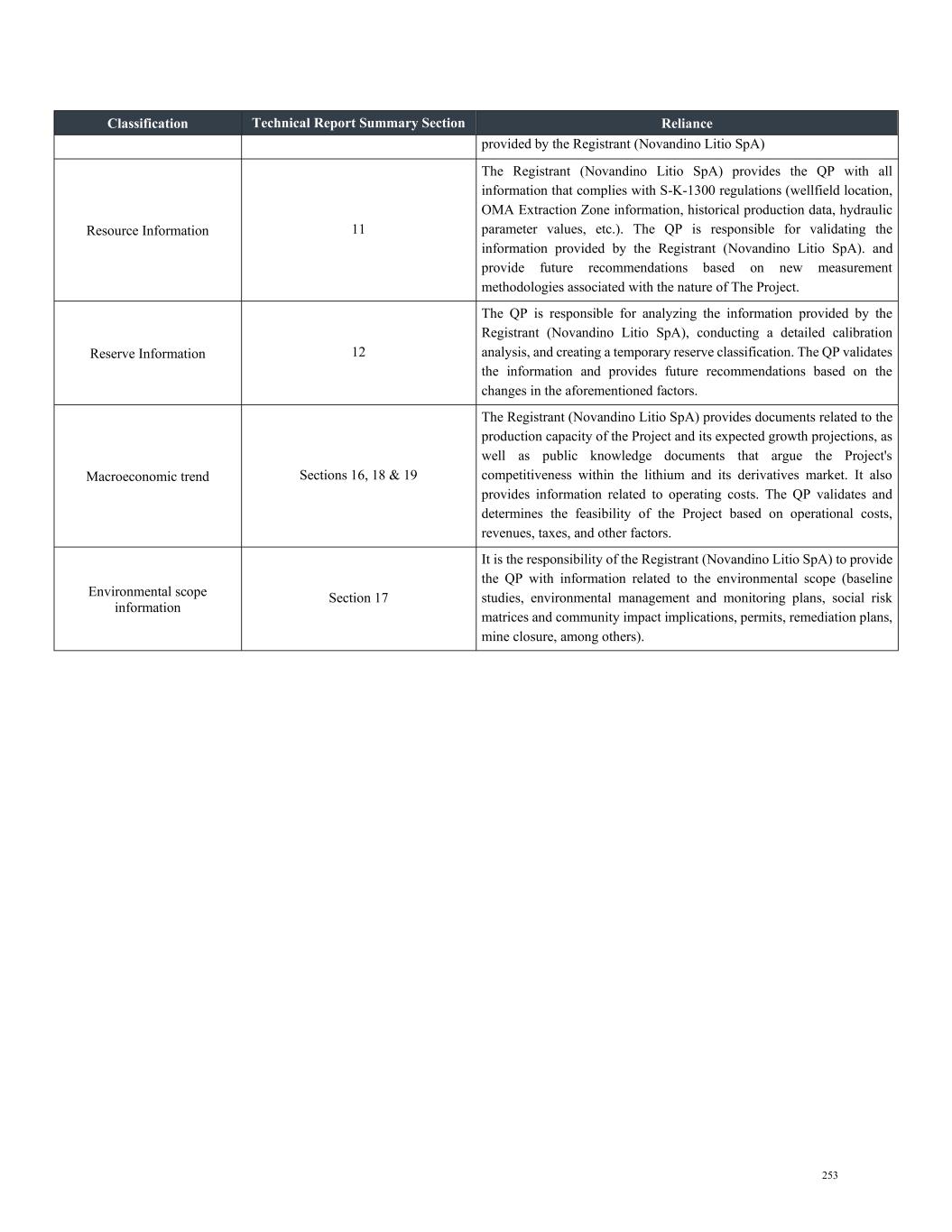
253 Classification Technical Report Summary Section Reliance provided by the Registrant (Novandino Litio SpA) Resource Information 11 The Registrant (Novandino Litio SpA) provides the QP with all information that complies with S-K-1300 regulations (wellfield location, OMA Extraction Zone information, historical production data, hydraulic parameter values, etc.). The QP is responsible for validating the information provided by the Registrant (Novandino Litio SpA). and provide future recommendations based on new measurement methodologies associated with the nature of The Project. Reserve Information 12 The QP is responsible for analyzing the information provided by the Registrant (Novandino Litio SpA), conducting a detailed calibration analysis, and creating a temporary reserve classification. The QP validates the information and provides future recommendations based on the changes in the aforementioned factors. Macroeconomic trend Sections 16, 18 & 19 The Registrant (Novandino Litio SpA) provides documents related to the production capacity of the Project and its expected growth projections, as well as public knowledge documents that argue the Project's competitiveness within the lithium and its derivatives market. It also provides information related to operating costs. The QP validates and determines the feasibility of the Project based on operational costs, revenues, taxes, and other factors. Environmental scope information Section 17 It is the responsibility of the Registrant (Novandino Litio SpA) to provide the QP with information related to the environmental scope (baseline studies, environmental management and monitoring plans, social risk matrices and community impact implications, permits, remediation plans, mine closure, among others).