S-K 1300 Technical Report Summary Greenbushes Mine, Western Australia Albemarle Corporation 4250 Congress St, Suite 900, Charlotte, NC, 28209, USA Prepared by: SLR USA Advisory Inc. 1658 Cole Blvd, Suite 100, Lakewood, Colorado, 80401 SLR Project No.: ADV-DE-00702 Effective Date: June 30, 2025 Signature Date: February 11, 2026 Revision: 0 Exhibit 96.1 Albemarle Corporation | Greenbushes Mine S-K 1300 Technical Report Summary February 11, 2026 SLR Project No.: ADV-DE-00702 i Table of Contents Table of Contents ....................................................................................................................... i 1.0 Executive Summary ...................................................................................................1-1 1.1 Report Scope ...............................................................................................................1-1 1.2 Property Description and Location ................................................................................1-2 1.3 Geology and Mineralization ..........................................................................................1-2 1.4 Exploration Status ........................................................................................................1-2 1.5 Development and Operations .......................................................................................1-3 1.6 Mineral Resources and Mineral Reserves ....................................................................1-5 1.7 Market Studies .............................................................................................................1-7 1.8 Environmental, Permitting, and Social Considerations ..................................................1-9 1.9 Economic Evaluation ....................................................................................................1-9 1.10 Conclusions ................................................................................................................ 1-11 1.11 Recommendations...................................................................................................... 1-12 1.12 Key Risks ................................................................................................................... 1-13 2.0 Introduction ................................................................................................................2-1 2.1 Report Scope ...............................................................................................................2-1 2.2 Site Visits .....................................................................................................................2-1 2.3 Sources of Information .................................................................................................2-2 2.4 Forward-Looking Statements ........................................................................................2-2 2.5 List of Abbreviations .....................................................................................................2-3 2.6 Independence ...............................................................................................................2-8 2.7 Inherent Mining Risks ...................................................................................................2-9 3.0 Property Description ..................................................................................................3-1 3.1 Location ........................................................................................................................3-1 3.2 Land Tenure .................................................................................................................3-3 3.3 Surface Rights and Easement ......................................................................................3-8 3.4 Material Government Consents ....................................................................................3-8 3.5 Significant Limiting Factors ...........................................................................................3-8 4.0 Accessibility, Climate, Local Resources, Infrastructure and Physiography ..........4-1 4.1 Accessibility ..................................................................................................................4-1 4.2 Climate .........................................................................................................................4-1 4.3 Local Resources ...........................................................................................................4-1 4.4 Infrastructure ................................................................................................................4-2 Albemarle Corporation | Greenbushes Mine S-K 1300 Technical Report Summary February 11, 2026 SLR Project No.: ADV-DE-00702 ii 4.5 Physiography ................................................................................................................4-2 5.0 History .........................................................................................................................5-1 5.1 Past Production ............................................................................................................5-1 5.2 Exploration and Development of Previous Owners or Operators ..................................5-2 6.0 Geological Setting, Mineralization, and Deposit ......................................................6-1 6.1 Regional Geology .........................................................................................................6-1 6.2 Local Geology ..............................................................................................................6-1 6.3 Mineralization ...............................................................................................................6-8 6.4 Deposit Types ..............................................................................................................6-8 7.0 Exploration..................................................................................................................7-1 7.1 Exploration ...................................................................................................................7-1 7.2 Drilling ..........................................................................................................................7-1 7.3 Hydrogeology ...............................................................................................................7-5 7.4 Geotechnical Data, Testing, and Analysis ....................................................................7-6 8.0 Sample Preparation, Analyses, and Security ...........................................................8-1 8.1 Analytical and Test Laboratories...................................................................................8-1 8.2 Sample Preparation and Analysis .................................................................................8-1 8.3 Sample Security ...........................................................................................................8-2 8.4 Density Determination ..................................................................................................8-2 8.5 Quality Assurance and Quality Control .........................................................................8-2 9.0 Data Verification .........................................................................................................9-1 10.0 Mineral Processing and Metallurgical Testing ....................................................... 10-1 10.1 Mineralogy .................................................................................................................. 10-1 10.2 Metallurgical ............................................................................................................... 10-1 10.3 LOM Plan ................................................................................................................... 10-2 11.0 Mineral Resource Estimates .................................................................................... 11-1 11.1 Resource Areas .......................................................................................................... 11-1 11.2 Statement Of Mineral Resources ................................................................................ 11-2 11.3 Initial Assessment ...................................................................................................... 11-3 11.4 Resource Database .................................................................................................... 11-6 11.5 Geological Modelling .................................................................................................. 11-6 11.6 Basic Statistics ......................................................................................................... 11-13 11.7 Treatment of High Grade .......................................................................................... 11-15 11.8 Geospatial Analysis .................................................................................................. 11-15 Albemarle Corporation | Greenbushes Mine S-K 1300 Technical Report Summary February 11, 2026 SLR Project No.: ADV-DE-00702 iii 11.9 Kriging Neighborhood Analysis ................................................................................. 11-17 11.10 Block Model .............................................................................................................. 11-17 11.11 Bulk Density ............................................................................................................. 11-18 11.12 Block Model Validation ............................................................................................. 11-19 11.13 Resource Classification ............................................................................................ 11-22 11.14 Mining Depletion ....................................................................................................... 11-23 11.15 Reconciliation ........................................................................................................... 11-23 11.16 Comparison to Previous Mineral Resource Estimate ................................................ 11-23 12.0 Mineral Reserve Estimates ...................................................................................... 12-1 12.1 Summary .................................................................................................................... 12-1 12.2 Statement of Mineral Reserves................................................................................... 12-1 12.3 Approach .................................................................................................................... 12-3 12.4 Planning Status .......................................................................................................... 12-4 12.5 Comparison to Previous Mineral Reserve Estimate .................................................. 12-13 13.0 Mining Methods ........................................................................................................ 13-1 13.1 Mining Method ............................................................................................................ 13-1 13.2 Geotechnical Considerations ...................................................................................... 13-1 13.3 Hydrogeological Considerations ................................................................................. 13-5 13.4 Mining Strategy .......................................................................................................... 13-5 13.5 Life of Mine Plan Results and Outcomes .................................................................... 13-8 13.6 Mining Equipment ..................................................................................................... 13-16 14.0 Processing and Recovery Methods ........................................................................ 14-1 14.1 Process Overview ...................................................................................................... 14-1 14.2 Technical Grade Plant (TGP) ..................................................................................... 14-4 14.3 Chemical Grade Plant 1 (CGP1) Processing Circuit ................................................... 14-8 14.4 Chemical Grade Plant 2 (CGP2) Processing Circuit ................................................. 14-12 14.5 Chemical Grade Plant 3 (CGP3) Processing Circuit ................................................. 14-16 14.6 Tailings Reprocessing Plant (TRP) ........................................................................... 14-18 14.7 Final Product ............................................................................................................ 14-22 14.8 Plant Yield ................................................................................................................ 14-22 15.0 Infrastructure ............................................................................................................ 15-1 15.1 Site Access ................................................................................................................ 15-3 15.2 Power Supply ............................................................................................................. 15-4 15.3 Water Supply .............................................................................................................. 15-5

Albemarle Corporation | Greenbushes Mine S-K 1300 Technical Report Summary February 11, 2026 SLR Project No.: ADV-DE-00702 iv 15.4 Flood Risk ................................................................................................................ 15-11 15.5 Mine Service Area (MSA) ......................................................................................... 15-11 15.6 Propane .................................................................................................................... 15-12 15.7 Diesel Storage and Dispensing ................................................................................ 15-12 15.8 Site-Camp Accommodation Facilities ....................................................................... 15-13 15.9 Communications and SCADA Systems .................................................................... 15-13 15.10 Tailings Storage ....................................................................................................... 15-13 16.0 Market Studies .......................................................................................................... 16-1 16.1 Introduction ................................................................................................................ 16-1 16.2 Lithium Demand ......................................................................................................... 16-1 16.3 Lithium Supply ............................................................................................................ 16-5 16.4 Lithium Supply-Demand Balance ................................................................................ 16-7 16.5 Lithium Prices ............................................................................................................. 16-8 17.0 Environmental Studies, Permitting, and Plans, Negotiations, or Agreements with Local Individuals or Groups ............................................................................ 17-1 17.1 Environmental Studies ................................................................................................ 17-1 17.2 Environmental Management ..................................................................................... 17-12 17.3 Mine Waste and Water Management ....................................................................... 17-12 17.4 Operation Permitting and Compliance ...................................................................... 17-14 17.5 Social or Community Requirements ......................................................................... 17-31 17.6 Mine Closure Requirements ..................................................................................... 17-34 18.0 Capital and Operating Costs ................................................................................... 18-1 18.1 Capital Costs .............................................................................................................. 18-1 18.2 Mine Closure and Rehabilitation ................................................................................. 18-3 18.3 Operating Costs ......................................................................................................... 18-3 18.4 Safeguard Mechanism ................................................................................................ 18-5 19.0 Economic Analysis ................................................................................................... 19-1 19.1 Economic Criteria ....................................................................................................... 19-1 19.2 Cash Flow Analyses ................................................................................................... 19-1 19.3 Sensitivity Analysis ..................................................................................................... 19-4 20.0 Adjacent Properties .................................................................................................. 20-1 21.0 Other Relevant Data and Information ...................................................................... 21-1 21.1 Standalone Ore Sorting Plant ..................................................................................... 21-1 21.2 Underground Mine ...................................................................................................... 21-1 22.0 Interpretation and Conclusions ............................................................................... 22-1 Albemarle Corporation | Greenbushes Mine S-K 1300 Technical Report Summary February 11, 2026 SLR Project No.: ADV-DE-00702 v 22.1 Geology ...................................................................................................................... 22-1 22.2 Mining......................................................................................................................... 22-1 22.3 Processing ................................................................................................................. 22-1 22.4 Environmental, Social, and Governance ..................................................................... 22-2 22.5 Water.......................................................................................................................... 22-2 23.0 Recommendations ................................................................................................... 23-1 23.1 Geology and Mineral Resources................................................................................. 23-1 23.2 Mining......................................................................................................................... 23-1 23.3 Processing ................................................................................................................. 23-1 23.4 Infrastructure .............................................................................................................. 23-2 23.5 ESG ........................................................................................................................... 23-2 23.6 Tailings Storage ......................................................................................................... 23-2 23.7 Water.......................................................................................................................... 23-3 24.0 References ................................................................................................................ 24-1 25.0 Reliance on Information Provided by the Registrant ............................................. 25-1 25.1 Macroeconomic Trends .............................................................................................. 25-1 25.2 Marketing ................................................................................................................... 25-1 25.3 Legal Matters .............................................................................................................. 25-1 25.4 Environmental Matters ................................................................................................ 25-1 25.5 Stakeholder Accommodations .................................................................................... 25-2 25.6 Governmental Factors ................................................................................................ 25-2 26.0 Date and Signature Page ......................................................................................... 26-1 Tables Table 1-1: Nameplate and LOM Plant Capacities ............................................................. 1-3 Table 1-2: LOM Physicals ................................................................................................. 1-5 Table 1-3: Statement of Mineral Resources as at June 30, 2025 ...................................... 1-6 Table 1-4: Statement of Mineral Reserves as at June 30, 2025 ........................................ 1-7 Table 1-5: Summary of Capital Costs ............................................................................. 1-10 Table 1-6: Summary of Economic Evaluation ................................................................. 1-11 Table 2-1: Site Visit Summary ........................................................................................... 2-2 Table 2-2: List of Abbreviations and Acronyms ................................................................. 2-3 Table 3-1: Greenbushes Mine Land Tenure ...................................................................... 3-5 Table 7-1: Lode Resource Drilling Summary ..................................................................... 7-3 Albemarle Corporation | Greenbushes Mine S-K 1300 Technical Report Summary February 11, 2026 SLR Project No.: ADV-DE-00702 vi Table 8-1: Central Lode Density Statistics ........................................................................ 8-2 Table 8-2: Summary of CRM Submissions for Li2O ........................................................... 8-3 Table 10-1: Greenbushes Mineralogical Report Summary ................................................ 10-1 Table 10-2: Greenbushes Metallurgical Test Work Summary ........................................... 10-2 Table 11-1: Statement of Mineral Resources as at June 30, 2025 .................................... 11-3 Table 11-2: Cost Inputs Used for Underground Stope Optimisation .................................. 11-5 Table 11-3 Open pit Mineral Resources Marginal Cut-off Grade Assumptions ................. 11-6 Table 11-4: Estimation Domain Details ........................................................................... 11-10 Table 11-5: Block Model Size and Extents ...................................................................... 11-18 Table 11-6: Bulk Density Assigned ................................................................................. 11-19 Table 11-7: Comparison with Previous Mineral Resources Estimates ............................. 11-24 Table 12-1: Statement of Mineral Reserves as at June 30, 2025 ...................................... 12-2 Table 12-2: Pit Optimization Geotechnical Parameters ..................................................... 12-5 Table 12-3: Pit Optimization Mining Parameters ............................................................... 12-5 Table 12-4: Pit Design Parameters - Maximum Inter-Ramp Angle .................................. 12-10 Table 12-5: Ramp and Pit Standoff Parameters .............................................................. 12-11 Table 12-6: Mineral Reserves Mass Yield (SC6.0 Concentrate) ..................................... 12-12 Table 12-7: LOM Plant Feed Yield .................................................................................. 12-12 Table 12-8: Reserves Marginal Cut-off Grade Assumptions ........................................... 12-13 Table 12-9: Comparison with Previous Mineral Reserve Estimates ................................ 12-13 Table 13-1: LOM Physicals ............................................................................................... 13-8 Table 13-2: Waste Dump Capacity and Percentage Filled .............................................. 13-12 Table 13-3 LOM Schedule as at June 30, 2025 ............................................................. 13-14 Table 13-4: Major Production Mine Fleet ........................................................................ 13-16 Table 13-5: Major Mining Fleet Summary ....................................................................... 13-17 Table 14-1: Nameplate and LOM Plant Capacities ........................................................... 14-1 Table 17-1: Current Key Operation E&S Approvals and Licences/Permits ...................... 17-16 Table 17-2: Future Key E&S Approvals and Licences/Permits ........................................ 17-23 Table 17-3: Status with Material E&S Non-Compliance .................................................. 17-28 Table 18-1: LOM Capital Cost Estimate ............................................................................ 18-2 Table 18-2: Annual Capital Costs Summary ..................................................................... 18-3 Table 18-3: Annual Operating Costs Summary ................................................................. 18-4 Table 18-4: LOM Average Annual Cost ............................................................................ 18-5 Table 19-1: Summary of Economic Evaluation ................................................................. 19-2 Albemarle Corporation | Greenbushes Mine S-K 1300 Technical Report Summary February 11, 2026 SLR Project No.: ADV-DE-00702 vii Table 19-2: Annual Cashflow ............................................................................................ 19-3 Table 19-3: Sensitivities Applied to NPV Sensitivity Analysis ............................................ 19-4 Figures Figure 1-1: Lithium Supply-Demand Balance ('000 tonnes Lithium Carbonate Equivalent) 1-8 Figure 3-1: Greenbushes General Location Plan ............................................................... 3-2 Figure 3-2: Greenbushes Regional Location Map .............................................................. 3-4 Figure 3-3: Greenbushes Mine Operation Layout............................................................... 3-7 Figure 6-1: Regional Geology ............................................................................................ 6-3 Figure 6-2: Generalized Geology Map with inset Cross Section ......................................... 6-4 Figure 6-3: E-W Cross-Section across the Central and Kapanga Zones ............................ 6-5 Figure 6-4: Simplified Stratigraphic Column ....................................................................... 6-6 Figure 6-5: Generalized Cross Section (looking north) Showing Greenbushes Pegmatite Mineral Zoning ................................................................................................. 6-8 Figure 7-1: Plan View of Drilling b Type ............................................................................. 7-2 Figure 8-1: Scatter Plot showing CRM SORE 6 performance for Li2O (warning = 2xSD, error = 3xSD)............................................................................................................ 8-4 Figure 8-2: CRM Scatter plot showing SORE 3 performance for Li2O. (warning = 2xSD, error = 3xSD)............................................................................................................ 8-4 Figure 8-3: Scatter Plot of RC Field Duplicates .................................................................. 8-5 Figure 8-4: Scatter Plot of DD Field Duplicates .................................................................. 8-6 Figure 8-5: QQ plots of adjusted values. Bottom - correction adjustment applied in Leapfrog to Li2O assay data from RC samples. .............................................................. 8-7 Figure 11-1: Exclusion Zone (Red Line) for Mineral Resources ......................................... 11-4 Figure 11-2: Underground Resource Blocks Below Open Pit ............................................. 11-5 Figure 11-3: Plan View of the Interpreted Pegmatite Units (Central Lode – yellow, White Well – Yellow, Kapanga – Magenta) ..................................................................... 11-8 Figure 11-4: Cut Off Grades Selected for Indicator RBF Interpolants Within Each Pegmatite Unit .............................................................................................................. 11-11 Figure 11-5: Declustered Statistics for Peg_1 (Central Lode) ........................................... 11-12 Figure 11-6: Histogram of Sample Lengths ...................................................................... 11-12 Figure 11-7: Li2O Histograms and Basic Statistics of Composites .................................... 11-13 Figure 11-8: Variography for Central Lode High-Grade Domain ....................................... 11-16 Figure 11-9: Variography for Kapanga High-Grade Domain ............................................. 11-16 Figure 11-10: QKNA Analysis for Min/Max Number of Composites for Pegmatite High Grade Domain 1 ..................................................................................................... 11-17

Albemarle Corporation | Greenbushes Mine S-K 1300 Technical Report Summary February 11, 2026 SLR Project No.: ADV-DE-00702 viii Figure 11-11: Example East-West Cross Sections Looking North ...................................... 11-20 Figure 11-12: Swath Plots on 50m Spacing at 6,253,100mN ............................................. 11-21 Figure 11-13: Kapanga Swath Plots 50 m Spacing ............................................................ 11-21 Figure 11-14: Classification Open Pit Material (Red Indicated, Green Inferred, Blue Underground Area) ...................................................................................... 11-23 Figure 12-1: Price Sensitivity Total Pit Size ........................................................................ 12-6 Figure 12-2: Ore Tonnage and Grade ................................................................................ 12-7 Figure 12-3: Pit Limit Optimization Shell ............................................................................ 12-8 Figure 12-4: Pit Design vs Optimisation Shell .................................................................... 12-9 Figure 12-5: Mineral Reserve Pit Shell Slope Design ....................................................... 12-11 Figure 13-1: 2025 LOM Final Pit Design ............................................................................ 13-4 Figure 13-2: Waste Dump Locations .................................................................................. 13-7 Figure 13-3: LOM Active Mining Areas ............................................................................... 13-9 Figure 13-4: LOM Waste Movement ................................................................................ 13-10 Figure 13-5: LOM Feed and Operational Mass Yield ....................................................... 13-11 Figure 13-6: LOM Active Dumping Areas ......................................................................... 13-13 Figure 14-1: Greenbushes Processing Overview – Block Flow Diagram ............................ 14-2 Figure 14-2: Greenbushes Process Plants – Aerial Image ................................................. 14-3 Figure 14-3: CR1 Crushing Circuit to TGP – Block Flow Diagram ...................................... 14-5 Figure 14-4: Technical Grade Plant – Block Flow Diagram ................................................ 14-6 Figure 14-5: Technical Grade Plant ................................................................................... 14-7 Figure 14-6: CR1 Crushing Circuit to CGP1 – Block Flow Diagram ................................... 14-9 Figure 14-7: CGP1 – Block Flow Diagram ....................................................................... 14-10 Figure 14-8: Chemical Grade Plant 1 – External View ..................................................... 14-11 Figure 14-9: Crushing Circuit 2 – Block Flow Diagram ..................................................... 14-14 Figure 14-10: CGP2 – Block Flow Diagram ....................................................................... 14-15 Figure 14-11: Chemical Grade Plant 2 – Exterior View ...................................................... 14-16 Figure 14-12: Crushing Circuit 3 – Block Flow Diagram ..................................................... 14-17 Figure 14-13: CGP3 – Block Flow Diagram ....................................................................... 14-18 Figure 14-14: TRP – Block Flow Diagram .......................................................................... 14-19 Figure 14-15: TRP Concentrate Storage Sheds ................................................................. 14-21 Figure 15-1: Overall Layout ................................................................................................ 15-2 Figure 15-2: Port of Bunbury - Berth 8 ............................................................................... 15-4 Figure 15-3: Water Storages .............................................................................................. 15-7 Figure 15-4: Simplified Water Flow Sheet .......................................................................... 15-8 Albemarle Corporation | Greenbushes Mine S-K 1300 Technical Report Summary February 11, 2026 SLR Project No.: ADV-DE-00702 ix Figure 15-5: Water Pipe Route Saltwater Gully to Clearwater Dam ................................. 15-10 Figure 15-6: Mine Services Area (MSA) ........................................................................... 15-12 Figure 15-7: TSF2 ............................................................................................................ 15-14 Figure 15-8: Greenbushes TSFs ...................................................................................... 15-16 Figure 16-1: EV Sales and Penetration Rates (000 vehicles, %) ........................................ 16-2 Figure 16-2: Lithium Demand in Key Sectors (000 LCE tonnes) ........................................ 16-3 Figure 16-3: Forecast Mine Supply (000 tonnes LCE) ........................................................ 16-6 Figure 16-4: Lithium Supply-Demand Balance (000 tonnes LCE) ...................................... 16-8 Figure 16-5: Spodumene Prices (6% lithia, spot, CIF China, US$/tonne) ........................... 16-9 Figure 16-6: Spodumene Long-Term Price Forecast Scenarios (6% Li2O spot, CIF China, US$/tonne, real (2025))................................................................................ 16-11 Figure 19-1: Cashflow and Pre-Tax NPV Summary (100% Basis) ..................................... 19-2 Figure 19-2: NPV Sensitivity Analysis ................................................................................ 19-4 Albemarle Corporation | Greenbushes Mine S-K 1300 Technical Report Summary February 11, 2026 SLR Project No.: ADV-DE-00702 1-1 1.0 Executive Summary SLR USA Advisory Inc. (SLR), formerly RPMGlobal USA, Inc. (RPM), was retained by Albemarle Corporation (Albemarle or the Client) to prepare an independent Technical Report Summary (TRS) on the Greenbushes Lithium Mine (Greenbushes or the Operation or the Mine) located in Western Australia (Figure 3-1). The purpose of this Report is to provide a Technical Report Summary (TRS or the Report), including an updated Mineral Resource and Mineral Reserves estimate in accordance with the United States Securities and Exchange Commission (SEC) S-K Regulations. Greenbushes is held within the operating entity, Talison Lithium Australia Pty Ltd (Talison or the Company) of which Albemarle is a 49% owner, with the remaining 51% ownership controlled by the Tianqi Lithium Energy Australia (TLEA or JV) between Tianqi Lithium (Tianqi) and IGO Ltd (IGO) with ownership of 26.01% and 24.99%, respectively. Talison is the incorporated operator of the Greenbushes mine. Each Shareholder is entitled to 50% of the spodumene concentrate and other lithium products produced from the mining operation. Marketing and sales are managed by Shareholders individually. SLR’s technical team (the Team) consisted of Senior, Principal, and executive-level Consultants in geology, mining, processing, infrastructure, environment, health, safety, and social (EHSS) relevant experience in the project's styles of mineralization, mining methods, and regional setting. SLR, as the QP, was responsible for compiling or supervising the compilation of this Report and the Statements of Mineral Resources and Mineral Reserves stated within. It should be noted that all costs are presented in Australian dollars ($) unless otherwise stated, the economics have been detailed and evaluated on a 100% equity basis, and no adjustment has been made for inflation (real terms basis). 1.1 Report Scope The purpose of this Report is to update the Mineral Resources and Mineral Reserves estimates and provide a Technical Report Summary (TRS or Report) for Greenbushes, as at June 30, 2025, reported to reflect the ownership in the relevant holding companies that own the Project. This TRS conforms to the United States Securities and Exchange Commission’s (SEC) Modernized Property Disclosure Requirements for Mining Registrants as described in Title 17 Subpart 229.1300 of Regulation S-K, Disclosure by Registrants Engaged in Mining Operations (S-K 1300) and Item 601 (b)(96) Technical Report Summary. The TRS was prepared by SLR as a third-party firm in accordance with S-K 1300. References to the QP are references to SLR and not to any individual employed or engaged by SLR. In addition to work undertaken to generate independent Mineral Resources and Mineral Reserves estimates, the TRS relies largely on information provided by Talison or the Client, either directly from the site and other offices or from reports by other organizations whose work is the property of the Talison or the Client or its subsidiaries. The data relied upon for the Mineral Resources and Mineral Reserves estimates independently completed by SLR have been compiled primarily by the Client and Talison and subsequently reviewed and verified as well as reasonably possible by SLR. The TRS is based on information made available to SLR as at June 30, 2025. Neither the Client, nor Talison has advised SLR of any material change, or event likely to cause material change, to the underlying data, designs, or forecasts since the date of asset inspections. It is noted that references to quarterly, half-yearly, or annual time periods are based on a calendar year commencing January 1 each year, unless otherwise noted. Albemarle Corporation | Greenbushes Mine S-K 1300 Technical Report Summary February 11, 2026 SLR Project No.: ADV-DE-00702 1-2 1.2 Property Description and Location Greenbushes is a large-scale open pit mining operation located 250 km south of Perth in Western Australia directly adjacent to the South Western Highway. The highway allows access to a third-party-owned and operated major bulk handling port capability located 90 km to the northwest at Bunbury. Greenbushes is one of the largest known high-grade spodumene pegmatite resources in the world and extracts lithium and tantalum products. SLR notes that the tantalum rights are owned by a third party. The Operation’s property area is approximately 3,500 hectares (ha), which is a smaller subset of a larger 10,067 ha land package controlled 100% by Talison. The Operation is accessible year-round via sealed bitumen roads, and there is sufficient road and port infrastructure in place with sufficient capacity to support the planned mining operations. The climate is characterized as temperate, and SLR considers there to be no limitations on mining or exploration at the site due to the climate, however the Operation is entirely dependent on rainfall as the source of water. 1.3 Geology and Mineralization The intrusive rocks of the Greenbushes Pegmatite District lie within the Balingup metamorphic belt, which lies within the Southwest Gneiss Terrains of the Yilgarn Craton. The pegmatites are spatially associated with and controlled by the Donnybrook-Bridgetown Shear Zone, which is central to this belt and potentially controls both the regional and local emplacement of the mineralization. The Greenbushes pegmatite deposit consists of several large pegmatite intrusive bodies, which are separated into two main lodes, namely the Central and Kapanga Lodes. Both areas consist of several pegmatite bodies; however, the Central Lode displays significantly more continuity and thickness as compared to the Kapanga Lode. Recent drilling has defined advanced stage exploration areas at White Wells and down-dip extension of Central and Kapanga Lodes, which present significant upside to the reported Mineral Resources. Furthermore, recent review work by Talison has highlighted numerous exploration targets along the Greenbushes trend, which SLR considers warrant further exploration. Five distinct mineralogical zones have been defined in the Greenbushes Central Lode pegmatite. Generally, the pegmatite shows a contact zone, a K-feldspar (potassium)-rich zone, an albite (sodium)-rich zone, a mixed zone, and a spodumene (lithium)-rich zone. The bulk of the lithium in the deposit is contained within the spodumene-rich zone, generally towards the center of the Central Lode pegmatite. 1.4 Exploration Status The Greenbushes deposit is well explored and understood, with exploration drilling programs completing 1,763 holes since drilling commenced in the early 1970s. Exploration has been continuous throughout the life of the Operation, with recent exploration focused on the mining areas within the Life of Mine (LOM) pit limits. These exploration programs have gathered geological and geochemical data, with the bulk of this data collected from surface drilling activities. However, some drilling has been undertaken via underground methods historically. Greenbushes’ forward-looking exploration strategy focuses on increasing the geological confidence within the footprint of the tenement holdings to expand the current resource base, particularly focused on the underground area with a initial

Albemarle Corporation | Greenbushes Mine S-K 1300 Technical Report Summary February 11, 2026 SLR Project No.: ADV-DE-00702 1-3 underground Mineral Resource being stated in this Report. As noted, SLR considers the White Wells and down-dip extension of Central Lode to be high-priority targets. 1.5 Development and Operations The Operation utilizes conventional open-cut mining techniques optimized for the deposit's geological characteristics, with targeted extraction from the Central Lode and Kapanga pegmatite zones. Mining is forecast to be within a single open pit with the final pit design incorporating staged cutbacks to balance cost efficiency, recovery, and safety. The mining fleet is expected to remain fully contractor-operated, consisting of a mixed fleet of hydraulic excavators and 140-tonne haul trucks. Contractors manage equipment supply, maintenance, replacement, and workforce logistics, subsequently, all mining costs are based on unit rates. 1.5.1 Key Site Infrastructure The Operation currently has four operating processing plants and associated infrastructure– Chemical Grade Plant #1 (CGP1), Chemical Grade Plant #2 (CGP2), a Tailings Retreatment Plant (TRP), and a Technical Grade Plant (TGP). Combined, these plants produce various technical grade lithium concentrates and a 6% lithium oxide (Li2O, or lithia) chemical grade concentrate (SC6.0). As outlined in Table 1-1, the plants combined have a total nameplate processing capacity of 6.55 Mtpa producing up to 1.5 Mtpa of lithium mineral concentrate. A third Chemical Grade Plant #3 (CGP3) is currently being constructed and is forecast to commence commissioning in late-2025 with full production forecast in late 2026. With the inclusion of CGP3, nameplate processing capacity will increase to 8.95 Mtpa; however, SLR has assumed a throughput of 8.65 Mtpa based on recent actuals. Table 1-1: Nameplate and LOM Plant Capacities Asset Nameplate (Mtpa) SLR Capacity (Mtpa) CGP1 1.8 1.8 CGP2 2.4 2.4 TRP 2.0 2.0 TGP 0.35 0.35 Current Capacity 6.55 6.55 CGP3 2.4 2.4 LOM Capacity 8.95 8.95 The Operation’s electricity is primarily supplied via a 132 kV transmission line from the Hester substation to the on-site Greenbushes Lithium Mine Substation, with a capacity of 120 MVA and a current load of 21 MVA. The contracted maximum demand is 40 MVA, with a request to increase to 65 MVA to support future growth. 5 The water supply system relies entirely on rainfall and surface water runoff to a network of relatively small dams, with the majority of rainfall occurring during winter. Nine water storage dams are operating on site, with a planned dam capacity expansion, the S8 Saltwater Gully (SWG) Expansion Project, pending approval for construction. The SWG Expansion Project is a Albemarle Corporation | Greenbushes Mine S-K 1300 Technical Report Summary February 11, 2026 SLR Project No.: ADV-DE-00702 1-4 key component of the five-year LOM plan as it includes water storage areas to supplement current storage capacities. Typical storage within the current dams is approximately 5 to 6 GL which is considered very low compared to annual process water demand of 25 GL or more (before taking into account decant return). Water supply is a key risk to the achievability of the LOM plan and is detailed further in Section 1.12. Four tailings storage facilities (TSFs), namely TSF1, TSF2, TSF3 and TSF4 have been developed at Greenbushes as part of the mining operations. TSF2’s remaining capacity was consumed in H1 2024 with all material after this time placed in TSF4. At the start of July 2025, the remaining capacity of TSF4 based on the current LOM, is sufficient until 2034. After this time, a raise will be completed to TSF4, with the tailings planned to be stored in a new TSF5 facility, proposed for an off-site location with a design capacity yet to be confirmed. Further details are provided in Section 1.8, 1.12, and Section 17.0 regarding approvals and risks associated with TSFs. There is currently one operating waste dump, S1 (Floyds), with a capacity of 77 million banked cubic meters (Mbcm) and due to reach capacity by 2034. Following this, several waste dumps are planned to be constructed to support the LOM waste storage requirements. As detailed in Section 1.8, 1.12, and Section 17.0, a number of approvals are required for each of these. 1.5.2 Life of Mine Physicals The key physicals relevant to the LOM plan have been summarized in Table 1-2. The LOM plan assumes an active mine life of 24 years, with mining operations ending in 2048 and the processing of remaining stockpiles to be completed in 2049. The LOM schedule progressively ramps up total annual material movement to approximately 53 Mt by 2034, maintaining this rate through to 2040 before declining to approximately 14 Mt over the period 2044–2046. Annual waste movement increases to more than 40 Mt between 2033 and 2040, reaching a maximum of 46 Mt in 2039. Total chemical and technical (excludes TRP) plant feed ramps up to 6.95 Mtpa by 2027, after which the plant is planned to operate at steady-state throughput through to 2048 with some remaining stockpile material being processed in 2049. Plant feed will be sustained through a blended feed from a combination of direct feed from the open pit and reclaimed material from stockpiles. Over the life of mine, a total of 37.0 Mt of concentrate is forecast to be produced, and 2.8 Mt of historical tailings material is scheduled to be reprocessed between 2026 and 2028. Each of the five plants that form the basis for the LOM plants has a different yield forecast, which is detailed in Section1.0. The mining operation is land-constrained, and it is essential to secure the necessary regulatory approvals, biodiversity offsets, and land acquisitions for additional waste rock dump capacity. While it is common for mining operations with a 20+ year LOM to require future approvals, SLR highlights an elevated risk due to land constraints, regulatory requirements, and the need for capital investment. SLR considers these areas to be key risks to achieve the LOM plan as noted in Section 1.12, and Section 17.0. Albemarle Corporation | Greenbushes Mine S-K 1300 Technical Report Summary February 11, 2026 SLR Project No.: ADV-DE-00702 1-5 Table 1-2: LOM Physicals Parameter Units (metric) LOM LOM Active Mine Period Years 24 LOM Plant Period Years 25 Waste Material Moved# Mt 656.5 Ore Mined (ex-pit) Mt 160.9 Ore Mined (reprocessed tailings) Mt 2.8 Ore Existing Stockpiles Mt 0.9 Ore Processed (Feed total) Mt 164.5 Feed Grade (Total average) % 1.90 Strip Ratio (ROM) t:t 3.4 LOM Operational Yield % 22.5 Concentrate Tonnes (SC6.0) Mt 37.0 Note: # Excludes unprocessed ore stockpiles (30.5 Mt). SC6.0: spodumene concentrate containing 6% Li2O * Waste material mined in volume: 229.9 Mbcm 1.6 Mineral Resources and Mineral Reserves Unless otherwise stated in this Report, the Mineral Resources and Mineral Reserves reported reflect the Company’s 49% interest in the asset, and Mineral Resources are reported exclusive of Mineral Reserves (i.e., Reported Mineral Resources are in addition to reported Mineral Reserves). The Mineral Resources as at June 30, 2025, summarized in Table 1-3, have been estimated and classified in accordance with S-K 1300 and have reasonable prospects for economic extraction in line with an Initial Assessment. The Mineral Resources have been estimated with reference to a cut-off grade (COG) of 0.3% Li2O, employing an open pit mining method and 0.8% Li2O in the underground area. The COG was determined with regard to estimated mining and processing costs, yield and product qualities, and long-term benchmark pricing of US1,500 per tonne SC6. It is highlighted that the long-term benchmark price provided by third-party experts Fastmarkets (as discussed in Section 11.5) is over a timeline of 7 to 10 years, which was selected based on the Mineral Resource's reasonable long-term prospect. Both the Mineral Resources and Mineral Reserves have been reported using the 30 June surface provided SLR, as the QP considers the geological model to be based on adequate structural and geochemical data that has been reviewed and verified by geologists over a long period of time, as well as by SLR. Deposit modeling has been carried out using industry-standard geological modeling software and procedures. The estimation and classification of the Mineral Resource reflect the QP’s opinion of a substantial quantum of in situ material with reasonable prospects for economic extraction remaining available. SLR notes that the Mineral Resources are reported exclusive of Mineral Reserves. Albemarle Corporation | Greenbushes Mine S-K 1300 Technical Report Summary February 11, 2026 SLR Project No.: ADV-DE-00702 1-6 Table 1-3: Statement of Mineral Resources as at June 30, 2025 Type Classification Quantity (100%) (Mt) Attributable Quantity (49%) (Mt) Li2O Grade (%) Open Pit Indicated 126.3 61.9 1.2 Inferred 4.4 2.2 0.9 Underground Indicated - - - Inferred 82.1 40.2 1.6 Stockpiles Indicated 2.5 1.2 1.7 Inferred 1.4 0.7 1.5 TSF Indicated Inferred Total Indicated 128.8 63.1 1.2 Inferred 87.9 43.1 1.6 Notes: 1. The Mineral Resources are reported exclusive of the Mineral Reserves. 2. The Mineral Resources have been compiled under the supervision of SLR as the QP. 3. All Mineral Resources figures reported in the table above represent estimates at June 30, 2025. Mineral Resource estimates are not precise calculations, being dependent on the interpretation of limited information on the location, shape and continuity of the occurrence and on the available sampling results. The totals contained in the above table have been rounded to reflect the relative uncertainty of the estimate and reflect the view of the QP. Rounding may cause some computational discrepancies. 4. Mineral Resources are reported in accordance with S-K 1300. 5. The Mineral Resources reflect the 49% ownership in the relevant holding companies. 6. The Open Pit Mineral Resources are reported at a cut-off grade of 0.3 % Li2O while the Underground Mineral Resources are reported at a cut-off grade of 0.8% Li2O. Refer to Section 0 for determinations of the cut-off grades applied. 7. Mineral Resources are estimated using a long-term selling price of US$1,500/t CIF CKJ1 of SC6 grade concentrate (benchmark 6% Li2O), and a US$/A$ exchange rate of A$1.00:US$0.66. SLR is of the opinion that, with consideration of the recommendations summarized in Sections 1.0 and 23.0 of this TRS, any issues relating to all relevant technical and economic factors likely to influence the prospect of economic extraction can be resolved with further work. The Mineral Reserves have been estimated as at June 30, 2025, as summarized in Table 1-4. Mineral Reserves are subdivided into Proven Mineral Reserves and Probable Mineral Reserves categories to reflect the confidence in the underlying Mineral Resource data and modifying factors applied during mine planning. A Proven Mineral Reserve can only be derived from a Measured Mineral Resource, while a Probable Mineral Reserve is typically derived from an Indicated Mineral Resource as well as Measured Resources dependent on the QP’s confidence in the underlying Modifying Factors. No Measured Mineral Resources have been reported for the Operation, as such no Proven Mineral Reserves are reported. The conversion of Mineral Resources to Mineral Reserves incorporated systematic mine planning and analysis, including pit optimization, detailed pit design, the application of modifying 1 Cost, Insurance and Freight paid to Chikugo Port (China).

Albemarle Corporation | Greenbushes Mine S-K 1300 Technical Report Summary February 11, 2026 SLR Project No.: ADV-DE-00702 1-7 parameters, LOM scheduling, and cost analysis. All Mineral Reserve calculations are in metric units, with Li2O grades reported in percentage (%). Mineral Reserve quantities were estimated using a marginal cut-off grade of 0.7% Li2O and a selling price of US$1,300/t spodumene SC6.0 CIF China, based on Fastmarkets Market Study Guidance in Section 16.0. Table 1-4: Statement of Mineral Reserves as at June 30, 2025 Classification Type Quantity (100%) (Mt) Attributable Quantity (49%) (Mt) Li2O (%) Recovery (%) Probable In situ 160.9 78.9 1.9 71.5% Probable Stockpiles 0.9 0.4 2.3 73.2% Probable TSF1 2.8 1.4 1.4 51.0% Total 164.5 80.6 1.9 71.3% Notes: 1. The Mineral Reserves are additional to the reported Mineral Resources. 2. Albemarle’s attributable portion of Mineral Resources and Mineral Reserves is 49%. 3. The Mineral Reserves have been estimated by SLR as the QP. 4. Mineral Reserves are reported in accordance with S-K 1300. 5. Mineral Reserves are reported on a dry basis and in metric tonnes. 6. The totals contained in the above table have been rounded with regard to materiality. Rounding may result in minor computational discrepancies. 7. Mineral Reserves are reported considering a nominal set of assumptions for reporting purposes: a) Mineral Reserves are based on a selling price of US$1,300/t for chemical grade concentrate (6% Li2O), and concentrate transport and selling cost of US$44.4/t SC6.0. SLR has relied on third-party and expert opinions and notes the selling price is below the Fastmarkets CIF China, Japan, Korea (CJK) low-case 10-year average price of US$1,300. b) Mineral Reserves modifying factors result in ore loss of approximately 3% and dilution of approximately 6.3%. c) All Inferred material (5.8 Mt) with reported Li2O content greater than zero is allocated to waste. d) Material with a Li₂O grade greater than or equal to 0.5% is included in the LOM plan as potential plant feed. A blended feed to meet the iron oxide (Fe₂O₃) specifications is scheduled as part of the LOM plan and only material that is fed into the plant is reported as Mineral Reserves. e) Costs estimated in Australian Dollars were converted to U.S. dollars based on an exchange rate of AU$1.00:US$0.66. f) The economic COG calculation is based on an estimated US$1.85/t-ore incremental ore mining cost, US$34.44/t- ore processing cost, US$9.33/t-ore G&A cost, and US$12.62/t-ore sustaining capital cost. g) The price, cost and mass yield parameters produce a calculated economic COG of 0.50%. h) The mass yield for ore processed through the Chemical and Technical plants is estimated based on formulas that vary depending on Li2O%. For CGP1, the formula is MY%=9.362 × Feed Li2O%^1.319. For CGP2 and CGP3, the formula is MY%=(9.362 × Feed Li2O%^1.319)+(Feed Li2O% × 0.57). The TGP formula is MY%=41.4 and the TRP formula is MY%=9.7. i) Waste tonnage within the reserve pit is 687.0 Mt at a strip ratio of 4.3:1 (waste to ore –including unprocessed stockpiles). 1.7 Market Studies Fastmarkets has developed a marketing study on behalf of Albemarle to support lithium pricing assumptions utilized in this Report. This market study does not consider by- or co-products that may be produced alongside the lithium production process. Battery demand is now responsible for 85.0% of all lithium consumed. Looking forward, Fastmarkets expects demand from eMobility, especially battery electric vehicles (BEVs), to Albemarle Corporation | Greenbushes Mine S-K 1300 Technical Report Summary February 11, 2026 SLR Project No.: ADV-DE-00702 1-8 continue to drive lithium demand growth. Supply is still growing despite the low-price environment and some production restraint. This has coincided with a period of weaker-than- expected demand growth. Ironically, the industry is still growing healthily; Fastmarkets expects demand growth from electric vehicles (EVs) to average 25% over the next few years, but this is slower than >40% growth in demand from EVs the market was used to in the early post-Covid years. The high prices in 2021–2022 triggered a massive producer response with some new supply still being ramped up, while at the same time, some high-cost production is being cut, mainly by non-Chinese producers. The combination of weaker-than-expected demand at a time when supply is still rising means the market is likely to be in a supply surplus until 2026. Based on supply restraint and investment cuts, Fastmarkets forecasts the market to swing back into a deficit in 2027. This could change relatively easily should demand exceed expectations and supply expansion disappoint to the downside. Fastmarkets recommends that a real price of US$1,300/t for spodumene SC6.0 CIF China should be utilized by Albemarle for Mineral Reserve estimation. Recommended prices are on the lower end of Fastmarkets' low-case scenario. Figure 1-1: Lithium Supply-Demand Balance ('000 tonnes Lithium Carbonate Equivalent) Source: Fastmarkets 2025 Based on the Fastmarkets report, SLR has adopted the following to support Mineral Resource and Mineral Reserve Estimation: • Mineral Resources: US$1,500/t for spodumene SC6.0 CIF China • Mineral Reserves: US$1,300/t for spodumene SC6.0 CIF China • Financial Modelling: US$1,300/t for spodumene SC6.0 CIF China from 2029, increased from spot price in line with the Fastmarkets forecast. Albemarle Corporation | Greenbushes Mine S-K 1300 Technical Report Summary February 11, 2026 SLR Project No.: ADV-DE-00702 1-9 1.8 Environmental, Permitting, and Social Considerations The Operation is generally in compliance with the current environmental and social (E&S) approvals and permits. However, there have been some operational incidents and non- compliance issues such as chemical spills, unauthorized land disturbance, infrastructure damage, pollution control equipment malfunction, and a fauna strike. Talison advises that a potential breach of tenement conditions reported in 2024 regarding the construction of TSF4 in relation to its approved design has been resolved with the state mining regulator (the Department of Mines, Petroleum and Exploration [DMPE]; formerly part of the Department of Energy, Mines, Industry Regulation and Safety [DEMIRS]). There are several key project approvals required for near to medium term mining in the LOM Plan, including the Saltwater Gully Water (SWG) Dam, S2 waste rock landform (WRL), raise of TSF4 and the Cowan, Southampton, and Austins dams, and development of a new TSF (TSF5). Further details are provided in Section 17.0. There are environmental and social (E&S) values that may place limitations on the Operation. Continuously monitored elevated dust or noise levels may result in temporary modifications to some operational activities, and the existence of currently unknown cultural heritage sites or biodiversity values may result in exclusion zones within future project development areas. SLR understands that the known areas are excluded from the LOM plan and heritage studies have been completed where required. There are potential future E&S limits, constraints, and obligations that may be difficult or costly to meet. These are associated with land access (including biodiversity offsets) for tails and waste storage areas, meeting ambient noise/air quality requirements, maintaining zero surface water discharge, and meeting greenhouse gas emissions/safeguard mechanism obligations. SLR considers that the identified potential future E&S constraints will require careful management if the proposed LOM plan is to be realized in the near to medium term. Talison has assessed and is managing the Aboriginal cultural heritage issues associated with the Operation. Talison has Heritage Agreements in place with the local indigenous groups, which will facilitate and guide any future required heritage surveys for the Operation. With the renewal of the mining leases pending in 2026, renegotiation of these agreements may potentially be required. Talison has established an extensive stakeholder engagement and community development program. The stakeholder engagement is guided by an overarching Stakeholder Engagement Plan (SEP) and Stakeholder Management System, which is managed by a dedicated Stakeholder Engagement Team (SET). Talison has also developed a Stakeholder Engagement & Community Relations Business Plan, which outlines and guides the current specific stakeholder engagement and community development activities for future plans. A current approved Mine Closure Plan (MCP) is in place, and SLR considers that the 2025 financial liability estimate for closure of $195 million (on a 100% Operation basis,$234 million with contingency) is representative of the level of disturbance and associated closure requirements detailed in the MCP. 1.9 Economic Evaluation SLR highlights that the operating and capital estimates for the next 5 years, along with the sustaining capital, are based on first-principle cost build-ups and are considered to be at least to a pre-feasibility level of accuracy. SLR notes that the majority of operating costs are based on Albemarle Corporation | Greenbushes Mine S-K 1300 Technical Report Summary February 11, 2026 SLR Project No.: ADV-DE-00702 1-10 ongoing contracts or previous years’ actuals, which are considered to be above feasibility study level of accuracy The remainder of the capital expenditures are based on built-up using typical costing methods for an operation of the scale, long mine life, and operation requirements to meet the LOM plan. In addition, various contingencies are built into the cost estimates. As such, SLR considers the basis of costs reasonable for an Operation. 1.9.1.1 Operating Costs The LOM operating costs are built up from first principles with reference to historical actuals (cost and production performance), the LOM physical schedule, and forecast product estimates. The total Free on Road (FOR) operating costs (which exclude royalties and shipping costs) are $17,140 million over the LOM and the average LOM FOR cost is $464/t product. Mine Closure of $234 million is included in addition to the operating costs and allows for the total planned closure costs, ongoing closure holding costs, and workforce redundancy. 1.9.1.2 Capital Costs The economic evaluation summarized in Table 1-5 includes: • Sustaining capital for equipment purchase and replacement, and other general sustaining capital costs, which are typical for an operating asset of this scale. • Growth capital to support the LOM production ramp-up, CGP3 and upgrades, TSF 5, and other mine infrastructure projects, EPCM, and associated contingency. • Mobile equipment leases Table 1-5: Summary of Capital Costs Capital Expenditure Item Value ($ million) Sustaining Capital Expenditure 907 Growth Capital Expenditure 4,636 Leases (Mobile Equipment) 3 Total 5,545 SLR highlights that the majority of operating infrastructure is in place to support the 24-year Operation’s life, which includes one years of processing stockpiles. 1.9.2 Economic Evaluation The economic evaluation of the asset was completed using a discounted cash flow analysis and confirmed the robust economics of Greenbushes. Table 1-6 provides a summary of the economic evaluation.

Albemarle Corporation | Greenbushes Mine S-K 1300 Technical Report Summary February 11, 2026 SLR Project No.: ADV-DE-00702 1-11 Table 1-6: Summary of Economic Evaluation Economic Evaluation Units LOM ($) 100% LOM (US$#) 100% LOM (US$#) 49% Gross Spodumene Revenue $ billion 70.4 46.5 22.8 Free Cashflow $ billion 47.1 31.1 15.2 Total Operating Costs* $ billion 23.3 15.4 7.5 Total Capital Costs $ billion 4.5 3.0 1.5 Avg. Free on Board Costs* $/SC6.0-eq t 631 416 416 All-In Sustaining Costs** $/SC6.0-eq t 753 497 497 Discount Rate % 10% 10% 10% Pre-Tax NPV $ billion 15.3 10.1 4.9 Post-Tax NPV $ billion 10.2 6.7 3.3 Notes: * Defined as Operating Cost (including royalties, excluding distribution) divided by SC6.0 equivalent sales tonnes ** Defined as Operating Cost (including royalties) plus Capital Costs divided by SC6.0 equivalent sales tonnes # Based on an exchange rate of 1US$:0.66$ The economic model was tested for sensitivity regarding lithium prices, and capital and operating cost estimates. The results of this analysis indicate that profitability is most sensitive to variations in price and operating costs and least sensitive to changes in capital costs. 1.10 Conclusions The Greenbushes deposit is well explored with exploration drilling programs having been conducted since the early 1940s and more systematically in 1970. SLR considers that the geological model is based on adequate geological and geochemical data and has been sufficiently reviewed and verified. SLR has determined that the estimation and classification of the Mineral Resources have reasonable prospects for eventual economic extraction in line with an Initial Assessment. Greenbushes is an established open pit mine that is a conventional truck and shovel operation employing industry-standard mining methods. SLR considers the major mining fleet assumptions to be reasonable when benchmarked to industry standards and historical performance. SLR is of the opinion that the Mineral Reserves and associated equipment fleet numbers are reasonable to achieve the forecasts and reflect an appropriate level of accuracy. The geological model, detailed mine plans, and technical studies that underpin the LOM plan are supported by historical performance, well-documented systems and processes, and reconciliation and review. Where available, SLR has reviewed this data and determined it to be adequate to support the Statements of Mineral Resources and Mineral Reserves reported in this TRS. Tenure critical to the declared Mineral Resources and Mineral Reserves, the associated infrastructure and the LOM plan are currently in good standing and are subject to routine renewal processes. However, additional approvals and land acquisition are required to achieve the LOM plan. The surface area of the existing Operation is almost wholly owned by the Company, and SLR is of the opinion that there are no material surface rights and easement Albemarle Corporation | Greenbushes Mine S-K 1300 Technical Report Summary February 11, 2026 SLR Project No.: ADV-DE-00702 1-12 issues, with the exception of the required additional areas for future development plans beyond 2033. All key permits and approvals are in place for mining to continue until June 2027. Several minor additional approvals are required to commence in-pit waste dumping within the Cornwall and CB32 pit voids. Should these approvals not be secured by June 2027, waste placement can continue in the S1 Floyds dump, which has sufficient remaining capacity to support waste dumping through to early 2034. Receipt of approvals is a key risk associated with achieving the LOM plan. Documents associated with approvals required for ongoing works beyond 2028 have been submitted, and SLR is of the opinion that these approvals have a fair prospect of being granted within the required timeframe to allow ongoing operations. If delays occur in granting these approvals, the LOM plan presented in this Report will need to be revised. 1.11 Recommendations SLR has the following key recommendations • Approvals: Carefully monitor and amend as required, the implementation of the proposed future approval strategy and schedule, taking into consideration the comments that SLR has made on the proposed future approval strategy and schedule in this review, and compare the proposed future approval program/schedule against a confirmed detailed integrated project schedule/mine plan, so that timing limitations on the individual waste and tailings storage facility capacities can be compared against the approvals schedule. • Water: Continue to implement the water strategy and design to expand water storage and distribution, including the SWG Expansion. While Talison reports improved water efficiencies, the potential for water shortages remains, and the Operation needs to continue to focus on improving water supply security. • TSF: SLR recommends increasing planning and design confidence of TSF5, as well as land acquisition, to ensure sufficient tailings storage capacity is available for the current processing needs and for the LOM plan. This planning needs to thoroughly consider the storage capacity of TSF4, as well as alternative technologies such as dry-stack tailings. • Ore Sorters: Complete geotechnical studies for the placement of mechanical ore sorters and assess the potential economic benefits of processing mineralized waste with grades between 0.3% and 0.5% Li2O, as well as contaminated ore. SLR notes that a technical feasibility study has been completed, with geotechnical studies required to ensure they can be incorporated into the LOM to support Mineral Reserves. SLR notes material between 0.3% to 0.5% Li2O and higher Fe% content material is planned to be stockpiled. o SLR notes that 30.5 Mt of material >0.5% Li2O in the LOM pit design cannot be blended into the current configurations of the plants due to high Fe content. SLR’s LOM plan reflects the current processing plant configuration which includes the current Fe content restriction. Changes to the plant configuration, or introduction of ore sorters which should allow higher Fe grade into the blend, could potentially allow this material to be processed. • Fleet Productivity: SLR notes the Operation is ramping up production to meet the requirements of the plants. This ramp up allows optimization of the fleet management and productivity systems to ensure the LOM can be achieved. Albemarle Corporation | Greenbushes Mine S-K 1300 Technical Report Summary February 11, 2026 SLR Project No.: ADV-DE-00702 1-13 • Strategic Asset Review: a number of studies are recommended (and currently underway to both optimize the Operation and mitigate key risks associated with waste and tailings storage: • Plant Performance and Throughput – potential to increase throughput and recoveries beyond nameplate capacity of all plants • Waste and Tailings Storage - While significant improvement in planning (in-pit dumping, etc.), further studies required to optimize storage via o Potential increase in waste landform final slope angles of current dumps to increase capacity, o Dry stack tailings which decreases the need for TSF 5. • Underground Study - Progress the underground mining study, including open pit underground trade-off studies, which are currently at a conceptual level. The inclusion of an underground operation has the potential to offset waste mining and TSF requirements through paste fill. 1.12 Key Risks • Approvals: granting approvals is a key risk for the continued operations to achieve the LOM plan. Key milestones for achieving the LOM plan include securing regulatory approvals for various WRLs, TSFs, and other infrastructure at critical intervals. In the current planning scenario, Cutback 32 and Cornwall in-pit waste rock disposal must start by 2027, and development of the S2 WRL must start by 2034. Other developments requiring further approvals include expansion of the SWG dam, additional raises of TSF4 from 2034, and development of TSF5 from 2036. Further, the current consents do not permit mining in some areas and otherwise constrain mining in others that are critical to the LOM plan. The approvals risk to the operation includes waste and tailing storage options, as well as water storage. • Land acquisition: Land acquisitions are necessary for proposed and potential expansions. While provisions have been included in the economic evaluation, these may change for various reasons and could result in material changes to the capital required. • Water Supply: recent improvements have significantly increased water use efficiency, which supported by modelling by Talison, indicates that shortages of water should be rare; however, SLR considers that increased water supply capacity is critical to the ongoing operations, for which SWG Expansion serves as the medium-term solution. As noted above, approvals are required. • Forecast Production Rates: Achieving planned truck productivity rates is critical to meeting waste and ore targets, and failure to do so will result in increased operating costs. Of note is the critical material movement until 2027; if this is not achieved, the potential feed source to the plants will be compromised. • Geological uncertainty remains high in Kapanga: The new mining areas are materially different to the central lode and are not yet sufficiently understood. Of note is the varying complexities of the geometry, scale and structural setting of the mineralization, as compared to the large-scale highly continuous Central Lode. Kapanga appears to be significantly thinner in thickness, and the orientation appears not to be consistent, as seen in recent mining of the north east lodes. Albemarle Corporation | Greenbushes Mine S-K 1300 Technical Report Summary February 11, 2026 SLR Project No.: ADV-DE-00702 2-1 2.0 Introduction SLR, acting as the QP, has been engaged by Albemarle Corporation to prepare a Technical Summary Report on the Greenbushes Lithium Mine located in Western Australia. The purpose of this Report is to provide a Technical Report Summary (“TRS”, or the “Report”) in accordance with the Securities and Exchange Commission (SEC) S-K Regulations. Greenbushes is held by the operating entity, Talison Lithium Australia Pty Ltd (Talison) which is owned by Albemarle (49%) with the remaining 51% ownership controlled by Tianqi Lithium Energy Australia (TLEA), which is a joint venture between Tianqi Lithium (Tianqi) and IGO Ltd (IGO) with ownership of 26.01% and 24.99%. 2.1 Report Scope This Report has been prepared for Albemarle to provide an independent view of Greenbushes in the form of relevant public disclosure documentation. This Technical Report conforms to United States Securities and Exchange Commission’s (SEC) Modernized Property Disclosure Requirements for Mining Registrants as described in Subpart 229.1300 of Regulation S-K, Disclosure by Registrants Engaged in Mining Operations (S-K 1300) and Item 601 (b)(96) Technical Report Summary. This Report was prepared by SLR at the request of Albemarle and is intended for use by the Registrant subject to the terms and conditions of the contract with SLR and relevant securities legislation. The contract permits Albemarle to file this Report as a Technical Report Summary with the SEC. Except for the purposes legislated under United States securities law, any other uses of this Report by any third party are at that party’s sole risk. The Report was prepared by SLR representatives as a third-party firm consisting of mining, geology, processing and E&S experts in accordance with S-K 1300. SLR has used appropriate QPs to prepare the content summarized in this Report. References to the Qualified Person or QP are references to SLR and not to any individual employed or engaged by SLR. This Report is not considered to be an update to any previous report filed by Albemarle. 2.2 Site Visits SLR’s team of specialists completed a site visit of the Greenbushes operation from July 21 to 22, 2025. Table 2-1 provides further details.

Albemarle Corporation | Greenbushes Mine S-K 1300 Technical Report Summary February 11, 2026 SLR Project No.: ADV-DE-00702 2-2 Table 2-1: Site Visit Summary Technical Discipline Details of Inspection Resource / Geology Site Overview, meeting with resource / geology team, pit inspection, review of core, site laboratory Mining / Reserves Site Overview, meeting with mining / reserves team, pit inspection, inspection of area infrastructure Metallurgy / Process Site Overview, meeting with processing team, pit inspection, inspection of CGP1, CGP2, TRP, Tailings Storage Facility and projects overview Infrastructure / Water / Tailings Site Overview, meeting with infrastructure / TSF4 project team / CGP3 team, pit inspection, Tailings Storage Facility and projects overview. Inspection of the buttress at TSF2 under drainage on the west side of TSF2 to capture seepage. Visited Cowan Brook Dam. Overview of the Water Treatment Plants. Water capture points at Floyds waste dump. Environmental, Social, Governance, Closure Site Overview, meeting with ESG team, pit inspection, inspection of processing facilities, Tailings storage facility, water infrastructure and future expansion areas, town monitoring areas. 2.3 Sources of Information SLR's review was based on various reports, plans, and tabulations provided by the Client either directly from the mine site and other offices, or from reports by other organizations whose work is the property of the Client, as cited throughout this Report and listed in Section 24.0 and Section 25.0. The types of information used to develop the Report include feasibility studies, plans, maps, technical reports, independently verified test results, emails, memorandums, presentations and meetings completed with company personnel. The Client has not advised SLR of any material change, or event likely to cause material change, to the operations or forecasts since the date of site visit. The Report has been produced by SLR in good faith using information that was available to SLR as at the date stated on the cover page. 2.4 Forward-Looking Statements This TRS contains forward-looking statements within the meaning of Section 27A of the U.S. Securities Act of 1933 and Section 21E of the U.S. Securities Exchange Act of 1934, that are intended to be covered by the safe harbor created by such sections. Such forward-looking statements include, without limitation, statements regarding Albemarle‘s expectation for the Operation and any related development or expansions, including estimated cash flows, production, revenue, EBITDA, costs, taxes, capital, rates of return, mine plans, material mined and processed, recoveries and grade, future mineralization, future adjustments and sensitivities and other statements that are not historical facts. Forward-looking statements address activities, events, or developments that Albemarle expects or anticipates will or may occur in the future and are based on current expectations and assumptions. Although Albemarle’s management believes that its expectations are based on reasonable assumptions, it can give no assurance that these expectations will prove correct. Such assumptions include, but are not limited to: (i) there being no significant change to current geotechnical, metallurgical, hydrological and other physical conditions; (ii) permitting, development, operations and expansion of operations and projects being consistent with current expectations and mine plans, including, without limitation, Albemarle Corporation | Greenbushes Mine S-K 1300 Technical Report Summary February 11, 2026 SLR Project No.: ADV-DE-00702 2-3 receipt of export approvals; (iii) political developments in any jurisdiction in which Albemarle operates being consistent with its current expectations; (iv) certain exchange rate assumptions being approximately consistent with current levels; (v) certain price assumptions for lithium ore; (vi) prices for key supplies being approximately consistent with current levels; and (vii) other planning assumptions. Important factors that could cause actual results to differ materially from those in the forward-looking statements include, among others, risks that estimates of Mineral Reserves and Mineral Resources are uncertain and the volume and grade of ore actually recovered may vary from our estimates, risks relating to fluctuations in commodity prices; risks due to the inherently hazardous nature of mining-related activities; risks related to the jurisdictions in which the Mine operates, uncertainties due to health and safety considerations, uncertainties related to environmental considerations, including, without limitation, climate change, uncertainties relating to obtaining approvals and permits, including renewals, from governmental regulatory authorities; and uncertainties related to changes in law; as well as those factors discussed in Albemarle’s filings with the U.S. Securities and Exchange Commission, including the factors described under the heading “Risk Factors” contained in Part I, Item 1A. in Albemarle’s latest Annual Report on Form 10-K for the period ended December 31, 2025, which is available on albemarle.com. Albemarle does not undertake any obligation to publicly release revisions to any “forward-looking statement,” including, without limitation, outlook, to reflect events or circumstances after the date of this document, or to reflect the occurrence of unanticipated events, except as may be required under applicable securities laws. Investors should not assume that any lack of update to a previously issued “forward- looking statement” constitutes a reaffirmation of that statement. Continued reliance on “forward- looking statements” is at investors’ own risk. 2.5 List of Abbreviations A list of abbreviations used throughout the Report is presented in Table 2-2. The units of measurement conform to the metric system. All currency in this Report is Australian dollars ($) unless otherwise noted. Table 2-2: List of Abbreviations and Acronyms Abbreviation Description µ micron(s) µg microgram(s) µm micrometre(s) % percent º Degrees a Annum A Ampere AAS Atomic Absorption Spectroscopy AC air core AHD Australian Height Datum (m) ANZECC Australian and New Zealand Environment and Conservation Council AQ diamond drill core with a nominal diameter of 27 mm Albemarle Corporation | Greenbushes Mine S-K 1300 Technical Report Summary February 11, 2026 SLR Project No.: ADV-DE-00702 2-4 Abbreviation Description ARMCANZ Agriculture and Resource Management Council of Australia and New Zealand AUD/$ Australian Dollar(s) B Boron bgl below ground level BTW diamond drill core with a nominal diameter of 48 mm BQ diamond drill core with a nominal diameter of 36.5 mm °C degrees Celsius CAPEX capital expenditure CIF Cost, Insurance and Freight CIM Categorical Indicator Modelling CJK China, Japan and Korea cm centimetre(s) cm2 square centimetre(s) CO2 Carbon dioxide CO2eq Carbon dioxide equivalent COG Cut-off Grade CPG Chemical Grade Plant CRM Certified Reference Materials Cs Cesium CV Coefficient of Variation d Day D Disturbance Factor (Hoek-Brown) dB decibel(s) DD diamond drill DDH diamond drill hole(s) dGPS Differential Global Positioning System DBCA Department of Biodiversity, Conservation, and Attractions DEMIRS Department of Energy, Mines, Industry Regulation, and Safety (now DMPE) dmt dry metric tonne(s) DMS dense media separation DN diameter (nominal) mm DMPE Department of Mines, Petroleum, and Exploration (formerly DEMIRS) DTM Digital Terrain Model DSO Direct Shipping Ore Albemarle Corporation | Greenbushes Mine S-K 1300 Technical Report Summary February 11, 2026 SLR Project No.: ADV-DE-00702 2-5 Abbreviation Description DWER Department of Water and Environment Regulation E East F Fluorine Fe Iron FIFO fly-in/fly-out FOB Free on Board g gram(s) g/m3 grams per cubic meter G giga (billion) Ga giga-annum (billion years) GAM Global Advance Metals Pty Ltd GC grade control GL/yr gigalitre(s) per year GPS Global Positioning System GSI Geological Strength Index (Hoek-Brown) H1 Half one (first half of the calendar year) H2 Half two (second half of the calendar year) H2O Water hr Hour HQ diamond drill core with a nominal diameter of 63.5 mm HQ3 diamond drill core with a nominal diameter of 61.1 mm HV high voltage ISO International Organization for Standardization K Potassium k kilo (thousand) kg kilogram(s) km kilometre(s) km2 square kilometre(s) km/h kilometres per hour kN/m3 kilonewton(s) per cubic meter kt kilotonne(s) (thousand tonne(s)) ktpa kilotonne(s) (thousand tonne(s)) per annum (year) kVA kilovolt-ampere(s) kW kilowatt(s)

Albemarle Corporation | Greenbushes Mine S-K 1300 Technical Report Summary February 11, 2026 SLR Project No.: ADV-DE-00702 2-6 Abbreviation Description kWh kilowatt-hour(s) L litre(s) LCT lithium-cesium-tantalum L/s litres per second Li lithium Li2O lithium oxide or lithia LIMS Laboratory Information Management System LOM life of mine M mega (million) Mt million tonne(s) Mtpa million tonne(s) per annum (year) m meter(s) m2 square meter(s) m3 cubic meter(s) m3/h cubic meters per hour mASL meters above sea level max. Maximum MCP Mine Closure Plan mE meters East mN meters North Mg Magnesium mi Material constant (Hoek-Brown) min minute(s) min. Minimum mm millimetre(s) m/m meters per minute MPa megapascal(s) MRF Mining Rehabilitation Fund mRL Metres Relative Level (i.e., elevation) MVA megavolt-amperes MW megawatt MWh megawatt-hour N North Na Sodium Albemarle Corporation | Greenbushes Mine S-K 1300 Technical Report Summary February 11, 2026 SLR Project No.: ADV-DE-00702 2-7 Abbreviation Description NAF non-acid forming NAGROM NAGROM Laboratory, Perth Ni Nickel NPV net present value NQ diamond drill core with a nominal diameter of 47.6 mm NQ3 diamond drill core with a nominal diameter of 45 mm NYSE New York Stock Exchange OPEX operating expenditure P Phosphorus PAF potentially acid forming PEC Priority Ecological Community ppb parts per billion ppm parts per million PQ diamond drill core with a nominal diameter of 85 mm PQ3 diamond drill core with a nominal diameter of 83 mm Q1 Quarter one (first quarter of the calendar year) Q2 Quarter two (second quarter of the calendar year) Q3 Quarter three (third quarter of the calendar year) Q4 Quarter four (fourth quarter of the calendar year) QA/QC Quality Assurance/Quality Control QP Qualified Person RC Reverse Circulation RF Revenue Factor RL relative elevation (relative level) RLE rehabilitation liability estimate ROM run-of-mine RQD Rock-quality Designation S South s second(s) SC6.0 spodumene concentrate 6% SEP Stakeholder Engagement Plan SET Stakeholder Engagement Team Sn Tin SRM Standard Reference Materials Albemarle Corporation | Greenbushes Mine S-K 1300 Technical Report Summary February 11, 2026 SLR Project No.: ADV-DE-00702 2-8 Abbreviation Description t metric tonne(s) Ta Tantalum TARP Trigger Action Response Plans TEC Threatened Ecological Community TGP Technical Grade Plant tpa metric tonnes(s) per annum (year) tpd metric tonnes(s) per day tph metric tonne(s) per hour TRP tailings retreatment plant TSF tailings storage facility UCS Unconfined compressive strength USD/US$ United States Dollar(s) UTM Universal Transverse Mercator V volt(s) W watt(s) W West WA Western Australia wmt wet metric tonne(s) WRL waste rock landform wt% weight percent XRF X-Ray Fluorescence yr year(s) 2.6 Independence SLR provides advisory services to the mining and finance sectors. Within its core expertise, it provides independent technical reviews, resource evaluation, mining engineering and mine valuation services to the resources and financial services industries. SLR as the Qualified Person has independently assessed the Operation by reviewing pertinent data, including Mineral Resources, Mineral Reserves, manpower requirements and the life of mine plans relating to productivity, production, operating costs and capital expenditures. All opinions, findings and conclusions expressed in this Report are those of SLR and specialist advisors. Drafts of this Report were provided to the Client, but only for the purpose of confirming the accuracy of factual material and the reasonableness of assumptions relied upon in this Report. SLR has been paid, and has agreed to be paid, professional fees for the preparation of this Report. The remuneration for this Report is not dependent upon the findings of this Report. SLR Albemarle Corporation | Greenbushes Mine S-K 1300 Technical Report Summary February 11, 2026 SLR Project No.: ADV-DE-00702 2-9 has no economic or beneficial interest (present or contingent) in the Operation or in securities of the companies associated with the Operation or the Client. 2.7 Inherent Mining Risks Mining is carried out in an environment where not all events are predictable. Whilst an effective management team can identify the known risks and take measures to manage and mitigate those risks, there is still the possibility for unexpected and unpredictable events to occur. It is therefore not possible to totally remove all risks or state with certainty that an event that may have a material impact on the operation of a mine will not occur. It is therefore not possible to state with certainty forward-looking production and economic targets, as they are dependent on numerous factors that are beyond the control of SLR and cannot be fully anticipated by SLR. These factors include but are not limited to, site-specific mining and geological conditions, the capabilities of management and employees, availability of funding to properly operate and capitalize the operation, variations in cost elements and market conditions, developing and operating the mine in an efficient manner. Unforeseen changes in legislation and new industry developments could also substantially alter the performance of any mining operation.

Albemarle Corporation | Greenbushes Mine S-K 1300 Technical Report Summary February 11, 2026 SLR Project No.: ADV-DE-00702 3-1 3.0 Property Description The Greenbushes mining operation has been continuously operating since 1888, initially via alluvial mining for tin. Tantalum production began in 1942, with lithium concentrate production beginning in 1983. The Operation currently produces a number of lithium concentrates, including a chemical-grade 6% concentrate as well as four premium technical grade concentrates (5 to 7.2%). Greenbushes is considered to be a Tier 1 spodumene pegmatite deposit and has previously been exploited by both open pit and underground mining methods. Currently, all mining is undertaken by conventional truck and shovel open pit methods with all run-of-mine (ROM) ore from the pit hauled to one of four on-site plants, which have a combined nameplate capacity of 6.55 Mtpa. This capacity will expand to 8.95 Mtpa upon the completion of the commissioning of the CGP3 plant in late 2026. SLR highlights that several of the plants have failed to achieve nameplate capacity, as such SLR has assumed lower throughputs for the LOM plan as detailed in Section 14. Following processing, chemical-grade concentrate is transported to various customers within Western Australia and internationally through the port of Bunbury. Other shipments of technical-grade concentrate are shipped through other ports in Western Australia. In H2 2025, the Operation is forecast to produce circa 0.47 Mt of spodumene concentrate 6% (SC6.0) concentrate from 2.5 Mt ROM ore. However, upon completion of the commissioning of the third chemical-grade plant, this is forecast to expand to an annual capacity of 1.8 to 2.0 Mtpa of concentrate over the next two years. This increased processing capacity results in a forecasted typical annual production rate of 1.8 Mtpa of Saleable concentrate over the LOM. As at June 30, 2025, the Operation has a 24 year mine life producing a total of 37.1 Mt of lithium concentrate (SC6.0-equivalent). 3.1 Location Greenbushes mining operation is located 250 km south of Perth and adjacent to the regional town of Greenbushes in Western Australia (WA) (Figure 3-1 and Figure 3-2) with approximate location of 33°51'24"S 116°03'44"E. A major bulk handling port (operated by a WA Government Trading Enterprise, Southern Ports) is located 90 km to the northwest at Bunbury in Western Australia, which is used by the Greenbushes mine for international export of product. Figure 3-1 provides details of the location of Greenbushes, along with the key infrastructure locations. Figure 3-1 depicts key elements of the regional setting, incorporating natural and built features such as rivers and creeks, water supply dams, conservation reserves, state forests, main roads and highways, rail lines, and towns and villages. Cattle and equine industries (studs), agriculture, timber milling, vineyards, and tourist accommodation are present throughout the region and are considered the major sources of growth in the region. Albemarle Corporation | Greenbushes Mine S-K 1300 Technical Report Summary February 11, 2026 SLR Project No.: ADV-DE-00702 3-2 Figure 3-1: Greenbushes General Location Plan Albemarle Corporation | Greenbushes Mine S-K 1300 Technical Report Summary February 11, 2026 SLR Project No.: ADV-DE-00702 3-3 3.2 Land Tenure Greenbushes is approximately 3,500 ha covered by mining lease M 01/16 and surrounding mining leases M 01/3, M 01/6, and M 01/7. Figure 3-2 provides details of the tenements controlled by Talison totaling 10,067 ha. Minerals tenure for the Operation as granted under Mining Act 1978 (WA) and recorded in the DMPE database as at October 30, 2025, is summarized in Table 3-1 and shown in Figure 3-3. Table 3-1 identifies four current tenement types at Greenbushes, these include: • Mining Lease – The lessee of a Mining Lease may work and mine the land, take and remove minerals, and do all of the things necessary to effectually carry out mining operations in, on, or under the land, subject to conditions of title. • Miscellaneous Licence – For purposes such as roads, pipelines, power lines, a bore/bore field, and a number of other special purposes outlined in Section 42B of the Mining Regulations 1981. • General Purpose Lease – For purposes such as operating machinery, depositing or treating tailings, etc., with a maximum area of 10 hectares and are limited to a depth of 15 m (unless otherwise specified and agreed with the Minister for Mines and Petroleum). • Exploration Licence – Permitting minerals exploration though activities such as geological mapping, geophysical surveys, and drilling to determine the presence, quality, and quantity of mineral resources. Mining Leases, Miscellaneous Licences and General Purpose Leases may be renewed for terms of 21 years, subject to satisfactory compliance with tenement conditions, and are subject to (FY 2025-26 rates, effective July 1, 2025): • Mining Lease: $29.30/ha/year rent and $100/ha/year (minimum $5,000 if 5 ha or less, otherwise, $10,000). • Miscellaneous Licence: $27/ha/year rent; covenant in lieu of expenditure. • General Purpose Lease: $27/ha/year rent; covenant in lieu of expenditure. • Exploration Licence: rent $173/km2/year for years 1-3, $310/km2/year for years 4-5, $424/km2/year for years 6-7, $803/km2/year thereafter; minimum expenditure varies by year and area, up to $50,0000 a year for two to five blocks after eight years. Albemarle Corporation | Greenbushes Mine S-K 1300 Technical Report Summary February 11, 2026 SLR Project No.: ADV-DE-00702 3-4 Figure 3-2: Greenbushes Regional Location Map
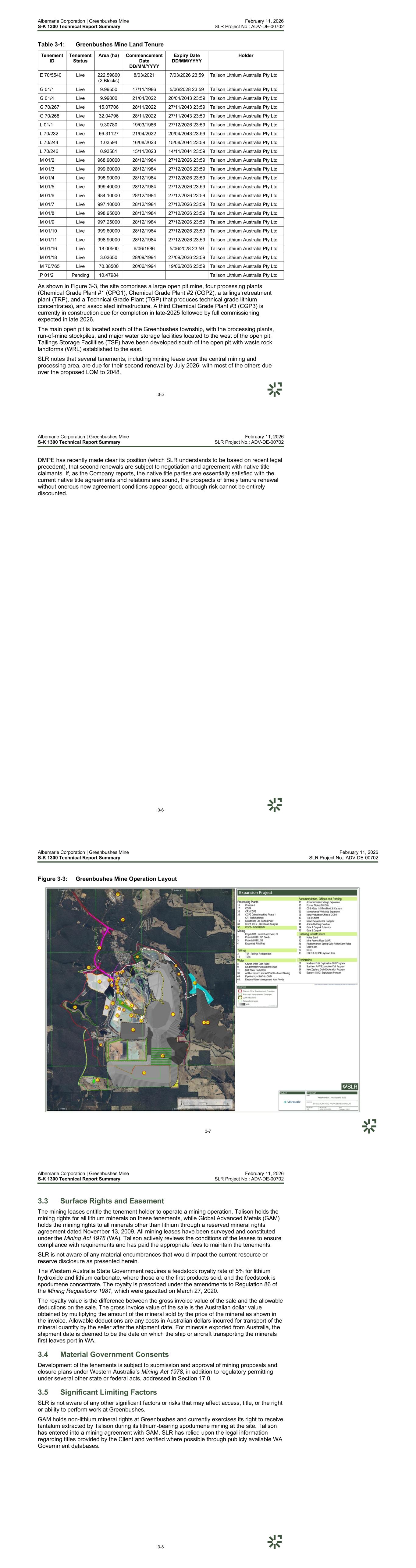
Albemarle Corporation | Greenbushes Mine S-K 1300 Technical Report Summary February 11, 2026 SLR Project No.: ADV-DE-00702 3-5 Table 3-1: Greenbushes Mine Land Tenure Tenement ID Tenement Status Area (ha) Commencement Date DD/MM/YYYY Expiry Date DD/MM/YYYY Holder E 70/5540 Live 222.59860 (2 Blocks) 8/03/2021 7/03/2026 23:59 Talison Lithium Australia Pty Ltd G 01/1 Live 9.99550 17/11/1986 5/06/2028 23:59 Talison Lithium Australia Pty Ltd G 01/4 Live 9.99000 21/04/2022 20/04/2043 23:59 Talison Lithium Australia Pty Ltd G 70/267 Live 15.07706 28/11/2022 27/11/2043 23:59 Talison Lithium Australia Pty Ltd G 70/268 Live 32.04796 28/11/2022 27/11/2043 23:59 Talison Lithium Australia Pty Ltd L 01/1 Live 9.30780 19/03/1986 27/12/2026 23:59 Talison Lithium Australia Pty Ltd L 70/232 Live 66.31127 21/04/2022 20/04/2043 23:59 Talison Lithium Australia Pty Ltd L 70/244 Live 1.03594 16/08/2023 15/08/2044 23:59 Talison Lithium Australia Pty Ltd L 70/246 Live 0.93581 15/11/2023 14/11/2044 23:59 Talison Lithium Australia Pty Ltd M 01/2 Live 968.90000 28/12/1984 27/12/2026 23:59 Talison Lithium Australia Pty Ltd M 01/3 Live 999.60000 28/12/1984 27/12/2026 23:59 Talison Lithium Australia Pty Ltd M 01/4 Live 998.90000 28/12/1984 27/12/2026 23:59 Talison Lithium Australia Pty Ltd M 01/5 Live 999.40000 28/12/1984 27/12/2026 23:59 Talison Lithium Australia Pty Ltd M 01/6 Live 984.10000 28/12/1984 27/12/2026 23:59 Talison Lithium Australia Pty Ltd M 01/7 Live 997.10000 28/12/1984 27/12/2026 23:59 Talison Lithium Australia Pty Ltd M 01/8 Live 998.95000 28/12/1984 27/12/2026 23:59 Talison Lithium Australia Pty Ltd M 01/9 Live 997.25000 28/12/1984 27/12/2026 23:59 Talison Lithium Australia Pty Ltd M 01/10 Live 999.60000 28/12/1984 27/12/2026 23:59 Talison Lithium Australia Pty Ltd M 01/11 Live 998.90000 28/12/1984 27/12/2026 23:59 Talison Lithium Australia Pty Ltd M 01/16 Live 18.00500 6/06/1986 5/06/2028 23:59 Talison Lithium Australia Pty Ltd M 01/18 Live 3.03650 28/09/1994 27/09/2036 23:59 Talison Lithium Australia Pty Ltd M 70/765 Live 70.38500 20/06/1994 19/06/2036 23:59 Talison Lithium Australia Pty Ltd P 01/2 Pending 10.47984 Talison Lithium Australia Pty Ltd As shown in Figure 3-3, the site comprises a large open pit mine, four processing plants (Chemical Grade Plant #1 (CPG1), Chemical Grade Plant #2 (CGP2), a tailings retreatment plant (TRP), and a Technical Grade Plant (TGP) that produces technical grade lithium concentrates), and associated infrastructure. A third Chemical Grade Plant #3 (CGP3) is currently in construction due for completion in late-2025 followed by full commissioning expected in late 2026. The main open pit is located south of the Greenbushes township, with the processing plants, run-of-mine stockpiles, and major water storage facilities located to the west of the open pit. Tailings Storage Facilities (TSF) have been developed south of the open pit with waste rock landforms (WRL) established to the east. SLR notes that several tenements, including mining lease over the central mining and processing area, are due for their second renewal by July 2026, with most of the others due over the proposed LOM to 2048. Albemarle Corporation | Greenbushes Mine S-K 1300 Technical Report Summary February 11, 2026 SLR Project No.: ADV-DE-00702 3-6 DMPE has recently made clear its position (which SLR understands to be based on recent legal precedent), that second renewals are subject to negotiation and agreement with native title claimants. If, as the Company reports, the native title parties are essentially satisfied with the current native title agreements and relations are sound, the prospects of timely tenure renewal without onerous new agreement conditions appear good, although risk cannot be entirely discounted. Albemarle Corporation | Greenbushes Mine S-K 1300 Technical Report Summary February 11, 2026 SLR Project No.: ADV-DE-00702 3-7 Figure 3-3: Greenbushes Mine Operation Layout Albemarle Corporation | Greenbushes Mine S-K 1300 Technical Report Summary February 11, 2026 SLR Project No.: ADV-DE-00702 3-8 3.3 Surface Rights and Easement The mining leases entitle the tenement holder to operate a mining operation. Talison holds the mining rights for all lithium minerals on these tenements, while Global Advanced Metals (GAM) holds the mining rights to all minerals other than lithium through a reserved mineral rights agreement dated November 13, 2009. All mining leases have been surveyed and constituted under the Mining Act 1978 (WA). Talison actively reviews the conditions of the leases to ensure compliance with requirements and has paid the appropriate fees to maintain the tenements. SLR is not aware of any material encumbrances that would impact the current resource or reserve disclosure as presented herein. The Western Australia State Government requires a feedstock royalty rate of 5% for lithium hydroxide and lithium carbonate, where those are the first products sold, and the feedstock is spodumene concentrate. The royalty is prescribed under the amendments to Regulation 86 of the Mining Regulations 1981, which were gazetted on March 27, 2020. The royalty value is the difference between the gross invoice value of the sale and the allowable deductions on the sale. The gross invoice value of the sale is the Australian dollar value obtained by multiplying the amount of the mineral sold by the price of the mineral as shown in the invoice. Allowable deductions are any costs in Australian dollars incurred for transport of the mineral quantity by the seller after the shipment date. For minerals exported from Australia, the shipment date is deemed to be the date on which the ship or aircraft transporting the minerals first leaves port in WA. 3.4 Material Government Consents Development of the tenements is subject to submission and approval of mining proposals and closure plans under Western Australia’s Mining Act 1978, in addition to regulatory permitting under several other state or federal acts, addressed in Section 17.0. 3.5 Significant Limiting Factors SLR is not aware of any other significant factors or risks that may affect access, title, or the right or ability to perform work at Greenbushes. GAM holds non-lithium mineral rights at Greenbushes and currently exercises its right to receive tantalum extracted by Talison during its lithium-bearing spodumene mining at the site. Talison has entered into a mining agreement with GAM. SLR has relied upon the legal information regarding titles provided by the Client and verified where possible through publicly available WA Government databases.

Albemarle Corporation | Greenbushes Mine S-K 1300 Technical Report Summary February 11, 2026 SLR Project No.: ADV-DE-00702 4-1 4.0 Accessibility, Climate, Local Resources, Infrastructure and Physiography 4.1 Accessibility Greenbushes township is located adjacent to the South Western Highway between Bunbury and Bridgetown. The South Western Highway is a major road constructed to a high standard and is maintained and owned by the Western Australian Government. It is an established heavy haulage route with the Operation accessed by the Maranup Ford Road within the Greenbushes township. The Perth International Airport is approximately 250 km north of the Mine and connects to all major centers in Australia as well as international destinations. Port access is available at Bunbury (90 km), Fremantle (250 km) and a smaller facility located at Albany (150 km). The Operation does not utilize a rail network; however, there is an existing railway corridor with a disused rail line between Bunbury and Greenbushes. This line is not in operation and would require significant rehabilitation to support freight movements. Heavy vehicles routinely service the South Western Highway with well-defined transport corridors to ports and regional centers. 4.2 Climate Greenbushes and the surrounding region have a temperate climate with the area experiencing a distinct dry summer and wet winter season: • January is the hottest month with a mean maximum temperature of 30ºC. • July is the coldest month with a mean minimum temperature of 4.8ºC. • The majority of rainfall occurs during May to October. July has the highest mean rainfall at 165 mm. February typically receives the lowest mean rainfall at 15.7 mm. Median rainfall for the area is 918 mm per annum with historical records (1893-2024) confirming a range between 471 mm to 1,687 mm. Mining and processing operations at Greenbushes operate 24 hours per day throughout the year. 4.3 Local Resources Talison has an established workforce with skilled labor. Greenbushes is located within the Bridgetown - Greenbushes shire. Skilled labor to support the operation is located within local communities at Greenbushes, Bridgetown and Balingup, which are within a 30 minutes’ drive of the operation. Talison has established camps to accommodate additional workforce from outside the region. The current labor levels are approximately 1,350 people with over 700 additional construction contractors. Plant material and supplies are readily available within the local area and regions surrounding the operations. Vendors are well established and supported by regular freight routes through the region, state and nation. Albemarle Corporation | Greenbushes Mine S-K 1300 Technical Report Summary February 11, 2026 SLR Project No.: ADV-DE-00702 4-2 4.4 Infrastructure 4.4.1 Water Water is supplied to the Greenbushes Mine through developed water storage dams located within the operational footprint. The storage dams capture rainfall and runoff from local catchments. In addition, water is reclaimed from Tailings Storage Facilities and pumped to the water storage dams. The operation of the water storage dams is discussed separately in Section 15.3. A series of sumps have been developed at the base of tailings storage facilities and waste rock dumps which support pumping to water storage dams. In addition, water is reclaimed from the Cornwall Open Cut and pumped to the water treatment plants and storage dams as required. An extensive pipe and pump network has been developed to convey water around the Operation to support ongoing activities. No mine water is sourced directly from groundwater aquifers, bore systems or dewatering wells, nor from local rivers or spring-fed water storage. Potable water is supplied by under purchase agreement from the WA Government entity, WaterCorporation. 4.4.2 Power Western Power, a WA Government Trading Enterprise, maintains and operates a 132 kV network within the Southwest region. Power to Greenbushes is provided by utility line power from the existing Western Power operated and WA government-owned South West Interconnected System (SWIS). The primary supply is a 132 kV transmission line from Bridgetown's Hester (HST) substation, spanning 14 km to the Greenbushes Lithium Mine Substation (GLM) on site. Greenbushes manages this transmission line and the internal site network. This line has a 120 MVA capacity, currently handling about 21 MVA, and uses two 132/22 kV transformers with redundancy. The current contracted maximum demand (CMD) is 40 MVA, with a request to increase to 65 MVA for future needs. SLR notes with the Collie power station forecast to close in 2027 and Muja D in 2029, baseload power will be required from alternate sources. As all power is provided by the statewide grid, additional power is expected to be provided by the third-party operator to meet the required demands. The secondary supply is a 22 kV distribution line from Bridgetown to the Northern Incomer Substation SB16, serving only the Mine Services Area. This line has a current load of about 500 kVA and a CMD of 1 MVA. This supply will be decommissioned after the internal 22 kV network upgrade, consolidating all power through the 132 kV network by late 2025 or early 2026. 4.5 Physiography Greenbushes is located within the Southwest Australia Woodlands ecoregion. The land use surrounding Greenbushes is characterized by farming, State Forests and timber reserves. The dominant overstory tree within the forests is typically jarrah, with an open understory. Marri is a prevalent canopy species, and the jarrah forest is commonly called Jarrah-Marri forest. Blackwood River is located west of the Greenbushes township and Mine. Blackwood River is the largest river in the Southwest region. The river begins at the junction of Arthur River and Albemarle Corporation | Greenbushes Mine S-K 1300 Technical Report Summary February 11, 2026 SLR Project No.: ADV-DE-00702 4-3 Balgarup River near Quelarup. It travels in a southwesterly direction until it discharges into the Southern Ocean. Albemarle Corporation | Greenbushes Mine S-K 1300 Technical Report Summary February 11, 2026 SLR Project No.: ADV-DE-00702 5-1 5.0 History Initial operations commenced via handheld methods in 1888 following the discovery of tin in 1886 and has been in almost continuous production at various levels to the current scales. The below summarizes the history of the Operation to date. 5.1 Past Production This section has been excerpted from BDA (2012). 5.1.1 Tin Since it was first discovered in 1886, tin has been mined almost continuously in the Greenbushes area. Recent market economics have relegated tin to be a by-product which is currently not produced at the Operation. A timeline of production can be summarized as follows: • Tin was first mined at Greenbushes by the Bunbury Tin Mining Co in 1888. Tin production gradually declined between 1914 and 1930. • Vultan Mines pioneered sluicing operations of the weathered tin oxides between 1935 and 1943 following which ‘modern’ earthmoving equipment was introduced between 1945 and 1956 to support tin dredging. • Greenbushes Tin NL was formed in 1964 and open pit mining of the softer oxidized rock commenced in 1969. • Greenbushes Tin Ltd was in operation from 1982 – 1985. 5.1.2 Tantalum Tantalum has been mined at Greenbushes since the 1940s. Hard rock tantalum mining operations commenced in 1992 with the Cornwall Pit nearing completion in the late 1990s. An underground operation commenced in 2001 to access high grade for blending with lower grade ore to meet market demand. A downturn in the tantalum market occurred in 2002 resulting in the underground mine being placed in care and maintenance. The underground operation was restarted in 2004 due to increased demand but again placed on care and maintenance the following year. 5.1.3 Lithium Minerals Lithium production commenced in 1983 with a 30,000 tpa lithium mineral concentrator commissioned in 1984. Lithium Australia Ltd acquired the lithium assets in 1987 followed by Sons of Gwalia in 1989. The operations at Greenbushes (Greenbushes Tin NL and Lithium Australia) merged to become Gwalia Consolidated Ltd in 1990. Production capacity increased to 100,000 tpa of lithium concentrate in the early 1990s and to 150,000 tpa by 1997. In 1999 Gwalia Consolidated merged with Sons of Gwalia Ltd and by 2001 a tantalum expansion Operation had begun at Greenbushes. In 2004 Sons of Gwalia Ltd went into administration, however operations continued until Talison Minerals Group acquired the Greenbushes operation in 2007. In 2009 Talison Lithium Pty Ltd was formed as a Western Australian based mining company which is now owned by shareholders Tianqi Lithium Energy Australia (TLEA) (a joint venture between Tianqi Lithium

Albemarle Corporation | Greenbushes Mine S-K 1300 Technical Report Summary February 11, 2026 SLR Project No.: ADV-DE-00702 5-2 Corporation / IGO Limited) (51%) and Albemarle Corporation (49% via wholly owned subsidiaries). Talison’s processing plants were upgraded in 2009 to produce 260,000 tpa of lithium concentrates, and in late 2010, capacity was increased to approximately 315,000 tpa. In 2017 Talison Lithium commenced construction of a second chemical grade lithium processing plant (CGP2) which was officially opened in 2019. Construction of a third processing plant commenced in 2023 and is continuing as at the time of this TRS. CGP3 will have a processing capacity of 2.4 Mtpa, producing up to 500,000 tpa lithium mineral concentrate and is expected to be completed in late-2025. Over the past 30 years, Greenbushes has undergone a number of expansions to maintain its position as a major supplier of lithium mineral concentrates to the global market. The site comprises a large open pit mine, four processing plants – CGP1, CGP2, TRP and a TGP which produces technical grade lithium concentrates, and associated infrastructure. These plants combined have a total nameplate processing capacity of 6.5 Mtpa, producing up to 1.5 Mtpa of lithium mineral concentrate. The Operation has been in almost continuous production since 1888, however, the current (lithium-focused) mining operation commenced in 1983. In H2 2025, the Operation is forecast to produce circa 0.47 Mt of spodumene concentrate 6% (SC6.0-equivalent) concentrate from 2.5 Mt ROM ore (6 months only). 5.2 Exploration and Development of Previous Owners or Operators As noted in Section 7.1, Greenbushes has an extensive operational and exploration history. Previous owners of the Operation have completed exploration work to support the various commodities over time. Types of exploration work have included surface and underground drilling, surface sampling, geological mapping, trenching and geophysics. Development of enabling infrastructure such as roads, ramps, waste dumps, tailings facilities, surface water storages etc. have been completed as required to support the various programs over time. Albemarle Corporation | Greenbushes Mine S-K 1300 Technical Report Summary February 11, 2026 SLR Project No.: ADV-DE-00702 6-1 6.0 Geological Setting, Mineralization, and Deposit 6.1 Regional Geology The Regional Geology of the area containing the Mine has been described in detail by G.A. Partington in Economic Geology (1990) and is considered to be well understood. The Intrusive rocks of the Greenbushes Pegmatite District lie within the Balingup metamorphic belt, which lies within the Southwest Gneiss Terrains of the Yilgarn Craton. The pegmatites are spatially associated with and controlled by the Donnybrook-Bridgetown Shear Zone, which is central to this belt and potentially controls both the regional and local emplacement of the mineralization. The pegmatites are Archaean in age (~2.53 Ga) and are intruded into a 15 to 20 km wide sequence of medium-pressure, medium-to-high temperature gneiss, orthogneiss, amphibolite and migmatite following the lineament of the regional shear. The pegmatites contain the same shear fabrics as the host rocks, providing evidence of syntectonic crystallization during movement of the Donnybrook-Bridgetown Shear Zone (Figure 6-1). 6.2 Local Geology The Greenbushes pegmatite deposit consists of several large pegmatite intrusive bodies which are separated into two main lodes, namely the Central and Kapanga Lodes (Figure 6-2). Both areas consist of several pegmatite bodies, however, the Central Lode displays significantly more continuity and thickness as compared to the Kapanga Lode as shown in geology plan in Figure 6-2 and a generalized cross-section in Figure 6-3. The host rock on the Greenbushes property are variably deformed Archean amphibolite and metasediments, locally referred to as the hanging wall amphibolite and footwall granofels. Numerous Archean granitoid intrusions are also present (particularly to the west, with all units cut by the roughly N-S striking Donnybrook-Bridgetown Shear zone gneiss (Figure 6-2). Pegmatite bodies are the youngest of the Archaean package of rocks in the area, dated at approximately 2.53 Ga (Figure 6-4) suggesting they were emplaced during the end of the orogeny during this period (see Section 6.2.1). The Central Lode consists predominately of a single main body which is currently defined by drilling over a strike length of 3 km with thickness ranging from a few 10s to up 300 m and dips moderately to steeply 40-60o to the southwest. This body contains the majority of the reported Mineral Resource; however, recent drilling (but not included in the Mineral Resource estimate) supports the interpretation of a southern plunge (see Section 11.0). The westerly extent of the Central Lode is limited by a north south structure which potentially offsets mineralization. The Kapanga Lode is located 300 m to the east of the Central Lode and consists of a series of subparallel bodies that strike to the northwest and dip between 40-60o to the southwest. The Kapanga pegmatite lodes consist of a series of relatively continuous semi-parallel bodies interpreted over a northerly strike of approximately 1.8 km with a combined thickness ranging between 120-150 m up to 450 m below surface. Both the host and pegmatite bodies are intruded by a series of cross-cutting dolerite dykes and sills. The intrusions range from 1 to 50 m wide. Both the host and dolerite intrusives have iron (Fe) content ranging from 9 to 20% with averages of approximately 15%. The inclusion of iron in dilution and feed to the plants has a significant impact on processing recoveries, and as such, has been the subject of significant review and incorporation into the Mineral Resources and Reserves presented in this Report (refer to discussion in Section 11.0 and Section 12.0). Albemarle Corporation | Greenbushes Mine S-K 1300 Technical Report Summary February 11, 2026 SLR Project No.: ADV-DE-00702 6-2 Weathering and oxidation are prevalent in the area reaching depths of up to 40 m. Oxidation has also produced an extensive lateritic cap across the region. SLR notes that the oxidation of lithium-bearing minerals results in the inability to achieve a marketable product, and as such, these oxidized areas are excluded from the Mineral Resources. The majority of rocks in the area are typically covered to shallow depths (a few meters) by lateritic conglomerates and alluvium (Figure 6-4). Of note, the alluvial cover in close proximity to the pegmatite bodies has been notably enriched in tin, which were historically mined via hand-held methods during the late 19th century. Figure 6-3 shows a generalized cross-section through the Central and Kapanga Lodes. The section (looking north) shows orientation and relationship of the lithium-bearing pegmatites and the cross-cutting dolerite dykes. Albemarle Corporation | Greenbushes Mine S-K 1300 Technical Report Summary February 11, 2026 SLR Project No.: ADV-DE-00702 6-3 Figure 6-1: Regional Geology Source: Talison 2022

Albemarle Corporation | Greenbushes Mine S-K 1300 Technical Report Summary February 11, 2026 SLR Project No.: ADV-DE-00702 6-4 Figure 6-2: Generalized Geology Map with inset Cross Section Source: Partington 1990 Albemarle Corporation | Greenbushes Mine S-K 1300 Technical Report Summary February 11, 2026 SLR Project No.: ADV-DE-00702 6-5 Figure 6-3: E-W Cross-Section across the Central and Kapanga Zones Source: Talison 2025 Albemarle Corporation | Greenbushes Mine S-K 1300 Technical Report Summary February 11, 2026 SLR Project No.: ADV-DE-00702 6-6 Figure 6-4: Simplified Stratigraphic Column Albemarle Corporation | Greenbushes Mine S-K 1300 Technical Report Summary February 11, 2026 SLR Project No.: ADV-DE-00702 6-7 6.2.1 Structure The emplacement of pegmatites is controlled by the Donnybrook-Bridgetown Shear zone, within the broader Balingup Metamorphic Belt (Figure 6-1). Shear fabrics in the pegmatites are mostly developed at margins and in albite-rich zones. Shear-parallel fabrics are evidence for syntectonic emplacement of the intrusives associated with the deformational event which formed the Greenbushes Shear. Late-stage Sn-Ta-Nb mineralization in dilational zones from folding are noted in the albite-rich zone, showing that folding was still occurring at the late stages of pegmatite intrusion. Much younger, discordant structures such as the “Footwall Fault”, (sub vertical, striking north south) impact the continuity of the mineralization. The intensity of the damage zone surrounding this planar feature varies significantly from some heavily jointed areas to locally disintegrated rock greater than 30 m in width. Some localized oxidation and weathering controlled by structures such as this have led to local depletion of lithium by the breakdown and leaching of soluble lithium ions. Local structural controls are not well understood, particularly at the more complex Kapanga Lode. As noted previously the Central Lode is highly continuous in both thickness and orientation, this varies significantly to Kapanga which appears highly variable in thickness and orientation. Further studies are planned to understand this variability and how to incorporate this into an updated Resource. 6.2.2 Pegmatite Zonation Five distinct mineralogical zones have been defined in the Greenbushes’ Central Lode pegmatite. Generally, the pegmatite shows a contact zone, a K-feldspar (potassium)-rich zone, an albite (sodium)-rich zone, a mixed zone and a spodumene (lithium)-rich zone. The bulk of the lithium in the deposit is contained within the spodumene-rich zone, generally towards the center of the Central Lode pegmatite. Similar to other major lithium-bearing pegmatites in Western Australia, the zonation is not concentric from outside to inside, but does occur conformably to the overall pegmatite trends, both along strike and down dip. These zonations often interfinger along strike and down dip and can occur on metre sized scales. During the site visit, these zones were observed within recent drilling, and while this fractionation zonation can be used as a guide, variations do occur, which potentially impact processing. Within the thinner stacked Kapanga pegmatites, zonation varies as expected for the style of mineralization. Generally, these pegmatites are less fractionated, with only three distinct zones defined. The elevated spodumene (lithium-rich), zones in individual pegmatite lenses are generally located near the footwall contacts (and to a lesser extent the hanging wall contacts), usually a K-feldspar rich zone occurs close to the hanging wall contact with the core regions generally being albite rich zones. Variation and zonation in mineralogy (and importantly in spodumene), between individual lenses within the Kapanga group of pegmatites is also evident, with the higher lithium concentrations generally in the upper part (hanging wall). Figure 6-5 details a generalized cross-section looking north.

Albemarle Corporation | Greenbushes Mine S-K 1300 Technical Report Summary February 11, 2026 SLR Project No.: ADV-DE-00702 6-8 Figure 6-5: Generalized Cross Section (looking north) Showing Greenbushes Pegmatite Mineral Zoning Source: BDA 2012. 6.3 Mineralization The primary lithium ore mineral within the main mineralized areas is spodumene (LiAISi2O6) with very little lithium-bearing micas observed. While the mineral rights for non-lithium minerals are not owned by the Company, the sodium-rich zone contains the highest concentrations of tantalum (tantalite) and tin (cassiterite). This zone is characterized by dominant mineralogy of albite (sodium-plagioclase), tourmaline and muscovite mica. The mixed zone contains lower concentrations of tantalum and lithium, and intermediate values of sodium and quartz, showing variable mineralogy partly similar to both the lithium-rich zone and the sodium-rich zone. The potassium-rich zone, which is dominated by the feldspar microcline, does not have any minerals currently of economic interest. The Kapanga pegmatites show less distinction in mineralogy, spodumene content does not necessarily align with specifically low potassium as in the Central Lode, which is a common feature in regional pegmatite field fractionation. 6.4 Deposit Types The pegmatites that form the Mineral Resources are interpreted to be zoned albite-spodumene pegmatites of the LCT (Li-Cs-Ta) type. It is generally accepted that pegmatites form by a Albemarle Corporation | Greenbushes Mine S-K 1300 Technical Report Summary February 11, 2026 SLR Project No.: ADV-DE-00702 6-9 process of fractional crystallization of an initially granitic composition melt. The fractional crystallization concentrates incompatible elements, such as light ion lithophile elements and volatiles (such as B, Li, F, P, H2O and CO2) into the late-stage melt phase. The volatiles lower the viscosity of the melt and reduce the solidification temperature to levels as low as 350°C to 400°C. This permits fractional crystallization to proceed to extreme levels, resulting in highly evolved end-member pegmatites. The fluxing effect of incompatible elements and volatiles allows rapid diffusion rates of ions, resulting in the formation of very large crystals characteristic of pegmatites. The less-dense pegmatitic magma may rise and accumulate at the top of the intrusive granitic body; however, typically, the more fractionated pegmatitic melt phases escape into the surrounding country rock along faults or other structures, forming pegmatites external to the parent intrusive, as at Greenbushes. Albemarle Corporation | Greenbushes Mine S-K 1300 Technical Report Summary February 11, 2026 SLR Project No.: ADV-DE-00702 7-1 7.0 Exploration 7.1 Exploration The primary method of exploration on the property has been sub-surface drilling for almost 50 years. Surface geological mapping, geochemical sampling, and limited geophysics have been considered or applied since exploration commenced. The Operation has been mapped and surface sampling completed over many campaigns; however, Mineral Resources are underpinned by predominantly surface diamond drilling (DD) or reverse circulation drilling (RC). While in-pit mapping and sampling do occur, this is typically used only as a guide to geological interpretation. 7.2 Drilling The drilling database used in this Mineral Resource Estimate contains drilling dating back to 1977. Drilling techniques, procedures, and protocols have been modernized since this time, with industry standards changing. SLR notes that the vast majority of the earliest holes are located in areas of depletion or have been replicated by recent drilling. No twinning of the historical holes has been undertaken; however, this is not considered to be material to the resource given these holes are located in the upper mined-out portion of the deposit and do not underpin the majority of the LOM Plan. Figure 7-1 provides details of the drilling that extends across the property. A review of these holes, which are shown in Figure 7-1, indicates that several holes were drilled within the LOM pit; however these did not intersect significant mineralization outside the current Mineral Resource and are consistent with the reported Mineral Resources. The majority of holes were targeting the down-dip extension of the Central Lode and were aimed at defining a initial Underground Mineral Resources when applicable. Further discussion is provided in Section 11.0. The holes are drilled in a variety of orientations with over half the drilling vertically and the remainder drilled perpendicularly to the mineralization and pegmatite interpreted zonations. A total of approximately 300 km of drilling has been utilized to estimate the Mineral Resources. Holes are spread relatively uniformly throughout the Central and Kapanga Lodes, with mineralization generally defined by resource drilling at between 25 and 50 m drill spacings. As shown in Table 7-1, the Central Lode has significantly more DD meters than RC, whereas Kapanga, which was drilled mostly in the last six years, contains approximately 75% of DD versus RC. See Section 11.0 for discussion regarding drilling techniques and interpretation impacts. Underground holes used BTW diameter (~42 mm) drill core compared to the majority of the surface DD, which were NQ (~48 mm). Underground DD holes were very clustered due to drill position locations available underground and were generally used for stope definition (similarly to the short-term planning and grade control RC drilling from surface). Closer-spaced drilling has been conducted for operational grade control and short-term planning purposes in the Central Lode deposit in near-term production planning areas, and blast hole sampling is often carried out for similar purposes during production. These holes have not been included for Mineral Resource estimation purposes; however, they are included in grade control modeling which forms the basis of the mining areas. There are no close-spaced RC holes for grade control and no blast holes in the Kapanga database as no mining has been conducted on this Albemarle Corporation | Greenbushes Mine S-K 1300 Technical Report Summary February 11, 2026 SLR Project No.: ADV-DE-00702 7-2 deposit to date. Table 7-1 provides a summary of the drilling across the Central Lode and Kapanga areas. Figure 7-1: Plan View of Drilling b Type Geological logging included details of lithology type and unit boundary depths, color, mineralogy, grain size, texture, alteration, weathering and hardness. DDH were orientated, and the core was logged for geotechnical qualities (e.g., RQD, rock strength, structural defect characteristics & angles). Holes were logged into Excel spreadsheets.

Albemarle Corporation | Greenbushes Mine S-K 1300 Technical Report Summary February 11, 2026 SLR Project No.: ADV-DE-00702 7-3 Table 7-1: Lode Resource Drilling Summary Lode Method Holes Meters Central RC 499 69,774 DD 686 168,282 RC/DD 13 4,453 Total 1,198 242,509 Kapanga RC 218 42,618 DD 65 22,709 RC/DD 3 731 Total 286 66,235 Cornwall Hill RC 123 23,221 DD 48 15,264 RC/DD 8 3,133 Total 179 41,618 White Wells RC 15 1,979 DD 50 18,813 Total 65 20,792 All 1,728 371,154 Source: Talison, 2025 Of note, as at the reporting date of Mineral Resources, 119 holes had been completed since the model was constructed and were not included. A review of these holes indicates that the majority of the holes are located within the southern plunge extension of the reported Mineral Resources below and to the south of the open pit. Given the early stage of the review of this data, further work is required to validate, and studies are underway, to meet the minimum reporting requirements and support reporting of Mineral Resources in this area. A minor number of holes were collared in the currently reported resource area; however, these do not have a material impact on the Mineral Resource at either a local or global scale. 7.2.1 Collar Position Surveys The methodology for surveying the collar position has not been recorded in the database for historic drilling, though it is likely that industry-standard theodolite surveys at the time were employed, based on the authors' knowledge during that period. Some validation of position of historic collars using the database positions and handheld GPS to find holes for environmental rehabilitation purposes have shown the coordinates to be accurate to the level of the handheld GPS, and as such are considered reasonable. All recent drilling was surveyed by mine surveyors using differential global positioning system (dGPS) accurate to less than 10 cm. 7.2.2 Downhole Surveys Holes prior to 2000 do not include information regarding the method of downhole survey. SLR is aware of the techniques utilized by the operator at the time of this drilling and considers it to be Albemarle Corporation | Greenbushes Mine S-K 1300 Technical Report Summary February 11, 2026 SLR Project No.: ADV-DE-00702 7-4 industry standard reflex multi-shot camera when the hole was inclined. No downhole surveys were typically undertaken for vertical holes. From 2000, downhole surveys were taken for diamond holes using an Eastman single-shot survey camera, at 25 m from surface, and then on 30 m intervals to the end of hole. RC holes continued to be un-surveyed prior to 2006. These holes were assumed to have a linear hole path from their design and set up at surface. While deeper RC drilling is known to deviate significantly, these holes were generally quite shallow, and so the risk in sample position for these holes is considered not to be material. Since 2006, gyroscopic downhole surveys have been taken for RC holes. 7.2.3 Diamond Drilling Sampling Diamond core has been collected in trays marked with hole identification and downhole depths at the end of each core run (typically 3 or 6 m). Pegmatite zones are selected while logging the geology and intervals are marked up for cutting and sampling. All pegmatite intersections are sampled for assay and waste sampling generally extends several meters on either side of pegmatite intersections to avoid under sampling/missing of mineralization and to enable the estimate to be informed by detrital elements. Internal waste zones separating pegmatite intersections are routinely sampled, although in a small proportion of holes drilled prior to 2000, some waste zones separating pegmatite lenses have not been assayed. SLR notes the majority of these holes occur in the depletion zone. Core recovery is generally above 95%. A line of symmetry is drawn on the core and subsequently cut by diamond saw. Historically BWT and NQ core have been half core sampled with more recent HQ core (~96mm) has been quarter cut and sampled to ensure similar sample support. Typical core sampling interval for assay is 1 m, but shorter intervals are sampled to honor geological boundaries and structural or mineralogical variations. Core is collected sequentially in pre-numbered sample bags and submitted to the on-site laboratory for assay. 7.2.4 RC Drilling Sampling Historical RC hole size has varied between 4.5 inches and 5.25 inches. All recent RC drilling has been 5.25-inch. Samples are collected downhole by face sampling hammer. Areas of Central Lode samples were collected using 1 m sample intervals, though some areas use longer 1.5 or 2 m intervals. Recent drilling, including Kapanga has used 1 m intervals as per industry standard for the style of mineralization. A sample is collected at surface via a cyclone and generally a rotary cone splitter attached to the rig, or either a riffle splitter or stationary cone splitter to reduce the size of the sample to 3 to 4 kg for submission to the laboratory. RC holes are sampled from top to bottom of hole, including logged internal waste intersections. Samples are collected in sequential pre-numbered sample bags. Field duplicates are collected every 20 m and submitted to the laboratory for quality assurance and quality control (QA/QC) purposes. Drill cutting reject piles are reviewed by site geologists when geological logging and intervals with poor recoveries are recorded. The drill samples are generally dry, and recoveries are consistently within suitable levels based on weight. A review of the resultant assays between the diamond drilling and RC indicates that a positive bias can be interpreted for the RC assays. This is interpreted to be the result of preferential collection of the lighter non-spodumene dust material being collected by the dust collection Albemarle Corporation | Greenbushes Mine S-K 1300 Technical Report Summary February 11, 2026 SLR Project No.: ADV-DE-00702 7-5 system. Further discussion is provided in Section 8 regarding the adjustment to the lithium grades to the assays. 7.2.5 Qualified Person Statement on Exploration Drilling Other than the RC dust collection issue, the QP is not aware of any drilling, sampling, or recovery factors that could materially affect the accuracy and reliability of the results of the historical or recent exploration drilling. The review of the drilling and sampling procedures indicates that international standard practices are being utilized with no material issues being noted by SLR. While the historical drilling is not in line with current procedural record keeping and digital recording, SLR is aware of the procedures of the operators at the time. Furthermore, historical pulp samples are consistent with the infill drilling undertaken using current procedures, and a visual comparison does not indicate any systematic bias. The data has been organized into a current and secure spatial relational database. SLR considers that there is sufficient geological logging, assay data and bulk density determinations to enable estimation of the geological and grade continuity of the deposit to accuracy suitable for the classification applied. SLR notes that no density data was provided for the Kapanga area, however, this is not considered material to the Mineral Resource estimate and mineralogy information provided. 7.3 Hydrogeology Greenbushes is located on elevated ground (Figure 3-1) such that surface run-off flows northeast, east and southeast towards tributaries of Hester Brook, south to Woljenup Creek, and west and northwest towards tributaries of Norilup Brook. All surface runoff, if not captured by dams on site, ultimately flows south to the Blackwood River and then to the Southern Ocean. Surface elevations and surface flows are important indicators of local hydrogeology because both surface water and groundwater flow from higher elevations towards lower elevations, or technically towards locations with lower piezometric head. Archaean basement and Proterozoic dolerite intrusions are overlain on site by Quaternary laterite, up to 40 m thick, and alluvium. Groundwater on site occurs in faults and fractures in the basement and also in the weathered lateritic zone above. Alluvium occurs beneath drainage lines radiating from the higher land but has been extensively disturbed by mining activities. It has been suggested that groundwater in laterite is sometimes perched, meaning that shallow saturated zones exist temporarily, perhaps seasonally, above underlying unsaturated zones. In any case, groundwater is not recognized as a resource within the mine site, and groundwater is neither extracted nor utilized at the mine. Locally, there is a tendency for a small amount of seepage to occur towards the pits. Because the whole mine site is elevated relative to surrounding areas, the water table on average is also higher, causing groundwater to flow radially away from the elevated land. Regional groundwater flow is generally from northeast to southwest, so the very small groundwater mound near the mine site contributes to this southwesterly flow. Rates of groundwater flow in laterite and Archaean basement are negligible relative to surface water flows following winter rainfall. Any discharge from waste rock dumps and TSFs is likely to be transported within the alluvial materials beneath drainage lines, as this material will have hydraulic conductivity much greater than the basement materials below. Water quality is measured in groundwater monitoring bores downgradient of the TSFs. Albemarle Corporation | Greenbushes Mine S-K 1300 Technical Report Summary February 11, 2026 SLR Project No.: ADV-DE-00702 7-6 For groundwater management and pit dewatering refer to Section 15.3. 7.4 Geotechnical Data, Testing, and Analysis Geotechincal consulting firm, PSM, has provided an updated Reserve Pit Geotechnical Assessment and Slope Design Update for Greenbushes in 2023 and reviews of pit designs in October 2025. PSM has been providing Talison with geotechnical support since 2013. Boreholes with vibrating wire piezometers (VWP) have been installed in the following years: • 2018, 2019, 2021 and 2022 within the reserve pit. • 2004, 2018 and 2021 within the Floyds Waste Dump The geotechnical data collected is suitable to provide coverage of the LOM pit designs. Nine geotechnical boreholes were completed in 2022. Acoustic and Optical Televiewer imaging and interpretation have been completed for each borehole. Detailed geotechnical logs were developed including Rock Quality Designation, Field estimated strength, Weathering, Lithology and defects. Geomechanical Laboratory Testing was completed for consolidated undrained triaxial tests, uniaxial compressive strength, and defect direct shear tests. Additional nested VWP were installed in four boreholes. Two major structures have been identified that may impact on slope stability, including discontinuities (around pegmatite, granofels, amphibolite and diorite) and faults / shears. Discontinuities between geological units strike parallel to pit walls and dip to the west. There are two primary zones where the structures impact the pit wall including the Northern wall, including the Northern Dolerite Sill fault, and the pegmatite shear zone. PSM has highlighted the following key risks: • Groundwater conditions in the weathered zone. • Undercutting of pegmatite left in the pit wall. • The orientation of major structures may impact on slope design. • Bench scale instabilities are located within dolerite sill and major structures. • Underground voids. PSM has made recommendations for future work including the following: • Field work to ground-truth major geological structures. • Geotechnical mapping to verify joint sets and foliation. • Review of pit slope stability against major structures identified. • Development of a detailed model of pegmatite shear zone. • Field work to improve the understanding of pore pressure conditions associated with pit wall depressurization. • Installation of additional nested VWP drilled into each pit wall to target specific major structures. • Update of the hydrogeological conceptual model and pore pressure assessment as more VWP data is collected.

Albemarle Corporation | Greenbushes Mine S-K 1300 Technical Report Summary February 11, 2026 SLR Project No.: ADV-DE-00702 7-7 SLR considers that while additional test work and studies are required, the geotechnical information is suitable to support the LOM plan. SLR notes the slope angles used in the pit design reflect the known structures and differ from the pit optimization. Albemarle Corporation | Greenbushes Mine S-K 1300 Technical Report Summary February 11, 2026 SLR Project No.: ADV-DE-00702 8-1 8.0 Sample Preparation, Analyses, and Security 8.1 Analytical and Test Laboratories All sample preparation and analytical work for the resource models is undertaken at Greenbushes’ on-site laboratory, which is ISO 9001: 2008 certified. Greenbushes internal laboratory also has participated in round-robin interlaboratory check analyses with other certified and trusted independent laboratories to test their internal procedures and analytical processes. A review of the results indicates these are in line with expectations and indicate no material issues. All sample preparation and analysis are carried out by suitably trained employees, utilizing set and documented laboratory procedures. 8.2 Sample Preparation and Analysis Samples are submitted, accompanied by a sample submission form, and entered into the Laboratory Information Management System (LIMS). The lab issues a work order and report to cross-check against the original sample submission form. Any discrepancies noted are dealt with by back-and-forth communication between the laboratory and the responsible geologists until both are satisfied with the sample numbers received. Barcodes are printed out for each sample and scanned at various points in the sample preparation and analysis to avoid, as much as possible, re-ordering (swapping) of samples, which is a common cause of errors in analytical data. The sample preparation procedure for analysis is summarized as follows: • All samples are dried in ovens for at least 12 hours at a nominal 110ºC. • DD samples are passed through a primary crusher to obtain -10 mm maximum particle size. RC samples are generally coarse crushed by the drilling and face sampling methodology, with a nominal maximum particle size of approximately 20 mm. RC samples skip the primary crusher step. • All samples pass through a secondary crusher to 80% passing -5 mm particle size. • A rotary splitter is used to obtain a nominal 1 kg sub-sample. Coarse reject material from this split is generally discarded unless there is a specific immediate requirement for any duplicate work. • The sub-sample is then pulverized for approximately two minutes in a ring mill to obtain 90% passing 100 µm. Historically, ferrous steel bowls were utilized, but recently the procedure has been updated to utilize nonferrous tungsten carbide grinding media to reduce the likelihood of iron contamination. • Metadata about the method for analysis (including its accuracy, precision and any potential bias), does not exist for the older historic analyses. The current standard analytical procedures have been confirmed to have been in place since at least 2006. • Generally, two sets of analyses are performed, a set of 36 elements analyzed by X-ray fluorescence (XRF) following fusion with lithium metaborate, and Li2O, which is analyzed by Atomic Absorption Spectroscopy (AAS), following sodium peroxide fusion. Each analysis requires 2 g or less subsample of the pulverized material. • Unused pulverized material is retained in well-labeled and accessible storage in case of requirement for verification or further testing. Albemarle Corporation | Greenbushes Mine S-K 1300 Technical Report Summary February 11, 2026 SLR Project No.: ADV-DE-00702 8-2 • Some of the lower detection limits of the methods have changed slightly due to refinements in the technologies, but this is not material as these are not close to the grades being considered for evaluation for the Mineral Resource Estimate. 8.3 Sample Security Samples do not leave the Greenbushes mine property for sample preparation and analysis. Core and RC samples are received from the contractor at the core yard or rig respectively. Samples remain under the control of the geology team from this point until samples are received, entered into the LIMS system at the laboratory, cross-checked against the sample submission form and accepted by means of creation of a work order to complete the preparation and analysis, which is sent to the geology team to signify this handover. The responsible geologist must also analyze the reported Quality Assurance Quality Control (QA/QC) results upon receiving them, to either accept the results or provide instruction on any rework required in case of QA/QC failures. Pulp storage is the responsibility of the geology team and so must be recorded as received by the responsible geologist as these are returned from the laboratory. 8.4 Density Determination A total of 2,074 diamond core samples from various lithologies across the Central lode were tested for density using the Archimedes (water immersion) method. Testing was performed on site by trained field assistants using standard industry practices. Table 8-1 outlines the average density for each lithology. SLR notes that no density data has been provided for the Kapanga area, so assumptions are that the measurements at Central lode will be similar. See Section 11.11 for discussion. Table 8-1: Central Lode Density Statistics Lithology Samples Density (g/cm3) Average Std Dev Minimum Maximum Amphibolite 254 3.03 0.13 2.38 3.98 Dolerite 198 2.98 0.15 2.53 3.71 Granofels 91 279 0.17 2.6 3.17 Pegmatite 1,528 2.76 0.14 1.59 3.79 Source:. Talison 2025 8.5 Quality Assurance and Quality Control The historical drilling (prior to 2006) has not typically inserted blind QA/QC samples with diamond drill core samples (blanks, certified reference materials (CRMs), field duplicates or pulp duplicates). DD QA/QC instead relied on the internal lab QA/QC procedures, which have included regular pulp duplicates and use of XRF CRMs. Since 2006, there has been a significant improvement in QA/QC protocols, in line with improvements in industry standard practices. Field duplicates, “check” pulp duplicates, CRMs and certified blank samples have been typically inserted following the below protocols. Albemarle Corporation | Greenbushes Mine S-K 1300 Technical Report Summary February 11, 2026 SLR Project No.: ADV-DE-00702 8-3 • Field duplicates (sourced from splits of RC samples of the rig cyclone, or quarter core samples), were completed at a rate of 1 in 20 samples. • Pulp (check) duplicates were inserted at a rate of 1 in 20 samples. • 7 separate CRMs were utilized during the drilling which had Li2O grades varying from 0.59 to 3.84%. The CRMs were prepared using Greenbushes material by industry- recognized supplier ORE Research and Exploration Pty Ltd (ORE). Of note, 80% of CRMs inserted were in line with the current and proposed ROM grade ranges (between 1.45-4%); however critically, two CRMs are at the approximate ROM and Ore Reserves cut-off grade of 0.7% Li2O. Insertion rates were approximately 1 in 20 samples. • Results or insertion rates for “blank” Li2O material are unknown, but suitable numbers were included in the database provided. • The lower confidence in the historical assay data based on the lack of historic QA/QC and the resulting lower confidence in the areas of the estimate resulting from this data has been considered in the Mineral Resource classification; however, it is noted the majority of these areas are mined out or not material to the Mineral Resource reported. Below is a summary of the key outcomes of each QA/QC sampling method. 8.5.1 Certified Reference Materials As can be noted in Table 8-2, all six CRMs appear to show limited bias against the expected grade, and as can be seen in the two example plots of SORE 2 and SORE 3 (Figure 8-1 and Figure 8-2), the majority of the samples fall within the two standard deviations for the acceptable tolerances; however, some fall outside these limits. The results are considered to be in line with the industry standards and indicate no systematic bias. Table 8-2: Summary of CRM Submissions for Li2O CRM Count Assigned Li2O (%) Mean Li2O (%) Bias (Mean) % Bias SORE 1 1,892 3.839 3.837 -0.002 -0.05 SORE 2 2,100 1.459 1.459 0.001 0.04 SORE 3 508 0.586 0.601 0.015 2.58 SORE 4 405 0.627 0.631 0.004 0.65 SORE 5 362 2.136 2.132 -0.004 -0.18 SORE 6 337 2.227 2.217 -0.011 -0.47 Source: The Company

Albemarle Corporation | Greenbushes Mine S-K 1300 Technical Report Summary February 11, 2026 SLR Project No.: ADV-DE-00702 8-4 Figure 8-1: Scatter Plot showing CRM SORE 6 performance for Li2O (warning = 2xSD, error = 3xSD) Figure 8-2: CRM Scatter plot showing SORE 3 performance for Li2O. (warning = 2xSD, error = 3xSD) Albemarle Corporation | Greenbushes Mine S-K 1300 Technical Report Summary February 11, 2026 SLR Project No.: ADV-DE-00702 8-5 8.5.2 Field Duplicates Two types of field duplicates have been utilized dependent on the drilling method. RC duplicates were sourced from samples split via a static riffle splitter directly from the cyclone (either on the rig or separate dependent on the generation of drilling), while DD duplicates were sourced from quarter core. A review of the results indicates some variation occurs, as shown in the Q-Q’ plots in Figure 8-3 and Figure 8-4 with a significant amount of samples outside the 15% tolerance lines. This trend is not unexpected for the sample type which is not homogenized and is considered consistent with style of mineralization and the grain size of the spodumene. SLR notes this variability with both deposits having a moderate nugget as noted in Section 11.0. While variability is noted, these results are considered reasonable. Of note is the higher variability of the RC samples, which potentially relates to the fines loss during drilling. Figure 8-3: Scatter Plot of RC Field Duplicates Albemarle Corporation | Greenbushes Mine S-K 1300 Technical Report Summary February 11, 2026 SLR Project No.: ADV-DE-00702 8-6 Figure 8-4: Scatter Plot of DD Field Duplicates 8.5.3 Pulp Duplicates Pulp duplicates have been sourced from samples post pulverization within the laboratory. These are resubmitted under a different sample ID. 8.5.4 Assay Adjustments An adjustment of the Li2O% of RC drill samples was applied to address bias observed in the QQ plot between diamond drill core vs RC samples and observed in diamond drill holes that twinned RC holes. This bias in interpreted to occur due to lighter non spodumene minerals being preferentially extracted by the dust collection system. The correction has an average of -3.9% applied to percentiles of the population. A chart of the bias and adjustment applied is shown in Figure 8-5. Albemarle Corporation | Greenbushes Mine S-K 1300 Technical Report Summary February 11, 2026 SLR Project No.: ADV-DE-00702 8-7 Figure 8-5: QQ plots of adjusted values. Bottom - correction adjustment applied in Leapfrog to Li2O assay data from RC samples. All Fe2O3 assays were capped to 2.00% to prevent any internal mafic assays within pegmatite being used to estimate areas of clean pegmatite. RC samples contain higher levels of Fe2O3 relative to diamond drill core samples due to abrasion of the sample tube as sample is lifted to the surface and contamination of RC samples with mafic host rock. To address the biased RC samples the population was adjusted to match the population of diamond drill core samples by adjusting the bins of the histogram until the populations showed minimal variance. In the SLR QP’s opinion, the sample preparation, analysis, and security procedures are adequate for use in the estimation of Mineral Resources. In the SLR QP’s opinion, the QA/QC program as designed and implemented is adequate and the assay results within the database are suitable for use in a Mineral Resource estimate

Albemarle Corporation | Greenbushes Mine S-K 1300 Technical Report Summary February 11, 2026 SLR Project No.: ADV-DE-00702 9-1 9.0 Data Verification The review of the drilling and sampling procedures by SLR indicates that standard practices were being utilized by Talison for the recent drilling, which underpins a large portion of the Indicated Mineral Resource, with no material issues being noted by SLR. The QA/QC samples all showed suitable levels of precision and accuracy to ensure confidence in the sample preparation methods employed by Talison and primary laboratory. SLR highlights that the verification of the historical data was not undertaken with the data provided; however, numerous audits and reviews have been completed over time to ensure the veracity of the datasets. As noted previously, while this data is considered reasonable, the majority of the historical data is within the depletion areas or replicated by recent drilling as such a comparison is not deemed required to be disclosed in this Report. The selective original data review and site visit observations carried out by SLR did not identify any material issues with the data entry or digital data. In addition, SLR considers that the on-site data management systems meet industry standards which minimizes potential ‘human’ data- entry errors and has no systematic fundamental data entry errors or data transfer errors; accordingly, SLR considers the integrity of the digital database to be sound. In addition, SLR considers that there is sufficient geological logging and bulk density determinations to enable estimation of the geological and grade continuity of the in situ deposit to accuracy suitable for the classification applied. Albemarle Corporation | Greenbushes Mine S-K 1300 Technical Report Summary February 11, 2026 SLR Project No.: ADV-DE-00702 10-1 10.0 Mineral Processing and Metallurgical Testing 10.1 Mineralogy The mineralogy of ore processed at Greenbushes over the past 40 years has largely consisted of spodumene in pegmatite, with waste minerals largely consisting of quartz and feldspar minerals. This consistency allowed reliable predictions of plant performance using chemical assays, particularly for lithium and iron, without needing detailed mineralogical analysis. While some mineralogical analysis has begun recently, it remains limited. As mining extends into new areas of the Kapanga pit, mineralogical variations are expected, highlighting a need for better integration of mineralogy in predicting recovery rates and improving communication between mining and processing. Table 10-1 shows the mineralogical reports presented for review. Table 10-1: Greenbushes Mineralogical Report Summary Report Title Provider Year Memo: Routine Mineralogy Progress Memo Talison Lithium 2022 Memo: Weathered Ore Mineralogy Talison Lithium 2022 10.2 Metallurgical Greenbushes has a complex history of metallurgical testing. Much of the work was done during full-scale plant trials rather than in dedicated test facilities. Documentation of these tests is often incomplete, as many results were incorporated into plant modifications over time, and records were lost as personnel changed. Each processing plant design at Greenbushes has evolved from prior designs rather than through comprehensive test work. It relies primarily on size fractionation to route ore from the coarsest materials in Dense Medium Separation (DMS) circuits to finer particles through multiple flotation circuits. Significant testing was only conducted when the comminution circuit for CGP2 was introduced, a design largely retained in CGP3 with minimal additional testing. For the TRP, it is unclear how much testing occurred, though its flotation circuits are based largely on CGP2’s design. Recent test work has focused on the upcoming CGP3 plant and minor improvements to flotation. However, this design is largely based on the CGP2 design and modelled feed chemical analyses (primarily lithium and iron) rather than mineralogical data from future mining areas. A consistent challenge for Greenbushes is the lack of a comprehensive metallurgical testing facility capable of replicating the entire flowsheet. This limits the ability to comprehensively test future ore sources, presuming that ore and waste mineralogy will remain within the existing design range of the plants. Table 10-2 summarizes the metallurgical test work reports provided for review. Albemarle Corporation | Greenbushes Mine S-K 1300 Technical Report Summary February 11, 2026 SLR Project No.: ADV-DE-00702 10-2 Table 10-2: Greenbushes Metallurgical Test Work Summary Report Title Process Area Provider Year Memo: CGP1 Rougher Tail Refloat Tests - Progress Memo Flotation Talison Lithium 2018 CGP2 Ore Commissioning Test Summary Report High-grade Talison Lithium 2022 Talison Lithium Pty Ltd Geometallurgy Program - Progress Report Flotation Minsol Engineering 2023 Memo: Derric Test Work for CGP3/4 Rev 3 Screening Talison Lithium 2023 Memo: Ore Optical Sorter Test Work Ore Sorting Talison Lithium 2023 Test Report - Wet Screening Screening Derreck Corporation 2023 Ore Sorter Optical Test Work 2023 Ore Sorter Talison Lithium 2023 Memo: Geomet Program - Low Grade Blends Flotation Minsol Engineering 2024 Memo: Geomet Program - Scavenger Conditioning Flotation Minsol Engineering 2024 Memo: Technical and High-Level Financial Assessment of CGP4 Flowsheet Changes Whole Circuit Talison Lithium 2024 Test Work Report: Primary Classifier, CG4 - Process Development Classification Talison Lithium 2024 10.3 LOM Plan The LOM plan anticipates that high-grade feed (>3.2% Li2O) with low iron content for the TGP will be depleted by around 2027 as the main C3 pit reserves are exhausted. After this, TGP may either continue to produce chemical-grade lithium at a reduced feed rate or be retired, as increased waste material in lower-grade ore would limit its operational capacity. CGP1 has shown stable performance, with an annual throughput of around 1.7 to 1.8 Mt, with feed grades near 2.7% Li2O. Future throughputs of 1.8 Mtpa appear feasible, but a drop in feed grade to around 2.5% could negatively impact yield and recovery. CGP2 has consistently operated below its design capacity of 2.4 Mtpa, currently achieving about 2.0 Mt with a 2.0% Li2O feed grade. Maintaining 2.4 Mtpa seems achievable, though a projected reduction in feed grade to 1.8% would likely reduce yield and recovery. Although CGP3’s performance remains untested, projections align with CGP2’s throughput and feed grades. Given design improvements, CGP3 is expected to perform slightly better at the lower 1.8% Li2O feed grade. The TRP is projected to operate for another two years (to 2028), with a possible extension if tailings below TSF1’s 7 m base level are reclaimed. However, the impact of processing these deeper tailings on yield, recovery and product specifications is uncertain. SLR is of the opinion that there is suitable information that supports the LOM for the currently operating plants based on actuals. Each plant has a separate recovery regression based on recent performance, which SLR considers suitable for the LOM planning. The test work that has been completed for CGP3 highlights the plant design criteria and is suitable to achieve the throughput and recoveries forecast. Albemarle Corporation | Greenbushes Mine S-K 1300 Technical Report Summary February 11, 2026 SLR Project No.: ADV-DE-00702 11-1 11.0 Mineral Resource Estimates This section of the Report summarizes the main considerations in relation to the preparation of the Greenbushes Mineral Resource estimate and provides references to the sections of the study where more detailed discussions of particular aspects are covered. Detailed technical information provided in this section relates specifically to this Mineral Resource estimate and forms the basis of the Mineral Reserve estimate as reported in Section 12.0. A “Mineral Resource” is defined in S-K 1300 as “a concentration or occurrence of material of economic interest in or on the Earth’s crust in such form, grade or quality, and quantity that there are reasonable prospects for economic extraction”. The location, quantity, grade (or quality), continuity and other geological characteristics of a Mineral Resource are known, estimated or interpreted from specific geological evidence and knowledge, including sampling. Mineral Resources are subdivided, in order of increasing geological confidence, into Inferred, Indicated and Measured categories. Mineral Resource estimates are not precise calculations, depending on the interpretation of limited information on the location, shape and continuity of the occurrence of mineralization and on the available sampling results. The Mineral Resource estimates were compiled with reference to S-K 1300 by SLR acting as the QP in accordance with S-K 1300. For a Mineral Resource to be reported, it must be considered by the QP to meet the following criteria: • There are reasonable prospects for economic extraction. • Data collection methodology and record-keeping for geology, assay, bulk density and other sampling information are relevant to the style of mineralization, and quality checks have been carried out to ensure confidence in the data. • Geological interpretation of the resource and its continuity have been defined. • The selected estimation methodology is appropriate to the deposit and reflects internal grade variability, sample spacing and selective mining units. • Classification of the Mineral Resource has taken into account varying confidence levels and assessment, and whether the appropriate account has been taken for all relevant factors, i.e., relative confidence in tonnage/grade, computations, confidence in the continuity of geology and grade, quantity and distribution of the data and the results reflect the view of the QP. Further discussion on conversion of Mineral Resource to Mineral Reserves is presented in Section 12.2. 11.1 Resource Areas The reported Mineral Resource can be separated into four areas: • Open Pit in situ pegmatites: These Mineral Resources are the material within the ground with no mining occurring as yet. This consists of the Central and Kapanga lodes within a Resource pit shell.

Albemarle Corporation | Greenbushes Mine S-K 1300 Technical Report Summary February 11, 2026 SLR Project No.: ADV-DE-00702 11-2 • Underground in situ pegmatites: This consists of the extension of the Central and Kapanga lodes below the Resource pit shell and within the underground stope optimization shapes. • Tailings storage facilities: TSF1 has been the subject of drilling and is currently being reprocessed through the Tailings Retreatment Plant. • Ore stockpiles: several stockpiles occur within the Operation, which have been the subject of grade control. SLR notes that portions of Indicated Mineral Resources within the TSF and ore stockpiles are included in the Mineral Reserves. 11.2 Statement Of Mineral Resources The estimated Mineral Resources are stated for 100% of the Operation and at the attributable percentage to Albemarle (49%). Results of the Mineral Resources estimate for the Operation are tabulated in the Statement of Mineral Resources in Table 11-1, which are reported in line with the requirements of S-K 1300; as such, the Statement of Mineral Resources is suitable for public reporting. Table 11-1 presents the Mineral Resources exclusive of and additional to the Mineral Reserves presented in Section 12.0. The stated Mineral Resources account for mining depletion and stockpile movements that have occurred during the period to June 30, 2025. The in situ Mineral Resource is reported at a cut-off grade of 0.3% Li2O within the open pit and 0.8% Li2O which the underground. The cut-off grade is based on estimated mining and processing costs and recovery factors. It is highlighted that the long-term price (as discussed in Section 11.14) of US$1,500 tonne of SC6 over a timeline of 7 to 10 years is well below the current spot price and was selected based on the reasonable long-term prospect of the Mineral Resource. This price was provided by independent experts Fastmarkets. Albemarle Corporation | Greenbushes Mine S-K 1300 Technical Report Summary February 11, 2026 SLR Project No.: ADV-DE-00702 11-3 Table 11-1: Statement of Mineral Resources as at June 30, 2025 Type Classification Quantity (100%) (Mt) Attributable Quantity (49%) (Mt) Li2O Grade (%) Open Pit Indicated 126.3 61.9 1.2 Inferred 4.4 2.2 0.9 Underground Indicated Inferred 82.1 40.2 1.6 Stockpiles Indicated 2.5 1.2 1.7 Inferred 1.4 0.7 1.5 TSF Indicated Inferred Total Indicated 128.8 63.1 1.2 Inferred 87.9 43.1 1.6 Notes: 1. The Mineral Resources are reported exclusive of the Mineral Reserves. 2. The Mineral Resources have been compiled under the supervision of SLR as the QP. 3. All Mineral Resources figures reported in the table above represent estimates at June 30, 2025. Mineral Resource estimates are not precise calculations, being dependent on the interpretation of limited information on the location, shape and continuity of the occurrence and on the available sampling results. The totals contained in the above table have been rounded to reflect the relative uncertainty of the estimate. Rounding may cause some computational discrepancies. 4. Mineral Resources are reported in accordance with S-K 1300. 5. The Mineral Resources reflects the 49% ownership in the relevant holding companies. 6. Refer to Section 11.3.3 for determinations of the cut-off grade applied. The SLR QP is of the opinion that, with consideration of the recommendations summarized in Sections 1 and 23 of this TRS, any issues relating to all relevant technical and economic factors likely to influence the prospect of economic extraction can be resolved with further work. 11.3 Initial Assessment 11.3.1 Open Pit The Open Pit Mineral Resource is reported at a cut-off grade of 0.3% Li2O constrained by a pit shell developed at a SC6 price of US$1,570/t Li2O, using the following overall pit wall angles: North -43°, East -39°, South -40°, and West -38°. The pit shell was constrained by physical boundaries (the exclusion zone) related to surface infrastructure The exclusion zone is shown in Figure 11-1. The cut-off grade of 0.3% Li2O was based on estimated mining and processing costs and recovery factors as detailed below, along with a price of US$1,500 per tonne of product. It is highlighted that the long-term price is considered over a timeframe of 7 to 10 years, as is consistent with the style of mineralization and typically accepted to justify reasonable prospects for economic extraction based on an Initial Assessment for a long-life asset. While a pit shell was utilized, SLR highlights that the Operation is in production, producing a saleable product Albemarle Corporation | Greenbushes Mine S-K 1300 Technical Report Summary February 11, 2026 SLR Project No.: ADV-DE-00702 11-4 from within the currently defined Mineral Resources and has a long-life Mineral Reserve defined, as reported in this Report, from a pit design. As such, the Mineral Resource estimate is considered to be well advanced beyond an Initial Assessment as defined by S-K 1300. Figure 11-1: Exclusion Zone (Red Line) for Mineral Resources Note: Blue- Mineral Resources Pit Shell, Yellow - Mineralisation 11.3.2 Underground Underground Mineral Resources are reported within a stope optimisation at a cut-off grade of 0.8% Li2O. The optimised stopes were run at 0.1% Li2O increments from 0.6% to 1.7% Li2O on the full model and trimmed to below the resource-limiting pit shell (Figure 11-2). Cost inputs used were from cost inputs for open pit resources with mining costs adjusted to $78/t, as summarized in Table 11-2. Central Lode (including Cornwall Hill) was run with “prism” stopes with 30 m level spacing and dimensions were maximum of 30L × 30W × 30H and minimum of 15L × 15W × 30H. White Wells and Kapanga were run with “vertical” stopes with 25 m level spacing, and dimensions were maximum 20L × 30W × 25H and minimum 20L × 10W × 25H. All stopes sit at least 50 m below the surface, and surface infrastructure (including waste rock landforms) are not expected to affect the ability to safely recover material from underground. All underground resources are considered Inferred Resources due to the current uncertainties that exist with underground mining of spodumene pegmatites at Greenbushes. Factors such as Albemarle Corporation | Greenbushes Mine S-K 1300 Technical Report Summary February 11, 2026 SLR Project No.: ADV-DE-00702 11-5 precise mining methods, costs, geotechnical, processing pathways, and hydrogeological factors are currently unknown or in the early stages of studies. Table 11-2: Cost Inputs Used for Underground Stope Optimisation Item Unit Value Chemical Grade product US$/t 1,570 Chemical Grade selling cost US$/t 123 Chemical Grade processing cost* A$/t feed 49 Admin cost A$/t feed 13 Sustaining Capital A$/t feed 18 UG Mining*^ - Central A$ / ore tonne 78 Kapanga A$ / ore tonne 78 White Wells A$ / ore tonne 78 Notes: *Includes sustaining capital ^Includes geology costs Figure 11-2: Underground Resource Blocks Below Open Pit 11.3.3 Reportable Cut-off Grades The reporting cut-off grade (COG) for open pit mineable Mineral Resources is based on assumptions as well as a significant amount of actual performance of the Operation for costs and productivity as noted in Table 11-3.

Albemarle Corporation | Greenbushes Mine S-K 1300 Technical Report Summary February 11, 2026 SLR Project No.: ADV-DE-00702 11-6 Table 11-3 Open pit Mineral Resources Marginal Cut-off Grade Assumptions Parameter Units Value Incremental Ore Mining Cost US$/t Ore 2.67* Processing Cost US$/t Ore 34.3 G&A Cost US$/t Ore 10.03 Sustaining Capital Cost US$/t Ore 12.6 Selling Cost US$/t Ore 9.75 Mass Yield Regression 9.362*Li2O%1.319# Selling Price US$/t of 6% Li2O Conc. 1,500 Note: *SLR estimated based on 10% of total mining cost #weighted average of all Chemical Grade Plants The underground cut-off grade was calculated using the same values as above with the exception of the mining cost which was increased to $100/t to allow for underground mining costs. 11.4 Resource Database The drill information is stored in an AcQuire geological database that is managed by the site geologists. A total of 1,763 holes has been utilized within the Mineral Resource estimate as at the time of construction. SLR notes that due to their extreme clustering and especially due to (by design) being concentrated in the highest-grade portions of the depleted pegmatite areas, the RC Grade control drilling has been omitted from use in the Mineral Resource Estimate. 11.5 Geological Modelling 11.5.1 Lithology Modelling The geological model was based on lithologies, alteration and mineralization logged in the drill holes. This information was used to guide the interpretation; however, logged structures, surface and in-pit mapping, plans and cross-sections, and multi-element geochemical data were also used to support the interpretation. Lithology modelling was completed in Leapfrog Geo software. Lithological units were modeled, along with alteration, internal zonation/mineralization within the pegmatite, weathering/oxidation surfaces (oxide, transition, fresh). Faults and other structural features such as shears were not modeled, however the structural information was used in modeling of other contacts. Logging codes were first grouped into a Grouped_Lithology field with categories of amphibolite, dolerite, ferricrete, Fill, granofels, pegmatite, ultramafic and not logged. This grouped field was then used for interval selections to assign a model unit to the interval. Five separate pegmatite areas (Figure 11-3) were interpreted based on their location and orientation. These allowed mineralized domains, variograms and kriged estimates to be applied. Pegmatite units were modelled using the Intrusion Function within LeapFrog to create an intrusion network between data points. Albemarle Corporation | Greenbushes Mine S-K 1300 Technical Report Summary February 11, 2026 SLR Project No.: ADV-DE-00702 11-7 Structural trends were created to guide the Intrusion Function by digitising a set of Planar Structural points for each pegmatite unit on screen where continuity between pegmatite intercepts was interpreted. The Planar Structural points were then used to create Non-decaying Structural Trends for each pegmatite unit and applied to the pegmatite units. Each structural trend has a unique trend strength applied. Polylines were digitised to guide continuity between drill holes and pit exposures where the Intrusion Function did not link pegmatites as interpreted. Polylines were also used to limit extrapolation past the last drill hole by more than one drill hole spacing to a maximum of 100 m. Based on the exploration drilling, the following can be interpreted: • Central Lode forms a large continuous lode that bifurcates at the southern end. • Kapanga is a stacked lode system that dips moderately WSW. • Cornwall Hill is a stacked lode system that dips moderately to steeply to the west. • White Wells is a stacked lode system that dips moderately to steeply WNW. Dolerite dykes and internal mafic intercepts were modelled as two separate vein systems. Most of the internal mafic intercepts are logged as dolerite or biotite schist, however, there are also internal occurrences of amphibolite xenoliths and granofels and amphibolite faulted inclusions. All internal mafics were modelled as dolerite for practical limitations and to achieve the objective of removing non pegmatite volume. The first vein system is the grade control dolerite dyke network and includes a high level of geological detail provided from grade control drilling and blast and pit mapping in current and recent cutbacks. These dykes become progressively less accurate moving deeper away from the current mining front and terminate at the base of current pit designs. The second vein system sits below the active designs. Various dolerite units were modelled as veins from resource and exploration drill holes; internal mafic intercepts were interpreted on section view to create a dolerite dyke network. Both dyke networks were combined to produce a single volume to truncate and remove volume and non-mineralised assays from the pegmatite intrusion volumes where dykes intersect pegmatite. Accurate model of dolerite is important to remove high Fe2O3, low Li2O assays from the pegmatite estimates. An accurate estimate for Fe2O3 is required for blend planning due to the current SC6.0 specification and the limited ability of the processing plants to remove contaminant Fe2O3 from the ore feed. A separate geology model was used to model weathering. Weathering horizons were modelled to control estimation domains, density in the block model and classification of lithium pegmatites. A base of complete oxidation (BOCO) and top of fresh rock (TOFR) were modelled as erosion surfaces to produce volumetric outputs for fresh, transitional, and oxide zones. Ferricrete was modelled as an erosion surface. Granofels was modelled as an intrusion using intervals that were logged as granofels. Intervals that were logged as granofels but geochemical analysis in Logas software that did not support the logging designation were not modelled as granofels. A plan view of the modeled pegmatite units is shown Figure 11-3. Albemarle Corporation | Greenbushes Mine S-K 1300 Technical Report Summary February 11, 2026 SLR Project No.: ADV-DE-00702 11-8 Figure 11-3: Plan View of the Interpreted Pegmatite Units (Central Lode – yellow, White Well – Yellow, Kapanga – Magenta) 11.5.2 Estimation Domains Estimation domains used to estimate variables are listed in Table 11-4. Modelled pegmatite units contain bi-modal populations of Li2O, so internal domains were created to isolate these populations into separate domains for estimation. The primary estimation domains used were Indicator radial basis function (RBF) Interpolants created within each pegmatite unit. ISO values of 0.5 were assigned representing the 50th percentile of the RBF, or for the position of the surface boundary there is an equal probability that the grade at that point could be above or Albemarle Corporation | Greenbushes Mine S-K 1300 Technical Report Summary February 11, 2026 SLR Project No.: ADV-DE-00702 11-9 below the selected cut-off grade. Resolution was set to 2.5, to be as low as practical to maximise continuity between narrow pegmatite intercepts. Surface filter option was applied to each object to ignore assays outside of each respective pegmatite unit. Cut off grades were chosen by selecting the minimum value between the bi-modal peaks of histogram of the log charts within each pegmatite unit (Figure 11-4). Peg_1 cut-off grade was adjusted to less than the apparent minimum value of 0.7% Li2O based on analysis of declustered composites shown in Figure 11-5. The fresh rock volume was applied as a clipping boundary to the output solid so that weathered pegmatite, with low lithium values did not influence the estimation of fresh pegmatite. The Indicator RBF Interpolant function outputs a high-grade volume above the cut- off grade and a low-grade volume that extends from the outer surface of the high-grade volume to the edge of the pegmatite. Both domains were used for separate grade estimations. The domains were treated as a hard boundary for estimation, excluding all composite data outside the domains from the kriged estimates due to the visibly abrupt grade boundary observed in pit exposures and drill core and confirmed by geochemical analyses. Peg_6 did not use an internal grade shell due to the very low-grade nature of this unit that is dominated by albite. A weathered pegmatite domain was created where pegmatite lay outside of the fresh rock volume. This was necessary to estimate separately the low lithium weathered pegmatite where spodumene is readily weathered from the fresh pegmatite. Isolated zones of higher grade exist in the weathered zone where pockets of non-weathered pegmatite survive amongst clay. Environmental analytes SO3, As2O3 and Sb2O3 were estimated without geological control within the bounding extents of the geological model.

Albemarle Corporation | Greenbushes Mine S-K 1300 Technical Report Summary February 11, 2026 SLR Project No.: ADV-DE-00702 11-10 Table 11-4: Estimation Domain Details Domain Volume Type ISO Value Trend Applied Modelled Cut-off Analytes Estimated peg_1 Li2O_pct Indicator 0.45: Inside Indicator RBF Interpolant 0.5 peg_1 0.45 Li2O_pct, Fe2O3_pct, K2O_pct, Na2O_pct, Ta2O5_ppm, Sn_ppm, Fe_mod peg_1 Li2O_pct Indicator 0.45: Outside Indicator RBF Interpolant 0.5 peg_1 0.45 Li2O_pct, Fe2O3_pct, K2O_pct, Na2O_pct, Ta2O5_ppm, Sn_ppm, Fe_mod peg_3 Li2O_pct Indicator 0.5: Inside Indicator RBF Interpolant 0.5 peg_3 0.5 Li2O_pct, Fe2O3_pct, K2O_pct, Na2O_pct, Ta2O5_ppm, Sn_ppm, Fe_mod peg_3 Li2O_pct Indicator 0.5: Outside Indicator RBF Interpolant 0.5 peg_3 0.5 Li2O_pct, Fe2O3_pct, K2O_pct, Na2O_pct, Ta2O5_ppm, Sn_ppm, Fe_mod peg_4 Li2O_pct Indicator 0.25: Inside Indicator RBF Interpolant 0.5 peg_4 0.25 Li2O_pct, Fe2O3_pct, K2O_pct, Na2O_pct, Ta2O5_ppm, Sn_ppm, Fe_mod peg_4 Li2O_pct Indicator 0.25: Outside Indicator RBF Interpolant 0.5 peg_4 0.25 Li2O_pct, Fe2O3_pct, K2O_pct, Na2O_pct, Ta2O5_ppm, Sn_ppm, Fe_mod peg_5 Li2O_pct Indicator 0.3: Inside Indicator RBF Interpolant 0.5 peg_5 0.3 Li2O_pct, Fe2O3_pct, K2O_pct, Na2O_pct, Ta2O5_ppm, Sn_ppm, Fe_mod peg_5 Li2O_pct Indicator 0.3: Outside Indicator RBF Interpolant 0.5 peg_5 0.3 Li2O_pct, Fe2O3_pct, K2O_pct, Na2O_pct, Ta2O5_ppm, Sn_ppm, Fe_mod peg_all_weathered Pegmatite above TOFR N/A Global trend N/A Li2O_pct, Fe2O3_pct, K2O_pct, Na2O_pct, Ta2O5_ppm, Sn_ppm, Fe_mod geology: peg_6 Intrusion N/A peg_6 N/A Li2O_pct, Fe2O3_pct, K2O_pct, Na2O_pct, Ta2O5_ppm, Sn_ppm, Fe_mod geology: Boundary Model boundary N/A N/A N/A SO3_pct, As2O3, Sb2O3_pct Albemarle Corporation | Greenbushes Mine S-K 1300 Technical Report Summary February 11, 2026 SLR Project No.: ADV-DE-00702 11-11 Figure 11-4: Cut Off Grades Selected for Indicator RBF Interpolants Within Each Pegmatite Unit Albemarle Corporation | Greenbushes Mine S-K 1300 Technical Report Summary February 11, 2026 SLR Project No.: ADV-DE-00702 11-12 Figure 11-5: Declustered Statistics for Peg_1 (Central Lode) 11.5.3 Compositing The majority of sampling at both deposits has been completed at a 1 m sample interval; however, 1.5 m, 2 m, and some 3 m or longer intervals have been utilized. Due to this variation, samples were composited to 2 m lengths (Figure 11-6). Figure 11-6: Histogram of Sample Lengths Albemarle Corporation | Greenbushes Mine S-K 1300 Technical Report Summary February 11, 2026 SLR Project No.: ADV-DE-00702 11-13 11.6 Basic Statistics The composites were imported into statistical software to analyze the variability of the assays within the mineralized envelopes per domain. Summary statistics for the combined basal, upper, and vein domains are provided in Figure 11-7. Basic statistical analysis on composite data within the pegmatite domains indicated a bimodal population of Li2O within all domains above and below 0.45% Li2O (Figure 11-7), and at the Kapanga pegmatite (Figure 11-7). Based on this analysis, a 0.45% Li2O threshold was utilized to define mineralization within each pegmatite domain. See Section 11.9 for a discussion of the estimation approach. Figure 11-7: Li2O Histograms and Basic Statistics of Composites

Albemarle Corporation | Greenbushes Mine S-K 1300 Technical Report Summary February 11, 2026 SLR Project No.: ADV-DE-00702 11-14 Albemarle Corporation | Greenbushes Mine S-K 1300 Technical Report Summary February 11, 2026 SLR Project No.: ADV-DE-00702 11-15 The bimodal distribution is consistent with the style of mineralization and interpretation that the pegmatites are internally fractionated resulting in zonation and mineralogical differences. Figure 6-3 shows a cross-section of the 3D modeled domains at Central Lode and Kapanga pegmatites. 11.7 Treatment of High Grade The statistical analysis of the composited samples inside the domains was used to determine the high-grade cuts that were applied to the grades in the mineralized objects before they were used for grade interpolation. This is done to eliminate any high-grade outliers in the assay populations, which would result in conditional bias within the Mineral Resource estimate. 11.8 Geospatial Analysis For each domain, a geospatial analysis was undertaken to determine the spatial variability of each element. Three orthogonal directions (axes) of the ellipsoid were set using variogram fans of composite data and an understanding of the geological orientation of each domain. A mathematical model was interpreted for each domain to best fit the shape of the calculated variogram in each of the orthogonal directions. Three components were defined for each mathematic model: the nugget effect, the sill, and the range. Downhole variograms showed very low nugget values, as is expected for the style of mineralization. Robust variography was completed for the high-grade domains both at Central Lode and Kapanga. Example variograms used for the estimation of the two high-grade domains are given in Figure 11-8 and 11-9. SLR found the directions of continuity to be consistent with the trends seen in 3D in the raw data, both in the modeled domains and in the grade trends, which is always a good validation. Continuity is very high, and anisotropy is not particularly strong, as is expected for this style of mineralization and deposit type. SLR was able to reproduce similar variograms, and with the level of continuity and anisotropy within the main plain of pegmatite mineralization, estimation is not expected to be sensitive to small differences in variography. Albemarle Corporation | Greenbushes Mine S-K 1300 Technical Report Summary February 11, 2026 SLR Project No.: ADV-DE-00702 11-16 Figure 11-8: Variography for Central Lode High-Grade Domain Figure 11-9: Variography for Kapanga High-Grade Domain Albemarle Corporation | Greenbushes Mine S-K 1300 Technical Report Summary February 11, 2026 SLR Project No.: ADV-DE-00702 11-17 11.9 Kriging Neighborhood Analysis Quantitative kriging neighborhood analysis (QKNA) is conducted to minimize the conditional bias that occurs during grade estimation as a function of estimating block grades from point data. Conditional bias typically presents as overestimation of low-grade blocks and underestimation of high-grade blocks due to the use of non-optimal estimation parameters and can be minimized by optimizing parameters. The minimum and maximum number of samples to use in estimation was assessed in a similar manner, with estimation using between 2 and 32 composites compared. The minimum number of samples was chosen based on the lowest number of samples that could produce a slope of regression of better than 0.95 on average, which turned out to be 8 samples. The maximum number of samples was chosen from where results for the kriging efficiency and slope of regression stopped improving and also where the sum of negative kriging weights started to fall below 0. A maximum of 20 samples for Central Lode domains and 16 samples for Kapanga domains were chosen based on these criteria. Figure 11-10 illustrates the results of the QKNA Analysis for Pegmatite High-Grade Domain 1. Figure 11-10: QKNA Analysis for Min/Max Number of Composites for Pegmatite High Grade Domain 1 11.10 Block Model A Leapfrog block model was created to encompass the full extent of the reported Mineral Resources. The block dimensions used in the model included 20 × 20 × 10 m, which was chosen on balance of several parameters based on the QKNA analysis in Section 11.9. Sub-

Albemarle Corporation | Greenbushes Mine S-K 1300 Technical Report Summary February 11, 2026 SLR Project No.: ADV-DE-00702 11-18 blocking to a minimum of 2.5 × 2.5 × 2.5 m was undertaken to follow the domain wireframes and surfaces. Block model parameters are summarized in Table 11-5. Table 11-5: Block Model Size and Extents Type Northing Easting Elevation Minimum Coordinate (m) 6,248,560 412,000 300 Maximum Coordinate (m) 6,254,500 415,480 1,400 Parent Block Size (m) 20 20 10 Minimum Block Size (m) 2.5 2.5 2.5 Rotation 0 0 0 11.10.1 Estimation Parameters Grade estimation was completed using Ordinary Kriging (OK) in the Leapfrog Edge block modeling software. Blocks were estimated in a 3-pass process. The first pass used strict parameters, searching between 50 and 100% of the variogram ranges (~80% variance), a minimum of 4 to 8, and maximum of 18 composites with a maximum of 4 samples per hole. This ensures that all composites are not being drawn from one direction containing clustered data. The second pass is designed to ensure that all blocks are estimated. It removes the stricter parameters imposed to ensure high confidence estimation in the first pass, and therefore any blocks estimated in the second pass are deemed lower confidence, which is dealt with during classification. The maximum search distance is doubled from the first pass, searching out to the full range (100% variance). A minimum of 1 and a maximum of 15 composites are used in estimation, and the octant restrictions are removed for this pass. Search ellipse orientations were variable, to take into account the short-scale variability in the strike and dip of the pegmatite bodies. Several “trend surfaces” were created to mimic the lithology and mineralization trends throughout the deposit, and the local orientation of these trend surfaces at the point closest to the block being estimated was used as the basis for the ellipse orientation for that block. Continuity directions are not affected in the same way, and the ellipses do not curve with the shape of the trend surfaces. Given the size of the search ellipse, estimation is highly unlikely to have been affected by this choice. 11.11 Bulk Density A total of 2,071 density determinations from the pegmatites, amphibolite, granofels, and dolerite lithologies have been undertaken to date (Table 11-6). A review of the data indicates that variation does occur within the pegmatites, which is assumed to be directly related to spodumene content. As noted in Section 6.3, all lithium is assumed to be in spodumene; as such, a regression to Li2O was undertaken. Alluvial and Fill were assigned an assumed value of 1.8 g/cm3 and 1.5 g/cm3 respectively. Albemarle Corporation | Greenbushes Mine S-K 1300 Technical Report Summary February 11, 2026 SLR Project No.: ADV-DE-00702 11-19 Table 11-6: Bulk Density Assigned Lithology Bulk Density (g/cm3) Count Mean SG Standard Deviation CV Minimum Maximum Amphibolite 3.03 254 3.03 0.13 0.04 2.38 3.98 Dolerite 3.04 198 3.04 0.15 0.05 2.53 3.71 Granofels 2.79 91 2.79 0.17 0.06 2.6 3.17 Pegmatite 2.629+(0.06xLi2O%) 1,528 2.76 0.14 0.05 1.59 3.79 Alluvial 1.8 NA Fill 1.5 NA Source: provided by the Company. 11.12 Block Model Validation A multi-step process was used to validate the estimation for the pegmatites, which includes: • Drill Hole Plan and Section Review: A visual review of section and plans of model grades versus assay data identifies there is a reasonable spatial correlation across the deposit (Figure 11-11). • Composite versus Model Statistics with the average Li2O grade in the database varied significantly across the deposit and domains due to clustering of data. • Swath plots have been prepared by easting, northing, and level. All produced acceptable results, as expected. Albemarle Corporation | Greenbushes Mine S-K 1300 Technical Report Summary February 11, 2026 SLR Project No.: ADV-DE-00702 11-20 Figure 11-11: Example East-West Cross Sections Looking North Swath plots in the northing direction for the Central high-grade, Central low-grade, Kapanga high-grade and Kapanga low-grade domains are shown below which indicates that Li2O composite grades are quite variable to the block estimates, however, the OK estimate is similar to the nearest neighbor (NN) results. This result highlights the clustering of the data within this high-grade core of the deposit. Of note is the smoothing within the estimates as presented in Figure 11-12 and Figure 11-13. Albemarle Corporation | Greenbushes Mine S-K 1300 Technical Report Summary February 11, 2026 SLR Project No.: ADV-DE-00702 11-21 Figure 11-12: Swath Plots on 50m Spacing at 6,253,100mN Figure 11-13: Kapanga Swath Plots 50 m Spacing

Albemarle Corporation | Greenbushes Mine S-K 1300 Technical Report Summary February 11, 2026 SLR Project No.: ADV-DE-00702 11-22 11.13 Resource Classification Mineral Resources were classified in accordance with S-K 1300. The Mineral Resource was classified as Indicated Mineral Resources and Inferred Mineral Resources on the basis of a range of criteria, including geological continuity, data quality, drill hole spacing, modelling technique, and estimation-derived properties, including search strategy, number of informing data points, and distance of data points from blocks. Below is a summary for each Resource area reported. A number of factors were considered in the classification of the resources, including the confidence in the underlying data, the confidence in modeling of the geological complexities, the method and rate of mining (to understand what resolution and at what scale is required for short and medium term planning), data density and the quality of the estimation, for which factors such as the number of samples and drill holes used to estimate the blocks, average distance to samples, slope of regression, kriging variance and statistical and visual validation compared to surrounding drilling were all used to get an idea on the quality of estimation on a local scale for classification. The following classifications were applied: • Open Pit: o Central Lode: Displaying consistent geological continuity areas of up to 100 m by 100 m drill spacing and extrapolation up to 50 m from a drill hole were classified as Indicated within the Open Pit only. All other areas were classified as Inferred within the open pit shells (Figure 11-14). o Stacked lodes (Cornwall and Kapanga). Displaying reasonable by variable grade and geological continuity areas based on a 50 m x 50 m drill spacing were classified as Indicated within the Open. Areas up to 100 m by 100 m were classified as Inferred • Underground (all Inferred): o Central Lode (Duckbill). Areas of up to 150 m by 150 m drill spacing were classified as Inferred o Areas up to 100 m by 100 m were classified as Inferred. SLR highlights that although some areas within the White Wells areas are within 100 m by 100 m drill spacing, based on additional review of the geological continuity and reasonable prospects for economic extraction, SLR considers these areas to not be suitable for reporting of Mineral Resources. Albemarle Corporation | Greenbushes Mine S-K 1300 Technical Report Summary February 11, 2026 SLR Project No.: ADV-DE-00702 11-23 Figure 11-14: Classification Open Pit Material (Red Indicated, Green Inferred, Blue Underground Area) 11.14 Mining Depletion The model was depleted based on the mining surface as at the end of June 2025. In addition, the historical underground mining in the northern portion of the Central Lode was depleted based on survey shapes. SLR is aware of the survey procedures during the time of mining and considers them suitable to ensure accurate representation of the underground voids with the classification employed. 11.15 Reconciliation Limited reconciliation data has been provided for the resource estimate reported in this Report; however, comparisons of grade control to truck counts and mine call have been provided. As can be seen below, the reconciliation over the months prior to June 30, 2025, has been challenging with a consistent under call from the mine on the grade as compared to the grade control and typically increased tonnages. While no details are available, these challenges and causes are likely not isolated and exist across the mine value chain, so no single factor contributes to the variances observed. SLR was provided with no breakdowns on the monthly reconciliation, rather than a global reconciliation. 11.16 Comparison to Previous Mineral Resource Estimate In February 2025, Albemarle published a Statement of Mineral Resources dated June 30, 2024, in accordance with S-K 1300 on the New York Stock Exchange (NYSE), this follows a similar reporting in February 2024. A summary of the total Mineral Resources published in these statements in comparison to this Report is presented in Table 11-7. Albemarle Corporation | Greenbushes Mine S-K 1300 Technical Report Summary February 11, 2026 SLR Project No.: ADV-DE-00702 11-24 Note that the below Table 11-7 has not been weighted by the 49% equity proportion owned by Albemarle and is reported exclusive of Mineral Reserves. Table 11-7: Comparison with Previous Mineral Resources Estimates Effective Date# Entity COG (%) Measured Indicated Inferred Total Mt % Li2O Mt % Li2O Mt % Li2O Mt % Li2O June 30, 2023 SRK 0.70 n/a n/a 75.7 1.5 10.4 1.2 85.8 1.5 June 30, 2024 SLR(RPM) 0.55 n/a n/a 76.7 1.5 16.7 1.7 93.4 1.5 June 30, 2025 SLR 0.3 (OC) 0.8 (UG) n/a n/a 126.3 - 1.2 - 4.4 82.1 0.9 1.6 213.1 1.3 Note: values have been weight-averaged based on reported tonnages. # Effective date refers to the date of the Statement (depletion) not the public release date There are material differences between June 30, 2024, and the Mineral Resources reported in the TSR in 2025, which were the result of the following: • Depletion of approximately 4.1 Mt of ore from the in situ pit material, predominantly in the Indicated class. • Changes to the pit optimization used to report the resource. • Change in open pit cut-off grade from 0.55% to 0.3% Li2O based on conceptual level metallurgical test work completed. While only at a conceptual level, this test work indicates that lower grade material can be blended to achieve a marketable product • Inclusion of a maiden Underground Mineral Resource of 82.1 Mt of Inferred material based on new drilling completed since the previous resource. Albemarle Corporation | Greenbushes Mine S-K 1300 Technical Report Summary February 11, 2026 SLR Project No.: ADV-DE-00702 12-1 12.0 Mineral Reserve Estimates 12.1 Summary This section of the Report summarizes the main considerations in relation to the preparation of the Mineral Reserve estimate and provides references to the sections of the Report where more detailed discussions of particular aspects are covered. Detailed technical information provided in this section relates specifically to this Mineral Reserve estimate and is based on the Mineral Resource model and estimates as reported in Section 11.0. The Mineral Reserve estimate has been independently reported by SLR as the QP in accordance with S-K 1300. A “Mineral Reserve” is defined in S-K 1300 as “the economically mineable part of a Measured and/or Indicated Mineral Resource, which includes diluting materials and allowances for losses that may occur when the material is mined or extracted”. Appropriate assessments and studies have been carried out and include consideration of and modification by realistically assumed mining, metallurgical, economic, marketing, legal, environmental, social and governmental factors. These assessments demonstrate that, at the time of reporting, extraction could reasonably be justified. Mineral Reserves are subdivided in order of increasing confidence into Probable Mineral Reserves and Proven Mineral Reserves. For a Mineral Reserve to be reported, it must be considered by the QP to meet the following criteria: • Measured and/or Indicated Mineral Resources have been estimated for the Operation. • The Operation is at a minimum of a pre-feasibility study level, demonstrating that at the time of reporting, extraction could reasonably be justified. (SLR considers the capital and operating cost estimates to be of a pre-feasibility study level of accuracy.) • There is a mine design and a mine plan in place. • There is technical and economic viability of the Operation after the application of Modifying Factors (e.g., assessment of mining, processing, metallurgical, infrastructure, economic, marketing, legal, environmental, social and governmental factors, etc.). • Classification of the Mineral Reserves takes into account varying Mineral Resource confidence levels and assessment, and whether appropriate account has been taken for all relevant factors (e.g., tonnage/grade, computations, etc.) to reflect the view of the QP. Having noted the above, SLR highlights that Greenbushes is an operating asset, and as such, while further improvements are planned, all the required infrastructure is in place to support the current production requirements. Historical data has been utilized in the Mineral Reserves estimate, including operating costs, processing recoveries and production requirements. As such, the basis of the Mineral Reserves is considered to be of at least a pre-feasibility study level of accuracy. 12.2 Statement of Mineral Reserves Mineral Resources are reported exclusive of Mineral Reserves (that is, Mineral Reserves are additional to Mineral Resources). Mineral Reserves are subdivided into Proven Mineral Reserves and Probable Mineral Reserves categories to reflect the confidence in the underlying Mineral Resource data and modifying factors applied during mine planning. A Proven Mineral Reserve can only be derived from a Measured Mineral Resource, while a Probable Mineral

Albemarle Corporation | Greenbushes Mine S-K 1300 Technical Report Summary February 11, 2026 SLR Project No.: ADV-DE-00702 12-2 Reserve is typically derived from an Indicated Mineral Resource as well as Measured Resources dependent on the QP’s confidence in the underlying Modifying Factors. Only Probable Mineral Reserves can be declared for Greenbushes, as no Measured Mineral Resources are reported. The Mineral Reserve estimate is based on technical data and information available as at June 30, 2025, and is summarized in Table 12-1. The Mineral Reserves are estimated based on the following: • The Mineral Resource model reblocked to a block size of 5 m by 5 m by 5 m. • A LOM plan generated by SLR using pit designs, dump designs, development and production strategy provided by Talison. • An SLR economic model that uses a combination of Talison and SLR inputs. • SLR’s Mineral Resource classification reported at 0.5% Li2O Cut-off Grade. Table 12-1: Statement of Mineral Reserves as at June 30, 2025 Classification Type Quantity (100%) (Mt) Attributable Quantity (49%) (Mt) Li2O (%) Recovery (%) Probable In situ 160.9 78.9 1.9 71.5% Probable Stockpiles 0.9 0.4 2.3 73.2% Probable TSF1 2.8 1.4 1.4 51.0% Total 164.5 80.6 1.9 71.3% Notes: 1. The Mineral Reserves are additional to the reported Mineral Resources. 2. Albemarle’s attributable portion of Mineral Resources and Mineral Reserves is 49%. 3. The Mineral Reserves have been estimated by SLR as the QP. 4. Mineral Reserves are reported in accordance with S-K 1300. 5. Mineral Reserves are reported on a dry basis and in metric tonnes. 6. The totals contained in the above table have been rounded with regard to materiality. Rounding may result in minor computational discrepancies. 7. Mineral Reserves are reported considering a nominal set of assumptions for reporting purposes: j) Mineral Reserves are based on a selling price of US$1,300/t for chemical grade concentrate (6% Li2O), and concentrate transport and selling cost of US$44.4/t SC6.0. SLR has relied on third-party and expert opinions and notes the selling price is below the Fastmarkets CIF China, Japan, Korea (CJK) low-case 10-year average price of US$1,300. k) Mineral Reserves modifying factors results in ore loss of approximately 3% and dilution of approximately 6.3%. l) All Inferred material (5.8 Mt) with reported Li2O content greater than zero, is allocated to waste. m) Material with a Li₂O grade greater than or equal to 0.5% is included in the LOM plan as potential plant feed. A blended feed to meet the iron oxide (Fe₂O₃) specifications is schedule as part of the LOM plan and only material that is fed into the plant is reported as Mineral Reserves. n) Costs estimated in Australian Dollars were converted to U.S. dollars based on an exchange rate of AU$1.00:US$0.66. o) The economic COG calculation is based on an estimated US$1.85/t-ore incremental ore mining cost, US$34.44/t- ore processing cost, US$9.33/t-ore G&A cost, and US$12.62/t-ore sustaining capital cost. p) The price, cost and mass yield parameters produce a calculated economic COG of 0.50%. q) The mass yield for ore processed through the Chemical and Technical plants is estimated based on formulas that vary depending on Li2O%. For CGP1, the formula is MY%=9.362 × Feed Li2O%^1.319. For CGP2 and CGP3, the formula is MY%=(9.362 × Feed Li2O%^1.319)+(Feed Li2O% × 0.57). The TGP formula is MY%=41.4 and the TRP formula is MY%=9.7. r) Waste tonnage within the reserve pit is 687.0 Mt at a strip ratio of 4.3:1 (waste to ore – not including reserve stockpiles). Albemarle Corporation | Greenbushes Mine S-K 1300 Technical Report Summary February 11, 2026 SLR Project No.: ADV-DE-00702 12-3 SLR is of the opinion that the Mineral Reserves and the underlying modifying factors are supported by suitable studies to at least a pre-feasibility study level of accuracy. The economics of the Operation, as noted in Section 19.0, are most sensitive to price variation; however, SLR is of the opinion that the economics of the Operation are robust as the Project is NPV positive with a reduction in concentrate pricing of 53%. However, material risks of approvals for waste dump and tailings storage are prevalent as well as water shortages. If approvals are not granted in the timeframes required, these will have a material impact on the Mineral Reserves as noted in Section 1.12 and Section 17.0. 12.3 Approach Mineral Reserves were estimated by SLR using a suite of specialized open pit mine planning software packages. To enable the estimation of Mineral Reserves, SLR has: • Identified any physical constraints to mining, for example, tenement boundaries, infrastructure, protected zones (flora, rivers, roads, heritage and road easements). • Reviewed the approach, assumptions and outcomes from the Company mine planning studies, including the operating and capital cost forecasts. • Reviewed information on historical and current mine performance, including operating costs and processing recoveries. • Reviewed the mining method and current LOM designs (ultimate designs and stage designs). • Reviewed the methodology used to estimate ore processing parameters in the model. • Reviewed and verified LOM operating and capital costs; and • Reviewed and verified the Operation economic model for the LOM schedule, which included Measured and Indicated Mineral Resources only. As part of the review and Mineral Reserve estimation process, SLR: • Developed a mining model by re-blocking the 2025 Mineral Resource model to 5 m x 5 m x 5 m blocks. • Completed a pit limit optimization analysis using Whittle 4X to validate the reasonableness of the Talison LOM ultimate pit design and cutback strategy. • Prepared a LOM ore production and waste dumping schedule based on the mining model and the Talison pit and dump designs, mine production strategy and process plant feed targets. • Developed an economic model based on the following: o Mining physicals from the SLR LOM plan o Operating and capital costs based on the Talison Group economic model, which SLR reviewed and considered reasonable o SLR revised the foreign exchange rate, commodity pricing, and discount rate, which is discussed in Section 19.0. Albemarle Corporation | Greenbushes Mine S-K 1300 Technical Report Summary February 11, 2026 SLR Project No.: ADV-DE-00702 12-4 12.4 Planning Status Greenbushes is an operating mine and follows a structured and systematic planning process. Talison is currently undertaking its LOM planning process, which is expected to be completed in 2026. SLR has developed a LOM plan using the pit and dump designs provided by Talison for the purposes of the Mineral Reserve estimate. As the QP, SLR modified various aspects of the dumping plan to align with suitable approvals and the practicality of the Operation. These changes include the approach to waste dump sequencing, production throughput, and capital expenditure. SLR considers the estimation methodology to align with industry standards. The mine plan supporting the Mineral Reserves is reported on an annual basis and is completed to at least a pre-feasibility study level of accuracy as it incorporates current operational productivity assumptions and costs. The LOM schedule supports the annual feed capacity of the processing plans of 6.95 Mtpa between 2026 and 2048 with some material still processed in 2049. Reclaim mining of the tailings will be completed in 2027, while active open-pit mining will continue until 2048, followed by one year of stockpile processing, extending the mine's lifespan until 2049. The mining modifying factors applied to the in situ Mineral Resources to estimate run-of-mine tonnage and grade, are described in Section 12.4.2. of this Report. The block model is depleted to June 30, 2025. 12.4.1 Economic Pit Limit Optimization SLR conducted an economic pit limit analysis as part of its review using the Geovia Whittle pit optimizer software. This tool applies the Lerchs-Grossman algorithm to determine economically feasible extraction boundaries based on the parameters specified in Table 12-2 and Table 12-3 and surface constraints. The geotechnical parameters applied in the pit limit optimisation process required assumptions regarding haulage access and the number of ramps that could be accommodated within the pit walls. SLR compared the optimisation inputs with the ultimate pit design and determined that the geotechnical inputs used in the optimiser are more conservative, resulting in shallower slope configurations than those adopted in the final design. Consequently, the Whittle-derived pit shells and the ultimate pit design are considered to lie within the economic limits of the deposit. SLR completed the pit limit optimisation on a regularised 5 x 5 x 5 m model and the prescribed cost and design inputs. Only Measured and Indicated Resources above the 0.5% Li2O cut-off were assigned revenue. The pit limit optimisation analysis undertaken by SLR was to evaluate the reasonableness of Talison’s ultimate pit design and to confirm that the design is potentially economic across a range of revenue factors. SLR analysed the pit shells generated in Whittle and compared the optimisation outcomes with the LOM ultimate pit design. The Whittle pit shells provide the basis for the final pit design and define the boundary within which Mineral Resources may be converted to Mineral Reserves. Indicated Mineral Resources contained within this boundary may be eligible for conversion to Mineral Reserves, subject to satisfying the applicable classification requirements and cut-off grade criteria. Figure 12-1 and Figure 12-2 present the pit limit optimisation results for each revenue factor shell. The results indicate that the deposit is sensitive at low revenue factors (notably at a 0.38 Revenue Factor), with moderate sensitivity to subsequent changes in commodity price. SLR reviewed the Whittle pit shells and determined that the RF 0.70 shell aligns closely with the Talison ultimate pit design. On this basis, the ultimate pit design is considered to lie within the Albemarle Corporation | Greenbushes Mine S-K 1300 Technical Report Summary February 11, 2026 SLR Project No.: ADV-DE-00702 12-5 economic and surface constraint limits of the deposit and is reasonable for LOM planning and estimation of Mineral Reserves. Figure 12-4 provides a comparison between the RF 0.70 optimisation shell and the 2025 pit design. Figure 12-3 illustrates the pit limits and identifies key surface features and constraints influencing the pit extent, including topography, lease boundaries, and existing infrastructure. Table 12-2: Pit Optimization Geotechnical Parameters Pit Region Overall Slope Angles (°) North 43 East 39 South 40 West 38 Table 12-3: Pit Optimization Mining Parameters Costs Units Value Mining Costs Waste Mining Cost US$/total bcm 14.00 Ore Mining Cost US$/total bcm 19.18 Processing Cost Processing Cost (Incl G&A and Sustaining capital) US$/t ore 56.39 Processing Recovery Li2O Yield (Chem Plant 1)* % (((9.36*Li2O*1.319)/100)*6)/Li2O Selling Costs Selling Cost Li2O Concentrate US$/t concentrate 44.40 Selling Price Li2O Concentrate US$/t concentrate 1,300 Note: * Chemical Grade Plant 1 yield was used as the plant for the pit limit optimisation.
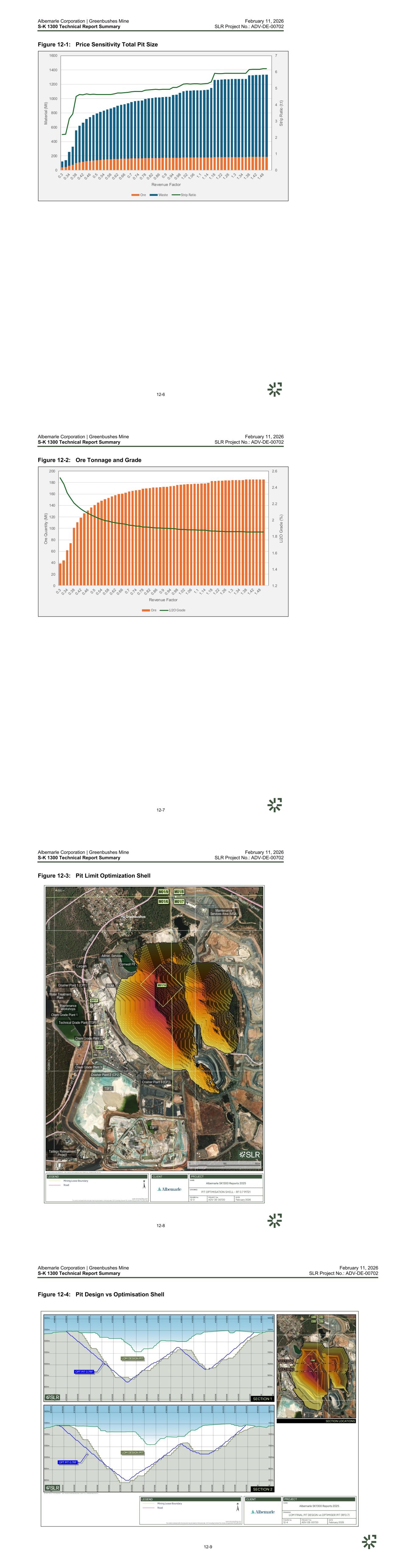
Albemarle Corporation | Greenbushes Mine S-K 1300 Technical Report Summary February 11, 2026 SLR Project No.: ADV-DE-00702 12-6 Figure 12-1: Price Sensitivity Total Pit Size 0 1 2 3 4 5 6 7 0 200 400 600 00 1000 1200 1400 1600 S tr ip R a tio ( t t) M a te ri a l ( M t) Revenue Factor Albemarle Corporation | Greenbushes Mine S-K 1300 Technical Report Summary February 11, 2026 SLR Project No.: ADV-DE-00702 12-7 Figure 12-2: Ore Tonnage and Grade 1.2 1.4 1.6 1. 2 2.2 2.4 2.6 0 20 40 60 0 100 120 140 160 1 0 200 L i2 O G ra d e ( % ) O re Q u a n ti ty ( M t) Revenue Factor Albemarle Corporation | Greenbushes Mine S-K 1300 Technical Report Summary February 11, 2026 SLR Project No.: ADV-DE-00702 12-8 Figure 12-3: Pit Limit Optimization Shell Albemarle Corporation | Greenbushes Mine S-K 1300 Technical Report Summary February 11, 2026 SLR Project No.: ADV-DE-00702 12-9 Figure 12-4: Pit Design vs Optimisation Shell

Albemarle Corporation | Greenbushes Mine S-K 1300 Technical Report Summary February 11, 2026 SLR Project No.: ADV-DE-00702 12-10 12.4.2 Dilution and Recovery For open pit mine planning and Mineral Reserve reporting, the 2025 Mineral Resource block model was regularised to a Selective Mining Unit (SMU) size of 5.0 m × 5.0 m × 5.0 m. Whole- block grades were generated by accounting for the percentage volume inclusion within each SMU. SMU grades were calculated as the mass-weighted average of sub-block grades (or portions of sub-blocks) contained within the SMU. SLR estimates that this regularisation results in approximately 3% ore loss and 6.3% dilution. In addition to regularisation, all Inferred Mineral Resource material (5.8 Mt) reporting Li₂O > 0.5% has been treated as waste for the purposes of the Mineral Reserve estimate. SLR notes that the current plant feed iron oxide (Fe₂O₃) specification limits are 1.0% for the Technical Grade Plant and Chemical Grade Plant 1, and 1.15% for Chemical Grade Plants 12 and 3. All material above the cut-off grade (Li₂O ≥ 0.5%) has been considered as potential feed to the processing plants and all material below cut-off grade considered waste. Over the life of mine, plant feed will be blended to meet applicable Fe₂O₃ specifications. Material above the cut-off grade that can be blended to comply with these feed specifications is included in the Mineral Reserve estimate. 12.4.3 Pit Design and Geotechnical Parameters The Mineral Reserve pit design parameters, including berm widths, face angles, berm spacing, and haul road gradients and widths, are summarised Table 12-4, Table 12-5 and Figure 12-5. The pit design slope parameters are based on the Company’s updated geotechnical study completed in 2025. It is noted the Bench face angle of the West Wall (WW) has been updated from 75° in the 2024 pit design to 80°. PSM also noted that the steepened west wall achieves a Factor of Safety of 2.12 for overall slope stability where rock mass strength governs in the absence of adversely oriented major structures. Table 12-4: Pit Design Parameters - Maximum Inter-Ramp Angle Slope Design Sector Maximum Inter Ramp Angle (ׄ°) Bench Face Angle (°) Bench Height (m) Berm Width (m) Weathered Zone 26 35 20 12 EW 49 70 20 10 WW and SW 59 80 20 8.5 NW 55 75 20 8.5 Albemarle Corporation | Greenbushes Mine S-K 1300 Technical Report Summary February 11, 2026 SLR Project No.: ADV-DE-00702 12-11 Table 12-5: Ramp and Pit Standoff Parameters Design Parameter Road Width 40 m Road Gradient 10% Floyd Waste Dump Offset to EW Crest 35 m Figure 12-5: Mineral Reserve Pit Shell Slope Design Albemarle Corporation | Greenbushes Mine S-K 1300 Technical Report Summary February 11, 2026 SLR Project No.: ADV-DE-00702 12-12 12.4.4 Processing Recovery The metallurgical modifying factors comprised three mass yield regressions provided by the Company (Table 12-6). The regression curves are a function of the Li2O% and are derived from actual plant data. Greenbushes has the capability to produce chemical-grade concentrate, technical-grade concentrate, and product from the tailings reprocessing plant. Technical-grade concentrate represents approximately 0.6% of total product output and is produced intermittently in response to customer demand. Accordingly, for the purposes of the Mineral Reserve estimate, SLR has assumed that all processing facilities produce a 6.0% Li₂O spodumene concentrate (SC6.0). The technical-grade plant may, at times over the project life, generate a higher-grade concentrate; however, this potential upside has not been evaluated and has not been included in the Mineral Reserve estimate. Processing recovery is further discussed in Section 1.0. Table 12-6: Mineral Reserves Mass Yield (SC6.0 Concentrate) Processing Plant Mass Yield (MY) Equation (%) Chemical Grade Plant 1 (CGP1) 9.362 × Feed Li2O%^1.319 Chemical Grade Plants 2 and 3 (CGP2 and CGP3) (9.362 × Feed Li2O%^1.319) +(Feed Li2O% × 0.82) Technical Plant (TGP1) 41.4 Tailing Reprocessing Plant 11.6 Table 12-7 summarizes the LOM Mass Yield and average plant feed grade for each plant. Table 12-7: LOM Plant Feed Yield Plant* Average Feed Grade (Li2O %) Average Plant Yield (%) CGP1 2.3 27.5 CGP2 1.8 21.8 CGP3 1.6 18.1 TGP 2.7 41.4 TRP 1.4 11.6 Notes: *Where CCP is Chemical Grade Plant, TGP is Technical Grade Plant, and TRP is Tailings Reprocessing Plant. 12.4.5 Cut-off Grade For reporting of the Mineral Reserves, the marginal COG was estimated to be 0.50% Li2O based on recent actual costs, historical data, and performance assumptions. Marginal COG utilizes an incremental ore mining cost to determine whether an already mined block is treated as waste or ore. This should not be confused with a break-even cut-off grade that includes the cost of waste stripping. The COG mass yield assumption used the regression curve of the Chem Grade 1 plant. The parameters used in the marginal COG are outlined in Table 12-8. Albemarle Corporation | Greenbushes Mine S-K 1300 Technical Report Summary February 11, 2026 SLR Project No.: ADV-DE-00702 12-13 Table 12-8: Reserves Marginal Cut-off Grade Assumptions Parameter Units Value Incremental Ore Mining Cost US$/t Ore 1.85 Processing Cost US$/t Ore 34.44 G&A Cost US$/t Ore 9.33 Sustaining Capital Cost US$/t Ore 12.62 Selling Cost US$/t concentrate 44.4 Mass Yield Regression 9.362*Li2O%1.319# Selling Price US$/t of 6% Li2O Conc. 1,300 Note: # Based on the average of all the Chemical Grade Plants 12.5 Comparison to Previous Mineral Reserve Estimate In March 2024, Albemarle published a Statement of Mineral Reserve dated December 31, 2023, in accordance with S-K 1300 on the NYSE. Albemarle also published an updated Statement of Mineral Reserve in March 2025 dated June 30, 2024. A summary of the total Mineral Reserves published in these statements in comparison to this Report is presented in Table 12-9. Note that Table 12-9 compares the in situ Mineral Reserves only and has been weighted by the 100% equity basis of which Albemarle holds 49%. Table 12-9 compares the current and previous Mineral Reserve estimates. The comparison is on the in situ Mineral Reserves only, as no Mineral Reserves were declared for TSF1 in 2023. Table 12-9: Comparison with Previous Mineral Reserve Estimates Effective Date# COG Li2O % QP Proved Probable Total Mt % Li2O Mt % Li2O Mt % Li2O December 31, 2023 0.7 SRK n/a n/a 148.3 1.8 148.3 1.8 June 30, 2024 0.7 SLR n/a n/a 151.6 1.8 151.6 1.8 June 30, 2025 0.5 SLR n/a n/a 160.9 1.9 160.9 1.9 Note: values have been weight-averaged based on reported tonnages. # Effective date refers to the date of the Statement (depletion) not the public release date As shown in Table 12-9, there is an increase in quantities between the 2024 and 2025 Mineral Reserve estimates. These variations can be attributed to the following: • Reduction of the cut-off grade from 0.7% to 0.5% Li₂O. • As discussed in Section 7.4, the LOM ultimate pit design was modified for steeper inter- ramp wall angles, which resulted in accessing deeper ore at reduced waste quantities.

Albemarle Corporation | Greenbushes Mine S-K 1300 Technical Report Summary February 11, 2026 SLR Project No.: ADV-DE-00702 13-1 13.0 Mining Methods Greenbushes is an open pit lithium mining asset that has been in operation (for lithium extraction) since 1983. The Mine produces both chemical and technical grade spodumene concentrates derived from its Mineral Reserves containing economic quantities of Li2O. The open pit operation targets two spodumene mineralization zones within two main pegmatitic orebodies, referred to as Central lode and Kapanga. SLR highlights that the modifying factors used in estimating the Mineral Reserves are discussed in Section 12.4. SLR notes all quantities discussed within Section 13.0 are reported on a 100% equity basis. 13.1 Mining Method The physical characteristics of the Greenbushes deposit are amenable to traditional open pit metalliferous mining methods. The Greenbushes pegmatites are mineralogically zoned in a lenticular, interfingering style, and the spodumene ore is mined from fresh, unweathered zones. The open pit mining method involves 10 m working benches, generally extracted by 5 m flitches. The separation of ore and waste occurs as directed by the grade control model. Ore is hauled to the ROM pad, where it is stockpiled in separated stockpiles based on ore characteristics and grade. The waste rock is hauled to surface emplacements. The mining contractor equipment includes small to medium-sized hydraulic excavators in backhoe configuration. The excavators are paired with a fleet of suitably matched rear dump haul trucks. The pit design parameters, including berm widths, wall and batter angles, berm spacing and haul road gradients and widths, are detailed in Section 12.4.3 of this Report. 13.2 Geotechnical Considerations The scope and quality of geotechnical studies conducted are sufficient and comparable to those of similar operations and ore bodies. Slope geotechnical design parameters were updated in October 2025 by reputable geotechnical consultants (PSM) for the combined Central Lode and Kapanga pits. The 2025 pit design (Figure 13-1) largely resembles the 2022 and 2024 designs; therefore, the analyses undertaken in the previous geotechnical design report remain applicable and have been adopted for the review of the 2025 pit designs. The geotechnical consultant reviewed the 2025 pit designs and confirmed that they conformed to the geotechnical recommendations, with only minor non-compliances, which were deemed insignificant and acceptable. The western wall batter angle was increased from 75° to 80° based on the following assessment: • The steepened west wall is supported by overall slope FoS = 2.12 under rock-mass- controlled conditions, indicating no global stability “fatal flaw” is apparent at the overall slope scale. • PSM identifies potential for instability where N–S faults and shears (and their intersections) interact with pit walls, including block sliding and rockfall sources where structures/contacts interact with the wall. • The “acceptable” position is conditional on Albemarle Corporation | Greenbushes Mine S-K 1300 Technical Report Summary February 11, 2026 SLR Project No.: ADV-DE-00702 13-2 • No adversely oriented major structures dominating the west wall sectors (explicitly stated as the boundary condition for FoS). Effective management of pegmatite undercutting, structure-controlled wedges/planar failures, and bench-scale rockfall, especially in the west hanging wall. • PSM notes localised berm widths in WW/SW are <8.5 m where berms taper into double- benched walls or haul access ramps. • PSM concludes these are minor and can be accepted as designed, but they remain execution-critical for rockfall containment and access/clean-out. • Pegmatite trend/dip noted (~40°/230°) and most pegmatite intersects the Central Lode pit west hanging wall, pit bases, and northern end walls. • PSM states large pegmatite blocks are undercut and left in the slope in places; the undercut contact is likely low shear strength and failure is likely. • 2025 LOM: a 15 m to 50 m thick dolerite sill runs NW–SE along the western hanging wall above the pegmatite; PSM states dolerite contacts are likely rockfall sources requiring careful operational management. • For the 2025 STR design (PSM2193-144L REV2, October 28, 2025), PSM concluded the geometry is “largely compliant” but identified a few minor areas requiring redesign to be compliant, including narrow berms and over-steepened batters that require design changes to reduce geotechnical risk. The collected raw data, coupled with a long mining history and considerable local knowledge, leads to a high degree of confidence across the geotechnical structures, rock mass parameters and hazard control requirements within the current active mining areas. In 2023, Greenbushes updated its structural model, utilizing geological wireframes, acoustic televiewer interpretation, core defect data, photogrammetry and geotechnical mapping. The major structures identified include the following: • Faults and shears • Discontinuities at or near the contact between the pegmatite and granofels, and the amphibolite and diorite Structural domains, rock mass characteristics, and intact strength assessments were also updated in the April 2023 geotechnical work. Historic underground workings are present at Greenbushes, located adjacent to and immediately below the historic Cornwall Pit and below the current C3 Pit. The underground workings are assumed to still be open voids and have not been backfilled. The 2025 LOM pit and the interim cutbacks will have increasing interactions with the underground voids. However, it is anticipated that this can be managed sufficiently via void management plans. Greenbushes has implemented several control measures to ensure the safe extraction of ore. These controls include: • Maintaining a void management plan. • Maintaining a Principal Hazard Management Plan (PHMP) and risk register for ground control. • Utilizing prism, inclinometers and live slope stability radar for high-risk areas. • Use of rockfall protection systems. Albemarle Corporation | Greenbushes Mine S-K 1300 Technical Report Summary February 11, 2026 SLR Project No.: ADV-DE-00702 13-3 • Trim blast or pre-splitting of final walls. • Mine through (remove) the sheared pegmatite contact zone running along the C1 Pit Footwall, by expanding the east wall an additional 10 m; and, • Implementation of Trigger Action Response Plans (TARP) for radar monitoring and rainfall. SLR has reviewed the pit design and confirms that the design parameters are consistent with the geotechnical recommendations for the ultimate pit design and interim cutbacks. Albemarle Corporation | Greenbushes Mine S-K 1300 Technical Report Summary February 11, 2026 SLR Project No.: ADV-DE-00702 13-4 Figure 13-1: 2025 LOM Final Pit Design
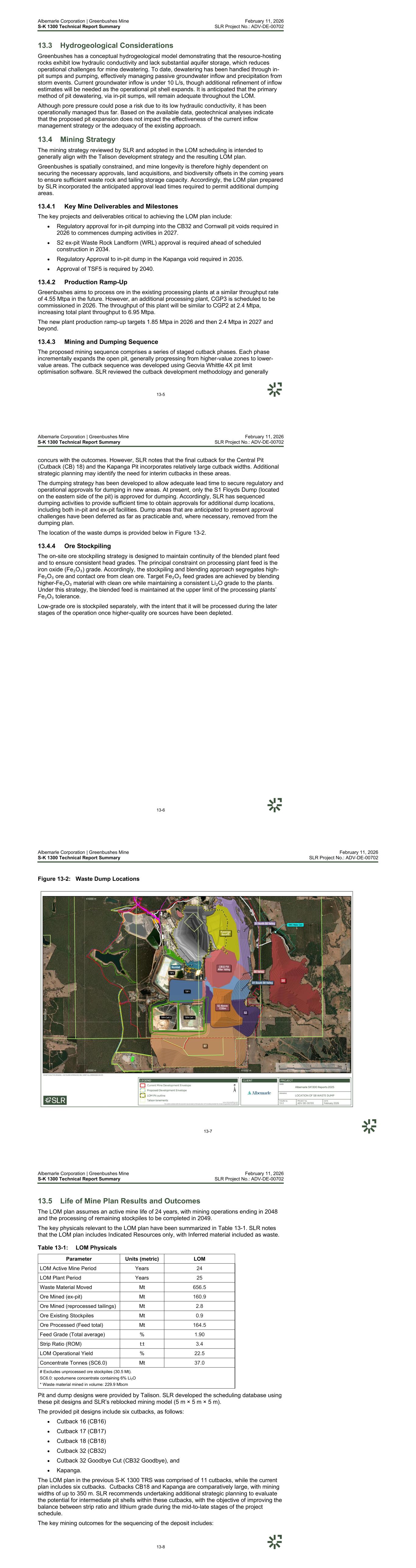
Albemarle Corporation | Greenbushes Mine S-K 1300 Technical Report Summary February 11, 2026 SLR Project No.: ADV-DE-00702 13-5 13.3 Hydrogeological Considerations Greenbushes has a conceptual hydrogeological model demonstrating that the resource-hosting rocks exhibit low hydraulic conductivity and lack substantial aquifer storage, which reduces operational challenges for mine dewatering. To date, dewatering has been handled through in- pit sumps and pumping, effectively managing passive groundwater inflow and precipitation from storm events. Current groundwater inflow is under 10 L/s, though additional refinement of inflow estimates will be needed as the operational pit shell expands. It is anticipated that the primary method of pit dewatering, via in-pit sumps, will remain adequate throughout the LOM. Although pore pressure could pose a risk due to its low hydraulic conductivity, it has been operationally managed thus far. Based on the available data, geotechnical analyses indicate that the proposed pit expansion does not impact the effectiveness of the current inflow management strategy or the adequacy of the existing approach. 13.4 Mining Strategy The mining strategy reviewed by SLR and adopted in the LOM scheduling is intended to generally align with the Talison development strategy and the resulting LOM plan. Greenbushes is spatially constrained, and mine longevity is therefore highly dependent on securing the necessary approvals, land acquisitions, and biodiversity offsets in the coming years to ensure sufficient waste rock and tailing storage capacity. Accordingly, the LOM plan prepared by SLR incorporated the anticipated approval lead times required to permit additional dumping areas. 13.4.1 Key Mine Deliverables and Milestones The key projects and deliverables critical to achieving the LOM plan include: • Regulatory approval for in-pit dumping into the CB32 and Cornwall pit voids required in 2026 to commences dumping activities in 2027. • S2 ex-pit Waste Rock Landform (WRL) approval is required ahead of scheduled construction in 2034. • Regulatory Approval to in-pit dump in the Kapanga void required in 2035. • Approval of TSF5 is required by 2040. 13.4.2 Production Ramp-Up Greenbushes aims to process ore in the existing processing plants at a similar throughput rate of 4.55 Mtpa in the future. However, an additional processing plant, CGP3 is scheduled to be commissioned in 2026. The throughput of this plant will be similar to CGP2 at 2.4 Mtpa, increasing total plant throughput to 6.95 Mtpa. The new plant production ramp-up targets 1.85 Mtpa in 2026 and then 2.4 Mtpa in 2027 and beyond. 13.4.3 Mining and Dumping Sequence The proposed mining sequence comprises a series of staged cutback phases. Each phase incrementally expands the open pit, generally progressing from higher-value zones to lower- value areas. The cutback sequence was developed using Geovia Whittle 4X pit limit optimisation software. SLR reviewed the cutback development methodology and generally Albemarle Corporation | Greenbushes Mine S-K 1300 Technical Report Summary February 11, 2026 SLR Project No.: ADV-DE-00702 13-6 concurs with the outcomes. However, SLR notes that the final cutback for the Central Pit (Cutback (CB) 18) and the Kapanga Pit incorporates relatively large cutback widths. Additional strategic planning may identify the need for interim cutbacks in these areas. The dumping strategy has been developed to allow adequate lead time to secure regulatory and operational approvals for dumping in new areas. At present, only the S1 Floyds Dump (located on the eastern side of the pit) is approved for dumping. Accordingly, SLR has sequenced dumping activities to provide sufficient time to obtain approvals for additional dump locations, including both in-pit and ex-pit facilities. Dump areas that are anticipated to present approval challenges have been deferred as far as practicable and, where necessary, removed from the dumping plan. The location of the waste dumps is provided below in Figure 13-2. 13.4.4 Ore Stockpiling The on-site ore stockpiling strategy is designed to maintain continuity of the blended plant feed and to ensure consistent head grades. The principal constraint on processing plant feed is the iron oxide (Fe₂O₃) grade. Accordingly, the stockpiling and blending approach segregates high- Fe₂O₃ ore and contact ore from clean ore. Target Fe₂O₃ feed grades are achieved by blending higher-Fe₂O₃ material with clean ore while maintaining a consistent Li₂O grade to the plants. Under this strategy, the blended feed is maintained at the upper limit of the processing plants’ Fe₂O₃ tolerance. Low-grade ore is stockpiled separately, with the intent that it will be processed during the later stages of the operation once higher-quality ore sources have been depleted. Albemarle Corporation | Greenbushes Mine S-K 1300 Technical Report Summary February 11, 2026 SLR Project No.: ADV-DE-00702 13-7 Figure 13-2: Waste Dump Locations Albemarle Corporation | Greenbushes Mine S-K 1300 Technical Report Summary February 11, 2026 SLR Project No.: ADV-DE-00702 13-8 13.5 Life of Mine Plan Results and Outcomes The LOM plan assumes an active mine life of 24 years, with mining operations ending in 2048 and the processing of remaining stockpiles to be completed in 2049. The key physicals relevant to the LOM plan have been summarized in Table 13-1. SLR notes that the LOM plan includes Indicated Resources only, with Inferred material included as waste. Table 13-1: LOM Physicals Parameter Units (metric) LOM LOM Active Mine Period Years 24 LOM Plant Period Years 25 Waste Material Moved Mt 656.5 Ore Mined (ex-pit) Mt 160.9 Ore Mined (reprocessed tailings) Mt 2.8 Ore Existing Stockpiles Mt 0.9 Ore Processed (Feed total) Mt 164.5 Feed Grade (Total average) % 1.90 Strip Ratio (ROM) t:t 3.4 LOM Operational Yield % 22.5 Concentrate Tonnes (SC6.0) Mt 37.0 # Excludes unprocessed ore stockpiles (30.5 Mt). SC6.0: spodumene concentrate containing 6% Li2O * Waste material mined in volume: 229.9 Mbcm Pit and dump designs were provided by Talison. SLR developed the scheduling database using these pit designs and SLR’s reblocked mining model (5 m × 5 m × 5 m). The provided pit designs include six cutbacks, as follows: • Cutback 16 (CB16) • Cutback 17 (CB17) • Cutback 18 (CB18) • Cutback 32 (CB32) • Cutback 32 Goodbye Cut (CB32 Goodbye), and • Kapanga. The LOM plan in the previous S-K 1300 TRS was comprised of 11 cutbacks, while the current plan includes six cutbacks. Cutbacks CB18 and Kapanga are comparatively large, with mining widths of up to 350 m. SLR recommends undertaking additional strategic planning to evaluate the potential for intermediate pit shells within these cutbacks, with the objective of improving the balance between strip ratio and lithium grade during the mid-to-late stages of the project schedule. The key mining outcomes for the sequencing of the deposit includes:

Albemarle Corporation | Greenbushes Mine S-K 1300 Technical Report Summary February 11, 2026 SLR Project No.: ADV-DE-00702 13-9 • Mining is scheduled to continue within the low strip ratio cutbacks CB16 and CB32. Advancing extraction of CB32 creates in-pit void capacity earlier in the schedule, enabling earlier commencement of in-pit waste placement and reducing reliance on ex- pit waste dumps. • CB17 and CB16 are mined concurrently to balance the overall strip ratio. This sequencing also ensures CB17 accesses its low strip ratio ore before large waste quantity are mined in CB18 starts, allowing CB17 and CB18 to be used together to manage strip ratio variability. • The Kapanga pit is scheduled to commence in 2028. This timing is intended to ensure the pit can be mined and subsequently backfilled with material from CB18. If Kapanga is delayed, the ability to maximise its in-pit dumping potential is reduced. • CB18 is scheduled to commence in 2030. Significant waste is present in the upper benches of CB18, which increases early strip ratio. Accordingly, strip ratio management requires balancing waste movement with CB17 and Kapanga during the initial stages of CB18 SLR notes a fundamental change in mining strategy relative to the previous SK-1300 TRS. The current LOM plan defers commencement of CB18 and brings forward development of the Kapanga pit. This adjustment is intended to ensure Kapanga is completed sufficiently early to provide adequate time and waste availability for backfilling the Kapanga void. Any delay in completing Kapanga increases the risk that the in-pit void cannot be fully backfilled, thereby increasing reliance on ex-pit waste dumps and potentially triggering the need for additional external dumping approvals. Figure 13-3 shows the timing and interaction of the cutbacks. Figure 13-3: LOM Active Mining Areas 2 0 2 5 2 0 2 6 2 0 2 7 2 0 2 2 0 2 9 2 0 3 0 2 0 3 1 2 0 3 2 2 0 3 3 2 0 3 4 2 0 3 5 2 0 3 6 2 0 3 7 2 0 3 2 0 3 9 2 0 4 0 2 0 4 1 2 0 4 2 2 0 4 3 2 0 4 4 2 0 4 5 2 0 4 6 2 0 4 7 2 0 4 2 0 4 9 2 0 5 0 Central CB1 Kapanga South CB32 Goodbye South CB32 Central CB17 Central CB16 Albemarle Corporation | Greenbushes Mine S-K 1300 Technical Report Summary February 11, 2026 SLR Project No.: ADV-DE-00702 13-10 The LOM schedule progressively ramps up total annual material movement to approximately 53 Mt by 2034, maintaining this rate through to 2040 before declining to approximately 14 Mt over the period 2044–2046. Ore mining peaks at 13 Mt in 2027 and 2030, with year-on-year ore tonnages fluctuating outside these peak years. Annual waste movement increases to more than 40 Mt between 2033 and 2040, reaching a maximum of 46 Mt in 2039. Total plant feed ramps up to 6.95 Mtpa by 2027, after which the plants are planned to operate at steady-state throughput through to 2048 with some remaining stockpile being processed in 2049. Plant feed will be sustained through a blended feed from a combination of direct feed from the open pit and reclaimed material from stockpiles. Over the life of mine, a total of 37.1 Mt of concentrate is forecast to be produced, and 4.9 Mt of tailings material is scheduled to be reprocessed in 2022 and 2026. Figure 13-4 shows the by year LOM Waste Movement, and strip ratios Figure 13-4: LOM Waste Movement The average operational mass yield over the LOM period is 22.5%. Yield fluctuates between 16.9% and 27.3% between 2024 and 2046 as a function of grade, recovery, dilution and plant performance. (Figure 13-5). 0.00 1.00 2.00 3.00 4.00 5.00 6.00 7.00 8.00 9.00 10.00 0.0 5.0 10.0 15.0 20.0 25.0 30.0 35.0 40.0 45.0 50.0 2 0 2 5 2 0 2 6 2 0 2 7 2 0 2 8 2 0 2 9 2 0 3 0 2 0 3 1 2 0 3 2 2 0 3 3 2 0 3 4 2 0 3 5 2 0 3 6 2 0 3 7 2 0 3 8 2 0 3 9 2 0 4 0 2 0 4 1 2 0 4 2 2 0 4 3 2 0 4 4 2 0 4 5 2 0 4 6 2 0 4 7 2 0 4 8 2 0 4 9 2 0 5 0 2 0 5 1 St rip R at io (t :t) M in e M a te ri a l (M t) Total Waste mined Matieral Above COG Total Strip Ratio Albemarle Corporation | Greenbushes Mine S-K 1300 Technical Report Summary February 11, 2026 SLR Project No.: ADV-DE-00702 13-11 Figure 13-5: LOM Feed and Operational Mass Yield 13.5.1 LOM Waste Dumping Schedule Several mine development iterations were undertaken by SLR to account for the lead time required to gain approvals for dumping in new areas and maximise the Kapanga in-pit dump capacity. The location of the waste dumps is shown in Figure 13-2. The approvals timing critical to achieving the LOM plan include the following. • In-pit dumping approval in both the Cornwall and CB32 pit voids is required in 2026 • In-pit dump in the Kapanga void required in 2035. • S2 ex-pit Waste Rock Landform (WRL) approval is required in 2034. SLR notes that the inclusion of in-pit waste placement within the Kapanga void under the current LOM plan materially reduces the volume of waste directed to ex-pit Waste Rock Landforms (WRLs). As a result, several waste dumping areas that were previously considered are no longer required under the current plan and, consequently, associated regulatory approvals are not triggered. The waste dump areas not required in the LOM plan include: • S7 ex-pit WRL • S8 ex-pit WRL • Backfill to TSF1 • Approval to exceed the 1330m level Table 13-2 outlines the waste dumping areas, approval requirements, total capacity, quantity or material dumping during the LOM schedule and the % of each dump filled over the LOM schedule. The key outcomes of the waste dumping schedule are: • There is currently one operating approved waste dump, S1 (Floyds) WRL, which has a capacity of 77 Mbcm at July 2025. • S2 dump is only 59% filled at the end of the schedule 0.0 1.0 2.0 3.0 4.0 5.0 6.0 7.0 .0 9.0 10.0 2 0 2 5 2 0 2 6 2 0 2 7 2 0 2 2 0 2 9 2 0 3 0 2 0 3 1 2 0 3 2 2 0 3 3 2 0 3 4 2 0 3 5 2 0 3 6 2 0 3 7 2 0 3 2 0 3 9 2 0 4 0 2 0 4 1 2 0 4 2 2 0 4 3 2 0 4 4 2 0 4 5 2 0 4 6 2 0 4 7 2 0 4 2 0 4 9 2 0 5 0 P ro c e ss e d M a te ri a l (M t) Ore Processed Total Operational ield Albemarle Corporation | Greenbushes Mine S-K 1300 Technical Report Summary February 11, 2026 SLR Project No.: ADV-DE-00702 13-12 Table 13-2: Waste Dump Capacity and Percentage Filled Dump Area / Name Approval Capacity Scheduled Dump Material Capacity Filled Status (Mbcm) (Mbcm) Floyds S1 North Approved 14.9 14.9 100% Floyds S1 South Approved 56.1 56.1 100% Floyds S1 North/South Valley Approved 5.8 5.8 100% Cornwall Pit Back fill 01 Required 2026 1 1 100% CB32 Backfill Required 2026 13.2 13.2 100% CB32 Fill After Valley Required 2026 36.9 36.9 100% Numbat Hill Backfill Required 2032 1.2 1.2 100% Floyds S2 Required 2033 61.9 36.5 59% Kapanga Backfill Required 2035 64.3 64.3 100% Floyds S2Above1330 Not Required 24.2 0 0% Floyds S7 Not Required 131.4 0 0% S8 Dump Not Required 51.7 0 0% TSF1 Fill After Rom Not Required 5.8 0 0% TSF Off Rom Build Not Required 0.8 0 0% Total 469.2 229.9 49% The chronological timeline of when these dump areas were utilized is provided in Figure 13-6.
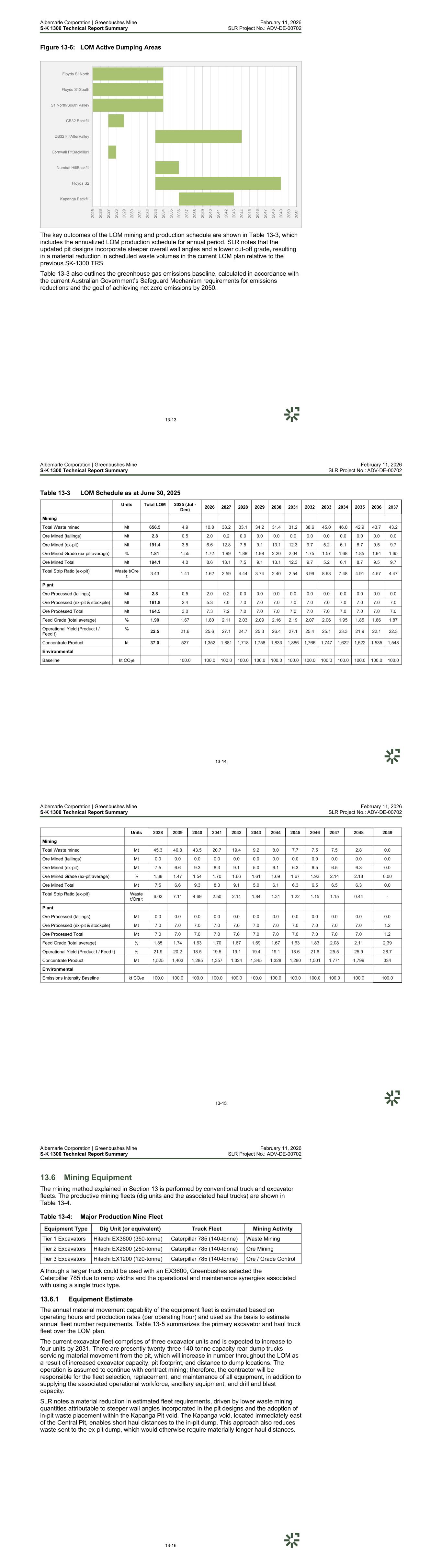
Albemarle Corporation | Greenbushes Mine S-K 1300 Technical Report Summary February 11, 2026 SLR Project No.: ADV-DE-00702 13-13 Figure 13-6: LOM Active Dumping Areas The key outcomes of the LOM mining and production schedule are shown in Table 13-3, which includes the annualized LOM production schedule for annual period. SLR notes that the updated pit designs incorporate steeper overall wall angles and a lower cut-off grade, resulting in a material reduction in scheduled waste volumes in the current LOM plan relative to the previous SK-1300 TRS. Table 13-3 also outlines the greenhouse gas emissions baseline, calculated in accordance with the current Australian Government’s Safeguard Mechanism requirements for emissions reductions and the goal of achieving net zero emissions by 2050. 2 0 2 5 2 0 2 6 2 0 2 7 2 0 2 8 2 0 2 9 2 0 3 0 2 0 3 1 2 0 3 2 2 0 3 3 2 0 3 4 2 0 3 5 2 0 3 6 2 0 3 7 2 0 3 8 2 0 3 9 2 0 4 0 2 0 4 1 2 0 4 2 2 0 4 3 2 0 4 4 2 0 4 5 2 0 4 6 2 0 4 7 2 0 4 8 2 0 4 9 2 0 5 0 2 0 5 1 Kapanga Backfill Floyds S2 Numbat HillBackfill Cornwall PitBackfill01 CB32 FillAfterValley CB32 Backfill S1 North/South Valley Floyds S1South Floyds S1North Albemarle Corporation | Greenbushes Mine S-K 1300 Technical Report Summary February 11, 2026 SLR Project No.: ADV-DE-00702 13-14 Table 13-3 LOM Schedule as at June 30, 2025 Units Total LOM 2025 (Jul - Dec) 2026 2027 2028 2029 2030 2031 2032 2033 2034 2035 2036 2037 Mining Total Waste mined Mt 656.5 4.9 10.8 33.2 33.1 34.2 31.4 31.2 38.6 45.0 46.0 42.9 43.7 43.2 Ore Mined (tailings) Mt 2.8 0.5 2.0 0.2 0.0 0.0 0.0 0.0 0.0 0.0 0.0 0.0 0.0 0.0 Ore Mined (ex-pit) Mt 191.4 3.5 6.6 12.8 7.5 9.1 13.1 12.3 9.7 5.2 6.1 8.7 9.5 9.7 Ore Mined Grade (ex-pit average) % 1.81 1.55 1.72 1.99 1.88 1.98 2.20 2.04 1.75 1.57 1.68 1.85 1.94 1.65 Ore Mined Total Mt 194.1 4.0 8.6 13.1 7.5 9.1 13.1 12.3 9.7 5.2 6.1 8.7 9.5 9.7 Total Strip Ratio (ex-pit) Waste t/Ore t 3.43 1.41 1.62 2.59 4.44 3.74 2.40 2.54 3.99 8.68 7.48 4.91 4.57 4.47 Plant Ore Processed (tailings) Mt 2.8 0.5 2.0 0.2 0.0 0.0 0.0 0.0 0.0 0.0 0.0 0.0 0.0 0.0 Ore Processed (ex-pit & stockpile) Mt 161.8 2.4 5.3 7.0 7.0 7.0 7.0 7.0 7.0 7.0 7.0 7.0 7.0 7.0 Ore Processed Total Mt 164.5 3.0 7.3 7.2 7.0 7.0 7.0 7.0 7.0 7.0 7.0 7.0 7.0 7.0 Feed Grade (total average) % 1.90 1.67 1.80 2.11 2.03 2.09 2.16 2.19 2.07 2.06 1.95 1.85 1.86 1.87 Operational Yield (Product t / Feed t) % 22.5 21.6 25.6 27.1 24.7 25.3 26.4 27.1 25.4 25.1 23.3 21.9 22.1 22.3 Concentrate Product kt 37.0 527 1,352 1,881 1,718 1,758 1,833 1,886 1,766 1,747 1,622 1,522 1,535 1,548 Environmental Baseline kt CO2e 100.0 100.0 100.0 100.0 100.0 100.0 100.0 100.0 100.0 100.0 100.0 100.0 100.0 Albemarle Corporation | Greenbushes Mine S-K 1300 Technical Report Summary February 11, 2026 SLR Project No.: ADV-DE-00702 13-15 Units 2038 2039 2040 2041 2042 2043 2044 2045 2046 2047 2048 2049 Mining Total Waste mined Mt 45.3 46.8 43.5 20.7 19.4 9.2 8.0 7.7 7.5 7.5 2.8 0.0 Ore Mined (tailings) Mt 0.0 0.0 0.0 0.0 0.0 0.0 0.0 0.0 0.0 0.0 0.0 0.0 Ore Mined (ex-pit) Mt 7.5 6.6 9.3 8.3 9.1 5.0 6.1 6.3 6.5 6.5 6.3 0.0 Ore Mined Grade (ex-pit average) % 1.38 1.47 1.54 1.70 1.66 1.61 1.69 1.67 1.92 2.14 2.18 0.00 Ore Mined Total Mt 7.5 6.6 9.3 8.3 9.1 5.0 6.1 6.3 6.5 6.5 6.3 0.0 Total Strip Ratio (ex-pit) Waste t/Ore t 6.02 7.11 4.69 2.50 2.14 1.84 1.31 1.22 1.15 1.15 0.44 - Plant Ore Processed (tailings) Mt 0.0 0.0 0.0 0.0 0.0 0.0 0.0 0.0 0.0 0.0 0.0 0.0 Ore Processed (ex-pit & stockpile) Mt 7.0 7.0 7.0 7.0 7.0 7.0 7.0 7.0 7.0 7.0 7.0 1.2 Ore Processed Total Mt 7.0 7.0 7.0 7.0 7.0 7.0 7.0 7.0 7.0 7.0 7.0 1.2 Feed Grade (total average) % 1.85 1.74 1.63 1.70 1.67 1.69 1.67 1.63 1.83 2.08 2.11 2.39 Operational Yield (Product t / Feed t) % 21.9 20.2 18.5 19.5 19.1 19.4 19.1 18.6 21.6 25.5 25.9 28.7 Concentrate Product Mt 1,525 1,403 1,285 1,357 1,324 1,345 1,328 1,290 1,501 1,771 1,799 334 Environmental Emissions Intensity Baseline kt CO2e 100.0 100.0 100.0 100.0 100.0 100.0 100.0 100.0 100.0 100.0 100.0 100.0 Albemarle Corporation | Greenbushes Mine S-K 1300 Technical Report Summary February 11, 2026 SLR Project No.: ADV-DE-00702 13-16 13.6 Mining Equipment The mining method explained in Section 13 is performed by conventional truck and excavator fleets. The productive mining fleets (dig units and the associated haul trucks) are shown in Table 13-4. Table 13-4: Major Production Mine Fleet Equipment Type Dig Unit (or equivalent) Truck Fleet Mining Activity Tier 1 Excavators Hitachi EX3600 (350-tonne) Caterpillar 785 (140-tonne) Waste Mining Tier 2 Excavators Hitachi EX2600 (250-tonne) Caterpillar 785 (140-tonne) Ore Mining Tier 3 Excavators Hitachi EX1200 (120-tonne) Caterpillar 785 (140-tonne) Ore / Grade Control Although a larger truck could be used with an EX3600, Greenbushes selected the Caterpillar 785 due to ramp widths and the operational and maintenance synergies associated with using a single truck type. 13.6.1 Equipment Estimate The annual material movement capability of the equipment fleet is estimated based on operating hours and production rates (per operating hour) and used as the basis to estimate annual fleet number requirements. Table 13-5 summarizes the primary excavator and haul truck fleet over the LOM plan. The current excavator fleet comprises of three excavator units and is expected to increase to four units by 2031. There are presently twenty-three 140-tonne capacity rear-dump trucks servicing material movement from the pit, which will increase in number throughout the LOM as a result of increased excavator capacity, pit footprint, and distance to dump locations. The operation is assumed to continue with contract mining; therefore, the contractor will be responsible for the fleet selection, replacement, and maintenance of all equipment, in addition to supplying the associated operational workforce, ancillary equipment, and drill and blast capacity. SLR notes a material reduction in estimated fleet requirements, driven by lower waste mining quantities attributable to steeper wall angles incorporated in the pit designs and the adoption of in-pit waste placement within the Kapanga Pit void. The Kapanga void, located immediately east of the Central Pit, enables short haul distances to the in-pit dump. This approach also reduces waste sent to the ex-pit dump, which would otherwise require materially longer haul distances.

Albemarle Corporation | Greenbushes Mine S-K 1300 Technical Report Summary February 11, 2026 SLR Project No.: ADV-DE-00702 13-17 Table 13-5: Major Mining Fleet Summary Equipment H2025 2026 2027 2028 2029 Typical 2030–2047 Excavators Hitachi EX3600 1 1 1 1 1 1–2 Hitachi EX2600 2 2 2 2 2 2–3 Hitachi EX1200 / Komatsu PC1250 3 3 3 3 3 3 Total Excavators 6 6 6 6 6 6–8 Rear Dump Trucks Caterpillar 785 (140-tonne) 23 23 23 23 23 30 Albemarle Corporation | Greenbushes Mine S-K 1300 Technical Report Summary February 11, 2026 SLR Project No.: ADV-DE-00702 14-1 14.0 Processing and Recovery Methods 14.1 Process Overview The Greenbushes operation produces a chemical grade 6% lithia concentrate (SC6.0) and a technical grade lithia concentrate (SC5.0 – 7.2) from hard rock lithium ore and reclaimed historical tantalum processing plant tailings. This is done through four existing processing plants, with a fifth to be commissioned in late-2025. In 2025, the combined assumed throughput of TGP, CGP1, CGP2, and TRP was 5.85 Mtpa, producing approximately 1.4 Mtpa of SC6.0. With CGP3 coming online in 2025/2026, throughput plant capacity is projected to rise to 8.25 Mtpa, producing up to 1.8 Mtpa of SC6.0 concentrate. The five processing plants and their nameplate and LOM capacities are summarized in Table 14-1. SLR has reduced the LOM capacity of CGP2 and TRP based on recent operational performance. Table 14-1: Nameplate and LOM Plant Capacities Asset Nameplate (Mtpa) SLR Capacity (Mtpa) Target Feed Grade (%) CGP1 1.8 1.8 2.5 CGP2 2.4 2.4 1.8 TRP 2 2.0 1.4 TGP 0.35 0.35 3.7 Current Capacity 6.55 6.55 CGP3 2.4 2.4 1.8 LOM Capacity 8.95 8.95 Note: CGP3 is under construction and the TRP is forecast to cease production in 2028. Each hard rock processing plant follows a similar design and receives ore from the open pit, with feed grade ranges optimized for each plant to handle progressively lower feed grades. Currently, Crushing Circuit 1 (CR1) supplies TGP and CGP1, while Crushing Circuit 2 (CR2) supplies CGP2. Crushing Circuit 3 (CR3), under construction, will serve CGP3. The TRP processes dry-mined tailings from historical tantalum extraction from TSF1 and only requires scrubbing before pumping to the TRP. While Greenbushes primarily focuses on lithium, however tantalum and tin are also recovered during regular mining. A mining agreement between GAM and Talison requires tantalum and tin recovery in the hard rock processing plants. Each plant incorporates specific steps using gravity recovery and magnetic separation to capture a tantalum/tin concentrate, which is then bagged for GAM. GAM processes this on-site through its own dedicated processing facility. Tailings from the hard rock processing, tailings reprocessing, and GAM’s facilities are sent to the active tailings dam TSF4 for deposition and process water recovery. Figure 14-1 shows an overview of the Greenbushes processing plant flowsheet. Albemarle Corporation | Greenbushes Mine S-K 1300 Technical Report Summary February 11, 2026 SLR Project No.: ADV-DE-00702 14-2 Figure 14-1: Greenbushes Processing Overview – Block Flow Diagram Source: Provided by the Company. Figure 14-2 presents an aerial view of the site layout, illustrating the locations of the three crushing plants and five processing facilities in relation to the active mining zone, as well as the historical and current TSFs. Albemarle Corporation | Greenbushes Mine S-K 1300 Technical Report Summary February 11, 2026 SLR Project No.: ADV-DE-00702 14-3 Figure 14-2: Greenbushes Process Plants – Aerial Image

Albemarle Corporation | Greenbushes Mine S-K 1300 Technical Report Summary February 11, 2026 SLR Project No.: ADV-DE-00702 14-4 14.2 Technical Grade Plant (TGP) The TGP, originally built in 1983 as the "Lithium Plant," was designed to process high-grade spodumene ore mined into a lithium concentrate product. Over the years, the TGP has been upgraded to produce both technical and chemical-grade lithium products. The plant, now served by CR1 in campaign mode, can produce lithium concentrates ranging from SC5.0 to SC7.2, depending on customer requirements. 14.2.1 Crushing Circuit 1 (CR1) The CR1 crushing circuit, constructed in 1992, was designed to crush hard rock tantalum and lithium ores, supporting both the now-decommissioned tantalum plant and the lithium plant (now known as the TGP) in campaign mode. This operation mode continues today, with CR1 now serving both the TGP and CGP1 plants. The process, typical for its time, follows a four-stage crushing setup: a primary jaw crusher, followed by secondary, tertiary, and quaternary cone crushers. Ore is reclaimed from the ROM stockpiles and fed into a ROM bin, where initial screening removes material below 125 mm. Oversized material goes to the primary jaw crusher, while screen undersize proceeds to a vibrating screen. Screened oversize is sent to a secondary cone crusher, with its output and screen undersize directed to a double-deck banana screen. A tertiary crusher processes material larger than 25 mm from the top deck, and material over 12 mm from the bottom deck goes to the quaternary crusher. Products from the tertiary and quaternary crushers are returned to the screen feed, with undersized material below 12 mm directed to a stockpile for either TGP or CGP1. Much of the original CR1 equipment remains in use, though newer designs have been implemented in later chemical-grade plant circuits. Figure 14-3 shows a block flow diagram of the CR1 feeding the TGP. Albemarle Corporation | Greenbushes Mine S-K 1300 Technical Report Summary February 11, 2026 SLR Project No.: ADV-DE-00702 14-5 Figure 14-3: CR1 Crushing Circuit to TGP – Block Flow Diagram 14.2.2 Technical Grade Plant (TGP) The TGP, initially called the "Lithium Plant” was renamed TGP when CGP1 came online in 2012. The TGP is a relatively small, complex plant due to its limited space and many modifications, including some redundant equipment. It has a capacity of 350,000 tonnes of ore annually, with an average grade of 3.8% Li2O, producing roughly 150,000 tonnes of spodumene concentrate. The plant sources ore from high-grade lithium zones with low iron content in the open pit. TGP produces a range of technical grade lithium concentrates: SC7.2, SC6.8, SC6.5, and SC5.0, all with lower iron limits than chemical-grade products. • Configuration 1: Produces SC7.2, SC6.8, and SC5.0, and SC7.2S. Albemarle Corporation | Greenbushes Mine S-K 1300 Technical Report Summary February 11, 2026 SLR Project No.: ADV-DE-00702 14-6 • Configuration 2: Combines the SC5.0 and flotation concentrate circuits to produce SC6.5 and SC6.8. • Configuration 3: Produces a standard chemical-grade SC6.0, blended with output from other chemical-grade plants. All products are shipped in 1,000 kg bags or bulk, except SC6.8, which is bagged only. TGP products are graded by particle size using screening and fluid bed classification, and all products undergo treatment to remove flotation reagents before bagging to meet customer requirements. Figure 14-4 shows an overview of the TGP processing flowsheet. Figure 14-4: Technical Grade Plant – Block Flow Diagram Albemarle Corporation | Greenbushes Mine S-K 1300 Technical Report Summary February 11, 2026 SLR Project No.: ADV-DE-00702 14-7 Figure 14-5 shows the grinding mills associated with the TGP. At Talison's request, all images were limited to the external areas of the processing plant, with no photography allowed inside the plant buildings due to potential intellectual property (IP) concerns. Despite these photography restrictions, SLR was granted full access to the interior of the processing building for necessary inspections. Figure 14-5: Technical Grade Plant 14.2.2.1 Grinding and Classification Circuit TGP feed is reclaimed from the stockpile by a front-end loader and conveyed to a primary screen. Oversized material from this screen is sent to the ball mills, with its discharge returning to the screen fitted with a 3 mm mesh. Material under 3 mm undergoes low-intensity magnetic separation (LIMS) to remove iron contaminants, which go to tailings. The remaining nonmagnetic material is screened at 0.7 mm. The +0.7 mm fraction recirculates to the ball mill, while the -0.7 mm fraction moves to hydraulic classification. Classifier underflow is sent to coarse processing, and overflow goes to fine processing. 14.2.2.2 Coarse Processing Circuit The coarse classifier marks the start of the coarse processing circuit, which solely produces SC5.0. Classifier underflow is deslimed with cyclones then processed through a spiral and table gravity circuit to produce a final tantalum product. Tailings from this circuit are screened at 0.8 mm; oversize goes to tailings, and undersize is dewatered and filtered to produce the SC5.0 (glass-grade) product. SC5.0 is then dried, iron contaminants are removed via magnetic separation, and stored in a 180-tonne silo for packaging and shipment. This circuit operates only when there is demand for SC5.0 and can be bypassed otherwise.

Albemarle Corporation | Greenbushes Mine S-K 1300 Technical Report Summary February 11, 2026 SLR Project No.: ADV-DE-00702 14-8 14.2.2.3 Fines Processing Circuit Classifier overflow marks the start of the fines processing circuit, producing the SC6.0, SC6.8 and SC7.2 products. Classifier overflow is first deslimed with cyclones, then conditioned with reagents before spodumene rougher flotation. The flotation concentrate is upgraded in two cleaner flotation stages, followed by attritioning and magnetic separation (LIMS and WHIMS) to remove iron contaminants. The non-magnetic spodumene concentrate is filtered and dried in a fluid bed dryer. The dried concentrate from the lower dryer section forms the final SC7.2 product, stored in a 250-tonne silo for packaging and shipment. Fines from the upper dryer section go to an air classifier; the underflow is the SC6.8 product, which is also stored, while the overflow is recycled back into the process. 14.3 Chemical Grade Plant 1 (CGP1) Processing Circuit CGP1 began operation in 2012, specifically designed to produce chemical-grade lithium with a minimum 6% Li2O and up to 1% iron content. The plant’s design incorporated many lessons learned from the evolution of the TGP. It continued to use Crusher 1 as the feed source, operating in campaign modes to supply low-iron ore for TGP from selected pit areas, while also running extended campaigns to meet CGP1 production needs. 14.3.1 Crushing Circuit 1 (CR1) The CR1 operation remained largely unchanged from when it supplied the Lithium Plant (later renamed TGP) and the now-decommissioned tantalum plant. Its main function was to produce CGP1 feed for a dedicated stockpile, with brief campaign runs to crush ore for TGP, which was transferred directly to the TGP processing facility. The flowsheet is detailed earlier in Section 14.2.1. Figure 14-6 shows a block flow diagram of the CR1 feeding CGP1. Albemarle Corporation | Greenbushes Mine S-K 1300 Technical Report Summary February 11, 2026 SLR Project No.: ADV-DE-00702 14-9 Figure 14-6: CR1 Crushing Circuit to CGP1 – Block Flow Diagram 14.3.2 Chemical Grade Plant 1 (CGP1) CGP1 was constructed in 2012 and was the first dedicated SC6.0 chemical grade production facility. It was designed for a feed grade range from 2.5 to 2.7% Li₂O—lower than TGP’s feed grade but still high by industry standards. CGP1 initially processed 160 tph (1.3 Mtpa). Upgrades have since increased capacity to 250 tph (approximately 2.0 Mtpa). Unlike TGP, CGP1 includes heavy media separation and separates flotation feed into coarse and fine streams, later combined with the Dense Medium Separation (DMS) product to yield the final SC6.0 concentrate. Albemarle Corporation | Greenbushes Mine S-K 1300 Technical Report Summary February 11, 2026 SLR Project No.: ADV-DE-00702 14-10 The flotation and filtration sections were retrofitted into a decommissioned plant, while the DMS circuit was housed in a new building next to this structure. CGP1’s layout reflects improvements from the TGP flowsheet, offering enhanced space and accessibility for operators and maintenance compared to the compact TGP. Figure 14-7 shows a block flow diagram of the CGP1 processing flowsheet. Figure 14-7: CGP1 – Block Flow Diagram Figure 14-8 shows the exterior of the CGP1 processing facility. Albemarle Corporation | Greenbushes Mine S-K 1300 Technical Report Summary February 11, 2026 SLR Project No.: ADV-DE-00702 14-11 Figure 14-8: Chemical Grade Plant 1 – External View 14.3.2.1 Grinding and Classification Plant feed is reclaimed from the CR1 stockpile and conveyed to the grinding circuit. It first passes through a primary vibrating screen, where oversize material feeds into a 3.6 m x 4.06 m ball mill, operated in a closed circuit. Screen undersize material is directed to the primary screening circuit, which uses four five-deck Derrick Stacksizers to produce four-size fractions. The coarsest fraction (+800 µm) goes to the HMS circuit, while intermediate fractions (-800+200 µm) are processed by WHIMS, followed by hydraulic classification and separation into the coarse and very coarse flotation circuits. The fine fraction (-200+45 µm) is processed by WHIMS and sent to the fine flotation circuit. Stacksizer undersize (<45 µm) is sent to the TSF. Multiple classification stages throughout the flowsheet remove fine slimes that could disrupt processing. 14.3.2.2 Heavy Media Separation (HMS) – (-3.0 mm + 800 µm) The +800 µm size fraction is processed in an HMS cyclone at a slurry feed specific gravity of around 2.55, adjusted with ferrosilicon. The high-density sink product is screened and washed to remove residual ferrosilicon, then filtered on a horizontal vacuum filter to form one of the three concentrate products blended into the final SC6.0 product. The HMS float product is sent to the regrind circuit for further processing. 14.3.2.3 Intermediate Fraction (-800 µm + 200 µm) The intermediate screen fraction (-800+200 µm) is processed by WHIMS to remove the magnetic portion, which is sent to the TSF thickener. The non-magnetic fraction is classified hydraulically into coarse (-300+200 µm) and very coarse (-800+300 µm) fractions, each feeding separate flotation circuits. The coarse and very coarse flotation circuits consist of multiple roughing and cleaning stages, producing SC6.0 final products, which are then filtered on

Albemarle Corporation | Greenbushes Mine S-K 1300 Technical Report Summary February 11, 2026 SLR Project No.: ADV-DE-00702 14-12 separate horizontal vacuum filters. These filtered products are combined with the final concentrate from the HMS and fines flotation circuits. Tailings from the coarse and very coarse flotation circuits are sent to the regrind circuit for further processing. 14.3.2.4 Fine Fraction (-200 µm + 45 µm) The fine screen fraction is processed by WHIMS, and the magnetic portion is sent to the tailings thickener. The non-magnetic portion is sent to the fine flotation circuit, which also receives feed from the regrind mill classifier overflow. The fine flotation circuit includes multiple roughing and cleaning stages to produce a concentrate that is sent to a filter belt and later combined with the HMS, coarse, and very coarse concentrates to form the SC6.0 product. The fine flotation tailings are considered waste and are directed to the tailings thickener. 14.3.2.5 Regrinding and Hydrofloat Flotation The HMS float product, along with the coarse and very coarse flotation tailings, is reground in a regrind mill and then separated by a hydraulic classifier into two size fractions. The coarse fraction is processed in the regrind (Hydrofloat) flotation circuit, producing a final flotation concentrate that is directed to the coarse flotation concentrate filter belt. The tailings from the regrind (Hydrofloat) flotation are recycled back to the regrind ball mill. The fine fraction from the hydraulic classifier is sent to the fine flotation circuit. 14.3.2.6 Tailings Thickening Tailings, primarily from the -45 µm fraction, fines flotation circuit tails, desliming stages, and LIMS and WHIMS magnetic streams, are directed to a single tailings thickener. The thickener underflow is pumped to the TSF, while the thickener overflow is recycled as process water back into the system. 14.3.2.7 Final Concentrate (SC6.0) The final SC6.0 concentrate is produced by combining the concentrates from the HMS sinks and the very coarse, coarse, and fine flotation circuits. These four streams are dewatered separately on parallel filter belts, then merged on a single conveyor belt that transports the combined product to the final concentrate storage shed for SC6.0. 14.4 Chemical Grade Plant 2 (CGP2) Processing Circuit CR2 & CGP2, both commissioned in 2019, were designed to process 2.4 Mtpa to produce a 6% Li₂O concentrate, meeting SC6.0 product specifications. Unlike CGP1, CGP2 uses a dedicated, revised crushing circuit (CR2) design, which has reduced from four to two crushing stages, with High-Pressure Grinding Rolls (HPGRs) in the secondary stage. CGP2 flowsheet closely resembles CGP1 but includes several upgrades based on operational insights from CGP1 and comminution studies. Key features of CGP2: • Increased feed capacity and a target feed grade of 1.8% to 2.3% Li₂O. • Enhanced monitoring with a METSO On Stream Analyzer (OSA) and Particle Size Analyzer (PSA). • DMS circuit with three cyclones in a duty/standby/standby setup. • Two tailings thickeners to handle capacity constraints identified in CGP1. Albemarle Corporation | Greenbushes Mine S-K 1300 Technical Report Summary February 11, 2026 SLR Project No.: ADV-DE-00702 14-13 Notable modifications include: • -25 mm HPGRs replacing the -12 mm ball mill circuit. • Simplified layout for better flow, pumping, and maintenance access, with overhead cranes and rerouted walkways. • Oriented HMS circuit for smoother conveyance of products to WHIMS and the tantalum circuit. • Gravity-feed design in the coarse flotation circuit above the regrind mill. • Addition of WHIMS for removing magnetics from DMS sink product. • Staggered fines flotation cells for gravity-fed recleaner and cleaner tail flows. • Oriented concentrate filtration circuit for efficient conveyance to sink filters. • Elevated deslime and dewatering cyclone clusters for gravity feed to ground-level thickener circuits Most other changes focus on plant layout and scaling selected equipment to manage lower- grade feed and address CGP1’s bottlenecks. 14.4.1 Crushing Circuit 2 (CR2) CR2 uses a simplified two-stage crushing process at 500 t/h (2.4 Mtpa on a 4,800-hour schedule) to produce fine ore at 80% passing 25 mm for CGP2 feed. ROM ore is trucked to the pad and stored in separate stockpiles for blending. The setup resembles CR1, with four “fingers” designated for different material grades to blend feed before crushing. Ore is reclaimed and blended from these stockpiles by a front-end loader, which feeds the ROM bin. A variable-speed apron feeder transfers ore to a vibrating grizzly with 100 mm spaced bars. Oversized material goes to a Metso C160 primary jaw crusher, which is crushed and combined with undersize material on the discharge conveyor. Primary crushed ore is screened on a single-deck banana screen. Oversize is directed to the secondary feed bin and then to a secondary cone crusher, with the product returned to the screen. The screen undersize (P80 25 mm) is conveyed to the fine ore stockpile, which has a live capacity of 7,200 t and a total capacity of approximately 56,000 t. Figure 14-9 shows a block flow diagram of the CR2 feeding CGP2. Albemarle Corporation | Greenbushes Mine S-K 1300 Technical Report Summary February 11, 2026 SLR Project No.: ADV-DE-00702 14-14 Figure 14-9: Crushing Circuit 2 – Block Flow Diagram 14.4.2 Chemical Grade Plant 2 (CGP2) CGP2 was designed based on a similar flowsheet to CGP1, incorporating improvements from CGP1 to address bottlenecks, improve operational and maintenance access, and handle lower- grade material with increased waste (as outlined above). Figure 14-10 shows a block flow diagram of the Chemical Grade Plant 2 (CGP2) processing flowsheet. Albemarle Corporation | Greenbushes Mine S-K 1300 Technical Report Summary February 11, 2026 SLR Project No.: ADV-DE-00702 14-15 Figure 14-10: CGP2 – Block Flow Diagram Figure 14-11 shows the exterior of the CGP2 processing facility.

Albemarle Corporation | Greenbushes Mine S-K 1300 Technical Report Summary February 11, 2026 SLR Project No.: ADV-DE-00702 14-16 Figure 14-11: Chemical Grade Plant 2 – Exterior View 14.4.2.1 HPGR Circuit Ore from the fine ore stockpile is fed to the HPGR circuit by a reclaim conveyor, moving to HPGR feed bins through transfer conveyors. Two HPGR units operate in a duty/standby setup. The feed rate, monitored by a weightometer on the transfer conveyor, is controlled by adjusting the reclaim feeder speeds. The HPGR product goes to primary screens, where undersize (-3.0 mm) is sent to the wet plant, and oversize is recycled back to the HPGR. 14.4.2.2 Classification The -3 mm HPGR product is directed to the primary screening circuit with five-deck Derrick Stack Sizers, following the CGP1 classification flowsheet. 14.4.2.3 HMS, Intermediate Fraction, Fine Fraction, Regrind & Hydrofloat, Tails Thickening These sections replicate the CGP1 flowsheet, with the primary change being the addition of WHIMS magnetic separation on the DMS sink product. 14.5 Chemical Grade Plant 3 (CGP3) Processing Circuit CR3 and CGP3 are designed for a 2.4 Mtpa throughput at a reduced feed grade compared to CGP1 of 1.8–2.0% Li₂O. The design closely follows CGP2’s flowsheet, with adjustments focused on improved accessibility, debottlenecking, and footprint modifications for the new location. Both the crushing and processing plants are under construction and are expected to begin production by late-2025. Albemarle Corporation | Greenbushes Mine S-K 1300 Technical Report Summary February 11, 2026 SLR Project No.: ADV-DE-00702 14-17 14.5.1 Crushing Circuit 3 (CR3) CR3 is almost identical in design to CR2, with the main difference being the location of the crushing circuit relative to the processing plant. This requires rerouting the final product conveyor system to accommodate the fine ore stockpile’s new position relative to CR2/CGP2. Figure 14-12 shows a block flow diagram of the CR3 feedingCGP3. Figure 14-12: Crushing Circuit 3 – Block Flow Diagram Albemarle Corporation | Greenbushes Mine S-K 1300 Technical Report Summary February 11, 2026 SLR Project No.: ADV-DE-00702 14-18 14.5.2 Chemical Grade Plant 3 (CGP3) CGP3 has a flowsheet similar to CGP2, with some layout and process improvements, but remains fundamentally the same in design. Figure 14-13 shows a block flow diagram of the CGP3 processing flowsheet. Figure 14-13: CGP3 – Block Flow Diagram 14.6 Tailings Reprocessing Plant (TRP) The TRP began operations in 2022 to process 2.0 Mtpa of tailings with 1.4% Li₂O, producing approximately 180,000 t of SC6.0. The TRP recovers historic tantalum tailings from TSF1, working from the surface down to 7 m. These tailings contain more lepidolite and other non- spodumene lithium minerals compared to the usual spodumene feed to the other processing plants onsite. Albemarle Corporation | Greenbushes Mine S-K 1300 Technical Report Summary February 11, 2026 SLR Project No.: ADV-DE-00702 14-19 After initial scrubbing and desliming, the processing flowsheet resembles CGP1, CGP2, and CGP3, coarse and fine flotation circuits but no Dense Media Separation (DMS) due to the lack of coarse material (+800 µm). There is also no recovery setup for tin or tantalum, and magnetic materials are sent to tailings. TRP tailings are returned to a shared tailings tank and sent to TSF4. The TRP shares much of its flotation design with CGP2 and CGP3 but has simpler controls, no online OSA or PSA, and is often used as a training ground for new operators before they move on to more complex chemical grade plants. Figure 14-14 shows a block flow diagram of the Tailings Reprocessing Plant. Figure 14-14: TRP – Block Flow Diagram

Albemarle Corporation | Greenbushes Mine S-K 1300 Technical Report Summary February 11, 2026 SLR Project No.: ADV-DE-00702 14-20 14.6.1.1 Reclaiming, Scrubbing, and Screening Ore is reclaimed from the TSF1 surface by dry mining and transported to a scrubbing circuit, where water is added to fluidize the tailings. Initial grit (+500 µm) is removed, followed by desliming and attrition stages to liberate and remove fine particles (-45 µm). 14.6.1.2 Magnetic Separation The deslimed feed passes through LIMS and WHIMS to remove magnetic material and reduce iron content. Magnetics are sent to the tailings storage tank. 14.6.1.3 Classification The deslimed, non-magnetic material is classified in a hydraulic classifier into coarse (-500+200 µm) and fine (-200+45 µm) fractions, each fed to separate flotation circuits. 14.6.1.4 Fine and Coarse Flotation Each flotation circuit has multiple roughing and cleaning stages. Final tailings from both circuits are sent to the tailings tank, while concentrates are dewatered on separate filter belts and combined on a single conveyor to the concentrate storage shed. 14.6.1.5 Tailings Combined TRP tailings are pumped to the tailings storage tank, which directs material to TSF4. Figure 14-15 shows an exterior view of the TRP concentrate storage sheds from the TRP main building. Albemarle Corporation | Greenbushes Mine S-K 1300 Technical Report Summary February 11, 2026 SLR Project No.: ADV-DE-00702 14-21 Figure 14-15: TRP Concentrate Storage Sheds Albemarle Corporation | Greenbushes Mine S-K 1300 Technical Report Summary February 11, 2026 SLR Project No.: ADV-DE-00702 14-22 14.7 Final Product 14.7.1 Chemical and Technical Grade Products 14.7.1.1 Chemical Grade Each chemical grade plant aims to meet SC6.0 specifications by adjusting sub-stream grades within the plant as needed. Each plant has two 5,000-tonne storage bays, offering around a week of storage capacity. The port provides an additional 80,000 tonnes of storage for SC6.0 concentrate. Concentrates are sampled on-site before transport to the port, but are not blended at the port, as they are verified to be on grade before shipment. 14.7.1.2 Technical Grade The TGP produces SC5.0, SC6.0, SC6.5 and SC6.8. All products, except SC6.8 and SC6.0, are shipped in 1,000 kg bags or in bulk. SC6.8 is shipped exclusively in 1,000 kg bags. The SC7.2 product is stored in a 250-tonne silo before packaging and shipment. 14.8 Plant Yield Greenbushes has traditionally used mass yield as a performance indicator for its processing plants due to the consistent mineralogy of the ore feed. However, as mining expands into new areas within the lease, this focus may shift to the industry standard of Li2O recovery. 𝑀𝑎𝑠𝑠 𝑌𝑖𝑒𝑙𝑑 (%) = 𝐶𝑜𝑛𝑐𝑒𝑛𝑡𝑎𝑡𝑒 𝑇𝑜𝑛𝑛𝑒𝑠 𝐹𝑒𝑒𝑑 𝑇𝑜𝑛𝑛𝑒𝑠 × 100% 𝐿𝑖2𝑂 𝑅𝑒𝑐𝑜𝑣𝑒𝑟𝑦 = (𝐶𝑜𝑛𝑐𝑒𝑛𝑡𝑟𝑎𝑡𝑒 𝐿𝑖2𝑂 𝐺𝑟𝑎𝑑𝑒 × 𝐶𝑜𝑛𝑐𝑒𝑛𝑡𝑟𝑎𝑡𝑒 𝑇𝑜𝑛𝑛𝑒𝑠) (𝐹𝑒𝑒𝑑 𝐿𝑖2𝑂 𝐺𝑟𝑎𝑑𝑒 × 𝐹𝑒𝑒𝑑 𝑇𝑜𝑛𝑛𝑒𝑠) × 100% Historically, Greenbushes has mined lithium ore from the main open pits (C1, C2 and C3 pits), primarily containing the lithium mineral spodumene. This consistency allowed for comparisons of feed chemical analysis with the performance of CGP1 and CGP2 based on mass yield rather than Li2O recovery. Greenbushes has developed a plant yield model to forecast plant performance using head feed assays, which are back-calculated into resource and block models. However, no comprehensive data exists for predicting recovery from the TRP due to the variability in TSF1 mineral deposits. To address this, Greenbushes has monitored the last two years of TRP production to develop a standalone recovery model. 14.8.1.1 CGP1 The Li2O data used for the LOM modeling, filtered for optimal plant conditions, falls in the high- grade range above the 2.5% target set by mining. For 2024, with a projected head feed of 2.5% (slightly outside the model’s range), the yield model was adjusted by a scaling factor of 0.961 (calculated as 2.5/2.6, where 2.6% is the lowest Li2O value in the modeled data set). This factor was applied to scale down the yield model accordingly. Albemarle Corporation | Greenbushes Mine S-K 1300 Technical Report Summary February 11, 2026 SLR Project No.: ADV-DE-00702 14-23 𝑀𝑎𝑠𝑠 𝑌𝑖𝑒𝑙𝑑 (%) = [0.478906 − 1.36102 ∗ 𝐹𝑒2𝑂3 − 0.43485 ∗ 𝑀𝑔𝑂 − 0.09872 ∗ 𝐾2𝑂 − 0.03688 ∗ 𝑁𝑎2𝑂 + 0.614235 ∗ 𝐶𝑎𝑂 − 0.02791 ∗ 𝐴𝑙2𝑂3 + 0.656091 ∗ 𝑃2𝑂5 + 0.128114 ∗ 𝐿𝑖2𝑂 + 106.0284 ∗ ( 𝐹𝑒2𝑂3 𝑆𝑖2𝑂 ) − 1.19539 ∗ ( 𝑀𝑔𝑂 𝐾2𝑂 )] ∗ 0.961 14.8.1.2 CGP2 The Li2O data used for modeling, filtered for optimal plant conditions, is concentrated in the high-grade range above 1.8%. For 2024, with a projected head feed of 1.8% (outside the model’s range), the yield model was adjusted by a scaling factor of 0.91 (calculated as 1.8/2.0, similar to CGP1 adjustments). 𝑀𝑎𝑠𝑠 𝑌𝑖𝑒𝑙𝑑 (%) = [0.182 + 0.102 ∗ 𝐿𝑖2𝑂 − 0.0563 ∗ 𝐾2𝑂] ∗ 0.91 14.8.1.3 TRP 𝑀𝑎𝑠𝑠 𝑌𝑖𝑒𝑙𝑑 = 0.06508509 + 0.086444713 ∗ 𝐿𝑖2𝑂 − 0.047534986 ∗ 𝑆𝑙𝑖𝑚𝑒𝑠 𝐴𝑣𝑒𝑟𝑎𝑔𝑒 𝑠𝑙𝑖𝑚𝑒𝑠 = 1.55 14.8.1.4 Technical Grade Plant The TGP has shown stable performance over an extended period, supported by a high and consistent feed grade, resulting in steady mass yields and Li2O recoveries. However, the LOM plan forecasts a drop in feed grade to the end of the TSF. An average yield was applied to the LOM based on recent operational performance and forecast grades. 14.8.1.5 Chemical Grade Plant 1 CGP1 has maintained consistent performance over time, achieving the highest recoveries and mass yields among the plants, with a slight recovery increase over the past two years. 14.8.1.6 Chemical Grade Plant 2 CGP2 was commissioned in September 2019, then placed on care and maintenance from March 2020 to April 2021 due to market demand. It resumed production in May 2021 and has operated steadily since. CGP2’s recovery initially lagged at around 50%, but improvements have raised it to 67%. Year-to-date results show slightly lower recovery despite a marginally higher feed grade. 14.8.1.7 Tailings Reprocessing Plant The TRP was anticipated to have low, variable recovery due to the inconsistent composition of reclaimed tailings feed. Recovery is highly affected by the presence of slimes (<45 µm), which varies depending on the mining and reclaim location around the TSF.

Albemarle Corporation | Greenbushes Mine S-K 1300 Technical Report Summary February 11, 2026 SLR Project No.: ADV-DE-00702 15-1 15.0 Infrastructure Greenbushes Mine is a mature operation supported by extensive on-site and off-site infrastructure. On-site infrastructure includes security fencing with controlled access, a robust communications network, access and interior roads, administrative offices, and various operational facilities. Key infrastructure includes the Mine Services Area (MSA), which supports maintenance for heavy and light equipment and houses mining technical services offices. The site also includes warehousing, workshops, crushing plants, processing plants, explosives storage facilities, a water supply and distribution system with storage dams, a power supply network, a laboratory, fuel storage and delivery systems, a reverse-osmosis water treatment plant, health and safety training offices, a mine rescue area, storage sheds, and waste management facilities for mine and miscellaneous waste. The site includes four tailings storage facilities – TSF1, TSF2, TSF3, and TSF4 which are integral to the mining operations. Waste rock facilities continue to expand, supporting ongoing mining operations. The newly commissioned 132 kV power line provides enhanced electrical capacity to meet growing operational demands. Additionally, the new site camp, completed in January 2024, accommodates a larger workforce, addressing staffing needs associated with expanded mining and processing activities. Transport of the spodumene concentrate is by truck to the Port of Bunbury, located 90 km west of the site, for export. While current facilities support efficient logistics, a non-operational rail line north of the site connecting Greenbushes to Bunbury exists and has been under evaluation as a future transport option however the recently completed study (December 2025) concluded that whilst recommissioning was technically feasible, it was not economically feasible at this time. Future infrastructure projects under consideration include the construction of a mine access road to bypass Greenbushes town and reduce truck traffic. Figure 15-1 provides an overview of the Greenbushes site layout, including the location of processing plants. Albemarle Corporation | Greenbushes Mine S-K 1300 Technical Report Summary February 11, 2026 SLR Project No.: ADV-DE-00702 15-2 Figure 15-1: Overall Layout Albemarle Corporation | Greenbushes Mine S-K 1300 Technical Report Summary February 11, 2026 SLR Project No.: ADV-DE-00702 15-3 15.1 Site Access Greenbushes is primarily accessed via the South Western Highway, which provides direct connectivity from Perth, approximately 250 km to the north. This route facilitates the transport of personnel and supplies. The highway also runs through Bridgetown, a sizable town located about 20 km south, further supporting logistical access and support. An alternative route is via the Brockman Highway, which connects Greenbushes with other towns like Nannup, offering flexibility for reaching the site. Once the lithium concentrate is processed, it is transported by truck along the South Western Highway, passing through towns such as Donnybrook, before reaching Bunbury Port, approximately 90 km away. This direct road route ensures efficient and reliable transport of the product for export. Future infrastructure plans being considered include a proposed bypass around Greenbushes to reduce congestion and enhance safety by diverting heavy trucks away from residential areas. The bypass is designed to accommodate an expected traffic volume of 200 movements per day by 85-tonne B-doubles. Design drawings have been completed and submitted to Main Roads WA for review. 15.1.1 Rail Access The Operation is located near existing rail infrastructure. The Northcliffe branch railway is situated approximately 4 km north of the mine site. This rail line, managed by the Pemberton Tramway Company under an agreement with the Public Transport Authority, is currently under review for rehabilitation. A feasibility study has recently been completed (December 2025) to assess refurbishing the rail line for efficient transport of lithium concentrate and other bulk materials to (and from) Bunbury Port and northern destinations. On-ground activities, including infrastructure site surveys and assessments, were completed as part of the study. The final report, reviewed by Talison shareholders and the State Government, concluded that the refurbishment of the rail was considered not to be economically feasible at this time. SLR notes this option is not included in the LOM plan. 15.1.2 Airport The nearest public airport to Greenbushes is in Manjimup, located approximately 60 km to the south (Figure 3-1). This small local airport features a 1,224-meter asphalt runway, suitable for smaller aircraft operations. For commercial flights, the closest option is the Busselton Margaret River Airport, around 90 km northwest near Busselton. This regional airport provides connections to major cities, including direct flights to other state capitals. Perth Airport provides international flight connections and is located approximately 250 km north. 15.1.3 Port Facilities Port facilities are located at the Port of Bunbury (refer Figure 15-2), roughly 90 km to the north. Bunbury is a key bulk-handling port in southwestern Western Australia, with specialized infrastructure for efficient loading and shipment of bulk materials. The facilities include a dedicated bulk storage shed at Berth 8, where spodumene concentrate is stored prior to shipping. Vessels docking at Berth 8 can be up to 225 m in length, accommodating ships with a permissible draft of 11.6 m. The berth features a permanent ship loader capable of handling Albemarle Corporation | Greenbushes Mine S-K 1300 Technical Report Summary February 11, 2026 SLR Project No.: ADV-DE-00702 15-4 bulk materials at rates between 1,500 to 2,000 tonnes per hour, depending on the setup. The loading process can be fed either directly from bulk storage or via road hoppers, optimizing efficiency for outbound shipments. Talison operates two storage sheds at the Bunbury Port and maintains additional peripheral sheds in Picton, near Bunbury. Forecasted storage, including production from CGP3, is expected to remain manageable using the current facilities. However, port shutdowns or shipping delays could create temporary pressure on shed stocks. To mitigate this risk, Talison can access other bulk storage options within the Bunbury area if necessary. This approach was utilized in 2023/24, when an additional 150,000 tonnes of concentrate were stored offsite, allowing production to continue uninterrupted. SLR notes that Fremantle port is also utilized for export, however this is only minor tonnages as compared to the Bunbury port. Figure 15-2: Port of Bunbury - Berth 8 Source: Southern Ports 2024. 15.2 Power Supply The Operation is powered by two separate supplies through the Western Power's South West Interconnected System (SWIS). The primary supply is a 132 kV transmission line running 14 km from the Hester (HST) substation in Bridgetown to the Greenbushes Lithium Mine Substation (GLM) on site. This line, along with the 132 kV HST and GLM substations, is fully operational and managed by Talison, including the internal site network. This line has a 120 MVA capacity, currently handling about 21 MVA, and uses two 132/22 kV transformers operating with N-1
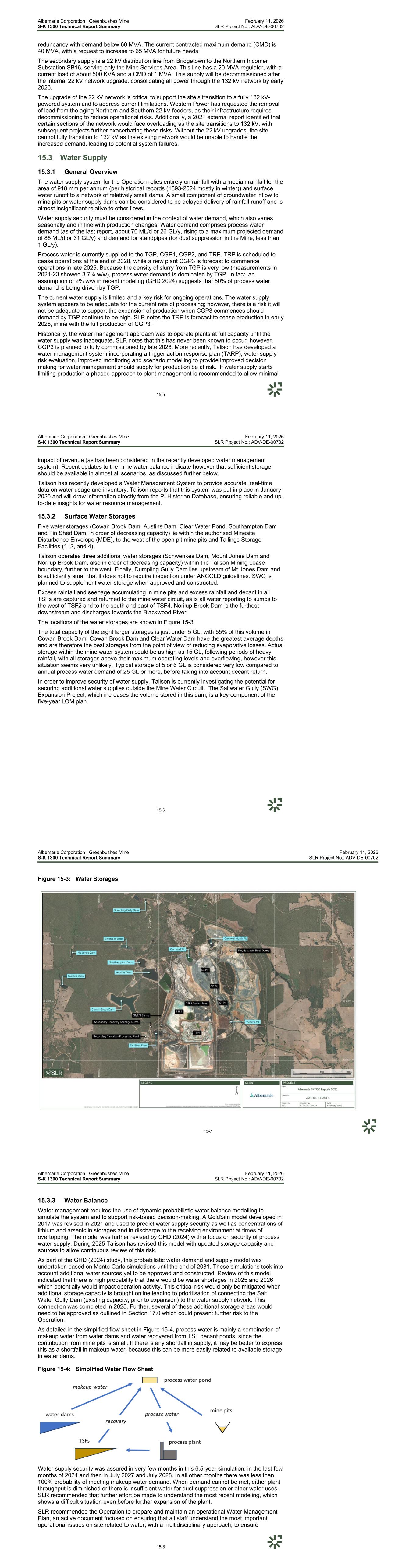
Albemarle Corporation | Greenbushes Mine S-K 1300 Technical Report Summary February 11, 2026 SLR Project No.: ADV-DE-00702 15-5 redundancy with demand below 60 MVA. The current contracted maximum demand (CMD) is 40 MVA, with a request to increase to 65 MVA for future needs. The secondary supply is a 22 kV distribution line from Bridgetown to the Northern Incomer Substation SB16, serving only the Mine Services Area. This line has a 20 MVA regulator, with a current load of about 500 KVA and a CMD of 1 MVA. This supply will be decommissioned after the internal 22 kV network upgrade, consolidating all power through the 132 kV network by early 2026. The upgrade of the 22 kV network is critical to support the site’s transition to a fully 132 kV- powered system and to address current limitations. Western Power has requested the removal of load from the aging Northern and Southern 22 kV feeders, as their infrastructure requires decommissioning to reduce operational risks. Additionally, a 2021 external report identified that certain sections of the network would face overloading as the site transitions to 132 kV, with subsequent projects further exacerbating these risks. Without the 22 kV upgrades, the site cannot fully transition to 132 kV as the existing network would be unable to handle the increased demand, leading to potential system failures. 15.3 Water Supply 15.3.1 General Overview The water supply system for the Operation relies entirely on rainfall with a median rainfall for the area of 918 mm per annum (per historical records (1893-2024 mostly in winter)) and surface water runoff to a network of relatively small dams. A small component of groundwater inflow to mine pits or water supply dams can be considered to be delayed delivery of rainfall runoff and is almost insignificant relative to other flows. Water supply security must be considered in the context of water demand, which also varies seasonally and in line with production changes. Water demand comprises process water demand (as of the last report, about 70 ML/d or 26 GL/y, rising to a maximum projected demand of 85 ML/d or 31 GL/y) and demand for standpipes (for dust suppression in the Mine, less than 1 GL/y). Process water is currently supplied to the TGP, CGP1, CGP2, and TRP. TRP is scheduled to cease operations at the end of 2028, while a new plant CGP3 is forecast to commence operations in late 2025. Because the density of slurry from TGP is very low (measurements in 2021-23 showed 3.7% w/w), process water demand is dominated by TGP. In fact, an assumption of 2% w/w in recent modeling (GHD 2024) suggests that 50% of process water demand is being driven by TGP. The current water supply is limited and a key risk for ongoing operations. The water supply system appears to be adequate for the current rate of processing; however, there is a risk it will not be adequate to support the expansion of production when CGP3 commences should demand by TGP continue to be high. SLR notes the TRP is forecast to cease production in early 2028, inline with the full production of CGP3. Historically, the water management approach was to operate plants at full capacity until the water supply was inadequate, SLR notes that this has never been known to occur; however, CGP3 is planned to fully commissioned by late 2026. More recently, Talison has developed a water management system incorporating a trigger action response plan (TARP), water supply risk evaluation, improved monitoring and scenario modelling to provide improved decision making for water management should supply for production be at risk. If water supply starts limiting production a phased approach to plant management is recommended to allow minimal Albemarle Corporation | Greenbushes Mine S-K 1300 Technical Report Summary February 11, 2026 SLR Project No.: ADV-DE-00702 15-6 impact of revenue (as has been considered in the recently developed water management system). Recent updates to the mine water balance indicate however that sufficient storage should be available in almost all scenarios, as discussed further below. Talison has recently developed a Water Management System to provide accurate, real-time data on water usage and inventory. Talison reports that this system was put in place in January 2025 and will draw information directly from the PI Historian Database, ensuring reliable and up- to-date insights for water resource management. 15.3.2 Surface Water Storages Five water storages (Cowan Brook Dam, Austins Dam, Clear Water Pond, Southampton Dam and Tin Shed Dam, in order of decreasing capacity) lie within the authorised Minesite Disturbance Envelope (MDE), to the west of the open pit mine pits and Tailings Storage Facilities (1, 2, and 4). Talison operates three additional water storages (Schwenkes Dam, Mount Jones Dam and Norilup Brook Dam, also in order of decreasing capacity) within the Talison Mining Lease boundary, further to the west. Finally, Dumpling Gully Dam lies upstream of Mt Jones Dam and is sufficiently small that it does not to require inspection under ANCOLD guidelines. SWG is planned to supplement water storage when approved and constructed. Excess rainfall and seepage accumulating in mine pits and excess rainfall and decant in all TSFs are captured and returned to the mine water circuit, as is all water reporting to sumps to the west of TSF2 and to the south and east of TSF4. Norilup Brook Dam is the furthest downstream and discharges towards the Blackwood River. The locations of the water storages are shown in Figure 15-3. The total capacity of the eight larger storages is just under 5 GL, with 55% of this volume in Cowan Brook Dam. Cowan Brook Dam and Clear Water Dam have the greatest average depths and are therefore the best storages from the point of view of reducing evaporative losses. Actual storage within the mine water system could be as high as 15 GL, following periods of heavy rainfall, with all storages above their maximum operating levels and overflowing, however this situation seems very unlikely. Typical storage of 5 or 6 GL is considered very low compared to annual process water demand of 25 GL or more, before taking into account decant return. In order to improve security of water supply, Talison is currently investigating the potential for securing additional water supplies outside the Mine Water Circuit. The Saltwater Gully (SWG) Expansion Project, which increases the volume stored in this dam, is a key component of the five-year LOM plan. Albemarle Corporation | Greenbushes Mine S-K 1300 Technical Report Summary February 11, 2026 SLR Project No.: ADV-DE-00702 15-7 Figure 15-3: Water Storages Albemarle Corporation | Greenbushes Mine S-K 1300 Technical Report Summary February 11, 2026 SLR Project No.: ADV-DE-00702 15-8 15.3.3 Water Balance Water management requires the use of dynamic probabilistic water balance modelling to simulate the system and to support risk-based decision-making. A GoldSim model developed in 2017 was revised in 2021 and used to predict water supply security as well as concentrations of lithium and arsenic in storages and in discharge to the receiving environment at times of overtopping. The model was further revised by GHD (2024) with a focus on security of process water supply. During 2025 Talison has revised this model with updated storage capacity and sources to allow continuous review of this risk. As part of the GHD (2024) study, this probabilistic water demand and supply model was undertaken based on Monte Carlo simulations until the end of 2031. These simulations took into account additional water sources yet to be approved and constructed. Review of this model indicated that there is high probability that there would be water shortages in 2025 and 2026 which potentially would impact operation activity. This critical risk would only be mitigated when additional storage capacity is brought online leading to prioritisation of connecting the Salt Water Gully Dam (existing capacity, prior to expansion) to the water supply network. This connection was completed in 2025. Further, several of these additional storage areas would need to be approved as outlined in Section 17.0 which could present further risk to the Operation. As detailed in the simplified flow sheet in Figure 15-4, process water is mainly a combination of makeup water from water dams and water recovered from TSF decant ponds, since the contribution from mine pits is small. If there is any shortfall in supply, it may be better to express this as a shortfall in makeup water, because this can be more easily related to available storage in water dams. Figure 15-4: Simplified Water Flow Sheet Water supply security was assured in very few months in this 6.5-year simulation: in the last few months of 2024 and then in July 2027 and July 2028. In all other months there was less than 100% probability of meeting makeup water demand. When demand cannot be met, either plant throughput is diminished or there is insufficient water for dust suppression or other water uses. SLR recommended that further effort be made to understand the most recent modeling, which shows a difficult situation even before further expansion of the plant. SLR recommended the Operation to prepare and maintain an operational Water Management Plan, an active document focused on ensuring that all staff understand the most important operational issues on site related to water, with a multidisciplinary approach, to ensure
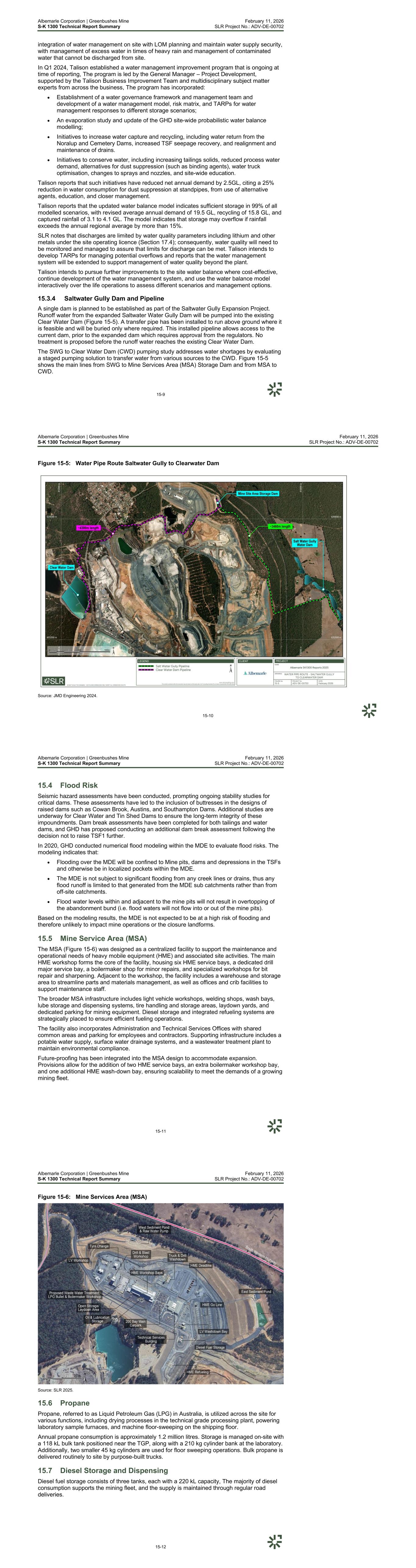
Albemarle Corporation | Greenbushes Mine S-K 1300 Technical Report Summary February 11, 2026 SLR Project No.: ADV-DE-00702 15-9 integration of water management on site with LOM planning and maintain water supply security, with management of excess water in times of heavy rain and management of contaminated water that cannot be discharged from site. In Q1 2024, Talison established a water management improvement program that is ongoing at time of reporting, The program is led by the General Manager – Project Development, supported by the Talison Business Improvement Team and multidisciplinary subject matter experts from across the business, The program has incorporated: • Establishment of a water governance framework and management team and development of a water management model, risk matrix, and TARPs for water management responses to different storage scenarios; • An evaporation study and update of the GHD site-wide probabilistic water balance modelling; • Initiatives to increase water capture and recycling, including water return from the Noralup and Cemetery Dams, increased TSF seepage recovery, and realignment and maintenance of drains. • Initiatives to conserve water, including increasing tailings solids, reduced process water demand, alternatives for dust suppression (such as binding agents), water truck optimisation, changes to sprays and nozzles, and site-wide education. Talison reports that such initiatives have reduced net annual demand by 2.5GL, citing a 25% reduction in water consumption for dust suppression at standpipes, from use of alternative agents, education, and closer management. Talison reports that the updated water balance model indicates sufficient storage in 99% of all modelled scenarios, with revised average annual demand of 19.5 GL, recycling of 15.8 GL, and captured rainfall of 3.1 to 4.1 GL. The model indicates that storage may overflow if rainfall exceeds the annual regional average by more than 15%. SLR notes that discharges are limited by water quality parameters including lithium and other metals under the site operating licence (Section 17.4); consequently, water quality will need to be monitored and managed to assure that limits for discharge can be met. Talison intends to develop TARPs for managing potential overflows and reports that the water management system will be extended to support management of water quality beyond the plant. Talison intends to pursue further improvements to the site water balance where cost-effective, continue development of the water management system, and use the water balance model interactively over the life operations to assess different scenarios and management options. 15.3.4 Saltwater Gully Dam and Pipeline A single dam is planned to be established as part of the Saltwater Gully Expansion Project. Runoff water from the expanded Saltwater Water Gully Dam will be pumped into the existing Clear Water Dam (Figure 15-5). A transfer pipe has been installed to run above ground where it is feasible and will be buried only where required. This installed pipeline allows access to the current dam, prior to the expanded dam which requires approval from the regulators. No treatment is proposed before the runoff water reaches the existing Clear Water Dam. The SWG to Clear Water Dam (CWD) pumping study addresses water shortages by evaluating a staged pumping solution to transfer water from various sources to the CWD. Figure 15-5 shows the main lines from SWG to Mine Services Area (MSA) Storage Dam and from MSA to CWD. Albemarle Corporation | Greenbushes Mine S-K 1300 Technical Report Summary February 11, 2026 SLR Project No.: ADV-DE-00702 15-10 Figure 15-5: Water Pipe Route Saltwater Gully to Clearwater Dam Source: JMD Engineering 2024. Albemarle Corporation | Greenbushes Mine S-K 1300 Technical Report Summary February 11, 2026 SLR Project No.: ADV-DE-00702 15-11 15.4 Flood Risk Seismic hazard assessments have been conducted, prompting ongoing stability studies for critical dams. These assessments have led to the inclusion of buttresses in the designs of raised dams such as Cowan Brook, Austins, and Southampton Dams. Additional studies are underway for Clear Water and Tin Shed Dams to ensure the long-term integrity of these impoundments. Dam break assessments have been completed for both tailings and water dams, and GHD has proposed conducting an additional dam break assessment following the decision not to raise TSF1 further. In 2020, GHD conducted numerical flood modeling within the MDE to evaluate flood risks. The modeling indicates that: • Flooding over the MDE will be confined to Mine pits, dams and depressions in the TSFs and otherwise be in localized pockets within the MDE. • The MDE is not subject to significant flooding from any creek lines or drains, thus any flood runoff is limited to that generated from the MDE sub catchments rather than from off-site catchments. • Flood water levels within and adjacent to the mine pits will not result in overtopping of the abandonment bund (i.e. flood waters will not flow into or out of the mine pits). Based on the modeling results, the MDE is not expected to be at a high risk of flooding and therefore unlikely to impact mine operations or the closure landforms. 15.5 Mine Service Area (MSA) The MSA (Figure 15-6) was designed as a centralized facility to support the maintenance and operational needs of heavy mobile equipment (HME) and associated site activities. The main HME workshop forms the core of the facility, housing six HME service bays, a dedicated drill major service bay, a boilermaker shop for minor repairs, and specialized workshops for bit repair and sharpening. Adjacent to the workshop, the facility includes a warehouse and storage area to streamline parts and materials management, as well as offices and crib facilities to support maintenance staff. The broader MSA infrastructure includes light vehicle workshops, welding shops, wash bays, lube storage and dispensing systems, tire handling and storage areas, laydown yards, and dedicated parking for mining equipment. Diesel storage and integrated refueling systems are strategically placed to ensure efficient fueling operations. The facility also incorporates Administration and Technical Services Offices with shared common areas and parking for employees and contractors. Supporting infrastructure includes a potable water supply, surface water drainage systems, and a wastewater treatment plant to maintain environmental compliance. Future-proofing has been integrated into the MSA design to accommodate expansion. Provisions allow for the addition of two HME service bays, an extra boilermaker workshop bay, and one additional HME wash-down bay, ensuring scalability to meet the demands of a growing mining fleet. Albemarle Corporation | Greenbushes Mine S-K 1300 Technical Report Summary February 11, 2026 SLR Project No.: ADV-DE-00702 15-12 Figure 15-6: Mine Services Area (MSA) Source: SLR 2025. 15.6 Propane Propane, referred to as Liquid Petroleum Gas (LPG) in Australia, is utilized across the site for various functions, including drying processes in the technical grade processing plant, powering laboratory sample furnaces, and machine floor-sweeping on the shipping floor. Annual propane consumption is approximately 1.2 million litres. Storage is managed on-site with a 118 kL bulk tank positioned near the TGP, along with a 210 kg cylinder bank at the laboratory. Additionally, two smaller 45 kg cylinders are used for floor sweeping operations. Bulk propane is delivered routinely to site by purpose-built trucks. 15.7 Diesel Storage and Dispensing Diesel fuel storage consists of three tanks, each with a 220 kL capacity, The majority of diesel consumption supports the mining fleet, and the supply is maintained through regular road deliveries.

Albemarle Corporation | Greenbushes Mine S-K 1300 Technical Report Summary February 11, 2026 SLR Project No.: ADV-DE-00702 15-13 15.8 Site-Camp Accommodation Facilities A 500-person accommodation camp is located adjacent to the Operation. This facility, located southwest of the main project area, was completed and certified for occupancy in January 2024. In addition, an offsite camp is currently utilised to accommodate contract works. 15.9 Communications and SCADA Systems Greenbushes is equipped with advanced communications and control systems to support its operations. The site has a fixed fiber network, ensuring robust and reliable connectivity, with physical separation maintained between Corporate/IT and Operational Technology (OT) systems for enhanced security and functionality. Additionally, a private LTE network for high-speed wireless communication is in place. It can be used for cellular communication in smartphones, tablets, and IoT devices, and primarily serving mobile equipment across the site. Control systems for each plant and facility utilize an AVEVA Plant SCADA system, integrated with Rockwell control hardware, providing efficient and centralized management of operational processes. 15.10 Tailings Storage 15.10.1 General Overview Four TSFs, namely TSF1, TSF2, TSF3 and TSF4 have been developed as part of the mining operations. TSF2’s remaining capacity was consumed in H1 2024. TSF4 has an approved capacity as at July 2025 was 40.4 Mbcm and is currently the only operational TSF, with an additional offsite TSF (TSF5) planned to support the LOM plan requirements. A further raise is planned for TSF4 which will add an additional to support the operations until late in the 2030’s. All tails are transported from the plants via a slurry pipe to a distribution plant. 15.10.1.1 TSF1 The TSF1 starter embankment is understood to have been constructed around 1970 but may have been used for tailings deposition more than 20 years earlier. There was likely dredging or other mining in the area associated with tin mining extending back over 100 years. TSF1 is the largest of the TSFs at Greenbushes with a footprint area of approximately 110 ha. The perimeter embankment is approximately 4 km in length and crest elevation of approximately RL 1282 m. TSF1 was put into care and maintenance in 2006 and is currently being mined and reprocessed in the TRP. Remining is planned to be executed to a depth of 7 m. Backfilling of TSF1 with mine waste rock was to be undertaken after the remining with the backfill not exceeding the pre-remining tailings levels of RL 1275 m in the south and RL 1280 m in the north. 15.10.1.2 TSF2 The deposition into TSF2 to RL 1280 m was completed in December 2023, based on a design executed in 2021, which incorporated ground improvement and stability assessment. Updates to the 2021 design were executed in 2023 following geotechnical site investigations of the existing structure executed in 2023. These updates included incorporation of ground improvement works executed to the western wall foundation, dam-break modeling, which resulted in assignment of a higher consequence category for TSF2, necessitating increased seismic loading and a seismic hazard assessment, revised deposition schedule, changes to Albemarle Corporation | Greenbushes Mine S-K 1300 Technical Report Summary February 11, 2026 SLR Project No.: ADV-DE-00702 15-14 infrastructure around the facility and additional detailing of the embankment design including the interface with TSF1. The increased seismic loading reduces the Factor of Safety for stability and requires additional control of the phreatic line which is to be achieved by maintaining the operating pond away from the southern and western embankments. To maintain the pond at least 200 m from the embankments, the maximum operating level (MOL) was reduced to RL 1278.3 m. The updated results, assuming the MOL is not exceeded, demonstrate that the stability of the TSF design is expected to remain satisfactory under long-term, post-seismic and post-static liquefaction conditions. Figure 15-7 shows TSF2 which has now ceased operations. Figure 15-7: TSF2 Source: SLR 2025 15.10.1.3 TSF3 TSF3 (decommissioned) is a small 8.5 ha facility formed by a single cross-valley dam that pre- dates 1943 and was historically used to dispose of slimes from the Tin Shed tantalum operations, which were located 300 m to the south-west of TSF2. There is limited information on the design details of TSF3 and it is estimated that the facility currently contains about 800,000 tonnes of process waste. Anecdotal information indicates that deposition ceased around the late 1980s or early 1990s; however, observations from satellite data indicate that TSF3 maintained a decant pond until 1999. The facility was listed as “active but with no tailings deposition” for a number of years although the Tailings Storage Data Sheet for TSF3 records the “year deposition complete” as being 200 . It appears that this refers to small amounts of lithium tailings that were deposited between 2006 and 2008 to raise the internal level before capping. The facility was capped with clayey soil and rehabilitation trials were established in 2011 where the upper surface was shaped, ripped, and seeded. Albemarle Corporation | Greenbushes Mine S-K 1300 Technical Report Summary February 11, 2026 SLR Project No.: ADV-DE-00702 15-15 15.10.1.4 TSF4 TSF4 comprises Cells 1 (eastern cell) and Cell 2 (western cell), which is the current active facility. The design for TSF4 has the external walls constructed using the centerline construction method with a vertical clay core and waste rockfill for downstream zones. A starter dam up to 20 m high will provide for approximately the first two years of operation, followed by 5 m raises at approximately yearly intervals. The initial crest level was designed as RL 1295 m, resulting in a maximum embankment height of approximately 45 m. The starter embankment varies in height from natural ground to 15 m and consists of an upstream clay/Bituminous Geomembrane (BGM) low permeable zone on the upstream facing over a mine waste rock embankment. The TSF4 starter embankment design includes a liner system (floor and embankments) to reduce seepage from the facility. In Cell1, the containment system comprises a combination of clay liner (80%) and BGM (20%). In Cell2, the containment system consists entirely of BGM. A divider embankment separates TSF4 into two cells that are built from mine waste using the centerline construction method. The starter embankment varies in height from natural ground to 15 m and consists of an upstream clay/BGM liner. The eastern cell is designed such that the central decant will be accessed from the southern TSF1 embankment, where the BGM over the clay blanket acts as a water liner. The western cell only partly rests against TSF1 and is designed to have a central decant. Decant water will be recovered by skid-mounted pumps with floating suctions. Figure 15-8 shows the layout of TSF1, TSF2, and TSF4. Albemarle Corporation | Greenbushes Mine S-K 1300 Technical Report Summary February 11, 2026 SLR Project No.: ADV-DE-00702 15-16 Figure 15-8: Greenbushes TSFs Source: SLR 2025. 15.10.1.5 TSF5 Talison has identified construction of TSF5 is required to provide LOM tailings storage capacity. The capacity of TSF5 is being targeted at 100 Mm3. This volume is considered sufficient to contain all tailings for the current life of mine, forecast to be 77 Mm3. Basis of Design for application to the scoping study for TSF5 has been prepared by Klohn Crippen Berger (KCB) with the intent of identifying and assessing options for providing tailings

Albemarle Corporation | Greenbushes Mine S-K 1300 Technical Report Summary February 11, 2026 SLR Project No.: ADV-DE-00702 15-17 storage capacity for approximately 140 Mt of tailings to align with current production forecasts beyond calendar year (CY) 2028, i.e., deposition commences in CY 2032. However, as at the reporting date, Talison has not secured ownership of the land to accommodate TSF5.SLR notes the specific design and ultimate requirements of TSF5 are subject to the Strategic Asset Review currently underway. It is expected this review will reduce the requirements of the TSF. 15.10.2 Design Responsibilities and Engineer of Record The designs for TSF1, TSF2 and TSF4 have all been produced by GHD and have been executed in accordance with the: • Western Australian Department of Mines and Petroleum (2013). ‘Code of Practice, Tailings Storage Facility in Western Australia’ • Western Australian Department of Mines and Petroleum (2015). ‘Guide to the preparation of a design report for tailings storage facilities (TSFs)’. • Australian National Committee on Large Dams (ANCOLD) ‘Guidelines on Planning, Operation and Closure of Tailings Dams (2019)’. The TSFs have been audited by GHD. It is assumed, in the absence of formal appointment documentation, that the role of Engineer of Record (EoR) for TSFs is performed by GHD who have provided qualified staff, experienced in tailings management, dams design, and construction, to execute the works. Albemarle Corporation | Greenbushes Mine S-K 1300 Technical Report Summary February 11, 2026 SLR Project No.: ADV-DE-00702 16-1 16.0 Market Studies 16.1 Introduction SLR considers that understanding the market in which Talison operates is critical to understanding the opportunities and complexities within the operation. As such, a brief overview of those markets is presented below, which was supplied to SLR in August 2025. This information is supplied by Albemarle and its third-party marketing specialist Fastmarkets. SLR presents this information for reference purposes only and is not a marketing expert. Albemarle engaged Fastmarkets to provide a marketing study to support lithium pricing assumptions. A summary of the lithium market has been provided to offer context on developments and the basis for Fastmarkets’ assessment of price. Historically, lithium applications were concentrated in ceramics, glasses, and greases. However, the landscape has shifted dramatically as demand for portable energy storage solutions has expanded significantly. The proliferation of rechargeable batteries in portable consumer devices, including mobile phones and laptop computers, coupled with the recent emergence of electric vehicles, has fundamentally altered lithium consumption patterns. Battery applications represented 40.1% of lithium consumption in 2016. Since that time, battery demand has demonstrated remarkable growth, expanding at a compound average growth rate of 32.7% annually between 2016 and 2024. This growth trajectory has resulted in battery applications now accounting for 82.0% of total lithium consumption, establishing batteries as the dominant driver of lithium demand. Beside EVs and other electrically powered vehicles (eMobility), lithium-ion batteries (LIBs) are starting to find increasing use in energy storage systems (ESS). While energy storage systems currently represent a minor market segment, this sector is anticipated to experience rapid expansion as it addresses critical challenges related to renewable energy integration and grid stability. As EVs become the established mainstream methods of transport – helped in no-small part by government incentives on EVs and forthcoming bans on vehicles with combustion engines – demand for lithium is forecast to rise to several multiples of historic levels. 16.2 Lithium Demand In recent years, the lithium industry has gone through an evolution. The ceramic and glass sectors have lost their dominant position to the growth in mobile electronics and most recently to EVs. The development of electric vehicle technology followed a measured progression that accelerated dramatically in recent years. The Toyota Prius, introduced at the end of 1997 as the first mass-market hybrid petrol-electric vehicle, utilized nickel-metal hydride battery technology that did not require lithium. Commercial fully electric lithium-ion battery powered vehicles emerged in 2008 with the Tesla Roadster, followed by the Mitsubishi i-MiEV in July 2009. Initial market adoption proceeded gradually as charging infrastructure development, model diversification, and range improvements established the foundation for subsequent acceleration. The electric mobility sector, encompassing all electrically powered vehicles, has emerged as the primary driver of overall lithium demand growth. Fastmarkets estimates that total lithium Albemarle Corporation | Greenbushes Mine S-K 1300 Technical Report Summary February 11, 2026 SLR Project No.: ADV-DE-00702 16-2 demand reached over 1 Mt lithium carbonate equivalents (LCEs) in 2024, with electric vehicles representing 63% of this consumption. Fastmarkets believes that demand for EVs will continue to accelerate in the next decade, as they become increasingly affordable, and a greater range of models enter the market. Legislation will also force the transition in the mid-term. Additionally, commercial fleet electrification is expected to advance as governments and businesses seek to develop green domestic transportation networks. Figure 16-1: EV Sales and Penetration Rates (000 vehicles, %) Further out, the BEV segment will come to dominate the EV sector, as both residential and commercial transport in developed markets increasingly shifts to BEVs and away from hybrids, and as developing markets benefit from the deflating BEV prices. The resurgence in popularity of plug-in hybrid electric vehicles (PHEVs) in the US and China gives it a longer potential sales period, where its high compound annual growth rate (CAGR) rate is driven by its current low sales base. Albemarle Corporation | Greenbushes Mine S-K 1300 Technical Report Summary February 11, 2026 SLR Project No.: ADV-DE-00702 16-3 Figure 16-2: Lithium Demand in Key Sectors (000 LCE tonnes) Looking forward, Fastmarkets expects demand from eMobility, especially BEVs, to continue to drive lithium demand growth. While traditional and other areas will all continue to add to lithium demand, the significance of the EV sector for the lithium supply-demand balance requires deeper discussion. Alternative technologies or societal developments could influence lithium demand trajectories. Household car sharing preferences rather than ownership models, autonomous vehicle development enabling transport-as-a-service paradigms where ride hailing and car sharing become normalized particularly in densely populated areas, could reduce global vehicle populations. Energy storage and powertrain technologies continue evolving, with hydrogen fuel cells and sodium-ion batteries representing potential market share competitors. China's electric vehicle demand remains robust, with CATL leading the industry through recent battery technology announcements expanding addressable markets. Electric vehicle uptake decelerated in Western Europe during 2024, primarily due to German and French economic weakness. However, the German electric vehicle market has rebounded and now leads European sales volumes in 2025. The French electric vehicle market continues struggling with subsidy losses, but increased imports, new models, and improving infrastructure indicate this represents a temporary rather than structural challenge. The ESS market gained significant momentum in 2024. Fastmarkets continue to forecast significant, strong year-on-year growth. But US tariffs on Chinese ESS cells threaten the price- competitiveness of imports and the sustained growth of ESS deployments in this leading market. Despite these negative factors, including ongoing military conflicts, BEV sales growth remains robust but is being more heavily supported by PHEV sales in China than in previous years.

Albemarle Corporation | Greenbushes Mine S-K 1300 Technical Report Summary February 11, 2026 SLR Project No.: ADV-DE-00702 16-4 Many Japanese original equipment manufacturers initially demonstrated reluctance toward wholehearted electric vehicle adoption, apparently motivated by Japan's energy import requirements for electricity production. Toyota particularly championed hydrogen fuel cells as alternatives to or parallel with electric vehicles. However, recent years have seen these manufacturers signal intent to transition to electric powertrains. While electric vehicles demonstrate lower lifetime operating costs compared to internal combustion engines, initial purchase costs can be prohibitive. Higher-end vehicles manage this cost within overall vehicle price contexts, but entry-level and smaller vehicles face battery pack cost hurdles preventing battery electric vehicle competitiveness with internal combustion engine vehicles. General consensus indicates $100 per kilowatt-hour at pack level represents the approximate global benchmark for battery electric vehicles to achieve price parity with internal combustion engine vehicles. One of the most significant developments involves new dominance by Chinese brands internationally beyond domestic markets. China surpassed Japan as the largest car exporter, with brands like BYD achieving impressive market shares in numerous countries including European markets. This success results from highly competitive pricing, as competition develops among Chinese manufacturers, is likely increasing electric vehicle adoption in various markets. Although concerns exist regarding raw material availability, charging infrastructure, and initial costs, Fastmarkets believes many barriers are being progressively eliminated. Besides the cost of EVs relative to internal combustion engines (ICE), range anxiety will continue to dissuade the uptake of BEV, particularly in markets where vehicle use is necessary for travel. This anxiety will only diminish as battery ranges increase, charging times diminish and charging infrastructure improves. Instead, where range anxiety is an issue, PHEV sales will partly compensate. Fastmarkets expects near- to mid-term electric vehicle market growth to remain robust. The most significant near-term threats are macroeconomic rather than electric vehicle specific. Fastmarkets' macroeconomic forecast anticipates somewhat slower global economic growth in 2025-2026, driven by high interest rates, low investment rates, and decelerating Chinese economic growth. United States economic performance continues outperforming Europe due to greater consumer resistance to higher interest rates. Consumer spending represents a significantly greater share of United States regional economy compared to Europe, where industrial and investment slowdowns combined with decelerating Chinese demand impact purchasing activity more severely. The Chinese economy experienced slower growth in 2024 compared to the 2023 rebound year but maintains comparably significant growth rates. Some Chinese macroeconomic strategists anticipate slower but healthier future growth. Current uncertainty regarding United States tariffs threatens to reduce international trade volumes, increase product prices, and slow economic growth. This economic challenge will dampen new vehicle sales expectations, but while Fastmarkets expects total vehicle sales to be negatively impacted, the majority of impact will focus on internal combustion engines. Electric vehicles, with reduced operating costs and lower duties in some areas, are viewed as cost- cutting measures and more future-proof investments. With some original equipment manufacturers reducing electric vehicle costs to grow or maintain market share, electric vehicles appear increasingly attractive compared to internal combustion engines. Government-imposed targets and legislation banning internal combustion engine vehicle sales support strong electric vehicle uptake growth expectations once immediate economic challenges are overcome. However, OEMs and public pressure are increasing the debate around these targets, likely pushing some forward by several years. This development does not Albemarle Corporation | Greenbushes Mine S-K 1300 Technical Report Summary February 11, 2026 SLR Project No.: ADV-DE-00702 16-5 discount risks to electric vehicle uptake including alternative fuels, different battery types, or shifts in car ownership that would reduce electric vehicle or lithium-ion battery demand. Overall, Fastmarkets forecasts electric vehicle sales reaching 50 million by 2032. At 56% of global sales, this represents impressive acceleration while highlighting room for continued growth. 16.3 Lithium Supply Up until 2016, global lithium production was dominated by two deposits: Greenbushes (Australia, hard rock) and the Salar de Atacama (Chile, brine), the latter having two commercial operators, Albemarle and SQM. Livent, formerly FMC Corp, was the third main producer in South America with an operation in Argentina, Salar del Hombre Muerto. Tianqi Lithium and Ganfeng Lithium were the two main Chinese lithium players, growing domestically and overseas with Tianqi buying a 51% stake in Greenbushes and Ganfeng Lithium developing lithium mining and production facilities in China, as well as investing in mines and brine operations in Australia and South America. In 2016 global lithium supply was about 187,000 t LCE. Supply expansion achieved a 27% CAGR between 2016 and 2024, responding to positive demand projections from the emerging EV industry. Australia, Chile, and China drove the majority of this growth trajectory. The supply response exceeded demand requirements, predisposing the placement of certain operations on care and maintenance status between 2018 and 2020. Supply contracted by 7,000 t in 2020 due to production reductions, decreased demand, and COVID-19 related operational constraints including social distancing measures. Recovery commenced in 2021, with supply increasing 37% year-over-year to reach 538,000 t LCE, driven by post-pandemic stimulus measures and increasingly favorable long-term demand projections. This recovery resulted in a 437% price increase from the beginning of the year, which incentivized supply expansion initiatives. Strong growth momentum continued with supply increases of 42% and 37% year-over-year in 2022 and 2023, respectively. In 2024, 87% of global lithium supply came from just four countries: Australia, Chile, Argentina and China. This remainder of supply came from Zimbabwe, Brazil, the United States and South Africa. Fastmarkets expect spodumene production to maintain market share because of expansions and new mines in Australia coming online, as well as the emergence of Africa as an important lithium-mining region. In 2035, Fastmarkets expect spodumene resources to contribute about 1.36 Mt LCE, or 4 % of total supply, at the expense of brine’s share, which Fastmarkets forecast to drop to 35%, or 1.01 Mt LCE, with the remaining 17% to be filled mostly by other hard rock sources, mainly lepidolite. The successful implementation of DLE technology could also materially affect production from brine resources. Fastmarkets expect Eastern Asia (China) to be the largest single producer globally in 2035, accounting for 30% of supply, followed by South America with 28% and Australia and New Zealand at 25%. Looking forward, as discussed above, Fastmarkets forecasts that demand will grow significantly. However, supply is also adapting in tandem and outpacing demand in the near term. Global mine supply in 2024 was 1,042,869 t LCE. Based on Fastmarkets’ view of global lithium projects in development, mine supply is forecast to increase to 2,854,357 in 2035 – a CAGR of 8%. Albemarle Corporation | Greenbushes Mine S-K 1300 Technical Report Summary February 11, 2026 SLR Project No.: ADV-DE-00702 16-6 This projected growth in supply is restricted to projects that are ‘brownfield’ expansions of existing projects or ‘greenfield’ projects that Fastmarkets believes likely to reach production. Such projects are at an advanced stage of development, perhaps with operating demonstration plants and sufficient financing to begin construction. ‘Speculative projects’, which are yet to secure funding or have not commissioned a feasibility project, for example, have been excluded until they can demonstrate that there is a reasonable chance that they will progress to their nameplate capacity. Figure 16-3: Forecast Mine Supply (000 tonnes LCE) The lithium industry has witnessed extensive new development projects and expansions incentivized by elevated pricing during 2022 and early 2023, supported by government policy and fiscal measures. The Inflation Reduction Act exemplifies how subsidies can incentivize Electric Vehicle supply chain development, while Europe demonstrates strong emphasis on supply chain resilience enhancement. The Trump Administration has adopted a proactive approach regarding raw materials supply chains, providing funding support for various commodity projects including rare earths and antimony. Supply additions from restarts, expansions, and greenfield projects commenced in 2023, leading to rapid supply increases, particularly within China. The market was unprepared for the speed of Chinese producers' response to 2021-2022 supply constraints. China rapidly developed domestic lepidolite assets and imported Direct Shipping Ore from Africa, primarily Zimbabwe and recently Nigeria. The combination of planned increases and accelerated Chinese response has created oversupply conditions. Current market conditions feature ongoing supply ramp-up concurrent with high-cost production curtailments. Recent supply restraint has primarily originated from non-Chinese producers, a trend expected to continue, although increasing production restraint is emerging within China. In July, local administrations implemented measures controlling lepidolite mining pollution and constraining high-cost supply. The net result is that there are no nearby concerns about supply shortages, although bouts of restocking could lead to short-term periods of tightness. Over the longer term, there is no room for complacency. Chinese production seems less prone to suffering delays — as shown with the ramp-up of domestic lepidolite and African spodumene projects. But in most cases, new Albemarle Corporation | Greenbushes Mine S-K 1300 Technical Report Summary February 11, 2026 SLR Project No.: ADV-DE-00702 16-7 capacity experiences start-up delays (such as issues with gaining permits, as well as labour, know-how and equipment shortages). 16.4 Lithium Supply-Demand Balance Despite a low-price environment and selective production curtailments—primarily by higher- cost, non-Chinese producers—global lithium supply continues to grow. Concurrently, EV adoption rates, while still robust, have decelerated from post‑COVID peaks exceeding 40% year‑on‑year to an anticipated average of 20 % annual growth over the coming years. • Supply Trends: o The 2021–2022 price surge catalysed a significant expansion of production capacity, some of which remains in ramp‑up phase. o Higher-cost assets have been curtailed, moderating supply growth but not reversing the trend. • Demand Trends: o EV-related lithium demand is forecast to rise by roughly 20% per annum, slower than the >40% growth observed in the early post-pandemic period. o Overall demand growth has fallen short of prior expectations. • Surplus and Deficit Outlook: o A surplus is expected to persist through 2026, with an estimated oversupply of approximately 17,000 t LCE in 2026—equivalent to only ~1 % of that year’s projected demand. o Supply‑side restraint and investment reductions are now forecast to precipitate a return to market deficit in 2027, one year earlier than previous forecasts. • Risks to the Forecast: o Upside demand surprises, stemming from faster EV adoption or new industrial applications, could erode surplus more rapidly. o Delays or cancellations of permitted and financed projects may constrain supply growth, tightening the balance—especially in the late‑decade and early‑2030s period.

Albemarle Corporation | Greenbushes Mine S-K 1300 Technical Report Summary February 11, 2026 SLR Project No.: ADV-DE-00702 16-8 Figure 16-4: Lithium Supply-Demand Balance (000 tonnes LCE) Source: Fastmarkets 2025 16.5 Lithium Prices Lithium prices have proven highly susceptible to shifts in the supply-demand balance and inventory cycles. From early 2018 through the second half of 2020, spot CIF prices for battery- grade lithium carbonate in China, Japan and Korea fell from about $20/kg to a low of $6.75/ kg, a consequence of sustained production increases that began in 2017. The subsequent recovery in 2021 and 2022, spurred by tightening margins, drove spodumene concentrate prices to exceed $8,000/t in late 2022, while lithium hydroxide and carbonate reached peaks of $85/kg and $81/kg, respectively. During this period, many players across the cathode-active-material supply chain aggressively built inventories, not only to hedge against further price increases but also to prepare for what was expected to be another strong year of EV-driven battery demand in 2023. However, this optimism gave way to a sharp correction in early 2023, when spodumene prices plunged by nearly 40 %—to $4,850/t by March—prompted by overextended stockpiles, rapid expansion of Chinese lepidolite and African direct-shipping ore exports, and weaker-than- forecast demand. As purchasers found themselves holding unhedged inventory in a falling market, destocking accelerated the downward momentum, driving lithium carbonate and hydroxide prices down by more than 85% to 90% from their 2022 highs by year-end. A muted rebound followed the 2023 trough. After the Lunar New Year of 2024, lithium carbonate briefly climbed to $14.25/kg before sliding to $10.61/kg by September—a 30 % decline from January levels—and eventually reaching near $8/kg in early 2025, a level widely considered the market floor. Spodumene mirrored this pattern: trading around $850/t in January 2024, rising to $1,232/t in May, and then returning to approximately $600/t in 2025. Despite these dramatic swings, current prices remain well above the 2020 lows, and early indications of producer cutbacks hint at the beginning of market consolidation. Whether these price floors hold as Albemarle Corporation | Greenbushes Mine S-K 1300 Technical Report Summary February 11, 2026 SLR Project No.: ADV-DE-00702 16-9 structural baselines will depend on renewed demand growth and more disciplined supply management in the latter part of the decade. Figure 16-5: Spodumene Prices (6% lithia, spot, CIF China, US$/tonne) Source: Fastmarkets, 2025 Now that the froth has come out of the market, Fastmarkets expect prices to find a base. In conversations with market participants Fastmarkets found more optimism than last year. Fastmarkets forecast is for hydroxide and carbonate prices to average $9.00 in 2025 and then rise to $11 in 2026. Fastmarkets do not expect prices to fall to levels of the last trough in 2020, mainly for the following three reasons: first, China is still exhibiting relatively strong EV growth, whereas in 2020, EV sales were weak on 2019’s subsidy cuts and due to the fallout from Covid; second, inflation has had a big impact on the mining sector over the past few years; and third, ESS is now a major part of the demand growth story. Fastmarkets forecast that hydroxide, carbonate, and spodumene prices will average $21.1/kg, $22.25/kg and $1,727/t, respectively between 2025 and 2035. For the purposes of the reserve estimate, Fastmarkets has provided price forecasts out to 2045 for the most utilised market price benchmarks. Fastmarkets recognizes that Albemarle’s current operations are expected to continue for at least another 20 years, but due to a lack of visibility and the recent significant changes in the market, prices beyond 2035 are unusually opaque for an industrial commodity. For this reason, the rationality beyond 2035 is assume a little increase in nominal price to keep real prices stable. Post-2035, the continued growth of demand for lithium from EVs and ESS, will require a lithium price that continues to incentivise new supply additions leading to more balanced markets. The lithium price will need to exceed the production cost for new projects and provide an adequate Albemarle Corporation | Greenbushes Mine S-K 1300 Technical Report Summary February 11, 2026 SLR Project No.: ADV-DE-00702 16-10 rate of return on investment to justify development. This will be helped by an established and accepted EV market, which will support the long-term lithium demand. Most producers sell technical and industrial grade which need a final refining step to battery grade (BG). Fastmarkets found that historically these products have traded consistently around 300-1000$/t discount across all regions to reflect this cost for final refinement to BG. Fastmarkets expect this spread will continue going forward. Fastmarkets have provided a base, high, and low case price forecast, to give an indication of the range of which prices could sit, depending on reasonable assumptions around potential impacts to the base case market balance. With the exception of lithium carbonate and spodumene from 2032, Fastmarkets have lowered their base case to reflect the reduced forecast deficits, the speed at which it has been proven that new capacity can be added to the market, and new participants stepping into the lithium industry that will bring more stability to long-term supply growth and prices as they will be able to ride out the cycles. The high case has been revised to reflect greater potential elasticity in the high in a deficit market. The same relationship has been preserved in the low case, meaning there is greater potential elasticity in the low in a surplus market. The high-case scenario presented is likely to occur either if the growth in supply is slower than expected or if demand growth is faster. The former becomes more probable the longer lithium prices remain below incentive levels because higher prices are needed to ensure next in-line supply is financed and built. This scenario could also unfold if China attempts to reform overcapacity, if DLE technology takes longer to commercialize, and if the West continues to suffer from permitting challenges, technology know-how issues, and scaling issues. Demand could exceed Fastmarkets expectation if EV adoption accelerates due to cost reductions or new incentive schemes, if ESS expands faster than expected driven by AI and data centers, and if global trade issues are quickly resolved. The low-case scenario could unfold if China continues to boost production in an unmeasured way and African mines that are in the pipeline start up quicker than expected. Demand could also fall short of expectations if the affordability of EVs remains a barrier to adoption, tariffs slow down ESS deployment, and sodium-ion battery technology rapidly evolves to take greater market share from LiBs. Between 2035 and 2045, Fastmarkets expects the lithium hydroxide and carbonate to be at a price parity. Albemarle Corporation | Greenbushes Mine S-K 1300 Technical Report Summary February 11, 2026 SLR Project No.: ADV-DE-00702 16-11 Figure 16-6: Spodumene Long-Term Price Forecast Scenarios (6% Li2O spot, CIF China, US$/tonne, real (2025)) Source: Fastmarkets, 2025

Albemarle Corporation | Greenbushes Mine S-K 1300 Technical Report Summary February 11, 2026 SLR Project No.: ADV-DE-00702 17-1 17.0 Environmental Studies, Permitting, and Plans, Negotiations, or Agreements with Local Individuals or Groups The following sections discuss the available information on the Operation’s environmental and social (E&S) aspects and the status of the Operation's approvals and permitting requirements. Potential impacts on biodiversity and surface water resources, and the controlling of land disturbance, are the key local environmental concerns for the project. Potential impacts on public amenity (dust and noise emissions) and cultural heritage, and the engagement, participation and community development for the local community and indigenous people/ traditional owners (TOs), are the key local social concerns for the project. Talison has undertaken an Operation E&S baseline and impact assessment in accordance with the local regulatory requirements. SLR conducted a site visit from July 21 to 22, 2025, to view the E&S conditions on the Greenbushes mine site and to conduct interviews with the local personnel on the E&S management of the site. There are E&S values that may place limitations on the Operation. Continuously recorded elevated dust or noise levels may result in temporary modifications to some operational activities, and the existence of cultural heritage sites may result in exclusion zones within future project development areas. There are potential future limits, constraints and obligations that may be difficult or costly to meet. These are associated with land access (including biodiversity offsets), meeting ambient noise/air quality requirements, managing surface water discharge, and meeting greenhouse gas emissions and Safeguard Mechanism obligations. Of these, meeting ambient noise/air quality requirements has the most potentially significant consequences for breaches. SLR considers that the identified potential future E&S constraints will require continued proactive management if the proposed LOM plan is to be realized in the near to medium term. There will be additional compliance costs associated with the key future project approvals and also with the Operation’s future compliance under the Safeguard Mechanism (“SGM”). There is also a potential for additional compliance costs associated with the management of site dust and noise emissions. 17.1 Environmental Studies The Operation has completed environmental baseline assessment, impact assessment and associated technical studies to support project approval applications, including studies related to: • Biodiversity. • Surface Water and Groundwater Resources. • Materials Characterization. • Air Quality. • Greenhouse Gas Emissions. • Noise, Vibration and Visual Amenity. Albemarle Corporation | Greenbushes Mine S-K 1300 Technical Report Summary February 11, 2026 SLR Project No.: ADV-DE-00702 17-2 17.1.1 Biodiversity 17.1.1.1 Flora and Vegetation Several historical flora and vegetation assessments have been undertaken within the Operation mine lease areas between 2012 and 2018 by Onshore Environmental Consultants Pty Ltd (Onshore) including detailed assessments of the Mining Leases and MDE and reconnaissance surveys of the mine access road, proposed village, additional water storage areas and rehabilitation material stockpiles. Further surveys by Onshore from 2022 to 2024 extended over potential expansion areas including the proposed S2 WRL. The dominant remnant native vegetation types comprise Jarrah (E. marginata) / Marri (C. calophylla) forest, with extensive areas cleared for agriculture. No Groundwater Dependent Ecosystems (GDEs) have been identified within the MDE and no operational or closure impacts to GDEs have been identified, although possible GDEs and Groundwater Dependent Vegetation (GDV) have been identified in the wider area and have been raised as a concern for potential future mine expansions. The extensive field assessments undertaken did not identify any Threatened Ecological Communities (TECs) listed under the Commonwealth Environment Protection and Biodiversity Conservation Act 1999 (EPBC Act) or the Western Australian Biodiversity Conservation Act 2016 (BC Act), or State-listed Priority Ecological Communities (PECs) within the Greenbushes mining leases and MDE. One Environmentally Sensitive Area (ESA) was identified within tenement M 01/3 approximately 560 m west of the south-west boundary of the MDE. The ESA incorporates a winter-wet dampland supporting a population of Threatened Flora Pink Spider Orchid (Caladenia harringtoniae). No threatened flora listed under the Federal or State legislation have been recorded within the MDE. One “priority 4”2 Wattle species (Acacia semitrullata) was recorded in M 01/3, M 01/6 and M 01/7, within the northwest and central-southern sector of the MDE, adjacent to State Forest. One plant recorded from surveys in potential future expansion areas to the east of the existing footprint and considered of interest remains to be resolved to species level. There is a relatively high diversity of weeds within the MDE and surrounding area which reflects the long mining and agricultural history of the Greenbushes area and close proximity to surrounding agricultural land. Three Declared Plants listed under the Biosecurity and Agriculture Management Act 2007 (BAM Act) have been recorded in the MDE. Talison undertakes an annual program of weed control to prevent increases in weed abundance and diversity within the MDE. Areas of Dieback (Phytophthora cinnamomi) have been identified within the MDE and this is managed through the Disease Hygiene Management Plan. Further studies have been undertaken or are planned for proposed and potential expansion areas, as addressed in Section 17.4. 2 Identified by the Western Australian environmental regulator as of conservation concern, but not listed for protection under legislation. Albemarle Corporation | Greenbushes Mine S-K 1300 Technical Report Summary February 11, 2026 SLR Project No.: ADV-DE-00702 17-3 17.1.1.2 Fauna and Habitat Numerous terrestrial fauna studies have been undertaken within and around the Operation area, from 2011 to 2024 covering vertebrate fauna, short-range endemic (SRE) fauna and subterranean fauna. Specific targeted surveys have been conducted for species of conservation significance, including black cockatoos and the Western Ringtail Possum. A number of fauna species listed under the EPBC Act and/or BC Act, or listed as “Priority” species in WA have been recorded in the MDE or proposed expansion areas or are considered likely to use local habitats, including: • Mammals: o Western Quoll / Chuditch (Dasyurus geoffroii) – listed as Vulnerable under the EPBC Act and the BC Act. o Wambenger Brush-tailed Phascogale (Phascogale tapoatafa wambenger) – listed as Conservation Dependent under the BC Act. o Southern Brown Bandicoot or Quenda (Isoodon fusciventer) – listed as Priority 4 (P4). o Western Brush Wallaby (Notamacropus irma) – listed as P4. o Rakali or Water Rat (Hydromys chrysogaster) – listed as P4. o Western Ringtail Possum (Pseudocheirus occidentalis) – possibly recorded through secondary evidence – listed as Critically Endangered under the EPBC Act and the BC Act. • Birds: o Baudin’s Cockatoo (Calyptorhynchus baudinii) – listed as Endangered under the EPBC Act and the BC Act. o Carnaby’s Cockatoo (Calyptorhynchus latirostris) – listed as Endangered under the EPBC Act and the BC Act. o Forest Red-tailed Black Cockatoo (Calyptorhynchus banksia naso) – listed as Vulnerable under the EPBC Act and the BC Act. o Australian Bittern (Botaurus poiciloptilus) – listed as Endangered under the EPBC Act and the BC Act. Talison has developed and are implementing a Conservation Significant Terrestrial Fauna Management Plan (CSTFMP), to manage the Operation’s conservation significant fauna. Talison is also required under the current approvals to offset the residual impact from clearing 350 ha of habitat for Black Cockatoo, Chuditch, Numbat, Brush-Tailed Phascogale/Wambenger and Western Ringtail Possum. The SRE assessment concluded that the SRE habitat zones (Jarrah/Marri forest and Jarrah/Marri forest over Banksia) present in the Operational area is well represented outside the MDE, and that it is reasonable to assume that the potential SRE fauna present within the MDE may also occur within the surrounding area. No aquatic fauna has been recorded in the MDE. However, the monitoring of regional aquatic fauna diversity and abundance is undertaken as part of annual creek line studies, required under the Operation’s Mine Operating Licence. Aquatic fauna habitat has been raised as a concern for potential mine expansions. Albemarle Corporation | Greenbushes Mine S-K 1300 Technical Report Summary February 11, 2026 SLR Project No.: ADV-DE-00702 17-4 The shallow superficial aquifers within the MDE may provide suitable habitat for subterranean fauna depending on the extent and saturation of the aquifers. However, the aquifers are unlikely to support rich subterranean fauna communities. The superficial aquifers are expected to have very limited potential habitat for troglofauna due to likely filling of subterranean spaces, the limited extent of the aquifers and their historic reduction due to dredging for tin mining. 17.1.2 Surface Water A hydrological assessment was undertaken by GHD in 2019 together with an assessment of surface water characterisation and flood risk assessment. 17.1.2.1 Hydrological Setting The Greenbushes region has a Mediterranean climate, with warm dry summers and cool wet winters, with average annual rainfall of 820 mm, mainly falling between April and September, and annual average evaporation of about 1,200 mm, ranging from about 40 mm a month in June to about 180 mm a month in January. The majority of the MDE is located in the Middle Blackwood Surface Water Area, within the Norilup Brook sub-area, the upper reaches of the Hester Brook sub-area and the upper reaches of the Woljenup Creek sub-area. Watercourses within these sub-areas are all tributaries of the Blackwood River. The Blackwood River Catchment is the largest in the Southwest of WA. It covers an area of approximately 13,720 km2, arising some 300 km inland of where it discharges to the Hardy Inlet in Augusta. The MDE is not located within a proclaimed surface water area under the WA Rights in Water and Irrigation Act 1914 (RIWI Act). A minor intersect (approximately 100 m wide) occurs between the northern boundary of the MDE and the Greenbushes Public Drinking Water Source Area although no mining activity is proposed within this area in the LOM. 17.1.2.2 Local Catchment Characteristics There are two sub-catchments in the Operation; the Norilup Brook sub-catchment and the Hester Brook sub-catchment. The Woljenup Creek watercourse originates within the TSF4 footprint within the MDE and drains in a southerly direction. It discharges to the Blackwood River approximately 5 km downstream of the MDE. The local surface water ultimately drains to Hester Brook, via Floyds Gully and Saltwater Gully. Downstream surface water users consist of private rural holdings and State Forest 20. Typical water use is for stock, pasture, and garden irrigation. Norilup Brook and Waljenup Creek are not relied upon as a water resource, and the higher salinity of Hester Brook indicates potential for seasonal stock water use only. The two major catchments within the MDE are the Western Catchment (located within the Norilup Brook sub-catchment) and the Eastern Catchment (located within the Hester Brook sub- catchment). 17.1.2.3 Surface Water Storage and Quality Water is stored in a series of dams and pit voids within the MDE (Section 15.3). During winter overflow periods, excess water within the western sub-catchment is directed towards the Cowan Brook Dam, which can overflow to Norilup Brook and subsequently via Norilup Dam to the Blackwood River however permit conditions currently do not authorize overflows (discharges) to occur from Cowan Brook Dam and Southampton Dam.

Albemarle Corporation | Greenbushes Mine S-K 1300 Technical Report Summary February 11, 2026 SLR Project No.: ADV-DE-00702 17-5 The Norilup Brook watercourse is fresh to marginal-fresh (500 to 1,500 μS/cm), while the Hester Brook watercourse has more elevated salinity (slightly to moderately brackish; 1,000 - 5,000 μS/cm). Surface water quality is currently monitored at numerous surface water sites around the operations. Monitoring frequency varies; however, a subset of the monitoring sites is required to be monitored on a quarterly basis as part of the Mine Operating Licence conditions. The collected water quality data is reviewed and reported on an annual basis within the Annual Environmental Report (AER) submitted to the Department of Water and Environmental Regulation (DWER). The following key water surface quality trends have been identified based on review of monitoring data: • Water quality in the mine water circuit has been declining (increasing metals); however, management measures have sufficiently controlled discharges of poor-quality water from the site, in line with the relevant Licence water quality limits. • Surface water from Floyds WRL reports higher concentrations of lithium, sulphate and nickel, compared to other undisturbed areas of the eastern catchment. Surface water in the western catchment is stored in several dams that are part of the mine water circuit and that are impacted by mine waters; the Clean Water Dam, Austin’s Dam, Southampton Dam and Cowan Brook Dam. Water from within the western catchment is currently not permitted to be discharged outside the MDE. 17.1.3 Groundwater In 2018 GHD completed a hydrogeological assessment of the MDE together with an assessment of dewatering for the expanded open pit. There are no significant groundwater resources in the Greenbushes area. The Archaean host rocks of the Greenbushes region are generally considered as relatively low-yielding groundwater sources. The permeability of the fresh fractured rock and the saprolite clays within the mine area is very low, and the rate of ingress of groundwater into the existing Cornwall pit is low (at approximately 5 L/s). As such, mine dewatering is made through in pit sump pumping. Groundwater quality is variable across the site, with the following generalized groundwater water quality: • pH ranges from 5.5 to 6.5 (slightly acidic). • Chloride concentrations range from 300 mg/L to 3,000 mg/L, commensurate with similar sodium concentrations. • Lithium concentrations ranging from below limits of reporting up to 0.2 mg/L. • Other metals are generally below detection limit, excluding arsenic (As), nickel (Ni), manganese (Mn), iron (Fe), phosphorus (P), with lesser occurrences of cobalt (Co) and cadmium (Cd). Groundwater quality from TSF4 seepage monitoring (i.e. located down hydraulic gradient within the flow path of the existing TSF1 and TSF2), has the following generalized water quality: • Near neutral pH. • Dominated by sodium (45 mg/L to 248 mg/L) and bicarbonate (92 mg/L to 591 mg/L). Albemarle Corporation | Greenbushes Mine S-K 1300 Technical Report Summary February 11, 2026 SLR Project No.: ADV-DE-00702 17-6 • Variable chloride concentrations (46 mg/L to 326 mg/L). • Variable sulphate concentrations (10 mg/L to 50 mg/L). • Lithium concentrations less than 0.1 mg/L. Groundwater quality monitored from sites to the north-east, east and south-east of the Floyds WRL has water quality reflective of background groundwater conditions. In 2023 and 2024 GHD completed further groundwater studies of the eastern catchments and proposed expansion areas including a preliminary risk assessment and gap analysis in support of regulatory referrals for proposed expansions (Section 17.4). Further study is required in support of submissions for regulatory approvals. 17.1.4 Waste Rock and Tailings Characterisation Numerous historical waste rock and tailings characterization studies have been undertaken for the Operation. GHD has completed the following recent materials characterization studies for the Operation, which included a review of the historical waste rock and tailings characterization studies: • 2018 Talison Assessment of Acid and Metalliferous Drainage. • 2019 Talison Leaching Study – Stage 2 AMD Testing. • 2022 Waste Rock Landform Leaching Risk Assessment. • 2023 Short Term Tailings Leach Testing Results (LEAF 1313-1314). • 2024 Talison Kinetic Leach Testing - Progressive Kinetic Tailings and Waste Rock Leach Test Results (Aug 2022 to Dec 2023). 17.1.4.1 Waste Rock Characterization The waste rock characterization studies show that the waste rock is predominantly Non-Acid Forming (NAF), with the average sulfur concentration within the waste rock being low (0.04%). Elevated sulfur concentrations are generally associated with contacts of the pegmatite ore and waste rock or where inclusions of dolerite occur as pods within pegmatite material. There is some potential for low volumes (estimated to be 1%) of Potentially Acid Forming (PAF) waste rock to occur where the sulfur concentration is greater than 0.3%. Talison implements a Waste Rock Management Plan and Environmentally Hazardous Waste Rock Management Procedure for the Operation. Waste rock is monitored for the presence of PAF sulfides and waste containing greater than 0.25% sulfur is selectively handled and co-located with calcite veined amphibolite within internal areas of Floyds WRL to prevent the formation of Acid Mine Drainage (AMD). Geochemical testing of the waste rock to determine short and long-term weathering effects on trace-sulfides has supported the use of this cut-off for management of sulfides. Long-term kinetic tests have been undertaken on various waste rock samples over a two-and-a- half-year period that are not considered representative of the total waste, however, provide suitable level to undertake a LOM plan. The tests include column leach testing and analysis of the leach waters as well as sulfur analysis. The results indicate that there is a large excess of Acid Neutralizing Capacity (ANC) compared with Maximum Potential Acidity (MPA) for the waste rock (ANC:MPA >2). The results also indicate that after an initial period of sulphate production derived from granofels rock, the rates of sulfur oxidation and bicarbonate production stabilized resulting in circum-neutral pH. This indicates there is an excess of carbonate (as Albemarle Corporation | Greenbushes Mine S-K 1300 Technical Report Summary February 11, 2026 SLR Project No.: ADV-DE-00702 17-7 confirmed through ANC tests) which appears to be adequate to neutralize acid produced by sulphide weathering in the long term. The 2019 leaching study showed that the leaching and mobilization of metals under acidic conditions should not occur within the waste rock given that the risk of net acid production is considered low to negligible. The leachable analysis indicates there is potential for leaching of some metals from waste rock under neutral pH conditions. An assessment of the physical characteristics of the four waste rock types (dolerite, amphibolite, granofels and pegmatite), show that the hardness recorded as being strong to very strong under the International Society for Rock Mechanics hardness codes system. Based on the hardness and mineralogy of the waste rocks, the lack of weathering observed on exposed rock faces and the limited timeframe for exposure prior to covering with caprock and vegetation, the vulnerability of waste rock to accelerated weathering is expected to be low. 17.1.4.2 Tailings Characterization The tailings characterization studies show that the tailings are NAF, with the average sulfur concentration within the tailings being low (average 0.04%). The cumulative tailings leaching results supports that the tailings solids should not contribute to dissolved metals at concentrations above the relevant guidelines (freshwater aquatic and drinking water) once the residual decant is flushed from the pore spaces. In addition, the risk of elevated concentrations of saline drainage leaching from the tailings is considered low. 17.1.4.3 Soils Being an operational site, Greenbushes has already disturbed ground and has salvaged and stockpiled topsoil. The Operation’s Mine Closure Plan (MCP) has identified the availability and suitability of topsoil stockpiled for use in rehabilitation activities. The following three general soil profiles have been defined within the MDE: • Lateritic crests and upper hill slopes (topsoil). • Lateritic mid and lower slopes (subsoil). • Sandy lower slopes and flats (subsoil). These soil profiles range in depth from 450 mm to 1,100 mm and are underlain by laterite caprock. In 2020, Landloch Pty Ltd (Landloch) completed the study, Greenbushes Erodibility Testing and Erosion Modelling, which assessed the physical characteristics of topsoil, subsoil and caprock samples for use on Floyds WRL. Landloch found that the topsoil, subsoil and caprock materials are prone to structural decline, with a very high fine sand, silt and clay fraction. The caprock also had very low salinity and a high Exchangeable Sodium Percentage (ESP), with potential for dispersion that could be ameliorated by addition of gypsum. Landloch considered the materials to have reasonable fertility, though the materials would benefit from addition of nitrogen and the topsoil/subsoil would benefit from addition of sulfur. Landloch recommended that Floyds WRL berms use hard, non-dispersive waste rock on the outer crest of the berms and crest bund of the waste dump to mitigate the risk of tunnel erosion. A review of the Australian Soil Resource Information System (ASRIS) indicates that there is ‘Extremely low probability of occurrence’ of Acid Sulphate Soils within the majority of the MDE. This is with the exception of one area in the location of the TSFs (including TSF4) which is Albemarle Corporation | Greenbushes Mine S-K 1300 Technical Report Summary February 11, 2026 SLR Project No.: ADV-DE-00702 17-8 classified as ‘High Probability of Occurrence’. This area is not considered a high risk for exposure of these soils as the majority of the zone classed as ‘High Probability of Occurrence’ occurs within the area covered by TSF1 and TSF2. Excavation works within TSF4 will be limited and any excavation undertaken will be filled with tailings, waste rock or clay soon after, limiting the potential for oxidation to occur. No specific assessment or management of Acid Sulphate Soils is therefore proposed. 17.1.4.4 Radioactive Materials In 2018 and 2019, Talison and GHD completed an assessment of the radioactive materials for the Operation. The pegmatite ore contains trace elements of uranium and thorium which are typically below detectable limits. Uranium and thorium are present as the minerals uranium microlite and uraninite and concentrated through the processing plants at detectable levels. The testing indicates the content of uranium and thorium is on average less than the average abundance in the Earth’s crust. The testing included radioactivity screening of waste rock and pegmatite materials. The radioactivity screening data indicates that levels of radioactivity are below the limit of reporting, and which is deemed safe at 0.5 Becquerel per gram (Bq/g). Low levels of radioactivity are associated with the pegmatite materials (average 1.5 Bq/g) and the tailings samples (average 0.8 Bq/g). The radioactivity levels are considered below that which poses an unacceptable risk, and which requires on site management. Within the tailings decant, the radioactivity levels are below the ANZECC Irrigation and Drinking Water Guidelines. Studies into the potential for radionuclides within the waste rock and ore samples have returned results that show trace levels that are below trigger values. However, where there is a potential for personnel exposure to radionuclide-contaminated dust, personnel are provided with powered air-purifying respirators (PAPR) or P3 respirators. Ongoing water monitoring for Radium-226 (Ra-226), and Radium-228 (Ra-228) is undertaken in accordance with the Operation Mine Operating Licence. Talison also operates in accordance with an approved Radiation Management Plan (RMP), prepared in accordance with the DMPE (formerly DEMIRS) Health and Safety requirements. 17.1.5 Air Quality Talison has been monitoring air quality since 1999. These results have found that the Operation has the greatest influence on local air quality (dust emissions), followed by surrounding agricultural activities. The key local sensitive receptors for the Operation’s air emissions are the town of Greenbushes, located on the northern boundary of the MDE and several rural residences nearby. The Greenbushes primary school is located approximately 100 m north of the Cornwall pit and has been identified as a key local sensitive receptor monitoring site. Dust emissions are currently minimized through the implementation of the Dust Management Plan and regulated through the EP Act Part V Mine Operating Licence (L4247/1991/13). The Dust Management Plan provides a dust management framework with abatement measures for normal operations (current and expanded operations) and construction activities related to the earlier approved expansion, to reduce dust impacts on the surrounding environment and at nearby sensitive receptors. Conditions of the Licence include continuous dust monitoring (PM10 – particulate matter less than or equal to 10 microns in diameter), at two locations, the northern boundary (between the mine and Greenbushes), and the southeastern boundary (between Floyds expansion and the South Western Highway). The limit values placed on these two sites are PM10 (24-hour

Albemarle Corporation | Greenbushes Mine S-K 1300 Technical Report Summary February 11, 2026 SLR Project No.: ADV-DE-00702 17-9 average) of 50 μg/m3. Any exceedances of the PM10 Licence limit at these locations is required to be reported to DWER as soon as practicable but no later than 5pm the next working day. The trigger values for management response actions are PM10 (15-minute rolling average) of 100 μg/m3. These management response actions comprise conducting an investigation to determine any potential causes of the trigger value exceedance, and where the dust source is identified and confirmed to be linked to the Operation, to implement immediate dust abatement measures, including but not limited to the application of additional dust suppression methods at the dust source. Talison has a Trigger Action Response Plan in place for air quality. Based on the information provided to SLR, the average maximum 24-hour PM10 concentration based on monthly average monitoring results since monitoring commenced is 26 μg/m3. Seasonal trends are evident in the monitoring results with the average maximum 24-hour PM10 concentration during the winter months being around 17 μg/m3 and increasing to around 35 μg/m3 during the summer months. There are currently no reported exceedances of the Mine Operating Licence limit of PM10 (24- hour average) of 50 μg/m3, or the trigger values for management response actions are PM10 (15-minute rolling average) of 100 μg/m3as of the effective date of the report inthre last year. However, historically there have been rare exceedances that have been attributed to other external dust sources, such as bushfires and earthworks. 17.1.6 Greenhouse Gas Emissions The Operation’s Greenhouse Gas (GHG) Scope 1 emissions (direct site emissions) for the 2021-2022 financial year (FY) were 47,170 tonnes carbon dioxide equivalent (tCO₂-e), and the annual Scope 2 GHG emissions (indirect emissions through off site energy usage) were 109,320 CO2-e. The combined Scope 1 and Scope 2 GHG emissions for the 2021 - 2022 FY were 156,490 t CO2-e. In 2023 emissions consultants Greenbase estimated GHG emissions for the LOM to 2049 incorporating the proposed expansions, with expected average annual emissions in Scope 1 of 166,382 tCO2-e/yr for a LOM total of 4,325,920 tCO2-e, and in Scope 2 of 60,134 tCO2-e/yr for a LOM total of 1,563,481 tCO2-e. 17.1.6.1 Overview of the Safeguard Mechanism The Safeguard Mechanism was first legislated in 2014 and came into effect on July 1, 2016, through the National Greenhouse and Energy Reporting (Safeguard Mechanism) Rule 2015 (Safeguard Rules). On July 1, 2023, reforms to the mechanism came into effect, with the latest updates published in August 2024, to drive emissions reductions across Australia’s largest industrial facilities. These reforms are aimed at helping Australia meet its climate targets and maintain competitiveness in a decarbonizing global economy. The Safeguard Mechanism applies to certain entities, including facilities reporting over 100,000 tCO₂-e (Scope 1) annually under the National Greenhouse and Energy Reporting (NGER) Scheme. Such facilities, termed "Designated Large Facilities," must adhere to “baselines” set by the Clean Energy Regulator (CER), with the mechanism’s stated purpose being to provide "a framework for Australia's largest emitters to measure, report, and manage their emissions." A facility’s baseline is the reference point against which net emissions are assessed. Net emissions are the covered emissions from the operation of the facility minus any Australian Carbon Credit Units (ACCUs) issued in relation to abatement activities occurring at the facility, less any ACCUs or Safeguard Mechanism Credits (SMCs) surrendered for the facility, for that year. Albemarle Corporation | Greenbushes Mine S-K 1300 Technical Report Summary February 11, 2026 SLR Project No.: ADV-DE-00702 17-10 A facility’s Safeguard Mechanism baseline represents a legislated cap on its allowable Scope 1 emissions for each reporting period, spanning July 1 to June 30 the following year. Facilities that exceed their baseline emissions without exceptional circumstances such as natural disasters — are required to surrender offsets, namely ACCUs or SMCs, each equivalent to one t CO₂-e, to bring their net Scope 1 emissions back below their authorised baseline. 17.1.6.2 Impact of the Safeguard Mechanism on Greenbushes The recent updates to the Safeguard Mechanism apply specific baseline emissions requirements to "existing facilities"—those operational before July 1, 2023. Talison applied to the CER for a site-specific Emission Intensity (EI) determination as an “existing facility” and subject to specific baseline emissions calculations and reduction requirements under the mechanism. Under the reformed Safeguard Mechanism, existing facilities are required to reduce their baseline emissions by 4.9% annually, beginning from the 2023-2024 financial year, to support Australia’s decarbonization goals. This decline rate is scheduled to continue through 2030, after which new five-year decline rates will be established in alignment with Australia’s Nationally Determined Contributions (NDC) under the Paris Agreement. SLR has projected a consistent 4.9% decline rate through 2035, pending future updates. SLR utilized a report from RepuTex Energy, published in August 2023 for the Climate Change Authority, titled "Modelling Results & Impacts: Australian Carbon Credit Unit Market Analysis," to forecast ACCU prices through 2035. 17.1.7 Noise, Vibration and Visual Amenity 17.1.7.1 Noise and Vibration The existing noise environment within the vicinity of the MDE is dominated by the operations and traffic on the South Western Highway. The primary noise sources that have been identified at the Operation include blasting, operation of mining equipment and vehicles, rock breaking on the ROM, crushing and processing activities. Due to the mine being in close proximity to sensitive receptors (i.e. primarily the Greenbushes town), the Operation does not meet the noise limits specified by the Environmental Protection (Noise) Regulations 1997 (Noise Regulations). Approval to exceed the specified limits has been granted through the Environmental Protection (Talison Lithium Australia Greenbushes Operation Noise Emissions) Approval 2015 (referred to as Talison Regulation 17 Approval). GAM’s tantalum operations also operate under a related approval Environmental Protection (Global Advanced Metals Greenbushes Operation Noise Emissions) Approval 2015 and as a result, when both companies are operating, the combined noise emissions can’t exceed the noise limits specified below: • A highly sensitive area: o 0700 to 1900 hours all days: 71 dB. o 1900 to 2200 hours all days: 69 dB. o 2200 to 0700 hours all days: 68 dB. • A noise-sensitive premises other than a highly sensitive area / Commercial premises – All hours – 80 dB. Albemarle Corporation | Greenbushes Mine S-K 1300 Technical Report Summary February 11, 2026 SLR Project No.: ADV-DE-00702 17-11 Monitoring and management of noise emissions is currently undertaken in accordance with a Noise Management Plan (NMP) to prevent exceedance of the Regulation 17 Approval Limits. In accordance with the NMP continuous noise monitoring is undertaken at the ‘Sound Wall’, a noise bund, originally established at the northern end of the MDE, to reduce noise impact when mining and processing activity was occurring closer to the Greenbushes townsite. Measured noise levels have started to increase over recent years as a result of increased mining activity and construction of new processing infrastructure at the mine but are still well within the Regulation 17 Approval limits. SLR notes the current Mine Operating Licence (L4247/1991/13) does not specify any noise emission or vibration monitoring limits or triggers. SLR also notes that the NMP also refers to an internal vibration threshold trigger of 0.15 mm/sec. Herring Storer Acoustics (HSA) developed and maintain the initial “SoundPlan” noise model for the Operation which is used to predict the likely noise levels. An update to the noise model and acoustic assessment was undertaken by HSA to predict noise levels associated with the Operation in 2018, and again in 2023 and 2025 in support of referrals for the proposed expansion of operations (Section 17.4). Modeling results indicate noise levels from the current Operation should comply with the criteria specified in the Talison Regulation 17 Approval, and that with continued implementation of management measures and the installation of the extension of the Sound Wall between the Mine and the townsite of Greenbushes, compliance can also be achieved for the expanded Operation. 17.1.7.2 Light and Visual Amenity The Operation’s light emissions to the Greenbushes townsite are obscured from the town by the safety/sound barrier. However, some rural residences to the south and east of the Operation may be potentially subject to the Operation light emission impacts. Several rural residences located east of the MDE are subject to visual amenity impacts (primarily from Floyds WRL). This is addressed in the Operation’s Ministerial Statement approval (MS 1111), which requires the following visual amenity management measures: • Progressive rehabilitation of the Floyds Waste Rock Landform occurs over the life of the project to achieve a stable and functioning landform that is compatible with the end land use. • Undertake operations in a manner that minimizes visual impacts (including but not limited to light spill) from implementation of the proposal on land, as far as practicable. • Prepare a Visual Impact Management and Rehabilitation Plan that: o Identifies land within a 5 km radius of the Floyds WRL from which the mine expansion is visible. o Detail the screening and rehabilitation practices to be implemented over the life of the operations (including, but not limited to, the planting of indigenous vegetation) for Floyds WRL. o Specifies the short- and long-term measures to be taken to address visual impacts from Floyds WRL. o Specifies the short- and long-term measures to be taken to address light spill from nighttime operational work. Albemarle Corporation | Greenbushes Mine S-K 1300 Technical Report Summary February 11, 2026 SLR Project No.: ADV-DE-00702 17-12 o Specifies management actions and timeframes for the implementation of all screening and rehabilitation measures. Potential light and visual amenity impacts have been raised as concerns for proposed expansions of the operations and further study is required in support of submissions for regulatory approvals (Section 17.4). 17.2 Environmental Management The Company operates under an Environmental Management System (EMS) that is certified to the International Standard ISO 14001:2015 Environmental Management Systems requirements. The following are the key management plans that fall under the EMS and are currently being implemented by Talison: • Dust Management Plan. • Conservation Significant Terrestrial Fauna Management Plan (CSTFMP). • Disease Hygiene Management Plan (DHMP). • Visual Impact Management and Rehabilitation Plan (VIMRP). • Compliance Assessment Plan. • Heritage Management Plan. • Noise Management Plan. • Water Management Plan. • Waste Minimization and Management Plan. • Integrated Pest Management Plan. • Integrated Mining and Rehabilitation Plan. • Hydrocarbon Management (Storage, Disposal and Maintenance and Cleanup Plans). • Emergency Management Plan (and location-specific Emergency Response Plans). • Waste Rock Management Plan. 17.3 Mine Waste and Water Management 17.3.1 Waste Rock Management Waste rock from the Central Lode pit is hauled to Floyds WRL or used for approved construction of other landforms (e.g., TSF4 embankments). Floyds WRL is currently approved to a maximum 330 m AHD (1,330m using the local grid). The Operation’s waste rock is managed under a Waste Rock Management Plan and Environmentally Hazardous Waste Rock Management Procedure. Waste rock with a sulphide content greater than 0.25% (assayed as 0.6% sulphur trioxide) or arsenic content greater than 0.10% (assayed as 0.132% diarsenic trioxide) is classed as “hazardous” for management purposes, to be segregated and co-located with calcite veined amphibolite within internal areas of Floyds WRL to prevent the formation of AMD.
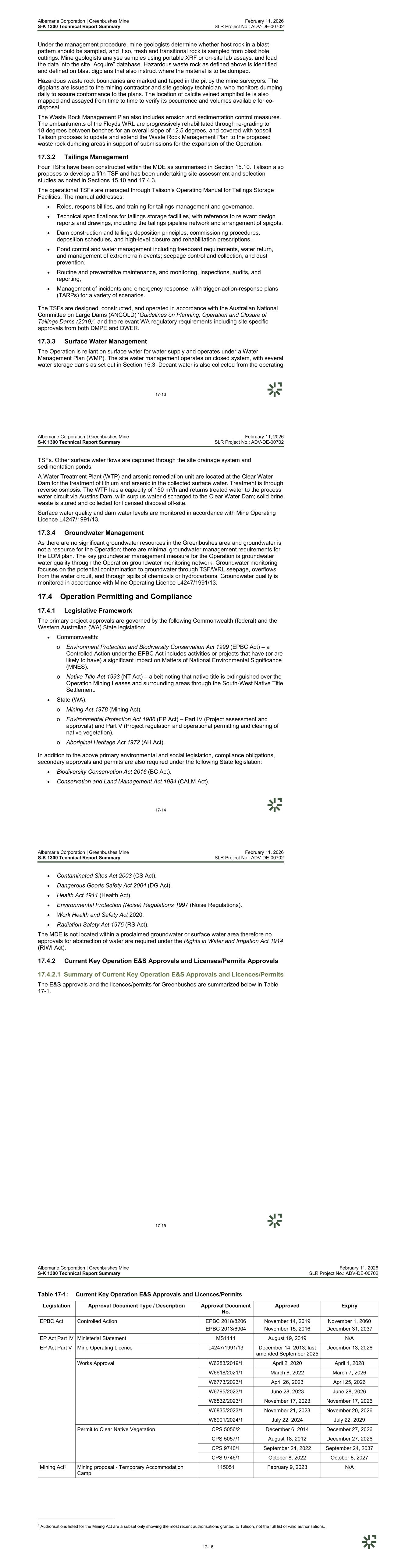
Albemarle Corporation | Greenbushes Mine S-K 1300 Technical Report Summary February 11, 2026 SLR Project No.: ADV-DE-00702 17-13 Under the management procedure, mine geologists determine whether host rock in a blast pattern should be sampled, and if so, fresh and transitional rock is sampled from blast hole cuttings. Mine geologists analyse samples using portable XRF or on-site lab assays, and load the data into the site “Acquire” database. Hazardous waste rock as defined above is identified and defined on blast digplans that also instruct where the material is to be dumped. Hazardous waste rock boundaries are marked and taped in the pit by the mine surveyors. The digplans are issued to the mining contractor and site geology technician, who monitors dumping daily to assure conformance to the plans. The location of calcite veined amphibolite is also mapped and assayed from time to time to verify its occurrence and volumes available for co- disposal. The Waste Rock Management Plan also includes erosion and sedimentation control measures. The embankments of the Floyds WRL are progressively rehabilitated through re-grading to 18 degrees between benches for an overall slope of 12.5 degrees, and covered with topsoil. Talison proposes to update and extend the Waste Rock Management Plan to the proposed waste rock dumping areas in support of submissions for the expansion of the Operation. 17.3.2 Tailings Management Four TSFs have been constructed within the MDE as summarised in Section 15.10. Talison also proposes to develop a fifth TSF and has been undertaking site assessment and selection studies as noted in Sections 15.10 and 17.4.3. The operational TSFs are managed through Talison’s Operating Manual for Tailings Storage Facilities. The manual addresses: • Roles, responsibilities, and training for tailings management and governance. • Technical specifications for tailings storage facilities, with reference to relevant design reports and drawings, including the tailings pipeline network and arrangement of spigots. • Dam construction and tailings deposition principles, commissioning procedures, deposition schedules, and high-level closure and rehabilitation prescriptions. • Pond control and water management including freeboard requirements, water return, and management of extreme rain events; seepage control and collection, and dust prevention. • Routine and preventative maintenance, and monitoring, inspections, audits, and reporting, • Management of incidents and emergency response, with trigger-action-response plans (TARPs) for a variety of scenarios. The TSFs are designed, constructed, and operated in accordance with the Australian National Committee on Large Dams (ANCOLD) ‘Guidelines on Planning, Operation and Closure of Tailings Dams (2019)’, and the relevant WA regulatory requirements including site specific approvals from both DMPE and DWER. 17.3.3 Surface Water Management The Operation is reliant on surface water for water supply and operates under a Water Management Plan (WMP). The site water management operates on closed system, with several water storage dams as set out in Section 15.3. Decant water is also collected from the operating Albemarle Corporation | Greenbushes Mine S-K 1300 Technical Report Summary February 11, 2026 SLR Project No.: ADV-DE-00702 17-14 TSFs. Other surface water flows are captured through the site drainage system and sedimentation ponds. A Water Treatment Plant (WTP) and arsenic remediation unit are located at the Clear Water Dam for the treatment of lithium and arsenic in the collected surface water. Treatment is through reverse osmosis. The WTP has a capacity of 150 m3/h and returns treated water to the process water circuit via Austins Dam, with surplus water discharged to the Clear Water Dam; solid brine waste is stored and collected for licensed disposal off-site. Surface water quality and dam water levels are monitored in accordance with Mine Operating Licence L4247/1991/13. 17.3.4 Groundwater Management As there are no significant groundwater resources in the Greenbushes area and groundwater is not a resource for the Operation; there are minimal groundwater management requirements for the LOM plan. The key groundwater management measure for the Operation is groundwater water quality through the Operation groundwater monitoring network. Groundwater monitoring focuses on the potential contamination to groundwater through TSF/WRL seepage, overflows from the water circuit, and through spills of chemicals or hydrocarbons. Groundwater quality is monitored in accordance with Mine Operating Licence L4247/1991/13. 17.4 Operation Permitting and Compliance 17.4.1 Legislative Framework The primary project approvals are governed by the following Commonwealth (federal) and the Western Australian (WA) State legislation: • Commonwealth: o Environment Protection and Biodiversity Conservation Act 1999 (EPBC Act) – a Controlled Action under the EPBC Act includes activities or projects that have (or are likely to have) a significant impact on Matters of National Environmental Significance (MNES). o Native Title Act 1993 (NT Act) – albeit noting that native title is extinguished over the Operation Mining Leases and surrounding areas through the South-West Native Title Settlement. • State (WA): o Mining Act 1978 (Mining Act). o Environmental Protection Act 1986 (EP Act) – Part IV (Project assessment and approvals) and Part V (Project regulation and operational permitting and clearing of native vegetation). o Aboriginal Heritage Act 1972 (AH Act). In addition to the above primary environmental and social legislation, compliance obligations, secondary approvals and permits are also required under the following State legislation: • Biodiversity Conservation Act 2016 (BC Act). • Conservation and Land Management Act 1984 (CALM Act). Albemarle Corporation | Greenbushes Mine S-K 1300 Technical Report Summary February 11, 2026 SLR Project No.: ADV-DE-00702 17-15 • Contaminated Sites Act 2003 (CS Act). • Dangerous Goods Safety Act 2004 (DG Act). • Health Act 1911 (Health Act). • Environmental Protection (Noise) Regulations 1997 (Noise Regulations). • Work Health and Safety Act 2020. • Radiation Safety Act 1975 (RS Act). The MDE is not located within a proclaimed groundwater or surface water area therefore no approvals for abstraction of water are required under the Rights in Water and Irrigation Act 1914 (RIWI Act). 17.4.2 Current Key Operation E&S Approvals and Licenses/Permits Approvals 17.4.2.1 Summary of Current Key Operation E&S Approvals and Licences/Permits The E&S approvals and the licences/permits for Greenbushes are summarized below in Table 17-1. Albemarle Corporation | Greenbushes Mine S-K 1300 Technical Report Summary February 11, 2026 SLR Project No.: ADV-DE-00702 17-16 Table 17-1: Current Key Operation E&S Approvals and Licences/Permits Legislation Approval Document Type / Description Approval Document No. Approved Expiry EPBC Act Controlled Action EPBC 2018/8206 EPBC 2013/6904 November 14, 2019 November 15, 2016 November 1, 2060 December 31, 2037 EP Act Part IV Ministerial Statement MS1111 August 19, 2019 N/A EP Act Part V Mine Operating Licence L4247/1991/13 December 14, 2013; last amended September 2025 December 13, 2026 Works Approval W6283/2019/1 April 2, 2020 April 1, 2028 W6618/2021/1 March 8, 2022 March 7, 2026 W6773/2023/1 April 26, 2023 April 25, 2026 W6795/2023/1 June 28, 2023 June 28, 2026 W6832/2023/1 November 17, 2023 November 17, 2026 W6835/2023/1 November 21, 2023 November 20, 2026 W6901/2024/1 July 22, 2024 July 22, 2029 Permit to Clear Native Vegetation CPS 5056/2 December 6, 2014 December 27, 2026 CPS 5057/1 August 18, 2012 December 27, 2026 CPS 9740/1 September 24, 2022 September 24, 2037 CPS 9746/1 October 8, 2022 October 8, 2027 Mining Act3 Mining proposal - Temporary Accommodation Camp 115051 February 9, 2023 N/A 3 Authorisations listed for the Mining Act are a subset only showing the most recent authorisations granted to Talison, not the full list of valid authorisations.
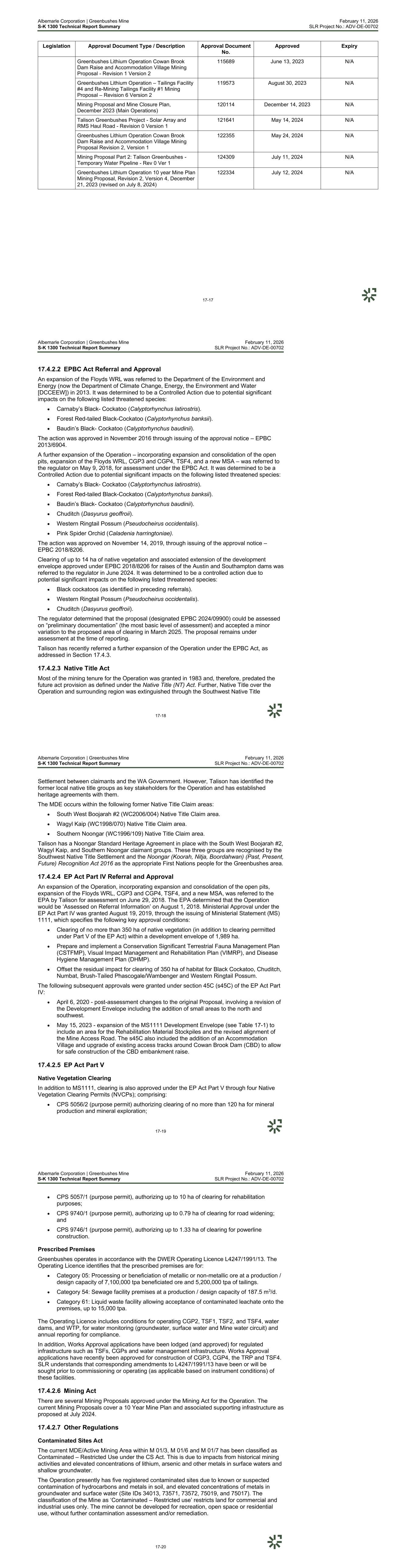
Albemarle Corporation | Greenbushes Mine S-K 1300 Technical Report Summary February 11, 2026 SLR Project No.: ADV-DE-00702 17-17 Legislation Approval Document Type / Description Approval Document No. Approved Expiry Greenbushes Lithium Operation Cowan Brook Dam Raise and Accommodation Village Mining Proposal - Revision 1 Version 2 115689 June 13, 2023 N/A Greenbushes Lithium Operation – Tailings Facility #4 and Re-Mining Tailings Facility #1 Mining Proposal – Revision 6 Version 2 119573 August 30, 2023 N/A Mining Proposal and Mine Closure Plan, December 2023 (Main Operations) 120114 December 14, 2023 N/A Talison Greenbushes Project - Solar Array and RMS Haul Road - Revision 0 Version 1 121641 May 14, 2024 N/A Greenbushes Lithium Operation Cowan Brook Dam Raise and Accommodation Village Mining Proposal Revision 2, Version 1 122355 May 24, 2024 N/A Mining Proposal Part 2: Talison Greenbushes - Temporary Water Pipeline - Rev 0 Ver 1 124309 July 11, 2024 N/A Greenbushes Lithium Operation 10 year Mine Plan Mining Proposal, Revision 2, Version 4, December 21, 2023 (revised on July 8, 2024) 122334 July 12, 2024 N/A Albemarle Corporation | Greenbushes Mine S-K 1300 Technical Report Summary February 11, 2026 SLR Project No.: ADV-DE-00702 17-18 17.4.2.2 EPBC Act Referral and Approval An expansion of the Floyds WRL was referred to the Department of the Environment and Energy (now the Department of Climate Change, Energy, the Environment and Water [DCCEEW]) in 2013. It was determined to be a Controlled Action due to potential significant impacts on the following listed threatened species: • Carnaby’s Black- Cockatoo (Calyptorhynchus latirostris). • Forest Red-tailed Black-Cockatoo (Calyptorhynchus banksii). • Baudin’s Black- Cockatoo (Calyptorhynchus baudinii). The action was approved in November 2016 through issuing of the approval notice – EPBC 2013/6904. A further expansion of the Operation – incorporating expansion and consolidation of the open pits, expansion of the Floyds WRL, CGP3 and CGP4, TSF4, and a new MSA – was referred to the regulator on May 9, 2018, for assessment under the EPBC Act. It was determined to be a Controlled Action due to potential significant impacts on the following listed threatened species: • Carnaby’s Black- Cockatoo (Calyptorhynchus latirostris). • Forest Red-tailed Black-Cockatoo (Calyptorhynchus banksii). • Baudin’s Black- Cockatoo (Calyptorhynchus baudinii). • Chuditch (Dasyurus geoffroii). • Western Ringtail Possum (Pseudocheirus occidentalis). • Pink Spider Orchid (Caladenia harringtoniae). The action was approved on November 14, 2019, through issuing of the approval notice – EPBC 2018/8206. Clearing of up to 14 ha of native vegetation and associated extension of the development envelope approved under EPBC 2018/8206 for raises of the Austin and Southampton dams was referred to the regulator in June 2024. It was determined to be a controlled action due to potential significant impacts on the following listed threatened species: • Black cockatoos (as identified in preceding referrals). • Western Ringtail Possum (Pseudocheirus occidentalis). • Chuditch (Dasyurus geoffroii). The regulator determined that the proposal (designated EPBC 2024/09900) could be assessed on “preliminary documentation” (the most basic level of assessment) and accepted a minor variation to the proposed area of clearing in March 2025. The proposal remains under assessment at the time of reporting. Talison has recently referred a further expansion of the Operation under the EPBC Act, as addressed in Section 17.4.3. 17.4.2.3 Native Title Act Most of the mining tenure for the Operation was granted in 1983 and, therefore, predated the future act provision as defined under the Native Title (NT) Act. Further, Native Title over the Operation and surrounding region was extinguished through the Southwest Native Title Albemarle Corporation | Greenbushes Mine S-K 1300 Technical Report Summary February 11, 2026 SLR Project No.: ADV-DE-00702 17-19 Settlement between claimants and the WA Government. However, Talison has identified the former local native title groups as key stakeholders for the Operation and has established heritage agreements with them. The MDE occurs within the following former Native Title Claim areas: • South West Boojarah #2 (WC2006/004) Native Title Claim area. • Wagyl Kaip (WC1998/070) Native Title Claim area. • Southern Noongar (WC1996/109) Native Title Claim area. Talison has a Noongar Standard Heritage Agreement in place with the South West Boojarah #2, Wagyl Kaip, and Southern Noongar claimant groups. These three groups are recognised by the Southwest Native Title Settlement and the Noongar (Koorah, Nitja, Boordahwan) (Past, Present, Future) Recognition Act 2016 as the appropriate First Nations people for the Greenbushes area. 17.4.2.4 EP Act Part IV Referral and Approval An expansion of the Operation, incorporating expansion and consolidation of the open pits, expansion of the Floyds WRL, CGP3 and CGP4, TSF4, and a new MSA, was referred to the EPA by Talison for assessment on June 29, 2018. The EPA determined that the Operation would be ‘Assessed on Referral Information’ on August 1, 2018. Ministerial Approval under the EP Act Part IV was granted August 19, 2019, through the issuing of Ministerial Statement (MS) 1111, which specifies the following key approval conditions: • Clearing of no more than 350 ha of native vegetation (in addition to clearing permitted under Part V of the EP Act) within a development envelope of 1,989 ha. • Prepare and implement a Conservation Significant Terrestrial Fauna Management Plan (CSTFMP), Visual Impact Management and Rehabilitation Plan (VIMRP), and Disease Hygiene Management Plan (DHMP). • Offset the residual impact for clearing of 350 ha of habitat for Black Cockatoo, Chuditch, Numbat, Brush-Tailed Phascogale/Wambenger and Western Ringtail Possum. The following subsequent approvals were granted under section 45C (s45C) of the EP Act Part IV: • April 6, 2020 - post-assessment changes to the original Proposal, involving a revision of the Development Envelope including the addition of small areas to the north and southwest. • May 15, 2023 - expansion of the MS1111 Development Envelope (see Table 17-1) to include an area for the Rehabilitation Material Stockpiles and the revised alignment of the Mine Access Road. The s45C also included the addition of an Accommodation Village and upgrade of existing access tracks around Cowan Brook Dam (CBD) to allow for safe construction of the CBD embankment raise. 17.4.2.5 EP Act Part V Native Vegetation Clearing In addition to MS1111, clearing is also approved under the EP Act Part V through four Native Vegetation Clearing Permits (NVCPs); comprising: • CPS 5056/2 (purpose permit) authorizing clearing of no more than 120 ha for mineral production and mineral exploration; Albemarle Corporation | Greenbushes Mine S-K 1300 Technical Report Summary February 11, 2026 SLR Project No.: ADV-DE-00702 17-20 • CPS 5057/1 (purpose permit), authorizing up to 10 ha of clearing for rehabilitation purposes; • CPS 9740/1 (purpose permit), authorizing up to 0.79 ha of clearing for road widening; and • CPS 9746/1 (purpose permit), authorizing up to 1.33 ha of clearing for powerline construction. Prescribed Premises Greenbushes operates in accordance with the DWER Operating Licence L4247/1991/13. The Operating Licence identifies that the prescribed premises are for: • Category 05: Processing or beneficiation of metallic or non-metallic ore at a production / design capacity of 7,100,000 tpa beneficiated ore and 5,200,000 tpa of tailings. • Category 54: Sewage facility premises at a production / design capacity of 187.5 m3/d. • Category 61: Liquid waste facility allowing acceptance of contaminated leachate onto the premises, up to 15,000 tpa. The Operating Licence includes conditions for operating CGP2, TSF1, TSF2, and TSF4, water dams, and WTP, for water monitoring (groundwater, surface water and Mine water circuit) and annual reporting for compliance. In addition, Works Approval applications have been lodged (and approved) for regulated infrastructure such as TSFs, CGPs and water management infrastructure. Works Approval applications have recently been approved for construction of CGP3, CGP4, the TRP and TSF4. SLR understands that corresponding amendments to L4247/1991/13 have been or will be sought prior to commissioning or operating (as applicable based on instrument conditions) of these facilities. 17.4.2.6 Mining Act There are several Mining Proposals approved under the Mining Act for the Operation. The current Mining Proposals cover a 10 Year Mine Plan and associated supporting infrastructure as proposed at July 2024. 17.4.2.7 Other Regulations Contaminated Sites Act The current MDE/Active Mining Area within M 01/3, M 01/6 and M 01/7 has been classified as Contaminated – Restricted Use under the CS Act. This is due to impacts from historical mining activities and elevated concentrations of lithium, arsenic and other metals in surface waters and shallow groundwater. The Operation presently has five registered contaminated sites due to known or suspected contamination of hydrocarbons and metals in soil, and elevated concentrations of metals in groundwater and surface water (Site IDs 34013, 73571, 73572, 75019, and 75017). The classification of the Mine as ‘Contaminated – Restricted use’ restricts land for commercial and industrial uses only. The mine cannot be developed for recreation, open space or residential use, without further contamination assessment and/or remediation.

Albemarle Corporation | Greenbushes Mine S-K 1300 Technical Report Summary February 11, 2026 SLR Project No.: ADV-DE-00702 17-21 Aboriginal Heritage Act The Blackwood River and its tributaries extend widely through south-western WA and are recorded on the state register of places significant to Aboriginal culture; several tributaries run through the Operation’s tenements including M 01/2, 4, 5, and 10. SLR understands however that no s18 consents to disturb identified heritage places have been obtained for the Operation to date. Biodiversity Conservation Act Talison has identified that biodiversity-relevant permits will be sought to take native flora and fauna (where relocation is required): • Regulation 4 Authority (to take flora from CALM land); and • Regulation 15 Licence (to take fauna for education or public purposes). Talison has entered into a Working Arrangement Agreement with the Department of Biodiversity, Conservation and Attractions (DBCA) for the protection of forest values within the Greenbushes tenements. Conservation and Land Management (CALM) Act Talison is authorized through tenement conditions to conduct mining activity within the State Forest subject to meeting notification, reporting and compensation/royalty requirements with DBCA. Talison has also entered into a Working Arrangement Agreement with DBCA for the protection of forest values within the Greenbushes tenements. Dangerous Goods Safety Act Talison holds a Dangerous Goods Licence (DGS000651), which will be amended as required to include additional dangerous goods storage. Noise Regulations Approval to exceed the specified limits of the Noise Regulations has been granted through the Environmental Protection (Talison Lithium Australia Greenbushes Operation Noise Emissions) Approval 2015 (referred to as Talison Regulation 17 Approval). The approval has effect for 10 years from February 27, 2015, and further approval can be sought. An application to renew the approval (beyond February 27, 2025) was submitted in 2024. Under the EP Act, the existing approval remains valid beyond its expiry if a renewal application was submitted prior to the expiry. This application is still under assessment. Health Act The existing and any future approval, for the Operation of sewage treatment facilities under the Health Act, is provided by the Shire of Bridgetown – Greenbushes to construct and install apparatus for the treatment of sewage. Workplace Health and Safety Act / Radiation Safety Act Greenbushes operates in accordance with a Radiation Management Plan (RMP) approved under the WHS Act / RS Act. The RMP will be reviewed as required under the WHS Act / RS Act. Albemarle Corporation | Greenbushes Mine S-K 1300 Technical Report Summary February 11, 2026 SLR Project No.: ADV-DE-00702 17-22 17.4.3 Future Key E&S Approvals and Licences/Permits The future mine development strategy as set out in Section 13.4 extends beyond or varies the strategy covered by current regulatory approvals, including: • Disposal of waste rock in the Cutback 32 and Cornwall open pits, from 2027. • Development of the CB32 WRL, above the backfilled Cutback 32 pit, from 2033. • Development of the S2 WRL, from 2034. • Disposal of waste rock in the completed Kapanga open pit, from 2036. Further development of site infrastructure as set out in Section 15.0 beyond current approvals incorporates: • Several further raises of TSF4 Cell 2. • Raises of the Cowan, Southampton, and Austins dams. • Construction of infrastructure for additional capacity at the Salt Water Gully (SWG) Dam. • A further 10 m raise of TSF4, from 2033. • Construction of TSF5, from 2036. Key future approvals are summarized in Table 17-2. Albemarle Corporation | Greenbushes Mine S-K 1300 Technical Report Summary February 11, 2026 SLR Project No.: ADV-DE-00702 17-23 Table 17-2: Future Key E&S Approvals and Licences/Permits Element Approval Legislation Estimated Assessment / Application Commencement Estimated Approval (Construction) Southampton & Austins dam Raise EP Act Part IV / EPBC Act Q2-2024 TBD Mining Act / EP Act Part V Q4-2024 Q1-2026 Cowan Dam Raise EP Act Part V Q2-2025 Q1-2026 TSF4 Cells Mining Act / EP Act Part V Q2-2024 (Stage 3) Q3-2025 (Stage 3) Mining Act / EP Act Part V Q4-2024 (Stage 4) Q1-2027 (Stage 4) Cutback 32 and Cornwall in-pit waste rock disposal EP Act Part IV / Mining Act TBA TBA CB32 WRL EP Act Part IV / Mining Act TBA TBA S2 WRL SWG Dam Southampton & Austins dam Raise (additional clearing) EP Act Part IV / EPBC Act Q2-2025 Q4-2026 Mining Act / EP Act Part V Q4-2026 Q1-2027 Kapanga in-pit waste rock disposal EP Act Part IV / Mining Act TBD TBD TSF4 10 m raise EP Act Part IV / Mining Act / EP Act Part V TBD TBD TSF5 EP Act Part IV / EPBC Act TBD TBD Mining Act / EP Act Part V TBD TBD Talison strategic planning identified the following key risks and considerations for the proposed future approvals strategy and schedule: • Talison maintains its status with the Western Australian State Government as a Level 2 (complex) Operation and is granted Lead Agency Status, with approvals support facilitated by the Department of Energy and Economic Diversification (DEED) (formerly the Department of Jobs, Tourism, Science and Innovation (JTSI)). Similar facilitation is potentially available for the Federal Government level should this be required. At this time, the only area it may be important is for engagement under the EPBC Act, especially regarding biodiversity offset negotiations. Should negotiations become unreasonably protracted, Talison will seek facilitation. • Given the approvals loading and interrelationships, detailed regular consultation with listed agencies regarding status of priority approvals and approach for submissions is in place and is critical to delivering approvals to plan. Two key risks of delay remain 1) the DBCA regarding biodiversity offsets and the linkage to inter-agency advice on biodiversity assessment and activities in State Forest; and 2) DCCEEW regarding EPBC related approvals and compliance, especially biodiversity offsets. • Reliability of approvals timing is in part dependent on quality of submissions made and demonstrating outcomes achieved in operational management (compliance outcomes). Albemarle Corporation | Greenbushes Mine S-K 1300 Technical Report Summary February 11, 2026 SLR Project No.: ADV-DE-00702 17-24 • Key environmental and social factors, impacts and knowledge requirements to support both compliance and approvals include water quality, air quality, noise emissions, biodiversity and stakeholder engagement. SLR is in general agreement with the above stated key risks and considerations for the proposed approvals strategy and schedule. SLR considers that the proposed approvals strategy and schedule are achievable if the above-stated key risks and considerations are adequately addressed and resolved by Talison within the proposed project approvals timeline. However, SLR provides the following comments on the proposed future approvals strategy and schedule. 17.4.3.1 Schedule The proposed approvals program/schedule should be compared against a confirmed detailed integrated project schedule/mine plan (with facility and/or design options, where required) so that timing limitations on the individual storage facility capacities can be compared against the approvals schedule. In particular, the impact/risks of expected near-term approval schedule for tailings storage with reference to expected storage demand, and impact/risks of expected approval times on the site water supply improvements should be confirmed. Talison proposes to start backfilling of the Cutback 32 and Cornwall open pits from 2027. SLR notes the relatively short time to secure approvals, which may entail Mining Act authorisation and Part IV amendments. The Cornwall pit sits close to the Greenbushes town site and may attract more stringent conditions on dumping for noise and dust; in addition, the pit is listed by the Heritage council for its heritage and tourism value, which may entail additional impact assessment and consultation. 17.4.3.2 State and Federal Referrals EP Act Part IV and EPBC Act referral documents for the SWG Dam, S2 WRL, Austins and Southampton Dam raises, and other infrastructure developments were submitted in Q2 2025. Subsequent to a public comment period, DCCEEW determined that the proposal should be a controlled action due to potential impacts on listed threatened species and communities and in August 2025 decided that the proposal should be assessed by preliminary documentation, the most basic level of assessment under the EPBC Act. The WA EPA received 364 public submissions on the proposal (submitted as a significant amendment to the existing approval under MS 1111) and in May 2025 determined that the project should be assessed through public environmental review, the highest level of assessment under the EP Act. In September 2025 the EPA issued an environmental scoping document (ESD) setting out the form, content, indicative timing and procedure of the environmental review for the proposal including expectations for further studies and submissions needed to support approval, including: • Surveys, analysis, impact assessment, and proposed mitigation measures for vegetation, habitats, flora, and fauna. • Update of the existing biodiversity offsets strategy under MS 1111 to account for the increased land disturbance and other potential residual impacts to habitats and species of conservation concern.
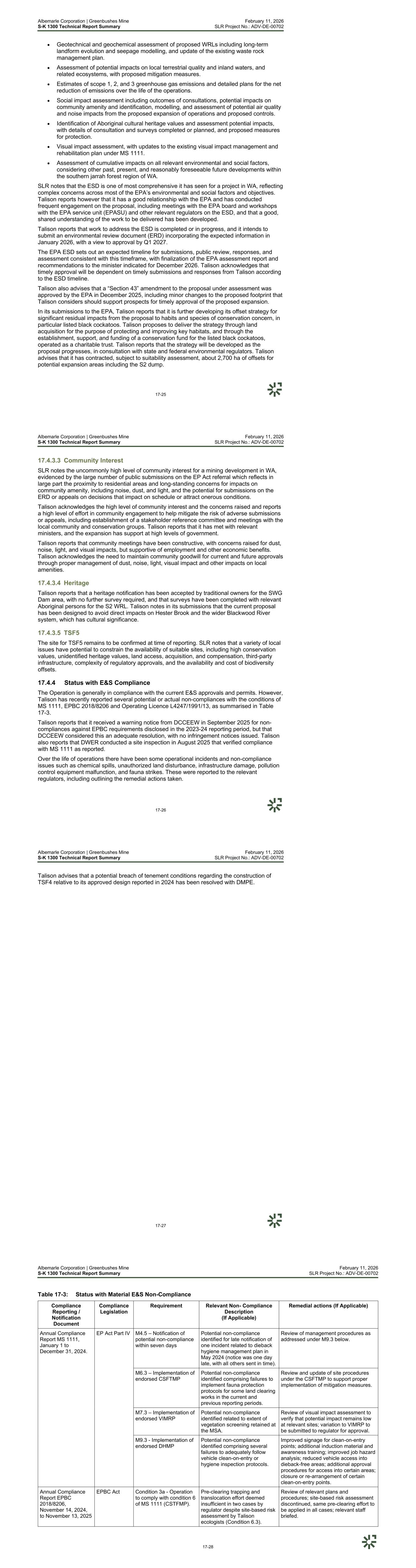
Albemarle Corporation | Greenbushes Mine S-K 1300 Technical Report Summary February 11, 2026 SLR Project No.: ADV-DE-00702 17-25 • Geotechnical and geochemical assessment of proposed WRLs including long-term landform evolution and seepage modelling, and update of the existing waste rock management plan. • Assessment of potential impacts on local terrestrial quality and inland waters, and related ecosystems, with proposed mitigation measures. • Estimates of scope 1, 2, and 3 greenhouse gas emissions and detailed plans for the net reduction of emissions over the life of the operations. • Social impact assessment including outcomes of consultations, potential impacts on community amenity and identification, modelling, and assessment of potential air quality and noise impacts from the proposed expansion of operations and proposed controls. • Identification of Aboriginal cultural heritage values and assessment potential impacts, with details of consultation and surveys completed or planned, and proposed measures for protection. • Visual impact assessment, with updates to the existing visual impact management and rehabilitation plan under MS 1111. • Assessment of cumulative impacts on all relevant environmental and social factors, considering other past, present, and reasonably foreseeable future developments within the southern jarrah forest region of WA. SLR notes that the ESD is one of most comprehensive it has seen for a project in WA, reflecting complex concerns across most of the EPA’s environmental and social factors and objectives. Talison reports however that it has a good relationship with the EPA and has conducted frequent engagement on the proposal, including meetings with the EPA board and workshops with the EPA service unit (EPASU) and other relevant regulators on the ESD, and that a good, shared understanding of the work to be delivered has been developed. Talison reports that work to address the ESD is completed or in progress, and it intends to submit an environmental review document (ERD) incorporating the expected information in January 2026, with a view to approval by Q1 2027. The EPA ESD sets out an expected timeline for submissions, public review, responses, and assessment consistent with this timeframe, with finalization of the EPA assessment report and recommendations to the minister indicated for December 2026. Talison acknowledges that timely approval will be dependent on timely submissions and responses from Talison according to the ESD timeline. Talison also advises that a “Section 43” amendment to the proposal under assessment was approved by the EPA in December 2025, including minor changes to the proposed footprint that Talison considers should support prospects for timely approval of the proposed expansion. In its submissions to the EPA, Talison reports that it is further developing its offset strategy for significant residual impacts from the proposal to habits and species of conservation concern, in particular listed black cockatoos. Talison proposes to deliver the strategy through land acquisition for the purpose of protecting and improving key habitats, and through the establishment, support, and funding of a conservation fund for the listed black cockatoos, operated as a charitable trust. Talison reports that the strategy will be developed as the proposal progresses, in consultation with state and federal environmental regulators. Talison advises that it has contracted, subject to suitability assessment, about 2,700 ha of offsets for potential expansion areas including the S2 dump. Albemarle Corporation | Greenbushes Mine S-K 1300 Technical Report Summary February 11, 2026 SLR Project No.: ADV-DE-00702 17-26 17.4.3.3 Community Interest SLR notes the uncommonly high level of community interest for a mining development in WA, evidenced by the large number of public submissions on the EP Act referral which reflects in large part the proximity to residential areas and long-standing concerns for impacts on community amenity, including noise, dust, and light, and the potential for submissions on the ERD or appeals on decisions that impact on schedule or attract onerous conditions. Talison acknowledges the high level of community interest and the concerns raised and reports a high level of effort in community engagement to help mitigate the risk of adverse submissions or appeals, including establishment of a stakeholder reference committee and meetings with the local community and conservation groups. Talison reports that it has met with relevant ministers, and the expansion has support at high levels of government. Talison reports that community meetings have been constructive, with concerns raised for dust, noise, light, and visual impacts, but supportive of employment and other economic benefits. Talison acknowledges the need to maintain community goodwill for current and future approvals through proper management of dust, noise, light, visual impact and other impacts on local amenities. 17.4.3.4 Heritage Talison reports that a heritage notification has been accepted by traditional owners for the SWG Dam area, with no further survey required, and that surveys have been completed with relevant Aboriginal persons for the S2 WRL. Talison notes in its submissions that the current proposal has been designed to avoid direct impacts on Hester Brook and the wider Blackwood River system, which has cultural significance. 17.4.3.5 TSF5 The site for TSF5 remains to be confirmed at time of reporting. SLR notes that a variety of local issues have potential to constrain the availability of suitable sites, including high conservation values, unidentified heritage values, land access, acquisition, and compensation, third-party infrastructure, complexity of regulatory approvals, and the availability and cost of biodiversity offsets. 17.4.4 Status with E&S Compliance The Operation is generally in compliance with the current E&S approvals and permits. However, Talison has recently reported several potential or actual non-compliances with the conditions of MS 1111, EPBC 2018/8206 and Operating Licence L4247/1991/13, as summarised in Table 17-3. Talison reports that it received a warning notice from DCCEEW in September 2025 for non- compliances against EPBC requirements disclosed in the 2023-24 reporting period, but that DCCEEW considered this an adequate resolution, with no infringement notices issued. Talison also reports that DWER conducted a site inspection in August 2025 that verified compliance with MS 1111 as reported. Over the life of operations there have been some operational incidents and non-compliance issues such as chemical spills, unauthorized land disturbance, infrastructure damage, pollution control equipment malfunction, and fauna strikes. These were reported to the relevant regulators, including outlining the remedial actions taken. Albemarle Corporation | Greenbushes Mine S-K 1300 Technical Report Summary February 11, 2026 SLR Project No.: ADV-DE-00702 17-27 Talison advises that a potential breach of tenement conditions regarding the construction of TSF4 relative to its approved design reported in 2024 has been resolved with DMPE. Albemarle Corporation | Greenbushes Mine S-K 1300 Technical Report Summary February 11, 2026 SLR Project No.: ADV-DE-00702 17-28 Table 17-3: Status with Material E&S Non-Compliance Compliance Reporting / Notification Document Compliance Legislation Requirement Relevant Non- Compliance Description (If Applicable) Remedial actions (If Applicable) Annual Compliance Report MS 1111, January 1 to December 31, 2024. EP Act Part IV M4.5 – Notification of potential non-compliance within seven days Potential non-compliance identified for late notification of one incident related to dieback hygiene management plan in May 2024 (notice was one day late, with all others sent in time). Review of management procedures as addressed under M9.3 below. M6.3 – Implementation of endorsed CSFTMP Potential non-compliance identified comprising failures to implement fauna protection protocols for some land clearing works in the current and previous reporting periods. Review and update of site procedures under the CSFTMP to support proper implementation of mitigation measures. M7.3 – Implementation of endorsed VIMRP Potential non-compliance identified related to extent of vegetation screening retained at the MSA. Review of visual impact assessment to verify that potential impact remains low at relevant sites; variation to VIMRP to be submitted to regulator for approval. M9.3 - Implementation of endorsed DHMP Potential non-compliance identified comprising several failures to adequately follow vehicle clean-on-entry or hygiene inspection protocols. Improved signage for clean-on-entry points; additional induction material and awareness training; improved job hazard analysis; reduced vehicle access into dieback-free areas; additional approval procedures for access into certain areas; closure or re-arrangement of certain clean-on-entry points. Annual Compliance Report EPBC 2018/8206, November 14, 2024, to November 13, 2025 EPBC Act Condition 3a - Operation to comply with condition 6 of MS 1111 (CSTFMP). Pre-clearing trapping and translocation effort deemed insufficient in two cases by regulator despite site-based risk assessment by Talison ecologists (Condition 6.3). Review of relevant plans and procedures; site-based risk assessment discontinued, same pre-clearing effort to be applied in all cases; relevant staff briefed.
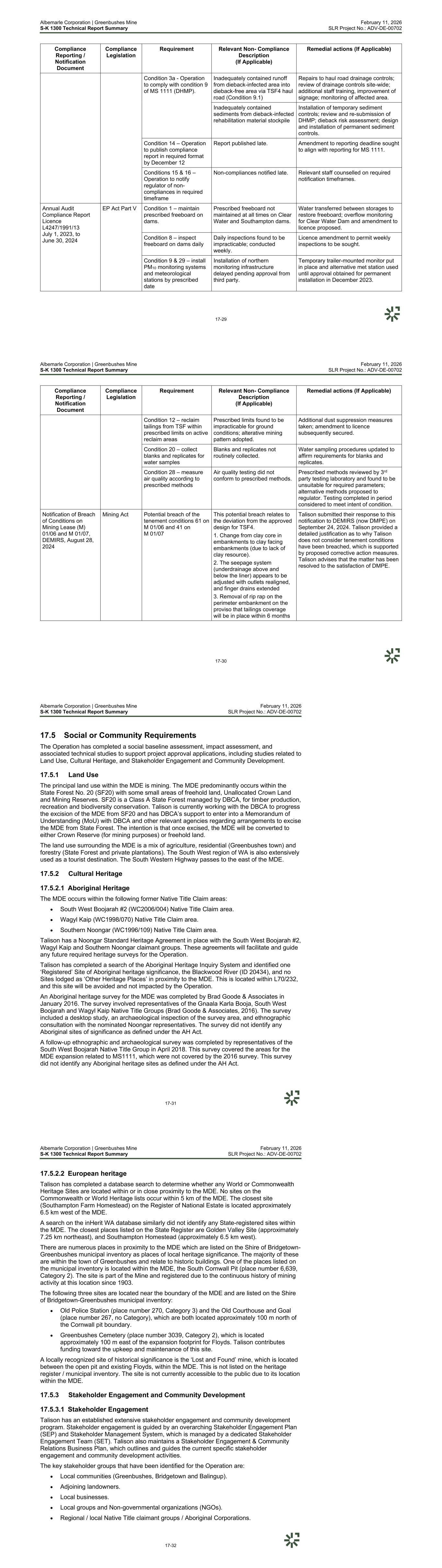
Albemarle Corporation | Greenbushes Mine S-K 1300 Technical Report Summary February 11, 2026 SLR Project No.: ADV-DE-00702 17-29 Compliance Reporting / Notification Document Compliance Legislation Requirement Relevant Non- Compliance Description (If Applicable) Remedial actions (If Applicable) Condition 3a - Operation to comply with condition 9 of MS 1111 (DHMP). Inadequately contained runoff from dieback-infected area into dieback-free area via TSF4 haul road (Condition 9.1) Repairs to haul road drainage controls; review of drainage controls site-wide; additional staff training, improvement of signage; monitoring of affected area. Inadequately contained sediments from dieback-infected rehabilitation material stockpile Installation of temporary sediment controls; review and re-submission of DHMP; dieback risk assessment; design and installation of permanent sediment controls. Condition 14 – Operation to publish compliance report in required format by December 12 Report published late. Amendment to reporting deadline sought to align with reporting for MS 1111. Conditions 15 & 16 – Operation to notify regulator of non- compliances in required timeframe Non-compliances notified late. Relevant staff counselled on required notification timeframes. Annual Audit Compliance Report Licence L4247/1991/13 July 1, 2023, to June 30, 2024 EP Act Part V Condition 1 – maintain prescribed freeboard on dams. Prescribed freeboard not maintained at all times on Clear Water and Southampton dams. Water transferred between storages to restore freeboard; overflow monitoring for Clear Water Dam and amendment to licence proposed. Condition 8 – inspect freeboard on dams daily Daily inspections found to be impracticable; conducted weekly. Licence amendment to permit weekly inspections to be sought. Condition 9 & 29 – install PM10 monitoring systems and meteorological stations by prescribed date Installation of northern monitoring infrastructure delayed pending approval from third party. Temporary trailer-mounted monitor put in place and alternative met station used until approval obtained for permanent installation in December 2023. Albemarle Corporation | Greenbushes Mine S-K 1300 Technical Report Summary February 11, 2026 SLR Project No.: ADV-DE-00702 17-30 Compliance Reporting / Notification Document Compliance Legislation Requirement Relevant Non- Compliance Description (If Applicable) Remedial actions (If Applicable) Condition 12 – reclaim tailings from TSF within prescribed limits on active reclaim areas Prescribed limits found to be impracticable for ground conditions; alterative mining pattern adopted. Additional dust suppression measures taken; amendment to licence subsequently secured. Condition 20 – collect blanks and replicates for water samples Blanks and replicates not routinely collected. Water sampling procedures updated to affirm requirements for blanks and replicates. Condition 28 – measure air quality according to prescribed methods Air quality testing did not conform to prescribed methods. Prescribed methods reviewed by 3rd party testing laboratory and found to be unsuitable for required parameters; alternative methods proposed to regulator. Testing completed in period considered to meet intent of condition. Notification of Breach of Conditions on Mining Lease (M) 01/06 and M 01/07, DEMIRS, August 28, 2024 Mining Act Potential breach of the tenement conditions 61 on M 01/06 and 41 on M 01/07 This potential breach relates to the deviation from the approved design for TSF4. 1. Change from clay core in embankments to clay facing embankments (due to lack of clay resource). 2. The seepage system (underdrainage above and below the liner) appears to be adjusted with outlets realigned, and finger drains extended 3. Removal of rip rap on the perimeter embankment on the proviso that tailings coverage will be in place within 6 months Talison submitted their response to this notification to DEMIRS (now DMPE) on September 24, 2024. Talison provided a detailed justification as to why Talison does not consider tenement conditions have been breached, which is supported by proposed corrective action measures. Talison advises that the matter has been resolved to the satisfaction of DMPE. Albemarle Corporation | Greenbushes Mine S-K 1300 Technical Report Summary February 11, 2026 SLR Project No.: ADV-DE-00702 17-31 17.5 Social or Community Requirements The Operation has completed a social baseline assessment, impact assessment, and associated technical studies to support project approval applications, including studies related to Land Use, Cultural Heritage, and Stakeholder Engagement and Community Development. 17.5.1 Land Use The principal land use within the MDE is mining. The MDE predominantly occurs within the State Forest No. 20 (SF20) with some small areas of freehold land, Unallocated Crown Land and Mining Reserves. SF20 is a Class A State Forest managed by DBCA, for timber production, recreation and biodiversity conservation. Talison is currently working with the DBCA to progress the excision of the MDE from SF20 and has DBCA’s support to enter into a Memorandum of Understanding (MoU) with DBCA and other relevant agencies regarding arrangements to excise the MDE from State Forest. The intention is that once excised, the MDE will be converted to either Crown Reserve (for mining purposes) or freehold land. The land use surrounding the MDE is a mix of agriculture, residential (Greenbushes town) and forestry (State Forest and private plantations). The South West region of WA is also extensively used as a tourist destination. The South Western Highway passes to the east of the MDE. 17.5.2 Cultural Heritage 17.5.2.1 Aboriginal Heritage The MDE occurs within the following former Native Title Claim areas: • South West Boojarah #2 (WC2006/004) Native Title Claim area. • Wagyl Kaip (WC1998/070) Native Title Claim area. • Southern Noongar (WC1996/109) Native Title Claim area. Talison has a Noongar Standard Heritage Agreement in place with the South West Boojarah #2, Wagyl Kaip and Southern Noongar claimant groups. These agreements will facilitate and guide any future required heritage surveys for the Operation. Talison has completed a search of the Aboriginal Heritage Inquiry System and identified one ‘Registered’ Site of Aboriginal heritage significance, the Blackwood River (ID 20434), and no Sites lodged as ‘Other Heritage Places’ in proximity to the MDE. This is located within L70/232, and this site will be avoided and not impacted by the Operation. An Aboriginal heritage survey for the MDE was completed by Brad Goode & Associates in January 2016. The survey involved representatives of the Gnaala Karla Booja, South West Boojarah and Wagyl Kaip Native Title Groups (Brad Goode & Associates, 2016). The survey included a desktop study, an archaeological inspection of the survey area, and ethnographic consultation with the nominated Noongar representatives. The survey did not identify any Aboriginal sites of significance as defined under the AH Act. A follow-up ethnographic and archaeological survey was completed by representatives of the South West Boojarah Native Title Group in April 2018. This survey covered the areas for the MDE expansion related to MS1111, which were not covered by the 2016 survey. This survey did not identify any Aboriginal heritage sites as defined under the AH Act. Albemarle Corporation | Greenbushes Mine S-K 1300 Technical Report Summary February 11, 2026 SLR Project No.: ADV-DE-00702 17-32 17.5.2.2 European heritage Talison has completed a database search to determine whether any World or Commonwealth Heritage Sites are located within or in close proximity to the MDE. No sites on the Commonwealth or World Heritage lists occur within 5 km of the MDE. The closest site (Southampton Farm Homestead) on the Register of National Estate is located approximately 6.5 km west of the MDE. A search on the inHerit WA database similarly did not identify any State-registered sites within the MDE. The closest places listed on the State Register are Golden Valley Site (approximately 7.25 km northeast), and Southampton Homestead (approximately 6.5 km west). There are numerous places in proximity to the MDE which are listed on the Shire of Bridgetown- Greenbushes municipal inventory as places of local heritage significance. The majority of these are within the town of Greenbushes and relate to historic buildings. One of the places listed on the municipal inventory is located within the MDE, the South Cornwall Pit (place number 6,639, Category 2). The site is part of the Mine and registered due to the continuous history of mining activity at this location since 1903. The following three sites are located near the boundary of the MDE and are listed on the Shire of Bridgetown-Greenbushes municipal inventory: • Old Police Station (place number 270, Category 3) and the Old Courthouse and Goal (place number 267, no Category), which are both located approximately 100 m north of the Cornwall pit boundary. • Greenbushes Cemetery (place number 3039, Category 2), which is located approximately 100 m east of the expansion footprint for Floyds. Talison contributes funding toward the upkeep and maintenance of this site. A locally recognized site of historical significance is the ‘Lost and Found’ mine, which is located between the open pit and existing Floyds, within the MDE. This is not listed on the heritage register / municipal inventory. The site is not currently accessible to the public due to its location within the MDE. 17.5.3 Stakeholder Engagement and Community Development 17.5.3.1 Stakeholder Engagement Talison has an established extensive stakeholder engagement and community development program. Stakeholder engagement is guided by an overarching Stakeholder Engagement Plan (SEP) and Stakeholder Management System, which is managed by a dedicated Stakeholder Engagement Team (SET). Talison also maintains a Stakeholder Engagement & Community Relations Business Plan, which outlines and guides the current specific stakeholder engagement and community development activities. The key stakeholder groups that have been identified for the Operation are: • Local communities (Greenbushes, Bridgetown and Balingup). • Adjoining landowners. • Local businesses. • Local groups and Non-governmental organizations (NGOs). • Regional / local Native Title claimant groups / Aboriginal Corporations.

Albemarle Corporation | Greenbushes Mine S-K 1300 Technical Report Summary February 11, 2026 SLR Project No.: ADV-DE-00702 17-33 • Towns along the key transport route. • State government departments and agencies. • Local government. • Commonwealth government departments and agencies. • Internal stakeholders (Talison employees). Talison utilizes numerous types and forms of stakeholder engagement and community development activities, including: • Community and one on one meetings. • Site tours and open days, exhibitions, and displays. • Community updates, newsletters, brochures, discussion papers. • Media: editorial and Advertising. • Community questionnaires / surveys. • Community correspondence. • Community liaison office (based in the Community Resource Centre in Greenbushes). • Community presentations and information sessions. • Site bulletin & Greenbushes – Balingup Newsletter. • Community partnerships or sponsorships. • Employee participation in community organizations. • Complaints management and register. • Local government briefings. • Monitored telephone line and email address. Talison maintains a Stakeholder Consultation Register, which records the stakeholder consultation activities completed. The register records the: • Stakeholder group / individual stakeholder name. • Date, time and location of the consultation completed. • Consultation type. • Purpose of consultation. • Stakeholder comments / issues. Talison also assesses the outcomes of the consultation and uses this to guide future consultation. The key community issues raised include the following: • Environmental (e.g., dust and noise emissions, water contamination, flora and fauna) • Public amenity (e.g., dust and noise emissions, light spill, traffic volume, visual amenity) • Mine closure • Land use and ownership • Social infrastructure and services Albemarle Corporation | Greenbushes Mine S-K 1300 Technical Report Summary February 11, 2026 SLR Project No.: ADV-DE-00702 17-34 • Indigenous participation and heritage • Communications • Tourism Talison has two agreements in place with local groups: • Blackwood Basin Group (BBG) – offset management agreement whereby BBG has agreed to manage and improve the condition of native vegetation for the purpose of the Black Cockatoo offset requirements. • Tonebridge Grazing Pty Ltd. – site conservation agreement for the protection and improvement of native vegetation to protect Black Cockatoo habitat. 17.5.3.2 Public Complaints The MS1111 annual compliance report for calendar year 2024 recorded 34 complaints related to noise, 21 related to light, 20 related to blasting, and 20 related to dust. Talison reports that it logged and responded to all complaints in accordance with relevant plans and procedures under the Stakeholder Management System, with further action and engagement undertaken where appropriate. Talison reports that it intends to engage actively with the local community to address and mitigate concerns. The environmental regulator DWER has acknowledged community concerns reported to it about dust and noise, and in 2025 imposed additional conditions for dust control on the site Operating Licence and the current works approval W6283 for CGP3, CGP4, and related infrastructure developments (Section 17.4.2). DWER has also encouraged concerned community members to make submissions to the EPA on the proposed expansions of operations (Section 17.4.3). In 2024, Talison has undertaken an assessment of the trends for stakeholder interactions from 2021 to 2024. The key findings of this assessment are: • Complaints and community contacts have been increasing. • Dust complaints are more common in summer, while noise complaints occur throughout the year. • There was an increase in High/Medium complaints which commenced in January 2023. This coincided with the CGP3 and TSF4 expansion projects. • In early 2024, there was a focus on the Rehabilitation Material Stockpile project with several community contacts / complaints around this project. • Blast complaints have increased markedly in 2024, commencing in January. • Dust tends to be seasonal however in 2024 there have been more specific interactions around dust composition. • Light spill complaints have increased since the construction of the MSA and the commencement of construction for the CGP3. 17.6 Mine Closure Requirements The current approved Mine Closure Plan (MCP) for the Operation was completed in September 2023 and approved by DEMIRS (now DMPE) on July 12, 2024. The MCP has been developed in accordance with the WA Statutory Guidelines for Mine Closure Plans (2023) and is of a good standard. The MCP states that the current LOM is planned to be until 2031; the MCP Albemarle Corporation | Greenbushes Mine S-K 1300 Technical Report Summary February 11, 2026 SLR Project No.: ADV-DE-00702 17-35 assumes that the mine will close in 2031 and that the closure activities will be undertaken at that time. DMPE typically requires that MCPs are updated for any substantive mining proposal and at least every three years; Talison reports that the timing of the next update will depend on advice from DMPE and the timing of submissions for proposed expansions. The current MCP has identified the knowledge gaps in areas such as biological and baseline surveys, rehabilitation research and trials, modeling of infiltration rates for WRL covers, expansion of WRL seepage monitoring, WRL seepage predictions, longer-term kinetic leach testing on waste rock and TSF materials, updates for the rehabilitation materials balance, and other site investigations and studies. A broad schedule to undertake the necessary studies, investigations and activities has been developed to address these knowledge gaps (summarized in Table 8-13 of the MCP). A closure liability estimate was produced in May 2024, based on the current approved 2023 MCP. SLR considers that the methodology used to calculate the closure liability estimate is in line with industry-standard practice. The closure liability estimate model, which comprises an Excel spreadsheet titled 240529_Talison_Closure_Costs_FINAL.xlsx, uses first principles to calculate volumes, distances and productivities to build a cost estimate for closure works. SLR considers that the 2024 financial liability estimate for closure of $195 million ($234 million with 20% contingency) is representative of the level of current disturbance and associated closure requirements detailed in the MCP. The current closure cost model does not include future expansion works. SLR recommends that Talison develop an estimate of closure costs for the LOM and incorporate this into the LOM financial model. 17.6.1 Rehabilitation / Reclamation Bonding Talison is not required to post a performance or reclamation bond for the Operation; however, Talison annually report land disturbance and make contributions to a pooled mine rehabilitation fund (MRF) based on the type and extent of disturbance under the MRF Act. The total 2024 MRF Levy for the Operation is $477,653.12, which is based on a total disturbed area of 1,393.7120 ha, total area of land under rehabilitation of 69.8880 ha, and a total Rehabilitation Liability Estimate (RLE) of $47.8 million. Albemarle Corporation | Greenbushes Mine S-K 1300 Technical Report Summary February 11, 2026 SLR Project No.: ADV-DE-00702 18-1 18.0 Capital and Operating Costs The capital and operating costs outlined below reflect the LOM Schedule, which is summarized in Section 13.0. The below cost information has been provided by Talison and reviewed by SLR. SLR highlights the following: • Costs are presented in AUD ($) unless otherwise denoted. • All costs are real with no inflation or escalation applied. • All costs are on a 100% equity basis. Greenbushes is held by the operating entity, which is Talison. Albemarle is a 49% owner with the remaining 51% ownership controlled by TLEA, a Tianqi/IGO Joint Venture. • SLR considers capital and operating cost estimates are based on a first principles build- up or actuals from current operations for the next 5 years to at least be of a pre- feasibility study level of accuracy. The remainder of the capital expenditures are based on built-up using typical costing methods for an operation of the scale, long mine life, and operation requirements to meet the LOM plan. In addition, various contingencies are built into the cost estimates. As such SLR considers the basis of costs reasonable for an Operation. This section provides an overview of the annualized operating costs for Greenbushes on a FOB basis. 18.1 Capital Costs The LOM capital cost estimate for the Operation is based on the outcomes of the LOM planning process. As shown in Table 18-1, the total sustaining capital expenditure, growth capital expenditure and LOM capital expenditure is $1,285 million, $3,243 million and $4,533 million, respectively. Sustaining capital expenditure includes: cutback preparation, tailings storage facility, CGP3, and provision and contingencies. Growth capital expenditure includes TSF4/5, as well as the associated contingency. Other growth capital expenditure includes several relatively smaller projects in dollar expenditure terms. Leases relate to vehicles and mobile equipment. Annual capital expenditure for Greenbushes from 2025 to 2029 are listed in Table 18-2.
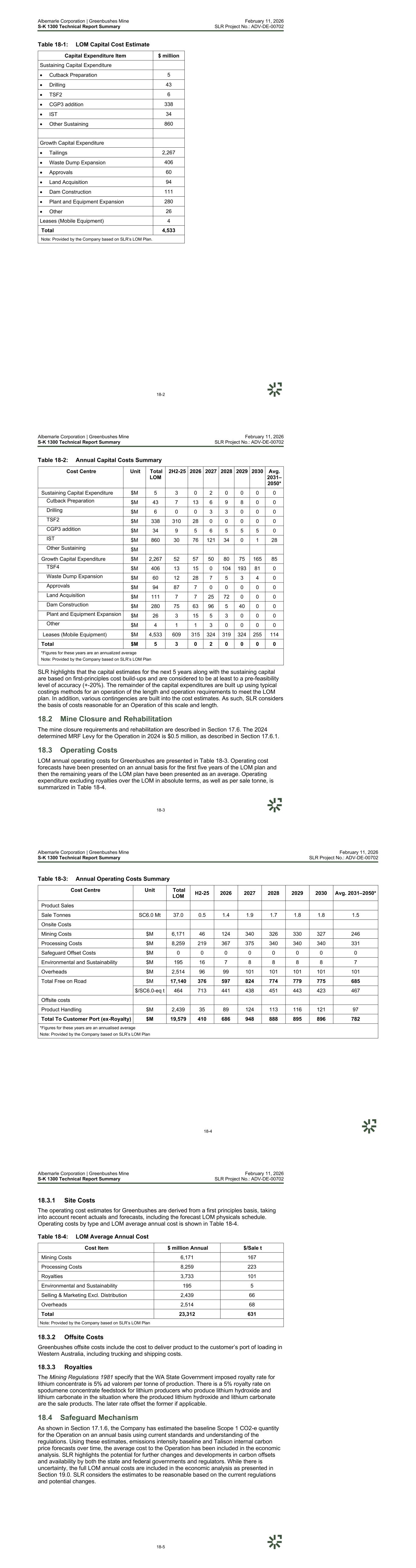
Albemarle Corporation | Greenbushes Mine S-K 1300 Technical Report Summary February 11, 2026 SLR Project No.: ADV-DE-00702 18-2 Table 18-1: LOM Capital Cost Estimate Capital Expenditure Item $ million Sustaining Capital Expenditure • Cutback Preparation 5 • Drilling 43 • TSF2 6 • CGP3 addition 338 • IST 34 • Other Sustaining 860 Growth Capital Expenditure • Tailings 2,267 • Waste Dump Expansion 406 • Approvals 60 • Land Acquisition 94 • Dam Construction 111 • Plant and Equipment Expansion 280 • Other 26 Leases (Mobile Equipment) 4 Total 4,533 Note Provided by the Company based on SLR’s LOM Plan. Albemarle Corporation | Greenbushes Mine S-K 1300 Technical Report Summary February 11, 2026 SLR Project No.: ADV-DE-00702 18-3 Table 18-2: Annual Capital Costs Summary Cost Centre Unit Total LOM 2H2-25 2026 2027 2028 2029 2030 Avg. 2031– 2050* Sustaining Capital Expenditure $M 5 3 0 2 0 0 0 0 Cutback Preparation $M 43 7 13 6 9 8 0 0 Drilling $M 6 0 0 3 3 0 0 0 TSF2 $M 338 310 28 0 0 0 0 0 CGP3 addition $M 34 9 5 6 5 5 5 0 IST $M 860 30 76 121 34 0 1 28 Other Sustaining $M Growth Capital Expenditure $M 2,267 52 57 50 80 75 165 85 TSF4 $M 406 13 15 0 104 193 81 0 Waste Dump Expansion $M 60 12 28 7 5 3 4 0 Approvals $M 94 87 7 0 0 0 0 0 Land Acquisition $M 111 7 7 25 72 0 0 0 Dam Construction $M 280 75 63 96 5 40 0 0 Plant and Equipment Expansion $M 26 3 15 5 3 0 0 0 Other $M 4 1 1 3 0 0 0 0 Leases (Mobile Equipment) $M 4,533 609 315 324 319 324 255 114 Total $M 5 3 0 2 0 0 0 0 *Figures for these years are an annualized average Note Provided by the Company based on SLR’s LOM Plan SLR highlights that the capital estimates for the next 5 years along with the sustaining capital are based on first-principles cost build-ups and are considered to be at least to a pre-feasibility level of accuracy (+-20%). The remainder of the capital expenditures are built up using typical costings methods for an operation of the length and operation requirements to meet the LOM plan. In addition, various contingencies are built into the cost estimates. As such, SLR considers the basis of costs reasonable for an Operation of this scale and length. 18.2 Mine Closure and Rehabilitation The mine closure requirements and rehabilitation are described in Section 17.6. The 2024 determined MRF Levy for the Operation in 2024 is $0.5 million, as described in Section 17.6.1. 18.3 Operating Costs LOM annual operating costs for Greenbushes are presented in Table 18-3. Operating cost forecasts have been presented on an annual basis for the first five years of the LOM plan and then the remaining years of the LOM plan have been presented as an average. Operating expenditure excluding royalties over the LOM in absolute terms, as well as per sale tonne, is summarized in Table 18-4. Albemarle Corporation | Greenbushes Mine S-K 1300 Technical Report Summary February 11, 2026 SLR Project No.: ADV-DE-00702 18-4 Table 18-3: Annual Operating Costs Summary Cost Centre Unit Total LOM H2-25 2026 2027 2028 2029 2030 Avg. 2031–2050* Product Sales Sale Tonnes SC6.0 Mt 37.0 0.5 1.4 1.9 1.7 1.8 1.8 1.5 Onsite Costs Mining Costs $M 6,171 46 124 340 326 330 327 246 Processing Costs $M 8,259 219 367 375 340 340 340 331 Safeguard Offset Costs $M 0 0 0 0 0 0 0 0 Environmental and Sustainability $M 195 16 7 8 8 8 8 7 Overheads $M 2,514 96 99 101 101 101 101 101 Total Free on Road $M 17,140 376 597 824 774 779 775 685 $/SC6.0-eq t 464 713 441 438 451 443 423 467 Offsite costs Product Handling $M 2,439 35 89 124 113 116 121 97 Total To Customer Port (ex-Royalty) $M 19,579 410 686 948 888 895 896 782 *Figures for these years are an annualised average Note Provided by the Company based on SLR’s LOM Plan Albemarle Corporation | Greenbushes Mine S-K 1300 Technical Report Summary February 11, 2026 SLR Project No.: ADV-DE-00702 18-5 18.3.1 Site Costs The operating cost estimates for Greenbushes are derived from a first principles basis, taking into account recent actuals and forecasts, including the forecast LOM physicals schedule. Operating costs by type and LOM average annual cost is shown in Table 18-4. Table 18-4: LOM Average Annual Cost Cost Item $ million Annual $/Sale t Mining Costs 6,171 167 Processing Costs 8,259 223 Royalties 3,733 101 Environmental and Sustainability 195 5 Selling & Marketing Excl. Distribution 2,439 66 Overheads 2,514 68 Total 23,312 631 Note Provided by the Company based on SLR’s LOM Plan 18.3.2 Offsite Costs Greenbushes offsite costs include the cost to deliver product to the customer’s port of loading in Western Australia, including trucking and shipping costs. 18.3.3 Royalties The Mining Regulations 1981 specify that the WA State Government imposed royalty rate for lithium concentrate is 5% ad valorem per tonne of production. There is a 5% royalty rate on spodumene concentrate feedstock for lithium producers who produce lithium hydroxide and lithium carbonate in the situation where the produced lithium hydroxide and lithium carbonate are the sale products. The later rate offset the former if applicable. 18.4 Safeguard Mechanism As shown in Section 17.1.6, the Company has estimated the baseline Scope 1 CO2-e quantity for the Operation on an annual basis using current standards and understanding of the regulations. Using these estimates, emissions intensity baseline and Talison internal carbon price forecasts over time, the average cost to the Operation has been included in the economic analysis. SLR highlights the potential for further changes and developments in carbon offsets and availability by both the state and federal governments and regulators. While there is uncertainty, the full LOM annual costs are included in the economic analysis as presented in Section 19.0. SLR considers the estimates to be reasonable based on the current regulations and potential changes.
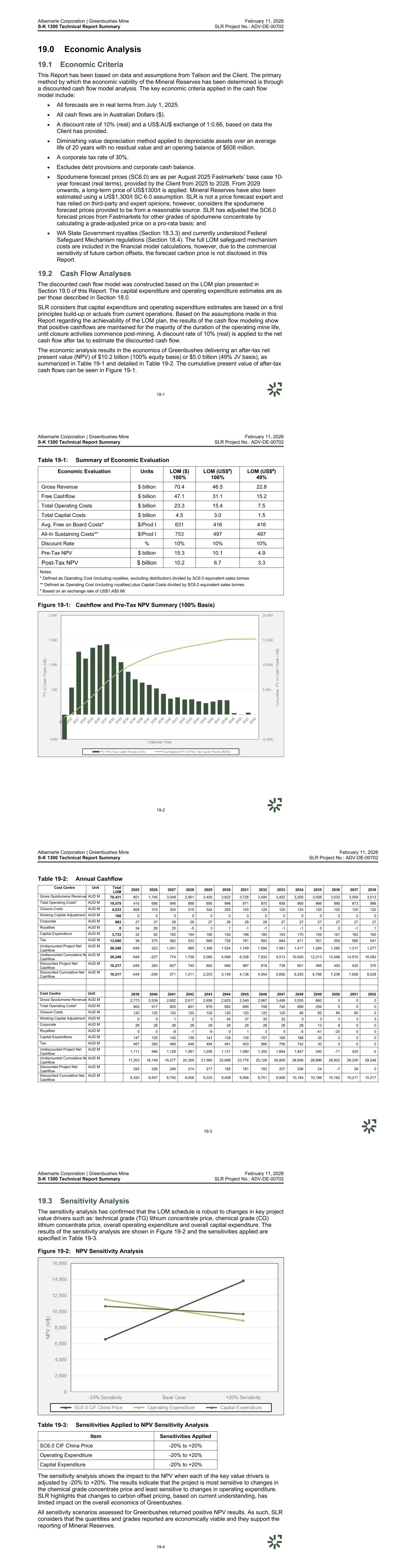
Albemarle Corporation | Greenbushes Mine S-K 1300 Technical Report Summary February 11, 2026 SLR Project No.: ADV-DE-00702 19-1 19.0 Economic Analysis 19.1 Economic Criteria This Report has been based on data and assumptions from Talison and the Client. The primary method by which the economic viability of the Mineral Reserves has been determined is through a discounted cash flow model analysis. The key economic criteria applied in the cash flow model include: • All forecasts are in real terms from July 1, 2025. • All cash flows are in Australian Dollars ($). • A discount rate of 10% (real) and a US$:AU$ exchange of 1:0.66, based on data the Client has provided. • Diminishing value depreciation method applied to depreciable assets over an average life of 20 years with no residual value and an opening balance of $608 million. • A corporate tax rate of 30%. • Excludes debt provisions and corporate cash balance. • Spodumene forecast prices (SC6.0) are as per August 2025 Fastmarkets’ base case 10- year forecast (real terms), provided by the Client from 2025 to 2028. From 2029 onwards, a long-term price of US$1300/t is applied. Mineral Reserves have also been estimated using a US$1,300/t SC 6.0 assumption. SLR is not a price forecast expert and has relied on third-party and expert opinions; however, considers the spodumene forecast prices provided to be from a reasonable source. SLR has adjusted the SC6.0 forecast prices from Fastmarkets for other grades of spodumene concentrate by calculating a grade-adjusted price on a pro-rata basis; and • WA State Government royalties (Section 18.3.3) and currently understood Federal Safeguard Mechanism regulations (Section 18.4). The full LOM safeguard mechanism costs are included in the financial model calculations, however, due to the commercial sensitivity of future carbon offsets, the forecast carbon price is not disclosed in this Report. 19.2 Cash Flow Analyses The discounted cash flow model was constructed based on the LOM plan presented in Section 19.0 of this Report. The capital expenditure and operating expenditure estimates are as per those described in Section 18.0. SLR considers that capital expenditure and operating expenditure estimates are based on a first principles build-up or actuals from current operations. Based on the assumptions made in this Report regarding the achievability of the LOM plan, the results of the cash flow modeling show that positive cashflows are maintained for the majority of the duration of the operating mine life, until closure activities commence post-mining. A discount rate of 10% (real) is applied to the net cash flow after tax to estimate the discounted cash flow. The economic analysis results in the economics of Greenbushes delivering an after-tax net present value (NPV) of $10.2 billion (100% equity basis) or $5.0 billion (49% JV basis), as summarized in Table 19-1 and detailed in Table 19-2. The cumulative present value of after-tax cash flows can be seen in Figure 19-1. Albemarle Corporation | Greenbushes Mine S-K 1300 Technical Report Summary February 11, 2026 SLR Project No.: ADV-DE-00702 19-2 Table 19-1: Summary of Economic Evaluation Economic Evaluation Units LOM ($) 100% LOM (US$#) 100% LOM (US$#) 49% Gross Revenue $ billion 70.4 46.5 22.8 Free Cashflow $ billion 47.1 31.1 15.2 Total Operating Costs $ billion 23.3 15.4 7.5 Total Capital Costs $ billion 4.5 3.0 1.5 Avg. Free on Board Costs* $/Prod t 631 416 416 All-In Sustaining Costs** $/Prod t 753 497 497 Discount Rate % 10% 10% 10% Pre-Tax NPV $ billion 15.3 10.1 4.9 Post-Tax NPV $ billion 10.2 6.7 3.3 Notes: * Defined as Operating Cost (including royalties, excluding distribution) divided by SC6.0 equivalent sales tonnes ** Defined as Operating Cost (including royalties) plus Capital Costs divided by SC6.0 equivalent sales tonnes # Based on an exchange rate of US$1:A$0.66 Figure 19-1: Cashflow and Pre-Tax NPV Summary (100% Basis) Albemarle Corporation | Greenbushes Mine S-K 1300 Technical Report Summary February 11, 2026 SLR Project No.: ADV-DE-00702 19-3 Table 19-2: Annual Cashflow Cost Centre Unit Total LOM 2025 2026 2027 2028 2029 2030 2031 2032 2033 2034 2035 2036 2037 2038 Gross Spodumene Revenue AUD M 70,431 601 1,745 3,049 2,901 3,405 3,622 3,726 3,490 3,452 3,205 3,008 3,032 3,059 3,013 Total Operating Costs* AUD M 19,579 410 686 948 888 895 896 871 870 858 860 866 888 873 886 Closure Costs AUD M 4,533 609 315 324 319 324 255 120 120 120 120 120 120 120 120 Working Capital Adjustment AUD M 168 0 0 0 0 0 0 0 0 0 0 0 0 0 0 Corporate AUD M 683 27 27 28 28 27 28 28 28 27 27 27 27 27 27 Royalties AUD M 0 34 26 25 -5 3 1 -1 -1 -1 -1 0 2 -1 1 Capital Expenditure AUD M 3,733 32 92 162 154 180 192 198 185 183 170 159 161 162 160 Tax AUD M 13,000 38 275 562 533 669 726 761 693 684 611 551 550 560 541 Undiscounted Project Net Cashflow AUD M 29,248 -549 323 1,001 985 1,306 1,524 1,749 1,594 1,581 1,417 1,284 1,285 1,317 1,277 Undiscounted Cumulative Net Cashflow AUD M 29,248 -549 -227 774 1,759 3,065 4,589 6,338 7,932 9,513 10,930 12,213 13,498 14,815 16,092 Discounted Project Net Cashflow AUD M 10,217 -549 293 827 740 892 946 987 818 738 601 495 450 420 370 Discounted Cumulative Net Cashflow AUD M 10,217 -549 -256 571 1,311 2,203 3,149 4,136 4,954 5,692 6,293 6,788 7,238 7,658 8,028 Cost Centre Unit 2039 2040 2041 2042 2043 2044 2045 2046 2047 2048 2049 2050 2051 2052 Gross Spodumene Revenue AUD M 2,773 2,539 2,682 2,617 2,658 2,625 2,549 2,967 3,499 3,555 660 0 0 0 Total Operating Costs* AUD M 900 917 805 801 676 682 695 708 740 668 294 0 0 0 Closure Costs AUD M 120 120 120 120 120 120 120 120 120 85 85 85 85 0 Working Capital Adjustment AUD M 0 0 1 2 3 45 37 35 32 3 3 3 3 3 Corporate AUD M 28 28 28 28 28 28 28 28 28 28 13 8 0 0 Royalties AUD M 0 0 -8 -1 -9 0 1 3 5 -5 -41 -25 0 0 Capital Expenditure AUD M 147 135 142 139 141 139 135 157 185 188 35 0 0 0 Tax AUD M 467 393 466 446 494 481 453 566 706 742 30 0 0 0 Undiscounted Project Net Cashflow AUD M 1,111 946 1,128 1,081 1,206 1,131 1,080 1,350 1,684 1,847 240 -71 425 -3 Undiscounted Cumulative Net Cashflow AUD M 17,203 18,149 19,277 20,359 21,565 22,696 23,776 25,126 26,809 28,656 28,896 28,825 29,250 29,248 Discounted Project Net Cashflow AUD M 293 226 246 214 217 185 161 182 207 206 24 -7 36 0 Discounted Cumulative Net Cashflow AUD M 8,320 8,547 8,792 9,006 9,223 9,408 9,568 9,751 9,958 10,164 10,188 10,182 10,217 10,217 Albemarle Corporation | Greenbushes Mine S-K 1300 Technical Report Summary February 11, 2026 SLR Project No.: ADV-DE-00702 19-4 19.3 Sensitivity Analysis The sensitivity analysis has confirmed that the LOM schedule is robust to changes in key project value drivers such as: technical grade (TG) lithium concentrate price, chemical grade (CG) lithium concentrate price, overall operating expenditure and overall capital expenditure. The results of the sensitivity analysis are shown in Figure 19-2 and the sensitivities applied are specified in Table 19-3. Figure 19-2: NPV Sensitivity Analysis Table 19-3: Sensitivities Applied to NPV Sensitivity Analysis Item Sensitivities Applied SC6.0 CIF China Price -20% to +20% Operating Expenditure -20% to +20% Capital Expenditure -20% to +20% The sensitivity analysis shows the impact to the NPV when each of the key value drivers is adjusted by -20% to +20%. The results indicate that the project is most sensitive to changes in the chemical grade concentrate price and least sensitive to changes in operating expenditure. SLR highlights that changes to carbon offset pricing, based on current understanding, has limited impact on the overall economics of Greenbushes. All sensitivity scenarios assessed for Greenbushes returned positive NPV results. As such, SLR considers that the quantities and grades reported are economically viable and they support the reporting of Mineral Reserves.

Albemarle Corporation | Greenbushes Mine S-K 1300 Technical Report Summary February 11, 2026 SLR Project No.: ADV-DE-00702 20-1 20.0 Adjacent Properties Exploration has been completed on the Greenbushes property which has been disclosed within this Report. SLR has not identified any adjacent properties that may materially impact the study completed for the Greenbushes Mine. Further commentary is provided below on freehold land which is planned to be acquired by Talison to establish key infrastructure. Albemarle Corporation | Greenbushes Mine S-K 1300 Technical Report Summary February 11, 2026 SLR Project No.: ADV-DE-00702 21-1 21.0 Other Relevant Data and Information The following information has been included as it relates to future expansion options at Greenbushes. The included projects could have an impact on overall production and project economics and are not included in the LOM plan as presented in this Report. 21.1 Standalone Ore Sorting Plant Talison has completed a Definitive Feasibility Study (DFS) on the construction of a new 1.2 Mtpa standalone ore sorting plant (OSP) to upgrade waste-contaminated ore ahead of chemical grade plant crushing and processing. As an unavoidable and natural part of mining, contaminated ore is regularly produced. At Greenbushes, this is pegmatite material that contains waste rock in excess of what the process plants are designed to accept to achieve the target concentrate grade, but which has too much contained Li2O to dispose of as waste. Two stockpiles are currently generated of these types of materials. The first is pegmatite contaminated with between 5% and 15% waste rock. This material is brought to the run-of-mine (ROM) stockpiling area, designated Fingers O and Y and blended with non-waste contaminated material to feed the chemical grade crushing and processing plants. The second is pegmatite contaminated with between 15% and 80% waste rock. This material is stockpiled on the waste rock landform, designated C-Ore, incurs mining costs and is not recoverable to achieve a SC6.0 product. Ore sorting presents a solution to waste rock-contaminated pegmatite material. Ore sorting uses camera/color-based sensing technology and pneumatically operated ejection modules to separate waste rock from pegmatite. This technology has been successfully applied at a number of contemporary lithium mining operations and limited test work has demonstrated that over 90% of liberated waste can be effectively separated from Greenbushes material. 21.2 Underground Mine Talison has commenced a concept study to investigate the development of an underground mine at Greenbushes. The study has focused on cut-off grade estimation, stope optimization and inventory level economics; however, is yet to be finalized. The study is expected to deliver the following outcomes in H2 2025: • Underground mine options and infrastructure, • Indicative cost estimates and financial evaluation, • Future project scope and management plan through to operation with risks articulated and operations team endorsement. The focus of the underground study is on material outside of the current Mineral Resources and LOM open pit shell. Pre-feasibility and definitive study phases will explore opportunities to access ore within the LOM pit shell, which may optimize waste rock movement and storage requirements. Backfill of stopes with paste fill is likely to be requisite for underground operation. The use of processing plant tailings would serve to extend the life of tailings storage facilities. Albemarle Corporation | Greenbushes Mine S-K 1300 Technical Report Summary February 11, 2026 SLR Project No.: ADV-DE-00702 22-1 22.0 Interpretation and Conclusions 22.1 Geology The Mineral Resources have been estimated with reference to a cut-off grade (COG), employing an open pit mining and underground mining methods. The COGs were determined with regard to estimated mining and processing costs, product qualities, and long-term benchmark pricing. It is highlighted that the long-term benchmark price (as discussed in Section 11.5) over a timeline of 7 to 10 years was selected based on the reasonable long-term prospect of the Mineral Resource rather than the short-term viability (0.5 to 2 years). SLR considers the geological model is based on adequate geochemical data that has been reviewed and vetted by geologists, over a long period of time, as well as SLR. Deposit modeling has been carried out using standard industry geological modeling software and procedures. The estimation and classification of the Mineral Resource reflects the QP’s opinion of a substantial quantum of in situ material, with reasonable prospects for eventual economic extraction remaining available. 22.2 Mining Greenbushes is an established open pit mine that is a conventional truck and shovel operation employing industry-standard mining methods. SLR considers the major mining fleet assumptions to be reasonable when benchmarked to industry standards and historical performance. SLR is of the opinion that the Mineral Reserves and associated equipment fleet numbers are reasonable to achieve the forecasts and reflect an appropriate level of accuracy. The geological model, detailed mine plans, and technical studies that underpin the LOM plan are supported by historical performance, well-documented systems and processes, and reconciliation and review. This data has been reviewed by SLR (where available) and determined to be adequate to support the Statements of Mineral Reserves. 22.3 Processing Greenbushes is a leader among lithium producers, processing high-grade, low-contaminant ore derived from its unique geological formation, which minimizes waste dilution. The processing plants, originally based on the first lithium plant's design, have been refined to handle premium ore efficiently through proven flowsheets and an innovative approach that segregates ore streams into narrow size ranges before dense media separation and flotation. This approach enables the production of high-quality lithium products that set Greenbushes apart in the industry. As at June 2025, Greenbushes operates four processing plants, with a fifth, CGP3, scheduled to to be fully commissioned by late 2026. Combined, the current plants are forecast to process 6.55 Mtpa producing 1.4 Mtpa of SC6.0, with CGP3 expected to boost throughput to 8.95 Mtpa and SC6.0 production to 1.8 to 2.0 Mtpa. However, ore feed grades are declining, particularly impacting CGP2 and CGP3, leading to reduced Li2O recoveries to maintain SC6.0 quality. Future challenges include transitioning mining to zones with lower-grade ore, potentially impacting average feed grade to CGP1, CGP2, and CGP3. Decisions are also required on adapting or decommissioning aging facilities like the TGP, and addressing the TRP’s limited lifespan tied to the finite tantalum tailings resource in the TSF1. Additionally, the potential for minor element penalties in concentrate agreements poses a growing risk. As Greenbushes Albemarle Corporation | Greenbushes Mine S-K 1300 Technical Report Summary February 11, 2026 SLR Project No.: ADV-DE-00702 22-2 moves to process new deposits, the uncertainty surrounding ore processability raises concerns about maintaining recovery rates and product quality in the long term. 22.4 Environmental, Social, and Governance There are significant local environmental and social (E&S) concerns that may place limitations on the Operation. There are also potential future E&S limits, constraints and obligations that may be difficult or costly to meet. Talison are aware of these potential future E&S limits, constraints and obligations, and they have E&S operational programs in place for their management. SLR considers that the identified potential future E&S constraints will require careful management if the proposed LOM plan is to be realized in the near to medium term. A key component of this careful management is the ongoing implementation of the stakeholder engagement program. The Operation has the required E&S approvals and the licences/permits for the current operations and is generally operating in compliance with these current E&S approvals and permits. There are a range of key future project approvals required in the near to medium term. Talison has developed a future project approvals timeline that incorporates the key risks and considerations for the proposed strategy and schedule. SLR considers that the proposed future approvals strategy and schedule is achievable if the stated key risks and considerations are adequately addressed and resolved by Talison within the proposed project approvals timeline. However, SLR recommends that the proposed future approvals program/schedule should be compared against a confirmed detailed integrated project schedule/mine plan, so that timing limitations on the individual storage facility capacities can be compared against the approvals schedule. 22.5 Water The water supply system for the Operation relies almost entirely on rainfall (predominantly during winter) and surface water runoff to a network of relatively small dams. A small component of groundwater inflow to mine pits or water supply dams can be considered to be delayed delivery of rainfall runoff and is insignificant relative to other flows. The current water balance and modelling indicates that there is sufficient water to supply all plants, however there is a risk of undersupply as all water is supplied via rainfall. However, recent improvements have significantly increased water use efficiency and modelling which indicates that shortages should be rare. SLR considers however that increased water supply capacity is critical to the ongoing operations, for which Saltwater Gully serves as the medium- term solution. As noted above, approvals are required.

Albemarle Corporation | Greenbushes Mine S-K 1300 Technical Report Summary February 11, 2026 SLR Project No.: ADV-DE-00702 23-1 23.0 Recommendations 23.1 Geology and Mineral Resources • Complete a detailed review of the fractionation and zonation of the pegmatites and compare to both grade profile and geometallurgical ore types. Estimated cost is AUD 100,000 • Review the reconciliation performance against the geological model to determine key issues and shortfalls outside of the typical norms of the style of mineralization. This is assumed to be accounted for in general operating costs. • Update the geological model based on the new drilling each year. Upon update of this model, additional drilling is recommended if the outcomes of the mining studies are positive. Estimated cost AUD 200,000 23.2 Mining • Conduct further analysis to evaluate strip ratio optimizations by investigating the potential for steepening pit batters and enhancing the eastern footwall sheared pegmatite contact zone. Of note is the sequencing of Kapanga pit in conjunction with the Central Lode pit. This is assumed to be accounted for in general operating costs. • Develop a scope to evaluate the feasibility of mechanical ore sorters and assess the potential economic benefits of processing contaminated ore with grades between 0.3% and 0.7%. This is assumed to be accounted for in general operating costs. • Continue improvements in the operational excellence steering committee to guide and oversee improvements in operational efficiency and support the LOM ramp-up of production. This is assumed to be accounted for in general operating costs. • Develop a scope for assessing operational rain immunity projects to mitigate the effects of wet weather on production and site performance. This is assumed to be accounted for in general operating costs. • Finalize the underground mining studies and undertake open pit and underground trade- off studies. Estimated costs is AUD 500,000 23.3 Processing • Undertake a comprehensive geometallurgical drilling program using full-core diamond drilling across future ore sources. Analyze drill core samples through detailed geometallurgical evaluation, including mineralogical detection techniques (e.g., scanning electron microscopy and X-ray diffraction), comminution studies, and multi-element scanning. The program should aim to develop a geometallurgical model that supports future ore characterisation and processing optimization. Estimated cost 200,000 • Create a detailed geometallurgical model for current and future processing areas. Move beyond standard chemical analysis by incorporating mineralogical data to classify ore types, waste, and contact zones. Integrate these insights with geological and mining models to predict process plant impacts and identify opportunities to optimize recovery, reduce costs, and increase throughput. Estimated cost is AUD 100,000 Form a dedicated team to optimize water recovery from processing circuits. Explore options such as upgrading, replacing, or duplicating tailings thickeners at all processing plants, Albemarle Corporation | Greenbushes Mine S-K 1300 Technical Report Summary February 11, 2026 SLR Project No.: ADV-DE-00702 23-2 and adding dedicated thickeners before active tailings dams. These initiatives should aim to reduce water losses across the site. This is assumed to be accounted for in general operating costs. Conduct regular mass balance surveys of each processing plant, incorporating minor element assays and mineralogical analysis of feed, product, and tailings streams. Use this data to benchmark performance and develop a real-time digital twin model for enhanced process control and simulation. Perform regular end-of- month mineralogical and elemental analyses of plant feed, product, and tailings streams. Use these results to provide feedback to mining teams and identify optimization opportunities within processing circuits. This is assumed to be accounted for in general operating costs. • Engage with downstream customers to understand current and future quality expectations and potential impacts of product quality produced from the forecast LOM plan. Anticipate changes in concentrate offtake agreements, including potential limits or penalties, and adjust processing strategies to meet evolving requirements. This is assumed to be accounted for in general operating costs. 23.4 Infrastructure • Execute the Saltwater Gully (SWG) Expansion Project as per Section 15.6 as it is key to the LOM plan in the 0-5 year time horizon by providing additional water storage and associated pipelines. This is assumed to be accounted for in general operating costs. 23.5 ESG • Continue implementation of the stakeholder engagement program and expand as required. This is assumed to be accounted for in general operating costs. • Carefully monitor the implementation of the proposed future approval strategy and schedule and amend as required. Take into consideration the comments that SLR has made on the proposed future approval strategy and schedule in this review. This is assumed to be accounted for in general operating costs. • Compare the proposed future approval program/schedule against a confirmed detailed integrated project schedule/mine plan, so that timing limitations on the individual storage facility capacities can be compared against the approvals schedule. This is assumed to be accounted for in general operating costs. 23.6 Tailings Storage • SLR recommends further planning and design to ensure sufficient tailings storage capacity is confirmed for the current processing needs and future expansion. This planning needs to thoroughly consider the storage capacity of TSF1 and TSF4 as well as other alternative technology such as dry stack of tailings. This is assumed to be accounted for in general operating costs. • An integrated approach will ensure long-term tailings storage needs are addressed and prioritized. Current reserves are constrained by tailings and waste rock storage. The addition of CGP3 will accelerate the requirement to expand these facilities. This is assumed to be accounted for in general operating costs. Albemarle Corporation | Greenbushes Mine S-K 1300 Technical Report Summary February 11, 2026 SLR Project No.: ADV-DE-00702 23-3 23.7 Water • Complete ongoing reviews of the water management systems inline with recent updates, including TARPs for various credible water deficit and excess scenarios, and further water use optimization initiatives were practicable. This is assumed to be accounted for in general operating costs. Albemarle Corporation | Greenbushes Mine S-K 1300 Technical Report Summary February 11, 2026 SLR Project No.: ADV-DE-00702 24-1 24.0 References • US Securities and Exchange Commission. 2018. Regulation S-K, Subpart 229.1300, Item 1300 Disclosure by Registrants Engaged in Mining Operations and Item 601 (b)(96) Technical Report Summary. • GHD (2024), Review of Security of Process Water Supply, Memo Report 12607061- REP-1 • Studies by Biologic Environmental Survey (Biologic): o 2011 Greenbushes Level 1 Fauna Survey. o 2018 Greenbushes Targeted Vertebrate and SRE Invertebrate Fauna Survey. o 2018 Greenbushes Vertebrate, SRE and Subterranean Fauna Desktop Assessment. • Studies by Tony Kirkby (Kirkby): o 2018 Black Cockatoo Survey, Talison Mining, Greenbushes. o 2018 Additional Black Cockatoo Survey at the Mine Services Area, Proposed Mining Expansion, Greenbushes. • Studies by Greg Harewood (Harewood): o 2018a Greenbushes Black Cockatoo Tree Hollow Review, Talison Lithium Pty Ltd. o 2018 Greenbushes – Preliminary Western Ringtail Possum Surveys. • Studies by Onshore Environmental: o 2018 Western Ringtail Possum – Desktop Regional Habitat Mapping. o 2018 Targeted Western Ringtail Possum Survey Greenbushes Mine. o Black Cockatoo Habitat Tree Assessment Greenbushes Mine Access Road. • Bennelongia Environmental Consultants (Bennelongia) – 2020 Greenbushes Subterranean Fauna Desktop Review and Assessment. • Fastmarkets_Lithium Market Study_Albemarle_Full_10182024 • Fastmarkets_Lithium Market Study_Albemarle_Summary_Li Carbonate and Li Hydroxide_10252024 • Fastmarkets_Lithium Market Study_Albemarle_Summary_Spodumene Concentrate_10252024 • JMD Engineering Salt water Gully Pumping Study 2024 • Aurecon Salt Water Gully Expansion FEL 2 Phase 1 – Study Report 2024 • ADV-DE-702-01 Greenbushes_Infrastructure RFI (Annotated) • Mine Services Area (MSA) drawings • SEC Technical Report Summary, Pre-Feasibility Study, Greenbushes Mine, February 9, 2024 • Albemarle supply network memorandum, August 27, 2024. • 2312 - Board Paper - Upgrade 22kV Network, December 2023

Albemarle Corporation | Greenbushes Mine S-K 1300 Technical Report Summary February 11, 2026 SLR Project No.: ADV-DE-00702 24-2 • TLA-BUS-CON-0520 Electricity Transfer Access Contract Western Power - Fully Signed 2024 Renewal Albemarle Corporation | Greenbushes Mine S-K 1300 Technical Report Summary February 11, 2026 SLR Project No.: ADV-DE-00702 25-1 25.0 Reliance on Information Provided by the Registrant This Technical Report Summary has been prepared by SLR for Albemarle as the Client. The estimates, conclusions, opinions and information contained in this TRS are based on information and data provided by the Company, which was validated following industry practices and deemed appropriate for use as at the date of this Report. SLR fully relied on Albemarle or the Company for information in relation to the following subsections. SLR considers it reasonable to rely on Albemarle or the Company for this information as they have been the part owner of the Operation for many years and have experience with the operation of lithium mines in Western Australia. 25.1 Macroeconomic Trends Information relating to inflation, interest rates, foreign exchange rates and taxes. This information was used in Section 19.0 for the economic analysis and supports the Mineral Resource Estimate in Section 11.0 and the Mineral Reserve Estimate in Section 12.0. 25.2 Marketing Information relating to marketing and sales contracts, marketing studies and strategies, product valuation, product specifications, refining and treatment charges, transportation costs, and material contracts. The information relied upon in this Report has been provided by Fastmarkets (a marketing expert). This information was used to support the Mineral Resources Estimate in Section 11.0 and the Mineral Reserve Estimate in Section 12.0. It has been used when discussing the contract information in Section 16.0, Commodity Price in Section 12.0 and analysis of the economics in Section 19.0 . 25.3 Legal Matters Information relating to mineral rights, approvals and permits to mine, mineral tenures (concessions, payments to retain, obligation relating to work programs), ownership interests, surface rights, easements, rights of way, violations, fines, ability and timing to obtain and renew permits, monitoring requirements, royalties, water rights and bonding requirements. This information has been used to discuss property ownership in Section 3.03-1, tenure, permits and closure matters in Section 3.2, economic analyses in Section 19.0 and supports the Mineral Resource Estimate in Section 11.0 and the Mineral Reserve Estimate in Section 12.0. This information was provided by Company and is confirmed reliable given the ongoing operations at the assets. 25.4 Environmental Matters Information relating to environmental permitting and monitoring requirements, ability to maintain and renew permits, emissions controls, closure planning, baseline studies for environmental permitting, closure bond and binding requirements and compliance with requirements for protected species and areas. This information has been used to discuss property ownership, tenure, permits and closure matters in Section 3.2, economic analyses in Section 19.0 and supports the Mineral Resource Estimate in Section 11.0 and the Mineral Reserve Estimate in Section 12.0. This information Albemarle Corporation | Greenbushes Mine S-K 1300 Technical Report Summary February 11, 2026 SLR Project No.: ADV-DE-00702 25-2 was provided by Company and is confirmed reliable given the ongoing operations at the assets. The majority of documents were prepared by subject matter experts and can be relied upon to support the information contained in this Report. 25.5 Stakeholder Accommodations Information relating to community relations plan, non-governmental organizations, social and stakeholders baseline and supporting studies. This information is used in the social and community discussions in Section 17.0 and the economic analysis in Section 19.0. It supports the Mineral Resource estimate in Section 11.0 and the Mineral Reserve Estimate in Section 12.0. This information was provided by the Company and is confirmed reliable given the ongoing operations at the assets. 25.6 Governmental Factors Information relating to Government royalty and taxation and governmental monitoring, violations and enforcement action and bond requirements. This information was used in Section 3.0 for discussion of royalty requirements and encumbrances on the Property, the mine closure and permitting in Section 17.0, the economic analysis in Section 19.0, and supports the Mineral Resources Estimate in Section 11.0 and the Mineral Reserves Estimate in Section 12.0. This information was provided by the Company and is confirmed reliable given the ongoing operations at the assets. Albemarle Corporation | Greenbushes Mine S-K 1300 Technical Report Summary February 11, 2026 SLR Project No.: ADV-DE-00702 26-1 26.0 Date and Signature Page The report titled ‘‘S-K 1300 Technical Report Summary, Greenbushes Mine, Western Australia”’ with report date of 10 February 2025 was prepared by SLR USA Advisory Inc.(SLR) as a third- party firm in accordance with Title 17 Subpart 229.1302(b)(1) of Regulation S-K, Disclosure by Registrants Engaged in Mining Operations (S-K 1300). References to the Qualified Person or QP are references to SLR and not to any individual employed or engaged by SLR. (Signed) SLR USA Advisory Inc. Dated at Lakewood, CO February 11, 2026 SLR USA Advisory Inc.