
SEC Technical Report Summary Prefeasibility Study Salar de Atacama Región II, Chile Effective Date: June 30, 2025 Report Date: February 9, 2026 Report Prepared for Albemarle Corporation 4250 Congress Street Suite 900 Charlotte, North Carolina 28209 Report Prepared by SRK Consulting (U.S.), Inc. 999 Seventeenth Street, Suite 400 Denver, CO 80202 SRK Project Number: USPR002291 Exhibit 96.3 SRK Consulting (U.S.), Inc. SEC Technical Report Summary – Salar de Atacama Page i SalardeAtacama_SECUpdate_Report_USPR002291_Rev03.docx February 2026 Table of Contents 1 Executive Summary ..................................................................................................... 1 1.1 Property Description ............................................................................................................................ 1 1.2 Geology and Mineralization ................................................................................................................ 2 1.3 Status of Exploration, Development, and Operations ......................................................................... 3 1.4 Mineral Processing and Metallurgical Testing .................................................................................... 3 1.5 Mineral Resource Estimate ................................................................................................................. 3 1.6 Mining Methods and Mineral Reserve Estimates ............................................................................... 6 1.7 Processing and Recovery Methods .................................................................................................. 10 1.8 Infrastructure ..................................................................................................................................... 11 1.9 Market Studies .................................................................................................................................. 11 1.10 Environmental Studies, Permitting, and Plans, Negotiations, or Agreements with Local Individuals or Groups .............................................................................................................................................. 12 1.11 Capital and Operating Costs ............................................................................................................. 14 1.12 Economic Analysis ............................................................................................................................ 16 1.13 Conclusions and Recommendations ................................................................................................ 18 1.13.1 Geology and Mineral Resources ........................................................................................... 18 1.13.2 Mineral Reserves and Mining Method ................................................................................... 18 1.13.3 Mineral Processing and Metallurgical Testing ....................................................................... 18 1.13.4 Infrastructure ......................................................................................................................... 19 1.13.5 Environmental, Permitting, Social, and Closure .................................................................... 19 1.13.6 Capital and Operating Costs ................................................................................................. 20 1.13.7 Economics ............................................................................................................................. 21 2 Introduction ................................................................................................................ 22 2.1 Terms of Reference and Purpose ..................................................................................................... 22 2.2 Sources of Information ...................................................................................................................... 22 2.3 Details of Inspection .......................................................................................................................... 22 2.4 Report Version Update ...................................................................................................................... 23 2.5 Qualified Persons .............................................................................................................................. 23 2.6 Forward-Looking Information ............................................................................................................ 23 3 Property Description .................................................................................................. 25 3.1 Property Area .................................................................................................................................... 25 3.2 Mineral Title ....................................................................................................................................... 28 3.3 Encumbrances .................................................................................................................................. 30 3.4 Royalties or Similar Interest .............................................................................................................. 30 4 Accessibility, Climate, Local Resources, Infrastructure, and Physiography ....... 32 SRK Consulting (U.S.), Inc. SEC Technical Report Summary – Salar de Atacama Page ii SalardeAtacama_SECUpdate_Report_USPR002291_Rev03.docx February 2026 4.1 Topography, Elevation, and Vegetation ............................................................................................ 32 4.2 Means of Access ............................................................................................................................... 32 4.3 Climate and Length of Operating Season ......................................................................................... 33 4.4 Infrastructure Availability and Sources .............................................................................................. 34 5 History ......................................................................................................................... 35 5.1 Previous Operations .......................................................................................................................... 35 5.2 Exploration and Development of Previous Owners or Operators ..................................................... 36 6 Geological Setting, Mineralization, and Deposit ..................................................... 40 6.1 Regional, Local, and Property Geology ............................................................................................ 40 6.1.1 Regional Geology .................................................................................................................. 40 6.1.2 Local Geology ....................................................................................................................... 43 6.1.3 Property Geology .................................................................................................................. 43 6.2 Mineral Deposit ................................................................................................................................. 54 6.3 Stratigraphic Column ......................................................................................................................... 54 7 Exploration ................................................................................................................. 56 7.1 Exploration Work (Other Than Drilling) ............................................................................................. 56 7.1.1 TEM Survey ........................................................................................................................... 57 7.1.2 Seismic Reflection ................................................................................................................. 58 7.1.3 Borehole Geophysics ............................................................................................................ 58 7.1.4 Nuclear Magnetic Resonance ............................................................................................... 61 7.1.5 Significant Results and Interpretation ................................................................................... 61 7.2 Exploration Drilling ............................................................................................................................ 61 7.2.1 Drilling Type and Extent ........................................................................................................ 61 7.2.2 Drilling Campaigns ................................................................................................................ 62 7.2.3 Drilling Results and Interpretation ......................................................................................... 65 7.3 Hydraulic Tests ................................................................................................................................. 65 7.3.1 2016 Campaign ..................................................................................................................... 65 7.3.2 2018 to 2019 Testing Campaign ........................................................................................... 68 7.3.3 2020 to 2023 Testing Campaign. .......................................................................................... 69 7.3.4 Packer Testing Campaign ..................................................................................................... 70 7.3.5 Pumping Test Reanalysis by SRK in 2020 ........................................................................... 71 7.3.6 Data Summary ...................................................................................................................... 71 7.4 Brine Sampling .................................................................................................................................. 72 8 Sample Preparation, Analysis, and Security ........................................................... 76 8.1 Sample Collection ............................................................................................................................. 76 8.1.1 Historical Sampling ................................................................................................................ 76 8.1.2 2025 Campaign ..................................................................................................................... 77 SRK Consulting (U.S.), Inc. SEC Technical Report Summary – Salar de Atacama Page iii SalardeAtacama_SECUpdate_Report_USPR002291_Rev03.docx February 2026 8.2 Sample Preparation, Assaying, and Analytical Procedures .............................................................. 79 8.2.1 Historical Sampling ................................................................................................................ 79 8.2.2 2025 Campaign ..................................................................................................................... 79 8.3 QA/QC Procedures ........................................................................................................................... 83 8.3.1 Control Laboratories .............................................................................................................. 83 8.3.2 Correlation Between Lithium Grades of Different Invariant Laboratories of the Sampling Type ....................................................................................................................................... 83 8.3.3 Standards, Blanks, and Duplicates ....................................................................................... 86 8.4 Opinion on Adequacy ........................................................................................................................... 88 9 Data Verification ......................................................................................................... 90 9.1 Data Verification Procedures ............................................................................................................ 90 9.2 Limitations ......................................................................................................................................... 91 9.3 Opinion on Data Adequacy ............................................................................................................... 91 10 Mineral Processing and Metallurgical Testing ........................................................ 93 10.1 Metallurgical Test Work and Analysis ............................................................................................... 93 10.1.1 Bischofite Treatment Testing................................................................................................. 93 10.1.2 Lithium-Carnallite Treatment Testing .................................................................................... 94 10.1.3 SYIP Test Commentary ......................................................................................................... 95 10.2 Opinion on Adequacy ........................................................................................................................ 95 11 Mineral Resource Estimates ..................................................................................... 96 11.1 Key Assumptions, Parameters, and Methods Used ......................................................................... 96 11.1.1 Geological Model ................................................................................................................... 96 11.1.2 Exploratory Data Analysis ..................................................................................................... 99 11.1.3 Drainable Porosity or Specific Yield .................................................................................... 101 11.2 Mineral Resource Estimates ........................................................................................................... 104 11.2.1 Domains .............................................................................................................................. 104 11.2.2 Capping and Compositing ................................................................................................... 105 11.2.3 Spatial Continuity Analysis .................................................................................................. 109 11.2.4 Block Model ......................................................................................................................... 110 11.2.5 Estimation Methodology ...................................................................................................... 111 11.2.6 Estimate Validation .............................................................................................................. 115 11.3 CoG Estimates ................................................................................................................................ 118 11.4 Resources Classification and Criteria ............................................................................................. 118 11.5 Uncertainty ...................................................................................................................................... 119 11.6 Summary Mineral Resources .......................................................................................................... 120 11.7 Recommendations and Opinion ...................................................................................................... 123 12 Mineral Reserve Estimates ...................................................................................... 124

SRK Consulting (U.S.), Inc. SEC Technical Report Summary – Salar de Atacama Page iv SalardeAtacama_SECUpdate_Report_USPR002291_Rev03.docx February 2026 12.1 Key Assumptions, Parameters, and Methods Used ....................................................................... 124 12.1.1 Numerical Groundwater Model............................................................................................ 124 12.1.2 Model Domain and Grid ...................................................................................................... 124 12.1.3 Flow Boundary Conditions .................................................................................................. 125 12.1.4 Hydraulic and Solute Transport Properties ......................................................................... 132 12.1.5 Model Calibration ................................................................................................................ 137 12.1.6 Predictive Simulations ......................................................................................................... 149 12.2 Mineral Reserves Estimates ........................................................................................................... 156 12.2.1 CoGs Estimates .................................................................................................................. 158 12.2.2 Reserves Classification and Criteria ................................................................................... 159 12.3 Summary Mineral Reserves ............................................................................................................ 159 13 Mining Methods ........................................................................................................ 165 13.1 Wellfield Design .............................................................................................................................. 167 13.2 Production Schedule ....................................................................................................................... 170 14 Processing and Recovery Methods........................................................................ 173 14.1 Salar de Atacama Processing ......................................................................................................... 175 14.1.1 Solar Evaporation ................................................................................................................ 176 14.1.2 SYIP .................................................................................................................................... 179 14.2 La Negra Plant ................................................................................................................................ 182 14.2.1 Boron Removal .................................................................................................................... 184 14.2.2 Calcium and Magnesium Removal ..................................................................................... 186 14.2.3 Li2CO3 Precipitation (Carbonation) and Packaging ............................................................. 188 14.2.4 Thermal Evaporation ........................................................................................................... 190 14.3 DLE ................................................................................................................................................. 191 14.4 Process Design Parameters ........................................................................................................... 191 14.4.1 Process Consumables ........................................................................................................ 192 14.5 SRK Opinion ................................................................................................................................... 193 15 Infrastructure ............................................................................................................ 194 15.1 Access, Roads, and Local Communities ........................................................................................ 194 15.1.1 Access ................................................................................................................................. 194 15.1.2 Airport .................................................................................................................................. 195 15.1.3 Rail ...................................................................................................................................... 195 15.1.4 Port Facilities ....................................................................................................................... 195 15.1.5 Staffing and Support Communities ..................................................................................... 198 15.2 Facilities .......................................................................................................................................... 199 15.2.1 Salar Plant ........................................................................................................................... 199 15.2.2 La Negra Plant .................................................................................................................... 202 SRK Consulting (U.S.), Inc. SEC Technical Report Summary – Salar de Atacama Page v SalardeAtacama_SECUpdate_Report_USPR002291_Rev03.docx February 2026 15.3 Energy ............................................................................................................................................. 204 15.3.1 Power .................................................................................................................................. 204 15.3.2 Natural Gas ......................................................................................................................... 206 15.3.3 Fuel ...................................................................................................................................... 208 15.4 Water and Pipelines ........................................................................................................................ 208 16 Market Studies ......................................................................................................... 209 16.1 Lithium Market Summary ................................................................................................................ 209 16.1.1 Lithium Demand .................................................................................................................. 210 16.1.2 Lithium Supply ..................................................................................................................... 213 16.1.3 Lithium Supply-Demand Balance ........................................................................................ 215 16.1.4 Lithium Prices ...................................................................................................................... 216 16.1.5 Lithium battery material prices (Technical grade, spot, CIF CJK, $/kg) .............................. 217 16.2 Product Sales .................................................................................................................................. 220 16.3 Contracts ......................................................................................................................................... 222 16.3.1 CCHEN and CORFO Agreements ...................................................................................... 222 17 Environmental Studies, Permitting, and Plans, Negotiations, or Agreements with Local Individuals or Groups .................................................................................... 225 17.1 Environmental Studies .................................................................................................................... 225 17.1.1 General Background ........................................................................................................... 225 17.1.2 La Negra .............................................................................................................................. 226 17.1.3 Salar de Atacama ................................................................................................................ 228 17.1.4 Tailing Disposal ................................................................................................................... 233 17.1.5 Waste Management ............................................................................................................ 234 17.1.6 Water Management ............................................................................................................. 235 17.1.7 Monitoring ............................................................................................................................ 236 17.1.8 Air Quality ............................................................................................................................ 241 17.1.9 Human Health and Safety ................................................................................................... 241 17.2 Project Permitting ............................................................................................................................ 242 17.2.1 Environmental Permits ........................................................................................................ 242 17.2.2 Operating Permits ............................................................................................................... 244 17.2.3 Water Rights ........................................................................................................................ 246 17.3 Plans, Negotiations, or Agreements ............................................................................................... 246 17.3.1 La Negra .............................................................................................................................. 246 17.3.2 Salar de Atacama ................................................................................................................ 246 17.4 Mine Reclamation and Closure ....................................................................................................... 247 17.4.1 Closure Planning ................................................................................................................. 247 17.4.2 Closure Cost Estimate ......................................................................................................... 249 SRK Consulting (U.S.), Inc. SEC Technical Report Summary – Salar de Atacama Page vi SalardeAtacama_SECUpdate_Report_USPR002291_Rev03.docx February 2026 17.4.3 Performance or Reclamation Bonding ................................................................................ 250 17.4.4 Limitations on the Cost Estimate ......................................................................................... 253 17.5 Plan Adequacy ................................................................................................................................ 253 17.6 Local Procurement .......................................................................................................................... 254 18 Capital and Operating Costs ................................................................................... 255 18.1 Capital Cost Estimates .................................................................................................................... 255 18.2 Operating Cost Estimates ............................................................................................................... 256 19 Economic Analysis .................................................................................................. 259 19.1 General Description ........................................................................................................................ 259 19.1.1 Basic Model Parameters ..................................................................................................... 259 19.1.2 External Factors .................................................................................................................. 259 19.1.3 Technical Factors ................................................................................................................ 260 19.2 Results ............................................................................................................................................ 270 19.3 Sensitivity Analysis .......................................................................................................................... 273 20 Adjacent Properties ................................................................................................. 274 20.1 Adjacent Production ........................................................................................................................ 274 20.1.1 SQM Lithium Resources and Reserves .............................................................................. 276 20.2 Water Rights of Other Companies .................................................................................................. 277 21 Other Relevant Data and Information ..................................................................... 280 22 Interpretation and Conclusions .............................................................................. 281 22.1 Geology and Mineral Resources ..................................................................................................... 281 22.2 Mineral Reserves and Mining Method ............................................................................................ 281 22.3 Metallurgy and Mineral Processing ................................................................................................. 281 22.4 Infrastructure ................................................................................................................................... 282 22.5 Environmental, Permitting, Social, and Closure ............................................................................. 282 22.5.1 Environmental Studies ........................................................................................................ 282 22.5.2 Environmental Management Planning ................................................................................ 283 22.5.3 Environmental Monitoring .................................................................................................... 283 22.5.4 Permitting ............................................................................................................................ 283 22.5.5 Closure ................................................................................................................................ 284 22.6 Capital and Operating Costs ........................................................................................................... 284 22.7 Economic Analysis .......................................................................................................................... 284 23 Recommendations ................................................................................................... 285 23.1 Recommended Work Programs ...................................................................................................... 285 23.1.1 Geology, Resources, and Reserves ................................................................................... 285 23.1.2 Mineral Processing and Metallurgical Testing ..................................................................... 285 SRK Consulting (U.S.), Inc. SEC Technical Report Summary – Salar de Atacama Page vii SalardeAtacama_SECUpdate_Report_USPR002291_Rev03.docx February 2026 23.1.3 Environmental/Closure ........................................................................................................ 286 23.2 Recommended Work Program Costs ............................................................................................. 286 24 References ................................................................................................................ 288 25 Reliance on Information Provided by the Registrant ............................................ 293 Signature Page .............................................................................................................. 295 List of Tables Table 1-1: Salar de Atacama Mineral Resource Estimate, Exclusive of Mineral Reserves (Effective June 30, 2025) ...................................................................................................................................................... 5 Table 1-2: Salar de Atacama Mineral Reserves, Effective June 30, 2025 ......................................................... 8 Table 1-3: Capital Cost Forecast (US$ Million Real 2025) ............................................................................... 14 Table 1-4: Indicative Economic Results ........................................................................................................... 16 Table 2-1: Site Visits ......................................................................................................................................... 23 Table 3-1: OMA Mining Concessions ............................................................................................................... 28 Table 3-2: Albemarle Mining Concessions ....................................................................................................... 29 Table 3-3: CORFO Royalty Scheme for Albemarle in Atacama ....................................................................... 31 Table 7-1: Summary of Exploration Work ......................................................................................................... 57 Table 7-2: 2017 through 2023 Drilling Types and Meters ................................................................................ 63 Table 7-3: Summary of Measured Hydraulic Conductivity Values ................................................................... 72 Table 7-4: Summary of Measured Groundwater Storage Values (Sy) ............................................................. 72 Table 8-1: List and Coordinates of Wells Sampled for the 2025 ...................................................................... 78 Table 8-2: Analytical Methods by Laboratory, 2025 Campaign ........................................................................ 81 Table 8-3: List of Samples in the 2025 Campaign ........................................................................................... 82 Table 11-1: Atacama Lithological Units ............................................................................................................ 98 Table 11-2: Drainable Porosity (Specific Yield) Raw Data, Upper Halite West and Volcano-Sedimentary Units ................................................................................................................................................... 101 Table 11-3: Drainable Porosity (Specific Yield) Values Used for Other Lithological Units ............................. 102 Table 11-4: Drainable Porosity (Specific Yield) Estimation Results, Upper Halite West and Volcano- Sedimentary Units ............................................................................................................................. 104 Table 11-5: Comparison of Raw versus Composite Statistics (Non-Weighted) ............................................. 108 Table 11-6: Summary of Atacama Block Model Parameters ......................................................................... 111 Table 11-7: Summary Search Neighborhood Parameters for Specific Yield (Upper Halite West and Volcano- Sedimentary Lithologies) ................................................................................................................... 115 Table 11-8: Summary of Validation Statistics Composites versus Estimation Methods (Lithium-Aquifer Data) .................................................................................................................................................. 116 Table 11-9: Sources and Degree of Uncertainty ............................................................................................ 120 Table 11-10: Salar de Atacama Mineral Resource Estimate, Exclusive of Mineral Reserves (Effective June 30, 2024) .................................................................................................................................................. 122

SRK Consulting (U.S.), Inc. SEC Technical Report Summary – Salar de Atacama Page viii SalardeAtacama_SECUpdate_Report_USPR002291_Rev03.docx February 2026 Table 12-1: Recharge Rates and Lateral Inflows Under Natural Conditions ................................................. 127 Table 12-2: Conceptual Rates of Groundwater Discharges into the Lagoon/Stream Systems ..................... 129 Table 12-3: Hydraulic Conductivity Values Used in the Numerical Model Compared with Measured Data .. 134 Table 12-4: Specific Yield and Effective Porosity Values Used in the Numerical Model Compared with Measured Data .................................................................................................................................. 136 Table 12-5: Simulated Other Solute Transport Properties ............................................................................. 137 Table 12-6: Simulated Hydrologic Fluxes for Steady-State Conditions ......................................................... 138 Table 12-7: Statistics of Transient Model Calibration to Observed Water Levels, 2025 (Average) ............... 142 Table 12-8: Water Balance at End of Transient Calibration (June 2025) ....................................................... 144 Table 12-9: Statistics of Transient Model Calibration to Lithium Concentrations, July 2024 to June 2025 Average ............................................................................................................................................. 146 Table 12-10: Average Lithium Mass Transfer Rate for Calibration Period (Nov 1997 - Jun 2025) ................ 149 Table 12-11: Simulated Predictive Freshwater Withdrawals .......................................................................... 152 Table 12-12: Groundwater Balance Summary (L/s) ....................................................................................... 152 Table 12-13: Predicted Lithium and Brine Extractions ................................................................................... 157 Table 12-14: Salar de Atacama Mineral Reserves, Effective June 30, 2025 ................................................. 160 Table 13-1: Wellfield Development Schedule ................................................................................................. 168 Table 14-1: La Negra Mass Balance .............................................................................................................. 184 Table 14-2: Annual Average Salar Extraction Volume ................................................................................... 191 Table 14-3: Current Process Consumables ................................................................................................... 192 Table 15-1: Project Non-Contractor Staffing Summary .................................................................................. 198 Table 15-2: Regional Community Information for the Salar Plant .................................................................. 198 Table 15-3: Salar Plant Electricity Consumption by Load Center .................................................................. 205 Table 15-4: La Negra Primary Electrical Loads .............................................................................................. 205 Table 15-5: Primary Natural Gas Loads ......................................................................................................... 207 Table 16-1: Technical grade Li2CO3 Specifications ........................................................................................ 220 Table 16-2: Battery grade Li2CO3 Specifications ............................................................................................ 221 Table 16-3: Historic La Negra Annual Production Rates ................................................................................ 221 Table 16-4: Current La Negra Production Capacity by Product ..................................................................... 221 Table 16-5: 2025 de Atacama Product Consumption .................................................................................... 222 Table 16-6: CORFO Royalty/Commission Rates ........................................................................................... 224 Table 17-1: La Negra Water Monitoring Parameters ..................................................................................... 237 Table 17-2: Salar de Atacama Environmental Monitoring Points ................................................................... 239 Table 17-3: Salar de Atacama Biodiversity Monitoring Plan .......................................................................... 241 Table 17-4: Albemarle Projects in the Antofagasta Region with Environmental License .............................. 243 Table 17-5: Operational Permits for Albemarle’s La Negra and Salar de Atacama Facilities ........................ 245 Table 17-6: La Negra Plant Facilities ............................................................................................................. 247 Table 17-7: Salar de Atacama Plant Facilities ................................................................................................ 248 SRK Consulting (U.S.), Inc. SEC Technical Report Summary – Salar de Atacama Page ix SalardeAtacama_SECUpdate_Report_USPR002291_Rev03.docx February 2026 Table 17-8: La Negra and Salar de Atacama Closure Costs ......................................................................... 250 Table 18-1: Capital Cost Forecast ($M Real 2025) ........................................................................................ 256 Table 18-2: Key Assumptions, Variable Cost Model ...................................................................................... 257 Table 19-1: Basic Model Parameters ............................................................................................................. 259 Table 19-2: CORFO Royalty Scale ................................................................................................................ 260 Table 19-3: Modeled Life of Operation Pumping Profile ................................................................................ 262 Table 19-4: Life-of-Operation Processing Summary ...................................................................................... 265 Table 19-5: Operating Cost Summary ............................................................................................................ 265 Table 19-6: Variable Processing Costs (2026 Onward) ................................................................................. 268 Table 19-7: R&D Costs ................................................................................................................................... 268 Table 19-8: Indicative Economic Results ....................................................................................................... 270 Table 19-9: Annual Cashflow.......................................................................................................................... 271 Table 20-1: SQM’s Summary of Lithium Resources, Exclusive of Reserves ................................................. 277 Table 20-2: SQM’s Summary of Lithium Reserves ........................................................................................ 277 Table 20-3: Flow Rates Granted According to the Nature of the Water ......................................................... 277 Table 20-4: Concessioned Water Rights by Water Use ................................................................................. 279 Table 23-1: Summary of Costs for Recommended Work ............................................................................... 287 Table 25-1: Reliance on Information Provided by the Registrant ................................................................... 294 List of Figures Figure 1-1: Pumped Volume and Predicted Lithium Concentration ................................................................... 7 Figure 1-2: Total Forecast Operating Expenditure (Real 2025 Basis) ............................................................. 15 Figure 1-3: Annual Cashflow Summary ............................................................................................................ 17 Figure 3-1: Location Map .................................................................................................................................. 25 Figure 3-2: Mining Claims in Salar de Atacama ............................................................................................... 27 Figure 3-3: Albemarle Mining Concessions ...................................................................................................... 30 Figure 4-1: Property Access ............................................................................................................................. 33 Figure 5-1: First Installations, 1981 .................................................................................................................. 36 Figure 5-2: Locations of Wells Drilled during the 1974 to 1979 Campaigns (Foote Mineral Company) .......... 37 Figure 5-3: Locations of TEM and NanoTEM Surveys in the 2013 and 2014 Field Campaign (Rockwood) ... 38 Figure 5-4: Locations of Well and Piezometers Drilled in 2013 and 2014 Field Campaign (Rockwood) ......... 39 Figure 6-1: Regional Geology Map ................................................................................................................... 42 Figure 6-2: Main Structural Features ................................................................................................................ 50 Figure 6-3: Generalized Conceptual Geologic Map ......................................................................................... 52 Figure 6-4: Generalized Conceptual Geologic Cross-Section C – C’ (Map in Figure 6-3) ............................... 53 Figure 6-5: Stratigraphic Column ...................................................................................................................... 55 SRK Consulting (U.S.), Inc. SEC Technical Report Summary – Salar de Atacama Page x SalardeAtacama_SECUpdate_Report_USPR002291_Rev03.docx February 2026 Figure 7-1: Location of Exploration at the Albemarle Atacama ........................................................................ 56 Figure 7-2: Example of Results from the Geophysical Profile TEM ................................................................. 58 Figure 7-3: Example of Geophysical Log in Well CLO-376 .............................................................................. 60 Figure 7-4: Location Map of 2017 to 2024 Drilling Considered to Update the Hydrostratigraphic Model ........ 64 Figure 7-5: Location of the Production Wells Drilled, 2013 through 2016 Campaigns .................................... 66 Figure 7-6: Location of Observation Wells or Piezometers Drilled in the 2013 through 2016 Campaigns ...... 67 Figure 7-7: Location Map of the Long-Term Pumping Tests: Deep Pumping Wells ........................................ 68 Figure 7-8: Location Map of Hydraulic Tests Performed from 2020 to 2023 ................................................... 69 Figure 7-9: Map of the Location of the Wells Tested by the Double Packer System ....................................... 70 Figure 7-10: Historical Sampling Points Location, 1999 to 2019 ...................................................................... 73 Figure 7-11: Measured Lithium Concentration from Historical Database, 1999 to 2025 ................................. 73 Figure 7-12: Sampling Points in the 2018-2019 Campaign .............................................................................. 74 Figure 7-13: Sampled Points in the 2022 Campaign ........................................................................................ 75 Figure 8-1: Historical Lithium Variability, 1999 to 2023 .................................................................................... 77 Figure 8-2: Sampling Points, 2025 Campaign .................................................................................................. 81 Figure 8-3: Scatter Diagram Comparing the Results Obtained for Lithium between Albemarle’s Atacama Salar Plant and K-UTEC Laboratories .......................................................................................................... 84 Figure 8-4: Scatter Diagram Comparing the Results Obtained for Lithium between Albemarle’s Atacama Salar Plant and Alex Stewart Laboratories ................................................................................................... 85 Figure 8-5: Scatter Diagram Comparing the Results Obtained for Lithium between Alex Stewart and K-UTEC Laboratories ......................................................................................................................................... 86 Figure 8-6: Standard Samples .......................................................................................................................... 87 Figure 8-7: Duplicates Samples ....................................................................................................................... 88 Figure 9-1: Comparison of Historical Lithium Concentrations and 2025 Campaign (K-UTEC) ....................... 91 Figure 11-1: Geological Model Extent, 3D View (Z-Scale 20X) ....................................................................... 97 Figure 11-2: Distribution of Lithium Samples in Plan View (Top) and Section View A-A’ (Bottom, Looking to North-to-Northwest) ............................................................................................................................. 99 Figure 11-3: Summary of Raw Sample Length Weighted Statistics of Lithium Concentration Log Probability and Histogram ................................................................................................................................... 100 Figure 11-4: Specific Yield Samples in Plan View .......................................................................................... 101 Figure 11-5: Specific Yield Probability Plots of Specific Yield, Upper Halite West and Volcanosedimentary Lithology Units ................................................................................................................................... 103 Figure 11-6: Spatial Distribution of HG Sub-Domain ...................................................................................... 105 Figure 11-7: Capping Analysis (Probability Plot of Lithium) and Table of Impact of Capping (Statistics-Length Weighted), HG Sub-Domain .............................................................................................................. 106 Figure 11-8: Capping Analysis (Probability Plot of Lithium) and Table of Impact of Capping (Statistics-Length Weighted), LG Sub-Domain .............................................................................................................. 107 Figure 11-9: Histogram of Length of Raw Samples of Lithium ....................................................................... 108 Figure 11-10: Experimental Directional Semi-Variogram for Lithium, LG Sub-Domain (Normal Score Transformed Data) and Back-Transformed Variogram Model .......................................................... 110 SRK Consulting (U.S.), Inc. SEC Technical Report Summary – Salar de Atacama Page xi SalardeAtacama_SECUpdate_Report_USPR002291_Rev03.docx February 2026 Figure 11-11: Plan View of the Atacama Block Model Colored by Lithology (2,287.5 masl) ......................... 111 Figure 11-12: Histogram of Number of Drillholes Used to Estimate the Block Model .................................... 112 Figure 11-13: Histogram of Number of Composites Used to Estimate the Block Model ............................... 113 Figure 11-14: Histogram of Average Distance from Blocks to Composites Used in Estimation .................... 114 Figure 11-15: Example of Visual Validation of Lithium Grades in Composites versus Block Model Horizontal Section, Plan View (2,262.5 masl Elevation) ..................................................................................... 115 Figure 11-16: Lithium (mg/L), LG Domain, Swath Analysis at Atacama (X and Y Coordinates) ................... 117 Figure 11-17: Model Horizontal Section, Plan View, Blocks Colored by Classification (2,280 masl Elevation) ........................................................................................................................................... 119 Figure 12-1: Oblique 3D View of Numerical Groundwater Model .................................................................. 125 Figure 12-2: Zones of Direct Recharge and Lateral Groundwater Inflow ....................................................... 126 Figure 12-3: Zones of Simulated Maximum ET Rate ..................................................................................... 128 Figure 12-4: Location of Pumping Wells and Artificial Recharge Zones (Historical) ...................................... 130 Figure 12-5: Solute-Transport Boundary Conditions ...................................................................................... 132 Figure 12-6: Pumping Rates Used for Transient Calibration .......................................................................... 140 Figure 12-7: Comparison of Simulated and Observed Water Levels in 2025 (Average Data) ...................... 141 Figure 12-8: Water Level Comparison Hydrographs in Select Wells ............................................................. 143 Figure 12-9: Observed versus Simulated Lithium Concentrations ................................................................. 145 Figure 12-10: Comparison of Measured and Simulated A) Cumulative Lithium Mass Extraction, B) Average Lithium Concentration, and C) Sulfate/Calcium Ratio ....................................................................... 148 Figure 12-11: Monthly distribution according to Albemarle’s pumping plan ................................................... 150 Figure 12-12: Simulated Brine Total Planned Pumping Rates for the Albemarle and SQM Properties ........ 150 Figure 12-13: Location of the Pumping Wells at the Albemarle and SQM Properties Used for Predictive Simulations ........................................................................................................................................ 151 Figure 12-14: Components of Water Balance for All Simulated Periods ....................................................... 153 Figure 12-15: Components of Lithium Mass Transfer Rate for All Simulated Periods ................................... 154 Figure 12-16: Simulated Lithium Concentration Map Over Time ................................................................... 155 Figure 12-17: Projected Wellfield Average Lithium Concentration ................................................................. 156 Figure 12-18: Projected Annual Mass of Lithium Extracted by Production Wellfield ..................................... 158 Figure 12-19: Comparison of Predicted Extracted Lithium Concentration between Base Case and Sensitivity Scenarios ........................................................................................................................................... 164 Figure 13-1: Pumping Well Installation ........................................................................................................... 166 Figure 13-2: Surface Pumping Equipment ..................................................................................................... 167 Figure 13-3: Predicted LoM Well Location Map and Average Pumping Rate ................................................ 169 Figure 13-4: Production Wells’ Operation Schedule ...................................................................................... 171 Figure 13-5: Pumped Volume and Predicted Lithium Concentration ............................................................. 172 Figure 14-1: Salar Process Flowsheet ........................................................................................................... 174 Figure 14-2: La Negra Process Flowsheet ..................................................................................................... 175 Figure 14-3: Evaporation Ponds ..................................................................................................................... 176

SRK Consulting (U.S.), Inc. SEC Technical Report Summary – Salar de Atacama Page xii SalardeAtacama_SECUpdate_Report_USPR002291_Rev03.docx February 2026 Figure 14-4: Lithium Brine Evaporation Stages .............................................................................................. 177 Figure 14-5: Aerial View of ALB Evaporation Ponds ...................................................................................... 178 Figure 14-6: SYIP Completed Facility ............................................................................................................ 181 Figure 14-7: La Negra Flowsheet ................................................................................................................... 183 Figure 14-8: Boron Removal Scheme by SX .................................................................................................. 185 Figure 14-9: Scheme Removal of Calcium and Magnesium by Precipitation with Calcium Oxide and Sodium Carbonate .......................................................................................................................................... 187 Figure 14-10: Method of Obtaining Li2CO3 by Precipitation with Sodium Carbonate ..................................... 189 Figure 14-11: Method of Thermal Evaporation for Lithium and Water Recovery ........................................... 190 Figure 15-1: General Project Major Facility Location ..................................................................................... 195 Figure 15-2: Angamos Port/Antofagasta Port ................................................................................................. 196 Figure 15-3: Angamos Port/Antofagasta Port ................................................................................................. 197 Figure 15-4: Regional Communities Near the Salar ....................................................................................... 199 Figure 15-5: Salar Plant Facilities ................................................................................................................... 201 Figure 15-6: La Negra Plant Facilities ............................................................................................................ 203 Figure 16-1: EV Sales and Penetration Rates (‘000 vehicles, %) .................................................................. 210 Figure 16-2: Lithium Demand in Key Sectors ('000 LCE tonnes) ................................................................... 211 Figure 16-3: Forecast Mine Supply ('000 tonnes LCE) .................................................................................. 214 Figure 16-4: Lithium Supply-Demand Balance ('000 tonnes LCE) ................................................................. 216 Figure 16-5: Lithium Battery Material Prices .................................................................................................. 217 Figure 16-6: LiOH Long-Term Forecast Scenarios (Battery Grade, Spot, CIF CJK, US$/kg, Nominal) ........ 220 Figure 16-7: Li2CO3 Long-Term Forecast Scenarios (Technical Grade, Spot, CIF CJK, US$/kg, Nominal) . 220 Figure 17-1: La Negra Water Quality Monitoring Points ................................................................................. 227 Figure 17-2: Sensitive Ecosystems in Salar de Atacama ............................................................................... 230 Figure 17-3: La Negra and Salar de Atacama Approved Financial Bonding Program .................................. 252 Figure 18-1: Total Forecast OPEX (Real 2025 Basis) ................................................................................... 258 Figure 19-1: Salar de Atacama Pumping Profile ............................................................................................ 261 Figure 19-2: Modeled Processing Profile ....................................................................................................... 263 Figure 19-3: Modeled Production Profile ........................................................................................................ 264 Figure 19-4: Life-of-Operation Operating Cost Summary .............................................................................. 266 Figure 19-5: Life-of-Operation Operating Cost Contributions ......................................................................... 267 Figure 19-6: Sustaining Capital Profile ........................................................................................................... 269 Figure 19-7: Annual Cashflow Summary ........................................................................................................ 272 Figure 19-8: Relative Sensitivity Analysis ....................................................................................................... 273 Figure 20-1: Authorized Brine Extraction Areas at Salar de Atacama ........................................................... 275 Figure 20-2: Spatial Distribution of Concessioned Water Rights in the Salar de Atacama Basin .................. 278 SRK Consulting (U.S.), Inc. SEC Technical Report Summary – Salar de Atacama Page xiii SalardeAtacama_SECUpdate_Report_USPR002291_Rev03.docx February 2026 List of Abbreviations The metric system has been used throughout this report. Tonnes are metric of 1,000 kg, or 2,204.6 lb. All currency is in U.S. dollars (US$) unless otherwise stated. Abbreviation Definition % percent < less than > greater than °C degrees Celsius µS/cm microsiemens per centimeter 2D two-dimensional 3D three-dimensional A/P accounts payable A/R accounts receivable ADI Indigenous Development Area Al aluminum Albemarle Albemarle Corporation B boron Ba barium BEV battery electric vehicle C&M care and maintenance Ca calcium CaCl2 calcium chloride CaCO3 calcium carbonate CAGR compound average growth rate CAPEX capital expenditure CASEME Carlos Sáez – Eduardo Morales Echeverría CCHEN Chilean Nuclear Energy Commission CIF cost, insurance, and freight CISL Igneous-Sedimentary Complex of the Cordón de Lila CJK China, Japan, and Korea Cl chlorine cm centimeter CMZ Minera Zaldívar CO2 carbon dioxide CO3 carbonate CoG cut-off grade CONAF National Forestry Corporation Consejo de Defensa del Estado Chilean State Defense Council COREMA Comisión Regional del Medio Ambiente CORFO the Chilean economic development agency (Corporación de Fomento de la Producción or Production Development Corporation of Chile) CPA Council of Atacameños Peoples CV coefficient of variation DGA General Water Directorate (Dirección General de Aguas) Di Lila Formation DIA Environmental Impact Declaration (Declaración de Impacto Ambiental) DLE direct lithium extraction DO dissolved oxygen DSO direct shipped ore EC electrical conductivity EIA environmental impact assessment (estudio de impacto ambiental) eMobility electrically powered vehicles EPP equivalent pumping point ESI Environmental Simulations, Inc. SRK Consulting (U.S.), Inc. SEC Technical Report Summary – Salar de Atacama Page xiv SalardeAtacama_SECUpdate_Report_USPR002291_Rev03.docx February 2026 Abbreviation Definition ESS energy storage system EV electric vehicle EWMP environmental water monitoring plan EWP early warning plan ET evapotranspiration FCAB Ferrocarril de Antofagasta a Bolivia Fe iron Fe2O3 iron(III) oxide G&A general and administrative H2SO4 sulfuric acid ha hectare Ha alluvial Hac colluvial HCl hydrochloric acid HCO3 bicarbonate HDPE high-density polyethylene HG high lithium concentration HU hydrogeological unit ICE internal combustion engine ICMM International Council on Mining and Metals ICP inductively coupled plasma ID2 inverse distance squared IDW inverse distance weighted IDW3 inverse distance weighting cubed IRR internal rate of return K potassium K permeability K-Ar potassium-argon KCl potash kg/d kilograms per day Kh horizonal hydraulic conductivity km kilometer km2 square kilometer kt thousand tonnes K-UTEC K-UTEC AG Salt Technologies kV kilovolt kVA kilovolt-ampere kW kilowatt kWh kilowatt hour L liter L/s liters per second LAN 1 La Negra 1 LAN 2 La Negra 2 LAN 3 La Negra 3 LCE lithium carbonate equivalent LG low lithium concentration Li lithium Li2CO3 lithium carbonate LIB lithium-ion battery LiCl lithium chloride LiOH lithium hydroxide LME lithium metal equivalent LoM life-of-mine m meter m/d meters per day m2 square meter SRK Consulting (U.S.), Inc. SEC Technical Report Summary – Salar de Atacama Page xv SalardeAtacama_SECUpdate_Report_USPR002291_Rev03.docx February 2026 Abbreviation Definition m3 cubic meter m3/h cubic meters per hour m3/y cubic meters per year Ma million years ago masl meters above sea level mbar millibar MBtu/h thousand British thermal units per hour MEL Minera Escondida Mg magnesium Mg(OH)2 magnesium hydroxide mg/L milligrams per liter mm millimeter mm/y millimeters per year MNT Monturaqui-Negrillar-Tilopozo MOP muriate of potash MPga Ancient Gravel Deposits MRE mineral resource estimate MsPlc Campamento Formation Mt million tonnes MVA megavolt-ampere MW megawatt Na sodium NaCl sodium chloride NDVI normalized difference vegetation index Nm3/h normal cubic meters per hour NMR nuclear magnetic resonance NN nearest neighbor NO3 nitrate NPV net present value NPV 10% net present value using a 10% discount rate Ocisl Igneous-Sedimentary Complex of the Cordón de Lila OEM Original equipment manufacturer OK ordinary kriging OMA mining concessions in Salar de Atacama owned by CORFO OMet Tiocalar Strata OMsp San Pedro Formation OPEX operational cost Oqg Quebrada Grande Formation Pecn Cerro Negro Strata PFS prefeasibility study PHEV plug-in hybrid electric vehicle Pit Tucúcaro Ignimbrite Planta Salar Albemarle's laboratories Plfet El Tambo Formation Plgm Modern Gravel Deposits PM10 particulate matter of 10 microns PM2.5 particulate matter of 2.5 microns PMB biodiversity environmental monitoring plan PPE personal protective equipment ppm parts per million Project Salar de Atacama lithium-rich brine deposit controlled by Albemarle, its associated brine concentration facilities, and La Negra lithium processing facilities owned by Albemarle psi pounds per square inch PVC polyvinyl chloride QA/QC quality assurance/quality control QP Qualified Person

SRK Consulting (U.S.), Inc. SEC Technical Report Summary – Salar de Atacama Page xvi SalardeAtacama_SECUpdate_Report_USPR002291_Rev03.docx February 2026 Abbreviation Definition R&D research and development RAMSAR Convention on Wetlands RCA Resolución de Calificación Ambiental RMSE root mean square error RPEE reasonable prospects for economic extraction Salar Plant extracting/processing facilities at Salar de Atacama SCL Chilean Society of Limited Lithium SEA Environmental Assessment Service (Servicio de Evaluación Ambiental) SEC Securities and Exchange Commission SEIA Chilean Environmental Impact System SEP Sistema de Empresas SERNAGEOMIN National Geology and Mining Service (Servicio Nacional de Geología y Minería) SFS Solar Fault System SGA SGA Ambiental Si silicon SIGEA Salar de Atacama's management of regulatory and environmental obligations monitoring platform SING Norte Grande Interconnected System S-K 1300 S-K regulations (Title 17, Part 229, Items 601 and 1300 until 1305) SMA Environmental Superintendence SO4 sulfate SP spontaneous potential SPR single-point resistance Sqa Silurian Quebrada Ancha Formation SQM Sociedad Química y Minera de Chile S.A. Sr strontium SRK SRK Consulting (U.S.), Inc. Ss specific storage STD standard deviation Suez Suez Medioambiente Chile SA SX solvent extraction Sy specific yield SYIP Salar Yield Improvement Program T transmissivity t/y tonnes per year TBP tributyl phosphate TDS total dissolved solids TEM transient electromagnetic Th/U thorium/uranium Trc Cas Formation Trcn Cerro Negros Formation Trp Peine Formation TRS Technical Report Summary t tonne UF Unidades de Fomento US gph United States gallons per hour UTM Universal Transverse Mercator VAI VAI Groundwater Solutions WGS84 World Geodetic System 1984 ZOIT Zone of Tourist Interest SRK Consulting (U.S.), Inc. SEC Technical Report Summary – Salar de Atacama Page 1 SalardeAtacama_SECUpdate_Report_USPR002291_Rev03.docx February 2026 1 Executive Summary This report was prepared as a prefeasibility study (PFS)-level Technical Report Summary (TRS) in accordance with the Securities and Exchange Commission (SEC) S-K regulations (Title 17, Part 229, Items 601 and 1300 until 1305) (S-K 1300) for Albemarle Corporation (Albemarle) by SRK Consulting (U.S.), Inc. (SRK). This TRS is for the Salar de Atacama lithium (Li)-rich brine deposit controlled by Albemarle, its associated brine concentration facilities, and La Negra lithium processing facilities owned by Albemarle (collectively referred to as the Project) located in Region II, Chile. The purpose of this TRS is to support public disclosure of Albemarle’s mineral resources and mineral reserves for the Salar de Atacama for Albemarle’s public disclosure purposes. This technical report is an update of the previous report titled, "SEC Technical Report Summary, Pre-Feasibility Study, Salar de Atacama, Region II, Chile. Report Date February 8, 2025.” 1.1 Property Description Albemarle is 100 percent (%) owner of the Salar de Atacama and La Negra operations. The Salar de Atacama Basin is located in the commune of San Pedro de Atacama, with the operations approximately 100 kilometers (km) to the south of this commune in the extreme east of the Antofagasta Region and close to the border with the republics of Argentina and Bolivia. In a regional context, the Salar is located in a remote area, with the nearest city (Calama) located approximately 190 km to the northwest by road. The regional capital (Antofagasta), which is also located near the La Negra processing facilities, is located approximately 280 km to the west by road. Albemarle's mining properties within the Salar de Atacama include two groups of exploitation concessions: Carlos Sáez – Eduardo Morales Echeverría (CASEME) and mining concessions in Salar de Atacama owned by Albemarle (OMA), which cover a total of 5,227 mining properties. The Chilean economic development agency (Corporación de Fomento de la Producción or Production Development Corporation of Chile [CORFO]) reserves repurchasing rights for the OMA concessions after the conclusion of the agreement with Albemarle. The properties are comprised of approximately 25 km at the widest zone in the east-to-west direction and 12 km in the widest north-to-south zone. For the purpose of the reserve estimate, the OMA concessions are those that are relevant. The CASEME concessions include 1,883 properties covering 1,883 hectares (ha). The OMA concessions include 3,344 mining properties of 5 ha each, which corresponds to 16,720 ha. Albemarle owns or has easements on the superficial land on which the extraction/processing facilities at Salar de Atacama (Salar Plant) and the processing facility at La Negra operate. However, the ownership of the land at the Salar de Atacama will revert to the Chilean government once all amounts of lithium remaining under Albemarle’s contracts with the Chilean government are sold (the ownership of the land and fixed assets at La Negra will remain unchanged). Albemarle’s mineral rights at the Salar de Atacama in Chile consist of the right to extract lithium brine, pursuant to a long-term contract with the Chilean government, originally entered into in 1980 by Foote Minerals, a predecessor of Albemarle. This contract has been subsequently amended and restated. Albemarle’s predecessor’s initial contract with the Chilean government will remain in effect until the date on which it has produced and sold 200,000 tonnes (t) of lithium metal equivalent (LME) (although the lithium can be produced in any of its forms) from the Salar de Atacama. As of June 30, 2025, the remaining amount of lithium from the initial contract equals approximately 101,133 t LME. On SRK Consulting (U.S.), Inc. SEC Technical Report Summary – Salar de Atacama Page 2 SalardeAtacama_SECUpdate_Report_USPR002291_Rev03.docx February 2026 November 25, 2016, CORFO and Albemarle entered into an annex to the initial agreement adding an additional 262,132 t LME to the total quota and setting an expiration for production of the quota of January 1, 2044 (i.e., any remaining quota after this date will be forfeited). As of June 30, 2025, the remaining amount of lithium from the second quota equals 194,773 t LME; as of the effective date of this TRS, June 30, 2025, Albemarle has a remaining quota of 295,906 t LME, expiring January 1, 2044. Additionally, on April 26, 2024, CORFO and Albemarle entered into an addendum to the initial agreement and its amendments, adding two additional quotas: i) “Additional Quota” for 34,776 t LME that Albemarle may exploit in the event that a new battery grade lithium hydroxide (LiOH) plant is constructed or an existing lithium carbonate (Li2CO3) plant is expanded; and ii) the option of a “New Technologies Quota” for up to 240,000 t LME that Albemarle may exploit based on lithium extracted using new technologies in addition to the total remaining quota. SRK notes that while Albemarle is researching new technologies (like direct lithium extraction [DLE]), neither the new technologies nor plans for a lithium hydroxide plant are developed sufficiently; therefore, this additional 274,776 t LME quota has not been included in any reserve statements. 1.2 Geology and Mineralization Salar de Atacama is located in the Central Andes of Chile, a region which is host to some of the most prolific lithium brine deposits in the world. The Central Andean Plateau and the Atacama Desert are two important physiographic features that contribute to the generation of lithium brines in the Central Andes. In these environments, the combination of hyper-arid climate, closed basins, volcanism, and hydrothermal activity has led to extensive deposition of evaporite deposits since approximately 15 million years ago (Ma) (Alonso et al., 1991). The size and longevity of these closed basins is favorable for lithium-rich brine generation, particularly where thick evaporite deposits (halite, gypsum, and, less commonly, borates) have removed ions from solution and further concentrated lithium. Basin fill materials at the Salar de Atacama are dominated by the Vilama Formation and modern evaporite and clastic materials currently being deposited in the basin. In the Albemarle operation area, the halite, Volcano-Sedimentary, and sedimentary units host the producing aquifer system. These units can be observed in the outcrop along the Salar margin and in drill cores from the Albemarle project site. Lithium-rich brines are produced from a halite aquifer within the Salar nucleus. In addition to the evaporative concentration processes, the distillation of lithium from geothermal heating of fluids may further concentrate lithium in these brines and provide prolonged replenishment of brines that are in production. Since many lithium-rich brines exist over (or in close proximity to) relatively shallow magma chambers, the late-stage magmatic fluids and vapors may have pathways through faults and fractures to migrate into the closed basin. Waters in the Salar de Atacama basin and the adjacent Andean arc vary in lithium concentration from approximately 0.05 to 5 milligrams per liter (mg/L) Li in the Andean inflow waters, 5 to 100 mg/L Li in shallow groundwaters in the south and east flanks of the basin and may exceed 5,000 mg/L Li in some brines in the nucleus (Munk et al., 2018). These values indicate that the lithium-rich brine in the basin is concentrated by up to five orders of magnitude compared to water entering the basin; this is a hydrogeochemical circumstance unique to the Salar compared to other lithium brine systems. SRK Consulting (U.S.), Inc. SEC Technical Report Summary – Salar de Atacama Page 3 SalardeAtacama_SECUpdate_Report_USPR002291_Rev03.docx February 2026 1.3 Status of Exploration, Development, and Operations Exploration at Atacama started in 1974 and included surface geological and structural mapping, surface geophysics and downhole geophysics, diamond drilling with core recovery, packer and double packer tests, pumping tests, and pumping well drilling. Albemarle periodically collects brine samples for chemical analysis to obtain lithium concentrations. The historical and recent information are the basis for the construction of a robust geological model, that was updated for this study and the lithium mineral resource estimate presented in this report. Albemarle continues brine extraction and lithium production at the Project. 1.4 Mineral Processing and Metallurgical Testing Albemarle's operations in Chile are developed in two areas: Salar de Atacama and La Negra. The Salar de Atacama operation extracts lithium brines from deep (greater than (>) 50 meters (m) in depth) and shallow (less than (<) 50 m) groundwater wells. These brines are then discharged to solar evaporation ponds to concentrate the lithium brine, which is then transferred to the La Negra plant for processing. The La Negra plant refines and purifies the lithium brines, producing technical- and battery-grade Li2CO3 (and historically lithium chloride (LiCl), although this is not forecast for future production). These operations have been in production for approximately 40 years, and most of the data relied upon to forecast operational performance relies upon experience with historic production. However, in 2024, Albemarle modified its flowsheet at the Salar to improve lithium process yields in the evaporation ponds. Albemarle refers to this process as the Salar Yield Improvement Program (SYIP). The SYIP aims to improve process recovery through mechanical grinding and washing of byproduct salts in two new plants: the bischofite and the lithium-carnallite plants. Based on test work performed in 2017 by K-UTEC AG Salt Technologies (K-UTEC, 2017) on the proposed SYIP flowsheet, Albemarle has assumed evaporation pond yield improves up to an average of around 60%. Current operations have a 43% recovery and are increasing. SRK has generally accepted this assumption, although SRK has modified the yield to be variable based on lithium concentration in the raw brine when the sulfate-to-calcium (Ca) ratio is sufficiently low. Beginning in 2028, SRK’s pumping plan predicts that the ratio of sulfate to calcium will increase in the raw brine, potentially reducing evaporation pond yields. To offset this potential future imbalance, SRK has assumed addition of a liming plant to increase calcium levels in the ponds and reduce lithium losses, which could be solved in the future by optimizing the annual pumping plan. SRK notes that the latest pumping plan has deferred the start-up of the liming plant to 2034. Optimization and operational effectiveness could reduce the sulfate-to-calcium ratio, resulting in further deferring the liming plant and increased recovery rates >60%. However, this opportunity is highly speculative; therefore, SRK has assumed a conservative fixed 60% evaporation pond yield for all years where the predicted sulfate-to-calcium ratio is high. 1.5 Mineral Resource Estimate Albemarle developed a three-dimensional (3D) geological model informed by various data types (drillhole, geophysical data, surface geologic mapping, interpreted cross-sections, and surface/downhole structural observations) to constrain and control the shapes of aquifers that host the lithium. SRK reviewed and validated that model, and in the QP’s opinion, the model is representative
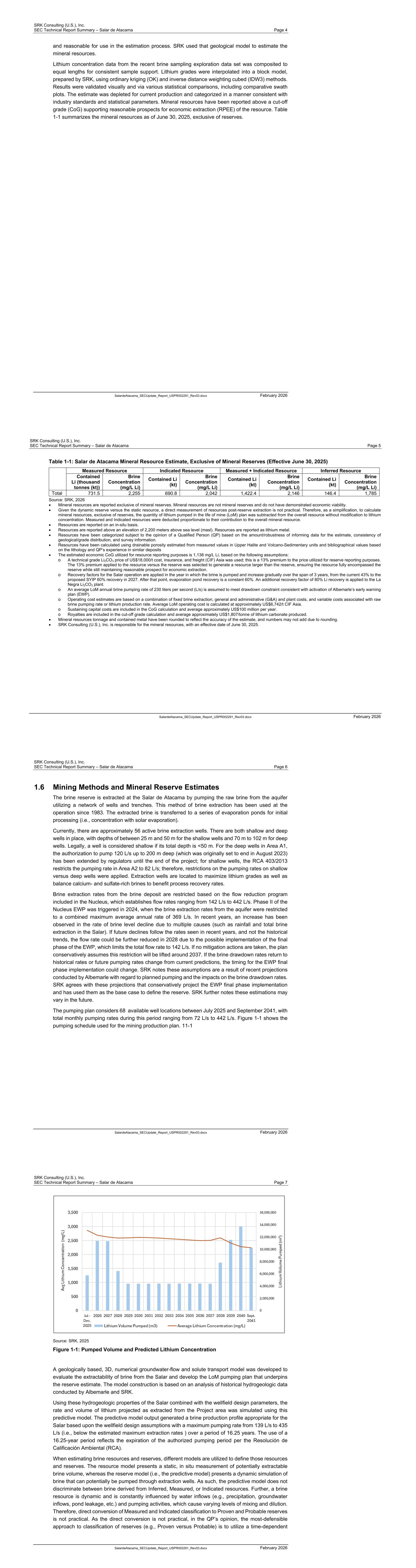
SRK Consulting (U.S.), Inc. SEC Technical Report Summary – Salar de Atacama Page 4 SalardeAtacama_SECUpdate_Report_USPR002291_Rev03.docx February 2026 and reasonable for use in the estimation process. SRK used that geological model to estimate the mineral resources. Lithium concentration data from the recent brine sampling exploration data set was composited to equal lengths for consistent sample support. Lithium grades were interpolated into a block model, prepared by SRK, using ordinary kriging (OK) and inverse distance weighting cubed (IDW3) methods. Results were validated visually and via various statistical comparisons, including comparative swath plots. The estimate was depleted for current production and categorized in a manner consistent with industry standards and statistical parameters. Mineral resources have been reported above a cut-off grade (CoG) supporting reasonable prospects for economic extraction (RPEE) of the resource. Table 1-1 summarizes the mineral resources as of June 30, 2025, exclusive of reserves. SRK Consulting (U.S.), Inc. SEC Technical Report Summary – Salar de Atacama Page 5 SalardeAtacama_SECUpdate_Report_USPR002291_Rev03.docx February 2026 Table 1-1: Salar de Atacama Mineral Resource Estimate, Exclusive of Mineral Reserves (Effective June 30, 2025) Measured Resource Indicated Resource Measured + Indicated Resource Inferred Resource Contained Li (thousand tonnes (kt)) Brine Concentration (mg/L Li) Contained Li (kt) Brine Concentration (mg/L Li) Contained Li (kt) Brine Concentration (mg/L Li) Contained Li (kt) Brine Concentration (mg/L Li) Total 731.5 2,255 690.8 2,042 1,422.4 2,146 146.4 1,785 Source: SRK, 2026 Mineral resources are reported exclusive of mineral reserves. Mineral resources are not mineral reserves and do not have demonstrated economic viability. Given the dynamic reserve versus the static resource, a direct measurement of resources post-reserve extraction is not practical. Therefore, as a simplification, to calculate mineral resources, exclusive of reserves, the quantity of lithium pumped in the life of mine (LoM) plan was subtracted from the overall resource without modification to lithium concentration. Measured and Indicated resources were deducted proportionate to their contribution to the overall mineral resource. Resources are reported on an in-situ basis. Resources are reported above an elevation of 2,200 meters above sea level (masl). Resources are reported as lithium metal. Resources have been categorized subject to the opinion of a Qualified Person (QP) based on the amount/robustness of informing data for the estimate, consistency of geological/grade distribution, and survey information. Resources have been calculated using drainable porosity estimated from measured values in Upper Halite and Volcano-Sedimentary units and bibliographical values based on the lithology and QP’s experience in similar deposits The estimated economic CoG utilized for resource reporting purposes is 1,138 mg/L Li, based on the following assumptions: o A technical grade Li2CO3 price of US$18,000/t cost, insurance, and freight (CIF) Asia was used; this is a 13% premium to the price utilized for reserve reporting purposes. The 13% premium applied to the resource versus the reserve was selected to generate a resource larger than the reserve, ensuring the resource fully encompassed the reserve while still maintaining reasonable prospect for economic extraction. o Recovery factors for the Salar operation are applied in the year in which the brine is pumped and increase gradually over the span of 3 years, from the current 43% to the proposed SYIP 60% recovery in 2027. After that point, evaporation pond recovery is a constant 60%. An additional recovery factor of 80% Li recovery is applied to the La Negra Li2CO3 plant. o An average LoM annual brine pumping rate of 230 liters per second (L/s) is assumed to meet drawdown constraint consistent with activation of Albemarle’s early warning plan (EWP). o Operating cost estimates are based on a combination of fixed brine extraction, general and administrative (G&A) and plant costs, and variable costs associated with raw brine pumping rate or lithium production rate. Average LoM operating cost is calculated at approximately US$6,742/t CIF Asia. o Sustaining capital costs are included in the CoG calculation and average approximately US$100 million per year. o Royalties are included in the cut-off grade calculation and average approximately US$1,807/tonne of lithium carbonate produced. Mineral resources tonnage and contained metal have been rounded to reflect the accuracy of the estimate, and numbers may not add due to rounding. SRK Consulting (U.S.), Inc. is responsible for the mineral resources, with an effective date of June 30, 2025. SRK Consulting (U.S.), Inc. SEC Technical Report Summary – Salar de Atacama Page 6 SalardeAtacama_SECUpdate_Report_USPR002291_Rev03.docx February 2026 1.6 Mining Methods and Mineral Reserve Estimates The brine reserve is extracted at the Salar de Atacama by pumping the raw brine from the aquifer utilizing a network of wells and trenches. This method of brine extraction has been used at the operation since 1983. The extracted brine is transferred to a series of evaporation ponds for initial processing (i.e., concentration with solar evaporation). Currently, there are approximately 56 active brine extraction wells. There are both shallow and deep wells in place, with depths of between 25 m and 50 m for the shallow wells and 70 m to 102 m for deep wells. Legally, a well is considered shallow if its total depth is <50 m. For the deep wells in Area A1, the authorization to pump 120 L/s up to 200 m deep (which was originally set to end in August 2023) has been extended by regulators until the end of the project; for shallow wells, the RCA 403/2013 restricts the pumping rate in Area A2 to 82 L/s; therefore, restrictions on the pumping rates on shallow versus deep wells were applied. Extraction wells are located to maximize lithium grades as well as balance calcium- and sulfate-rich brines to benefit process recovery rates. Brine extraction rates from the brine deposit are restricted based on the flow reduction program included in the Nucleus, which establishes flow rates ranging from 142 L/s to 442 L/s. Phase II of the Nucleus EWP was triggered in 2024, when the brine extraction rates from the aquifer were restricted to a combined maximum average annual rate of 369 L/s. In recent years, an increase has been observed in the rate of brine level decline due to multiple causes (such as rainfall and total brine extraction in the Salar). If future declines follow the rates seen in recent years, and not the historical trends, the flow rate could be further reduced in 2028 due to the possible implementation of the final phase of the EWP, which limits the total flow rate to 142 L/s. If no mitigation actions are taken, the plan conservatively assumes this restriction will be lifted around 2037. If the brine drawdown rates return to historical rates or future pumping rates change from current predictions, the timing for the EWP final phase implementation could change. SRK notes these assumptions are a result of recent projections conducted by Albemarle with regard to planned pumping and the impacts on the brine drawdown rates. SRK agrees with these projections that conservatively project the EWP final phase implementation and has used them as the base case to define the reserve. SRK further notes these estimations may vary in the future. The pumping plan considers 68 available well locations between July 2025 and September 2041, with total monthly pumping rates during this period ranging from 72 L/s to 442 L/s. Figure 1-1 shows the pumping schedule used for the mining production plan. 11-1 SRK Consulting (U.S.), Inc. SEC Technical Report Summary – Salar de Atacama Page 7 SalardeAtacama_SECUpdate_Report_USPR002291_Rev03.docx February 2026 Source: SRK, 2025 Figure 1-1: Pumped Volume and Predicted Lithium Concentration A geologically based, 3D, numerical groundwater-flow and solute transport model was developed to evaluate the extractability of brine from the Salar and develop the LoM pumping plan that underpins the reserve estimate. The model construction is based on an analysis of historical hydrogeologic data conducted by Albemarle and SRK. Using these hydrogeologic properties of the Salar combined with the wellfield design parameters, the rate and volume of lithium projected as extracted from the Project area was simulated using this predictive model. The predictive model output generated a brine production profile appropriate for the Salar based upon the wellfield design assumptions with a maximum pumping rate from 139 L/s to 435 L/s (i.e., below the estimated maximum extraction rates ) over a period of 16.25 years. The use of a 16.25-year period reflects the expiration of the authorized pumping period per the Resolución de Calificación Ambiental (RCA). When estimating brine resources and reserves, different models are utilized to define those resources and reserves. The resource model presents a static, in situ measurement of potentially extractable brine volume, whereas the reserve model (i.e., the predictive model) presents a dynamic simulation of brine that can potentially be pumped through extraction wells. As such, the predictive model does not discriminate between brine derived from Inferred, Measured, or Indicated resources. Further, a brine resource is dynamic and is constantly influenced by water inflows (e.g., precipitation, groundwater inflows, pond leakage, etc.) and pumping activities, which cause varying levels of mixing and dilution. Therefore, direct conversion of Measured and Indicated classification to Proven and Probable reserves is not practical. As the direct conversion is not practical, in the QP’s opinion, the most-defensible approach to classification of reserves (e.g., Proven versus Probable) is to utilize a time-dependent

SRK Consulting (U.S.), Inc. SEC Technical Report Summary – Salar de Atacama Page 8 SalardeAtacama_SECUpdate_Report_USPR002291_Rev03.docx February 2026 approach, as the QP has the highest confidence in the early years of the predictive model results, with a steady erosion of that confidence over time. Therefore, in the context of time-dependent risk, in the QP’s opinion, the production plan through the end of 2034 (approximately 10.5 years of pumping) is reasonably classified as a Proven reserve, with the remainder of production (5.75 years) classified as Probable. Notably, this classification results in approximately 58% of the reserve being classified as Proven and 42% of the reserve being classified as Probable. For comparison, the Measured resource comprises approximately 51% of the total Measured and Indicated resource. In the QP’s opinion, this classification is reasonable, as the overall geological and technical uncertainty for the Salar de Atacama resource and reserve are similar. Table 1-2 presents the Salar de Atacama mineral reserves as of June 30, 2025. Table 1-2: Salar de Atacama Mineral Reserves, Effective June 30, 2025 Proven Reserve Probable Reserve Proven and Probable Reserve Contained Li (kt) Li Concentration (mg/L) Contained Li (kt) Li Concentration (mg/L) Contained Li (kt) Li Concentration (mg/L) In situ 172.9 2,633 124.8 2,390 297.7 2,525 In process 25.3 2,855 0 0 25.3 2,855 Source: SRK, 2026 In process reserves quantify the prior 24 months of pumping data and reflect the raw brine at the time of pumping. These reserves represent the first 24 months of feed to the lithium process plant in the economic model. Proven reserves have been estimated as the lithium mass pumped during 2025 H2 through 2035 of the proposed LoM plan. Probable reserves have been estimated as the lithium mass pumped from 2036 until the end of the proposed LoM plan (2041). Reserves are reported as lithium metal. This mineral reserve estimate was derived based on a production pumping plan truncated on September 30, 2041 (i.e., approximately 16.25 years). This plan was truncated to reflect the termination date of Albemarle’s authorized brine extraction from the Salar. The estimated economic CoG for the Project is 1,348 mg/L Li, based on the assumptions discussed below. The truncated production pumping plan remained well above the economic CoG (i.e., the economic CoG did not result in a limiting factor to the estimation of the reserve). o A technical grade Li2CO3 price of US$16,000/t CIF Asia was used. o Recovery factors for the Salar operation are applied in the year the brine is pumped and increase gradually over the span of 3 years, from the current 43% to the proposed SYIP 60% recovery in 2027. After that point, evaporation pond recovery remains constant at 60%. An additional recovery factor of 80% Li recovery is applied to the La Negra Li2CO3 plant. o A LoM average annual brine pumping rate of 230 L/s is assumed to be consistent with activation of Albemarle’s EWP. o Operating cost estimates are based on a combination of fixed brine extraction, G&A and plant costs, and variable costs associated with raw brine pumping rate or lithium production rate. Average LoM operating cost is calculated at approximately US$6,742/t CIF Asia. o Sustaining capital costs are included in the CoG calculation and after the SYIP installation, averaging around US$100 million per year. o Royalties are included in the cut-off grade calculation and average approximately US$1,807/tonne of lithium carbonate produced. Mineral reserve tonnage, grade, and mass yield have been rounded to reflect the accuracy of the estimate, and numbers may not add due to rounding. SRK Consulting (U.S.), Inc. is responsible for the mineral reserves, with an effective date of June 30, 2025. In the QP’s opinion, key points of uncertainty associated with the modifying factors in this reserve estimate that could have a material impact on the reserve include the following: Resource dilution: The reserve estimate included in this report assumes that the Salar brine is replenished at its boundaries at certain rates and with certain chemical composition. Changes in the rate of inflows (versus those assumed) will impact the reserve. For example, an increase in the magnitude of lateral flows into the Salar could act to dilute the brine and SRK Consulting (U.S.), Inc. SEC Technical Report Summary – Salar de Atacama Page 9 SalardeAtacama_SECUpdate_Report_USPR002291_Rev03.docx February 2026 reduce lithium concentrations in extraction wells, primarily in the southwest area of the Albemarle property. Initial lithium concentration: The current initial concentration was estimated based on the available historical data by spatial distribution and date (up to the 2020 sampling campaign) and the calibration process. To illustrate the effect of the initial lithium concentration in the predictions, the lithium distribution mentioned above was decreased by 10%. As a result, the predicted average lithium concentrations from the production wells decreased by 13%. Seepage from processing ponds: The predictive simulations did not consider potential seepage of concentrated brine from the processing pond. Such seepage may have two opposing effects: on one hand, loss of lithium mass between extraction from groundwater and production of Li2CO3 at the end of the concentration process, and on the other hand, replenishing groundwater with lithium that could be captured by extraction wells. SRK completed a sensitivity simulation that predicts that pond seepage would result in average lithium concentration increase from the production wells of approximately 2.2% at the end of production as compared to the base case (for the conditions evaluated in the sensitivity analysis).No sensitivity was conducted on the lithium loss (recovery) from the ponds due to historical data supporting the recovery estimations. Freshwater/brine mixing: The numerical model implicitly simulated the density separation of lateral freshwater recharge and Salar brine by imposing a low-conductivity zone at the brine- freshwater interface. It is possible that lateral recharge of freshwater into the Salar may increase without this restriction, as the water table declines as a result of pumping and reducing the amount of freshwater lost to evapotranspiration at the periphery of the Salar. SRK completed a sensitivity analysis where the hydraulic conductivity at the freshwater/brine interface was increased by half an order of magnitude. This scenario resulted in no material change compared to the base case (<5%). Hydrogeological assumptions: Factors (such as specific yield, hydraulic conductivity, and dispersivity) play a key role in estimating the volume of brine available for extraction in the wellfield and the rate it can be extracted. Actual contacts between hydrogeological units may not be exactly as represented in the numerical model. These factors are variable through the Salar and are difficult to measure directly. Hydraulic conductivities and specific yields lower than assumed in the numerical model would result in reduced pumpability and reduced lithium mass extraction. Specific yields and porosities lower than assumed in the model would lead to faster migration of fresh/brackish water from the edges of the Salar and dilution of lithium concentrations in extraction wells. The following scenarios were evaluated: o To evaluate the importance of the Silt, Clay, and Salt unit (UH-11), the hydraulic conductivity is this unit was reduced by 50%. This scenario shows small changes in the average lithium concentration and the predicted total mass (<5%). o Dispersion coefficient values were reduced by 50% in the entire model domain. This scenario resulted in a decrease of <6% in the average lithium concentrations and annual total mass. o Effective porosity and specific yield in the Intermediate Halite unit (UH-4) was increased from 1% to 5%. This scenario resulted in a reduction in lithium concentration and annual total mass of <3.3% at the end of production (compared to the base case). The effect was mainly driven by the relatively low lithium concentration in this unit. SRK Consulting (U.S.), Inc. SEC Technical Report Summary – Salar de Atacama Page 10 SalardeAtacama_SECUpdate_Report_USPR002291_Rev03.docx February 2026 o Effective porosity and specific yield in the Volcano-Sedimentary unit (UH-7) was reduced from 10% to 6.5%. This scenario resulted in a reduction in lithium concentration and annual total mass of <8.8% at the end of production (compared to the base case). o Effective Porosity and Specific Yield in the Upper Halite West Unit were uniformly reduced in Zone 7, from 10% to 7.5% This scenario resulted in a reduction in lithium concentration and annual total mass of <5.5% at the end of production (compared to the base case Li2CO3 price: Although the pumping plan remains above the economic CoG, commodity prices can have significant volatility, which could result in a shortened reserve life. Change to the Sociedad Química y Minera de Chile S.A. (SQM) pumping plan: The numerical model makes certain assumptions regarding the SQM pumping plan (which terminates at the end of 2030). Overall, SQM has extracted and is expected to extract brines at greater rates than Albemarle. Increased pumping by SQM or an extension of their pumping period beyond 2030 may have two effects: reduce available resource in the Salar and draw freshwater at greater rate from the periphery of the Salar (dilution effect). Conversely, reduced extraction by SQM would increase available resources for Albemarle and reduce dilution. Simulating the extension of SQM’s pumping period shows a total mass decreased by 2.0% at the end of production for Albemarle’s operations. Process recovery: The ability to extract the full lithium production quota within the defined production period relies upon the ability to increase lithium recovery rates in the evaporation ponds from recent levels of approximately 43% to a target of approximately 60%. This increase is a result of updating the process flowsheet at the Salar by adding the SYIP to recover lithium lost to precipitated salts. In the QP’s opinion, the assumed recovery rates are reasonable; however, there remains uncertainty in the performance of the new process, and any material underperformance to these targets could limit Albemarle’s ability to extract its full lithium quota prior to the expiration of the quota. Lithium production quota: The current production quota acts as a hard stop on the estimated reserve, both from a total production mass and time standpoint. The expiration date for production of this lithium is December 31, 2043. If raw brine grades, pumping rates, or process recoveries underperform forecasts and Albemarle cannot produce the full quota by 2043, this potential reserve will be lost (i.e., it cannot recover lost production in later years and cannot pump faster than the limits imposed by the EWP to offset any underperformance). Conversely, with lithium grades well above economic cut-off and approximately 17% of the estimated mineral resource converting to reserve, the potential to negotiate an additional production quota with the government of Chile presents an opportunity to increase the current reserve, which is artificially constrained by the current quota. 1.7 Processing and Recovery Methods Albemarle's operations in Chile are developed in two areas: Salar de Atacama and La Negra. At the Salar, a lithium-rich chloride brine is extracted from groundwater production wells. This brine is pumped to ponds where it goes through a concentration process utilizing solar evaporation. The objective of the concentration process is to obtain a concentrated lithium chloride brine of around 6% Li that is largely depleted of impurities (such as sulfate (SO4), sodium (Na), calcium (Ca), potassium (K), and magnesium (Mg)). This concentrated brine is transported to the La Negra chemical plant by tanker truck for further processing. The SYIP facility was constructed and placed into operation in 2024 at the Salar, where bischofite and lithium-carnallite salts are reprocessed to recover entrained SRK Consulting (U.S.), Inc. SEC Technical Report Summary – Salar de Atacama Page 11 SalardeAtacama_SECUpdate_Report_USPR002291_Rev03.docx February 2026 lithium and increase the overall lithium recovery of the Salar. There is also a potash (KCl) plant for byproduct potash production at the Salar. Albemarle also harvests halite and bischofite salts from the evaporation ponds as byproduct production for third-party sales. The La Negra plant receives the concentrated brine from the Salar, where the brine is further refined and purified followed by the conversion of the lithium from a chloride to Li2CO3. The La Negra plant produces both technical- and battery-grade Li2CO3. Albemarle has also historically produced a lithium chloride product at La Negra but has no intentions of producing this product in the future. 1.8 Infrastructure The Project is a mature functioning operation with two separate sites that contain key facilities. Access is fully developed, with the majority accessible by paved major highways and local improved roadways on-site. A local airstrip services the Salar operations. The Antofagasta airport is the nearest major commercial airport servicing the La Negra operation (the Calama airport is the closet major commercial airport to the Salar). The infrastructure is in place, operating, and provides all necessary support for ongoing operations as summarized in this report. The Salar site contains the brine well fields, brine supply water pipelines to evaporation ponds, primary processing facilities to create a concentrated brine, a phosphate plant that creates a potassium chloride product, camps (including a newer camp that is in place and functional with an expansion phase designed and approved if needed in the future), airfield, access and internal roads, substation and powerline connected to the local Chilean power system, backup and supplemental diesel power generation supply and power distribution system, water supply and distribution, shop and warehouse facilities, administrative offices, change houses, waste salt storage areas, fuel storage systems, security, and communications systems. The concentrated brine product is trucked approximately 260 km to the La Negra facility. The La Negra plant purifies the lithium brine from the Salar Plant and converts the brine into Li2CO3 and LiCl. Facilities at the site include the trucked brine delivery system, boron (B) removal plant, calcium and magnesium removal plant, Li2CO3 conversion plants, LiCl plant, evaporation sedimentation ponds, solid waste storage, product warehousing and shipping, administrative facilities, cafeterias, and an off-site area where raw materials are warehoused and combined as needed in the processing facilities. Power to the facility is provided by the regional power company via a 110-kilovolt (kV) transmission line and distributed throughout the plant to load centers. Piped natural gas provides the energy for heating and steam needs at the facilities. The Project is security protected and has a full communication system installed. Final products from the La Negra plant are delivered to clients by truck, rail, or through port facilities in the region. 1.9 Market Studies Fastmarkets developed a marketing study on behalf of Albemarle to support lithium pricing assumptions. This market study does not consider byproducts or coproducts that may be produced alongside the lithium production process. Battery demand is now responsible for 82.0% of all lithium consumed. Fastmarkets expects near- to mid-term electric vehicle market growth to remain robust. The most significant near-term threats are
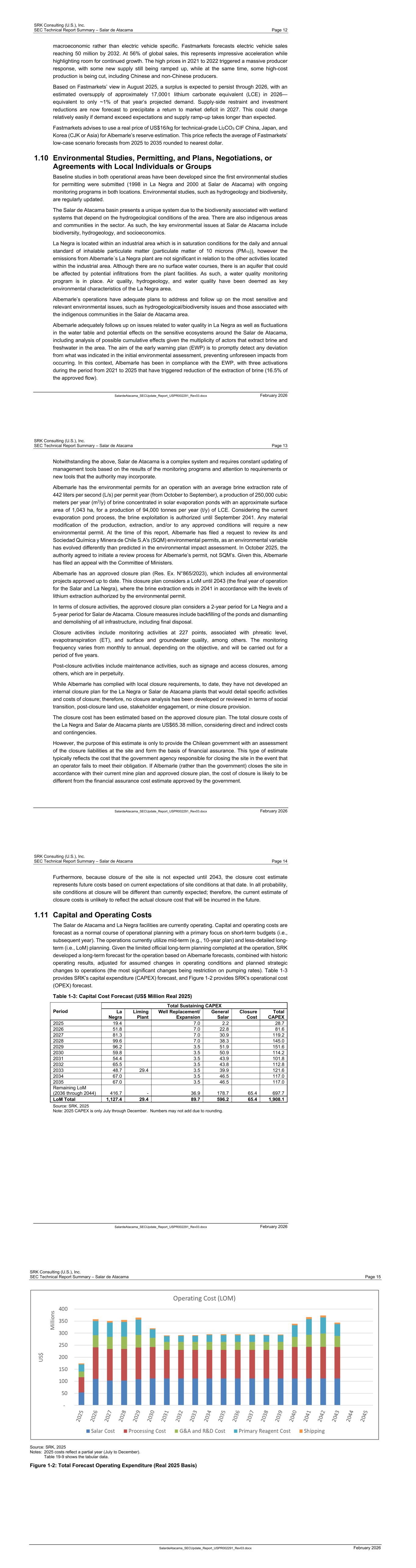
SRK Consulting (U.S.), Inc. SEC Technical Report Summary – Salar de Atacama Page 12 SalardeAtacama_SECUpdate_Report_USPR002291_Rev03.docx February 2026 macroeconomic rather than electric vehicle specific. Fastmarkets forecasts electric vehicle sales reaching 50 million by 2032. At 56% of global sales, this represents impressive acceleration while highlighting room for continued growth. The high prices in 2021 to 2022 triggered a massive producer response, with some new supply still being ramped up, while at the same time, some high-cost production is being cut, including Chinese and non-Chinese producers. Based on Fastmarkets’ view in August 2025, a surplus is expected to persist through 2026, with an estimated oversupply of approximately 17,000 t lithium carbonate equivalent (LCE) in 2026— equivalent to only ~1% of that year’s projected demand. Supply-side restraint and investment reductions are now forecast to precipitate a return to market deficit in 2027. This could change relatively easily if demand exceed expectations and supply ramp-up takes longer than expected. Fastmarkets advises to use a real price of US$16/kg for technical-grade Li2CO3 CIF China, Japan, and Korea (CJK or Asia) for Albemarle’s reserve estimation. This price reflects the average of Fastmarkets’ low-case scenario forecasts from 2025 to 2035 rounded to nearest dollar. 1.10 Environmental Studies, Permitting, and Plans, Negotiations, or Agreements with Local Individuals or Groups Baseline studies in both operational areas have been developed since the first environmental studies for permitting were submitted (1998 in La Negra and 2000 at Salar de Atacama) with ongoing monitoring programs in both locations. Environmental studies, such as hydrogeology and biodiversity, are regularly updated. The Salar de Atacama basin presents a unique system due to the biodiversity associated with wetland systems that depend on the hydrogeological conditions of the area. There are also indigenous areas and communities in the sector. As such, the key environmental issues at Salar de Atacama include biodiversity, hydrogeology, and socioeconomics. La Negra is located within an industrial area which is in saturation conditions for the daily and annual standard of inhalable particulate matter (particulate matter of 10 microns (PM10)), however the emissions from Albemarle´s La Negra plant are not significant in relation to the other activities located within the industrial area. Although there are no surface water courses, there is an aquifer that could be affected by potential infiltrations from the plant facilities. As such, a water quality monitoring program is in place. Air quality, hydrogeology, and water quality have been deemed as key environmental characteristics of the La Negra area. Albemarle’s operations have adequate plans to address and follow up on the most sensitive and relevant environmental issues, such as hydrogeological/biodiversity issues and those associated with the indigenous communities in the Salar de Atacama area. Albemarle adequately follows up on issues related to water quality in La Negra as well as fluctuations in the water table and potential effects on the sensitive ecosystems around the Salar de Atacama, including analysis of possible cumulative effects given the multiplicity of actors that extract brine and freshwater in the area. The aim of the early warning plan (EWP) is to promptly detect any deviation from what was indicated in the initial environmental assessment, preventing unforeseen impacts from occurring. In this context, Albemarle has been in compliance with the EWP, with three activations during the period from 2021 to 2025 that have triggered reduction of the extraction of brine (16.5% of the approved flow). SRK Consulting (U.S.), Inc. SEC Technical Report Summary – Salar de Atacama Page 13 SalardeAtacama_SECUpdate_Report_USPR002291_Rev03.docx February 2026 Notwithstanding the above, Salar de Atacama is a complex system and requires constant updating of management tools based on the results of the monitoring programs and attention to requirements or new tools that the authority may incorporate. Albemarle has the environmental permits for an operation with an average brine extraction rate of 442 liters per second (L/s) per permit year (from October to September), a production of 250,000 cubic meters per year (m3/y) of brine concentrated in solar evaporation ponds with an approximate surface area of 1,043 ha, for a production of 94,000 tonnes per year (t/y) of LCE. Considering the current evaporation pond process, the brine exploitation is authorized until September 2041. Any material modification of the production, extraction, and/or to any approved conditions will require a new environmental permit. At the time of this report, Albemarle has filed a request to review its and Sociedad Química y Minera de Chile S.A's (SQM) environmental permits, as an environmental variable has evolved differently than predicted in the environmental impact assessment. In October 2025, the authority agreed to initiate a review process for Albemarle’s permit, not SQM’s. Given this, Albemarle has filed an appeal with the Committee of Ministers. Albemarle has an approved closure plan (Res. Ex. N°865/2023), which includes all environmental projects approved up to date. This closure plan considers a LoM until 2043 (the final year of operation for the Salar and La Negra), where the brine extraction ends in 2041 in accordance with the levels of lithium extraction authorized by the environmental permit. In terms of closure activities, the approved closure plan considers a 2-year period for La Negra and a 5-year period for Salar de Atacama. Closure measures include backfilling of the ponds and dismantling and demolishing of all infrastructure, including final disposal. Closure activities include monitoring activities at 227 points, associated with phreatic level, evapotranspiration (ET), and surface and groundwater quality, among others. The monitoring frequency varies from monthly to annual, depending on the objective, and will be carried out for a period of five years. Post-closure activities include maintenance activities, such as signage and access closures, among others, which are in perpetuity. While Albemarle has complied with local closure requirements, to date, they have not developed an internal closure plan for the La Negra or Salar de Atacama plants that would detail specific activities and costs of closure; therefore, no closure analysis has been developed or reviewed in terms of social transition, post-closure land use, stakeholder engagement, or mine closure provision. The closure cost has been estimated based on the approved closure plan. The total closure costs of the La Negra and Salar de Atacama plants are US$65.38 million, considering direct and indirect costs and contingencies. However, the purpose of this estimate is only to provide the Chilean government with an assessment of the closure liabilities at the site and form the basis of financial assurance. This type of estimate typically reflects the cost that the government agency responsible for closing the site in the event that an operator fails to meet their obligation. If Albemarle (rather than the government) closes the site in accordance with their current mine plan and approved closure plan, the cost of closure is likely to be different from the financial assurance cost estimate approved by the government. SRK Consulting (U.S.), Inc. SEC Technical Report Summary – Salar de Atacama Page 14 SalardeAtacama_SECUpdate_Report_USPR002291_Rev03.docx February 2026 Furthermore, because closure of the site is not expected until 2043, the closure cost estimate represents future costs based on current expectations of site conditions at that date. In all probability, site conditions at closure will be different than currently expected; therefore, the current estimate of closure costs is unlikely to reflect the actual closure cost that will be incurred in the future. 1.11 Capital and Operating Costs The Salar de Atacama and La Negra facilities are currently operating. Capital and operating costs are forecast as a normal course of operational planning with a primary focus on short-term budgets (i.e., subsequent year). The operations currently utilize mid-term (e.g., 10-year plan) and less-detailed long- term (i.e., LoM) planning. Given the limited official long-term planning completed at the operation, SRK developed a long-term forecast for the operation based on Albemarle forecasts, combined with historic operating results, adjusted for assumed changes in operating conditions and planned strategic changes to operations (the most significant changes being restriction on pumping rates). Table 1-3 provides SRK’s capital expenditure (CAPEX) forecast, and Figure 1-2 provides SRK’s operational cost (OPEX) forecast. Table 1-3: Capital Cost Forecast (US$ Million Real 2025) Period Total Sustaining CAPEX La Negra Liming Plant Well Replacement/ Expansion General Salar Closure Cost Total CAPEX 2025 19.4 7.0 2.2 28.7 2026 51.8 7.0 22.8 81.6 2027 81.3 7.0 30.9 119.2 2028 99.6 7.0 38.3 145.0 2029 96.2 3.5 51.9 151.6 2030 59.8 3.5 50.9 114.2 2031 54.4 3.5 43.9 101.8 2032 65.5 3.5 43.8 112.8 2033 48.7 29.4 3.5 39.9 121.6 2034 67.0 3.5 46.5 117.0 2035 67.0 3.5 46.5 117.0 Remaining LoM (2036 through 2044) 416.7 - 36.9 178.7 65.4 697.7 LoM Total 1,127.4 29.4 89.7 596.2 65.4 1,908.1 Source: SRK, 2025 Note: 2025 CAPEX is only July through December. Numbers may not add due to rounding. SRK Consulting (U.S.), Inc. SEC Technical Report Summary – Salar de Atacama Page 15 SalardeAtacama_SECUpdate_Report_USPR002291_Rev03.docx February 2026 Source: SRK, 2025 Notes: 2025 costs reflect a partial year (July to December). Table 19-9 shows the tabular data. Figure 1-2: Total Forecast Operating Expenditure (Real 2025 Basis)
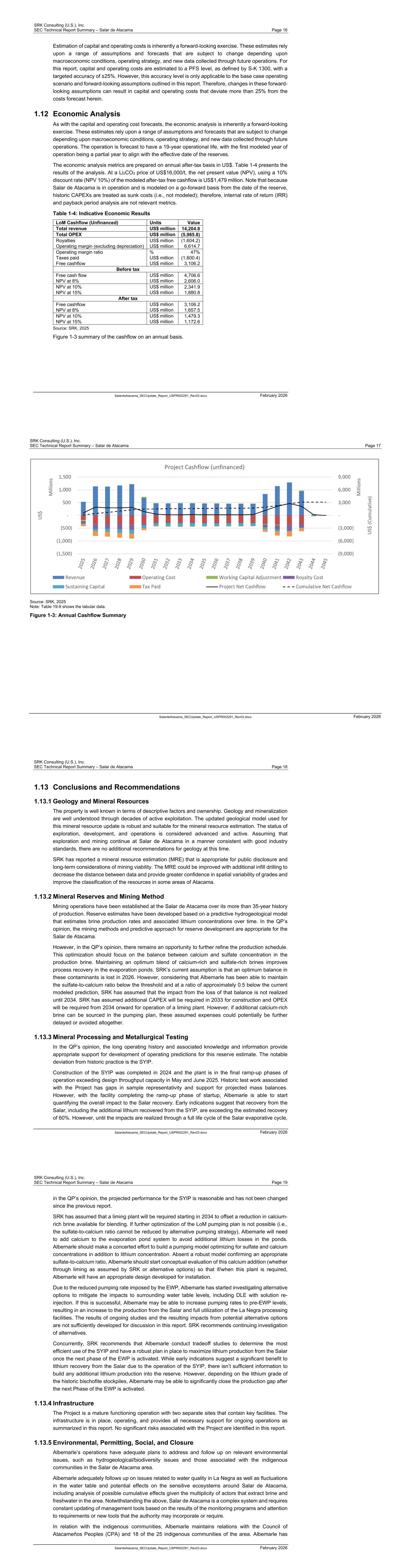
SRK Consulting (U.S.), Inc. SEC Technical Report Summary – Salar de Atacama Page 16 SalardeAtacama_SECUpdate_Report_USPR002291_Rev03.docx February 2026 Estimation of capital and operating costs is inherently a forward-looking exercise. These estimates rely upon a range of assumptions and forecasts that are subject to change depending upon macroeconomic conditions, operating strategy, and new data collected through future operations. For this report, capital and operating costs are estimated to a PFS level, as defined by S-K 1300, with a targeted accuracy of ±25%. However, this accuracy level is only applicable to the base case operating scenario and forward-looking assumptions outlined in this report. Therefore, changes in these forward- looking assumptions can result in capital and operating costs that deviate more than 25% from the costs forecast herein. 1.12 Economic Analysis As with the capital and operating cost forecasts, the economic analysis is inherently a forward-looking exercise. These estimates rely upon a range of assumptions and forecasts that are subject to change depending upon macroeconomic conditions, operating strategy, and new data collected through future operations. The operation is forecast to have a 19-year operational life, with the first modeled year of operation being a partial year to align with the effective date of the reserves. The economic analysis metrics are prepared on annual after-tax basis in US$. Table 1-4 presents the results of the analysis. At a Li2CO3 price of US$16,000/t, the net present value (NPV), using a 10% discount rate (NPV 10%) of the modeled after-tax free cashflow is US$1,479 million. Note that because Salar de Atacama is in operation and is modeled on a go-forward basis from the date of the reserve, historic CAPEXs are treated as sunk costs (i.e., not modeled); therefore, internal rate of return (IRR) and payback period analysis are not relevant metrics. Table 1-4: Indicative Economic Results LoM Cashflow (Unfinanced) Units Value Total revenue US$ million 14,204.8 Total OPEX US$ million (5,985.8) Royalties US$ million (1,604.2) Operating margin (excluding depreciation) US$ million 6,614.7 Operating margin ratio % 47% Taxes paid US$ million (1,600.4) Free cashflow US$ million 3,106.2 Before tax Free cash flow US$ million 4,706.6 NPV at 8% US$ million 2,606.0 NPV at 10% US$ million 2,341.9 NPV at 15% US$ million 1,880.8 After tax Free cashflow US$ million 3,106.2 NPV at 8% US$ million 1,657.5 NPV at 10% US$ million 1,479.3 NPV at 15% US$ million 1,172.6 Source: SRK, 2025 Figure 1-3 summary of the cashflow on an annual basis. SRK Consulting (U.S.), Inc. SEC Technical Report Summary – Salar de Atacama Page 17 SalardeAtacama_SECUpdate_Report_USPR002291_Rev03.docx February 2026 Source: SRK, 2025 Note: Table 19-9 shows the tabular data. Figure 1-3: Annual Cashflow Summary SRK Consulting (U.S.), Inc. SEC Technical Report Summary – Salar de Atacama Page 18 SalardeAtacama_SECUpdate_Report_USPR002291_Rev03.docx February 2026 1.13 Conclusions and Recommendations 1.13.1 Geology and Mineral Resources The property is well known in terms of descriptive factors and ownership. Geology and mineralization are well understood through decades of active exploitation. The updated geological model used for this mineral resource update is robust and suitable for the mineral resource estimation. The status of exploration, development, and operations is considered advanced and active. Assuming that exploration and mining continue at Salar de Atacama in a manner consistent with good industry standards, there are no additional recommendations for geology at this time. SRK has reported a mineral resource estimation (MRE) that is appropriate for public disclosure and long-term considerations of mining viability. The MRE could be improved with additional infill drilling to decrease the distance between data and provide greater confidence in spatial variability of grades and improve the classification of the resources in some areas of Atacama. 1.13.2 Mineral Reserves and Mining Method Mining operations have been established at the Salar de Atacama over its more than 35-year history of production. Reserve estimates have been developed based on a predictive hydrogeological model that estimates brine production rates and associated lithium concentrations over time. In the QP’s opinion, the mining methods and predictive approach for reserve development are appropriate for the Salar de Atacama. However, in the QP’s opinion, there remains an opportunity to further refine the production schedule. This optimization should focus on the balance between calcium and sulfate concentration in the production brine. Maintaining an optimum blend of calcium-rich and sulfate-rich brines improves process recovery in the evaporation ponds. SRK’s current assumption is that an optimum balance in these contaminants is lost in 2026. However, considering that Albemarle has been able to maintain the sulfate-to-calcium ratio below the threshold and at a ratio of approximately 0.5 below the current modeled prediction, SRK has assumed that the impact from the loss of that balance is not realized until 2034. SRK has assumed additional CAPEX will be required in 2033 for construction and OPEX will be required from 2034 onward for operation of a liming plant. However, if additional calcium-rich brine can be sourced in the pumping plan, these assumed expenses could potentially be further delayed or avoided altogether. 1.13.3 Mineral Processing and Metallurgical Testing In the QP’s opinion, the long operating history and associated knowledge and information provide appropriate support for development of operating predictions for this reserve estimate. The notable deviation from historic practice is the SYIP. Construction of the SYIP was completed in 2024 and the plant is in the final ramp-up phases of operation exceeding design throughput capacity in May and June 2025. Historic test work associated with the Project has gaps in sample representativity and support for projected mass balances. However, with the facility completing the ramp-up phase of startup, Albemarle is able to start quantifying the overall impact to the Salar recovery. Early indications suggest that recovery from the Salar, including the additional lithium recovered from the SYIP, are exceeding the estimated recovery of 60%. However, until the impacts are realized through a full life cycle of the Salar evaporative cycle, SRK Consulting (U.S.), Inc. SEC Technical Report Summary – Salar de Atacama Page 19 SalardeAtacama_SECUpdate_Report_USPR002291_Rev03.docx February 2026 in the QP’s opinion, the projected performance for the SYIP is reasonable and has not been changed since the previous report. SRK has assumed that a liming plant will be required starting in 2034 to offset a reduction in calcium- rich brine available for blending. If further optimization of the LoM pumping plan is not possible (i.e., the sulfate-to-calcium ratio cannot be reduced by alternative pumping strategy), Albemarle will need to add calcium to the evaporation pond system to avoid additional lithium losses in the ponds. Albemarle should make a concerted effort to build a pumping model optimizing for sulfate and calcium concentrations in addition to lithium concentration. Absent a robust model confirming an appropriate sulfate-to-calcium ratio, Albemarle should start conceptual evaluation of this calcium addition (whether through liming as assumed by SRK or alternative options) so that if/when this plant is required, Albemarle will have an appropriate design developed for installation. Due to the reduced pumping rate imposed by the EWP, Albemarle has started investigating alternative options to mitigate the impacts to surrounding water table levels, including DLE with solution re- injection. If this is successful, Albemarle may be able to increase pumping rates to pre-EWP levels, resulting in an increase to the production from the Salar and full utilization of the La Negra processing facilities. The results of ongoing studies and the resulting impacts from potential alternative options are not sufficiently developed for discussion in this report. SRK recommends continuing investigation of alternatives. Concurrently, SRK recommends that Albemarle conduct tradeoff studies to determine the most efficient use of the SYIP and have a robust plan in place to maximize lithium production from the Salar once the next phase of the EWP is activated. While early indications suggest a significant benefit to lithium recovery from the Salar due to the operation of the SYIP, there isn’t sufficient information to build any additional lithium production into the reserve. However, depending on the lithium grade of the historic bischofite stockpiles, Albemarle may be able to significantly close the production gap after the next Phase of the EWP is activated. 1.13.4 Infrastructure The Project is a mature functioning operation with two separate sites that contain key facilities. The infrastructure is in place, operating, and provides all necessary support for ongoing operations as summarized in this report. No significant risks associated with the Project are identified in this report. 1.13.5 Environmental, Permitting, Social, and Closure Albemarle’s operations have adequate plans to address and follow up on relevant environmental issues, such as hydrogeological/biodiversity issues and those associated with the indigenous communities in the Salar de Atacama area. Albemarle adequately follows up on issues related to water quality in La Negra as well as fluctuations in the water table and potential effects on the sensitive ecosystems around Salar de Atacama, including analysis of possible cumulative effects given the multiplicity of actors that extract brine and freshwater in the area. Notwithstanding the above, Salar de Atacama is a complex system and requires constant updating of management tools based on the results of the monitoring programs and attention to requirements or new tools that the authority may incorporate or require. In relation with the indigenous communities, Albemarle maintains relations with the Council of Atacameños Peoples (CPA) and 18 of the 25 indigenous communities of the area. Albemarle has

SRK Consulting (U.S.), Inc. SEC Technical Report Summary – Salar de Atacama Page 20 SalardeAtacama_SECUpdate_Report_USPR002291_Rev03.docx February 2026 achieved and maintained agreements with these communities in Chile. Any future significant development or modification of the current conditions of the operation will be subject to an Indigenous Consultation Process; therefore, it is of high importance to maintain this management strategy with these communities. Any requirement of a brine extraction greater than the one approved (442 L/s) has an uncertain approval success, considering the multi-user conditions in Salar de Atacama, the sensitivity of the ecosystem, and the synergistic impacts on this ecosystem that concern the environmental and water authorities. To prevent any unforeseen potential risk, the EWP could be activated because of the exceedance of an established threshold, which could result in the reduction of the amount of brine authorized for extraction. In this context, there were three EWP activations during the years from 2021 to 2025 that have implied reduction of the extraction of brine (16.5% of the approved flow). As a result of these activations of the EWP, Albemarle executed a detailed investigation on the causes triggering the EWP, which concluded that there is an environmental variable (water levels at the aquifer, part of the follow-up plan) that has evolved differently to what was predicted in the last environmental impact assessment. Therefore, Albemarle requested to the environmental authority the review of Albemarle’s environmental permit, as well as SQM’s environmental permit. This procedure is legally established in Article 25 Quinquies of Law N°19.300 that was filed with the authorities on May 29, 2024. In October 2025, the authority agreed to initiate a review process for Albemarle’s permit, not SQM’s. Given this, Albemarle has filed an appeal with the Committee of Ministers. Albemarle also has an approved closure plan (Res. Ex. N°865/2023), which includes all environmental projects approved until 2019, including Environmental Impact Declaration (Declaración de Impacto Ambiental (DIA)) “Modification of the project Phase 3 La Negra Plant Expansion” (RCA N°077/2019). The QP notes that Albemarle does not currently have an internal closure cost estimate other than for financial assurances (the closure plans referenced above). Therefore, other costs would likely be incurred by Albemarle during closure of the site. Then, the actual closure cost could be greater or less than the financial assurance estimate, as they need the closure plan approval for execution. Therefore, SRK highly recommends developing an internal closure plan where other costs could be determined, such as head office costs, human resources costs, taxes, operator-specific costs, and social costs. Also, closure provision should be determined in this document. 1.13.6 Capital and Operating Costs The capital and operating costs for the Salar de Atacama operation have been developed based on actual Project costs and forecasts. In the QP’s opinion, the cost development is acceptable for declaration of mineral reserves. However, the operation itself lacks detailed life of operation planning and costing. As such, the forward-looking costs incorporated herein are inherently strongly correlated to current market conditions. Due to the recent volatility in lithium prices, the lithium production space is evolving rapidly, and any forward-looking forecast based on such an environment carries increased risk. The QP strongly recommends continued development and refinement of a robust life of operation cost model. In addition to further refinement of the cost model, the QP also recommends that close watch be kept on the economic environment, with an eye toward continuous updates as the market environment continues to evolve. SRK Consulting (U.S.), Inc. SEC Technical Report Summary – Salar de Atacama Page 21 SalardeAtacama_SECUpdate_Report_USPR002291_Rev03.docx February 2026 1.13.7 Economics The operation is forecast to generate positive cashflow during every year of the LoM plan in which it is pumping or processing brine based on the production schedule, costs, and process performance outlined in this report. However, the pumping restriction at the Salar will result in reduced economic performance during affected periods. An economic sensitivity analysis indicates that the operation’s NPV is most sensitive to variations in commodity price, plant recovery, and lithium grade. SRK Consulting (U.S.), Inc. SEC Technical Report Summary – Salar de Atacama Page 22 SalardeAtacama_SECUpdate_Report_USPR002291_Rev03.docx February 2026 2 Introduction This TRS was prepared in accordance with the SEC S-K regulations (Title 17, Part 229, Items 601 and 1300 through 1305) for Albemarle by SRK on Salar de Atacama. Associated lithium processing facilities at the La Negra operation are included in this report, as they are critical to the production of a final, commercially salable product. Albemarle is the 100% owner of the Salar de Atacama and La Negra operations. 2.1 Terms of Reference and Purpose The quality of information, conclusions, and estimates contained herein are consistent with the level of effort involved in SRK’s services, based on i) information available at the time of preparation and ii) the assumptions, conditions, and qualifications set forth in this report. This report is intended for use by Albemarle subject to the terms and conditions of its contract with SRK and relevant securities legislation. The contract permits Albemarle to file this report as a TRS pursuant to the SEC S-K regulations, more specifically Title 17, Subpart 229.600, item 601(b)(96) - TRS and Title 17, Subpart 229.1300 - Disclosure by Registrants Engaged in Mining Operations. Any other use of this report by any third party is at that party’s sole risk. The responsibility for this disclosure remains with Albemarle. The purpose of this TRS is to report mineral resources and mineral reserves for Salar de Atacama. This report is prepared to a prefeasibility standard, as defined by S-K 1300. This technical report is an update of the previous report titled, "SEC Technical Report Summary, Pre-Feasibility Study, Salar de Atacama, Region II, Chile. Report Date February 8, 2025.” The effective date of this report is June 30, 2025. 2.2 Sources of Information This report is based in part on internal company technical reports, previous feasibility studies, maps, published government reports, company letters and memoranda, and public information as cited throughout this report and listed in Section 24. Section 25 lists reliance upon information provided by the registrant, where applicable. 2.3 Details of Inspection Table 2-1 summarizes the details of the personal inspections on the property by each QP or, if applicable, the reason why a personal inspection has not been completed. SRK Consulting (U.S.), Inc. SEC Technical Report Summary – Salar de Atacama Page 23 SalardeAtacama_SECUpdate_Report_USPR002291_Rev03.docx February 2026 Table 2-1: Site Visits Expertise Date(s) of Visit Details of Inspection Reason Why a Personal Inspection Has Not Been Completed Process Several, most recently in November 2025 Site visit with inspection of evaporation ponds, Salar processing facilities, and La Negra plant and packaging area Resource and Exploitation Multiple, most recently in November 2025 Site visit with inspection of drillholes, core review, exploration procedures, production wells, packer testing, evaporation ponds, site facilities, laboratory, and trucking facilities at the Salar Infrastructure Several, most recently in November 2025 Site visit with inspection of evaporation ponds, administration complex, utilities supplies, laboratories, processing facilities, access roads, and waste facilities at both the Salar and La Negra plant Environment Several, most recently in November 2025 Site visit with inspection of operations and environmental impacts at the Salar and La Negra plant Source: SRK, 2025 2.4 Report Version Update The user of this document should ensure that this is the most recent TRS for the property. This technical report is an update of the previous report titled, "SEC Technical Report Summary, Pre- Feasibility Study, Salar de Atacama, Region II, Chile. Report Date February 8, 2025.” 2.5 Qualified Persons This report was prepared by SRK Consulting (U.S.), Inc., a third-party firm comprising mining experts in accordance with § 229.1302(b)(1). The lithium market summary sections of the report (Sections 1.9 and 16), were prepared by Fastmarkets, a third-party firm with lithium market expertise in accordance with § 229.1302(b)(1). Albemarle has determined that SRK and Fastmarkets meet the qualifications specified under the definition of QP in § 229.1300. References to the QP in this report are references to SRK Consulting (U.S.), Inc. and Fastmarkets, respectively, and not to any individual employed at either QP. 2.6 Forward-Looking Information This report contains forward-looking information and forward-looking statements within the meaning of applicable United States securities legislation, which involve a number of risks and uncertainties. Forward-looking information and forward-looking statements include, but are not limited to, statements with respect to the future prices of lithium, the estimation of mineral resources and reserves, the realization of mineral estimates, the timing and amount of estimated future production, costs of production, CAPEX, costs (including capital costs, operating costs, and other costs), timing of the LoM, rates of production, annual revenues, requirements for additional capital, and government regulation of mining operations. Often, but not always, forward-looking statements can be identified by the use of words such as plans, expects, does not expect, is expected, budget, scheduled, estimates, forecasts, intends, anticipates,

SRK Consulting (U.S.), Inc. SEC Technical Report Summary – Salar de Atacama Page 24 SalardeAtacama_SECUpdate_Report_USPR002291_Rev03.docx February 2026 does not anticipate, believes, variations of such words and phrases, or statements that certain actions, events, or results may, could, would, might, or will be taken, occur, or be achieved. Forward-looking statements are based on the opinions, estimates, and assumptions of contributors to this report. Certain key assumptions are discussed in more detail. Forward-looking statements involve known and unknown risks, uncertainties, and other factors, which may cause the actual results, performance, or achievements of Albemarle to be materially different from any other future results, performance, or achievements expressed or implied by the forward-looking statements. Such factors include, among others: the actual results of current development activities; conclusions of economic evaluations; capital and operating cost forecasts; changes in project parameters as plans continue to be refined; future prices of lithium existing as various compounds and grades; possible variations in mineral grade or recovery rates; failure of plant, equipment, or processes to operate as anticipated; accidents, labor disputes, climate change risks, and other risks of the mining industry; delays in obtaining governmental approvals or financing or in the completion of development or construction activities; shortages of labor and materials; changes to regulatory or governmental royalty and tax rates; environmental risks and unanticipated reclamation expenses; the impact on the supply chain and other complications associated with pandemics, including global health crises; title disputes or claims and timing and possible outcome of pending legal or regulatory proceedings; and those risk factors discussed or referred to in this report and in Albemarle’s documents filed from time to time with the securities regulatory authorities. There may be other factors than those identified that could cause actual actions, events, or results to differ materially from those described in forward-looking statements. There may be other factors that cause actions, events, or results not to be anticipated, estimated, or intended. There can be no assurance that forward-looking statements will prove to be accurate, as actual results and future events could differ materially from those anticipated in such statements. Accordingly, readers are cautioned not to place undue reliance on forward-looking statements. Unless required by securities laws, the authors undertake no obligation to update the forward-looking statements if circumstances or opinions should change. SRK Consulting (U.S.), Inc. SEC Technical Report Summary – Salar de Atacama Page 25 SalardeAtacama_SECUpdate_Report_USPR002291_Rev03.docx February 2026 3 Property Description The Salar de Atacama Basin is located in the commune of San Pedro de Atacama, with the Albemarle operations approximately 100 km to the south of this location, in the extreme east of the Antofagasta Region and close to the border with the republics of Argentina and Bolivia, as shown on Figure 3-1. The communal area is 23,439 square kilometers (km2) and has an approximate population of 11,000 inhabitants, which are mainly distributed in the populated areas of San Pedro de Atacama, Toconao, Socaire, and Peine. Source: SRK, 2021 Figure 3-1: Location Map In a regional context, the Salar is located in a remote area, with the nearest city (Calama) approximately 190 km to the northwest by road. The regional capital (Antofagasta), which is also located near the La Negra processing facilities, is located approximately 250 km to the west by road. 3.1 Property Area Albemarle's mining properties within the Salar de Atacama include two groups of exploitation concessions: CASAME (private) and OMA (mining properties in Salar de Atacama owned by Albemarle), which cover a total of 5,227 mining properties. The properties span approximately 25 km at the widest zone in the east-to-west direction and 12 km in the widest north-to-south zone. For the purpose of the reserve estimate, the OMA concessions are those that are relevant. SRK Consulting (U.S.), Inc. SEC Technical Report Summary – Salar de Atacama Page 26 SalardeAtacama_SECUpdate_Report_USPR002291_Rev03.docx February 2026 The CASEME concessions include 1,883 properties and the same number of hectares. The OMA concessions include 3,344 mining properties of 5 ha each, which corresponds to 16,720 ha. Figure 3-2 shows the location of the Albemarle concessions at the southern end of the Salar de Atacama (in dark green), the rest of the OMA properties belonging to Albemarle (in light green), and the location of SQM's properties (in light purple bars) in the Salar. Albemarle has additional mining concessions (named Lila) that include 1,755 properties covering 1,755 ha of exploitation concessions and 17 properties covering 7,400 ha of exploration concessions. It is important to note that the Albemarle OMA concessions (while owned by Albemarle) can be repurchased by CORFO at the conclusion of the agreement with Albemarle. For the purpose of the reserve estimate, only the OMA concessions are relevant, and therefore the detail of the Lila concessions has not been included. SRK Consulting (U.S.), Inc. SEC Technical Report Summary – Salar de Atacama Page 27 SalardeAtacama_SECUpdate_Report_USPR002291_Rev03.docx February 2026 Source: Albemarle, 2025 Figure 3-2: Mining Claims in Salar de Atacama

SRK Consulting (U.S.), Inc. SEC Technical Report Summary – Salar de Atacama Page 28 SalardeAtacama_SECUpdate_Report_USPR002291_Rev03.docx February 2026 3.2 Mineral Title Albemarle’s mineral rights at Salar de Atacama consist of the right to extract lithium brine, pursuant to a long-term contract with the Chilean government originally entered into in 1980 by Foote Minerals, a predecessor of Albemarle. This contract has been subsequently amended and restated. This agreement is discussed in more detail in Section 16.3.1, although key details follow. Albemarle’s predecessor’s initial contract with the Chilean government will remain in effect until the date on which it has produced and sold 200,000 t LME (although the lithium can be produced in any of its forms) from the Salar de Atacama. As of June 30, 2025, the remaining amount of lithium from the initial contract equals approximately 101,133 t LME. On November 25, 2016, CORFO and Albemarle entered into an annex to the initial agreement adding an additional 262,132 t LME to the total quota and setting an expiration for production of the quota of January 1, 2044 (i.e., any remaining quota after this date will be forfeited). As of June 30, 2025, the remaining amount of lithium from the second quota equals 194,773 t. Combined, as of the effective date of this TRS (June 30, 2025), Albemarle has a remaining quota of 295,906 t LME, expiring January 1, 2044. Additionally, on April 26, 2024, CORFO and Albemarle entered into an addendum to the initial agreement and its amendments, adding the option of a “New Technologies Quota” in addition to the total quota and the additional quota, for up to 240,000 t LME that Albemarle may exploit based on lithium extracted using new technologies. The size of the area at Salar de Atacama covered by Albemarle’s OMA mining concessions (those relevant to the current reserve estimate) is 16,720 ha. Table 3-1 describes these OMA concessions. Albemarle also currently owns the land on which the extraction facility at Salar de Atacama and the processing facility at La Negra operate. However, the ownership of the land at Salar de Atacama will revert to the Chilean government once all amounts of lithium remaining under Albemarle’s contract with the Chilean government are sold (the ownership of the land and fixed assets at La Negra will remain unchanged). Table 3-1: OMA Mining Concessions Concession Name National Role Page Number Year Area (ha) Property of Albemarle Limitada Oma 1 Al 59820 02303-0007-0 408 11 1977 16,720 Oma 1 Al 59820 02301-5148-2 408 11 1977 6,850 Source: Albemarle, 2025 Section 17 provides a summary of the existing environmental permits and under which Albemarle operates. The rights to use existing water and the agreements with the communities are also summarized. In addition to the mining properties located in the nucleus of Salar de Atacama (although not covering the area relevant to the resource and reserve reported herein), Albemarle has mining properties located in the extreme north of the Cordón de Lila (called CASEME, LILA, and others), as shown in Table 3-2 and Figure 3-3. SRK Consulting (U.S.), Inc. SEC Technical Report Summary – Salar de Atacama Page 29 SalardeAtacama_SECUpdate_Report_USPR002291_Rev03.docx February 2026 Table 3-2: Albemarle Mining Concessions Source: Albemarle, 2025 Role Number Concession Name Pages (Fojas) Number Year Properties Area (ha) CASEME Mining Concessions 023030381-9 Caseme uno 1 al 100 394 119 2004 100 100 023030382-7 Caseme dos 1 al 100 387 118 2004 100 100 023030383-5 Caseme tres 1 al 75 401 120 2004 75 75 023030384-3 Caseme cuatro 1 al 100 408 121 2004 100 100 023030385-1 Caseme cinco 1 al 97 416 122 2004 97 97 023030386-K Caseme seis 1 al 100 424 123 2004 100 100 023030401-7 Caseme siete 1 al 100 432 124 2004 100 100 023030402-5 Caseme ocho 1 al 100 440 125 2004 100 100 023030388-6 Caseme nueve 1 al 95 448 126 2004 95 95 023030389-4 Caseme diez 1 al 100 456 127 2004 100 100 023030387-8 Caseme once 1 al 46 464 128 2004 46 46 023030390-8 Caseme doce 1 al 90 471 129 2004 90 90 023030391-6 Caseme trece 1 al 90 479 130 2004 90 90 023030392-4 Caseme catorce 1 al 65 556 140 2004 65 65 023030393-2 Caseme quince 1 al 90 563 141 2004 90 90 023030394-0 Caseme dieciseis 1 al 20 570 142 2004 20 20 023030395-9 Caseme diecisiete 1 al 90 487 131 2004 90 90 023030396-7 Caseme dieciocho 1 al 90 495 132 2004 90 90 023030397-5 Caseme diecinueve 1 al 90 503 133 2004 90 90 023030398-3 Caseme veinte 1 al 90 511 134 2004 90 90 023030399-1 Caseme veintiuno 1 al 65 519 135 2004 65 65 023030400-9 Caseme veintidos 1 al 90 526 136 2004 90 90 Total 1,883 1,883 Role Number Concession Name Pages (Fojas) Number Year Area (ha) Lila Mining Concessions 02303-D968-0 Lila 1 C 1,952 1,136 2022 400 02303-D975-3 Lila 2 C 1,953 1,137 2022 400 02303-D969-9 Lila 3 C 1,954 1,138 2022 400 02303-D976-1 Lila 4 C 1,955 1,139 2022 200 02303-D970-2 Lila 5 C 1,956 1,140 2022 600 02303-D966-4 Lila 6 C 1,957 1,141 2022 600 02303-D977-K Lila 7 C 1,959 1,142 2022 600 02303-D971-0 Lila 8 C 1,960 1,143 2022 600 02303-D978-8 Lila 9 C 1,961 1,144 2022 600 02303-D972-9 Lila 10 C 1,962 1,145 2022 600 02303-D981-8 Lila 12 C 1,963 1,146 2022 400 02303-D979-6 Lila 13 C 1,965 1,147 2022 400 02303-D973-7 Lila 14 C 1,966 1,148 2022 400 02303-D967-2 Lila 15 C 1,967 1,149 2022 600 02303-D980-K Lila 16 C 1,969 1,150 2022 100 02303-4040-4 Lila 19, 1 al 400 633 115 2021 400 02303-D974-5 Lila 20 C 4,900 2,935 2022 300 02303-E598-2 Lila 21 C 2,456 1,607 2023 200 02303-4210-5 Lila 11 B, 1 AL 600 77 15 2024 600 02303-4211-3 Lila 12 B, 1 AL 200 89 16 2024 200 02303-4212-1 Lila 13 B, 1 AL 200 98 17 2024 200 02303-4213-K Lila 14 B, 1 AL 200 106 18 2024 200 02303-4214-8 Lila 17 B, 1 AL 400 115 19 2024 400 Total 9,400 Role Number Concession name Pages (Fojas) Number Year Area (ha) Other Mining Concessions 02201-W9520 Laura 3 107 62 2024 300 02201-9055-2 Levedad 1 al 6 598 185 2019 6 02203-1854-0 Lucia 1 A, 1 al 30 28 7 2025 30 02203-3611-5 Lucia 1 B 142 55 2024 200 02203-1855-9 Lucia 2 A, 1 al 39 35 8 2025 39 02203-3609-3 Lucia 3 B 148 57 2024 100 02203-3608-5 Lucia 4 B 151 58 2024 100 02201-8666-0 Marce I 1/40 570 150 2017 194 02201-8667-9 Marce II 1/8 581 152 2017 35 02201-8086-7 Minero III 1/2 3319 576 2014 2 02201-8474-9 Pacifíco Norte II 1/6 3129 1129 2016 6 02201-8800-0 Piscis 1/86 16 3 2018 86 02201-8674-1 Salome I 1/3 587 153 2017 3 02201-8675-K Salome II 1/3 592 154 2017 3 02201-8676-8 Salome III 1/4 597 155 2017 4 02201-X713-2 Santiago 1 342 191 2025 200 Total 1,308 SRK Consulting (U.S.), Inc. SEC Technical Report Summary – Salar de Atacama Page 30 SalardeAtacama_SECUpdate_Report_USPR002291_Rev03.docx February 2026 Source: Albemarle, 2025 Figure 3-3: Albemarle Mining Concessions Section 17 of this report provides a summary of the existing environmental permits and under which Albemarle operates. The rights to use existing water and the agreements with the communities are also summarized. Since 2000, numerous Environmental Impact Declarations and Environmental Impact Studies have been approved by the Environmental Assessment Service (SEA) for both the La Negra plant and the Salar Plant. In addition, 10 Pertinence Queries to the SEA have been entered. Albemarle has wells located in the Tilopozo, Peine, and Tucúcaro areas, which have groundwater rights. 3.3 Encumbrances There are no encumbrances to the property other than the previously mentioned contract with CORFO. 3.4 Royalties or Similar Interest CORFO owned the concessions (which are currently operated by Albemarle and SQM) in Salar de Atacama prior to 1979 under specific contracts with limits to lithium extraction in time and/or quantity. The role of the corporation in is to safeguard its rights in contracts and collect agreed payments, which it exercises through the Sistema de Empresas (SEP). In Albemarle’s case, only one royalty payment for potassium is contemplated, since the usage of the concessions granted by CORFO was recognized as a contribution to the constitution of the initial company. SRK Consulting (U.S.), Inc. SEC Technical Report Summary – Salar de Atacama Page 31 SalardeAtacama_SECUpdate_Report_USPR002291_Rev03.docx February 2026 Albemarle’s 2016 agreement with CORFO added an additional royalty payment to the state development agency according to the sales price for both lithium carbonate and lithium hydroxide. Table 3-3 presents this royalty schedule. Table 3-3: CORFO Royalty Scheme for Albemarle in Atacama Lithium Carbonate Lithium Hydroxide Price Range (US$/t) Progressive Commission Rate (%) Price Range (US$/t) Progressive Commission Rate (%) 0 to 4,000 6.8 0 to 4,000 6.8 4,000 to 5,000 8.0 4,000 to 5,000 8.0 5,000 to 6,000 10.0 5,000 to 6,000 10.0 6,000 to 7,000 17.0 6,000 to 9,000 17.0 7,000 to 10,000 25.0 9,000 to 11,000 25.0 Over 10,000 40.0 Over 11,000 40.0 Source: CORFO, 2024 Albemarle Limitada is the Chilean entity. Albemarle owns 100% of Albemarle Limitada. Albemarle Limitada also contributes 3.5% of its annual sales to the communities (Council of Atacameños Peoples (CPA)), which contributes to their development.

SRK Consulting (U.S.), Inc. SEC Technical Report Summary – Salar de Atacama Page 32 SalardeAtacama_SECUpdate_Report_USPR002291_Rev03.docx February 2026 4 Accessibility, Climate, Local Resources, Infrastructure, and Physiography The Salar de Atacama basin is located within the Pre-Andean Depression, limited to the east by the Andes Mountains and to the west by the Domeyko Mountains. While located within the Andes, the Salar itself is flat over an extensive area. The elevation of the Salar is approximately 2,300 masl and has an area of approximately 3,500 km2. The Salar has an elliptical surface with a north-to-south orientation and a slight slope towards the south. The Salar is made up of 75% saline deposits that give it a flat and rough surface. 4.1 Topography, Elevation, and Vegetation The main climatic feature of the region is its aridity. The most extreme aridity (in fact, the driest location on Earth) is located to the west of the Salar between the coastal range and the Andes, where there is no maritime influence. The extreme aridity in this intermediate zone and the scarce existing vegetation defines a natural landscape known as the Atacama Desert. However, in systems such as Salar de Atacama, despite the desert climate, wetlands form due to the presence of water that rises to the surface, creating ecosystems with high biodiversity, such as the high Andean wetlands. 4.2 Means of Access From Antofagasta (where the La Negra facilities are located), access to the Salar de Atacama basin is possible along the regional highway Route 5 North, which connects with the local B-385 route, which enters the basin from the west and the south of the Salar, where the Albemarle operations are located; this is the primary transport route for concentrated brine from the Salar to La Negra and is approximately 260 km by road. From Calama, access is via the regional highway 23-CH, which connects the city of Calama with the international Sico pass on the border with Argentina. This route passes on the northern margin of the Salar with access to the site again on the local B-385 route, passing along the eastern margin of the Salar and entering to the south. The distance from the operation on the Salar to Calama is around 190 km (Figure 4-1). At the local level, the entrance to Albemarle's properties is located in the south of the communal territory of San Pedro de Atacama and is approximately 100 km away from this location by road. SRK Consulting (U.S.), Inc. SEC Technical Report Summary – Salar de Atacama Page 33 SalardeAtacama_SECUpdate_Report_USPR002291_Rev03.docx February 2026 Source: GWI, 2019 Figure 4-1: Property Access 4.3 Climate and Length of Operating Season The climate is high-altitude marginal desert, which presents a greater quantity and volume of rainfall in the summer months, between 20 and 60 millimeters per year (mm/y). The desert environment (low rainfall and high evaporation rates), combined with limited natural water courses, has resulted in the formation of numerous salars, among which Salar de Atacama stands out for its extension. Rainfall occurs mainly from January to March (as a result of the humidity transported from the Amazon basin (Bolivian winter)) and, to a lesser extent, between April and August (due to the displacement of cold fronts from Antarctica). The rainfall decreases from 300 mm/y in the Andes Mountains to about 10 mm/y to 20 mm/y in the Domeyko mountain range and on the Salar itself, with a statistical average of about 12 mm/y for the Salar. Maximum temperatures occur during the months of December to March (coinciding with the summer season), and the minimum temperatures are seen in winter between the months of June and August. The highest temperatures reach values close to 35 degrees Celsius (°C), while the minimum temperatures reach values close to -5°C. The average difference between the minimum and maximum temperatures is observed to be constant throughout the historical temperature series, having a value of approximately 20°C between day and night. SRK Consulting (U.S.), Inc. SEC Technical Report Summary – Salar de Atacama Page 34 SalardeAtacama_SECUpdate_Report_USPR002291_Rev03.docx February 2026 Evaporation also shows a seasonal variation, where the highest evaporation rates were measured in the months from December to February (summer) and the lowest evaporation rates were measured between the months of June and August (winter). These results are consistent with the temperature variations between the different seasons of the year. Albemarle's operations in the Salar are carried out continuously throughout the year. 4.4 Infrastructure Availability and Sources As a mature operation, adequate infrastructure is in place to support operations at both the Salar de Atacama and La Negra processing facilities. Section 15 describes the infrastructure in detail. The La Negra facilities are located 20 km southeast of the city of Antofagasta (the regional capital), which has power, water, highway, airport, and port facilities, as well as adequate local population to support operations. At the La Negra plant, the purification of lithium brine coming from the Salar Plant is carried out for its subsequent conversion into Li2CO3 and LiCl. The following facilities are operating at the plant: boron removal plant, calcium and magnesium removal plant, Li2CO3 conversion plants, LiCl plant, evaporation-sedimentation ponds, an off-site area where the raw materials are housed and the inputs used in the process are prepared, and a dry area where the different products are prepared. The Salar is located in a much more remote location, although existing road infrastructure is in place, as previously described. The Salar relies upon camps to support workers, which are sourced regionally. In general, the Antofagasta/Calama region is a major mining hub with adequate support systems for both La Negra and the Salar. The infrastructure facilities at the Salar are extraction wells, evaporation and concentration ponds, SYIP plant, Carnallite Plants 1 and 2, potash plant, drying plant, service area, and general areas, including waste salts stockpiles. The service sector is made up of various buildings, such as the change room, dining room, administrative office building, operations building, laboratory, and others. Road transport to and from the Salar is important for the movement of supplies, personnel, and consumables (e.g., reagents). In addition, the Salar produces a concentrated brine (approximately 6% Li), which must be transported by truck to the La Negra facilities. SRK Consulting (U.S.), Inc. SEC Technical Report Summary – Salar de Atacama Page 35 SalardeAtacama_SECUpdate_Report_USPR002291_Rev03.docx February 2026 5 History 5.1 Previous Operations In the early 1960s, William E. Rudolph, a geologist at Anaconda Company, conducted surveys in northern Chile for new water sources for the Chuquicamata operation and found water with high concentrations of salts in the Salar de Atacama Basin. In the mid-1960s, the report on the results of the brine obtained in Salar de Atacama reached the hands of Foote Mineral Company. Later in 1970, these reports were also published in The Mining Journal of London and The Christian Science Monitor. On August 13, 1980, CORFO signed an agreement with Foote Mineral Company (currently Albemarle US Inc.) to develop a lithium project in Salar de Atacama on the OMA mining leases incorporated by CORFO in 1977. In this context, Foote Mineral Company and CORFO created the Chilean Society of Limited Lithium (SCL) with a 55% and 45% stake in the share capital, respectively. The duration of the company was agreed in a term equal to that necessary to exploit, produce, and sell the indicated amount of LME approved for extraction (i.e., 30 years), automatically renewable for successive terms of 5 years each. CORFO contributed the OMA mining leases to the company. This contribution was subject to the condition that such leases are returned free of charge and in full right to CORFO upon the fulfillment of the agreement. Between 1988 and 1989, CORFO sold its 45% stake in SCL to Foote Mineral Company. In 1998, Chemetall purchased Foote Mineral Company, creating Chemetall-Foote Corporation. Subsequently, in 2004, Chemetall-Foote was acquired by Rockwood Lithium Inc., and in 2016, the latter was acquired by Albemarle US Inc., changing ownership of the Salar and La Negra plants to Albemarle Ltda. On November 25, 2016, CORFO and Albemarle US Inc. modified the original lithium production agreement through which its duration was modified, extending it and adding an additional 262,132 t of production rights. This extension is valid until the original and expanded production rights have been exploited, processed, and sold or January 1, 2044, whichever comes first. In 1981, the first construction of evaporation ponds in Salar de Atacama began. The following year, the construction of the Li2CO3 plant in the La Negra sector in Antofagasta began, which treats and transforms the concentrated brines coming from the Salar Plant into Li2CO3 and LiCl. Figure 5-1 provides a photograph of the first installations.

SRK Consulting (U.S.), Inc. SEC Technical Report Summary – Salar de Atacama Page 36 SalardeAtacama_SECUpdate_Report_USPR002291_Rev03.docx February 2026 Source: GWI, 2019 Figure 5-1: First Installations, 1981 Initially, SCL constructed a solar pond system at the Salar and a Li2CO3 plant with 6,350 t/y of Li2CO3 capacity was constructed at La Negra. Production started in 1984. In 1990, the Salar operations were expanded with a new well system, and the capacity of the Li2CO3 plant at La Negra was expanded to approximately 11,000 t/y Li2CO3. In 1998, the LiCl plant started operating at La Negra. In the early 1990s, potash also began to be recovered as a byproduct from the sylvinite harvested from their solar ponds. Operations at the Salar and La Negra have subsequently been expanded, and current production rates are around 74,000 t/y Li2CO3. 5.2 Exploration and Development of Previous Owners or Operators The first exploration campaign was completed from 1974 to 1979 (Foote Mineral Company, 1979). The first two pumping wells were drilled and tested in 1975 (CL-1 and CL-2). In June 1977, an exploration program was undertaken that was designed to define the distribution of lithium over the entire Salar. The drilling program can be summarized as follows: 32 exploration holes about 2 inches in diameter with depths ranging from 2.6 m to 4.6 m Four 6-inch exploration holes from 25 m to 185 m in depth (CL-3, CL-4, CL-5, and CL-8) Four 12-inch-diameter wells from 20 m to 30 m in depth (CL-6, CL-7, CL-9, and CL-10) In 1979, fifteen 6-inch exploration wells were drilled in the Chepica Peninsula area (CL-11 to CL-20) and in the south of the southwestern arm of the Salar (S1 to S5) (Figure 5-2). Upon completion of the drilling program, all the producing wells were subjected to pumping tests. SRK Consulting (U.S.), Inc. SEC Technical Report Summary – Salar de Atacama Page 37 SalardeAtacama_SECUpdate_Report_USPR002291_Rev03.docx February 2026 Source: SRK, 2021 (modified from Foote Mineral Company, 1979) Figure 5-2: Locations of Wells Drilled during the 1974 to 1979 Campaigns (Foote Mineral Company) In 2012 and 2013, Geodatos conducted surface geophysical surveys (transient electromagnetic (TEM) and NanoTEM) for Rockwood in the southern part of the Salar (Figure 5-3), SGA Ambiental, 2015. Following this survey, 25 wells and piezometers were drilled in the same area in 2013 and 2014 (Figure 5-4). Few data points were available regarding the drilling campaigns from 1980 to 2016 completed by Rockwood (previous owner). However, Albemarle reported that at least 27 wells and 20 observation wells or piezometers were drilled from 2013 to 2016; no further details were obtained. SRK Consulting (U.S.), Inc. SEC Technical Report Summary – Salar de Atacama Page 38 SalardeAtacama_SECUpdate_Report_USPR002291_Rev03.docx February 2026 Source: SGA Ambiental (SGA), 2015 Figure 5-3: Locations of TEM and NanoTEM Surveys in the 2013 and 2014 Field Campaign (Rockwood) SRK Consulting (U.S.), Inc. SEC Technical Report Summary – Salar de Atacama Page 39 SalardeAtacama_SECUpdate_Report_USPR002291_Rev03.docx February 2026 Source: SGA, 2015a Note: Green indicates wells and piezometers drilled in 2013, and blue indicates wells and piezometers drilled in 2014. Figure 5-4: Locations of Well and Piezometers Drilled in 2013 and 2014 Field Campaign (Rockwood)

SRK Consulting (U.S.), Inc. SEC Technical Report Summary – Salar de Atacama Page 40 SalardeAtacama_SECUpdate_Report_USPR002291_Rev03.docx February 2026 6 Geological Setting, Mineralization, and Deposit 6.1 Regional, Local, and Property Geology 6.1.1 Regional Geology The Salar de Atacama corresponds to a mature salt flat and is part of the group of salt flats found in the Altiplano-Puna (Houston et al., 2011). The Salar is formed by a core of chlorides in the center, while sulfate salts and carbonates predominate toward the edges (marginal zone). The marginal zone is mainly on the eastern edge of the salt flat and extends from north to south. The saline deposits are included within the Saline Deposits Unit of the Salar de Atacama according to Becerra et al., (2014) of Pleistocene-Holocene age. The nucleus is mainly affected by the Salar Fault System (SFS) and the Horse Fault System. Both structures are inversely kinematic and have a north-to-south to northwest- to-southeast strike that creates a division of the subsurface into two blocks: West block has a thickness of between 625 and 750 m, and East block has the maximum thickness recorded in seismic profiles of 900 m to 1,500 m (Jordan et al., 2007). The oldest rocks that outcrop in the study area date back to the Paleozoic and are mainly distributed in the Cordón de Lila Range, corresponding to sedimentary sequences that were deposited in environments ranging from deep marine during the Lower Ordovician to fluvial conditions during the Permian. The formations of this period are: Igneous-sedimentary complex of the Cordón de Lila, Quebrada Grande Formation, Quebrada Ancha Formation, Lila Formation (Di), and Estratos de Cerro Negro. Two strips of intrusive rocks are also distinguished, the first dating from the Ordovician period and the second from the Permian. These strips represent the presence of a volcanic arc for each period. The sedimentary sequences (in conjunction with the intrusives) have been interpreted as an accretion prism and active magmatic arc at the edge of the supercontinent Gondwana. These rocks would form the geological basement of the Salar de Atacama basin (Niemeyer, 2013). During the Permian–Triassic, a period of deformation and intense volcanism began, as evidenced by the rock units exposed along the eastern and western margins of the salt flat, where an angular unconformity between Paleozoic strata and overlying Triassic deposits has been identified. The units deposited during the Triassic-Early Jurassic are characterized by large thicknesses of volcanic material interspersed with sedimentary sequences deposited in a transitional environment. During this period, dioritic and granitic bodies were emplaced. The Andean tectonic cycle began in the Jurassic, which is currently still active. The few outcrops of this period are found to the west of the basin, in Cerro de Caracoles hills (Basso and Mpodozis, 2012), belonging to the Caracoles Group. The facies are characteristic of a shallow-shelf marine environment, including abundant fossil fauna. Important compressive deformation events occurred in the Middle Cretaceous as part of the tectonic event called Peruvian phase (Steinman, 1929) that constituted the beginnings of the formation of the mountain ranges Cordillera de la Costa and Cordillera de Domeyko. Rocks from this period outcrop in the Domeyko Mountain Range, although few outcrops are also found south of the Lilac Range. These Cretaceous units are affected by structures such as the Barros Arana syncline in the northwest of the basin. The units present facies typical of braided and alluvial fluvial systems interspersed with evaporitic, aeolian, and lacustrine sedimentation, characteristic of arid to semi-arid environments (Bascuñán et al., 2015). During the Paleocene, an intrusion event occurred that is still accompanied by the compressive deformation that began in the Cretaceous. This event corresponds to a second period of exhumation of the Domeyko Mountain Range that occurred between 65 and 50 Ma SRK Consulting (U.S.), Inc. SEC Technical Report Summary – Salar de Atacama Page 41 SalardeAtacama_SECUpdate_Report_USPR002291_Rev03.docx February 2026 (Henríquez et al., 2019). Rocks from this period correspond to the Naranja Formation and outcrop discontinuously to the west of the Llano de la Paciencia flat. To the east of Cerro Negro, this unit is affected by chevron-like folds (Cortés, J., 2012). The Naranja Formation has proximal alluvial facies that grade to distal; this was interpreted as a sequence of post-tectonic sedimentation to a pulse of compressive deformation that affected the Domeyko Cordillera (Mpodozis et al., 2005). In the Eocene- Oligocene, the final phase of uplift of the Domeyko Cordillera (50 Ma to 28 Ma) was generated (Henríquez et al., 2019). The Loma Amarilla Formation (Eocene-Oligocene sequences) characteristic of this period corresponds to a sedimentary unit with alluvial facies that outcrop to the west of the Llano Paciencia flat. The formation is affected by the syncline of the same name and is interpreted as a sequence of synthectonic sedimentation from the Inca Phase, which affected the Domeyko Mountain Range (Mpodozis et al., 2005). In this period, the exhumation of morphostructural elements (such as the Precordillera and the Cordón de Lila) also began. The Oligocene-Early Miocene period was characterized by an extensive (possibly transtensional) tectonic event, allowing the accommodation of sedimentary units of significant thickness, forming the Paciencia Group (Pananont et al., 2004). These units outcrop in the Cordillera de la Sal area and are affected by multiple synclines and anticlines (Becerra, et al., 2014). The units present facies characteristic of lacustrine, beach, and evaporite deposits (San Pedro Formation) and alluvial (Tambores Formation). The Estratos de Tilocalar is another sedimentary sequence from this period (gravel, sand, and silt), which outcrops in the southern part of the salt flat to the west of the Lomas de Tilocalar. Units deposited in Miocene correspond to sedimentary and volcanic rocks with evaporites (Campamento Formation) and poorly consolidated clastic deposits (Vilama Formation and Alluvial Deposits) that outcrop in the Cordillera de la Sal area. In the southwest of the Cordón de Lila and on the southeastern margin of the salt flat, gravels from this period also emerge (Niemeyer, 2013). The comprehensive regime would be maintained during the Pliocene-Pleistocene and would be accompanied by important flows of ignimbrites, which outcrop to the east of the basin in the area of the volcanic arc. It is also possible to observe the flows in the Cordón de Lila up to the peninsula of Chépica and the Lomas de Tilocalar hills; this exerts a first-order control over the morphologies found in the south of the basin, in the Lomas de Tilocalar sector (Niemeyer, 2013), and in the volcanic arc. Figure 6-1 shows the regional geology in Atacama salt flat. SRK Consulting (U.S.), Inc. SEC Technical Report Summary – Salar de Atacama Page 42 SalardeAtacama_SECUpdate_Report_USPR002291_Rev03.docx February 2026 Source: Albemarle 2024 (elaborated by Albemarle for the EIA and this report) Figure 6-1: Regional Geology Map SRK Consulting (U.S.), Inc. SEC Technical Report Summary – Salar de Atacama Page 43 SalardeAtacama_SECUpdate_Report_USPR002291_Rev03.docx February 2026 6.1.2 Local Geology As described in GWI, 2019: The Salar basin is divided into two distinct morphological zones. In the north, the eastern slope is characterized by monoclinal folding blanketed by thick ignimbrite deposits and alluvial fans (e.g., Reutter et al., 2006; Jordan et al., 2010). To the south, a series of large fold and thrust belts form a series of ridges and troughs that delineate sedimentary deposition and groundwater flow (Ramirez and Gardeweg, 1982; Aron et al., 2008). Alluvial fans around the Salar are important for transporting fluid to the marginal zones (Mather and Hartley, 2005), but large aquifer systems are not well defined. The largest aquifer is the Monturaqui-Negrillar- Tilopozo (MNT) system in the south. Unwelded to moderately welded ignimbrites in the basin have high infiltration capacity and permeability, while welded ignimbrites may act as confining units (Lameli, 2011; Houston, 2009). Recent and ongoing work on a set of sediment cores from the south part of the basin and the halite nucleus indicate a complex hydrostratigraphy of sand and gravel, ash and ignimbrite and evaporites (Munk et al., 2014). The low permeability Peine block (Lameli, 2011) diverts groundwater flow to the north and south, while the zone of monoclinal folding is expected to be more conducive to regional groundwater flow based on laterally extensive strata dipping towards the Salar (Jordan et al., 2002a, 2002b). The blind, high-angle, down-to-the-east north- south trending reverse SFS, which cuts across the Salar, accommodates over 1 km of offset basin fill strata (Jordan et al., 2007; Lowenstein et al., 2003). The southeastern slope of the Salar, south of the Tumisa volcano and east of the Cordon de Lila, is bounded to the southwest by the MNT trough, a 60 km long N–S oriented depression bounded to the east by the Toloncha fault (Aron et al., 2008). This trough contains several folds and thrust belts including the prominent Tilocalar ridge. The Miscanti fault and fold to the east separates the basin from the Andes and controls the development of the intra-arc Miñiques and Miscanti lakes (Rissmann et al., 2015; Aron et al., 2008). A large lithospheric block of Paleozoic rock, bounded by the N-S trending Toloncha Fault System and Peine fault is interposed in the center of the southeastern slope forming a major hydrogeologic feature that likely diverts groundwater as well as generally restricting groundwater flow through this zone (Breitkreuz, 1995; Jordan et al., 2002a; Reutter et al., 2006; González et al., 2009; Boutt et al., 2018). The fold and thrust belt architecture of the basin slope is responsible for the development of several other thrust fault systems of varying depths and length but which generally trend N-S, parallel to the salt pan margin. These faults are thought to be major conduits for groundwater flow to the surface as evidenced by the spring complexes emerging along or in the immediate vicinity of these fault zones (Aron et al., 2008; Jordan et al., 2002b). 6.1.3 Property Geology SRK and Albemarle defined lithostratigraphic units for the Salar deposits based on most recent exploration information, numerous diamond drillholes, geophysics, and outcrop observations. The following sections describe the lithological units.

SRK Consulting (U.S.), Inc. SEC Technical Report Summary – Salar de Atacama Page 44 SalardeAtacama_SECUpdate_Report_USPR002291_Rev03.docx February 2026 Intrusive and Volcano-Sedimentary Rocks of the Cordón de Lila This unit comprises stratified and plutonic rocks of Paleozoic age that are widely distributed in the Cordón de Lila. The Ordovician is represented by the Igneous-Sedimentary Complex of the Cordón de Lila (CISL) (Ocisl) formed by 2,500 m of basaltic lavas, dacitic lavas, and submarine breccia tuffs with intercalations of turbidites and by the Quebrada Grande Formation (Oqg), which corresponds to 569 m of conglomerates, sandstones, and siltstones. Meanwhile, the Ordovician intrusive rocks constitute a complex of plutons and roof-pendants of various compositions that intrude the CISL. Overlying the CISL in angular unconformity is the Silurian Quebrada Ancha Formation (Sqa), which consists of 100 m of fine-grained quartz conglomerates and 200 m of quartz arenites. Meanwhile, in the vicinity of Quebrada de Tucúcaro, the Lila Formation (DI) represents the Lower Devonian, composed of 1,680 m of quartz arenites, siltstones, and conglomerates. Above this formation, there is a succession of sedimentary and volcanic rocks 450 m thick called the Cerro Negro Strata (Pecn) of Permian age, which extends in the middle part of the Cordón de Lila along the western flank of the Quebrada Tucúcaro basin. Along the Cordón de Chinquilchoro, a complex of plutons ranging in age from the Middle Permian to the boundary with the Triassic outcrops (Niemeyer, 2013). Within the Albemarle area, intrusive rocks of syenogranitic and monzogranitic composition have been recognized in three diamond drillholes (CLO-113A, CLO-245, and CLO-310). Although the available information is insufficient to correlate the drillholes to one of the previously described units, due to their proximity, it could be assumed that they correspond to intrusive bodies or clasts from the CISL. Volcano-Sedimentary Rocks of the Eastern Border This unit includes Triassic continental stratified rocks, mainly located in the eastern area of the Salar. The Peine Formation (Trp) outcrops in the northeast of Peine locality, which is composed of 610 m of andesites, andesitic breccias, shales, sandstones, and continental tuffs. Above this formation (in angular unconformity) lies the Cas Formation (Trc); it corresponds to a sequence of lavas, breccias, and tuffs of andesitic to dacitic composition with intercalations of sandstones and shales. The Cerro Negros Formation (Trcn) outcrops between the localities of Peine and Tulán; their sequences of sandstones and andesites are visible in the hills of the same name. All these Triassic formations are intruded by small stocks located between the northwest of Cerro Chunar and the west of Cerro Negro (Niemeyer, 2013). San Pedro Formation The San Pedro Formation (OMsp) is distributed in the western part of the Salar. This formation from the Upper Oligocene-Lower Miocene age is composed of basal evaporitic and lacustrine members and upper members of clastic, fluvial, and lacustrine facies that together total 3,100 m in thickness (Becerra et al., 2014). The formation contains grayish-brown siltstones, claystones, and sandstones, with intercalations of gypsum and crystalline and botryoidal halite (Niemeyer, 2013). Based on seismic interpretation (Rubilar et al., 2017), it is possible to deduce that the top of this unit reaches depths of approximately 300 m (near the Chépica sector), increasing towards the northwest to depths of approximately 700 m west of the Salar fault and 1,200 m east of the Salar fault. SRK Consulting (U.S.), Inc. SEC Technical Report Summary – Salar de Atacama Page 45 SalardeAtacama_SECUpdate_Report_USPR002291_Rev03.docx February 2026 Tilocalar Strata The Tilocalar Strata geological unit (OMet) corresponds to 365 m of red-colored gravels, sands, and silts that lie unconformably below the Tucúcaro ignimbrite (Pit) in the Tilocalar Hills area (Niemeyer, 2013), filling an irregular paleo-topography (Minera Escondida (MEL), 2017). González et al. (2009) assigned the strata to the Oligocene-Miocene. These sequences are generally matrix-supported (fine sands and silts), with a variable degree of compaction, presenting highly friable zones. Geological cores described by MEL allow for a subdivision based on compaction and cementation properties (Upper Tilocalar, Main Tilocalar, and Lower Tilocalar). The Upper Tilocalar unit has an approximate thickness of 50 m and is characterized by carbonate cement in its matrix; the Main Tilocalar unit is composed of coarse clastic sequences (gravelly to silty sands) that are uncemented, with low to medium compaction, reaching a thickness up to 300 m; and the Lower Tilocalar unit presents high compaction and a greater amount of fines (MEL, 2018). Old Gravels This unit contains the Ancient Gravel Deposits (MPga), which are exposed at the mouths of the current ravines. The unit is slightly inclined towards the northwest, north, and northeast of the relief formed by the Lila and Chilquinchoro Ranges and towards the west in the Peine Hills. The unit lies unconformably over all the pre-Cenozoic units that outcrop in the area. This unit contains light brown polymictic matrix- supported gravels, with angular clasts without imbrication. Based on a volcanic ash layer, these deposits were dated to an upper Miocene age (Niemeyer, 2013). In Albemarle’s area, gravels with similar characteristics to this unit have been identified in wells CLO-141A and CLO-115; these present intrusive and volcanic clasts ranging from 0.5 centimeters (cm) to 5 (cm) in size, with a gradation from clast-supported to matrix-supported. The matrix consists of medium to coarse sands. Ignimbrite Tucúraro The Ignimbrite unit mainly contains the Tucúcaro Ignimbrite, which lithologically corresponds to a moderately welded tuff, pinkish brown in outcrop and white grayish in cut (Niemeyer, 2013). In core samples mapped by Albemarle, the unit commonly presents biotite crystals and veins filled with fine gypsum. In some cases, fiammes with orientation and voids (as well as fracturing) are observed. The Tucúcaro Ignimbrite occupies extensive outcrop areas, mainly on the edges of the Cordón de Lila, Peninsula de Chepica, and the Callejones de Tilomonte and Tilocalar sectors. On the edges of the Cordón de Lila, the ignimbrite lies over Paleozoic rocks and ancient gravel deposits. In Península, the ignimbrite overlies the Volcano-Sedimentary unit. In the Tilopozo-Tilomonte sector, the ignimbrite lies unconformably over the Tilocalar Strata. According to Ramírez and Gardeweg (1982), the unit has an average thickness of 10 m to 20 m, which increases as it fills depressions. Based on a potassium-argon (K-Ar) dating in biotite from a sample in the Callejón de Tilopozo, it is possible to assign this unit a Pliocene age. Campamento Formation The Campamento Formation (MsPlc) corresponds to a continental sedimentary unit, including clastic and evaporitic sequences that outcrop along the eastern edge of the Cordillera de la Sal and lies unconformably over the San Pedro Formation. Two facies can be identified. The first facies correspond SRK Consulting (U.S.), Inc. SEC Technical Report Summary – Salar de Atacama Page 46 SalardeAtacama_SECUpdate_Report_USPR002291_Rev03.docx February 2026 to a sequence of poorly consolidated claystones and evaporites, interdigitated with alluvial and saline deposits. The second facies correspond to sandstones, claystones, and halite crystals with detritus, with significant dissolution cavities. The maximum thickness observed is on the order of 6 m (Becerra et al., 2014). The work of Ramírez and Gardeweg (1982) estimated a deposition age ranging from the Upper Miocene to the Pleistocene. Modern Gravels This unit includes the Modern Gravel Deposits (Plgm), which correspond to poorly sorted polymictic matrix-supported gravels that constitute the inactive fill of the current ravines that flow into Salar de Atacama. In the Quebrada de Tucúcaro, these deposits overlie the Tucúcaro Ignimbrite, where they reach a thickness of 10 m (Niemeyer, 2013). Wells near the Albemarle plant intersect heterometric polymictic gravels with volcanic and intrusive clasts intercalated with sequences of sands, silts, clays, and gypsum. These sequences are found at a depth of approximately 4 m in areas near the ravines of the Cordón de Lila and at approximately 40 m in wells located further from the edges. This unit overlies the Ignimbrite unit and underlies the Upper Halite and Intermediate Halite units. El Tambo Formation The El Tambo Formation (Plfet) corresponds to deposits of white to light gray limestones up to 5 m thick, which are distributed southeast of Salar de Atacama over the Tucúcaro ignimbrite west of the Tilocalar vega. The limestones are well-stratified, partly compact, and intercalated with clastic sediments; they have been dated by the thorium/uranium (Th/U) method, assigning them a Pleistocene age (Niemeyer, 2013). According to Ramírez and Gardeweg (1982), the deposition of these calcareous rocks occurred from warm groundwater, enriched in calcium carbonate (CaCo3), mixed sporadically with surface water, which carried terrigenous material. Alluvial Deposits This unit includes alluvial (Ha) and colluvial (Hac) deposits that fill the gullies and recent alluvial fans. To the east of the salar, as well as on the margins of the Cordón de Lila, the alluvial deposits are found primarily on top of the Modern gravels unit, while to the west, near the Cordillera de la Sal, they are distributed over the Upper Halite. These deposits are formed by clasts of various sizes whose lithology is local, given that it is directly related to the reliefs from which they originate. The clasts are angular and frequently correspond to pumice and ignimbrite clasts from the Tucúcaro and Patao ignimbrites (Niemeyer, 2013). Ramirez and Gardeweg (1982) estimate a thickness of a few centimeters to between 0.5 and 1 m. Meanwhile in the geological model, this unit presents an average thickness of 5 m due to the modeling resolution. San Pedro River Delta The delta of the San Pedro River in its northern segment of the Salar is characterized by being a narrow zone, approximately 150 m wide, with a northwest-to-southeast to northeast-to-southwest orientation, which widens in the lobe region, reaching approximately 12.5 km at the southern end. The delta is composed of fine sandy and silty facies with halite crusts, where more-abundant detritus was observed in the southern part (Becerra et al., 2014). SRK Consulting (U.S.), Inc. SEC Technical Report Summary – Salar de Atacama Page 47 SalardeAtacama_SECUpdate_Report_USPR002291_Rev03.docx February 2026 Up to a depth of 30 m, the delta is composed of clays and silts (60%), gypsum mostly mixed with organic matter (30%), sand, and halite (10%). Towards the distal edge, strata of this composition interdigitate with gypsum strata (Bevacqua, 1994). Carbonate and Silt Zone A chloride-gypsum crust and a saline silt crust mainly characterize the carbonate and silt zone. The latter contains the finest fractions of alluvial materials and consists of extensive deposits of silts and clays with a high saline content. In areas with surface runoff, coarser materials (such as sands and gravels) are observed, partly cemented by salts. Toward the interior, there is a transition between the silty and saline units where halite increases, and gypsum is subordinate. Near the boundary with the sulfate zone, a region of shallow lagoons with organic silt beds is identified where the sodium chloride (NaCl) crust acquires a globular appearance (Moraga et al., 1974). Regarding the distribution at depth, the studied boreholes in the sector show a marked predominance of disaggregated to compact carbonates, with crystalline gypsum filling fractures and cavities, and intercalations of carbonated silts and detritic material. The carbonates present ooids/pisoids, laminar textures, brecciated textures and vuggy or porous textures. Sulfate and Chloride Zone According to the study by Moraga et al. (1974), the sulfate and chloride zone is characterized by various types of crusts that delineate its composition and structure. Firstly, there is the gypsum crust, represented by three variants: a flat sulfate surface with a superficial gypsum layer followed by a mixture of silts and gypsum in depth; a sulfate crust with scarce chlorides, predominantly composed of gypsum with the presence of silts, clays, sands, and gravels in deeper strata; and a crust similar to the previous one but with a gradual increase in the proportion of chlorides. Additionally, there is the chloride transition crust, which surrounds the core of the area, characterized by a band of white to cream sodium chloride, with numerous dissolution-formed lagoons and edges coated with sodium chloride and gypsum crystal druses, sometimes colored with organic matter. The stratigraphy of the wells shows halite with gypsum in the first 35 meters (boreholes P-05 and PN- 16B), while at depth carbonates (C), halite with organic matter (HOM) and to a lesser extent silts and clays are found. It should be noted that the presence of halite increases in proximity to the Core. Upper Halite It represents the most modern Quaternary evaporitic unit of the Salar Core. The Upper Halite outcrops at the surface and forms a prominent halite crust that can reach up to 50 cm in height. At depth, it lies above the Silts, clays, halite, and gypsum unit and in some sectors, above the Intermediate Halite unit. It has an average thickness of 18 m in the W block, while in the E block it is approximately 34 m. This layer is lithologically characterized by stratification with different degrees of consolidation, where levels of halite with coarse-grained, euhedral to subhedral crystals and porous with voids predominate, but also levels of massive and compact halite with practically no porosity. In some cases, these levels contain sediments in percentages around 15% and consist mainly of clays and silts, which are typically found in intercrystalline form. Silts, Clays, Halite, and Gypsum The unit extends throughout the Salar Core, in both the W block and E block. This unit is located below the Upper Halite and above the Intermediate Halite. Its thickness in the W block ranges from 0.5 m to

SRK Consulting (U.S.), Inc. SEC Technical Report Summary – Salar de Atacama Page 48 SalardeAtacama_SECUpdate_Report_USPR002291_Rev03.docx February 2026 6 m, with an average of 2.5 m, increasing to a thickness between 0.5 and 20 m in the E block, with an average of approximately 6 m. It should be noted that the maximum thicknesses are found on the eastern and southeastern margins. From a lithological standpoint, this unit is composed mainly of fine materials such as silts and clays. In some sectors this unit has more evaporitic characteristics and consists of crystalline gypsum and halite. Thus, the lithology of this unit is variable. In Chépica Sur, clays, silts and crystalline gypsum are observed interbedded with each other. Intermediate Halite The Intermediate Halite, an evaporitic unit, is mainly located below the unit of silts, clays, halite, and gypsum, and occasionally, when the previous unit is wedged, it is in direct contact with the Upper Halite. The unit’s thickness varies significantly along the Salar, with an average of 45 m west of the SFS and 320 m towards the east. This layer is mainly composed of halite, although it also includes sediments and some intercalations of gypsum in lesser proportion. In wells of the east block and in areas near the marginal zone, halite with organic material has been observed in the first meters of depth. Volcano-Sedimentary This unit combines crystalline gypsum with clastic material, such as silts, clays, sands, and intercalations of ashes. The unit is located below the Intermediate Halite unit and above the Regional Clays. According to core mappings, a sequence with a higher content of compact crystalline gypsum is identified at its base, gradually transforming into a more clastic sequence of crystalline gypsum with clays, silts, and some semi-consolidated ash sections in the upper part. In the west block, it has an average thickness of 85 m, while in the east block, it reaches approximately 110 m. Lower Halite This unit is an evaporitic unit located below the Volcano-Sedimentary unit and above the Regional Clays. The unit is mainly composed of pure halite and halite with sediments. The west block’s average thickness is 78 m, while in the E block it is not possible to determine its thickness precisely as there are no boreholes that reach the base of this unit. However, according to the background information and the defined geological model, a thickness greater than approximately 100 m could be estimated. Regional Clays The regional clays represent a unit of deep red clays that lie below the Volcanic-Sedimentary unit and the Lower Halite and above the San Pedro Formation. Since its base cannot be established from core mappings, the unit is defined from the top of the San Pedro Formation and interpreted through geophysics. According to the geological model, the average thickness is around 170 m. Structural Features The Salar de Atacama has been divided into 6 structural domains, which correspond to: 1) Cordillera de Domeyko, 2) Cordillera de la Sal, 3) Western Cordillera, 4) Salar de Atacama, 5) Cordón de Lila, and 6) Tilopozo-Tilomonte Alleys. In addition, the most important structures (mainly faults and folds) in terms of their extent and geological implications (changes in layer thickness, relationship with hydrothermal sources, etc.) recognized in each domain are detailed. SRK Consulting (U.S.), Inc. SEC Technical Report Summary – Salar de Atacama Page 49 SalardeAtacama_SECUpdate_Report_USPR002291_Rev03.docx February 2026 Figure 6-2 presents a compilation of the traces of the structures described in the text, extracted from articles and reports by various authors, corresponding to: Ramírez and Gardeweg (1982), Marinovic and Lahsen (1984), González et al. (2009), Arriagada (2006), Basso and Mpodozis (2012), Cortés (2012), Niemeyer (2013), Becerra et al. (2014), Henríquez et al. (2014) and Lin et al. (2016). SRK Consulting (U.S.), Inc. SEC Technical Report Summary – Salar de Atacama Page 50 SalardeAtacama_SECUpdate_Report_USPR002291_Rev03.docx February 2026 Source: Albemarle, 2025 Figure 6-2: Main Structural Features SRK Consulting (U.S.), Inc. SEC Technical Report Summary – Salar de Atacama Page 51 SalardeAtacama_SECUpdate_Report_USPR002291_Rev03.docx February 2026 Figure 6-3 shows the Atacama geologic map and the location of the vertical sections. Figure 6-4 shows generalized geologic cross-section C-C’ across the Salar in plan view, which is considered representative of the geology in the Albemarle property area due to its proximity. The other sections indicated in the map are not presented in this report.
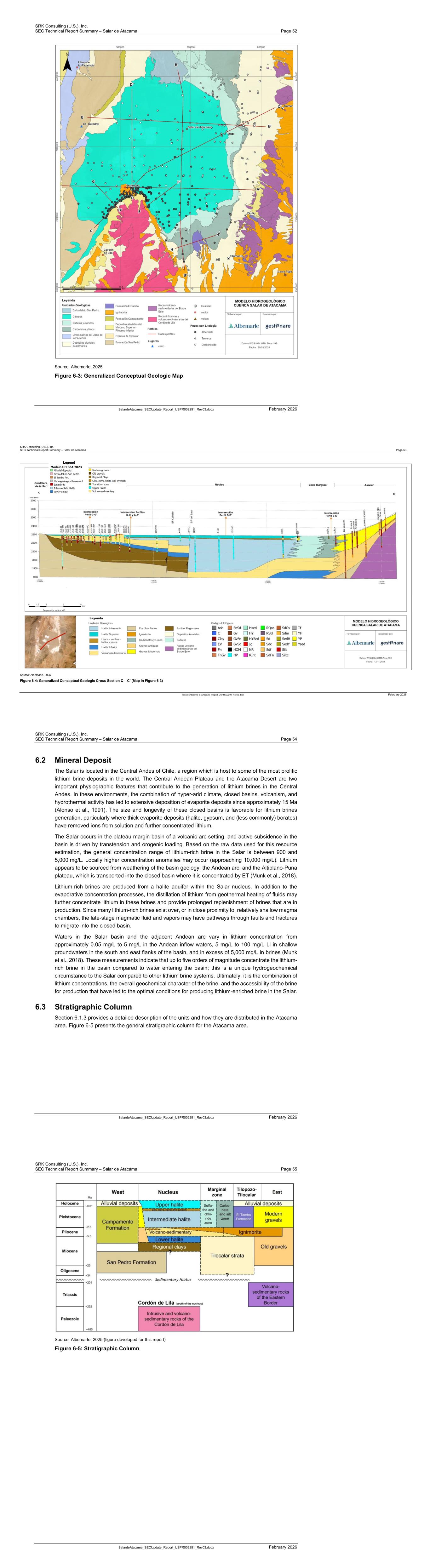
SRK Consulting (U.S.), Inc. SEC Technical Report Summary – Salar de Atacama Page 52 SalardeAtacama_SECUpdate_Report_USPR002291_Rev03.docx February 2026 Source: Albemarle, 2025 Figure 6-3: Generalized Conceptual Geologic Map SRK Consulting (U.S.), Inc. SEC Technical Report Summary – Salar de Atacama Page 53 SalardeAtacama_SECUpdate_Report_USPR002291_Rev03.docx February 2026 Source: Albemarle, 2025 Figure 6-4: Generalized Conceptual Geologic Cross-Section C – C’ (Map in Figure 6-3) SRK Consulting (U.S.), Inc. SEC Technical Report Summary – Salar de Atacama Page 54 SalardeAtacama_SECUpdate_Report_USPR002291_Rev03.docx February 2026 6.2 Mineral Deposit The Salar is located in the Central Andes of Chile, a region which is host to some of the most prolific lithium brine deposits in the world. The Central Andean Plateau and the Atacama Desert are two important physiographic features that contribute to the generation of lithium brines in the Central Andes. In these environments, the combination of hyper-arid climate, closed basins, volcanism, and hydrothermal activity has led to extensive deposition of evaporite deposits since approximately 15 Ma (Alonso et al., 1991). The size and longevity of these closed basins is favorable for lithium brines generation, particularly where thick evaporite deposits (halite, gypsum, and (less commonly) borates) have removed ions from solution and further concentrated lithium. The Salar occurs in the plateau margin basin of a volcanic arc setting, and active subsidence in the basin is driven by transtension and orogenic loading. Based on the raw data used for this resource estimation, the general concentration range of lithium-rich brine in the Salar is between 900 and 5,000 mg/L. Locally higher concentration anomalies may occur (approaching 10,000 mg/L). Lithium appears to be sourced from weathering of the basin geology, the Andean arc, and the Altiplano-Puna plateau, which is transported into the closed basin where it is concentrated by ET (Munk et al., 2018). Lithium-rich brines are produced from a halite aquifer within the Salar nucleus. In addition to the evaporative concentration processes, the distillation of lithium from geothermal heating of fluids may further concentrate lithium in these brines and provide prolonged replenishment of brines that are in production. Since many lithium-rich brines exist over, or in close proximity to, relatively shallow magma chambers, the late-stage magmatic fluid and vapors may have pathways through faults and fractures to migrate into the closed basin. Waters in the Salar basin and the adjacent Andean arc vary in lithium concentration from approximately 0.05 mg/L to 5 mg/L in the Andean inflow waters, 5 mg/L to 100 mg/L Li in shallow groundwaters in the south and east flanks of the basin, and in excess of 5,000 mg/L in brines (Munk et al., 2018). These measurements indicate that up to five orders of magnitude concentrate the lithium- rich brine in the basin compared to water entering the basin; this is a unique hydrogeochemical circumstance to the Salar compared to other lithium brine systems. Ultimately, it is the combination of lithium concentrations, the overall geochemical character of the brine, and the accessibility of the brine for production that have led to the optimal conditions for producing lithium-enriched brine in the Salar. 6.3 Stratigraphic Column Section 6.1.3 provides a detailed description of the units and how they are distributed in the Atacama area. Figure 6-5 presents the general stratigraphic column for the Atacama area. SRK Consulting (U.S.), Inc. SEC Technical Report Summary – Salar de Atacama Page 55 SalardeAtacama_SECUpdate_Report_USPR002291_Rev03.docx February 2026 Source: Albemarle, 2025 (figure developed for this report) Figure 6-5: Stratigraphic Column

SRK Consulting (U.S.), Inc. SEC Technical Report Summary – Salar de Atacama Page 56 SalardeAtacama_SECUpdate_Report_USPR002291_Rev03.docx February 2026 7 Exploration 7.1 Exploration Work (Other Than Drilling) A number of geophysical surveys have been conducted within the claims areas as well as within the Salar to evaluate continuity of lithologic units and changes in brine salinity. Downhole geophysical surveys have been conducted in various boreholes to evaluate the permeability of sediments and evaporites in addition to nuclear magnetic resonance (NMR) surveys to evaluate the porosity of the sediments. Figure 7-1 shows the locations of the various geophysical surveys that have been conducted for the site, and Table 7-1 outlines a summary of the work. Source: Albemarle, 2025 (figure developed for this report) Figure 7-1: Location of Exploration at the Albemarle Atacama SRK Consulting (U.S.), Inc. SEC Technical Report Summary – Salar de Atacama Page 57 SalardeAtacama_SECUpdate_Report_USPR002291_Rev03.docx February 2026 Table 7-1: Summary of Exploration Work Exploration Techniques Company and Year Total Length (m) Number TEM and NanoTEM lines Geodatos 2013 189,090 18 Geodatos 2016/17 180,154 30 Seismic reflection Wellfield Services Ltda. 2018 - 7 NMR records Zelandez 2018 4,763 36 Zelandez 2023 4,321 79 Zelandez 2024 1,680 40 Well geophysical records* Albemarle up to 2023 6,694 126 Wellfield 2017 2,050 16 Zelandez 2018 4,578 35 Zelandez 2023 670 12 Zelandez 2024 1,680 40 Source: Albemarle, 2025 (table developed for this report) Note: *Natural gamma, spontaneous potential (SP), single-point resistance (SPR), resistivity 16/64 (one probe), temperature, and fluid conductivity (one probe); 2024 campaign included Caliper and televiewer (ABI). 7.1.1 TEM Survey Geodatos completed an initial geophysical survey in 2003, including nine TEM and nine NanoTEM surveys. In 2016, Albemarle commissioned Geodatos to determine the geoelectric characteristics of the subsurface by acquiring additional data of the stratigraphic variations, both laterally and vertically, of the different lithologies present (Geodatos, 2017). Furthermore, the study was intended to determine the relative variations in porosity of the saturated strata, these being directly related to the variations in electrical resistivity. TEM geophysics have been used to identify the geometry of the Holocene evaporite units, including upper halite. The acquisition of TEM data was performed for 19 days from November 24, 2016, to January 12, 2017, and NanoTEM was performed for 26 days from November 24, 2016, to January 12, 2017. Figure 7-1 shows the locations of the measurement lines for both methodologies. The number of stations and lines, the spacing, and the type of loop used are detailed below: TEM: 234 stations were measured on 15 lines, with the spacing between stations being approximately 400 m. TEM soundings were measured with Coincident Loop Tx = Rx of 100 square meters (m2) x 100 m2. NanoTEM: 467 stations were measured on 15 lines, with the spacing between stations being approximately 200 m. The NanoTEM soundings were measured with a Central Loop of Tx = 50 m2 x 50 m2 and Rx = 10 m2 x 10 m2. Figure 7-2 shows an example of the result of a TEM profile (the trace of which is shown in red on the lower map) made in the north of the study area. SRK Consulting (U.S.), Inc. SEC Technical Report Summary – Salar de Atacama Page 58 SalardeAtacama_SECUpdate_Report_USPR002291_Rev03.docx February 2026 Source: GWI, 2019 Figure 7-2: Example of Results from the Geophysical Profile TEM 7.1.2 Seismic Reflection In 2018, Albemarle commissioned Wellfield Services Ltda. to carry out a seismic study in the southern portion of Salar de Atacama (specifically on the Albemarle mining concession in this area) to characterize the geology. This study includes the application of the seismic reflection technique, with a vibratory energy source for accessible areas of relatively flat terrain (Wellfield Services Ltda., 2019). The topography work began on October 11, 2018, and ended on February 13, 2019. The seismic record begins on November 18, 2018, and ends on February 14, 2019. The seismic survey considered seven seismic lines, the locations of which are shown on Figure 7-1. The horizons generated in the sequence have satisfactory intensity and resolution, being able to distinguish horizontal and vertical events, both at the level of the stack in the two-dimensional (2D) lines. Reflection seismic results were used to define the roof of the San Pedro Formation. 7.1.3 Borehole Geophysics During the 2017 and 2018 drilling campaign, downhole geophysical logging was carried out by Zelandez in 26 boreholes over a total lithological column recorded of approximately 2,000 m. A similar geophysical campaign was conducted by Zelandez in 2023 in 12 boreholes, recording approximately SRK Consulting (U.S.), Inc. SEC Technical Report Summary – Salar de Atacama Page 59 SalardeAtacama_SECUpdate_Report_USPR002291_Rev03.docx February 2026 700 m of data. In 2024 a new borehole geophysical survey was developed in 40 observation wells; eight of them included spinner logging tests. Geophysical logging was carried out using the following probes: Caliper (one probe) Natural gamma, SP, SPR, and resistivity 16/64 (one probe) Temperature and fluid conductivity (one probe) Televiewer (2024 campaign) NMR (2024 campaign) Use of several of these probes require that the boreholes not be cased. Because the surveys were made during drilling, a complete record is not always available because it was necessary to leave certain meterage within casings as protection against instabilities of the borehole walls. Figure 7-3 shows an example of the measurement results of a borehole with the different parameters measured in the field.

SRK Consulting (U.S.), Inc. SEC Technical Report Summary – Salar de Atacama Page 60 SalardeAtacama_SECUpdate_Report_USPR002291_Rev03.docx February 2026 Source: Zelandez, 2024 Figure 7-3: Example of Geophysical Log in Well CLO-376 SRK Consulting (U.S.), Inc. SEC Technical Report Summary – Salar de Atacama Page 61 SalardeAtacama_SECUpdate_Report_USPR002291_Rev03.docx February 2026 The results of the well geophysical logging were considered in the interpretation of the lithological column along with the mapping of the lithology. The combination of these inputs served as the criteria for definition of hydrostratigraphic units represented in the 3D model described in Sections 6 and 11. 7.1.4 Nuclear Magnetic Resonance In 2018, Albemarle contracted the acquisition of NMR and gamma rays to Zelandez (2019) in conjunction with Suez Medioambiente Chile SA (Suez). Suez staff operated the equipment in the field, while Zelandez supplied the equipment and guidance. In total, NMR surveys were conducted in 36 boreholes over 26 days, with a total of approximately 4,800 m tested. In 2023, Zelandez developed a new NMR campaign in 79 wells, recording about 4,300 m of data. The processing and interpretation of the data were carried out remotely within 24 hours after acquisition. In all boreholes, the acquisition of NMR data was performed satisfactorily, obtaining high- quality data. The only drawback found was the influence of the well fluid signal in various wells, which affected the data in these intervals and could not be corrected. The interpretation of the data has made it possible to group the records by type of borehole, assigning common characteristics to each group related to the hydrogeological environment in which they are found. In summary, the interpretation of these data has served to identify lithological changes and to determine the relative porosity between geological units. 7.1.5 Significant Results and Interpretation SRK notes that this property is producing and is considered well-understood from previous exploration and production. The results and interpretation from exploration data are supported by extensive drilling and active pumping from production wells over the course of more than 35 years of production. The aforementioned data has been interpreted together with the data from the core logging to develop the 3D hydrostratigraphic model described in Sections 6 and 11. 7.2 Exploration Drilling Drilling at Salar de Atacama has been ongoing since 1974. Drilling has been primarily for production wells with limited drilling dedicated to exploration of other areas within the claims. 7.2.1 Drilling Type and Extent In the process of drilling pumping or observation wells to study resources and reserves, three different methods have been used to obtain information for the study. The types of equipment used, and their characteristics of use are indicated below: Cable tool drilling used piezometers to define the geology, obtain brine samples, and perform pumping tests. Wells were used as monitoring points of water levels and for brine sampling (historical drilling). Diamond drilling was used to define the geology in depth, obtain drill cores, establish fracture zones in the vertical, perform packer tests, and obtain well geophysics measurements, and they are enabled as hydrogeological control wells for level measurement. Rotary drilling (air) was used to carry out pile driving of hydraulic tests in depth (airlift), establishing an indicative flow value for exploration and research, and also to obtain brine SRK Consulting (U.S.), Inc. SEC Technical Report Summary – Salar de Atacama Page 62 SalardeAtacama_SECUpdate_Report_USPR002291_Rev03.docx February 2026 samples in depth evaluating the chemical changes of each well. In stable drilling areas, rotary drilling was used to widen test wells for pumping and hydraulic evaluation of each sector. Dual-rotary drilling was used in areas of high geological complexity where the stability of the land did not allow the use of rotary equipment. With this equipment, the expansion was carried out for production wells, isolating areas of different aquifers and different chemists to avoid salting the wells. Dual rotary drilling was also used to collect brine samples and perform hydraulic tests. 7.2.2 Drilling Campaigns Since 2017, five main drilling campaigns were carried out to obtain geological and hydrogeological information in the Albemarle mining concession. These campaigns also included pumping hydraulic tests (pumping and packer tests). The following are the completed campaigns: The 2017 campaign started in January 2017 and ended in September 2017. Geosud conducted this campaign. The 2018 to 2019 campaign started in April 2018 and ended in February 2019. Geotec conducted this campaign. The 2020 campaign started in March 2020 and ended in October 2020. The 2021 to 2022 campaigns included a drilling period from October 2021 to October 2022. The 2023 campaign started in April 2023 and ended in February 2024. In 2024 a new drilling campaign for exploration and spent-brine reincorporation tests was completed. The above-mentioned campaigns formed part of exploration studies and also included the construction of the replacement production wells and shallow large-diameter wells (punteras). Table 7-2 shows the number of wells along with meters drilled by each method for the 2017 to 2023 drilling campaigns. SRK Consulting (U.S.), Inc. SEC Technical Report Summary – Salar de Atacama Page 63 SalardeAtacama_SECUpdate_Report_USPR002291_Rev03.docx February 2026 Table 7-2: 2017 through 2023 Drilling Types and Meters Campaign Drill Method Number of Wells Distance Drilled (m) Exp-2017 AR 57 3,561 Unknown 1 24 DDH 36 4,381 Exp-2018 AR 148 7,391 AR-S 8 610 DDH 63 5,724 Exp-2019 AR 77 4,686 AR-S 35 2,623 DDH 21 1,593 Exp-2020 DDH 10 680 AR 41 1,935 Exp-2021 DDH 25 1,097 AR 17 776 Exp-2022 DDH 11 1,088 AR 18 1,152 Exp-2023 DDH 9 1,146 AR 69 3,621 Exp-2024 DDH 15 643 Unknown 1 30 AR 22 660 Source: Albemarle, 2025 (table developed for this report) Between 2017 and 2024, the drilling campaigns were carried out to obtain data on the geology and its hydraulic properties to improve the existing hydro-stratigraphic model that was used in the resource estimate and the environmental assessment at the time, which gave rise to the RCA N°021/2016 agreement with the Chilean government. The drillholes are mainly located in the Albemarle mining concession (Figure 7-4), but some are located in the southeast part of the Salar in the Marginal Zone where the Peine and La Punta Brava lagoon systems are located. Even though this area is outside the mining concession, it has been necessary to update the hydrostratigraphic model in this area so that information is consistent with that existing in the nucleus.
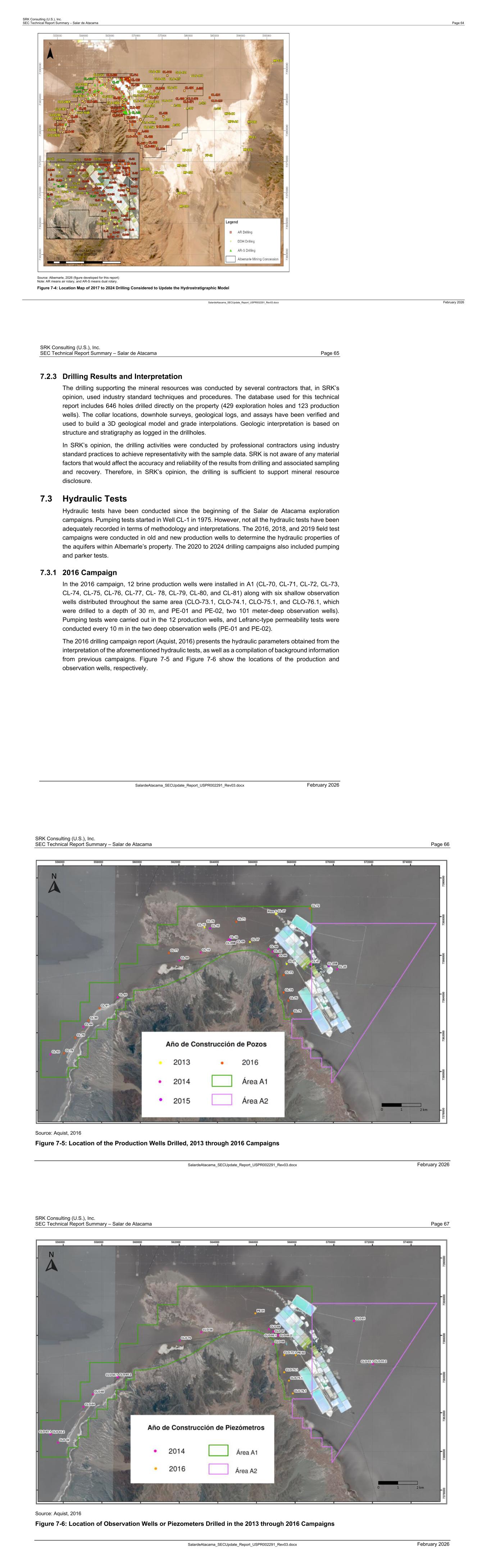
SRK Consulting (U.S.), Inc. SEC Technical Report Summary – Salar de Atacama Page 64 SalardeAtacama_SECUpdate_Report_USPR002291_Rev03.docx February 2026 Source: Albemarle, 2026 (figure developed for this report) Note: AR means air rotary, and AR-S means dual rotary. Figure 7-4: Location Map of 2017 to 2024 Drilling Considered to Update the Hydrostratigraphic Model SRK Consulting (U.S.), Inc. SEC Technical Report Summary – Salar de Atacama Page 65 SalardeAtacama_SECUpdate_Report_USPR002291_Rev03.docx February 2026 7.2.3 Drilling Results and Interpretation The drilling supporting the mineral resources was conducted by several contractors that, in SRK’s opinion, used industry standard techniques and procedures. The database used for this technical report includes 646 holes drilled directly on the property (429 exploration holes and 123 production wells). The collar locations, downhole surveys, geological logs, and assays have been verified and used to build a 3D geological model and grade interpolations. Geologic interpretation is based on structure and stratigraphy as logged in the drillholes. In SRK’s opinion, the drilling activities were conducted by professional contractors using industry standard practices to achieve representativity with the sample data. SRK is not aware of any material factors that would affect the accuracy and reliability of the results from drilling and associated sampling and recovery. Therefore, in SRK’s opinion, the drilling is sufficient to support mineral resource disclosure. 7.3 Hydraulic Tests Hydraulic tests have been conducted since the beginning of the Salar de Atacama exploration campaigns. Pumping tests started in Well CL-1 in 1975. However, not all the hydraulic tests have been adequately recorded in terms of methodology and interpretations. The 2016, 2018, and 2019 field test campaigns were conducted in old and new production wells to determine the hydraulic properties of the aquifers within Albemarle’s property. The 2020 to 2024 drilling campaigns also included pumping and parker tests. 7.3.1 2016 Campaign In the 2016 campaign, 12 brine production wells were installed in A1 (CL-70, CL-71, CL-72, CL-73, CL-74, CL-75, CL-76, CL-77, CL- 78, CL-79, CL-80, and CL-81) along with six shallow observation wells distributed throughout the same area (CLO-73.1, CLO-74.1, CLO-75.1, and CLO-76.1, which were drilled to a depth of 30 m, and PE-01 and PE-02, two 101 meter-deep observation wells). Pumping tests were carried out in the 12 production wells, and Lefranc-type permeability tests were conducted every 10 m in the two deep observation wells (PE-01 and PE-02). The 2016 drilling campaign report (Aquist, 2016) presents the hydraulic parameters obtained from the interpretation of the aforementioned hydraulic tests, as well as a compilation of background information from previous campaigns. Figure 7-5 and Figure 7-6 show the locations of the production and observation wells, respectively. SRK Consulting (U.S.), Inc. SEC Technical Report Summary – Salar de Atacama Page 66 SalardeAtacama_SECUpdate_Report_USPR002291_Rev03.docx February 2026 Source: Aquist, 2016 Figure 7-5: Location of the Production Wells Drilled, 2013 through 2016 Campaigns SRK Consulting (U.S.), Inc. SEC Technical Report Summary – Salar de Atacama Page 67 SalardeAtacama_SECUpdate_Report_USPR002291_Rev03.docx February 2026 Source: Aquist, 2016 Figure 7-6: Location of Observation Wells or Piezometers Drilled in the 2013 through 2016 Campaigns

SRK Consulting (U.S.), Inc. SEC Technical Report Summary – Salar de Atacama Page 68 SalardeAtacama_SECUpdate_Report_USPR002291_Rev03.docx February 2026 7.3.2 2018 to 2019 Testing Campaign Between October 2018 and June 2019, long-term pumping tests were carried out in 10 deep wells (deeper than 50 m) that were drilled in 2008 and distributed in the A1, A2, and A3 claim areas. Eight tests were carried out in the Chépica Oeste sector of A1, one test was conducted north of A2, and one test was conducted south of A3 near the Salar de Atacama Marginal Zone (Figure 7-7). Source: GWI, 2019 Figure 7-7: Location Map of the Long-Term Pumping Tests: Deep Pumping Wells The main objectives of the long-term pumping tests were the following: Evaluate if there is a differentiated deep aquifer and if it is connected to the surface aquifer. Evaluate the type of aquifer and characterize the hydraulic parameters of the deep aquifer. A shallow well that is up to 20 m deep and a deep well with characteristics similar to the pumping well, both at a distance of 10 m to 30 m from the pumping well, were drilled on the same platform of the pumping well. These wells were used as observation wells during the pumping tests. The shallow well was used to determine whether the pumping in the deep aquifer produces any effect in the upper part of the aquifer, and the deep well was used to calculate hydraulic parameters in the lower part of the aquifer. Pumping Tests Design Up to three pumping tests were carried out in each pumping well: a first trial of 1-hour duration, a second test of staggered flow between 3 and 4 hours in duration, and a third test at constant flow for SRK Consulting (U.S.), Inc. SEC Technical Report Summary – Salar de Atacama Page 69 SalardeAtacama_SECUpdate_Report_USPR002291_Rev03.docx February 2026 7 days. Where a flow rate >5 L/s could not be extracted, only trial and error and constant flow tests were conducted. Where a flow rate >5 L/s could be maintained, the three tests were carried out. After each test, recovery was monitored. During the constant flow pumping tests, four brine samples were collected to determine if there is a chemical evolution during the duration of pumping. 7.3.3 2020 to 2023 Testing Campaign. From 2020 to 2023, hydraulic tests were performed at Albemarle’s property as part of the drilling campaigns or hydraulic studies to support the hydrogeological model. In 2020, two pumping tests were conducted in shallow wells located in Sector A1 close to the evaporation ponds. Four additional pumping tests (distributed in Sector A1) were performed in 2021: one in the southern part, two in Chepica, and one close to the evaporation ponds. In 2022, four pumping tests were conducted in Sector A1 (three in Chepica), and packer tests in three wells (two in Sector A1 and one in Sector A2). Finally, a hydrogeological field campaign was conducted in 2023, covering Sector A3, including several pumping and packer tests in seven wells. Figure 7-8 shows the location of the hydraulic tests performed from 2020 to 2023. Source: Albemarle, 2025 (figure elaborated for this report) Figure 7-8: Location Map of Hydraulic Tests Performed from 2020 to 2023 SRK Consulting (U.S.), Inc. SEC Technical Report Summary – Salar de Atacama Page 70 SalardeAtacama_SECUpdate_Report_USPR002291_Rev03.docx February 2026 7.3.4 Packer Testing Campaign Albemarle requested that Suez and Solexperts SA carry out an exploration project using a system of inflatable shutters (packers) in wells in Salar de Atacama (Suez, 2019) during two campaigns: July 2018 and October to November 2018. The tests were carried out in seven wells distributed along areas A1, A2, and A3 in 2018 (Figure 7-9). Source: Suez, 2019 Figure 7-9: Map of the Location of the Wells Tested by the Double Packer System This type of hydraulic test allows for obtaining hydraulic parameters at specific depth intervals by means of two packers that individualize the section to be tested from the rest of the vertical well column. In this way, the permeability (K) and transmissivity (T) of a given geological formation can be characterized and/or representative brine samples can be extracted from specific depths of the aquifer. The hydraulic parameters from the packer tests were obtained using the Aquifer Test software (Waterloo Hydrogeologic, 2016). Each of the companies that acquired the exploration data generated a report describing the details of the work carried out, the methods used for processing the data, and the conclusions. Albemarle’s hydrogeology team reviewed the data and subsequently provided them to SRK. Similar packer tests were conducted in 2022 and 2023, as described in Section 7.3.3. The 2024 drilling campaign also included hydraulic tests (packer and pumping). However, due to other priorities and the expectation that those tests would have minor impacts on the conceptual model, the analysis of those tests has been delayed and were not ready for inclusion in the current hydrogeological conceptual model. Albemarle is currently analyzing this data and intends to provide them to SRK for validation and inclusion in the next update of the conceptual model. SRK Consulting (U.S.), Inc. SEC Technical Report Summary – Salar de Atacama Page 71 SalardeAtacama_SECUpdate_Report_USPR002291_Rev03.docx February 2026 7.3.5 Pumping Test Reanalysis by SRK in 2020 The long-term constant rate pumping tests were initially analyzed to evaluate the aquifer properties specified in the objectives above, but test results were deemed inadequate due to the analysis assumptions and the aquifer conditions provided. SRK reanalyzed the tests in the summer of 2020 using the AQTESOLV™ analytical software (HydroSOLVE, Inc., 2008). Results varied by analysis since each method makes different assumptions and is subject to interpretation. Some challenges were encountered when analyzing the pumping tests and resulted in a lower level of confidence of the estimated hydraulic parameters. For example, discrete hydraulic parameters from the upper observational wells could not be calculated due to the nature of the analysis methods and the largely heterogeneous aquifer conditions. Instead, only general conditions could be implied, such as the propensity for a vertical hydraulic connection between two aquifers separated by a semi-confining unit. A conceptual hydrogeologic setting of the test sites was developed with the analysis and diagnosis of the data provided, which included the following assumptions or characteristics of the aquifers: Most tests likely took place in partially confined conditions. Derivative analysis indicates possibly leaky, locally confining aquitards and/or constant head boundary conditions (facies changes and cordillera) in some cases. Aquifer was not stressed long enough to transition to delayed yield. Leaky confined conditions observe storage influence from connected systems, inflecting storage parameters. Reliable specific yields are from 4.9% to 13.0%. Leaky confined systems calculate vertical hydraulic conductivity of the aquitard (K’), but it is often unconfirmed by upper well response. Deep aquifer shows small variation in the transmissivity values calculated by Albemarle in 2019. Reliable calculated hydraulic conductivity values range from 1.1 meters per day (m/d) to 4.6 m/d in sequences of gravel, ignimbrite, and sands, average 0.26 m/d in sequences of gypsum and ash, and range from 2.9 m/d to 3.4 m/d in layers of ash, evaporites, and gypsum. 7.3.6 Data Summary The hydrogeological data described in the previous chapters and additional information on hydraulic properties outside of the Albemarle property available from the governmental agency CORFO (SGA, 2015b, and Amphos21, 2018), and the SQM environmental report (SQM, 2020) were used as a reference to construct the dynamic groundwater model, as described in Section 12. Table 7-3 summarizes the measured hydraulic conductivity values, and Table 7-4 shows the groundwater storage values, as specific yield (Sy), within the hydrogeological units.

SRK Consulting (U.S.), Inc. SEC Technical Report Summary – Salar de Atacama Page 72 SalardeAtacama_SECUpdate_Report_USPR002291_Rev03.docx February 2026 Table 7-3: Summary of Measured Hydraulic Conductivity Values Hydrogeological Unit (UH)5 Description Measured (m/d) Number of Tests Minimum Maximum Median1 UH-1 Alluvial Deposits -Modern Gravels 18 0.29 558 8 UH-2 Upper Halite East 79 0.2 10,000 100 UH-3 Upper Halite West 26 0.4 500 3 UH-4 Intermediate Halite 72 0.002 100 0.55 UH-5 Transition Zone 62 0.00099 416 3 UH-6 Old Gravels 5 7 26 16 UH-7 Volcano-Sedimentary 35 0.1 188 1.95 UH-8 Tilocalar Principal 1 0.05 0.05 0.05 UH-9 Ignimbrite 5 0.16 0.47 0.21 UH-10 Lower Halite 6 0.00046 0.74 0.07 UH-11 Silts, Clays, Halite, and Gypsum 14 0.09 5.45 0.9 UH-12 Delta del Rio San Pedro 6 0.00008 0.0004 0.00017 UH-13 El Tambo Formation - - - - Source: SRK, 2025 1Median is the value in the middle of a set of measurements (also called 50th percentile). Table 7-4: Summary of Measured Groundwater Storage Values (Sy) Hydrogeological Unit (UH) Description of Hydrogeological Unit Measured Number of Tests Sy Measured Minimum Maximum Average UH-1 Alluvial Deposits -Modern Gravels 10 0.001 0.2 0.05 UH-2 Upper Halite East 9 0.001 0.55 0.09 UH-3 Upper Halite West UH-4 Intermediate Halite 25 0.004 0.269 0.07 UH-5 Transition Zone - - - - UH-6 Old Gravels 36 0.001 0.558 0.16 UH-7 Volcano-Sedimentary UH-9 Ignimbrite UH-13 El Tambo Formation UH-8 Tilocalar Principal - - - - UH-10 Lower Halite 4 0.001 0.32 0.08 UH-11 Silts, Clays, Halite, and Gypsum 191 0.003 0.554 0.11 UH-12 Delta del Rio San Pedro Source: SRK, 2025 1This number of tests also considers the Regional Clays (UH-16); however, this unit is not incorporated into the numerical model. Note: Specific yield measured values over 0.6 have been discarded. 7.4 Brine Sampling In the early stages of the drilling campaign, brine samples were collected from trenches, monitoring wells, and pumping wells drilled from 1974 to 1979. However, no further details were available for SRK to review. Historical samples have been collected from production and monitoring wells and analyzed in the on-site Salar laboratory (Albemarle, 2025). The samples were systematically collected on a monthly basis since January 1999. The hydrochemistry Albemarle database (used in the groundwater model to support the reserve estimate) has records through June 2025. Albemarle also provided a secondary hydrochemistry database with records from January 1999 to August 2020; it has similar values to the database mentioned above. Albemarle does not use these SRK Consulting (U.S.), Inc. SEC Technical Report Summary – Salar de Atacama Page 73 SalardeAtacama_SECUpdate_Report_USPR002291_Rev03.docx February 2026 records for any evaluation or future planning, and SRK used this alternative database for comparison purposes only. Figure 7-10 and Figure 7-11 show the distribution of the sampling point and the lithium concentration recorded from 1999 to 2025. Source: SRK, 2025 Figure 7-10: Historical Sampling Points Location, 1999 to 2019 Source: SRK, 2025 Note: The graph only includes samples within Albemarle’s claim areas. Figure 7-11: Measured Lithium Concentration from Historical Database, 1999 to 2025 SRK Consulting (U.S.), Inc. SEC Technical Report Summary – Salar de Atacama Page 74 SalardeAtacama_SECUpdate_Report_USPR002291_Rev03.docx February 2026 2018-2019 sampling Campaign In 2018 and 2019, 77 samples were collected: 12 samples from exploration wells using a packer, 32 samples during long-term pumping tests, seven samples in short-term pumping tests, and 26 samples from the production wells, extracted at 48 different points. This sampling campaign was designed to support a resource model estimate. The samples extracted with the double packer system were obtained after pumping the tested interval at a time equal to at least three times the volume of brine storage in the well plus the existing volume in the pipes that carry the brine to the surface. In this way, the extracted sample is representative of the conditions of the brine entering the well and not of the brine previously stored in it, which may have its origin in other layers of the aquifer. The sampling of the production wells was carried out in different campaigns between the months of December 2018 and April 2019. A brine sample was extracted from 27 production wells distributed throughout claim areas A1 and A2, where 23 and four wells were sampled, respectively. The brine samples were taken from the pipeline of each of the production wells or from a sampling valve on the pumping well pipe during the pumping test (Figure 7-12). Source: GWI, 2019 Figure 7-12: Sampling Points in the 2018-2019 Campaign SRK Consulting (U.S.), Inc. SEC Technical Report Summary – Salar de Atacama Page 75 SalardeAtacama_SECUpdate_Report_USPR002291_Rev03.docx February 2026 2022 Sampling Campaign A new brine sampling campaign was carried out in 2022. The targets were to update the lithium concentration data in the production wells for the resource estimate and to verify their correlation with the historical records from Albemarle’s laboratories (Planta Salar). The samples were collected from 33 production wells and 24 observation wells between June and December of 2022. The samples are located in Albemarle areas A1, A2, and A3. The sample was collected directly from the discharge valve after the flowmeter in production wells. Figure 7-13 shows the sampled wells in the 2022 campaign. Source: SRK, 2025 Figure 7-13: Sampled Points in the 2022 Campaign In 2025, 246 samples were collected from 46 wells: 23 from exploration wells and 23 from production wells. This sampling campaign was designed to support a resource model estimate. Section 8 describes this campaign in detail including QA/QC procedures and results.

SRK Consulting (U.S.), Inc. SEC Technical Report Summary – Salar de Atacama Page 76 SalardeAtacama_SECUpdate_Report_USPR002291_Rev03.docx February 2026 8 Sample Preparation, Analysis, and Security Samples of the host rocks and the brines themselves have been collected and analyzed from the active production wells as part of operations at Atacama since 1999. During the exploration campaign carried out in 2025, 246 brine samples were extracted at 46 different wells. Samples were sent to the different laboratories as outlined below as part of the quality assurance/quality control (QA/QC) process. The samples from 2025 campaign were considered for the resource estimate (as they are reflective of current Salar conditions). Historical samples measured since 1999 were used for development and calibration of the numerical groundwater model to support the reserve estimate. 8.1 Sample Collection 8.1.1 Historical Sampling Lithium concentrations from historical sampling were available for 147 monitoring locations, with over 7,900 samples from January 1999 to July 2025 within Albemarle’s properties and the transition zone to the southeast. Since the beginning of the extraction of brine at the Salar Plant, samples from the pumping wells have been periodically analyzed. Since 1999, brine chemistry data has been collected on a monthly basis. These samplings are carried out to control the chemical evolution of the brine that will be pumped to the evaporation ponds. The sampling method is by means of 1- or 0.5-liter (L) plastic bottles; one sample is taken per month from each well. Until 2018, this sampling was carried out at the outlet of each high-density polyethylene (HDPE) line, when the brine was discharged into the pond. During 2018, wastewater valves began to be installed after the flowmeter, which reduces risks and improves the representativeness of the sample, as they are taken right at the wellhead. The analyses are carried out in the Salar Plant laboratory, and the following determinations are usually made: density, Li+(%), SO4 -2 (%), Ca+2(%), Mg+2(%), K+(%), Na+(%), Cl-(%), B+(%), temperature (°C), and pH. It is noted than Salar Plant laboratory is not independent of Albemarle. Figure 8-1 shows the box-and-whisker diagram of the historical variability (since 1999) of lithium concentrations in the samplings from production wells and expressed as an annual average per well. SRK Consulting (U.S.), Inc. SEC Technical Report Summary – Salar de Atacama Page 77 SalardeAtacama_SECUpdate_Report_USPR002291_Rev03.docx February 2026 Source: SRK, 2024 Note: Each data point (circle) represents an average concentration at a specific location at the year shown; x symbols connected by a line represent the multi-well average of that year. Figure 8-1: Historical Lithium Variability, 1999 to 2023 As can be seen on Figure 8-1, the minimum values (established by the lower whisker) do not materially change with time, until 2020 when high-lithium concentration zones were targeted for production wells. So, SRK interpreted that the brine has a minimum lithium concentration that remains unchanged (the lower quartile remains the same over time). It can also be seen that the median in the last 10 years remains relatively steady. The historical brine samples collected at pumping wells were used for a qualitative indication of brine grade persistence over the prolonged pumping periods. The samples were also used quantitatively in developing the grade interpolations as input to the numerical groundwater model. Historical brine samples were not used for developing the resource estimate. 8.1.2 2025 Campaign Considering the brine is a dynamic resource, the samples to support the resource estimate need to be collected in a recent time period. The 2025 sampling campaign was developed with that purpose in mind. The 246 samples obtained during the 2025 campaign were collected at different depths from 23 exploration wells using a bailer, and 23 from the production wells extracted at 46 different wells (Table 8-1). The following sections provide details on each of the different sampling rounds and how each dataset was used in the resource and reserve estimation process. SRK Consulting (U.S.), Inc. SEC Technical Report Summary – Salar de Atacama Page 78 SalardeAtacama_SECUpdate_Report_USPR002291_Rev03.docx February 2026 Table 8-1: List and Coordinates of Wells Sampled for the 2025 Well X_UTM WGS84 Y_UTM WGS84 Sampling Campaign CLO-417 574,849 7,384,297 2025 CLO-419 580,455 7,388,781 2025 CLO-420 573,398 7,388,977 2025 CLO-425 575,978 7,388,868 2025 CLO-421 578,274 7,388,894 2025 A-227 570,195 7,381,376 2025 A-302 576,886 7,384,042 2025 A-304 576,830 7,380,518 2025 A-307 579,291 7,383,584 2025 A-316 572,079 7,377,960 2025 A-319 573,842 7,381,896 2025 A-321B 573,916 7,377,529 2025 A-325 575,862 7,382,246 2025 A-325B 575,858 7,382,268 2025 CL-1 573,049 7,384,403 2024 CL-101 557,123 7,382,092 2025 CL-104 556,633 7,380,959 2025 CL-106 568,797 7,388,505 2025 CL-107 561,110 7,386,256 2025 CL-113 560,156 7,384,585 2024 CL-114 568,672 7,388,530 2025 CL-133 562,022 7,386,212 2025 CL-134 562,789 7,386,481 2025 CL-136 562,033 7,388,407 2025 CL-137 562,139 7,387,328 2025 CL-140 568,243 7,382,732 2025 CL-151 563,211 7,387,236 2025 CL-154 563,962 7,386,065 2025 CL-155 563,003 7,387,844 2025 CL-162 567,630 7,385,423 2025 CL-163 566,038 7,387,211 2025 CL-172 567,360 7,385,803 2025 CL-176 555,961 7,379,740 2025 CL-19 563,132 7,386,157 2025 CL-45 571,689 7,387,482 2025 CL-90 567,472 7,383,701 2025 CL-91 567,715 7,382,838 2025 CL-97 558,413 7,383,460 2025 CLO-103C 559,152 7,384,211 2025 CLO-111 576,925 7,386,429 2025 CLO-278B 567,266 7,384,759 2025 CLO-280A 564,444 7,388,488 2025 CLO-280B 563,332 7,388,463 2025 CLO-285 556,895 7,383,479 2025 CLO-289A 559,134 7,384,177 2025 CLO-290 560,141 7,384,581 2025 CLO-294 566,424 7,388,502 2025 Source: SRK, 2025 Notes: The brine sampling information used for this resource estimation included samples collected from 2 wells in 2024 and from 45 wells in 2025, as indicated in the Table 8-1. The brine samples from the production wells were taken from the pipeline of each of the production wells or from a sampling valve on the pumping well, and a pressurized bailer device was used for SRK Consulting (U.S.), Inc. SEC Technical Report Summary – Salar de Atacama Page 79 SalardeAtacama_SECUpdate_Report_USPR002291_Rev03.docx February 2026 sampling in the observation wells. The bottles were rinsed three times with the brine from the well and then completely filled without leaving air bubbles to avoid precipitation processes and physical- chemical changes within the container. In addition, during the sampling, physicochemical parameters of the brine (specifically pH, electrical conductivity (EC), and temperature) were measured using the Hanna HI98192 multiparameter meter. A multiparameter data verification procedure was followed, and the meter was calibrated, if necessary. Bailer sampling begins with the preparation of the bailer, the air-line, and the metal-line that will support the bailer. This involves assembling a combined line whose length equals the maximum sampling depth plus the up-stick distance. The combined line is marked with a distinct-colored tape at each depth where sampling will occur. When connecting the air line and the metal line, care is taken to tape them securely to prevent any disconnection from the bailer. Once the bailer line and cables are prepared, they are mounted on a tripod, which will be used to lower the bailer into the well . Before beginning the descent, air is injected at a pressure of 50 psi to ensure that the bailer does not open at an undesired depth. Once the desired depth is reached, the bailer is depressurized, allowing the brine to enter into the container. A wait time of 1 to 2 minutes ensures the bailer fills completely with brine. It is then repressurized with air to prevent it from opening during retrieval. The bailer is subsequently lifted out of the well, and brine sampling begins. To extract the brine from the pressurized bailer, a discharge valve is used. This valve consists of a cylinder which is inserted into one end of the bailer, directing the solution into a jar. Following the sampling protocol, the jar was rinsed twice with a small volume of brine before proceeding with the full discharge. The bottles were labeled with the name of the well, the type of well (e.g., production well), and the date and time of sampling. The sampling information was recorded in project records. At least four bottles of 250 cc or 500 cc were collected from each well. During the transport and storage of the samples, exposure to environmental conditions was prevented to avoid sudden changes in temperature that might alter the chemical composition of the sample. It was not necessary to use preservatives. 8.2 Sample Preparation, Assaying, and Analytical Procedures 8.2.1 Historical Sampling Historical samples from the production wells and observation points were collected on a monthly basis by the operators of the Salar de Atacama Plant hydrogeology department. The samples were analyzed in the on-site plant laboratory. No duplicates were collected in this process. SRK notes that while comprehensive QA/QC or independent verification of sampling has not been a continuous part of the plant laboratory, Albemarle’s operations in Salar de Atacama have been producing lithium from brines for over 25 years. Production has been consistent with reserve planning from the brine reservoir. 8.2.2 2025 Campaign The samples collected in the 2025 sampling campaign correspond to 23 production wells and 23 observation wells according to the following protocol:

SRK Consulting (U.S.), Inc. SEC Technical Report Summary – Salar de Atacama Page 80 SalardeAtacama_SECUpdate_Report_USPR002291_Rev03.docx February 2026 All sampling equipment, sampling buckets, glassware, and instrumentation should be washed with deionized water or with phosphate-free detergent before sampling begins. Use distilled water to rinse all sampling equipment and instrumentation before it is used at a different sample point. The use of auxiliary glassware should be minimized to reduce sample cross-contamination. Measure the water level and verify that there are no issues with the well that may cause the bailer to get stuck or lost. Only take a water level in wells that do not have a pump or other equipment downhole. Do not disturb wells with installed equipment. Each bottle (250 cc or 500 cc) was conditioned by rinsing three times with freshly extracted brine. The sample bottle label included the sample ID, date and time, original/duplicate, and sampling method code (Bailer or pumping). The samples were labeled immediately after being taken from the wells and were then stored at the Albemarle storage in Salar Plant. The samples were shipped using a cooler or ice box, taking care of packaging to ensure the sample bottles were not damaged in transport, including a chain of custody sheet. The sampling control information was recorded in an Excel file database, which included the following information: sample ID, well ID, laboratory, collection date, ship date, sample source type (production well or observation well), sampling depth interval, water levels, well purge data (if any), sample type (original, duplicate, blank, standard, or backup), field parameters, results, and delivery date. Samples were collected in each location for the following laboratories: o Albemarle’s Atacama Salar Plant laboratory (Salar de Atacama): 100% of sampling o K-UTEC laboratory (Germany): 100% of sampling o Alex Stewart laboratory (Mendoza, Argentina): 100% of sampling o Backup sample (stored in Albemarle’s Atacama Salar Plant laboratory) Blanks, duplicates, and standards were collected for the 25% of the samples for each laboratory. Well CL-114 was used in the preparation of the standard samples due to this well’s stability in the historical lithium concentration records. The lithium, magnesium, potassium, calcium, sodium, boron, and sulfate chemical analyses were carried out by means of inductively coupled plasma (ICP), optical, with standards, procedures, and protocols consistent between the involved laboratories. Sulfate and chloride were determined with different techniques. Table 8-2 summarizes the methods used for each of the elements analyzed. Figure 8-2 shows the sampling points used. SRK Consulting (U.S.), Inc. SEC Technical Report Summary – Salar de Atacama Page 81 SalardeAtacama_SECUpdate_Report_USPR002291_Rev03.docx February 2026 Table 8-2: Analytical Methods by Laboratory, 2025 Campaign Parameter Albemarle’s Investigation Laboratory, La Negra K-Utec Laboratory, Germany Alex Stewart Laboratory, Argentina B ICP ICP - DIN EN ISO 11885: 2009-09 ICP-OES SO4 Gravimetry DIN EN ISO 10304: 2009-07 Gravimetry Mg ICP ICP - DIN EN ISO 11885: 2009-09 ICP-OES Li ICP ICP - DIN EN ISO 11885: 2009-09 ICP-OES K ICP ICP - DIN EN ISO 11885: 2009-09 ICP-OES Ca ICP ICP - DIN EN ISO 11885: 2009-09 ICP-OES Na ICP ICP - DIN EN ISO 11885: 2009-09 ICP-OES Density Gravimetry DEV-C (not accredited parameter) Pycnometry Chloride Titration of precipitation with a silver nitrate solution using potassium dichromate for its detection. DIN EN ISO 10304: 2009-07 Mohr's method in solutions >5% TDS and potentiometry (ion selective electrode) in solutions <5% TDS Source: SRK, 2025 A chain of custody was established, including sampling, storage in the Albemarle Atacama Salar Plant laboratory, and shipment of samples to each external laboratory. The samples were labeled with correlative numbers immediately after being taken from the wells. Table 8-3 presents the samples of the 2025 campaign. No sample preparation was necessary, as care was taken to obtain samples of the brine in their native state. The samples were taken by the operators of the Salar Hydrogeology group, while the water resources area sent them to the corresponding laboratories. Source: SRK, 2025 Figure 8-2: Sampling Points, 2025 Campaign Two additional historical samples from 2024 and 2025 (CL-1 and CL-113) were also included for the resource estimate. The drillhole CL-168 was not used due to the anomalous lithium concentration, which is possibly influenced by its location close to the pond area. These samples are consistent with the 2022 sampling campaign, and the lithium concentration values were stable over time. SRK Consulting (U.S.), Inc. SEC Technical Report Summary – Salar de Atacama Page 82 SalardeAtacama_SECUpdate_Report_USPR002291_Rev03.docx February 2026 Table 8-3: List of Samples in the 2025 Campaign Well ID Sampling Type From To Laboratory CLO-417 Packer doble 15.00 18.00 K-UTEC, Alex Stewart, Albemarle CLO-419 Bailer Discrete 0.00 50.00 K-UTEC, Alex Stewart, Albemarle CLO-420 Bailer Discrete 0.00 50.00 K-UTEC, Alex Stewart, Albemarle CLO-425 Bailer Discrete 0.00 50.00 K-UTEC, Alex Stewart, Albemarle CLO-421 Bailer Discrete 0.00 50.00 K-UTEC, Alex Stewart, Albemarle A-227 Bailer Discrete 102.41 120.26 K-UTEC, Alex Stewart, Albemarle A-302 Bailer Discrete 57.50 82.50 K-UTEC, Alex Stewart, Albemarle A-302 Bailer Discrete 82.50 107.50 K-UTEC, Alex Stewart, Albemarle A-304 Bailer Discrete 124.06 153.74 K-UTEC, Alex Stewart, Albemarle A-307 Bailer Discrete 74.00 90.00 K-UTEC, Alex Stewart, Albemarle A-307 Bailer Discrete 90.00 106.00 K-UTEC, Alex Stewart, Albemarle A-316 Bailer Discrete 71.00 89.00 K-UTEC, Alex Stewart, Albemarle A-316 Bailer Discrete 89.00 107.00 K-UTEC, Alex Stewart, Albemarle A-319 Bailer Discrete 64.83 88.43 K-UTEC, Alex Stewart, Albemarle A-321B Bailer Discrete 11.41 23.30 K-UTEC, Alex Stewart, Albemarle A-325 Bailer Discrete 54.00 82.00 K-UTEC, Alex Stewart, Albemarle A-325 Bailer Discrete 82.00 110.00 K-UTEC, Alex Stewart, Albemarle A-325B Bailer Discrete 11.78 23.67 K-UTEC, Alex Stewart, Albemarle CL-1 Pumping Test 0.00 30.00 Albemarle CL-101 Pumping Test 25.07 66.37 K-UTEC, Alex Stewart, Albemarle CL-104 Bailer Discrete 0.00 29.09 K-UTEC, Alex Stewart, Albemarle CL-104 Bailer Discrete 29.09 60.01 K-UTEC, Alex Stewart, Albemarle CL-106 Pumping Test 0.00 18.00 K-UTEC, Alex Stewart, Albemarle CL-107 Bailer Discrete 15.61 22.39 K-UTEC, Alex Stewart, Albemarle CL-107 Bailer Discrete 22.39 29.17 K-UTEC, Alex Stewart, Albemarle CL-107 Bailer Discrete 29.17 36.24 K-UTEC, Alex Stewart, Albemarle CL-113 Pumping Test 30.65 77.90 Albemarle CL-114 Pumping Test 0.00 18.00 K-UTEC, Alex Stewart, Albemarle CL-133 Pumping Test 31.99 93.90 K-UTEC, Alex Stewart, Albemarle CL-134 Pumping Test 36.92 95.92 K-UTEC, Alex Stewart, Albemarle CL-136 Pumping Test 32.53 76.72 K-UTEC, Alex Stewart, Albemarle CL-137 Pumping Test 35.61 76.92 K-UTEC, Alex Stewart, Albemarle CL-140 Pumping Test 54.48 86.91 K-UTEC, Alex Stewart, Albemarle CL-151 Pumping Test 11.66 40.00 K-UTEC, Alex Stewart, Albemarle CL-154 Pumping Test 39.22 59.43 K-UTEC, Alex Stewart, Albemarle CL-155 Bailer Discrete 15.50 18.50 K-UTEC, Alex Stewart, Albemarle CL-155 Bailer Discrete 18.50 21.50 K-UTEC, Alex Stewart, Albemarle CL-155 Bailer Discrete 21.50 24.50 K-UTEC, Alex Stewart, Albemarle CL-162 Pumping Test 16.29 40.00 K-UTEC, Alex Stewart, Albemarle CL-163 Pumping Test 13.30 39.80 K-UTEC, Alex Stewart, Albemarle CL-168 Pumping Test 0.00 40.00 K-UTEC, Alex Stewart, Albemarle CL-172 Pumping Test 23.30 46.90 K-UTEC, Alex Stewart, Albemarle CL-176 Pumping Test 29.00 46.90 K-UTEC, Alex Stewart, Albemarle CL-19 Pumping Test 0.00 30.00 K-UTEC, Alex Stewart, Albemarle CL-45 Pumping Test 0.00 30.00 K-UTEC, Alex Stewart, Albemarle CL-90 Bailer Discrete 6.50 13.50 K-UTEC, Alex Stewart, Albemarle CL-90 Bailer Discrete 13.50 20.50 K-UTEC, Alex Stewart, Albemarle CL-90 Bailer Discrete 20.50 26.00 K-UTEC, Alex Stewart, Albemarle CL-91 Pumping Test 11.30 40.00 K-UTEC, Alex Stewart, Albemarle CL-97 Pumping Test 36.12 56.90 K-UTEC, Alex Stewart, Albemarle CLO-103C Bailer Discrete 4.50 21.50 K-UTEC, Alex Stewart, Albemarle CLO-103C Bailer Discrete 21.50 38.50 K-UTEC, Alex Stewart, Albemarle CLO-103C Bailer Discrete 38.50 55.50 K-UTEC, Alex Stewart, Albemarle CLO-111 Bailer Discrete 0.00 40.00 K-UTEC, Alex Stewart, Albemarle CLO-278B Bailer Discrete 15.50 18.50 K-UTEC, Alex Stewart, Albemarle CLO-278B Bailer Discrete 18.50 21.50 K-UTEC, Alex Stewart, Albemarle CLO-278B Bailer Discrete 21.50 24.50 K-UTEC, Alex Stewart, Albemarle CLO-280A Bailer Discrete 3.50 12.50 K-UTEC, Alex Stewart, Albemarle CLO-280A Bailer Discrete 12.50 21.50 K-UTEC, Alex Stewart, Albemarle CLO-280A Bailer Discrete 21.50 30.50 K-UTEC, Alex Stewart, Albemarle CLO-280B Bailer Discrete 6.50 13.50 K-UTEC, Alex Stewart, Albemarle CLO-280B Bailer Discrete 13.50 20.50 K-UTEC, Alex Stewart, Albemarle CLO-280B Bailer Discrete 20.50 26.00 K-UTEC, Alex Stewart, Albemarle CLO-285 Bailer Discrete 6.50 19.50 K-UTEC, Alex Stewart, Albemarle CLO-285 Bailer Discrete 19.50 32.50 K-UTEC, Alex Stewart, Albemarle CLO-285 Bailer Discrete 32.50 47.00 K-UTEC, Alex Stewart, Albemarle CLO-289A Bailer Discrete 5.03 22.93 K-UTEC, Alex Stewart, Albemarle CLO-289A Bailer Discrete 22.93 40.83 K-UTEC, Alex Stewart, Albemarle CLO-289A Bailer Discrete 40.83 42.38 K-UTEC, Alex Stewart, Albemarle CLO-290 Bailer Discrete 6.00 22.00 K-UTEC, Alex Stewart, Albemarle CLO-290 Bailer Discrete 22.00 38.00 K-UTEC, Alex Stewart, Albemarle CLO-290 Bailer Discrete 38.00 44.70 K-UTEC, Alex Stewart, Albemarle CLO-294 Bailer Discrete 0.00 50.00 K-UTEC, Alex Stewart, Albemarle Source: SRK, 2025 SRK Consulting (U.S.), Inc. SEC Technical Report Summary – Salar de Atacama Page 83 SalardeAtacama_SECUpdate_Report_USPR002291_Rev03.docx February 2026 8.3 QA/QC Procedures QA/QC procedures are generally employed by companies to ensure accuracy and precision of the results obtained from laboratories. Generally, procedures may include independent checks (duplicates) on samples by third-party laboratories, blind blank/standard insertion into sample streams, duplicate sampling, and more. Albemarle has historically only engaged in independent third-party laboratory checks (i.e., control laboratories) of sampling, for specific campaigns as part of the resource estimates (2018 to 2023 campaigns). For transparency, SRK decided to use results from one of the third-party laboratories (KUTEC) for development of the resource estimate. 8.3.1 Control Laboratories The procedure to control and ensure the quality of the sampling and chemical analysis performed on the samples in this study was carried out by extracting up to four samples from observation points. These samples were sent to Albemarle’s Atacama Salar Plant laboratory (Salar de Atacama), and the independent labs K-UTEC laboratory (Germany), and Alex Stewart laboratory (Mendoza, Argentina): K-UTEC AG SALT TECHNOLOGIES (K-UTEC) is located in Sondershausen (Germany). Since 2002, the lab has a management system certified according to DIN EN ISO 9001:2015, which includes among its scope Chemical-physical process engineering and Chemical- physical analytics. Also, the department CPA/Chemical-Physical Analytics is a testing laboratory accredited according to DIN EN ISO 17025 (Accreditation DAkkS). Alex Stewart laboratory is specialized in lithium brine analyses with quality standards ISO 9001 (2015) and ISO 17025 (2017) and certified in Argentina by the OAA (Argentinian Accreditation Organization) for lithium and potassium ICP-OES analysis (Lab # LE187). Correlation of duplicate analytical values for the same samples from independent laboratories can identify relative biases between these laboratories. In this case, the objective is not to demonstrate which laboratory is correct, as all are assumed to be high-quality laboratories using consistent analytical procedures and methods. The comparison makes it possible to review both the inherent local variability of the sampling, inconsistencies in preparation of the samples, or biases from the laboratories themselves. 8.3.2 Correlation Between Lithium Grades of Different Invariant Laboratories of the Sampling Type A comparison of the results between Albemarle’s Atacama Salar Plant laboratory and K-UTEC’s laboratory in Germany indicates a good correlation, represented by a value of 0.9701 (Figure 8-3). The K-UTEC laboratory results show some higher lithium concentration than Albemarle’s laboratory, starting at values >2,400 mg/L (where differences over 500 mg/L can be found).

SRK Consulting (U.S.), Inc. SEC Technical Report Summary – Salar de Atacama Page 84 SalardeAtacama_SECUpdate_Report_USPR002291_Rev03.docx February 2026 Source: SRK, 2025 Figure 8-3: Scatter Diagram Comparing the Results Obtained for Lithium between Albemarle’s Atacama Salar Plant and K-UTEC Laboratories The correlation between the Alex Stewart and Albemarle’s Atacama Salar Plant laboratories is also high (0.9757). A bias can be observed, showing a minor overestimation in the lithium concentration tested in Albemarle’s laboratory. Samples above 3,000 mg/L trends lower in Alex Stewart laboratory, reaching differences up to 250 mg/L. Measured values below 3,300 mg/L are generally very similar (Figure 8-4). SRK Consulting (U.S.), Inc. SEC Technical Report Summary – Salar de Atacama Page 85 SalardeAtacama_SECUpdate_Report_USPR002291_Rev03.docx February 2026 Source: SRK, 2025 Figure 8-4: Scatter Diagram Comparing the Results Obtained for Lithium between Albemarle’s Atacama Salar Plant and Alex Stewart Laboratories The correlation between Alex Stewart and K-UTEC laboratories is extremely good (0.9906). Despite this high correlation, Alex Stewart laboratory returns a few lower lithium concentrations than K-UTEC when the values are >5,000 mg/L. Below this value, the samples present a strong correlation (Figure 8-5). SRK Consulting (U.S.), Inc. SEC Technical Report Summary – Salar de Atacama Page 86 SalardeAtacama_SECUpdate_Report_USPR002291_Rev03.docx February 2026 Source: SRK, 2025 Figure 8-5: Scatter Diagram Comparing the Results Obtained for Lithium between Alex Stewart and K-UTEC Laboratories In summary, Albemarle’s Atacama Salar Plant laboratory presents a good correlation; however, few samples underestimate the lithium content in the high concentration interval. Alex Stewart and K-UTEC laboratories show a consistent correlation, with some exceptions in concentration above 5,000 mg/L. 8.3.3 Standards, Blanks, and Duplicates The 2025 campaign considered blank, duplicates, and standards for approximately 25% of the samples for each laboratory. The standards were prepared by using the production well CL-114. This well presents very stable and consistent values in the historical production database. Sixty-three standard samples were sent to the four laboratories. The standard samples analyzed from Alex Stewart and K-UTEC laboratories are consistent with the standards values (Figure 8-6). SRK Consulting (U.S.), Inc. SEC Technical Report Summary – Salar de Atacama Page 87 SalardeAtacama_SECUpdate_Report_USPR002291_Rev03.docx February 2026 Source: SRK, 2025 STD: Standard deviation Figure 8-6: Standard Samples A total of 22 duplicates were sampled and analyzed in K-UTEC and Alex Stewart laboratories. The results show a good correlation between duplicates and original, however, K-UTEC presents a couple of discrepancies in concentrations above 5,000 mg/L (Figure 8-7).

SRK Consulting (U.S.), Inc. SEC Technical Report Summary – Salar de Atacama Page 88 SalardeAtacama_SECUpdate_Report_USPR002291_Rev03.docx February 2026 Source: SRK, 2025 STD: Standard deviation Figure 8-7: Duplicates Samples A total of 42 blanks that were collected were sent to the K-UTEC and Alex Stewart laboratories, and no errors were detected in the analysis. 8.4 Opinion on Adequacy SRK used the results from the independent K-UTEC laboratory to support the development of the resource estimate. SRK utilized historical results from the Albemarle La Negra laboratory and Albemarle’s Atacama Salar Plant laboratory (Albemarle database) for the numerical groundwater model to support the reserve estimate. SRK reviewed the sample preparation, analytical, and QA/QC practices employed by consultants for 2025 campaign samples analyzed by Albemarle’s Atacama Salar Plant, and the independent laboratories K-UTEC and Alex Stewart. In the QP’s opinion: SRK Consulting (U.S.), Inc. SEC Technical Report Summary – Salar de Atacama Page 89 SalardeAtacama_SECUpdate_Report_USPR002291_Rev03.docx February 2026 The QA/QC program for the 2025 campaign supports that the extraction of each sample is reproducible and auditable, and it is sufficient to support a resource estimate. The correlation between the K-UTEC and Albemarle’s Atacama Salar Plant laboratories is high; however, SRK acknowledges that there is potential for bias to exist. It is the QP’s opinion that uncertainty associated with this potential for bias is mitigated by the long history of brine extraction at consistent levels supporting historic lithium production. The historical data supporting the mineral reserve estimates at Salar de Atacama have not been fully supported by a robust QA/QC program; this potentially introduces uncertainty in the accuracy and precision of the sample data. However, in the QP’s opinion, this uncertainty is mitigated through the consistency of results from the 2025 campaign and the historical data. In the QP’s opinion, the risk is also mitigated through the inherent confidence derived from more than 35 years of consistent feed to the processing plant producing lithium at Salar de Atacama/La Negra. SRK Consulting (U.S.), Inc. SEC Technical Report Summary – Salar de Atacama Page 90 SalardeAtacama_SECUpdate_Report_USPR002291_Rev03.docx February 2026 9 Data Verification 9.1 Data Verification Procedures SRK conducted the following review and verification procedures during 2023 to support the resource and reserve estimates: Review the original laboratory brine analysis certificates. Review and analyze historical lithium concentration data per well. Check the consistency of data in time, and identify locations alternated by evaporation (trenches) or leakage from concentration ponds. Review and reinterpret the geological model developed by Albemarle in 2023/2025. SRK worked in collaboration with original authors and Albemarle’s geological team (Atacama). The work included: o Review the available literature and third-party studies in Salar de Atacama. o Interpret applied geophysical studies (high-resolution seismic, TEM, and NMR), surface geological maps, and the consistency with the 3D geological units. o Review data from all Albemarle concessions and environmental permit zones. o Perform a detailed reinterpretation of the lithologies from boreholes in the Albemarle concession areas. o Evaluate the available data to provide cross-confirmation of geological and hydrostratigraphic interpretations. A 3D geological model was built in collaboration with the original authors and Albemarle’s personnel, including: A review and recalculation of the lateral recharge from the surrounding basing to the groundwater system presented in 2019 environmental model report (SGA, 2019) A new structural interpretation of the main faults The consistency of the historical brine data was verified against the 2025 campaign samples (K-UTEC laboratory), as described in Section 8. Figure 9-1 shows a high correlation (R2 = 0.9852) between values in 2025 analyzed at the on-site plant laboratory and the results from K-UTEC laboratory. The K-UTEC laboratory generally results in a lower lithium concentration than Albemarle’s laboratory. The average difference is about 2%, with a maximum of 10% in the highest lithium concentration values. SRK Consulting (U.S.), Inc. SEC Technical Report Summary – Salar de Atacama Page 91 SalardeAtacama_SECUpdate_Report_USPR002291_Rev03.docx February 2026 Source: SRK, 2025 Figure 9-1: Comparison of Historical Lithium Concentrations and 2025 Campaign (K-UTEC) 9.2 Limitations All historically collected data up to 2025 could not be independently verified. However, in the QP’s opinion, verification of the brine samples collected in the 2025 campaign and analyzed by independent laboratories provided a sufficient level of confidence in the methods used and results of samples analyzed by Albemarle’s Atacama Salar Plant laboratory. In the 2023-2024 period Albemarle reviewed and recalibrated the procedures and equipment of Planta Salar lab. 9.3 Opinion on Data Adequacy The brine data was compiled in a standardized database under the supervision of Albemarle’s personnel. All data was converted into the same units, and the database was checked for discrepancies, errors, and missing data. SRK cross-referenced the data received from multiple sources against the Albemarle database and original laboratory certificates; Albemarle reviewed and corrected any discrepancies with respect to sample locations and depths. SRK visited the Salar operation and its on-site laboratory in July and November 2025. SRK verified that the stated procedures are being followed. All details and data on QA/QC methodology are as described by Albemarle’s personnel.

SRK Consulting (U.S.), Inc. SEC Technical Report Summary – Salar de Atacama Page 92 SalardeAtacama_SECUpdate_Report_USPR002291_Rev03.docx February 2026 Based on review of the historical database, the consistency of the values during the history of brine extraction, and the high correlation between the historical data and the results from the 2025 campaign, in SRK’s opinion, the data used for the resource and reserve estimates is acceptable and appropriate. Historical sampling at production wellheads and at ponds supports that there has been a consistent feed to the processing plant, and the lithium produced provides additional verification of the historical data used for calibration of the numerical model. SRK Consulting (U.S.), Inc. SEC Technical Report Summary – Salar de Atacama Page 93 SalardeAtacama_SECUpdate_Report_USPR002291_Rev03.docx February 2026 10 Mineral Processing and Metallurgical Testing Albemarle's operations in Chile are developed in two areas: Salar de Atacama and La Negra. The Salar de Atacama operation extracts lithium brines from deep and shallow groundwater wells. These brines are then discharged to solar evaporation ponds to concentrate the lithium brine, which is then transferred to the La Negra plant for processing. The La Negra plant refines and purifies the lithium brines, producing a technical- and battery grade-Li2CO3 (and historically LiCl, although this is not forecast for future production). The SYIP aims to improve this process recovery through mechanical grinding and washing of byproduct salts in two new plants (lithium-carnallite and bischofite plants), and testing associated with the SYIP is discussed below. 10.1 Metallurgical Test Work and Analysis Historic process yield for lithium in the evaporation ponds at Salar de Atacama have been around 50% (ranging from <40% up to the mid-50%). In 2017, Albemarle started the SYIP when they commissioned K-UTEC to evaluate opportunities to improve on this historic performance. K-UTEC proposed and evaluated six options for improvement, including performing laboratory- and pilot-scale testing on each. Based on this test work, Albemarle decided to proceed with two of the six options evaluated. The two selected opportunities for improvement are as follows: Bischofite treatment plant: implementation of a continuously driven washing and comminution/ vat leaching operation for bischofite to recover the adhering brine and lithium contained in the bischofite salts. Lithium-carnallite treatment plant: implementation of a continuous lithium-carnallite decomposition by comminution and reactive step using brine. 10.1.1 Bischofite Treatment Testing In past years, Albemarle placed harvested bischofite salts in drainage fields to recover entrained lithium-rich brine. While this process recovered a portion of the lithium that would otherwise be lost in this stage of processing/evaporation, there was still significant brine adhered to the bischofite salts post-drainage. The intent of the bischofite treatment process is to further wash this concentrated brine from the bischofite salt using a dilute, natural brine, as well as further dissolution of lithium precipitated in these salts. K-UTEC completed several tests related to this proposed process upgrade at their laboratory in Sondershausen, Germany. These tests included an evaluation of drainage performance of the bischofite salt as well as laboratory-level tests and pilot-scale tests on the washing/leaching of the bischofite using an agitated reactor. To complete these tests, Albemarle collected precipitated bischofite salts from the Salar operations and transported these salts to K-UTEC’s laboratory for evaluation. From a scale perspective, the bischofite drainage test utilized 100 kg of bischofite salt, the pilot-scale tests utilized 260 kg of bischofite salt, and the laboratory-scale testing utilized 1 kg of bischofite salt. These salts come from the bischofite stockpile, but due to drainage storage before arriving to Sondershausen, the LiCl was lower than data collected in the field. Therefore, drainage test work was carried out to emulate the on-site conditions. SRK is of the opinion that the bischofite tested is generally representative of bischofite from Albemarle’s Salar de Atacama operations. SRK Consulting (U.S.), Inc. SEC Technical Report Summary – Salar de Atacama Page 94 SalardeAtacama_SECUpdate_Report_USPR002291_Rev03.docx February 2026 The bischofite treatment testing utilized brine from extraction wells as the wash solution. This brine is characterized as calcium-rich, but no additional information on the wash solution (e.g., lithium, calcium, sulfate, or magnesium concentrations) is presented. Therefore, this solution is likely representative of the brine that is sourced from well CL-9. The bischofite drainage testing utilized concentrated brine between pond 4A and 3A. This solution is viewed as likely representative of the brine that would typically be entrained in the bischofite salt. The results of the laboratory- and pilot-scale bischofite washing/dissolution testing included 57% Li recovery at the pilot scale and 79% Li recovery at the laboratory scale. Lithium/magnesium selectivity (i.e., preference for lithium dissolution) is reported at 85% at the pilot scale and 89% at the laboratory scale. K-UTEC also evaluated alternatives other than the agitated reactor (such as screw dissolution), although these tests were inconclusive due to poor test implementation. Notably, the pilot-scale study results include significantly lower lithium recovery in comparison to the laboratory-scale test work. K-UTEC believes that this discrepancy was due to a combination of lower performance of the centrifuge in the pilot-scale work and a lower content of lithium in the bischofite salt in the pilot test work. The final piece of the test work is the evaluation of drainage performance on the bischofite salt. This test work showed a lithium content in adhered brine of around 21% Li by weight in comparison to around 7% Li by weight in the sample received for the test work. As a result of the completed test work, Albemarle moved forward with design and construction of a bischofite salt washing plant that was commissioned in Q3 2023 and is discussed in further detail in Section 14.1.2. 10.1.2 Lithium-Carnallite Treatment Testing Albemarle harvests lithium carnallite salts, which are washed and leached. The key differentiator in the newly proposed lithium-carnallite plant will be the addition of comminution of the salts to increase the efficiency of the leaching. Unlike the bischofite washing, which utilizes a raw brine, the lithium carnallite washing utilizes recycled brine from the bischofite plant increasing the synergy of both new processes. This proposed process leaves a residual bischofite which is then proposed for processing in the new bischofite plant to recover any residual lithium. As with the bischofite testing, the lithium carnallite testing was completed at the laboratory and pilot scale as well as drainage testing. K-UTEC notes that as with the bischofite testing, it is believed that the lithium carnallite utilized in the testing was collected from disposal dumps that had been subject to washing with rainwater, and the sample had limited lithium-carnallite (19% with predominant bischofite). Wash solution was concentrated brine sourced from the carnallite pond discharge, which should be representative of the targeted wash solution at an operational level. The pilot testing utilized 240 kg of salt, the laboratory sample sizes were around 0.4 kg to 0.8 kg, and the drainage testing utilized 100 kg. Results from the lithium-carnallite laboratory testing were similar to the bischofite recovery in that the pilot-scale test reported lithium recovery of around 60% and the laboratory test reported recovery of around 76%, with lithium/magnesium selectivity of 97% for both types of tests. Drainage testing suggested adhering brine of around 16% versus 9% Li on the samples received. Similar comments SRK Consulting (U.S.), Inc. SEC Technical Report Summary – Salar de Atacama Page 95 SalardeAtacama_SECUpdate_Report_USPR002291_Rev03.docx February 2026 apply in that the lower yield was attributed by K-UTEC to lower centrifuge performance and different lithium content in salt. As a result of the completed test work, Albemarle moved forward with design and construction of a lithium-carnallite processing facility that was initially commissioned in Q4 2023. After four months of operation, the plant was shut down while efforts were focused on the start-up and optimization of the bischofite processing plant. After the bischofite plant was stabilized, the lithium-carnallite plant was restarted in Q3 2024. Section 14.1.2 further discusses the details of the lithium-carnallite processing facility. 10.1.3 SYIP Test Commentary Based on the results of the laboratory test work, K-UTEC estimates that the implementation of the SYIP will increase lithium recovery in the Salar from current levels to around 60%. Albemarle has adopted this estimate for its assumed performance with the SYIP. In SRK’s opinion, based on the K-UTEC test data, an overall recovery in the 80% range is possible under a best-case scenario for both lithium carnallite and bischofite; however, this is ideal performance and not likely in an operating scenario, and therefore a downgrade to the assumption of K-UTEC of 60% is more realistic and a reasonable assumption to use in production forecasts. Although the improvement to 60% Li recovery assumed by K-UTEC and Albemarle is reasonable, in SRK’s opinion, the current test data had gaps and did not provide a direct correlation to this result. However, Albemarle made the decision to proceed with design and construction of the SYIP facilities. As the facilities are operated and optimized, actual plant performance is monitored to provide information quantifying the success of the facility and quantifying the impact on the global Salar recovery. Recovery data has been collected since the beginning of 2025 to compare the recovery of lithium from the Salar both including and excluding the recovery from the SYIP. Recovery data has shown a steady increase reaching 43% as of the effective date of this report. Considering the approximate two-year processing time of brine through the Salar evaporation system and only six months of recovery data since the lithium-carnallite plant reached stable operation, there is not sufficient information available to definitively quantify the impact of these facilities on the global Salar recovery. Therefore, SRK has maintained the ramp-up to 60% recovery as presented in previous TRSs. Once the facilities have been in operation sustainably for an entire Salar flow cycle (approximately 24 months), sufficient data should be available to correlate their operation to support the actual impacts to Salar recovery. When the data for at least one full pond cycle is available, adjustments can be made to the presumed recoveries for the life of the operation. 10.2 Opinion on Adequacy In SRK’s opinion, the recovery data provided by Albemarle for approximately 40 years of historic production is acceptable and representative of the ongoing operation. SRK notes that the SYIP appears to be performing as expected and monthly recovery data is showing an increase to lithium recovery, as described in the previous paragraphs. Until the full pond cycle is achieved along with SYIP operation, recovery estimates remain at risk, but SRK accepts the available data and early trends as reasonable for use in the ongoing project.

SRK Consulting (U.S.), Inc. SEC Technical Report Summary – Salar de Atacama Page 96 SalardeAtacama_SECUpdate_Report_USPR002291_Rev03.docx February 2026 11 Mineral Resource Estimates The mineral resource estimate presented herein represents the latest resource evaluation prepared for the Project in accordance with the disclosure standards for mineral resources under § 229.1300 through § 229.1305 (subpart § 229.1300 of Regulation S-K). Although Albemarle produces byproducts from Salar de Atacama (including potash), SRK has limited its resource estimate to the dominant economic product of lithium. 11.1 Key Assumptions, Parameters, and Methods Used This section describes the key assumptions, parameters, and methods used to estimate mineral resources. The TRS includes mineral resource estimates, effective June 30, 2025. The geologic block model is incorporating all relevant exploration data as of June 2025, and there is no additional data since that date. The resource has been depleted to June 30, 2025. The coordinate system used on this property is World Geodetic System 1984 (WGS84) UTM Zone 19S. All coordinates and units described herein are in meters and tonnes, unless otherwise noted. The database used for interpolation of brine characteristics was compiled by Albemarle from analytical information generated by third-party laboratory K-UTEC. The mineral resources stated in this report are entirely located on mineral title, surface leases, and accessible locations currently held by Albemarle as of the effective date of this report. Section 3 describes details related to the access agreements or ownership of these titles and rights. 11.1.1 Geological Model Albemarle updated the geological model using recent data. SRK reviewed and validated that model, and in the QP’s opinion, the model is representative and reasonable for use in the estimation process. SRK used that geological model to estimate the mineral resources. Figure 11-1 shows the geological model’s extent; this was done to leverage the site-based expertise and improve the overall model consistency. Geological information supporting the development of the model was incorporated from multiple public sources, including: CORFO SQM Albemarle National Geology and Mining Service (Servicio Nacional de Geología y Minería (SERNAGEOMIN) SRK Consulting (U.S.), Inc. SEC Technical Report Summary – Salar de Atacama Page 97 SalardeAtacama_SECUpdate_Report_USPR002291_Rev03.docx February 2026 Source: SRK, 2025 Figure 11-1: Geological Model Extent, 3D View (Z-Scale 20X) SRK Consulting (U.S.), Inc. SEC Technical Report Summary – Salar de Atacama Page 98 SalardeAtacama_SECUpdate_Report_USPR002291_Rev03.docx February 2026 The updated geological model is comprised of multiple features that have been modeled to either be independent of each other or (in some cases) may depend on the results from another modeling process; an example of this is the way in which a structural model may influence the results of the lithology model or the final resource boundaries. The combined 3D geological models were developed in Leapfrog Geo software (v2025.3.0). In general, model development is based on the following: Interpreted geophysical data (historic and modern): o TEM o Seismic o Downhole borehole logging o Surface geologic mapping (historical and modern) o Interpreted cross-sections (historical and modern) o Surface/downhole structural observations o Interpreted stratigraphic polylines (surface and sub-surface 3D) The geological model construction included the construction of the updated database and integration of the information in Leapfrog, including drillholes, geophysics, geology maps, scientific articles, and hydrogeological data. In all, 36 drillholes were remapped, and eight conceptual geological were interpreted, resulting in 19 geological units. Table 11-1 presents the lithological units and the corresponding hydrogeological units that are described in Section 6. The 2025 changes in the geological model included minor adjustments to the contacts and solids of the Upper Halite East and West, merging the Alluvial Deposits and Modern Gravels units due to their similarity, differentiation of OldGravels, Principal and Lower Tilocalar, adjustment of the contacts for the Silts, Clays, Halite, and Gypsum unit based on new information from recent drillings, and minor changes to the Ignimbrite contacts. Table 11-1: Atacama Lithological Units Geological Unit Hydrogeological Unit Upper halite E and W Upper halite E and W Silts, clays, halite, and gypsum Silts, clays, halite, and gypsum Intermediate halite Intermediate halite Volcano-Sedimentary Volcano-Sedimentary Lower halite Lower halite Sulfates and chlorides Marginal facies (Transitional zone) Carbonates and silts Alluvial deposits Alluvial deposits Modern gravels and sands Modern gravels and sands Ignimbrite Ignimbrite Old gravels and sands Old gravels Tilocalar Principal and Lower Tilocalar strata El Tambo Formation El Tambo Formation San Pedro River Delta San Pedro River Delta Campamento Formation Regional clays Regional clays San Pedro Formation Hydrogeological basement Intrusive rocks of the Cordón de Lila Source: Albemarle, 2025 Note: Units were called hydro-stratigraphic units in previous studies. SRK Consulting (U.S.), Inc. SEC Technical Report Summary – Salar de Atacama Page 99 SalardeAtacama_SECUpdate_Report_USPR002291_Rev03.docx February 2026 11.1.2 Exploratory Data Analysis Lithium concentration data is collected only at certain intervals along the borehole. Figure 11-2 shows plan and section views of the updated raw lithium data (in mg/L). The spatial distribution of lithium data varies across the property and is concentrated in the claim area A1. The vertical section view of Figure 11-2 shows the differences in sample size and location within boreholes. Figure 11-3 presents the log probability plot, histogram, and the table of statistics of the lithium raw data. Source: SRK, 2025 Notes: Scales in meters Borehole lithium data projected to Section A-A’ is 20x vertical exaggeration. Figure 11-2: Distribution of Lithium Samples in Plan View (Top) and Section View A-A’ (Bottom, Looking to North-to-Northwest)

SRK Consulting (U.S.), Inc. SEC Technical Report Summary – Salar de Atacama Page 100 SalardeAtacama_SECUpdate_Report_USPR002291_Rev03.docx February 2026 Column Count Minimum Maximum Mean Variance STD Coefficient of Variation (CV) Li (mg/L) 73 827.0 7,360.0 2,689.5 215,3451 1467.46 0.54 Source: SRK, 2025 Figure 11-3: Summary of Raw Sample Length Weighted Statistics of Lithium Concentration Log Probability and Histogram 1000 2000 5000 lithium 0.01 0.02 0.05 0.1 0.2 0.5 1 2 5 10 20 30 40 50 60 70 80 90 95 98 99 99.8 99.9 99.99 C u m u la ve P ro b ab ili ty % Log Probability Plot for lithium M SRK Consulting (U.S.), Inc. SEC Technical Report Summary – Salar de Atacama Page 101 SalardeAtacama_SECUpdate_Report_USPR002291_Rev03.docx February 2026 Similar irregular distribution and variable lengths of the lithium data are observed in the specific yield data (from hydraulic tests). A different set of data from the lithium data set was used to evaluate specific yield in each lithological unit, including historical data. Figure 11-4 shows the locations of the borehole collars that have specific yield tests on the property that did not change since the last resource estimation. Section 7.3 presents more details of specific yield by hydrogeological unit. Source: SRK, 2025 Figure 11-4: Specific Yield Samples in Plan View 11.1.3 Drainable Porosity or Specific Yield The drainable porosity or specific yield measurements do not properly cover all lithologic units, and their sufficient data to make an estimate in only two of the units (Upper Halite West and Volcano- Sedimentary), where the specific yield was estimated. Specific yield values used for the other lithologic units were based on general information, including studies in Salar de Atacama outside of Albemarle’s claim and the QP’s experience in similar deposits. Section 7 summarizes the specific yield values measured in Salar de Atacama. Table 11-2 shows the statistics of the specific yield raw data used in the block model estimations of specific yield in the Upper Halite West and Volcano-Sedimentary units. Table 11-3 presents the specific yield values assigned to the rest of the lithological units based on literature information. Figure 11-5 presents the specific yield probability plots for the Upper Halite West and the Volcano-Sedimentary units. Table 11-2: Drainable Porosity (Specific Yield) Raw Data, Upper Halite West and Volcano- Sedimentary Units Column Count Minimum Maximum Mean1 Variance STD CV Upper Halite West Sy 26 0.001 0.234 0.0715 0.0072 0.084 1.18 Volcano-Sedimentary Sy 58 0.001 0.500 0.115 0.016 0.127 1.10 Source: SRK, 2025 1Unweighted statistics SRK Consulting (U.S.), Inc. SEC Technical Report Summary – Salar de Atacama Page 102 SalardeAtacama_SECUpdate_Report_USPR002291_Rev03.docx February 2026 Table 11-3: Drainable Porosity (Specific Yield) Values Used for Other Lithological Units Unit Sy Alluvial Deposits/Modern Gravels 0.10 Upper Halite East 0.10 Intermediate Halite 0.05 Silts, Clays, Halite and Gypsum 0.02 Lower Halite 0.02 Ignimbrite 0.03 Tambo Formation 0.03 Old Gravels 0.09 Tilocalar Inferior 0.09 Tilocalar Principal 0.09 Regional Clays 0.02 Basement 0.0 Transition Zone 0.0 Source: SRK, 2025 Note: Values were estimated based on available measured data outside of mining claim (if available), literature, comparative values with the other units, and the QP’s experience in similar deposits. 0.001 0.01 0.1 Sy 0.01 0.02 0.05 0.1 0.2 0.5 1 2 5 10 20 30 40 50 60 70 80 90 95 98 99 99.8 99.9 99.99 Halita Superior W Log Probability Plot for Sy M SRK Consulting (U.S.), Inc. SEC Technical Report Summary – Salar de Atacama Page 103 SalardeAtacama_SECUpdate_Report_USPR002291_Rev03.docx February 2026 Source: SRK, 2025 Figure 11-5: Specific Yield Probability Plots of Specific Yield, Upper Halite West and Volcanosedimentary Lithology Units SRK used a capping value of 0.15 for the Sy values in the Volcanosedimentary unit. The interpolation of Sy in both units (Upper Halite West and Volcanosedimentary) was performed using a horizontal search ellipse of 8,000 x 8,000 x 8,000 m, with a minimum of 2 composites of 25 m and a maximum of 6, allowing a maximum of 2 composites per borehole. Table 11-4 presents the results of the specific yield estimation in the Upper Halite West and Volcano- Sedimentary units. The average values were used for the non-estimated unit’s blocks. Section 11.2.5 presents a description of the estimation procedure. 0.001 0.01 0.1 Sy 0.01 0.02 0.05 0.1 0.2 0.5 1 2 5 10 20 30 40 50 60 70 80 90 95 98 99 99.8 99.9 99.99 Volcanosedimentaria - Unit Log Probability Plot for Sy M

SRK Consulting (U.S.), Inc. SEC Technical Report Summary – Salar de Atacama Page 104 SalardeAtacama_SECUpdate_Report_USPR002291_Rev03.docx February 2026 Table 11-4: Drainable Porosity (Specific Yield) Estimation Results, Upper Halite West and Volcano-Sedimentary Units Column Minimum Maximum Mean1 Variance STD Q1 Q3 CV Upper Halite West Sy 0.003 0.20 0.064 0.0013 0.036 0.048 0.067 0.57 Volcano-Sedimentary Sy 0.004 0.15 0.066 0.0009 0.030 0.048 0.086 0.46 Source: SRK, 2025 1Volume weighted statistics 11.2 Mineral Resource Estimates The primary factors utilized in developing a brine resource estimate include the following: Aquifer geometry and limits (volume) Drainable porosity (specific yield) of the hydrogeological units in the Salar Lithium concentration 11.2.1 Domains Resource Domain Model The resource was calculated and limited to the current Albemarle claim area shown on Figure 11-2 (A1, A2, and A3). The total surface area is 16,725.58 ha, including the aquifers and aquitards present in the subsurface and excluding the bedrock. Based on the knowledge of the deposit, lithium populations analysis, and the spatial distribution of the lithium concentration in Atacama, SRK defined two sub-domains: high lithium concentration (HG) and low lithium concentration (LG). The drillhole CL- 168 was not used due to the anomalous lithium concentration, which is possibly influenced by its location close to the pond area. The following criteria were considered to define the limits of the HG (Figure 11-6) and LG domains: Two populations observed in the probability plot and histogram at approximately 4,500 mg/L Li threshold Spatial distribution of HG concentration in Peninsula de Chepica Influence of operational ponds SRK Consulting (U.S.), Inc. SEC Technical Report Summary – Salar de Atacama Page 105 SalardeAtacama_SECUpdate_Report_USPR002291_Rev03.docx February 2026 Source: SRK, 2025 Figure 11-6: Spatial Distribution of HG Sub-Domain SRK coded the drilling and block model information into these sub-domains, which were stored in the block model. The statistical analysis and lithium estimation were completed using hard boundaries for the HG and LG sub-domains. The lithological units are not considered sub-domains, as they do not influence lithium concentrations. 11.2.2 Capping and Compositing Capping of high-grade outlier data is normally performed where these data points are interpreted to be part of a different population. In SRK’s opinion, capping is appropriate at Salar de Atacama for dealing with high lithium concentration outlier values for the two sub-domains; this included the review of high-yield outlier data to determine whether top cutting or capping was required that may bias or skew data for statistical and geostatistical analyses. Log-probability plots (Figure 11-7 and Figure 11-8) were assessed, a cap at 4,790 mg/L Li was applied to the HG domain, and a cap at 2,950 mg/L Li was applied to the LG domain. The tables in Figure 11-7 and Figure 11-8 present the impact of the capping on the population statistics of lithium, resulting in one outlier value capped and a reduction of 3.2% and 4.7% of the mean of lithium for the input data in HG and LG sub-domains, respectively. The impact to the mean and CV is reasonable. SRK Consulting (U.S.), Inc. SEC Technical Report Summary – Salar de Atacama Page 106 SalardeAtacama_SECUpdate_Report_USPR002291_Rev03.docx February 2026 Data Element Count Capped Li Cap (mg/L) Percentile Li Lost (Mean) Mean (mg/L) Maximum (mg/L) Variance CV Raw Li 10 4,623 5,970 371,446 0.13 Capped Li 10 2 4,790 80% 3.2% 4,475 4,790 127,472 0.08 Source: SRK, 2025 Figure 11-7: Capping Analysis (Probability Plot of Lithium) and Table of Impact of Capping (Statistics-Length Weighted), HG Sub-Domain 4000 5000 6000 lithium 0.01 0.02 0.05 0.1 0.2 0.5 1 2 5 10 20 30 40 50 60 70 80 90 95 98 99 99.5 99.8 99.9 99.95 99.98 99.99 0.00 0.01 0.02 0.03 0.04 0.05 0.06 0.07 0.08 0.09 0.10 0.11 100 98 96 94 92 90 88 86 C u m u la ve % HG Subdomain Cap=4790 Capped=2 CV=0.08 Total Lost=3.2% Lithium mg/L 4790 80% 0.05 4.8% mgm25 50 75 Max 6% 17% CDF Capped CV Capped Total SRK Consulting (U.S.), Inc. SEC Technical Report Summary – Salar de Atacama Page 107 SalardeAtacama_SECUpdate_Report_USPR002291_Rev03.docx February 2026 Data Element Count Capped Li Cap (mg/L) Percentile Li Lost (Mean) Mean (mg/L) Maximum (mg/L) Variance CV Raw Lithium 62 2,200 4,510 627,206 0.36 Capped Lithium 62 10 2,950 82.2% 4.7% 2,096 2,930 339,224 0.28 Source: SRK, 2025 Figure 11-8: Capping Analysis (Probability Plot of Lithium) and Table of Impact of Capping (Statistics-Length Weighted), LG Sub-Domain Before grade interpolation, samples need to be composited to equal lengths for consistent sample support. The raw sampling data for lithium is characterized by variable lengths and discontinuous sampling along the boreholes. Figure 11-9 presents the histogram of the raw sample lengths for the LG domain. Given the nature of the hydraulic sampling and the differences in lengths, SRK carried out a number of tests using different lengths of compositing and determined that 25 m composites are appropriate for the LG and HG domains, respectively. This determination is based on the nature of sampling in brine projects, which is effectively still sampling a single horizon in which the brine concentrations are assumed to not vary within the sample interval. As a result, an increasing number of composites compared with the number of raw intervals was obtained. The compositing was performed using the compositing tool in Leapfrog software. Table 11-5 shows the comparative non- weighted statistics for the raw samples and the composites. In general, SRK aims to limit the impact of the compositing to <5% change in the mean value after compositing. Total length and length- weighted statistics are equal for raw and composited data. C u m u la ve %

SRK Consulting (U.S.), Inc. SEC Technical Report Summary – Salar de Atacama Page 108 SalardeAtacama_SECUpdate_Report_USPR002291_Rev03.docx February 2026 Source: SRK, 2025 Figure 11-9: Histogram of Length of Raw Samples of Lithium Table 11-5: Comparison of Raw versus Composite Statistics (Non-Weighted) Data Element Count Minimum (mg/L) Maximum (mg/L) Mean (mg/L) Variance STD CV HG Sub-Domain Samples Lithium 10 3,830 4,790 4,732.5 33,691 183.6 0.04 Composites (25 m) Lithium 12 3,996.7 4,790 4,697 53,408 231.1 0.05 LG Sub-Domain Samples Lithium 62 827 4,790 2,061.4 321,622 567.1 0.28 Composites (25 m) Lithium 81 827 2,950 2,105.5 343,366 586.0 0.28 Source: SRK, 2025 The samples cross geological boundaries but considering that there are not impermeable barriers to limit the groundwater flow; the QP considers it unnecessary to break down by geology. Specific Yield The capping analysis was completed, including the use of probability plots (Figure 11-5) and statistical analysis of the specific yield data. As a result, the Upper Halite East and Volcano-Sedimentary specific yield data were capped to 0.15, and no capping was used for the Upper Halite West data. Composites SRK Consulting (U.S.), Inc. SEC Technical Report Summary – Salar de Atacama Page 109 SalardeAtacama_SECUpdate_Report_USPR002291_Rev03.docx February 2026 of 25 m were used for the data to estimate specific yield into blocks for the Upper Halite and the Volcano-Sedimentary units. There is enough data to support the estimation in these two domains. 11.2.3 Spatial Continuity Analysis The spatial continuity of lithium at the Atacama property was assessed through the calculation and interpretation of variography in each sub-domain. The variogram analysis was performed in LeapfrogTM Geo (Edge software) using the capped and composited data. The following aspects were considered as part of the variography analysis: Analysis was performed on the distribution of data via histograms. Downhole semi-variogram was calculated and modeled to characterize the nugget effect. Experimental semi-variograms were calculated to define directional variograms for the main directions defined from the fan variograms analysis. The composites were transformed (normal score) for spatial analysis. Directional variograms were modeled using the nugget and sill previously defined in the downhole/directional variography. The back-transformed variogram model was used for lithium estimation in the LG sub domain. The directional variograms were modeled for lithium estimation. Figure 11-10 provides the graphical and tabulated semi-variogram for lithium (LG sub-domain). Due to the low quantity of data in the HG sub-domain, the variography could not be appropriately completed. The lithium in the HG domain was estimated using the inverse distance squared (ID2) method. SRK Consulting (U.S.), Inc. SEC Technical Report Summary – Salar de Atacama Page 110 SalardeAtacama_SECUpdate_Report_USPR002291_Rev03.docx February 2026 Source: SRK, 2025 Figure 11-10: Experimental Directional Semi-Variogram for Lithium, LG Sub-Domain (Normal Score Transformed Data) and Back-Transformed Variogram Model The nugget effect is approximately 5%, with ranges of approximately 7,500 and 5,000 m in the major and semimajor axis, respectively. Specific Yield The distribution and quantity of specific yield test samples per lithology are insufficient to support an appropriate spatial analysis per lithology. Inverse distance weighted (IDW) estimation methodology was used to estimate specific yield in the Upper Halite West and Volcano-Sedimentary lithological units. 11.2.4 Block Model A block model was constructed using Leapfrog Edge™ software (version 2024.1.1) for the purposes of interpolating grade using an Octree sub-blocked mode. The block model was sub-blocked along geological and mineral claim boundaries. The dimensions of the parent cell size used are 500 m in X, 500 m in Y, and 25 m in Z. The parent blocks were divided using 64 x 64 x 32 sub-blocks in X, Y, and Z. Grade interpolation was performed on parent cells. The block model limits were defined by the mineral claim polygons, with the extents of the block model shown on Figure 11-2. Blocks were visually validated against the 3D geological model and the mineral claim boundaries. Table 11-6 contains the block model parameters. SRK Consulting (U.S.), Inc. SEC Technical Report Summary – Salar de Atacama Page 111 SalardeAtacama_SECUpdate_Report_USPR002291_Rev03.docx February 2026 Table 11-6: Summary of Atacama Block Model Parameters Dimension Origin (m) Parent Block Size (m) Number of Blocks Sub Block Count X 553,800 500 60 64 Y 7,374,850 500 29 64 Z 2,375 25 7 32 Source: SRK, 2025 The blocks were flagged with the geological units and mineral claims identifiers. Figure 11-11 presents the lithology color-coded block model. Specific yield values were assigned into the blocks according to the lithological units. For Upper Halite and the Volcanoclastic units, the specific yields were interpolated into the blocks. Source: SRK, 2025 Figure 11-11: Plan View of the Atacama Block Model Colored by Lithology (2,287.5 masl) 11.2.5 Estimation Methodology Interpolation of Lithium SRK used the composited data to interpolate the lithium grades into the block model using OK and IDW3 (second pass). Nearest neighbor (NN) estimation was performed for validation purposes only. The grade estimations were completed in Leapfrog Edge™ software (version 2025.3.0). The dimensions of the second pass are larger than the range of the lithium variogram, which is the second pass used the IDW methodology. The power of three (IDW3) was used to limit excessive dispersion of the lithium concentrations. SRK completed OK estimates using the 5,000 m x 5,000 m x 50 m ellipsoid for the first pass, with a minimum of four composites and a maximum of ten composites. IDW3 estimates for the second pass used a 12,000 m x 12,000 m x 100 m ellipsoid, with minimum of one composite and a maximum of ten composites. A maximum of two composites per drillhole were used. IDW3 was used to avoid excessive dispersion of lithium concentrations in areas with a low quantity of data.

SRK Consulting (U.S.), Inc. SEC Technical Report Summary – Salar de Atacama Page 112 SalardeAtacama_SECUpdate_Report_USPR002291_Rev03.docx February 2026 Figure 11-12, Figure 11-13, and Figure 11-14 show the results of the estimation in terms of number of drillholes, number of composites, and the distances from the blocks to the composites used during the estimation. The majority of the blocks were estimated with four or more drillholes and between seven and 10 composites. The distance between the blocks and the composites used during the estimation has an average of 3,080 m and in most cases with distances <5,000 m; in SRK’s opinion, this provides confidence that the estimation methods are appropriate. Source: SRK, 2025 Figure 11-12: Histogram of Number of Drillholes Used to Estimate the Block Model SRK Consulting (U.S.), Inc. SEC Technical Report Summary – Salar de Atacama Page 113 SalardeAtacama_SECUpdate_Report_USPR002291_Rev03.docx February 2026 Source: SRK, 2025 Figure 11-13: Histogram of Number of Composites Used to Estimate the Block Model SRK Consulting (U.S.), Inc. SEC Technical Report Summary – Salar de Atacama Page 114 SalardeAtacama_SECUpdate_Report_USPR002291_Rev03.docx February 2026 Source: SRK, 2025 Figure 11-14: Histogram of Average Distance from Blocks to Composites Used in Estimation It is the QP’s opinion that the methodology used in the lithium OK and IDW3 estimate is appropriate for resource model calculations. Interpolation of Specific Yield SRK used the 25 m composited data to interpolate the specific yields into the block model using IDW2 and a single search pass with an 8,000 m x 8,000 m x 8,000 m ellipsoid. The search ellipse size in Z is large to make sure the estimation of all the blocks inside each lithological unit is characterized by a flattened shape. Specific yields were interpolated using the data of the Volcano-Sedimentary and Upper Halite West lithological units into the blocks flagged accordingly and defining hard boundaries and using the search neighborhood parameters presented in Table 11-7. Specific yields were assigned into the blocks of the lithologies that were not interpolated according to the values presented in Table 11-2. The specific yield mean grade of the resulting interpolated blocks in the Volcano- Sedimentary and Upper Halite West units was assigned to the blocks not interpolated in those units. SRK Consulting (U.S.), Inc. SEC Technical Report Summary – Salar de Atacama Page 115 SalardeAtacama_SECUpdate_Report_USPR002291_Rev03.docx February 2026 Table 11-7: Summary Search Neighborhood Parameters for Specific Yield (Upper Halite West and Volcano-Sedimentary Lithologies) Variable Pass SDIST (m) Rotation Number of Composites X Y Z Minimum Maximum Maximum per Drillhole Upper Halite West and Volcano-Sedimentary Lithologies Sy 1 8,000 8,000 8,000 Not applicable 2 6 2 Source: SRK, 2025 11.2.6 Estimate Validation SRK undertook a validation of the interpolated model to check that the model represents the input data and the estimation parameters and that the estimate is unbiased. Different validation techniques were used, including: Visual comparison of lithium grades between block volumes and raw borehole samples Comparative lithium statistics of de-clustered composites and the alternative estimation methods (OK, IDW3, and NN) Swath plots for lithium mean block and composite sample comparisons Visual comparison and swath plots comparison for specific yield in blocks estimated using IDW2 and NN in the Volcano-Sedimentary and Upper Halite lithologies Visual Comparison Visual validation of drilling data to estimated block grades was completed in 3D. In general, estimated block grades compared well with acceptable correlation from drilling data. Figure 11-15 shows an example of the visual validations in plan view at 2,262.5 masl. Source: SRK, 2025 Figure 11-15: Example of Visual Validation of Lithium Grades in Composites versus Block Model Horizontal Section, Plan View (2,262.5 masl Elevation)

SRK Consulting (U.S.), Inc. SEC Technical Report Summary – Salar de Atacama Page 116 SalardeAtacama_SECUpdate_Report_USPR002291_Rev03.docx February 2026 Comparative Statistics SRK performed a statistical comparison of the de-clustered composites to the estimated blocks to assess the potential for bias in the estimated lithium grades. The comparison included the review of the histograms for lithium and the mean analysis between the blocks and composites from aquifers (Table 11-8). Table 11-8: Summary of Validation Statistics Composites versus Estimation Methods (Lithium-Aquifer Data) Statistic Declustered Sample Data Li (mg/L) Block Model (OK: First Pass, ID3: Second Pass) Block Data (Volume Weighted) Li (mg/L) Inverse Distance Near Neighbor LG domain Mean 2,067.7 2,005 2,003 1,994 STD 1,008 552 567 703 Variance 1,016,835 305,200 321,404 493,854 CV 0.49 0.28 0.28 0.35 HG domain Mean 4,314 4,382 4,382 4,707 STD 1,263 611 612 323 Variance 1,596,310 373,549 374,253 104,054 CV 0.29 0.14 0.14 0.07 Source: SRK, 2025 The mean interpolated lithium values by OK, IDW2, and NN are similar and are slightly lower grade than the de-clustered lithium grade in the low-grade subdomain. The comparison between data and the blocks is better in the areas with higher density of data, as shown in swath plots comparing the means by area. The interpolated lithium concentrations using the combined OK and IDW3 have a better correlation with the data and provides information of the interpolation error and quality. Swath Plots Figure 11-16 shows the lithium swath plots in X and Z coordinates, which represent a spatial comparison between the mean block grades interpolated using alternative estimation methods. The areas of higher variability between the composites and estimates at Atacama occur in the areas of the deposit with lower quantity of data. SRK Consulting (U.S.), Inc. SEC Technical Report Summary – Salar de Atacama Page 117 SalardeAtacama_SECUpdate_Report_USPR002291_Rev03.docx February 2026 Figure 11-16: Lithium (mg/L), LG Domain, Swath Analysis at Atacama (X and Y Coordinates) Source: SRK, 2025 SRK Consulting (U.S.), Inc. SEC Technical Report Summary – Salar de Atacama Page 118 SalardeAtacama_SECUpdate_Report_USPR002291_Rev03.docx February 2026 The QP’s opinion is that validation through the use of visual comparison, comparative statistics, and swath plots provide a sufficient level of confidence to confirm that the model accurately represents the input data, the estimation parameters are reasonable, and that the estimate is unbiased. 11.3 CoG Estimates The CoG calculations are based on assumptions and actual performance of the Salar de Atacama operation. Pricing was selected based on a strategy of utilizing a higher resource price than is used for the reserve estimate. For the purpose of this estimate, the resource price is 13% higher than the reserve price of US$16,000/t Li2CO3, the basis for which is presented in Section 16.1.3; this results in the use of a resource price of US$18,000/t of Li2CO3. The QP considers this pricing appropriate for resource estimate considering the market study, life of project (16+ years), and current uncertainty in the market. SRK utilized the economic model to estimate the break-even CoG, as discussed in Section 12.2.1. Applying the US$18,000/t Li price to this methodology resulted in a break-even CoG of approximately 1,138 mg/L Li, applicable to the resource estimate. 11.4 Resources Classification and Criteria Resources have been categorized subject to the QP’s opinion based on the amount/robustness of informing data for the estimate, consistency of geological/concentration distribution, maturity of the Salar, and survey information and have been validated against long-term production information. Other criteria to support the delineation of the resource classification included the kriging variance, sample distribution, lithology (boreholes), and radius of influence from the pumping wells. Measured resources were assigned to areas with high confidence in the aquifer, aquitard geometry, and historical production behavior. Zones interpolated with at least two drillholes and horizontal distances between data of approximately 3,500 and 50 m in vertical. Additional criteria considered for classification included: o Samples collected in a pumping well also represent the brine surrounding at an extent proportional to the hydraulic radius of influence. o Considering that several of the production wells have been in operation over 20 years, generating a large radius of influence, the Measured resource areas were adjusted to include those zones. o Using the QP’s criteria, the distribution of the Measured resource was manually adjusted considering the coverage of boreholes, distribution of lithium samples, and the continuity of Measured blocks in 3D (Figure 11-17). Classification of Indicated resources is only done for those domains with sufficient confidence in the aquifer and aquitard geometry and sufficient density of the lithium samples. Horizontal distances between samples during estimation of approximately 7,000 and 50 m in vertical, and the use of at least two drillholes were considered. Local inherent variability in the geometry of the aquifers has been considered in this classification and has been manually limited in areas of greater concern. Brine-hosted aquifers with no or low drill density and no or low lithium samples have been classified as Inferred. Inferred also corresponds to the blocks with lower quality of estimation. Areas close to the border between the Salar nucleus (halite), and transition zones present less SRK Consulting (U.S.), Inc. SEC Technical Report Summary – Salar de Atacama Page 119 SalardeAtacama_SECUpdate_Report_USPR002291_Rev03.docx February 2026 confidence in the lithium concentration's continuity; consequently, they were also classified as Inferred. Source: SRK, 2025 Figure 11-17: Model Horizontal Section, Plan View, Blocks Colored by Classification (2,280 masl Elevation) 11.5 Uncertainty SRK considered a number of factors of uncertainty in the classification of the mineral resource estimation: SRK considers that the resources categorized as Measured have been estimated using a robust database and geological model, including historical exploitation information and sufficient information, collected following industry best practices. The criteria of distance of influence of the samples and number of drillholes supporting the Measured resources were based on criteria of quality of estimation, maturity of the Salar, hydrogeological characteristics, and historical exploitation information that provide sufficient confidence to these resources. The criteria and uncertainty correspond to the Low Degree of Uncertainty column in Table 11-9. Indicated resources: Unlike the Measured resources, the Indicated category corresponds to a medium degree of uncertainty, as shown in Table 11-9, considering longer distances of samples influence. Inferred resources: The Inferred category is limited to the resources that are in areas where the quantity and grade are estimated based on limited sampling coverage. This category is considered to have the highest levels of uncertainty, which corresponds to the High Degree of Uncertainty column in Table 11-9. The lack of availability of site-specific data for specific yields in some units results in uncertainty associated with estimates of brine volume potentially available for extraction. To mitigate this uncertainty, the values were based on literature data of similar lithology units, studies in Salar de Atacama outside of Albemarle claim areas, and considering the QP’s
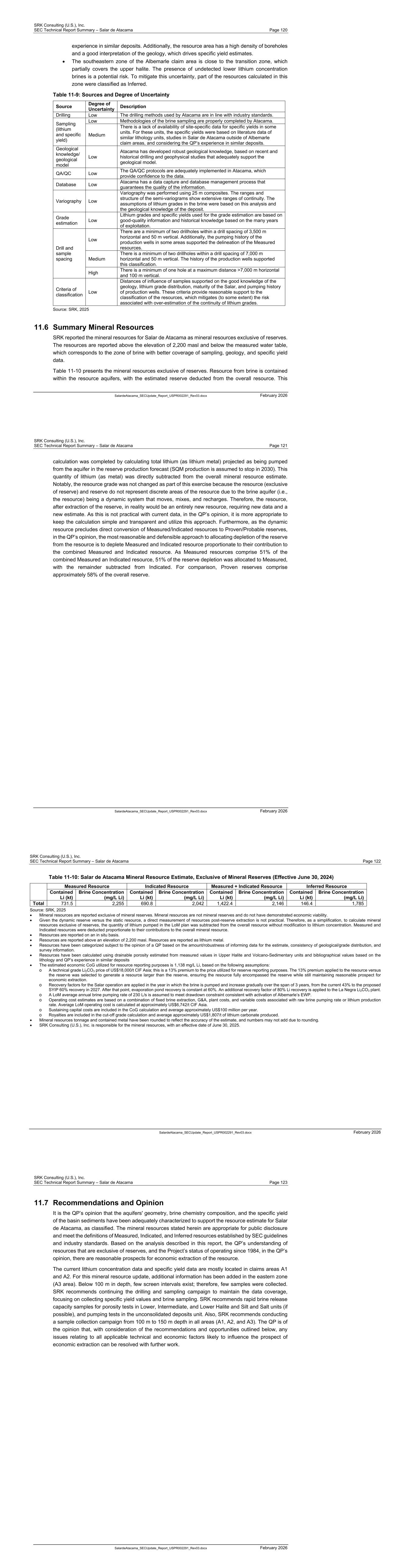
SRK Consulting (U.S.), Inc. SEC Technical Report Summary – Salar de Atacama Page 120 SalardeAtacama_SECUpdate_Report_USPR002291_Rev03.docx February 2026 experience in similar deposits. Additionally, the resource area has a high density of boreholes and a good interpretation of the geology, which drives specific yield estimates. The southeastern zone of the Albemarle claim area is close to the transition zone, which partially covers the upper halite. The presence of undetected lower lithium concentration brines is a potential risk. To mitigate this uncertainty, part of the resources calculated in this zone were classified as Inferred. Table 11-9: Sources and Degree of Uncertainty Source Degree of Uncertainty Description Drilling Low The drilling methods used by Atacama are in line with industry standards. Sampling (lithium and specific yield) Low Methodologies of the brine sampling are properly completed by Atacama. Medium There is a lack of availability of site-specific data for specific yields in some units. For these units, the specific yields were based on literature data of similar lithology units, studies in Salar de Atacama outside of Albemarle claim areas, and considering the QP’s experience in similar deposits. Geological knowledge/ geological model Low Atacama has developed robust geological knowledge, based on recent and historical drilling and geophysical studies that adequately support the geological model. QA/QC Low The QA/QC protocols are adequately implemented in Atacama, which provide confidence to the data. Database Low Atacama has a data capture and database management process that guarantees the quality of the information. Variography Low Variography was performed using 25 m composites. The ranges and structure of the semi-variograms show extensive ranges of continuity. The assumptions of lithium grades in the brine were based on this analysis and the geological knowledge of the deposit. Grade estimation Low Lithium grades and specific yields used for the grade estimation are based on good-quality information and historical knowledge based on the many years of exploitation. Drill and sample spacing Low There are a minimum of two drillholes within a drill spacing of 3,500 m horizontal and 50 m vertical. Additionally, the pumping history of the production wells in some areas supported the delineation of the Measured resources. Medium There is a minimum of two drillholes within a drill spacing of 7,000 m horizontal and 50 m vertical. The history of the production wells supported this classification. High There is a minimum of one hole at a maximum distance >7,000 m horizontal and 100 m vertical. Criteria of classification Low Distances of influence of samples supported on the good knowledge of the geology, lithium grade distribution, maturity of the Salar, and pumping history of production wells. These criteria provide reasonable support to the classification of the resources, which mitigates (to some extent) the risk associated with over-estimation of the continuity of lithium grades. Source: SRK, 2025 11.6 Summary Mineral Resources SRK reported the mineral resources for Salar de Atacama as mineral resources exclusive of reserves. The resources are reported above the elevation of 2,200 masl and below the measured water table, which corresponds to the zone of brine with better coverage of sampling, geology, and specific yield data. Table 11-10 presents the mineral resources exclusive of reserves. Resource from brine is contained within the resource aquifers, with the estimated reserve deducted from the overall resource. This SRK Consulting (U.S.), Inc. SEC Technical Report Summary – Salar de Atacama Page 121 SalardeAtacama_SECUpdate_Report_USPR002291_Rev03.docx February 2026 calculation was completed by calculating total lithium (as lithium metal) projected as being pumped from the aquifer in the reserve production forecast (SQM production is assumed to stop in 2030). This quantity of lithium (as metal) was directly subtracted from the overall mineral resource estimate. Notably, the resource grade was not changed as part of this exercise because the resource (exclusive of reserve) and reserve do not represent discrete areas of the resource due to the brine aquifer (i.e., the resource) being a dynamic system that moves, mixes, and recharges. Therefore, the resource, after extraction of the reserve, in reality would be an entirely new resource, requiring new data and a new estimate. As this is not practical with current data, in the QP’s opinion, it is more appropriate to keep the calculation simple and transparent and utilize this approach. Furthermore, as the dynamic resource precludes direct conversion of Measured/Indicated resources to Proven/Probable reserves, in the QP’s opinion, the most reasonable and defensible approach to allocating depletion of the reserve from the resource is to deplete Measured and Indicated resource proportionate to their contribution to the combined Measured and Indicated resource. As Measured resources comprise 51% of the combined Measured an Indicated resource, 51% of the reserve depletion was allocated to Measured, with the remainder subtracted from Indicated. For comparison, Proven reserves comprise approximately 58% of the overall reserve. SRK Consulting (U.S.), Inc. SEC Technical Report Summary – Salar de Atacama Page 122 SalardeAtacama_SECUpdate_Report_USPR002291_Rev03.docx February 2026 Table 11-10: Salar de Atacama Mineral Resource Estimate, Exclusive of Mineral Reserves (Effective June 30, 2024) Measured Resource Indicated Resource Measured + Indicated Resource Inferred Resource Contained Li (kt) Brine Concentration (mg/L Li) Contained Li (kt) Brine Concentration (mg/L Li) Contained Li (kt) Brine Concentration (mg/L Li) Contained Li (kt) Brine Concentration (mg/L Li) Total 731.5 2,255 690.8 2,042 1,422.4 2,146 146.4 1,785 Source: SRK, 2025 Mineral resources are reported exclusive of mineral reserves. Mineral resources are not mineral reserves and do not have demonstrated economic viability. Given the dynamic reserve versus the static resource, a direct measurement of resources post-reserve extraction is not practical. Therefore, as a simplification, to calculate mineral resources exclusive of reserves, the quantity of lithium pumped in the LoM plan was subtracted from the overall resource without modification to lithium concentration. Measured and Indicated resources were deducted proportionate to their contributions to the overall mineral resource. Resources are reported on an in situ basis. Resources are reported above an elevation of 2,200 masl. Resources are reported as lithium metal. Resources have been categorized subject to the opinion of a QP based on the amount/robustness of informing data for the estimate, consistency of geological/grade distribution, and survey information. Resources have been calculated using drainable porosity estimated from measured values in Upper Halite and Volcano-Sedimentary units and bibliographical values based on the lithology and QP’s experience in similar deposits The estimated economic CoG utilized for resource reporting purposes is 1,138 mg/L Li, based on the following assumptions: o A technical grade Li2CO3 price of US$18,000/t CIF Asia; this is a 13% premium to the price utilized for reserve reporting purposes. The 13% premium applied to the resource versus the reserve was selected to generate a resource larger than the reserve, ensuring the resource fully encompassed the reserve while still maintaining reasonable prospect for economic extraction. o Recovery factors for the Salar operation are applied in the year in which the brine is pumped and increase gradually over the span of 3 years, from the current 43% to the proposed SYIP 60% recovery in 2027. After that point, evaporation pond recovery is constant at 60%. An additional recovery factor of 80% Li recovery is applied to the La Negra Li2CO3 plant. o A LoM average annual brine pumping rate of 230 L/s is assumed to meet drawdown constraint consistent with activation of Albemarle’s EWP. o Operating cost estimates are based on a combination of fixed brine extraction, G&A, plant costs, and variable costs associated with raw brine pumping rate or lithium production rate. Average LoM operating cost is calculated at approximately US$6,742/t CIF Asia. o Sustaining capital costs are included in the CoG calculation and average approximately US$100 million per year. o Royalties are included in the cut-off grade calculation and average approximately US$1,807/t of lithium carbonate produced. Mineral resources tonnage and contained metal have been rounded to reflect the accuracy of the estimate, and numbers may not add due to rounding. SRK Consulting (U.S.), Inc. is responsible for the mineral resources, with an effective date of June 30, 2025. SRK Consulting (U.S.), Inc. SEC Technical Report Summary – Salar de Atacama Page 123 SalardeAtacama_SECUpdate_Report_USPR002291_Rev03.docx February 2026 11.7 Recommendations and Opinion It is the QP’s opinion that the aquifers' geometry, brine chemistry composition, and the specific yield of the basin sediments have been adequately characterized to support the resource estimate for Salar de Atacama, as classified. The mineral resources stated herein are appropriate for public disclosure and meet the definitions of Measured, Indicated, and Inferred resources established by SEC guidelines and industry standards. Based on the analysis described in this report, the QP’s understanding of resources that are exclusive of reserves, and the Project’s status of operating since 1984, in the QP’s opinion, there are reasonable prospects for economic extraction of the resource. The current lithium concentration data and specific yield data are mostly located in claims areas A1 and A2. For this mineral resource update, additional information has been added in the eastern zone (A3 area). Below 100 m in depth, few screen intervals exist; therefore, few samples were collected. SRK recommends continuing the drilling and sampling campaign to maintain the data coverage, focusing on collecting specific yield values and brine sampling. SRK recommends rapid brine release capacity samples for porosity tests in Lower, Intermediate, and Lower Halite and Silt and Salt units (if possible), and pumping tests in the unconsolidated deposits unit. Also, SRK recommends conducting a sample collection campaign from 100 m to 150 m depth in all areas (A1, A2, and A3). The QP is of the opinion that, with consideration of the recommendations and opportunities outlined below, any issues relating to all applicable technical and economic factors likely to influence the prospect of economic extraction can be resolved with further work.

SRK Consulting (U.S.), Inc. SEC Technical Report Summary – Salar de Atacama Page 124 SalardeAtacama_SECUpdate_Report_USPR002291_Rev03.docx February 2026 12 Mineral Reserve Estimates This section describes the key assumptions, parameters, and methods used to simulate the movement of lithium-rich brines in Salar de Atacama in the process of their extraction, which is utilized to develop the reserve estimate. 12.1 Key Assumptions, Parameters, and Methods Used 12.1.1 Numerical Groundwater Model A geologically based, 3D, numerical groundwater-flow and solute transport models were developed to evaluate the extractability of lithium-rich brine from Salar de Atacama. The model construction is based on an analysis of historical hydrogeologic data conducted by Albemarle and SRK. A 3D geologic model developed by Albemarle and reviewed by SRK (local and regional models), described in Section 11.1, provides the framework of hydrogeologic units used in the numerical model. The sequence of modeling activities consists of calibration, transition, and prediction simulations. The time period of each model is described below: Calibration: November 1997 to June 2025 (data available for model calibration) Prediction: July 2025 to September 2041 (used for the reserve estimate) The numerical groundwater flow and transport models were developed using the finite-difference code MODFLOW-UGS with the transport module (Panday et al., 2013) via the Groundwater Vistas graphical user interface 9.08 Build 23 (Environmental Simulations, Inc. (ESI), 2020). The model was calibrated to available historical water level and lithium, calcium, and sulfate concentration data. The calibrated model was used to evaluate different production wellfield pumping regimes. 12.1.2 Model Domain and Grid The model domain includes the nucleus and marginal zone of Salar de Atacama, including halite units and volcanic and clastic deposits in an area of 2,426.03 km2 with 736,319 active cells and 16 layers. Model lateral cell sizes of 50 m x 50 m, 100 m x 100 m, 200 m x 200 m, and 400 m x 400 m were implemented. Smaller cells are mainly used in productive areas, while bigger cells are mainly located in the northern and eastern areas away from operative sectors. Model layers vary in thickness. The first nine layers have greater refinement, with an average thickness between 4 and 6 m, with increased thickness for deeper zones. Upper layers contain more-detailed data, which allows for a better vertical discretization. The layers had been adjusted to follow the hydrogeological units (HU) geometry defined in the conceptual model allowing a minimum layer thickness of 1 m and a maximum thickness of 255 m. Model grid and layering were developed to ensure proper representation of the HU within the numerical model and a detailed simulation of the pumping well effect within the Albemarle production areas. Based on a client's request, for environmental purposes, a further refining sector was also included around monitoring EWP wells, east to the production area. Figure 12-1 shows an oblique 3D view of the model. SRK Consulting (U.S.), Inc. SEC Technical Report Summary – Salar de Atacama Page 125 SalardeAtacama_SECUpdate_Report_USPR002291_Rev03.docx February 2026 Source: SRK, 2025 Figure 12-1: Oblique 3D View of Numerical Groundwater Model 12.1.3 Flow Boundary Conditions There are three primary natural groundwater inflow processes at Salar de Atacama: recharge by direct precipitation, indirect recharge on catchments surrounding the Salar, and infiltration from lagoon/ stream systems. There are two primary natural groundwater outflow processes: groundwater discharges from the Salar at lower elevations via ET and to surface water bodies (lagoons). Figure 12-2 presents a schematic of the key boundary condition types. Points on this figure represent locations where lateral inflow and lagoon recharge were simulated; the points are labeled according to the recharge source. Color-shaded areas represent the precipitation-derived recharge areas and rates for the steady-state simulation. SRK Consulting (U.S.), Inc. SEC Technical Report Summary – Salar de Atacama Page 126 SalardeAtacama_SECUpdate_Report_USPR002291_Rev03.docx February 2026 Source: SGA, 2015a, and SRK, 2025 Note: Lateral inflow locations simulated by injection wells are shown in different colors per sub-basin. Figure 12-2: Zones of Direct Recharge and Lateral Groundwater Inflow Recharge Direct recharge and lateral recharge location and rates were assumed from previous hydrogeological studies presented to the environmental agencies of Chile (SGA, 2015a and 2019) and from the third update of the Salar de Atacama groundwater model for the RCA 21/2016 (VAI, 2023). Direct recharge was simulated in the uppermost active layer as a transient boundary condition, at a monthly temporal resolution. Lateral groundwater recharge was simulated as a transient boundary condition as injection wells in layers 1 through 16, depending on the lateral recharge location. Minor adjustments were made SRK Consulting (U.S.), Inc. SEC Technical Report Summary – Salar de Atacama Page 127 SalardeAtacama_SECUpdate_Report_USPR002291_Rev03.docx February 2026 in the fluxes reported from Sub-Basins 10 and 11 to represent in more detail the lateral recharge from Cordon de Lila. Figure 12-2 shows the distribution of direct recharge and the injection wells used for the lateral recharge simulation. Table 12-1 presents the infiltration rates and lateral inflows used for natural groundwater flow conditions (no pumping). Table 12-1: Recharge Rates and Lateral Inflows Under Natural Conditions Recharge Component Number of Simulated Injection Wells1 Total Inflow (L/s) Sub-Basin 6 19 200 Sub-Basin 7 39 425 Sub-Basin 8 14 41 Sub-Basin 9 16 348 Sub-Basin 10a Cone 3 31 Sub-Basin 10a South 7 580 Sub-Basin 10b 6 5 Sub-Basin 11 6 85.6 Sub-Basin 11a 1 0.4 Sub-Basin 11b 1 0.7 Sub-Basin 12 18 10 Sub-Basin 13 8 92 Sub-Basin 15 7 7 Northern boundary 54 684 Infiltration Peine Lagoon2 6 9.1 Infiltration Soncor Lagoon (Cola Pez) 9 25 Infiltration Soncor Lagoon (DSur) 9 0 Recharge from precipitation 0 315 Total 223 2,858.05 Sources: VAI, 2023, Albemarle, 2025, and SRK, 2025 1Recharge lateral inflows are simulated by injection wells. 2Adopted value for Peine Lagoon was extracted directly from environmental numerical model (VAI, 2023). Evapotranspiration (ET) ET rates and spatial distribution were initially assumed from the previous environmental model (VAI, 2023) and modified during the calibration process. ET rates varied on a monthly basis, and ET was applied from the topographic surface to an extinction depth ranging from 1 m to 2 m below the ground surface according to the conceptual model. Conservatively, lithium mass was removed with ET to avoid artificial accumulation of lithium at the ground surface in the model and over-estimation of lithium availability. Figure 12-3 shows the spatial distribution of maximum ET rates in the model.

SRK Consulting (U.S.), Inc. SEC Technical Report Summary – Salar de Atacama Page 128 SalardeAtacama_SECUpdate_Report_USPR002291_Rev03.docx February 2026 Source: VAI, 2023, modified by SRK, 2025 Note: Values represent average evapotranspiration rates for natural conditions (no pumping). Figure 12-3: Zones of Simulated Maximum ET Rate Lagoon/Stream Systems Four lagoon/stream networks are identified in Salar de Atacama: Soncor, Aguas de Quelana, Peine, and La Punta – La Brava (Figure 12-2). Soncor and Peine lagoons include infiltration from the surface water corresponding to 25 and 11 L/s, respectively (SGA, 2015a, SGA, 2019, and VAI, 2023). Surface water is not thought to infiltrate from the Aguas de Quelana and La Punta – La Brava lagoons. The lagoon/stream networks are simulated as drain cells. Groundwater discharge rates into the lagoon/stream networks were simulated using the conceptual water balance model (Table 12-2). SRK Consulting (U.S.), Inc. SEC Technical Report Summary – Salar de Atacama Page 129 SalardeAtacama_SECUpdate_Report_USPR002291_Rev03.docx February 2026 Table 12-2: Conceptual Rates of Groundwater Discharges into the Lagoon/Stream Systems Lagoon/Stream System Flow (L/s) Soncor 76 Aguas de Quelana 172 Peine 79 La Punta – La Brava 113 Source: SGA, 2016 Infiltration from the Soncor and Peine lagoons into groundwater were simulated as injection wells in the top layer of the model. Lagoon and stream areas are not assigned as an evapotraspiration zone since water evaporating through those cells is controlled by the drain cells. Figure 12-2 shows the locations of groundwater discharge zones to lagoons and infiltration from the lagoons. Pumping Wells and Artificial Recharge Simulation of the historical brine extraction and pumping from Albemarle’s and SQM’s freshwater wells is based on the construction details and historical flow rates presented in Albemarle’s and SQM’s environmental reports (SQM, 2023b, and www.sqmsenlinea.com). The Albemarle total monthly brine pumping rate varies from 23.3 L/s to 544.7 L/s. Pumping from the deep pumping wells started in August 2018 and varied from 0.23 L/s to 153.6 L/s. Meanwhile, SQM's monthly pumping rates range from 288.1 L/s to 2781.5 L/s. Sections 12.1.5 and 12.1.6 provide details of the pumping rates in time for calibration and prediction. According to public records, SQM brine injection was reported at monthly rates up to 517.1 L/s (SQM, 2023b, and www.sqmsenlinea.com). These values were simulated as injection wells in four locations within the SQM property in layers 1 through 9 of the model. Albemarle estimates that loss from operational ponds and stockpiles is up to 5% of the total brine pumping rate as leakage to the groundwater system (0.6 L/s to 25.6 L/s, monthly values below 6.3%). In addition, some ponds have been adjusted with no leakage as part of the calibration process. Figure 12-4 shows locations of pumping wells in Salar de Atacama (historical pumping). Figure 12-4 also shows the locations of artificial injection wells used to simulate leakage from the Albemarle ponds. SRK Consulting (U.S.), Inc. SEC Technical Report Summary – Salar de Atacama Page 130 SalardeAtacama_SECUpdate_Report_USPR002291_Rev03.docx February 2026 Source: SRK, 2025 Note: SQM pumping wells are represented by Equivalent Pumping Points (EPP), which represent the equivalent pumping rate from the production wells located in a 1 km x 1 km square grid; this is an approximation of SQM’s brine well field extraction. Figure 12-4: Location of Pumping Wells and Artificial Recharge Zones (Historical) Solute-Transport Boundary Conditions The following lithium concentration values were assumed in the recharge boundary conditions for the solute-transport simulations: Lateral recharge from sub-basins (freshwater): 3 mg/L to 10 mg/L Li, 113 mg/L to 130 mg/L Ca, and 350 mg/L SO4 Flows from the north boundary: 1,000 mg/L Li, 350 mg/L Ca, and 19,000 mg/L SO4 Infiltration from the Soncor and Peine lagoons/stream systems: 700 and 320 mg/L Li, respectively, 1,000 mg/L Ca, and 3,500 mg/L SO4 The concentration values mentioned above are constant in time and are based on the hydrochemistry database presented in the environmental reports (SGA, 2019, and SQM, 2020) and in “Hydrogeochemical fluxes and processes contributing to the formation of lithium-enriched brines in a hyper-arid continental basin” (Munk et al., 2018). Other assumptions for solute transport boundary conditions are as follows: Reinjected brines in SQM have concentrations of 1,000 mg/L Li, 10,640 mg/L Ca, and 266 mg/L SO4. Higher lithium grades are expected in SQM reinjection brines; however, SRK Consulting (U.S.), Inc. SEC Technical Report Summary – Salar de Atacama Page 131 SalardeAtacama_SECUpdate_Report_USPR002291_Rev03.docx February 2026 1,000 mg/L was chosen as a minimum value to limit the artificial lithium available for the predicted Albemarle production. Seepage from Albemarle operational ponds has concentrations with annual averages ranging between 6,534 mg/L to 11,749 mg/L Li; 5,599 mg/L to 8,778 mg/L Ca; and 3,869 mg/L to 7,695 mg/L SO4. The adopted values correspond to the measured concentration operational records provided by Albemarle for this study. Flows from the southern boundary condition are assumed with 500 mg/L Li, 3,000 mg/L Ca, and 2,000 mg/L SO4 using conservative values based on an initial condition interpolation explained in the next section. The effect of the direct recharge on the lithium concentration in the Salar is negligible. Evapotranspiration removes lithium from the model (analogous to chemical precipitation). Figure 12-5 shows the distribution of solute-transport boundary conditions.
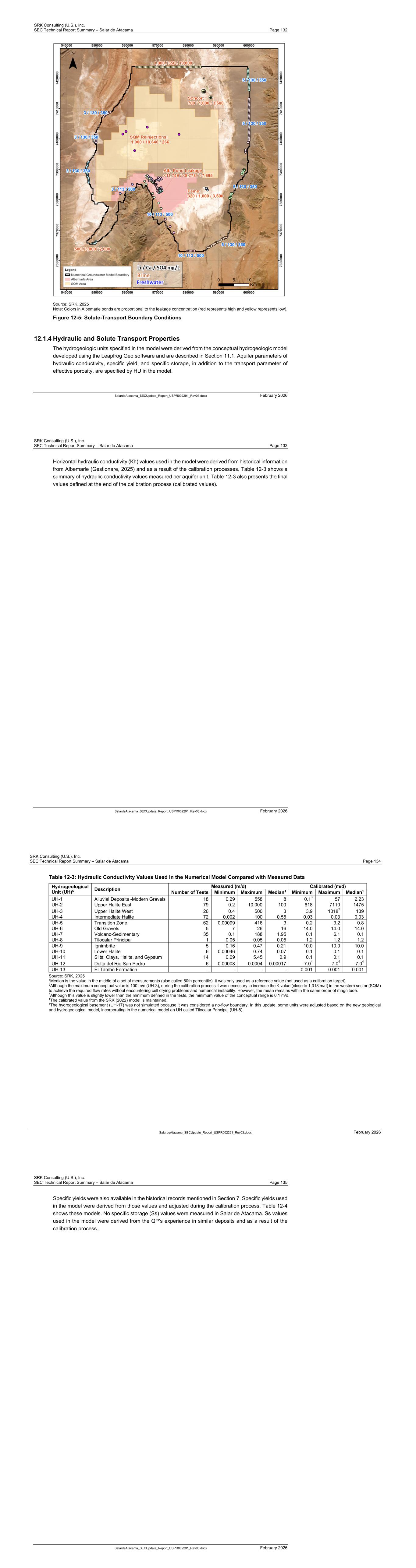
SRK Consulting (U.S.), Inc. SEC Technical Report Summary – Salar de Atacama Page 132 SalardeAtacama_SECUpdate_Report_USPR002291_Rev03.docx February 2026 Source: SRK, 2025 Note: Colors in Albemarle ponds are proportional to the leakage concentration (red represents high and yellow represents low). Figure 12-5: Solute-Transport Boundary Conditions 12.1.4 Hydraulic and Solute Transport Properties The hydrogeologic units specified in the model were derived from the conceptual hydrogeologic model developed using the Leapfrog Geo software and are described in Section 11.1. Aquifer parameters of hydraulic conductivity, specific yield, and specific storage, in addition to the transport parameter of effective porosity, are specified by HU in the model. SRK Consulting (U.S.), Inc. SEC Technical Report Summary – Salar de Atacama Page 133 SalardeAtacama_SECUpdate_Report_USPR002291_Rev03.docx February 2026 Horizontal hydraulic conductivity (Kh) values used in the model were derived from historical information from Albemarle (Gestionare, 2025) and as a result of the calibration processes. Table 12-3 shows a summary of hydraulic conductivity values measured per aquifer unit. Table 12-3 also presents the final values defined at the end of the calibration process (calibrated values). SRK Consulting (U.S.), Inc. SEC Technical Report Summary – Salar de Atacama Page 134 SalardeAtacama_SECUpdate_Report_USPR002291_Rev03.docx February 2026 Table 12-3: Hydraulic Conductivity Values Used in the Numerical Model Compared with Measured Data Hydrogeological Unit (UH)5 Description Measured (m/d) Calibrated (m/d) Number of Tests Minimum Maximum Median1 Minimum Maximum Median1 UH-1 Alluvial Deposits -Modern Gravels 18 0.29 558 8 0.13 57 2.23 UH-2 Upper Halite East 79 0.2 10,000 100 618 7110 1475 UH-3 Upper Halite West 26 0.4 500 3 3.9 10182 139 UH-4 Intermediate Halite 72 0.002 100 0.55 0.03 0.03 0.03 UH-5 Transition Zone 62 0.00099 416 3 0.2 3.2 0.8 UH-6 Old Gravels 5 7 26 16 14.0 14.0 14.0 UH-7 Volcano-Sedimentary 35 0.1 188 1.95 0.1 6.1 0.1 UH-8 Tilocalar Principal 1 0.05 0.05 0.05 1.2 1.2 1.2 UH-9 Ignimbrite 5 0.16 0.47 0.21 10.0 10.0 10.0 UH-10 Lower Halite 6 0.00046 0.74 0.07 0.1 0.1 0.1 UH-11 Silts, Clays, Halite, and Gypsum 14 0.09 5.45 0.9 0.1 0.1 0.1 UH-12 Delta del Rio San Pedro 6 0.00008 0.0004 0.00017 7.04 7.04 7.04 UH-13 El Tambo Formation - - - - 0.001 0.001 0.001 Source: SRK, 2025 1Median is the value in the middle of a set of measurements (also called 50th percentile); it was only used as a reference value (not used as a calibration target). 2Although the maximum conceptual value is 100 m/d (UH-3), during the calibration process it was necessary to increase the K value (close to 1,018 m/d) in the western sector (SQM) to achieve the required flow rates without encountering cell drying problems and numerical instability. However, the mean remains within the same order of magnitude. 3Although this value is slightly lower than the minimum defined in the tests, the minimum value of the conceptual range is 0.1 m/d. 4The calibrated value from the SRK (2022) model is maintained. 5The hydrogeological basement (UH-17) was not simulated because it was considered a no-flow boundary. In this update, some units were adjusted based on the new geological and hydrogeological model, incorporating in the numerical model an UH called Tilocalar Principal (UH-8). SRK Consulting (U.S.), Inc. SEC Technical Report Summary – Salar de Atacama Page 135 SalardeAtacama_SECUpdate_Report_USPR002291_Rev03.docx February 2026 Specific yields were also available in the historical records mentioned in Section 7. Specific yields used in the model were derived from those values and adjusted during the calibration process. Table 12-4 shows these models. No specific storage (Ss) values were measured in Salar de Atacama. Ss values used in the model were derived from the QP’s experience in similar deposits and as a result of the calibration process.
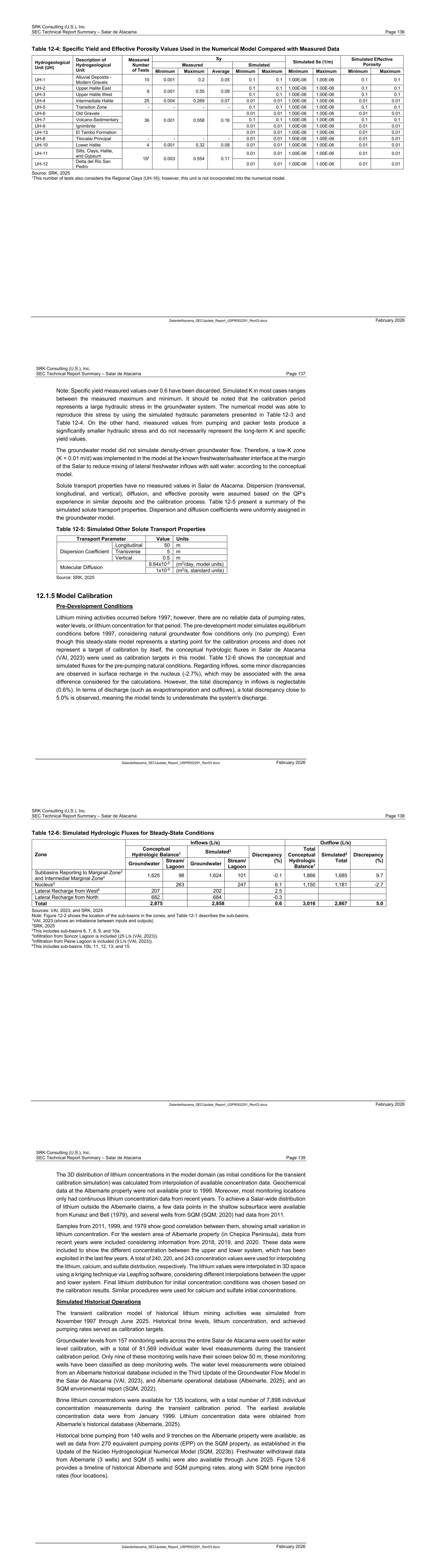
SRK Consulting (U.S.), Inc. SEC Technical Report Summary – Salar de Atacama Page 136 SalardeAtacama_SECUpdate_Report_USPR002291_Rev03.docx February 2026 Table 12-4: Specific Yield and Effective Porosity Values Used in the Numerical Model Compared with Measured Data Hydrogeological Unit (UH) Description of Hydrogeological Unit Measured Number of Tests Sy Simulated Ss (1/m) Simulated Effective Porosity Measured Simulated Minimum Maximum Average Minimum Maximum Minimum Maximum Minimum Maximum UH-1 Alluvial Deposits - Modern Gravels 10 0.001 0.2 0.05 0.1 0.1 1.00E-06 1.00E-06 0.1 0.1 UH-2 Upper Halite East 9 0.001 0.55 0.09 0.1 0.1 1.00E-06 1.00E-06 0.1 0.1 UH-3 Upper Halite West 0.1 0.1 1.00E-06 1.00E-06 0.1 0.1 UH-4 Intermediate Halite 25 0.004 0.269 0.07 0.01 0.01 1.00E-06 1.00E-06 0.01 0.01 UH-5 Transition Zone - - - - 0.1 0.1 1.00E-06 1.00E-06 0.1 0.1 UH-6 Old Gravels 36 0.001 0.558 0.16 0.01 0.01 1.00E-06 1.00E-06 0.01 0.01 UH-7 Volcano-Sedimentary 0.1 0.1 1.00E-06 1.00E-06 0.1 0.1 UH-9 Ignimbrite 0.01 0.01 1.00E-06 1.00E-06 0.01 0.01 UH-13 El Tambo Formation 0.01 0.01 1.00E-06 1.00E-06 0.01 0.01 UH-8 Tilocalar Principal - - - - 0.01 0.01 1.00E-06 1.00E-06 0.01 0.01 UH-10 Lower Halite 4 0.001 0.32 0.08 0.01 0.01 1.00E-06 1.00E-06 0.01 0.01 UH-11 Silts, Clays, Halite, and Gypsum 191 0.003 0.554 0.11 0.01 0.01 1.00E-06 1.00E-06 0.01 0.01 UH-12 Delta del Rio San Pedro 0.01 0.01 1.00E-06 1.00E-06 0.01 0.01 Source: SRK, 2025 1This number of tests also considers the Regional Clays (UH-16); however, this unit is not incorporated into the numerical model. SRK Consulting (U.S.), Inc. SEC Technical Report Summary – Salar de Atacama Page 137 SalardeAtacama_SECUpdate_Report_USPR002291_Rev03.docx February 2026 Note: Specific yield measured values over 0.6 have been discarded. Simulated K in most cases ranges between the measured maximum and minimum. It should be noted that the calibration period represents a large hydraulic stress in the groundwater system. The numerical model was able to reproduce this stress by using the simulated hydraulic parameters presented in Table 12-3 and Table 12-4. On the other hand, measured values from pumping and packer tests produce a significantly smaller hydraulic stress and do not necessarily represent the long-term K and specific yield values. The groundwater model did not simulate density-driven groundwater flow. Therefore, a low-K zone (K = 0.01 m/d) was implemented in the model at the known freshwater/saltwater interface at the margin of the Salar to reduce mixing of lateral freshwater inflows with salt water, according to the conceptual model. Solute transport properties have no measured values in Salar de Atacama. Dispersion (transversal, longitudinal, and vertical), diffusion, and effective porosity were assumed based on the QP’s experience in similar deposits and the calibration process. Table 12-5 present a summary of the simulated solute transport properties. Dispersion and diffusion coefficients were uniformly assigned in the groundwater model. Table 12-5: Simulated Other Solute Transport Properties Transport Parameter Value Units Dispersion Coefficient Longitudinal 50 m Transverse 5 m Vertical 0.5 m Molecular Diffusion 8.64x10⁻⁵ (m2/day, model units) 1x10⁻⁹ (m2/s, standard units) Source: SRK, 2025 12.1.5 Model Calibration Pre-Development Conditions Lithium mining activities occurred before 1997; however, there are no reliable data of pumping rates, water levels, or lithium concentration for that period. The pre-development model simulates equilibrium conditions before 1997, considering natural groundwater flow conditions only (no pumping). Even though this steady-state model represents a starting point for the calibration process and does not represent a target of calibration by itself, the conceptual hydrologic fluxes in Salar de Atacama (VAI, 2023) were used as calibration targets in this model. Table 12-6 shows the conceptual and simulated fluxes for the pre-pumping natural conditions. Regarding inflows, some minor discrepancies are observed in surface recharge in the nucleus (-2.7%), which may be associated with the area difference considered for the calculations. However, the total discrepancy in inflows is neglectable (0.6%). In terms of discharge (such as evapotranspiration and outflows), a total discrepancy close to 5.0% is observed, meaning the model tends to underestimate the system's discharge. SRK Consulting (U.S.), Inc. SEC Technical Report Summary – Salar de Atacama Page 138 SalardeAtacama_SECUpdate_Report_USPR002291_Rev03.docx February 2026 Table 12-6: Simulated Hydrologic Fluxes for Steady-State Conditions Zone Inflows (L/s) Outflow (L/s) Conceptual Hydrologic Balance1 Simulated2 Discrepancy (%) Total Conceptual Hydrologic Balance1 Simulated2 Total Discrepancy (%) Groundwater Stream/ Lagoon Groundwater Stream/ Lagoon Subbasins Reporting to Marginal Zone3 and Intermedial Marginal Zone4 1,625 98 1,624 101 -0.1 1,866 1,685 9.7 Nucleus5 263 247 6.1 1,150 1,181 -2.7 Lateral Recharge from West6 207 202 2.5 Lateral Recharge from North 682 684 -0.3 Total 2,875 2,858 0.6 3,016 2,867 5.0 Sources: VAI, 2023, and SRK, 2025 Note: Figure 12-2 shows the location of the sub-basins in the zones, and Table 12-1 describes the sub-basins. 1VAI, 2023 (shows an imbalance between inputs and outputs) 2SRK, 2025 3This includes sub-basins 6, 7, 8, 9, and 10a. 4Infiltration from Soncor Lagoon is included (25 L/s (VAI, 2023)). 5Infiltration from Peine Lagoon is included (9 L/s (VAI, 2023)). 6This includes sub-basins 10b, 11, 12, 13, and 15. SRK Consulting (U.S.), Inc. SEC Technical Report Summary – Salar de Atacama Page 139 SalardeAtacama_SECUpdate_Report_USPR002291_Rev03.docx February 2026 The 3D distribution of lithium concentrations in the model domain (as initial conditions for the transient calibration simulation) was calculated from interpolation of available concentration data. Geochemical data at the Albemarle property were not available prior to 1999. Moreover, most monitoring locations only had continuous lithium concentration data from recent years. To achieve a Salar-wide distribution of lithium outside the Albemarle claims, a few data points in the shallow subsurface were available from Kunasz and Bell (1979), and several wells from SQM (SQM, 2020) had data from 2011. Samples from 2011, 1999, and 1979 show good correlation between them, showing small variation in lithium concentration. For the western area of Albemarle property (in Chepica Peninsula), data from recent years were included considering information from 2018, 2019, and 2020. These data were included to show the different concentration between the upper and lower system, which has been exploited in the last few years. A total of 240, 220, and 243 concentration values were used for interpolating the lithium, calcium, and sulfate distribution, respectively. The lithium values were interpolated in 3D space using a kriging technique via Leapfrog software, considering different interpolations between the upper and lower system. Final lithium distribution for initial concentration conditions was chosen based on the calibration results. Similar procedures were used for calcium and sulfate initial concentrations. Simulated Historical Operations The transient calibration model of historical lithium mining activities was simulated from November 1997 through June 2025. Historical brine levels, lithium concentration, and achieved pumping rates served as calibration targets. Groundwater levels from 157 monitoring wells across the entire Salar de Atacama were used for water level calibration, with a total of 81,569 individual water level measurements during the transient calibration period. Only nine of these monitoring wells have their screen below 50 m; these monitoring wells have been classified as deep monitoring wells. The water level measurements were obtained from an Albemarle historical database included in the Third Update of the Groundwater Flow Model in the Salar de Atacama (VAI, 2023), and Albemarle operational database (Albemarle, 2025), and an SQM environmental report (SQM, 2022). Brine lithium concentrations were available for 135 locations, with a total number of 7,898 individual concentration measurements during the transient calibration period. The earliest available concentration data were from January 1999. Lithium concentration data were obtained from Albemarle’s historical database (Albemarle, 2025). Historical brine pumping from 140 wells and 9 trenches on the Albemarle property were available, as well as data from 270 equivalent pumping points (EPP) on the SQM property, as established in the Update of the Núcleo Hydrogeological Numerical Model (SQM, 2023b). Freshwater withdrawal data from Albemarle (3 wells) and SQM (5 wells) were also available through June 2025. Figure 12-6 provides a timeline of historical Albemarle and SQM pumping rates, along with SQM brine injection rates (four locations).
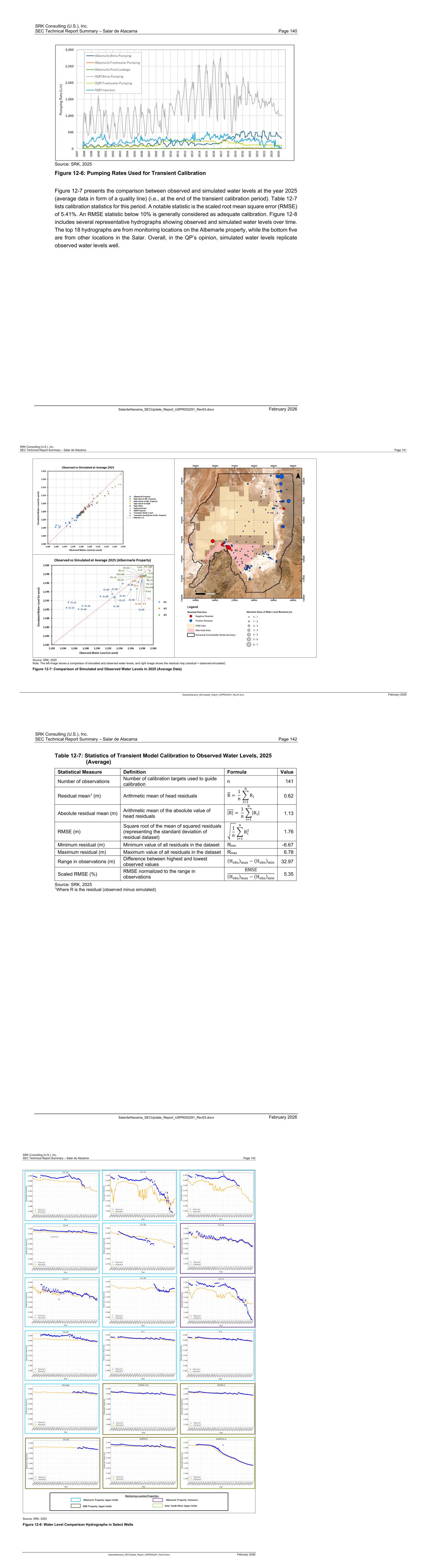
SRK Consulting (U.S.), Inc. SEC Technical Report Summary – Salar de Atacama Page 140 SalardeAtacama_SECUpdate_Report_USPR002291_Rev03.docx February 2026 Source: SRK, 2025 Figure 12-6: Pumping Rates Used for Transient Calibration Figure 12-7 presents the comparison between observed and simulated water levels at the year 2025 (average data in form of a quality line) (i.e., at the end of the transient calibration period). Table 12-7 lists calibration statistics for this period. A notable statistic is the scaled root mean square error (RMSE) of 5.41%. An RMSE statistic below 10% is generally considered as adequate calibration. Figure 12-8 includes several representative hydrographs showing observed and simulated water levels over time. The top 18 hydrographs are from monitoring locations on the Albemarle property, while the bottom five are from other locations in the Salar. Overall, in the QP’s opinion, simulated water levels replicate observed water levels well. SRK Consulting (U.S.), Inc. SEC Technical Report Summary – Salar de Atacama Page 141 SalardeAtacama_SECUpdate_Report_USPR002291_Rev03.docx February 2026 Source: SRK, 2025 Note: The left image shows a comparison of simulated and observed water levels, and right image shows the residual map (residual = observed-simulated). Figure 12-7: Comparison of Simulated and Observed Water Levels in 2025 (Average Data) SRK Consulting (U.S.), Inc. SEC Technical Report Summary – Salar de Atacama Page 142 SalardeAtacama_SECUpdate_Report_USPR002291_Rev03.docx February 2026 Table 12-7: Statistics of Transient Model Calibration to Observed Water Levels, 2025 (Average) Statistical Measure Definition Formula Value Number of observations Number of calibration targets used to guide calibration n 141 Residual mean1 (m) Arithmetic mean of head residuals R 1 n R 0.62 Absolute residual mean (m) Arithmetic mean of the absolute value of head residuals |R| 1 n |R | 1.13 RMSE (m) Square root of the mean of squared residuals (representing the standard deviation of residual dataset) 1 n R 1.76 Minimum residual (m) Minimum value of all residuals in the dataset Rmin -6.67 Maximum residual (m) Maximum value of all residuals in the dataset Rmax 6.78 Range in observations (m) Difference between highest and lowest observed values H H 32.97 Scaled RMSE (%) RMSE normalized to the range in observations RMSE H H 5.35 Source: SRK, 2025 1Where R is the residual (observed minus simulated) SRK Consulting (U.S.), Inc. SEC Technical Report Summary – Salar de Atacama Page 143 SalardeAtacama_SECUpdate_Report_USPR002291_Rev03.docx February 2026 Source: SRK, 2025 Figure 12-8: Water Level Comparison Hydrographs in Select Wells
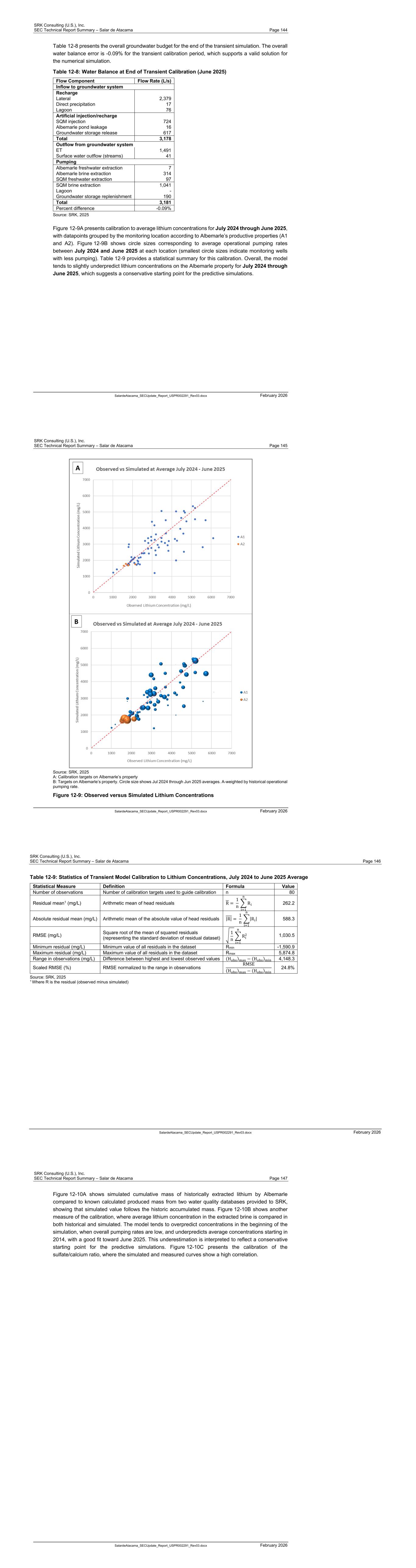
SRK Consulting (U.S.), Inc. SEC Technical Report Summary – Salar de Atacama Page 144 SalardeAtacama_SECUpdate_Report_USPR002291_Rev03.docx February 2026 Table 12-8 presents the overall groundwater budget for the end of the transient simulation. The overall water balance error is -0.09% for the transient calibration period, which supports a valid solution for the numerical simulation. Table 12-8: Water Balance at End of Transient Calibration (June 2025) Flow Component Flow Rate (L/s) Inflow to groundwater system Recharge Lateral 2,379 Direct precipitation 17 Lagoon 76 Artificial injection/recharge SQM injection 724 Albemarle pond leakage 16 Groundwater storage release 617 Total 3,178 Outflow from groundwater system ET 1,491 Surface water outflow (streams) 41 Pumping Albemarle freshwater extraction 7 Albemarle brine extraction 314 SQM freshwater extraction 97 SQM brine extraction 1,041 Lagoon - Groundwater storage replenishment 190 Total 3,181 Percent difference -0.09% Source: SRK, 2025 Figure 12-9A presents calibration to average lithium concentrations for July 2024 through June 2025, with datapoints grouped by the monitoring location according to Albemarle’s productive properties (A1 and A2). Figure 12-9B shows circle sizes corresponding to average operational pumping rates between July 2024 and June 2025 at each location (smallest circle sizes indicate monitoring wells with less pumping). Table 12-9 provides a statistical summary for this calibration. Overall, the model tends to slightly underpredict lithium concentrations on the Albemarle property for July 2024 through June 2025, which suggests a conservative starting point for the predictive simulations. SRK Consulting (U.S.), Inc. SEC Technical Report Summary – Salar de Atacama Page 145 SalardeAtacama_SECUpdate_Report_USPR002291_Rev03.docx February 2026 Source: SRK, 2025 A: Calibration targets on Albemarle’s property B: Targets on Albemarle’s property. Circle size shows Jul 2024 through Jun 2025 averages. A-weighted by historical operational pumping rate. Figure 12-9: Observed versus Simulated Lithium Concentrations SRK Consulting (U.S.), Inc. SEC Technical Report Summary – Salar de Atacama Page 146 SalardeAtacama_SECUpdate_Report_USPR002291_Rev03.docx February 2026 Table 12-9: Statistics of Transient Model Calibration to Lithium Concentrations, July 2024 to June 2025 Average Statistical Measure Definition Formula Value Number of observations Number of calibration targets used to guide calibration n 80 Residual mean1 (mg/L) Arithmetic mean of head residuals R 1 n R 262.2 Absolute residual mean (mg/L) Arithmetic mean of the absolute value of head residuals |R| 1 n |R | 588.3 RMSE (mg/L) Square root of the mean of squared residuals (representing the standard deviation of residual dataset) 1 n R 1,030.5 Minimum residual (mg/L) Minimum value of all residuals in the dataset Rmin -1,590.9 Maximum residual (mg/L) Maximum value of all residuals in the dataset Rmax 5,874.8 Range in observations (mg/L) Difference between highest and lowest observed values H H 4,148.3 Scaled RMSE (%) RMSE normalized to the range in observations RMSE H H 24.8% Source: SRK, 2025 1 Where R is the residual (observed minus simulated) SRK Consulting (U.S.), Inc. SEC Technical Report Summary – Salar de Atacama Page 147 SalardeAtacama_SECUpdate_Report_USPR002291_Rev03.docx February 2026 Figure 12-10A shows simulated cumulative mass of historically extracted lithium by Albemarle compared to known calculated produced mass from two water quality databases provided to SRK, showing that simulated value follows the historic accumulated mass. Figure 12-10B shows another measure of the calibration, where average lithium concentration in the extracted brine is compared in both historical and simulated. The model tends to overpredict concentrations in the beginning of the simulation, when overall pumping rates are low, and underpredicts average concentrations starting in 2014, with a good fit toward June 2025. This underestimation is interpreted to reflect a conservative starting point for the predictive simulations. Figure 12-10C presents the calibration of the sulfate/calcium ratio, where the simulated and measured curves show a high correlation.

SRK Consulting (U.S.), Inc. SEC Technical Report Summary – Salar de Atacama Page 148 SalardeAtacama_SECUpdate_Report_USPR002291_Rev03.docx February 2026 Source: SRK, 2025 Note: Brinechem is the primary hydrochemical database prepared by Albemarle. Chemistry_dt is the alternative hydrochemical database prepared by Albemarle, 2025 Figure 12-10: Comparison of Measured and Simulated A) Cumulative Lithium Mass Extraction, B) Average Lithium Concentration, and C) Sulfate/Calcium Ratio SRK Consulting (U.S.), Inc. SEC Technical Report Summary – Salar de Atacama Page 149 SalardeAtacama_SECUpdate_Report_USPR002291_Rev03.docx February 2026 Table 12-10 shows the average lithium mass transfer rates in the calibration period. As expected, pumping wells represent the main loss of lithium mass from groundwater (208,768 kilograms per day (kg/d)), followed by evapotranspiration or chemical precipitation (104,600 kg/d). Sources of lithium gains in groundwater mainly come from groundwater storage, with the artificial injection and natural lateral recharge contributing to a minor degree. Table 12-10: Average Lithium Mass Transfer Rate for Calibration Period (Nov 1997 - Jun 2025) Component Mass Rate (kg/d) Lithium gain in groundwater Boundary recharge and artificial recharge (Albemarle ponds and SQM Injection) 91,668 Storage release 308,170 Total gain 399,838 Lithium loss in groundwater Pumping wells 208,768 Surface water (drain cells) 3,607 Plant uptake and chemical precipitation 104,600 Storage replenishment 82,863 Total loss 399,837 Percent difference 0.0001% Source: SRK, 2025 Calibration of the model to mass extracted by the production wellfield annually and comparison of simulated to observed lithium concentration versus cumulative production pumping are both reasonable. Calibration of the model to the mass extraction rate in June of 2025 and to the sulfate-to- calcium ratio also look reasonable. It is SRK’s opinion that the numerical model adequately represents the historical and current wellfield production of lithium from the basin and can be used for future production plans to support a reserve estimate. 12.1.6 Predictive Simulations Predictive simulations cover the period from July 2025 to September 2041. The pumping plan was initially provided by Albemarle (ALB, 2025). Figure 12-11 shows the monthly distribution of the pumping plan flow rates, which range from 72 L/s to 442 L/s. The initial pumping plan was simulated until achieving the extraction of 97.4% of the flow rate imposed by the numerical model. The pumping plan considers 68 active wells between July 2025 and September 2041, with total monthly pumping rates during this period ranging from 72 L/s to 442 L/s. Flow rates range from 26.8 L/s to 364.7 L/s in area A1 and from 45.2 L/s to 118.0 L/s in area A2- Between 10 and 65 production wells were active per month to sustain the annual brine pumping rate. Projected SQM brine pumping rates were used in the predictive model starting in July 2025 and are scheduled to terminate at the end of December 2030 (SQM, 2025). Projected SQM brine pumping includes 270 EPPs (with 174 active EPPs between July 2025 and December 2030) with pumping rates of up to 47.8 L/s for a given location. The total monthly brine pumping rate varies from 957,8 L/s to 1,311.5 L/s for the entire system (SQM, 2025). As of the date of this report, SQM is conducting studies to evaluate the possibility of extending the operational period of its extraction wells. This report only considers SQM production up to December 2030. Figure 12-12 shows simulated brine pumping rates for the Albemarle and SQM properties, and Figure 12-13 shows well locations. Seepage from the Albemarle processing ponds and direct brine injections at the SQM property were not included in the base case predictive simulation. Indirect brine SRK Consulting (U.S.), Inc. SEC Technical Report Summary – Salar de Atacama Page 150 SalardeAtacama_SECUpdate_Report_USPR002291_Rev03.docx February 2026 injections at the SQM property were considered with monthly injection flow rate from 203.5 L/s to 135.8 L/s (SQM, 2025). Source: SRK, 2025. ALB, 2025 Figure 12-11: Monthly distribution according to Albemarle’s pumping plan Source: SRK, 2025 Note: SQM pumping rate in this figure does not consider brine injections. Figure 12-12: Simulated Brine Total Planned Pumping Rates for the Albemarle and SQM Properties SRK Consulting (U.S.), Inc. SEC Technical Report Summary – Salar de Atacama Page 151 SalardeAtacama_SECUpdate_Report_USPR002291_Rev03.docx February 2026 Source: SRK, 2025 Figure 12-13: Location of the Pumping Wells at the Albemarle and SQM Properties Used for Predictive Simulations

SRK Consulting (U.S.), Inc. SEC Technical Report Summary – Salar de Atacama Page 152 SalardeAtacama_SECUpdate_Report_USPR002291_Rev03.docx February 2026 Albemarle’s projected freshwater withdrawals were assumed to cease, given the settlement regarding the environmental damage lawsuit filed by the Chilean State Defense Council in 2022. However, for a conservative predictive scenario of the freshwater withdrawals, Albemarle’s projected freshwater withdrawals were assumed to remain constant throughout the predictive simulations (16 L/s to 22 L/s). SQM’s projected freshwater withdrawals correspond to a fixed monthly flow rate of 120 L/s. Table 12-11 lists projected freshwater pumping rates. Table 12-11: Simulated Predictive Freshwater Withdrawals Owner Projected Pumping Rate (L/s) Simulated Pumping Rate (L/s) Albemarle 16 - 22 13.5 – 19.5 SQM 120 105 Source: SRK, 2025 Note: SQM freshwater withdrawals end in 2030. Table 121-12 presents a summary of groundwater inflows and outflows at the end of the transient calibration, the end of SQM’s brine pumping, and the end of Albemarle’s pumping. Recharge inputs to the groundwater system and evapotranspiration outputs vary among the time snapshots because they represent different months of the year. The increase in evapotranspiration from December 2030 to September 2041 can be attributed to the recovery of water levels in the Salar and along its margins. The water balance error averages 0.04% for the total predictive model period. Figure 12-14 shows all the components of the water balance in the calibration and predictive periods. Table 12-12: Groundwater Balance Summary (L/s) Flow Component End of Transient Calibration (June 2025) End of SQM Extraction (December 2030) End of Albemarle Extraction (September 2041) Inflows to Groundwater System Recharge Lateral 2,379 2,344 2,297 Direct precipitation 17 - - Infiltration from lagunas 76 - 53 Artificial injection/infiltration SQM injection 72 136 - Albemarle pond leakage 16 - - Groundwater storage release 617 455 324 Total 3,178 2,934 2,674 Outflows from Groundwater System ET 1,491 1,616 1,934 Surface water outflow 41 35 40 Lagoon - 5 - Pumping Albemarle freshwater 7 - - Albemarle brine 314 211 435 SQM freshwater 97 105 - SQM brine 1,041 877 - Groundwater storage replenishment 190 80 268 Total 3,181 2,929 2,676 Percent difference -0.09% 0.18% -0.07% Source: SRK, 2025 SRK Consulting (U.S.), Inc. SEC Technical Report Summary – Salar de Atacama Page 153 SalardeAtacama_SECUpdate_Report_USPR002291_Rev03.docx February 2026 Source: SRK, 2025 Figure 12-14: Components of Water Balance for All Simulated Periods SRK Consulting (U.S.), Inc. SEC Technical Report Summary – Salar de Atacama Page 154 SalardeAtacama_SECUpdate_Report_USPR002291_Rev03.docx February 2026 Figure 12-15 shows lithium mass flux components throughout all simulated periods, and Figure 12-16 shows the distribution of the simulated lithium concentration. Solute transport simulation presents a percent difference lower than 0.05% during calibration and predictive model periods. Source: SRK, 2025 Figure 12-15: Components of Lithium Mass Transfer Rate for All Simulated Periods SRK Consulting (U.S.), Inc. SEC Technical Report Summary – Salar de Atacama Page 155 SalardeAtacama_SECUpdate_Report_USPR002291_Rev03.docx February 2026 Source: SRK, 2025 Note: Simulated concentrations are shown in layer 10 (approximately 50 m depth). Figure 12-16: Simulated Lithium Concentration Map Over Time

SRK Consulting (U.S.), Inc. SEC Technical Report Summary – Salar de Atacama Page 156 SalardeAtacama_SECUpdate_Report_USPR002291_Rev03.docx February 2026 12.2 Mineral Reserves Estimates The rate and volume of lithium projected to be extracted from the Project area was simulated using the predictive model using the hydrogeologic properties of the Salar combined with the wellfield operational design parameters. The predictive model output generated a brine production profile for the Salar based on the wellfield design assumptions, with a predicted annual average pumping rate between 139.3 L/s and 435.2 L/s over a period of approximately 16 years (through September 2041). Albemarle’s pumping plan considers the distribution of flow rates according to the activation and deactivation of the different stages of the EWP. Maximum annual pumping rates range from 142 L/s to 442 L/s. The use of a 16-year period reflects the timing required to extract the full, authorized quota of lithium production. Given the approximately 2-year delay in timing from pumping to final production, this is also the last year that extraction from the Salar can be reasonably expected to still result in lithium produced by the January 1, 2044, expiration of Albemarle’s production quota. Figure 12-17 plots the predicted monthly and average extracted lithium concentrations and the predicted cumulative mass of lithium extracted from groundwater at Albemarle’s property. Table 12-13 summarizes the annual-average lithium concentrations, mass lithium in extracted brine, annual- average pumping rates, and annual volumetric brine pumping. Section 13 discusses additional details on the wellfield design and pumping schedule. Source: SRK, 2025 Note: Reserve estimate considers the model prediction values from July 2025 to September 2041. Figure 12-17: Projected Wellfield Average Lithium Concentration SRK Consulting (U.S.), Inc. SEC Technical Report Summary – Salar de Atacama Page 157 SalardeAtacama_SECUpdate_Report_USPR002291_Rev03.docx February 2026 Table 12-13: Predicted Lithium and Brine Extractions Period Li Mass (t) Pumping Rate (L/s) Pumping Volume (cubic meters (m3)) Lithium Concentration (mg/L) July to December 2025 16,451 360.9 5,737,154 2,867 2026 30,604 361.1 11,387,205 2,688 2027 29,847 359.6 11,341,164 2,632 2028 16,690 204.6 6,449,776 2,588 2029 11,391 139.2 4,382,303 2,599 2030 11,464 139.3 4,385,156 2,614 2031 11,441 139.3 4,387,169 2,608 2032 11,422 139.4 4,405,223 2,593 2033 11,291 139.5 4,391,584 2,571 2034 11,209 139.8 4,400,464 2,547 2035 11,119 139.9 4,403,502 2,525 2036 11,061 139.9 4,421,069 2,502 2037 11,008 139.5 4,389,929 2,507 2038 20,346 248.1 7,832,978 2,597 2039 27,848 365.7 11,541,953 2,413 2040 31,429 435.2 13,762,516 2,284 September 2041 23,077 435.1 10,262,376 2,249 Total/average 297,699 236.8 117,881,523 2,525 Source: SRK, 2025 SRK cautions that this prediction, including the activation of the EWP and resultant decrease in pumping rate, is a forward-looking estimate, is subject to change depending on operating approach (e.g., pumping rate and well location/depth), environmental conditions (e.g., EWP), and has inherent geological uncertainty. SRK notes that these assumptions are a result of recent studies conducted by Albemarle with regard to planned pumping in the region and other impacts on the brine aquifer drawdown rates. SRK reviewed these studies and agrees with the anticipated EWP final phase implementation. If the aquifer drawdown rates or future pumping rates change from current predictions, the timing for the EWP final phase implementation could change. The schedule includes summaries for observed pumping rates and lithium concentration from July 2023 through the end of June 2025, as this production is required to support the first 24 months of production in the economic model. This brine is currently going through the evaporation process, is treated as work-in-process inventory, and is reported separately on the reserve table for clarity. The seasonal concentration fluctuations on Figure 12-17 correspond to seasonal fluctuations in pumping rates. The predictive model simulates a decline of annual-average lithium concentrations from 2,867 mg/L in the last semester of 2025 to 2,249 mg/L at the end of pumping (September 2041). Annual lithium mass extraction from groundwater is predicted to decline from 30,604 t in 2025 (first full year of pumping) to 23,077 t in 2041. The predicted cumulative lithium mass extraction, from July 2025 to September 2041, is 297,699 t. Figure 12-18 shows the projected annual mass of lithium extracted by production wellfield. SRK Consulting (U.S.), Inc. SEC Technical Report Summary – Salar de Atacama Page 158 SalardeAtacama_SECUpdate_Report_USPR002291_Rev03.docx February 2026 Source: SRK, 2025 Figure 12-18: Projected Annual Mass of Lithium Extracted by Production Wellfield 12.2.1 CoGs Estimates Due to the extraction of lithium from the Salar (combined with inflows of low-lithium-grade brines), the concentration of lithium in brine pumped from the mineral resource decreases over time. While there is some ability to selectively extract areas of the mineral resource with higher grades by targeting the location of new extraction wells, the impact of dilution cannot be fully avoided. Therefore, as the brine concentration declines over time, the quantity of lithium production for the same pumping rate also declines. As lithium brine production operations have relatively high fixed costs, eventually the quantity of lithium contained in the extracted brine is not adequate to cover the cost of operating the business. As discussed in Section 19, the economic model provides positive operating cashflow for the entire life of the reserve, so it is clear that the entirety of the reserve estimated herein is above the economic CoG (using the assumptions described in that section); this includes the use of a long-term price assumption for Li2CO3 of US$16,000/t (see Section 16 for discussion on the basis of this assumption). While the pumping plan supporting this reserve estimate is above the economic CoG for the operation, for the purposes of disclosure and resource estimation, SRK calculated an approximate breakeven CoG for the operation. To calculate the breakeven CoG, SRK utilized the economic model and manually adjusted the input brine concentration downward until the after-tax cashflow hit a value of zero. This estimate effectively includes all operating costs in the business as well as sustaining capital with other inputs (such as lower process recovery with lower concentration). Based on this modeling exercise, SRK estimates that the breakeven CoG at the assumptions outlined in Section 19 (including the reserve price of US$16,000/t of Li2CO3) is approximately 1,348 mg/L Li (for comparison, the last year of pumping in the approximately 16-year LoM plan has a lithium concentration of 2,249 mg/L). SRK Consulting (U.S.), Inc. SEC Technical Report Summary – Salar de Atacama Page 159 SalardeAtacama_SECUpdate_Report_USPR002291_Rev03.docx February 2026 12.2.2 Reserves Classification and Criteria When estimating brine resources and reserves, different models are utilized to define those resources and reserves. The resource model presents a static, in situ measurement of potentially extractable brine volume, whereas the reserve model (i.e., the predictive model) presents a dynamic simulation of brine that can potentially be pumped through extraction wells. As such, the predictive model does not discriminate between brine derived from Inferred, Measured, or Indicated resources. Further, a brine resource is dynamic and is constantly influenced by water inflows (e.g., precipitation, groundwater inflows, pond leakage, etc.) and pumping activities, which cause varying levels of mixing and dilution. Therefore, direct conversion of Measured and Indicated classification to Proven and Probable reserves is not practical. As the direct conversion is not practical, in the QP’s opinion, the most-defensible approach to classification of reserves (e.g., Proven versus Probable) is to utilize a time-dependent approach, as the QP has the highest confidence in the early years of the predictive model results, with a steady erosion of that confidence over time. Therefore, in the QP’s opinion, in the context of time-dependent risk, the production plan through the end of 2035 (approximately 10.5 years of pumping) is reasonably classified as a Proven reserve, with the remainder (5.75 years) of production classified as probable. Notably, this classification results in approximately 58% of the reserve being classified as Proven and 42% of the reserve being classified as Probable. Additionally, the reserve is bound by the terms of the quota and the quota’s expiration date for production of January 1, 2044. For comparison, the Measured resource comprises approximately 51% of the total Measured and Indicated resource. In the QP’s opinion, this classification is reasonable, as the overall geological and technical uncertainty for the Salar de Atacama resource and reserve are similar. 12.3 Summary Mineral Reserves The estimation of mineral reserves herein has been completed in accordance with CFR 17, Part 229 (S-K 1300). Mineral reserves were estimated utilizing a Li2CO3 price of US$16,000/t of Li2CO3. Appropriate modifying factors have been applied as discussed throughout this report. The positive economic profile of the mineral reserve is supported by the economic modeling discussed in Section 19. Table 12-14 presents the Salar de Atacama mineral reserves as of June 30, 2025.

SRK Consulting (U.S.), Inc. SEC Technical Report Summary – Salar de Atacama Page 160 SalardeAtacama_SECUpdate_Report_USPR002291_Rev03.docx February 2026 Table 12-14: Salar de Atacama Mineral Reserves, Effective June 30, 2025 Proven Reserve Probable Reserve Proven and Probable Reserve Contained Li (kt) Li Concentration (mg/L) Contained Li (kt) Li Concentration (mg/L) Contained Li (kt) Li Concentration (mg/L) In situ 172.9 2,633 124.8 2,390 297.7 2,525 In process 25.3 2,855 0 0 25.3 2,855 Source: SRK, 2025 In process reserves quantify the prior 24 months of pumping data and reflect the raw brine at the time of pumping. These reserves represent the first 24 months of feed to the lithium process plant in the economic model. Proven reserves have been estimated as the lithium mass pumped during Years 2025 H2 through 2035 of the proposed LoM plan. Probable reserves have been estimated as the lithium mass pumped from 2036 until the end of the proposed LoM plan (2041). Reserves are reported as lithium metal. This mineral reserve estimate was derived based on a production pumping plan truncated on September 30, 2041 (i.e., approximately 16.25 years). This plan was truncated to reflect the termination date of Albemarle’s authorized brine extraction from the Salar. The estimated economic CoG for the Project is 1,348 mg/L Li, based on the assumptions discussed below. The truncated production pumping plan remained well above the economic CoG (i.e., the economic CoG did not result in a limiting factor to the estimation of the reserve): o The assumption used a technical grade Li2CO3 price of US$16,000/t CIF Asia. o Recovery factors for the Salar operation are applied in the year the brine is pumped and increase gradually over the span of three years from the current 43% to the proposed SYIP 60% recovery in 2027. After that point, evaporation pond recovery remains constant at 60%. An additional recovery factor of 80% Li is applied to the La Negra Li2CO3 plant. o A LoM average annual brine pumping rate of 230 L/s is assumed to meet drawdown constraint consistent with activation of Albemarle’s EWP. o Operating cost estimates are based on a combination of fixed brine extraction, G&A and plant costs, and variable costs associated with raw brine pumping rate or lithium production rate. Average LoM operating cost is calculated at approximately US$6,742/t CIF Asia. o Sustaining capital costs are included in the CoG calculation and average approximately US$100 million per year. o Royalties are included in the cut-off grade calculation and average approximately US$1,807/tonne of lithium carbonate produced. Mineral reserve tonnage, grade, and mass yield have been rounded to reflect the accuracy of the estimate, and numbers may not add due to rounding. SRK Consulting (U.S.), Inc. is responsible for the mineral reserves with an effective date of June 30, 2025. SRK Consulting (U.S.), Inc. SEC Technical Report Summary – Salar de Atacama Page 161 SalardeAtacama_SECUpdate_Report_USPR002291_Rev03.docx February 2026 In the QP’s opinion, key points of uncertainty associated with the modifying factors in this reserve estimate that could have a material impact include the following, each of which was run as a separate scenario to quantify the potential impact on the reserve estimate: Resource dilution: The reserve estimate included in this report assumes that the Salar brine is replenished at its boundaries at certain rates and with certain chemical composition. Changes in the rate of inflows versus those assumed will impact the reserve. For example, an increase in the magnitude of lateral flows into the Salar could act to dilute the brine and reduce lithium concentrations in extraction wells, primarily in the southwest area of the Albemarle property. Figure 12-19 compares simulations with a decrease in the lithium concentration in the inflows from sub-catchment 11 (scenario 2). This scenario shows small changes in the predicted average lithium concentration and lithium mass (<4%). Initial lithium concentration: The current initial concentration was estimated based on the best historical data available by spatial distribution and date (up to 2020 sampling campaign) and the calibration process. To illustrate the effect of the initial lithium concentration on the predictions, the lithium distribution mentioned above was decreased by 10%. As a result, the average lithium concentration and the annual total mass decreased by 13% (Figure 12-19, scenario 3). Seepage from processing ponds: The predictive simulations did not consider potential seepage of concentrated brine from the processing pond. Such seepage may have two opposing effects: 1) loss of lithium mass between extraction from groundwater and production of Li2CO3 at the end of the concentration process, and 2) replenishing groundwater with lithium that could be captured by extraction wells. Figure 12-19 compares the annual-averaged lithium concentration in extracted brine between the base estimate (which does not include pond seepage) and a predictive simulation with pond seepage up to 5% of extracted brine until two years previous to the end of the Albermarle operations (scenario 7). This example sensitivity simulation predicts that pond seepage would result in an average lithium concentration increase of approximately 2.2%% in the lithium concentrations and annual total mass two years previous the end of production compared to the base case. No sensitivity was conducted on the lithium losses (recovery) from the ponds due to years of available recovery data supporting the recovery estimates. Freshwater/brine mixing: The numerical model implicitly simulated the density separation of lateral freshwater recharge and Salar brine by imposing a low-conductivity zone at the brine- freshwater interface. It is possible that lateral recharge of freshwater into the Salar may increase without this restriction, as the water table declines as a result of pumping and reducing the amount of freshwater lost to evapotranspiration at the periphery of the Salar. Figure 12-19 compares the base case annual-averaged lithium in extracted brine with a scenario where the hydraulic conductivity at the freshwater/brine interface was increased by an order of magnitude (scenario 4). This scenario result showed small changes in the predicted lithium concentrations and lithium mass less than 5%. Hydrogeological assumptions: Factors (such as specific yield, hydraulic conductivity, and dispersivity) play a key role in estimating the volume of brine available for extraction in the wellfield and the rate it can be extracted. Actual contacts between hydrogeological units may not be exactly as represented in the numerical model. These factors are variable through the Salar and are difficult to measure directly. Hydraulic conductivities and specific yields lower than assumed in the numerical model would result in reduced pumpability and reduced lithium SRK Consulting (U.S.), Inc. SEC Technical Report Summary – Salar de Atacama Page 162 SalardeAtacama_SECUpdate_Report_USPR002291_Rev03.docx February 2026 mass extraction. Specific yields and porosities lower than assumed in the model would lead to faster migration of fresh/brackish water from the edges of the Salar and dilution of lithium concentrations in extraction wells. Figure 12-19 compares the base case estimate of annual- averaged extracted lithium with the following scenarios: o Scenario 5: To evaluate the importance of the Silt, Clay, and Salt unit (UH-11), the hydraulic conductivity in this unit was reduced by 50%. This scenario shows small changes in the average lithium concentration and the predicted total mass (<5%). o Scenario 6: Dispersion coefficient values were reduced by 50% in the entire model domain. This scenario resulted in a decrease of <6% in the average lithium concentrations and annual total mass. o Scenario 8: Effective porosity and specific yield in the Intermediate Halite unit (UH-4) was increased from 1% to 5%. This scenario resulted in a reduction in lithium concentration and annual total mass of <3.3% at the end of production (compared to the base case).The effect was mainly driven by the relatively low lithium concentration in this unit. o Scenario 9: Effective porosity and specific yield in the Volcano-Sedimentary unit (UH-7) was reduced from 10% to 6.5%. This scenario resulted in a reduction in lithium concentration and annual total mass of <8.8% at the end of production (compared to the base case). o Scenario 10: Effective Porosity and Specific Yield in the Upper Halite West Unit were uniformly reduced in Zone 7, from 10% to 7.5% This scenario resulted in a reduction in lithium concentration and annual total mass of <5.5% at the end of production (compared to the base case). Li2CO3 price: Although the pumping plan remains above the economic CoG discussed in Section 12.2.1, commodity prices can have significant volatility, which could result in a shortened reserve life. Change to SQM pumping plan: The numerical model makes certain assumptions regarding the SQM pumping plan (which terminates at the end of 2030). Overall, SQM has extracted (and is expected to extract) brines at greater rates than Albemarle. Enhanced pumping by SQM or lengthening of the pumping period may have two effects: 1) reduce available resource in the Salar, and 2) draw freshwater at greater rate from the periphery of the Salar (dilution effect). Conversely, reduced extraction by SQM would keep the resources available, reducing the dilution effect. Figure 12-19 compares the base case annual-averaged lithium in extracted brine with a scenario where the SQM pumping plan continues until September 2041. As a result, the average lithium concentration decreased by 2.0%, and the total mass decreased by 2.7% at the end of production for Albemarle’s operations (Figure 12-19, scenario 1). Process recovery: The ability to extract the full lithium production quota within the defined production period relies upon the ability to increase lithium recovery rates in the evaporation ponds from recent levels of approximately 43% to a target of approximately 60%. This increase is a result of updating the process flowsheet at the Salar by adding the SYIP to recover lithium lost to precipitated salts. In the QP’s opinion, the assumed recovery rates are reasonable; however, there remains uncertainty in the performance of the new process, and any material underperformance to these targets could limit Albemarle’s ability to extract its full lithium quota prior to the expiration of the quota. Lithium production quota: The current production quota acts as a hard stop on the estimated reserve, both from a total production mass and time standpoint. The expiration date for SRK Consulting (U.S.), Inc. SEC Technical Report Summary – Salar de Atacama Page 163 SalardeAtacama_SECUpdate_Report_USPR002291_Rev03.docx February 2026 production of this lithium is December 31, 2043. If raw brine grades, pumping rates, or process recoveries underperform forecasts and Albemarle cannot produce the full quota by 2043, this potential reserve will be lost (i.e., it cannot recover lost production in later years and cannot pump faster than the limits imposed by the EWP to offset any underperformance). Conversely, with lithium grades well above economic cut-off and approximately 17% of the estimated mineral resource converting to reserve, the potential to negotiate an additional production quota with the government of Chile presents an opportunity to increase the current reserve, which is artificially constrained by the current quota. However, as referenced in the mineral title section (Section 3.2), CORFO has already granted an option to the “New Technologies Quota.”

SRK Consulting (U.S.), Inc. SEC Technical Report Summary – Salar de Atacama Page 164 SalardeAtacama_SECUpdate_Report_USPR002291_Rev03.docx February 2026 Source: SRK, 2025 Figure 12-19: Comparison of Predicted Extracted Lithium Concentration between Base Case and Sensitivity Scenarios SRK Consulting (U.S.), Inc. SEC Technical Report Summary – Salar de Atacama Page 165 SalardeAtacama_SECUpdate_Report_USPR002291_Rev03.docx February 2026 13 Mining Methods The extraction method for the reserve is pumping of the raw brine from the aquifer utilizing a network of wells and trenches. This method of brine extraction has been used at Salar de Atacama since 1984. As discussed in detail in Section 14, the extracted brine is concentrated using solar energy in a series of evaporation ponds prior to final processing in the Li2CO3 production plant at La Negra. The brine extraction equipment includes a number of submersible pumps installed inside the production wells whose diameter is variable (generally between 10 and 14 inches). The pumps extract the brine at a rate between 0.01 L/s and 42 L/s. Shallow wells generally have a depth between 25 m and 50 m with no casing or screen. The well walls are stable and have low risk of collapse, which facilitates the entry of brine into the well, thus reducing load losses. In deep wells (which typically have a depth of around 90 m), casing, screen, and a seal is normally installed in the annular space of the upper part to a depth of about 25 m to 40 m. A screen section is typically installed at the bottom well interval from around 50 m to 90 m. In RCA 21/2016, which authorized the rate of brine extraction to increase to 300 L/s (achieving the combined 442 L/s combined in areas A1 and A2), the position of pumping wells is not set to pre- determined coordinates. The reason that the coordinates are not fixed in advance is that as wells degrade from flow depletion, excessive dynamic levels, or operational problems, they are replaced and may be set at the same location or moved if desired to optimize pumping results. However, the definition of the production plan is ultimately governed by the different EWP activation stages, which establish flow rates ranging from 142 L/s to 442 L/s. For further details regarding the anticipated activation stages of the EWP, refer to Section 14.4. For the deep wells, the provisional authorization in Area A1 to pump 120 L/s up to 200 m deep (which originally was to end in August 2023) has been extended by regulators until the end of the project. For shallow wells, the RCA 403/2013 restricts pumping rate in Area A2 to 82 L/s. Therefore, restrictions on the pumping rates on shallow versus deep wells were applied. High-density polyethylene (HDPE) lines (typically 8 inches in diameter) from the pumping system feed the pre-concentrator ponds, which are large ponds that regulate the brine chemistry (calcium and sulfate). Another set of HDPE lines (generally 8 inches in diameter) move brine by pumping from the pre-concentration ponds to feed the five evaporation pond systems. The following elements can be found in the typical scheme of a pumping well: Pump Impulse pipe Valve Flow meter Split valve Backflow valve 8-inch HDPE pipe to the ponds Additional equipment at the pump site includes a diesel generator, a pump control panel that monitors the pump's working frequency, perimeter fencing, and a telemetry system. Figure 13-1 and Figure 13-2 show the details of the pumping equipment. SRK Consulting (U.S.), Inc. SEC Technical Report Summary – Salar de Atacama Page 166 SalardeAtacama_SECUpdate_Report_USPR002291_Rev03.docx February 2026 Source: GWI, 2019 Figure 13-1: Pumping Well Installation SRK Consulting (U.S.), Inc. SEC Technical Report Summary – Salar de Atacama Page 167 SalardeAtacama_SECUpdate_Report_USPR002291_Rev03.docx February 2026 Source: GWI, 2019 Figure 13-2: Surface Pumping Equipment Other equipment utilized at the site to support mining operations includes drilling and salt harvesting equipment. Drilling and installation of new production wells is completed by contractors, and Albemarle does not own this equipment. Approximately 250 people are assigned to the Salar operations, 100 of which are assigned directly to the processing operation. 13.1 Wellfield Design Between 24 to 66 production wells are modeled to support the simulated annual average brine pumping rate between 142 L/s and 442 L/s, from July 2025 to September 2041, with total annual pumping rates during this period ranging from 42.1 L/s to 360 L/s in area A1 and from 63.4 L/s to 84.6 L/s in area A2. For reference, Figure 7-5 in Section 7.3.1 shows the A1 and A2 areas. Table 13-1 shows the schedule of active production wells. Based on information provided by Albemarle, existing production wells require periodic replacement of approximately 10 wells per year for the current wellfield (between 24 and 66 wells in operation). For the purposes of this reserve estimate, SRK assumed replacement of eight wells for each full year of production with 56 pumping wells in operation (2025 as a half year assumes four wells). Figure 13-3 presents a map showing the predicted locations for the LoM production wells.

SRK Consulting (U.S.), Inc. SEC Technical Report Summary – Salar de Atacama Page 168 SalardeAtacama_SECUpdate_Report_USPR002291_Rev03.docx February 2026 Table 13-1: Wellfield Development Schedule Period Number of Wells Active at Start of Period Replacement Removed New Total Drilled Active at End of Year July to December 2025 56 4 1 0 4 55 2026 56 8 1 0 8 55 2027 56 8 1 0 8 55 2028 56 8 32 0 8 24 2029 24 4 0 0 4 24 2030 24 4 0 0 4 24 2031 24 4 0 0 4 24 2032 24 4 0 0 4 24 2033 24 4 0 0 4 24 2034 24 4 0 0 4 24 2035 24 4 0 0 4 24 2036 24 4 0 0 4 24 2037 24 4 0 0 4 29 2038 30 7 0 0 7 48 2039 49 9 0 0 9 66 2040 66 9 0 0 9 66 September 2041 66 9 1 0 9 65 Source: SRK, 2025 SRK Consulting (U.S.), Inc. SEC Technical Report Summary – Salar de Atacama Page 169 SalardeAtacama_SECUpdate_Report_USPR002291_Rev03.docx February 2026 Source: SRK, 2025 Note Wells with screen intervals below 50 m in depth are considered deep wells. Figure 13-3: Predicted LoM Well Location Map and Average Pumping Rate SRK Consulting (U.S.), Inc. SEC Technical Report Summary – Salar de Atacama Page 170 SalardeAtacama_SECUpdate_Report_USPR002291_Rev03.docx February 2026 13.2 Production Schedule A total of 68 available well locations were used to simulate brine production at the Salar de Atacama. Figure 13-4 shows the pumping schedule for the simulation. For monthly production, between 10 and 66 wells were operated from June 2025 to September 2041. SRK Consulting (U.S.), Inc. SEC Technical Report Summary – Salar de Atacama Page 171 SalardeAtacama_SECUpdate_Report_USPR002291_Rev03.docx February 2026 Source: SRK, 2025 Figure 13-4: Production Wells’ Operation Schedule
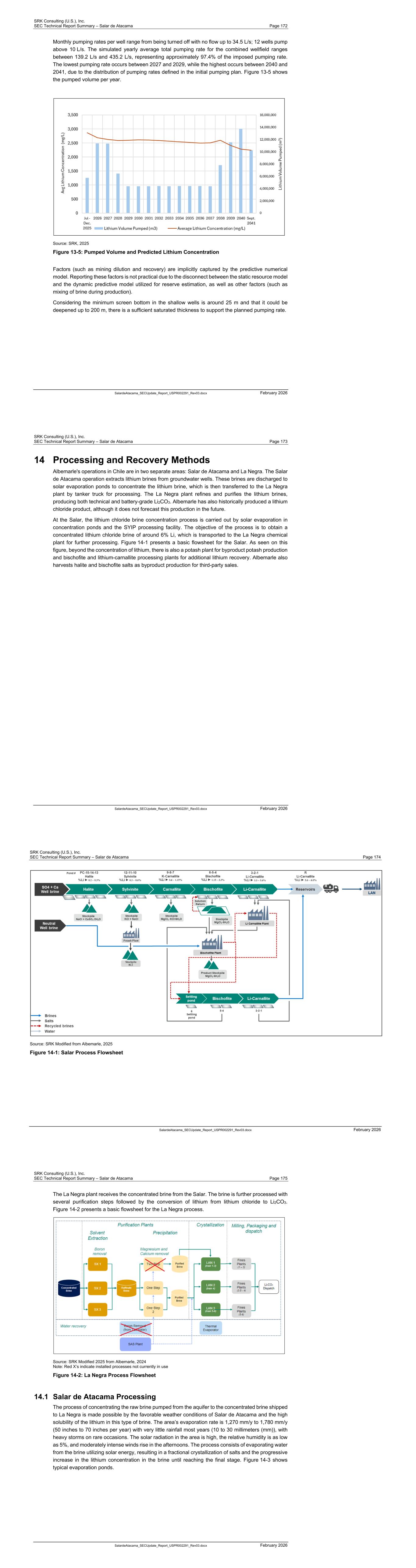
SRK Consulting (U.S.), Inc. SEC Technical Report Summary – Salar de Atacama Page 172 SalardeAtacama_SECUpdate_Report_USPR002291_Rev03.docx February 2026 Monthly pumping rates per well range from being turned off with no flow up to 34.5 L/s; 12 wells pump above 10 L/s. The simulated yearly average total pumping rate for the combined wellfield ranges between 139.2 L/s and 435.2 L/s, representing approximately 97.4% of the imposed pumping rate. The lowest pumping rate occurs between 2027 and 2029, while the highest occurs between 2040 and 2041, due to the distribution of pumping rates defined in the initial pumping plan. Figure 13-5 shows the pumped volume per year. Source: SRK, 2025 Figure 13-5: Pumped Volume and Predicted Lithium Concentration Factors (such as mining dilution and recovery) are implicitly captured by the predictive numerical model. Reporting these factors is not practical due to the disconnect between the static resource model and the dynamic predictive model utilized for reserve estimation, as well as other factors (such as mixing of brine during production). Considering the minimum screen bottom in the shallow wells is around 25 m and that it could be deepened up to 200 m, there is a sufficient saturated thickness to support the planned pumping rate. SRK Consulting (U.S.), Inc. SEC Technical Report Summary – Salar de Atacama Page 173 SalardeAtacama_SECUpdate_Report_USPR002291_Rev03.docx February 2026 14 Processing and Recovery Methods Albemarle's operations in Chile are in two separate areas: Salar de Atacama and La Negra. The Salar de Atacama operation extracts lithium brines from groundwater wells. These brines are discharged to solar evaporation ponds to concentrate the lithium brine, which is then transferred to the La Negra plant by tanker truck for processing. The La Negra plant refines and purifies the lithium brines, producing both technical and battery-grade Li2CO3. Albemarle has also historically produced a lithium chloride product, although it does not forecast this production in the future. At the Salar, the lithium chloride brine concentration process is carried out by solar evaporation in concentration ponds and the SYIP processing facility. The objective of the process is to obtain a concentrated lithium chloride brine of around 6% Li, which is transported to the La Negra chemical plant for further processing. Figure 14-1 presents a basic flowsheet for the Salar. As seen on this figure, beyond the concentration of lithium, there is also a potash plant for byproduct potash production and bischofite and lithium-carnallite processing plants for additional lithium recovery. Albemarle also harvests halite and bischofite salts as byproduct production for third-party sales. SRK Consulting (U.S.), Inc. SEC Technical Report Summary – Salar de Atacama Page 174 SalardeAtacama_SECUpdate_Report_USPR002291_Rev03.docx February 2026 Source: SRK Modified from Albemarle, 2025 Figure 14-1: Salar Process Flowsheet SRK Consulting (U.S.), Inc. SEC Technical Report Summary – Salar de Atacama Page 175 SalardeAtacama_SECUpdate_Report_USPR002291_Rev03.docx February 2026 The La Negra plant receives the concentrated brine from the Salar. The brine is further processed with several purification steps followed by the conversion of lithium from lithium chloride to Li2CO3. Figure 14-2 presents a basic flowsheet for the La Negra process. Source: SRK Modified 2025 from Albemarle, 2024 Note: Red X’s indicate installed processes not currently in use Figure 14-2: La Negra Process Flowsheet 14.1 Salar de Atacama Processing The process of concentrating the raw brine pumped from the aquifer to the concentrated brine shipped to La Negra is made possible by the favorable weather conditions of Salar de Atacama and the high solubility of the lithium in this type of brine. The area’s evaporation rate is 1,270 mm/y to 1,780 mm/y (50 inches to 70 inches per year) with very little rainfall most years (10 to 30 millimeters (mm)), with heavy storms on rare occasions. The solar radiation in the area is high, the relative humidity is as low as 5%, and moderately intense winds rise in the afternoons. The process consists of evaporating water from the brine utilizing solar energy, resulting in a fractional crystallization of salts and the progressive increase in the lithium concentration in the brine until reaching the final stage. Figure 14-3 shows typical evaporation ponds.
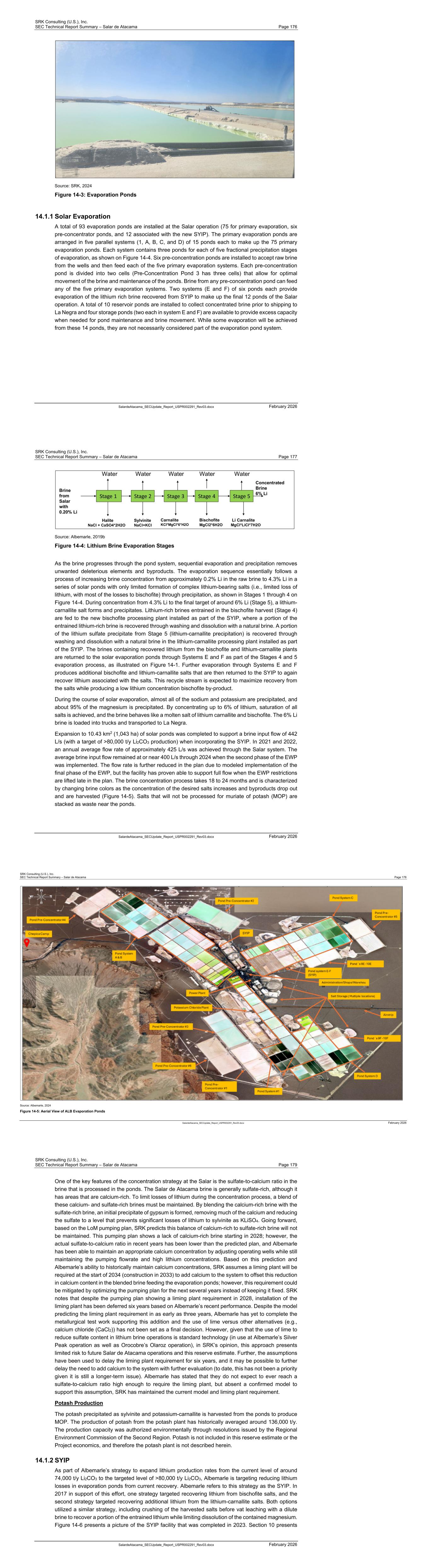
SRK Consulting (U.S.), Inc. SEC Technical Report Summary – Salar de Atacama Page 176 SalardeAtacama_SECUpdate_Report_USPR002291_Rev03.docx February 2026 Source: SRK, 2024 Figure 14-3: Evaporation Ponds 14.1.1 Solar Evaporation A total of 93 evaporation ponds are installed at the Salar operation (75 for primary evaporation, six pre-concentrator ponds, and 12 associated with the new SYIP). The primary evaporation ponds are arranged in five parallel systems (1, A, B, C, and D) of 15 ponds each to make up the 75 primary evaporation ponds. Each system contains three ponds for each of five fractional precipitation stages of evaporation, as shown on Figure 14-4. Six pre-concentration ponds are installed to accept raw brine from the wells and then feed each of the five primary evaporation systems. Each pre-concentration pond is divided into two cells (Pre-Concentration Pond 3 has three cells) that allow for optimal movement of the brine and maintenance of the ponds. Brine from any pre-concentration pond can feed any of the five primary evaporation systems. Two systems (E and F) of six ponds each provide evaporation of the lithium rich brine recovered from SYIP to make up the final 12 ponds of the Salar operation. A total of 10 reservoir ponds are installed to collect concentrated brine prior to shipping to La Negra and four storage ponds (two each in system E and F) are available to provide excess capacity when needed for pond maintenance and brine movement. While some evaporation will be achieved from these 14 ponds, they are not necessarily considered part of the evaporation pond system. SRK Consulting (U.S.), Inc. SEC Technical Report Summary – Salar de Atacama Page 177 SalardeAtacama_SECUpdate_Report_USPR002291_Rev03.docx February 2026 Source: Albemarle, 2019b Figure 14-4: Lithium Brine Evaporation Stages As the brine progresses through the pond system, sequential evaporation and precipitation removes unwanted deleterious elements and byproducts. The evaporation sequence essentially follows a process of increasing brine concentration from approximately 0.2% Li in the raw brine to 4.3% Li in a series of solar ponds with only limited formation of complex lithium-bearing salts (i.e., limited loss of lithium, with most of the losses to bischofite) through precipitation, as shown in Stages 1 through 4 on Figure 14-4. During concentration from 4.3% Li to the final target of around 6% Li (Stage 5), a lithium- carnallite salt forms and precipitates. Lithium-rich brines entrained in the bischofite harvest (Stage 4) are fed to the new bischofite processing plant installed as part of the SYIP, where a portion of the entrained lithium-rich brine is recovered through washing and dissolution with a natural brine. A portion of the lithium sulfate precipitate from Stage 5 (lithium-carnallite precipitation) is recovered through washing and dissolution with a natural brine in the lithium-carnallite processing plant installed as part of the SYIP. The brines containing recovered lithium from the bischofite and lithium-carnallite plants are returned to the solar evaporation ponds through Systems E and F as part of the Stages 4 and 5 evaporation process, as illustrated on Figure 14-1. Further evaporation through Systems E and F produces additional bischofite and lithium-carnallite salts that are then returned to the SYIP to again recover lithium associated with the salts. This recycle stream is expected to maximize recovery from the salts while producing a low lithium concentration bischofite by-product. During the course of solar evaporation, almost all of the sodium and potassium are precipitated, and about 95% of the magnesium is precipitated. By concentrating up to 6% of lithium, saturation of all salts is achieved, and the brine behaves like a molten salt of lithium carnallite and bischofite. The 6% Li brine is loaded into trucks and transported to La Negra. Expansion to 10.43 km2 (1,043 ha) of solar ponds was completed to support a brine input flow of 442 L/s (with a target of >80,000 t/y Li2CO3 production) when incorporating the SYIP. In 2021 and 2022, an annual average flow rate of approximately 425 L/s was achieved through the Salar system. The average brine input flow remained at or near 400 L/s through 2024 when the second phase of the EWP was implemented. The flow rate is further reduced in the plan due to modeled implementation of the final phase of the EWP, but the facility has proven able to support full flow when the EWP restrictions are lifted late in the plan. The brine concentration process takes 18 to 24 months and is characterized by changing brine colors as the concentration of the desired salts increases and byproducts drop out and are harvested (Figure 14-5). Salts that will not be processed for muriate of potash (MOP) are stacked as waste near the ponds. Stage 1 Stage 2 Stage 3 Stage 4 Stage 5 Brine from Salar with 0.20% Li Halite NaCl + CaSO4*2H2O Sylvinite NaCl+KCl Carnalite KCl*MgCl*6*H2O Bischofite MgCl2*6H2O Li Carnalite MgCl*LiCl*7H2O Concentrated Brine 6% Li Water Water Water Water Water SRK Consulting (U.S.), Inc. SEC Technical Report Summary – Salar de Atacama Page 178 SalardeAtacama_SECUpdate_Report_USPR002291_Rev03.docx February 2026 Source: Albemarle, 2024 Figure 14-5: Aerial View of ALB Evaporation Ponds SRK Consulting (U.S.), Inc. SEC Technical Report Summary – Salar de Atacama Page 179 SalardeAtacama_SECUpdate_Report_USPR002291_Rev03.docx February 2026 One of the key features of the concentration strategy at the Salar is the sulfate-to-calcium ratio in the brine that is processed in the ponds. The Salar de Atacama brine is generally sulfate-rich, although it has areas that are calcium-rich. To limit losses of lithium during the concentration process, a blend of these calcium- and sulfate-rich brines must be maintained. By blending the calcium-rich brine with the sulfate-rich brine, an initial precipitate of gypsum is formed, removing much of the calcium and reducing the sulfate to a level that prevents significant losses of lithium to sylvinite as KLiSO4. Going forward, based on the LoM pumping plan, SRK predicts this balance of calcium-rich to sulfate-rich brine will not be maintained. This pumping plan shows a lack of calcium-rich brine starting in 2028; however, the actual sulfate-to-calcium ratio in recent years has been lower than the predicted plan, and Albemarle has been able to maintain an appropriate calcium concentration by adjusting operating wells while still maintaining the pumping flowrate and high lithium concentrations. Based on this prediction and Albemarle’s ability to historically maintain calcium concentrations, SRK assumes a liming plant will be required at the start of 2034 (construction in 2033) to add calcium to the system to offset this reduction in calcium content in the blended brine feeding the evaporation ponds; however, this requirement could be mitigated by optimizing the pumping plan for the next several years instead of keeping it fixed. SRK notes that despite the pumping plan showing a liming plant requirement in 2028, installation of the liming plant has been deferred six years based on Albemarle’s recent performance. Despite the model predicting the liming plant requirement in as early as three years, Albemarle has yet to complete the metallurgical test work supporting this addition and the use of lime versus other alternatives (e.g., calcium chloride (CaCl2)) has not been set as a final decision. However, given that the use of lime to reduce sulfate content in lithium brine operations is standard technology (in use at Albemarle’s Silver Peak operation as well as Orocobre’s Olaroz operation), in SRK’s opinion, this approach presents limited risk to future Salar de Atacama operations and this reserve estimate. Further, the assumptions have been used to delay the liming plant requirement for six years, and it may be possible to further delay the need to add calcium to the system with further evaluation (to date, this has not been a priority given it is still a longer-term issue). Albemarle has stated that they do not expect to ever reach a sulfate-to-calcium ratio high enough to require the liming plant, but absent a confirmed model to support this assumption, SRK has maintained the current model and liming plant requirement. Potash Production The potash precipitated as sylvinite and potassium-carnallite is harvested from the ponds to produce MOP. The production of potash from the potash plant has historically averaged around 136,000 t/y. The production capacity was authorized environmentally through resolutions issued by the Regional Environment Commission of the Second Region. Potash is not included in this reserve estimate or the Project economics, and therefore the potash plant is not described herein. 14.1.2 SYIP As part of Albemarle’s strategy to expand lithium production rates from the current level of around 74,000 t/y Li2CO3 to the targeted level of >80,000 t/y Li2CO3, Albemarle is targeting reducing lithium losses in evaporation ponds from current recovery. Albemarle refers to this strategy as the SYIP. In 2017 in support of this effort, one strategy targeted recovering lithium from bischofite salts, and the second strategy targeted recovering additional lithium from the lithium-carnallite salts. Both options utilized a similar strategy, including crushing of the harvested salts before vat leaching with a dilute brine to recover a portion of the entrained lithium while limiting dissolution of the contained magnesium. Figure 14-6 presents a picture of the SYIP facility that was completed in 2023. Section 10 presents
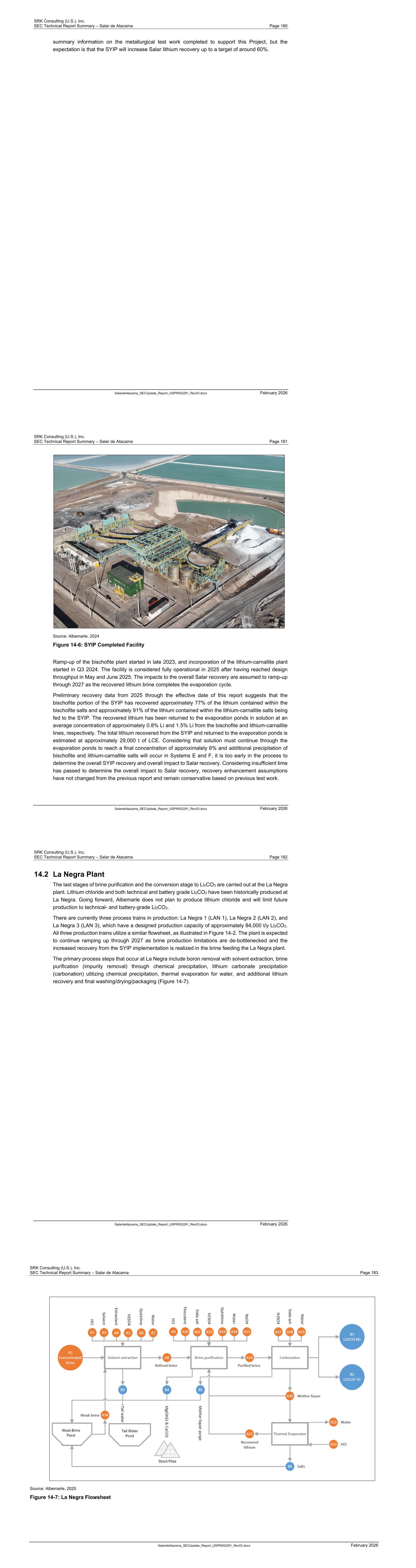
SRK Consulting (U.S.), Inc. SEC Technical Report Summary – Salar de Atacama Page 180 SalardeAtacama_SECUpdate_Report_USPR002291_Rev03.docx February 2026 summary information on the metallurgical test work completed to support this Project, but the expectation is that the SYIP will increase Salar lithium recovery up to a target of around 60%. SRK Consulting (U.S.), Inc. SEC Technical Report Summary – Salar de Atacama Page 181 SalardeAtacama_SECUpdate_Report_USPR002291_Rev03.docx February 2026 Source: Albemarle, 2024 Figure 14-6: SYIP Completed Facility Ramp-up of the bischofite plant started in late 2023, and incorporation of the lithium-carnallite plant started in Q3 2024. The facility is considered fully operational in 2025 after having reached design throughput in May and June 2025. The impacts to the overall Salar recovery are assumed to ramp-up through 2027 as the recovered lithium brine completes the evaporation cycle. Preliminary recovery data from 2025 through the effective date of this report suggests that the bischofite portion of the SYIP has recovered approximately 77% of the lithium contained within the bischofite salts and approximately 91% of the lithium contained within the lithium-carnallite salts being fed to the SYIP. The recovered lithium has been returned to the evaporation ponds in solution at an average concentration of approximately 0.8% Li and 1.5% Li from the bischofite and lithium-carnallite lines, respectively. The total lithium recovered from the SYIP and returned to the evaporation ponds is estimated at approximately 29,000 t of LCE. Considering that solution must continue through the evaporation ponds to reach a final concentration of approximately 6% and additional precipitation of bischofite and lithium-carnallite salts will occur in Systems E and F, it is too early in the process to determine the overall SYIP recovery and overall impact to Salar recovery. Considering insufficient time has passed to determine the overall impact to Salar recovery, recovery enhancement assumptions have not changed from the previous report and remain conservative based on previous test work. SRK Consulting (U.S.), Inc. SEC Technical Report Summary – Salar de Atacama Page 182 SalardeAtacama_SECUpdate_Report_USPR002291_Rev03.docx February 2026 14.2 La Negra Plant The last stages of brine purification and the conversion stage to Li2CO3 are carried out at the La Negra plant. Lithium chloride and both technical and battery grade Li2CO3 have been historically produced at La Negra. Going forward, Albemarle does not plan to produce lithium chloride and will limit future production to technical- and battery-grade Li2CO3. There are currently three process trains in production: La Negra 1 (LAN 1), La Negra 2 (LAN 2), and La Negra 3 (LAN 3), which have a designed production capacity of approximately 84,000 t/y Li2CO3. All three production trains utilize a similar flowsheet, as illustrated in Figure 14-2. The plant is expected to continue ramping up through 2027 as brine production limitations are de-bottlenecked and the increased recovery from the SYIP implementation is realized in the brine feeding the La Negra plant. The primary process steps that occur at La Negra include boron removal with solvent extraction, brine purification (impurity removal) through chemical precipitation, lithium carbonate precipitation (carbonation) utilizing chemical precipitation, thermal evaporation for water, and additional lithium recovery and final washing/drying/packaging (Figure 14-7). SRK Consulting (U.S.), Inc. SEC Technical Report Summary – Salar de Atacama Page 183 SalardeAtacama_SECUpdate_Report_USPR002291_Rev03.docx February 2026 Source: Albemarle, 2025 Figure 14-7: La Negra Flowsheet
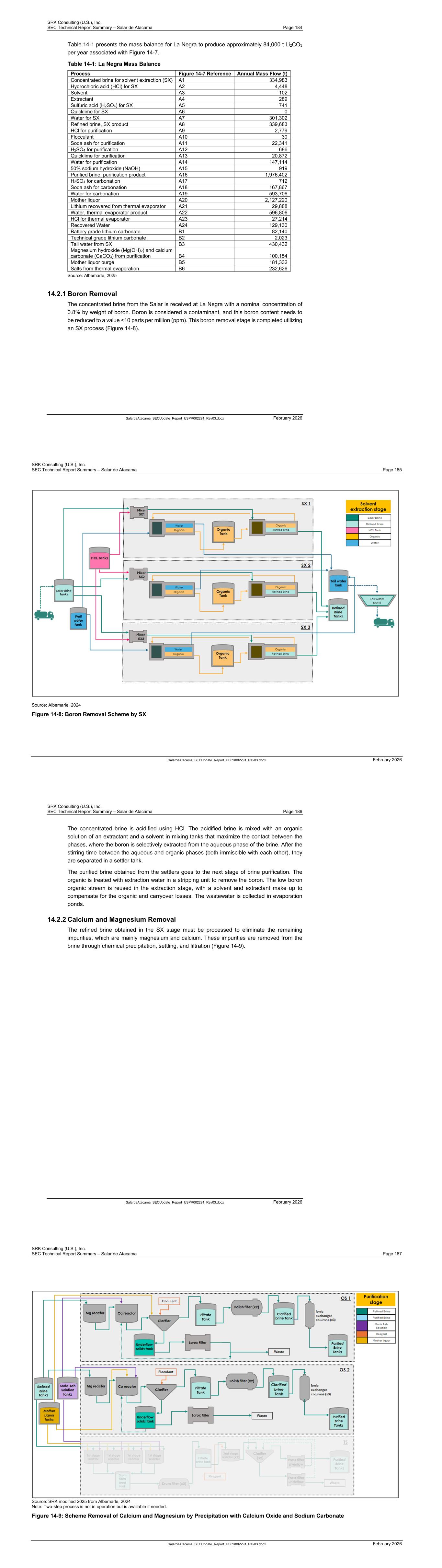
SRK Consulting (U.S.), Inc. SEC Technical Report Summary – Salar de Atacama Page 184 SalardeAtacama_SECUpdate_Report_USPR002291_Rev03.docx February 2026 Table 14-1 presents the mass balance for La Negra to produce approximately 84,000 t Li2CO3 per year associated with Figure 14-7. Table 14-1: La Negra Mass Balance Process Figure 14-7 Reference Annual Mass Flow (t) Concentrated brine for solvent extraction (SX) A1 334,983 Hydrochloric acid (HCl) for SX A2 4,448 Solvent A3 102 Extractant A4 289 Sulfuric acid (H2SO4) for SX A5 741 Quicklime for SX A6 0 Water for SX A7 301,302 Refined brine, SX product A8 339,683 HCl for purification A9 2,779 Flocculant A10 30 Soda ash for purification A11 22,341 H2SO4 for purification A12 686 Quicklime for purification A13 20,872 Water for purification A14 147,114 50% sodium hydroxide (NaOH) A15 919 Purified brine, purification product A16 1,976,402 H2SO4 for carbonation A17 712 Soda ash for carbonation A18 167,867 Water for carbonation A19 593,706 Mother liquor A20 2,127,220 Lithium recovered from thermal evaporator A21 29,888 Water, thermal evaporator product A22 596,806 HCl for thermal evaporator A23 27,214 Recovered Water A24 129,130 Battery grade lithium carbonate B1 82,140 Technical grade lithium carbonate B2 2,023 Tail water from SX B3 430,432 Magnesium hydroxide (Mg(OH)2) and calcium carbonate (CaCO3) from purification B4 100,154 Mother liquor purge B5 181,332 Salts from thermal evaporation B6 232,626 Source: Albemarle, 2025 14.2.1 Boron Removal The concentrated brine from the Salar is received at La Negra with a nominal concentration of 0.8% by weight of boron. Boron is considered a contaminant, and this boron content needs to be reduced to a value <10 parts per million (ppm). This boron removal stage is completed utilizing an SX process (Figure 14-8). SRK Consulting (U.S.), Inc. SEC Technical Report Summary – Salar de Atacama Page 185 SalardeAtacama_SECUpdate_Report_USPR002291_Rev03.docx February 2026 Source: Albemarle, 2024 Figure 14-8: Boron Removal Scheme by SX SRK Consulting (U.S.), Inc. SEC Technical Report Summary – Salar de Atacama Page 186 SalardeAtacama_SECUpdate_Report_USPR002291_Rev03.docx February 2026 The concentrated brine is acidified using HCl. The acidified brine is mixed with an organic solution of an extractant and a solvent in mixing tanks that maximize the contact between the phases, where the boron is selectively extracted from the aqueous phase of the brine. After the stirring time between the aqueous and organic phases (both immiscible with each other), they are separated in a settler tank. The purified brine obtained from the settlers goes to the next stage of brine purification. The organic is treated with extraction water in a stripping unit to remove the boron. The low boron organic stream is reused in the extraction stage, with a solvent and extractant make up to compensate for the organic and carryover losses. The wastewater is collected in evaporation ponds. 14.2.2 Calcium and Magnesium Removal The refined brine obtained in the SX stage must be processed to eliminate the remaining impurities, which are mainly magnesium and calcium. These impurities are removed from the brine through chemical precipitation, settling, and filtration (Figure 14-9). SRK Consulting (U.S.), Inc. SEC Technical Report Summary – Salar de Atacama Page 187 SalardeAtacama_SECUpdate_Report_USPR002291_Rev03.docx February 2026 Source: SRK modified 2025 from Albemarle, 2024 Note: Two-step process is not in operation but is available if needed. Figure 14-9: Scheme Removal of Calcium and Magnesium by Precipitation with Calcium Oxide and Sodium Carbonate
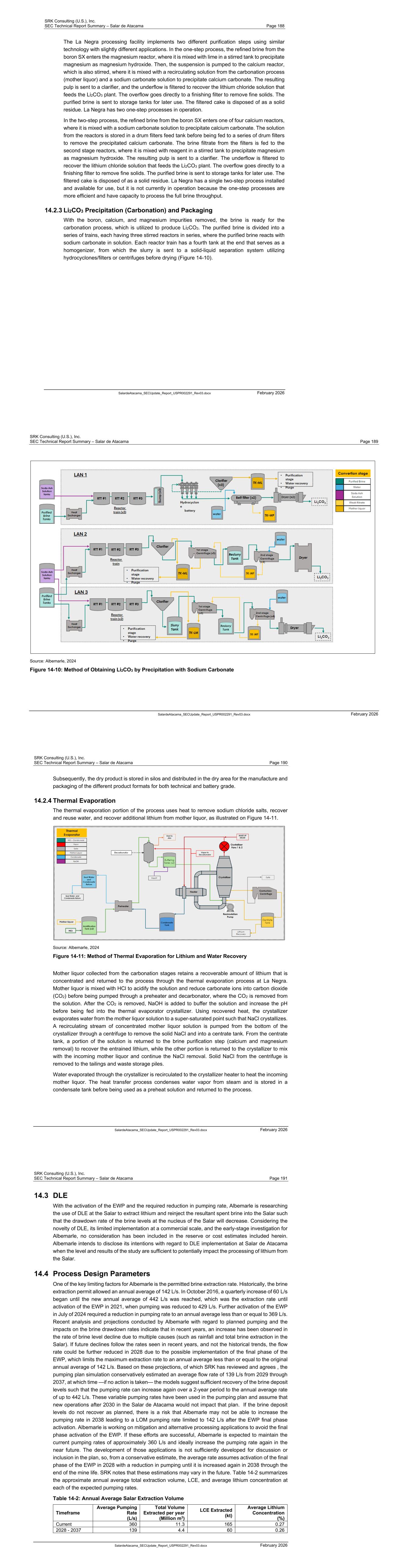
SRK Consulting (U.S.), Inc. SEC Technical Report Summary – Salar de Atacama Page 188 SalardeAtacama_SECUpdate_Report_USPR002291_Rev03.docx February 2026 The La Negra processing facility implements two different purification steps using similar technology with slightly different applications. In the one-step process, the refined brine from the boron SX enters the magnesium reactor, where it is mixed with lime in a stirred tank to precipitate magnesium as magnesium hydroxide. Then, the suspension is pumped to the calcium reactor, which is also stirred, where it is mixed with a recirculating solution from the carbonation process (mother liquor) and a sodium carbonate solution to precipitate calcium carbonate. The resulting pulp is sent to a clarifier, and the underflow is filtered to recover the lithium chloride solution that feeds the Li2CO3 plant. The overflow goes directly to a finishing filter to remove fine solids. The purified brine is sent to storage tanks for later use. The filtered cake is disposed of as a solid residue. La Negra has two one-step processes in operation. In the two-step process, the refined brine from the boron SX enters one of four calcium reactors, where it is mixed with a sodium carbonate solution to precipitate calcium carbonate. The solution from the reactors is stored in a drum filters feed tank before being fed to a series of drum filters to remove the precipitated calcium carbonate. The brine filtrate from the filters is fed to the second stage reactors, where it is mixed with reagent in a stirred tank to precipitate magnesium as magnesium hydroxide. The resulting pulp is sent to a clarifier. The underflow is filtered to recover the lithium chloride solution that feeds the Li2CO3 plant. The overflow goes directly to a finishing filter to remove fine solids. The purified brine is sent to storage tanks for later use. The filtered cake is disposed of as a solid residue. La Negra has a single two-step process installed and available for use, but it is not currently in operation because the one-step processes are more efficient and have capacity to process the full brine throughput. 14.2.3 Li2CO3 Precipitation (Carbonation) and Packaging With the boron, calcium, and magnesium impurities removed, the brine is ready for the carbonation process, which is utilized to produce Li2CO3. The purified brine is divided into a series of trains, each having three stirred reactors in series, where the purified brine reacts with sodium carbonate in solution. Each reactor train has a fourth tank at the end that serves as a homogenizer, from which the slurry is sent to a solid-liquid separation system utilizing hydrocyclones/filters or centrifuges before drying (Figure 14-10). SRK Consulting (U.S.), Inc. SEC Technical Report Summary – Salar de Atacama Page 189 SalardeAtacama_SECUpdate_Report_USPR002291_Rev03.docx February 2026 Source: Albemarle, 2024 Figure 14-10: Method of Obtaining Li2CO3 by Precipitation with Sodium Carbonate SRK Consulting (U.S.), Inc. SEC Technical Report Summary – Salar de Atacama Page 190 SalardeAtacama_SECUpdate_Report_USPR002291_Rev03.docx February 2026 Subsequently, the dry product is stored in silos and distributed in the dry area for the manufacture and packaging of the different product formats for both technical and battery grade. 14.2.4 Thermal Evaporation The thermal evaporation portion of the process uses heat to remove sodium chloride salts, recover and reuse water, and recover additional lithium from mother liquor, as illustrated on Figure 14-11. Source: Albemarle, 2024 Figure 14-11: Method of Thermal Evaporation for Lithium and Water Recovery Mother liquor collected from the carbonation stages retains a recoverable amount of lithium that is concentrated and returned to the process through the thermal evaporation process at La Negra. Mother liquor is mixed with HCl to acidify the solution and reduce carbonate ions into carbon dioxide (CO2) before being pumped through a preheater and decarbonator, where the CO2 is removed from the solution. After the CO2 is removed, NaOH is added to buffer the solution and increase the pH before being fed into the thermal evaporator crystallizer. Using recovered heat, the crystallizer evaporates water from the mother liquor solution to a super-saturated point such that NaCl crystallizes. A recirculating stream of concentrated mother liquor solution is pumped from the bottom of the crystallizer through a centrifuge to remove the solid NaCl and into a centrate tank. From the centrate tank, a portion of the solution is returned to the brine purification step (calcium and magnesium removal) to recover the entrained lithium, while the other portion is returned to the crystallizer to mix with the incoming mother liquor and continue the NaCl removal. Solid NaCl from the centrifuge is removed to the tailings and waste storage piles. Water evaporated through the crystallizer is recirculated to the crystallizer heater to heat the incoming mother liquor. The heat transfer process condenses water vapor from steam and is stored in a condensate tank before being used as a preheat solution and returned to the process. SRK Consulting (U.S.), Inc. SEC Technical Report Summary – Salar de Atacama Page 191 SalardeAtacama_SECUpdate_Report_USPR002291_Rev03.docx February 2026 14.3 DLE With the activation of the EWP and the required reduction in pumping rate, Albemarle is researching the use of DLE at the Salar to extract lithium and reinject the resultant spent brine into the Salar such that the drawdown rate of the brine levels at the nucleus of the Salar will decrease. Considering the novelty of DLE, its limited implementation at a commercial scale, and the early-stage investigation for Albemarle, no consideration has been included in the reserve or cost estimates included herein. Albemarle intends to disclose its intentions with regard to DLE implementation at Salar de Atacama when the level and results of the study are sufficient to potentially impact the processing of lithium from the Salar. 14.4 Process Design Parameters One of the key limiting factors for Albemarle is the permitted brine extraction rate. Historically, the brine extraction permit allowed an annual average of 142 L/s. In October 2016, a quarterly increase of 60 L/s began until the new annual average of 442 L/s was reached, which was the extraction rate until activation of the EWP in 2021, when pumping was reduced to 429 L/s. Further activation of the EWP in July of 2024 required a reduction in pumping rate to an annual average less than or equal to 369 L/s. Recent analysis and projections conducted by Albemarle with regard to planned pumping and the impacts on the brine drawdown rates indicate that in recent years, an increase has been observed in the rate of brine level decline due to multiple causes (such as rainfall and total brine extraction in the Salar). If future declines follow the rates seen in recent years, and not the historical trends, the flow rate could be further reduced in 2028 due to the possible implementation of the final phase of the EWP, which limits the maximum extraction rate to an annual average less than or equal to the original annual average of 142 L/s. Based on these projections, of which SRK has reviewed and agrees , the pumping plan simulation conservatively estimated an average flow rate of 139 L/s from 2029 through 2037, at which time —if no action is taken— the models suggest sufficient recovery of the brine deposit levels such that the pumping rate can increase again over a 2-year period to the annual average rate of up to 442 L/s. These variable pumping rates have been used in the pumping plan and assume that new operations after 2030 in the Salar de Atacama would not impact that plan. If the brine deposit levels do not recover as planned, there is a risk that Albemarle may not be able to increase the pumping rate in 2038 leading to a LOM pumping rate limited to 142 L/s after the EWP final phase activation. Albemarle is working on mitigation and alternative processing applications to avoid the final phase activation of the EWP. If these efforts are successful, Albemarle is expected to maintain the current pumping rates of approximately 360 L/s and ideally increase the pumping rate again in the near future. The development of those applications is not sufficiently developed for discussion or inclusion in the plan, so, from a conservative estimate, the average rate assumes activation of the final phase of the EWP in 2028 with a reduction in pumping until it is increased again in 2038 through the end of the mine life. SRK notes that these estimations may vary in the future. Table 14-2 summarizes the approximate annual average total extraction volume, LCE, and average lithium concentration at each of the expected pumping rates. Table 14-2: Annual Average Salar Extraction Volume Timeframe Average Pumping Rate (L/s) Total Volume Extracted per year (Million m3) LCE Extracted (kt) Average Lithium Concentration (%) Current 360 11.3 165 0.27 2028 - 2037 139 4.4 60 0.26

SRK Consulting (U.S.), Inc. SEC Technical Report Summary – Salar de Atacama Page 192 SalardeAtacama_SECUpdate_Report_USPR002291_Rev03.docx February 2026 2038-2039 367 11.5 148 0.24 2040-2041 435 13.8 167 0.23 Source: SRK, 2025 Historically, the recovery of lithium in the Salar has been around 50%, although this has ranged from 40% to closer to 55%. For the purposes of this reserve estimate, SRK assumed the current recovery rate of approximately 43% will be maintained through the second half of 2025 (recovery applied to the brine pumped in the second half of 2023 that will be shipped to La Negra in the second half of 2025). As the impacts from the SYIP continue to flow through the Salar system, SRK forecasts incremental increases in the lithium recovery rate each year until it reaches 60% in 2027. SRK notes that these recovery estimates are applied on the brine pumped during the stated time frames and therefore, the impact of the increased recovery won’t be realized from La Negra production for two years. At La Negra, the current process recovery is approximately 80%, and SRK assumed that La Negra maintains this recovery rate. The production of Li2CO3 at La Negra is driven by the concentrated brine dispatched from the Salar. The current combined LAN1, LAN2, and LAN3 production capacity is approximately 80,000 t/y Li2CO3, short of the plant design at 84,000 t/y. Despite being on track to produce more than 74,000 t Li2CO3 in 2025, the reserve estimated production is modeled to decrease slightly in 2026 before increasing again in 2028 through 2029. The 2026 decrease in production is directly attributed to the assumed recovery of 43%, which is conservative and likely below what the operation will actually achieve. Assuming the successful continued operation of the SYIP and realized recovery increases from the Salar, after the modeled decrease in 2026, SRK estimates production from La Negra will increase to 76,300 t Li2CO3 in 2029. After 2029, production is modeled to decrease abruptly as a result of the risk of the final phase EWP activation in 2028 until it rises again late in the mine life when aquifer levels are expected to recover and pumping returns to pre-EWP levels. The LoM maximum production of 80,300 t Li2CO3 from La Negra is projected in 2042. SRK forecasts that La Negra will never achieve full, targeted production at the plant’s targeted capacity of 84,000 t Li2CO3 due to constraints in pumping from the Salar and not as a result of plant capacity at La Negra. 14.4.1 Process Consumables Table 14-3 provides key reagents and associated forecast consumption rates. Note that these reagents are all utilized at La Negra and can vary depending upon the final product mix produced. While some reagents are consumed at the Salar, they are all currently utilized in potash production (excluded from this reserve estimate). In the future, if lime addition is required at the Salar to maintain lithium recovery rates as assumed by SRK (see Section 14.1.1), additional lime will be required beyond that reported in the table. This assumed future lime consumption is variable and based on the forecast sulfate/calcium ratio. Table 14-3: Current Process Consumables Item Consumption Rate Soda ash 2.31 t per tonne LCE sold Lime 0.26 t per tonne LCE sold HCl 0.41 t per tonne LCE sold Water 8.9 t per tonne LCE sold Source: SRK, 2025 SRK Consulting (U.S.), Inc. SEC Technical Report Summary – Salar de Atacama Page 193 SalardeAtacama_SECUpdate_Report_USPR002291_Rev03.docx February 2026 Other reagents/consumables utilized in the process include the following: Caustic soda Sulfuric acid Solvent Extractant Flocculants Diatomaceous earth Oxalic acid Barium (Ba) chloride Carbon dioxide LiOH Section 15.3 covers energy consumption. There are approximately 140 personnel at the Salar, and approximately 420 personnel at La Negra currently utilized in the process component of the operation. 14.5 SRK Opinion It is SRK’s opinion that the operating performance achieved from the existing processing facilities provides sufficient information to declare reserves. Recent additions, in particular the SYIP facilities at the Salar, have shown promise of recovering additional lithium and should contribute to increased total Salar recovery in line with previous test work supported recovery estimates. The operating duration of the SYIP is insufficient to support long-term operational recoveries, so previous test work assumptions have been used, which is consistent with previous analysis and reports. SRK Consulting (U.S.), Inc. SEC Technical Report Summary – Salar de Atacama Page 194 SalardeAtacama_SECUpdate_Report_USPR002291_Rev03.docx February 2026 15 Infrastructure The Project is a mature functioning operation with two separate sites that contain key facilities. Access is fully developed, with the majority accessible by paved major highways and local improved roadways on-site. A local air strip services the Salar operations. The Antofagasta airport is the nearest major commercial airport servicing the La Negra operation (the Calama airport is the closet major commercial airport to the Salar). The infrastructure is in place, operating, and provides all necessary support for ongoing operations as summarized in this report. The Salar site contains the brine well fields, brine supply water pipelines to evaporation ponds, primary processing facilities to create a concentrated brine, a phosphate plant that creates a potassium chloride product, camps (including a newer camp that is in place and functional with an expansion phase designed and approved if needed in the future), airfield, access and internal roads, substation and powerline connected to the local Chilean power system, backup and supplemental diesel power generation supply and power distribution system, water supply and distribution, shop and warehouse facilities, administrative offices, change houses, waste salt storage areas, fuel storage systems, security, and communications systems. The concentrated brine product is trucked approximately 260 km to the La Negra facility. The La Negra plant purifies the lithium brine from the Salar Plant and converts the brine into Li2CO3 and LiCl. Facilities at the site include the trucked brine delivery system, boron removal plant, calcium and magnesium removal plant, Li2CO3 conversion plants, LiCl plant, evaporation sedimentation ponds, solid waste storage, product warehousing and shipping, administrative facilities, cafeterias, and an off- site area where raw materials are warehoused and combined as needed in the processing facilities. Power to the facility is provided by the regional power company via a 110-kV transmission line and distributed throughout the plant to load centers. Piped natural gas provides the energy for heating and steam needs at the facilities. The Project is security protected and has a full communication system installed. Final products from the La Negra plant are delivered to clients by truck, rail, or through port facilities in the region. 15.1 Access, Roads, and Local Communities 15.1.1 Access The Project is in north central Chile in the Antofagasta region. Primary access is from Antofagasta or Calama, the major cities in the region. The major plant facilities are at two separate sites. The refining plant site (La Negra) is closest to Antofagasta, near the small community of La Negra. Travel from Antofagasta to the La Negra refining plant site is approximately 20 km southeast on the major paved, four-lane, Chile Route 28. At La Negra, the Albemarle La Negra site is approximately 2 km north from the intersection of Route 28 on the multi-lane, paved, Chile Route 5 (the Pan-American Highway). The distance from the La Negra plant to the source of the lithium brine at Salar de Atacama (where the Albemarle Salar facilities are located) is approximately 260 km to the east. Access from La Negra is north via Route 5 for approximately 75 km and then east on paved highway B-385 for approximately 175 km. The Albemarle Salar site is on the south-central area of Salar de Atacama. Figure 15-1 shows the general location of the Project. SRK Consulting (U.S.), Inc. SEC Technical Report Summary – Salar de Atacama Page 195 SalardeAtacama_SECUpdate_Report_USPR002291_Rev03.docx February 2026 Source: SRK, 2020 Figure 15-1: General Project Major Facility Location 15.1.2 Airport Antofagasta has an international airport, but primary flights are national, and it is the primary airport for the region. The city of Calama (located approximately 190 km to the northwest of the Salar) has the closest commercial airport to the Salar and supports regional jet traffic. A smaller airport is located at the Salar for direct access. This air strip is located at the south end of the Salar facilities. The site air strip is for smaller jets and prop planes, is approximately 2,235 m in length, and has a clay surface. 15.1.3 Rail There is a rail owned and operated by Ferrocarril de Antofagasta a Bolivia (FCAB) about 80 km south of the Salar site at Pan de Azucar that connects to La Negra (approximately 170 km away). This rail was historically used to move concentrated brine. The rail is no longer used, as all brine is trucked directly to La Negra. The La Negra facility does not have access to the rail system at this time. 15.1.4 Port Facilities Port facilities primarily used include the Mejillones Port, Antofagasta Port, and Iquique Port. The Port of Mejillones (Port Angamos) is located approximately 103 km north of La Negra. This port is focused on general cargo and containers and has four berths and the capacity to receive ships over 366 m in length, with a maximum draft of 13.7 m. The port is the only port in northern Chile that can receive new Panamax vessels. Approximately 78% of the product is transported through this port due to the connectivity and access routes to the different shipping companies. Figure 15-2 shows the general location of the primary ports.

SRK Consulting (U.S.), Inc. SEC Technical Report Summary – Salar de Atacama Page 196 SalardeAtacama_SECUpdate_Report_USPR002291_Rev03.docx February 2026 Source: Google Earth/SRK, 2024 Figure 15-2: Angamos Port/Antofagasta Port The Antofagasta Port is located in Antofagasta within 20 km of the La Negra plant. The medium-size coastal breakwater port has facilities for both container and bulk transport. The port can accommodate ships over 150 m in length. Approximately 20% of the product is transported through the port. A third port (Iquique Port) is in the Tarapacá region, approximately 448 km north of La Negra. The port provides shipping for approximately 2% of the product from the Project. Figure 15-3 shows more detailed photographs of the primary port facilities. SRK Consulting (U.S.), Inc. SEC Technical Report Summary – Salar de Atacama Page 197 SalardeAtacama_SECUpdate_Report_USPR002291_Rev03.docx February 2026 Source: Google Earth/SRK, 2024 Figure 15-3: Angamos Port/Antofagasta Port SRK Consulting (U.S.), Inc. SEC Technical Report Summary – Salar de Atacama Page 198 SalardeAtacama_SECUpdate_Report_USPR002291_Rev03.docx February 2026 15.1.5 Staffing and Support Communities The overall non-contractor staffing for the project is 1072 in 2025. The breakdown by location is summarized in Table 15-1. Table 15-1: Project Non-Contractor Staffing Summary Location 2023 2024 2025 La Negra 679 668 632 Salar 393 387 364 Santiago 98 83 76 Total Personnel 1,170 1,138 1,072 Source: Albemarle, 2025 La Negra The majority (nearly 95%) of the approximately 632 employees who work at La Negra live in the city of Antofagasta and its suburbs. Antofagasta is the regional capital and major population center, with approximately 466,000 people living there. Employees are bussed approximately 25 km to the La Negra plant. Salar Personnel who work at the Salar Plant travel from around the region. Table 15-2 shows the regional communities, population, and distance to the Salar Plant. Most of the employees live in Antofagasta, San Pedro de Atacama, or Calama, but approximately 30% live in other regions in Chile. Figure 15-4 shows the number of employees by community, the communities where most employees reside and distance to Salar Plant. Most employees travel to the site by company bus. Table 15-2: Regional Community Information for the Salar Plant City Number of Employees Population Distance to Salar Plant (km) Antofagasta 156 466,000 250 San Pedro de Atacama 51 11,000 130 Calama 36 196,000 190 Other communities in Antofagasta region 13 Varies Varies Other regions in Chile 108 Varies Varies Total 364 Source: SRK, 2025 SRK Consulting (U.S.), Inc. SEC Technical Report Summary – Salar de Atacama Page 199 SalardeAtacama_SECUpdate_Report_USPR002291_Rev03.docx February 2026 Source: Albemarle, 2020a Figure 15-4: Regional Communities Near the Salar A company camp is in Peine approximately 30 km east of the Salar Plant. The camp consists of 10 houses and 18 modules. The facilities have a capacity of 90 persons. There are also 34 single room modules. A company bus provides transportation from the camp to site and back. A second camp known as the Chépica Camp is located approximately 2 km to the east of the Salar Plant. The camp has nine buildings with 325 rooms and can house approximately 600 people. A company bus provides transportation from the camp to the site and back. Approximately 335 people are currently staying at the camp, with a total capacity of approximately 600 people. Santiago There are approximately an additional 76 people that work in the corporate offices in Santiago and support the production activities. Santiago is the capital of Chile and the major population center for the country, with a population of approximately 6.9 million in the metro area. Santiago is approximately 1,600 km south of the Salar Plant, traveling through Antofagasta. 15.2 Facilities 15.2.1 Salar Plant The Salar Plant located in the mining concession area consists of lithium-rich brine recovery wells, pipeline delivery system to the concentration/evaporation pond systems, and three leaching plants that
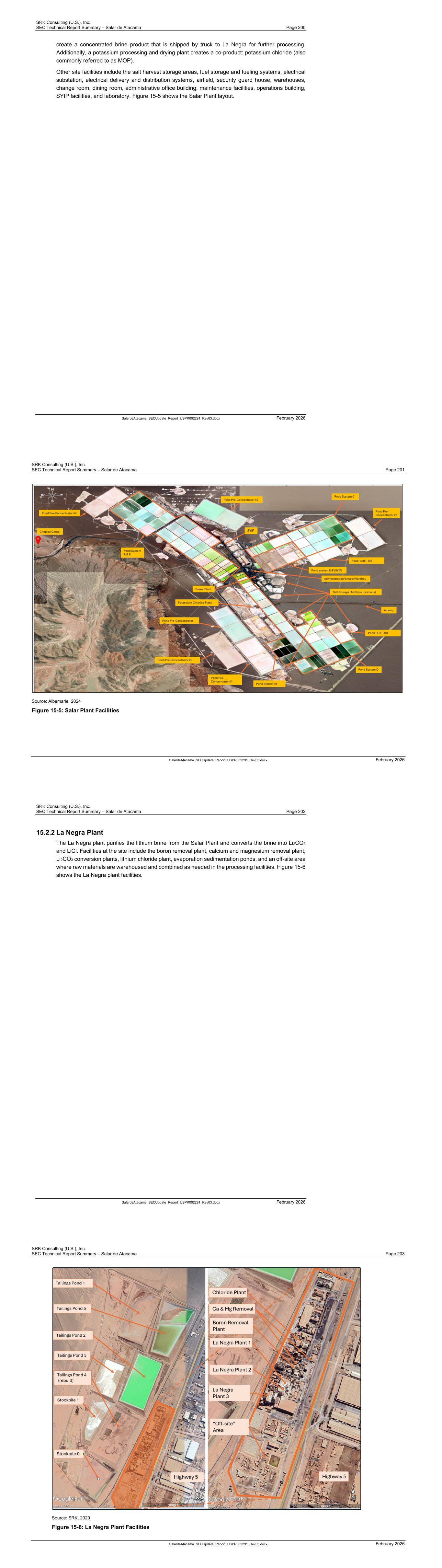
SRK Consulting (U.S.), Inc. SEC Technical Report Summary – Salar de Atacama Page 200 SalardeAtacama_SECUpdate_Report_USPR002291_Rev03.docx February 2026 create a concentrated brine product that is shipped by truck to La Negra for further processing. Additionally, a potassium processing and drying plant creates a co-product: potassium chloride (also commonly referred to as MOP). Other site facilities include the salt harvest storage areas, fuel storage and fueling systems, electrical substation, electrical delivery and distribution systems, airfield, security guard house, warehouses, change room, dining room, administrative office building, maintenance facilities, operations building, SYIP facilities, and laboratory. Figure 15-5 shows the Salar Plant layout. SRK Consulting (U.S.), Inc. SEC Technical Report Summary – Salar de Atacama Page 201 SalardeAtacama_SECUpdate_Report_USPR002291_Rev03.docx February 2026 Source: Albemarle, 2024 Figure 15-5: Salar Plant Facilities SRK Consulting (U.S.), Inc. SEC Technical Report Summary – Salar de Atacama Page 202 SalardeAtacama_SECUpdate_Report_USPR002291_Rev03.docx February 2026 15.2.2 La Negra Plant The La Negra plant purifies the lithium brine from the Salar Plant and converts the brine into Li2CO3 and LiCl. Facilities at the site include the boron removal plant, calcium and magnesium removal plant, Li2CO3 conversion plants, lithium chloride plant, evaporation sedimentation ponds, and an off-site area where raw materials are warehoused and combined as needed in the processing facilities. Figure 15-6 shows the La Negra plant facilities. SRK Consulting (U.S.), Inc. SEC Technical Report Summary – Salar de Atacama Page 203 SalardeAtacama_SECUpdate_Report_USPR002291_Rev03.docx February 2026 Source: SRK, 2020 Figure 15-6: La Negra Plant Facilities
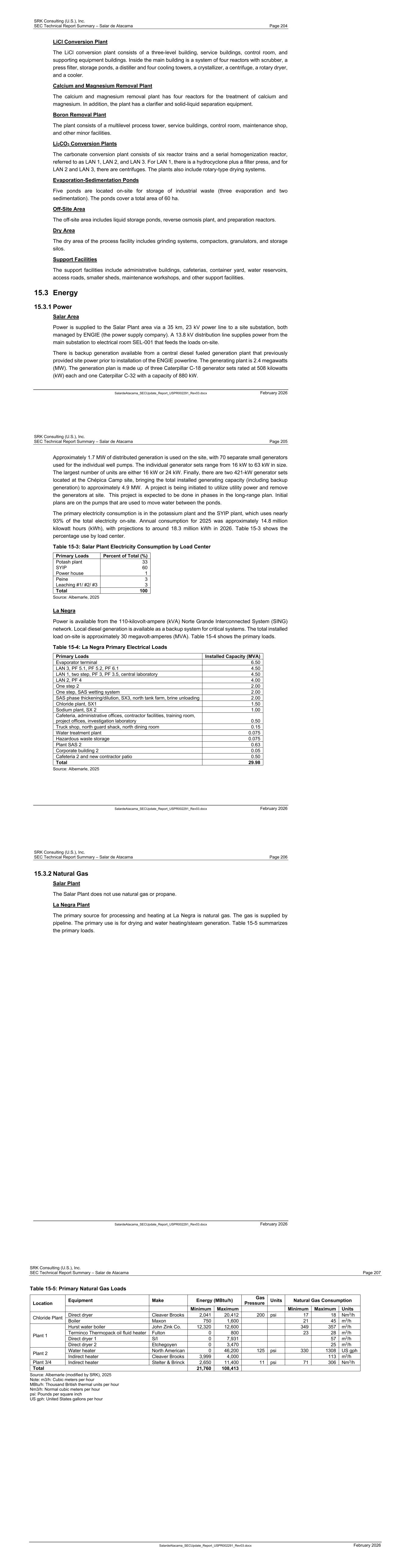
SRK Consulting (U.S.), Inc. SEC Technical Report Summary – Salar de Atacama Page 204 SalardeAtacama_SECUpdate_Report_USPR002291_Rev03.docx February 2026 LiCl Conversion Plant The LiCl conversion plant consists of a three-level building, service buildings, control room, and supporting equipment buildings. Inside the main building is a system of four reactors with scrubber, a press filter, storage ponds, a distiller and four cooling towers, a crystallizer, a centrifuge, a rotary dryer, and a cooler. Calcium and Magnesium Removal Plant The calcium and magnesium removal plant has four reactors for the treatment of calcium and magnesium. In addition, the plant has a clarifier and solid-liquid separation equipment. Boron Removal Plant The plant consists of a multilevel process tower, service buildings, control room, maintenance shop, and other minor facilities. Li2CO3 Conversion Plants The carbonate conversion plant consists of six reactor trains and a serial homogenization reactor, referred to as LAN 1, LAN 2, and LAN 3. For LAN 1, there is a hydrocyclone plus a filter press, and for LAN 2 and LAN 3, there are centrifuges. The plants also include rotary-type drying systems. Evaporation-Sedimentation Ponds Five ponds are located on-site for storage of industrial waste (three evaporation and two sedimentation). The ponds cover a total area of 60 ha. Off-Site Area The off-site area includes liquid storage ponds, reverse osmosis plant, and preparation reactors. Dry Area The dry area of the process facility includes grinding systems, compactors, granulators, and storage silos. Support Facilities The support facilities include administrative buildings, cafeterias, container yard, water reservoirs, access roads, smaller sheds, maintenance workshops, and other support facilities. 15.3 Energy 15.3.1 Power Salar Area Power is supplied to the Salar Plant area via a 35 km, 23 kV power line to a site substation, both managed by ENGIE (the power supply company). A 13.8 kV distribution line supplies power from the main substation to electrical room SEL-001 that feeds the loads on-site. There is backup generation available from a central diesel fueled generation plant that previously provided site power prior to installation of the ENGIE powerline. The generating plant is 2.4 megawatts (MW). The generation plan is made up of three Caterpillar C-18 generator sets rated at 508 kilowatts (kW) each and one Caterpillar C-32 with a capacity of 880 kW. SRK Consulting (U.S.), Inc. SEC Technical Report Summary – Salar de Atacama Page 205 SalardeAtacama_SECUpdate_Report_USPR002291_Rev03.docx February 2026 Approximately 1.7 MW of distributed generation is used on the site, with 70 separate small generators used for the individual well pumps. The individual generator sets range from 16 kW to 63 kW in size. The largest number of units are either 16 kW or 24 kW. Finally, there are two 421-kW generator sets located at the Chépica Camp site, bringing the total installed generating capacity (including backup generation) to approximately 4.9 MW. A project is being initiated to utilize utility power and remove the generators at site. This project is expected to be done in phases in the long-range plan. Initial plans are on the pumps that are used to move water between the ponds. The primary electricity consumption is in the potassium plant and the SYIP plant, which uses nearly 93% of the total electricity on-site. Annual consumption for 2025 was approximately 14.8 million kilowatt hours (kWh), with projections to around 18.3 million kWh in 2026. Table 15-3 shows the percentage use by load center. Table 15-3: Salar Plant Electricity Consumption by Load Center Primary Loads Percent of Total (%) Potash plant 33 SYIP 60 Power house 1 Peine 3 Leaching #1/ #2/ #3 3 Total 100 Source: Albemarle, 2025 La Negra Power is available from the 110-kilovolt-ampere (kVA) Norte Grande Interconnected System (SING) network. Local diesel generation is available as a backup system for critical systems. The total installed load on-site is approximately 30 megavolt-amperes (MVA). Table 15-4 shows the primary loads. Table 15-4: La Negra Primary Electrical Loads Primary Loads Installed Capacity (MVA) Evaporator terminal 6.50 LAN 3, PF 5.1, PF 5.2, PF 6.1 4.50 LAN 1, two step, PF 3, PF 3.5, central laboratory 4.50 LAN 2, PF 4 4.00 One step 2 2.00 One step, SAS wetting system 2.00 SAS phase thickening/dilution, SX3, north tank farm, brine unloading 2.00 Chloride plant, SX1 1.50 Sodium plant, SX 2 1.00 Cafeteria, administrative offices, contractor facilities, training room, project offices, investigation laboratory 0.50 Truck shop, north guard shack, north dining room 0.15 Water treatment plant 0.075 Hazardous waste storage 0.075 Plant SAS 2 0.63 Corporate building 2 0.05 Cafeteria 2 and new contractor patio 0.50 Total 29.98 Source: Albemarle, 2025 SRK Consulting (U.S.), Inc. SEC Technical Report Summary – Salar de Atacama Page 206 SalardeAtacama_SECUpdate_Report_USPR002291_Rev03.docx February 2026 15.3.2 Natural Gas Salar Plant The Salar Plant does not use natural gas or propane. La Negra Plant The primary source for processing and heating at La Negra is natural gas. The gas is supplied by pipeline. The primary use is for drying and water heating/steam generation. Table 15-5 summarizes the primary loads. SRK Consulting (U.S.), Inc. SEC Technical Report Summary – Salar de Atacama Page 207 SalardeAtacama_SECUpdate_Report_USPR002291_Rev03.docx February 2026 Table 15-5: Primary Natural Gas Loads Location Equipment Make Energy (MBtu/h) Gas Pressure Units Natural Gas Consumption Minimum Maximum Minimum Maximum Units Chloride Plant Direct dryer Cleaver Brooks 2,041 20,412 200 psi 17 18 Nm3/h Boiler Maxon 750 1,600 21 45 m3/h Plant 1 Hurst water boiler John Zink Co. 12,320 12,600 349 357 m3/h Terminco Thermopack oil fluid heater Fulton 0 800 23 28 m3/h Direct dryer 1 S/I 0 7,931 57 m3/h Direct dryer 2 Etchegoyen 0 3,470 25 m3/h Plant 2 Water heater North American 0 46,200 125 psi 330 1308 US gph Indirect heater Cleaver Brooks 3,999 4,000 113 m3/h Plant 3/4 Indirect heater Stelter & Brinck 2,650 11,400 11 psi 71 306 Nm3/h Total 21,760 108,413 Source: Albemarle (modified by SRK), 2025 Note: m3/h: Cubic meters per hour MBtu/h: Thousand British thermal units per hour Nm3/h: Normal cubic meters per hour psi: Pounds per square inch US gph: United States gallons per hour

SRK Consulting (U.S.), Inc. SEC Technical Report Summary – Salar de Atacama Page 208 SalardeAtacama_SECUpdate_Report_USPR002291_Rev03.docx February 2026 Propane is not used at the La Negra plant, but it is available as a backup fuel source from Antofagasta by tanker truck. 15.3.3 Fuel Salar Plant The Salar Plant has fuel storage on-site, including three diesel tanks that are and 64,000, 40,000, and 28,000 L. Diesel is supplied at a rate of 175,000 L to 210,000 L per week. Two gasoline tanks with a capacity of 1,000 L each are used for fuel storage on-site and are refilled every three to four months as needed. Fuel is supplied by a regional supplier. The fuel is delivered to site by over-the-road tanker trucks from Antofagasta. La Negra Plant The La Negra site has a 20 m3 diesel tank and several smaller tanks for backup during power outages. 15.4 Water and Pipelines Salar de Atacama Albemarle has water rights granted by the General Water Directorate (Dirección General de Aguas) (DGA) for those wells and spring water where fresh water is extracted, which is used as industrial water for the process. The water rights correspond to the water sources located in Tilopozo, Tucucaro, and Peine. Water from the Peine well is provided by a 6-inch HDPE pipe to the Peine Camp’s 20,000 m3 covered storage pond. The Tilopozo spring water discharges into an 8-inch pipe that reports to a 2,000 m3 post-processing thickening pond. The Tucucaro well feeds a 6-inch pipe that also discharges to the same post-processing thickening pond. Implementation of the EWP impacts these water rights and is discussed in Section 17.2.3 of this report. La Negra In La Negra, there are two wells that have water rights granted by the DGA for the extraction of 13 L/s. Well 1 North is permitted at 6 L/s, and Well 2 South is permitted at 7 L/s. Additional water is available from two sources. Albemarle purchases industrial water from a local railroad and has tied into a local recycled water system provided by Sacyr as a supplemental source as needed. SRK Consulting (U.S.), Inc. SEC Technical Report Summary – Salar de Atacama Page 209 SalardeAtacama_SECUpdate_Report_USPR002291_Rev03.docx February 2026 16 Market Studies Albemarle Corporation (Albemarle) retained Fastmarkets to provide it with support in developing reserve price estimates for its lithium business for public reporting purposes. This report covers Albemarle’s brine operations and summarizes data from the preliminary market study, as applicable to the estimate of mineral reserves. Although Fastmarkets understands that Albemarle has the ability to produce multiple lithium chemicals at its brine operations, Fastmarkets has limited the market analysis to the primary product (battery-grade lithium carbonate). The preliminary market study and summary detail contained herein presents a forward-looking price forecast for applicable lithium products; this includes forward-looking assumptions around supply and demand. Fastmarkets notes that as with any forward-looking assumptions, the eventual future outcome may deviate significantly from the forward-looking assumptions. The preliminary market study is in accordance with the S-K 1300 requirement for a pre-feasibility level study. Finally, Fastmarkets also notes that there are secondary products produced from several of the operations. For example, Salar de Atacama produces potash. However, while the potash sales do provide an economic benefit to Albemarle, Fastmarkets’ understanding of this product is that its contribution to the revenues for this operation are limited compared to lithium. Therefore, Albemarle has not tasked Fastmarkets with including a market study for this product or any other byproduct from the operations under the rationale this revenue is not material, and a market study is not justified. 16.1 Lithium Market Summary A summary of the lithium market has been provided to offer context on developments and the basis for Fastmarkets’ assessment of price. The lithium market has undergone a fundamental transformation over the past decade. Historically, lithium applications were concentrated in ceramics, glasses, and greases. However, the landscape has shifted dramatically as demand for portable energy storage solutions has expanded significantly. The proliferation of rechargeable batteries in portable consumer devices, including mobile phones and laptop computers, coupled with the recent emergence of electric vehicles, has fundamentally altered lithium consumption patterns. Battery applications represented 40.1% of lithium consumption in 2016. Since that time, battery demand has demonstrated remarkable growth, expanding at a compound average growth rate of 32.7% annually between 2016 and 2024. This growth trajectory has resulted in battery applications now accounting for 82.0% of total lithium consumption, establishing batteries as the dominant driver of lithium demand. Beyond electric vehicles and other electrically powered mobility solutions, lithium-ion batteries are increasingly being deployed in energy storage systems. While energy storage systems currently represent a minor market segment, this sector is anticipated to experience rapid expansion as it addresses critical challenges related to renewable energy integration and grid stability. The transition toward electric vehicles as mainstream transportation methods is being accelerated by government incentives supporting electric vehicle adoption and impending regulatory restrictions on internal combustion engine vehicles. These policy developments are expected to drive lithium demand to levels that represent several multiples of historical consumption patterns. SRK Consulting (U.S.), Inc. SEC Technical Report Summary – Salar de Atacama Page 210 SalardeAtacama_SECUpdate_Report_USPR002291_Rev03.docx February 2026 16.1.1 Lithium Demand In recent years, the lithium industry has gone through an evolution. The ceramic and glass sectors have lost their dominant position to the growth in mobile electronics and most recently to EVs. The development of electric vehicle technology followed a measured progression that accelerated dramatically in recent years. The Toyota Prius, introduced at the end of 1997 as the first mass-market hybrid petrol-electric vehicle, utilized nickel-metal hydride battery technology that did not require lithium. Commercial fully electric lithium-ion battery (LIB) powered vehicles emerged in 2008 with the Tesla Roadster, followed by the Mitsubishi i-MiEV in July 2009. Initial market adoption proceeded gradually as charging infrastructure development, model diversification, and range improvements established the foundation for subsequent acceleration. The electric mobility sector, encompassing all electrically powered vehicles (eMobility), has emerged as the primary driver of overall lithium demand growth. Fastmarkets estimates that total lithium demand reached over 1M tonnes LCE in 2024, with electric vehicles representing 63% of this consumption. Fastmarkets believes that demand for EVs will continue to accelerate in the next decade, as they become increasingly affordable, and a greater range of models enter the market. Legislation will also force the transition in the mid-term. Additionally, commercial fleet electrification is expected to advance as governments and businesses seek to develop green domestic transportation networks (Figure 16-1). Source: Fastmarkets, 2025 Note: Rates are shown in thousands of vehicles and percentage. Figure 16-1: EV Sales and Penetration Rates (‘000 vehicles, %) Further out, the battery electric vehicle (BEV) segment will come to dominate the EV sector, as both residential and commercial transport in developed markets increasingly shifts to BEVs and away from hybrids, and as developing markets benefit from the deflating BEV prices. The resurgence in popularity SRK Consulting (U.S.), Inc. SEC Technical Report Summary – Salar de Atacama Page 211 SalardeAtacama_SECUpdate_Report_USPR002291_Rev03.docx February 2026 of plug-in hybrid electric vehicles (PHEVs) in the US and China gives it a longer potential sales period, where its high compound average growth rate (CAGR) is driven by its current low sales base. Electric vehicle adoption drives exceptionally strong lithium demand forecasts. Government zero- carbon agendas, municipal emission charges accelerating electric vehicle uptake, and increasingly ubiquitous charging infrastructure in many countries support robust demand projections. The demand outlook is enhanced by distributed renewable energy generation deployment, which benefits significantly from energy storage systems that smooth generation variability periods (Figure 16-2). Source: Fastmarkets, 2025 Note: Values are in kt LCE. Figure 16-2: Lithium Demand in Key Sectors ('000 LCE tonnes) Alternative technologies or societal developments could influence lithium demand trajectories. Household car sharing preferences rather than ownership models, autonomous vehicle development enabling transport-as-a-service paradigms where ride hailing and car sharing become normalized particularly in densely populated areas, could reduce global vehicle populations. Energy storage and powertrain technologies continue evolving, with hydrogen fuel cells and sodium-ion batteries representing potential market share competitors. China's electric vehicle demand remains robust, with CATL leading the industry through recent battery technology announcements expanding addressable markets. Electric vehicle uptake decelerated in Western Europe during 2024, primarily due to German and French economic weakness. However, the German electric vehicle market has rebounded and now leads European sales volumes in 2025. The French electric vehicle market continues struggling with subsidy losses, but increased imports, new models, and improving infrastructure indicate this represents a temporary rather than structural challenge.

SRK Consulting (U.S.), Inc. SEC Technical Report Summary – Salar de Atacama Page 212 SalardeAtacama_SECUpdate_Report_USPR002291_Rev03.docx February 2026 The energy storage system (ESS) market gained significant momentum in 2024. We continue to forecast significant strong year-on-year growth. But US tariffs on Chinese ESS cells threaten the price- competitiveness of imports and the sustained growth of ESS deployments in this leading market. Despite these negative factors, including ongoing military conflicts, BEV sales growth remains robust but is being more heavily supported by PHEV sales in China than in previous years Many Japanese original equipment manufacturers initially demonstrated reluctance toward wholehearted electric vehicle adoption, apparently motivated by Japan's energy import requirements for electricity production. Toyota particularly championed hydrogen fuel cells as alternatives to or parallel with electric vehicles. However, recent years have seen these manufacturers signal intent to transition to electric powertrains. While electric vehicles demonstrate lower lifetime operating costs compared to internal combustion engines, initial purchase costs can be prohibitive. Higher-end vehicles manage this cost within overall vehicle price contexts, but entry-level and smaller vehicles face battery pack cost hurdles preventing battery electric vehicle competitiveness with internal combustion engine vehicles. General consensus indicates $100 per kWh at pack level represents the approximate global benchmark for battery electric vehicles to achieve price parity with internal combustion engine vehicles. One of the most significant developments involves new dominance by Chinese brands internationally beyond domestic markets. China surpassed Japan as the largest car exporter, with brands like BYD achieving impressive market shares in numerous countries including European markets. This success results from highly competitive pricing, as competition develops among Chinese manufacturers, is likely increasing electric vehicle adoption in various markets. Although concerns exist regarding raw material availability, charging infrastructure, and initial costs, Fastmarkets believes many barriers are being progressively eliminated. Besides the cost of EVs relative to internal combustion engines (ICEs), range anxiety will continue to dissuade the uptake of BEV, particularly in markets where vehicle use is necessary for travel. This anxiety will only diminish as battery ranges increase, charging times diminish, and charging infrastructure improves. Instead, where range anxiety is an issue, PHEV sales will partly compensate. Fastmarkets expects near- to mid-term electric vehicle market growth to remain robust. The most significant near-term threats are macroeconomic rather than electric vehicle specific. Fastmarkets' macroeconomic forecast anticipates somewhat slower global economic growth in 2025-2026, driven by high interest rates, low investment rates, and decelerating Chinese economic growth. United States economic performance continues outperforming Europe due to greater consumer resistance to higher interest rates. Consumer spending represents a significantly greater share of United States regional economy compared to Europe, where industrial and investment slowdowns combined with decelerating Chinese demand impact purchasing activity more severely. The Chinese economy experienced slower growth in 2024 compared to the 2023 rebound year but maintains comparably significant growth rates. Some Chinese macroeconomic strategists anticipate slower but healthier future growth. Current uncertainty regarding United States tariffs threatens to reduce international trade, increase product prices, and slow economic growth. This economic outlook will dampen new vehicle sales expectations, but while Fastmarkets expects total vehicle sales to be negatively impacted, the majority of impact will focus on ICEs. Electric vehicles, with reduced operating costs and lower duties in some areas, are viewed as cost-cutting measures and more future-proof investments. With some original SRK Consulting (U.S.), Inc. SEC Technical Report Summary – Salar de Atacama Page 213 SalardeAtacama_SECUpdate_Report_USPR002291_Rev03.docx February 2026 equipment manufacturers reducing EV costs to grow or maintain market share, EVs appear increasingly attractive compared to ICEs. Government-imposed targets and legislation banning internal combustion engine vehicle sales support strong EV uptake growth expectations once immediate economic challenges are overcome. However, original equipment manufacturer (OEMs) and public pressure are increasing the debate around these targets, likely pushing some forward by several years. This development does not discount risks to electric vehicle uptake including alternative fuels, different battery types, or shifts in car ownership that would reduce electric vehicle or lithium-ion battery demand. Overall, Fastmarkets forecasts electric vehicle sales reaching 50 million by 2032. At 56% of global sales, this represents impressive acceleration while highlighting room for continued growth. 16.1.2 Lithium Supply Lithium extraction has historically relied upon two primary deposit categories: hard rock spodumene deposits and saline brines contained within evaporite basins known as salars, predominantly located in Chile, Argentina, China, and Bolivia. While multiple minerals contain lithium-bearing properties, these traditional sources have dominated global production. Recent developments have witnessed the emergence of new supply sources. Most significant ones are new hard rock deposits, granite rocks containing lepidolite or petalite, and clays containing hectorite. Although these materials can technically be classified as hard rock deposits, their distinct economic characteristics warrant separate categorization for analytical purposes. Current exploration and technical assessment initiatives are examining alternative deposit types, with three demonstrating the most promising near-term commercial potential: jadarite, a hard rock lithium- boron mineral discovered in Serbia's Jadar Valley; hectorite clay formations; and deep brines co- located with geothermal energy and petroleum resources. Despite substantial research investment and extensive study of these alternative lithium sources, their contribution to global supply remains negligible at present. Until 2016, global lithium production was concentrated within two dominant operations: the Greenbushes deposit in Australia, representing hard rock production, and Chile's Salar de Atacama, serving brine extraction through two commercial operators, Albemarle and SQM. Livent, formerly operating as FMC Corporation, constituted the third major South American producer through its Salar del Hombre Muerto operation in Argentina. Chinese market participants Tianqi Lithium and Ganfeng Lithium established themselves as primary domestic players, expanding operations domestically and internationally. Tianqi acquired a 51% ownership stake in Greenbushes, while Ganfeng developed lithium mining and production facilities throughout China and invested in mining operations and brine facilities across Australia and South America. Global lithium supply totaled approximately 187,000 t of Lithium Carbonate Equivalent (LCE) in 2016. Supply expansion achieved a 27% CAGR between 2016 and 2024, responding to positive demand projections from the emerging EV industry. Australia, Chile, and China drove the majority of this growth trajectory. The supply response exceeded demand requirements, necessitating the placement of certain operations on care and maintenance (C&M) status between 2018 and 2020. Supply contracted by 7,000 t in 2020 due to production reductions, decreased demand, and COVID-19 related operational constraints including social distancing measures. SRK Consulting (U.S.), Inc. SEC Technical Report Summary – Salar de Atacama Page 214 SalardeAtacama_SECUpdate_Report_USPR002291_Rev03.docx February 2026 Recovery commenced in 2021, with supply increasing 37% year-over-year to reach 538,000 t of LCE, driven by post-pandemic stimulus measures and increasingly favorable long-term demand projections. This recovery resulted in a 437% price increase from the beginning of the year, which incentivized supply expansion initiatives. Strong growth momentum continued with supply increases of 42% and 37% year-over-year in 2022 and 2023, respectively. In 2024, 87% of global lithium supply came from just four countries: Australia, Chile, Argentina, and China. This remainder of supply came from Zimbabwe, Brazil, the United States, and South Africa. Fastmarkets expect spodumene production to maintain market share because of expansions and new mines in Australia coming online, as well as the emergence of Africa as an important lithium-mining region. In 2035, Fastmarkets expect spodumene resources to contribute about 1.36 million tonnes of LCE, or 48% of total supply, at the expense of brine’s share, which we forecast to drop to 35%, or 1.01 million tonnes of LCE. Remaining 17% to be filled mostly by other hard rock sources, mainly lepidolite. The successful implementation of DLE technology could also materially affect production from brine resources. Fastmarkets expect Eastern Asia (China) to be the largest single producer globally in 2035, accounting for 30% of supply, followed by South America with 28% and Australia and New Zealand at 25%. Looking forward, as discussed above, Fastmarkets forecasts that demand will grow significantly. However, supply is also adapting in tandem and outpacing demand in the near term. Global mine supply in 2024 was 1,042,869 tonnes LCE. Based on Fastmarkets’ view of global lithium projects in development, mine supply is forecast to increase from to 2,854,357 in 2035 – a CAGR of 8%. This potential growth in supply is restricted to projects that are ‘brownfield’ expansions of existing projects or ‘greenfield’ projects that Fastmarkets believes likely to reach production. Such projects are at an advanced stage of development, perhaps with operating demonstration plants and sufficient financing to begin construction. ‘Speculative projects’, which are yet to secure funding or have not commissioned a feasibility project, for example, have been excluded until they can demonstrate that there is a reasonable chance that they will progress to their nameplate capacity (Figure 16-3). Source: Fastmarkets, 2025 Note: Values are in kt LCE. Figure 16-3: Forecast Mine Supply ('000 tonnes LCE) SRK Consulting (U.S.), Inc. SEC Technical Report Summary – Salar de Atacama Page 215 SalardeAtacama_SECUpdate_Report_USPR002291_Rev03.docx February 2026 The lithium industry has witnessed extensive new development projects and expansions incentivized by elevated pricing during 2022 and early 2023, supported by government policy and fiscal measures. The Inflation Reduction Act exemplifies how subsidies can incentivize EV supply chain development, while Europe demonstrates strong emphasis on supply chain resilience enhancement. The Trump Administration has adopted a proactive approach regarding raw materials supply chains, providing funding support for various commodity projects including rare earths and antimony. Supply additions from restarts, expansions, and greenfield projects commenced in 2023, leading to rapid supply increases, particularly within China. The market was unprepared for the speed of Chinese producers' response to 2021 to 2022 supply constraints. China rapidly developed domestic lepidolite assets and imported direct shipping ore (DSO) from Africa, primarily Zimbabwe and recently Nigeria. The combination of planned increases and accelerated Chinese response has created oversupply conditions. Current market conditions feature ongoing supply ramp-up concurrent with high-cost production curtailments. Recent supply restraint has primarily originated from non-Chinese producers, a trend expected to continue, although increasing production restraint is emerging within China. In July, local administrations implemented measures controlling lepidolite mining pollution and constraining high- cost supply. The net result is that there are no nearby concerns about supply shortages, although bouts of restocking could lead to short-term periods of tightness. Over the longer term, there is no room for complacency. Chinese production seems less prone to suffering delays — as shown with the ramp- up of domestic lepidolite and African spodumene projects. But in most cases, new capacity experiences start-up delays (such as issues with gaining permits, as well as labor, know-how and equipment shortages). 16.1.3 Lithium Supply-Demand Balance Despite a low-price environment and selective production curtailments—primarily by higher-cost, non- Chinese producers—global lithium supply continues to grow. Concurrently, EV adoption rates, while still robust, have decelerated from post-COVID peaks exceeding 40% year-on-year to an anticipated average of 20% annual growth over the coming years. Supply Trends: The 2021–2022 price surge catalyzed a significant expansion of production capacity, some of which remains in ramp-up phase. Higher-cost assets have been curtailed, moderating supply growth but not reversing the trend. Demand Trends: EV-related lithium demand is forecast to rise by roughly 20% per annum, slower than the >40% growth observed in the early post-pandemic period. Overall demand growth has fallen short of prior expectations. Surplus and Deficit Outlook: A surplus is expected to persist through 2026, with an estimated oversupply of approximately 17,000 t LCE in 2026—equivalent to only ~1% of that year’s projected demand.

SRK Consulting (U.S.), Inc. SEC Technical Report Summary – Salar de Atacama Page 216 SalardeAtacama_SECUpdate_Report_USPR002291_Rev03.docx February 2026 Supply-side restraint and investment reductions are now forecast to precipitate a return to market deficit in 2027, one year earlier than previous forecasts. Risks to the Forecast: Upside demand surprises, stemming from faster EV adoption or new industrial applications, could erode surplus more rapidly. Delays or cancellations of permitted and financed projects may constrain supply growth, tightening the balance—especially in the late-decade and early-2030s period (Figure 16-4). Source: Fastmarkets, 2025 Note: Values are in kt LCE. Figure 16-4: Lithium Supply-Demand Balance ('000 tonnes LCE) 16.1.4 Lithium Prices Lithium prices have proven highly susceptible to shifts in the supply-demand balance and inventory cycles. From early 2018 through the second half of 2020, spot CIF prices for battery-grade lithium carbonate in China, Japan, and Korea fell from about US$20 per kg to a low of US$6.75 per kg, a consequence of sustained production increases that began in 2017. The subsequent recovery in 2021 and 2022, spurred by tightening margins, drove spodumene concentrate prices to exceed US$8,000 per tonne in late 2022, while lithium hydroxide and carbonate reached peaks of US$85/kg and US$81/kg, respectively. During this period, many players across the cathode-active-material supply chain aggressively built inventories, not only to hedge against further price increases but also to prepare for what was expected to be another strong year of EV-driven battery demand in 2023. However, this optimism gave way to a sharp correction in early 2023, when spodumene prices plunged by nearly 40%—to US$4,850 per tonne by March—prompted by overextended stockpiles, rapid expansion of Chinese lepidolite and African direct-shipping ore exports, and weaker-than-forecast demand. As purchasers found themselves holding unhedged inventory in a falling market, destocking accelerated the downward momentum, driving lithium carbonate and hydroxide prices down by more than 85% to 90 % from their 2022 highs by year-end. SRK Consulting (U.S.), Inc. SEC Technical Report Summary – Salar de Atacama Page 217 SalardeAtacama_SECUpdate_Report_USPR002291_Rev03.docx February 2026 A muted rebound followed the 2023 trough. After the Lunar New Year of 2024, lithium carbonate briefly climbed to US$14.25/kg before sliding to US$10.61/kg by September—a 30% decline from January levels—and eventually reaching near US$8/kg in early 2025, a level widely considered the market floor. Spodumene mirrored this pattern trading around US$850 per tonne in January 2024, rising to US$1,232 per tonne in May, and then returning to approximately US$600 per tonne in 2025. Despite these dramatic swings, current prices remain well above the 2020 lows, and early indications of producer cutbacks hint at the beginning of market consolidation. Whether these price floors hold as structural baselines will depend on renewed demand growth and more disciplined supply management in the latter part of the decade (Figure 16-5). Fastmarkets is now waiting to see if this was the bottom and if more consolidation will continue. Source: Fastmarkets, 2025 Note: Battery grade, spot, CIF CJK, in US$/kg Figure 16-5: Lithium Battery Material Prices 16.1.5 Lithium battery material prices (Technical grade, spot, CIF CJK, $/kg) Now that the froth has come out of the market, Fastmarkets expects prices to find a base. In conversations with market participants, we found more optimism than last year. Our forecast is for hydroxide and carbonate prices to average US$9.00 this year and then rise to US$11 in 2026. We do not expect prices to fall to levels of the last trough in 2020, mainly for the following three reasons: first, China is still exhibiting relatively strong EV growth, whereas in 2020, EV sales were weak on 2019’s subsidy cuts and due to the fallout from Covid; second, inflation has had a big impact on the mining sector over the past few years; and third, ESS is now a major part of the demand growth story. In Fastmarkets’ base case, they forecast that LiOH, Li2CO3, and spodumene real prices will average US$18.1/kg, US$19/kg, and US$1,478/t, respectively, between 2025 and 2035. Fastmarkets’ conservative low-case forecasts US$16/kg, US$16.3/kg, and US$1,264/t, respectively. Battery-grade SRK Consulting (U.S.), Inc. SEC Technical Report Summary – Salar de Atacama Page 218 SalardeAtacama_SECUpdate_Report_USPR002291_Rev03.docx February 2026 would command a small premium (the recent average between 2024 and 2025 has been US$0.53/kg). This premium should be added to the mentioned prices to achieve a battery-grade price forecast. The discrepancy between the 10-year low (US$16.3/kg) and the price Albemarle chose for reserve (US$16/kg) is due to a rounding effect. Albemarle decided to round price forecast to the nearest US$/kg. Fastmarkets believes this approach is sensible and makes the assumption more conservative, as the technical/battery spread is quite volatile and could widen. For the purposes of the reserve estimate, Fastmarkets has provided price forecasts out to 2045 for the most utilized market price benchmarks. Fastmarkets recognizes that Albemarle’s current operations are expected to continue for at least another 20 years, but due to a lack of visibility and the recent significant changes in the market, prices beyond 2035 are unusually opaque for an industrial commodity. For this reason, the rationality beyond 2035 is to assume a little increase in nominal price to keep real price stable. Post-2035, the continued growth of demand for lithium from EVs and ESS, will require a lithium price that continues to incentivize new supply additions leading to more balanced markets. The lithium price will need to exceed the production cost for new projects and provide an adequate rate of return on investment to justify development. Though, this will be helped by an established and accepted EV market, which will support the long-term lithium demand. Most producers sell technical and industrial grade which need a final refining step to battery grade. We found that historically these products have traded consistently around 300-1000$/t discount across all regions to reflect this cost for final refinement to battery grade. We expect this spread will continue going forward. Fastmarkets have provided a base, high, and low case price forecast, to give an indication of the range of which prices could sit, depending on reasonable assumptions around potential impacts to the base case market balance. With the exception of lithium carbonate and spodumene from 2032, we have lowered our base case to reflect the reduced forecast deficits, the speed at which it has been proven that new capacity can be added to the market, and new participants stepping into the lithium industry that will bring more stability to long-term supply growth and prices as they will be able to ride out the cycles. The high case has been revised to reflect greater potential elasticity in the high in a deficit market. The same relationship has been preserved in the low case, meaning there is greater potential elasticity in the low in a surplus market. Our high-case scenario is likely to occur either if the growth in supply is slower than expected or if demand growth is faster. The former becomes more probable the longer lithium prices remain below incentive levels because higher prices are needed to ensure next in-line supply is financed and built. This scenario could also unfold if China attempts to reform overcapacity, if DLE technology takes longer to commercialize, and if the West continues to suffer from permitting challenges, technology know-how, and scaling issues. Demand could exceed our expectation if EV adoption accelerates due to cost reductions or new incentive schemes, if ESS expands faster than expected driven by AI and data centers, and if global trade issues are quickly resolved. The low-case scenario could unfold if China continues to boost production in an unmeasured way and African mines that are in the pipeline start up quicker than expected. Demand could also fall short of expectations if the affordability of EVs remains a barrier to adoption, tariffs slow down ESS deployment, SRK Consulting (U.S.), Inc. SEC Technical Report Summary – Salar de Atacama Page 219 SalardeAtacama_SECUpdate_Report_USPR002291_Rev03.docx February 2026 and sodium-ion battery technology rapidly evolves to take greater market share from lithium-ion batteries. Between 2035 and 2045, Fastmarkets expects the LiOH and Li2CO3 to be at a price parity (Figure 16-6 and Figure 16-7). Source: Fastmarkets, 2025 Note: Battery grade, spot, CIF CJK, in US$/kg, real (2024)

SRK Consulting (U.S.), Inc. SEC Technical Report Summary – Salar de Atacama Page 220 SalardeAtacama_SECUpdate_Report_USPR002291_Rev03.docx February 2026 Figure 16-6: LiOH Long-Term Forecast Scenarios (Battery Grade, Spot, CIF CJK, US$/kg, Nominal) Source: Fastmarkets, 2024 Figure 16-7: Li2CO3 Long-Term Forecast Scenarios (Technical Grade, Spot, CIF CJK, US$/kg, Nominal) 16.2 Product Sales Table 16-1 and Table 16-2 provide specifications for the technical- and battery-grade Li2CO3 produced at La Negra. Table 16-1: Technical grade Li2CO3 Specifications Chemical Specification Li2CO3 Minimum 99.00% Cl Maximum 0.015% K Maximum 0.001% Na Maximum 0.084% Mg Maximum 0.007% SO4 Maximum 0.054% Iron(III) oxide (Fe2O3) Maximum 0.003% Ca Maximum 0.016% Insoluble matter Maximum 0.017% Loss at 550°C Maximum 0.744% Source: Albemarle, 2025 SRK Consulting (U.S.), Inc. SEC Technical Report Summary – Salar de Atacama Page 221 SalardeAtacama_SECUpdate_Report_USPR002291_Rev03.docx February 2026 Table 16-2: Battery grade Li2CO3 Specifications Chemical Specification Li2CO3 Minimum 99.30% Cl Maximum 0.015% K Maximum 0.001% Na Maximum 0.065% Mg Maximum 0.007% SO4 Maximum 0.050% Magnetic impurity Maximum 0.5 ppm Ca Maximum 0.016% Particle size 50% particle size maximum 5.0 microns Source: Albemarle, 2025 Table 16-3 presents historic production rates for each of these products, with brine sourced from Salar de Atacama as processed at the La Negra facility. Table 16-3: Historic La Negra Annual Production Rates 2015 2016 2017 2018 2019 2020 2021 2022 2023 2024 2025 Technical- grade Li2CO3 (t/y) 10,945 10,581 9,822 8,628 5,658 6,829 5,514 10,189 5,515 6,840 6,472 Battery- grade Li2CO3 (t/y) 13,323 16,573 20,324 27,998 32,874 35,256 35,895 43,419 49,775 64,2237 67,962 Technical- grade LiCl (t/y) 2,143 1,900 3,209 3,821 1,824 - - - - - Source: Albemarle, 2025 Note: 2015 to 2024 data reflect actual production, and 2025 production is an estimate. Looking forward, Albemarle has recently significantly expanded its production facilities at the Salar, and La Negra 3 is operational and ramping-up. Table 16-4 provides the expected production capacities for each lithium chemical. The ability to run La Negra 3 at full capacity will be dependent on restrictions imposed by the EWP and Albemarle’s ability to identify and implement sufficient mitigation plans. Based on current conditions and information available, production is not expected to reach maximum capacity at La Negra due to the restrictions incurred at the Salar. Table 16-4: Current La Negra Production Capacity by Product Current Annual Capacity (t) Technical grade Li2CO3 8,000 Battery grade Li2CO3 72,000 Technical grade LiCl 0 Source: Albemarle, 2025 To simplify the analysis for the purposes of this reserve estimate, SRK assumed that all lithium production from the combined Salar de Atacama/La Negra operation is sold as technical grade Li2CO3; this is the lowest value product forecast for production and adds a layer of conservatism to the reserve estimate. The three lithium products from the Salar de Atacama/La Negra operation are all marketable lithium chemicals that can be sold into the open market. However, Albemarle is an integrated chemical manufacturing company that operates multiple downstream lithium processing facilities. Therefore, a proportion of the production from the Salar de Atacama/La Negra operation is utilized to source product for Albemarle’s downstream processing facilities. Table 16-5 presents a breakdown of the volume of SRK Consulting (U.S.), Inc. SEC Technical Report Summary – Salar de Atacama Page 222 SalardeAtacama_SECUpdate_Report_USPR002291_Rev03.docx February 2026 Salar de Atacama/La Negra product that is consumed internally for further downstream processing versus sales to third parties. Table 16-5: 2025 de Atacama Product Consumption LCE Production Consumed Internally (t) LCE Production Sold to Third Parties (t) Technical grade Li2CO3 1,325 5,263 Battery grade Li2CO3 1,544 65,292 Technical grade LiCl 0 0 Source: Albemarle 2025 While a portion of the production may be consumed internally, for the purposes of this reserve estimate, SRK assumed that 100% of the production from the Salar de Atacama/La Negra operation is sold to third parties. Further, as noted above, although Salar de Atacama/La Negra can and do produce higher-value battery grade Li2CO3, SRK’s assumption for the purpose of this reserve estimate is that all production is sold as the lower-value technical grade Li2CO3; this simplifies the assumptions for the estimate and does not materially impact the magnitude of the reserve estimated herein, as the reserve is contract constrained (see Section 16.3.1) and not economically constrained. 16.3 Contracts As outlined above, the lithium chemicals produced from the Salar de Atacama/La Negra operations are either consumed internally for downstream value-add production or sold to third parties. These sales may be completed in spot transactions, or the chemicals may be utilized to satisfy sales contracts for lithium chemicals held at the consolidated corporate Albemarle level or its affiliates. These contracts are not generally specific to sourcing product from Salar de Atacama/La Negra, although product sourced from other operations would need to be certified to meet customer quality requirements. Therefore, these contracts are not included in this analysis of reserves at Salar de Atacama, and this analysis instead assumes a typical market price. Salar de Atacama/La Negra sells all lithium products to its foreign related party Albemarle US Inc., where their sales and marketing teams provide instructions about specified locations where Chile should deliver the products. Extraction and sales of lithium and other products are regulated by contracts agreed with the CCHEN and CORFO. Section 16.3.1 summarizes these contracts. Fastmarkets is not aware of any other material contracts for the Salar de Atacama/La Negra operation. 16.3.1 CCHEN and CORFO Agreements Decree Law No. 2,886 (published on November 14, 1979, and effective January 1, 1979) reserved lithium extraction for the State of Chile. However, the concessions held by Albemarle for the purposes of producing lithium from Salar de Atacama were registered in 1977 and are therefore exempt from this law. Nonetheless, under Law No. 16,319 (establishing Chilean Nuclear Energy Commission (CCHEN)), lithium can only be mined by CCHEN or with prior authorization from CCHEN. Under this law, lithium producers are subject to a production quota that caps total production from the concessions, and Albemarle is subject to such a CCHEN production quota. CCHEN also limits the extraction rate of brine from Salar de Atacama. In 2016, CCHEN increased the allocated pumping rate for Albemarle at Salar de Atacama from the prior 142 L/s to 442 L/s. As part of the same agreement, the CCHEN production quota was increased from 200,000 t Li (as lithium metal), inclusive of historic production to 540,240 t Li (as lithium metal). SRK Consulting (U.S.), Inc. SEC Technical Report Summary – Salar de Atacama Page 223 SalardeAtacama_SECUpdate_Report_USPR002291_Rev03.docx February 2026 Further, CORFO was the original owner of the concessions in Salar de Atacama from which Albemarle’s resources and reserves are derived. A predecessor of Albemarle (Foote Mineral Company) entered into an agreement with CORFO in August 1980 to establish production of lithium and other products from these concessions. From this original contract, Albemarle was limited to a total production quota of 200,000 t Li (as lithium metal) without an expiration date and was not required to pay royalties on lithium production. A 1987 agreement with CORFO establishing production of potassium byproduct salts includes a royalty on the production of this product equal to 3% of the sales price for potassium products. The 1980 agreement for lithium extraction was subsequently amended in 2016 to allow for an increase in the production quota of lithium from these concessions. This amendment increased the company's authorized lithium production quota by an additional 262,132 t Li (as lithium metal), of which 194,773 t LME remain (as of June 30, 2025). With approximately 101,133 t LME remaining from the original quota (as of June 30, 2025), the remaining amount from this additional quota results in a total remaining production quota of 295,906 t Li as lithium metal (1.57 Mt LCE). As the CORFO quota has less allowable lithium production than the CCHEN sales quota, SRK used the CORFO quota numbers as the limiting factor on this reserve estimate. As part of the 2016 amendment to the CORFO agreement, Albemarle agreed to additional conditions around its production of lithium, including the following: A quota expiration of January 1, 2044 (i.e., any quota not utilized by this date will be forfeited) Albemarle agreed to invest in a third Li2CO3 plant in Chile with a production capacity of at least 20,000 t/y to 24,000 t/y battery grade LCE no later than December 31, 2022. If this new battery grade production facility is not in production by December 31, 2022, the new quota will be reduced from 262,132 t LME to 43,132 t LME. In addition, if the new plant is not in operation, the quota will expire on December 31, 2035 (i.e., any quota not utilized by this date will be forfeited). Albemarle completed the new battery grade production facility (LAN 3) and met the requirements. Provides for an additional quota of 34,776 t (as lithium metal) to feed a LiOH plant with production capacity of at least 5,000 t/y should Albemarle construct a LiOH plant in Chile. Note that SRK has not assumed the development of a LiOH plant and therefore has not included this quota in its analysis. Establishes royalties or commissions paid to CORFO on every tonne of product sold from Salar de Atacama/La Negra according to the schedule presented in Table 16-6 unless exempted elsewhere. Commencing on January 1, 2017, and continuing for approximately five years (until 31,559 t LME are produced), Albemarle will pay a commission on the production still remaining under the original quota. Thereafter, Albemarle will no longer pay any commissions on the lithium produced at the original 24,000 Mt carbonate plant, allowing Albemarle to produce the then- remaining tonnes of the original quota on a commission-free basis as per the terms of the original agreement with CORFO. If Chile develops a local downstream industry that requires battery grade lithium salts, Albemarle agrees to allocate a portion of its production (up to 25%) of those salts for sale to those local downstream producers at a discounted price (relative to Albemarle's export sales price). To date, development of downstream industry has not occurred, and Albemarle is therefore not selling any production at this discounted rate. SRK has not assumed any future discounted sales associated with this clause in this TRS, as they are not aware of any planned or established downstream development.

SRK Consulting (U.S.), Inc. SEC Technical Report Summary – Salar de Atacama Page 224 SalardeAtacama_SECUpdate_Report_USPR002291_Rev03.docx February 2026 Albemarle will annually pay into a fund that will be used to develop research and development (R&D) to benefit Atacama, the country of Chile, and local industry. This payment is a fixed amount, inflated each year through the expiration of the quota at the end of 2043. Albemarle Limitada makes certain commitments to the local communities in Atacama to use in local development projects equal to 3.5% of sales from Chilean production. Prohibits the sale of products with low value-add (e.g., raw brine, concentrated brine, and/or refined brine in any degree of concentration) Royalty rates on potassium chloride will follow a sliding scale ranging from 3% to 20% of the sales price. Royalty rates on magnesium chloride, bischofite, carnalites, silvenites, and halites are set at 10% of sales (Table 16-6). Table 16-6: CORFO Royalty/Commission Rates Li2CO3 LiOH Price Range (US$/t) Progressive Commission Rate (%) Price Range (US$/t) Progressive Commission Rate (%) 0 to 4,000 6.8 0 to 4,000 6.8 4,000 to 5,000 8.0 4,000 to 5,000 8.0 5,000 to 6,000 10.0 5,000 to 6,000 10.0 6,000 to 7,000 17.0 6,000 to 9,000 17.0 7,000 to 10,000 25.0 9,000 to 11,000 25.0 Over 10,000 40.0 Over 11,000 40.0 Source: CORFO, 2024 The royalty/commission rate agreed with CORFO on Albemarle’s lithium production (Li2CO3 and other salts, excluding LiCl sales) from the combined Salar de Atacama/La Negra operation is calculated on the weighted average of third-party sales (i.e., royalty is calculated based on end-customer price). For the purposes of this reserve estimate, SRK utilized the US$16,000/t price for technical grade Li2CO3 forecast in Section 16.1.4 and applied the above royalty formula. Note that while the combined Salar de Atacama/La Negra operation has the current capacity to produce approximately 80,000 t (considering LAN 1, LAN 2, and LAN 3), for the purpose of simplifying the reserve modeling, SRK assumed all production is technical grade product. Given Albemarle’s production and that the reserve is limited by its production quota and not economic factors, in SRK’s opinion, this simplification will not impact the estimation of reserves for the operation. The 2024 amendment included some adjustments regarding the calculations of the CORFO royalty without changing the above rates and price ranges. The amendment also granted the option of the “New Technologies Quota” and the “Additional Quota”, adjusted the preferential price scheme for Specialized Producers (those who develop in Chile added value products from Chilean lithium), and included new audits, among others. SRK Consulting (U.S.), Inc. SEC Technical Report Summary – Salar de Atacama Page 225 SalardeAtacama_SECUpdate_Report_USPR002291_Rev03.docx February 2026 17 Environmental Studies, Permitting, and Plans, Negotiations, or Agreements with Local Individuals or Groups This section discusses reasonably available information on environmental, permitting, and social or community factors related to the Salar de Atacama and La Negra operations. Where appropriate, recommendations for additional investigation(s), management actions, or expansion of existing baseline data collection programs are provided. The section was developed through a desktop review and a site visit, including information provided by Albemarle, and meetings with relevant Albemarle environmental staff. A site visit to the Salar de Atacama and La Negra operations was conducted November 3 to 7, 2025. 17.1 Environmental Studies Baseline studies of environmental conditions, in both operational areas, have been developed since the first permitting efforts were undertaken; 1998 in La Negra and 2000 at Salar de Atacama. The latest environmental baseline studies at La Negra were for the Modification Project La Negra Plant Expansion Phase 3 in 2018, and the latest studies for Salar de Atacama include the environmental impact assessment (Estudio de Impacto Ambiental) (EIA) for modification and improvement of the solar evaporation system in 2016. With the ongoing monitoring programs in both locations, environmental studies (such as hydrogeology and biodiversity) are regularly updated. 17.1.1 General Background La Negra is located in a normal desert climate, characterized by low relative humidity and large variability in daily temperatures. Average annual rainfall is <5 mm, and maximum daily rainfall is 48 mm on a return period of 100 years. Although precipitation is scarce, storm events of considerable magnitude can occur. There are no perennial streams or drainages in the La Negra area. However, some intermittent or ephemeral drainages occur in the northern area where the process facilities are located. These ephemeral drainages typically only flow following extreme precipitation events. Salar de Atacama is located in a Marginal High Desert climate. The rainfall regime corresponds to summer rains, and also cyclonic origin rains, although both cases are rare events. Due to the elevation, temperatures are generally colder, with nominal annual temperature fluctuations, but larger daily low and high temperature ranges. Relative humidity is very low. Average rainfall in Salar de Atacama is around 13 mm, with a maximum daily rainfall of 45 mm on the 100-year events. The Albemarle facilities are located entirely inside Salar de Atacama, with few to no discernable surface water drainages, as rainwater quickly infiltrates the highly permeable flat saline crust. Vegetation and wildlife are scarce at La Negra. La Negra is located within an industrial area which is in saturation conditions for the daily and annual standard of inhalable particulate matter, however the emissions from Albemarle´s La Negra plant are not significant in relation to the other activities located within the industrial area. Although there are no surface water courses, there is an aquifer that could be affected by surface water infiltration from the plant facilities. As such, a water quality monitoring SRK Consulting (U.S.), Inc. SEC Technical Report Summary – Salar de Atacama Page 226 SalardeAtacama_SECUpdate_Report_USPR002291_Rev03.docx February 2026 program is in place. Air quality, hydrogeology, and water quality have been deemed as key environmental characteristics of the La Negra area and are carried forward for additional discussion below. The Salar de Atacama basin presents a unique system due to the biodiversity associated with lake and wetland systems that depend on the hydrogeological conditions of the area. There are also indigenous areas and communities in the sector. As such, the key environmental issues at Salar de Atacama include biodiversity, hydrogeology, and socioeconomics, which have been carried forward for additional discussion below. No cultural inventories of relevance have been registered within the areas of disturbance for either La Negra or Salar de Atacama. 17.1.2 La Negra Air Quality As the La Negra plant is located in an industrial area, there exists several sources of air pollutant emissions. As noted above, the general area is in saturation conditions for inhalable particulate matter in relation with the Chilean primary daily and annual standards. For the projects that have been submitted for environmental evaluation at La Negra, the concentrations of inhalable (particulate matter of 10 microns (PM10) or smaller) and fine particulate matter (particulate matter of 2.5 microns (PM2.5) or smaller) and combustion gases (e.g., COx, NOx, and SOx) have been modeled, and the conclusions indicate that emissions from Albemarle’s La Negra plant are not significant in relation to the other activities located within the industrial area. Emissions from the La Negra plant are related to vehicle traffic and emissions from fixed sources associated with the plant's processes. Air quality is monitored at the existing Coviefi, La Negra, and Inacesa stations, independent of Albemarle. Hydrogeology and Water Quality The La Negra area contains four major hydrogeological units that are composed of alluvial and fluvial deposits of varying ages and represent different types of aquifers. In the upper level, the aquifer is of the semi-confined type, and thick lithologies predominate in it with alternating levels of silts, clays, and saline layers. In the underlying unit, fines predominate in relation to the other units. In the base, the Old Gravel unit presents a high hydraulic conductivity since it is formed mainly by gravelly sands and sandy gravels, and its confinement is defined by the content of fines and the thickness of the superjacent unit in the sector. A lower sedimentary unit (corresponding to the Caleta Coloso Formation and with aquitard characteristics) outcrops mainly to the west of the fault zone and is not represented in the profiles. The aquifer system overlies a more-impermeable unit consisting of slightly fractured rocks of igneous origin belonging to La Negra Formation and Paleozoic granitic rocks. As a commitment of the environmental approval resolutions, monthly monitoring of an extensive list of physical and chemical parameters was developed, along with piezometric levels in two wells. (Figure 17-1) The monitoring points are as follows: La Negra well (Pozo 1), which corresponds to a groundwater exploitation well located at the La Negra plant, in compliance with the resolution of water extraction, RE N°354/1989 of the DGA; SRK Consulting (U.S.), Inc. SEC Technical Report Summary – Salar de Atacama Page 227 SalardeAtacama_SECUpdate_Report_USPR002291_Rev03.docx February 2026 Inacesa monitoring well (Pozo 4), which is located in the plant of the same name of the cement company of the same name. The well has a large diameter and is a shallow well; it is in intermittent operation; and Quebrada Carrizo, which corresponds to a surface water sampling location at the confluence of the Carrizo spring with the La Negra creek. Source: Albemarle, 2025a. Informe de Seguimiento Ambiental. Monitoreo Mensual de Agua Subterránea y Superficial. Sector La Negra – Junio 2025. (Environmental Monitoring Report. Monthly Ground Water Monitoring La Negra Area – June 2025) Figure 17-1: La Negra Water Quality Monitoring Points No anomalies or exceedances of Chilean regulations were identified. Notwithstanding this (and according to information provided by Albemarle and historical information), elevated concentrations of some parameters have been detected in the past, mainly in the Quebrada Carrizo monitoring point in La Negra Creek, where the groundwater and soils both contain elevated concentrations of several constituents (e.g., arsenic, boron, and lithium salts). It has not been established whether these concentrations are the result of Albemarle’s operations, third parties’ discharges, or natural sources. An ecological risk report was prepared in February 2024 (Arcadis, 2024) in La Negra Creek with the objective of assessing the existence of ecological risk to biological receptors. The results of the study
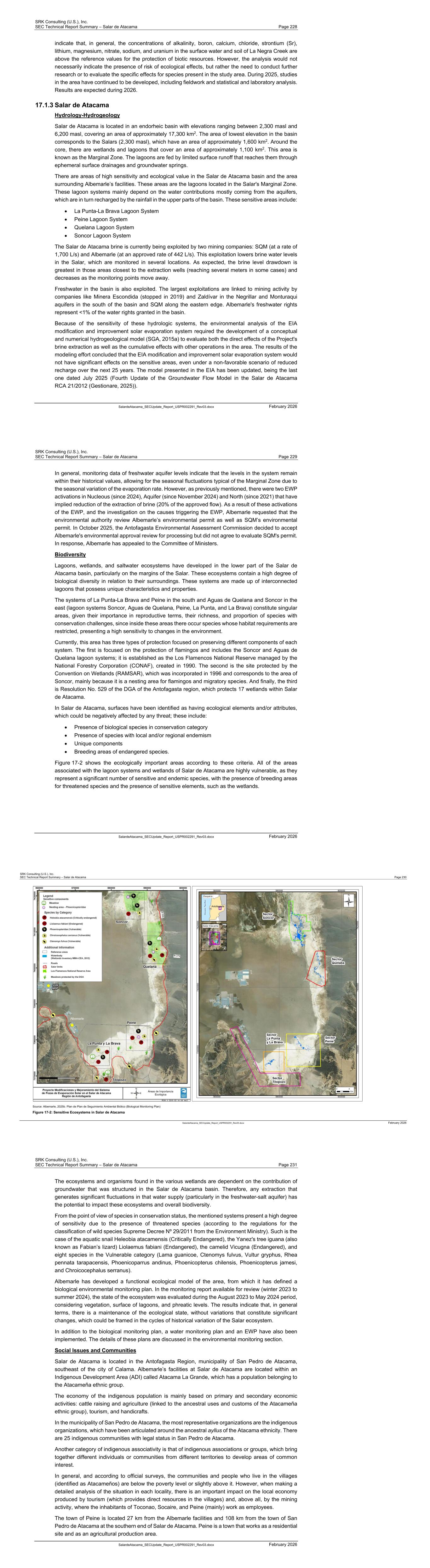
SRK Consulting (U.S.), Inc. SEC Technical Report Summary – Salar de Atacama Page 228 SalardeAtacama_SECUpdate_Report_USPR002291_Rev03.docx February 2026 indicate that, in general, the concentrations of alkalinity, boron, calcium, chloride, strontium (Sr), lithium, magnesium, nitrate, sodium, and uranium in the surface water and soil of La Negra Creek are above the reference values for the protection of biotic resources. However, the analysis would not necessarily indicate the presence of risk of ecological effects, but rather the need to conduct further research or to evaluate the specific effects for species present in the study area. During 2025, studies in the area have continued to be developed, including fieldwork and statistical and laboratory analysis. Results are expected during 2026. 17.1.3 Salar de Atacama Hydrology-Hydrogeology Salar de Atacama is located in an endorheic basin with elevations ranging between 2,300 masl and 6,200 masl, covering an area of approximately 17,300 km2. The area of lowest elevation in the basin corresponds to the Salars (2,300 masl), which have an area of approximately 1,600 km2. Around the core, there are wetlands and lagoons that cover an area of approximately 1,100 km2. This area is known as the Marginal Zone. The lagoons are fed by limited surface runoff that reaches them through ephemeral surface drainages and groundwater springs. There are areas of high sensitivity and ecological value in the Salar de Atacama basin and the area surrounding Albemarle’s facilities. These areas are the lagoons located in the Salar's Marginal Zone. These lagoon systems mainly depend on the water contributions mostly coming from the aquifers, which are in turn recharged by the rainfall in the upper parts of the basin. These sensitive areas include: La Punta-La Brava Lagoon System Peine Lagoon System Quelana Lagoon System Soncor Lagoon System The Salar de Atacama brine is currently being exploited by two mining companies: SQM (at a rate of 1,700 L/s) and Albemarle (at an approved rate of 442 L/s). This exploitation lowers brine water levels in the Salar, which are monitored in several locations. As expected, the brine level drawdown is greatest in those areas closest to the extraction wells (reaching several meters in some cases) and decreases as the monitoring points move away. Freshwater in the basin is also exploited. The largest exploitations are linked to mining activity by companies like Minera Escondida (stopped in 2019) and Zaldívar in the Negrillar and Monturaqui aquifers in the south of the basin and SQM along the eastern edge. Albemarle's freshwater rights represent <1% of the water rights granted in the basin. Because of the sensitivity of these hydrologic systems, the environmental analysis of the EIA modification and improvement solar evaporation system required the development of a conceptual and numerical hydrogeological model (SGA, 2015a) to evaluate both the direct effects of the Project's brine extraction as well as the cumulative effects with other operations in the area. The results of the modeling effort concluded that the EIA modification and improvement solar evaporation system would not have significant effects on the sensitive areas, even under a non-favorable scenario of reduced recharge over the next 25 years. The model presented in the EIA has been updated, being the last one dated July 2025 (Fourth Update of the Groundwater Flow Model in the Salar de Atacama RCA 21/2012 (Gestionare, 2025)). SRK Consulting (U.S.), Inc. SEC Technical Report Summary – Salar de Atacama Page 229 SalardeAtacama_SECUpdate_Report_USPR002291_Rev03.docx February 2026 In general, monitoring data of freshwater aquifer levels indicate that the levels in the system remain within their historical values, allowing for the seasonal fluctuations typical of the Marginal Zone due to the seasonal variation of the evaporation rate. However, as previously mentioned, there were two EWP activations in Nucleous (since 2024), Aquifer (since November 2024) and North (since 2021) that have implied reduction of the extraction of brine (20% of the approved flow). As a result of these activations of the EWP, and the investigation on the causes triggering the EWP, Albemarle requested that the environmental authority review Albemarle’s environmental permit as well as SQM’s environmental permit. In October 2025, the Antofagasta Environmental Assessment Commission decided to accept Albemarle's environmental approval review for processing but did not agree to evaluate SQM's permit. In response, Albemarle has appealed to the Committee of Ministers. Biodiversity Lagoons, wetlands, and saltwater ecosystems have developed in the lower part of the Salar de Atacama basin, particularly on the margins of the Salar. These ecosystems contain a high degree of biological diversity in relation to their surroundings. These systems are made up of interconnected lagoons that possess unique characteristics and properties. The systems of La Punta-La Brava and Peine in the south and Aguas de Quelana and Soncor in the east (lagoon systems Soncor, Aguas de Quelana, Peine, La Punta, and La Brava) constitute singular areas, given their importance in reproductive terms, their richness, and proportion of species with conservation challenges, since inside these areas there occur species whose habitat requirements are restricted, presenting a high sensitivity to changes in the environment. Currently, this area has three types of protection focused on preserving different components of each system. The first is focused on the protection of flamingos and includes the Soncor and Aguas de Quelana lagoon systems; it is established as the Los Flamencos National Reserve managed by the National Forestry Corporation (CONAF), created in 1990. The second is the site protected by the Convention on Wetlands (RAMSAR), which was incorporated in 1996 and corresponds to the area of Soncor, mainly because it is a nesting area for flamingos and migratory species. And finally, the third is Resolution No. 529 of the DGA of the Antofagasta region, which protects 17 wetlands within Salar de Atacama. In Salar de Atacama, surfaces have been identified as having ecological elements and/or attributes, which could be negatively affected by any threat; these include: Presence of biological species in conservation category Presence of species with local and/or regional endemism Unique components Breeding areas of endangered species. Figure 17-2 shows the ecologically important areas according to these criteria. All of the areas associated with the lagoon systems and wetlands of Salar de Atacama are highly vulnerable, as they represent a significant number of sensitive and endemic species, with the presence of breeding areas for threatened species and the presence of sensitive elements, such as the wetlands. SRK Consulting (U.S.), Inc. SEC Technical Report Summary – Salar de Atacama Page 230 SalardeAtacama_SECUpdate_Report_USPR002291_Rev03.docx February 2026 Source: Albemarle, 2025b. Plan de Plan de Seguimiento Ambiental Biótico (Biological Monitoring Plan) Figure 17-2: Sensitive Ecosystems in Salar de Atacama SRK Consulting (U.S.), Inc. SEC Technical Report Summary – Salar de Atacama Page 231 SalardeAtacama_SECUpdate_Report_USPR002291_Rev03.docx February 2026 The ecosystems and organisms found in the various wetlands are dependent on the contribution of groundwater that was structured in the Salar de Atacama basin. Therefore, any extraction that generates significant fluctuations in that water supply (particularly in the freshwater-salt aquifer) has the potential to impact these ecosystems and overall biodiversity. From the point of view of species in conservation status, the mentioned systems present a high degree of sensitivity due to the presence of threatened species (according to the regulations for the classification of wild species Supreme Decree Nº 29/2011 from the Environment Ministry). Such is the case of the aquatic snail Heleobia atacamensis (Critically Endangered), the Yanez's tree iguana (also known as Fabian’s lizard) Liolaemus fabiani (Endangered), the camelid Vicugna (Endangered), and eight species in the Vulnerable category (Lama guanicoe, Ctenomys fulvus, Vultur gryphus, Rhea pennata tarapacensis, Phoenicoparrus andinus, Phoenicopterus chilensis, Phoenicopterus jamesi, and Chroicocephalus serranus). Albemarle has developed a functional ecological model of the area, from which it has defined a biological environmental monitoring plan. In the monitoring report available for review (winter 2023 to summer 2024), the state of the ecosystem was evaluated during the August 2023 to May 2024 period, considering vegetation, surface of lagoons, and phreatic levels. The results indicate that, in general terms, there is a maintenance of the ecological state, without variations that constitute significant changes, which could be framed in the cycles of historical variation of the Salar ecosystem. In addition to the biological monitoring plan, a water monitoring plan and an EWP have also been implemented. The details of these plans are discussed in the environmental monitoring section. Social Issues and Communities Salar de Atacama is located in the Antofagasta Region, municipality of San Pedro de Atacama, southeast of the city of Calama. Albemarle’s facilities at Salar de Atacama are located within an Indigenous Development Area (ADI) called Atacama La Grande, which has a population belonging to the Atacameña ethnic group. The economy of the indigenous population is mainly based on primary and secondary economic activities: cattle raising and agriculture (linked to the ancestral uses and customs of the Atacameña ethnic group), tourism, and handicrafts. In the municipality of San Pedro de Atacama, the most representative organizations are the indigenous organizations, which have been articulated around the ancestral ayllus of the Atacama ethnicity. There are 25 indigenous communities with legal status in San Pedro de Atacama. Another category of indigenous associativity is that of indigenous associations or groups, which bring together different individuals or communities from different territories to develop areas of common interest. In general, and according to official surveys, the communities and people who live in the villages (identified as Atacameños) are below the poverty level or slightly above it. However, when making a detailed analysis of the situation in each locality, there is an important impact on the local economy produced by tourism (which provides direct resources in the villages) and, above all, by the mining activity, where the inhabitants of Toconao, Socaire, and Peine (mainly) work as employees. The town of Peine is located 27 km from the Albemarle facilities and 108 km from the town of San Pedro de Atacama at the southern end of Salar de Atacama. Peine is a town that works as a residential site and as an agricultural production area.

SRK Consulting (U.S.), Inc. SEC Technical Report Summary – Salar de Atacama Page 232 SalardeAtacama_SECUpdate_Report_USPR002291_Rev03.docx February 2026 The Salar de Atacama area is also a relevant sector for tourism and is part of the Zone of Tourist Interest (ZOIT) San Pedro de Atacama Area - El Tatio Geothermal Basin. Albemarle maintains agreements and relationships with the Council of Atacameños Peoples and 18 indigenous communities in the area. Considering the presence of indigenous communities in the area, the development projects (that are submitted into the environmental impact assessment system) may require the development of an Indigenous Consultation Process according to Chilean legislation and regulation. Known Environmental Issues Any requirement of a brine extraction greater than the one approved (442 L/s) has an uncertain approval success, considering the multi-user conditions in Salar de Atacama, the sensitivity of the ecosystem, and the synergistic impacts on this ecosystem which concern the environmental and water authorities. To prevent any unforeseen potential risk, the EWP could be activated because of the exceedance of an established threshold, which could result in the reduction of the amount of brine authorized for extraction. During 2024 until the closure of this report, there were three activations of the EWP that implied a reduction of 60 L/s (20%) in the brine exploitation. In 2022, Albemarle Limitada was sued for environmental damage by the Chilean State Defense Council (Consejo de Defensa del Estado), together with two other copper mining companies. The lawsuit sought to remedy an alleged damage caused to a wetland area in Salar the Atacama caused by water extraction. The environmental lawsuit was settled, and an agreement was approved by the Environmental Courts on December 16, 2024. The agreement does not jeopardize Albemarle´s capacity to extract the lithium resources or reserves of Salar de Atacama. In March 2022, the Superintendence of the Environment filed charges against Albemarle Limitada alleging non- compliance with conditions, standards, and measures established in the Environmental Qualification Resolution No. 21/2016. Albemarle filed a statement of defense against this accusation in April 2022, along with information that was requested by the authority. In September 2025, the Superintendence of Environment issued a resolution imposing a fine to Albemarle, in response to which the company filed a complaint against the sanctioning resolution with the Committee of Ministers before the Environmental Court. The complaint was admitted for processing, and the judicial review is currently underway. Neither litigation is expected to impact Albemarle’s capacity to extract the lithium resources or reserves of Salar de Atacama. In May 2024, Albemarle requested that the environmental authority review Albemarle’s and SQM’s environmental permits due to a report that has concluded that there is a variable evolving differently than was predicted. This procedure aims to determine measures to tackle any adverse effect in the environment due to the described evolution. In October 2025, the Antofagasta Environmental Assessment Commission decided to accept Albemarle's environmental approval review for processing, but did not agree to evaluate SQM's permit. In response, Albemarle appealed to the Committee of Ministers. Environmental Management Planning The environmental management of the operations in La Negra and Salar de Atacama are developed according to their environmental commitments that have emerged from the projects evaluated and SRK Consulting (U.S.), Inc. SEC Technical Report Summary – Salar de Atacama Page 233 SalardeAtacama_SECUpdate_Report_USPR002291_Rev03.docx February 2026 approved by the environmental authority (SEA) and supervised by the Environmental Superintendence (SMA). Chilean environmental legislation does not consider additional environmental management plans, with the exception of hazardous waste management plans (required by the health authority) for operations that annually generate more than 12 t of hazardous industrial waste. According to each operation and their environmental commitments, the following are the management plans for La Negra and Salar de Atacama facilities: La Negra: o Water quality monitoring plan o Emergency and contingency prevention plan o Hazardous waste management plan Salar de Atacama: o Biodiversity monitoring plan o Environmental water monitoring plan o EWP o Emergency and contingency prevention plan o Hazardous waste management plan The following sections summarize the main environmental management issues for the La Negra and Salar de Atacama facilities. 17.1.4 Tailing Disposal Although Albemarle's operation does not have tailings per se, it does generate liquid waste at La Negra, which is managed as follows. The process at the La Negra plant (up to Phase 2) collects solid/liquid waste together (in a wet state) in the existing system of evaporation and sedimentation ponds. Phase 3 considers a waste disposal system that includes the segregation of liquid and solid waste. The solid waste is stored as low moisture solids (collection sites), and the liquid waste is treated as recovery waste to be recycled to the plant using the La Negra evaporation and sedimentation ponds system. The Li2CO3 plant generates liquid waste, mainly from the SX process. The operation incorporates technology to reuse the mother liquor and thus optimize the use of process water and in turn recover lithium. The water generated in the different stages of the process, including the solutions coming from the cleaning of equipment (HCl or H2SO4), is taken to the thermal evaporator and then returned to the process for reuse. The mother liquor is sent to the thermal evaporation plant or to the solar evaporation system. From the thermal system, a high-purity water stream (condensate) is recovered for recycling into the process. The byproducts of the thermal evaporation plant are NaCl (salt) and a weak LiCl brine stream that is recycled to the process. In the solar evaporation system, the water is evaporated by solar radiation, and the byproduct salt is precipitated and accumulated in ponds. The process of brine concentration by means of solar evaporation ponds generates the precipitation of waste salts that are extracted from the ponds and are currently accumulated in stockpiles (see waste discussion). The evaporation/sedimentation ponds are lined with a low-permeability polyvinyl chloride (PVC) geomembrane. SRK Consulting (U.S.), Inc. SEC Technical Report Summary – Salar de Atacama Page 234 SalardeAtacama_SECUpdate_Report_USPR002291_Rev03.docx February 2026 The operation at La Negra has a system of trenches to monitor infiltration. In the event that infiltration is detected (either due to an increase in the piezometric level or changes in the chemical quality of the water attributable to such infiltration), these are captured by the wells, and the relevant studies will be carried out. At the same time, the possible point of infiltration from the pond will be located to conduct repairs (as needed). 17.1.5 Waste Management La Negra Process Reagents The chemical reagents used at Salar de Atacama include HCl, methyl iso-butyl carbonyl (foaming agent), Crisamine (collector), and Cricell (depressant). These reagents are stored in warehouses authorized by the health service that comply with the conditions established in the legislation applicable to hazardous substances, where applicable. Fuels Salar de Atacama maintains a plant fuel supply (operated by an authorized outside company) that consists of a tank, which complies with the regulations for the storage of liquid fuels for self- consumption (Supreme Decree Nº 379/86 of the Ministry of Economy) and is authorized by the Superintendence of Fuels. Disposal of Non-Hazardous and Hazardous Waste Domestic solid waste is temporarily stored at a site authorized by the health service and transferred for final disposal outside the facilities to an authorized landfill in the region. Non-hazardous waste is segregated at its source and disposed of in a yard (salvage yard) authorized by the health service. From here, waste is disposed of in authorized locations or reused. Hazardous industrial waste (which includes mainly vehicle batteries, oil filters, rags contaminated with grease and oil, waste oils, paints, and contaminated personal protective equipment (PPE), among others) are temporarily disposed of in a warehouse authorized by the health service and then transported to authorized off-site disposal sites. Residual Salts The process of brine concentration by means of solar evaporation ponds generates the precipitation of waste salts that remain in the ponds. The process generates three types of solid salt wastes: Calcium and magnesium carbonates and hydroxides from the brine purification stage Calcium/sodium borates from the boron precipitation (removal) process NaCl from the thermal evaporation system Salar de Atacama Process Reagents The chemical reagents used at Salar de Atacama include HCl, methyl iso-butyl carbonyl (foaming agent), Crisamine (collector), and Cricell (depressant). These chemicals are stored in warehouses authorized by the health service that comply with the conditions established in the legislation applicable to hazardous substances, where applicable. SRK Consulting (U.S.), Inc. SEC Technical Report Summary – Salar de Atacama Page 235 SalardeAtacama_SECUpdate_Report_USPR002291_Rev03.docx February 2026 Fuels Salar de Atacama maintains a plant fuel supply (operated by an authorized outside company) that consists of a tank, which complies with the regulations for the storage of liquid fuels for self- consumption (Supreme Decree Nº 379/86 of the Ministry of Economy) and is authorized by the Superintendence of Fuels. Disposal of Non-Hazardous and Hazardous Waste Domestic solid waste is temporarily stored on-site at a location authorized by the health service and later transferred off-site to an authorized landfill in the region for final disposal. Non-hazardous waste is segregated at its source and disposed of in a yard (salvage yard) authorized by the health service. From here, waste is disposed of in authorized locations or reused. Hazardous industrial waste (consisting of mainly vehicle batteries, oil filters, rags contaminated with grease and oil, used oils, paints, and contaminated PPE, among others) are temporarily stored in a warehouse authorized by the health service and then transported to authorized final disposal sites. Residual Salts At Salar de Atacama, brine is extracted from wells, and the brine concentration process is through solar evaporation ponds, where the precipitation of waste salts is generated. These waste salts are excavated from the ponds and deposited in stockpiles. As the LiCl solution is concentrated, different salts precipitate in each pond, among which include halite, bischofite, carnallite, and sylvite. The latter is entered into the potash plant to produce KCl and carnallite. Once the brine is concentrated at 6% Li, the brine is sent to the La Negra plant. 17.1.6 Water Management La Negra The industrial water used in the operation comes from water acquired from third parties and (to a lesser extent) from two existing wells at the facilities with water rights for up to 6 L/s for one and 7 L/s for the other. At La Negra, the brine from Salar de Atacama is purified for the extraction of lithium. All solutions are evaporated and/or recirculated to the process. Stormwater runoff, though infrequent, is managed through a series of diversion channels around the plant, ponds, and stockpiles areas. Salar de Atacama The freshwater used in the process at Salar de Atacama is extracted from spring water in Tilopozo and wells in Tucucaro and Peine, with a total water right granted by the DGA of 23.5 L/s. Currently, 16.9 L/s are being consumed in the process. It should be noted that this amount considers that the EWP of the Aquifer Sector is not activated in its single phase, since in case of activation, only a maximum instantaneous flow of 10.9 L/s can be extracted as a sum of the points Veriente Pozo and Pozo Tucucaro. The agreement reached on December 12, 2024, in relation to the environmental damage lawsuit against Albemarle and other mining companies, requires Albemarle to cease extracting water for production purposes from wells in the Salar de Atacama basin 40 months after the signature of the agreement. Considering the above, Albemarle is already working on a plan to bring water for the process from outside the Salar de Atacama basin.
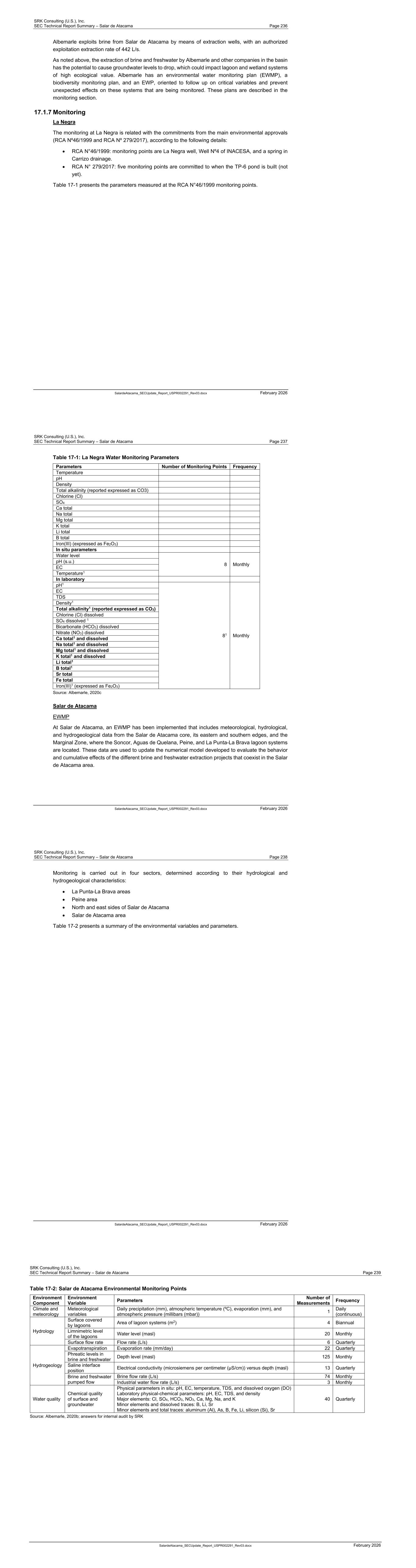
SRK Consulting (U.S.), Inc. SEC Technical Report Summary – Salar de Atacama Page 236 SalardeAtacama_SECUpdate_Report_USPR002291_Rev03.docx February 2026 Albemarle exploits brine from Salar de Atacama by means of extraction wells, with an authorized exploitation extraction rate of 442 L/s. As noted above, the extraction of brine and freshwater by Albemarle and other companies in the basin has the potential to cause groundwater levels to drop, which could impact lagoon and wetland systems of high ecological value. Albemarle has an environmental water monitoring plan (EWMP), a biodiversity monitoring plan, and an EWP, oriented to follow up on critical variables and prevent unexpected effects on these systems that are being monitored. These plans are described in the monitoring section. 17.1.7 Monitoring La Negra The monitoring at La Negra is related with the commitments from the main environmental approvals (RCA Nº46/1999 and RCA Nº 279/2017), according to the following details: RCA N°46/1999: monitoring points are La Negra well, Well Nº4 of INACESA, and a spring in Carrizo drainage. RCA N° 279/2017: five monitoring points are committed to when the TP-6 pond is built (not yet). Table 17-1 presents the parameters measured at the RCA N°46/1999 monitoring points. SRK Consulting (U.S.), Inc. SEC Technical Report Summary – Salar de Atacama Page 237 SalardeAtacama_SECUpdate_Report_USPR002291_Rev03.docx February 2026 Table 17-1: La Negra Water Monitoring Parameters Parameters Number of Monitoring Points Frequency Temperature pH Density Total alkalinity (reported expressed as CO3) Chlorine (Cl) SO4 Ca total Na total Mg total K total Li total B total Iron(III) (expressed as Fe2O3) In situ parameters Water level 8 Monthly pH (s.u.) EC Temperature1 In laboratory pH1 81 Monthly EC TDS Density1 Total alkalinity1 (reported expressed as CO3) Chlorine (Cl) dissolved SO4 dissolved 1 Bicarbonate (HCO3) dissolved Nitrate (NO3) dissolved Ca total1 and dissolved Na total1 and dissolved Mg total1 and dissolved K total1 and dissolved Li total1 B total1 Sr total Fe total Iron(III)1 (expressed as Fe2O3) Source: Albemarle, 2020c Salar de Atacama EWMP At Salar de Atacama, an EWMP has been implemented that includes meteorological, hydrological, and hydrogeological data from the Salar de Atacama core, its eastern and southern edges, and the Marginal Zone, where the Soncor, Aguas de Quelana, Peine, and La Punta-La Brava lagoon systems are located. These data are used to update the numerical model developed to evaluate the behavior and cumulative effects of the different brine and freshwater extraction projects that coexist in the Salar de Atacama area. SRK Consulting (U.S.), Inc. SEC Technical Report Summary – Salar de Atacama Page 238 SalardeAtacama_SECUpdate_Report_USPR002291_Rev03.docx February 2026 Monitoring is carried out in four sectors, determined according to their hydrological and hydrogeological characteristics: La Punta-La Brava areas Peine area North and east sides of Salar de Atacama Salar de Atacama area Table 17-2 presents a summary of the environmental variables and parameters. SRK Consulting (U.S.), Inc. SEC Technical Report Summary – Salar de Atacama Page 239 SalardeAtacama_SECUpdate_Report_USPR002291_Rev03.docx February 2026 Table 17-2: Salar de Atacama Environmental Monitoring Points Environment Component Environment Variable Parameters Number of Measurements Frequency Climate and meteorology Meteorological variables Daily precipitation (mm), atmospheric temperature (ºC), evaporation (mm), and atmospheric pressure (millibars (mbar)) 1 Daily (continuous) Hydrology Surface covered by lagoons Area of lagoon systems (m2) 4 Biannual Limnimetric level of the lagoons Water level (masl) 20 Monthly Surface flow rate Flow rate (L/s) 6 Quarterly Hydrogeology Evapotranspiration Evaporation rate (mm/day) 22 Quarterly Phreatic levels in brine and freshwater Depth level (masl) 125 Monthly Saline interface position Electrical conductivity (microsiemens per centimeter (µS/cm)) versus depth (masl) 13 Quarterly Brine and freshwater pumped flow Brine flow rate (L/s) 74 Monthly Industrial water flow rate (L/s) 3 Monthly Water quality Chemical quality of surface and groundwater Physical parameters in situ: pH, EC, temperature, TDS, and dissolved oxygen (DO) Laboratory physical-chemical parameters: pH, EC, TDS, and density Major elements: Cl, SO4, HCO3, NO3, Ca, Mg, Na, and K Minor elements and dissolved traces: B, Li, Sr Minor elements and total traces: aluminum (Al), As, B, Fe, Li, silicon (Si), Sr 40 Quarterly Source: Albemarle, 2020b; answers for internal audit by SRK
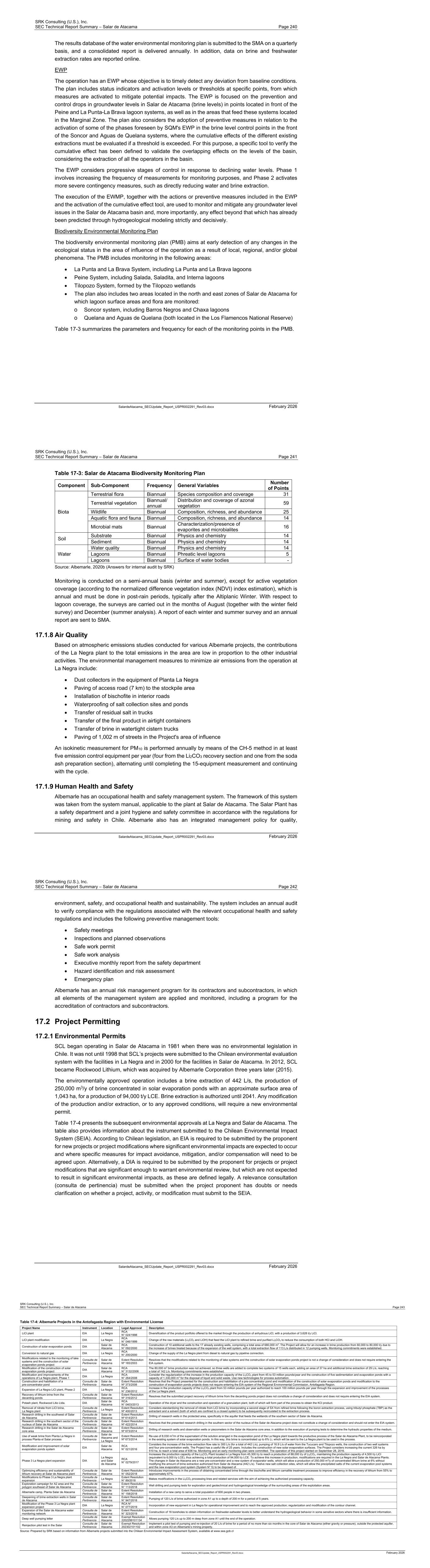
SRK Consulting (U.S.), Inc. SEC Technical Report Summary – Salar de Atacama Page 240 SalardeAtacama_SECUpdate_Report_USPR002291_Rev03.docx February 2026 The results database of the water environmental monitoring plan is submitted to the SMA on a quarterly basis, and a consolidated report is delivered annually. In addition, data on brine and freshwater extraction rates are reported online. EWP The operation has an EWP whose objective is to timely detect any deviation from baseline conditions. The plan includes status indicators and activation levels or thresholds at specific points, from which measures are activated to mitigate potential impacts. The EWP is focused on the prevention and control drops in groundwater levels in Salar de Atacama (brine levels) in points located in front of the Peine and La Punta-La Brava lagoon systems, as well as in the areas that feed these systems located in the Marginal Zone. The plan also considers the adoption of preventive measures in relation to the activation of some of the phases foreseen by SQM's EWP in the brine level control points in the front of the Soncor and Aguas de Quelana systems, where the cumulative effects of the different existing extractions must be evaluated if a threshold is exceeded. For this purpose, a specific tool to verify the cumulative effect has been defined to validate the overlapping effects on the levels of the basin, considering the extraction of all the operators in the basin. The EWP considers progressive stages of control in response to declining water levels. Phase 1 involves increasing the frequency of measurements for monitoring purposes, and Phase 2 activates more severe contingency measures, such as directly reducing water and brine extraction. The execution of the EWMP, together with the actions or preventive measures included in the EWP and the activation of the cumulative effect tool, are used to monitor and mitigate any groundwater level issues in the Salar de Atacama basin and, more importantly, any effect beyond that which has already been predicted through hydrogeological modeling strictly and decisively. Biodiversity Environmental Monitoring Plan The biodiversity environmental monitoring plan (PMB) aims at early detection of any changes in the ecological status in the area of influence of the operation as a result of local, regional, and/or global phenomena. The PMB includes monitoring in the following areas: La Punta and La Brava System, including La Punta and La Brava lagoons Peine System, including Salada, Saladita, and Interna lagoons Tilopozo System, formed by the Tilopozo wetlands The plan also includes two areas located in the north and east zones of Salar de Atacama for which lagoon surface areas and flora are monitored: o Soncor system, including Barros Negros and Chaxa lagoons o Quelana and Aguas de Quelana (both located in the Los Flamencos National Reserve) Table 17-3 summarizes the parameters and frequency for each of the monitoring points in the PMB. SRK Consulting (U.S.), Inc. SEC Technical Report Summary – Salar de Atacama Page 241 SalardeAtacama_SECUpdate_Report_USPR002291_Rev03.docx February 2026 Table 17-3: Salar de Atacama Biodiversity Monitoring Plan Component Sub-Component Frequency General Variables Number of Points Biota Terrestrial flora Biannual Species composition and coverage 31 Terrestrial vegetation Biannual/ annual Distribution and coverage of azonal vegetation 59 Wildlife Biannual Composition, richness, and abundance 25 Aquatic flora and fauna Biannual Composition, richness, and abundance 14 Microbial mats Biannual Characterization/presence of evaporites and microbialites 16 Soil Substrate Biannual Physics and chemistry 14 Sediment Biannual Physics and chemistry 14 Water Water quality Biannual Physics and chemistry 14 Lagoons Biannual Phreatic level lagoons 5 Lagoons Biannual Surface of water bodies - Source: Albemarle, 2020b (Answers for internal audit by SRK) Monitoring is conducted on a semi-annual basis (winter and summer), except for active vegetation coverage (according to the normalized difference vegetation index (NDVI) index estimation), which is annual and must be done in post-rain periods, typically after the Altiplanic Winter. With respect to lagoon coverage, the surveys are carried out in the months of August (together with the winter field survey) and December (summer analysis). A report of each winter and summer survey and an annual report are sent to SMA. 17.1.8 Air Quality Based on atmospheric emissions studies conducted for various Albemarle projects, the contributions of the La Negra plant to the total emissions in the area are low in proportion to the other industrial activities. The environmental management measures to minimize air emissions from the operation at La Negra include: Dust collectors in the equipment of Planta La Negra Paving of access road (7 km) to the stockpile area Installation of bischofite in interior roads Waterproofing of salt collection sites and ponds Transfer of residual salt in trucks Transfer of the final product in airtight containers Transfer of brine in watertight cistern trucks Paving of 1,002 m of streets in the Project's area of influence An isokinetic measurement for PM10 is performed annually by means of the CH-5 method in at least five emission control equipment per year (four from the Li2CO3 recovery section and one from the soda ash preparation section), alternating until completing the 15-equipment measurement and continuing with the cycle. 17.1.9 Human Health and Safety Albemarle has an occupational health and safety management system. The framework of this system was taken from the system manual, applicable to the plant at Salar de Atacama. The Salar Plant has a safety department and a joint hygiene and safety committee in accordance with the regulations for mining and safety in Chile. Albemarle also has an integrated management policy for quality, SRK Consulting (U.S.), Inc. SEC Technical Report Summary – Salar de Atacama Page 242 SalardeAtacama_SECUpdate_Report_USPR002291_Rev03.docx February 2026 environment, safety, and occupational health and sustainability. The system includes an annual audit to verify compliance with the regulations associated with the relevant occupational health and safety regulations and includes the following preventive management tools: Safety meetings Inspections and planned observations Safe work permit Safe work analysis Executive monthly report from the safety department Hazard identification and risk assessment Emergency plan Albemarle has an annual risk management program for its contractors and subcontractors, in which all elements of the management system are applied and monitored, including a program for the accreditation of contractors and subcontractors. 17.2 Project Permitting 17.2.1 Environmental Permits SCL began operating in Salar de Atacama in 1981 when there was no environmental legislation in Chile. It was not until 1998 that SCL’s projects were submitted to the Chilean environmental evaluation system with the facilities in La Negra and in 2000 for the facilities in Salar de Atacama. In 2012, SCL became Rockwood Lithium, which was acquired by Albemarle Corporation three years later (2015). The environmentally approved operation includes a brine extraction of 442 L/s, the production of 250,000 m3/y of brine concentrated in solar evaporation ponds with an approximate surface area of 1,043 ha, for a production of 94,000 t/y LCE. Brine extraction is authorized until 2041. Any modification of the production and/or extraction, or to any approved conditions, will require a new environmental permit. Table 17-4 presents the subsequent environmental approvals at La Negra and Salar de Atacama. The table also provides information about the instrument submitted to the Chilean Environmental Impact System (SEIA). According to Chilean legislation, an EIA is required to be submitted by the proponent for new projects or project modifications where significant environmental impacts are expected to occur and where specific measures for impact avoidance, mitigation, and/or compensation will need to be agreed upon. Alternatively, a DIA is required to be submitted by the proponent for projects or project modifications that are significant enough to warrant environmental review, but which are not expected to result in significant environmental impacts, as these are defined legally. A relevance consultation (consulta de pertinencia) must be submitted when the project proponent has doubts or needs clarification on whether a project, activity, or modification must submit to the SEIA. SRK Consulting (U.S.), Inc. SEC Technical Report Summary – Salar de Atacama Page 243 SalardeAtacama_SECUpdate_Report_USPR002291_Rev03.docx February 2026 Table 17-4: Albemarle Projects in the Antofagasta Region with Environmental License Project Name Instrument Location Legal Approval Description LiCl plant EIA La Negra RCA N° 024/1998 Diversification of the product portfolio offered to the market through the production of anhydrous LiCl, with a production of 3,628 t/y LiCl. LiCl plant modification DIA La Negra RCA N° 046/1999 Change of the raw materials (Li2CO3 and LiOH) that feed the LiCl plant to refined brine and purified Li2CO3 to reduce the consumption of both HCl and LiOH. Construction of solar evaporation ponds DIA Salar de Atacama RCA N° 092/2000 Construction of 10 additional wells to the 17 already existing wells, comprising a total area of 680,000 m2. The Project will allow for an increase in brine production from 60,000 to 80,000 t/y due to the increase of brines treated because of the expansion of the well system, with a total extraction flow of 113 L/s distributed in 12 pumping wells. Monitoring commitments were established. Conversion to natural gas DIA La Negra RCA N° 200/2000 Change of the supply of the La Negra plant from diesel to natural gas by pipeline connection. Modifications related to the monitoring of lake systems and the construction of solar evaporation ponds project Consulta de Pertinencia Salar de Atacama Extent Resolution Nº 165/2003 Resolves that the modifications related to the monitoring of lake systems and the construction of solar evaporation ponds project is not a change of consideration and does not require entering the EIA system. Modification of the construction of solar evaporation ponds project DIA Salar de Atacama RCA N° 3132/2006 The 80,000 m3 brine production was not achieved, so three wells are added to complete two systems of 15 wells each, adding an area of 37 ha and additional brine extraction of 29 L/s, reaching a total of 142 L/s. Monitoring commitments were established. Modification and improvements of the operations of La Negra plant, Phase 1 DIA La Negra RCA N° 264/2008 Consider the regularization of the increase in the production capacity of the Li2CO3 plant from 45 to 53 million pounds/year and the construction of five sedimentation and evaporation ponds with a capacity of 1,330,000 m3 for the disposal of liquid and solid waste. Use new technologies for process automation. Construction and habilitation of a pre-concentrator pond Consulta de Pertinencia Salar de Atacama Extent Resolution Nº 373/2008 Resolves that the Project presented for the construction and habilitation of a pre-concentrator pond and modification of the construction of solar evaporation ponds and modification to the construction of evaporation ponds projects does not require entering the EIA system of the Regional Environmental Commission, Antofagasta Region. Expansion of La Negra LiCl plant, Phase 2 DIA La Negra RCA N° 236/2012 Increase in the production capacity of the Li2CO3 plant from 53 million pounds per year authorized to reach 100 million pounds per year through the expansion and improvement of the processes of the La Negra plant. Recovery of lithium brine from the decanting ponds Consulta de Pertinencia Salar de Atacama Extent Resolution Nº 316/2012 Resolves that the submitted project recovery of lithium brine from the decanting ponds project does not constitute a change of consideration and does not require entering the EIA system. Potash plant, Rockwood Litio Ltda. DIA Salar de Atacama RCA N° 0403/2013 Operation of the dryer and the construction and operation of a granulation plant, both of which will form part of the process to obtain the KCl product. Removal of nitrate from LiCl brine, La Negra plant Consulta de Pertinencia La Negra Extent Resolution Nº 400/2013 Considers standardizing the removal of nitrate from LiCl brine by incorporating a second stage of SX from refined brine following the boron extraction process, using tributyl phosphate (TBP) as the extractant and a solvent (both of which are confined to a closed system) to be subsequently recirculated to the extraction process. Research drilling in the southwest of Salar de Atacama Consulta de Pertinencia Salar de Atacama Extent Resolution Nº 614/2013 Drilling of research wells in the protected area, specifically in the aquifer that feeds the wetlands of the southern sector of Salar de Atacama. Research drilling in the southern sector of the nucleus of Salar de Atacama Consulta de Pertinencia Salar de Atacama Extent Resolution Nº 422/2014 Resolves that the presented research drilling in the southern sector of the nucleus of the Salar de Atacama project does not constitute a change of consideration and should not enter the EIA system. Research drilling in the Salar de Atacama core area Consulta de Pertinencia Salar de Atacama Extent Resolution Nº 673/2014 Drilling of research wells and observation wells or piezometers in the Salar de Atacama core area, in addition to the execution of pumping tests to determine the hydraulic properties of the medium. Use of weak brine from Planta La Negra in process Planta el Salar process Consulta de Pertinencia Salar de Atacama and La Negra Extent Resolution Nº 673/2014 Re-use of 8,030 m3/m of the supernatant of the solution arranged in the evaporation pond of the La Negra plant towards the productive process of the Salar de Atacama Plant, to be reincorporated in the existing system of solar evaporation ponds. In this way, this brine is concentrated up to 6% Li, which will be sent to the La Negra plant to be used in the process. Modification and improvement of solar evaporation ponds system EIA Salar de Atacama RCA N° 021/2016 Considers the increase of the brine extraction flow rate to 300 L/s (for a total of 442 L/s), pumping of 16.9 L/s of water from the Tucucaro and Tilopozo wells, the construction of two well systems and four pre-concentration wells. The Project has a useful life of 25 years. Includes the construction of new solar evaporation surfaces. The Project considers increasing the current 326 ha by 510 ha, to reach a total area of 836 ha. Monitoring and an early monitoring plan were committed. The operation of this project started on September 28, 2016. Phase 3 La Negra plant expansion DIA La Negra and Salar de Atacama RCA N° 0279/2017 Increases the production capacity of the Li2CO3 Plant located in La Negra from 45,300 t/y to reach a production of 88,000 t/y of Li2CO3, maintaining the production capacity of 4,500 t/y LiCl (equivalent to 6,000 t/y LCE), thus achieving a total production of 94,000 t/y LCE. To achieve this increase in production, modifications are required in the La Negra and Salar de Atacama Plants. The changes in Salar de Atacama are a new pre-concentrator and a new system of evaporator wells, which will allow a production of 250,000 m3/y of concentrated lithium brine at 6% without modifying the amount of brine extraction authorized from Salar de Atacama (442 L/s). Twelve new salt collection sites, which will allow the precipitated salts of the current evaporation pool systems and the new evaporation pool system (System N° 5) to be disposed of. Optimizing efficiency and sustainability of lithium recovery at Salar de Atacama plant Consulta de Pertinencia Salar de Atacama Extent Resolution N° 052/2018 Introduces improvements in the process of obtaining concentrated brine through the bischofite and lithium carnallite treatment processes to improve efficiency in the recovery of lithium from 55% to approximately 67%. Modifications to Phase 3 La Negra plant expansion Consulta de Pertinencia La Negra Extent Resolution N° 89/2018 Makes modifications in the Li2CO3 processing lines and related services with the aim of achieving the authorized processing capacity. Exploration campaign for A2 area and the polygon southeast of Salar de Atacama Consulta de Pertinencia Salar de Atacama Extent Resolution N° 113/2018 Well drilling and pumping tests for exploration and geotechnical and hydrogeological knowledge of the surrounding areas of the exploitation areas. Albemarle camp, Planta Salar de Atacama Consulta de Pertinencia Salar de Atacama Extent Resolution N° 158/2018 Installation of a new camp to serve a total population of 600 people in two phases. Deepening of brine extraction wells in Salar de Atacama Consulta de Pertinencia Salar de Atacama Extent Resolution N° 947/2018 Pumping of 120 L/s of brine authorized in zone A1 up to a depth of 200 m for a period of 5 years. Modification of the Phase 3 La Negra plant expansion project DIA La Negra RCA N° N° 077/2019 Incorporation of new equipment in La Negra for operational improvement and to reach the approved production; regularization and modification of the contour channel. Expansion of the Salar de Atacama water monitoring network Consulta de Pertinencia Salar de Atacama Extent Resolution N° 323/2019 Construction of 16 boreholes to obtain information on freshwater-saltwater levels to better understand the hydrogeological behavior in some sensitive sectors where there is insufficient information. Deep well pumping letter Consulta de Pertinencia Salar de Atacama Exempt Resolution 2202299101134 Allows pumping 120 L/s up to 200 m deep from zone A1 until the end of the operation. Reinjection pilot test in the Salar Consulta de Pertinencia Salar de Atacama Exempt Resolution 202302101102 Implement a pilot test of pumping and re-injection of 20 L/s of brine for a period of no more than six months in the core of Salar de Atacama (either gravity or pressure), outside the protected aquifer, and within zone A3 on Albemarle’s mining property. Source: Prepared by SRK based on information from Albemarle projects submitted into the Chilean Environmental Impact Assessment System, available at www.sea.gob.cl
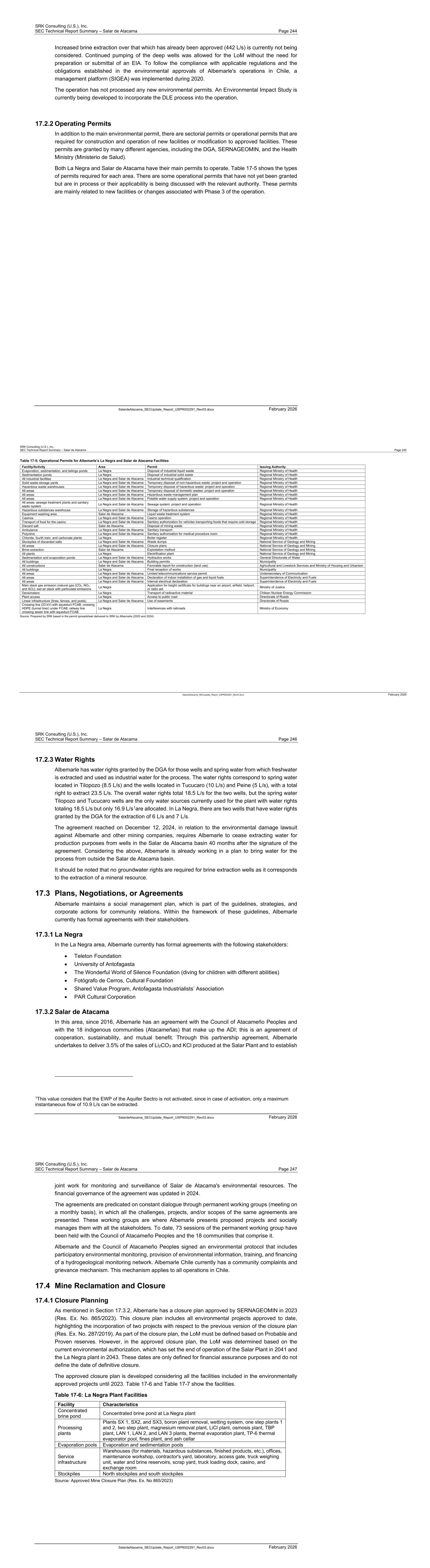
SRK Consulting (U.S.), Inc. SEC Technical Report Summary – Salar de Atacama Page 244 SalardeAtacama_SECUpdate_Report_USPR002291_Rev03.docx February 2026 Increased brine extraction over that which has already been approved (442 L/s) is currently not being considered. Continued pumping of the deep wells was allowed for the LoM without the need for preparation or submittal of an EIA. To follow the compliance with applicable regulations and the obligations established in the environmental approvals of Albemarle's operations in Chile, a management platform (SIGEA) was implemented during 2020. The operation has not processed any new environmental permits. An Environmental Impact Study is currently being developed to incorporate the DLE process into the operation. 17.2.2 Operating Permits In addition to the main environmental permit, there are sectorial permits or operational permits that are required for construction and operation of new facilities or modification to approved facilities. These permits are granted by many different agencies, including the DGA, SERNAGEOMIN, and the Health Ministry (Ministerio de Salud). Both La Negra and Salar de Atacama have their main permits to operate. Table 17-5 shows the types of permits required for each area. There are some operational permits that have not yet been granted but are in process or their applicability is being discussed with the relevant authority. These permits are mainly related to new facilities or changes associated with Phase 3 of the operation. SRK Consulting (U.S.), Inc. SEC Technical Report Summary – Salar de Atacama Page 245 SalardeAtacama_SECUpdate_Report_USPR002291_Rev03.docx February 2026 Table 17-5: Operational Permits for Albemarle’s La Negra and Salar de Atacama Facilities Facility/Activity Area Permit Issuing Authority Evaporation, sedimentation, and tailings ponds La Negra Disposal of industrial liquid waste Regional Ministry of Health Sedimentation ponds La Negra Disposal of industrial solid waste Regional Ministry of Health All industrial facilities La Negra and Salar de Atacama Industrial technical qualification Regional Ministry of Health Solid waste storage yards La Negra and Salar de Atacama Temporary disposal of non-hazardous waste: project and operation Regional Ministry of Health Hazardous waste warehouses La Negra and Salar de Atacama Temporary disposal of hazardous waste: project and operation Regional Ministry of Health All areas La Negra and Salar de Atacama Temporary disposal of domestic wastes: project and operation Regional Ministry of Health All areas La Negra and Salar de Atacama Hazardous waste management plan Regional Ministry of Health All areas La Negra and Salar de Atacama Potable water supply system: project and operation Regional Ministry of Health All areas: sewage treatment plants and sanitary septic system La Negra and Salar de Atacama Sewage system: project and operation Regional Ministry of Health Hazardous substances warehouse La Negra and Salar de Atacama Storage of hazardous substances Regional Ministry of Health Equipment washing area Salar de Atacama Liquid waste treatment system Regional Ministry of Health Casinos La Negra and Salar de Atacama Casino operation Regional Ministry of Health Transport of food for the casino La Negra and Salar de Atacama Sanitary authorization for vehicles transporting foods that require cold storage Regional Ministry of Health Discard salt Salar de Atacama Disposal of mining waste Regional Ministry of Health Ambulance La Negra and Salar de Atacama Sanitary transport Regional Ministry of Health Polyclinic La Negra and Salar de Atacama Sanitary authorization for medical procedure room Regional Ministry of Health Chloride, fourth train, and carbonate plants La Negra Boiler register Regional Ministry of Health Stockpiles of discarded salts La Negra and Salar de Atacama Waste dumps National Service of Geology and Mining All areas La Negra and Salar de Atacama Closure plans National Service of Geology and Mining Brine extraction Salar de Atacama Exploitation method National Service of Geology and Mining All plants La Negra Electrification plant National Service of Geology and Mining Sedimentation and evaporation ponds La Negra and Salar de Atacama Hydraulics works General Directorate of Water All buildings La Negra and Salar de Atacama Building permits Municipality All constructions Salar de Atacama Favorable report for construction (land use) Agricultural and Livestock Services and Ministry of Housing and Urbanism All buildings La Negra Final reception of works Municipality All areas La Negra and Salar de Atacama Limited telecommunications service permit Undersecretary of Communication All areas La Negra and Salar de Atacama Declaration of indoor installation of gas and liquid fuels Superintendence of Electricity and Fuels All areas La Negra and Salar de Atacama Internal electrical declaration Superintendence of Electricity and Fuels Main stack gas emission (natural gas (CO2, NOx, and SO2); wet air stack with particulate emissions La Negra Application for height certificate for buildings near an airport, airfield, heliport, or radio aid Ministry of Justice Densimeters La Negra Transport of radioactive material Chilean Nuclear Energy Commission Plant access La Negra Access to public road Directorate of Roads Linear infrastructure (lines, fences, and posts) La Negra and Salar de Atacama Use of easements Directorate of Roads Crossing line (23 kV) with aqueduct FCAB, crossing HDPE (tunnel liner) under FCAB; railway line crossing sewer line with aqueduct FCAB La Negra Interferences with railroads Ministry of Economy Source: Prepared by SRK based in the permit spreadsheet delivered to SRK by Albemarle (2020 and 2024) SRK Consulting (U.S.), Inc. SEC Technical Report Summary – Salar de Atacama Page 246 SalardeAtacama_SECUpdate_Report_USPR002291_Rev03.docx February 2026 17.2.3 Water Rights Albemarle has water rights granted by the DGA for those wells and spring water from which freshwater is extracted and used as industrial water for the process. The water rights correspond to spring water located in Tilopozo (8.5 L/s) and the wells located in Tucucaro (10 L/s) and Peine (5 L/s), with a total right to extract 23.5 L/s. The overall water rights total 18.5 L/s for the two wells, but the spring water Tilopozo and Tucucaro wells are the only water sources currently used for the plant with water rights totaling 18.5 L/s but only 16.9 L/s0F 1are allocated. In La Negra, there are two wells that have water rights granted by the DGA for the extraction of 6 L/s and 7 L/s. The agreement reached on December 12, 2024, in relation to the environmental damage lawsuit against Albemarle and other mining companies, requires Albemarle to cease extracting water for production purposes from wells in the Salar de Atacama basin 40 months after the signature of the agreement. Considering the above, Albemarle is already working in a plan to bring water for the process from outside the Salar de Atacama basin. It should be noted that no groundwater rights are required for brine extraction wells as it corresponds to the extraction of a mineral resource. 17.3 Plans, Negotiations, or Agreements Albemarle maintains a social management plan, which is part of the guidelines, strategies, and corporate actions for community relations. Within the framework of these guidelines, Albemarle currently has formal agreements with their stakeholders. 17.3.1 La Negra In the La Negra area, Albemarle currently has formal agreements with the following stakeholders: Teleton Foundation University of Antofagasta The Wonderful World of Silence Foundation (diving for children with different abilities) Fotógrafo de Cerros, Cultural Foundation Shared Value Program, Antofagasta Industrialists’ Association PAR Cultural Corporation 17.3.2 Salar de Atacama In this area, since 2016, Albemarle has an agreement with the Council of Atacameño Peoples and with the 18 indigenous communities (Atacameñas) that make up the ADI; this is an agreement of cooperation, sustainability, and mutual benefit. Through this partnership agreement, Albemarle undertakes to deliver 3.5% of the sales of Li2CO3 and KCl produced at the Salar Plant and to establish 1This value considers that the EWP of the Aquifer Sectro is not activated, since in case of activation, only a maximum instantaneous flow of 10.9 L/s can be extracted. SRK Consulting (U.S.), Inc. SEC Technical Report Summary – Salar de Atacama Page 247 SalardeAtacama_SECUpdate_Report_USPR002291_Rev03.docx February 2026 joint work for monitoring and surveillance of Salar de Atacama's environmental resources. The financial governance of the agreement was updated in 2024. The agreements are predicated on constant dialogue through permanent working groups (meeting on a monthly basis), in which all the challenges, projects, and/or scopes of the same agreements are presented. These working groups are where Albemarle presents proposed projects and socially manages them with all the stakeholders. To date, 73 sessions of the permanent working group have been held with the Council of Atacameño Peoples and the 18 communities that comprise it. Albemarle and the Council of Atacameño Peoples signed an environmental protocol that includes participatory environmental monitoring, provision of environmental information, training, and financing of a hydrogeological monitoring network. Albemarle Chile currently has a community complaints and grievance mechanism. This mechanism applies to all operations in Chile. 17.4 Mine Reclamation and Closure 17.4.1 Closure Planning As mentioned in Section 17.3.2, Albemarle has a closure plan approved by SERNAGEOMIN in 2023 (Res. Ex. No. 865/2023). This closure plan includes all environmental projects approved to date, highlighting the incorporation of two projects with respect to the previous version of the closure plan (Res. Ex. No. 287/2019). As part of the closure plan, the LoM must be defined based on Probable and Proven reserves. However, in the approved closure plan, the LoM was determined based on the current environmental authorization, which has set the end of operation of the Salar Plant in 2041 and the La Negra plant in 2043. These dates are only defined for financial assurance purposes and do not define the date of definitive closure. The approved closure plan is developed considering all the facilities included in the environmentally approved projects until 2023. Table 17-6 and Table 17-7 show the facilities. Table 17-6: La Negra Plant Facilities Facility Characteristics Concentrated brine pond Concentrated brine pond at La Negra plant Processing plants Plants SX 1, SX2, and SX3, boron plant removal, wetting system, one step plants 1 and 2, two step plant, magnesium removal plant, LiCl plant, osmosis plant, TBP plant, LAN 1, LAN 2, and LAN 3 plants, thermal evaporation plant, TP-6 thermal evaporator pool, fines plant, and ash cellar Evaporation pools Evaporation and sedimentation pools Service infrastructure Warehouses (for materials, hazardous substances, finished products, etc.), offices, maintenance workshop, contractor's yard, laboratory, access gate, truck weighing unit, water and brine reservoirs, scrap yard, truck loading dock, casino, and exchange room Stockpiles North stockpiles and south stockpiles Source: Approved Mine Closure Plan (Res. Ex. No 865/2023)

SRK Consulting (U.S.), Inc. SEC Technical Report Summary – Salar de Atacama Page 248 SalardeAtacama_SECUpdate_Report_USPR002291_Rev03.docx February 2026 Table 17-7: Salar de Atacama Plant Facilities Facility Characteristics Extraction well system Extraction wells (83) Evaporation concentration pond system Pre-concentrator ponds (6 units), evaporation-concentration ponds, halite ponds, sylvinite ponds, potassium carnallite ponds, lithium carnallite ponds, bischofite ponds, and reservoirs Stockpiles Halite stockpiles, bischofite stockpiles, sylvinite stockpiles, potassium carnallite stockpiles, and potash stockpiles Process plants Potash plant, potassium carnallite plant, bischofite plant, leaching plants nos. 1, 2, and 3, and lithium carnallite plant Service infrastructure Powerhouse, transmission line (AT and MT), rescue yard, offices and administration, infirmary, casino, laboratory, rescue yard (RESPEL and RESNOPEL warehouses), PTAS plant, SYIP plant, fuel tank, new fuel tanks, and equipment maintenance area Source: Approved Closure Plan (Res. Ext. No 865/2023) To define the closure measures described in the closure plan, a closure risk assessment was developed to ensure the physical and chemical stability of the remaining facilities after closure, which are added to the closure measures committed to in the environmental assessment of the projects under the EIA system. Standard activities were considered for the entire infrastructure. Among the closure measures included in the closure plan are: Access closures Signage installation Closure of wells Dismantling of facilities Dismantling and removal of equipment Dismantling of pipes and fittings Concrete demolition Dismantling of electrical equipment and poles Profiling of the terrain Monitoring Waste removal and management Based on these closure measures, the closure execution schedule considered in the approved closure plan was estimated for the La Negra plant for a period of two years, while for the Salar de Atacama Plant it was estimated for a period of five years. This schedule considers that the closure activities of the La Negra plant will begin in June 2043, while the closure activities for the Salar de Atacama Plant will start in June 2041. Closure activities include monitoring activities at 227 points, associated with phreatic level, ET, and surface and groundwater quality, among others. The monitoring frequency varies from monthly to annual depending on the objective and will be carried out for a period of five years. Post-closure activities include maintenance activities (such as signage and access closures, among others), which are in perpetuity. To date, there is no internal closure plan for the La Negra or Salar de Atacama plants; therefore, no closure analysis has been developed or reviewed in terms of social transition, post-closure land use, stakeholder engagement, or mine closure provision. SRK Consulting (U.S.), Inc. SEC Technical Report Summary – Salar de Atacama Page 249 SalardeAtacama_SECUpdate_Report_USPR002291_Rev03.docx February 2026 17.4.2 Closure Cost Estimate Albemarle does not maintain an updated internal LoM cost estimate to track the closure cost to self- perform a closure for the site. The reviewed closure costs were prepared to comply with the financial assurance requirements of Chilean law. Table 17-8 presents WSP’s prepared closure cost estimate, which was based on the previous closure plan. It should be noted that the values presented correspond to the closure costs of the financial guarantees and do not necessarily reflect the actual closure costs. SRK Consulting (U.S.), Inc. SEC Technical Report Summary – Salar de Atacama Page 250 SalardeAtacama_SECUpdate_Report_USPR002291_Rev03.docx February 2026 Table 17-8: La Negra and Salar de Atacama Closure Costs Description La Negra (US$) Salar de Atacama (US$) Total (US$) Direct cost 4,823,199 34,986,517 39,809,716 Indirect cost 964,657 6,997,303 7,961,960 Contingency 868,187 6,297,569 7,165,756 Taxes* 1,264,640 9,173,480 10,438,120 Total 7,920,682 57,454,827 65,375,509 Source: Albemarle’s closure plan approved in 2023 *Current mine closure Chilean regulations require taxes as part of financial assurances and is calculated as 19%. Note: Closure costs are originally estimated in Unidades de Fomento (UF). The following conversions were considered: 1 UF = 39,643.59 CLP; 1 US$ = 937.36 CLP (reference values as of November 24, 2025). As presented in Table 17-8, closure costs include direct and indirect costs, contingencies, and taxes. Contingencies are associated with the engineering level of the estimate. It is important to note that following the approval of the current closure plan, Albemarle has not submitted new projects to environmental assessment, so the closure costs presented in Table 17-8 are the most up to date. The methodology considered for estimating closure costs is described below: Direct costs consider all costs related to the execution of closure activities and have been estimated as the product of material quantities and unit prices. According to what is indicated in the approved closure plan, the unit prices have been updated through quotes requested from local suppliers, while the volumes were estimated through field measurements and plans. Indirect costs were estimated considering administration, technical inspections, meals, cleaning equipment, transport, surveillance, and maintenance, among others. The costs are calculated as 20% of the total direct costs. Contingencies have been estimated based on the analysis range of all variables considered in the cost estimate. Contingencies are calculated as 15% of the sum of total direct and indirect costs. Meanwhile, material quantities were estimated from field measurements and drawings. 17.4.3 Performance or Reclamation Bonding Mine closure regulations in Chile started in 2012 with the publication of Law No. 20,551 and initially marked a milestone in how mining companies in Chile approached mine closures. This law specifically requires that all mining companies proposing to begin, continue, or restart operations have an approved closure plan. The mine closure law also requires that closure plans be reviewed every five years, and if at any time a mine (a) obtains environmental approval for a new project that results in a significant modification to the configuration of the mine, or (b) obtains environmental approval for a new project that changes the closure phase of the mine, (c) after restarting its operation, (d) after completing the partial closure of a mine, and (e) at the request of SERNAGEOMIN. Mining companies with extraction rates >10,000 t per month (mining companies with extraction <10,000 t per month are required to submit a simplified closure plan) must present closure plans including a detailed description of the mining facilities in their final configuration, an assessment of closure risks and closure activities, designs of those closure activities, closure costs, and a financial assurance estimate. Financial assurances are intended to guarantee that the government will have full availability of the funds necessary to implement the approved closure plan in the event of bankruptcy or abandonment. These amounts must be determined as the NPV of the total cost of the mine closure plan, based on the estimate of closure costs, which assumes all facilities in their final configuration. Additionally, and SRK Consulting (U.S.), Inc. SEC Technical Report Summary – Salar de Atacama Page 251 SalardeAtacama_SECUpdate_Report_USPR002291_Rev03.docx February 2026 considering that closure plans may be revised every five years, Law No. 20,551 requires that financial guarantees be determined for each operating year, beginning from the year of submittal of the closure plan until the last year of operation. Albemarle has a closure plan in compliance with the mining closure law approved in 2023, with a flow of financial assurance estimate through until 2046 (Figure 17-3).
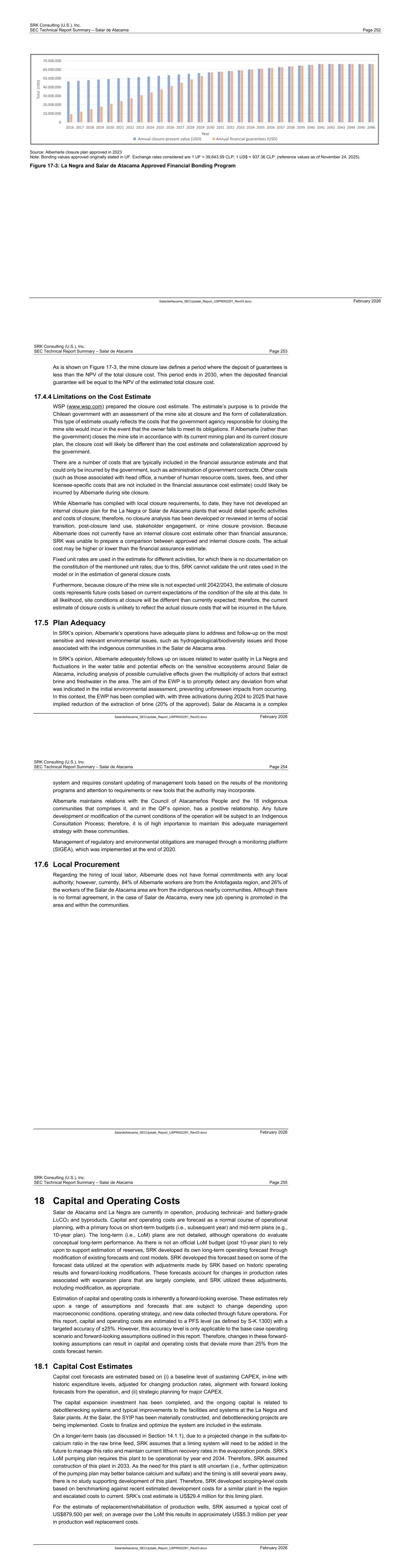
SRK Consulting (U.S.), Inc. SEC Technical Report Summary – Salar de Atacama Page 252 SalardeAtacama_SECUpdate_Report_USPR002291_Rev03.docx February 2026 Source: Albemarle closure plan approved in 2023 Note: Bonding values approved originally stated in UF. Exchange rates considered are 1 UF = 39,643.59 CLP; 1 US$ = 937.36 CLP. (reference values as of November 24, 2025). Figure 17-3: La Negra and Salar de Atacama Approved Financial Bonding Program SRK Consulting (U.S.), Inc. SEC Technical Report Summary – Salar de Atacama Page 253 SalardeAtacama_SECUpdate_Report_USPR002291_Rev03.docx February 2026 As is shown on Figure 17-3, the mine closure law defines a period where the deposit of guarantees is less than the NPV of the total closure cost. This period ends in 2030, when the deposited financial guarantee will be equal to the NPV of the estimated total closure cost. 17.4.4 Limitations on the Cost Estimate WSP (www.wsp.com) prepared the closure cost estimate. The estimate’s purpose is to provide the Chilean government with an assessment of the mine site at closure and the form of collateralization. This type of estimate usually reflects the costs that the government agency responsible for closing the mine site would incur in the event that the owner fails to meet its obligations. If Albemarle (rather than the government) closes the mine site in accordance with its current mining plan and its current closure plan, the closure cost will likely be different than the cost estimate and collateralization approved by the government. There are a number of costs that are typically included in the financial assurance estimate and that could only be incurred by the government, such as administration of government contracts. Other costs (such as those associated with head office, a number of human resource costs, taxes, fees, and other licensee-specific costs that are not included in the financial assurance cost estimate) could likely be incurred by Albemarle during site closure. While Albemarle has complied with local closure requirements, to date, they have not developed an internal closure plan for the La Negra or Salar de Atacama plants that would detail specific activities and costs of closure; therefore, no closure analysis has been developed or reviewed in terms of social transition, post-closure land use, stakeholder engagement, or mine closure provision. Because Albemarle does not currently have an internal closure cost estimate other than financial assurance, SRK was unable to prepare a comparison between approved and internal closure costs. The actual cost may be higher or lower than the financial assurance estimate. Fixed unit rates are used in the estimate for different activities, for which there is no documentation on the constitution of the mentioned unit rates; due to this, SRK cannot validate the unit rates used in the model or in the estimation of general closure costs. Furthermore, because closure of the mine site is not expected until 2042/2043, the estimate of closure costs represents future costs based on current expectations of the condition of the site at this date. In all likelihood, site conditions at closure will be different than currently expected; therefore, the current estimate of closure costs is unlikely to reflect the actual closure costs that will be incurred in the future. 17.5 Plan Adequacy In SRK’s opinion, Albemarle’s operations have adequate plans to address and follow-up on the most sensitive and relevant environmental issues, such as hydrogeological/biodiversity issues and those associated with the indigenous communities in the Salar de Atacama area. In SRK’s opinion, Albemarle adequately follows up on issues related to water quality in La Negra and fluctuations in the water table and potential effects on the sensitive ecosystems around Salar de Atacama, including analysis of possible cumulative effects given the multiplicity of actors that extract brine and freshwater in the area. The aim of the EWP is to promptly detect any deviation from what was indicated in the initial environmental assessment, preventing unforeseen impacts from occurring. In this context, the EWP has been complied with, with three activations during 2024 to 2025 that have implied reduction of the extraction of brine (20% of the approved). Salar de Atacama is a complex SRK Consulting (U.S.), Inc. SEC Technical Report Summary – Salar de Atacama Page 254 SalardeAtacama_SECUpdate_Report_USPR002291_Rev03.docx February 2026 system and requires constant updating of management tools based on the results of the monitoring programs and attention to requirements or new tools that the authority may incorporate. Albemarle maintains relations with the Council of Atacameños People and the 18 indigenous communities that comprises it, and in the QP’s opinion, has a positive relationship. Any future development or modification of the current conditions of the operation will be subject to an Indigenous Consultation Process; therefore, it is of high importance to maintain this adequate management strategy with these communities. Management of regulatory and environmental obligations are managed through a monitoring platform (SIGEA), which was implemented at the end of 2020. 17.6 Local Procurement Regarding the hiring of local labor, Albemarle does not have formal commitments with any local authority; however, currently, 84% of Albemarle workers are from the Antofagasta region, and 26% of the workers of the Salar de Atacama area are from the indigenous nearby communities. Although there is no formal agreement, in the case of Salar de Atacama, every new job opening is promoted in the area and within the communities. SRK Consulting (U.S.), Inc. SEC Technical Report Summary – Salar de Atacama Page 255 SalardeAtacama_SECUpdate_Report_USPR002291_Rev03.docx February 2026 18 Capital and Operating Costs Salar de Atacama and La Negra are currently in operation, producing technical- and battery-grade Li2CO3 and byproducts. Capital and operating costs are forecast as a normal course of operational planning, with a primary focus on short-term budgets (i.e., subsequent year) and mid-term plans (e.g., 10-year plan). The long-term (i.e., LoM) plans are not detailed, although operations do evaluate conceptual long-term performance. As there is not an official LoM budget (post 10-year plan) to rely upon to support estimation of reserves, SRK developed its own long-term operating forecast through modification of existing forecasts and cost models. SRK developed this forecast based on some of the forecast data utilized at the operation with adjustments made by SRK based on historic operating results and forward-looking modifications. These forecasts account for changes in production rates associated with expansion plans that are largely complete, and SRK utilized these adjustments, including modification, as appropriate. Estimation of capital and operating costs is inherently a forward-looking exercise. These estimates rely upon a range of assumptions and forecasts that are subject to change depending upon macroeconomic conditions, operating strategy, and new data collected through future operations. For this report, capital and operating costs are estimated to a PFS level (as defined by S-K 1300) with a targeted accuracy of ±25%. However, this accuracy level is only applicable to the base case operating scenario and forward-looking assumptions outlined in this report. Therefore, changes in these forward- looking assumptions can result in capital and operating costs that deviate more than 25% from the costs forecast herein. 18.1 Capital Cost Estimates Capital cost forecasts are estimated based on (i) a baseline level of sustaining CAPEX, in-line with historic expenditure levels, adjusted for changing production rates, alignment with forward looking forecasts from the operation, and (ii) strategic planning for major CAPEX. The capital expansion investment has been completed, and the ongoing capital is related to debottlenecking systems and typical improvements to the facilities and systems at the La Negra and Salar plants. At the Salar, the SYIP has been materially constructed, and debottlenecking projects are being implemented. Costs to finalize and optimize the system are included in the estimate. On a longer-term basis (as discussed in Section 14.1.1), due to a projected change in the sulfate-to- calcium ratio in the raw brine feed, SRK assumes that a liming system will need to be added in the future to manage this ratio and maintain current lithium recovery rates in the evaporation ponds. SRK’s LoM pumping plan requires this plant to be operational by year end 2034. Therefore, SRK assumed construction of this plant in 2033. As the need for this plant is still uncertain (i.e., further optimization of the pumping plan may better balance calcium and sulfate) and the timing is still several years away, there is no study supporting development of this plant. Therefore, SRK developed scoping-level costs based on benchmarking against recent estimated development costs for a similar plant in the region and escalated costs to current. SRK’s cost estimate is US$29.4 million for this liming plant. For the estimate of replacement/rehabilitation of production wells, SRK assumed a typical cost of US$879,500 per well; on average over the LoM this results in approximately US$5.3 million per year in production well replacement costs.
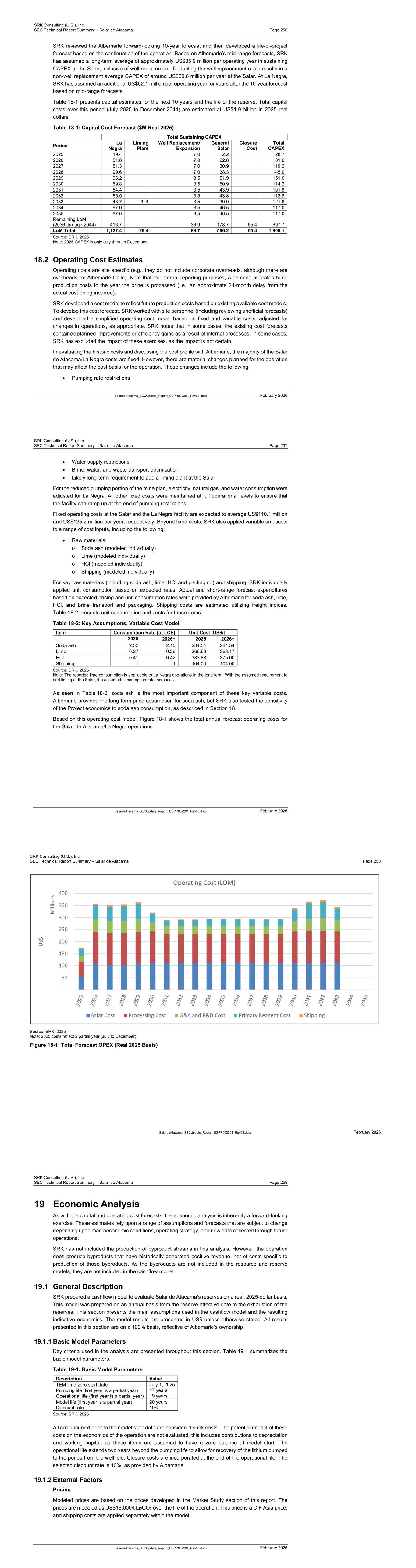
SRK Consulting (U.S.), Inc. SEC Technical Report Summary – Salar de Atacama Page 256 SalardeAtacama_SECUpdate_Report_USPR002291_Rev03.docx February 2026 SRK reviewed the Albemarle forward-looking 10-year forecast and then developed a life-of-project forecast based on the continuation of the operation. Based on Albemarle’s mid-range forecasts, SRK has assumed a long-term average of approximately US$35.9 million per operating year in sustaining CAPEX at the Salar, inclusive of well replacement. Deducting the well replacement costs results in a non-well replacement average CAPEX of around US$29.8 million per year at the Salar. At La Negra, SRK has assumed an additional US$52.1 million per operating year for years after the 10-year forecast based on mid-range forecasts. Table 18-1 presents capital estimates for the next 10 years and the life of the reserve. Total capital costs over this period (July 2025 to December 2044) are estimated at US$1.9 billion in 2025 real dollars. Table 18-1: Capital Cost Forecast ($M Real 2025) Total Sustaining CAPEX Period La Negra Liming Plant Well Replacement/ Expansion General Salar Closure Cost Total CAPEX 2025 19.4 7.0 2.2 28.7 2026 51.8 7.0 22.8 81.6 2027 81.3 7.0 30.9 119.2 2028 99.6 7.0 38.3 145.0 2029 96.2 3.5 51.9 151.6 2030 59.8 3.5 50.9 114.2 2031 54.4 3.5 43.9 101.8 2032 65.5 3.5 43.8 112.8 2033 48.7 29.4 3.5 39.9 121.6 2034 67.0 3.5 46.5 117.0 2035 67.0 3.5 46.5 117.0 Remaining LoM (2036 through 2044) 416.7 - 36.9 178.7 65.4 697.7 LoM Total 1,127.4 29.4 89.7 596.2 65.4 1,908.1 Source: SRK, 2025 Note: 2025 CAPEX is only July through December. 18.2 Operating Cost Estimates Operating costs are site specific (e.g., they do not include corporate overheads, although there are overheads for Albemarle Chile). Note that for internal reporting purposes, Albemarle allocates brine production costs to the year the brine is processed (i.e., an approximate 24-month delay from the actual cost being incurred). SRK developed a cost model to reflect future production costs based on existing available cost models. To develop this cost forecast, SRK worked with site personnel (including reviewing unofficial forecasts) and developed a simplified operating cost model based on fixed and variable costs, adjusted for changes in operations, as appropriate. SRK notes that in some cases, the existing cost forecasts contained planned improvements or efficiency gains as a result of internal processes. In some cases, SRK has excluded the impact of these exercises, as the impact is not certain. In evaluating the historic costs and discussing the cost profile with Albemarle, the majority of the Salar de Atacama/La Negra costs are fixed. However, there are material changes planned for the operation that may affect the cost basis for the operation. These changes include the following: Pumping rate restrictions SRK Consulting (U.S.), Inc. SEC Technical Report Summary – Salar de Atacama Page 257 SalardeAtacama_SECUpdate_Report_USPR002291_Rev03.docx February 2026 Water supply restrictions Brine, water, and waste transport optimization Likely long-term requirement to add a liming plant at the Salar For the reduced pumping portion of the mine plan, electricity, natural gas, and water consumption were adjusted for La Negra. All other fixed costs were maintained at full operational levels to ensure that the facility can ramp up at the end of pumping restrictions. Fixed operating costs at the Salar and the La Negra facility are expected to average US$110.1 million and US$125.2 million per year, respectively. Beyond fixed costs, SRK also applied variable unit costs to a range of cost inputs, including the following: Raw materials: o Soda ash (modeled individually) o Lime (modeled individually) o HCl (modeled individually) o Shipping (modeled individually) For key raw materials (including soda ash, lime, HCl and packaging) and shipping, SRK individually applied unit consumption based on expected rates. Actual and short-range forecast expenditures based on expected pricing and unit consumption rates were provided by Albemarle for soda ash, lime, HCl, and brine transport and packaging. Shipping costs are estimated utilizing freight indices. Table 18-2 presents unit consumption and costs for these items. Table 18-2: Key Assumptions, Variable Cost Model Item Consumption Rate (t/t LCE) Unit Cost (US$/t) 2025 2026+ 2025 2026+ Soda ash 2.32 2.15 284.54 284.54 Lime 0.27 0.26 266.69 263.17 HCl 0.41 0.42 383.88 375.00 Shipping 1 1 104.00 104.00 Source: SRK, 2025 Note: The reported lime consumption is applicable to La Negra operations in the long term. With the assumed requirement to add liming at the Salar, the assumed consumption rate increases. As seen in Table 18-2, soda ash is the most important component of these key variable costs. Albemarle provided the long-term price assumption for soda ash, but SRK also tested the sensitivity of the Project economics to soda ash consumption, as described in Section 18. Based on this operating cost model, Figure 18-1 shows the total annual forecast operating costs for the Salar de Atacama/La Negra operations. SRK Consulting (U.S.), Inc. SEC Technical Report Summary – Salar de Atacama Page 258 SalardeAtacama_SECUpdate_Report_USPR002291_Rev03.docx February 2026 Source: SRK, 2025 Note: 2025 costs reflect 2 partial year (July to December). Figure 18-1: Total Forecast OPEX (Real 2025 Basis) SRK Consulting (U.S.), Inc. SEC Technical Report Summary – Salar de Atacama Page 259 SalardeAtacama_SECUpdate_Report_USPR002291_Rev03.docx February 2026 19 Economic Analysis As with the capital and operating cost forecasts, the economic analysis is inherently a forward-looking exercise. These estimates rely upon a range of assumptions and forecasts that are subject to change depending upon macroeconomic conditions, operating strategy, and new data collected through future operations. SRK has not included the production of byproduct streams in this analysis. However, the operation does produce byproducts that have historically generated positive revenue, net of costs specific to production of those byproducts. As the byproducts are not included in the resource and reserve models, they are not included in the cashflow model. 19.1 General Description SRK prepared a cashflow model to evaluate Salar de Atacama’s reserves on a real, 2025-dollar basis. This model was prepared on an annual basis from the reserve effective date to the exhaustion of the reserves. This section presents the main assumptions used in the cashflow model and the resulting indicative economics. The model results are presented in US$ unless otherwise stated. All results presented in this section are on a 100% basis, reflective of Albemarle’s ownership. 19.1.1 Basic Model Parameters Key criteria used in the analysis are presented throughout this section. Table 19-1 summarizes the basic model parameters. Table 19-1: Basic Model Parameters Description Value TEM time zero start date July 1, 2025 Pumping life (first year is a partial year) 17 years Operational life (first year is a partial year) 19 years Model life (first year is a partial year) 20 years Discount rate 10% Source: SRK, 2025 All cost incurred prior to the model start date are considered sunk costs. The potential impact of these costs on the economics of the operation are not evaluated; this includes contributions to depreciation and working capital, as these items are assumed to have a zero balance at model start. The operational life extends two years beyond the pumping life to allow for recovery of the lithium pumped to the ponds from the wellfield. Closure costs are incorporated at the end of the operational life. The selected discount rate is 10%, as provided by Albemarle. 19.1.2 External Factors Pricing Modeled prices are based on the prices developed in the Market Study section of this report. The prices are modeled as US$16,000/t Li2CO3 over the life of the operation. This price is a CIF Asia price, and shipping costs are applied separately within the model.
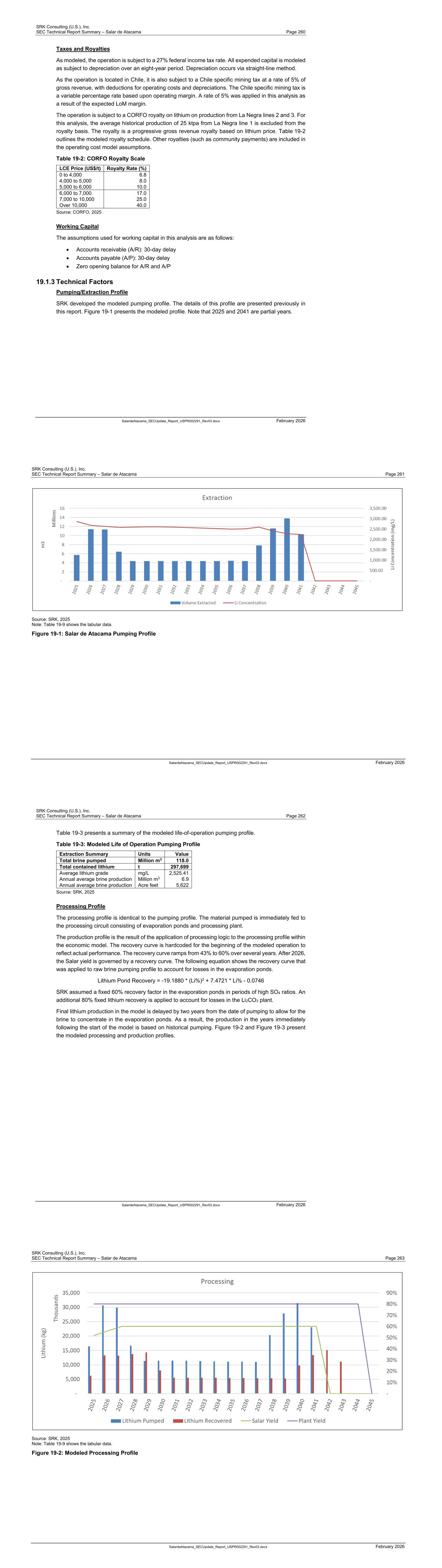
SRK Consulting (U.S.), Inc. SEC Technical Report Summary – Salar de Atacama Page 260 SalardeAtacama_SECUpdate_Report_USPR002291_Rev03.docx February 2026 Taxes and Royalties As modeled, the operation is subject to a 27% federal income tax rate. All expended capital is modeled as subject to depreciation over an eight-year period. Depreciation occurs via straight-line method. As the operation is located in Chile, it is also subject to a Chile specific mining tax at a rate of 5% of gross revenue, with deductions for operating costs and depreciations. The Chile specific mining tax is a variable percentage rate based upon operating margin. A rate of 5% was applied in this analysis as a result of the expected LoM margin. The operation is subject to a CORFO royalty on lithium on production from La Negra lines 2 and 3. For this analysis, the average historical production of 25 ktpa from La Negra line 1 is excluded from the royalty basis. The royalty is a progressive gross revenue royalty based on lithium price. Table 19-2 outlines the modeled royalty schedule. Other royalties (such as community payments) are included in the operating cost model assumptions. Table 19-2: CORFO Royalty Scale LCE Price (US$/t) Royalty Rate (%) 0 to 4,000 6.8 4,000 to 5,000 8.0 5,000 to 6,000 10.0 6,000 to 7,000 17.0 7,000 to 10,000 25.0 Over 10,000 40.0 Source: CORFO, 2025 Working Capital The assumptions used for working capital in this analysis are as follows: Accounts receivable (A/R): 30-day delay Accounts payable (A/P): 30-day delay Zero opening balance for A/R and A/P 19.1.3 Technical Factors Pumping/Extraction Profile SRK developed the modeled pumping profile. The details of this profile are presented previously in this report. Figure 19-1 presents the modeled profile. Note that 2025 and 2041 are partial years. SRK Consulting (U.S.), Inc. SEC Technical Report Summary – Salar de Atacama Page 261 SalardeAtacama_SECUpdate_Report_USPR002291_Rev03.docx February 2026 Source: SRK, 2025 Note: Table 19-9 shows the tabular data. Figure 19-1: Salar de Atacama Pumping Profile SRK Consulting (U.S.), Inc. SEC Technical Report Summary – Salar de Atacama Page 262 SalardeAtacama_SECUpdate_Report_USPR002291_Rev03.docx February 2026 Table 19-3 presents a summary of the modeled life-of-operation pumping profile. Table 19-3: Modeled Life of Operation Pumping Profile Extraction Summary Units Value Total brine pumped Million m3 118.0 Total contained lithium t 297,699 Average lithium grade mg/L 2,525.41 Annual average brine production Million m3 6.9 Annual average brine production Acre feet 5,622 Source: SRK, 2025 Processing Profile The processing profile is identical to the pumping profile. The material pumped is immediately fed to the processing circuit consisting of evaporation ponds and processing plant. The production profile is the result of the application of processing logic to the processing profile within the economic model. The recovery curve is hardcoded for the beginning of the modeled operation to reflect actual performance. The recovery curve ramps from 43% to 60% over several years. After 2026, the Salar yield is governed by a recovery curve. The following equation shows the recovery curve that was applied to raw brine pumping profile to account for losses in the evaporation ponds. Lithium Pond Recovery = -19.1880 * (Li%)2 + 7.4721 * Li% - 0.0746 SRK assumed a fixed 60% recovery factor in the evaporation ponds in periods of high SO4 ratios. An additional 80% fixed lithium recovery is applied to account for losses in the Li2CO3 plant. Final lithium production in the model is delayed by two years from the date of pumping to allow for the brine to concentrate in the evaporation ponds. As a result, the production in the years immediately following the start of the model is based on historical pumping. Figure 19-2 and Figure 19-3 present the modeled processing and production profiles. SRK Consulting (U.S.), Inc. SEC Technical Report Summary – Salar de Atacama Page 263 SalardeAtacama_SECUpdate_Report_USPR002291_Rev03.docx February 2026 Source: SRK, 2025 Note: Table 19-9 shows the tabular data. Figure 19-2: Modeled Processing Profile
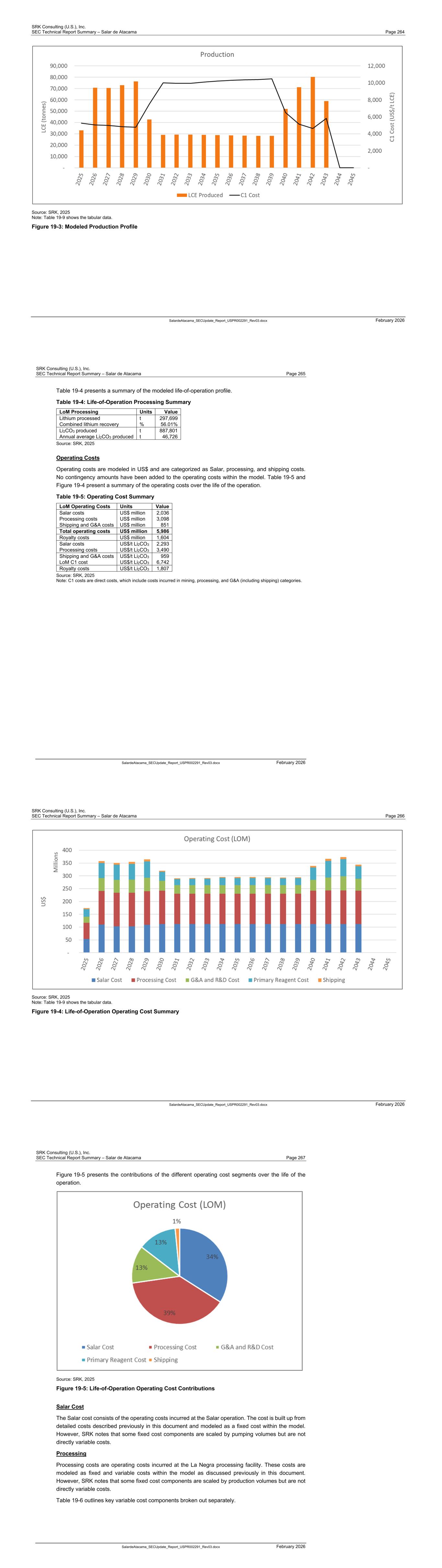
SRK Consulting (U.S.), Inc. SEC Technical Report Summary – Salar de Atacama Page 264 SalardeAtacama_SECUpdate_Report_USPR002291_Rev03.docx February 2026 Source: SRK, 2025 Note: Table 19-9 shows the tabular data. Figure 19-3: Modeled Production Profile SRK Consulting (U.S.), Inc. SEC Technical Report Summary – Salar de Atacama Page 265 SalardeAtacama_SECUpdate_Report_USPR002291_Rev03.docx February 2026 Table 19-4 presents a summary of the modeled life-of-operation profile. Table 19-4: Life-of-Operation Processing Summary LoM Processing Units Value Lithium processed t 297,699 Combined lithium recovery % 56.01% Li2CO3 produced t 887,801 Annual average Li2CO3 produced t 46,726 Source: SRK, 2025 Operating Costs Operating costs are modeled in US$ and are categorized as Salar, processing, and shipping costs. No contingency amounts have been added to the operating costs within the model. Table 19-5 and Figure 19-4 present a summary of the operating costs over the life of the operation. Table 19-5: Operating Cost Summary LoM Operating Costs Units Value Salar costs US$ million 2,036 Processing costs US$ million 3,098 Shipping and G&A costs US$ million 851 Total operating costs US$ million 5,986 Royalty costs US$ million 1,604 Salar costs US$/t Li2CO3 2,293 Processing costs US$/t Li2CO3 3,490 Shipping and G&A costs US$/t Li2CO3 959 LoM C1 cost US$/t Li2CO3 6,742 Royalty costs US$/t Li2CO3 1,807 Source: SRK, 2025 Note: C1 costs are direct costs, which include costs incurred in mining, processing, and G&A (including shipping) categories. SRK Consulting (U.S.), Inc. SEC Technical Report Summary – Salar de Atacama Page 266 SalardeAtacama_SECUpdate_Report_USPR002291_Rev03.docx February 2026 Source: SRK, 2025 Note: Table 19-9 shows the tabular data. Figure 19-4: Life-of-Operation Operating Cost Summary SRK Consulting (U.S.), Inc. SEC Technical Report Summary – Salar de Atacama Page 267 SalardeAtacama_SECUpdate_Report_USPR002291_Rev03.docx February 2026 Figure 19-5 presents the contributions of the different operating cost segments over the life of the operation. Source: SRK, 2025 Figure 19-5: Life-of-Operation Operating Cost Contributions Salar Cost The Salar cost consists of the operating costs incurred at the Salar operation. The cost is built up from detailed costs described previously in this document and modeled as a fixed cost within the model. However, SRK notes that some fixed cost components are scaled by pumping volumes but are not directly variable costs. Processing Processing costs are operating costs incurred at the La Negra processing facility. These costs are modeled as fixed and variable costs within the model as discussed previously in this document. However, SRK notes that some fixed cost components are scaled by production volumes but are not directly variable costs. Table 19-6 outlines key variable cost components broken out separately.
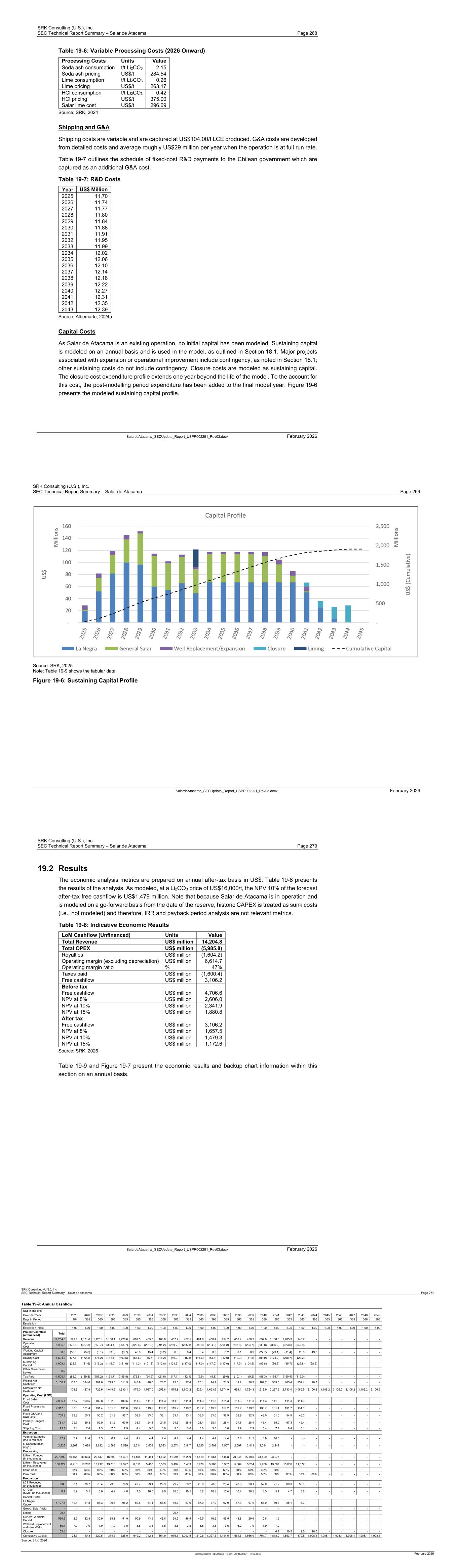
SRK Consulting (U.S.), Inc. SEC Technical Report Summary – Salar de Atacama Page 268 SalardeAtacama_SECUpdate_Report_USPR002291_Rev03.docx February 2026 Table 19-6: Variable Processing Costs (2026 Onward) Processing Costs Units Value Soda ash consumption t/t Li2CO3 2.15 Soda ash pricing US$/t 284.54 Lime consumption t/t Li2CO3 0.26 Lime pricing US$/t 263.17 HCl consumption t/t Li2CO3 0.42 HCl pricing US$/t 375.00 Salar lime cost US$/t 296.69 Source: SRK, 2024 Shipping and G&A Shipping costs are variable and are captured at US$104.00/t LCE produced. G&A costs are developed from detailed costs and average roughly US$29 million per year when the operation is at full run rate. Table 19-7 outlines the schedule of fixed-cost R&D payments to the Chilean government which are captured as an additional G&A cost. Table 19-7: R&D Costs Year US$ Million 2025 11.70 2026 11.74 2027 11.77 2028 11.80 2029 11.84 2030 11.88 2031 11.91 2032 11.95 2033 11.99 2034 12.02 2035 12.06 2036 12.10 2037 12.14 2038 12.18 2039 12.22 2040 12.27 2041 12.31 2042 12.35 2043 12.39 Source: Albemarle, 2024a Capital Costs As Salar de Atacama is an existing operation, no initial capital has been modeled. Sustaining capital is modeled on an annual basis and is used in the model, as outlined in Section 18.1. Major projects associated with expansion or operational improvement include contingency, as noted in Section 18.1; other sustaining costs do not include contingency. Closure costs are modeled as sustaining capital. The closure cost expenditure profile extends one year beyond the life of the model. To the account for this cost, the post-modelling period expenditure has been added to the final model year. Figure 19-6 presents the modeled sustaining capital profile. SRK Consulting (U.S.), Inc. SEC Technical Report Summary – Salar de Atacama Page 269 SalardeAtacama_SECUpdate_Report_USPR002291_Rev03.docx February 2026 Source: SRK, 2025 Note: Table 19-9 shows the tabular data. Figure 19-6: Sustaining Capital Profile SRK Consulting (U.S.), Inc. SEC Technical Report Summary – Salar de Atacama Page 270 SalardeAtacama_SECUpdate_Report_USPR002291_Rev03.docx February 2026 19.2 Results The economic analysis metrics are prepared on annual after-tax basis in US$. Table 19-8 presents the results of the analysis. As modeled, at a Li2CO3 price of US$16,000/t, the NPV 10% of the forecast after-tax free cashflow is US$1,479 million. Note that because Salar de Atacama is in operation and is modeled on a go-forward basis from the date of the reserve, historic CAPEX is treated as sunk costs (i.e., not modeled) and therefore, IRR and payback period analysis are not relevant metrics. Table 19-8: Indicative Economic Results LoM Cashflow (Unfinanced) Units Value Total Revenue US$ million 14,204.8 Total OPEX US$ million (5,985.8) Royalties US$ million (1,604.2) Operating margin (excluding depreciation) US$ million 6,614.7 Operating margin ratio % 47% Taxes paid US$ million (1,600.4) Free cashflow US$ million 3,106.2 Before tax Free cashflow US$ million 4,706.6 NPV at 8% US$ million 2,606.0 NPV at 10% US$ million 2,341.9 NPV at 15% US$ million 1,880.8 After tax Free cashflow US$ million 3,106.2 NPV at 8% US$ million 1,657.5 NPV at 10% US$ million 1,479.3 NPV at 15% US$ million 1,172.6 Source: SRK, 2026 Table 19-9 and Figure 19-7 present the economic results and backup chart information within this section on an annual basis. SRK Consulting (U.S.), Inc. SEC Technical Report Summary – Salar de Atacama Page 271 SalardeAtacama_SECUpdate_Report_USPR002291_Rev03.docx February 2026 Table 19-9: Annual Cashflow US$ in millions Calendar Year 2025 2026 2027 2028 2029 2030 2031 2032 2033 2034 2035 2036 2037 2038 2039 2040 2041 2042 2043 2044 2045 2046 2047 2048 2049 Days in Period 184 365 365 366 365 365 365 366 365 365 365 366 365 365 365 366 365 365 365 366 365 365 365 366 365 Escalation Escalation Index 1.00 1.00 1.00 1.00 1.00 1.00 1.00 1.00 1.00 1.00 1.00 1.00 1.00 1.00 1.00 1.00 1.00 1.00 1.00 1.00 1.00 1.00 1.00 1.00 1.00 Project Cashflow (unfinanced) Total Revenue 14,204.8 529.1 1,131.6 1,126.1 1,168.1 1,220.6 682.5 465.8 468.8 467.9 467.1 461.8 458.4 454.7 452.4 450.2 832.0 1,138.8 1,285.3 943.7 - - - - - - Operating Cost -5,985.8 (173.5) (357.8) (350.7) (354.4) (364.7) (320.6) (291.0) (291.2) (291.2) (295.1) (295.0) (294.9) (294.8) (293.9) (294.7) (338.8) (366.2) (373.6) (343.9) - - - - - - Working Capital Adjustment 0.0 (58.0) (5.6) (0.1) (3.0) (3.7) 40.6 15.4 (0.2) 0.0 0.4 0.4 0.3 0.2 0.1 0.3 (27.7) (23.1) (11.4) 25.6 49.3 - - - - - Royalty Cost -1,604.2 (77.6) (172.5) (171.2) (181.1) (193.5) (66.6) (15.5) (16.2) (16.0) (15.8) (14.6) (13.8) (12.9) (12.3) (11.8) (101.9) (174.2) (208.7) (128.2) - - - - - - Sustaining Capital -1,908.1 (28.7) (81.6) (119.2) (145.0) (151.6) (114.2) (101.8) (112.8) (121.6) (117.0) (117.0) (117.0) (117.0) (117.0) (104.5) (85.8) (66.3) (35.7) (25.8) (28.6) - - - - - Other Government Levies 0.0 - - - - - - - - - - - - - - - - - - - - - - - - - Tax Paid -1,600.4 (88.0) (189.5) (187.2) (191.7) (195.8) (72.8) (24.9) (21.6) (17.1) (12.1) (9.5) (8.8) (9.0) (10.1) (9.2) (88.3) (155.4) (190.4) (119.0) - - - - - - Project Net Cashflow 3,106.2 103.3 324.6 297.6 293.0 311.5 148.9 48.0 26.7 22.0 27.4 26.1 24.2 21.3 19.2 30.2 189.7 353.6 465.4 352.4 20.7 - - - - - Cumulative Net Cashflow 103.3 427.9 725.6 1,018.6 1,330.1 1,479.0 1,527.0 1,553.8 1,575.8 1,603.2 1,629.4 1,653.6 1,674.9 1,694.1 1,724.3 1,913.9 2,267.6 2,733.0 3,085.5 3,106.2 3,106.2 3,106.2 3,106.2 3,106.2 3,106.2 Operating Cost (LOM) Fixed Salar Cost 2,036.1 53.7 109.5 102.8 102.8 108.5 111.3 111.3 111.3 111.3 111.3 111.3 111.3 111.3 111.3 111.3 111.3 111.3 111.3 111.3 - - - - - - Fixed Processing Cost 2,317.0 63.3 131.4 131.4 131.5 131.6 130.4 119.2 119.2 119.2 119.2 119.2 119.2 119.2 119.2 119.2 130.7 131.4 131.7 131.0 - - - - - - Fixed G&A and R&D Cost 758.9 23.8 50.3 50.2 51.3 52.7 38.6 33.0 33.1 33.1 33.1 33.0 33.0 32.9 32.9 32.9 43.0 51.0 54.9 46.0 - - - - - - Primary Reagent Cost 781.4 29.3 59.3 59.0 61.2 63.9 35.7 24.4 24.5 24.5 28.4 28.4 28.4 28.4 27.5 28.4 48.4 65.0 67.3 49.4 - - - - - - Shipping Cost 92.3 3.4 7.4 7.3 7.6 7.9 4.4 3.0 3.0 3.0 3.0 3.0 3.0 3.0 2.9 2.9 5.4 7.4 8.4 6.1 - - - - - - Extraction Volume Extracted (m3 in millions) 117.9 5.7 11.4 11.3 6.4 4.4 4.4 4.4 4.4 4.4 4.4 4.4 4.4 4.4 7.8 11.5 13.8 10.3 - - - - - - - - Li Concentration (mg/L) 2,525 2,867 2,688 2,632 2,588 2,599 2,614 2,608 2,593 2,571 2,547 2,525 2,502 2,507 2,597 2,413 2,284 2,249 - - - - - - - - Processing Lithium Pumped (in thousands) 297,699 16,451 30,604 29,847 16,690 11,391 11,464 11,441 11,422 11,291 11,209 11,119 11,061 11,008 20,346 27,848 31,429 23,077 - - - - - - - - Lithium Recovered (in thousands) 166,729 6,210 13,282 13,217 13,710 14,327 8,011 5,468 5,503 5,492 5,483 5,420 5,380 5,337 5,309 5,284 9,766 13,367 15,086 11,077 - - - - - - Salar Yield 52% 56% 60% 60% 60% 60% 60% 60% 60% 60% 60% 60% 60% 60% 60% 60% 60% - - - - - - - - Plant Yield 80% 80% 80% 80% 80% 80% 80% 80% 80% 80% 80% 80% 80% 80% 80% 80% 80% 80% 80% 80% - - - - - Production LCE Produced (in thousands) 888 33.1 70.7 70.4 73.0 76.3 42.7 29.1 29.3 29.2 29.2 28.9 28.6 28.4 28.3 28.1 52.0 71.2 80.3 59.0 - - - - - - C1 Cost ($/MT) (in thousands) 6.7 5.2 5.1 5.0 4.9 4.8 7.5 10.0 9.9 10.0 10.1 10.2 10.3 10.4 10.4 10.5 6.5 5.1 4.7 5.8 - - - - - - Capital Profile La Negra Capex 1,127.4 19.4 51.8 81.3 99.6 96.2 59.8 54.4 65.5 48.7 67.0 67.0 67.0 67.0 67.0 67.0 67.0 50.3 25.1 6.3 - - - - - - Growth Salar Yield - - - - - - - - - - - - - - - - - - - - - - - - - - Liming 29.4 - - - - - - - - 29.4 - - - - - - - - - - - - - - - - General Wellfield Capital 596.2 2.2 22.8 30.9 38.3 51.9 50.9 43.9 43.8 39.9 46.5 46.5 46.5 46.5 43.8 29.6 10.8 1.5 - - - - - - - - Wellfield Replacement and New Wells 89.7 7.0 7.0 7.0 7.0 3.5 3.5 3.5 3.5 3.5 3.5 3.5 3.5 3.5 6.2 7.9 7.9 7.9 - - - - - - - - Closure 65.4 - - - - - - - - - - - - - - - - 6.7 10.5 19.5 28.6 - - - - - Cumulative Capital 28.7 110.3 229.5 374.5 526.0 640.2 742.1 854.9 976.5 1,093.5 1,210.5 1,327.5 1,444.5 1,561.5 1,666.0 1,751.7 1,818.0 1,853.7 1,879.5 1,908.1 1,908.1 1,908.1 1,908.1 1,908.1 1,908.1 Source: SRK, 2026
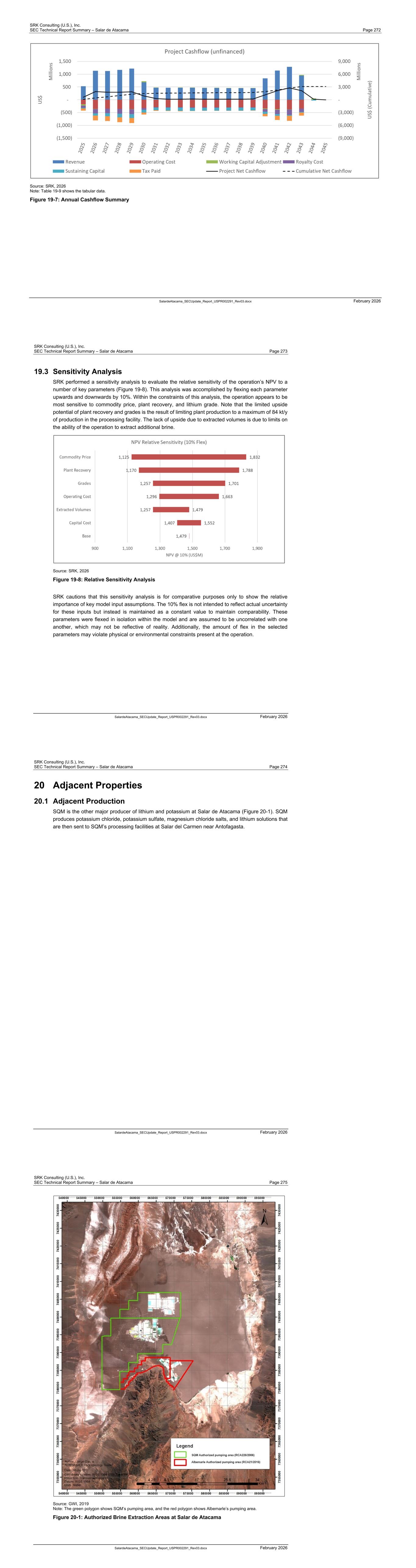
SRK Consulting (U.S.), Inc. SEC Technical Report Summary – Salar de Atacama Page 272 SalardeAtacama_SECUpdate_Report_USPR002291_Rev03.docx February 2026 Source: SRK, 2026 Note: Table 19-9 shows the tabular data. Figure 19-7: Annual Cashflow Summary SRK Consulting (U.S.), Inc. SEC Technical Report Summary – Salar de Atacama Page 273 SalardeAtacama_SECUpdate_Report_USPR002291_Rev03.docx February 2026 19.3 Sensitivity Analysis SRK performed a sensitivity analysis to evaluate the relative sensitivity of the operation’s NPV to a number of key parameters (Figure 19-8). This analysis was accomplished by flexing each parameter upwards and downwards by 10%. Within the constraints of this analysis, the operation appears to be most sensitive to commodity price, plant recovery, and lithium grade. Note that the limited upside potential of plant recovery and grades is the result of limiting plant production to a maximum of 84 kt/y of production in the processing facility. The lack of upside due to extracted volumes is due to limits on the ability of the operation to extract additional brine. Source: SRK, 2026 Figure 19-8: Relative Sensitivity Analysis SRK cautions that this sensitivity analysis is for comparative purposes only to show the relative importance of key model input assumptions. The 10% flex is not intended to reflect actual uncertainty for these inputs but instead is maintained as a constant value to maintain comparability. These parameters were flexed in isolation within the model and are assumed to be uncorrelated with one another, which may not be reflective of reality. Additionally, the amount of flex in the selected parameters may violate physical or environmental constraints present at the operation. SRK Consulting (U.S.), Inc. SEC Technical Report Summary – Salar de Atacama Page 274 SalardeAtacama_SECUpdate_Report_USPR002291_Rev03.docx February 2026 20 Adjacent Properties 20.1 Adjacent Production SQM is the other major producer of lithium and potassium at Salar de Atacama (Figure 20-1). SQM produces potassium chloride, potassium sulfate, magnesium chloride salts, and lithium solutions that are then sent to SQM’s processing facilities at Salar del Carmen near Antofagasta. SRK Consulting (U.S.), Inc. SEC Technical Report Summary – Salar de Atacama Page 275 SalardeAtacama_SECUpdate_Report_USPR002291_Rev03.docx February 2026 Source: GWI, 2019 Note: The green polygon shows SQM’s pumping area, and the red polygon shows Albemarle’s pumping area. Figure 20-1: Authorized Brine Extraction Areas at Salar de Atacama

SRK Consulting (U.S.), Inc. SEC Technical Report Summary – Salar de Atacama Page 276 SalardeAtacama_SECUpdate_Report_USPR002291_Rev03.docx February 2026 In 1993, SQM entered a lease agreement with CORFO, the governmental agency that owns the mineral rights in Salar de Atacama. The lease between CORFO and SQM will last until December 31, 2030, granting SQM exclusive rights to mineral resources beneath 140,000 ha (28,054 mineral concessions) of Salar de Atacama. SQM is permitted to extract minerals from a subset of 81,920 ha (16,384 mineral concessions), corresponding to 59.5% of the total area of the leased land. The 140,000 ha of land leased by CORFO to SQM are referred to as the OMA concessions, a name devised by CORFO in 1977. SQM refers to the 81,920-ha subset where extraction can occur as the OMA Extracción (OMA Extraction) Area. The remaining 58,350 ha are termed the OMA Exploración (OMA Exploration) Area, where only mineral exploration can occur. The terms of the agreement established that CORFO will not allow any other entity aside from SQM to explore or exploit any mineral resource in the Indicated 140,000-ha area of Salar de Atacama (WSP, 2022). SQM's operational facilities in Salar de Atacama are located over the two currently authorized extraction areas (MOP and SOP). SQM’s production from Salar de Atacama is important to Albemarle in multiple ways. The brine resource in SQM’s operations is connected to Albemarle’s, which means pumping activities from SQM’s concessions impact brine characteristics and availability in Albemarle’s concessions. Further, the combined impact of SQM and Albemarle’s brine extraction on the overall Salar (as well as water extraction for other uses) is strictly monitored and evaluated for environmental and social purposes. The environmental permit (RCA N° 226/06), issued on October 19, 2006, by the regional environmental commission (Comisión Regional del Medio Ambiente or COREMA) authorized SQM to extract brines via pumping wells. That permit originally allowed SQM to increase the pumping of brine in stages up to 1,700 L/s, ending in 2030, when the lease contract of the OMA concessions with CORFO is set to expire. However, given the results of basin-wide monitoring, SQM has voluntarily agreed to a plan to reduce future pumping from the current rate of 1,166 to 822 L/s (as of 2027) during the remaining 7-year LoM. Considering the maximum net brine production rates authorized by the environmental permit and the voluntary reduction plan, a total of approximately 211 million m3 of brine, corresponding to 0.27 million t Li, is expected to be extracted from the SQM wells (SQM, 2023). 20.1.1 SQM Lithium Resources and Reserves The 20-F Report published by SQM for 2023 estimates mineral reserves of potassium and lithium in Salar de Atacama, considering modifying factors for converting mineral resources to mineral reserves, including production wellfield design and efficiency, pumping scheme, and recovery factors. The projected future brine extraction was simulated using a flow and solute transport model. Numerical modeling was supported by a detailed calibration process and hydrogeological, geological, and hydrochemical data within the exploitation concessions. SQM’s environmental permit (RCA N° 226/06) defines a maximum brine extraction until the end of the CORFO agreements (December 31, 2030). Considering the authorized maximum net brine production rates under RCA N° 226/06 and a voluntary pumping reduction plan announced by SQM from 1,166 to 822 L/s (as of 2027) during the remaining LoM, a total of approximately 175 million m3 of brine will be extracted from the producing wells, corresponding to 0.22 Mt Li. Table 20-1 shows SQM’s estimates of lithium resources as of December 31, 2020 (which they also consider to be an adequate representation of December 31, 2024). SRK Consulting (U.S.), Inc. SEC Technical Report Summary – Salar de Atacama Page 277 SalardeAtacama_SECUpdate_Report_USPR002291_Rev03.docx February 2026 Table 20-1: SQM’s Summary of Lithium Resources, Exclusive of Reserves Lithium Resources Brine Volume (Million m3) Amount (Mt) Grades/Qualities (% by weight) CoG (% by weight) Measured 2,254 5.4 0.20 0.05 Indicated 1,435 2.8 0.16 0.05 Measured + Indicated 3,689 8.2 0.18 0.05 Inferred 1,614 2.6 0.13 0.05 Source: SQM, 2024 The quantity of mineral reserves is estimated on the basis of saleable products attributable to SQM (Table 20-2). Table 20-2: SQM’s Summary of Lithium Reserves Lithium Reserves Proven Mineral Reserves Probable Mineral Reserves Total Mineral Reserves Quantity (million m3) Grade (% Li by weight) Quantity (million m3) Grade (% Li by weight) Quantity (million m3) Grade (% Li by weight) Lithium-salts 68 0.20 107 0.20 175 0.20 Source: SQM, 2024 20.2 Water Rights of Other Companies Within the framework of the environmental evaluation of the Albemarle project modifications and improvement of the solar evaporation ponds system in the Salar de Atacama (approved by RCA No. 021/2016), an analysis of the water rights in the Salar de Atacama basin showed a total of 300 water use rights constituted within the basin, including underground and surface rights, with a total withdrawal rate of 5,107 L/s. Table 20-3 shows the average rates granted according to the nature of the water resource, where the primary exploitation of water rights comes from the underground resource (60%), leaving around 39% to the rights to use water of a superficial and current nature. Table 20-3: Flow Rates Granted According to the Nature of the Water Nature of Water Resource Total (L/s) Percent (%) Groundwater 3,075.7 60.2 Surface and current 1,972.0 38.6 Surface and detained 60.0 1.2 General total 5107.7 100 Source: SGA, 2015a Even given the vintage of the source documentation from which these rates were obtained, the relative proportions are not likely to have materially changed, with groundwater abstraction being the primary water rights uses. Authorized water rights for SQM and Albemarle remain unchanged. Figure 20-2 presents the flow data according to its supply source and its spatial distribution. It is observed that the main source that sustains the granted water use rights corresponds to the aquifer system around the town of San Pedro de Atacama, as well as the Eastern Edge of the Salar and the southern end of the basin. Regarding surface sources, the main rights are in the tributary rivers of the San Pedro and the Rio Vilama in the North sector of the basin. Other surface sources (such as streams and slopes) are mainly concentrated throughout the eastern fringe of the basin. SRK Consulting (U.S.), Inc. SEC Technical Report Summary – Salar de Atacama Page 278 SalardeAtacama_SECUpdate_Report_USPR002291_Rev03.docx February 2026 Source: SGA, 2015a Figure 20-2: Spatial Distribution of Concessioned Water Rights in the Salar de Atacama Basin SRK Consulting (U.S.), Inc. SEC Technical Report Summary – Salar de Atacama Page 279 SalardeAtacama_SECUpdate_Report_USPR002291_Rev03.docx February 2026 Granted water use rights are intended to be used in the following manner: 53 files correspond to mining use with a total of 2,315 L/s, 24 files correspond to irrigation with a total of 1,572 L/s, one file corresponds to industrial use with 8.5 L/s, 28 files correspond to other uses with 388.5 L/s, two files correspond to drinking/domestic use/sanitation with a total of 5.5 L/s, and 47 records do not present information regarding this item (blank). Table 20-4 shows this distribution of the flows granted in the Salar de Atacama basin according to the use of the waters. Table 20-4: Concessioned Water Rights by Water Use Water Use Total (L/s) Percent (%) Domestic/public/sanitation 5.5 0.1 Industrial 8.5 0.2 Other 388.5 7.6 Agricultural 1,572.8 30.8 Mining 2,315.3 45.3 Not defined (blank) 817.1 16 General total 5,107.7 100 Source: SGA, 2015a The companies Minera Escondida (MEL), Minera Zaldívar (CMZ), SQM, and Albemarle have rights to use water constituted in the brackish aquifer of the eastern and southern edge of the Salar. These data are reported to different authorities. In the cases of MEL and CMZ and the extraction of water in the south of the basin, both companies have a collaboration agreement that allows MEL to access the extraction information carried out by CMZ. MEL concentrates this activity in the Monturaqui sector, and CMZ carries it out in the Negrillar sector. According to the information obtained from the DGA and after analyzing both the names of the applicants and the spatial location specified in the files, it was determined that the water use rights granted in total identified for both companies are close to 1,720 L/s. SQM, for its part, has committed, as part of the Salar de Atacama Compliance Program, to gradually reduce the maximum brine extraction limit to 822 L/s as of 2027, slightly less than 50% of the authorized extraction of 1,166 L/s, and reduce the total industrial water flow to 120 L/s, equivalent to a reduction of 50 percent of the authorized flow. (SQM Annual Report 2023)

SRK Consulting (U.S.), Inc. SEC Technical Report Summary – Salar de Atacama Page 280 SalardeAtacama_SECUpdate_Report_USPR002291_Rev03.docx February 2026 21 Other Relevant Data and Information SRK is not aware of other relevant data and information that are not included elsewhere in this report. SRK Consulting (U.S.), Inc. SEC Technical Report Summary – Salar de Atacama Page 281 SalardeAtacama_SECUpdate_Report_USPR002291_Rev03.docx February 2026 22 Interpretation and Conclusions 22.1 Geology and Mineral Resources The property is well known in terms of descriptive factors and ownership. Geology and mineralization are well understood through decades of active mining, and the 2025 updated geological model has been improved with recent data. The status of exploration, development, and operations is advanced and active. Assuming that exploration and mining continue at Salar de Atacama in the way that they are currently being done, there are no additional recommendations related to the procedures at this time. The new lithium concentration data set from the brine sampling exploration was regularized to equal lengths for constant sample support (compositing). Lithium grades were interpolated into a block model using OK and IDW3 methods. Results were validated visually and via various statistical comparisons, including visual validation and statistical comparisons with input data. The estimate was depleted for current production, categorized in a manner consistent with industry standards and statistical parameters. Mineral resources have been reported above a CoG supporting reasonable potential for economic extraction of the resource. SRK reported a mineral resource estimation (resources are reported above 2,200 masl), which, in SRK’s opinion, is appropriate for public disclosure and accounts for long-term considerations of exploitation viability. The mineral resource estimation could be improved with an additional infill program (drilling and brine sampling). 22.2 Mineral Reserves and Mining Method Mining operations have been established at Salar de Atacama over its more than 35-year history of operation. Reserve estimates have been developed based on a predictive hydrogeological model that estimates brine production rates and associated lithium concentrations over time. In the QP’s opinion, the mining methods and predictive approach for reserve development are appropriate for Salar de Atacama. However, in the QP’s opinion, there remains opportunity to further refine the production schedule. This optimization should focus on the balance between calcium and sulfate concentration in the production brine. Maintaining an optimum blend of calcium- and sulfate-rich brine improves process recovery in the evaporation ponds. SRK’s current model suggests the optimum balance in these contaminants is lost in 2026 but has assumed Albemarle is able to maintain a reasonable ratio until 2034, when additional capital and operating cost expenditure associated with installation and operation of a liming plant is required (construction in 2033 so it is operational in 2034). However, if additional calcium-rich brine can be sourced in the pumping plan, these assumed expenses could potentially be delayed or avoided altogether. 22.3 Metallurgy and Mineral Processing In the QP’s opinion, the long operating history and associated knowledge and information provide appropriate support for development of operating predictions for this reserve estimate. The notable deviation from historic practice is the implementation of the SYIP. SRK Consulting (U.S.), Inc. SEC Technical Report Summary – Salar de Atacama Page 282 SalardeAtacama_SECUpdate_Report_USPR002291_Rev03.docx February 2026 The SYIP has been constructed and is in the final ramp-up phases of operation having surpassed designed production in May and June 2025. Historic test work associated with this Project had gaps in sample representativity and support for projected mass balances. However, with the facility in operation, Albemarle is now able to start quantifying the overall impact to the Salar recovery. SRK recommends continued monitoring to assess and optimize the operation of the SYIP. Until the benefits are realized through a full life cycle of the Salar evaporative cycle, in the QP’s opinion, the projected performance for the SYIP is reasonable and has not changed since the previous report. SRK has assumed that a liming plant will be required starting in 2034 to offset a reduction in calcium- rich brine available for blending. If further optimization of the LoM pumping plan is not possible (i.e., the sulfate-to-calcium ratio cannot be reduced by alternative pumping strategy), Albemarle will need to add calcium to the evaporation pond system to avoid additional lithium losses in the ponds. Albemarle should make a concerted effort to build a pumping model optimizing for sulfate and calcium concentrations in addition to lithium concentration. Absent a robust model confirming an appropriate sulfate-to-calcium ratio, Albemarle should start conceptual evaluation of this calcium addition (whether through liming as assumed by SRK or alternative options) so that if/when this plant is required, Albemarle will have an appropriate design developed for installation. Due to the reduced pumping rate imposed by the EWP, Albemarle has started to investigate alternative options to mitigate the impacts to surrounding water table levels, including DLE with solution re- injection. If this option is successful, Albemarle may be able to increase pumping rates to pre-EWP levels, resulting in an increase to the production from the Salar and full utilization of the La Negra processing facilities. The results of ongoing studies and the resulting impacts from potential alternative options are not sufficiently developed for discussion in this report. SRK recommends continuing investigation of alternatives. An unknown, but potentially significant, amount of lithium could be contained in the historic bischofite stockpiles. Processing of these bischofite salts through the SYIP during reduced pumping periods could bridge the production gap imposed by activation of the SYIP. SRK recommends that Albemarle attempt to quantify the lithium contained within the historic bischofite stockpiles and develop a plan to maximize lithium production from the Salar once the next phase of the EWP is activated. While early indications suggest a significant benefit to lithium recovery from the Salar due to the operation of the SYIP, there isn’t sufficient information to build any additional lithium production from the stockpiles into the reserve. 22.4 Infrastructure The Project is a mature functioning operation with two separate sites that contain key facilities. The infrastructure is in place and operating and provides all necessary support for ongoing operations as summarized in this report. No significant risks associated with the Project are identified in this report. 22.5 Environmental, Permitting, Social, and Closure 22.5.1 Environmental Studies Baseline studies in both operational areas have been developed since the first environmental studies for permitting were submitted (1998 in La Negra and 2000 at Salar de Atacama). With the ongoing SRK Consulting (U.S.), Inc. SEC Technical Report Summary – Salar de Atacama Page 283 SalardeAtacama_SECUpdate_Report_USPR002291_Rev03.docx February 2026 monitoring programs in both locations, environmental studies (such as hydrogeology and biodiversity) are regularly updated. The Salar de Atacama basin presents a unique system due to the biodiversity associated with lake and wetland systems that depend on the hydrogeological conditions of the area. There are also indigenous areas and communities in the sector. As such, the key environmental issues at Salar de Atacama include biodiversity, hydrogeology, and socioeconomics. La Negra is located within an industrial area which is in saturation conditions for the daily and annual standard of inhalable particulate matter (PM10). Although there are no surface water courses, there is an aquifer that could be affected by potential infiltrations from the plant facilities. As such, a water quality monitoring program is in place. Air quality, hydrogeology, and water quality have been deemed as key environmental characteristics of the La Negra area. 22.5.2 Environmental Management Planning Albemarle’s operations have adequate plans to address and follow-up on the most sensitive and relevant environmental issues, such as hydrogeological/biodiversity issues and those associated with the indigenous communities in the Salar de Atacama area. Compliance with the conditions established in the EWP is key in meeting the commitments established by Albemarle in Salar de Atacama. 22.5.3 Environmental Monitoring Albemarle adequately follows up on issues related to water quality in La Negra and fluctuations in the water table and potential effects on the sensitive ecosystems around Salar de Atacama, including analysis of possible cumulative effects given the multiplicity of actors that extract brine and freshwater in the area. The aim of the EWP is to promptly detect any deviation from what was indicated in the initial environmental assessment, preventing unforeseen impacts from occurring. In this context, the EWP has been complied with, with three activations during 2024 to 2025 that have implied reduction of the extraction of brine (20% of the approved flow). Salar de Atacama is a complex system and requires constant updating of management tools based on the results of the monitoring programs and also attention to requirements or new tools that the authority may incorporate. 22.5.4 Permitting Albemarle has the environmental permits for an operation with a brine extraction of 442 L/s, a production of 250,000 m3/y of brine concentrated in solar evaporation ponds with an approximate surface area of 1,043 ha, for a production of 94,000 t/y LCE. Brine exploitation is authorized until 2041. Albemarle’s total production is limited by the quotas agreed to with CORFO, which were increased in 2024 by 240,000 t LME if produced using new technologies (like DLE) and by an “Additional Quota” amount of 34,776 t LME that Albemarle may exploit in the event that a new battery grade lithium hydroxide plant is constructed, or an existing lithium carbonate plant is expanded. Any modification of the production, extraction, and/or to any approved conditions will require a new environmental permit.

SRK Consulting (U.S.), Inc. SEC Technical Report Summary – Salar de Atacama Page 284 SalardeAtacama_SECUpdate_Report_USPR002291_Rev03.docx February 2026 22.5.5 Closure Albemarle has also an approved closure plan (Res. Ex. N°865/2023), which includes all environmental projects approved up to date. This closure plan considers a LoM until 2041 for the Salar de Atacama operations and 2043 for La Negra. The closure cost has been estimated based on the approved closure plan. The total closure cost of the La Negra and Salar de Atacama plants is US$65.0838 million, considering direct and indirect costs and contingencies. 22.6 Capital and Operating Costs The capital and operating costs for the Salar de Atacama operation have been developed based on actual Project costs and forecasts. In the QP’s opinion, the cost development is acceptable for declaration of mineral reserves. However, the operation itself lacks detailed life-of-operation planning and costing. As such, the forward-looking costs incorporated herein are inherently strongly correlated to current market conditions. Due to the recent volatility in lithium prices, the lithium production space is evolving rapidly, and any forward-looking forecast based on such an environment carries increased risk. The QP strongly recommends continued development and refinement of a robust life-of-operation cost model. In addition to further refinement of the cost model, the QP also recommends that close watch be kept on the economic environment, with an eye toward continuous updates as the market environment continues to evolve. 22.7 Economic Analysis The Salar de Atacama operation is forecast to have a 19-year operational life, with the first modeled year of operation being a partial year to align with the effective date of the reserves. As modeled for this analysis, the operation is forecast to produce 46.7 kt of Li2CO3, on average, per year over its life. At a price of US$16,000/t Li2CO3, the NPV at 10% of the modeled after-tax cashflow is US$1,479 million. The operation is expected to generate positive cashflow during every full year in which it is pumping or processing brine on the schedule and at the costs and process outlined in this report, supporting the economic viability of the reserve under the assumptions evaluated. However, in periods where pumping from the Salar is restricted, a significant decrease in cashflow is expected. An economic sensitivity analysis indicates that the operation’s NPV is most sensitive to variations in commodity price, plant recovery, and lithium grade. SRK Consulting (U.S.), Inc. SEC Technical Report Summary – Salar de Atacama Page 285 SalardeAtacama_SECUpdate_Report_USPR002291_Rev03.docx February 2026 23 Recommendations 23.1 Recommended Work Programs 23.1.1 Geology, Resources, and Reserves The new wells drilled in 2025 (which were not included in the current geological model) should be logged according to the inherent knowledge and available data (including logs, core photographs, etc.) and be included in a new version of the geological model. Continue sampling lithium and Sy in all available drill holes to maintain consistency in the quantity of lithium samples for future resource estimates, ensuring good coverage both horizontally and vertically. Conduct a field campaign in the aquifers within the claim area A3, focused on collecting additional hydraulic testing, specific yields (through diamond drilling and core sampling), and brine samples. Review and analyze the hydraulic tests in 2024 and 2025 to support and update the current hydrogeological conceptual model. The mineral resource has been reported above 2,200 masl, and SRK recommends collecting samples, including depths from 100 m to 150 m in claim areas A1, A2, and A3. Conduct a sample collection campaign to maintain the coverage of sampling data. The target is to identify the grade of dilution of lithium, calcium, and sulfate as results of the lateral recharge from southern sub-basins. Update the groundwater numerical model with the new collected information (geology, hydrogeology, and brine concentration), recalibrate, and update the predictions. Evaluate the opportunity to maintain a lower sulfate-to-calcium ratio in the raw brine feed to the evaporation ponds for a longer period of time (i.e., increase proportion of calcium-rich brine pumped), with a target of improving process recovery and delaying or removing the need to develop a liming plant. 23.1.2 Mineral Processing and Metallurgical Testing In SRK’s opinion, while the assumptions for the SYIP are reasonable, there remain gaps in the supporting test data, including questions on representativity of samples and reliability of mass balances. Albemarle started the SYIP facilities in 2024. SRK recommends a continued monitoring program to quantify the performance of the SYIP to support recovery and mass balance information with plant data to support future predictions. Based on the LoM pumping plan developed by SRK, the sulfate-to-calcium ratio will reach a point in the future where sulfate cannot be adequately reduced offset with calcium, which will result in additional lithium losses in the evaporation ponds. To mitigate the potential for these losses, SRK has assumed the addition of a liming plant, available for operations in 2034, to add calcium to the system. While it may be possible to modify the pumping plan to delay or eliminate the need for this calcium addition, given that the currently modeled requirement is approximately three years away with an optimistic view being eight years away, SRK recommends a dedicated focus to developing a pumping and ground water model where sulfate and calcium concentrations are optimized, in addition to lithium concentration, to confirm and support sufficient calcium will be available through the LoM and a liming plant will SRK Consulting (U.S.), Inc. SEC Technical Report Summary – Salar de Atacama Page 286 SalardeAtacama_SECUpdate_Report_USPR002291_Rev03.docx February 2026 not be required. Absent a robust pumping model, SRK recommends beginning conceptual studies for addition of a liming plant prior to transitioning to full characterization and development (if the production plan cannot be modified). Activation of the EWP has resulted in reduced pumping rates and ultimately reduced reserves because of the CORFO quota time limitations to extract and produce lithium. SRK recommends continuing to investigate alternative extraction and processing methods that would allow for a return to previous pumping levels and to produce the maximum lithium allowed by the quota before the expiration date. Potentially significant amounts of lithium are contained in the historic bischofite stockpiles. SRK recommends quantifying the lithium content and developing a processing plan to extract and produce this lithium through the SYIP facilities during low pumping periods. 23.1.3 Environmental/Closure Considering the operation and activation of the EWP in recent years, SRK recommends the inclusion of this information in the updates of the hydrogeological model developed by Albemarle every two years. SRK highly recommends developing an internal closure plan where other costs could be determined (such as head office costs, human resources costs, taxes, operator-specific costs, and social costs). Closure provision should also be determined in this document. SRK recommends following International Council on Mining and Metals (ICMM) guidelines developed for this purpose (ICMM, 2025). 23.2 Recommended Work Program Costs Table 23-1 summarizes the costs for recommended work programs. SRK Consulting (U.S.), Inc. SEC Technical Report Summary – Salar de Atacama Page 287 SalardeAtacama_SECUpdate_Report_USPR002291_Rev03.docx February 2026 Table 23-1: Summary of Costs for Recommended Work Discipline Program Description Cost (US$ Thousands) Mineral resource estimates* Infill drilling program, including brine and porosity sampling and QA/QC controls, in the project to maintain and improve the data coverage in some areas. Collect samples below the mineral resource depth limit of 2,200 masl; brine sampling in existing drillholes; phased relogging of core holes. 5,750 to 6,250 Mineral reserve estimates Update numerical groundwater model with the 2025 production data and the additional data collected in the concession areas; evaluate maintaining the sulfate to calcium ratio via an optimized pumping plan 150 to 200 Processing and recovery methods Investigate alternative extraction and processing methods (like DLE) to reestablish pumping rates to pre-EWP levels. Quantify the lithium contained in the historic bischofite stockpiles and develop a processing plan to extract the contained lithium during low pumping periods. Continue monitoring the performance of the SYIP to support recovery and mass balance information with plant data to support future predictions. Develop a groundwater and pumping plan model optimizing sulfate and calcium concentrations in addition to lithium concentration to confirm whether a liming plant will be required. Absent this validated model, SRK recommends beginning conceptual studies for addition of a liming plant prior to transitioning to full characterization and development (if the production plan cannot be modified) 1,000 to 2,500 Infrastructure No work programs are recommended, as this is a mature functioning Project with required infrastructure in place. Programs are already included in operating budget. 0 Cost model Continued development and refinement of a cost model in light of changing Project parameters, technological developments, and a fluctuating price environment. 40 Closure Prepare a detailed internal closure cost estimate that reflects the owner-performed cost of closure. 150 Total 7,100 to 9,100 Source: SRK, 2026 Note: Total numbers are rounded to reflect level of accuracy. *2026 budget

SRK Consulting (U.S.), Inc. SEC Technical Report Summary – Salar de Atacama Page 288 SalardeAtacama_SECUpdate_Report_USPR002291_Rev03.docx February 2026 24 References Albemarle, 2019b. SYIP Decision Support Package Define to Execute Gate, Full Investment Decision. Presentation. February 2019. Albemarle, 2020a. Informe de Seguimiento Ambiental. Monitoreo Mensual de Agua Subterránea y Superficial. Sector La Negra, Enero 2020. Albemarle, 2020b. LAN 3 & 4 2020 F12 Cost Forecast. Presentation. December 2020. Albemarle, 2020c. Informe de Seguimiento Ambiental. Monitoreo Mensual de Agua Subterránea y Superficial. Sector La Negra, Febrero 2020. Albemarle, 2025. Documentation provided by Albemarle (photographs, images, and tables). Albemarle, 2025a. Informes de Seguimiento Monitoreo Mensual de Agua Subterránea y Superficial. Sector La Negra, Junio 2025. (Environmental Monitoring Report. Monthly Ground Water Monitoring La Negra Area – June 2025). Albemarle, 2025b. Plan de Seguimiento Ambiental Biótico. (Biological Monitoring Plan. Albemarle, 2025). Alonso, R. N., Jordan, T. E., and Vandervoort, D. S., 1991. Giant evaporite belts of the Neogene central Andes. Geology 19, 401–404. doi:10.1130/0091-7613 (1991) 019<0401:GEBOTN>2.3.CO;2. TAmphos21, 2018. Estudio de modelos hidrogeológicos conceptuales integrados, para los salares de Atacama, Maricunga y Pedernales, Modelo Hidrogeológico Consolidado Cuenca Salar de Atacama. Prepared for CORFO. March 2018. Aquist, 2016. Texto explicativo de la hidrogeología del área de chépica 1:25.000. Prepared for Albemarle Ltda. Informe). Arcadis, 2024. Evaluación de Riesgo Ecológico. (Ecological Risk Assessment, Arcados 2024). Aron, F., González, G., Veloso, E., and Cembrano, J., 2008. Architecture and style of com- pressive Neogene deformation in the eastern-southeastern border of the Salar de Atacama Basin (22 30′–24 15′S): a structural setting for the active volcanic arc of the Central Andes. In: 7th International Symposium on Andean Geodynamics (ISAG 2008, Nice), pp. 52–55. Arriagada, C., Cobbold, P., and Roperch, P., 2006. Salar de Atacama basin: A record of compressional tectonicsin the central Andes since the mid-Cretaceous. In: TECTONICS, VOL. 25, TC1008, doi:10.1029/2004TC001770, 2006. Bascuñan, S., Arriagada, C., Roux, J. L., & Deckart, K. (2015). Unraveling the Peruvian Phase of the Central Andes: stratigraphy, sedimentology and geochronology of the Salar de Atacama Basin (22°30–23°S), northern Chile. Basin Research, 28(3), 365-392. Basso, M.; Mpodozis, C. 2012. Carta Cerro Químal, Región de Antofagasta. Servicio Nacional de Geología y Minería, Carta Geológica de Chile, Serie Geología Básica 143: 48 p. 1 map 1:100.000. Santiago. Becerra, J., Henríquez, S., and Arriagada, C., 2014. Geología área Salar de Atacama, Región de Antofagasta. Servicio Nacional de Geología y Minería, Carta Geológica de Chile, Serie Geología Básica 169, 1 mapa escala 1:100.000. SRK Consulting (U.S.), Inc. SEC Technical Report Summary – Salar de Atacama Page 289 SalardeAtacama_SECUpdate_Report_USPR002291_Rev03.docx February 2026 Bevacqua, P., 1994. Descripción geológica y evolución del Delta del Río San Pedro, Salar de Atacama Chile. 7° Congreso Geológico Chileno 1994. Actas Volumen I, p 235-239. Boutt, D., Corenthal, L., Munk, L. A., and Hynek, S., 2018. Imbalance in the modern hydrologic budget of topographic catchments along the western slope of the Andes (21–25 S). https://doi.org/10.31223/osf.io/p5tsq. Breitkreuz, 1995. The Late Permian Peine and Cas Formations at the eastern margin of the Salar de Atacama, northern Chile: stratigraphy, volcanic facies and tectonics. - Revista Geológica de Chile, 22, 1, pp. 3-24. Corporación de Fomento de la Producción (CORFO), 2024. Certifico que el presente documento electrónico es copia fiel e íntegra de MODIFICACION ANEXO CONVENIO BASICO CORPORACION DE FOMENTO DE LA PRODUCCION Y ALBEMARLE LIMITADA Y OTRAS otorgado el 26 de Abril de 2024, reproducido en las siquientes páginas. Cortés, J. 2012. Carta Sierra Mariposa, Región de Antofagasta. Servicio Nacional de Geología y Minería, Carta Geológica de Chile, Serie Geología Básica 144: 30 p. 1 map 1:100.000. Santiago. Environmental Simulations, Inc. (ESI), 2020. Guide to using Groundwater Vistas, version 8. PA: Environmental Simulations Incorporated. Foote Mineral Company, 1979. Recovery of Lithium from The Salar de Atacama. October 1979. Geodatos, 2017. Estudio geofísico de resistividad métodos TEM y nanoTEM, sector sur Salar de Atacama. Región de Antofagasta, Chile. Prepared for Albemarle. Gestionare, 2025. Cuarta Actualización del Modelo de Flujo de Agua Subterránea en el Salar de Atacama RCA 21/2016. Primera Parte: Modelo Conceptual Hidrogeológico. Rev.0. Marzo 2025. González, G., Cembrano, J., and Shyu, J. B. H., 2009. Coeval compressional deformation and volcanism in the central Andes, case studies from northern Chile (23°S-24°S). Tectonics 28. doi:10.1029/2009TC002538. GWI, 2019. Informe Técnico de Recursos y Reservas de Litio en la concesión minera de Albemarle en el Salar de Atacama, Chile. August 2019. Henriquez, S., DeCelles, P. G., & Carrapa, B. (2019). Cretaceous to middle Cenozoic exhumation history of the Cordillera de Domeyko and Salar de Atacama basin, northern Chile. Tectonics, 38. Houston, J., 2009. A recharge model for high altitude, arid, Andean aquifers. Hydrol. Process. 23 (16), 2383–2393. http://dx.doi.org/10.1002/hyp.7350. Houston, J., Butcher, A. S., Ehren, P., Evans, K. F., & Godfrey, L. (2011). The Evaluation of Brine Prospects and the Requirement for Modifications to Filing Standards. Economic Geology And The Bulletin Of The Society Of Economic Geologists, 106(7), 1225-1239. HydroSOLVE, Inc., 2008. AQTESOLV for Windows: HydroSOLVE, Inc., Reston, Virginia, version 4.5. International Council on Mining and Metals (ICMM), 2025. Integrated Mine Closure Good Practice Guide, 3rd Edition. SRK Consulting (U.S.), Inc. SEC Technical Report Summary – Salar de Atacama Page 290 SalardeAtacama_SECUpdate_Report_USPR002291_Rev03.docx February 2026 Jordan, T. E., Munoz, N., Hein, M., Lowenstein, T., Godfrey, L., and Yu, J., 2002a. Active faulting and folding without topographic expression in an evaporite basin, Chile. Bull. Geol. Soc. Am. 114 (11), 1406–1421. http://dx.doi.org/10.1130/0016- 7606(2002)114<1406:AFAFWT>2.0.CO;2. Jordan, T. E., Godfrey, L. V., Munoz, N., Alonso, R. N., Lowenstein, T. K., Hoke, G. D., Peranginangin, N., Isacks, B. L., and Cathles, L., 2002b. Orogenic-scale ground water circulation in the Central Andes: evidence and consequences. In: 5th ISAG International Symposium on Andean Geodynamics. Institut de Recherche Pour le Développement, and Université Paul Sabatier, pp. 331–334. Jordan, T. E., Mpodozis, C., Muñoz, N., Blanco, N., Pananont, P., and Gardeweg, M., 2007. Cenozoic subsurface stratigraphy and structure of the Salar de Atacama Basin, northern Chile. J. S. Am. Earth Science. 23 (2–3), 122–146. http://dx.doi.org/10.1016/j. jsames.2006.09.024. Jordan, T. E., Nester, P. L., Blanco, N., Hoke, G. D., Dávila, F., and Tomlinson, A. J., 2010. Uplift of the Altiplano-Puna plateau: a view from the west. Tectonics 29 (5). http://dx.doi.org/10.1029/2010TC002661. Kunasz, I. A., and Bell, R. R., 1979. Salar de Atacama – Lithium Reserves High Calcium Brine Exploration Report. Prepared for Foote Mineral Company. Lameli, C. H., 2011. Informe Final Estudio Hidrogeológico Proyecto “Planta de Sulfato de Cobre Pentahidratado”. pp. 0–33. Lin, Y. S., Chuang, YiR., and Liou, YaH., 2016. Structural characteristics of an active fold-and-thrust system in the southeastern Atacama Basin, northern Chile. Tectonophysics 685, 44–59. doi:10.1016/j.tecto.2016.07.015. Lowenstein, T. K., Hein, M. C., Bobst, A. L., Jordan, T. E., Ku, T.-L., and Luo, S., 2003. An assessment of stratigraphic completeness in climate-sensitive closed-basin lake sediments: Salar de Atacama, Chile. J. Sediment. Res. 73 (1), 91–104. http://dx.doi.org/ 10.1306/061002730091. Mather, J., Hartley, A. J., Chong, G., and Houston, A. E., 2005. 150 million years of climatic stability: evidence from the Atacama Desert, northern Chile: Journal of the Geological Society, 162(3), 421- 424. K-UTEC AG Salt Technologies (K-UTEC), 2017. Scoping Study for Improvement of Albemarle’s Salar Operation for Production of MOP and Li-Brine at Salar de Atacama, Chile. Prepared for Albemarle Germany. September 2017. Minera Escondida (MEL), 2017. Estudio de Impacto Ambiental. MEL, 2018. Respuestas al informe consolidado de solicitud de aclaraciones, rectificaciones y/o ampliaciones al Estudio de Impacto Ambiental del “Proyecto Monturaqui.” Moraga, A., Chong, G., Fortt, M. A., and Henríquez, H., 1974, Estudio Geológico del Salar de Atacama. Provincia de Antofagasta: Boletín del Instituto de Investigaciones Geológicas N° 29, 56 p. Mpodozis, C., Arriagada, C., Sanhueza, F., Roperch, P., Cobbold, P., & Reich, M. (2005). Late Mesozoic to Paleogene stratigraphy of the Salar de Atacama Basin, Antofagasta, Northern Chile: Implications for the tectonic evolution of the Central Andes. Tectonophysics, 399(1-4), 125-154. SRK Consulting (U.S.), Inc. SEC Technical Report Summary – Salar de Atacama Page 291 SalardeAtacama_SECUpdate_Report_USPR002291_Rev03.docx February 2026 Munk, L. A., Boutt, D. F., Corenthal, L., Huff, H. A., and Hynek, S. A., 2014. Paleoenvironmental records from newly recovered sediment cores at the southeast margin of the Salar de Atacama, Chile. In: Abstract PP23C-1408 Presented at 2014 Fall Meeting, AGU, San Francisco, Calif., 15–19 Dec. Munk, L. A., Boutt, D. F., Hynek, S. A., and Moran, B. J., 2018. “Hydrogeochemical fluxes and processes contributing to the formation of lithium-enriched brines in a hyper-arid continental basin.” Chemical Geology, Vol. 493, p. 37-57. Niemeyer, H., 2013. Geología del área Cerro Lila-Peine, Región de Antofagasta. Servicio Nacional de Geología y Minería, Carta Geológica de Chile, Serie Geología Básica 147, 1 mapa escala 1:100.000. Santiago. Pananont, P., Mpodozis, C., and Brown, L. D., 2004. Cenozoic evolution of the northwestern Salar de Atacama Basin, northern Chile. Tectonics 23, 1–19. doi:10.1029/2003TC001595. Panday, Sorab, Langevin, C. D., Niswonger, R. G., Ibaraki, Motomu, and Hughes, J. D., 2013. MODFLOW–USG version 1: An unstructured grid version of MODFLOW for simulating groundwater flow and tightly coupled processes using a control volume finite-difference formulation: U.S. Geological Survey Techniques and Methods, book 6, chap. A45, 66 p., https://pubs.usgs.gov/tm/06/a45. Ramírez, C., and Gardeweg, M., 1982. Hoja Toconao, Región de Antofagasta. Carta Geológica de Chile. Servicio Nacional de Geología y Minería de Chile. 54 (p. 122). Reutter, K. J., Charrier, R., Gotze, H. J., Schurr, B., Wigger, P., Scheuber, E., and Belmonte-Pool, A., 2006. The Salar de Atacama Basin: A Subsiding Block Within the Western Edge of the Altiplano-Puna Plateau. Active Subduction Orogeny, Andes, pp. 303–325. Rissmann, C., Leybourne, M., Benn, C., and Christenson, B., 2015. The origin of solutes within the groundwaters of a high Andean aquifer. Chem. Geol. 396, 164–181. http://dx. doi.org/10.1016/j.chemgeo.2014.11.029. Rubilar, J., Martínez, F., and Bascuñán, S., 2017. Structure of the Cordillera de la Sal: A key tectonic element for the Oligocene-Neogene evolution of the Salar de Atacama basin, Central Andes, northern Chile. Journal of South American Earth Sciences 87, 200–210. doi:10.1016/j.jsames.2017.11.013. SGA Ambiental (SGA), 2015. Estudio Hidrogeológico y Modelo Numérico Sector Sur del Salar de Atacama. Prepared for Rockwood Lithium, December 2015. SGA, 2015b. Estudio Hidrogeológico y Modelo Numérico Sector Sur del Salar de Atacama. Prepared for Rockwood Lithium, December 2015. SGA, 2015a. Plan de Seguimiento Ambiental y Plan de Alerta Temprana de los Recursos Hídricos. Prepared for Rockwood Lithium, December 2015. SGA Ambiental (2016). Declaración de Impacto Ambiental Proyecto Ampliación Planta La Negra – Fase 3. Prepared for Rockwood Lithium. Submitted to the Chilean Environmental Impact Assessment System. November 2016. Approved by RCA Nº279/16. Available online at: https://seia.sea.gob.cl/expediente/expedientesEvaluacion.php?modo=ficha&id_expediente=2131946 967. SGA, 2019. Primera Actualización Del Modelo De Flujo De Agua Subterránea En El Salar De Atacama Según Rca 21/2016. Prepared for Albermale, March 2019.
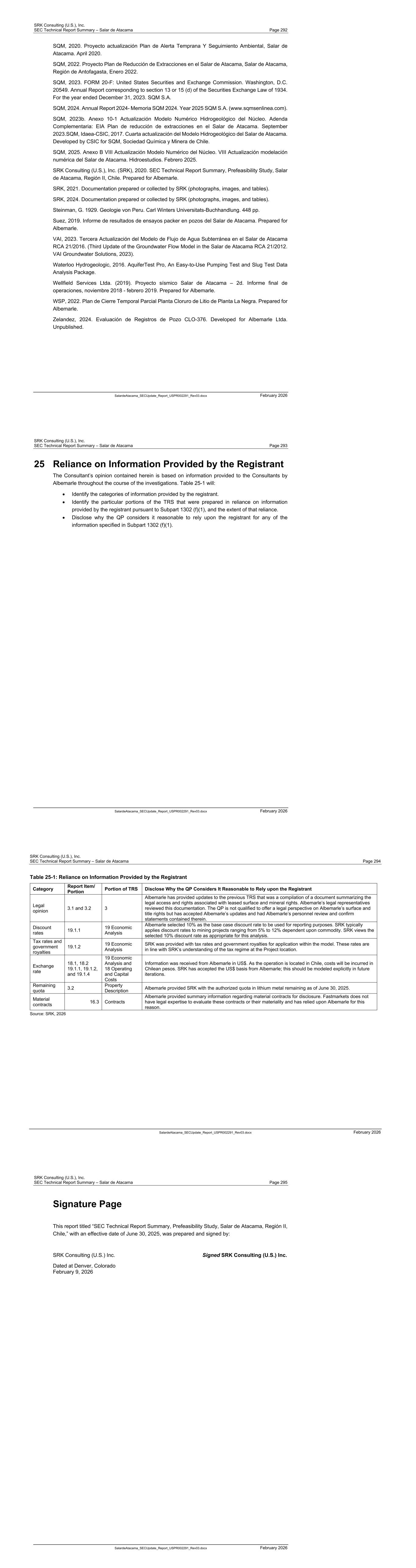
SRK Consulting (U.S.), Inc. SEC Technical Report Summary – Salar de Atacama Page 292 SalardeAtacama_SECUpdate_Report_USPR002291_Rev03.docx February 2026 SQM, 2020. Proyecto actualización Plan de Alerta Temprana Y Seguimiento Ambiental, Salar de Atacama. April 2020. SQM, 2022. Proyecto Plan de Reducción de Extracciones en el Salar de Atacama, Salar de Atacama, Región de Antofagasta, Enero 2022. SQM, 2023. FORM 20-F: United States Securities and Exchange Commission. Washington, D.C. 20549. Annual Report corresponding to section 13 or 15 (d) of the Securities Exchange Law of 1934. For the year ended December 31, 2023. SQM S.A. SQM, 2024. Annual Report 2024- Memoria SQM 2024. Year 2025 SQM S.A. (www.sqmsenlinea.com). SQM, 2023b. Anexo 10-1 Actualización Modelo Numérico Hidrogeológico del Núcleo. Adenda Complementaria: EIA Plan de reducción de extracciones en el Salar de Atacama. September 2023.SQM, Idaea-CSIC, 2017. Cuarta actualización del Modelo Hidrogeológico del Salar de Atacama. Developed by CSIC for SQM, Sociedad Química y Minera de Chile. SQM, 2025. Anexo B VIII Actualización Modelo Numérico del Núcleo. VIII Actualización modelación numérica del Salar de Atacama. Hidroestudios. Febrero 2025. SRK Consulting (U.S.), Inc. (SRK), 2020. SEC Technical Report Summary, Prefeasibility Study, Salar de Atacama, Región II, Chile. Prepared for Albemarle. SRK, 2021. Documentation prepared or collected by SRK (photographs, images, and tables). SRK, 2024. Documentation prepared or collected by SRK (photographs, images, and tables). Steinman, G. 1929. Geologie von Peru. Carl Winters Universitats-Buchhandlung. 448 pp. Suez, 2019. Informe de resultados de ensayos packer en pozos del Salar de Atacama. Prepared for Albemarle. VAI, 2023. Tercera Actualización del Modelo de Flujo de Agua Subterránea en el Salar de Atacama RCA 21/2016. (Third Update of the Groundwater Flow Model in the Salar de Atacama RCA 21/2012. VAI Groundwater Solutions, 2023). Waterloo Hydrogeologic, 2016. AquiferTest Pro, An Easy-to-Use Pumping Test and Slug Test Data Analysis Package. Wellfield Services Ltda. (2019). Proyecto sísmico Salar de Atacama – 2d. Informe final de operaciones, noviembre 2018 - febrero 2019. Prepared for Albemarle. WSP, 2022. Plan de Cierre Temporal Parcial Planta Cloruro de Litio de Planta La Negra. Prepared for Albemarle. Zelandez, 2024. Evaluación de Registros de Pozo CLO-376. Developed for Albemarle Ltda. Unpublished. SRK Consulting (U.S.), Inc. SEC Technical Report Summary – Salar de Atacama Page 293 SalardeAtacama_SECUpdate_Report_USPR002291_Rev03.docx February 2026 25 Reliance on Information Provided by the Registrant The Consultant’s opinion contained herein is based on information provided to the Consultants by Albemarle throughout the course of the investigations. Table 25-1 will: Identify the categories of information provided by the registrant. Identify the particular portions of the TRS that were prepared in reliance on information provided by the registrant pursuant to Subpart 1302 (f)(1), and the extent of that reliance. Disclose why the QP considers it reasonable to rely upon the registrant for any of the information specified in Subpart 1302 (f)(1). SRK Consulting (U.S.), Inc. SEC Technical Report Summary – Salar de Atacama Page 294 SalardeAtacama_SECUpdate_Report_USPR002291_Rev03.docx February 2026 Table 25-1: Reliance on Information Provided by the Registrant Category Report Item/ Portion Portion of TRS Disclose Why the QP Considers It Reasonable to Rely upon the Registrant Legal opinion 3.1 and 3.2 3 Albemarle has provided updates to the previous TRS that was a compilation of a document summarizing the legal access and rights associated with leased surface and mineral rights. Albemarle’s legal representatives reviewed this documentation. The QP is not qualified to offer a legal perspective on Albemarle’s surface and title rights but has accepted Albemarle’s updates and had Albemarle’s personnel review and confirm statements contained therein. Discount rates 19.1.1 19 Economic Analysis Albemarle selected 10% as the base case discount rate to be used for reporting purposes. SRK typically applies discount rates to mining projects ranging from 5% to 12% dependent upon commodity. SRK views the selected 10% discount rate as appropriate for this analysis. Tax rates and government royalties 19.1.2 19 Economic Analysis SRK was provided with tax rates and government royalties for application within the model. These rates are in line with SRK’s understanding of the tax regime at the Project location. Exchange rate 18.1, 18.2 19.1.1, 19.1.2, and 19.1.4 19 Economic Analysis and 18 Operating and Capital Costs Information was received from Albemarle in US$. As the operation is located in Chile, costs will be incurred in Chilean pesos. SRK has accepted the US$ basis from Albemarle; this should be modeled explicitly in future iterations. Remaining quota 3.2 Property Description Albemarle provided SRK with the authorized quota in lithium metal remaining as of June 30, 2025. Material contracts 16.3 Contracts Albemarle provided summary information regarding material contracts for disclosure. Fastmarkets does not have legal expertise to evaluate these contracts or their materiality and has relied upon Albemarle for this reason. Source: SRK, 2026 SRK Consulting (U.S.), Inc. SEC Technical Report Summary – Salar de Atacama Page 295 SalardeAtacama_SECUpdate_Report_USPR002291_Rev03.docx February 2026 Signature Page This report titled “SEC Technical Report Summary, Prefeasibility Study, Salar de Atacama, Región II, Chile,” with an effective date of June 30, 2025, was prepared and signed by: Signed SRK Consulting (U.S.) Inc. SRK Consulting (U.S.) Inc. Dated at Denver, Colorado February 9, 2026