
respec.com TECHNICAL REPORT SUMMARY JORDAN BROMINE OPERATION REPORT RSI-3740 PREPARED BY RESPEC Company, LLC 146 East Third Street Lexington, Kentucky 40508 PREPARED FOR Albemarle Corporation 4250 Congress Street Suite 900 Charlotte, North Carolina 28209 FEBRUARY 2026 Project Number M0580.25001 Exhibit 96.5 i DATE AND SIGNATURE PAGE This report, titled Technical Report Summary: Jordan Bromine Operation, is effective as of December 31, 2025, and was prepared and signed by RESPEC Company, LLC, acting as a Qualified Person Company. Signed and dated February 5, 2026 Signed: RESPEC Company, LLC Susan B. Patton Principal Consultant, Mining & Energy On behalf of RESPEC Company, LLC ii NOTE REGARDING FORWARD-LOOKING STATEMENT Jordan Bromine Operation Technical Report Summary as of December 31, 2025 This Technical Report Summary contains forward-looking statements within the meaning of the U.S. Securities Act of 1933 and the U.S. Securities Exchange Act of 1934, that are intended to be covered by the safe harbor created by such sections. Such forward-looking statements include, without limitation, statements regarding RESPEC’s expectation for the Jordan Bromine operation, including estimated cashflows, production forecasts, mine plans, revenue, income, costs, taxes, capital, rates of return, mine, material mined and processed, recoveries and grade, future mineralization, future adjustments and sensitivities and other statements that are not historical facts. Forward-looking statements address activities, events, or developments that RESPEC expects or anticipates will or may occur in the future and are based on current expectations and assumptions. Although RESPEC believes that its expectations are based on reasonable assumptions, it can give no assurance that these expectations will prove correct. Such assumptions include, but are not limited to: (i) permitting, development, operations and expansion of operations and projects being consistent with current expectations and mine plans; (ii) political developments in jurisdiction in which Jordan Bromine operates being consistent with current expectations; (iii) certain exchange rate assumptions being approximately consistent with current levels; (iv) certain price assumptions for elemental bromine; (v) prices for key supplies being approximately consistent with current levels; and (vi) other planning assumptions. This notice is an integral component of the Technical Report Summary (TRS) and should be read in its entirety and must accompany every copy made of the TRS. RESPEC has used their experience and industry expertise to produce the estimates in the TRS. Where RESPEC has made these estimates, they are subject to qualifications and assumptions, and it should also be noted that all estimates contained in the TRS may be prone to fluctuations with time and changing industry circumstances. iii TABLE OF CONTENTS 1.0 EXECUTIVE SUMMARY .................................................................................................................................................... 1 1.1 PROPERTY DESCRIPTION ....................................................................................................................................................................1 1.2 MINERAL RIGHTS ...................................................................................................................................................................................1 1.3 GEOLOGICAL SETTING, MINERALIZATION AND DEPOSIT ..........................................................................................................1 1.4 EXPLORATION ........................................................................................................................................................................................2 1.5 MINERAL PROCESSING AND METALLURGICAL TESTING ..........................................................................................................2 1.6 MINERAL RESOURCE ESTIMATES .....................................................................................................................................................2 1.7 MINERAL RESERVE ESTIMATES ........................................................................................................................................................3 1.8 MINING METHODS ................................................................................................................................................................................3 1.9 PROCESSING AND RECOVERY METHODS ......................................................................................................................................4 1.10 INFRASTRUCTURE .................................................................................................................................................................................4 1.11 MARKET STUDIES ..................................................................................................................................................................................4 1.12 ENVIRONMENTAL STUDIES, PERMITTING AND PLANS, NEGOTIATIONS, OR AGREEMENTS WITH LOCAL INDIVIDUALS OR GROUPS ..................................................................................................................................................................5 1.13 CAPITAL AND OPERATING COSTS ....................................................................................................................................................5 1.14 ECONOMIC ANALYSIS ..........................................................................................................................................................................6 1.15 INTERPRETATION AND CONCLUSIONS ..........................................................................................................................................6 1.16 RECOMMENDATIONS ...........................................................................................................................................................................6 2.0 INTRODUCTION ............................................................................................................................................................... 7 2.1 ISSUER OF REPORT ...............................................................................................................................................................................7 2.2 TERMS OF REFERENCE AND PURPOSE ...........................................................................................................................................7 2.3 SOURCES OF INFORMATION ..............................................................................................................................................................7 2.4 GLOSSARY ...............................................................................................................................................................................................8 2.5 PERSONAL INSPECTION ......................................................................................................................................................................10 3.0 PROPERTY DESCRIPTION ............................................................................................................................................... 11 3.1 JORDAN LAND MANAGEMENT AND REGULATORY FRAMEWORK ..........................................................................................11 3.2 MINERAL RIGHTS ...................................................................................................................................................................................11 3.2.1 Jordan Bromine Company and Albemarle Joint Venture ............................................................................................11 3.2.2 Arab Potash Company ...........................................................................................................................................................15 3.3 SIGNIFICANT ENCUMBRANCES OR RISKS TO PERFORMING WORK ON PERMITS .............................................................15 4.0 ACCESSIBILITY, CLIMATE, LOCAL RESOURCES, INFRASTRUCTURE, AND PHYSIOGRAPHY ..................................... 16 4.1 TOPOGRAPHY AND VEGETATION .....................................................................................................................................................16 4.2 ACCESSIBILITY AND LOCAL RESOURCES .......................................................................................................................................20 4.3 CLIMATE ...................................................................................................................................................................................................21 4.4 INFRASTRUCTURE .................................................................................................................................................................................22

iv 4.5 WATER RESOURCES .............................................................................................................................................................................23 5.0 HISTORY ........................................................................................................................................................................... 24 6.0 GEOLOGICAL SETTING, MINERALIZATION, AND DEPOSIT ........................................................................................... 25 6.1 REGIONAL GEOLOGY ............................................................................................................................................................................25 6.2 LOCAL GEOLOGY ...................................................................................................................................................................................25 6.3 PROPERTY GEOLOGY AND MINERALIZATION ...............................................................................................................................31 7.0 EXPLORATION .................................................................................................................................................................. 33 8.0 SAMPLE PREPARATION, ANALYSES, AND SECURITY ................................................................................................... 35 9.0 DATA VERIFICATION ....................................................................................................................................................... 36 10.0 MINERAL PROCESSING AND METALLURGICAL TESTING ............................................................................................. 37 10.1 BRINE SAMPLE COLLECTION .............................................................................................................................................................37 10.2 SECURITY .................................................................................................................................................................................................38 10.3 ANALYTICAL METHOD .........................................................................................................................................................................38 11.0 MINERAL RESOURCE ESTIMATES .................................................................................................................................. 39 11.1 DEAD SEA ELEVATION ..........................................................................................................................................................................40 11.2 DEAD SEA VOLUME ...............................................................................................................................................................................41 11.3 DEAD SEA SALINITY ..............................................................................................................................................................................42 11.4 SIMULATION MODEL ............................................................................................................................................................................43 11.5 BROMIDE CONCENTRATION ..............................................................................................................................................................44 11.6 RESOURCE ESTIMATION .....................................................................................................................................................................44 12.0 MINERAL RESERVE ESTIMATES ..................................................................................................................................... 47 13.0 MINING METHOD ............................................................................................................................................................. 49 13.1 BRINE EXTRACTION METHOD ............................................................................................................................................................49 13.2 LIFE-OF-MINE PRODUCTION SCHEDULE .......................................................................................................................................55 14.0 PROCESSING AND RECOVERY METHODS ..................................................................................................................... 56 14.1 MINERAL RECOVERY PROCESS WALKTHROUGH ........................................................................................................................56 15.0 INFRASTRUCTURE ........................................................................................................................................................... 58 15.1 ROADS AND RAIL ...................................................................................................................................................................................58 15.2 PORT FACILITIES ....................................................................................................................................................................................58 15.3 PLANT FACILITIES..................................................................................................................................................................................60 15.3.1 Water Supply ............................................................................................................................................................................60 15.3.2 Power Supply ...........................................................................................................................................................................60 15.3.3 Brine Supply .............................................................................................................................................................................60 15.3.4 Waste-Steam Management .................................................................................................................................................60 16.0 MARKET STUDIES ............................................................................................................................................................ 61 16.1 BROMINE MARKET OVERVIEW...........................................................................................................................................................61 16.2 MAJOR PRODUCERS ............................................................................................................................................................................61 v 16.3 MAJOR MARKETS ..................................................................................................................................................................................62 16.4 BROMINE PRICE TREND .......................................................................................................................................................................62 16.5 BROMINE APPLICATIONS ....................................................................................................................................................................63 17.0 ENVIRONMENTAL STUDIES, PERMITTING AND PLANS, NEGOTIATIONS, OR AGREEMENTS WITH LOCAL INDIVIDUALS OR GROUPS ....................................................................................................................................................... 64 17.1 ENVIRONMENTAL STUDIES ................................................................................................................................................................64 17.2 ENVIRONMENTAL COMPLIANCE ......................................................................................................................................................64 17.2.1 Compliance With National Standards ...............................................................................................................................64 17.2.2 Compliance With International Standards .......................................................................................................................64 17.2.3 Environmental Monitoring ...................................................................................................................................................65 17.3 REQUIREMENTS AND PLANS FOR WASTE AND TAILINGS DISPOSAL ....................................................................................65 17.4 PROJECT PERMITTING REQUIREMENTS ........................................................................................................................................65 17.5 QUALIFIED PERSON'S OPINION .........................................................................................................................................................66 18.0 CAPITAL AND OPERATING COSTS .................................................................................................................................. 67 18.1 CAPITAL COSTS .....................................................................................................................................................................................67 18.1.1 Development Facilities Costs ..............................................................................................................................................67 18.1.2 Plant Maintenance Capital (Working Capital) .................................................................................................................67 18.2 OPERATING COSTS ...............................................................................................................................................................................67 19.0 ECONOMIC ANALYSIS ..................................................................................................................................................... 69 19.1 ROYALTIES...............................................................................................................................................................................................69 19.2 BROMINE MARKET AND SALES .........................................................................................................................................................69 19.3 INCOME TAX ............................................................................................................................................................................................69 19.4 CASH FLOW RESULTS ..........................................................................................................................................................................70 19.5 NET PRESENT VALUE ESTIMATE .......................................................................................................................................................75 20.0 ADJACENT PROPERTIES ................................................................................................................................................. 77 20.1 MANASEER MAGNESIA COMPANY ...................................................................................................................................................77 20.2 DEAD SEA WORKS LIMITED ................................................................................................................................................................77 21.0 OTHER RELEVANT DATA AND INFORMATION ............................................................................................................... 80 22.0 INTERPRETATION AND CONCLUSIONS ......................................................................................................................... 81 22.1 GENERAL ..................................................................................................................................................................................................81 22.2 DISCUSSION OF RISK ...........................................................................................................................................................................82 22.2.1 Geopolitical Risk .....................................................................................................................................................................83 22.2.2 Environmental Risk.................................................................................................................................................................84 22.2.3 Additional Raw Materials Risk .............................................................................................................................................84 22.2.4 Other Risk Considerations ....................................................................................................................................................85 22.2.5 Risk Conclusion .......................................................................................................................................................................87 23.0 RECOMMENDATIONS ...................................................................................................................................................... 88 24.0 RELIANCE ON INFORMATION PROVIDED BY THE REGISTRANT ................................................................................... 89 vi 25.0 REFERENCES .................................................................................................................................................................... 90 vii LIST OF TABLES Table Page 2-1 Glossary of Terms ............................................................................................................................................................................................ 8 6-1 Typical Concentration of Ions in the Dead Sea and Regular Sea Water Grams per Liter ............................................................. 32 11-1 Dead Sea Level, Area, and Volume as Predicted by a Two-Layer Model Based on the Water-Mass Balance Approach, Baseline Year, 1997 ................................................................................................................................................................... 44 11-2 Dead Sea Bromide Ion Resource ................................................................................................................................................................. 45 11-3 Dead Sea Surface Area Allocation (as of December 2025) .................................................................................................................. 46 12-1 Jordan Bromine Company (Area 1 and Petra) Brine Processing and Bromine Production Records (2022–2025) .............. 48 13-1 Ion Concentration in Dead Sea Water ........................................................................................................................................................ 49 13-2 Life-of-Mine Production Schedule ............................................................................................................................................................. 55 15-1 Materials Stored at Aqaba Port .................................................................................................................................................................... 58 15-2 Materials Stored at Jordan Bromine Company Terminal...................................................................................................................... 59 16-1 Bromine Production by Leading Countries (2020–2024) .................................................................................................................... 61 18-1 Summary of Operating and Capital Expenditures .................................................................................................................................. 68 19-1 Annual Cash Flow Summary – Proven Reserve – Spot Prices............................................................................................................... 71 19-2 Annual Cash Flow Summary – Proven Reserve – Spot Prices Less 15 Percent ............................................................................... 72 19-3 Annual Cash Flow Summary – Proven Reserve – Spot Prices Less 30 Percent ............................................................................... 73 19-4 Annual Cash Flow Summary – Proven Reserve – Spot Prices Less 45 Percent ............................................................................... 74 19-5. Jordan Bromine Company – Net Present Value of Reserve as of December 31, 2025 – Spot Prices ........................................ 75 19-6 Jordan Bromine Company – Net Present Value of Reserve as of December 31, 2025 – Spot Prices Less 15 Percent ............................................................................................................................................................................................................... 75 19-7 Jordan Bromine Company – Net Present Value of Reserve as of December 31, 2025 – Spot Prices Less 30 Percent ............................................................................................................................................................................................................... 75 19-8 Jordan Bromine Company – Net Present Value of Reserve as of December 31, 2025 – Spot Prices Less 45 Percent ............................................................................................................................................................................................................... 75 22-1 Project Risks ..................................................................................................................................................................................................... 86 24-1 Reliance on Information Provided by the Registrant ............................................................................................................................. 89

viii LIST OF FIGURES FIGURE Page 3-1 Jordan Bromine Company Project Location Map................................................................................................................................... 13 3-2 Administrative Divisions of Jordan ............................................................................................................................................................. 14 4-1 Morphological Features and General Elevation ...................................................................................................................................... 18 4-2 Vegetation Types of Jordan.......................................................................................................................................................................... 19 4-3 Average Annual Rainfall ................................................................................................................................................................................. 22 6-1 Physiological Features ................................................................................................................................................................................... 26 6-2 (A) Plan View of the Dead Sea in Relation to the Western Boundary Fault and the Arava Fault and (B) Generalized Cross Section of the Dead Sea Lake Geology .......................................................................................................................................... 27 6-3 Main Regional Faults in the Area ................................................................................................................................................................. 27 6-4 Map of the Jordan Bromine Company Area and Its Generalized Geology, Including Faults ....................................................... 28 6-5 Depositional Settings of the Dead Sea ...................................................................................................................................................... 29 11-1 Interannual Changes in the Dead Sea Total Vertical Stability and Sea Level .................................................................................. 41 11-2 Quasi-Salinity (Sigma 25) of the Dead Sea ............................................................................................................................................... 43 11-3 Schematic of the Mass Balance for the Dead Sea Using a Two-Layer System ............................................................................... 44 11-4 Dead Sea Area Surface Area Apportionment (as of December 2025)............................................................................................... 45 13-1 Process Sequence Schematic ..................................................................................................................................................................... 50 13-2 Solar Evaporation and Production Plant Map .......................................................................................................................................... 52 13-3 Pond C-7 Feedbrine Pumping Station (for Bromine and Magnesium Plants) ................................................................................. 53 13-4 PS4 Pumping Station ..................................................................................................................................................................................... 54 14-1 Area 1 and Petra Mineral Recovery Trains ................................................................................................................................................ 56 16-1 Bromine Price Trend, as Per China Petroleum and Chemical Industry Federation ........................................................................ 63 19-1 Net Present Value Distribution of Proven Reserve by Price Forecast ................................................................................................ 76 20-1 The Adjacent Properties of Manaseer Magnesia Company and Arab Potash Company .............................................................. 79 1 1.0 EXECUTIVE SUMMARY This Technical Report Summary (TRS) was prepared by RESPEC Company, LLC (RESPEC) at the request of Albemarle Corporation (Albemarle, or the company) for the company’s Jordan Bromine Company (JBC) to update a previously filed TRS to reflect depletion by extraction and increased plant capacity. The TRS complies with disclosure standards of the U.S. Securities and Exchange Commission’s S-K Regulation 1300 (SEC S-K 1300), following the TRS outline described in Code of Federal Regulations (CFR) 17, and reports the estimated Reserve for the Jordan bromine operation, as well as all summary information required as outlined in SEC S-K 1300. 1.1 PROPERTY DESCRIPTION The JBC operation is located in Safi in the Hashemite Kingdom of Jordan (Jordan) and is located on a 33-hectare (ha) area on the southeastern edge of the Dead Sea, which is approximately 6 kilometers (km) north of the Arab Potash Company (APC) plant. JBC also has a 2-ha storage facility within the Jordanian Free Zone at the Port of Aqaba. 1.2 MINERAL RIGHTS JBC was established in 1999 and is a joint venture between Albemarle Holdings Company Limited, a wholly owned subsidiary of Albemarle, and APC. JBC’s operations primarily consist of the manufacturing of bromine from bromide-enriched brine, which is a by-product of potash operations conducted by APC. The Government of the Hashemite Kingdom of Jordan granted APC a concession for exclusive rights to exploit the minerals and salts from the Dead Sea brine until 2058. Rights granted to APC apply to JBC by virtue of APC’s participation in the joint venture. APC maintains all the necessary permits to guarantee the continuous operation of its facilities under Jordanian legislation. 1.3 GEOLOGICAL SETTING, MINERALIZATION AND DEPOSIT The movement of the plates that created the basin containing the Dead Sea began 15 million years ago (Ma), and the plates continue to diverge today at a rate of 5 to 10 millimeters (mm) per year [Warren, 2006]. The Dead Sea is an isolated hypersaline lake within the lowest part of the catchment basin; it is a unique, current-day example of evaporitic sedimentation and accumulation within a brine body [Warren, 2006]. The climate, geology, and location provide a setting that makes the Dead Sea a valuable large-scale natural resource for potash and bromine. As of the effective date, the Dead Sea has a surface area of 571 square kilometers (km2) and a brine volume of 105 cubic kilometers (km3). The Dead Sea is the world’s saltiest natural lake [Wisniak, 2002], containing high concentrations of ions compared to that of regular seawater and an unusually high amount of magnesium and bromine. Evaporation greatly exceeds the inflow of water to the Dead Sea, causing a negative water balance and a shoreline recession of approximately 1.1 meters (m) to 1.25 m per year [Warren, 2006]. Variable evaporation rates and uncertain subsurface inflow of fresh water make it difficult to predict its water 2 deficit. The Dead Sea contains a large and deep northern basin and a shallow southern basin. The southern basin is a saline mudflat, and the water level is maintained by artificial flooding with northern basin brine. 1.4 EXPLORATION Although typically conducted, no exploration was required to characterize the mineral deposit because the minerals are extracted from the Dead Sea, which has been extensively characterized. A limited site investigation program was conducted in 1966, when most of the southern basin of the Dead Sea was covered in up to 3 m of brine. A more detailed program, with a cost of £3 million, took place in 1977 when the brine level had receded from the southern basin, leaving only land-locked ponds in the central depression. 1.5 MINERAL PROCESSING AND METALLURGICAL TESTING The JBC bromine plants and connection to the APC carnallite pond C-7 were designed to move substantial quantities of concentrated brine to the central bromine production facilities, where brine is processed into bromine. Knowing the consistency of bromide salts (bromides) in the bromide-enriched brine (feedbrine) is critical for operations and business planning for bromine derivative sales. Feedbrine and heated bromide-depleted brine (tailbrine) samples are collected frequently upstream and downstream of the bromine tower to capture any concentration changes. The sampling process is systematic and documented. A widely used halogen titration process is used to measure bromide in brine; the methods appear to be reasonable and well established. The sampling and analytical processes are adequate to support the plant operation. 1.6 MINERAL RESOURCE ESTIMATES JBC’s bromine production plant is atypical of many mineral processing operations in that the feedstock for the plant is concentrated brine available from another mineral processing plant owned by APC. The feedstock for the APC plant is sourced from the Dead Sea, a nonconventional reservoir shared by Israel and Jordan. As such, there is no specific Resource owned by APC or JBC; rather, APC has exclusive rights granted by the Hashemite Kingdom of Jordan to withdraw brine from the Dead Sea and process it to extract minerals. The Measured Resource of bromide ion attributable to Albemarle’s 50 percent interest in its JBC joint venture, inclusive of Reserve, is estimated to be approximately 164.49 million metric tonnes (MMt). The Measured Resource of bromide ion attributable to Albemarle’s 50 percent interest in the JBC joint venture, exclusive of reserves, is 162.43 MMt. From these large Resources, JBC is extracting approximately 1 percent of the bromine available. 3 1.7 MINERAL RESERVE ESTIMATES Proven and Probable Reserves have been estimated based on the operational parameters, economics, and concession agreement held by JBC. The Reserve estimate is constrained by the time available under the concession agreement with the Hashemite Kingdom of Jordan, and the processing capability of the plant. The forecast volumes of brine processed are supported by demonstrated plant performance. The Reserve estimate is not constrained by the available Resource, with approximately 1 percent of the Measured Resource being consumed. Costs are based on forward projections supported by historical operating and capital costs, with no major capital projects or plant expansions required to support the operating forecast. Revenues are based on a range of bromine sales prices between the spot price for the effective date of December 31, 2025, and the spot price less 15 percent, 30 percent, and 45 percent. The plants are forecast to process approximately 17.4 MMt of feedbrine per year on average over the remaining concession life. On an annual basis, the feed contains approximately 152,000 tonnes of bromide ion. At the plant processing recovery of 82 percent (bromine from bromide), product bromine is estimated at approximately 125,000 tonnes per year. The APC concession and JBC’s ownership of the facility expire at the end of 2058. Over the 33 years of production from the Reserve effective date of December 31, 2025, an estimated 4.1 MMt of bromine will be produced, which establishes the Reserve estimate. The Proven Reserve attributable to Albemarle’s 50 percent interest in its JBC joint venture is estimated to be approximately 2.1 MMt of elemental bromine. 1.8 MINING METHODS Mining methods consist of all activities necessary to extract brine from the Dead Sea and extract bromine. The low rainfall, low humidity, and high temperatures in the Dead Sea area provide ideal conditions for recovering potash from the brine by solar evaporation. JBC obtains its feedbrine from APC’s evaporation carnallite pond C-7, and this supply is closely linked to the APC operation. As evaporation occurs, the specific gravity of the brine increases until its constituent salts progressively crystallize and precipitate out of solution, starting with sodium chloride (common salt), which precipitates out to the bottom of the ponds (pre-carnallite ponds). Brine is transferred to other ponds in succession, where its specific gravity increases further, ultimately precipitating out all of the sodium chloride. Carnallite precipitation takes place at the carnallite pond C-7, where it is harvested from the brine and pumped as slurry to a process plant (where the potassium chloride is separated from the magnesium chloride). JBC extracts the bromide-rich, carnallite-free brine from pond C-7 through a pumping station with a capacity of approximately 84.1 million cubic meters (MCM) per year. This brine feeds the bromine and magnesium plants.

4 1.9 PROCESSING AND RECOVERY METHODS Feedbrine is conveyed to the two bromine plants via two parallel bromine production trains within the JBC facility via an open channel. Elemental bromine is produced at the JBC plants through a series of chemical processes. The brine is mixed with chlorine to extract the bromine from the solution. Chlorinated brine enters the bromine distillation tower (at approximately 120 degrees Celsius [°C]). Chlorine is added to continue the reaction with any residual bromides, and the brine stream is heated by adding steam, maintaining a temperature above the boiling point. Bromine exiting the recovery section of the tower is purified. Tailbrine exits the bromine distillation tower and is mixed with a strong base to neutralize any remaining acid, bromine, or chlorine. The tailbrine is then pumped to a storage pond for cooling and eventual discharge, and recycled back to the Dead Sea via the APC process plant. Vaporized bromine is condensed, and the wet bromine is fed to a glass-lined crude bromine storage drum that acts as an intermediate storage before downstream purification (and removal of any dissolved chlorine). 1.10 INFRASTRUCTURE The Jordan Valley Highway/Route 65 is the primary method of access for supplies and personnel to JBC. The Port of Aqaba is the main entry point for supplies and equipment for JBC, where imported shipping containers are offloaded from ships and are transported by truck to JBC via the Jordan Valley Highway. Aqaba is approximately 205 km south of JBC via Highway/Route 65. Major international airports can be readily accessed either in Amman or Aqaba. Jordan’s railway transport runs north to south through Jordan and is not used to transport JBC employees and products. JBC ships products in bulk through a storage terminal in Aqaba. The terminal has aboveground storage tanks, as well as pumps and piping for loading products onto ships. JBC’s main activities in Aqaba are raw material/product storing, importing, and exporting. An evaporation pond collects the waste streams from pipe flushing, housekeeping, and other activities. Infrastructure and facilities to support the operation of the bromine production plant at the Safi site is compact and contained in an approximately 33-ha area. Fresh water is sourced from the Mujib Reservoir, a manufactured reservoir. Approximately 1.0 to 1.2 MCM of water is used annually. Electricity is generated by the National Electric Power Company of Jordan (NEPCO) and distributed directly to JBC via the Electricity Distribution Company (EDCO), which is owned and operated by Kingdom Electricity Company. Overall, the project is well supported by quality infrastructure. 1.11 MARKET STUDIES The global bromine market is expected to grow steadily at a Compound Annual Growth Rate (CAGR) of approximately 4.04 percent between 2025 and 2033. A significant driver in the demand growth is increased demand for brominated flame retardants that are present in computer chips, particularly supporting the growth of data centers worldwide. Flame-retardant chemicals use bromine to develop 5 fire resistance. Also contributing to this trend is the increased demand for plastics. Plastics are widely used in packaging, construction, electrical and electronics items, automotive, and many other industries. The increasing demand for plastics across various end-user industries is driving the demand for flame-retardant chemicals that, in turn, propels the bromine market. The major producers of elemental bromine worldwide are Israel, Jordan, China, and the United States. The global bromine market is dominated by manufacturers who have an extensive geographical presence with production facilities worldwide. A forecast of the global bromine market through 2032 suggests that Asia would be the fastest-growing region for bromine consumption because of a growing population and the increasing purchasing power in the developing nations. The growth of the agricultural and automotive industries in countries such as China and India will also drive rising demand for bromine. The price of bromine normalized after the volatility in late 2021, with mid-range levels around $2,680 per tonne globally. The North American and Middle Eastern bromine prices were $2,690 per tonne and $2,440 per tonne, respectively, in January 2026. 1.12 ENVIRONMENTAL STUDIES, PERMITTING AND PLANS, NEGOTIATIONS, OR AGREEMENTS WITH LOCAL INDIVIDUALS OR GROUPS JBC has carried out environmental impact studies in compliance with Jordanian regulations. The environmental impact studies are available on the Multilateral Investment Guarantee Agency (MIGA) website (www.miga.org) and are in the public domain. JBC complies with national environmental and labor regulations. It also meets or exceeds the international regulations of the Occupational Safety and Health Administration (OSHA) and (National Fire Protection Association (NFPA). JBC is the first company of its kind in Jordan to become an authorized exporter into Europe and has been certified for International Organization of Standards (ISO) 9001 and 14001 and the Voluntary Emissions Control Action Program (VECAP). The company’s environmental program has been ISO 14001 certified by Lloyd’s Register since 2007 and further enhanced through the adoption of the integrated management system for quality (IS0 9001: 2015, OHSASL800L, 2007, ISO/4001:2015) certificate received in 2018. JBC works closely with the local communities, governmental, and nongovernmental organizations to make a positive difference and help communities prosper, both socially and environmentally. The company has established the Caring for Jordan Foundation, which contributes to the well-being of Jordanians by helping them improve their quality of life through support of sustainable community projects. 1.13 CAPITAL AND OPERATING COSTS The JBC facility is an active operation with a track record of industrial production of elemental bromine and most of the major capital expenditures (CAPEX) have already taken place. Review of the business plan provided by JBC confirmed that no further facilities or plant capital is required because JBC 6 intends to keep all the major components of its industrial facility through the expiration of the concession contract. An annual sustaining capital allocation of $14.0 million has been included. Plant operating costs and forecast budget were reviewed. Plant operating costs are expected to remain relatively constant at $501 per tonne of product bromine. 1.14 ECONOMIC ANALYSIS An economic model has been used to forecast cash flow from elemental bromine production and sales to derive a Net Present Value (NPV) for the bromine Reserve. Cash flows have been generated using annual forecasts of production, sales revenues, operating costs, and capital costs. At the assumed bromine sales price range of $2,690 to $4,890 per tonne, the operations generate an NPV of $1.5 billion to $3.2 billion at a 15 percent discount rate as of December 31, 2025, demonstrating economic viability. 1.15 INTERPRETATION AND CONCLUSIONS JBC’s primary raw material is bromide-enriched brine from the adjacent APC potash processing business. APC has mineral rights to brine extracted from the Dead Sea through 2058. The Measured Resources for bromide ion in the Dead Sea is far in excess of the stated JBC Proven Reserve of 4.1 million tonnes of elemental bromine (Albemarle’s attributable 50 percent interest of approximately 2.1 MMt). The operation has been in production since 2000 and has a demonstrated production capacity to support the Reserve estimate. 1.16 RECOMMENDATIONS No additional work relevant to the existing Reserve is applicable at this time. The JBC plants have demonstrated the capacity to operate at the production levels forecast through the life of the Reserve. Albemarle conducted major mechanical improvements to the JBC bromine towers in 2025, which will increase annual production to 125,000 tonnes during the forecast years. 7 2.0 INTRODUCTION 2.1 ISSUER OF REPORT This TRS was prepared at the request of Albemarle and is being filed under the SEC S-K 1300 reporting requirements for Albemarle’s JBC operation located in Safi, Jordan. This TRS updates a previously filed TRS, dated 24 January 2025, prepared by RPS and RESPEC to account for depletion through extraction and increased plant capacity. The purpose of the report is to support the disclosure of Mineral Resource and Mineral Reserve estimates for the Jordan Bromine property as of December 31, 2025. 2.2 TERMS OF REFERENCE AND PURPOSE The following general information applies to this TRS: / This document reports the estimated Reserve for the JBC operation, as well as all summary information required by the SEC S-K 1300. The focus of this TRS and the scientific and technical information in this report only apply to the JBC operation. RESPEC is entirely independent of Albemarle and has no interest in the mineral property discussed in this report. / This TRS was prepared by RESPEC, complies with disclosure standards of SEC S-K 1300, and follows the TRS outline described in CFR 17, Part 229.600. / The effective date of this report is December 31, 2025, which is also the deadline for the data included within this report. / Reserve estimates are presented on a 100 percent basis. The Reserve is the total Reserve for JBC; Albemarle’s share per the joint venture with APC is 50 percent. / Units presented are metric units, unless otherwise noted, and currency is expressed in United States dollars ($) unless otherwise noted. / Copyright of all text and other matters in this document, including the manner of presentation, is the exclusive property of RESPEC and Albemarle as per the Agreement signed between RESPEC and Albemarle. / RESPEC will receive a fee for preparing this TRS according to normal professional consulting practices. The fee is not contingent on the conclusions of this report and RESPEC will not receive any other benefit for preparing this report. RESPEC does not have any monetary or other interests that could be reasonably considered as capable of affecting its ability to provide an unbiased opinion in relation to the project. RESPEC is a 100 percent employee-owned global leader in integrated technology solutions for mining, energy, water, natural resources, and infrastructure. 2.3 SOURCES OF INFORMATION The interpretations and conclusions presented in this report are primarily based on the information obtained from the public sources and information provided by Albemarle. All source materials have been properly cited and referenced in Chapter 25.0 of this report.

8 2.4 GLOSSARY Descriptions of terms used throughout this report are provided in Table 2-1. Table 2-1. Glossary of Terms (Page 1 of 3) Term Abbreviation Description Accord européen relatif au transport international des marchandises Dangereuses par Route ADR Agreement concerning the International Carriage of Dangerous Goods by Road Aqaba Special Economic Zone Authority ASEZA Arab Potash Company APC Assay A test performed to determine a sample’s chemical content. below mean sea level bmsl Bisphenol A BPA Brine A high-concentration solution of salt (NaCl) in water (H2O). Bromide Br- A compound of bromine with another element or group, especially a salt containing the anion Br− or an organic compound with bromine bonded to an alkyl radical. Bromine A halogen element with atomic number 35 and element symbol Br that is the 10th most abundant element in sea water and 64th in the earth’s crust. calcium bromine CaBr2 capital expenditures CAPEX Carnallite A mineral [chemical formula KCl.MgCl2 6(H2O)] containing hydrated potassium and magnesium chloride. Code of Federal Regulations CFR Compound Annual Growth Rate CAGR cubic kilometers km3 cubic meters m3 Decabromodiphenyl Ethane DBDPE degrees Celsius °C Department of Lands and Surveys DLS Electricity Distribution Company EDCO grams per cubic centimeter g/cm3 grams per liter g/L hectares ha Halite NaCl Sodium chloride, which is a naturally occurring sodium salt mineral. International Air Transport Association IATA 9 Table 2-1. Glossary of Terms (Page 2 of 3) Term Abbreviation Description International Maritime Dangerous Goods IMDG International Organization of Standards ISO Israel Chemicals Limited ICL Jordan Bromine Company JBC Jordanian dinar JD Official currency of the Hashemite Kingdom of Jordan kilometers km kilovolt kV Manaseer Magnesia Company MMC meters m metric tonnes Mt metric tonnes million years ago Ma millimeters mm million cubic meters MCM million cubic meters, a measurement of volume million metric tonnes MMt million metric tonnes Multilateral Investment Guarantee Agency MIGA Megavolt-ampere MVA National Electric Power Company of Jordan NEPCO National Fire Protection Association NFPA Net Present Value NPV New York Stock Exchange NYSE Oil Natural Air Forced ONAF Oil Natural Air Natural ONAN operating expenditures OPEX Occupational Safety and Health Administration OSHA parts per million ppm personal protective equipment PPE potassium hydroxide KOH Qualified Person QP reverse osmosis RO sodium bromide NaBr sodium hydroxide NaOH 10 Table 2-1. Glossary of Terms (Page 3 of 3) Term Abbreviation Description square kilometers km2 Technical Report Summary TRSs Tel Aviv Stock Exchange TASE Tetrabromobisphenol-A TBBPA A derivative of bromine and is one of the most prevalent flame retardants used in plastic paints, synthetic textiles, and electrical devices. United States dollar $ Official currency of the United States of America U.S. Securities and Exchange Commission’s Regulation S-K Item 1300 SEC S-K 1300 Voluntary Emissions Control Action Program VECAP zinc bromide ZnBr 2.5 PERSONAL INSPECTION RESPEC visited the JBC bromine processing plant in September 2023 to inspect and verify that the information provided by JBC was accurate. The visit was successful and offered valuable insights into its advanced technology, safety measures, and commitment to environmental standards. Engaging discussions with the plant’s management underscored its dedication to efficiency, sustainability, and continuous improvement. This visit confirmed the plant’s responsible and eco-friendly bromine production practices, contributing significantly to a comprehensive understanding of its operations. 11 3.0 PROPERTY DESCRIPTION JBC is in Jordan, in the Governorate of Karak, and is located on the southeastern edge of the Dead Sea. The JBC production plant facility occupies a 26-ha area with geographic coordinates of 31° 8’ 34.85”N and 35° 31’ 34.68”E. The JBC site, as shown in Figure 3-1, is located approximately 6 km north of the APC plant. JBC also has a 2-ha storage facility within the Jordanian Free Zone at the Port of Aqaba. The facility is used to store bulk-liquid products before export and is located near the Jordan Oil Terminals Company, which is just west of the Aqaba Thermal Power Station and east of Solvochem-Holland. The site contains storage tanks and pumps and is connected to the nearest oil port by a 1.5-km pipeline. An extensive expansion of this facility was completed in 2013 [Al-Rawabi Environment & Energy Consultancies, 2012]. The administrative division of Jordan is shown in Figure 3-2. The country consists of twelve Governorates (i.e., Muhafazahs). Control of the Dead Sea waters and minerals is shared by Jordan on the east and Israel (including the West Bank) on the west. 3.1 JORDAN LAND MANAGEMENT AND REGULATORY FRAMEWORK Established in 1927, the Department of Lands and Surveys (DLS) is responsible for all legal property registration in Jordan. The DLS “has been established on a solid basis” according to The Land Tenure Journal, which is a peer-reviewed, open-access journal of the Climate, Energy and Tenure Division of the Food and Agriculture Organization of the United Nations [Madanat, 2010]. The Jordan Valley Authority manages various aspects of economic activity and agriculture water management on the Jordan side of the Jordan Valley. The Aqaba Special Economic Zone Authority (ASEZA) is responsible for most government-related issues in the Aqaba Region [Madanat, 2010]. The ASEZA was established in 2001 by the government of Jordan to independently (financially and administratively neutral) manage and regulate the economic development of the Aqaba Special Economic Zone. A description of the ASEZA and the laws and regulations are available at its website (https:// https://aseza.jo/Default/En). The Ministry of Energy and Mineral Resources is the primary regulator of most mining activities in Jordan that provides information (e.g., studies and maps) to interested companies and investors to help facilitate exploration and extraction. These efforts promote a strong regulatory environment with international industry standard environmental and safety best practice regulations [Al Tarawneh, 2016]. 3.2 MINERAL RIGHTS 3.2.1 JORDAN BROMINE COMPANY AND ALBEMARLE JOINT VENTURE JBC was established in 1999 as a joint venture between Albemarle Holdings Company Limited (a wholly owned subsidiary of Albemarle) and APC. Albemarle holds a 50 percent interest in JBC Limited. The bromide-enriched brine is a by-product of potash operations conducted by APC. JBC’s operations primarily consist of the manufacturing of bromine, from which derivative products are made, including

12 Tetrabromobisphenol-A (TBBPA), calcium bromide (CaBr), sodium bromide (NaBr), hydrobromic acid, and potassium hydroxide (KOH). The share agreement signed between APC and Albemarle Holdings Company Limited established that Albemarle’s share on the losses, liabilities, and interest expense of the joint venture is 50 percent; however, its share in the joint venture’s profit was 70 percent until 2012 and has been 60 percent since 2013. This percentage varies and depends on product split. In 1958, the Government of the Hashemite Kingdom of Jordan granted APC a concession for exclusive rights to exploit the minerals and salts from the Dead Sea brine until 2058; at that time, APC factories and installations would become the property of the Government [APC, 2018]. APC was granted its exclusive mineral rights under the Concession Ratification Law No. 16 of 1958. APC produces potash from the brine extracted from the Dead Sea. A concentrated bromide-enriched brine extracted from APC’s evaporation ponds (pond is also referred to as a pan) is the feed material for the JBC plant, as well as for the Manaseer Magnesia Company (MMC) (formerly Jordan Magnesia) plant. The most relevant clauses of APC’s concession agreement with the Government of Jordan are summarized as follows: / The agreement grants to APC licenses to import all devices, tools, transport means, machinery, and construction material necessary for the entire duration of the concession, its expansion, or completion, work continuation, and relocation. / APC is exempt from import fees, customs fees, and all other fees imposed on imported goods, provided they are used for the purposes of the company. If APC sells the fee-exempted goods, those goods are subject to taxation under Jordanian customs law. / APC’s products are exempt from exportation licenses and all fees imposed on exported goods. / APC retains exclusivity over the mining rights throughout the term of the concession. / The concession grants ample rights to APC to acquire fresh water from the Jordan River, the Al Mujeb, or the Maeen and Sweimeh, to be used at its facilities for mineral extraction and processing, as well as to drill wells in the concession area to obtain fresh water. APC also has the right to use spring water from sources located outside the concession area, except for sources that are registered as private property, and the right to request expropriation at the company’s expense. / APC also has the right to establish stone quarries on fee- and license-exempted, state-owned land. All these rights apply to JBC by virtue of APC’s participation in the joint venture. 13 Figure 3-1. Jordan Bromine Company Project Location Map. 14 Figure 3-2. Administrative Divisions of Jordan. 15 3.2.2 ARAB POTASH COMPANY APC is the eighth largest potash producer in the world by volume of production and the sole producer of potash in the Arab world. APC also has one of the best track records among Jordanian corporations in workplace safety, good governance, sustainable community development, and environmental conservation. Established in 1956 in Jordan as a pan-Arab venture, APC operates under a concession from the Government of Jordan that grants it exclusive rights to extract, manufacture, and market minerals from the Dead Sea brine until 2058. Upon termination of the concession, 100 years from the date it was granted, ownership of all plants and installations will be transferred to the Government of the Hashemite Kingdom of Jordan at no cost to the latter. In addition to its potash operations, APC also invests in several downstream and complementary industries related to the Dead Sea salts and minerals, including potassium nitrate, bromine, and other derivatives. As a major national institution and economic contributor, APC employs more than 2,200 workers across its locations in Amman, Aqaba, and Ghor Al-Safi. Potash production began in 1983 and has since progressed with various projects aimed at optimizing and expanding this production. 3.3 SIGNIFICANT ENCUMBRANCES OR RISKS TO PERFORMING WORK ON PERMITS The brine supply to the JBC facility is fully dependent on the raw material extracted and pre-processed, through an evaporation sequence, by APC. The pumping facilities, which are described in Section 13.1, are owned and operated by APC and covered by APC’s permits. Because APC is a national enterprise and the sole producer of a key commodity, all the necessary permits are maintained by APC to guarantee the continuous operation of its facilities under Jordanian legislation. Therefore, the encumbrances and/or risks to perform work on the operational permits are considered minimal. The fact that APC is both the entity controlling the subject mineral rights and a partner in the joint venture means that JBC contributes to a seamless coordination regarding the key permitting aspects of the operation.

16 4.0 ACCESSIBILITY, CLIMATE, LOCAL RESOURCES, INFRASTRUCTURE, AND PHYSIOGRAPHY 4.1 TOPOGRAPHY AND VEGETATION The surface of the Dead Sea is at an elevation of approximately 430 meters (m) below sea level [Pletcher, 2006] within the Dead Sea Rift Valley, which is the lowest surface on earth. The Dead Sea Rift Valley contains a series of pull-apart basins, including the Jordan Valley and Wadi Araba/Arava Valley, that connect to the Dead Sea [COYNE-ET BELLIER et al., 2014]. The Jordan River is in the Jordan Valley, extending south from the Sea of Galilee to the north and connecting to the northern shoreline of the Dead Sea. The Jordan River is the only major source of water to the Dead Sea [Ababsa, 2013]. The Jordan Valley is called the “food basket of Jordan.” With a continuous water supply (dams and irrigation) and year-round warm temperatures, the Jordan Valley and the Southern Ghor are among the most significant agricultural areas in Jordan [Ababsa, 2013]. The Wadi Araba/Arava Valley extends from the southern shore of the Dead Sea and continues south to the Port of Aqaba. This valley is geologically related to the Jordan Rift Valley [ESIA Project Team, 2017]. This stretch of valley land is predominantly sand-dune-covered desert with scattered settlements, but the northern and southern shore areas support some irrigated agriculture [ESIA Project Team, 2017]. Most of the Dead Sea shoreline is surrounded by steeply dipping, incised valleys and mountainous terrain. From the Port of Aqaba, the elevation rises from sea level to approximately 200 m above sea level along the Wadi Araba Ghor and drops drastically below sea level at the Dead Sea. The elevation gently rises but stays below sea level along the Jordan River/Valley depression, north to the Sea of Galilee, as shown in Figure 4-1. The Wadi Araba–Dead Sea depression steeply rises to the east and forms the mountain ridge known as the Northern Highlands, which is home to Jordan’s natural forests and is intersected by many deep wadis (canyons) [Ababsa, 2013]. Mountain elevations reach 1,850 m above sea level and are steeper and less vegetated in the south along the mountain ridge [Ababsa, 2013]. An east to west ridge separates the deep northern Dead Sea basin from a shallow southern Dead Sea basin (or lagoons). The Dead Sea is approximately 80 km long, 13 km wide, and around 330 m deep in the northern basin [Nissenbaum, 1993]. The southern shallow basin comprises shallow lagoons that average 2 m in depth. The southern basin would be exposed and dried up because of the continued drop in sea level if not for their current use as solar evaporation ponds that were constructed for the chemical extraction industry [ESIA Project Team, 2017]. Saline-tolerant vegetation begins to grow 50 to 100 m from the Dead Sea shoreline and diversifies to less salt-tolerant vegetation moving away from the Dead Sea, with vegetation variety and density 17 increasing within the wadis [Al-Rawabi Environment & Energy Consultancies, 2012]. Figure 4-2 displays the vegetation types in Jordan. 18 Figure 4-1. Morphological Features and General Elevation. 19 Figure 4-2. Vegetation Types of Jordan [Al-Rawabi Environment & Energy Consultancies, 2012].

20 The Gulf of Aqaba (or Gulf of Eilat, Israel) is a large gulf at the northeastern tip of the Red Sea. The gulf is 177 km long with an average width of approximately 12 to 17 km [Britannica, 2026]. The Gulf coastline is primarily mountainous, with the east side bordered by Jordan (approximately 27 km of Jordan’s coastline is on the northeastern portion) and Saudi Arabia. The west side of the gulf is bordered by Egypt and a small portion of Israel’s coastline (in the very northwestern portion of the gulf). 4.2 ACCESSIBILITY AND LOCAL RESOURCES Jordan’s geographical location has made it a crossroads of the Middle East for thousands of years. Jordan continues to play a major role by participating in and providing a fairway for trades because of its location at the junction of Africa, Asia, and Europe [Madanat, 2010]. JBC is approximately 137 km south to southwest of Amman (the capital city of Jordan) and 40 km from the city of Al-Karak. The Jordan Valley Highway/Route 65 runs north to south and locally along the east side of the Dead Sea and is the primary access method for supplies and personnel to JBC. The Port of Aqaba is the main entry point for supplies and equipment for JBC, where shipping containers imported on ships are offloaded to trucks and transported to JBC via the Jordan Valley Highway/Route 65. The Jordan Valley Highway/Route 65 is a major highway that runs from the northwestern region of Jordan (from North Shuna) along the western edge of Jordan and south to Aqaba and the Port of Aqaba. JBC is situated midway along this highway, which is interconnected to several primary and secondary highways available to the western region of Jordan. From the outskirts of Amman, JBC can be accessed via vehicle by traveling southwest on Dead Sea Road/Route 40 for approximately 35 km and then south on the Jordan Valley Highway/Route 65 for 77 km. Various networks of primary and secondary highways and roads surround Amman. JBC is 40 km from Al-Karak (one of Jordan’s major cities) and can be reached via vehicle by travelling west on Al-Karak Highway/Route 50 for 26 km to Jordan Valley Highway/Route 65 and then south for 12.2 km. The community of Gawr al-Mazraah is in close proximity to JBC and is located 14.5 km north of JBC along Jordan Valley Highway/Route 65. The primary and secondary highways are provided in Figure 3-1. The Port of Aqaba is located 205 km south of JBC along the Jordan Valley Highway/Route 65 and is the only port in Jordan and the main entry point for supplies and equipment for JBC. The Jordanian port is on the Red Sea’s Gulf of Aqaba and is owned by the Aqaba Development Corporation. The port has undergone major redevelopment and expansion since 2002 and consists of 12 terminals with more than 32 specialized berths, which are operated by world-class operators [Aqaba Development Corporation, 2026]. Jordan has three commercial airports that are all located within proximity to the JBC plant, as shown in Figure 3-1. The Queen Alia International Airport and Amman/Marka Civil Airport are 35 km south of Amman and located approximately 121 km north and northeast of JBC via Jordan Valley 21 Highway/Route 65 and secondary roads and highway. The King Hussein International Airport is in Aqaba, which is 205 km south of JBC. Jordan’s railway transport line is operated by Hijazi Jordan Railway and the Aqaba Railway Corporation [Al-Rawabi Environment & Energy Consultancies, 2012]. The line runs north to south through Jordan and is not used to transport JBC employees and/or product. 4.3 CLIMATE Located within a desert, the Dead Sea and its shoreline is extremely arid. Summer temperatures average 34°C in August, with maximum temperatures reaching 51°C. Mild winter temperatures in January average 17°C on the south shore and 14°C on the north shore [Pletcher, 2006]. Hot, dry southerly winds can be very strong and can potentially cause sandstorms. Rainfall averages are only 2.5 inches (65 mm) per year [Pletcher, 2006] and rain occurs primarily during the winter months of November to March; January is the coldest and rainiest month in the Ghor Safi area [Al-Rawabi Environment & Energy Consultancies, 2012]. Figure 4-3, from the Red Sea Dead Sea Water Conveyance Study [ESIA Project Team, 2017], depicts the average annual rainfall over an area that included Jordan and Israel. 22 Figure 4-3. Average Annual Rainfall [ESIA Project Team, 2017]. 4.4 INFRASTRUCTURE The JBC facility is located in the Karak Governorate of Jordan and is connected to the nearby city of Al-Karak by the Jordan Valley Highway/Route 65 and the Al-Karak Highway/Route 50. The site is connected to the city of Amman by the Dead Sea Road/Route 40 and the Jordan Valley Highway/Route 65. The Jordan Valley Highway/Route 65 connects the facility with the Port of Aqaba in the Red Sea. Electricity is generated by the NEPCO and is distributed directly to JBC through the EDCO. EDCO is owned and operated by Kingdom Electricity Company, which is one of the preeminent holding companies in Jordan that invests in energy generation and distribution companies/utilities. In February 2014, Noble Energy Inc. (Noble Energy), a partner in Israel’s Tamar natural-gas field, announced that they had signed an agreement to supply APC and JBC with fuel beginning in 2016 23 [Tayseer and Solomon, 2014]. In January 2017, APC and JBC were connected to Israel’s national pipeline network, and gas exports began that month. The agreement with Noble Energy appears to have a duration of 15 years (until 2032) and is based on a price of $5.50 per million British thermal unit and is linked to the price of Brent crude oil [Azran, 2017]. In November 2018, APC and JBC announced that the quantity of natural gas that Noble Energy would supply to both Jordanian companies would increase in 2019. This additional agreement would extend until the end of the original agreement in 2032 [Gorodeisky and Yeshayahou, 2018]. JBC employs more than 350 people. Most personnel who work shifts (i.e., lower technical staff and labor) typically stay in a company residence located near the JBC plant, and higher level technical staff and management usually commute from Amman [Al-Rawabi Environment & Energy Consultancies, 2012]. The company residence is equipped with internet, televisions, a sports hall, and a cafeteria that is catered by a contractor [Al-Rawabi Environment & Energy Consultancies, 2012]. Small towns and villages are located between Amman and JBC; however, few personnel reside in these communities. The Port of Aqaba is the main entry point for supplies and equipment for JBC, where shipping containers imported on ships are offloaded to trucks and transported to JBC via the Jordan Valley Highway/Route 65. 4.5 WATER RESOURCES Fresh water is supplied by the Mujib River, which originates from the Mujib Reservoir (or dam)—a manufactured reservoir created in 1987 by the Royal Society for the Conservation of Nature. The Mujib River flows west through the Wadi Mujib Canyon and into the Dead Sea. According to JBC, approximately 1.0 to 1.2 MCM of water is used annually. Per the JV agreement, APC guarantees that JBC will receive all the brine and fresh water it requires for its operations. JBC’s water supply is provided by APC. APC is enhancing its water security through several projects, primarily by constructing dams in the southern regions. APC has financed the construction of the 4 MCM Wadi Ibn Hammad Dam in the Al-Karak Governorate and is studying the feasibility of financing the construction of Al-Wadat Dam in the Tafilah Governorate. These projects will achieve water cost savings and provide water to the local communities and the agriculture sector [APC, 2018].

24 5.0 HISTORY JBC, established in January 1999, is Jordan’s first and only producer and manufacturer of bromine and bromine derivatives. JBC is registered as a private Jordanian Free Zone in Safi, located in the southeastern area of the Dead Sea, Jordan. It is the first Jordanian company to become certified in the International Maritime Dangerous Goods (IMDG) Code, the Agreement concerning the International Carriage of Dangerous Goods by Road (ADR), and the International Air Transport Association (IATA). JBC has successfully established sales in more than 30 countries worldwide since its inception and is the first company of its kind in Jordan to become an authorized exporter to Europe. The following timeline is the history of the development of the JBC joint venture [JBC, 2026]: / 1999: Albemarle forms a joint venture with Jordan Dead Sea Industries Company and APC to manufacture bromine and bromine derivatives in a world-scale complex to be built in Jordan. / 2000: JBC is up and running as the first bromine manufacturer in Jordan. / 2002: JBC is registered as a private Jordanian Free Zone establishment in Jordan’s Safi Valley. / 2003: Hydrogen bromide and CaBr/NaBr plants begin operating. JBC also becomes an authorized exporter of bromine and bromine derivatives to Europe. / 2004: JBC CP 2000 plant goes into full operation. / 2005: JBC receives IMDG, ADR, and IATA certifications. The chlorine plant begins operations. / 2011: JBC announces that it will double the capacity of its bromine production to meet expanding global customer requirements. / 2013: JBC completes the first phase of its expansion to double its bromine production capacity. / 2017: The expansion of JBC’s TBBPA facilities goes into operation. / 2025: JBC reaches mechanical completion of the NEBO project, an innovative process upgrade designed to convert bromine co-product stream into a saleable product without needing additional freshwater. Also, a new agreement signed with APC to further develop and expand bromine production in the region. 25 6.0 GEOLOGICAL SETTING, MINERALIZATION, AND DEPOSIT 6.1 REGIONAL GEOLOGY The Dead Sea basin, as shown in Figure 6-1, is a tectonically subsiding, strike-slip depression that belongs to the Aqaba–Dead Sea–Jordan Valley rift that formed between the African and Arabian diverging tectonic plates (an active plate boundary) and connected the Red Sea to Turkey [Mansour et al., 2009]. The Dead Sea depression is a result of the transform faulting between the plates; the Western Boundary fault and the Arava fault are drawn on Figure 6-2 [Warren, 2006]. The Dead Sea is a hypersaline lake within the lowest part of the catchment basin and is a unique, current-day example of evaporitic sedimentation and accumulation within a brine body [Warren, 2006]. Movement of the plates that created the basin began 15 Ma and the plates continue to diverge at a current rate of 5 to 10 mm per year [Warren, 2006]. Holocene and Miocene sediments make up approximately 8 to 10 km of the basin fill that underlies the Dead Sea [Warren, 2006]. The Mediterranean Sea water is believed to have invaded the trough depression around 4 to 6 Ma and deposited 2 to 3 km of halite (NaCl) rich evaporites of the Sedom Formation [Warren, 2006]. These evaporites form diapirs and subcrops along the Western Margin faults [Warren, 2006] within the basin. Mount Sedom is an exposed salt diapir at the southwest corner of the Dead Sea. Fluviatile and lacustrine sediments of the Amora and Lisan Formations comprise 3 to 4 km of sediments that overlie the Sedom Formation and underlie the Dead Sea deposits, as shown in Figure 6-2 [Warren, 2006]. Figure 6-3 provides a simple schematic of the structural features for the Dead Sea area. The JBC Environmental Impact Assessment Report [Al-Rawabi Environment & Energy Consultancies, 2012] includes a figure drawn by Powell [1988] that illustrates the generalized geological map of the JBC area and is provided in Figure 6-4. 6.2 LOCAL GEOLOGY The Dead Sea is not only the lowest surface on earth but is also the saltiest natural lake on earth with an average salinity of 342 grams per kilogram as of 2011, which is 9.6 times as salty as the ocean [McColl, 2014]. The climate, geology, and location provide a setting that makes the Dead Sea a valuable large- scale natural resource for potash and bromine. When the Dead Sea was first formed, the volume was likely 4 to 5 times larger than the current volume [Wisniak, 2002]. Today, the Dead Sea waterbody has a surface area of 583 km2 and a brine volume of 110 km3 [Warren, 2006]. Warren [2006] explains that the northern basin is the only permanent body of water (see Figure 6-1). The southern basin is a saline pan and saline mudflat that would have been subaerially exposed, but the water level is maintained by artificial flooding with northern basin brine and controlled evaporation for industrial salt extraction on the Israeli and Jordanian sides of the Dead Sea. Warren [2006] draws the various depositional settings and general geology surrounding the Dead Sea, including the saline mudflats and pans at the southern end of the sea, as depicted in Figure 6-5. 26 Figure 6-1. Physiological Features. 27 Figure 6-2. (A) Plan View of the Dead Sea in Relation to the Western Boundary Fault and the Arava Fault and (B) Generalized Cross Section of the Dead Sea Lake Geology [Warren, 2006]. Figure 6-3. Main Regional Faults in the Area [Ghatasheh et al., 2013].

28 Figure 6-4. Map of the Jordan Bromine Company Area and Its Generalized Geology, Including Faults [ESIA Project Team, 2017]. 29 Figure 6-5. Depositional Settings of the Dead Sea [Warren, 2006]. Evaporation greatly exceeds the inflow of water to the Dead Sea, especially since the mid-20th century, because of increased diversion and damming of the Jordan River for agricultural and domestic use. The Dead Sea has been receding approximately 1.1 to 1.25 m per year [Warren, 2006]. Warren [2006] described that in 400 years (from 2006), the Dead Sea will drop 80 m below its current sea level, and the remaining brine will have approximately 380 grams per liter (g/L) of dissolved solids and a density of 1.27 kilograms per liter. These rates suggest that the surface of the Dead Sea will drop approximately 1 m and, depending on the slope, the shoreline could travel 5 to 6.25 m seaward over a span of 5 years. 30 Although actions to mitigate falling sea level may be considered a risk to the rights of access to the Resource and ultimately Reserve, this is not considered likely to be a problem before the lease agreement expires in 2058. The sea level generally rises slightly in winter by unpredictable, brief runoff and sudden flood events [Warren, 2006]. As the sea level continues to decrease, the brine/freshwater interface within the surrounding groundwater moves toward the sea [TAHAL Group and The Geological Survey of Israel, 2011]. The infiltration of less saline groundwater is causing the dissolution of localized rock salt in the ground, thus causing an increased occurrence of sinkholes. The Dead Sea level is expected to continue decreasing with the ongoing demand for fresh water within the area [TAHAL Group and The Geological Survey of Israel, 2011]. Chemical extraction by solar evaporation ponds in the southern basin also contributes to the drop in the sea level by artificially increasing the rate of evaporation [TAHAL Group and The Geological Survey of Israel, 2011]. The Red Sea-Dead Sea Water Conveyance Study Program Dead Sea Study Final Report [TAHAL Group and The Geological Survey of Israel, 2011] states that water balance estimates for the Dead Sea vary wildly because of unknown amounts of water influx from underground streams, variable evaporation rates, and an uncertain accumulation of salt collecting on the sea floor. The study also mentions that an evolution of the seawater occurs as the climate becomes warmer and the water becomes more saline and denser with time. Evaporation of the Dead Sea water slows as the water salinity increases [Warren, 2006]. Until 1979, the Dead Sea waters were stratified, and water density increased with depth [Warren, 2006]. The decreased influx of fresh water from the Jordan River, evaporation, and increased influx of end brine from the southern evaporation ponds caused an increase in surface-water salinity and density, which led the deep waters to overturn, mix with the surface waters, and homogenize and oxidize the entire water column in 1979 [Lensky et al., 2005]. After 1979, the Dead Sea became less stratified with periodic intermixing of layers (holomictic) and only periodically changes from holomictic to more rigidly stratified (meromictic) with episodes of higher-than-normal influx of fresh water into the basin [Warren, 2006]. During the Holocene era, overturn occurred periodically and is marked by a well-developed, coarse crystalline, deep-water NaCl. The Dead Sea is supersaturated with NaCl, and coarse crystalline NaCl has been rapidly accumulating at the bottom of the Dead Sea since the overturn in 1979 [Warren, 2006]. Fine-grained NaCl interbedded with gypsum layers is more common around the sea edge and shallow waters (less than 50 m depth) [Warren, 2006]. During the summer, sea waters become thermally stratified with the sun’s extra heat; the surface waters become warmer, and the sea divides into two distinct layers [Science Daily, 2019]. The warmer surface layer also becomes saltier than the lower, cooler layer because of increased evaporation [American Geophysical Union, 2019]. Winter is generally associated with supersaturated levels of NaCl [Wisniak, 2002]. 31 6.3 PROPERTY GEOLOGY AND MINERALIZATION Supersaturated with NaCl, the Dead Sea has an annual negative water balance (i.e., the sea level drops), which is a result of the diversion of fresh water that would normally drain into the Dead Sea [Lensky et al., 2005]. The water deficit by volume is greater than it appears as the water level falls because of the coinciding salt precipitation on the sea floor. The water balance is complicated and not well understood because of the variations in freshwater influx, variable evaporation rates, and uncertain subsurface inflow. The evaporation rate of a brine surface decreases with the increase in the amount of dissolved salts and is not comparable to the same evaporation rate of a body of fresh water under the same conditions. The Dead Sea is the world’s saltiest natural lake with a definite chemical stratification [Wisniak, 2002]. The Dead Sea brine solution contains high concentrations of ions compared to that of regular seawater and has an unusually high amount of magnesium and bromine and low amounts of carbonate and sulfate. Table 6-1 compares the average ion concentration of the Dead Sea to that of regular seawater. The relative ionic composition of the brine changes through the years because of continual evaporation, ongoing massive salt deposition, and reinjection of the dense end brines in the south. End-brine reinjection has a local effect on NaCl saturation and ion/cation chemistry near the southern end of the northern basin. The change in brine chemistry generally changes the solubility of evaporitic salts and brine physical properties (e.g., saturation, heat capacity, and viscosity) [Gat, 2001]. Wisniak [2002] reports that an estimated 900 MMt of bromine exists in the Dead Sea. The reason for the high levels of bromine found in the water is not well understood, but the salt brines are believed to have formed during the Tertiary period [Wisniak, 2002]. The evaporation ponds demonstrate the bromide-enrichment process that is theorized to have occurred many years ago and on a much larger scale. Residual brines are extremely rich in bromide. The feedbrine has a specific gravity of 1.24 and contains 5,000 parts per million (ppm) of bromine. After controlled evaporation occurs in the southern basin ponds following the precipitation of NaCl and carnallite, the residual brine has a specific gravity of 1.341 [Wisniak, 2002] and generally ranges from 8,000 to 10,000 ppm of bromide [JBC production reports (unpublished)].

32 Table 6-1. Typical Concentration of Ions in the Dead Sea and Regular Sea Water Grams per Liter Ions In Dead Sea (g/L) In Regular Seawater (g/L) Cations Sodium (Na+) 39 10.7 Magnesium (Mg2+) 39.2 1.27 Calcium (Ca2+) 17 0.42 Potassium (K+) 7 0.4 Anions Chloride (Cl–) 208 19.4 Bromide (Br–) 5 0.07 Sulfate (SO2–)4 0.5 3.6 Total 315 33.68 33 7.0 EXPLORATION Although typically conducted, no exploration was required to characterize the mineral deposit because the minerals are extracted from the Dead Sea, which has been extensively characterized. Typical chemistry of the Dead Sea brine is provided in Table 6-1. Woods Ballard and Brice [1984] describe the geotechnical exploration work done for the design of the dike system necessary for the construction of APC’s evaporation ponds. This information assists in understanding the shallow geological conditions underlying the evaporation ponds and ancillary structures. A limited site investigation program [Woods Ballard and Brice, 1984] was carried out in 1966 when most of the southern basin of the Dead Sea was covered in up to 3 m of brine. A more detailed program, with a cost of £3 million, took place in 1977 when the brine level had receded from the southern basin, leaving only land-locked ponds in the central depression. The very soft clays that overlay the area to form the flat foundation for the basins were deposited by streams that discharge into the area from the wadi Araba and the eastern hills. The foundation clay is interspersed with layers of uncemented salts. These salts are formed during the modern depositional process, when the sea level has receded sufficiently to allow brine at the southern end to become concentrated to the point of precipitation. The wadis have also formed fans of boulders, gravels, and sands where they exit from the escarpment and indent the eastern shoreline. To undertake the site investigation program in 1977, major access problems had to be resolved. The very soft mud in the carnallite pond area would not support the use of typical investigation equipment. Elsewhere, brine pools of varying depths covered part of the surface of the central depression and were 10 m deep at the main intake location off the Lisan Peninsula in the Dead Sea. A drilling rig was mounted on a 15 × 15 m Mackley Ace hover pontoon to allow drilling on the soft mud and over the sea. The unit was maneuvered into position by a Gemco amphibious transporter on land and by a motor launch in deep brine. The unit was serviced with small Nimbus hovercrafts, which were also used for reconnaissance of the area. Controlling the unit was difficult when it was being moved to new locations in windy conditions. In the areas of very soft mud, which precluded the use of the Gemco, anchors had to be laid by hand in the mud to enable the pontoon to be winched into position. It was possible to walk on these areas only with the aid of specially made mud shoes produced on site from plywood boards. Shallow pools of evaporating brines were formed in the central basin 7 km from the shoreline. Jagged reefs of hard salt crystals formed in the pools, protruding up to 700 mm above the brine level. Neither the hover pontoon nor the hovercraft could be used in this particular area because the reefs ripped the hover skirts. Investigations of conditions in this area were conducted using a lightweight drilling rig mounted on the Gemco, with workforce and materials being ferried out by helicopter. 34 The investigations concentrated on solving two main problems: establishing the most economical design of a dike on very soft mud and finding the best method for constructing a cut-off under part of the western perimeter dike to control seepage through the uncemented salt layers. The team performed in situ vane tests and triaxial tests on undisturbed samples to provide a preliminary indication of the mud’s strength. The inherent inaccuracy in using small vanes to determine large-scale strength criteria and the difficulty in obtaining truly undisturbed samples led to the requirement for full-scale trial dikes. Three trial dikes were then constructed in various materials, with different cross sections, instrumented and loaded to failure. In situ permeability tests were performed in the salt and clay strata to establish design criteria for seepage control. To confirm the proposed diaphragm wall, trial cut-off trenches were formed 150 mm wide and 3 m deep in the rock salt using a chainsaw-type cutter. A 2.5-mm-thick, medium-stiff, high-density polyethylene impermeable membrane was inserted into the trench, which was then filled with a self-setting mud. 35 8.0 SAMPLE PREPARATION, ANALYSES, AND SECURITY The deposit (i.e., the Dead Sea) has been characterized based on ample information collected from multiple sources, including companies dedicated to extracting and processing brine, as well as scientific institutions. Therefore, the various sampling and testing protocols and sample chain-of- custody documentation that are generally used to characterize the Resource/deposit are not included in this report. JBC has its own internal laboratory facilities for testing with advanced technology and well-trained staff. The laboratory complies with ISO 19000 and 14001 and OHSA 18001 certification requirements, and follows industry best practices in laboratory procedures. JBC has decided to further improve its laboratory by pursuing compliance with ISO 17025 requirements; this process is ongoing. JBC’s analytical laboratory is managed by a team of experts, including a chemist, supervisors, and technicians, all working around the clock in shifts, to maintain the integrity of the laboratory at all times. JBC is an ongoing operation that has processed concentrated brine extracted from the Dead Sea for many years. Therefore, JBC has an extensive database of quality data that was obtained by APC and JBC. These data confirm the characteristics of the brine obtained from the Dead Sea (APC) and the carnallite pond C-7 (APC and JBC). Chapter 10.0 discusses the sample preparation, analyses, and security of the brine samples used to test the quality of the brine. It is the Qualified Person’s (QP’s) opinion that Albemarle’s laboratory facilities meet or exceed the industry standard requirements for such facilities and that the implemented practices for the collection and preparation of samples, as well as the methodology followed to perform the analytical work (including the sample security protocols), are based on industry best practices and, therefore, are adequate for their intended purposes.

36 9.0 DATA VERIFICATION Sampling and testing records from 2019 through 2025 were provided by JBC and were used as source material for the TRS. The JBC plant has been operating for approximately 20 years and the quality of the brine extracted from the Dead Sea by APC and the feedbrine coming from APC’s carnallite pond C-7 is continuously monitored and well understood. The typical density values and the chemical composition of the brine are well documented; in the QP’s opinion, the quality data provided by JBC are adequate to understand the process and estimate the Mineral Resource and Reserve. The data reviewed by the QP show a sampling and testing system in place that is comparable to the best management practices of the industry. The records contain detailed information on dates and times and the names of the operators who performed the sample-collection process. Documentation provided by JBC also shows appropriate chain-of-custody documentation of the samples and the standard analytical methods that were implemented for quality testing. 37 10.0 MINERAL PROCESSING AND METALLURGICAL TESTING This chapter includes the methods used to test the quality of the brine before it reached the JBC plant. Understanding the quality of the brine before it enters the plant is critical to ensure that the plant feed is consistent. The analytical procedures discussed herein are not typically used in the mining and exploration industry (e.g., geochemical assaying); however, the methods employed are sufficient for JBC to run its plant properly and efficiently. 10.1 BRINE SAMPLE COLLECTION The JBC bromine plants and the connection to APC’s carnallite pond C-7 were designed for the explicit purpose of gathering substantial quantities of brine for transport to the central bromine production facilities. Once at the facility, the bulk brine is processed to produce bromine. Concentration measurements of the bromides are critical to the successful operation of the bromine plant. The brine consistency is critical for forecasting various bromine derivative sales and the overall health of the Albemarle/JBC bromine business. Bromine samples from the JBC brine plant are taken in two strategic locations: (1) upstream of the bromine tower and (2) downstream of the bromine tower. Because of the nature of brine collection, the feedbrine (i.e., upstream brine) concentration of bromides remains relatively consistent; however, the concentration does vary and depends on weather/climate and APC’s process consistency. Feedbrine samples are therefore frequently taken to capture concentration changes and more effectively adjust downstream operating parameters. Tailbrine (i.e., downstream brine) samples are also taken frequently to primarily ensure that existing parameters at the bromine tower are set correctly. JBC operators collect brine samples multiple times per day, and as requested by plant management. The sampling method includes the following steps: 1. Travel to each feedbrine and/or tailbrine sampling area within the plant. 2. Slowly open the sample valves to purge out collected debris or stagnant brine to ensure that the samples collected are representative of the actual flow. 3. Collect approximately 1 liter of brine within the sample bottle (roughly filling to the bottle’s capacity). 4. Label the sample bottle with the date, time, and name of the operator who collected the sample. Indicate on the label if the sample corresponds to feedbrine or tailbrine. Cap the bottle and transport it to the on-site analytical laboratory for testing. Because of the long-established operation of the JBC bromine plant, the samples collected at both feedbrine and tailbrine collection sites are regularly tested only for bromides. Samples are taken within the plant approximately every 2 to 4 hours to monitor process efficiency and allow operators to make adjustments to the bromine plant operations. The composition of the feedbrine and tailbrine, in terms of additional salt content outside of the bromides, has been very consistent over the last 20 years of production and consists of magnesium, sodium, calcium, and potassium chlorides. The more extensive 38 panel of analytical testing and density measurements are undertaken monthly because of the lack of change in the brine over time. 10.2 SECURITY Samples are taken directly from the sampling point to the internal JBC quality control laboratory. Samples are verified by the quality control laboratory technician and operator during delivery and tracked through an electronic sample monitoring system, where samples are given a designated number and the results of analytical tests are posted. Samples are not sent to external laboratories for testing; however, some samples are sent to internal analytical laboratories at different Albemarle sites (primarily the Process Development Center in Baton Rouge, Louisiana) for other tests that are immaterial to plant operations. A check standard is run for each titration; if the test passes, the actual sample is analyzed. If the sample fails, the instrumentation is recalibrated. The laboratory does not hold any internationally recognized certifications. 10.3 ANALYTICAL METHOD Halogen titration is the current process to measure bromine in brine. This method is widely used across the company for measuring bromine because it is simple and no complex machinery/analytical tools are required. The method involves using different concentrations of chemicals for feedbrine and tailbrine. Firstly, a buffer solution is prepared by adding sodium fluoride and sodium dihydrogen phosphate in deionized water. CloroxTM Bleach is then added, and the solution is heated on a hot plate for 15 minutes. Sodium formate is then added, after which the solution is heated for an additional 5 minutes and then cooled to room temperature. Potassium iodide and sulfuric acid is then added to the solution, and the solution is titrated with sodium thiosulfate until the starch endpoint. The QP has reviewed the analytical method as provided by JBC, and the method appears to be reasonable and well established. 39 11.0 MINERAL RESOURCE ESTIMATES Estimating the bromine Resource from a nonconventional reservoir such as the Dead Sea presents many challenges. The elevation, area, and volume of this waterbody are rapidly decreasing for the reasons explained in this report. The decreasing water level in the Dead Sea has been of concern for many years, and the concept of diverting seawater from the Mediterranean Sea or the Red Sea has been discussed in many publications. The principal objective of diverting seawater is to provide desalinated drinking water for the inhabitants of the surrounding areas of the Palestinian Authority, Israel, and Jordan, and to stop the decreasing water level of the Dead Sea. The desalination plant is proposed to produce fresh water using the reverse osmosis (RO) method. Water mixing in the Dead Sea is slower because of low waves and wind compared to other waterbodies (e.g., seas and oceans). The Dead Sea is considered a stratified waterbody and is based on 44 available datasets on potential temperature and quasi-salinity. Traditionally, the density anomaly of the Dead Sea water from 1,000 kilograms per cubic meter at 25°C was used as an indicator of water salinity [Anati, 1997] and was called quasi-salinity and denoted as σ25 or Sigma 25. In 2011, a study was conducted by the Department of Water Resources Engineering, Lund University in Sweden, to investigate methods for understanding the variations of water level and volume of the Dead Sea under various scenarios. The Lund University study [Bashitialshaaer et al., 2011] developed two models for estimating changes in the Dead Sea level, surface area, and volume: (1) a single-layer (well- mixed) system and (2) a two-layer (stratified) system. The mathematical models used in the study were based on the Land-Ocean Interactions in the Coastal Zone Biogeochemical Modeling Guidelines and have been validated by comparing the model performances with other modeling studies of the Dead Sea [Gordon et al., 1996]. The models were first employed to describe the dynamic behavior of the Dead Sea using the data available in 1997 as the initial conditions and simulating the evolution over a 100-year period. Historical data from 1976 to 2006 were then used to compare with simulations obtained from the model. Although the Dead Sea is not in a steady-state condition, it was assumed to be close to steady state during the first year. Water and salt balances may have internal inputs and outputs, but are only a concern in the two-layer approach. The first model employed encompassed a single layer for which the water and salt mass balances were derived. Salinity variations and water discharged from the desalination plant were considered with and without the proposed project. The Dead Sea shows relatively strong vertical stratification that can be assumed to resemble a two-layer system (also called a stratified system) [Asmar and Ergenzinger, 2002]. Considering the significant differences in the salinities and densities of the input and output brine, as well as the Dead Sea itself, with respect to depth, a two-layer system was determined to provide a better description of the conditions than the single-layer system. The upper layer constitutes an

40 average of approximately 10 percent of the total depth, and the rest of the lake constitutes a rather homogeneous lower layer. Values of volume, surface area, elevation, and cumulative levels of the Dead Sea for a 100-year period were predicted by the single-layer and two-layer models. Compared to previous studies, the single-layer and two-layer models proved to be robust alternatives to the traditional water and salt balance techniques. These models allowed the water exchange to be successfully calculated through a relatively simple representation of a complex and dynamic system such as the Dead Sea. Both analytical models were balanced using two approaches: water-mass balance and salt-mass balance. The single-layer model predicted 1.4 and 2.0 percent higher water levels than the two-layer model, using the water-mass balance with and without RO discharge, respectively. The two-layer model yielded 3.7 and 4.0 percent higher values than the single-layer system, using the salt-mass balance with and without RO discharge, respectively. RESPEC opines that the two-layer model under the water-mass balance approach is a better representation of the Dead Sea environment and, therefore, decided to use this model to predict present and future levels, areas, and volumes that are used to estimate the Resource. For this analysis, the current situation was assumed to be maintained, and the influence of a potential Red Sea to Dead Sea project was not considered. This model will be used to estimate the average water elevation, area, and volume at two critical points: 2026 (the effective date of this report) and 2058 (the end of APC’s concession). The model will correspond to the Years 30 and 62, respectively, of the 100-year model (with 1997 as the base year [Year 1]). The JBC facility has a proven track record of commercial production; therefore, the reliability of the economic forecast operation is high. From a technical point of view, the quality of the feed, the expected recovery, and other key factors are well understood by virtue of many years of operation. These factors combined support the requirement for reasonable prospects for economic extraction. 11.1 DEAD SEA ELEVATION Among the several institutions in Jordan and Israel that constantly monitor the level of the Dead Sea, the Israel Oceanographic and Limnological Research Institute publishes a level chart on its website, which is provided in Figure 11-1. At the beginning of the last century, the water level was approximately 390 m bmsl with a surface area of 950 km2. In 1966, the Dead Sea covered an area of 940 km2, with 76 percent of the lake in the northern basin, a total length of 76 km, and an average width of 14 km. The total volume of the water in the Dead Sea was estimated at 142 km3 with only 0.5 percent in the southern basin. At the end of 1997, the water level was 411 m bmsl and the surface area 640 km2 [Gavrieli, 1997]. The surface area continues to decrease because of the high rate of evaporation and decreasing water inflow. The current volume of the Dead Sea is estimated at approximately 110 km3. Figure 11-1 also shows the variations in the Dead Sea level [Israel Oceanographic and Limnological Research Institute, 2020]. Recorded levels were compared with sea-level forecasts obtained from the 41 selected simulation model, and the projections from the two-layer model compared adequately with the observed data. Figure 11-1. Interannual Changes in the Dead Sea Total Vertical Stability and Sea Level [Israel Oceanographic and Limnological Research Institute, 2020]. 11.2 DEAD SEA VOLUME The drop in the sea level in the late 20th and early 21st centuries changed the physical appearance of the Dead Sea. Most noticeably, the peninsula of Al-Lisān gradually extended eastward until the sea’s northern and southern basins became separated by a strip of dry land. The southern basin was eventually subdivided into dozens of large evaporation pools (for extracting salt), and by the 21st century, the basin had essentially ceased to be a natural body of water. The northern basin, which is effectively now the actual Dead Sea, largely retained its overall dimensions despite a significant loss of water, mainly because the shoreline plunged steeply downward from the surrounding landscape. The inflow from the Jordan River, with high waters occurring in winter and spring, once averaged approximately 1.3 billion cubic meters per year. However, the subsequent diversions of the Jordan River’s waters reduced the river’s flow to a small fraction of the previous amount and became the primary cause for the drop in the Dead Sea’s water level. Four modest intermittent streams descend to the lake from Jordan to the east, through deep gorges: Al-ʿUẓaymī, Zarqāʾ Māʿīn, Al-Mawjib, and Al-Ḥasā. Several other wadi streams flow down spasmodically and briefly from the neighboring heights, as well as from the depression of Wadi Al-ʿArabah. Thermal sulfur springs also feed the rivers. 42 Evaporation in the summer and water inflow, especially in the winter and spring, once caused noticeable seasonal variations of 30 to 60 centimeters in the sea level, but those fluctuations have been overshadowed by the more dramatic annual drops in the Dead Sea’s surface level. Concern over the continued drop in the Dead Sea’s water level increased and prompted studies and a focus on conserving the Jordan River’s water resources. In addition to proposals for reducing the amount of river water diverted by Israel and Jordan, the two countries discussed proposals for canals that would bring additional water to the Dead Sea. One of the projects that received approval from both countries in 2015 involved constructing a canal northward from the Red Sea. The plan, which included desalinization and hydroelectric plants along the canal, would deliver large quantities of brine (a by- product of the desalinization process) to the lake. The project was met, however, with skepticism and opposition from environmentalists and other parties who questioned the potentially harmful effects of mixing water from the two sources. Several studies state that the water level of the Dead Sea is dropping by an average of 0.9 m per year, which represents an annual water loss of approximately 600 MCM. The current volume of the Dead Sea is estimated to be approximately 110 km3. 11.3 DEAD SEA SALINITY The observations made by Israel Oceanographic and Limnological Research Institute and reviewed by RESPEC indicate that the Dead Sea quasi-salinity (Sigma 25) is increasing, as illustrated in Figure 11-2. The increasing salinity trend was fitted with a linear regression equation to forecast salinity as of December 2025 (report effective date) and 2058 (concession expiry year). The forecasted salinity as of the effective date is 1,247.62 kilograms per cubic meter. However, JBC provided Dead Sea brine salinity/density data for 2025 (January through September), which has been used for Resource and Reserve estimation. The average Dead Sea brine salinity/density used is 1,240.5 kilograms per cubic meter. 43 Figure 11-2. Quasi-Salinity (Sigma 25) of the Dead Sea [Israel Oceanographic and Limnological Research Institute, 2020]. 11.4 SIMULATION MODEL The selected two-layer model takes into account the significant differences in the salinities and densities of the input and output with respect to depth and, therefore, provides a better description of the conditions of the Dead Sea. A comparison of historical water levels and areas with the model forecasts shows that the selected model is reliable and can be used to predict future water levels. The main components considered in the two-layer model and their interaction are illustrated in Figure 11-3. Table 11-1 summarizes the predicted level, area, and volume of the Dead Sea based on the selected two-layer model. As mentioned, the two-layer model was developed to forecast the variations under both the baseline conditions (current situation) and the Red Sea–to–Dead Sea project implementation. RESPEC deemed that the best fit between the model forecast and the historical data (between 1997 and 2026) was obtained from the water-mass balance approach. The Year 1997 represents the baseline case (Year 1) and 2026 corresponds to Year 30 of the model. The end of APC’s concession will take place in 2058, which corresponds to Year 62.

44 Figure 11-3. Schematic of the Mass Balance for the Dead Sea Using a Two-Layer System. Table 11-1. Dead Sea Level, Area, and Volume as Predicted by a Two-Layer Model Based on the Water-Mass Balance Approach, Baseline Year, 1997 Water-Mass Balance — Two-Layer Model (No RO) Year (cycle) Year (date) Level (m bmsl) Area (km2) Volume (km3) 1 1997 –411.00 640.00 131.00 30 2026 –433.41 570.95 105.06 60 2056 –458.56 492.30 78.23 62 2058 –462.44 480.09 76.44 90 2086 –488.58 398.43 51.39 11.5 BROMIDE CONCENTRATION The bromide ion concentration is well-documented in the reviewed references and records provided by APC. The bromide concentration in the Dead Sea brine averages approximately 5,000 ppm, as reported by APC, and is used for Resource tonnage calculation. The bromide concentration considered as the cut-off grade for Resource estimation is 1,000 ppm. 11.6 RESOURCE ESTIMATION Using the values obtained from the two-layer model and the bromide concentration, the Dead Sea bromide ion resource is summarized in Table 11-2. Because the waters of the Dead Sea and the Resource contained within are shared by the Hashemite Kingdom of Jordan and the State of Israel, the waters can be allocated proportionally to the surface area controlled by each country. The Dead Sea 45 areas corresponding to Jordan, Israel, and the West Bank (under Israeli control) are depicted in Figure 11-4.. Table 11-2. Dead Sea Bromide Ion Resource Year Elevation (m) Area (km2) Volume (km3) Brine Density (g/cm3) Brine Mass (MMt) Bromide Concentration (ppm) Bromide Ion Mass (MMt) 2026 –433.41 570.95 105.06 1.241 130,327 5,000 651.6 2058 –462.44 480.09 76.44 1.261 96,381 5,106 492.1 g/cm3 = grams per cubic centimeter Figure 11-4. Dead Sea Area Surface Area Apportionment (as of December 2025) [World Bank, 2025a]. According to the World Bank Official Boundaries Dataset [World Bank, 2025a], the approximate 570.95 km2 of surface area currently estimated of the Dead Sea can be allocated as indicated in Table 11-3. 46 Table 11-3. Dead Sea Surface Area Allocation (as of December 2025) Jurisdictions Area (km2) Allocation (%) Israel and West Bank 282.70 49.51 Jordan 288.25 50.49 Total 570.95 100.00 The cut-off grade is an industry-accepted standard expression used to determine what part of a mineral deposit can be considered a Mineral Resource. It is the grade at which the cost of mining and processing the ore is equal to the desired selling price of the commodity extracted from the ore. The sales price considered ranges between $2,690 and $4,890 per tonne and the operating cost is approximately $501 per tonne, as detailed in Chapter 18.0 of this report. The cut-off grade of the Albemarle bromine operations has been estimated to be at 1,000 ppm. The bromide ion concentration in the brine extracted from the Dead Sea significantly exceeds the selected cut-off grade. Based on the above allocation, an estimated 50.49 percent of the brine resource identified in the Dead Sea is controlled by Jordan (as of the effective date of this report) and, therefore, corresponds to APC under the terms of its concession. Consequently, as of December 2025, an estimated 65,797 MMt of brine Measured Resource with an estimated average bromide ion concentration of 5,000 ppm, and a cut-off grade of 1,000 ppm (130,327 MMt × 50.49 percent = 65,797 MMt) is controlled by JBC. The Measured Resource of bromide ion attributable to Albemarle’s 50 percent interest in its JBC joint venture is estimated to be approximately 164.49 MMt. These estimates include the Reserve. The Measured Resource of bromide ion attributable to Albemarle’s 50 percent interest in the JBC joint venture, exclusive of reserves, is 162.43 MMt. For perspective purposes, these estimates are a very large Resource of which APC is accessing only a small portion. It is the QP’s opinion that the technical and economic factors likely to influence the economic extraction of the Resource are accounted for in the estimate, and no further work is necessary. 47 12.0 MINERAL RESERVE ESTIMATES Reserve estimates presented in this report are consistent with the definition in SEC S-K 1300: Mineral reserve is an estimate of tonnage and grade or quality of indicated and measured mineral resources that, in the opinion of the qualified person, can be the basis of an economically viable project. More specifically, it is the economically mineable part of a measured or indicated mineral resource, which includes diluting materials and allowances for losses that may occur when the material is mined or extracted. Even though 328.99 MMt of bromide ion with a cut-off grade of 1,000 ppm have been identified as the Measured Resource currently available to JBC, only the portion of this Resource that can be economically extracted and processed with JBC’s current capacity and within the term of the concession agreement constitute a Proven Reserve. Based on the information supplied by APC and JBC and independently verified by RESPEC, APC has a present and forecast brine extraction capacity of 336.4 MCM per year of sea water from APC’s PS4 pumping station. As described in Chapter 13.0 of this report, the brine is transferred through a series of evaporation ponds until reaching pond C-7, where another pumping station with a capacity equivalent to 24 percent of the PS4 pumping station (as indicated in APC and JBC production reports [unpublished) pumps brine to supply the JBC Area 1 and Petra Bromine plants and also to the MMC facility. Therefore, the maximum pumping capacity from pond C-7 is approximately 84.10 MCM per year. APC and JBC have reported that, in 2025, the density of the brine pumped from pond C-7 was 1.32 g/cm3 and the weighted average of the bromide ion concentration of the feedbrine from pond C-7 was 8,896 ppm. In 2025, 13.2 MCM (17.47 MMt) of feedbrine was pumped to the bromine towers. As of the effective date of the report, the economics are based on a forecasted brine flow of 17.4 MMt, which can be sufficiently handled by the plant that has a processing capacity of 18.4 MMt per year of feedbrine. Table 12-1 provides JBC (Area 1 and Petra Bromine Plants) Brine Processing and Bromine Production Records (2022–2025). The production in 2025 was 113,239 tonnes owing to outages in February and in October/November. However, JBC believes that it can sustain an annual production of 125,000 tonnes through 2058 because of the JBC Bromine Tower Debottleneck. This was done in 2025 and will increase the capacity of the Area 1 and Petra Bromine towers to 210 Mt/day of bromine each. This upgrade was done through mechanical improvements to the existing system. The QP believes that maintaining the annual production of 125,000 tonnes of bromine through 2058 is reasonable. The considered sales price ranges between $2,690 and $4,890 per tonne, and the operating cost is approximately $501 per tonne of bromine, as detailed in Chapter 18.0 of this report.

48 The cut-off grade of the Albemarle bromine operations has been estimated to be at 1,000 ppm. The bromide ion concentration in the brine extracted from pond C-7, which feeds the bromine plants, significantly exceeds the selected cut-off grade. Table 12-1. Jordan Bromine Company (Area 1 and Petra) Brine Processing and Bromine Production Records (2022–2025) Data (Unit) Area 1 Petra Total Feedbrine Flow (MMt) Total (2022–2025) 25.43 23.13 48.56 Annual Average 6.36 5.78 12.14 Bromine Product (tonnes) Total (2022–2025) 239,609 217,657 457,266 Annual Average 59,902 54,414 114,317 The Reserve is constrained by plant capacity and the duration of the concession. The annual production is forecasted to be 125,000 tonnes of bromine. The duration of the concession from the effective date of the report is 33 years. Based on these parameters, the Proven Reserve controlled by JBC is 4.1 MMt of elemental bromine. The Proven Reserve attributable to Albemarle’s 50 percent interest in its JBC joint venture are estimated to be approximately 2.1 MMt of elemental bromine. The annual production of bromine is through processing around 17.4 MMt of feedbrine with an average grade of 8,775 ppm, process recovery of 82 percent (bromine from bromide), and a cut-off grade of 1,000 ppm. This Reserve estimate represents only a fraction of the total Resource contained in the Dead Sea and accessible by APC and JBC and, therefore, the estimate provides reasonable assurance that the project will not be affected by shortages of raw material over its life. Being a mature project with significant historical production information, the reliability of the modifying factors for JBC is high, and therefore, the risks associated with those modifying factors are relatively low. The QP’s opinion is that the material factors that could cause actual results to differ materially from the conclusions, estimates, designs, forecasts, or projections, including recovery factors, processing assumptions, and cut-off grades, are well understood. Because of the nature of the deposit and the established extraction and processing operations, the QP’s opinion is that they are unlikely to significantly impact the Mineral Reserve estimates. 49 13.0 MINING METHOD The mining method described summarizes the necessary activities to extract water from the Dead Sea and extract bromine. 13.1 BRINE EXTRACTION METHOD The chemical contents of the Dead Sea’s brine (average density of 1.24 g/cm3 hold a unique collection of salt minerals, such as sodium chloride, potassium chloride, magnesium chloride, calcium chloride, and magnesium bromide. The low rainfall (70 mm per year), low humidity (average 45 percent), and high temperatures in the Dead Sea area provide ideal conditions for recovering potash from the brine by solar evaporation. The average concentrations of the ions in the Dead Sea are provided in Table 13-1. Table 13-1. Ion Concentration in Dead Sea Water [Weizmann Institute of Science, 2020] Ions Concentration (g/L) Cations Sodium (Na+) 39 Magnesium (Mg2+) 39.2 Calcium (Ca2+) 17 Potassium (K+) 7 Anions Chloride (Cl–) 208 Bromide (Br–) 5 Sulfate (SO4 2–) 0.5 Total 315.7 JBC obtains feedbrine from APC’s pond C-7 (i.e., carnallite pond) and this supply is intimately linked to APC’s operations. The principle of APC’s process is that, as evaporation takes place, the specific gravity of the brine increases until the constituent salts crystallize and progressively begin to precipitate. The brine concentrates in the initial evaporation pond (also known as a salt pan) until reaching a specific gravity of 1.26, when the sodium chloride (common salt) crystallizes and precipitates to the bottom of the pond at the rate of approximately 250 mm per year thickness in a pond with a brine depth of 1 to 2 m. The brine is then transferred to other ponds (pre-carnallite ponds) where specific gravity is increased gradually to 1.31, and most of the sodium chloride has been removed through precipitation. At the specific gravity of 1.31, carnallite begins to crystallize and precipitate at the rate of approximately 50 400 mm per year, which takes place in pond C-7. The carnallite is then harvested by wet dredging from the pond bottom, and the dredged salts are pumped in a slurry to a processing plant where the potassium chloride is separated from the magnesium chloride. The process through the evaporation ponds is continuous, and a part of the final effluent from the carnallite ponds is sent to the JBC and MMC plants. The other part of the effluent is returned to the Dead Sea. A schematic illustration of the process sequence is provided in Figure 13-1.. Figure 13-1. Process Sequence Schematic. The capacity of potash production is largely determined by the extent of the flat areas available for forming evaporation ponds. The Dead Sea, which provides the sources of the chemicals, is in two areas: northern and southern basins. The total area of the evaporation ponds was determined from the shape and gradient of the flat southern basin. The layout of the schematic within this area was determined by the process design, location of the brine source, harvesting limitations, and the need to route the effluent and flood water safely from the surrounding hills to the Dead Sea. A 500-m-wide flood channel has been built between the western perimeter dike of the project and the adjacent Dead Sea Works dike in Israel to permit 1,000-year probability floods, calculated to be 2,900 cubic meters per second to be routed to the Dead Sea without damaging the potash works. The solar evaporation system is shown in Figure 13-2.. The PS4 pumping station has an installed capacity of 16,000 m3 per hour per pump. The station is equipped with four pumps. Maximum annual capacity is 140.16 MCM per pump, which based on operation at 80 percent availability and 75 percent utilization, provides a brine volume of 336.4 MCM per year supply capacity to the APC facilities. This capacity is supported by the actual pumping records supplied by JBC and reviewed by the QP. The location of the PS4 pumping station is shown in Figure 13-4. 51 The brine that feeds the bromine and magnesium plants is extracted from pond C-7 through a pumping station with a capacity of approximately 84.1 MCM per year. The location of pond C-7 pumping station is shown in Figure 13-3.

52 Figure 13-2. Solar Evaporation and Production Plant Map. 53 Figure 13-3. Pond C-7 Feedbrine Pumping Station (for Bromine and Magnesium Plants). 54 Figure 13-4. PS4 Pumping Station. 55 13.2 LIFE-OF-MINE PRODUCTION SCHEDULE Table 13-2 summarizes the life-of-mine production schedule of the project. Table 13-2. Life-of-Mine Production Schedule Year 2026 2027 2028 2029 2030 2031 2032 2033 2034 2036 2036 + Total Bromine Productio n Bromine Production (k Tonne) 125 125 125 125 125 125 125 125 125 125 2,875 4,125

56 14.0 PROCESSING AND RECOVERY METHODS JBC receives feedbrine from APC’s pond C-7. The feedbrine is conveyed to the Area 1 and Petra bromine plants within the JBC facility through an open channel. Elemental bromine is produced at the JBC plants through a series of chemical processes described in this chapter. 14.1 MINERAL RECOVERY PROCESS WALKTHROUGH Brine from pond C-7 at APC is pumped to two, parallel bromine production trains for Area 1 and Petra with no major differences in the equipment or brine throughput of either; therefore, the Area 1 train will be described. The Petra train is essentially a duplicate of the Area 1 mineral recovery train, which is displayed in Figure 14-1.. Figure 14-1. Area 1 and Petra Mineral Recovery Trains. The brine is fed to a bank that consists of a static mixer and a heat exchanger. Different chlorine sources are used to feed both bromine plants—one that derives in a vaporized state from isotanks to the Petra plant and the other provided from an on-site chlor-alkali plant to the Area 1 bromine plant. Chlorine is fed before the heat exchanger and uses steam to continue to heat the brine/chlorine mixture. The mixture is then fed to the static mixer. The chlorine feed in this part of the process is designed to react with a significant portion of the bromine in the feed, as well as continue to heat the brine/chlorine/bromine stream before it reaches the bromine distillation tower. The combined brine stream, after the chlorine addition and mixing, enters the bromine distillation tower at approximately 120°C. The brine enters the tower through the top and is fed to a distributor tray and then downward. The brine mixes with the bromine vapor exiting the recovery section, and the bromine saturates the incoming scrubber brine. Bromine that is not absorbed through the scrubber brine exits the tower toward the downstream separation and purification. The bromine-saturated scrubber brine re-enters the recovery section, where the bromine vapor is revaporized for continued removal. 57 The bromide-depleted brine (i.e., tailbrine) exits out of the bromine distillation tower through the bottom and is fed to two pumps. The tailbrine is mixed with a strong base to neutralize any remaining acid, bromine, or chlorine. The neutralized tailbrine is then pumped to a storage pond for cooling and eventual discharge into the Truce Canal, which is recycled back to the APC processing plant. The vaporized bromine exits the bromine distillation tower with a significant amount of water. This vapor stream is sent to a titanium heat exchanger that condenses the bromine and water vapor to liquid vapor using cooling water on the shell side. Any non-condensed acid or bromine vapors from the heat exchanger are sent to a scrubbing unit. A small stream of feedbrine is fed to the top of the scrubber to absorb any gaseous acid or bromine from the condenser and then recycled back to the tower. The wet bromine is fed to a glass-lined crude bromine storage drum before downstream purification. After it is stripped of bromine, the tailbrine stream is cooled, and the pH is neutralized with caustic soda before discharging the brine to the Truce Canal. The tailbrine flow rate from the combined plants, Area 1 and Petra, is estimated to be more than 1,700 m3 per hour, as reported by JBC. 58 15.0 INFRASTRUCTURE 15.1 ROADS AND RAIL JBC is approximately 130 km south–southwest from Amman, and 40 km from the city of Al-Karak. The Jordan Valley Highway/Route 65 is a major highway that runs from the northwest region of Jordan, from North Shuna, along the western edge of Jordan and south to Aqaba and the Port of Aqaba. This highway is the primary access method for supplies and personnel to JBC. The Port of Aqaba is the main entry point for supplies and equipment for JBC, where shipping containers imported on ships are offloaded to trucks and transported to JBC by the Jordan Valley Highway/Route 65. Aqaba is approximately 205 km south of JBC. Major international airports can be readily accessed either in Amman or Aqaba. Jordan’s railway transport line is operated by the Hijazi Jordan Railway and the Aqaba Railway Corporation [Al Rawabi Environment & Energy Consultancies, 2012]. The line runs north to south through Jordan and is not used to transport JBC employees and/or product. 15.2 PORT FACILITIES JBC ships caustic potash (KOH), NaBr, and CaBr in bulk through a storage terminal in Aqaba. The terminal has storage tanks, as well as pumps and piping for loading these products onto ships. JBC is using two sites at Aqaba: / Aqaba Port: JBC’s main activities in Aqaba are raw material/product storing, importing, and exporting. / JBC Terminal: A storage site in the Jordanian Free Zone, to the west of Aqaba Power Station, approximately 1.5 km east of the Oil Terminal. Liquid products are stored at this site before they are exported through the Oil Terminal. Materials that JBC handles at Aqaba Port and JBC’s Terminal sites are shown in Table 15-1 and Table 15-2, respectively. Table 15-1. Materials Stored at Aqaba Port Material Status Hydrogen peroxide solution (50%) Importing Ethyl Alcohol (96%) Importing Bisphenol A (BPA) – powder Importing Bromine Exporting Hydrobromic Acid solution (48%) Exporting Ethyl Bromide Exporting TBBPA – powder Exporting 59 Table 15-2. Materials Stored at Jordan Bromine Company Terminal Material Status CaBr solution (55%) Storage and exporting NaBr solution (45%) Storage and exporting KOH solution (50%) Storage and exporting Sodium hydroxide (NaOH) solution (50%) Storage and exporting JBC Terminal contains storage tanks and pumps for receiving and unloading products (calcium bromide [CaBr2], NaBr, KOH 50 percent, and NaOH 50 percent) from the Ghor Al-Safi site. The products are sent and received to and from the JBC Terminal and Ghor Al-Safi sites using road tankers (i.e., trucks) and isotanks. The operation is controlled by the JBC Terminal supervisor in addition to four operators. The JBC Terminal site consists of aboveground tanks sitting on reinforced concrete bases. A water storage tank is also used for flushing the pipes that are used for loading ocean-going vessels and all water needs on the site. Nitrogen storage and vaporizer provides for the blanketing of each of the product storage tanks to maintain the products specifications and prevent absorbing carbon dioxide from the atmosphere that will lead to formation of carbonates and affect the pH of the product. The nitrogen is also used for purging the shipping lines after loading. The products stored at the JBC Terminal are sold to external customers directly and transported by ocean-going vessels. When a vessel is loaded, two transfer lines (950 m long each) that extend from the JBC Terminal toward the Oil Terminal are used to deliver the product through hoses that are extended from the end of the lines at the terminal to the vessel. After loading the vessel, the lines and hoses are flushed with water, and then nitrogen is used to purge the hoses and loading pipelines. A nitrogen blanket is sometimes needed for vessels made of stainless steel when the loaded materials are CaBr2 or NaBr. All safety standards followed in the Aqaba site are the same as those followed at the Ghor Al-Safi site as per safety procedures. These safety standards follow the same company policy and targets. Personal protective equipment (PPE) is worn by all employees at the sites. An evaporation pond collects the waste streams from pipe flushing, housekeeping, and other activities and is operated on the basis of natural evaporation with zero discharge coming from the pond. The estimated waste streams resulting from the plant’s housekeeping and flushing of loading lines are approximately 120 m3 per month. The evaporation pond capacity is approximately 1,800 m3 and is lined to protect the groundwater against infiltration and fenced to prevent trespassers. The collected deposits (salts) from the pond are periodically removed and disposed of in a proper landfiII in full compliance with ASEZA environmental directorate.

60 15.3 PLANT FACILITIES Infrastructure and facilities to support the operation of the bromine production plant at the Ghor Al-Safi site is contained in an approximately 33-ha area. 15.3.1 WATER SUPPLY Fresh water is supplied from the Mujib River, which originates from the Mujib Reservoir—a manufactured reservoir created in 1987 by the Royal Society for the Conservation of Nature. The Mujib River flows west through the Wadi Mujib Canyon and into the Dead Sea. Approximately 1.0 to 1.2 MCM of water is used annually. JBC has a contract for the water rights to the Mujib Reservoir, which is for the right to access 1.8 million m3 of water per year. The water from the Mujib Reservoir is processed through a series of filtration units before being stored in a 250-m3 carbon-steel tank. From this tank, the water is distributed to the various downstream users including cooling water, potable water, and RO water. 15.3.2 POWER SUPPLY Electricity is generated through the NEPCO and distributed directly to JBC by EDCO, a company owned and operated by Kingdom Electricity Company. Kingdom Electricity Company is one of the preeminent holding companies in Jordan that invests in energy generation and distribution companies/utilities. The site load is below the principal tariff level (less than 22 megawatts). Six substations on site are equipped with ABB switchgear and motor control centers. The main transformer is a 33kV/11 kV with 10.0/12.5 MVA ONAN/ONAF rating. Nine additional stepdown transformers of different ratings provide site power at 420 volts. Regarding stability and outages by NEPCO/EDCO, most outages noted just voltage dips or spikes that trip the plant breaker and happen for a few seconds during winter. An electrical blackout occurred on May 21, 2021. This blackout was the first one since 2003. Electrical infrastructure has improved significantly, but some risks are still prevalent. 15.3.3 BRINE SUPPLY Brine is supplied to the JBC plant area by pipeline from APC’s pond C-7. Vertical pumps extract brine from pond C-7 with additional centrifugal pumps feeding the brine to the JBC plant site. Centrifugal pumps return the tailbrine from the bromine recovery tower to the Truce Canal through a pipeline. 15.3.4 WASTE-STEAM MANAGEMENT Downstream from the heat exchanger bank, the tailbrine is mixed with caustic soda to neutralize any remaining acid, bromine, or chlorine. The tail brine stream is neutralized by caustic soda before being discharged to the Truce Canal and then finally to the Dead Sea. 61 16.0 MARKET STUDIES 16.1 BROMINE MARKET OVERVIEW As reported by IMARC Group [2026], a market research company, the global bromine market was valued at $3.63 billion in 2024 and is expected to grow steadily at a CAGR of approximately 4.04 percent from 2025 through 2033, reaching $5.40 billion in 2033. A significant driver in the demand growth is increased demand for brominated flame retardants that are present in computer chips, particularly supporting the growth of data centers worldwide. Flame-retardant chemicals use bromine to develop fire resistance. Also contributing to this trend is the increased demand for plastics. Plastics are widely used in packaging, construction, electrical and electronics items, automotive, and many other industries. The increasing demand for plastics across various end-user industries is driving the demand for flame-retardant chemicals that, in turn, propels the bromine market. According to Verified Market Research [2026], another trend that is responsible for a growing bromine market forecast is the growth in the global bromine derivatives market. Bromine’s unique chemical properties, offering high-efficiency solutions in energy exploration and public health, are at the core of this surging demand. Rising demand for derivatives in expanding automotive and oil and gas sectors, the growing use of bromine in water treatment, and increasing pharmaceutical and agricultural applications are among the major drivers for this demand. 16.2 MAJOR PRODUCERS The major producers of elemental bromine worldwide are Israel, Jordan, China, and the United States. Bromine production from the United States is withheld to avoid disclosing proprietary company data (Table 16-1). The world total values exclude the bromine produced in the United States. Table 16-1. Bromine Production by Leading Countries (2020–2024) [Schnebele, 2025] Country 2020 (Mt) 2021 (Mt) 2022 (Mt) 2023 (Mt) 2024 (Mt) Israel 170,000 182,000 178,000 143,000 140,000 Jordan 84,000 110,000 115,000 116,000 120,000 China 70,000 70,000 73,000 101,000 100,000 Japan 20,000 18,000 20,000 20,000 20,000 Ukraine 4,500 4,500 10,800 8,000 8,000 India 3,300 5,000 3,500 6,900 7,000 United States W W W W W World Total (Rounded) 352,000 390,000 400,000 395,000 400,000 The prominent players in the global bromine market are Israel Chemicals Limited (ICL) (Israel), Albemarle (United States), Chemtura Corporation (United States), Tosoh Corporation (Japan), Tata Chemicals 62 Limited (India), Gulf Resources Inc. (China), TETRA Technologies, Inc. (United States), Hindustan Salts Limited (India), Honeywell International Inc. (United States), and Perekop Bromine (Republic of Crimea). 16.3 MAJOR MARKETS The global bromine market is dominated by manufacturers who have an extensive geographical presence with massive production facilities worldwide. Competition among the major players is mostly based on technological innovation, price, and product quality. According to the report by Verified Market Research [2026], which forecasts the global bromine market until 2032, the market is divided into five regions: North America, Europe, Asia Pacific, Latin America, and the Middle East and Africa. Among these, Verified Market Research [2026] notes that Asia Pacific is the fastest-growing region for bromine consumption because of a growing population and increasing purchasing power in the developing nations. The growth of the agricultural and automotive industries in countries such as China and India is driving rising demand for bromine. North America will remain a dominant market, and developed industries such as cosmetics, automobiles, and pharmaceuticals will affect the demand for bromine. The European region is expected to experience moderate growth that will be driven by the cosmetic and automotive industries. The growing oil-and-gas drilling activities in Russia will also contribute to the growth of the bromine market. 16.4 BROMINE PRICE TREND The price of bromine normalized after the volatility in late 2021, with mid-range levels around $2,680 per tonne globally. BusinessAnalytiq [2026] states that North American and Middle Eastern bromine prices were $2,690 per tonne and $2,440 per tonne, respectively, in January 2026. The recent moderation and stabilization of bromine prices are influenced by the following: / Weak Demand: Weak or uneven demand from traditional downstream sectors like flame retardants, plastics, and chemical intermediates—like earlier conditions reported for 2022– 2024. / Inventory Pressures: Elevated inventories in distributor/supplier channels can reduce spot buying and suppress upward price momentum. / Regional Supply Shifts: Changes in production, shipping logistics, and import patterns affect prices differently across markets. Figure 16-1 illustrates the behavior of bromine prices from January 2023 through December 2025 and shows a steady upward trend from mid-2024 through late 2025. 63 Figure 16-1. Bromine Price Trend, as Per China Petroleum and Chemical Industry Federation [CEIC, 2026]. 16.5 BROMINE APPLICATIONS JBC produces a variety of substances from bromine. The specific derivatives produced are not discussed in detail in this technical report for proprietary reasons. The following list illustrates the ways that elemental bromine or bromine derivatives are used in a variety of products: / Flame Retardants: Bromine is very efficient as a constituent element when used in producing flame retardants; therefore, only a small amount is needed to achieve fire resistance. / Biocides: Bromine reacts with other substances in water to form bromine-containing substances that are disinfectants and odorless. / Pharmaceuticals: Bromide ions can decrease the sensitivity of the central nervous system, which makes them effective for use as sedatives, anti-epileptics, and tranquillizers. / Mercury Emission Reduction: Bromine-based products are used to reduce mercury emissions from coal-fired power plants. / Energy Storage: Bromine-based storage technologies are a highly efficient and cost-effective electrochemical energy storage solution that provides a range of options to successfully manage energy from renewable sources, minimize energy loss, reduce overall energy use and cost, and safeguard supply. / Water Treatment: Bromine-based products are ideal solutions for water-treatment applications because of bromine’s ability to kill harmful contaminants. / Oil-Drilling Fluids: Bromine is used in clear brines to increase the efficiency and productivity of oil-and-gas wells. $- $1,000 $2,000 $3,000 $4,000 $5,000 $6,000 Br om in e Pr ic e ($ /t on ne )

64 17.0 ENVIRONMENTAL STUDIES, PERMITTING AND PLANS, NEGOTIATIONS, OR AGREEMENTS WITH LOCAL INDIVIDUALS OR GROUPS 17.1 ENVIRONMENTAL STUDIES JBC has conducted environmental impact studies in compliance with Jordanian regulations. The environmental impact studies are accessible through the MIGA website (www.miga.org) and are part of the public domain. For the recent JBC capacity expansion, including the construction of the Petra Bromine plant and the Aqaba storage zone, JBC prepared environmental studies under international standards as part of the process to obtain financing from multilateral entities such as MIGA, which is a member of the World Bank Group. These studies evaluated all key environmental aspects, such as air quality, noise levels, water resources, biodiversity, socioeconomic conditions, archaeology, and traffic studies. 17.2 ENVIRONMENTAL COMPLIANCE 17.2.1 COMPLIANCE WITH NATIONAL STANDARDS JBC complies with national regulations including the Environment Protection Law (No. 52/2006), Public Health Law (No. 47/2008), Civil Defense Law (No. 18/1999), and Labor Law (No. 8/1996). JBC also meets or exceeds the international regulations of OSHA and NFPA. 17.2.2 COMPLIANCE WITH INTERNATIONAL STANDARDS JBC is the first company of its kind in Jordan to become an authorized exporter to Europe and has been certified for ISO 9001 and 14001 and the VECAP. The VECAP is a global chemical management program based on a code of best practice for handling and using brominated flame retardants. JBC’s environmental program has been ISO 14001 certified by Lloyd’s Register since 2007 and further enhanced through the adoption of the integrated management system for quality (IS0 9001: 2015, OHSASL800L, 2007, ISO/4001:2015) certifications received in 2018. Audits of the environmental program area are conducted on a monthly basis by JBC management, and regular corporate audits are conducted by Albemarle Health, Safety and Environmental staff. All JBC employees receive awareness training on the primary environmental procedures (e.g., waste management), ISO 9001 and 14001 procedures, and the VECAP program. JBC’s operators are trained and certified to operate equipment that is critical to the environment, such as scrubbers and boilers. All employees handling waste materials are trained and certified on the specific handling procedures. JBC has implemented multifaceted programs to reduce water consumption. JBC uses water recycling, and in 2011 it implemented a program that achieved a 15 percent reduction in freshwater consumption (approximately 30 cubic meters [m3] per hour). JBC’s bromine production site in Safi has extensive 65 water management and reduction programs in place. By applying process heat integration and operating at higher concentrations in certain process streams, JBC has managed to reduce the use of fresh water at its cooling towers by 2.6 m3 per hour. 17.2.3 ENVIRONMENTAL MONITORING JBC has programs in place for monitoring noise and emissions to the air and water. JBC also has a waste management program that includes procedures for storing, handling, and disposing of municipal, organic-containing, nonhazardous, and hazardous waste. A water-reduction program is also part of JBC’s monitoring program. An industrial hygiene program that is designed to ensure that employees are not harmed by exposure to chemicals or noise also exists, and work area and personal monitoring are conducted annually. JBC has an incident reporting system for reporting and tracking environmental and safety incidents. All incidents, including minor spills and releases, are reported and investigated with corrective actions are tracked in a database and reviewed monthly. JBC has a HAZMAT team that is trained to respond to chemical spills and releases on company property or elsewhere in Jordan. Emergency response vehicles are equipped with materials used to stop and contain spills, as well as protective equipment for the employees. The company performs annual spill-response training with the Civil Defense Department offices in Safi and Aqaba. 17.3 REQUIREMENTS AND PLANS FOR WASTE AND TAILINGS DISPOSAL Regarding the bromine production activities by JBC, the main waste product is tailbrines (i.e., concentrated Dead Sea brines that are chemically neutralized before being returned to the Dead Sea through the Truce Canal). JBC completed two projects for the reclamation of water from waste streams that have led to further reduction of the water footprint. The waste product of the bromine-production process does not represent hazardous waste and does not require any other treatment or procedure for final disposal. As part of its waste management approach, JBC focuses its efforts to reduce environmental impact by tracking the waste generated at the plants, checking local and global markets for facilities that reuse or recycle the waste produced by JBC, and implementing measures to reduce the waste generated, especially hazardous waste that is sent to landfills. 17.4 PROJECT PERMITTING REQUIREMENTS The QP understands that JBC operates in compliance with Jordan’s national regulations, such as the Environment Protection Law (No. 52/2006), Public Health Law (No. 47/2008), Civil Defense Law (No. 18/1999), and Labor Law (No. 8/1996). JBC works closely with the local communities, governmental, and nongovernmental organizations to positively impact and to help communities prosper socially and environmentally. The company has 66 established the Caring for Jordan Foundation, which contributes to the well-being of Jordanians by helping them improve their quality of life through support of sustainable community projects. The activities include providing computer laboratories in schools and supporting several local community organizations. The project is aligned with the World Bank Group’s Country Partnership Strategy for Jordan, which commits to strengthening the country’s foundation for sustainable growth with a focus on competitiveness. MIGA’s support is also aligned with the agency’s efforts to mobilize $1 billion in insurance capacity to support foreign direct investment into the Middle East and North Africa. JBC has indicated that it seeks to help raise the quality of life for the communities where it operates for a balance of social development, environmental improvement, and economic development. JBC also provides small grants to various local projects and initiatives. In 2011, JBC created the Community Advisory Panel to enhance communication and cooperation with the local community. The panel periodically connects community leaders with JBC management and staff to discuss concerns and strategize on local community development, environmental protection measures, educational and health-related development initiatives, and other key areas of JBC’s involvement. 17.5 QUALIFIED PERSON'S OPINION The QP opines that the JBC facility is operating in conformance within industrial standards comparable with other similar facilities worldwide. The project’s high level of compliance is further confirmed by JBC’s ISO 9001 and 14001 certifications, as well as its VECAP certification. JBC’s Corporate Social Responsibility strategy is focused on supporting sustainable community development projects and creating and funding initiatives that address local and national needs. JBC has a 3-year strategy covering the Karak area, particularly the communities of Qasaba, Ghor Al-Safi, and Ghor Mazra’a. The QP found that the studies conducted by JBC met or exceeded the requirements of local and international industry standards and have been approved by Jordanian regulators. The QP also opines that JBC has effectively implemented its environmental and socioeconomic policies and has fulfilled its responsibilities efficiently. 67 18.0 CAPITAL AND OPERATING COSTS The JBC facility is an active operation in the industrial production of elemental bromine and most of its major CAPEX has already taken place. The facility has demonstrated its technical and financial feasibility, and, therefore, the CAPEX and operating expenditures (OPEX) elements that are discussed in this chapter are directly related to sustaining the current production level through the term of APC’s mineral concession (Year 2058). JBC provided data including the actual production, sales, and other financial elements that cover the period from 2018 through 2025 (actuals) and forecasts for 2026 through 2058. The QP reviewed the data provided and assessed their soundness. The production and sales prices for 2026 to 2058 were established following discussions with Albemarle. The QP believes the assumed values are reasonable. The Albemarle operation is a mature project that has been in commercial production since 2020. The accuracy of the capital and operating cost estimates used in this TRS is based on applicable industry practices and historical information from the operation. RESPEC is confident the accuracy of the capital and operating cost estimates is within the range +/- 25 percent. 18.1 CAPITAL COSTS The capital costs required for producing the Bromine Proven Reserve have been forecasted based on an analysis of the historical plant capital costs, JBC’s production plans, JBC’s associated capital budget forecast, and the QP’s projections. 18.1.1 DEVELOPMENT FACILITIES COSTS No further facilities or plant capital have been used in the business plan because JBC intends to retain all major components of its industrial facility through the expiration of the concession contract; however, JBC has included an annual brine extraction CAPEX allocation of $14.0 million for the forecast years. 18.1.2 PLANT MAINTENANCE CAPITAL (WORKING CAPITAL) Working capital has been forecasted as 23 percent of the implied revenue generated by the sales of elemental bromine. The average annual working capital is approximately $140.6 million. 18.2 OPERATING COSTS The operating costs required for producing and processing brine to obtain elemental bromine have been forecasted based on JBC’s production and operating budget. The total unit production cost is forecast to be approximately $501 per tonne of elemental bromine, resulting in an annual operating cost of $62.6 million. This number has been updated from the 2023 report because it now concerns only the production of bromine. The previous report included the cost to produce derivatives of some of the product bromine. Freight costs to transport and handle the bromine product to the Aqaba port as the point of sale are included.
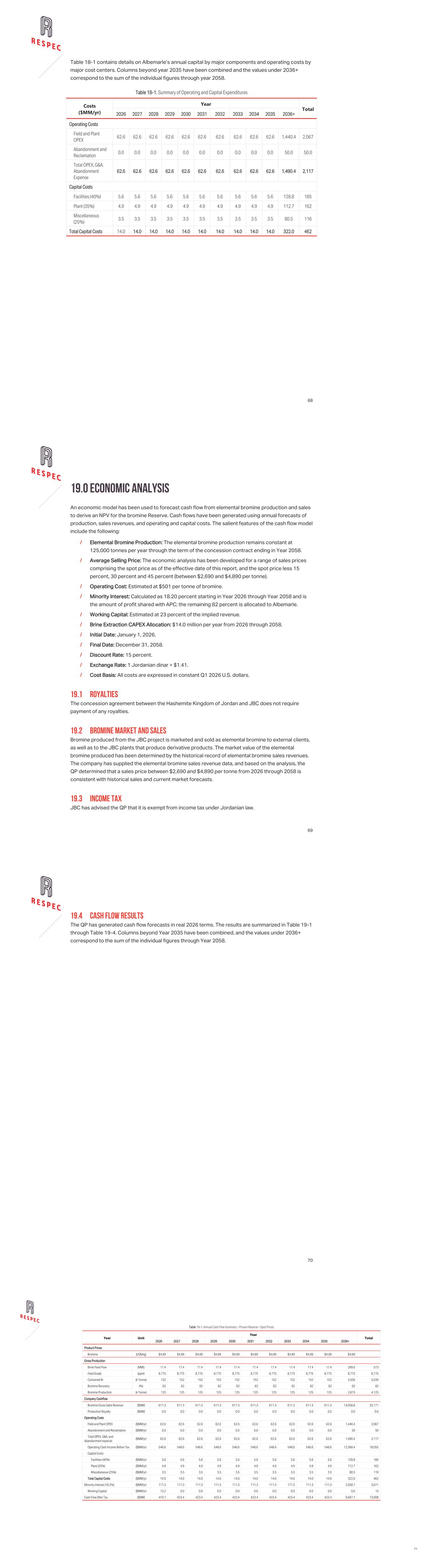
68 Table 18-1 contains details on Albemarle’s annual capital by major components and operating costs by major cost centers. Columns beyond year 2035 have been combined and the values under 2036+ correspond to the sum of the individual figures through year 2058. Table 18-1. Summary of Operating and Capital Expenditures Costs ($MM/yr) Year Total 2026 2027 2028 2029 2030 2031 2032 2033 2034 2035 2036+ Operating Costs Field and Plant OPEX 62.6 62.6 62.6 62.6 62.6 62.6 62.6 62.6 62.6 62.6 1,440.4 2,067 Abandonment and Reclamation 0.0 0.0 0.0 0.0 0.0 0.0 0.0 0.0 0.0 0.0 50.0 50.0 Total OPEX, G&A, Abandonment Expense 62.6 62.6 62.6 62.6 62.6 62.6 62.6 62.6 62.6 62.6 1,490.4 2,117 Capital Costs Facilities (40%) 5.6 5.6 5.6 5.6 5.6 5.6 5.6 5.6 5.6 5.6 128.8 185 Plant (35%) 4.9 4.9 4.9 4.9 4.9 4.9 4.9 4.9 4.9 4.9 112.7 162 Miscellaneous (25%) 3.5 3.5 3.5 3.5 3.5 3.5 3.5 3.5 3.5 3.5 80.5 116 Total Capital Costs 14.0 14.0 14.0 14.0 14.0 14.0 14.0 14.0 14.0 14.0 322.0 462 69 19.0 ECONOMIC ANALYSIS An economic model has been used to forecast cash flow from elemental bromine production and sales to derive an NPV for the bromine Reserve. Cash flows have been generated using annual forecasts of production, sales revenues, and operating and capital costs. The salient features of the cash flow model include the following: / Elemental Bromine Production: The elemental bromine production remains constant at 125,000 tonnes per year through the term of the concession contract ending in Year 2058. / Average Selling Price: The economic analysis has been developed for a range of sales prices comprising the spot price as of the effective date of this report, and the spot price less 15 percent, 30 percent and 45 percent (between $2,690 and $4,890 per tonne). / Operating Cost: Estimated at $501 per tonne of bromine. / Minority Interest: Calculated as 18.20 percent starting in Year 2026 through Year 2058 and is the amount of profit shared with APC; the remaining 82 percent is allocated to Albemarle. / Working Capital: Estimated at 23 percent of the implied revenue. / Brine Extraction CAPEX Allocation: $14.0 million per year from 2026 through 2058. / Initial Date: January 1, 2026. / Final Date: December 31, 2058. / Discount Rate: 15 percent. / Exchange Rate: 1 Jordanian dinar = $1.41. / Cost Basis: All costs are expressed in constant Q1 2026 U.S. dollars. 19.1 ROYALTIES The concession agreement between the Hashemite Kingdom of Jordan and JBC does not require payment of any royalties. 19.2 BROMINE MARKET AND SALES Bromine produced from the JBC project is marketed and sold as elemental bromine to external clients, as well as to the JBC plants that produce derivative products. The market value of the elemental bromine produced has been determined by the historical record of elemental bromine sales revenues. The company has supplied the elemental bromine sales revenue data, and based on the analysis, the QP determined that a sales price between $2,690 and $4,890 per tonne from 2026 through 2058 is consistent with historical sales and current market forecasts. 19.3 INCOME TAX JBC has advised the QP that it is exempt from income tax under Jordanian law. 70 19.4 CASH FLOW RESULTS The QP has generated cash flow forecasts in real 2026 terms. The results are summarized in Table 19-1 through Table 19-4. Columns beyond Year 2035 have been combined, and the values under 2036+ correspond to the sum of the individual figures through Year 2058. 71 Table 19-1. Annual Cash Flow Summary – Proven Reserve – Spot Prices Year Unit Year Total 2026 2027 2028 2029 2030 2031 2032 2033 2034 2035 2036+ Product Prices Bromine (US$/kg) $4.89 $4.89 $4.89 $4.89 $4.89 $4.89 $4.89 $4.89 $4.89 $4.89 $4.89 Gross Production Brine Feed Flow (MMt) 17.4 17.4 17.4 17.4 17.4 17.4 17.4 17.4 17.4 17.4 399.6 573 Feed Grade (ppm) 8,775 8,775 8,775 8,775 8,775 8,775 8,775 8,775 8,775 8,775 8,775 8,775 Contained Br (k Tonne) 152 152 152 152 152 152 152 152 152 152 3,506 5,030 Bromine Recovery (%) 82 82 82 82 82 82 82 82 82 82 82 82 Bromine Production (k Tonne) 125 125 125 125 125 125 125 125 125 125 2,875 4,125 Company Cashflow Bromine Gross Sales Revenue ($MM) 611.3 611.3 611.3 611.3 611.3 611.3 611.3 611.3 611.3 611.3 14,058.8 20,171 Production Royalty ($MM) 0.0 0.0 0.0 0.0 0.0 0.0 0.0 0.0 0.0 0.0 0.0 0.0 Operating Costs Field and Plant OPEX ($MM/yr) 62.6 62.6 62.6 62.6 62.6 62.6 62.6 62.6 62.6 62.6 1,440.4 2,067 Abandonment and Reclamation ($MM/yr) 0.0 0.0 0.0 0.0 0.0 0.0 0.0 0.0 0.0 0.0 50 50 Total OPEX, G&A, and Abandonment expense ($MM/yr) 62.6 62.6 62.6 62.6 62.6 62.6 62.6 62.6 62.6 62.6 1,490.4 2,117 Operating Cash Income Before Tax ($MM/yr) 548.6 548.6 548.6 548.6 548.6 548.6 548.6 548.6 548.6 548.6 12,568.4 18,055 Capital Costs Facilities (40%) ($MM/yr) 5.6 5.6 5.6 5.6 5.6 5.6 5.6 5.6 5.6 5.6 128.8 185 Plant (35%) ($MM/yr) 4.9 4.9 4.9 4.9 4.9 4.9 4.9 4.9 4.9 4.9 112.7 162 Miscellaneous (25%) ($MM/yr) 3.5 3.5 3.5 3.5 3.5 3.5 3.5 3.5 3.5 3.5 80.5 119 Total Capital Costs ($MM/yr) 14.0 14.0 14.0 14.0 14.0 14.0 14.0 14.0 14.0 14.0 322.0 462 Minority Interest (18.2%) ($MM/yr) 111.3 111.3 111.3 111.3 111.3 111.3 111.3 111.3 111.3 111.3 2,558.7 3,671 Working Capital ($MM/yr) 13.2 0.0 0.0 0.0 0.0 0.0 0.0 0.0 0.0 0.0 0.0 13 Cash Flow After Tax ($MM) 410.1 423.4 423.4 423.4 423.4 423.4 423.4 423.4 423.4 423.4 9,687.7 13,908
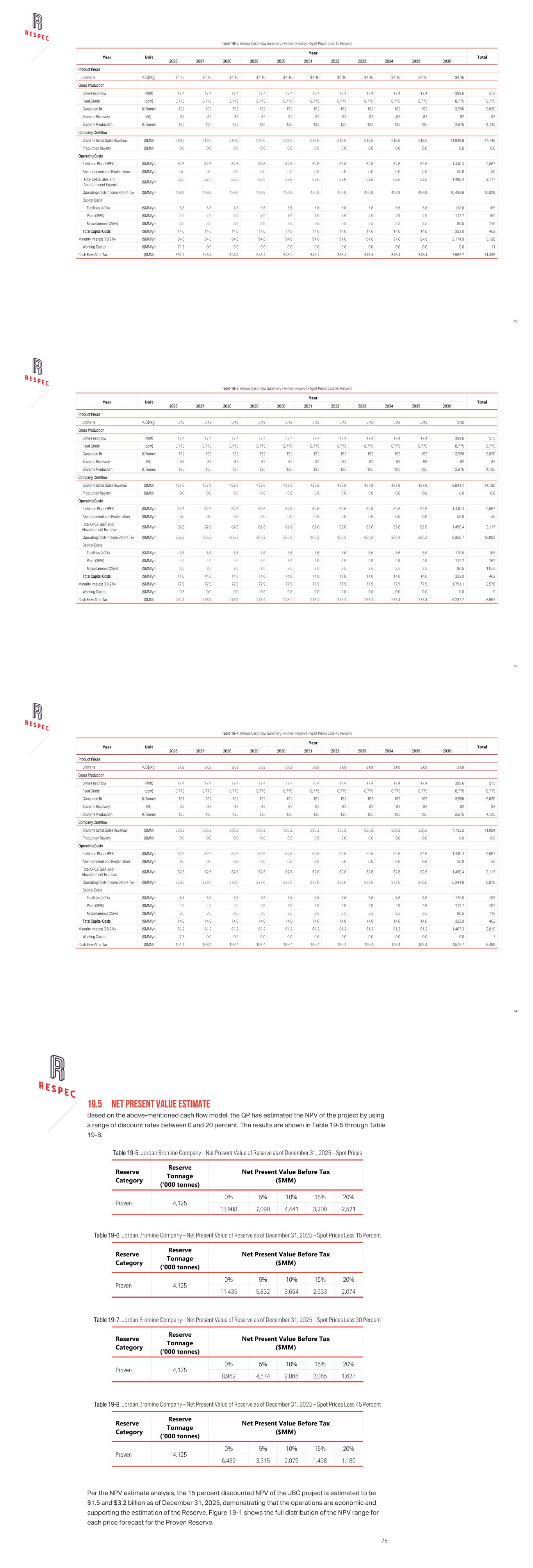
72 Table 19-2. Annual Cash Flow Summary – Proven Reserve – Spot Prices Less 15 Percent Year Unit Year Total 2026 2027 2028 2029 2030 2031 2032 2033 2034 2035 2036+ Product Prices Bromine (US$/kg) $4.16 $4.16 $4.16 $4.16 $4.16 $4.16 $4.16 $4.16 $4.16 $4.16 $4.16 Gross Production Brine Feed Flow (MMt) 17.4 17.4 17.4 17.4 17.4 17.4 17.4 17.4 17.4 17.4 399.6 573 Feed Grade (ppm) 8,775 8,775 8,775 8,775 8,775 8,775 8,775 8,775 8,775 8,775 8,775 8,775 Contained Br (k Tonne) 152 152 152 152 152 152 152 152 152 152 3,506 5,030 Bromine Recovery (%) 82 82 82 82 82 82 82 82 82 82 82 82 Bromine Production (k Tonne) 125 125 125 125 125 125 125 125 125 125 2,875 4,125 Company Cashflow Bromine Gross Sales Revenue ($MM) 519.6 519.6 519.6 519.6 519.6 519.6 519.6 519.6 519.6 519.6 11,949.9 17,146 Production Royalty ($MM) 0.0 0.0 0.0 0.0 0.0 0.0 0.0 0.0 0.0 0.0 0.0 0.0 Operating Costs Field and Plant OPEX ($MM/yr) 62.6 62.6 62.6 62.6 62.6 62.6 62.6 62.6 62.6 62.6 1,440.4 2,067 Abandonment and Reclamation ($MM/yr) 0.0 0.0 0.0 0.0 0.0 0.0 0.0 0.0 0.0 0.0 50.0 50 Total OPEX, G&A, and Abandonment Expense ($MM/yr) 62.6 62.6 62.6 62.6 62.6 62.6 62.6 62.6 62.6 62.6 1,490.4 2,117 Operating Cash Income Before Tax ($MM/yr) 456.9 456.9 456.9 456.9 456.9 456.9 456.9 456.9 456.9 456.9 10,459.6 15,029 Capital Costs Facilities (40%) ($MM/yr) 5.6 5.6 5.6 5.6 5.6 5.6 5.6 5.6 5.6 5.6 128.8 185 Plant (35%) ($MM/yr) 4.9 4.9 4.9 4.9 4.9 4.9 4.9 4.9 4.9 4.9 112.7 162 Miscellaneous (25%) ($MM/yr) 3.5 3.5 3.5 3.5 3.5 3.5 3.5 3.5 3.5 3.5 80.5 116 Total Capital Costs ($MM/yr) 14.0 14.0 14.0 14.0 14.0 14.0 14.0 14.0 14.0 14.0 322.0 462 Minority Interest (18.2%) ($MM/yr) 94.6 94.6 94.6 94.6 94.6 94.6 94.6 94.6 94.6 94.6 2,174.9 3,120 Working Capital ($MM/yr) 11.2 0.0 0.0 0.0 0.0 0.0 0.0 0.0 0.0 0.0 0.0 11 Cash Flow After Tax ($MM) 337.1 348.4 348.4 348.4 348.4 348.4 348.4 348.4 348.4 348.4 7,962.7 11,435 73 Table 19-3. Annual Cash Flow Summary – Proven Reserve – Spot Prices Less 30 Percent Year Unit Year Total 2026 2027 2028 2029 2030 2031 2032 2033 2034 2035 2036+ Product Prices Bromine (US$/kg) 3.42 3.42 3.42 3.42 3.42 3.42 3.42 3.42 3.42 3.42 3.42 Gross Production Brine Feed Flow (MMt) 17.4 17.4 17.4 17.4 17.4 17.4 17.4 17.4 17.4 17.4 399.6 573 Feed Grade (ppm) 8,775 8,775 8,775 8,775 8,775 8,775 8,775 8,775 8,775 8,775 8,775 8,775 Contained Br (k Tonne) 152 152 152 152 152 152 152 152 152 152 3,506 5,030 Bromine Recovery (%) 82 82 82 82 82 82 82 82 82 98 82 82 Bromine Production (k Tonne) 125 125 125 125 125 125 125 125 125 125 2,875 4,125 Company Cashflow Bromine Gross Sales Revenue ($MM) 427.9 427.9 427.9 427.9 427.9 427.9 427.9 427.9 427.9 427.9 9,841.1 14,120 Production Royalty ($MM) 0.0 0.0 0.0 0.0 0.0 0.0 0.0 0.0 0.0 0.0 0.0 0.0 Operating Costs Field and Plant OPEX ($MM/yr) 62.6 62.6 62.6 62.6 62.6 62.6 62.6 62.6 62.6 62.6 1,440.4 2,067 Abandonment and Reclamation ($MM/yr) 0.0 0.0 0.0 0.0 0.0 0.0 0.0 0.0 0.0 0.0 50.0 50 Total OPEX, G&A, and Abandonment Expense ($MM/yr) 62.6 62.6 62.6 62.6 62.6 62.6 62.6 62.6 62.6 62.6 1,490.4 2,117 Operating Cash Income Before Tax ($MM/yr) 365.2 365.2 365.2 365.2 365.2 365.2 365.2 365.2 365.2 365.2 8,350.7 12,003 Capital Costs Facilities (40%) ($MM/yr) 5.6 5.6 5.6 5.6 5.6 5.6 5.6 5.6 5.6 5.6 128.8 185 Plant (35%) ($MM/yr) 4.9 4.9 4.9 4.9 4.9 4.9 4.9 4.9 4.9 4.9 112.7 162 Miscellaneous (25%) ($MM/yr) 3.5 3.5 3.5 3.5 3.5 3.5 3.5 3.5 3.5 3.5 80.5 115.5 Total Capital Costs ($MM/yr) 14.0 14.0 14.0 14.0 14.0 14.0 14.0 14.0 14.0 14.0 322.0 462 Minority Interest (18.2%) ($MM/yr) 77.9 77.9 77.9 77.9 77.9 77.9 77.9 77.9 77.9 77.9 1,791.1 2,570 Working Capital ($MM/yr) 9.3 0.0 0.0 0.0 0.0 0.0 0.0 0.0 0.0 0.0 0.0 9 Cash Flow After Tax ($MM) 264.1 273.4 273.4 273.4 273.4 273.4 273.4 273.4 273.4 273.4 6,237.7 8,962 74 Table 19-4. Annual Cash Flow Summary – Proven Reserve – Spot Prices Less 45 Percent Year Unit Year Total 2026 2027 2028 2029 2030 2031 2032 2033 2034 2035 2036+ Product Prices Bromine (US$/kg) 2.69 2.69 2.69 2.69 2.69 2.69 2.69 2.69 2.69 2.69 2.69 Gross Production Brine Feed Flow (MMt) 17.4 17.4 17.4 17.4 17.4 17.4 17.4 17.4 17.4 17.4 399.6 573 Feed Grade (ppm) 8,775 8,775 8,775 8,775 8,775 8,775 8,775 8,775 8,775 8,775 8,775 8,775 Contained Br (k Tonne) 152 152 152 152 152 152 152 152 152 152 3,506 5,030 Bromine Recovery (%) 82 82 82 82 82 82 82 82 82 82 82 82 Bromine Production (k Tonne) 125 125 125 125 125 125 125 125 125 125 2,875 4,125 Company Cashflow Bromine Gross Sales Revenue ($MM) 336.2 336.2 336.2 336.2 336.2 336.2 336.2 336.2 336.2 336.2 7,732.3 11,094 Production Royalty ($MM) 0.0 0.0 0.0 0.0 0.0 0.0 0.0 0.0 0.0 0.0 0.0 0.0 Operating Costs Field and Plant OPEX ($MM/yr) 62.6 62.6 62.6 62.6 62.6 62.6 62.6 62.6 62.6 62.6 1,440.4 2,067 Abandonment and Reclamation ($MM/yr) 0.0 0.0 0.0 0.0 0.0 0.0 0.0 0.0 0.0 0.0 50.0 50 Total OPEX, G&A, and Abandonment Expense ($MM/yr) 62.6 62.6 62.6 62.6 62.6 62.6 62.6 62.6 62.6 62.6 1,490.4 2,117 Operating Cash Income Before Tax ($MM/yr) 273.6 273.6 273.6 273.6 273.6 273.6 273.6 273.6 273.6 273.6 6,241.9 8,978 Capital Costs Facilities (40%) ($MM/yr) 5.6 5.6 5.6 5.6 5.6 5.6 5.6 5.6 5.6 5.6 128.8 185 Plant (35%) ($MM/yr) 4.9 4.9 4.9 4.9 4.9 4.9 4.9 4.9 4.9 4.9 112.7 162 Miscellaneous (25%) ($MM/yr) 3.5 3.5 3.5 3.5 3.5 3.5 3.5 3.5 3.5 3.5 80.5 116 Total Capital Costs ($MM/yr) 14.0 14.0 14.0 14.0 14.0 14.0 14.0 14.0 14.0 14.0 322.0 462 Minority Interest (18.2%) ($MM/yr) 61.2 61.2 61.2 61.2 61.2 61.2 61.2 61.2 61.2 61.2 1,407.3 2,019 Working Capital ($MM/yr) 7.3 0.0 0.0 0.0 0.0 0.0 0.0 0.0 0.0 0.0 0.0 7 Cash Flow After Tax ($MM) 191.1 198.4 198.4 198.4 198.4 198.4 198.4 198.4 198.4 198.4 4,512.7 6,489 75 19.5 NET PRESENT VALUE ESTIMATE Based on the above-mentioned cash flow model, the QP has estimated the NPV of the project by using a range of discount rates between 0 and 20 percent. The results are shown in Table 19-5 through Table 19-8. Table 19-5. Jordan Bromine Company – Net Present Value of Reserve as of December 31, 2025 – Spot Prices Reserve Category Reserve Tonnage ('000 tonnes) Net Present Value Before Tax ($MM) Proven 4,125 0% 5% 10% 15% 20% 13,908 7,090 4,441 3,200 2,521 Table 19-6. Jordan Bromine Company – Net Present Value of Reserve as of December 31, 2025 – Spot Prices Less 15 Percent Reserve Category Reserve Tonnage ('000 tonnes) Net Present Value Before Tax ($MM) Proven 4,125 0% 5% 10% 15% 20% 11,435 5,832 3,654 2,633 2,074 Table 19-7. Jordan Bromine Company – Net Present Value of Reserve as of December 31, 2025 – Spot Prices Less 30 Percent Reserve Category Reserve Tonnage ('000 tonnes) Net Present Value Before Tax ($MM) Proven 4,125 0% 5% 10% 15% 20% 8,962 4,574 2,866 2,065 1,627 Table 19-8. Jordan Bromine Company – Net Present Value of Reserve as of December 31, 2025 – Spot Prices Less 45 Percent Reserve Category Reserve Tonnage ('000 tonnes) Net Present Value Before Tax ($MM) Proven 4,125 0% 5% 10% 15% 20% 6,489 3,315 2,079 1,498 1,180 Per the NPV estimate analysis, the 15 percent discounted NPV of the JBC project is estimated to be $1.5 and $3.2 billion as of December 31, 2025, demonstrating that the operations are economic and supporting the estimation of the Reserve. Figure 19-1 shows the full distribution of the NPV range for each price forecast for the Proven Reserve.

76 Figure 19-1. Net Present Value Distribution of Proven Reserve by Price Forecast. 0 2 4 6 8 10 12 14 16 0% 5% 10% 15% 20% N PV ($ U S bi llio ns ) Discount Rate Net Present Value of Proven Reserves Spot Price Forecast Spot Price Forecast less 15% Spot Price Forecast less 30% Spot Price Forecast less 45% 77 20.0 ADJACENT PROPERTIES Three properties are adjacent to the JBC plant in the Jordanian territory. The MMC and APC are shown in Figure 20-1. The ICL Dead Sea Works Limited plant is adjacent and on the west side of the Jordan-Israel border. This plant is similar to the APC and JBC plants in that it produces potash, bromine, and bromine-derivative products. 20.1 MANASEER MAGNESIA COMPANY This report has extensively described the APC facilities and this section contains a brief description of the MMC property. Manaseer Group acquired MMC after purchasing the total shares of Jordan Magnesia Company in 2016 for a total of $12.5 million on a cash-free, debt-free basis. With this acquisition, Manaseer Group rehabilitated the plant and officially began operations. The first phase of the MMC plant operations, located in Ghor Al-Safi, consisted of the production of caustic and hydrated lime. MMC announced the commencement of the second phase of its plant operations to produce caustic calcined magnesia at a capacity of up to 60,000 tonnes, with ambitious plans to further bolster production capacity in the future. 20.2 DEAD SEA WORKS LIMITED ICL is a public company with dual-listed shares on the New York Stock Exchange (NYSE) and Tel Aviv Stock Exchange (TASE) (listed as NYSE:ICL and TASE:ICL). Shareholders include the Israel Corp. (45.93 percent) and the public (54.07 percent). In 2018, ICL launched its Business Culture of Leadership strategy, which focused on enhancing market leadership across ICL’s three core mineral value chains of bromine, potash, and phosphate, as well as realizing the growth potential of innovative agriculture solutions. To better align the organization with this strategy, ICL realigned the company into four business divisions: Industrial Products (Bromine), Potash, Phosphate Solutions, and Innovative Ag Solutions. ICL’s history began in the early 20th century with the first efforts to extract minerals from the Dead Sea in Israel’s south. After Israel’s independence in 1948, the activities continued with the establishment of Dead Sea Works Limited, a state-owned company. During the early 1950s, several other government- owned companies were created to extract minerals from the Negev Desert and transform the minerals into chemical products. In 1975, ICL expanded through a consolidation with these companies, including Rotem Amfert Negev, Bromine Compounds, and TAMI (IMI) (ICL’s research arm). ICL also grew through organic growth and acquisitions. In 1992, the Israeli government began privatization of ICL, first by listing 19 percent of ICL shares on the TASE. In 1995, the State of Israel sold its controlling interest (24.9 percent of ICL’s equity) to Israel Corp., which was then controlled by the Eisenberg family. In 1997, Israel Corp. acquired an 78 additional 17 percent of ICL’s shares with another 10 percent acquired a year later. Also, in 1998, the State of Israel sold 12 percent of ICL’s shares to the general public, as well as 9 percent to Potash Corp. In the late 1990s, the Ofer Group acquired control of Israel Corp., including ICL. During the last 15 years, ICL has expanded significantly, primarily by increasing its production capacity and global distribution, establishing regional offices and joint ventures, and through synergistic acquisitions. In 2018, Potash Corp sold its holdings in ICL. Today, ICL is a global powerhouse in fertilizers and specialty chemicals and fulfills essential needs in three core end markets—agriculture, food, and engineered materials—by using an integrated value chain based on specialty minerals. 79 Figure 20-1. The Adjacent Properties of Manaseer Magnesia Company and Arab Potash Company.

80 21.0 OTHER RELEVANT DATA AND INFORMATION This section is not applicable at this time. 81 22.0 INTERPRETATION AND CONCLUSIONS 22.1 GENERAL The following are interpretations and conclusions for the project: / JBC is in Jordan, in the Governorate of Karak, and is located on the southeastern edge of the Dead Sea. The JBC production plant facility occupies a 33-ha area. It also has a 2-ha storage facility within the Jordanian Free Zone at the Port of Aqaba. / In 1958, the Government of the Hashemite Kingdom of Jordan granted APC a concession for exclusive rights to exploit the minerals and salts from the Dead Sea brine until 2058; at that time, APC factories and installations would become the property of the Government [APC, 2018]. APC was granted its exclusive mineral rights under the Concession Ratification Law No. 16 of 1958. / JBC was established in 1999 as a joint venture between Albemarle Holdings Company Limited (a wholly owned subsidiary of Albemarle) and APC. Albemarle holds a 50 percent interest in JBC Limited. JBC’s operations primarily consist of the manufacturing of bromine, from which derivative products are made including TBBPA, CaBr, NaBr, hydrobromic acid, and KOH. / The Joint Venture Agreement guarantees the supply of brine and fresh water for the JBC operations through the life of APC’s concession (2058). / The bromide-enriched brine, used by JBC as its main raw material, is a by-product of potash operations conducted by APC. / Brine extracted from the Dead Sea by APC is stored in ponds where it evaporates and concentrates until the constituent salts crystallize and progressively begin to precipitate. At the specific gravity of 1.31, carnallite begins to crystallize and precipitate. The carnallite is then harvested by wet dredging from the pond bottom, and the dredged salts are pumped in a slurry to a processing plant where the potassium chloride is separated from the magnesium chloride. / The process through the evaporation ponds is continuous, and a part of the final effluent from the carnallite ponds is sent to the JBC and MMC plants. The other part of the effluent is returned to the Dead Sea. / The bromide-enriched feedbrine received by JBC is put through an industrial process that includes chlorination and distillation phases, which accomplish the separation and recovery of elemental bromine. / The JBC complex consists of two plants: Area 1 and Petra, which have a combined processing capacity of over 18 million tonnes of feedbrine per year, and an estimated production capacity in excess of 130 thousand tonnes of elemental bromine per year. / An estimated 50.49 percent of the bromide ion resource identified in the Dead Sea is controlled by Jordan (as of the effective date of this report) and, therefore, correspond to APC under the terms of its concession. Consequently, as of December 31, 2025, an estimated 328.99 MMt of bromide ion resource (651.63 MMt × 50.49 percent) is controlled by JBC. The Measured Resource of bromide ion attributable to Albemarle’s 50 percent interest in its JBC joint venture, inclusive of Reserve, is estimated to be approximately 164.49 MMt. The Measured Resource of 82 bromide ion attributable to Albemarle’s 50 percent interest in the JBC joint venture, exclusive of reserves, is 162.43 MMt. From this large Resource, JBC is extracting approximately 1 percent of the bromine available. / The total bromine Reserve controlled by JBC as of 2025 is estimated at approximately 4.13 MMt of bromine (average of 125,000 tonnes per year over 33 years). The Proven Reserve attributable to Albemarle’s 50 percent interest in its JBC joint venture is estimated to be approximately 2.01 MMt of elemental bromine. This Reserve estimate represents only a fraction of the total Resource contained in the Dead Sea and accessible by APC and JBC; therefore, the estimate provides reasonable assurance that the project will not be affected by shortages of raw material over its life. / JBC’s location near the APC facilities provides access to power and transportation infrastructure. JBC also operates a terminal at the port of Aqaba through which it imports supplies for its processes and exports elemental bromine and other derivatives. / The global bromine market is expected to grow steadily at a CAGR of around 4.04 percent between 2025 and 2033. The flame-retardant industry is a significant market for bromine derivatives. Other significant markets are the oil and gas, automotive, and pharmaceutical industries. / Bromine produced from the JBC project is marketed and sold as elemental bromine to external clients, as well as to the JBC plants that produce derivative products. / JBC complies with national regulations as well as with international regulations of OSHA and NFPA. JBC is the first company of its kind in Jordan to become an authorized exporter to Europe and has been certified for ISO 9001 and 14001 and the VECAP. / JBC’s robust Corporate Social Responsibility strategy is targeted at supporting sustainable community development projects and creating and funding sustainable social, cultural, and economic initiatives that support local and national needs. JBC has effectively implemented its environmental and socioeconomic policies and has fulfilled its responsibilities efficiently. / The JBC facility is an active operation in the industrial production of elemental bromine, and most of its major CAPEX has already taken place. The facility has demonstrated its technical and financial feasibility, and, therefore, the CAPEX and OPEX elements presented in this report are directly related to sustaining the current production level through the term of APC’s mineral concession (Year 2058). / The market value of the elemental bromine produced by JBC has been determined by the historical record of elemental bromine sales revenues. / Based on the cash flow model presented in Chapter 19, the NPV of the project has been estimated by using a discount rate of 15 percent. The NPV of the JBC project is estimated to be between $1.5 billion to $3.2 billion as of December 31, 2025, demonstrating that the operations are economic and supporting the estimation of the Reserve. 22.2 DISCUSSION OF RISK In general, the risks for a large industrial project like JBC in Jordan are considered moderate by the QP. This opinion is supported by analyses prepared by reputable institutions like the World Bank 83 (www.doingbusiness.org), Coface (www.coface.com), the International Labor Organization (www.ilo.org), and others. The following subsections present detailed explanations of the major risks related to the JBC project. 22.2.1 GEOPOLITICAL RISK The local Jordanian politics should have minimal to no impact on JBC. The plant is sufficiently distant from Amman; therefore, any civil unrest would not impact operations. However, if the Jordanian government so desired, they could gain access to the Dead Sea for a separate bromine production facility. JBC believes that the company has the right of first refusal on this. Jordan is politically stable, unlike most of its neighbors, and it has the political and financial support from the Gulf monarchies and Western countries. The World Bank projects Jordan’s economy to grow by 2.7 percent in 2026 [World Bank, 2025b]. By the end of 2023, Jordan’s economy showed signs of gradual recovery following a moderate contraction of 2.2 percent in 2021. Recovery in economic growth from 2022 through 2024 and estimated for 2025 has ranged from 2.5 percent to 2.9 percent led by services and industry [World Bank, 2025]. The economic activity of Jordan will continue to be driven by mining and tourism. The latter is a particular focus for the government, with tourism returning to and surpassing pre-pandemic levels [World Bank, 2025b]. Growth will also be fueled by exports (approximately 40 percent of GDP from 2022–2024 [World Bank, 2025b]), particularly in the mining sector, following official support at the London Initiative, a conference held to bolster investment in Jordan. The reopening of the Iraqi border (despite security risks) and related trade and investment agreements, lower import costs (oil and food), quicker-than-expected engagement by domestic companies with the Association Agreement with the European Union, and Syrian refugees returning to Syria should increase economic activity. Jordan’s pro-Western and pro-Gulf stance will remain the cornerstone of foreign policy for security and, increasingly, economic reasons. Jordan's central strategic position should ensure continued logistical, financial, and military assistance from the United States, its main ally, despite differences with U.S. policy in this region. In recent decades, Jordan has managed to navigate a period of regional chaos, maintaining stability through largely cosmetic domestic reforms, with significant financial aid from the United States and Saudi Arabia. These patrons have acted as a safety net for Jordan, which lacks the natural resources of many of its neighbors. In addition to the humanitarian and financial crisis caused by the influx of Syrian refugees, which caused an increase in public spending, Jordan also must deal with a high unemployment rate that rose further to 16.6 percent by the end of 2023 [ILOSTAT, 2026], a high poverty rate, and high levels of inequality. Numerous popular protests occurred in 2019, including strikes by teachers calling for a 50 percent increase in salaries, which the government responded to by proposing wage hikes. A further potential fracture exists between Jordan’s citizens of Palestinian descent and its East Bank population. As the Israeli-Palestinian peace process is increasingly strained, Jordan will face mounting

84 pressure from its citizens of Palestinian descent to withdraw from the 1994 Wadi Araba treaty, which made peace between Israel and Jordan. Although such a move would surely be popular with a broad section of the Jordanian public, Amman also faces strong incentives to maintain its cooperation, among these incentives are significant energy and water infrastructure projects on which the two countries have cooperated. Jordan could perhaps find other water and energy sources, but such alternatives may costly and unreliable. The monarchy is further caught between its popular demands and its American allies. The United States remains Amman’s most important international partner, and a country as dependent as Jordan is on foreign transfers can ill afford to jeopardize such relationships. 22.2.2 ENVIRONMENTAL RISK Lower rainfall, increased drought, higher temperatures, and rising sea levels in the Gulf of Aqaba, are just some of the possible results of climate change affecting Jordan. Jordan’s environmental problems are further complicated by factors like garbage disposal and road traffic. Also, the decreasing levels of the Dead Sea may be the single most critical environmental risk for the JBC project. The scarcity and uneven distribution of precipitation over Jordan results in limited surface and groundwater resources available for domestic consumption and agricultural and industrial uses. Rapid population growth coupled with increased urbanization and industrialization are leading to the over- exploitation of aquifers and the contamination of diminishing supplies through: / Inadequate industrial and municipal wastewater treatment capacities / Siting of industrial plants near or immediately upstream from potable supplies / Overuse and misuse of pesticides, insecticides, fungicides and fertilizers leading to pollution of ground and surface water resources by irrigation drainage The Jordanian water shortages are a threat both to development and to the health of the population. Jordan has a multifaceted difficulty with its lack of available water resources. Over the past decades, extreme changes in climate have drastically affected Jordan's water supply. The water balance of the Dead Sea has been disturbed since the late 1950s. The lake has no outlet, and the heavy inflow of fresh water is carried off solely by evaporation, which is rapid in the hot desert climate. Large-scale projects by Israel and Jordan to divert water from the Jordan River for irrigation and other water needs have led to the surface of the Dead Sea dropping for at least the past 50 years. The drop of the sea level increases the pumping and conveyance costs for the potash and bromine operations because of the required relocation of the pumping facilities. However, these increases in cost are considered in the economic analyses of the operations. The predictable reduction in the level of the Dead Sea is not anticipated to cause any significant impact on the potash and bromine projects within the APC and JBC mining concession, which will expire in 2058. 22.2.3 ADDITIONAL RAW MATERIALS RISK Certain raw materials such as BPA and chlorine have seen worldwide shortages. JBC is evaluating the prospect of installing a second chlorine plant and conversations are ongoing regarding issues like financing and ownership. 85 Flooding and other natural impediments may also interrupt the supply of raw materials. JBC is working to address some of these concerns. 22.2.4 OTHER RISK CONSIDERATIONS Albemarle, the U.S. joint venture partner of JBC, mentions in its 2024 Annual Report [Albemarle, 2024] that it perceives the fact that it is subject to government regulation in the non-U.S. jurisdictions in which it conducts its business as a risk. In the specific case of Jordan, as discussed in this report, the regulatory framework of the country and its favorable business environment make this potential risk not very likely. Albemarle indicates that its substantial international operations, like in the case of the JBC joint venture, are subject to the typical risks of doing business in a foreign country. As stated by the QP, Jordan is a stable destination for business (both politically and financially). Furthermore, the fact that APC, a state-controlled entity, is the joint venture’s local partner provides further assurance that the operation is shielded from several of the most significant risks listed by Albemarle. The possibility of terrorist activities that could impact the normal operations of JBC is real and is perhaps one of the greatest risks for any business in the Middle East. Albemarle indicated that it believes it has sufficient inventory to continue producing at current levels; however, government-mandated shutdowns could impact its ability to acquire additional materials and disrupt its customers’ purchases. The summary presented in Table 22-1 includes the QP’s opinion on the risks as highlighted by Albemarle. 86 Table 22-1. Project Risks (Page 1 of 2) Risk Level of Risk to the JBC Project Fluctuations in foreign currency exchange rates may affect product demand and may adversely affect the profitability in U.S. dollars of products and services we provide in international markets where payment for our products and services is made in the local currency. This is a risk on the buyer’s side of the business and not inherent to the JBC operation. Further, from a local operations standpoint, the Jordanian dinar is pegged to the U.S. dollar. Transportation and other shipping costs may increase, or transportation may be inhibited. Low risk in Jordan. Increased cost or decreased availability of raw materials. Not applicable. Resource beyond foreseeable life of project. Increased regulations on, or reduced access to, scarce resources, such as freshwater. Low to moderate risk in Jordan with the lease term (2058). Changes in foreign laws and tax rates or U.S. laws and tax rates with respect to foreign income may unexpectedly increase the rate at which income is taxed, impose new and additional taxes on remittances, repatriation, or other payments by subsidiaries, or cause the loss of previously recorded tax benefits. Not likely. Very stable exchange rate over the past several years as the Jordanian Dinar is pegged to the U.S. Dollar. The U.S. and foreign countries may adopt other restrictions on foreign trade or investment, including currency exchange controls, tariffs or other taxes, or limitations on imports or exports (including recent and proposed changes in U.S. trade policy and resulting retaliatory actions by other countries). Difficult to quantify in the current political environment, but potentially a moderate risk. Trade sanctions by or against foreign countries could result in losing access to customers and suppliers in those countries. Difficult to quantify in the current political environment, but potentially a moderate risk. Unexpected adverse changes in foreign laws or regulatory requirements may occur. Possible but not likely. Agreements with counterparties in foreign countries may be difficult for to enforce and related receivables may be difficult to collect. Not applicable. Compliance with the variety of foreign laws and regulations may be unduly burdensome. Not applicable to the JBC operation. Compliance with anti-bribery and anti-corruption laws (such as the Foreign Corrupt Practices Act) as well as anti-money-laundering laws may be costly. Possible but not likely. Compliance with changing cybersecurity rules and evolving data privacy rules and regulation, such as the European Union’s General Data Protection Regulation, could increase our cost of doing business. Possible but not likely. Unexpected adverse changes in export duties, quotas and tariffs and difficulties in obtaining export licenses may occur. Not likely in Jordan. General economic conditions in the countries in which Albemarle operate could have an adverse effect on our earnings from operations in those countries. Possible but not likely. 87 Table 22-1. Project Risks (Page 2 of 2) Risk Level of Risk to the JBC Project Changes in the strength of our relationships with local communities and indigenous populations in the areas in which we operate may impact our community support. Possible but not likely. Foreign operations may experience staffing difficulties and labor disputes. Possible but not likely. Termination or substantial modification of international trade agreements may adversely affect access to raw materials and to markets for products outside the U.S. Not applicable to the JBC operation. Foreign governments may nationalize or expropriate private enterprises. Possible but not likely in Jordan. Increased sovereign risk (such as default by or deterioration in the economies and credit worthiness of local governments) may occur. Not likely. Political or economic repercussions from terrorist activities, including the possibility of hyperinflationary conditions and political instability, may occur in certain countries in which Albemarle does business. This is a risk in the Middle East, including Jordan. 22.2.5 RISK CONCLUSION The QP concludes that the JBC operation in Jordan can be characterized as of moderate risk and that the political or economic repercussions from terrorist activities could be considered the greatest risk because of its location in the Middle East. Other economic and political factors, as well as the environmental considerations of this type of operation, need to be monitored, but do not represent a risk to the business in the foreseeable future.

88 23.0 RECOMMENDATIONS No additional work relevant to the existing Reserve is applicable at this time. The JBC plants have demonstrated the capacity to operate at the production levels forecast through the life of the Reserve. Albemarle has indicated plans to upgrade the plant infrastructure to enable increased production in a 3- to 5-year horizon; however, these have not been fully evaluated by the QP and are not included in the forecasts for this report. The annual production may increase with the successful commissioning of several growth projects currently under evaluation. The status of these growth projects should be evaluated when sufficient detail is available for potential changes to the Reserve and an update to this report. 89 24.0 RELIANCE ON INFORMATION PROVIDED BY THE REGISTRANT Data provided by Albemarle and relied on is included in the report sections listed in Table 24-1. Table 24-1. Reliance on Information Provided by the Registrant Category Report Item/ Portion Disclose Why the Qualified Person Considers It Reasonable to Rely Upon the Registrant Macroeconomic trends Section 19 The discount rate used was provided by Albemarle corporate finance group. The QP’s experience evaluating international projects leads them to opine that the selected discount rate is representative of the expected risks associated with an ongoing chemical manufacturing operation in the Middle East/North Africa (MENA) region, particularly in a politically stable country like Jordan Marketing information Section 16.1 Market overview information obtained from Verified Market Research and IMARC Group, market research companies with expertise in the field. Section 16.2 Major producer information was sourced from USGS Mineral Commodity Summary for Bromine. The USGS is considered by the QP as a reliable source of such data. The USGS canvasses very thoroughly the world mineral markets and its commodity specialists gather first-hand information from both producers and consumers of minerals. Section 16.3 Information on major markets was sourced from Verified Market Research, a source considered as reliable by the QP, as well as of gather publicly available market indicators. Section 16.5 Albemarle provided information on bromine applications which was reviewed by the QP and considered reasonable. The QP also reviewed the public domain in order to obtain general information on bromine applications. Legal matters Section 3.2 This section includes information obtained from the public domain, particularly the general aspects of the Jordanian mining and environmental frameworks. These sources included translations of Jordanian laws available from publicly available sources, as well as comments from Jordanian lawyers specialized in natural resources in specialized forums. Environmental matters Sections 17.3, 17.4 Albemarle provided certain information regarding plant operations, particularly in regards waste streams. The QP also obtained information from the public domain, including general aspects of the Jordanian environmental framework, and Environmental Impact Assessment reports prepared by JBC under international environmental standards, in order to obtain multi-lateral financing for expansion work at both the plant and port. Local area commitments Section 17.5 The QP obtained information for this section from various sources, including Albemarle and JBC. The QP also obtained information regarding social programs and commitments with the local communities from the public domain. Governmental factors Section 3.2 The QP reviewed information from the public domain on the interaction of JBC with Jordanian government agencies and with regulators responsible to manage the various aspects of APC’s mineral concession on the Dead Sea Resource. 90 25.0 REFERENCES Ababsa, M., 2013. Atlas of Jordan: History, Territories and Society, Presses de l’Ifpo, Beyrouth, Lebanon. Albemarle Corporation, 2024. Form 10-K Annual Report Pursuant to Section 13 or 15(d) of the Securities Exchange Act of 1934, prepared for the United States Securities and Exchange Commission, Washington, D.C. Al Tarawneh, K., 2016. “A Comprehensive Outlook of Mining Industry in Jordan, Opportunities and Threats,” Open Journal of Geology, Vol. 6, No. 9, pp. 1137–1148. Al-Rawabi Environment & Energy Consultancies, 2012. Environmental Impact Assessment Study (EIA) Jordan Bromine Company Plants Expansion Project Special Free Zone, Ghor Numeira, Jordan, EIA/Reports 11-13, prepared by Al-Rawabi Environment & Energy Consultancies, Amman, Jordan. American Geophysical Union, 2019. “New Study Solves Mystery of Salt Buildup on Bottom of Dead Sea,” published July 1, 2019, at www.sciencedaily.com/releases/2019/07/190701144420.htm. Anati, D. A., 1997. “The Hydrography of a Hypersaline Lake,” in The Dead Sea: The Lake and Its Setting, edited by T. Niemi, Z. Ben-Avraham, and J. R. Gat, pp. 89–103, Oxford University Press, New York. Aqaba Development Corporation, 2026. “Aqaba Development Corporation,” accessed January 21, 2026, from https://www.adc.jo/ Arab Potash Company, 2018. 2018 Annual Report, Sixty-Two Annual Report, prepared by the Arab Potash Company, Amman, Jordan. Asmar, B. and P. Ergenzinger, 2002. “Prediction of the Dead Sea Dynamic Behaviour With the Dead Sea– Red Sea Canal,” Advances in Water Resources, Vol. 25, No. 7, pp. 783–791. Azran, E., 2017. “Israel Quietly Begins Exporting Natural Gas to Jordan Amid Political Sensitivities,” published March 2, 2017, at https://www.haaretz.com/israel-news/business/israel-quietly-begins- exporting-gas-to-jordan-1.5443894 Bashitialshaaer, R., K. Persson, and M. Aljaradin, 2011. “The Dead Sea Future Elevation Based on Water and Salt Mass Balances,” in Handshake Across the Jordan: Water and Understanding, edited by M. Aufleger and M. Mett, Books on Demand GmbH, Norderstedt, Germany. Britannica, 2026. “Gulf of Aqaba,” accessed January 21, 2026, from https://www.britannica.com/place/Gulf-of-Aqaba Business Analytiq, 2026. “Bromine Price Index,” accessed January 20, 2026, from https://businessanalytiq.com/procurementanalytics/index/bromine-price-index CEIC, 2026. “China CN: Market Price: Monthly Avg: Inorganic Chemical Material: Bromine,” accessed January 20, 2026, from https://www.ceicdata.com/en/china/china-petroleum--chemical-industry- association-petrochemical-price-inorganic-chemical-material/cn-price-index-jun2021100-bromine COYNE-ET BELLIER, Tractebel Engineering, and KEMA, 2014. Red Sea–Dead Sea Water Conveyance Study Program, Final Feasibility Study Report Summary, Report No. 12-147, prepared for The World Bank. 91 ESIA Project Team, 2017. Red Sea Dead Sea Water Conveyance Study, Environmental and Social Impact Assessment (Updated) - Main Report, Revision: 0.4, T&PBE8893-101-100R004F0.4, Drafted by: Royal Haskoning DHV for the European Investment Bank Gat, J. R., 2001. “The Dead Sea: A Model of a Desiccating Terminal Salt Lake,” Department of Environmental Sciences and Energy Research, Weizmann Institute of Science, Rehovot, Israel, pp. 33-41. Gavrieli, I., 1997. “Halite Deposition in the Dead Sea, 1960–1993,” in The Dead Sea: The Lake and Its Setting, edited by T. Niemi, Z. Ben-Avraham, and J. R. Gat, pp. 161–170, Oxford University Press, New York. Ghatasheh, N., H. Faris, and M. Abu-Faraj, 2013. “Dead Sea Water Level and Surface Area Monitoring Using Spatial Data Extraction From Remote Sensing Images,” International Review on Computers and Software, Vol. 8, No. 2, pp. 2892–2897. Gordon, D. C., Jr., P. R. Boudreau, K. H. Mann, J.-E. Ong, W. L. Silvert, S. V. Smith, G. Wattayakorn, F. Wulff, and T. Yanagi, 1996. LOICZ Biogeochemical Modelling Guidelines, LOICZ Reports & Studies No. 5, prepared by the LOICZ Core Project, Netherlands Institute for Sea Research, The Netherlands. Gorodeisky, S. and K. Yeshayahou, 2018. “Tamar Partners Sign Additional $200m Jordanian Gas Deal,” published November 19, 2018, at https://en.globes.co.il/en/article-tamar-partners-to-expand-gas- exports-to-jordan-1001261189 ILOSTAT, 2026. “Jordan,” accessed January 21, 2026, from https://ilostat.ilo.org/data/country- profiles/jor/ IMARC Group, 2026. “Bromine Market Size, Share, Trends and Forecast by Derivative, Application, End User, and Region, 2025-2033” accessed January 20, 2026, from https://www.imarcgroup.com/bromine-market Israel Oceanographic and Limnological Research Institute, 2020. “Dead Sea Observing Stations,” accessed September 17, 2020, from https://isramar.ocean.org.il/isramar2009/DeadSea/seawindbasic.aspx Jordan Bromine Company, 2026. “About Us,” accessed January 21, 2026, from https://jordanbromine.com/about-us/ Lensky, N. G., Y. Dvorkin, V. Lyakhovsky, I. Gertman, and I. Gavrieli, 2005. “Water, Salt, and Energy Balances of the Dead Sea,” Water Resources Research, Vol. 41, No. 10, American Geophysical Union, Washington, DC. Madanat, H., 2010. “Land Tenure in Jordan,” Land Tenure Journal, Food and Agriculture Organization of the United Nations, Rome, Italy, pp. 143–170. Mansour, Z., M. R. Taha, and Z. Chik, 2009. “Engineering Behavior of the Lisan Marl as a Dyke Foundation Material: Dead Sea, Jordan,” Bulletin of Engineering Geology and the Environment, Vol. 68, No. 1, pp. 97–106. McColl, W., 2014. Encyclopedia of World Geography, Volume 1, Golson Books, Ltd., Hudson, NY.
92 Nissenbaum, A., 1993. “The Dead Sea—An Economic Resource for 10,000 Years,” Hydrobiologia, Vol. 267, No. 1–3, pp. 127–141. Powell, J. H., 1988. The Geology of Karak; Map Sheet No. 3152 III, Bulletin 8, Geology Directorate, NRA, Amman. Pletcher, K., 2006. “Dead Sea,” britannica.com, published January 10, 2026, at https://www.britannica.com/place/Dead-Sea Schnebele, E. K., 2025. “Bromine,” Mineral Commodity Summaries 2024, prepared by the U.S. Geological Survey, Washington, D.C. Science Daily, 2019. “New Study Solves Mystery of Salt Buildup on Bottom of Dead Sea,” published July 1, 2019, at https://www.sciencedaily.com/releases/2019/07/190701144420.htm TAHAL Group and The Geological Survey of Israel, 2011. Red Sea–Dead Sea Water Conveyance Study Program Dead Sea Study, GSI/10/2011, prepared by TAHAL and The Geological Survey of Israel, Jerusalem, Israel. Tayseer, M. and S. Solomon, 2014. “Noble Signs $771 Million Deal to Export Israel Gas to Jordan,” published February 19, 2014, at https://www.bloomberg.com/news/articles/2014-02-19/noble-energy- arab-potash-said-to-sign-israel-gas-accord-today Verified Market Research, 2026. “Bromine Derivatives Market Size And Forecast,” accessed January 20, 2026, from https://www.verifiedmarketresearch.com/product/bromine-derivatives-market Warren, J. K., 2006. Evaporites: Sediments, Resources and Hydrocarbons, Springer Science & Business Media, New York. Weizmann Institute of Science, 2020. “Weizmann Institute of Science,” accessed September 17, 2020, from www.weizmann.ac.il Wisniak, J., 2002. “The Dead Sea—A Live Pool of Chemicals,” Indian Journal of Chemical Technology, Vol. 9, No. 1, pp. 79–87. Woods Ballard, T. J. and G. J. Brice, 1984. “Arab Potash Solar Evaporation System: Design,” Proceedings of the Institute of Civil Engineers, Part 1, Vol. 76, No. 1, pp. 145–163. World Bank, 2025a. “World Bank Official Boundaries [Data Set],” published September 16, 2025, at https://datacatalog.worldbank.org/search/dataset/0038272 World Bank, 2025b. “Macro Poverty Outlook,” published October 7, 2025, https://www.worldbank.org/en/publication/macro-poverty-outlook