Financial Results Q1 2026 April 30, 2026 .2
This presentation includes “forward-looking” statements that are subject to risks and uncertainties that could cause actual results to differ materially from those expressed or implied in the statements. Statements that are not statements of historical facts are forward-looking statements and are made pursuant to the safe harbor provisions of the Private Securities Litigation Reform Act of 1995. Words such as “estimate,” “guidance,” “outlook,” “project,” “planned,” “contemplate,” “potential,” “possible,” “proposed,” “intend,” “believe,” “anticipate,” “expect,” “may,” “will,” “would,” “should,” “could,” and similar expressions are intended to identify forward-looking statements. All statements other than statements of historical facts included in this presentation are forward-looking statements. Forward-looking statements are based on the Company's current expectations and assumptions regarding its business, the economy and other future conditions. The Company cautions readers that any such forward-looking statements it makes are not guarantees of future performance and that actual results may differ materially from anticipated results or expectations expressed in its forward-looking statements as a result of a variety of factors, including many that are beyond the Company's control. Important factors that could cause actual results to differ materially from the Company’s expectations include: existing and unknown future limitations on the ability of the Company's direct and indirect subsidiaries to make their cash flow available to the Company for payments on the Company's indebtedness or other purposes; reduced demands or prices for biofuels, biogases or renewable electricity; global demands for grain and oilseed commodities, which have exhibited volatility, and can impact the cost of feed for cattle, hogs and poultry, thus affecting available rendering feedstock and selling prices for the Company’s products; reductions in raw material volumes available to the Company due to weak margins in the meat production industry as a result of higher feed costs, reduced consumer demand, reduced volume due to government regulations affecting animal production or other factors, reduced volume from food service establishments, or otherwise; reduced demand for animal feed; reduced finished product prices, including a decline in fat, used cooking oil, protein or collagen (including, without limitation, collagen peptides and gelatin) finished product prices; changes to government policies around the world relating to renewable fuels and greenhouse gas (“GHG”) emissions that adversely affect prices, margins or markets (including for the DGD Joint Venture), including programs like renewable fuel standards, low carbon fuel standards, renewable fuel mandates and tax credits for biofuels, or loss or diminishment of tax credits due to failure to satisfy any eligibility requirements, including, without limitation, in relation to the blenders tax credit or the Clean Fuels Production Credit (“CFPC”); climate related adverse results, including with respect to the Company’s climate goals, targets or commitments; possible product recall resulting from developments relating to the discovery of unauthorized adulterations to food or food additives or products which do not meet specifications, contract requirements or regulatory standards; the occurrence of 2009 H1N1 flu (initially known as “Swine Flu”), highly pathogenic strains of avian influenza (collectively known as “Bird Flu”), severe acute respiratory syndrome (“SARS”), bovine spongiform encephalopathy (or “BSE”), porcine epidemic diarrhea (“PED”) or other diseases associated with animal origin in the U.S. or elsewhere, such as the outbreak of African Swine Fever in China and elsewhere; the occurrence of pandemics, epidemics or disease outbreaks; unanticipated costs and/or reductions in raw material volumes related to the Company’s compliance with the existing or unforeseen new U.S. or foreign (including, without limitation, China) regulations (including new or modified animal feed, Bird Flu, SARS, PED, BSE or ASF or similar or unanticipated regulations) affecting the industries in which the Company operates or its value added products; risks associated with the DGD Joint Venture, including possible unanticipated operating disruptions and/or a decline in margins on the products produced by the DGD Joint Venture; risks and uncertainties relating to international sales and operations, including imposition of tariffs, quotas, trade barriers and other trade protections by the U.S. or foreign countries; tax changes, such as global minimum tax measures, or issues related to administration, guidance and/or regulations associated with biofuel policies, including CFPC, and risks associated with the qualification and sale of such credits; difficulties or a significant disruption (including, without limitation, due to cyber-attack) in the Company’s information systems, networks or the confidentiality, availability or integrity of our data or failure to implement new systems and software successfully; risks relating to possible third-party claims of intellectual property infringement; increased contributions to the Company’s pension and benefit plans, including multiemployer and employer-sponsored defined benefit pension plans as required by legislation, regulation or other applicable U.S. or foreign law or resulting from a U.S. mass withdrawal event; bad debt write-offs; loss of or failure to obtain necessary permits and registrations; the potential for future terrorist attacks, responses to terrorist attacks and other acts of war or hostility, including the ongoing conflicts in the Middle East, Africa, North Korea and Ukraine; uncertainty regarding any administration changes in the U.S. or elsewhere around the world, including, without limitation, impacts to trade, tariffs and/or policies impacting the Company (such as biofuel policies and mandates); and/or unfavorable export or import markets. These factors, coupled with volatile prices for natural gas and diesel fuel, inflation rates, climate conditions, currency exchange fluctuations, general performance of the U.S. and global economies, disturbances in world financial, credit, commodities and stock markets, and any decline in consumer confidence and discretionary spending, including the inability of consumers and companies to obtain credit due to lack of liquidity in the financial markets, among others, could cause actual results to vary materially from the forward-looking statements included in this presentation or negatively impact the Company’s results of operations. Among other things, future profitability may be affected by the Company’s ability to grow its business, which faces competition from companies that may have substantially greater resources than the Company. The Company’s announced share repurchase program may be suspended or discontinued at any time and purchases of shares under the program are subject to market conditions and other factors, which are likely to change from time to time. For more detailed discussion of these factors and other risks and uncertainties regarding the Company, its business and the industries in which it operates, see the Company’s filings with the SEC, including the Risk Factors discussion in Item 1A of Part I of the Company's Annual Report on Form 10-K for the fiscal year ended January 3, 2026. The Company cautions readers that all forward-looking statements speak only as of the date made, and the Company undertakes no obligation to update any forward- looking statements, whether as a result of changes in circumstances, new events or otherwise.
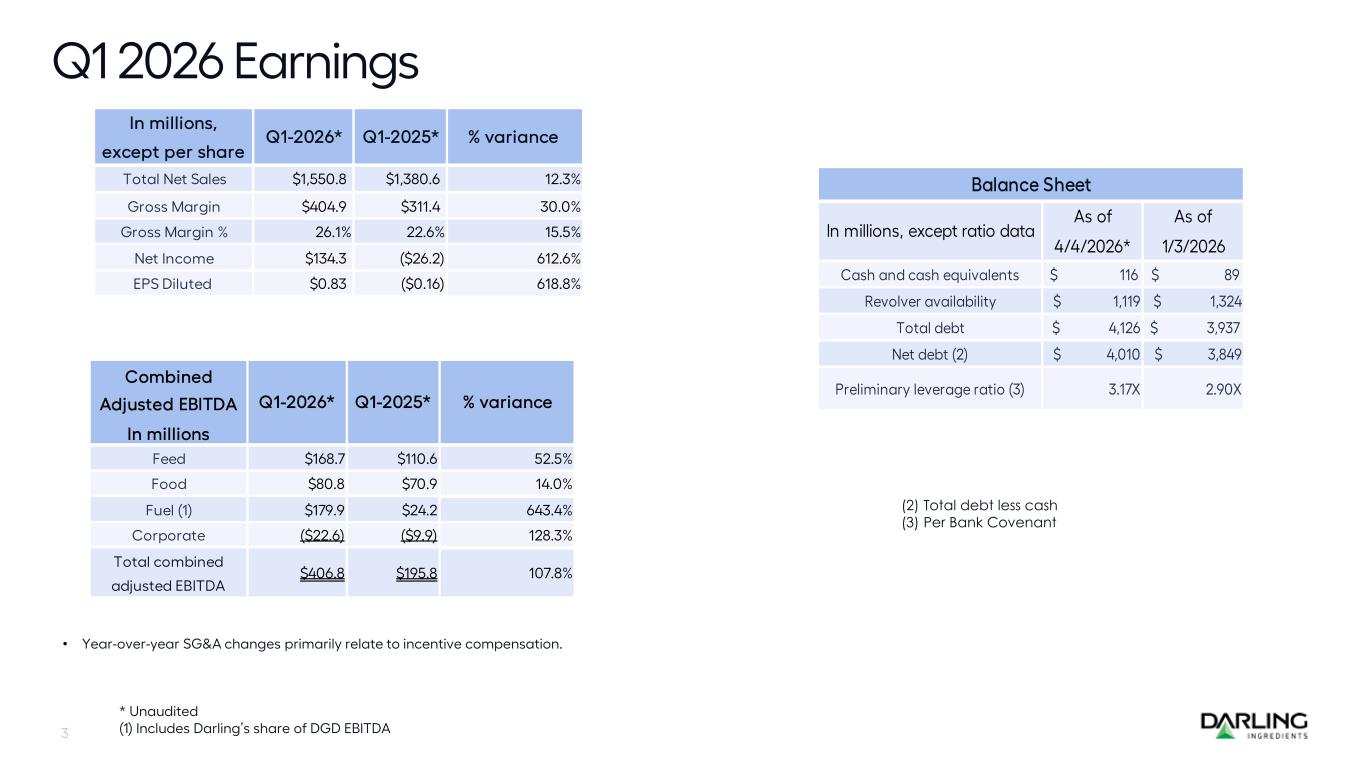
Combined Adjusted EBITDA In millions Feed $168.7 $110.6 52.5% Food $80.8 $70.9 14.0% Fuel (1) $179.9 $24.2 643.4% Corporate ($22.6) ($9.9) 128.3% Total combined adjusted EBITDA $406.8 $195.8 107.8% Q1-2026* Q1-2025* % variance In millions, except per share Q1-2026* Q1-2025* % variance Total Net Sales $1,550.8 $1,380.6 12.3% Gross Margin $404.9 $311.4 30.0% Gross Margin % 26.1% 22.6% 15.5% Net Income $134.3 ($26.2) 612.6% EPS Diluted $0.83 ($0.16) 618.8% Q1 2026 Earnings 3 * Unaudited (1) Includes Darling’s share of DGD EBITDA (2) Total debt less cash (3) Per Bank Covenant • Year-over-year SG&A changes primarily relate to incentive compensation. As of As of 4/4/2026* 1/3/2026 Cash and cash equivalents $ 116 $ 89 Revolver availability $ 1,119 $ 1,324 Total debt $ 4,126 $ 3,937 Net debt (2) $ 4,010 $ 3,849 Preliminary leverage ratio (3) 3.17X 2.90X Balance Sheet In millions, except ratio data
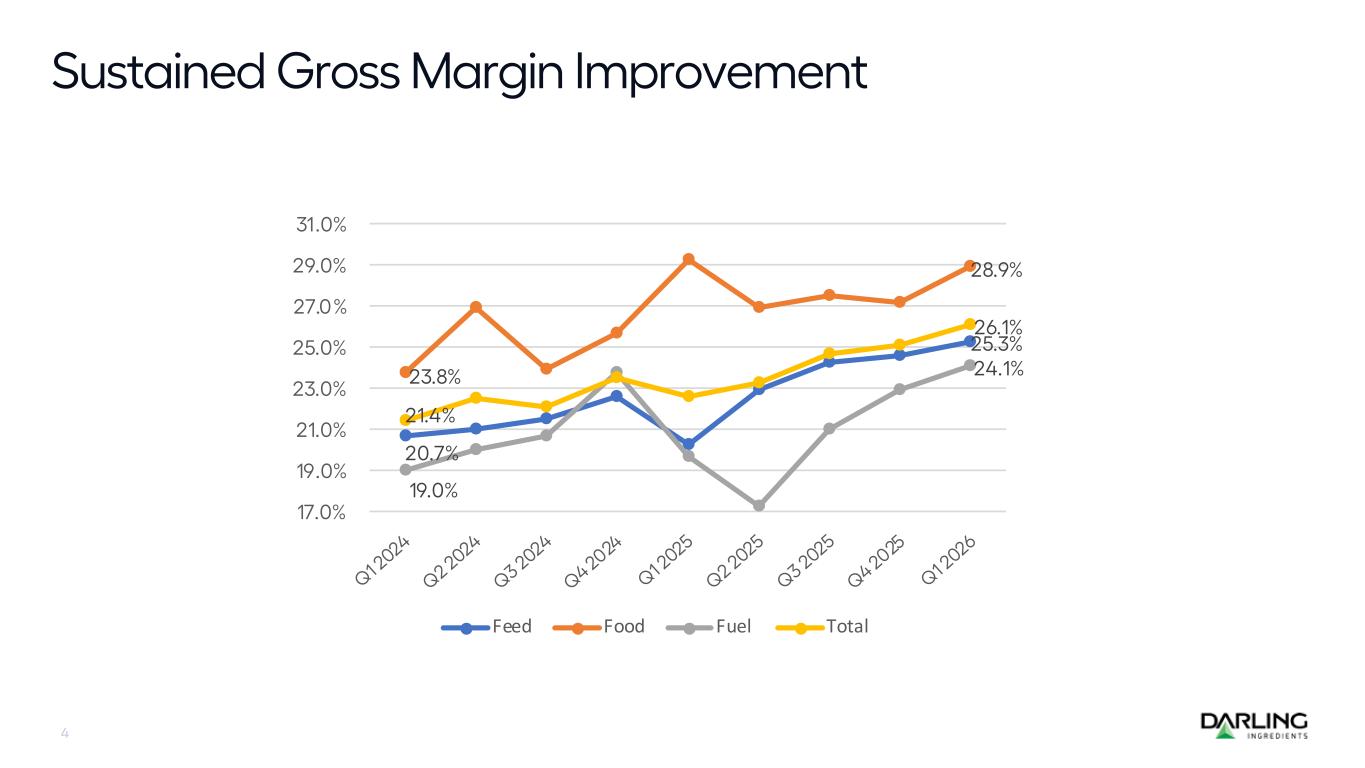
Sustained Gross Margin Improvement 4 20.7% 25.3% 23.8% 28.9% 19.0% 24.1% 21.4% 26.1% 17.0% 19.0% 21.0% 23.0% 25.0% 27.0% 29.0% 31.0% Feed Food Fuel Total
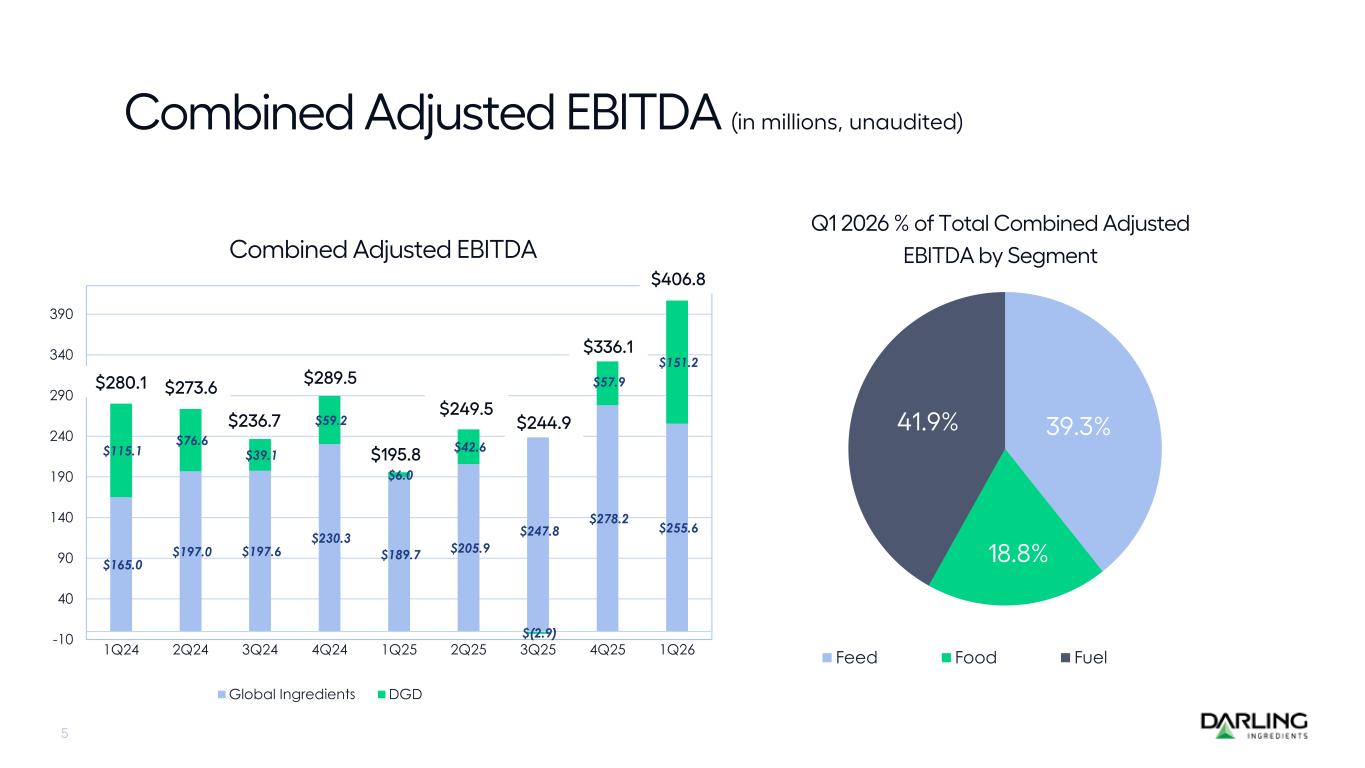
5 Combined Adjusted EBITDA (in millions, unaudited) $165.0 $197.0 $197.6 $230.3 $189.7 $205.9 $247.8 $278.2 $255.6 $115.1 $76.6 $39.1 $59.2 $6.0 $42.6 $(2.9) $57.9 $151.2 -10 40 90 140 190 240 290 340 390 1Q24 2Q24 3Q24 4Q24 1Q25 2Q25 3Q25 4Q25 1Q26 Combined Adjusted EBITDA Global Ingredients DGD $249.5 39.3% 18.8% 41.9% Q1 2026 % of Total Combined Adjusted EBITDA by Segment Feed Food Fuel $280.1 $273.6 $236.7 $289.5 $195.8 $244.9 $336.1 $406.8
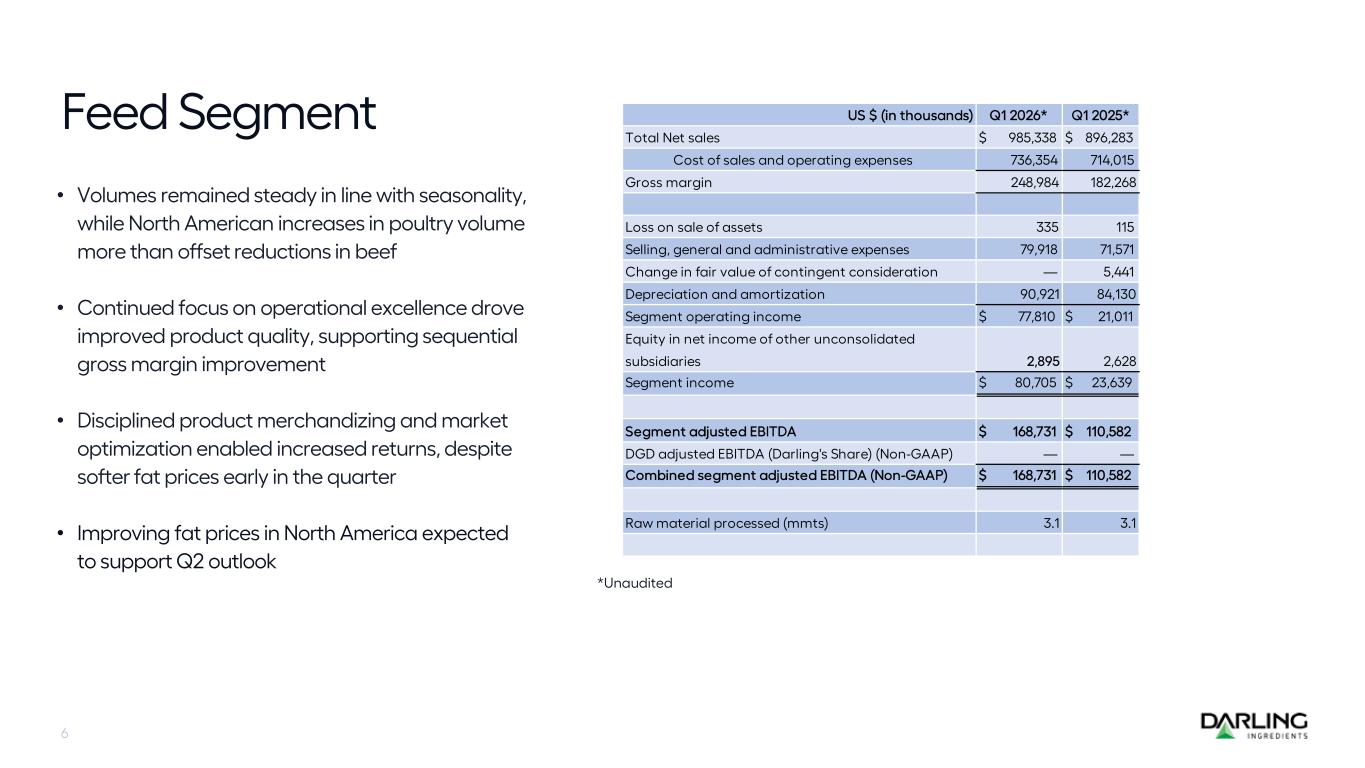
US $ (in thousands) Q1 2026* Q1 2025* Total Net sales $ 985,338 $ 896,283 Cost of sales and operating expenses 736,354 714,015 Gross margin 248,984 182,268 Loss on sale of assets 335 115 Selling, general and administrative expenses 79,918 71,571 Change in fair value of contingent consideration — 5,441 Depreciation and amortization 90,921 84,130 Segment operating income $ 77,810 $ 21,011 Equity in net income of other unconsolidated subsidiaries 2,895 2,628 Segment income $ 80,705 $ 23,639 Segment adjusted EBITDA $ 168,731 $ 110,582 DGD adjusted EBITDA (Darling's Share) (Non-GAAP) — — Combined segment adjusted EBITDA (Non-GAAP) $ 168,731 $ 110,582 Raw material processed (mmts) 3.1 3.1 Feed Segment 6 *Unaudited • Volumes remained steady in line with seasonality, while North American increases in poultry volume more than offset reductions in beef • Continued focus on operational excellence drove improved product quality, supporting sequential gross margin improvement • Disciplined product merchandizing and market optimization enabled increased returns, despite softer fat prices early in the quarter • Improving fat prices in North America expected to support Q2 outlook
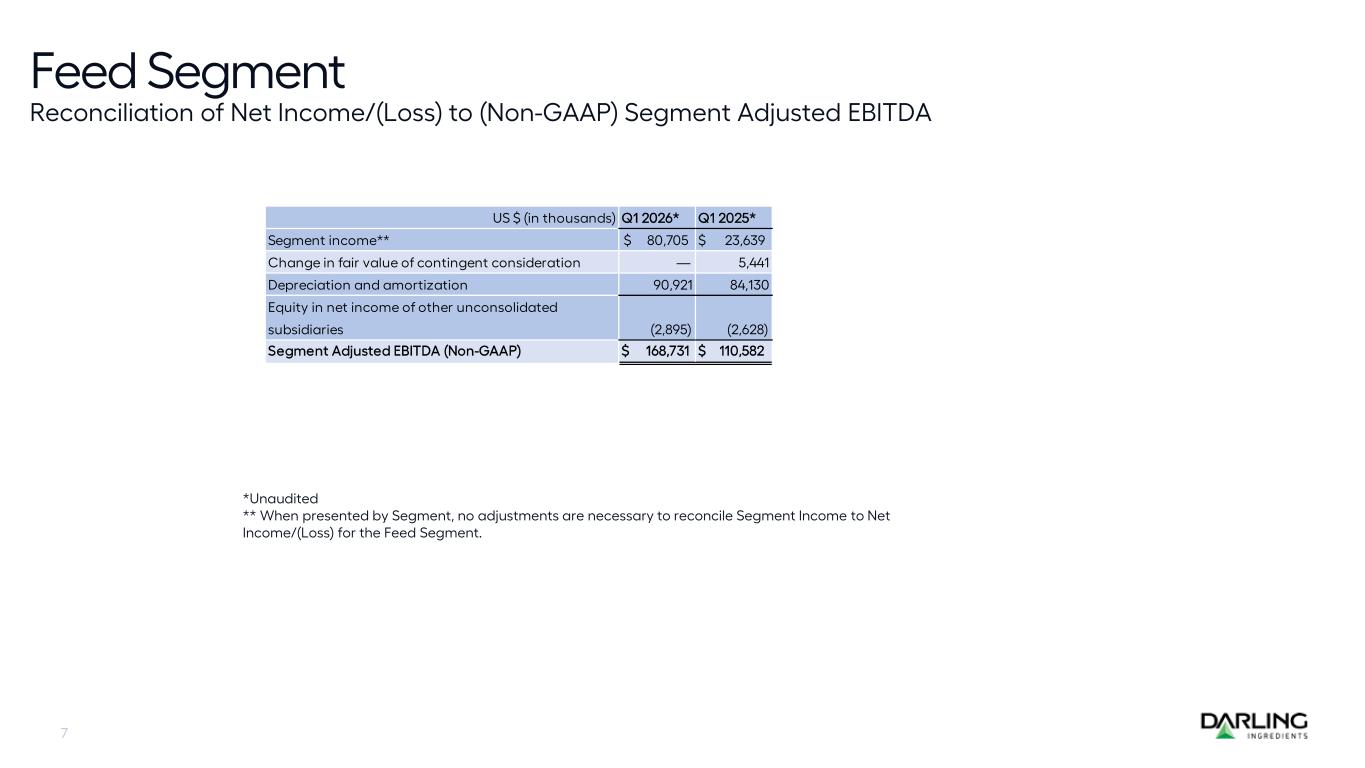
Feed Segment Reconciliation of Net Income/(Loss) to (Non-GAAP) Segment Adjusted EBITDA 7 *Unaudited ** When presented by Segment, no adjustments are necessary to reconcile Segment Income to Net Income/(Loss) for the Feed Segment. US $ (in thousands) Q1 2026* Q1 2025* Segment income** 80,705$ 23,639$ Change in fair value of contingent consideration — 5,441 Depreciation and amortization 90,921 84,130 Equity in net income of other unconsolidated subsidiaries (2,895) (2,628) Segment Adjusted EBITDA (Non-GAAP) $ 168,731 $ 110,582
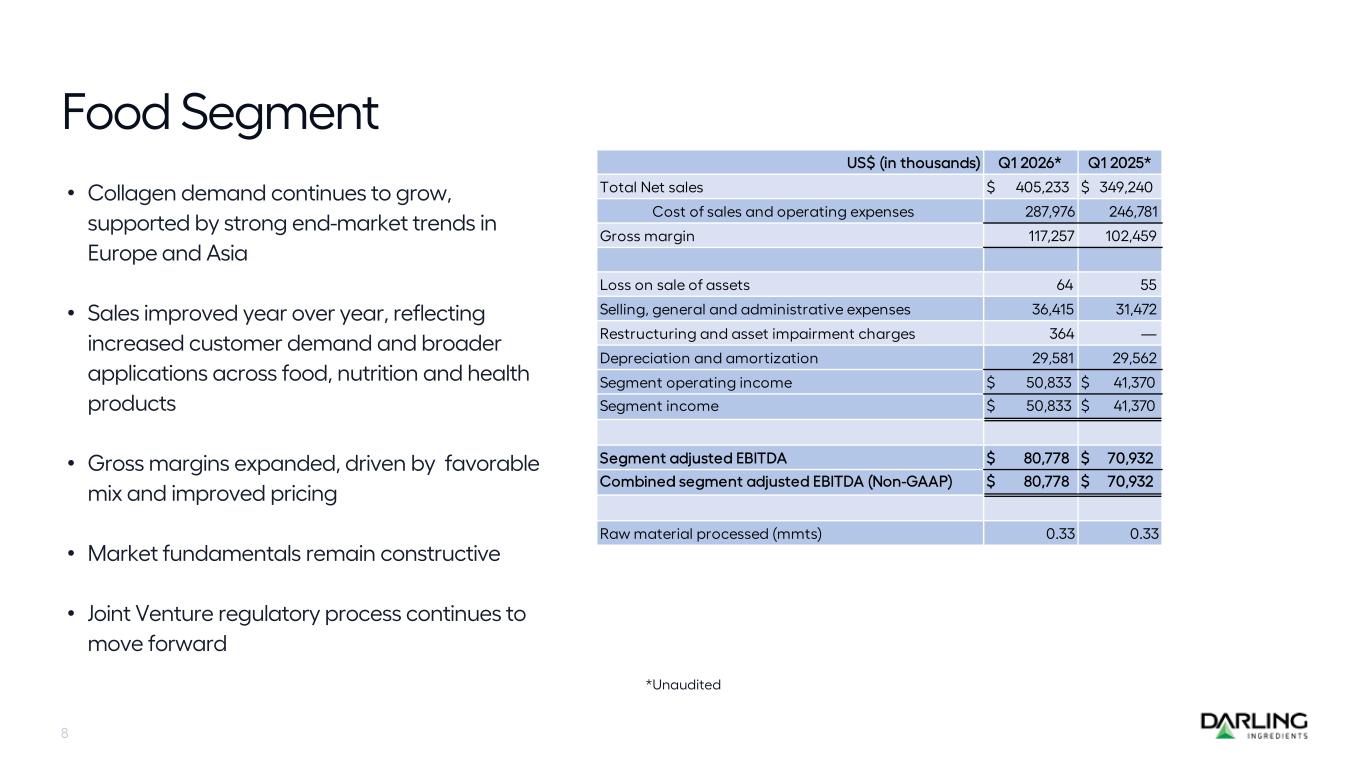
Food Segment 8 *Unaudited • Collagen demand continues to grow, supported by strong end-market trends in Europe and Asia • Sales improved year over year, reflecting increased customer demand and broader applications across food, nutrition and health products • Gross margins expanded, driven by favorable mix and improved pricing • Market fundamentals remain constructive • Joint Venture regulatory process continues to move forward US$ (in thousands) Q1 2026* Q1 2025* Total Net sales $ 405,233 $ 349,240 Cost of sales and operating expenses 287,976 246,781 Gross margin 117,257 102,459 Loss on sale of assets 64 55 Selling, general and administrative expenses 36,415 31,472 Restructuring and asset impairment charges 364 — Depreciation and amortization 29,581 29,562 Segment operating income $ 50,833 $ 41,370 Segment income $ 50,833 $ 41,370 Segment adjusted EBITDA $ 80,778 $ 70,932 Combined segment adjusted EBITDA (Non-GAAP) $ 80,778 $ 70,932 Raw material processed (mmts) 0.33 0.33
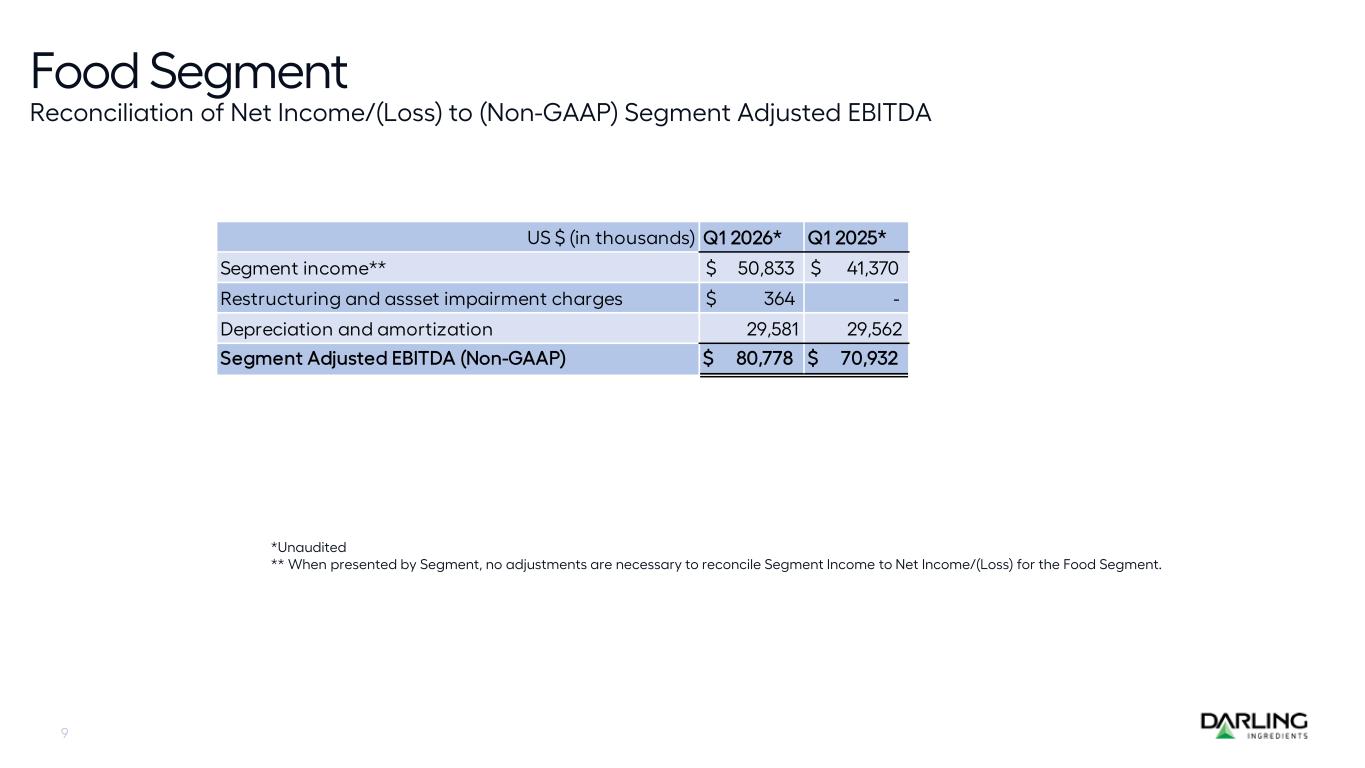
US $ (in thousands) Q1 2026* Q1 2025* Segment income** 50,833$ 41,370$ Restructuring and assset impairment charges 364$ - Depreciation and amortization 29,581 29,562 Segment Adjusted EBITDA (Non-GAAP) $ 80,778 $ 70,932 Food Segment Reconciliation of Net Income/(Loss) to (Non-GAAP) Segment Adjusted EBITDA 9 *Unaudited ** When presented by Segment, no adjustments are necessary to reconcile Segment Income to Net Income/(Loss) for the Food Segment.
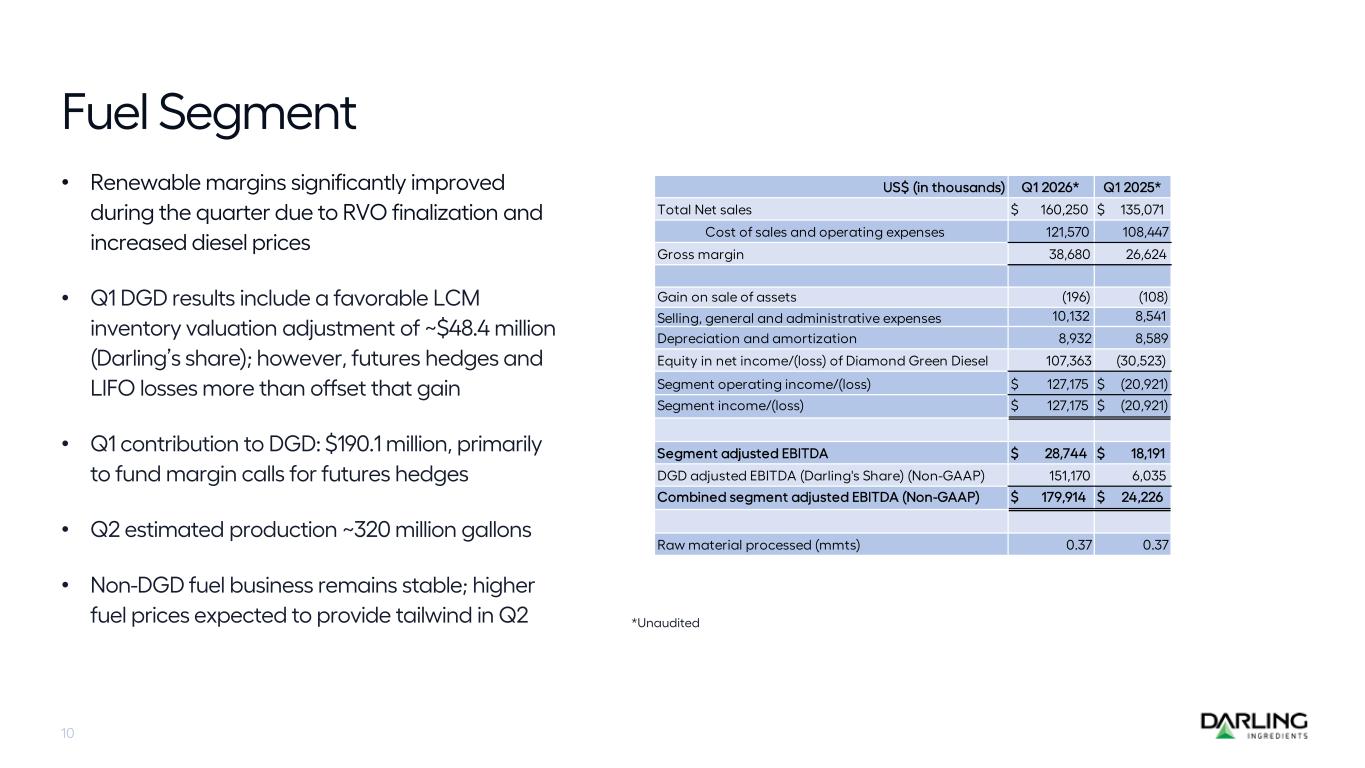
US$ (in thousands) Q1 2026* Q1 2025* Total Net sales $ 160,250 $ 135,071 Cost of sales and operating expenses 121,570 108,447 Gross margin 38,680 26,624 Gain on sale of assets (196) (108) Selling, general and administrative expenses 10,132 8,541 Depreciation and amortization 8,932 8,589 Equity in net income/(loss) of Diamond Green Diesel 107,363 (30,523) Segment operating income/(loss) $ 127,175 $ (20,921) Segment income/(loss) $ 127,175 $ (20,921) Segment adjusted EBITDA $ 28,744 $ 18,191 DGD adjusted EBITDA (Darling's Share) (Non-GAAP) 151,170 6,035 Combined segment adjusted EBITDA (Non-GAAP) $ 179,914 $ 24,226 Raw material processed (mmts) 0.37 0.37 Fuel Segment 10 • Renewable margins significantly improved during the quarter due to RVO finalization and increased diesel prices • Q1 DGD results include a favorable LCM inventory valuation adjustment of ~$48.4 million (Darling’s share); however, futures hedges and LIFO losses more than offset that gain • Q1 contribution to DGD: $190.1 million, primarily to fund margin calls for futures hedges • Q2 estimated production ~320 million gallons • Non-DGD fuel business remains stable; higher fuel prices expected to provide tailwind in Q2 *Unaudited
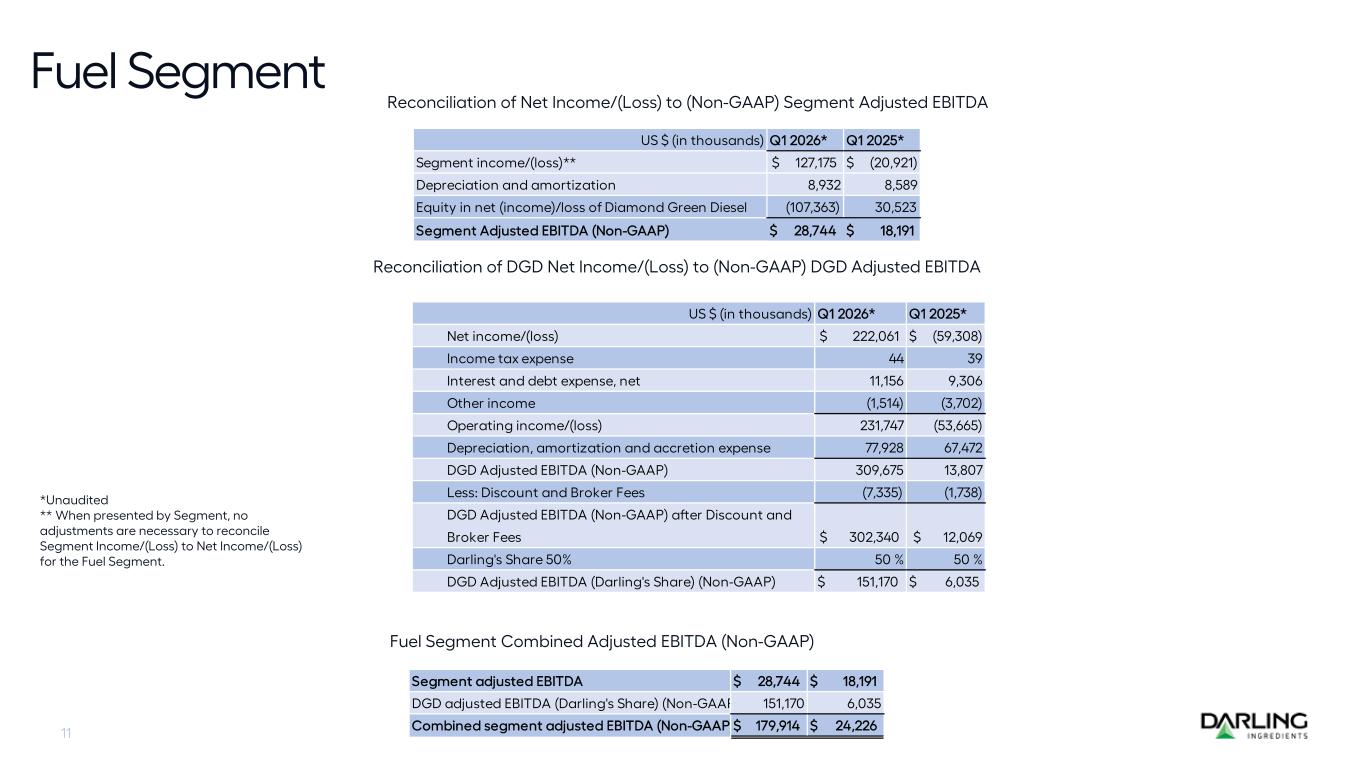
US $ (in thousands) Q1 2026* Q1 2025* Segment income/(loss)** 127,175$ (20,921)$ Depreciation and amortization 8,932 8,589 Equity in net (income)/loss of Diamond Green Diesel (107,363) 30,523 Segment Adjusted EBITDA (Non-GAAP) $ 28,744 $ 18,191 US $ (in thousands) Q1 2026* Q1 2025* Net income/(loss) 222,061$ $ (59,308) Income tax expense 44 39 Interest and debt expense, net 11,156 9,306 Other income (1,514) (3,702) Operating income/(loss) 231,747 (53,665) Depreciation, amortization and accretion expense 77,928 67,472 DGD Adjusted EBITDA (Non-GAAP) 309,675 13,807 Less: Discount and Broker Fees (7,335) (1,738) DGD Adjusted EBITDA (Non-GAAP) after Discount and Broker Fees 302,340$ $ 12,069 Darling's Share 50% 50 % 50 % DGD Adjusted EBITDA (Darling's Share) (Non-GAAP) $ 151,170 $ 6,035 Fuel Segment 11 *Unaudited ** When presented by Segment, no adjustments are necessary to reconcile Segment Income/(Loss) to Net Income/(Loss) for the Fuel Segment. Reconciliation of Net Income/(Loss) to (Non-GAAP) Segment Adjusted EBITDA Reconciliation of DGD Net Income/(Loss) to (Non-GAAP) DGD Adjusted EBITDA Fuel Segment Combined Adjusted EBITDA (Non-GAAP) Segment adjusted EBITDA 28,744$ 18,191$ DGD adjusted EBITDA (Darling's Share) (Non-GAAP 151,170 6,035 Combined segment adjusted EBITDA (Non-GAAP) 179,914$ 24,226$
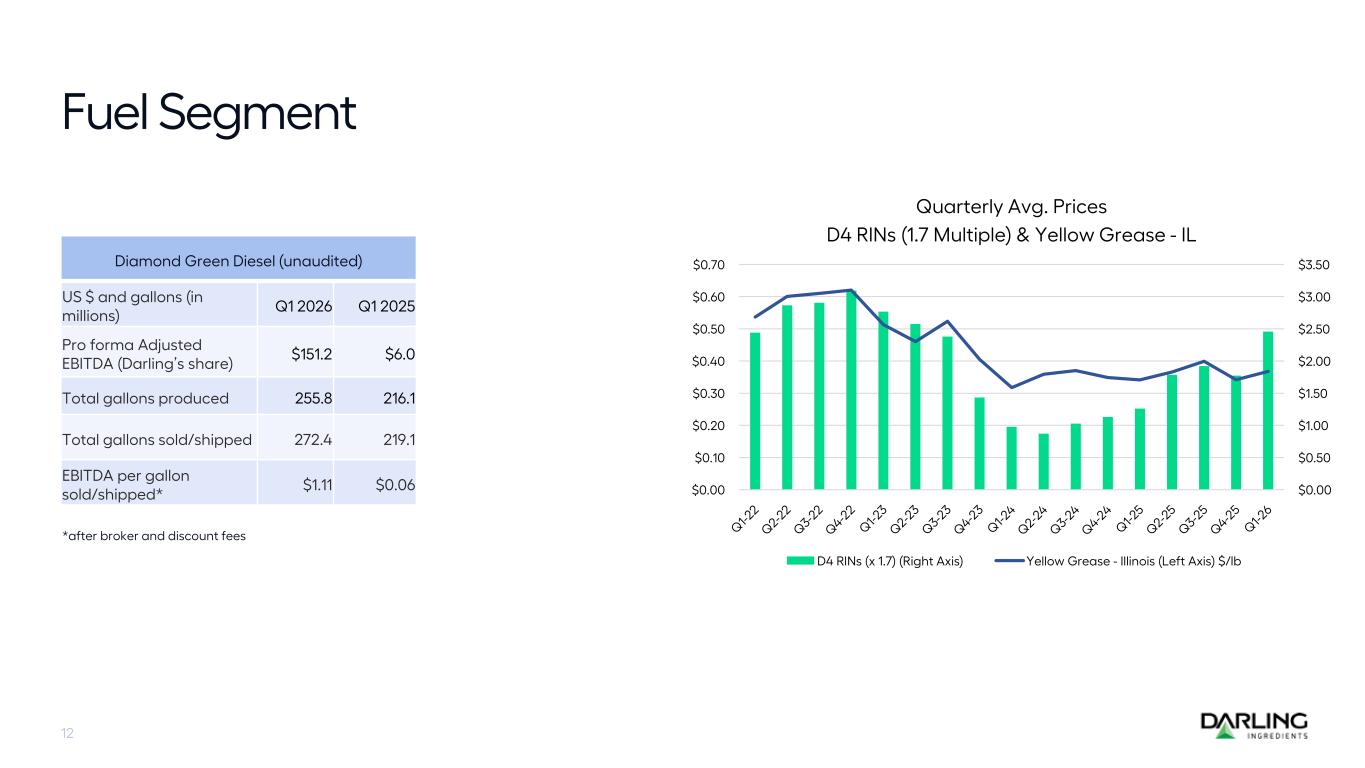
$0.00 $0.50 $1.00 $1.50 $2.00 $2.50 $3.00 $3.50 $0.00 $0.10 $0.20 $0.30 $0.40 $0.50 $0.60 $0.70 Quarterly Avg. Prices D4 RINs (1.7 Multiple) & Yellow Grease - IL D4 RINs (x 1.7) (Right Axis) Yellow Grease - Illinois (Left Axis) $/lb Fuel Segment 12 Diamond Green Diesel (unaudited) US $ and gallons (in millions) Q1 2026 Q1 2025 Pro forma Adjusted EBITDA (Darling’s share) $151.2 $6.0 Total gallons produced 255.8 216.1 Total gallons sold/shipped 272.4 219.1 EBITDA per gallon sold/shipped* $1.11 $0.06 *after broker and discount fees

Appendix
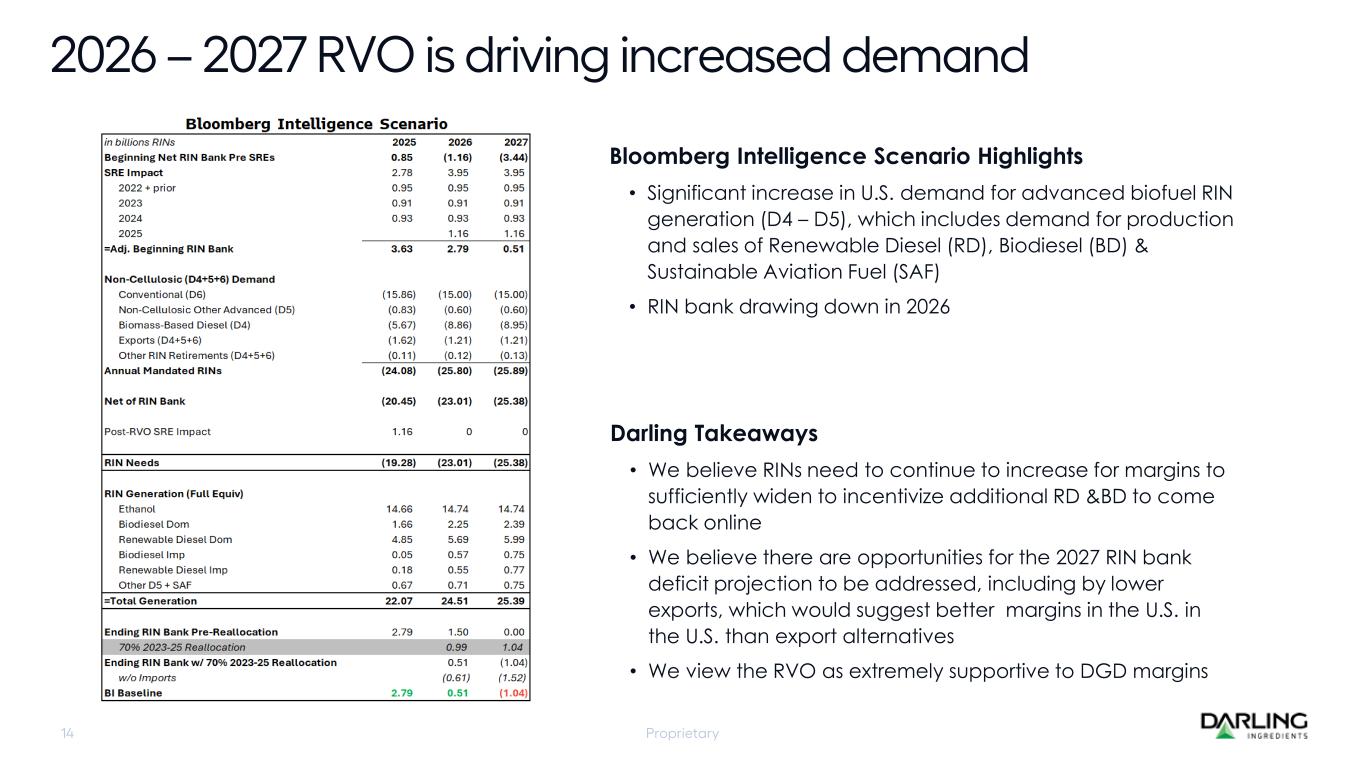
2026 – 2027 RVO is driving increased demand Proprietary14 Bloomberg Intelligence Scenario Highlights • Significant increase in U.S. demand for advanced biofuel RIN generation (D4 – D5), which includes demand for production and sales of Renewable Diesel (RD), Biodiesel (BD) & Sustainable Aviation Fuel (SAF) • RIN bank drawing down in 2026 Darling Takeaways • We believe RINs need to continue to increase for margins to sufficiently widen to incentivize additional RD &BD to come back online • We believe there are opportunities for the 2027 RIN bank deficit projection to be addressed, including by lower exports, which would suggest better margins in the U.S. in the U.S. than export alternatives • We view the RVO as extremely supportive to DGD margins
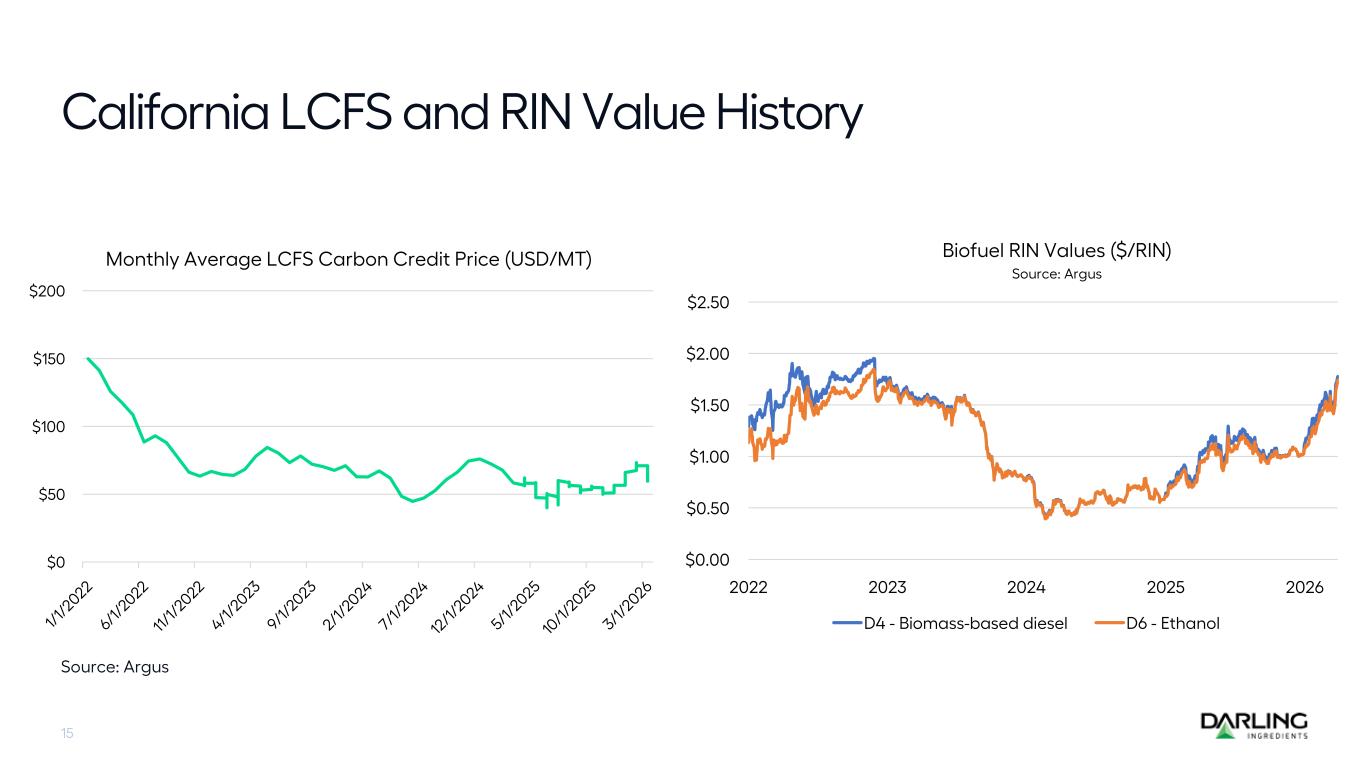
$0.00 $0.50 $1.00 $1.50 $2.00 $2.50 2022 2023 2024 2025 2026 Biofuel RIN Values ($/RIN) Source: Argus D4 - Biomass-based diesel D6 - Ethanol $0 $50 $100 $150 $200 Monthly Average LCFS Carbon Credit Price (USD/MT) California LCFS and RIN Value History 15 Source: Argus
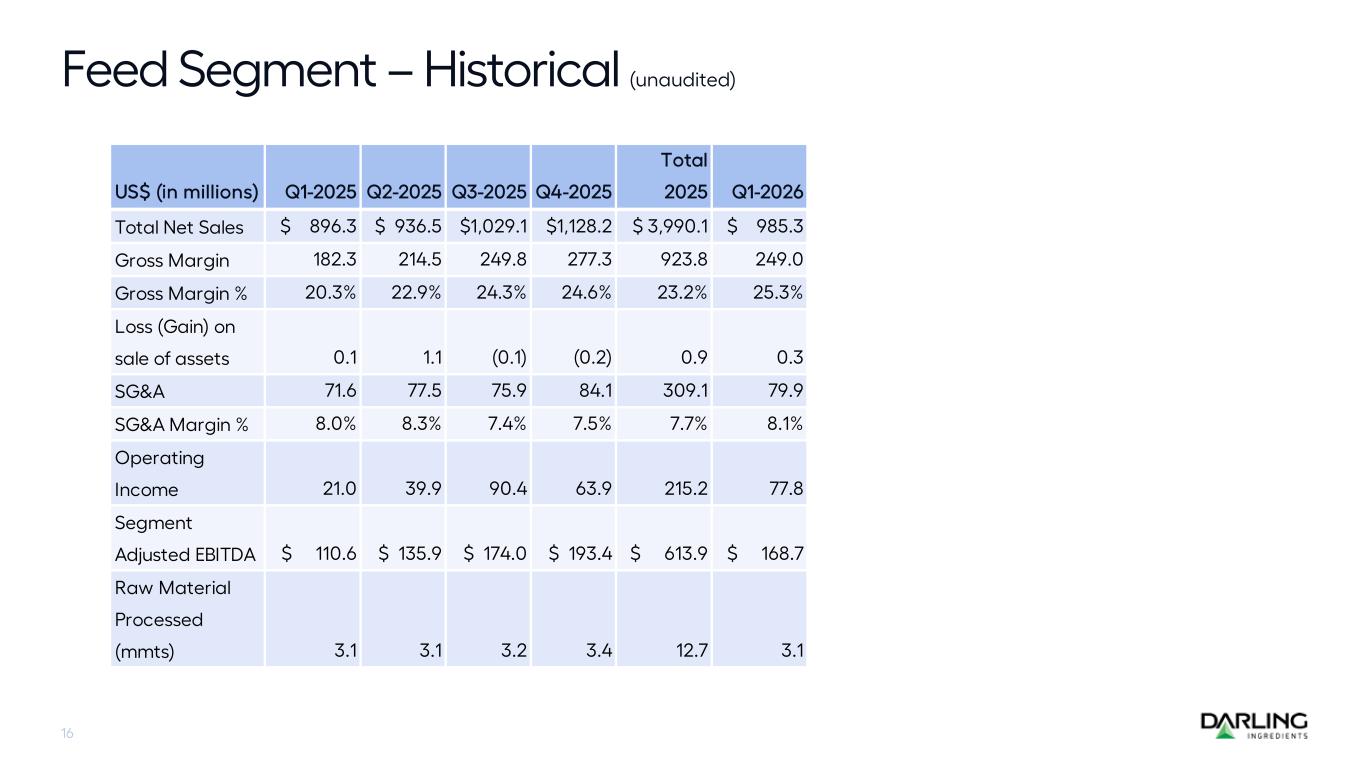
Feed Segment – Historical (unaudited) 16 US$ (in millions) Q1-2025 Q2-2025 Q3-2025 Q4-2025 Total 2025 Q1-2026 Total Net Sales $ 896.3 $ 936.5 $1,029.1 $1,128.2 $ 3,990.1 $ 985.3 Gross Margin 182.3 214.5 249.8 277.3 923.8 249.0 Gross Margin % 20.3% 22.9% 24.3% 24.6% 23.2% 25.3% Loss (Gain) on sale of assets 0.1 1.1 (0.1) (0.2) 0.9 0.3 SG&A 71.6 77.5 75.9 84.1 309.1 79.9 SG&A Margin % 8.0% 8.3% 7.4% 7.5% 7.7% 8.1% Operating Income 21.0 39.9 90.4 63.9 215.2 77.8 Segment Adjusted EBITDA $ 110.6 $ 135.9 $ 174.0 $ 193.4 $ 613.9 $ 168.7 Raw Material Processed (mmts) 3.1 3.1 3.2 3.4 12.7 3.1
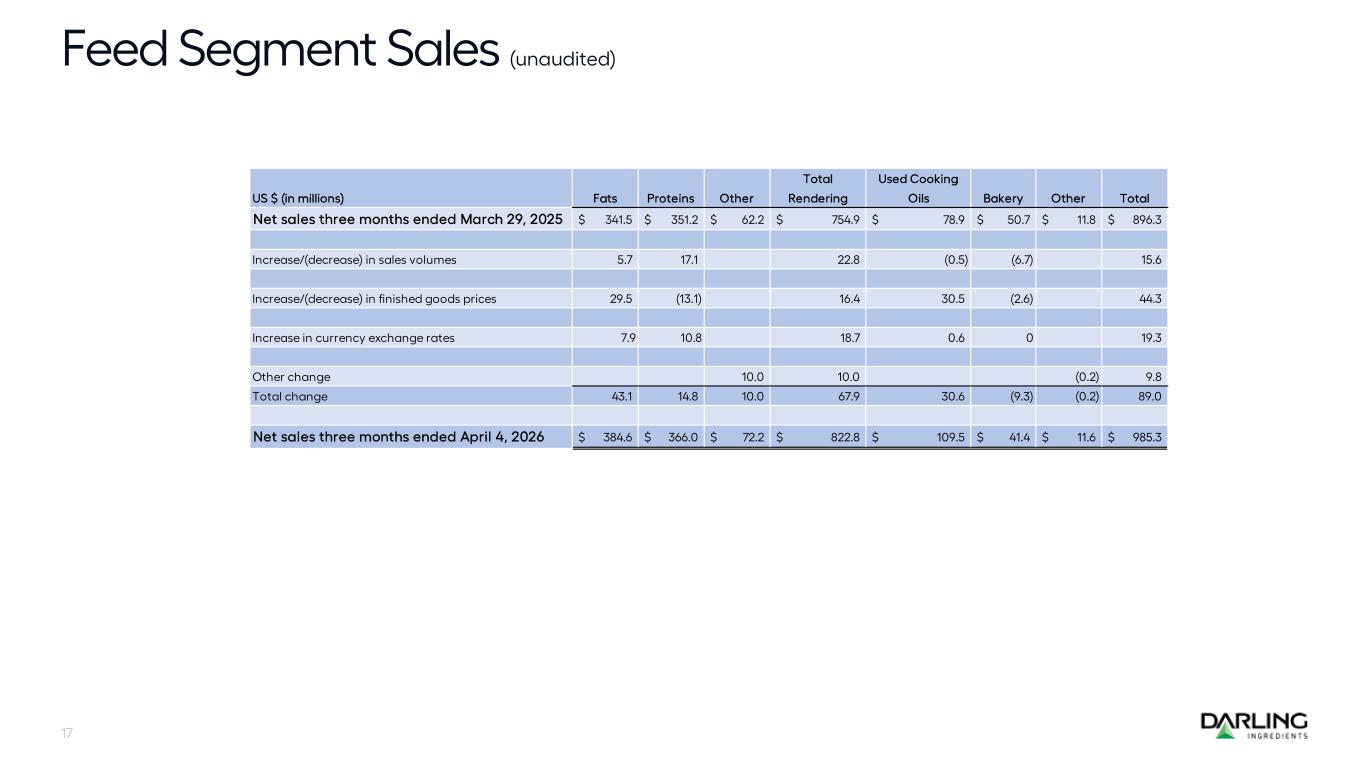
US $ (in millions) Fats Proteins Other Total Rendering Used Cooking Oils Bakery Other Total Net sales three months ended March 29, 2025 341.5$ 351.2$ 62.2$ 754.9$ 78.9$ 50.7$ 11.8$ 896.3$ Increase/(decrease) in sales volumes 5.7 17.1 22.8 (0.5) (6.7) 15.6 Increase/(decrease) in finished goods prices 29.5 (13.1) 16.4 30.5 (2.6) 44.3 Increase in currency exchange rates 7.9 10.8 18.7 0.6 0 19.3 Other change 10.0 10.0 (0.2) 9.8 Total change 43.1 14.8 10.0 67.9 30.6 (9.3) (0.2) 89.0 Net sales three months ended April 4, 2026 384.6$ 366.0$ 72.2$ 822.8$ 109.5$ 41.4$ 11.6$ 985.3$ Feed Segment Sales (unaudited) 17
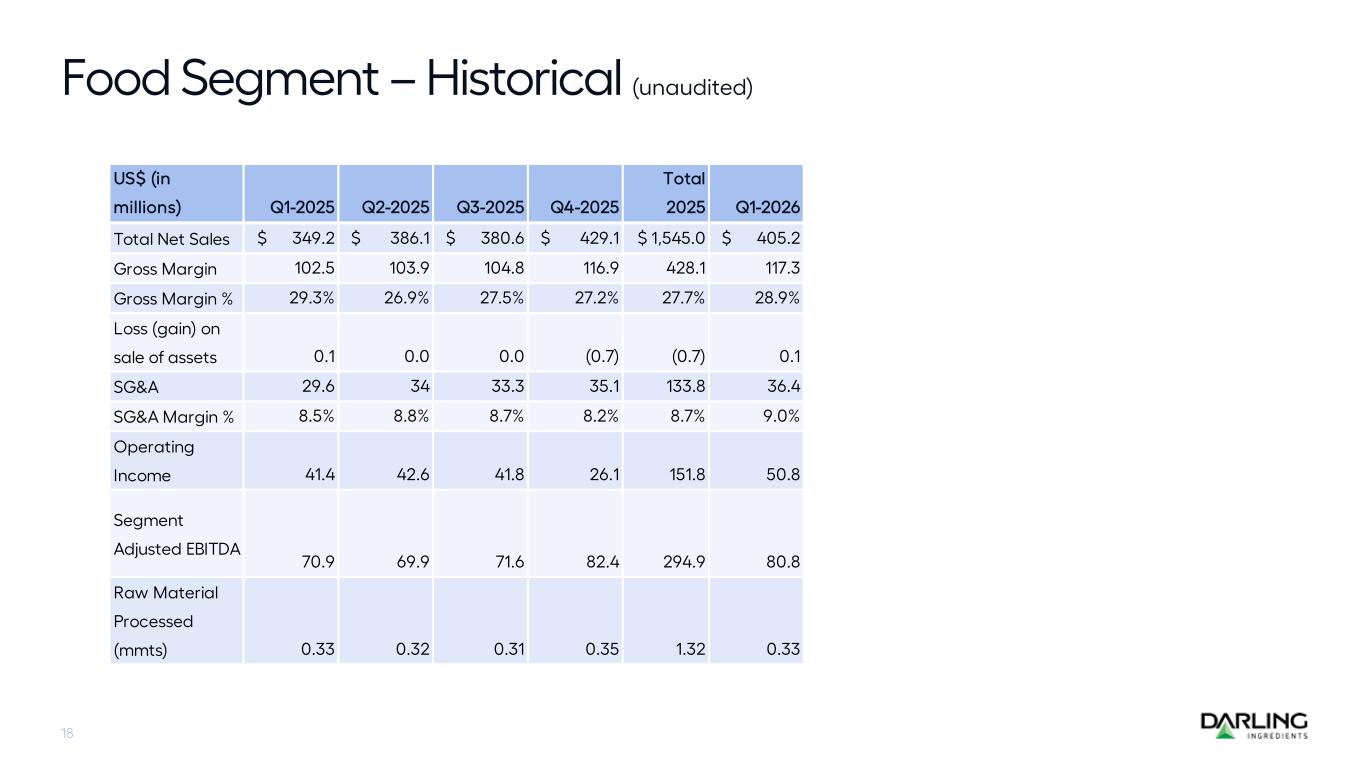
Food Segment – Historical (unaudited) 18 US$ (in millions) Q1-2025 Q2-2025 Q3-2025 Q4-2025 Total 2025 Q1-2026 Total Net Sales $ 349.2 $ 386.1 $ 380.6 $ 429.1 $ 1,545.0 $ 405.2 Gross Margin 102.5 103.9 104.8 116.9 428.1 117.3 Gross Margin % 29.3% 26.9% 27.5% 27.2% 27.7% 28.9% Loss (gain) on sale of assets 0.1 0.0 0.0 (0.7) (0.7) 0.1 SG&A 29.6 34 33.3 35.1 133.8 36.4 SG&A Margin % 8.5% 8.8% 8.7% 8.2% 8.7% 9.0% Operating Income 41.4 42.6 41.8 26.1 151.8 50.8 Segment Adjusted EBITDA 70.9 69.9 71.6 82.4 294.9 80.8 Raw Material Processed (mmts) 0.33 0.32 0.31 0.35 1.32 0.33
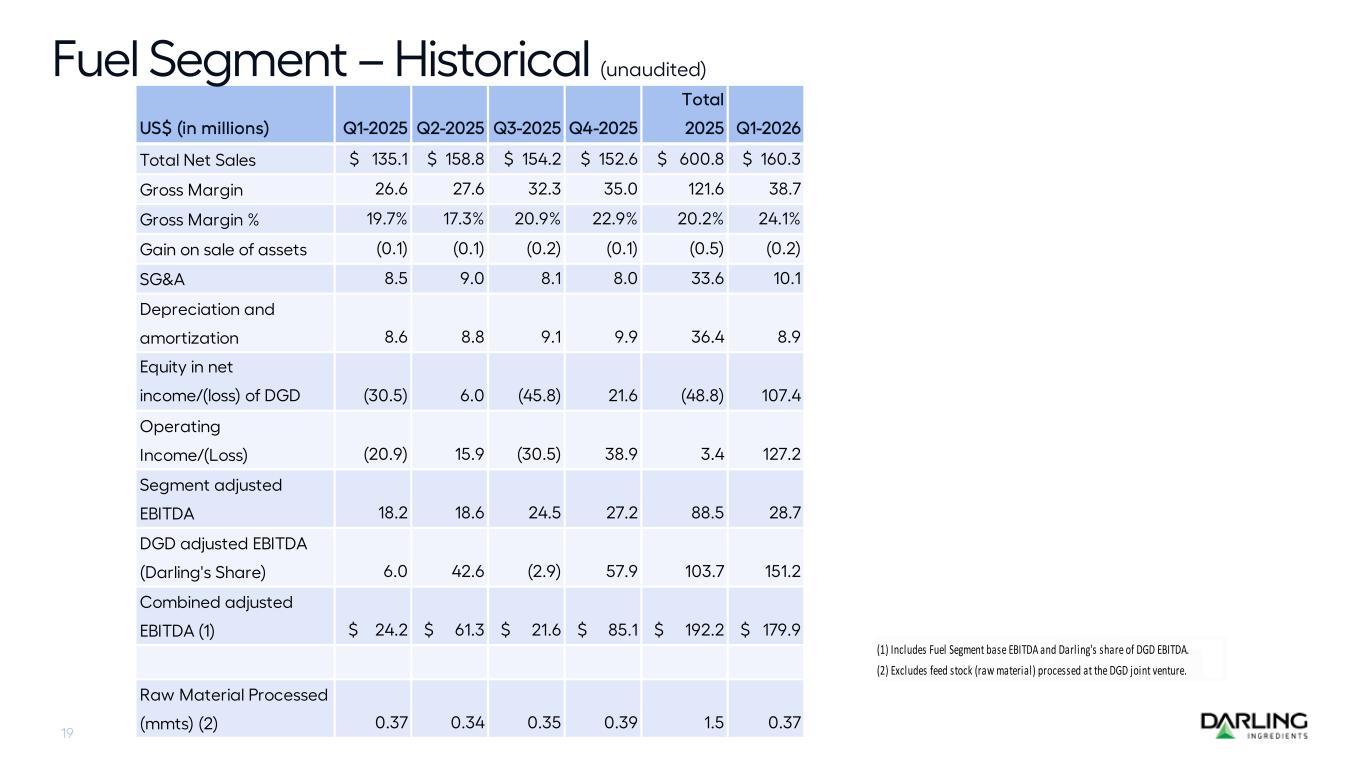
US$ (in millions) Q1-2025 Q2-2025 Q3-2025 Q4-2025 Total 2025 Q1-2026 Total Net Sales $ 135.1 $ 158.8 $ 154.2 $ 152.6 $ 600.8 $ 160.3 Gross Margin 26.6 27.6 32.3 35.0 121.6 38.7 Gross Margin % 19.7% 17.3% 20.9% 22.9% 20.2% 24.1% Gain on sale of assets (0.1) (0.1) (0.2) (0.1) (0.5) (0.2) SG&A 8.5 9.0 8.1 8.0 33.6 10.1 Depreciation and amortization 8.6 8.8 9.1 9.9 36.4 8.9 Equity in net income/(loss) of DGD (30.5) 6.0 (45.8) 21.6 (48.8) 107.4 Operating Income/(Loss) (20.9) 15.9 (30.5) 38.9 3.4 127.2 Segment adjusted EBITDA 18.2 18.6 24.5 27.2 88.5 28.7 DGD adjusted EBITDA (Darling's Share) 6.0 42.6 (2.9) 57.9 103.7 151.2 Combined adjusted EBITDA (1) $ 24.2 $ 61.3 $ 21.6 $ 85.1 $ 192.2 $ 179.9 Raw Material Processed (mmts) (2) 0.37 0.34 0.35 0.39 1.5 0.37 Fuel Segment – Historical (unaudited) 19 (1) Includes Fuel Segment base EBITDA and Darling's share of DGD EBITDA. (2) Excludes feed stock (raw material) processed at the DGD joint venture.
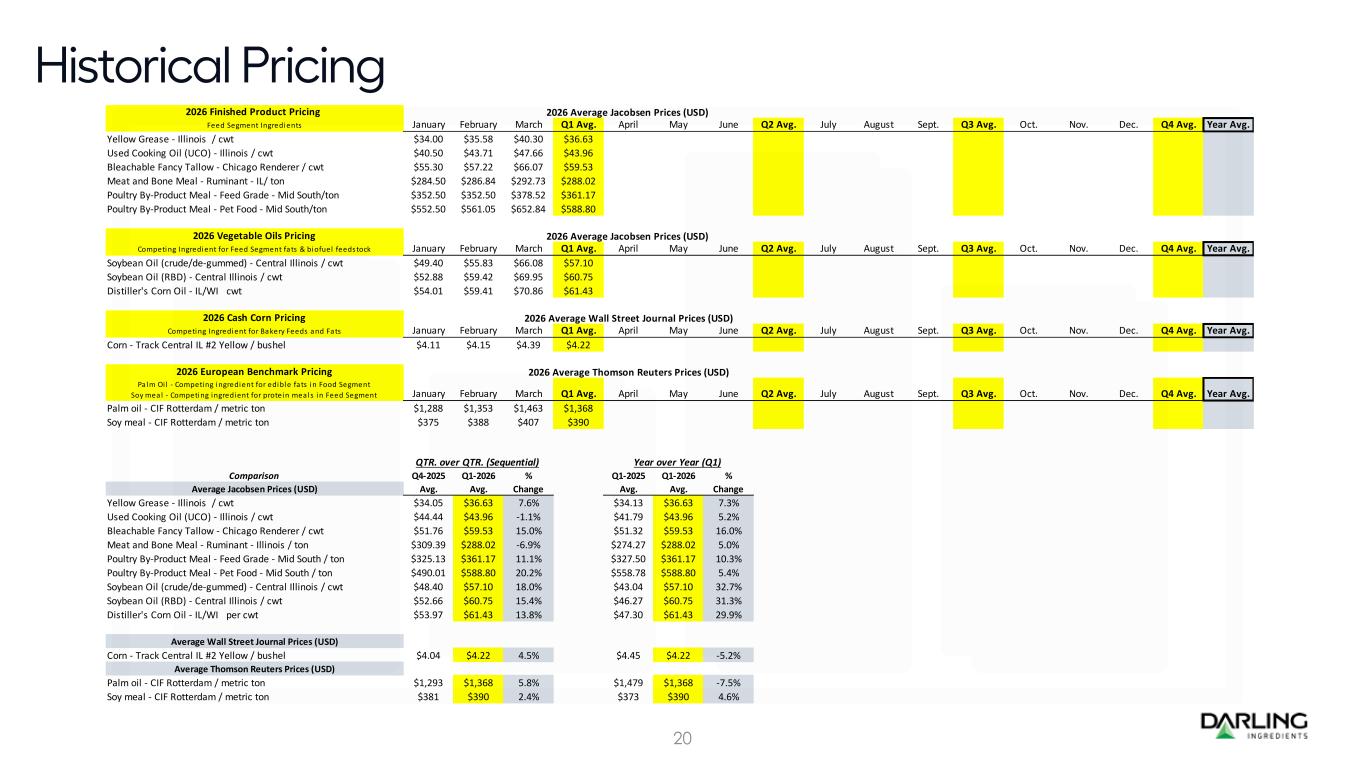
2026 Finished Product Pricing Feed Segment Ingredients January February March Q1 Avg. April May June Q2 Avg. July August Sept. Q3 Avg. Oct. Nov. Dec. Q4 Avg. Year Avg. Yellow Grease - Illinois / cwt $34.00 $35.58 $40.30 $36.63 Used Cooking Oil (UCO) - Illinois / cwt $40.50 $43.71 $47.66 $43.96 Bleachable Fancy Tallow - Chicago Renderer / cwt $55.30 $57.22 $66.07 $59.53 Meat and Bone Meal - Ruminant - IL/ ton $284.50 $286.84 $292.73 $288.02 Poultry By-Product Meal - Feed Grade - Mid South/ton $352.50 $352.50 $378.52 $361.17 Poultry By-Product Meal - Pet Food - Mid South/ton $552.50 $561.05 $652.84 $588.80 2026 Vegetable Oils Pricing Competing Ingredient for Feed Segment fats & biofuel feedstock January February March Q1 Avg. April May June Q2 Avg. July August Sept. Q3 Avg. Oct. Nov. Dec. Q4 Avg. Year Avg. Soybean Oil (crude/de-gummed) - Central Illinois / cwt $49.40 $55.83 $66.08 $57.10 Soybean Oil (RBD) - Central Illinois / cwt $52.88 $59.42 $69.95 $60.75 Distiller's Corn Oil - IL/WI cwt $54.01 $59.41 $70.86 $61.43 2026 Cash Corn Pricing Competing Ingredient for Bakery Feeds and Fats January February March Q1 Avg. April May June Q2 Avg. July August Sept. Q3 Avg. Oct. Nov. Dec. Q4 Avg. Year Avg. Corn - Track Central IL #2 Yellow / bushel $4.11 $4.15 $4.39 $4.22 2026 European Benchmark Pricing Palm Oi l - Competing ingredient for edible fats in Food Segment Soy meal - Competing ingredient for protein meals in Feed Segment January February March Q1 Avg. April May June Q2 Avg. July August Sept. Q3 Avg. Oct. Nov. Dec. Q4 Avg. Year Avg. Palm oil - CIF Rotterdam / metric ton $1,288 $1,353 $1,463 $1,368 Soy meal - CIF Rotterdam / metric ton $375 $388 $407 $390 QTR. over QTR. (Sequential) Year over Year (Q1) Comparison Q4-2025 Q1-2026 % Q1-2025 Q1-2026 % Average Jacobsen Prices (USD) Avg. Avg. Change Avg. Avg. Change Yellow Grease - Illinois / cwt $34.05 $36.63 7.6% $34.13 $36.63 7.3% Used Cooking Oil (UCO) - Illinois / cwt $44.44 $43.96 -1.1% $41.79 $43.96 5.2% Bleachable Fancy Tallow - Chicago Renderer / cwt $51.76 $59.53 15.0% $51.32 $59.53 16.0% Meat and Bone Meal - Ruminant - Illinois / ton $309.39 $288.02 -6.9% $274.27 $288.02 5.0% Poultry By-Product Meal - Feed Grade - Mid South / ton $325.13 $361.17 11.1% $327.50 $361.17 10.3% Poultry By-Product Meal - Pet Food - Mid South / ton $490.01 $588.80 20.2% $558.78 $588.80 5.4% Soybean Oil (crude/de-gummed) - Central Illinois / cwt $48.40 $57.10 18.0% $43.04 $57.10 32.7% Soybean Oil (RBD) - Central Illinois / cwt $52.66 $60.75 15.4% $46.27 $60.75 31.3% Distiller's Corn Oil - IL/WI per cwt $53.97 $61.43 13.8% $47.30 $61.43 29.9% Average Wall Street Journal Prices (USD) Corn - Track Central IL #2 Yellow / bushel $4.04 $4.22 4.5% $4.45 $4.22 -5.2% Average Thomson Reuters Prices (USD) Palm oil - CIF Rotterdam / metric ton $1,293 $1,368 5.8% $1,479 $1,368 -7.5% Soy meal - CIF Rotterdam / metric ton $381 $390 2.4% $373 $390 4.6% 2026 Average Jacobsen Prices (USD) 2026 Average Jacobsen Prices (USD) 2026 Average Wall Street Journal Prices (USD) 2026 Average Thomson Reuters Prices (USD) 20 Historical Pricing
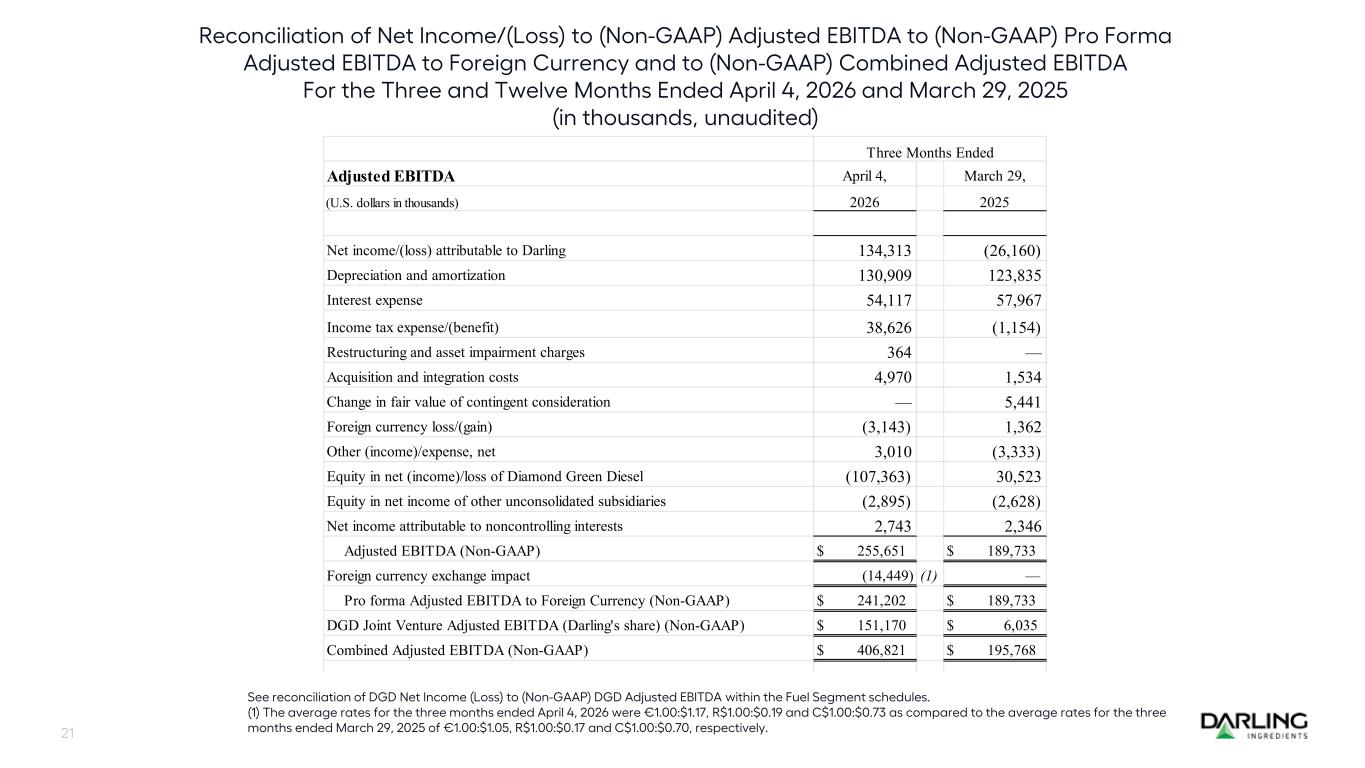
21 Reconciliation of Net Income/(Loss) to (Non-GAAP) Adjusted EBITDA to (Non-GAAP) Pro Forma Adjusted EBITDA to Foreign Currency and to (Non-GAAP) Combined Adjusted EBITDA For the Three and Twelve Months Ended April 4, 2026 and March 29, 2025 (in thousands, unaudited) See reconciliation of DGD Net Income (Loss) to (Non-GAAP) DGD Adjusted EBITDA within the Fuel Segment schedules. (1) The average rates for the three months ended April 4, 2026 were €1.00:$1.17, R$1.00:$0.19 and C$1.00:$0.73 as compared to the average rates for the three months ended March 29, 2025 of €1.00:$1.05, R$1.00:$0.17 and C$1.00:$0.70, respectively. Adjusted EBITDA April 4, March 29, (U.S. dollars in thousands) 2026 2025 Net income/(loss) attributable to Darling 134,313 (26,160) Depreciation and amortization 130,909 123,835 Interest expense 54,117 57,967 Income tax expense/(benefit) 38,626 (1,154) Restructuring and asset impairment charges 364 — Acquisition and integration costs 4,970 1,534 Change in fair value of contingent consideration — 5,441 Foreign currency loss/(gain) (3,143) 1,362 Other (income)/expense, net 3,010 (3,333) Equity in net (income)/loss of Diamond Green Diesel (107,363) 30,523 Equity in net income of other unconsolidated subsidiaries (2,895) (2,628) Net income attributable to noncontrolling interests 2,743 2,346 Adjusted EBITDA (Non-GAAP) $ 255,651 $ 189,733 Foreign currency exchange impact (14,449) (1) — Pro forma Adjusted EBITDA to Foreign Currency (Non-GAAP) $ 241,202 $ 189,733 DGD Joint Venture Adjusted EBITDA (Darling's share) (Non-GAAP) $ 151,170 $ 6,035 Combined Adjusted EBITDA (Non-GAAP) $ 406,821 $ 195,768 Three Months Ended
Non-U.S. GAAP Measures Segment Adjusted EBITDA is not a recognized accounting measurement under GAAP; it should not be considered as an alternative to net income/(loss), as a measure of operating results, or as an alternative to cash flow as a measure of liquidity. It is presented here not as an alternative to net income (loss), but rather as a measure of the segment’s operating performance. Segment Adjusted EBITDA consists of net income/(loss) plus depreciation and amortization, restructuring and asset impairment charges, acquisition and integration costs, change in fair value of contingent consideration, foreign currency loss/(gain), net income/(loss) attributable to noncontrolling interests, interest expense, income tax provision, other income/(expense), equity in net (income)/loss of unconsolidated subsidiaries and equity in net (income)/loss of Diamond Green Diesel. Management believes that Segment Adjusted EBITDA is useful in evaluating the segment’s operating performance because the calculation of Segment Adjusted EBITDA generally eliminates non-cash and certain other items for reasons unrelated to overall operating performance and also believes this information is useful to investors. Adjusted EBITDA is not a recognized accounting measurement under GAAP; it should not be considered as an alternative to net income, as a measure of operating results, or as an alternative to cash flow as a measure of liquidity. It is presented here not as an alternative to net income, but rather as a measure of the Company's operating performance. Since EBITDA (generally, net income plus interest expense, taxes, depreciation and amortization) is not calculated identically by all companies, the presentation in this report may not be comparable to EBITDA or Adjusted EBITDA presentations disclosed by other companies. Adjusted EBITDA is calculated above and represents for any relevant period, net income/(loss) plus depreciation and amortization, restructuring and asset impairment charges, acquisition and integration costs, change in fair value of contingent consideration, foreign currency loss/(gain), net income/(loss) attributable to non-controlling interests, interest expense, income tax provision, other income/(expense) and equity in net (income)/loss of unconsolidated subsidiaries. Management believes that Adjusted EBITDA is useful in evaluating the Company's operating performance compared to that of other companies in its industry because the calculation of Adjusted EBITDA generally eliminates the effects of financing, income taxes, non-cash and certain other items that may vary for different companies for reasons unrelated to overall operating performance and also believes this information is useful to investors. The Company’s management uses Adjusted EBITDA as a measure to evaluate performance and for other discretionary purposes. In addition to the foregoing, management also uses or will use Adjusted EBITDA to measure compliance with certain financial covenants under the Company’s Senior Secured Credit Facilities, 6% Notes, 5.25% Notes and 4.5% Notes that were outstanding at January 3, 2026. However, the amounts shown above for Adjusted EBITDA differ from the amounts calculated under similarly titled definitions in the Company’s Senior Secured Credit Facilities, 6% Notes, 5.25% Notes and 4.5% Notes, as those definitions permit further adjustments to reflect certain other nonrecurring costs, non-cash charges and cash dividends from the DGD Joint Venture. Additionally, the Company evaluates the impact of foreign exchange on operating cash flow, which is defined as segment operating income (loss) plus depreciation and amortization. Pro forma Adjusted EBITDA to Foreign Currency is not a recognized accounting measurement under GAAP; it should not be considered as an alternative to net income, as a measure of operating results, or as an alternative to cash flow as a measure of liquidity. It is presented here not as an alternative to net income, but rather as a measure of the Company's operating performance. Management believes Pro forma Adjusted EBITDA to Foreign Currency is useful in evaluating the Company’s operating performance on a constant currency basis and also believes this information is useful to investors.
Non-U.S. GAAP Measures Combined Adjusted EBITDA is not a recognized accounting measurement under GAAP; it should not be considered as an alternative to net income, as a measure of operating results, or as an alternative to cash flow as a measure of liquidity. It is presented here not as an alternative to net income, but rather as a measure of the Company’s operating performance. Combined Adjusted EBITDA consists of Adjusted EBITDA plus DGD Adjusted EBITDA (Darling’s Share). When Combined Adjusted EBITDA is presented by segment, Combined Adjusted EBITDA consists of Segment Adjusted EBITDA plus DGD Adjusted EBITDA (Darling’s Share). Management believes that Combined Adjusted EBITDA is useful in evaluating the Company's operating performance compared to that of other companies in its industry because the calculation of Combined Adjusted EBITDA generally eliminates the effects of financing, income taxes, non-cash and certain other items that may vary for different companies for reasons unrelated to overall operating performance and also believes this information is useful to investors. DGD Adjusted EBITDA is not reflected in the Adjusted EBITDA or the Pro forma Adjusted EBITDA to Foreign Currency. DGD Adjusted EBITDA is not a recognized accounting measure under GAAP; it should not be considered as an alternative to net income/(loss) or equity in net income/(loss) of Diamond Green Diesel, as a measure of operating results, or as an alternative to cash flow as a measure of liquidity and is not intended to be a presentation in accordance with GAAP. The Company calculates DGD Adjusted EBITDA by taking DGD’s net income/(loss) plus income tax expense/(benefit), interest and debt expense, net, and DGD’s depreciation, amortization and accretion expense less other income. Management believes that DGD Adjusted EBITDA is useful in evaluating the Company’s operating performance because the calculation of DGD Adjusted EBITDA generally eliminates non-cash and certain other items at DGD unrelated to overall operating performance and also believes this information is useful to investors. The Company calculates Darling’s Share of DGD Adjusted EBITDA by taking DGD Adjusted EBITDA, net of discount and broker fees, and then multiplying by 50% to get Darling’s Share of DGD’s Adjusted EBITDA. Adjusted EBITDA per gallon is not a recognized accounting measurement under GAAP; it should not be considered as an alternative to net income or equity in income of Diamond Green Diesel, as a measure of operating results, or as an alternative to cash flow as a measure of liquidity and is not intended to be a presentation in accordance with GAAP. Adjusted EBITDA per gallon is presented here not as an alternative to net income or equity in income of Diamond Green Diesel, but rather as a measure of Diamond Green Diesel's operating performance. Since Adjusted EBITDA per gallon (generally, net income plus interest expense, taxes, depreciation and amortization divided by total gallons sold) is not calculated identically by all companies, this presentation may not be comparable to Adjusted EBITDA per gallon presentations disclosed by other companies. Management believes that Adjusted EBITDA per gallon is useful in evaluating Diamond Green Diesel's operating performance compared to that of other companies in its industry because the calculation of Adjusted EBITDA per gallon generally eliminates the effects of financing, income taxes and non-cash and certain other items presented on a per gallon basis that may vary for different companies for reasons unrelated to overall operating performance.
Financial Results Q1 2026 April 30, 2026