Please wait
Table of Contents


UNITED STATES

SECURITIES AND EXCHANGE COMMISSION

Washington, D.C. 20549


SCHEDULE 14A

(RULE 14a-101)

INFORMATION REQUIRED IN PROXY STATEMENT

SCHEDULE 14A INFORMATION

Proxy Statement Pursuant to Section 14(a) of the

Securities Exchange Act of 1934


Filed by the Registrant ☒

Filed by a Party other than the Registrant ☐

Check the appropriate box:


Preliminary Proxy Statement


Confidential, for Use of the Commission Only (as permitted by Rule 14a-6(e)(2))


Definitive Proxy Statement


Definitive Additional Materials


Soliciting Material Pursuant to §240.14a-12

Apartment Investment and Management Company

(Name of Registrant as Specified in Its Charter)

(Name of Person(s) Filing Proxy Statement, if Other Than the Registrant)

Payment of Filing Fee (Check all boxes that apply):


No fee required.


Fee paid previously with preliminary materials.


Fee computed on table in exhibit required by Item 25(b) per Exchange Act Rules 14a-6(i)(1) and 0-11.


Table of Contents

PRELIMINARY PROXY STATEMENT DATED DECEMBER 15, 2025, SUBJECT TO COMPLETION



LOGO     


4582 South Ulster Street

Suite 1450

    Denver, Colorado 80237
    833-373-1300
    www.aimco.com
     

[●]

Dear Fellow Stockholders:

You are cordially invited to attend a special meeting of stockholders of Apartment Investment and Management Company, a Maryland corporation (“Aimco”, the “Company”, “our” or “we”), to be held on [●], 2026 at [●] a.m., Mountain Standard Time (the “Special Meeting”) at the Company’s corporate headquarters, 4582 South Ulster Street, Suite 1450, Denver, CO 80237.

In January 2025, we announced that our previously announced strategic review process, which sought to explore a broad range of options to enhance stockholder value, had expanded to include, among other things, an acceleration of individual asset sales, potential sales of the major components of the business (in one or a series of transactions) and the exploration of a sale or merger of the Company as a whole. In November 2025, we announced the conclusion of the strategic review process. Given the disparate composition of the Company’s remaining assets and market feedback received during the strategic review process, with Morgan Stanley & Co. LLC (“Morgan Stanley”) and Wachtell, Lipton, Rosen & Katz (“Wachtell”) serving as our financial and legal advisors, respectively, the Board of Directors (the “Board”) of the Company unanimously deemed advisable and approved a plan of sale and liquidation (the “Plan of Sale and Liquidation”), conditioned on stockholder approval. We refer to the transactions contemplated by the Plan of Sale and Liquidation, collectively, as the “Plan of Sale and Liquidation”.

At the Special Meeting, we are asking you to consider and vote upon a proposal to approve the Plan of Sale and Liquidation, as further described below and in the enclosed proxy statement. We are also asking you to consider and cast a non-binding, advisory vote upon a proposal to approve the specified compensation that may be paid or become payable to the named executive officers of Aimco in connection with the Plan of Sale and Liquidation. Finally, we are asking you to consider and vote upon a proposal to adjourn the Special Meeting, solely with respect to the proposals for which insufficient votes to approve such proposals were cast, to a later date or dates, if necessary, appropriate or advisable, to solicit additional proxies.

If the Liquidation Proposal (as defined below) is approved by our stockholders, the Company intends to return net proceeds from asset sales and cash on hand to our stockholders, subject to payment of our liabilities and obligations and the creation of associated reserves. As of the date of this proxy statement, it is estimated that net proceeds from the sale of the Company’s remaining assets, including the Brickell Assemblage and Chicago, IL Portfolio, which are under contract to be sold for $520 million and $455 million, respectively, and cash on hand could result in total distributions of between $5.75 and $7.10 per share of the Company’s Class A common stock, $0.01 par value per share (the “Common Shares”), given current market conditions and inclusive of estimated transaction and wind-down costs and subject to the other estimates and assumptions more fully described in the enclosed proxy statement. When combined with the $2.83 per share in special dividends returned to shareholders in 2025 (as of December 12, 2025), Aimco’s total distribution estimate is between $8.58 and $9.93 per share. The timing and amount of any distributions remain subject to numerous factors, including the discretion of the Board and applicable law.

For the avoidance of doubt, the accompanying proxy statement does not constitute any solicitation of consents in respect of the common partnership units of Aimco OP L.P.

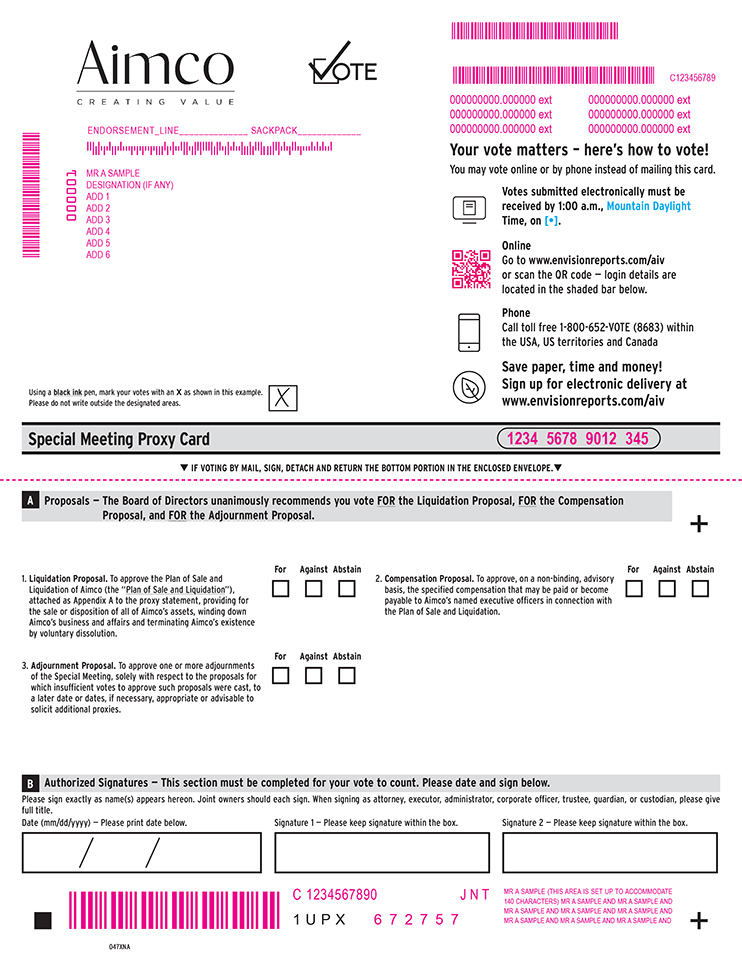
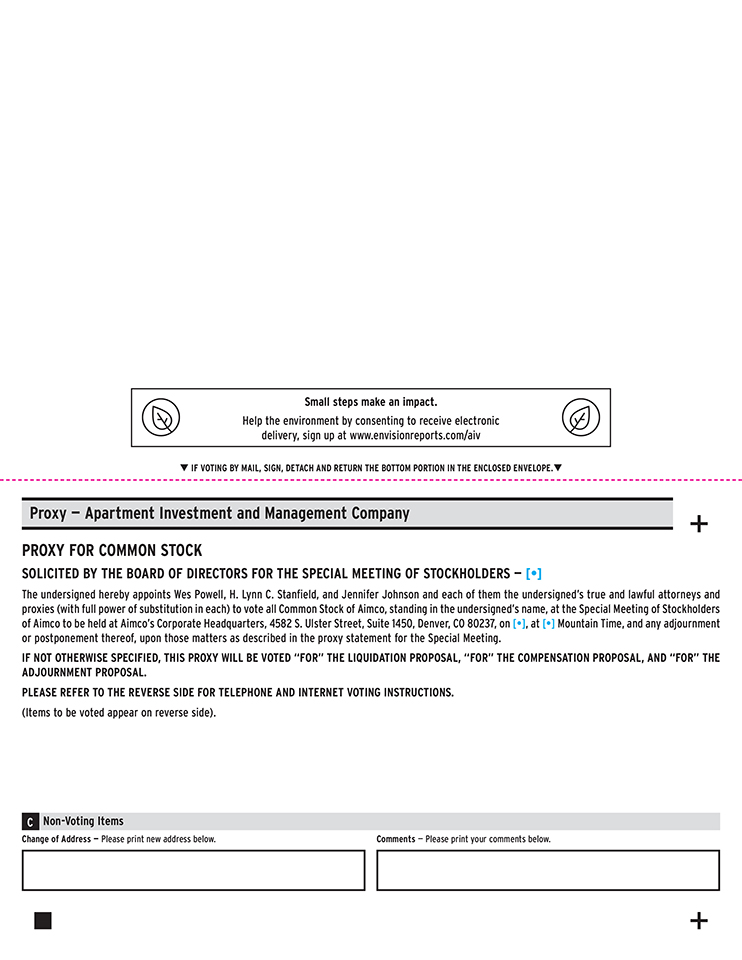
Table of Contents

After careful consideration, the Board has unanimously determined that the Plan of Sale and Liquidation is advisable, fair to and in the best interests of our stockholders, and has approved the Plan of Sale and Liquidation. The Board unanimously recommends that you vote “FOR” approval of the Plan of Sale and Liquidation (the “Liquidation Proposal”), “FOR” approval, on a non-binding, advisory basis, of the compensation that may be paid or become payable to our named executive officers in connection with the Plan of Sale and Liquidation (the “Compensation Proposal”) and “FOR” one or more adjournments of the Special Meeting, solely with respect to the proposals for which insufficient votes to approve such proposals were cast, to a later date or dates, if necessary, appropriate or advisable to permit further solicitation of additional proxies (the “Adjournment Proposal”).

The enclosed proxy statement contains important information about Aimco, the Plan of Sale and Liquidation and the Special Meeting. We encourage you to read the enclosed proxy statement carefully before voting, including the section entitled “Risk Factors” beginning on page 21.

Your vote is very important, regardless of the number of Common Shares you own. The Plan of Sale and Liquidation cannot be completed unless stockholders approve the Liquidation Proposal by the affirmative vote of the holders of Common Shares entitled to cast two-thirds of all votes entitled to be cast on the matter. We strongly urge you to cast your vote as soon as possible, even if you plan to attend the Special Meeting. If you hold your shares in “street name”, you should instruct your broker how to vote in accordance with your voting instruction form or other document. If you do not submit your proxy, instruct your broker how to vote your shares or vote at the Special Meeting, it will have the same effect as a vote “AGAINST” approval of the Liquidation Proposal, but will have no effect on the Compensation Proposal or the Adjournment Proposal, other than in connection with determining whether a quorum is present.

The record date for determining the Aimco stockholders entitled to receive notice of, and to vote at, the Special Meeting or any adjournment or postponement thereof is [●]. Please refer to the enclosed proxy statement for more logistical information about attending the Special Meeting.


Sincerely,

R. Dary Stone

Chairman of the Board

The enclosed proxy statement is dated [●], and is first being mailed to Aimco stockholders on or about [●].


Table of Contents

APARTMENT INVESTMENT AND MANAGEMENT COMPANY

NOTICE OF SPECIAL MEETING OF STOCKHOLDERS

To the Stockholders of Apartment Investment and Management Company:

Notice is hereby given that a special meeting of stockholders (the “Special Meeting”) of Apartment Investment and Management Company, a Maryland corporation (“Aimco”, the “Company”, “our” or “we”), will be held at the time and place below and for the following purposes:


Date:

[●], 2026.


Time:

[●] a.m., Mountain Standard Time.


Place:

The Special Meeting will be held at the Company’s corporate headquarters, 4582 South Ulster Street, Suite 1450, Denver, CO 80237.


Record Date:

The Board of Directors of the Company (the “Board”) has fixed the close of business on [●], as the record date for determining holders of the Company’s Class A common stock, par value $0.01 per share (the “Common Shares”), entitled to notice of, and to vote at, the Special Meeting or at any adjournment or postponement thereof.


Items of Business:

1.

To consider and vote on a proposal to approve the Plan of Sale and Liquidation of the Company (the “Plan of Sale and Liquidation”) providing for the sale or disposition of all the Company’s assets, winding down the Company’s business and affairs and terminating the Company’s existence by voluntary dissolution (the “Liquidation Proposal”);


  2.

To consider and vote on a proposal to approve, on a non-binding, advisory basis, the specified compensation that may be paid or become payable to our named executive officers in connection with the Plan of Sale and Liquidation (the “Compensation Proposal”); and


  3.

To consider and vote on a proposal to approve one or more adjournments of the Special Meeting, solely with respect to the proposals for which insufficient votes to approve such proposals were cast, to a later date or dates, if necessary, appropriate or advisable to solicit additional proxies (the “Adjournment Proposal”).


Recommendations of the Board:

After careful consideration, the Board has unanimously determined that the Plan of Sale and Liquidation is advisable, fair to and in the best interests of our stockholders, and has approved the Plan of Sale and Liquidation. The Board has directed that the Liquidation Proposal, the Compensation Proposal and the Adjournment Proposal be submitted for consideration at the Special Meeting.


  The Board unanimously recommends that you vote “FOR” approval of the Liquidation Proposal, “FOR” approval of the Compensation Proposal and “FOR” approval of the Adjournment Proposal.


Voting:

Your vote is very important, regardless of the number of Common Shares you own. Whether or not you plan to attend the


Table of Contents
 

Special Meeting, please submit a proxy or, if you hold your shares in “street name”, submit voting instructions to have your Common Shares voted as promptly as possible to make sure that your Common Shares are represented at the Special Meeting.


  Properly executed proxy cards with no instructions indicated on the proxy card with respect to any proposal listed on the proxy card will be voted “FOR” approval of the Liquidation Proposal, “FOR” approval of the Compensation Proposal and “FOR” approval of the Adjournment Proposal, as applicable.


  If you do not vote on the Liquidation Proposal, this will have the same effect as a vote by you “AGAINST” the approval of the Liquidation Proposal, but will have no effect on the Compensation Proposal or the Adjournment Proposal, other than in connection with determining whether a quorum is present. We encourage you to cast your vote as soon as possible.


  If you have any questions or require any assistance voting your shares, please contact our proxy solicitor, MacKenzie Partners, Inc. (“MacKenzie Partners”), at:


LOGO

  7 Penn Plaza, 5th Floor
  New York, New York 10001
  (212) 929-5500
  or
  (800) 322-2885

Regardless of the number of shares you hold, as a stockholder your role is very important, and the Board strongly encourages you to exercise your right to vote.


By Order of the Board of Directors,

Jennifer Johnson

Secretary

Denver, CO

[●]


Table of Contents

PROXY STATEMENT

TABLE OF CONTENTS


QUESTIONS AND ANSWERS ABOUT THE SPECIAL MEETING

     1  

Certain Defined Terms

     1  

SUMMARY

     13  

The Company

     13  

The Plan of Sale and Liquidation

     13  

Overview of the Plan of Sale and Liquidation

     14  

Risk Factors

     17  

The Special Meeting

     17  

Record Date, Notice and Quorum

     17  

Required Vote

     17  

Special Meeting Attendance

     18  

Authorizing a Proxy and Voting

     18  

Revocation of Proxies and Voting Instructions

     18  

Board Recommendation and Reasons for the Plan of Sale and Liquidation

     18  

Interests of Our Directors and Executive Officers

     20  

Regulatory Matters

     20  

U.S. Federal Income Tax Considerations

     20  

No Appraisal or Dissenters’ Rights

     20  

RISK FACTORS

     21  

Risks Related to the Plan of Sale and Liquidation

     21  

Risks Related to Taxes and our Status as a REIT

     28  

CAUTIONARY STATEMENT REGARDING FORWARD-LOOKING STATEMENTS

     30  

THE SPECIAL MEETING

     32  

Date, Time and Place of the Special Meeting

     32  

Purpose

     32  

Record Date, Notice and Quorum

     32  

Required Vote

     32  

Special Meeting Attendance

     33  

Authorizing a Proxy and Voting

     33  

Revocation of Proxies and Voting Instructions

     34  

Adjournment and Postponement; Other Procedural Matters

     34  

Solicitation of Proxies

     35  

Assistance

     35  

THE PLAN OF SALE AND LIQUIDATION

     36  

General

     36  

Background of the Plan of Sale and Liquidation

     36  

Board Recommendation and Reasons for the Plan of Sale and Liquidation

     41  

U.S. Federal Income Tax Considerations

     45  

Interests of Our Directors and Executive Officers

     54  

Quantification of Potential Payments and Benefits to the Company’s Named Executive Officers

     57  

Regulatory Matters

     59  

Marketing and Sale Process for the Remaining Company Assets

     59  

OVERVIEW OF THE PLAN OF SALE AND LIQUIDATION

     60  

Overview

     60  

Implementation of the Plan of Sale and Liquidation

     61  

Liquidating Trust

     61  

Amount and Timing of Distributions to our Stockholders as a Result of the Liquidation

     62  

Delisting of Common Shares

     66  

Termination of the Registration of Common Shares

     66  


i


Table of Contents

Cancellation of Common Shares

     66  

Termination of Existence of the Company

     66  

Abandonment or Modification of Plan of Sale and Liquidation

     67  

Accounting Treatment of Liquidation

     67  

No Appraisal or Dissenters’ Rights

     67  

PROPOSAL ONE: LIQUIDATION PROPOSAL

     68  

General

     68  

Recommendation of the Board

     68  

PROPOSAL TWO: COMPENSATION PROPOSAL

     69  

General

     69  

Recommendation of the Board

     69  

PROPOSAL THREE: ADJOURNMENT PROPOSAL

     70  

General

     70  

Recommendation of the Board

     70  

SECURITIES OWNERSHIP OF CERTAIN BENEFICIAL OWNERS AND MANAGEMENT

     71  

STOCKHOLDER PROPOSALS

     73  

HOUSEHOLDING

     73  

NO OTHER MATTERS

     73  

WHERE YOU CAN FIND MORE INFORMATION

     74  

Appendix A — The Plan of Sale and Liquidation

     A-1  


ii


Table of Contents

QUESTIONS AND ANSWERS ABOUT THE SPECIAL MEETING

The following are some questions that you, as a stockholder of the Company, may have regarding the Special Meeting, the Plan of Sale and Liquidation and other matters being considered at the Special Meeting and brief answers to those questions. We urge you to read carefully the remainder of this proxy statement because the information in this section may not provide all the information that might be important to you with respect to the proposals being considered at the Special Meeting. Additional important information is also contained in the exhibits to, and the documents incorporated by reference in, this proxy statement.

Certain Defined Terms

Unless stated otherwise, whenever used in this proxy statement, the following terms have the meanings set forth below:


Adjournment Proposal” refers to the proposal to approve one or more adjournments of the Special Meeting, solely with respect to the proposals for which insufficient votes to approve such proposals were cast, to a later date or dates, if necessary, appropriate or advisable to solicit additional proxies.


Aimco”, “Company”, “our”, “we” or “us” refers to Apartment Investment and Management Company, a Maryland corporation and self-administered and self-managed real estate investment trust.


Articles of Dissolution” refers to the articles of dissolution to be filed with the Maryland Department of Assessments and Taxation.


Board” refers to the Board of Directors of the Company.


Bylaws” refers to the Amended and Restated Bylaws of Apartment Investment and Management Company, dated as of April 26, 2023.


Charter” refers to the Articles of Amendment and Restatement of Apartment Investment and Management Company, effective as of October 3, 2023.


Code” refers to the Internal Revenue Code of 1986, as amended.


Common Shares” refers to shares of our Class A Common Stock, $0.01 par value per share.


Compensation Proposal” refers to the proposal to approve, on a non-binding, advisory basis, the specified compensation that may be paid or become payable to our named executive officers in connection with the Plan of Sale and Liquidation.


Exchange Act” refers to the Securities Exchange Act of 1934, as amended.


Governing Documents” refers to our Charter and Bylaws.


Investment Committee” refers to the investment committee of the Company Board.


Liquidation Proposal” refers to the proposal to approve the Plan of Sale and Liquidation.


MGCL” refers to the Maryland General Corporation Law.


NYSE” refers to the New York Stock Exchange.


Plan of Sale and Liquidation” refers to the Apartment Investment and Management Company Plan of Sale and Liquidation approved by the Board on November 10, 2025, which contemplates the sale or disposition of all the Company’s assets, the wind-down of the Company’s business and affairs and the termination of the Company’s existence by voluntary dissolution.


Record Date” refers to [●].


REIT” refers to a real estate investment trust within the meaning of Sections 856-860 of the Code.


Table of Contents
   

Remaining Company Assets” refers to the Company’s ownership interest in the following assets:


118-122 West 23rd Street – New York, NY (Part of the New York, NY Portfolio)


173 E. 90th Street – New York, NY (Part of the New York, NY Portfolio)


237-239 Ninth Avenue – New York, NY (Part of the New York, NY Portfolio)


1045 on the Park Apartments Homes – Atlanta, GA


2200 Grace – Lombard, IL (Part of the Chicago, IL Portfolio)


Bank Lofts – Denver, CO


Bluffs at Pacifica, The – Pacifica, CA


Eldridge Townhomes – Elmhurst, IL (Part of the Chicago, IL Portfolio)


Elm Creek – Elmhurst, IL (Part of the Chicago, IL Portfolio)


Evanston Place – Evanston, IL (Part of the Chicago, IL Portfolio)


Hillmeade – Nashville, TN


Hyde Park Tower – Chicago, IL (Part of the Chicago, IL Portfolio)


Plantation Gardens – Plantation, FL


Willow Bend – Rolling Meadows, IL (Part of the Chicago, IL Portfolio)


Yorktown Apartments – Lombard, IL (Part of the Chicago, IL Portfolio)


Casa del Hermosa – La Jolla, CA


Casa del Mar – La Jolla, CA


Casa del Norte – La Jolla, CA


Casa del Sur – La Jolla, CA


1001 Brickell Bay Drive – Miami, FL (Part of the Brickell Assemblage)


Yacht Club at Brickell – Miami, FL (Part of the Brickell Assemblage)


Oak Shore – Corte Madera, CA


Upton Place – Washington, DC


Strathmore Square Phase 1 – Bethesda, MD


34th Street – Miami, FL


300 Broward – Fort Lauderdale, FL


One Edgewater – Miami, FL


CU Anschutz Campus Holdings – Aurora, CO


Flagler Village – Fort Lauderdale, FL


Flying Horse – Colorado Springs, CO


Strathmore Square Phase 2 – Bethesda, MD


The Benson Hotel & Faculty Club – Non-Core Real Estate


2


Table of Contents
   

IQHQ – Passive Equity


Parkmerced – Mezzanine Loan


RE Tech Funds – Passive Equity


La Jolla Cove – La Jolla, CA – Seller Financing Note


SEC” refers to the U.S. Securities and Exchange Commission.


Special Meeting” refers to the special meeting to be held on [●], 2026 at [●] a.m., Mountain Standard Time.


Total Estimated Liquidating Distributions” refers to the distributions to stockholders anticipated to be paid from the Company’s net proceeds from the sales of the Remaining Company Assets and cash on hand in accordance with the Plan of Sale and Liquidation. See “Overview of the Plan of Sale and LiquidationAmount and Timing of Distributions to our Stockholders as a Result of the Liquidation” for a discussion of the assumptions and estimates used to estimate the range of the Total Estimated Liquidating Distributions.


Q:

What is the Plan of Sale and Liquidation?


A:

The Plan of Sale and Liquidation contemplates the sale or disposition of all the Company’s assets, the wind-down of the Company’s business and affairs and the termination of the Company’s existence by voluntary dissolution. The Plan of Sale and Liquidation was approved by the Board on November 10, 2025, subject to stockholder approval.


Q:

Are there any risks related to the Plan of Sale and Liquidation?


A:

Yes. You should carefully review the sections entitled “Risk FactorsRisks Related to the Plan of Sale and Liquidation” and “Risk FactorsRisks Related to Taxes and our Status as a REIT”.


Q:

Why did the Company approve the Plan of Sale and Liquidation?


A:

The Board concluded, after conducting a strategic review process with the assistance of the Investment Committee, Morgan Stanley serving as financial advisor and Wachtell serving as legal advisor, and evaluating a number of strategic alternatives with the goal of making an informed determination of the course of action that the Board believes provides the best opportunity for maximizing value for stockholders (with such review including a thorough evaluation of continuing the Company’s current business strategy, prospects for the sale of the Company as a whole, portfolio sales and a liquidation of the Company, as well as the Company’s future business prospects and the work the Company had already undertaken to sell certain portfolios of properties and reduce its cost of capital), that the subsequent orderly wind-down of the Company’s business and affairs and termination of the Company’s existence pursuant to the Plan of Sale and Liquidation is the strategic alternative that is most likely to result in the greatest value for stockholders as compared to the Company’s other strategic alternatives, including continuing to operate the business as an independent going concern. See “The Plan of Sale and LiquidationBoard Recommendation and Reasons for the Plan of Sale and Liquidation”.


Q:

What are the estimated distributions to stockholders resulting from the Plan of Sale and Liquidation?


A:

If the Liquidation Proposal is approved by our stockholders and we are able to successfully implement the Plan of Sale and Liquidation, we estimate that, after taking into account the payment of, or establishment of reserves for known liabilities and liquidating expenses and estimated, unascertained or contingent liabilities


3


Table of Contents
  and expenses, and the other estimates and assumptions more fully described in this proxy statement, the total amount of Total Estimated Liquidating Distributions to be funded from the net proceeds from the sales of the Remaining Company Assets and cash on hand will be between $5.75 and $7.10 per share. When combined with the $2.83 per share in special dividends returned to shareholders in 2025 (as of December 12, 2025), Aimco’s total distribution estimate is between $8.58 and $9.93 per share.

If the Liquidation Proposal is approved by our stockholders, we do not intend to declare or pay future regular quarterly distributions.

Although we have provided an estimated range for the Total Estimated Liquidating Distributions and intend to make distributions during the liquidation process, the timing and amount of those distributions may vary based on a number of factors and we cannot determine at this time when, or whether, we will be able to make the Total Estimated Liquidating Distributions to our stockholders or the amount of any such distributions. The timing and amount of any distributions remain subject to numerous factors, including Board discretion and applicable law. See “Overview of the Plan of Sale and LiquidationAmount and Timing of Distributions to our Stockholders as a Result of the Liquidation”.


Q:

What is the date of the Special Meeting and how will it be held?


A:

The Special Meeting will be held on [●], 2026, at [●] a.m., Mountain Standard Time. The Special Meeting will be held at the Company’s corporate headquarters, 4582 South Ulster Street, Suite 1450, Denver, CO 80237. See “The Special Meeting” for additional information on the Special Meeting.


Q:

Why am I receiving this proxy statement?


A:

The Board is using this proxy statement to solicit proxies of Aimco stockholders to obtain the necessary approvals for the Plan of Sale and Liquidation. The effectiveness of the Plan of Sale and Liquidation is subject to the affirmative vote of holders of Common Shares entitled to cast two-thirds of all votes entitled to be cast on the Liquidation Proposal. You are receiving this proxy, and we are holding the Special Meeting, in order for you to consider and vote on the Liquidation Proposal.


Q:

What is the purpose of the Special Meeting?


A:

The purpose of the Special Meeting is to ask the stockholders to consider and vote on the following proposals:


  1.

the Liquidation Proposal;


  2.

the Compensation Proposal; and


  3.

the Adjournment Proposal.

Your vote is very important. If you do not submit your proxy, instruct your broker how to vote your shares or vote at the Special Meeting, it will have the same effect as a vote “AGAINST” approval of the Liquidation Proposal, but will have no effect on the Compensation Proposal or Adjournment Proposal, other than in connection with determining whether a quorum is present. We encourage you to cast your vote as soon as possible. The enclosed voting materials allow you to vote your Common Shares without attending the Special Meeting. For more specific information on how to vote, please see “— How do I vote my Common Shares?” below.


Q:

How does the Board recommend I vote?


A:

The Board unanimously recommends that our stockholders vote “FOR” approval of the Liquidation Proposal, “FOR” approval of the Compensation Proposal and “FOR” approval of the Adjournment Proposal.


4


Table of Contents

For a more complete description of the recommendation of the Board, see “The Plan of Sale and Liquidation— Board Recommendation and Reasons for the Plan of Sale and Liquidation”.


Q:

Do the directors and the executive officers of the Company have any interest in the Plan of Sale and Liquidation?


A:

The interests of our directors and executive officers in the Plan of Sale and Liquidation are generally aligned with the interests of our stockholders; however, directors and executive officers have interests which differ from or are in addition to those of our stockholders. Certain compensation is expected to become payable to our named executive officers in connection with the Plan of Sale and Liquidation. See “The Plan of Sale and Liquidation— Interests of Our Directors and Executive Officers”.


Q:

What constitutes a quorum?


A:

A majority of our Common Shares outstanding at the Record Date must be present in person or represented by proxy to hold the Special Meeting. This is called a quorum. For purposes of determining whether a quorum exists, we count as present any shares that are voted over the internet, by telephone, or by completing and submitting a proxy by mail or that are represented at the Special Meeting. Further, for purposes of establishing a quorum, we will count as present shares that a stockholder holds even if the stockholder votes to abstain or only votes on one of the proposals. If a quorum is not present, we expect to adjourn the Special Meeting until we obtain a quorum.

The presence at the Special Meeting, in person or by proxy, of holders representing a majority of our outstanding Common Shares as of the Record Date, [●], or approximately [] Common Shares out of [] Common Shares outstanding, constitutes a quorum at the Special Meeting and permits us to conduct the business of the Special Meeting.


Q:

What is a broker non-vote?


A:

Brokers who hold shares in “street name” for customers have the authority to vote on matters deemed “routine” by the NYSE when they have not received instructions from beneficial owners. However, brokers are precluded from exercising their voting discretion with respect to approval of non-routine matters, and, as a result, absent specific instructions from the beneficial owner of such shares, brokers will not vote those shares. A broker non-vote occurs when shares held by a bank, broker, trust or other nominee are represented at a meeting, but the bank, broker, trust or other nominee has not received voting instructions from the beneficial owner and does not have the discretion to direct the voting of the shares on a particular proposal but has discretionary voting power on other proposals at such meeting. Because none of the proposals to be voted on at the Special Meeting is a routine matter for which brokers may have discretionary authority to vote, the Company does not expect any broker non-votes at the Special Meeting.


Q:

What vote is required to approve the Liquidation Proposal, the Compensation Proposal and the Adjournment Proposal?


A:

Approval of the Liquidation Proposal requires the affirmative vote of holders of Common Shares entitled to cast two-thirds of all votes entitled to be cast on the matter. Approval of the Liquidation Proposal will also constitute stockholder approval under the MGCL of the sale or disposition of all or substantially all of the Company’s assets pursuant to the Plan of Sale and Liquidation, and, accordingly, no further stockholder vote will be required for asset dispositions effected in accordance with the Plan of Sale and Liquidation. For purposes of the vote on the Liquidation Proposal, abstentions, broker non-votes, if any, and other shares not voted will have the same effect as votes “AGAINST” the Liquidation Proposal.


5


Table of Contents

Approval of each of the Compensation Proposal and the Adjournment Proposal requires the affirmative vote of a majority of the votes cast at the Special Meeting, assuming a quorum is present. A majority of votes cast means that the number of votes “FOR” a proposal must exceed the number of votes “AGAINST” that proposal. Abstentions and broker non-votes, if any, will not be counted as votes cast and will have no effect on the Compensation Proposal or the Adjournment Proposal.


Q:

What will happen if I abstain from voting or fail to vote?


A:

Your abstention will have the same effect as a vote “AGAINST” approval of the Liquidation Proposal but will have no effect on the Compensation Proposal or the Adjournment Proposal, other than in connection with determining whether a quorum is present.

Failure to attend and vote at the Special Meeting or to submit your proxy or instruct your broker how to vote your shares will have the same effect as a vote “AGAINST” approval of the Liquidation Proposal and, assuming a quorum is present, will have no effect on the Compensation Proposal or the Adjournment Proposal, and will result in your shares not being considered as “present” for purposes of determining a quorum.


Q:

Who is entitled to notice of and to vote at the Special Meeting?


A:

The close of business on [●] has been fixed as the Record Date for the determination of stockholders entitled to receive notice of, and to vote at, the Special Meeting or any adjournment or postponement of the Special Meeting. Our voting securities consist of our Common Shares, of which [●] Common Shares were outstanding at the close of business on the Record Date. We have no other outstanding voting security. Each common share outstanding as of the close of business on the Record Date will be entitled to one vote on each matter properly submitted at the Special Meeting.


Q:

What happens if I sell my Common Shares before the Special Meeting?


A:

If you hold Common Shares on the Record Date but transfer these Common Shares prior to the Special Meeting, you will retain your right to vote at the Special Meeting, but not the right to receive the liquidating distributions, if any. Only a person who holds Common Shares on the applicable record date for a distribution is entitled to receive that distribution.


Q:

How do I vote my Common Shares?


A:

Voting by Proxy for Shares Registered Directly in the Name of the Stockholder

If you are a “registered stockholder” (also known as a “stockholder of record”) and hold your Common Shares in your own name as a holder of record with our transfer agent, Computershare Trust Company, N.A. (“Computershare”), you may instruct the proxy holders named on the proxy card how to vote your Common Shares in one of the following ways:


Vote by Internet. You may authorize a proxy to vote via the internet by following the instructions provided on your proxy card. The website for internet voting is printed on your proxy card. To authorize a proxy to vote your Common Shares online, you will be asked to enter your control number(s) to ensure the security of your vote. You will find your control number on your proxy card received with your proxy statement. If you vote by internet, you do not need to return your proxy card.


Vote by Telephone. You also have the option to authorize a proxy to vote by telephone by calling the toll-free number listed on your proxy card. When you call, please have your proxy card in hand. You will be asked to enter your control number(s) to ensure the security of your vote. You will receive a series of voice instructions that will allow you to authorize a proxy to vote your Common Shares. You


6


Table of Contents
 

will also be given the opportunity to confirm that your instructions have been properly recorded. If you vote by telephone, you do not need to return your proxy card.


Vote by Mail. If you would like to authorize a proxy to vote your Common Shares by mail, please mark, sign and date your proxy card and return it promptly to our transfer agent, Computershare, in the postage-paid envelope provided. Mailed votes must be received by [●], 2026 in order to be counted.

You always may choose to attend the Special Meeting and vote your shares in person during the meeting. If you do attend the Special Meeting and have already submitted a proxy, you may revoke your proxy by voting in person. See “— Can I attend the Special Meeting?” for details on attendance.

Voting by Proxy for Shares held in “Street Name”

If your Common Shares are held in “street name” (i.e., through a broker, bank or other nominee), then you will receive instructions from your broker, bank or other nominee that you must follow in order to have your Common Shares voted. These materials from your broker, bank or other nominee will include a voting instruction form or other document by which you can instruct your broker, bank or other nominee how to vote your Common Shares. If you do not receive a voting instruction form or other document from your broker, bank or other nominee, please contact your broker, bank or other nominee promptly to obtain the voting instruction form or other document. Since you are not a stockholder of record, you may not vote your Common Shares in person at the Special Meeting, unless you register to attend in advance of the meeting.


Q:

Can I attend the Special Meeting?


A:

You are entitled to attend the Special Meeting only if you were an Aimco stockholder or joint holder as of the Record Date or if you hold a valid proxy for the Special Meeting. If you are not a stockholder of record but hold shares in street name, you should provide proof of beneficial ownership as of the Record Date, such as your most recent account statement prior to the Record Date, a copy of the voting instruction card provided by your broker, trustee or nominee, or other similar evidence of ownership.


Q:

If my Common Shares are held in “street name” by my broker, will the broker vote the shares on my behalf?


A:

No. Unless you instruct your broker, bank or other nominee to vote your Common Shares held in street name, your shares will NOT be voted. If your shares are held in a stock brokerage account or by a bank or other nominee, then you are considered the beneficial owner of shares held in “street name” and these proxy materials are being forwarded to you by your broker, bank or other nominee, who is considered the stockholder of record with respect to those shares. As the beneficial owner, you have the right to direct your broker, bank or other nominee on how to vote, and you are also invited to attend the Special Meeting. However, since you are not the stockholder of record, you may not vote these shares in person at the Special Meeting, unless you request a proxy from your broker, bank or other nominee. Your broker, bank or other nominee has enclosed a voting instruction form or other document for you to use in directing the broker, bank or other nominee regarding how to vote your shares. If you do not receive a voting instruction form or other document from your broker, please contact your broker promptly to obtain the voting instruction form or other document.

None of the proposals to be voted on at the Special Meeting is a routine matter for which brokers may have discretionary authority to vote, and the Company does not expect any broker non-votes at the Special Meeting. If there are any broker non-votes, they will have the effect of a vote “AGAINST” the Liquidation Proposal, but will have no effect on the Compensation Proposal or the Adjournment Proposal.

Your vote is important to the success of the proposals being considered at the Special Meeting. The Company encourages all of its stockholders whose shares are held in “street name” to provide their brokers with instructions on how to vote.


7


Table of Contents
Q:

How will proxy cards be voted?


A:

If you properly submit a proxy card prior to the Special Meeting, or you properly submit a proxy via telephonic or internet proxy authorization, your shares will be voted as you direct. If you properly submit a proxy card prior to the Special Meeting, but do not indicate how to vote your shares with respect to any proposal listed on the proxy card, your shares will be voted (1) “FOR” approval of the Liquidation Proposal; (2) “FOR” approval of the Compensation Proposal; and (3) “FOR” approval of the Adjournment Proposal, as applicable.


Q:

May I change my vote after I have voted?


A:

Yes, you may change your vote by revoking your proxy or voting instructions at any time prior to the Special Meeting. If you are a registered stockholder, you may revoke your proxy by (1) submitting a duly executed proxy card bearing a date later than the previous proxy date to the Corporate Secretary by [●], 2026, (2) voting in person during the Special Meeting or (3) delivering a signed notice of revocation of the proxy card to our Corporate Secretary at the following address: c/o Office of the Corporate Secretary, 4582 South Ulster Street, Suite 1450, Denver, Colorado 80237. If your Common Shares are held by a broker, bank or other nominee holding Common Shares on your behalf, you must contact that institution to revoke previously submitted voting instructions by following the instructions provided by such institution. Attendance at the Special Meeting will not, in itself, constitute revocation of a previously granted proxy or previously submitted voting instructions.


Q:

Will I still be able to sell or transfer my Common Shares if stockholders approve the Plan of Sale and Liquidation?


A:

Yes, our Common Shares will be transferable if stockholders approve the Plan of Sale and Liquidation to the same extent as before the approval of the Plan of Sale and Liquidation until the Company’s Common Shares are delisted from the NYSE, the Company’s existence is terminated or, if applicable, a liquidating trust is established.

Although we intend for our Common Shares to continue to be listed on the NYSE, the NYSE may commence delisting proceedings against us (i) if the average closing price of our Common Shares over a 30-day consecutive trading period falls below $1.00 per share, (ii) if our average market capitalization over a 30-day consecutive trading period falls below $15 million, (iii) if we lose our REIT qualification or (iv) pursuant to its discretionary authority to delist. Even if the NYSE does not move to delist our Common Shares, at a future date to be determined by the Board, we expect to voluntarily delist our Common Shares from the NYSE in an effort to reduce our operating expenses and maximize our liquidating distributions. If our Common Shares are delisted, you may have difficulty trading your Common Shares on the secondary market. Also, upon the establishment of a liquidating trust (or conversion to another liquidating entity), the interests in the trust or entity will generally not be transferable (except by will, intestate succession or operation of law).


Q:

When does the Company expect to complete the liquidation pursuant to the Plan of Sale and Liquidation?


A:

If our stockholders approve the Liquidation Proposal, we will seek to effectuate the sale of our remaining assets as soon as practicable while seeking to maximize stockholder value. The Company is aiming to complete the sales of the Remaining Company Assets within 24 months after stockholder approval of the Liquidation Proposal. Because the sales of the Remaining Company Assets are subject to, among other things, completion of the marketing and sale process and the negotiation of terms and completion of the sales, the exact timing of completing the sales of the Remaining Company Assets cannot be determined at this time and the Company cannot predict how long it will take to sell all of the Remaining Company Assets.


8


Table of Contents

If we have not sold all of our assets and paid all of our liabilities within 24 months after stockholder approval of the Liquidation Proposal, or if the Board otherwise determines that it is advantageous to do so earlier, we may transfer our remaining assets and liabilities to a liquidating trust and distribute interests in the liquidating trust to our stockholders or otherwise convert the Company to a liquidating limited liability company, partnership, or trust. We cannot predict the exact amount to be distributed or the timing of the completion of the liquidation and termination of the Company’s existence.


Q:

What is a liquidating trust?


A:

A liquidating trust is a trust organized for the primary purpose of liquidating and distributing the assets transferred to it after paying any of the remaining liabilities. If we form a liquidating trust, we will transfer to our stockholders beneficial interests in the liquidating trust. These interests will generally not be transferable by you (except by will, intestate succession or operation of law).


Q:

Who will oversee the liquidation?


A:

If the Plan of Sale and Liquidation is approved by our stockholders, the Plan of Sale and Liquidation will be administered by the Board and management in accordance with the terms of the Plan of Sale and Liquidation and subject to our Governing Documents.


Q:

What will happen if the Liquidation Proposal is not approved?


A:

If our stockholders do not approve the Liquidation Proposal, we will not proceed with an orderly wind-down of the Company’s business and affairs and termination of the Company’s existence. We will continue to operate the Company’s business with our remaining assets, and the Board may reconsider other strategic alternatives available to us. As of the date of this proxy statement, we do not intend to invest in another operating business or acquire any additional real estate assets and our ongoing operating expenses may exceed the revenue generated by our Remaining Company Assets. As a result, we may not be able to make any distributions from the proceeds of the sales of our properties on the timing or in the amounts anticipated, or at all, and any distributions will generally be treated, for U.S. federal income tax purposes, first as taxable dividends to the extent of the Company’s earnings and profits rather than liquidating distributions that are generally not taxable to a stockholder until the aggregate amount of liquidating distributions exceeds such stockholder’s adjusted tax basis in its shares. In addition, we have already begun marketing for sale many of the Remaining Company Assets and we intend to move forward with certain of such sales, regardless of the outcome of the stockholder votes on the Liquidation Proposal. If our stockholders do not approve the Liquidation Proposal, net proceeds from pending and future asset sales, after consideration of REIT distribution requirements, may be redeployed into new investments or leverage reduction.

If our stockholders do not approve the Liquidation Proposal, we may be required to continue to comply with full reporting requirements of the Exchange Act and other legal or regulatory requirements applicable to public companies and incur costs associated with such compliance as well as the costs of insurance coverage. Further, we may remain a REIT and our estimated REIT compliance costs may increase. In addition, the failure to approve the Liquidation Proposal could result in adverse tax consequences to the Company (for example, if the IRS successfully asserts that property sales previously made or agreed to be made by the Company prior to the Board’s consideration and approval of the Plan of Sale and Liquidation were dealer sales (i.e., inventory-like sales of property held primarily for sale to customers in the ordinary course of the Company’s business), the Company could be subject to penalty taxes on such property sales). See “Risk FactorsRisks Related to the Plan of Sale and Liquidation” and “Risk FactorsRisks Related to Taxes and our Status as a REIT”.


9


Table of Contents
Q:

Will the Company make any new investments if stockholders approve the Liquidation Proposal?


A:

No. In accordance with applicable tax law, if stockholders approve the Liquidation Proposal, we do not expect to make any investments in new assets. We will, however, be able to satisfy any existing contractual obligations, in accordance with the Plan of Sale and Liquidation. The Plan of Sale and Liquidation provides that the Company is authorized to pay or make reasonable provision to pay all claims and obligations of the Company, including all contingent, conditional or contractual claims known to the Company, and in connection with any pending action, suit or proceeding to which any of the Company or its subsidiaries is a party.


Q:

Will we continue to maintain our status as a REIT?


A:

We expect to remain qualified as a REIT for our taxable year ending December 31, 2025 and until the end of our final taxable year, which may occur in connection with the formation of a liquidating trust or other liquidating entity, if applicable, and which we anticipate, but cannot be certain, will occur after most of the Remaining Company Assets have been sold. Nevertheless, due to the changes in the nature of our assets and the sources of our income that may result during this period, there is no assurance that we will remain qualified as a REIT or that we will not become subject to U.S. federal income tax during the liquidation process. Any taxes imposed on us could materially reduce the cash available for distribution to our stockholders.


Q:

Am I entitled to appraisal or dissenters’ rights in connection with the Liquidation Proposal?


A:

No. Pursuant to Maryland law and our Governing Documents, you will not be eligible for appraisal or dissenters’ rights (or rights of an objecting stockholder) in connection with the Liquidation Proposal. Holders of Common Shares are not entitled to exercise appraisal rights pursuant to Section 3-202(c)(1) of the MGCL, provided that the Common Shares continue to be listed on the NYSE on the Record Date for the Special Meeting. See “Overview of the Plan of Sale and LiquidationNo Appraisal or Dissenters Rights” for additional information.


Q:

Were appraisals or valuations performed on the assets and liabilities of the Company in connection with the Plan of Sale and Liquidation?


A:

No formal third-party appraisals or valuations on the assets and liabilities of the Company were obtained for purposes of estimating the range of Total Estimated Liquidating Distributions in connection with the Plan of Sale and Liquidation.


Q:

What are the U.S. federal income tax considerations of the Plan of Sale and Liquidation?


A:

While tax treatment may vary depending on a stockholder’s particular situation, in general, if the Plan of Sale and Liquidation is approved by our stockholders and the Company is liquidated, distributions to a U.S. Holder (as defined in the section entitled “The Plan of Sale and LiquidationU.S. Federal Income Tax Considerations”) in accordance with the Plan of Sale and Liquidation should not be taxable for U.S. federal income tax purposes until the aggregate amount of liquidating distributions (including as a result of the distribution of interests in a liquidating entity or a conversion of the Company to a liquidating limited liability company, partnership, or trust) made to such U.S. Holder exceeds the adjusted tax basis in its Common Shares, and then, assuming such U.S. Holder holds its Common Shares as a capital asset, should be taxable as capital gain. To the extent the aggregate amount of liquidating distributions made to a U.S. Holder is less than such U.S. Holder’s adjusted tax basis in its Common Shares, assuming such U.S. Holder holds its Common Shares as a capital asset, such U.S. Holder generally will recognize a capital loss in the year the final distribution is received (which final distribution may be a distribution in kind of interests in a liquidating trust or other liquidating entity).


10


Table of Contents

The U.S. federal income tax rules applicable to liquidating distributions (including as a result of the distribution of interests in a liquidating entity or a conversion of the Company to a liquidating limited liability company, partnership, or trust) made to Non-U.S. Holders (as defined below in “The Plan of Sale and LiquidationU.S. Federal Income Tax Considerations”) are highly complex. Among other things, a Non-U.S. Holder may recognize taxable gain for U.S. federal income tax purposes and may also be subject to U.S. withholding taxes with respect to liquidating distributions under certain circumstances.

For more information, please see the section entitled “The Plan of Sale and LiquidationU.S. Federal Income Tax Considerations”. Tax matters can be complex and the tax consequences to each stockholder will depend on such stockholder’s particular facts and circumstances. All stockholders should consult with their tax advisors as to the tax consequences of the liquidating distributions pursuant to the Plan of Sale and Liquidation to them in light of their particular circumstances, including the applicability and effect of any U.S. federal, state, local or non-U.S. tax laws.


Q:

How can I find out the results of the voting at the Special Meeting?


A:

We will announce the voting results by filing a Current Report on Form 8-K within four business days after the Special Meeting is held. If final voting results are unavailable at that time, we will file an amended Current Report on Form 8-K within four business days of the day the final results become available.


Q:

Who can help answer my questions?


A:

If you have any questions about any of the proposals or how to submit your proxy, or if you need additional copies of this proxy statement or the enclosed proxy card or voting instructions, you should contact our proxy solicitor, MacKenzie Partners, at:


LOGO

7 Penn Plaza, 5th Floor

New York, New York 10001

(212) 929-5500

or

(800) 322-2885


Q:

Who is paying for this proxy solicitation?


A:

The Company will pay the cost of preparing and soliciting proxies for the Special Meeting. In addition to mailed proxy materials, our directors, executive officers and our employees may also solicit proxies in person, by telephone, by internet or by other means of communication. Our directors, executive officers and employees will not be paid any additional compensation for soliciting proxies.


Q:

What is householding?


A:

If you and other residents at your mailing address own Common Shares in street name, your broker, bank or other nominee may have sent you a notice that your household will receive only one proxy statement, unless you have instructed otherwise. This procedure, known as “householding”, is intended to reduce the volume of duplicate information stockholders receive and to reduce our printing and postage costs. If you wish to request extra copies, we will promptly deliver a separate copy of such documents to stockholders who write to us at the following address: Apartment Investment and Management Company, 4582 South Ulster Street,


11


Table of Contents
  Suite 1450, Denver, CO 80237, Attn: Corporate Secretary, Office of the General Counsel. Stockholders wishing to receive separate copies of our proxy statement in the future, or stockholders currently receiving multiple copies of this proxy statement at their address who would prefer that only a single copy of each be delivered there, should contact (1) our Corporate Secretary at the above address if you are a record holder or (2) your bank, broker or other nominee record holder if you own your Common Shares in street name.


12


Table of Contents

SUMMARY

This summary highlights information included elsewhere in this proxy statement. This summary does not contain all of the information you should consider before voting on the proposals presented in this proxy statement. You should read the entire proxy statement carefully, including the appendices attached hereto. For your convenience, we have included cross references to direct you to a more complete description of the topics described in this summary.

The Company

Apartment Investment and Management Company, a Maryland corporation, is a self-administered and self-managed real estate investment trust. The Company’s business primarily consists of making real estate investments, primarily focused on the multifamily sector within targeted U.S. markets, where outcomes are enhanced through our human capital and substantial value is created for investors, teammates and the communities in which we operate. Aimco, through a wholly-owned subsidiary, is the general partner and directly is the special limited partner of Aimco OP L.P. (“Aimco Operating Partnership”). The common partnership units of Aimco Operating Partnership are referred to as “OP Units”. As the sole general partner of Aimco Operating Partnership, Aimco has exclusive control of Aimco Operating Partnership’s day-to-day management. As of the date of this proxy statement, we own 15 fully stabilized multifamily communities containing 2,524 apartment homes, three recently completed Class A development projects containing 933 apartment homes, which will be occupancy stabilized by early 2026, one fully-funded active development project in the construction phase, and various land holdings.

Aimco’s Common Shares are listed on the NYSE and trade under the symbol “AIV”.

The Company’s principal executive offices are located at 4582 South Ulster Street, Suite 1450, Denver, CO 80237, and the telephone number is (303) 224-7900. See “Where You Can Find More Information” for more information about the Company.

The Plan of Sale and Liquidation (page 36)

In January 2025, we announced that our previously announced strategic review process, which sought to explore a broad range of options to enhance stockholder value, had expanded to include, among other things, an acceleration of individual asset sales, potential sales of the major components of the business (in one or a series of transactions) and the exploration of a sale or merger of the Company as a whole. In November 2025, we announced the conclusion of the strategic review process. Given the disparate composition of the Company’s remaining assets and market feedback received during the strategic review process, with Morgan Stanley and Wachtell serving as our financial and legal advisors, respectively, the Board unanimously deemed advisable and approved the Plan of Liquidation, conditioned on stockholder approval.

Marketing and Sale Process for the Remaining Company Assets (page 59)

As of the date of this proxy statement, at the direction of the Board, we have commenced marketing and sale activities with respect to many of the Remaining Company Assets, and certain of these remaining sales are likely to move forward regardless of whether stockholders approve the Liquidation Proposal at the Special Meeting, subject to the acceptability of pricing and other terms. If our stockholders do not approve the Liquidation Proposal, net proceeds from pending and future assets sales, after consideration of REIT distribution requirements, may be redeployed into new investments or leverage reduction.


13


Table of Contents

Overview of the Plan of Sale and Liquidation (page 60)

The Plan of Sale and Liquidation was approved by the Board on November 10, 2025, subject to stockholder approval. The Plan of Sale and Liquidation is attached to this proxy statement as Appendix A.

Overview (page 60)

The Plan of Sale and Liquidation includes a plan of liquidation that provides for the Company’s complete liquidation and dissolution in accordance with Section 331, Section 336 and Section 346(a) of the Internal Revenue Code of 1986, as amended (the “Code”). Pursuant to the Plan of Sale and Liquidation and in accordance with the applicable provisions of law, among other authorizations:


the Board has authorized the Company to sell, convey and transfer or otherwise dispose of any or all of the assets of the Company and its then-remaining subsidiaries in one or more transactions;


the Board and the officers of the Company are authorized to take any further actions and to execute any agreements, conveyances, assignments, transfers, certificates and other documents as may in their judgment be necessary or desirable in order to wind-down expeditiously the business and affairs of the Company and complete the Plan of Sale and Liquidation;


the Board and the officers of the Company are authorized to execute any checks, contracts, deeds, assignments, notices or other instruments necessary or appropriate to sell or otherwise dispose of any and all property of the Company and its then-remaining subsidiaries whether real or personal, tangible or intangible;


the appropriate officers of the Company are authorized to take all actions as may be necessary or appropriate to marshal the assets of the Company and convert the same, in whole or in part, into cash or other form as may be distributable to the stockholders;


the Company is authorized to engage in the wind-down of the Company’s business and affairs, discharging, paying or setting aside reserves for all the Company liabilities, including but not limited to contingent liabilities, and the liabilities of its subsidiaries, disposing of its assets, including but not limited to the assets of the Company’s subsidiaries, and distributing the Company’s remaining assets available for distribution to the stockholders, as determined by the Board in its discretion, all in accordance with our Governing Documents and the Plan of Sale and Liquidation, if the Board so determines, and make protective acquisitions or advances with respect to the Company’s assets;


the Company is authorized to establish one or more reserve funds, in a reasonable amount and as may be deemed advisable, to meet known liabilities and liquidating expenses and estimated, unascertained or contingent liabilities and expenses;


the Company is authorized to pay or make reasonable provision to pay all claims and obligations of the Company, including all contingent, conditional or contractual claims known to the Company, and in connection with any pending action, suit or proceeding to which any of the Company or its subsidiaries is a party;


the officers of the Company are authorized to (i) take such actions as may be necessary in order for the Plan of Sale and Liquidation and the transactions effected pursuant thereto to qualify as a plan of complete liquidation in accordance with Sections 331, 336 and 346(a) of the Code, and (ii) cause the Company to make such elections for tax purposes as are deemed appropriate and in the best interests of the Company; and


if the Board determines it necessary, advisable or appropriate, it may cause the Company to make a final distribution to stockholders as a distribution in kind of beneficial interest in a liquidating trust (or by converting the Company into a liquidating entity that is a pass-through entity for U.S. federal income tax purposes).


14


Table of Contents

Implementation of the Plan of Sale and Liquidation (page 61)

Stockholder approval of the Liquidation Proposal gives to the Board the power to authorize the Company to sell, convey and transfer or otherwise dispose of any or all of the assets of the Company in one or more transactions, and acting for itself and/or in its capacity as an equity holder, general partner or manager of any direct or indirect subsidiaries or affiliates, authorize any subsidiaries or affiliates to sell, convey, transfer and deliver or otherwise dispose of any or all assets of any subsidiaries in one or more transactions, in each case without further approval of the stockholders. The prices at which we may be able to sell those assets will depend on factors that in many cases will be beyond our control and may not be as high as the prices that could be obtained if the Company were not in liquidation. Stockholder approval of the Liquidation Proposal will constitute approval of all sales or other dispositions of all or substantially all of the assets of the Company implemented pursuant to the Plan of Sale and Liquidation. We will not be required to obtain any further stockholder approval with respect to specific terms of any particular sales or other dispositions of assets approved by the Board.

See “The Plan of Sale and LiquidationU.S. Federal Income Tax Considerations” for additional information on the U.S. federal income tax considerations related to the Plan of Sale and Liquidation.

Calculation of Total Estimated Liquidating Distributions Range (page 63)

The range of Total Estimated Liquidating Distributions has been estimated by the management of the Company, in consultation with the Company’s financial advisor, to be between $5.75 and $7.10 per share. This estimate is as of October 29, 2025, and is based upon a number of factors, including, among others, (i) the estimated proceeds to be received by the Company from the sale of the Remaining Company Assets, (ii) the estimated amount of indebtedness of the Company to be repaid, including any estimated prepayment penalties that we may incur for early payment thereof, (iii) estimated transaction costs associated with future sales of the Remaining Company Assets, and (iv) the estimated number of Common Shares outstanding on a fully-diluted basis (including an estimate for additional Common Shares that may be issued pursuant to the Company’s equity incentive plans). Although we have provided an estimated range for the Total Estimated Liquidating Distributions and intend to make distributions during the liquidation process, the timing and amount of those distributions may vary based on a number of factors and we cannot determine at this time when, or whether, we will be able to make any liquidating distributions to our stockholders or the amount of any such distributions. See “Risk Factors” and “Overview of the Plan of Sale and LiquidationAmount and Timing of Distributions to our Stockholders as a Result of the Liquidation”.

Delisting of Common Shares (page 66)

In connection with the Plan of Sale and Liquidation, at a future date as the Board determines, we anticipate that we will voluntarily delist our Common Shares from the NYSE, subject to the rules of the NYSE and our Governing Documents, in order to reduce our operating expenses and maximize the Total Estimated Liquidating Distributions.

Although we intend for our Common Shares to continue to be listed on the NYSE until the Board makes such determination to voluntarily delist, the NYSE may commence delisting proceedings against us if (i) the average closing price of our Common Shares over a 30-day consecutive trading period falls below $1.00 per share, (ii) our average market capitalization over a 30-day consecutive trading period falls below $15 million or (iii) we lose our REIT qualification. Even if the NYSE does not move to delist our Common Shares, we may voluntarily delist our Common Shares from the NYSE in an effort to reduce our operating expenses and maximize the Total Estimated Liquidating Distributions. If our Common Shares are delisted, you may have difficulty trading your Common Shares on the secondary market.


15


Table of Contents

Termination of the Registration of Common Shares (page 66)

Our Common Shares are currently registered under the Exchange Act. Immediately prior to the transfer to a liquidating trust or at such other time as the Board deems appropriate, in addition to causing the Company to delist the Common Shares from the NYSE, the Board and the proper officers of the Company are authorized under the Plan of Sale and Liquidation to file a Form 15 (or take other appropriate action) to deregister the Common Shares under the Exchange Act. In connection with the proposed Plan of Sale and Liquidation and the actions and transactions effected pursuant thereto, the Board and proper officers of the Aimco Operating Partnership will also file a Form 15 (or take other appropriate action) to deregister the OP Units under the Exchange Act.

Cancellation of Common Shares (page 66)

Subject to the need for a liquidating trust (or other liquidating entity) and the terms of our Governing Documents, the distributions contemplated by the Plan of Sale and Liquidation will be in complete liquidation of the Company and, following our dissolution, all of our outstanding Common Shares and all certificates representing such Common Shares will be canceled. In connection with the proposed Plan of Sale and Liquidation, the Operating Partnership will also be liquidated and all of the OP Units and all certificates representing such OP Units will be canceled.

Termination of Existence of the Company (page 66)

The Plan of Sale and Liquidation authorizes the Board and our officers, when appropriate, to file with the Maryland State Department of Assessments and Taxation in accordance with the MGCL, and elsewhere as may be required or deemed appropriate, Articles of Dissolution, and to take any other appropriate and necessary action to terminate the existence of and voluntarily dissolve the Company under Maryland law. Upon the complete distribution of all assets of the Company to the stockholders and the termination of the Company’s existence by voluntary dissolution, all Common Shares will be automatically canceled and no longer deemed outstanding and all rights of the holders thereof as stockholders of the Company will cease and terminate.

Abandonment or Modification of Plan of Sale and Liquidation (page 67)

Until the filing of the Articles of Dissolution with the Maryland State Department of Assessments and Taxation, the Board may modify, amend or terminate the Plan of Sale and Liquidation (and authorize us to seek to dispose of all our assets through a merger, business combination or similar transaction) without approval by the stockholders if it determines that such action would be advisable and in the best interests of the Company. The Company has no present plans or intentions to modify, amend or abandon the Plan of Sale and Liquidation.

Accounting Treatment of Liquidation (page 67)

The Company expects that the stockholder approval of the Plan of Sale and Liquidation would result in a change of the Company’s basis of accounting from the going-concern basis to the liquidation basis of accounting. In order for our financial statements to be in accordance with generally accepted accounting principles (“GAAP”) under the liquidation basis of accounting, generally all of our assets must be measured at the estimated amount of consideration we expect to collect, and all of our liabilities must be measured at the contractual amounts due or the estimated amounts at which the liabilities are expected to be settled. Recorded liabilities will include the estimated costs associated with carrying out the Plan of Sale and Liquidation. Valuations presented in the statement will represent management’s estimates, based on then-present facts and circumstances, of the net realizable values of assets and costs associated with carrying out the Plan of Sale and Liquidation based upon management’s assumptions.


16


Table of Contents

The valuation of assets and liabilities will require estimates and assumptions, and there will be substantial uncertainties in carrying out the provisions of the Plan of Sale and Liquidation. Net realized amounts recognized upon final sale and liquidation for the Company’s assets and the settlement amounts for liabilities will likely differ from estimates recorded in the Company’s financial statements.

Risk Factors (page 21)

Before voting at the Special Meeting, you should carefully consider all of the information contained in or incorporated by reference into this proxy statement, and especially consider the specific factors under the section entitled “Risk Factors”.

The Special Meeting (page 32)

The Special Meeting will be held on [●], 2026, at [●] a.m., Mountain Standard Time. The Special Meeting will be held at the Company’s corporate headquarters, 4582 South Ulster Street, Suite 1450, Denver, CO 80237.

At the Special Meeting, you will be asked to consider and vote on the following:


  1.

the Liquidation Proposal;


  2.

the Compensation Proposal; and


  3.

the Adjournment Proposal.

Record Date, Notice and Quorum (page 32)

Only holders of Common Shares at the close of business on [●], which is the Record Date for the Special Meeting, are entitled to receive notice of and vote at the Special Meeting or any adjournments or postponements of the Special Meeting. You are entitled to one vote on each proposal presented at the Special Meeting for each common share that you owned on the Record Date. On the Record Date, there were [●] Common Shares outstanding.

A majority of our Common Shares outstanding at the Record Date must be present in person or represented by proxy to hold the Special Meeting. This is called a quorum. For purposes of determining whether a quorum exists, we count as present any shares that are voted over the internet, by telephone, or by completing and submitting a proxy by mail or that are represented at the meeting. Further, for purposes of establishing a quorum, we will count as present shares that a stockholder holds even if the stockholder votes to abstain or only votes on one of the proposals. If a quorum is not present, we expect to adjourn the Special Meeting until we obtain a quorum.

Required Vote (page 32)

Approval of the Liquidation Proposal requires the affirmative vote of holders of Common Shares entitled to cast two-thirds of all votes entitled to be cast on the matter.

Any Common Shares not voted (whether by abstentions, broker non-votes, if any, or otherwise) will have the same effect as a vote “AGAINST” approval of the Liquidation Proposal.

Approval of each of the Compensation Proposal and the Adjournment Proposal requires the affirmative vote of a majority of the votes cast at the Special Meeting. A majority of votes cast means that the number of votes “FOR” a proposal must exceed the number of votes “AGAINST” that proposal. Abstentions and broker non-votes, if any, will not be counted as votes cast and will have no effect on the result of these votes, assuming the presence of a quorum.


17


Table of Contents

Special Meeting Attendance (page 33)

You are entitled to attend the Special Meeting only if you were an Aimco stockholder or joint holder as of the Record Date or if you hold a valid proxy for the Special Meeting. If you are not a stockholder of record but hold shares in street name, you should provide proof of beneficial ownership as of the Record Date, such as your most recent account statement prior to the Record Date, a copy of the voting instruction card provided by your broker, trustee or nominee, or other similar evidence of ownership.

Authorizing a Proxy and Voting (page 33)

If you are a “registered stockholder” (also known as a “stockholder of record”) and hold your Common Shares in your own name as a holder of record with our transfer agent, Computershare, you may instruct the proxy holders named in the proxy card how to vote your Common Shares by internet, by telephone or by mail. You always may choose to attend the Special Meeting and vote your shares in person during the meeting. If you do attend the Special Meeting and have already submitted a proxy, you may revoke your proxy and vote in person. If your Common Shares are held in “street name” (i.e., through a broker, bank or other nominee), then you will receive instructions from your broker, bank or other nominee that you must follow in order to have your Common Shares voted. These materials from your broker, bank or other nominee will include a voting instruction form or other document by which you can instruct your broker, bank or other nominee how to vote your Common Shares.

Brokers who hold shares in “street name” for customers have the authority to vote on matters deemed “routine” by the NYSE, the exchange on which our Common Shares are listed, when they have not received instructions from beneficial owners. However, brokers are precluded from exercising their voting discretion with respect to approval of non-routine matters, and, as a result, absent specific instructions from the beneficial owner of such shares, brokers will not vote those shares. A broker non-vote occurs when shares held by a bank, broker, trust or other nominee are represented at a meeting, but the bank, broker, trust or other nominee has not received voting instructions from the beneficial owner and does not have the discretion to direct the voting of the shares on a particular proposal but has discretionary voting power on other proposals at such meeting. Because none of the proposals to be voted on at the Special Meeting is a routine matter for which brokers may have discretionary authority to vote, the Company does not expect any broker non-votes at the Special Meeting. If there are any broker non-votes, they will be considered as “present” for purposes of determining a quorum, and will have the effect of a vote “AGAINST” the Liquidation Proposal, but will have no effect on the Adjournment Proposal or the Compensation Proposal.

Revocation of Proxies and Voting Instructions (page 34)

You may change your vote by revoking your proxy or voting instructions at any time prior to the Special Meeting. If you are a registered stockholder, you may revoke your proxy by (1) submitting a duly executed proxy card bearing a date later than the previous proxy date to the Corporate Secretary by [•], 2026, (2) voting in person during the Special Meeting or (3) delivering a signed notice of revocation of the proxy card to our Corporate Secretary at the following address: c/o Office of the Corporate Secretary, 4582 South Ulster Street, Suite 1450, Denver, Colorado 80237. If your Common Shares are held by a broker, bank or other nominee holding Common Shares on your behalf, you must contact that institution to revoke previously submitted voting instructions by following the instructions provided by such institution. Attendance at the Special Meeting will not, in itself, constitute revocation of a previously granted proxy or previously submitted voting instructions.

Board Recommendation and Reasons for the Plan of Sale and Liquidation (page 41)

In evaluating the Plan of Sale and Liquidation, the Board consulted with the Company’s management and its outside legal and financial advisor and unanimously declared advisable and approved the Plan of Sale and


18


Table of Contents

Liquidation. The Board unanimously recommends that you vote “FOR” approval of the Liquidation Proposal, “FOR” approval of the Compensation Proposal, and “FOR” approval of the Adjournment Proposal.

In reaching its conclusions, the Board considered, among other things, the following material factors:


The determination by the Board, after conducting a strategic review process with the assistance of the Investment Committee, Morgan Stanley serving as financial advisor and Wachtell serving as legal advisor, and evaluating a number of strategic alternatives with the goal of making an informed determination of the course of action that the Board believes provides the best opportunity for maximizing value for stockholders (with such review including a thorough evaluation of continuing the Company’s current business strategy, prospects for the sale of the Company as a whole, portfolio sales and a liquidation of the Company, as well as the Company’s future business prospects and the work the Company had already undertaken to sell certain portfolios of properties and reduce its cost of capital), that the orderly wind-down of the Company’s business and affairs and termination of the Company’s existence pursuant to the Plan of Sale and Liquidation is the strategic alternative that is most likely to result in the greatest value for stockholders as compared to the Company’s other strategic alternatives, including continuing to operate the business as an independent going concern.


The Board’s knowledge of the business, operations, financial condition, earnings and prospects of the Company, its knowledge of the current and prospective environment in which the Company operates (including economic and market conditions) and its understanding of the challenges of continuing to operate the Company as a stand-alone entity, including: the Company’s relatively small scale compared to other publicly traded multifamily REITs; the disparate composition of the Company’s assets and investments relative to other publicly traded multifamily REITs; a lack of economies of scale related to general and administrative expenses; and the Company’s impaired cost of capital significantly limiting opportunities for growth.


In the fall of 2022, we publicly announced that the Board had commenced a process to explore a broad range of options to enhance stockholder value, including structural alternatives for the Company’s assets, new capitalization and financing strategies for the Company’s development platform and pipeline, monetization of certain of the Company’s assets and accelerated share repurchases. Following the public announcement on January 9, 2025 that the Board had expanded its ongoing efforts to explore strategic alternatives, including exploration of potential sales of the major components of the business (in one or a series of transactions), an acceleration of individual asset sales, or a sale or merger of the Company as a whole, the Company, with the assistance of its financial advisor, engaged with 110 potential interested parties (as more fully described in “The Plan of Sale and Liquidation — Background of the Plan of Sale and Liquidation”), including pension funds, institutional advisors, financial sponsors, multifamily managers, funds, family offices and other public REITs, and entered into confidentiality agreements with 59 potential interested parties.


The strategic alternatives review process did not produce an actionable offer to acquire all of the Common Shares of the Company that was at a price that the Board considered attractive relative to the combination of the portfolio transactions already undertaken by the Company and the Plan of Sale and Liquidation and the Total Estimated Liquidating Distributions that the Company expects to make in connection therewith.

These and certain other factors considered by the Board in reaching the decision to approve the Plan of Sale and Liquidation can be found in the section entitled “The Plan of Sale and LiquidationBoard Recommendation and Reasons for the Plan of Sale and Liquidation”.


19


Table of Contents

Interests of Our Directors and Executive Officers (page 54)

In considering the Board’s recommendation that you vote “FOR” the proposals to be voted on at the Special Meeting, you should be aware that our directors and executive officers have interests that may be different from, or in addition to, the interests of our stockholders generally. The Board was aware of these interests and considered them in making its recommendations. See “The Plan of Sale and Liquidation — Interests of Our Directors and Executive Officers”.

Regulatory Matters (page 58)

Other than filings with the SEC or under Maryland law, including any filing requirements with respect to the liquidation, dissolution and termination of the Company’s existence, the Company is not aware of any material regulatory or governmental requirements that must be complied with or regulatory or governmental approvals that must be obtained in connection with the Plan of Sale and Liquidation.

U.S. Federal Income Tax Considerations (page 45)

You are urged to read the discussion in the section entitled “The Plan of Sale and LiquidationU.S. Federal Income Tax Considerations” and to consult your tax advisor as to the U.S. federal income tax considerations relevant to the Plan of Sale and Liquidation and the actions and transactions effected pursuant thereto, as well as the applicability and effect of any U.S. federal, state, local and non-U.S. tax laws.

No Appraisal or Dissenters Rights (page 67)

Pursuant to Maryland law and our Governing Documents, you will not be eligible for appraisal or dissenters’ rights (or rights of an objecting stockholder) in connection with the Liquidation Proposal. Holders of Common Shares are not entitled to exercise appraisal rights pursuant to Section 3-202(c)(1) of the MGCL, provided that the Common Shares continue to be listed on the NYSE on the Record Date for the Special Meeting.


20


Table of Contents

RISK FACTORS

The following risk factors, together with the other information in this proxy statement and in the “Risk Factors” sections included in the documents incorporated by reference herein (see “Where You Can Find More Information”), should be carefully considered by each Aimco stockholder before deciding whether to vote to approve the proposals as described in this proxy statement. The risks described below could, among other things, result in: a decrease in the proceeds ultimately distributed to you in connection with the Plan of Sale and Liquidation; delays in the timing of the Total Estimated Liquidating Distributions; delays in our process to wind-down our business and affairs; ongoing public company compliance costs; reduced operating revenue, cash flows and net working capital; and impacts on the anticipated valuation of Company assets or additional requirements and costs to maintain our REIT status. In addition, you should keep in mind that the risks described below are not the only risks that are relevant to your voting decision. Additional risks that are not presently known to us, or that we believe are not material, may also prove to be important to you.

Risks Related to the Plan of Sale and Liquidation

The announcement and pendency of the proposed Plan of Sale and Liquidation present certain risks to our ongoing business and operations.

The Company is aiming to complete the sales of the Remaining Company Assets within 24 months after stockholder approval of the Liquidation Proposal. Because the sales of the Remaining Company Assets are subject to, among other things, completion of the marketing and sale process, negotiation of sale terms and completion of the sales, the exact timing of completing the Plan of Sale and Liquidation cannot be determined at this time.

Prior to the completion of the sales of all the Remaining Company Assets, as well as the wind-down of the Company’s business and affairs, and termination of the Company’s existence in accordance with the Plan of Sale and Liquidation, the Plan of Sale and Liquidation presents certain risks to our business and operations, which could materially and adversely affect our business, financial results and share price, including, among other things, that:


we may have difficulty completing, or fail to complete, the Remaining Company Asset sales;


we expect to incur substantial expenses related to the Plan of Sale and Liquidation, whether or not the Plan of Sale and Liquidation is approved by our stockholders; and


our business and operations could be adversely affected, including by diverting significant focus of management, employees and other resources by impacting our ability to retain our employees and our relationships with residents, tenants, vendors and other third parties, and as a result of limitations on our conduct under purchase agreements during the pendency of sales under such agreements.

Additionally, prior to completing the sales of all of the Remaining Company Assets, we will remain subject to all of the risks of operating our properties, including those described in the “Risk Factors” sections included in our annual and quarterly reports filed with the SEC, the risk that the cash flow and net working capital generated from the Company’s operations prior to completing the wind-down of the Company’s business and affairs and termination of the Company’s existence may be lower than we anticipate, and the risks and the costs associated with remaining a public company. In addition, such risks may result in our incurring additional obligations and liabilities which may be retained by us following the sales of the Remaining Company Assets and, in such event, could reduce the amounts ultimately available for distribution to our stockholders.


21


Table of Contents

We cannot determine at this time the specific amount or exact timing of distributions to our stockholders in connection with the Plan of Sale and Liquidation because there are many factors, some of which are not within our control, that could affect the amount or timing of any such distributions.

Although we have provided an estimated range for Total Estimated Liquidating Distributions of between $5.75 and $7.10 per share and intend to make distributions during the liquidation process, the timing and amount of those distributions may vary based on a number of factors and there can be no assurances regarding the amounts of any stockholder distributions or the timing thereof. We may not be able to make any distributions, even if we sell all the Remaining Company Assets. As further described under “Overview of the Plan of Sale and LiquidationAmount and Timing of Distributions to our Stockholders as a Result of the LiquidationCalculation of Total Estimated Liquidating Distributions Range”, our estimated range of Total Estimated Liquidating Distributions was estimated as of October 29, 2025, and does not take into account changes in economic conditions that have occurred since that time or may occur in the future and was derived, in part, from the estimated range of gross asset sales for the properties, less estimates for transaction costs, service costs and debt repayment amounts, general and administrative costs, including employee retention costs, capital expenditure requirements and REIT compliance costs, adjusted for the impact of estimated cash flow/net working capital resulting from the Company’s operations prior to completing the sale of all of our properties. These estimates may overstate the proceeds from asset sales or understate the actual expenses, which means actual distributions may be less than the estimated range. See “Overview of the Plan of Sale and LiquidationAmount and Timing of Distributions to our Stockholders as a Result of the LiquidationUncertainties Relating to the Total Estimated Liquidating Distributions”.

Other uncertainties that could cause the aggregate amount of liquidating distributions to be less than our estimate, or the timing of distributions to be delayed, in addition to other risks described elsewhere in this section, our Annual Report on Form 10-K for the year ended December 31, 2024 and our Quarterly Report on Form 10-Q for the quarters ended March 31, 2025, June 30, 2025 and September 30, 2025, include the following:


the costs and expenses of the Plan of Sale and Liquidation may be higher than our estimates;


the amount of cash flow/net working capital resulting from the Company’s operations prior to completing the wind-down of the Company’s business and affairs and termination of the Company’s existence pursuant to the Plan of Sale and Liquidation may be lower than we anticipate;


costs and expenses of continuing to operate the Company (including as a public company), such as the need for additional retention costs, particularly if the liquidation takes longer than expected, may be higher than estimated;


unanticipated or emergency capital expenditures may result in the need to incur additional debt financing or other costs and expenses that are not included in our estimates and which we cannot reasonably estimate at this time;


unknown or additional costs or liabilities that arise in the future, including future litigation, which we cannot reasonably estimate at this time, could delay completion of our liquidation and cause us to incur additional costs and expenses;


costs incurred to maintain our REIT status may be higher than estimated;


the number of issued and outstanding shares could change from the estimated number we used to calculate the estimated range of Total Estimated Liquidating Distributions; and


the reserve amounts we may establish to satisfy known liabilities and liquidating expenses and estimated, unascertained or contingent liabilities and expenses may be higher than estimated.

Any of these uncertainties could impact the amount and timing of the Total Estimated Liquidating Distributions.


22


Table of Contents

Additionally, there can be no assurances regarding the amounts of your potential total return from receiving such distributions. Your total return will depend on the amount you paid for your Common Shares and the date on which you purchased such Common Shares. Please consult with your financial advisor for more information about your potential total return.

There can be no assurance that the sale of all of our assets as contemplated in the Plan of Sale and Liquidation will result in greater returns to you on your investment, within a reasonable period of time, than you would receive through other alternatives reasonably available to us.

If our stockholders approve the Plan of Sale and Liquidation, we will generally be focused on winding-down our operations, subject to the Board’s determination to amend or terminate the Plan of Sale and Liquidation if it determines that doing so is in the best interest of stockholders. This, among other factors, may adversely affect the value that a potential acquirer might place on the Company as a whole, or on any remaining assets of the Company. Once our assets are sold, you will no longer participate in any future earnings or growth of such assets or benefit from any increases in the value of such assets. It is possible that continuing with the status quo or pursuing one or more other strategic alternatives could result in greater returns on your investment over time. If the Plan of Sale and Liquidation becomes effective, we will be foregoing those alternative opportunities.

Our directors and executive officers may have interests in the Plan of Sale and Liquidation that are different from, or in addition to, the interests of our stockholders generally.

In considering the Board’s recommendations that you vote in favor of the three proposals to be voted on at the Special Meeting, you should be aware that our directors and executive officers have interests in the Plan of Sale and Liquidation that may be different from, or in addition to, the interests of our stockholders generally, including, among other interests, certain payments and benefits pursuant to the executive officer’s employment agreement or Aimco’s executive severance policy, as applicable, and potential accelerated vesting of the equity compensation awards our executive officers have received. The Board was aware of these interests and considered them in making its recommendations. The impact of the Plan of Sale and Liquidation on our directors and executive officers is described more fully below in “The Plan of Sale and Liquidation — Interests of Our Directors and Executive Officers”.

Approval of the Liquidation Proposal, and the actions and transactions effected pursuant thereto, may lead to stockholder litigation which could result in substantial costs and distract management.

Historically, extraordinary corporate actions such as the proposed Plan of Sale and Liquidation, and the actions and transactions effected pursuant thereto, sometimes lead to securities and other class action lawsuits being filed against the company taking such actions, which can delay or prevent altogether the completion of such actions. We may become involved in this type of litigation as a result of the stockholder vote on the Liquidation Proposal. As of the date of this proxy statement, no such lawsuits related to the Plan of Sale and Liquidation, and the actions and transactions effected pursuant thereto, were pending. However, if such a lawsuit is filed against us, the litigation costs may be expensive, and, even if we ultimately prevail, the process will divert our attention from implementing the wind-down of the Company’s business and affairs and termination of the Company’s existence. If we were not to prevail in such a lawsuit, we cannot predict the amount of any damages for which we may be obligated and if any plaintiffs are successful in obtaining an injunction, it may prohibit us from conducting the wind-down and termination of the Company’s existence under the Plan of Sale and Liquidation. If applicable, any such damages may be significant, may have a material adverse effect on our financial condition and may reduce, eliminate or delay the amounts available for distribution to our stockholders.

The sales of our assets pursuant to the Plan of Sale and Liquidation will not be subject to further stockholder approval.

If our stockholders approve the Liquidation Proposal, the Board will have the authority to cause us to sell any and all of the Company’s assets on such terms and to such parties as the Board determines appropriate and in


23


Table of Contents

the best interest of our stockholders, even if such terms are less favorable than those assumed for the purpose of calculating the Total Estimated Liquidating Distributions. Notably, unless a stockholder vote is otherwise required under Maryland law, our stockholders will have no subsequent opportunity to vote on such matters and will, therefore, have no right to approve or disapprove the terms of such sales.

Even if our stockholders approve the Liquidation Proposal, the Plan of Sale and Liquidation may not be completed.

If our stockholders approve the Liquidation Proposal, we will be authorized to engage in the wind-down of our business and affairs, discharging, paying or setting aside reserves for our liabilities, including contingent liabilities, disposing of our assets and distributing our remaining assets available for distribution to our stockholders (as determined by the Board in its discretion), establishing one or more reserve funds to satisfy known liabilities and liquidating expenses and estimated, unascertained or contingent liabilities and expenses. We have commenced marketing and sale activities with respect to many of the Remaining Company Assets with a view toward completing these sales within 24 months after stockholder approval of the Liquidation Proposal. While the Plan of Sale and Liquidation authorizes the sale of our remaining assets, we cannot predict whether we will be able to do so by such date, or at all, or at prices or on terms and conditions consistent with our assumptions used in calculating the Total Estimated Liquidating Distributions or otherwise acceptable to us.

In addition, notwithstanding approval of the Liquidation Proposal by our stockholders, the Board may amend or terminate the Plan of Sale and Liquidation without stockholder approval at the Board’s discretion, at any time prior to the filing of Articles of Dissolution with the Maryland State Department of Assessments and Taxation, if it determines that doing so is in the best interest of the Company and our stockholders. Thus, the Board could decide to conduct our liquidation and termination of the Company’s existence differently than as currently planned, or not at all. If the Board amends, modifies or terminates the Plan of Sale and Liquidation, it may impact the timing and amount of the Total Estimated Liquidating Distributions, our share price, our results of operations and our on-going business.

Defaults under future sale agreements may delay or reduce liquidating distributions.

The closing of the transactions contemplated by the Plan of Sale and Liquidation will be subject to our entering into and consummating future sale agreements. If any of the transactions contemplated by these future sale agreements do not close because of a buyer default, failure of a closing condition or for any other reason, we may not be able to enter into a new agreement on a timely basis or on terms that are as favorable as the original sale agreement. Any delay in the completion of asset sales could delay our payment of liquidating distributions to our stockholders. We will also incur additional costs involved in locating a new buyer and negotiating a new sale agreement for the asset. These additional costs are not included in our range of Total Estimated Liquidating Distributions. Such defaults and the resulting additional costs may reduce the Total Estimated Liquidating Distributions to our stockholders.

Additional liabilities and obligations could arise during the liquidation process.

Following the sales of the Remaining Company Assets, we will retain liabilities that must be satisfied prior to any final distribution to our stockholders, and some of those liabilities are uncertain or unknown at this time. Significant time could be required to resolve some of these liabilities, including as a result of factors beyond our control, which could impact both the timing and the amount of any final distribution to our stockholders. Also, some liabilities may involve third-party disputes. If we have underestimated our existing obligations and liabilities, such as future litigation, or if unanticipated or contingent liabilities arise, the amount of distributions to our stockholders could be less than the amounts we have estimated or the timing could be delayed. For the foregoing reasons, among others, there can be no assurance as to the timing and amount of any final distributions to our stockholders, even if the Plan of Sale and Liquidation is approved.


24


Table of Contents

If we are unable to find buyers for the Remaining Company Assets on a timely basis or at our expected sales prices, our liquidating distributions may be delayed or reduced.

As of the date of this proxy statement, except for the Brickell Assemblage, the Chicago, IL Portfolio and 1045 on the Park Apartment Homes, none of our Remaining Company Assets are subject to a binding sale agreement providing for their sale. In estimating the range of Total Estimated Liquidating Distributions, we assumed that we will be able to find buyers for all of our assets at amounts based on our estimated range of gross real estate sales prices. However, we may have overestimated the sales prices that we will ultimately be able to obtain for these assets. For example, we may decide to sell groups of properties together, at a price that could be lower than the aggregate price we could get over a longer period of time if we sold each asset separately, in order to complete sales more quickly and reduce the risk of a lengthy liquidation process, or we could be required to lower our asking prices below the low end of our current estimate of one or more assets’ market value in order to find buyers in a timely manner. Additionally, our public announcement of our intent to liquidate the Company may adversely affect the terms and conditions upon which we are able to sell the Remaining Company Assets.

Furthermore, investments in real properties are relatively illiquid and real estate sales prices are regularly changing and fluctuate with changes in general economic or local conditions, changes in interest rates or availability of mortgage funds that may render the sale of a property difficult or unattractive, supply and demand dynamics for similar or competing properties in an area, changes in tax, real estate, environmental and zoning laws and regulations, occupancy percentages, lease rates, competition, the availability of suitable buyers, operating performance and the perceived quality and dependability of income flows from tenancies, potential major repairs or other contingent liabilities associated with the assets and a number of other factors, both local and national. If we are not able to find buyers for these assets in a timely manner, or at all, or incur expenses for a longer period than anticipated, or if we have overestimated the sales prices we will receive, our liquidating distributions to our stockholders could be delayed or reduced accordingly and liquidating distributions may ultimately be lower than the prevailing market or trading price of our Common Shares prior to the sales of the Remaining Company Assets pursuant to the Plan of Sale and Liquidation.

Our ability to implement the Plan of Sale and Liquidation depends upon the participation of key personnel and there is no assurance such key personnel will remain in place.

Our ability to implement the Plan of Sale and Liquidation will depend to a significant degree upon the contributions of key personnel to continue to maintain corporate operations while we complete the sales of the Remaining Company Assets and wind-down of our business and affairs, including the management of asset sales, maintaining financing arrangements and accounting services, preparing and filing all reports required to be filed by it with the SEC, the IRS and other regulatory agencies, maintaining our REIT status (to the extent applicable) and maintaining our compliance with the Sarbanes-Oxley Act. The Company expects to continue, as appropriate, downsizing with a focus on retaining an appropriate level of personnel with the necessary skill set commensurate with the reduced size of the Company, including those executive officers and other key personnel necessary for the continued operation of the Remaining Company Assets and completion of the wind-down activities, which downsizing is expected to affect both officers and other employees. There can be no assurance that we will be able to retain or replace key personnel needed to successfully maintain operations while we implement the Plan of Sale and Liquidation. The loss of, or inability to retain or replace, key personnel could adversely impact our business and our ability to successfully implement the Plan of Sale and Liquidation and could result in delays.

If the Liquidation Proposal is approved by our stockholders, we do not intend to declare or pay future regular quarterly distributions.

If the Liquidation Proposal is approved by our stockholders, we do not expect to pay regular quarterly distributions and, instead, only make liquidating distributions in the future, if available, and in the discretion of the Board.


25


Table of Contents

We may require additional capital or financing to complete the wind-down of the Company’s business and affairs, dissolution and termination of the Company’s existence under the Plan of Sale and Liquidation, which may reduce the amount available for distribution to stockholders.

There is no assurance that the funds from operations of the Remaining Company Assets, until they are sold, will be sufficient for all required purposes. If such funds are insufficient, we may require additional capital to fund our other capital needs, including funds that will be needed to implement the Plan of Sale and Liquidation effectively. For example, we may be required to invest capital to correct defects or to make improvements before a property can be sold. We cannot assure you that we will have funds available to correct these defects or to make these improvements or be able to raise such additional capital, if needed. In addition, the ability to make liquidating distributions will be subject to ongoing compliance with the covenants and other terms of our outstanding indebtedness which could impact our ability to make, or the timing of, distributions. Reductions in the amounts that we receive when we sell our assets, or our failure to comply with the covenants in our outstanding indebtedness documentation, our failure to meet our capital needs with our currently available indebtedness sources, or other financing that is on favorable terms, could reduce, eliminate or delay the liquidating distributions we make to our stockholders, or otherwise adversely affect our financial condition.

Stockholders may be liable to our creditors, up to the amounts received from us pursuant to the Plan of Sale and Liquidation, if our reserve fund or the assets transferred to a liquidating trust are inadequate.

If our stockholders approve the Liquidation Proposal, we intend to dispose of our assets, discharge, pay or set aside reserves for our liabilities, including contingent liabilities, and distribute to our stockholders any remaining assets pursuant to the Plan of Sale and Liquidation as soon as practicable. In the event that it should not be feasible, in the opinion of the Board, for the Company to pay, or adequately provide for, all of our debts and liabilities, or if the Board shall determine it is advisable, the Board may establish a liquidating trust to which the Company could distribute in kind its unsold assets.

Any reserve fund or assets transferred to a liquidating trust established by us may not be adequate to cover any contingent expenses and liabilities. Under Maryland law, if we make distributions and fail to maintain an adequate reserve fund or fail to transfer adequate assets in a liquidating trust for payment of our contingent expenses and liabilities, each stockholder could be held liable for payment to our creditors of such amounts owed to creditors which we fail to pay. The liability of any stockholder would be limited to the amount of such liquidating distributions previously received by such stockholder from us or the liquidating trust. Accordingly, in such event, a stockholder could be required to return part or all such distributions received from the Company or the liquidating trust. If a stockholder has paid taxes on liquidating distributions previously received, a repayment of all or a portion of such amount could result in a stockholder incurring a net tax cost if the stockholder’s repayment of an amount previously distributed does not cause a commensurate reduction in taxes payable. If we decide to establish a reserve fund or transfer assets to a liquidating trust to provide for any unknown or outstanding liabilities and expenses, it may delay distributions our stockholders would otherwise receive.

During the course of the liquidation process, we will change our basis of accounting, which could require us to write down our assets.

For as long as appropriate, we intend to continue to use the going-concern basis of accounting. Under the going-concern basis, assets and liabilities are expected to be realized in the normal course of business. However, long-lived assets that are classified as held for sale should be reported at the lower of carrying amount or estimated fair value less cost to sell. For long-lived assets to be held and used, when a change in circumstances occurs, our management must assess whether we can recover the carrying amounts of our long-lived assets. If our management determines that, based on all available information, we cannot recover those carrying amounts, an impairment loss will be recognized to the extent the carrying amounts exceed their estimated fair values.


26


Table of Contents

During the course of the liquidation process, we will eventually change our basis of accounting from the going-concern basis to the liquidation basis of accounting. In order for our financial statements to be in accordance with GAAP under the liquidation basis of accounting, generally all of our assets must be measured at the estimated amount of consideration we expect to collect and all of our liabilities must be measured at the contractual amounts due or the estimated amounts at which the liabilities are expected to be settled. Recorded liabilities will include the estimated costs associated with carrying out the Plan of Sale and Liquidation. There is a risk that the liquidation basis of accounting may result in write-downs of certain of our assets to values substantially less than their carrying amounts and may require that certain of our liabilities be increased or recorded to reflect the anticipated effects of the liquidation.

The Company will likely continue to incur the expenses of complying with public company reporting requirements during the wind-down process.

Through our wind-down and liquidation, if any, we intend to, and may be required to, continue to comply with the applicable reporting requirements of the Exchange Act, even if compliance with these reporting requirements is economically burdensome. To the extent such compliance is required, in order to curtail expenses, we may seek relief from the SEC from certain of the reporting requirements under the Exchange Act. We anticipate that, if such relief is granted, we would continue to file annual reports on Form 10-K and current reports on Form 8-K to disclose material events relating to the our liquidation, along with any other reports that might be required by the SEC. Although the financial statements contained in such reports will be prepared in accordance with GAAP and will be reviewed by our independent registered public accounting firm, it is not contemplated that the financial statements will be audited by independent registered public accountants.

If our Liquidation Proposal is approved, we anticipate that our Common Shares will be delisted from the NYSE at a future date to be determined by the Board.

In connection with the Plan of Sale and Liquidation, at a future date as the Board determines, we anticipate that we will voluntarily delist our Common Shares from the NYSE, subject to the rules of the NYSE and our Governing Documents, to reduce our operating expenses and maximize our liquidating distributions. In addition, the NYSE may commence delisting proceedings against us if (i) the average closing price of our Common Shares over a 30-day consecutive trading period falls below $1.00 per share, (ii) our average market capitalization over a 30-day consecutive trading period falls below $15 million or (iii) we lose our REIT qualification. If our Common Shares are delisted, you may have difficulty trading your Common Shares on the secondary market. In addition, if the Board determines, in its sole discretion, to transfer our remaining assets and liabilities to a liquidating trust, our liquidating trust will likely provide for a prohibition on the transfer of trust interests, subject to certain limited exceptions.

As a result of the Plan of Sale and Liquidation, certain institutional stockholders may be required to sell their Common Shares if the Common Shares fail to meet the requirements to be included in certain indexes.

If the Plan of Sale and Liquidation is approved by stockholders, the governing documents of certain of our institutional investors may prohibit them from holding our Common Shares. Similarly, any index of which our Common Shares are a member may have restrictions that would require our Common Shares to no longer be part of such index. If either or both of these were to be the case, such institutional investors and other investors who invest in stocks included in such index would be required to divest of the Common Shares they hold, which would create downward pressure on the trading price of our Common Shares. If this were to occur, stockholders who sell Common Shares prior to our completion of the liquidation may receive less than stockholders who receive all liquidating distributions ultimately made.


27


Table of Contents

Risks Related to Taxes and our Status as a REIT

We may fail to continue to qualify as a REIT, which would reduce the amount of any potential distributions.

The range of Total Estimated Liquidating Distributions set forth in this proxy statement assumes that the Company will continue to qualify as a REIT under the Code during the entire liquidation process and, therefore, no provision has been made for federal income taxes. So long as we qualify as a REIT and distribute all of our REIT taxable income each year, we generally will not be subject to federal income tax. While the Board does not presently intend to terminate our REIT status prior to the final liquidating distribution of our assets and our termination by voluntary dissolution, pursuant to the Plan of Sale and Liquidation, the Board may take actions that would result in such a loss of REIT status, and there can be no assurance that we will be able to maintain our REIT qualification until our final liquidating distribution.

To qualify as a REIT, we must satisfy various ongoing requirements relating to the nature of our gross assets and income, the timing and amount of distributions and the composition of our stockholders. We may encounter difficulties satisfying these requirements as part of the liquidation process. If we lose our REIT status and certain relief provisions do not apply, we will be subject to U.S. federal income tax on our taxable income at regular corporate rates, including with respect to our income from operations and from liquidating sales of our assets for the taxable year in which our qualification as a REIT terminates and in any subsequent years. Distributions to our stockholders would not be deductible by us nor would they be required to be made, and we would be subject to increased state and local taxes. As a result of these consequences, our failure to qualify as a REIT could substantially reduce the funds available for distribution to our stockholders.

The sale of properties may cause us to incur excise or income taxes or fail to maintain our REIT status, each of which would significantly reduce the amount available for distribution to our stockholders.

The sale of one or more of our properties may be considered a prohibited transaction under the Code. Net income derived by a REIT from a prohibited transaction is subject to a 100% excise tax. The term “prohibited transaction” generally includes a sale or other disposition of property (other than foreclosure property) that is held as inventory or primarily for sale to customers in the ordinary course of a trade or business. Whether property is held as inventory or “primarily for sale to customers in the ordinary course of a trade or business” depends on the particular facts and circumstances, and no assurance can be given that no property sold by us will be treated as inventory or as property held for sale to customers. Further, the sale of our properties in anticipation of or in connection with the Plan of Sale and Liquidation may not satisfy certain prohibited transaction safe-harbor provisions of the Code, depending on the circumstances in which such sales are completed. Accordingly, no assurance can be given that we can prevent the imposition of the 100% excise tax. The 100% tax does not apply to gains from the sale of property that is held through a taxable REIT subsidiary (a “TRS”) entity or other taxable corporation, although such income will be subject to tax in the hands of the TRS or other taxable corporation at regular corporate income tax rates.

If, as anticipated, we sell a significant portion of our assets prior to our final liquidating distribution (including the distribution of interests in a liquidating trust or our conversion into a liquidating entity), the composition of our portfolio will change, which could have a material impact on our ability to satisfy the various income, asset, distribution, and other requirements for qualification as a REIT.

As a result of any of the foregoing circumstances, the amount available for distribution to our stockholders could be significantly reduced.

Distributing interests in a liquidating trust (or other liquidating entity) may cause you to recognize gain prior to the receipt of cash.

To qualify as a REIT, we are required to distribute dividends, other than capital gain dividends, to our stockholders in an amount at least equal to (i) the sum of (a) 90% of our REIT taxable income, computed without


28


Table of Contents

regard to the deduction for dividends paid and net capital gain, and (b) 90% of our net income (after U.S. federal income tax), if any, from foreclosure property, minus (ii) the sum of specified items of non-cash income. Our liquidating distributions generally will not qualify as deductible dividends for this purpose unless, among other things, we make such distributions within 24 months after the adoption of the Plan of Sale and Liquidation.

Conditions may arise which cause us not to be able to complete our liquidating distributions within such 24-month period or otherwise maintain our REIT status. The Board may at any time transfer our remaining assets and obligations to a liquidating trust or otherwise convert the Company to a liquidating entity if it determines that such a contribution or conversion transaction is advisable. As a result, you would recognize gain to the extent that your share of the cash and the fair market value of any assets received or initially held by the liquidating trust or other liquidating entity, less any liabilities assumed by the liquidating trust or other liquidating entity, was greater than your adjusted tax basis in your Company Common Shares, regardless of whether you contemporaneously receive a distribution of cash with which to satisfy any resulting tax liability. In the case of such a transaction, the Company may have withholding tax obligations with respect to foreign stockholders. In addition, it is possible that the fair market value of the assets received or initially held by the liquidating trust or other liquidating entity, as estimated for purposes of determining the extent of your gain at the time at which interests in the liquidating trust or other liquidating entity are distributed to the stockholders, will exceed the cash or fair market value of property received by the liquidating trust or other liquidating entity on a later sale of the assets. In this case, you could recognize a loss in a taxable year subsequent to the taxable year in which gain was recognized, the deductibility of which may be limited under the Code. The distribution to stockholders of interests in a liquidating trust or the conversion of the Company to a liquidating entity may also cause ongoing adverse tax consequences (particularly to tax-exempt and foreign stockholders, which may be required to file U.S. tax returns with respect to their share of income generated by the liquidating trust or other liquidating entity).

Because liquidating distributions may be made in multiple tax years, if we were to abandon the Plan of Sale and Liquidation in a tax year subsequent to one in which we already made liquidating distributions, the timing and character of your taxation with respect to liquidating distributions made to you in the prior tax year could change, which may subject you to tax liability (which tax liability could be at ordinary income rates rather than capital gains rates) in the prior tax year that you would not otherwise have been subject to and we could lose our REIT status as of the beginning of such prior tax year.

Until we are dissolved, the Board may terminate the Plan of Sale and Liquidation without stockholder approval at the Board’s discretion to the extent permitted under applicable law and authorize us to seek to dispose of all our assets through a merger, business combination or similar transaction. If the Board were to terminate the Plan of Sale and Liquidation, liquidating distributions previously made to you could be recharacterized as distributions that are subject to tax under the provisions of the Code applicable to the stockholders of a REIT in the same manner as distributions on our Common Shares would be subject to tax absent approval of the Liquidation Proposal. Such liquidating distributions could also be recharacterized as a payment to you for the sale or exchange of your shares in partial redemption of them. Further, if such liquidating distributions made prior to the abandonment of the Plan of Sale and Liquidation were treated as distributions rather than a sale or exchange, whether you are taxed at ordinary rates or capital gains rates may depend on whether we had declared any portion of such distributions as capital gain dividends. Whether distribution or sale treatment would apply to you depends on your particular circumstances and various other factors, and we cannot predict which would apply; however, regardless of which treatment would apply, each distribution likely would at least be partially taxable to you, in which case you may have to file amended returns and pay any additional taxes to the extent any are due.


29


Table of Contents

CAUTIONARY STATEMENT REGARDING FORWARD-LOOKING STATEMENTS

Certain statements in this proxy statement are “forward-looking statements” within the meaning of the Private Securities Litigation Reform Act of 1995 and involve risks and uncertainties. Forward-looking statements relate to expectations, beliefs, projections, future plans and strategies, anticipated events or trends and similar expressions concerning matters that are not historical facts. In some cases, you can identify forward-looking statements by the use of forward-looking terminology such as “may”, “will”, “should”, “expects”, “intends”, “plans”, “anticipates”, “believes”, “estimates”, “predicts”, or “potential” or the negative of these words and phrases or similar words or phrases which are predictions of or indicate future events or trends and which do not relate solely to historical matters.

Such statements involve known and unknown risks, uncertainties, and other factors which may cause the actual results, performance, or achievements of Aimco to be materially different from future results, performance or achievements expressed or implied by such forward-looking statements. Additional factors which may cause the actual results, performance, or achievements of Aimco to be materially different from future results, performance or achievements expressed or implied by such forward-looking statements include, but are not limited to: the possibility that Aimco’s stockholders do not approve the Liquidation Proposal; unanticipated difficulties or expenditures relating to the Plan of Sale and Liquidation; changes in the amount and timing of liquidating distributions, including but not limited to as a result of unexpected levels of transaction costs, unexpected additional capital or financing requirements, delayed or terminated closings, defaults under future sale agreements pursuant to the Plan of Sale and Liquidation, liquidation costs or unpaid or additional liabilities and obligations, including but not limited to tax liabilities; the anticipated fees associated with the repayment of our existing indebtedness; the possibility of converting to a liquidating trust or other liquidating entity; the ability of the Board to terminate the Plan of Sale and Liquidation, whether or not approved by stockholders; the possibility that Aimco does not reserve adequate funds to cover expenses and liabilities, and the possibility that our creditors, in that instance, could seek repayment from our stockholders up to the amount of the Total Estimated Liquidating Distributions; the response of our residents, tenants and business partners to the announcement of the Plan of Sale and Liquidation; potential difficulties in retaining our executive officers and other key personnel as a result of announcement of the Plan of Sale and Liquidation; the outcome of legal proceedings that may be instituted against Aimco, its directors and others related to the Plan of Sale and Liquidation; the risk that disruptions caused by or relating to the Plan of Sale and Liquidation will harm Aimco’s ongoing business, including current plans and operations; risks relating to the market value of Aimco’s Common Shares, including following approval of the Plan of Sale and Liquidation by our stockholders and any requirements that certain institutional stockholders sell their Common Shares; risks relating to the delisting of Aimco’s Common Shares from the NYSE; risks relating to the expenses of complying with public company reporting requirements; risks associated with third-party contracts containing consent and/or other provisions that may be triggered by the Plan of Sale and Liquidation; risks associated with any change in Aimco’s basis of accounting; general risks affecting the real estate industry and local real estate markets (including, without limitation, the market value of Aimco’s properties and potential illiquidity of Aimco’s remaining real estate investments); whether or not the sale of one or more of Aimco’s properties may be considered a prohibited transaction under the Internal Revenue Code of 1986, as amended; Aimco’s ability to maintain its status as a real estate investment trust for U.S. federal income tax purposes; risks associated with tax liability in implementing the Plan of Sale and Liquidation; the occurrence of any event, change or other circumstances that could give rise to the termination of the Plan of Sale and Liquidation; the risks associated with ownership of real estate in general and our real estate assets in particular; general economic and market developments and conditions; and volatility and uncertainty in the financial markets.

The foregoing list of factors is not exhaustive. You should carefully consider the foregoing factors and the other risks and uncertainties that affect Aimco’s businesses in the “Risk Factors” section of this proxy statement and Aimco’s Annual Reports on Form 10-K, Quarterly Reports on Form 10-Q and other documents filed by Aimco from time to time with the SEC. These filings identify and address other important risks and uncertainties that could cause actual events and results to differ materially from those contained in the forward-looking


30


Table of Contents

statements. Forward-looking statements speak only as of the date they are made. While forward-looking statements reflect Aimco’s good-faith beliefs, they are not guarantees of future performance. Aimco undertakes no obligation to update its forward-looking statements or risk factors to reflect new information, future events or otherwise.


31


Table of Contents

THE SPECIAL MEETING

Date, Time and Place of the Special Meeting

This proxy statement is being furnished to our stockholders in connection with the solicitation of proxies by the Board for use at the Special Meeting to be held on [●], 2026 at [●] a.m., Mountain Standard Time. The Special Meeting will be held at the Company’s corporate headquarters, 4582 South Ulster Street, Suite 1450, Denver, CO 80237.

Purpose

The purpose of the Special Meeting is for you to consider and vote on the following proposals:


  1.

the Liquidation Proposal;


  2.

the Compensation Proposal; and


  3.

the Adjournment Proposal.

Our stockholders must approve the Liquidation Proposal for the Plan of Sale and Liquidation to become effective. A copy of the Plan of Sale and Liquidation is attached as Appendix A to this proxy statement, which we encourage you to read carefully in its entirety. See “The Plan of Sale and Liquidation” for a summary of the provisions of the Plan of Sale and Liquidation.

Record Date, Notice and Quorum

Only holders of Common Shares at the close of business on [●], which is the Record Date for the Special Meeting, are entitled to receive notice of and vote at the Special Meeting or any adjournments or postponements of the Special Meeting. On the Record Date, there were [●] Common Shares outstanding.

A majority of our Common Shares outstanding at the Record Date must be present in person or represented by proxy to hold the Special Meeting. This is called a quorum. For purposes of determining whether a quorum exists, we count as present any shares that are voted over the internet, by telephone, or by completing and submitting a proxy by mail or that are represented at the meeting. Further, for purposes of establishing a quorum, we will count as present shares that a stockholder holds even if the stockholder votes to abstain or only votes on one of the proposals. If a quorum is not present, we expect to adjourn the Special Meeting until we obtain a quorum.

Required Vote

Approval of the Liquidation Proposal requires the affirmative vote of holders of Common Shares entitled to cast two-thirds of all the votes entitled to be cast on the matter.

Because the required vote for the Liquidation Proposal is based on the number of votes entitled to be cast by the holders of our Common Shares rather than on the number of votes cast, any Common Shares not voted (whether by abstentions, broker non-votes, if any, or otherwise) will have the same effect as voting “AGAINST” approval of the Liquidation Proposal.

Approval of each of the Compensation Proposal and the Adjournment Proposal requires the affirmative vote of a majority of the votes cast, meaning the number of votes “FOR” a proposal must exceed the number of votes “AGAINST” that proposal. For these proposals, if you fail to vote your Common Shares (whether by abstentions, broker non-votes, if any, or otherwise) such failure will not have any effect on the outcome of these proposals, assuming a quorum is present. Approval of the Compensation Proposal and the Adjournment Proposal is not a condition to the effectiveness of the Plan of Sale and Liquidation.


32


Table of Contents

Each common share that was outstanding on the Record Date entitles the holder thereof to one vote on each proposal presented at the Special Meeting.

Special Meeting Attendance

You are entitled to attend the Special Meeting only if you were an Aimco stockholder or joint holder as of the Record Date or if you hold a valid proxy for the Special Meeting. If you are not a stockholder of record but hold shares in street name, you should provide proof of beneficial ownership as of the Record Date, such as your most recent account statement prior to the Record Date, a copy of the voting instruction card provided by your broker, trustee or nominee, or other similar evidence of ownership.

Authorizing a Proxy and Voting

Voting by Proxy for Shares Registered Directly in the Name of the Stockholder

Stockholders of record may cause their Common Shares to be voted by proxy using one of the following methods:


Vote by Internet. You may authorize a proxy to vote via the internet by following the instructions provided on your proxy card. The website for internet voting is printed on your proxy card. To authorize a proxy to vote your Common Shares online, you will be asked to enter your control number(s) to ensure the security of your vote. You will find your control number on your proxy card received with your proxy statement. If you vote by internet, you do not need to return your proxy card.


Vote by Telephone. You also have the option to authorize a proxy to vote by telephone by calling the toll-free number listed on your proxy card. When you call, please have your proxy card in hand. You will be asked to enter your control number(s) to ensure the security of your vote. You will receive a series of voice instructions that will allow you to authorize a proxy to vote your Common Shares. You will also be given the opportunity to confirm that your instructions have been properly recorded. If you vote by telephone, you do not need to return your proxy card.


Vote by Mail. If you received printed materials and would like to authorize a proxy to vote your Common Shares by mail, please mark, sign and date your proxy card and return it promptly to our transfer agent, Computershare, in the postage-paid envelope provided. Mailed votes must be received by [●], 2026 in order to be counted.

The enclosed proxy card clearly indicates in bold face type that the solicitation is made on behalf of the Board and provides a specifically designated blank space to date the proxy. Stockholders may vote “FOR”, “AGAINST” or “ABSTAIN” separately on each of the following matters: (1) the Liquidation Proposal; (2) the Compensation Proposal; and (3) the Adjournment Proposal. Unless you specify otherwise, proxies that are properly executed and returned will be voted as recommended by the Board and, in the discretion of the named proxies, on any other business that may properly come before the Special Meeting.

Regardless of whether you plan to attend the Special Meeting, we request that you complete and return your proxy as promptly as possible.

Voting by Proxy for Shares Held in “Street Name”

If your shares are held in a stock brokerage account or by a bank or other nominee, then you are considered the beneficial owner of shares held in “street name” and these proxy materials are being forwarded to you by your broker, bank or other nominee, who is considered the stockholder of record with respect to those shares. As the beneficial owner, you have the right to direct your broker, bank or other nominee on how to vote, and you are also invited to attend the Special Meeting. However, since you are not the stockholder of record, you may not vote these shares in person at the Special Meeting, unless you request a proxy from your broker, bank or other


33


Table of Contents

nominee. Your broker, bank or other nominee has enclosed a voting instruction form or other document for you to use in directing the broker, bank or other nominee regarding how to vote your shares.

Brokers who hold shares in “street name” for customers have the authority to vote on matters deemed “routine” by the NYSE, the exchange on which our Common Shares are listed, when they have not received instructions from beneficial owners. However, brokers are precluded from exercising their voting discretion with respect to approval of non-routine matters, and, as a result, absent specific instructions from the beneficial owner of such shares, brokers will not vote those shares. A broker non-vote occurs when shares held by a bank, broker, trust or other nominee are represented at a meeting, but the bank, broker, trust or other nominee has not received voting instructions from the beneficial owner and does not have the discretion to direct the voting of the shares on a particular proposal but has discretionary voting power on other proposals at such meeting. Because none of the proposals to be voted on at the Special Meeting is a routine matter for which brokers may have discretionary authority to vote, the Company does not expect any broker non-votes at the Special Meeting. If there are any broker non-votes, they will be considered as “present” for purposes of determining a quorum, and will have the effect of a vote “AGAINST” the Liquidation Proposal, but will have no effect on the Compensation Proposal or the Adjournment Proposal. Your broker will send you information to instruct it on how to vote on your behalf. If you do not receive a voting instruction form or other document from your broker, please contact your broker promptly to obtain the voting instruction form or other document. Your vote is important to the success of the proposals being considered at the Special Meeting. The Company encourages all of its stockholders whose shares are held in “street name” to provide their brokers with instructions on how to vote.

Revocation of Proxies and Voting Instructions

You may change your vote by revoking your proxy or voting instructions at any time prior to the Special Meeting. If you are a registered stockholder, you may revoke your proxy by:


submitting a duly executed proxy card bearing a date later than the previous proxy date to the Corporate Secretary by [●], 2026;


voting in person during the Special Meeting; or


delivering a signed notice of revocation of the proxy card to our Corporate Secretary at the following address: c/o Office of the Corporate Secretary, 4582 South Ulster Street, Suite 1450, Denver, Colorado 80237.

If you own your shares in “street name”, you may revoke or change previously submitted voting instructions by following the instructions provided by the broker, bank or other nominee that is the registered owner of the Common Shares.

Attendance at the Special Meeting will not, in itself, constitute revocation of a previously granted proxy or previously submitted voting instructions.

If you have questions about how to vote or revoke your proxy, you should contact Aimco’s proxy solicitor, MacKenzie Partners.

Adjournment and Postponement; Other Procedural Matters

If a quorum is not present in person or represented by proxy at the Special Meeting, the chairperson of the Special Meeting may adjourn or postpone the meeting from time to time to a date not more than 120 days after the original record date for the Special Meeting, without notice other than announcement at the Special Meeting. At the adjourned Special Meeting at which a quorum is present, any business may be transacted that might have been transacted at the Special Meeting as originally noticed.


34


Table of Contents

At any time prior to convening the Special Meeting, we may postpone the Special Meeting for any reason without the approval of our stockholders to a date not more than 120 days after the original record date. If an adjournment or postponement results in the Special Meeting being held on a date more than 120 days after the original record date, the Board may fix a new record date and, if a new record date is fixed, we will provide notice of the Special Meeting as of the new record date in accordance with the MGCL.

Although it is not currently expected, if you are a holder of Common Shares, you may be asked to approve one or more adjournments of the Special Meeting, solely with respect to the proposals for which insufficient votes to approve such proposals were cast, to a later date or dates, if necessary, appropriate or advisable to solicit additional proxies. The persons named as proxies on the proxy card will only have the authority to approve such adjournments as instructed by you or your proxy. Any adjournment of the Special Meeting for the purpose of soliciting additional proxies will allow our stockholders who have already granted their proxies to revoke them at any time prior to their use. See “Proposal Three: Adjournment Proposal”.

Solicitation of Proxies

This solicitation of proxies is being made by the Company on behalf of its Board. The Company has engaged MacKenzie Partners to assist with the solicitation of proxies. The Company is responsible for and is making this solicitation and for the content of this proxy statement.

The Company will pay the cost of preparing and soliciting proxies for the Special Meeting. In addition to mailed proxy materials, our directors, executive officers and our employees may also solicit proxies in person, by phone, by internet or by other means of communication. Our directors, executive officers and our employees will not be paid any additional compensation for soliciting proxies. We will also request that banking institutions, brokerage firms, custodians, directors, nominees, fiduciaries and other like parties forward the solicitation materials to the beneficial owners of Common Shares held of record by such persons, and we will, upon request of such persons, reimburse forwarding charges and out-of-pocket expenses.

We have hired MacKenzie Partners to assist in soliciting proxies and will pay approximately $22,500 plus expenses for these services.

Assistance

If you need assistance in completing your proxy card or have questions regarding the various voting options with respect to the Special Meeting, please contact our proxy solicitor, MacKenzie Partners, at:


LOGO

7 Penn Plaza, 5th Floor

New York, New York 10001

(212) 929-5500

or

(800) 322-2885


35


Table of Contents

THE PLAN OF SALE AND LIQUIDATION

The following is a summary of features of the Plan of Sale and Liquidation. This summary may not contain all of the information about the Plan of Sale and Liquidation that is important to you. We encourage you to carefully read this entire proxy statement, including the Plan of Sale and Liquidation and the other documents attached to this proxy statement and incorporated herein by reference, for a more complete understanding of the Plan of Sale and Liquidation.

General

After careful consideration, the Board has unanimously determined that the Plan of Sale and Liquidation is advisable, fair to and in the best interests of our stockholders, and has approved the Plan of Sale and Liquidation. The following summarizes the various strategic alternatives that the Board and management considered and discussed prior to proposing and approving the Plan of Sale and Liquidation.

Background of the Plan of Sale and Liquidation

Aimco is a Maryland corporation and a self-administered and self-managed REIT. On December 15, 2020, Aimco completed a business separation, creating two independent publicly traded companies, Aimco and Apartment Income REIT Corp. Aimco divested approximately 90% of its assets in the spin-off, with the resulting portfolio being more heavily weighted toward development and other non-cash flowing assets, and established a new management team and largely reconstituted board of directors. 

Aimco, through a wholly-owned subsidiary, is the sole general partner of Aimco OP L.P. (“Aimco Operating Partnership”). The Aimco Operating Partnership holds all of Aimco’s assets and manages the daily operations of Aimco’s business. Aimco makes real estate investments, primarily focused on the multifamily sector within targeted U.S. markets, where we believe we can enhance outcomes through our human capital and substantial value can be created for investors, teammates and the communities in which we operate, primarily located in Southeast Florida, the Washington, D.C. Metro Area and Colorado’s Front Range. In recent years, Aimco’s strategy has focused on, among other things, simplifying our business by targeting real estate investment in select markets, building an investment pipeline controlled by Aimco, significantly reducing the Company’s exposure to alternative investments and substantially reducing the amount of capital allocated to development and redevelopment. As of the date of this proxy statement, Aimco’s current portfolio includes 15 fully stabilized multifamily communities containing 2,524 apartment homes, three recently completed Class A development projects containing 933 apartment homes, which will be occupancy stabilized by early 2026, one fully-funded active development project in the construction phase, and various land holdings.

The Board has periodically and in the ordinary course of business reviewed, with the Company’s management team, its outside legal counsel, Wachtell, Lipton, Rosen & Katz (“Wachtell”), and its financial advisor, Morgan Stanley & Co. LLC (“Morgan Stanley”), the Company’s long-term strategies and objectives. Despite the Board’s belief that Aimco has effectively executed on its outlined strategies and objectives, the Board has consistently considered that Aimco’s shares trade at a meaningful discount to the inherent value of the Company’s assets and platform. Against that backdrop, the Board, from time to time, has evaluated and considered various potential strategic alternatives to the Company’s existing business strategy, including potential strategic acquisitions, dispositions, business combination transactions and joint ventures, and the sale or liquidation of the Company.

In the fall of 2022, Aimco publicly announced that the Board, led by its Investment Committee, had commenced a process to explore a broad range of options to enhance stockholder value, including structural alternatives for the Company’s assets, new capitalization and financing strategies for the Company’s development platform and pipeline, monetization of certain of the Company’s assets and accelerated share repurchases. Throughout the remainder of 2022 and 2023, the Investment Committee oversaw an extensive


36


Table of Contents

review of the Company’s strategic plan and capital structure, and the Board retained Morgan Stanley as financial advisor and Wachtell as legal counsel in connection with this review process. Among other things, the Board considered whether pursuing a strategic process to market the Company would be in the best interests of the Company and its stockholders as compared to other available alternatives. Based on advice from Morgan Stanley and such other information as the Board deemed relevant, the Board determined not to pursue a sale process during this period and instead to regularly monitor the real estate and capital markets environment for improvements that could support such a process in the future, if desirable.

In August 2023, Aimco provided an update on its strategic review process, indicating that the Board, in coordination with management and the Company’s advisors, was continuing its review of a broad range of options to further enhance and unlock value for Aimco stockholders. Aimco highlighted its belief that, at that time, it was well-positioned due to its high-quality development pipeline and investment platform, diversified portfolio of core and opportunistic multifamily assets, and long-duration, low-cost balance sheet. Aimco indicated that the timing of any actions that may result from the Board’s review would take into consideration a host of factors, including the health and stability of both the financial and capital markets as well as the continued advancement of Aimco’s strategic plan.

In September 2023, Mr. Powell was approached by a potential acquiror (“Party A”), which provided an oral expression of interest in, and indicated that it was considering submitting a written proposal for, an acquisition of the Company for $9.00 per share. The Board considered the oral expression of interest from Party A and related considerations at multiple meetings during the fall of 2023. Key considerations included Party A’s failure to demonstrate committed financing for such a transaction and that the oral expression of interest represented a lower valuation than had been discussed at recent Board meetings that included Morgan Stanley and Wachtell. At the direction of the Board, Mr. Powell followed up with Party A on several occasions to communicate that the next step in furtherance of considering any potential transaction would be for Party A to submit to the Board a written proposal that included evidence of financing sources and capacity and its due diligence requirements. However, Party A did not communicate further details or submit an acquisition proposal in writing. Given, among other things, Party A’s failure to further engage to date, in November 2023, the Board determined that the indication of interest was not likely to lead to a credible offer and determined to consider the matter concluded for the time being.

Throughout the remainder of 2023 and 2024, the Board, management and the Company’s advisors consulted regarding, among other things, strategies for narrowing the Company’s share price discount to NAV and developments in the real estate and capital markets environment that might support a sale process or other strategic alternatives. Pursuant to such discussions, the Board, with input from management, determined to, among other things, reduce the Company’s capital allocation to development, accelerate share repurchases and market for sale select assets, including the Brickell Assemblage property, recently completed development projects and select land holdings.

On December 19, 2024, the Board declared a $0.60 per share special cash dividend in connection with the closing of the sale of the Company’s interest in 3333 Biscayne Boulevard and The Hamilton in Miami, Florida, which dividend was paid on January 31, 2025.

On December 30, 2024, the Company entered into an agreement to sell the properties located at 1001 Brickell Bay Drive and 1111 Brickell Bay Drive in Miami, Florida for a gross price of $520 million (the “Brickell Transaction”) following a sale process that began in 2024 pursuant to the Board’s earlier direction and Aimco’s efforts to simplify its holdings to unlock value for stockholders.

On January 9, 2025, the Company issued a press release announcing the Brickell Transaction and the Board’s decision, following discussion at several meetings of the Board throughout 2024, to expand the strategic review process by exploring additional alternatives including, among other things, an acceleration of individual asset sales, potential sales of the major components of the business (in one or a series of transactions) and the sale or merger of the Company as a whole, in an effort to further unlock and maximize shareholder value.


37


Table of Contents

At the Board’s direction, beginning on January 14, 2025, Morgan Stanley reached out to 70 parties (including Party A) to explore their interest in an acquisition of either the Company as a whole or certain property sub-portfolios of the Company. Of those 70 parties, 37 parties executed a confidentiality agreement with the Company. On January 28, 2025 and March 10, 2025, the Investment Committee received updates on the sale process from management and the Company’s advisors.

Following discussions, in March 2025, the Company received preliminary non-binding indications of interest from two parties (including Party A and a second party, Party B) for an acquisition of the Company as a whole and six parties for an acquisition of certain property sub-portfolios of the Company. The whole company offers ranged from $10.00 per share to $10.50 - $11.00 per share, inclusive of net proceeds from the Brickell Transaction, and the sub-portfolio offers ranged from five to nineteen assets at prices that equated to approximately $1.00 to approximately $4.00 per share. On March 25, 2025, the Investment Committee held a meeting during which it reviewed these proposals. Among other things, the Investment Committee discussed certain contingencies and other considerations associated with the bids, including that at least one bidder had requested exclusivity and that one bidder had not evidenced sufficient capital to fund a transaction consistent with its proposal. Following discussion, the Investment Committee directed Morgan Stanley to engage further with the parties who had submitted preliminary non-binding indications of interest to seek improvements in their bids and further clarification on funding sources in support of their proposals. Morgan Stanley and management had several conversations with Party A and Party B following this meeting to clarify and seek improvement in their respective proposals. However, following the U.S. federal government’s April 2025 tariff announcements and the resulting impact on financial markets, Party B informed Morgan Stanley that it would no longer pursue a transaction. While Morgan Stanley continued to engage with Party A to solicit improvements in its bid, by the end of April 2025, the bidder had not provided a written offer reflecting an actionable proposal with sufficient funding sources to acquire the Company.

On May 1, 2025, the Investment Committee and the Board reconvened to discuss the status of the remaining preliminary non-binding indications of interest and the options available to the Company, related considerations and potential alternatives. Among other things, Morgan Stanley discussed with the Investment Committee and the Board that while volatility and uncertainty continued to impact M&A processes generally, and many institutional real estate investors had withdrawn from the market, certain local buyers continued to be active on single assets or smaller portfolios. Morgan Stanley further discussed with the Investment Committee and the Board its views that a meaningful sub-portfolio sale could be achievable at an acceptable value, would facilitate the continued simplification of the Company’s portfolio and would not preclude a future transaction for the remainder of the Company as a whole and in fact could facilitate such a transaction by reducing the equity investment requirement for potential acquirors and allowing access to the attractive Aimco platform without also requiring an acquisition of lower-returning stabilized assets. Following discussion, the Investment Committee and the Board directed Morgan Stanley to continue to engage with the parties who had submitted preliminary non-binding indications of interest and had not indicated they would no longer pursue a transaction with the Company, including the remaining sub-portfolio bidders, and to maintain consistent messaging and positioning on the Company’s pricing expectations.

On June 23, 2025, Morgan Stanley reviewed the status of the sale process with the Investment Committee, and indicated that at that time, following extensive outreach and discussions with numerous counterparties as reviewed with the Board and the Investment Committee at prior meetings, there were no reasonably achievable prospects for the sale or merger of the Company as a whole at an acceptable price and with sufficient funding for such a transaction, but that certain parties had continued to express interest in specific property sub-portfolios during Morgan Stanley’s most recent outreach. Morgan Stanley advised that the most attractive among those expressions of interest was a non-binding proposal from Harbor Group International (“HGI”) to acquire the Company’s five stabilized assets located in suburban New England (the “Boston Transaction”). The Investment Committee, management and the Company’s advisors discussed the various options available to the Company, including the Boston Transaction, as well as related considerations. The Investment Committee directed Morgan Stanley and management to continue negotiating with HGI to increase the price of their offer, and to seek to


38


Table of Contents

finalize and execute a non-binding letter of intent for the Boston Transaction, with any transaction ultimately subject to Board approval.

On June 30, 2025, the Investment Committee held a meeting at which management and Morgan Stanley presented on, among other things, the terms of the non-binding letter of intent for the Boston Transaction (including an increased purchase price of $740 million) that had been negotiated and entered into at the direction of the Investment Committee. Morgan Stanley also discussed the continuing challenges faced by the Company given its size, asset mix, development exposure, cost of capital and other factors, as well as Morgan Stanley’s views with regard to the continuation of the strategic review process following the pending Brickell Transaction and potential Boston Transaction. The Investment Committee directed Morgan Stanley and management to proceed to negotiate a definitive purchase and sale agreement with HGI, subject to Board approval.

On July 27, 2025, the Board met to discuss the Boston Transaction, and management and the Company’s advisors discussed with the Board the material terms of the proposed purchase and sale agreement, as well as the limited potential alternatives available to the Company in the current market environment. Among other things, the directors discussed potential benefits of the Boston Transaction and the positioning of, and strategy for, the Company following the Boston Transaction, including in light of the prevailing market environment and the challenges the Company had faced in its current form, as well as investor considerations. Wachtell provided an overview of director duties under Maryland law generally and in connection with potential strategic transactions.

On July 31, 2025, the Investment Committee and the Board held a meeting at which Morgan Stanley reviewed the composition of the Company after giving effect to the pending Brickell Transaction and the pending Boston Transaction, current market conditions and potential next steps with regard to marketing for sale the Aimco platform, pipeline and remaining assets. The Investment Committee, management and the Company’s advisors discussed the various options available to the Company, including whether exploring a plan of sale and liquidation could be a viable future step on the basis of the composition and valuation of the Company’s portfolio following such sales. Wachtell provided an overview of director duties under Maryland law generally and in connection with potential strategic transactions. After considering various options, related considerations and potential alternatives, the Investment Committee and the Board directed Morgan Stanley to reach out to additional parties, including in order to market for sale the Company’s development platform, including lease-up assets, in-process development and the land bank, as well as certain other Company sub-portfolios, to investors that may potentially be interested in remaining portions of the Company (and while remaining open to considering proposals to acquire the whole Company). Morgan Stanley reached out to 40 additional parties and reengaged with 24 parties who had previously been involved, but declined to continue to participate, in the process, and the Company executed an additional 22 confidentiality agreements. During this subsequent outreach process, the Company did not receive any credible bids for the Company’s development platform. However, the Company separately received multiple indications of interest for the Company’s Chicago sub-portfolio through local real estate advisors.

On August 7, 2025, the Company announced the Boston Transaction.

On August 18, 2025, the Investment Committee received an update from management and Morgan Stanley regarding the ongoing sale process. At the meeting, management indicated that Party C had expressed interest in purchasing the Company’s seven stabilized assets located in or around Chicago (the “Chicago Transaction”), and the Investment Committee directed management to proceed with discussions with Party C. Morgan Stanley also shared other feedback received from prospective investors and noted that such investors generally had not expressed interest in several of the Company’s assets which were viewed as non-core and materially different than the Company’s other owned assets. The Investment Committee further directed Morgan Stanley and management to formulate a plan for the sale of the remaining single assets in the Company’s portfolio.

On August 25, 2025, the Investment Committee received a further update from management and Morgan Stanley regarding the ongoing sale process. At the meeting, management discussed the terms of the non-binding


39


Table of Contents

proposal that had been received from Party C with respect to the Chicago Transaction, and Morgan Stanley shared their view that the proposal was attractively priced and that the Chicago property sub-portfolio was not strategic to the continued efforts to market the Aimco platform and pipeline. Morgan Stanley and Wachtell also discussed with the Investment Committee certain considerations regarding the potential adoption of a plan of sale and liquidation, should the Company enter into a purchase and sale agreement with respect to the Chicago Transaction and continue to undertake disposition transactions with a view toward selling remaining assets. The Investment Committee directed management to proceed with negotiating a non-binding letter of intent with Party C, subject to Board approval, and with marketing other select assets remaining in the Company’s portfolio.

On September 2, 2025, the Board met to discuss the Chicago Transaction. Management and the Company’s advisors discussed with the Board the material terms of the proposed letter of intent, as well as the potential alternatives available to the Company for the Chicago property sub-portfolio (whether on its own or in connection with a larger transaction), and the Board approved the letter of intent. Morgan Stanley also provided an update on the ongoing sale process for the Aimco platform, pipeline and other select assets, and Morgan Stanley and Wachtell discussed with the Board certain considerations regarding the potential adoption of a plan of sale and liquidation, as had been discussed with the Investment Committee.

On September 8, 2025, September 15, 2025, September 22, 2025, and September 29, 2025, the Investment Committee received further updates from management and the Company’s advisors regarding the pending property sales and the ongoing sale process, including the negotiation of the Chicago Transaction and the marketing of other select assets, and directed management, in conjunction with its local real estate advisors, to solicit additional preliminary non-binding indications of interest from prospective investors.

On September 15, 2025, the Board declared a $2.23 per share special cash dividend in connection with the closing of four properties in the Boston Transaction, which dividend was paid on October 15, 2025, bringing the aggregate value of Aimco’s year-to-date special cash dividend payments to $2.83 per share.

On October 14, 2025, Morgan Stanley provided the Investment Committee with an update on the outreach to prospective investors, including the solicitation of additional preliminary non-binding indications of interest from prospective investors. Based on feedback from prospective investors, there was no actionable opportunity for a sale of the Aimco platform or pipeline at an attractive valuation, and the Investment Committee determined to continue pursuing the sale of additional individual assets or smaller subsets of assets and to also begin marketing for sale the Company’s development assets.

On October 25, 2025, Mr. Powell sent a letter to the Board outlining management’s views on the strategic process and delivering management’s recommendation, following extensive consultation with the Company’s advisors over the prior 10 months, that (1) Aimco is most likely to deliver maximum value to its stockholders, on a net present value basis, through the targeted marketing and orderly sale of Aimco’s remaining assets in a series of transactions, and (2) the Board should adopt a plan of sale and liquidation, conditioned on shareholder approval, to allow for accelerated asset sales as needed to effectuate this plan.

On October 29, 2025, the Investment Committee and the Board held a meeting at which the Investment Committee and the Board considered management’s recommendation and discussed the Company’s options and related considerations (including, among other things, the matters described below under “Board Recommendation and Reasons for the Plan of Sale and Liquidation” ) with management, Morgan Stanley and Wachtell. Among other things, Morgan Stanley and Wachtell discussed the rationale for presenting a plan of sale and liquidation for shareholder approval in light of anticipated and ongoing sales of properties, noting that REIT rules would generally limit Aimco’s ability to sell assets absent a plan of sale and liquidation and that such a plan would not foreclose a future potential platform transaction. The participants also discussed that feedback provided by shareholders, which management had regularly conveyed to the Board, strongly supported a plan of sale and liquidation, which would align with potential acquirors’ interests in single assets as opposed to the development platform or broader stabilized portfolios. Morgan Stanley reviewed with the Investment Committee


40


Table of Contents

and the Board several examples of publicly traded REITs that had pursued a plan of sale and liquidation, including the expected and realized value of each, and discussed their analysis of the Company’s liquidation value relative to the value of alternatives. The directors received advice from management and Morgan Stanley with respect to, and discussed, the estimated per share distributions (net of estimated transaction expenses and wind-down costs) that could be expected to result from a liquidation process and draft disclosure announcing the conclusion of the strategic review process. Wachtell also reviewed with the Investment Committee and the Board certain legal considerations in connection with the adoption of a plan of sale and liquidation. At the conclusion of the meeting, the directors provided feedback regarding the proposed disclosure and determined to consider the approval of the plan of sale and liquidation in the near future.

Following these presentations and discussions by the Board, management and the Company’s advisors, on November 10, 2025, the Board unanimously determined that, given the disparate composition of the Company’s remaining assets and market feedback received during the strategic review process, targeted and orderly sales of the remaining assets of the Company in a series of transactions is most likely to deliver superior value for Aimco stockholders as compared to the Company’s other strategic alternatives, including continuing to operate the business as an independent going concern, and declared advisable and approved the Plan of Sale and Liquidation, on the terms and conditions set forth in the Plan of Sale and Liquidation, and unanimously recommended the approval of the Plan of Sale and Liquidation and transactions effected pursuant thereto by the Company’s stockholders. See “Interests of Our Directors and Executive Officers” for potential change-in-control and other compensation that may be payable in connection with the Plan of Sale and Liquidation.

Later on November 10, 2025, the Company issued a press release announcing the conclusion of the strategic review process and the Board’s decision to approve the Plan of Sale and Liquidation and pursue a voluntary and orderly liquidation, conditioned on the shareholder approval sought by this proxy statement.

On December 4, 2025, as part of the ongoing efforts to market select assets remaining in the Company’s portfolio, the Company entered into an agreement to sell 1045 on the Park Apartment Homes in Atlanta, Georgia, for a purchase price of $10.25 million.

On December 10, 2025, the Company finalized the Chicago Transaction, entering into an agreement to sell its stabilized assets comprising the Chicago, IL Portfolio for a purchase price of $455 million.

Board Recommendation and Reasons for the Plan of Sale and Liquidation

The decision of the Board to seek your approval for the Liquidation Proposal followed a lengthy process throughout which the Board consulted with management and financial and legal advisors and carefully considered the risks, timing, viability and potential impact to our stockholders of the alternatives potentially available to us. Based on such consideration and analysis, the Board unanimously deemed advisable, fair to and in the best interests of our stockholders, and approved, the Plan of Sale and Liquidation.

In declaring the Plan of Sale and Liquidation advisable, and in recommending that the Company’s stockholders vote to approve the Liquidation Proposal, the Board considered various factors that it viewed as supporting its decisions, including the following factors:


The determination by the Board, after conducting a strategic review process with the assistance of the Investment Committee and Morgan Stanley serving as financial advisor and evaluating a number of strategic alternatives with the goal of making an informed determination of the course of action that the Board believes provides the best opportunity for maximizing value for stockholders (with such review including a thorough evaluation of continuing the Company’s current business strategy, prospects for the sale of the Company as a whole, portfolio sales and a liquidation of the Company, as well as the Company’s future business prospects and the work the Company had already undertaken to sell certain portfolios of properties and reduce its cost of capital), that the subsequent orderly wind-down of the


41


Table of Contents
 

Company’s business and affairs and termination of the Company’s existence pursuant to the Plan of Sale and Liquidation is the strategic alternative that is most likely to result in the greatest value for stockholders as compared to the Company’s other strategic alternatives, including continuing to operate the business as an independent going concern.


The Board’s knowledge of the business, operations, financial condition, earnings and prospects of the Company, its knowledge of the current and prospective environment in which the Company operates (including economic and market conditions) and its understanding of the challenges of continuing to operate the Company as a stand-alone entity, including: the Company’s relatively small scale compared to other publicly traded multifamily REITs; the disparate composition of the Company’s assets and investments relative to other publicly traded multifamily REITs; a lack of economies of scale related to general and administrative expenses; and the Company’s impaired cost of capital.


In the fall of 2022, we publicly announced that the Board had commenced a process to explore a broad range of options to enhance stockholder value, including structural alternatives for the Company’s assets, new capitalization and financing strategies for the Company’s development platform and pipeline, monetization of certain of the Company’s assets and accelerated share repurchases. Following the public announcement on January 9, 2025 that the Board had expanded its ongoing efforts to explore strategic alternatives, including exploration of potential sales of the major components of the business (in one or a series of transactions), an acceleration of individual asset sales, or a sale or merger of the Company as a whole, the Company, with the assistance of its financial advisor, engaged with a total of 110 potential interested parties (as more fully described above in “— Background of the Plan of Sale and Liquidation”), including pension funds, institutional advisors, financial sponsors, multifamily managers, funds, family offices and other public REITs, and entered into confidentiality agreements with 59 potential interested parties.


The strategic alternatives review process did not produce an actionable offer to acquire all of the Common Shares of the Company that was at a price that the Board considered attractive relative to the combination of the portfolio transactions already undertaken by the Company and the Plan of Sale and Liquidation and the Total Estimated Liquidating Distributions that the Company expects to make in connection therewith.


Given the disparate composition of Aimco’s remaining assets and the market feedback received during a robust strategic process, it is likely that selling individual portfolios and assets as contemplated by the Plan of Sale and Liquidation would deliver superior value to Aimco stockholders, as compared to other strategic alternatives, including maintaining the status quo.


The Plan of Sale and Liquidation does not preclude a corporate transaction or the sale of the entirety of the Company and allows the Company to sell individual portfolios and assets in a method advantageous to stockholders.


Stockholder engagement undertaken by Company management indicated stockholder support for the sale or disposition of all the Company’s portfolios and assets, winding down the Company’s business and affairs and terminating the Company’s existence by voluntary dissolution.


Based on Aimco’s management’s evaluation of certain data and information, in consultation with the Company’s financial advisor, and based on the other assumptions and estimates described below under “Overview of the Plan of Sale and LiquidationAmount and Timing of Distributions to our Stockholders as a Result of the Liquidation”, the Company currently anticipates making a range of Total Estimated Liquidation Distributions of between $5.75 and $7.10 per share, and the Board believes this amount exceeded the value reasonably available from other strategic alternatives, including maintaining the status quo.


The estimated range of Total Estimated Liquidating Distributions of between $5.75 and $7.10 per share represents a 6.9% to 32.0% premium to the closing price of the Company’s Common Shares on November 7, 2025 ($5.38), the last trading date prior to the Company’s public announcement of the Plan of Sale and Liquidation.


42


Table of Contents
   

The Board’s belief that the range of Total Estimated Liquidating Distributions was fair relative to the Board’s own assessment, based on estimates and presentations made by management, and in consultation with our financial advisor, of our current and expected future financial condition, earnings, business opportunities, strategies and competitive position and the nature of the market environment in which we operate, including the changes in federal and local government laws and regulations that affect local real estate markets.


Each of the Total Estimated Liquidating Distributions are likely to be payable in cash and will provide our stockholders with certainty of value and liquidity for their shares without the requirement to sell shares that could at times have fluctuating volume and price levels.


There are potential U.S. federal income tax benefits of the Plan of Sale and Liquidation to our stockholders, including that distributions received by a U.S. Holder (as defined in “The Plan of Sale and LiquidationU.S. Federal Income Tax Considerations”) pursuant to the Plan of Sale and Liquidation are intended to first be treated as a reduction in the U.S. Holder’s adjusted tax basis in such holder’s Common Shares, but not below zero, with any excess taxable as capital gain, rather than a portion of each distribution potentially being taxable at ordinary income rates if distributions were made in the ordinary course of business.


Approval of the Liquidation Proposal would allow the Company to engage potential buyers and complete sales of the Remaining Company Assets through individual-asset, multiple-asset or portfolio sales without the need to subject any such future transaction to the delay and conditionality that would be associated with having to seek and obtain stockholder approval to complete future asset sales.


The Plan of Sale and Liquidation would be subject to stockholder approval, and our stockholders would be free to reject the wind-down of the Company’s business and affairs and termination of the Company’s existence by voting against the Liquidation Proposal for any reason.


The terms and conditions of the Plan of Sale and Liquidation, which among other things, permit the Board to abandon or delay implementation of the dissolution prior to the filing of the Articles of Dissolution with the Maryland State Department of Assessments and Taxation if it determines that, in light of new proposals presented or changes in circumstances, a dissolution is no longer advisable and in the best interests of the Company and its stockholders.

The Board also considered a variety of risks and other potentially negative factors in considering the Plan of Sale and Liquidation, including the following factors:


There is no assurance that the Company would be successful in disposing of its assets for values equal to or exceeding those in the Company’s estimated range of gross asset sale values, or that the dispositions would occur within our estimated time frame or at all.


The costs incurred by the Company in connection with implementing the Plan of Sale and Liquidation would be significant and may be greater than estimated.


Future litigation or other contingent liabilities might prevent or delay the Company from making liquidating distributions in the amounts contemplated, or at all.


There are challenges estimating the costs and expenses of the liquidation process, including unknown or future costs and expenses that we cannot reasonably estimate at this time, which could be higher than anticipated.


Following stockholder approval of the Liquidation Proposal, the Company will focus on the orderly wind-down of the Company’s business and affairs and sales of the Remaining Company Assets and will no longer pursue its current business strategy, and stockholders will no longer participate in any future earnings or growth of our assets or benefit from any increases in the value of our assets once such assets are sold.


43


Table of Contents
   

There are uncertainties as to the timing, nature and amount of any liquidating distributions to stockholders, including the risk that there could be unanticipated delays in selling the Company’s assets and the amounts we would ultimately distribute to our stockholders pursuant to the Plan of Sale and Liquidation may be substantially less than the amounts we currently estimate, including if the amounts of our liabilities, other obligations and expenses and claims against us are higher than we currently anticipate.


The range of Total Estimated Liquidating Distributions was derived based on data and information evaluated by the Company’s management as of or prior to October 29, 2025, but does not take into account interest rate, market or other changes since that time.


The risks of potential market disruptions that could impact the Company’s ability to complete the sales of the Remaining Company Assets, including other general risks outside the Company’s control, such as changes in general economic or local conditions, changes in interest rates or availability of mortgage funds, supply and demand dynamics, changes in tax, real estate, environmental and zoning laws, occupancy percentages, lease rates, competition, the availability of suitable buyers, operating performance and the perceived quality and dependability of income flows, and potential major repairs or other contingent liabilities associated with the assets.


The possibility that continuing with the status quo or pursuing one or more other strategic alternatives could result in greater returns in a reasonable period of time than the Total Estimated Liquidating Distributions that would be paid to a stockholder under the Plan of Sale and Liquidation.


It is possible the Company could become subject to the 100% excise tax on “prohibited transactions” if we are unable to avail ourselves of the safe harbor provided in the Code on the sales of our assets pursuant to the Plan of Sale and Liquidation or otherwise structure our property sales so that such tax would not be applicable.


The Company intends, for tax purposes, to transfer our remaining unsold properties to a liquidating trust or convert to a liquidating entity if we are unable to sell all of our remaining assets and distribute the net proceeds to our stockholders within 24 months (or sooner, in the discretion of the Company) of the Plan of Sale and Liquidation being approved by stockholders, which may cause stockholders to recognize taxable gain at the time of such transfer, prior to the receipt of cash, and may have adverse tax consequences on tax-exempt and Non-U.S. Holders.


Depending on the adjusted tax basis in their shares, U.S. Holders may recognize taxable gain in connection with the receipt of the Total Estimated Liquidating Distributions, and Non-U.S. Holders under certain circumstances may recognize taxable gain and may be subject to U.S. withholding taxes.


If the Company establishes a liquidating trust or converts to another liquidating entity, such trust or entity will likely provide for a prohibition on the transfer of trust interests subject to certain limited exceptions.


The obligation to repay all of the existing outstanding indebtedness of the Company, including any prepayment penalties.


The ability to make liquidating distributions to our stockholders will be subject to ongoing compliance with the terms of our outstanding indebtedness and, as such, there can be no certainty as to the timing or amount of any such distributions.


The price of our Common Shares is likely to decline or become more volatile due to the gradual liquidation of the Company and payments of liquidating distributions to stockholders.


Risks related to diverting management focus and resources from operational matters while working to implement the Plan of Sale and Liquidation, and the potential loss of executive officers and other key personnel who provide services to the Company, which could adversely impact our day-to-day operations and ability to close sales of our assets and timely complete the liquidation and dissolution of the Company.


44


Table of Contents
   

The material costs associated with our business operations, including accounting, legal and other expenses in connection with required filings with the SEC and to support the day-to-day operations during the winding-down process under the Plan of Sale and Liquidation.


Pursuant to Maryland law and our Governing Documents, our stockholders are not entitled to appraisal or dissenters’ rights (or rights of an objecting stockholder) in connection with the Liquidation Proposal.


The types and nature of the risks described under the section entitled “Risk Factors”.

In addition, the Board was aware of and considered the fact that our directors and executive officers have interests in the Plan of Sale and Liquidation that are different from, or in addition to, our stockholders generally, including those interests that are a result of compensation arrangements with the Company. See “The Plan of Sale and LiquidationInterests of Our Directors and Executive Officers”.

This discussion of the foregoing information and factors considered by the Board in reaching its conclusions and recommendations is not intended to be exhaustive and is not provided in any specific order or ranking. In view of the wide variety of factors considered by the Board in evaluating the Plan of Sale and Liquidation and the complexity of these matters, the Board did not find it practicable to, and did not attempt to, quantify, rank or otherwise assign relative weight to those factors. The grouping of factors above is for convenience only. In addition, different members of the Board may have given different weight or merit to different factors. The Board did not reach any specific conclusion with respect to any of the factors considered and instead conducted an overall review of such factors and determined that, in the aggregate, the potential benefits considered outweighed the potential risks or possible negative consequences of declaring advisable and approving the Plan of Sale and Liquidation.

The explanation of the factors and reasoning set forth above contains forward-looking statements and should be read in conjunction with the section of this proxy statement entitled “Cautionary Statement Regarding Forward-Looking Statements”.

After careful consideration, and taking into account the factors set forth above, the Board unanimously recommends that you vote “FOR” approval of the Liquidation Proposal.

U.S. Federal Income Tax Considerations

The following is a general discussion of the U.S. federal income tax considerations generally applicable to U.S. Holders and Non-U.S. Holders (each as described below) with respect to the Plan of Sale and Liquidation and the distributions to stockholders pursuant to the Plan of Sale and Liquidation, including the possible receipt by stockholders of interests in, and of our possible conversion to, a liquidating entity. This discussion assumes that our stockholders will approve the Liquidation Proposal. This discussion applies only to U.S. Holders and Non-U.S. Holders who hold shares of our common stock as “capital assets” within the meaning of the Code (generally, property held for investment). This summary is based on the Code, the regulations promulgated under the Code by the U.S. Treasury Department (“Treasury Regulations”), rulings and other administrative pronouncements issued by the Internal Revenue Service (the “IRS”), and judicial decisions, all as currently in effect as of the date hereof, and all of which are subject to differing interpretations or to change, possibly with retroactive effect, and any such differing interpretation or change could affect the accuracy of the statements and conclusions set forth herein. No assurance can be given that the IRS would not assert, or that a court would not sustain, a position contrary to any of the tax consequences described below.

This discussion is for general information only, is not tax advice, and does not purport to be a complete description of all of the tax considerations applicable to the Plan of Sale and Liquidation and the actions and transactions effected pursuant thereto, including the possible receipt by stockholders of interests in, and of our possible conversion to, a liquidating entity. The Code provisions governing the U.S. federal income tax treatment of REITs and their stockholders are highly technical and complex, and this summary is qualified in its entirety by


45


Table of Contents

the express language of applicable Code provisions, Treasury Regulations promulgated thereunder and administrative and judicial interpretations thereof. Moreover, this discussion does not purport to discuss all aspects of U.S. federal income taxation that may be relevant to a particular stockholder in light of its investment or tax circumstances, or to stockholders subject to special tax rules (including, without limitation, financial institutions; insurance companies; broker-dealers; regulated investment companies; real estate investment trusts; partnerships, S corporations or other pass-through entities; trusts; persons who hold our common stock on behalf of other persons as nominees; holders that receive our stock through the exercise of stock options or otherwise as compensation; persons holding our stock as part of a “straddle,” “hedge,” “constructive sale,” “conversion transaction,” “synthetic security” or other integrated investment; U.S. expatriates; persons whose functional currency is not the U.S. dollar; persons subject to the mark-to-market method of accounting for their securities; an accrual method taxpayer subject to special tax accounting rules as a result of its use of financial statements (within the meaning of Section 451(b)(3) of the Code); holders subject to any alternative minimum tax; persons who own, or have owned at any time, (actually or constructively) more than 5% of our Common Shares; and, except to the extent specifically discussed below, tax-exempt organizations and foreign investors, as determined for U.S. federal income tax purposes).

In addition, this discussion does not address any considerations with respect to any U.S. federal estate, gift or other non-income tax consequences (including Medicare contribution tax consequences) or any state, local or non-U.S. tax consequences.

For purposes of this discussion, a “U.S. Holder” is a beneficial owner of our Common Shares that is, for U.S. federal income tax purposes:


An individual who is a citizen or resident of the U.S.;


A corporation, or any entity or arrangement treated as a corporation, created or organized in or under the laws of the U.S., any state thereof, or the District of Columbia;


an estate, the income of which is includable in gross income for U.S. federal income tax purposes regardless of its source; or


a trust if (i) a U.S. court is able to exercise primary supervision over the administration of such trust and one or more U.S. persons have the authority to control all substantial decisions of the trust or (ii) the trust has a valid election in place to be treated as a U.S. person.

For purposes of this discussion, a “Non-U.S. Holder” is a beneficial owner of our Common Shares that is neither a U.S. Holder or a partnership (or other entity or arrangement treated as a partnership) for U.S. federal income tax purposes.

If a partnership, including for this purpose any entity or arrangement that is treated as a partnership for U.S. federal income tax purposes, holds our Common Shares, the tax treatment of such partnership or a partner in the partnership will generally depend upon the status of the partner and the activities of the partnership. A shareholder that is a partnership and the partners in such partnership should consult its tax advisors about the U.S. federal income tax consequences of the Plan of Sale and Liquidation and the distributions to stockholders pursuant to the Plan of Sale and Liquidation (including the possible receipt by stockholders of interests in, and of our possible conversion to, a liquidating entity) to them in light of their specific facts and circumstances.

This summary is not binding on the IRS, and the IRS is not precluded from taking a position that is different from, and contrary to, the discussion set forth in this summary. In addition, because the authorities on which this summary is based are subject to various interpretations, the IRS and U.S. courts could disagree with one or more of the positions taken in this summary.

THIS DISCUSSION IS PROVIDED FOR GENERAL INFORMATION ONLY, IS NOT TAX ADVICE, AND IS NOT INTENDED TO CONSTITUTE A COMPLETE DESCRIPTION OF ALL OF THE TAX CONSEQUENCES RELATING TO OUR LIQUIDATION, TO HOLDING AND DISPOSING


46


Table of Contents

OF OUR COMMON SHARES, AND TO RECEIVING AND HOLDING INTERESTS IN A LIQUIDATING TRUST OR A LIQUIDATING ENTITY. HOLDERS SHOULD CONSULT THEIR TAX ADVISORS CONCERNING THE U.S. FEDERAL INCOME TAX CONSIDERATIONS RELATING TO THE PLAN OF SALE AND LIQUIDATION AND THE ACTIONS AND TRANSACTIONS EFFECTED PURSUANT THERETO IN LIGHT OF THEIR PARTICULAR CIRCUMSTANCES, INCLUDING THE APPLICABILITY, EFFECT AND ANY TAX CONSEQUENCES ARISING UNDER ANY U.S. FEDERAL, STATE, LOCAL, FOREIGN OR OTHER TAX LAWS.

Tax Considerations Relevant to the Company

We are subject to tax as a REIT under Sections 856 through 860 of the Code. If the Plan of Sale and Liquidation is approved by our stockholders, we expect to remain qualified as a REIT for our taxable year ending December 31, 2025 and until the end of our final taxable year, which may occur in connection with the formation of a liquidating trust or other liquidating entity, and which we anticipate, but cannot be certain, will occur after most of the Remaining Company Assets have been sold.

Assuming we qualify as a REIT, we are generally entitled to receive a deduction for dividends paid, including distributions pursuant to a plan of liquidation (including distributions or deemed distributions to our stockholders of interests in a liquidating trust or other liquidating entity), provided that the plan of liquidation is completed within 24 months of its adoption. We anticipate that our liquidating distributions will exceed our taxable income recognized in each tax year following the adoption of the Plan of Sale and Liquidation, and that our liquidation will be completed within 24 months of such adoption. In that case, assuming we are qualified as a REIT, we will generally not be subject to U.S. federal income tax on any gain or other income recognized following the adoption of the Plan of Sale and Liquidation, including any gain that we recognize upon a transfer of appreciated assets to a liquidating trust or the conversion to a liquidating entity and the receipt of interests in the liquidating trust or liquidating entity by our stockholders.

To maintain our status as a REIT, we must, among other things, continue to satisfy various qualification requirements pursuant to the Code, including requirements relating to the nature of our gross assets and income, the timing and amount of distributions and the composition of our stockholders. However, as a result of the liquidation or otherwise, circumstances may arise that could cause us to fail to qualify as a REIT prior to our transfer of assets and obligations to or conversion to a liquidating trust or liquidating entity, or otherwise prior to our final liquidating distributions. In addition, the Board could cause the Company to revoke or otherwise terminate our REIT election at any time if the Board determines it to be in our best interest to change our investment policy in a manner that does not comply with the REIT qualification requirements. Should we lose our status as a REIT, we would be taxable as a corporation for U.S. federal income tax purposes. In that case, we would be subject to U.S. federal income taxes at the corporate rate for the taxable year in which our qualification as a REIT terminates, and in any subsequent years, with respect to our income from operations and from sales and distributions of appreciated assets in connection with our Plan of Sale and Liquidation, and without any tax deduction for dividends that we pay.

So long as we continue to qualify as a REIT, any net income that we derive from a “prohibited transaction” will be subject to a 100% tax. The term “prohibited transaction” generally includes a sale or other disposition of property (other than foreclosure property) that is held as inventory or primarily for sale to customers in the ordinary course of a trade or business. We intend to effect the Plan of Liquidation and transactions related thereto, and believe we have conducted our operations, in such a manner so that no asset that we own (or are treated as owning) will be treated as, or as having been, held for sale to customers, and that a sale of any such asset will not be treated as having been in the ordinary course of our business and we expect the asset sales made pursuant to the Plan of Sale and Liquidation may either qualify for the prohibited transaction tax safe harbor or otherwise not be subject to such prohibited transactions tax. However, whether property is held “primarily for sale to customers in the ordinary course of a trade or business” depends on the particular facts and circumstances. No assurance can be given that any property that we sell will not be treated as property held for sale to


47


Table of Contents

customers, or that we can comply with certain safe-harbor provisions of the Code that would prevent such treatment. The 100% tax does not apply to gains from the sale of property that is held through a TRS or other taxable corporation, although such income will be subject to tax in the hands of the corporation at regular corporate rates.

Tax Considerations Relevant to U.S. Holders

In connection with the Plan of Sale and Liquidation, U.S. Holders may receive one or more liquidating distributions. The amount of any liquidating distribution will be applied first to reduce a U.S. Holder’s adjusted tax basis in its Common Shares, but not below zero. A U.S. Holder’s adjusted tax basis in its Common Shares will generally be equal to the U.S. Holder’s cost of its shares, reduced by any prior distributions that were treated as reductions in basis rather than taxable dividends. To the extent that distributions pursuant to the Plan of Sale and Liquidation exceed a U.S. Holder’s basis in its Common Shares, the excess will constitute taxable gain and be recognized in the year in which the distribution is received. If the total amount of liquidating distributions received by a U.S. Holder is less than the adjusted tax basis of its shares, the U.S. Holder will generally recognize a loss in the year in which the final liquidating distribution is received.

Gain or loss will be calculated separately for each block of shares, with a block consisting of shares acquired at the same cost in a single transaction. This gain or loss will generally be capital gain or loss and will be long-term capital gain or loss if the shares have been held for more than one year. Long-term capital gains of non-corporate U.S. Holders may qualify for reduced U.S. federal income tax rates. The deductibility of a capital loss is subject to limitations under the Code.

Tax Considerations Relevant to Non-U.S. Holders

The rules governing U.S. federal income taxation of Non-U.S. Holders are complex, and no attempt will be made in this proxy statement to provide more than a limited summary of such rules. A Non-U.S. Holder should consult with its tax advisor to determine the impact of U.S. federal, state and local income tax laws with regard to the Plan of Sale and Liquidation and its receipt of liquidating distributions. Accordingly, this discussion does not address all aspects of U.S. federal income taxation, nor state, local or non-U.S. tax consequences (including treaty benefits, if any, that may be available in certain instances), that may be relevant to a Non-U.S. Holder in light of its particular circumstances.

The discussion below assumes that a Non-U.S. Holder’s investment in our Common Shares is not effectively connected with a trade or business conducted in the United States by the Non-U.S. Holder, or, if an applicable tax treaty so provides, that its investment in our Common Shares is not attributable to a United States permanent establishment maintained by the Non-U.S. Holder. Also, special rules apply to a Non-U.S. Holder who is an individual who has been present in the United States for 183 days or more during the taxable year in which a liquidating distribution is made to such Non-U.S. Holder.

Subject to the discussion below regarding the Foreign Investment in Real Property Tax Act (“FIRPTA”), liquidating distributions paid by us to a Non-U.S. Holder will generally not be subject to U.S. federal income tax. Under FIRPTA, liquidating distributions that we make to a Non-U.S. Holder, to the extent attributable to gains from dispositions of United States real property interests (“USRPIs”) that we held directly or through pass-through subsidiaries (such gains, “USRPI capital gains”), will, subject to the exceptions described below, be considered effectively connected with a U.S. trade or business of the Non-U.S. Holder and will be subject to U.S. income tax at the rates applicable to U.S. individuals or corporations. If the exceptions described below do not apply, we will be required to withhold tax at a rate equal to the maximum corporate rate (currently 21%) of the maximum amount that could have been designated as a USRPI capital gain dividend. Distributions subject to FIRPTA may also be subject to a 30% branch profits tax in the hands of a Non-U.S. Holder that is a corporation. A distribution is not a USRPI capital gain dividend if we held an interest in the underlying asset solely as a creditor. Capital gain dividends received by a Non-U.S. Holder that are attributable to dispositions of our assets


48


Table of Contents

other than USRPIs are generally not subject to U.S. federal income tax, unless (1) the gain is effectively connected with the Non-U.S. Holder’s U.S. trade or business, in which case the Non-U.S. Holder would be subject to the same treatment as U.S. Holders with respect to such gain, or (2) the Non-U.S. Holder is a nonresident alien individual who was present in the U.S. for 183 days or more during the taxable year and has a “tax home” in the U.S., in which case the Non-U.S. Holder will incur a 30% tax on his capital gains.

A liquidating distribution that would otherwise have been treated as a USRPI capital gain dividend will not be so treated or be subject to FIRPTA, and generally will not be treated as income that is effectively connected with a U.S. trade or business, provided that (1) the dividend is received with respect to a class of stock that is regularly traded on an established securities market located in the U.S., and (2) the recipient Non-U.S. Holder does not own more than 10% of that class of stock at any time during the year ending on the date on which the dividend is received. We believe that our Common Shares are currently treated as regularly traded on an established securities market. However, in connection with implementing the Plan of Sale and Liquidation, our Board would be authorized to terminate the registration of our Common Shares under the Exchange Act at such time as our Board considers appropriate, after which time our Common Shares may no longer be considered regularly traded on an established securities market. Even prior to the termination of the registration of our Common Shares, there is no assurance that our Common Shares will continue to be considered regularly traded on an established securities market.

Moreover, a Non-U.S. Holder’s Common Shares generally will not constitute a USRPI, and gain recognized by a Non-U.S. Holder upon a liquidating distribution generally will not be subject to U.S. federal income or U.S. federal withholding tax under FIRPTA, if (1) the Company is a “domestically controlled qualified investment entity”, or (2) the recipient Non-U.S. Holder does not and has not owned more than 10% of our Common Shares during a specified testing period and shares of our Common Shares are regularly traded on an established securities market located in the U.S. A domestically controlled qualified investment entity includes a REIT, less than 50% of value of which is held directly or indirectly by Non-U.S. Holders at all times during a specified testing period (after applying certain presumptions regarding the ownership of our Common Shares, as described in the Code). It is currently anticipated that the Company is, and is likely to continue to be, a domestically controlled qualified investment entity. However, no assurance can be given that the actual ownership of our Common Shares has been or will be such that we qualify as a domestically controlled qualified investment entity at all times.

Generally, we will be required to report annually to the IRS the amount of FIRPTA distributions paid to a Non-U.S. Holder, such holder’s name and address, and the amount of U.S. tax withheld, if any. A Non-U.S. Holder may be entitled to a refund or credit against the holder’s U.S. federal income tax liability, if any, with respect to any amount withheld pursuant to FIRPTA, provided that the required information is furnished to the IRS on a timely basis. Non-U.S. Holders should consult their tax advisor regarding withholding tax considerations.

Tax Considerations of a Termination of the Plan of Sale and Liquidation

Until we are dissolved, the Board may terminate the Plan of Sale and Liquidation without stockholder approval at the Board’s discretion to the extent permitted under applicable law and authorize us to seek to dispose of all our assets through a merger, business combination or similar transaction. The U.S. federal income tax consequences of abandoning a plan of liquidation are not entirely clear once we have begun making liquidating distributions, in particular because liquidating distributions could be made in multiple tax years during the 24 months we are allowed by applicable tax law to complete our liquidation after the adoption of the Plan of Sale and Liquidation. However, it is expected that if we abandon the Plan of Sale and Liquidation, liquidating distributions previously made to a holder would be treated as either (i) distributions made with respect to the Common Shares held by such holder, subject to the normal rules of U.S. federal income tax that govern the distributions on our Common Shares, or (ii) payments to such holder for the sale or exchange of its Common Shares in partial redemption thereof.


49


Table of Contents

Whether sale or distribution treatment would apply to a holder would depend on such holder’s particular circumstances and we cannot predict which would apply; however, regardless of which treatment would apply, each distribution likely would be at least partially taxable to holders, in which case holders may have to file amended returns and pay any additional taxes to the extent due. For example, if we had made liquidating distributions in the tax year we adopted the Plan of Sale and Liquidation (and subsequent tax years prior to any abandonment of the Plan of Sale and Liquidation), and the amount of such distributions did not exceed a U.S. Holder’s adjusted tax basis in its Common Shares (and therefore were not taxable assuming that the Plan of Sale and Liquidation was in effect), and we later abandoned the Plan of Sale and Liquidation in a subsequent tax year, the U.S. Holder would have a potential tax liability with respect to the distributions made during the tax years prior to the abandonment of the Plan of Sale and Liquidation. Further, if such liquidating distributions made in tax years prior to the abandonment of the Plan of Sale and Liquidation were treated as distributions rather than a sale or exchange as a result of the abandonment of the Plan of Sale and Liquidation, whether such distributions are taxed at ordinary rates (subject to the Code section 199A deduction, if available), or capital gains rates may depend on whether we had declared any portion of such distributions as capital gain dividends.

In addition, liquidating distributions we make pursuant to the Plan of Sale and Liquidation will generally qualify for the dividends paid deduction, provided that they are made within 24 months of the adoption of such plan; however, if we later abandon the Plan of Sale and Liquidation, whether any part of such distributions qualify for the dividends paid deduction will depend on different criteria. As such, if we abandon the Plan of Sale and Liquidation, it is possible that we will not have made distributions in tax years prior to such abandonment sufficient to satisfy our annual distribution requirement for such prior tax years. If we are unable to cure such failure under applicable tax laws, we could lose our REIT status effective as of the beginning of the year of such failure.

Tax Considerations of a Liquidating Trust Transfer

The Board may at any time transfer our remaining assets and obligations to a liquidating trust if it determines that such a contribution is advisable. Upon a determination made by the Board, we may contribute our remaining assets and obligations to a liquidating trust no later than 24 months following the adoption of the Plan of Sale and Liquidation. While we cannot be certain of the timing, we anticipate transferring assets to a liquidating trust after we have sold most of our remaining properties and distributed substantially all of the proceeds from those sales. Consequently, while we cannot be certain, we anticipate transferring mostly cash to a liquidating trust in an amount sufficient to satisfy any remaining liabilities and the expenses of completing our liquidation.

Under the Code, a trust will be treated as a liquidating trust if it is organized for the primary purpose of liquidating and distributing the assets transferred to it, and if its activities are all reasonably necessary to and consistent with the accomplishment of that purpose. However, if the liquidation is prolonged or if the liquidation purpose becomes so obscured by business activities that the declared purpose of the liquidation can be said to be lost or abandoned, it will no longer be considered a liquidating trust. Although neither the Code nor the Treasury regulations thereunder provide any specific guidance as to the length of time a liquidating trust may last, the IRS’s guidelines for issuing rulings with respect to liquidating trust status call for a term not to exceed three years, which period may be extended to cover the collection of installment obligations.

Assuming that the liquidating trust is treated as a “liquidating trust” for U.S. federal income tax purposes, it will be treated as a “grantor trust” for U.S. federal income tax purposes. Accordingly, each unit or interest in the liquidating trust will represent ownership of an undivided proportionate interest in all of the assets and liabilities of the liquidating trust and a holder will be treated for U.S. federal income tax purposes as receiving or paying directly a pro rata portion of all income, gain, loss, deduction and credit of the liquidating trust. A holder will be taxed each year on its share of revenues from the liquidating trust, net of such holder’s share of deductible expenses of the liquidating trust (including interest and depreciation) whether or not the holder receives a distribution of cash from the liquidating trust that year. When the liquidating trust makes distributions to holders, the holders will recognize no additional gain or loss.


50


Table of Contents

Under the Code, the transfer of our remaining assets and obligations to a liquidating trust should be treated as a deemed taxable liquidation of the Company under Section 331 of the Code and a distribution of all of our assets and liabilities to our stockholders, immediately followed by a deemed contribution by our stockholders of our assets and liabilities to a newly formed grantor trust. Accordingly, each holder may recognize gain, and incur tax liability, if the cash and the fair market value of the non-cash assets (less liabilities) deemed distributed to that holder exceeds the holder’s basis in its shares, even though the holder may not receive a concurrent distribution of cash. The deemed receipt of our assets in a deemed taxable liquidation is expected to be treated in the same manner as the receipt of liquidating distributions, as described above in “— U.S. Federal Income Tax Considerations — Tax Considerations Relevant to U.S. Holders” and “— U.S. Federal Income Tax Considerations — Tax Considerations Relevant to Non-U.S. Holders”.

A holder’s tax basis in a unit of the liquidating trust (and indirectly in the pro rata portion of the net assets in the liquidating trust which are attributable to that unit) will be equal to the fair market value of a unit (and those net assets) on the date that it is distributed to the holder, which value will be determined by us and reported to the holders. The long-term or short-term character of any capital gain or loss recognized in connection with the sale of the liquidating trust’s assets will be determined based upon a holding period commencing at the time of the acquisition by a holder of such holder’s beneficial interest in the liquidating trust.

The trustee or trustees of the liquidating trust will provide to each holder of units in the liquidating trust after each year end a detailed itemized statement that reports on a per unit basis the holder’s allocable share of all the various categories of revenue and expense of the liquidating trust for the year. Each holder must report such items on its U.S. federal income tax return regardless of whether the liquidating trust makes concurrent cash distributions.

If the liquidating trust fails to qualify as a liquidating trust for U.S. federal income tax purposes, the consequences to holders will depend on the reason for the failure to qualify, and, under certain circumstances, the liquidating trust could be treated as an association taxable as a corporation for U.S. federal income tax purposes, rather than as a trust. If the liquidating trust is taxable as a corporation, the trust itself will be subject to federal income tax at the applicable corporate income tax rate, which is currently 21%. In that case, distributions made by the trust would be reduced by this additional level of tax, and a holder would be subject to tax upon the receipt of distributions that constitute dividends from the trust rather than taking into account its share of the trust’s taxable items on an annual basis. We intend to take all reasonably available steps to cause the liquidating trust to qualify for treatment as a liquidating trust for U.S. federal income tax purposes.

Because holders would be treated as owning their respective shares of the liquidating trust’s assets, and would generally be treated as earning their respective shares of the income or gain earned by such liquidating trust, they would be treated as directly engaging in the operations of the liquidating trust. As such, tax-exempt U.S. Holders holding interests in the liquidating trust may realize “unrelated business taxable income” (as defined in the Code) with respect to the trust’s operations, and Non-U.S. Holders may be considered to derive income that is effectively connected with a U.S. trade or business if such income is earned by the liquidating trust. In that event, Non-U.S. Holders would be subject to U.S. federal income tax and, for corporate Non-U.S. Holders, branch profits tax. Tax-exempt U.S. Holders and Non-U.S. Holders should consult their tax advisors regarding the U.S. federal income tax consequences that would apply to them if we were to transfer assets to a liquidating trust.

Holders may be required to file income tax returns in states or localities in which a liquidating trust owns properties. The state or local tax treatment may differ from the U.S. federal income tax treatment described above. Each holder should consult its tax advisors regarding state and local tax consequences of owning units in a liquidating trust.


51


Table of Contents

Tax Considerations of a Liquidating Entity Conversion

Pursuant to the Plan of Sale and Liquidation, the Board may at any time, as an alternative to the liquidating trust, convert the Company into a liquidating entity if it determines that such a conversion is advisable. If the liquidating entity is organized as a trust, the trust would be intended to satisfy the requirements of a “liquidating trust” for U.S. federal income tax purposes as described above in “— Tax Considerations of a Liquidating Trust Transfer”. The following discussion assumes that the liquidating entity is organized as a limited liability company, partnership or limited partnership that is treated as a partnership for U.S. federal income tax purposes.

Under the Code, the conversion to a liquidating entity should be treated as a deemed taxable liquidation of the Company under Section 331 of the Code and a distribution of all of our assets and liabilities to our stockholders, immediately followed by a deemed contribution by our stockholders of our assets and liabilities to a newly formed partnership in exchange for equity in the partnership in a tax-deferred transaction under Section 721(a) of the Code. Accordingly, each holder may recognize gain, and incur tax liability, if the cash and the fair market value of the non-cash assets (less liabilities) deemed distributed to that holder exceeds the holder’s basis in its shares, even though the holder may not receive a concurrent distribution of cash. The deemed receipt of our assets in a deemed taxable liquidation is expected to be treated in the same manner as the receipt of liquidating distributions from the Company, as described in greater detail above in “— U.S. Federal Income Tax ConsiderationsTax Considerations Relevant to U.S. Holders” and “— U.S. Federal Income Tax ConsiderationsTax Considerations Relevant to Non-U.S. Holders”.

Any liquidating entity is expected to be treated as a partnership for U.S. federal income tax purposes, and due to the expected imposition of certain transfer restrictions on the holders of its interests, the liquidating entity is not expected to be a “publicly traded partnership” for U.S. federal income tax purposes. As a result, the liquidating entity generally is not itself expected to be subject to U.S. federal income tax, but each holder will be required to take into account its allocable share of the liquidating entity’s items of income, gain, loss, deduction and/or credit, without regard to whether such holder has received or will receive corresponding distributions from the liquidating entity. Each item generally will have the same character and source as though the holder realized the item directly. A holder’s tax basis in its interests in the liquidating entity on the date such interests are distributed to the holder will be equal to the fair market value of such interest on such date. A holder’s ability to use its share of the liquidating entity’s losses and to deduct its share of the liquidating entity’s expenses is subject to certain limitations.

If a holder receives a cash distribution (or deemed cash distribution) in an amount that exceeds such holder’s adjusted tax basis in its interest in the liquidating entity, such holder would be required to recognize, for U.S. federal income tax purposes, gain to the extent of that excess. Such amount would generally be treated as gain from the sale or exchange of its interest in the liquidating entity.

We expect that any liquidating entity would file annually a U.S. federal income tax information return on IRS Form 1065 and will provide an IRS Schedule K-1 (or equivalent) to each holder as soon as practicable following the end of each fiscal year. For any given year, the liquidating entity may be unable to provide this information to its holders prior to the due date for the filing of tax returns with respect to that year. Each holder will be responsible for the preparation and filing of such holder’s income tax returns, and each holder should be prepared to obtain extensions of the filing date for its income tax returns at the U.S. federal, state and local levels.

The liquidating entity may be required to withhold from distributions any U.S. or non-U.S. withholding taxes (including interest and penalties thereon) directly or indirectly imposed with respect to any holder or other taxes imposed on the liquidating entity (including pursuant to a liquidating entity-level audit). Without limiting the foregoing, if a Non-U.S. Holder receives a distribution that exceeds such holder’s adjusted tax basis in its interest in the liquidating entity, such holder generally will be subject to a 10% U.S. withholding tax on such excess (subject to certain exceptions). The amount of any withholding or other taxes withheld will be deemed distributed to the relevant holder. Due to the complexity of the application of withholding tax rules, holders may be subject to under-withholding or over-withholding.


52


Table of Contents

Under the Code, adjustments in tax liability with respect to the liquidating entity’s items generally will be made at the liquidating entity-level in a partnership proceeding which the liquidating entity’s “partnership representative” will control, rather than by individual audits of the holders. Any audit adjustment that results in additional tax (including interest and penalties thereon) generally will be assessed and collected at the liquidating entity-level in the taxable year of adjustment unless the liquidating entity makes an election to issue adjusted tax information to those persons that were holders in the taxable year subject to audit. In general, the liquidating entity may enter into a settlement agreement with the IRS on behalf of, and binding upon, the holders. It is possible that holders will be directly subject to audit of liquidating entity items, or that a liquidating entity-level audit will result in an audit of the holder’s returns, which may give rise to additional taxation on a current or retroactive basis. The general partner or managing member of the liquidating entity may be authorized to make, on behalf of the liquidating entity, all tax determinations and elections in its discretion.

Upon a U.S. Holder’s subsequent sale, exchange or other taxable disposition of interests in the liquidating entity, the U.S. Holder should recognize gain or loss in an amount equal to the difference between the amount realized and its adjusted tax basis in the transferred interests. The amount realized will generally include the U.S. Holder’s share of the liquidating entity’s liabilities outstanding at the time of the disposition. Gain or loss will generally be treated as capital gain or loss to the extent a sale of assets by the liquidating entity would qualify for such treatment. Capital gain will be long-term capital gain if at the time of the sale, exchange or other disposition the U.S. Holder held its interests in the liquidating entity for more than one year. Long-term capital gains of an individual taxpayer generally are taxed at preferential rates. The deductibility of capital losses is subject to certain limitations.

Upon a Non-U.S. Holder’s subsequent sale, exchange or other taxable disposition of interests in the liquidating entity, such Non-U.S. Holder’s gain or loss would generally be treated as income that is effectively connected with a U.S. trade or business and subject to U.S. federal income tax. Further, the purchaser of an interest in the liquidating entity is required to withhold (subject to certain exceptions) 10% of the amount realized (which generally includes the Non-U.S. Holder’s share of the liquidating entity’s liabilities at the time of the disposition) by a Non-U.S. Holder in connection with the disposition of an interest in the liquidating entity, or (subject to certain exceptions) 15% in the case of certain amounts relating to any “United States real property interest” under FIRPTA.

Because holders would be treated as owning their respective shares of the liquidating entity’s assets, and would generally be allocated their respective shares of the income or gain earned by such liquidating entity, they would be treated as directly engaging in the operations of the liquidating entity. As such, tax-exempt U.S. Holders holding interests in a liquidating entity may realize “unrelated business taxable income” (as defined in the Code) with respect to the entity’s operations, and Non-U.S. Holders may be considered to derive income that is effectively connected with a U.S. trade or business if such income is earned by the liquidating entity. In that event, Non-U.S. Holders would be subject to U.S. federal income tax and, for corporate Non-U.S. Holders, branch profits tax. The liquidating entity may withhold tax on distributions made to Non-U.S. Holders. Any withheld tax will be creditable against the Non-U.S. Holder’s U.S. federal income tax liability. Tax-exempt U.S. Holders and Non-U.S. Holders should consult their tax advisors regarding the U.S. federal income tax consequences that would apply to them if we were to transfer assets to a liquidating trust.

Holders may be required to file income tax returns in states or localities in which a liquidating entity owns properties. The state or local tax treatment may differ from the U.S. federal income tax treatment described above. Each holder should consult its tax advisors regarding state and local tax consequences of owning units in a liquidating entity.

Foreign Account Tax Compliance Act

Withholding at a rate of 30% generally will be required on certain types of distributions made in respect of our Common Shares held by or through certain foreign financial institutions (including investment funds), unless such institution (i) enters into an agreement with the U.S. Treasury Department to report, on an annual basis, information with respect to shares in, and the accounts maintained by, the institution held by certain U.S. persons


53


Table of Contents

and by certain non-U.S. entities that are wholly or partially owned by U.S. persons and to withhold on certain payments, or (ii) complies with the terms of an intergovernmental agreement between the United States and an applicable foreign country. Accordingly, the entity through which our Common Shares are held will affect the determination of whether such withholding is required. Similarly, dividends made in respect of Common Shares held by an investor that is a non-financial non-U.S. entity that does not qualify under certain exemptions will be subject to withholding at a rate of 30%, unless such entity either (i) certifies that such entity does not have any “substantial United States owners” or (ii) provides certain information regarding the entity’s “substantial United States owners,” which the applicable withholding agent will in turn provide to the Secretary of the Treasury. An intergovernmental agreement between the United States and an applicable foreign country, or future Treasury Regulations or other guidance, may modify these requirements. We will not pay any additional amounts to stockholders in respect of any amounts withheld. Non-U.S. Holders are encouraged to consult their tax advisors regarding the possible implications of these withholding taxes with respect to dividends and liquidating distributions received from us.

Information Reporting and Backup Withholding

Holders may, under certain circumstances, be subject to information reporting and backup withholding (currently, at a rate of 24%) with respect to distributions received pursuant to the Plan of Sale and Liquidation. Backup withholding will generally not apply, however, to a holder who (1) in the case of a U.S. Holder, furnishes a correct taxpayer identification number and certifies that it is not subject to backup withholding on a properly completed and duly executed IRS Form W-9, (2) in the case of a Non-U.S. Holder, furnishes a properly completed and duly executed, applicable IRS Form W-8, or (3) is otherwise exempt from backup withholding and complies with all applicable rules and certification requirements.

Backup withholding is not an additional tax. Any amounts withheld under the backup withholding rules may be claimed as a refund or a credit against such holder’s U.S. federal income tax liability (if any) provided the required information is furnished to the IRS on a timely basis.

THE FOREGOING DOES NOT PURPORT TO BE A COMPLETE ANALYSIS OF THE POTENTIAL TAX CONSIDERATIONS RELATING TO THE PLAN OF SALE AND LIQUIDATION AND THE ACTIONS AND TRANSACTIONS EFFECTED PURSUANT THERETO, AND IS NOT TAX ADVICE. THEREFORE, HOLDERS OF OUR COMMON SHARES ARE STRONGLY URGED TO CONSULT THEIR TAX ADVISORS AS TO THE SPECIFIC TAX CONSEQUENCES TO THEM OF THE PLAN OF SALE AND LIQUIDATION, INCLUDING THE APPLICABILITY AND EFFECT OF U.S. FEDERAL, STATE, LOCAL, NON-U.S. AND OTHER TAX LAWS IN THEIR PARTICULAR CIRCUMSTANCES.

Interests of Our Directors and Executive Officers

In considering the Board’s recommendation that stockholders vote “FOR” approval of the proposals to be voted on at the Special Meeting, stockholders should be aware that our directors and executive officers have interests, including financial interests, in the Plan of Sale and Liquidation that may be different from, or in addition to, those of our stockholders generally. These interests may create potential conflicts of interest. The Board was aware of these interests and considered them, among other matters, in reaching their respective decisions to approve the Plan of Sale and Liquidation. Such interests are described below. The consummation of the sale of all or substantially all of the Remaining Company Assets will be a “change in control” for purposes of the Company executive compensation and benefit plans and agreements described below.

For purposes of the discussion below, our executive officers are Wes Powell (President and Chief Executive Officer), H. Lynn C. Stanfield (Executive Vice President and Chief Financial Officer), and Jennifer Johnson (Executive Vice President, Chief Administrative Officer and General Counsel), and our non-employee directors are Quincy L. Allen, Patricia L. Gibson, Jay Paul Leupp, Sherry L. Rexroad, Deborah Smith, R. Dary Stone, James P. Sullivan and Kirk A. Sykes.


54


Table of Contents

Certain Assumptions

Except as otherwise specifically noted, for purposes of quantifying the potential payments and benefits described in this section, the following assumptions were used:


The assumed value per share is $6.43, which is the midpoint of the estimated range of Total Estimated Liquidating Distributions, as discussed in “Overview of the Plan of Sale and LiquidationAmount and Timing of Distributions to our Stockholders as a Result of the Liquidation”. The average closing price of Common Shares over the first five business days following the public announcement of the Plan of Sale and Liquidation was $5.67.


The change in control of the Company occurs on December 12, 2025 (which is the assumed date of the change in control of the Company solely for purposes of the disclosure in this section).

Treatment of Company Equity Awards

Our executive officers have outstanding unvested time-vesting and performance-based restricted stock awards pursuant to the Company’s Second Amended and Restated 2015 Stock Award and Incentive Plan. The award agreements applicable to the executive officers’ restricted stock awards provide that in the event of the executive officer’s termination of employment by the Company without cause or resignation for good reason within the period commencing six months prior to and ending 24 months after a change in control of the Company, the awards will vest in full. Award agreements for 2024 performance-based restricted stock awards provide that, if a change in control occurs during the performance period, the applicable TSR levels will be calculated as if the date of the change in control was the final day of the performance period and the level of TSR performance was attained at target level. Award agreements for performance-based restricted stock awards granted in 2023 and 2025 provide that, if a change in control occurs during the performance period, applicable TSR levels will be calculated as if the date of the change in control was the final day of the performance period and the level of TSR performance was the higher of target or actual TSR performance as of such date.

Our non-employee directors hold Common Shares and are expected to receive the same value per share as our other stockholders will receive in respect of outstanding Common Shares with respect to the Total Estimated Liquidating Distributions. Our non-employee directors do not hold unvested Company equity awards.

See “— Quantification of Potential Payments and Benefits to the Company’s Named Executive Officers” below for an estimate of the amounts that would be payable to each of the Company’s named executive officers in respect of their unvested Company equity awards upon the assumed date of the change in control based on the relevant assumptions described thereunder.

Executive Severance and Retention Arrangements

Powell Employment Agreement

Mr. Powell is party to an employment agreement (the “Powell Employment Agreement”) with the Company pursuant to which enhanced severance benefits are payable in the event of Mr. Powell’s involuntary termination of employment in connection with a change in control of the Company.

The Powell Employment Agreement provides that if Mr. Powell’s employment is terminated by the Company without cause or Mr. Powell terminates his employment for good reason within the period commencing six months prior to and ending 24 months after a change in control of the Company, he will be entitled to the following, subject to his execution and non-revocation of a release of claims against the Company:


A lump sum payment equal to three times the sum of (i) Mr. Powell’s annual base salary for the year of termination and (ii) Mr. Powell’s target annual bonus for the year of termination;


55


Table of Contents
   

A lump sum payment equal to Mr. Powell’s monthly COBRA premium for health and welfare plan coverage multiplied by 36;


A pro-rata bonus for the year in which Mr. Powell’s termination occurs based on actual performance, payable on the date that bonuses are normally paid (but no later than March 15th of the year following the year in which the date of termination occurs); and


If Mr. Powell’s termination occurs within 24 months after the change in control, accelerated vesting of any outstanding equity awards.

The Powell Employment Agreement provides for a perpetual confidentiality covenant, a covenant not to compete and a covenant not to solicit employees or contractors each lasting for the period of employment and 24 months thereafter, and a mutual non-disparagement covenant lasting for the period of employment and for five years thereafter. The Powell Employment Agreement further provides that upon and after the occurrence of a change of control, the covenant not to compete shall no longer apply and shall be of no force and effect.

Executive Severance Plan

Ms. Stanfield and Ms. Johnson participate in the Company’s Executive Severance Policy, pursuant to which enhanced severance benefits are payable in the event of the executive officer’s involuntary termination of employment in connection with a change in control of the Company.

Under the Executive Severance Policy, if Ms. Stanfield’s or Ms. Johnson’s employment is terminated by the Company without cause or Ms. Stanfield or Ms. Johnson terminates her employment for good reason within the period commencing six months prior to and ending 24 months after a change in control of the Company, she will be entitled to the following, subject to her execution and non-revocation of a release of claims against the Company:


A lump sum payment equal to two times the sum of (i) the executive’s annual base salary for the year of termination and (ii) the executive’s target annual bonus for the year of termination;


A lump sum payment equal to the executive’s monthly COBRA premium for health and welfare plan coverage multiplied by 24;


A pro-rata bonus for the year in which the executive’s termination occurs based on actual performance, payable on the date that bonuses are normally paid (but no later than March 15th of the year following the year in which the date of termination occurs); and


Accelerated vesting of any outstanding equity awards.

Pursuant to the terms of the Executive Severance Plan, Ms. Stanfield and Ms. Johnson have each executed a Non-Competition and Non-Solicitation Agreement that provides for perpetual confidentiality and non-disparagement covenants, and a covenant not to compete and a covenant not to solicit employees or contractors each lasting for the period of employment and 24 months thereafter. In the event that the employment of Ms. Stanfield or Ms. Johnson is terminated without cause, the Company may enforce the non-compete covenant only if it pays the executive (i) severance pay as determined by the Company in its discretion and, after the time for which severance payments, if any, are made (ii) monthly non-competition payments equal to two-thirds of the executive’s monthly base salary for the non-competition period. The Non-Competition and Non-Solicitation Agreements further provide that upon the occurrence of a change in control, the non-competition, non-solicitation, and non-disparagement provisions shall no longer apply and shall be of no force and effect.

See “— Quantification of Potential Payments and Benefits to the Company’s Named Executive Officers” below for the estimated severance amounts payable to each named executive officer based on the relevant assumptions described thereunder.


56


Table of Contents

As of the date of this proxy statement, there are no arrangements other than those described above between the Company and any of its executive officers that provide for compensation in connection with a change in control of the Company. However, such arrangements may be entered into between the Company and its executive officers in the future.

Quantification of Potential Payments and Benefits to the Company’s Named Executive Officers

The information set forth below is required by Item 402(t) of Regulation S-K regarding compensation that is based on or otherwise relates to the closing of the Portfolio Sale Transaction and the Plan of Sale and Liquidation that the Company’s named executive officers could receive in connection with the closing of the Portfolio Sale Transaction and the Plan of Sale and Liquidation. Our named executive officers are: Wes Powell (Chief Executive Officer), H. Lynn C. Stanfield (Executive Vice President and Chief Financial Officer), and Jennifer Johnson (Executive Vice President, Chief Administrative Officer and General Counsel).

Except as otherwise specifically noted, for purposes of quantifying the potential payments and benefits described in this section, the following assumptions were used:


The assumed value per share is $6.43, which is the midpoint of the estimated range of Total Estimated Liquidating Distributions, as discussed in “Overview of the Plan of Sale and LiquidationAmount and Timing of Distributions to our Stockholders as a Result of the Liquidation”. The average closing price of Common Shares over the first five business days following the public announcement of the Plan of Sale and Liquidation was $5.67.


The change in control of the Company occurs on December 12, 2025 (which is the assumed date of the change in control of the Company solely for purposes of the disclosure in this section).


The employment of each of our executive officers will be terminated by the Company without “cause” or due to the executive’s resignation for “good reason” (each, as defined in the Powell Employment Agreement and the Executive Severance Policy, as applicable) on the change in control date.

The amounts indicated below are estimates based on multiple assumptions (including the assumptions described above) that may or may not actually occur or be accurate on the relevant date, and do not reflect certain compensation actions that may occur before completion of the Plan of Sale and Liquidation. Accordingly, the actual amounts received may differ materially from the estimates set forth below.


Name

   Cash ($)(1)      Equity Awards
($)(2)
     Benefits ($)(3)      Total ($)  

Wes Powell

   $ 6,247,500      $ 8,198,650      $ 108,157      $ 14,554,307  

H. Lynn C. Stanfield

   $ 2,445,300      $ 3,043,828      $ 54,685      $ 5,543,813  

Jennifer Johnson

   $ 2,179,000      $ 2,032,276      $ 87,068      $ 4,298,344  
 
(1)

Cash. These amounts reflect the salary- and bonus-related cash severance payable to each named executive officer in connection with his or her termination of employment without “cause” or for “good reason” in connection with the Plan of Sale and Liquidation as provided for under the Powell Employment Agreement and Executive Severance Plan, as applicable. These severance payments are equal to two times (or three times, in the case of Mr. Powell) the sum of (a) the named executive officer’s annual base salary for the year of termination and (b) the named executive officer’s target annual bonus for the year of termination. The amounts in this column also include a pro-rata bonus for each named executive officer for the year in which the executive’s termination occurs pursuant to the Powell Employment Agreement and Executive Severance Plan, as applicable. Solely for purposes of the quantification in this disclosure, the estimated amounts of pro-rata bonuses are determined assuming that actual performance is equal to the target performance level. The severance payments are “double trigger” and are only payable upon the occurrence of both the change in control and the termination of employment of each named executive officer. The estimated amount of


57


Table of Contents
  each such payment is set forth in the table below. See “— Executive Severance and Retention Arrangements” above for more information on these arrangements.


Name

   Cash
Severance
Amount ($)
     Pro-rata
Bonus
Amount ($)
     Total Cash ($)  

Wes Powell

   $ 5,250,000      $ 997,500      $ 6,247,500  

H. Lynn C. Stanfield

   $ 1,976,000      $ 469,300      $ 2,445,300  

Jennifer Johnson

   $ 1,780,000      $ 399,000      $ 2,179,000  


(2)

Equity Awards. These amounts reflect the potential value that each named executive officer could receive in connection with the accelerated vesting of unvested Company equity awards, including performance-based and time-vesting restricted stock awards and the payment of accrued but unpaid dividends with respect to performance-based restricted stock awards. The Company equity awards held by the Company’s named executive officers that are outstanding as of immediately prior to the closing will fully vest in the event of the executive’s termination of employment without “cause” or for “good reason” within twenty-four months following a change in control of the Company (and such vesting is therefore pursuant to a “double-trigger” arrangement). Solely for purposes of the quantification in this disclosure, the Company performance-based restricted stock awards are deemed to be earned based on a performance level equal to target. The estimated value of unvested Company performance-based restricted stock awards and Company time-vesting restricted stock awards held by each named executive officer is set forth in the table below. See “— Treatment of Company Equity Awards” above for more information on these arrangements. 

Using the assumed price per share amount of $6.43, the following represents the components of each named executive officer’s equity acceleration:


Name

   Time-Vesting
Restricted Stock
Awards ($)
     Performance-Based
Restricted Stock
Awards ($)
     Accumulated
Dividends on
Performance-
Based Restricted

Stock Awards
     Total ($)  

Wes Powell

   $ 1,726,725      $ 4,494,004      $ 1,977,921      $ 8,198,650  

H. Lynn C. Stanfield

   $ 1,236,090      $ 1,255,265      $ 552,473      $ 3,043,828  

Jennifer Johnson

   $ 840,755      $ 827,374      $ 364,147      $ 2,032,276  

As described above, amounts in this column are based on an assumed per share distribution amount of $6.43, which is the midpoint of the estimated range of Total Estimated Liquidating Distributions. If instead the average closing price of our common shares over the first five business days following the public announcement of the Plan of Sale and Liquidation were used, such amount would have been: Mr. Powell, $7,463,385; Ms. Stanfield, $2,749,359; and Ms. Johnson, $1,835,110.


(3)

Benefits. These amounts reflect the lump sum cash payments for benefit continuation payable to each named executive officer in connection with his termination of employment in connection with a change in control as provided for under the Powell Employment Agreement and Executive Severance Plan, as applicable, equal to the named executive officer’s monthly COBRA premium for health and welfare plan coverage multiplied by 24 (or 36, in the case of Mr. Powell). These severance payments are “double trigger” and are only payable upon the occurrence of both a change in control of the company and the qualifying termination of employment of each named executive officer. See “—Executive Severance and Retention Arrangements” above for more information on these arrangements.

Regulatory Matters

Other than in connection with the filing of this proxy statement with the SEC and any requirements under Maryland law, including any filing requirements with respect to the liquidation, dissolution and termination of the Company’s existence, the Company is not aware of any material regulatory or governmental requirements that must be complied with or regulatory or governmental approvals that must be obtained in connection with the Plan of Sale and Liquidation.


58


Table of Contents

Marketing and Sale Process for the Remaining Company Assets

As of the date of this proxy statement, at the direction of the Board, we have commenced marketing and sale activities with respect to many of the Remaining Company Assets, and certain of these remaining sales are likely to move forward regardless of whether stockholders approve the Liquidation Proposal at the Special Meeting, subject to the acceptability of pricing and other terms. If our stockholders do not approve the Liquidation Proposal, net proceeds from pending and future assets sales, after consideration of REIT distribution requirements, may be redeployed into new investments or leverage reduction.


59


Table of Contents

OVERVIEW OF THE PLAN OF SALE AND LIQUIDATION

The following summarizes provisions of the Plan of Sale and Liquidation. This summary does not purport to be complete and may not contain all of the information about the Plan of Sale and Liquidation that is important to you. The summary of the terms of the Plan of Sale and Liquidation below and elsewhere in this proxy statement is qualified in its entirety by reference to the Plan of Sale and Liquidation, a copy of which is attached to this proxy statement as Appendix A and which we incorporate by reference into this proxy statement. We recommend that you read the Plan of Sale and Liquidation attached to this proxy statement as Appendix A carefully and in its entirety.

On November 10, 2025, the Board approved the Plan of Sale and Liquidation, subject to stockholder approval. The Board has declared advisable the sale of substantially all of the assets of the Company, the Plan of Sale and Liquidation, and the subsequent termination of the Company’s existence by voluntary dissolution in accordance with the MGCL, each as contemplated by the Plan of Sale and Liquidation, and directed that the sale of substantially all of the assets, liquidation, and the termination of the Company’s existence be submitted for approval to the Company’s stockholders.

Overview

The Plan of Sale and Liquidation provides for the Company’s complete liquidation and dissolution in accordance with Section 331, Section 336 and Section 346(a) of the Code. Pursuant to the Plan of Sale and Liquidation and in accordance with the applicable provisions of law, among other authorizations:


the Board has authorized the Company to sell, convey and transfer or otherwise dispose of any or all of the assets of the Company and its then-remaining subsidiaries in one or more transactions;


the Board and the officers of the Company are authorized to take any further actions and to execute any agreements, conveyances, assignments, transfers, certificates and other documents as may in their judgment be necessary or desirable in order to wind-down expeditiously the business and affairs of the Company and its then-remaining subsidiaries and complete the Plan of Sale and Liquidation;


the Board and the officers of the Company are authorized to execute any checks, contracts, deeds, assignments, notices or other instruments necessary or appropriate to sell or otherwise dispose of any and all property of the Company and its then-remaining subsidiaries whether real or personal, tangible or intangible;


the appropriate officers of the Company are authorized to take all actions as may be necessary or appropriate to marshal the assets of the Company and convert the same, in whole or in part, into cash or other form as may be distributable to the stockholders;


the Company is authorized to engage in the wind-down of the Company’s business and affairs, discharging, paying or setting aside reserves for all the Company liabilities, including but not limited to contingent liabilities, and the liabilities of its subsidiaries, disposing of its assets, including but not limited to the assets of the Company’s subsidiaries, and distributing the Company’s remaining assets available for distribution to the stockholders, as determined by the Board in its discretion, all in accordance with our Governing Documents and the Plan of Sale and Liquidation, if the Board so determines, and make protective acquisitions or advances with respect to the Company’s assets;


the Company is authorized to establish one or more reserve funds, in a reasonable amount and as may be deemed advisable, to meet known liabilities and liquidating expenses and estimated, unascertained or contingent liabilities and expenses;


the Company is authorized to pay or make reasonable provision to pay all claims and obligations of the Company, including all contingent, conditional or contractual claims known to the Company, and in connection with any pending action, suit or proceeding to which any of the Company or its subsidiaries is a party;


60


Table of Contents
   

the officers of the Company are authorized to (i) take such actions as may be necessary in order for the Plan of Sale and Liquidation and the transactions effected pursuant thereto to qualify as a plan of complete liquidation in accordance with Sections 331, 336 and 346(a) of the Code, and (ii) cause the Company to make such elections for tax purposes as are deemed appropriate and in the best interests of the Company; and


if the Board determines it necessary, advisable or appropriate, it may cause the Company to make a final distribution to stockholders as a distribution in kind of beneficial interest in a liquidating trust (or by converting the Company into a liquidating entity that is treated as a partnership for U.S. federal income tax purposes).

Implementation of the Plan of Sale and Liquidation

Stockholder approval of the Liquidation Proposal gives to the Board the power to authorize the Company to sell, convey and transfer or otherwise dispose of any or all of the assets of the Company in one or more transactions, and acting for itself and/or in its capacity as an equity holder, general partner or manager of any direct or indirect subsidiaries or affiliates, authorize any subsidiaries or affiliates to sell, convey, transfer and deliver or otherwise dispose of any or all assets of any subsidiaries in one or more transactions, in each case without further approval of the stockholders. The prices at which we may be able to sell those assets will depend on factors that in many cases will be beyond our control and may not be as high as the prices that could be obtained if the Company were not in liquidation. Stockholder approval of the Liquidation Proposal will constitute approval of all sales or other dispositions of all or substantially all of the assets of the Company implemented pursuant to the Plan of Sale and Liquidation. We will not be required to obtain any further stockholder approval with respect to specific terms of any particular sales or other dispositions of assets approved by the Board.

We expect to remain qualified as a REIT for our taxable year ending December 31, 2025 and until the end of our final taxable year, which may occur in connection with the formation of a liquidating trust or other liquidating entity, if applicable, and which we anticipate, but cannot be certain, will occur after most of the Remaining Company Assets have been sold. Nevertheless, due to the changes in the nature of our assets and the sources of our income that may result during this period, there is no assurance that we will remain qualified as a REIT or that we will not become subject to U.S. federal income tax during the liquidation process.

Regardless of the outcome of the stockholder vote for the Liquidation Proposal, we intend to move forward with the marketing and potential sale of certain of the Remaining Company Assets.

See “The Plan of Sale and Liquidation— U.S. Federal Income Tax Considerations” for additional information relevant to the Plan of Sale and Liquidation.

Liquidating Trust

In the event that (i) the Board determines it necessary or advisable in order to preserve the Company’s status as a REIT or to minimize any entity-level taxes that may otherwise be payable by the Company, (ii) the Board determines it is necessary or advisable in order to enable the Company to terminate its obligation to file periodic reports and certain financial statements with the SEC or (iii) the Board determines in its discretion that it is otherwise advisable or appropriate to do so, the Board may cause the Company to make the final distribution to our stockholders as a distribution in kind of beneficial interests in a trust or other form of liquidating entity (the “Liquidating Trust”), at such time as the Board deems appropriate in its discretion, substantially as follows:


The Company may create the Liquidating Trust under statutory or common law of Maryland or such other jurisdiction as the Board deems advisable and may transfer and assign to the Liquidating Trust substantially all of the remaining assets of the Company and its then-remaining subsidiaries of every sort whatsoever, including its unsold properties, assets, claims, contingent claims and causes of action, subject to all of their unsatisfied debts, liabilities and expenses, contingent or otherwise. From and after


61


Table of Contents
 

the date of such transfer and assignment of assets (subject to liabilities) to the Liquidating Trust, the Company shall have no interest of any character in and to any such assets and all such assets shall thereafter be held by the Liquidating Trust.


Simultaneously with such transfer and assignment to the Liquidating Trust, certificates or book-entry notations evidencing Common Shares will be deemed to represent ownership in the Liquidating Trust, and each holder of one or more Common Shares shall automatically (and without any need for notice or presentment of a certificate) be deemed to hold a corresponding number of shares of common beneficial interest in the Liquidating Trust. Such deemed distribution of shares of common beneficial interest will constitute the final distribution of all of the assets of the Company to the stockholders under the Plan of Sale and Liquidation.


The Liquidating Trust will be constituted pursuant to a declaration of trust or other instrument governing the Liquidating Trust (the “Liquidating Trust Declaration of Trust”) in such form and containing such terms and conditions as the Board may approve in its discretion. Without limiting the generality of the foregoing, the Liquidating Trust Declaration of Trust will provide: (i) that shares of common beneficial interest in the Liquidating Trust shall generally not be transferable (except by will, intestate succession or operation of law); (ii) that the Liquidating Trust will have a finite life and will terminate upon the earlier of the complete distribution of the trust corpus or a specified number of years from the date that the Company’s assets were first transferred to it, subject to extensions of determinate duration; (iii) that the Liquidating Trust may prepare and distribute annual financial statements, which need not be audited, to holders of its beneficial interests (which statements, if prepared and distributed, will be filed under cover of an Annual Report on Form 10-K under the Company’s SEC file number to the extent the Liquidating Trust is eligible to do so) but need not prepare or distribute any quarterly financial statements; and (iv) that beneficial interests in the Liquidating Trust will not be represented by certificates.


The initial directors of the Liquidating Trust will be designated by the Board.


Stockholder approval of the Liquidation Proposal will also constitute stockholder approval of (i) the transfer and assignment to the Liquidating Trust, (ii) the form and substance of the Liquidating Trust Declaration of Trust, as approved by the Board, and (iii) the appointment of trustees of the Liquidating Trust designated by the Board.


Alternatively, the Company may effectuate such liquidating entity by converting to a liquidating entity that is treated as a partnership for U.S. federal income tax purposes, as described in “The Plan of Sale and LiquidationU.S. Federal Income Tax ConsiderationsTax Considerations of a Liquidating Entity Conversion”.

Amount and Timing of Distributions to our Stockholders as a Result of the Liquidation

Although we have provided an estimated range for the Total Estimated Liquidating Distributions and intend to make distributions during the liquidation process, we cannot predict with certainty the amount or timing of liquidating distributions to our stockholders. However, based upon management’s evaluation of certain data and information, in consultation with the Company’s financial advisor, we currently anticipate making liquidating distributions following sales of the Remaining Company Assets in accordance with the Plan of Sale and Liquidation. The timing and amount of any distributions remain subject to discretion of the Board and applicable law.

If the Plan of Sale and Liquidation is approved by our stockholders, and we are able to successfully complete the sale of the Remaining Company Assets, then, based on the assumptions and estimates summarized elsewhere in this section, we estimate that the total amount of Total Estimated Liquidating Distributions will be between $5.75 and $7.10 per share. When combined with the $2.83 per share in special dividends returned to shareholders in 2025 (as of December 12, 2025), Aimco’s total distribution estimate is between $8.58 and $9.93 per share.


62


Table of Contents

Our estimate of the estimated range of Total Estimated Liquidating Distributions was derived from the estimated number of Common Shares outstanding on a fully-diluted basis (including an estimate for additional Common Shares that may be issued pursuant to the Company’s equity incentive plans), and the actual per share amounts will change if the number of outstanding Common Shares is different from this estimate at the time each liquidating distribution is declared by the Board. Additionally, our estimate of the Total Estimated Liquidating Distributions range was derived from the estimated gross proceeds to be received by the Company from the sales of the Remaining Company Assets, taking the following into account:


estimated transaction costs associated with future sales of the Remaining Company Assets;


estimated debt service costs and allocated debt repayment amounts associated with future sales of the Remaining Company Assets;


estimated operating costs to run the Company until completion of the wind-down of the Company’s business and affairs and dissolution of the Company pursuant to the Plan of Sale and Liquidation, including employment compensation and employee retention costs, as well as other general and administrative costs and expenses;


estimated capital expenditures to be incurred on the Remaining Company Assets prior to their sale;


estimated REIT compliance costs until completion of the wind-down of the Company’s business and affairs and dissolution of the Company in accordance with the Plan of Sale and Liquidation;


estimated timing of completion of the sales of the Remaining Company Assets, which the Company is aiming to complete within 24 months after stockholder approval of the Liquidation Proposal;


estimated reserves to be established to satisfy known liabilities and liquidating expenses and estimated, unascertained or contingent liabilities and expenses; and


the estimated amount of cash flow/net working capital to be generated from the Company’s operations prior to completing the sale of all of the Remaining Company Assets.

Although we have provided an estimated range for the Total Estimated Liquidating Distributions and intend to make distributions during the liquidation process, the timing and amount of those distributions may vary based on a number of factors. See “Risk FactorsRisks Related to the Plan of Sale and Liquidation”.

Calculation of Total Estimated Liquidating Distributions Range

In estimating the range of Total Estimated Liquidating Distributions, we estimated a range of gross asset sales proceeds based upon the aggregate estimated proceeds from the sales of the Remaining Company Assets, which, with respect to each asset, was based on a combination of, as applicable, cash flow projections for our assets, values reflected in any indications of interest from potential buyers of our properties, the nature and characteristics of each respective asset, and management’s estimate of the value of such assets, taking into account market knowledge and the experience of management, in consultation with the Company’s financial advisor.

The estimated range of Total Estimated Liquidating Distributions was derived, in part, from the estimated range of gross asset sales proceeds described above, less estimates for transaction costs, service costs and debt repayment amounts, estimated operating costs to run the Company until completion of the wind-down of the Company’s business and affairs and dissolution of the Company, capital expenditure requirements and REIT compliance costs, but adjusted upwards for estimated cash flow/net working capital to be generated from the Company’s operations prior to completing sales of the Remaining Company Assets.


Our estimated transaction costs include costs associated with the sales of the Remaining Company Assets, which costs include, among other things, brokerage commissions, legal fees, transfer tax liabilities, as well as our financial advisor’s fees payable in connection with such sales;


63


Table of Contents
   

Our estimated capital expenditures include estimated amounts for repair and maintenance to be incurred on the Remaining Company Assets prior to their sale;


Our estimated operating costs to run the Company until completion of the wind-down of the Company’s business and affairs and dissolution of the Company pursuant to the Plan of Sale and Liquidation include estimated employee retention costs and other severance and other compensation payments triggered by the Plan of Sale and Liquidation, an estimate of any known financial obligations, an estimate of other general and administrative costs and other estimated costs to implement the wind-down of the Company’s business and affairs and dissolution of the Company in accordance with the Plan of Sale and Liquidation;


Our estimated REIT compliance costs assume we remain a REIT until completion of the wind-down of the Company’s business and affairs and dissolution of the Company pursuant to the Plan of Sale and Liquidation; and


Our estimated range of Total Estimated Liquidating Distributions also reflects certain assumptions around ongoing personnel needs as the Company sells assets and progresses the wind-down of its business and activities. The Company expects to continue, as appropriate, downsizing with a focus on retaining an appropriate level of personnel with the necessary skill set commensurate with the reduced size of the Company, including those executive officers and other key personnel necessary for the continued operation of the Remaining Company Assets and completion of the wind-down activities, which downsizing is expected to affect both officers and other employees. Certain assumptions around the amount and timing of personnel reductions, including the effects on compensation expense, are reflected in the assumptions and estimates used to estimate the estimated range of liquidating distributions.

All of the estimated costs, expenses and other amounts referenced above, as applicable, and the estimated range of Total Estimated Liquidating Distributions, also assume that the sales of the Remaining Company Assets will be completed within 24 months after stockholder approval of the Liquidation Proposal. We will seek to sell all of the Remaining Company Assets as soon as practicable while seeking to maximize stockholder value. As of the date of this proxy statement, at the direction of the Board, we have commenced marketing and sale activities with respect to many of the Remaining Company Assets, and certain of these remaining sales are likely to move forward regardless of whether stockholders approve the Liquidation Proposal at the Special Meeting, subject to the acceptability of pricing and other terms.

The estimated range of the Total Estimated Liquidating Distributions was based on approximately 152 million Common Shares, consisting of 149 million Common Shares outstanding as of September 30, 2025 on a fully-diluted basis and an estimate for additional Common Shares that may be issued pursuant to the Company’s equity incentive plans.

Uncertainties Relating to the Total Estimated Liquidating Distributions

The preparation of the estimated range of Total Estimated Liquidating Distributions involved judgments and assumptions with respect to the sales of the Remaining Company Assets pursuant to the Plan of Sale and Liquidation that may not be realized. We cannot assure you that the actual amounts available for distribution to stockholders will be within the estimated range of the Total Estimated Liquidating Distributions. Our estimated range of Total Estimated Liquidating Distributions was determined as of October 29, 2025 and does not take into account interest rates, market volatility or other changes since that time. As we have disclosed under “Risk Factors”, certain examples of uncertainties that could cause the aggregate amount of liquidating distributions to be less or more than our estimate include the following:


the price that potential buyers of our properties may be willing to pay for our assets may change due to a number of factors beyond our control, including changes in general economic or local conditions, changes in interest rates or availability of mortgage funds, supply and demand dynamics, changes in


64


Table of Contents
 

tax, real estate, environmental and zoning laws and regulations, occupancy percentages, lease rates, competition, operating performance and the perceived quality and dependability of income flows from tendencies, potential major repairs or other contingent liabilities associated with the assets, and a number of other factors, both local and national;


delays in our ability to find suitable buyers, complete the asset sales on the terms we currently expect and the wind-down of the Company’s business and affairs and termination of the Company’s existence could require us to incur expenses for a longer period than anticipated;


the ability to make liquidating distributions will be subject to ongoing compliance with the covenants and other terms of our outstanding indebtedness and joint venture agreements, which could impact our ability to make, or the timing of, distributions;


the costs and expenses of the Plan of Sale and Liquidation may differ from our estimates;


the estimated amount of cash flow and net working capital to be generated from the Company’s operations prior to completing the wind-down of the Company’s business and affairs and termination of the Company’s existence pursuant to the Plan of Sale and Liquidation may be lower than we anticipate;


costs and expenses of continuing to operate the Company, including as a public company, such as the need for additional retention costs, particularly if the liquidation takes longer than expected, may be higher than estimated;


unanticipated or emergency capital expenditures may result in the need to incur additional debt financing or other costs and expenses that are not included in our estimates and which we cannot reasonably estimate at this time;


unknown or additional costs or liabilities that arise in the future, including future litigation, which we cannot reasonably estimate at this time, could delay completion of our liquidation and cause us to incur additional costs and expenses;


costs incurred to maintain our REIT status may be higher than estimated;


the number of issued and outstanding shares could change from the estimated number we used to calculate the estimated range of the Total Estimated Liquidating Distributions; and


the reserve amounts we may establish to satisfy known liabilities and liquidating expenses and estimated, unascertained or contingent liabilities and expenses may be insufficient.

Except to the extent required by applicable law and GAAP, we do not anticipate updating or otherwise publicly revising the estimates presented in this proxy statement to reflect circumstances existing or developments occurring after the preparation of these estimates or to reflect the occurrence of subsequent events. The estimates have not been audited, reviewed or compiled by independent auditors.

The Plan of Sale and Liquidation gives the Board the authority, in its discretion, to determine how to provide for any unknown or contingent liabilities consistent with Maryland law. The Board may authorize us to obtain insurance policies to cover such costs and/or to establish a reserve fund. If a reserve fund is established, taking into account the payment of, or establishment of reserves for, known liabilities and liquidating expenses and estimated, unascertained or contingent liabilities and expenses, or transfer assets to a liquidating trust out of which to pay such costs, we would expect a final liquidating distribution to be made once the manager of the fund determines that no further claims are likely to be made upon the fund. Such a determination could be made, for example, upon the expiration of the time periods specified in the statutes of limitations applicable to the type of claims that may be made against the fund. If such a reserve fund is created, the final payout to stockholders from the fund, after payment of claims against the fund, may not occur for two or more years following the receipt of stockholder approval of the Liquidation Proposal, and may be made through a liquidating trust.


65


Table of Contents

Although we have provided an estimated range for the Total Estimated Liquidating Distributions and intend to make distributions during the liquidation process, the timing and amount of those distributions may vary based on a number of factors and no assurance can be given as to when, or whether, we will be able to make any liquidating distributions to our stockholders or the amount of any such distributions. These determinations depend on a variety of factors described in this section titled “Amount and Timing of Distributions to our Stockholders as a Result of the Liquidation”. The actual amounts and times of payment of the liquidating distributions will be determined by the Board in its sole discretion. See “Risk Factors”.

Delisting of Common Shares

In connection with the Plan of Sale and Liquidation, at a future date as the Board determines, we anticipate that we will voluntarily delist our Common Shares from the NYSE, subject to the rules of the NYSE and our Declaration of Trust, in order to reduce our operating expenses and maximize the Total Estimated Liquidating Distributions.

Although we intend for our Common Shares to continue to be listed on the NYSE until the Board makes such determination to voluntarily delist, the NYSE may commence delisting proceedings against us if (i) the average closing price of our Common Shares over a 30-day consecutive trading period falls below $1.00 per share, (ii) our average market capitalization over a 30-day consecutive trading period falls below $15 million, or (iii) we lose our REIT qualification. Even if the NYSE does not move to delist our Common Shares, we may voluntarily delist our Common Shares from the NYSE in an effort to reduce our operating expenses and maximize the Total Estimated Liquidating Distributions. If our Common Shares are delisted, you may have difficulty trading your Common Shares on the secondary market.

Termination of the Registration of Common Shares

Our Common Shares are currently registered under the Exchange Act. Immediately prior to the transfer to a liquidating trust or at such other time as the Board deems appropriate, in addition to causing the Company to delist the Common Shares from the NYSE, the Board and the proper officers of the Company are authorized under the Plan of Sale and Liquidation to file a Form 15 (or take other appropriate action) to deregister the Common Shares under the Exchange Act. In connection with the proposed Plan of Sale and Liquidation and the actions and transactions effected pursuant thereto, the Board and proper officers of the Aimco Operating Partnership will also file a Form 15 (or take other appropriate action) to deregister the OP Units under the Exchange Act OP Units.

Cancellation of Common Shares

Subject to the need for a liquidating trust (or other liquidating entity) and the terms of our Governing Documents, the distributions contemplated by the Plan of Sale and Liquidation will be in complete liquidation of the Company and, following our dissolution, all of our outstanding Common Shares and all certificates representing such Common Shares will be canceled. In connection with the proposed Plan of Sale and Liquidation, the Operating Partnership will also be liquidated and all of the OP Units and all certificates representing such OP Units will be canceled.

Termination of Existence of the Company

The Plan of Sale and Liquidation authorizes the Board and our officers, when appropriate, to file with the Maryland State Department of Assessments and Taxation in accordance with the MGCL, and elsewhere as may be required or deemed appropriate, Articles of Dissolution and to take any other appropriate and necessary action to terminate the existence of and voluntarily dissolve the Company under Maryland law. Prior to filing the Articles of Dissolution, the Company will mail notice to its known creditors and employees not less than 20 days prior to such filing as required by Section 3-404 of the MGCL (alternatively, the Board may determine that the


66


Table of Contents

Company has no known creditors or employees) and satisfy all other prerequisites to such filing under Maryland law. Upon the SDAT’s acceptance of the Articles of Dissolution for record or the time established under the Articles of Dissolution, as provided by Section 3-408(a) of the MGCL, the Company will be dissolved. Upon the complete distribution of all assets of the Company to the stockholders and the termination of the Company’s existence by voluntary dissolution, all Common Shares will be automatically canceled and no longer deemed outstanding and all rights of the holders thereof as stockholders of the Company will cease and terminate. Upon the dissolution, the Company’s existence will continue solely for the purpose of paying, satisfying and discharging any existing debts or obligations, collecting and distributing its assets and doing all other acts required to liquidate and wind-down its business and affairs.

Abandonment or Modification of Plan of Sale and Liquidation

Until the filing of the Articles of Dissolution with the Maryland State Department of Assessments and Taxation, the Board may modify, amend or terminate the Plan of Sale and Liquidation (and authorize us to seek to dispose of all our assets through a merger, business combination or similar transaction) without approval by the stockholders if it determines that such action would be advisable and in the best interests of the Company. The Company has no present plans or intentions to modify, amend or abandon the Plan of Sale and Liquidation.

Accounting Treatment of Liquidation

The Company expects that the stockholder approval of the Plan of Sale and Liquidation would result in a change of the Company’s basis of accounting from the going-concern basis to the liquidation basis of accounting. In order for our financial statements to be in accordance with GAAP under the liquidation basis of accounting, generally all of our assets must be measured at the contractual amounts due or the estimated amount of consideration we expect to collect, and all of our liabilities must be measured at the estimated amounts at which the liabilities are expected to be settled. Recorded liabilities will include the estimated costs associated with carrying out the Plan of Sale and Liquidation. Valuations presented in the statement will represent management’s estimates, based on then-present facts and circumstances, of the net realizable values of assets and costs associated with carrying out the Plan of Sale and Liquidation based upon management’s assumptions.

The valuation of assets and liabilities will require estimates and assumptions, and there will be substantial uncertainties in carrying out the provisions of the Plan of Sale and Liquidation. Net realized amounts recognized upon final sale and liquidation for the Company’s assets and the settlement amounts for liabilities will likely differ from estimates recorded in the Company’s financial statements.

No Appraisal or Dissenters’ Rights

Pursuant to Maryland law and our Governing Documents, stockholders are not entitled to appraisal or dissenters’ rights (or rights of an objecting stockholder) in connection with the Plan of Sale and Liquidation. Holders of Common Shares are not entitled to exercise appraisal rights pursuant to Section 3-202(c)(1) of the MGCL, provided that the Common Shares continue to be listed on the NYSE on the Record Date for the Special Meeting.


67


Table of Contents

PROPOSAL ONE:

LIQUIDATION PROPOSAL

General

We are seeking stockholder approval of the Liquidation Proposal at the Special Meeting. For detailed information regarding the Liquidation Proposal, see the information about the Plan of Sale and Liquidation throughout this proxy statement, including the information set forth in the section entitled “The Plan of Sale and Liquidation”. A copy of the Plan of Sale and Liquidation is attached as Appendix A to this proxy statement.

Approval of the Liquidation Proposal requires the affirmative vote of holders of Common Shares entitled to cast two-thirds of all votes entitled to be cast on the matter. If you properly authorize your proxy by mail, by telephone or through the internet, but do not indicate instructions to vote your Common Shares “FOR”, “AGAINST” or “ABSTAIN” on the Liquidation Proposal, your Common Shares will be voted in accordance with the recommendation of the Board. Each common share that was outstanding on the Record Date entitles the holder thereof to one vote on each proposal presented at the Special Meeting. Because the required vote for the Liquidation Proposal is based on the number of outstanding Common Shares entitled to vote at the Special Meeting, failure to vote your Common Shares (whether by abstentions, broker non-votes, if any, or otherwise) will have the same effect as voting “AGAINST” approval of the Liquidation Proposal.

Recommendation of the Board

The Board unanimously recommends that you vote “FOR” approval of the Liquidation Proposal.


68


Table of Contents

PROPOSAL TWO:

COMPENSATION PROPOSAL

General

Pursuant to Section 14A of the Exchange Act, we are asking holders of our Common Shares to vote at the Special Meeting on a non-binding, advisory basis on this Compensation Proposal regarding the specified compensation that may be paid or become payable to our named executive officers in connection with the Plan of Sale and Liquidation. Information intended to comply with Item 402(t) of Regulation S-K concerning this compensation, subject to certain assumptions described therein, is presented in the section entitled “The Plan of Sale and Liquidation Interests of Our Directors and Executive OfficersQuantification of Potential Payments and Benefits to the Company’s Named Executive Officers”.

The stockholder vote on this Compensation Proposal is an advisory vote only, and it is not binding on us or the Board. Further, the underlying arrangements are contractual in nature and not, by their terms, subject to stockholder approval. Accordingly, regardless of the outcome of the advisory vote, if the Plan of Sale and Liquidation is approved, our named executive officers will be eligible to receive the specified compensation that may be paid or become payable to our named executive officers, in accordance with the terms and conditions applicable to such compensation. This non-binding, advisory proposal relates only to already existing contractual obligations of Aimco that may result in a payment or benefit to Aimco’s named executive officers in connection with, or following, the approval of the Plan of Sale and Liquidation, and does not relate to any new compensation or other arrangements that may be entered into between Aimco’s named executive officers and Aimco, or implemented by Aimco, following the approval of the Plan of Sale and Liquidation.

We are asking holders of our Common Shares to vote “FOR” approval of the following resolution:

“RESOLVED, that holders of the Company’s Common Shares hereby approve, on a non-binding, advisory basis, the specified compensation that may be paid or become payable to the named executive officers of the Company in connection with the Plan of Sale and Liquidation, as disclosed pursuant to Item 402(t) of Regulation S-K under the section entitled “The Plan of Sale and LiquidationInterests of Our Directors and Executive OfficersQuantification of Potential Payments and Benefits to the Company’s Named Executive Officers” (which disclosure includes the golden parachute compensation table required pursuant to Item 402(t) of Regulation S-K)”.

This separate, non-binding advisory vote is being provided in accordance with Exchange Act Rule 14a-21(c) and the disclosure requirements of Item 402(t) of Regulation S-K.

Adoption of the above resolution, on a non-binding, advisory basis, requires the affirmative vote of a majority of the votes cast at the Special Meeting. If you properly authorize your proxy by mail, by telephone or through the internet, but do not indicate instructions to vote your Common Shares “FOR”, “AGAINST” or “ABSTAIN” on this Compensation Proposal, your shares will be voted in accordance with the recommendation of the Board. Because the required vote for the Compensation Proposal is based on the number of votes cast, any Common Shares not voted (whether by abstention, broker non-vote or otherwise) will have no impact on the vote.

Recommendation of the Board

The Board unanimously recommends that you vote “FOR” approval of the Compensation Proposal.


69


Table of Contents

PROPOSAL THREE:

ADJOURNMENT PROPOSAL

General

If, at the Special Meeting, the number of Common Shares, represented in person or by proxy at the Special Meeting, voting in favor of the Liquidation Proposal is insufficient to approve the Liquidation Proposal, we intend to adjourn the Special Meeting solely with respect to the Liquidation Proposal in order to solicit additional proxies in favor of the Liquidation Proposal.

In this proposal, we are asking you to approve the adjournment of the Special Meeting, and any later adjournments, in order to enable us to solicit additional proxies in favor of the Liquidation Proposal. If our stockholders approve the Adjournment Proposal, we could adjourn the Special Meeting to use the additional time to solicit additional proxies in favor of the Liquidation Proposal, including the solicitation of proxies from Company stockholders that have previously voted “AGAINST” the Liquidation Proposal.

Approval of the Adjournment Proposal requires the affirmative vote of a majority of the votes cast at the Special Meeting. If you properly authorize your proxy by mail, by telephone or through the internet, but do not indicate instructions to vote your Common Shares “FOR”, “AGAINST” or “ABSTAIN” on this Adjournment Proposal, your shares will be voted in accordance with the recommendation of the Board. Because the required vote for the Adjournment Proposal is based on the number of votes cast, any Common Shares not voted (whether by abstention, broker non-vote or otherwise) will have no impact on the vote.

Recommendation of the Board

The Board unanimously recommends a vote “FOR” approval of the Adjournment Proposal.


70


Table of Contents

SECURITIES OWNERSHIP OF CERTAIN BENEFICIAL OWNERS AND MANAGEMENT

Director and Executive Officer Ownership

The following table sets forth certain information concerning all Common Shares beneficially owned as of December 12, 2025 by each current director, by each of the named executive officers and by all current directors and executive officers as a group. Unless otherwise indicated, the voting and investment powers for the Common Shares listed are held solely by the named holder and/or the holder’s spouse.


Name

   Common
Shares
Owned(1)
     Percentage
of
Total(2)
 

Wes Powell

     3,433,991        2.36

H. Lynn C. Stanfield

     862,219        0.60

Jennifer Johnson

     611,081        *  

Quincy L. Allen

     105,597        *  

Patricia L. Gibson

     153,134        *  

Jay Paul Leupp

     157,292        *  

Sherry L. Rexroad

     75,900        *  

Deborah Smith

     373,250        *  

R. Dary Stone

     143,868        *  

James P. Sullivan.

     67,264        *  

Kirk A. Sykes

     107,312           *  

All Directors and Executive Officers as a group (11 persons)

     6,090,908        4.18
 
(1)

Excludes Common Shares issuable upon redemption of common OP Units or equivalents.

(2)

Represents the number of Common Shares beneficially owned by each person divided by the total number of Common Shares outstanding as of December 1, 2025. Any Common Shares that may be acquired by a person within 60 days upon the exercise of options, warrants, rights or conversion privileges or pursuant to the power to revoke, or the automatic termination of, a trust, discretionary account or similar arrangement are deemed to be beneficially owned by that person and are deemed outstanding for the purpose of computing the percentage of outstanding Common Shares owned by that person, but not any other person.

*

Less than 0.5%.

5% Stockholder Ownership

The Company, based upon Schedules 13G filed with the SEC, believes that the following persons beneficially own more than 5% of the outstanding Common Shares as of December 12, 2025.


Name and Address of Beneficial Owner

   Amount and
Nature of
Beneficial
Ownership
    Percentage
of
Class
 

The Vanguard Group
100 Vanguard Blvd.
Malvern, PA 19355

     19,689,715 (1)      13.67

T. Rowe Price Associates, Inc.
100 East Pratt St.
Baltimore, Maryland 21202

     17,643,933 (2)      12.25

BlackRock, Inc.
50 Hudson Yards
New York, NY 10001

     13,280,659 (3)      9.22


71


Table of Contents

Name and Address of Beneficial Owner

   Amount and
Nature of
Beneficial
Ownership
    Percentage
of
Class
 

Newtyn Management, LLC.
60 East 42nd Street, 9th Floor
New York, NY 10165

     13,280,659 (3)      5.39
 
(1)

Beneficial ownership information is based on information contained in an Amendment No. 3 to Schedule 13G filed with the SEC on February 13, 2024, by The Vanguard Group. According to the schedule, The Vanguard Group has sole dispositive power with respect to 19,316,523 of the shares, shared voting power with respect to 214,492 of the shares, and shared dispositive power with respect to 373,192 of the shares.

(2)

Beneficial ownership information is based on information contained in an Amendment No. 4 to Schedule 13G filed with the SEC on November 14, 2024, by T. Rowe Price Associates, Inc. According to the schedule, T. Rowe Price Associates, Inc. has sole voting power with respect to 17,585,140 of the shares and sole dispositive power with respect to all 17,643,933 shares.

(3)

Beneficial ownership information is based on information contained in an Amendment No. 6 to Schedule 13G filed with the SEC on July 18, 2025, by BlackRock, Inc. According to the schedule, BlackRock, Inc. has sole voting power with respect to 12,874,971 of the shares and sole dispositive power with respect to all 13,280,659 shares.

(4)

Beneficial ownership information is based on information contained in Schedule 13G filed with the SEC on November 14, 2025. According to the schedule, Newtyn Management, LLC has sole voting power and sole dispositive power with respect to all 7,761,846 shares.


72


Table of Contents

STOCKHOLDER PROPOSALS

Proposals of stockholders intended to be presented at Aimco’s Annual Meeting of Stockholders to be held in 2026 must be received by Aimco, marked to the attention of the Corporate Secretary, no later than December 30, 2025, to be included in Aimco’s proxy statement and form of proxy for that meeting. Proposals must comply with the requirements as to form and substance established by the SEC for proposals in order to be included in the proxy statement. Nominations for directors pursuant to “proxy access” provided for in the Company’s Bylaws must adhere to the terms of the Bylaws and will be considered untimely if received by the Company before November 30, 2025, or after December 30, 2025. Proposals of stockholders or director nominations submitted to Aimco for consideration at Aimco’s annual meeting of stockholders to be held in 2026 outside the processes of Rule 14a-8 or “proxy access” (i.e., the procedures for placing a stockholder’s proposal or director nominee in Aimco’s proxy materials) will be considered untimely if received by the Company before February 10, 2026, or after March 12, 2026. However, as provided in Aimco’s Bylaws, different deadlines would apply if the 2026 annual meeting is called for a date that is more than 30 days before or more than 60 days after the anniversary of Aimco’s 2025 annual meeting; in that event, in order to be timely, written notice must be received by the Office of the Corporate Secretary no earlier than the close of business on the 90th day prior to the 2026 annual meeting and no later than the close of business on the later of the 60th day prior to Aimco’s 2026 annual meeting and the 10th day following the date on which public disclosure of the date of such meeting is first made by the Company. In addition, to comply with the universal proxy rules, stockholders who intend to solicit proxies in support of director nominees other than the Company’s nominees must also provide notice that sets forth the information required by Rule 14a-19 under the Exchange Act, as amended, no later than April 11, 2026.

HOUSEHOLDING

If you and other residents at your mailing address own Common Shares in street name, your broker, bank or other nominee may have sent you a notice that your household will receive only one proxy statement, unless you have instructed otherwise. This procedure, known as “householding”, is intended to reduce the volume of duplicate information stockholders receive and to reduce our printing and postage costs. If you wish to request extra copies, we will promptly deliver a separate copy of such documents to stockholders who write to us at the following address: Apartment Investment and Management Company, 4582 South Ulster Street, Suite 1450, Denver, CO 80237, Attn: Corporate Secretary, Office of the General Counsel. Stockholders wishing to receive separate copies of our proxy statement in the future, or stockholders currently receiving multiple copies of the proxy statement at their address who would prefer that only a single copy of each be delivered there, should contact (1) our Corporate Secretary at the above address if you are a record holder or (2) your bank, broker or other nominee record holder if you own your Common Shares in street name.

NO OTHER MATTERS

As of the date of this proxy statement, management knows of no other business to be brought before the Special Meeting. Pursuant to our Bylaws, only the matters set forth in the notice of Special Meeting may be brought before the Special Meeting.


73


Table of Contents

WHERE YOU CAN FIND MORE INFORMATION

We file annual, quarterly and current reports and proxy statements with the SEC. The SEC maintains an internet website that contains reports, proxy and information statements and other information regarding issuers that file electronically with the SEC. Our filings are available to the public on the internet website maintained by the SEC at http://www.sec.gov and on our website at https://investors.aimco.com/financials/sec-filings/default.aspx. The information included on our website is not incorporated by reference into this proxy statement.

The SEC rules allow us to “incorporate by reference” the information we file with the SEC, which means that we can disclose important information to you by referring you to another document filed separately with the SEC, including documents that we file after the date of this proxy statement. The information that is incorporated by reference is considered to be part of this proxy statement, except to the extent superseded by information contained herein or by information contained in documents filed with or furnished to the SEC after the date of this proxy statement. This proxy statement incorporates by reference the documents set forth below that have been previously filed with the SEC:


our Annual Report on Form 10-K for the year ended December 31, 2024;


the information specifically incorporated by reference into our Annual Report on Form 10-K for the year ended December  31, 2024 from our Definitive Proxy Statement on Schedule 14A, filed with the SEC on April 25, 2025;


our Quarterly Reports on Form 10-Q for the quarterly periods ended March 31, 2025, June  30, 2025 and September 30, 2025; and


our Current Reports on Form 8-K filed with the SEC on June 10, 2025, August  6, 2025, September  15, 2025, October  14, 2025 and November 10, 2025 (excluding any information furnished under Item 2.02 and the related portion of Item 9.01).

We also incorporate by reference into this proxy statement additional documents that we may file after the date of this proxy statement with the SEC under Sections 13(a), 13(c), 14 or 15(d) of the Exchange Act from the date of this proxy statement and prior to the date of the Special Meeting; provided, however that we are not incorporating any information furnished under either Item 2.02 or Item 7.01 of any Current Report on Form 8-K.

Information in this proxy statement may add to, update or change information in a previously filed document incorporated by reference in this proxy statement. In that case, you should rely on the information in this proxy statement. You should not assume that the information in this proxy statement or any document incorporated by reference is accurate as of any date other than the date of those documents. Information in a document filed after the date of this proxy statement may add to, update or change information in this proxy statement or in a previously filed document incorporated by reference in this proxy statement. In that case, you should rely on the information in the later filed document.

We also incorporate by reference the Plan of Sale and Liquidation attached to this proxy statement as Appendix A.

Any person, including any Company stockholder, to whom this proxy statement is delivered, may request copies of reports, proxy statements or other information concerning us, without charge, by written or telephonic request directed to us at Apartment Investment and Management Company, 4582 South Ulster Street, Suite 1450, Denver, CO 80237, Attention: Investor Relations; telephone (303) 793-4661. If you would like to request documents, please do so promptly in order to receive them before the Special Meeting. If you request any documents from us, we will mail them to you by first class mail, or another equally prompt method.

NO PERSONS HAVE BEEN AUTHORIZED TO GIVE ANY INFORMATION OR TO MAKE ANY REPRESENTATIONS OTHER THAN THOSE CONTAINED IN THIS PROXY STATEMENT AND, IF


74


Table of Contents

GIVEN OR MADE, SUCH INFORMATION OR REPRESENTATIONS MUST NOT BE RELIED UPON AS HAVING BEEN AUTHORIZED BY US OR ANY OTHER PERSON. THIS PROXY STATEMENT IS DATED [], 2026. YOU SHOULD NOT ASSUME THAT THE INFORMATION CONTAINED IN THIS PROXY STATEMENT IS ACCURATE AS OF ANY DATE OTHER THAN THAT DATE, UNLESS THE INFORMATION SPECIFICALLY INDICATES THAT ANOTHER DATE APPLIES, AND THE MAILING OF THIS PROXY STATEMENT TO STOCKHOLDERS SHALL NOT CREATE ANY IMPLICATION TO THE CONTRARY.


75


Table of Contents

Appendix A

APARTMENT INVESTMENT AND MANAGEMENT COMPANY

PLAN OF SALE AND LIQUIDATION


1.

This Plan of Sale and Liquidation (the “Plan of Sale and Liquidation”) of Apartment Investment and Management Company, a Maryland corporation (the “Company”), has been approved by the Company’s Board of Directors (the “Board”). The Plan of Sale and Liquidation includes a plan of liquidation that provides for the Company’s complete liquidation and dissolution in accordance with Section 331, Section 336 and Section 346(a) of the Internal Revenue Code of 1986, as amended (the “Code”). The Board has declared advisable the sale of substantially all of the assets of the Company in one or more transactions (whether or not related), the plan of liquidation, and the subsequent termination of the Company’s existence by voluntary dissolution in accordance with the Maryland General Corporation Law (the “MGCL”), each as contemplated by the Plan of Sale and Liquidation, and directed that the sale of substantially all of the assets in one or more transactions (whether or not related), liquidation, and the termination of the Company’s existence by voluntary dissolution in accordance with the MGCL be submitted for approval to the holders (the “Shareholders”) of the outstanding shares of Class A Common Stock, $0.01 par value per share (the “Common Shares”), of the Company. The Plan of Sale and Liquidation shall become effective upon shareholder approval of the matters submitted to them by the affirmative vote of holders of Common Shares entitled to cast two-thirds of all the votes entitled to be cast on the matter. The date of the Shareholders’ approval is hereinafter referred to as the “Effective Date.”


2.

It is intended that the Plan of Sale and Liquidation shall be a plan of complete liquidation of the Company in accordance with Sections 331, 336 and 346(a) of the Code. The Company’s officers shall be authorized to (i) take such actions as may be necessary in order for the Plan of Sale and Liquidation and the transactions effected pursuant thereto to so qualify and (ii) cause the Company to make such elections for tax purposes as are deemed appropriate and in the best interests of the Company. Within 30 days after the Effective Date, the proper officers of the Company shall file Form 966 with the Internal Revenue Service, together with a certified copy of the Plan of Sale and Liquidation, as advised and approved by the Board and approved by the Shareholders. The Company shall also file in due course all other tax (federal, state, local or otherwise) returns, certificates, documents and information required to be filed by reason of the complete liquidation of the Company.


3.

Pursuant to the Plan of Sale and Liquidation, the Board has authorized the Company to sell, convey and transfer or otherwise dispose of any or all of the assets of the Company in one or more transactions, and acting for itself and/or in its capacity as an equity holder, general partner or manager of any direct or indirect subsidiaries or affiliates, authorize any subsidiaries or affiliates to sell, convey, transfer and deliver or otherwise dispose of any or all assets of any subsidiaries in one or more transactions, in each case without further approval of the Shareholders. The Company is authorized to engage in the wind-down of the Company’s business and affairs, discharging, paying or setting aside reserves for all Company liabilities, including, but not limited to, contingent liabilities and the liabilities of its subsidiaries, disposing of its assets, including, but not limited to, the assets of the Company, and distributing the Company’s remaining assets available for distribution to the Shareholders, as determined by the Board in its discretion, all in accordance with the Company’s Articles of Amendment and Restatement (the “Charter”) and the Company’s Amended and Restated Bylaws (the “Bylaws,” and together with the Charter, the “Governing Documents”), and the Plan of Sale and Liquidation, if the Board so determines, and make protective acquisitions or advances with respect to the Company’s assets.


4.

The appropriate officers of the Company shall take all actions as may be necessary or appropriate to marshal the assets of the Company and convert the same, in whole or in parts, into cash or other form as may be distributable to the Shareholders.


A-1


Table of Contents
5.

The Company shall (i) pay or make reasonable provision to pay all claims and obligations of the Company and its subsidiaries, including all contingent, conditional or contractual claims known to the Company or its subsidiaries, and (ii) make all provisions that are reasonably likely to be sufficient to provide payment in respect any claim against the Company or its subsidiaries in connection with any pending action, suit or proceeding to which any of the Company or any of its subsidiaries is a party. All claims shall be paid in full (except to the extent a lesser amount is agreed upon between the Company and its subsidiaries on the one hand and the applicable creditor on the other hand). The Company is authorized, but not required, to establish one or more reserve funds, in a reasonable amount and as may be deemed advisable, to meet known liabilities and liquidating expenses and estimated, unascertained or contingent liabilities and expenses. Creation of a reserve fund may be accomplished by a recording in the Company’s books and records of any accounting or bookkeeping entry which indicates the setting aside of such funds for payment. In furtherance of the matters set forth in Section 3 hereof, the Company is also authorized, but not required, to create one or more reserve funds by placing cash or property in escrow with an escrow agent for a specified term together with payment instructions. Any undistributed amounts remaining in any such escrowed reserve fund at the end of its term shall be returned to the Company or such other successor-in-interest to the Company as may then exist for payment to the former Shareholders as of the Effective Date or, if so determined to be appropriate or convenient by the Board or the successor(s) thereto, to satisfy other liabilities or liquidating expenses or for delivery to the unclaimed property division of the Maryland State Comptroller’s office. The Company may also create one or more reserve funds by any other reasonable means.


6.

The Company is authorized, but not required, to procure one or more insurance policies in a reasonable amount to be determined by the Board in its discretion, to cover unknown or unpaid liabilities and liquidating expenses and unascertained or contingent liabilities and expenses, including for indemnification of the Company, its subsidiaries, and their respective directors, trustees, officers, managers, members, employees, advisors and other representatives, if the Board in its discretion deems such insurance policies desirable.


7.

Subject to Section 8 below and the Governing Documents, the liquidating distributions contemplated by the Plan of Sale and Liquidation shall be in complete liquidation of the Company and, upon the complete distribution of all assets of the Company to the Shareholders and the dissolution and termination of the Company, all Common Shares will be automatically canceled and no longer deemed outstanding and all rights of the holders thereof as shareholders of the Company shall cease and terminate.


8.

In the event that (i) the Board determines it necessary or advisable in order to preserve the Company’s status as a real estate investment trust under Sections 856 through 860 of the Code and the Treasury regulations thereunder or to minimize any entity-level taxes that may otherwise be payable by the Company, (ii) the Board determines it is necessary or advisable in order to enable the Company to terminate its obligation to file quarterly reports and audited annual financial statements with the U.S. Securities and Exchange Commission (the “Commission”) or (iii) the Board determines in its discretion that it is otherwise advisable or appropriate to do so, the Board may cause the Company to make the final distribution to Shareholders as a distribution in kind of beneficial interests in a trust or another form of liquidating entity (a “Liquidating Trust”), at such time as the Board deems appropriate in its discretion, substantially as follows:


  a.

The Company may create the Liquidating Trust under statutory or common law of Maryland or such other jurisdiction as the Board deems advisable and may transfer and assign to the Liquidating Trust all or substantially all of the remaining assets of the Company and its subsidiaries of every sort whatsoever, including its unsold properties, assets, claims, contingent claims and causes of action, subject to all of their unsatisfied debts, liabilities and expenses, contingent or otherwise. From and after the date of such transfer and assignment of assets (subject to liabilities) to the Liquidating Trust, the Company shall have no interest of any character in and to any such assets and all of such assets shall thereafter be held by the Liquidating Trust.


A-2


Table of Contents
  b.

Simultaneously with such transfer and assignment to the Liquidating Trust, certificates or book-entry notations evidencing Common Shares will be deemed to represent ownership in the Liquidating Trust and each holder of one or more Common Shares shall automatically (and without any need for notice or presentment of a certificate) be deemed to hold a corresponding number of shares of common beneficial interest in the Liquidating Trust. Such deemed distribution of shares of common beneficial interest shall constitute the final distribution of all of the assets of the Company to the Shareholders under this Plan of Sale and Liquidation.


  c.

The Liquidating Trust shall be constituted pursuant to a declaration of trust or other instrument governing the Liquidating Trust (the “Liquidating Trust Declaration of Trust”) in such form and containing such terms and conditions as the Board may approve in its discretion. Without limiting the generality of the foregoing, the Liquidating Trust Declaration of Trust shall provide: (i) that shares of common beneficial interest in the Liquidating Trust shall not be transferable (except by will, intestate succession or operation of law); (ii) that the Liquidating Trust will have a finite life and will terminate upon the earlier of the complete distribution of the trust corpus or a specified number of years from the date that the Company’s assets were first transferred to it, subject to extensions of determinate duration; (iii) that the Liquidating Trust may prepare and distribute annual financial statements, which need not be audited, to holders of its beneficial interests (which statements, if prepared and distributed, shall be filed under cover of an Annual Report on Form 10-K under the Company’s Commission file number to the extent the Liquidating Trust is eligible to do so) but need not prepare or distribute any quarterly financial statements; and (iv) that beneficial interests in the Liquidating Trust will not be represented by certificates.


  d.

The initial trustees of the Liquidating Trust shall be designated by the Board.


  e.

Approval of this Plan of Sale and Liquidation shall constitute the approval by the Shareholders of (i) the transfer and assignment to the Liquidating Trust, (ii) the form and substance of the Liquidating Trust Declaration of Trust, as approved by the Board, and (iii) the appointment of trustees of the Liquidating Trust designated by the Board.


9.

Upon assignment and conveyance of the assets of the Company to the Shareholders, in complete liquidation of the Company, and the taking of all actions required under the laws of the State of Maryland in connection with the Plan of Sale and Liquidation, the proper officers of the Company are authorized and directed to file with the Maryland State Department of Assessments and Taxation (the “SDAT”) in accordance with the MGCL, and elsewhere as may be required or deemed appropriate, articles of dissolution (“Articles of Dissolution”) and such other documents as may be required to dissolve the Company and terminate its existence. Prior to filing the Articles of Dissolution, the Company shall give notice to its known creditors and employees as required by Section 3-404 of MGCL (alternatively, the Board may determine that the Company has no known creditors or employees) and satisfy all other prerequisites to such filing under Maryland law. Upon the SDAT’s acceptance of the Articles of Dissolution for record or the time established under the Articles of Dissolution, as provided by Section 3-408(a) of the MGCL, the Company shall be dissolved. Upon the dissolution, the Company’s existence shall continue solely for the purpose of paying, satisfying and discharging any existing debts or obligations, collecting and distributing its assets and doing all other acts required to liquidate and wind-down its business and affairs.


10.

Immediately prior to the transfer to the Liquidating Trust or at such other time as the Board deems appropriate, the Board and proper officers of the Company are authorized to cause the Company to delist the Common Shares from the New York Stock Exchange and file a Form 15 (or take other appropriate action) to deregister the Common Shares under the Securities Exchange Act of 1934, as amended.


11.

The Board and the officers of the Company as the Board may direct are hereby authorized to interpret the provisions of the Plan of Sale and Liquidation and are hereby authorized and directed to take any further actions and to execute any agreements, conveyances, assignments, transfers, certificates and other documents as may in their judgment be necessary or desirable in order to wind-down expeditiously the affairs of the Company and its subsidiaries and complete the Plan of Sale and Liquidation, including,


A-3


Table of Contents
  without limitation, (i) the execution of any checks, contracts, deeds, assignments, notices or other instruments necessary or appropriate to sell or otherwise dispose of any and all property of the Company and its subsidiaries, whether real or personal, tangible or intangible, (ii) the appointment of other persons to carry out any aspect of this Plan of Sale and Liquidation, (iii) the temporary investment of funds in any medium as the Board may deem appropriate, (iv) the entering into of agreements, or modifying or amending of existing agreements, with any advisor, agent, employee, officer, trustee or representative of the Company or its subsidiaries, and (v) the modification of the Plan of Sale and Liquidation as may be necessary to implement the Plan of Sale and Liquidation. The death, resignation or other disability of any director or officer of the Company shall not impair the authority of the surviving or remaining directors or officers of the Company (or any persons appointed as substitutes therefor) to exercise any of the powers provided for in this Plan of Sale and Liquidation. Upon the death, resignation or other disability of any director or officer of the Company, the surviving or remaining directors shall have the authority to fill the vacancy or vacancies so created, but the failure to fill the vacancy or vacancies shall not impair the authority of the surviving or remaining directors or officers to exercise any of the powers provided for in this Plan of Sale and Liquidation.


12.

The Company shall reserve sufficient assets and/or obtain or maintain such insurance (including, without limitation, directors and officers insurance) as shall be necessary or advisable to provide the continued indemnification of the members of the Board or the trustees, the directors, managers or similar members of the governing body of the Liquidating Trust and officers, managers, agents or other representatives of the Company or the Liquidating Trust, as applicable, to the full extent provided by the Governing Documents or the Liquidating Trust Declaration of Trust, any indemnification agreement in effect and applicable law. At the discretion of the Board or the trustees, directors, managers or similar members of the governing body of the Liquidating Trust, as applicable, such insurance may include coverage for the periods after the effective date of the dissolution of the Company, including periods after the termination of the Liquidating Trust.


13.

The validity, interpretation and performance of the Plan of Sale and Liquidation shall be controlled by and construed under the laws of the State of Maryland.


14.

Until the filing of the Articles of Dissolution with the SDAT, the Board may terminate the Plan of Sale and Liquidation without approval by the Shareholders if it determines that such action would be advisable and in the best interests of the Company. Notwithstanding approval of Plan of Sale and Liquidation by the Shareholders, until the filing of the Articles of Dissolution with the SDAT, the Board may modify or amend the Plan of Sale and Liquidation without further action by the Shareholders if it determines that such action would be advisable and in the best interests of the Company.


A-4


Table of Contents

LOGO

C123456789 000000000.000000 ext 000000000.000000 ext 000000000.000000 ext 000000000.000000 ext ENDORSEMENT_LINE______________ SACKPACK_____________ 000000000.000000 ext 000000000.000000 ext Your vote matters – here’s how to vote! MR A SAMPLE You may vote online or by phone instead of mailing this card. DESIGNATION (IF ANY) ADD 1 Votes submitted electronically must be 000001 ADD 2 received by 1:00 a.m., Mountain Daylight ADD 3 Time, on [•]. ADD 4 ADD 5 Online ADD 6 Go to www.envisionreports.com/aiv or scan the QR code — login details are located in the shaded bar below. Phone Call toll free 1-800-652-VOTE (8683) within the USA, US territories and Canada Save paper, time and money! Sign up for electronic delivery at Using a black ink pen, mark your votes with an X as shown in this example. Please do not write outside the designated areas. www.envisionreports.com/aiv Special Meeting Proxy Card 1234 5678 9012 345 IF VOTING BY MAIL, SIGN, DETACH AND RETURN THE BOTTOM PORTION IN THE ENCLOSED ENVELOPE. A Proposals — The Board of Directors unanimously recommends you vote FOR the Liquidation Proposal, FOR the Compensation Proposal, and FOR the Adjournment Proposal. 1. Liquidation Proposal. To approve the Plan of Sale and For Against Abstain 2. Compensation Proposal. To approve, on a non-binding, advisory For Against Abstain Liquidation of Aimco (the “Plan of Sale and Liquidation”), basis, the specified compensation that may be paid or become attached as Appendix A to the proxy statement, providing for payable to Aimco’s named executive officers in connection with the sale or disposition of all of Aimco’s assets, winding down the Plan of Sale and Liquidation. Aimco’s business and affairs and terminating Aimco’s existence by voluntary dissolution. 3. Adjournment Proposal. To approve one or more adjournments For Against Abstain of the Special Meeting, solely with respect to the proposals for which insufficient votes to approve such proposals were cast, to a later date or dates, if necessary, appropriate or advisable to solicit additional proxies. B Authorized Signatures — This section must be completed for your vote to count. Please date and sign below. Please sign exactly as name(s) appears hereon. Joint owners should each sign. When signing as attorney, executor, administrator, corporate officer, trustee, guardian, or custodian, please give full title. Date (mm/dd/yyyy) — Please print date below. Signature 1 — Please keep signature within the box. Signature 2 — Please keep signature within the box. C 1234567890 J N T MR A SAMPLE (THIS AREA IS SET UP TO ACCOMMODATE 140 CHARACTERS) MR A SAMPLE AND MR A SAMPLE AND MR A SAMPLE AND MR A SAMPLE AND MR A SAMPLE AND 1 UPX 672757 MR A SAMPLE AND MR A SAMPLE AND MR A SAMPLE AND


Table of Contents

LOGO

Small steps make an impact. Help the environment by consenting to receive electronic delivery, sign up at www.envisionreports.com/aiv q IF VOTING BY MAIL, SIGN, DETACH AND RETURN THE BOTTOM PORTION IN THE ENCLOSED ENVELOPE.q Proxy — Apartment Investment and Management Company PROXY FOR COMMON STOCK SOLICITED BY THE BOARD OF DIRECTORS FOR THE SPECIAL MEETING OF STOCKHOLDERS — [•] The undersigned hereby appoints Wes Powell, H. Lynn C. Stanfield, and Jennifer Johnson and each of them the undersigned’s true and lawful attorneys and proxies (with full power of substitution in each) to vote all Common Stock of Aimco, standing in the undersigned’s name, at the Special Meeting of Stockholders of Aimco to be held at Aimco’s Corporate Headquarters, 4582 S. Ulster Street, Suite 1450, Denver, CO 80237, on [•], at [•] Mountain Time, and any adjournment or postponement thereof, upon those matters as described in the proxy statement for the Special Meeting. IF NOT OTHERWISE SPECIFIED, THIS PROXY WILL BE VOTED “FOR” THE LIQUIDATION PROPOSAL, “FOR” THE COMPENSATION PROPOSAL, AND “FOR” THE ADJOURNMENT PROPOSAL. PLEASE REFER TO THE REVERSE SIDE FOR TELEPHONE AND INTERNET VOTING INSTRUCTIONS. (Items to be voted appear on reverse side). C Non-Voting Items Change of Address — Please print new address below. Comments — Please print your comments below.