Annual Meeting April 15, 2026 | Bank of Montreal NOTICE OF ANNUAL MEETING OF SHAREHOLDERS AND MANAGEMENT PROXY CIRCULAR BMO
Annual Meeting April 15, 2026 | Bank of Montreal NOTICE OF ANNUAL MEETING OF SHAREHOLDERS AND MANAGEMENT PROXY CIRCULAR BMO

Notice of Annual Meeting of Shareholders
| You’re invited to participate in BMO’s 2026 annual meeting of shareholders. |
| |||||
|
How to participate You can participate in the meeting virtually by logging on to the webcast. Registered shareholders and proxyholders may also attend in person at BMO Place, 33 Dundas Street West, Toronto, Ontario.
Please monitor our website (www.bmo.com/annualmeeting), and our transfer agent’s website (www.envisionreports.com/BMO2026), for any updates. |
|
|
| |||
| Date and time Wednesday, April 15, 2026 9:30 a.m. Eastern time |
Webcast https://meetings.lumiconnect.com/400-782-668-996 Enter password: bmo2026 (case sensitive) |
In person BMO Place, 33 Dundas Street West, Toronto, Ontario |
|
Who can vote You can vote if you held BMO shares as of the close of business on February 17, 2026, except as noted on page 5. You have one vote per share. There were 704,919,913 common shares outstanding on February 17, 2026, but there may be fewer eligible votes because of voting restrictions – see page 5.
How to vote You can vote in advance by proxy or voting instruction form, or vote at the meeting by logging on to the webcast, or by attending in person. Voting using the form you received is the easiest way to vote. How you cast your vote depends on how you hold your shares (see page 6 for details). If you cannot attend the meeting, you should complete, sign and return your proxy or voting instruction form to vote your shares. Your vote must be received by our transfer agent, Computershare Trust Company of Canada, by 5 p.m. (Eastern time) on April 13, 2026 (or if the meeting is adjourned, at that time on the second last business day before it is reconvened). You are reminded to review the management proxy circular before voting.
|
||||
|
|
|
|
Have questions about voting?
Contact our transfer agent, Computershare Trust Company of Canada: | |||||||
|
|
|
|
by phone 1-800-340-5021 (toll-free in Canada and the United States) 1-514-982-7555 (outside North America) |
|
|
|
by email service@computershare.com | |||
2026 meeting agenda
| Board recommendation | Read more | |||
| 1. Receive BMO’s consolidated financial statements for the year ended October 31, 2025 and the auditors’ report thereon |
> Download a copy at www.bmo.com | page 2 | ||
| 2. Elect the board of directors |
> Vote FOR each nominated director | page 2 | ||
| 3. Appoint the auditors |
> Vote FOR | page 2 | ||
| 4. Vote (on an advisory basis) on our approach to executive compensation |
> Vote FOR | page 3 | ||
| 5. Consider the shareholder proposals to be voted on, where properly introduced at the meeting |
> Vote AGAINST | page 4 | ||
You will also consider any other business that is properly brought before the meeting.
In order for items 2, 3, 4 and 5 to be approved by shareholders, they require a majority (more than 50%) of the votes cast to be FOR the item. The results of the shareholder vote on items 4 and 5 are non-binding, but the board of directors will take the voting results into account in its consideration of these matters.
Please take a moment to vote. Your participation is important to us.
By order of the board of directors,

Pascale Elharrar
Chief Legal Officer, Enterprise Legal and Corporate Secretary
February 23, 2026
|
How to ask questions You can ask questions through the webcast, in person, or by sending them to us before the meeting:
|
Where to get a copy of the 2026 meeting materials We’re making the management proxy circular available online instead of by mail according to a set of rules developed by the Canadian Securities Administrators called notice and access, and pursuant to an exemption received from the Office of the Superintendent of Financial Institutions. We are also using notice and access to deliver our annual report to beneficial shareholders. If you’ve already given us instructions to send you printed documents, your meeting materials are enclosed with this notice.
You can download the circular and annual report on our transfer agent’s website (www.envisionreports.com/BMO2026), on our website (www.bmo.com/annualmeeting), or on SEDAR+ (www.sedarplus.ca). If you prefer to have a paper copy, contact our transfer agent, Computershare, and they will send you a copy. Requests must be received by no later than April 7, 2026 in order for you to receive a paper copy prior to the proxy deadline and the meeting.
Check in regularly for information updates Please monitor our transfer agent’s website (www.envisionreports.com/BMO2026), our website (www.bmo.com/annualmeeting), and SEDAR+ (www.sedarplus.ca). Please be sure to check in regularly for any updates.
2025 Voting Results Voting results from our 2025 annual meeting can be found on our website (select 2025 at www.bmo.com/annualmeeting)
| |||||
|
|
corp.secretary@bmo.com | |||||
|
|
Bank of Montreal Corporate Secretary’s Department 100 King Street West 1 First Canadian Place, 9th Floor Toronto, Ontario, Canada M5X 1A1 |
|||||
Look for more information online
www.bmo.com/corporategovernance
|
|
|
| ||
| 2026 Management
|
2025 Annual Report
|
2025 Voting Results |
Management Proxy Circular
Message to shareholders
Dear Fellow Shareholders,
This year’s annual meeting of shareholders is scheduled to be held on Wednesday, April 15, 2026. This is your opportunity to hear directly from management about the bank’s performance in 2025 and vote on all business matters brought forward, including the election of the members of the board of directors for the next year. We hope you will participate.
You will find details of the business that will be conducted at the meeting in the pages that follow in this notice of meeting and management proxy circular.
To prepare for the meeting, we encourage you to read this proxy circular and the 2025 Annual Report, which details the Bank’s financial performance for the fiscal year ended October 31, 2025.
The past year saw significant transformations on a global scale – economically, politically, technologically. Through it all, BMO stood by our clients and the communities we serve as we helped them navigate uncertainty and capitalize on the opportunities in this new economic reality.
For 208 years, BMO has helped clients and communities make real financial progress everywhere we do business. We are a top 10 North American bank and have leveraged the momentum we have built in recent years to deliver another strong year of operations. Our focus on consistent, profitable growth is reinforced by our strong and stable balance sheet, which boasts solid capital and liquidity ratios. We’re deeply proud of our dividend payout record which at 197 consecutive years is the longest of any company in Canada.
As you consider the candidates standing for election to the board, you will see that there was an important new addition to our team of independent directors. Tammy Brown has been appointed to serve on the board and will be standing for election at this year’s Annual Meeting of

|

| |
| George A. Cope Chair of the Board |
Darryl White Chief Executive Officer |
Shareholders. Tammy brings more than 30 years of experience in public accounting to her role, including executive leadership and governance roles within industrial markets, board leadership, and human resources experience. A Fellow since 2021 of Chartered Professional Accountants of Ontario, Tammy served as a Partner at KPMG LLP and as Deputy Chair of the Board of Directors of KPMG Canada.
In the pages that follow, you will find information about all the candidates standing for election at this year’s meeting. The nominees are highly qualified directors with strong leadership abilities, relevant and complementary skills and experience, and independence from management. We thank you for entrusting us with your support.
We strongly encourage you to submit your vote on all the business matters on the agenda for the meeting, including the election of directors, in advance of the meeting. You will find an explanation of the voting instructions in this proxy circular. Please take the time to review the material in this document. Your board of directors and management team are grateful for your active participation.

|
| |
|
George A. Cope |
Darryl White | |
Guide to the 2026 management proxy circular
In this circular:
| • | we, our, us, BMO and the bank mean Bank of Montreal and its subsidiaries |
| • | you, your and shareholder refer to holders of Bank of Montreal common shares |
| • | shares means Bank of Montreal common shares |
| • | circular means this management proxy circular |
| • | board means Bank of Montreal’s board of directors |
Information in this circular is as at February 17, 2026 and in Canadian dollars, unless indicated otherwise. Documents, websites and information referenced in this proxy circular are not incorporated by reference into this proxy circular unless such incorporation by reference is explicit.
| What we’re discussing at our 2026 annual meeting, important information about voting, and details about the proposed board. |
u | 1 |
9 About the Nominated Directors
| |||
| All about our board and corporate governance practices, and how these are integral to our performance and long-term sustainability. |
u | 2 | Governance 18
19 About the Board of Directors 25 Building an Effective Board
| |||
| How executive compensation effectively links bank results, compensation for executives, financial returns to shareholders, and our commitment to pursuing growth responsibly and sustainably. |
u | 3 |
41 Message from the Chair of the Human Resources Committee 45 Compensation Governance and Oversight 48 BMO’s Approach to Executive Compensation 60 2025 Performance and Compensation 77 Executive Compensation Tables and Other Financial Information
| |||
|
Administrative information and the board’s mandate.
|
u |
4 |
| |||
|
The shareholder proposals received this year, including the eight being voted on. |
u |
5 |
| |||
| Bank of Montreal Management Proxy Circular 2026 | 1 |
1. Receive BMO’s financial statements
Our consolidated financial statements for the year ended October 31, 2025 and the auditor’s report thereon are available in our 2025 Annual Report on our website at www.bmo.com and in our profile on SEDAR+ at www.sedarplus.ca.
Majority voting for directors
Our Majority Voting Policy requires a director standing for election or re-election in an uncontested election to offer to resign if they receive fewer for votes than withheld votes. The Governance and Nominating Committee will review the matter and recommend to the board to accept the resignation unless there are exceptional circumstances. The nominee will not participate in the discussions.
|
The board proposes that KPMG LLP be appointed as the shareholders’ auditors for the 2026 fiscal year. KPMG LLP has been one of BMO’s auditing firms since 1990 and became our sole auditing firm on November 1, 2003.
Auditors’ fees The table below shows the fees paid to KPMG LLP for the fiscal years ended October 31, 2025 and 2024: |
The board recommends you vote FOR the appointment of KPMG LLP as auditors.
If you have selected the BMO representatives (George A. Cope or Darryl White, each with full power of substitution) as your proxyholder and have not specified your voting instructions, they will vote for the appointment of KPMG LLP as auditors.
|
| Fees ($ millions)(1) | 2025 | 2024 | ||||||
| Audit fees Includes fees paid for the audit of the consolidated financial statements of the bank, including the audit of the bank’s internal controls over financial reporting and any financial statement audits of BMO’s subsidiaries. Audit fees also include fees paid for services in connection with statutory and regulatory filings, including those related to prospectuses |
32.9 | 30.5 | ||||||
| Audit-related fees Includes fees paid for specified procedures on BMO’s Proxy Circular and other services, and French translation of financial statements, related continuous disclosures and other public documents containing financial information |
3.5 | 3.4 | ||||||
| Tax services fees Includes fees paid for tax compliance services provided to various BMO-managed investment company complexes |
- | 0.1 | ||||||
| All other fees Includes fees paid by BMO-managed investment company complexes and fees for ESG-related services |
1.6 | 2.1 | ||||||
| Total |
38.0 | 36.1 | ||||||
|
(1) The classification of fees is based on applicable Canadian securities laws and U.S. Securities and Exchange Commission (SEC) definitions. |
| |||||||
| 2 | Bank of Montreal Management Proxy Circular 2026 |
Auditor independence
We have a strict policy limiting other services that the auditors can provide to the bank. The Audit and Conduct Review Committee (or its delegate) pre-approves all services to be provided by the auditors following our Auditor Independence Standard, either case by case, or in annual budgets for specific services. This helps protect the audit function from conflicts of interest and helps ensure auditor independence. A rigorous process ensures that all services provided by the auditors comply with our standard as well as professional standards and securities regulations, including mandatory lead audit partner rotation. Since becoming our sole auditing firm, there have been 7 lead audit partner rotations. On an annual basis, the committee evaluates the auditors with respect to independence and professional skepticism and specifically considers the risks and benefits of audit firm rotation and tenure.
At the 2025 annual meeting, the resolution to appoint the auditors received 346,328,946 votes in favour (92.63%) and 27,567,667 withhold votes (7.37%).
You will vote on the following resolution:
Resolved, on an advisory basis and not to diminish the role and responsibilities of the board of directors, that the shareholders accept the approach to executive compensation disclosed in the management proxy circular delivered in advance of our 2026 annual meeting of shareholders.
If you have questions or comments about our executive compensation program, you can contact the Investor Relations department or communicate with the board of directors (see page 23 for details).
| Bank of Montreal Management Proxy Circular 2026 | 3 |
How to submit a shareholder proposal
If you would like to submit a proposal for the next annual meeting, we must receive it by November 19, 2026.
You’ll find instructions for submitting director nominations in the board’s Proxy Access Policy, on our website at www.bmo.com/home/about/banking/corporate-governance/select-documents.
| 4 | Bank of Montreal Management Proxy Circular 2026 |
| You can participate in the meeting virtually by logging on to the webcast. You may also attend in person at BMO Place, 33 Dundas Street West, Toronto, Ontario. Check our website (www.bmo.com/annualmeeting) regularly for any updates.
|
| |||||
| Date and time | Webcast | |||||
| Wednesday, April 15, 2026 9:30 a.m. Eastern time |
https://meetings.lumiconnect.com/400-782-668-996 Enter password: bmo2026 (case sensitive) | |||||
| In person BMO Place, 33 Dundas Street West, Toronto, Ontario | ||||||
Who Can Vote
You can vote if you held BMO shares as of the close of business on February 17, 2026, except as noted below. You have one vote per share.
The following shares cannot be voted (unless approved by the Minister of Finance):
| • | shares beneficially owned by: |
| • | the Government of Canada or any of its agencies |
| • | the government of a province or any of its agencies |
| • | the government of a foreign country or any political subdivision of a foreign country or any of its agencies |
| • | any person who has acquired more than 10% of any class of BMO shares |
| • | shares owned by a person, or an entity controlled by a person, who beneficially owns shares representing more than 20% of the eligible votes that can be cast at the meeting. |
There were 704,919,913 common shares outstanding on February 17, 2026. To the knowledge of BMO’s directors and officers, no one person or entity beneficially owned, directly or indirectly, or exercised control or direction over more than 10% of our outstanding shares as at that date.
Soliciting your proxy
Management has provided access to or, if requested, sent you this management proxy circular to encourage you to vote at BMO’s 2026 annual meeting.
We solicit proxies by mail, but our outside agency, Sodali & Co may also contact you by mail, email or phone to ask you to vote. BMO pays for the costs of the proxy solicitation, including the sending of meeting materials to registered and all non-registered shareholders. We expect to pay approximately $50,000 to Sodali & Co for their services, plus any related expenses. You can reach them toll-free at 1-833-711-5523 or by email at assistance@investor.sodali.com.
Your vote is confidential
Computershare counts all proxy votes and will only discuss them with the bank when legally necessary, when a shareholder clearly intends to communicate with management, or when there is a proxy contest.
What You’ll be Voting On
You will vote on the four items listed below and consider any other business that is properly brought before the meeting. In order for each of these items to be approved by shareholders, they require a majority (more than 50%) of the votes cast to be FOR the item. The results of any shareholder vote on the advisory vote on executive compensation and shareholder proposals are non-binding, but the board of directors will take the voting results into account in its consideration of these matters.
| Board recommendation | Read more | |||
| Elect the board of directors You can vote for or withhold |
> Vote FOR each nominated director | page 2 | ||
| Appoint the auditors You can vote for or withhold |
> Vote FOR | page 2 | ||
| Vote (on an advisory basis) on our approach to executive compensation You can vote for or against |
> Vote FOR | page 3 | ||
| Consider the shareholder proposals to be voted on, where properly introduced at the meeting You can vote for, against or abstain |
> Vote AGAINST | page 4 |
| Bank of Montreal Management Proxy Circular 2026 | 5 |
How to Vote
You can vote in advance by proxy or voting instruction form or vote in real-time at the virtual or in person meeting. Voting using the form you received is the easiest way to vote. How you cast your vote depends on how you hold your shares.
If you hold your BMO shares directly or through BMO’s Employee Share Ownership Plan, Employee Share Purchase Plan or 401(k) Savings Plan
You have received a proxy form or voting instruction form from Computershare.
How to vote in advance
Send your voting instructions online, by phone or by completing all sections of your form, signing it, and sending it to Computershare.
|
|
Provide your voting instructions online by going to www.investorvote.com and following the instructions | |

|
Call 1-866-732-VOTE (8683) (toll-free) | |
|
|
Mail your signed form in the envelope provided (or mail it to Bank of Montreal, c/o Computershare Trust Company of Canada, 320 Bay Street, 14th Floor Toronto, ON M5H 4A6) | |
| or | ||
|
|
Fax your signed form to 1-866-249-7775 (toll-free in Canada and the United States) 1-416-263-9524 (outside North America) |
You will need your 15-digit control number on your form to provide your voting instructions online or by phone.
Be sure to send in your voting instructions right away. Computershare must receive your voting instructions by no later than 5:00 p.m. (Eastern time) on April 13, 2026 (or if the meeting is adjourned, at that time on the second last business day before it is reconvened). We reserve the right to waive this deadline, with or without notice, but we are under no obligation to accept or reject any late proxy.
How to vote at the meeting online
To vote at the meeting online:
| • | Log in online at https://meetings.lumiconnect.com/400-782-668-996. We recommend that you log in at least fifteen minutes before the meeting starts |
| • | Click “I have a login” and then enter the 15-digit control number on your proxy form (your username) |
| • | Enter your password: bmo2026 (case sensitive) |
| • | Follow the instructions to access the meeting, and vote when prompted |
How to vote in person
If you wish to vote in person at the meeting, do not complete or return the enclosed proxy form but bring it with you to the meeting. When you arrive at the meeting, please register with our transfer agent, Computershare Trust Company of Canada.
How to change your vote
If you change your mind after you’ve voted in advance, you must deliver a signed written notice changing your instructions to one of the following:
| • | our Corporate Secretary before 5:00 p.m. (Eastern time) on April 13, 2026 (or if the meeting is adjourned, the second last business day before it is reconvened) at the address or email in the notice of meeting above |
| • | the Chair of the Board before the meeting starts or any adjourned meeting reconvenes |
| • | in any other manner permitted by law |
You can also change your vote online at any time before the proxy voting cutoff or by voting at the meeting online or in person (see the instructions above). The last vote cast is the one that will be tabulated. If a change in your voting instructions is received after the proxy deadline, it may only be effective to revoke your prior instructions.
About proxyholders
You can appoint someone other than the BMO representatives (George Cope or Darryl White) to be your proxyholder by writing their name in the space provided on your form or, if you’re providing your voting instructions online, by following the online instructions. This person does not need to be a BMO shareholder. Make sure they understand they must attend the meeting and vote for you, following your voting instructions. If you properly complete and return your proxy form or voting instruction form but do not include voting instructions, your proxyholder can decide how to vote.
After you have appointed your proxyholder:
| 1. | Very important additional step to vote at the meeting online – Register their name and contact information with Computershare by going to www.computershare.com/BankofMontreal |
| 2. | Computershare will confirm their registration and send them an email, the day before the meeting, with a 4-alpha character code (their username) |
| 3. | Your proxyholder can vote online following the instructions on page 7 |
Please ensure your proxyholder registers with our transfer agent, Computershare Trust Company of Canada, when they arrive at the meeting. If you don’t appoint a proxyholder, George Cope or Darryl White, directors of the bank, will be your proxyholder, each with
full power of substitution. If you properly complete and return your proxy form or voting instruction form but do not include voting instructions, they will vote for you as follows:
| • | for each nominated director |
| • | for appointing the auditors |
| • | for our approach to executive compensation |
| • | against each shareholder proposal |
If there are other items brought before the meeting, your proxyholder will decide how to vote.
|
|
Have questions about voting?
Contact our transfer agent, Computershare Trust Company of Canada: | |

|
by phone
1-800-340-5021 (toll-free in Canada and the United States) 1-514-982-7555 (outside North America) | |

|
by email
service@computershare.com | |
| 6 | Bank of Montreal Management Proxy Circular 2026 |
If you hold your shares through a bank or broker (your intermediary)
You are a non-registered shareholder, and you received a voting instruction form from your intermediary. BMO provided the other meeting materials to your intermediary to send to you. Most BMO shareholders are non-registered.
We may not have records of your shareholdings as a non-registered shareholder—make sure you follow the instructions on your voting instruction form to vote.
How to vote in advance
Send your voting instructions online, by phone or by completing all sections of your voting instruction form, signing it, and sending it to your intermediary following the instructions below, or the instructions on the form. Your intermediary will vote on your behalf, following the voting instructions you provide.

|
Provide your voting instructions online by going to www.proxyvote.com and following the instructions | |
|
|
Call 1-800-474-7493 (English) / 1-800-474-7501 (French) (toll-free in Canada and the United States) | |
| or | ||

|
Mail your signed form in the envelope provided | |
You will need your 16-digit control number on your voting instruction form to provide your voting instructions online or by phone.
Be sure to send in your voting instructions right away. For your vote to count, your intermediary needs to receive your voting instructions in enough time to send them to Computershare. Computershare must receive your voting instructions from your intermediary by no later than 5:00 p.m. (Eastern time) on April 13, 2026 (or if the meeting is adjourned, at that time on the second last business day before it is reconvened). We reserve the right to waive this deadline, with or without notice, but we are under no obligation to accept or reject any late proxy.
How to vote at the meeting online
Before the meeting you need to:
| 1. | Appoint yourself as proxyholder by writing your name in the space provided on your voting instruction form, and signing the form. Do not complete the voting section of the form because you will be voting at the meeting online |
| 2. | Send your voting instruction form to your intermediary following the instructions on the form |
| 3. | Very important additional step: Register your name and contact information with Computershare by going to www.computershare.com/BankofMontreal. Computershare will send you an email the day before the meeting with a 4-alpha character code (your username) |
| 4. | Vote at the meeting online: |
| • | Log in online at https://meetings.lumiconnect.com/400-782-668-996. We recommend that you log in at least fifteen minutes before the meeting starts |
| • | Click “I have a login” and then enter the 4-alpha character code you received by email from Computershare (your username). |
| • | Enter your password: bmo2026 (case sensitive) |
| • | Follow the instructions to access the meeting, and vote when prompted |
How to vote in person
If you wish to vote in person at the meeting, insert your name in the space provided for the proxyholder appointment on the voting instruction form, and return it as instructed by your intermediary. If no space is provided for you to insert your name on the form as proxyholder, please contact your intermediary for instructions. Do not complete the voting section of the voting instruction form, since you will vote in person at the meeting. When you arrive at the meeting, please register with our transfer agent, Computershare Trust Company of Canada.
We also encourage you to appoint yourself as proxyholder and register your name and contact information with Computershare by going to www.computershare.com/BankofMontreal so that in the event you do not attend in person, you may still vote online.
How to change your vote
If you change your mind after you’ve sent your voting instructions, you may be able to submit new voting instructions on-line. If you are unable to do so or you decide to vote at the meeting online, contact your intermediary to find out what to do. If a change in your voting instructions is received from your intermediary after the proxy deadline it may only be effective to revoke your prior instructions.
Important Information for non-registered shareholders located in the United States
If you are a non-registered shareholder located in the United States, and you wish to appoint yourself or a third party as a proxyholder, you must first obtain a valid legal proxy from your intermediary and register your proxyholder with Computershare. To do so, you should follow these steps:
| • | Follow the instructions on the voting instruction form sent to you by your intermediary. Mark the appropriate box on the voting instruction form to confirm you wish to attend the meeting and vote these shares. Return the voting instruction form in a manner permitted by your intermediary by the required deadline thereby requesting a legal proxy to be sent to you. Please contact your intermediary if you do not receive the legal proxy or if you have any questions. |
| • | After you receive a valid legal proxy form from your intermediary, you must submit such legal proxy form to Computershare. You can submit your proxy: (a) by email to: USLegalProxy@computershare.com (Subject Line: Legal Proxy); or (b) by courier to Computershare Trust Company of Canada, 320 Bay Street, 14th Floor, Toronto, ON M5H 4A6 and in both cases it must be received no later than 5:00 p.m. (ET) on April 13, 2026. |
| • | You will receive a confirmation of your registration by email after Computershare receives your registration materials. |
| • | Please note that you are then required to register your appointment as a proxyholder at www.computershare.com/BankofMontreal as noted (How to vote at the meeting online). |
Without following this process, the appointed proxyholder will only be able to log in to the meeting as a guest and will not be able to vote or otherwise participate or exercise rights as proxyholder at the meeting, including not being able to move a shareholder proposal. However, if you have received confirmation of registration of your legal proxy, your appointed proxyholder may attend and participate in person at the meeting
| Bank of Montreal Management Proxy Circular 2026 | 7 |
Important information about the online meeting and asking questions
Voting at the meeting
| • | You need a username to vote at the meeting. Otherwise, you can only join as a guest. Please follow the instructions above to get a username if you want to vote (How to vote at the online meeting). |
| • | You cannot vote if you dial in by telephone. You must log onto the webcast and be connected to the internet at all times to vote at the meeting. |
| • | If you hold shares in several accounts, make sure you appoint yourself as the proxyholder for all accounts, so you receive only one 4-alpha character code (one username). Otherwise, you will have to sign in on separate devices for each account. |
| • | It is your responsibility to make sure you are connected for the entire meeting. You should allow plenty of time to check into the meeting online. You’ll find more information in our online meeting guide, including a list of compatible web browsers. You can download a copy on SEDAR+ (www.sedarplus.ca), on our transfer agent’s website (www.envisionreports.com/BMO2026) or from our website (www.bmo.com/annualmeeting). |
Important information about moving a shareholder proposal
Moving a shareholder proposal
Only registered shareholders or duly appointed proxyholders may move a shareholder proposal. If you are a non-registered shareholder, you must follow the instructions above to appoint yourself as proxyholder, including special instructions for non-registered shareholders located in the United States. If a shareholder proposal has not been duly moved at the meeting, it cannot proceed to a vote unless waived by the Chair who will do so in exceptional circumstances only.
Asking questions
| • | Both online and in person, shareholders or their proxyholders may submit questions in real time. During the live webcast, questions or comments may be submitted online at anytime during the meeting until the Chair of the meeting closes the question and answer session. It is anticipated that registered shareholders and proxyholders participating in the meeting online will have substantially the same opportunity to ask proper questions on matters of business before the meeting as such shareholders and proxyholders participating in the meeting in person. |
| • | To help ensure fairness for all, the Chair of the meeting will decide on the order questions are responded to and the amount of time allocated to each question. The Chair will also have the right to limit or consolidate questions to ensure as many shareholders and proxyholders as possible have the opportunity to ask questions. The Chair can edit or reject questions considered inappropriate. If your question is related to a personal matter, a BMO representative will contact you after the meeting. The bank does not intend to address any questions or statements that are: irrelevant to the business and affairs of the bank or the business of the meeting; related to material non-public information of the bank; related to personal grievances or in furtherance of personal interests; derogatory or otherwise in bad taste; repetitive of those made by another shareholder or proxyholder; or out of order or not otherwise appropriate for the conduct of the meeting, all as determined by the Chair. |
| • | We will do our best to respond to all your questions during the meeting. Any questions not answered during the meeting will be answered following the meeting. |
| • | Meeting minutes will be posted on www.bmo.com/annualmeeting after the meeting. |
Joining as a guest
| • | Only registered shareholders and duly appointed proxyholders (including beneficial shareholders who have properly appointed themselves as proxyholders) will be entitled to attend, ask questions and vote at the meeting, whether in person or online. However, if you have appointed a proxyholder (other than yourself), you can still join the online meeting as a guest. If you access the online meeting as a registered shareholder, your previous voting instructions will be revoked. |
| 8 | Bank of Montreal Management Proxy Circular 2026 |
| An effective board is independent with diverse experience and perspectives. Directors must have appropriate skills and qualifications, and be committed to the role. Having the right mix of directors leads to better decision-making and more effective oversight. |
What you’re voting on
You’re electing 14 directors to hold office for a one-year term. All of the 14 nominated directors currently serve on the board.
The board recommends you vote FOR each nominee. |
Independence
All of the nominees are independent except Darryl White, our Chief Executive Officer. Under the Bank Act (Canada), the bank’s CEO must be a member of the board. See page 26 for more about how we determine independence.
Skills and Composition
An effective board has relevant skills and qualifications, with diverse experience and perspectives. All of the nominated directors have experience in accounting and finance, mergers & acquisitions, risk management, strategic planning, and executive leadership.
To effectively oversee our business, the nominated directors reflect the markets we operate in, the talent available with the expertise required, and our evolving customer and employee base.
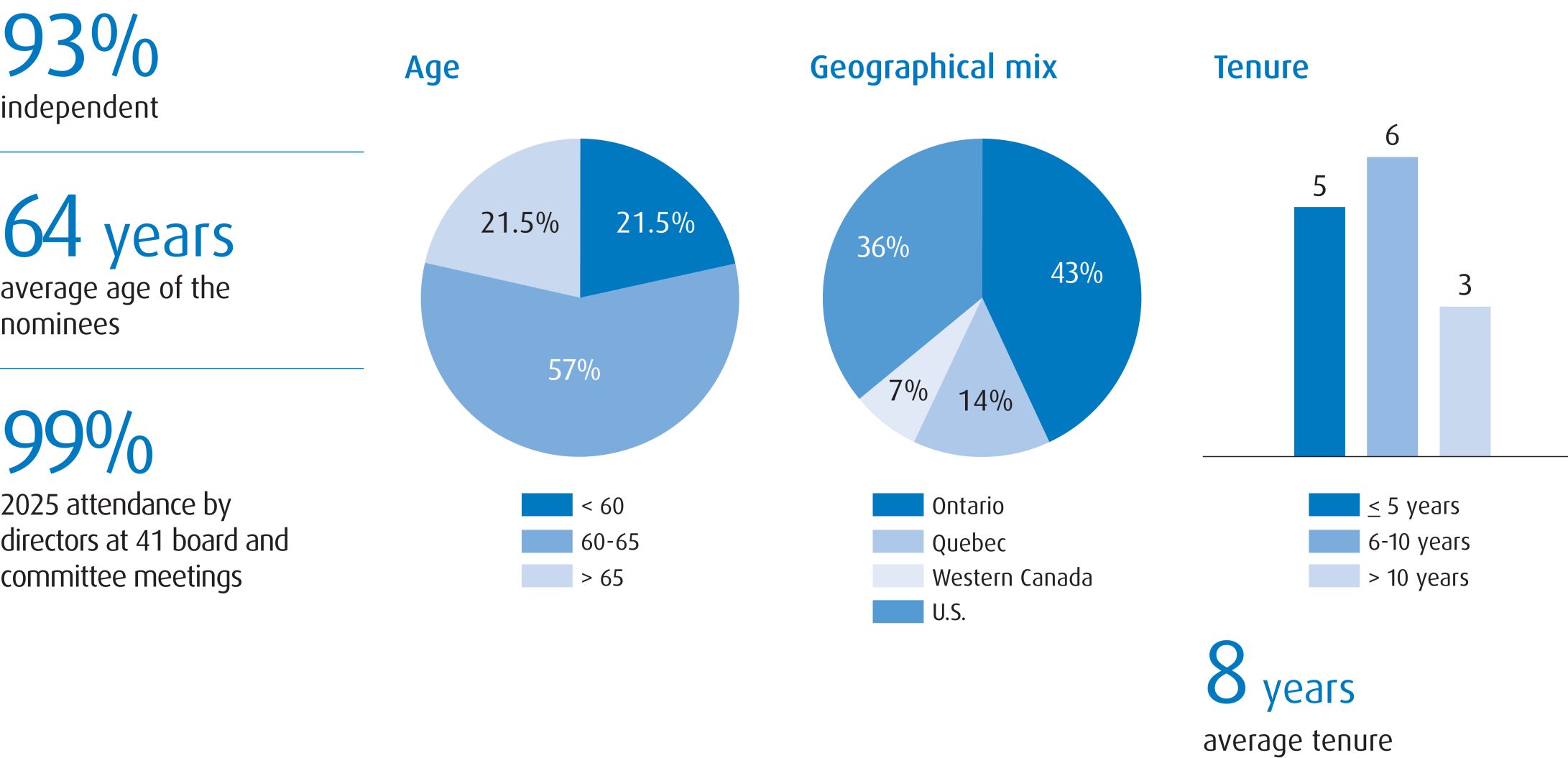
Each gender makes up at least one-third of the independent directors. Of the director nominees, six (42.86%) are women and eight (57.14%) are men. The board is comprised of two directors who identify as people of colour and one as Indigenous. All of our nominee directors are fluent in English. Three of the nominee directors speak French fluently, one speaks Hebrew fluently and one speaks Hindi fluently. You can read more about our policies on skills and diversity on page 27 and director tenure on page 31.
Commitment
Directors are expected to attend all meetings of the board and the committees they serve on, and to come to meetings prepared. Total average attendance at meetings in fiscal 2025 of the directors was 99%. See page 31 for more information about attendance.
| Bank of Montreal Management Proxy Circular 2026 | 9 |
Director profiles
This year there are 14 directors nominated to serve on the board. All have agreed to serve for a one-year term.
Board composition and size are reviewed every year based on several factors, including the calibre and scope of director expertise, level of engagement, quality of discussions with management, director succession and committee membership (see page 25 for more about the selection process and the nominated directors’ skills).
Share ownership
Twelve of the fourteen nominated directors meet our share ownership requirements. Ms. Hazel Claxton and Ms. Tammy Brown, have until 2028 and 2030, respectively, to meet or exceed the requirements. You can read more about share ownership requirements for BMO directors and executives on pages 33 and 56.
Share ownership is calculated as at February 17, 2026, and the value is based on $192.93, the closing price of our shares on the Toronto Stock Exchange (TSX) on that date. It includes shares each director beneficially owns or controls, or holds directly or indirectly, and holdings under our deferred share unit (DSU) plan for directors. Mr. White’s holdings include shares, DSUs and performance share units (PSUs) granted under our executive incentive plans.
| George A. Cope, C.M. | ||
| Chair of the Board (since March 31, 2020) | ||

|
Independent Age: 64 Director since: 2006 Residence: Toronto, Ontario, Canada
2025 voting results: 94.93% (344,500,954) votes for and 5.07% (18,408,043) votes withheld
2025 attendance: 100% | |
| Has chief executive officer experience and brings more than 25 years of public company experience in the Canadian communications industry, earning a reputation as an innovative operational and financial strategist and leader of high- performance teams
| ||
BUSINESS EXPERIENCE
| • | President and Chief Executive Officer of BCE Inc. and Bell Canada (2008 to 2020) |
AREAS OF EXPERTISE
| • | Executive leadership / Strategic planning / Mergers and acquisitions / Public policy |
OTHER PUBLIC COMPANY BOARDS (last five years)
| • | CGI Inc. (since January 2020, lead director since February 2022) (Corporate Governance Committee, Human Resources Committee) |
SERVICE AND RECOGNITION
| • | Recognized as Report on Business CEO of the Year and Corporate Citizen Award (2019) |
| • | Canada’s Outstanding CEO of the Year (2015) |
| • | Appointed to the Order of Canada (2014) |
| • | Honorary Degree, Doctor of Laws (LL.D.), University of Western Ontario (2012) |
EDUCATION
| • | HBA, Ivey School of Business, Western University |
| • | Honorary doctorate degrees (University of Windsor, Trent University and Queen’s University) |
SHARE OWNERSHIP (as at February 17, 2026)
Shares: 80,160 / $15,465,269
DSUs: 89,373 / $17,242,733
Total: 169,533 / $32,708,002
Total amount at risk (as a multiple of the cash portion of annual retainer): 363x
> Meets share ownership requirements of 11x cash portion of annual retainer (see page 33)
| 10 | Bank of Montreal Management Proxy Circular 2026 |
| Janice M. Babiak | ||
| Corporate director | ||

|
Independent Age: 67 Director since: 2012 Residence: Nashville, Tennessee, United States
Member of Audit and Conduct Review Committee (chair) and Governance and Nominating Committee
2025 voting results: 96.55% (350,392,216) votes for and 3.45% (12,516,833) votes withheld
2025 attendance: 100%
| |
| Has a strong background in public accounting in North America and internationally, including executive leadership roles and experience in several practice areas including IT and cyber security risk, regulatory and public policy, climate change and sustainability
| ||
BUSINESS EXPERIENCE
| • | Former Managing Partner at accounting firm Ernst & Young LLP (EY) |
| • | Worked at EY from 1982 to 2009 and was based in the United Kingdom from 1990 onwards |
| • | Held a number of roles including global assurance and advisory P&L leadership roles in Technology Security and Risk Services and Regulatory and Public Policy, and founded and led EY’s global Climate Change and Sustainability Services practice. Responsible for the strategy and delivery of commercially-focused climate change transformation and sustainability services to clients globally. Led teams delivering clean tech, renewable energy, carbon trading, environmental policy and taxation, green building, green supply chain, carbon measurement and modelling services. |
| • | Served on EY’s management board for Northern Europe, Middle East, India and Africa |
AREAS OF EXPERTISE
| • | Technology and information security / Environmental, Social or Governance / Accounting and finance / Financial services |
OTHER PUBLIC COMPANY BOARDS (last five years)
| • | Walgreens Boots Alliance, Inc. (April 2012 to August 2025) (Audit Committee (chair), Finance Committee) |
SERVICE AND RECOGNITION
| • | Named in Corporate Board Member Magazine’s “Top 20 Value Creating Directors in America” (2024) |
| • | Council member (2011 to 2019) and current member of select working groups, Institute of Chartered Accountants in England and Wales |
| • | Founder of the Nashville Chapter of Women Corporate Directors |
| • | Named by NACD Directorship magazine as one of the most influential people in the boardroom community (2017) |
EDUCATION
| • | B.B.A. (Accounting), University of Oklahoma |
| • | M.B.A., Baldwin Wallace University |
| • | Holds international information systems security and control, and US and UK accounting qualifications, including CPA (U.S.), CA (U.K.), CISM, and CISA |
SHARE OWNERSHIP (as at February 17, 2026)
Shares: 500 / $96,465
DSUs: 48,357 / $9,329,516
Total: 48,857 / $9,425,981
Total amount at risk (as a multiple of the cash portion of annual retainer): 105x
> Meets share ownership requirements of 11x cash portion of annual retainer (see page 33)
| Craig W. Broderick | ||
| Corporate director | ||

|
Independent Age: 66 Director since: 2018 Residence: Greenwich, Connecticut United States
Member of Risk Review Committee (chair), Audit and Conduct Review Committee and Governance and Nominating Committee
2025 voting results: 98.90% (358,920,260) votes for and 1.10% (3,988,788) votes withheld
2025 attendance: 100%
| |
| Has a strong background in investment banking in the United States, with deep experience in the risk area, serving as Chief Risk Officer and chair or co-chair of key management risk committees
| ||
BUSINESS EXPERIENCE
| • | 32-year career with investment banking firm, Goldman Sachs, and held several roles in the risk field including Chief Risk Officer (1986 to 2018) |
| • | Served as a member of Goldman Sachs’ Management Committee and chair or co-chair of key risk committees |
AREAS OF EXPERTISE
| • | Risk management / Financial services / Accounting and finance / Executive leadership |
OTHER PUBLIC COMPANY BOARDS (last five years)
| • | Circle Internet Financial (since April 2023) (Risk Committee (chair), Audit Committee and Strategy Committee) |
| • | McDermott International Inc. (since June 2020) (Governance Committee and Audit Committee) (previously was a member of the Risk Committee) |
| • | RMG Acquisition Corp III (February 2021 to July 2025) (Audit Committee (chair), Compensation Committee (chair)) |
| • | RMG Acquisition Corp. II (until 2022) (Audit Committee) |
| • | RMG Acquisition Corp. (until 2021) (Audit Committee) |
SERVICE AND RECOGNITION
| • | Advisory Council, International Association of Credit Portfolio Managers |
| • | Global Risk Forum Steering Committee member, Global Association of Risk Professionals |
| • | Board Member, Street Squash. Supports children, families, and schools in Harlem and Newark by exposing students to academic and athletic experiences |
| • | Board Member, FREE (Finance Requires Effective Education); an organization that teaches the basics of personal finance to students in underserved communities |
EDUCATION
| • | B.A., College of William and Mary |
SHARE OWNERSHIP (as at February 17, 2026)
Shares: 5,000 / $964,650
DSUs: 22,534 / $4,347,485
Total: 27,534 / $5,312,135
Total amount at risk (as a multiple of the cash portion of annual retainer): 59x
> Meets share ownership requirements of 11x cash portion of annual retainer (see page 33)
| Bank of Montreal Management Proxy Circular 2026 | 11 |
| Tammy L. Brown | ||
| Corporate director | ||

|
Independent Age: 55 Director since: 2025 Residence: Palgrave, Ontario, Canada
Member of Risk Review Committee
2025 voting results: N/A
2025 attendance: N/A
| |
| Brings over 30 years of experience in audit, accounting, finance and governance across industrial markets through her career at KPMG LLP, Canada, and has a strong commitment to community
| ||
BUSINESS EXPERIENCE
| • | 32-year career in professional services at KPMG LLP, a full-service audit, tax and advisory firm, progressing to senior leadership roles such as Audit Partner, National Industry Leader for Industrial Markets, Partner Sponsor of the National Indigenous Peoples Network, and Deputy Chair of KPMG LLP Canada’s Board of Directors |
AREAS OF EXPERTISE
| • | Executive leadership / Accounting and finance / Risk management / Environmental, Social or Governance |
OTHER PUBLIC COMPANY BOARDS (last five years)
–
SERVICE AND RECOGNITION
| • | Director (December 2025 – present) and past Treasurer (2017–2025), World Ovarian Cancer Coalition |
| • | Past Director and Board Chair, Women’s College Hospital |
| • | Women’s Executive Network - Top 100 Award Winner Canada’s Most Powerful Women |
| • | Fellow, Chartered Professional Accountants, Ontario |
EDUCATION
| • | Honours B.A. (Economics, Finance and Accounting), Wilfrid Laurier University |
SHARE OWNERSHIP (as at February 17, 2026)
Shares: – / –
DSUs: – / –
Total: – / –
Total amount at risk (as a multiple of the cash portion of annual retainer): – / –
> Must build share ownership over time to meet the requirements of 11x cash portion of annual retainer (see page 33)
| Hazel Claxton | ||
| Corporate director | ||

|
Independent Age: 65 Director Since: 2023 Residence: Toronto, Ontario, Canada
Member of Audit and Conduct Review Committee
2025 voting results: 99.55% (361,271,556) votes for and 0.45% (1,637,494) votes withheld
2025 attendance: 100%
| |
| Brings extensive business performance improvement and finance and accounting knowledge, combined with executive-level strategic human resources experience cultivating high-performance teams
| ||
BUSINESS EXPERIENCE
| • | Executive Vice President and Chief HR Officer of Morneau Shepell Inc. (now part of TELUS Health) until 2018 retirement |
| • | 29-year career at PwC Canada, progressing to several leadership roles, including Canadian Leadership Group member, Human Capital Leader, and a senior partner in the Corporate Advisory and Restructuring group |
| • | 20-year career in corporate restructuring, working with lenders, companies and their stakeholders to assess and respond to risks and pursue improvement opportunities |
AREAS OF EXPERTISE
| • | Executive leadership / Accounting and finance / Human resources / Strategic planning |
OTHER PUBLIC COMPANY BOARDS (last five years)
| • | Allied Properties Real Estate Investment Trust (since May 2022) (Governance, Compensation and Nomination Committee) |
| • | TELUS Corporation (since May 2021) (Audit Committee, People, Culture and Compensation Committee) |
SERVICE AND RECOGNITION
| • | Director, Unity Health Toronto (since 2015, including predecessor St. Michael’s Hospital) (Resources Committee (Chair until June 2023), Audit Subcommittee (Chair), Planning and Construction Committee (until June 2023), Governance and Nominating Committee) |
| • | Trustee, Queen’s University (2016 to 2022) (Vice Chair of the Board, Governance and Nominating Committee (Chair), Audit and Risk Committee, Human Resources Committee, Trustee Emeritus (from 2022)) |
| • | Shaw Festival Theatre (2009 to 2014) (Finance and Audit Committee (Chair), Human Resources Committee) |
| • | Member, Chartered Professional Accountants, Ontario |
EDUCATION
| • | B.Comm (Honours), Queen’s University |
| • | ICD.D, Institute of Corporate Directors |
SHARE OWNERSHIP (as at February 17, 2026)
Shares: 325 / $62,702
DSUs: 4,279 / $825,547
Total: 4,604 / $888,250
Total amount at risk (as a multiple of the cash portion of annual retainer): 10x
> Must build share ownership over time to meet the requirements of 11x cash portion of annual retainer (see page 33)
| 12 | Bank of Montreal Management Proxy Circular 2026 |
| Diane L. Cooper | ||
| Corporate director | ||

|
Independent Age: 66 Director since: 2024 Residence: Groveland, Florida, USA
Member of Audit and Conduct Review Committee and Risk Review Committee
2025 voting results: 99.54% (361,253,745) votes for and 0.46% (1,654,468) votes withheld
2025 attendance: 100%
| |
| Brings extensive experience in financial services leadership through her 30-year career at GE Capital, including most recently as President and CEO of GE Commercial Distribution, one of the largest commercial lenders in the U.S. | ||
BUSINESS EXPERIENCE
| • | President and CEO of GE Capital’s Commercial Distribution business (2009-2016) |
| • | President of GE Capital Equipment Finance |
| • | President of GE Franchise Finance |
AREAS OF EXPERTISE
| • | Executive leadership / Risk management / Financial services / U.S. experience |
OTHER PUBLIC COMPANY BOARDS (last five years)
| • | StoneX Group Inc. (since 2018) (Risk Committee (Chair), Technology and Operations Committee, Audit Committee) |
SERVICE AND RECOGNITION
| • | Founding member of GE Women’s Network |
| • | United Way Regional Leader, Dallas-Fort Worth |
| • | Past President, Junior Achievement, Dallas-Fort Worth |
EDUCATION
| • | B.A. (Business), Baker University |
| • | MBA, Baker University |
SHARE OWNERSHIP (as at February 17, 2026)
Shares: –/–
DSUs: 13,386 / $2,582,561
Total: 13,386 / $2,582,561
Total amount at risk (as a multiple of the cash portion of annual retainer): 29x
> Meets share ownership requirements of 11x cash portion of annual retainer (see page 33)
| Stephen Dent | ||
| Managing Director and Co-Founder, Birch Hill Equity Partners | ||

|
Independent Age: 64 Director Since: 2021 Residence: Toronto, Ontario, Canada
Member of Human Resource Committee (chair), Risk Review Committee and Governance and Nominating Committee
2025 voting results: 99.62% (361,537,955) votes for and 0.38% (1,371,093) votes withheld
2025 attendance: 92%
| |
| Has over 30 years of experience in private equity and deep expertise in capital allocation, strategic planning, accounting and finance
| ||
BUSINESS EXPERIENCE
| • | Managing Director and co-founder, Birch Hill Equity Partners, a Toronto based private equity firm with interests in several private and public companies since 2005 |
| • | Spent 15 years at a major Canadian chartered bank culminating in a senior role leading the Canadian private equity division of the bank |
AREAS OF EXPERTISE
| • | Executive leadership / Strategic planning / Mergers and acquisitions / Risk management |
OTHER PUBLIC COMPANY BOARDS (last five years)
–
SERVICE AND RECOGNITION
| • | Member of the Business Council of Canada |
| • | Involved in the founding and ongoing support of the Birch Hill Scholarship Program; supporting business school education for Indigenous youth |
EDUCATION
| • | B.B.A (Honours), Wilfred Laurier University |
| • | M.B.A, Ivey School of Business, Western University |
SHARE OWNERSHIP (as at February 17, 2026)
Shares: 25,000 / $4,823,250
DSUs: 9,700 / $1,871,421
Total: 34,700 / $6,694,671
Total amount at risk (as a multiple of the cash portion of annual retainer): 74x
> Meets share ownership requirements of 11x cash portion of annual retainer (see page 33)
Mr. Dent was a director of Mastermind GP Inc. when it announced on November 23, 2023 that it sought and obtained an initial order for creditor protection under the Companies’ Creditors Arrangement Act. He ceased to be a director of Mastermind on January 16, 2024.
| Bank of Montreal Management Proxy Circular 2026 | 13 |
| Martin S. Eichenbaum | ||
| Charles Moskos Professor of Economics, Northwestern University | ||

|
Independent Age: 71 Director since: 2015 Residence: Glencoe, Illinois, United States
Member of Audit and Conduct Review Committee and Risk Review Committee
2025 voting results: 99.24% (360,165,974) votes for and 0.76% (2,742,074) votes withheld
2025 attendance: 100%
| |
| Has an extensive background in economics as a university professor and as a researcher and consultant on economic and fiscal policy to some of the world’s most prestigious organizations | ||
BUSINESS EXPERIENCE
| • | Charles Moskos Professor of Economics at Northwestern University in Chicago where he has been a professor since 1988 |
| • | Co-director of the Center for International Economics and Development at Northwestern University |
AREAS OF EXPERTISE
| • | Risk management / Accounting and finance / Financial services / Public policy |
OTHER PUBLIC COMPANY BOARDS (last five years)
–
SERVICE AND RECOGNITION
| • | Panel Member, National Academy of Sciences, Engineering and Medicine Roundtable on Macroeconomics and Climate Risks and Opportunities |
| • | Fellow, Royal Society of Canada |
| • | Fellow, American Academy of Arts and Sciences |
| • | Former co-editor of the American Economic Review (2011 to 2015) |
EDUCATION
| • | B.Comm, McGill University |
| • | Ph.D. (economics), University of Minnesota |
SHARE OWNERSHIP (as at February 17, 2026)
Shares: 1,782 / $343,801
DSUs: 32,658 / $6,300,708
Total: 34,440 / $6,644,509
Total amount at risk (as a multiple of the cash portion of annual retainer): 74x
> Meets share ownership requirements of 11x cash portion of annual retainer (see page 33)
| David Harquail | ||
| Chair of the Board, Franco-Nevada Corporation(1) | ||

|
Independent Age: 69 Director since: 2018 Residence: Toronto, Ontario, Canada
Member of Human Resources Committee and Risk Review Committee
2025 voting results: 99.61% (361,511,458) votes for and 0.39% (1,397,590) votes withheld
2025 attendance: 100%
| |
| Brings strong executive management skills and experience as a chief executive officer as well as deep knowledge of the gold mining and energy industry
| ||
BUSINESS EXPERIENCE
| • | Co-Founder of Franco-Nevada Corporation, a leading gold mining and energy royalty company, and served as its CEO from 2007 to 2020 |
| • | During his tenure as CEO and now as Chair of the Board, oversaw Franco-Nevada’s industry leading adoption of ESG metrics and reporting |
| • | Past director and past chair of the World Gold Council which works to stimulate the demand for gold on behalf of the world’s leading gold producers |
| • | As Chairman of the World Gold Council, oversaw the implementation of the Responsible Gold Mining Principles, which comprise 51 ESG principles, as a compulsory standard for its members. Also Chaired ESG panels relating to World Gold Council’s research on the gold industry’s carbon emissions and potential paths to net zero |
AREAS OF EXPERTISE
| • | Executive leadership / Accounting and finance / Risk management / Environmental, Social or Governance |
OTHER PUBLIC COMPANY BOARDS (last five years)
| • | Franco-Nevada Corporation (since 2007) (Chair of the Board since May 6, 2020) |
SERVICE AND RECOGNITION
| • | Past Governor, Board of Governors, Laurentian University |
| • | Benefactor of the Harquail Centre for Neuromodulation at Sunnybrook Health Sciences Centre in Toronto |
| • | Over 40 years of experience serving on public and non-profit boards and task force advisories |
EDUCATION
| • | B.A.Sc. (geological engineering), University of Toronto |
| • | Registered Professional Engineer (Ontario) |
| • | M.B.A., McGill University |
SHARE OWNERSHIP (as at February 17, 2026)
Shares: 18,174 / $3,506,310
DSUs: 18,976 / $3,661,040
Total: 37,150 / $7,167,350
Total amount at risk (as a multiple of the cash portion of annual retainer): 80x
> Meets share ownership requirements of 11x cash portion of annual retainer (see page 33)
| (1) | Mr. Harquail has resigned as Chair and as a director of Franco-Nevada effective May 12, 2026. He will assume the role of Chair Emeritus as of that date. |
| 14 | Bank of Montreal Management Proxy Circular 2026 |
| Eric R. La Flèche | ||
| President and Chief Executive Officer, Metro Inc. | ||

|
Independent Age: 64 Director since: 2012 Residence: Montréal, Québec, Canada
Member of Human Resources Committee
2025 voting results: 97.32% (353,179,964) votes for and 2.68% (9,729,085) votes withheld
2025 attendance: 100%
| |
| Brings strong executive management skills including chief executive officer experience, as well as deep knowledge of the food retailing and pharmacy industries in Canada
| ||
BUSINESS EXPERIENCE
| • | President and Chief Executive Officer of Metro Inc. since April 2008, a leading Canadian food and pharmacy retailer and distributor |
| • | Joined Metro in 1991 and held a number of roles with increasing responsibility |
| • | Served as Executive Vice President and Chief Operating Officer from 2005 to 2008 |
AREAS OF EXPERTISE
| • | Executive leadership / Human resources / Strategic planning / Retail |
OTHER PUBLIC COMPANY BOARDS (last five years)
| • | Metro Inc. (since 2008) |
SERVICE AND RECOGNITION
| • | Named Canada’s Outstanding CEO of the Year (2020) |
| • | Long-time volunteer with Centraide of Greater Montréal and served as the 2015 Campaign Co-Chair |
| • | Major Campaign Co-Chair, The Montreal Neurological Institute |
| • | Member of the advisory board of Tel-Jeunes, the leading kids help phone service in Quebéc |
EDUCATION
| • | LL.L. (civil law) (cum laude), University of Ottawa |
| • | M.B.A., Harvard Business School |
SHARE OWNERSHIP (as at February 17, 2026)
Shares: 7,000 / $1,350,510
DSUs: 42,329 / $8,166,534
Total: 49,329 / $9,517,044
Total amount at risk (as a multiple of the cash portion of annual retainer): 106x
> Meets share ownership requirements of 11x cash portion of annual retainer (see page 33)
| Brian McManus | ||
| Corporate director | ||

|
Independent Age: 58 Director since: 2024 Residence: Hudson, Québec, Canada
Member of Risk Review Committee
2025 voting results: 99.69% (361,778,452) votes for and 0.31% (1,130,597) votes withheld
2025 attendance: 100%
| |
| Brings over 20 years of experience in the role of chief executive officer at industrial Canadian public companies, earning a reputation of creating significant shareholder value through the building of strong teams and disciplined capital allocation | ||
BUSINESS EXPERIENCE
| • | Executive Chair, Polycor Inc., a global leader in the natural stone industry, from 2024 to 2026 |
| • | Executive Chair and CEO, Uni-Select Inc., a distributor in the automotive aftermarket, from 2021 until 2023, when the company was sold to a strategic investor |
| • | President and CEO, Stella-Jones Inc., a manufacturer of treated wood products, from 2001 to 2019 |
AREAS OF EXPERTISE
| • | Executive Leadership / Strategic Planning / Mergers and Acquisitions / Accounting and Finance |
OTHER PUBLIC COMPANY BOARDS (last five years)
| • | Metro Inc. (since 2021) (Audit Committee (Chair), Human Resources Committee) |
| • | Uni-Select Inc. (2021 to 2023) |
SERVICE AND RECOGNITION
| • | Named 2016 CEO of the year by Les Affaires |
| • | Previous honorary President of the Montreal Children’s Hospital Foundation Golf Tournament |
| • | Served as a town councillor for the Village of Senneville from 2013-2017 |
EDUCATION
| • | B.A., McGill University |
| • | M.B.A., Ivey School of Business, Western University |
SHARE OWNERSHIP (as at February 17, 2026)
Shares: 10,311 / $1,989,301
DSUs: 1,783 / $343,994
Total: 12,094 / $2,333,245
Total amount at risk (as a multiple of the cash portion of annual retainer): 26x
> Meets share ownership requirements of 11x cash portion of annual retainer (see page 33)
| Bank of Montreal Management Proxy Circular 2026 | 15 |
| Lorraine Mitchelmore | ||
| Corporate director | ||

|
Independent Age: 63 Director since: 2015 Residence: Calgary, Alberta, Canada
Member of Governance and Nominating Committee (chair), Human Resources Committee and Risk Review Committee
2025 voting results: 98.65% (358,020,943) votes for and 1.35% (4,888,106) votes withheld
2025 attendance: 100%
| |
| Has strong executive management skills and over 30 years of experience in the international oil and gas industry, with deep expertise in business strategy, operations, employee health and safety and public policy and innovation with respect to low carbon energy transition | ||
BUSINESS EXPERIENCE
| • | President and Chief Executive Officer of Enlighten Innovations Inc. from May 2017 to September 2018 |
| • | Former Executive Vice President, Heavy Oil for Shell and former Shell Canada Limited President and Canada Country Chair from 2009 to 2015 |
| • | Prior to joining Shell in 2002, held increasingly senior roles in three other international oil and gas companies |
AREAS OF EXPERTISE
| • | Executive leadership / Strategic planning / Environmental, Social or Governance / Human resources |
OTHER PUBLIC COMPANY BOARDS (last five years)
| • | Cheniere Energy, Inc. (since 2021) (Governance and Nominating Committee, Audit Committee) |
| • | Suncor Energy Inc. (since 2019) (Audit Committee, Environment, Health, Safety and Sustainable Development Committee (chair)) |
SERVICE AND RECOGNITION
| • | Advisor to McKinsey and Company Advancing Women Executive Program (2021 - Present) |
| • | Member of the Board of Advisors, Catalyst Inc. (2014 to 2023) |
| • | Chair, Federal Economic Strategy Table - Resources of the Future (2018) |
| • | Co-Chair Calgary United Way campaign (2015) |
EDUCATION
| • | B.Sc. (geophysics), Memorial University of Newfoundland |
| • | M.Sc. (geophysics), University of Melbourne, Australia |
| • | M.B.A., Kingston Business School in London, England |
SHARE OWNERSHIP (as at February 17, 2026)
Shares: 600 / $115,758
DSUs: 36,165 / $6,977,313
Total: 36,765 / $7,093,071
Total amount at risk (as a multiple of the cash portion of annual retainer): 79x
> Meets share ownership requirements of 11x cash portion of annual retainer (see page 33)
| Madhu Ranganathan | ||
| Corporate director | ||

|
Independent Age: 61 Director since: 2021 Residence: Saratoga, California, United States
Member of Audit and Conduct Review Committee
2025 voting results: 98.62% (357,903,410) votes for and 1.38% (5,005,639) votes withheld
2025 attendance: 100%
| |
| Brings more than 30 years of financial leadership experience, with an innovative Silicon Valley technology driven background. Brings a strategic mindset with global industry expertise and deep operational focus in software, hardware and tech-enabled services businesses
| ||
BUSINESS EXPERIENCE
| • | President, Chief Financial Officer & Corporate Development, OpenText (April 2018 to March 2025) |
| • | Chief Financial Officer of [24]7.ai, a global customer experience software and services company (June 2008 to March 2018) |
| • | Senior Vice President & Chief Financial Officer, Rackable Systems, Inc., a provider of server and storage equipment for large scale data centers (December 2005 to May 2008) |
| • | Redback Networks, Inc. a global provider of advanced telecommunications networking equipment (August 2002 to November 2005) |
| • | Jamcracker, Inc., an enterprise web services platform company (January 2000 to August 2002) |
| • | BackWeb Technologies Inc., a “push” technology software provider for e-business solutions (December 1996 to January 2000) |
| • | Price Waterhouse LLP (April 1995 to December 1996) |
| • | Grant Thornton LLP (January 1994 to April 1995) |
| • | Liberty Mutual Insurance Company (November 1989 to June 1993) |
AREAS OF EXPERTISE
| • | Accounting and finance / Technology and information security / Mergers and acquisitions / Strategic planning |
OTHER PUBLIC COMPANY BOARDS (last five years)
| • | Akamai Technologies (since June 2019) (Finance Committee, Audit Committee Chair) |
SERVICE AND RECOGNITION
| • | Member, American Institute of Certified Public Accountants |
| • | Member, Institute of Chartered Accountants, India |
| • | Member, Institute of Cost & Management Accountants, India |
| • | Frequent speaker at forums for finance leadership and women’s empowerment |
EDUCATION
| • | M.B.A (Finance), University of Massachusetts |
| • | B.S. Accounting, University of Madras, India |
SHARE OWNERSHIP (as at February 17, 2026)
Shares: 329 / $63,474
DSUs: 9,640 / $1,859,845
Total: 9,969 / $1,923,319
Total amount at risk (as a multiple of the cash portion of annual retainer): 21x
> Meets share ownership requirements of 11x cash portion of annual retainer (see page 33)
| 16 | Bank of Montreal Management Proxy Circular 2026 |
| Darryl White | ||
| Chief Executive Officer of BMO Financial Group (since 2017)
| ||
|
|
Not Independent Age: 54 Director since: 2017 Residence: Toronto, Ontario, Canada
2025 voting results: 99.46% (360,954,789) votes for and 0.54% (1,954,260) votes withheld
2025 attendance: 100% | |
| Strong executive management skills and a long career in financial services that includes more than 30 years of experience in investment and corporate banking
| ||
BUSINESS EXPERIENCE
| • | Chief Executive Officer of BMO Financial Group since 2017. Serves as a Director of Bank of Montreal, and as Chair of the bank’s U.S. subsidiary, BMO Financial Corp. |
| • | Joined BMO’s investment and corporate banking team in 1994 |
OTHER PUBLIC COMPANY BOARDS (last five years)
–
SERVICE AND RECOGNITION
| • | Chair, Groupe CH |
| • | Director, The Bank Policy Institute, Catalyst |
| • | Member, Business Council of Canada, The Business Council, Business Council of Toronto, International Business Leaders Advisory Council of the Mayor of Beijing, University Health Network Board of Trustees |
EDUCATION
| • | H.B.A., Ivey Business School, Western University |
| • | Advanced Management Program, Harvard Business School |
| • | Honorary Doctor of Laws degree, Ivey Business School, Western University |
SHARE OWNERSHIP (as at February 17, 2026)
Shares: 67,893 / $13,098,596
DSUs: 96,518 / $18,621,218
RSUs: – / –
PSUs: 122,933 / $23,717,464
Total: 287,344 / $55,437,278
Total amount at risk (as a multiple of base salary): 46x
> Meets executive share ownership requirements of 8x his base salary (see page 68)
| Bank of Montreal Management Proxy Circular 2026 | 17 |
A strong foundation
Corporate governance is important – to our shareholders, our customers, our employees, the communities we operate in – and to us. Sound corporate governance is the foundation for strong performance and long-term sustainability, and it is integral to responsible business behaviour.
Our high standards of corporate governance align with emerging best practices and meet or exceed the legal and regulatory requirements of the TSX and New York Stock Exchange (NYSE) that apply to us.
|
Board expertise Good governance starts with our board of directors. We get the board composition and structure right by having directors with relevant skills and qualifications, diverse experience and perspectives, and independence from management. We gain from their expertise and pay them fairly in return.
|
u
|
> Independent > Elected annually > Elected individually (not slate) > Majority voting policy > Orientation, continuing education and assessment > Tenure policy > Conflict of interest policy > Proxy access policy
| ||
| Leading governance practices We monitor regulatory changes and emerging best practices in corporate governance to make sure we are at the forefront. |
u |
> Code of Conduct grounded in our values > Separate board chair and CEO positions > Board and committee chair term limits > Policy on interlocking directors > Board diversity policy > No hedging of BMO securities > Director and executive share ownership guidelines > Annual ‘say on pay’ > Non-executive directors are unable to participate in BMO stock option plans > Leading subsidiary governance practices
| ||
| Recognition We’ve been recognized over the years for our governance practices.
|
u
|
> One of the 2025 World’s Most Ethical Companies® – Ethisphere > Top-tier performance in managing and mitigating sustainability-related risks - Sustainalytics > 2025 Best 50 Corporate Citizens in Canada – Corporate Knights > Ranked as one of the Canada’s Most Admired™ Corporate Cultures – Waterstone Human Capital
| ||
| 18 | Bank of Montreal Management Proxy Circular 2026 |
BMO has a clearly defined purpose and strategy.
The board’s role is to oversee management, set general direction and to do what is in the best interests of the bank, taking into consideration the interests of stakeholders, by bringing an independent perspective and broad experience.
Board Approval/Oversight Guidelines set out the specific roles and responsibilities of both the board and management and specify accountability within the bank. The Bank Act (Canada) sets out certain things that cannot be delegated to the committees, like approving financial statements and declaring dividends.
At BMO, we continue to build a high-performing, digitally enabled, future-ready bank with engaged employees and a winning culture.
Anchored by our purpose – Boldly Grow the Good in business and life – we are guided by our values and driven by our strategic priorities:
| > | World-class client experience, grounded in One Client advice and guidance |
| > | High performing, Winning Culture driven by alignment, accountability, and recognition |
| > | Digital-first, AI-powered business for value and future readiness |
| > | Superior risk management |
BMO’s governance structure
| Board of Directors
(see page 90 for the board mandate) • Provides stewardship, sets general direction and alignment with purpose, and oversees management, technology and operations • Defines the role of the Chair, committee chairs, directors and the CEO, and reviews the descriptions every year • Oversees subsidiary operations (157 subsidiaries in 15 jurisdictions as at October 31, 2025)
| ||
|
| ||
| Board committees
(see our website for each committee’s charter, and pages 35 to 39 for the 2025 committee reports) • Help the board carry out its responsibilities • Are led by an independent chair and all members are independent directors • Committee membership is reviewed by the Governance and Nominating Committee once a year, to match director skills to committee mandates
| ||
|
| ||
| Audit and Conduct Review Committee |
• Integrity of financial reporting • Effectiveness of internal controls • Qualifications, independence and performance of the independent auditors • Transactions involving related parties, conflicts of interest and confidential information • Standards of ethical business conduct • Sustainability governance and disclosure, including as related to climate change • External assurances and attestations regarding sustainability metrics oversight • Compliance with legal and regulatory requirements
| |
|
|
||
| Governance and Nominating Committee |
• Governance principles and guidelines • Board composition, including performing public searches and retaining independent recruitment firms to identify qualified candidates • Director development, assessment and succession planning • Director compensation • Subsidiary oversight • Monitoring of effective committee oversight • Allocation of sustainability matters amongst the board and its committees
| |
|
|
||
| Human Resources Committee |
• Human resources strategies • Talent development, retention and succession planning • Employee inclusion and health and well-being • Compensation principles and policies oversight and their alignment to risk management and sustainability, and governance • CEO and senior executive appointment and compensation • Builds links between executive pay, BMO’s strategic priorities and priority sustainability issues
| |
|
|
||
| Risk Review Committee |
• Enterprise Risk Appetite Framework and governance • Management of the Bank’s environmental and social risks, including climate change • Identification, assessment and management of risk • Adherence to risk management corporate policies • Compliance with risk-related regulatory requirements
| |
| Bank of Montreal Management Proxy Circular 2026 | 19 |
The Governance and Nominating Committee defines BMO’s approach to corporate governance, and oversees our corporate governance framework, guidelines and practices to meet or exceed regulatory requirements, industry and stakeholder expectations and best practices.
The Board Chair is responsible for making sure the board functions effectively and meets its obligations, including its obligations to stakeholders. The Board Chair sets the board meeting agendas in
consultation with the CEO and Corporate Secretary and chairs all board meetings. The Chair’s position description is available on our website at www.bmo.com/corporategovernance. George Cope was appointed Chair of the Board effective March 31, 2020. His term was extended for two years until his scheduled retirement at the bank’s 2027 annual shareholder meeting. He is an independent director and has served on BMO’s board since 2006.
Business conduct
BMO adheres to high ethical standards. Our commitment to ethical business practices is integral to our reputation in the financial sector and the global economy, and helps us cultivate trust and strong relationships with employees, customers and communities.
Responsibility for fostering an ethical culture at the bank is shared by everyone across BMO – directors, officers and employees. BMO’s Chief Ethics Officer works to help ensure BMO’s expectations around ethical conduct are clear and well understood by employees globally and oversees BMO’s whistleblower process.
|
> BMO was named one of the 2025 World’s Most Ethical Companies® by Ethisphere for the eighth consecutive year. BMO is one of four banks worldwide to be recognized in 2025. BMO is also the only bank in Canada to be recognized with this award since its inception in 2007.
|
BMO’s Audit and Conduct Review Committee assists the board of directors in fulfilling its oversight responsibilities for compliance with legal and regulatory requirements and standards of business conduct and ethics, and reviews and recommends BMO’s Code of Conduct (Code) to the board for approval.
|
BMO’s Purpose
|
|
u
|
|
Rooted in our values
|
|
u
|
|
Articulated in our codes of conduct
| ||||
| Boldly Grow the Good in business and life. |
Integrity
Empathy
Inclusion
Responsibility
|
Our Code serves as a foundation for all BMO policies and procedures. More than a set of rules, the Code sets out the core principles and performance standards that are expected of us – and our approach to meeting those expectations.
Our Supplier Code of Conduct sets out the principles we expect our suppliers to support – our standards for integrity, fair dealing and sustainability.
| ||||||||||
BMO’s Code outlines the commitments and performance standards that are expected of us and describes how we meet those expectations. It guides us to do the right thing while providing exceptional experiences for our customers, employees and communities.
The Code applies to everyone at BMO – all directors, officers and employees. We do not grant or approve waivers to our Code. All employees participate in annual training and every officer, employee and director confirms they have read, understood, complied with, and will continue to comply with the Code.
The Code is reviewed annually and approved by the board every two years.
Our Supplier Code of Conduct outlines the principles BMO expects our suppliers to support – our standards for integrity, fair dealing and sustainability. It’s updated every two years to address evolving trends, issues and legislative requirements. BMO’s Code of Conduct and Supplier Code of Conduct are available on our website www.bmo.com/CodeofConduct and www.bmo.com/SupplierCodeofConduct.
A key element to fostering an ethical culture is providing an environment where concerns can be raised without fear of retaliation. We support this by providing multiple channels for employees to raise concerns internally and having zero tolerance for retaliation. We also offer a secure, confidential and if desired, anonymous whistleblower reporting service for anyone inside or outside of BMO to report suspected misconduct about BMO or one of our service providers. All concerns are actioned appropriately and there are consequences for violations of the Code.
| 20 | Bank of Montreal Management Proxy Circular 2026 |
We provide training and communications about the importance of speaking up, the multiple ways employees can raise concerns, and how to identify and protect against retaliation.
There are several internal speak up resources for employees that set out the process, accountabilities and contact details for our reporting channels, as well as BMO’s commitment to protect employees against retaliation. Information about our whistleblower reporting service is also available on our public website www.bmo.com/whistleblower.
Insider trading policies
BMO’s policies prohibit all directors, officers, and employees from insider trading. In addition, BMO has controls and safeguards to monitor personal trading of executive officers and other officers and employees in key positions for insider trading. All officers and employees covered by our insider trading policies are required to disclose trading accounts to BMO’s compliance group so that
all trading activity is monitored. In addition, those officers and employees subject to monitoring must pre-clear any securities trades with the bank’s compliance group. BMO’s policies restrict directors, executive officers and certain other employees from personal trading in BMO securities during blackout periods that precede the release of BMO’s financial results.
Strategic planning
Management develops BMO’s enterprise-wide strategy. The board’s role is to approve and oversee BMO’s strategy and its implementation. This includes:
| • | reviewing and approving key priorities, opportunities, risks, competitive position, financial projections and other key performance indicators for each operating segment and the technology & operations function |
| • | overseeing strategic planning related to technological innovation, enterprise data, analytics, Artificial Intelligence (AI), governance, cyber security, digitech partnerships and sustainability, including climate change |
| • | reviewing and approving the bank’s business and capital plan. |
The board holds an annual strategy session with management that covers:
| • | our existing strategy and changes resulting from both internal and external factors |
| • | new opportunities for growth |
| • | risks related to current and future strategy, including climate change, cyber and AI-related risks |
| • | the financial and capital impacts of the recommended strategy. |
At the end of the session, the board provides feedback on the strategic plan, approves the strategic plan and provides feedback on the session itself. Management updates the board regularly on the bank’s and each operating segment’s progress in implementing the strategies.
Risk oversight
The bank has an integrated and disciplined approach to risk management that is key to achieving BMOs strategic goals and business priorities while adhering to the bank’s Risk Appetite and enabled by a strong risk culture for the success of the bank’s operations.
At BMO, we are guided by five key principles on risk that drive our approach to risk management across the enterprise:
| • | understand and manage risk |
| • | protect our reputation |
| • | diversify, limit tail risk |
| • | maintain strong capital and liquidity |
| • | optimize risk return. |
The board’s risk oversight role includes ensuring the bank’s corporate objectives are supported by a sound risk strategy and an effective enterprise-wide Risk Management Framework. The framework, approved by the board and enabled through the policies that govern our approach to risk management, including how risk is identified, assessed, measured, managed, and reported. The framework is appropriate for the nature, scale, complexity and risk profile of the bank’s activities. The board also approves the
enterprise Risk Appetite Framework and oversees management’s adherence to it.
| > | The Risk Review Committee oversees the identification and management of risk. See the 2025 committee report on page 39 for its activities this year. |
| > | A disciplined approach to risk management is built into every aspect of business operations and strategic planning. |
| > | Executive compensation is aligned with BMO’s risk appetite, supports our compliance and ethics requirements, and does not encourage excessive risk-taking (see page 57). |
| > | The Risk Review Committee and the Audit and Conduct Review Committee each oversee and receive regular reporting on cybersecurity and technology risks, including those related to artificial intelligence. See the 2025 Committee Reports on pages 39 and 35 for their activities this year. |
You can find more about our Enterprise Risk Management Framework, including the risk oversight responsibilities of the board and its committees, our risk appetite, risk policies and limits, in our 2025 Annual Report.
| Bank of Montreal Management Proxy Circular 2026 | 21 |
Subsidiary governance
BMO has 157 subsidiaries in 15 jurisdictions worldwide, as at October 31, 2025. Effective governance of these entities is a critical risk management tool.
The Governance and Nominating Committee is responsible for overseeing the enterprise’s organizational structure and the activities of the subsidiaries. The Audit and Conduct Review
Committee acts as the independent audit committee for the bank’s federally regulated financial institution subsidiaries. The Subsidiary Governance Office identifies and implements robust subsidiary governance practices, including a subsidiary governance framework that applies globally and includes three elements:
| A legal entity framework
|
u | Governance requirements for each subsidiary
|
u | Oversight by the BMO board
| ||||||||
| The framework is a critical tool for risk management. It includes procedures to centralize the oversight of establishing, operating and dissolving legal entities.
The complexity of each subsidiary is assessed based on criteria including asset base, and whether the subsidiary is operating, client-facing and/or regulated.
Each subsidiary is then placed into one of five categories of ascending degrees of governance. |
Subsidiary boards have structures that comply with the governing law of the subsidiary.
They are composed of executives as subsidiary directors and may include qualified independent non-executive directors where required by law or regulator guidance. The non-executive directors are nominated based on their independence from the business, using a skills matrix developed by the subsidiary board.
BMO’s Legal Entity Manual facilitates consistent governance best practices and proper oversight of each legal entity, promotes thoughtful, effective and efficient governance processes, and clarifies the roles and responsibilities of the directors, officers and corporate units.
The subsidiary’s corporate secretary works with the subsidiary board to implement the governance tools that are appropriate for the subsidiary.
|
The board is responsible for overseeing BMO’s subsidiaries.
The Subsidiary Governance Office provides information to the board, including an annual Legal Entities Report for the Governance and Nominating Committee, which includes the structure of subsidiary boards, statistics by operating segment and line of business, jurisdiction and assets, and other relevant information.
Board and committee chairs are also in regular communication with the chairs of the U.S. holding company board and its committees.
Certain subsidiary-related information must be escalated to a senior management committee or to the board, under our Board Approval and Oversight Requirements Corporate Policy and related guidelines.
| ||||||||||
| 22 | Bank of Montreal Management Proxy Circular 2026 |
Communication and engagement
BMO and the board communicate with shareholders and other stakeholders in various ways and maintain ongoing dialogue to exchange ideas and receive constructive feedback.
| > | Management’s Disclosure Committee oversees the timely public release of material information about BMO. |
| > | Disclosure controls and procedures are designed to provide assurance that material information is effectively communicated in a timely manner to appropriate management. |
| > | Our Shareholder Engagement Policy (available on our website) promotes open dialogue and the exchange of ideas with shareholders. |
| Engagement |
+ | Communication |
+ | Feedback | ||||||||
| BMO’s Shareholder Engagement Policy outlines how management and the board engage with shareholders, and how they can communicate with us.
Board members meet with institutional shareholders and the board responds through management to questions or issues raised by retail shareholders.
The Corporate Secretary, Shareholder Services, Investor Relations department, and Sustainability team also have ongoing discussions with shareholders, and respond to any questions, concerns and shareholder proposals.
|
Regular communication with shareholders includes: • quarterly earnings calls (live webcast with a question and answer period) • news releases • disclosure documents (annual report, management proxy circular, annual information form, quarterly reports and sustainability and climate reporting) • industry conferences • our website and social media • phone calls, letters and emails • our annual meeting of shareholders (which is also webcast live) • meetings with institutional shareholders (one-on-one and as a group)
|
BMO welcomes your feedback,
You can reach management by email:
Management investor.relations@bmo.com
Investor Relations investor.relations@bmo.com
Shareholder Services corp.secretary@bmo.com
You can also contact the Chair of the Board, and any of our directors or committee chairs using the information below.
| ||||||||||
Disclosure practices
BMO’s Disclosure Standard includes guidance for determining whether information is material (as defined by securities legislation), and describes the proper and timely distribution of disclosure and material information. The Audit and Conduct Review Committee reviews and approves the standard every two years.
The Chief Financial Officer (CFO) and the General Counsel determine what information is material.
The Disclosure Committee (chaired by the CFO and made up of members of senior management) reviews all annual and interim filings before they are publicly released.
An attestation process supports CEO and CFO certifications of the adequacy of our financial disclosure. Our most senior executives make quarterly and annual representations specific to their area of responsibility to the Controller and Chief Accountant, including declaring that any potentially material issues they know of have been escalated to the Controller and Chief Accountant under our financial governance processes.
Additional Documents
| Documents available on our website (www.bmo.com/corporategovernance) include:
| ||
• Our Code of Conduct |
• Statement of Corporate Governance Practices • Director Conflict of Interest Policy • Board Diversity Policy • Shareholder Engagement Policy • Proxy Access Policy • Majority Voting Policy • Annual Report • Annual Information Form | |
• Our By-Laws | ||
• The Board Mandate and charters for each of the board’s committees | ||
• Position descriptions for each of the Chair, the committee chairs and the directors | ||
• Director Independence Standards | ||
Three ways to contact the board
| 1. | Complete the form on our website |
http://www.bmo.com/corporategovernance
| 2. | Write to the Chair of the Board |
Chair of the Board of Directors
BMO Financial Group
P.O. Box 1, First Canadian Place
100 King Street West, 9th Floor
Toronto, Ontario M5X 1A1
| 3. | Send an email |
board.directors@bmo.com
| Bank of Montreal Management Proxy Circular 2026 | 23 |
Sustainability
Sustainability is embedded in our purpose, including our Climate Ambition to be our clients’ lead partner in their pursuit of energy and climate resilience.(1) We take steps to manage our business in a manner that is consistent with our long-term risk management and financial goals, while considering our impact on communities, society and stakeholders.
Responsibility for the oversight of sustainability is incorporated within the mandate of our board of directors, and each standing committee has responsibility for the oversight of sustainability, including climate change risks and opportunities, that fall within its purview.
The board reviews BMO’s sustainability and climate-related reporting, and climate considerations are integrated into quarterly reporting to the board, as appropriate. The board also approves the Enterprise Risk Appetite Statement, which includes the Environmental and Social Risk Appetite Statement.
The Audit and Conduct Review Committee oversees issues related to sustainability governance and disclosure, and approves our annual Sustainability and Climate Report.
The Risk Review Committee assists the board of directors in meeting its oversight responsibilities for the identification, assessment and management of our exposure to environmental and social risk, including risks arising from climate change, and our adherence to risk management corporate policies, and for complying with risk-related regulatory requirements. The Risk Review Committee also approves the Environmental and Social Risk Corporate Policy.
The Audit and Conduct Review Committee and Risk Review Committee jointly review climate-related targets and BMO’s Climate Transition Action Plan.
The Human Resources Committee oversees and monitors compensation principles and policies, and their alignment with risk management and sustainability, including climate change, and has responsibility for the alignment of executive compensation with performance against our strategic priorities which include sustainability. The Human Resources Committee also has oversight of human resources strategies relating to inclusion and health and well-being.
The Governance and Nominating Committee regularly reviews the charters of our board of directors and its committees to assess the coverage and alignment of their responsibilities for overseeing sustainability issues within their respective mandates.
Recognizing the business opportunities and risks arising from sustainability practices, BMO’s board has adopted a skills matrix for its directors which includes sustainability-related skills and experience, alongside other criteria. Several board members have such experience as detailed in their biographies, and they are represented on each committee of the board. Board members are provided with ongoing training including substantive educational materials on sustainability related matters and updates on climate related topics.
For additional information on how we govern, manage and measure environmental, social and governance risks and opportunities related to our business, please refer to our sustainability and climate reporting. Our reporting is informed by regulatory requirements including OSFI’s Guideline B-15: Climate Risk Management, and references sustainability reporting standards including those from the Sustainability Accounting Standards Board (SASB), Canadian Sustainability Disclosure Standards (CSDS), the Task Force on Climate-related Financial Disclosures (TCFD) and others. Please refer to our website at www.bmo.com/en-ca/main/about-bmo/our-impact/clients/sustainability.
| (1) | Energy and climate resilience is the ability of businesses, communities and individuals to thrive in the face of risks posed by climate change. |
Leadership development and succession planning
BMO’s strategy is grounded in the strength of its people.
The board and the Human Resources Committee together oversee BMO’s leadership.
The Human Resources Committee is responsible for overseeing BMO’s human resources strategy, including making sure BMO builds teams that can deliver the bank’s business strategy, has an inclusive culture that supports and empowers its people, and talent processes that are simplified, integrated and digitized.
Senior leadership succession
The board appoints the CEO and other members of senior leadership, and monitors their performance, goals, assessments and rewards. It oversees and monitors the CEO succession plan, and the succession strategy for all other senior leadership positions.
The Human Resources Committee reviews BMO’s senior leadership pipeline every year and develops succession plans for the CEO and other senior executive roles.
Leadership development
BMO provides opportunities to all employees, regardless of gender, race, ethnicity, disability, sexual orientation, gender identity, religion, marital status and or age. We have established priorities to enhance inclusive leadership behaviours. BMO identifies top talent, implements development plans for high-potential talent and identifies and removes barriers to provide access to leadership and development opportunities for all employees.
BMO carefully considers a broad range of criteria for senior leadership positions and aims to have at least 40% of its senior leadership roles held by women, which has been the case since 2016. As of October 31, 2025, 40.4% of the bank’s senior leadership roles, which include the Bank’s Executive Committee and all executive and managing director levels, were held by women. Women currently comprise 16.7% (2 out of 12) of BMO’s Executive Committee.
All members of Executive Committee speak English fluently, one speaks each of French, Hindi and Marathi fluently.
The Human Resources Committee and board monitor Executive Committee composition closely through its oversight of executive appointments and succession planning.
For information on board diversity, please see skills and diversity on page 27.
| 24 | Bank of Montreal Management Proxy Circular 2026 |
Good governance starts with our board of directors. We get the board composition and structure right by having well-informed nominees with relevant skills and qualifications, diverse experience and perspectives, and independence from management. This builds a strong and effective board positioned for better decision-making and more effective oversight to drive BMO’s success.
The board and the Governance and Nominating Committee believe a relatively smaller board is more effective, while recognizing the need to maintain flexibility to address certain needs or opportunities
as they arise. It reviews board size every year to make sure it will promote engagement and quality discussion with management, ensure the right caliber and scope of director expertise, allow for thoughtful director succession and provide for effective committee membership.
This year the board has proposed 14 directors for the board – all of the nominees currently serve as directors. Directors are elected for a one-year term. The board can appoint directors between shareholder meetings.
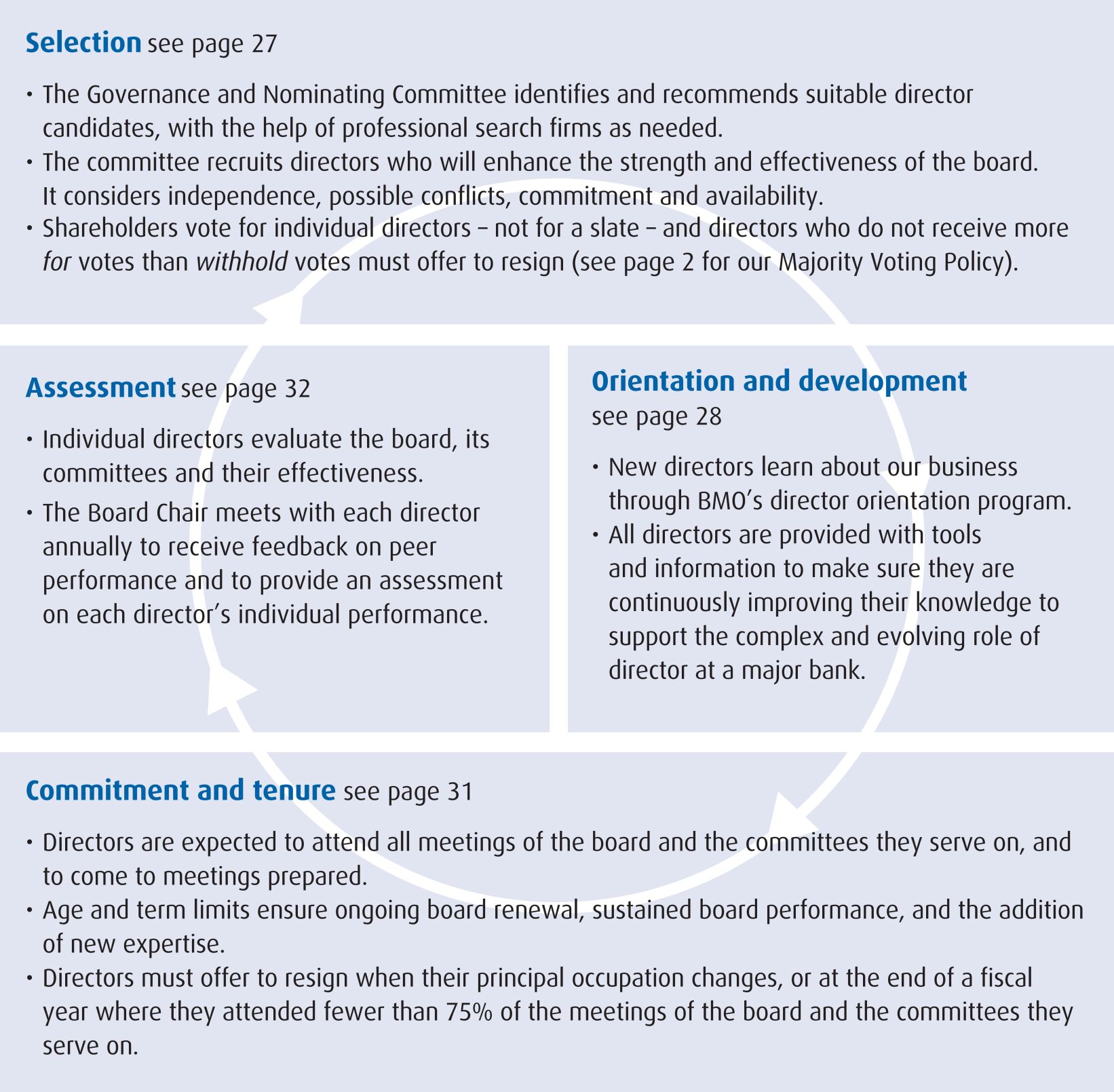
Key position descriptions
The board reviews and approves position descriptions (available at www.bmo.com/corporategovernance) annually for the Board Chair, committee chairs, and directors. The board also develops the position description for the CEO, with the CEO’s input, which is approved annually by the Human Resources Committee.
| Bank of Montreal Management Proxy Circular 2026 | 25 |
Independence
The board must be independent of management to be effective.
All members of the board are independent except our CEO, who is required by the Bank Act (Canada) to be a member of BMO’s board. The board’s policies limit the number of inside directors to two.
| > | The board uses Director Independence Standards to determine whether a director is independent (available on our website) at www.bmo.com/corporategovernance. |
| > | BMO has an independent and non-executive Chair of the Board. This helps the board to operate independently of management and provides leadership to the independent directors. |
| > | All board committees are made up of entirely independent directors. |
|
Director
|
+
|
Independent
|
+
|
Other independence
| ||||
| A director is independent if he or she does not have a relationship with the bank or any of its affiliates that could interfere with his or her independent judgment.
The board uses Director Independence Standards to determine whether a director is independent (available on our website). The standards take into consideration the Bank Act (Canada) definition of affiliated persons, and the Canadian Securities Administrators (CSA) and NYSE definitions of independence.
In its review of a director’s independence, the board looks at his or her personal, business, and other relationships, and his or her dealings with the bank and its affiliates. This involves reviewing biographical information, reports, director questionnaires, bank records and reports, and information about entities the director is involved with.
The threshold for independence is higher for members of our Audit and Conduct Review Committee.
Certain relationships (for example, being an officer of the bank) automatically mean a director is not independent. According to the board’s policies, only two of the board’s directors can also be employees of the bank.
While the bank has lending, banking, and other commercial arrangements with some of the directors and entities they have relationships with, the board is satisfied that these directors are independent under the standards.
|
BMO has an independent and non-executive Chair of the Board. This helps the board to operate independently of management and provides leadership to the independent directors.
The Chair normally serves for five years with the possibility of renewal for another three years.
The process for the appointment of the Chair of the Board is led by the current Chair unless the current Chair is being considered for reappointment. In that circumstance, the process is led by the Chair of the Governance and Nominating Committee. The process includes identifying issues facing the bank and interviewing each director individually, as well as determining the most appropriate process for the board to make a final decision, which could include deliberation and a vote if more than one person has significant support. |
Meeting without management Every board meeting and board committee meeting includes time for independent directors to meet without management present. During those meetings, the Chair will lead discussions on matters that arise during the meeting or other matters, including matters related to succession planning, risk management and strategy.
Managing conflicts of interest The Directors’ Conflict of Interest Policy is designed to ensure independent decision- making by the board.
The policy includes guidelines for identifying and dealing with conflicts when they arise. Directors or executive officers with a material interest in a matter do not receive related board or committee materials and are excluded from subsequent discussions or votes.
Getting independent advice The Chair and each committee can engage outside consultants paid for by the bank, without consulting management. This helps ensure they can receive independent advice.
Serving on other boards Outside directorships are monitored to make sure directors can operate with independent judgment and have the time available to commit to BMO’s board. No more than two directors can serve on the same outside public company board (called a board interlock) without the consent of the Governance and Nominating Committee. In considering whether or not to permit more than two directors to serve on the same board, the committee takes into account all relevant considerations including, in particular, the total number of board interlocks at that time. There are currently no board interlocks.
Members of the Audit and Conduct Review Committee cannot serve on more than three public company audit committees without board approval. | ||||||
| 26 | Bank of Montreal Management Proxy Circular 2026 |
Skills and diversity
The board positions itself to be made up of highly qualified directors whose diverse backgrounds reflect the changing demographics of the markets in which BMO operates, the talent available with the expertise required, and the bank’s evolving customer and employee base. This builds a strong and effective board which positions the board for better decision-making and more effective oversight to drive BMO’s success.
The Governance and Nominating Committee considers only candidates who are highly qualified based on their experience, functional expertise, skills and qualifications. The committee looks at several criteria, including independence, ethics and integrity, range of experience, business judgment, areas of expertise, skills and qualifications, availability and commitment. The Governance and Nominating Committee considers diversity of the board by gender, age, ethnicity and geographic background including the Bank Act (Canada)’s residency requirements.
The committee follows the Board Diversity Policy when recruiting new directors which includes, in addition to its own search, engaging qualified independent external advisors to conduct a search for qualified candidates from a variety of backgrounds who meet the
| > | The board is composed of highly qualified directors who bring relevant skills, qualifications and diverse experience and perspectives to build a strong and effective board. |
| > | The skills matrix includes the ideal list of skills we need on BMO’s board. |
| > | The board uses the matrix to review the skills of both individual directors and the board as a whole. |
Board’s skill requirements. The board aspires to have each gender make up at least one-third of the independent directors. Six of this year’s nominated directors are women, representing 42.86% of the nominated directors, eight are men, representing 57.14% of the nominated directors, and two identify as people of colour and one as Indigenous.
Our process is to review potential director candidates with relevant skills and qualifications and diverse experience and perspectives at each meeting of the Governance and Nominating Committee.
Skills matrix
| We capture the ideal list of skills for directors and record them in a skills matrix. The items in the list are reviewed every year and updated as necessary. We use this information to assess the overall strength and diversity of the board and when recruiting new directors. The matrix also supports the Governance and Nominating Committee and the board in attracting the right talent amid a rapidly changing global market. As the matrix shows, the director nominees present a diverse range of experience and perspectives.
In addition to the common skills all of our directors possess,
|

|

|

|

|

|

|

|

|

|

|

|

|

|
|||||||||||||||||||||||||||||||||||||||
| Executive leadership |

|
|
|
|
|
|
|
|
|
|
|
|
|
|||||||||||||||||||||||||||||||||||||||
| Strategic planning |
|
|
|
|
|
|
|
|
|
|
|
|
|
|||||||||||||||||||||||||||||||||||||||
| Risk management |
|
|
|
|
|
|
|
|
|
|
|
|
|
|||||||||||||||||||||||||||||||||||||||
| Mergers and acquisitions |
|
|
|
|
|
|
|
|
|
|
|
|
|
|||||||||||||||||||||||||||||||||||||||
| Accounting and finance |
|
|
|
|
|
|
|
|
|
|
|
|
|
|||||||||||||||||||||||||||||||||||||||
| Human resources |
|
|
|
|
|
|
|
|
|
|
|
|
||||||||||||||||||||||||||||||||||||||||
| Public policy |
|
|
|
|
|
|
|
|||||||||||||||||||||||||||||||||||||||||||||
| Legal and regulatory |
|
|
|
|
|
|||||||||||||||||||||||||||||||||||||||||||||||
| Financial services |
|
|
|
|
|
|
||||||||||||||||||||||||||||||||||||||||||||||
| Retail |
|
|
|
|
||||||||||||||||||||||||||||||||||||||||||||||||
| Technology and information security |
|
|
|
|
|
|
|
|
||||||||||||||||||||||||||||||||||||||||||||
| Environmental, social or governance1 |
|
|
|
|
|
|
|
|
|
|
||||||||||||||||||||||||||||||||||||||||||
| U.S. experience |
|
|
|
|
|
|
|
|
|
|||||||||||||||||||||||||||||||||||||||||||
| 1 | Includes the constituents involved in sustainable development practices, including those related to climate. |
| Bank of Montreal Management Proxy Circular 2026 | 27 |
Orientation and development
The Governance and Nominating Committee is responsible for orientation and the continuing education and development of our directors.
New directors learn about our business through BMO’s director orientation program. All directors are provided with tools and information to make sure they are continuously improving their knowledge to support the complex and evolving role of director at one of North America’s major banks.
The Chair of the Board facilitates in camera sessions at every board meeting, providing opportunities to further build relationships, confidences and cohesion among directors. These sessions also provide an opportunity for directors to provide feedback on board processes.
| > | New directors learn about our business and operations through BMO’s director orientation program, including one-on-one meetings with the heads of each of our operating segments and corporate functions. |
| > | Ongoing director education includes presentations and materials, and opportunities to learn about the business first-hand through site visits and interaction with management and employees. |
| > | Directors are encouraged to participate in relevant external education seminars at our expense. |
| Director orientation
|
+ | Ongoing education | + | Engaging with management | ||||||||
| Orientation by the Board Chair, the committee chairs and the CEO, to learn about the bank’s history and culture, structure, strategic direction, current issues and opportunities, including how BMO differs from its peers. Sessions are held within six months of new directors joining the board.
|
Regular presentations on BMO’s operations and regulatory briefings, to complement and enhance director understanding of the bank, its products and services and the risks it faces, as well as developments in corporate and risk governance and regulatory matters. |
Board dinners to strengthen the collegial working relationship among directors. These are scheduled alongside regular board meetings, and include educational sessions related to the bank’s business and strategic direction presented by senior management or outside experts.
| ||||||||||
| Director governance documents, policies, bylaws, compliance requirements and other information to ensure a smooth transition into their role as director.
|
Materials and reading recommendations from the Chair, committee chairs, the CEO and the Corporate Secretary. |
There is regular engagement between directors and senior management between board meetings. | ||||||||||
| Individual meetings with the heads of each of our operating segments and corporate functions to learn about our business. Additional meetings and site visits may also be arranged.
|
Daily Media Briefing emails circulated each morning. |
Interaction with senior management and employees through the Executive Meets Directors programs to gain greater insight into the business and talent for senior management succession planning.
| ||||||||||
Director orientation
The Corporate Secretary’s Office is responsible for implementing the director orientation program, which gives new directors the information they need to understand the bank, the financial industry and board operations so they experience a smooth transition into their roles as members of the board and board committees.
Each new director is immediately appointed to at least one board committee and each board committee also has an orientation program. New committee members receive orientation material for
each committee they serve on, and meet individually with the committee chair, the head of the supporting corporate group, and other senior officers as necessary.
The Chair of the Board and the Chair of the Governance and Nominating Committee personally welcome new directors, answering questions and assisting with the logistics of board meetings and board processes to ensure that their overall needs are met.
| 28 | Bank of Montreal Management Proxy Circular 2026 |
Ongoing education
Directors are expected to continuously upgrade their knowledge about issues affecting our businesses, the financial services sectors we operate in, emerging trends and issues and significant strategic initiatives. Working with the Corporate Secretary, each committee chair identifies relevant and timely information for directors. Directors also identify their own continuing education needs in discussions with management, the board and committees. During the 2025 fiscal year, directors participated in educational and round-table sessions and received educational materials on the topics outlined below. They also received quarterly and ad hoc briefings on regulatory developments, including:
| Session/topic | Audience (Board/Committee) | |
|
Client experience
|
||
| One Client Initiatives Update | Board of Directors | |
| U.S. Prime Finance Update | Board of Directors | |
| Consumer Protection Update | Audit and Conduct Review | |
| North American Personal and Business Banking Lending Update | Board of Directors | |
| Commercial Real Estate Update | Risk Review | |
| Commercial Banking Review | Risk Review | |
|
Winning culture
|
||
| Winning Culture Checkup | Board of Directors, Human Resources | |
| Human Capital Strategy Update | Board of Directors, Human Resources | |
|
Digital first
|
||
| Technology transformation | Board of Directors | |
| Artificial Intelligence | Board of Directors | |
| Emerging Technologies: Focus on AI and other emerging technologies | Board of Directors | |
| Artificial Intelligence & Audit Committee Oversight | Audit and Conduct Review | |
| The Board’s Role regarding Artificial Intelligence | Board Member | |
| Stablecoin Update: Industry Trends | Board of Directors | |
| Evolving Privacy Risks | Board Member | |
| Cyber Security Update | Audit and Conduct Review | |
| Technology and Operations Update | Audit and Conduct Review | |
|
Sustainability
|
||
| BMO Sustainability Leaders Podcasts | Board of Directors | |
| Sustainability Reporting (Global/EU Omnibus/US) | Board Member | |
| Sustainability & Climate Quarterly Update |
Audit and Conduct Review | |
| BMO Quarterly Sustainability Update Newsletter | Board of Directors | |
|
Manage risk, capital and funding
|
||
| Quarterly Regulatory Update | Audit and Conduct Review | |
| Privacy Update | Audit and Conduct Review | |
| Anti-Money Laundering and Anti-Terrorist Financing Update |
Audit and Conduct Review | |
| BMO’s Monthly AML Newsletter | Audit and Conduct Review | |
| Risk Americas conference | Board Member | |
| Navigating Risk & Regulation in Uncertain Times | Board Member | |
| IIF Digital Asset Forum | Board Member | |
| US Fiscal Outlook | Board Member | |
| Capital Markets Business Review | Risk Review |
| Bank of Montreal Management Proxy Circular 2026 | 29 |
| Session/topic | Audience (Board/Committee) | |
|
Governance
|
||
| Shareholder proposals regime (U.S. / Canada) | Governance and Nominating | |
| Canada Spencer Stuart Board Index | Governance and Nominating | |
| Governance and Board Effectiveness Trends | Governance and Nominating | |
| Technology, Security and Resilience: The Board’s Role | Risk Review | |
| Sustainability Governance | Board of Directors | |
| Updates on Significant Changes in Governance Rules and Regulations | Governance and Nominating | |
| Proxy Season: 2025 Engagement & Early Takeaways | Governance and Nominating | |
| The Future Boardroom | Board Member | |
| Board and Shareholder Engagement | Board of Directors | |
| CEO and Director Board Governance | Board Member | |
|
The economic environment
|
||
| Economic Update | Board of Directors | |
| Current Trade Environment | Board of Directors | |
| Tariffs and Trade | Board of Directors | |
| Banks and the State-Dependent Effects of Monetary Policy | Board Member | |
| Monetary Policy Framework Review | Board Member | |
| Fiscal Positions of Canada and the U.S at the G7 | Board Member | |
| Inflation Targeting Policy Framework | Board Member | |
| Canadian Macroeconomic Annual Conference | Board Member |
| 30 | Bank of Montreal Management Proxy Circular 2026 |
Commitment and tenure
Directors are required to devote enough time and energy to effectively carry out their duties to the bank and the board. Board meetings are set well in advance, and directors are expected to attend all meetings of the board and of the committees they serve on. Committee meeting minutes are also provided to all directors who are not on the committee.
They must come to meetings prepared: directors are given timely access to comprehensive board materials, including minutes from previous board and committee meetings, and are expected to review them before each meeting. This helps facilitate discussion and makes sure directors are properly prepared to probe, challenge management and exercise informed business judgment.
| > | Directors are expected to attend all meetings of the board and of the committees they serve on, and to come to meetings prepared. |
| > | Directors with total attendance of less than 75% must offer to resign at the end of the fiscal year. |
| > | Age and term limits support ongoing board renewal. |
Outside directorships are monitored to make sure directors can operate with independent judgment and have the time available to commit to BMO’s board. The board’s policies require a director seeking to become a member of the board of another public company to notify the Board Chair before accepting the position to consider potential conflicts and time commitments.
Attendance
The table below shows the attendance of our directors at fiscal 2025 board and committee meetings. The independent directors met without management at every board meeting. The Governance and Nominating Committee monitors director attendance and considers the director attendance record on a semi-annual basis.
The board’s Resignation Policy requires directors to offer to resign when their principal occupation changes, or at the end of a fiscal year where they attended fewer than 75% of the meetings of the board and the committees they serve on. The Governance and Nominating Committee recommends to the board whether to accept or reject the director’s resignation.
|
Board (9) |
Audit and Conduct Review |
Governance and Nominating |
Human Resources |
Risk Review | ||||||||||||||||||
| Regular (13 meetings) |
Committee (6 meetings) |
Committee (6 meetings) |
Committee (8 meetings) |
Committee (8 meetings) |
Total attendance | |||||||||||||||||
| Janice M. Babiak (1) |
13 | 100% | 6 | 100% | 6 | 100% | – | – | – | 100% | ||||||||||||
| Craig W. Broderick |
13 | 100% | 6 | 100% | 6 | 100% | – | – | 8 | 100% | 100% | |||||||||||
| Hazel Claxton (1) |
13 | 100% | 6 | 100% | – | – | – | – | – | – | 100% | |||||||||||
| Diane L. Cooper |
13 | 100% | 5/5 | 100% | – | – | – | – | 7/7 | 100% | 100% | |||||||||||
| George A. Cope (1,2) |
13 | 100% | – | – | 6 | 100% | 8 | 100% | – | – | 100% | |||||||||||
| Stephen Dent (3,4) |
12 | 92% | – | – | 3/3 | 100% | 8 | 100% | 8 | 100% | 97% | |||||||||||
| Christine A. Edwards (5) |
7/7 | 100% | 3/3 | 100% | 5/5 | 100% | ||||||||||||||||
| Martin S. Eichenbaum |
13 | 100% | 6 | 100% | – | – | – | – | 8 | 100% | 100% | |||||||||||
| David Harquail (2) |
13 | 100% | – | – | – | – | 8 | 100% | 8 | 100% | 100% | |||||||||||
| Eric R. La Flèche |
13 | 100% | – | – | – | – | 8 | 100% | – | – | 100% | |||||||||||
| Brian McManus |
13 | 100% | – | – | – | – | – | – | 8 | 100% | 100% | |||||||||||
| Lorraine Mitchelmore (6,7) |
13 | 100% | – | – | 6 | 100% | 8 | 100% | 8 | 100% | 100% | |||||||||||
| Madhu Ranganathan (1) |
13 | 100% | 6 | 100% | – | – | – | – | – | – | 100% | |||||||||||
| Darryl White (8) |
13 | 100% | – | – | – | – | – | – | – | – | 100% | |||||||||||
| Average |
99% | 100% | 100% | 100% | 100% | 100% | ||||||||||||||||
| (1) | Ms. Babiak, Ms. Claxton, Mr. Cope, Ms. Edwards and Ms. Ranganathan attended the Risk Review Committee meetings as guests. |
| (2) | Mr. Cope, Ms. Edwards and Mr. Harquail attended the Audit and Conduct Review Committee meetings as guests. |
| (3) | Mr. Dent was appointed as the Chair of the Human Resources Committee effective April 11, 2025. |
| (4) | Mr. Dent was appointed as a member of the Governance and Nominating Committee effective April 11, 2025. |
| (5) | Ms. Edwards ceased to be a member of the board of directors effective April 11, 2025. |
| (6) | Ms. Mitchelmore ceased to be the Chair of the Human Resources Committee, effective April 11, 2025 but remains a member. |
| (7) | Ms. Mitchelmore was appointed as the Chair of the Governance and Nominating Committee effective April 11, 2025. |
| (8) | Mr. White attended all committee meetings as a guest. |
| (9) | Ms. Brown was appointed to the board of directors and as member of the Risk Review Committee effective December 4, 2025. |
| Bank of Montreal Management Proxy Circular 2026 | 31 |
Tenure
The board’s Director Tenure Policy is designed to support ongoing board renewal, sustained board performance, and the addition of new expertise. The policy includes age and term limits for directors, the Chair and committee chairs. In special circumstances, the board can waive the term or age limits for any role when it is in BMO’s best interests. Executive directors must resign from the board when they are no longer employed by the bank. The board can, however, ask a former CEO to continue as a director for no more than two years.
| Age limit | Age 72 (or after at least 10 years on the board) | |
| Term limits | Directors | |
• 15 years (20 years for directors who joined the board before January 1, 2010) | ||
| Chair of the Board | ||
• 5 years, with the possibility of renewal for another three years, regardless of age or tenure on the board | ||
| Committee chairs | ||
• 5 years, with the possibility of renewal for another three years |
Assessment
The Governance and Nominating Committee is responsible for overseeing the annual board assessment process which includes individual directors, the board and committee chairs and the overall functioning of the board and its four committees.
The board also uses the skills matrix (see page 27) to assess individual skills and board composition.
We assess effectiveness by considering:
| > | How well the board and its committees are functioning |
| > | Whether the board and committee chairs are effective |
| > | Using peer and other feedback to review individual director performance |
|
Director effectiveness |
|
+ |
|
Board and committee chair effectiveness |
|
+ |
|
Board and committee effectiveness | ||||||
| Individual interviews and peer review feedback Each director meets with the Chair, who: • asks for candid feedback from the director on board and committee effectiveness, as well as individual director performance. • provides feedback on the director’s performance relative to the performance standards under the director position description as gathered from assessments from each of the director’s peers.
Feedback After the interviews, the Chair summarizes the themes and develops the board goals for the coming year.
The Governance and Nominating Committee monitors and tracks progress against opportunities for improvement that were identified in the self- assessment process. The Governance and Nominating Committee also uses the results of assessments to recommend the mix of directors, process improvements, and continuing education opportunities.
|
Annual board chair review The Governance and Nominating Committee assesses the Chair’s performance against the position description, taking into account the input from each director.
The results are reviewed with the board and the Chair.
Annual committee chair review The Governance and Nominating Committee assesses the contribution and effectiveness of each committee chair against the committee’s objectives and the position descriptions.
The Chair meets with each committee chair to provide feedback. |
Annual director survey The survey is completed by every director, and includes: • an assessment of the board and committees against: • operation of the board and each committee • adequacy of information provided to directors for board and committees • agenda planning for meetings • strategic direction and process, including topics related to digital transformation and emerging trends in banking, such as AI and progress on the sustainability strategy. • the board and committee goals for the year.
Results are compiled confidentially by an outside consultant.
The board and its committees continuously refine various aspects of their practices.
Setting objectives Issues are identified every year that help with creating annual objectives for the board and its committees.
Ongoing assessment and follow-up Board and committee objectives are set out in board packages.
Progress against the objectives is discussed at each board and committee meeting.
| ||||||||||||
| 32 | Bank of Montreal Management Proxy Circular 2026 |
We pay director compensation to our non-employee directors. Darryl White is compensated in his role as BMO’s chief executive officer (see page 66).
The Governance and Nominating Committee benchmarks director compensation against a peer group of companies to make sure the program is competitive and consistent with the responsibilities of directors, and reviews director compensation annually.
Directors receive an annual retainer that includes equity in the form of DSUs and cash. They can choose to take all or some of the cash portion of their retainer, plus their chair retainers, committee membership fees, special meeting fees and the travel allowance, as additional DSUs or shares if they have met the minimum share ownership requirements described below.
Fee structure
We pay directors a flat fee, and expect them to be available to represent the bank 365 days a year. While meetings are important, the role of a director includes being attentive to the bank’s interests at all times, providing advice outside of meetings and identifying opportunities for BMO as appropriate.
We reimburse directors for reasonable expenses they incur while carrying out their duties. From time to time, our non-employee directors also serve as directors of our subsidiaries and affiliates. They are paid for this service, and reimbursed for travel and other reasonable expenses they incur for these board and committee meetings.
2025 director fee table
| Type of fee |
Fiscal 2025 | |
| Board retainer | ||
| Chair of the Board (includes attendance at meetings of all four committees) |
$500,000 per year: • $ 250,000 in DSUs • $ 250,000 in cash | |
| Directors (includes one committee membership) |
$265,000 per year: • $ 175,000 in DSUs • $ 90,000 in cash | |
| Committee chair retainers | ||
| Audit and Conduct Review Human Resources Governance and Nominating Risk Review |
$55,000 per year | |
| Committee and meeting fees | ||
| Committee memberships (in excess of one) |
$15,000 per committee | |
| Special board meetings (in excess of five) |
$2,000 per meeting | |
| Special committee meetings (in excess of five) |
$1,500 per meeting | |
| Travel allowance | ||
| If the director’s principal residence is two or more time zones away from Toronto or outside Canada | $20,000 per year | |
Share ownership
To make sure they have a vested interest in our success, every non-employee director is required to hold, within 5 years of their appointment or election to the board, at least 11 times the cash retainer portion of their annual retainer in BMO shares or DSUs. Mr. White is required to meet executive share ownership requirements (see page 68).
Under our guideline for share ownership in our board policies, we calculate share ownership using the closing price of BMO shares at the end of the fiscal year, or, if higher, the share acquisition cost or value of DSUs at the time they were credited.
About DSUs
Deferred share units (or DSUs) are ownership interests that have the same economic value as shares. DSUs vest immediately and accrue dividend equivalents when dividends are paid on BMO shares.
Newly appointed directors can build up their share ownership over time but must receive all of their compensation in DSUs until they meet their minimum ownership requirement.
All directors currently exceed the minimum share ownership requirements except Ms. Hazel Claxton and Ms. Tammy Brown, who have until 2028 and 2030, respectively, to meet or exceed the requirements (see page 12). Mr. White met his executive share ownership requirements (see page 68).
All non-employee directors in calendar 2025 received all of their Bank of Montreal director compensation in DSUs.
The table below shows the total share ownership of our non-employee directors who are standing for re-election. Value is based on $192.93, the closing price of BMO shares on the TSX on February 17, 2026.
| Total shares | Total DSUs | Total equity | ||||
| Number | 149,181 | 329,180 | 478,361 | |||
| Value | $28,781,490 | $63,508,697 | $92,290,188 |
Anti-hedging
The board’s Anti-Hedging Policy prohibits directors, senior executive officers and employees from hedging their economic interest in bank shares, securities or related financial instruments (see page 59).
| Bank of Montreal Management Proxy Circular 2026 | 33 |
2025 Director compensation table
The table below breaks out the compensation paid to non-employee directors in fiscal 2025. Directors who served in any capacity for a portion of the fiscal year were compensated on a pro-rated basis.
|
Board retainer |
Committee ($) |
Committee ($) |
Travel ($) |
Other fees ($) |
Total fees ($) |
Portion of (%) |
Total DSUs – ($) (1) |
|||||||||||||||||||||||||||||
| |
Cash ($) |
|
|
DSUs ($) |
| |||||||||||||||||||||||||||||||
| Janice M. Babiak (2) |
90,000 | 175,000 | 55,000 | 15,000 | 20,000 | – | 355,000 | 100 | 355,000 | |||||||||||||||||||||||||||
| Craig W. Broderick (2) |
90,000 | 175,000 | 55,000 | 30,000 | 20,000 | – | 370,000 | 100 | 370,000 | |||||||||||||||||||||||||||
| Hazel Claxton |
90,000 | 175,000 | – | – | – | – | 265,000 | 100 | 265,000 | |||||||||||||||||||||||||||
| Diane L. Cooper (4)(5) |
90,000 | 175,000 | 13,573 | 20,000 | 374,138 | (5) | 672,712 | 75 | .9 (5) | 511,039 | ||||||||||||||||||||||||||
| George A. Cope (2)(5) |
250,000 | 250,000 | – | – | – | 242,081 | (5) | 742,081 | 82 | .9 (5) | 615,555 | |||||||||||||||||||||||||
| Stephen Dent(2) |
90,000 | 175,000 | 30,590 | 15,000 | – | – | 310,590 | 100 | 310,590 | |||||||||||||||||||||||||||
| Christine A. Edwards (3)(5) |
40,197 | 78,160 | 24,565 | (3) | 6,699 | 8,949 | 163,435 | (5) | 322,005 | 100 | (5) | 322,005 | ||||||||||||||||||||||||
| Martin S. Eichenbaum |
90,000 | 175,000 | – | 15,000 | 20,000 | – | 300,000 | 100 | 300,000 | |||||||||||||||||||||||||||
| David Harquail |
90,000 | 175,000 | – | 15,000 | – | – | 280,000 | 100 | 280,000 | |||||||||||||||||||||||||||
| Eric R. La Flèche |
90,000 | 175,000 | – | – | – | – | 265,000 | 100 | 265,000 | |||||||||||||||||||||||||||
| Brian McManus |
90,000 | 175,000 | – | – | – | – | 265,000 | 100 | 265,000 | |||||||||||||||||||||||||||
| Lorraine Mitchelmore (2) |
90,000 | 175,000 | 55,000 | 30,000 | 20,000 | – | 370,000 | 100 | 370,000 | |||||||||||||||||||||||||||
| Madhu Ranganathan |
90,000 | 175,000 | – | – | 20,000 | – | 285,000 | 100 | 285,000 | |||||||||||||||||||||||||||
| |
Total in
DSUs: $4,802,388 |
|||||||||||||||||||||||||||||||||||
| (1) | Includes the grant value of DSUs paid in fiscal 2025, including DSUs for serving as a director of BMO Financial Corp. (our U.S. bank holding company) or BMO National Association, a wholly-owned subsidiary of BMO Financial Corp., that provides banking, trust and other services in the United States and internationally (either directly or indirectly through its subsidiaries), but does not include dividend equivalents on these or any other DSUs earned during their service as a director. |
| (2) | Mr. Cope is Chair of the Board. Ms. Babiak, Mr. Dent, Ms. Mitchelmore and Mr. Broderick serve as committee chairs. Until April 11, 2025, Ms. Mitchelmore served as Chair of the Human Resources Committee. On that date, Mr. Dent was appointed Chair of the Human Resources Committee, and Ms. Mitchelmore was appointed Chair of the Governance and Nominating Committee. |
| (3) | Ms. Edwards did not stand for re-election at the 2025 annual meeting of shareholders and ceased to be a member of the board of directors, and the Human Resources Committee, and Chair of the Governance and Nominating Committee effective April 11, 2025. |
| (4) | Ms. Cooper became a member of the Audit and Conduct Review Committee and the Risk Review Committee effective December 6, 2024. |
| (5) | Mr. Cope earned US$172,500 for serving as a director of BMO Financial Corp. Ms. Edwards earned US$122,904 for serving as a
director of BMO Financial Corp. and BMO Bank National Association. Ms. Cooper earned US$266,690 for serving as a director of BMO Financial Corp and BMO Bank National Association. These amounts were paid in US dollars and converted to Canadian
dollars for purposes of this disclosure in the case of (i): DSUs using the grant date rates of exchange: US$1.00 = Cdn$1.4329 at January 15, 2025, US$1.00 = Cdn$1.3968 at April 15, 2025, US$1.00 = Cdn$1.3716
at July 15, 2025, and US$1.00 = Cdn$1.40515 at October 15, 2025; and (ii) cash using a two-week average exchange rate proceeding the end of the applicable quarter end: US$1.00 = Cdn$1.4372 ended
December 31, 2024, |
| 34 | Bank of Montreal Management Proxy Circular 2026 |
Committee charters are on our website at www.bmo.com/corporategovernance. Additional information about the Audit and Conduct Review Committee is contained in our annual information form for the year ended October 31, 2025 under “Audit and Conduct Review Committee Information” and in “Appendix I”. See page 31 for details about attendance at committee meetings in fiscal 2025.
Audit and Conduct Review Committee
| Oversees the integrity of the bank’s financial and sustainability reporting, including climate disclosures, the effectiveness of internal controls, the qualifications, independence and performance of the independent auditors, compliance with legal and regulatory requirements, transactions involving related parties, conflicts of interest and confidential information, standards of business conduct and ethics, and consumer protection measures and complaints. It also acts as the audit and conduct review committee of certain designated subsidiaries.
|
100% independent
Members: Jan Babiak (Chair), Craig Broderick, Hazel Claxton, Diane L. Cooper, Martin Eichenbaum, and Madhu Ranganathan
Each committee member is financially literate, as defined in the rules of the Canadian Securities Administrators (CSA) and U.S. Securities and Exchange Commission (SEC), and standards of the NYSE. All members are Audit Committee Financial Experts as defined by SEC rules.
2025 Highlights
Financial reporting and internal controls
| • | Recommended the consolidated financial statements prepared in accordance with International Financial Reporting Standards (IFRS) and related management’s discussion and analysis, financial releases and the annual information form to the Board for approval. |
| • | Reviewed the bank’s work related to accounting standards. |
| • | Evaluated the appropriateness of BMO’s accounting and financial reporting and the effectiveness of our internal control framework, in keeping with the committee’s ongoing assessment of the effectiveness of our oversight functions. |
| • | Reviewed and approved the budget, resources and strategic priorities for the Finance function for fiscal 2025. |
| • | Reviewed the performance of the Chief Financial Officer for fiscal 2024. |
| • | Reviewed the bank’s work related to regulatory reporting standards. |
| • | Reviewed reports from management on the bank’s regulatory capital ratios. |
Internal audit
| • | Reviewed the independence and performance of the Chief Auditor and the Corporate Audit function and approved the budget and audit plan for the Corporate Audit function for fiscal 2026, including organizational structure, resource plan and strategic priorities. |
| • | Reviewed quarterly reports on the quality and effectiveness of internal control, risk management and governance systems. |
| • | Approved the Corporate Audit mandate and Risk Assessment Methodology for Corporate Audit. |
Shareholders’ auditors
| • | Reviewed the independence of the shareholders’ auditors, including their length of service and performance, and approved the audit plan, including resources, qualifications, and fees for audit and non-audit services. |
| • | Reviewed and approved the shareholders’ auditors and key team member rotation. |
| • | Reviewed regulatory expectations of audit committees related to external auditors. |
| • | Conducted a comprehensive review of the Shareholders’ Auditors, as recommended by the Chartered Professional Accountants Canada/Canadian Public Accountability Board relating to audit quality. This comprehensive review focuses on understanding the audit firm, its internal quality processes and its ability to support the audit team in performing a high-quality audit. |
| • | Reviewed quarterly reports on audit quality indicators. |
| • | Reviewed reports issued by the Public Company Accounting Oversight Board and CPAB. |
| • | Reviewed the approach for including key audit matters/critical audit matters in the reports by the shareholders’ auditors. |
| • | Considered risks and benefits of audit firm rotation and reviewed reports issued by CPAB and CPA Canada, which conclude that existing auditor independence requirements including audit firm review and audit team member rotation, ensure auditor independence while maintaining and enhancing audit quality which can be impaired by audit firm rotation. |
Legal & regulatory compliance
| • | Reviewed the effectiveness of the key controls for managing legal and regulatory issues, including reports on significant legislative and regulatory developments, including reviewing with the General Counsel, significant matters arising from litigation, compliance with banking laws and regulatory matters and material transactions with related parties. |
| • | Reviewed reports on compliance testing and monitoring issues, and regulatory examinations. |
| • | Monitored current market issues and legal and regulatory developments having an impact on BMO’s operations and material correspondence with regulators. |
| Bank of Montreal Management Proxy Circular 2026 | 35 |
| • | Reviewed reports from the Chief Ethics Officer and Head, Customer Complaint Appeals relating to whistleblower and customer concerns, the complaints-handling process and complaint metrics, and the Chief Sustainability Officer regarding ESG matters, including climate change related governance, strategy, risk management and disclosure. |
| • | Monitored and reviewed reporting on allegations of misconduct. |
| • | Reviewed quarterly reports on the bank’s compliance with the market conduct obligations of the Financial Consumer Protection Framework (FCPF) under the Bank Act, associated regulations and Financial Consumer Agency of Canada (FCAC) guidelines. |
| • | Maintained continued open engagement with the FCAC. |
| • | Reviewed regular reports on evolving information and cyber security risks and mitigation plans, risk management and regulatory matters. |
| • | Approved the committee’s charter, orientation program for new committee members, Legal, Regulatory and Reputation Risk Corporate Policy, the mandate for the Legal & Regulatory Compliance function, organizational structure and budget, the regulatory risk appetite statement, and strategic priorities. |
| • | Reviewed the performance of the General Counsel and Chief Compliance Officer for fiscal 2025. |
| • | Approved BMO’s sustainability reporting suite, including the sustainability and climate report and public accountability statements, and related financial disclosures, and BMO’s Modern Slavery Act Statement. |
| • | Oversaw internal controls on sustainability reporting, and oversaw external assurances or attestations regarding reported sustainability metrics. |
Information technology
| • | Engaged with management on information technology matters and reviewed quarterly briefings on information security matters, including digital channels, data and analytics, process digitization, IT infrastructure improvements, mandatory portfolio implementation and the status of the digital employee & customer experience, which includes secure remote access, collaboration tools, end-to-end digitization. |
| • | Provided regular oversight of and reviewed information on technology and security related matters, including enterprise fraud performance and mitigation; physical, virtual, and emerging incident preparedness and response; AI derived security risks; and, financial crimes. |
Anti-money laundering / Anti-terrorist financing and sanctions measures (AML Program)
| • | Reviewed quarterly reports on the effectiveness of the AML Program including accomplishments, risks, trends, metrics, and measures. |
| • | Received a presentation from the Financial Transactions and Reports Analysis Centre of Canada (FINTRAC) regarding the AML regime in Canada, FINTRAC strategic priorities and recent enforcement actions. |
| • | Reviewed regular updates on new and evolving sanctions measures; operational volumes; new mandatory reporting forms in Canada; industry enforcement actions; and evolving AML regulatory reform in all jurisdictions in which BMO operates. |
| • | Reviewed and approved the budget, resources and strategic priorities for the AML function for fiscal 2025. |
Subsidiary oversight
| • | Continued to act as the audit and conduct review committee of designated subsidiaries. |
| • | Recommended the consolidated financial statements of designated subsidiaries to their boards for approval. |
The committee met regularly without management present and with each of the shareholders’ auditors, Chief Financial Officer, Chief Auditor, Chief Compliance Officer, General Counsel, and Chief Anti-Money Laundering Officer.
The committee is satisfied that it has fulfilled its mandate for the year ended October 31, 2025. You will find the mandate in the committee’s charter at www.bmo.com/corporategovernance.

Jan M. Babiak
Chair
| 36 | Bank of Montreal Management Proxy Circular 2026 |
Governance and Nominating Committee
|
Develops governance principles and guidelines for BMO and the board. It identifies and recommends director candidates for election or appointment to the board,and reviews our director orientation and development program and board assessment process. It reviews the board mandate, committee charters and position descriptions annually to make sure that they meet or exceed all regulatory requirements and best practices. The committee also evaluates shareholder proposals submitted for the bank’s shareholder meetings.
|
100% independent
Members: Lorraine Mitchelmore (chair), Jan Babiak, Craig Broderick, George Cope and Stephen Dent
2025 Highlights
Director assessments and board composition
| • | Evaluated the composition, size, tenure, competencies, diversity and skills of the board, committees and committee members to align with Bank strategy. |
| • | Carried out the annual board assessment including the board, committees, chair of the board, committee chairs and director effectiveness. Reviewed the results, monitored progress during the year and evaluated the effectiveness of the assessment process. |
| • | Oversaw the process used by the Chair of the board and committee chairs for developing the annual objectives, which are used in the board assessment process. |
| • | Assessed and considered the Directors Skills Matrix. |
| • | Performed the annual assessment of the expertise and experience of committee members |
Succession planning and director compensation
| • | Maintained an evergreen list of potential director candidates based on key skills, attributes, qualifications and experience. |
| • | Engaged in board renewal and succession planning. |
| • | Reviewed and assessed current and potential directors based on the skills, qualifications, experience and perspectives needed to build a strong and effective board well positioned to oversee the bank’s strategy. |
| • | Identified and recommended for board approval a new nominee who joined the board effective December 4, 2025, including assessing their independence and suitability under BMO’s Assessment of Responsible Persons Policy and Director Independence Standards. |
| • | Conducted the annual review of director compensation and did not propose changes to the annual fee retainer for board members, Board and Committee Chair retainers or minimum share ownerships requirements. |
Governance
| • | Reviewed BMO’s corporate governance practices for compliance with applicable legal and regulatory requirements. |
| • | Reviewed significant changes in governance rules and regulations and considered the impact on BMO. |
| • | Assessed the independence, shareholdings and attendance of each director. |
| • | Assessed and benchmarked the attendance and time commitment policies of the board. |
| • | Assessed the independence and suitability of a new director. |
| • | Assessed and managed directors’ potential conflicts of interest |
| • | Reviewed our governance practices against emerging best practices, including board and shareholder engagement matters. |
| • | Evaluated shareholder proposals submitted for our annual meeting of shareholders, recommended responses to the board for approval and oversaw actions taken in response to proposal votes. |
| • | Approved our corporate governance documents (including the board mandate, committee charters, position descriptions, board policies and the Board Approval/Oversight Guidelines). |
| • | Oversaw stakeholder engagement with directors and management. |
| • | Oversaw directors’ engagement with regulators. |
| • | Monitored management’s reporting to the Board on focus areas including artificial intelligence, open banking, risk-related areas and growing the Bank’s business in the U.S. |
| • | Oversaw the coordinated review of the ongoing racial equity audit by the board and board committees. |
| • | Reviewed the effectiveness of the Bank’s hybrid Annual Meeting of Shareholders at a new location. |
| • | Assessed the alignment of ESG-related reporting to the Board and Board Committees and recommended updates to the Board Mandate and Committee Charters. |
| • | Assessed the effectiveness of the Bank’s Joint BMO/BFC strategy session. |
Director education and development
| • | Oversaw the onboarding, orientation and integration of a new director and new committee members of the Human Resources Committee, Governance and Nominating Committee and Risk Review Committee. |
| • | Oversaw the selection, appointment and orientation of new chairs of the Human Resources Committee and Governance and Nominating Committee |
| • | Provided directors with periodic substantive educational materials on sustainability related matters. |
| • | Developed a program of discrete and integrated board topics for fiscal 2025 addressing relative performance, growth, one client, digital first and tech enablers for enterprise and group strategies. |
| • | Reviewed conference attendance and other continuing education of board members. |
| • | Reviewed the Bank’s approach to director continuing education. |
Subsidiary oversight
| • | Reviewed BMO’s Legal Entity Report on subsidiary governance oversight with a focus on the redesign of the Board Governance Classification Program used to determine the appropriate level of governance for each subsidiary. |
| • | Reviewed the meeting minutes and agendas of the corporate governance committee of BMO Financial Corp. (BFC), the Bank’s U.S. holding company, and connectivity between the BMO and BFC boards. |
The committee met regularly without management present.
The committee is satisfied that it has fulfilled its mandate for the year ended October 31, 2025. You will find the mandate in the committee’s charter at www.bmo.com/corporategovernance.
Lorraine Mitchelmore
Chair
| Bank of Montreal Management Proxy Circular 2026 | 37 |
Human Resources Committee
|
Oversees human resources strategies, including compensation, talent management, inclusion, and employee health and well-being.
|
100% independent
Members: Stephen Dent (chair), George Cope, David Harquail, Eric La Flèche, Lorraine Mitchelmore
2025 Highlights
Talent & succession planning
| • | Reviewed and approved key organizational structure and talent changes to align structure to strategy: |
| • | Appointments of Group Head, Canadian Personal and Business Banking and Group Head, Canadian Commercial Banking & North American Integrated Solutions; |
| • | Talent and structure changes with new Group Head and President, BMO U.S. – responsible for overseeing the U.S. Personal and Business Banking, Commercial, and Private Wealth businesses |
| • | Appointment of a Chief Administrative Officer |
| • | Transition plans for the former North American Heads of Personal and Business Banking and Commercial Banking |
| • | Oversaw execution of succession plans for the Chief Financial Officer and for the General Counsel & Group Head of Legal & Regulatory Compliance. |
| • | Recommended the CEO and Group/Function Head succession slates to the board for approval. |
| • | Reviewed leadership and talent strategies to support the bank’s strategy. |
| • | Participated in the Executive Meets Director program with 12 executives. |
Winning culture
| • | Reviewed the human capital strategy |
| • | Assessed the results of the bank’s employee surveys on culture, engagement and well-being. |
| • | Reviewed BMO’s progress on the zero barriers to inclusion strategy. |
| • | Reviewed BMO’s leadership strategy, succession and development of leaders. |
Compensation oversight & governance
| • | Reviewed and provided input into the executive compensation plan as part of its periodic, comprehensive review, and approved changes to further enhance alignment with our strategy and pay philosophy. |
| • | Reviewed several aspects of CEO pay for performance, including bank performance relative to North American (core and reference) comparators and pre-established pay ratios (see page 52), recommended the CEO’s final fiscal 2025 total compensation target, performance assessment and variable pay awards to the independent members of the board for approval. |
| • | Reviewed and approved the fiscal 2025 performance assessments for BMO’s most senior executives and oversight function heads and approved their final 2025 variable pay awards. |
| • | Reviewed the incentive compensation outcomes for other top earning employees and executives. |
| • | Reviewed and approved the annual pool funding for the bank’s material incentive compensation plans, inclusive of control function input from Risk, Compliance and Audit. |
| • | Reviewed the outcomes of management’s material risk event process, including any recommendations for performance and/or compensation adjustments. |
| • | Reviewed the performance and independence of the committee’s independent compensation advisor. |
The committee met regularly without management present. We also met with our independent compensation advisor without management present.
The committee is satisfied that it has fulfilled its mandate for the year ended October 31, 2025. You will find the mandate in the committee’s charter at www.bmo.com/corporategovernance.

Stephen Dent
Chair
| 38 | Bank of Montreal Management Proxy Circular 2026 |
Risk Review Committee
|
Oversees the identification, assessment and management of risk, adherence to risk management policies and compliance with risk-related regulatory requirements. It reviews the bank’s Risk Management Framework, the organizational structure, resources and effectiveness of the risk management function. The committee also reviews and, as applicable, approves our corporate risk management policies, reviews and/or ratifies transactions involving material risk and recommends to the board the Risk Appetite Framework, and the limits and risk- taking authority to be delegated to the Chief Executive Officer.
|
100% independent
Members: Craig Broderick (chair), Diane L. Cooper, Stephen Dent, Martin Eichenbaum, David Harquail, Brian McManus and Lorraine Mitchelmore
2025 Highlights
Risk Appetite Framework and governance
| • | Reviewed and recommended for approval by the board the enterprise-wide risk management framework, as well as the Risk Appetite Framework, inclusive of qualitative statements and risk appetite metrics. |
| • | Reviewed the proposed exposure limits, including periodic updates to certain metrics, to be delegated to the Chief Executive Officer and recommended approval to the board. |
| • | Approved the committee’s charter, orientation program for new committee members, risk management function’s budget, resource plan and strategic priorities. |
| • | Reviewed the objectives and performance of the Chief Risk Officer. |
| • | Reviewed reports on risk-related findings and audit results from the Chief Auditor and associated action plans. |
| • | Engaged in discussions with management on the continued effectiveness and soundness of the bank’s risk culture. |
Identification and management of risk
| • | Engaged management in in-depth discussions at each committee meeting on risk management and risk strategies related to key businesses and products. |
| • | Reviewed and recommended for approval by the board the capital adequacy assessment and monitored the bank’s quarterly capital position. |
| • | Considered the results and implications of sector-specific and enterprise-wide stress tests. |
| • | Regularly assessed the bank’s credit, market, liquidity and funding, non-financial and transverse risks positions. |
| • | Reviewed the bank’s performance against risk appetite limits and management action plans to remediate any risk appetite metric that falls outside of the bank’s risk appetite. |
| • | Monitored the quality and performance of the credit portfolio, including watchlist and impaired loans, and the provisions and allowances for credit losses. |
| • | Reviewed the bank’s risk inventory and identified material risks |
| • | Reviewed and discussed emerging risks and scenarios including but not limited to persistent inflation and rates higher for longer; new US policies; rising geopolitical tensions; China economic downturn; Commercial Real Estate downturn; high Canadian household debt and house price correction; accelerated digital disruption, AI, quantum computing and cyber crime. |
| • | Engaged in discussions with management on environmental and social risk. |
Adherence to risk management policies
| • | Discussed and approved risk-related policies. |
| • | Reviewed exposures against policy limits/credit qualification and escalation statistics. |
Compliance with regulatory requirements
| • | Received attestations from the Chief Risk Officer related to the bank’s risk culture and independence. |
| • | Periodically engaged with regulators in discussions on key risks in the bank. |
| • | Discussed regulatory communications and action plans with management. |
| • | Reviewed the bank’s corporate insurance program and approved certain insurance limits. |
| • | Reviewed and, where required, approved reports and presentations that were provided in satisfaction of regulatory requirements. |
The committee met regularly without management present and with each of the Chief Risk Officer and CEO.
The committee is satisfied that it has fulfilled its mandate for the year ended October 31, 2025. You will find the mandate in the committee’s charter at www.bmo.com/corporategovernance.

Craig W. Broderick
Chair
| Bank of Montreal Management Proxy Circular 2026 | 39 |
Driving our success
BMO’s success depends on the strength and performance of its people. Anchored by a well-governed, disciplined process, executive compensation is an important tool we use to reinforce our Purpose, drive the long-term achievement of our business strategies, and inspire the success of our people.
Our executive compensation program is designed to directly tie leadership rewards to the execution of our strategic priorities and the creation of sustainable long-term shareholder value. Guided by our values and approach to operating ethically and responsibly, compensation for executives connects rewards to financial performance in a way that does not encourage or reward inappropriate risk-taking.
|
Compensation governance and oversight
Effective structure and oversight and a disciplined process provide proper governance and sound decision-making |
u
|
> Our independent directors have human resources, risk management, corporate responsibility/sustainability and executive leadership experience > Our oversight structure supports a culture of prudent risk-taking > The Human Resources Committee (the committee) receives advice from an independent, external compensation advisor > Our material compensation plans are reviewed by an independent third party > Management oversight committees include control function leaders and operate at the enterprise level, in the United States (U.S.) and in the United Kingdom (UK)
| ||
| Sound compensation practices
Our compensation policies and practices align with the standards and guidelines required by regulators and are informed by industry best practices |
u
|
> Our compensation structure does not encourage or reward excessive risk-taking > A significant portion of executive variable pay is equity-based and deferred > Each executive must meet share ownership requirements > Twenty-five percent of executive variable pay funding is tied to the achievement of the bank’s annual risk and strategic objectives, which include sustainability goals. Variable pay awards for individual executives are also based on achievement against their annual goals, including any individual goals related to sustainability > Executive variable pay can be clawed back or forfeited
| ||
| Strong link between pay and performance
Executive pay is tied to bank, operating segment and individual performance, and to our total shareholder return (TSR) compared with our peers, and is aligned with the bank’s strategy and four core compensation principles
|
u
|
> Attract and retain executive talent > Link compensation to bank performance > Encourage a long-term view to increase shareholder value > Align with prudent risk-taking | ||
| 40 | Bank of Montreal Management Proxy Circular 2026 |
Message from the Human Resources Committee
BMO has firmly positioned itself as a leading North American bank, creating a strong foundation for future growth.
Real financial progress is more than numbers. It’s also confidence, opportunity, and growth. Over the last 5 years BMO has transformed into a leading North American bank. It is the 7th largest bank in North America and a Top 5 North American commercial lender(1). BMO accelerated its North American growth strategy amidst a dynamic operating environment, while keeping true to its purpose-driven approach to Boldly Grow the Good in business and life. BMO’s share price has risen 120% during this time, for the period ended October 31, 2025.
As CEO, Darryl White has dedicated himself to driving transformative change instilling a culture of accountability and performance integral to delivering the world-class banking experience that our clients know and expect. The outcomes of this focus over the last five years are made clear in the following achievements:
| • | Strong and successful Canadian businesses with industry-leading customer loyalty and profitable growth. |
| • | Transformative acquisitions including the successful integration of Bank of the West – providing greater scale in key U.S. markets with significant opportunity for additional market share. In parallel, the exit of lower returning businesses including our EMEA Asset Management business in Europe and our Private Banking Business in Hong Kong and Singapore strengthens the bank’s strategic positioning for sustainable profitability. |
| • | Bank-wide horizontal transformations that deliver value for shareholders such as One Client leadership, which is unlocking client opportunity and creating faster, more personalized experiences through every interaction, and Digital First, which has accelerated digital sales, with over one-third of core products sold through the bank’s award-winning and innovative digital capabilities. |
| • | Globally benchmarked top-quartile culture(2) scores with industry-leading engagement(3) achieved through leadership focus and action on cultural health. BMO has moved from third to top quartile over the last 5 years, elevating and transforming how we work and how our clients bank while remaining one of the world’s most ethical companies. |
| • | BMO is scaling artificial intelligence (AI) and emerging technologies responsibly to drive innovation and business value, earning several 2025 Global AI Innovation Awards by The Digital Banker for our predictive analytics initiatives, use of AI in customer personalization, best virtual assistant and best new AI product launch of the year. |
| • | Proven and disciplined approach to risk management that’s integral to earning trust and reinforcing BMO’s reputation as a reliable, long-term banking partner for our clients. |
| • | Our CEO’s leadership has been recognized externally, underscoring the strength of our strategy and the bank’s reputation for excellence. Darryl White’s recognitions include CEO of the Year and Strategist of the Year by The Globe and Mail (2023), recipient of the King Charles III Coronation Medal (2025) and International Horatio Alger Award (2025). |
These outcomes helped BMO achieve top-tier results across key financial metrics over the same 5 years, and our annualized TSR performance was at 22.2% over 5 years, 16.9% over 3 years and 43.3% over 1 year period, positioning BMO well within the Canadian banking industry (see page 64).
This performance is not just a reflection of strategy. The progress BMO has delivered for customers, employees, and shareholders alike, and for the communities in which we live and work, reflects our purpose, values and ethics, and the board has very high confidence in the strength of BMO’s leadership team as it embarks on its next phase of growth, driving a winning strategy forward. We have strong conviction in Mr. White’s ability to lead this next chapter – driving innovation, accelerating growth, and creating lasting value for clients and shareholders.
| (1) | Share of commercial loans based upon publicly available U.S. regulatory filings (FR Y-9Cs and FFIEC 002s) and internal analysis. |
| (2) | Organizational Health Index (OHI) Benchmark: Banking & Institutional Investing 2022. |
| (3) | Qualtrics 2025 Leading Companies Benchmark. Qualtrics 2025 Financial Institutions Benchmark include a range of companies involved in banking, insurance, capital markets, and diversified financials. |
Committee focus in 2025
The Human Resources Committee oversees the bank’s human capital strategy and focuses on its critical enablers: talent, culture, and compensation. As part of the board’s commitment to strong governance, and through the work of the Human Resources Committee, this oversight ensures that the organization has the leadership, culture, and reward structures needed to deliver on its business objectives – aligning compensation with responsible, long-term growth and shareholder value creation.
Talent – Strong execution fuels the success of BMO’s strategy – and the committee oversaw changes to the senior executive team that will continue to fuel BMO’s success. All appointments serve to accelerate growth and facilitate return on equity (ROE) expansion, while reflecting BMO’s deep strength in leadership development and in attracting exceptional leaders to the bank.
In 2025, the committee approved Group Head appointments for Canadian Personal and Business Banking and Canadian Commercial Banking & North American Integrated Solutions, strengthening our focus on profitable growth in Canada. The committee also approved a prominent new role of Group Head and President, BMO U.S. This U.S. leadership role spans Personal and Business Banking, Commercial Banking and Private Wealth under a new integrated operating model, creating focus and alignment for this important market. Finally, this year the committee also approved a newly created Chief Administrative Officer role and successfully executed on planned successions for the Chief Financial Officer and the General Counsel.
| Bank of Montreal Management Proxy Circular 2026 | 41 |
These appointments underscore the depth of BMO’s leadership bench and our measured, disciplined approach to succession planning. The addition of top external talent with deep U.S. banking experience aligns with the size, scale and significance of BMO’s U.S. presence and reinforces our strong U.S. leadership team. BMO continues to sharpen its competitive advantage by introducing new leaders with deep expertise in data analytics and AI – key drivers of future growth.
At BMO, organizational structure and talent decisions are driven by strategy. We design our leadership model and make talent choices to advance strategic priorities, ensuring the right people and structure are in place to deliver on our long-term objectives. Our process emphasizes proactive talent development, rigorous assessment, and long-term planning – hallmarks of a robust governance framework that positions BMO to execute its strategy with confidence and ensures continuity, stability, and readiness for future growth.
Culture – The committee continued to oversee the evolution of BMO’s high-performing, winning culture, and the role senior management plays in fostering a strong risk culture – critical enablers of sustained business performance and resilience. How we achieve our goals is just as important as attaining them. This means operating with transparency, good governance and integrity, and encouraging our employees to speak up if something doesn’t align with BMO’s Code of Conduct. The leadership team has demonstrated ongoing momentum in integrating BMO’s winning culture behaviours. The bank’s winning culture survey results continue to place it among leading global companies in specific areas and confirm that our employees are engaged. The vast majority of employees declared that working at BMO meets or exceeds their expectations and expressed a strong sense of inclusion. Employees reported that sound risk culture is being demonstrated across the bank and that our commitment to our Purpose, values, ethics and conduct are points of pride in the way we operate.
The board acknowledges the external recognition of BMO’s achievements on these fronts. BMO has been named one of the World’s Most Ethical Companies by Ethisphere for eight consecutive years, and we were recently named to the 2026 Forbes list of the Most Trusted Companies in America. These recognitions reflect our commitment to delivering for our clients, empowering our colleagues and strengthening communities.
The Association for Talent Development recognized BMO with the prestigious ATD BEST Award, which celebrates organizations that drive enterprise-wide success through employee learning and development. BMO was the only Canadian bank to win in 2025. BMO was also ranked one of Canada’s Best 50 Corporate Citizens by Corporate Knights for the 24th consecutive year. BMO was named one of Canada’s Most Admired™ Corporate Cultures by Waterstone Human Capital. Together, these honours affirm BMO’s position as a purpose-driven organization, recognized globally for integrity, responsible business practices, and a culture that inspires performance and inclusion.
Compensation – Compensation reinforces BMO’s strategy, driving executives to measurable outcomes that align with the interests of our shareholders and the bank’s long-term success.
The committee and management reviewed the bank’s executive incentive plan to confirm it remains aligned with BMO’s strategy and continues to drive strong performance while promoting prudent and measured risk-taking. Plan updates include meaningful increases to senior executive shareholding requirements, referenced on pages 56 and 57 of this circular, which further reinforce alignment between BMO’s leadership decisions and shareholder interests. The plan also emphasizes a total bank approach that rewards responsible, sustainable relative growth, operational excellence and disciplined risk management. This alignment helps ensure that leadership decisions and behaviours consistently support BMO’s purpose and strategic priorities and fuel a world-class customer experience.
2025 Performance
The committee assesses annual performance in three areas, all of which have an impact on executive pay. Performance against financial goals accounts for 75% of executive variable pay funding, and performance against our risk and strategic objectives accounts for the other 25%. In addition, performance on total shareholder return compared with our Canadian core comparators can increase or decrease that variable pay outcome by up to 20% (see page 54 for more information). The committee also reviews secondary considerations not explicitly included in the business performance factor calculations for the bank or operating segments, including absolute and relative financial performance, inappropriate risk-taking, and non-compliance with statutory, regulatory, or supervisory guidance, or BMO’s code of conduct. Effective governance and risk management allow us to deliver on our strategy.
1. Financial performance
Financial results can fall within a range of predetermined variable pay outcomes, both above and below the goals set at the beginning of the year. The financial goals we set each year are based on our strategy and incorporate the evolving needs of our clients, the market-based opportunities available across our lines of business, expected and prevailing economic conditions, our medium-term financial objectives and risk appetite. In 2025, when setting goals BMO also took into consideration geopolitical factors affecting global markets and customers, ensuring targets are rigorous, strategically aligned, and reflect prudent and measured risk management.
For compensation purposes, our financial results for ROE of 11.7%(1), earnings per share growth of 21.8%1 and efficiency ratio of 56.3%1 illustrate strong performance above our fiscal 2025 goals.
| (1) | Adjusted results, measures and ratios are non-GAAP measures or ratios. Please see footnotes 1, 2, and 3 on page 61 of this circular for additional information. |
| 42 | Bank of Montreal Management Proxy Circular 2026 |
2. Performance against our fiscal 2025 risk and strategic objectives
BMO outperformed against its risk and strategic objectives for 2025, which are tied directly to the bank’s strategic priorities. Highlights of our accomplishments are summarized below and you can read more about these outcomes on pages 62 and 63.
| • | BMO is delivering a world-class experience, grounded in our One Client approach, driving strong North American customer acquisition and achieving loyalty scores that met or exceeded targets across all segments. |
| • | To serve our clients with excellence and accelerate our North American growth strategy, we created and appointed: |
| – | two new Group Heads – Group Head, Canadian Personal and Business Banking and Group Head, Canadian Commercial Banking & North American Integrated Solutions – to enhance our focus on profitable growth in our strongest markets, and |
| – | the President, BMO U.S., to lead our new U.S. Banking segment, made up of our existing U.S. Personal and Business Banking, Commercial Banking, and Private Wealth businesses – with a unified go-to-market strategy and new leadership, we are positioned to deliver growth and One Client solutions that deepen client relationships. |
| • | The acquisition of Burgundy Asset Management Ltd. expands our growth potential, strengthening our private wealth solutions for clients and reinforcing our leadership position in Canada, recognized with 25 FundGrade A+® Awards from Fundata Canada Inc., a dozen 2025 Canada LSEG Lipper Fund Awards, and top-honours for BMO’s mutual funds and ETFs for risk-adjusted performance. |
| • | BMO continued to drive an engaged and winning culture, while remaining one of the world’s most ethical companies, where actions contribute to BMO’s success, where accountability drives real, lasting growth and where employees feel empowered to take ownership and look for new ways to drive impact through their work. |
| • | BMO’s Digital-First, AI-powered capabilities elevate and transform how employees work and how clients bank. BMO has garnered significant external recognition as an industry leader and innovator, driving tangible customer and business value responsibly, to enhance decision-making, streamline operations and unlock value for our clients. BMO surpassed industry benchmarks for active users with over 80% of employees using AI tools, including over 3.7 million prompts. |
| • | BMO’s sustainability and climate strategy are advancing our commercial objectives, supporting clients through products and services to help them achieve their sustainability and risk management objectives. |
| • | BMO’s proven and disciplined approach to superior risk management allows us to deliver on our strategy. We maintained a strong capital position with goals to streamline capital use in line with ROE growth strategies through which BMO delivered the best improvement compared with peer banks in Canada. |
None of these successes would be possible without the dedication of BMO’s employees, and we extend our deepest thanks to each of them.
3. Relative performance
We use BMO’s relative three-year TSR performance to modify variable pay funding for executives, all in support of our goal of delivering sustained, top-tier shareholder performance. For compensation purposes, our three-year annualized TSR was 16.2%, ranking BMO fourth (up from fifth in 2024) among our Canadian banking peers, resulting in no change to the calculated multiplier.
2025 compensation results
Fiscal 2025 was a strong year for BMO. We made meaningful progress against our financial and strategic commitments, strengthening profitability, delivering for our clients, and supporting the communities in which we live and work. At the beginning of the year, BMO set challenging goals and objectives for fiscal 2025. Through disciplined execution, we exceeded our financial goals and risk and strategic objectives. Combined with the three-year relative TSR, the calculated variable pay funding multiplier for the total bank was 117%. You can read more about how we calculated the 2025 multiplier starting on page 60.
Based on these results, pay for our named executive officers (NEOs) was up year-over-year, aligned with BMO’s underlying performance for the year.
The majority of the variable pay awarded to senior executives is deferred compensation that will be adjusted again for performance before it pays out. Performance-based
adjustments will be made to all performance share units at the time they vest based on BMO’s three-year average adjusted ROE results against mid-term ROE financial goals.
2025 named executive officers (NEOs)
| • | Darryl White, Chief Executive Officer (CEO) |
| • | Tayfun Tuzun, Former Chief Financial Officer (CFO) |
| • | Aron Levine, President, BMO U.S. |
| • | Alan Tannenbaum, Chief Executive Officer & Group Head, BMO Capital Markets |
| • | Darrel Hackett, U.S. Chief Executive Officer, BMO Financial Group, Chief Executive Officer of BMO Financial Corp. and President and Chief Executive Officer of BMO Bank N.A. |
| Bank of Montreal Management Proxy Circular 2026 | 43 |
2025 CEO compensation
The board acknowledges Darryl White’s extraordinary commitment to activating a performance-driven culture that permeates every level of the organization, delivering meaningful benefits for BMO’s clients and shareholders.
Culture anchors strategy. It is a defining element of the bank’s transformation that positions the organization for long-term success.
Under Mr. White’s leadership, BMO has established itself as a leading North American bank bolstered by a historic expansion in the U.S. through the landmark acquisition of Bank of the West, increasing the bank’s scale and competitive position while exiting lower returning businesses. His focus on sustainability, innovation, and inclusive growth has solidified BMO’s standing. With an approach that blends disciplined execution with a forward-looking strategy, Darryl is helping ensure that BMO remains resilient and competitive in a dynamic and rapidly changing financial landscape.
BMO’s performance as a leading North American bank is not only reflected in our 2025 financial results. We are also delivering for shareholders, as BMO posted a top-tier one-year total shareholder return of 43.3%.
The board has expressed its full confidence and satisfaction with Mr. White’s performance, his strategic vision and his ability to deliver sustained growth and purpose-driven results. As the 7th largest bank in North America with $1.5 trillion in assets, BMO’s scale and capabilities create a powerful platform for growth – delivering strategic advantage for our clients and driving long-term value for all stakeholders.
The CEO’s annual target total compensation was set at $15 million effective May 1, 2025 (prorated for 2025 at $13.375 million), reflecting the board’s confidence in Darryl’s ability to create future value and deliver long-term growth. The target was set to better align pay with the compensation levels of BMO’s North American (core and reference) comparators, and to recognize Mr. White’s performance, tenure, and the relative scale of our business.
* * *
Fiscal 2025 was a strong year for BMO with strong revenue and positive operating leverage. The bank exceeded its financial goals for adjusted return on equity, adjusted EPS growth and adjusted efficiency ratio. BMO also exceeded its risk and
strategic objectives for 2025. Based on these results and after an assessment of Mr. White’s performance against his 2025 goals, the committee recommended and the board approved that his variable pay to be awarded at 117% of his target, consistent with the executive variable pay funding multiplier outlined in the section above.
This resulted in total direct compensation for 2025 of $15.445 million, with $1.2 million in base salary and $14.245 million in variable pay. In considering CEO compensation outcomes for the year, we assessed Mr. White’s performance against financial, strategic and risk objectives that were approved by the board at the beginning of the year, as well as progress against BMO’s mid-term strategic objectives.
Darryl White far exceeds his share ownership requirements and will be subject to a top-tier market shareholding requirement starting in 2026 (See page 57). You can find more details about Mr. White’s 2025 compensation starting on page 66, along with a review of how his pay has aligned with shareholder interests over time.
Feedback from shareholders
The committee communicates regularly with shareholders, industry groups and other interested parties. We welcome these discussions and continue to look for ways to incorporate your comments into our programs, thank you again for your feedback this year. On behalf of the committee, we are pleased to report that shareholders have continued to express confidence in how we compensate our executives, with their vote of support on our approach to executive compensation at last year’s annual meeting remaining very strong at 96.28%.
BMO stands poised for growth and continued success.
We welcome shareholders’ feedback on the committee’s activities and decisions and thank you for your confidence.
|
Stephen Dent Chair of the Human Resources Committee |
George A. Cope Chair of the Board |
| 44 | Bank of Montreal Management Proxy Circular 2026 |
Compensation Governance and Oversight
The Human Resources Committee oversees and approves the bank’s human resources strategies, including talent management, health and well-being, and compensation. It plays an important role in corporate governance. See page 38 for information about the committee and its activities this year. Five independent directors serve on the committee, and the average committee tenure is 7.5 years. All committee members meet the NYSE requirements for compensation committee independence.
| Human Resources Committee (see pages 10 to 17 for biographies) |
Committee member since | |
| Stephen Dent (Committee chair since 2025) |
2024 | |
| George A. Cope |
2010 | |
| David Harquail |
2023 | |
| Eric R. La Flèche |
2019 | |
| Lorraine Mitchelmore |
2016 | |
Qualified directors
To ensure the committee has the expertise it needs to carry out its mandate, committee members are required to have a thorough understanding of the issues relating to human resources and compensation (or to acquire that understanding within a reasonable period of time after being appointed).
The Governance and Nominating Committee reviews the mix of skills and experience of the directors on the Human Resources Committee every year to ensure the mix remains appropriate.
The table below outlines the experience of the current members of the Human Resources Committee. All members have risk management experience and have gained expertise in human resources and compensation by serving as chief executive officer (or equivalent) of a major organization, or by serving on the compensation committees of other public companies.
| Number of committee members with specific experience or expertise | ||
| Human resources |
5 of 5 | |
| Risk management |
5 of 5 | |
| Environmental, social or governance |
5 of 5 | |
| Accounting and finance |
5 of 5 | |
| Executive leadership |
5 of 5 | |
Supporting a culture of prudent and measured risk-taking
One of BMO’s strategic priorities is superior risk management and this priority carries through to the bank’s executive compensation program.
The members of the Human Resources Committee are chosen in part for their knowledge of risk management, and three of the current members also serve on the Risk Review Committee.
You can read more about the directors in the profiles starting on page 10, and the committee and its activities in 2025 on page 38.
BMO’s practices strengthen the alignment of compensation with our strategic priorities and performance, all within a culture of prudent risk-taking and responsible and sustainable growth. These
practices are built into all aspects of the compensation program: plan design, review and approval of variable pay funding, determination of individual awards, and clawback and forfeiture policies. You can read more about these on page 59.
Read more about how the bank’s compensation policies and practices support a sound risk culture aligned with prudent risk- taking starting on page 57.
Committee members are also BMO shareholders
All of the committee members exceed the bank’s share ownership requirements for directors (see page 33).
| Bank of Montreal Management Proxy Circular 2026 | 45 |
Effective oversight
The board understands the need to achieve financial success guided by our values as we build a foundation of trust with our colleagues, clients and communities, as well as BMO’s role in contributing to the soundness and stability of the financial markets in which BMO operates.
The committee has a formal process for overseeing BMO’s compensation policies and practices to make sure they support the bank’s strategic priorities, while also appropriately managing the current and future risks associated with the design and execution of incentive compensation plans and their outcomes (see page 49).
Subsidiary governance
BMO promotes a strong connection between overall enterprise and subsidiary governance. For example, the chair of the Human Resources Committee holds joint meetings with BMO Financial Corp.’s (U.S.) Human Resources Committee chair, which helps both organizations perform better. See page 22 for more about subsidiary governance.
In addition to working with management and the bank’s oversight committees (see below), every year the committee works with an external compensation advisor to obtain an independent view of market best practices, BMO’s executive compensation program,
and the compensation decisions it makes. The committee takes into consideration the information and recommendations the advisor provides, as well as other factors, and is ultimately committed to and accountable for its decisions.
| Board of Directors
|
Approves the bank’s strategic plans, including key initiatives, opportunities, risk, competitive position, financial projections and other key performance indicators for each operating segment. Gives the final approval on compensation decisions for the CEO.
|
|||||
| p | ||||||
| Human Resources Committee
|
Governs and oversees the bank’s material compensation plans on behalf of the board of directors, assessing the alignment of pay with performance and whether risk-taking is prudent, supporting the bank in achieving its goals and aligning with the interests of shareholders.
|
t | Independent compensation advisor Provides an annual independent view of global trends, best practices, BMO’s executive compensation program and compensation decisions. | |||
| p | ||||||
| Management oversight committees
|
Control function leaders are actively involved in reviewing variable pay design and the annual compensation decision-making process, including assessing risk and other control function inputs. There are committees at the enterprise level, and in the U.S. and the UK.
|
t |
Independent third party Conducts a review of BMO’s material compensation plans to ensure the plan terms and decision-making processes are sound, including alignment with regulatory expectations.
|
About the management oversight committees
Management oversight committees are actively involved in reviewing variable pay designs and the annual compensation decision-making process. They support the Human Resources Committee by:
| • | Identifying the criteria for roles that can have a material impact on the bank’s risk profile |
| • | Providing additional oversight and scrutiny on the design and funding of BMO’s material compensation plans |
| • | Assessing risk and other control function inputs into compensation decisions |
| • | Making recommendations for discretionary adjustments to variable pay awards and/or payouts as appropriate |
| • | Reviewing regulatory requirements in the international jurisdictions where we operate |
See page 49 for more information about the role the management oversight committees play in the annual decision-making process.
Enterprise Compensation Oversight Committee
| • | Established in 2011 |
| • | Includes BMO’s Chief Administrative Officer, Chief Human Resources Officer and Head of People, Culture and Brand; Chief Risk Officer; Chief Financial Officer; General Counsel; Chief Compliance Officer and senior leaders from Human Resources; along with the Chief Auditor as an observer |
| • | Met five times in 2025 |
There are also management oversight committees in the U.S. and the UK to govern the variable pay design and compensation decision-making process in these jurisdictions.
| 46 | Bank of Montreal Management Proxy Circular 2026 |
Sound policies and practices
The committee is satisfied that:
| • | BMO’s compensation policies and practices effectively align executive compensation with our strategic priorities and performance |
| • | BMO’s compensation policies and practices do not encourage any executive or employee to take excessive risks |
| • | No risks have been identified in the bank’s compensation policies or practices that are reasonably likely to have a material adverse effect on the bank |
BMO’s compensation policies and practices align with the standards and guidelines required by regulators and are also informed by industry best practices:
| • | Principles for Sound Compensation Practices, issued by the Financial Stability Board (FSB) |
| • | Office of the Superintendent of Financial Institutions’ (OSFI’s) practices, standards and guidelines |
| • | Guidance on Sound Incentive Compensation Policies, jointly issued by U.S. banking agencies |
| • | International regulations and guidelines for financial institution compensation policies and practices in the other jurisdictions where we work, including China, France, Hong Kong, Ireland, and the UK |
The committee’s oversight process involves three management oversight committees and incorporates independent advice from third parties, all contributing to proper and effective oversight. It reviews the advisor’s independence against the U.S. SEC’s six requirements for independence, and confirmed in 2025 that the advisor:
| • | Does not provide other services to BMO |
| • | Has effective policies and procedures to prevent conflicts of interest |
| • | Has no business or personal relationships with a committee member |
| • | Has no business or personal relationships with an executive officer of BMO |
| • | Does not own BMO shares |
| • | Bills fees to BMO that are within an acceptable range, and that make up only a small percentage of its total revenue |
Independent advice
The committee has used Pay Governance LLC as its exclusive advisor on compensation issues since 2008. Pay Governance is an independent and unaffiliated executive compensation advisory firm and does not undertake any work for management.
The committee assesses the performance of Pay Governance every year. In 2025, the committee was satisfied with the following committee-related work which the advisor provided:
| • | Assessed the level of difficulty of the annual plan goals used for variable pay funding against internal and external perspectives |
| • | Provided independent review and advice on the bank’s material compensation plans, including the executive plans and their design, CEO compensation and the CEO’s compensation recommendations for senior executives and oversight function heads |
| • | Reviewed the management proxy circular |
| • | Regularly participated in Human Resources Committee meetings, including time with individual members |
To make sure its compensation advisor is independent from the bank, the committee:
| • | Reviews the advisor’s independence every year |
| • | Sets the advisor’s mandate and fees |
| • | Requires the advisor to obtain written approval from the committee chair if the advisor is called upon to provide services to management |
| • | Does not approve work that, in the committee’s view, could compromise the advisor’s independence |
| • | Discloses in the management proxy circular all work done by, and fees paid to, the advisor |
| 2025 | 2024 | |||||||
| Executive compensation-related fees |
US$ | 240,798 | US$ | 224,831 | ||||
| All other fees |
$0 | $0 | ||||||
Additional third-party reviews
On behalf of the management oversight committees, an independent third party is also engaged to carry out periodic reviews of the bank’s material compensation plans to confirm the soundness of BMO’s compensation policies and their alignment with regulatory requirements and guidelines.
In 2025, Global Governance Advisors (GGA) reviewed two of BMO’s material compensation plans and reported that BMO continues to align with the FSB’s Principles and requirements from OSFI and the U.S. Federal Reserve.
GGA’s review further confirmed for management that incentive payouts are well aligned to BMO’s business outcomes and do not promote excessive risk-taking and included:
| • | Assessing variable pay design |
| • | Assessing plan changes against regulatory requirements |
| • | Performing stress testing and back testing, payout curve analysis, and scenario analysis, as well as assessing whether the plans encourage excessive risk-taking |
| Bank of Montreal Management Proxy Circular 2026 | 47 |
BMO’s Approach to Executive Compensation
The board believes that BMO’s success depends on the strength and performance of its people. Anchored by a well-governed, disciplined process, executive compensation is an important tool we use to reinforce our Purpose, drive the long-term achievement of our business strategies, and inspire our people’s success.
Executive compensation at BMO is based on four core principles
The structure of BMO’s executive compensation program and its policies support the bank’s strategic priorities and give executives a significant personal stake in the long-term growth and health of the organization. Bank results, compensation for executives, financial returns to shareholders and BMO’s commitment to pursuing growth responsibly and sustainably are all connected in a way that does not encourage nor reward inappropriate risk-taking.
Executives earn more when results are above our performance goals, and less when they are below. This is accomplished by aligning variable pay awards and their payouts to performance against bank, operating segment and individual performance goals that support the execution of our strategic priorities. The committee also considers other financial factors, such as BMO’s relative performance and the quality of its earnings, to assess performance and confirm that awards and payouts align with the principles of sound governance and prudent risk management.
| Attract and retain executive talent (see page 50) |
Link compensation to bank performance (see page 53) |
Encourage a long-term view to increase shareholder value (see page 56)
|
Align with prudent and measured risk-taking (see page 57) | |||||||||||||||
| Compensation helps attract and retain talented people and motivates them to excel and achieve objectives. |
Executive compensation design and implementation must align with BMO’s strategic priorities, and link to both bank and operating segment performance. | A significant portion of variable pay for each executive is equity-based.
There are share ownership requirements for each executive. |
Compensation structure does not encourage excessive risk-taking and rewards appropriate use of capital.
Each executive’s variable pay can be clawed back or forfeited, and a significant portion is deferred.
| |||||||||||||||
Executive compensation and sustainability
Sustainability is integrated into BMO’s executive compensation design, as part of the integration of strategic business and risk management considerations. Twenty-five percent of executive variable pay funding is tied to the achievement of our risk and strategic objectives, which align with strategic priorities, including our Climate Ambition to be our clients’ lead partner in their pursuit of energy and climate resilience. Variable pay awards for individual executives are also based on achievement against their annual goals, including any individual goals related to sustainability. See page 61 to read about our performance against risk and strategic objectives for 2025.
| 48 | Bank of Montreal Management Proxy Circular 2026 |
Annual decision-making process
Each year, the committee undertakes a formal six-step process to ensure sound governance of its compensation policies and decision-making process.

|
1. Review corporate strategy The board reviews and approves the bank’s strategic plans, including key initiatives, opportunities and risks (which include sustainability considerations), Risk Appetite Framework, competitive position, financial projections and other key performance indicators for each operating segment. The board works with management to develop a deeper understanding of the year’s priorities and how they relate to the overall strategic plan, and discusses the alignment of the priorities with management.
| |
| 2. Set performance goals and risk and strategic objectives that align with our variable pay plans The CEO and management recommend the business performance measures, performance goals and weightings for each operating segment, as well as BMO’s annual risk and strategic objectives. These goals and objectives support the bank’s overall priorities and commitment to sustainable, responsible growth, are aligned with and assessed against the bank’s risk appetite, and drive variable pay funding. Performance goals and risk and strategic objectives are also reviewed by the management oversight committees, which include control function leaders, before they are recommended to the Human Resources Committee for approval.
| ||
| 3. Review variable pay plan changes and set variable pay targets for senior executives The committee reviews changes to variable pay plan designs and approves variable pay targets and individual performance goals for senior executives. It also recommends the CEO’s variable pay target and individual performance goals to the board for approval.
| ||

|
4. Review and approve business performance factors used to align variable pay outcomes with performance Finance determines the business results and calculates the: • Performance factor for the achievement of financial goals • Relative performance modifier (TSR) • Performance factor used to adjust the payout of performance share units (PSUs) and performance deferred share units (PDSUs) when they vest
Management reviews performance against risk and strategic objectives and recommends the resulting performance factor to the committee. Management and the management oversight committees work together to: • Consider risk implications when assessing both the business performance factor and the relative performance modifier used to calculate variable pay • Recommend compensation adjustments or holdbacks to reflect risk, compliance, conduct or other factors when necessary, including behaviour aligned with our commitment to our employees, our customers, and the communities in which we live and work • Perform an annual review of business events that have exceeded predefined risk and compliance thresholds and, as applicable, recommend modifications to variable pay funding or individual variable pay awards to the committee
Management and the management oversight committees review and recommend to the CEO variable pay funding for executives. The CEO considers this feedback and then presents final recommendations to the committee for approval.
The committee also has the discretion to modify calculated variable pay funding, awards and/or payouts based on its review and on the management oversight committees’ assessment of other financial and non-financial considerations not explicitly identified in the business performance factor (see page 55).
| |
| 5. Assess individual performance and variable pay awards and payouts for senior executives and oversight function heads The committee: • Determines the business performance factor and reviews the calculated result at the end of the year • Reviews secondary considerations at the bank and operating segment levels, including any reportable control deficiencies in risk, compliance, conduct or audit, to determine if discretion should be applied to variable pay funding or to the variable pay awards and/or payouts calculated for executives • Assesses individual performance against the personal goals set at the beginning of the year for the CEO, senior executives and, in collaboration with the Risk Review and Audit and Conduct Review committees, for oversight function heads • Recommends the CEO’s final variable pay award to the board • Approves variable pay awards and payouts for senior executives and oversight function heads, and reviews variable pay awards for other top earners and other required employees across the bank
| ||

|
6. Ongoing risk review (see page 57) Various activities help make sure risk considerations are included in the compensation decision-making process and support the work of the committee: • The Risk Review Committee: • Regularly assesses the bank’s key risk positions, risk appetite statement and approved exposure limits • Receives quarterly presentations on the bank’s risk management processes • Three members of the Risk Review Committee are also members of the Human Resources Committee, which leverages that participation to help inform compensation decisions • The management oversight committees review the criteria for identifying material compensation plans and material risk events at the regional, enterprise and operating segment level, and by line of business. Material risk events, such as financial losses and violations of law or standards of conduct or risk management controls, can affect variable pay awards and/or payouts. These reviews consider the effects on variable pay funding, or individual variable pay awards and/or payouts, and whether additional adjustments are required.
| |
| Bank of Montreal Management Proxy Circular 2026 | 49 |
PRINCIPLE: Attract and retain executive talent
Compensation helps attract and retain talented people and motivates them to excel and achieve objectives
BMO’s executive compensation program is designed to be market competitive to attract and retain the top talent needed to execute on the bank’s strategy. The program includes a combination of total direct compensation and benefits.
| TOTAL DIRECT COMPENSATION | BENEFITS | |||||||
| FIXED PAY
|
VARIABLE PAY
|
BMO also offers eligible employees market competitive benefits and retirement savings, Employee Share Ownership Programs (Canada, UK and Ireland) or Employee Share Purchase Plans (U.S.) and, for executives, an annual taxable cash allowance to support their business development activities as ambassadors of the bank.
| ||||||
| Salary |
Short-term incentive |
Mid-term incentive |
Long-term incentive | |||||
| The base level of pay given for carrying out day-to-day responsibilities tied to each executive’s level of responsibility, skills, experience, and market competitiveness. Paid as a fixed amount of cash.
|
All variable pay awards are adjusted up or down according to performance achievement against financial goals and risk and strategic objectives tied to our strategy.
The amount allocated to short-term, mid-term and long-term incentives for each executive is set as a fixed percentage of total variable pay based on job level. For more information about the mix for the CEO and other senior executives, please see page 56. The committee does not consider the mid-term and long-term incentives the executive currently holds when determining new awards.
The following tables detail each element of BMO’s variable pay program. | |||||||
Variable pay: short-term, mid-term and long-term incentives
Short-term incentive
Performance-based incentive that motivates performance measured against annual goals that are tied to BMO’s strategy.
| Who participates |
• All executives. | |
| Type of award |
• Cash bonus, paid after fiscal year-end results are assessed, usually in December. Target awards are adjusted up or down based on bank and operating segment performance for the fiscal year (see page 54). | |
| Payout |
• Can be fully or partially reduced or clawed back (see page 59 for details). • Before the start of the fiscal year, participants can elect to defer their bonus into deferred share units (see page 51). This decision is irreversible.
| |
| 50 | Bank of Montreal Management Proxy Circular 2026 |
Mid-term incentive
Performance-based incentives that are deferred, equity-based and designed to motivate the creation of sustainable shareholder value over a three-year term. Mid-term incentives are adjusted for performance at grant and again at vesting and payout.
| Performance share units (PSUs) |
Restricted share units (RSUs) | |||
|
Who participates
|
• Senior executives.
|
• Bank executives below the senior executive level.
| ||
|
Type of award |
• Notional share units directly linked to the price of BMO common shares. • Target awards are adjusted up or down depending on bank and operating segment performance in the fiscal year they are awarded (see page 54). • PSUs are granted using a 20-trading day volume- weighted average price of BMO common shares on the TSX prior to the grant date. • Before the start of each fiscal year, participants may elect to defer all or a portion of their mid-term incentive award into Performance Deferred Share Units (PDSUs) that are long-term incentives subject to the same performance-vesting conditions as the PSUs. This election is irrevocable.
|
• Notional share units directly linked to the price of BMO common shares. • Target awards are adjusted up or down depending on bank and operating segment performance in the fiscal year they are awarded (see page 54). • RSUs are granted using a 20-trading day volume- weighted average price of BMO common shares on the TSX prior to the grant date. | ||
|
Vesting and payout |
• Vesting occurs at the end of a three-year term. Any dividend equivalents earned are converted into additional units that vest on the same terms and schedule as the original PSUs. • The final payout is also subject to performance-vesting conditions. It is adjusted up or down (up to +/-20%) based on the bank’s performance on three-year average adjusted(1) ROE and on three-year TSR relative to core comparators (see page 52). • The payout is calculated by multiplying the units that vest by a 20-day volume-weighted average closing price of BMO common shares on the TSX at vesting. • All units can be forfeited or clawed back (see page 59 for details.
|
• Vesting occurs at the end of a three-year term. Any dividend equivalents earned are converted into additional units that vest on the same terms and schedule as the original RSUs. • The payout is calculated by multiplying the units that vest by a 20-day volume-weighted average closing price of BMO common shares on the TSX at vesting. • All units can be forfeited or clawed back (see page 59 for details). |
| (1) | Adjusted ROE is calculated as adjusted net income, less preferred share dividends and distributions on other equity instruments and excluding the provision for (or recovery of) credit losses on performing loans, as a percentage of average common shareholders’ equity. Adjusted results and measures are non-GAAP amounts or ratios as discussed on page 61 of this circular, and in the Non-GAAP and Other Financial Measures section starting on page 23 of our 2025 Annual MD&A. Please see footnotes 1, 2, and 3 on page 61 of this circular for additional information. |
Long-term incentive
Performance-based incentives that are deferred, equity-based and designed to motivate the creation of sustainable shareholder value over a 10-year term or longer. Long-term incentives are adjusted for performance at grant and again at vesting and payout.
| Stock options |
Deferred share units (DSUs) | |||
|
Who participates
|
• Senior Vice-Presidents and above.
|
• Senior executives.
| ||
|
Type of award |
• Options give executives the right to buy BMO common shares at some future date, at a set price (the exercise price). • Target awards are adjusted up or down depending on bank and operating segment performance in the fiscal year they are awarded (see page 54). • Options are granted based on the closing price of BMO’s common shares on the TSX on the day before the date of the grant and their fair value factor. |
• May voluntarily elect to: • Defer all or a portion of their short-term incentive into DSUs, which are long-term deferrals directly linked to the price of BMO common shares (applicable to all bank executives), and/or • Receive all or a portion of their mid-term incentive in Performance Deferred Share Units (PDSUs) which are also long-term deferrals directly linked to the price of BMO common shares. • Units earn dividend equivalents that are credited as additional units that vest on the same terms and schedule as the original units.
| ||
|
Vesting and payout |
• Options vest in equal tranches of 50% on the third and fourth anniversaries of the award and expire at the end of 10 years. • The payout of an option is based on the difference between its exercise price and the market price of BMO common shares on the TSX on the day the option is exercised. • All options can be forfeited or clawed back (see page 59 for details).
|
• Units issued with respect to the deferral of short-term incentives vest immediately, while those deferred with respect to mid-term incentives are subject to a three-year vesting term and the same performance-vesting conditions that apply to PSUs. • Units pay out only after the executive’s employment with BMO ends. Payouts are calculated by multiplying the number of units awarded, plus any dividend equivalents earned, by the market price of BMO shares on the TSX at redemption. For PDSUs, the final number of units is also multiplied by a performance-vesting adjustment percentage. • All units can be forfeited or clawed back (see page 59 for details).
| ||
| Bank of Montreal Management Proxy Circular 2026 | 51 |
Competitive with our peers
The committee assesses the competitiveness of BMO’s North American compensation program by comparing it with core comparators made up of the largest Canadian banks and to reference comparators made up of U.S. regional and super regional banks. It also uses other references, including financial services surveys and general industry surveys of non-industry specific roles, to benchmark competitive pay more broadly, where appropriate.
For the CEO, the committee reviews market data for both the core and reference comparators. It also considers the ratio of CEO pay to that of BMO employees and to the Canadian median family income, as well as other factors.
When setting the level and mix of compensation for executive roles, the committee reviews market data for comparable positions
within the comparators set out in the table below, taking into account the relative performance and size of each institution, and the strategic importance of the role under review. The target compensation level for individual executives also reflects the executive’s experience, sustained performance in the role and future potential, while the percentage of variable pay allocated to deferred compensation is determined by the executive’s job level.
The committee and its independent advisor reviewed the comparators and roles used to benchmark target compensation, and the compensation mix for the CEO and senior executives, and concluded they were appropriate.
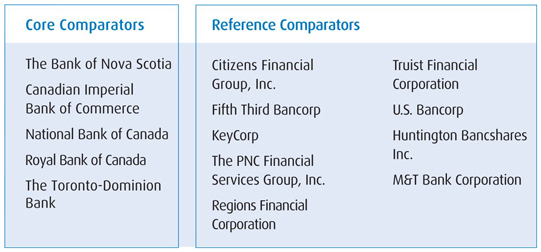
| 52 | Bank of Montreal Management Proxy Circular 2026 |
PRINCIPLE: Link compensation to bank performance
Executive compensation designs and decisions must align with BMO’s strategic priorities, and with both bank and operating segment performance
A substantial portion of executive compensation is variable pay awarded in the form of short-term, mid-term and long-term incentives. The amount allocated to each type of incentive is fixed as a percentage of total variable pay and depends on the executive’s job level.
See page 54 for the full variable pay plan design.
Mid-term and long-term variable pay is adjusted for performance twice, once when it is awarded and again on vesting and payout
Variable pay – which is made up of short-term, mid-term and long-term incentives – is funded based on performance against annual financial goals, objectives tied directly to our strategic priorities, inclusive of key sustainability goals, and our TSR relative to our Canadian banking peers. These measures are described on the pages that follow – see page 60 to review the full 2025 scorecard and results, and the impact that performance had on 2025 compensation.
We assess individual executive performance against individual annual goals aligned with the bank’s risk and strategic objectives, including those that support our commitment to pursuing growth sustainably and responsibly. Specifically, we assess performance against:
| • | Quantitative objectives, such as efficiency ratio, ROE, net income growth, customer loyalty/experience scores, and employee engagement. |
| • | Qualitative objectives, such as the executive’s contribution to the organization through horizontal leadership, demonstrated outcomes, and conduct and behaviours that align with our commitments to high performance, One Client leadership, risk and sound governance practices, and inclusion. |
Managers use their discretion to increase, decrease or eliminate the variable pay awarded to individuals reporting to them, as long as this does not exceed the total variable pay funding calculated for the group. The committee may do the same for senior executives and oversight function heads, and only the board has the discretion to modify or eliminate variable pay for the CEO.
Finally, mid-term and long-term incentives are adjusted for performance once more when they vest:
| • | The final payout is tied to BMO’s common share price at payout. |
| • | PSUs, PDSUs, and RSUs earn dividend equivalents over the vesting term, which are granted as additional units that vest on the same terms and schedule as the original units. See page 51 for their specific conditions related to vesting and payout. |
| • | PSUs and PDSUs are further adjusted for performance prior to payout – at vesting they are adjusted up or down (up to +/-20%) based on the bank’s performance on three-year average adjusted ROE and on three-year TSR relative to core comparators (see page 52). |
How variable pay funding is calculated
Variable pay funding for our executives is adjusted up or down depending on our performance against annual financial goals and our risk and strategic objectives. The variable pay awarded cannot exceed the total variable pay funding approved by the committee.
We calculate the variable pay funding for executives by assessing performance against challenging financial goals that can be achieved within the bank’s risk appetite and its compliance and ethics requirements. BMO’s medium-term financial goals establish a range of expected performance over time. The bank develops its
annual business plan with these financial goals in mind, as well as company-specific factors relevant to the particular year. Annual financial goals are then set, with a range of variable pay outcomes above and below the goal. These annual goals are challenging, in keeping with our philosophy of setting a high bar.
We also assess performance against annual risk and strategic objectives, which are directly tied to our strategy and to fostering a high-performing, winning culture driven by alignment, accountability and recognition.
| Bank of Montreal Management Proxy Circular 2026 | 53 |
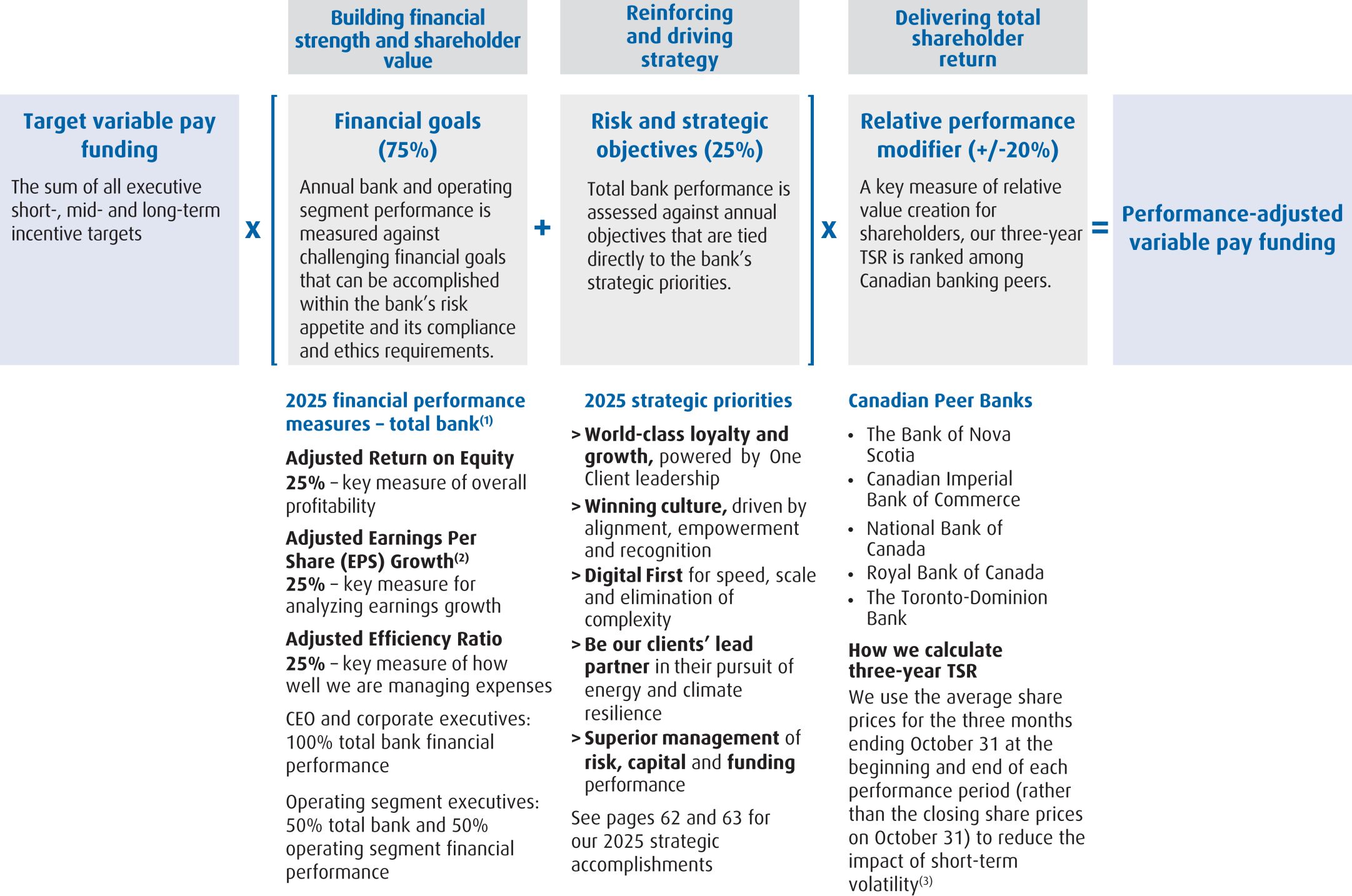
| (1) | Adjusted measures and ratios are non-GAAP measures or ratios, as discussed on page 61 of this circular and starting on page 23 of our 2025 Annual MD&A. Please see footnotes 1, 2, and 3 on page 61 of this circular for additional information. |
| (2) | For operating segment executives, net income growth of the operating unit (adjusted for compensation purposes) is used in place of EPS growth. It is weighted 25% for all operating segments. |
| (3) | The calculation of TSR for compensation purposes differs from the TSR reported in our 2025 Annual MD&A, which is based on closing share prices on October 31 only, and not an average share price. |
| 54 | Bank of Montreal Management Proxy Circular 2026 |
|
(1) Each of these measures is a non-GAAP measure. Please see footnotes 1, 2 and 3 on page 61 of this circular and refer to the Non-GAAP and Other Financial Measures section starting on page 23 of the 2025 Annual MD&A for additional information. |
How the committee can use discretion
As part of the bank’s annual governance process, the committee can use its discretion in three ways:
1. Variable pay funding: To modify calculated variable pay funding up or down based on its assessment and information received from the management oversight committees.
2. Individual awards: To modify variable pay awards up or down for individual executives.
3. Payouts of mid-term and long-term incentives: To modify the payout of mid-term and long-term incentives that are vesting, including PSUs, down to 0%.
| |||
|
Role of Management Oversight Committees The management oversight committees provide information on four key factors for the Human Resources Committee to consider when assessing performance and determining whether to exercise its discretion based on:
Performance – Poor financial performance, either absolute or relative, that is significant, sustained or not aligned with the overall risk appetite of the bank
Risk – Material failures are identified by the risk management controls of the bank, or inappropriate risk-taking has been found to occur (see page 57 for more about risk)
Compliance – Non-compliance with statutory, regulatory or supervisory standards that results in enforcement actions, litigation or financial restatement
Conduct – Misconduct, fraud or intentional misrepresentation of information
See page 49 for more information about the Human Resources Committee’s compensation decision-making process.
| ||||
| Bank of Montreal Management Proxy Circular 2026 | 55 |
PRINCIPLE: Encourage a long-term view to increase shareholder value
A significant portion of variable pay for each executive is equity-based and share ownership requirements for each executive are mandated
A significant portion of variable pay is allocated to mid-term and long-term incentives, which are equity-based and deferred (see page 51). This approach, combined with executive share ownership requirements, focuses the executive team on executing business strategies, sustaining performance and growing shareholder value over the longer term.
This also encourages prudent risk-taking and retention because future payouts may be affected by an executive’s current decisions.
Emphasis on deferred compensation
We tie compensation to longer-term performance by making a significant portion of executive pay variable and deferred.
The amount of variable pay deferred to mid-term and long-term incentives is based on the executive’s job level and reflects the executive’s ability to influence business results over the short-term (one year), mid-term (three years) and long-term (10 years).
The percentage of variable pay for the CEO and senior executives is significantly higher than for other executive roles because of their direct involvement in strategic decision-making and stewardship of the bank. These more senior executives also have a higher percentage of their variable pay deferred to mid-term and long-term incentives.
Mid-term incentives for the CEO and senior executives are awarded as PSUs, which also have performance-based payouts at vesting. PSUs are tied to the performance of BMO’s common share price, and also to the performance of BMO’s average adjusted return on equity and three-year TSR relative to core comparators (see page 51). This reinforces the bank’s pay-for-performance philosophy.
The CEO and senior executives also have the ability to voluntarily elect to defer all or a portion of their PSU awards into PDSUs, which are longer-term deferrals with the same performance-vesting conditions as PSUs. For more information on PDSUs please see page 51.
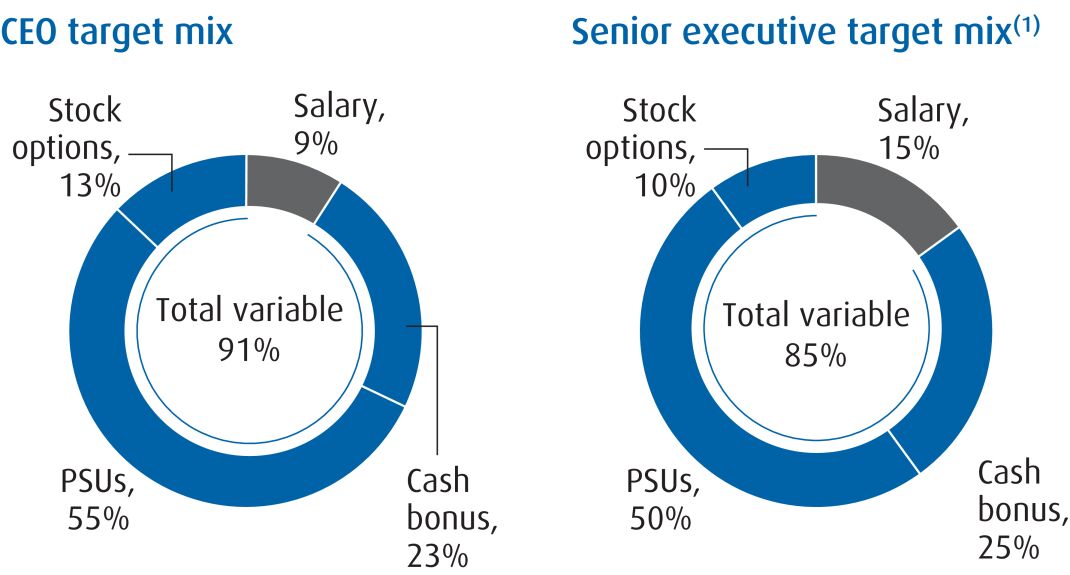
| (1) | Average of the senior executives, not including the CEO & Group Head, BMO Capital Markets |
FSB Principles recommend that the bank’s deferred compensation be:
| • | At least 60% of total variable pay for senior executives |
| • | 40% to 60% of total variable pay for each material risk-taker (roles that could have a material impact on the bank’s risk profile). |
Deferred compensation makes up 75% of the CEO’s total variable pay target and 70% of the senior executives’ total variable pay target, exceeding FSB Principles guidance.
Executives are required to have an equity stake
Executives are required to own equity in the bank and must meet the requirement within three years of being appointed to their position (five years for Vice-Presidents). Share ownership requirements vary by level, and bank common shares, performance share units, restricted share units and deferred share units can all be used to meet the requirement.
| Share ownership requirement | ||
| CEO |
8.0x salary – must hold for 2 years after taking on a new role, retirement or involuntary termination | |
| Other named executive officers (1) |
5.0x salary – must hold for 1 year after taking on a new role, retirement or involuntary termination | |
| (1) | CEO & Group Head, BMO Capital Markets: 1x target total direct compensation |
Share ownership for all executives is assessed annually. The CEO and other NEOs currently exceed their requirements (see the profiles of the NEOs beginning on page 66 for details about their holdings).
| 56 | Bank of Montreal Management Proxy Circular 2026 |
Beginning in January 2026
Share ownership requirements for the CEO and senior executives have been updated to strengthen their alignment with our strategy and to continue encouraging long-term value creation for our shareholders.
With this update, the share ownership requirements for the CEO and senior executives are increasing. In addition, a portion of their holdings must be in fully owned shares or vested units. Bank common shares, vested DSUs and vested PDSUs will be counted towards the vested requirement.
| Beginning January 15, 2026 | ||||||||
| Share ownership requirement | Multiple of target total direct compensation | Time share ownership must be maintained (After taking on a new role, retirement or | ||||||
| Total share ownership requirement |
Vested share ownership requirement |
Total share ownership requirement |
Vested share ownership requirement | |||||
| CEO |
3.0x | 1.0x | 2 years | 1 year | ||||
| Other named executive officers |
1.0x | 0.25x | 1 year | 6 months | ||||
Under this new policy, each executive will have three years to meet the new total share ownership requirements, and five years to meet the vested portion. Future executives promoted to the senior executive level will have three years to meet the total share ownership requirements (five years if they are joining the bank as a new hire), and five years to meet the vested share ownership requirement (seven years if they are joining the bank as a new hire).
PRINCIPLE: Align with prudent and measured risk-taking
Compensation structure does not encourage excessive risk-taking, and rewards appropriate use of capital
Each executive’s variable pay can be clawed back or forfeited, and a significant portion is deferred
As a diversified financial services company, BMO is exposed to a variety of risks that are inherent in carrying out its business activities. Taking an integrated and disciplined approach to risk management is key to developing a strong risk culture and ensuring the success of the bank’s operations.
BMO’s enterprise-wide risk management framework is designed to allow for prudent, measured and sustainable risk-taking in every aspect of its planning process and day-to-day business activities. Risk governance is critical to the framework, and includes a Risk Appetite Framework, risk policies and committees, all of which help to embed a sound risk culture, manage risk and guide employee behaviour and actions toward sound decision-making. You can read more about risk management at BMO in the 2025 Annual MD&A beginning on page 67.
The Risk Appetite Framework, a key element of risk governance, defines the aggregate level and types of risk the bank is willing to assume to achieve its strategic and business objectives and plans given its guiding principles, thereby supporting the pursuit of sound business initiatives, appropriate returns and targeted growth.
Management develops the Risk Appetite Framework to account for a variety of risks at the enterprise and operating segment level, and recommends the framework to the board for approval. BMO’s business strategy, capital planning, performance management and compensation are all aligned and integrated with the bank’s risk appetite.
About the bank’s Risk Appetite Framework
BMO’s Risk Appetite Framework defines the aggregate level and types of risk the bank is willing to assume to achieve its strategic and business objectives and plans.
The framework incorporates seven key risks that could have a material impact on the bank:
• Credit and counterparty • Market • Liquidity and funding • Non-financial (including operational non-financial risk and legal and regulatory compliance risk) |
• Strategic • Environmental and social • Reputation |
Risk appetite is managed by setting risk limits at the enterprise and operating segment level. Executives have individual goals linked to the Risk Appetite Framework.
The Risk Review Committee regularly reviews the bank’s key risks, risk positions and risk governance as part of its responsibilities (see page 39).
A note about climate risk
Climate change is a transverse risk driver that manifests through BMO’s seven key risks. See our Sustainability and Climate Report for more about how the bank manages climate risk.
| Bank of Montreal Management Proxy Circular 2026 | 57 |
Managing compensation
The board’s Human Resources Committee sets the compensation philosophy and strategy of the bank, and makes sure the executive compensation program aligns with the bank’s Risk Appetite Framework and supports the bank’s requirements on compliance and ethics.
|
Managing compensation
| ||||||
| 1 Design of variable pay plans |
2 Determining variable pay funding |
3 Determining individual variable pay awards |
4 Design and use of | |||
1. Plan design
The management oversight committees (see page 46) review the design of the material variable pay plans to make sure risk, compliance, conduct, audit and financial considerations are appropriately incorporated, and to fully assess risk before finalizing variable pay funding and variable pay awards.
The executive compensation program includes several design features to promote strong practices for prudent risk-taking:
| • | A significant portion of variable pay is deferred. |
| • | Both absolute and relative performance are used to determine variable pay funding. |
| • | Variable pay funding is based on primary and secondary measures that include a forward-looking assessment of risk. |
| • | ROE, a primary performance measure used for determining variable pay, is also used to determine the value of performance share unit payouts for senior executives and the CEO. |
| • | There is a cap on variable pay funding. |
| • | Stock options are limited to no more than 20% of total variable pay for senior executives. Stock options for senior executives in the U.S., as well as for all Senior Vice-Presidents, are limited to no more than 10% of their total variable pay. |
| • | Individual variable pay awards for executives are capped. |
Stress testing
BMO employs rigorous stress testing in the course of business planning and when setting the financial goals tied to variable pay funding. The bank conducts stress testing at three stages to help make sure variable pay decisions align with the bank’s compensation philosophy and principles:
| • | Analyzes and tests impacts when designing and/or redesigning variable pay plans. |
| • | Reviews the impact of year-end variable pay calculations on minimum regulatory and/or market capital requirements before payouts are made. |
| • | An independent review is conducted periodically to stress test and back test the bank’s material variable pay plans, and to confirm alignment of the plans with the FSB Principles. |
Independence of control functions
Variable pay for employees in governance and control functions in Enterprise Risk and Portfolio Management, Finance, Audit, Legal & Regulatory Compliance, Human Resources and other corporate and technology functions is tied to overall bank performance and performance against individual objectives.
These employees do not report into the operating segments they support, nor does the success or financial performance of the business areas they support or monitor directly impact the assessment of their performance or compensation. This independence mitigates risk and encourages these employees to maintain their focus on BMO’s overall success.
2. Variable pay funding
Variable pay funding for executives is based on performance against annual financial goals, as well as objectives tied directly to our strategic priorities (see page 54). Performance measures and goals are set within the bank’s Risk Appetite Framework, using risk tolerance thresholds and limits. They are established through a risk-based capital assessment that measures the risk the bank takes on in pursuit of its financial goals and that helps the bank evaluate risk-adjusted returns. Performance against these goals has a direct impact on variable pay funding.
For example:
| • | Business results are reviewed against criteria for key risks. |
| • | ROE is a primary and secondary measure. |
At the end of each year, the committee undertakes a risk review and may modify calculated variable pay funding, and/or require forfeiture of any unvested mid-term or long-term incentive awards, and/or claw back all or a portion of variable pay awards that have already vested and/or paid out, as appropriate. The committee considers information from the Chief Risk Officer (an assessment of material risk factors during and at the end of the year) and the management oversight committees (their review of material risk events during and at the end of the year, and alignment with overall risk appetite and other risk measures).
As part of this review, the committee also considers other financial, environmental and social factors for the bank and each operating segment to determine whether further modifications to calculated results are appropriate.
3. Individual awards
The committee conducts a year-end review of the individual performance and variable pay of senior executives and oversight function heads, and the total variable pay of other top earners across the bank. As part of this review, the committee assesses any risk, compliance, conduct, audit or financial factors when determining whether to exercise its discretion to modify individual variable pay awards and/or payouts.
The committee also reviews mid-term and long-term incentives before they vest and pay out and considers whether adjustments and/or forfeitures are appropriate.
Finally, the board carries out a risk review at the end of the year (risk profiles of the enterprise and operating segments) to determine whether each operating segment’s risk profile is consistent with the bank’s risk appetite and the board’s risk expectations before approving final incentive awards for the CEO.
4. Clawback and forfeiture
BMO’s Clawback and Recoupment Policy, which covers the clawback of cash compensation and the forfeiture provisions in all of our equity compensation plans, helps mitigate current and future risks.
| 58 | Bank of Montreal Management Proxy Circular 2026 |
| Who it applies to |
How it works | |||
|
Clawback
| ||||
|
Cash |
Executives, BMO Capital Markets employees at
the Managing Director level and above and all Material |
All or part of the variable pay awarded or that has vested and/or paid out in the past three years can be clawed back when: • The bank restates its annual or quarterly financial statements due to material non-compliance with a financial reporting requirement under securities laws. As of 2023, if there is such a restatement, a clawback will be applied to senior officers(1) • Employee misconduct or inappropriate risk-taking or management of risk results in or could result in significant financial or reputational harm to the bank, or • If required by law | ||
|
Forfeiture | ||||
|
Equity |
All mid-term and long-term incentive plan participants |
All unvested PSUs, RSUs, PDSUs, DSUs and vested and unvested stock options may be forfeited when: • The bank uncovers inappropriate risk-taking by a participant • A participant resigns or is terminated for cause • It is discovered that a participant who no longer works for the bank committed an act while employed with the bank that would have been cause for termination • A participant who retires or whose employment has been terminated without cause breaks the restrictive covenants agreed to at grant • The bank restates its annual or quarterly financial statements due to material non-compliance with a financial reporting requirement under securities laws. As of 2023, if there is such a restatement, a clawback will be applied to senior officers(1) | ||
|
Other policies and mechanisms | ||||
| All mid-term and long-term incentive plan participants |
To maintain alignment between pay and performance, participants are prohibited from using any kind of personal hedging (for example, prepaid variable contracts, equity swaps, collars or units of exchange funds) to undermine or reduce the risk and shareholder alignment embedded in their mid-term and long-term incentives or other BMO shares or securities they hold. | |||
| Individual performance considerations |
All employees |
Managers consider BMO’s Code of Conduct, our applicable expectations on risk, and audit and compliance accountabilities when conducting individual performance assessments and making variable pay decisions. | ||
| Limits on guarantees |
All employees |
Variable pay for new employees may only be guaranteed for up to 12 months from time of hire, which the committee considers to be sufficient time to transition into the bank. | ||
| Change of control(2) |
All mid-term and long-term incentive plan participants |
To mitigate risks influenced by compensation, the stock option plan calls for a double trigger for accelerated vesting of stock options. Stock options will vest immediately if the bank undergoes a change of control, and the participant is terminated without cause within 24 months of a change of control. Unvested RSUs and PSUs continue to vest if there is a change of control or if the participant is terminated without cause. | ||
| (1) | In accordance with the U.S. Securities Exchange Act and the NYSE listing standards. |
| (2) | Change of control occurs in the following circumstances: (i) 50% or more of the bank’s outstanding voting securities are acquired, (ii) all or substantially all of the bank’s assets are sold, assigned or transferred other than to a subsidiary, (iii) an acquisition of the bank via merger, amalgamation, consolidation or otherwise or dissolution of the bank occurs, or (iv) a change in a majority of our board members occurs. |
| Bank of Montreal Management Proxy Circular 2026 | 59 |
2025 Performance and Compensation
2025 Variable pay
The table below shows the impact of 2025 performance on variable pay for executives and is based on total bank performance against financial goals as well as risk and strategic objectives. Operating segment results are discussed in the executive profiles starting on page 66.
Fiscal 2025 was a strong year for BMO with strong revenue and positive operating leverage. The bank exceeded its fiscal 2025 financial goals for adjusted(1) return on equity, adjusted EPS growth and adjusted efficiency ratio, and delivered on our commitments to our shareholders.
BMO also exceeded its risk and strategic objectives for 2025, notably:
| • | BMO delivered strong North American customer acquisition with all segments meeting or exceeding target customer loyalty scores(2), highlighting One Client leadership and our continued investment in world-class client experiences. |
| • | To serve our clients with excellence and accelerate our North American growth strategy: |
| – | We created and appointed two new Group Heads – Group Head, Canadian Personal and Business Banking and Group Head, Canadian Commercial Banking & North American Integrated Solutions – to enhance our focus on profitable growth in our strongest markets, and |
| – | We created and appointed a President, BMO U.S., to lead our new U.S. Banking segment, made up of our existing U.S. Personal and Business Banking, Commercial Banking, and Private Wealth businesses, with a unified go-to-market strategy and new leadership that positions us to deliver ROE growth and One Client solutions that deepen client relationships. |
| • | We acquired Burgundy Asset Management Ltd., strengthening our private wealth solutions for clients and reinforcing our leadership position in Canada that is highlighted by 25 FundGrade A+® Awards from analytics firm Fundata Canada Inc. and a dozen 2025 Canada LSEG Lipper Fund Awards. BMO’s mutual funds and ETFs continue to receive top honours for risk-adjusted performance. |
| • | We accelerated the adoption of digital solutions to drive value, leveraging our Digital First, AI-powered capabilities responsibly – enhancing decision-making, streamlining operations and unlocking value for our clients. |
| • | We demonstrated strong risk management throughout 2025 – strengthening governance, enhancing frameworks, and reinforcing first-line practices – and teams worked diligently to stabilize credit performance and lower our provisions for credit losses. |
| • | The bank’s Employee Engagement Index was industry leading and in some areas globally leading, highlighting our commitment to fostering a highly engaged and winning culture. Employees report that sound risk culture is evident across the bank and that our commitments to our Purpose, values, ethics and conduct are points of pride in the way we operate. |
BMO’s brand and reputation were also recognized in fiscal 2025, including as one of Ethisphere’s World’s Most Ethical Companies for the eighth consecutive year. The bank also received three awards throughout the year related to our private and commercial banking services from World Finance magazine.
Our three-year TSR for compensation purposes ranked fourth among our Canadian banking peers, which resulted in a relative performance modifier of 100%.
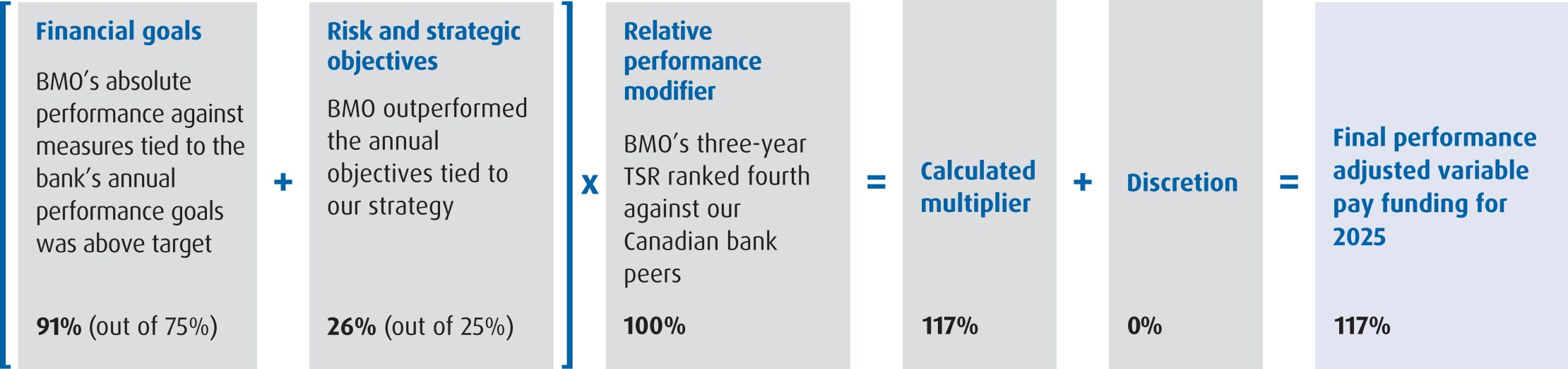
| (1) | Adjusted results, measures and ratios are non-GAAP measures or ratios. Please see footnotes 1, 2 and 3 on page 61 of this circular for additional information. |
| (2) | Net Promoter Score (NPS): Where applicable, this represents the percentage of customers surveyed who would recommend BMO to a friend or colleague. |
| 60 | Bank of Montreal Management Proxy Circular 2026 |
2025 Financial results – building financial strength and shareholder value
Financial goals for the year were set based on our strategy and incorporate the evolving needs of our clients, the market-based opportunities available across our lines of business, expected and prevailing economic conditions, our medium-term financial objectives and BMO’s risk appetite.
Fiscal 2025 was a strong year for BMO. We exceeded our 2025 goals for adjusted(1) ROE, adjusted EPS growth and adjusted efficiency ratio and delivered on our commitments to our shareholders. The results for each measure are detailed below.
| Financial measures – total bank | Reported(2) | Adjusted(1)(2) | Adjusted for compensation purposes(3) | |||||||||||||||
| 2025 results |
2025 results |
vs 2024 adjusted |
2025 goal |
2025 results | ||||||||||||||
| Return on equity |
10.6% |
11.3% |
up 150 basis points |
10.9% |
11.7% | |||||||||||||
| Earnings per share |
$11.44 |
$12.16 |
up 26% |
up 10.6% |
up 21.8% | |||||||||||||
| Efficiency ratio |
58.2% |
56.3% |
down 230 basis points |
58.0% |
56.3% | |||||||||||||
| Return on equity (ROE) | Net income, less preferred share dividends and distributions on other equity instruments, as a percentage of average common shareholders’ equity, which comprises common share capital, contributed surplus, accumulated other comprehensive income (loss) and retained earnings. Adjusted ROE is calculated using adjusted net income rather than net income, while adjusted ROE for compensation purposes is calculated using adjusted net income and also excludes the provision for (or recovery of) credit losses on performing loans. | |
| Fiscal 2025 results • Reported ROE was 10.6%, compared with 9.7% in fiscal 2024. • Adjusted ROE was 11.3%, an increase of 150 basis points compared with fiscal 2024, due to earnings growth, partially offset by an increase in average common shareholders’ equity. Net income increased, driven by higher revenue and lower provisions for credit losses, partially offset by higher expenses. • Adjusted ROE for compensation purposes was 11.7%. This was above our fiscal 2025 goal of 10.9% due to higher than expected net income driven by better performance in Capital Markets, Wealth Management, US Personal and Commercial and Corporate Services. | ||
| Earnings per share (EPS) growth | Net income attributable to common shareholders, after deducting preferred share dividends and distributions on other equity instruments, divided by the average number of common shares outstanding. Adjusted EPS is calculated using adjusted net income attributable to common shareholders. Adjusted EPS for compensation purposes is calculated using adjusted net income attributable to common shareholders and also excludes the provision for (or recovery of) credit losses on performing loans. | |
| Fiscal 2025 results • Reported EPS increased 20% to $11.44. • Adjusted EPS increased 26% to $12.16, due to higher earnings growth and a lower number of common shares outstanding. • Adjusted EPS growth for compensation purposes increased 21.8% from fiscal 2024 and was above our goal of 10.6% growth for the year, primarily due to higher than expected net income, as noted above. | ||
| Efficiency ratio | Non-interest expense divided by total revenue, expressed as a percentage. Adjusted efficiency ratio is calculated in the same manner as efficiency ratio, utilizing adjusted revenue and adjusted non-interest expense. | |
| Fiscal 2025 results • The reported efficiency ratio was 58.2%, compared with 59.5% in fiscal 2024. • The adjusted efficiency ratio (also used for compensation purposes) was 56.3%, an improvement of 230 basis points over 2024 due to higher revenue, partially offset by higher expenses, and exceeded our goal of 58.1% for the year. | ||
| (1) | Adjusted results, measures and ratios in this table are non-GAAP measures or ratios. For a reconciliation of adjusted return on equity, adjusted earnings per share, and adjusted efficiency ratio, refer to the Non-GAAP and Other Financial Measures section starting on page 23 of BMO’s Management’s Discussion and Analysis dated December 4, 2025 for the fiscal year ended October 31, 2025 (“2025 Annual MD&A”) and Tables 9 and 14 on pages 29 and 32, respectively, of our 2025 Annual MD&A. As detailed in the 2025 Annual MD&A, adjusting items in aggregate reduced net income by $523 million in the fiscal year ended October 31, 2025 and are excluded in calculating adjusted return on equity, adjusted earnings per share and adjusted efficiency ratio. These reconciliations are incorporated by reference. |
| (2) | For information about how BMO calculates ROE, EPS and efficiency ratio, refer to Financial Objectives and Value Measures starting on page 19 of our 2025 Annual MD&A. These terms and definitions are incorporated by reference. The 2025 Annual MD&A is available on BMO’s website at www.bmo.com/investorrelations and on SEDAR+ at www.sedarplus.ca. EPS growth is the percentage increase in EPS over the prior year. |
| (3) | Adjusted measures for return on equity and earnings per share for compensation purposes reflect adjusted measures as reported in the 2025 Annual MD&A and also exclude the provision for (or recovery of) credit losses on performing loans. In fiscal 2025 the provision for credit losses on performing loans was $339 million ($470 million pre-tax) and in fiscal 2024 the provision for credit losses on performing loans was $502 million ($695 million pre-tax). |
| Bank of Montreal Management Proxy Circular 2026 | 61 |
| 2025 Strategic results – delivering on risk and strategic objectives |
| In 2025, we measured progress against our strategic priorities by assessing our performance against annual objectives tied to these priorities. These objectives account for 25% of variable pay funding for our executives. Select 2025 accomplishments that advanced our strategy and supported long-term shareholder value are outlined below. |
| World-class loyalty |
Serve clients with the full breadth of our products and services, driving exceptional client experiences | |
| 2025 accomplishments • Deepened One Client collaboration – a key differentiator for BMO – serving clients with the full breadth of our products and services to help them make real financial progress. • Continued to drive top-tier, high-quality client growth with deep relationships, resulting in strong chequing account growth and increased share of wallet, and gained market share(1) in key categories, including retail deposits, business banking deposits and mortgages in Canada. • Maintained strong customer loyalty as measured by our client loyalty scores, with each of the segments of the bank meeting or exceeding their targets. • Continued to deliver differentiated products and services to help clients make real financial progress including the launch of My Financial Progress, a digital goal-planning tool providing comprehensive insights into clients’ finances and access to personalized strategies to help them reach their goals. • Named Best Commercial Bank in Canada and Best Commercial Bank in the U.S., as well as Best Private Bank in Canada for the 15th consecutive year by World Finance magazine, a testament to our understanding of clients’ evolving financial needs and our dedication to delivering a digitally enabled experience. • Acquired Burgundy Asset Management Ltd., a leading independent wealth manager in Canada, expanding our wealth management and financial planning capabilities focused on high net worth individuals, families and institutions. • Partnered with Porter Airlines to launch two new BMO VIPorter® Mastercards®, expanding our line of premium cards and offering immediate access to Porter’s loyalty program and accelerated travel rewards, resulting in strong acquisition. • Received 25 FundGrade A+® Awards from analytics firm Fundata Canada Inc. for consistent risk-adjusted performance, with three mutual funds awards and 22 ETF awards – the most of any financial institutions rated in 2024(2). • Euromoney Global Private Banking Awards recognized BMO with two awards in 2025 – Canada’s Best Private Bank for Philanthropic Advisory services and Canada’s Best Private Bank for Ultra-High-Net-Worth clients.
(1) Source: OSFI as at June 2025. (2) Announced in fiscal 2025. | ||
| Winning |
Foster an industry-leading engaged and winning culture fueling high performance that powers our growth. Every member of team BMO is accountable for results, and we empower our employees to deliver. | |
| 2025 accomplishments • Achieved strong employee engagement, with index scores in key areas such as engagement and ethics that position us among leading global companies(1) – employees reported a high degree of work satisfaction and confidence in BMO. • Named one of the World’s Most Ethical Companies by Ethisphere for the eighth consecutive year – once again one of four banks worldwide and the only bank in Canada to be recognized in 2025. • Integrated our U.S. banking operations, combining Personal and Business Banking, Commercial Banking and Private Wealth, and invested in top talent to strengthen accountability and focus. • Strengthened the Canadian Commercial Banking franchise by investing in front-line talent, expanding client-facing teams to support growth in core sectors and geographies and enhance relationship coverage. • Strengthened our leadership in Indigenous Banking through the establishment of the Office of Reconciliation and appointment of a dedicated Head of the Indigenous Banking Unit. • The Association for Talent Development recognized BMO with the prestigious ATD BEST Award, which celebrates organizations that drive enterprise-wide success through employee learning and development; BMO was the only Canadian bank to be recognized in 2025. • Named one of Canada’s Most Admired™ Corporate Cultures by Waterstone Human Capital and recently named to the 2026 Forbes list of the Most Trusted Companies in America.
(1) Source: Qualtrics 2025. | ||
| 62 | Bank of Montreal Management Proxy Circular 2026 |
| Digital First for |
Focus on the digital capabilities that deliver for our clients. AI is an important tool for our teams, driving productivity and enhancing the way we serve our clients. | |
| 2025 accomplishments • Helped customers make real financial progress through enhanced digital capabilities and continued to provide innovative and award-winning customer experiences: • Received the 2025 Celent Model Bank Award for Payments Innovation for three digital payment client experience initiatives • Ranked first in EMARKETER’s 2025 Canada Mobile Banking Features Benchmark for the second consecutive year, reflecting our leadership in digitally-enabled, client-focused mobile banking • Received 2025 Digital CX awards from The Digital Banker, including Outstanding Digital CX for Mobile Banking and Excellence in Omni-Channel Customer Experience • Launched Lumi Assistant, an award winning AI-powered tool that simplifies and accelerates employees’ access to critical information needed to provide advice and guidance to clients. • Received several 2025 Global AI Innovation Awards by The Digital Banker for our predictive analytics initiatives, use of AI in customer personalization, best virtual assistant and best new AI product launch of the year – reinforcing our commitment to delivering innovative solutions to our clients. • Launched expanded digital capabilities and new online features in BMO InvestorLine, including multi-leg option trading, digital enrolment for Shareholder Dividend Reinvestment and Share Purchase Plans and enhanced views of position types, to improve user experience. • Globally recognized for commitment to leveraging AI-powered digital solutions to help our clients make real financial progress with 11 recognitions from the 2025 Digital Bank Awards and the Qorus-Infosys Finacle Banking Innovation Awards for our leadership in AI, digital innovation and a continued commitment to client-focused solutions. • Scaled deployment of data to drive insight and personalization, process simplification through digitization, and the responsible deployment of AI. • Launched enterprise-wide AI tool for employee productivity with over 80% employee adoption. • Our AI training program provides every employee, regardless of technical background, with a foundational understanding of AI, including ethical use, governance and practical applications. • Earned joint first place global ranking in talent development in the 2025 Evident AI Index, a prestigious benchmark that evaluates AI maturity across the world’s top 50 banks. | ||
| Be our clients’ lead |
Offer our clients products and services to help them achieve their sustainability and risk management objectives | |
| 2025 accomplishments • Supported our clients’ climate transition, including through a first-of-its-kind Carbon Advisory and exclusive Carbon Offset Marketing mandates. • Completed a substantive update to BMO’s Transition Action Plan, reinforcing superior risk management and enabling a One Client approach to help both clients and the bank navigate sustainability risks and opportunities. • Broadened sustainable and climate finance products and services for Canadian commercial real estate clients through BMO’s Better Buildings and Sustainable Spaces offering. • Expanded support for U.S. clients in the food and agriculture, and industrial sectors with new offerings, including, commercial and industrial solar finance, and project finance. • Became the first North American bank to issue a labelled Indigenous bond in support of Indigenous-owned businesses and communities. • Advised and assisted Canada Development Investment Corp. in structuring Canada’s Indigenous Loan Guarantee Program (ILGP) as part of our ongoing support for Indigenous equity participation in major Canadian infrastructure. • BMO’s Climate Solutions Conference, held in San Francisco, featured 16 panels and attendance from 94 organizations focused on investible themes, corporate sustainability, and strategies to reduce greenhouse gas emissions. • Ranked as the leading underwriter of Canadian-dollar Sustainable Bonds by Supernational, Sovereign, and Agency issuers in 2025, with notable deals for the Government of Canada, Hydro One Inc., City of Toronto, Desjardins and Hydro Ottawa. • Named one of Canada’s Best 50 Corporate Citizens by Corporate Knights for the 24th consecutive year. | ||
| Superior management of |
Risk management is a key differentiator for BMO, and an important factor in our ROE growth strategies | |
| 2025 accomplishments • Well established Risk Management Framework that provides a consistent, enterprise-wide approach to risk management and oversight that underpins strategy, enables informed decision-making and drives resilience and efficiency. • Maintained a strong funding and liquidity position throughout the year, with all liquidity measures at or above regulatory requirements and internal targets. • Remained well-capitalized, with capital ratios exceeding OSFI’s published requirements for large Canadian banks and in line with peers. • BMO’s performance continues to be well supported by its business diversification and risk management capabilities, underscored by a strong risk culture. • Maintained robust risk oversight by implementing enhanced frameworks, meeting heightened compliance requirements through ongoing successful evaluation and strengthening of internal controls under the enhanced Risk Management Framework, ensuring reliable financial reporting and alignment with regulatory standards. • Credit performance was in line with anticipated provisions for credit losses on impaired loans. | ||
| Bank of Montreal Management Proxy Circular 2026 | 63 |
Relative performance modifier
Our goal is to deliver top-tier shareholder returns compared with those of our Canadian banking peers (see page 52) and, while we regularly review our performance against our peers across several financial measures (see “secondary considerations” on page 55), BMO’s relative three-year TSR performance is a key component of our business performance factor and it reflects our medium-term TSR performance against our peers. The relative TSR modifier focuses executives on driving positive and sustained shareholder value over the medium term (three years). We use BMO’s relative three-year TSR performance to modify all variable pay funding for executives, to reflect our medium-term TSR performance against our peers.
2025 results
BMO delivered strong one-year TSR of 43.3%, contributing to a three-year annualized TSR of 16.2%(1) for compensation purposes, ranking BMO fourth among Canadian banking peers, up from fifth in 2024. This outcome resulted in a relative performance modifier of 100%, consistent with BMO’s TSR performance over this three-year period.
|
TSR Rank |
6th |
5th |
4th |
3rd |
2nd |
1st | ||||||
|
TSR Modifier |
-20% |
-10% |
None |
+10% |
+20% | |||||||
| (1) | For compensation purposes, to reduce the impact of short-term volatility, we calculate three-year TSR using the average share prices for the three months ended October 31, 2022 and October 31, 2025 (rather than the closing share prices). |
BMO’s reported relative TSR performance over one-, three-, and five-year time horizons, as well as three-year TSR for compensation purposes is as follows:
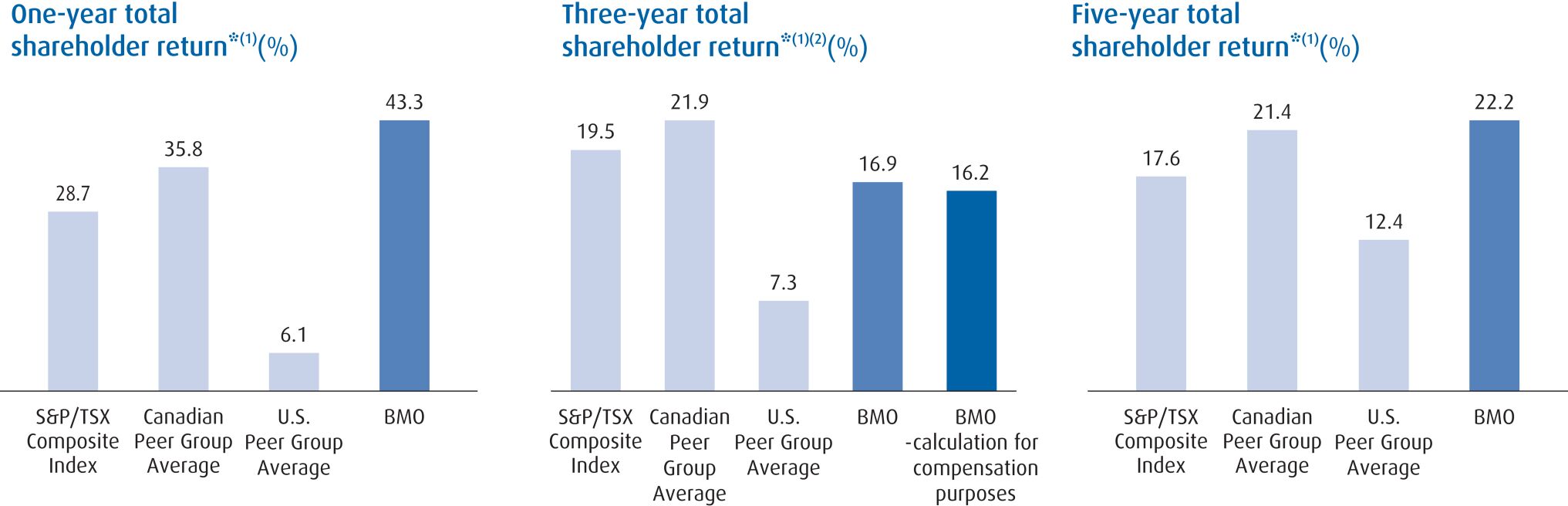
| *All | returns represent total returns. |
| (1) | The annual total shareholder return (TSR) represents the average annual total return earned on an investment in BMO common shares made at the beginning of the respective period, and assumes dividends received were reinvested in additional common shares. The Canadian peer group comprises the five other largest Canadian banks: The Bank of Nova Scotia, Canadian Imperial Bank of Commerce, National Bank of Canada, Royal Bank of Canada and The Toronto-Dominion Bank. The U.S. Peer group comprises our reference comparators: Citizens Financial Group, Inc., Fifth Third Bancorp, KeyCorp, The PNC Financial Services Group, Inc., Regions Financial Corporation, Truist Financial Corporation, U.S. Bancorp, Huntington Bancshares Inc. and M&T Bank Corporation. |
| (2) | For compensation purposes, we calculated three-year TSR using the average share prices for the three months ended October 31, 2022 and October 31, 2025 (rather than the closing share prices) to reduce the impact of short-term volatility. |
| 64 | Bank of Montreal Management Proxy Circular 2026 |
Generating shareholder value
Shareholder returns
The chart below compares the cumulative value of $100 invested in BMO common shares on October 31, 2020 with the cumulative value of $100 invested in each of two TSX indices for the same period. The chart also compares total compensation awarded to the CEO, the CFO and the other three most highly compensated
executive officers in each fiscal year. NEO compensation has remained aligned with shareholder returns over the last five years. See page 68 for more information about how Mr. White’s compensation aligns with shareholder returns.
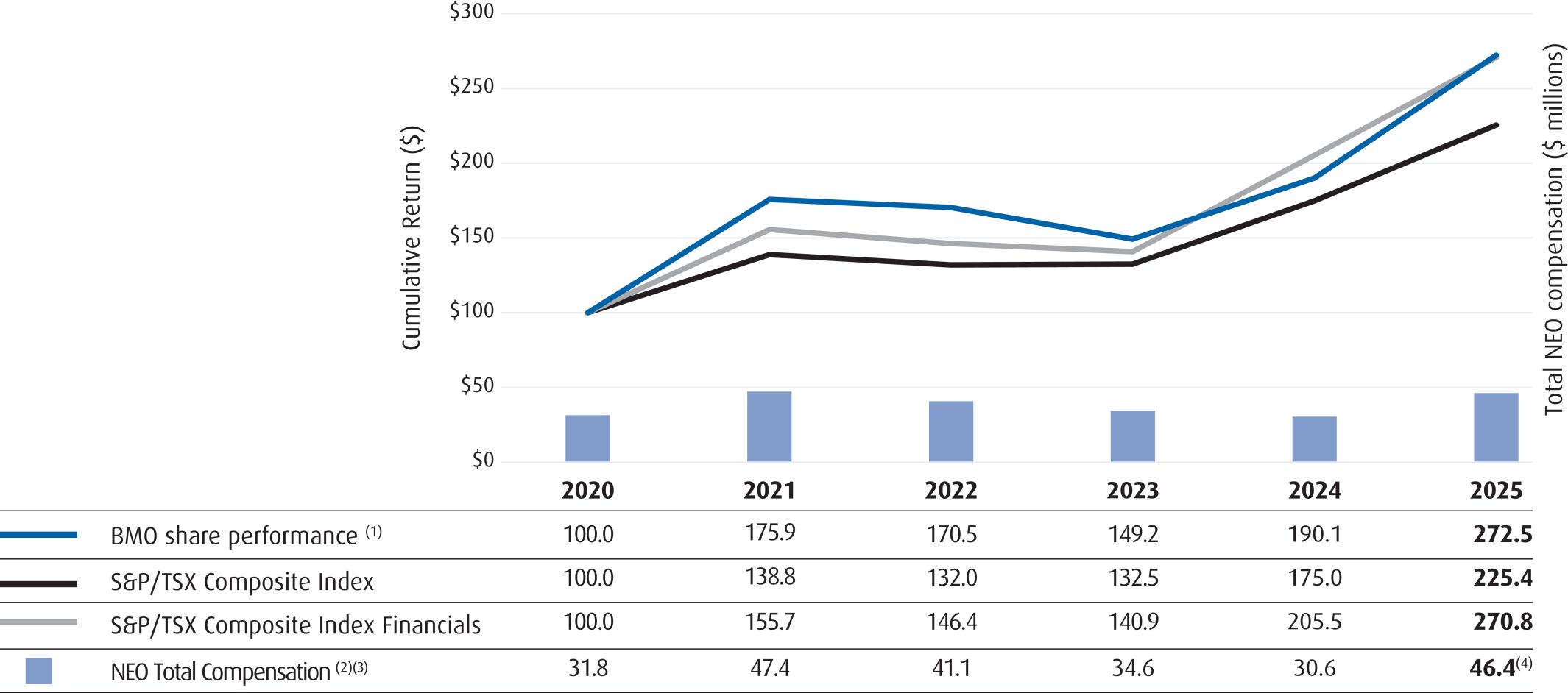
| (1) | Cumulative value of $100 invested on October 31, 2020, reflecting the change in share price and assuming reinvestment of dividends. |
| (2) | Includes base salary, annual short-term incentive payment, value of mid-term incentive awards at the time of grant, fair market value of long-term incentive awards at the time of grant, other compensation and the annual pension service and compensation cost for the NEOs in each fiscal year. |
| (3) | NEOs in fiscal 2020: Darryl White, Thomas E. Flynn and the three most highly compensated executive officers other than the CEO and CFO. NEOs in fiscal 2021 to 2025: Darryl White, Tayfun Tuzun (CFO effective January 1, 2021) and the three most highly compensated executive officers other than the CEO and CFO. |
| (4) | Excludes one-time sign-on, cash and equity incentive replacements for Aron Levine. |
Cost of management ratio
BMO annually reports its cost of management ratio. This measure shows that BMO’s executive compensation has remained consistently below 1% of adjusted net income.
Total aggregate compensation is the sum of base salary, total variable pay, other compensation and the annual pension service and compensation cost for the NEOs.
| 2023 | 2024 | 2025(3) | ||||||||||
| Adjusted net income(1) |
8,735 | 7,449 | 9,248 | |||||||||
| Total NEO compensation |
34.6 | 30.6 | 46.4 | |||||||||
| Cost of management ratio as a percentage of adjusted net income(2) |
0.40% | 0.41% | 0.50% | |||||||||
| (1) | Adjusted results and measures are non-GAAP amounts as discussed on page 61 of this circular and in the Non-GAAP and Other Financial Measures section of our 2025 Annual MD&A, starting on page 23 and in Table 22 on page 54 of our 2025 Annual MD&A. This section and Table are incorporated by reference. The 2025 Annual MD&A is available on our website at www.bmo.com/investorrelations and on SEDAR+ at www.sedarplus.ca. |
| (2) | The cost of management ratio for the NEOs as a percentage of reported net income was 0.53% in 2025, 0.42% in 2024, and 0.78% in 2023. |
| (3) | Excludes one-time sign-on, cash and equity incentive replacements for Aron Levine. |
| Bank of Montreal Management Proxy Circular 2026 | 65 |
Compensation for the named executive officers

|
Chief Executive Officer
Darryl was appointed Chief Executive Officer of BMO Financial Group in 2017. He chairs the bank’s Executive Committee and the board of BMO’s U.S. subsidiary, BMO Financial Corp., and serves as a director of Bank of Montreal. Through the board of directors, he is accountable to shareholders for defining, communicating and implementing the bank’s strategic and operational goals and is responsible for enterprise-wide performance, financial results, including profit and loss, balance sheet and shareholder value metrics, and for defining and maintaining a culture of corporate responsibility. |
Darryl is a member of the Ottawa-based Business Council of Canada, the Business Council of Toronto, the Washington, D.C.-based The Business Council, and the Mayor of Beijing’s International Business Leaders Advisory Council. He is a director of the Bank Policy Institute, a non-partisan public policy, research and advocacy group representing leading banks in the U.S.
A long-standing community builder with strong ties to United Way Centraide, Darryl has volunteered for this organization in New York, Chicago, Montreal and Toronto and also serves as a director of Catalyst. He is a member of Toronto’s University Health Network Board of Trustees. He is also the Board Chair of Groupe CH, the ownership group of the National Hockey League’s Montreal Canadiens.
2025 Performance
| The bank delivered strong performance in 2025 under Mr. White’s leadership: |
| • | Delivered on our commitment to shareholders by posting a solid year-over-year improvement in ROE, our #1 imperative. With strong operating performance, risk management and a focus on optimizing capital allocation, we’re executing against our plan. Superior management of risk is a key differentiator for BMO, and throughout 2025, our teams worked diligently to stabilize credit performance and lower PCL. Recorded significant pre-provision, pre-tax earnings expansion, with revenue increasing across all of our diversified businesses and, for the second consecutive year, sustained positive operating leverage. |
| • | Continued our Digital First evolution with several new digital and AI innovations, such as our award-winning digital assistant, Lumi; our industry-first AI assistant for advisors, Rovr; and launched AI for All, an enterprise-wide learning program, to complement employee access to productivity-boosting Generative AI tools. Achieved the joint #1 global ranking in AI Talent Development in the 2025 Evident AI Index, recognizing our industry-leading program and approach. |
| • | Earned global recognition for our innovation, client service, and ethical practices, including being named one of the World’s Most Innovative Companies by Fast Company; recognized as the Best Private Bank and Best Commercial Bank in Canada and the Best Commercial Bank in the U.S. for multiple consecutive years by World Finance magazine; and named one of Canada’s Best 50 Corporate Citizens by Corporate Knights for 24 years straight. |
| • | Grew BMO’s wealth management business with the acquisition of Burgundy Asset Management Ltd., providing more private wealth solutions for clients and reinforcing BMO’s leadership position in Canada. |
| • | Unified our U.S. businesses by bringing together U.S. Personal and Business Banking, Commercial Banking, and Private Wealth under a new banner, U.S. Banking, to accelerate U.S. growth as we serve our clients with excellence. |
| • | Named by Ethisphere, a global leader in defining and advancing the standards of ethical business practices, for the 8th consecutive year, one of the World’s Most Ethical Companies, and named to the 2026 Forbes list of the most Trusted Companies in America. |
2025 Compensation
Mr. White’s 2025 prorated total compensation target was $13.375 million, consisting of $1.2 million in base salary and a variable pay target of $12.175 million. This revised target was prorated for 2025 and reflects an increase to his annualized target to $15.0 million, which aligns Mr. White’s target total direct compensation more closely with BMO’s North American (core and reference) comparators. It also appropriately acknowledges his strong performance and tenure as a transformational CEO. Reflecting the final bank multiplier result of 117%, Mr. White was awarded total direct compensation of $15.445 million for 2025, including a $1.2 million base salary and $14.245 million in variable pay, at 117% of target.
The board determined Mr. White’s 2025 variable pay award based on his prorated target compensation and its linkages to performance, which include total bank performance against the three financial goals, the bank’s performance as it relates to the risk and strategic objectives for the year, and our three-year relative TSR. The final multiplier for variable pay funding based on total bank performance was 117%.
| 66 | Bank of Montreal Management Proxy Circular 2026 |
25% of Mr. White’s variable pay was allocated to his short-term incentive (an annual cash bonus). The remaining 75% was deferred into performance share units (mid-term incentive) and stock options (long-term incentive). Mr. White voluntarily elected to defer 50% of his 2025 mid-term incentive (PSUs) into performance deferred share units (see page 51 for more information on BMO’s PDSU program).
| 75%
of Mr. White’s
|
(Canadian $) |
2025 | 2024 | 2023 | ||||||||||||||||
| Fixed pay |
||||||||||||||||||||
| Salary |
1,200,000 | 1,100,000 | 1,100,000 | |||||||||||||||||
|
t |
Variable pay |
14,244,750 | 8,520,000 | 10,117,500 | ||||||||||||||||
| Cash bonus (short-term incentive) |
3,539,250 | 2,280,000 | 2,707,500 | |||||||||||||||||
| Performance share units (mid-term incentive – deferred) |
8,599,500 | 4,960,000 | 5,890,000 | |||||||||||||||||
| Stock options (long-term incentive – deferred) |
2,106,000 | 1,280,000 | 1,520,000 | |||||||||||||||||
| Total direct compensation |
15,444,750 | 9,620,000 | 11,217,500 | |||||||||||||||||
Alignment with shareholder interests
One of the principles governing BMO’s compensation program for executives is to align compensation outcomes with shareholder interests. We accomplish this by linking the variable pay of our executives to performance, by making a significant portion of that variable pay equity-based, and by establishing share ownership requirements for all executives.
Compensation linked to ongoing bank performance
The majority of variable pay for BMO executives is adjusted for performance twice: (i) when it is awarded, and (ii) again before it vests and pays out.
The graphic below shows that the payout from Mr. White’s equity-linked awards moves up or down based on the performance of BMO’s common share price over time, aligning his compensation with shareholder interests. The number of PSUs (or PDSUs) that vest will also be adjusted based on BMO’s performance against its three-year average adjusted ROE and its 3-year relative TSR compared with Canadian core comparators.
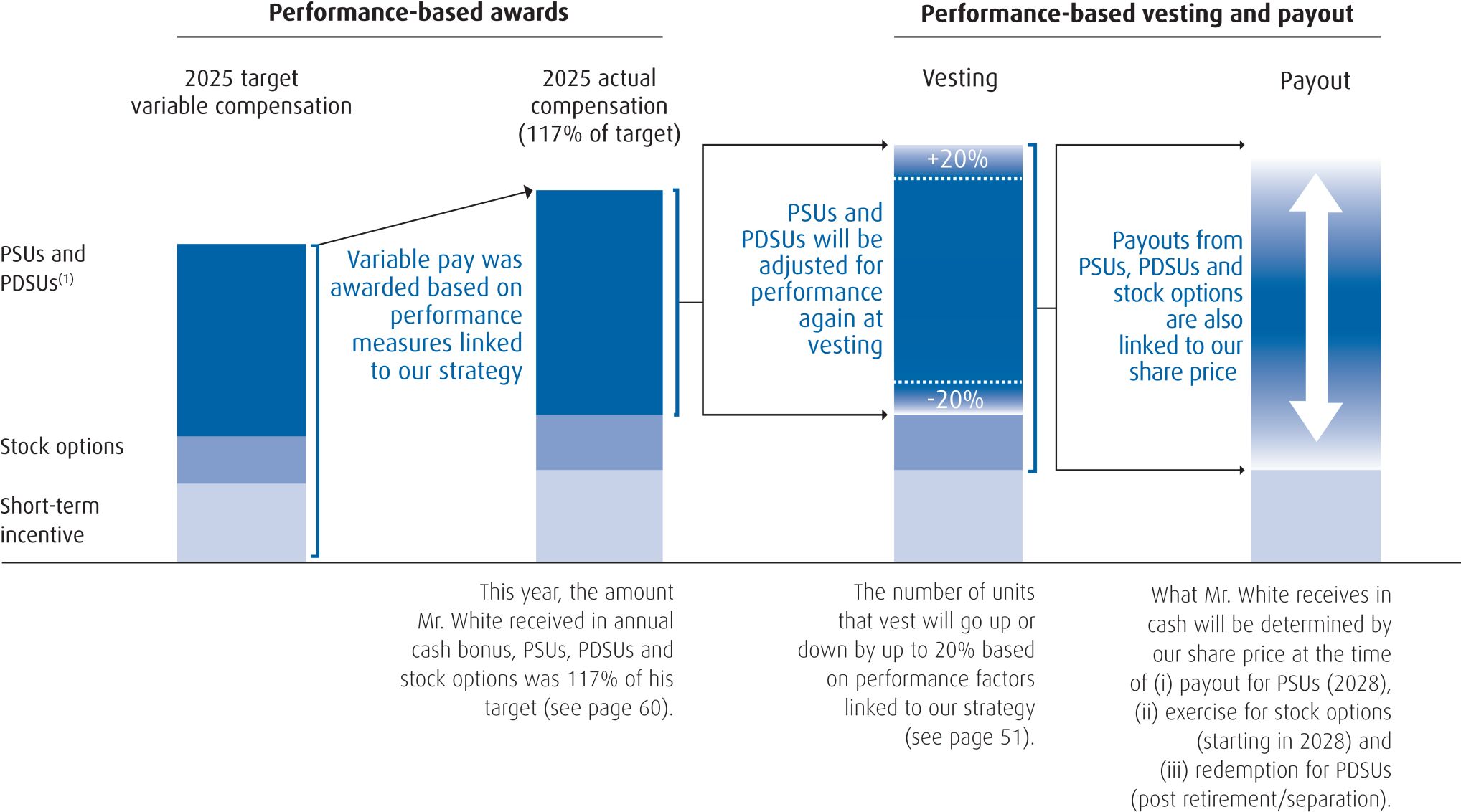
| (1) | Executives can defer a portion of their mid-term incentive award and receive performance deferred share units (PDSUs) instead. Mr. White elected to defer 50% of his 2025 mid-term incentive awards into PDSUs. |
| Bank of Montreal Management Proxy Circular 2026 | 67 |
The table below shows the total direct compensation of our CEO over the last five fiscal years, and its current value compared with shareholder value.
| Total direct ($) |
Annual total direct ($) |
Value of $100 | ||||||||||||||||
| Year | Period | CEO(2) ($) |
Shareholders(3) ($) |
|||||||||||||||
| 2021 | 12,685,000 | 15,300,422 | Oct 31, 2020 to Dec 31, 2025 | 121 | 281 | |||||||||||||
| 2022 | 12,495,000 | 20,060,437 | Oct 31, 2021 to Dec 31, 2025 | 161 | 160 | |||||||||||||
| 2023 | 11,217,500 | 20,657,396 | Oct 31, 2022 to Dec 31, 2025 | 184 | 165 | |||||||||||||
| 2024 | 9,620,000 | 12,919,112 | Oct 31, 2023 to Dec 31, 2025 | 134 | 189 | |||||||||||||
| 2025 | 15,444,750 | 13,474,304 | Oct 31, 2024 to Dec 31, 2025 | 87 | 148 | |||||||||||||
| Average | 12,292,450 | 16,482,334 | 137 | 189 | ||||||||||||||
| (1) | Includes salary and variable pay awarded at year-end for performance during the year. |
| (2) | The CEO’s compensation value measured on December 31, 2025, for each $100 awarded in total direct compensation during the fiscal year indicated. |
| (3) | The cumulative value of $100 invested in BMO shares on the first trading day of the period indicated, assuming reinvestment of dividends. |
Mr. White is required to own 8.0 times his annual base salary in BMO equity. He exceeds his share ownership guidelines.
| Share ownership as at December 31, 2025 | ||||||||||||||||||||||||||||||||||||
| RSUs | PSUs | DSUs/PDSUs | Shares held privately |
Total share ownership |
Total as a multiple of base salary(1) |
|||||||||||||||||||||||||||||||
| Vested |
- | - | - | 71,369 | $ | 12,721,525 | $ | 12,318,679 | $ | 25,040,204 | 20.87 | |||||||||||||||||||||||||
| Unvested |
- | 122,933 | $ | 21,912,808 | 24,234 | $ | 4,319,711 | - | $ | 26,232,519 | 21.86 | |||||||||||||||||||||||||
| Total |
- | 122,933 | $ | 21,912,808 | 95,603 | $ | 17,041,236 | $ | 12,318,679 | $ | 51,272,723 | 42.73 | ||||||||||||||||||||||||
| (1) | Annual base salary as of October 31, 2025. |
Pension
As part of his employment agreement as CEO with the bank, Mr. White receives an enhanced pension benefit that defines his overall pension arrangement and caps the maximum benefit payable at normal retirement at $1,250,000.
Mr. White participates in the following:
| • | The BMO Canada Pension Plan, a federally-registered defined benefit pension plan for eligible Canadian employees. |
| • | An enhanced pension benefit provided via a bank-funded, non-registered agreement defining his overall pension arrangement, and clarifying his entitlement if there is a change of control. |
Mr. White’s overall annual normal retirement pension benefit is as follows:
| • | An annual accrual of $125,000 per year of service to a maximum annual pension benefit of $1,250,000, inclusive of any benefits payable from the BMO Canada Pension Plan or any other bank-sponsored pension or retirement savings plans. |
| • | Pension benefits under the enhanced pension benefit are payable at a normal retirement age of 60. This benefit is reduced by 4% for each year that retirement precedes age 60. |
The pensions under both the enhanced pension benefit and the BMO Canada Pension Plan are paid as periodic payments.
Mr. White’s total annual retirement pension benefit accrued to date is $1,005,000, payable at age 60. This amount will increase with additional years of credited service. See page 80 for more information.
| 68 | Bank of Montreal Management Proxy Circular 2026 |

Tayfun Tuzun
Former Chief Financial Officer
Tayfun was appointed Chief Financial Officer effective January 2021 and was a member of the bank’s Executive Committee, as well as a member of the BMO Financial Corp. board of directors. In this role, he was responsible for the management and oversight of enterprise-wide financial governance and reporting, treasury management, investor relations, taxation and corporate development, as well as enterprise strategy.
Prior to joining BMO, Tayfun was Executive Vice-President and Chief Financial Officer at Fifth Third Bancorp. Mr. Tuzun retired from BMO in January 2026.
2025 Performance
| Mr. Tuzun demonstrated strong leadership and performed well against 2025 priorities:
• Effectively managed capital, including liquidity and funding while establishing and driving ROE growth strategies across the bank and its operating segments, leading to sustainable ROE growth in the fiscal year. |
|
• Contributed to measurable improvements in risk oversight by implementing enhanced frameworks, meeting heightened compliance requirements through the ongoing successful evaluation and strengthening of internal controls under the enhanced Risk Management Framework, ensuring reliable financial reporting and alignment with regulatory standards.
• Finalized multi-year transformation to simplify and accelerate the bank’s finance function through the consolidation of standard processes, process reengineering, intelligent automation, and integrated data and technology advancement, in line with our Digital First strategy, delivering cost savings to BMO’s efficiency program.
• Delivered on risk and finance data strategy including completion of new data hub leveraged by BMO’s risk and finance functions, enhancing the accessibility and speed of availability of financial data to support BMO’s future readiness.
• Collaborated with the operating segments and integrated finance teams to improve tracking and measurement activities to deliver One Client revenues.
• Sustained track record of disciplined expense management through continuous assessment of our expense base, balanced against strategic investments for future growth. Met longstanding commitment to positive operating leverage, achieving 4% for the year – operating leverage was positive in each segment, driven by disciplined expense management and solid revenue performance.
|
2025 Compensation
Mr. Tuzun was awarded US$3.335 million in variable pay for 2025.
The committee determined the award based on his target compensation, total bank performance against the three financial goals, accomplishments tied to the bank’s strategy, and our three-year relative TSR. The calculated multiplier for variable pay funding based on total bank performance was 117%.
30% of Mr. Tuzun’s variable pay was allocated to his short-term incentive (an annual cash bonus). The remaining 70% was deferred into performance share units (mid-term incentive) and stock options (long-term incentives), which are adjusted for performance again before they are paid out. The number of PSUs that ultimately vest will depend on BMO’s three-year average adjusted ROE and its three-year relative TSR performance compared with Canadian core comparators. What Mr. Tuzun actually receives in cash for his deferred awards will also depend on our share price at the time of vesting and exercise, starting in 2028.
| 70% of Mr. Tuzun’s |
(US $) |
2025 | 2024 | 2023 | ||||||||||||||||||
| Fixed pay |
||||||||||||||||||||||
| Salary |
650,000 | 600,000 | 600,000 | |||||||||||||||||||
| t | Variable pay |
3,334,500 | 2,086,667 | 2,280,000 | ||||||||||||||||||
| Cash bonus (short-term incentive) |
1,000,350 | 626,000 | 570,000 | |||||||||||||||||||
| Performance share units (mid-term incentive — deferred) |
2,000,700 | 1,252,000 | 1,482,000 | |||||||||||||||||||
| Stock options (long-term incentive — deferred) |
333,450 | 208,667 | 228,000 | |||||||||||||||||||
| Total direct compensation |
3,984,500 | 2,686,667 | 2,880,000 | |||||||||||||||||||
| Bank of Montreal Management Proxy Circular 2026 | 69 |
Alignment with shareholder interests
Share ownership
Mr. Tuzun exceeds his share ownership guidelines.
| Share ownership as at December 31, 2025(1) | ||||||||||||||||||||||||
| Required multiple | Shares | RSUs | PSUs | DSUs/PDSUs | Total share ownership |
Total as a multiple of base salary |
||||||||||||||||||
| 5.0x base salary(2) | - | - | $ | 8,928,008 | $ | 2,557,531 | $ | 11,485,539 | 12.60 | |||||||||||||||
| (1) | In Canadian dollars. |
| (2) | Annual base salary as at October 31, 2025. |
Pension
Mr. Tuzun participates in the following defined contribution savings plans:
| • | The BMO 401(k) Savings Plan (“401(k) Savings Plan”). |
| • | The BMO Financial Corp. Non-Qualified Savings Plan (“Non-Qualified Savings Plan”). |
The bank annually contributes 2% of his earnings (subject to annual statutory limits on earnings established by the IRS). He may elect to make voluntary contributions up to 75% of his earnings and the bank will match 100% of voluntary contributions equal to 5% of his earnings (subject to annual statutory limits on contributions and earnings established by the IRS). The Non-Qualified Savings Plan provides similar benefits on earnings between the statutory earnings limit and US$500,000. See page 81 for more information.
| 70 | Bank of Montreal Management Proxy Circular 2026 |

Aron Levine
President, BMO U.S.
Aron Levine was appointed President of BMO U.S. on July 7, 2025. He is a member of BMO’s Executive Committee as well as the U.S. Management Committee.
Aron is responsible for driving deep integration and execution across Personal and Business Banking, Commercial Banking and Private Wealth clients, bringing the full value of BMO to customers throughout its U.S. footprint.
With over 30 years of financial services experience spanning the client and business continuum, including leadership roles in Commercial Real Estate Banking, Marketing, Corporate Strategy and Wealth Management, Aron has cultivated a deep understanding of client needs and experience.
Prior to joining BMO in 2025, Aron served as President, Preferred Banking at Bank of America and was responsible for providing personalized financial solutions, valuable rewards and advice and guidance aligned to the complex banking, borrowing and investing needs of mass-affluent consumers.
He serves on the global board of advisors for Operation HOPE and is also a board member for the Boys and Girls Clubs of Metro Atlanta.
2025 Performance
| Mr. Levine demonstrated strong leadership and performed well against 2025 priorities:
• Rapidly integrated BMO’s U.S. banking operations, combining Personal and Business Banking, Commercial Banking and Private Wealth, and invested in top talent to strengthen collaboration and deliver exceptional client advice and service – U.S. Banking(1) reported net income was C$2,810 million, an increase of C$800 million or 40% from the prior year. |
|
• Continued strengthening of client loyalty in Personal and Business Banking, Commercial Banking and Private Wealth, as measured by Net Promoter Score(2).
• Deepened One Client collaboration between Commercial Banking and Private Wealth, delivering integrated solutions that reflect our unified approach to client needs, and driving increased referral flows.
• Supported the continuation of being named Best Commercial Bank in the United States for the third consecutive year by World Finance magazine and upheld our Top 10 market share(3) in commercial banking, based on total wholesale loans.
• Contributed to the expansion of emerging middle market capabilities, with a focus on delivering tailored product solutions, building a high-performing team and refining our service model for greater impact.
• Provided leadership continuity to Private Wealth’s strong growth in net new assets through expanded presence in 11 of the top 15 high net worth and ultra-high net worth markets, with a focus on building local teams to provide clients with best-in-class service and enhanced engagement with local communities.
• Supported ongoing internal talent development through rotational programs, leadership coaching and digital upskilling initiatives, fostering a high-performing and future-ready workforce.
• Announced strategic initiative to optimize the U.S. branch network, reinvesting in markets with long-term growth potential.
• Expanded support for U.S. clients in the food and agriculture, and industrial sectors with new offerings, including commercial and industrial solar finance and project finance.
|
| (1) | Effective the fourth quarter of 2025, BMO combined its U.S. wealth management business, previously reported within Wealth Management, with U.S. Personal and Commercial Banking to form a unified U.S. Banking operating segment. Financial results for prior periods have been reclassified to conform with the current presentation. For further information, refer to the How BMO Reports Operating Segments Results section on page 34 of BMO’s 2025 Annual MD&A. |
| (2) | Net Promoter Score (NPS): The percentage of customers surveyed who would recommend BMO to a friend or colleague. |
| (3) | National Information Center: FR Y-9c Report. |
Financial
BMO U.S. Banking performance is shown in the table below:
| Operating segment measures | 2025 Reported | 2025 Adjusted for compensation(1)(2) |
Impact on variable pay | |||||
| U.S. Banking (in U.S. dollar equivalents)(1) |
Performance on financial goals is based on the operating segments and total bank financial performance (see page 60 for information about 2025 total bank financial performance) | |||||||
| U.S. Banking Net income(1) | $2,007 million | $2,215 million | Above goal due to lower provisions for credit losses on impaired loans and lower expenses, partially offset by lower revenue | |||||
| U.S. Banking Return on equity | 7.4% | 8.4% | Above goal due to higher net income, for the reasons noted above, and lower allocated common shareholders’ equity | |||||
| U.S. Banking Efficiency ratio (teb)(1)
|
59.7% | 56.5% | Above goal due to lower expenses | |||||
| Bank of Montreal Management Proxy Circular 2026 | 71 |
| (1) | Adjusted measures and ratios, including measures presented on a taxable equivalent basis (teb), are non-GAAP amounts or ratios, as discussed on page 61 of this circular, in the Non-GAAP and Other Financial Measures section starting on page 23 of our 2025 Annual MD&A and in the U.S. Banking Performance Review section starting on page 41 of our 2025 Annual MD&A. The reconciliations of U.S. Banking adjusted net income, return on equity and efficiency ratio (teb) are set out in the U.S. Banking Performance Review section of our 2025 Annual MD&A, which is incorporated by reference. The 2025 Annual MD&A is available on SEDAR+ at www.sedarplus.ca and on our website at www.bmo.com/investorrelations. |
| (2) | Adjusted results and measures for compensation purposes also exclude the provision for (or recovery of) credit losses on performing loans. In fiscal 2025, the provision for credit losses on performing loans was $16 million ($21 million pre-tax). |
2025 Compensation
Mr. Levine was awarded US$2.842 million in variable pay based on his prorated target for 2025.
The committee determined the award based on his target compensation, the performance of the bank and his operating segments, accomplishments tied to the bank’s strategy, and our three-year TSR. The calculated multiplier for variable pay funding was 116%.
30% of Mr. Levine’s variable pay was allocated to his short-term incentive (an annual cash bonus). The remaining 70% was deferred into performance share units (mid-term incentive) and stock options (long-term incentive), which are adjusted for performance again before they are paid out. The number of PSUs that ultimately vest will depend on BMO’s three-year average adjusted ROE and three-year relative TSR compared with Canadian core comparators. What Mr. Levine actually receives in cash for his deferred awards will also depend on our share price at the time of vesting and exercise, starting in 2028.
| 70% of Mr. Levine’s 2025 variable pay |
(US $) |
2025 | 2024 | 2023 | ||||||||||||||||||
| Fixed pay |
||||||||||||||||||||||
| Salary |
216,667 | - | - | |||||||||||||||||||
| t | Variable pay |
2,842,000 | - | - | ||||||||||||||||||
| Cash bonus (short-term incentive) |
852,600 | - | - | |||||||||||||||||||
| Performance share units (mid-term incentive — deferred) |
1,705,200 | - | - | |||||||||||||||||||
| Stock options (long-term incentive — deferred) |
284,200 | - | - | |||||||||||||||||||
| Total direct compensation |
3,058,667 | - | - | |||||||||||||||||||
Alignment with shareholder interests
Share ownership
Mr. Levine exceeds his share ownership guidelines.
| Share ownership as at December 31, 2025(1) | ||||||||||||||||||||||||
| Required multiple | Shares | RSUs | PSUs | DSUs/PDSUs | Total share ownership |
Total as a multiple of base salary |
||||||||||||||||||
| 5.0x base salary(2) | - | $ | 20,902,130 | $ | 2,447,016 | $ | 1,590,881 | $ | 24,940,027 | 27.35 | ||||||||||||||
| (1) | In Canadian dollars. |
| (2) | Annual base salary as at October 31, 2025. |
Pension
Mr. Levine participates in the following defined contribution savings plans:
| • | The BMO 401(k) Savings Plan (“401(k) Savings Plan”). |
| • | The BMO Financial Corp. Non-Qualified Savings Plan (“Non-Qualified Savings Plan”). |
The bank annually contributes 2% of his earnings (subject to annual statutory limits on earnings established by the IRS). He may elect to make voluntary contributions up to 75% of his earnings and the bank will match 100% of voluntary contributions equal to 5% of his earnings (subject to annual statutory limits on contributions and earnings established by the IRS). The Non-Qualified Savings Plan provides similar benefits on earnings between the statutory earnings limit and US$500,000. See page 81 for more information.
| 72 | Bank of Montreal Management Proxy Circular 2026 |

Alan Tannenbaum
Chief Executive Officer & Group Head, BMO Capital Markets
Alan Tannenbaum was appointed CEO & Group Head, BMO Capital Markets in November 2023. In this role, he is responsible for BMO’s interactions with corporate, government and institutional clients in global markets. He is a member of the bank’s Executive Committee.
Prior to his appointment, Alan was Head of Global Investment & Corporate Banking (I&CB) where he oversaw relationships with corporate, government and financial sponsor clients worldwide, including equity and debt underwriting, leveraged finance, corporate lending and project financing, mergers and acquisitions advisory services and global trade and banking.
Alan has more than 25 years of experience on Wall Street. He joined BMO Capital Markets in 2010. Prior to joining BMO, Alan spent 13 years at Lehman Brothers, including as Head of European Equity Capital Markets, based in London, and Head of U.S. Institutional Sales, based in New York.
His leadership in the community is reflected in BMO Capital Markets’ social responsibility initiatives, including Equity through Education, which provides educational assistance to deserving post-secondary students.
2025 Performance
| Under Mr. Tannenbaum’s strong leadership, BMO Capital Markets made progress on key strategic initiatives in 2025: |
|
• Delivered leading capital markets solutions to our North American and international clients through a differentiated platform with market leadership across products, sectors and geographies.
• Leveraged diverse business mix to help lead several market firsts for our clients, including joint lead bookrunner to the largest initial public offering (IPO) in Canada since 2022, co-advisor to the acquisition that resulted in our client becoming the third-largest fibre internet provider in North America; among others.
• Advanced BMO’s position as a market leader across priority markets and products, including U.S. agency collateral mortgage obligation new issuance, Bank of Canada rates trading and Canadian government bond issuance, Canadian investment banking M&A and equity capital markets.
• Achieved industry-leading client loyalty in Corporate Banking and Treasury and Payment Solutions, as measured by Net Promoter Score(1)
• Strengthened BMO’s position as a global leader in metals and mining:
• Named the Best Metals & Mining Investment Bank of the Year by Global Finance magazine for the 16th consecutive year
• Held leading market share in metals and mining mergers and acquisitions, including the second largest transaction in the sector with the announced merger of Teck Resources Ltd. and Anglo American plc
• Expanded our offerings by joining the London Metal Exchange (LME) as an approved Category 2 bank
• Helped clients navigate a highly uncertain environment, including the evolution of trade and tariffs, by providing a broad array of comprehensive resources and events featuring industry experts.
• Deepened client relationships with expertise and insights through leading annual investor conferences, such as our 34th Global Metals, Mining and Critical Minerals Conference, 20th Farm-to-Market Conference, 22nd Infrastructure and Utilities Conference, 12th Government, Reserve and Asset Managers Conference and 11th High-Yield Conference.
(1) Net Promoter Score (NPS): The percentage of customers surveyed who would recommend BMO to a friend or colleague. |
Financial
BMO Capital Markets’ financial performance is shown in the table below:
| Operating segment measures | 2025 Reported | 2025 Adjusted for compensation(1)(2) |
Impact on variable pay | |||||
| Capital Markets(1) |
Performance on financial goals is based on the operating segment and total bank financial performance (see page 60 for information about 2025 total bank financial performance) | |||||||
| Capital Markets Net income(1) | $1,977 million |
$2,048 million |
Above goal primarily due to higher revenue | |||||
| Capital Markets Return on equity | 14.0% |
14.6% |
Above goal due to higher net income | |||||
| Capital Markets Efficiency ratio (teb)(1)
|
62.0% |
61.6% |
Above goal due to higher revenue |
| (1) | Adjusted measures and ratios, including measures presented on a taxable equivalent basis (teb), are non-GAAP amounts or ratios, as discussed on page 61 of this circular, in the Non-GAAP and Other Financial Measures section starting on page 23 of our 2025 Annual MD&A and in the BMO Capital Markets Performance Review section starting on page 49 of our 2025 Annual MD&A. The reconciliations of BMO Capital Markets adjusted net income, return on equity and efficiency ratio (teb) are set out in the BMO Capital Markets Performance Review section of our 2025 Annual MD&A, which is incorporated by reference. The 2025 Annual MD&A is available on SEDAR+ at www.sedarplus.ca and on our website at www.bmo.com/investorrelations. |
| (2) | Adjusted results and measures for compensation purposes also exclude the provision for (or recovery of) credit losses on performing loans. In fiscal 2025 the provision for credit losses on performing loans was $49 million ($68 million pre-tax). |
| Bank of Montreal Management Proxy Circular 2026 | 73 |
2025 Compensation
Mr. Tannenbaum was awarded US$8.161 million in variable pay for 2025.
The committee determined the award based on his target compensation, the performance of the bank and his operating segment, accomplishments tied to the bank’s strategy, and our three-year TSR. The calculated multiplier for variable pay funding was 117%.
30% of Mr. Tannenbaum’s variable pay was allocated to his short-term incentive (an annual cash bonus). The remaining 70% was deferred into performance share units (mid-term incentive) and stock options (long-term incentive), which are adjusted for performance again before they are paid out. The number of PSUs that ultimately vest will depend on BMO’s three-year average adjusted ROE and three-year relative TSR compared with Canadian core comparators. What Mr. Tannenbaum actually receives in cash for his deferred awards will also depend on our share price at the time of vesting and exercise, starting in 2028.
|
70% of Mr. Tannenbaum’s |
(US $) |
2025 | 2024 | 2023 | ||||||||||||||||||
| Fixed pay |
||||||||||||||||||||||
| Salary |
650,000 | 600,000 | 350,000 | |||||||||||||||||||
| t | Variable pay |
8,160,750 | 4,720,000 | 8,150,000 | ||||||||||||||||||
| Cash bonus (short-term incentive) |
2,448,225 | 1,274,400 | 3,442,500 | |||||||||||||||||||
| Performance share units (mid-term incentive - deferred)(1) |
4,896,450 | 2,973,600 | 3,957,500 | |||||||||||||||||||
| Stock options (long-term incentive - deferred) |
816,075 | 472,000 | 250,000 | |||||||||||||||||||
| One-time RSU |
— | — | 500,000 | |||||||||||||||||||
| Total direct compensation |
8,810,750 | 5,320,000 | 8,500,000 | |||||||||||||||||||
| (1) | Prior to 2024 Mr. Tannenbaum received restricted share units for his mid-term incentives. |
Alignment with shareholder interests
Share ownership
Mr. Tannenbaum exceeds his share ownership guidelines.
| Share ownership as at December 31, 2025(1) | ||||||||||||||||||||||||
| Required multiple | Shares | RSUs | PSUs | DSUs/PDSUs | Total share ownership |
Share ownership relative to requirement |
||||||||||||||||||
| 1.0x Target total direct compensation(2) | $239,568 | $10,591,616 | $11,171,284 | $9,281,122 | $31,283,590 | Exceeds | ||||||||||||||||||
| (1) | In Canadian dollars. |
| (2) | Annual target total direct compensation as of October 31, 2025. |
Pension
Mr. Tannenbaum participates in the following defined contribution savings plans:
| • | The BMO 401(k) Savings Plan (“401(k) Savings Plan”). |
| • | The BMO Financial Corp. Non-Qualified Savings Plan (“Non-Qualified Savings Plan”). |
The bank annually contributes 2% of his earnings (subject to annual statutory limits on earnings established by the IRS). He may elect to make voluntary contributions up to 75% of his earnings and the bank will match 100% of voluntary contributions equal to 5% of his earnings (subject to annual statutory limits on contributions and earnings established by the IRS). The Non-Qualified Savings Plan provides similar benefits on earnings between the statutory earnings limit and US$500,000. See page 81 for more information.
Mr. Tannenbaum has also accrued defined benefit pension benefits in the following plans:
| • | The BMO U.S. Pension Plan in the account-based formula provision which is a company plan frozen to future pay credits as of February 28, 2017. |
| • | The BMO U.S. Supplemental Pension Plan, also frozen as of February 28, 2017. |
Mr. Tannenbaum’s total annual normal retirement defined benefit pension is as follows:
| • | Prior to March 1, 2017, the bank credited Mr. Tannenbaum’s account with a monthly pay credit and interest credit. The pay credit was equal to a percentage of eligible pay, ranging from 3% to 8%, which was based on age and service points with the bank. The monthly interest credit is based on the 10-year Treasury bond rate. After March 1, 2017, only monthly interest credits will be applied to his account, with a minimum effective annual rate of 5.00%. |
| • | The BMO U.S. Supplemental Pension Plan provides for benefits in excess of statutory compensation limits for the BMO U.S. Pension Plan. |
| • | The portion paid from the BMO U.S. Pension Plan is paid as either a lump sum or converted to a monthly benefit, while the portion from the BMO U.S. Supplemental Pension Plan is paid in a lump sum. |
Mr. Tannenbaum’s total annual retirement pension benefit to date is C$45,000, payable on an unreduced basis at age 65. This amount will increase with additional interest credits. See page 80 for more information.
| 74 | Bank of Montreal Management Proxy Circular 2026 |
|
|
Darrel Hackett U.S. Chief Executive Officer, BMO Financial Group, Chief Executive Officer of BMO Financial Corp. and President and Chief Executive Officer of BMO Bank N.A.
Darrel Hackett was appointed Chief Executive Officer of BMO Financial Corp. and President and Chief Executive Officer of BMO Bank N.A. on June 1, 2023. As U.S. CEO, Darrel also serves as an Executive Committee member of BMO Financial Group and is Chair of the U.S. Management Committee. He is responsible for leadership and performance across BMO’s U.S. operations, including governance across BMO’s U.S. entities, upholding its obligations as a Category III bank under U.S. regulatory standards. |
Before joining BMO, Darrel was a management consultant at McKinsey & Company. He also held a variety of roles at the General Electric Company, where he began his professional career.
Darrel serves on the board of directors for the Art Institute of Chicago, Rush University Medical Center, Kids First Chicago, and United Way of Metro Chicago. He is also a member of the Federal Advisory Council of the Federal Reserve Board.
2025 Performance
| Mr. Hackett demonstrated strong leadership and performed well against 2025 priorities:
• Led U.S. ROE growth strategy, in partnership with the operating segment group heads. Optimized business mix to drive long-term ROE accretion and drove achievements in key strategic focus areas, delivering on fiscal 2025 financial plan for the U.S.
• Supported continued acceleration of our Digital First agenda through key initiatives and client solutions in key operating segments. • Led ongoing cultural integration across newly expanded U.S. footprint.
• Attracted top talent to strengthen the leadership team, adding external large bank experience and reinforcing succession planning.
• Restructured U.S. management committee format and composition to further drive U.S. performance.
• Continued to enhance the overall U.S. risk management culture and governance to reflect the bank’s increased size and significance and to meet the evolving needs of our regulatory landscape. • Co-chaired the One Client Council, driving One Client leadership and culture and delivering on its mandate, including One Client market prioritization and go-to-market strategy.
• Successfully executed program to enable full readiness for all expectations of a Category III bank and set clear tone from the top establishing the importance of strong risk and regulatory compliance including program oversight designed to meet risk and compliance requirements.
• Achieved strong employee engagement and a high-performing culture, with index scores in key areas such as engagement and ethics that position us among leading global companies.
• Expanded BMO’s external reputation and reach through industry, civic and community leadership. Co-chaired successful BMO Employee Giving with over 90% of employees participating. |
2025 Compensation
Mr. Hackett was awarded US$4.124 million in variable pay for 2025.
The committee determined the award based on his target compensation, total bank performance against the three financial goals, accomplishments tied to the bank’s strategy, and our three-year relative TSR. The calculated multiplier for variable pay funding based on total bank performance was 117%.
30% of Mr. Hackett’s variable pay was allocated to his short-term incentive (an annual cash bonus). The remaining 70% was deferred into performance share units (mid-term incentive) and stock options (long-term incentive), which are adjusted for performance again before they are paid out. The number of PSUs that ultimately vest will depend on BMO’s three-year average adjusted ROE and three-year relative TSR compared with Canadian core comparators. What Mr. Hackett actually receives in cash for his deferred awards will also depend on our share price at the time of vesting and exercise, starting in 2028.
| 70% of Mr. Hackett’s |
(US $) |
2025 |
2024 | 2023 | ||||||||||||||||||
| Fixed pay |
||||||||||||||||||||||
| Salary |
650,000 | 600,000 | 600,000 | |||||||||||||||||||
| t | Variable pay |
4,124,250 | 2,160,000 | 2,815,000 | ||||||||||||||||||
| Cash bonus (short-term incentive) |
1,237,275 | 648,000 | 769,500 | |||||||||||||||||||
| Performance share units (mid-term incentive — deferred) |
2,474,550 | 1,296,000 | 1,539,000 | |||||||||||||||||||
| Stock options (long-term incentive — deferred) |
412,425 | 216,000 | 256,500 | |||||||||||||||||||
| One-time DSU |
— | — | 250,000 | |||||||||||||||||||
| Total direct compensation |
4,774,250 | 2,760,000 | 3,415,000 | |||||||||||||||||||
| Bank of Montreal Management Proxy Circular 2026 | 75 |
Alignment with shareholder interests
Share ownership
Mr. Hackett exceeds his share ownership guidelines.
| Share ownership as at December 31, 2025(1) | ||||||||||||
| Required multiple | Shares | RSUs | PSUs | DSUs/PDSUs | Total share ownership |
Total as a multiple of base salary | ||||||
| 5.0x base salary(2) | $983,049 |
$221,743 |
$9,832,627 |
$563,805 |
$11,601,224 |
12.72 | ||||||
| (1) | In Canadian dollars. |
| (2) | Annual base salary as at October 31, 2025. |
Pension
Mr. Hackett participates in the following defined contribution savings plans:
| • | The BMO 401(k) Savings Plan (“401(k) Savings Plan”). |
| • | The BMO Financial Corp. Non-Qualified Savings Plan (“Non-Qualified Savings Plan”). |
The bank annually contributes 2% of his earnings (subject to annual statutory limits on earnings established by the IRS). He may elect to make voluntary contributions up to 75% of his earnings and the bank will match 100% of voluntary contributions equal to 5% of his earnings (subject to annual statutory limits on contributions and earnings established by the IRS). The Non-Qualified Savings Plan provides similar benefits on earnings between the statutory earnings limit and US$500,000. See page 81 for more information.
Mr. Hackett has also accrued defined benefit pension benefits in the following plans:
| • | The BMO U.S. Pension Plan in the account based formula provision which is a company plan frozen to future pay credits as of February 28, 2017. |
| • | The BMO U.S. Supplemental Pension Plan, also frozen as of February 28, 2017. |
Mr. Hackett’s total annual normal retirement defined benefit pension is:
| • | Prior to March 1, 2017, the bank credited Mr. Hackett’s account with a monthly pay credit and interest credit. The pay credit was equal to a percentage of eligible pay, ranging from 3% to 8%, which was based on age and service points with the bank. The monthly interest credit is based on the 10-year Treasury bond rate. After March 1, 2017, only monthly interest credits will be applied to his account, with a minimum effective annual rate of 5.00%. |
| • | The BMO U.S. Supplemental Pension Plan provides for benefits in excess of statutory compensation limits for the BMO U.S. Pension Plan. |
| • | The portion paid from the BMO U.S. Pension Plan is paid as either a lump sum or converted to a monthly benefit, while the portion from the BMO U.S. Supplemental Pension Plan is paid in a lump sum. |
Mr. Hackett’s total annual retirement pension benefit to date is C$65,000, payable on an unreduced basis at age 65. This amount will increase with additional interest credits. See page 80 for more information.
| 76 | Bank of Montreal Management Proxy Circular 2026 |
and Other Financial Information
Summary compensation table
The table below shows the compensation for the NEOs in each of the last three fiscal years.
| Non-equity incentive plan compensation |
||||||||||||||||||||||||||||||||
| Name and principal position
|
Year
|
Salary ($)
|
Share-based
|
Option-based
|
Annual
|
Pension
|
All
other
|
Total
|
||||||||||||||||||||||||
| Darryl White Chief Executive Officer |
2025 | 1,200,000 | 8,599,500 | 2,106,000 | 3,539,250 | 1,544,000 | 53,742 | 17,042,492 | ||||||||||||||||||||||||
| 2024 | 1,100,000 | 4,960,000 | 1,280,000 | 2,280,000 | 1,296,000 | 53,317 | 10,969,317 | |||||||||||||||||||||||||
|
|
2023
|
|
|
1,100,000
|
|
|
5,890,000
|
|
|
1,520,000
|
|
|
2,707,500
|
|
|
1,264,195
|
|
|
56,091
|
|
|
12,537,786
|
| |||||||||
| Tayfun Tuzun(7) Former Chief Financial Officer |
2025 | 911,885 | 2,795,678 | 465,946 | 1,403,391 | 38,580 | 100,100 | 5,715,580 | ||||||||||||||||||||||||
| 2024 | 815,460 | 1,752,111 | 292,019 | 850,797 | 37,035 | 0 | 3,747,422 | |||||||||||||||||||||||||
|
|
2023
|
|
|
809,520
|
|
|
2,010,852
|
|
|
309,362
|
|
|
769,044
|
|
|
35,302
|
|
|
0
|
|
|
3,934,080
|
| |||||||||
| Aron Levine President, BMO U.S. |
2025 | 303,962 | 2,382,761 | 397,127 | 1,196,113 | 14,029 | 21,591,792 | 25,885,784 | ||||||||||||||||||||||||
| Alan Tannenbaum Chief Executive Officer & Group Head, BMO Capital Markets |
2025 | 911,885 | 6,842,054 | 1,140,342 | 3,434,615 | 49,102 | 105,923 | 12,483,921 | ||||||||||||||||||||||||
| 2024 | 815,460 | 4,161,405 | 660,540 | 1,732,037 | 47,568 | 83,335 | 7,500,345 | |||||||||||||||||||||||||
|
|
2023
|
|
|
472,220
|
|
|
6,048,159
|
|
|
339,213
|
|
|
4,644,621
|
|
|
51,380
|
|
|
0
|
|
|
11,555,593
|
| |||||||||
| Darrel Hackett U.S. Chief Executive Officer, BMO Financial Group, Chief Executive Officer, BMO Financial Corp |
2025 | 911,885 | 3,457,812 | 576,302 | 1,735,773 | 49,102 | 79,112 | 6,809,986 | ||||||||||||||||||||||||
| 2024 | 815,460 | 1,813,687 | 302,281 | 880,697 | 47,568 | 59,767 | 3,919,460 | |||||||||||||||||||||||||
|
|
2023
|
|
|
809,520
|
|
|
2,427,405
|
|
|
348,032
|
|
|
1,038,209
|
|
|
62,564
|
|
|
1,985
|
|
|
4,687,715
|
| |||||||||
Compensation and certain pension values paid in U.S. dollars have been converted into Canadian dollars using the following for each fiscal year:
| Fiscal | Cash (Fiscal Yr. Average) | Equity (Nov month-end) | ||
| 2025 |
US$1.00 = C$1.4029 | US$1.00 = C$1.39735 | ||
| 2024 |
US$1.00 = C$1.3591 | US$1.00 = C$1.39945 | ||
| 2023 |
US$1.00 = C$1.3492 | US$1.00 = C$1.35685 | ||
| (1) | The option-based and share-based awards reported are the most recently approved, rather than those 12 months in arrears. The amounts shown are the values on the grant date in each of the 2025, 2024 and 2023 calendar years. The fiscal 2023 one-time DSU award for Darrel Hackett was granted in June 2023 and the one-time RSU award for Alan Tannenbaum was granted in January 2024. The table does not show the value of option-based and share-based awards granted to each of the NEOs in fiscal 2023, November 1, 2022 to October 31, 2023. Equity awards granted in U.S. dollars during this period as set out below have been converted into Canadian dollars using the November month-end spot rate for 2022: US$1.00 = C$1.34405. |
| • | The value of options granted during this period was: Mr. White: $1,845,250, Mr. Tuzun: $341,523, Mr. Tannenbaum: $336,013, and Mr. Hackett: $352,249. |
| • | The value of share-based awards during this period was: Mr. White: $6,322,250, Mr. Tuzun: $2,301,215, Mr. Tannenbaum: $5,503,885, and Mr. Hackett: $2,071,772. |
| (2) | Executives can defer a portion of their mid-term incentive award and receive performance deferred share units (PDSUs) instead. Mr. White and Mr. Tannenbaum elected to defer 50% and 25% respectively of their 2025 mid-term incentive awards into PDSUs. |
| (3) | BMO uses a five-year average compensation fair value methodology. A third-party consultant prepared an estimate of the value of the options for 2025. The consultant uses a Black-Scholes pricing model, a commonly used valuation method, and gave key assumptions to determine option fair value - historic dividend yield: 4.17%, historic share price volatility: 22.33%, risk-free rate of return: 3.26% and option term: 8 years. Based on these assumptions, the compensation value of each option granted to the NEOs in December 2025 is $27.20 per option. For |
| accounting purposes, the option value methodology and assumptions used are consistent with the guidance in International Financial Reporting Standard 2, Share-Based Payments. For options granted in 2025, a binomial option pricing model was used with the following assumptions - expected dividend yield: 2.51%, expected share price volatility: 18.54%, risk-free rate of return: 2.99% and expected period until exercise: 6.5 – 7 years. Based on these assumptions, the weighted-average value of each option granted in December 2025 is approximately $32.09 per option. For the options granted in December 2024, differences in similar assumptions resulted in a compensation value of $19.04 and an accounting value of $18.46. |
| (4) | Executives can defer a portion of their short-term cash incentive award and receive deferred share units (DSUs) instead. Mr. Tannenbaum elected to defer 50% of his incentive awards into DSUs. |
| (5) | Pension value includes the current service cost and the impact of differences between actual compensation and compensation estimated for actuarial purposes (see pages 80 and 81 for information about the pension plans and obligations). The pension value for Mr. Tuzun, Mr. Levine, Mr. Tannenbaum, and Mr. Hackett includes contributions to the BMO 401(k) Savings Plan and the Non-Qualified Savings Plan. |
| (6) | These amounts represent the bank’s contributions to the NEOs under the employee share purchase programs, plus the total value of perquisites, allowances or taxable benefits where they are at or above $50,000, or 10% of total annual salary (whichever is lower). In fiscal 2025, these amounts include an annual executive allowance of $36,000 for Mr. White, $43,490 for Mr. Tuzun and $43,490 for Mr. Hackett. To comply with tax requirements, these amounts also include tax equalization payments of $50,908 for Mr. Tuzun, $82,101 for Mr. Tannenbaum and $20,386 for Mr. Hackett. Finally, these amounts also include the bank’s 2023 and 2024 contributions to the employee share purchase program for Mr. Tannenbaum. |
| For Aron Levine, all other compensation in fiscal 2025 includes a combination of equity and incentive replacements due to forfeitures from his prior employment, totaling $20,075,728 in equity and $1,491,563 in cash. |
| (7) | Mr. Tuzun retired from BMO in January 2026. |
| Bank of Montreal Management Proxy Circular 2026 | 77 |
Outstanding option-based awards and share-based awards
The following tables show the value of the outstanding option-based and share-based awards for each NEO as of October 31, 2025.
| Option-based awards | ||||||||||||||||||||||||
| Name | Grant date |
Number of securities options |
Option exercise price(1) |
Option expiration date |
Value of unexercised in-the-money options(2) |
Value of options exercised(3) |
||||||||||||||||||
| Darryl White |
|
15-Dec-2014 |
|
0 | $ | 78.09 | 15-Dec-2024 | $ | 0 | $ | 997,506 | |||||||||||||
| 14-Dec-2015 | 0 | $ | 77.23 | 14-Dec-2025 | $ | 0 | $ | 4,395,352 | ||||||||||||||||
| 19-Dec-2016 | 46,440 | $ | 96.90 | 19-Dec-2026 | $ | 3,591,205 | ||||||||||||||||||
| 18-Dec-2017 | 40,919 | $ | 100.63 | 18-Dec-2027 | $ | 3,011,638 | ||||||||||||||||||
| 17-Dec-2018 | 80,559 | $ | 89.90 | 17-Dec-2028 | $ | 6,793,540 | ||||||||||||||||||
| 16-Dec-2019 | 92,639 | $ | 101.47 | 16-Dec-2029 | $ | 6,740,414 | ||||||||||||||||||
| 14-Dec-2020 | 101,172 | $ | 97.14 | 14-Dec-2030 | $ | 7,799,349 | ||||||||||||||||||
| 24-Dec-2021 | 115,292 | $ | 135.58 | 24-Dec-2031 | $ | 4,456,036 | ||||||||||||||||||
| 15-Dec-2022 | 125,723 | $ | 122.31 | 15-Dec-2032 | $ | 6,527,538 | ||||||||||||||||||
| 11-Dec-2023 | 106,892 | $ | 118.50 | 11-Dec-2033 | $ | 5,957,091 | ||||||||||||||||||
|
|
16-Dec-2024
|
|
|
67,245
|
|
$
|
141.00
|
|
|
16-Dec-2034
|
|
$
|
2,234,551
|
|
||||||||||
| Total |
|
776,881
|
|
$
|
47,111,362
|
|
$
|
5,392,858
|
| |||||||||||||||
| Tayfun Tuzun |
|
24-Dec-2021 |
|
20,300 | $ | 135.58 | 24-Dec-2031 | $ | 784,595 | |||||||||||||||
| 15-Dec-2022 | 23,270 | $ | 122.31 | 15-Dec-2032 | $ | 1,208,178 | ||||||||||||||||||
| 11-Dec-2023 | 21,756 | $ | 118.50 | 11-Dec-2033 | $ | 1,212,462 | ||||||||||||||||||
|
|
16-Dec-2024
|
|
|
15,341
|
|
$
|
141.00
|
|
|
16-Dec-2034
|
|
$
|
509,781
|
|
||||||||||
| Total |
|
80,667
|
|
$
|
3,715,016
|
|
$
|
0
|
| |||||||||||||||
| Aron Levine |
|
-
|
|
|
-
|
|
|
-
|
|
- | - | |||||||||||||
| Total |
- | - | - | |||||||||||||||||||||
| Alan Tannenbaum |
|
24-Dec-2021 |
|
9,824 | $ | 135.58 | 24-Dec-2031 | $ | 379,698 | $ | 388,473 | |||||||||||||
| 15-Dec-2022 | 22,895 | $ | 122.31 | 15-Dec-2032 | $ | 1,188,708 | ||||||||||||||||||
| 11-Dec-2023 | 23,855 | $ | 118.50 | 11-Dec-2033 | $ | 1,329,439 | ||||||||||||||||||
|
|
16-Dec-2024
|
|
|
34,700
|
|
$
|
141.00
|
|
|
16-Dec-2034
|
|
$
|
1,153,081
|
|
||||||||||
| Total |
|
91,274
|
|
$
|
4,050,926
|
|
$
|
388,473
|
| |||||||||||||||
| Darrel Hackett |
|
18-Dec-2017 |
|
9,428 | $ | 100.63 | 18-Dec-2027 | $ | 693,901 | |||||||||||||||
| 17-Dec-2018 | 18,478 | $ | 89.90 | 17-Dec-2028 | $ | 1,558,250 | ||||||||||||||||||
| 16-Dec-2019 | 17,008 | $ | 101.47 | 16-Dec-2029 | $ | 1,237,502 | ||||||||||||||||||
| 14-Dec-2020 | 18,783 | $ | 97.14 | 14-Dec-2030 | $ | 1,447,981 | ||||||||||||||||||
| 24-Dec-2021 | 21,220 | $ | 135.58 | 24-Dec-2031 | $ | 820,153 | ||||||||||||||||||
| 15-Dec-2022 | 24,001 | $ | 122.31 | 15-Dec-2032 | $ | 1,246,132 | ||||||||||||||||||
| 11-Dec-2023 | 24,475 | $ | 118.50 | 11-Dec-2033 | $ | 1,363,992 | ||||||||||||||||||
|
|
16-Dec-2024
|
|
|
15,880
|
|
$
|
141.00
|
|
|
16-Dec-2034
|
|
$
|
527,692
|
|
||||||||||
| Total |
|
149,273
|
|
$
|
8,895,603
|
|
$
|
0
|
| |||||||||||||||
| (1) | The option exercise price is equal to the closing market value of BMO common shares on the trading day immediately preceding the date of grant. |
| (2) | The value of unexercised in-the-money options equals the difference between the grant price of the options and the closing price of the shares on the TSX on October 31, 2025 ($174.23). |
| (3) | The value of options exercised is the proceeds received in fiscal 2025 from the exercise of options granted in previous years, before deductions for taxes and commissions. |
| 78 | Bank of Montreal Management Proxy Circular 2026 |
| Share-based awards | ||||||||||||||||||||||||
| Name | Grant date | Plan | Number of shares or units that |
Market or payout value of unvested share-based awards not paid out or distributed |
Number of shares or units that |
Market or payout out or distributed(5) |
||||||||||||||||||
| Darryl White |
|
14-Dec-2015 |
|
Awarded DSU | 15,718 | $ | 2,738,520 | |||||||||||||||||
| 19-Dec-2016 | Awarded DSU | 15,141 | $ | 2,638,030 | ||||||||||||||||||||
| 18-Dec-2017 | Awarded DSU | 17,644 | $ | 3,074,187 | ||||||||||||||||||||
| 15-Dec-2022 | PSU | 55,179 | $ | 9,613,854 | ||||||||||||||||||||
| 11-Dec-2023 | PSU | 58,161 | $ | 10,133,318 | ||||||||||||||||||||
| 16-Dec-2024 | PSU | 39,101 | $ | 6,812,527 | ||||||||||||||||||||
|
|
Deferred DSU
|
|
|
22,866
|
|
$
|
3,983,863
|
| ||||||||||||||||
| Total |
|
152,441
|
|
$
|
26,559,699
|
|
|
71,369
|
|
$
|
12,434,600
|
| ||||||||||||
| Tayfun Tuzun |
|
04-Jan-2021 |
|
Awarded DSU | 14,348 | $ | 2,499,929 | |||||||||||||||||
| 15-Dec-2022 | PSU | 20,085 | $ | 3,499,409 | ||||||||||||||||||||
| 11-Dec-2023 | PSU | 19,856 | $ | 3,459,532 | ||||||||||||||||||||
|
|
16-Dec-2024
|
|
|
PSU
|
|
|
13,812
|
|
$
|
2,406,402
|
|
|||||||||||||
| Total |
|
53,753
|
|
$
|
9,365,343
|
|
|
14,348
|
|
$
|
2,499,929
|
| ||||||||||||
| Aron Levine |
|
5-Sep-2025 |
|
Awarded DSU | 8,925 | $ | 1,554,974 | |||||||||||||||||
|
|
5-Sep-2025
|
|
|
RSU
|
|
|
116,187
|
|
$
|
20,243,235
|
|
|||||||||||||
| Total |
|
125,112
|
|
$
|
21,798,209
|
|
|
-
|
|
$
|
0
|
| ||||||||||||
| Alan Tannenbaum |
|
15-Dec-2022 |
|
RSU | 48,038 | $ | 8,369,643 | |||||||||||||||||
| 11-Dec-2023 | RSU | 53,023 | $ | 9,238,254 | ||||||||||||||||||||
| 02-Jan-2024 | RSU | 5,852 | $ | 1,019,572 | ||||||||||||||||||||
| 16-Dec-2024 | PSU | 32,804 | $ | 5,715,394 | ||||||||||||||||||||
|
|
Deferred DSU
|
|
|
33,198
|
|
$ | 5,784,321 | |||||||||||||||||
| Total |
|
139,717
|
|
$
|
24,342,863
|
|
|
33,198
|
|
$
|
5,784,321
|
| ||||||||||||
| Darrel Hackett |
|
20-Jun-2023 |
|
Awarded DSU | 3,163 | $ | 551,017 | |||||||||||||||||
| 15-Dec-2022 | RSU | 16,909 | $ | 2,946,115 | ||||||||||||||||||||
| 03-Jan-2023 | RSU | 1,233 | $ | 214,790 | ||||||||||||||||||||
| 11-Dec-2023 | PSU | 20,620 | $ | 3,592,591 | ||||||||||||||||||||
| 16-Dec-2024 |
|
PSU
|
|
14,297 | $ | 2,490,973 | ||||||||||||||||||
| Total |
|
56,222
|
|
$
|
9,795,486
|
|
|
-
|
|
$
|
0
|
| ||||||||||||
| (4) | The number of shares or units that have vested represents: i) aggregate annual cash bonuses the NEO voluntarily elected to defer into DSUs, ii) awarded DSUs that have vested, and iii) the dividend equivalents earned as additional DSUs. |
| (5) | The value of outstanding shares or units for DSUs, RSUs and PSUs is based on the closing price of a BMO common share on the TSX on October 31, 2025 ($174.23). |
| The value of PSUs assumes no performance adjustment. The market or payout value of vested share-based awards not paid out or distributed represents: i) aggregate annual cash bonuses the NEO voluntarily elected to defer into DSUs, ii) awarded DSUs that have vested, and iii) the dividend equivalents earned as additional DSUs. |
| Bank of Montreal Management Proxy Circular 2026 | 79 |
Incentive plan awards – Value vested or earned
The table below shows the value of option-based awards, share-based awards and non-equity incentive plan compensation that vested or was earned in fiscal 2025.
| Name |
Option-based ($) |
Share-based ($) |
Non-equity incentive value earned ($) |
|||||||||
| Darryl White |
2,422,192 | 5,998,412 | 3,539,250 | |||||||||
| Tayfun Tuzun |
35,830 | 2,077,038 | 1,403,391 | |||||||||
| Aron Levine |
— | — | 1,196,113 | |||||||||
| Alan Tannenbaum |
34,679 | 6,438,497 | 3,434,615 | |||||||||
| Darrel Hackett |
449,386 | 2,067,536 | 1,735,773 | |||||||||
| (1) | The value of stock options that vested during the fiscal year is based on the difference between the grant price of the options and the closing price of a BMO common share on the TSX on the vesting date. |
| (2) | The value of share-based awards that vested during the fiscal year includes dividend equivalents earned on these awards during the period. Share-based awards are valued using a 20-day volume-weighted average of a BMO common share on the TSX calculated as at December 1, 2024 (as appropriate per vesting schedule) for RSU and PSU awards. At vesting, the PSU awards received by Mr. White and Mr. Tuzun were determined using a performance factor of 86%, based on the bank’s three-year average adjusted return on equity (ROE) of 14.8%, compared with the target of 16.2% set at the beginning of the performance period. The full performance range was from a threshold of 14.2% to a maximum of |
| 18.2%. Final results were adjusted to exclude the impacts of goodwill and intangibles related to the acquisition of the Bank of the West, as well as the impact of higher regulatory capital requirements in 2023 and 2024, which were not contemplated when the targets were set. Adjusted results and measures are non-GAAP measures or ratios. Please see footnotes 1, 2, and 3 on page 61 of this circular for additional information. |
| (3) | These are the annual cash incentive awards for 2025. The table includes the full amount of the annual cash bonus even if a portion was voluntarily deferred into DSUs. Mr. Tuzun, Mr. Levine, Mr. Tannenbaum and Mr. Hackett’s amounts have been converted into Canadian dollars using an average exchange rate of US$1.00 = C$1.4029 in 2025. |
Retirement benefits
Defined benefit pension plan table
Three of the NEOs participate in a defined benefit pension plan sponsored by the bank. Mr. Tannenbaum and Mr. Hackett have accrued defined benefit pension benefits in the BMO U.S. Pension Plan in the account-based formula provision, which is a company plan frozen to future pay credits as of February 28, 2017, and the BMO U.S. Supplemental Pension Plan, also frozen as of February 28, 2017. The table below shows the pension benefits under the defined benefit pension plans for the NEOs, including the annual pension payable for three pension-eligibility time frames; year-end, at normal retirement (estimated) and at age 65 (estimated), and accrued obligations determined on a defined benefit basis.
| Annual benefits payable(1) ($) |
||||||||||||||||||||||||||||||||
| Name | Number of years credited service |
At year-end(2) |
At normal retirement |
At age 65 | Accrued year(3) ($) |
Compensatory change(4) ($) |
Non-compensatory change(5) ($) |
Accrued at year-end(3) ($) |
||||||||||||||||||||||||
| Darryl White | 9.00 | 1,005,000 | 1,250,000 | 1,250,000 | 10,517,000 | 1,544,000 | 585,000 | 12,646,000 | ||||||||||||||||||||||||
| Alan Tannenbaum | 7.00 | 45,000 | 45,000 | 45,000 | 356,000 | — | 35,000 | 391,000 | ||||||||||||||||||||||||
| Darrel Hackett | 12.75 | 65,000 | 65,000 | 65,000 | 412,000 | — | 41,000 | 453,000 | ||||||||||||||||||||||||
| (1) | Annual benefits payable include all pension entitlements from the bank. |
| (2) | Annual benefits payable reflect the pension benefit earned as at year-end and do not reflect the reduction of benefits applied in the event of early retirement. |
| (3) | Accrued obligation is the present value of the accrued benefit, calculated using the same actuarial assumptions and methods used to calculate the pension liabilities set out in Note 21 to the consolidated financial statements. The assumptions reflect a best estimate of future events, so the values shown may not be directly comparable to similar estimates of pension liabilities disclosed by other corporations. Also, if an NEO is entitled to a lump sum payment on retirement, the lump sum payment may be significantly different than the accrued obligation due |
| to differences between the lump sum assumptions (which depend on economic conditions at the time of retirement), and the assumptions used to prepare the consolidated financial statements. |
| (4) | Compensatory change consists mainly of the service cost (the present value of the additional benefit earned during the year by virtue of accruing service) and differences between actual compensation and compensation estimated for actuarial purposes. |
| (5) | Non-compensatory change includes interest on the obligation and changes in assumptions, changes in exchange rates, non-compensatory plan experience (such as retirement behaviour other than as expected) and employee contributions. |
| 80 | Bank of Montreal Management Proxy Circular 2026 |
Defined contribution pension plan table
Mr. Tuzun, Mr. Levine, Mr. Tannenbaum, and Mr. Hackett participate in the BMO 401(k) Savings Plan (“401(k) Savings Plan”) and the BMO Financial Corp. Non-Qualified Savings Plan (“Non-Qualified Savings Plan”), which are defined contribution plans. The table below summarizes the bank’s contributions to the 401(k) Savings Plan and the Non-Qualified Savings Plan for Mr. Tuzun, Mr. Levine, Mr. Tannenbaum, and Mr. Hackett.
| Name | Defined contribution
pension ($) |
Compensatory(1) ($) |
Defined contribution pension ($) |
|||||||||
| Tayfun Tuzun(2) | 318,254 | 38,580 | 448,556 | |||||||||
| Aron Levine(2) | — | 14,029 | 14,904 | |||||||||
| Alan Tannenbaum(2) | 786,820 | 49,102 | 1,193,431 | |||||||||
| Darrel Hackett(2) | 2,739,360 | 49,102 | 3,504,852 | |||||||||
| (1) | The compensatory amount includes only the bank’s contributions to the 401(k) Savings Plan and the Non-Qualified Savings Plan on behalf of Mr. Tuzun, Mr. Levine, Mr. Tannenbaum, and Mr. Hackett. Both plans provide “above market investment earnings” and the amounts for Mr. Tuzun, Mr. Levine, Mr. Tannenbaum, and Mr. Hackett were converted at the exchange rate outlined in the notes to the summary compensation table. The BMO 401(k) Savings Plan provides a 2% contribution of the participant’s earnings to a maximum earnings of $350,000 in 2025 and the bank matches 100% of additional contributions equal to 5% of |
| their earnings (maximum of $350,000 in 2025). The Non-Qualified Savings Plan provides a core contribution of 2% of earnings above the 401(k) limit of $350,000 to a maximum of $500,000 and for a match of 100% of additional contributions equal to 5% of salary in excess of the limit up to $500,000 or $150,000 in 2025. |
| (2) | Accumulated values have been converted into Canadian dollars using the spot rate of US$1.00 = C$1.3909 at October 31, 2024 and US$1.00 = C$1.4016 at October 31, 2025. The compensatory value has been converted into Canadian dollars using the average exchange rate of US$1.00 = C$1.4029 at fiscal 2025 year-end. |
| Bank of Montreal Management Proxy Circular 2026 | 81 |
Termination and change of control benefits
The table below explains how the components of the executive compensation program for the NEOs are treated under five termination scenarios, and where applicable the incremental payment.(1)
| Compensation element | Resignation | Termination with cause |
Termination without cause |
Retirement (early or normal) |
Change of control | |||||
| Base pay (salary) | Ceases immediately | Ceases immediately | Severance paid as a lump sum or salary continuation | Ceases upon voluntary retirement | No incremental payment | |||||
| Short-term incentive plan (bonus) | Forfeited | Forfeited | As negotiated | Pro-rated for the year | No incremental payment | |||||
| Bank mid-term incentive plan (RSUs and PSUs) | Forfeited | Forfeited | Normal vesting and payout dates apply
Units are forfeited if non-solicit or non-compete provisions(2) are breached or if employee engaged in misconduct while employed |
Normal vesting and payout dates apply
Units are forfeited if non-solicit or non- compete provisions are breached or if employee engaged in misconduct while employed |
Normal vesting and payout dates apply(3) | |||||
| Long-term incentive plan (stock options) | All options are cancelled | All options are cancelled | Unvested options are cancelled. Vested options expire the earlier of normal expiry or 90 days after termination. However, if employee is at retirement age, the retirement provisions apply instead.
If non-solicit or non-compete provisions(4) are breached, vested options are cancelled |
Normal expiry for all options. If non-solicit or non-compete provisions are breached, all options are cancelled | Upon termination other than for cause within 24 months after change of control, all options become fully vested and will expire within 90 days | |||||
| Deferred share units | Units are redeemed if vested, otherwise forfeited | Units are redeemed if vested, otherwise forfeited(5) | Vested units are redeemed
Unvested units accelerate and vest
If performance criteria apply, level of performance to be determined by the board, the committee or administrator |
Units are redeemed
If performance criteria apply, level of performance to be determined by the board, the committee or administrator, based on most recent financial results to date |
Units remain outstanding | |||||
| BMO Canada Pension Plan
Executive Supplementary Pension Plan |
No incremental payment | No incremental payment | No incremental payment from the BMO Canada Pension Plan
For Supplementary Plan, prior to age 55, bonus-related pension provision (1.25% of best average earnings less the average pensionable salary, multiplied by Canadian credited service) is payable |
No incremental payment | No incremental payment(6) | |||||
| BMO Nesbitt Burns Employee Retirement Plan
BMO U.S. Pension Plan
BMO 401(k) Savings Plan |
No incremental payment | No incremental payment | No incremental payment | No incremental payment | No incremental payment | |||||
| Benefits | None | None | None | None | None | |||||
| Perquisites | Cease | Cease | Subject to negotiation | Cease | No incremental payment | |||||
| (1) | Mr. White, Mr. Tuzun, Mr. Levine, Mr. Tannenbaum, and Mr. Hackett have employment agreements that specify their termination and change of control benefits: |
| • | For Mr. White, there is no incremental payment on resignation, termination with cause or retirement. His payment on termination without cause equals two years of credited service under the pension plan plus a severance payment of two times his current base salary and target cash bonus. He receives a payment on change of control if he is terminated without cause within 24 months of the change of control. The payment is the same as he receives on termination without cause. Termination without cause includes voluntary termination within 24 months of a change of control where one of the following has occurred: (i) a material reduction of the role, responsibilities and/or duties of the executive or of the person to whom they report, (ii) a material reduction of the executive’s base salary, or (iii) a change of geographic location. |
| • | For Mr. Tuzun, Mr. Levine, Mr. Tannenbaum, and Mr. Hackett there is no incremental payment on resignation, termination with cause or retirement. Their payment on termination without cause is a severance payment of two times target total cash (1.5 times for Mr. Tuzun). |
| (2) | The term of such non-competition and non-solicitation restrictions, where applicable, is 90 days and 12 months, respectively, following effective date of termination of employment. Such covenants may be waived by the Human Resources Committee. |
| (3) | All or a portion of outstanding RSUs and PSUs may be forfeited if, in the context of a divestiture, a comparable offer of employment is declined, or if an offer of employment is accepted and then the employee resigns or is terminated with cause. |
| (4) | The term of such non-competition and non-solicitation restrictions, where applicable, is 90 days and 12 months, respectively, following effective date of termination of employment. Such covenants may be waived by the board. |
| (5) | DSUs granted on or after December 2013 that have vested may be forfeited on termination with cause. |
| (6) | Mr. White is entitled to an enhanced pension benefit provided via a bank-funded, non-registered agreement defining his overall pension arrangement, which on a change of control entitles him to $245,000. |
| 82 | Bank of Montreal Management Proxy Circular 2026 |
The table below shows the estimated incremental payments to each NEO at, following, or in connection with each of the termination scenarios as at October 31, 2025(1), unless otherwise indicated. The table includes severance amounts for those NEOs whose severance payments are governed by written employment agreements, but does not include amounts to which an NEO may be entitled under common law or civil law.
| Name | Type of payment | Resignation ($) |
Termination ($) |
Termination ($) |
Retirement ($) |
Change of ($) |
||||||||||||||||
| Darryl White |
Total cash severance | 0 | 0 | 8,650,000 | 0 | 8,650,000 | ||||||||||||||||
| Stock options | 0 | 0 | 0 | 0 | 16,947,199 | |||||||||||||||||
| Pension | 0 | 0 | 245,000 | 0 | 245,000 | |||||||||||||||||
| Total | 0 | 0 | 8,895,000 | 0 | 25,842,199 | |||||||||||||||||
| Tayfun Tuzun |
Total cash severance | 0 | 0 | 3,167,047 | 0 | 3,167,047 | ||||||||||||||||
| Stock options | 0 | 0 | 0 | 0 | 3,322,719 | |||||||||||||||||
| Pension | 0 | 0 | 0 | 0 | 0 | |||||||||||||||||
| Total | 0 | 0 | 3,167,047 | 0 | 6,489,766 | |||||||||||||||||
| Aron Levine |
Total cash severance | 0 | 0 | 3,886,033 | 0 | 3,886,033 | ||||||||||||||||
| Stock options | 0 | 0 | 0 | 0 | 0 | |||||||||||||||||
| Pension | 0 | 0 | 0 | 0 | 0 | |||||||||||||||||
| Total | 0 | 0 | 3,886,033 | 0 | 3,886,033 | |||||||||||||||||
| Alan Tannenbaum |
Total cash severance | 0 | 0 | 7,694,907 | 0 | 7,694,907 | ||||||||||||||||
| Stock options | 0 | 0 | 0 | 0 | 4,050,926 | |||||||||||||||||
| Pension | 0 | 0 | 0 | 0 | 0 | |||||||||||||||||
| Total | 0 | 0 | 7,694,907 | 0 | 11,745,833 | |||||||||||||||||
| Darrel Hackett |
Total cash severance | 0 | 0 | 4,790,904 | 0 | 4,790,904 | ||||||||||||||||
| Stock options | 0 | 0 | 0 | 0 | 3,547,893 | |||||||||||||||||
| Pension | 0 | 0 | 0 | 0 | 0 | |||||||||||||||||
| Total | 0 | 0 | 4,790,904 | 0 | 8,338,797 | |||||||||||||||||
| (1) | The estimated incremental benefit calculations assume the NEO ceased to be an employee on October 31, 2025. Values are based on the closing price of a BMO common share on the TSX on October 31, 2025 ($174.23). Incremental payments in U.S. dollars have been converted at US$1.00 = C$1.4029 |
| • | Severance payments for Mr. White, Mr. Tuzun, Mr. Levine, Mr. Tannenbaum, and Mr. Hackett are governed by employment agreements. Mr. White’s termination without cause includes voluntary termination by the executive within 24 months of a change of control where one of the following has occurred: (i) a material reduction of the role, responsibilities and/or duties of the executive or of the person to whom he reports, (ii) a material reduction of the executive’s base salary, or (iii) a change of geographic location (“Good Reason”). |
| • | Stock option values shown are the in-the-money amount of options vesting earlier than normal, reflecting the value realized assuming all options were exercised on October 31, 2025. Accelerated vesting of all stock options would occur if the NEO’s employment terminates, other than for cause, within 24 months of the change of control, and all options expire within 90 days |
| thereafter. Options do not vest automatically on a change of control without termination of employment. |
| • | Pension payments for Mr. White are governed by his employment agreement. For Mr. Tuzun, Mr. Levine, Mr. Tannenbaum and Mr. Hackett by the BMO 401(k) and Non-Qualified Savings Plans, and for Mr. Tannenbaum and Mr. Hackett pension payments are also governed by the BMO U.S. Pension Plan. |
| (2) | Reflects amounts in the event of a termination without cause following a change of control or a voluntary termination by the executive for Good Reason within 24 months of a change of control. Statutory benefits have not been included in the table. For the definition of a change of control for the stock option plan, refer to page 82. For the purposes of the enhanced pension benefit for Mr. White, a change of control is the result of a merger, amalgamation, consolidation of operations or purchase of the bank. The enhanced pension benefit requires a change of control and termination without cause in order for severance payments to be made. |
Additional information about the long-term incentive plans
Stock option plan
The bank’s stock option plan is the only compensation plan under which the bank issues equity securities. Shareholders approved the stock option plan in 1995, and approved an amendment to increase
the number of shares that may be issued under the plan at the annual meeting of shareholders on March 31, 2020.
| Bank of Montreal Management Proxy Circular 2026 | 83 |
Amendments to stock option plan
On October 30, 2025, the board approved amendments to the bank’s stock option plan. These amendments: (i) update the definitions of retirement and termination date, consistent with the bank’s practices; (ii) clarify the methods of exercise provided for in the plan and the inclusion of a broker assisted automatic exercise of unexercised in the money options immediately prior to expiry; (iii) update blackout expiry mechanics; (iv) align the term of the post-employment restrictive covenants to align with the bank’s other plan documents by reducing the term of the non-competition restrictions to 90 days and non-solicitation to 12-months post
employment, where applicable; (v) update the clawback, forfeiture and recoupment provisions to reflect applicable law and regulatory requirements, as well as bank policy; (vi) clarify existing treatment of stock options and the participant’s entitlements upon cessation of employment and compliance with employment standards legislation; (vii) clarify how applicable withholding taxes may be satisfied; and (viii) certain other housekeeping changes. These amendments do not require security holder approval pursuant to the terms of the plan’s amendment provisions.
Dilution impact of long-term incentive plan
At any time, there are a number of options available to be issued, plus options outstanding that have not yet been exercised. These are known as overhang. To reduce the future dilutive effects stock options have on share values, the committee has established a guideline limiting overhang to 7.5% or less of the total number of issued and outstanding shares. The bank also monitors the
outstanding number of options (dilution), and the number of options issued each year (burn rate).
The table below shows these key measures, and the management of stock option awards to minimize the dilutive effect on shareholders.
| Measure (shown as a % of issued and outstanding shares as of October 31 of each year) |
||||||||||||
| 2025 | 2024 | 2023 | ||||||||||
| Overhang The total number of options available to be issued, plus all options outstanding that have not yet been exercised, expressed as a percentage of 708,905,679, the total number of issued and outstanding shares at the end of the fiscal year |
2.06% | 2.21% | 2.35% | |||||||||
| Dilution The number of options issued but not exercised, expressed as a percentage of the total number of issued and outstanding shares at the end of the fiscal year |
0.80% | 0.90% | 0.88% | |||||||||
| Burn rate The number of stock options granted in the applicable fiscal year, expressed as a percentage of the weighted-average number of outstanding shares for the applicable fiscal year |
0.10% | 0.15% | 0.19% | |||||||||
Securities authorized for issuance under the equity compensation plans
The following table shows (at October 31, 2025):
| • | Shares to be issued when outstanding options under the stock option plan are exercised |
| • | Remaining number of shares available for issue under the stock option plan. Shareholders have approved all equity compensation plans that involve issuing shares |
| Plan category | Number of (1) |
Weighted- (2) |
Number of securities (3) |
|||||||||
| Equity compensation plans approved by the security holders | 5,699,134 | $ | 117.75 | 8,900,641 | ||||||||
| Equity compensation plans not approved by the security holders |
nil | nil | nil | |||||||||
| Total | 5,699,134 | $ | 117.75 | 8,900,641 | ||||||||
| 84 | Bank of Montreal Management Proxy Circular 2026 |
Bank’s stock option plan – Issuance limits
| Eligibility | Options granted to employees of the bank and its affiliates (including employees on a temporary leave of absence) at the committee’s discretion. | |
| Maximum number of shares issuable | 84,200,000 shares (representing 11.88% of issued and outstanding shares as at October 31, 2025). | |
| Currently issued (dilution) |
5,699,134 shares issuable upon exercise of outstanding options (representing 0.80% of the bank’s issued and outstanding shares as at October 31, 2025). | |
| Available for issue | 8,900,641 shares remaining available for issuance (representing 1.26% of the bank’s issued and outstanding shares as at October 31, 2025). | |
| Other limits | The number of shares issuable to insiders, at any time, under all security-based compensation arrangements, cannot exceed 10% of the issued and outstanding shares.
The number of shares issued to insiders, within any one-year period, under all security-based compensation arrangements, cannot exceed 10% of the issued and outstanding shares.
The maximum number of shares reserved for issuance under options to any one participant cannot exceed 5% of the shares then issued and outstanding. | |
| Committee guideline (overhang) | The committee adopted a guideline that the total number of options available for issue, plus all options outstanding that have not yet been exercised, should be 7.5% or less of the total number of the bank’s issued and outstanding shares. | |
Bank’s stock option plan – Conditions
| Maximum term |
Expire 10 years from date of grant. If the expiry date falls during a bank trading blackout period, options will be automatically exercised in accordance with the terms of the plan, to the extent they are in-the-money. | |
| Exercise price |
Equal to the closing price of the shares on the TSX on the trading day immediately preceding the date of grant. | |
| Vesting and exercise of options |
Stock options must vest before they can be exercised. Stock options vest in equal tranches of 50% on the third and fourth anniversaries of their grant date. Options cannot vest prior to the first anniversary of the grant date.
The committee may outline different vesting terms in the participant’s award acknowledgement.
The committee has full discretion to determine the number of options to be granted in the form of standard options and those with growth in share price conditions. | |
| Expiry of options |
Options expire on the tenth anniversary of the grant date.
Options are forfeited if a participant resigns or is terminated for cause. For termination without cause, the participant may exercise outstanding exercisable options within 90 days of termination. All remaining options are then forfeited. | |
| Transfer/assignment |
Only by will or under succession laws. | |
| Forfeiture on detrimental act committed while employed | All or a portion of a former executive’s vested and non-vested options may be forfeited if it is discovered that they committed an act detrimental to the bank while they were still employed by the bank. | |
| Forfeiture on competition or solicitation |
Options may be forfeited where a retired participant, a participant on permanent disability or a participant who was terminated without cause competes with the bank or solicits the bank’s employees, customers or suppliers during the applicable restricted period. | |
| Stock appreciation rights |
The plan permits the granting of stock appreciation rights (SARs) in lieu of or in tandem with option grants on substantially the same terms as options except that the market price on exercise shall be the weighted-average trading price of the shares for the five trading days prior to exercise. On exercise, SARs entitle the holder to receive a cash payment equal to any increase in the market price of a share from the date of grant to the exercise date. No SARs are outstanding. | |
| Change of control |
If an executive is terminated (other than for cause) within 24 months of a change of control, the executive’s options vest immediately and the executive has 90 days to exercise. All remaining options are then forfeited. | |
| Bank of Montreal Management Proxy Circular 2026 | 85 |
| Plan changes |
The committee or board of directors may amend, modify or terminate the plan at any time as long as any changes do not decrease entitlements that have accrued prior to the date of change. Shareholders must approve the following changes: | |
| (i) Increasing the number of shares reserved for issue under the plan | ||
| (ii) Reducing the exercise price of an award (the cancellation or termination of an award of a plan participant prior to the award’s expiry date for the purpose of re-issuing awards to the same plan participant shall be treated as an amendment to reduce the exercise price of an award) | ||
| (iii) Extending the term of an award beyond the expiry date (except where an expiry date would have fallen within a blackout period of the bank) | ||
| (iv) Extending eligibility to participate in the plan to non-employee directors | ||
| (v) Allowing options or stock appreciation rights to be transferred other than for normal estate settlement purposes | ||
| (vi) Extending the expiry date of an option beyond 10 years from its grant date (except where an expiry date would have fallen within a blackout period of the bank) | ||
| (vii) Allowing awards, other than options and stock appreciation rights, to be made under the plan | ||
| (viii) Deletion of or reduction to the range of amendments which require shareholder approval under the plan | ||
| Amendments which may be made without shareholder approval include: amendments of a “housekeeping” nature, the addition of covenants of the bank to protect participants, adjustments to outstanding options in the event of certain corporate transactions, specifying practices for applicable withholding taxes, a change to the vesting provisions of an option and a change to the termination provisions of an option, which does not involve extending the term of the option beyond its original expiry date. | ||
| Exercise process |
Participants may exercise their options prior to the expiry date by paying the exercise price for such options and satisfying any applicable withholding taxes. The exercise price may be satisfied by wire transfer to the bank, or by such other means specified in the procedures prescribed from time to time by the committee, including through an arrangement with a broker approved by the committee. | |
| Clawback |
Options and SARs are subject to forfeiture and/or recoupment as per any law or regulatory requirement or pursuant to the bank’s clawback and recoupment policies. This includes the forfeiture of options and SARs if the bank’s annual or quarterly financial statements are restated or the participant is found to have engaged in certain conduct or negligence, in each case, that causes or could cause significant financial or reputational harm to the bank.
As of 2023, if the bank restates its annual or quarterly financial statements, clawbacks will be applied to senior officers. | |
BMO Capital Markets variable compensation plan – Key features
| Eligibility |
BMO Capital Markets employees (excluding the BMO Capital Markets CEO) | |
| Form of award |
Cash or restricted share units (RSUs) | |
| Pool funding |
A global pool is established based on a fully expensed model driven by net income before bonus and taxes.
The pool incorporates a BMO Capital Markets ROE measure.
The pool is fully adjusted for actual loan losses (excluding provisions on performing loans), and may also be adjusted to reflect other considerations such as risk and total bank performance. | |
| Form of award(1) |
Individual awards are apportioned between cash and RSUs, based on the nature of the role and compensation level.
For Managing Directors and above, the cash portion can be voluntarily deferred into DSUs.
All material risk takers in BMO Capital Markets receive at least 40% of their incentive award in RSUs. See page 87 for more information on material risk takers. | |
| RSU terms |
• Value of the RSUs is based on the share price • Vest and pay out over a period of three years • Earn dividend equivalents as additional RSUs • Non-vested RSUs are forfeited on resignation • Non-vested RSUs continue to vest upon retirement or termination without cause, subject to applicable non-competition, non-solicitation and divestiture provisions • Non-vested RSUs are forfeited if a participant committed an act while employed with the bank that would have led to termination for cause | |
| Clawback |
Cash, RSUs and DSUs are subject to forfeiture and/or recoupment as per any law or regulatory requirement or pursuant to the bank’s clawback and recoupment policies. This includes the forfeiture of awards or payments pursuant to such awards if the bank’s annual or quarterly financial statements are restated or the participant is found to have engaged in certain conduct or negligence, in each case, that causes or could cause significant financial or reputational harm to the bank. | |
| (1) | For BMO Capital Markets employees whose awards are governed by Capital Requirements Directive V, the structure of awards aligns with those prescribed by legislation. |
| 86 | Bank of Montreal Management Proxy Circular 2026 |
Other financial information
This section of the management proxy circular contains information about compensation plans and employees with the ability to expose the bank to material amounts of risk (material plans and material risk takers) and is consistent with the FSB Principles and Standards for Sound Compensation Practices and the Pillar 3 Disclosure Requirements of the Basel Committee on Banking Supervision.
The committee is accountable for establishing and approving compensation policies and philosophies for BMO Financial Group’s material plans and employees. Its overall approach is consistent with the approach it takes to executive compensation, with appropriate modifications to comply with requirements in local jurisdictions:
| • | Tie variable pay awards and payouts to the bank’s objectives, business performance targets, risk and strategic objectives, shareholder returns and risk profiles |
| • | Consider individual performance and adherence to BMO’s Code of Conduct when determining variable pay |
| • | Require material risk takers to defer a significant portion of their variable pay |
See Executive Compensation starting on page 40 for information about executive compensation and the committee’s role.
Material plans
The committee annually approves the criteria for identifying material plans and the subsequent list of material plans, after receiving input from the bank’s management oversight committees, comprising Enterprise Risk and Portfolio Management, Finance, Audit, Legal and Regulatory Compliance, Procurement, and Human Resources groups.
Three factors are considered when determining whether a compensation plan is deemed material:
| • | Whether the compensation plan includes material risk takers |
| • | The total annual compensation spend of the plan |
| • | The judgment of the Enterprise Compensation Oversight Committee |
The committee also approves:
| • | The list of material plans |
| • | Annual funding for the material plan variable pay pools, after review by the management oversight committees and CEO |
| • | Design changes to material plans, after review by the management oversight committees and CEO (see page 46 for more information about the management oversight committees) |
Material risk takers
The committee has approved the following criteria for identifying material risk takers:
| • | All Senior Vice-Presidents and above in the bank |
| • | Certain roles in BMO Capital Markets, Corporate Treasury and Wealth Management that could have a material impact on the bank’s risk profile |
The following standards apply to the compensation of material risk takers:
| • | Non-financial metrics (such as risk limits exceeded, misconduct or unsatisfactory audit reports) are consolidated in performance assessments and compensation decisions |
| • | Variable pay reflects pay for performance and appropriate risk measures |
| • | Deferred compensation for this group is at least 40% of their total variable pay |
Compensation tables for material risk takers
Cash compensation paid has been converted into Canadian dollars at an average rate of exchange of US$1.00 = C$1.4029, £1 = C$1.8344, 1 HKD = C$0.1800, 1 euro = C$1.5582, and 1 Chinese yuan = C$0.1842 in fiscal 2025 and US$1.00 = C$1.3591, £1 = C$1.7378, 1 HKD = C$0.1741, 1 euro = C$1.4779 and 1 Chinese yuan = C$0.1860 in fiscal 2024.
Equity awards granted have been converted into Canadian dollars using the November month-end spot rate of
US$1.00 = C$1.397350, £1 = C$1.851000,
1 HKD = C$0.179468, 1 euro = C$1.621275, and
1 Chinese yuan = C$0.197600 in fiscal 2025 and
US$1.00 = C$1.399450, £1 = C$1.782899,
1 HKD = C$0.179843, 1 euro = C$1.480548 and
1 Chinese yuan = C$0.194755 in fiscal 2024.
| Bank of Montreal Management Proxy Circular 2026 | 87 |
Total direct compensation awarded in fiscal 2025 and 2024
| 2025 | 2024 | |||||||||||||||
| Category(1) | Senior executives |
Other material risk takers |
Senior executives |
Other material risk takers |
||||||||||||
| Number of employees |
12 | 208 | 11 | 220 | ||||||||||||
| Total fixed pay (non-deferred) ($) |
9,759,425 | 83,165,855 | 7,961,768 | 82,400,898 | ||||||||||||
| Total variable pay |
||||||||||||||||
| Cash (non-deferred) ($) |
15,267,617 | 180,866,961 | 9,817,108 | 150,807,718 | ||||||||||||
| Cash (deferred) ($) |
0 | 2,572,376 | 1,430,735 | 1,588,138 | ||||||||||||
| Share-based (deferred) ($) |
60,151,472 | 216,848,854 | 24,837,947 | 165,103,454 | ||||||||||||
| Option-based (deferred) ($) |
7,514,954 | 12,946,901 | 4,731,144 | 8,558,733 | ||||||||||||
| Total variable pay ($)(2) |
82,934,043 | 413,235,092 | 40,816,934 | 326,058,044 | ||||||||||||
| Total direct compensation ($) |
92,693,468 | 496,400,947 | 48,778,702 | 408,458,942 | ||||||||||||
| (1) | Employees who have left the bank during the year are included in these categories. Senior executives are the bank’s most senior executives. |
| (2) | Total variable pay represents the total of cash (excluding fixed compensation), share-based and option-based compensation. |
Deferred compensation outstanding and paid out in fiscal 2025 and 2024
| 2025 | 2024 | |||||||||||||||
| Category(1) | Senior executives |
Other material risk takers |
Senior executives |
Other material risk takers |
||||||||||||
| Cash |
||||||||||||||||
| Vested ($) |
0 | 2,078,993 | 0 | 1,979,248 | ||||||||||||
| Unvested ($) |
350,725 | 7,258,344 | 339,775 | 4,466,242 | ||||||||||||
| Share-based(1)(2) |
||||||||||||||||
| Vested ($) |
42,187,653 | 34,152,302 | 21,426,017 | 22,428,814 | ||||||||||||
| Unvested ($) |
146,047,160 | 598,397,387 | 113,842,128 | 490,802,517 | ||||||||||||
| Option-based(1)(3) |
||||||||||||||||
| Vested ($) |
49,275,205 | 31,922,065 | 20,805,838 | 29,916,873 | ||||||||||||
| Unvested ($) |
48,597,469 | 76,044,788 | 7,903,178 | 15,656,398 | ||||||||||||
| Paid in the fiscal year ($) |
36,728,748 | 164,194,206 | 29,801,962 | 173,287,631 | ||||||||||||
| (1) | Based on the closing price of a BMO common share on the TSX on October 31, 2025 ($174.23) and October 31, 2024 ($126.88). |
| (2) | The value of vested and unvested share-based awards equals the number of outstanding units on October 31, 2025, multiplied by the closing share price. |
| (3) | The value of vested and unvested in-the-money options is equal to the difference between the grant price of the options and the closing share price on October 31, 2025. Vested options include options that have vested and cannot be exercised because they have not met the price condition hurdles. |
Outstanding share-based and option-based awards are subject to implicit adjustments (share price fluctuation) and explicit adjustments (risk adjustments, clawback or forfeiture to address business events that have exceeded compliance thresholds or risk appetite). In 2025 and 2024, no reductions were taken due to explicit adjustments and there were no implicit adjustments.
Other compensation paid
In 2025, severance payments of $12.0 million were committed to for seven material risk takers and $17.4 million was paid out to 16 material risk takers. In 2024, severance payments of $24.7 million were committed to for 15 material risk takers and $16.1 million
was paid out to 22 material risk takers. These amounts do not include cash bonuses paid in each year. The severance payments awarded were aligned with common law practice. No senior executive received or was awarded severance in fiscal 2025 or 2024.
In 2025, the bank paid $9.1 million in guaranteed bonuses to four material risk takers. It also paid $42.6 million in sign-on payments to 9 material risk takers. In 2024, the bank paid $17.3 million in guaranteed bonuses to four material risk takers. It also paid $12.7 million in sign-on payments to four material risk takers.
Information about the highest severance awarded for 2025 and 2024 has been disclosed to OSFI on a confidential basis.
| 88 | Bank of Montreal Management Proxy Circular 2026 |
Related party transactions
The Audit and Conduct Review Committee’s Charter sets out its responsibilities for:
| (i) | overseeing the effectiveness of self-dealing identification and procedures established by management for related and affected parties and monitoring compliance with applicable laws; |
| (ii) | reviewing and approving as considered appropriate practices to identify related party transactions that could have a material effect on the stability or solvency of the bank, and the measurement criteria and benchmarks for permitted related party transactions; |
| (iii) | reviewing and, if advisable, approving the terms and conditions of related party loans that exceed established benchmarks; and |
| (iv) | reviewing reports to the Committee on related and affected party transactions. |
For the fiscal year ending October 31, 2025, BMO’s Chief Compliance Officer advised the Audit and Conduct Review Committee there were no transactions that required reporting to or approval of the Audit and Conduct Review Committee and certified the effectiveness of the procedures used by the bank and its designated subsidiaries for identifying and monitoring related and affected party transactions to comply with applicable laws.
Indebtedness
As at January 31, 2026, except as set out below, we are not aware of any current or former directors, nominated directors, executive officers and employees, or any of their respective associates, having outstanding loans to BMO other than routine indebtedness or amounts that have been repaid entirely as of the date of this circular. We were also not aware of any outstanding loans to another entity that was the subject of a guarantee, support agreement, letter of credit or other similar agreement or undertaking provided by BMO or our subsidiaries.
We do not make personal loans to our directors and executive officers, as defined by the United States Sarbanes-Oxley Act of 2002, unless the loans meet the requirements of this law.
The table below presents the indebtedness of anyone who is, or was during the most recently completed fiscal year, a director or executive officer of BMO, a nominated director of BMO, or an associate of any of these persons, except routine indebtedness as defined in securities legislation and indebtedness that has been repaid entirely at the date of this circular. We are not required to disclose routine indebtedness as Canadian securities laws define it.
| Name and principal position |
Involvement of bank or subsidiary |
Largest amount outstanding during fiscal year ended October 31, 2025 |
Amount Outstanding as at January 31, 2026 |
Financially assisted securities purchases during fiscal year ended October 31, 2025 |
Amount forgiven during fiscal year ended October 31, 2025 | |||||
| Steve Tennyson Chief Technology & Operations Officer |
Bank of Montreal (lender) |
$3,107,960.98 | $1,240,111.67(1) | — | $0 | |||||
| Nadim Hirji Group Head BMO
Commercial Bank, |
Bank of Montreal (lender) |
$1,055,835.27 | $1,054,413.78(2) | — | $0 | |||||
| Mathew Mehrotra Group Head, Canadian Personal and Business Banking, and Co-Head Canadian Personal & Commercial Banking |
Bank of Montreal (lender) |
$2,488,680.09 | $2,392,186.18(3) | — | $0 | |||||
| Mathew Mehrotra Group Head, Canadian Personal and Business Banking, and Co-Head Canadian Personal & Commercial Banking |
Bank of Montreal (lender) |
$964,031.07 | $938,056.19(4) | — | $0 | |||||
| Mathew Mehrotra Group Head, Canadian Personal and Business Banking, and Co-Head Canadian Personal & Commercial Banking |
Bank of Montreal (lender) |
$239,141.24 | $229,166.15(5) | — | $0 |
| (1) | A conventional mortgage secured by residence, 5 years closed variable rate mortgage with the rate of Prime – 0.60%, maturity date of January 1, 2029. At January 31, 2026, Prime was at 3.85%. |
| (2) | A second collateral mortgage secured by residence with outstanding amount of $1,054,413.78, fully open Home Owner Line of Credit with a rate of Prime + 0.5%. At January 31, 2026, Prime was at 4.95%, no maturity date. |
| (3) | A conventional mortgage secured by residence, 5 years closed fixed rate mortgage with the rate of 3.39%, maturity date of August 1, 2027. |
| Bank of Montreal Management Proxy Circular 2026 | 89 |
| (4) | A conventional mortgage secured by tri-plex rental, 5 years closed variable rate mortgage with the rate of Prime – 0.67%, maturity date of December 1, 2029. At January 31, 2026, Prime was 3.78%. |
| (5) | A first collateral mortgage secured by recreational home with outstanding amount of $229,166.15, 5 year closed variable rate mortgage with a rate of Prime – 1.14, matures January 7, 2027. At January 31, 2026, Prime was 3.31%. |
| (6) | Mr. Nadim ceased to be Group Head, BMO Commercial Bank, North America in July 2025 and was appointed as Vice Chair, BMO Commercial Bank, North America. |
The table below shows total employee loans outstanding to the bank at January 31, 2026:
| To us or our subsidiaries |
||||
| Total indebtedness (other than routine indebtedness) |
$ | 8,662,909.55 | ||
Insurance
We pay for liability insurance for our directors and officers to provide coverage in circumstances where we do not, or are not permitted to, indemnify our directors and officers for their acts and omissions.
Coverage is $450,000,000, has no deductible, and we renew the coverage annually. We paid a net premium of $2.21 million to renew the coverage in 2025.
Normal course issuer bid
On January 17, 2025, we announced a normal course issuer bid (NCIB) to purchase up to 20 million of our common shares for cancellation commencing January 22, 2025 and ending no later than January 21, 2026. On September 2, 2025, we announced the termination of this NCIB effective September 4, 2025. On September 2, 2025, we announced a new NCIB to purchase up to 30 million of our common shares for cancellation commencing September 5, 2025 and ending no later than September 4, 2026. During the year ended October 31, 2025, we purchased for cancellation 16.4 million common shares under the January 2025 NCIB and 5.8 million shares under the September 2025 NCIB, for a total of 22.2 million common shares.
You can ask us for a free copy of the notices filed with the TSX by contacting us at:
Bank of Montreal
Corporate Secretary’s Department
100 King Street West
1 First Canadian Place, 9th Floor
Toronto, Ontario, Canada M5X 1A1
Telephone: 416-867-6785
Email: corp.secretary@bmo.com
Board approval
The board has approved the content of this circular for distribution to shareholders.
Pascale Elharrar
Chief Legal Officer, Enterprise Legal and
Corporate Secretary
February 23, 2026
The Board of the Bank is responsible for supervising the management of the business and affairs of the Bank. In carrying out these responsibilities and discharging its obligations, the Board will, either directly or through its committees, perform the duties set out in this Board Mandate and such other duties as necessary or appropriate, including:
| 1. | Culture, Purpose and Integrity |
| 1.1 | Approving and monitoring compliance with BMO’s Code of Conduct and monitoring the Bank’s performance against its Purpose; and |
| 1.2 | satisfying itself, to the extent feasible, as to the integrity of the Chief Executive Officer and other executive officers and that the Chief Executive Officer and other executive officers create a culture of integrity throughout the organization. |
| 2. | Governance |
| 2.1 | providing stewardship and using its collective expertise, skills, experiences and competencies, to probe, provide proactive, timely, objective and thoughtful guidance to, and oversight of, senior management; |
| 2.2 | developing the Bank’s approach to corporate governance, including establishing and maintaining a set of corporate governance principles and guidelines; |
| 2.3 | establishing appropriate structures and procedures to allow the Board to function independently of management; |
| 2.4 | establishing Board committees, appointing Board committee chairs and approving their respective charters to assist the Board in carrying out its duties and responsibilities; |
| 2.5 | evaluating, on a regular basis, the Board, its committees and individual directors, and reviewing the size, composition and policies of the Board and its committees with a view to the effectiveness, contribution, skills and independence of the Board and its members; |
| 2.6 | approving the Bank’s Board Approval/Oversight Guidelines, which set out the roles and responsibilities of the Board and management; and |
| 2.7 | overseeing the process pursuant to which the Office of the Superintendent of Financial Institutions (“OSFI”) is to be promptly notified of any potential changes to the membership of the Board and senior management. |
| 90 | Bank of Montreal Management Proxy Circular 2026 |
| 3. | Strategic Planning Process |
| 3.1 | overseeing the Bank’s strategic planning process and annually approving a strategic plan, which takes into account, among other things, the opportunities and risks of the Bank’s business, its risk appetite, its sustainability strategy (including in relation to climate), levels of capital and liquidity, emerging trends, and the competitive environment in the industry; |
| 3.2 | supervising the implementation and effectiveness of the Bank’s approved strategic and operating plans taking into consideration its risk appetite framework; |
| 3.3 | reviewing, approving and monitoring performance against the Bank’s financial objectives, plans and actions, including significant capital allocations and expenditures and the declaration of dividends; and |
| 3.4 | reviewing and approving all major initiatives, corporate decisions and transactions, as well as applicable funding transactions. |
| 4. | Risk Management, Internal Controls and Organizational Structure |
| 4.1 | overseeing that processes are in place to identify the principal risks of the Bank’s businesses and requiring the implementation of appropriate systems to measure and manage these risks; |
| 4.2 | reviewing and approving at least annually the Enterprise Risk Management Framework and Risk Appetite Framework (as set out in the Risk Review Committee charter); |
| 4.3 | monitoring risk management activities for sufficient independence, status and visibility; |
| 4.4 | reviewing and approving at least annually significant policies and practices that require respect for, and compliance with, applicable legal, regulatory and internal requirements and obtaining reasonable assurance about the Bank’s compliance; |
| 4.5 | overseeing the Bank’s internal controls and management information systems and monitoring their integrity and effectiveness; |
| 4.6 | reviewing reports provided by management on the effectiveness of internal control over financial reporting; |
| 4.7 | reviewing and approving at least annually the Bank’s organizational structure; and |
| 4.8 | satisfying itself, to the extent feasible, that the Chief Executive Officer and other executive officers promote an appropriate and sound risk culture throughout the organization. |
| 5. | Communications and Public Disclosure |
| 5.1 | reviewing and approving the Bank’s significant disclosure documents including financial statements; |
| 5.2 | approving the Bank’s disclosure policy that provides for timely and accurate disclosure to analysts, shareholders, employees and the public that meets all applicable legal and regulatory requirements and guidelines; |
| 5.3 | periodically assessing the Bank’s Shareholder Engagement Policy and monitoring feedback received from the Bank’s stakeholders; and |
| 5.4 | overseeing a process whereby shareholders and other stakeholders may communicate directly with the Bank’s independent directors through the Chair of the Board by furnishing publicly available instructions in the Bank’s management proxy circular and/or on its website. |
| 6. | Evaluation and Succession Planning |
| 6.1 | overseeing the Bank’s succession planning processes including the appointment, training, compensation and performance assessment of the Chair of the Board, Board committee chairs, independent directors, the Chief Executive Officer and other senior executives as well as the heads of the oversight functions; |
| 6.2 | establishing annual performance expectations and corporate goals and objectives for the Chief Executive Officer, monitoring progress against those expectations and dismissing and replacing the Chief Executive Officer as necessary; |
| 6.3 | approving the selection criteria for new directors, nominating directors for election, appointing Board committee members, and reviewing the independence of directors; and |
| 6.4 | establishing expectations and responsibilities of the Chair of the Board, the Chief Executive Officer, the chairs of each committee of the Board and other directors, which includes the approval of the position descriptions for each of the foregoing. |
| 7. | Definitions |
“Bank” means Bank of Montreal and as the context requires, subsidiaries of the Bank.
“Board” means the Board of Directors of Bank of Montreal.
Updated August 26, 2025
| Bank of Montreal Management Proxy Circular 2026 | 91 |
Mouvement d’éducation et de défense des actionnaires (MÉDAC), 82 Sherbrooke Street West, Montréal, Québec, H2X 1X3 submitted eight proposals for your vote. An English translation and MÉDAC’s supporting comments, and the bank’s response, are set out in full below.
Proposal No. 1 (MÉDAC)
Strengthening shareholder participation in Annual General Meetings (AGMs)
Be it proposed that the Board of Directors adopt the following measures to protect the organization and mitigate risks associated with declining investor engagement, particularly among individual retail shareholders:
Supporting statement
| 1. | Enhancing the Voting Experience |
| • | Collaborate with transfer agents to simplify and improve the accessibility of the voting process, including for in-person and virtual meetings as well as proxy voting; |
| • | Provide interactive guides and explanatory videos to help demystify agenda items; |
| • | Use personalized reminders or modest incentives to encourage participation. |
| 2. | Modernizing Communications |
| • | Make communications clearer, more engaging, and better tailored to retail shareholders; |
| • | Accelerate the deployment of technological solutions (simplified electronic voting); |
| • | Optimize online voting platforms to improve user experience on mobile devices; |
| • | Improve access to information for shareholders who are less familiar with digital technologies (printed newsletters, dedicated help lines, etc.). |
| 3. | Thematic and Intergenerational Engagement |
| • | Integrate strategic or social topics likely to generate increased interest among younger investors (climate, inclusion, AI, etc.); |
| • | Highlight shareholder proposals and corporate governance issues in a simplified and accessible format. |
| 4. | Documenting Participation |
| • | Disclose in the circular, within a dedicated section including a summary table, detailed information on meeting participation (both in-person and virtual, itemized), presented over several years (at least since before COVID), including, where possible: |
| i. | the number of votes cast in absolute figures (not only percentages), |
| ii. | the quorum, |
| iii. | the number of voting shares outstanding (broken down by class, including multiple-voting shares), |
| iv. | the number of shareholders (individuals or corporations, Objecting Beneficial Owner or Non-Objecting Beneficial Owner [OBO/NOBO]) present, and |
| v. | the number of proxies (individuals) representing them. |
| 92 | Bank of Montreal Management Proxy Circular 2026 |
Supporting statement
The gradual decline in shareholder participation, particularly among individual retail shareholders, raises several questions, namely as to its causes. A steady downward trend, observed over many years, is well documented.
Concerning finding: data from Broadridge Proxy Pulse Canada1 reveal:
Participation rates among shareholder categories
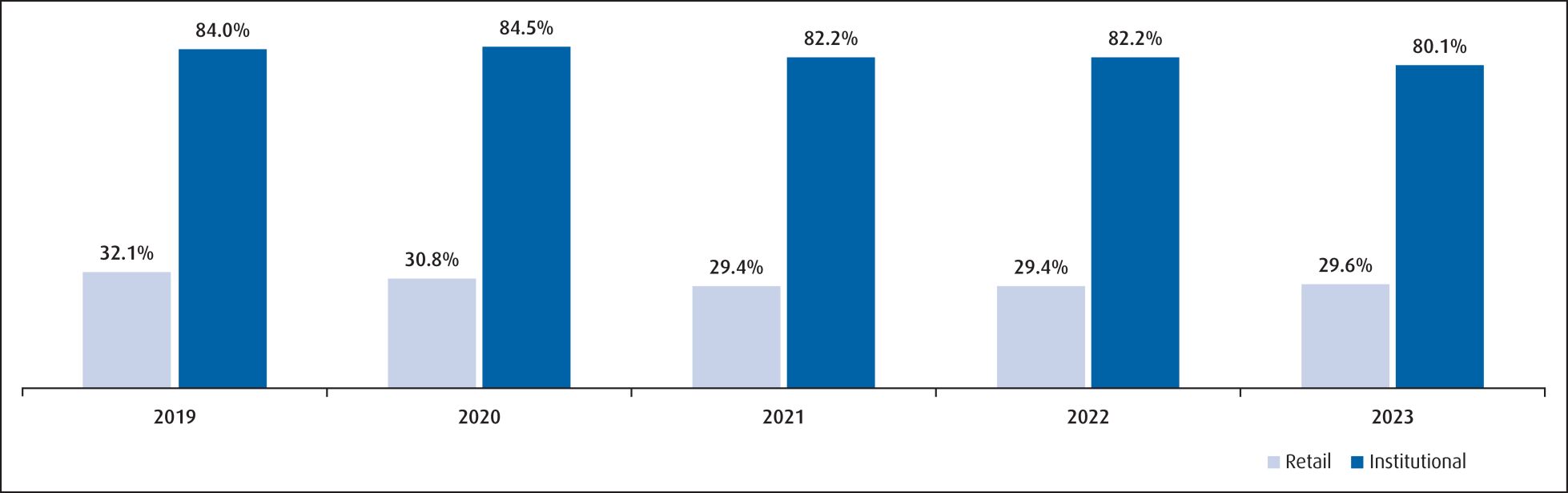
In 2025, Transat A.T. Inc. was forced to postpone its annual meeting due to a lack of quorum. Such incidents, when publicized2, create uncertainty in the market and concern among stakeholders. Several TSX-V mining companies face similar challenges.
By strengthening the participation of small shareholders, the Bank will reinforce its democratic legitimacy, enhance the quality of its dialogue with all security holders, and demonstrate its leadership in modern and inclusive corporate governance.
BMO’s Response
THE BOARD OF DIRECTORS RECOMMENDS THAT SHAREHOLDERS VOTE AGAINST THIS PROPOSAL BECAUSE BMO ALREADY HAS ROBUST PRACTICES TO FACILITATE SHAREHOLDER PARTICIPATION AND INFORMED VOTING AND CONTINUES TO MONITOR EVOLVING PRACTICES TO IDENTIFY OPPORTUNITIES TO ENHANCE SHAREHOLDER PARTICIPATION AT ITS ANNUAL MEETINGS.
BMO provides clear, comprehensive, and accessible disclosure and has adopted strong practices to facilitate shareholder engagement and informed voting and continues to monitor evolving practices for opportunities to enhance shareholder participation at its annual meetings.
A significant proportion of the information called for in the proposal is either already provided by BMO through its various existing public disclosures and shareholder communications or is not necessary to facilitate more effective shareholder engagement or decision-relevant voting information at BMO’s annual meetings. Participation at BMO’s annual meetings continues to be strong, and increased from 49.44% of votes represented in 2019 to 51.4% of votes represented at its last annual meeting in 2025. This level of engagement reflects the effectiveness of BMO’s existing practices.
BMO has a long-standing practice of engaging a third-party proxy solicitor to provide a resource to shareholders with questions about the meeting or voting processes, to provide shareholders with reminders regarding voting timelines, and to facilitate increased shareholder engagement and participation at these meetings. In recent years, BMO has adopted a “hybrid” meeting format that
facilitates participation by shareholders both in person and through the virtual online meeting platform with a view to facilitating increased shareholder participation regardless of location or technology familiarity. BMO also provides clear, comprehensive, and accessible disclosure with tables and graphs outlining the meeting agenda, matters to be voted on, and step-by-step instructions on how to vote in advance or participate live at the meeting. Each year, in accordance with applicable securities laws, BMO provides a report on the voting results at the meeting, including the number and percentage of shares that voted for and against, or withheld from each matter considered by shareholders at the meeting.
BMO collaborates with its meeting service providers and professional advisors to remain informed about evolving practices and developments in technology, including virtual meeting platforms, that may further enhance shareholder participation.
Beyond the annual meeting, BMO engages with shareholders throughout the year on matters relevant to them and provides information to shareholders in a range of accessible formats. In addition to taking proactive steps to facilitate robust shareholder participation at its annual meetings of shareholders, these engagements occur through BMO’s disclosures, including its proxy circular, annual report, sustainability reporting and management’s discussion and analysis, together with meetings with shareholders, investor days and earnings calls.
| 1 | https://www.broadridge.com/_assets/pdf/broadridge-proxypulse-2023-proxy-season-review.pdf |
| 2 | https://ici.radio-canada.ca/nouvelle/2161434/assemblee-transat-interrompue-quorum-insuffisant |
| Bank of Montreal Management Proxy Circular 2026 | 93 |
Given BMO’s strong track record of shareholder engagement, comprehensive disclosure practices, and commitment to continuous improvement, the Board believes this proposal is unnecessary.
For each of these reasons, the board recommends a vote AGAINST this proposal.
Proposal No. 2 (MÉDAC)
Inclusion of Young People in the Bank’s Governance Bodies
Be it proposed that the Bank’s Board of Directors develop and publish, by the 2026 Annual Meeting, a plan to increase the representation of young people (aged 35 and under) within its governance bodies.
Supporting statement
This plan will include, in particular:
| • | Measurable targets for youth representation on the Board and its advisory committees; |
| • | Concrete mechanisms to identify, recruit, and support candidates; |
| • | An annual report on progress achieved and actions taken. |
In a global environment marked by rapid transformations and complex challenges — whether economic, social or environmental — the ability of financial institutions to anticipate and adapt increasingly depends on the diversity and complementarity of the voices participating in decision-making.
Yet young people remain significantly underrepresented across major Canadian corporations, including in the banking sector. This underrepresentation constitutes not only an equity issue but also a strategic weakness.
Young individuals, through their proximity to emerging economic, technological, and social realities, bring a nuanced understanding of evolving expectations, particularly in areas such as sustainable finance, digital innovation, and social transformation. Their participation in corporate governance can enrich strategic discussions and help anticipate shifts in behaviors, markets, and risks.
Numerous studies demonstrate that diversity within governance bodies enhances not only performance and innovation capacity but also strengthens resilience in times of crisis and improves credibility with stakeholders.
By adopting a structured and transparent plan to foster the inclusion of young people in its governance, the Bank would signal its commitment to building a more representative institution, one grounded in contemporary realities and better prepared for the challenges of tomorrow.
BMO’s Response
THE BOARD OF DIRECTORS RECOMMENDS THAT SHAREHOLDERS VOTE AGAINST THIS PROPOSAL BECAUSE THE BOARD HAS ESTABLISHED SYSTEMS TO HELP IT ASSESS AND IDENTIFY THE APPROPRIATE MIX OF SKILLS AND EXPERIENCES REQUIRED OF DIRECTORS AND THAT SPECIFIC AGE-BASED TARGETS WOULD BE INAPPROPRIATE AND UNDULY RESTRICTIVE.
As part of BMO’s commitment to robust governance, the board positions itself to be made up of highly qualified directors who have the skills, experience, and expertise the board has determined are necessary to fulfil the board’s oversight function. BMO does not believe that establishing age-based targets of the type proposed is appropriate or necessary for the board to provide effective oversight or for BMO to achieve its business objectives.
This is because BMO maintains a comprehensive Board skills matrix and Board Diversity Policy, which each help to guide the board’s consideration of potential nominees for election as directors. In making these determinations, the board considers a range of factors, including age and relevant expertise. These policies are subject to regular review and updated as needed to ensure they remain effective and aligned with best practices.
In addition, BMO is focused on regular board renewal as a means of helping to ensure that the board continues to be infused with the new skills and perspectives provided by new directors. This is evidenced by the director term limits and retirement ages described on page 32 of this Circular. Six of BMO’s current directors have served for five years or less.
BMO also benefits from and leverages the skills and experiences of individuals throughout the organization to achieve its outcomes, including through its “GenBMO” employee resource group, which is focused on generational diversity within BMO, and through the service of certain high-potential individuals on the boards of directors of BMO’s subsidiaries to provide another avenue for their skills and experiences to contribute to BMO’s broader corporate governance framework and business outcomes.
At BMO, we are committed to developing our employees through a wide range of learning programs and resources that build skills, support career growth, and help colleagues achieve their goals at every stage of their career. Through our “Career Development @ BMO” site, colleagues at all levels have access to personalized tools and resources to support learning, connections and
| 94 | Bank of Montreal Management Proxy Circular 2026 |
experiences. Examples of resources include development templates for creating measurable goals, a digital connection platform for networking and mentorship, and learning platforms that provide access to videos, books, and courses to support skill-building. In 2024, over 1.8 million hours of learning were completed by BMO
employees. BMO also offers a tuition reimbursement program which supports role-related learning and certifications that aligns with business goals.
For each of these reasons, the board recommends a vote AGAINST this proposal.
Proposal No. 3 (MÉDAC)
Responsible, Performance-Aligned Executive Compensation Policy
Be it proposed that the Bank adopt a more responsible compensation policy aligned with the Bank’s overall performance.
Supporting statement
In a context where wage moderation is expected across all sectors, it is essential that executive compensation reflects not only the company’s actual performance but also the broader economic and social environment. To strengthen the legitimacy of compensation decisions and maintain stakeholder trust, it is proposed that the Board adopt, by the next annual meeting, a policy of moderation and responsibility governing executive pay.
This policy should include the following elements:
| 1. | Alignment with Performance and Internal Equity |
| 2. | The growth in total compensation for senior executives (base salary, bonuses, long-term incentives) should follow clear and comparable benchmarks, notably: |
| • | the year-over-year increase in the Bank’s adjusted net income; |
| • | the median employee salary growth; |
| • | the evolution of dividends paid per share. |
This alignment ensures that executive recognition to the organization’s actual performance and to employees’ lived experience.
| 3. | Temporary Cap During Economic Pressure |
| • | During periods of significant inflation, housing crises, or stagnation in real-economy incomes, the Bank should consider implementing a temporary cap on annual executive compensation increases (e.g., 3% to 5%, except in clearly justified exceptional cases). |
| 4. | Enhanced Transparency in Public Reports |
| 5. | The annual compensation report should explicitly compare: |
| • | the evolution of executive compensation; |
| • | the median employee wage growth; |
| • | financial and non-financial performance indicators. |
Adopting such a policy would promote responsible governance, ensure equitable value sharing, and prevent tensions linked to excessive pay gaps. It would also signal rigor, transparency, and commitment to sustainable performance.
BMO’s Response
THE BOARD OF DIRECTORS RECOMMENDS THAT SHAREHOLDERS VOTE AGAINST THIS PROPOSAL BECAUSE BMO HAS A LONG-STANDING COMMITMENT TO COMPENSATION PAY THAT ALIGNS WITH PERFORMANCE THAT RECEIVES CONSISTENTLY STRONG SUPPORT FROM SHAREHOLDERS EACH YEAR IN BMO’S ADVISORY “SAY ON PAY” VOTE (96.28% FOR IN 2025).
The board notes that this proposal would not enhance BMO’s existing management of executive compensation. The proposed elements are either already addressed by current program designs, governance processes, and/or disclosures, or they are so misaligned with competitive market practices that they may not be in BMO’s best interest and could jeopardize its ability to competitively attract and retain key talent, a core principle of BMO’s executive compensation program.
BMO’s executive compensation program is overseen by the Board’s Human Resources Committee and is designed to attract and retain executive talent, has strong links between executive compensation pay levels and bank performance, encourages executives to take a long-term view to increase shareholder value, and aligns with measured and prudent risk-taking. The Human Resources Committee, whose responsibilities include making sure that the policies and practices of this program support BMO’s strategic priorities as determined by the board and BMO management, while also appropriately managing risks associated with those programs and their outcomes, oversees the program.
The success of BMO’s overall compensation philosophy is reflected in the strong correlation between compensation levels and BMO’s overall shareholder performance (see page 65) and historically
| Bank of Montreal Management Proxy Circular 2026 | 95 |
strong shareholder support for BMO’s advisory “say on pay” vote, averaging 95.19% over the past five years. Compensation for individual executive officers is tied to Bank and operating segment performance against challenging goals that are set at the beginning of each year by the Human Resources Committee.
A substantial portion of BMO’s executive officer compensation is not paid in cash but is instead paid as deferred compensation, awards of which are tied directly to the performance of BMO’s common shares. This practice already aligns the interest of BMO’s senior executives with those of its shareholders, linking executive compensation directly to sustained, long-term shareholder growth. We believe that, overall, this approach promotes a strong pay for performance culture, and aligns well with both prudent, measured risk-taking and the potential impacts of macroeconomic factors on business performance and shareholder experience.
Finally, BMO provides clear and detailed disclosure of its executive compensation policies and practices each year in its information circular (see pages 40 to 88), including the role of the Human Resources Committee in providing effective oversight to executive
compensation decision-making processes. It is committed to fair and competitive total rewards for all of BMO’s employees. This includes ensuring employee rewards and practices are competitive and equitable through participation in various compensation benchmarking activities with other financial institutions of comparable size and scope, which helps us make informed decisions and continue to attract and retain talented employees. As part of those practices, we disclose that the Committee reviews the ratio of compensation for our CEO against the compensation of other employees of the bank and to the Canadian median family income. BMO also discloses in its annual reports and proxy circulars the information from which any interested shareholder can calculate the ratio of CEO pay to that of the average compensation of our full-time equivalent employees. We provide these disclosures because we have spoken to shareholders, understand that it is important to them, and are committed to meeting their interests.
For each of these reasons, the board recommends a vote AGAINST this proposal.
| 96 | Bank of Montreal Management Proxy Circular 2026 |
Proposal No. 4 (MÉDAC)
Strategic Diversification of Skills on the Board of Directors
Be it proposed that the Board of Directors adopt a new policy on the diversification of competencies adapted to current and emerging challenges.
Supporting statement
This policy would include, in particular:
| 1. | A review of the Board’s skills matrix to explicitly include key areas such as: |
| • | Climate and sustainability; |
| • | Social and racial equity; |
| • | Relations with Indigenous peoples; |
| • | Artificial intelligence ethics; |
| • | Community impact and responsible investment. |
| 2. | A commitment to actively consider candidates from non-traditional backgrounds, including community, academic, Indigenous, or technological environments, provided they bring relevant strategic or social expertise. |
| 3. | The annual publication, in the management proxy circular, of a transparent report on the diversity of expertise represented on the Board and the progress made in this regard. |
Financial institution Boards of Directors now operate in an environment where governance issues are becoming increasingly
complex. Questions related to technology, climate risk, social equity, Indigenous rights, and business ethics require diversified and up-to-date expertise.
Demographic diversity alone, though essential, is insufficient. It is imperative to broaden the range of skills represented on the Board to ensure:
| • | Higher-quality strategic deliberations and decisions; |
| • | Better anticipation of emerging risks; |
| • | Enhanced social legitimacy and organizational credibility; |
| • | An ability to meet increasing expectations from investors and society. |
Actively integrating individuals from non-traditional backgrounds, particularly from community, Indigenous, academic, or technological environments, enriches collective reflection and positions the organization more effectively to address present and future challenges.
Finally, transparent disclosure regarding the diversity of expertise contributes to accountability and stakeholder trust.
BMO’s Response
THE BOARD OF DIRECTORS RECOMMENDS THAT SHAREHOLDERS VOTE AGAINST THIS PROPOSAL BECAUSE THE BOARD ALREADY CONSIDERS THE SKILLS AND QUALIFICATIONS THAT ARE MOST CRITICAL FOR BMO’s BOARD TO ACHIEVE ITS OBJECTIVES AND IT HAS ESTABLISHED A SKILLS MATRIX AND DIVERISTY POLICY TO PROVIDE A FRAMEWORK FOR ASSESSING REQUIRED SKILLS AND QUALIFICATIONS ON AN ONGOING BASIS.
BMO has an established framework for establishing, reviewing, and updating the skills, qualifications, experience, and perspectives that the Board has determined are the most relevant for the Board to provide the effective oversight and governance required for BMO to achieve its objectives. This framework includes the Board’s skills matrix and Diversity Policy, which are reviewed annually and updated as required to help support their alignment with the current and anticipated needs of BMO and the Board over time.
BMO includes disclosure regarding its skills matrix and Diversity Policy in its proxy circular each year, together with detailed biographies of each director nominee, in order to allow
shareholders to identify and understand how the director nominees collectively possess these skills, qualifications, experiences, and perspectives. The current skills matrix described on page 27 of this Circular and Diversity Policy already address many of the areas identified in the proposal, including those relating to environmental matters (including sustainable development practices and those related to climate), social matters, technology and information security, risk oversight, and strategic planning.
BMO believes that its current framework provides for the identification of directors who each possess an appropriate mix of these skills, qualifications, experiences, and perspectives, and that promotes effective contributions by directors to the board and enables them to provide effective oversight and governance of BMO.
For each of these reasons, the board recommends a vote AGAINST this proposal.
| Bank of Montreal Management Proxy Circular 2026 | 97 |
Proposal No. 5 (MÉDAC)
Formal Recognition of the Board of Directors’ Systemic Role
Be it proposed that the Board of Directors establish a permanent advisory committee on the systemic impact of the Bank’s decisions.
Supporting statement
The mandate of this committee would include, among other things:
| 1. | Analyzing the systemic impacts of the Bank’s strategic decisions on: |
| • | Economic inequalities; |
| • | Access to housing; |
| • | Climate and energy transition; |
| • | Social and territorial stability; |
| • | Human rights. |
| 2. | Formulating recommendations aimed at reducing negative externalities and strengthening the positive societal effects associated with the Bank’s financing, investment, and risk management activities. |
| 3. | Publishing an annual systemic impact report, annexed to the ESG report, presented to shareholders and the public, including concrete and measurable indicators. |
Financial institutions exert a decisive influence on the economy, the social fabric, and the environment. Through their financing, investment, and risk management decisions, they directly help to shape critical issues such as access to housing, inequality reduction, climate transition, and social stability.
Major banks, in particular, are called upon to assume this systemic responsibility, in a context where expectations from shareholders, stakeholders, and regulators regarding responsible governance are increasing.
Formally recognizing this systemic role means embedding the Bank’s governance within a modern, proactive approach aligned with the public interest. This enables the Bank to:
| • | Anticipate reputational and operational risks linked to negative externalities; |
| • | Strengthen the Bank’s long-term resilience; |
| • | Address growing societal concerns in a structured manner; |
| • | Demonstrate credible leadership in responsible corporate finance. |
The creation of an advisory committee on the systemic impact of the Bank’s decisions would provide the Board with an independent and rigorous framework for analyzing such issues, formulating concrete recommendations, and ensuring transparent oversight. The systemic impact report, integrated within the ESG report, would strengthen accountability and offer shareholders a clear view of progress achieved.
BMO’s Response
THE BOARD OF DIRECTORS RECOMMENDS THAT SHAREHOLDERS VOTE AGAINST THIS PROPOSAL BECAUSE, BMO HAS AN ESTABLISHED FRAMEWORK THAT SUPPORTS THE APPROPRIATE CONSIDERATION OF STAKEHOLDER INTERESTS IN THE BOARD’S DECISION-MAKING PROCESSES AND IT MAKES SIGNIFICANT CONTRIBUTIONS TO THE COMMUNITIES IN WHICH IT OPERATES.
BMO understands the role that it plays in serving its customers, the economy and in the communities where we do business. BMO’s established practices and processes, including risk management frameworks, reporting to the Board, and ongoing engagement, are designed such that stakeholder perspectives are appropriately integrated into the board’s decision-making and oversight.
Stakeholders include BMO’s customers, employees, and the communities in which BMO operates. These practices and processes have been developed having regard to the legal duties and obligations of BMO’s directors and management with respect to the matters that they may appropriately consider in making decisions relating to BMO and its business. BMO believes that these practices and processes result in an appropriate consideration of the interests of its stakeholders by the board in the exercise of its fiduciary duties in considering the best interests of BMO, including with respect to BMO’s long-term success.
For each of these reasons, the board recommends a vote AGAINST this proposal.
| 98 | Bank of Montreal Management Proxy Circular 2026 |
Proposal No. 6 (MÉDAC)
Oversight of Artificial Intelligence to Preserve the Human Dimension
Be it proposed that the Bank produce a report on the use of artificial intelligence (AI) as it relates to decision-making within senior management, risk assessment, and credit underwriting.
Supporting statement
Artificial intelligence is rapidly transforming the financial sector, particularly in risk analysis, credit automation, fraud detection, and product recommendations. This shift, however, brings new risks that have been widely identified in research and international policy frameworks.
The International Monetary Fund (IMF), in a report published in August 2023 (Generative AI in Financial Services: Risks and Policy Considerations)3, warned against:
“algorithmic biases, privacy breaches, threats to financial stability, and governance risks resulting from the unregulated use of AI.” This is a translation; I could not find the actual quote in the article.
Similarly, several renowned experts, including Yoshua Bengio, Turing Award laureate and a leading figure in AI research, have publicly voiced growing concern over the lack of effective safeguards. In a Les Affaires interview (May 2023), Bengio stated:
“(Translation) The urgency to act is real. Powerful AI systems are already capable of manipulation or deception.”
These warnings have led to the adoption or study of regulatory frameworks in several countries. Federally, Bill C-274 — the Digital Charter Implementation Act — currently before the Senate, proposes the creation of a specific legal framework for high-impact AI, imposing new obligations on companies using AI, including banks.
In this evolving regulatory and technological context, it is in the Bank’s interest to:
| • | Demonstrate responsibility and transparency; |
| • | Prevent legal, reputational, and systemic risks; |
| • | Position itself as a prudent and ethical leader in AI adoption. |
The proactive publication of a structured report on the use of AI would enable shareholders to exercise informed oversight and allow the Bank to strengthen governance practices worthy of public and regulatory trust.
This report should address measures taken by the Bank to:
| • | Promote transparency regarding how, why, and when artificial intelligence is used; |
| • | Evaluate the outcomes of AI systems, including generative tools, to minimize bias and inaccuracies and to allow users to distinguish AI outputs from human judgment; |
| • | Train permanent or contractual employees who develop or use AI so that they understand legal, ethical, and operational issues, including privacy, security, and bias, and can adopt AI systems responsibly. |
This proposal received support from 8.46% of votes at the last Annual General Meeting.
BMO’s Response
THE BOARD OF DIRECTORS RECOMMENDS THAT SHAREHOLDERS VOTE AGAINST THIS PROPOSAL BECAUSE AS A FEDERALLY REGULATED FINANCIAL INSTITUTION, BMO HAS ESTABLISHED RISK MANAGEMENT PRACTICES TO GOVERN THE ETHICAL AND RESPONSIBLE DEPLOYMENT OF AI THAT IS CONSISTENT WITH REGULATORY GUIDELINES, AND INDUSTRY STANDARD FRAMEWORKS.
The advancement of AI provides opportunities for improving efficiency and providing better service to our customers. BMO understands that it also presents risks in how it is used and managed. BMO’s approach to managing these risks includes a recently updated AI Risk Directive, which sets out enterprise-wide requirements for the management of AI risk aligned to our risk appetite, and a Responsible AI Forum where a cross-section of experts review AI before it can be used, whether developed internally or procured through a third party. This review considers potential risks and adverse impacts, such as unfair or biased output
from AI systems, as well as measures to mitigate and monitor such risks.
Our commitment to AI risk management practices is described in our Annual Report, as well as reflected in BMO’s Supplier Code of Conduct, BMO’s commitment to evolving AI literacy across the Bank through our AI for All training, BMO’s Responsible AI Principles, as well as BMO’s Sustainability Report. In addition, BMO actively works with the wider industry on the topic of responsible and ethical use of AI. BMO’s engagement is inclusive of academic and industry partners such as the Vector Institute, the Fintech Open Source Foundation (FINOS), Canadian Bankers Association, and Bank Policy Institute, and positions the Bank to be a leader in prudent and ethical AI adoption. Through these engagements, our approach to the responsible use of AI continues to evolve as we adapt to industry changes, regulatory developments, and customer needs in the jurisdictions in which we operate.
| 3 |
https://www.imf.org/en/Publications/fintech-notes/Issues/2023/08/18/Generative-Artificial-Intelligence-in-Finance-Risk-Considerations-537570 |
| 4 | https://www.parl.ca/LegisInfo/fr/projet-de-loi/44-1/C-27 |
| Bank of Montreal Management Proxy Circular 2026 | 99 |
BMO already provides disclosure relating to the use of AI in its business operations in its Annual Report, proxy circular, and sustainability reporting. The additional information related to decision-making within senior management, risk assessment, and credit underwriting - whether supported by AI or not- is not necessary for shareholders and other stakeholders to receive reporting on how AI is used in BMO’s business operations, BMO’s
commitment to the fair and responsible use of AI in serving our customers, and BMO’s compliance with applicable regulations in the jurisdictions in which we operate.
For each of these reasons, the board recommends a vote AGAINST this proposal.
Proposal No. 7 (MÉDAC)
Public Disclosure of Non-Confidential Information, Country-By-Country Reporting, Compensation Ratios and Tax Havens
Be it proposed that the Bank disclose to the general public, on an annual basis, the non confidential information relating to its Country-by-Country Reporting, for the purposes of detailed and meaningful calculations of compensation ratios, namely broken down by jurisdiction, and to contribute to combating tax havens, particularly as regards transparency.
Supporting statement
On several occasions over the years, the Bank received from MÉDAC – henceforth from Vancity – shareholder proposals requesting the calculation and disclosure of the compensation ratio. Despite the substantial number of votes supporting these proposals (xx% in 2023), the bank still refuses to disclose its overall compensation ratio, as has been mandatory for some time now in the United States and as many companies already do here in Canada.
Despite the fact that the compensation ratio should be published for all employees in accordance with (1) Global Reporting Initiative (GRI) standards, public disclosure of non-confidential data in the “Country by Country Reporting” – Action 13(2) of the OECD/G20 Inclusive Framework (3) on BEPS (base erosion and profit shifting (4)), an international initiative to which Canada is a signatory – would enable the calculation of significant compensation ratios so as to allow a better interpretation of the
overall compensation ratio by broadening the description of the context.
Moreover, disclosing these non-confidential data to the general public – as is the case in several other countries, notably in Europe – would be an exercise in transparency, goodwill and good faith that would directly contribute to efforts to combat tax evasion, tax avoidance, tax havens and other “complacent laws”.
According to the 2024 Edelman Trust Barometer5, 59% of Canadian respondents believe that business leaders deliberately attempt to mislead the public by disseminating information they know to be false or highly exaggerated. A marked mistrust of corporate and business leaders is evident.
For all these reasons, the Bank must publicly announce the nonconfidential data of its Country by Country Reporting each year.
This proposal received support from 8.91% of votes at the last Annual General Meeting.
BMO’s Response
THE BOARD OF DIRECTORS RECOMMENDS THAT SHAREHOLDERS VOTE AGAINST THIS PROPOSAL AGAIN THIS YEAR BECAUSE BMO ALREADY PROVIDES COUNTRY-BY-COUNTRY REPORTING AS REQUIRED TO TAX AUTHORITIES AND PUBLIC DISCLOSURE OF OUR FULL COUNTRY BY COUNTRY REPORT WOULD NOT PROVIDE CLARITY OR USEFUL INFORMATION FOR SHAREHOLDERS.
BMO provides detailed information regarding our income tax contributions and controls in accordance with applicable accounting standards as well as tax related information, including our applicable effective tax rate(s), in our annual and quarterly reports publicly filed with the Canadian Securities Administrators and the Securities and Exchange Commission. We disclose country-by-country information to tax authorities as required and will comply
with jurisdiction-specific public disclosure as may be required in certain jurisdictions where we operate (e.g., the EU and Australia), as we intend to fully comply with relevant tax laws and guidance in all jurisdictions in which we do business. Our tax compliance is informed by our Code of Conduct which requires BMO employees to act ethically and with respect for the law.
We believe that disclosure of country-by-country financial information would not provide clarity for shareholders as there are a number of differences between this information and BMO’s publicly filed consolidated financial statements, including differences in accounting standards.
Disclosure of our full country-by-country report would require providing additional data relating to legal entities that are
| 5 |
https://www.edelman.ca/sites/g/files/aatuss376/files/2024-03/2024%20Edelman%20Trust%20Barome-ter_Rapport_Canadien_EN_0.pdf |
| 100 | Bank of Montreal Management Proxy Circular 2026 |
consolidated in our financial statements, across multiple business groups and sectors and would not provide useful information to our shareholders.
With respect to the disclosure of compensation ratios, we are committed to transparency and to providing fair and competitive compensation to our employees. Sufficient information already
exists in our public disclosure for shareholders to assess our compensation practices. Please refer to our 2025 Annual Report and our 2025 sustainability reporting.
For each of these reasons, the board recommends a vote AGAINST this proposal.
Proposal No. 8 (MÉDAC)
Advisory Vote on Environmental Policies
Be it proposed that the Bank adopt an annual advisory voting policy regarding its environmental and climate objectives and action plan.
Supporting statement
According to the most recent Banking on Climate Chaos6 report, financing provided by Canada’s five largest banks to the fossil fuel industry reached nearly US$132 billion in 2024, distributed as follows: RBC: US$34.3 billion; Scotiabank: US$26.2 billion; Toronto-Dominion Bank: US$29.0 billion; Bank of Montreal: US$19.9 billion; and CIBC: US$22.3 billion.
The Bank continues to support the development of this type of energy. Shareholders play a key role in constructive dialogue between boards of directors and stakeholders. In this context, an advisory vote on environmental policy does not seek to impose specific objectives or undermine the competitiveness of the Canadian banking sector, but rather to:
| • | Strengthen governance and transparency by ensuring that the environmental strategy is regularly submitted to shareholder review; |
| • | Align the Bank’s practices with growing expectations from international institutional investors, who regard environmental and climate issues as major financial risks; |
| • | Reduce reputational risks by demonstrating the Bank’s responsiveness to environmental concerns while maintaining its contribution to the Canadian economy; |
| • | Promote a gradual and context-sensitive transition for North America, avoiding radical or adversarial approaches. |
It is important to note that this vote is:
| • | Advisory and non-binding, thereby respecting the Board’s governance structure; |
| • | An opportunity to express measured support without questioning fundamental strategic decisions or the Board’s independence; |
| • | A demonstration of good governance, reflecting the Bank’s commitment to listening to shareholders without adopting a political or ideological stance. |
Support for this proposal has grown in recent years but remains below a significant threshold. Reaching a level of 30% or higher would allow shareholders to:
| • | Send a clear yet balanced signal in favor of strengthened environmental governance; |
| • | Avoid the alternative of more intrusive regulatory or political intervention in the future; |
| • | Contribute to preserving the Bank’s credibility and social license, including in international markets. |
This proposal received 12.84% support at the last Annual General Meeting.
BMO’s Response
THE BOARD OF DIRECTORS RECOMMENDS THAT SHAREHOLDERS VOTE AGAINST THIS PROPOSAL AGAIN THIS YEAR BECAUSE BMO PROVIDES ROBUST AND REGULAR UPDATES ON ENVIRONMENTAL MATTERS, INCLUDING CLIMATE CHANGE, THROUGH ITS SUSTAINABILITY AND CLIMATE REPORTING. BMO IS COMMITTED TO EXTENSIVE SHAREHOLDER ENGAGEMENT ON ENVIRONMENTAL AND CLIMATE STRATEGY, WHICH IS SIGNIFICANTLY MORE USEFUL THAN A SIMPLE “UP OR DOWN” SHAREHOLDER VOTE.
Management and the board have taken concrete steps to develop and implement a credible multi-year climate strategy, in accordance with the guidelines and recommendations of OSFI Guideline B-15: Climate Risk Management, including the
development of a climate transition action plan. Extensive shareholder and stakeholder engagement and dialogue have helped to inform our strategy and actions taken to carry out that strategy.
We continue to work with stakeholders, including governments, banking and securities regulators, and shareholders. Through our engagement with shareholders, we receive meaningful feedback on the bank’s approach to climate, the climate information that is most useful to shareholders. This collaboration is reflected in the ongoing implementation and iteration of our climate strategy to ensure our actions reflect and respond to evolving stakeholder
| 6 | https://www.bankingonclimatechaos.org/?bank=JPMorgan%20Chase#fulldata-panel |
| Bank of Montreal Management Proxy Circular 2026 | 101 |
priorities. BMO believes that it is important to continue this engagement. Details regarding our Climate Ambition can be found in BMO’s Sustainability and Climate Report.
In light of the complexity and depth of our climate strategy, the evolving legal and regulatory environment, and the detailed disclosure that BMO provides and continues to enhance, BMO continues to believe that a simple “up or down” vote by shareholders would provide no meaningful information on whether BMO has identified the right climate-focused initiatives or whether any particular climate initiative is insufficient or excessive. In contrast, the information provided by shareholders through our
existing engagement practices provides meaningful input on investor priorities and perspectives.
Direct shareholder engagement has allowed investors to clearly communicate their views about BMO’s sustainability and climate strategy and will continue to do so. BMO welcomes these interactions and takes shareholder and stakeholder views into account when developing these strategies.
For each of these reasons, the board recommends a vote AGAINST this proposal.
| 102 | Bank of Montreal Management Proxy Circular 2026 |
Withdrawn Proposals
Following discussions with the Bank, the proposals listed below will not be submitted for a shareholder vote. The Bank has agreed to include these withdrawn proposals in the circular for informational purposes only. They do not form part of the formal business of the meeting.
InvestNow Inc. (InvestNow) on behalf of Gina Pappano, 7 Shannon Street, Toronto, O.N. M6J 2E6 has submitted the following proposal for your vote. It is not part of the formal business of the meeting.
Return to Viewpoint Neutrality and Fiduciary Duty
Submitted by InvestNow, a not-for-profit organization dedicated to challenging the divestment movement and advocating for investment in Canada’s oil and gas sector. This is submitted on behalf of Gina Pappano, Executive Director of InvestNow and a shareholder of the bank.
RESOLVED: That the Bank of Montreal (“BMO”) return to viewpoint neutrality in their business practices and put fiduciary duty to their shareholders first.
Supporting statement:
Banks are essential institutions for participating in modern life. Without a bank account it is difficult to play any part in our society. Banks therefore, must be truly inclusive institutions. And that means they should be held to a standard of strict viewpoint neutrality, looking after the interests of their clients in a nonpartisan, non-ideological way. So long as a bank’s clients are abiding by the law, banks should be open to all potentially profitable businesses for the good of the bank’s own shareholders and the health of the economy.
But over the past decade, maximizing financial returns to shareholders has increasingly taken a back seat to the pursuit of environmental, social, and ideological goals. Along with other fiduciaries like corporations, public pension plans, and university endowment funds, Canadian banks have placed ideological goals
like decarbonization, net-zero, and energy transition above the returns for shareholders.
Banks should not be ideological actors. To go down that road is to severely damage their institutional legitimacy. And allowing themselves to be pressured into investing or divesting based on political and other influences is, frankly, a betrayal of their responsibility to their shareholders.
One of the key differentiators of Canada’s banking model should be autonomy from political and other influence. For this reason, we are calling on BMO to return to viewpoint neutrality in their business practices and put traditional fiduciary duty towards their shareholders first.
BMO’s Response
The proponent has agreed to withdraw the proposal following constructive engagement with BMO. BMO is not pursuing a divestment strategy tied to climate goals for the oil and gas sector. BMO does not deny, restrict, or modify the terms of its products and services based on the environmental and social risk posed by a client’s lawful business activities and does not consider political or ideological factors in providing its products and services. BMO makes decisions about the terms of its products and services, and their provision to individual clients, based on an assessment of the specific risks and opportunities an individual client or transaction presents to BMO, in compliance with the laws and regulations of the jurisdictions where BMO operates.
As part of our climate strategy, we partner with oil and gas clients and identify tailored opportunities through our Client Transition
Opportunity Analysis. These partnerships are used to leverage current offerings and develop new products and services that help clients seeking to reduce their GHG emissions. We also support clients in oil and gas with custom solutions to achieve their climate objectives.
The Bank’s approach to the integration of BMO’s climate strategy reflects commercial, risk management, and regulatory considerations. These strategies and approaches are reported on extensively in our Sustainability and Climate Report. Our quarterly and annual public disclosure provides shareholders and others with a fulsome quantitative and qualitative discussion of our financial performance, which includes the impacts of all our strategies, including those relating to climate.
| Bank of Montreal Management Proxy Circular 2026 | 103 |
Withdrawn Proposal
Mr. John Robert Verdun of 212 William St, Stratford, Ontario, N5A 4Y3, submitted a proposal with respect to proposed potential enhancements to the operation of BMO’s margin accounts, which has been withdrawn. It is not part of the formal business of the meeting.
BMO’s Response
The proponent agreed to withdraw the proposal following constructive engagement with BMO as BMO has recently implemented and plans to implement further client experience enhancements relating to margin account notifications and other
margin account features. BMO agreed to include reference to Mr. Verdun’s withdrawn proposal in the circular for informational purposes only. It is not part of the formal business of the meeting.
Withdrawn Proposal
Æquo Shareholder Engagement Services, on behalf of Gestion FÉRIQUE, régime de retraite des membres de la CSN, 2175 De Maisonneuve Blvd. East, suite 203, Montréal, H2K4S3 has submitted the following proposal which has been withdrawn. It is not part of the formal business of the meeting.
RESOLVED: Shareholders request that BMO disclose: 1) the criteria used to assess client’s transition readiness, 2) a summary of the results of this assessment by sector and 3) examples of actions
taken to engage with clients that have not yet adopted climate transition plans. This disclosure should omit confidential information and be prepared at reasonable cost.
Excerpts from the supporting statement:
Credible transition plans are a strategic tool that can help businesses improve their preparedness for climate disruption and, as a result, improve their long-term competitiveness. In 2024, BMO introduced a Client Transition Action Readiness Assessment to guide engagement with clients in their transition planning. Each client is assigned a category indicating their readiness for the climate transition – early, moderate or advanced – based on the
maturity of the climate-related practices, transparency, disclosures, planning and climate-risk awareness. BMO discloses general information on components of the assessment (BMO 2023 Climate Report) but provides limited disclosure of the criteria to assign plans to each category. Peers such as RBC, Scotia and TD provide such disclosure, allowing investors to have a sense of the methodology used to assess transition plans.
BMO’s Response
BMO has implemented a Client Transition Opportunity Analysis for select clients so that we may better understand our clients’ transition planning efforts, in order to tailor support to their unique needs. This tool is used to identify opportunities for BMO to better support existing clients and is not used to make decisions to bank or not bank clients. BMO has disclosed information about this
approach in our 2024 and 2025 sustainability and climate reporting and will, subject to privacy, data and/or legal constraints, consider disclosing further details on the criteria used in this analysis. In 2026, BMO will continue to engage shareholders on this topic and seek to identify opportunities to engage with clients on climate transition readiness.
| 104 | Bank of Montreal Management Proxy Circular 2026 |
Caution Regarding Forward-Looking Statements
Bank of Montreal’s public communications often include written or oral forward-looking statements. Statements of this type are included in this document, and may be included in other filings with Canadian securities regulators or the U.S. Securities and Exchange Commission, or in other communications. All such statements are made pursuant to the “safe harbor” provisions of, and are intended to be forward-looking statements under, the United States Private Securities Litigation Reform Act of 1995 and any applicable Canadian securities legislation. Forward-looking statements in this document may include, but are not limited to, statements with respect to the expected timing and business of the annual meeting of shareholders, the bank’s approach to compensation, statements made in our responses to shareholder proposals, our objectives and priorities for fiscal 2026 and beyond, our strategies or future actions, our targets and commitments (including with respect to net zero emissions), expectations for our financial condition, capital position, the regulatory environment in which we operate, the results of, or outlook for, our operations or the Canadian, U.S. and international economies, and include statements made by our management. Forward-looking statements are typically identified by words such as “will”, “would”, “should”, “believe”, “expect”, “anticipate”, “project”, “intend”, “estimate”, “plan”, “goal”, “commit”, “target”, “may”, “might”, “schedule”, “forecast”, “outlook”, “timeline”, “suggest”, “seek” and “could” or negative or grammatical variations thereof.
By their nature, forward-looking statements require us to make assumptions and are subject to inherent risks and uncertainties, both general and specific in nature. There is significant risk that predictions, forecasts, conclusions or projections will not prove to be accurate, that our assumptions may not be correct, and that actual results may differ materially from such predictions, forecasts, conclusions or projections. We caution readers of this document not to place undue reliance on our forward-looking statements, as a number of factors – many of which are beyond our control and the effects of which can be difficult to predict – could cause actual future results, conditions, actions or events to differ materially from the targets, expectations, estimates or intentions expressed in the forward-looking statements.
The future outcomes that relate to forward-looking statements may be influenced by many factors, including, but not limited to: general economic and market conditions in the countries in which we operate, including labour challenges and changes in foreign exchange and interest rates; political conditions, including changes relating to, or affecting, economic or trade matters, including tariffs, countermeasures and tariff mitigation policies; changes to our credit ratings; cyber and information security, including the threat of data breaches, hacking, identity theft and corporate espionage, as well as the possibility of denial of service resulting from efforts targeted at causing system failure and service disruption; technology resilience, innovation and competition; failure of third parties to comply with their obligations to us; disruptions of global supply chains; environmental and social risk, including climate change; the Canadian housing market and consumer leverage; inflationary pressures; changes in laws, including tax legislation and interpretation, or in supervisory
expectations or requirements, including capital, interest rate and liquidity requirements and guidance, including if the bank were designated a global systemically important bank, and the effect of such changes on funding costs and capital requirements; changes in monetary, fiscal or economic policy; weak, volatile or illiquid capital or credit markets; the level of competition in the geographic and business areas in which we operate; exposure to, and the resolution of, significant litigation or regulatory matters, our ability to successfully appeal adverse outcomes of such matters and the timing, determination and recovery of amounts related to such matters; the accuracy and completeness of the information we obtain with respect to our customers and counterparties; our ability to successfully execute our strategic plans, complete acquisitions or dispositions and integrate acquisitions, including obtaining regulatory approvals, and realize any anticipated benefits from such plans and transactions; critical accounting estimates and judgments, and the effects of changes in accounting standards, rules and interpretations on these estimates; operational and infrastructure risks, including with respect to reliance on third parties; global capital markets activities; the evolution of our lending portfolios over time; the need for active and continued participation of domestic and international stakeholders (including enterprises, financial institutions and governmental and non-governmental organizations); the development and deployment of new technologies and industry-specific solutions; the evolution of customer behaviour; the challenges of balancing emission reduction targets with an orderly and inclusive transition and geopolitical factors that impact global energy needs; the emergence or continuation of widespread health emergencies or pandemics, and their impact on local, national or international economies, as well as their heightening of certain risks that may affect our future results; the possible effects on our business of war or terrorist activities; natural disasters, such as earthquakes or flooding, and disruptions to public infrastructure, such as transportation, communications, power or water supply; and our ability to anticipate and effectively manage risks arising from all of the foregoing factors.
We caution that the foregoing list is not exhaustive of all possible factors. Other factors and risks could adversely affect our results. For further information, please refer to the discussion in the Risks That May Affect Future Results section, and the sections related to credit and counterparty, market, liquidity and funding, operational non-financial, legal and regulatory compliance, strategic, environmental and social, and reputation risk in the Enterprise-Wide Risk Management section of the 2025 Annual MD&A, as may be updated by quarterly reports, all of which outline certain key factors and risks that may affect our future results. Investors and others should carefully consider these factors and risks, as well as other uncertainties and potential events, and the inherent uncertainty of forward-looking statements. We do not undertake to update any forward-looking statements, whether written or oral, that may be made from time to time by the organization or on its behalf, except as required by law. The forward-looking information contained or incorporated by reference in this document is presented for the purpose of assisting shareholders and analysts in understanding our financial position as at and for the periods
| Bank of Montreal Management Proxy Circular 2026 | 105 |
ended on the dates presented, as well as our strategic priorities and objectives, and may not be appropriate for other purposes.
Material economic assumptions underlying the forward-looking statements contained or incorporated by reference in this document include those set out in the Economic Developments and Outlook section of the 2025 Annual MD&A as well as in the Allowance for Credit Losses section of the 2025 Annual MD&A, each as may be updated by quarterly reports. Assumptions about the
performance of the Canadian and U.S. economies, as well as overall market conditions and their combined effect on our business, are material factors we consider when determining our strategic priorities, objectives and expectations for our business. In determining our expectations for economic growth, we primarily consider historical economic data, past relationships between economic and financial variables, changes in government policies, and the risks to the domestic and global economy.
| 106 | Bank of Montreal Management Proxy Circular 2026 |

Your vote matters. See page 5 for detailed information about who can vote, and how to vote. We encourage you to vote right away. BMO MIX Paper | Supporting responsible forestry FSC C132107 FSC www.fsc.org