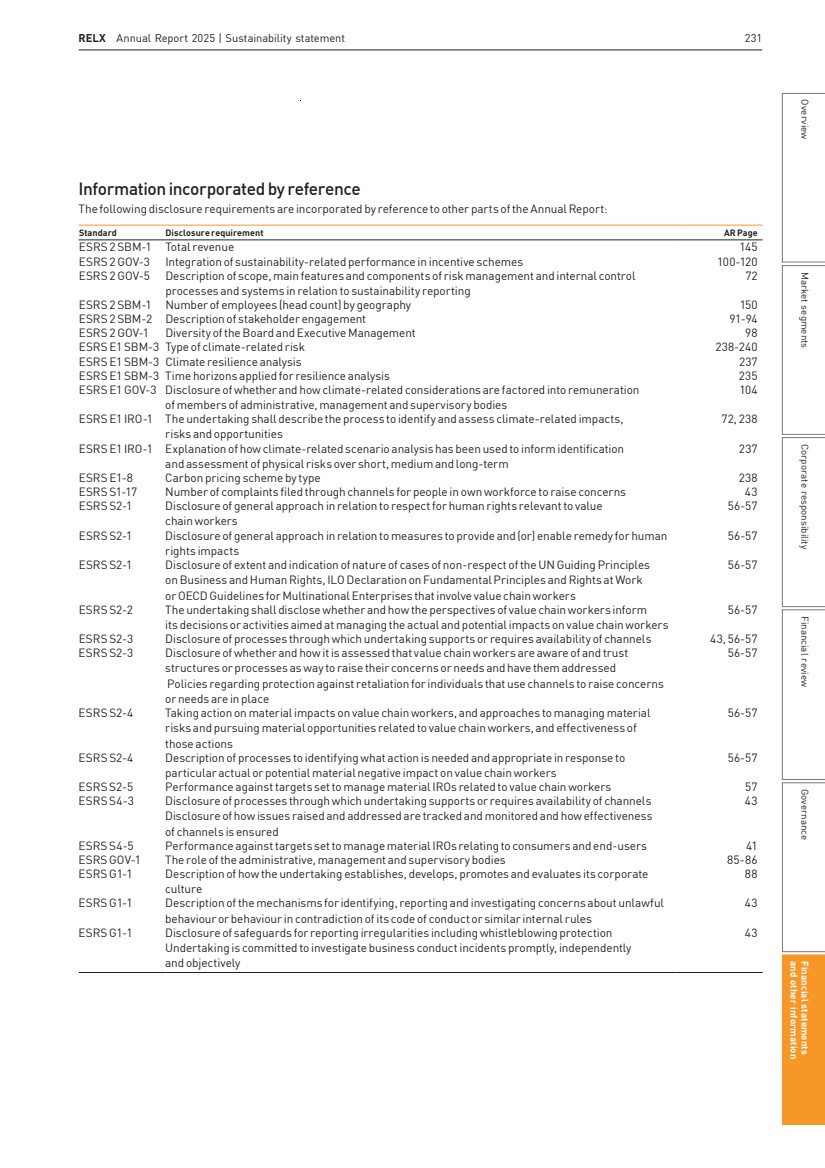
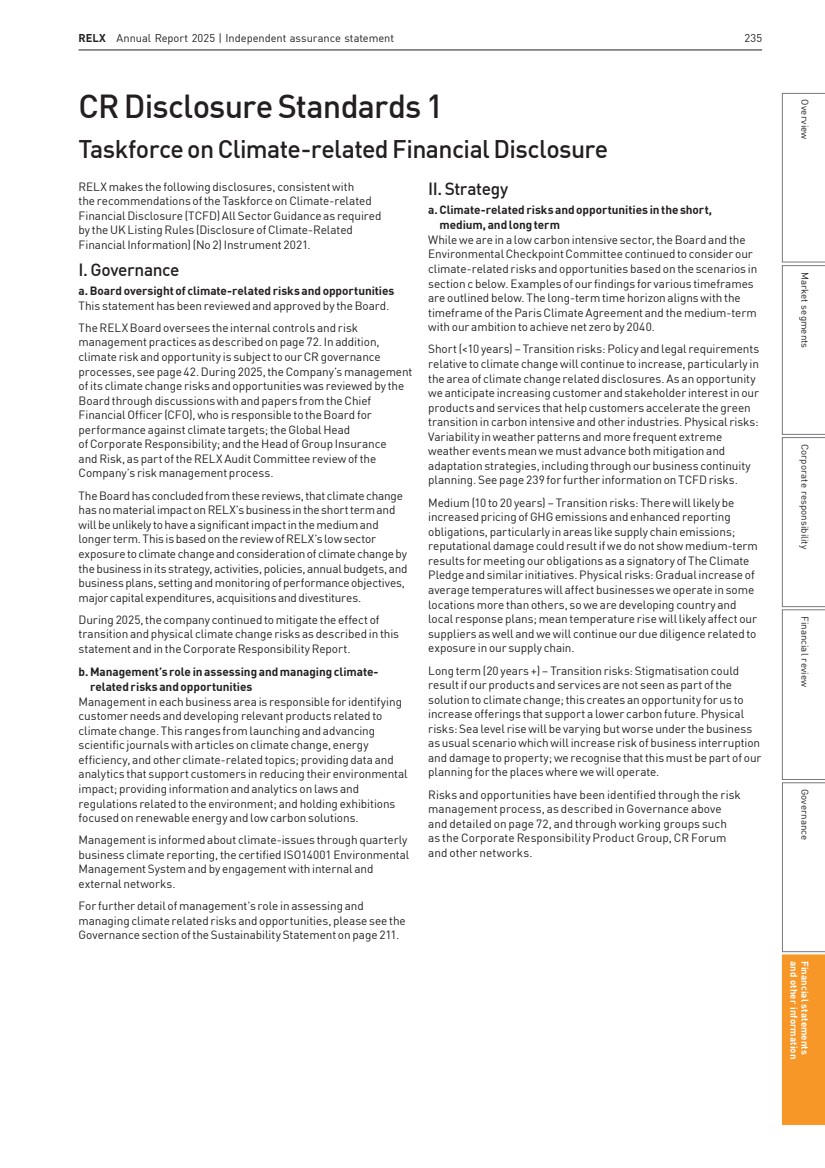
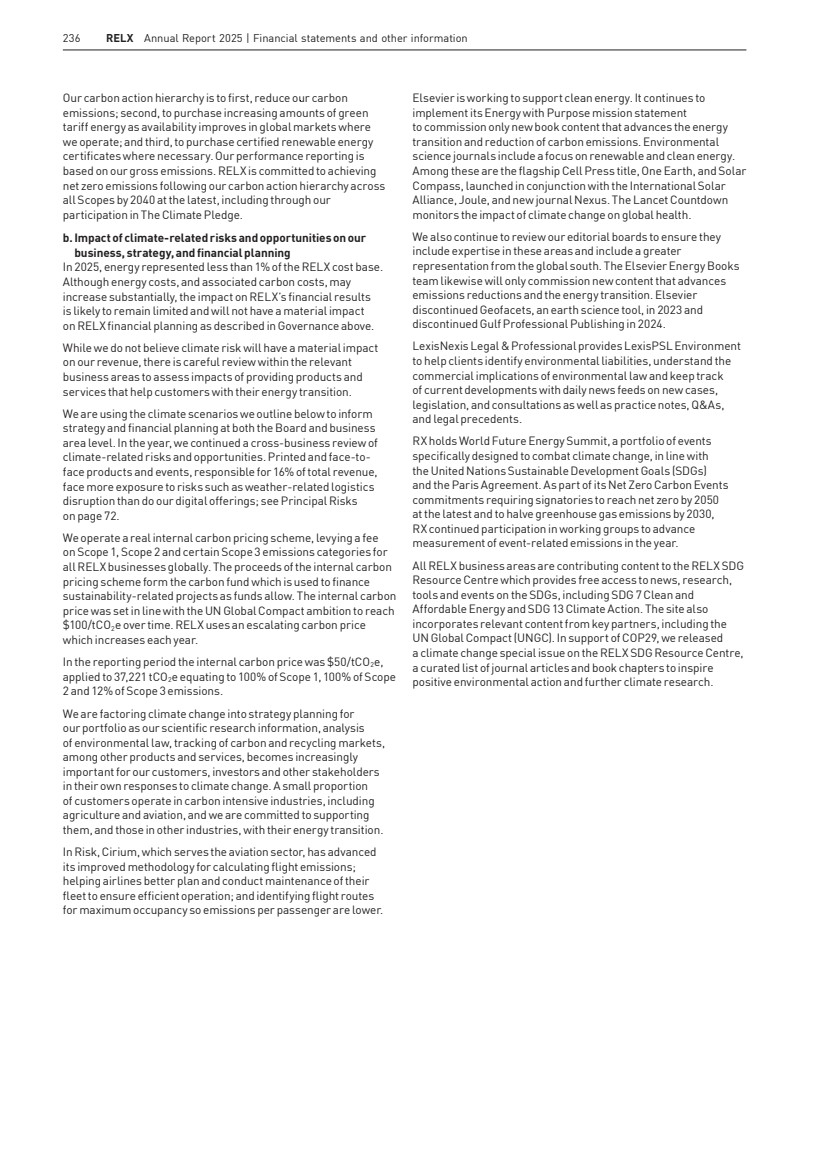
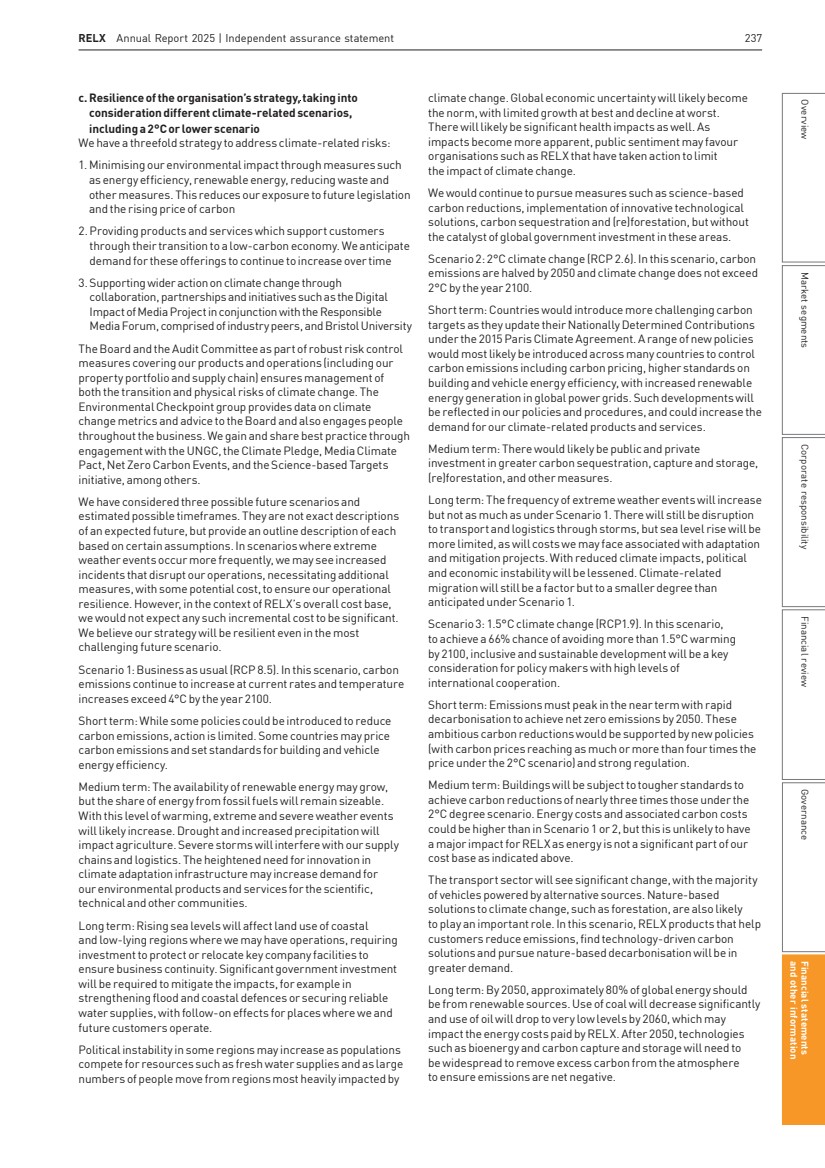
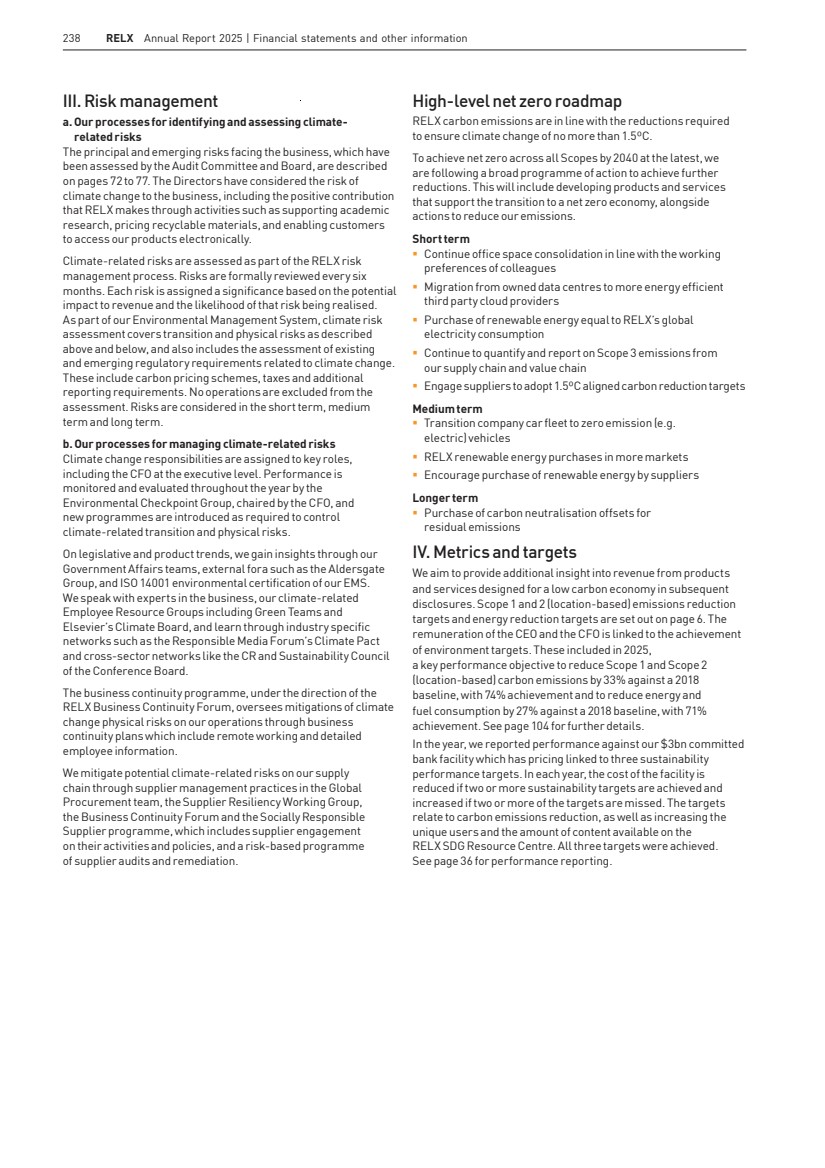
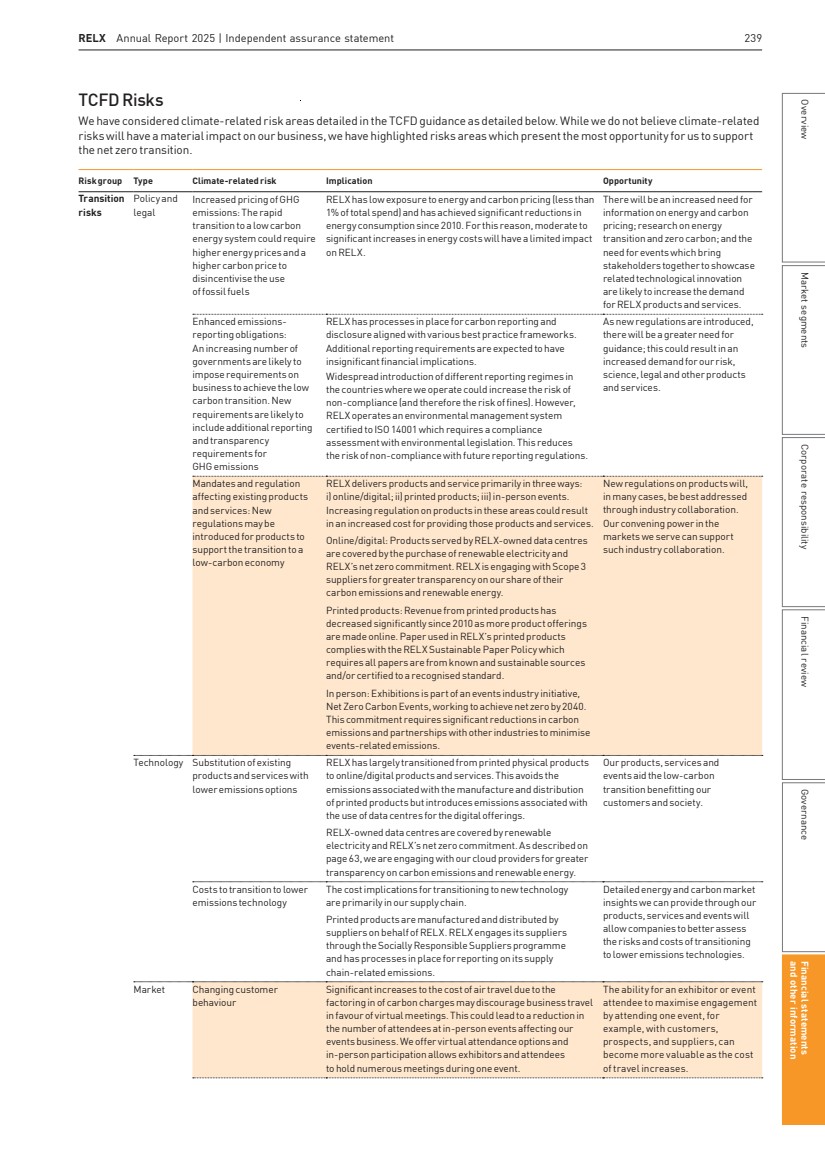
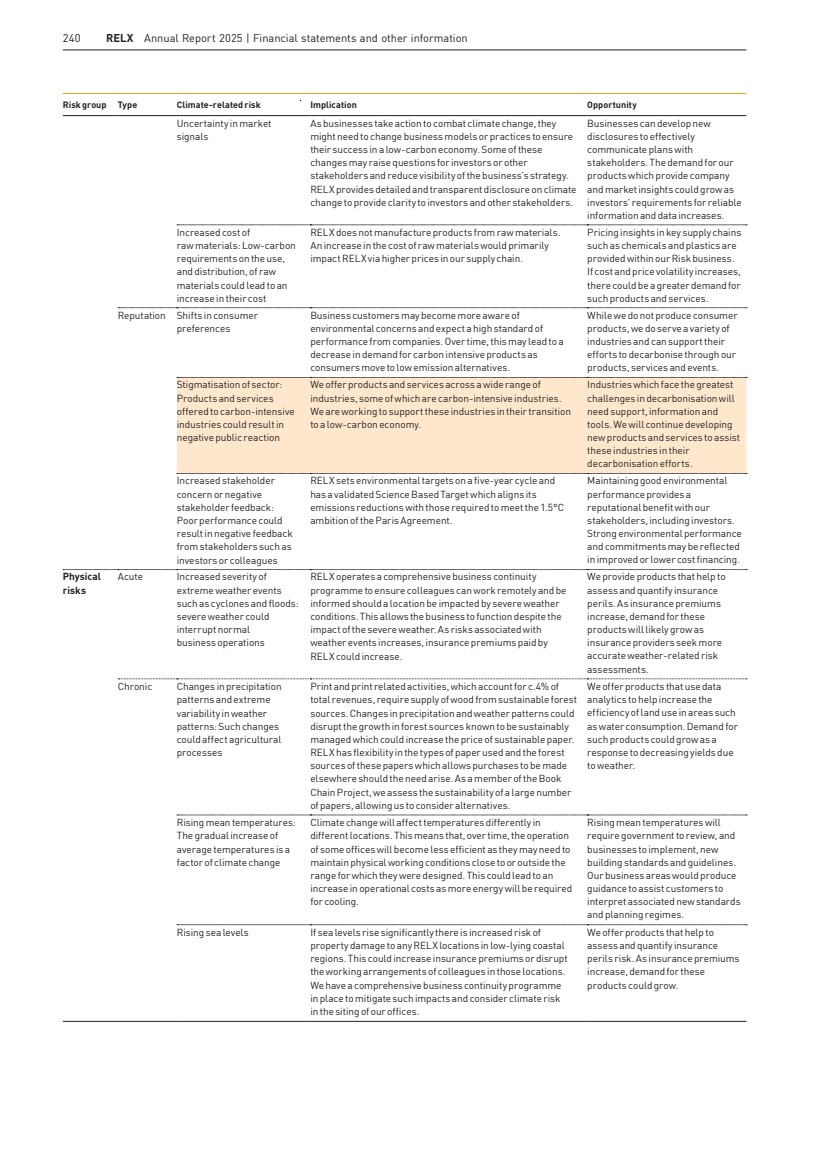
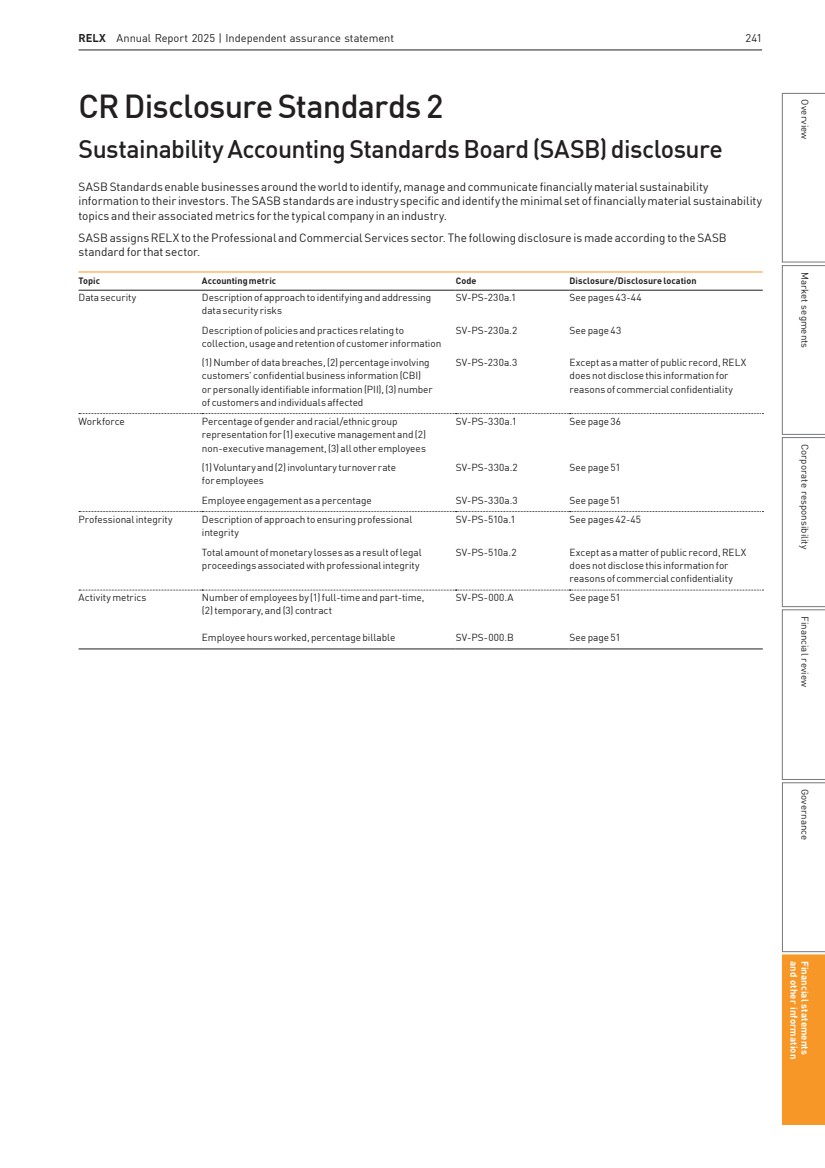
| 2025 Annual Report on Form 20-F |

| Annual Report 2025 Forward-looking statements This Annual Report contains forward-looking statements within the meaning of Section 27A of the US Securities Act of 1933, as amended, and Section 21E of the US Securities Exchange Act of 1934, as amended. These statements are subject to risks and uncertainties that could cause actual results or outcomes of RELX PLC (together with its subsidiaries, “RELX”, “we” or “our”) to differ materially from those expressed in any forward-looking statement. We consider any statements that are not historical facts to be “forward-looking statements”. The terms “outlook”, “estimate”, “forecast”, “project”, “plan”, “intend”, “expect”, “should”, “could”, “will”, “believe”, “trends” and similar expressions may indicate a forward-looking statement. Important factors that could cause actual results or outcomes to differ materially from estimates or forecasts contained in the forward-looking statements include, among others: regulatory and other changes regarding the collection or use of personal data; changes in law and legal interpretation affecting our intellectual property rights and internet communications; current and future geopolitical, economic and market conditions; research integrity issues or changes in the payment model for our scientific, technical and medical research products; competitive factors in the industries in which we operate and demand for our products and services; our inability to realise the future anticipated benefits of acquisitions; compromises of our cybersecurity systems or other unauthorised access to our databases; changes in economic cycles, trading relations, communicable disease epidemics or pandemics, severe weather events, natural disasters and terrorism; failure of third parties to whom we have outsourced business activities; significant failure or interruption of our systems; our inability to retain high-quality employees and management; changes in tax laws and uncertainty in their application; exchange rate fluctuations; adverse market conditions or downgrades to the credit ratings of our debt; changes in the market values of defined benefit pension scheme assets and in the market related assumptions used to value scheme liabilities; breaches of generally accepted ethical business standards or applicable laws; and other risks referenced from time to time in the filings of RELX PLC with the US Securities and Exchange Commission. You should not place undue reliance on these forward-looking statements, which speak only as of the date of this Annual Report. Except as may be required by law, we undertake no obligation to publicly update or release any revisions to these forward-looking statements to reflect events or circumstances after the date of this Annual Report or to reflect the occurrence of unanticipated events. About us RELX is a global provider of information-based analytics and decision tools for professional and business customers, enabling them to make better decisions, getbetter results and be more productive. Our purpose is to benefit society by developing products that help researchers advance scientific knowledge; doctors and nurses improve the lives of patients; lawyers promote the rule of law and achieve justice andfair results for their clients; businesses and governments prevent fraud; consumers access financial services and get fair prices on insurance; and customers learn about markets and complete transactions. Our purpose guides our actions beyond the products that we develop. It defines us as a company. Every day across RELX our employees are inspired to undertake initiatives that make unique contributions to society andthe communities in which we operate. |
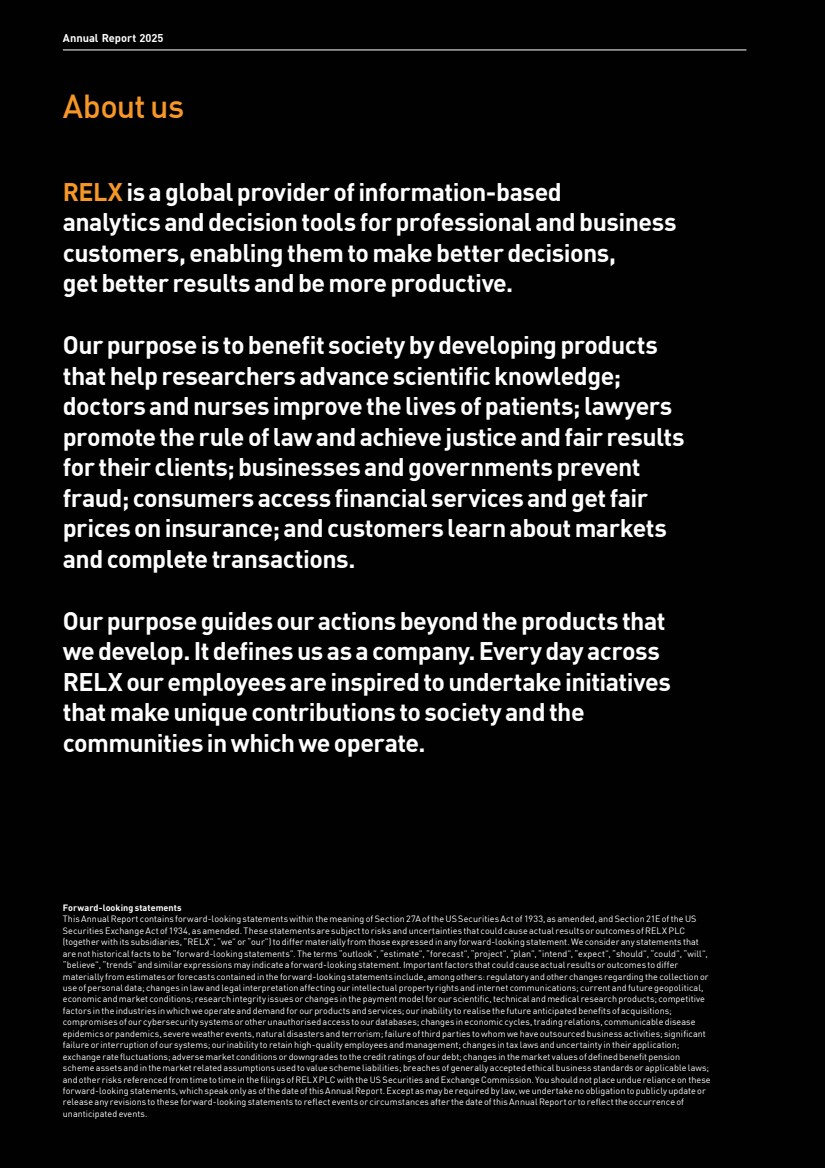
| RELX Annual Report 2025 1 Contents Strategic report Overview 2 2025 highlights 3 Chair’s statement 4 Chief Executive Officer’s report 5 RELX business overview Market segments 10 Risk 16 Scientific, Technical & Medical 22 Legal 28 Exhibitions Corporate responsibility 34 Corporate responsibility overview 38 Our unique contributions 42 Corporate responsibility governance 46 Customers 49 People 52 Community 56 Supply chain 59 Environment Financial review 66 Chief Financial Officer’s report 72 Principal and emerging risks Governance Governance 80 Board directors 82 RELX senior executives 84 Chair’s introduction to corporate governance 85 Corporate governance review 97 Report of the Nominations Committee 100 Directors’ remuneration report 121 Report of the Audit Committee 125 Directors’ report Financial statements and other information Financial statements 138 Consolidated financial statements 143 Notes to the consolidated financial statements 186 Five year summary RELX PLC company only financial statements 188 RELX PLC financial statements 191 Notes to RELX PLC financial statements Other financial information 196 Financial summary in US dollars 197 Business area analysis in US dollars 198 Alternative performance measures Sustainability Statement and other CorporateResponsibilityDisclosures 208 Sustainability statement 235 Taskforce on climate-related financial disclosure 241 Sustainability accounting standards board 242 Global reporting initiative Shareholder information 245 Shareholder information 248 2026 financial calendar To download the full Annual Report and for further information about our company visit relx.com Market segments Governance and other information Financial statements Financial review Corporate responsibility Overview |
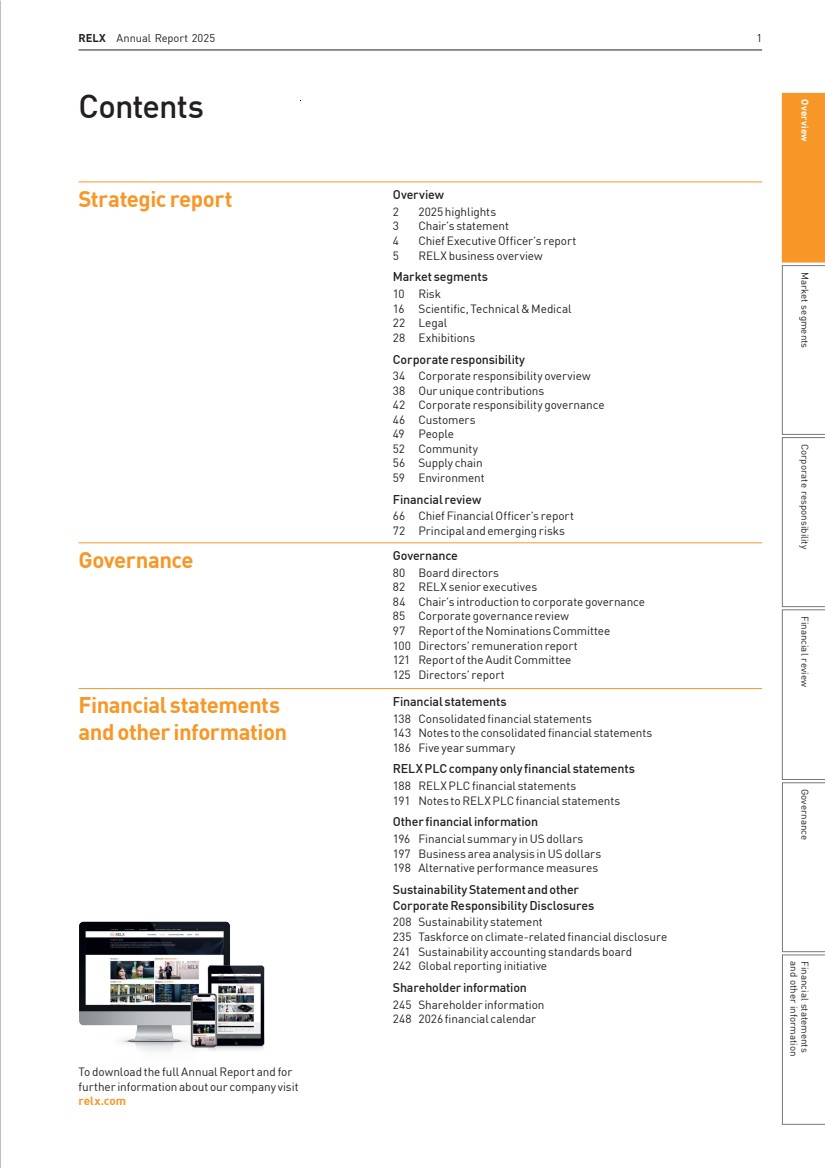
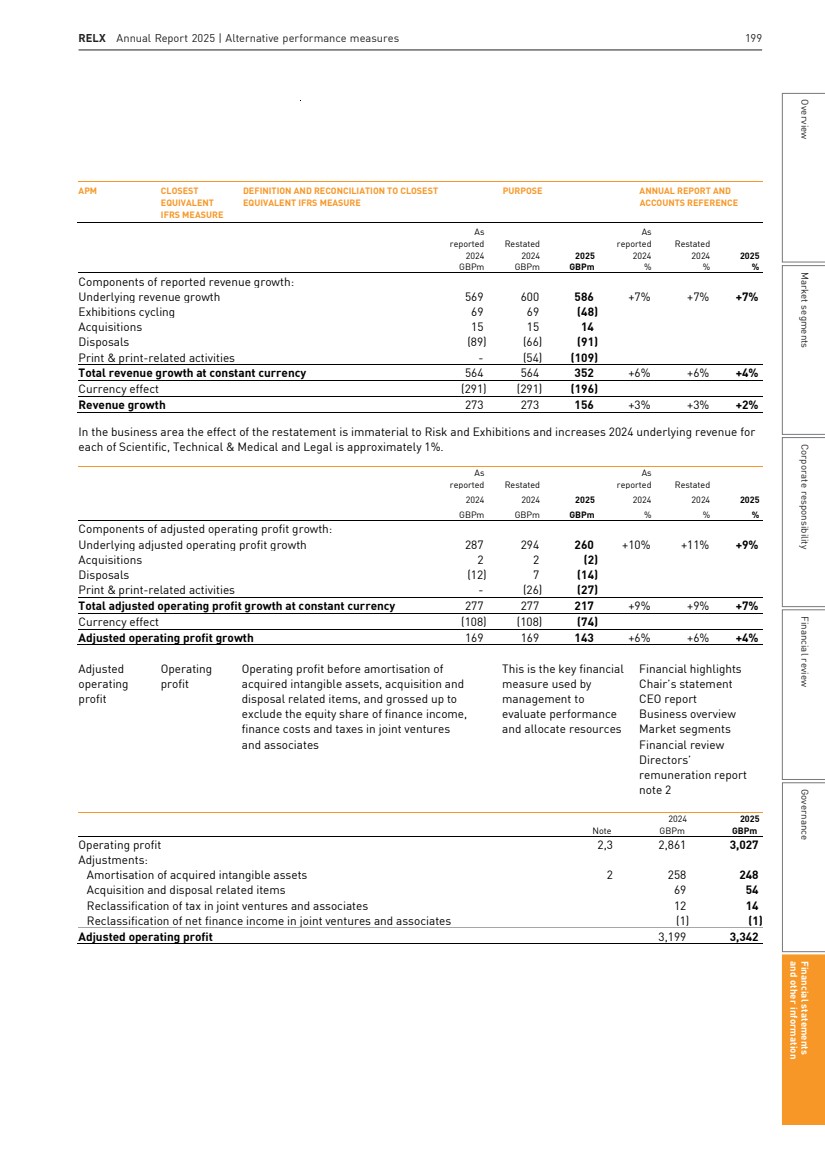
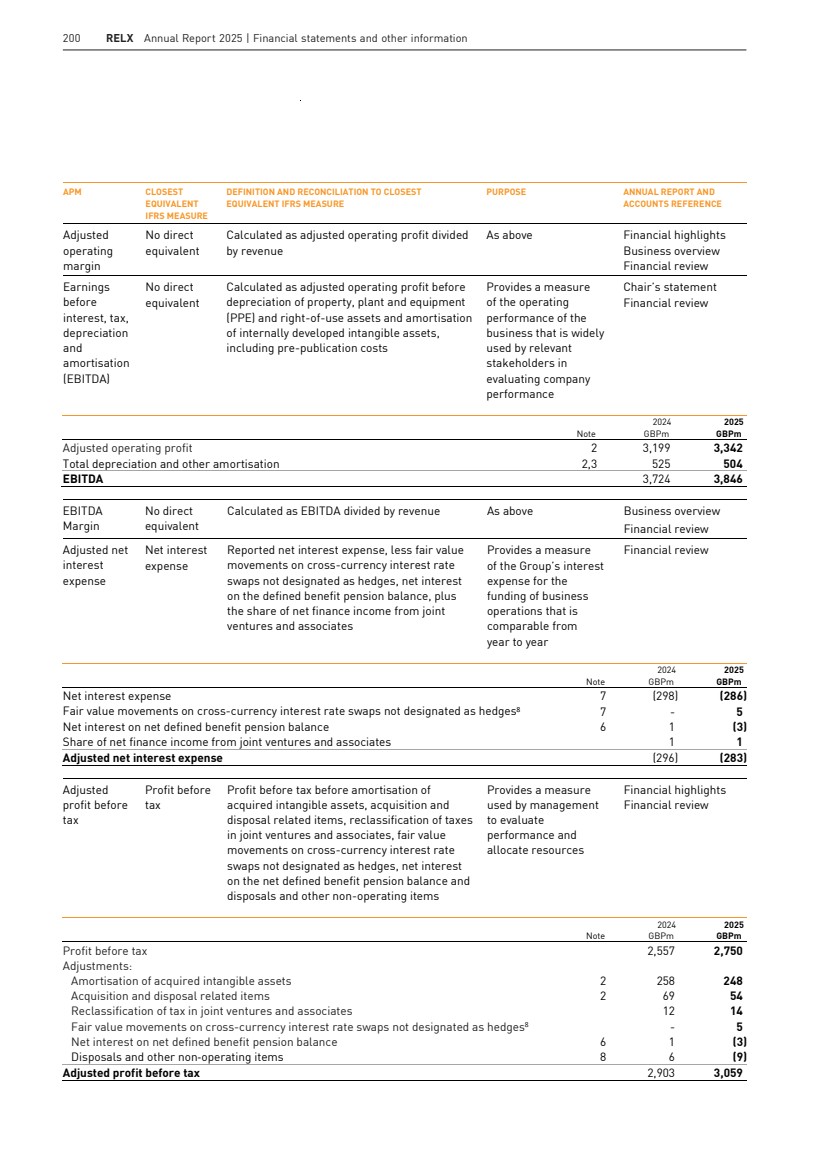
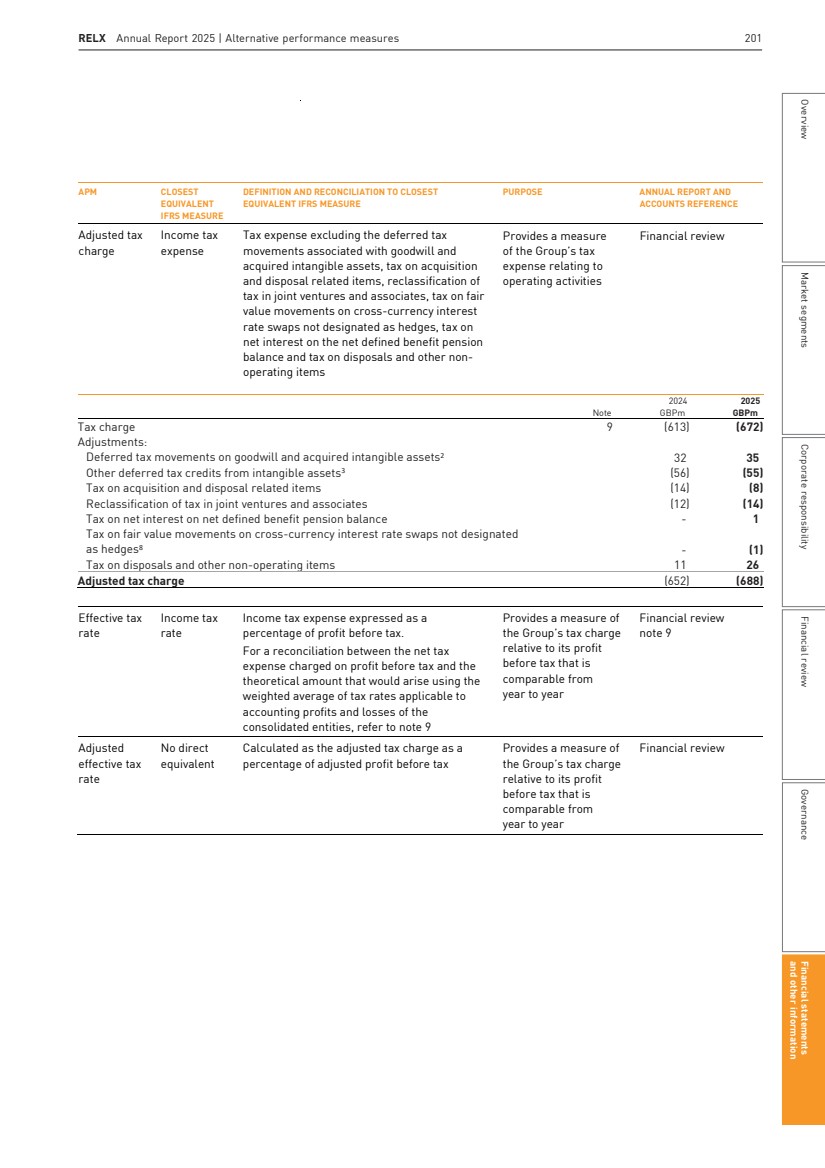
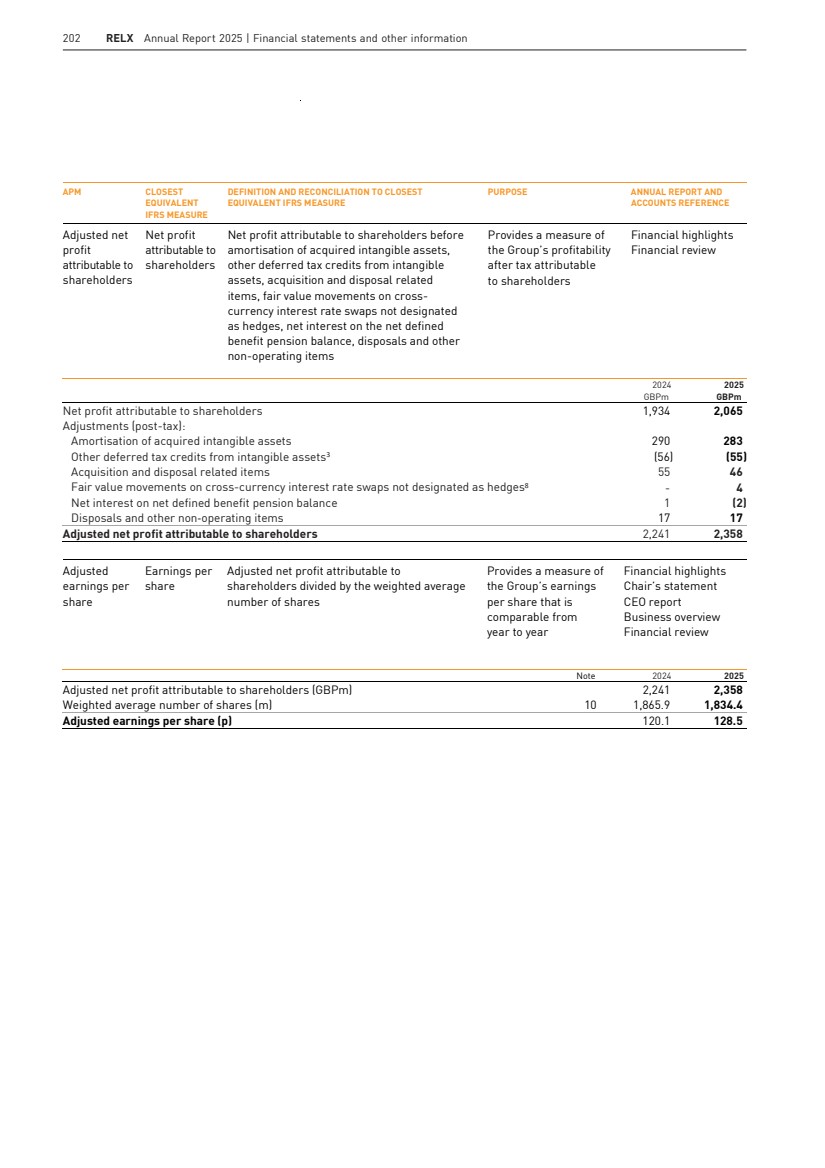
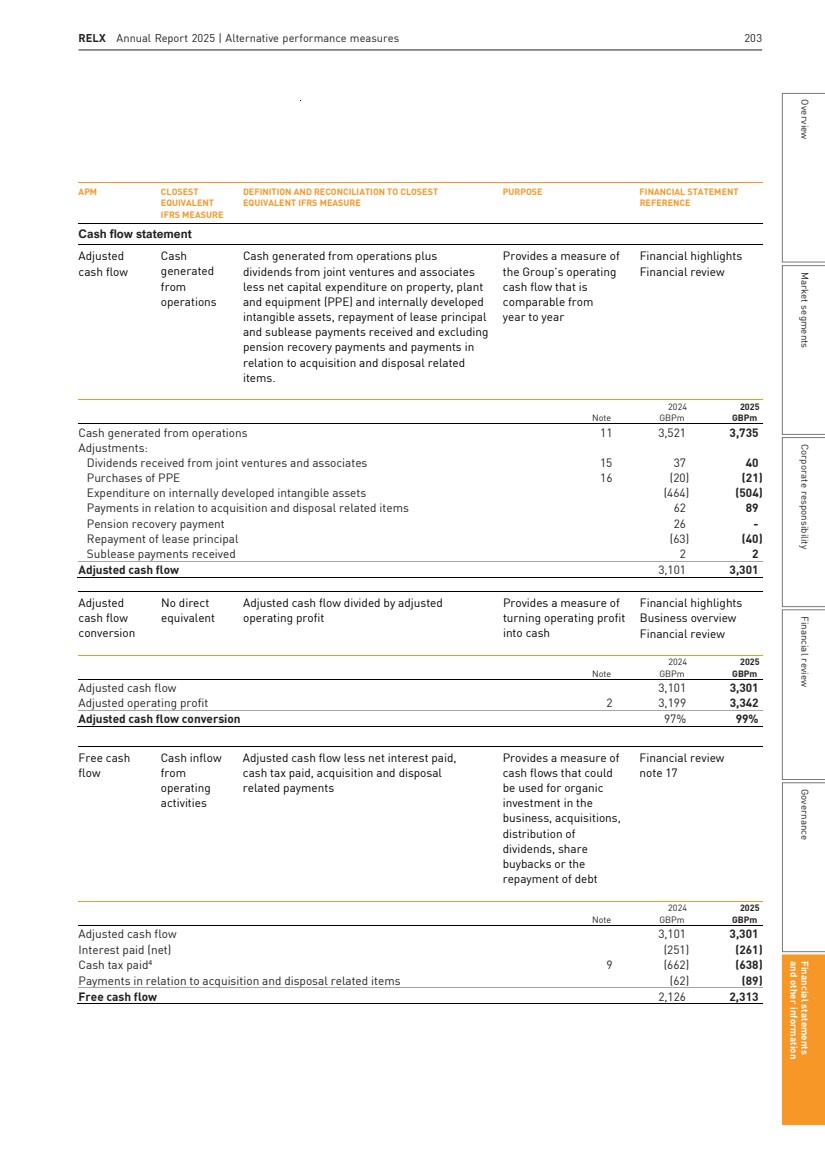
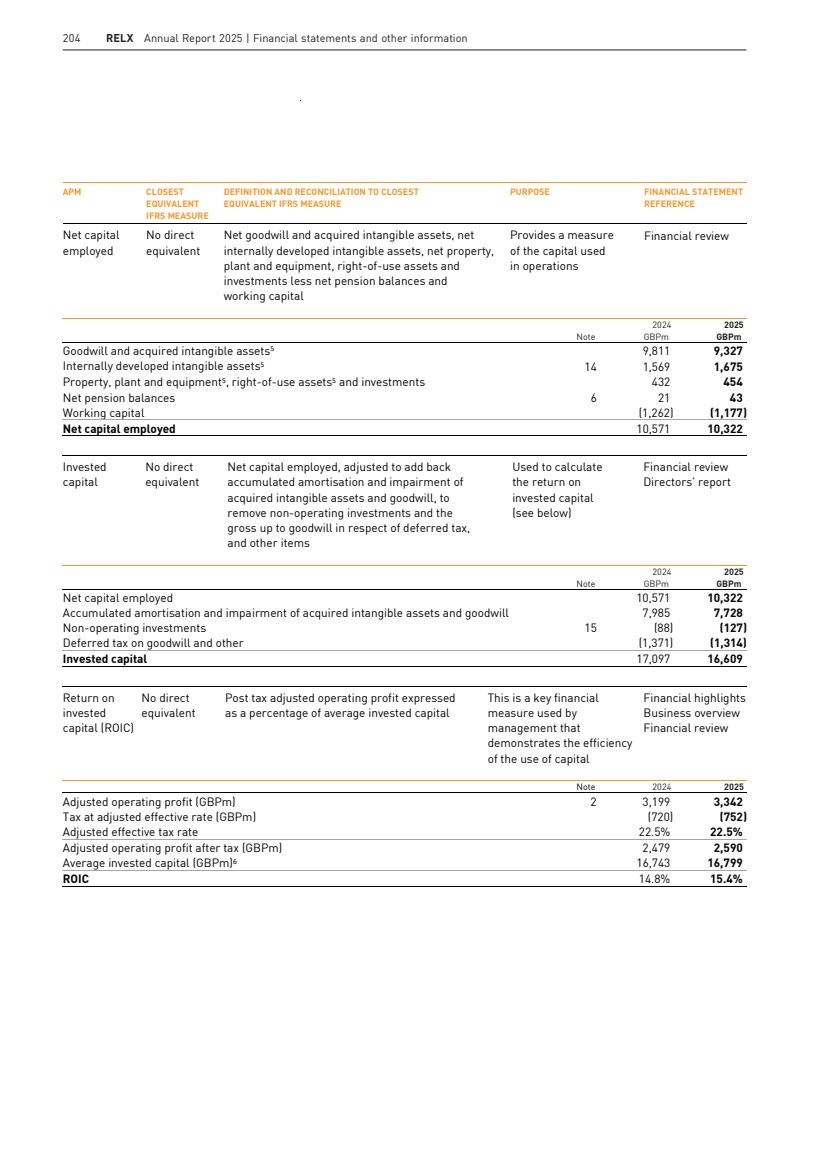
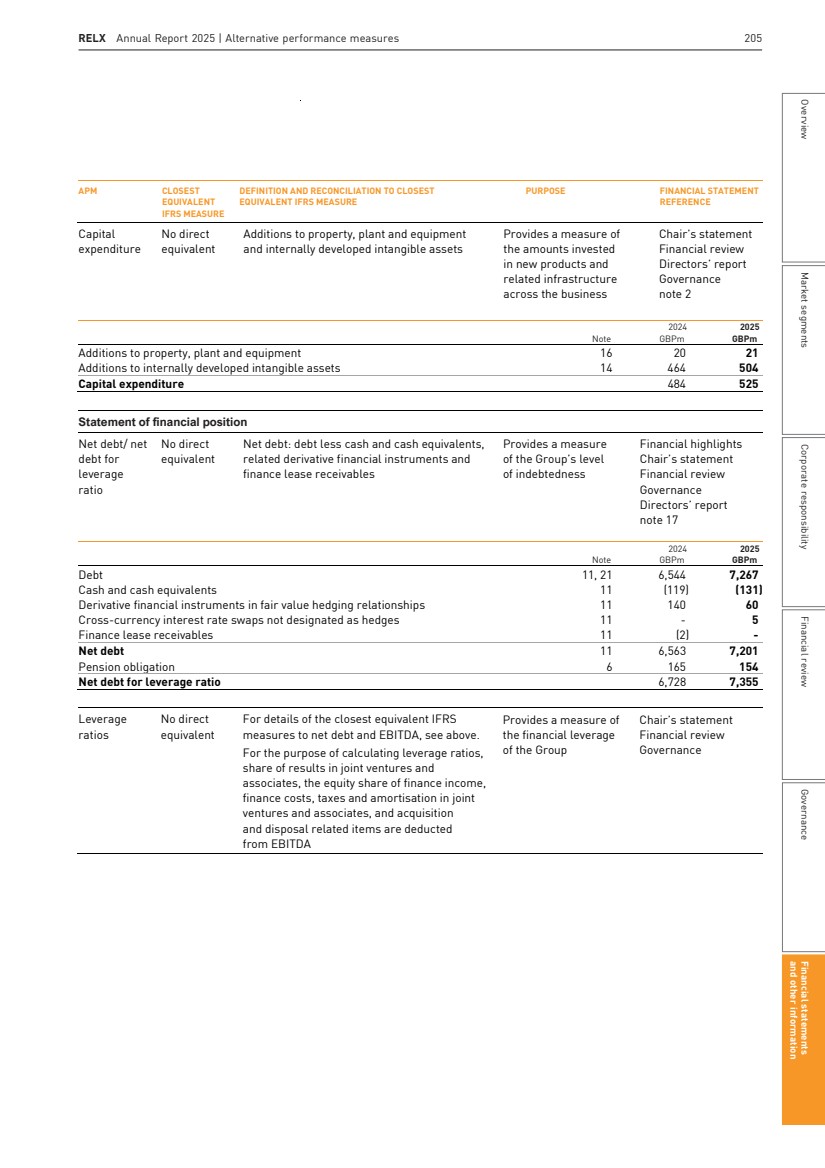
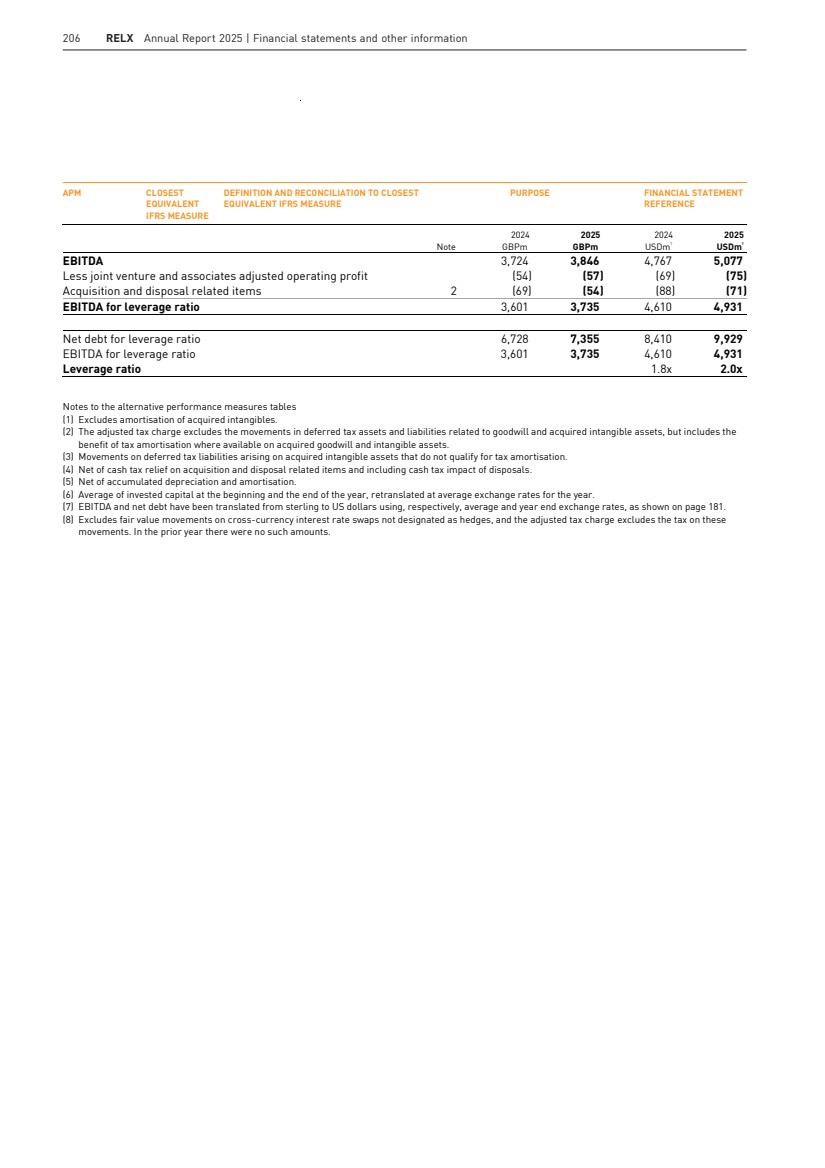
| 2 RELX Annual Report 2025 | Overview 2025 highlights RELX financial highlights § Revenue £9,590m (£9,434m), underlying growth +7% § Adjusted operating profit £3,342m (£3,199m), underlying growth +9% § Adjusted EPS 128.5p (120.1p), constant currency growth +10% § Reported operating profit £3,027m (£2,861m) § Reported EPS 112.6p (103.6p) § Proposed full-year dividend 67.5p (63.0p) § Net debt/EBITDA 2.0x; adjusted cash flow conversion 99% § Completed five acquisitions for a total consideration of £270m § Completed £1,500m share buyback Prior year comparatives are represented in brackets. RELX financial summary ADJUSTED FIGURES 2024 GBPm 2025 GBPm Change in GBP Change at constant currency Underlying For the year ended 31 December growth Revenue 9,434 9,590 +2% +4% +7% EBITDA 3,724 3,846 Operating profit 3,199 3,342 +4% +7% +9% Operating margin 33.9% 34.8% Net interest expense (296) (283) Profit before tax 2,903 3,059 Tax charge (652) (688) Net profit attributable to shareholders 2,241 2,358 Cash flow 3,101 3,301 Cash flow conversion 97% 99% Return on invested capital 14.8% 15.4% Earnings per share 120.1p 128.5p +7% +10% DIVIDEND 2024 2025 Change For the year ended 31 December in GBP Ordinary dividend per share 63.0p 67.5p +7% REPORTED FIGURES 2024 GBPm 2025 GBPm Change For the year ended 31 December in GBP Revenue 9,434 9,590 +2% Operating profit 2,861 3,027 +6% Net interest expense (298) (286) Profit before tax 2,557 2,750 Tax charge (613) (672) Net profit attributable to shareholders 1,934 2,065 Net margin 20.5% 21.5% Cash generated from operations 3,521 3,735 Net debt 6,563 7,201 Earnings per share 103.6p 112.6p +9% RELX corporate responsibility summary REPORTED FIGURES For the year ended 31 December 2024 2025 Change Percentage of women managers 46% 46% Percentage of employees volunteering 37% 38% Number of supplier code signatories 6,056 6,586 +9% Scope 1 + Scope 2 (location-based) emissions (tCO2 e) 32,692 21,466 -34% Waste sent to landfill (t) 44 32 -27% RELX uses adjusted and underlying figures as additional performance measures. Adjusted figures primarily exclude the amortisation of acquired intangible assets and other items related to acquisitions and disposals, and the associated deferred tax movements. Reconciliations between the reported and adjusted figures are set out on pages 198 to 206. Underlying revenue growth rates are calculated at constant currency, and exclude revenue from acquisitions until 12 months after purchase, revenue of disposals and assets held for sale, print and print-related revenue and exhibition cycling. Constant currency growth rates are based on 2024 full-year average and hedge exchange rates. The shares of RELX PLC are traded on the London, Amsterdam and New York stock exchanges. RELX PLC and its subsidiaries, joint ventures and associates are together known as ‘RELX’. |
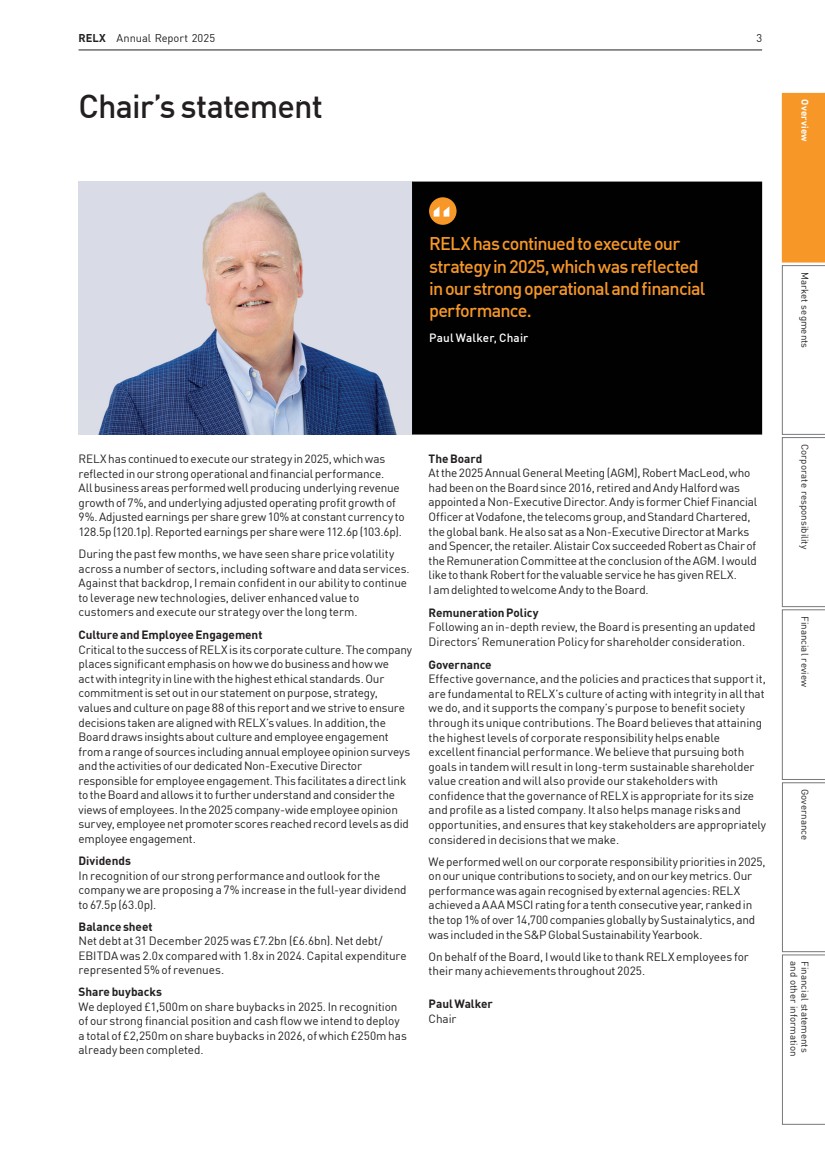
| RELX Annual Report 2025 3 Chair’s statement RELX has continued to execute our strategy in 2025, which was reflected in our strong operational and financial performance. Paul Walker, Chair RELX has continued to execute our strategy in 2025, which was reflected in our strong operational and financial performance. Allbusiness areas performed well producing underlying revenue growth of 7%, and underlying adjusted operating profit growth of 9%. Adjusted earnings per share grew 10% at constant currency to 128.5p (120.1p). Reported earnings per share were 112.6p (103.6p). During the past few months, we have seen share price volatility across a number of sectors, including software and data services. Against that backdrop, I remain confident in our ability to continue to leverage new technologies, deliver enhanced value to customers and execute our strategy over the long term. Culture and Employee Engagement Critical to the success of RELX is its corporate culture. The company places significant emphasis on how we do business and how we actwith integrity in line with the highest ethical standards. Our commitment is set out in our statement on purpose, strategy, values and culture on page 88 of this report and we strive to ensure decisions taken are aligned with RELX’s values. In addition, the Board draws insights about culture and employee engagement from a range of sources including annual employee opinion surveys and the activities of our dedicated Non-Executive Director responsible for employee engagement. This facilitates a direct link to the Board and allows it to further understand and consider the views of employees. In the 2025 company-wide employee opinion survey, employee net promoter scores reached record levels as did employee engagement. Dividends In recognition of our strong performance and outlook for the company we are proposing a 7% increase in the full-year dividend to 67.5p (63.0p). Balance sheet Net debt at 31 December 2025 was £7.2bn (£6.6bn). Net debt/ EBITDA was 2.0x compared with 1.8x in 2024. Capital expenditure represented 5% of revenues. Share buybacks We deployed £1,500m on share buybacks in 2025. In recognition of our strong financial position and cash flow we intend to deploy a total of £2,250m on share buybacks in 2026, of which £250m has already been completed. The Board At the 2025 Annual General Meeting (AGM), Robert MacLeod, who had been on the Board since 2016, retired and Andy Halford was appointed a Non-Executive Director. Andy is former Chief Financial Officer at Vodafone, the telecoms group, and Standard Chartered, the global bank. He also sat as a Non-Executive Director at Marks and Spencer, the retailer. Alistair Cox succeeded Robert as Chair of the Remuneration Committee at the conclusion of the AGM. I would like to thank Robert for the valuable service he has given RELX. Iamdelighted to welcome Andy to the Board. Remuneration Policy Following an in-depth review, the Board is presenting an updated Directors’ Remuneration Policy for shareholder consideration. Governance Effective governance, and the policies and practices that support it, are fundamental to RELX’s culture of acting with integrity in all that we do, and it supports the company’s purpose to benefit society through its unique contributions. The Board believes that attaining the highest levels of corporate responsibility helps enable excellent financial performance. We believe that pursuing both goals in tandem will result in long-term sustainable shareholder value creation and will also provide our stakeholders with confidence that the governance of RELX is appropriate for its size and profile as a listed company. It also helps manage risks and opportunities, and ensures that key stakeholders are appropriately considered in decisions that we make. We performed well on our corporate responsibility priorities in 2025, on our unique contributions to society, and on our key metrics. Our performance was again recognised by external agencies: RELX achieved a AAA MSCI rating for a tenth consecutive year, ranked in the top 1% of over 14,700 companies globally by Sustainalytics, and was included in the S&P Global Sustainability Yearbook. On behalf of the Board, I would like to thank RELX employees for their many achievements throughout 2025. Paul Walker Chair Market segments Governance and other information Financial statements Financial review Corporate responsibility Overview |
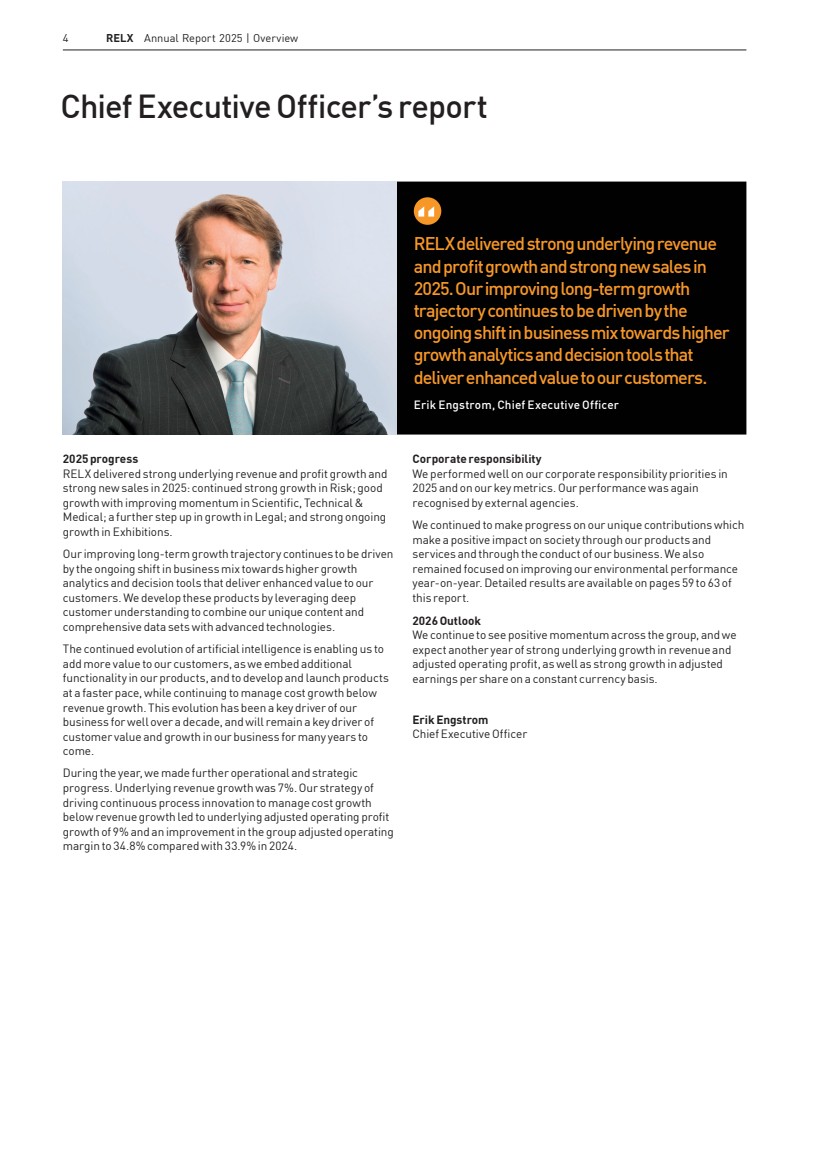
| 4 RELX Annual Report 2025 | Overview Chief Executive Officer’s report RELX delivered strong underlying revenue and profit growth and strong new sales in 2025. Our improving long-term growth trajectory continues to be driven by the ongoing shift in business mix towards higher growth analytics and decision tools that deliver enhanced value to our customers. Erik Engstrom, Chief Executive Officer 2025 progress RELX delivered strong underlying revenue and profit growth and strong new sales in 2025: continued strong growth in Risk; good growth with improving momentum in Scientific, Technical & Medical; a further step up in growth in Legal; and strong ongoing growth inExhibitions. Our improving long-term growth trajectory continues to be driven by the ongoing shift in business mix towards higher growth analytics and decision tools that deliver enhanced value to our customers. We develop these products by leveraging deep customer understanding to combine our unique content and comprehensive data sets with advanced technologies. The continued evolution of artificial intelligence is enabling us to add more value to our customers, as we embed additional functionality in our products, and to develop and launch products at a faster pace, while continuing to manage cost growth below revenue growth. This evolution has been a key driver of our business for well over a decade, and will remain a key driver of customer value and growth in our business for many years to come. During the year, we made further operational and strategic progress. Underlying revenue growth was 7%. Our strategy of driving continuous process innovation to manage cost growth below revenue growth led to underlying adjusted operating profit growth of 9% and an improvement in the group adjusted operating margin to 34.8% compared with 33.9% in 2024. Corporate responsibility We performed well on our corporate responsibility priorities in 2025 and on our key metrics. Our performance was again recognised by external agencies. We continued to make progress on our unique contributions which make a positive impact on society through our products and services and through the conduct of our business. We also remained focused on improving our environmental performance year-on-year. Detailed results are available on pages 59 to 63 of this report. 2026 Outlook We continue to see positive momentum across the group, and we expect another year of strong underlying growth in revenue and adjusted operating profit, as well as strong growth in adjusted earnings per share on a constant currency basis. Erik Engstrom Chief Executive Officer |
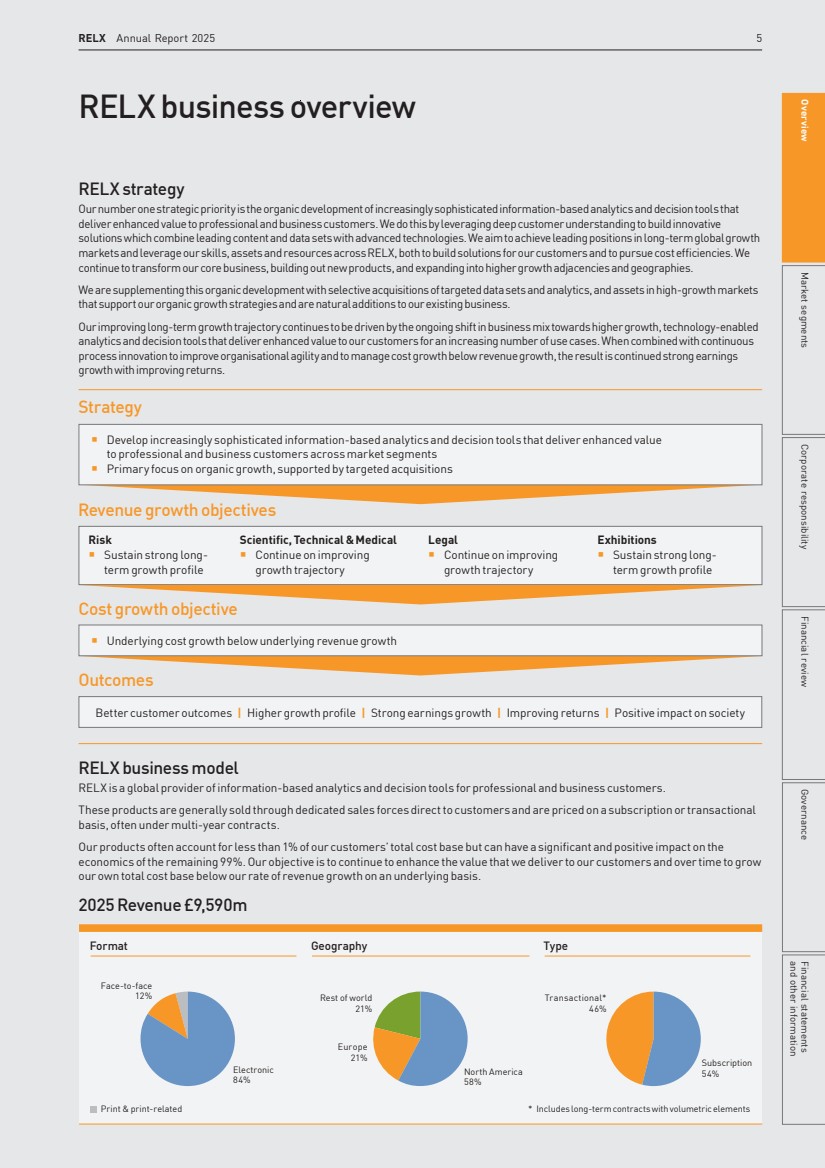
| Strategy Outcomes Cost growth objective Revenue growth objectives 5 Format Geography Type Face-to-face 12% Electronic 84% Rest of world 21% Europe 21% North America 58% Transactional* 46% Subscription 54% Print & print-related RELX Annual Report 2025 RELX business overview RELX strategy Our number one strategic priority is the organic development of increasingly sophisticated information-based analytics and decision tools that deliver enhanced value to professional and business customers. We do this by leveraging deep customer understanding to build innovative solutions which combine leading content and data sets with advanced technologies. We aim to achieve leading positions in long-term global growth markets and leverage our skills, assets and resources across RELX, both to build solutions for our customers and to pursue cost efficiencies. We continue to transform our core business, building out new products, and expanding into higher growth adjacencies and geographies. We are supplementing this organic development with selective acquisitions of targeted data sets and analytics, and assets in high-growth markets that support our organic growth strategies and are natural additions to our existing business. Our improving long-term growth trajectory continues to be driven by the ongoing shift in business mix towards higher growth, technology-enabled analytics and decision tools that deliver enhanced value to our customers for an increasing number of use cases. When combined with continuous process innovation to improve organisational agility and to manage cost growth below revenue growth, the result is continued strong earnings growth with improving returns. RELX business model RELX is a global provider of information-based analytics and decision tools for professional and business customers. These products are generally sold through dedicated sales forces direct to customers and are priced on a subscription or transactional basis, often under multi-year contracts. Our products often account for less than 1% of our customers’ total cost base but can have a significant and positive impact on the economics of the remaining 99%. Our objective is to continue to enhance the value that we deliver to our customers and over time to grow our own total cost base below our rate of revenue growth on an underlying basis. Exhibitions § Sustain strong long-term growth profile 2025 Revenue £9,590m * Includes long-term contracts with volumetric elements Risk § Sustain strong long-term growth profile Scientific, Technical & Medical § Continue on improving growth trajectory Legal § Continue on improving growth trajectory § Underlying cost growth below underlying revenue growth Better customer outcomes | Higher growth profile | Strong earnings growth | Improving returns | Positive impact on society § Develop increasingly sophisticated information-based analytics and decision tools that deliver enhanced value to professional and business customers across market segments § Primary focus on organic growth, supported by targeted acquisitions Market segments Governance and other information Financial statements Financial review Corporate responsibility Overview |
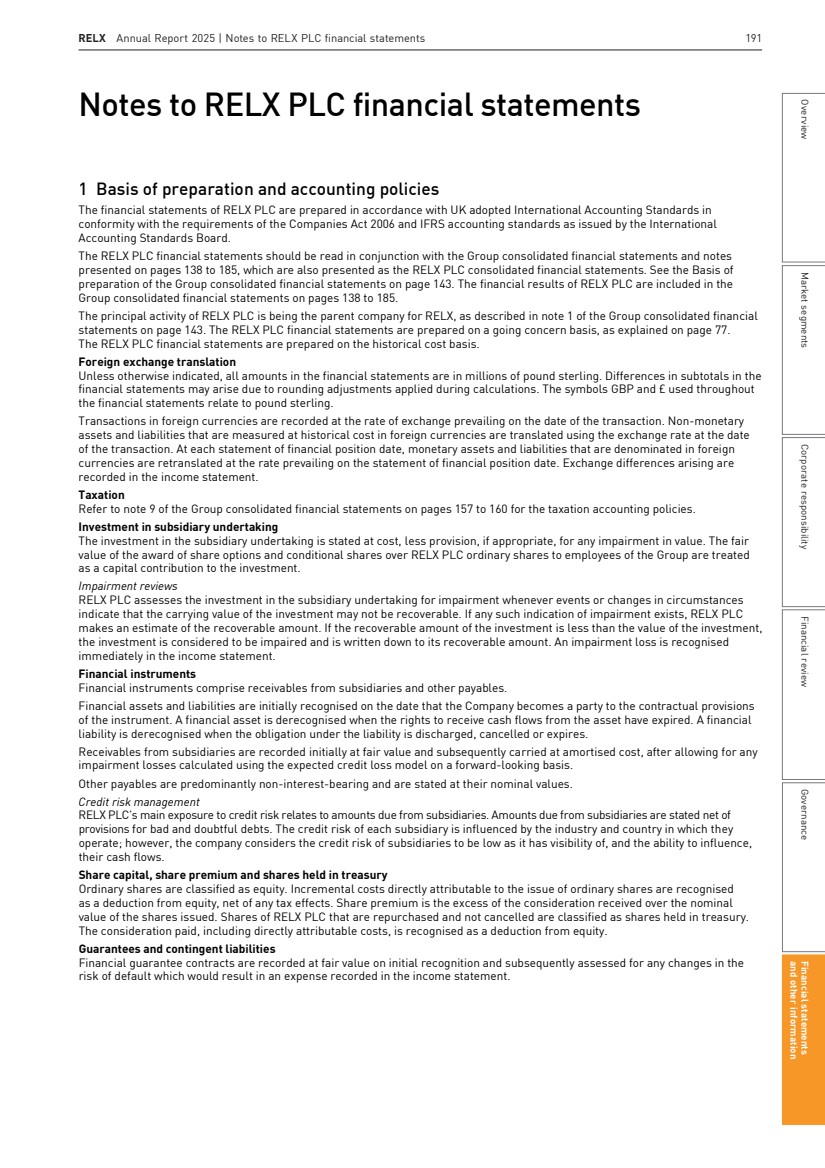
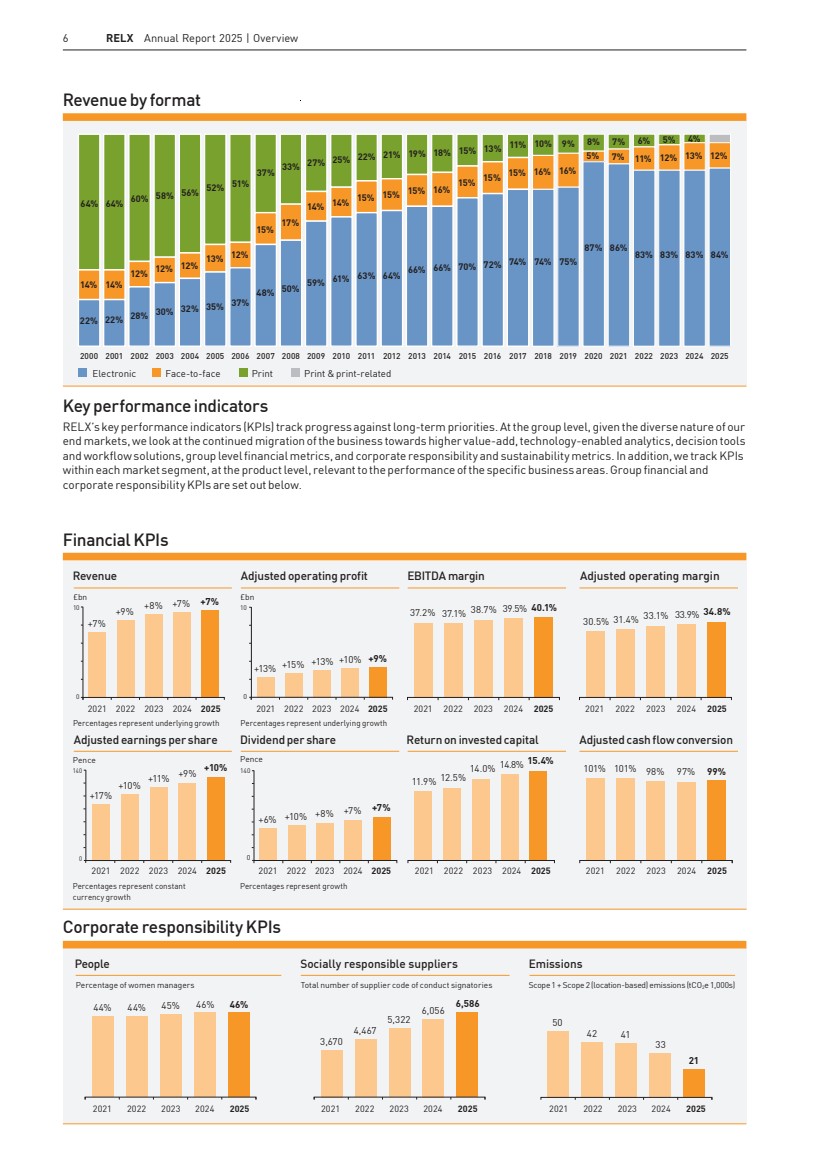
| 6 RELX Annual Report 2025 | Overview Electronic Face-to-face Print Print & print-related 2000 2001 2002 2003 2004 2005 2006 2007 2008 2009 2010 2011 2012 2013 2014 2015 2016 2017 2018 22% 22% 28% 30% 32% 35% 37% 48% 50% 59% 61% 63% 64% 66% 66% 70% 74% 74% 14% 14% 12% 12% 12% 13% 12% 15% 17% 14% 14% 15% 15% 15% 16% 15% 15% 64% 64% 60% 58% 56% 52% 51% 37% 33% 27% 25% 22% 21% 19% 18% 15% 11% 16% 10% 2019 2020 2021 2022 2023 2024 2025 75% 16% 9% 86% 7% 7% 83% 12% 5% 83% 13% 4% 83% 11% 6% 87% 5% 8% 72% 15% 13% 84% 12% 2021 2022 2023 2024 2025 2021 2022 2023 2024 2025 2021 2022 2023 2024 2025 50 3,670 Percentage of women managers Total number of supplier code of conduct signatories Scope 1 + Scope 2 (location-based) emissions (tCO2e 1,000s) 42 44% 44% 45% 46% 46% 6,056 6,586 33 21 4,467 5,322 41 People Socially responsible suppliers Emissions 2021 2022 2023 2024 2025 +7% Percentages represent underlying growth £bn 10 0 +9% +8% +7% +7% +10% +9% 39.5% 40.1% Revenue +13% Percentages represent underlying growth £bn 10 0 +15% +13% Adjusted operating profit 11.9% 12.5% 14.0% Returnoninvested capital 101% 101% 98% 97% 99% 14.8% 15.4% +7% +7% +9% +10% Adjusted cashflowconversion Percentages represent constant currency growth Pence 140 0 +17% +10% +11% Adjusted earnings per share +6% Percentages represent growth Pence 140 0 +10% +8% Dividend per share 37.2% 37.1% 38.7% EBITDA margin 30.5% 31.4% 33.1% 33.9% 34.8% Adjusted operating margin 2021 2022 2023 2024 2025 2021 2022 2023 2024 2025 2021 2022 2023 2024 2025 2021 2022 2023 2024 2025 2021 2022 2023 2024 2025 2021 2022 2023 2024 2025 2021 2022 2023 2024 2025 Financial KPIs Corporate responsibility KPIs Revenue by format Key performance indicators RELX’s key performance indicators (KPIs) track progress against long-term priorities. At the group level, given the diverse nature of our end markets, we look at the continued migration of the business towards higher value-add, technology-enabled analytics, decision tools and workflow solutions, group level financial metrics, and corporate responsibility and sustainability metrics. In addition, we track KPIs within each market segment, at the product level, relevant to the performance of the specific business areas. Group financial and corporate responsibility KPIs are set out below. |
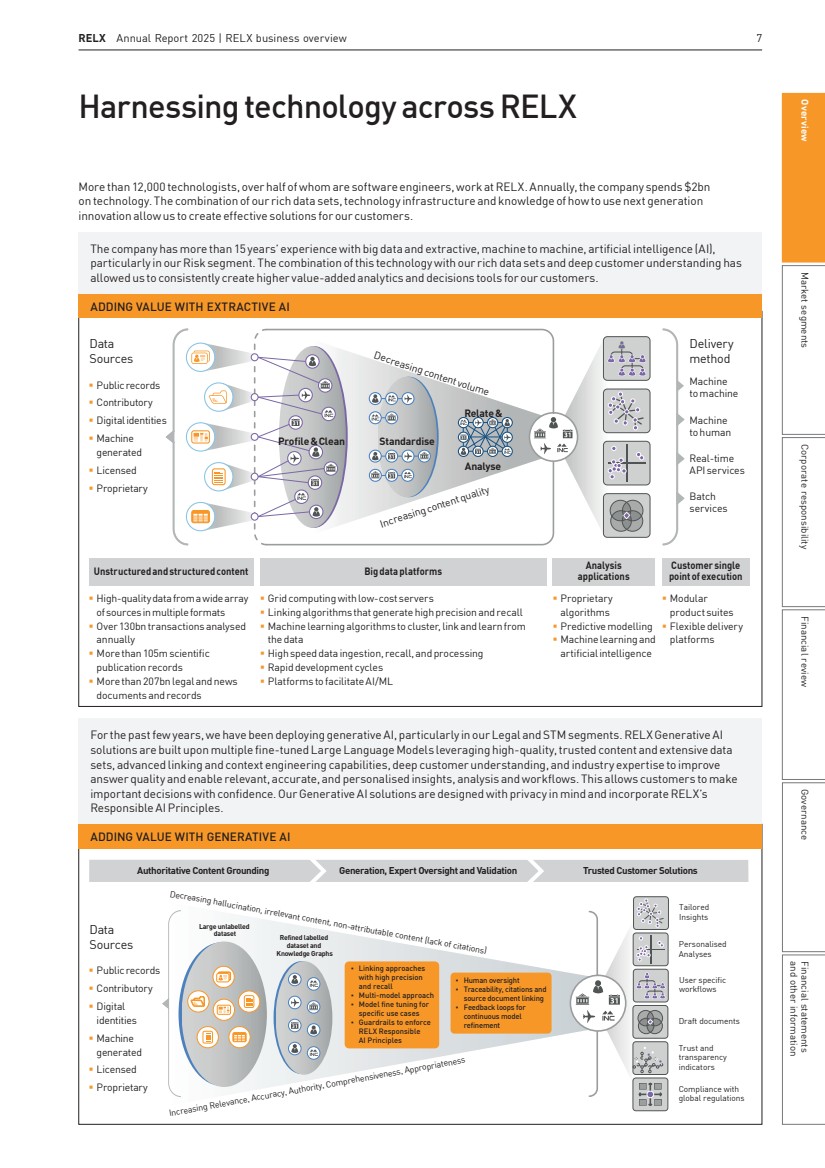
| ▪ Human oversight ▪ Traceability, citations and source document linking ▪ Feedback loops for continuous model refinement Large unlabelled dataset Refined labelled dataset and Knowledge Graphs Authoritative Content Grounding Generation, Expert Oversight and Validation Trusted Customer Solutions ▪ Linking approaches with high precision and recall ▪ Multi-model approach ▪ Model fine tuning for specific use cases ▪ Guardrails to enforce RELX Responsible AI Principles User specific workflows Tailored Insights Personalised Analyses Draft documents Trust and transparency indicators Compliance with global regulations Increasing Relevance, Accuracy, Authority, Comprehensiveness, Appropriateness Decreasing hallucination, irrelevant content, non-attributable content (lack of citations) RELX Annual Report 2025 | RELX business overview 7 Harnessing technology across RELX § Public records § Contributory § Digital identities § Machine generated § Licensed § Proprietary Data Sources ADDING VALUE WITH GENERATIVE AI More than 12,000 technologists, over half of whom are software engineers, work at RELX. Annually, the company spends $2bn on technology. The combination of our rich data sets, technology infrastructure and knowledge of how to use next generation innovation allow us to create effective solutions for our customers. Machine tomachine Machine tohuman Real-time API services Batch services Profile & Clean Standardise Relate & Analyse Decreasing content volume Increasing content quality Data Sources Delivery method § Public records § Contributory § Digital identities § Machine generated § Licensed § Proprietary ADDING VALUE WITH EXTRACTIVE AI The company has more than 15 years’ experience with big data and extractive, machine to machine, artificial intelligence (AI), particularly in our Risk segment. The combination of this technology with our rich data sets and deep customer understanding has allowed us to consistently create higher value-added analytics and decisions tools for our customers. § High-quality data from a wide array of sources in multiple formats § Over 130bn transactions analysed annually § More than 105m scientific publication records § More than 207bn legal and news documents and records § Grid computing with low-cost servers § Linking algorithms that generate high precision and recall § Machine learning algorithms to cluster, link and learn from the data § High speed data ingestion, recall, and processing § Rapid development cycles § Platforms to facilitate AI/ML § Proprietary algorithms § Predictive modelling § Machine learning and artificial intelligence § Modular product suites § Flexible delivery platforms Unstructured and structured content Big data platforms Analysis applications Customer single point of execution For the past few years, we have been deploying generative AI, particularly in our Legal and STM segments. RELX Generative AI solutions are built upon multiple fine-tuned Large Language Models leveraging high-quality, trusted content and extensive data sets, advanced linking and context engineering capabilities, deep customer understanding, and industry expertise to improve answer quality and enable relevant, accurate, and personalised insights, analysis and workflows. This allows customers to make important decisions with confidence. Our Generative AI solutions are designed with privacy in mind and incorporate RELX’s Responsible AI Principles. Market segments Governance and other information Financial statements Financial review Corporate responsibility Overview |
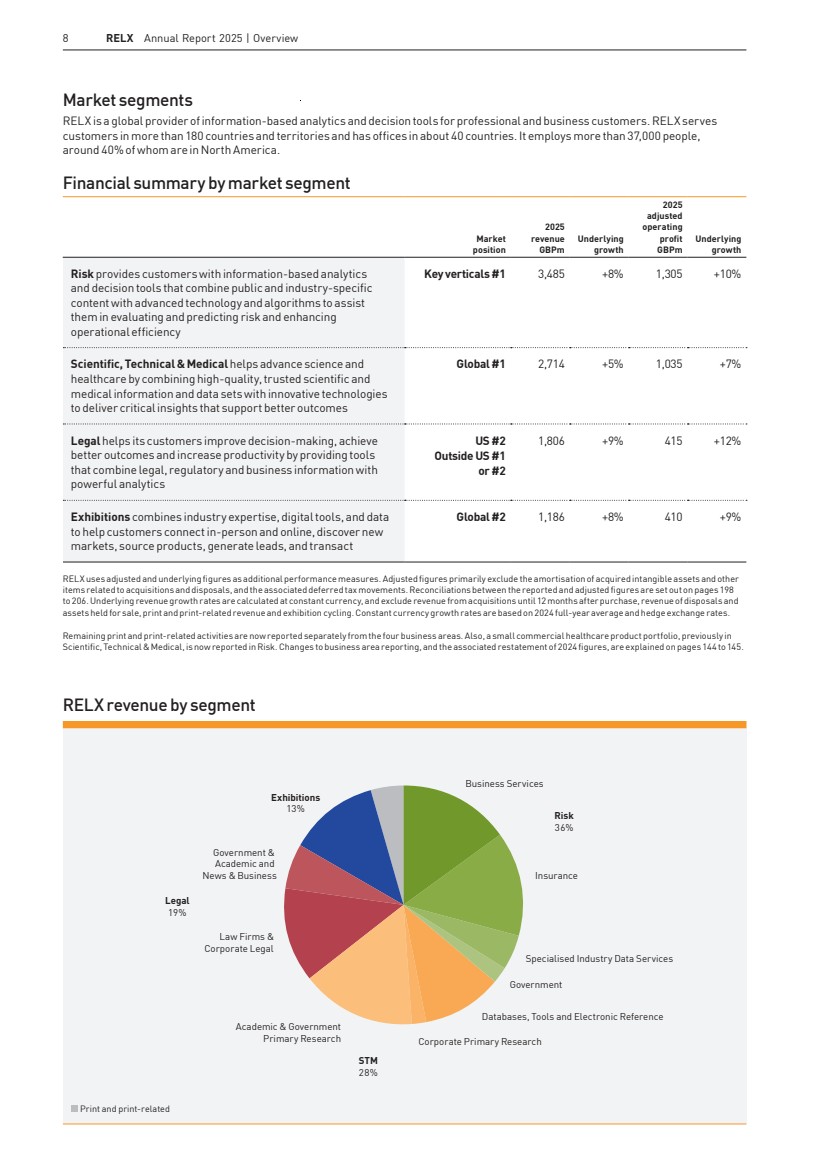
| 8 RELX Annual Report 2025 | Overview Business Services Insurance Specialised Industry Data Services Government Academic & Government Primary Research Corporate Primary Research Databases, Tools and Electronic Reference Law Firms & Corporate Legal Government & Academic and News & Business Exhibitions 13% Risk 36% Legal 19% STM 28% Print and print-related Market segments RELX is a global provider of information-based analytics and decision tools for professional and business customers. RELX serves customers in more than 180 countries and territories and has offices in about 40 countries. It employs more than 37,000 people, around 40% of whom are in North America. RELX revenue by segment Financial summary by market segment Market position 2025 revenue GBPm Underlying growth 2025 adjusted operating profit GBPm Underlying growth Risk provides customers with information-based analytics and decision tools that combine public and industry-specific content with advanced technology and algorithms to assist them in evaluating and predicting risk and enhancing operational efficiency Key verticals #1 3,485 +8% 1,305 +10% Scientific, Technical & Medical helps advance science and healthcare by combining high-quality, trusted scientific and medical information and data sets with innovative technologies to deliver critical insights that support better outcomes Global #1 2,714 +5% 1,035 +7% Legal helps its customers improve decision-making, achieve better outcomes and increase productivity by providing tools that combine legal, regulatory and business information with powerful analytics US #2 Outside US #1 or #2 1,806 +9% 415 +12% Exhibitions combines industry expertise, digital tools, and data to help customers connect in-person and online, discover new markets, source products, generate leads, and transact Global #2 1,186 +8% 410 +9% RELX uses adjusted and underlying figures as additional performance measures. Adjusted figures primarily exclude the amortisation of acquired intangible assets and other items related to acquisitions and disposals, and the associated deferred tax movements. Reconciliations between the reported and adjusted figures are set out on pages 198 to 206. Underlying revenue growth rates are calculated at constant currency, and exclude revenue from acquisitions until 12 months after purchase, revenue of disposals and assets held for sale, print and print-related revenue and exhibition cycling. Constant currency growth rates are based on 2024 full-year average and hedge exchange rates. Remaining print and print-related activities are now reported separately from the four business areas. Also, a small commercial healthcare product portfolio, previously in Scientific, Technical & Medical, is now reported in Risk. Changes to business area reporting, and the associated restatement of 2024 figures, are explained on pages 144 to 145. |
| RELX Annual Report 2025 9 Market segments In this section 10 Risk 16 Scientific, Technical & Medical 22 Legal 28 Exhibitions Market segments Overview Corporate responsibility Financial review Governance and other information Financial statements |
| 10 RELX Annual Report 2025 | Market segments Business overview Risk provides customers with information-based analytics and decision tools that combine public and industry-specific content with advanced technology and algorithms to assist them in evaluating and predicting risk and enhancing operational efficiency. LexisNexis Risk Solutions, headquartered in Alpharetta, Georgia, has principal operations in California, Florida, Illinois, New York and Ohio in North America as well as London and Paris in Europe, Mumbai and Chennai in India and Laguna and Dumaguete in the Philippines. It has 11,800 employees and serves customers in more than 190 countries and territories. Revenues for the year ended 31 December 2025 were £3,485m, compared with £3,336m in 2024 and £3,224m in 2023. In 2025, 79% of revenue came from North America, 13% from Europe and the remaining 8% from the rest of the world. Subscription revenue represented 39% of the total and transactional revenues, including long-term contracts with volumetric elements, represented 61%. LexisNexis Risk Solutions comprises the following market-facing industry/sector verticals: Business Services, Insurance, Healthcare, Specialised Industry Data Services, and Government Solutions. Business Services, representing over 40% of revenue, enables global financial transparency and inclusion by providing holistic and actionable insights for all risk and compliance segments. We help customers address some of society’s greatest challenges, including identifying fraud, cybercrime, bribery, corruption, global terrorism, trafficking and abusive practices. The combination of our proprietary insights and advanced analytics powered by extractive Artificial Intelligence (AI) delivers actionable intelligence to customers to help improve decisions and operational efficiency. The cornerstone of our growth strategy is maximising customer value across our current markets and through international expansion. In 2025, Business Services solidified its position as a platform provider with industry analyst recognition for both its Dynamic Decision Platform and RiskNarrative platform. Across solutions, we were recognised as leaders in 29 industry analyst reports including: Juniper Research’s Digital ID & Verification in the UK Market, Everest Group’s Leading 50™ Financial Crime and Compliance Technology Providers, Burton-Taylor’s Anti-Money Laundering/Know-Your-Customer Data and Services, and KuppingerCole’s Leadership Compass reports for Fraud Reduction Intelligence Platforms in both finance and ecommerce. In Q1 2025, LexisNexis Risk Solutions closed the acquisition ofIDVerse, a provider of AI-powered automated document authentication and fraud detection solutions. In Q3 2025, we launched an updated version that delivers an optimised user experience. We also launched Fraud Intelligence for Business score to mitigate fraud losses at account opening and evaluate fraud risks for small and medium-sized business lenders. We introduced geofencing to detect VPNs and proxies, helping US gaming and gambling operators confirm devices comply with state-specific regulations. We updated our US consumer content and linking infrastructure to improve coverage for younger consumers and those new to the country. This initiative will enable our customers to better serve these consumer segments and foster a more inclusive economy. We help customers make better decisions and manage risk. We help detect and prevent fraud and money laundering and deliver insights to insurance companies. Our digital tools help industries from aviation to banking improve their operations. Risk |
| RELX Annual Report 2025 | Risk 11 Insurance, representing around 40% of revenue, provides comprehensive data, analytics and decision tools for personal auto and home, commercial and life insurance carriers to improve critical aspects of their business. Information solutions help insurers assess risks; improve customer acquisition, experience and retention; identify and intercept fraud; increase efficiency in pricing and underwriting insurance policies; and settle claims in the US and other key markets. Industry-leading products provide real-time information on policy holders, identify insurance coverage details and lapses in coverage, and give insurers access to vehicle and behaviour-centric data, standardised across automakers for the underwriting and claims processes. Innovative decision tools seamlessly integrate into an insurer’s workflow and are delivered through a single point of access within an insurer’s infrastructure. Insurance solutions drive more consistency and efficiency in claims, providing data and decisions for challenging total losses at first notice of loss and throughout the claim life cycle. Insurance solutions provide comprehensive interior and exterior data for home and commercial property insurers and offers AI-enabled insights to fast-track decision-making for new business or renewal underwriting and claims processes. We continue to launch solutions for auto, home and commercial insurers utilising proprietary claims information married with other attributes to deliver industrywide benchmarking analysis and actionable, future-focused insights. Life insurers use predictive models, public and motor vehicle records, consumer-driven health information, combined medical and behavioural data and evidence-based ordering across the policy life cycle to better understand mortality risk, reduce misrepresentation, improve underwriting processes and make life insurance more accessible. Healthcare solutions, formerly reported within STM, support the payer, provider, pharmacy and life sciences sectors. Consumer, provider and medical claims data and proprietary smart tokenisation technology enable the delivery of market-specific identity access management, provider data management, healthcare market analysis, clinical research and regulatory compliance solutions. Specialised Industry Data Services, representing just over 10% of revenue, provides critical business intelligence, data, software and analytics solutions to professionals in many of the world’s largest industries. These solutions include: ICIS, an independent source of data and intelligence for the global commodities, chemicals and energy markets; Cirium, the aviation analytics company; Brightmine, a compliance, benchmarking and pay-equity data and analytics business driving global HR topics; and Nextens, a provider of workflow solutions, content and analytics for tax professionals. Government, representing just over 5% of revenue, continues to help US agencies shift from identity verification to authentication to confront fraud, waste, and abuse. Front-end identity authentication is central to how the government dispenses hundreds of billions of dollars in entitlements, stimulus, benefits and contracts to people and businesses. LexisNexis Accurint AI Insights is a new, first-to-market AI solution for public safety, designed specifically for law enforcement. This advanced tool automates crime trend identification, providing agencies with rapid analysis and actionable intelligence. By enabling proactive responses to emerging threats, Accurint AI Insights streamlines investigative processes and enhances decision-making. The platform offers Fraud and Identity Management Portfolio Financial Crime Compliance Portfolio We provide digital, physical, device and behavioural risk signals to help organisations better assess consumers, prevent fraudulent transactions, improve operational efficiencies and protect accounts while minimising friction for trusted users. Fraud and Identity introduced new data sources, expanded fraud truth data and deepened integration of digital and analogue attributes alongside risk scores. ThreatMetrix updates provided greater visibility into fund flows across mule networks and enabled proactive alerts to recipient banks about potential mule accounts. We established new consortia in Hong Kong, Singapore and the US Our financial crime compliance offerings deliver comprehensive solutions for addressing financial crime risk. In 2025, Business Services enhanced Firco Continuity to enable comprehensive compliance audits by increasing long-term, transaction data storage, supporting higher volumes and data retention while sustaining performance. We integrated the entity resolution filter into Bridger Insight XG, reducing manual alert reviews and enabling more efficient compliance programmes Credit Portfolio Our Credit Risk solutions use analytics and expansive data sets to deliver robust consumer and business credit assessments and drive financial inclusion. In 2025, we incorporated additional affordability assessment attributes into RiskView UK to align with the Gambling Commission’s responsible lending regulations. We expanded Decision Trust in Latin America and introduced RiskView Credit Misuse to help lenders combat first-party fraud LexisNexis Claims Compass LexisNexis C.L.U.E. LexisNexis Total Property Understanding Our data analytics platform delivers LexisNexis Claims Datafill, VINsights, Carrier Discovery, Claims Clarity and LexisNexis Police Records solutions directly into insurer workflows to improve the claims process from first notice of loss, triage, investigation and resolution, through recovery LexisNexis Comprehensive Loss Underwriting Exchange (C.L.U.E.), is a claims history database that collects and reports up to seven years of US personal automobile, property claims and small business information to inform insurance pricing and underwriting decisions. Our ongoing investments to help insurers better segment and rate customers include incremental risk event data indicating vehicle damage Our complete property risk assessment solution helps home insurance underwriters more easily identify properties with risk or coverage opportunities and survey those priority properties using consumer-friendly, configurable AI-driven property assessment technology that delivers actionable insights into the underwriting workflow For more information visit relx.com Market segments Governance and other information Financial statements Financial review Corporate responsibility Overview |
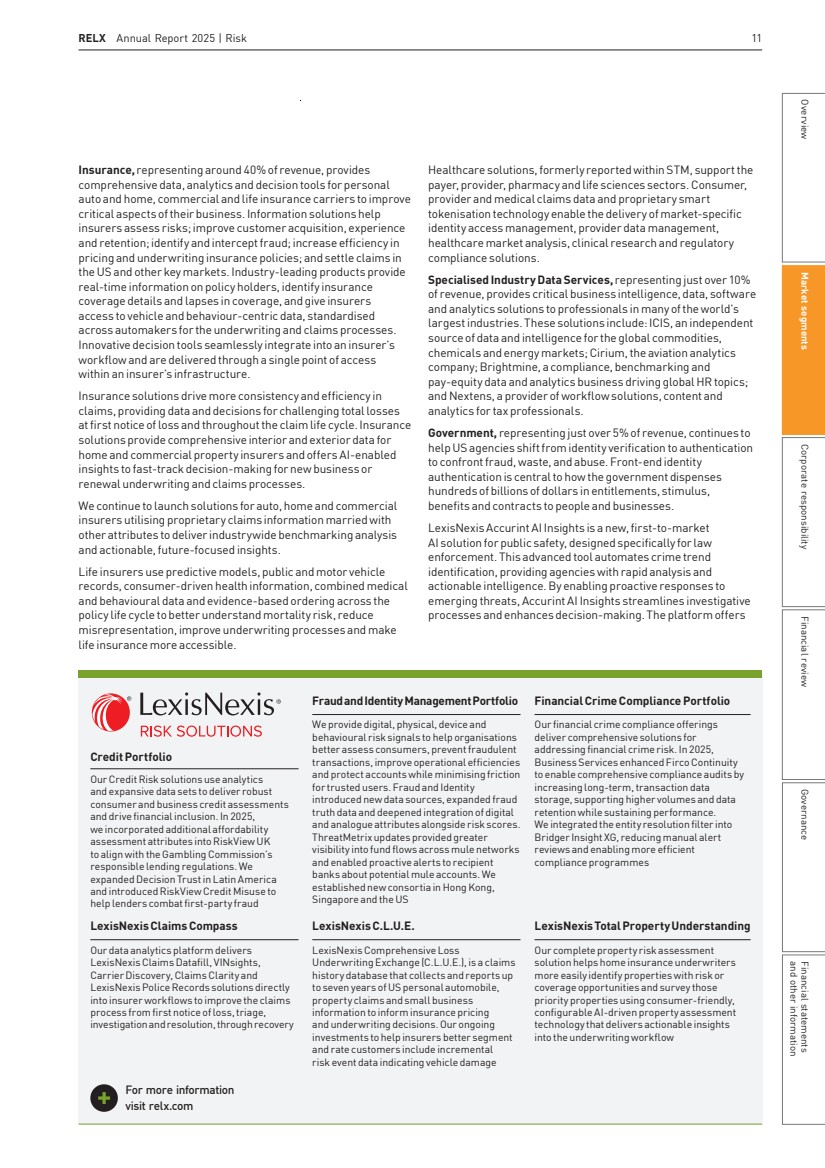
| 12 RELX Annual Report 2025 | Market segments Rest of world 8% Europe 13% North America 79% Subscription 39% Other transactional Geography Type Transactional 61% Long-term contracts with volumetric elements 2025 Revenue £3,485m Transactional activity is driven by growth in insurance quoting and policy switching, as consumers seek better policy terms. This activity is stimulated by competition among insurance companies, increased loss ratios and consumer interest in insurance internet quoting and policy binding. We see opportunities across the insurance continuum using data and analytics to play a critical role in assisting the insurer and consumer decision-making process. This helps consumers and businesses transact with insurers throughout the policy life cycle. We deliver solutions that bridge insurers and automakers, utilising connectivity and regulated data from connected cars to insert vehicle data into insurer workflows and empower consumers with a deeper understanding of driving behaviour. Our deepening relationships with automakers reflect the need to better understand consumer loyalty, improve and digitise the consumer experience through ownership management and connected services solutions, while creating efficiencies within automakers’ operations. In Specialised Industry Data Services, growth in the global commodities and chemicals markets is led by changing trade patterns, a drive to embrace sustainability and demand for more sophisticated supply chain solutions to better utilise precious resources. The aviation industry continues to focus on digital transformation, to drive more efficient, effective and profitable business models in businesses such as airlines, with a particularly strong focus on CO2 emissions data and Corporate Responsibility reporting. The rapidly changing workforce environment is driving employers to better utilise data and analytics to attract, retain and develop a diverse workforce which is further accelerating growth in human resource management. With over 8,000 federal, state, and local agencies using our services, the Government business continues its mission of preventing fraud, fighting crime, reducing risk, and providing citizens with immediate, equitable access to government systems. The addition of AI capabilities, underpinned by responsible data governance, helps our government customers enhance fraud prevention and data integrity while ensuring secure and efficient access to services. The Cares Act amplified the demand for robust online access and highlighted the sophistication of fraud attempts, underscoring the importance of advanced technologies like AI in safeguarding public resources. As agencies adopt private sector innovations, the integration of AI-driven insights will support more proactive measures against improper payments and enhances the integrity of government programmes. The level and timing of demand in this market remain influenced by government funding and revenue considerations, as well as the US administration’s priorities. immediate access to identity and authentication analytics, combining advanced AI with extensive data expertise to support public safety agencies in protecting communities with data-driven insights. Market opportunities We operate in markets with strong long-term growth in demand for high-quality advanced analytics based on industry information and insight, including: financial crime compliance; business risk; fraud and identity solutions; due diligence requirements surrounding customer enrolment; security and privacy considerations; insurance underwriting transactions; insurance acquisition, retention and claims handling; provider data management; patient engagement and population health strategies; healthcare market analysis, clinical research; data and advanced analytics for the banking, commodities and chemicals, aviation and human resources sectors; and tax and public benefits fraud. Expansion of mobile and digital use cases and the growing mix of consumer payment options continue to drive opportunity for Business Services solutions that support efficiency in risk decision making. As criminals continuously adjust attack vectors targeting financial transactions, organisations are utilising our solutions to evolve their financial crime, compliance and consumer and business credit, fraud and scam detection and prevention programmes. Mounting costs from fraud schemes, anti-money laundering programmes, fast changing sanctions, anti-bribery and corruption enforcement, financial transparency and inclusion initiatives, and heightened regulatory scrutiny also provide growth opportunities. We are seeing new use cases for our solutions emerge for corporations, 3D Secure, ecommerce, travel, gaming/gambling, telecommunications, trade compliance and new alternative digital payment methods such as digital wallet applications and Buy Now, Pay Later, particularly mule account setup detection. Continued rapid digitalisation of emerging markets provides growth opportunity for fraud and identity in digital channels. We are also seeing revived demand in third-party collections and non-prime lending. In Insurance, growth is supported by customer experience advances in the auto, home, commercial and life insurance markets, and the increasing adoption by insurance carriers of more sophisticated data and analytics in the prospecting, underwriting and claims evaluation processes to assess risk, increase competitiveness, improve operating cost efficiency and address profitability challenges. |
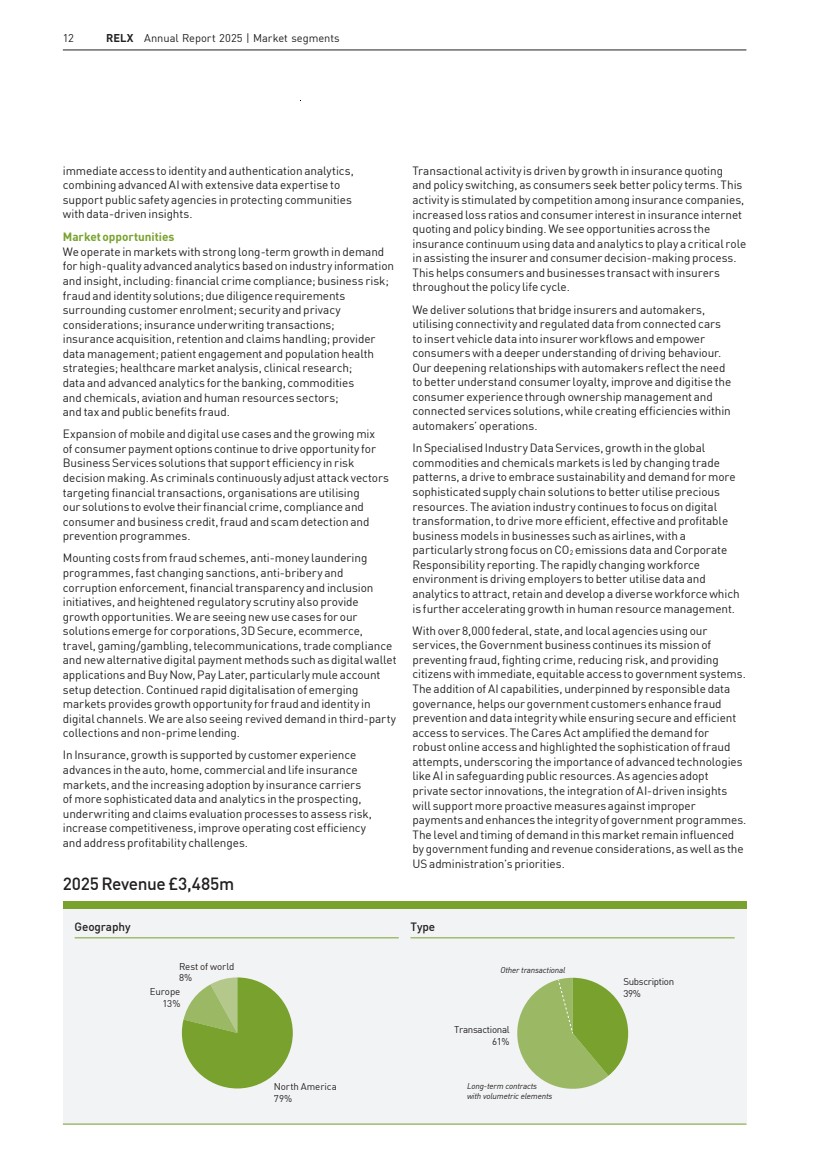
| RELX Annual Report 2025 | Risk 13 Revenue 2025 3,485 3,336 Underlying growth +8% 2024 GBPm Adjusted operating profit 2025 1,233 Underlying growth +10% 2024 GBPm 1,305 Strong fundamentals continuing to drive underlying revenuegrowth Underlying revenue growth of +8%. Strong growth continues to be driven across segments by our deeply embedded, AI-enabled analytics and decision tools. Underlying adjusted operating profit growth was +10%, leading to an increase in adjusted operating margin. In Business Services, strong growth continues to be driven by Financial Crime Compliance and digital Fraud & Identity solutions, and strong new sales. We continue to expand our extensive, differentiated data assets, build out our global fraud infrastructure, and more deeply integrate advanced authentication and behavioural intelligence, to address the increasing complexity of risk decisioning for customers worldwide. In Insurance, strong growth continues to be driven by further innovation and adoption of contributory databases and market-specific solutions, supported by positive market factors and strong new sales. We continue to extend our products across the insurance continuum, and across insurance lines, while adding data sources and analytics to enhance value for customers. Specialised Industry Data Services growth continues to be led by Commodity Intelligence, and Government growth continues to be driven by analytics and decision tools. 2026 outlook We expect continued strong underlying revenue growth with underlying adjusted operating profit growth exceeding underlying revenue growth. 2025 financial performance Restated 2024 GBPm 2025 GBPm Change in GBP Change at constant currency Underlying growth Revenue 3,336 3,485 +4% +7% +8% Adjusted operating profit 1,233 1,305 +6% +9% +10% Strategic priorities Our strategic goals are anchored in helping customers achieve better business outcomes by offering greater insight into risks and opportunities associated with individuals, businesses, devices, and transactions. We provide data and solution tools to help customers make better risk-adjusted decisions to grow successfully. We enable this by focusing on: delivering innovative products; extending our risk management solutions to new applications; adapting our global competencies to meet local needs; and investing in technology to complement organic innovation to continuously expand our analytical capabilities. LexisNexis Risk Solutions continues to develop sophisticated extractive AI and Machine Learning (ML) techniques to generate actionable insights that help our customers make accurate and timely decisions and to improve our internal efficiencies by leveraging and adapting extractive AI/generative AI tools. Our successful deployment of AI and ML techniques both for our customers and for our internal needs is built on a strong foundation that is comprised of: a deep understanding of customer and stakeholder needs, the breadth and depth of our data sets, and our expertise and domain knowledge that helps us discern which AI/ML algorithm to use in a given context to solve business problems most effectively. Business model, distribution channels and competition We sell our products direct-to-client, with pricing based on subscription or transactional with volumetric elements. We also utilise a robust partner distribution channel. Principal competitors in Business Services include data and analytics companies such as the major credit bureaux, which in many cases address various capabilities within each solution offering. In Insurance, data and analytics competitors such as Verisk sell solutions to insurance carriers but largely address different activities to ours. Principal competitors in the Government segment include data providers such as the major credit bureaux. Specialised Industry Data Services competes with a number of information providers on a service-by-service basis including S&P Global Platts and Thomson Reuters as well as various niche and privately owned competitors. 2024 results restated to reflect business area reporting changes Market segments Governance and other information Financial statements Financial review Corporate responsibility Overview |
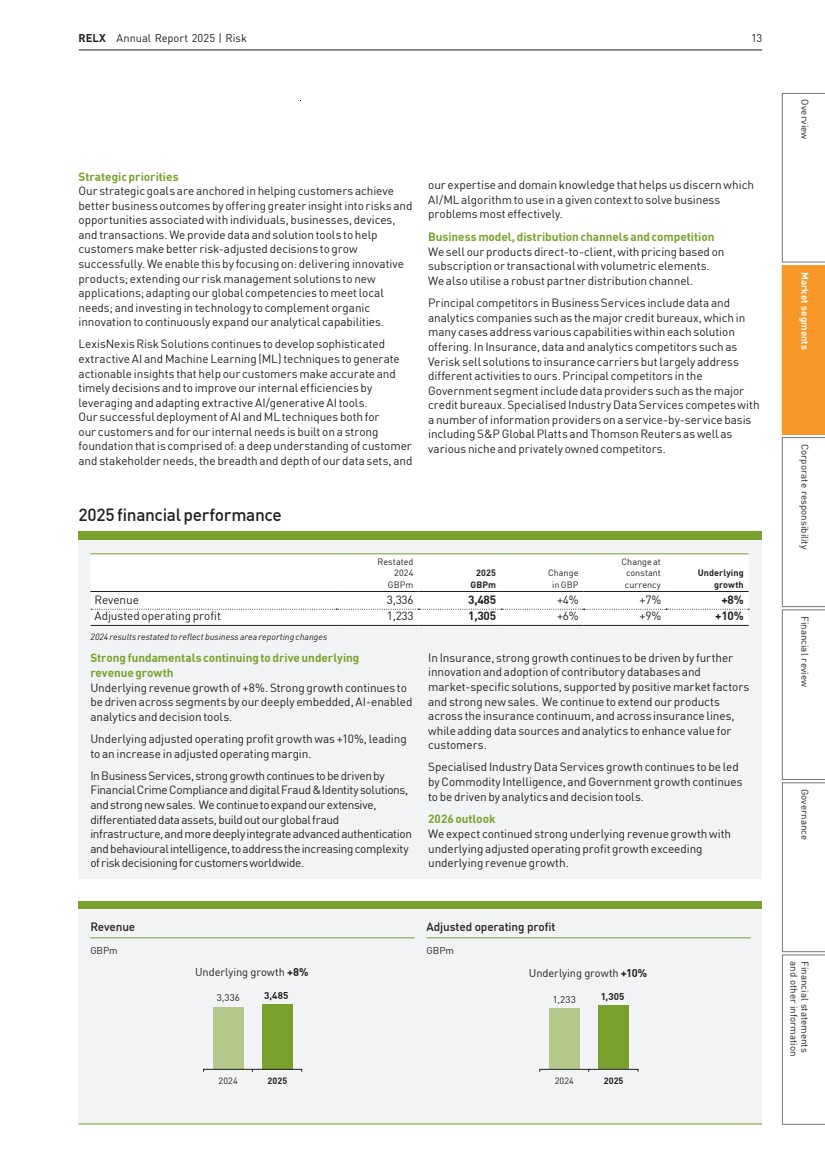
| 60 to 80% faster Insurance Market Insights delivers data approximately 60 – 80% faster than industry standards 14 RELX Annual Report 2025 | Market segments About LexisNexis Insurance Market Insights The LexisNexis Insurance Market Insights platform provides US auto and property insurers market intelligence about loss frequency, claim severity, mix-of-business, claims duration and customer shopping behaviour. This enables insurers to validate strategic decisions, measure their results against industry averages, pivot quickly, and assess the impact of new initiatives months ahead of standard sources of benchmarking intelligence. Additionally, insurance companies can drill down further to analyse specific risk segments by limits, coverage and major peril, state, metropolitan area, policy type, building age, square footage and catastrophe indicator to better understand whether a challenge is isolated to their operations or an industry-wide event. LexisNexis Risk Solutions leverages its deep proprietary datasets and industry wide contributory and transactional databases representing a majority of US auto and property insurance policies, claims and shopping transactions to deliver Insurance Market Insights, which can be seamlessly integrated into an insurance company’s workflow. Traditional market reporting often lags by six to12 months, leaving insurance companies reactive rather than proactive to market or organisational trends impacting their business. Without the opportunity to slice timely information, insurers end up with limited viewsnot relevant to the market segments theyserve or channels they use. Side-by-side data comparisons of internal and external auto and property insurance trend data are often resource and time intensive. Varying regulatory rules for other data sources can result in inconsistencies when comparing benchmarking information. Insurance Market Insights provides normalised and consistently calculated results for both the insurer and industry side-by-side to speed up the process for interpreting results in the context of macro trends impacting the US insurance sector and economy. Utilising the proprietary LexisNexis Risk Solutions extractive AI and big data processing platform to pull in contributory and transactional information, Insurance Market Insights closes the gap by delivering data as quickly as 7-30 days post-event. This timeliness, approximately 60-80% faster than industry standards, enables insurers to respond to emerging trends, economic shifts, and competitive pressures with agility and confidence. For consistency, normalised insurance company and industry information supports like-for-like comparison. The platform’s dashboards offer flexible filtering to drill down into various risk segments, enabling precise performance evaluation and multiple options for granular views. LexisNexis Insurance Market Insights Supporting US personal auto and property insurance companies in making more informed decisions Insurance companies can interpret this information to monitor their own process changes or strategic moves and optimise profitability. A US auto insurance company, for example, can add a new rating element in order to quote and price risk more effectively. In this use case, while the new rating element can improve its pricing accuracy, it can also have an unintended effect in attracting higher frequency business. With benchmarking from Insurance Market Insights, the insurer can quickly identify this issue and adjust its pricing to align with their strategy. As another example, insurance companies are also using Insurance Market Insights to address the increasing severity of bodily injury claims, which had a sharp trend upward, increasing 7% in 2025 versus the prior year and over 26% versus 2021. The impact of the severity increases has been compounded by moderate frequency increases that have occurred over the last two years. LexisNexis Risk Solutions analysis revealed personal property claim severities are up 30% in 2025 compared to 2024 and 71% versus 2021. The 2025 increases were heavily driven by the CA wildfires from Q1 2025. With the detailed analysis of catastrophe versus non-catastrophe home claims trends and by peril within Insurance Market Insights, insurers can better understand their severity trends and the impact of catastrophic claims events so they can more intelligently serve their customers. In a rapidly evolving insurance landscape, this cutting-edge benchmarking and analytics platform isused by US personal auto and property insurance companies to evaluate their performance relative to the industry and make faster, more informed decisions. Christopher Rice VP Product Management, LexisNexis Risk Solutions |
| RELX Annual Report 2025 | Risk 15 About ThreatMetrix LexisNexis ThreatMetrix, powered by the Digital Identity Network, is a global, cross-industry risk intelligence network that analyses billions of transactions annually. By linking devices, locations, behaviours and other digital credentials in real time, ThreatMetrix helps organisations accurately differentiate between genuine customers and malicious actors, from a consumer’s first contact and throughout their entire digital journey. About Crypto.com Crypto.com is one of the world’s largest cryptocurrency platforms, with more than 140m users across more than 100 jurisdictions. With a mission to accelerate global cryptocurrency adoption, the company provides a secure and reliable platform to buy, sell and use digital assets with confidence. Crypto.com is also the industry leader in regulatory compliance, security and privacy, with more than a hundred licences, certifications, registration and regulatory approvals globally. As the business has scaled, growing its user base by 180% and trading volumes by more than 950% between 2022 and 2025, maintaining the highest standards of security, privacy and regulatory compliance has remained paramount. Crypto.com supports the exchange of Bitcoin, Ethereum and 400+ cryptocurrencies (cryptocurrencies available vary by jurisdiction). The global landscape in the crypto industry has changedsignificantly.Thirdpartyfraud and chargebacks used to be the main concerns. Today, scams which are often sophisticated andfast moving pose the biggest threats. AsCrypto.com’s platform grew, so did the volume and complexity of the attacks, from AIgenerated identities to social engineering tactics. While users expect a seamless experience, they also expect the platform to be secure. Crypto.com operate in a space where trust is crucial and can be quickly undermined. Crypto.com needed a fraud-prevention solution that could keep pace with its growth and progress toward expanding their global offering to include stocks, banking services, credit cards and payment cards, without compromising customer experience. Crypto.com deployed ThreatMetrix to optimise fraud detection and increase operation efficiencies by automating onboarding and transaction workflows. ThreatMetrix utilises real-time digital identity and behavioural intelligence from one of the largest cross-industry data networks in the world. This enables Crypto.com to proactively stop fraudulent activities before they impact their platform. ThreatMetrix helps us raise our fraud capture rates and streamline trusted user experiences so we can stay focused on scaling our platform and expanding our global business. Deyan Tsvetkov Senior Vice President, Risk Management, Crypto.com LexisNexis ThreatMetrix: Strengthening fraud prevention for a rapidly expanding cryptocurrency platform 26% Crypto.com saw a 26% lift in fraud capture rates With rapid growth and ambitious expansion plans in an industry where instant transactions play an integral role in customer conversion and satisfaction, Crypto.com benefits from ThreatMetrix’s ability to easily configure to fit Crypto.com’s specific speed and volume requirements. The solution also delivers the responsiveness demanded by a dynamic threat environment defined by AI-enabled fraud, bots, scams and social engineering. ThreatMetrix offers the advantages of contributory, cross-industry digital identity, device and behavioural intelligence combined with AI-powered models and analytics which help Crypto.com automate decisions and avoid fraud upfront. By implementing LexisNexis ThreatMetrix, Crypto.com significantly boosted its fraud prevention capabilities across the customer journey, helping them automate decisioning, streamline onboarding and maintain high standards of compliance and user experience. Crypto.com saw a 26% lift in fraud capture rates, a 15% reduction in fraud losses tied to chargebacks, and a 20% reduction in time spent on manual reviews and investigations. Return on investment was achieved in the first six months. Market segments Governance and other information Financial statements Financial review Corporate responsibility Overview |
| 16 RELX Annual Report 2025 | Market segments Business overview Scientific, Technical & Medical helps advance science and healthcare by combining high-quality, trusted scientific and medical information and data sets with innovative technologies to deliver critical insights that support better outcomes. Elsevier is headquartered in Amsterdam, with principal sites in New York, Philadelphia, and St. Louis in North America; London, Oxford, Frankfurt, Munich, Madrid and Paris in Europe; Beijing, Shanghai, Chennai, Delhi, Sydney, Singapore and Tokyo in Asia Pacific, and Rio de Janeiro in South America. It has 9,700 employees with customers in over 170 countries and territories. Revenues for the year ended 31 December 2025 were £2,714m, compared with £2,624m in 2024 and £2,581m in 2023. In 2025, 43% of revenue came from North America, 23% from Europe and the remaining 34% from the rest of the world. Subscription revenue represented 80% of total revenue and transactional revenues represented 20%. Elsevier’s customers are scientists, research leaders, librarians, medical researchers, doctors, nurses, allied health professionals and students, as well as hospitals, academic and research institutions, research-intensive corporations, funders, and governments. Elsevier’s services across Academic & Government, Corporate and Health markets focus on: Databases, Tools and Electronic reference and Primary Research. In each of these markets, our objective is to help impact makers shape human progress to go further, happen faster, and benefit all. Databases, Tools and Electronic Reference, together with Corporate Primary Research, accounts for around 45% of STM revenues, with Academic & Government Primary Research accounting for around 55%, all in electronic format. Databases & Tools & Electronic Reference. Elsevier’s databases, tools and electronic reference products help customers and users solve complex problems and make critical decisions, and we are enhancing these capabilities with AI across all our business areas. Solutions include LeapSpace, Scopus/ ScopusAI, ScienceDirect AI, SciVal, Interfolio, Engineering Village and Pure in Academic & Government; Reaxys/Reaxys AI Search, Embase AI, PharmaPendium AI and SciBite in Corporate; and ClinicalKey/ClinicalKey AI, HESI, Sherpath AI, Shadow Health, ClinicalPath, and Osmosis, for Health. Elsevier’s research solutions combine quality, curated content and extensive data sets with responsible AI and large language model (LLM) technology to help researchers, academic leaders, policy makers, funders and R&D-led corporations to generate insights, set and implement research strategies and make decisions with confidence. This portfolio integrates with and enhances the systems institutions rely on, with interoperability driven by Application Programming Interface technologies (APIs). In early 2025, Elsevier launched a new generative AI tool on ScienceDirect, the world’s largest platform for peer-reviewed research used by more than 20m researchers each month. ScienceDirectAI helps transform the way researchers work by enabling them to instantly extract, summarise and compare trusted insights from millions of full-text articles. In November, Elsevier introduced LeapSpace, a next-generation AI-powered workspace, combining the broadest collection of trusted scientific content with responsible AI to help researchers uncover deeper insights, accelerate innovation, and collaborate seamlessly – in one secure environment. We deliver insights that help universities, research institutions, governments and funders achieve their goals. We help researchers discover and share knowledge, collaborate, and accelerate innovation. Wehelp librarians provide trusted, high-quality information totheir universities. We help innovators transform the latest knowledge into new products. We help health professionals improve patient care, and educators train thenext generation of doctors and nurses. Scientific, Technical & Medical |
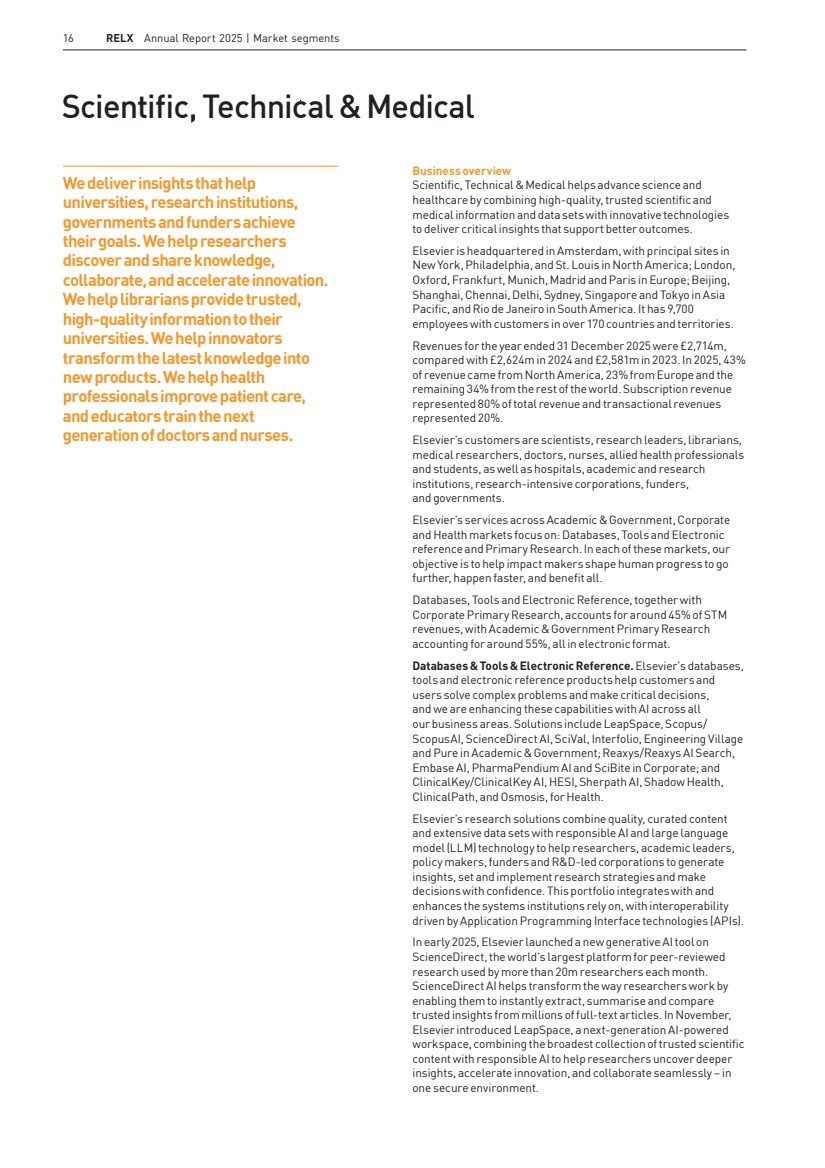
| RELX Annual Report 2025 | Scientific, Technical & Medical 17 For Corporate R&D, Elsevier provides connected, configurable solutions that combine comprehensive data with analytical and predictive tools. In 2025, new innovations included Reaxys AI Search, which enables chemists and R&D teams to explore over 123m chemistry documents, as well as patents and peer-reviewed journal articles using natural language discovery. New EmbaseAI, the generative AI-powered version of Embase, the leading biomedical database, allows users to pose queries in natural language and receive a summarised response with inline citations to ensure transparency. PharmaPendium AI, an AI-powered upgrade to ourPharmaPendium solution, empowers regulatory affairs specialists, drug development professionals, and clinical researchers by providing easy access to regulatory precedents from the US Food and Drug Administration and European Medicines Agency documents, and enables effective regulatory planning as well as supporting core research on toxicology and drug safety. In Health, Elsevier’s clinical solutions include digital solutions for doctors, nurses, care teams and patients. Its clinical reference platform, ClinicalKey, helps doctors, nurses and students find clinically-relevant answers through a range of trusted content across specialities. This includes Elsevier’s vast collection of medical reference content, including over 2,500 clinical overviews, over 7.3m images and over 128,000 medical videos in one integrated platform. ClinicalKey AI combines this content with generative AI technology. ClinicalPath Oncology presents evidence-based oncology pathways embedded in the clinical workflow, andthe associated analytics, to help oncology care teams makeconsistent, well-informed decisions for high quality care. Elsevier also serves students of medicine, nursing, and allied health professions. Sherpath, an adaptive teaching and learning solution which also offers an AI tool, provides personalised learning paths at over 800 institutions, supporting more than 500,000 course enrolments, while ClinicalKey Student is used in over 450 medical schools globally. In electronic reference, Elsevier provides authoritative reference content to scientific, technical and medical professionals. Flagship titles include Gray’s Anatomy, Nelson’s Pediatrics and Netter’s Atlas of Human Anatomy. Primary Research. Elsevier helps researchers validate, improve and disseminate their scientific findings through its more than 3,000 journals, enhancing the record of scientific knowledge by applying highest standards of quality and ensuring trusted research can be accessed, shared and built upon. Elsevier journals are the foremost publications in their field, including flagship families of journals like Cell Press and The Lancet. Research content is distributed and accessed via ScienceDirect, the world’s largest platform dedicated to peer-reviewed primary scientific and medical research. In 2025, Elsevier received more than 4.2m article submissions, which were rigorously reviewed by our in-house editorial teams in collaboration with over 37,000 editors and over 1.9m expert reviewers around the world. The result is over 795,000 articles enhanced, indexed, certified, published and promoted following peer review, with the global scientific community accessing articles over 2.9bn times across its journal platforms. LeapSpace, a next-generation AI workspace built on the world’s most comprehensive collection of scientific content to help researchers uncover deeper insights, accelerate innovation, and collaborate seamlessly in one secure environment. It combines multi-model responsible AI with transparency and clear trust markers, industrial-grade data privacy and security, so that every insight is explainable, traceable, and grounded in the highest-quality global science An expertly curated abstract and citation database with content from over 31,000 academic journals from 7,000 publishers to help track and enhance researcher and institutional data and discover global research in all fields. Scopus AI helps researchers get deeper research insights faster, navigate and understand different disciplines more easily and support interdisciplinary collaboration Clinical knowledge solution helping healthcare professionals and students find the most clinically relevant answers from comprehensive trusted content across specialities. ClinicalKey AI combines the latest and most trusted medical content with generative AI to help clinicians at the point of care. The tool integrates with electronic health records systems The world’s most advanced 3D anatomy platform, Complete Anatomy is revolutionising how students, educators, health professionals and patients understand and interact with Anatomy The world's largest chemical database, Reaxys combines over a billion chemistry data points from journals and patents with AI to support innovation in drug discovery, chemical R&D and academia. Chemists can quickly access relevant patent, substance and bioactivity insights, and an award-winning retrosynthesis tool SciVal is an analytics solution that provides insights into the research performance of over 24,700 academic, industry and government research institutions For more information visit relx.com Market segments Governance and other information Financial statements Financial review Corporate responsibility Overview |
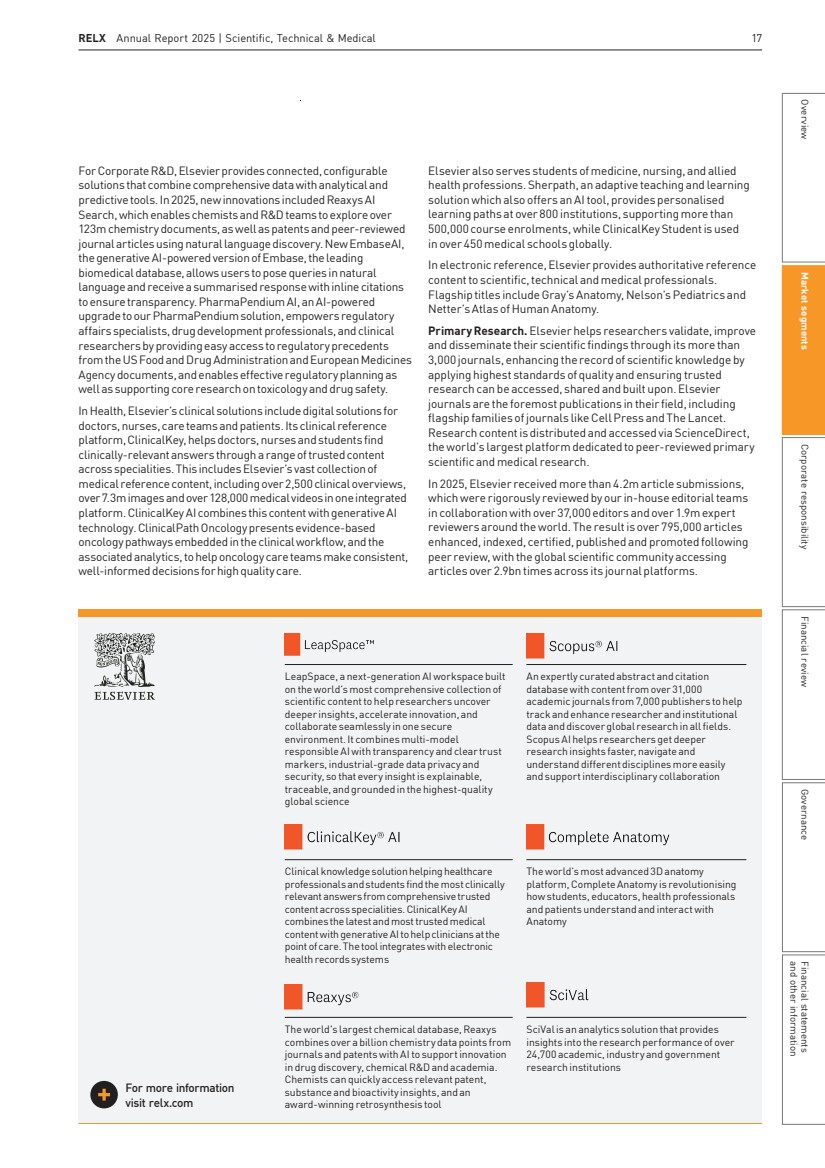
| 18 RELX Annual Report 2025 | Market segments Transactional 20% Subscription 80% Geography Type Rest of world 34% Europe 23% North America 43% confidence. We have a multi-model approach and adapt AI for specific domains, such as research, life sciences, clinical care, health education, through hybrid search, knowledge graphs, ontologies, large language model and human expertise-based evaluations to provide users with answers that are precise, relevant, and useful in real-world settings. In Primary Research, Elsevier’s priority is to support researchers by finding a home for every sound science article submitted, and providing choice in payment model, quality tier, and scientific discipline. We aim to deliver above industry average journal and article quality, at below average article download and publishing cost, leveraging our scale and expertise. Elsevier works with customers to help them reach their research goals through excellence in content, service and value. Elsevier is building on its premium brands, enhancing quality through peer review, and increasing article volume through new journal launches, the expansion of open access journals and growth from emerging markets; and broadening the range and quality of insights across research solutions. We continue to improve customer experience while driving operational efficiency and effectiveness; and collaborate to advance open science, inclusive research and inclusive health and support the UN Sustainable Development Goals, through our business and the Elsevier Foundation. Business model, distribution channels and competition In Databases, Tools and Electronic Reference, solutions like Scopus, Clinical Key and Reaxys, are generally sold direct to institutional, healthcare and corporate customers through global sales force. Reference and educational content are sold directly to institutions and individuals and accessed on Elsevier platforms. In Primary Research, science and medical research is distributed via the ScienceDirect platform, supported by two separate payment models to suit author preferences: pay to read articles funded by payments for reading made by individuals or institutions; and pay-to-publish (commonly known as open access) funded by payments for publishing, made by authors, their institution or funding bodies. Elsevier offers a range of pay to read and pay to publish options, both subscription-based and transactional, to fit the diverse needs of institutions, funders, and researchers worldwide. Nearly all of Elsevier's over The latest available long-term comparison with the market showed that Elsevier journal articles accounted for over 18% of global research output and 29% of citations, demonstrating Elsevier’s commitment to quality significantly ahead of the industry average. Elsevier is the global leader in open access publishing, with over 285,000 open access articles published in 2025, a year-on-year increase of nearly 14%, and over 960 fully open access journals following 75 new launches during the year. Elsevier’s world-leading research platforms make available 4.3m validated open access articles. Elsevier has also invested in other research solutions, such as SSRN, an open access online preprint community where researchers post early-stage research, Scopus Author Profiles showing preprints to provide an early view into a researcher’s focus areas and Digital Commons helping academic libraries showcase and share their institutions’ research via institutional repositories for greatest impact. Market opportunities Scientific, technical and medical information markets have positive long-term growth characteristics. Investment in R&D is critical for nations and corporations to create competitive advantage, drive innovation, economic growth and solve societal issues. This leads to long-term growth in R&D spending and sustained increases in researchers worldwide. As people live longer and aim to live healthier lives, health expenditure and the number of physicians and nurses also continues to grow strongly. Strategic priorities Elsevier’s strategic priorities are to help our customers solve critical and complex problems, by expanding content quality, coverage and utility; combining content with analytics and technology to build integrated solutions and decision tools that utilise advanced Machine Learning (ML) and AI to improve productivity and outcomes, and enable insights underpinning critical decisions, benchmarking and evaluation. In Databases, Tools and Electronic Reference, Elsevier is applying advanced linking capabilities and AI to our vast verified research and healthcare information and data sets, including patent, research grants, drug information, medical claims data, to develop products that help our academic & government, corporate and health customers make critical decisions with 2025 Revenue £2,714m |
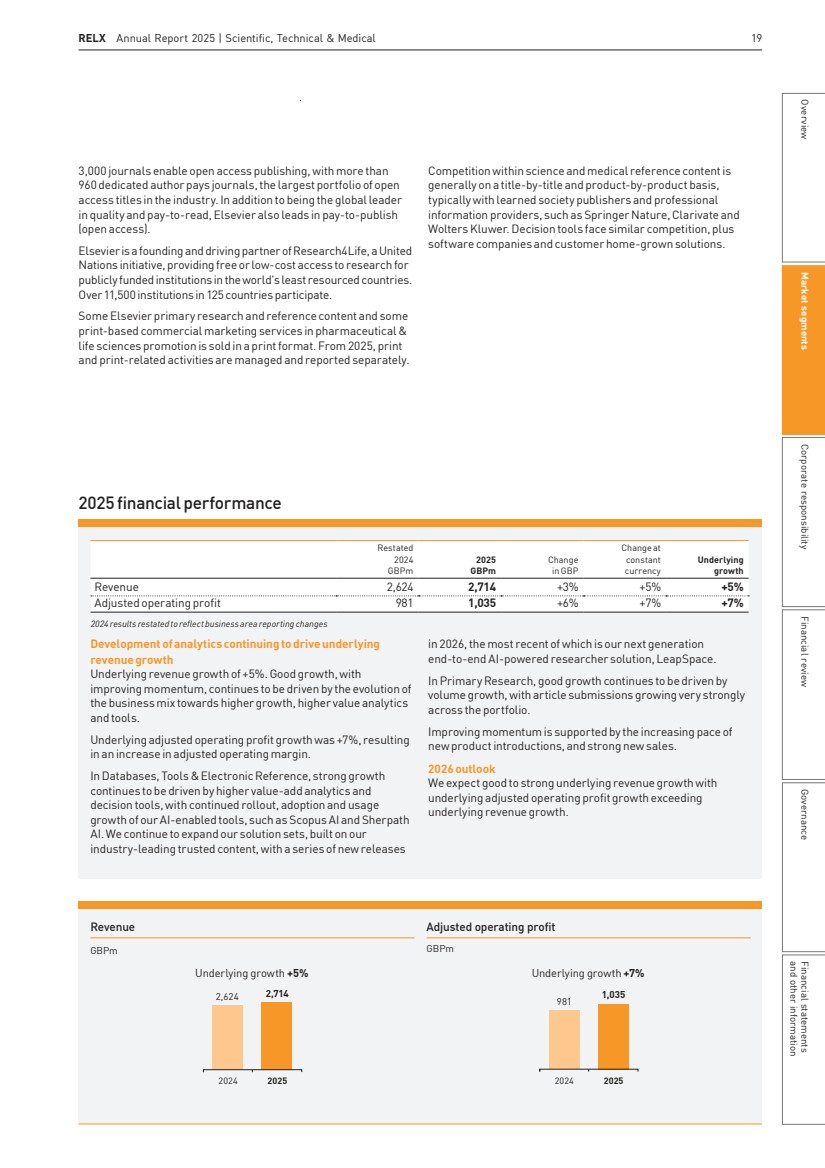
| RELX Annual Report 2025 | Scientific, Technical & Medical 19 Development of analytics continuing to drive underlying revenue growth Underlying revenue growth of +5%. Good growth, with improving momentum, continues to be driven by the evolution of the business mix towards higher growth, higher value analytics and tools. Underlying adjusted operating profit growth was +7%, resulting in an increase in adjusted operating margin. In Databases, Tools & Electronic Reference, strong growth continues to be driven by higher value-add analytics and decision tools, with continued rollout, adoption and usage growth of our AI-enabled tools, such as Scopus AI and Sherpath AI. We continue to expand our solution sets, built on our industry-leading trusted content, with a series of new releases in 2026, the most recent of which is our next generation end-to-end AI-powered researcher solution, LeapSpace. In Primary Research, good growth continues to be driven by volume growth, with article submissions growing very strongly across the portfolio. Improving momentum is supported by the increasing pace of new product introductions, and strong new sales. 2026 outlook We expect good to strong underlying revenue growth with underlying adjusted operating profit growth exceeding underlying revenue growth. 2025 financial performance Restated 2024 GBPm 2025 GBPm Change in GBP Change at constant currency Underlying growth Revenue 2,624 2,714 +3% +5% +5% Adjusted operating profit 981 1,035 +6% +7% +7% Revenue 2025 2,624 2,714 Underlying growth +5% 2024 GBPm Adjusted operating profit 2025 1,035 981 Underlying growth +7% 2024 GBPm 3,000 journals enable open access publishing, with more than 960 dedicated author pays journals, the largest portfolio of open access titles in the industry. In addition to being the global leader in quality and pay-to-read, Elsevier also leads in pay-to-publish (open access). Elsevier is a founding and driving partner of Research4Life, a United Nations initiative, providing free or low-cost access to research for publicly funded institutions in the world’s least resourced countries. Over 11,500 institutions in 125 countries participate. Some Elsevier primary research and reference content and some print-based commercial marketing services in pharmaceutical & life sciences promotion is sold in a print format. From 2025, print and print-related activities are managed and reported separately. Competition within science and medical reference content is generally on a title-by-title and product-by-product basis, typically with learned society publishers and professional information providers, such as Springer Nature, Clarivate and Wolters Kluwer. Decision tools face similar competition, plus software companies and customer home-grown solutions. 2024 results restated to reflect business area reporting changes Market segments Governance and other information Financial statements Financial review Corporate responsibility Overview |
| 20 RELX Annual Report 2025 | Market segments As research output continues to grow globally, Elsevier’s investments in technology help enhance the publishing experience for authors, editors and reviewers, so quality research can continue to advance human progress. Arnold Pippel Senior VP, Customer Experience and Innovation About Elsevier As the largest publisher of scientific journals, Elsevier handles more than 4.2m research submissions each year, spanning 3,000 journals across a network of millions of authors, reviewers, and tens of thousands of editors. This unparalleled scale brings complexity, requiring extensive investment and constant innovation to enhance the user experience while managing an ever-growing volume of content and safeguarding research quality and integrity. In 2025, Elsevier initiated one of the most ambitious transformations in scientific publishing, building a next generation publishing platform designed to deliver an enhanced end-to-end experience for authors, editors and reviewers. Key steps in the publishing workflow of submission and peer review were completed in 2025. Other editorial workflows will be addressed in 2026 and expected to be completed in 2027. Over several decades, Elsevier’s publishing system grew to support 3,000 journals, offering extensive configurability across multiple settings and numerous databases within its infrastructure. While the scale and diversity of options provided flexibility and accommodated a wide range of publishing needs across disciplines, an opportunity emerged to streamline processes for both authors and reviewers, and in parallel, to advance efforts to safeguard research integrity against practices such as citation manipulation and fabricated data or images. Elsevier set out to completely redesign its publishing platform with users in mind. At the heart of this transformation is a unified data lake and architecture, unlocking the power of real-time data and scalable innovation. A New Digital Foundation A key technological advance is Elsevier’s new capability to deconstruct and identify all the elements of a manuscript, automatically extracting and linking entities such as titles, abstracts, author names and embedded figures. Our latest technology then enables structuring of the manuscript into a rich digital format, unlocking new capabilities and enhancements. This streamlines the submission process for authors who now benefit from automated metadata extraction and real-time error detection, and lays the groundwork for new integrity checks and editorial tools. For example, advanced extraction helps to auto-format manuscripts for peer review, check for missing items or errors, and support authors in ensuring all required ethics or integrity related declarations are present. By providing the ability to simultaneously view reviewer and author comments on a single screen, the platform helps editors +10% faster The overall editorial process is now faster by more than 10% save time and make more confident decisions. At the same time, reviewers are supported with inline commenting tools and article‑style formatting, enhancing the interactivity and efficiency of peer review. The impact has been significant, with author satisfaction reaching almost 90%. The overall editorial process is now faster by more than 10%. Early data indicates quality improvements. For example, acceptance rates for manuscripts undergoing peer review have risen by approximately five percentage points, reflecting the benefits of enhanced feedback and collaboration in the new experience. Advanced Integrity Toolkit As in other sectors, science is at risk from fraudulent activity. Elsevier introduced an advanced ethics toolkit, using numerous signals and AI-based analysis to flag integrity concerns before and after publication. These include AI phrasing, authorship changes, and simultaneous submissions. Human experts validate flagged cases, ensuring that trust in the scientific record remains robust and authors get a consolidated view of reviewers' feedback, including annotation-based comments directly on their manuscripts, making it easier to address the feedback needed to improve their manuscript. Crucially, Elsevier adopted a phased implementation strategy, introducing innovations incrementally and working in close partnership with editors and researchers throughout the process to support adoption. By combining cutting-edge technology with integrity-focused design and human expertise, Elsevier is delivering a publishing experience that is not only simpler and faster, but also more secure and supportive for all users. Elsevier Transforming scientific publishing to support the demands of modern research |
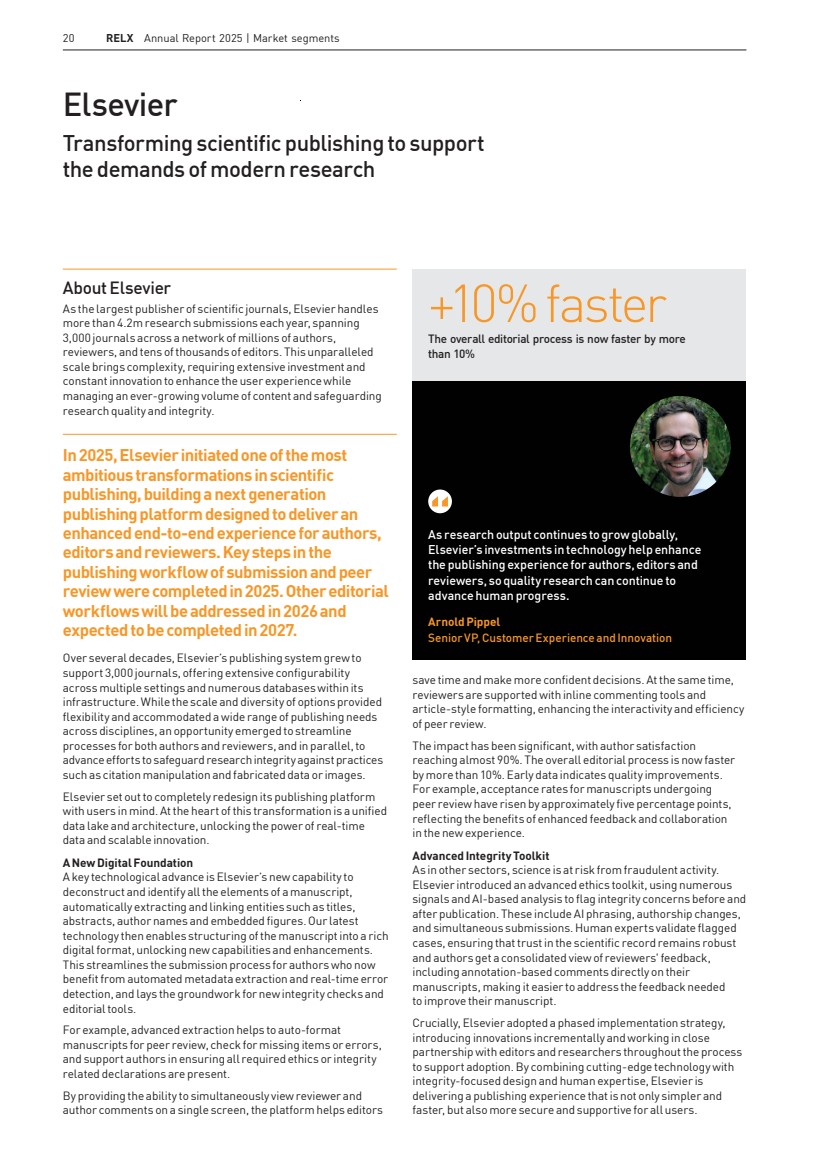
| RELX Annual Report 2025 | Scientific, Technical & Medical 21 About Sherpath AI Sherpath AI is an adaptive digital learning, conversational AI solution designed to enhance nursing education through personalised learning paths. Integrated within Sherpath, it introduces an interactive feature that allows students to ask questions in natural language and receive evidence-based answers drawn exclusively from Elsevier’s trusted content. Already used by over 73,000 students (nearly 15% of all nursing students) and 6,000 instructors in the US, the tool has helped answer more than 7m enquiries in 2025. This real-time, AI-powered interaction deepens understanding, reinforces key concepts, and creates a more engaging and efficient learning experience for nursing and health education students. In 2025, St. Johns River State College (SJR State) and Georgia Southern University (GSU) pioneered the use of Sherpath AI, Elsevier’s artificial intelligence-powered learning platform, and investigated its potential for advancing undergraduate nursing education. The platform leverages responsible generative AI and Elsevier’s evidence-based content to deliver personalised, dynamic support for both educators and students. For Dr Vanessa Roth, Foundations Instructor at SJR State, ensuring exam integrity and fostering critical thinking were top priorities. She faced a significant challenge: test questions were circulating online. “I can memorise a test question after seeing it once,” she said. “If I can do that, students can too. It doesn’t help them when they go on to harder classes. It’s not helping them build the skills they need.” Sherpath AI transformed Dr Roth’s approach to assessment. The platform enabled her to rapidly generate multiple versions of exams, saving her valuable time in the process.“I was able to write four different versions of the regular chapter exams, and then one final, within a month,” she explained. She wanted to write new questions herself, but the time required to build and validate exams from scratch was daunting. “Without Sherpath AI, I never would have slept,” she laughed. Unlike generic AI tools, Sherpath AI is built on Elsevier’s vast library of verified nursing education content and includes features like Osmosis videos, source citations, and alternative ways to explain difficult concepts. Dr Roth continued, "It’s tied to my book, so I know the content is accurate." This not only protected test integrity but also saved considerable time, allowing Dr. Roth to focus on grading and curriculum development. Sherpath AI’s adaptive capabilities meant that exam questions could be refined based on student feedback, continually improving their relevance and effectiveness. The impact extended beyond SJR State. At Georgia Southern University, Sherpath AI was introduced in two undergraduate nursing courses, reaching over 140 students. Usage data revealed that students engaged with Sherpath AI most intensively during exam periods, with weekly queries ranging from 46 to 670 per course. Notably, students began using Sherpath AI for subjects beyond those where it was formally introduced, including pharmacology, obstetrics, and pediatrics. This cross-disciplinary adoption highlighted the platform’s intuitive design and broad relevance. A survey of a sample of students at GSU underscored Sherpath AI’s positive influence on student learning at that institution. Over 70% of respondents reported that Sherpath AI “inspires me to learn new things,” while over 60% said it “makes them feel more empowered” and “more involved with their studying.” Additionally, over 65% indicated that Sherpath AI “improved their performance,” “gave them control over their studies,” and “enhanced their learning effectiveness.” Dr Roth’s experience reflects the transformative potential of Sherpath AI: “I love it. I absolutely love it. It made it so much easier for me to be able to do my job a lot faster and more efficiently, because I knew that the questions were good.” By combining world-class educational content with advanced AItechnology, Sherpath AI helps educators safeguard exam integrity, nurture critical thinking, and empower students to take charge of their learning. I love it. I absolutely love it. It’s been a lifesaver, honestly. Dr Vanessa Roth Foundations Instructor, St. Johns River State College 73,000+ Sherpath AI was used by over 73,000 nursing students in the US in 2025 Sherpath AI Elevating nursing education with an adaptive digital and conversational tool Market segments Governance and other information Financial statements Financial review Corporate responsibility Overview |
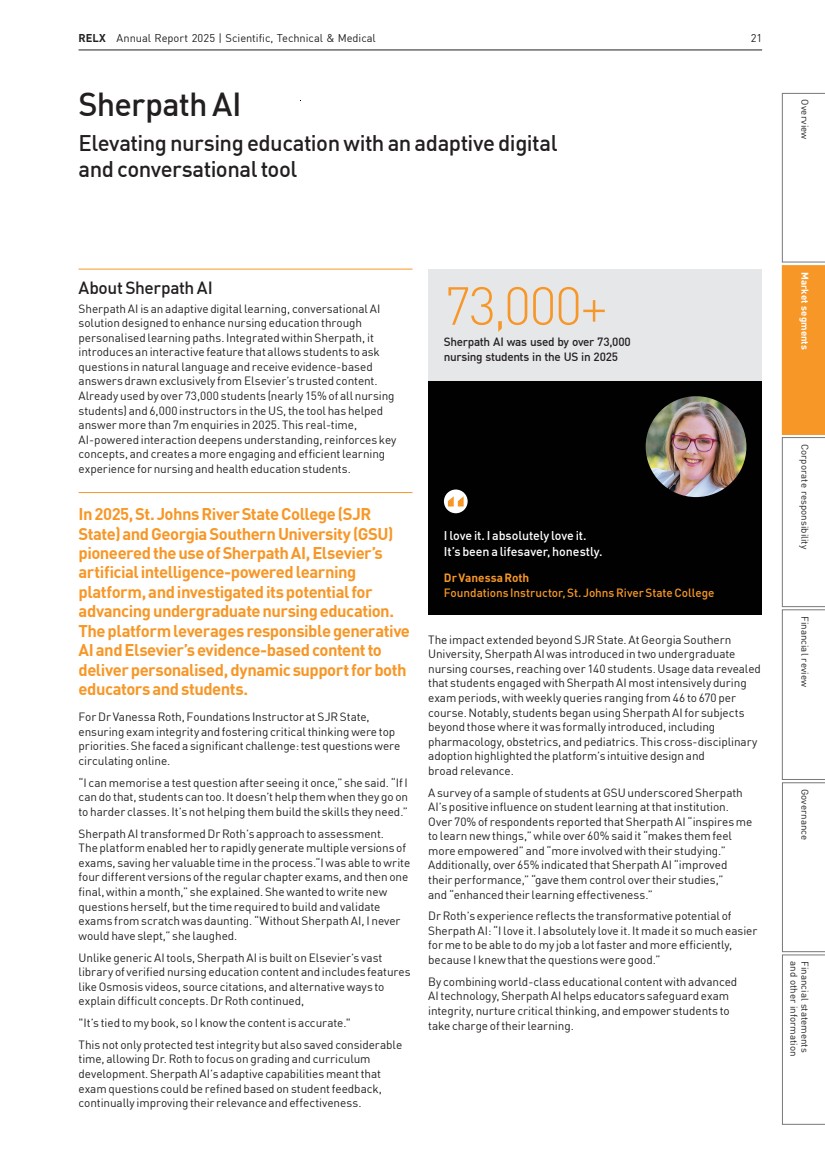
| 22 RELX Annual Report 2025 | Market segments Business overview Legal helps its customers improve decision-making, achieve better outcomes and increase productivity by providing tools that combine legal, regulatory and business information with powerful analytics. LexisNexis Legal & Professional is headquartered in New York and has further principal operations in Dayton, Raleigh, and Toronto in North America, London and Paris in Europe, and cities in several other countries in Africa and Asia Pacific. It has 11,900 employees worldwide and serves customers in almost 150 countries and territories. Revenues for the year ended 31 December 2025 were £1,806m, compared with £1,718m in 2024 and £1,655m in 2023. In 2025, 68% of revenue came from North America, 22% from Europe, and the remaining 10% from the rest of the world. Subscription represented 85% of revenue and transactional revenues represented 15%. LexisNexis Legal & Professional is organised in market-facing groups, focused on Law Firms & Corporate Legal, Government & Academic, and News & Business markets. Content and tools are tailored to the specific geographic markets served, supported by global shared services organisations providing platform and product development, operational and distribution services, and other support functions. Law Firms & Corporate Legal, representing around 70% of revenue, provides legal professionals across law firms and corporate legal departments with electronic reference, decision tools, and analytics to help make better informed decisions in the practice of law. Standard products for legal research and analytics include Lexis, Lexis+, and Lexis+ AI, which provide statutes and case law combined with analysis and expert commentaries from secondary sources, such as Matthew Bender, and incorporate the leading citation service, Shepard’s, advising on the continuing relevance of case law precedents. Lexis+ AI was introduced in the US in 2023 and is a generative AI platform designed to transform legal work. It is built and trained on one of the world’s largest repositories of accurate and exclusive legal content, leveraging an extensive collection of documents and records to provide customers with trusted, comprehensive legal results with unmatched speed and precision and backed by verifiable, citable authority. The new Lexis+ AI technology features conversational search, insightful summarisation, uploaded document analysis, and intelligent legal drafting capabilities, all supported by state-of-the-art encryption and privacy technology to keep sensitive data secure. In slightly over two years since the launch of Lexis+ AI, we have gained widespread adoption of the platform – over half of all US new and renewing customers are adopting Lexis+ AI. In 2025, Lexis+AI delivered answers to over five million prompts in the US alone. LexisNexis Protégé, a new personalised AI Assistant in Lexis+ AI, was launched in Q1 2025. Protégé is an AI feature of LexisNexis that integrates with legal document management systems to deliver uniquely personalised work product in a private, secure setting. In 2025, Protégé expanded globally across key LexisNexis markets in the US, Asia-Pacific, Europe, and Africa – and was integrated into several products in the LexisNexis portfolio. We help lawyers win cases, manage their work more efficiently, serve their clients better, and grow their practices by deploying advanced analytics and latest, cutting-edge technology, including artificial intelligence. Weassist corporations in better understanding their markets and monitoring relevant news. We partner with leading global associations and customers to help advance the Rule of Law across the world. Legal |
| RELX Annual Report 2025 | Legal 23 Lexis Create+ is an AI-powered personalised legal drafting tool that helps users build comprehensive legal drafts right within the Microsoft Word environment. The drafting, analysis and strategy can be enhanced with direct integration into customer document management systems. Lexis Create+ launched in multiple LexisNexis markets in 2025. Lexis+ is the core online research platform and is being rolled outin additional countries and enhanced in existing countries. New geographical roll-outs in 2025 included France and China. In existing markets, content and product enhancements improved our offerings. 2025 enhancements in the UK and Canada expanded practice areas, added legislative tracking, and improved customer access. In 2025, LexisNexis continued to broaden the reach of its decision tools and analytics through Lex Machina. Litigation Analytics on Lexis+ AI helps users analyse courts, judges, attorneys, and law firms. In July of 2025, Lex Machina rolled out a new Party Analytics feature, offering practitioners even more valuable insights and more exposure to Lex Machina’s industry-leading analytics capabilities. Lex Machina also launched a Protégé integration, enabling customers to enter a question, statement, or prompt and receive an output of suggested analytics tailored to their case needs, ensuring fast, data-backed legal insights. LexisNexis expanded legal news coverage with Law360 in 2025, publishing over 60,000 news and analysis articles and growing its readership by over 10%. It also expanded global legal news coverage with the launch of Law360 Criminal Practice section covering the full spectrum of criminal law developments. From a product standpoint, Law360 added new features including customised news recommendations and enhanced pulse leaderboard analytics allowing firms to compare themselves to peers. In the Intellectual Property (IP) analytics space, a Protégé integration was launched within the PatentSight+ platform, enabling users to ask questions in plain language and receive fast, structured, visual answers drawn from global patent data and scientifically validated metrics. LexisNexis Regulatory Compliance is positioned to support our clients in key regions globally, including the US and UK, assisting them in maintaining compliance registers across numerous topics including cybersecurity, banking, gambling and more. The continuously expanding content portfolio is focusing on key legal obligations content in highly regulated industries and areas of law. LexisNexis also supplies software solutions for legal spend management, matter management, and client engagement. CounselLink+, a fully integrated Enterprise Legal Management and Contract Lifecycle Management platform, features interconnectivity to the LexisNexis portfolio, Practical Guidance templates within the Contract module, and Ask Legal on Microsoft Teams. In 2025, CounselLink+ launched a Protégé integration which can provide matter and invoice summarization and generate actionable insights. InterAction+, LexisNexis’s legal Customer Relationship Management platform, continued building cloud capabilities to enable customer migration. In 2025, LexisNexis continued to pursue inorganic growth opportunities and expand its integrations across the global legal ecosystem. In June 2025, LexisNexis agreed a strategic alliance with Harvey, an AI platform for legal and professional services, whereby LexisNexis will integrate its Lexis+ AI capabilities (powered by LexisNexis content) within the Harvey platform, further advancing LexisNexis’s strategy of meeting customers where they work. The alliance also envisages the joint development of advanced legal workflows and potential expansion to other regions outside the US. Lexis+ AI is a generative AI platform designed to transform legal work through enhanced search, summarisation and drafting capabilities Lexis+ is a legal analytics ecosystem that uses AI and superior search technology to deliver legal research and news, data-driven insights, and practical guidance seamlessly into legal workflows LexisNexis Protégé is a personalised AI assistant that reduces repetitive tasks, tackles complex analyses, and delivers exceptional work for legal and business professionals Lex Machina provides Legal Analytics to law firms and companies, enabling them to craft successful strategies, win cases, and close business CounselLink+ is an award-winning Enterprise Legal Management (ELM) solution designed for corporate legal departments, offering enhanced matter management, legal spend control, contract lifecycle management and AI-powered insights to drive efficiency, transparency, and strategic decision-making Nexis provides access to an expansive collection of news, company, legal, and regulatory data necessary to make smart business decisions For more information visit relx.com Market segments Governance and other information Financial statements Financial review Corporate responsibility Overview |
| 24 RELX Annual Report 2025 | Market segments Geography Type Transactional 15% Subscription 85% Rest of world 10% Europe 22% North America 68% dexterity and use leading legal analytics tools to tackle complex research, deliver quality drafts, and track key issues in the practice of law. In partnership with law schools, LexisNexis also plays a pivotal role in preparing students to navigate AI in professional legal environments. Notably, over 25% of student queries on Lexis+ are made through Protégé which holds a significant preference advantage over competing AI solutions. News & Business standard products for business research are Nexis and Nexis+ AI, which provide access to over 40,000 licensed sources, including a 45-year news archive across over 50 different languages. Other core products include Nexis Newsdesk for media monitoring, and Nexis Diligence+ for risk assessments. Nexis+ AI, a generative AI platform designed to transform business research, was launched in 2024 and has continued to evolve over the course of 2025. The platform enables users to generate cited, multi-source answers to research questions, explore LexisNexis news and company data through intuitive Company Profiles, create time-saving summaries of articles, filings, analyst reports, and more. With these enhancements, corporations can now streamline research, uncover insights faster, and gain a competitive edge. Market opportunities Longer-term growth in legal and regulatory markets worldwide is driven by increasing levels of legislation, regulation, regulatory complexity and litigation, and an increasing number of lawyers. Additional market opportunities are presented by the advent of generative AI and increasing demand for online information solutions, legal analytics, and other solutions, along with decision support solutions that improve the quality and productivity of research, deliver better legal outcomes, and improve business performance. Notwithstanding this, legal activity and legal information markets are also influenced by economic conditions and corporate activity. Strategic priorities LexisNexis Legal & Professional’s strategic goal is to enable better legal outcomes and be the leading provider of workflow and productivity enhancing information, analytics, and information-based decision tools in its market. To achieve this, LexisNexis is focused on introducing next-generation products and solutions on the Lexis platform and infrastructure; incorporating advanced technologies including generative AI; embedding LexisNexis products within hundreds of customer workflows; driving long-term international growth; and upgrading operational infrastructure, improving process efficiency, and gradually improving margins. LexisNexis is also continuing its mission to advance the Rule of Law around the world through the efforts of the LexisNexis Rule of Law Foundation, a non-profit entity that conducts projects globally to promote transparency of the law, access to legal remedy, equaltreatment under the law, and independent judiciaries. The Legal mission to advance the Rule of Law globally has continued to benefit the 5.1bn people who are outside of the umbrella protections of the Rule of Law. LexisNexis Rule of Law Foundation, along with the LexisNexis commercial teams, have contributed to projects to give accurate, quick, and fair answers to justice needs. These projects include utilising AI in a judgement writing tool for members of the Ugandan Judiciary; building and launching, with RELX and LexisNexis South Africa, a tax transparency tool for Ethiopia; training to introduce Afghani refugee lawyers to online research tools familiarising them with the technology and methodologies used in US law schools; chairing a panel on the future of Rule of Law in 20 years’ time; providing guidance to professionals on how AI will shape the justice system; and donating access to LexisNexis products for non-profit supporting organisations to reduce emissions and, separately, to assist special prosecutors to build human rights cases in the Gambia. Government & Academic and News & Business, representing around 30% of revenue, serves customers across government organisations and law schools as well as providing customers across industries with news and business information and insights, including company information and US Public Records. In Government, LexisNexis legal research and analytics tools empower legal professionals across major US federal agencies and state and local government in upholding the Rule of Law. Products such as Lexis+, Lexis+ AI and Practical Guidance enable efficient research, while CaseMap helps manage and collaborate on legal cases. LexisNexis Reed Tech also provides patent data and document management services to the US Patent and Trademark Office, with over 50 years of partnership. In 2025, LexisNexis set a new standard by becoming the first legal research platform to reach FedRAMP Ready status with Lexis+ forGovernment, underscoring our commitment to security and compliance in serving US federal and State agencies. In Academic markets, LexisNexis actively engages with law school users with a focus on product features and research methods, reaching faculty and students across over 210 US law schools in 2025. Through national marketing and in-person programmes, LexisNexis helps students and faculty build search 2025 Revenue £1,806m |
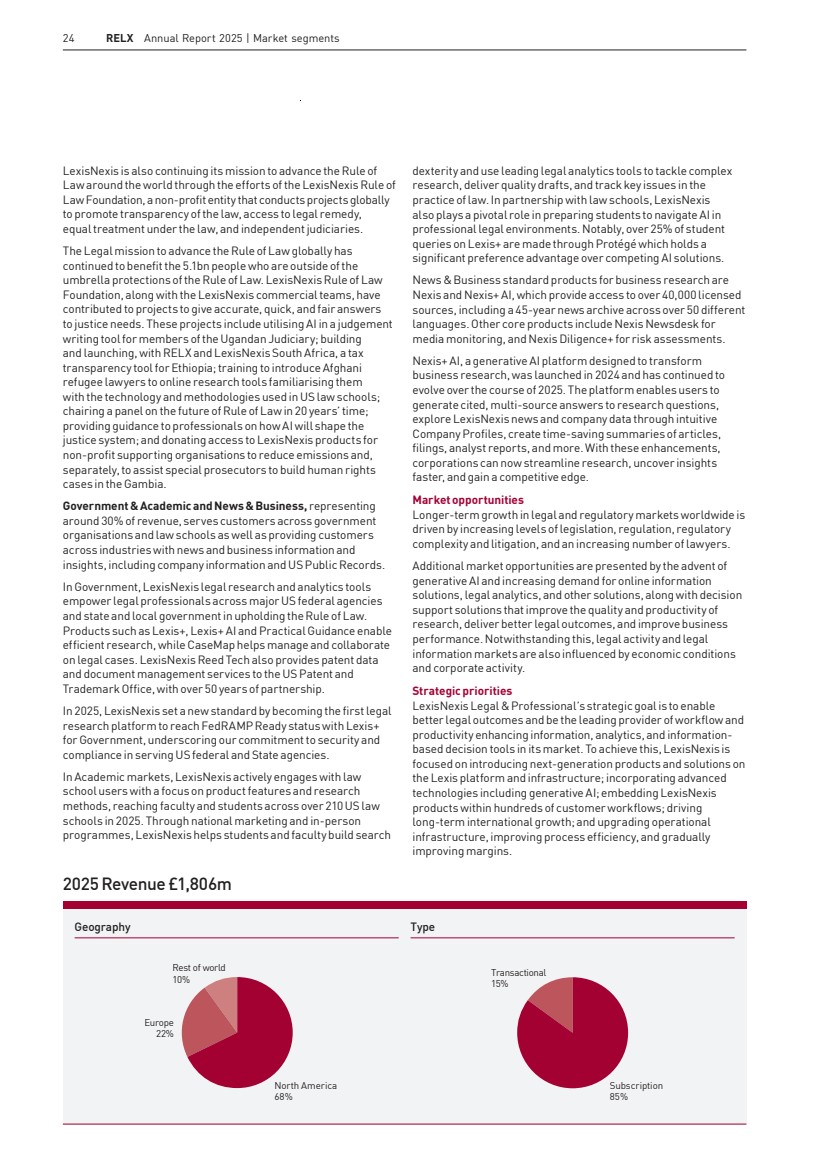
| RELX Annual Report 2025 | Legal 25 Further improvement in underlying revenue growth driven by AI-enabled legal analytics and tools Underlying revenue growth of +9%, a further step up in growth from 2024. Strong growth continues to be driven by the shift in business mix towards higher growth, higher value legal analytics and tools. Underlying adjusted operating profit growth of +12%, leading to a further improvement in adjusted operating margin. In Law Firms & Corporate Legal, double-digit growth is being driven by the continued adoption of our core AI-enabled legal research and analytics platform and our integrated agentic legal assistant (Lexis+ AI and Protégé). Ongoing releases of new functionality, including General AI and Workflows, and deeper integration of our tools on our core platform with its comprehensive, verified legal content, is enabling us to increase our value-add and serve an increasing number of use cases. In Government & Academic and News & Business, good growth continues to be driven by the further extension of analytics and decision tools. Renewals and new sales are strong across all key segments. 2026 outlook We expect continued strong underlying revenue growth with underlying adjusted operating profit growth exceeding underlying revenue growth. 2025 financial performance Restated 2024 GBPm 2025 GBPm Change in GBP Change at constant currency Underlying growth Revenue 1,718 1,806 +5% +8% +9% Adjusted operating profit 381 415 +9% +11% +12% Revenue 2025 1,806 1,718 2024 GBPm Underlying growth +9% Adjusted operating profit 381 Underlying growth +12% GBPm 2024 2025 415 Across segments, LexisNexis is focused on the ongoing development of advanced legal research and practice solutions that help lawyers make data-driven decisions with greater accuracy and efficiency. Global functions and presence enable LexisNexis to effectively launch and scale products such as Lexis+ AI across segments, leveraging shared assets from product design to back-end functionality. Business model, distribution channels and competition LexisNexis Legal & Professional products and services are generally sold directly to law firms and to corporate, government and academic customers on a paid subscription basis, with subscriptions often under multi-year contracts. Some LexisNexis research and reference content is sold in a print format. From 2025, print and print-related activities are managed and reported separately. Principal competitors for LexisNexis in US legal markets are Westlaw (Thomson Reuters), CCH (Wolters Kluwer), and Bloomberg. In news and business information, key competitors are Bloomberg, Factiva (News Corporation) and Reuters News (Thomson Reuters). Significant international competitors include Thomson Reuters, Wolters Kluwer and Factiva. 2024 results restated to reflect business area reporting changes Market segments Governance and other information Financial statements Financial review Corporate responsibility Overview |
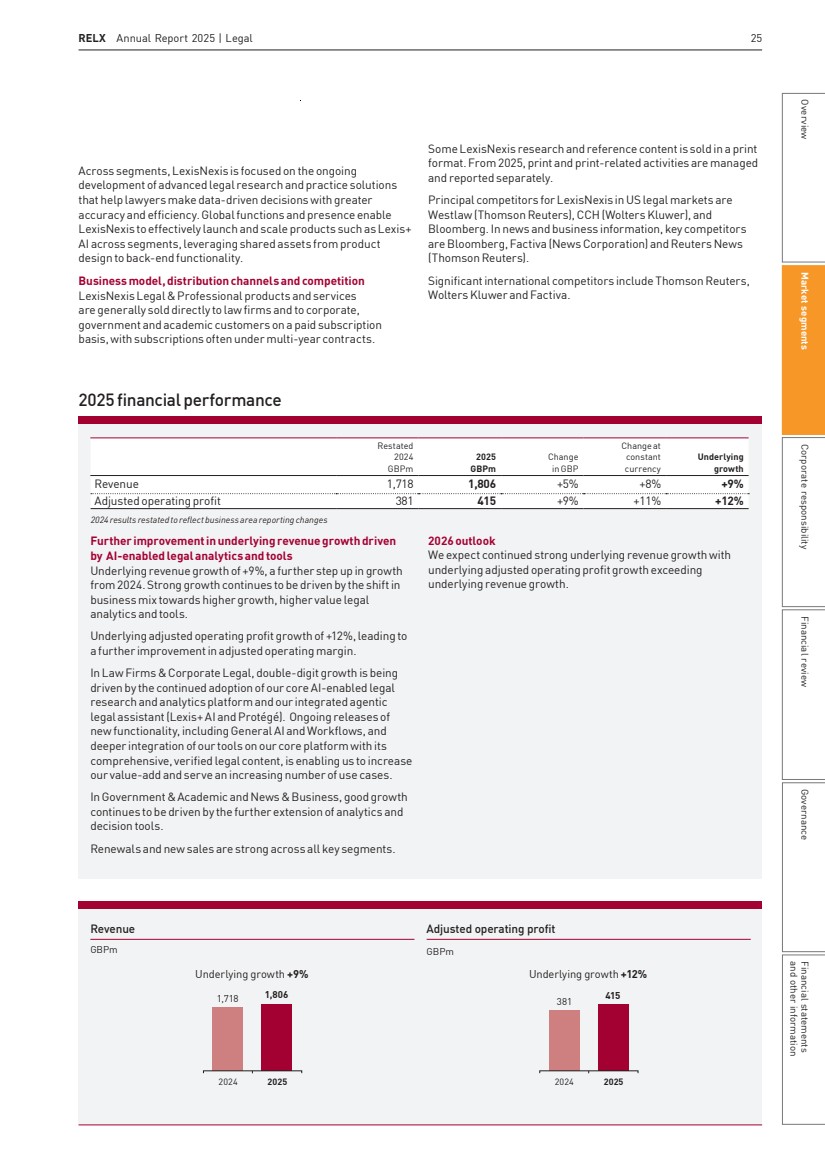
| 26 RELX Annual Report 2025 | Market segments 10% Rupp Pfalzgraf increased its average caseload per attorney by 10% since adopting Lexis+ AI. Lexis+ AI has revolutionised how we work. We’re more efficient, more competitive, and more prepared than ever. This isn’t just a tool for today – it’s a foundation for the future. R. Anthony Rupp III Founding Partner About Lexis+ AI Lexis+ AI is a generative AI solution designed to transform legal work. It enables conversational legal research, insightful summarisation, intelligent legal drafting, and document upload and analysis capabilities. Answers are grounded in LexisNexis proprietary legal content and enhanced by Shepard’s Knowledge Graph, ensuring reliability and completeness. Lexis+ AI is backed by world-class encryption and data privacy technology. About Rupp Pfalzgraf Rupp Pfalzgraf is a full-service law firm based in Buffalo, New York. Founded in 2000 by three entrepreneurial attorneys, the firm has grown into a forward-thinking practice serving a broad range of clients. Known for its innovation, Rupp Pfalzgraf continuously adopts cutting-edge legal technology to deliver high-quality services with a client-first focus. The firm has always prioritised innovation, leveraging technology to enhance service delivery and maintain a competitive edge. Legal research, one of the most time-consuming aspects of practice, posed a bottleneck – especially when managing high-volume or complex matters. The leadership team recognised the need for AI-powered tools to streamline workflows, improve accuracy, and enable attorneys to respond more efficiently. In 2023, the firm adopted Lexis+ AI to optimise its research and drafting workflows. Unlike other AI tools, Lexis+ AI met Rupp Pfalzgraf’s high standards for data security and reliability. The firm was particularly drawn to the ability to delete user inputs, which aligned with internal values and privacy policies. The adoption process was structured and seamless, beginning with pilot programmes for a select group of attorneys and eventually expanding across the firm. The results were transformative. Attorneys now complete complex legal research in a fraction of the time, with significantly improved accuracy and confidence. For example, tasks such as drafting third-party insurance coverage opinions that previously took up to nine hours now take just two and a half hours. Lexis+ AI How Rupp Pfalzgraf increased case capacity while enhancing service quality, using LexisNexis Legal & Professional’s fully integrated next generation legal assistant The impact of Lexis+ AI extended to litigation preparation, oral arguments, motions drafting and workplace investigations. Attorneys have reported completing federal court motions in one-quarter of the original time. The ability to extract, summarise and compare information quickly has enhanced both strategic planning and client communication. Notably, Lexis+ AI has also helped attorneys branch into new practice areas with confidence. In one instance, a lawyer unfamiliar with vaccine waiver laws for school districts was able to deliver accurate results and win the case – something previously outside their scope. Rupp Pfalzgraf has embraced Lexis+ AI not just as a tool, but as a catalyst for cultural change and future growth. The firm now trains paralegals and clerks to leverage AI in meaningful ways, expanding capacity across roles. |
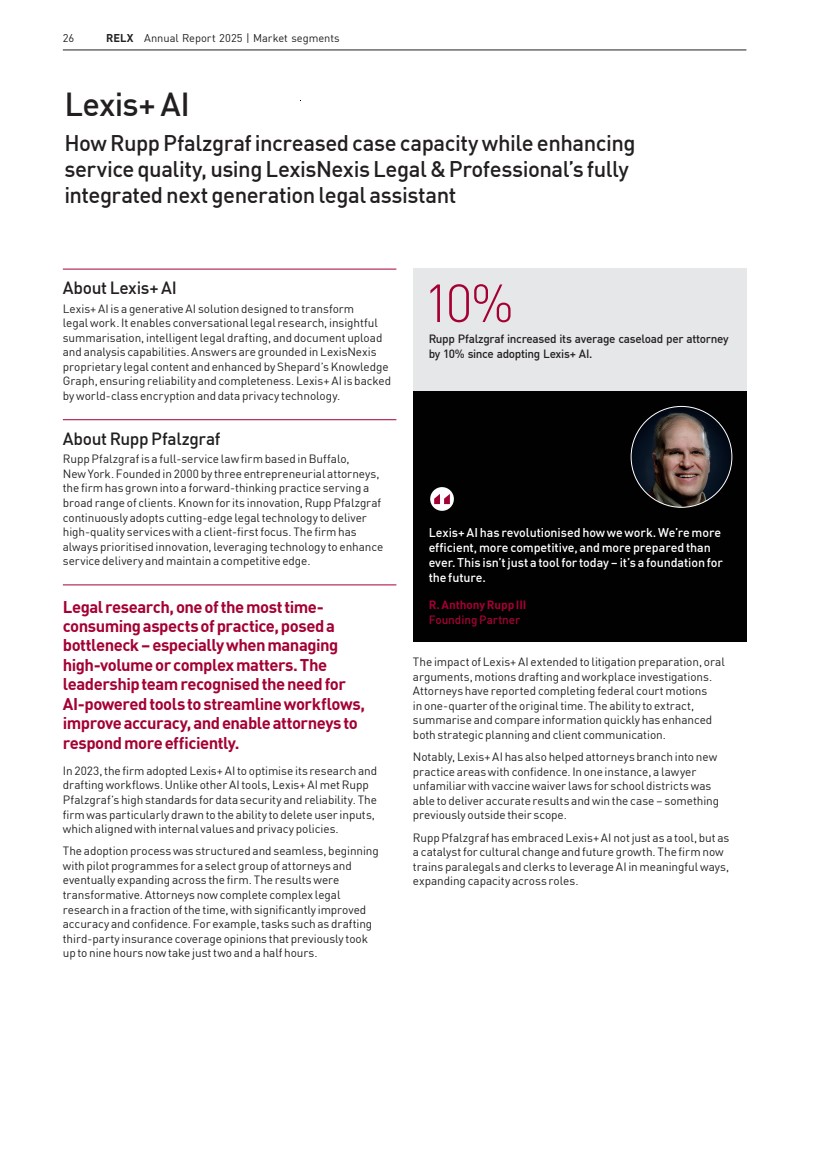
| RELX Annual Report 2025 | Legal 27 About LexisNexis Protégé Protégé is an advanced AI assistant designed to enhance productivity, improve work quality, and help legal and business professionals unlock new economic value. Protégé marks a transformative change, allowing users to customise the assistant to their roles, practice areas, jurisdictions, and styles. For example, Protégé combines agentic AI with authoritative content to draft, research and review legal work across litigation, judicial and transactional workflows, acting like a junior associate, a law clerk or a drafting assistant, depending on the user’s role. Unlike traditional generative AI, Protégé uses agentic AI technology to navigate complex workflows, break down tasks, collaborate with the user and review its own work before human review. Protégé can dynamically suggest or execute next steps based on user goals, either autonomously or with user guidance. Protégé is developed with a human in the loop and adheres to the highest standards of security, compliance and privacy. LexisNexis Legal & Professional began experimenting with agentic AI in 2023 and was among the first to introduce a legal agentic AI solution with Protégé in January 2025. Protégé builds on a decade of LexisNexis investment in AI technologies, robust tools and proprietary content, including morethan $1bn in technology spend. The technology platform seamlessly integrates the latest AI advancements within a multi-cloud infrastructure and provides a proprietary framework for developing legal-tuned agents grounded in LexisNexis comprehensive, authoritative and enriched legal content. Agentic systems require robust tools to execute tasks. Protégé agents leverage the company’s trusted tools including semantic search, Shepard’s citation validation, caselaw summarisation and a knowledge graph that interlinks authoritative datasets for highly relevant, trustworthy AI responses. LexisNexis AI development combines a multi-model approach that selects the best model for each customer use case, model fine-tuning alongside expert legal professionals and model distillation for high model performance. Flexible and Adaptable Agentic Framework In agentic frameworks, models can reason through a series of steps and use tools to complete workflows. In Protégé, some workflows are completed autonomously by the agent, while others involve human-AI collaboration, where user input guides the agent’s behaviour. The proprietary LexisNexis agentic AI framework is designed to be adaptable, allowing AI agents to be tailored to a legal professional’s workflow. LexisNexis continues to develop this framework, balancing automation with transparency and user control, enabling users to see the model’s reasoning and guide its behaviour. 1,000 LexisNexis conducts over 1,000 customer discovery interactions each week. These insights directly shape the products our customers use. LexisNexis Protégé LexisNexis Legal & Professional’s fully integrated next generation legal assistant Agentic performance depends on authoritative content, firm knowledge, orchestration and governance. Uniquely, we combine all four. LexisNexis has the industry’s most trusted content, customer content integration, mature workflow connectors and enterprise controls. Protégé is a step-change from answers to outcomes, significantly expanding productivity for customers. Sean Fitzpatrick CEO LexisNexis North America, UK and Ireland Legal-Tuned AI Agents Protégé leverages a diverse set of AI agents within this framework. Some function as adaptable generalists, for broad tasks such as analysing customer data or conducting web searches, others operate as specialists for reviewing contracts or answering legal questions. By integrating these agents into multi-agent workflows, Protégé can dynamically manage complex legal work while delivering more accurate and highly personalised results. Expansion Protégé is designed to integrate seamlessly into the existing workflows of professionals. It is available across the LexisNexis suite of products, including Lexis+ AI, Lexis Create+, Lex Machina, PatentSight+ and CounselLink+, as well as in the broader market ecosystem, including highly used products such as Microsoft Word and Teams. Protégé is available across multiple regions including the US, the UK, Canada and France. It follows the global roll out of Lexis+ AI in 2024. Both Protégé and Lexis+ AI have been among the fastest-adopted products in the company’s history. LexisNexis is expanding Protégé with General AI, giving users a single search experience that unifies insights from open web search, proprietary LexisNexis content, and customers’ own documents. As LexisNexis continues to adopt new technologies and refine its agile processes, the velocity of innovation, product development and rollouts is accelerating. The company applies the principle of extreme re-use, shortening the rollout cycles from years to weeks. Market segments Governance and other information Financial statements Financial review Corporate responsibility Overview |
| 28 RELX Annual Report 2025 | Market segments Business overview Exhibitions combines industry expertise, digital tools, and data to help customers connect in-person and online, discover new markets, source products, generate leads, and transact. RX has its headquarters in London and has further principal offices in Paris and Düsseldorf in Europe, Norwalk (Connecticut), Mexico City and São Paulo in the Americas, Beijing, Shanghai, Tokyo and Singapore in Asia, and Sydney, Australia. RX has 3,400 employees worldwide and its portfolio of events serves 41 industry sectors. Revenues for the year ended 31 December 2025 were £1,186m compared with £1,239m in 2024 and £1,115m in 2023. In 2025, 20% of RX’s revenue came from North America, 36% from Europe and the remaining 44% from the rest of the world on an event location basis. Six million participants welcomed the opportunity to build their businesses at RX face-to-face events. RX ran 274 face-to-face events across 41 industry sectors in 25 countries. RX organises influential events in key global markets, each designed to address the specific needs of each industry. Participants from around the world meet in-person to learn, network, source products or leads, and trade. RX’s portfolio spans a broad range of sectors, including travel, chemical ingredients, renewable energy, life sciences and pharmaceuticals, real estate, construction, advanced materials, electronic manufacturing, advanced manufacturing, data analytics, AI & cybersecurity, transport, jewellery, gifts, comic conventions, physical security, media, and fitness. RX makes selective launches to increase presence in attractive sectors (such as Expo Nacional Ferretera for the hardware and home improvement industry, Mexico) and to extend successful value propositions into new markets (such as FIBO expanding into SaudiArabia). In 2025, RX extended the continuous improvement, range and depth of digital and data products offered, increasing their sophistication and the value delivered to customers. These products gave buyers and sellers increasingly valuable ways to achieve their objectives before, during, and after an event. These products provide new insights for customers and event teams into customers’ activity, performance, and results at its events, helping drive their decision-making. RX’s digital platform enables rapid experimentation and learning by testing new features and products and handing the outcomes of these tests from one event to the next. Digital products grew in 2025 with electronic revenue accounting for 8% of revenue. Exhibitions We help customers build their businesses through face-to-face events and digital tools, enabling innovation and supporting the economic development of local markets andnational economies around the world. |
| RELX Annual Report 2025 | Exhibitions 29 Market opportunities RX is positioned well for further growth in face-to-face events. This growth will be complemented by rising adoption of – and revenue from – data, digital tools, and platforms, both stand-alone and as part of multi-channel events. These events and digital tools are a key lever for RX customers’ businesses and national economies to expand. Growth in the exhibitions market is influenced by business-to-business marketing spend and by business investment. Historically, these have been driven by levels of corporate profitability, which in turn has followed overall growth in gross domestic product. Emerging markets and higher growth sectors provide additional opportunities. RX’s broad geographical footprint and sector coverage allow it to respond effectively to changes in global trade and capture growth opportunities as they emerge. Not all events are held annually and so growth in any one year is affected by the cycle of non-annual exhibitions. Strategic priorities RX’s long-term strategic goal is to provide discernible and improving value to buyers and sellers by connecting them to build their businesses, through a mixture of learning, networking, sourcing products or leads, and completing deals. We deliver this value through a range of market-leading events, digital tools and platforms in all major geographic markets and higher growth sectors. This allows exhibitors to target and reach new customers quickly and cost-effectively, under one roof and with an integrated set of digital tools, resulting in measurably higher value and improved outcomes. RX focuses on five main areas that position itfor long-term success. Customer value: RX constantly looks for ways to increase the value generated for customers, by innovating the offering and format of its events, continuously evolving every event to the most attractive segments in the industry, and by deploying digital and data tools and platforms to enhance and extend the in-person experience. Portfolio development: RX actively shapes its portfolio through a combination of new launches, strategic partnerships and selective acquisitions and disposals, targeting the optimal mix ofindustry segments, geographic segments, value propositions and business models. Best in class go-to-market capabilities: RX continues to drive innovative capabilities in all areas critical to its performance, including sales techniques and the use of analytics to generate insights both for RX and its customers. RX is enhancing its marketing efforts through the appointment of a Chief Marketing Officer and the adoption of AI and social listening technologies, to continuously attract the most valuable visitors and exhibitors to its events. RX is also increasing its pricing sophistication, including for a wider range of visitor segments to reflect the value they gain from attending an exhibition. Operational efficiency: RX operates a lean and agile structure, able to respond quickly to changing circumstances and customer needs. RX’s global technology platforms and more specialist functions allow RX to accelerate revenue growth, while controlling costs and embedding sustainability throughout the organisation. RX is improving the effectiveness and efficiency of these platforms and functions by utilising GenAI tools, in turn enabling faster deployment of digital products, new events and process innovation. RX is progressing well towards its sustainability goals; in 2025 RX published its first Sustainability Report and began to roll out a sustainability scorecard to help event teams assess and improve their performance. Talent: RX develops talent by building strategically important capabilities and cultivating communities that collaborate to learn and share innovation and best practice. This is underpinned by a strong organisational culture of customer focus, entrepreneurial thinking, ambition and growth mindset. RX continually enhances the value of its face-to-face events using data, analytics, and technology. RX’s digital solutions help customers to better promote their presence at events, create more connections between the right buyers and sellers, increase the value of leads generated, and follow up on the most promising leads after the event, thereby demonstrably increasing the return on investment of customer spend at RX events. RX’s digital solutions constantly evolve based on data and deep customer insight about the needs and behaviours of buyers and sellers in the different sectors in which it operates. RX has built a unified global technology platform and single data lake, enabling near real-time insights and faster global rollout of high-quality digital services. In 2025 this included scaling up Colleqt (the visitor-led tool capturing leads and information digitally instead of via business cards, bags, and brochures) in France and Japan. Business model, distribution channels and competition Over 70% of RX’s revenue is derived from exhibitor fees, with the balance primarily consisting of admission charges, conference fees, sponsorship fees and digital tools. RX often works in collaboration with trade associations, which use the events to promote access for members to domestic and export markets, and with governments, for which events can provide important support to stimulate foreign investment and promote regional and national economic activity. RX increasingly offers visitors and exhibitors the opportunity to interact before and after the show using digital tools and platforms such as online directories, matchmaking, and mobile apps. RX is more actively shaping the exhibitor and visitor experience during the show, using digital tools and real-time recommendations. RX is one of the largest event organisers globally in a fragmented industry, holding a global market share of less than 10%. Other international exhibition organisers include Informa, Clarion and the larger German Messen, including Messe Frankfurt, Messe Düsseldorf and Messe Munich. Competition also comes from industry trade associations and owners of event venues. Market segments Governance and other information Financial statements Financial review Corporate responsibility Overview |
| 30 RELX Annual Report 2025 | Market segments Geography Source Rest of world 44% Europe 36% North America 20% Visitors and other 26% Exhibitors 74% Location: France The world’s property market Location: UK Premier global event for the travel industry Location: UAE The Middle East’s meeting place for the travel trade Location: US The North American jewellery industry’s premier event Location: US International Security Conference & Exhibition Location: Germany Innovations for smart sheet metal working Location: France International exhibition for personal care ingredients Location: Italy International exhibition for companies in the industry of HVAC+R, renewable energy and energy efficiency Location: Japan Japan’s comprehensive exhibition for smart and renewable energy Location: US The East Coast’s largest pop culture convention Location: China One of the largest business gifts & home fairs in China Location: Germany International trade show for fitness, wellness & health Location: Brazil International trade fair for the building industry Location: Netherlands The world’s dedicated hydrogen event Location: Australia Australia’s clean energy event Location: France Europe’s premier in-water boat fair Location: Japan Asia’s Exhibition for Electronics R&D, Manufacturing and Packaging Technology Location: Japan Japan’s one-stop shop for office related products and services Location: China China’s event for suppliers and buyers in the housewares industry Location: Korea International maritime and energy exhibition Location: Japan Japan’s comprehensive IT exhibition Location: Germany The world’s marketplace for airlines and the supply chain to meet Location: Brazil International auto parts, equipment and services tradeshow Location: France The International Luxury Travel Market 2025 Revenue £1,186m For more information visit relx.com |
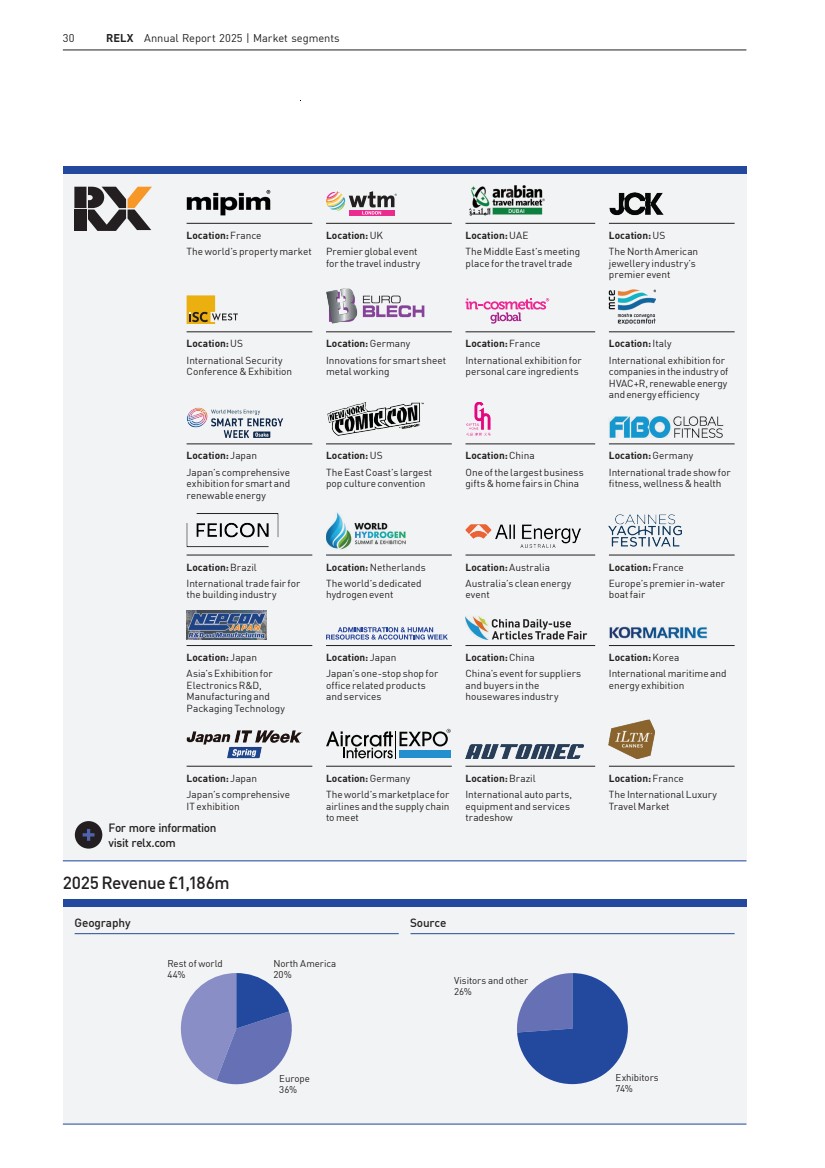
| RELX Annual Report 2025 | Exhibitions 31 Revenue 2025 1,239 2024 Underlying growth +8% GBPm 1,186 Adjusted operating profit 398 410 GBPm 2024 2025 Underlying growth +9% Strong underlying revenue growth and profitability improvement Underlying revenue growth of +8%, reflecting the improved ongoing growth profile of our event portfolio. Reported revenue includes the effects of prior year disposals and event cycling. Underlying adjusted operating profit growth of +9%, as we continue to manage underlying cost growth below underlying revenue growth, with margins now significantly above historical levels. We continue to make good progress on value-enhancing digital initiatives, with increased usage of our growing range of digital tools for both exhibitors and attendees at our face-to-face events. 2026 outlook We expect continued strong underlying revenue growth with an improvement in adjusted operating margin over the prior full year. 2025 financial performance 2024 GBPm 2025 GBPm Change in GBP Change at constant currency Underlying growth Revenue 1,239 1,186 -4% -2%* +8% Adjusted operating profit 398 410 +3% +7% +9% * includes cycling effects of -5% Market segments Governance and other information Financial statements Financial review Corporate responsibility Overview |
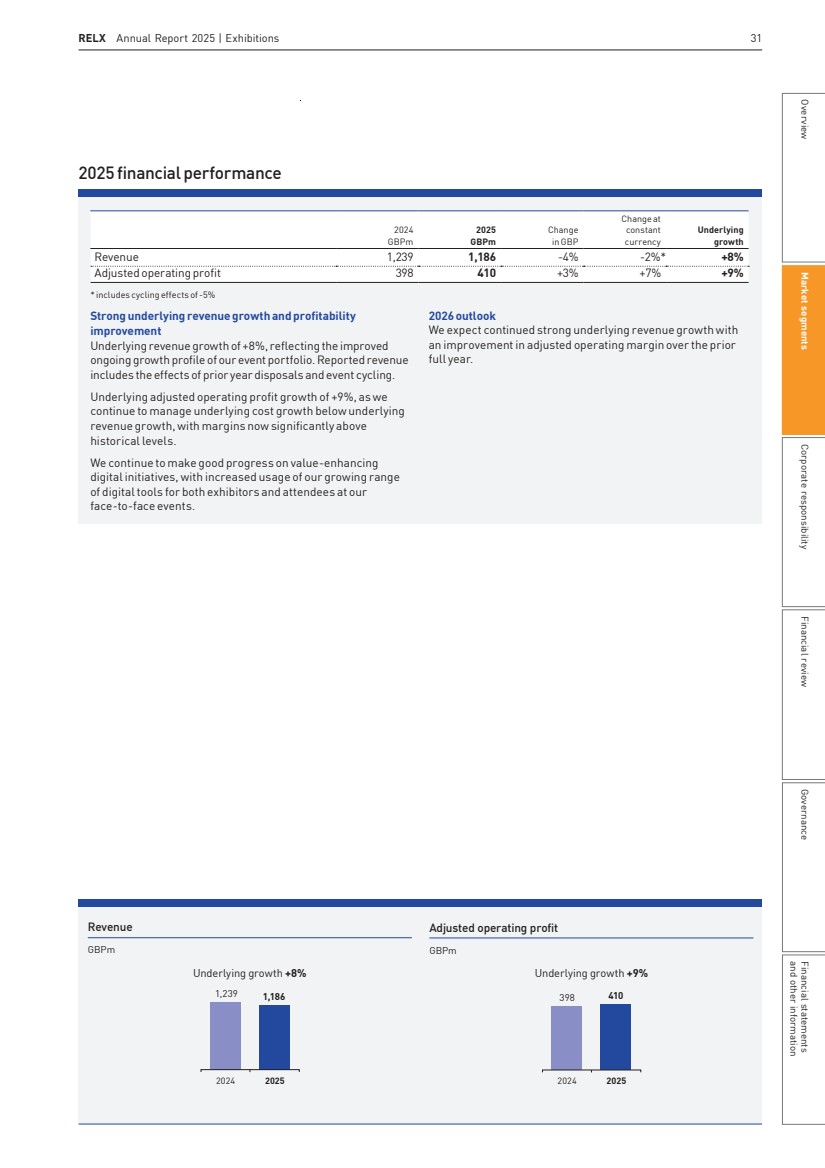
| 32 RELX Annual Report 2025 | Market segments x2 Customer usage of the Exhibitor Dashboard has more than doubled in two years, with 66% of exhibitors now actively engaging, compared with 28% in 2023. It’s the easiest way to quantify what you have from the show. The event is a big investment for us; we’ve got to be smart and better prepared. Using the data in our event planning is key to having a successful result. David Cho Head of Strategy, Noon Shop, Vision Expo Exhibitor About Exhibitor Dashboard Exhibitor Dashboard is RX’s response to its customers’ need for transparent event data which quantifies the business value RX delivers. Built in-house by RX, Exhibitor Dashboard seamlessly integrates data from the company’s registration, matchmaking, show directory and lead retrieval systems into one clear and simple to use personal dashboard, so exhibitors can assess their trade show performance in real-time, and gain critical insights to improve their return on investment year-on-year. In an economic environment that demands accountability, exhibitors are under growing pressure to justify their investment in trade shows. They’re not just looking for visibility. They want to see the business impact: concrete, actionable proof that events drivevalue. Exhibitor Dashboard was built from the ground up, by listening closely to our customers and then working cross-functionally across our Customer Success, Data, Customer Insights, Digital, Sales, Show, and IT teams. One of the key challenges it overcomes is bridging the gap between exhibitors’ expectations and what they can tangibly measure after the event. Too often, important signals like quality of leads or depth of visitor engagement were getting lost in the buzz of the show. The Dashboard gives exhibitors clear and reliable insights into the value of their event participation by replacing guesswork with objective, real-time data and analytics. It brings together all their key event metrics in one place, including leads collected atthe show, profile views, digital engagement and how many matchmaking recommendations were made based on attendee registration preferences. From 12 weeks out, exhibitors can see how their brand is performing, who is engaging and where interest is building, helping them optimise their stand displays and tailor their messaging to customer needs. The dashboard surfaces valuable data such as company location and industry focus. It reveals how exhibitors are faring against competitors in their category. And it gives them actionable insights to improve customer engagement and lead generation before and during the show. Exhibitor Dashboard Turning event data into informed decisions After the event, they can use their lead data and analytics to prioritise their most promising prospects for follow-up, measure their return on investment and provide clear evidence of the value their participation delivered. By diving into the data, exhibitors gain a deep understanding of their target audience’s preferences and behaviour. Armed with this knowledge, they can refine their strategies, tailor their offerings and deliver a more engaging experience, driving stronger customer connections and boosting conversions at their next event. |
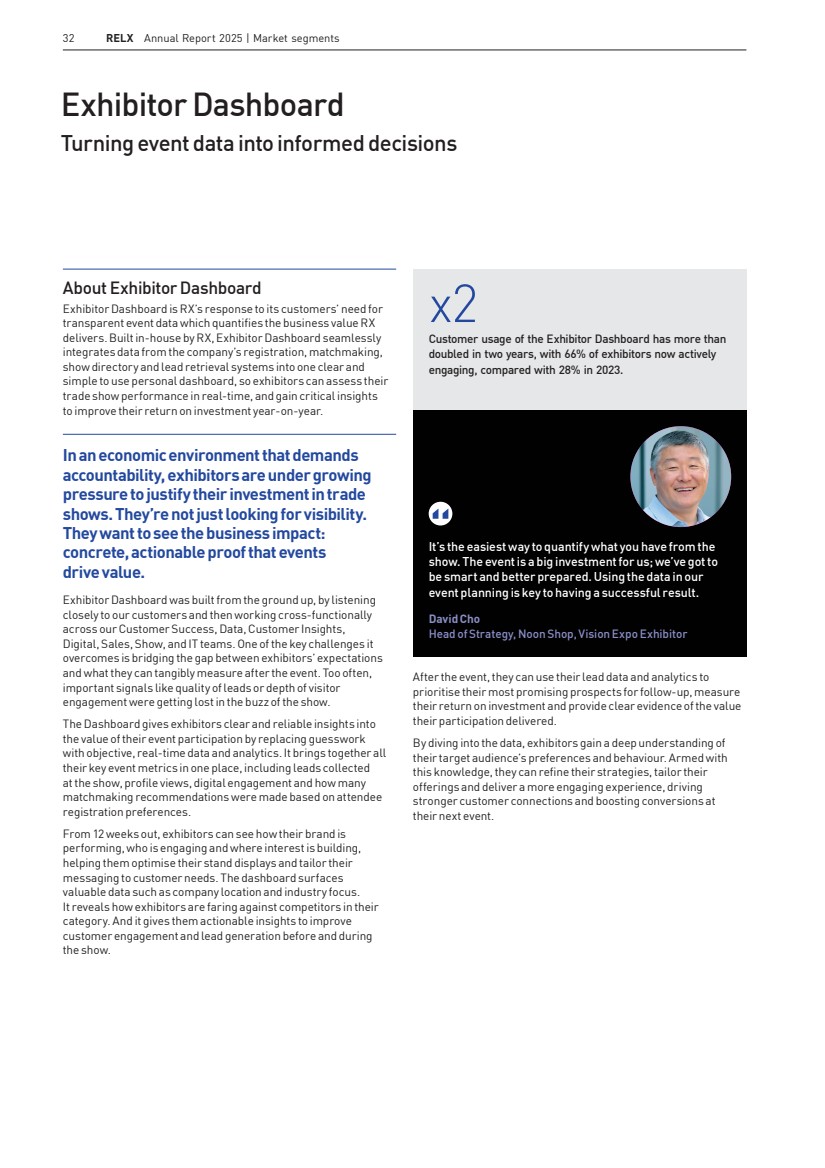
| RELX Annual Report 2025 | Exhibitions 33 140,724 Over four days at FIBO 2025, 140,724 visitors passed through the TQG hall, underlining the extraordinary reach and appeal of the activation. Bringing this project to life means far more than delivering an event – it is about living our values inevery detail, uniting visions from across the company, and creating something greater than the sum of its parts. Above all, it is our way of honouring our communities, listening to and fulfilling their needs, reminding us why we do what we do and how powerful it can be when people come together with a shared purpose. Hannah Kloft Head of Event & Sponsoring, The Quality Group About FIBO FIBO is the world-leading business and consumer event for fitness, wellness and health, taking place each year in Cologne, Germany. The 2025 event in April connected 992 exhibitors and partners with 154,890 business professionals and fitness fans, setting new records for the event’s 40th anniversary year. In October 2025, FIBO extended its brand into Saudi Arabia with the debut of FIBO Arabia in Riyadh. Home to the powerhouse brands ESN and More Nutrition, German-based The Quality Group (TQG), is a leading sports nutrition and dietary supplements holding company with annual sales of more than €800m in 2024. In 2024, after several years of prioritising e-commerce and hosting its own branded events, TQG decided it was the right moment to return to FIBO. From the outset, the company made it clear that a standard booth would not meet its brand ambitions. The group was looking for something unique. FIBO delivered with one of the show’s most electrifying consumer activations in its 40 years – an immersive ‘event within an event’ concept combining the brand freedom and impact of ESN and More Nutrition’s own events with the global reach and diverse audience FIBO provides. The vision came to life in the form of a self-contained 8,000 square metre TQG hall within FIBO, complete with its own entrances, staging, sampling areas, athlete and influencer meet ups, and interactive fitness challenges. The scale of the activation required close collaboration between the FIBO and TQG teams, from operations and logistics to digital communications. Crowd management tools were deployed in partnership with the venue to ensure visitor flow and safety, while a dedicated landing page on fibo.com and coordinated social media campaigns extended engagement beyond the show floor. So successful was the partnership, that TQG returned in 2025 with an even larger footprint of more than 9,000 sq m. The expanded concept introduced new elements: a targeted business-to-business programme for retailers, content-driven formats to educate consumers, activations across additional sports disciplines such as Mixed Martial Arts, and entertainment zones including a silent disco. ESN also took the role of headline sponsor for the first FIBO Bodybuilding Championship, further reinforcing its leadership in the sector. At FIBO 2025, nine out of ten attendees visited the TQG hall. The partnership not only showcased TQG’s brands but also created a powerful ripple effect – driving visibility, engagement, and impact across the entire event. FIBO Creating a branded event for The Quality Group within FIBO Market segments Governance and other information Financial statements Financial review Corporate responsibility Overview |
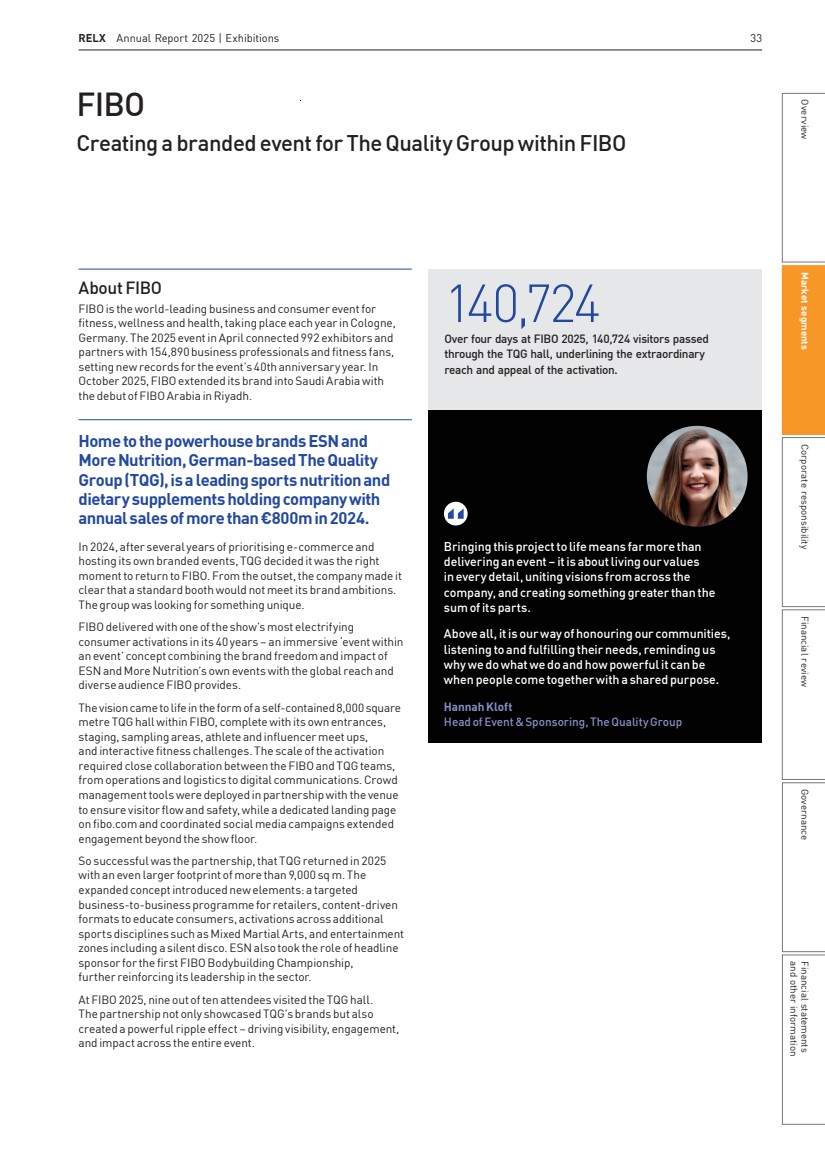
| 34 RELX Annual Report 2025 In this section 35 Corporate responsibility overview 38 Our unique contributions 42 Corporate responsibility governance 46 Customers 49 People 52 Community 56 Supply chain 59 Environment Corporate responsibility Contact details Your views are important to us. Please send your comments to: corporate.responsibility@relx.com Or write to: Dr Márcia Balisciano Chief Sustainability Officer and Global Head ofCorporate Responsibility RELX 1–3 Strand London WC2N 5JR United Kingdom For more information, visit: www.relx.com/corporateresponsibility This report contains the RELX PLC Non-Financial and Sustainability Information Statement for the purposes of Section 414CA and 414CB of the Companies Act 2006. |
| RELX Annual Report 2025 | Introduction 35 and other information Financial statements Governance Financial review Corporate responsibility Market segments Overview Corporate responsibility overview We pursue robust governance of CR issues for which the CEO is responsible to the Board. Our business area and functional leaders are accountable for CR performance, supported by clear objective setting, CR Forum monitoring and engagement from over 5,300 colleagues in our internal CR networks. Corporate responsibility begins with the purpose of the company. RELX is a global provider of information-based analytics and decision tools for professional and business customers, enabling them to make better decisions, get better results and be more productive. Our purpose is to benefit society by developing products that help researchers advance scientific knowledge; doctors and nurses improve the lives of patients; lawyers promote the rule of law and achieve justice and fair results for their clients; businesses and governments prevent fraud; consumers access financial services and get fair prices on insurance; and customers learn about markets, and complete transactions. Our purpose guides our actions beyond the products that we develop. It defines us as a company. Across RELX our employees are inspired to undertake initiatives that make unique contributions to society and the communities in which we operate. We act with high ethical standards, while using our strengths to make a positive impact on society. To us, Corporate Responsibility (CR) is not a programme or prescriptive set of activities, it is how we conduct ourselves and our business on a daily basis. It is the responsibility of everyone at RELX. Our focus on CR gives us a long-term sustainable, competitive advantage. Itinspires confidence in our stakeholders, and provides a licence to operate in the communities in which we live and work. It underpins our business strategy to deliver improved outcomes for our customers by combining leading content and data sets with advanced technologies. It helps us build leading positions in long-term global growth markets and leverage our skills and assets. We align the objectives we set for our unique contributions, and for key areas that impact all companies such as governance, people, customers, community, supply chain and environment with the United Nations Sustainable Development Goals (SDGs) to support the achievement of these 17 global goals by 2030. We believe in timely, comprehensive reporting. Key non-financial metrics, including for environment, people, community and supply chain are independently assured. CR is an integral part of the statements ofthe Chair, CEO and CFO (see pages 3, 4, and 66). RELX’s Sustainability Statement has been prepared in accordance with the European Union Corporate Sustainability Reporting Directive (CSRD) and the European Sustainability Reporting Standards (ESRS) as adopted by the European Commission (see pages 208-231). Corporate responsibility is not an activity. It is embedded in our values and in how we operate as a company. It is integral to our performance and the long-term sustainability of the business. Dr Márcia Balisciano Global Head of Corporate Responsibility, RELX Commitment to the United Nations Global Compact The United Nations Global Compact (UNGC) links businesses around the world with UN agencies, labour and civil society in support of Ten Principles encompassing human rights, labour, the environment and anti-corruption. We work to further UNGC principles within RELX and in our supply chain. We complete the Enhanced Communication onProgress annually and our Global Head of Corporate Responsibility serves on the Board of the Foundation for theGlobal Compact. For more information visit: www.unglobalcompact.org/ what-is-gc/participants/7909 Sustainable Development Goals (SDGs) We’re committed to doing our part to advance these essential objectives for the world. Throughout the Corporate Responsibility section of this report, SDG icons highlight the SDGs relevant to the content. Visit the RELX SDG Resource Centre www.sdgresources.relx.com |
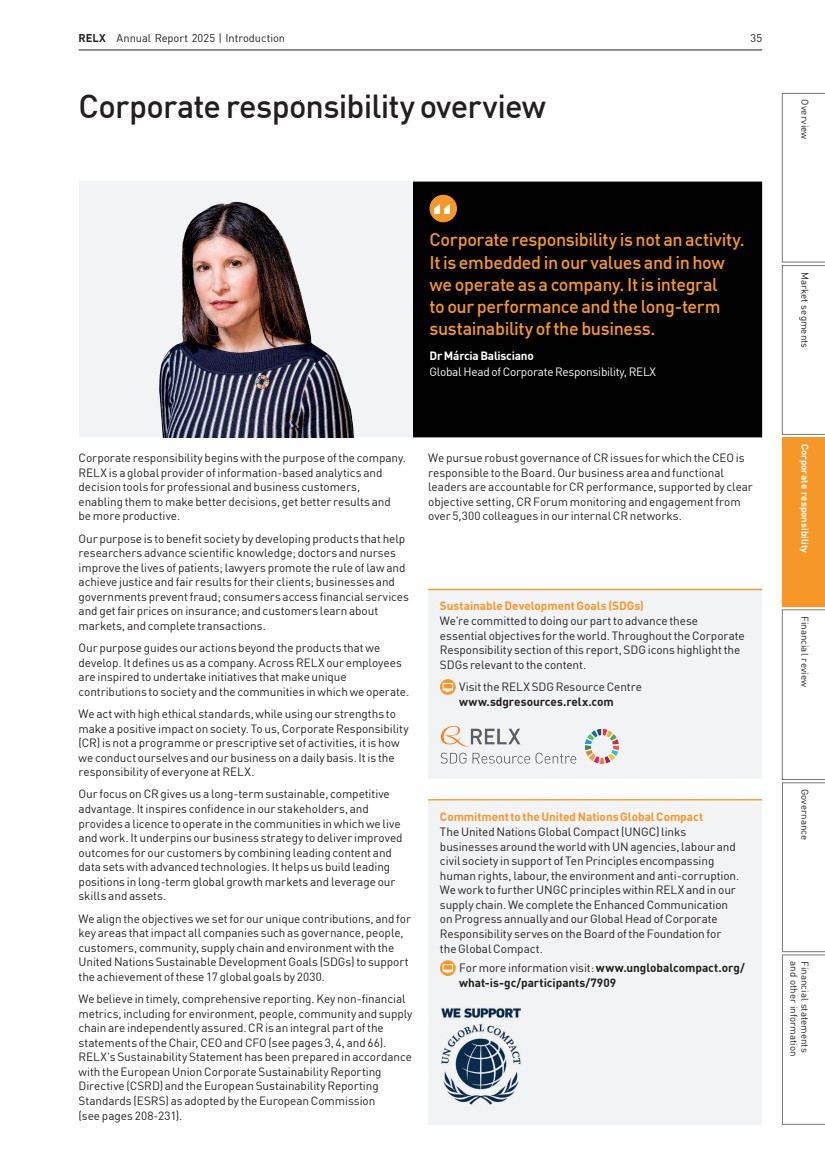
| 36 RELX Annual Report 2025 | Corporate responsibility 2025 key corporate responsibility data 2021 2022 2023 2024 2025 Revenue (GBPm) 7,244 8,553 9,161 9,434 9,590 People Number of full-time equivalent employees (year end) 33,500 35,700 36,500 36,400 37,600 Percentage of women employees (%) 50 50 51 51 51 Percentage of women managers (%) 44 44 45 46 46 Percentage of women senior leaders (%)1 30 31 31 32 31 Percentage of ethnic minority US/UK managers (%) 19 19 20 21 22 Percentage of ethnic minority US/UK senior leaders (%)1 10 12 15 17 19 Community2 Total cash and in-kind donations (products, services and time (GBPm)) 10 12 12 12 11 Market value of cash and in-kind donations (GBPm) 21 23 23 23 20 Percentage of employees volunteering (%)3 32 36 36 37 38 Total number of days volunteered in company time 10,362 12,830 16,529 16,149 14,782 Health and safety (lost time) 4 Incident rate (cases per 1,000 employees) 0.07 0.17 0.30 0.15 0.19 Frequency rate (cases per 200,000 hours worked) 0.01 0.02 0.03 0.02 0.02 Severity rate (lost days per 200,000 hours worked) 0.02 0.36 0.41 0.25 0.28 Number of lost time incidents (>1 day) 2 5 9 5 7 Socially Responsible Suppliers (SRS) Number of key suppliers on SRS database5 359 724 796 914 954 Number of independent external audits6 111 119 125 137 140 Number of signatories to the Supplier Code of Conduct7 3,670 4,467 5,322 6,056 6,586 Environment 8 Total on-site energy (MWh) 125,095 117,997 110,750 89,745 55,977 Renewable electricity purchased (MWh)9 105,793 98,013 92,621 77,412 50,281 Percentage of electricity from renewable sources (%)9 100 100 100 100 100 Waste sent to landfill (t)10 150 73 45 44 32 Percentage of waste diverted from landfill (%)10 93 97 97 97 96 Water usage (m3 ) 183,575 156,734 142,374 134,716 111,810 Climate change (tCO2e)8 Scope 1 (direct) emissions 5,644 5,211 4,317 2,703 1,966 Scope 2 (location-based) emissions 44,051 37,270 36,616 29,989 19,500 Scope 2 (market-based) emissions 8,321 8,952 8,598 6,971 5,294 Scope 3 (flights) Cirium’s EmeraldSky flight emissions methodology11 3,402 15,879 16,999 19,172 23,826 Scope 1 + Scope 2 (location-based) emissions 49,695 42,481 40,933 32,692 21,466 Scope 1 + Scope 2 (location-based) + Scope 3 (flights) emissions 53,097 58,360 57,932 51,864 45,292 Scope 1 + Scope 2 (market-based) + Scope 3 (flights) emissions 17,367 30,042 29,914 28,846 31,086 Paper Production paper (t) 40,910 28,466 22,561 18,949 16,927 Sustainable content (%)12 98 99 100 100 100 SDG Resource Centre Unique users 133,832 155,082 220,815 303,837 352,391 New content items 970 658 822 973 935 1 We define senior leaders as colleagues with a management grade of 17 and above. 2 Reporting period for Community metrics covers 12 months from December 2024 to November 2025. 3 All Group employees can take up to two days off per year, coordinated with line managers, to work on community projects that matter to them. Number of staff volunteering reflects the number of staff using volunteering hours, as well as those who participated in other Company-sponsored volunteer activities. 4 Accident reporting covers approximately 98% of employees. 5 Key suppliers on the SRS list changes year-on-year based on our business needs and changes in country risk designations. 6 RELX utilises a third-party audit platform, which allows sharing of supplier audits across the platform. 7 Signatories to the RELX Supplier Code of Conduct include suppliers who have signed the Supplier Code and suppliers with an equivalent code. 8 Climate change and environmental data (carbon, energy, water, waste) covers the calendar year. 9 We purchase renewable electricity on green tariffs at locations in the UK and Europe. US Green-e certified Renewable Energy Certificates (RECs) are applied to electricity consumption in the US. US Green-e certified RECs are also purchased to equal 100% of any non-renewable electricity consumed outside the US, which for 2025 is 19% of electricity. Only location-based emissions factors are applied on this portion of non-US electricity consumption. 10 Waste sent to/diverted from landfill from reporting locations excluding estimates from non-reporting locations. In the year, the coverage of waste reporting locations represented 70% of FTEs (74% in 2024). 11 Covers all flights booked through our corporate travel partners in the calendar year. Uses the proprietary Cirium fuel-derived methodology, Emerald Sky. 12 Percentage of paper graded as known and responsible sources by the Book Chain Project or certified to Forest Stewardship Council (FSC) or the Programme for the Endorsement of Forest Certification (PEFC). Includes less than 0.1% of paper not yet graded or certified. Independently assured. See Independent Assurance Statement. Reporting guidelines and methodology, business reports are available on www.relx.com/additional-cr-resources |
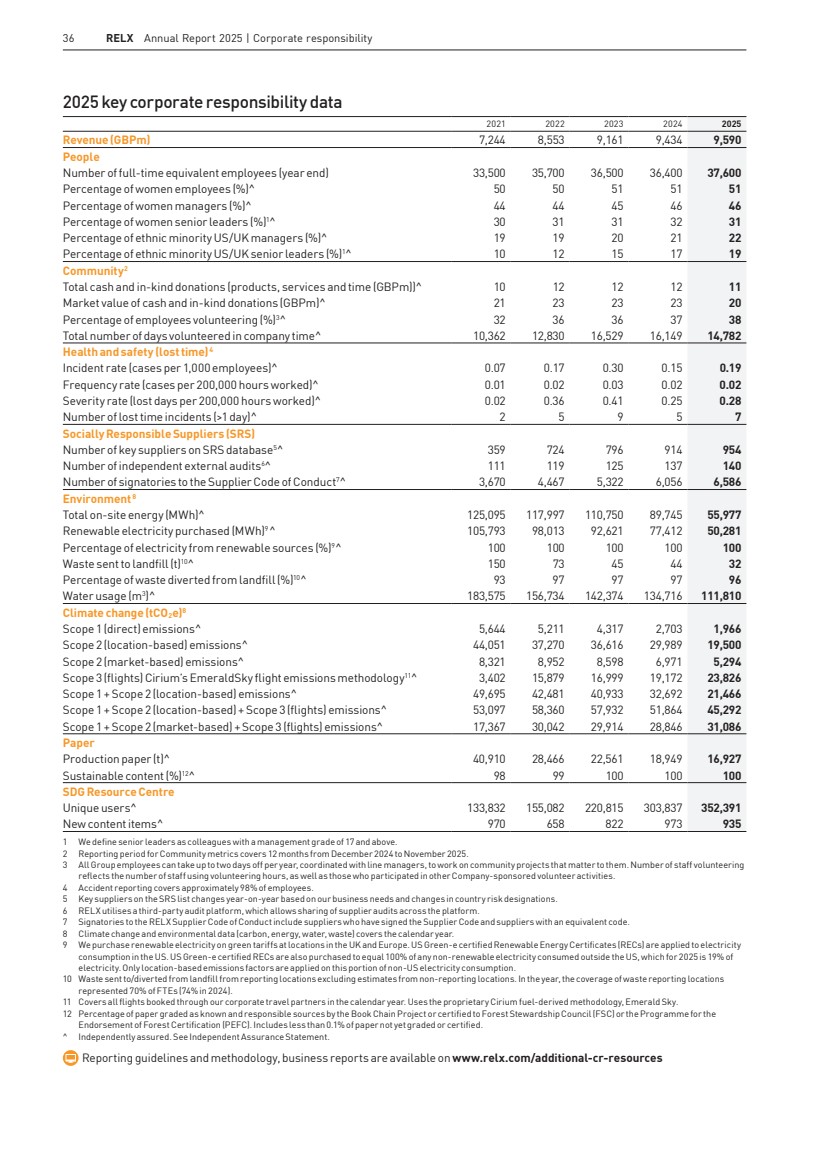
| RELX Annual Report 2025 | Introduction 37 and other information Financial statements Governance Financial review Corporate responsibility Market segments Overview 2025 Corporate Responsibility recognition MSCI ESG Ratings • AAA rating Sustainalytics ESG Risk Rating • Top 1% of 14,700+ companies • Top 2% in our industry (media) S&P Global Sustainability Yearbook • Included Financial Times Europe’s Climate Leaders • Included ISS Corporate ESG Performance • Awarded Prime status FTSE4Good Index Included in: • FTSE4Good UK Index STOXX Global ESG Leaders Indices • Included ECPI World ESG Indices • Included CDP • Climate programme SOCOTEC ISO14001 • Group certification Workplace Pride Global Benchmark • Awarded Advocate status The Science Based Targets initiative (SBTi) • Near-term science-based emissions reduction targets approved 2025 awards for excellence Risk Scientific, Technical & Medical LexisNexis Risk Solutions’ ThreatMetrix won Best Fraud Risk, Detection, or Analytics Solution at the 2025 Regulation Asia Awards forExcellence LexisNexis Risk Solutions’ Firco Continuity named Financial Crime Product of the Year at the 2025 Risk Technology Awards Elsevier’s ClinicalKey AI won the AI Innovation Award at the 2025 MedTech Breakthrough Awards Elsevier’s ScienceDirect AI was awarded Best Generative AI solution at the 2025 CODiE Awards Legal Exhibitions Nexis+ AI awarded Best Innovation in Generative AI at the 2025 AI TechAwards LexisNexis Legal & Professional recognised across six categories at the 2025 ALM Awards with LexisNexis Public Records and Lexis Create+ securing top honours RX CEO, Hugh Jones, awarded the 2025 Exhibition News Pioneer Award RX Global awarded the 2025 UFI Sustainable Development Award for Best Inclusion Initiative |
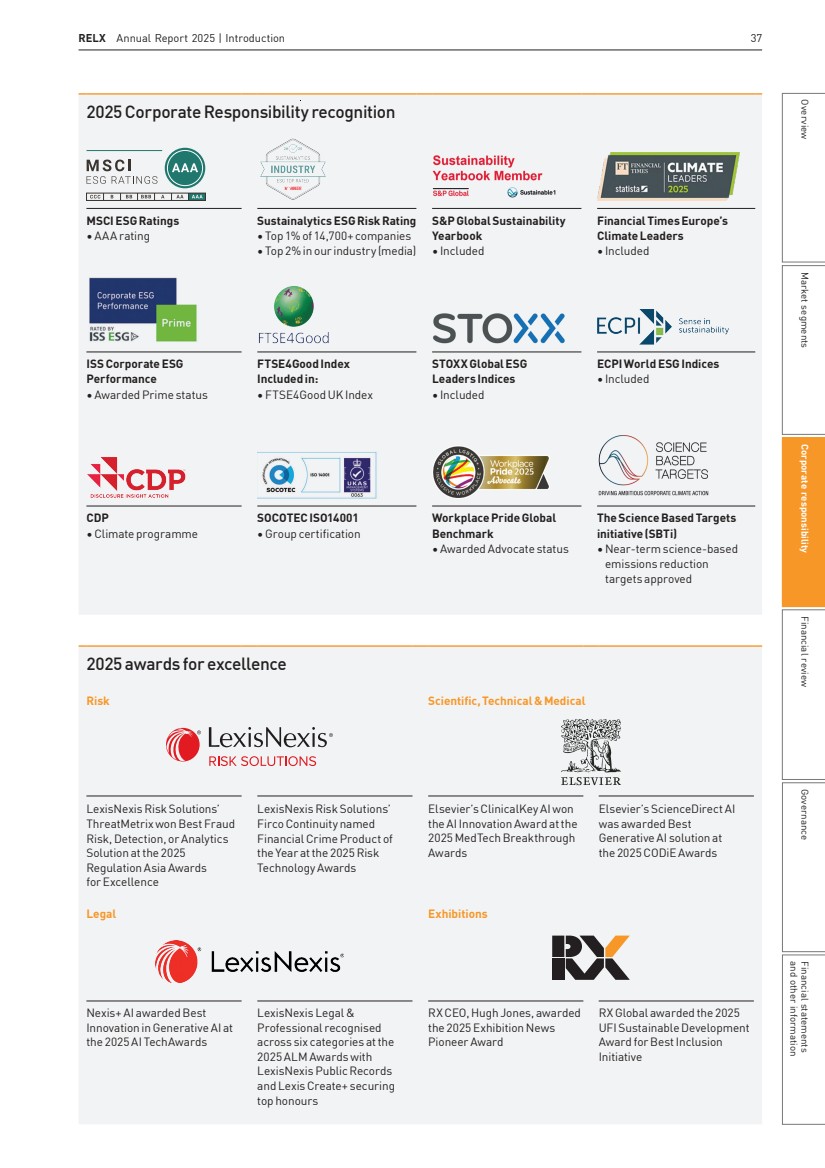
| Relevant SDGs 38 RELX Annual Report 2025 | Corporate responsibility Through Special Issues on the RELX SDG Resource Centre, we increase the visibility of leading research, ensuring broad access to impactful knowledge that can drive positive change. Esther Heuver Senior Publisher, Elsevier, Netherlands Our unique contributions In the every-day conduct of our business, we make a positive impact on society through our unique contributions. Risk LexisNexis Risk Solutions’ products and services help protect society by detecting and preventing fraud, helping citizens securely access vital government benefits, and assisting law enforcement to keep communities safe. A number of Risk products help customers recognise trusted transactions and reduce fraud. LexisNexis ID Compass Platform, for example, reduces digital fraud by combining physical, digital and behavioural identity intelligence to verify and authenticate consumer identities in real time without disruption for businesses or its customers. ThreatMetrix leverages shared global intelligence from millions of daily consumer interactions to identify signals of high fraud risk while BehavioSec uses behaviour intelligence to differentiate legitimate users from bots and cybercriminals. In the year, Risk published The Global Fraud and Identity Landscape Report, highlighting how businesses can significantly enhance fraud detection by integrating shared digital identity intelligence and multi-layered security systems to maintain consumer trust. 2025 marked 25 years of the ADAM programme, developed byRisk to help the National Center for Missing andExploited Children (NCMEC) find missing children. The programme uses Risk technology to quickly distribute missing child poster alerts to law enforcement, hospitals, and the public in specific geographic search areas. Risk launched a new interactive dashboard in the year, that enables the public to search missing child posters and filter them by location. ADAM distributed over 1.8malerts featuring over 2,030 missing children which helped NCMEC resolve over 1,440 missing child cases in 2025. Our data privacy principles, governance structures and control programmes enable us to comply with data privacy requirements and protect personally identifiable information. Universal, sustainable access to information Advance science and health Protection of society Promote the rule of law & access to justice Fostering communities 2025 OBJECTIVE Deploy financial inclusion flagship models which allow lenders to more easily detect fraud and other high-risk consumer behaviour 2025 PERFORMANCE Financial inclusion is fundamental to improving the financial wellbeing of communities around the world. With adequate wages and access to appropriate financial tools, citizens are lifted out of poverty, (SDG 1); avoid hunger (SDG 2); have better health (SDG 3); are more likely to receive quality education (SDG4); and more women are likely to aid the financial wellbeing of their communities (SDG 5), among other SDGbenefits. Worldwide, the World Bank estimates that 1.3bn adults lack access to formal financial services. Without access to basic transaction accounts, they lack a traditional credit record and are excluded from financial opportunities. The problem is often magnified in low-income countries, given gaps in identity verification and credit risk assessment. In the year, Risk advanced an alternative data strategy which accelerates financial inclusion by enabling businesses to responsibly underwrite customers who have limited traditional credit records. Risk deployed an alternative data credit model in South Africa and Argentina, countries with distinct financial inclusion challenges. In South Africa, the model leverages non-traditional data sources such as mobile usage and digital transactions to assess credit eligibility in underserved communities. In Argentina, the model is similarly being used to support financial institutions in navigating economic volatility by integrating alternative data into credit assessments. These efforts reflect our commitment to expanding access to financial services through innovative, data-driven approaches tailored to local market needs. |
| RELX Annual Report 2025 | Our unique contributions 39 Legal Through its content, data and analytics, LexisNexis Legal & Professional supports the four components of the Rule of Law:transparency of law, equality under the law, independent judiciaries and accessible legal remedy. Its global legal and news database contains over 207bn documents and records providing transparency of the law in around 180 countries and territories, with some 1.9m new legal documents added daily. The LexisNexis Trust Center was launched in 2025, a centralised hub designed to provide customers, partners and regulators with clear, accessible information about the company’s security posture, privacy practices, governance frameworks, and compliance commitments. The Trust Center aims to provide customers and partners around the globe with transparency and confidence in our technology. LexisNexis Legal & Professional partners with the International Bar Association (IBA) on the eyeWitness to Atrocities App, which allows human rights defenders to document and report human rights abuses in a secure and verifiable way so information can be used as admissible evidence in relevant forums. LexisNexis Legal & Professional’s data hosting capabilities provides a secure repository for the information. Over 80,000 photos and videos have been captured through the app since 2015. The LexisNexis Legal & Professional US Voting Laws and Legislation Center offers free public access to insights on proposed bills, codes and real-time updates for the most accurate data. LexisNexis Legal & Professional partners with leading industry associations to recognise individuals and organisations for their commitment to the Rule of Law. 2025 award honourees include; Seve Aydin-Izouli and Héctor Estuardo Reyes Chiquín, recipients of the Union Internationale des Avocats/LexisNexis Rule of Law Award; and Oluwafunke Adeoye, recipient of the IBA Outstanding Young Lawyer ofthe Year Award, jointly established by Legal and the IBA Young Lawyers Committee, to honour young lawyers who have demonstrated excellence, commitment to professional and ethical standards, and dedication to the community at large. LexisNexis Legal & Professional advances SDG 16 (Peace, Justice and Strong Institutions) through its products and services that promote the Rule of Law. We prioritise individuals’ privacy concerns across all jurisdictions where we operate. We work with established privacy advocacy groups, federal and state legislators and other interested parties and operate within relevant legal, regulatory, ethical and best practice frameworks. Risk’s products and services align with SDG16 (Peace, Justice and Strong Institutions) and SDG 10 (Reduced Inequalities), among others. Scientific, Technical & Medical Elsevier advances scientific knowledge and human welfare, spurs innovation and enables critical decision-making through its science and health publications. Elsevier published over 795,000 articles in 2025. It is focused on expanding access to content in places where resources are often scarce. For example, Elsevier is a leading contributor and founding partner of Research4Life, a partnership with UN agencies and over 200 publishers through which we provide core and cutting-edge scientific information to researchers in over 125 low- and middle-income countries. Elsevier provides around 14% of the material available in Research4Life, encompassing approximately 5,500 journals and 35,000 e-books. In 2025, there were over 942,000 total Research4Life downloads from Elsevier’s research platform, ScienceDirect. SSRN is Elsevier’s preprint and early-stage research platform. It allows researchers around the world to openly share their work so that it is freely available to others in their field and the wider research community, promoting discussion, collaboration and an exchange of ideas. In 2025, over 1,200 Elsevier journals offered researchers the opportunity to simultaneously submit a paper for publication and also post it as a preprint on SSRN. Elsevier’s 4th Generation University initiative, developed in partnership with a group of 12 Universities, positions universities as orchestrators of regional innovation, achieving societal and economic impact through partnerships with industry, government, and civil society. More than 50 universities from over 30 countries have joined the 4th Generation University community to date. The initiative was awarded the Thought Leadership Industry Catalyst prize at the 2025 Thought Leadership For Tomorrow Awards for bringing universities together to embrace local innovation with the aim of tackling pressing challenges and driving regional economic growth. Elsevier makes a significant contribution to SDG 3 (Good Health and Well-Being), SDG 5 (Gender Equality), SDG 10 (Reduced Inequalities) and SDG 13 (Climate Action). 2025 OBJECTIVE Advance research by women scientists incollaboration with the Falling Walls Foundation, providing access to resources, networks and training 2025 PERFORMANCE Elsevier works to build capacity and equity in research and health for an inclusive and sustainable future. The Elsevier Foundation partnered with the Falling Walls Foundation to sponsor the Women’s Impact Award, which celebrates visionary scientists whose interdisciplinary, and ground-breaking research advances gender equity and creates meaningful impact for women and girls. The three 2025 winners, selected from 85 applications, were Colette Wabnitz, recognised for her work on gender equity in fisheries; Omneya Attallah, chosen for her work on early detection of breast cancer in resource limited settings; and Ângela Gonçalves, awarded the Science Breakthrough of the Year award for her research on women and healthier aging. In addition, two workshops for the 2025 cohort of Female Science Talents Intensive Track which inspires and empowers talented women researchers to progress careers were held in the year. Participants came together to discuss science communication, women’s career paths, industry insights, and purpose-driven science. This work supports SDG 5, Gender Equality. Market segments Governance and other information Financial statements Financial review Corporate responsibility Overview |
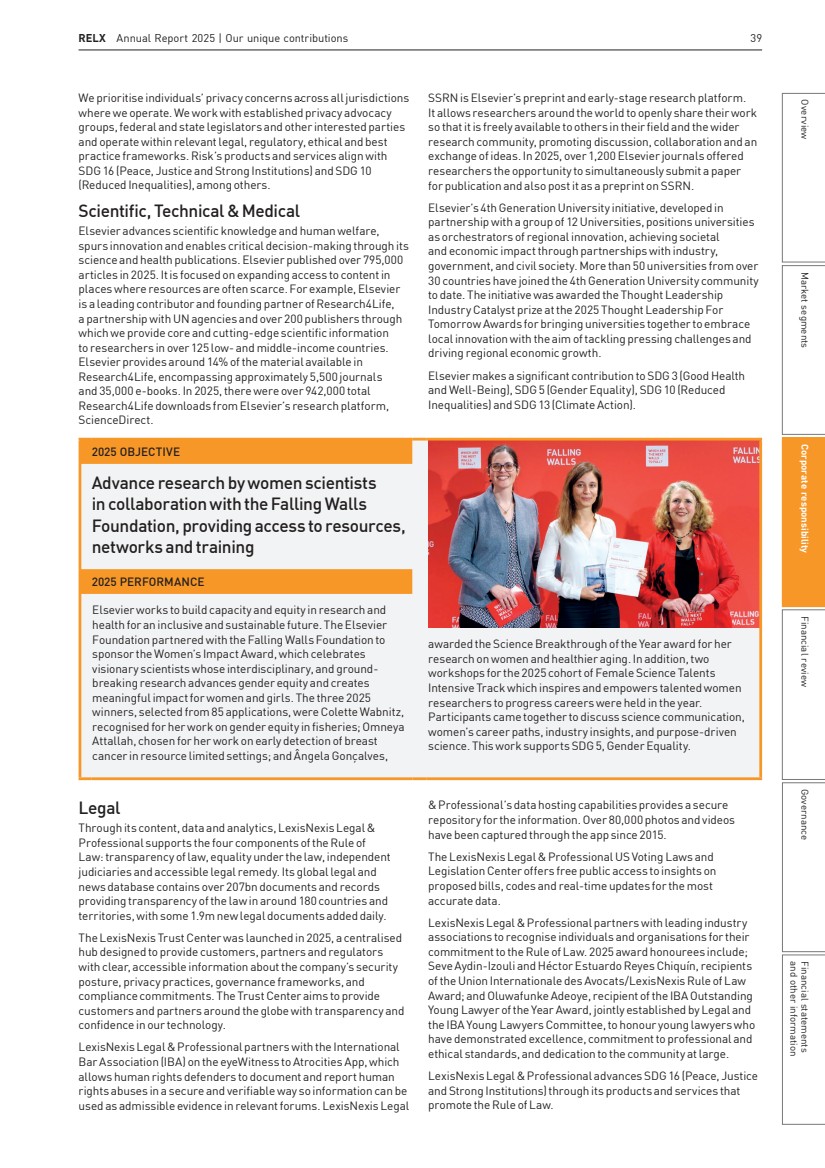
| 40 RELX Annual Report 2025 | Corporate responsibility Exhibitions Exhibitions helps to foster communities by connecting customers face to face and digitally, allowing them to learn about markets, source products and complete transactions. Participants benefit by making connections and doing business in person, allowing them to see many customers and suppliers at one time. Exhibitions foster collaboration, spark innovation and support progress toward a more inclusive and sustainable global economy. The PGA Show is RX Global’s golf exhibition. It advanced event sustainability in the year by aligning with RX’s Net Zero Carbon Events pledge, integrating waste-reduction, inclusive design and digital engagements for more than 22,000 attendees and 1,025 exhibiting brands. KORMARINE, RX’s maritime and energy exhibition welcomed more than 27,000 visitors and 695 exhibitors from 23 countries to Busan, South Korea in 2025. This year’s event featured the debut Next Energy Pavillion focused on future fuels and renewable energy, highlighting RX’s role in advancing decarbonisation and innovation in the shipping and energy sectors. MIPCOM Cannes 2025 featured the sixth edition ofthe MIP SDG Awards, honouring Secuoya Studios for its commitment to the UN SDGs and for driving measurable progress through content creation and production practices. Presented in partnership with the United Nations, the 2025 awards recognised leadership in advancing sustainability and inclusion across the global media industry. At the 2025 edition of World Travel Market in London sustainability, investment and inclusive growth in global tourism were highlighted, aligning industry investment with purpose-led travel. Each event connects industries and also accelerates collective solutions to shared global challenges. RX events support SDG 9 (Industry Innovation and Infrastructure), SDG 12 (Responsible Consumption and Production), SDG 17 (Partnerships for theGoals) and SDG 13 (Climate Action) through our Net Zero Events commitments. 2025 OBJECTIVE Provide research and training to Afghan women studying for law degrees in the United States in association with the American Bar Association 2025 PERFORMANCE 2025 OBJECTIVE Create an RX energy and waste emissions dashboard to monitor performance and publish RX event energy and waste emissions 2025 PERFORMANCE Legal partners with the American Bar Association on their Afghan Legal Professionals Programme which provides resettled Afghan legal professionals, particularly women, access to legal education, accreditation, mentoring and training that will allow them to pursue law careers in the United States. Since 2023 LexisNexis Legal & Professional have provided a bespoke online legal research training course for participants ofthe programme. In 2025, 16 Afghan legal professionals were pursuing US legal accreditation in Master of Law programmes and preparing for On World Environment Day 2025 RX published a first Sustainability Report, with assured 2024 data on RX business travel, event energy and event waste emissions. Between 2018 and 2024 RX achieved a 35% reduction in event energy and waste. This effort builds on RX’s Roadmap to Net Zero in 2040, which outlines key milestones in the journey to decarbonisation. Work continued in the year to enhance visibility through the development of a standardised venue reporting template with partners across the exhibition industry. This work, expected to be adopted by The Global Association of the Exhibition Industry and Net Zero Carbon Events (NZCE), strengthens cross-organisational data consistency and transparency. bar examinations. Seven participants graduated in the year, andSalma Ahmadyar became the first programme participant to successfully pass the bar exam in Wisconsin and was admitted to practice law in the year. This work supportsSDG 16 (Peace, Justice and Strong Institutions). A new energy and waste emissions dashboard was launched in 2025 which enables senior leadership to monitor carbon performance by business unit and event. This system improves data integrity, empowers local teams, and ensures alignment with RX’s NZCE pledge. The dashboard includes real-time analytics, accelerating RX’s focus on action, translating measurement into meaningful reduction, innovation and shared progress across RX shows globally. |
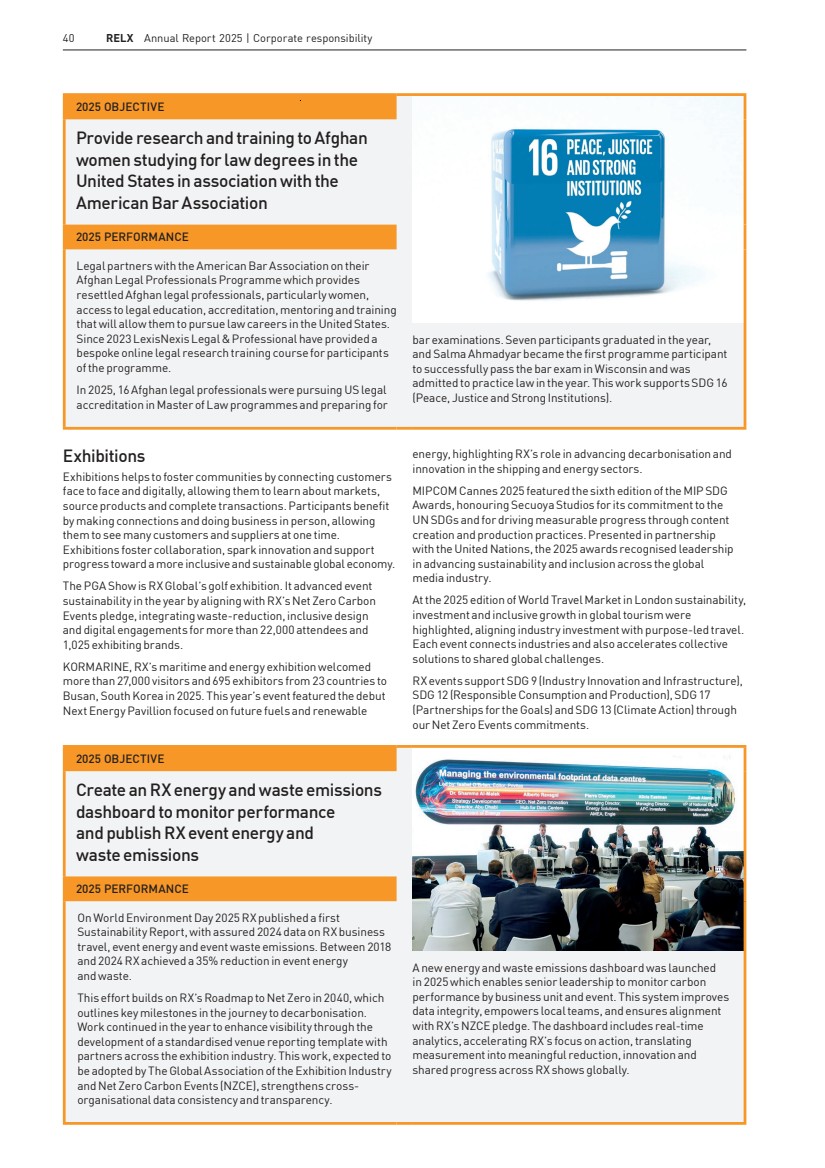
| RELX Annual Report 2025 | Our unique contributions 41 2026 objectives By 2030 Protection of society – Deploy financial inclusion models which allow lenders to more easily detect fraud and other high-risk consumer behaviour, in support of SDG 10 (Reduced Inequalities) Advance science and health – Introduce Elsevier Foundation-Lancet Evidence to Impact Awards to translate critical research into practice, building capacity with researchers and health care practitioners in low and middle income countries through Elsevier content and the Research4Life Country Connectors programme, in support ofSDG 10 (Reduced Inequalities) and SDG 13 (Climate Action) Promote the rule of law and access to justice – Partnership with Indiana State Bar Association to address shortage of legal representatives in rural and underserved communities in the state; convene first virtual Rule of Law Café conference to bring together stakeholders to highlight key issues, in support of SDG16 (Peace, Justice and Strong Institutions) Fostering communities – Pilot RX Sustainability scorecard supported by e-learning, in support of SDG 13 (Climate Action) Universal, sustainable access to information – Increase the number of unique users of the RELX SDG Resource Centre by at least 20,000 additional unique users Use our products and expertise to advance the SDGs, among them: SDG 3 (Good Health And Well-Being) SDG 10 (Reduced Inequalities) SDG 13 (Climate Action) SDG 16 (Peace, Justice and Strong Institutions) Enrich the SDG Resource Centre to ensure essential content, tools and events on the SDGs are freely available to all RELX SDG Resource Centre, Inspiration Day and Environmental Challenge Recognising that across RELX we have products, services, tools and events that advance the UN’s 17 SDGs, we created the free RELX SDG Resource Centre in 2017 to advance awareness, knowledge and implementation of the SDGs. Since 2017, we have made over 2,700 journal articles and book chapters free to access via the RELX SDG Resource Centre which would have otherwise cost more than £5.7m to make open access. We held the annual RELX SDG Inspiration Day during the year with a focus on how philanthropy can bridge funding gaps to advance the SDGs. Thought leaders, corporate representatives, investors, governments, and NGOs discussed challenges and opportunities for collaboration. Keynote speakers included 8th Secretary General of the United Nations, Ban Ki-moon, Comic Relief co-founder, Sir Lenny Henry and co-founder of Global Citizen, Michael Sheldrick. 2025 marked the fifteenth year of the RELX Environmental Challenge, which provides grants for projects that best demonstrate how they can provide sustainable access to safe water and sanitation where itis presently at risk. A $50,000 prize is granted to the first-place entry and a $25,000 prize for the second-place entry. The winners also receive free access for one year to ScienceDirect, Elsevier’s database of full text, scientific information. Projects must have clear practical applicability, address identified need and advance related issues such as health, education, or human rights. The first prize winner this year was Folia Water for their paper-based water filter with silver antimicrobial technology, designed to deliver safe drinking water for low-income Bangladeshi communities. The second prize winner was Rice University for Solar Thermal Resonant Energy Exchange Desalination, a fully decentralised, membrane-free, solar thermal desalination solution, which addresses critical water scarcity and brine waste management issues. 2025 OBJECTIVE Increase the number of unique users ofthe RELX SDG Resource Centre by 10,000 additional unique users in the year 2025 PERFORMANCE In 2025, we added 935 new content items to the RELX SDG Resource Centre bringing the total to 6,729, an increase of 16% over the previous year. We published more than ten special issues in 2025 featuring curated articles, book chapters and other content on critical topics to provide insights for World Water Day, World Food Day, World Alzheimer’s Day, COP30, and a philanthropy special collection to coincide with the RELX SDG Inspiration Day, providing the more than 800 attendees, and others, with relevant additional resources. There were more than 352,000 unique users in 2025, an increase of 48,500 over 2024. 16% Increase in unique users of the RELX SDG Resource Centre since 2024 Market segments Governance and other information Financial statements Financial review Corporate responsibility Overview |
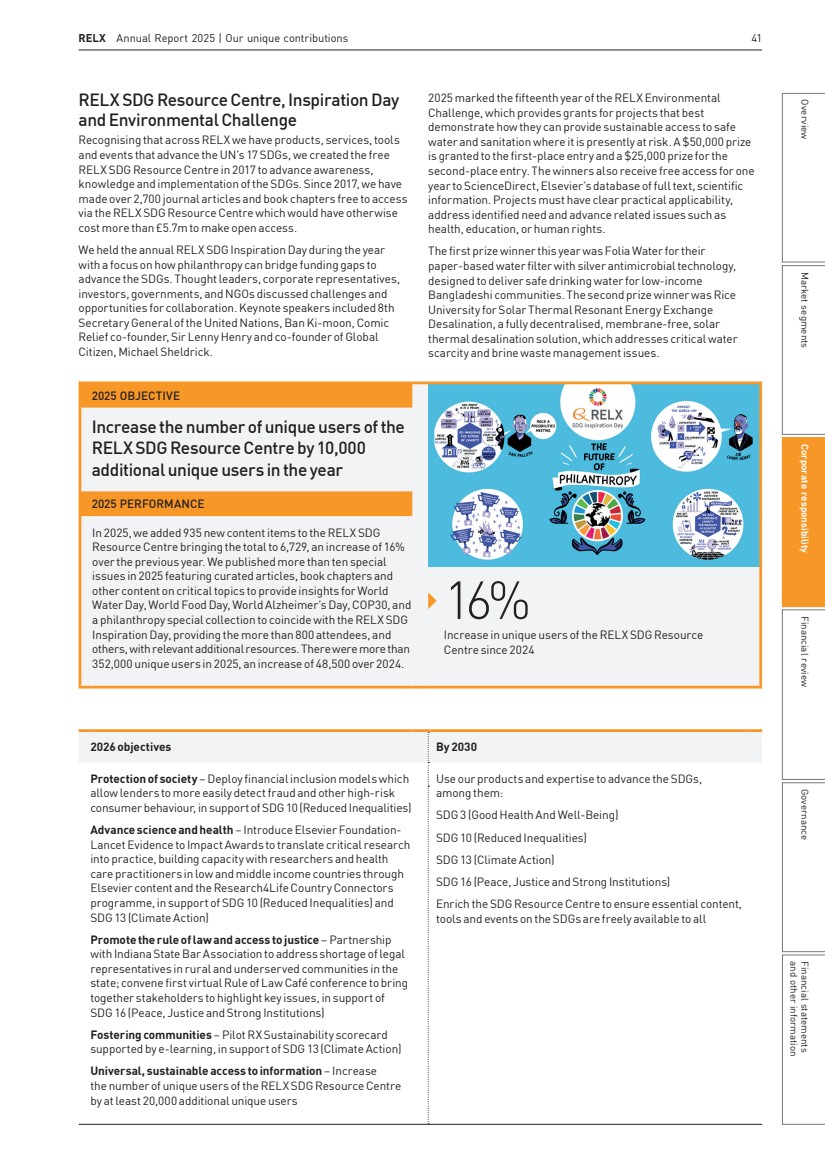
| Relevant SDGs 42 RELX Annual Report 2025 | Corporate responsibility CR Governance and reporting Our Board recognises the importance of maintaining high standards of corporate governance. Our corporate governance programme supports our ability to deliver consistent financial performance and value to our stakeholders and aligns with RELX’s values of doing business with integrity. The Board oversees RELX’s corporate governance, its role and function is explained fully in the Corporate governance section (see pages 80 to 127). TheBoard and the Audit Committee of the Board regularly receive presentations from the Chief Compliance Officer on matters arising under our ethics and compliance programmes. In addition, the Chief Legal Officer & Company Secretary, who reports directly to the CEO and theChair, maintains responsibility for implementing the ethics and compliance programmes. Governing policies set out our stance on key issues. The RELX Code of Ethics and Business Conduct, theCode of Ethics for Senior Financial Officers, the Supplier Code ofConduct, Tax Principles, Privacy Principles, Inclusion Policy, Health and Safety Policy, Editorial Policy, Responsible Artificial Intelligence Principles, Quality First Principles and Product Donation Policy are publicly available at www.relx.com/cr-downloads. Corporate responsibility governance Our purpose, strategy, values and culture deliver the very highest standards of corporate governance and responsibility. A strong privacy programme and robust data protection practices are essential tomeeting our commitment to responsible stewardship and accountability in handling the personal information entrusted to us. Fabienne Lornage Data Protection Officer, RELX, UK Our CR governance framework The CEO has responsibility to the Board for CR. They and senior management, as well as the CR Forum, chaired by a senior leader and involving individuals representing key functions and business areas, set and monitor CR performance. This includes our annual and longer term CRobjectives, which reflect the views of a range of internal and external stakeholders. More information can be found on www.relx.com/additional-cr-resources. The Global Head of Corporate Responsibility provides formal updates to the Board and engages on key issues with senior managers, who have CR-related Key Performance Objectives (see page 104). Board CEO Business area CEOs CR Forum Global Head ofCorporate Responsibility and CR Team Compliance Committees RELX CR networks Pursuing a Culture of Integrity; the Code of Ethics and Business Conduct Doing the Right Thing is more than a phrase at RELX, it embodies principles that represent RELX’s culture of integrity. This includes respecting one another, incorporating ethics in all our actions; growing our business with integrity; holding ourselves and each other accountable; and taking time to ask questions and report concerns. Doing the Right Thing clearly sets out our high ethical expectations for employees. We expect honesty in our dealings with others, respecting the law, our policies and colleagues; and courageously speaking out for what is right. RELX provides relevant training and resources; enables a culture where people can feel comfortable speaking up and experience no retaliation when they do; and ensures concerns are heard and acted on in a fair and timely manner. The RELX Code of Ethics and Business Conduct (the Code) is a foundational document which guides employees, management and our stakeholders in maintaining the integrity and accountability of our corporate and individual behaviour. The Code was most recently updated in 2024 and shared with staff globally by theCEO. It is at the heart of our compliance activities, which encompass clear policies and procedures; risk assessments; training and communication; and robust reporting mechanisms, investigations, monitoring and auditing of internal controls. |
| RELX Annual Report 2025 | Corporate responsibility governance 43 Data privacy governance Data is integral to the solutions we provide that further our unique contributions as a business, including protecting consumers from the risk of fraud; facilitating secure online transactions; improving access to financial and government benefits; enhancing face-to-face connections at exhibitions; and delivering high quality scientific research and healthcare. Recognising concerns and sensitivities around personal data, our commitment to data privacy remained a critical RELX priority in 2025 and continues to be supported by strong governance, transparency and accountability. Dedicated privacy teams implemented requirements for compliance with personal data protection regulations around the globe. RELX continues to advocate for privacy laws that protect consumers, bolster consumer trust and allow businesses to investin data-driven activities that serve the public interest. RELX companies in the US participating in the Data Privacy Framework programme renewed their self-certification in the year. We proactively consider privacy concerns in developing and offering our solutions. Our Privacy Principles, available at www.relx.com/corporate-responsibility/being-a-responsible-business/privacy-principles, guide our approach to the responsible collection and use of personal data and are supplemented by privacy policies and impact assessments to mitigate risks, ensuring we are responding to new requirements, best practices and expectations. Our privacy teams undertake activities and training that deepen employee awareness about personal data protection. For Data Privacy Day 2025, we celebrated the winners of the annual RELX Privacy Principles Champions Competition, which recognises the achievements of employees in protecting personal data and implementing ourPrivacy Principles. 2025 OBJECTIVE Consolidate records of privacy processing activities 2025 PERFORMANCE Records of processing activities (ROPAs) internally document our personal data processing activities as part of our accountability and compliance measures. In 2025, RELX privacy teams clarified and consolidated hundreds of ROPAs and updated the ROPA questionnaires and guidance to facilitate completion. This activity aligns with SDG 16 (Peace, Justice and Strong Institutions). Our Code encompasses a wide range of issues including fair competition, anti-bribery, conflicts of interest, employment practices and human rights, data protection and appropriate use of company property and information. To help employees comply with applicable laws, we supplement the Code with other policies in areas critical to our business, including anti-bribery, competition, doing business with government, data privacy and security, trade sanctions and workplace conduct. We communicate on compliance issues using a range of media, including video. We require cyclical mandatory training on the Code and other policies for all employees, with in-person and other training for those in higher risk roles and locations. 99+%� of all compliance courses are completed within 90 days of issuance. We encourage reporting of violations through multiple channels, including an anonymous reporting option where legally allowed. Compliance Committees oversee investigations and help ensure remediation and ongoing monitoring as required. We do not tolerate retaliation for raising Code concerns. We have a third-party expert evaluate our Compliance programme every three years and the Code is updated every three years . Read our Code of Ethics and Business Conduct at www.relx.com/cr-downloads Independently assured Reporting Channels Under the Code We offer multiple channels to report Code-related concerns, including managers, human resources, Compliance committee members and company lawyers. We also provide an Integrity Line, hosted by an independent third-party, and available to employees, suppliers and other reporting persons by telephone or online 24 hours a day, 365 days a year, which includes an anonymous reporting option where legally allowed. The Integrity Line also includes an Ask A Question feature which allows employees to seek ethical advice before taking action. More information about these reporting channels is detailed in theCode, the RELX Reporting Concerns Policy and supplemental country-specific Reporting Concerns Notices available on www.relx.com. These documents prohibit retaliating against individuals who raise concerns or participate in an investigation. Reports are investigated and action is taken accordingly if reports are substantiated. Substantiated reports result in additional training, coaching, policy changes, control enhancements, and/or disciplinary action. Report themes are reviewed by senior leadership to assist in measuring the effectiveness of reporting channels, identifying risks and areas to allocate Compliance programme resources. RELX has investigated or is in the process of investigating 431 reports of alleged Code violations received in 2025 through the RELX Integrity Line or through the other Reporting Channels identified in the Code (2024: 372). Approximately 46% ofthose reports where the investigation is complete have been substantiated (2024: 48%). Market segments Governance and other information Financial statements Financial review Corporate responsibility Overview |
| 44 RELX Annual Report 2025 | Corporate responsibility Cybersecurity governance The RELX Information Security Policy establishes comprehensive controls and procedures designed to safeguard the confidentiality, integrity and availability of company information. The policy includes a commitment to ongoing enhancement of information security systems and is supported by a set of interrelated policies and standards addressing essential facets of information protection. In 2025, more than 99% of employees were included in monthly phishing simulation exercises. During the year, we continued to enhance our security efforts with additional infrastructure monitoring capabilities both internally and through third parties. We completed more than 5,000 security related requests, questionnaires and audits for our customers. In addition, we engaged third parties to perform independent audits on a number of our products and services. More than 60% ofthe product revenue from our three largest business areas were covered by a third-party audit. In addition, our UKRisk products have been ISO27001 certified. 2025 OBJECTIVE Continued enhancement of our technical resilience and expansion of products and applications covered by independent third party assessments 2025 PERFORMANCE We invest across our business to enhance our technical resilience posture. This includes initiatives in application dependency analysis, defining triage recovery order, implementation of resilient backups, and recovery testing, both desk-based and technical. In the year our businesses completed initial technology implementation and recovery simulations for key products including Risk’s Accurint, STM’s ScienceDirect, and Legal’s Lexis+, and we conducted periodic testing of their resilience posture by performing recovery simulations. These activities align with SDG 16 (Peace, Justice and Strong Institutions). Public Policy, Anti-Bribery and Sanctions We engage in public policy discussions that matter to our business and our customers. We strive to help policy makers around the world understand our business, innovations and contributions to the public interest. Lobbying activities on behalf of RELX Inc. are managed by theRELX Government Affairs team, and, in coordination with our legal teams, are vetted, tracked and reported as required by law. Consistent with our commitment to fostering a culture of integrity including through good governance, RELX has a supplemental policy and training for our employees that specifically relate to engagement with government officials and agencies. The Code and related supplemental policy also address corporate political contributions, which are strictly prohibited except in the US, where such contributions and activities are permitted in certain states within allowable limits, if they comply with stringent reporting and disclosure regulations. Corporate political contributions require senior level review and approval. Corporate contributions are reported as required by law. Contributions are made on a bipartisan basis, and no funds are donated for presidential campaigns or any other federal-level campaigns. We remained diligent through the year to comply with applicable bribery and sanctions laws and mitigate risks in these areas. Our anti-bribery and sanctions programmes include detailed, risk-based internal policies and procedures on topics such as doing business with government officials, gift and entertainment limits, gift registers, and complex sanctions requirements. Relationships with third parties and acquisition targets are evaluated for risk using one or more of the following methods, questionnaires, references, detailed electronic searches, and Know Your Customer screening tools. We monitor and assess the implementation of our anti-bribery and sanctions programmes by continually reviewing and updating our policies and procedures; conducting risk assessments; and conducting quality reviews and internal monitoring and audits of the operational aspects ofthe programmes. In the year, we took part in the Private Sector Forum at the Eleventh Session of the Conference of the States Parties (COSP11) to the United Nations Convention against Corruption. The Code supports the principles of the United Nations Global Compact (UNGC) and stresses our commitment to human rights. We consider where and how we operate to avoid human trafficking and modern slavery in our direct operations and our supply chain. As stated in our Modern Slavery Act Statement, available at www.relx.com, we stand against allforms of slavery and human trafficking. We do not tolerate itin any part of our business, including our supply chain. Our policies are also informed by the UN Guiding Principles on Business and Human Rights, the Universal Declaration of Human Rights, the OECD Guidelines for Multinational Enterprises, the International Labour Organisation (ILO) Declaration on Fundamental Principles and Rights at Work and the Women’s Empowerment Principles. A responsible taxpayer Taxation is an important issue for us as well as our stakeholders, including our shareholders, governments, customers, suppliers, employees and the global communities in which we operate. We are transparent about our approach to tax. At www.relx.com/go/TaxPrinciples we provide details about our tax principles and global tax contribution – broken down by regions and categories – along with our tax risk control framework. There are also case studies showing how RELX has made a positive contribution in tax-related areas to benefit society. RELX is a signatory to the BTeam’s Responsible Tax Principles. TheBTeam is a group of business leaders committed to sustainability, equality and accountability. Globally in 2025, RELX paid £638m in corporate taxes, but also paid and collected much more in payroll taxes and indirect taxes. Independently assured |
| RELX Annual Report 2025 | Corporate responsibility governance 45 2026 objectives By 2030 Privacy – Expand role-based privacy training tailored to job function, aligned with SDG 16 (Peace, Justice andStrong Institutions) Security – Expansion of products and applications covered by independent third-party assessments, aligned with SDG 16 (Peace, Justice and Strong Institutions) Responsible tax – Continue to advance tax transparency and responsible tax projects in Africa, aligned with SDG 16 (Peace, Justice and Strong Institutions) Continued progressive actions that advance excellence in corporate governance within our business and continue providing information, tools and analytics that promote high standards of corporate governance by our customers 2025 OBJECTIVE Continue to advance tax law codification pilots and responsible tax practices inAfrica 2025 PERFORMANCE Taxes provide governments with the essential revenue necessary for public services that benefit their citizens. Governments need codified tax laws to know when, how much and from whom they should be collecting. Citizens need codified and transparent tax laws to understand their liabilities and to advocate for fair collection and use of their remittances. Unfortunately, in many countries around the world, it is difficultfor tax authorities and taxpayers alike to access tax law in a complete, up-to-date and consolidated form. During 2025, the RELX tax team discussed the commencement of a tax law consolidation project with Kenya’s government, similar to a successful project completed in Ethiopia in 2024. The Ethiopia tax law project attracted the attention of the World Bank which has now embarked on an African Tax Legislation Atlas (ATLA) project, a partnership between the World Bank, LexisNexis Rule of Law Foundation and the International Bureau of Fiscal Documentation, to build an innovative digital repository consolidating Africa’s tax laws to support transparency, comparative analysis and legal reform. TheATLA was initiated in November 2025 with several pilot countries including Ethiopia and Kenya. In addition, RELX Tax was selected as a responsible tax champion in the Responsible Tax Practices project, an initiative of the International Finance Corporation, a member of the World Bank Group, and the B Team, to enhance responsible tax practices in Africa. This groundbreaking initiative brings together responsible tax leaders and their private sector peers to explore the what, why, and how of responsible tax practices. The project was launched with a roundtable in Nairobi in April 2025. As a responsible tax champion, RELX has had an opportunity to share our insights and experience of implementing responsible tax practices over the last decade with participant companies from across Africa. Market segments Governance and other information Financial statements Financial review Corporate responsibility Overview |
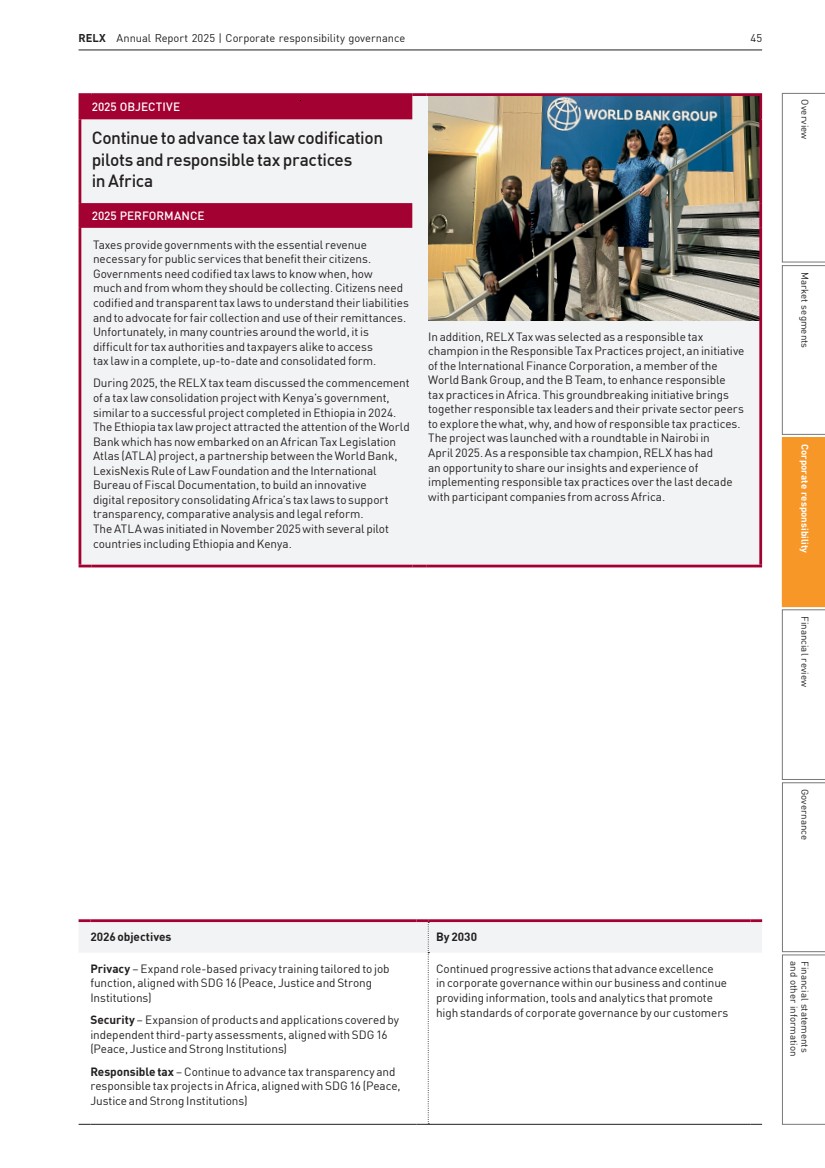
| Relevant SDGs 46 RELX Annual Report 2025 | Corporate responsibility Improving customer outcomes Our goal is to improve outcomes for our customers by providing information-based analytics and decision tools for professional and business customers that benefit their daily work. Listening to our customers allows us to deepen our understanding of their needs and drive improvements. We do this through regular surveys, customer dashboards and feedback mechanisms. With input from customer insight teams across our company, we calculated a RELX-wide customer satisfaction metric showing that in 2025, 87% of customers would recommend working withRELX. Digital knowledge and innovation, Artificial Intelligence across RELX: advancing customer goals Across RELX, we work to address customer challenges through digital innovation. In 2025, electronic products and services accounted for 84% of revenue, up from 35% in 2005. Risk In 2025 Risk launched Medical Insights from LexisNexis Health Intelligence. The new functionality of the Health Intelligence platform standardises and extracts key insights from electronic health records (EHRs), including targeted health data such as vitals, labs and material conditions. This enhancement goes beyond the standard EHR summary to allow US life insurance carriers to more quickly identify key critical risk data within the EHR to improve mortality outcomes, accelerate underwriting decisions, enhance risk assessment and advance rules automation with structured data. In the year, data from Risk’s ICIS informed a new study on the impact of European circularity regulation, including the EU Packaging and Packaging Waste Regulation, on global demand for recycled plastic, particularly as it affects China’s chemical industries. A key finding was a strong increase in demand for recycled content, impacting sourcing strategies and boosting demand for certified recycled materials globally. Scientific, Technical & Medical STM launched ScienceDirect AI which enhances research integrity and efficiency by providing researchers with precise summaries, extracting key findings from millions of peer-reviewed articles. To help clinicians with responsible and effective use of generative AI tools, Elsevier launched the Gen AI Academy for Health, an accredited, complementary and self-paced course. Elsevier also launched a new AI evaluation framework designed to assess the effectiveness and safety of generative AI tools used in clinical decision support, including within its ClinicalKey AI platform. Developed with input from clinical experts, the framework evaluates AI generated responses for query comprehension, helpfulness, accuracy, completeness and clinical safety. It builds on Elsevier’s partnership with the Coalition for Health AI, which aims to set ethical standards to enhance the delivery of quality healthcare. Customers We deliver information-based analytics and decision tools in a sustainable way to our customers, driving growth for the long term. Engaging with our customers helps us understand their evolving needs and ensures that our solutions deliver real value. Customer insights drive innovation and strengthen trust at the heart of our partnerships. John Park Relationship Manager, LexisNexis Legal & Professional, Australia Legal Legal launched its AI-powered legal assistant, Protégé, in 2025 which enables legal professionals to interact using voice commands, making tasks such as legal research, drafting and case law summarisation faster and more efficient. Features such as strict data privacy standards, secure vaults, visual case timelines and workflow suggestions enhance productivity to help customers make good legal decisions more quickly. CaseMap+ AI was launched in the year, an advanced litigation case management platform designed to streamline litigation processes and enhance strategic decision-making for litigators. CaseMap+ AI provides them with efficient tools for organising, analysing, communicating and presenting case information. Exhibitions Digital event technology continued to transform the way RX’s customers connect, learn, and do business, enabling them to create and capture more value while reducing environmental impact. RX’s Lead Manager App provides exhibitors with a quick, easy and reliable way to capture and qualify leads by scanning attendees’ badges with a mobile phone. Complementing this, Colleqt QR Code allows attendees to proactively scan QR codes on exhibitor stands to collect their contact details and product information quickly and sustainably. Their registration data is passed automatically to exhibitors to enhance lead generation. In 2025, exhibitors at RX events collectively captured over 8.9m leads through Lead Manager App. In the year, RX China continued integrating green innovation zones, decarbonisation forums, and AI-powered matchmaking, to support key sectors like smart manufacturing and robotics while anchoring operations in sustainability. |
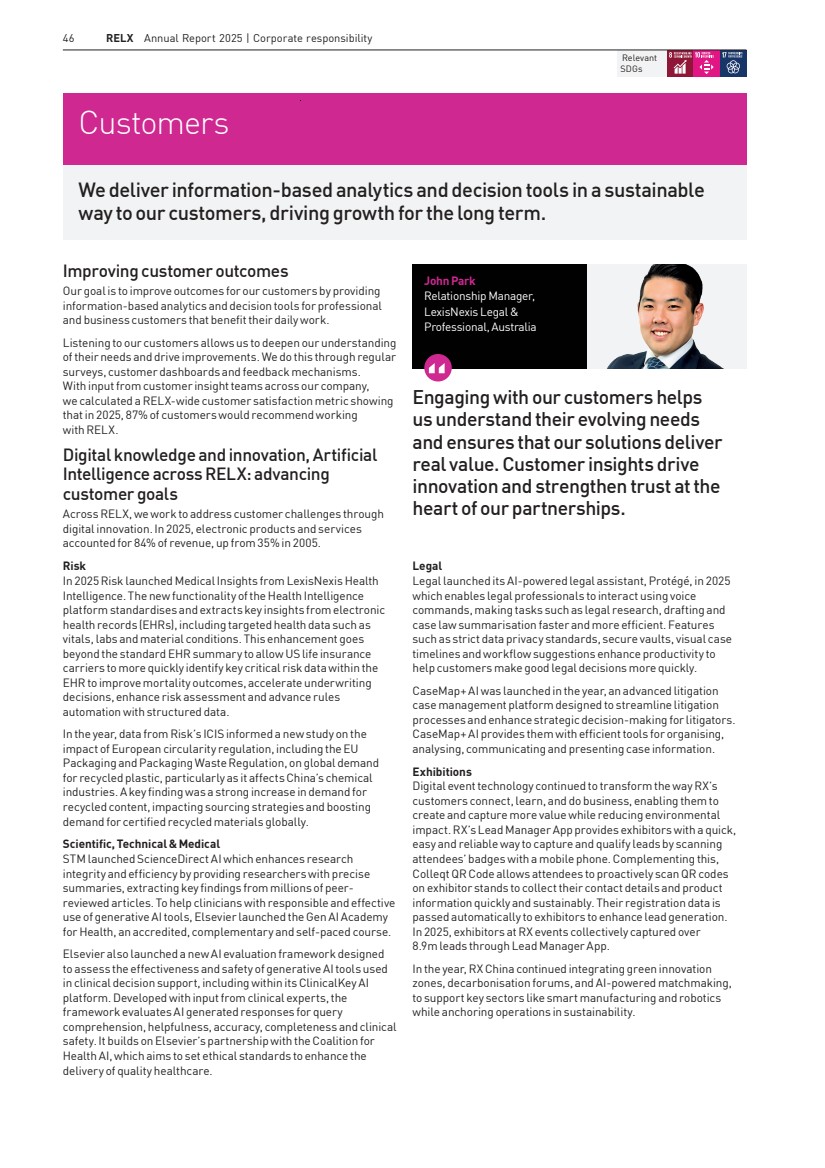
| RELX Annual Report 2025 | Customers 47 In the year Law360, LexisNexis Legal & Professional’s legal news service, implemented a policy requiring all articles to be reviewed by an AI-powered bias indicator tool before publication. The tool was designed to promote neutrality by identifying potentially biased language and supports editorial quality. Accessibility We strive to empower all people, including persons with disabilities, by ensuring our products and services are accessible and easy to use by everyone. Our commitment to accessibility is embedded across RELX and advances our Inclusion Policy. We work to ensure we meet the requirements of relevant global accessibility laws including the European Accessibility Act and theAmericans with Disabilities Act. We maintain an Accessibility Policy that highlights industry standards and tools to embed accessibility into our products and our business operations. We apply best practice from the RELX Accessibility Policy across hundreds of digital products and websites. Our minimum standard for our Websites is the WebContent Accessibility Guidelines (WCAG) 2.1 Level AA. OurAccessibility Policy is available at www.relx.com/cr-downloads. Elsevier’s ScienceDirect platform was ranked in the top 1% for most accessible home page by the 2025 WebAIM Million study. TheHealth Education Systems Incorporated (HESI) Delivery Operations team continued to work with students taking the HESI exam to register to take it remotely via our remote proctoring vendors. Since 2019, the team has processed more than 940 candidate accommodation requests, ensuring that these candidates have an accessible and inclusive experience. In 2025, Elsevier’s Global Books Digital Archive fulfilled more than 1,700 disability book accommodation requests. Elsevier was also recertified in the year as a Global Certified Accessible publisher by Benetech, a non-profit organisation based in PaloAlto, California. Elsevier launched PDF tagging in all new journals and books, which allows assistive technologies like screen readers to interpret and navigate documents correctly. Bringing science into society We work closely with journalists to ensure that research findings are accurately and effectively communicated to the public, and that authors receive credit for their work. Elsevier’s Library Connect programme and Academy, provides library and information science professionals worldwide with opportunities for knowledge sharing. In 2025, Library Connect Academy hosted a GenAI Literacy programme with over 5,500 librarians enrolled. Covering Library and Information Science (LIS) best practices, trends and technology, The Library Connect Newsletter had more than 40,000 LIS professionals subscribed globally and the Library Connect website had over 27,000 visitors. In the year Elsevier expanded its Geographical Pricing for Open Access initiative which now includes around 300 gold open access journals. The initiative helps authors in low- and middle-income countries publish their research open access through pricing based on local economic conditions. Since the launch of the pilot the initiative has seen more than 14,500 articles by authors in more than 100 low- and middle-income countries accepted by participating journals. Editorial standards Maintaining the integrity of what RELX publishes is vital to the trust of customers and other stakeholders. Our Editorial Policy, available to all staff (and publicly available on www.relx.com/ corporate-responsibility/engaging-others/policies-and-downloads) makes clear our respect for human rights, pluralism of sources, ideas and voices. Elsevier has dedicated resources and processes to support research integrity. Elsevier’s Research Integrity and Publishing Ethics team supports publishers and editors through their research integrity strategy which focuses on, resolving post-publication ethics cases for publishers and editors, detecting unethical practices during the editorial process to prevent publication and raising awareness within Elsevier and the communities that we serve on best practices. We also believe in editorial independence and keep editorial decision making processes separate from our commercial interests. 2025 OBJECTIVE Support expanded use of Artificial Intelligence across RELX by updating the RELX Responsible AIPrinciples to reflect technological advancements 2025 PERFORMANCE We created the RELX Responsible AI Principles in 2022 and they are publicly available at www.relx.com/ corporateresponsibility/engaging-others/policies-anddownloads. The Principles are accompanied by a RELX position paper on AI and a dedicated address that anyone can use to provide feedback or raise queries: ResponsibleAI@relx.com Each business area works to implement the Principles, with dedicated teams responsible for developing policy, processes, tools, resources and training to support teams working with data science, machine learning and AI in embedding the Principles in their day-to-day activities. We hosted a RELX Responsible AI Summit in the year, with sessions on agentic AI, responsible AI by design and current and pending AI legislation. Insights and questions raised at the summit will be considered by the Responsible AI working group when updating the principles. We are committed to updating our RELX Responsible AI Principles in recognition of the rapidly changing adoption and use of AI. In 2025 we assembled feedback from organisational stakeholders on suggested changes to the principles and the Responsible AI Working Group met to review this information and propose new language. Work will continue in 2026 to incorporate feedback and update the principles accordingly. This activity supports SDG 8 (Decent Work and Economic Growth). Market segments Governance and other information Financial statements Financial review Corporate responsibility Overview |
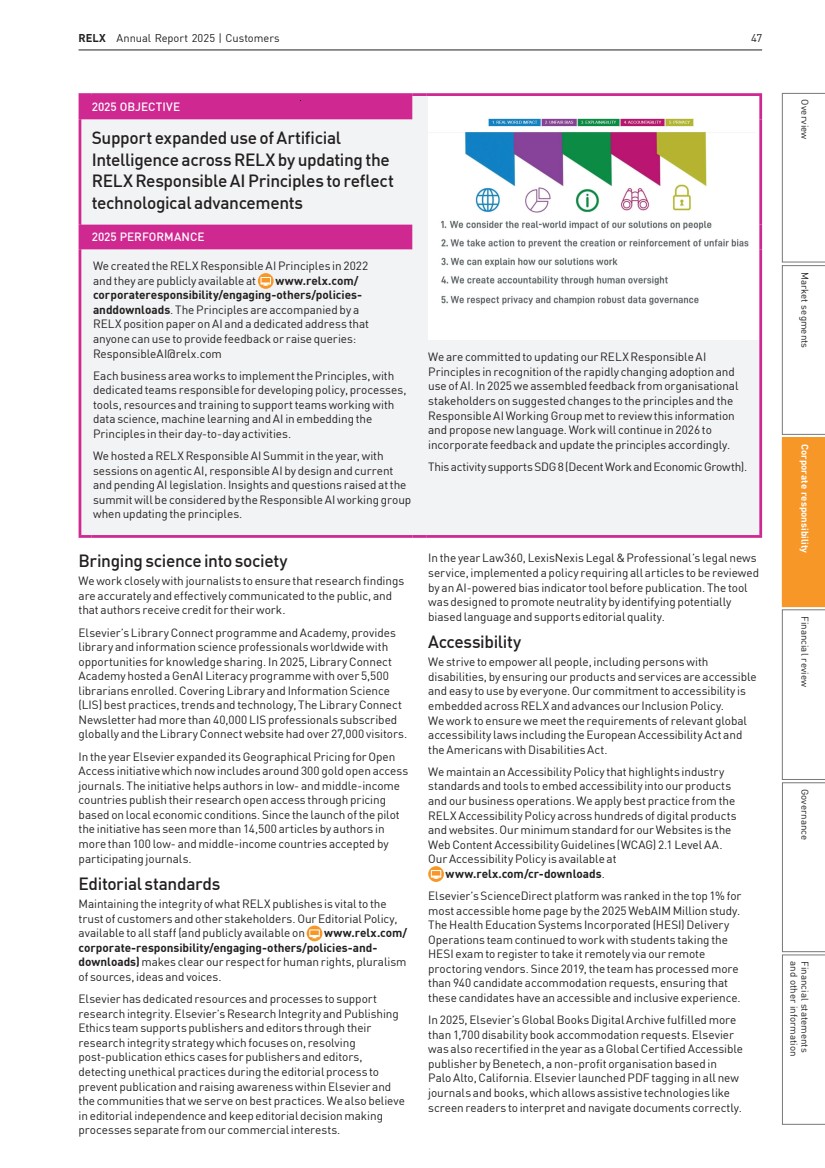
| 48 RELX Annual Report 2025 | Corporate responsibility 2026 objectives By 2030 Quality – Update RELX Responsible AI Principles to keep pace with evolving technology, aligned with SDG 8 (Decent Work and Economic Growth) Accessibility – Establish and implement accessibility best practices for AI-driven user interfaces and AI-generated content, aligned with SDG 10 (Reduced Inequalities) Customer engagement – Develop an internal AI tool for customer facing colleagues to quickly access corporate responsibility information, aligned withSDG 17 (Partnership for the Goals) Continue to expand our customer base across our four business areas through excellence in products and services, active listening and engagement, editorial and quality standards, and accessibility. Continue to be recognised as an advocate for responsible marketplace practices In 2025, Elsevier undertook research with people with disabilities, including users of Editorial Manager, ShadowHealth, and our PDF journal articles. To improve the accessibility and perceivability of animated 3D simulations, Elsevier’s Shadow Health Digital Clinical Experiences is piloting built-in screen reading functionality. We worked with disability services offices, procurement officialsand instructors across the world to provide Accessibility Conformance Reports (ACRs). Elsevier launched a new public resource in the year enabling users to access ACRs for various products detailing how they meet global accessibility standards and laws, helping address customer queries and increasing transparency. Legal undertook work in the year towards a similar online ACR repository. Customers can also utilise a dedicated accessibility email address to connect with an accessibility expert and support ACR requests. In 2025 Accessibility Teams across Risk, Elsevier and Legal resolved over 600 customer accessibility requests. 2025 OBJECTIVE Develop a new accessibility design reviewprocess 2025 PERFORMANCE 2025 OBJECTIVE Engagement with sales professionals throughout the business on the value of corporate responsibility for our customers 2025 PERFORMANCE RELX is committed to creating products that are usable by everyone including people who experience a disability. Product teams, supported by a network of Accessibility Champions, work to ensure digital accessibility is embedded into the design of products and services from the start to ensure an optimal experience for disabled users. In the year we produced a new comprehensive User Experience Accessibility Design Guide which incorporates accessibility user personas and tips for ideation; accessibility in detailed design; expert review; and hand off-review process. Teams across the business completed self-assessments against two Software Development Life Cycle (SDLC) Accessibility Processes, followed by improvement plans. We also deployed shift left best practices which integrate accessibility considerations into the earliest stages of the SDLC. To share our knowledge in this area, Accessibility Specialists from across RELX presented six sessions at CSUN Assistive Technology Conference 2025 (photographed right). Increasingly customers need information from us in areas ranging from our environmental performance and their share of our carbon emissions, to the steps we take to ensure an ethical supply chain. Since 2021 we have received a 160% increase in customer requests for sustainability data. In 2025 sales colleagues were surveyed to gain insights on corporate responsibility related customer requests. Corporate Responsibility teams shadowed sales colleagues to better understand their processes and customer engagement strategies. This cross-functional learning enables Corporate Responsibility colleagues to create efficient and effective tools and communications for sales colleagues. In the year customer and product focused content was produced to highlight RELX’s Unique Contributions, including a sustainability focused product story published to coincide with COP30. |
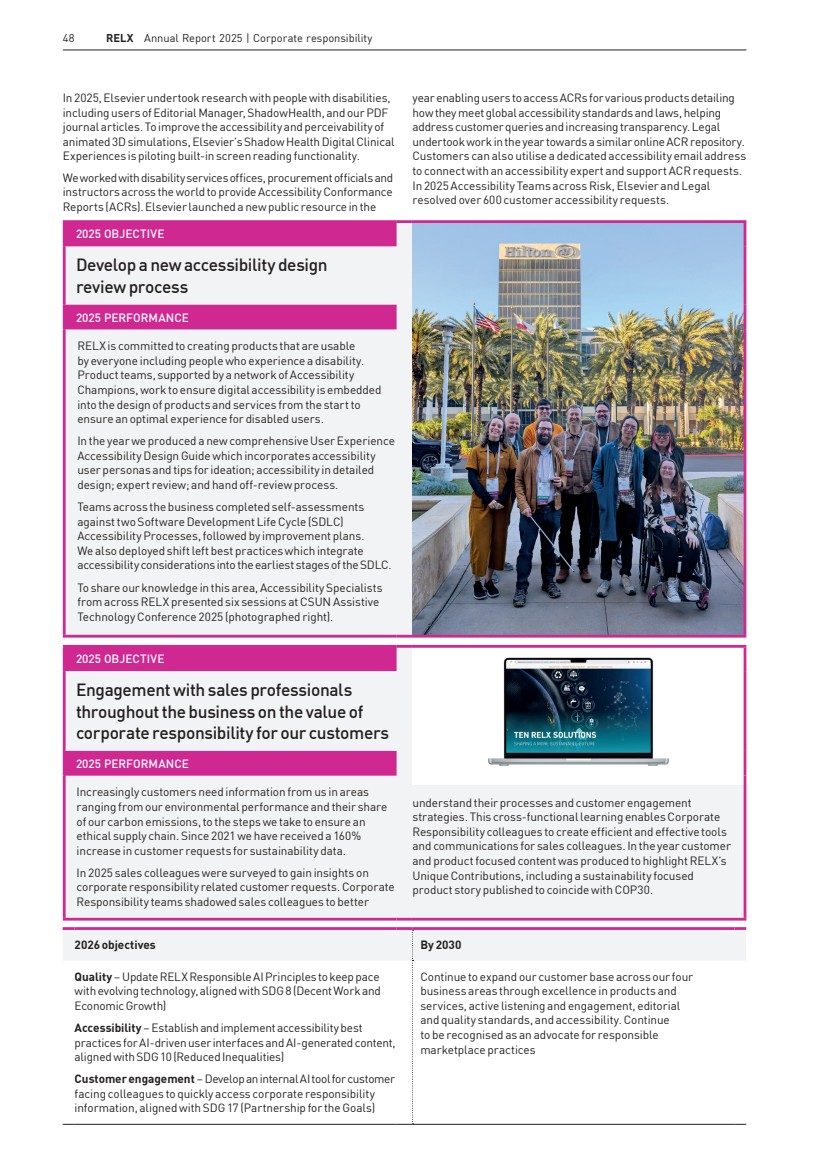
| Relevant SDGs RELX Annual Report 2025 | People 49 What makes RELX special Our people tell us, through our annual employee opinion survey, that they are engaged, motivated and committed and believe RELX is a great place to work. We attract and retain talented people, including those whose skills are in high demand. Our competitive advantage is driven by our purpose, culture, talent and a combination of behaviours and attributes, including: § Knowing our products and exactly how they add value for our customers § Understanding emerging technologies and how they might be used to add value § Being thought leaders § Being intellectually curious and eager to learn § Being fact based, analytical and data driven We owe our success to RELX’s talented employees, including technologists, researchers, event directors, product managers, data scientists and many others. Our employees count on us to create a fair, challenging, rewarding and supportive work environment where they can achieve their potential. For more information on our people and their working lives in RELX, please see www.relx.com/our-business/perspectives. Driving performance through culture In RELX we set an expectation that everyone should take ownership and be accountable for their actions, decisions and outcomes. Everyone is encouraged to seek never-ending performance improvement in every aspect of what they do, driving execution and achieving results. This is underpinned by defined and measurable annual goals for all our people, as part of our Enabling Performance approach to performance measurement and personal development. EnablingPerformance allows us to review achievement of goals and identify opportunities for development, recognition and advancement. This approach encourages regular and impactful performance, development and career conversations for all employees. We recognise the value of leadership, whatever career stage someone is at: whether this is their first role, or whether they are leading a business area. We have a common language and approach to leadership in RELX. For our senior leaders we set specific behavioural expectations that will help them successfully navigate their careers in RELX. Exceptional leadership is the cornerstone of success at RELX. Our commitment to careers RELX employees are expected to understand their strengths and areas for improvement and take individual ownership of, and accountability for, pursuing their own personal development. We ask employees to proactively look for opportunities to build their career. We invest in tools to support them, especially in identifying appropriate career paths. We aim to provide our people with resources, tools and support to help them perform and grow, including online training platforms that were utilised by 76% of employees during 2025. We are helping our people build skills for the future such as data analytics, product and technology development (including AI), and product ownership and management. In 2025 we invested over $14m and around 500,000 hours in centrally deployed training. This included courses, seminars, one-to-one instruction and tuition reimbursement. Centralised training is supplemented by additional training in business units. Our CEO and the RELX business leaders care deeply about helping our people to develop and actively participate in regular organisational talent reviews that consider development needs and opportunities at an individual level. We also offer NetWorx, a global employee mentorship programme. This digital mentoring platform recommends matches based on individual profiles and specific goals, creating six month long mentoring relationships. In 2025, the platform had approximately 1,500 active users. People We owe our success to our people. They are driven by a strong sense of purpose, and a supportive work environment where they can achieve their full potential. Rito Dipto Strategic Engagement Manager, Elsevier, UK RELX has enabled me to grow in my vocation while fostering a culture oftrust and psychological safety. The organisation’s policies have supported both my professional ambitions and personal wellbeing, making me even more committed to showing up at my best, every day. Market segments Governance and other information Financial statements Financial review Corporate responsibility Overview |
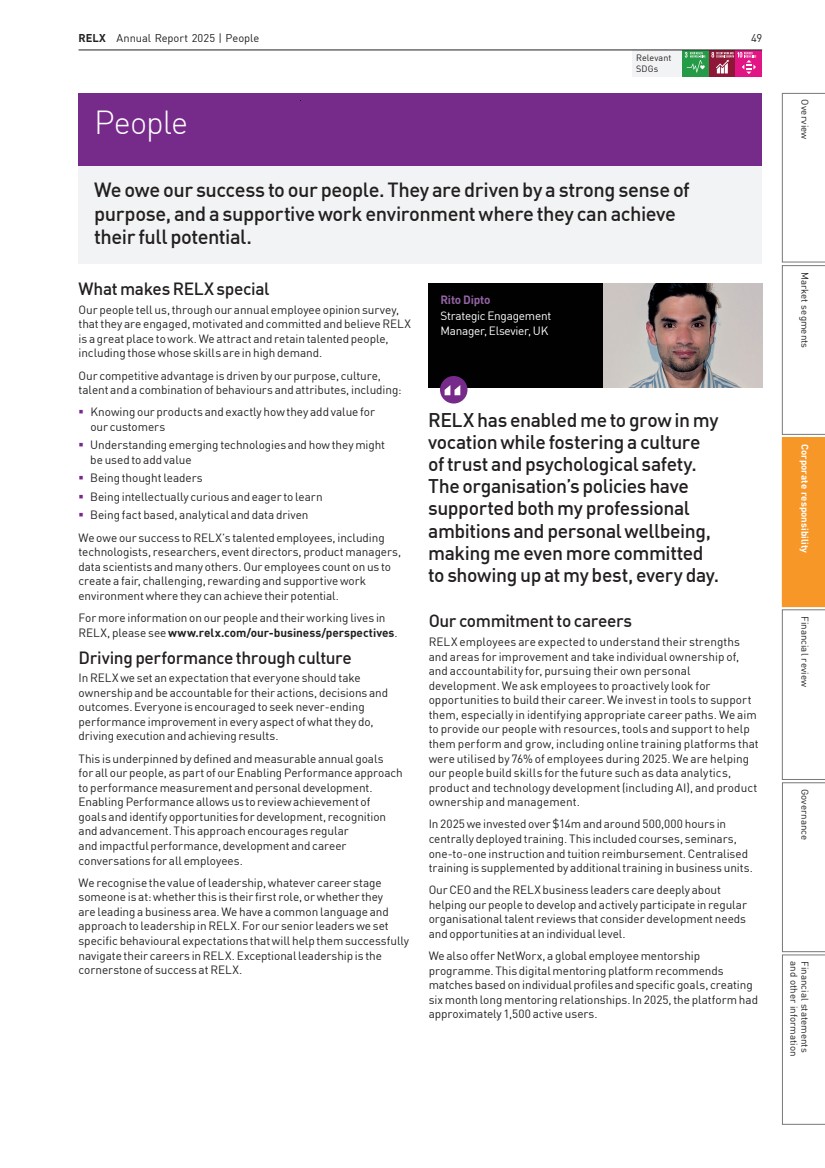
| 50 RELX Annual Report 2025 | Corporate responsibility Integrity at the heart of our business We embrace integrity and high ethical standards and our RELX Code of Ethics and Business Conduct provides the guidance needed to make ethical business decisions. It explains how we should behave in the workplace and marketplace and describes how each of us should handle various legal and ethical matters, providing helpful scenarios. The principles in our Code of Ethics and Business Conduct are firmly embedded in the company and we strongly encourage employees to speak up if they are concerned about potential breaches. We have several channels they can use, including our Integrity Line, to raise concerns and have them investigated (see page 43). We see this as an important factor in ensuring that our actions are in the best interests of our company, employees, customers and shareholders. Harnessing our talent At the heart of our approach to inclusion, is the belief that everyone should be able to succeed and grow in a business that values them. Inclusion means feeling heard, contributing equally, with equal access to opportunity – regardless of personal characteristics. We encourage and promote inclusion and believe RELX derives competitive advantage from the breadth of backgrounds, diverse perspectives, opinions and differing ways of thinking that our people bring to everything they do. Inclusion policy § Sets out our commitment to an inclusive workforce (available at www.relx.com/cr-downloads) Employee Resource Groups § 100+ active networks External recognition § RELX was recognised in multiple categories at the 2025 Comparably awards including Best Leadership Team, Best Company Outlook and Best Company, Perks and Benefits RELX Employee Resource Groups (ERGs) encourage colleagues to collaborate, advocate and engage communities around topics of mutual interest. ERGs are open to everybody, and help advance a culture of belonging. This is recognised by allowing all employees to take two days paid time-off per year for ERG-sponsored activities. In 2025, employees recorded over 22,300 ERG hours. We feature stories about our people and purpose at www.relx.com/our-business/perspectives We are committed to creating an environment where everyone can thrive, and provide reasonable accommodations and adjustments to meet individual needs, ensuring everyone can participate fully in the workplace. In 2025, the percentage of people managers who are women remained at 46%, and the number of women in our senior leader population was 31%. At year end, women comprised 40% of the Board. Non-Executive Director, Bianca Tetteroo serves as our Workforce Engagement Director. Our business relies heavily on technologists and we need to attract the best talent to support our business ambitions. We directly employ more than 9,300 technologists, 27% are women. Health and safety The importance of employee health and safety is emphasised in the RELX Code of Ethics and Business Conduct and in the RELX Health and Safety Policy available at www.relx.com. These documents commit us to providing a healthy and safe workplace for all employees and safe products and services for customers. The CEOis responsible for health and safety on behalf of the Board. We consult with employees globally on health and safety through staff and works councils and reinforce good health and safety practice through regular communications, including a designated site with relevant information. We also hold regular Health and Safety Committee meetings. We monitor and ensure our buildings are maintained and comply with relevant health and safety laws and standards, in conjunction with third parties and landlords, where appropriate. We provide tailored health and safety training to employees and alongside third parties to help ensure compliance with local health and safety rules and to promote best practice. This is particularly important for employees at higher risk of injury in the workplace. In the US, we engage a third-party specialist to inspect locations that had increased incident rates. We also provide employee support following any incident or health concern. There were no work related deaths reported in 2025 and our frequency rate (lost time incidents per 200,000 hours worked) was 0.02. The majority of lost time incidents were due to road traffic accidents, followed by slips, trips and falls. For hybrid working, we provide support on health and safety issues for both office and home working. During the past three years over 5,900 employees have completed the training through our Healthy Working programme which includes personalised risk assessments and action plans. RELX is also committed to fostering a psychologically safe and supportive workplace through a comprehensive mental health and wellbeing framework that spans all business areas. The framework is rooted in proactive leadership, diverse support mechanisms, and inclusive programming that addresses the multifaceted wellbeing needs of employees globally. 2025 OBJECTIVE Engage colleagues globally through our Inspiring Inclusion programme 2025 PERFORMANCE Our 2025 series of virtual events helped colleagues understand and embrace the diversity of our global business. The 2025 Belonging virtual conference brought together employees globally to foster a shared commitment to advocacy, learning and building an inclusive workplace. Independently assured |
| RELX Annual Report 2025 | People 51 2025 OBJECTIVE Hold virtual wellbeing summit for champions from across the business 2025 PERFORMANCE RELX operates in a fast moving and dynamic environment. We want to help our people to take care of themselves, mentally and physically, so they can perform with clarity, focus, stability and energy, and achieve their potential. In 2025 all employees, globally, were invited to participate in a programme in association with OwnLife, intended to help them sustain productivity while finding a better work-life balance, and reducing their risk of burnout. In 2025, we held our first RELX Wellbeing Summit bringing together over 100 HR leads, ERG representatives, and MentalHealth First Aiders across 14 countries. The summit highlighted practical tools for workplace wellbeing advocates and focused on connection, care, and rejuvenation for those colleagues that care for others. 94% of summit attendees discovered useful tools and 100% learnt something new. Additionally, we have a number of ongoing wellness programmes such as Living Well, MindLife and Thrive. Our global Employee Assistance Programme provides valued professional support when someone needs more personalised or urgent help with a work-related or a personal issue. All of this is supported by a wide range of policies that support employees in bringing their whole self to work and in managing competing work and life priorities. 2025 OBJECTIVE Continue to assess pay competitiveness and pay equity across RELX 2025 PERFORMANCE In 2025, we continued to monitor pay competitiveness and pay equity across RELX. Compensation reviews twice a year allow for pay increases to recognise performance and sustain market competitiveness and internal equity. We have robust and well-established reward mechanisms across RELX, with a strong emphasis on performance, fairness, equity and market competitiveness. Reward education is provided for people managers to support them inunderstanding key concepts – such as the steps we take to ensure people are treated equitably – and to facilitate discussing them with employees. In addition to pay, we have a wide range of employee benefits that reflect the market norms in the countries in which we operate. We keep pay equity under constant review, with an ongoing programme to drive even greater equity and fairness. 2025 RELX people in numbers FTE employees 37,600 Full-time employees (%) 95% Part-time employees (%) 5% Average length of service (years) 8 Total hours worked by all employees in the year 66m Temporary workers (%) 3% Contingent workers 1,700 Employees represented by a collective bargaining agreement (%) 12% Global HR information system coverage 100% Turnover Total turnover rate 11.1% Voluntary turnover rate 7.2% Involuntary turnover rate 3.9% Training and development Investment in training $14m Training hours 500,000 Employee engagement 71% Reward Employees with variable pay opportunities 79% Employees with access to share purchase programmes (US/UK/NL) 55% Absence Absence rate (number of unscheduled absent days out of total days worked in 2025, UK and NL) 0.87% US Family Medical Leave Act requests 1,101 Inclusion Employees who are women 51% Managers who are women 46% Senior leaders who are women 31% 2026 objectives By 2030 Belonging – Continue to engage colleagues globally through our Inspiring Inclusion programme, aligned with SDG 10 (Reduced Inequalities) Wellbeing – Second virtual well-being summit to convene wellness champions across RELX to share best practice and provide new tools to support physical and mental wellbeing, in support of SDG 3 (Good Health and Well-Being) Pay equity – Continue to assess pay competitiveness and pay equity, aligned with SDG 8 (Decent Work and Economic Growth) Continued high-performing and satisfied workforce through talent development, inclusion and well-being Market segments Governance and other information Financial statements Financial review Corporate responsibility Overview |
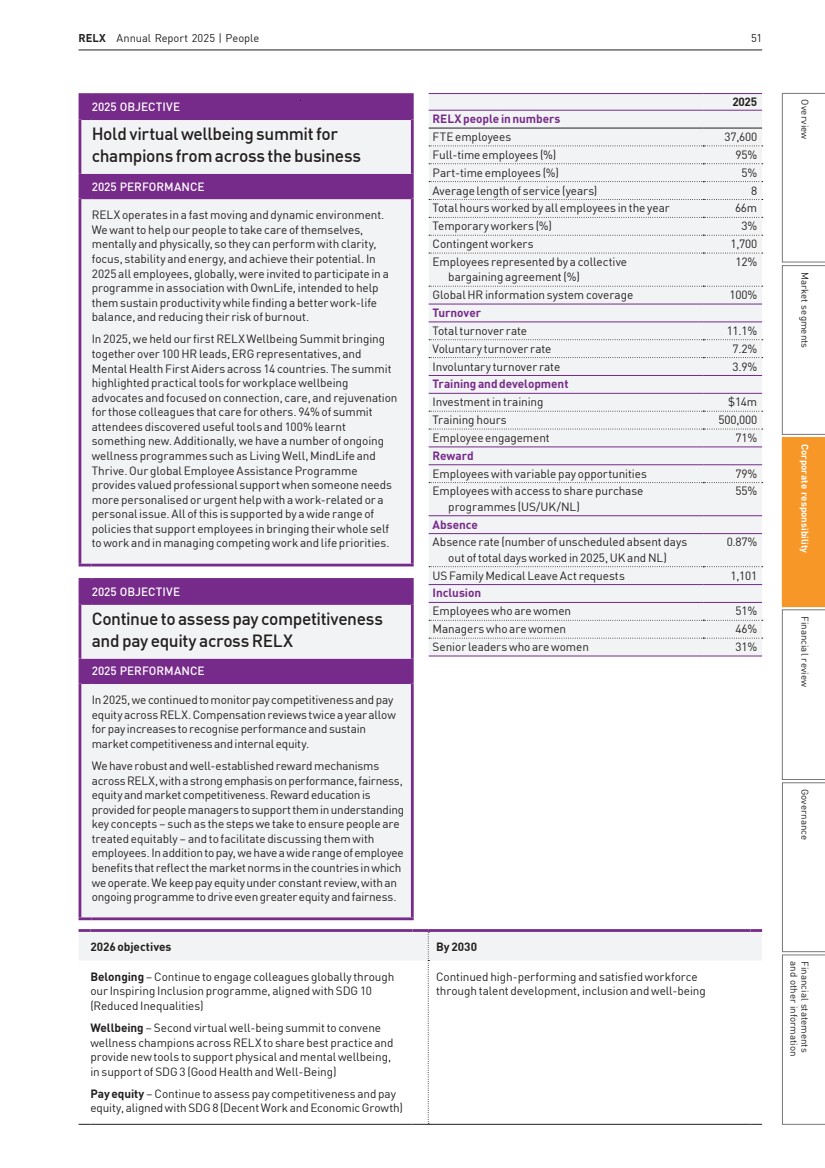
| Relevant SDGs 52 RELX Annual Report 2025 | Corporate responsibility RELX Cares, our global community programme, supports employee volunteering and giving that makes a positive impact on society. The mission of RELX Cares is education for disadvantaged young people that advances one or more of our unique contributions as a business, including protection of society and reducing inequalities, advancing science and improving health outcomes, furthering the Rule of Law and access to justice and fostering communities. Employees have up to two days’ paid leave per year for their own community work. A network of 220RELX Cares Champions ensures the vibrancy of our community engagement. In 2025, we held the 15th Recognising Those Who Care Awards to highlight colleagues who have made outstanding contributions to RELX Cares. The eight winners of the individual award travelled to visit charity projects in the Philippines hosted by our colleagues at Reed Elsevier in the Philippines. In addition, one individual was awarded extra RELX Cares volunteering days and two individuals and two teams were given the opportunity to make a donation to the charity of their choice. 220 A network of 220 RELX Cares Champions ensures the vibrancy of our community engagement Community We help our local and global communities thrive by contributing to their success. Volunteering allows us to unite our collective strength for meaningful change. Nothing is more rewarding than seeing our shared efforts strengthen community bonds and create tangible impact. The mission of RELX Cares is education for disadvantaged young people that furthers one or more of our unique contributions as a business, including universal, sustainable access to information. Elora Wang Executive Assistant, RX, China 2025 OBJECTIVE Update RELX Cares Champions materials and continue to increase engagement and participation 2025 PERFORMANCE In the year we updated existing assets and created new materials for RELX Cares Champions, among them the RELXCares Champions Handbook to help RELX Cares Champions understand their role as catalysts in supporting colleagues to take part in volunteering, giving and other RELXCares activities. We created new downloadable posters to advertise RELX Cares events, an email signature that tells people they are RELX Cares Champions, an email template to promote RELX Cares activities and a RELX Cares T shirt design. We increased engagement in our flagship programme, Recognising Those Who Cares with a 17% increase in applications for the awards which celebrates RELX employees who have made outstanding contributions to RELX Cares. We have continued to convene bi-monthly RELX Cares Champions meetings to engage employees around the world. The Recognising Those Who Care programme spotlights colleagues whose passion and commitment to their communities embodies the spirit of RELX Cares. Serving as a judge for the awards has been incredibly rewarding in discovering how the nominees’ dedication is inspiring our teammates around the world and making a real difference. Jonathon Woods Director, Corporate Communications LexisNexis Legal & Professional |
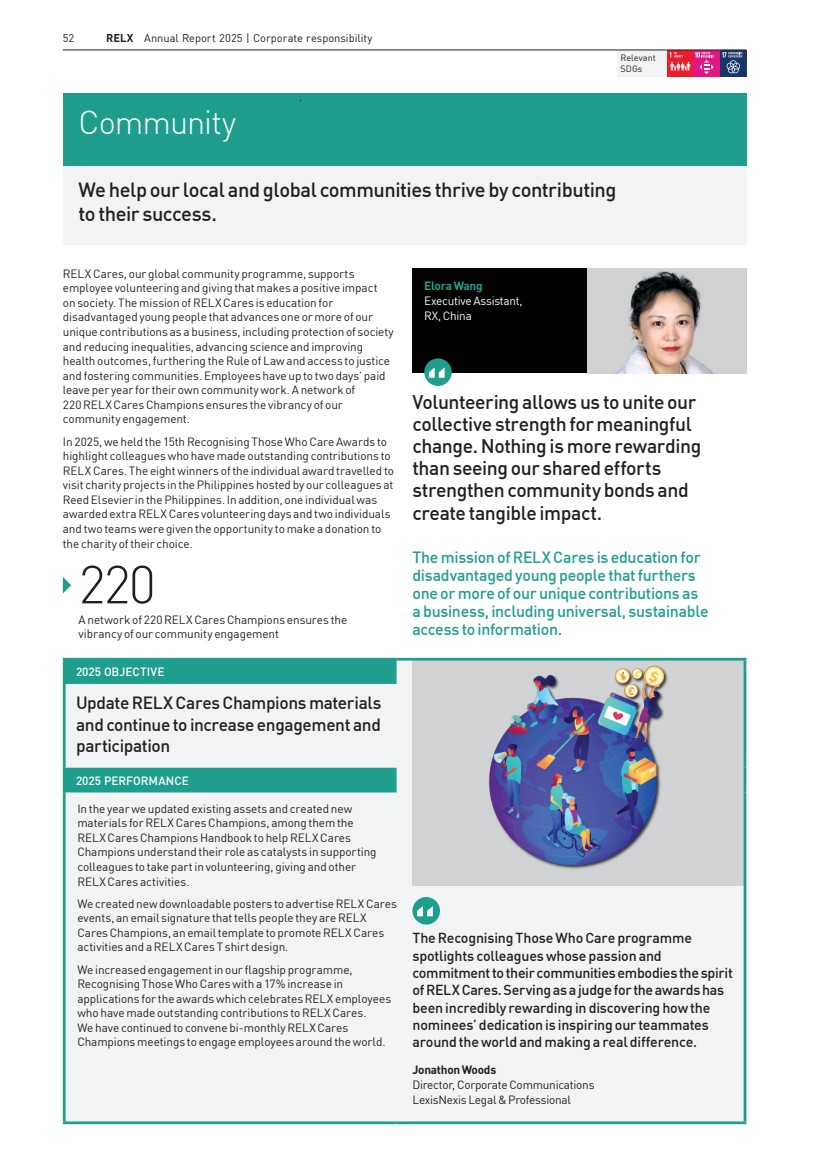
| RELX Annual Report 2025 | Community 53 Each September, we hold RELX Cares Month to celebrate our commitment to our communities around the world. During the Month, over 4,000 colleagues across RELX took part in hundreds of volunteering and fundraising events. These included employees in the UK who recorded audio books for sick children; colleagues from LexisNexis Risk Solutions US who painted skateboards for disadvantaged children; Elsevier India colleagues who mentored young people from an educational charity; LexisNexis Legal & Professional New Zealand who took part in a beach clean-up; and colleagues at RX China who worked with a charity providing horse riding for children with special needs. Giving Our central donations programme aligns with the RELX Cares mission. Employees serve as sponsors for charities seeking funding, which must in turn indicate how they help further one or more of RELX’s unique contributions. RELX Cares Champions vote on submissions using decision criteria such as value to the beneficiary and opportunities for staff engagement. In 2025, RELX Cares Champions donated £334,242 to 29 charities supporting over 120,000 young people. Projects included: § In the US, giving underserved Philadelphia teenagers the chance to take part in outdoor expeditions § In Poland, funding social integration and creative programmes for Ukrainian child refugees § In India, providing free education to children in a vulnerable Delhi resettlement colony In managing community involvement, we apply the same rigour as we do to other aspects of our business. Read our methodology at www.relx.com/additional-cr-resources. We extended our partnership with our global fundraising partner, Save the Children, until 2027. Since 2022, the partnership has raised more than £200,000, including through marathon running, quiz nights and taking part in Save the Children’s Christmas jumper day, and we have pledged to raise at least another £80,000 by 2027. The funds support Save the Children’s work in 90 countries, through emergency response and long-term programmes, the charity has an immediate and lasting impact on the lives of millions of children around the world. We donated £5m in cash (including through matching gifts), and £15m in products, services and staff time (market-value) in 2025. Some 38% of employees were engaged in volunteering through RELX Cares. According to 2025 Business for Societal Impact (B4SI) data, the average volunteering rate was 27.2% for our sector and 24.8% for all sectors. We encourage in-kind contributions, such as product and equipment donations, aligned with our Product Donation Policy (available at www.relx.com/cr-downloads), which included books, access to content, and discounted charity rates for some products. Book donations: supporting education While print is a relatively small portion of our revenue, we continue to minimise the impact of printed product. We focus on techniques such as print on demand or print run control to better match production to demand. We donate excess product to charity partners such as Book Aid International and Books for Africa to avoid waste and benefit communities. In 2025, RELX donated over 143,000 books with a value of over $11m to our charity partners. Book Aid International RELX has been a Book Aid International partner for over 30 years through regular book donations, financial support, staff fundraising and volunteering. RELX donations of higher education and medical books are critical to educating the next generation around the world. In 2025, we supported them by donating 16,476 new books and providing a grant to open a new Children’s Corner in Bamenda, Cameroon. Every Children’s Corner creates a vibrant reading space stocked with UK donated and nationally published books that is staffed by a specially trained librarian ready to welcome children into a world of reading. The space is especially valuable in Bamenda, where children are living with the effects of an eight-year conflict that has closed schools and forced thousands from their homes. In these challenging circumstances, the new Children’s Corner will give hundreds of children the chance to find respite in stories. For over 30 years, RELX has joined us in sharing the power of books with readers around the world. The hugely valuable books RELX provides have helped so many midwives, doctors and nurses qualify and go on to provide life-saving care and supported countless students around the world in earning degrees. RELX’s grants have opened beautiful reading spaces where children can explore awhole new world of stories. I would like to thank RELX for their long-standing support – your gifts are truly transformational. Alison Tweed Chief Executive, Book Aid International Photo credit: Cynthia R Matonhodze/Book Aid International. Market segments Governance and other information Financial statements Financial review Corporate responsibility Overview |
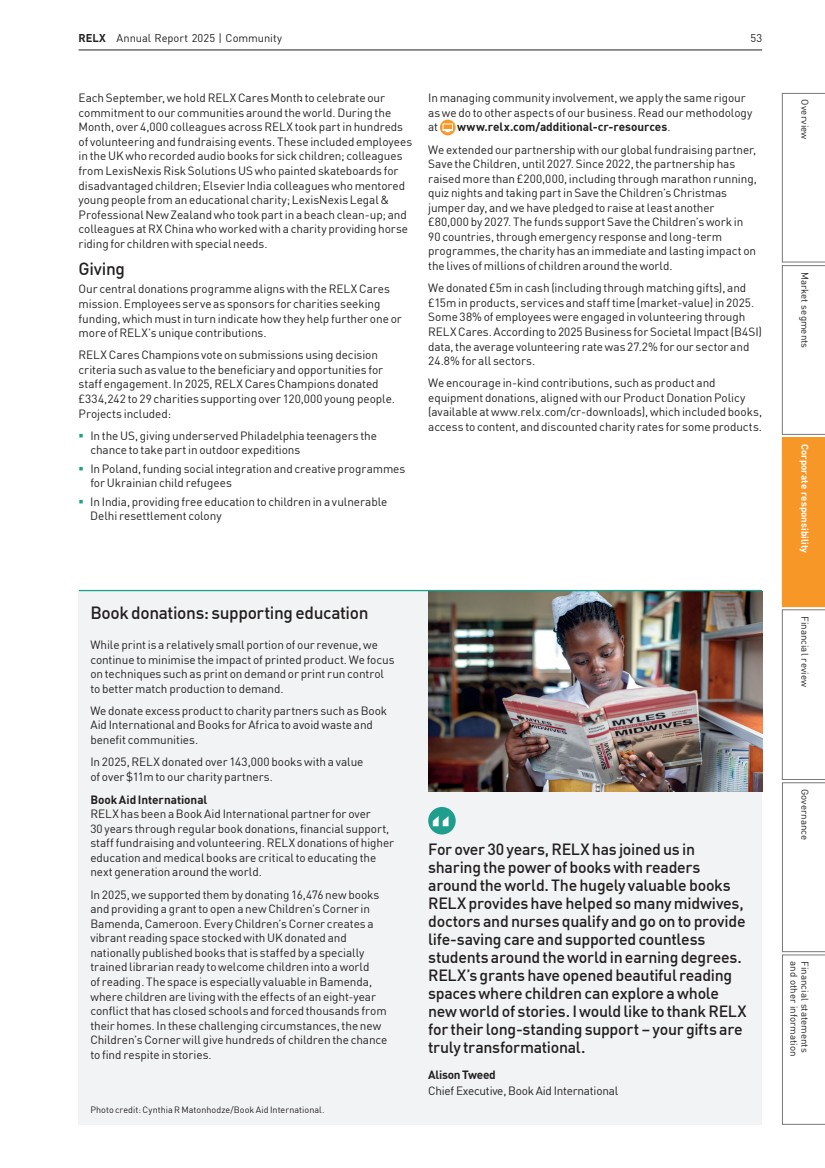
| 54 RELX Annual Report 2025 | Corporate responsibility Impact In accordance with the B4SI model, we monitor the short- and long-term benefits of the projects with which we are involved. We ask beneficiaries to report on their progress to increase transparency and engagement. In addition, we survey RELX Cares volunteers on the impact the programme has on their work following each volunteer activity. In 2025, we received over 15,400 responses, 89% of respondents said their motivation and pride in RELX had increased as a result of volunteering and 87% said they had experienced a positive change in behaviour or attitude as a result of volunteering. In-kind 51% Cash 26% Time 23% What we contributed in 2025 (market value) Market value cash, in-kind and time donations (GBPm) Community involvement Market value cash, in-kind and time donations (GBPm) 2021 2022 2023 2024 2025 21 23 23 20 23 Elsevier Foundation This year we celebrated 20 years of the Elsevier Foundation which has donated $18 million in grants to over 100 partners in more than 70 countries around the world to advance inclusive research and health. The Foundation shared its first Impact Report in the year with key statistics and partnership case studies on research equity, inclusive health and climate action, including Envisioning Futures: Women’s leadership and gender equity in Japanese research with RIKEN, the leading Japanese research institute. They also introduced a new alumni programme connecting past award winners with Elsevier editors, featuring them in Elsevier webinars and amplifying their work through our networks and hosting a reception for the Elsevier Foundation Awards for Early-Career Women Scientists in the Developing World alumni at the Organization for Women in Science for the Developing World General Assembly in Bogota, Colombia in November 2025. In 2025 the Elsevier Foundation also launched a partnership with Swasti, an Indian public health nonprofit, to support healthcare workers in addressing challenges posed by climate change through its Climate Care Champions programme. The $50,000 grant is equipping frontline healthcare workers with essential skills to manage climate-induced health impacts. Two districts were chosen for the pilot based on heat index severity involving 90 health professionals, who then trained over 2,200 frontline health workers. Results have led to an increase in accurate identification of heat-related illnesses and the creation of a first district Heat Action Plan. For 20 years, the Elsevier Foundation has invested in a pragmatic, partnership-driven approach to advancing inclusive research and health. By combining our partners’ on-the-ground expertise with Elsevier’s content, data, analytics and networks, together we have created a multiplier effect – delivering greater impact and contributing to meaningful change. Ylann Schemm Executive Director, Elsevier Foundation |
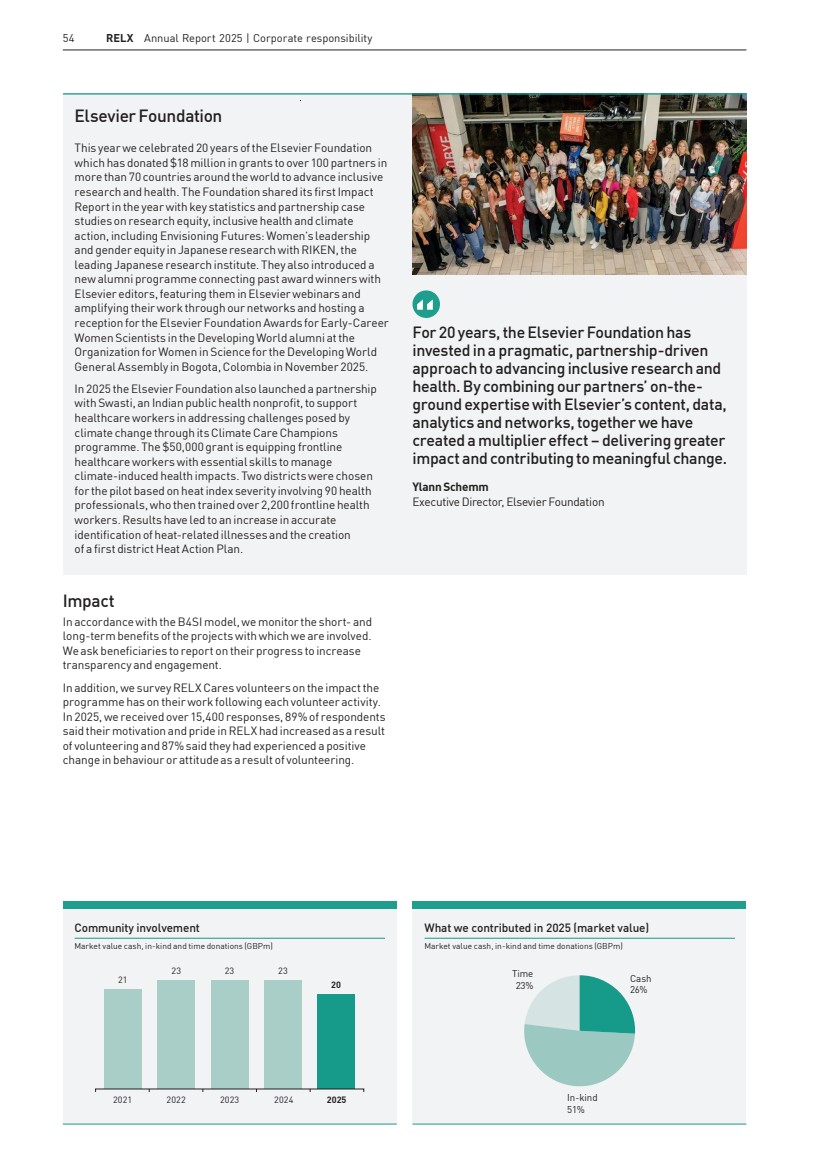
| RELX Annual Report 2025 | Community 55 2026 objectives By 2030 Employee community engagement – Hold first virtual global RELX Cares Champions Summit to continue advancing flagship RELX Cares programme across the business in support of SDG 17 (Partnerships for the Goals) Philanthropic giving – Introduce new technology platform to streamline central giving and to improve impact reporting, in support of SDG 17 (Partnerships for the Goals) Through our unique contributions, and investments with partners, contribute to significant, measurable advancement of education for disadvantaged young people Jeffrey P Mladenik and Andrew Curry-Green Memorial Scholarship As a lasting memorial to our colleagues Jeffrey Mladenik and Andrew Curry-Green, who lost their lives on 9/11, we offer scholarships in their name to children of eligible employees. Ayush Tailang (left) son of Sameer Tailang, Principal Software Engineer for Risk in Atlanta, is passionate about business and technology. Ayush graduated from high school with Honors and is now a freshman at the University of Georgia where he is studying Management Information Systems at the Terry College of Business. Ayush has earned an IT specialist certification and consistently places among the top rank in a range of technology competitions. He is a member of the National Honor Society and the National Technical Honor Society. Outside of academics, Ayush competes in dance tournaments, plays alto-saxophone and is involved in varsity athletics. Brooke Healey (right), daughter of Chris Healey, Customer Success Manager for Risk, graduated from high school with a 4.5 GPA and in the top two percent of her class. She has a passion for science, particularly environment and earth sciences. She played varsity volleyball and was also a member of the National Honor Society, Spanish Honor Society, Maths Honor Society and the California Scholarship Foundation, where she volunteered over 100 hours per year, earning her the President’s Volunteer Service Award. She was also a member of her high school’s environment club. Brooke is attending the University of California, Los Angeles and will major in environmental science. 2025 OBJECTIVE Continue to improve our capability to respond to disasters and emergencies, exploring how we can donate our products and services to further relief and preparedness 2025 PERFORMANCE In the year, our Disaster and Emergency Committee brought together business continuity, corporate responsibility and philanthropy colleagues for a more collaborative and coordinated response to emergencies and disasters. During 2025, we donated funds to Save the Children, World Central Kitchen and The Red Cross to support relief efforts around the world including for those affected by the Californian wildfires, earthquakes in Myanmar and Afghanistan, Hurricane Melissa in Jamaica and Typhoon Fung-wong in the Philippines. In 2025, RELX was nominated by Save the Children for Outstanding Support for Children in Emergencies at their Partnership Awards. We also contributed to a Business for Societal Impact (B4SI) project, sharing insights on our disaster response and were cited by B4SI as a best practice company in disaster relief. The 2025 RELX SDG Inspiration Day, The Future of Philanthropy, featured a panel exploring the role of corporate charity partnerships in disaster response. Panellists shared insights on maximising impact in times of crisis and emphasised the importance of integrating preparedness with recovery strategies, aligning corporate resources with humanitarian needs, and building resilient partnerships that address immediate issues whilst also contributing to sustainable recovery. RELX’s support of Save the Children’s emergency fund has enabled us to respond to children’s needs throughout the year. Despite cuts in overseas aid, ongoing crises, and the unpredictable geopolitical landscape, it is thanks to supporters like RELX that we are meeting those challenges and holding true to our mission to bring immediate, lasting and positive change for children. Lisa Aubrey Director of Fundraising & Engagement, Save the Children UK Photo credit: Save the Children Philippines. Market segments Governance and other information Financial statements Financial review Corporate responsibility Overview |

| Relevant SDGs 56 RELX Annual Report 2025 | Corporate responsibility Managing an ethical supply chain RELX has a diverse supply chain with suppliers located in over 150 countries across multiple categories, including technology (e.g. software, cloud, hardware and telecom), indirect (e.g. consulting, marketing, contingent labour and travel), and direct (e.g. data/content and production services, print/paper/bind and distribution). Given the importance of an ethical supply chain, we maintain a Socially Responsible Supplier (SRS) programme encompassing all our business areas, supported by colleagues with expertise in operations and procurement and a dedicated Supplier Environmental, Social, and Governance (ESG) Director from our global procurement function. The VP Global Procurement has operational responsibility for ensuring engagement with suppliers occurs. Monitoring suppliers Our Supplier Code of Conduct (Supplier Code) stipulates our expectations of our suppliers. It incorporates the Ten Principles ofthe UN Global Compact and encompasses key topics such as involuntary labour, non-discrimination, compensation and working hours, coercion and harassment, data security and environment. We require suppliers to ensure the standards of theCode are applied across their own supply chain. Where local industry standards are higher than applicable legal requirements, we expect suppliers to meet the higher standards. Non signatories to our supplier code are primarily new to the SRS tracking list, and we work with them, and other non-signatories, to gain agreement to our Supplier Code. In total, at the end of 2025 there were 6,586 signatories to our Supplier Code, or suppliers with an equivalent code, representing an increase of 9% from 6,056 signatories at the close of 2024. We engage specialist supply chain auditors to evaluate compliance with the Supplier Code, and in 2025 there were 140 external audits; 69 onsite and 71 desktop. During 2025, onsite audit locations included Argentina, Brazil, Canada, China, Egypt, Hungary, India, Italy, Mauritius, Mexico, Pakistan, Philippines, Singapore, SouthAfrica, Sri Lanka, United Kingdom, and United States. Desktop audits involve supplier responses to an online questionnaire, supporting document uploads, and a risk assessment. During an onsite audit, the auditor will randomly select employees from a full roster to interview. This provides an opportunity to address the awareness and trust in the process. Interviews are confidential, facilitymanagement are not allowed to be present, and the interviews are anonymised. In communicating non-compliance to management, the auditor cannot disclose information which could identify the employee or employees to avoid retaliation against them, which is forbidden by the SupplierCode. Supply chain We provide our customers with ethically sourced products and services and insist our suppliers meet the same high standards. Doug McWhorter Director, Global Procurement, RELX, USA By collaborating with suppliers who share our values, we generate greater impact – for our company, our customers, and the communities where we live and work. North America 58.1% South America 0.8% Middle East 1% Asia & Pacific 12.7% Europe 26.8% Africa 0.6% RELX supplier locations (% of supplier spend) Based on four quarters ending Q3 2025 Read our Supplier Code of Conduct at www.relx.com/cr-downloads Available in 16 languages, suppliers must display the Code in their workplace SRS tracking list includes suppliers with which; we spend more than $1m annually; deem critical; or those located in medium and high-risk countries with which we spend $100,000+ annually for two consecutive years We assess risk using our Supplier Risk Tool which contains 11 indicators, including human trafficking information from US State Department and the Environmental Performance Index (Yale University and Columbia University in collaboration with the World Economic Forum). Using the tool, in 2025, we assessed risk covering over 90% of global spend SRS tracking list changes year-on-year based on our business needs and changes in country risk designations; in2025, there were 954 suppliers, of which 769 (81%) are signatories to our Supplier Code or have equivalent standards in place. The tracking list includes 111 suppliers in high-risk countries and 694 in medium risk countries, |
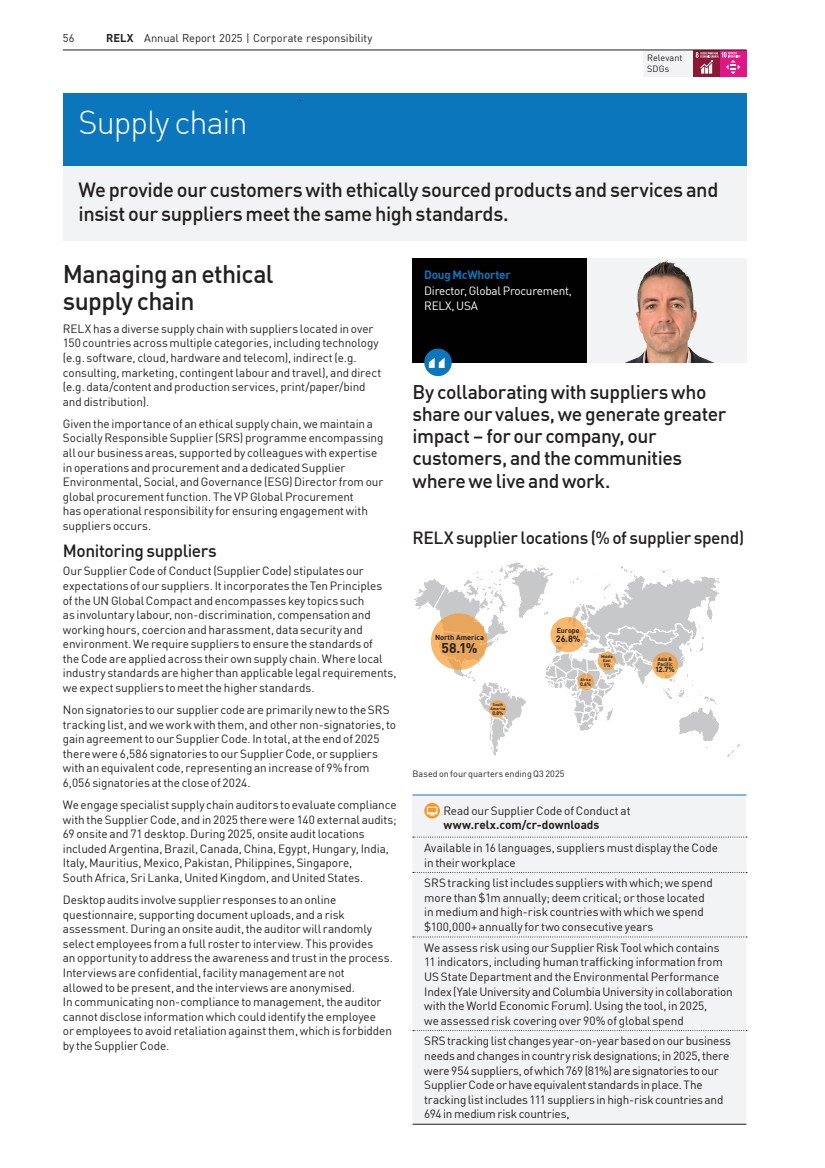
| RELX Annual Report 2025 | Supply chain 57 Responsible Supply Chain Performance Target Measure 2021 Actual 2022 Actual 2023 Actual 2024 Actual 2025 Actual Increase # of suppliers as Code signatories Total # of Code signatories 3,670 4,467 5,322 6,056 6,586 Total # of suppliers on tracking list 359 724 796 914 954 Total # of suppliers on tracking list who were Code signatories (or equivalent) 343 630 690 747 769 % of suppliers on tracking list who were Code signatories (or equivalent) 96% 87% 87% 82% 81% Continue using audits to ensure continuous improvement in supplier performance and compliance # of independent audits 111 119 125 137 140 Onsite 28 28 36 61 69 Desktop 83 91 89 76 71 Continue to advance the US Supplier Inclusion Programme % of total US spend with diverse suppliers (Veteran, Minority, Woman-owned businesses) 3% 4% 3% 3% 3% Incidence of noncompliance identified during an audit leads to a timeline requiring either immediate remediation or from 30-90 days remediation based on the finding. Audit reports provide a summary of findings, local law references as relevant, root cause and explanation ofthe noncompliance, follow-up methods, timescale, and recommendations and actions needed to close the finding. Suppliers upload a Corrective Action Plan (CAP) in the audit platform for each noncompliance finding and a follow-up audit is then scheduled to confirm action; auditors work with suppliers until full compliance is reached. We aim to ensure supplier remediation but in instances where the supplier fails to take sufficient action, we will terminate the supplier relationship. To minimise deforestation risk in our production paper supply chain, we utilise the Forest Sourcing module of The Book Chain Project, a shared industry resource for sustainable paper we helped establish to assess the forest sources of our papers. By year end 2025, 100% of RELX’s production paper was graded by The Book Chain Project as known and responsible (sustainable) sources or certified to FSC or PEFC (less than 0.1% not yet graded or certified). During 2025, we held RELX Supplier sessions focused on avoiding modern slavery, promoting living wages and setting science-based carbon reduction targets. Promoting human rights through the SupplierCode As stated above, the Supplier Code sets out expectations for our suppliers’ ethical conduct. In accordance with the UK’s Modern Slavery Act 2015, our Supplier Code explicitly prohibits suppliers from participating in any form of human trafficking or related activity. In 2025, we updated our RELX Modern Slavery Act Statement (MSA), available at www.relx.com, outlining how we are working to prevent human trafficking and modern slavery in our direct operations and throughout our supply chain. The Supplier Code stipulates that, where required by law, suppliers will have employment contracts signed with all employees and require mechanisms for reporting grievances. It additionally contains a provision on involuntary labour that states unequivocally that suppliers cannot directly or indirectly use, participate in, or benefit from, involuntary workers and human trafficking-related activities. Suppliers have access to Modern Slavery Awareness training through our audit provider. In addition, suppliers audited in the year were asked to undergo further training on freely chosen employment and living wages. We use aUK Government definition of modern slavery, particularly ‘the trafficking of people, forced labour, servitude and slavery.’ In 2025 we did not receive any reports from employees or suppliers via the Integrity Line that related to modern slavery. The Supplier Code states that failure to comply may result in termination of the business relationship between RELX and the supplier, it also protects reporting persons from retaliation. Supplier Code of Conduct signatories 2021 2022 2023 2024 2025 3,670 5,322 6,056 6,586 4,467 Market segments Governance and other information Financial statements Financial review Corporate responsibility Overview |
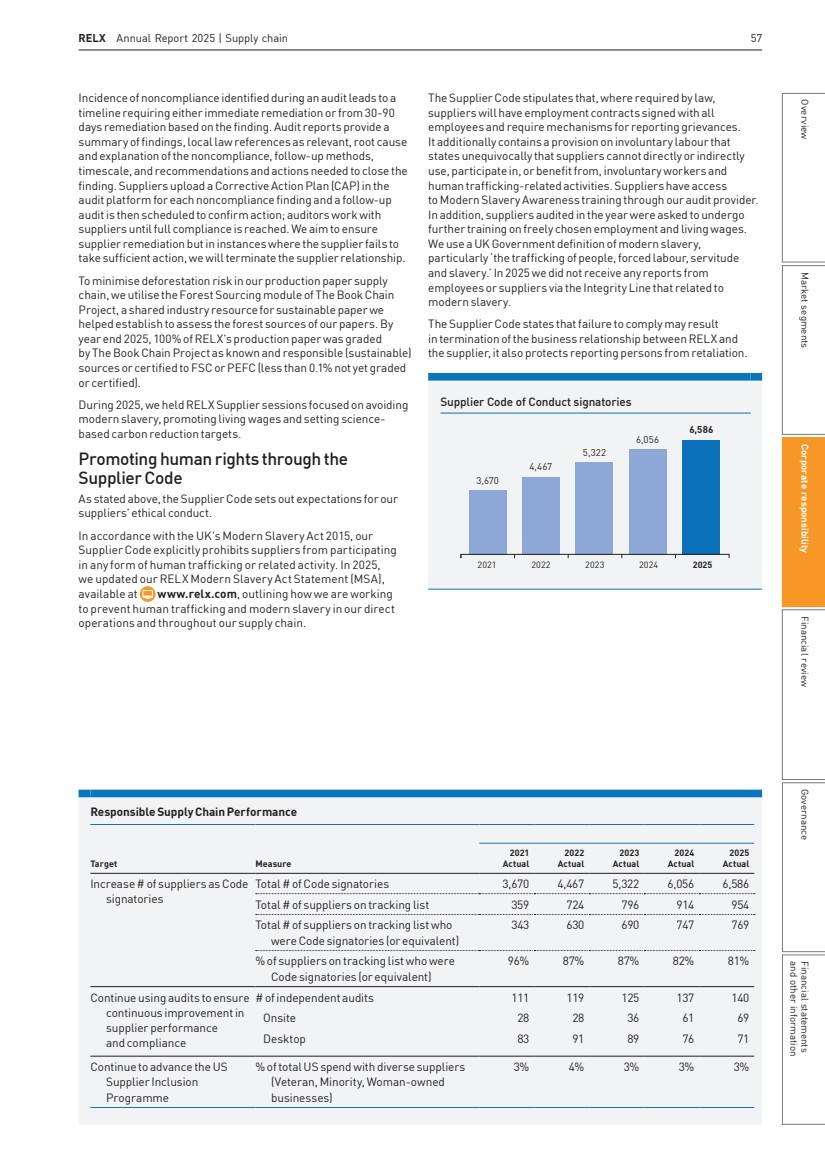
| 58 RELX Annual Report 2025 | Corporate responsibility 2026 objectives By 2030 Responsible Supply Chain – Increase number of suppliers that are Code signatories; continue using audits to ensure continuous improvement in supplier performance and compliance, in support of SDG 8 (Decent Work and EconomicGrowth) Reduce supply chain risks related to human rights, labour, the environment and anti-bribery by ensuring adherence to our Supplier Code of Conduct through training, auditing and remediation; drive supply chain innovation, quality and efficiencies through a strong, diverse network of suppliers 2025 OBJECTIVE Increase the number of suppliers that are Code Signatories and continue using audits to ensure continuous improvement in supplier performance and compliance 2025 PERFORMANCE We are committed to proactive engagement with suppliers to ensure a Responsible Supply Chain that reflects the diversity of our communities. During 2025, we increased the number of suppliers that are signatories to our Supplier Code to 6,586. Additionally, 140 supplier audits were conducted to ensure continuous improvement in supplier performance and compliance. 6,586 Suppliers who have signed the Supplier Code or have an equivalent code |
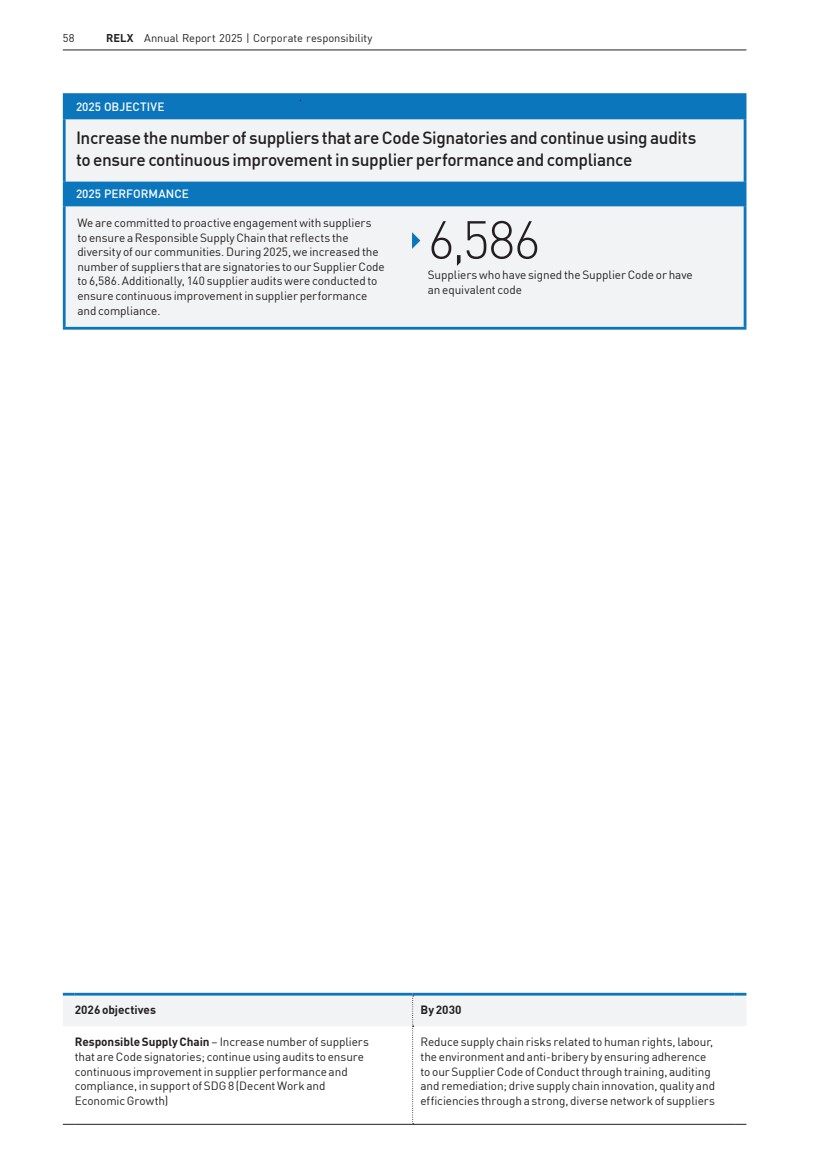
| Relevant SDGs RELX Annual Report 2025 | Environment 59 87% reduction in Scope 1 and Scope 2 (location-based) emissions since 2010 97% reduction in waste sent to landfill since 2018 71% reduction in on-site energy since 2018 A positive environmental impact through our products and services Our products and services, which provide stakeholders globally with data that informs debate, supports decision-making and advances environmental research, represent our most significant environmental impact. Risk Risk provides essential data to enable the insurance market to remain resilient in response to a rapidly changing climate. To address increased risks of flooding and subsidence, Risk offers address-level risk scores, available at the point of quote and visually through its Map View solution. Providing detailed, timely risk data on a property-by-property basis supports insurers underwriting decisions and benefits consumers in making informed decisions about their policies and property choices. Scientific, Technical & Medical In the year, Elsevier contributed to the development and launch of an industry-wide, digital journal carbon calculator to assess the impact of journal publications using a common methodology. Elsevier is deploying the tool for a pilot project with the Royal Danish Library to assist them with carbon reporting of journal publications. Legal LexisNexis Practical Guidance (LPG) strengthens market understanding of environmental law and policy. Bespoke trackers cover environmental law topics in legislation, cases, consultations, and UK/EU divergence. LPG monitors and reports on major developments and events in the year such as COP30 to ensure information remains current and actionable. ESG and sustainability resources expanded in the year on climate change, environmental policy, and due diligence. Exhibitions RX uses its global platforms to amplify sustainability knowledge, drive responsible consumption and inspire behavioural change. Environment We work to reduce our environmental footprint, while developing products and services that bring stakeholders together to address critical global environmental issues and provide essential insights. Caroline Elliott-Grey Senior Product Manager, LexisNexis Risk Solutions, UK With the changing climate we are seeing the impact ofincreasedflashflooding, shifts in subsidence and changes inwildfire patterns. Our products provide customers with crucial data and tools to understand the associated risks for property to enable them to offer sufficientlevels of cover. RX’s portfolio of energy events including World Future Energy Summit, All Energy and Pollutec help to accelerate the clean energy transition. In 2025, RX’s Functional Fabric Fair Summer Edition featured over 150 sustainably certified suppliers, reflecting growing industry demand for responsible sourcing. Aluminium China brought together over 490 exhibitors in the year with themed zones focused on recycling and sustainable packaging solutions. Across RELX The CEO is responsible to the Board for environmental performance, and the CFO is our most senior environmental advocate. The CEOs of our business areas are responsible for complying with relevant environmental policy, legislation and regulations. The Global Head of Corporate Responsibility engages with the Board on environmental issues, and we work with Environmental Champions and dedicated engineering, design and real estate specialists to improve efficiency wherever possible in our portfolio. We measure and report greenhouse gas emissions, implement decarbonisation strategies for emissions reductions and address residual emissions with high quality carbon removals, with the aim to achieve net zero across all carbon scopes by 2040. Details of our net zero transition road map are available on pages 218-219, and our Taskforce on Climate-related Financial Disclosure is available on page 235. We are signatories of We Are Still In, a network of more than 3,900 organisations committed to combatting climate change and are members of the Aldersgate Group, an alliance of leaders from business and civil society that support actions for a sustainable economy. In creating and delivering our products and services we have an impact on the environment through carbon emissions, energy and water usage. But where we can make the biggest difference is in our portfolio of environmental research, products and services, which further knowledge, promote best practice and inspire meaningful action. Market segments Governance and other information Financial statements Financial review Corporate responsibility Overview |
| 60 RELX Annual Report 2025 | Corporate responsibility Performance We focus on delivering continuous improvement in our environmental performance and achieved the environmental objectives we set for 2025. We reduced our on-site energy consumption by 38% over 2024, with a reduction of 34% in our Scope 1 and Scope 2 (location-based) emissions. Scope 3 (flights) emissions increased by 24% over 2024 as business travel returns towards expected levels, but is 41% below 2019 emissions. We reduced water consumption by 17% and continued to purchase 100% sustainable production paper. Our carbon reduction targets are validated by the Science Based Targets Initiative as aligned with the 1.5°C criteria and include our Scope 3 targets: § Reduce absolute Scope 3 emissions from purchased goods and services (incorporating capital goods), business travel and employee commuting by 30% in 2030 against a 2018 base year § 60% of suppliers by spend covering purchased goods and services, fuel and energy related activities, upstream transportation and distribution and business travel will have science-based targets by 2027 Our indirect Scope 3 emissions can be found on page 63. 2025 Environmental Performance Absolute performance Intensity ratio (absolute/GBPm revenue) 2024 2025 Change 2024 2025 Change Scope 1 (direct emissions) tCO2e 2,703 1,966 -27% 0.29 0.21 -28% Scope 2 (location-based) emissions tCO2e 29,989 19,500 -35% 3.18 2.03 -36% Scope 2 (market-based) emissions tCO2e 6,971 5,294 -24% 0.74 0.55 -25% Scope 1 + Scope 2 (location-based) emissions tCO2e 32,692 21,466 -34% 3.47 2.24 -35% Total on-site energy (MWh) 89,745 55,977 -38% 9.51 5.84 -39% Water (m3 ) 134,716 111,810 -17% 14.28 11.66 -18% Waste sent to landfill (t)* 44 32 -27% <0.01 <0.01 -27% Sustainable production paper (%) 100 100 – – – – * From reporting locations only, excluding estimates from non-reporting locations. Actual environmental data covers approximately 80% of occupied floor space based on electricity reporting. When we are unable to obtain reliable data, for example from small serviced offices, we estimate energy consumption and water usage on actual data from our portfolio. In this way, our reported data covers all operations, forwhich we have operational control for the calendar year. Scope 2 (location-based) emissions are calculated using grid average carbon emissions factors for all electricity sources. Scope 2 (market-based) emissions are calculated using supplier-specific carbon emissions factors (where available) for renewable energy purchases. New environmental targets to 2030 Focus area Targets – 2030 2025 performance Climate change Reduce Scope 1 + 2 (location-based) carbon emissions by 56% against a 2018 baseline -74% Energy Reduce energy and fuel consumption of our locations by 65% against a 2018 baseline -71% Energy Continue to purchase renewable electricity equivalent to 100% of RELX’s global electricity consumption 100% Waste* Maintain waste sent to landfill from reporting locations at least 95% below 2018 levels -97% Production paper** Maintain 100% of RELX production papers to be graded in Book Chain Project as ‘known and responsible sources’, or certified to FSC or PEFC 100% * From reporting locations, excluding estimated data. ** Percentage of paper graded as known and responsible sources by the Book Chain Project or certified by FSC/PEFC. Includes less than 0.1% of paper not yet graded or certified. 2025 OBJECTIVE Implement new environmental targets covering energy, waste and management system 2025 PERFORMANCE RELX is committed to achieving net zero by 2040. We have set near term carbon reduction targets, validated by the Science Based Targets Initiative (SBTi), to progress this commitment aligned with the Paris ClimateAgreement. To reduce Scope 3 carbon emissions in our supply chain, the RELX Global Procurement team instituted a new workstream in the year to encourage and monitor supplier adoption of science-based targets. Our environmental management system was re-certified to ISO14001 in the year, demonstrating our commitment to responsible environmental management across our global operations. |
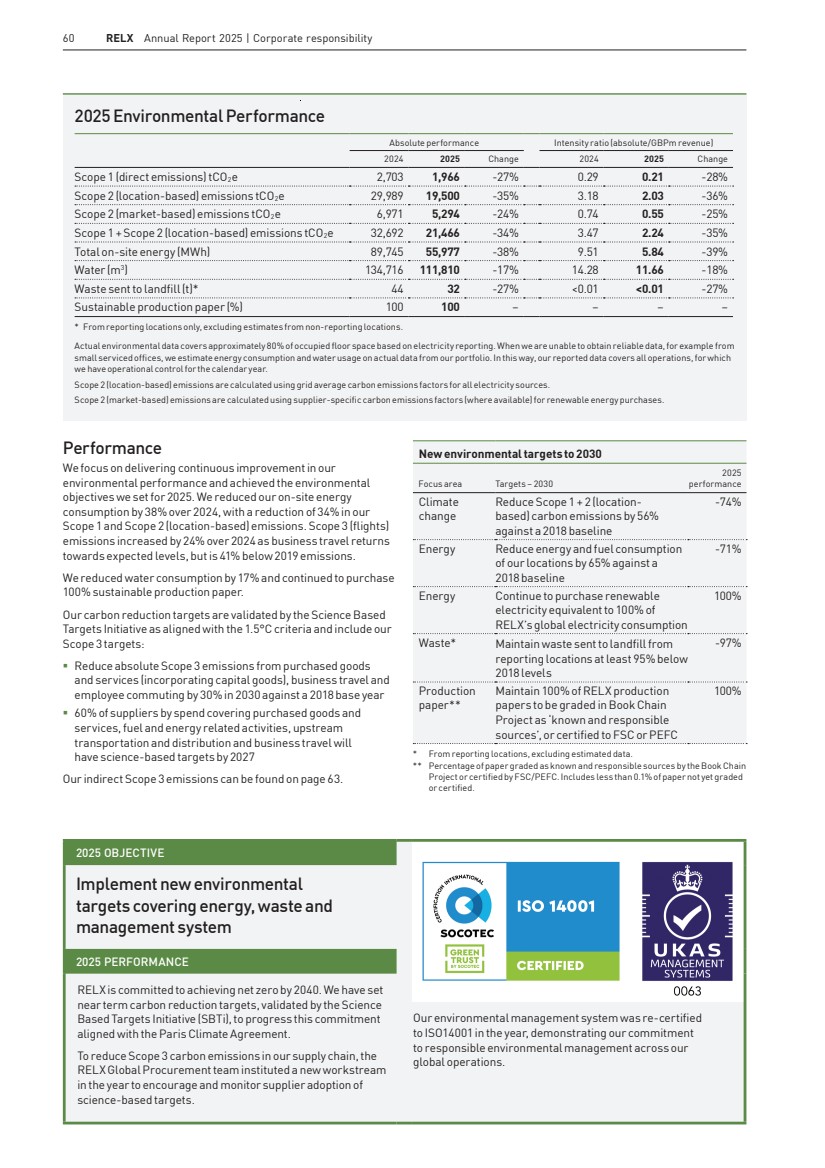
| RELX Annual Report 2025 | Environment 61 Climate change Our Climate Change Statement supports the scientific community’s opinion that human activity is contributing to climate change and highlights our support for the Paris Climate Agreement which aims to limit climate change to 1.5°C. The RELX Climate Change Statement is available at www.relx.com/cr-downloads. As a signatory to the Climate Pledge, we are part of a community of more than 630 organisations working to address climate change by measuring and reporting greenhouse gas emissions and implementing decarbonisation strategies to achieve significant emissions reductions. Since 2010, we have reduced our Scope 1 and 2 location-based carbon emissions by 87%. We set an internal carbon price which our business areas must pay for the carbon they emit. In 2025, it was $50 per ton of CO2. We have a NetZero Transition Plan which can be found on page 218. Water The majority of our sites use water from municipal supply and are in developed countries with a high capability for water adaptation and mitigation. Our water usage decreased 17% between 2024 and 2025, primarily due to continued office space consolidation. We engage with internal water experts who produce water related content for our customers. In 2025, we offered customers 26 peer-reviewed journals in water science and technology, including Water Research. We also support water projects through the RELX Environmental Challenge (see page 41). Energy As RELX almost exclusively occupies leased locations with few opportunities for onsite generation, we rely on green tariffs and renewable energy certificates (RECs) to purchase renewables equal to 100% of our global electricity consumption. In 2025, we purchased green-e certified wind and solar RECs in addition to green tariffs. Energy consumption at our offices, representing 62% ofthe total on-site energy, decreased in 2025 due to continued office space consolidation. Energy from our owned data centres, constituting 38% of our total on-site energy consumption, decreased as we continued to move activity to the cloud. The purpose-built modern data centres of cloud providers have significantly lower emissions due to their large scale and measures such as the use of renewable energy. We are a member of RE100, a global initiative bringing together businesses committed to 100% renewable electricity. 2018 is our baseline year for environment targets. Data available on page 36. Data available on page 61. Water usage 183,575 156,734 142,374 134,716 2021 2022 2023 2024 2025 111,810 Cubic metres On-site energy consumption 2021 2022 2023 2024 2025 125,095 117,997 110,750 89,745 55,977 MWh 0 110 tCO2e 1,000s 2021 2022 2023 2024 2025 Absolute emissions Intensity emissions Scope 1 emissions Scope 2 (location-based) emissions tCO2e per GBPm revenue 0 20 2021 2022 2023 2024 2025 Market segments Governance and other information Financial statements Financial review Corporate responsibility Overview |
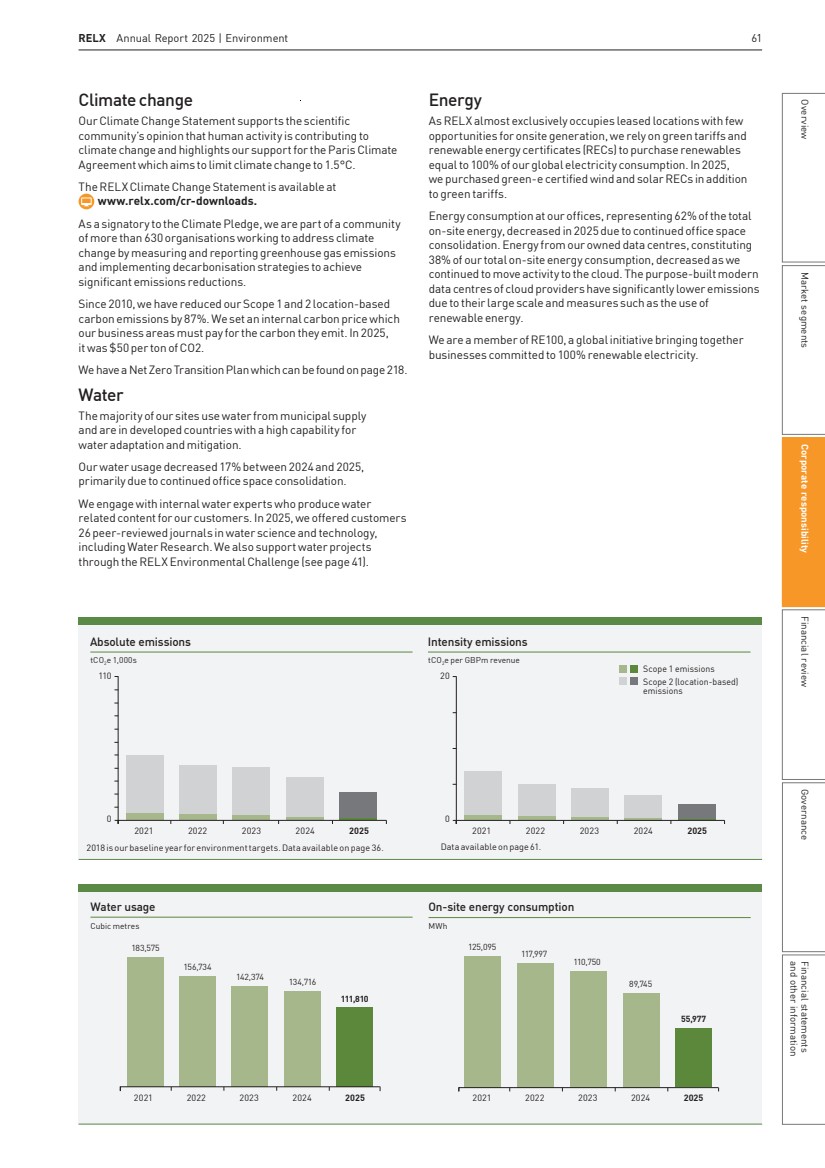
| 62 RELX Annual Report 2025 | Corporate responsibility Waste Total waste generated across all locations decreased by 52% in 2025, primarily due to the disposal of venue and warehouse space. Of waste generated across all locations, we estimate 52% was recycled and 86% diverted from landfill through recycling, composting and waste energy generation. Of the waste produced at our reporting locations, excluding estimates from non-reporting locations, 57% was recycled. In 2025, waste sent to landfill from reporting locations, excluding estimates from non-reporting locations, decreased by 27% due to the continued office space consolidation projects and changes in waste management practices, including use of waste-to-energy processing. Where reliable measurements are not available, we calculate waste based on weight sampling and by counting waste containers leaving our premises. Although local municipalities most often carry out sorting and recycling, we report all waste as going to landfill unless we have robust evidence. For this reason, performance against our waste target is linked to our reporting locations. We work to reduce packaging waste from our physical products. In the UK, we provide information on packaging waste in line with the UK government’s Extended Producer Responsibility Regulations. As a member of the Biffpack compliance scheme, we report the amount of obligated packaging (as defined in the regulations) we generate through selling, pack and fill and importation of relevant products. Paper The quantity of production paper purchased in 2025 decreased by 11% over 2024 and by 74% since 2010 as we deliver more of our products online, reflecting a circular economy approach to conducting our business. In 2025, we reviewed the RELX Paper Policy maintaining our commitment to avoiding deforestation and other environmental impacts through the purchase of sustainably sourced papers. In 2025, 100% of RELX production papers were graded as known and responsible sources or certified to FSC or PEFC. We endeavour to limit any environmental impact and reduce paper wastage by implementing measures like smaller print runs, digital over litho printing, print on demand and using lighter papers where possible. RELX is a founding member of the Book Chain Project’s paper module (PREPS) and helped create the PREPS database which identifies the pulps and forest sources of paper. The RELX Sustainable Production Paper Policy commits us to purchase only sustainable papers – graded three or five in Bookchain, or certified to FSC or PEFC. RELX complies with relevant legislation and work was undertaken in the year to make any necessary preparations for the incoming European Union Deforestation Regulations (EUDR). Waste sent to landfill (reporting locations) 150 73 45 Tonnes 2021 2022 2023 2024 2025 44 32 Energy from waste 33% Compost 5% Landfill 4% Recycling 58% Waste disposal (reporting locations) Reporting locations are those from which we were able to capture primary data in the year and excludes estimated data. Asia Pacific 39% Europe 22% North America 39% Forest source of graded production papers Percentage of paper graded as known and responsible sources by the Book Chain Project or certified by FSC/PEFC. Includes less than 0.1% of paper not yet graded or certified. Sustainable production paper 98 99 100 100 100 Percentage 2021 2022 2023 2024 2025 |
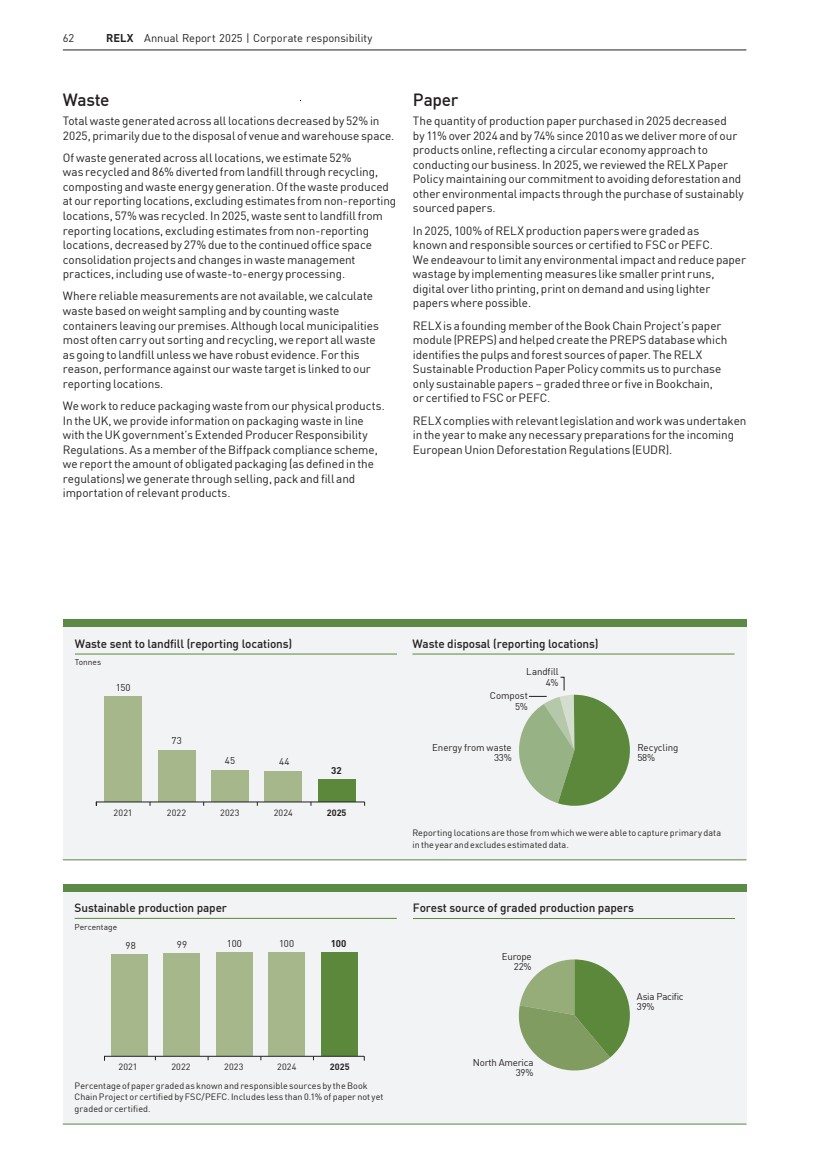
| RELX Annual Report 2025 | Environment 63 RX’s Net Zero Carbon Events initiative, aims to develop methodologies to quantify and reduce emissions associated with the events industry. While attendance at one of our events can replace the need for multiple business trips, we gather emissions data associated with an event’s value chain. RX produced a firstSustainability Report in the year which can be found at www.rxglobal.com/sustainability. We encourage the re-use of electronic equipment and only recycle equipment once it cannot be re-used. We partner with Camara Education to donate equipment to provide access to computers for students in Ethiopia, Kenya, Tanzania and Zambia. Electrical equipment is refurbished for use or sold with proceeds going to set up computer labs, train teachers and provide locally relevant educational content. Any equipment that cannot be refurbished is disposed of according to local regulations. Scope 3 Emissions 2024 2025 Change Category 1 & 2: Purchased goods and services including capital goods (tCO2e) 272,000 271,000 0% Category 6: Business travel (tCO2e) including flights 19,594 24,238 24% Category 7: Employee commuting (tCO2e) 5,900 5,900 0% Scope 3 categories covered by the Scope 3 reduction target, validated by the Science Based Targets Initiative. Impacts in our value chain Scope 3 In 2025, we continued to use the RELX CO2 Hub, an internal analytics platform, to help quantify our Scope 3 emissions. We estimated supplier emissions by collecting actual data from key suppliers to derive carbon intensity factors. The factors are then extrapolated by spend category to cover our full supply chain. Scope 1 and Scope 2 carbon emissions of our suppliers, excluding business travel, cloud computing services, distribution and events (see below), is approximately 50,000 tCO2e per annum. Using location-specific emissions factors and office attendance data, we estimated emissions from home working in the year to be around 12,000 tCO2e. RELX Global Real Estate and Corporate Responsibility teams, work alongside contracted facilities colleagues to develop local travel plans. Travel plans contain information about local transport routes and seek to inform colleagues of commuter loan schemes and encourage sustainable transport use. Using daily refreshed office attendance data, we estimated emissions in 2025 to be around 5,900 tCO2e. 2026 objectives By 2030 Environmental responsibility – Launch new RELX Environmental Challenge Oceans Category, in support of SDG 14 (Life Below Water) Carbon reduction – Launch climate training for colleagues across business areas and introduce new engagement opportunities, in support of SDG 13 (ClimateAction) Further environmental knowledge and insight globally through our products and services and conduct our business with the lowest environmental impact possible 2025 OBJECTIVE Implement employee action budget, funded by internal carbon price 2025 PERFORMANCE On World Environment Day 2025 the RELX CFO, and chief environmental champion, launched the RELX Green Fund, made possible through proceeds from our internal carbon price. Global colleagues were invited to submit proposals that advance RELX’s environmental goals. An internal panel of sustainability experts from across the business chose the following projects for funding: § A model free access bicycle pilot scheme which can be rolled out to more locations in the future § Tailored climate training and climate risk workshops for Elsevier colleagues § Introduction of a new Oceans Prize as part of the RELX Environmental Challenge § A funded project to assess nature related dependencies and impacts in STM In the year, Green Teams, employee-led environmental groups, engaged over 300 colleagues across the world. Market segments Governance and other information Financial statements Financial review Corporate responsibility Overview |
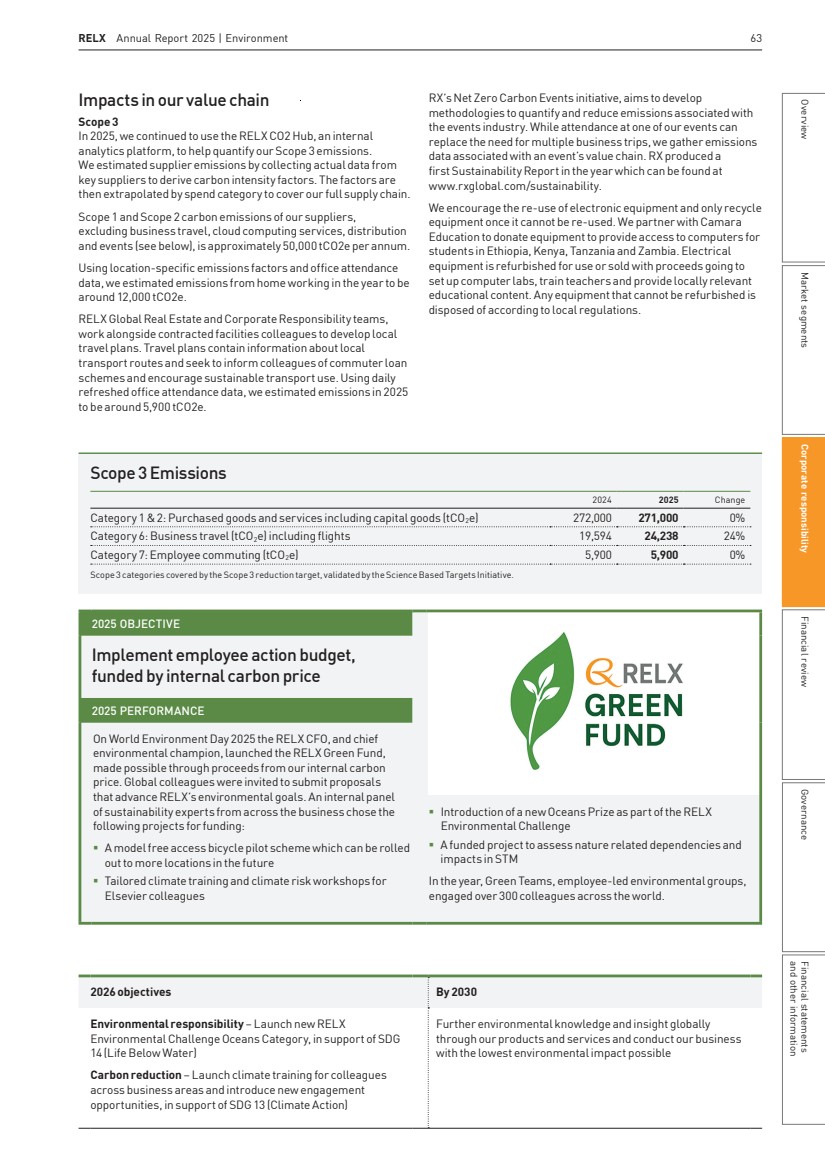
| In this section 66 Chief Financial Officer’s report 72 Principal and emerging risks Financial review 64 RELX Annual Report 2025 |
| Market segments Governance and other information Financial statements Financial review Corporate responsibility Overview RELX Annual Report 2025 65 |
| 7,244 GBPm 8,553 9,161 9,434 9,590 Revenue 2021 2022 2023 2024 2025 GBPm Adjusted operating profit 2,210 2,683 3,030 3,199 2021 2022 2023 2024 2025 3,342 6665 RELX Annual Report 2025 | Financial review RELX Annual Report 2025 | Financial review Chief Financial Officer’s report In 2025, underlying revenue growth was 7%, underlying adjusted operating profit growth was 9%, and adjusted earnings per share grew at 10% at constant currency. Nick Luff, Chief Financial Officer Business area reporting changes Our strategy is to develop increasingly sophisticated information-based analytics and decision tools that deliver enhanced value to professional and business customers across market segments. These are now provided almost exclusively in electronic format with the proportion of group revenue from products in print format having reduced over the past 25 years from 64% to 4%. This print to electronic transition is now largely complete. Going forwards, we will continue to ensure that print versions of our content remain available as a service to customers who still prefer this format, while we continue to proactively reduce our own involvement in print and print-related activities. Over the past two years, we have stepped up our efforts to do this through out-sourcing, joint ventures and targeted asset disposals. Consistent with this, we are now managing and reporting print and print-related activities separately. We believe that this removes a management distraction and improves transparency of reporting. Also, a small portfolio of commercial healthcare products, previously distributed by Scientific, Technical & Medical (STM), is now managed and distributed entirely in Risk. Accordingly, revenue, together with some associated profit, previously in STM, is now reported in Risk. Prior period comparatives have been restated to reflect these reporting changes, with a restatement of revenue and adjusted operating profit for the years ended 31 December 2024 and 31 December 2023 provided on pages 144 and 145. Revenue Group underlying revenue growth was 7%, with all four business areas contributing to underlying growth. Risk continued to deliver strong growth, STM maintained its improved growth, Legal growth continued to improve and Exhibitions saw strong growth. For print and print-related, in addition to the usual print format decline, the step up in actions we have taken over the past two years resulted in a step down in revenue to £399m (2024: £517m). Disposals, exhibition cycling and the step down in revenue from print and print-related activities all combined to reduce group revenue by 3%. The impact of currency movements was to decrease group revenue by 2%. Total revenue was £9,590m (2024: £9,434m), up 2%. Profit Group underlying growth in adjusted operating profit was 9%, with all four business areas contributing to underlying growth. The adjusted operating profit from print and print-related activities reduced to £185m (2024: £217m). Disposals and the reduction in profit contribution from print and print-related activities combined to reduce group adjusted operating profit by 2%. Currency effects decreased adjusted operating profit by 3%. Total adjusted operating profit was £3,342m (2024: £3,199m), up 4%. The overall adjusted operating margin improved by 0.9 percentage points to 34.8% (2024: 33.9%) driven by the underlying performance. EBITDA margin also improved, by 0.6 percentage points, to 40.1%. Reported operating profit was £3,027m (2024: £2,861m), up 6%, slightly higher than the increase in adjusted operating profit due to lower amortisation of acquired intangible assets and acquisition and disposal related items. Adjusted net interest expense was £283m (2024: £296m), with the decrease reflecting lower average interest rates partly offset by higher average debt balances. Revenue Adjusted operating profit 65 RELX Annual Report 2025 | Financial review Chief Financial Officer’s report In 2025, underlying revenue growth was 7%, underlying adjusted operating profit growth was 9%, and adjusted earnings per share grew at 10% at constant currency. Nick Luff, Chief Financial Officer Business area reporting changes Our strategy is to develop increasingly sophisticated information-based analytics and decision tools that deliver enhanced value to professional and business customers across market segments. These are now provided almost exclusively in electronic format with the proportion of group revenue from products in print format having reduced over the past 25 years from 64% to 4%. This print to electronic transition is now largely complete. Going forwards, we will continue to ensure that print versions of our content remain available as a service to customers who still prefer this format, while we continue to proactively reduce our own involvement in print and print-related activities. Over the past two years, we have stepped up our efforts to do this through out-sourcing, joint ventures and targeted asset disposals. Consistent with this, we are now managing and reporting print and print-related activities separately. We believe that this removes a management distraction and improves transparency of reporting. Also, a small portfolio of commercial healthcare products, previously distributed by Scientific, Technical & Medical (STM), is now managed and distributed entirely in Risk. Accordingly, revenue, together with some associated profit, previously in STM, is now reported in Risk. Prior period comparatives have been restated to reflect these reporting changes, with a restatement of revenue and adjusted operating profit for the years ended 31 December 2024 and 31 December 2023 provided on pages 144 and 145. Revenue Group underlying revenue growth was 7%, with all four business areas contributing to underlying growth. Risk continued to deliver strong growth, STM maintained its improved growth, Legal growth continued to improve and Exhibitions saw strong growth. For print and print-related, in addition to the usual print format decline, the step up in actions we have taken over the past two years resulted in a step down in revenue to £399m (2024: £517m). Disposals, exhibition cycling and the step down in revenue from print and print-related activities all combined to reduce group revenue by 3%. The impact of currency movements was to decrease group revenue by 2%. Total revenue was £9,590m (2024: £9,434m), up 2%. Profit Group underlying growth in adjusted operating profit was 9%, with all four business areas contributing to underlying growth. The adjusted operating profit from print and print-related activities reduced to £185m (2024: £217m). Disposals and the reduction in profit contribution from print and print-related activities combined to reduce group adjusted operating profit by 2%. Currency effects decreased adjusted operating profit by 3%. Total adjusted operating profit was £3,342m (2024: £3,199m), up 4%. The overall adjusted operating margin improved by 0.9 percentage points to 34.8% (2024: 33.9%) driven by the underlying performance. EBITDA margin also improved, by 0.6 percentage points, to 40.1%. Reported operating profit was £3,027m (2024: £2,861m), up 6%, slightly higher than the increase in adjusted operating profit due to lower amortisation of acquired intangible assets and acquisition and disposal related items. Adjusted net interest expense was £283m (2024: £296m), with the decrease reflecting lower average interest rates partly offset by higher average debt balances. Revenue Adjusted operating profit |
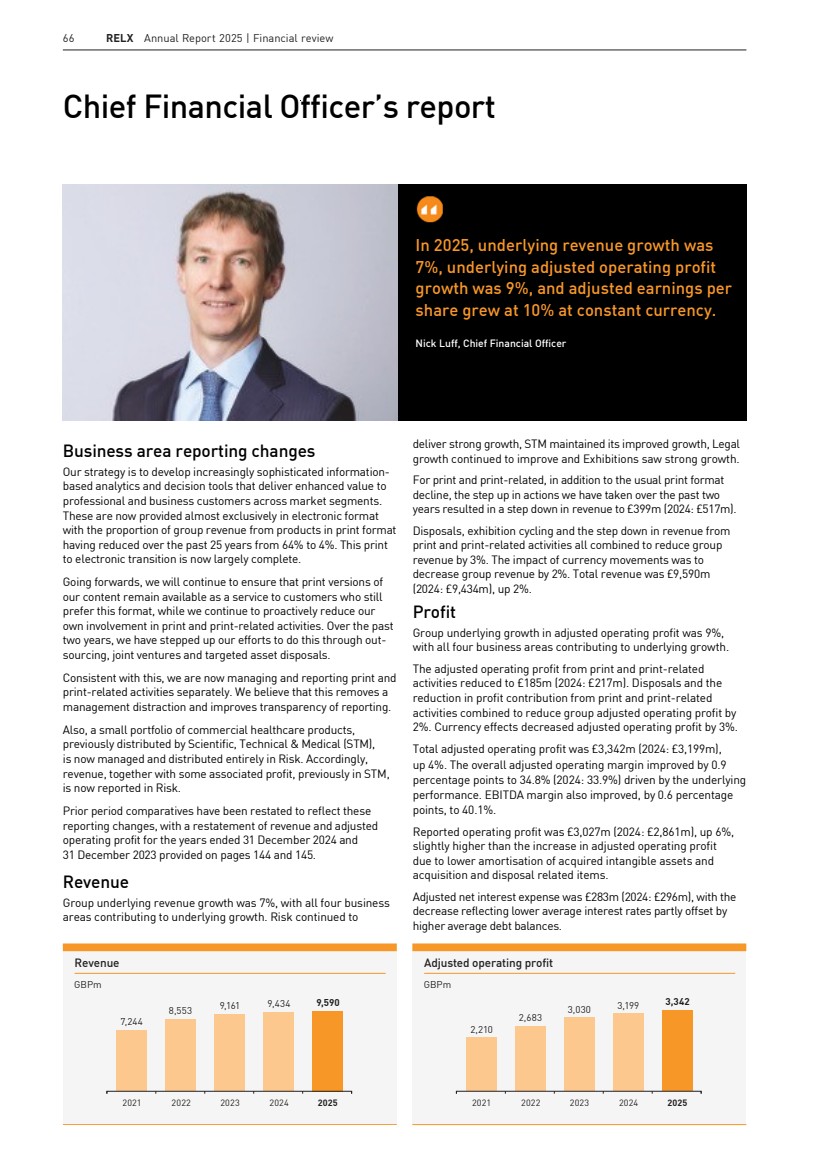
| Adjusted operating profit margin 33.9% 30.5% 31.4% 33.1% 2021 2022 2023 2024 2025 34.8% EBITDA margin 2021 2022 2023 2024 2025 37.2% 37.1% 38.7% 39.5% 40.1% 65 RELX Annual Report 2025 | Financial review RELX Annual Report 2025 | Chief Financial Officer’s report 67 Chief Financial Officer’s report In 2025, underlying revenue growth was 7%, underlying adjusted operating profit growth was 9%, and adjusted earnings per share grew at 10% at constant currency. Nick Luff, Chief Financial Officer Business area reporting changes Our strategy is to develop increasingly sophisticated information-based analytics and decision tools that deliver enhanced value to professional and business customers across market segments. These are now provided almost exclusively in electronic format with the proportion of group revenue from products in print format having reduced over the past 25 years from 64% to 4%. This print to electronic transition is now largely complete. Going forwards, we will continue to ensure that print versions of our content remain available as a service to customers who still prefer this format, while we continue to proactively reduce our own involvement in print and print-related activities. Over the past two years, we have stepped up our efforts to do this through out-sourcing, joint ventures and targeted asset disposals. Consistent with this, we are now managing and reporting print and print-related activities separately. We believe that this removes a management distraction and improves transparency of reporting. Also, a small portfolio of commercial healthcare products, previously distributed by Scientific, Technical & Medical (STM), is now managed and distributed entirely in Risk. Accordingly, revenue, together with some associated profit, previously in STM, is now reported in Risk. Prior period comparatives have been restated to reflect these reporting changes, with a restatement of revenue and adjusted operating profit for the years ended 31 December 2024 and 31 December 2023 provided on pages 144 and 145. Revenue Group underlying revenue growth was 7%, with all four business areas contributing to underlying growth. Risk continued to deliver strong growth, STM maintained its improved growth, Legal growth continued to improve and Exhibitions saw strong growth. For print and print-related, in addition to the usual print format decline, the step up in actions we have taken over the past two years resulted in a step down in revenue to £399m (2024: £517m). Disposals, exhibition cycling and the step down in revenue from print and print-related activities all combined to reduce group revenue by 3%. The impact of currency movements was to decrease group revenue by 2%. Total revenue was £9,590m (2024: £9,434m), up 2%. Profit Group underlying growth in adjusted operating profit was 9%, with all four business areas contributing to underlying growth. The adjusted operating profit from print and print-related activities reduced to £185m (2024: £217m). Disposals and the reduction in profit contribution from print and print-related activities combined to reduce group adjusted operating profit by 2%. Currency effects decreased adjusted operating profit by 3%. Total adjusted operating profit was £3,342m (2024: £3,199m), up 4%. The overall adjusted operating margin improved by 0.9 percentage points to 34.8% (2024: 33.9%) driven by the underlying performance. EBITDA margin also improved, by 0.6 percentage points, to 40.1%. Reported operating profit was £3,027m (2024: £2,861m), up 6%, slightly higher than the increase in adjusted operating profit due to lower amortisation of acquired intangible assets and acquisition and disposal related items. Adjusted net interest expense was £283m (2024: £296m), with the decrease reflecting lower average interest rates partly offset by higher average debt balances. Revenue Adjusted operating profit RELX Annual Report 2025 | Chief Financial Officer’s report 66 Overview Market segments Corporate responsibility Financial review Governance Financial statements and other information Adjusted profit before tax was £3,059m (2024: £2,903m), up 5%. Reported profit before tax was £2,750m (2024: £2,557m) up 8%, reflecting the improvement in reported operating profit and the lower interest expense. The adjusted net interest expense and adjusted profit before tax exclude a charge of £5m (2024: nil) for the mark-to-market movement on cross currency interest rate swaps entered into as a hedge of foreign currency exposures, but for which hedge accounting cannot be applied (see ‘Debt’ below). They also exclude the net pension financing credit of £3m (2024: £1m charge). The amortisation charge in respect of acquired intangible assets, including the share of amortisation in joint ventures and associates, was £248m (2024: £258m). ADJUSTED FIGURES Change at 2024 2025 Change constant Underlying For the year ended 31 December GBPm GBPm in GBP currency growth Revenue 9,434 9,590 +2% +4% +7% EBITDA 3,724 3,846 Operating profit 3,199 3,342 +4% +7% +9% Operating margin 33.9% 34.8% Net interest expense (296) (283) Profit before tax 2,903 3,059 +5% +8% Tax charge (652) (688) Net profit attributable to shareholders 2,241 2,358 +5% +8% Cash flow 3,101 3,301 +6% Cash flow conversion 97% 99% Return on invested capital 14.8% 15.4% Earnings per share 120.1p 128.5p +7% +10% DIVIDEND For the year ended 31 December 2024 2025 Change Ordinary dividend per share 63.0p 67.5p +7% REPORTED FIGURES For the year ended 31 December 2024 2025 Change Revenue 9,434 9,590 +2% Operating profit 2,861 3,027 +6% Net interest expense (298) (286) Profit before tax 2,557 2,750 +8% Tax charge (613) (672) Net profit attributable to shareholders 1,934 2,065 +7% Net margin 20.5% 21.5% Cash generated from operations 3,521 3,735 +6% Net debt 6,563 7,201 Earnings per share 103.6p 112.6p +9% Summary financial information is presented in US dollars on page 196 and 197. RELX uses adjusted and underlying figures as additional performance measures. Adjusted figures primarily exclude the amortisation of acquired intangible assets and other items related to acquisitions and disposals, and the associated deferred tax movements. Underlying revenue growth rates are calculated at constant currency, and exclude revenue from acquisitions until twelve months after purchase, revenue of disposals and assets held for sale, print and print-related revenue, exhibition cycling, and timing effects. Underlying adjusted operating profit growth rates are calculated on the same basis except that they do not exclude exhibition cycling, and timing effects. Constant currency growth rates are based on 2024 full year average and hedge exchange rates. Some figures and sub-totals may add up to slightly different amounts than the totals due to rounding. Reconciliations between the reported and adjusted figures are set out on pages 198 to 206. Acquisition and disposal related costs were £54m (2024: £69m), slightly lower than the prior year primarily due to lower acquisition activity. The adjusted tax charge was £688m (2024: £652m). The adjusted effective tax rate was 22.5% (2024: 22.5%). The adjusted tax charge excludes movements in deferred taxation assets and liabilities related to goodwill and acquired intangible assets, but includes the benefit of tax amortisation where available on those items. Adjusted operating profit from joint ventures and associates is grossed up for our equity share of interest and taxation. The application of tax law and practice is subject to some uncertainty and amounts are provided in respect of this. Discussions with tax authorities relating to cross-border transactions and other matters are ongoing. Although the outcome of open items cannot be predicted, no significant impact on profitability is expected. EBITDA margin Adjusted operating profit margin 65 RELX Annual Report 2025 | Financial review Chief Financial Officer’s report In 2025, underlying revenue growth was 7%, underlying adjusted operating profit growth was 9%, and adjusted earnings per share grew at 10% at constant currency. Nick Luff, Chief Financial Officer Business area reporting changes Our strategy is to develop increasingly sophisticated information-based analytics and decision tools that deliver enhanced value to professional and business customers across market segments. These are now provided almost exclusively in electronic format with the proportion of group revenue from products in print format having reduced over the past 25 years from 64% to 4%. This print to electronic transition is now largely complete. Going forwards, we will continue to ensure that print versions of our content remain available as a service to customers who still prefer this format, while we continue to proactively reduce our own involvement in print and print-related activities. Over the past two years, we have stepped up our efforts to do this through out-sourcing, joint ventures and targeted asset disposals. Consistent with this, we are now managing and reporting print and print-related activities separately. We believe that this removes a management distraction and improves transparency of reporting. Also, a small portfolio of commercial healthcare products, previously distributed by Scientific, Technical & Medical (STM), is now managed and distributed entirely in Risk. Accordingly, revenue, together with some associated profit, previously in STM, is now reported in Risk. Prior period comparatives have been restated to reflect these reporting changes, with a restatement of revenue and adjusted operating profit for the years ended 31 December 2024 and 31 December 2023 provided on pages 144 and 145. Revenue Group underlying revenue growth was 7%, with all four business areas contributing to underlying growth. Risk continued to deliver strong growth, STM maintained its improved growth, Legal growth continued to improve and Exhibitions saw strong growth. For print and print-related, in addition to the usual print format decline, the step up in actions we have taken over the past two years resulted in a step down in revenue to £399m (2024: £517m). Disposals, exhibition cycling and the step down in revenue from print and print-related activities all combined to reduce group revenue by 3%. The impact of currency movements was to decrease group revenue by 2%. Total revenue was £9,590m (2024: £9,434m), up 2%. Profit Group underlying growth in adjusted operating profit was 9%, with all four business areas contributing to underlying growth. The adjusted operating profit from print and print-related activities reduced to £185m (2024: £217m). Disposals and the reduction in profit contribution from print and print-related activities combined to reduce group adjusted operating profit by 2%. Currency effects decreased adjusted operating profit by 3%. Total adjusted operating profit was £3,342m (2024: £3,199m), up 4%. The overall adjusted operating margin improved by 0.9 percentage points to 34.8% (2024: 33.9%) driven by the underlying performance. EBITDA margin also improved, by 0.6 percentage points, to 40.1%. Reported operating profit was £3,027m (2024: £2,861m), up 6%, slightly higher than the increase in adjusted operating profit due to lower amortisation of acquired intangible assets and acquisition and disposal related items. Adjusted net interest expense was £283m (2024: £296m), with the decrease reflecting lower average interest rates partly offset by higher average debt balances. Revenue Adjusted operating profit Market segments Governance and other information Financial statements Financial review Corporate responsibility Overview |
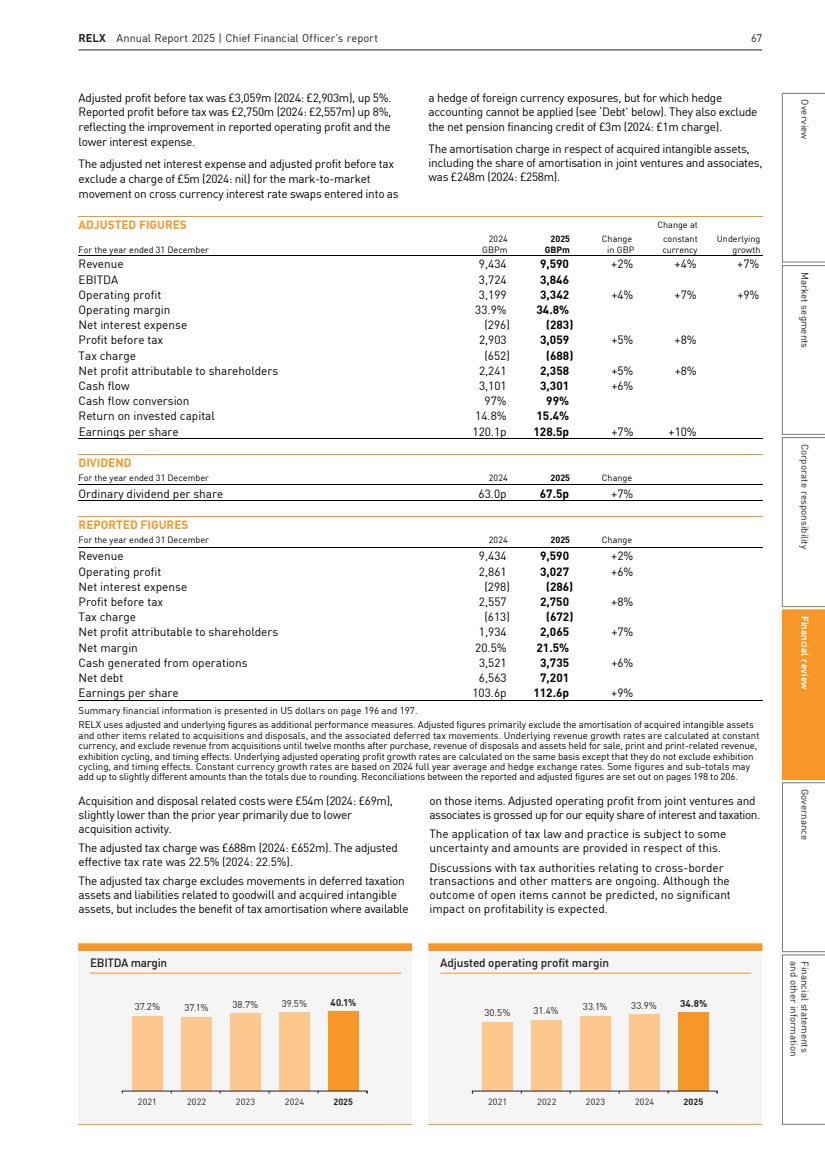
| Leverage – Net debt/EBITDA 2.4x 2.1x 2.0x 1.8x 2.0x 2021 2022 2023 2024 2025 Adjusted cash flow conversion 101% 101% 98% 97% 99% 2021 2022 2023 2024 2025 6867 RELX RELX Annual Report 2025 | Financial review Annual Report 2025 | Financial review The reported tax charge was £672m (2024: £613m), including tax associated with the amortisation of acquired intangible assets, disposals and other non-operating items. The reported tax rate was 24.4% (2024: 24.0%). The adjusted net profit attributable to shareholders was £2,358m (2024: £2,241m), up 5%. Adjusted earnings per share was up 10% at constant currency, and after changes in exchange rates was up 7% at 128.5p (2024: 120.1p). The reported net profit attributable to shareholders was £2,065m (2024: £1,934m), up 7%. Reported earnings per share was 112.6p (2024: 103.6p), up 9%. Cash flows Adjusted cash flow was £3,301m (2024: £3,101m), up 6% compared with the prior period. The rate of conversion of adjusted operating profit to adjusted cash flow was 99% (2024: 97%). CONVERSION OF ADJUSTED OPERATING PROFIT INTO CASH YEAR TO 31 DECEMBER 2024 2025 GBPm GBPm Adjusted operating profit 3,199 3,342 Depreciation and amortisation 525 504 EBITDA 3,724 3,846 Capital expenditure (484) (525) Repayment of lease principal (net)* (61) (38) Working capital and other items (78) 18 Adjusted cash flow 3,101 3,301 Adjusted cash flow conversion 97% 99% * Net of sublease receipts. Capital expenditure was £525m (2024: £484m), including £504m (2024: £464m) in respect of capitalised development costs, reflecting sustained investment in new products. Capital expenditure was 5.5% of revenue (2024: 5.1%) and excludes pre-publication costs of £102m (2024: £92m) that were capitalised as current assets and principal lease repayments of £38m (2024: £61m). Depreciation and other amortisation charged within adjusted operating profit was £504m (2024: £525m) and represented 5.3% of revenue (2024: 5.6%). This includes amortisation of internally developed intangible assets, largely capitalised development costs, of £352m (2024: £364m) and depreciation of property, plant and equipment of £26m (2024: £34m) which combined represent 3.9% (2024: 4.2%) of revenue. Interest paid (net) was £261m (2024: £251m), increasing mainly as a result of the timing of payments. Tax paid of £638m (2024: £662m) was lower than the income statement charge, with the difference reflecting timing of tax payments. Payments made in respect of acquisition and disposal related items amounted to £89m (2024: £62m). Free cash flow before dividends was £2,313m (2024: £2,126m). Ordinary dividends paid to shareholders in the year, being the 2024 final dividend and 2025 interim dividend, amounted to £1,181m (2024: £1,121m). Free cash flow after dividends was £1,132m (2024: £1,005m). FREE CASH FLOW YEAR TO 31 DECEMBER 2024 2025 GBPm GBPm Adjusted cash flow 3,101 3,301 Interest paid (net) (251) (261) Cash tax paid* (662) (638) Acquisition and disposal related items (62) (89) Free cash flow before dividends 2,126 2,313 Ordinary dividends (1,121) (1,181) Free cash flow after dividends 1,005 1,132 * Net of cash tax relief on acquisition and disposal related items and including cash tax impact of disposals. RECONCILIATION OF NET DEBT YEAR-ON-YEAR YEAR TO 31 DECEMBER 2024 2025 GBPm GBPm Net debt at 1 January (6,446) (6,563) Free cash flow post dividends 1,005 1,132 Acquisitions: total consideration (195) (270) Disposals: total consideration 95 11 Share repurchases (1,000) (1,500) Purchase of shares by the employee benefit trust (75) (76) Other* 7 (30) Currency translation 46 95 Movement in net debt (117) (638) Net debt at 31 December (6,563) (7,201) * Includes share option exercise proceeds, leases, disposal and acquisition timing effects and pension deficit recovery payments. Total consideration on acquisitions completed in the year was £270m (2024: £195m). Cash spent on acquisitions was £260m (2024: £170m), reflecting timing of deferred consideration for past and current year acquisitions. Cash spent on venture capital investments was £42m (2024: £4m). Total consideration from disposals completed in the year was £11m (2024: £95m). Net cash inflow from disposals was £17m (2024: £46m). Share repurchases in 2025 were £1,500m (2024: £1,000m) with a further £250m repurchased in 2026 as at 11 February. In addition, the Employee Benefit Trust purchased shares of RELX PLC to meet future obligations in respect of share based remuneration totalling £76m (2024: £75m). Proceeds from the exercise of share options were £42m (2024: £47m). Adjusted cash flow conversion Leverage - Net debt/EBITDA |
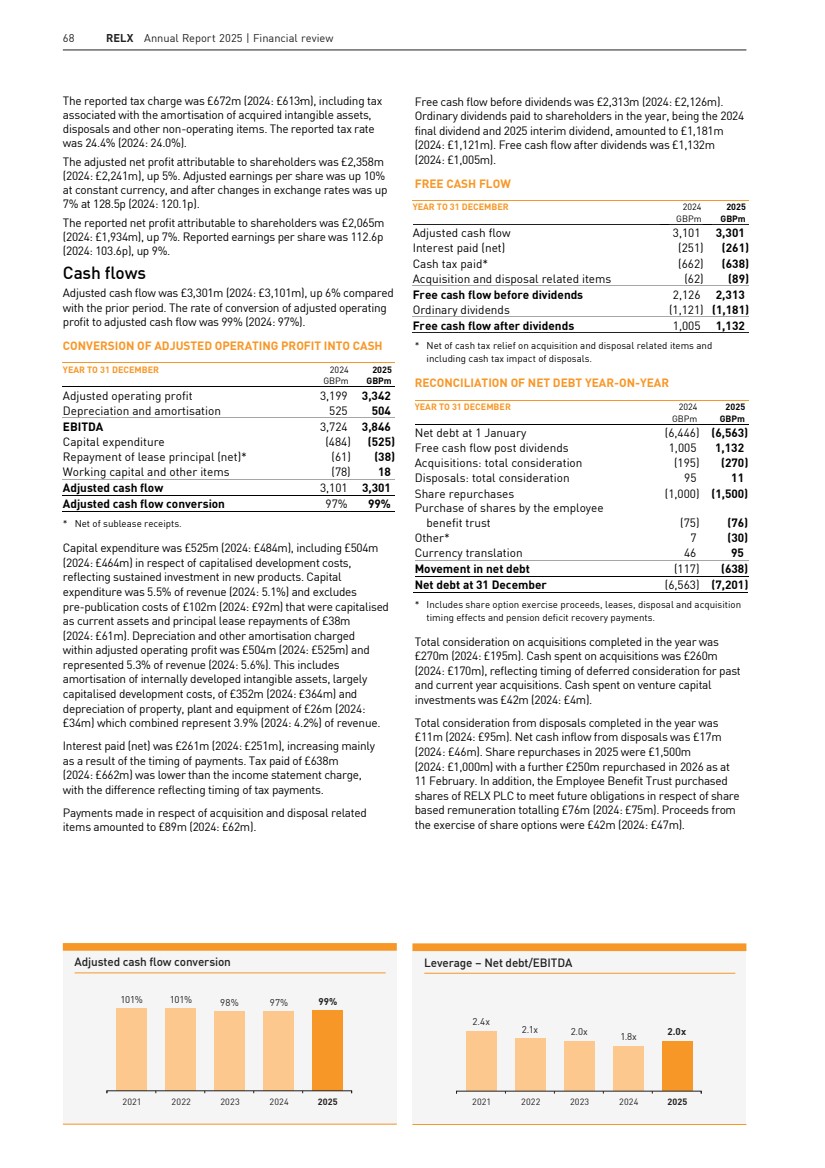
| RELX term debt maturities at 31 December 2025 587 939 1,500 950 880 1,087 998 750 0 7 880 2026 2027 2028 2029 2030 2031 2032 2033 2034 2035 >2035 USDm Term debt translated at 31 December 2025 exchange rates, stated at par value Return on invested capital 11.9% 12.5% 14.0% 14.8% 2021 2022 2023 2024 2025 15.4% 67 RELX Annual Report 2025 | Financial review RELX Annual Report 2025 | Chief Financial Officer’s report 69 The reported tax charge was £672m (2024: £613m), including tax associated with the amortisation of acquired intangible assets, disposals and other non-operating items. The reported tax rate was 24.4% (2024: 24.0%). The adjusted net profit attributable to shareholders was £2,358m (2024: £2,241m), up 5%. Adjusted earnings per share was up 10% at constant currency, and after changes in exchange rates was up 7% at 128.5p (2024: 120.1p). The reported net profit attributable to shareholders was £2,065m (2024: £1,934m), up 7%. Reported earnings per share was 112.6p (2024: 103.6p), up 9%. Cash flows Adjusted cash flow was £3,301m (2024: £3,101m), up 6% compared with the prior period. The rate of conversion of adjusted operating profit to adjusted cash flow was 99% (2024: 97%). CONVERSION OF ADJUSTED OPERATING PROFIT INTO CASH YEAR TO 31 DECEMBER 2024 2025 GBPm GBPm Adjusted operating profit 3,199 3,342 Depreciation and amortisation 525 504 EBITDA 3,724 3,846 Capital expenditure (484) (525) Repayment of lease principal (net)* (61) (38) Working capital and other items (78) 18 Adjusted cash flow 3,101 3,301 Adjusted cash flow conversion 97% 99% * Net of sublease receipts. Capital expenditure was £525m (2024: £484m), including £504m (2024: £464m) in respect of capitalised development costs, reflecting sustained investment in new products. Capital expenditure was 5.5% of revenue (2024: 5.1%) and excludes pre-publication costs of £102m (2024: £92m) that were capitalised as current assets and principal lease repayments of £38m (2024: £61m). Depreciation and other amortisation charged within adjusted operating profit was £504m (2024: £525m) and represented 5.3% of revenue (2024: 5.6%). This includes amortisation of internally developed intangible assets, largely capitalised development costs, of £352m (2024: £364m) and depreciation of property, plant and equipment of £26m (2024: £34m) which combined represent 3.9% (2024: 4.2%) of revenue. Interest paid (net) was £261m (2024: £251m), increasing mainly as a result of the timing of payments. Tax paid of £638m (2024: £662m) was lower than the income statement charge, with the difference reflecting timing of tax payments. Payments made in respect of acquisition and disposal related items amounted to £89m (2024: £62m). Free cash flow before dividends was £2,313m (2024: £2,126m). Ordinary dividends paid to shareholders in the year, being the 2024 final dividend and 2025 interim dividend, amounted to £1,181m (2024: £1,121m). Free cash flow after dividends was £1,132m (2024: £1,005m). FREE CASH FLOW YEAR TO 31 DECEMBER 2024 2025 GBPm GBPm Adjusted cash flow 3,101 3,301 Interest paid (net) (251) (261) Cash tax paid* (662) (638) Acquisition and disposal related items (62) (89) Free cash flow before dividends 2,126 2,313 Ordinary dividends (1,121) (1,181) Free cash flow after dividends 1,005 1,132 * Net of cash tax relief on acquisition and disposal related items and including cash tax impact of disposals. RECONCILIATION OF NET DEBT YEAR-ON-YEAR YEAR TO 31 DECEMBER 2024 2025 GBPm GBPm Net debt at 1 January (6,446) (6,563) Free cash flow post dividends 1,005 1,132 Acquisitions: total consideration (195) (270) Disposals: total consideration 95 11 Share repurchases (1,000) (1,500) Purchase of shares by the employee benefit trust (75) (76) Other* 7 (30) Currency translation 46 95 Movement in net debt (117) (638) Net debt at 31 December (6,563) (7,201) * Includes share option exercise proceeds, leases, disposal and acquisition timing effects and pension deficit recovery payments. Total consideration on acquisitions completed in the year was £270m (2024: £195m). Cash spent on acquisitions was £260m (2024: £170m), reflecting timing of deferred consideration for past and current year acquisitions. Cash spent on venture capital investments was £42m (2024: £4m). Total consideration from disposals completed in the year was £11m (2024: £95m). Net cash inflow from disposals was £17m (2024: £46m). Share repurchases in 2025 were £1,500m (2024: £1,000m) with a further £250m repurchased in 2026 as at 11 February. In addition, the Employee Benefit Trust purchased shares of RELX PLC to meet future obligations in respect of share based remuneration totalling £76m (2024: £75m). Proceeds from the exercise of share options were £42m (2024: £47m). Adjusted cash flow conversion Leverage - Net debt/EBITDA RELX Annual Report 2025 | Chief Financial Officer’s report 68 Overview Market segments Corporate responsibility Financial review Governance Financial statements and other information Funding Debt Net debt at 31 December 2025 was £7,201m, an increase of £638m since 31 December 2024. The majority of our borrowings are denominated in US dollars and euros. As sterling was stronger against the US dollar at 31 December 2025 compared to 31 December 2024, currency effects reduced net debt expressed in sterling. In US dollars, net debt at 31 December 2025 was $9,721m, an increase of $1,517m since 31 December 2024. As the euro was stronger against the US dollar at 31 December 2025 compared to 31 December 2024, currency effects increased net debt in US dollars. Excluding currency translation effects, net debt increased by £733m when expressed in sterling and by $968m when expressed in US dollars. In March 2025, the Group entered into cross-currency interest rate swaps to increase its exposure to debt in euro and Japanese yen. This provides a hedge of part of the Group’s earnings in those currencies, but the nature of the Group’s assets in those currencies on a reported basis means that the interest rate swaps do not qualify for net investment hedge accounting. The fair value movements in these instruments in each period will be included in reported net interest expense but excluded from adjusted net interest expense, and the total fair value at each reporting date will be included as part of net debt as defined by the Group. Of the $1.5bn of new term debt issued in the period (see ‘Liquidity’ below), $500m has been swapped from fixed rate US dollars to fixed rate euros for five or ten years, and $500m has been swapped from fixed rate US dollars to fixed rate Japanese yen for ten years. Gross debt of £7,267m (2024: £6,544m) is comprised of bank and bond borrowings of £7,170m (2024: £6,441m) and lease liabilities of £97m (2024: £103m). The fair value of derivative net liabilities designated as hedging instruments was £60m (2024: £140m), the fair value of cross-currency interest rate swap net liabilities not designated as hedging instruments was £5m (2024: nil), finance lease receivables were nil (2024: £2m) and cash and cash equivalents totalled £131m (2024: £119m). In aggregate, these give the net debt figure of £7,201m (2024: £6,563m). The effective interest rate on gross bank and bond borrowings was 3.9% in 2025 (2024: 4.4%). As at 31 December 2025, gross bank and bond borrowings had a weighted average life remaining of 4.0 years and a total of 66% of them were at fixed rates, after taking into account interest rate derivatives. The ratio of net debt (including pensions) to EBITDA was 2.0x (2024: 1.8x), calculated in US dollars. At 31 December 2025, there was a net positive pension accounting balance (pension assets less pension obligations) of £43m, compared to a net positive position of £21m as at 31 December 2024 as liabilities have reduced due to an increase in discount rates. The Group and the Trustees of the main UK defined benefit pension scheme have completed the 2024 triennial valuation and no deficit funding contributions are required in the period 2025 to 2027. In the first half of 2025 it was announced that this scheme will be closed to future accrual of benefits with effect from 28 February 2027. Liquidity In March 2025, USD denominated term debt was issued of $750m with a fixed coupon of 4.75% and a maturity of 5 years and $750m with a fixed coupon of 5.25% and a maturity of 10 years. The Group has ample liquidity and access to debt capital markets, providing the ability to repay or refinance debt as it matures and to fund ongoing requirements. During the year, the existing $3bn committed bank facility due to mature in April 2027 was refinanced and replaced with a new $3.5bn committed bank facility, maturing in November 2030 with the option to extend for two years. This facility provides security of funding for short-term debt, and remains undrawn. Invested capital and returns Net capital employed decreased by £249m to £10,322m at 31 December 2025 (2024: £10,571m), primarily due to changes in exchange rates, partly offset by the effect of acquisitions completed during the year and movements in working capital. NET CAPITAL EMPLOYED AS AT 31 DECEMBER 2024 2025 GBPm GBPm Goodwill and acquired intangible assets* 9,811 9,327 Internally developed intangible assets* 1,569 1,675 Property, plant and equipment*, right-of-use assets* and investments 432 454 Net pension asset 21 43 Working capital (1,262) (1,177) Net capital employed 10,571 10,322 * Net of accumulated depreciation and amortisation. The post-tax return on average invested capital in the year was 15.4% (2024: 14.8%). The increase was driven by growth in adjusted operating profit. RETURN ON INVESTED CAPITAL AS AT 31 DECEMBER 2024 2025 GBPm GBPm Adjusted operating profit 3,199 3,342 Tax at adjusted effective rate (720) (752) Adjusted effective tax rate 22.5% 22.5% Adjusted operating profit after tax 2,479 2,590 Average invested capital* 16,743 16,799 Return on invested capital 14.8% 15.4% * Average of invested capital at the beginning and the end of the year, retranslated at average exchange rates for the year. Invested capital is calculated as net capital employed, adjusted to add back accumulated amortisation and impairment of acquired intangible assets and goodwill and to exclude the gross up to goodwill in respect of deferred tax. RELX term debt maturities at 31 December 2025 Return on invested capital Market segments Governance and other information Financial statements Financial review Corporate responsibility Overview |
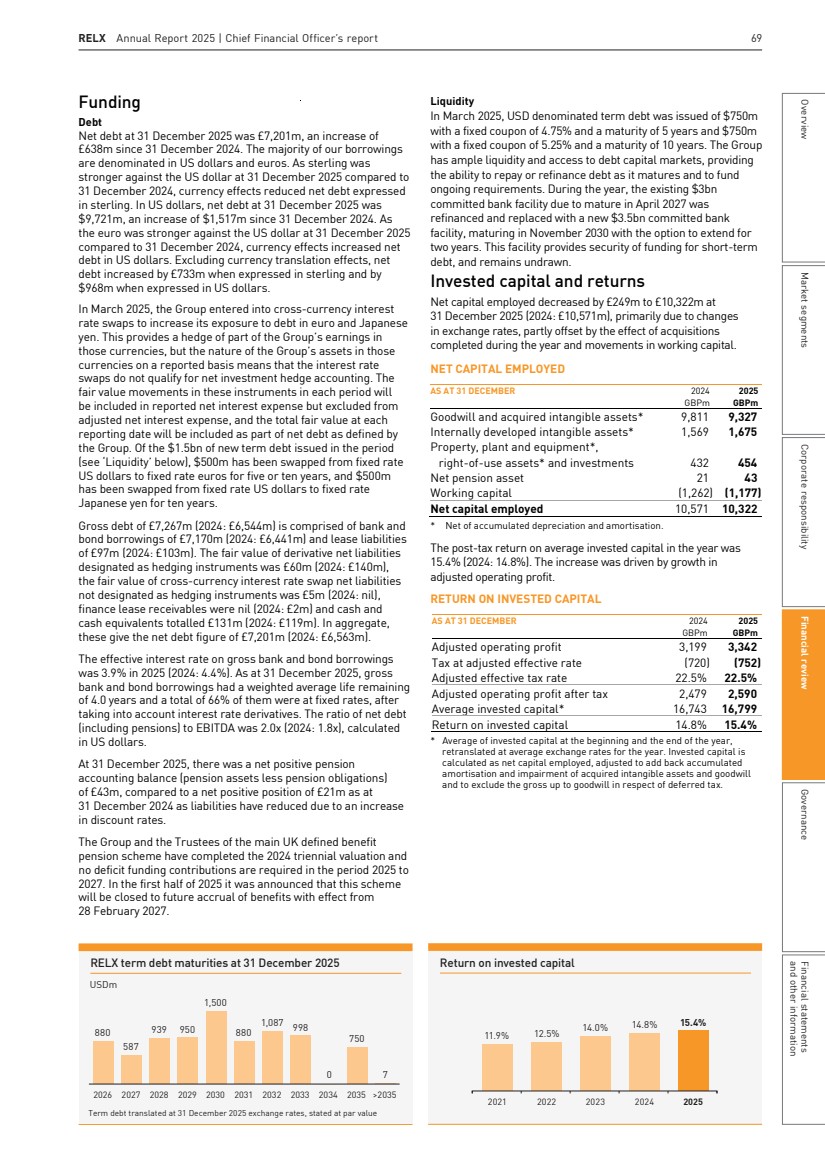
| Share buybacks 500 800 1,000 1,500 2021 2022 2023 2024 2025 GBPm Dividends 920 983 1,059 1,121 1,181 2021 2022 2023 2024 2025 GBPm 7070 RELX RELX Annual Report 2025 | Financial review Annual Report 2025 | Financial review Dividends and share repurchases 2024 2025 GBPm GBPm Change Adjusted earnings per share 120.1p 128.5p +7% Reported earnings per share 103.6p 112.6p +9% Ordinary dividend per share 63.0p 67.5p +7% The final dividend proposed by the Board is 48.0p per share. This gives total dividends for the year of 67.5p (2024: 63.0p), 7% higher than the prior year. The dividend policy of RELX PLC is, over the longer term, to grow dividends broadly in line with adjusted earnings per share, paying out approximately half of adjusted earnings in dividend each year. During 2025, a total of 39.5m RELX PLC shares were repurchased at an average price of 3,797p. Total consideration for these repurchases was £1,500m. A further 1.9m (2024: 2.2m) shares were purchased by the Employee Benefit Trust. As at 31 December 2025, total shares in issue, net of shares held in treasury and shares held by the Employee Benefit Trust, amounted to 1,819.0m. A further 8.8m shares have been repurchased in 2026 as at 11 February. Distributable reserves and parent company balance sheet As at 31 December 2025, RELX PLC had distributable reserves of £5.1bn (2024: £4.9bn). In line with UK legislation, distributable reserves are derived from the non-consolidated RELX PLC balance sheet. The consolidated reserves reflect items such as the amortisation of acquired intangible assets that are not taken into account when calculating distributable reserves. The parent company balance sheet net assets are higher than those of the Group due to the investment in RELX Group plc being carried at a value of £18.4bn which is not reflected on the consolidated balance sheet. The parent company balance sheet can be found on page 189. Further information on the distributable reserves can be found in the parent company financial statements on page 190. Alternative performance measures RELX uses a range of alternative performance measures (APMs) in the reporting of financial information, which are not defined by generally accepted accounting principles (GAAP) such as IFRS. These APMs are used by the Board and management as they believe they provide relevant information in assessing the Group’s performance, position and cash flows, enable investors to track more clearly the core operational performance of the Group, and provide a clear basis for assessing RELX’s ability to raise debt and invest in new business opportunities. Management also uses these financial measures, along with IFRS financial measures, in evaluating the operating performance of the Group as a whole and of the individual business areas. These measures should not be considered in isolation from, or as a substitute for, financial information presented in compliance with IFRS. The measures may not be directly comparable to similarly reported measures by other companies. Definitions and reconciliations of alternative performance measures together with restatement of certain measures can be found on pages 198 to 206. Accounting policies The consolidated financial statements are prepared in accordance with UK adopted International Accounting Standards in conformity with the requirements of the Companies Act 2006 and IFRS accounting standards as issued by the International Accounting Standards Board (IASB) following the accounting policies shown in the notes to the financial statements on pages 138 to 185. The accounting policies and estimates which require the most significant judgement relate to the capitalisation of development spend and accounting for defined benefit pension schemes. Further detail is provided in the accounting policies on pages 143 to 145 and in the relevant notes to the accounts. Tax Taxation is an important issue for us and our stakeholders, including our shareholders, governments, customers, suppliers, employees and the global communities in which we operate. We have set out our approach to tax in our global tax strategy. This incorporates our Tax Principles along with additional disclosures around where we pay taxes and our broader contribution to society. This is all made publicly available on our website: www.relx.com/go/taxprinciples. We maintain an open dialogue with tax authorities, and are vigilant in ensuring that we comply with current tax legislation. We have clear and consistent tax policies and tax matters are dealt with by a professional tax function, supported by external advisers. We proactively seek to agree arm’s-length pricing with tax authorities to mitigate tax risks of significant cross-border operations. We actively engage with policy makers, tax administrators, industry bodies and international institutions to provide informed input on proposed tax measures, so that we and they can understand how those proposals would affect our business. In addition, we participate in consultations with the Organisation for Economic Co-operation and Development (OECD), European bodies and the United Nations. Dividends Share buybacks |
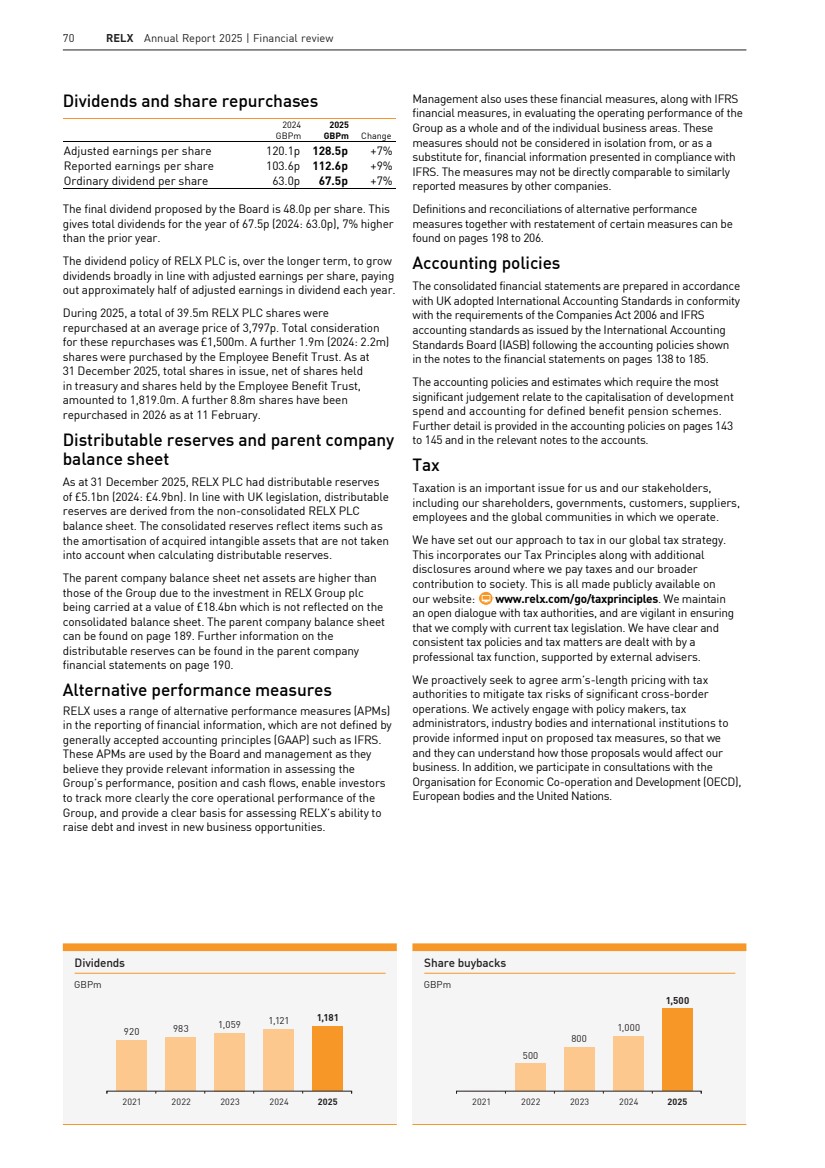
| 70 RELX Annual Report 2025 | Financial review RELX Annual Report 2025 | Chief Financial Officer’s report 71 Dividends and share repurchases 2024 2025 GBPm GBPm Change Adjusted earnings per share 120.1p 128.5p +7% Reported earnings per share 103.6p 112.6p +9% Ordinary dividend per share 63.0p 67.5p +7% The final dividend proposed by the Board is 48.0p per share. This gives total dividends for the year of 67.5p (2024: 63.0p), 7% higher than the prior year. The dividend policy of RELX PLC is, over the longer term, to grow dividends broadly in line with adjusted earnings per share, paying out approximately half of adjusted earnings in dividend each year. During 2025, a total of 39.5m RELX PLC shares were repurchased at an average price of 3,797p. Total consideration for these repurchases was £1,500m. A further 1.9m (2024: 2.2m) shares were purchased by the Employee Benefit Trust. As at 31 December 2025, total shares in issue, net of shares held in treasury and shares held by the Employee Benefit Trust, amounted to 1,819.0m. A further 8.8m shares have been repurchased in 2026 as at 11 February. Distributable reserves and parent company balance sheet As at 31 December 2025, RELX PLC had distributable reserves of £5.1bn (2024: £4.9bn). In line with UK legislation, distributable reserves are derived from the non-consolidated RELX PLC balance sheet. The consolidated reserves reflect items such as the amortisation of acquired intangible assets that are not taken into account when calculating distributable reserves. The parent company balance sheet net assets are higher than those of the Group due to the investment in RELX Group plc being carried at a value of £18.4bn which is not reflected on the consolidated balance sheet. The parent company balance sheet can be found on page 189. Further information on the distributable reserves can be found in the parent company financial statements on page 190. Alternative performance measures RELX uses a range of alternative performance measures (APMs) in the reporting of financial information, which are not defined by generally accepted accounting principles (GAAP) such as IFRS. These APMs are used by the Board and management as they believe they provide relevant information in assessing the Group’s performance, position and cash flows, enable investors to track more clearly the core operational performance of the Group, and provide a clear basis for assessing RELX’s ability to raise debt and invest in new business opportunities. Management also uses these financial measures, along with IFRS financial measures, in evaluating the operating performance of the Group as a whole and of the individual business areas. These measures should not be considered in isolation from, or as a substitute for, financial information presented in compliance with IFRS. The measures may not be directly comparable to similarly reported measures by other companies. Definitions and reconciliations of alternative performance measures together with restatement of certain measures can be found on pages 198 to 206. Accounting policies The consolidated financial statements are prepared in accordance with UK adopted International Accounting Standards in conformity with the requirements of the Companies Act 2006 and IFRS accounting standards as issued by the International Accounting Standards Board (IASB) following the accounting policies shown in the notes to the financial statements on pages 138 to 185. The accounting policies and estimates which require the most significant judgement relate to the capitalisation of development spend and accounting for defined benefit pension schemes. Further detail is provided in the accounting policies on pages 143 to 145 and in the relevant notes to the accounts. Tax Taxation is an important issue for us and our stakeholders, including our shareholders, governments, customers, suppliers, employees and the global communities in which we operate. We have set out our approach to tax in our global tax strategy. This incorporates our Tax Principles along with additional disclosures around where we pay taxes and our broader contribution to society. This is all made publicly available on our website: www.relx.com/go/taxprinciples. We maintain an open dialogue with tax authorities, and are vigilant in ensuring that we comply with current tax legislation. We have clear and consistent tax policies and tax matters are dealt with by a professional tax function, supported by external advisers. We proactively seek to agree arm’s-length pricing with tax authorities to mitigate tax risks of significant cross-border operations. We actively engage with policy makers, tax administrators, industry bodies and international institutions to provide informed input on proposed tax measures, so that we and they can understand how those proposals would affect our business. In addition, we participate in consultations with the Organisation for Economic Co-operation and Development (OECD), European bodies and the United Nations. Dividends Share buybacks RELX Annual Report 2025 | Chief Financial Officer’s report 73 Overview Market segments Corporate responsibility Financial review Governance Financial statements and other information Treasury The Board of RELX PLC agrees Treasury Principles which are translated into policies for managing treasury risks. The key policies address security of funding requirements, the target fixed/floating interest rate exposure for debt and foreign currency hedging and place limits on counterparty exposures. A more extensive summary of these policies is provided in note 17 to the financial statements on pages 169 to 175. Financial instruments are used to finance the RELX businesses and to hedge transactions. The Group’s businesses do not enter into speculative transactions. Liquidity management The capital structure is managed to support RELX’s objective of maximising long-term shareholder value through appropriate security of funding, ready access to debt and capital markets, cost-effective borrowing and flexibility to fund business and acquisition opportunities while maintaining appropriate leverage to ensure an efficient capital structure. Over the long term, RELX seeks to maintain cash flow conversion of 90% or higher and credit rating agency metrics that are consistent with a solid investment grade credit rating. These metrics, as defined by the rating agencies, include net debt to EBITDA and various measures of cash flow as a percentage of net debt. Further detail on liquidity management is provided on pages 170 and 171. Capital management RELX uses the cash flow it generates to fund capital expenditure required to drive organic growth, to make selective acquisitions and to provide a growing dividend to shareholders, while retaining balance sheet strength to maintain access to cost-effective sources of borrowing. Share repurchases are undertaken to maintain an efficient balance sheet. Further detail on capital management is provided on pages 169 and 170. Corporate responsibility Corporate responsibility continues to underpin our activities. This included in 2025, reducing our Scope 1, Scope 2 (location-based) and Scope 3 (business flights) emissions by 13%. We continue to hold Group-wide ISO 140001 certification of our Environmental Management System. To track our environmental progress through the year, I led quarterly Environmental Checkpoint meetings with senior managers and chaired our Net Zero Carbon Events working group to progress a net zero road map which featured in RX’s first Sustainability Report. For World Environment Day, I sent a message to all RELX staff highlighting our environmental performance and priorities, building on the work of Green Teams at more than 56 locations across the Group which focus on environmental management at the local level. In the year, we launched a Green Fund, open to all employees for projects with environmental benefits, using proceeds from our internal carbon price which was $50 per ton of CO2 e in 2025. Our most significant contribution to the environment-related UN Sustainable Development Goals (SDGs), including SDG 7, Clean And Affordable Energy and SDG 13, Climate Action, remains our products and services. We continued to deploy the EmeraldSky methodology developed by Risk’s global flight data business, Cirium, to calculate our Scope 3, business flight travel data. Scientific, Technical & Medical’s The Lancet Planetary Health addressed themes related to sustainable development and global environmental change throughout the year. Legal published England and Wales Environment Tracker 2025, which tracks and summarises new and upcoming legislation and consultations linked to climate action and emissions reduction in England and Wales. Exhibitions’ World Future Energy Summit in Abu Dhabi featured the Sustainability Business Connect programme, a platform allowing regional and international buyers to meet with exhibitors, visitors, and prospective partners, which expanded by 17% over the previous year. We are committed to transparency. You can find more information and data in the Corporate Responsibility section on pages 34 to 63, in the Corporate Sustainability Reporting Directive Sustainability Statement on pages 208 to 234, and our Taskforce on Climate-Related Financial Disclosure (TCFD) on page 235. Nick Luff Chief Financial Officer Market segments Governance and other information Financial statements Financial review Corporate responsibility Overview |
| 72 RELX Annual Report 2025 | Financial review Principal and emerging risks Risk identification, evaluation, and management RELX has established a well-embedded risk management framework based on the Internal Control-Integrated Framework (2013) by the Committee of Sponsoring Organisations of the Treadway Commission (COSO). Through this framework risks are identified, assessed, mitigated, and monitored in an effective and consistent way across the businesses. RELX uses the 3 Lines of Defence model and aligns its systems of risk management and internal control with the COSO framework. Business Areas are required to maintain systems of risk management and internal control which are appropriate to the nature and scale of their activities and address all significant strategic, operational, financial, legal and regulatory compliance and reputational risks that they face. The RELX PLC Board monitors the system of internal control and risk management and performs an annual assessment of its effectiveness. Consideration of current and emerging risks Our risk management process considers the likelihood and impact of risks, the timeline over which a risk could arise, the direction in which risks are trending and the effectiveness of our mitigation efforts. In addition to consideration of current risks, we also identify emerging risks which could impact our business in the next 3-5 years. An emerging risk specific to generative AI is the possibility that models may produce inaccurate or fabricated content. We reduce this exposure by involving domain experts in the development, implementing comprehensive testing and validation procedures, and including verifiable, source-linked citations in AI-generated outputs to ensure users can access authoritative material. Another emerging AI risk in the journal publishing sector is that Generative AI is lowering the cost and effort to produce fraudulent articles, either by innocent/ignorant or fraudulent author, editor or peer reviewer. We combat this with technological tools designed to identify fraudulently submitted articles. RISK MITIGATION External Risks Data privacy In the course of our business, we process personal data from customers, end users, employees and other sources. Certain business areas rely extensively upon content that includes personal data from public records, governmental authorities, publicly available information and media, and other information companies, including competitors. Changes in data privacy legislation, regulation, and/or enforcement could impact our ability to collect and use personal data, potentially affecting the availability and effectiveness of our products. Failure or perceived failure, by us, our customers or suppliers, to comply with requirements for proper collection, use, sharing, storage, transfer and other processing of personal data may damage our reputation, divert time and effort of management and other resources, increase cost of operations, and expose us to risk ofloss, fines and penalties, litigation, and increased regulation. We are guided by the RELX Privacy Principles and have implemented governance structures, contractual restrictions, technical measures, and other controls to protect personal data and meet data privacy requirements across all jurisdictions where we operate. We have assurance programmes to monitor compliance and conduct training and awareness programmes for our employees. Our commitment to fair, explainable, and accountable AI practices, as set out in our Responsible Artificial Intelligence Principles, helps to ensure that our AI uses of personal data are subject to robust privacy governance. Intellectual property rights Our products and services include and utilise intellectual property and we rely on our commercial agreements as well as trademark, copyright, patent, trade secret and other intellectual property laws to establish and protect our proprietary rights in this intellectual property. Such intellectual property laws are subject to national legislative initiatives, cross-border initiatives such as those from the European Commission and increased judicial scrutiny in several jurisdictions in which we operate that could weaken such protections. There is a risk that our proprietary rights and copyright protections could be infringed or circumvented, including by companies leveraging technology tools and AI, which may impact demand for and pricing of our products and services. We actively engage in developing and promoting the legal protection of intellectual property rights. Our contracts with customers contain provisions regarding the use of proprietary content including use by large language models. We are vigilant as to the use of our intellectual property and, as appropriate, take action to challenge illegal content distribution sources. |
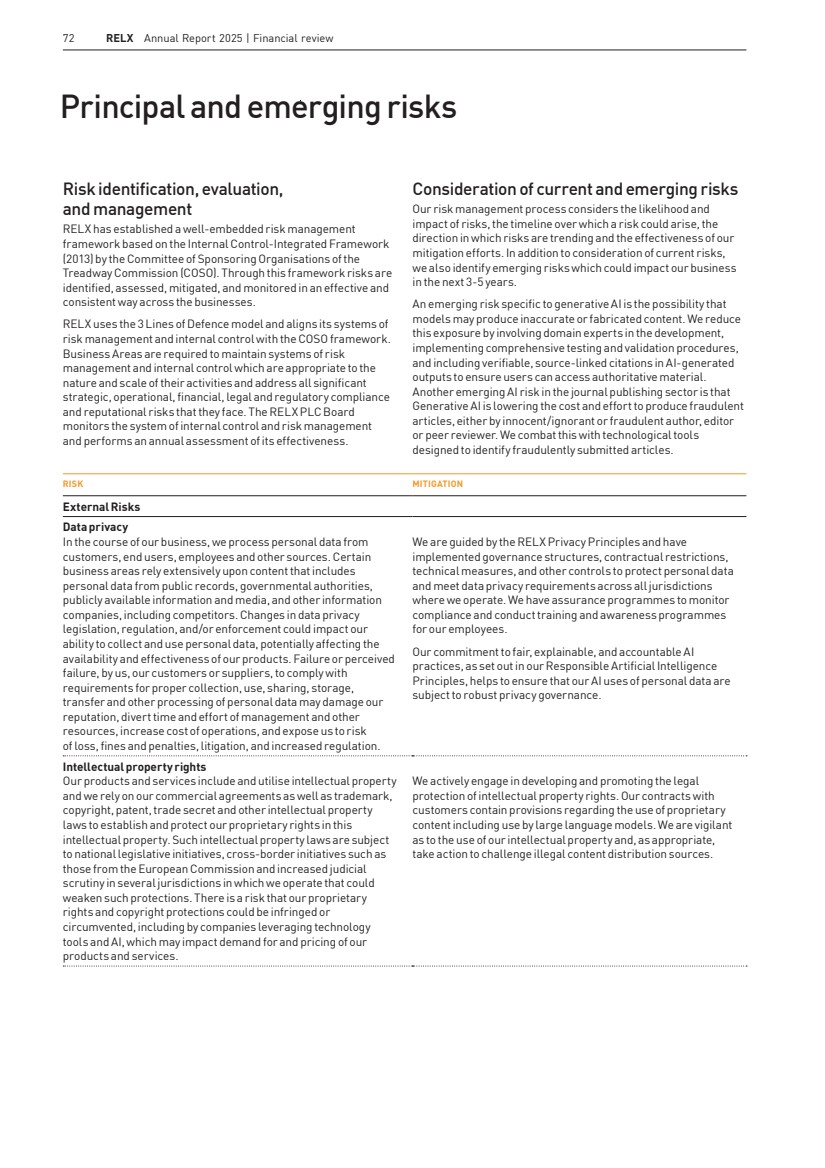
| RELX Annual Report 2025 | Principal and emerging risks 73 RISK MITIGATION Geopolitical, economic and market conditions Demand for our products and services, and our ability to operate internationally, may be adversely impacted by geopolitical, economic and market conditions beyond our control. These include acts of war and civil unrest; political conflicts and tensions; international sanctions; economic cycles; the impact ofthe effect of changes in inflation and interest rates in major economies; trading relations between the United States, Europe, China and other major economies; as well as levels of government and private funding for our markets. Our businesses are focused on professional markets which have generally been more resilient in periods of economic downturn. We deliver information solutions, many on a subscription and recurring revenue basis, which are important to our customers’ effectiveness and efficiency. We operate diversified businesses in terms of sectors, markets, customers, geographies and products and services. We have multi-year contracts in place for much of the revenue base, and underlying demand drivers in many areas are not directly exposed to economic growth (eg scientific research, healthcare, fraud risk, financial crime compliance). Over the past 15 years, RELX has significantly reduced its dependence on revenue streams that historically have been impacted by economic downturns (eg advertising, employment screening). We have extended our position in long-term global growth markets through organic new launches supported by the selective acquisitions. We continuously monitor economic and political developments to assess their impact on our strategy which is designed to mitigate these risks. In response to specific uncertainties, our businesses engage in scenario planning and develop contingency plans where relevant and consider exiting businesses and markets that no longer fit our strategy. Evolution of primary research publishing Maintaining quality and integrity in primary scientific research is core to our Scientific, Technical & Medical (STM) business. There isa risk that we may not detect some erroneous or fraudulent research papers that are submitted to our journals. In addition, payment models in scientific research publishing are evolving, with ‘pay-to-publish’ (commonly referred to as Open Access) becoming alarger share relative to ‘pay-to-read’. Rapid changes in customer choice, regulation, or technologies in this area could impact the revenue mix and growth in primary publishing. We focus on the quality and integrity of research through the editorial and peer review process; we invest in technology to drive innovation in editorial and distribution platforms to make content and data accessible, trusted and actionable; we work across the industry to combat fraud; and we develop our systems to manage different payment models. To meet changing customer needs, we continue to launch new journals across payment models and scientific disciplines. Market segments Governance and other information Financial statements Financial review Corporate responsibility Overview |
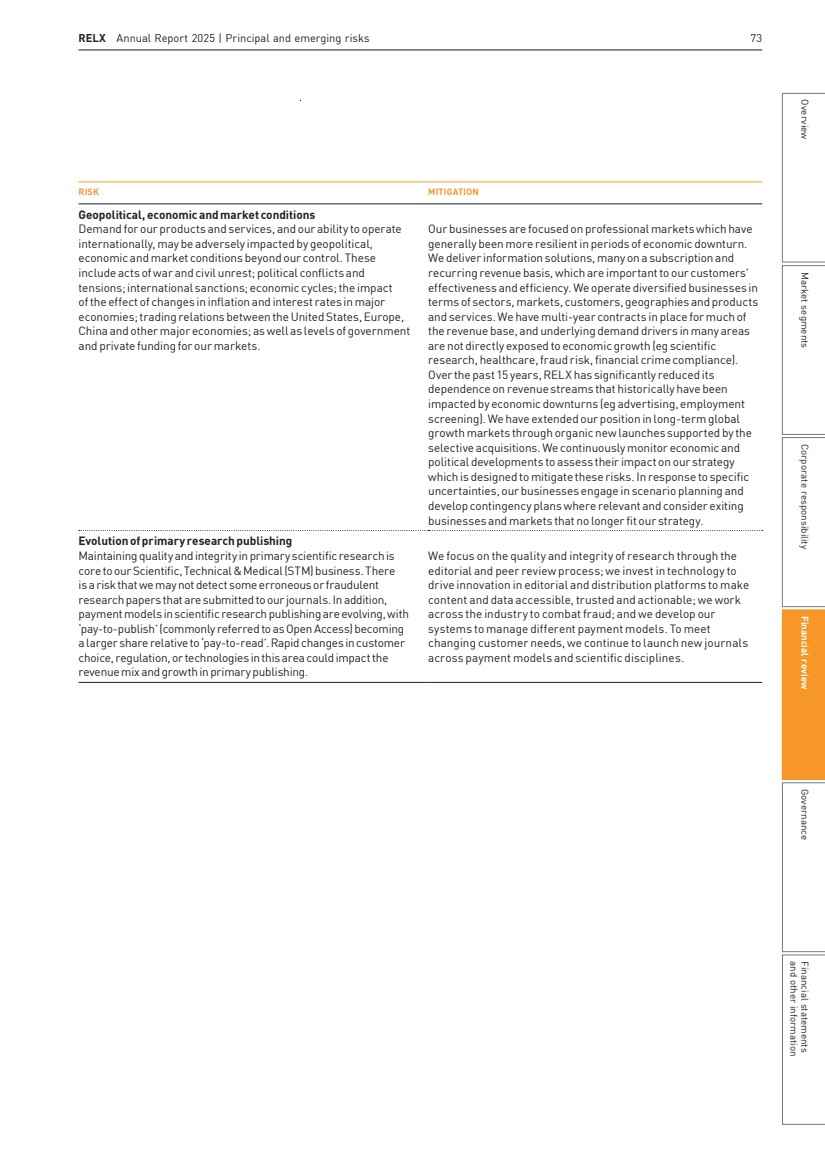
| 74 RELX Annual Report 2025 | Financial review RISK MITIGATION Strategic Execution Risks Customer demand for our products Our businesses are dependent on the continued demand by our customers for our products and services and the value placed on them. We operate in highly competitive and dynamic markets, and the means of delivery, customer demand for, and the products and services themselves, continue to change in response to technological innovations, such as the use of artificial intelligence, legislative and regulatory changes, the entrance of new competitors, and other factors. Failure to anticipate and quickly adapt to these changes, or to deliver enhanced value to our customers, could impact demand for our products and services and consequently adversely affect our revenue or the long-term returns from our investment in higher value-add information-based analytics and decision tools. We are focused on the needs and economics of our customers. We gain insights into the markets that we serve, evolving customers’ needs, the potential application of new technologies and business models, and the actions of competitors and disrupters. These insights inform our strategic and operational priorities. We continuously invest significant resources in our products and services, and the infrastructure to support them, and we have a long track record of using artificial intelligence. We leverage user centred design and development methods and customer analytics and invest in new and enhanced technologies to provide content and innovative solutions that help them achieve better outcomes and enhance productivity. Acquisitions We supplement our organic development with selected acquisitions. If we are unable to generate the anticipated benefits such as revenue growth, accelerated product development or cost savings associated with these acquisitions, it could adversely affect return on invested capital and financial condition or lead to an impairment of goodwill or intangibles. Acquisitions are made within the framework of our overall strategy, which emphasises organic development. We have a wellformulated process for reviewing and executing acquisitions and for managing the post-acquisition integration. This process is underpinned with clear strategic, financial and ethical criteria. We closely monitor the integration and performance of acquisitions. Operational Risks Cybersecurity Our businesses maintain and use online databases and platforms delivering our products and services, which we rely on, and provide data to third parties, including customers and service providers. These databases and information are a target for compromise and face a risk of unauthorised access and use by unauthorised parties including through cyber, ransomware, malware, phishing and other social engineering attacks on us or our third-party service providers. Our cybersecurity measures, and the measures used by our third-party service providers, may not detect or prevent all attempts to compromise our systems, which may jeopardise the security or integrity of the data we maintain or may disrupt our systems. Failures of our cybersecurity measures could result in unauthorised access to our systems, misappropriation of our or our users’ data, deletion or modification of stored information or other interruption to our business operations. As techniques used to obtain unauthorised access to or to sabotage systems change frequently (including automated tools such as generative-AI assisted) and may not be known until launched against us or our third-party service providers we may be unable to anticipate or implement adequate measures to protect against these attacks and our service providers and customers may likewise be unable to do so. Compromises of our or our third-party service providers’ systems could adversely affect our financial performance, damage our reputation and expose us to risk of loss, fines and penalties, litigation and increased regulation. We have established cybersecurity programmes which are constantly reviewed and updated to address developments in the threat landscape with the aim of ensuring our ability to prevent, respond to and recover from a cyber-attack or ransomware attack, that data is protected, and our business infrastructures continue to operate. We have governance mechanisms in place to design and monitor common policies and standards across our businesses. We invest in appropriate technological and physical controls which are applied across the enterprise in a risk-based security programme which operates at the infrastructure, application and user levels. These controls include, but are not limited to, infrastructure vulnerability management, application scanning and penetration testing, network segmentation, encryption and logging and monitoring. We continuously explore new methods (including advanced automation and generative AI assistance) to enhance our controls. We provide regular training and communication initiatives to establish and maintain awareness of risks at all levels of our businesses. We have appropriate incident response plans to respond to threats and attacks which include procedures to recover and restore data and applications in the event of an attack. We maintain appropriate information cybersecurity policies and contractual requirements for our businesses and run programmes monitoring the application of our data security and resilience policies by third party service providers. We use independent internal and third-party auditors to test, evaluate, and help enhance our procedures and controls. We continuously monitor the global regulatory landscape to identify emerging cybersecurity, data protection and privacy laws, and, as needed, implement plans to comply with them. We procure appropriate cybersecurity insurance to mitigate potential losses arising from a cybersecurity incident. |
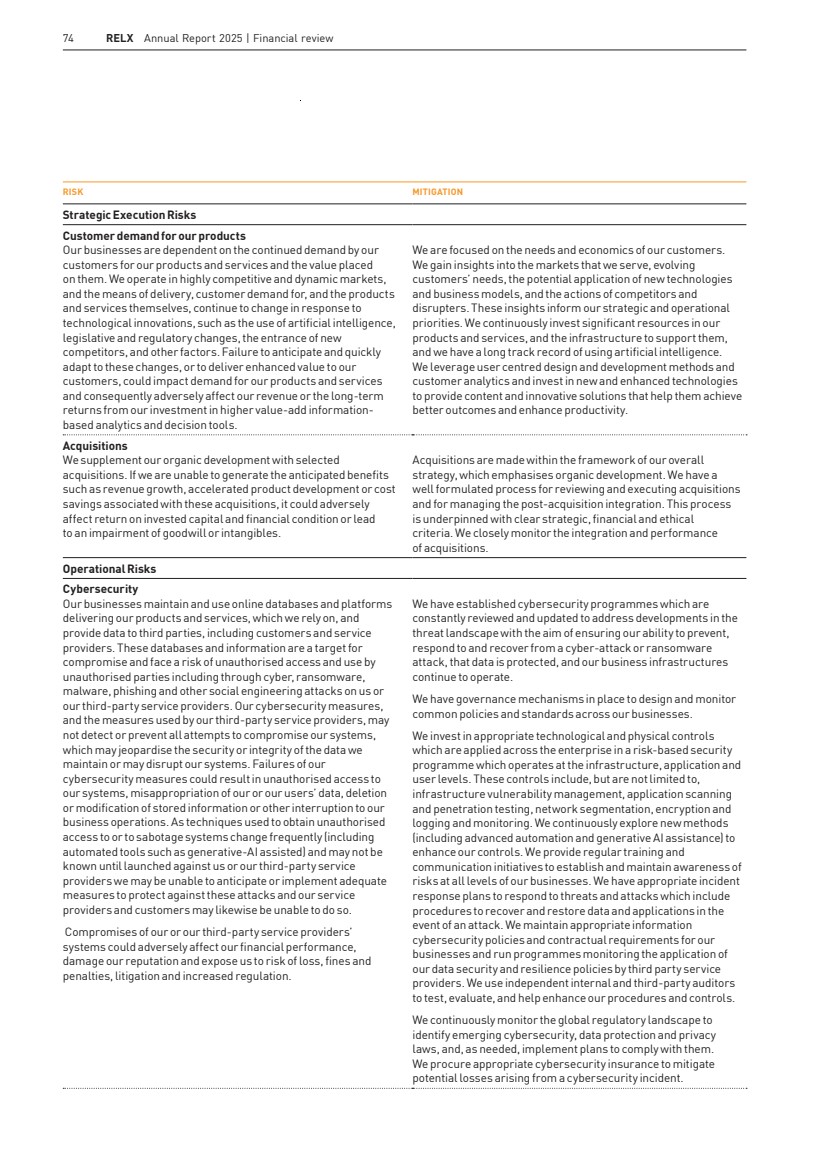
| RELX Annual Report 2025 | Principal and emerging risks 75 RISK MITIGATION Face-to-face events Face-to-face events are susceptible to economic cycles, changes in trading relations, communicable diseases, severe weather events and other natural disasters, terrorism and availability of venues. Each or any of these may impact our ability to hold face-to-face events, and exhibitors’ and visitors’ desire and ability to travel in person to events. These factors each have the potential to reduce revenues, increase the costs of organising events and adversely affect cash flows and reputation. We operate a large number of events across a wide variety of venues in many countries, serving both domestic and international exhibitors and attendees. We actively review our ability to host events considering the availability of venues and national and local regulations including those related to health, travel, and security. We operate flexibly, rescheduling or re-locating events when necessary. We take appropriate measures at our events to ensure for the well-being and safety of exhibitors, visitors and employees. Our face-to-face events are supported by enhanced digital services. Supply chain dependencies Our organisational and operational structures depend on suppliers including outsourced and offshored functions, as well as cloud service, software, and large language model providers. Poor performance, failure or breach of third parties to whom we have contracted could adversely affect our business performance, reputation and financial condition. We source content to enable information solutions for our professional customers. The disruption or loss of data sources, either because of regulations, or because data suppliers decide not to supply them, may impose limits on our collection and use of certain kinds of information and our ability to communicate, offer or make such information available or useful to our customers. We select our suppliers with care and establish contractual service levels that we closely monitor, including through key performance indicators and targeted supplier audits. We have developed business continuity plans to reduce disruption in the event of a major failure by a supplier. We have a formal supplier resilience programme to identify and manage critical suppliers across the business. A risk register is used to document any unique, critical supplier risks and associated mitigation plans, with due diligence performed and resilience discussions held on a regular basis, and our contractual terms enable us to audit supplier resilience plans/procedures. We have a multitude of data sources that we use to develop solutions for our customers and regularly monitor the market for new data sources in order to minimise dependence on any single provider. Where content is supplied to us by third parties, we aim to have contracts which provide mutual commercial benefit. Technology and business resilience Our businesses are dependent on electronic platforms and networks, including our own and third-party data centres, cloud providers, network systems and the internet, for delivery of our products and services. These could be adversely affected if our electronic delivery platforms, networks, power sources or supporting infrastructure experience a significant failure or interruption. We have established procedures for the protection of our businesses and technology assets. These include the development and testing of business continuity plans, including technical resilience plans and back-up delivery systems, to reduce business disruption in the event of major technology or infrastructure failure, terrorism, or adverse weather incidents. Talent The implementation and execution of our strategies and business plans depend on our ability to recruit, motivate, develop, and retain a diverse population of skilled employees and management. We compete globally and across business sectors for diverse, talented management and skilled individuals, particularly those with technology and data analytics capabilities. An inability to recruit, motivate or retain key employees with the right overall mix of skills in the group could adversely affect our business performance. We monitor capability needs and remuneration schemes are tailored to attract and motivate the best talent available at an appropriate level of cost. We actively seek feedback from employees, which feeds into plans to enhance employee engagement, motivation, and development. Our focus on an inclusive culture results in a diverse workforce and environment that respects individuals and their contributions. Market segments Governance and other information Financial statements Financial review Corporate responsibility Overview |
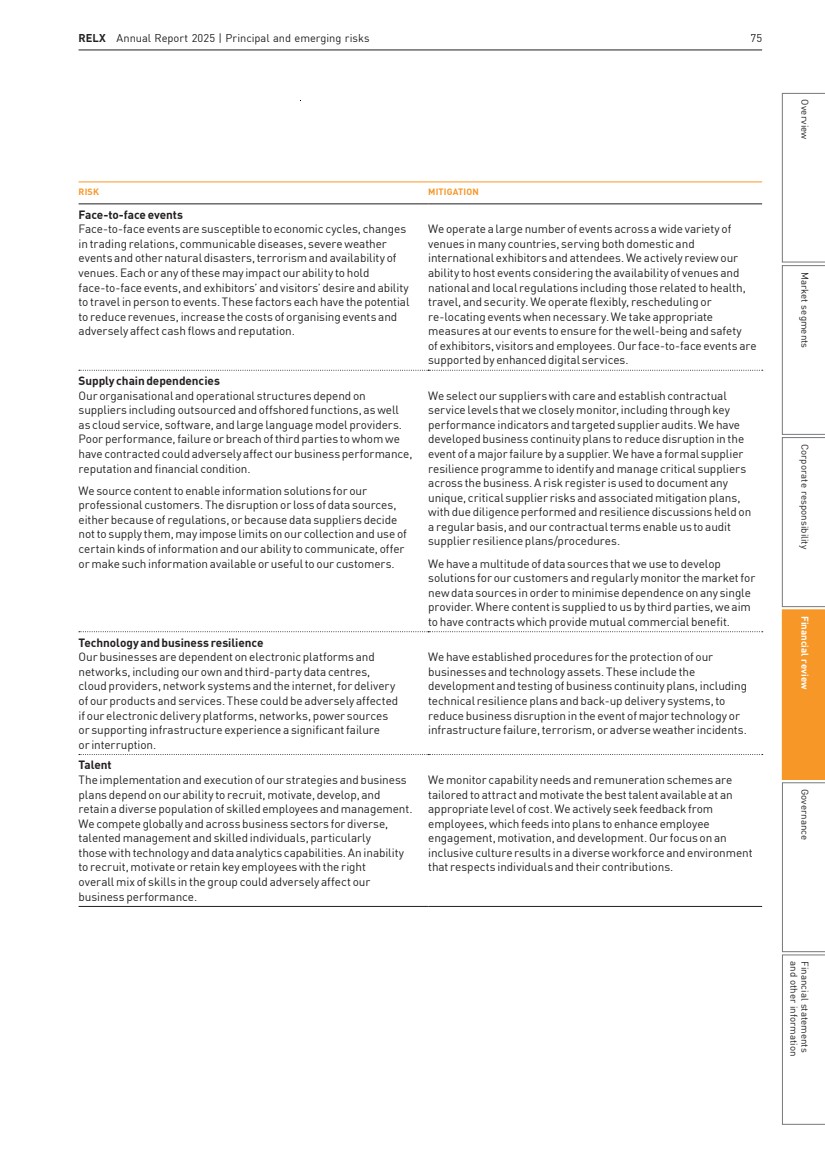
| 76 RELX Annual Report 2025 | Financial review RISK MITIGATION Financial Risks Tax Our businesses operate globally, and our profits are subject to taxation in many different jurisdictions and at differing tax rates. Tax laws and tax rates that currently apply to our businesses may be amended by the relevant authorities or interpreted differently by them, and these changes could adversely affect our reported results. We maintain an open dialogue with tax authorities and are vigilant in ensuring that we comply with current tax legislation. We have clear and consistent tax policies and tax matters are dealt with by a professional tax function, supported by external advisers. As outlined in the Chief Financial Officer’s report on pages 66 to 71 we engage with tax authorities and international organisations. We continue to monitor legislative developments in the jurisdictions in which we operate and consider the potential impacts of proposed regulation changes under various scenarios. The principles we adopt in our approach to tax matters can be found on our website at www.relx.com/go/taxprinciples. Treasury The RELX PLC consolidated financial statements are expressed in pounds sterling and are subject to movements in exchange rates on the translation of the financial information of businesses whose operational currencies are other than sterling. The United States is our most important market and, accordingly, significant fluctuations in the US dollar exchange rate could significantly affect our reported results. We also earn revenues and incur costs in a range of other currencies, including the Euro and the Yen, and significant fluctuations in these exchange rates could also significantly impact our reported results. Macroeconomic, political and market conditions may adversely affect the availability and terms of short- and long-term funding, volatility of interest rates, the credit quality of our counterparties, currency exchange rates and inflation. The majority of our outstanding debt instruments are, and any of our future debt instruments may be, publicly rated by independent rating agencies. Our borrowing costs and access to capital may be adversely affected if the credit ratings assigned to our debt are downgraded. Our approach to capital structure and funding is described in the Chief Financial Officer’s report on pages 66 to 71. The approach to the management of treasury risks is described in note 17 to the consolidated financial statements. Pensions We primarily operate defined contribution pension schemes around the world, but also have legacy defined benefit pension schemes in the United Kingdom and the United States. The UK defined benefit pension scheme has been closed to new hires since 2010 and will close to future benefit accruals in 2027. The US defined benefit pension scheme closed to future accruals in 2019. The assets and obligations associated with these pension schemes are sensitive to changes in themarket values of the scheme’s investments and the market-related assumptions used to value scheme liabilities. Adverse changes to asset values, discount rates, longevity assumptions or inflation could increase funding requirements. We have professional management of our pension schemes, and we focus on maintaining appropriate asset allocation and plan designs. We review our funding requirements on a regular basis with the assistance of independent actuaries and ensure that the funding plans are appropriate. We seek to manage pension liabilities by reviewing pension benefits provided to staff as well as the structure of scheme arrangements. Reputational Risks Ethics As a global provider of professional information solutions we, our employees, major suppliers and partners are expected to adhere to high standards of integrity and ethical conduct, including those related to anti-bribery and anti-corruption, data protection, use of artificial intelligence, fraud, sanctions, competition and principled business conduct. A breach of generally accepted ethical business standards or applicable laws could adversely affect our business performance, reputation, and financial condition. Our Code of Ethics and Business Conduct is provided to every employee and is supported by training and communication. It encompasses such topics as competing fairly, fair employment practices, prohibiting corrupt business practice and encouraging open and principled behaviour. We have well-established processes for monitoring, reporting and investigating instances of unethical conduct. Our major suppliers are required to adhere to our Supplier Code of Conduct. |
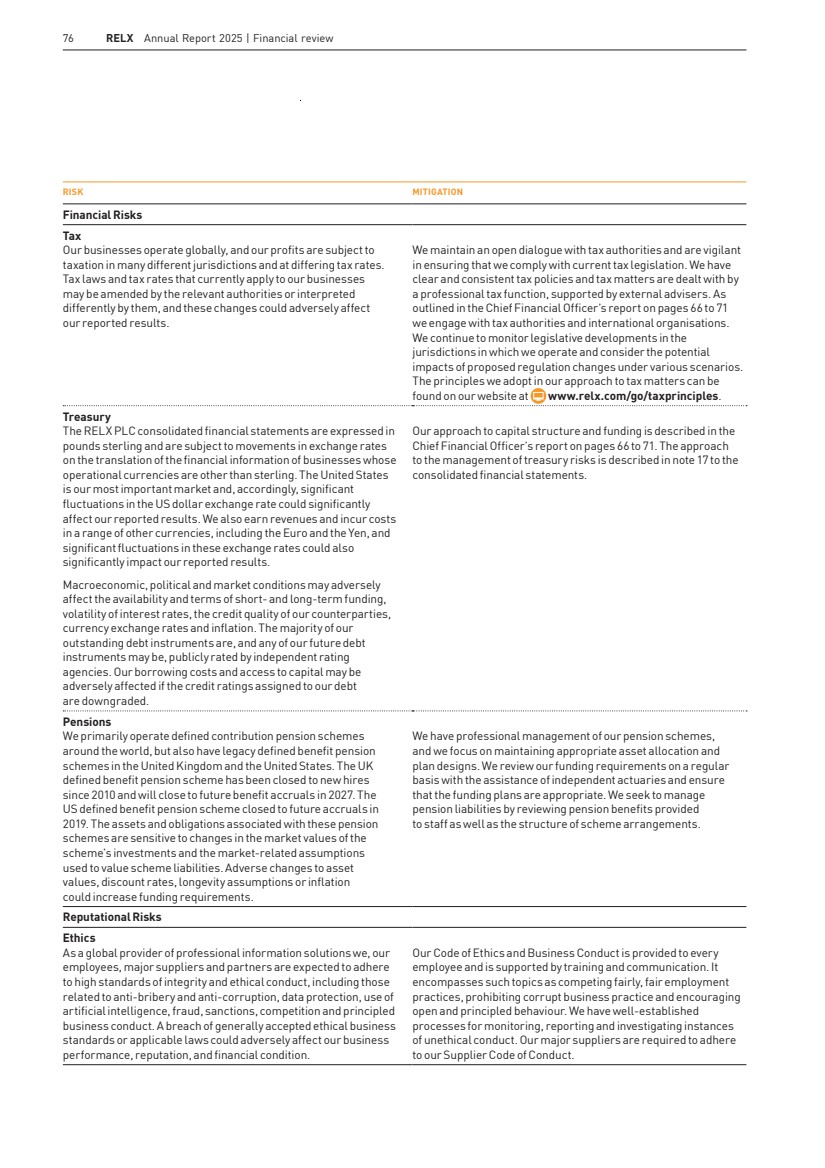
| RELX Annual Report 2025 | Principal and emerging risks 77 Viability statement The UK Corporate Governance Code requires Directors to assess the viability of the Group over an appropriate period of time. The Directors have made the assessment that given the nature of the Group’s business with a high proportion of recurring revenue, a typical contract length of three years in many of its subscription agreements and a balanced debt maturity profile, a viability period of three years, aligned with the Group’s annual strategy plan, is suitable to assess the risks outlined on pages 72 to 76. Assessing the Group’s Prospects The Group develops information-based analytics and decision tools for professional and business customers in the Risk, Scientific, Technical & Medical (STM), Legal and Exhibitions sectors. The Market Segments section describes each area’s business model, strategic priorities, market opportunities and competition, showing how the Group is positioned to create value for shareholders over the longer term. The Group’s prospects are assessed annually through the strategic planning process which includes a review of assumptions made and an assessment of each business area’s longer-term plan. The resulting three-year strategy plan forms the basis for Group and divisional targets and in-year budgets. Objectives are set with consideration given to the economic and regulatory environment, and to customer trends, as well as incorporating risks and opportunities. The most recent three-year strategy business plan was agreed by the Directors in September 2025 and updated in February 2026. Separate from the annual strategy plan, the Directors periodically receive updates from business area management on their operations, prospects and risks. Whilst these reviews and discussions naturally focus more closely on the more immediate risks facing the business within the three-year strategy planning period, they also cover the risks described in the principal risks section on pages 72 to 76. Assessing the Group’s Viability The three-year strategy plan for our business areas includes management’s assessment of the anticipated operational risks affecting the business. Management then considered the viability of the business in various downside scenarios, the most severe of which assumes the simultaneous occurrence ofCybersecurity, Intellectual property rights and Face-to-face events risks resulting in a decline of around 30% in adjusted operating profit in each of 2026 to 2028, and the closure of the debt capital markets preventing the refinancing of scheduled liabilities. The Group’s undrawn $3.5bn revolving credit facility was recently refinanced (and increased in size from the previous $3bn facility) and has an earliest maturity date of November 2030. The resulting analysis, which assumed no share buybacks, modest acquisition activity and a growing dividend, determined that the Group would have sufficient liquidity to refinance all maturing term debt. We remain focused on successfully pursuing our strategic priority of organically developing increasingly sophisticated information-based analytics and decision tools that deliver enhanced value to our customers, supplemented by selective acquisitions that support our organic growth. We believe the combination of compelling structural opportunities combined with an appropriate capital structure will continue to drive long-term value. Based on this assessment and the scenario modelling that shows sufficient liquidity even with the simultaneous occurrence of principal risks and the closure of the debt capital markets, the Directors confirm that they have a reasonable expectation that the Group will be able to continue its operations and meet its liabilities as they fall due over the next three years and are not aware of any longer-term operational or strategic risks that would result in a different outcome from the three-year review. Going concern The Directors have adopted the going concern basis in preparing these accounts after assessing the potential impact on the business of the principal risks over the 18 months to 30 June 2027 and during the longer period over which the Group’s viability has been assessed, as described above. Management forecasts reflect a downside scenario which includes the simultaneous occurrence of principal risks, which combined would reduce adjusted operating profit by around 30%. We have also assumed an inability to access the debt capital markets. Under this scenario, the Group will still have substantial liquidity headroom on its undrawn $3.5bn revolving credit facility (which was recently refinanced and does not contain a financial covenant). Having considered this downside scenario, the Directors believe that the Group is well-positioned to manage its business risks and that adequate resources exist for the Group to continue in operational existence for the foreseeable future. They therefore consider it is appropriate to adopt the going concern basis in preparing the 2025 financial statements. A commentary on the Group’s cash flows, financial position and liquidity for the year ended 31 December 2025 is set out in the Chief Financial Officer’s report on pages 66 to 71. This shows that after taking account of available cash resources and committed bank facilities that back up short-term borrowings, all of the Group’s borrowings that mature in the period to 30 June 2027 can be repaid in full. The Group’s policies on liquidity, capital management and management of risks relating to interest rate,foreign exchange and credit exposures are set out on pages 169 to 175. The principal risks facing the Group are set out on pages 72 to 76. Market segments Governance and other information Financial statements Financial review Corporate responsibility Overview |
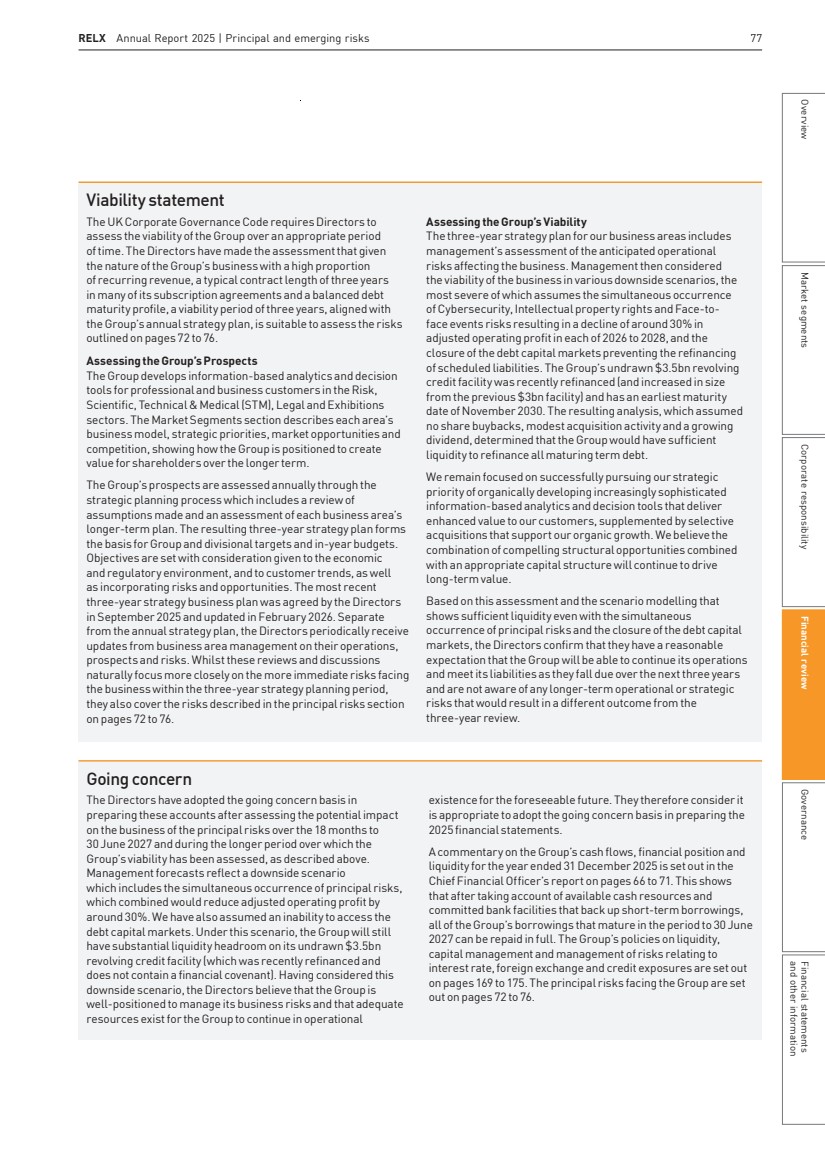
| 78 RELX Annual Report 2025 | Financial review Non-financial and sustainability information statement RELX is required to comply with the reporting requirements ofSections 414CA and 414CB of the Companies Act 2006, which relate to non-financial and sustainability information. The list below outlines where this information can be found: Reporting requirement: Environmental matters 59-63, 235-240 Employees 49-51 Social matters 38-41 Human rights 38-41, 49-51, 56-58 Anti-corruption and anti-bribery matters 42-45, 56-58 Policies, due diligence processes and outcomes 42-45, 56-58 Description and management of principal and emerging risks and impact of business activity 72-77 Description of business model 4-7 Non-financial metrics 36 Climate-related financial information 235-240 Sustainability statement 208-231 Taskforce on Climate-related Financial Disclosure 235-240 Basis of preparation of the Sustainability statement The Sustainability Statement is prepared pursuant to the European Union Corporate Responsibility Directive (CSRD) and in accordance with the requirements of the European Sustainability Reporting Standards and EU Taxonomy disclosure requirements adopted by the European Commission. Directors’ duties and Section 172 Statement The Directors of RELX PLC – and those of all UK companies – mustact in accordance with their duties under the CompaniesAct 2006 (the Act). These include a fundamental duty to promote the success of the Company for the benefit of its members as a whole. The Board of RELX PLC, and its individual Directors, consider that they have done so for the year ending 31December 2025. Details of how the Board and its Directors have fulfilled these duties can be found throughout this 2025 Report, and therefore the following sections have been incorporated by reference into this Section 172 Statement and, where necessary, the RELX 2025 Strategic Report: Business model and strategy 4-7 Corporate responsibility report 35-63 Principal risks 72-77 Culture and workforce policies 85-96 Board decision-making 85-96 Stakeholder engagement 85-96 Section 172 of the Act requires the Directors to have regard to, among other matters, the interests of the company’s stakeholders in working to promote the success of the company. The Board recognises the importance of building and maintaining sound relationships with RELX’s key stakeholders in order to achieve its business aims. Among the Group’s many and varied stakeholders, the Board has identified investors, employees, customers, suppliers and the communities in which we operate, as the company’s key stakeholders. Given its size, diversity and global business, stakeholder engagement takes place at alllevels across the Group. To ensure adequate visibility of key stakeholder views, the Board received a detailed overview in the year covering engagement channels and activities the Company has with each of its key stakeholders. The Strategic Report, as set out on pages 2 to 78 has been approved by the Board of RELX PLC. By order of the Board Registered Office Henry Udow 1-3 Strand Company Secretary London 11 February 2026 WC2N 5JR |
| 79 In this section 80 Board directors 82 RELX senior executives 84 Chair’s introduction to corporate governance 85 Corporate governance review 97 Report of the Nominations Committee 100 Directors’ remuneration report 121 Report of the Audit Committee 125 Directors’ report Governance Market segments Governance and other information Financial statements Financial review Corporate responsibility Overview RELX Annual Report 2025 |
| 80 RELX Annual Report 2025 | Governance Board Directors Executive directors Erik Engstrom (62) Chief Executive Officer Appointed: Chief Executive Officer of RELX since November 2009. Joined as Chief Executive Officer of Elsevier in 2004. Past appointments: Prior to joining was a partner at General Atlantic Partners. Before that was President and Chief Operating Officer of Random House Inc and President and Chief Executive Officer of Bantam Doubleday Dell, North America. Began his career as a consultant with McKinsey. Formerly a Non-Executive Director of Smith &Nephew plc. Education: Holds a BSc from Stockholm School ofEconomics, an MSc from the Royal Institute of Technology in Stockholm, and gained an MBA from Harvard Business School as a Fulbright Scholar. Nationality: Swedish Nick Luff (58) Chief Financial Officer Appointed: September 2014 Other appointments: Non-Executive Director and Audit Committee Chair of Rolls-Royce Holdings plc Past appointments: Prior to joining the Group was Group Finance Director of Centrica plc from 2007. Before that was Chief Financial Officer at The Peninsular & Oriental Steam Navigation Company (P&O) and its affiliated companies. Began his career as an accountant with KPMG. Formerly aNon-Executive Director of QinetiQ Group plc andLloyds Banking Group plc. Education: Has a degree in Mathematics from University of Oxford and is a qualified UK CharteredAccountant. Nationality: British Non-Executive directors Paul Walker (68) R N C Chair Appointed: March 2021 Other appointments: Chair of Ashtead Group plc Past appointments: Chair of Halma plc and Chief Executive Officer and Chief Financial Officer ofSage Group plc. Non-Executive Director of Experian plc, Diageo plc, Sophos Group plc and Mytravel Group plc. Education: Has a degree in Economics from YorkUniversity, and is a qualified UK CharteredAccountant. Nationality: British Alistair Cox (64) A R C Non-Executive Director; Independent Appointed: April 2023 Past appointments: Served as Chief Executive of Hays plc from 2007 to 2023 and as Chief Executive of Xansa plc from 2002 to 2007. Was previously the Group Strategy Director and Regional Director for Asia Pacific at Blue Circle Industries plc, prior to which worked as a consultant for McKinsey and held various engineering, management and research science roles at Schlumberger Wireline Services and BAE Systems plc. Formerly a Non-Executive Director of Just Eat plc and 3i Group plc. Nationality: British Suzanne Wood (65) A N C R Non-Executive Director; Independent, Senior Independent Director Appointed: September 2017 Other appointments: Non-Executive Director ofFerguson plc Past appointments: Served as Non-Executive Director of H&E Equipment Services Inc. from 2023 to 2025, Senior Vice President and Chief Financial Officer of Vulcan Materials Company from 2018 to 2022, Group Finance Director of Ashtead Group plc from 2012 to 2018, and Chief Financial Officer of Ashtead Group’s largest subsidiary, Sunbelt Rentals Inc, from 2003 to 2012. Previously, also served as Chief Financial Officer of two US publicly listed companies, Oakwood Homes Corporation and TultexCorporation. Nationality: American June Felix (69) A R C Non-Executive Director; Independent Appointed: October 2020 Other appointments: Non-Executive Director ofIron Mountain Incorporated and Hiscox Ltd. Member of the Advisory Board of the London Technology Club Past appointments: Served as a Non-Executive Director of IG Group Holdings plc from 2015 until the time of her appointment as Chief Executive Officer, a position she held from 2018 to 2023. Previously held various executive management positions at a number oflarge multinational businesses in Hong Kong, London and New York, including Verifone, IBM, Citibank and Chase Manhattan. Earlier in her career, was a strategy consultant with Booz AllenHamilton. Nationality: American |

| RELX Annual Report 2025 | Board Directors 81 Andy Halford (66) A C Non-Executive Director; Independent Appointed: April 2025 Other appointments: Chief Financial Officer of Aareal Bank AG and Non-Executive Director of UK Government Investments Limited Past appointments: Served as Chief Financial Officer of Standard Chartered plc from 2014 to 2024, Chief Financial Officer of Vodafone Group plc from 2005 to 2014, and Chief Financial Officer of Verizon Wireless from 2002 to 2005. Previously held senior executive and financial roles at Vodafone and East Midlands Electricity plc. Served as a Non-Executive Director and Audit Committee Chair of Marks and Spencer Group plc from 2013 to 2022 and was appointed as Senior Independent Director of that board in 2018. Chaired The 100 Group of Finance Directors from 2011 to 2012. Nationality: British Charlotte Hogg (55) A C Non-Executive Director; Independent Appointed: December2019 Other appointments: Chief Executive Officer of Alter Domus Past appointments: Executive Vice President and Chief Executive Officer for the European Region of Visa Inc. from 2017 to 2025. Previously was Chief Operating Officer at theBank of England, Head of Retail Banking for Santander UK, Managing Director UK and Ireland for Experian plc, and held senior roles at Morgan Stanley in New York and London. Nationality: British, American and Irish Bianca Tetteroo (56) C Non-Executive Director; Independent, Workforce Engagement Director Appointed: July 2024 Other appointments: Chief Executive Officer andChair of the Executive Board of Achmea BV Past appointments: Served with Achmea BV for 12 years in a variety of senior executive and financial roles prior to taking up the role of Chief Executive Officer in 2021. Previously spent 13 years with the Fortis Group, working across multiple business lines including banking, insurance and investments. Qualified as a Chartered Accountant at Fortis, prior to which she worked at international accountancy firm, Mazars. Nationality: Dutch Andrew Sukawaty (70) A N C Non-Executive Director; Independent Appointed: April 2019 Other appointments: Director of Hg Capital LLP and Cobuilder. Founding Partner ofCorten Capital Past appointments: Served as the Chair ofInmarsat from 2003 to 2023, and a Director of Viasat from 2023 to 2025 following Viasat’s acquisition of Inmarsat. Served as Senior Independent Director of Sky plc from 2013 to 2018. Previously also served as Chair of Ziggo NV, XyratexGroup Ltd and Telenet Group holdings NV; deputy Chair of O2 plc; Non-Executive Director of Telefonica Europe following its acquisition of O2 plc and Powerwave Technologies Inc; and Chief Executive of Inmarsat plc, Sprint Inc. and NTLGroup Ltd. Nationality: American Board Committee membership key A Audit Committee N Nominations Committee C Corporate Governance Committee R Remuneration Committee Committee Chair Market segments Governance and other information Financial statements Financial review Corporate responsibility Overview |
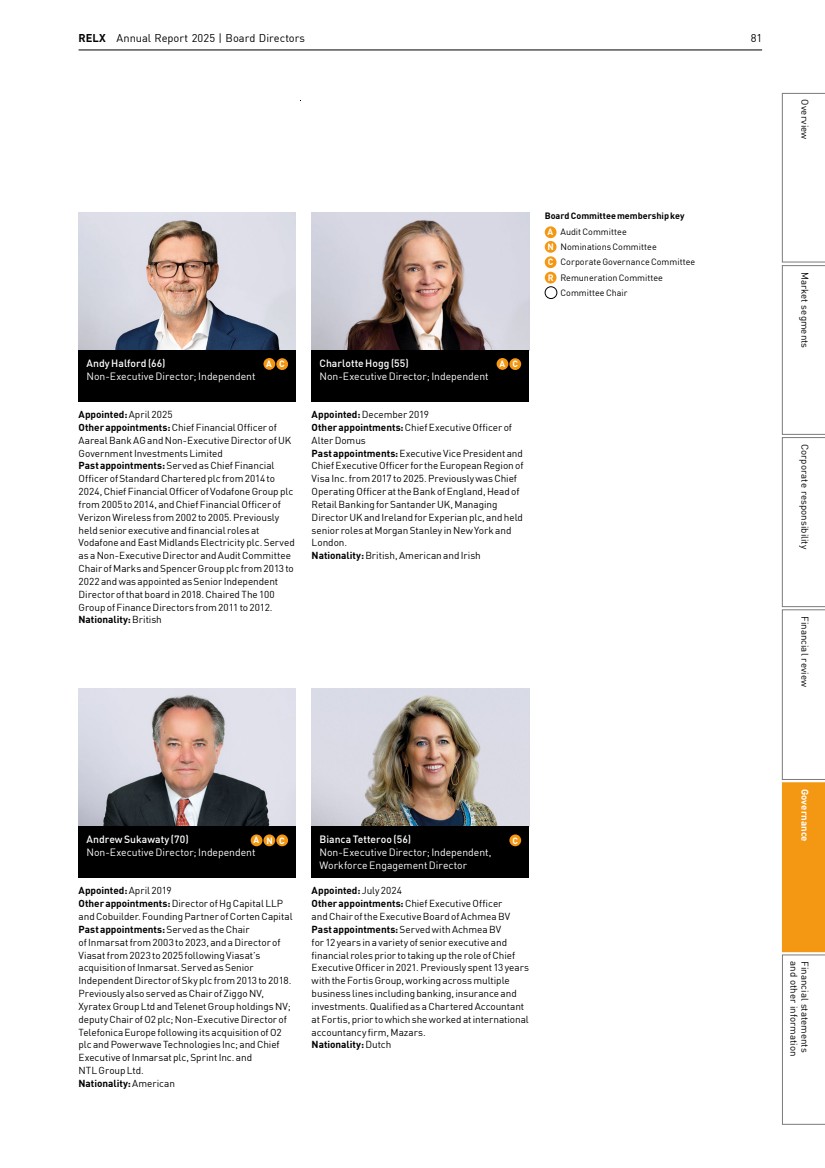
| 82 RELX Annual Report 2025 | Governance RELX Senior Executives Mark Kelsey Chief Executive Officer Risk Kumsal Bayazit Chief Executive Officer Scientific, Technical & Medical Mike Walsh Chief Executive Officer Legal Hugh M Jones IV Chief Executive Officer Exhibitions Joined in 1983. Appointed to current position in 2012. Joined in 2004. Appointed to current position in 2019. Joined in 2003. Appointed to current position in 2011. Joined in 2011. Appointed to current position in 2020. Has held a number of senior positions across the Group over the past 40 years. Previously Chief Operating Officer and then Chief Executive Officer of Reed Business Information. Studied at Liverpool University and received his MBA from Bradford University. Previously President, Exhibitions Europe, Chief Strategy Officer, RELX, Chair, RELX Technology Forum and Executive Vice President of Global Strategy and Business Development for LexisNexis. Prior to that worked with Bain & Company in New York, Los Angeles, Johannesburg and Sydney. Holds an MBA from Harvard Business School and is a graduate of the University of California at Berkeley. Previously CEO of LexisNexis US Legal Markets and Director of Strategic Business Development Home Depot. Prior to that was a practising attorney at Weil, Gotshal and Manges in Washington DC and served as a consultant with TheBoston Consulting Group. Holds a Juris Doctor degree from Harvard Law School and is a graduate of Yale University. Previously Group Managing Director, Accuity, ICIS, Cirium, and EG within Risk. Prior to that was Chief Executive Officer, Accuity. Holds an MBA from the Ross School of Business at the University of Michigan and is a graduate of Yale University. |
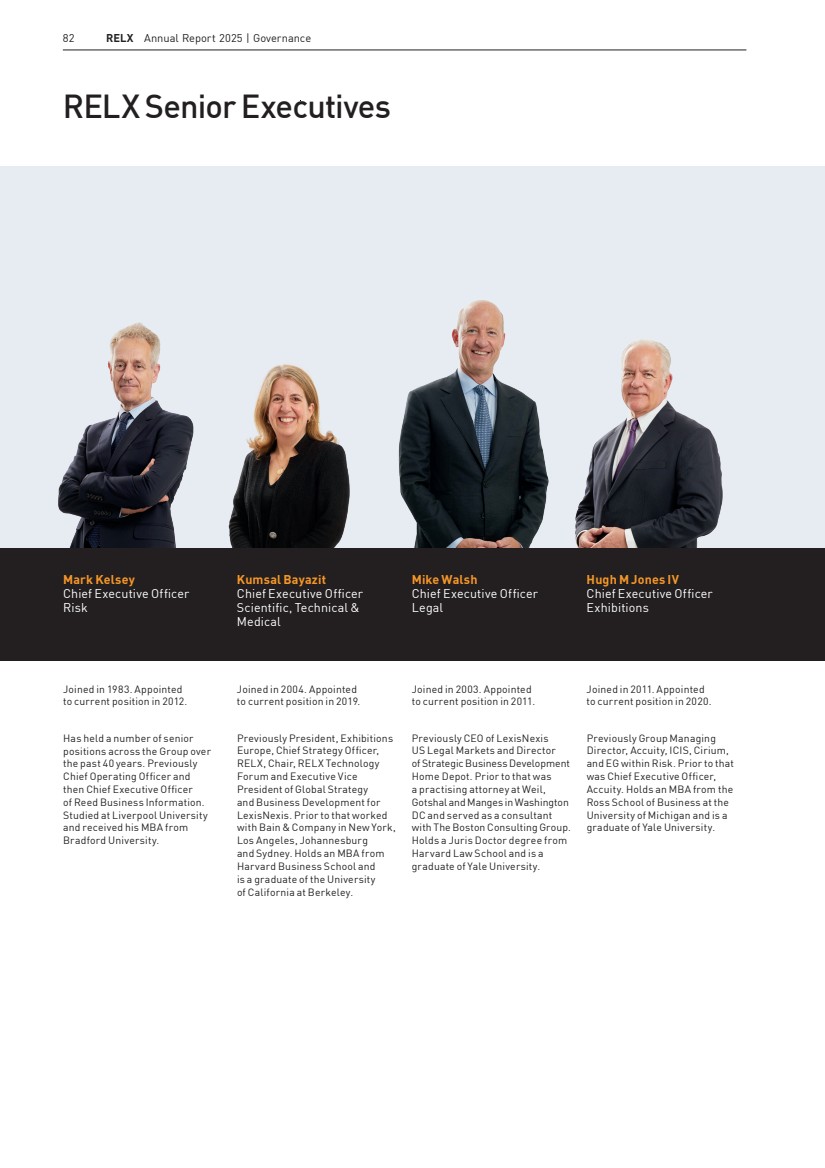
| RELX Annual Report 2025 | RELX Senior Executives 83 Rose Thomson Chief Human Resources Officer Vijay Raghavan Chair, RELX Technology Forum and Chief Technology Officer, Risk Henry Udow Chief Legal Officer and Company Secretary Youngsuk ‘YS’ Chi Director of RELX Corporate Affairs and Chair, Elsevier Shweta Vyas Chief Strategy Officer Joined in 2021. Appointed to current position at that time. Joined in 2002. Appointed to current position in 2019. Joined in 2011. Appointed to current position at that time. Joined in 2005. Appointed to current position in 2011. Joined in 2010. Appointed to current position in 2025. Previously Chief Human Resources Officer at Standard Life Aberdeen. Before that, held various senior human resources roles at Travelport International, Barclays Bank, The Coca-Cola Company, Coles Group and The Walt Disney Company. Holds an MA in business management from Macquarie University Graduate School of Management and a BA in Psychology, Macquarie University. Previously Vice President of Technology, LexisNexis Insurance Solutions. Prior technology executive positions at ChoicePoint, Paragon Solutions, Primus Knowledge Solutions, and McKesson. Holds a bachelor’s degree in electrical and electronics engineering from the Birla Institute of Technology and Science, Pilani, a master’s degree in cybersecurity from the Georgia Institute of Technology, and completed an advanced management program for executives at MIT Sloan School of Management. Previously Chief Legal Officer and Company Secretary of Cadbury plc having spent 23 years working with the company. Prior to that worked at Shearman & Sterling in New York and London. Holds a Juris Doctor degree from the University of Michigan Law School and a bachelor’s degree from the University of Rochester. Previously was President andChiefOperating Officer ofRandom House, founding Chairman of Random House Asia and Chief Operating Officer for Ingram Book Group. Holds an MBA from Columbia University and is a graduate of Princeton University. Previously Chief Strategy Officer at Risk. Prior to that held various strategy and commercial roles at Risk. Previously worked at LEK and Lucent Technologies. Holds an MBA from the Kellogg School of Business at Northwestern University as well as an MSc in Finance from Babson College and a BA in Economics from Emory University. Market segments Governance and other information Financial statements Financial review Corporate responsibility Overview |
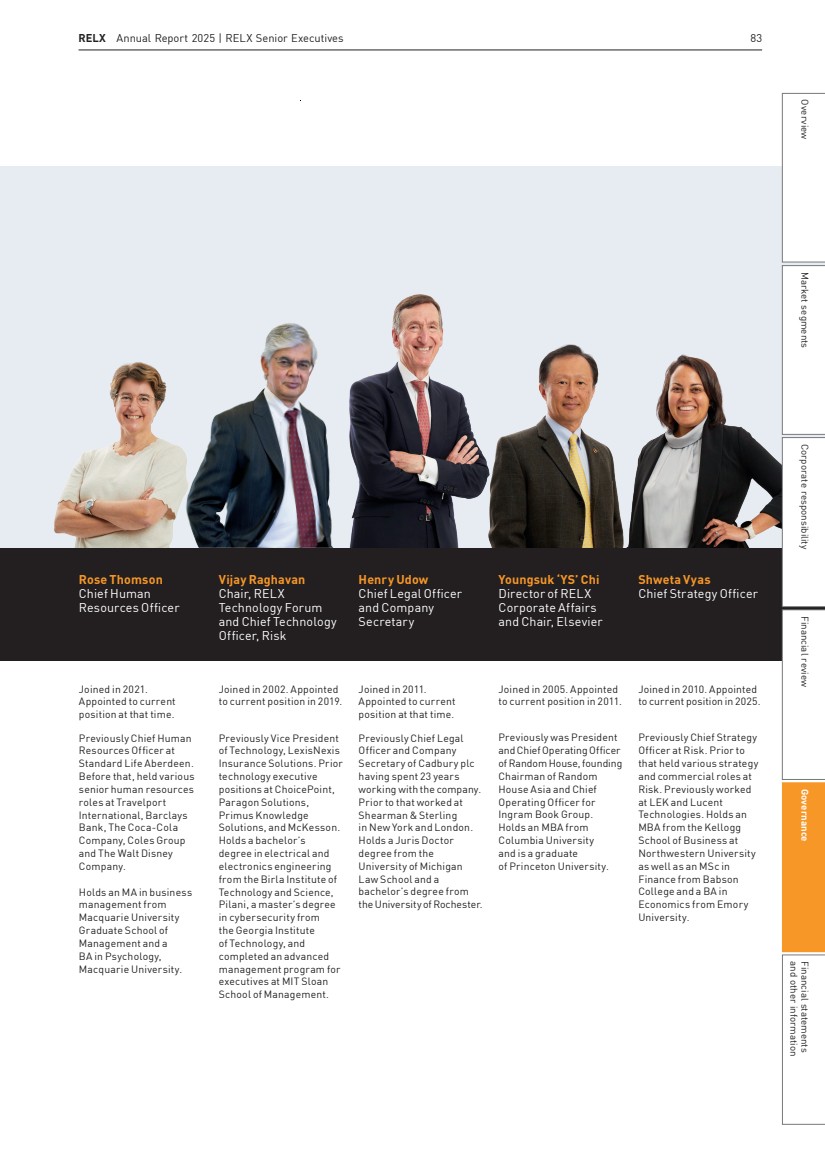
| 84 RELX Annual Report 2025 | Governance Chair’s introduction to corporate governance engagement to ensure we continue to provide products and solutions that meet the evolving needs of our customers and that we continue to effectively support our workforce. We actively listen to our investors, employees, customers, suppliers and the communities that we serve and in which we operate, and we have appropriate mechanisms in place to ensure that the outcomes of such engagement are available to the Board. Information about our approach to stakeholder engagement is on pages 91 to 94. Remuneration Policy Our proposed Directors’ Remuneration Policy which is intended to apply for the coming three years, will be put to shareholders for approval at the 2026 AGM. The current policy, adopted at the 2023 AGM, and subsequent annual remuneration reports received strong support from shareholders and in preparing the proposed policy we engaged with shareholders representing approximately 55% of our share capital. The Board believes that the overall remuneration structure remains appropriate. The specific changes proposed to the policy, along with the full policy and details of the implementation of the current policy during the year, can be found in the Directors’ Remuneration Report on pages 100 to 120. Regulatory developments On 1 January 2026, the revisions to Provision 29 of the UK Corporate Governance Code 2024 (the Code), which relates to a company’s internal control environment and the Board’s role in monitoring, reviewing and declaring its effectiveness in the Annual Report, came into force. Throughout the year, the Audit Committee and the Board has been updated on enhancements being made to the risk management and internal control framework and the assurance that will be obtained to support theBoard’s declaration of effectiveness of internal controls that will be required in respect of the financial year beginning on 1 January 2026. For further details, refer to page 123. In the UK, the new corporate criminal offence of Failure to Prevent Fraud under the Economic Crime and Corporate Transparency Act 2023 came into effect on 1 September 2025. In compliance with this new legislation, RELX has enhanced its existing fraud prevention and detection processes and procedures, and updated its framework for mitigating fraud risk (the Framework). The Audit Committee reviewed the revised Framework and concluded that it is satisfied that there are appropriate procedures in place to prevent and detect fraud. For further details, refer to page 123. Board performance As Chair, I am responsible for ensuring that the Board operates effectively, and that the Board, its Committees and each individual Director are evaluated on an annual basis. For 2025, an internal evaluation process was carried out. The outcome of the evaluation confirmed that all of our Directors contribute effectively and continue to demonstrate commitment to their roles, and that the Board and its Committees continue to operate effectively. The evaluation process and its outcomes are described on page 95. Paul Walker Chair 11 February 2026 Effective governance is fundamental to RELX’s culture of acting with integrity in all that we do, and it supports the Company’s purpose to benefit society through its unique contributions Introduction On behalf of the Board, I am pleased to introduce our Corporate Governance Review for the year ended 31 December 2025. Together with the reports of the Audit, Nominations and Remuneration Committees, our Corporate Governance Review sets out our approach to effective governance and demonstrates how we have complied with the 2024 UK Corporate Governance Code (the Code) further information on which is set out on page 87. Corporate governance The Board is responsible for overseeing the effectiveness of RELX’s governance framework. Our approach to corporate governance is structured, disciplined and dynamic. Our governance framework clearly define responsibilities and accountabilities. This enables RELX’s leadership to focus on the key issues facing the business and to apply their expertise where most needed. Effective governance, and the policies and practices that support it, is fundamental to RELX’s culture of acting with integrity in all that we do, and it supports the Company’s purpose tobenefit society through its unique contributions (as set out on pages 38 to 41). The Board believes that attaining the highest levels of corporate responsibility helps enable excellent financial performance. We believe that pursuing both goals in tandem will result in long-term sustainable shareholder value creation and will also provide our stakeholders with confidence that the governance of RELX is appropriate for its size and profile as a listed company, helps manage risks and opportunities, and ensures that key stakeholders are appropriately considered in the decisions that we make. Board changes and succession planning There have been several changes to the composition of our Board and Committees during the year. Robert MacLeod retired from the Board at the conclusion of the Company’s AGM in April 2025, having joined the RELX PLC Board in 2016. Since 2023, he served as Chair of the Remuneration Committee. On behalf of the Board, I would like to thank Mr MacLeod for his valued contributions to the Board, to the Committees on which he served and for serving as Chair of the Remuneration Committee. Alistair Cox has succeeded Mr MacLeod as Chair of the Remuneration Committee following the conclusion of the Company’s AGM in April 2025. As announced on 13 February 2025, Andy Halford joined the Board as a Non-Executive Director, with effect from the conclusion of the 2025 AGM. Mr Halford was appointed to the Audit Committee with effect from the same date. Further information about our Board appointment process is available in our Nominations Committee Report on page 99. Stakeholder engagement and Board decision-making The views and interests of RELX’s stakeholders are a key element of the Board’s decision-making process. We are focused on ensuring that the interests of our stakeholders are duly taken into account during Board discussions. Across RELX we engage with our stakeholders throughout the year, and we rely on this |
| RELX Annual Report 2025 | Corporate Governance Review 85 There is a clearly defined schedule of matters over which the Board retains responsibility and endorses all final decisions, which is available to view at www.relx.com. Such matters include: § Approval of RELX’s strategy and annual budget and changes to the corporate or capital structure of the Company § Approval of RELX’s risk appetite, oversight of risk management framework including principal and emerging risks, fraud risk and internal control systems § Corporate governance arrangements, including Board and Committee composition and terms of reference § Approval of key policies, including RELX’s Code of Ethics and Business Conduct (the Code), Operating and Governance Principles, Tax and Dividend Policies and Inclusion Policies § Approval of the Company’s Annual Report and periodic financial statements and trading updates § Oversight of the Code reporting channels for our workforce to raise concerns, and ensuring workplace policies and practices align with the Company’s values and intended culture § Oversight of RELX’s corporate responsibility activities and its reporting thereon § Other matters deemed material to the delivery of RELX’s strategy or future financial performance, such as approval of material acquisitions, major capital expenditure and investments Corporate governance review The Board The Board determines RELX’s purpose and values and sets and oversees delivery of its strategic aims and objectives for long-term, sustainable success. The Board monitors and oversees RELX’s governance, risk management and internal controls processes and culture. Board leadership The Board is responsible for promoting the long-term sustainable success of the Company. To ensure the Board operates effectively and efficiently it has established four principal Committees to provide focused oversight, each with delegated authority to oversee and report to the Board on material and relevant matters, as appropriate. The roles and responsibilities of each Committee are set out in their individual terms of reference which are available on the Company’s website www.relx.com. A summary of the Committees’ key responsibilities is set out below. Audit Committee Reviews and monitors the integrity of financial reporting, internal control and risk management systems, the effectiveness of the internal audit process and the performance, independence and effectiveness of the external auditor. The Committee comprises only independent Non-Executive Directors. Remuneration Committee Determines, monitors and oversees the implementation of RELX’s remuneration policy for the CEO, CFO, the Chair, and Senior Executives below Board level. The Committee reviews the ongoing appropriateness ofthe remuneration policy. The Committee comprises only the Chair and Non-Executive Directors. Nominations Committee Keeps under review the composition of the Board and its Committees; ensures orderly succession plans are in place for the Board and senior management and ensures an appropriate and inclusive pipeline for such succession; and oversees the recruitment ofnew Directors. The Committee comprises only the Chair and Non-Executive Directors. Corporate Governance Committee Responsible for developing andrecommending corporate governance principles to the Board; reviewing ongoing developments and best practice in corporate governance, and monitoring the structure and operation of the Board Committees. The Committee comprises only the Chair and Non-Executive Directors. Further information about the work of the Audit Committee is in its report on pages 121 to 124 The Directors’ Remuneration Report isset out on pages 100 to120 Further information about the work of the Nominations Committee isin its report on pages 97 to 99 RELX Senior Executives To enable efficient day-to-day management of RELX’s business areas, there is a structure of delegated authorities in place from the Board to the Chief Executive Officer, the Chief Financial Officer and a team of Senior Executives (shown on pages 80 to 83). This delegated authority framework, which is reviewed and approved by the Board each year, allows the necessary operational and management decisions to be taken by the right people, at the appropriate time to execute the Company’s strategy. There are appropriate controls in place to ensure such decisions remain consistent with the risk appetite, policies and objectives established by the Board. Our governance framework Matters reserved to the Board Market segments Governance and other information Financial statements Financial review Corporate responsibility Overview |
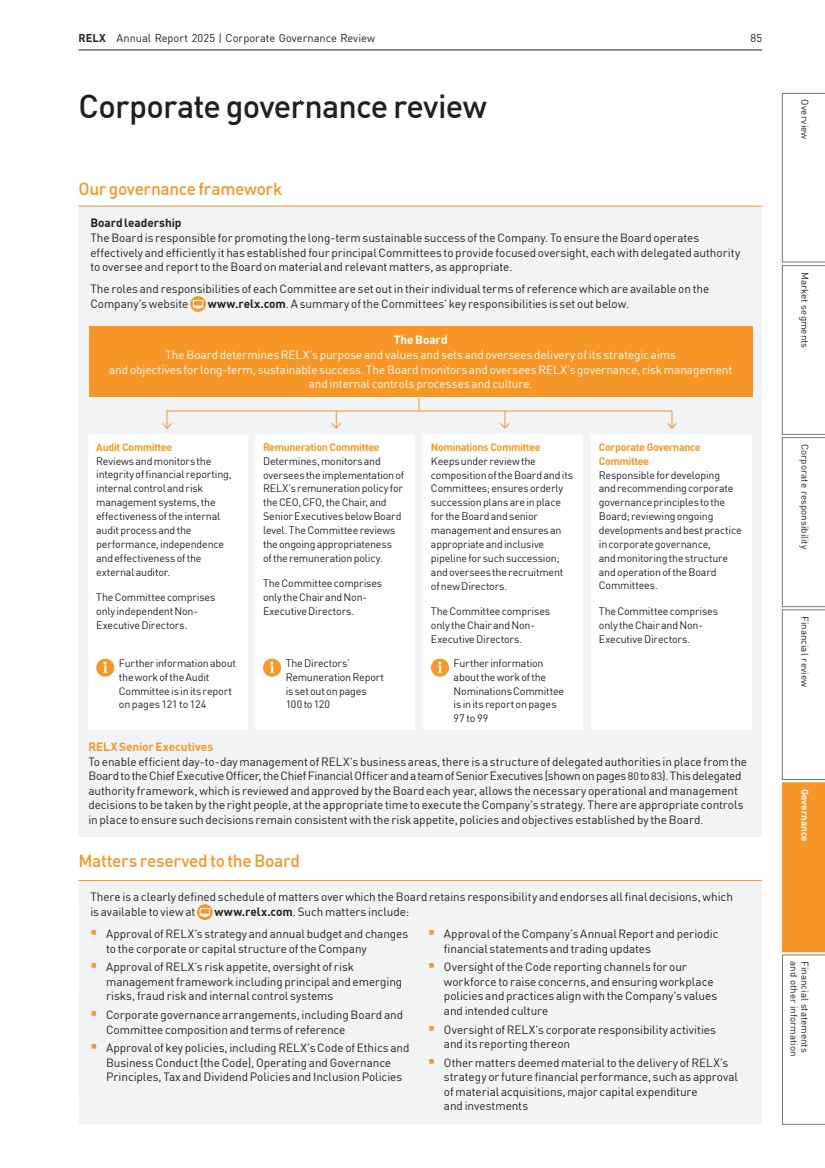
| 86 RELX Annual Report 2025 | Governance Board roles As at the date of this report, the Board comprised the Chair, two Executive Directors and seven Non-Executive Directors, who bring a wide range of skills, experience, industry expertise and professional knowledge to their roles. An overview of the gender balance, length of tenure and nationalities on the Board is provided in the Nominations Committee Report on pages 97 to 99. Division of responsibilities There is clear separation of the roles of the Chair, who leads the Board, and the Chief Executive Officer, who is responsible for the day-to-day management of RELX. The key responsibilities of each of the director roles on the Board is summarised below. Chair § Leadership of the Board and ensure its overall effectiveness § Ensures that all Directors are sufficiently apprised of matters to make informed judgements, through the provision of accurate, timely and clear information § Promotes high standards of corporate governance, demonstrates objective judgement and promotes a culture of openness and debate § Sets the agenda and chairs meetings of the Board § Chairs the Nominations and Corporate Governance Committees § Facilitates constructive Board relations and the effective contribution of all Directors § Ensures effective dialogue with shareholders § Ensures the performance of the Board, its Committees and individual Directors is assessed annually § Ensures effective induction and development of Directors Chief Executive Officer § Day-to-day management of RELX, within the delegated authority limits set by the Board § Develops RELX’s strategy for consideration and approval by theBoard § Ensures that the decisions of the Board are implemented § Consults with the Chair and Nominations Committee on executive succession planning § Leads communication with shareholders § Promotes and conducts the affairs of the Company with the highest standards of integrity, probity and corporate governance Chief Financial Officer § Day-to-day management of RELX’s financial affairs § Responsible for RELX’s financial planning, reporting and analysis § Ensures that a robust system of internal control and risk management is in place § Maintains high-quality reporting of financial and environmental performance internally and externally § Supports the Chief Executive Officer in developing and implementing strategy Senior Independent Director § Leads the Board’s annual assessment of the performance of the Chair § Available to meet with shareholders on matters where usual channels are deemed inappropriate § Deputises for the Chair, as necessary § Serves as a sounding board for the Chair and acts as an intermediary between the other Directors, when necessary Non-Executive Directors § Bring external perspectives and a broad range of experience to the Board § Provide constructive challenge and input to the development of strategy § Scrutinise the performance of management in meeting agreed goals and monitor the delivery of RELX’s strategy § Serve as members of Board Committees as required and Chair the Audit and Remuneration Committees Governance structure RELX’s corporate governance framework consists of leadership bodies and well-documented comprehensive processes and procedures which ensure that RELX is appropriately directed, led and controlled at all levels, with appropriate oversight and involvement by the Board and senior management. It is designed to safeguard and enhance the creation of long-term, sustainable shareholder value and to enable our business areas to operate with the required agility and flexibility to address the needs of our customers effectively, while taking into account all applicable statutory and regulatory requirements. The rights, responsibilities and accountabilities of those who work for and on behalf of RELX are clearly established through delegated authorities, corporate policies and codes of ethics and conduct, which promote the protection of RELX’s reputation and our commitment to acting with integrity in all that we do. The RELX Operating and Governance Principles set out the processes, policies, controls and related assurance activities that have been put in place to mitigate risk, covering key functions and operations of the Group. The Principles serve as a first point of reference for management and provide our workforce with a clear overview of the policies and practices with which they must comply. The Principles are reviewed biennially by the Board and are updated as required. The Code of Ethics and Business Conduct sets out the core principles and standards of professional conduct by which RELX operates and provides a framework for building and maintaining the desired culture of RELX. The Code provides all those who work for RELX with clear guidelines for how to conduct themselves in the workplace and across our broader operating environments, to inspire trust among all our stakeholders and to demonstrate commitment to our core value of ‘Do the Right Thing’. There are mechanisms in place to help our workforce to understand and comply with their obligations under the Code, which include ongoing training and established communication channels to ask questions and report concerns. We endeavour to ensure that our workplace policies are user-friendly, clear and accessible. The Code is reviewed and approved by the Board triennially and is available at www.relx.com. Internal control and risk management arrangements are a central part of our governance framework. These are monitored by the Audit Committee and overseen by theBoard (further information is on pages 96 and 121 to 124). |
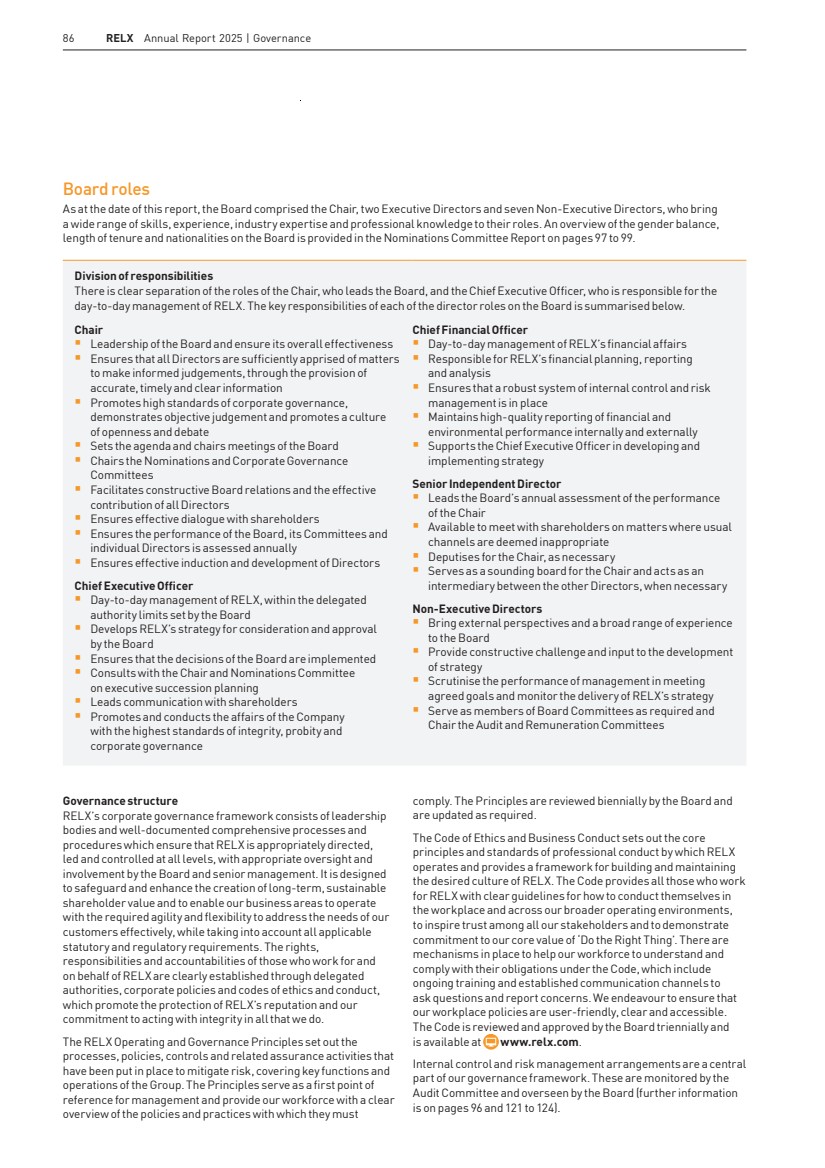
| RELX Annual Report 2025 | Corporate Governance Review 87 Compliance with the UK Corporate Governance Code RELX PLC applies the principles and provisions of the 2024 UK Corporate Governance Code (the UK Governance Code), a copy of which is available on the FRC’s website, www.frc.org.uk. For the year ended 31 December 2025, the Board considers that the Company fully complied with the principles and provisions of the UK Governance Code that are applicable at the date of this report. 1. Board Leadership and Company Purpose Page(s) A. Effective Board 80-81, 85-87 B. Purpose, values and culture 88 C. Governance framework 85 D. Stakeholder engagement 91-94 E. Workforce policies and practices 49-51 2. Division of Responsibilities F. Role of Chairman 86 G. Independence 80-81, 91 H. External commitments and conflicts ofinterest 80-81, 91, 99 I. Board resources 87 3. Composition, Succession and Evaluation J. Appointment to the Board 97-99 K. Board skills, experience and knowledge 80-81 L. Board Evaluation 95 4. Audit, Risk and Internal Control M. External Auditor and Internal Auditor 124 N. Fair, balanced and understandable review 123 O. Internal financial controls and risk management 96, 123 5. Remuneration P. Alignment with strategy and purpose 100-120 Q. Developing policy on remuneration 100-101, 114-120 R. Remuneration outcomes 102-106 Board programme The Board met formally seven times during the year. Five meetings were held in person, in London and in New York. Through a structured programme of scheduled meetings, the Board oversees RELX’s financial performance and ensures its systems of risk management, internal control and corporate governance are fit for purpose and effectively underpin the delivery of its strategy. There are processes in place to manage the Board’s annual agenda, to ensure that all necessary items are submitted for its consideration at the appropriate time with sufficient supporting information, and to allow the Board adequate time to discuss and challenge strategic or material issues. The Board’s annual programme, and the agendas for the Committees are prepared by their respective Chairs with support from the Company Secretary. Board Committees are principally supported by theChief Executive Officer, Chief Financial Officer, Chief Legal Officer and Company Secretary, and the Chief Human Resources Officer. Other senior managers are invited to attend meetings where appropriate. Boarddiscussions are informed through regular reports and presentations from senior management at Board and Committee meetings, and through deep-dive sessions into individual business areas, topics of strategic relevance, and future developments that may impact RELX. Regular reports are provided, covering business area and overall strategies and financials, along withrelevant regulatory, legislative and governance updates. RELX’s annual strategy review process comprehensively assesses its strategic position and key strategic options, considering opportunities and risks to its future success and the long-term sustainability and viability ofits business model. The Board engaged in a two-day, in-depth strategy session in September. Information and support There are processes in place to ensure that the Board and its Committees receive relevant information at the right time and with the appropriate level of detail to inform decision-making andenable effective monitoring of management’s progress in accordance withagreed strategy. The Directors are provided with papers aheadof all scheduled Board and Committee meetings, containing management updates, relevant context and market information, andother supporting information and reports, asappropriate. All the Directors have access to the advice of the Company Secretary and may also take independent professional advice at the Company’s expense where they deem this to be necessary for the furtherance of their duties to the Company. The Company Secretary advises the Board on all corporate governance matters and ensures that all Board procedures are followed correctly. TheDirectors also have access to other members of RELX’s management, staff and external advisers. Each of the Directors is expected to attend all meetings of the Board and of the Committees of which they are a member. However, in circumstances where a Director is unable to attend ameeting, they are provided with the relevant papers and have theopportunity to discuss any matters arising with the respective Chair and with their fellow Board and Committee members. All Directors are provided with a copy of the minutes of each meeting. Director induction Following appointment, and as required, all Directors receive a full, formal induction, that is tailored to their individual requirements, based on existing knowledge and experience. TheChair and Company Secretary are responsible for ensuring that an effective induction programme takes place for all new Directors. During the year, Andy Halford (appointed in April 2025) was provided with a comprehensive briefing pack including detailed information about each of RELX’s business areas, governance and internal controls, and recent reporting and investor materials, along withaccess to historical Board papers and minutes. To provide a sufficiently in-depth and current understanding of our operations, anumber of meetings were organised with senior management from RELX’s business areas and corporate functions, the external auditors, and individual Executive and Non-Executive Directors. Ongoing development For Directors to effectively discharge their responsibilities, it is important that they regularly refresh and update their skills and knowledge. The Board’s annual programme is designed with this inmind and support the Directors to maintain sufficiently in-depth knowledge of RELX’s business areas and their operations, and to keep apprised of relevant events and changes in RELX’s operating environment and markets. In 2025, the Directors took part in deep-dives into the Legal and Exhibitions business areas, covering financial and operational performance by segment, product development and strategic plans. In addition, the Board conducted areview of the Scientific, Technical & Medical and Risk business areas, as well as specific geographic segments within the Legal business area. The Audit Committee also had a series of technical deep-dive briefing sessions. Further information about the work and activities of the Audit Committee is available in the Audit Committee Report on pages 121 to 124. Market segments Governance and other information Financial statements Financial review Corporate responsibility Overview |
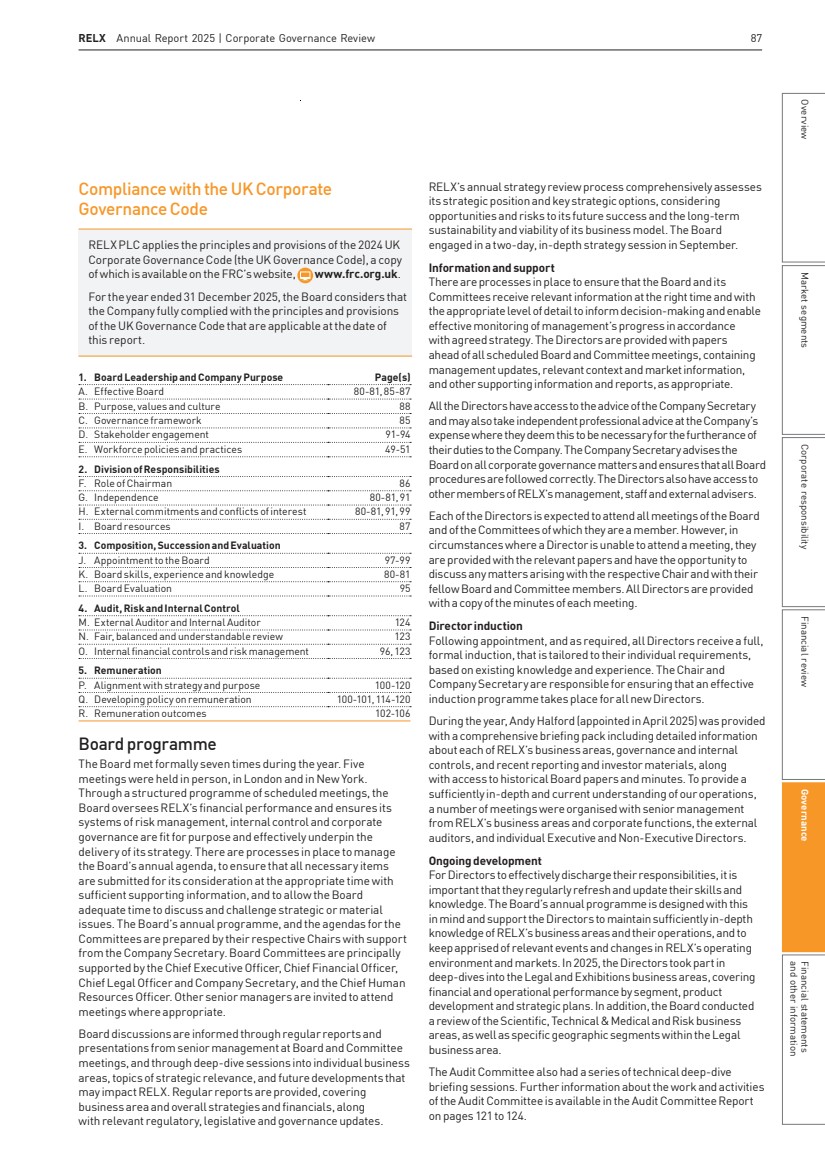
| 88 RELX Annual Report 2025 | Governance Purpose, strategy, values and culture RELX places significant emphasis and importance on the way we do business. We are clear and unequivocal about our commitment to do so with integrity and in accordance with the highest ethical standards. Purpose RELX is a global provider of information-based analytics and decision tools for professional and business customers, enabling them to make better decisions, get better results and be more productive. Our purpose is to benefit society by developing products that help researchers advance scientific knowledge; doctors and nurses improve the lives of patients; lawyers promote the rule of law and achieve justice and fair results for their clients; businesses and governments prevent fraud; consumers access financial services and get fair prices on insurance, and customers learn about markets and complete transactions. Our purpose guides our actions beyond the products that we develop. It defines us as a company. Every day across RELX our employees are inspired to undertake initiatives that make unique contributions to society and the communities in which we operate. Strategy Our number one strategic priority is the organic development ofincreasingly sophisticated information-based analytics and decision tools that deliver enhanced value to professional and business customers. We do this by leveraging deep customer understanding to build innovative solutions which combine leading content and data sets with advanced technologies. We aim to achieve leading positions in long-term global growth markets and leverage our skills, assets and resources across RELX, both to build solutions for our customers and to pursue cost efficiencies. We continue to transform our core business, building out new products, and expanding into higher growth adjacencies and geographies. We are supplementing this organic development with selective acquisitions of targeted data sets and analytics, and assets in high-growth markets that support our organic growth strategies and are natural additions to our existing business. Our improving long-term growth trajectory continues to be driven by the ongoing shift in business mix towards higher growth, technology-enabled analytics and decision tools that deliver enhanced value to our customers for an increasing number of use cases. When combined with continuous process innovation to improve organisational agility and to manage cost growth below revenue growth, the result is continued strong earnings growth with improving returns. Values We strive to do business with integrity. Our principle ‘Do theRight Thing’ embraces behaviours such as being honestin dealing with others, respecting each other, and courageously speaking out for what is right; thereby guiding our commitment to achieve business goals in an open, honest, ethical, and principled way. We ask our suppliers to meet the same standards, and provide support for them to do so as necessary. Culture As a provider of information-based analytics and decision tools, our corporate culture is fact-based, data-driven and analytical. We are transparent and non-political in our decision-making. We seek never-ending performance improvement in everything we do. We are passionate about making a positive impact on society through our unique contributions as a business and our employees feel a strong sense of engagement with the business and its purpose. We focus on improving customer outcomes while emphasising corporate responsibility and acting with integrity.Our culture encourages community engagement, environmental responsibility, inclusion and the well-being of our people. How the Board monitors culture RELX’s standards and values are defined on a group-wide basis, however the Board acknowledges that cultural practices and preferred ways of working can vary across the geographies of our business areas. The Board helps to build the culture of the organisation from the top down, by ensuring that it takes decisions that are aligned with RELX’s values. The Board regularly reviews RELX’s policies and Code of Ethics and Business Conduct (the Code) to ensure the right framework is in place for RELX to operate with integrity, and that its working practices effectively promote a culture of strong engagement with our business and purpose, and with the communities that we serve and in which we operate. We strive to continually improve customer outcomes through a culture that is fact-based, data-driven and analytical. The Board has appointed a Non-Executive Workforce Engagement Director to engage directly with employee representatives from across RELX and to report back to the Board (further information about this engagement is on page 92). This provides the Board with insights into how culture is embedded across RELX’s business areas and functions and any issues that need to be addressed. The views of employees are also measured through annual employee pulse surveys, and a broader triennial opinion survey, designed to gauge how employees feel about the organisation, how well they understand its direction, and their level of satisfaction and engagement with their work. An analysis of the results is presented to the Board. The Board also receives regular updates on culture-related issues and updates on corporate responsibility activities from across each of RELX’s business areas. Such updates include progress against our people objectives in areas such as well-being, pay equity and reducing inequalities through inclusion. This contributes to the Board’s assessment of the culture at RELX and provides a context against which the Board has taken a number of its principal decisions during the year. Through the activities of the Audit Committee, the Board receives updates on alleged and substantiated violations of the Code and significant matters raised through reporting channels, which provide insights into governance and compliance behaviours. |
| RELX Annual Report 2025 | Corporate Governance Review 89 Board activities during the year Purpose and strategy The Company’s purpose, strategy, values and culture statement is on page 88 Read more about RELX’s strategy and business model on pages 5 to 8 § At a two-day strategy session in September, the Board discussed strategic initiatives for RELX and debated RELX’s three-year strategic plan for 2026 to 2028. The Board reviewed RELX’s financial performance, customer markets, shareholder value creation, capital expenditure, potential acquisitions, areas for potential growth across all four business areas, as well as management’s operating plans. The Board determined that RELX’s strategic priority remains focused on organic growth supported by targeted acquisitions, and approved the three-year strategic plan. § In June and September, the Directors attended deep-dive business review sessions into the Legal andExhibitions business areas, led by their respective senior management. These included updates onstrategy and innovations supplemented by presentations from subject matter experts on key products, review of talent resources, and a final session for the Board to provide their feedback to senior management. § In June, the Board conducted a biennial review of the Group’s shared service organisation in the Philippines, which provides support across all RELX business areas globally. The review encompassed strategic priorities, financial performance metrics, ongoing talent development initiatives and outcomes, employee NPS survey results, and attrition rates. These evaluations, along with the deep-dive business review sessions, informed the Board’s broader deliberations regarding RELX’s strategy and business model. § The Board reviewed the proposed reporting changes related to print and print-related activities and determined that reporting these activities separately would improve the transparency of the Company’s disclosures and more accurately reflect the way the business is managed. See page 122 for further information. § The Board conducted reviews of RELX’s invested capital and capital structure during the year, including financial performance, potential and completed acquisitions, net debt, returns on invested capital, credit ratings, forecasts and financial market conditions. These factors were taken into account by the Board when approving the annual budget. § The Board, through the Audit Committee and Chief Financial Officer, received regular updates on material tax issues, and reviewed how our tax strategy and principles are aligned with the Group’s wider business strategy and values. The Board reaffirmed RELX’s commitment to responsible and transparent tax practices and approved our Tax Principles which can be found at www.relx.com/ go/taxprinciples. For more information on our approach to tax, please see pages 44 and 70. § The Board reviewed stakeholder engagement updates, which informed its discussion on RELX’s purpose, strategy, values and culture. Additionally, the Board received a comprehensive update from the Head of Global Government Affairs on RELX’s public policy engagement, highlighting key achievements and future opportunities in thought leadership and business development, and how those initiatives are in alignment with advancing the public interest. These insights supported the Board’s strategic decision making. For more information on RELX’s engagement in public policy discussions, please see page 44. People, values and culture Information about Board engagement with our workforce is on page 92 How we invest in and reward our workforce is on page 49 to 51 RELX’s approach to inclusion and how we monitor our progress is set out on pages 50 to 52 and 98 to 99 § The Board oversaw Director succession planning arrangements during the year. Additionally, the Nominations Committee and the Board were updated on the ongoing leadership talent reviews undertaken by management and plans for talent development across RELX’s business and functional areas. These activities enable the Board to ensure that the right people are in leadership positions, which is an important factor in embedding the desired culture for RELX. § The Board considered the results of the company-wide employee opinion survey conducted during 2025 (further information is on page 49). § The Board reviewed and approved the RELX and Board Inclusion Policies, ensuring that they continue to align with our desired culture and effectively support our purpose and strategy. The Board had also received updates from the Chief Human Resources Officer on workforce policy reviews, highlighting main philosophies and focus areas that support motivating and retaining high performing employees. Together with employee opinion survey results, these activities allow the Board to effectively monitor RELX’s culture. Corporate Responsibility/ Sustainability Information about RELX’s corporate responsibility and sustainability activities is available on pages 35 to 63, the Sustainability Statement on pages 208 to 230, and the TCFD disclosures on pages 235 to 240 § RELX’s corporate responsibility activities formed a significant part of the Board’s agenda during the year and these are overseen by the Board on an ongoing basis. Detailed information about RELX’s corporate responsibility objectives, and its progress towards these, can be found in the Corporate Responsibility Report on pages 35 to 63, the Sustainability Statement on pages 208 to 230, and the Task Force on Climate-Related Financial Disclosures (TCFD) disclosures on pages 235 to 240, each as approved by the Board. § The Board reviewed and approved the Company’s Modern Slavery Act Statement, which describes the steps taken by the Company and its subsidiaries to ensure that modern slavery and human trafficking were not taking place in the context of RELX’s business operations and its supply chain during the previous year. Further information about how RELX manages an ethical and socially responsible supply chain is available on pages 56 to 58. Market segments Governance and other information Financial statements Financial review Corporate responsibility Overview |
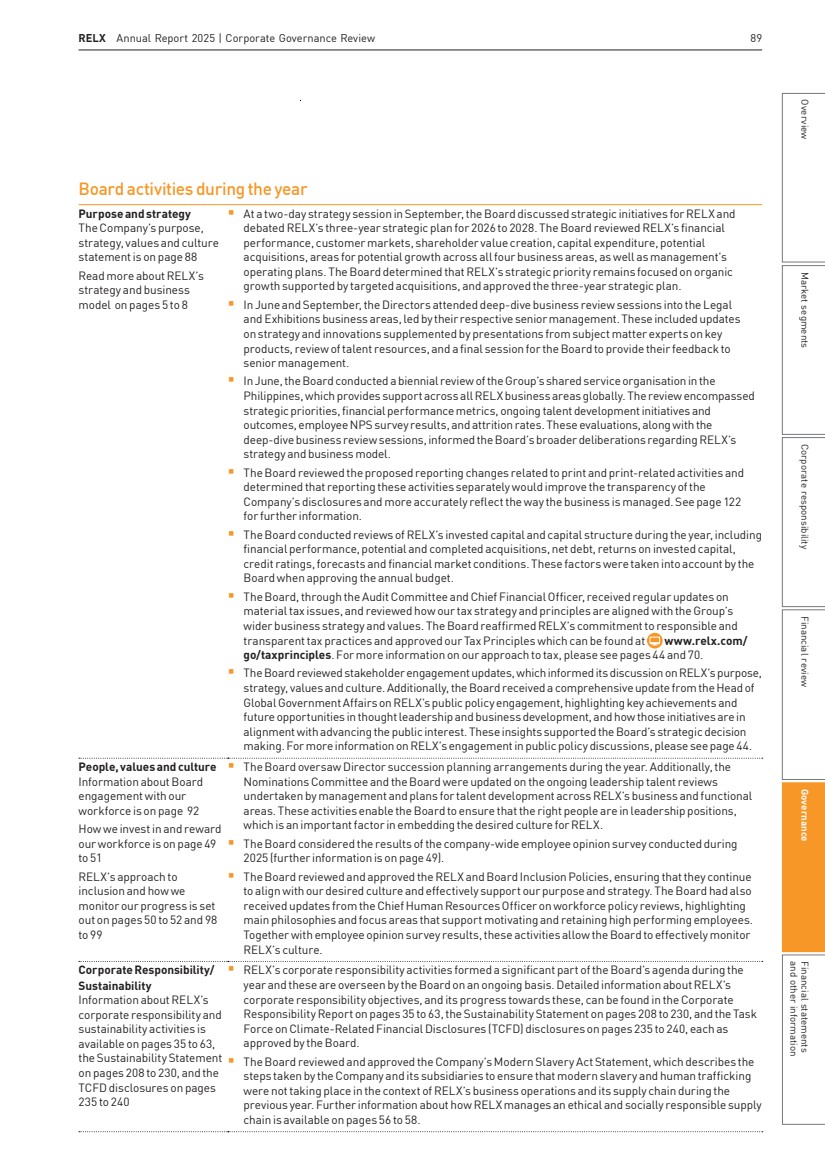
| 90 RELX Annual Report 2025 | Governance Risk management andinternal control The Company’s principal and emerging risks and mitigation strategies are set out on pages 72 to 76 The Company’s Viability Statement is on page 77 Further information about RELX’s internal controls is on pages 72, 96 and 123 § The Audit Committee and the Board reviewed the effectiveness of the systems of risk management and internal control in operation during 2025 and determined that RELX’s control systems provided reasonable assurance against material inaccuracies or loss and have functioned properly and effectively throughout the year. Additionally, the Committee oversaw the activities undertaken in order to achieve compliance with the new Provision 29 of the UK Corporate Governance Code (see page 123 for further details). § The Board, supported by the work of the Audit Committee, reviewed and agreed RELX’s principal and emerging risks and mitigation strategies. Following a robust and thorough assessment of the risks identified, together with a detailed review of RELX’s financial position, the Board considered RELX’s ongoing viability and approved the Company’s Viability Statement. § The Board received a comprehensive presentation on RELX’s assessment of material cybersecurity risks, threat landscape and incident trends, and approach to mitigation and cybersecurity controls from the Head of Information Assurance and Data Protection. Cybersecurity and data privacy are considered principal risks for RELX. Shareholder matters Details of the Board’s engagement with investors during the year are on page 91 Information about the Company’s dividend policy is on page 70 § Following a robust assessment of RELX’s financial position, in February the Board approved a share buyback programme for 2025 of £1.5bn. The programme was completed in December, at which point 55m shares held in treasury were cancelled. At its December meeting, the Board approved an initial £250m for the 2026 share buyback programme, with this initial amount to be deployed prior to the announcement of the 2025 full year results in February 2026. § The Board considered and approved the proposed resolutions to be put to shareholders at the 2025 AGM, which included the distribution of a final dividend for the year ended 31 December 2024. Each of the proposed resolutions was subsequently approved by shareholders at the meeting. The Board also considered and approved the payment of an interim dividend during the year. Director attendance at Board and Committee meetings The following table shows the attendance by Directors at Board and Committee meetings during the year. Attendance is expressed as the number of meetings attended by each Director out of the number of meetings they were eligible to attend. Directors Committee appointments Board (1) Audit Committee Remuneration Committee Nominations Committee Corporate Governance Committee Paul Walker (Chair) R N C 7/7 4/4 4/4 4/4 Erik Engstrom 7/7 Nick Luff 7/7 Alistair Cox (2) A R C 7/7 4/4 4/4 4/4 June Felix (3) A R C 7/7 3/4 3/4 4/4 Andy Halford (4) A C 5/5 3/3 3/3 Charlotte Hogg A C 7/7 4/4 4/4 Robert MacLeod (5) R N C 2/2 1/1 4/4 1/1 Andrew Sukawaty (6) A N C 7/7 4/4 3/3 4/4 Bianca Tetteroo (7) C 6/7 4/4 Suzanne Wood (8) A R N C 7/7 4/4 3/3 4/4 4/4 Committee membership key A Audit Committee R Remuneration Committee N Nominations Committee C Corporate Governance Committee Committee Chair (1) In addition to the seven scheduled Board meetings, the Directors also attended two full-day strategy and business review meetings. (2) Alistair Cox was appointed Chair of the Remuneration Committee with effect from the conclusion of the Company’s AGM on 24 April 2025. (3) June Felix was unable to attend the Audit and Remuneration Committee meetings held in December. (4) Andy Halford was appointed to the Board at the conclusion of the Company’s AGM on 24 April 2025, when he also joined the Audit and Corporate Governance Committees. (5) Robert MacLeod retired from the Board and stepped down from the Remuneration, Nominations and Corporate Governance Committees with effect from the conclusion oftheCompany’s AGM on 24 April 2025. (6) Andrew Sukawaty joined the Nominations Committee at the conclusion of the Company’s AGM on 24 April 2025. (7) Bianca Tetteroo was unable to attend the Board meeting held in September. (8) Suzanne Wood joined the Remuneration Committee at the conclusion of the Company’s AGM on 24 April 2025. |
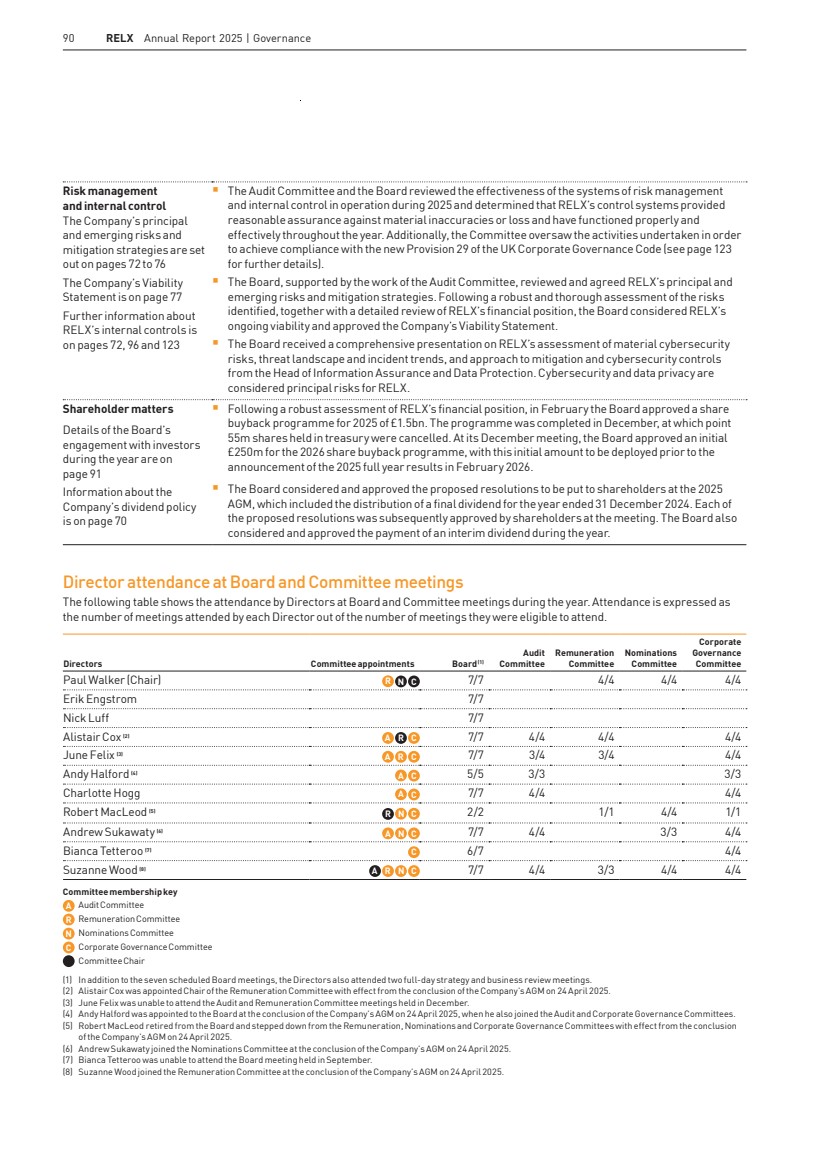
| RELX Annual Report 2025 | Corporate Governance Review 91 Stakeholder engagement During the year, the Board undertook a review of RELX’s key stakeholders and concluded that they remain unchanged from the previous year. The Board received a detailed overview of stakeholder engagement channels and activities and confirmed that it has adequate visibility of the views of key stakeholders, which are taken into consideration in its decision-making. Further information about the nature and outcomes of the Company’s engagement with its stakeholders are detailed throughout this Annual Report and examples oftheBoard’s engagement with key stakeholders are set out on the following pages. Investors Why effective engagement is important How we engage, outcomes and impact Engagement with our investors helps them to understand our strategy, performance and governance arrangements, and to make informed decisions concerning the Company. It also makes clear our prioritisation of the long-term in our decision-making and focus on delivery of consistent financial performance. Our investors provide us with input and feedback concerning the development and implementation of our strategy, and we consider their views when making investment decisions. Engagement with our investors is undertaken by members of the Board and at a business level by senior management and our Investor Relations, Corporate Responsibility, Company Secretariat and Treasury teams. TheBoard is updated with feedback and commentary received from investors through business engagement, investor roadshows and meetings with institutional shareholders. The Board receives regular reports on the Company’s share price and shareholder return performance and a review of analyst commentary in response to the Company’s market announcements and results publications. Executive Directors and senior management gave a number of investor and analyst presentations during the year to provide further detail and context to our published results and strategy plans. During the year: § Our engagement processes confirmed that our investors continue to understand and support our organic growth strategy. The Board considered this when approving RELX’s three-year strategic plan for 2026 to 2028, which leaves our strategic focus, and our priorities for uses of cash generated by RELX, broadly unchanged. § Significant investor engagement was conducted throughout the year, including extensive management and investor relations roadshows, attendance at conferences in the UK, Continental Europe and North America, and analyst fireside discussions with the CEO of the Legal business area, setting out RELX’s strong performance and reaffirming the strategy around analytics and AI. The Board were provided with feedback from these events. Presentations and transcripts from selected events are available at www.relx.com/investors. § The Company held its AGM with shareholders in April. § RELX’s material communications to investors, including the Full-Year and Interim Results Announcements, trading updates, the Annual Report and the Notice of AGM were reviewed and approved by the Board prior to release. § In respect of shareholder returns, the Board took into account a range of stakeholder views when considering the interim and final dividend payments during the year, and the quantum of the Company’s share buyback programme for 2025. External appointments and Non-Executive Director independence The Board has in place formal procedures to evaluate and review the external commitments of Directors, each of whom is required to obtain the Board’s approval prior to accepting new significant external appointments. During the year, the Board reviewed the proposed external appointment of June Felix. It was concluded that this appointment would not impact her ability to perform effectively on the RELX PLC Board, and accordingly theBoard gave its approval. When Directors take up new external appointments, any related commercial relationships with RELX are reviewed, and any potential conflicts of interest are dealt with following formal procedures. In accordance with the Company’s Articles of Association, Directors who are not conflicted may authorise, as appropriate, situations where a Director has an interest that conflicts, or may possibly conflict, with those of RELX, and may impose conditions on such authorisations. Supported by the Nominations Committee, the Board monitors the independence of the Non-Executive Directors in line with the relevant provisions of the UK Corporate Governance Code. An annual evaluation, led by the Nominations Committee, considered whether length of service or any other factor has impacted or may impact the ability of any Non-Executive Director to remain independent in character and judgement in the furtherance of their duties to the Company. The Board determined that each of the Non-Executive Directors is considered to be independent of management and free from any business or other relationship which could materially interfere with their ability to exercise independent judgement (with the exception of the Chair, whose independence was not assessed, but who was deemed to be independent upon appointment). Market segments Governance and other information Financial statements Financial review Corporate responsibility Overview |
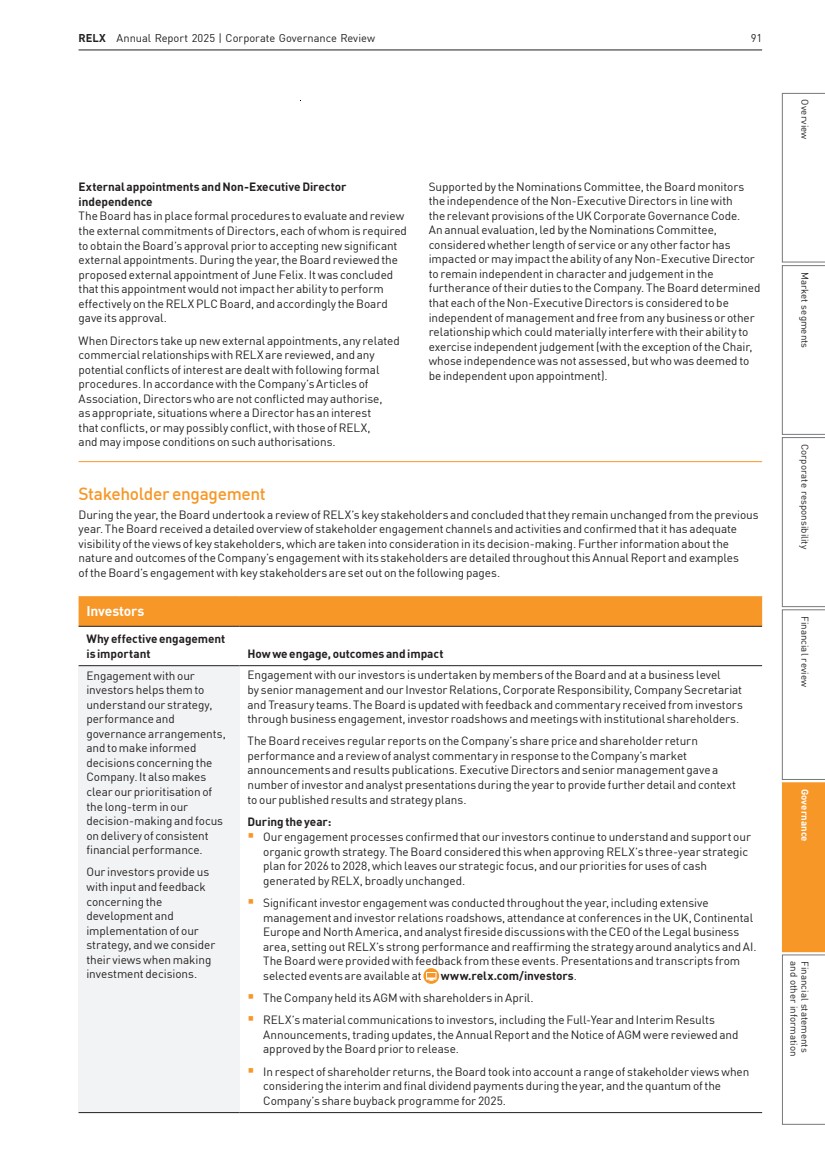
| 92 RELX Annual Report 2025 | Governance Employees Why effective engagement is important How we engage, outcomes and impact Our people’s well-being and their commitment to the work they do are essential to our future growth and our aim to successfully build long-term leading positions in global growth markets. We strive to foster an environment in which our employees feel a strong sense of engagement with our business and share a passion for making a positive impact on society through our unique contributions. RELX actively seeks feedback from employees to understand their key challenges and concerns and how we can work to address these. Hearing their views on what we do well, and what we can do better, is an important driver for improvement and enables us to take action to retain our best talent. Effective engagement helps to mitigate the risk of not being able to recruit, motivate and retain skilled employees and management, which is recognised as a principal risk (see page 75). Employee engagement routinely takes place within the business areas and matters of concern are cascaded up through our management framework. The Board receives regular management reports which cover employee engagement, turnover and demographic analysis, updates on workplace initiatives, and concerns raised through our Code ofEthics and Business Conduct reporting channels. The Board reviews employee engagement and workforce data and takes these into consideration in its decision-making. RELX has a dedicated intranet for employees which is kept updated with financial and performance information, news of business developments and workforce initiatives and events and other important messages from senior management. The Board has appointed Bianca Tetteroo as our Non-Executive Workforce Engagement Director to engage directly with employee representatives from across RELX and report to the Board on the progress of RELX’s workforce initiatives, together with the challenges, concerns and priorities of employees. Where challenges and concerns were discussed, as appropriate, the Board was also informed of the actions taken or plans developed to address them. This provides the Board with insight into the culture across RELX, how our working practices and initiatives have been received, and highlights any issues that need to be addressed. During the year: § Ms Tetteroo met with workforce representatives to learn about the experiences of employees while working at RELX. The matters discussed were reported to the Board, including feedback regarding well-being and inclusion initiatives, as well as the opportunity to participate in Employee Resource Groups and RELX Care programmes. Further matters included hybrid working arrangements, pay, benefits, and career development through training and internal mobility. § In 2025 we undertook our annual Pulse employee opinion survey. An analysis of the results of the survey was presented to the Board in December and confirmed positive trends across our business areas in almost all key metrics of engagement, satisfaction and employee net promoter scores. § Board reports from the Chief Human Resources Officer highlighted the steps taken to identify, support and develop current and future leaders across the business through the Organisational Talent Review and Management Development Planning processes. This focus has seen increased internal mobility across divisions, providing career development opportunities across the whole of RELX. § The Board reviewed the Board and RELX Inclusion Policies and determined that these are effective and support the Group’s purpose, strategy, values and culture. § The Board received presentations from the Head of Corporate Communications on focus areas for 2025. These continue to be fostering engagement and advocacy supported by data-driven storytelling in selected focus areas, such as our strategy, innovation and career development. Employee understanding and engagement with our purpose, strategy, values and culture is monitored through our employee opinion survey scores over time. § Employee involvement in the Company’s performance is encouraged through RELX’s employee share schemes. RELX currently operates three all employee share plans, one in each of the UK, the Netherlands and the USA, providing RELX employees with the opportunity to obtain its shares at a discounted price. The Board received updates on annual participation rates. |
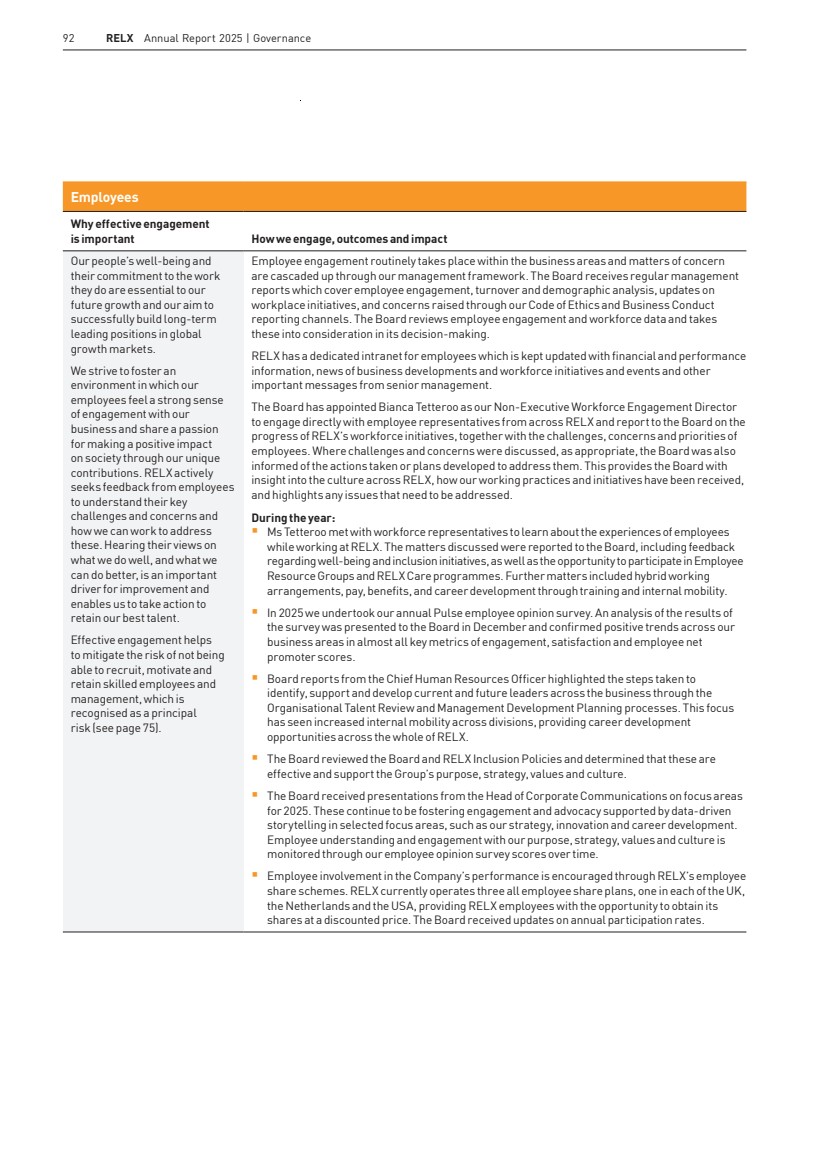
| RELX Annual Report 2025 | Corporate Governance Review 93 Customers Why effective engagement is important How we engage, outcomes and impact Our goal is to help customers make better decisions, get better results and be more productive. We do this by leveraging deep customer understanding to build innovative solutions which combine leading content and data sets with powerful advanced technologies. Collaborating closely with our customers is crucial for us to understand where and how we can improve the quality of our solutions and products, and enables us to make targeted investment decisions, such as to develop new technologies or complement our existing capabilities through acquisition activity. Our engagement with customers takes place at an operational level across our business areas, through our dedicated sales and operations teams and through customer training and workshops. Material customer issues are cascaded up to the appropriate senior management. The Board received presentations during the year from customer-facing employees which detailed the nature of our customer engagement and the actions taken by the business areas as a result. In 2025, the Board received analyses of customers by sector and geography and data concerning the resilience of the markets in which we operate. The Board reviewed customer survey data, Customer Net Promoter Scores, and case studies across our business areas. During the year: § The Board continued to monitor current and anticipated future customer demand and market activity together with customer feedback, to understand how our product offerings address customer requirements. This information informed areas of focus for product development and acquisitions and the level of investment required. RELX made several acquisitions during the year that complement its existing product range and enhance value for our customers. More information about our acquisitions during the year can be found on page 10. § Feedback from our customers informed the Board and management’s assessment of the areas in which RELX should build out new products and solutions, the speed at which this should be undertaken, and where it should look to expand into higher growth adjacencies and geographies over varying time horizons. § The Board received an update on ongoing customer engagement on sustainability issues from RELX’s Global Head of Corporate Responsibility. Suppliers Why effective engagement is important How we engage, outcomes and impact RELX has a diverse supply chain with suppliers located in over 150 countries across multiple categories, which RELX categorises as content suppliers and non-content suppliers. Collaboration and two-way dialogue with our suppliers help ensure that we are able to maintain and improve the quality of products and solutions we provide to our customers. Effective engagement underpins our ability to maintain an ethical supply chain, giving us visibility of our suppliers’ alignment with the RELX Supplier Code of Conduct. Engagement with our content suppliers, which include the companies we license content or data from, as well as authors, editors, content reviewers and product designers, takes place principally through ongoing dialogue with the relevant business area. Content supplier feedback is collected through direct relationships and regular business reviews, and presented to the Board through updates from our business area leaders and the Global Head of Purchasing and Property. Our non-content suppliers represent traditional vendor relationships, such as IT software and cloud service providers, or third parties to whom we have outsourced support function activities. Engagement takes place at various levels throughout RELX. Feedback is reported to theBoard by business area leaders and the Global Head of Purchasing and Property. During the year: § Outcomes of ongoing business engagement with our content suppliers, including Net Promoter Scores and the outcomes of business reviews, informed the Board’s discussions during its consideration of RELX’s three-year strategy plan for 2026 to 2028, and its assessment of mitigation in place for our principal risks of customer acceptance of our products and supply chain dependencies. § Our Supplier Code of Conduct has been translated into 16 languages for use across RELX. During the year, the Board received updates on the progress of our Socially Responsible Supplier (SRS) programme, including numbers of signatories and audits conducted (further details are on pages 56 to 58). The Board continued to support the programme. § The result of our annual supplier survey programme, involving feedback from over 100 key suppliers, provided the Board with insight into the views of RELX’s major suppliers. § The Board reviewed and approved our Modern Slavery Act Statement, available from www.relx.com, which sets out the steps taken by the Company and its subsidiaries to prevent modern slavery and human trafficking in its business and supply chain. Market segments Governance and other information Financial statements Financial review Corporate responsibility Overview |
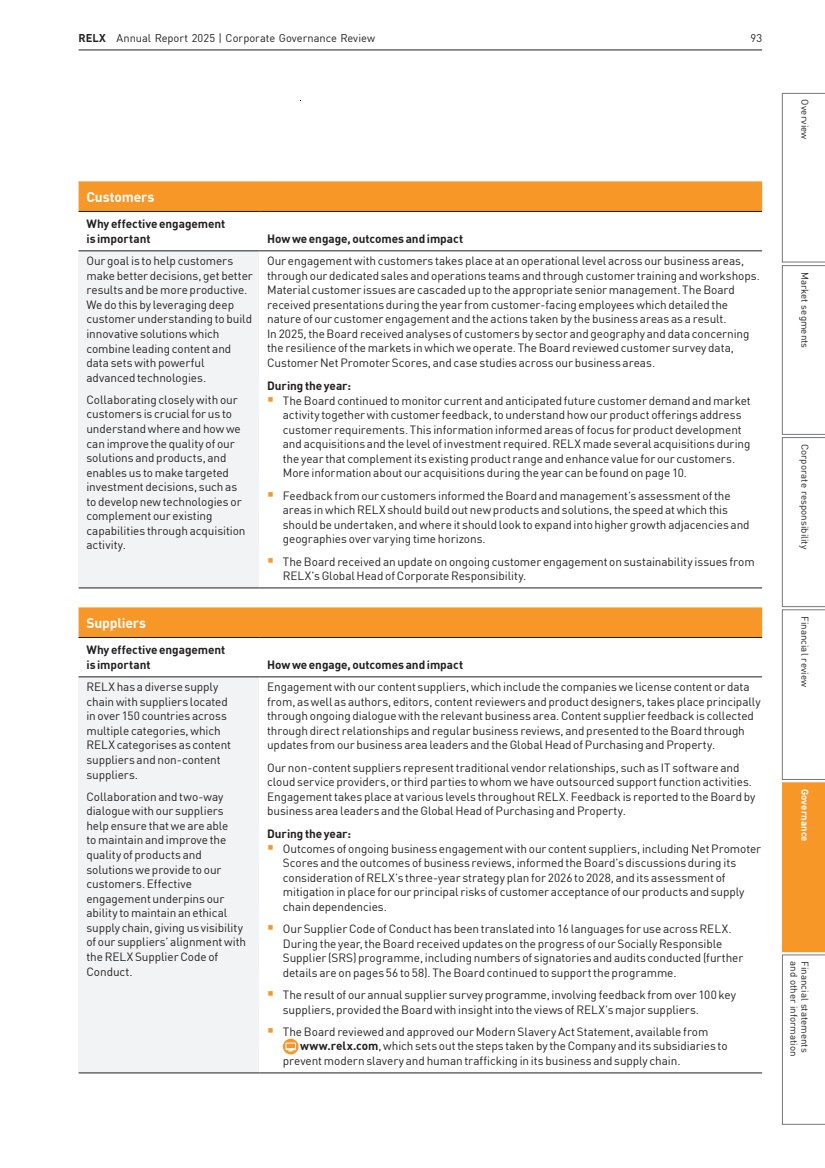
| 94 RELX Annual Report 2025 | Governance Community Why effective engagement is important How we engage, outcomes and impact Our focus on community includes those where we, our customers and suppliers work around the world, as well as the communities we serve, including in science, academia, risk, law and many other fields. We prioritise positive dialogue with our community stakeholders as we believe they, collectively, are important to maintain our ‘licence to operate’. Our efforts are informed by our commitment to the United Nations Global Compact and its ten principles, focused on human rights, labour, the environment and anti-corruption – all issues with wide societal impact. We engage with our community stakeholders through our unique contributions to society, and through our comprehensive global community programme, RELX Cares. TheRELX Cares mission is education for disadvantaged young people. Further information about our RELX Cares projects and its contributions to the communities in which we operate is on pages 52 to 55. In accordance with the Business for Societal Impact model, we monitor the short- and long-term benefits of our community engagement. We survey RELX Cares volunteers to understand the impact of the programme on their personal development and how it affects the way they feel about working at RELX. 89% of RELX Cares survey respondents experienced an increase in motivation and pride in the Company after volunteering in the year. During the year: § The Board considered RELX’s environmental performance and supported ongoing initiatives to minimise our environmental impact, and continued to endorse our commitment to reaching net zero by 2040. More information is in our Corporate Responsibility Report on pages 35 to 63 and the Sustainability Statement on pages 208 to 230. § The Board received detailed updates on community engagement during the year, including key metrics, objectives and outcomes. Board feedback and support for community engagement shapes the direction of our charitable programmes and future plans. § The Board continued to endorse RELX’s volunteering policy through which RELX employees receive two days paid leave each year to undertake community volunteering. The Board received reports on the outcome of the programme, such as employee engagement rates and company contributions. § The Board continues to endorse the business areas utilising their unique product offerings to support causes in their communities. During the year the Board received reports from the Global Head of Corporate Responsibility on RELX’s performance against its 2025 corporate responsibility objectives in this and other areas, including energy consumption and carbon emissions, and objectives for 2026 and 2030, when the United Nations Sustainable Development Goals conclude. |
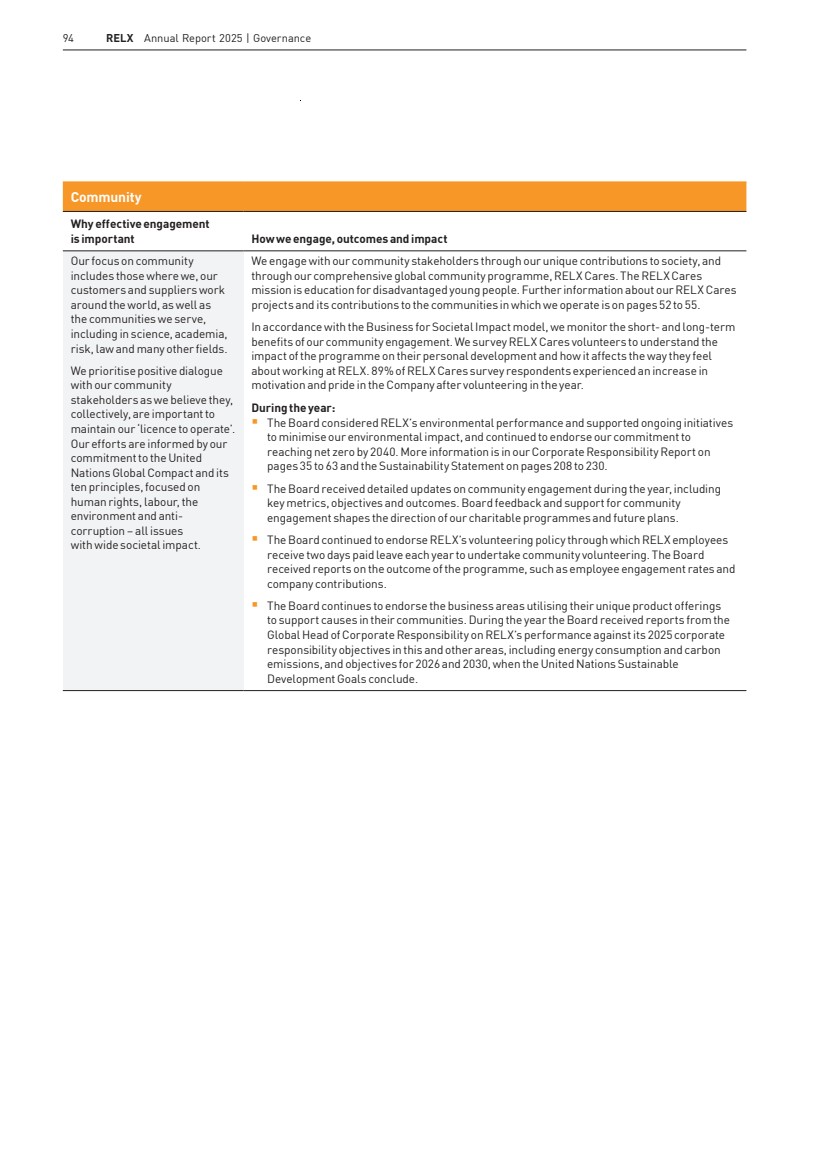
| RELX Annual Report 2025 | Corporate Governance Review 95 Board evaluation The Directors consider the evaluation of the Board, its Committees and members to be an important aspect of corporate governance. The Board undertakes an annual evaluation of its own effectiveness and performance, and that of its Committees, the Chair and individual Directors. Actions from the 2024 Board evaluation The 2024 evaluation, which was conducted internally, concluded that the Board and its Committees were operating effectively and did not highlight any significant areas for improvement. The Board agreed that it would continue to focus on key issues, including emerging risks such as geopolitical, cyber and data security risks. As part of the 2025 evaluation, the Board members confirmed that the Board maintained an appropriate focus on these important risk topics. 2025 evaluation process In 2025, the Board evaluation process was conducted internally, supported by the Company Secretary. Questionnaires were completed by all Directors to provide feedback and commentary on the following areas: § Board composition and effectiveness § The effectiveness of the Board’s oversight of strategy development, setting and monitoring RELX’s culture and values, financial performance, market developments, stakeholder relations (including the Board’s understanding and visibility of the views of RELX’s stakeholders and how these inform its decision-making process), talent and succession, reputation, inclusion, risk and governance § Quality of information provided by management § Boardroom culture and dynamics § The performance of the Chair § The structure, leadership and overall effectiveness of each ofthe Board’s Committees The Chair conducted individual performance reviews with each Non-Executive Director and the Senior Independent Director led the appraisal of the Chair’s performance by the other Directors. Chair’s Performance Directors commended the Chair for his leadership of the Board and for facilitating the effective contribution of each Non-Executive Director and for fostering constructive relationships and communications within the Board. Directors felt that a particular strength of the Chair is the ability to engage individuals effectively and facilitate meetings, ensuring a balanced consideration of diverse perspectives. Individual Director performance Individual Director performance and contributions were assessed through one-to-one meetings with the Chair. These review meetings reflected on personal development and on feedback on Board matters and they concluded that each director continues to contribute positively and effectively to Board and Committee discussions, providing external insights and constructive challenge to management on matters of strategy and governance. Conclusions from the 2025 Board evaluation The 2025 Board evaluation found a high level of satisfaction among the Directors with the way in which the Board and its Committees operate. There were no significant areas identified as requiring immediate attention. The Directors felt that the Board discharges its oversight responsibilities effectively across all categories and particularly in the areas of strategy, finance, performance, investor relations, people and risk management. The Directors felt that the Board is appropriately involved in the development and approval of the Group’s strategy, supported by deep-dive briefing sessions and presentations from business leaders, which were commended for their quality. Directors also noted that strong engagement with senior management of RELX’s four business areas enabled the Board to understand RELX’s culture and ensure its alignment with the Group’s purpose, strategy and values. Directors had a clear understanding of the performance targets for the Company and a strong awareness of market developments and the Company’s performance relative to its competitors and were satisfied that the Board monitors this on a regular basis. Directors agreed that the Board was made aware of key risks, including those that are evolving and emerging, and sufficiently engaged in their oversight and in ensuring that appropriate risk management processes are in place. Directors were well-informed of RELX’s engagement with key stakeholders and its outcomes, and able to apply their understanding of stakeholder views in the Board’s decision making. The Board also agreed that there is a rigorous and effective succession process for key executive and business leaders and acknowledged that this should remain a key focus area for the future. The Directors thought that the Board’s composition, including the breadth of its collective skills, its dynamics and culture of openness and debate, all contributed to highly effective meetings which were found to be well governed and chaired. Papers and presentations addressed the key issues in appropriate detail and were provided on a timely basis. The outcome of the Board evaluation confirmed that the Board and its Committees continue to function effectively and collaboratively, with an appropriate level of engagement with management. While there were no specific areas identified in the review where significant improvement is required, continued focus on key issues with open and transparent dialogue continue to be recognised as key drivers of the Board’s effectiveness. Market segments Governance and other information Financial statements Financial review Corporate responsibility Overview |
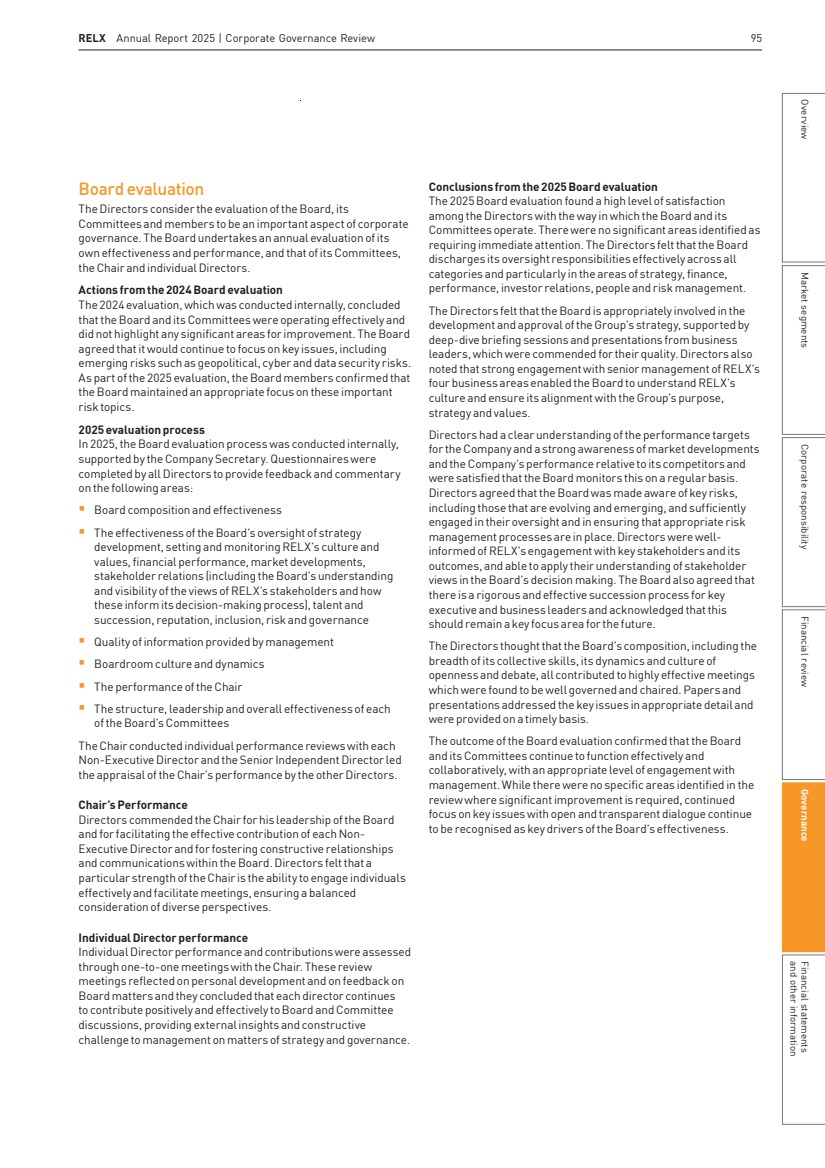
| 96 RELX Annual Report 2025 | Governance Audit, risk and internal control Internal control and risk management The Board has overall responsibility for overseeing RELX’s systems of risk management and internal control and for monitoring the processes for identifying, assessing and managing the principal and emerging risks faced by the Company. These systems are designed to manage and mitigate, rather than totally eliminate, risks to the business. Accordingly, they can provide reasonable, but not absolute, assurance against material misstatement or loss. These processes were in place throughout the year ended 31 December 2025, and up to the date of approval ofthe 2025 Annual Report. Further details of RELX’s risk management systems and the principal and emerging risks facing the Company, together with our mitigation strategies are set out on pages 72 to 76 of this Report. Risk management and control procedures are embedded into the operations of the business and include the monitoring of progress in areas for improvement that come to management andBoard attention. To provide reasonable assurance against material inaccuracies or loss, and of the effectiveness of the systems of internal control and risk management, RELX has adopted the three lines of defence assurance model as set out below. System of Internal Control 1st line of defence RELX business areas maintain systems of internal control which are appropriate to the nature and scale of their activities and address significant strategic, operational, financial, legal and compliance risks that they face 2nd line of defence Central functions that are responsible for 1) designing policies, 2) introducing and sharingbest practice, 3) monitoring and evaluating compliance with RELX policies and relevant legislation and regulation and appropriate remediation RELX Operating and Governance Principles 3rd line of defence Internal audit provides independent assurance on the effectiveness of the 1st and 2nd lines of defence The Board and Audit Committee Note: In addition to RELX’s internal controls, RELX is also audited externally. RELX operates authorisation and approval processes throughoutits operations. Access controls exist where processes have been automated to ensure the security of data. Management information systems have been developed to identify risks and enable the assessment of the effectiveness of internal control systems. With the close involvement of operating management and central functions, the risk management and control procedures aim to ensure that RELX is managing its business risks effectively and in a coordinated manner across the business areas with clarity on the respective responsibilities and interdependencies. Litigation, and other legal and regulatory matters, are managed by legal functions within the business areas. The Audit Committee has responsibility for monitoring RELX’s risk management and internal control procedures and reports to the Board, as appropriate. The Audit Committee receives periodic updates from RELX’s Chief Compliance Officer on alleged and substantiated violations of the Code of Ethics and Business Conduct, and related training, monitoring and communications programmes. Such updates covered the volume, type and circumstances surrounding substantiated violations, subsequent actions and lessons learnt. US certificates As required by Section 302 of the US Sarbanes-Oxley Act 2002 and by related rules issued by the US Securities and Exchange Commission (the Commission), the Chief Executive Officer and Chief Financial Officer of the Company certify in the 2025 Annual Report on Form 20-F to be filed with the Commission that they are responsible for establishing and maintaining disclosure controls and procedures and that they have: § designed such disclosure controls and procedures to ensure that material information relating to RELX is made known to them § evaluated the effectiveness of RELX’s disclosure controls and procedures § based on their evaluation, disclosed to the Audit Committee and the external auditors, all significant deficiencies in the design or operation of disclosure controls and procedures and any frauds, whether or not material, that involve management or other employees who have a significant role in RELX’s internal controls § presented in the 2025 Annual Report on Form 20-F their conclusions about the effectiveness of the disclosure controls and procedures § designed internal controls over financial reporting, or caused such internal control over financial reporting to be designed under their supervision, to provide reasonable assurance regarding the reliability of financial reporting A Disclosure Committee, comprising the Company Secretary and other senior managers, provides assurance to the Chief Executive Officer and Chief Financial Officer regarding their Section 302 certifications. Section 404 of the US Sarbanes-Oxley Act 2002 requires the ChiefExecutive Officer and Chief Financial Officer of the Company to certify in the 2025 Annual Report on Form 20-F that they are responsible for maintaining adequate internal control structures and procedures for financial reporting and to conduct an assessment of their effectiveness. The conclusions of the assessment of internal control structures and financial reporting procedures, which are unqualified, are presented in the 2025 Annual Report on Form 20-F. |
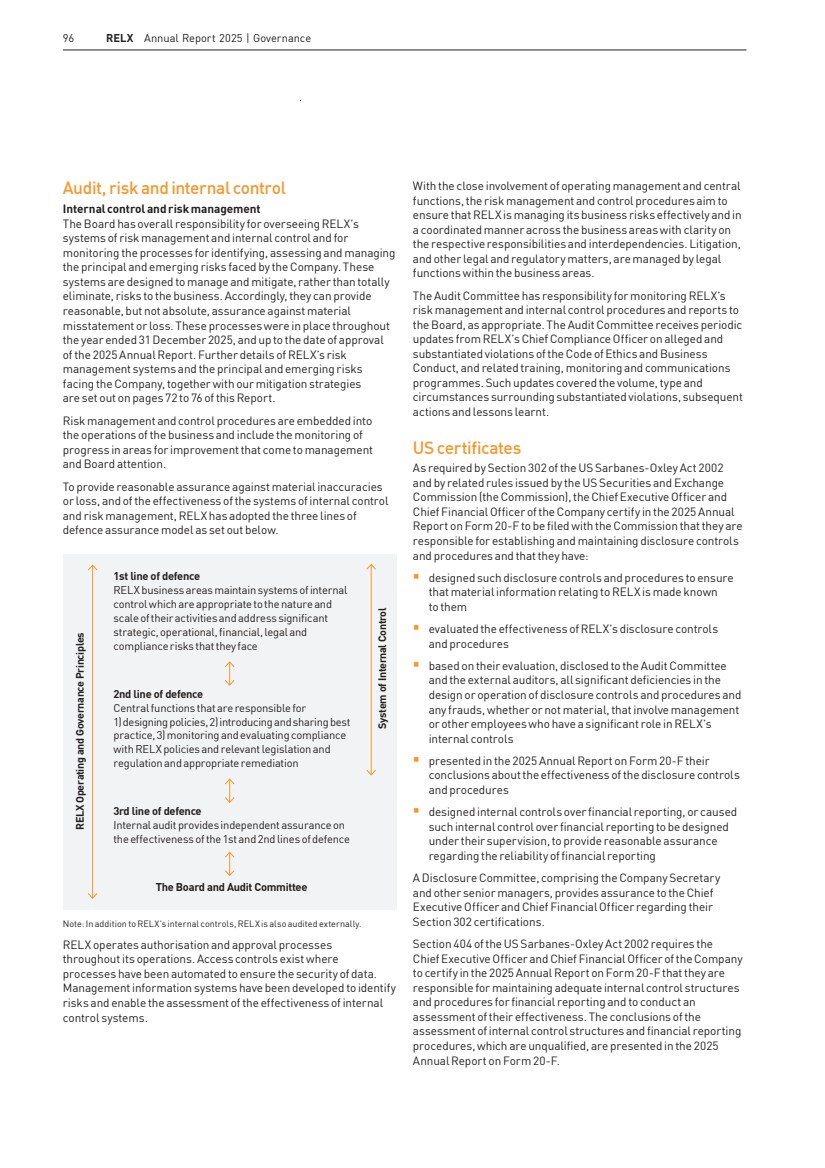
| 97 This report has been prepared by the Nominations Committee and has been approved by the Board. Membership The Nominations Committee comprises independent Non-Executive Directors and the Chair of the Board. The Directors who served on the Committee during the year were: § Paul Walker (Chair of the Committee) § Robert MacLeod (retired 24 April 2025) § Andrew Sukawaty (appointed 24 April 2025) § Suzanne Wood Role of the Nominations Committee The role and responsibilities of the Nominations Committee are set out in written Terms of Reference which are available on the Company’s website at www.relx.com. The principal purpose of the Committee is to assist the Board by leading the process for appointments to Board roles and overseeing a diverse pipeline for succession. The Committee’s main responsibilities are: § Reviewing the size and composition of the Board, ensuring that it comprises the appropriate balance of skills, experience, knowledge and independence § Reviewing the external commitments of the Directors to ensure that they each have sufficient time to effectively discharge their duties to RELX § Ensuring plans are in place for orderly Board and senior management succession and to oversee a diverse pipeline for such succession § Overseeing the recruitment of new Directors and recommending candidates to the Board § Making recommendations to the Board in relation to the re-appointment of any Non-Executive Director at the conclusion of their specified term of office and the election or re-election of Directors following a review of the performance of individual Directors from the Board evaluation process § Making recommendations to the Board about the authorisation of Directors’ conflicts of interest, including any terms to be imposed in relation to a Director’s conflict of interest Activities of the Committee during the year The Committee met four times in 2025. The activities of the Committee during the year included: § Reviewing Board and Committee size, composition and balance following the retirement of Robert MacLeod as a Non-Executive Director at the conclusion of the Company’s 2025 AGM, and recommending a successor for each of Mr MacLeod’s roles as the Chair of the Remuneration Committee and a member of the Nominations Committee § Considering and recommending the re-appointment of Andrew Sukawaty and Charlotte Hogg at the conclusion of their respective specified terms of office § Recommending to the Board that each current Director be put forward for re-election at the Company’s AGM, other than Robert MacLeod, who retired from the Board at the conclusion of the Company’s 2025 AGM § Succession planning for a new Non-Executive Director § Ongoing succession planning for Board and senior management roles § Monitoring the Directors’ actual and potential conflicts ofinterest § Recommending to the Board the suitability of Directors’ external director appointments § Reviewing the Committee’s Terms of Reference and determining that they continue to be fit for purpose and effective § Recommending to the Board the inclusion of this report in the 2025 Annual Report Report of the Nominations Committee Board composition as at 31 December 2025 Balance of Executive/Non-Executive Directors Non-Executive: 7 Executive: 2 Non-Executive Chair: 1 Tenure of Non-Executive Directors (including Chair) 6–9 years: 3 0–3 years: 3 3–6 years: 2 Market segments Governance and other information Financial statements Financial review Corporate responsibility Overview RELX Annual Report 2025 |
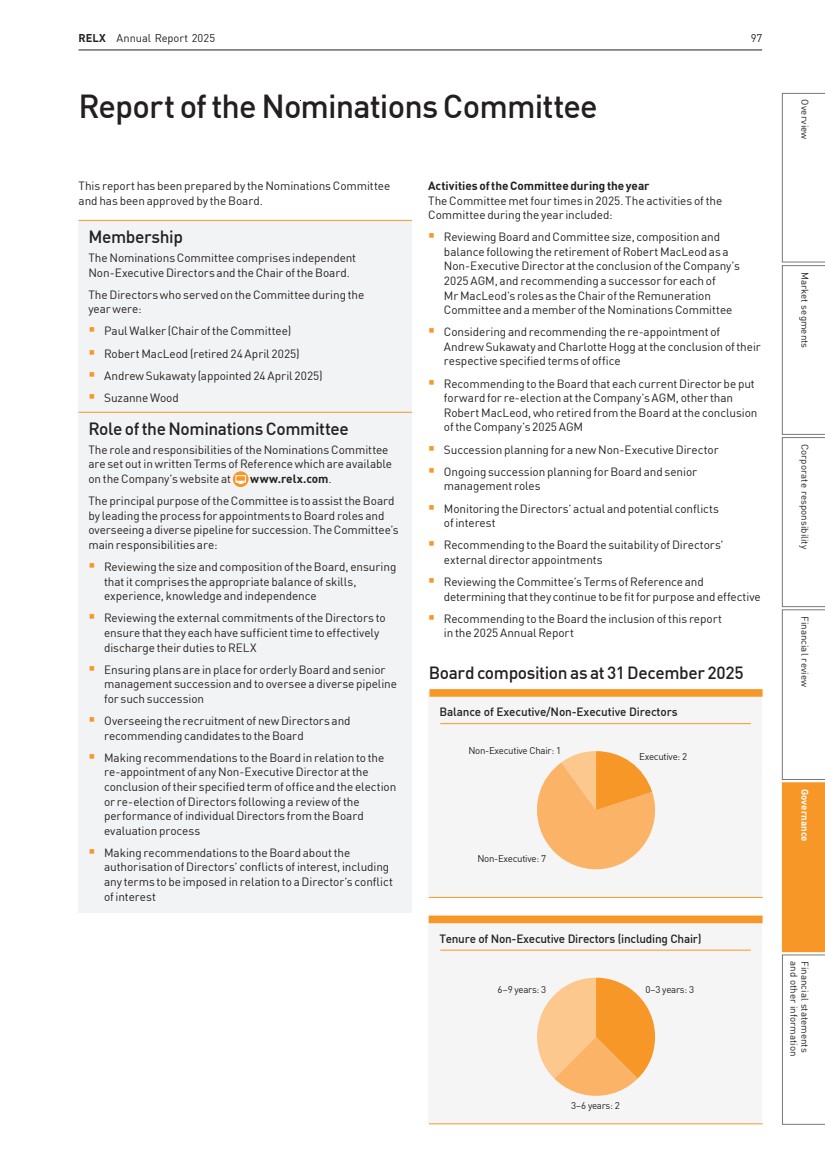
| 98 RELX Annual Report 2025 | Governance Board and Committee composition The Nominations Committee is responsible for keeping the size and composition of the Board and the membership ofitsCommittees under review, to ensure that each has an appropriate balance of skills, knowledge and experience to effectively discharge its respective duties. The Committee considers the competencies required both now and in the future to support the Company’s purpose, strategy, values and culture. The Committee also seeks to maintain a diverse pipeline for senior leadership succession. The Board collectively has a diverse range of relevant skills and experience which includes: § Strategy and governance § Expertise in finance and technology § Operational experience in RELX’s product markets § Executive and non-executive Board and leadership experience in large, international listed groups § Audit, risk and regulatory expertise § Workforce relations management and engagement § Executive remuneration Biographical information for each of the Directors is on pages 80 to 81. Further information about the skills and experience of the Directors standing for election and re-election at the 2026 AGM is in the Notice of Meeting available at www.relx.com. Board Inclusion Policy RELX’s Board Inclusion Policy aims to promote a working environment that is respectful and inclusive of individuals and their contributions, regardless of gender, ethnic origin, disability, nationality, age, sexual orientation or any other individual characteristic. The Board acknowledges the benefits that are brought to the effectiveness of Board and Committee discussions and the quality of decision-making, through the incorporation of different perspectives and ideas. The Nominations Committee monitors the composition of the Board and membership of its Committees with a view to ensuring that each has the appropriate balance of skills and expertise. The Committee also oversees the Director recruitment process on behalf of the Board. Consistent with the recommendations of the FCA set out in LR6.6.6(R)(9), as at 31 December 2025: § the Board comprises 40% women § the role of Senior Independent Director is held by a woman § at least one Board member is from a minority ethnic background The Group Inclusion Policy is aligned with the Board Inclusion Policy and aims to promote a positive working environment that is inclusive, fair and equitable. It prohibits discrimination and requires that RELX recruits, trains, develops, promotes, and provides conditions of employment without regard to race, colour, creed, religion, national origin, gender, gender identity or expression, sexual orientation, marital status, age, disability, or any other characteristic protected by law. RELX relies on the contributions of individuals with a collectively broad range of experience, skills and ideas to consistently deliver on its strategic priorities and provide real innovation for customers around the world. The Company is committed to an ongoing review of policies and practices in the areas of recruitment, talent development, promotion and reward to ensure that opportunities across our business areas are fair and equitable. Workforce policies and practices are regularly reviewed to ensure RELX is delivering on its goals and effectively monitoring available data. Across our business areas, we are committed to providing regular best practice and awareness training in areas such as inclusive leadership and unconscious bias and we promote and encourage inclusive networking groups and sponsorship and mentoring programmes. Details of the strategy and progress towards fulfilling our inclusion initiatives is set out in our Corporate Responsibility Report on pages 49 to 51. Nationalities on the Board British, American, Irish: 1 Swedish: 1 Dutch: 1 American: 3 British: 4 Board and Executive Management gender and ethnic representation data as at 31 December 2025 Number of Board members Percentage of the Board No. of senior positions on the Board (CEO, CFO, SID, Chair) No. in executive management Percentage of executive management Ethnic background White 8 80% 3 6 60% Asian 1 10% – 3 30% Black – – – – – Mixed/multiple ethnicity – – – – – Other – – – – – Not specified/prefer not to say 1 10% 1 1 10% Gender identity or sex Men 6 60% 3 7 70% Women 4 40% 1 3 30% Not specified/prefer not to say – – – – – |
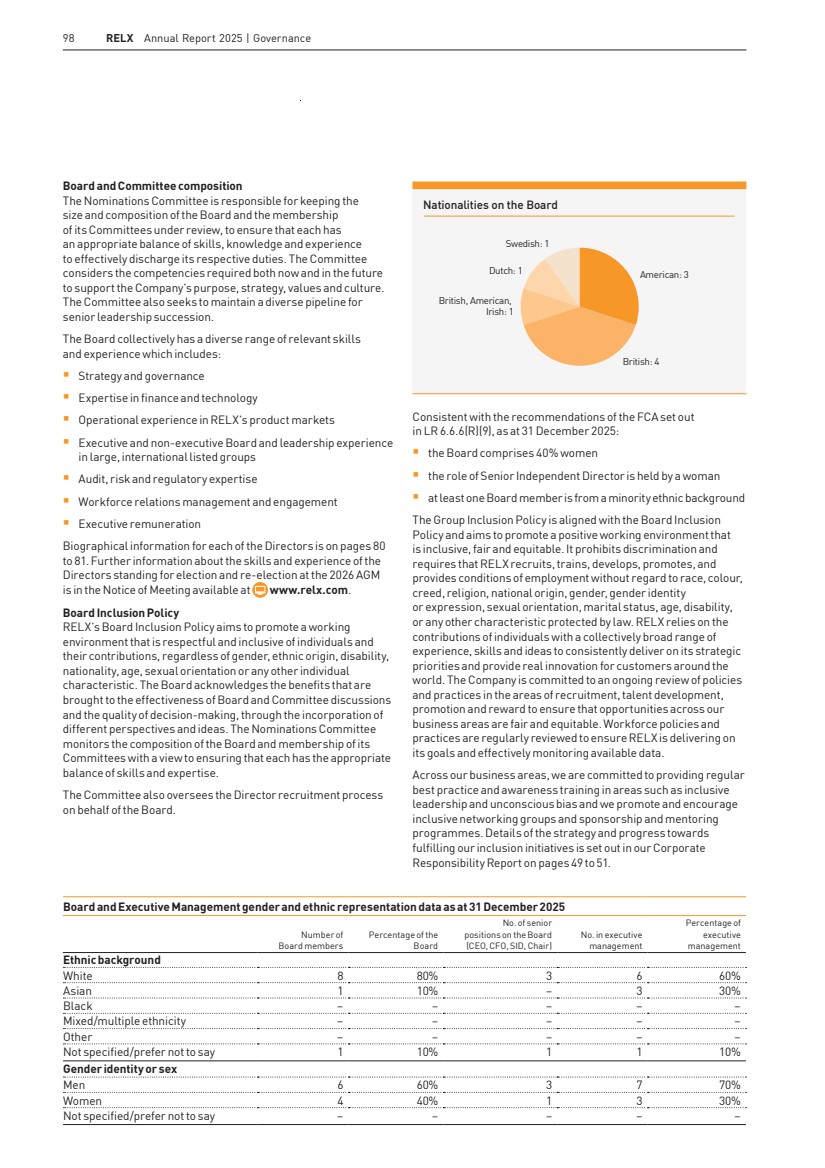
| 99 Data for the gender and ethnic representation table on page 98 was drawn from HR information where consents are in place to use the data on an anonymised basis and through a survey with categories aligned to those set out in the LR 6.6.6 (R)(10). Board and Committee succession When reviewing the composition of the Board and its Committees, the Nominations Committee considers, among other things, the length of tenure of each Director and the need for, and benefits of, membership being regularly refreshed. The Committee is cognisant of the skills and experience required for effective leadership and oversight of RELX’s strategy and success in the long term, as well as the Board Inclusion Policy and relevant recommendations of the UK Listing Rules. All appointments to the RELX Board, and each of its Committees, are based primarily on merit and the suitability of an individual for any given role. Board succession planning and refreshment was a regular agenda item at the Committee’s meetings during 2025. Director appointment process A rigorous search and selection process is followed for each new Director, starting with the preparation of a search specification, based on the Committee’s assessment of the skills, capabilities and experience required on the Board at the time. An executive search firm is engaged to support the search. A long-list of potentially suitable individuals is initially reviewed. From this, a short-list of potentially suitable individuals is considered in detail by the Committee and preferred candidates are invited to meet with Board members, including the Chair and Chief Executive Officer, together with the Chief Legal Officer and Company Secretary. Following feedback from these sessions, the Nominations Committee makes its recommendations to the Board. The Board then has a further opportunity to review and discuss the recommendations, and subsequently approves the proposed appointment. The Board may appoint Directors (subject to a maximum upper limit) to fill a vacancy at any time, although any Director so appointed shall only hold office until the following AGM of the Company, at which his or her election shall be voted upon by shareholders. Directors are then required to seek re-election by shareholders at each subsequent AGM of the Company. As a general rule, letters of appointment for Non-Executive Directors provide that, subject to annual re-election by shareholders, individuals will serve for an initial period of three years, and are typically expected to be available to serve for a second three-year period. If invited to do so, they may also serve for a third three-year period. The notice period applicable to the Non-Executive Directors is one month. RELX’s Non-Executive Letter of Appointment sets out the time commitment required by the Company from its Non-Executive Directors. Executive and management succession The Board is committed to recognising and nurturing talent across RELX and overseeing the development of a strong talent pipeline to senior leadership and executive roles. The Committee received detailed updates during the year from the Chief Executive Officer regarding succession plans for senior management roles. The Committee is satisfied that appropriate succession planning arrangements were in place during the year to facilitate appropriate and effective succession across senior management roles, supported by a strong pipeline of candidates. Conflicts of interest The Directors have a statutory duty to avoid situations in which they have, or could have, a direct or indirect interest that conflicts with the interests of the Company and, if potential for such a conflict arises, must make such situations known to the Board. In accordance with its Terms of Reference, the Nominations Committee considers the circumstances of any such actual or potential conflicts of interest and makes a recommendation to the Board as to whether to authorise the conflict, as permitted under the Company’s Articles. The Committee may recommend that the Board imposes certain limits or conditions in respect of the conflict. There is a procedure in place for Directors to disclose any potential conflict to the Board and each Director is required to review and confirm their actual and potential conflicts annually. During the year, the Committee conducted a formal review of the conflict of interest authorisations granted by the Board to each individual Director. Committee evaluation The evaluation of the Committee determined that it was well governed and effective in carrying out its role in accordance with its Terms of Reference. Details of the Board and Committee evaluation process are on page 95. Market segments Governance and other information Financial statements Financial review Corporate responsibility Overview RELX Annual Report 2025 | Report of the Nominations Committee |
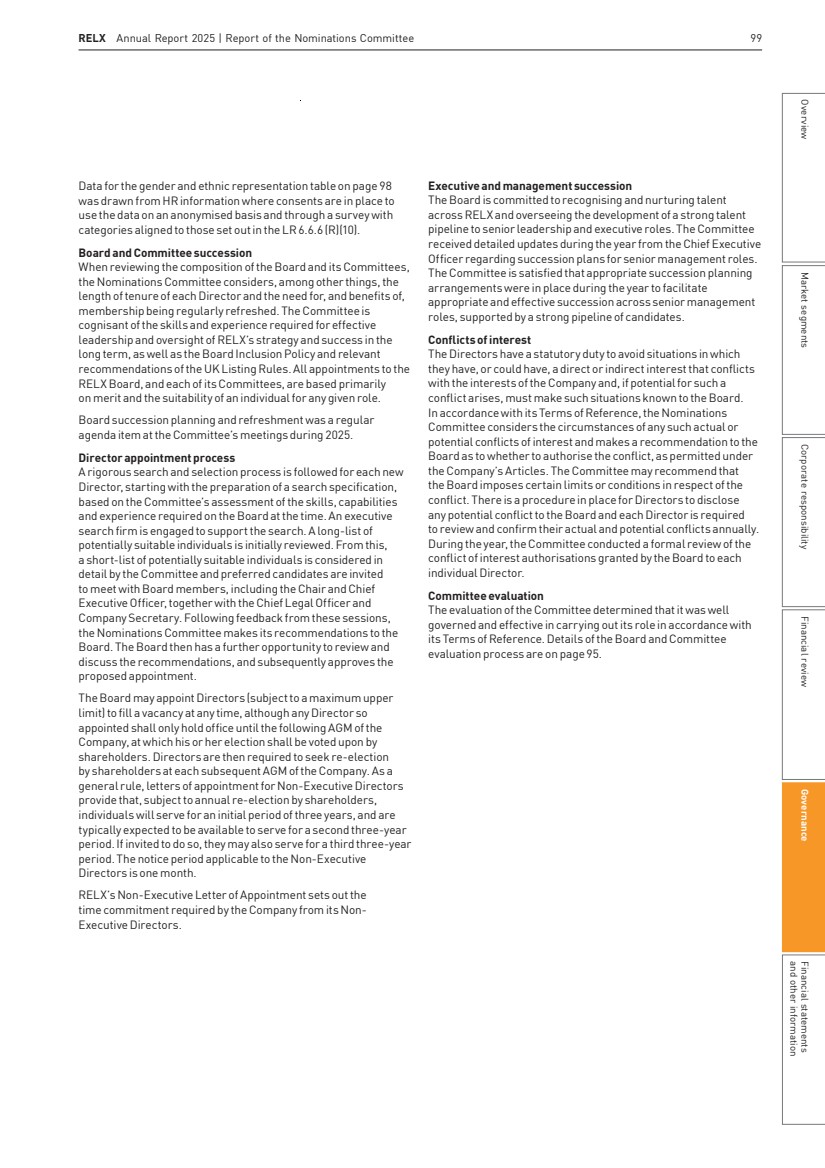
| 100 RELX Annual Report 2025 | Governance Directors’ Remuneration Report The Directors’ Remuneration Report has been prepared by the Remuneration Committee (the Committee) in accordance with the UK Corporate Governance Code, the UK Listing Rules and Schedule 8 of the Large and Medium-sized Companies and Groups (Accounts andReports) Regulations 2008, as amended (the UK Regulations). The Report was approved by the Board. This is my first year as Chair of the Remuneration Committee, having been a member of the Committee for two years. I would like to thank my predecessor, Robert MacLeod, for his leadership of the Committee. The implementation of the current remuneration policy during 2025 is detailed in the Annual Remuneration Report on pages 102 to 113. Shareholders will be invited to vote (by way of an advisory vote) on the 2025 Annual Remuneration Report at the 2026 AGM. The current remuneration policy was approved by shareholders at the 2023 Annual General Meeting (AGM) for three years and can be found on pages 136 to 142 of the 2022 Annual Report and Financial Statements available on relx.com. An updated remuneration policy is therefore being proposed to shareholders for approval (by way of a binding vote) at the 2026 AGM. The updated remuneration policy, which would apply for three years, is set out on pages 114 to 120. Proposed Remuneration policy In preparation for the revised Policy, the Remuneration Committee undertook a thorough review of the company’s remuneration structure as well as comprehensive benchmarking of the compensation levels for the Executive Directors. The Committee believes that the current remuneration structure, consisting of three main components (base salary, an annual incentive and a long-term performance-conditioned share award plan) remains appropriate to drive continued future performance ofthe business. However, the Committee feels certain adjustments to the Policy are now appropriate for the reasons described below. Our CEO has been in role for over 15 years and our CFO for over 10 years. During this period, the company has evolved into a leading technology-driven global provider of information-based analytics and decision tools. At the core of this digital transformation has been the use of sophisticated artificial intelligence technologies, which help us deliver products and solutions that add higher value to customers. Around 12,000 technologists now work at RELX and we compete for talent with the largest US and global technology companies. Around 60% of our revenues are generated in North America, with the remainder evenly split between Europe and the Rest of the World. This business transformation is reflected in both the financial performance of the company as well as shareholder value creation. From 2010 to 2024, total revenues have increased by c.55% (from £6.1bn to £9.4bn), adjusted operating profit has doubled (from £1.6bn to £3.2bn) and adjusted EPS has nearly tripled (from 43.4p to 120.1p). Annual underlying revenue growth has accelerated from a range of 2% to 3% in the period 2010 to 2015, to its current growth rate of 7%. Market capitalisation has increased over four-fold, from £12bn at 31December 2010 to £55bn at 31 December 2025. The Committee was also mindful of the strong competitive global demand for executives with the skillsets to use increasingly sophisticated technologies, particularly artificial intelligence, to deliver products and solutions that add higher value to customers. Our executive talent, with their successful track record, is highly sought after by our competitors and by US-based and global technology companies and the ability to attract and retain executives with these skillsets is critical to our continued future success. Despite the transformation of the company, its increased scale and the increasing competition for talent with these skillsets, the base salaries for Executive Directors have not increased by more than 2.5% annually over the past decade and their maximum incentive levels have not materially changed. In reaching its conclusions, the Committee reviewed in detail data on the remuneration structure and incentive levels for Executive Directors of each FTSE 30 company taken from their latest remuneration reports, as well as reviewing quartile data for FTSE 30, FTSE 15 and FTSE 10 companies, given our market capitalisation. The Committee also considered the latest published data for non-UK peer companies including Equifax, Moody’s, S&P, Thomson Reuters, Verisk and Wolters Kluwer. The analysis showed that our executive directors’ potential overall compensation levels are now below those at companies of similar size and complexity in the UK and are significantly below our American peers. Therefore, based on this detailed review, the Committee concluded the following proposed changes to take effect for the 2026 AIP and LTIP awards granted in 2026: § increase the CEO’s maximum AIP from 200% to 300% of salary and the CFO’s maximum AIP increasing from 200% to 225% § increase the CEO’s maximum LTIP from 450% to 600% of salary and the CFO’s from 375% to 450% § increase the shareholding requirement from 450% to 600% of salary for the CEO and from 375% to 450% for the CFO These proposals place us within the current upper quartile for FTSE 30 companies (before any increases some of these companies may propose at their upcoming AGM), but below the top end of the ranges for incentive levels within this group and significantly below comparator US levels. The Committee believes that the proposed increases are appropriate having considered the consistently strong financial and TSR performance of the company over the past ten years, the increased size, complexity and geographic focus of the business with a significant US exposure, external benchmarks and the increasingly competitive talent landscape. |
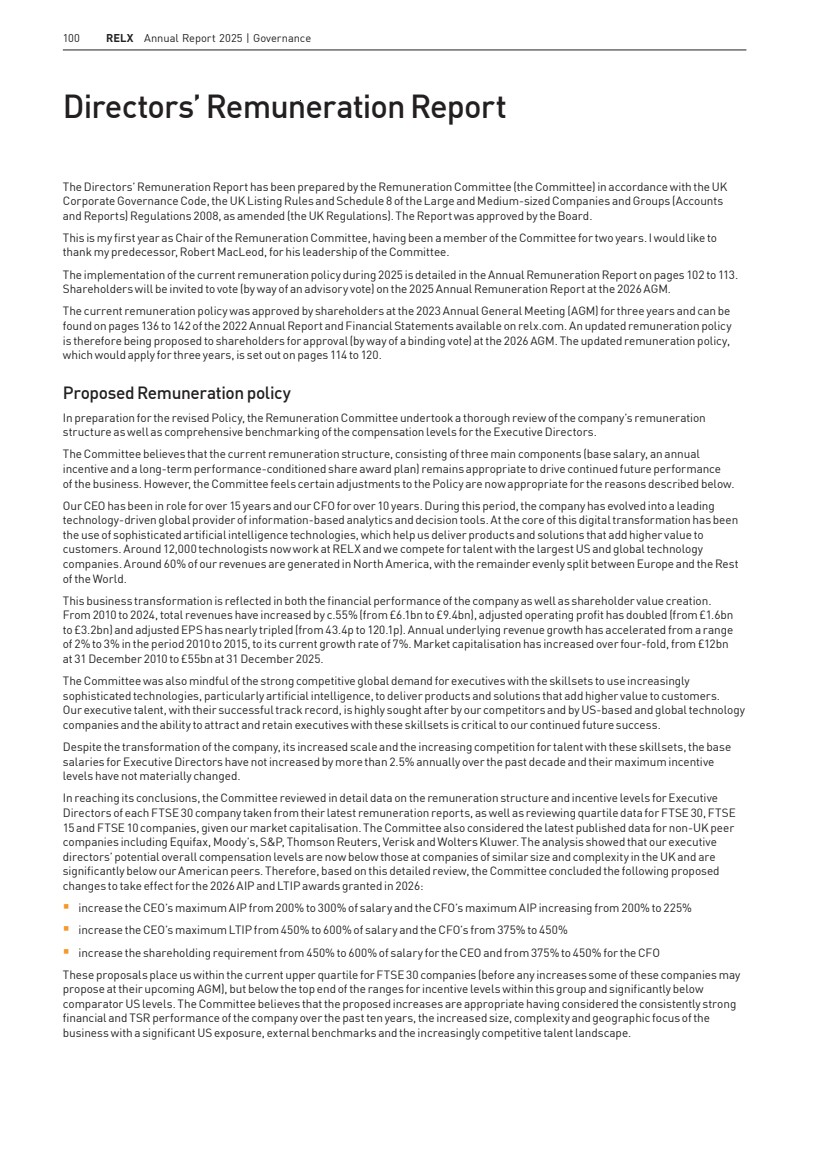
| RELX Annual Report 2025 | Directors’ Remuneration Report 101 Other change Recognising the overlapping impact of share deferral, holding period and shareholding requirements, AIP deferral will reduce from 50% to 25% of any AIP earned once an Executive Director’s shareholding requirement is met and AIP deferral will cease once anExecutive Director holds shares of a value equal to twice the level of their shareholding requirement. This means that the CEO is required to hold 12 times his salary in shares, and the CFO nine times, before deferral ceases to operate. This provides a level of alignment that goes beyond market norms and provides a significant long-term alignment with shareholders. Given the majority of variable pay is provided via LTIP with a two year holding period, the Committee considers it has sufficient ability to apply malus and clawback. The CEO currently owns c26 times his salary in RELX shares and the CFO c11 times his salary. In preparing these proposals, we engaged with shareholders representing c55% of our issued capital and shareholder representative bodies. The feedback received has been supportive of the proposals and as a result of the consultation, we have included additional details regarding the factors considered by the Committee in reaching its conclusions, along with details of its benchmarking analysis. Annual Remuneration report Our purpose is to benefit society by developing products that: help researchers advance scientific knowledge; doctors and nurses improve the lives of patients; lawyers promote the rule of law and achieve justice and fair results for their clients; businesses and governments prevent fraud; consumers access financial services and get fair prices on insurance; and customers learn about markets and complete transactions. Our purpose guides our actions beyond the products that we develop. It defines us as a company. Every day across RELX our employees are inspired to undertake initiatives that make unique contributions to society and the communities in which we operate. We see what we do as a company as being an integral part of our commitment to corporate responsibility. We have set sustainability objectives which reflect our focus on our unique contributions to society. Our 2030 environment targets are shown on page 60 and we are continuing to reduce our environmental impact to meet these targets. Our performance was again recognised by external rating agencies: RELX has an AAA Corporate Responsibility rating with MSCI which it has held for ten consecutive years and was ranked first in our sector by Sustainalytics, and was included in the S&P Global Sustainability Yearbook. More information can be found on pages 35 to 61. As you will have seen earlier in the annual report, the Company delivered strong revenue and profit growth in 2025, driven by the ongoing shift in business mix towards higher growth analytics and decision tools that deliver enhanced value to our customers across market segments. We develop and deploy these tools across the company by leveraging deep customer understanding to combine leading content and data sets with powerful artificial intelligence and other technologies. This has been a key driver of the evolution of our business for well over a decade, and will remain a key driver of customer value and growth in our business for many years to come. In summary, underlying revenue growth was 7%, underlying adjusted operating profit growth was 9% and at constant currency, adjusted EPS growth was 10%. We are proposing an increase in the full-year dividend of 7%. Our Total Shareholder Return outperformed the FTSE 100 over the last five and ten year periods as shown on page 110. 2025 outcomes Our strong organic revenue and adjusted operating profit growth drove an AIP payout of 81% of the maximum. Details of our targets and achievements for the year are shown on pages 103 and 104. Financial performance was very strong over the past three years, and our TSR has outperformed our UK, US and European peer groups. As a result, the LTIP payout is 90% of the maximum. Details of our targets and achievements are shown on page 105. In determining the level of payout under the annual and the multi-year incentives, the Committee took into account RELX’s overall business performance, value created for shareholders and other relevant factors and determined that the outcomes were fair and appropriate and applied no discretion to the payouts. As part of the benchmarking of compensation levels for the Executive Directors described above, the Committee also reviewed their base salaries. Based on external data, the Committee determined not to make any adjustments to the CEO’s base salary. The Committee adjusted the CFO’s base salary to £970k (from £853k), effective July 2025. This reflects both the increased scale and complexity of our business and that our CFO is one of the most experienced CFOs in the FTSE 100, having contributed to delivering very strong financial performance for over a decade at RELX as well as having previously served as CFO for two other FTSE 100 companies and having chaired the Audit Committees of two FTSE 30 companies. Broader employee considerations The Board reviews information on employee metrics and updates on employee related matters, as well as outcomes of employee surveys conducted during the year. Bianca Tetteroo, Non-Executive Director responsible for workforce engagement, met with employee groups during 2025 and reported back to the Board. Further information on the workforce engagement process is provided in the Governance section on page 92. The Committee also reviews annual salary increase guidelines globally. When determining the remuneration for Executive Directors and Senior Executives, the Committee considers business and individual performance as well as other factors including broader employee reward. The Committee is satisfied that the incentive schemes drive the desired behaviours to support the Company’s purpose, values and strategy. Alistair Cox Chair, Remuneration Committee Market segments Governance and other information Financial statements Financial review Corporate responsibility Overview |
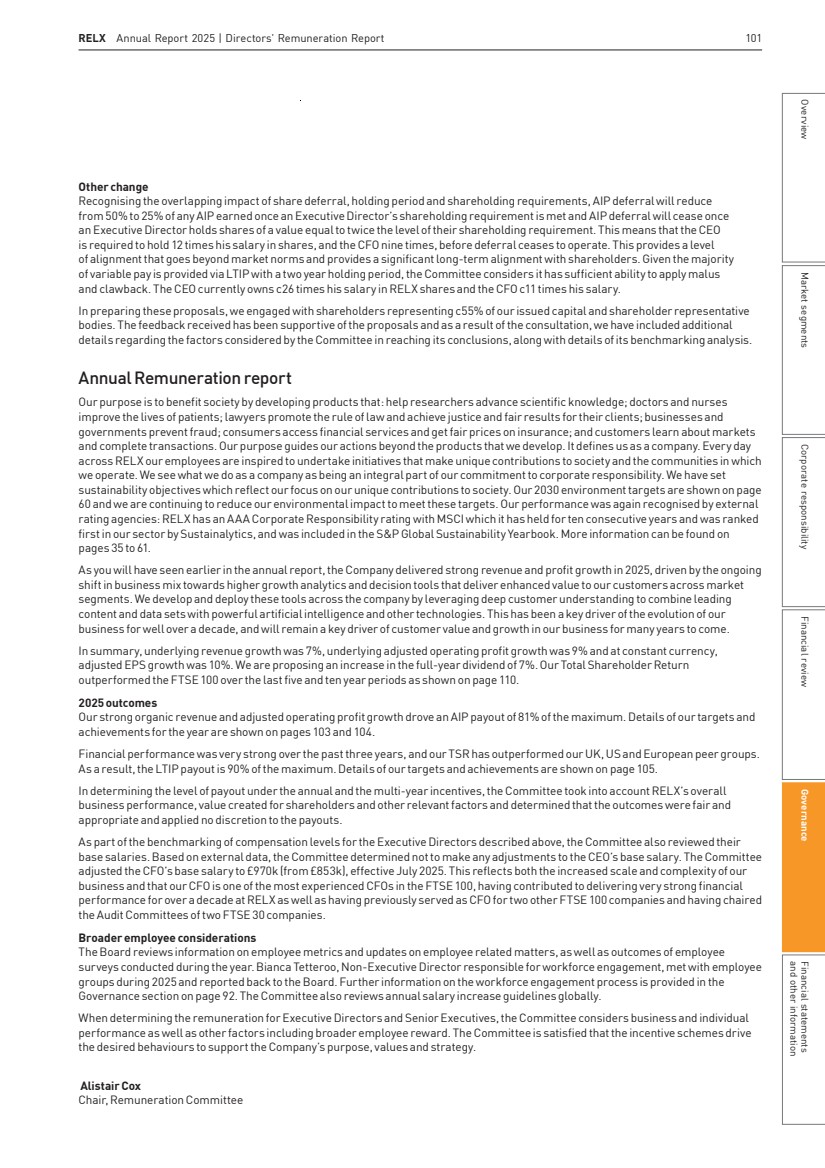
| 102 RELX Annual Report 2025 | Governance Annual Remuneration Report Single Total Figure of Remuneration – Executive Directors Annual incentive Share based awards(3) Pension(4) GBP’000 Salary Benefits Total (1) Cash Deferred Shares(2) Total fixed remuneration(5) Total variable remuneration(5) Erik Engstrom 2025 1,448 100 1,169 1, 169 7,390 159 11,436 1,708 9,728 2024 1,413 94 1,125 1,125 10,686 155 14,599 1,663 12,937 Nick Luff 2025 911 15 736 736 3,626 100 6,125 1,027 5,098 2024 832 15 663 663 5,244 92 7,508 939 6,569 (1) Benefits are typically comprised of a car allowance, private medical/dental insurance and the cost of tax return preparation. (2) 50% of the AIP is paid in shares deferred for three years. Dividend equivalents accrue on these shares. (3) The 2025 figures reflect the vesting of the 2023–2025 cycle of the LTIP. As the LTIP vests after the approval date of this Report, the average share price for the last quarter of 2025 has been used to arrive at an estimated figure in respect of these awards, in line with the methodology prescribed by the UK Regulations. The estimated figures for the 2022-2024 cycle of the LTIP disclosed in last year’s Report have been updated to reflect the share price on the vesting date, which increased the 2024 disclosed figure by £1.1 m for theCEO and by £ 0.5 m for the CFO. The vesting percentage was determined on 14 February 2025 and was in line with the one disclosed on page 107 of the 2024 Remuneration Report. For Erik Engstrom, the amount that directly reflects share price appreciation is £4.5m for 2024 and £ 1.6 m for 2025. For Nick Luff, these numbers are £2.2m for 2024 and £ 0.8 m for 2025. The awards are due to vest in February 2026 and the 2025 figures will be restated in next year’s report to reflect actual values at vesting. (4) Erik Engstrom and Nick Luff received cash in lieu of pension of 11% of base salary. (5) Total fixed remuneration includes base salary, benefits and pension. Total variable remuneration includes annual incentive and share based awards. Some figures and subtotals add up to different amounts than the totals due to rounding. The total remuneration for Directors is set out in note 25 to the consolidated financial statements. The AIP and LTIP performance measures and targets are shown on the following pages. The performance measures are based on adjusted figures as they provide relevant information in assessing the Company’s performance, position and cash flows and we believe they track the core operational performance of RELX and how it contributes to shareholder value creation. The Annual Report includes a reconciliation of adjusted measures to IFRS measures. |
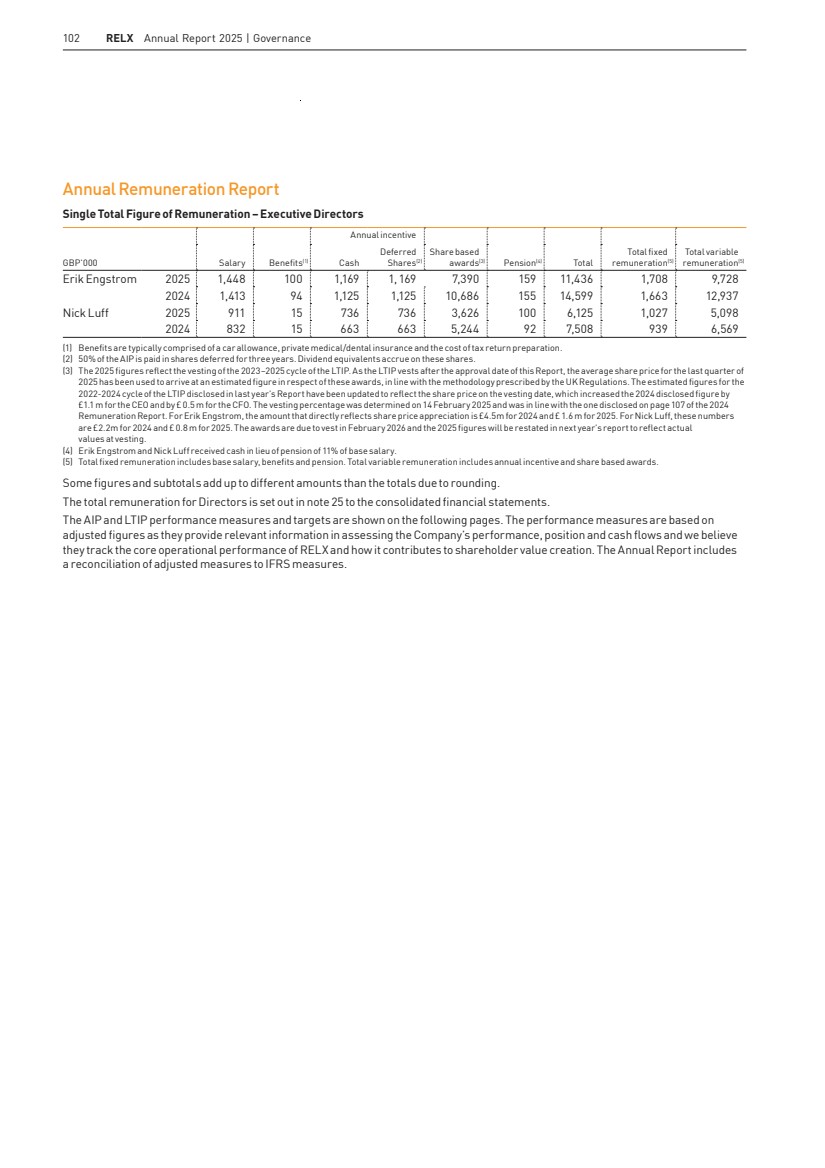
| RELX Annual Report 2025 | Directors’ Remuneration Report 103 2025 Annual Incentive Set out below is a summary of performance against each financial and non-financial measure and the resulting payout for 2025: Performance measure Weighting % Financial targets(1) GBPm Achievement Achievement % vs target Payout % vs target Payout % of max(2) Threshold Target Maximum Revenue 30% 9,015 9,590 10,070 9,590 100.0% 100.0% 66.7% Adjusted net profit after tax 30% 2,182 2,321 2,437 2,358 101.6% 116.0% 77.3% Cash flow 30% 2,927 3,114 3,270 3,301 106.0% 150.0% 100.0% Financial measures 90% 122.0% 81.3% Non-financial measures 10% A detailed description of the non-financial measures and achievement against those is set out on the next page. 97.5% 65.0% Total 100% 119.6% 80.7% (1) Targets are set on an underlying basis for revenue and on a constant currency basis for adjusted net profit, and reflect targeted growth, with cash flow based on the targeted cash conversion. Target amounts presented in sterling reflect actual movements in exchange rates relative to their equivalent constant currency amounts. (2) The maximum for each measure is 150% of target. The overall maximum is 200% of salary. As highlighted earlier, underlying revenue growth was 7%. Underlying adjusted operating profit growth was 9 % and at constant currency, adjusted EPS growth was 10%. Some figures add up to different amounts than the totals due to rounding. 50% of the AIP will be paid in cash in Q1 2026 and the remainder is paid in Deferred Shares which will be released in Q1 2029. The release of Deferred Shares is not subject to any further performance conditions but is subject to malus and clawback. Market segments Governance and other information Financial statements Financial review Corporate responsibility Overview |
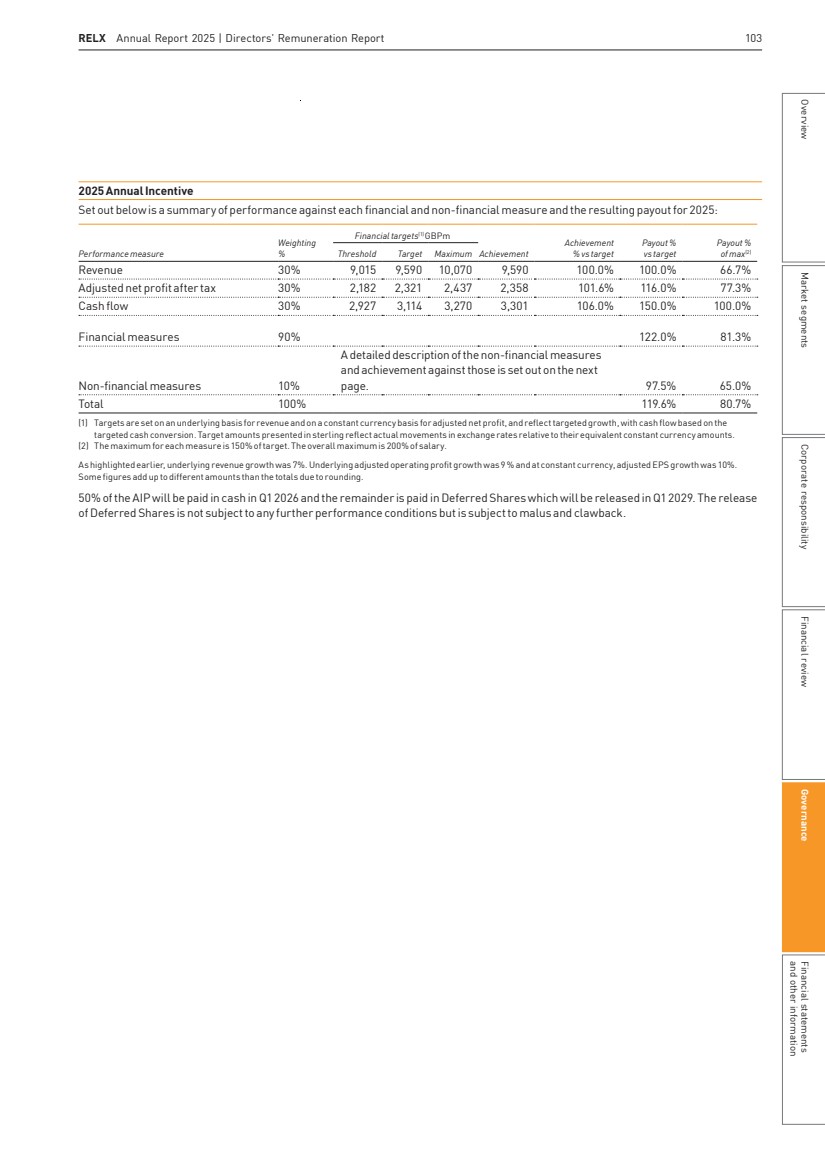
| 104 RELX Annual Report 2025 | Governance Non-financial measures Non-financial measures represent 10% of the AIP. Of this component, achievements and payouts are outlined below. The targets for 2025 were focused on sustainability metrics and are consistent with our glidepath to achieving the 2030 targets. Payout for carbon reduction and for paper usage and waste was capped at 95% of target in the year in recognition of the changes in office work patterns and business travel. More information can be found on pages 35 to 61. Non-financial measures Relative weighting Target Achievement Payout % of target Payout % of max Carbon reduction 25% § Reduce Scope 1 (direct) and Scope 2 (location-based) carbon emissions by 33% against a 2018baseline. § Reduce energy and fuel consumption of our locations by 27% against a 2018baseline. § Carbon emissions reduced by 74%. § Energy and fuel consumption reduced by 71%. 95.0% 63.3% Paper usage and waste 25% § Reduce total waste sent to landfill from reporting locations by 50% against a 2018 baseline. § 100% of RELX production papers, graded in Book Chain Project, rated as ‘known and responsible sources’ or certified FSC or PEFC. § Total waste sent to landfill reduced by97%. § 100% of RELX production papers rated as ‘known and responsible sources’ or certified FSC or PEFC. 95.0% 63.3% Socially responsible suppliers 25% § 6,350 suppliers as Code signatories to. § 125 independent external audits of suppliers. § 6,586 suppliers Code signatories. § 140 audits of suppliers completed. 100.0% 66.7% Universal access to information 25% § 500 new content items added to the free RELX SDG Resource Centre. § 315,000 unique users of the RELX SDG Resource centre. § 935 content items added to the RELX SDG Resource Centre. § 352,391 unique users of RELX SDG Resource centre. 100.0% 66.7% Total 100% 97.5% 65.0% |
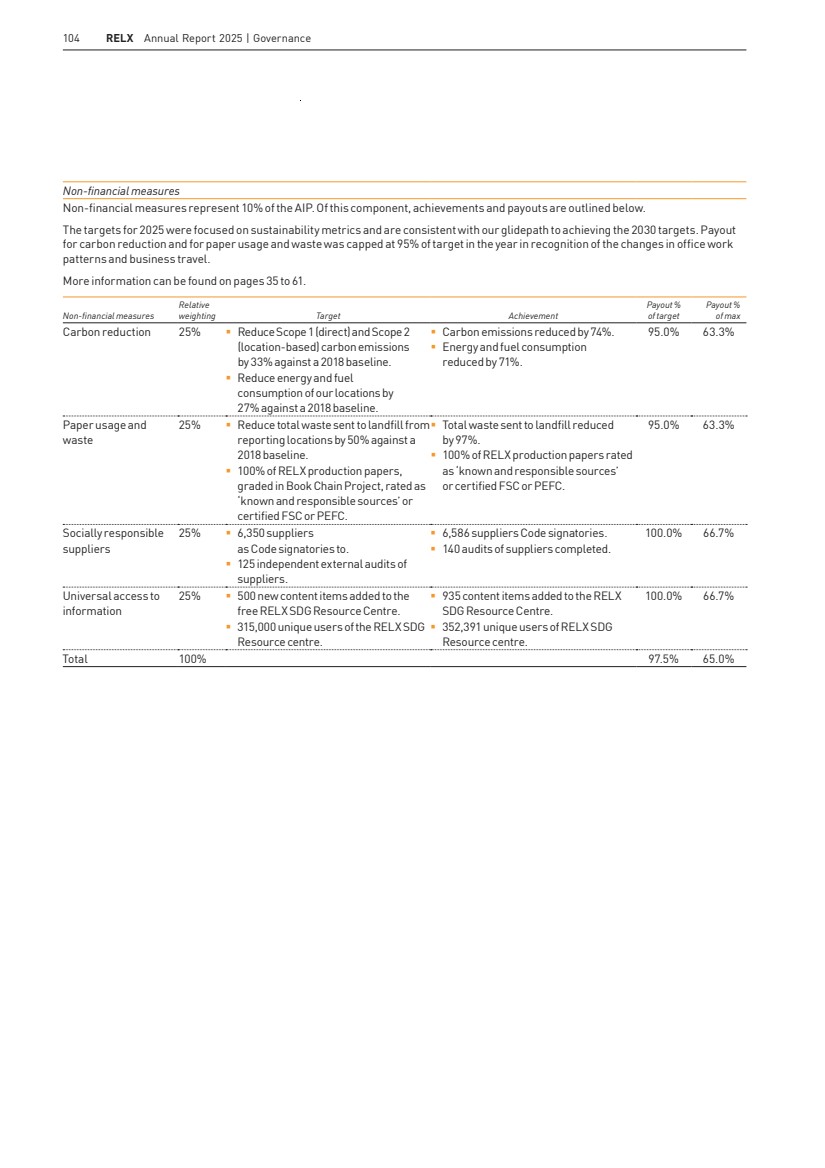
| RELX Annual Report 2025 | Directors’ Remuneration Report 105 2023–2025 LTIP Set out below is a summary of performance against each measure of the LTIP cycle 1 January 2023–31 December 2025. The targets remained unchanged from when these were set at the beginning of 2023. As noted in the Chair letter, financial performance was very strong and RELX’s TSR outperformed the UK, US and European peer groups over the period. The payout is 90% of maximum. Performance measure Weighting Performance range and vesting levels set at grant(1) Achievement against the performance range Resulting vesting percentage TSR over the three-year performance period 20% below median median upper quartile 0% 25% 100% between median and upper quartile of UK, European and USgroups 67.1% Average growth in adjusted EPS over the three-year performance period(2) 40% below 5% p.a. 5% p.a. 6% p.a. 7% p.a. 8% p.a. 9% p.a. 10% p.a. 11% p.a. and above 0% 25% 50% 65% 75% 85% 92.5% 100% 9.8% 91.0% ROIC in the third year of the performance period (2) 40% below 11.0% 11.0% 11.5% 12.0% 12.5% 13.0% 13.5% 14.0% and above 0% 25% 50% 65% 75% 85% 92.5% 100% Above 14% 100.0% Total vesting percentage: 89.8% (1) Calculated on a straight-line basis for performance between the points. (2) Growth in adjusted EPS at constant currency and ROIC are calculated as set out in the Chief Financial Officer’s report and note 10 to the consolidated financial statements, with adjustments made to remove the effect on ROIC of changes in exchange rates, pension deficits and accounting standards over the three-year performance period. The performance measures used in incentive plans are based on adjusted figures as they provide relevant information in assessing the Company’s performance, position and cash flows and we believe they track the core operational performance of RELX and how it contributes to shareholder value creation. The Annual Report includes a reconciliation of adjusted measures to IFRS measures. Market segments Governance and other information Financial statements Financial review Corporate responsibility Overview |
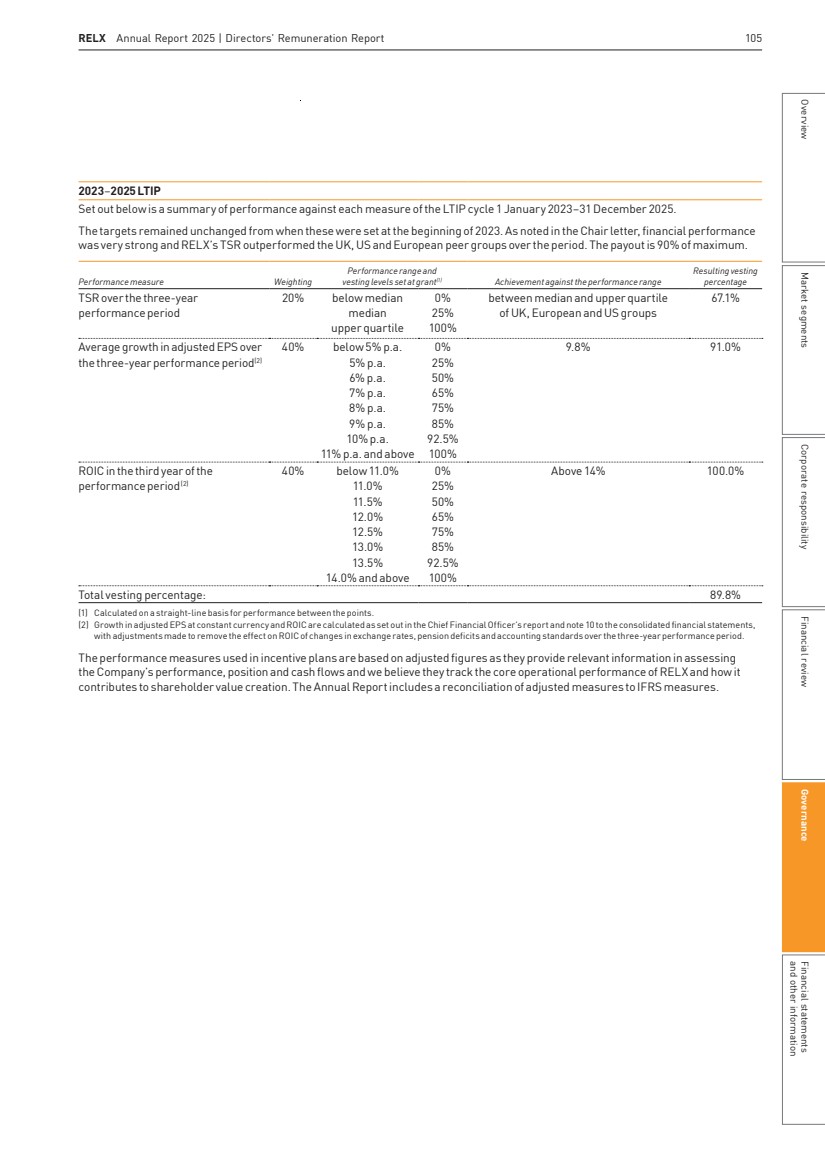
| 106 RELX Annual Report 2025 | Governance Single Total Figure of Remuneration – Non-Executive Directors Total fee Benefits(1) Total GBP 2024 2025 2024 2025 2024 2025 Paul Walker 725,000 725,000 1,017 1,188 726,017 726,188 Alistair Cox 152,000 161,614 152,000 161,614 June Felix 161,000 156,500 161,000 156,500 Andy Halford(2) N/A 88,516 N/A 88,516 Charlotte Hogg 127,000 127,000 127,000 127,000 Robert MacLeod(3) 157,000 47,630 157,000 47,630 Andrew Sukawaty 140,500 150,228 140,500 150,228 Bianca Tetteroo(4) 61,250 127,000 N/A 5,240 61,250 132,240 Suzanne Wood(5) 210,500 222,267 210,500 222,267 (1) Benefits comprise the notional benefit of tax filing support provided to Non-Executive Directors for filings outside their home country resulting from their directorships with RELX. Paul Walker’s benefits relate to private medical insurance. Further, the Company meets all reasonable travel, subsistence, accommodation and other expenses, including any tax where such expenses are deemed taxable, incurred by the Non-Executive Directors and the Chair in the course of performing their duties. (2) Appointed to the Board at the AGM on 24 April 2025. (3) Retired from the Board at the AGM on 24 April 2025. (4) Appointed to the Board on 1 July 2024. (5) Became a member of the Remuneration Committee from the AGM on 24 April 2025. The total remuneration for Directors is set out in note 25 to the consolidated financial statements. Non-Executive Directors’ fees The fees in the Single Total Figure table for Non-Executive Directors reflect the following fees in 2025: GBP Annual fee 2025 Annual fee 2026 Chair 725,000 725,000 Non-Executive Directors 97,500 97,500 Senior Independent Director 40,000 40,000 Chair of: – Audit Committee 40,000 40,000 – Remuneration Committee 40,000 40,000 Workforce engagement fee 25,000 25,000 Committee membership fee: – Audit Committee 25,000 25,000 – Remuneration Committee 25,000 25,000 – Nominations Committee 15,000 15,000 In addition, an intercontinental travel fee of £4,500 was payable to any Non-Executive Director (excluding the Chair) in respect of each transatlantic journey made in order to attend a RELX Board or Committee meeting during 2025. Fees may be reviewed annually, although in practice they have changed on a less frequent basis. |
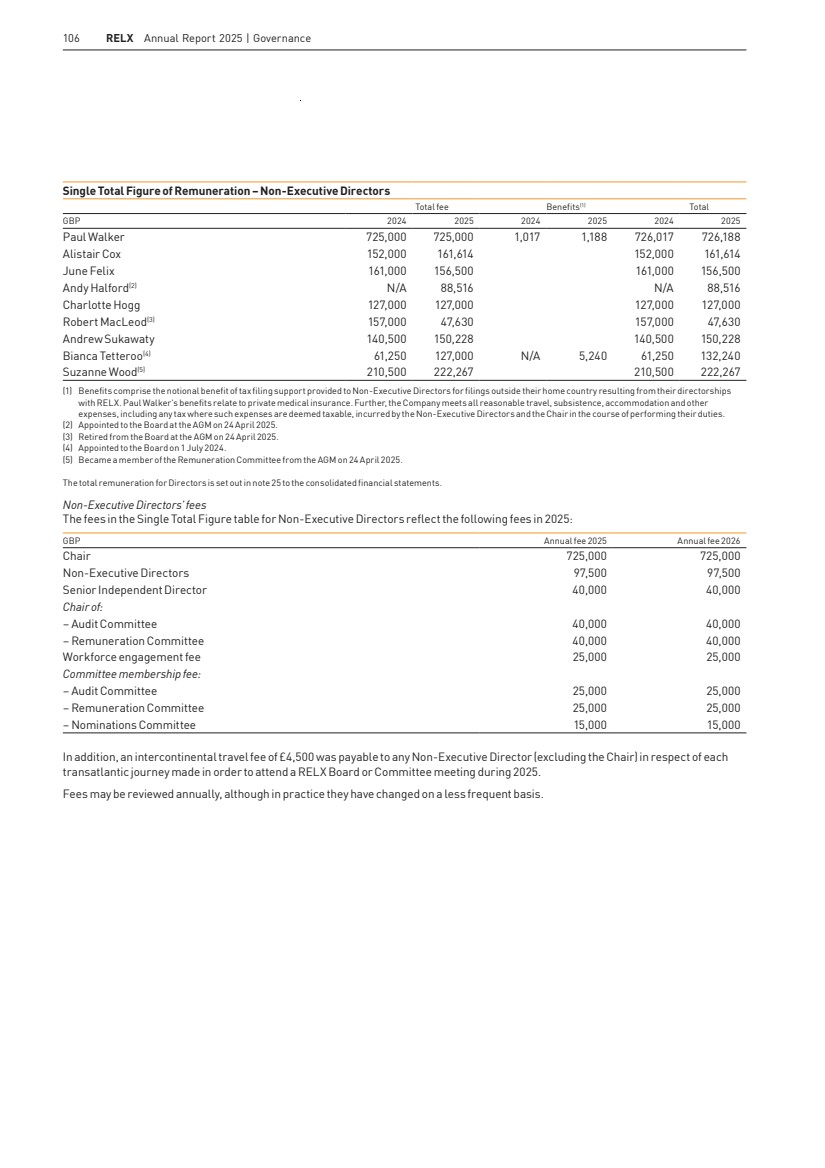
| RELX Annual Report 2025 | Directors’ Remuneration Report 107 Statement of Directors’ shareholdings and other share interests Shareholding requirement The Committee believes that a closer alignment of interests can be created between senior management and shareholders if executives build and maintain a significant personal stake in RELX. The shareholding requirements applicable to the Executive Directors are set out in the table below. Shares that count for this purpose are (i) any type of RELX security of which the Director, their spouse, civil partner or dependent child has beneficial ownership and (ii) AIP deferred shares which are within their three-year deferral period, on a notional net (after tax) basis. There has been no change to the interests reported below between 31 December 2025 and the date ofthisReport. Meeting the shareholding requirement is both a vesting condition for LTIP awards granted and a requirement to maintain eligibility for future LTIP awards. On termination of employment, Executive Directors are to maintain their full shareholding requirement (or, if lower, their actual level of shareholding at the time of leaving) for two years after leaving employment. On 31 December 2025, the Executive Directors’ shareholdings were as follows: Shareholding requirement (% of 2025 annual base salary) Shareholding as at 31 December 2025 (% of 2025 annual base salary)(1) Erik Engstrom 450% 2569% Nick Luff 300% 1066% (1) Includes AIP deferred shares which are within their three-year deferral period, on a notional net (after tax) basis (55,073 for Erik Engstrom and 32,431 for Nick Luff). For disclosure purposes, any PLC ADRs held are included as ordinary shares. Share interests (number of RELX ordinary shares held) 1 January 2025 31 December 2025 Erik Engstrom 1,175,520 1,180,001 Nick Luff 286,267 289,260 Paul Walker 16,000 16,000 Alistair Cox 3,170 4,046 June Felix 7,500 7,500 Andy Halford(2) N/A 5,000 Charlotte Hogg 4,750 4,750 Robert MacLeod(3) 6,950 N/A Andrew Sukawaty 30,000 30,000 Bianca Tetteroo(4) 0 0 Suzanne Wood 5,100 5,100 (1) Number excludes AIP deferred shares which are within their three-year deferral period. If these were included on a notional net (after tax) basis, the totals at 31 December 2025 would be 1,235,074 for Erik Engstrom and 321,691 for Nick Luff]. (2) Appointed to the Board at the AGM on 24 April 2025. (3) Retired from the Board at the AGM on 24 April 2025. (4) Is not able to hold RELX shares given her executive role at Achmea. Scheme interests awarded during the financial year LTIP – PERFORMANCE SHARE AWARDS Basis on which award is made Face value of award at grant(1) Percentage of maximum vesting for threshold performance End of performance period Erik Engstrom 450% of salary £6,358,360 If each measure pays out at threshold, the overall payout is 20% 31 December 2027 Nick Luff 375% of salary £3,120,203 AIP – DEFERRED SHARES Erik Engstrom 1/2 of 2024 AIP payout £1,125,411 N/A. The release of AIP deferred shares in Q1 2028 is not subject to any Nick Luff 1/2 of 2024 AIP payout £662,718 further performance conditions, but is subject to malus and clawback. (1) The face value of the LTIP awards and AIP deferred shares granted in February 2025 was calculated using the middle market quotation of a PLC ordinary share (£40.73). This share price was used to determine the number of shares granted. The LTIP awards granted in 2025 are based on ROIC, EPS and TSR weighted 40%:40%:20% respectively and assessed independently. The targets and vesting scales applicable to these awards are set out on page 114 of the 2024 Remuneration Report. Market segments Governance and other information Financial statements Financial review Corporate responsibility Overview |
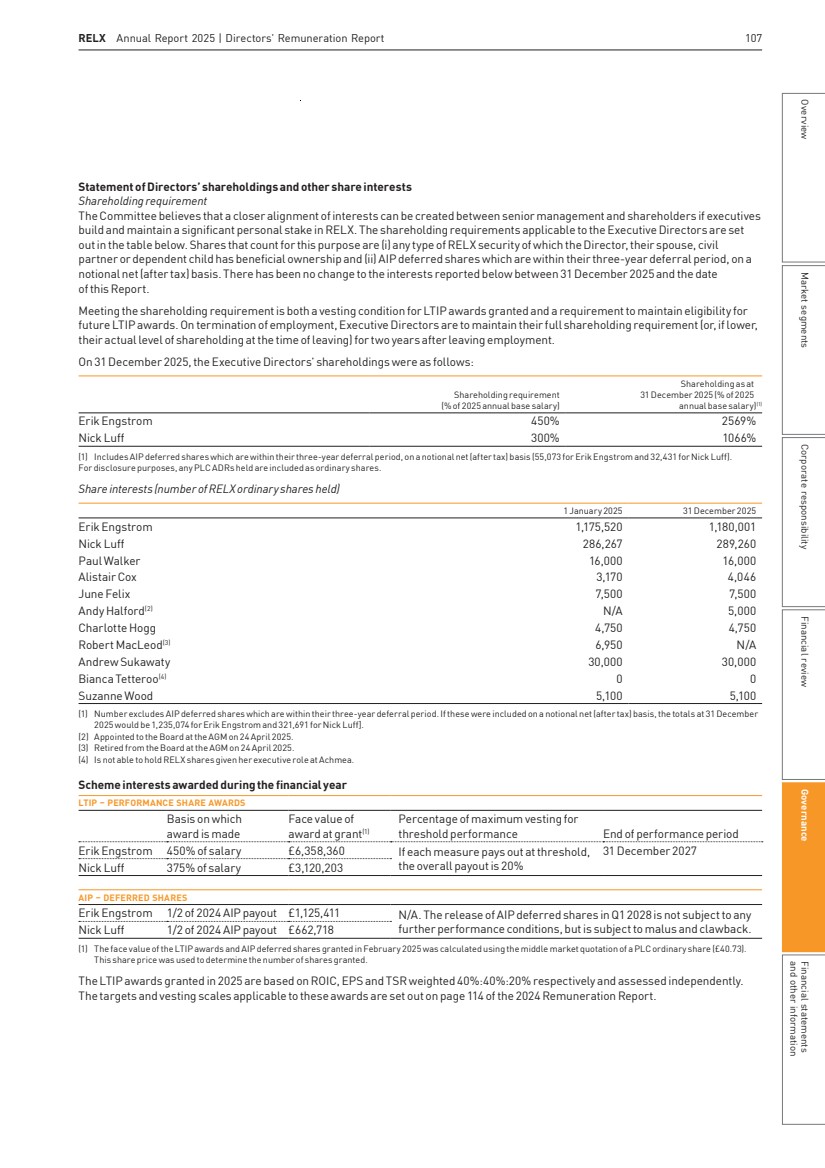
| 108 RELX Annual Report 2025 | Governance Multi-year incentive interests The tables below and on the next page set out unvested LTIP share awards, AIP deferred shares and vested but unexercised options held by the Executive Directors, including details of awards granted, vested and options exercised during the year. All outstanding LTIP share awards are subject to performance conditions. Between 31 December 2025 and the date of this Report, there have been no changes in the share awards or options held by the ExecutiveDirectors. Erik Engstrom LTIP SHARES Year of grant No. of unvested shares held on 1 Jan 2025 No. of shares awarded during 2025 Market price per share at award No. of shares vested during 2025 Market price per share at vesting No. of unvested shares held on 31 Dec 2025 End of performance period Date of vesting 2025 156,110 £40.73 156,110 Dec 2027 Feb 2028 2024 182,342 £34.020 182,342 Dec 2026 Feb 2027 2023 242,857 £24.920 242,857 Dec 2025 Feb 2026 2022 259,819 £22.725 252,024 £40.73 Total 685,018 156,110 252,024 581,309 DEFERRED SHARES(1) Year of grant No. of shares held on 1 Jan 2025 No. of shares awarded during 2025 Market price per share at award No. of shares released during 2025 Market price per share at release No. of shares held on 31 Dec 2025 Date of release 2025 27,631 £40.73 27,631 Feb 2028 2024 35,228 £34.020 35,228 Feb 2027 2023 41,054 £24.920 41,054 Feb 2026 2022 49,912 £22.725 49,912 £40.73 Total 126,194 27,631 49,912 103,913 (1) Part of the AIP is paid in deferred shares released after three years. The amount at grant was already included in the AIP in the single figure table of the relevant year. OPTIONS Year of grant No. of options held on 1 Jan 2025 No. of options granted during 2025 Option price on date of grant No. of options exercised during 2025 Market price per share at exercise No. of options held on 31 Dec 2025 Options exercisable until 2017 85,356 £14.945 85,356 27 Feb 27 90,116 €16.723 90,116 27 Feb 27 Total 175,472 175,472 |
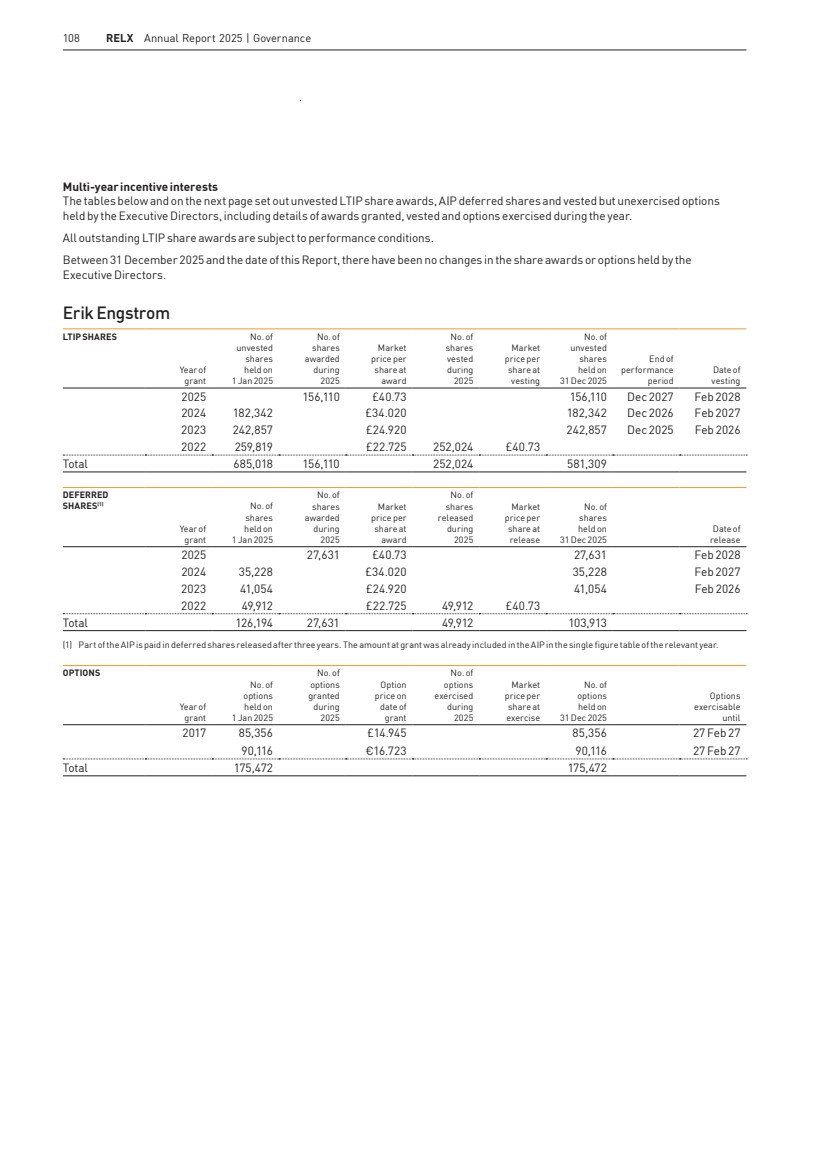
| RELX Annual Report 2025 | Directors’ Remuneration Report 109 Nick Luff LTIP SHARES Year of grant No. of unvested shares held on 1 Jan 2025 No. of shares awarded during 2025 Market price per share at award No. of shares vested during 2025 Market price per share at vesting No. of unvested shares held on 31 Dec 2025 End of performance period Date of vesting 2025 76,607 £40.73 76,607 Dec 2027 Feb 2028 2024 89,479 £34.020 89,479 Dec 2026 Feb 2027 2023 119,175 £24.920 119,175 Dec 2025 Feb 2026 2022 127,499 £22.725 123,674 £40.73 Total 336,153 76,607 123,674 285,261 DEFERRED SHARES(1) Year of grant No. of shares held on 1 Jan 2025 No. of shares awarded during 2025 Market price per share at award No. of shares released during 2025 Market price per share at release No. of shares held on 31 Dec 2025 Date of release 2025 16,271 £40.73 16,271 Feb 2028 2024 20,745 £34.020 20,745 Feb 2027 2023 24,175 £24.920 24,175 Feb 2026 2022 29,391 £22.725 29,391 £40.73 Total 74,311 16,271 29,391 61,191 (1) Part of the AIP is paid in deferred shares released after three years. The amount at grant was already included in the AIP in the single figure table of the relevant year. OPTIONS Year of grant No. of options held on 1 Jan 2025 No. of options granted during 2025 Option price on date of grant No. of options exercised during 2025 Market price per share at exercise No. of options held on 31 Dec 2025 Options exercisable until 2017 40,210 £14.945 40,210 27 Feb 27 42,452 €16.723 42,452 27 Feb 27 2016 47,778 £12.550 47,778 £40.886 50,586 €15.285 50,586 €49.247 Total 181,026 98,364 82,662 Market segments Governance and other information Financial statements Financial review Corporate responsibility Overview |
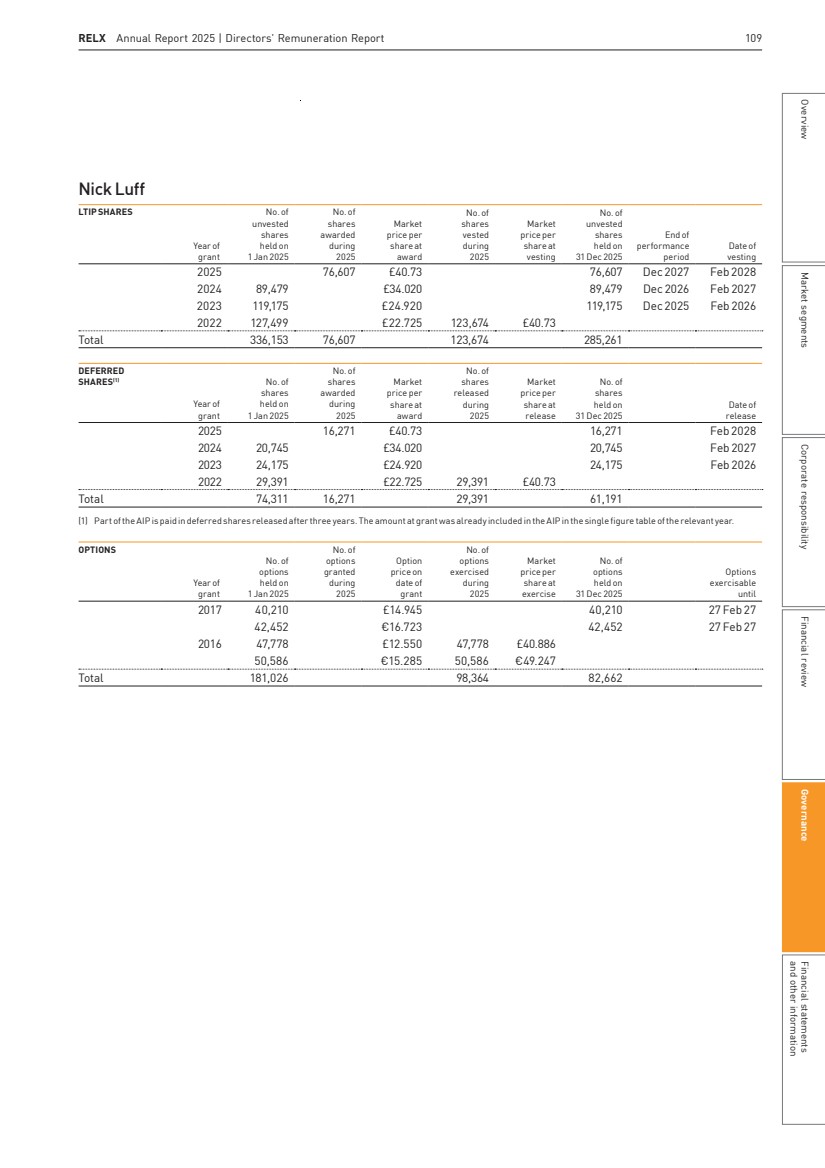
| 110 RELX Annual Report 2025 | Governance Performance graphs The graphs below show total shareholder returns for RELX calculated on the basis of the average share price in the 30 trading days before the respective year end and assuming dividends were reinvested. RELX’s performance is compared with the FTSE 100. 3 years 5 years 10 years 0 25 50 75 100 125 150 175 % Dec-25 RELX vs FTSE 100 – 3-YEAR TSR Dec-22 Dec-23 Dec-24 RELX FTSE 100 +45% ∆=-7% +38% % Dec-20 Dec-21 Dec-22 Dec-23 Dec-24 Dec-25 0 25 50 75 100 125 150 175 200 225 250 RELX FTSE 100 RELX vs FTSE 100 – 5-YEAR TSR +80% ∆=8% +88% RELX FTSE 100 Dec-15 Dec-16 Dec-17 Dec-18 Dec-19 Dec-20 Dec-21 Dec-22 Dec-23 Dec-24 Dec-25 % ∆=93% +129% 0 100 200 300 400 500 RELX vs FTSE 100 – 10-YEAR TSR +222% CEO historical pay table The table below shows the historical CEO pay over a ten-year period. GBP’000 2016 2017 2018 2019 2020 2021 2022 2023 2024 2025 Base salary 1,160 1,189 1,218 1,249 1,280 1,312 1,345 1,379 1,413 1,448 Annual incentive payout as a % of maximum 68% 69% 78% 77% 65% 86% 76% 87% 80% 81% Multi-year incentive vesting as a % of maximum(1) 97% 92% 81% 81% 6% 71% 70% 100% 97% 90% CEO total 11,399 8,748 9,141 9,346 3,980 9,560 8,597 14,989 14,599 11,436 (1) From 2020 onwards, amounts above reflect LTIP vesting. Prior periods also include vesting of awards under ESOS and BIP plans which were discontinued for Directors since 2017 (with the final vesting of awards under those plans occurring in 2019) . |
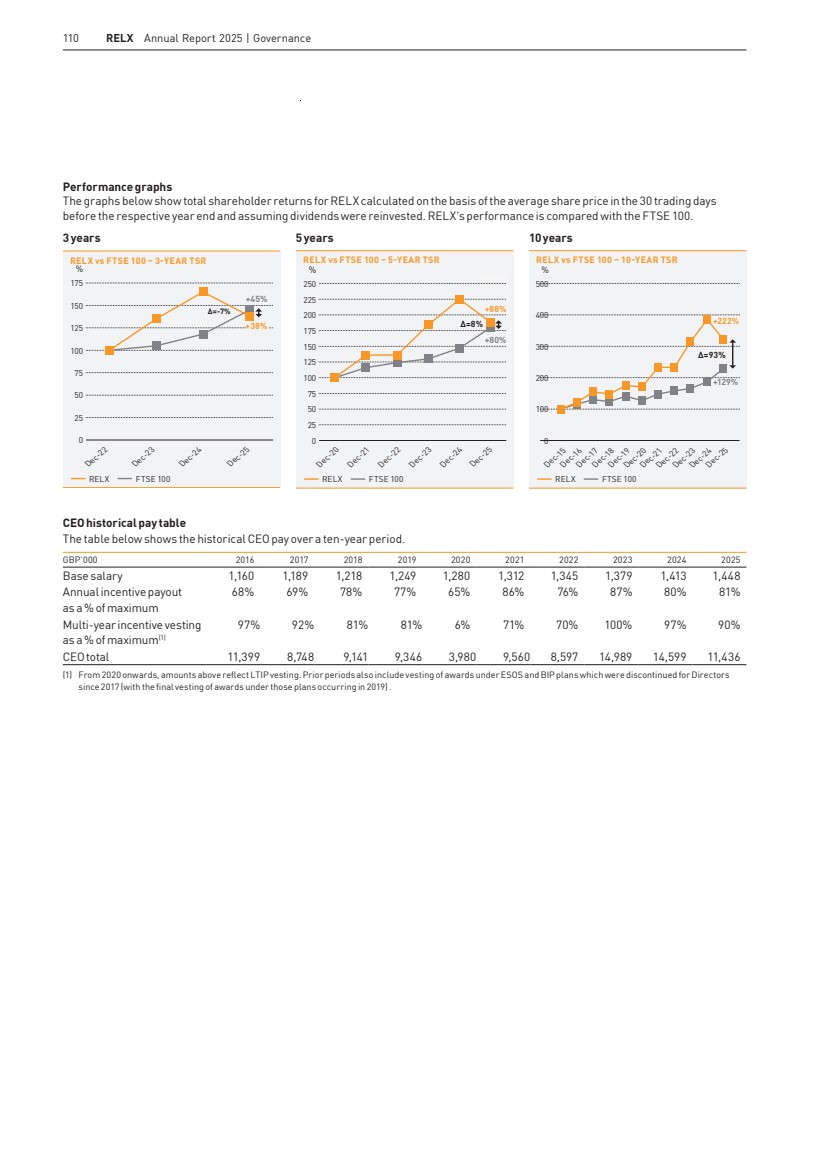
| RELX Annual Report 2025 | Directors’ Remuneration Report 111 Comparison of change in Directors’ pay with change in employee pay The UK Regulations require companies to disclose the percentage change in remuneration from 2024 to 2025 for each director compared with the employees of the listed company, excluding directors. RELX PLC has no employees and Executive Directors are the only employees of RELX Group PLC. We therefore have no data to report but have chosen to continue to report data on changes in base salary of the CEO compared with changes in base salary of a broader employee population. The salary increase for the CEO of 2.5% for 2025 was in line with the salary increase budget for the UK and the US where the majority of our employees are based. UK pay ratios The UK Regulations require the disclosure of the ratio of total CEOremuneration to median (P50), 25th percentile (P25) and 75th percentile (P75) UK employee total remuneration (calculated on a full-time equivalent basis). UK employees represent less than 20% of our global employee population. Pay ratios for total remuneration are likely to vary, potentially significantly, over time, since the CEO’s total remuneration each year is driven largely by performance-related pay outcomes and is affected by share price movements. We have therefore also shown the UK ratios for the salary component. For the purposes of the ratios below, the CEO’s 2025 total remuneration is the total single figure and salary as disclosed on page 102. The P25, P50 and P75 were selected from the UK employee population as at 1 October 2025. Ratios for prior years are as disclosed in the respective reports. Total remuneration Pay ratios All UK employees GBP’000 Year Method P25 P50 P75 P25 P50 P75 2025 A 215:1 149:1 107:1 53 77 107 2024 A 269:1 183:1 131:1 50 74 103 2023 A 294:1 198:1 140:1 46 69 97 2022 A 188:1 129:1 89:1 44 64 93 2021 A 223:1 151:1 104:1 43 64 92 2020 A 98:1 67:1 46:1 40 59 86 2019 A 225:1 149:1 100:1 39 58 86 Salary Pay ratios All UK employees GBP’000 Year Method P25 P50 P75 P25 P50 P75 2025 A 32:1 23:1 17:1 46 64 86 2024 A 32:1 23:1 17:1 44 62 83 2023 A 33:1 24:1 17:1 42 58 80 2022 A 34:1 25:1 18:1 39 55 76 2021 A 35:1 25:1 18:1 38 52 74 2020 A 35:1 25:1 18:1 37 52 72 2019 A 35:1 25:1 18:1 35 51 71 Slight differences compared with ratios calculated using data shown in the tables are due to rounding. The ratios are calculated using Option A, meaning that the median, 25th and 75th percentiles were determined based on total remuneration using the single total figure valuation methodology, except for annual incentives (other than sales incentives) which are based on estimated payout as individual final payout levels are still to be finalised. We chose Option A as we believe it is the most robust and accurate way to identify the median, 25th percentile and 75th percentile UKemployee. The Committee is satisfied that the overall picture presented by the 2025 pay ratios is consistent with the pay, reward and progression policies for the Group’s UK employees. § Salaries for all UK employees, including the Executive Directors, are set based on a wide range of factors, including market practice, scope and impact of the role and experience. § The provision of certain benefits and the level of benefit provided vary depending on the role and level of seniority. § Participation in annual incentive plans varies by business and reflects the culture and the nature of the business, as well as role. § Whilst none of the comparator employees participate in the executive share plans, they do have the opportunity to receive company shares via the UK Sharesave Option Plan. A greater proportion of performance-related variable pay and share based awards applies to more senior executives, including theExecutive Directors, who have a greater influence over performance outcomes. Relative importance of spend on pay The following table sets out the total employee costs for all employees, as well as the amounts paid in dividends and share repurchases. 2024 GBPm 2025 GBPm % change Employee costs(1) 3,145 3,175 1% Dividends 1,121 1,181 5% Share repurchases 1,000 1,500 50% (1) Employee costs include wages and salaries, social security costs, pensions and share based and related remuneration. Payments to past Directors and payments for loss of office There have been no payments for loss of office in 2025. Market segments Governance and other information Financial statements Financial review Corporate responsibility Overview |
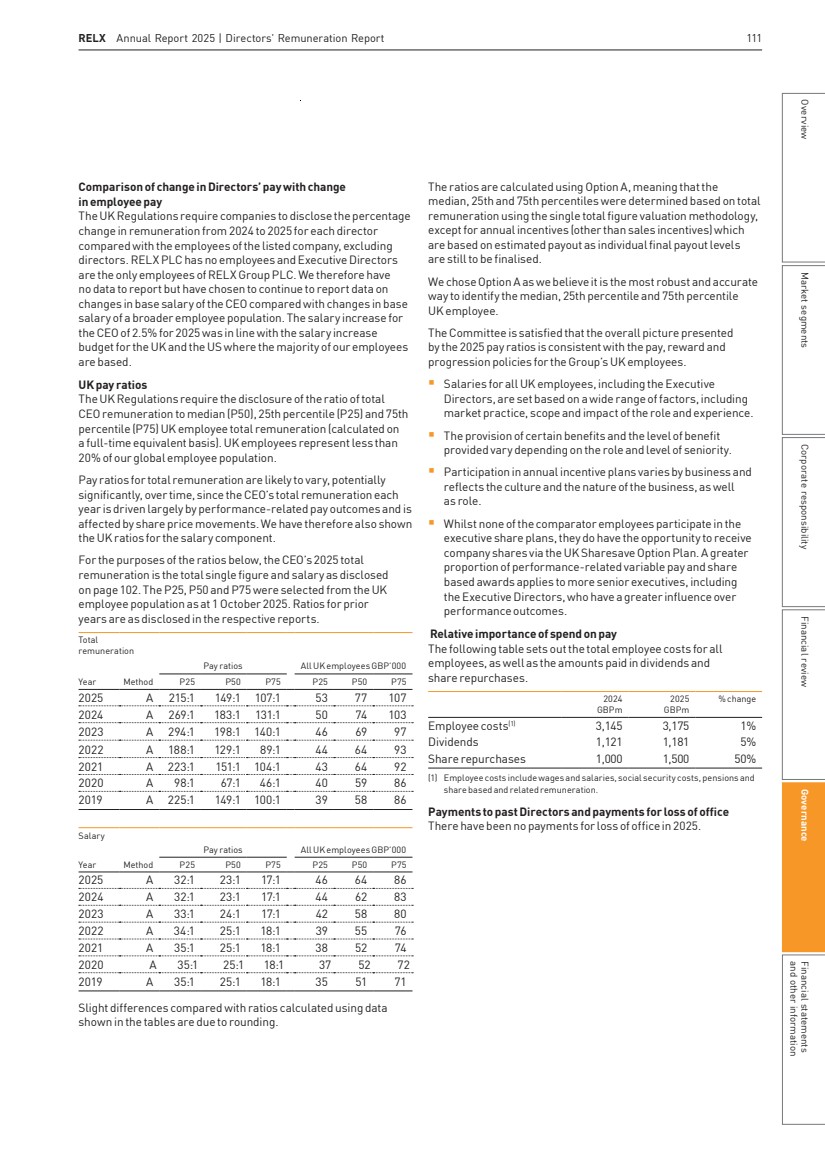
| 112 RELX Annual Report 2025 | Governance Implementation of the remuneration policy in 2026 Salary: The Committee approved salary increases of 2.5% for the CEO and CFO for 2026, in line with the increase for the broader UK workforce. As a result, Erik Engstrom’s salary from 1 January 2026 is £ 1,484,506 and Nick Luff’s salary is £994,250. Benefits: The benefits provided to the Executive Directors are unchanged for 2026. Annual incentive: Subject to shareholder approval, the maximum AIP payout is 300% of base salary for the CEO and 225% for the CFO. Revenue, adjusted net profit after tax and cash flow each have a one-third weighting. Details of the 2026 annual incentive targets will be disclosed in the 2026 Remuneration Report. Pension: Erik Engstrom and Nick Luff will receive cash in lieu of pension of 11% of their salary. Share based awards: Subject to shareholder approval, we will be granting LTIP awards with face values of 600% of salary to Erik Engstrom and 450% to Nick Luff in 2026. Awards will be made at the current limits (450% and 375% respectively for the CEO and for the CFO) in February 2026 and top up awards will be made after the April 2026 AGM, based on the share price used for the February initial awards. The awards are subject to a three-year performance period and a two-year holding period applies. The following metrics, weightings, targets and vesting scales apply to LTIP awards granted in 2026 for the 2026–2028 cycle. The vesting of LTIP awards is dependent on three separate performance measures: ROIC, EPS and TSR weighted 40%:40%:20% respectively and assessed independently. The TSR measure comprises three comparators (sterling, euro and US dollar) reflecting the fact that RELX accesses equity capital markets through three exchanges – London, Amsterdam and New York – in three currency zones. RELX’s TSR performance is measured separately against each comparator group and each ranking achieved will produce a payout, if any, in respect of one-third of the TSR measure. The proportion of the TSR measure that vests will be the sum of the three payouts. The averaging period applied for TSR measurement purposes is the three months before the start of the financial year in which the award is granted and the last three months of the third financial year of the performance period. The companies for the TSR comparator groups for the 2026–2028 LTIP cycle were selected on the following basis (substantially unchanged from prior year): (a) they were in a relevant market index or were the largest listed companies on the relevant exchanges at the end of the year before the start of the performance period: the FTSE 100 for the sterling group; the Euronext100 and Dax40 for the euro group; and the S&P 500 for the US dollar group; (b) certain companies were then excluded: § those with mainly domestic or single country revenues (as they do not reflect the global nature of RELX’s customer base); § those engaged in extractive industries (as they are exposed to commodity cycles); and § financial services companies (as they have a different risk/reward profile). (c) the remaining companies were then ranked by market capitalisation and, for each comparator group, around 50 companies with market capitalisations above and below that of RELX were taken; and (d) relevant listed global peers operating in businesses similar to those of RELX, but not otherwise included, were added. Vesting percentage of each third of the TSR tranche(1) TSR ranking within the relevant TSRcomparator group 0% Below median 20% Median 100% Upper quartile (1) Vesting is on a straight-line basis for performance between the minimum and maximum levels. The calculation methodology for the EPS and ROIC measures is set out in the 2013 Notices of Annual General Meetings, which can be found on RELX’s website. The targets and vesting scales applicable to the EPS and ROIC are set out below. Vesting percentage of EPS and ROIC tranches(1) Average growth in adjusted EPS over the three-year performance period Average ROIC over the three-year performance period 0% below 5% p.a. below 11.2% 20% 5% p.a. 11.2% 50% 6% p.a. 11.9% 65% 7% p.a. 12.6% 75% 8% p.a. 13.3% 85% 9% p.a. 14.0% 92.5% 10% p.a. 14.7% 100% 11% p.a. or above 15.4% or above (1) Vesting is on a straight-line basis for performance between the stated average adjusted EPS growth/ROIC percentages. |
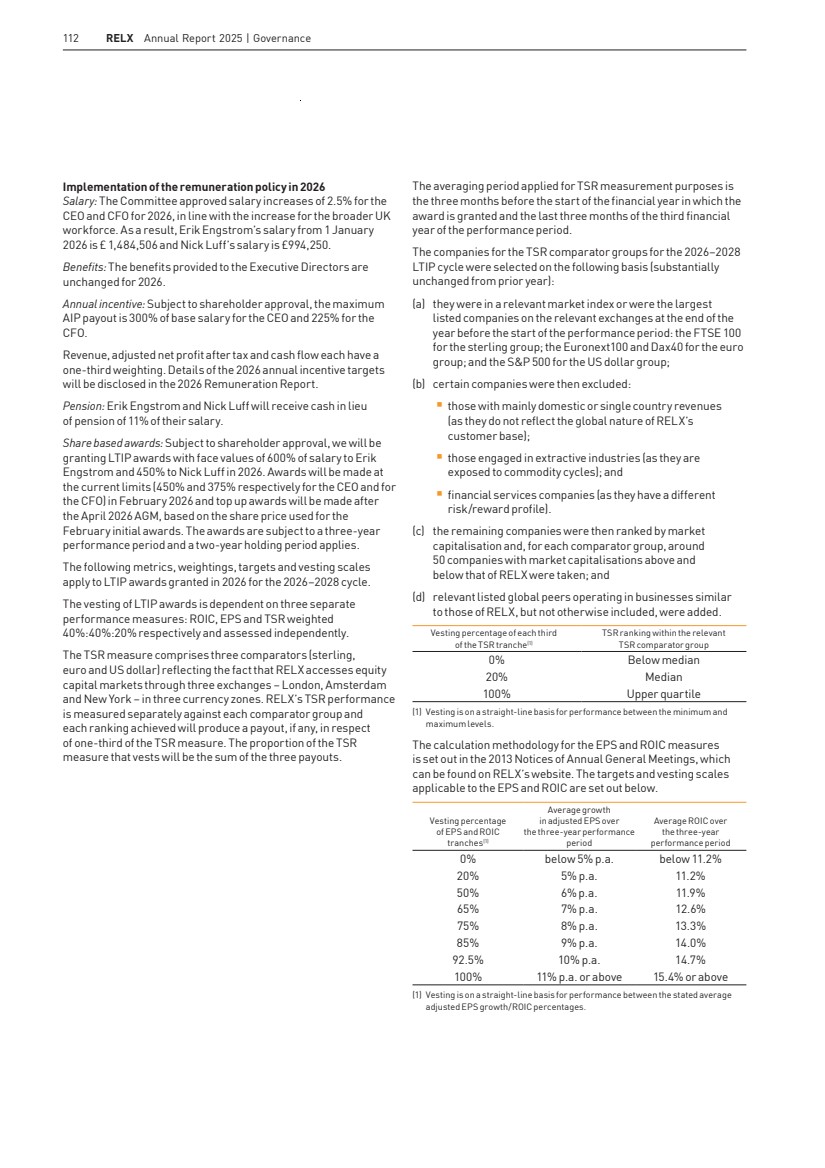
| RELX Annual Report 2025 | Directors’ Remuneration Report 113 Remuneration Committee advice The Committee consists of independent Non-Executive Directors and the Chair of RELX. Details of members and their attendance are contained in the Corporate Governance Review on page 90. The Chief Legal Officer and Company Secretary attends meetings as secretary to the Committee. At the invitation of the Chair of theCommittee, the CEO attends appropriate parts of the meetings. The CEO is not in attendance during discussions about his remuneration. The Chief Human Resources Officer advised the Committee during the year. Willis Towers Watson is the external adviser, appointed by the Committee through a competitive process. Willis Towers Watson also provided actuarial and other human resources consultancy services to some RELX companies during the year. The Committee is satisfied that the firm’s advice continues to be objective and independent, and that no conflict of interest exists. The individual consultants who work with the Committee do not provide advice to the Executive Directors or act on their behalf. Willis Towers Watson is a member of the Remuneration Consultants’ Group and conducts its work in line with the UK Code of Conduct for executive remuneration consulting. During 2025, Willis Towers Watson received fees of £24,639 for advice given to the Committee, charged on a time and expense basis. Shareholder voting At the Annual General Meeting of RELX PLC on 24 April 2025, votes cast by proxy and at the meeting in respect of the Directors’ Remuneration Report were as follows: Resolution Votes For % For Votes Against % Against Total votes cast Votes Withheld Remuneration Report (advisory) 1,439,249,912 95.68% 65,010,139 4.32% 1,504,260,051 401,804 At the Annual General Meeting of RELX PLC on 20 April 2023, votes cast by proxy and at the meeting in respect of the Directors’ Remuneration Policy were as follows: Resolution Votes For % For Votes Against % Against Total votes cast Votes Withheld Remuneration Policy (binding) 1,528,240,789 95.87% 65,765,933 4.13% 1,594,006,722 2,416,183 Alistair Cox Chair, Remuneration Committee 11 February 2026 Market segments Governance and other information Financial statements Financial review Corporate responsibility Overview |
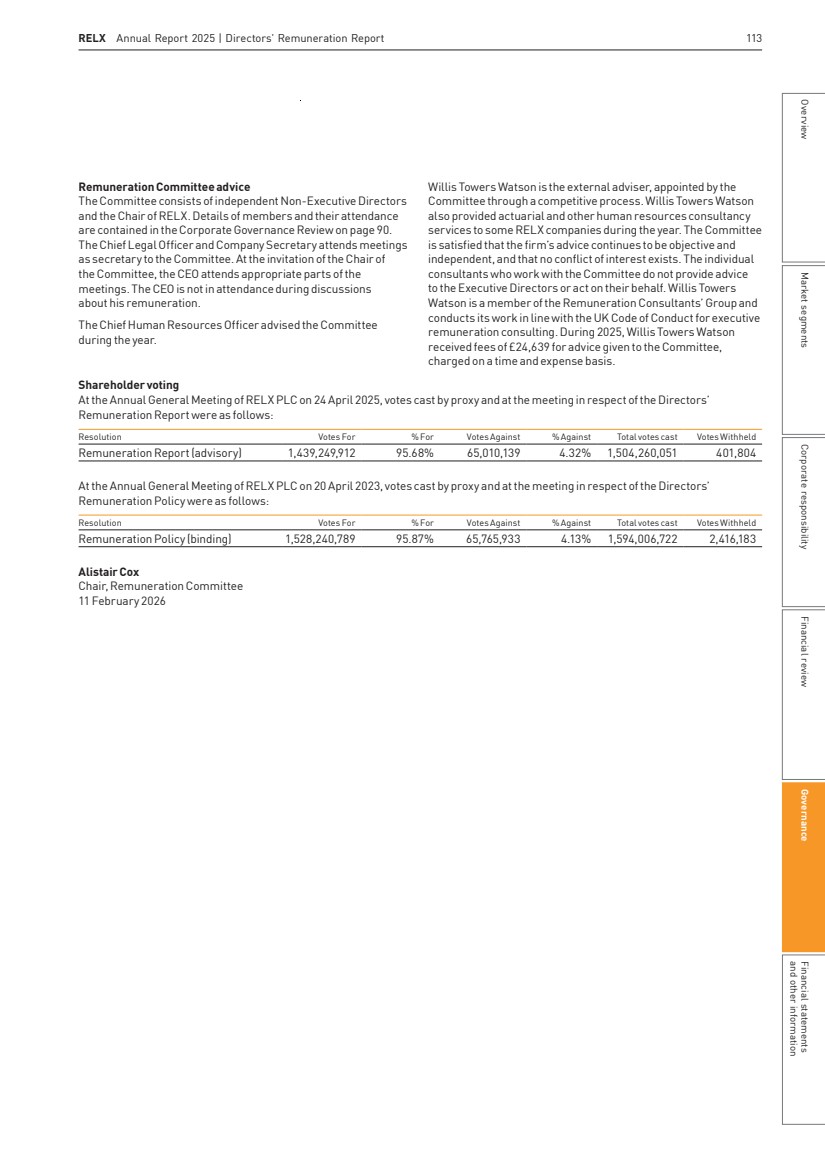
| 114 RELX Annual Report 2025 | Governance Set out in this section is the Company’s proposed new remuneration policy for Directors, which, subject to approval by shareholders, will apply for three years from the conclusion of the RELX PLC AGM to be held in April 2026. The key changes from the previous Remuneration Policy (which was first published on pages 136 to 142 of the 2022 Annual Reports and Financial Statements and was approved by shareholders at the April 2023 Annual General Meeting) and the rationale for the changes are explained in the Committee Chair’s introduction. Some minor editorial changes have also been made. The Policy is intended to apply for three years from the 2026 AGM and to awards granted in 2026. Remuneration policy table – Executive Directors ANNUAL BASE SALARY Purpose and link to strategy To recruit and retain the best executive talent globally to execute our strategic objectives at appropriate cost. Operation Salaries for Executive Directors are set and reviewed annually by the Remuneration Committee (the Committee) with changes typically taking effect on 1 January. In exceptional circumstances, the Committee may review salaries more frequently. When reviewing salaries, the Committee considers the executive’s role and sustained value to the Company in terms of skill, experience and overall contribution and the Company’s guidelines for salaries for all employees for the year. Periodically, competitiveness with companies which are comparable in respect of industry, size, international scope and complexity is also considered in order to ensure the Company’s ability to attract and retain executives. Performance framework N/A Maximum value Salary increases will continue to be aligned with the range of increases for the wider employee population and subject to annual all-employee guidelines. However, as for all employees, the Committee has discretion to exceed this to take account of individual circumstances such as change in responsibility, increases in scale or complexity of the business or alignment to market level. Recovery of sums paid No provision. RETIREMENT BENEFITS Purpose and link to strategy Retirement plans are part of remuneration packages designed to recruit and retain the best executive talent at appropriate cost. Operation Executive Directors receive pension benefits up to the value equivalent to the maximum level of pension benefits provided under the Company’s regular defined contribution pension plans as may be in effect or amended from time to time (currently 11% of base salary in the UK). The defined contribution pension plans are designed to be competitive and sustainable long-term. Any amount payable may be paid wholly or partly as cash in lieu. Performance framework N/A Maximum value The maximum value is equivalent to the maximum level of pension benefits provided under the Company’s regular defined contribution pension plans as may be in effect or amended from time to time (currently capped at 11% of base salary in the UK). Recovery of sums paid No provision. Remuneration Policy Report |
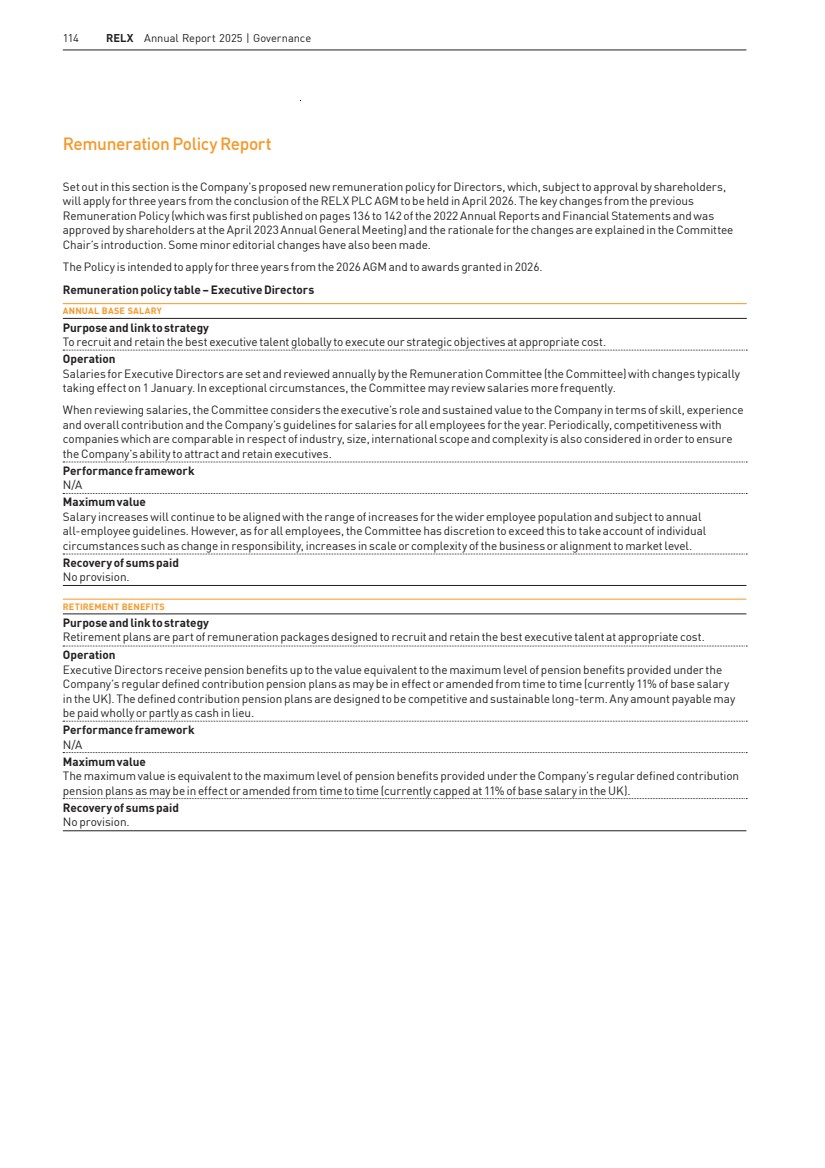
| RELX Annual Report 2025 | Directors’ Remuneration Report 115 OTHER BENEFITS Purpose and link to strategy To provide competitive benefits at appropriate cost. Operation Other benefits, subject to periodic review, may include private medical and dental cover, life assurance, tax return preparation costs, car benefits, directors’ and officers’ liability insurance, relocation benefits and expatriate allowances and other benefits available to employees generally, including, where appropriate, the tax on such benefits. Performance framework N/A Maximum value The maximum for ongoing benefits for Executive Directors will not normally exceed 10% of salary (excluding any one-off items, such as immigration support or relocation benefits, and any tax related charge on benefits which is met by the Company). However, theCommittee may provide reasonable benefits beyond this amount in exceptional situations, such as a change in the individual’s circumstances caused by the Company, or if there is a significant increase in the cost of providing the agreed benefit. ANNUAL INCENTIVE PLAN (AIP) Purpose and link to strategy The annual incentive provides focus on the delivery of annual financial targets and the achievement of annual objectives and milestones which are chosen to align with the Company’s strategy and create a platform for sustainable future performance. The compulsory deferral of 50% of any annual incentive earned into RELX shares for three years promotes longer-term alignment of Executive Directors’ interests with shareholders’ interests, including an element of post-termination shareholding. Why performance measures are chosen and how targets are set Performance measures include a balanced set of financial measures which are appropriately weighted and which support current strategy and incentivise the Executive Directors to achieve the desired outcomes without undue risk of focusing on any one financial measure. The financial targets are designed to be challenging and are set with reference to the previous year’s performance and internal and external forecasts for the following year. Performance measures may also include non-financial measures, for example linked to sustainability. Operation The Committee reviews and sets the financial targets and, if applicable, non-financial targets, annually, taking into account internal forecasts and strategic plans. Following year end, the Committee compares actual performance with the financial targets and assesses the achievement of any non-financial targets. The targets and outcomes are fully disclosed in the Remuneration Report published after year end. 50% of any annual incentive earned is paid in cash to the Executive Director and the remaining 50% is deferred into RELX shares, which are released to the Executive Director after three years. The share deferral proportion is reduced to 25% of any AIP earned once the shareholding requirement is met, and eliminated once an executive director meets twice the shareholding requirement. Dividend equivalents accrued during the deferral period are payable in respect of the shares. On a change in control, the default position is that deferred shares are released to the Executive Director. Alternatively, theCommittee may determine that deferred shares will instead be exchanged for equivalent share awards in the acquiring company. Performance framework The AIP is comprised of a balance of financial measures. The Committee can include non-financial measures with a weighting of up to 15%. Each measure is assessed separately. There is no payout below threshold and payout for each measure at threshold is up to 10% of the maximum opportunity for that measure. Following an assessment of achievement against each metric, the Committee agrees the overall level of earned incentive for each Executive Director. Committee discretion applies.1,2,3 Maximum value The maximum potential annual incentive is 300% of salary for the CEO and 225% for other Executive Directors. This includes any deferred share element but excludes dividend equivalents payable in respect of the deferred shares. Recovery of sums paid Clawback applies.4 Market segments Governance and other information Financial statements Financial review Corporate responsibility Overview |
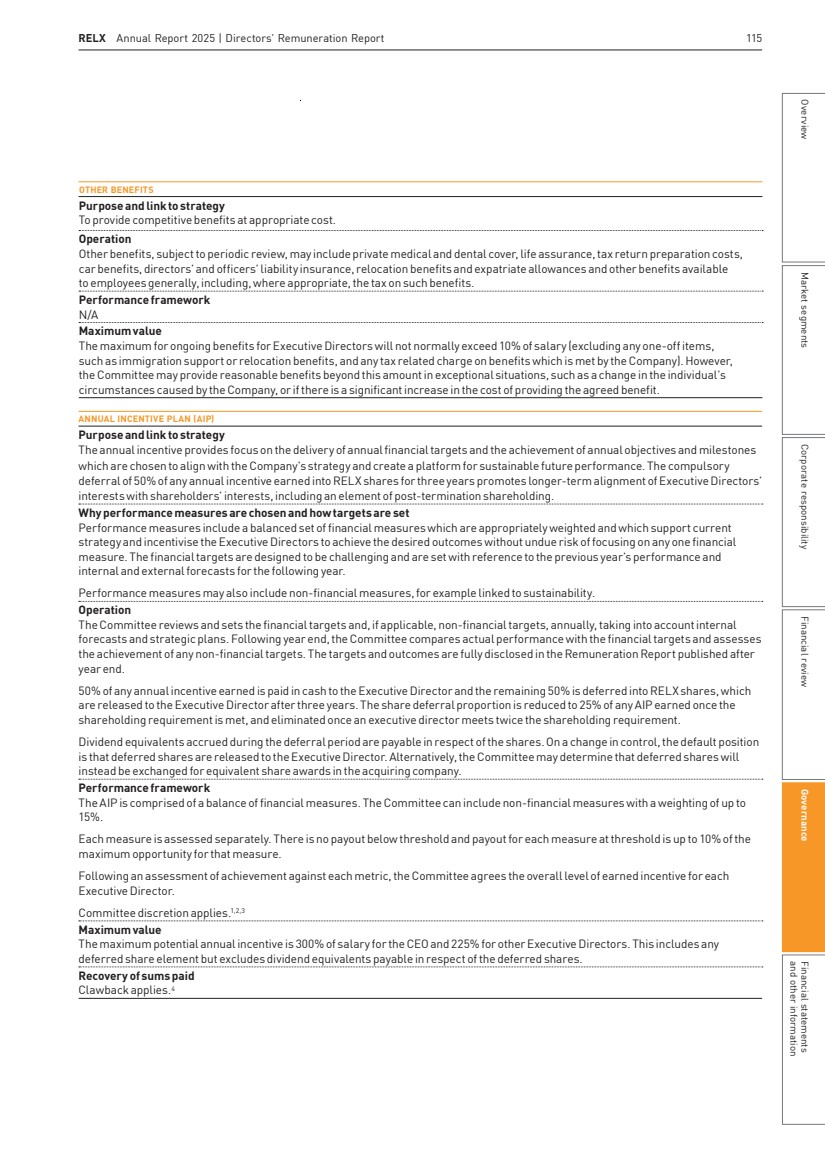
| 116 RELX Annual Report 2025 | Governance LONG-TERM INCENTIVE PLAN (LTIP) Purpose and link to strategy The Long-Term Incentive Plan (LTIP) is designed to provide a long-term incentive for Executive Directors to achieve the key performance measures that support the Company’s strategy, and to align their interests with shareholders. Why performance measures are chosen and how targets are set Our strategic focus is on continuing to transform the core business through organic investment and the build-out of new products into adjacent markets and geographies, supplemented by selective portfolio acquisitions and divestments. The performance measures in the LTIP are chosen to support this strategy by focusing on sustained earnings growth, return on invested capital and shareholder return. Targets are set with regard to previous results and internal and external forecasts for the performance period and the strategic plan for the business. They are designed to provide exceptional reward for exceptional performance, whilst allowing a reasonable expectation that reward at the lower end of the scale is attainable, subject to robust performance. Operation Annual awards of performance shares, with vesting subject to: § performance measured over three financial years § continued employment (subject to the provisions set out in the Policy on payments for loss of office section) The Committee may also make vesting subject to meeting shareholding requirements. A holding period of two years applies after vesting. Dividend equivalents accrued during the performance period are payable in respect of the performance shares that vest. On a change of control, the default position is that awards vest on a pro-rated basis, subject to an assessment of performance against targets at that time. Alternatively, the Committee may determine that the awards will not vest and will instead be exchanged for equivalent awards in the acquiring company. Performance framework The performance measures are EPS, ROIC and relative TSR, weighted 40%:40%:20% respectively and assessed independently, such that a payout can be received under any one of the measures (or, for TSR, in respect of one of the three comparator groups). Each measure is assessed separately. There is no payout below threshold and payout for each measure at threshold is 20% of the maximum opportunity for that measure. Dividend equivalents are not taken into account in the above payout levels. Committee discretion applies.1,2,3 Maximum value The maximum grant in any year is up to 600% of base salary for the CEO and up to 450% of base salary for other Executive Directors (notincluding dividend equivalents). Recovery of sums paid Clawback applies.4 Shareholding requirements The Executive Directors are subject to shareholding requirements. These are 600% of annual base salary for the CEO and 450% of annual base salary for other Executive Directors. On joining or promotion to the Board, Executive Directors are given a period of time, typically up to five years, to build up to their requirement. On termination of employment, Executive Directors are to maintain their full shareholding requirement (or, if lower, their actual level of shareholding at the time of leaving) for two years after leaving employment. Shares which count for shareholding purposes are shares beneficially owned by the Executive Director, their spouse, civil partner or dependent child and AIP deferred shares which are within their three-year deferral period, on a notional net of tax basis. |
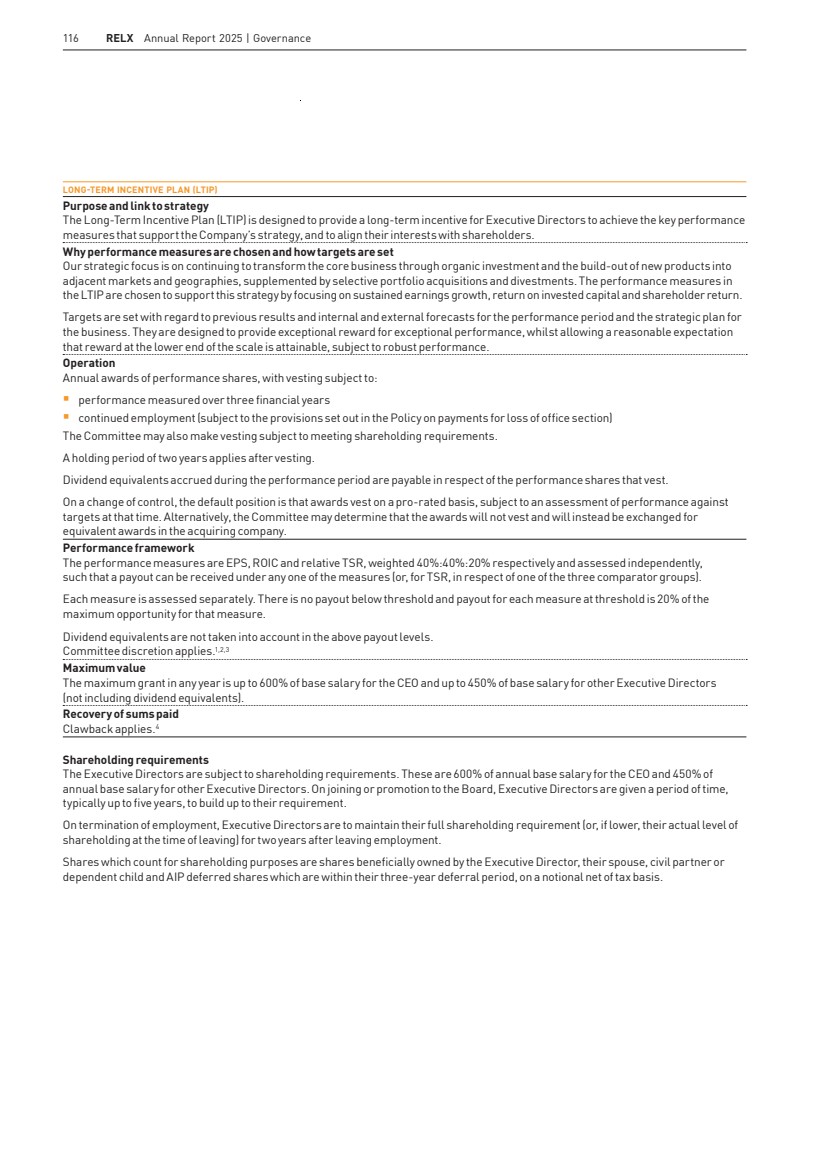
| RELX Annual Report 2025 | Directors’ Remuneration Report 117 Remuneration outcomes in different performance scenarios The Committee considers the level of remuneration that may be paid in the context of the performance delivered and value added for shareholders. The charts below are an illustration of how the CEO’s and CFO’s regular annual remuneration could vary under different performance scenarios. The salary is the salary as at 31 December 2025. Pension is 11% of base salary. Benefits are the same in all three scenarios in each chart and are based on 2025 benefits as shown in the 2025 Single Total Figure table. The performance assumptions which have been used are as follows: Minimum means no AIP payout and no LTIP vesting. In line with expectations means AIP payout at 200% of salary for the CEO and 150% of salary for the CFO and LTIP vesting at 50% of the award. Maximum means AIP payout at 300% of salary for the CEO and 225% for the CFO and LTIP vesting at 100% of the award. The three bars in each chart assume no share price movement. As required by the UK Regulations, assuming maximum performance achievement (as described above) and 50% share price growth over the performance period, the CEO’s maximum remuneration would increase to £19.1 m and the CFO’s maximum remuneration to £9.8m. Any dividend equivalents payable in respect of AIP deferred shares and LTIP are not included. CEO remuneration (GBP’000) LTIP AIP cash and deferred shares Salary, benefits, pension Minimum In line with expectations Maximum 100% 19% 12% 32% 49% 29% 59% 1,708 8,949 14,743 CFO remuneration (GBP’000) Minimum In line with expectations Maximum 100% 23% 14% 31% 46% 29% 57% 1,092 4,730 7,640 LTIP AIP cash and deferred shares Salary, benefits, pension Notes to the Remuneration policy table (1) Discretion in respect of AIP and LTIP payout levels: In determining the level of payout under the AIP and vesting under the LTIP, the Committee takes into account RELX’s overall business performance and value created for shareholders over the period in review and other relevant factors. It has discretion to adjust the vesting and payout levels (subject always to the maximum individual limits) ifit believes this would result in a fairer outcome. This discretion will only be used in exceptional circumstances and the Committee will explain in the next Remuneration Report the extent to which it has been exercised and the reasons for doing so. (2) Discretion to vary performance measures under the AIP and the LTIP: The Committee may vary the financial measures applying to a current annual incentive year and performance measures for LTIP awards already granted if a change in circumstances leads it to believe that the arrangement is no longer a fair measure of performance. Any new measures will not be materially less, or more, challenging than the original ones. (3) Discretion on termination of employment under the AIP and the LTIP: The Committee’s discretion on termination of employment is described under the ‘Policy on payments for loss of office’ section. (4) Malus and clawback under the AIP and the LTIP: Under the AIP and the LTIP, the Committee has discretion to apply malus and clawback in case of material misstatement of results or erroneous calculation in incentive payout; breach of post-termination restrictive covenants; misconduct; fraud or conduct which results in (i) significant reputational damage; (ii) material adverse effect on the financial position of the Company; or (iii) corporate failure. These apply for three years following the AIP cash payment and five years from the start of each LTIP performance period and, in the case of a breach of restrictive covenants, to the end of the restriction period. If a participant is subject to an internal investigation regarding a serious breach of any of the above matters, the vesting of their awards and the application of malus and clawback may be delayed until the outcome of that investigation. (5) Holding period: For purposes of this policy, “holding period” means the post-vesting period during which the recipient of the award must retain a number of shares equal to the number of net (after tax) shares which vest under an award. (6) Explanation of differences between the Company’s policy on Executive Directors’ remuneration and the policy for other employees: Alarger percentage of Executive Directors’ remuneration is performance related than that of other employees. All managers participate in an annual incentive plan. Participation levels, measures and targets vary according to their role, seniority and local business priorities. Senior executives may also participate in multi-year equity plans. Grant levels under the plans vary according to roles and seniority. The range and level of retirement and other benefits provided to employees vary according to local market practice. Market segments Governance and other information Financial statements Financial review Corporate responsibility Overview |
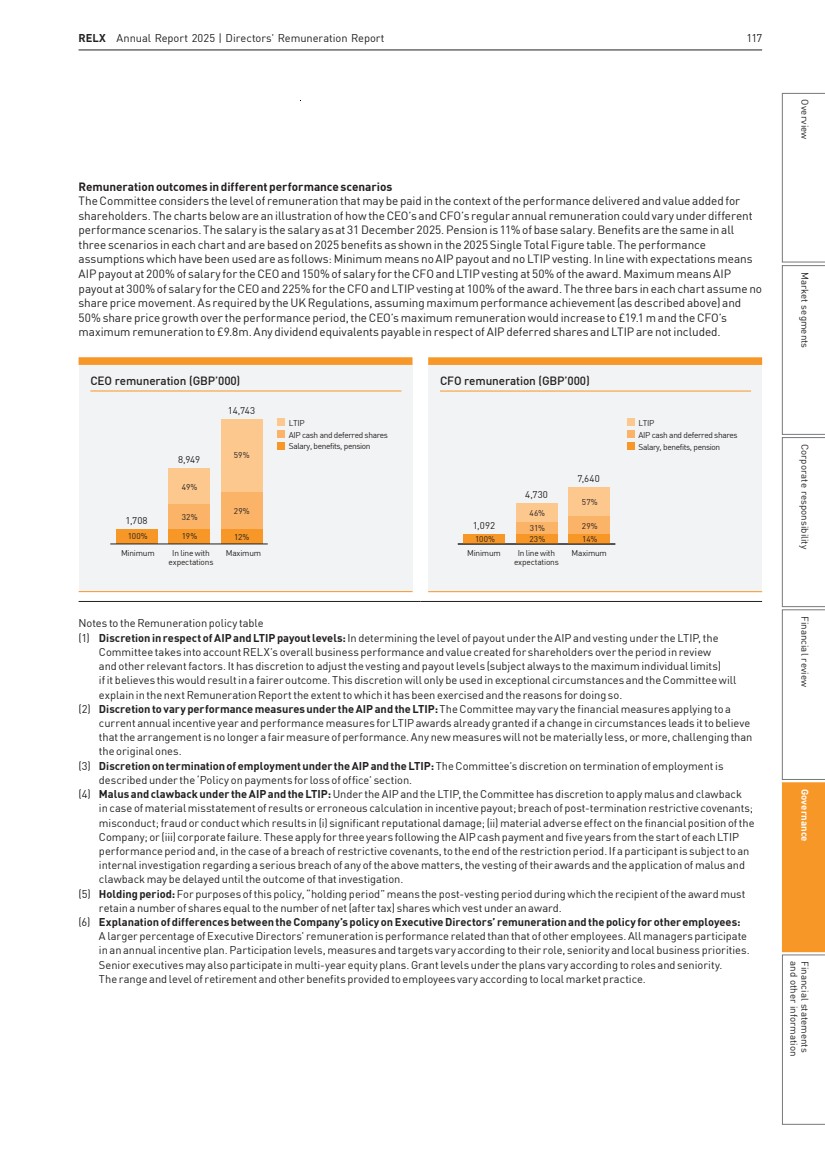
| 118 RELX Annual Report 2025 | Governance Approach to recruitment remuneration – Executive Directors When agreeing the components of a remuneration package on the appointment of a new Executive Director, or an internal promotion to the Board, the Committee would seek to align the package with the remuneration policy stated in the policy table. The Committee’s general principle on recruitment is to offer a competitive remuneration package to attract high-calibre candidates from a global talent pool. Basic salary would be set at an appropriate level for the candidate, taking into account all relevant factors. As a data analytics and technology-driven business, with over half of its revenue in the US, the Company primarily competes for talent with global information and technology companies. The various components and the Company’s approach are as follows: REMUNERATION COMPONENTS The remuneration would include base salary, retirement benefits, other benefits, AIP and LTIP in line with the policy table, taking into account the principles set out above. COMPENSATION FOR FORFEITED ENTITLEMENTS The Committee may make awards and payments on hiring an external candidate to compensate him or her for entitlements forfeited on leaving the previous employer. If such a decision is made, the Committee will attempt to reflect previous entitlements as closely as possible using a variety of tools, including cash and share based awards. Malus and clawback provisions will apply where appropriate. If necessary to facilitate the grant of awards, the Committee may rely on the one person exemption from shareholder approval in the UK Listing Rules. RELOCATION ALLOWANCES AND EXPENSES The type and size of relocation allowances and expenses will be determined by the specific circumstances of the new recruit. Policy on payments for loss of office In line with the Company’s policy, the service contracts of the existing Executive Directors contain 12-month notice periods. The circumstances in which an Executive Director’s employment is terminated will affect the Committee’s determination of any payment for loss of office, but it expects to apply the principles outlined in the table on the next page. The Committee reserves the right to depart from these principles where appropriate in light of any taxation requirements to which the Company or the Executive Director is subject (including, without limitation, section 409A of the US Internal Revenue Code), or other legal obligations. |
| RELX Annual Report 2025 | Directors’ Remuneration Report 119 Policy on payments for loss of office (continued) GENERAL(1) INCENTIVES Mutually agreed termination/termination by the Company other than for cause(2) (includes retirement with customary notice) The Executive Director would be entitled to salary, benefits and other contractual payments in the normal way up to the termination date and would be paid for any accrued but untaken holiday. Salary: Payment of up to 12 months’ salary to reflect the notice period or payment in lieu of notice. Other benefits: Where possible, benefits would be continued for up to the duration of any unworked period of notice (not exceeding the maximum stated in the policy table) or the Executive Director would receive a cash payment (not exceeding the cost to the Company of providing those benefits). Pension: Deferred or immediate pension in accordance with scheme rules, with a credit in respect of, or payment for up to, the full period of any unworked period of notice. There is provision under the defined benefit pension scheme for members leaving Company service by reason of permanent incapacity to make an application to the scheme trustee for early payment of their pension. Other: The Company may pay compensation in respect of any statutory employment rights and may make other appropriate and customary payments. The Company would have due regard to principles of mitigation ofloss. Reductions would be applied to reflect any portion of the notice period that is worked and/or spent on gardening leave. On injury, disability, ill-health or death, the Committee reserves the right to vary the treatment outlined in this section. Annual incentive: Any unpaid annual incentive for the previous year and a pro-rata payment in respect of the part of the financial year up to the termination date would generally be payable (subject to the deferral provisions), with the amount being determined by reference to the original performance criteria. However, the Committee has discretion to decide otherwise depending on the reason for termination and other specific circumstances. TheCompany would not pay any annual incentive in respect of any part of the financial year following the termination date (e.g. for any unworked period of notice). AIP deferred shares would be released to the Executive Directors in full at the end of the deferral period. The annual incentive clawback provisions would apply. LTIP: The default position is that unvested LTIP awards would be pro-rated to reflect time employed and would vest subject to performance measured at the end of the relevant performance period and subject to the Executive Director continuing to meettheir full shareholding requirement for two years after the termination date. The Committee has discretion to allow unvested LTIP awards to vest earlier and to adjust the application of time pro-rating and performance conditions, subject to the plan rules. The requirement to retain net (after tax) vested LTIP shares for a holding period of two years after vesting ceases to apply on termination of employment. Employee instigated resignation The Executive Director would not receive any payments for loss of office. The Executive Director would be entitled to salary, benefits and other contractual payments in the normal way up to the termination date and would be paid for any accrued but untaken holiday. Pension: A deferred or immediate pension would be payable in accordance with the scheme rules. Annual incentive: The Executive Director would be entitled to receive an annual incentive for a completed previous year (subject to the deferral provisions), but not a pro-rated annual incentive in respect of a part year up to the termination date, unless the Committee decides otherwise in the specific circumstances. Any AIP deferred shares would be released to the Executive Director in full at the end of the deferral period. Annual incentive clawback provisions would apply. LTIP: All outstanding LTIP awards would lapse on the date of notice. Dismissal for cause The Executive Director would be entitled to salary, benefits and other contractual payments in the normal way up to the termination date and would be paid for any accrued but untaken holiday but would not receive any payments for loss of office. Pension: A deferred or immediate pension would be payable in accordance with the scheme rules. Annual incentive: The Executive Director would not receive any unpaid annual incentive. Any AIP deferred shares lapse on the date of dismissal. LTIP: All outstanding LTIP awards would lapse on the date of dismissal. (1) In addition to what is set out in this section, on termination for any reason, Erik Engstrom will be entitled to payment of amounts held in his ‘Retirement Account’. (2) In cases where the approved leaver treatment applies, the AIP and LTIP have a default position as well as giving the Committee discretion to adjust the default treatment within certain parameters. The Committee would only expect to exercise such discretion where the Committee believes the personal circumstances of the Executive Director so require. Market segments Governance and other information Financial statements Financial review Corporate responsibility Overview |
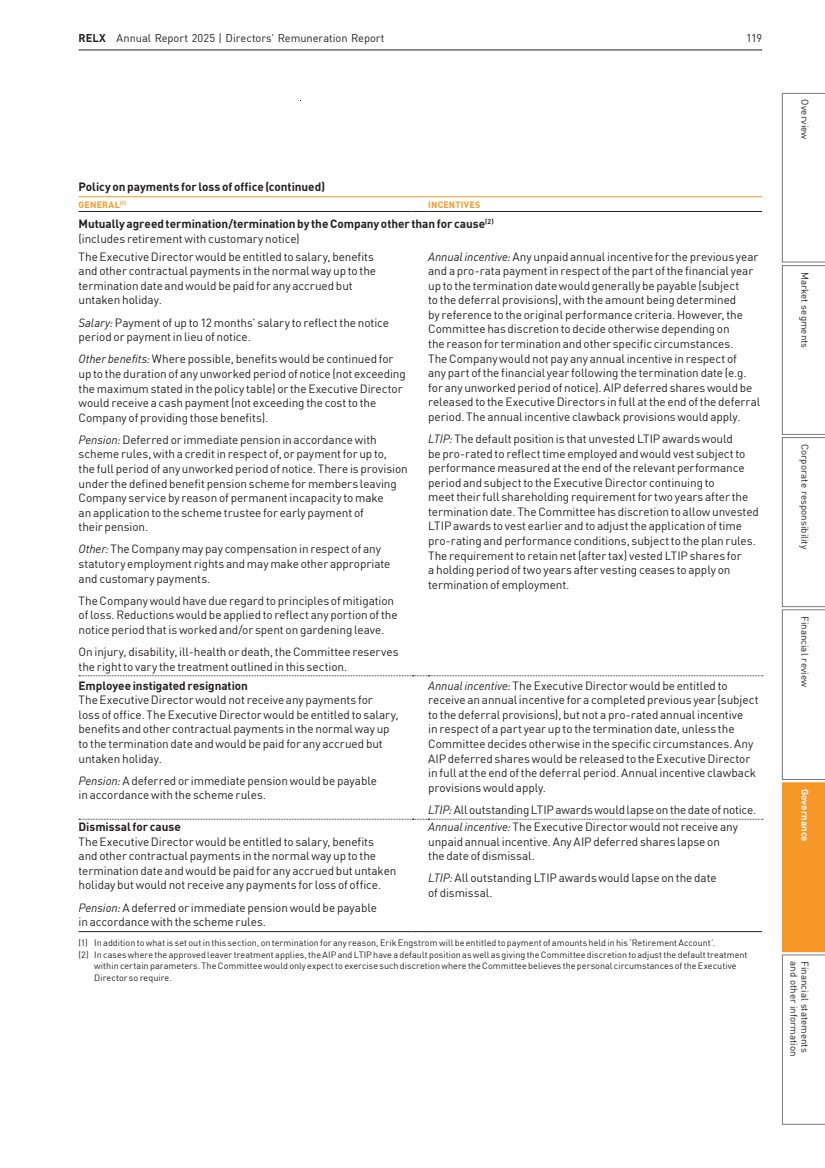
| 120 RELX Annual Report 2025 | Governance Remuneration policy table – Non-Executive Directors FEES Purpose and link to strategy To enable RELX to recruit Non-Executive Directors with the right balance of personal skills and experience to make a major contribution to the Board and Committees of a global business which is listed in London, Amsterdam and New York. Operation RELX Chair: Receives an aggregate annual fee with no additional fees, for example, Committee Chair fees. The Committee determines the Chair’s fee on the advice of the Senior Independent Director. Other Non-Executive Directors: Receive an annual fee with additional fees payable as appropriate for specific roles and duties. These additional fees include fees for the Senior Independent Director and Committee Chairs, for membership of Board Committees, as well as a workforce engagement fee and international travel fees. In future, other fees may be payable, for example attendance fees. The Board determines the level of fees, subject to applicable law. Fees may be reviewed annually, although in practice they have changed on a less frequent basis. When reviewing fees, consideration is given to the time commitment required, the complexity of the role and the calibre of the individual. Periodically, comparative market data is also reviewed, the primary source for which is the practice of FTSE 30 companies. Maximum value The aggregate annual fee limit for fees paid to the Chair and the Non-Executive Directors is £2m. Additional fees for membership of or chairing Board Committees and assuming additional responsibilities such as acting as Senior Independent Director, are not subject to this maximum limit. OTHER BENEFITS Purpose and link to strategy To provide competitive benefits at appropriate cost. Operation Other benefits for Non-Executive Directors are reviewed periodically and may include private medical cover, tax return preparation costs, secretarial benefits, car benefits, travel and related subsistence costs, including, where appropriate, the tax on such benefits. Maximum value There is no prescribed maximum amount. Approach to recruitment remuneration – Non-Executive Directors Following recruitment, a new Non-Executive Director will be entitled to fees and other benefits in accordance with the Company’s remuneration policy. No additional remuneration is paid on recruitment. However, any reasonable expenses incurred during the recruitment process will be reimbursed. Policy on payments for loss of office – Non-Executive Directors In addition to unpaid accrued fees, the Non-Executive Directors are entitled to receive one month’s fees for loss of office if their appointment is terminated before the end of its term. Service contracts and letters of appointment There are no further obligations in the Directors’ service contracts and letters of appointment which are not otherwise disclosed in this Report which could give rise to a remuneration payment or loss of office payment. All Directors’ service contracts and letters of appointment are available for inspection at the Company’s registered office. The Executive Directors’ service contracts do not have a fixed expiry date. Consideration of employment conditions elsewhere in theCompany When the Committee reviews the Executive Directors’ salaries annually, it takes into account the Company’s guidelines for salaries for all employees in the Company’s major operating locations for the forthcoming year. The Committee also considers market practice in the FTSE 30 as well as pay practices of other global information and technology companies when determining the quantum and structure of Directors’ pay. The Committee annually reviews various aspects of workforce remuneration and related policies in order to deepen its understanding of pay structures throughout the organisation. Our designated Non-Executive Director responsible for workforce engagement meets with employees representing our global employee population in order to understand a wide range of employee views on a variety of topics. The feedback is reported back to the Board at least once per year and forms part of the Board’s discussions and decision making. As part of this process, the Non-Executive Director explains how executive remuneration aligns with wider pay policy. Consideration of shareholder views Our practice is to consult shareholders and consider their views when formulating, or changing, our policy. The Committee took into account feedback received from shareholders since the prior policy was approved when reviewing the current policy. Previous remuneration policies and prior commitments Any payments which are still to be made under arrangements made and awards granted under previous remuneration policies will be made consistent with the applicable policy. The provisions of the previous policies which relate to arrangements and awards granted under those previous policies will therefore continue to apply until all payments in relation to those arrangements and awards have been made. The Committee also reserves the right to make any remuneration or loss of office payments if the terms were agreed prior to the approval of the 2013 or 2016 policy or prior to an individual being appointed as aDirector. Minor amendments The Committee may make minor amendments for regulatory, tax or administrative purpose. |
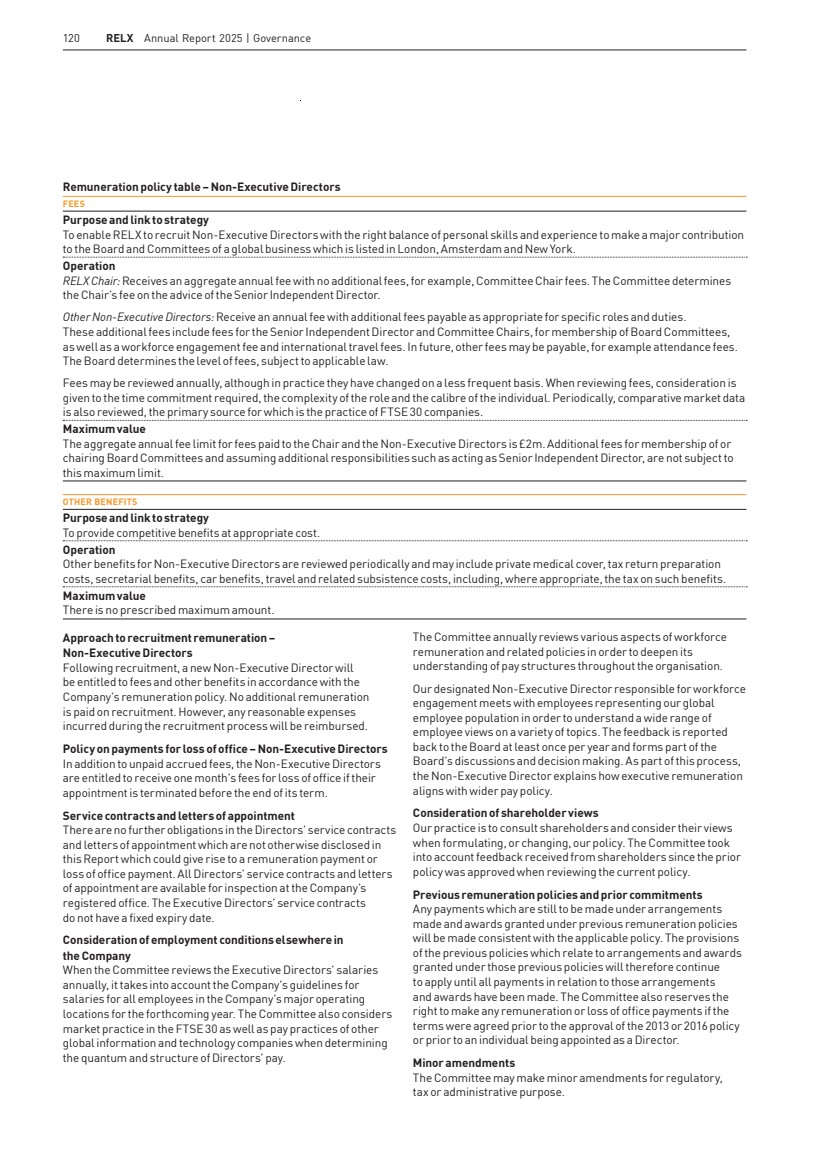
| RELX Annual Report 2025 Report of the Audit Committee RELX Annual Report 2024 121 Overview Market segments Corporate responsibility Financial review Governance Financial statements and other information - Report of the Audit Committee This report has been prepared by the Audit Committee and has been approved by the Board. It provides an overview of the membership, responsibilities, and activities of the Committee. Membership Responsibilities The Committee comprises independent Non-Executive Directors. The members of the Committee who served during the year were: The main role and responsibility of the Committee is to assist the Board in fulfilling its oversight responsibilities regarding: Suzanne Wood (Chair) Alistair Cox June Felix Andy Halford (appointed April 2025) Charlotte Hogg Andrew Sukawaty Of the current members of the Committee, Suzanne Wood, a Certified Public Accountant, and Andy Halford, a Chartered Accountant, are considered to have significant, recent and relevant financial experience. The Committee as a whole is deemed to have competence relevant to the sectors in which RELX operates. Please see pages 80 and 81 for full profiles of Audit Committee members. the integrity of the interim and full-year financial statements and financial reporting processes risk management and internal controls, and effectiveness of internal auditors the performance of the external auditors and the effectiveness of the external audit process, including monitoring the independence and objectivity of Ernst & Young LLP (EY) The Committee reports to the Board on its activities, identifying any matters in respect of which it considers that action or improvement is needed and making recommendations as to the steps to be taken. The terms of reference of the Audit Committee are reviewed annually, and a copy is published on the RELX website, www.relx.com Financial reporting In discharging its responsibilities in respect of the 2025 interim and full-year financial statements, the Committee reviewed the following: AREAS OF SIGNIFICANT JUDGEMENT AND ESTIMATION NOTE AND PAGE REFERENCE IN ANNUAL REPORT Specific areas of significant accounting judgement and estimation, as set out in note 1 on page 143 to 144, reviewed and challenged by the Committee were: Capitalisation of internally developed intangible assets: The capitalisation of costs related to the development of new products and business infrastructure, together with the useful economic lives applied to the resulting assets, requires the exercise of judgement. The Committee received reports from the Group Financial Controller on the amounts capitalised and asset lives selected for major projects and outcome of impairment assessment performed. Note 14 164-166 Defined benefit pension obligation: The valuation of pension scheme liabilities is subject to judgement and estimation. The discount rate, inflation rate and mortality assumptions may have a material effect in determining the defined benefit pension obligation and costs which are reported in the financial statements. The Committee received and discussed regular reports from the Group Financial Controller on the methodology and the basis of the assumptions used and other pension related accounting matters including the US annuity purchase and closure of the UK pension scheme to accrual from 28 February 2027. Note 6 151-155 The Committee discussed and challenged management’s assessment and was satisfied that all judgements and estimations had been appropriately made, and the financial statement disclosures were appropriate. The Committee also discussed with the external auditor how management’s judgments and assertions were challenged and how professional scepticism was demonstrated during their audit of these areas. Market segments Governance and other information Financial statements Financial review Corporate responsibility Overview 121 |
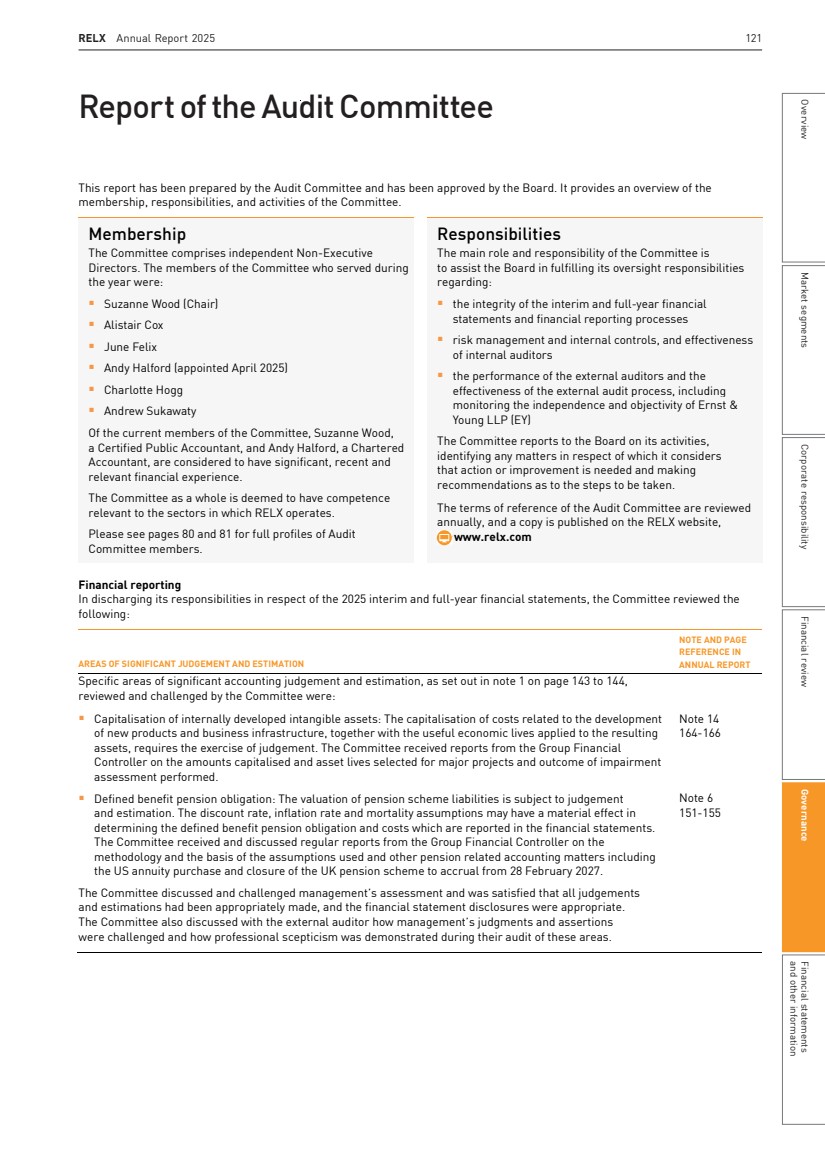
| 122 RELX Annual Report 2024 | Governance DISCLOSURE AND PRESENTATION PAGE REFERENCE IN ANNUAL REPORT As well as considering the Annual Report as a whole (see ‘Fair, balanced and understandable’ section below) the Committee focused on the following areas of disclosure and presentation: Reviewed the critical accounting policies and compliance with applicable accounting standards, reviewed other disclosure requirements and received regular update reports on accounting and regulatory developments 143-144 Reviewed the disclosures made in relation to internal control, risk management, the going concern statement and the viability statement. The Committee received and discussed reports from the Group Treasurer on the processes undertaken and assumptions used in formulating these disclosures 72-78, 96 The going concern and viability statements were subject to a detailed review, including a review and challenge of the various adverse scenarios modelled to ensure that the statements made in relation to going concern and viability are robust 77 Considered the calculation and presentation of APMs in the Annual Report and results announcement, including associated reconciliations to GAAP measures 198-206 Reviewed the disclosures made in the Annual Report which incorporates: − The Corporate Responsibility Report − Disclosures in respect of the European Sustainability Reporting Standards (ESRS) and related material sustainability information; and − Disclosures in respect of the Task Force on Climate-Related Financial Disclosures (TCFD) recommendations. The Committee agreed with management’s conclusion that climate change risk is not material 34-63 208-231 235-241 The Committee was satisfied that all relevant disclosures have been appropriately made. OTHER AREAS OF FOCUS PAGE REFERENCE IN ANNUAL REPORT Other areas reviewed by the Committee during the year were: Business Area reporting changes: The Committee discussed the accounting and external reporting implications of the internal reporting changes which resulted in print and print-related being a separate operating and reported segment. The Committee was satisfied that the changes made were in line with IFRS requirements and with the resulting explanation of these changes in the financial statements and relevant Alternative Performance Measures (APMs) which includes the restatement of prior period figures. Taxation: The valuation of provisions in relation to uncertain tax positions involves estimation. The Committee received and discussed reports from the Head of Tax on the potential liabilities identified and assumptions used. Carrying value of goodwill and intangible assets: The judgements and estimates in respect of asset carrying values relate to the assumptions underlying the value in use calculations such as discount rates and long-term growth assumptions. The Committee received and discussed reports from the Group Financial Controller on the methodology, the basis of assumptions used and headroom resulting from the annual impairment assessment, which included a separate assessment for the print and print-related Cash Generating Unit (CGU) for the first time. The Committee challenged management’s application of IAS 36 which allows a prior year detailed calculation of the recoverable amount of a CGU to be used in the current year and were satisfied that all the required criteria were met for Risk, STM, Legal and Exhibitions. 66 and 144 157-160 164-166 Acquired intangible assets: The identification of separate intangible assets on acquisition requires judgement. Estimation is required in determining the future cash flows and discount rates used to value these assets. The Committee received and discussed reports from the Group Financial Controller on the methodology and the basis of the assumptions used. 164-166 Financing: Judgement is required in assessing the sufficiency and adequacy of current and future liquidity and funding requirements of the Group. The Committee received and discussed reports from the Group Treasurer on the Group’s financing including the issue of two USD denominated bonds, together with details of related cross-currency interest rate swaps, and on the refinancing of the group’s $3bn revolving credit facility with a new $3.5bn facility. See below for further information in respect of the Committee’s review of the going concern and viability assessments and related disclosure. Corporate Sustainability Reporting Directive (CSRD): Consistent with prior year, for the year ended 31 December 2025, RELX has disclosed material sustainability information in accordance with the European Sustainability Reporting Standards (ESRS). See below for further information in respect of the Committee’s review of the related disclosure. The Committee was satisfied that all the above items had been appropriately considered and presented in this Annual Report. 169-175 208-231 122 RELX Annual Report 2025 | Governance |
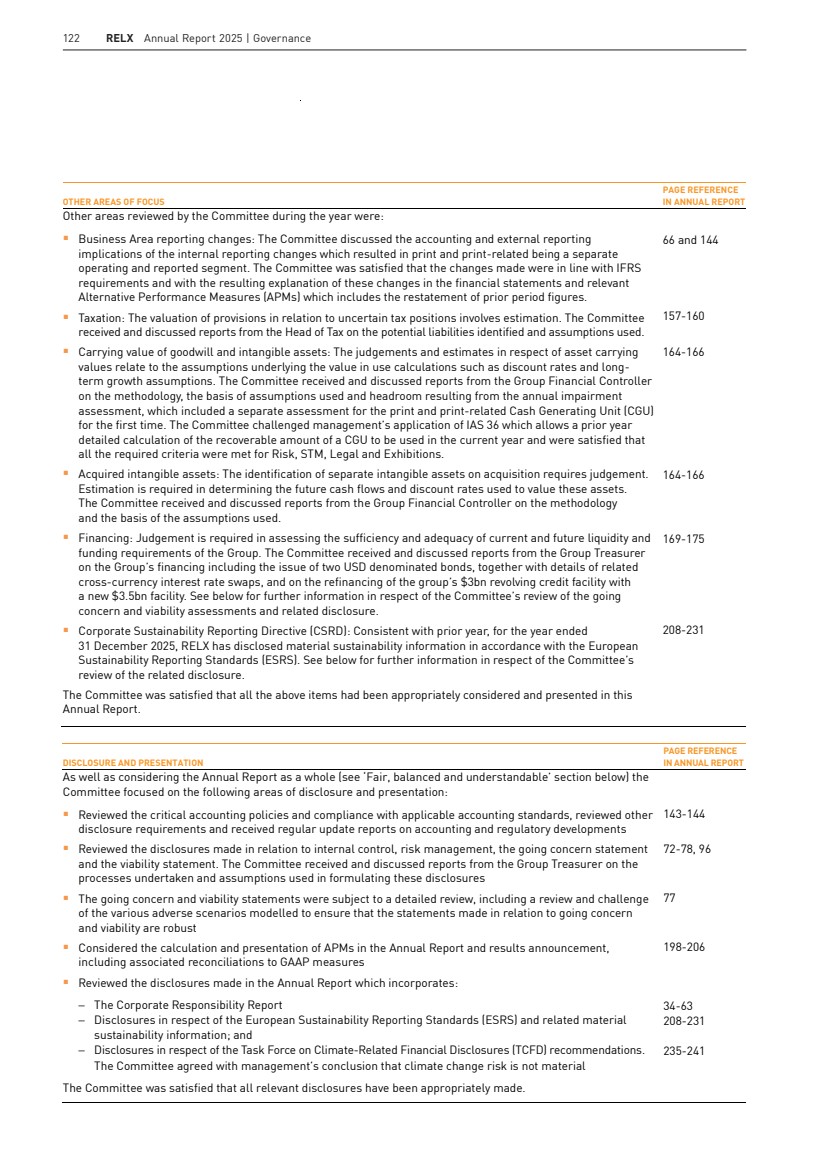
| RELX Annual Report 2024 123 Overview Market segments Corporate responsibility Financial review Governance Financial statements and other information Risk management and internal controls With respect to their oversight of risk management and internal controls, the Committee has: received and discussed regular reports summarising the status of the Group’s risk management activities including procedures to prevent and detect fraud, identification of emerging risks and actions to mitigate risks, and the findings from internal audits and status of actions agreed with management. Areas of focus in 2025 included: cybersecurity (including the ability to prevent, respond to and recover from a cyber-attack or ransomware attack); AI governance, data privacy; the operational, financial and IT control environment; regulatory compliance; business continuity and resilience (including supplier resilience and plans for extreme weather events); the ability to adapt to geopolitical, economic and market conditions; integrity of published Corporate Responsibility data; and continued compliance with the requirements of Section 404 of the US Sarbanes-Oxley Act relating to the documentation and testing of internal controls over financial reporting received regular updates from the Group Financial Controller and Group Treasurer on the Group’s financial position including on liquidity, refinancing of its revolving credit facility with new maturity date of November 2030 (with two one-year extension options), the bond issue, credit ratings and ability to access debt capital markets; changes to the regulatory reporting landscape including the approach to the implementation of IFRS 18 – Presentation and Disclosure (which is applicable to RELX from 1 January 2027), risk management and compliance with treasury policies (including adoption of new treasury principles), and pension arrangements and funding received presentations from the Head of Tax on tax related matters and the Group’s tax principles reviewed and approved the internal audit plan for 2026 and monitored execution of the 2025 plan, including progress in respect of actions agreed and discussing and confirming any changes proposed received presentations from the Chief Compliance Officer on the compliance programme, including the operation of the RELX Code of Conduct, training programmes, whistleblowing arrangements and investigations being conducted received presentations from the Chief Legal Officer on legal issues and claims participated in ‘deep dive’ briefing sessions with senior management from the Business Areas on a variety of topics received an update from management on the enhancements made to existing processes and procedures in place to prevent and detect fraud as part of preparations for the ‘Failure to Prevent Fraud’ offence applicable to RELX from 1 September 2025. This included updates made to RELX’s ‘Framework for mitigating fraud risk and maintaining compliance, financial and operational integrity’. Following its review of the Group’s risk management activities, the Committee were satisfied there are appropriate procedures in place to prevent and detect fraud. reviewed the status and progress of activities relating to changes brought by the new UK Corporate Governance Code (The Code), specifically to achieving compliance with the new Provision 29, relating to the monitoring of the Company’s risk management and internal control framework and annual review of its effectiveness. Management provided the Committee with reports throughout the year including updates from a Steering group held quarterly, enhancements made to the review and application of the current risk and control framework, the identification of proposed material controls over principal risks, financial and non-financial reporting and assurance obtained to support the Board’s declaration of effectiveness of internal controls which will be required for the year ended 31 December 2026. Committee meetings The Committee met four times during 2025. The items of business to be considered at each meeting are set out in a schedule which is reviewed and approved by the Committee annually. The Audit Committee meetings are typically attended by the Board Chair, the Chief Executive Officer, the Chief Financial Officer, the Group Financial Controller, the Chief Legal Officer, the Head of Internal Audit & Assurance (IAA), and audit partners from the external auditors. FAIR, BALANCED AND UNDERSTANDABLE The Committee considered whether the 2025 Annual Report is fair, balanced, and understandable. In making this assessment, the Committee considered the following areas: The process for preparing the Annual Report, including the contributors, the internal review process and how feedback is addressed throughout the process The business review narratives presented for each Business Area including the changes in reporting to exclude print and print-related activities from Risk, Scientific, Technical & Medical and Legal from 1 January 2025; and The discussion of reported and underlying results throughout the report The Committee was satisfied that, taken as a whole, the Annual Report is fair, balanced, and understandable. This conclusion has been reported to the Board. Market segments Governance and other information Financial statements Financial review Corporate responsibility Overview RELX Annual Report 2025 | Report of the Audit Committee 123 |
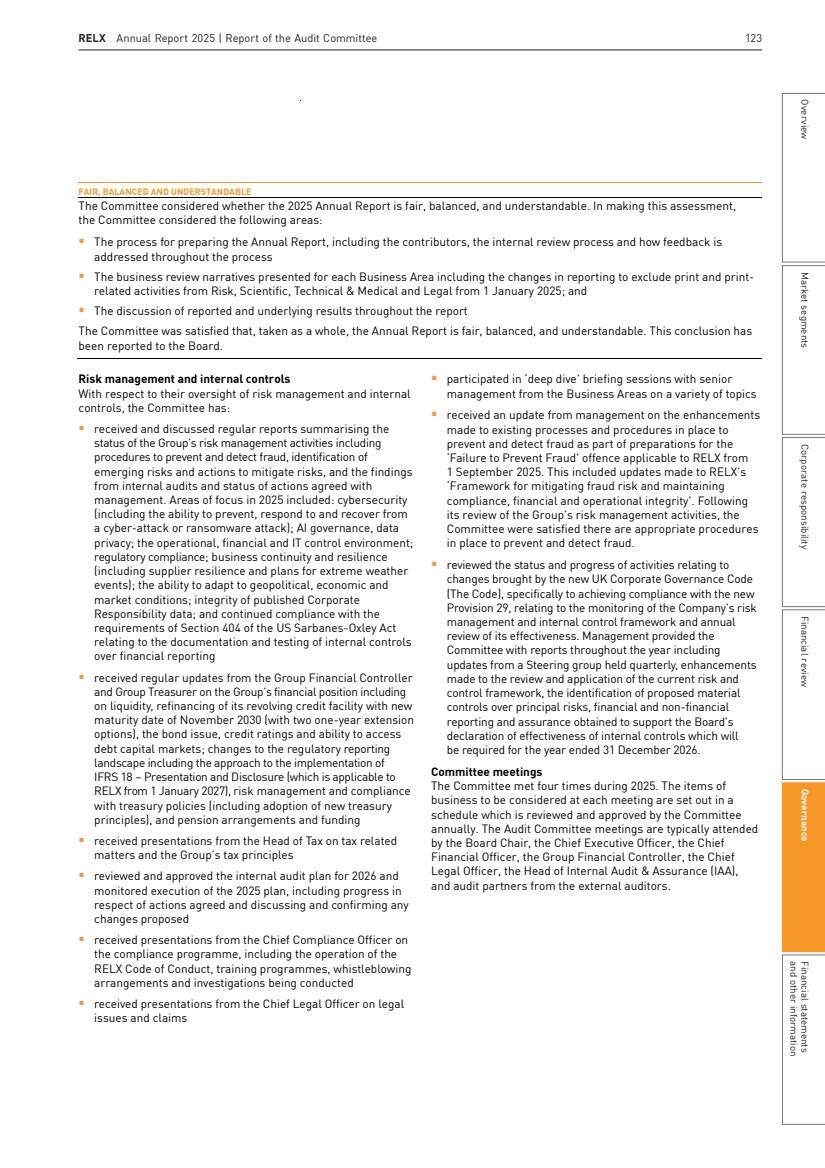
| 124 RELX Annual Report 2024 | Governance External audit effectiveness and independence The Group has a well-established policy on audit effectiveness and independence of auditors that sets out among other things: the responsibilities of the Audit Committee in the selection of auditors to be proposed for appointment or re-appointment and for agreement on the terms of their engagement, scope and remuneration; the auditor independence requirements and the policy on the provision of non-audit services; the rotation of audit partners and staff; and the conduct of meetings between the auditors and the Audit Committee. The Committee’s policy on the use of the external auditor to provide non-audit services is in accordance with applicable laws and takes into account the relevant ethical guidance for auditors. Any permissible non-audit services must be pre-approved by the Chief Financial Officer and above £50,000, by the Chair of the Audit Committee. All non-audit services provided and fees are presented to the Committee on a regular basis. The policy is available on the website, www.relx.com. The Committee has conducted its review of the performance of the external auditors and effectiveness of the external audit process for the year ended 31 December 2025. In doing so, the Committee has considered the independence, objectivity, and level of professional scepticism exercised by the external auditor. The review included: an assessment of the quality of the auditor’s reporting to and interaction with the Audit Committee review of the responses to a detailed questionnaire covering a range of key audit areas which was completed by key stakeholders review of the completion of the audit plan and changes to risks identified or work performed consideration of public reports by regulatory authorities on key EY member firms and their view on the effectiveness of EY’s audits a survey of key stakeholders across RELX evaluating the performance of each audit team The Audit Committee holds private meetings with the external auditor to encourage open and transparent feedback. The Chair of the Committee also met with the external auditors outside of Committee meetings supporting effective and timely communication. Based on all the evidence presented, the Audit Committee was satisfied that the external audit has been conducted effectively, with appropriate rigour and challenge, and that EY had applied appropriate professional scepticism throughout the audit process. The external auditors have confirmed their independence and compliance with the policy on auditor independence to the Audit Committee. Non-audit services The external auditors are precluded from engaging in non-audit services that would compromise their independence or violate any professional requirements or regulations affecting their appointment as auditors. The auditors may, however, provide non-audit services which do not conflict with their independence. The Committee has reviewed and agreed the non-audit services provided in 2025 together with the associated fees. The non-audit services provided were very limited and, in line with the latest FRC guidance, linked to audit work such as a bond issue and corporate responsibility data assurance. The total fees payable to EY for the year ended 31 December 2025 were £9.7m of which £1m related to non-audit work. Further details are provided in note 4 to the financial statements. The non-audit fees remain below the 70% threshold as per the most recent FRC guidance. Auditor appointment EY were first appointed auditor of RELX PLC for the financial year ended 31 December 2016. The auditor is required to rotate the lead audit partner responsible for the engagement every five years. The year ended 31 December 2025 was the fifth and final year for the lead audit partner, Colin Brown. The Committee considered candidates put forward by EY and selected Marcus Butler to become lead audit partner starting from the year ending 31 December 2026. The Audit Committee confirms that RELX was in compliance with the provisions of The Statutory Audit Services for Large Companies Market Investigation (Mandatory Use of Competitive Tender Processes and Audit Committee Responsibilities) Order 2014 during the financial year ended 31 December 2025. In accordance with the terms of this Order, the Audit Committee conducted a comprehensive and competitive tender process during 2024 for the external audit for the financial year ending 31 December 2026. A decision to reappoint EY was recommended by the Committee and was approved by the Board of RELX. The decision was based on EY’s performance during the tender process across a comprehensive set of criteria and the Committee’s satisfaction with their effectiveness as our current auditor. Internal audit The Audit Committee’s terms of reference requires an annual review of internal audit effectiveness. RELX has an established Internal Audit function governed by a formal charter which requires an external assessment at least once every five years to consider and report on conformance with the Institute of Internal Auditors International Professional Practices Framework (IPPF) and UK Chartered Institute of Internal Auditors Internal Audit Code of Practice (CoP). The most recent external assessment of internal audit was carried out in 2022. The assessment identified areas of enhancement related to strategy, planning, operational excellence, and talent. All recommendations have been implemented. The Audit Committee annually receives and considers a report from the Head of the internal audit function on: the independence of the internal audit activity; a review of the internal audit Charter; conformance with the mandatory elements of the IPPF and CoP including the adequacy of resourcing of the internal audit function; and the results of its quality assurance and improvement programme. The Committee receives regular updates on talent management and succession planning within the internal audit function and on the continual monitoring of skill sets and capabilities to ensure that these remain appropriate. Audit Committee effectiveness The effectiveness of the Audit Committee was reviewed as part of the 2025 evaluation of the Board which confirmed that the Committee continues to function effectively. Details of the evaluation are set out on page 84. Suzanne Wood Chair of the Audit Committee 11 February 2026 124 RELX Annual Report 2025 | Governance |
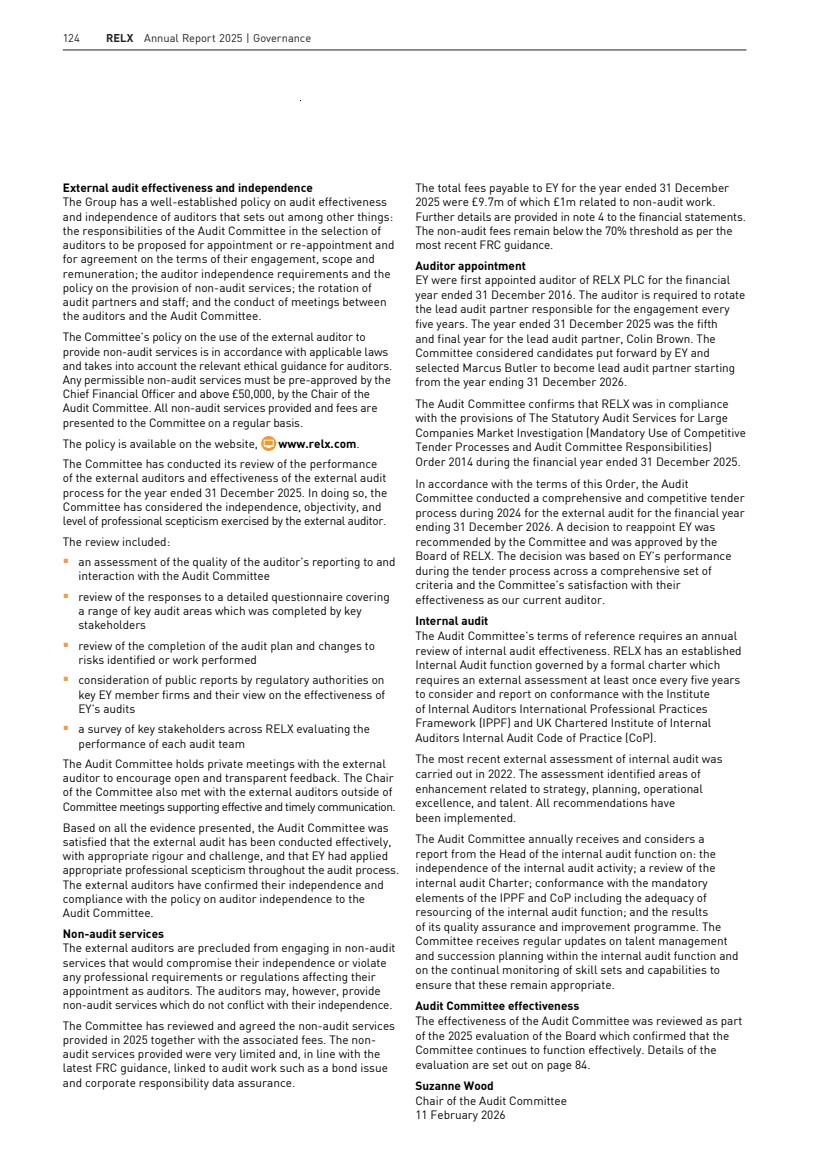
| RELX Annual Report 2025 125 Directors’ Report The Directors’ Report for the year ended 31 December 2025 has been prepared in accordance with the requirements of the Companies Act 2006 (the Act), the UK Listing Rules (the LRs) andDisclosure Guidance and Transparency Rules (the DTRs). TheDirectors’ Report, together with the Strategic Report on pages 2 to 78, forms the management report for the purposes of the Financial Conduct Authority’s Disclosure and Transparency Rules 4.1.5R(2) and 4.1.8R. For the purposes of the Directors’ Report, RELX PLC and its subsidiaries, joint ventures and associates are together known as ‘RELX’ or the ‘Group’. RELX PLC (the ‘Company’) is a public company, limited by shares, and registered in England and Wales under registered number 00077536. The Company’s registered office is 1-3 Strand, London, WC2N 5JR. Other disclosures Certain information required by the Act, LRs and DTRs are disclosed elsewhere in this Annual Report and incorporated by reference into this Directors’ Report in Table 1. Table 1 Disclosure Page(s) § Names of Directors during the year 80 to 81 § Corporate governance statement 84 to 96 § Dividends 70 and 163 § Financial risk management and hedging arrangements 169 to 175 § Greenhouse gas emissions and energy consumption 52 to 55 and 242 Articles of Association Amendment The Company’s Articles of Association (the Articles) may only be amended by a special resolution of shareholders passed at a general meeting of the Company. Directors Appointment and replacement of Directors The appointment, re-appointment and replacement of Directors is governed by the Articles, the Act and related legislation. Shareholders maintain their right to appoint and re-appoint Directors by way of an ordinary resolution in accordance with the Articles. The Directors may appoint additional or replacement Directors, who may only serve until the following AGM of the Company, at which time they must retire and, if appropriate, seek election by the Company’s shareholders. A Director may be removed from office by the Company as provided for by applicable law, in certain circumstances set out in the Articles, and at a general meeting of the Company by the passing of an ordinary resolution. The Articles provide for a Board of Directors consisting of not fewer than five, but not more than 20 Directors, who manage the business and affairs of the Company. Powers of Directors Subject to the provisions of the Act, the Articles and any directions given by special resolutions, the business of the Company shall be managed by the Board which may exercise all the powers oftheCompany. Directors’ indemnities In accordance with its Articles, the Company has granted its Directors an indemnity, to the extent permitted by law, in respect of liabilities incurred as a result of their office. This indemnity was in place for Directors that served at any time during the 2025 financial year, and also for each serving Director as at the date of approval of this report. The Company also purchased, and maintained throughout the year, directors’ and officers’ liability insurance in respect of its Directors. Shares Share capital The Company’s issued share capital comprises a single class of ordinary shares of 14 51⁄116 p each listed on the London and Amsterdam Stock Exchanges. The Company also has securities in the form of American Depositary Shares traded on the New York Stock Exchange. All issued shares are fully paid up and rank pari passu. The Company’s share capital as at the 31 December 2025 and details of share capital movements during the year are set out in note 23 to the consolidated financial statements. Rights and obligations The rights of holders of ordinary shares in the Company, in addition to those conferred under English law, are set out in the Company’s Articles which are available at www.relx.com. In summary, holders of ordinary shares are entitled to: one vote for each ordinary share held; the right to attend and speak at general meetings of the Company or to appoint one or more proxies or, if they are a corporation, a corporate representative; and to exercise their voting rights. At a general meeting, on a show of hands every member who is present in person shall have one vote and every proxy present who has been duly appointed by one or more members entitled to vote on the resolution has one vote (although a proxy has one vote for and one vote against the resolution if: (i) the proxy has been duly appointed by more than one member entitled to vote on the resolution; and (ii) the proxy has been instructed by one or more ofthose members to vote for the resolution and by one or more other of those members to vote against it). On a vote of a resolution by a poll every member present in person or by proxy shall have one vote for every share of which he/she is the holder. Proxy appointments and voting instructions must be received by the Company’s registrars not less than 48 hours before the general meeting. Restrictions on the transfer of shares There are no restrictions on the sale or transfer of ordinary shares in the Company, or on the size of a holding. The Company is not aware of any agreements between shareholders that may result in a restriction in the transfer of shares or voting rights. Market segments Governance and other information Financial statements Financial review Corporate responsibility Overview |
| 126 RELX Annual Report 2025 | Governance Authority to purchase own shares At the Company’s 2025 AGM, shareholders passed a resolution authorising the purchase of up to 188,100,000 ordinary shares in the Company (representing approximately 10% of the issued ordinary shares) by way of market purchase. This authority will expire at the 2026 AGM, when a resolution to renew the authority to purchase Company shares will be submitted to shareholders. During the year, 39,500,202 ordinary shares of 14 51⁄116 p each (representing 2.1% of the ordinary shares in issue at 31 December 2025) were purchased by the Company for a total consideration of £1.5bn, including expenses, and subsequently transferred to be held in treasury. A further 8,838,231 shares were purchased between 2 January 2026 and the date of this report. On 4 December 2025, the Company cancelled 55,000,000 ordinary shares held in treasury. Therefore, as at 31 December 2025 there were 4,107,872 ordinary shares held in treasury, representing 0.2% of the ordinary shares in issue. The purpose ofthe share buyback programme is to reduce the capital of theCompany. Share issuance At the 2025 AGM, shareholders passed a resolution authorising the Directors to issue shares for cash on a non-pre-emptive basis up to a nominal value of £13,400,000, representing approximately 5% of the Company’s issued share capital, and authorising the Directors to issue up to an additional 5% of the issued share capitalfor cash on a non-pre-emptive basis in connection with an acquisition or specified investment. Since the 2025 AGM, no shares have been issued under this authority. The shareholder authority also permits the Directors to issue shares in order to satisfy entitlements under employee share plans and details of such allotments are described below. During the year, 2,215,646 ordinary shares in the Company were issued in order to satisfy entitlements under employee share plans as follows: 622,993 under the UK SAYE Share Option Scheme at prices between 1,316.8p and 2,792.00p per share; 109,615 under the legacy Dutch Debenture Scheme at prices between 14.655 EUR and 19.39 EUR per share, which is satisfied by way of Company shares; 1,187,206 under executive share option schemes at prices between 1,152p and 3,402p per share; and 295,832 under the Employee Share Purchase Plan at $38.59 per share. Substantial share interests As at 31 December 2025, the Company had received the following notifications of interests in its share capital pursuant to Rule 5 of the Disclosure and Transparency Rules (DTRs): % of voting rights Date of notification BlackRock, Inc 9.67% 17 May 2022 Invesco Ltd. 4.99% 1 October 2019 The percentage interests stated above are as disclosed at the date on which the interests were notified to the Company and, as at the date of this report, the Company had not received any further notifications under DTR 5. These percentages do not reflect changes to the Company’s total voting rights since the date of notification or any subsequent changes to share interests not notified to the Company under DTR 5 and therefore may not reflectthe interests held as at 31 December 2025, or at the date ofthis report. Employee Benefit Trust As at 31 December 2025, the Employee Benefit Trust trustee held an interest in 4,891,047 ordinary shares in the Company, representing 0.3% of the issued ordinary shares. The trustee may vote or abstain from voting any shares it holds in any way it sees fit. Other information Disclosures required under UK Listing Rule 6.6.1 The information required by Listing Rule 6.6.1 is set out on the pages below: Information required Page (1) Interest capitalised by the Group n/a (2) Publication of unaudited financial information n/a (3) Long-term incentive schemes n/a (4) Waiver of emoluments by a director n/a (5) Waiver of future emoluments by a director n/a (6) Non pro-rata allotments for cash (issuer) n/a (7) Non pro-rata allotments for cash (major subsidiaries) n/a (8) Parent participation in a placing by a listed subsidiary n/a (9) Contracts of significance n/a (10) Provision of services by a controlling shareholder n/a (11) Shareholder waiver of dividends 163 (12) Shareholder waiver of future dividends 163 (13) Agreements with controlling shareholders n/a Significant agreements and change of control There are a number of borrowing agreements including credit facilities that, in the event of a change of control of RELX PLC and, in some cases, a consequential credit rating downgrade to sub-investment grade may, at the option of the lenders, require repayment and/or cancellation as appropriate. There are no arrangements between the Company and its Directors or employees providing for compensation for loss of office or employment that occurs specifically because of a takeover, merger or amalgamation with the exception of provisions in the Company’s share plans which could result in options or awards vesting or becoming exercisable on a change of control. No contract existed during the year in relation to the Company’s business in which any Director was materially interested. Political donations RELX does not make donations to UK or European Union (EU) political organisations or incur UK or EU political expenditure. In the US in 2025, RELX Inc. made contributions to state candidates, state political parties and related state organisations totalling $137,000 (2024: $198,000). 2026 AGM The next AGM of the Company will be held at 9.30 am on Thursday, 23April 2026 at Lexis House, 30 Farringdon Street, London EC4A4HH. |
| RELX Annual Report 2025 | Directors’ Report 127 Auditor re-appointment Resolutions for the re-appointment of Ernst & Young LLP as auditor of the Company and to authorise the Audit Committee, on behalf of the Board, to determine the external auditor’s remuneration, will be put to shareholders at the Company’s 2026AGM. Disclosure of information to auditors Each of the directors in office as at the date of this Annual Report confirms that: § so far as the Director is aware, there is no relevant audit information of which the Company’s auditors are unaware; and § he/she has taken all the steps that he/she ought to have taken as a Director to make himself/herself aware of any relevant audit information and to establish that the Company’s auditors are aware of that information. Statement of Directors’ responsibilities The Directors are responsible for preparing the Annual Report and financial statements in accordance with applicable law and regulations. Company law requires the Directors to prepare financial statements for each financial year. Under that law, the Directors have prepared consolidated financial statements in accordance with UK adopted International Accounting Standards (IAS) in conformity with the requirements of the Act and IFRS accounting standards as issued by the International Accounting Standards Board. Under company law the Directors must not approve the accounts unless they are satisfied that they give a true and fair view of the state of affairs of the Company and of the Group and of the profit or loss of the Company and of the Group for that period. In preparing the individual Company’s financial statements, theDirectors are required to: § select suitable accounting policies and then apply them consistently; § make judgements and accounting estimates that are reasonable and prudent; § state whether UK adopted IAS in conformity with the requirements of the Act and IFRS accounting standards as issued by the International Accounting Standards Board has been followed, subject to any material departures being disclosed and explained in the financial statements; and § prepare the financial statements on a going concern basis unless it is inappropriate to presume that the Company will continue in business. In preparing the Group financial statements, IAS 1 requires thatDirectors: § select suitable accounting policies and then apply them consistently; § properly select and apply accounting policies; present information, including accounting policies, in a manner that provides relevant, reliable, comparable and understandable information; § provide additional disclosures when compliance with the specific requirements of IFRS are insufficient to enable users to understand the impact of particular transactions or other events and conditions on the entity’s financial position and financial performance; and § make an assessment of the Group’s ability to continue as a going concern. The Directors are responsible for keeping adequate accounting records that are sufficient to show and explain the Group and Company’s transactions and disclose with reasonable accuracy at any time the financial position of the Group and the Company and enable them to ensure that the Annual Report and financial statements comply with the Act. They are also responsible for safeguarding the assets of the Company and hence for taking reasonable steps for the prevention and detection of fraud and other irregularities. The Directors are also responsible for preparing a Strategic report, Directors’ report, Annual report on remuneration, and Corporate governance statement in compliance with applicable laws and regulations. The Directors are responsible for the maintenance and integrity of the Company’s website. Legislation in the United Kingdom governing the preparation and dissemination of financial statements may differ from legislation in other jurisdictions. Each of the Directors confirms that, to the best of their knowledge: § the consolidated and parent company financial statements, prepared in accordance with UK adopted IAS in conformity with the requirements of the Act and IFRS accounting standards as issued by the International Accounting Standards Board, give a true and fair view of the assets, liabilities, financial position and profit or loss of the Group; § the Strategic report includes a fair review of the development and performance of the business and the position of the Group, together with a description of the principal and emerging risks and uncertainties that it faces; and § the Annual Report, taken as a whole, is fair, balanced and understandable and provides the information necessary for shareholders to assess the Company’s position and performance, business model and strategy. By order of the Board Henry Udow Company Secretary 11 February 2026 Market segments Governance and other information Financial statements Financial review Corporate responsibility Overview |
| 128 RELX Annual Report 2025 Financial statements and other information In this section 138 Consolidated financial statements 143 Notes to the consolidated financial statements 186 Five year summary |
| RELX Annual Report 2025 129 Financial review and other information Financial statements Governance Corporate responsibility Overview Market segments |
| THIS PAGE IS INTENTIONALLY BLANK 130 RELX Annual Report 2025 | Financial statements and other information |

| THIS PAGE IS INTENTIONALLY BLANK and other information Financial statements Governance Market segments Financial review Corporate responsibility Overview RELX Annual Report 2025 | Independent auditor’s report 131 |

| THIS PAGE IS INTENTIONALLY BLANK 132 RELX Annual Report 2025 | Financial statements and other information |

| THIS PAGE IS INTENTIONALLY BLANK and other information Financial statements Governance Market segments Financial review Corporate responsibility Overview RELX Annual Report 2025 | Independent auditor’s report 133 |

| THIS PAGE IS INTENTIONALLY BLANK 134 RELX Annual Report 2025 | Financial statements and other information |

| THIS PAGE IS INTENTIONALLY BLANK and other information Financial statements Governance Market segments Financial review Corporate responsibility Overview RELX Annual Report 2025 | Independent auditor’s report 135 |

| THIS PAGE IS INTENTIONALLY BLANK 136 RELX Annual Report 2025 | Financial statements and other information |

| THIS PAGE IS INTENTIONALLY BLANK and other information Financial statements Governance Market segments Financial review Corporate responsibility Overview RELX Annual Report 2025 | Independent auditor’s report 137 |