
R E D W O O D T R U S T . C O M Q4 2025 Redwood Review February 11, 2026 .3
2 Cautionary Statement/ Forward-Looking Statements This presentation contains forward-looking statements, including statements regarding our 2026 forward outlook and strategic priorities, key drivers to increase earnings, book value, mortgage banking volumes and market share. Forward-looking statements involve numerous risks and uncertainties. Our actual results may differ from our beliefs, expectations, estimates, and projections and, consequently, you should not rely on these forward-looking statements as predictions of future events. Forward-looking statements are not historical in nature and can be identified by words such as “anticipate,” “estimate,” “will,” “should,” “expect,” “believe,” “intend,” “seek,” “plan” and similar expressions or their negative forms, or by references to strategy, plans, opportunities, or intentions. These forward-looking statements are subject to risks and uncertainties, including, among other things, those described in the Company’s Annual Report on Form 10- K for the year ended December 31, 2024 and any subsequent Quarterly Reports on Form 10-K, Form 10-Q and Form 8-K under the caption “Risk Factors.” Other risks, uncertainties, and factors that could cause actual results to differ materially from those projected may be described from time to time in reports the Company files with the Securities and Exchange Commission, including Current Reports on Form 8-K. Additionally, this presentation contains estimates and information concerning our industry, including market size and growth rates of the markets in which we participate, that are based on industry publications and reports. This information involves many assumptions and limitations, and you are cautioned not to give undue weight to these estimates. We have not independently verified the accuracy or completeness of the data contained in these industry publications and reports. The industry in which we operate is subject to a high degree of uncertainty and risk due to a variety of factors, including those referred to above, that could cause results to differ materially from those expressed in these publications and reports.
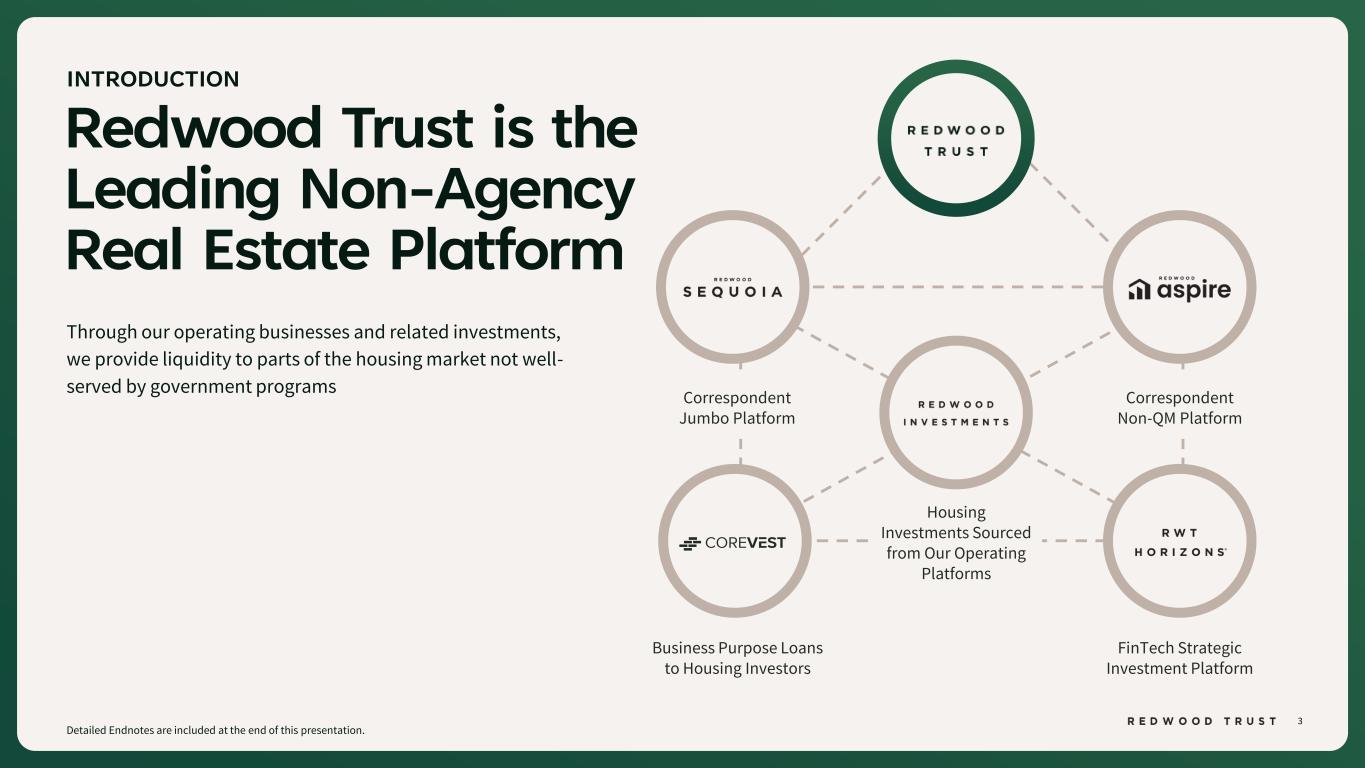
3 Redwood Trust is the Leading Non-Agency Real Estate Platform INTRODUCTION Detailed Endnotes are included at the end of this presentation. Correspondent Non-QM Platform Correspondent Jumbo Platform FinTech Strategic Investment Platform Business Purpose Loans to Housing Investors Housing Investments Sourced from Our Operating Platforms Through our operating businesses and related investments, we provide liquidity to parts of the housing market not well- served by government programs
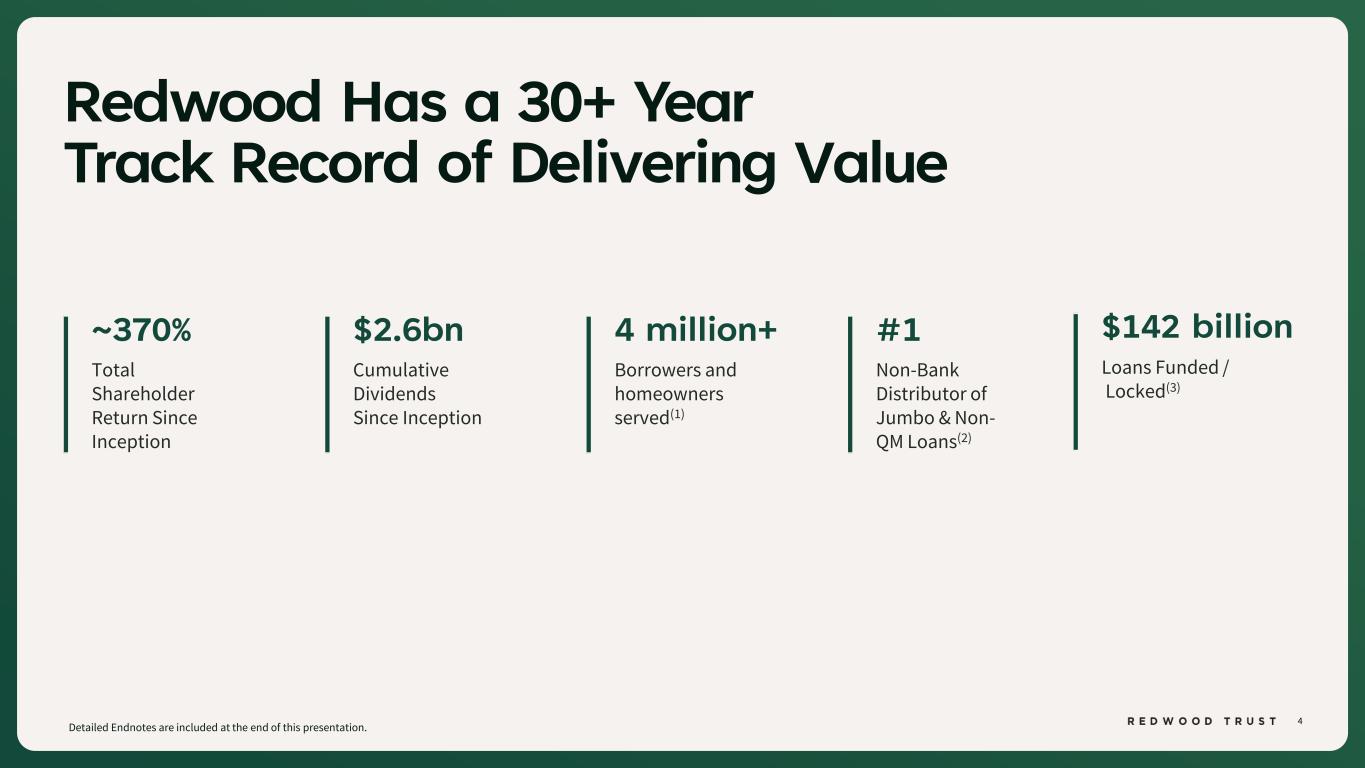
4 Redwood Has a 30+ Year Track Record of Delivering Value Detailed Endnotes are included at the end of this presentation. ~370% Total Shareholder Return Since Inception $2.6bn Cumulative Dividends Since Inception 4 million+ Borrowers and homeowners served(1) #1 Non-Bank Distributor of Jumbo & Non- QM Loans(2) $142 billion Loans Funded / Locked(3)
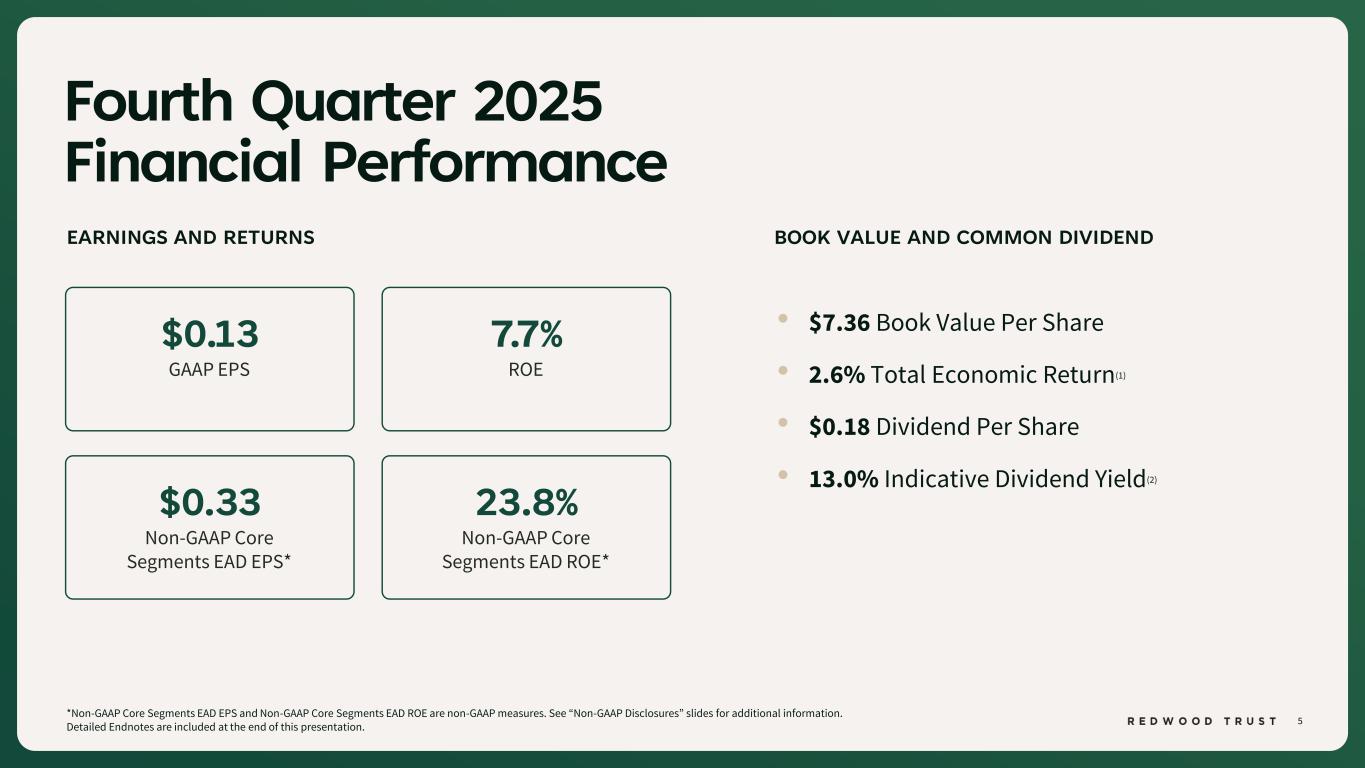
5 Fourth Quarter 2025 Financial Performance *Non-GAAP Core Segments EAD EPS and Non-GAAP Core Segments EAD ROE are non-GAAP measures. See “Non-GAAP Disclosures” slides for additional information. Detailed Endnotes are included at the end of this presentation. EARNINGS AND RETURNS BOOK VALUE AND COMMON DIVIDEND • $7.36 Book Value Per Share • 2.6% Total Economic Return(1) • $0.18 Dividend Per Share • 13.0% Indicative Dividend Yield(2) $0.13 GAAP EPS 7.7% ROE $0.33 Non-GAAP Core Segments EAD EPS* 23.8% Non-GAAP Core Segments EAD ROE*
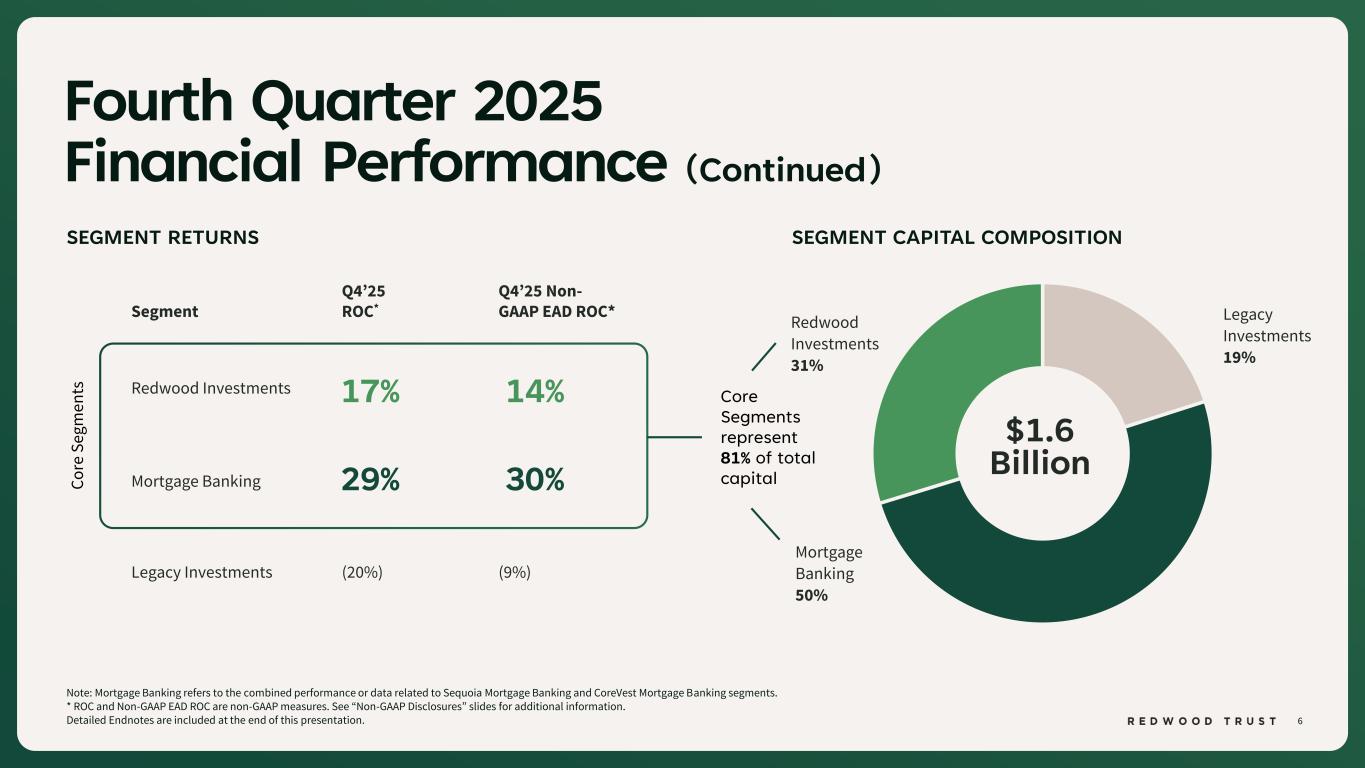
6 Fourth Quarter 2025 Financial Performance (Continued) Note: Mortgage Banking refers to the combined performance or data related to Sequoia Mortgage Banking and CoreVest Mortgage Banking segments. * ROC and Non-GAAP EAD ROC are non-GAAP measures. See “Non-GAAP Disclosures” slides for additional information. Detailed Endnotes are included at the end of this presentation. SEGMENT RETURNS Legacy Investments 19% Mortgage Banking 50% Redwood Investments 31% SEGMENT CAPITAL COMPOSITION Core Segments represent 81% of total capital Segment Q4’25 ROC*) Q4’25 Non- GAAP EAD ROC* Redwood Investments Mortgage Banking Legacy Investments (20%) (9%) 17% 14% 29% 30%C o re S eg m e n ts $1.6 Billion
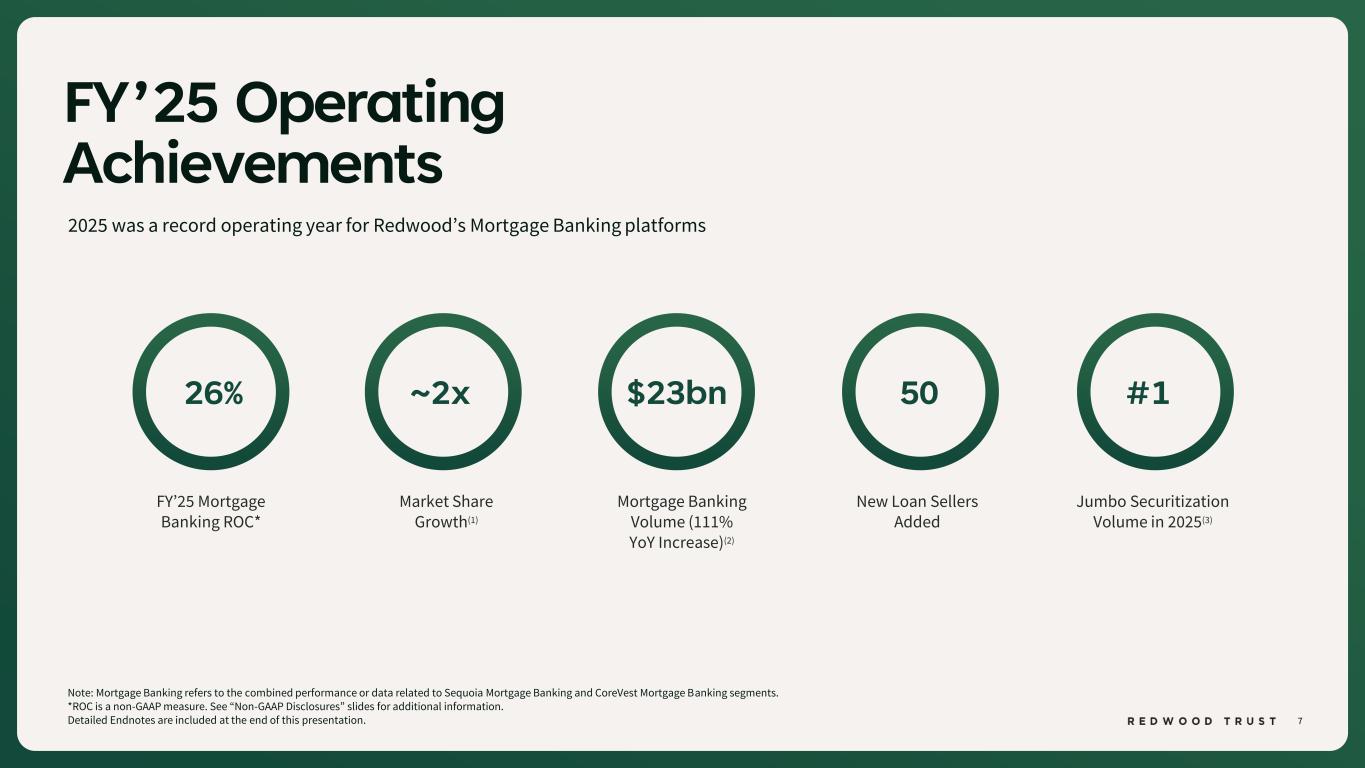
7 FY’25 Operating Achievements Note: Mortgage Banking refers to the combined performance or data related to Sequoia Mortgage Banking and CoreVest Mortgage Banking segments. *ROC is a non-GAAP measure. See “Non-GAAP Disclosures” slides for additional information. Detailed Endnotes are included at the end of this presentation. 2025 was a record operating year for Redwood’s Mortgage Banking platforms FY’25 Mortgage Banking ROC* 26% Market Share Growth(1) ~2x Mortgage Banking Volume (111% YoY Increase)(2) $23bn New Loan Sellers Added 50 Jumbo Securitization Volume in 2025(3) #1
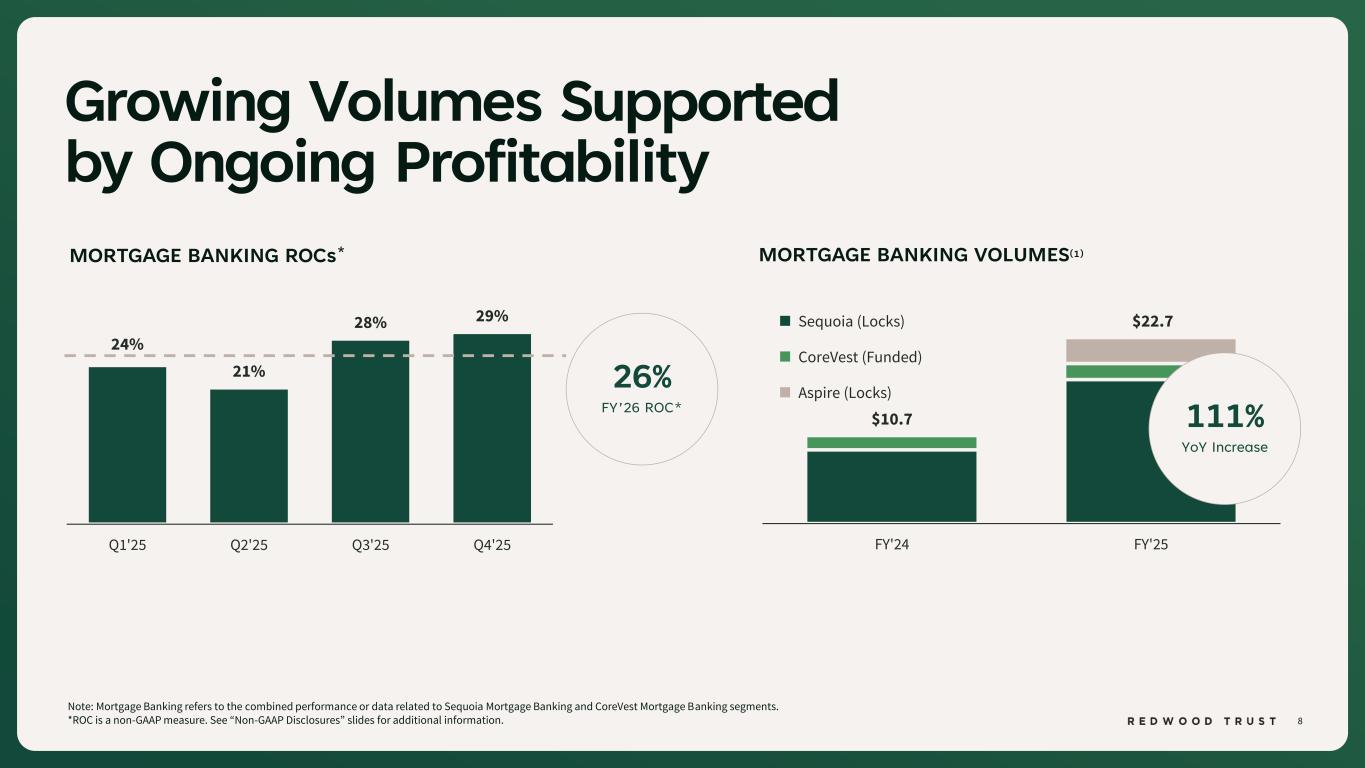
8 Note: Mortgage Banking refers to the combined performance or data related to Sequoia Mortgage Banking and CoreVest Mortgage Banking segments. *ROC is a non-GAAP measure. See “Non-GAAP Disclosures” slides for additional information. Growing Volumes Supported by Ongoing Profitability 24% 21% 28% 29% Q1'25 Q2'25 Q3'25 Q4'25 MORTGAGE BANKING ROCs* $10.7 $22.7 FY'24 FY'25 Sequoia (Locks) CoreVest (Funded) Aspire (Locks) 111% YoY Increase MORTGAGE BANKING VOLUMES(1) 26% FY’26 ROC*
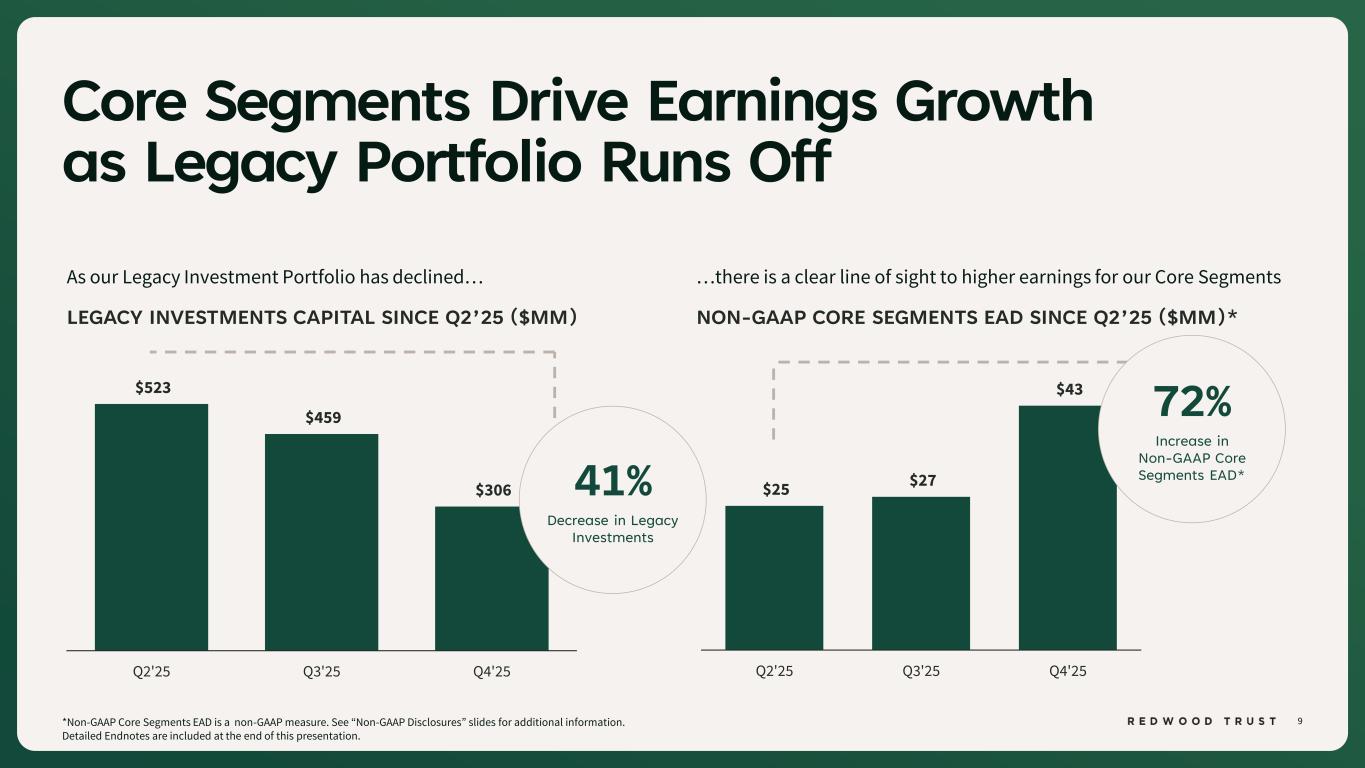
9 $523 $459 $306 Q2'25 Q3'25 Q4'25 $25 $27 $43 Q2'25 Q3'25 Q4'25 Core Segments Drive Earnings Growth as Legacy Portfolio Runs Off …there is a clear line of sight to higher earnings for our Core SegmentsAs our Legacy Investment Portfolio has declined… LEGACY INVESTMENTS CAPITAL SINCE Q2’25 ($MM) NON-GAAP CORE SEGMENTS EAD SINCE Q2’25 ($MM)* *Non-GAAP Core Segments EAD is a non-GAAP measure. See “Non-GAAP Disclosures” slides for additional information. Detailed Endnotes are included at the end of this presentation. 41% Decrease in Legacy Investments 72% Increase in Non-GAAP Core Segments EAD*
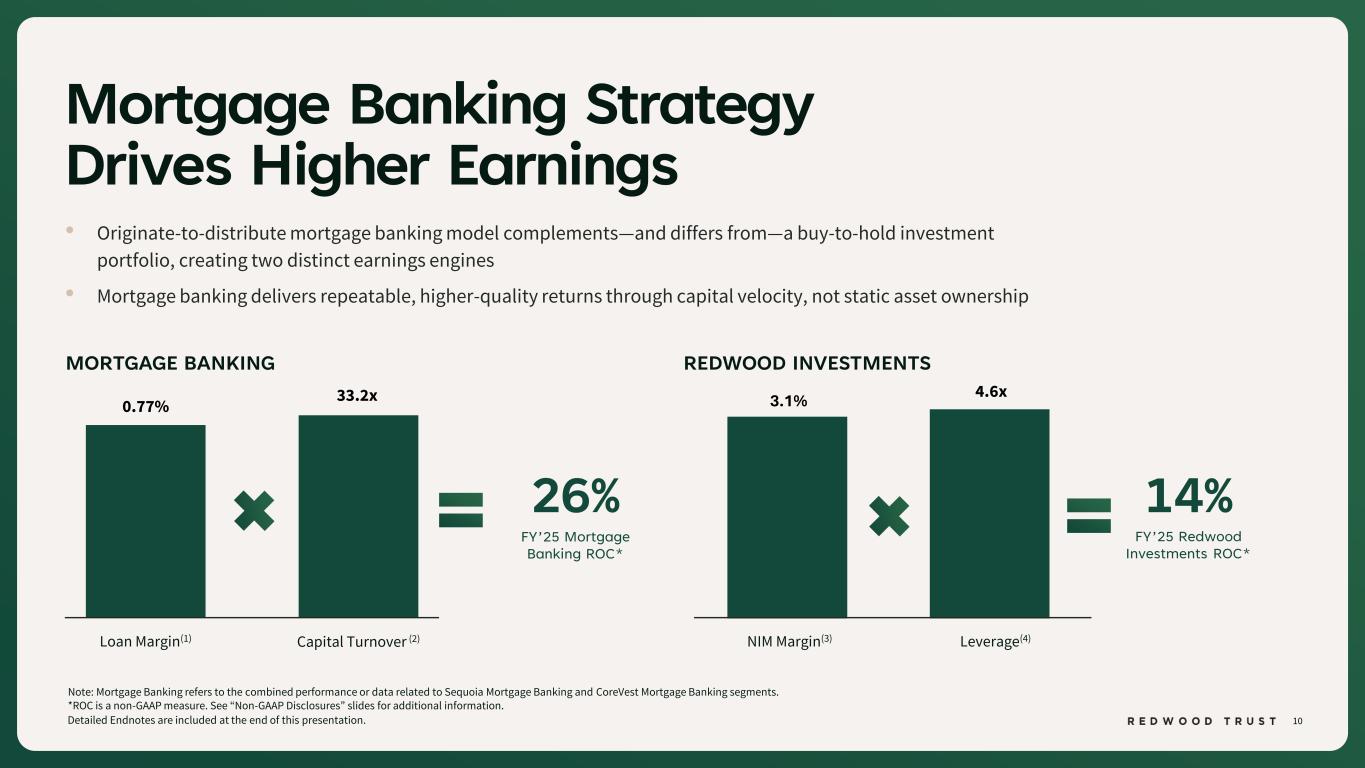
10 33.2x Mortgage Banking Strategy Drives Higher Earnings Detailed Endnotes are included at the end of this presentation. Capital Turnover (2) 0.77% Loan Margin(1) 26% 3.1% 4.6x Leverage(4)NIM Margin(3) MORTGAGE BANKING REDWOOD INVESTMENTS Note: Mortgage Banking refers to the combined performance or data related to Sequoia Mortgage Banking and CoreVest Mortgage Banking segments. *ROC is a non-GAAP measure. See “Non-GAAP Disclosures” slides for additional information. • Originate-to-distribute mortgage banking model complements—and differs from—a buy-to-hold investment portfolio, creating two distinct earnings engines • Mortgage banking delivers repeatable, higher-quality returns through capital velocity, not static asset ownership FY’25 Mortgage Banking ROC* 14% FY’25 Redwood Investments ROC*
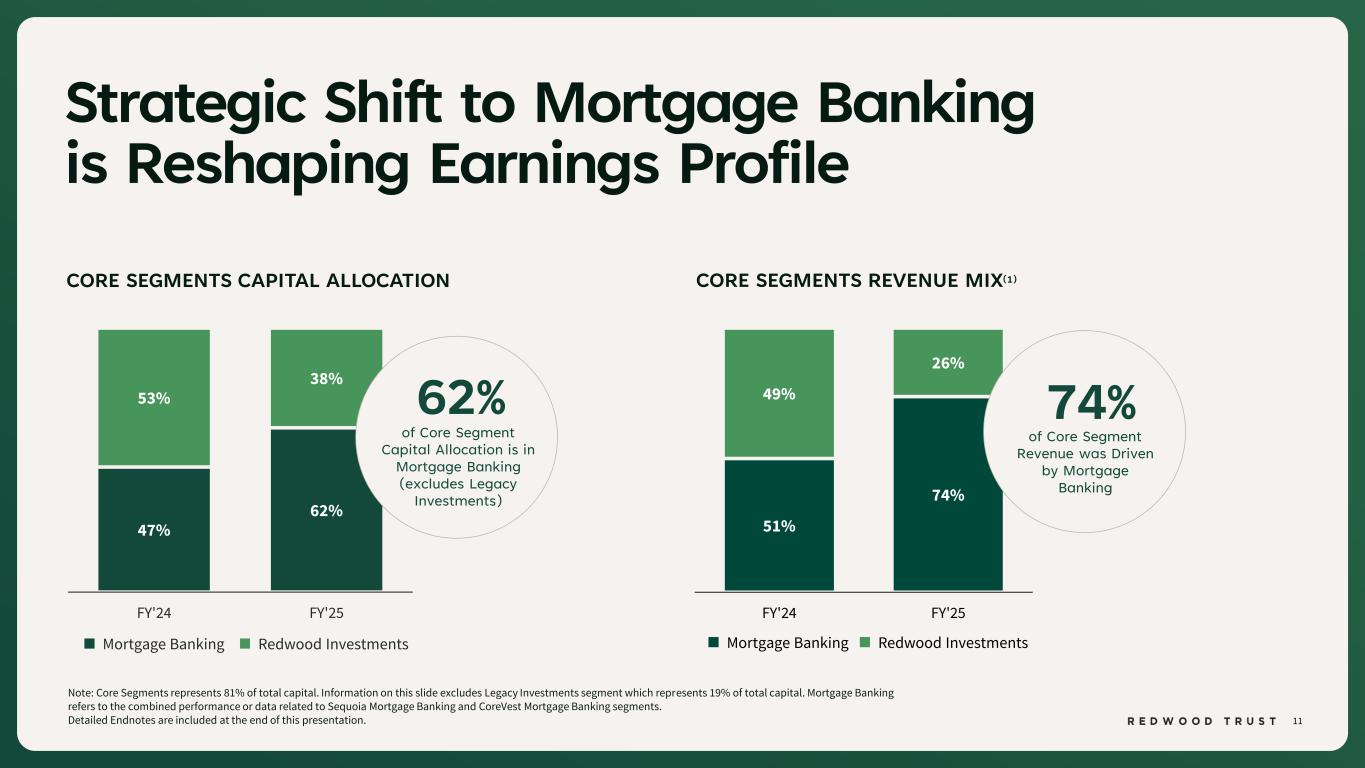
11 47% 62% 53% 38% FY'24 FY'25 Mortgage Banking Redwood Investments Strategic Shift to Mortgage Banking is Reshaping Earnings Profile Note: Core Segments represents 81% of total capital. Information on this slide excludes Legacy Investments segment which represents 19% of total capital. Mortgage Banking refers to the combined performance or data related to Sequoia Mortgage Banking and CoreVest Mortgage Banking segments. Detailed Endnotes are included at the end of this presentation. CORE SEGMENTS CAPITAL ALLOCATION 51% 74% 49% 26% FY'24 FY'25 Mortgage Banking Redwood Investments CORE SEGMENTS REVENUE MIX(1) of Core Segment Capital Allocation is in Mortgage Banking (excludes Legacy Investments) 62% of Core Segment Revenue was Driven by Mortgage Banking 74%
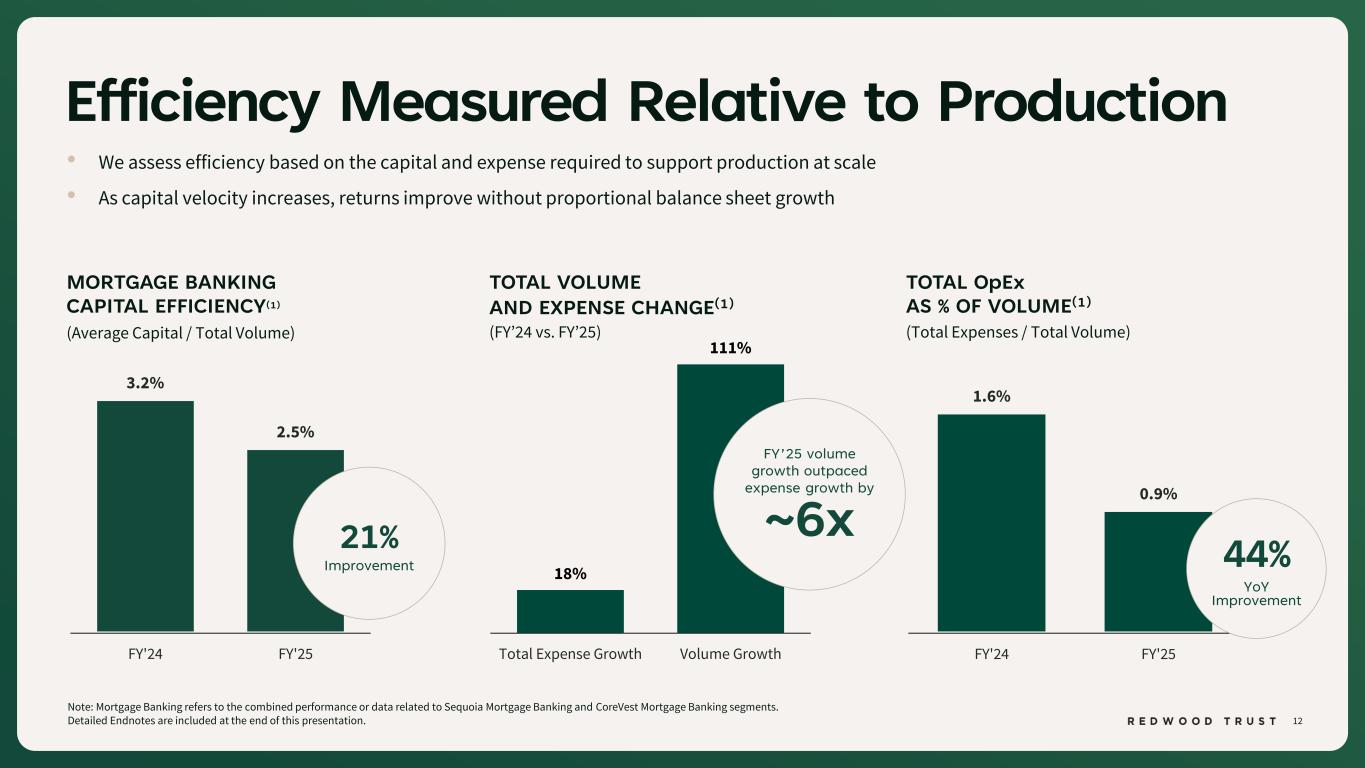
12 3.2% 2.5% FY'24 FY'25 Note: Mortgage Banking refers to the combined performance or data related to Sequoia Mortgage Banking and CoreVest Mortgage Banking segments. Detailed Endnotes are included at the end of this presentation. 21% Improvement TOTAL VOLUME AND EXPENSE CHANGE(1) (FY’24 vs. FY’25) MORTGAGE BANKING CAPITAL EFFICIENCY(1) (Average Capital / Total Volume) Efficiency Measured Relative to Production TOTAL OpEx AS % OF VOLUME(1) (Total Expenses / Total Volume) 1.6% 0.9% FY'24 FY'25 • We assess efficiency based on the capital and expense required to support production at scale • As capital velocity increases, returns improve without proportional balance sheet growth 44% YoY Improvement 18% 111% Total Expense Growth Volume Growth FY’25 volume growth outpaced expense growth by~6x
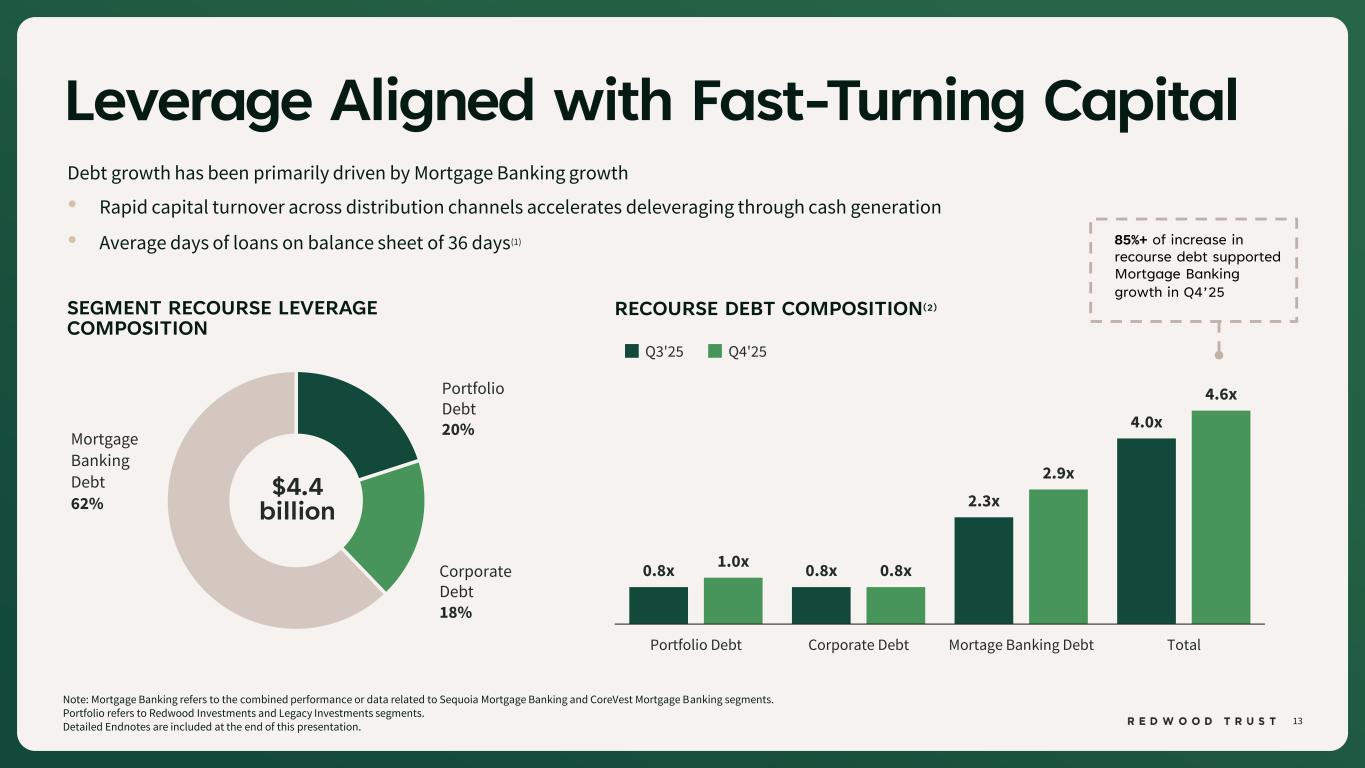
13 Portfoli o Debt 20% Corporate Debt 18% Mortgage Banking Debt 62% Leverage Aligned with Fast-Turning Capital Note: Mortgage Banking refers to the combined performance or data related to Sequoia Mortgage Banking and CoreVest Mortgage Banking segments. Portfolio refers to Redwood Investments and Legacy Investments segments. Detailed Endnotes are included at the end of this presentation. SEGMENT RECOURSE LEVERAGE COMPOSITION Debt growth has been primarily driven by Mortgage Banking growth • Rapid capital turnover across distribution channels accelerates deleveraging through cash generation • Average days of loans on balance sheet of 36 days(1) RECOURSE DEBT COMPOSITION(2) 0.8x 0.8x 2.3x 4.0x 1.0x 0.8x 2.9x 4.6x Portfolio Debt Corporate Debt Mortage Banking Debt Total Q3'25 Q4'25 $4.4 billion Portfolio Debt Corporate Debt 18% 85%+ of increase in recourse debt supported Mortgage Banking growth in Q4’25
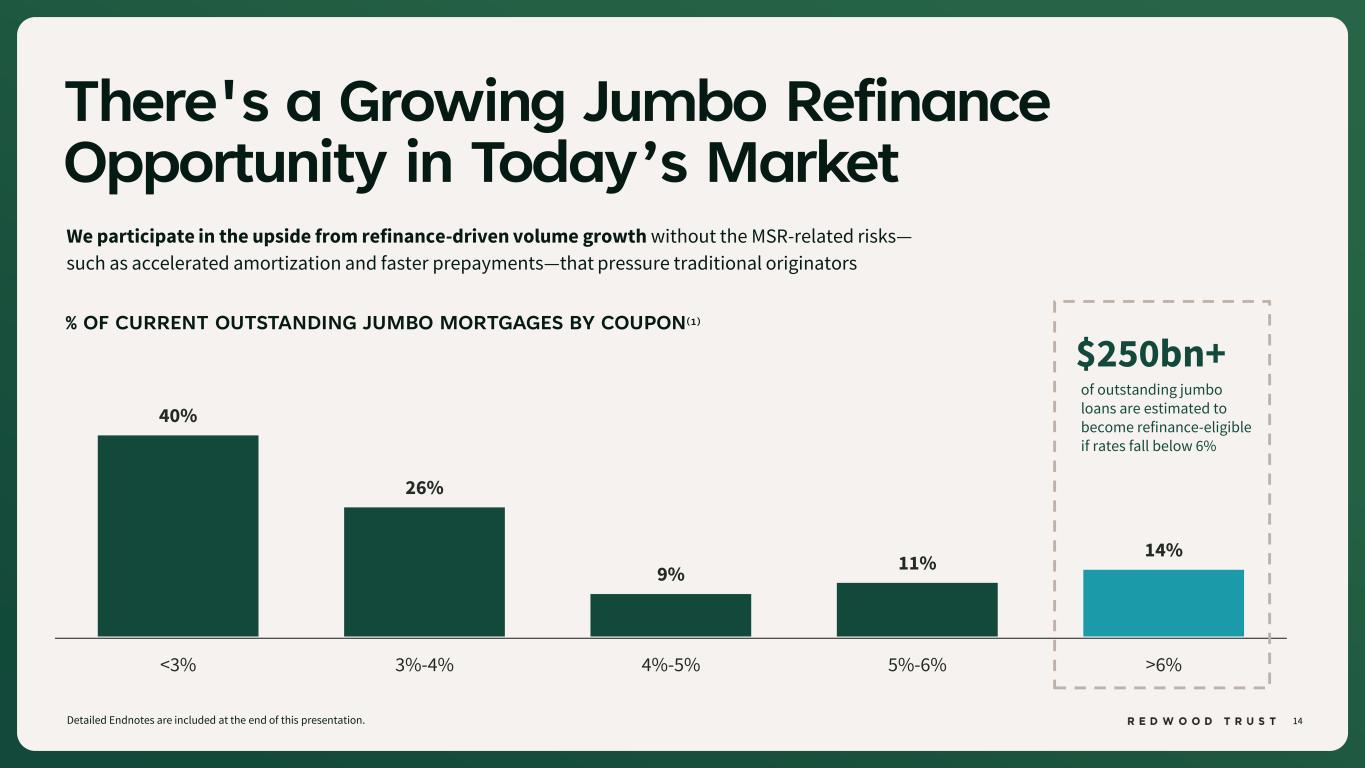
14 There's a Growing Jumbo Refinance Opportunity in Today’s Market Detailed Endnotes are included at the end of this presentation. % OF CURRENT OUTSTANDING JUMBO MORTGAGES BY COUPON(1) We participate in the upside from refinance-driven volume growth without the MSR-related risks— such as accelerated amortization and faster prepayments—that pressure traditional originators 40% 26% 9% 11% 14% <3% 3%-4% 4%-5% 5%-6% >6% $250bn+ of outstanding jumbo loans are estimated to become refinance-eligible if rates fall below 6%
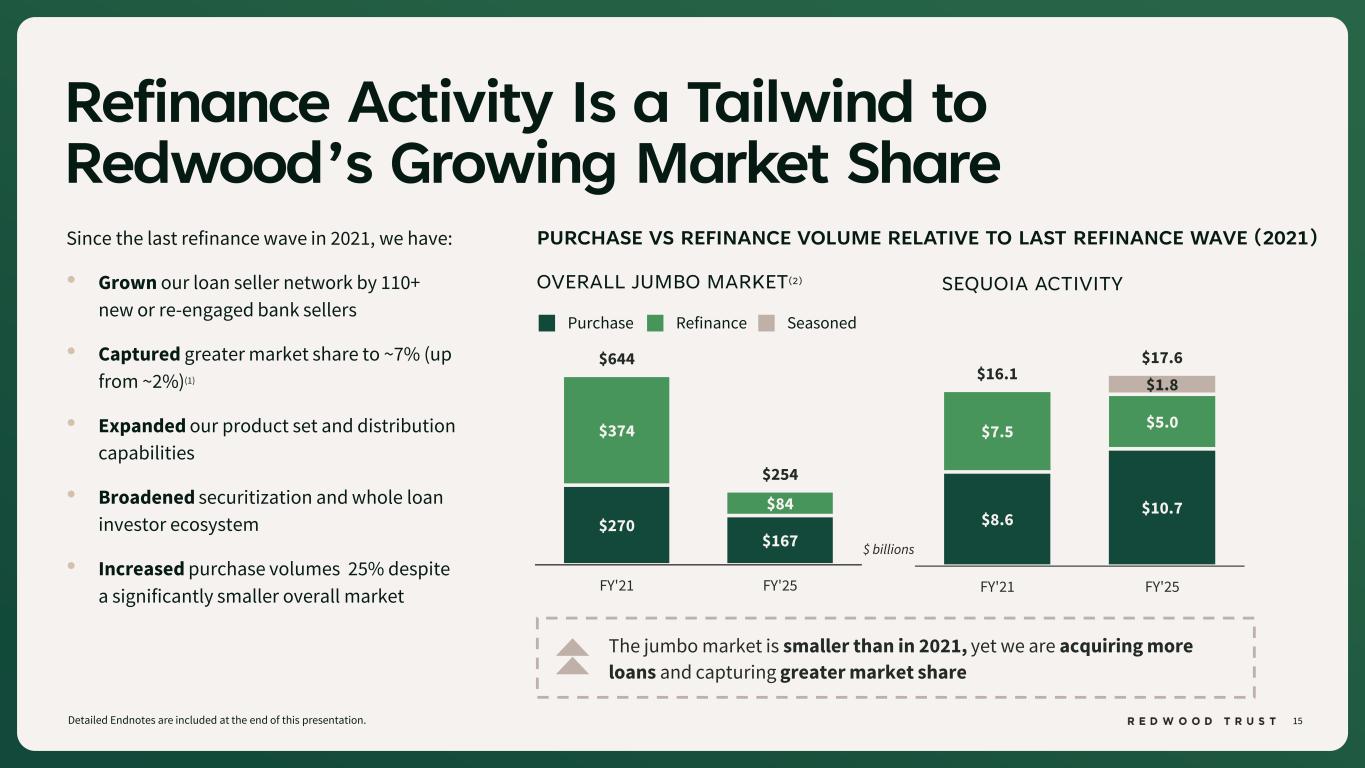
15 $8.6 $10.7 $7.5 $5.0 $1.8 $16.1 $17.6 FY'21 FY'25 Refinance Activity Is a Tailwind to Redwood’s Growing Market Share PURCHASE VS REFINANCE VOLUME RELATIVE TO LAST REFINANCE WAVE (2021) Since the last refinance wave in 2021, we have: • Grown our loan seller network by 110+ new or re-engaged bank sellers • Captured greater market share to ~7% (up from ~2%)(1) • Expanded our product set and distribution capabilities • Broadened securitization and whole loan investor ecosystem • Increased purchase volumes 25% despite a significantly smaller overall market Detailed Endnotes are included at the end of this presentation. $ billions OVERALL JUMBO MARKET(2) SEQUOIA ACTIVITY The jumbo market is smaller than in 2021, yet we are acquiring more loans and capturing greater market share $270 $167 $374 $84 $644 $254 FY'21 FY'25 Purchase Refinance Seasoned
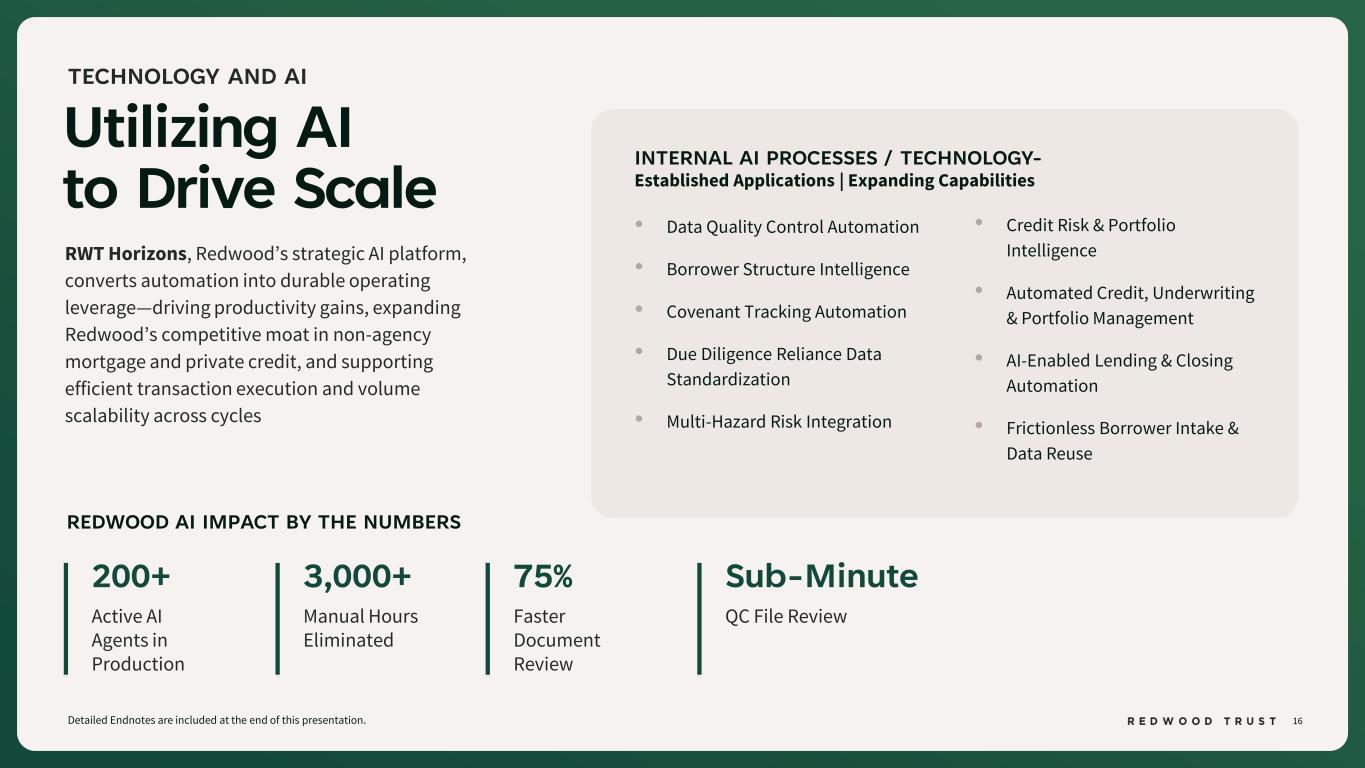
16 Utilizing AI to Drive Scale Detailed Endnotes are included at the end of this presentation. RWT Horizons, Redwood’s strategic AI platform, converts automation into durable operating leverage—driving productivity gains, expanding Redwood’s competitive moat in non-agency mortgage and private credit, and supporting efficient transaction execution and volume scalability across cycles • Data Quality Control Automation • Borrower Structure Intelligence • Covenant Tracking Automation • Due Diligence Reliance Data Standardization • Multi-Hazard Risk Integration • Credit Risk & Portfolio Intelligence • Automated Credit, Underwriting & Portfolio Management • AI-Enabled Lending & Closing Automation • Frictionless Borrower Intake & Data Reuse REDWOOD AI IMPACT BY THE NUMBERS INTERNAL AI PROCESSES / TECHNOLOGY- Established Applications | Expanding Capabilities 200+ Active AI Agents in Production 3,000+ Manual Hours Eliminated 75% Faster Document Review Sub-Minute QC File Review TECHNOLOGY AND AI
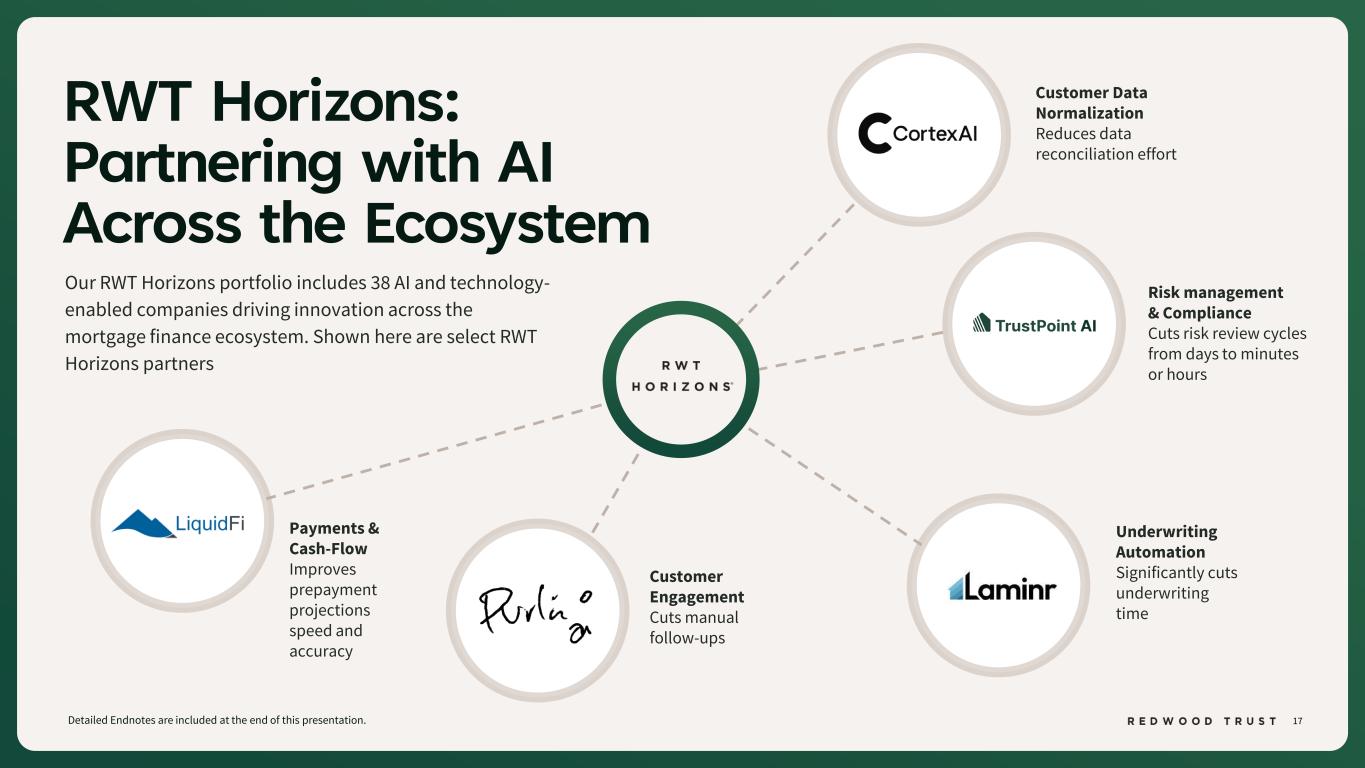
17 RWT Horizons: Partnering with AI Across the Ecosystem Payments & Cash-Flow Improves prepayment projections speed and accuracy Customer Engagement Cuts manual follow-ups Underwriting Automation Significantly cuts underwriting time Customer Data Normalization Reduces data reconciliation effort Risk management & Compliance Cuts risk review cycles from days to minutes or hours Our RWT Horizons portfolio includes 38 AI and technology- enabled companies driving innovation across the mortgage finance ecosystem. Shown here are select RWT Horizons partners Detailed Endnotes are included at the end of this presentation.

Fourth Quarter 2025 Earnings & Segment Results
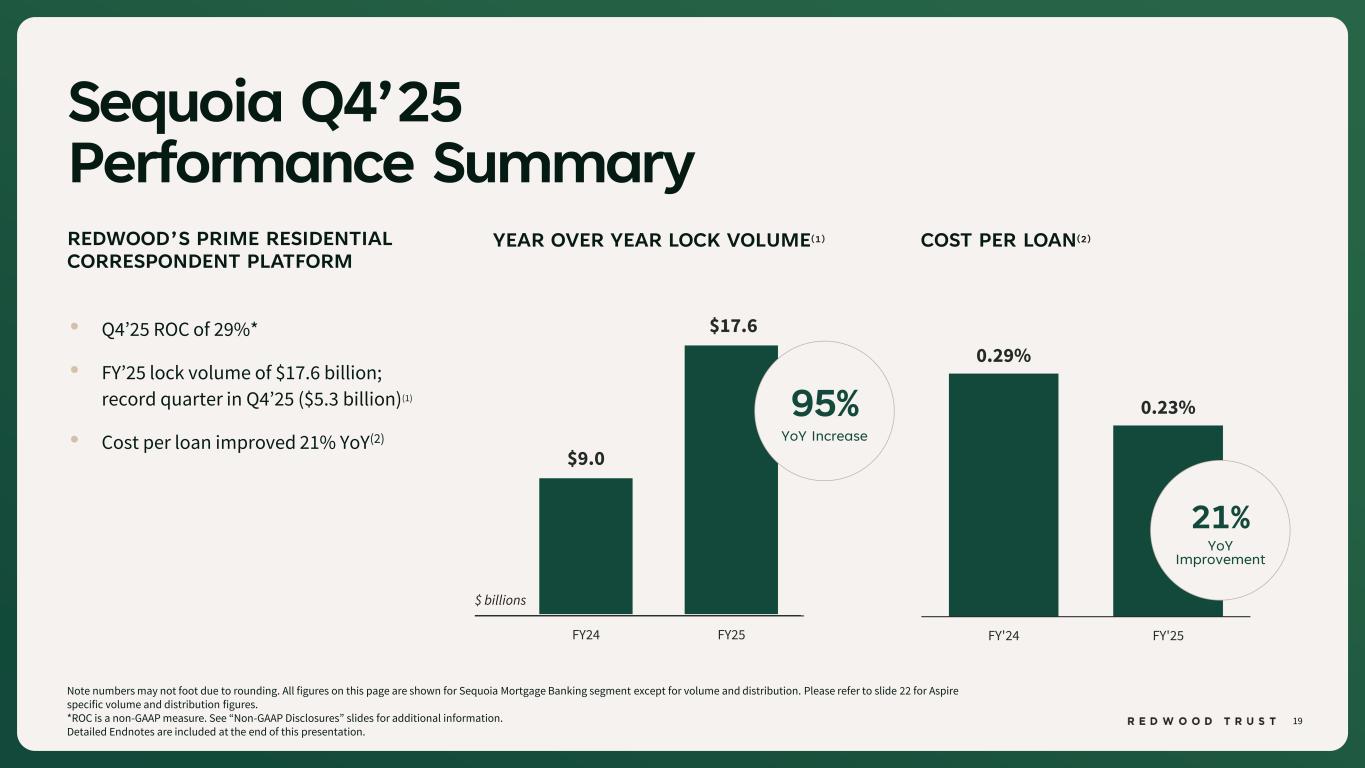
19 0.29% 0.23% FY'24 FY'25 $9.0 $17.6 FY24 FY25 Sequoia Q4’25 Performance Summary Note numbers may not foot due to rounding. All figures on this page are shown for Sequoia Mortgage Banking segment except for volume and distribution. Please refer to slide 22 for Aspire specific volume and distribution figures. *ROC is a non-GAAP measure. See “Non-GAAP Disclosures” slides for additional information. Detailed Endnotes are included at the end of this presentation. • Q4’25 ROC of 29%* • FY’25 lock volume of $17.6 billion; record quarter in Q4’25 ($5.3 billion)(1) • Cost per loan improved 21% YoY(2) YEAR OVER YEAR LOCK VOLUME(1)REDWOOD’S PRIME RESIDENTIAL CORRESPONDENT PLATFORM 95% YoY Increase COST PER LOAN(2) 21% YoY Improvement $ billions
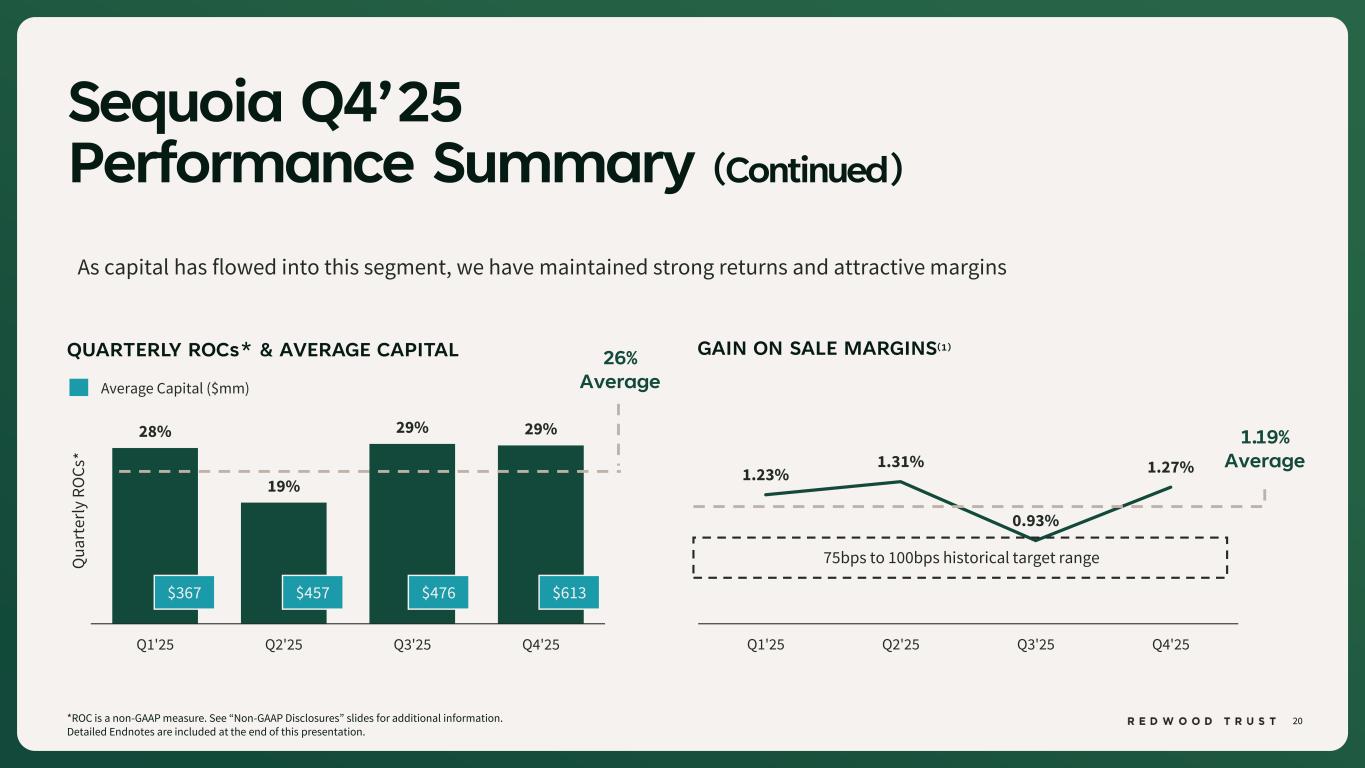
20 1.23% 1.31% 0.93% 1.27% Q1'25 Q2'25 Q3'25 Q4'25 28% 19% 29% 29% Q1'25 Q2'25 Q3'25 Q4'25 Q u a rt e rl y R O C s Sequoia Q4’25 Performance Summary (Continued) *ROC is a non-GAAP measure. See “Non-GAAP Disclosures” slides for additional information. Detailed Endnotes are included at the end of this presentation. QUARTERLY ROCs* & AVERAGE CAPITAL GAIN ON SALE MARGINS(1) As capital has flowed into this segment, we have maintained strong returns and attractive margins Average Capital ($mm) $476 26% Average 1.19% Average 75bps to 100bps historical target range * $613$457$367
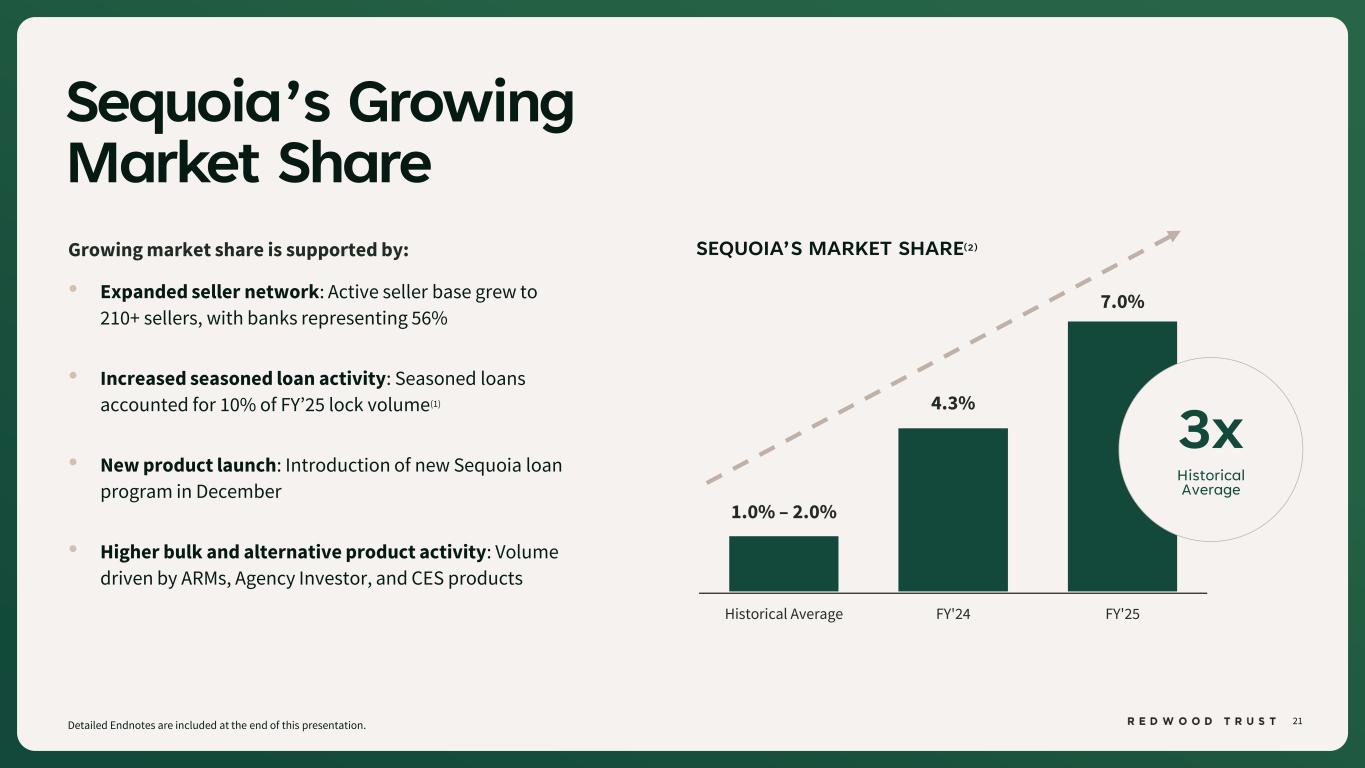
21 Sequoia’s Growing Market Share Detailed Endnotes are included at the end of this presentation. SEQUOIA’S MARKET SHARE(2) 1.0% – 2.0% 4.3% 7.0% Historical Average FY'24 FY'25 3x Historical Average Growing market share is supported by: • Expanded seller network: Active seller base grew to 210+ sellers, with banks representing 56% • Increased seasoned loan activity: Seasoned loans accounted for 10% of FY’25 lock volume(1) • New product launch: Introduction of new Sequoia loan program in December • Higher bulk and alternative product activity: Volume driven by ARMs, Agency Investor, and CES products
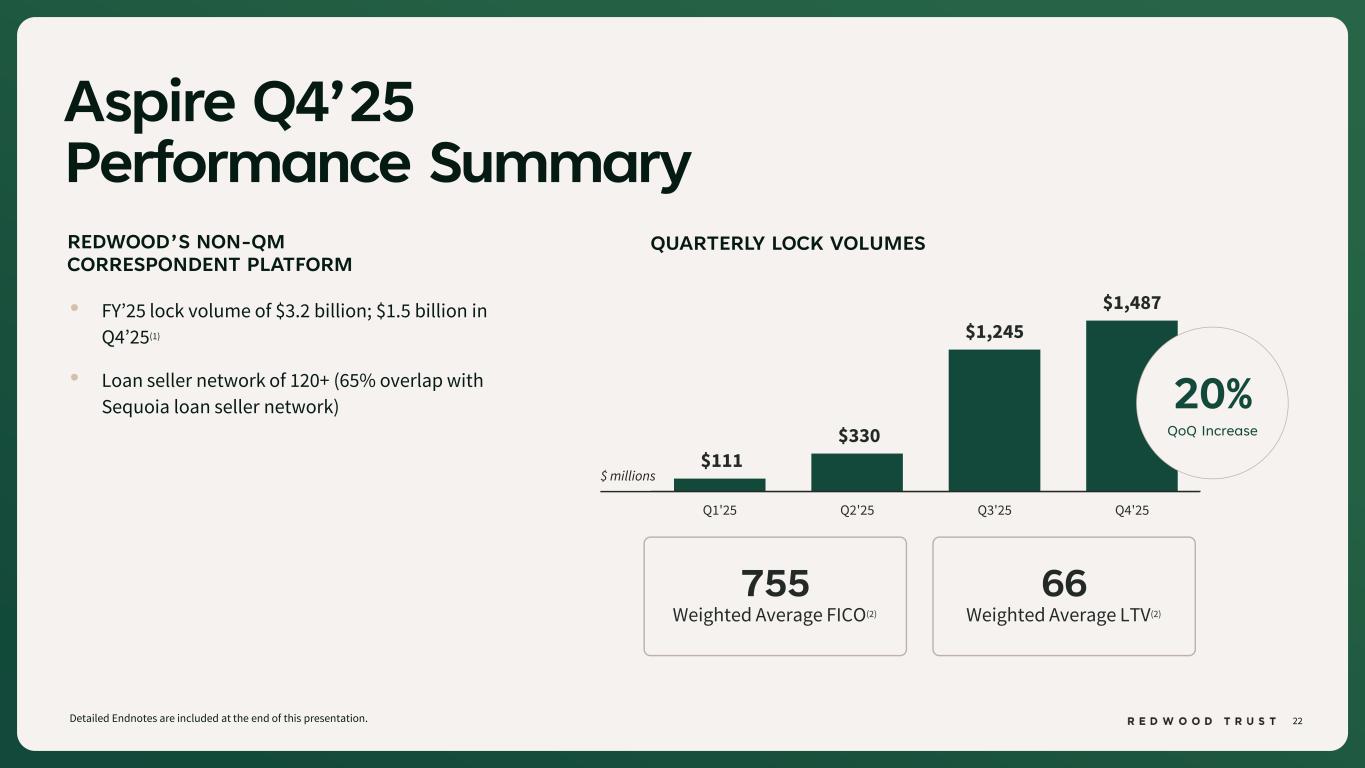
22 Aspire Q4’25 Performance Summary Detailed Endnotes are included at the end of this presentation. $111 $330 $1,245 $1,487 Q1'25 Q2'25 Q3'25 Q4'25 • FY’25 lock volume of $3.2 billion; $1.5 billion in Q4’25(1) • Loan seller network of 120+ (65% overlap with Sequoia loan seller network) 20% QoQ Increase QUARTERLY LOCK VOLUMESREDWOOD’S NON-QM CORRESPONDENT PLATFORM 755 Weighted Average FICO(2) 66 Weighted Average LTV(2) $ millions
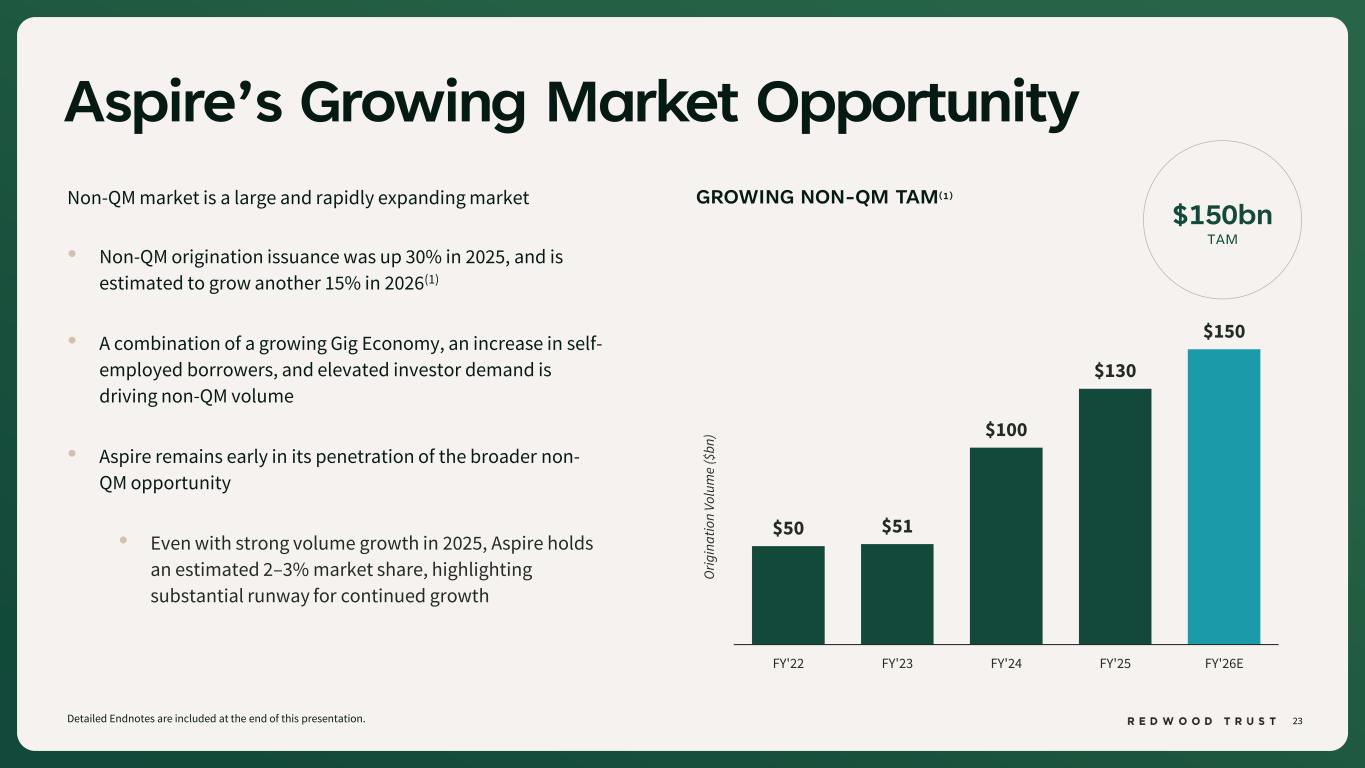
23 Aspire’s Growing Market Opportunity Detailed Endnotes are included at the end of this presentation. Non-QM market is a large and rapidly expanding market • Non-QM origination issuance was up 30% in 2025, and is estimated to grow another 15% in 2026(1) • A combination of a growing Gig Economy, an increase in self- employed borrowers, and elevated investor demand is driving non-QM volume • Aspire remains early in its penetration of the broader non- QM opportunity • Even with strong volume growth in 2025, Aspire holds an estimated 2–3% market share, highlighting substantial runway for continued growth GROWING NON-QM TAM(1) $50 $51 $100 $130 $150 FY'22 FY'23 FY'24 FY'25 FY'26E O ri g in a ti o n V o lu m e ($ b n ) $150bn TAM
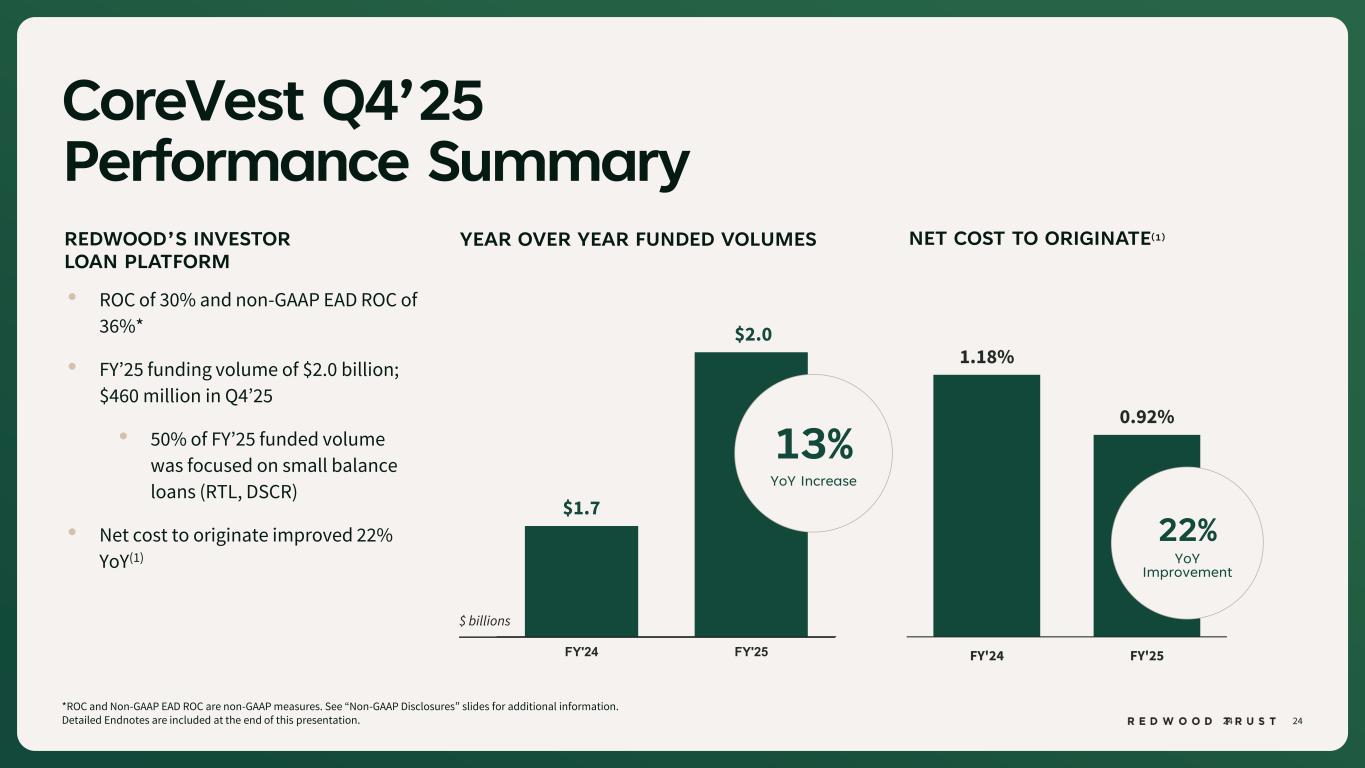
24 $1.7 $2.0 FY'24 FY'25 CoreVest Q4’25 Performance Summary 24 *ROC and Non-GAAP EAD ROC are non-GAAP measures. See “Non-GAAP Disclosures” slides for additional information. Detailed Endnotes are included at the end of this presentation. • ROC of 30% and non-GAAP EAD ROC of 36%* • FY’25 funding volume of $2.0 billion; $460 million in Q4’25 • 50% of FY’25 funded volume was focused on small balance loans (RTL, DSCR) • Net cost to originate improved 22% YoY(1) REDWOOD’S INVESTOR LOAN PLATFORM YEAR OVER YEAR FUNDED VOLUMES 13% YoY Increase NET COST TO ORIGINATE(1) 1.18% 0.92% FY'24 FY'25 22% YoY Improvement $ billions
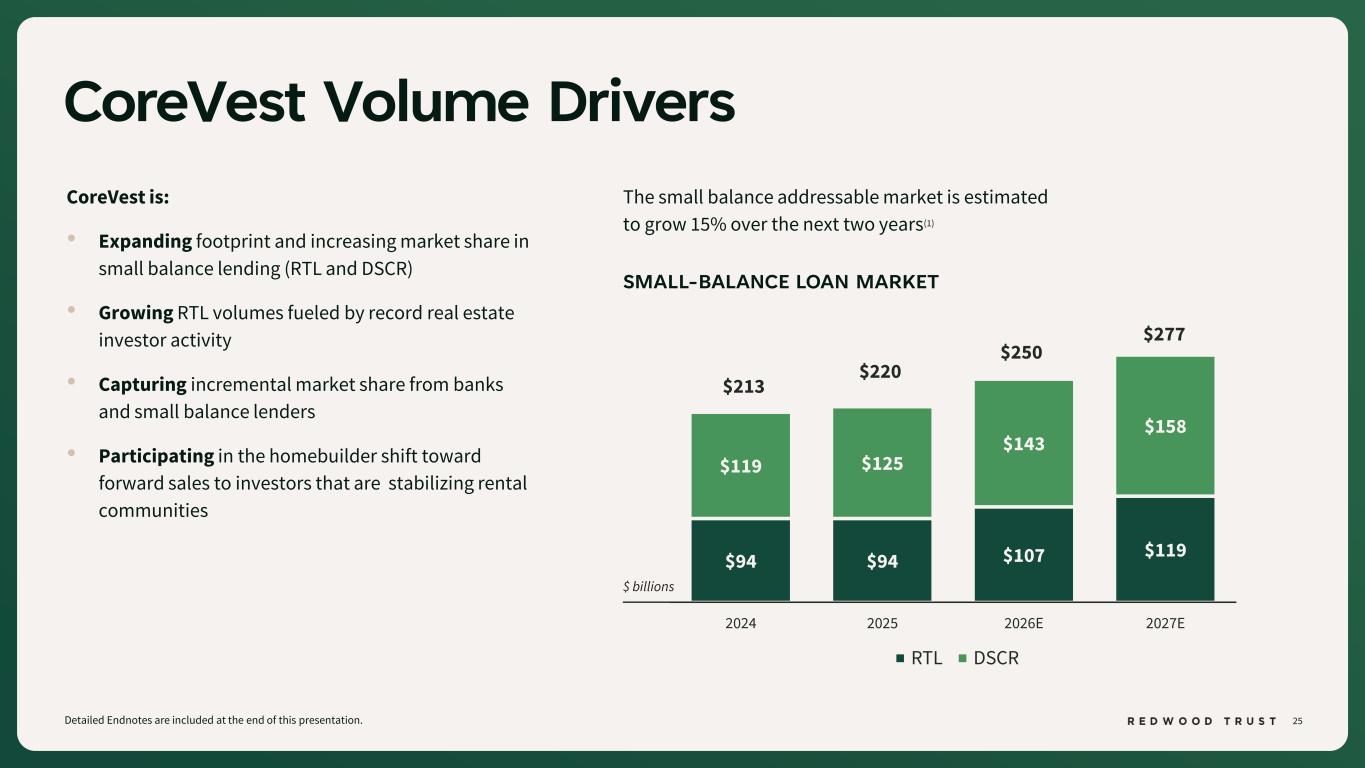
25 CoreVest Volume Drivers Detailed Endnotes are included at the end of this presentation. $94 $94 $107 $119 $119 $125 $143 $158 2024 2025 2026E 2027E RTL DSCR $220 CoreVest is: • Expanding footprint and increasing market share in small balance lending (RTL and DSCR) • Growing RTL volumes fueled by record real estate investor activity • Capturing incremental market share from banks and small balance lenders • Participating in the homebuilder shift toward forward sales to investors that are stabilizing rental communities The small balance addressable market is estimated to grow 15% over the next two years(1) SMALL-BALANCE LOAN MARKET $250 $277 $213 $ billions
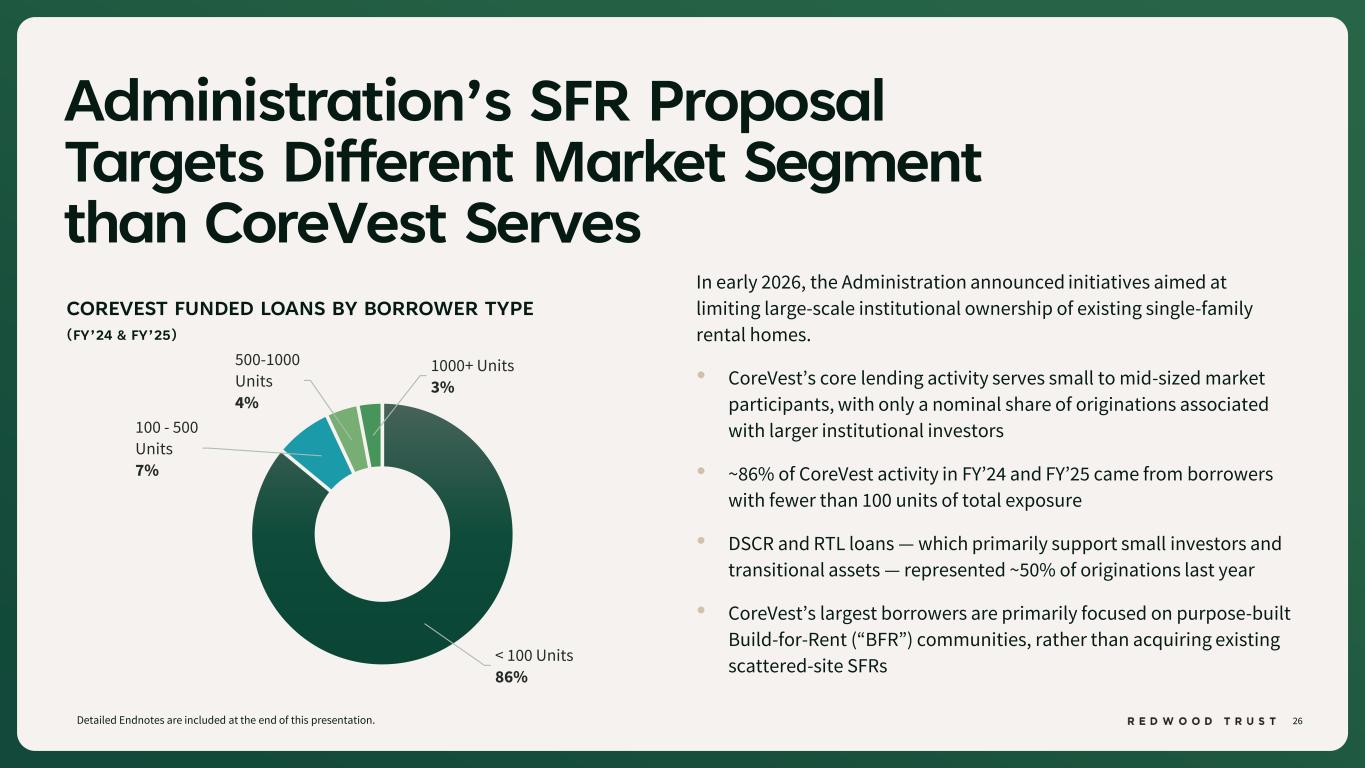
26 Administration’s SFR Proposal Targets Different Market Segment than CoreVest Serves Detailed Endnotes are included at the end of this presentation. In early 2026, the Administration announced initiatives aimed at limiting large-scale institutional ownership of existing single-family rental homes. • CoreVest’s core lending activity serves small to mid-sized market participants, with only a nominal share of originations associated with larger institutional investors • ~86% of CoreVest activity in FY’24 and FY’25 came from borrowers with fewer than 100 units of total exposure • DSCR and RTL loans — which primarily support small investors and transitional assets — represented ~50% of originations last year • CoreVest’s largest borrowers are primarily focused on purpose-built Build-for-Rent (“BFR”) communities, rather than acquiring existing scattered-site SFRs COREVEST FUNDED LOANS BY BORROWER TYPE (FY’24 & FY’25) < 100 Units 86% 100 - 500 Units 7% 500-1000 Units 4% 1000+ Units 3%
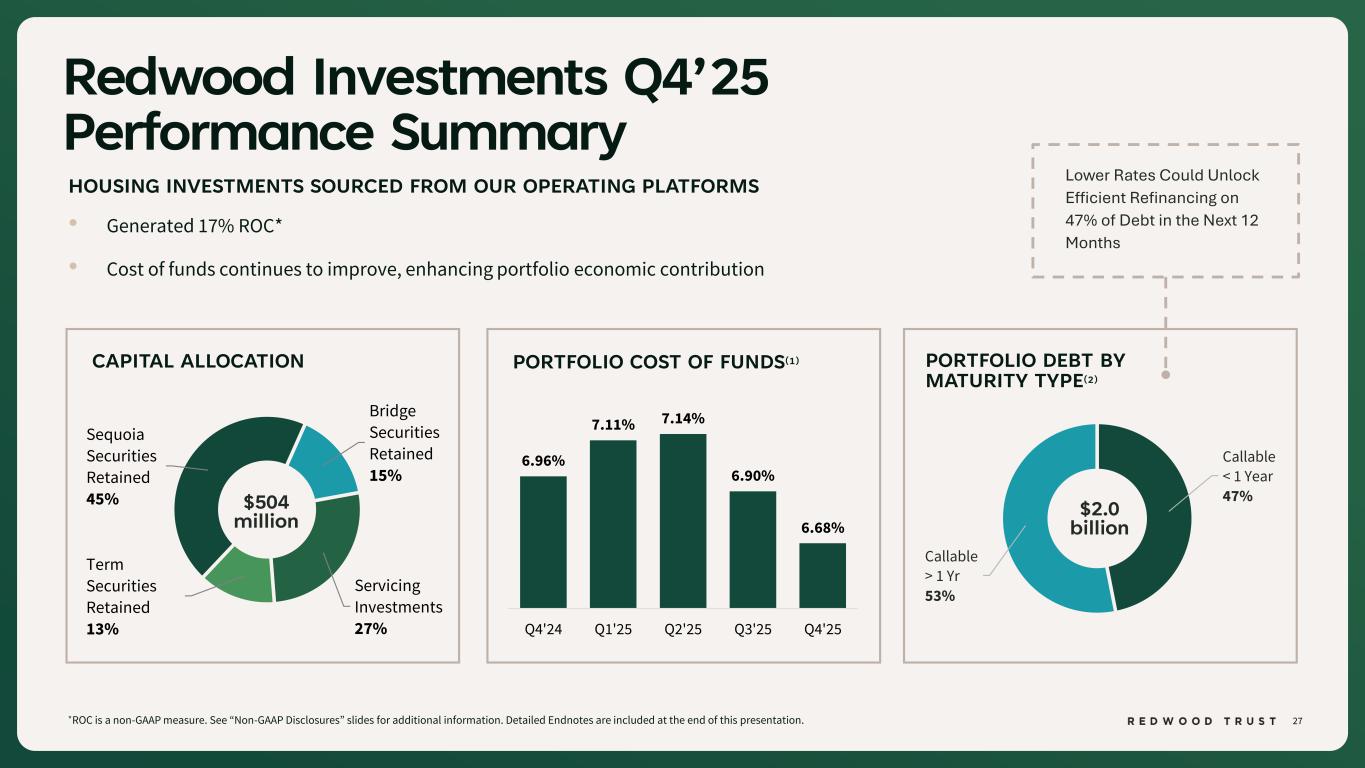
27 Redwood Investments Q4’25 Performance Summary HOUSING INVESTMENTS SOURCED FROM OUR OPERATING PLATFORMS • Generated 17% ROC* • Cost of funds continues to improve, enhancing portfolio economic contribution CAPITAL ALLOCATION *ROC is a non-GAAP measure. See “Non-GAAP Disclosures” slides for additional information. Detailed Endnotes are included at the end of this presentation. Bridge Securities Retained 15% Servicing Investments 27% Term Securities Retained 13% Sequoia Securities Retained 45% $504 million PORTFOLIO DEBT BY MATURITY TYPE(2) 6.96% 7.11% 7.14% 6.90% 6.68% Q4'24 Q1'25 Q2'25 Q3'25 Q4'25 Callable < 1 Year 47% Callable > 1 Yr 53% $2.0 billion Lower Rates Could Unlock Efficient Refinancing on 47% of Debt in the Next 12 Months PORTFOLIO COST OF FUNDS(1)
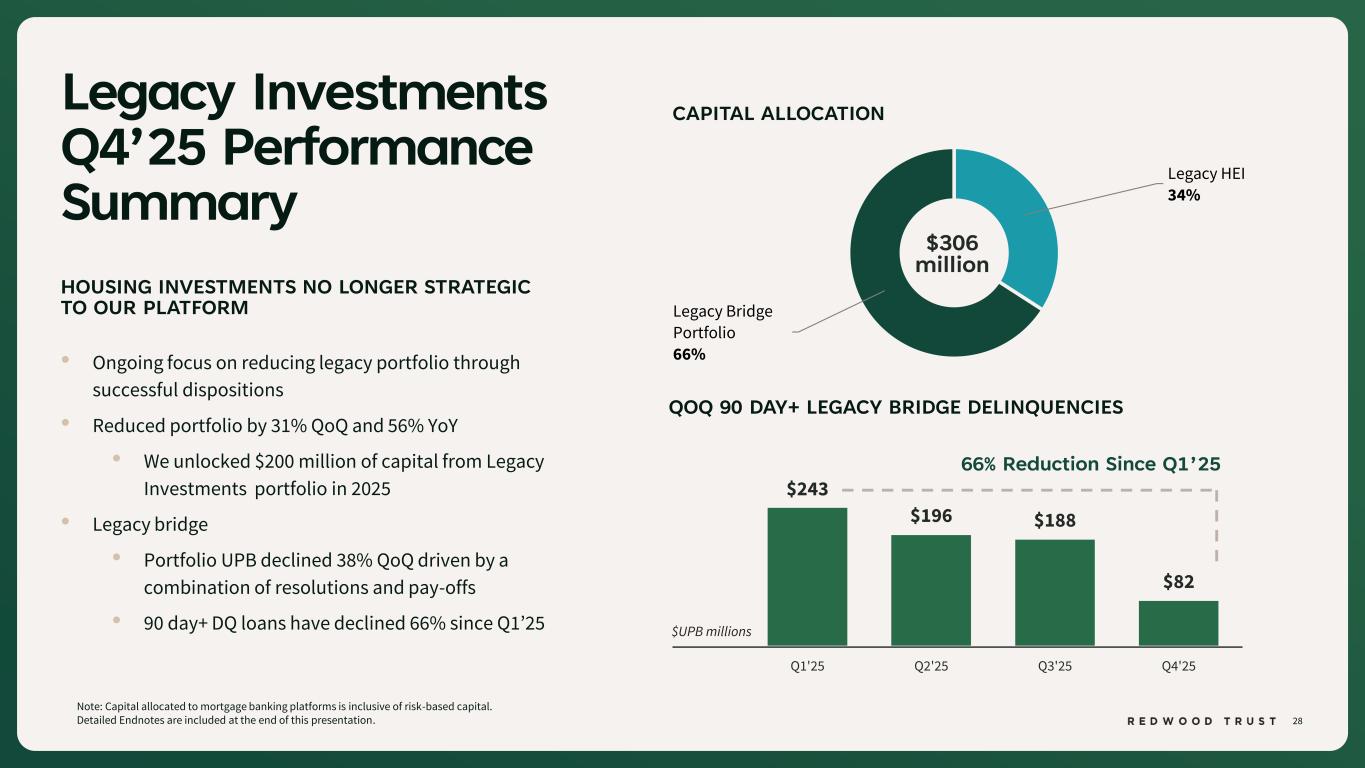
28 Legacy Investments Q4’25 Performance Summary QOQ 90 DAY+ LEGACY BRIDGE DELINQUENCIES $243 $196 $188 $82 Q1'25 Q2'25 Q3'25 Q4'25 66% Reduction Since Q1’25 CAPITAL ALLOCATION Note: Capital allocated to mortgage banking platforms is inclusive of risk-based capital. Detailed Endnotes are included at the end of this presentation. Legacy HEI 34% Legacy Bridge Portfolio 66% $306 million HOUSING INVESTMENTS NO LONGER STRATEGIC TO OUR PLATFORM • Ongoing focus on reducing legacy portfolio through successful dispositions • Reduced portfolio by 31% QoQ and 56% YoY • We unlocked $200 million of capital from Legacy Investments portfolio in 2025 • Legacy bridge • Portfolio UPB declined 38% QoQ driven by a combination of resolutions and pay-offs • 90 day+ DQ loans have declined 66% since Q1’25 $UPB millions

Financial Results
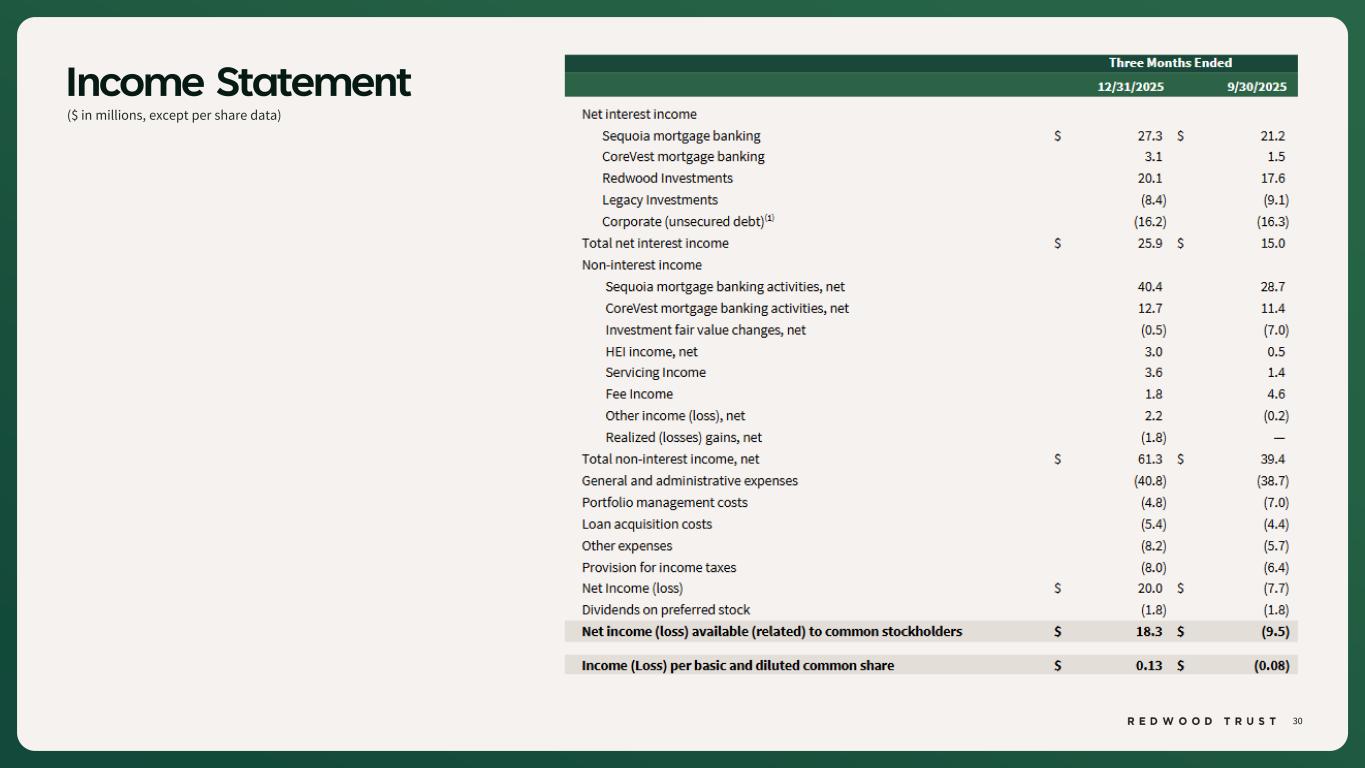
30 Income Statement ($ in millions, except per share data)
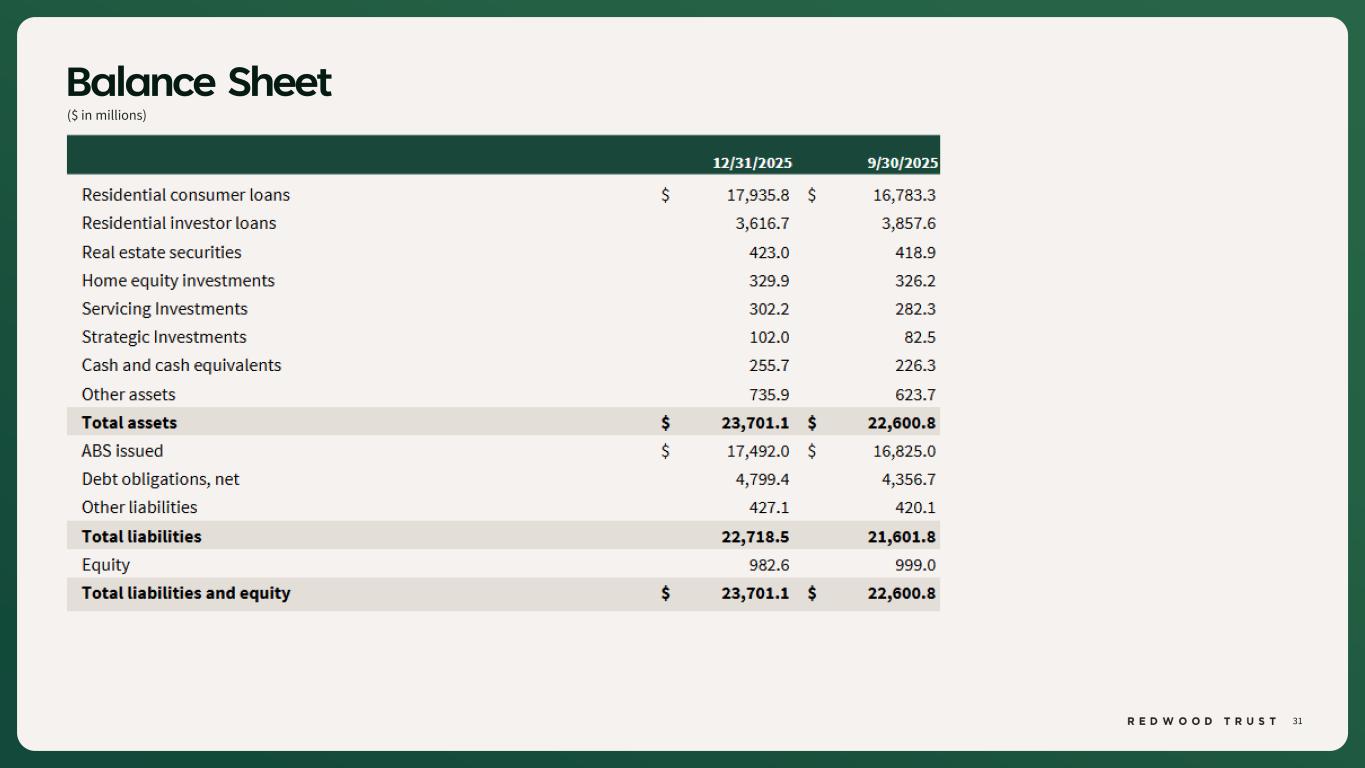
31 Balance Sheet ($ in millions)
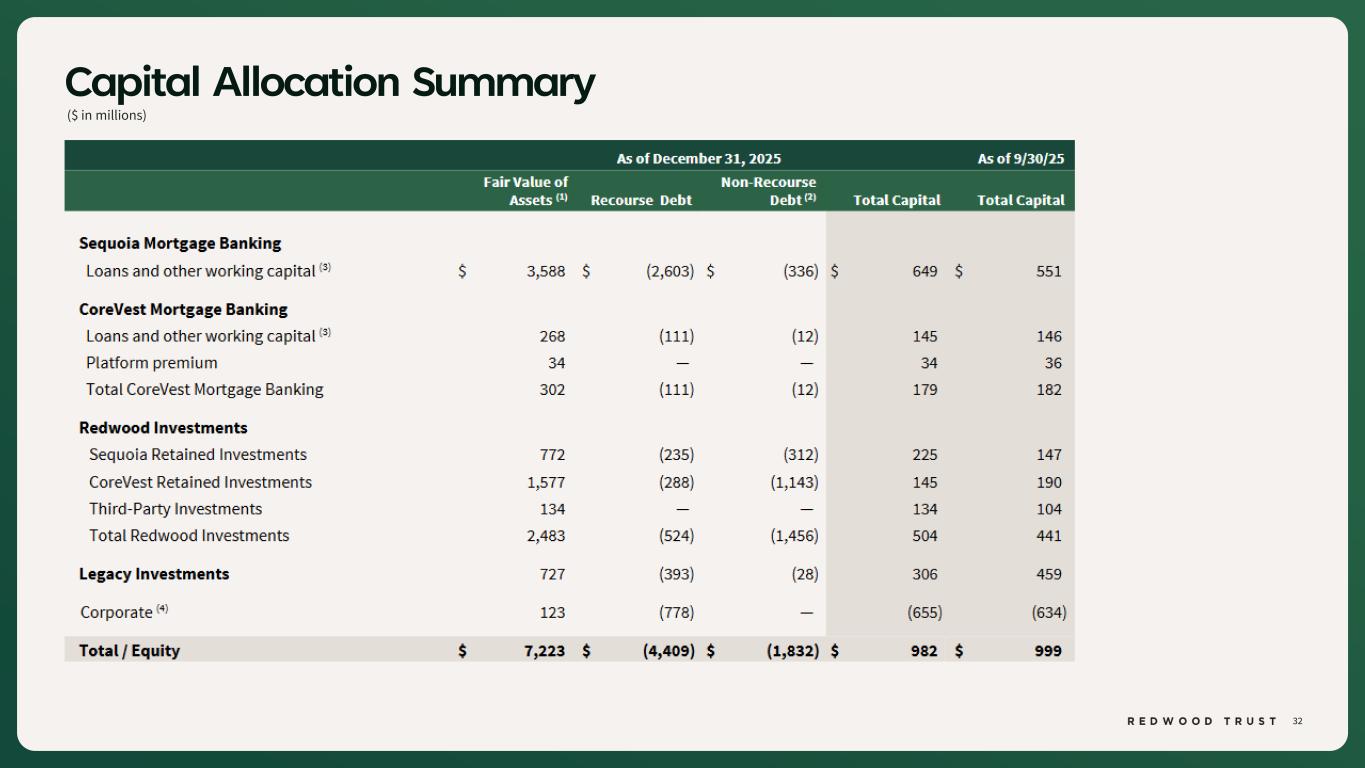
32 Capital Allocation Summary ($ in millions)
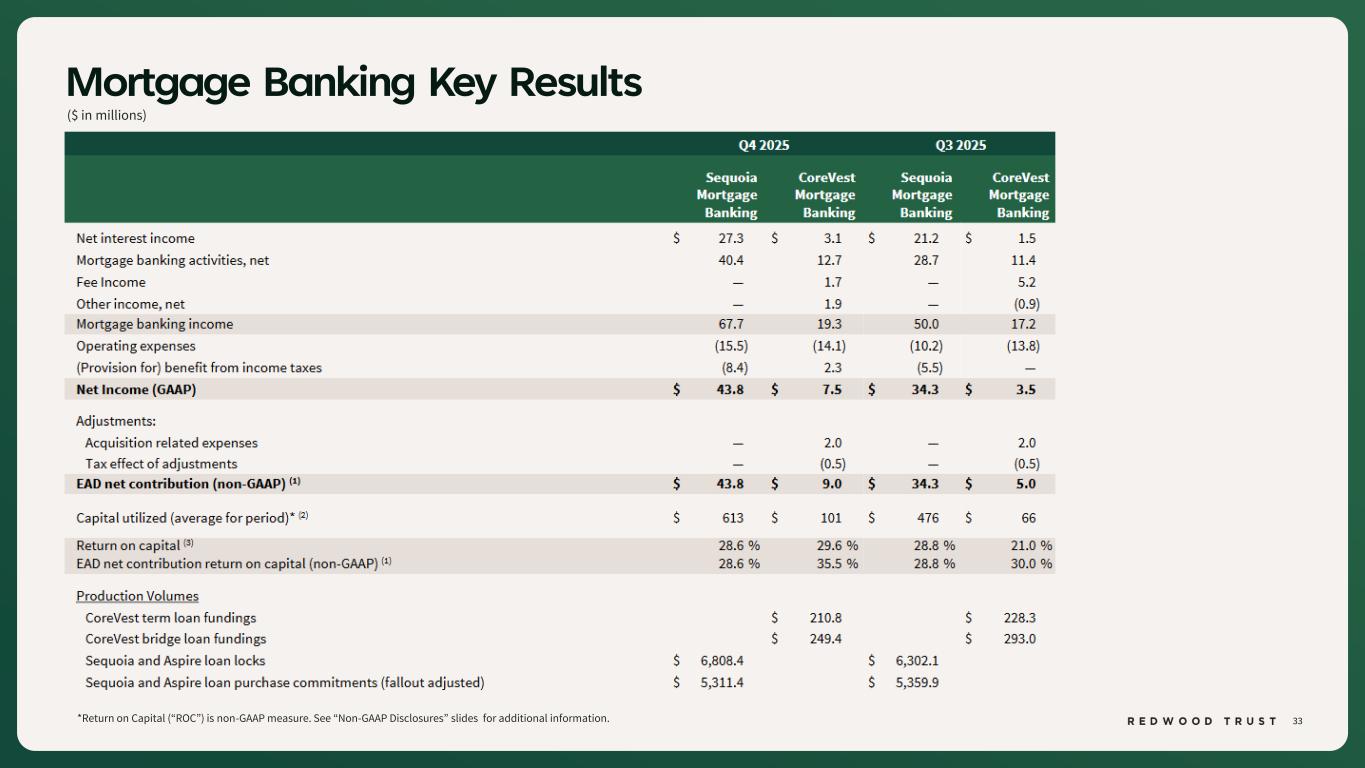
33 Mortgage Banking Key Results ($ in millions) *Return on Capital (“ROC”) is non-GAAP measure. See “Non-GAAP Disclosures” slides for additional information.
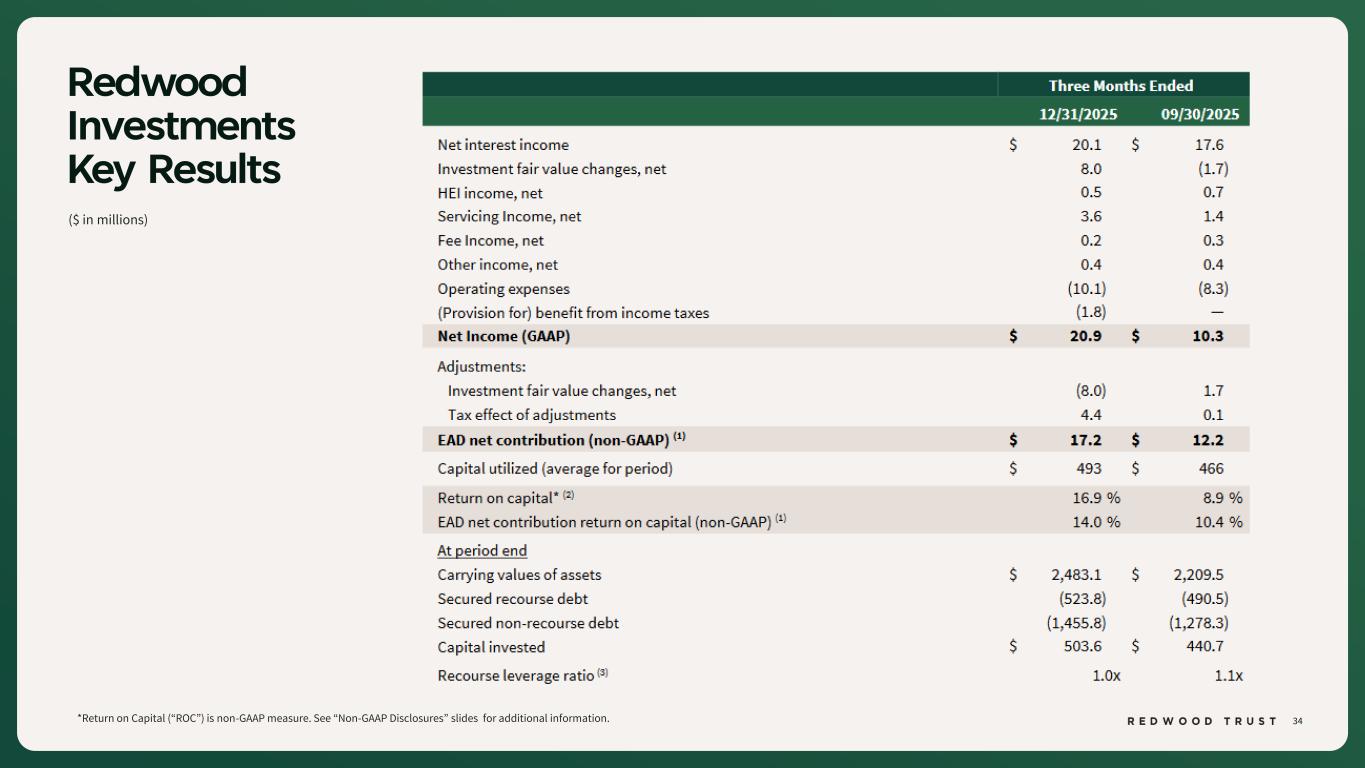
34 Redwood Investments Key Results ($ in millions) *Return on Capital (“ROC”) is non-GAAP measure. See “Non-GAAP Disclosures” slides for additional information.
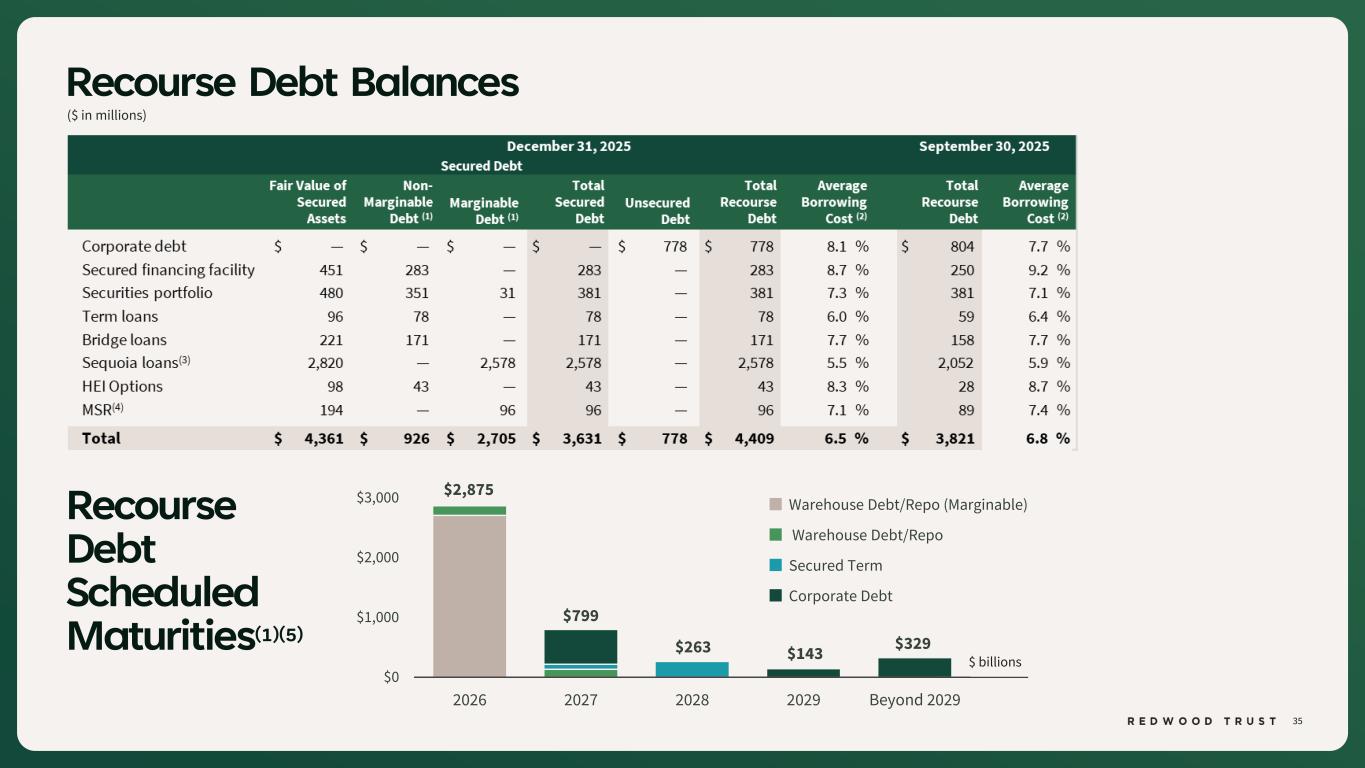
35 Recourse Debt Scheduled Maturities(1)(5) Recourse Debt Balances ($ in millions) $0 $1,000 $2,000 $3,000 2026 2027 2028 2029 Beyond 2029 Warehouse Debt/Repo (Marginable) Warehouse Debt/Repo Secured Term Corporate Debt $2,875 $263 $143 $329 $799 $ billions

Non-GAAP Disclosures
37 Non-GAAP Disclosures To supplement consolidated and segment financial information prepared and presented in accordance with U.S. generally accepted accounting principles ("GAAP"), the Company also provides Earnings Available for Distribution (“EAD”), Return on Capital (“ROC”), EAD ROC, Core Segments Earnings Available for Distribution (“Core Segments EAD”) and Core Segments EAD Return on Equity ("Core Segments EAD ROE") as non-GAAP measures. Management believes these non-GAAP measures provide useful supplemental information to investors and management in evaluating the Company’s operating performance, facilitating comparisons to industry peers, and assessing the current income-generating capacity of the Company’s operating platforms as of the period presented, including the Company’s ability to pay dividends. These measures also assist in evaluating the Company’s ongoing transition to a more scalable and simplified business model, including the wind-down of legacy portfolio holdings within the Legacy Investments segment. These non-GAAP measures should not be utilized in isolation, nor should they be considered as an alternative to GAAP net income (loss) available (related) to common stockholders, or other measurements of results of operations computed in accordance with GAAP or for federal income tax purposes. Earnings Available for Distribution (“EAD”) is a non-GAAP measure that the Company has historically reported and continues to use to present management’s non-GAAP analysis of the operating performance of the Company’s different business segments. EAD is defined, as GAAP net income (loss) available (related) to common stockholders, adjusted to (i) exclude investment fair value changes, net; (ii) exclude realized gains and losses; (iii) exclude acquisition-related expenses; (iv) exclude certain organizational restructuring charges, as applicable; and (v) reflect a hypothetical income tax adjustment associated with these items. ROC is a non-GAAP measure for a segment that is calculated as GAAP segment net income (loss) annualized divided by average capital utilized for the segment during the period. Average capital utilized represents management's internal estimate of the average economic capital allocated to support the activities of each segment. EAD ROC for a segment is calculated as non-GAAP segment EAD annualized divided by average capital utilized for the segment during the period. Non-GAAP EAD is defined as: GAAP net income (loss) available (related) to common stockholders adjusted to: (i) exclude investment fair value changes, net; (ii) exclude realized gains and losses; (iii) exclude acquisition related expenses; (iv) exclude certain organizational restructuring charges (as applicable); and (v) adjust for the hypothetical income taxes associated with these adjustments. Average capital utilized represents management's internal estimate of the average economic capital allocated to support the activities of each segment. Core Segments EAD and Core Segments EAD ROE represent management’s non-GAAP assessment of the combined performance of the Company’s mortgage banking platforms and related investments, which include the Sequoia Mortgage Banking, CoreVest Mortgage Banking, and Redwood Investments segments (collectively, the “Core Segments”), together with an allocated portion of the Corporate segment attributable to those operations. Core Segments EAD excludes the Legacy Investments segment and the portion of the Corporate segment attributable to Legacy Investments. Core Segments EAD ROE is calculated as Core Segments EAD annualized divided by the average capital utilized by the Core Segments during the period, which represents management’s internal estimate of the average economic capital allocated to support Core Segments activities.
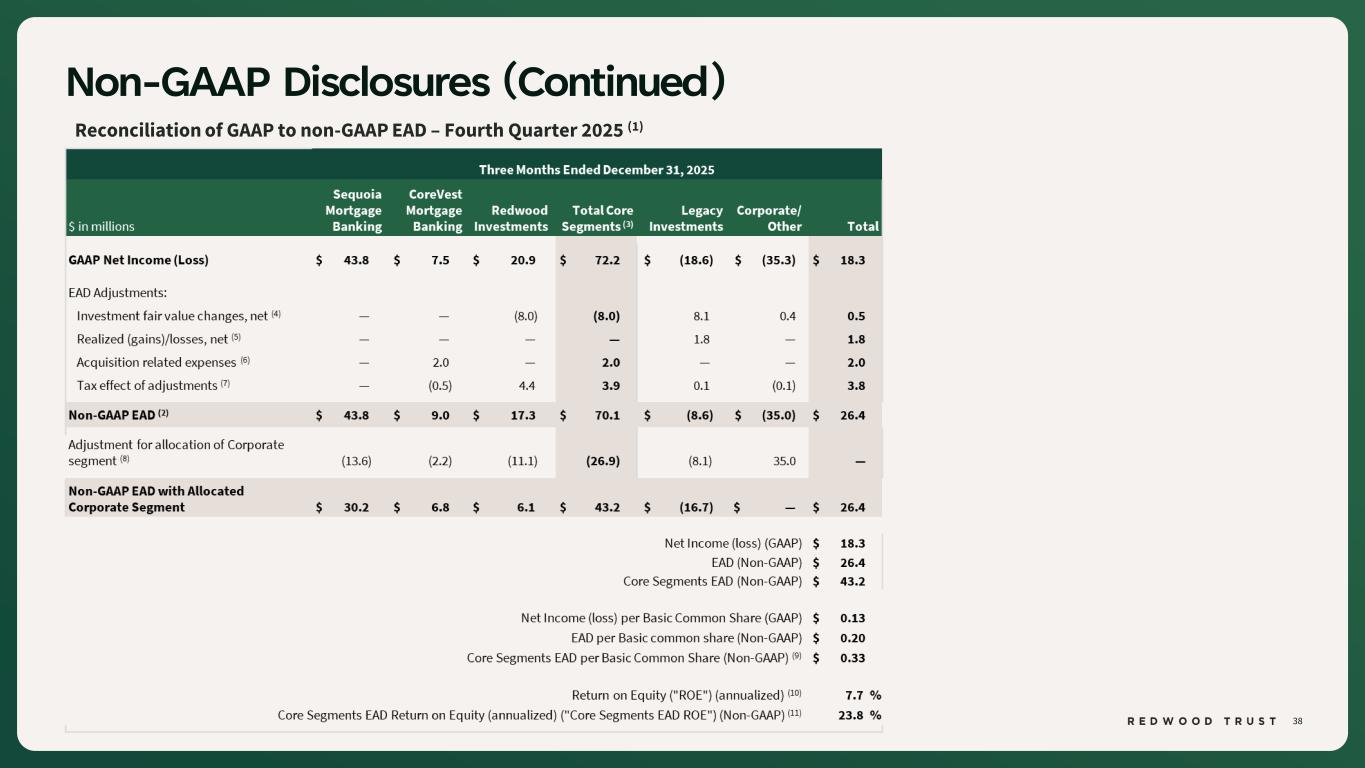
38 Non-GAAP Disclosures (Continued) Reconciliation of GAAP to non-GAAP EAD – Fourth Quarter 2025 (1)
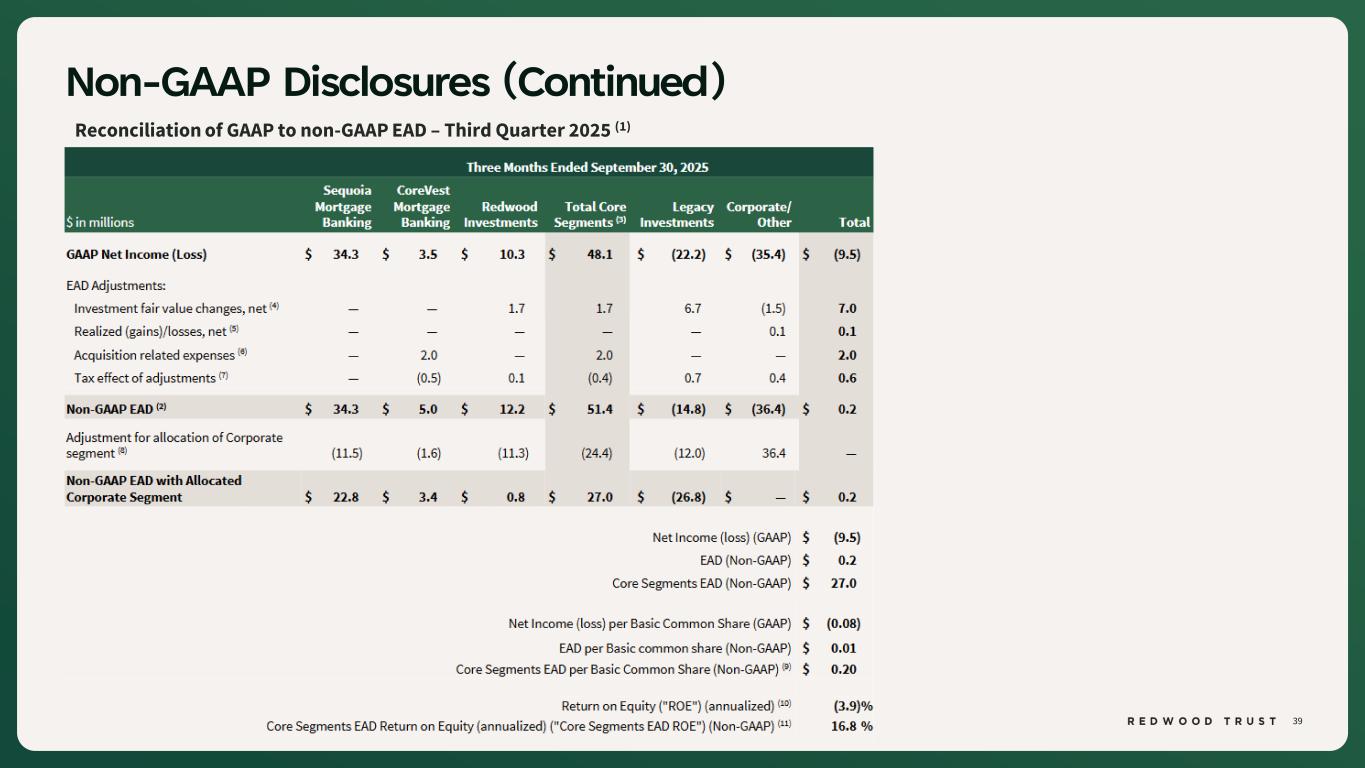
39 Non-GAAP Disclosures (Continued) Reconciliation of GAAP to non-GAAP EAD – Third Quarter 2025 (1)
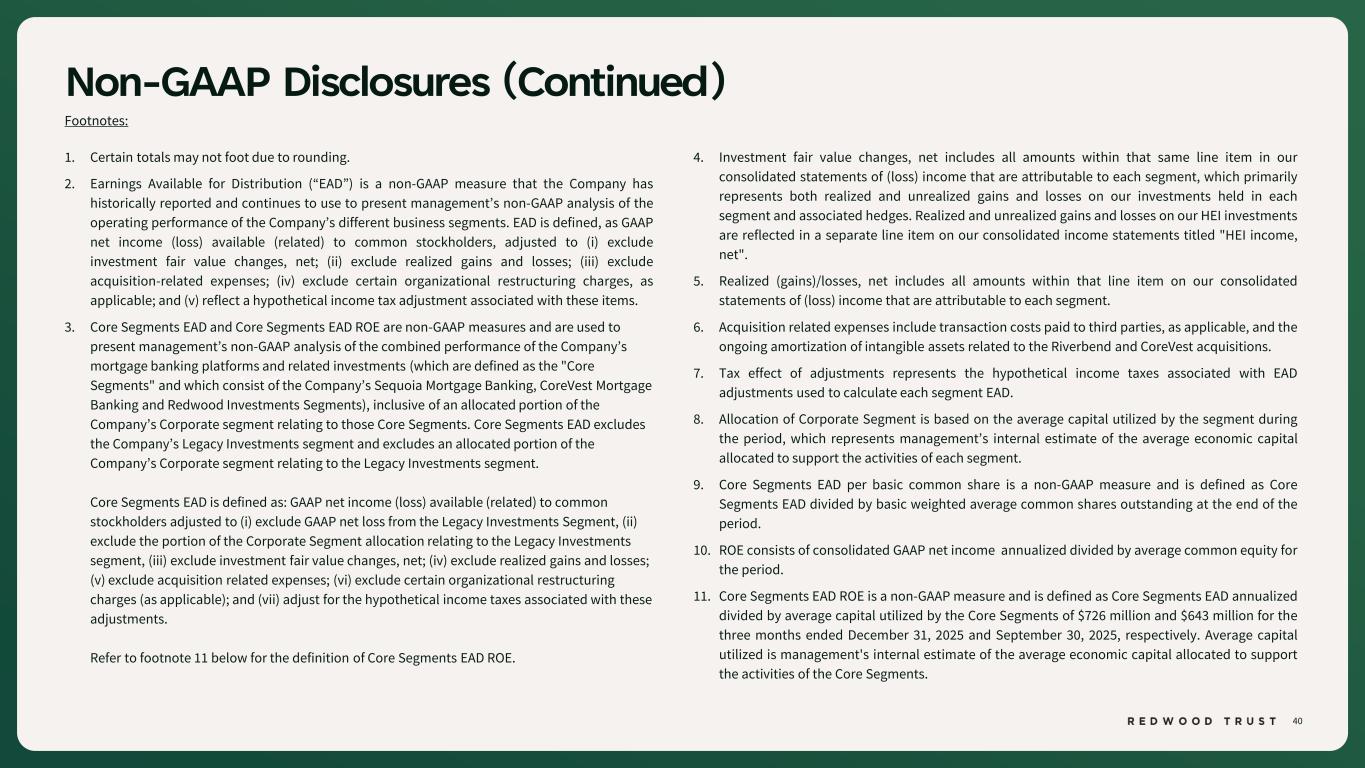
40 $ in millions Non-GAAP Disclosures (Continued) Footnotes: 1. Certain totals may not foot due to rounding. 2. Earnings Available for Distribution (“EAD”) is a non-GAAP measure that the Company has historically reported and continues to use to present management’s non-GAAP analysis of the operating performance of the Company’s different business segments. EAD is defined, as GAAP net income (loss) available (related) to common stockholders, adjusted to (i) exclude investment fair value changes, net; (ii) exclude realized gains and losses; (iii) exclude acquisition-related expenses; (iv) exclude certain organizational restructuring charges, as applicable; and (v) reflect a hypothetical income tax adjustment associated with these items. 3. Core Segments EAD and Core Segments EAD ROE are non-GAAP measures and are used to present management’s non-GAAP analysis of the combined performance of the Company’s mortgage banking platforms and related investments (which are defined as the "Core Segments" and which consist of the Company’s Sequoia Mortgage Banking, CoreVest Mortgage Banking and Redwood Investments Segments), inclusive of an allocated portion of the Company’s Corporate segment relating to those Core Segments. Core Segments EAD excludes the Company’s Legacy Investments segment and excludes an allocated portion of the Company’s Corporate segment relating to the Legacy Investments segment. Core Segments EAD is defined as: GAAP net income (loss) available (related) to common stockholders adjusted to (i) exclude GAAP net loss from the Legacy Investments Segment, (ii) exclude the portion of the Corporate Segment allocation relating to the Legacy Investments segment, (iii) exclude investment fair value changes, net; (iv) exclude realized gains and losses; (v) exclude acquisition related expenses; (vi) exclude certain organizational restructuring charges (as applicable); and (vii) adjust for the hypothetical income taxes associated with these adjustments. Refer to footnote 11 below for the definition of Core Segments EAD ROE. 4. Investment fair value changes, net includes all amounts within that same line item in our consolidated statements of (loss) income that are attributable to each segment, which primarily represents both realized and unrealized gains and losses on our investments held in each segment and associated hedges. Realized and unrealized gains and losses on our HEI investments are reflected in a separate line item on our consolidated income statements titled "HEI income, net". 5. Realized (gains)/losses, net includes all amounts within that line item on our consolidated statements of (loss) income that are attributable to each segment. 6. Acquisition related expenses include transaction costs paid to third parties, as applicable, and the ongoing amortization of intangible assets related to the Riverbend and CoreVest acquisitions. 7. Tax effect of adjustments represents the hypothetical income taxes associated with EAD adjustments used to calculate each segment EAD. 8. Allocation of Corporate Segment is based on the average capital utilized by the segment during the period, which represents management’s internal estimate of the average economic capital allocated to support the activities of each segment. 9. Core Segments EAD per basic common share is a non-GAAP measure and is defined as Core Segments EAD divided by basic weighted average common shares outstanding at the end of the period. 10. ROE consists of consolidated GAAP net income annualized divided by average common equity for the period. 11. Core Segments EAD ROE is a non-GAAP measure and is defined as Core Segments EAD annualized divided by average capital utilized by the Core Segments of $726 million and $643 million for the three months ended December 31, 2025 and September 30, 2025, respectively. Average capital utilized is management's internal estimate of the average economic capital allocated to support the activities of the Core Segments.

Endnotes
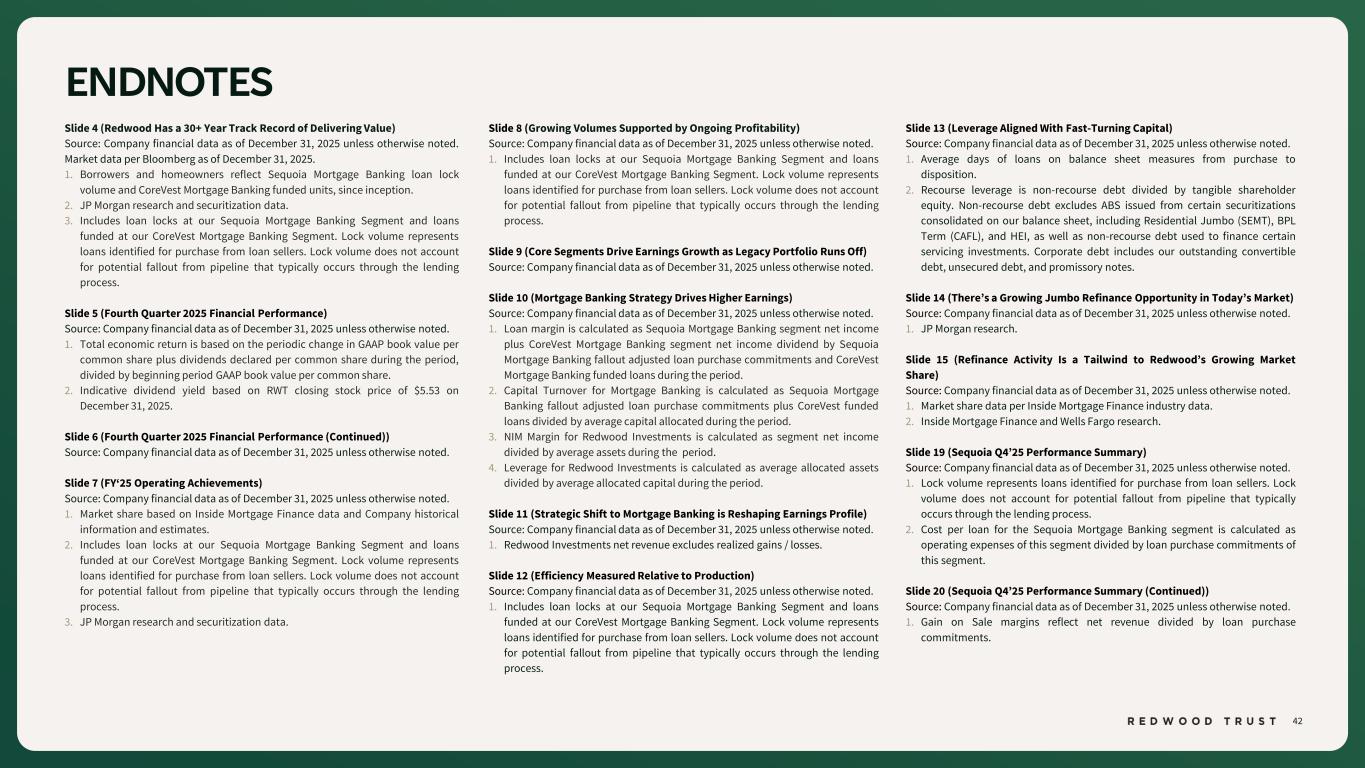
42 ENDNOTES Slide 4 (Redwood Has a 30+ Year Track Record of Delivering Value) Source: Company financial data as of December 31, 2025 unless otherwise noted. Market data per Bloomberg as of December 31, 2025. 1. Borrowers and homeowners reflect Sequoia Mortgage Banking loan lock volume and CoreVest Mortgage Banking funded units, since inception. 2. JP Morgan research and securitization data. 3. Includes loan locks at our Sequoia Mortgage Banking Segment and loans funded at our CoreVest Mortgage Banking Segment. Lock volume represents loans identified for purchase from loan sellers. Lock volume does not account for potential fallout from pipeline that typically occurs through the lending process. Slide 5 (Fourth Quarter 2025 Financial Performance) Source: Company financial data as of December 31, 2025 unless otherwise noted. 1. Total economic return is based on the periodic change in GAAP book value per common share plus dividends declared per common share during the period, divided by beginning period GAAP book value per common share. 2. Indicative dividend yield based on RWT closing stock price of $5.53 on December 31, 2025. Slide 6 (Fourth Quarter 2025 Financial Performance (Continued)) Source: Company financial data as of December 31, 2025 unless otherwise noted. Slide 7 (FY‘25 Operating Achievements) Source: Company financial data as of December 31, 2025 unless otherwise noted. 1. Market share based on Inside Mortgage Finance data and Company historical information and estimates. 2. Includes loan locks at our Sequoia Mortgage Banking Segment and loans funded at our CoreVest Mortgage Banking Segment. Lock volume represents loans identified for purchase from loan sellers. Lock volume does not account for potential fallout from pipeline that typically occurs through the lending process. 3. JP Morgan research and securitization data. Slide 8 (Growing Volumes Supported by Ongoing Profitability) Source: Company financial data as of December 31, 2025 unless otherwise noted. 1. Includes loan locks at our Sequoia Mortgage Banking Segment and loans funded at our CoreVest Mortgage Banking Segment. Lock volume represents loans identified for purchase from loan sellers. Lock volume does not account for potential fallout from pipeline that typically occurs through the lending process. Slide 9 (Core Segments Drive Earnings Growth as Legacy Portfolio Runs Off) Source: Company financial data as of December 31, 2025 unless otherwise noted. Slide 10 (Mortgage Banking Strategy Drives Higher Earnings) Source: Company financial data as of December 31, 2025 unless otherwise noted. 1. Loan margin is calculated as Sequoia Mortgage Banking segment net income plus CoreVest Mortgage Banking segment net income dividend by Sequoia Mortgage Banking fallout adjusted loan purchase commitments and CoreVest Mortgage Banking funded loans during the period. 2. Capital Turnover for Mortgage Banking is calculated as Sequoia Mortgage Banking fallout adjusted loan purchase commitments plus CoreVest funded loans divided by average capital allocated during the period. 3. NIM Margin for Redwood Investments is calculated as segment net income divided by average assets during the period. 4. Leverage for Redwood Investments is calculated as average allocated assets divided by average allocated capital during the period. Slide 11 (Strategic Shift to Mortgage Banking is Reshaping Earnings Profile) Source: Company financial data as of December 31, 2025 unless otherwise noted. 1. Redwood Investments net revenue excludes realized gains / losses. Slide 12 (Efficiency Measured Relative to Production) Source: Company financial data as of December 31, 2025 unless otherwise noted. 1. Includes loan locks at our Sequoia Mortgage Banking Segment and loans funded at our CoreVest Mortgage Banking Segment. Lock volume represents loans identified for purchase from loan sellers. Lock volume does not account for potential fallout from pipeline that typically occurs through the lending process. Slide 13 (Leverage Aligned With Fast-Turning Capital) Source: Company financial data as of December 31, 2025 unless otherwise noted. 1. Average days of loans on balance sheet measures from purchase to disposition. 2. Recourse leverage is non-recourse debt divided by tangible shareholder equity. Non-recourse debt excludes ABS issued from certain securitizations consolidated on our balance sheet, including Residential Jumbo (SEMT), BPL Term (CAFL), and HEI, as well as non-recourse debt used to finance certain servicing investments. Corporate debt includes our outstanding convertible debt, unsecured debt, and promissory notes. Slide 14 (There’s a Growing Jumbo Refinance Opportunity in Today’s Market) Source: Company financial data as of December 31, 2025 unless otherwise noted. 1. JP Morgan research. Slide 15 (Refinance Activity Is a Tailwind to Redwood’s Growing Market Share) Source: Company financial data as of December 31, 2025 unless otherwise noted. 1. Market share data per Inside Mortgage Finance industry data. 2. Inside Mortgage Finance and Wells Fargo research. Slide 19 (Sequoia Q4’25 Performance Summary) Source: Company financial data as of December 31, 2025 unless otherwise noted. 1. Lock volume represents loans identified for purchase from loan sellers. Lock volume does not account for potential fallout from pipeline that typically occurs through the lending process. 2. Cost per loan for the Sequoia Mortgage Banking segment is calculated as operating expenses of this segment divided by loan purchase commitments of this segment. Slide 20 (Sequoia Q4’25 Performance Summary (Continued)) Source: Company financial data as of December 31, 2025 unless otherwise noted. 1. Gain on Sale margins reflect net revenue divided by loan purchase commitments.
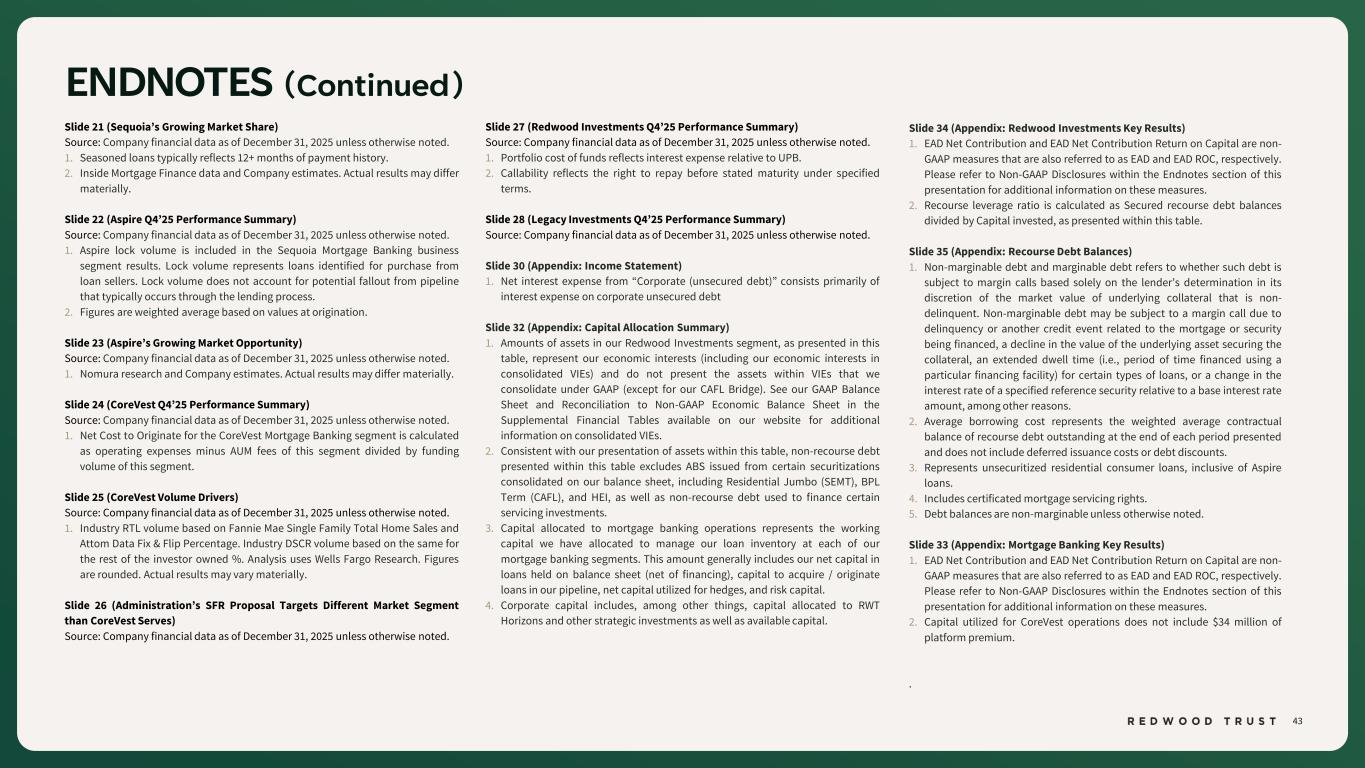
43 ENDNOTES (Continued) Slide 21 (Sequoia’s Growing Market Share) Source: Company financial data as of December 31, 2025 unless otherwise noted. 1. Seasoned loans typically reflects 12+ months of payment history. 2. Inside Mortgage Finance data and Company estimates. Actual results may differ materially. Slide 22 (Aspire Q4’25 Performance Summary) Source: Company financial data as of December 31, 2025 unless otherwise noted. 1. Aspire lock volume is included in the Sequoia Mortgage Banking business segment results. Lock volume represents loans identified for purchase from loan sellers. Lock volume does not account for potential fallout from pipeline that typically occurs through the lending process. 2. Figures are weighted average based on values at origination. Slide 23 (Aspire’s Growing Market Opportunity) Source: Company financial data as of December 31, 2025 unless otherwise noted. 1. Nomura research and Company estimates. Actual results may differ materially. Slide 24 (CoreVest Q4’25 Performance Summary) Source: Company financial data as of December 31, 2025 unless otherwise noted. 1. Net Cost to Originate for the CoreVest Mortgage Banking segment is calculated as operating expenses minus AUM fees of this segment divided by funding volume of this segment. Slide 25 (CoreVest Volume Drivers) Source: Company financial data as of December 31, 2025 unless otherwise noted. 1. Industry RTL volume based on Fannie Mae Single Family Total Home Sales and Attom Data Fix & Flip Percentage. Industry DSCR volume based on the same for the rest of the investor owned %. Analysis uses Wells Fargo Research. Figures are rounded. Actual results may vary materially. Slide 26 (Administration’s SFR Proposal Targets Different Market Segment than CoreVest Serves) Source: Company financial data as of December 31, 2025 unless otherwise noted. Slide 34 (Appendix: Redwood Investments Key Results) 1. EAD Net Contribution and EAD Net Contribution Return on Capital are non- GAAP measures that are also referred to as EAD and EAD ROC, respectively. Please refer to Non-GAAP Disclosures within the Endnotes section of this presentation for additional information on these measures. 2. Recourse leverage ratio is calculated as Secured recourse debt balances divided by Capital invested, as presented within this table. Slide 35 (Appendix: Recourse Debt Balances) 1. Non-marginable debt and marginable debt refers to whether such debt is subject to margin calls based solely on the lender’s determination in its discretion of the market value of underlying collateral that is non- delinquent. Non-marginable debt may be subject to a margin call due to delinquency or another credit event related to the mortgage or security being financed, a decline in the value of the underlying asset securing the collateral, an extended dwell time (i.e., period of time financed using a particular financing facility) for certain types of loans, or a change in the interest rate of a specified reference security relative to a base interest rate amount, among other reasons. 2. Average borrowing cost represents the weighted average contractual balance of recourse debt outstanding at the end of each period presented and does not include deferred issuance costs or debt discounts. 3. Represents unsecuritized residential consumer loans, inclusive of Aspire loans. 4. Includes certificated mortgage servicing rights. 5. Debt balances are non-marginable unless otherwise noted. Slide 33 (Appendix: Mortgage Banking Key Results) 1. EAD Net Contribution and EAD Net Contribution Return on Capital are non- GAAP measures that are also referred to as EAD and EAD ROC, respectively. Please refer to Non-GAAP Disclosures within the Endnotes section of this presentation for additional information on these measures. 2. Capital utilized for CoreVest operations does not include $34 million of platform premium. . Slide 27 (Redwood Investments Q4’25 Performance Summary) Source: Company financial data as of December 31, 2025 unless otherwise noted. 1. Portfolio cost of funds reflects interest expense relative to UPB. 2. Callability reflects the right to repay before stated maturity under specified terms. Slide 28 (Legacy Investments Q4’25 Performance Summary) Source: Company financial data as of December 31, 2025 unless otherwise noted. Slide 30 (Appendix: Income Statement) 1. Net interest expense from “Corporate (unsecured debt)” consists primarily of interest expense on corporate unsecured debt Slide 32 (Appendix: Capital Allocation Summary) 1. Amounts of assets in our Redwood Investments segment, as presented in this table, represent our economic interests (including our economic interests in consolidated VIEs) and do not present the assets within VIEs that we consolidate under GAAP (except for our CAFL Bridge). See our GAAP Balance Sheet and Reconciliation to Non-GAAP Economic Balance Sheet in the Supplemental Financial Tables available on our website for additional information on consolidated VIEs. 2. Consistent with our presentation of assets within this table, non-recourse debt presented within this table excludes ABS issued from certain securitizations consolidated on our balance sheet, including Residential Jumbo (SEMT), BPL Term (CAFL), and HEI, as well as non-recourse debt used to finance certain servicing investments. 3. Capital allocated to mortgage banking operations represents the working capital we have allocated to manage our loan inventory at each of our mortgage banking segments. This amount generally includes our net capital in loans held on balance sheet (net of financing), capital to acquire / originate loans in our pipeline, net capital utilized for hedges, and risk capital. 4. Corporate capital includes, among other things, capital allocated to RWT Horizons and other strategic investments as well as available capital.
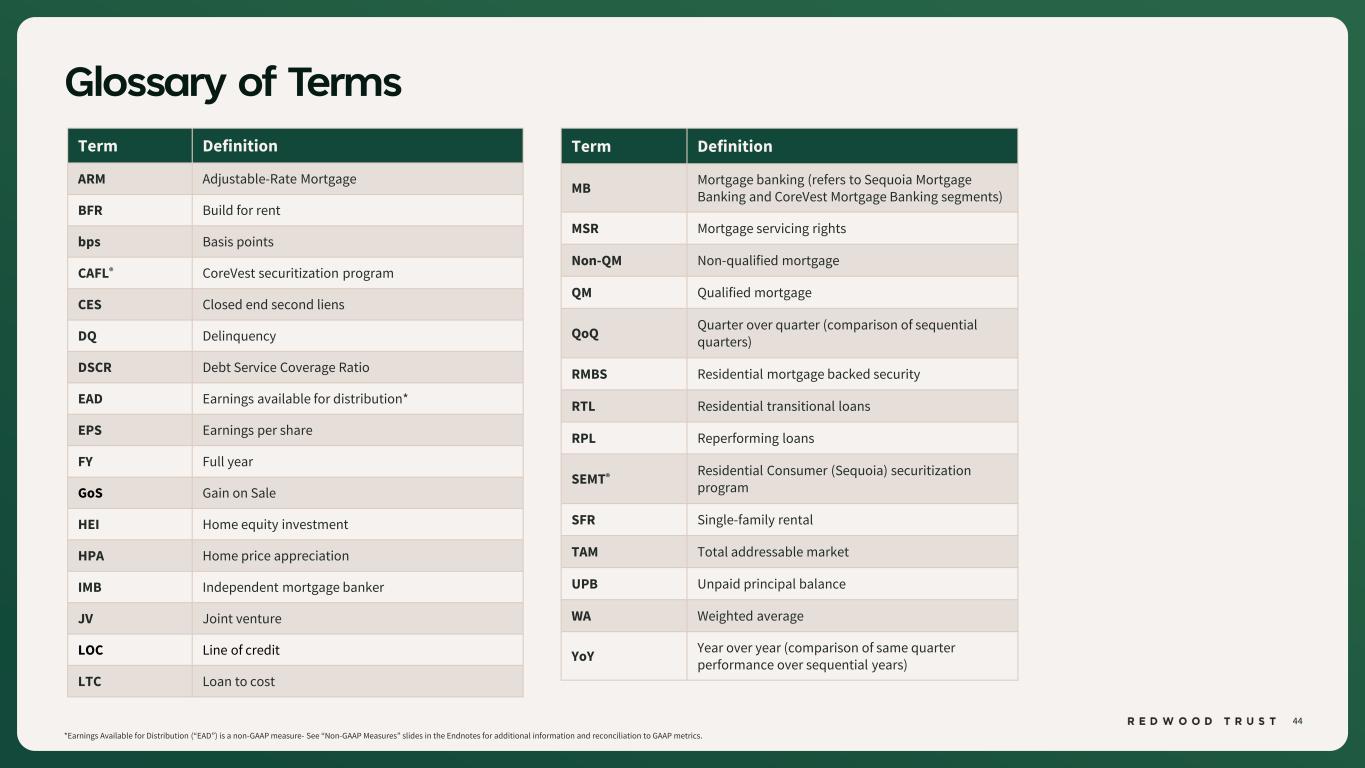
44 Glossary of Terms Term Definition ARM Adjustable-Rate Mortgage BFR Build for rent bps Basis points CAFL® CoreVest securitization program CES Closed end second liens DQ Delinquency DSCR Debt Service Coverage Ratio EAD Earnings available for distribution* EPS Earnings per share FY Full year GoS Gain on Sale HEI Home equity investment HPA Home price appreciation IMB Independent mortgage banker JV Joint venture LOC Line of credit LTC Loan to cost Term Definition MB Mortgage banking (refers to Sequoia Mortgage Banking and CoreVest Mortgage Banking segments) MSR Mortgage servicing rights Non-QM Non-qualified mortgage QM Qualified mortgage QoQ Quarter over quarter (comparison of sequential quarters) RMBS Residential mortgage backed security RTL Residential transitional loans RPL Reperforming loans SEMT® Residential Consumer (Sequoia) securitization program SFR Single-family rental TAM Total addressable market UPB Unpaid principal balance WA Weighted average YoY Year over year (comparison of same quarter performance over sequential years) *Earnings Available for Distribution (“EAD”) is a non-GAAP measure- See “Non-GAAP Measures” slides in the Endnotes for additional information and reconciliation to GAAP metrics.