|
Pricing Supplement dated March 31, 2026
Filed Pursuant to Rule 424(b)(2)
Registration Statement No. 333-283969
(To Product Supplement MLN-WF-1 dated February 26, 2025,
Underlier Supplement dated February 26, 2025
and Prospectus dated February 26, 2025)
|
 |
|
The Toronto-Dominion Bank
Senior Debt Securities, Series H
Equity Index Linked Securities
|
|
|
Market Linked Securities—Auto-Callable with Contingent Coupon and Contingent Downside
Principal at Risk Securities Linked to the Lowest Performing of the Nasdaq-100® Technology Sector IndexSM, the Russell 2000® Index and the
EURO STOXX 50® Index due April 6, 2029
|
|
■ Linked to the lowest performing of the Nasdaq-100® Technology Sector IndexSM, the Russell 2000® Index and the EURO STOXX 50®
Index (each referred to as an “Index”)
■ Unlike ordinary debt securities, the securities do not provide for fixed payments of
interest, do not repay a fixed amount of principal at stated maturity and are subject to potential automatic call prior to stated maturity upon the terms described below. Whether the securities pay a contingent coupon payment, whether the
securities are automatically called prior to stated maturity and, if they are not automatically called, whether you receive the face amount of your securities at stated maturity will depend, in each case, on the closing level of the
lowest performing Index on the relevant calculation day. The lowest performing Index on any calculation day is the Index that has the lowest closing level on that calculation day as a percentage of its starting level
■ Contingent Coupon. The securities will pay a
contingent coupon payment on a quarterly basis until the earlier of stated maturity or automatic call if, and only if, the closing level of the lowest performing Index on the calculation day for
that quarter is greater than or equal to its coupon threshold level. However, if the closing level of the lowest performing Index on a calculation day is less than its coupon threshold level, you will not receive any contingent coupon
payment for the relevant quarter. If the closing level of the lowest performing Index is less than its coupon threshold level on every calculation day, you will not receive any contingent coupon payments throughout the entire term of the
securities. The coupon threshold level for each Index is equal to 75% of its starting level. The contingent coupon rate is 12.00% per annum
■ Automatic Call. If the closing level of the
lowest performing Index on any of the quarterly calculation days from September 2026 to January 2029, inclusive, is greater than or equal to its starting level, the securities will be automatically called for the face amount plus a final
contingent coupon payment
■ Potential Loss of Principal. If the securities
are not automatically called prior to stated maturity, you will receive the face amount at stated maturity if, and only if, the closing level of the lowest performing Index on the final calculation
day is greater than or equal to its downside threshold level. If the closing level of the lowest performing Index on the final calculation day is less than its downside threshold level, you will lose more than 25%, and possibly all, of
the face amount of your securities. The downside threshold level for each Index is equal to 75% of its starting level
■ If the securities are not automatically called prior to stated maturity, you will have
full downside exposure to the lowest performing Index from its starting level if its closing level on the final calculation day is less than its downside threshold level, but you will not participate in any appreciation of any Index and
will not receive any dividends on securities included in any Index
■ Your return on the securities will depend solely
on the performance of the Index that is the lowest performing Index on each calculation day. You will not benefit in any way from the performance of a better performing Index. Therefore, you will be adversely affected if any Index performs poorly, even if another Index performs favorably
■ All payments on the securities are subject to the credit risk of The Toronto-Dominion
Bank (the “Bank”)
■ No exchange listing; designed to be held to maturity
|
The estimated value of the securities at the time the terms of your securities were set on the pricing date was $926.70 per security, as discussed further under “Selected Risk
Considerations— Risks Relating To The Estimated Value Of The Securities And Any Secondary Market” beginning on page P-12 and “Estimated Value of the Securities” herein. The estimated value is less than the original offering price of the securities.
The securities have complex features and investing in the securities involves risks not associated with an investment in conventional debt securities. See “Selected Risk
Considerations” beginning on page P-10 herein and “Risk Factors” beginning on page PS-5 of the accompanying product supplement and on page 1 of the accompanying prospectus.
The securities are senior unsecured debt obligations of the Bank, and, accordingly, all payments are subject to credit risk. The securities are not insured by the Canada Deposit
Insurance Corporation pursuant to the Canada Deposit Insurance Corporation Act (the “CDIC Act”) or the U.S. Federal Deposit Insurance Corporation or any other governmental agency of Canada, the United States or any other jurisdiction.
Neither the U.S. Securities and Exchange Commission nor any state securities commission or other regulatory body has approved or disapproved of these securities or
passed upon the accuracy or adequacy of this pricing supplement or the accompanying product supplement, underlier supplement and prospectus. Any representation to the contrary is a criminal offense.
|
Original Offering Price
|
Agent Discount(1)
|
Proceeds to The Toronto-Dominion Bank
|
||
|
Per Security
|
$1,000.00
|
$23.25
|
$976.75
|
|
|
Total
|
$1,000,000.00
|
$23,250.00
|
$976,750.00
|
|
(1)
|
The Agents will receive a commission of $23.25 (2.325%) per security and will use all of that commission to allow selling concessions to other dealers in connection with the distribution of
the securities. The Agents may resell the securities to other securities dealers at the original offering price less a concession of $17.50 (1.75%) per security. Such securities dealers may include Wells Fargo Advisors (“WFA”, the trade
name of the retail brokerage business of Wells Fargo Clearing Services, LLC and Wells Fargo Advisors Financial Network, LLC), an affiliate of Wells Fargo Securities, LLC (“Wells Fargo Securities”). The other dealers may forgo, in their sole
discretion, some or all of their selling concessions. In addition to the selling concession allowed to WFA, Wells Fargo Securities may pay $0.75 (0.075%) per security of the agent discount to WFA as a distribution expense fee for each
security sold by WFA. The Bank will reimburse TD Securities (USA) LLC (“TDS”) for certain expenses in connection with its role in the offer and sale of the securities, and the Bank will pay TDS a fee in connection with its role in the offer
and sale of the securities. In respect of certain securities sold in this offering, we will pay a fee of up to $3.00 per security to selected securities dealers in consideration for marketing and other services in connection with the
distribution of the securities to other securities dealers. See “Terms of the Securities—Agents” herein and “Supplemental Plan of Distribution (Conflicts of Interest) –Selling Restrictions” in the accompanying product supplement.
|
|
TD Securities (USA) LLC
|
Wells Fargo Securities
|
|
Market Linked Securities—Auto-Callable with Contingent Coupon and Contingent Downside
Principal at Risk Securities Linked to the Lowest Performing of the Nasdaq-100® Technology Sector IndexSM, the Russell 2000®
Index and the EURO STOXX 50® Index due April 6, 2029
|
|
Terms of the Securities
|
|
Issuer:
|
The Toronto-Dominion Bank (the “Bank”).
|
||
|
Market Measures:
|
The Nasdaq-100® Technology Sector IndexSM, the Russell 2000® Index and the EURO STOXX 50® Index (each referred to as an “Index,”
and collectively as the “Indices”).
|
||
|
Pricing Date:
|
March 31, 2026.
|
||
|
Issue Date:
|
April 6, 2026.
|
||
|
Original Offering
Price:
|
$1,000 per security.
|
||
|
Face Amount:
|
$1,000 per security. References in this pricing supplement to a “security” are to a security with a face amount of $1,000.
|
||
|
Contingent Coupon
Payment:
|
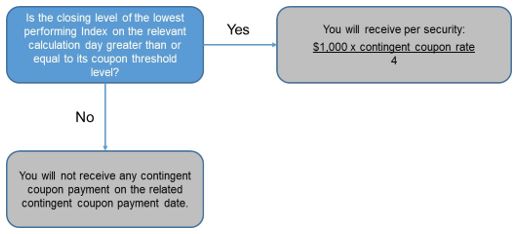
On each contingent coupon payment date, you will receive a contingent coupon payment at a per annum rate equal to the contingent coupon rate if, and only if, the closing level of the lowest performing Index on the related calculation day is greater than or equal to its coupon threshold level. Each “contingent coupon payment,” if any, will be calculated per
security as follows: ($1,000 × contingent coupon rate)/4. Any contingent coupon payment will be rounded to the nearest cent, with one-half cent rounded upward.
If the closing level of the lowest performing Index on any calculation day is less than its coupon threshold level, you will not receive any contingent
coupon payment on the related contingent coupon payment date. If the closing level of the lowest performing Index is less than its coupon threshold level on all calculation days, you will not receive any contingent coupon payments over the
term of the securities.
|
||
|
Contingent Coupon
Payment Dates:
|
Quarterly, on the third business day following each calculation day (as each such calculation day may be postponed pursuant to “—Market Disruption Events and Postponement
Provisions” below, if applicable); provided that the contingent coupon payment date with respect to the final calculation day will be the stated maturity date.
|
||
|
Contingent Coupon
Rate:
|
The “contingent coupon rate” is 12.00% per annum.
|
||
|
Automatic Call:
|
If the closing level of the lowest performing Index on any of the calculation days from September 2026 to January 2029, inclusive, is greater than or equal to its starting
level, the securities will be automatically called, and on the related call settlement date you will be entitled to receive a cash payment per security in U.S. dollars equal to the face amount plus a final contingent coupon payment. The
securities will not be subject to automatic call until the second calculation day, which is approximately six months after the issue date.
If the securities are automatically called, they will cease to be outstanding on the related call settlement date and you will have no further rights under the securities
after such call settlement date. You will not receive any notice from us if the securities are automatically called.
|
||
|
Calculation Days:
|
Quarterly, on the 30th day of each March, June, September and December, commencing in June 2026 and ending April 2029, each subject to postponement as described below under
“—Market Disruption Events and Postponement Provisions.” We refer to the calculation day scheduled to occur in April 2029 (April 3, 2029) as the “final calculation day.”
|
P-2
|
Market Linked Securities—Auto-Callable with Contingent Coupon and Contingent Downside
Principal at Risk Securities Linked to the Lowest Performing of the Nasdaq-100® Technology Sector IndexSM, the Russell 2000®
Index and the EURO STOXX 50® Index due April 6, 2029
|
|
Call Settlement Date:
|
Three business days after the applicable calculation day (as each such calculation day may be postponed pursuant to “—Market Disruption Events and Postponement Provisions”
below, if applicable).
|
||
|
Stated Maturity Date:
|
April 6, 2029, subject to postponement. The securities are not subject to repayment at the option of any holder of the securities prior to the stated maturity date.
|
||
|
Maturity Payment
Amount:
|
If the securities are not automatically called prior to the stated maturity date, you will be entitled to receive on the stated maturity date a cash payment per security in
U.S. dollars equal to the maturity payment amount (in addition to the final contingent coupon payment, if any). The “maturity payment amount” per security will equal:
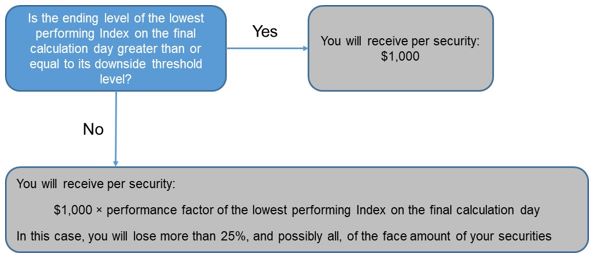
• if the ending level of the lowest performing Index on the final calculation day is greater than or
equal to its downside threshold level: $1,000; or
• if the ending level of the lowest performing Index on the final calculation day is less than its
downside threshold level:
|
||
|
$1,000 × performance factor of the lowest performing Index on the final calculation day
|
|||
|
If the securities are not automatically called prior to stated maturity and the ending level of the lowest performing Index on the final calculation day
is less than its downside threshold level, you will lose more than 25%, and possibly all, of the face amount of your securities at stated maturity.
Any return on the securities will be limited to the sum of your contingent coupon payments, if any. You will not participate in any appreciation of any
Index, but you will have full downside exposure to the lowest performing Index on the final calculation day if the ending level of that Index is less than its downside threshold level.
|
|||
|
Lowest Performing
Index:
|
For any calculation day, the “lowest performing Index” will be the Index with the lowest performance factor on that calculation day.
|
||
|
Performance Factor:
|
With respect to an Index on any calculation day, its closing level on such calculation day divided by its starting level (expressed
as a percentage).
|
||
|
Closing Level:
|
With respect to each Index, closing level has the meaning set forth under “General Terms of the Securities—Certain Terms for Securities Linked to an Index—Certain
Definitions” in the accompanying product supplement.
|
||
|
Starting Level:
|
With respect to the Nasdaq-100® Technology Sector IndexSM: 11,807.96, its closing level on the pricing date.
With respect to the Russell 2000® Index: 2,496.374, its closing level on the pricing date.
With respect to the EURO STOXX 50® Index: 5,569.73, its closing level on the pricing date.
|
||
|
Ending Level:
|
The “ending level” of an Index will be its closing level on the final calculation day.
|
||
|
Coupon Threshold
Level:
|
With respect to the Nasdaq-100® Technology Sector IndexSM: 8,855.97, which is equal to 75% of its starting level.
With respect to the Russell 2000® Index: 1,872.2805, which is equal to 75% of its starting level.
With respect to the EURO STOXX 50® Index: 4,177.2975, which is equal to 75% of its starting level.
|
||
|
Downside Threshold
Level:
|
With respect to the Nasdaq-100® Technology Sector IndexSM: 8,855.97, which is equal to 75% of its starting level.
With respect to the Russell 2000® Index: 1,872.2805, which is equal to 75% of its starting level.
With respect to the EURO STOXX 50® Index: 4,177.2975, which is equal to 75% of its starting level.
|
||
|
Market Disruption
Events and
Postponement
Provisions:
|
Each calculation day is subject to postponement due to non-trading days and the occurrence of a market disruption event. In addition, the stated maturity date will be
postponed if the final calculation day is postponed and will be adjusted for non-business days. For more information regarding adjustments to the calculation days and the stated maturity date, see “General Terms of the Securities—Consequences
of a Market Disruption Event; Postponement of a Calculation Day—Securities Linked to Multiple Market Measures” and “—Payment Dates” in the accompanying product supplement. For purposes of the accompanying product supplement, each call
settlement date and the stated maturity date is a “payment date.” In addition, for information regarding the circumstances that may result in a market disruption event, see “General Terms of the Securities—Certain Terms for Securities Linked
to an Index—Market Disruption Events” in the accompanying product supplement.
|
||
|
Calculation Agent:
|
The Bank
|
P-3
|
Market Linked Securities—Auto-Callable with Contingent Coupon and Contingent Downside
Principal at Risk Securities Linked to the Lowest Performing of the Nasdaq-100® Technology Sector IndexSM, the Russell 2000®
Index and the EURO STOXX 50® Index due April 6, 2029
|
|
U.S. Tax Treatment:
|
By purchasing the securities, you agree, in the absence of a statutory or regulatory change or an administrative determination or judicial ruling to the contrary, to treat
the securities, for U.S. federal income tax purposes, as prepaid derivative contracts with respect to the Indices with associated contingent coupon payments. If the securities are so treated, any contingent coupon payment paid on the
securities would be treated as ordinary income includable in income by you in accordance with your regular method of accounting for U.S. federal income tax purposes. Based on certain factual representations received from us, our special U.S.
tax counsel, Fried, Frank, Harris, Shriver & Jacobson LLP, is of the opinion that it would be reasonable to treat the securities in the manner described above. However, because there is no authority that specifically addresses the tax
treatment of the securities, it is possible that your securities could alternatively be treated for tax purposes as a single contingent payment debt instrument, or pursuant to some other characterization, such that the timing and character of
your income from the securities could differ materially and adversely from the treatment described above, as described further under “Material U.S. Federal Income Tax Consequences” herein and in the product supplement. An investment in the securities is not appropriate for non-U.S. holders, and we will not attempt to ascertain the tax consequences to non-U.S. holders of the purchase, ownership or disposition of the securities.
|
||
|
Canadian Tax
Treatment:
|
Please see the discussion herein under “Canadian Taxation”, which applies to the securities. We will not pay any additional amounts as a result of any withholding required
by reason of the rules governing hybrid mismatch arrangements contained in section 18.4 of the Canadian Tax Act (as defined under “Canadian Taxation” herein).
|
||
|
Agents:
|
TD Securities (USA) LLC and Wells Fargo Securities, LLC.
The Agents will receive a commission of $23.25 (2.325%) per security and will use all of that commission to allow selling concessions to other dealers in connection with the
distribution of the securities. The Agents may resell the securities to other securities dealers at the original offering price less a concession of $17.50 (1.75%) per security. Such securities dealers may include WFA. In addition to the
selling concession allowed to WFA, Wells Fargo Securities may pay $0.75 (0.075%) per security of the agent discount to WFA as a distribution expense fee for each security sold by WFA.
In addition, in respect of certain securities sold in this offering, we will pay a fee of up to $3.00 per security to selected securities dealers in consideration for
marketing and other services in connection with the distribution of the securities to other securities dealers. We or one of our affiliates will also pay a fee to iCapital Markets LLC, who is acting as a dealer in connection with the
distribution of the securities.
The price at which you purchase the securities includes costs that the Bank, the Agents or their respective affiliates expect to incur and profits that the Bank, the Agents
or their respective affiliates expect to realize in connection with hedging activities related to the securities, as set forth above. These costs and profits will likely reduce the secondary market price, if any secondary market develops, for
the securities. As a result, you may experience an immediate and substantial decline in the market value of your securities on the pricing date. See “Selected Risk Considerations — Risks Relating To The Estimated Value Of The Securities And
Any Secondary Market — The Agent Discount, Offering Expenses And Certain Hedging Costs Are Likely To Adversely Affect Secondary Market Prices” in this pricing supplement.
|
||
|
Listing:
|
The securities will not be listed or displayed on any securities exchange or electronic communications network
|
||
|
Canadian
Bail-in:
|
The securities are not bail-inable debt securities under the CDIC Act
|
||
|
Denominations:
|
$1,000 and any integral multiple of $1,000.
|
||
|
CUSIP / ISIN:
|
89115LKK3 / US89115LKK34
|
P-4
|
Market Linked Securities—Auto-Callable with Contingent Coupon and Contingent Downside
Principal at Risk Securities Linked to the Lowest Performing of the Nasdaq-100® Technology Sector IndexSM, the Russell 2000®
Index and the EURO STOXX 50® Index due April 6, 2029
|
|
Additional Information about the Bank and the Securities
|
You should read this pricing supplement together with product supplement MLN-WF-1 dated February 26, 2025, the underlier supplement dated February 26, 2025 and the prospectus
dated February 26, 2025 for additional information about the securities. Information included in this pricing supplement supersedes information in the product supplement, underlier supplement and prospectus to the extent it is different from that
information. Certain defined terms used but not defined herein have the meanings set forth in the product supplement, underlier supplement or prospectus. In the event of any conflict, the following hierarchy will govern: first, this pricing
supplement; second, the product supplement; third, the underlier supplement; and last, the prospectus. The securities may vary from the terms described in the accompanying product supplement,
underlier supplement and prospectus in several important ways. You should read this pricing supplement, including the documents incorporated herein, carefully.
You may access the product supplement, underlier supplement and prospectus on the SEC website www.sec.gov as follows (or if such address has changed, by reviewing our filing for the relevant date on
the SEC website):
| • |
Product Supplement MLN-WF-1 dated February 26, 2025:
|
| • |
Underlier Supplement dated February 26, 2025:
|
| • |
Prospectus dated February 26, 2025:
|
Our Central Index Key, or CIK, on the SEC website is 0000947263. As used in this pricing supplement, the “Bank,” “we,” “us,” or “our” refers to The Toronto-Dominion Bank and its
subsidiaries.
We reserve the right to change the terms of, or reject any offer to purchase, the securities prior to their issuance. In the event of any changes to the terms of the securities, we will notify you
and you will be asked to accept such changes in connection with your purchase. You may also choose to reject such changes, in which case we may reject your offer to purchase.
P-5
|
Market Linked Securities—Auto-Callable with Contingent Coupon and Contingent Downside
Principal at Risk Securities Linked to the Lowest Performing of the Nasdaq-100® Technology Sector IndexSM, the Russell 2000®
Index and the EURO STOXX 50® Index due April 6, 2029
|
|
Estimated Value of the Securities
|
The final terms for the securities were determined on the pricing date, as indicated under “Terms of the Securities” herein, based on prevailing market conditions on the pricing
date, and are set forth in this pricing supplement.
The economic terms of the securities are based on our internal funding rate (which is our internal borrowing rate based on variables such as market benchmarks and our appetite for
borrowing), and several factors, including any sales commissions expected to be paid to TDS or another affiliate of ours, any selling concessions, discounts, commissions or fees expected to be allowed or paid to non-affiliated intermediaries, the
estimated profit that we or any of our affiliates expect to earn in connection with structuring the securities, estimated costs which we may incur in connection with the securities and an estimate of the difference between the amounts we pay to an
affiliate of Wells Fargo Securities and the amounts that an affiliate of Wells Fargo Securities pays to us in connection with hedging your securities as described further under “Terms of the Securities—Agents” herein and “Risk Factors—Risks Relating
to Hedging Activities and Conflicts of Interest” in the accompanying product supplement. Because our internal funding rate generally represents a discount from the levels at which our benchmark debt securities trade in the secondary market, the use
of an internal funding rate for the securities rather than the levels at which our benchmark debt securities trade in the secondary market is expected to have had an adverse effect on the economic terms of the securities.
On the cover page of this pricing supplement, we have provided the estimated value for the securities. The estimated value was determined by reference to our internal pricing
models which take into account a number of variables and are based on a number of assumptions, which may or may not materialize, typically including volatility, interest rates (forecasted, current and historical rates), price-sensitivity analysis,
time to maturity of the securities, and our internal funding rate. For more information about the estimated value, see “Selected Risk Considerations — Risks Relating To The Estimated Value Of The Securities And Any Secondary Market” herein. Because
our internal funding rate generally represents a discount from the levels at which our benchmark debt securities trade in the secondary market, the use of an internal funding rate for the securities rather than the levels at which our benchmark debt
securities trade in the secondary market is expected, assuming all other economic terms are held constant, to increase the estimated value of the securities. For more information see the discussion under “Selected Risk Considerations — Risks Relating
To The Estimated Value Of The Securities And Any Secondary Market — The Estimated Value Of Your Securities Is Based On Our Internal Funding Rate.”
Our estimated value of the securities is not a prediction of the price at which the securities may trade in the secondary market, nor will it be the price at which the Agents may
buy or sell the securities in the secondary market. Subject to normal market and funding conditions, the Agents or another affiliate of ours intends to offer to purchase the securities in the secondary market but it is not obligated to do so.
Assuming that all relevant factors remain constant after the pricing date, the price at which the Agents may initially buy or sell the securities in the secondary market, if any,
may exceed our estimated value on the pricing date for a temporary period expected to be approximately three months after the issue date because, in our discretion, we may elect to effectively reimburse to investors a portion of the estimated cost of
hedging our obligations under the securities and other costs in connection with the securities which we will no longer expect to incur over the term of the securities. We made such discretionary election and determined this temporary reimbursement
period on the basis of a number of factors, including the tenor of the securities and any agreement we may have with the distributors of the securities. The amount of our estimated costs which we effectively reimburse to investors in this way may not
be allocated ratably throughout the reimbursement period, and we may discontinue such reimbursement at any time or revise the duration of the reimbursement period after the issue date of the securities based on changes in market conditions and other
factors that cannot be predicted.
We urge you to read the “Selected Risk Considerations” in this pricing supplement.
P-6
|
Market Linked Securities—Auto-Callable with Contingent Coupon and Contingent Downside
Principal at Risk Securities Linked to the Lowest Performing of the Nasdaq-100® Technology Sector IndexSM, the Russell 2000®
Index and the EURO STOXX 50® Index due April 6, 2029
|
|
Investor Considerations
|
The securities are not appropriate for all investors. The securities may be an appropriate investment for investors who:
| ■ |
seek an investment with contingent coupon payments at a rate of 12.00% per annum until the earlier of stated maturity or automatic call, if, and only if, the closing level of the lowest performing
Index on the applicable calculation day is greater than or equal to 75% of its starting level;
|
| ■ |
understand that if the ending level of the lowest performing Index on the final calculation day has declined by more than 25% from its starting level, they will be fully exposed to the decline in the lowest performing Index from its
starting level and will lose more than 25%, and possibly all, of the face amount at stated maturity;
|
| ■ |
are willing to accept the risk that they may receive few or no contingent coupon payments over the term of the securities;
|
| ■ |
understand that the securities may be automatically called prior to stated maturity and that the term of the securities may be as short as approximately six months;
|
| ■ |
understand that the return on the securities will depend solely on the performance of the Index that is the lowest performing Index on each calculation day and that they will not benefit in any way from the performance of a better
performing Index;
|
| ■ |
understand that the securities are riskier than alternative investments linked to only one of the Indices or linked to a basket composed of each Index;
|
| ■ |
understand and are willing to accept the full downside risks of each Index;
|
| ■ |
are willing to forgo participation in any appreciation of any Index and dividends on securities included in the Indices; and
|
| ■ |
are willing to hold the securities until maturity.
|
The securities may not be an appropriate investment for investors who:
| ■ |
seek a liquid investment or are unable or unwilling to hold the securities to maturity;
|
| ■ |
require full payment of the face amount of the securities at stated maturity;
|
| ■ |
seek a security with a fixed term;
|
| ■ |
are unwilling to purchase securities with an estimated value as of the pricing date that is lower than the original offering price;
|
| ■ |
are unwilling to accept the risk that the closing level of the lowest performing Index on the final calculation day may decline by more than 25% from its starting level;
|
| ■ |
seek certainty of current income over the term of the securities;
|
| ■ |
seek exposure to the upside performance of any or each Index;
|
| ■ |
seek exposure to a basket composed of each Index or a similar investment in which the overall return is based on a blend of the performances of the Indices, rather than solely on the lowest performing Index;
|
| ■ |
are unwilling to accept the risk of exposure to the Indices;
|
| ■ |
are unwilling to accept the credit risk of the Bank; or
|
| ■ |
prefer the lower risk of conventional fixed income investments with comparable maturities issued by companies with comparable credit ratings.
|
The considerations identified above are not exhaustive. Whether or not the securities are an appropriate investment for you will
depend on your individual circumstances, and you should reach an investment decision only after you and your investment, legal, tax, accounting and other advisors have carefully considered the appropriateness of
an investment in the securities in light of your particular circumstances. You should also review carefully the “Selected Risk Considerations” herein and the “Risk Factors” in the accompanying product supplement for risks related to an investment
in the securities. For more information about the Indices, please see the sections titled “The Nasdaq-100® Technology Sector IndexSM,” “The Russell 2000® Index” and “The EURO STOXX 50® Index”
below.
P-7
|
Market Linked Securities—Auto-Callable with Contingent Coupon and Contingent Downside
Principal at Risk Securities Linked to the Lowest Performing of the Nasdaq-100® Technology Sector IndexSM, the Russell 2000®
Index and the EURO STOXX 50® Index due April 6, 2029
|
|
Determining Payment On A Contingent Coupon Payment Date and at Maturity
|
If the securities have not been previously automatically called, on each contingent coupon payment date, you will either receive a contingent coupon payment or you will not receive
a contingent coupon payment, depending on the closing level of the lowest performing Index on the related calculation day.
Step 1: Determine which Index is the lowest performing Index on the relevant calculation day. The lowest performing Index on any calculation day is the Index
with the lowest performance factor on that calculation day. The performance factor of an Index on a calculation day is its closing level on that calculation day as a percentage of its starting level (i.e., its closing level on that calculation day divided by its starting level).
Step 2: Determine whether a contingent coupon payment is paid on the applicable contingent coupon payment date based on the closing level of the lowest
performing Index on the relevant calculation day, as follows:
If the securities have not been automatically called prior to the stated maturity date, then at maturity you will receive (in addition to the final contingent coupon payment, if any) a cash payment
per security (the maturity payment amount) calculated as follows:
Step 1: Determine which Index is the lowest performing Index on the final calculation day. The lowest performing Index on the final calculation day is the
Index with the lowest performance factor on the final calculation day. The performance factor of an Index on the final calculation day is its ending level as a percentage of its starting level (i.e., its ending level divided by its starting level).
Step 2: Calculate the maturity payment amount based on the ending level of the lowest performing Index, as follows:
P-8
|
Market Linked Securities—Auto-Callable with Contingent Coupon and Contingent Downside
Principal at Risk Securities Linked to the Lowest Performing of the Nasdaq-100® Technology Sector IndexSM, the Russell 2000®
Index and the EURO STOXX 50® Index due April 6, 2029
|
|
Hypothetical Payout Profile
|
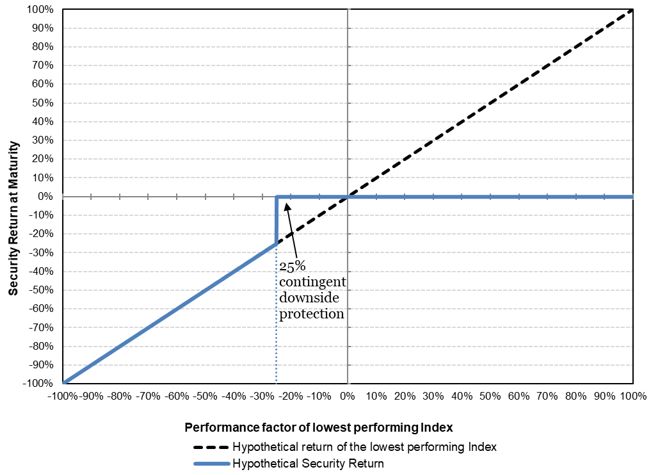
The following profile illustrates the potential maturity payment amount on the securities (excluding the final contingent coupon payment, if any) for a range of hypothetical performances of the lowest
performing Index on the final calculation day from its starting level to its ending level, assuming the securities have not been automatically called prior to the stated maturity date. As this profile illustrates, in no event will you have a positive
rate of return based solely on the maturity payment amount received at maturity; any positive return will be based solely on the contingent coupon payments, if any, received during the term of the securities. This graph has been prepared for purposes
of illustration only. Your actual return will depend on the actual ending level of the lowest performing Index on the final calculation day and whether you hold your securities to stated maturity. The performance of a better performing Index is not
relevant to your return on the securities.
P-9
|
Market Linked Securities—Auto-Callable with Contingent Coupon and Contingent Downside
Principal at Risk Securities Linked to the Lowest Performing of the Nasdaq-100® Technology Sector IndexSM, the Russell 2000®
Index and the EURO STOXX 50® Index due April 6, 2029
|
|
Selected Risk Considerations
|
The securities have complex features and investing in the securities will involve risks not associated with an investment in conventional debt securities. Some of the risks that apply to an investment
in the securities are summarized below, but we urge you to read the more detailed explanation of the risks relating to the securities generally in the “Risk Factors” section of the accompanying product supplement. You should reach an investment
decision only after you have carefully considered with your advisors the appropriateness of an investment in the securities in light of your particular circumstances.
Risks Relating To The Securities Generally
If The Securities Are Not Automatically Called Prior To Stated Maturity, You May Lose Some Or All Of The Face Amount Of Your Securities At Stated Maturity.
We will not repay you a fixed amount on the securities at stated maturity. If the securities are not automatically called prior to stated maturity, you will receive a maturity payment amount that will
be equal to or less than the face amount, depending on the ending level of the lowest performing Index on the final calculation day.
If the ending level of the lowest performing Index on the final calculation day is less than its downside threshold level, the maturity payment amount will be reduced by an amount equal to the decline
in the level of the lowest performing Index from its starting level (expressed as a percentage of its starting level). The downside threshold level for each Index is 75% of its starting level. For example, if the securities are not automatically
called and the lowest performing Index on the final calculation day has declined by 25.1% from its starting level to its ending level, you will not receive any benefit of the contingent downside protection feature and you will lose 25.1% of the face
amount. As a result, you will not receive any protection if the level of the lowest performing Index on the final calculation day declines significantly and you may lose some, and possibly all, of the face amount at stated maturity, even if the level
of the lowest performing Index is greater than or equal to its starting level or its downside threshold level at certain times during the term of the securities.
Even if the ending level of the lowest performing Index on the final calculation day is greater than or equal to its downside threshold level, the maturity payment amount will not exceed the face
amount, and your yield on the securities, taking into account any contingent coupon payments you may have received during the term of the securities, may be less than the yield you would earn if you bought a traditional interest-bearing debt security
of the Bank or another issuer with a similar credit rating.
The Securities Do Not Provide For Fixed Payments Of Interest And You May Receive No Coupon Payments On One Or More Contingent Coupon Payment Dates, Or Even Throughout The Entire Term
Of The Securities.
On each contingent coupon payment date you will receive a contingent coupon payment if, and only if, the closing level of the lowest performing Index on the
related calculation day is greater than or equal to its coupon threshold level. The coupon threshold level for each Index is 75% of its starting level. If the closing level of the lowest performing Index on any calculation day is less than its coupon
threshold level, you will not receive any contingent coupon payment on the related contingent coupon payment date, and if the closing level of the lowest performing Index is less than its coupon threshold level on each calculation day over the term
of the securities, you will not receive any contingent coupon payments over the entire term of the securities.
The Securities Are Subject To The Full Risks Of Each Index And Will Be Negatively Affected If Any Index Performs Poorly, Even If Another Index Performs Favorably.
You are subject to the full risks of each Index. If any Index performs poorly, you will be negatively affected, even if another Index performs favorably. The securities are not linked to a basket
composed of the Indices, where the better performance of an Index could offset the poor performance of another. Instead, you are subject to the full risks of whichever Index is the lowest performing Index on each calculation day. As a result, the
securities are riskier than an alternative investment linked to only one of the Indices or linked to a basket composed of each Index. You should not invest in the securities unless you understand and are willing to accept the full downside risks of
each Index.
Your Return On The Securities Will Depend Solely On The Performance Of The Index That Is The Lowest Performing Index On Each Calculation Day, And You Will Not Benefit In Any Way From
The Performance Of A Better Performing Index.
Your return on the securities will depend solely on the performance of the Index that is the lowest performing Index on each calculation day. Although it is necessary for each Index to close at or
above its respective coupon threshold level on the relevant calculation day in order for you to receive a contingent coupon payment and at or above its respective downside threshold level on the final calculation day for you to receive the face
amount of your securities at maturity, you will not benefit in any way from the performance of a better performing Index. The securities may underperform an alternative investment linked to a basket composed of the Indices, since in such case the
performance of the better performing Index(es) would be blended with the performance of the lowest performing Index, resulting in a better return than the return of the lowest performing Index alone.
P-10
|
Market Linked Securities—Auto-Callable with Contingent Coupon and Contingent Downside
Principal at Risk Securities Linked to the Lowest Performing of the Nasdaq-100® Technology Sector IndexSM, the Russell 2000®
Index and the EURO STOXX 50® Index due April 6, 2029
|
You Will Be Subject To Risks Resulting From The Relationship Among The Indices.
It is preferable from your perspective for the Indices to be correlated with each other so that their levels will tend to increase or decrease at similar times and by similar magnitudes. By investing
in the securities, you assume the risk that the Indices will not exhibit this relationship. The less correlated the Indices, the more likely it is that any one of the Indices will be performing poorly at any time over the term of the securities. All
that is necessary for the securities to perform poorly is for one of the Indices to perform poorly; the performance of a better performing Index is not relevant to your return on the securities. It is impossible to predict what the relationship among
the Indices will be over the term of the securities. To the extent the Indices represent a different equity market, such equity markets may not perform similarly over the term of the securities.
You May Be Fully Exposed To The Decline In The Lowest Performing Index On The Final Calculation Day From Its Starting Level, But Will Not Participate In Any Positive Performance Of
Any Index.
Even though you will be fully exposed to a decline in the level of the lowest performing Index on the final calculation day if its ending level is below its downside threshold level, you will not
participate in any increase in the level of any Index over the term of the securities. Your maximum possible return on the securities will be limited to the sum of the contingent coupon payments you receive, if any. Consequently, your return on the
securities may be significantly less than the return you could achieve on an alternative investment that provides for participation in an increase in the level of any or each Index.
Higher Contingent Coupon Rates Are Associated With Greater Risk.
The securities offer contingent coupon payments at a higher rate, if paid, than the fixed rate we would pay on conventional debt securities of the same maturity. These higher potential contingent
coupon payments are associated with greater levels of expected risk as of the pricing date as compared to conventional debt securities, including the risk that you may not receive a contingent coupon payment on one or more, or any, contingent coupon
payment dates and the risk that you may lose a substantial portion, and possibly all, of the face amount at maturity. The volatility of the Indices and the correlation among the Indices are important factors affecting this risk. Volatility is a
measurement of the size and frequency of daily fluctuations in the level of an Index, typically observed over a specified period of time. Volatility can be measured in a variety of ways, including on a historical basis or on an expected basis as
implied by option prices in the market. Correlation is a measurement of the extent to which the levels of the Indices tend to fluctuate at the same time, in the same direction and in similar magnitudes. Greater expected volatility of the Indices or
lower expected correlation among the Indices as of the pricing date may result in a higher contingent coupon rate, but it also represents a greater expected likelihood as of the pricing date that the closing level of at least one Index will be less
than its coupon threshold level on one or more calculation days, such that you will not receive one or more, or any, contingent coupon payments during the term of the securities, and that the closing level of at least one Index will be less than its
downside threshold level on the final calculation day such that you will lose a substantial portion, and possibly all, of the face amount at maturity. In general, the higher the contingent coupon rate is relative to the fixed rate we would pay on
conventional debt securities, the greater the expected risk that you will not receive one or more, or any, contingent coupon payments during the term of the securities and that you will lose a substantial portion, and possibly all, of the face amount
at maturity.
You Will Be Subject To Reinvestment Risk.
If your securities are automatically called, the term of the securities may be reduced to as short as approximately six months. There is no guarantee that you would be able to reinvest the proceeds
from an investment in the securities at a comparable return for a similar level of risk in the event the securities are automatically called prior to maturity.
Each Calculation Day (Including The Final Calculation Day) And The Related Call Settlement Date (Including The Stated Maturity Date) Is Subject To Market Disruption Events And
Postponements.
Each calculation day (including the final calculation day), and therefore the potential call settlement date and/or contingent coupon payment date (including the maturity date), is subject to
postponement in the case of a market disruption event or a non-trading day as described herein and in the accompanying product supplement.
Risks Relating To An Investment In the Bank’s Debt Securities, Including The Securities
Investors Are Subject To The Bank’s Credit Risk, And The Bank’s Credit Ratings And Credit Spreads May Adversely Affect The Market Value Of The Securities.
Although the return on the securities will be based on the performance of the lowest performing Index, the payment of any amount due on the securities is subject to the Bank’s credit risk. The
securities are the Bank’s senior unsecured debt obligations. Investors are dependent on the Bank’s ability to pay all amounts due on the securities on each contingent coupon payment date, as well as the call settlement date or stated maturity date
and, therefore, investors are subject to the credit risk of the Bank and to changes in the market’s view of the Bank’s creditworthiness. Any decrease in the Bank’s credit ratings or increase in the credit spreads charged by the market for taking the
Bank’s credit risk is likely to adversely affect the market value of the securities. If the Bank becomes unable to meet its financial obligations as they become due, investors may not receive any amounts due under the terms of the securities.
P-11
|
Market Linked Securities—Auto-Callable with Contingent Coupon and Contingent Downside
Principal at Risk Securities Linked to the Lowest Performing of the Nasdaq-100® Technology Sector IndexSM, the Russell 2000®
Index and the EURO STOXX 50® Index due April 6, 2029
|
Risks Relating To The Estimated Value Of The Securities And Any Secondary Market
The Estimated Value Of Your Securities Is Less Than The Original Offering Price Of Your Securities.
The estimated value of your securities is less than the original offering price of your securities. The difference between the original offering price of your securities and the estimated value of the
securities reflects costs and expected profits associated with selling and structuring the securities, as well as hedging our obligations under the securities. Because hedging our obligations entails risks and may be influenced by market forces
beyond our control, this hedging may result in a profit that is more or less than expected, or a loss.
The Estimated Value Of Your Securities Is Based On Our Internal Funding Rate.
The estimated value of your securities is determined by reference to our internal funding rate. The internal funding rate used in the determination of the estimated value of the securities generally
represents a discount from the credit spreads for our conventional, fixed-rate debt securities and the borrowing rate we would pay for our conventional, fixed-rate debt securities. This discount is based on, among other things, our view of the
funding value of the securities as well as the higher issuance, operational and ongoing liability management costs of the securities in comparison to those costs for our conventional, fixed-rate debt, as well as estimated financing costs of any hedge
positions, taking into account regulatory and internal requirements. If the interest rate implied by the credit spreads for our conventional, fixed-rate debt securities, or the borrowing rate we would pay for our conventional, fixed-rate debt
securities were to be used, we would expect the economic terms of the securities to be more favorable to you. Additionally, assuming all other economic terms are held constant, the use of an internal funding rate for the securities is expected to
increase the estimated value of the securities at any time.
The Estimated Value Of The Securities Is Based On Our Internal Pricing Models, Which May Prove To Be Inaccurate And May Be Different From The Pricing Models Of Other Financial
Institutions.
The estimated value of your securities is based on our internal pricing models, which take into account a number of variables, such as our internal funding rate on the pricing date, and are based on a
number of subjective assumptions, which are not evaluated or verified on an independent basis and may or may not materialize. Further, our pricing models may be different from other financial institutions’ pricing models and the methodologies used by
us to estimate the value of the securities may not be consistent with those of other financial institutions that may be purchasers or sellers of the securities in the secondary market. As a result, the secondary market price of your securities may be
materially less than the estimated value of the securities determined by reference to our internal pricing models. In addition, market conditions and other relevant factors in the future may change, and any assumptions may prove to be incorrect.
The Estimated Value Of Your Securities Is Not A Prediction Of The Prices At Which You May Sell Your Securities In The Secondary Market, If Any, And Such Secondary Market Prices, If
Any, Will Likely Be Less Than The Original Offering Price Of Your Securities And May Be Less Than The Estimated Value Of Your Securities.
The estimated value of the securities is not a prediction of the prices at which the Agents, other affiliates of ours or third parties may be willing to purchase the securities from you in secondary
market transactions (if they are willing to purchase, which they are not obligated to do). The price at which you may be able to sell your securities in the secondary market at any time, if any, may be based on pricing models that differ from our
pricing models and will be influenced by many factors that cannot be predicted, such as market conditions and any bid and ask spread for similar sized trades, and may be substantially less than our estimated value of the securities. Further, as
secondary market prices of your securities take into account the levels at which our debt securities trade in the secondary market and do not take into account our various costs and expected profits associated with selling and structuring the
securities, as well as hedging our obligations under the securities, secondary market prices of your securities will likely be less than the original offering price of your securities. As a result, the price at which the Agents, other affiliates of
ours or third parties may be willing to purchase the securities from you in secondary market transactions, if any, will likely be less than the price you paid for your securities, and any sale prior to the stated maturity date could result in a
substantial loss to you.
The Temporary Price At Which We May Initially Buy The Securities In The Secondary Market May Not Be Indicative Of Future Prices Of Your Securities.
Assuming that all relevant factors remain constant after the pricing date, the price at which the Agents may initially buy or sell the securities in the secondary market (if the Agents make a market in
the securities, which they are not obligated to do) may exceed the estimated value of the securities on the pricing date, as well as the secondary market value of the securities, for a temporary period after the pricing date of the securities, as
discussed further under “Estimated Value of the Securities”. The price at which the Agents may initially buy or sell the securities in the secondary market may not be indicative of future prices of your securities.
The Agent Discount, Offering Expenses And Certain Hedging Costs Are Likely To Adversely Affect Secondary Market Prices.
Assuming no changes in market conditions or any other relevant factors, the price, if any, at which you may be able to sell the securities will likely be less than the original offering price. The
original offering price includes, and any price quoted to you is likely to exclude, the agent discount paid in connection with the initial distribution, offering expenses as well as the cost of hedging our obligations under the securities. In
addition, any such price is also likely to reflect dealer discounts, mark-ups and other transaction costs, such as a discount to account for costs associated with establishing or unwinding any related hedge transaction. In addition, because an
affiliate of Wells Fargo Securities is to conduct hedging activities for us in connection with the securities, that affiliate may profit in connection with such hedging activities and such profit, if any, will be in addition to the compensation that
the dealer receives for the sale of the securities to you. You should be aware that the potential to earn fees in connection with hedging activities may create a further incentive for the dealer to sell the securities to you in addition to the
compensation they would receive for the sale of the securities.
P-12
|
Market Linked Securities—Auto-Callable with Contingent Coupon and Contingent Downside
Principal at Risk Securities Linked to the Lowest Performing of the Nasdaq-100® Technology Sector IndexSM, the Russell 2000®
Index and the EURO STOXX 50® Index due April 6, 2029
|
There May Not Be An Active Trading Market For The Securities — Sales In The Secondary Market May Result In Significant Losses.
There may be little or no secondary market for the securities. The securities will not be listed or displayed on any securities exchange or electronic communications network. The Agents and their
respective affiliates may make a market for the securities; however, they are not required to do so. The Agents and their respective affiliates may stop any market-making activities at any time. Even if a secondary market for the securities develops,
it may not provide significant liquidity or trade at prices advantageous to you. We expect that transaction costs in any secondary market would be high. As a result, the difference between bid and ask prices for your securities in any secondary
market could be substantial.
If you sell your securities before the stated maturity date, you may have to do so at a substantial discount from the principal amount irrespective of the level of the Indices, and as a result, you may
suffer substantial losses.
If The Level Of Any Indices Change, The Market Value Of Your Securities May Not Change In The Same Manner.
Your securities may trade quite differently from the performance of any of the Indices. Changes in the level of any indices generally or the lowest performing Index specifically may not result in a
comparable change in the market value of your securities. Even if the level of each Index increases above its starting level during the term of the securities, the market value of your securities may not increase by the same amount and could decline.
Risks Relating To The Indices
The Indices Reflect Price Return Only And Not Total Return.
The return on your securities is based on the performance of each Index, which reflect the changes in the market prices of its constituents (its “index constituent stocks”). It is not, however, linked
to a “total return” index or strategy, which, in addition to reflecting those price returns, would also reflect dividends paid on its index constituent stocks. The return on your securities will not include such a total return feature or dividend
component.
Any Payments On The Securities And Whether The Securities Are Automatically Called Will Depend Upon The Performance Of The Indices And Therefore The Securities Are Subject To The
Following Risks, Each As Discussed In More Detail In The Accompanying Product Supplement.
| • |
Investing In The Securities Is Not The Same As Investing In The Indices. Investing in the securities is not equivalent to investing in the Indices. As an investor in
the securities, your return will not reflect the return you would realize if you actually owned and held the securities included in the Indices for a period similar to the term of the securities because you will not receive any dividend
payments, distributions or any other payments paid on those securities. As a holder of the securities, you will not have any voting rights or any other rights that holders of the securities included in the Indices would have.
|
| • |
Historical Values Of The Market Measures Should Not Be Taken As An Indication Of The Future Performance Of Such Market Measures During The Term Of The Securities.
|
| • |
Changes That Affect An Index May Adversely Affect The Value Of The Securities And Any Payments On The Securities.
|
| • |
We Cannot Control Actions By Any Of The Unaffiliated Companies Whose Securities Are Included In Any Index.
|
| • |
We And Our Affiliates And The Agents And Their Affiliates Have No Affiliation With Any Index Sponsor And Have Not Independently Verified Their Public Disclosure Of Information.
|
The Securities are Subject to Risks Associated with the Technology Sector.
The securities are subject to risks associated with the technology sector because the Nasdaq-100® Technology Sector IndexSM is comprised of the stocks of companies in the
technology sector. All or substantially all of the index constituent stocks included in the Nasdaq-100® Technology Sector IndexSM are issued by companies whose primary line of business is directly associated with the technology
sector. Market or economic factors impacting technology companies and companies that rely heavily on technological advances could have a major effect on the value of the index’s investments. The value of stocks of technology companies and companies
that rely heavily on technology is particularly vulnerable to rapid changes in technology product cycles, rapid product obsolescence, government regulation and competition, both domestically and internationally, including competition from non-U.S.
competitors with lower production costs. Stocks of technology companies and companies that rely heavily on technology, especially those of smaller, less-seasoned companies, tend to be more volatile than the overall market. Technology companies are
heavily dependent on patent and intellectual property rights, the loss or impairment of which may adversely affect profitability. Additionally, companies in the technology sector may face dramatic and often unpredictable changes in growth rates and
competition for the services of qualified personnel.
An Investment In The Securities Is Subject To Risks Associated With Investing In Stocks With Small Market Capitalizations.
The stocks that constitute the Russell 2000® Index are issued by companies with relatively small market capitalization. These companies often have greater stock price volatility, lower
trading volume and less liquidity than large capitalization companies. As a result, the Russell 2000® Index may be more volatile than that of an equity index that does not track solely small capitalization stocks. Stock prices of small
capitalization companies are also generally more vulnerable than those of large capitalization companies to adverse business and
P-13
|
Market Linked Securities—Auto-Callable with Contingent Coupon and Contingent Downside
Principal at Risk Securities Linked to the Lowest Performing of the Nasdaq-100® Technology Sector IndexSM, the Russell 2000®
Index and the EURO STOXX 50® Index due April 6, 2029
|
economic developments, and the stocks of small capitalization companies may be thinly traded, and be less attractive to many investors if they do not pay dividends. In addition, small capitalization companies are
typically less well-established and less stable financially than large capitalization companies and may depend on a small number of key personnel, making them more vulnerable to loss of those individuals. Small capitalization companies tend to have
lower revenues, less diverse product lines, smaller shares of their target markets, fewer financial resources and fewer competitive strengths than large capitalization companies. These companies may also be more susceptible to adverse developments
related to their products or services.
The Securities Will Not Be Adjusted For Changes In Exchange Rates Related To The U.S. Dollar.
Although the index constituent stocks of the EURO STOXX 50® Index trade in a non-U.S. currency, the securities are denominated in U.S. dollars. The calculation of the amount payable on the
securities at maturity will not be adjusted for changes in the exchange rates between the U.S. dollar and the non-U.S. currency. Changes in exchange rates, however, may reflect changes in various non-U.S. economies that in turn may affect the value
of the EURO STOXX 50® Index and, accordingly, the amount payable on the securities. You will not benefit from any appreciation of the non-U.S. currency relative to the U.S. dollar, which you would have had you owned such stocks directly.
The Securities Are Subject To Non-U.S. Securities Market Risk.
The EURO STOXX 50® Index is subject to risks associated with non-U.S. securities markets. An investment in securities, such as these securities, linked directly or indirectly to the value of
securities issued by non-U.S. companies involves particular risks. Generally, non-U.S. securities markets may be more volatile than U.S. securities markets, and market developments may affect non-U.S. markets differently than U.S. securities markets.
Direct or indirect government intervention to stabilize these non-U.S. markets, as well as cross shareholdings in non-U.S. companies, may affect trading prices and volumes in those markets. There is generally less publicly available information about
non-U.S. companies than about those U.S. companies that are subject to the reporting requirements of the SEC, and non-U.S. companies are subject to accounting, auditing and financial reporting standards and requirements that differ from those
applicable to U.S. reporting companies. Securities prices in non-U.S. countries are subject to political, economic, financial and social factors that may be unique to the particular country. These factors, which could negatively affect the non-U.S.
securities markets, include the possibility of recent or future changes in the non-U.S. government’s economic and fiscal policies, the possible imposition of, or changes in, currency exchange laws or other non-U.S. laws or restrictions applicable to
non-U.S. companies or investments in non-U.S. equity securities and the possibility of fluctuations in the rate of exchange between currencies. Moreover, certain aspects of a particular non-U.S. economy may differ favorably or unfavorably from the
U.S. economy in important respects, such as growth of gross national product, rate of inflation, capital reinvestment, resources and self-sufficiency.
Governmental Regulatory Actions, Such As Sanctions, Could Adversely Affect Your Investment In The Securities.
Governmental regulatory actions, including, without limitation, sanctions-related actions by the U.S. or a foreign government, could prohibit or otherwise restrict persons from holding the securities
or the index constituent stocks of the EURO STOXX 50® Index, or engaging in transactions therein, and any such action could adversely affect the value of the EURO STOXX 50® Index or the securities. These regulatory actions could
result in restrictions on the securities and could result in the loss of a significant portion or all of your investment in the securities, including if you are forced to divest the securities due to the government mandates, especially if such
divestment must be made at a time when the value of the securities has declined.
Risks Relating To Hedging Activities And Conflicts Of Interest
| • |
Trading And Business Activities By The Bank Or Its Affiliates May Adversely Affect The Market Value Of, And Any Amount Payable On, The Securities.
|
| • |
There Are Potential Conflicts Of Interest Between You And The Calculation Agent.
|
Risks Relating To Canadian And U.S. Federal Income Taxation
The Tax Consequences Of An Investment In The Securities Are Unclear.
Significant aspects of the U.S. federal income tax treatment of the securities are uncertain. You should read carefully the section entitled “Material U.S. Federal Income Tax
Consequences” herein and in the product supplement. You should consult your tax advisors as to the tax consequences of your investment in the securities. An investment in the securities is not appropriate for non-U.S. holders, and we will not attempt
to ascertain the tax consequences to non-U.S. holders of the purchase, ownership or disposition of the securities.
For a discussion of the Canadian federal income tax consequences of investing in the securities, please see the discussion herein under “Canadian Taxation” and the further discussion above under “Terms
of the Securities”. If you are not a Non-resident Holder (as that term is defined under “Canadian Taxation” herein) for Canadian federal income tax purposes or if you acquire the securities in the secondary market, you should consult your tax
advisors as to the consequences of acquiring, holding and disposing of the securities and receiving the payments that might be due under the securities.
P-14
|
Market Linked Securities—Auto-Callable with Contingent Coupon and Contingent Downside
Principal at Risk Securities Linked to the Lowest Performing of the Nasdaq-100® Technology Sector IndexSM, the Russell 2000®
Index and the EURO STOXX 50® Index due April 6, 2029
|
|
Hypothetical Returns
|
If the securities are automatically called:
If the securities are automatically called prior to stated maturity, you will receive the face amount of your securities plus a final contingent coupon payment on the call
settlement date. In the event the securities are automatically called, your total return on the securities will equal any contingent coupon payments received prior to the call settlement date and the contingent coupon payment received on the call
settlement date.
If the securities are not automatically called:
If the securities are not automatically called prior to stated maturity, the following table illustrates, for a range of hypothetical performance factors of the lowest performing Index on the final
calculation day, the hypothetical maturity payment amount payable at stated maturity per security (excluding the final contingent coupon payment, if any). The performance factor of the lowest performing Index on the final calculation day is its
ending level expressed as a percentage of its starting level (i.e., its ending level divided by its starting level).
|
Hypothetical performance factor of
lowest performing Index on final
calculation day
|
Hypothetical maturity payment amount
per security
|
|
175.00%
|
$1,000.00
|
|
160.00%
|
$1,000.00
|
|
150.00%
|
$1,000.00
|
|
140.00%
|
$1,000.00
|
|
130.00%
|
$1,000.00
|
|
120.00%
|
$1,000.00
|
|
110.00%
|
$1,000.00
|
|
100.00%
|
$1,000.00
|
|
90.00%
|
$1,000.00
|
|
80.00%
|
$1,000.00
|
|
75.00%
|
$1,000.00
|
|
74.00%
|
$740.00
|
|
70.00%
|
$700.00
|
|
60.00%
|
$600.00
|
|
50.00%
|
$500.00
|
|
25.00%
|
$250.00
|
|
0.00%
|
$0.00
|
The above figures do not take into account contingent coupon payments, if any, received during the term of the securities. As evidenced above, in no event will you have a positive rate of return based
solely on the maturity payment amount received at maturity; any positive return will be based solely on the contingent coupon payments, if any, received during the term of the securities.
The above figures are for purposes of illustration only and may have been rounded for ease of analysis. If the securities are not automatically called prior to stated maturity, the actual amount you
will receive at stated maturity will depend on the actual ending level of the lowest performing Index on the final calculation day. The performance of a better performing Index is not relevant to your return on the securities.
P-15
|
Market Linked Securities—Auto-Callable with Contingent Coupon and Contingent Downside
Principal at Risk Securities Linked to the Lowest Performing of the Nasdaq-100® Technology Sector IndexSM, the Russell 2000®
Index and the EURO STOXX 50® Index due April 6, 2029
|
|
Hypothetical Contingent Coupon Payments
|
Set forth below are examples that illustrate how to determine whether a contingent coupon payment will be paid and whether the securities will be automatically called, if applicable, on a contingent
coupon payment date prior to the stated maturity date. The examples do not reflect any specific contingent coupon payment date. The following examples assume that the securities are subject to automatic call on the applicable calculation day. The
securities will not be subject to automatic call until the second calculation day, which is approximately six months after the issue date. The following examples reflect the contingent coupon rate of 12.00% per annum and assume the hypothetical
starting level, coupon threshold level and closing levels for each Index indicated in the examples. The terms used for purposes of these hypothetical examples do not represent any actual starting level or coupon threshold level. The hypothetical
starting level of 100.00 for each Index has been chosen for illustrative purposes only and does not represent the actual starting level for any Index. The actual starting level and coupon threshold level for each Index are set forth under “Terms of
the Securities” above. For historical data regarding the actual closing levels of the Indices, see the historical information provided herein. These examples are for purposes of illustration only and the values used in the examples may have been
rounded for ease of analysis.
Example 1. The closing level of the lowest performing Index on the relevant calculation day is greater than or equal to its coupon threshold level and less than its starting level.
As a result, investors receive a contingent coupon payment on the applicable contingent coupon payment date and the securities are not automatically called.
|
Nasdaq-100®
Technology
Sector IndexSM
|
Russell 2000®
Index |
EURO STOXX
50® Index
|
||
|
Hypothetical starting level:
|
100.00
|
100.00
|
100.00
|
|
|
Hypothetical closing level on relevant calculation day:
|
90.00
|
95.00
|
80.00
|
|
|
Hypothetical coupon threshold level:
|
75.00
|
75.00
|
75.00
|
|
|
Performance factor (closing level on calculation day divided by starting level):
|
90.00%
|
95.00%
|
80.00%
|
Step 1: Determine which Index is the lowest performing Index on the relevant calculation day.
In this example, the EURO STOXX 50® Index has the lowest performance factor and is, therefore, the lowest performing Index on the relevant calculation
day.
Step 2: Determine whether a contingent coupon payment will be paid and whether the securities will be automatically called on the applicable contingent
coupon payment date.
Since the hypothetical closing level of the lowest performing Index on the relevant calculation day is greater than or equal to its coupon threshold level, but
less than its starting level, you would receive a contingent coupon payment on the applicable contingent coupon payment date and the securities would not be automatically called. The contingent coupon payment would be equal to $30.00 per security,
determined as follows: (i) $1,000 multiplied by 12.00% per annum divided by (ii) 4, rounded to the nearest cent.
Example 2. The closing level of the lowest performing Index on the relevant calculation day is less than its coupon threshold level. As a result, investors do not
receive a contingent coupon payment on the applicable contingent coupon payment date and the securities are not automatically called.
|
Nasdaq-100®
Technology
Sector IndexSM
|
Russell 2000®
Index
|
EURO STOXX
50® Index
|
||
|
Hypothetical starting level:
|
100.00
|
100.00
|
100.00
|
|
|
Hypothetical closing level on relevant calculation day:
|
69.00
|
125.00
|
105.00
|
|
|
Hypothetical coupon threshold level:
|
75.00
|
75.00
|
75.00
|
|
|
Performance factor (closing level on calculation day divided by starting level):
|
69.00%
|
125.00%
|
105.00%
|
Step 1: Determine which Index is the lowest performing Index on the relevant calculation day.
In this example, the Nasdaq-100® Technology Sector IndexSM has the lowest performance factor and is, therefore, the lowest performing Index
on the relevant calculation day.
Step 2: Determine whether a contingent coupon payment will be paid and whether the securities will be automatically called on the applicable contingent
coupon payment date.
Since the hypothetical closing level of the lowest performing Index on the relevant calculation day is less than its coupon threshold level, you would not receive a contingent coupon payment
on the applicable contingent coupon payment date. In addition, the securities would not be automatically called, even though the closing level of a better performing Index on the relevant calculation day is greater than or equal to its starting
level. As this example illustrates, whether you receive a contingent coupon payment and whether the securities are automatically called on a contingent coupon payment date will depend solely on the closing level of the lowest performing Index on the
relevant calculation day. The performance of a better performing Index is not relevant to your return on the securities.
P-16
|
Market Linked Securities—Auto-Callable with Contingent Coupon and Contingent Downside
Principal at Risk Securities Linked to the Lowest Performing of the Nasdaq-100® Technology Sector IndexSM, the Russell 2000®
Index and the EURO STOXX 50® Index due April 6, 2029
|
Example 3. The closing level of the lowest performing Index on the relevant calculation day is greater than or equal to its starting level. As a result, the securities are automatically called on the
applicable contingent coupon payment date for the face amount plus a final contingent coupon payment.
|
Nasdaq-100®
Technology
Sector IndexSM
|
Russell 2000®
Index
|
EURO STOXX
50® Index
|
||
|
Hypothetical starting level:
|
100.00
|
100.00
|
100.00
|
|
|
Hypothetical closing level on relevant calculation day:
|
115.00
|
105.00
|
130.00
|
|
|
Hypothetical coupon threshold level:
|
75.00
|
75.00
|
75.00
|
|
|
Performance factor (closing level on calculation day divided by starting level):
|
115.00%
|
105.00%
|
130.00%
|
Step 1: Determine which Index is the lowest performing Index on the relevant calculation day.
In this example, the Russell 2000® Index has the lowest performance factor and is, therefore, the lowest performing Index on the relevant calculation day.
Step 2: Determine whether a contingent coupon payment will be paid and whether the securities will be automatically called on the applicable contingent coupon payment date.
Since the hypothetical closing level of the lowest performing Index on the relevant calculation day is greater than or equal to its starting level, the securities would be
automatically called and you would receive the face amount plus a final contingent coupon payment on the applicable contingent coupon payment date, which is also referred to as the call settlement date. On the call settlement date, you would receive
$1,030.00 per security.
You will not receive any further payments after the call settlement date.
P-17
|
Market Linked Securities—Auto-Callable with Contingent Coupon and Contingent Downside
Principal at Risk Securities Linked to the Lowest Performing of the Nasdaq-100® Technology Sector IndexSM, the Russell 2000®
Index and the EURO STOXX 50® Index due April 6, 2029
|
|
Hypothetical Payment at Stated Maturity
|
Set forth below are examples of calculations of the maturity payment amount payable at stated maturity, assuming that the securities have not been automatically called prior to stated maturity and
assuming the hypothetical starting level, coupon threshold level, downside threshold level and ending levels for each Index indicated in the examples. The terms used for purposes of these hypothetical examples do not represent any actual starting
level, coupon threshold level or downside threshold level. The hypothetical starting level of 100.00 for each Index has been chosen for illustrative purposes only and does not represent the actual starting level for any Index. The actual starting
level, coupon threshold level and downside threshold level for each Index are set forth under “Terms of the Securities” above. For historical data regarding the actual closing levels of the Indices, see the historical information provided herein.
These examples are for purposes of illustration only and the values used in the examples may have been rounded for ease of analysis.
Example 1. The ending level of the lowest performing Index on the final calculation day is greater than or equal to its starting level, the maturity payment amount is equal to the
face amount of your securities at maturity and you receive a final contingent coupon payment:
|
Nasdaq-100®
Technology
Sector IndexSM
|
Russell 2000®
Index
|
EURO STOXX
50® Index
|
||
|
Hypothetical starting level:
|
100.00
|
100.00
|
100.00
|
|
|
Hypothetical ending level:
|
145.00
|
135.00
|
125.00
|
|
|
Hypothetical coupon threshold level:
|
75.00
|
75.00
|
75.00
|
|
|
Hypothetical downside threshold level:
|
75.00
|
75.00
|
75.00
|
|
|
Performance factor (ending level divided by starting level):
|
145.00%
|
135.00%
|
125.00%
|
Step 1: Determine which Index is the lowest performing Index on the final calculation day.
In this example, the EURO STOXX 50® Index has the lowest performance factor and is, therefore, the lowest performing Index on the final calculation day.
Step 2: Determine the maturity payment amount based on the ending level of the lowest performing Index on the final calculation day.
Since the hypothetical ending level of the lowest performing Index on the final calculation day is greater than or equal to its hypothetical downside threshold level, the maturity
payment amount would equal the face amount. Although the hypothetical ending level of the lowest performing Index on the final calculation day is significantly greater than its hypothetical starting level in this scenario, the maturity payment amount
will not exceed the face amount.
In addition to any contingent coupon payments received during the term of the securities, on the stated maturity date you would receive $1,000 per security. In addition, because
the hypothetical ending level of the lowest performing Index on the final calculation day is greater than or equal to its coupon threshold level, you would receive a final contingent coupon payment on the stated maturity date.
P-18
|
Market Linked Securities—Auto-Callable with Contingent Coupon and Contingent Downside
Principal at Risk Securities Linked to the Lowest Performing of the Nasdaq-100® Technology Sector IndexSM, the Russell 2000®
Index and the EURO STOXX 50® Index due April 6, 2029
|
Example 2. The ending level of the lowest performing Index on the final calculation day is less than its starting level but greater than or equal to its downside threshold level and its coupon
threshold level, the maturity payment amount is equal to the face amount of your securities at maturity and you receive a final contingent coupon payment:
|
Nasdaq-100®
Technology
Sector IndexSM
|
Russell 2000®
Index
|
EURO STOXX
50® Index
|
||
|
Hypothetical starting level:
|
100.00
|
100.00
|
100.00
|
|
|
Hypothetical ending level:
|
80.00
|
115.00
|
110.00
|
|
|
Hypothetical coupon threshold level:
|
75.00
|
75.00
|
75.00
|
|
|
Hypothetical downside threshold level:
|
75.00
|
75.00
|
75.00
|
|
|
Performance factor (ending level divided by starting level):
|
80.00%
|
115.00%
|
110.00%
|
Step 1: Determine which Index is the lowest performing Index on the final calculation day.
In this example, the Nasdaq-100® Technology Sector IndexSM has the lowest performance factor and is, therefore, the lowest performing Index on the final
calculation day.
Step 2: Determine the maturity payment amount based on the ending level of the lowest performing Index on the final calculation day.
Since the hypothetical ending level of the lowest performing Index is less than its hypothetical starting level, but not by more than 25%, you would receive the face amount of your
securities at maturity.
In addition to any contingent coupon payments received during the term of the securities, on the stated maturity date you would receive $1,000 per security. In addition, because the hypothetical ending
level of the lowest performing Index on the final calculation day is greater than or equal to its coupon threshold level, you would receive a final contingent coupon payment on the stated maturity date.
Example 3. The ending level of the lowest performing Index on the final calculation day is less than its coupon threshold level and its downside threshold level, the maturity payment amount is less
than the face amount of your securities at maturity and you do not receive a final contingent coupon payment:
|
Nasdaq-100®
Technology
Sector IndexSM
|
Russell 2000®
Index
|
EURO STOXX
50® Index
|
||
|
Hypothetical starting level:
|
100.00
|
100.00
|
100.00
|
|
|
Hypothetical ending level:
|
120.00
|
45.00
|
90.00
|
|
|
Hypothetical coupon threshold level:
|
75.00
|
75.00
|
75.00
|
|
|
Hypothetical downside threshold level:
|
75.00
|
75.00
|
75.00
|
|
|
Performance factor (ending level divided by starting level):
|
120.00%
|
45.00%
|
90.00%
|
Step 1: Determine which Index is the lowest performing Index on the final calculation day.
In this example, the Russell 2000® Index has the lowest performance factor and is, therefore, the lowest performing Index on the final calculation day.
Step 2: Determine the maturity payment amount based on the ending level of the lowest performing Index on the final calculation day.
Since the hypothetical ending level of the lowest performing Index on the final calculation day is less than its hypothetical starting level by more than 25%, you would lose a
portion of the face amount of your securities and receive the maturity payment amount equal to $450.00 per security, calculated as follows:
= $1,000 × performance factor of the lowest performing Index on the final calculation day
= $1,000 × 45.00%
= $450.00
In addition to any contingent coupon payments received during the term of the securities, on the stated maturity date you would receive $450.00 per security. Because the
hypothetical ending level of the lowest performing Index on the final calculation day is less than its coupon threshold level, you would not receive a final contingent coupon payment on the stated maturity date.
These examples illustrate that you will not participate in any appreciation of any Index, but will be fully exposed to a decrease in the lowest performing Index if the ending level of the lowest
performing Index on the final calculation day is less than its downside threshold level, even if the ending level of another Index has appreciated or has not declined below its respective downside threshold level.
To the extent that the starting level, coupon threshold level, downside threshold level and ending level of the lowest performing Index differ from the values assumed above, the results indicated above
would be different.
P-19
|
Market Linked Securities—Auto-Callable with Contingent Coupon and Contingent Downside
Principal at Risk Securities Linked to the Lowest Performing of the Nasdaq-100® Technology Sector IndexSM, the Russell 2000®
Index and the EURO STOXX 50® Index due April 6, 2029
|
|
Information Regarding The Market Measures
|
All disclosures contained in this document regarding the Market Measures, including, without limitation, their make-up, methods of calculation, and changes in
any index constituent stocks, have been derived from publicly available sources. We have not undertaken an independent review or due diligence of any publicly available information with respect to the Market Measures. The information reflects the
policies of, and is subject to change by, the respective Index Sponsors (as defined herein). The Index Sponsors, own the copyrights and all other rights to the applicable Index, have no obligation to continue to publish, and may discontinue
publication of, the Indices. None of the websites referenced in the Index descriptions below, or any materials included in those websites, are incorporated by reference into this document or any document incorporated herein by reference.
The graphs below set forth the information relating to the historical performance of the Indices for the periods specified. We obtained the information regarding the historical performance of the
Indices in the graphs below from Bloomberg Professional® service (“Bloomberg”). We have not conducted any independent review or due diligence of any publicly available information or historical performance information from Bloomberg with
respect to the Indices. You are urged to make your own investigation into the Indices.
P-20
|
Market Linked Securities—Auto-Callable with Contingent Coupon and Contingent Downside
Principal at Risk Securities Linked to the Lowest Performing of the Nasdaq-100® Technology Sector IndexSM, the Russell 2000®
Index and the EURO STOXX 50® Index due April 6, 2029
|
|
The Nasdaq-100® Technology Sector IndexSM
|
We have derived all information regarding the Nasdaq-100® Technology Sector IndexSM (“NDXT”) contained in this document, including, without limitation, its make-up, method of
calculation and changes in its components, from publicly available information. Such information reflects the policies of, and is subject to change by Nasdaq, Inc. and its affiliates (collectively, “Nasdaq”) (its “Index Sponsor” or “Nasdaq”).
NDXT is published by Nasdaq, but Nasdaq has no obligation to continue to publish NDXT, and may discontinue publication of NDXT at any time. NDXT is determined, comprised and calculated by Nasdaq
without regard to this instrument.
NDXT is designed to measure the performance of the technology companies in the Nasdaq-100 Index® (“NDX”) as determined by reference to the Industry Classification Benchmark, a product of
FTSE International Limited that is used under license.
As discussed more fully in the underlier supplement under the heading “Indices – Nasdaq-100 Index®”, NDX includes 100 of the largest domestic and international non-financial securities
listed on the Nasdaq Stock Market® based on market capitalization. NDX includes companies across major industry groups including computer hardware and software, telecommunications, retail and wholesale trade, and biotechnology, but does
not contain securities of financial companies, including investment companies.
NDX is calculated under a modified capitalization-weighted methodology. The methodology is expected to retain in general the economic attributes of capitalization-weighting while providing enhanced
diversification. To accomplish this, Nasdaq will review the composition of NDX on a quarterly basis and adjust the weightings of components using a proprietary algorithm, if certain pre-established weight distribution requirements are not met.
Historical Information
We obtained the closing levels of NDXT in the graph below from Bloomberg, without independent verification.
The following graph sets forth daily closing levels of NDXT for the period from January 1, 2021 to March 31, 2026. The closing level on March 31, 2026 was 11,807.96. The historical performance of NDXT
should not be taken as an indication of the future performance of NDXT, and no assurance can be given as to the closing level of NDXT on any day during the term of the securities. We cannot give you any assurance that the performance of NDXT will
result in any positive return on your initial investment.
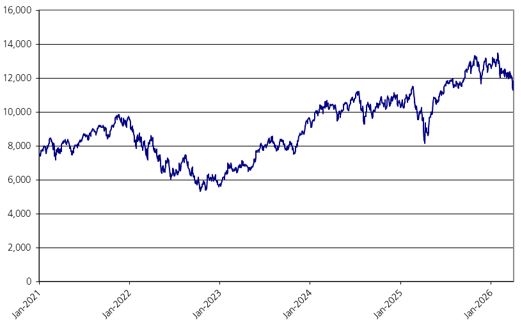
PAST PERFORMANCE IS NOT INDICATIVE OF FUTURE RESULTS
P-21
|
Market Linked Securities—Auto-Callable with Contingent Coupon and Contingent Downside
Principal at Risk Securities Linked to the Lowest Performing of the Nasdaq-100® Technology Sector IndexSM, the Russell 2000®
Index and the EURO STOXX 50® Index due April 6, 2029
|
|
The Russell 2000® Index
|
We have derived all information regarding the Russell 2000® Index (“RTY”) contained in this document, including, without limitation, its make-up, method of calculation and changes in its
components, from publicly available information. Such information reflects the policies of, and is subject to change by the Frank Russell Company (the “Index Sponsor” or “FTSE Russell”).
RTY is published by FTSE Russell, but FTSE Russell has no obligation to continue to publish RTY, and may discontinue publication of RTY at any time. RTY is determined, comprised and calculated by FTSE
Russell without regard to this instrument.
As discussed more fully in the underlier supplement under the heading “Indices – The Russell 2000® Index,” RTY measures the composite price performance of the smallest 2,000 companies
included in the Russell 3000® Index. The Russell 3000® Index is composed of the 3,000 largest United States companies by market capitalization and represents approximately 98% of the market capitalization of the United States
equity market. Select information regarding top constituents and industry and/or sector weightings may be made available by the Index Sponsor on its website. RTY’s value is calculated by adding the market values of the underlying constituents and
then dividing the derived total market capitalization by the “adjusted” capitalization of RTY on the base date of December 31, 1986.
Historical Information
We obtained the closing levels of RTY in the graph below from Bloomberg, without independent verification.
The following graph sets forth daily closing levels of RTY for the period from January 1, 2021 to March 31, 2026. The closing level on March 31, 2026 was 2,496.374. The historical performance of RTY
should not be taken as an indication of the future performance of RTY, and no assurance can be given as to the closing level of RTY on any day during the term of the securities. We cannot give you any assurance that the performance of RTY will result
in any positive return on your initial investment.
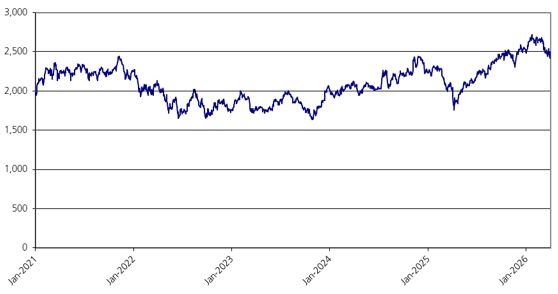
PAST PERFORMANCE IS NOT INDICATIVE OF FUTURE RESULTS
P-22
|
Market Linked Securities—Auto-Callable with Contingent Coupon and Contingent Downside
Principal at Risk Securities Linked to the Lowest Performing of the Nasdaq-100® Technology Sector IndexSM, the Russell 2000®
Index and the EURO STOXX 50® Index due April 6, 2029
|
|
The EURO STOXX 50® Index
|
We have derived all information regarding the EURO STOXX 50® Index (“SX5E”) contained in this document, including without limitation, its make-up, method of calculation
and changes in its components from publicly available information. Such information reflects the policies of, and is subject to change by STOXX Limited.
STOXX Limited has no obligation to continue to publish SX5E, and may discontinue publication of SX5E at any time. SX5E is determined, comprised and calculated by STOXX Limited
without regard to this instrument.
As discussed more fully in the underlier supplement under the heading “Indices — The EURO STOXX 50® Index”, SX5E covers 50 stocks of market sector leaders mainly from 11
Eurozone countries: Austria, Belgium, Finland, France, Germany, Ireland, Italy, Luxembourg, the Netherlands, Portugal and Spain. Select information regarding top constituents and industry and/or sector weightings may be made available by its Index
Sponsor on its website.
Historical Information
We obtained the closing levels of SX5E in the graph below from Bloomberg, without independent verification.
The following graph sets forth daily closing levels of SX5E for the period from January 1, 2021 to March 31, 2026. The closing level on March 31, 2026 was 5,569.73. The historical performance of SX5E
should not be taken as an indication of the future performance of SX5E, and no assurance can be given as to the closing level of SX5E on any day during the term of the securities. We cannot give you any assurance that the performance of SX5E will
result in any positive return on your initial investment.
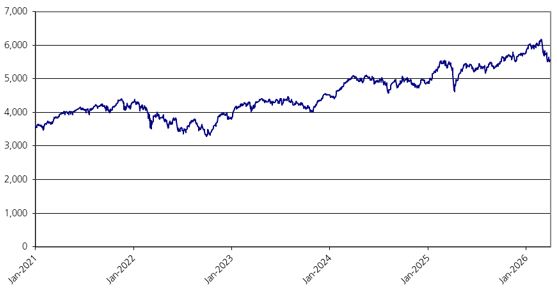
PAST PERFORMANCE IS NOT INDICATIVE OF FUTURE RESULTS
P-23
|
Market Linked Securities—Auto-Callable with Contingent Coupon and Contingent Downside
Principal at Risk Securities Linked to the Lowest Performing of the Nasdaq-100® Technology Sector IndexSM, the Russell 2000®
Index and the EURO STOXX 50® Index due April 6, 2029
|
|
Material U.S. Federal Income Tax Consequences
|
You should carefully review the section entitled “Material U.S. Federal Income Tax Consequences” in the accompanying product supplement. The following discussion, when read in combination with that
section, constitutes the full opinion of our special U.S. tax counsel, Fried, Frank, Harris, Shriver & Jacobson, LLP, regarding the material U.S. federal income tax consequences of owning and disposing of the securities.
Due to the absence of statutory provisions, regulations, published rulings or judicial decisions addressing the characterization for U.S. federal income tax purposes of securities with terms that are
substantially the same as the securities, no assurance can be given that the Internal Revenue Service (“IRS”) or a court will agree with the tax treatment described herein. Pursuant to the terms of the securities, the Bank and you agree, in the
absence of a statutory or regulatory change or an administrative determination or judicial ruling to the contrary, to characterize the securities as prepaid derivative contracts with respect to the Indices. You further agree to include any
associated contingent coupon payment that is paid by the Bank (including on the stated maturity date or call settlement date) in your income as ordinary income in accordance with your regular method of accounting for U.S. federal income tax purposes.
If the securities are so treated, upon the taxable disposition (including cash settlement) of your securities, you generally should recognize gain or loss equal to the difference between the amount realized on such taxable disposition (adjusted for
amounts or proceeds attributable to any accrued and unpaid contingent coupon payments, which would be treated as ordinary income) and your tax basis in the securities. Such gain or loss should be long-term capital gain or loss if you have held your
securities for more than one year (otherwise, short-term capital gain or loss). The deductibility of capital losses is subject to limitations. Although uncertain, it is possible that proceeds received from the sale or exchange of your securities
prior to a contingent coupon payment date, but that could be attributed to an expected contingent coupon payment, could be treated as ordinary income. You should consult your tax advisor regarding this risk.
Based on certain factual representations received from us, our special U.S. tax counsel, Fried, Frank, Harris, Shriver & Jacobson LLP, is of the opinion that it would be reasonable to treat your
securities in the manner described above. However, because there is no authority that specifically addresses the tax treatment of the securities, it is possible that your securities could alternatively be treated for tax purposes as a single
contingent payment debt instrument, or pursuant to some other characterization, such that the timing and character of your income from the securities could differ materially and adversely from the treatment described above, as described further under
“Material U.S. Federal Income Tax Consequences – Alternative Treatments” in the product supplement.
Section 1297. We will not attempt to ascertain whether the issuer of any index constituent stock would be treated as a “passive foreign investment company” (a
“PFIC”) within the meaning of Section 1297 of the U.S. Internal Revenue Code of 1986, as amended (the “Code”). If any such entity were so treated, certain adverse U.S. federal income tax consequences might apply upon the taxable disposition
(including cash settlement) of a security. U.S. holders should refer to information filed with the SEC or the equivalent governmental authority by such entities and consult their tax advisors regarding the possible consequences to them if any such
entity is or becomes a PFIC.
The U.S. Department of the Treasury and the IRS have requested comments on various issues regarding the U.S. federal income tax treatment of “prepaid forward contracts”, such as the securities, and
similar financial instruments and have indicated that such transactions may be the subject of future regulations or other guidance. In addition, members of Congress have proposed legislative changes to the tax treatment of derivative contracts. Any
legislation, Treasury regulations or other guidance promulgated after consideration of these issues could materially and adversely affect the tax consequences of an investment in the securities, possibly with retroactive effect. You should consult
your tax adviser regarding the U.S. federal income tax consequences of an investment in the securities, including possible alternative tax treatments of the securities and potential changes in applicable law.
An investment in the securities is not appropriate for non-U.S. holders because such an investment may result in significant adverse tax consequences. In particular, persons having withholding
responsibility in respect of the securities may withhold on any contingent coupon payment paid to you, generally at a rate of 30%, and to the extent that we have (or an affiliate of ours has) withholding responsibility in respect of the securities,
we intend to so withhold. This discussion does not otherwise address the tax consequences to non-U.S. holders of the purchase, ownership or disposition of the securities.
P-24
|
Market Linked Securities—Auto-Callable with Contingent Coupon and Contingent Downside
Principal at Risk Securities Linked to the Lowest Performing of the Nasdaq-100® Technology Sector IndexSM, the Russell 2000®
Index and the EURO STOXX 50® Index due April 6, 2029
|
|
Canadian Taxation
|
The following is, as of the date hereof, a summary of the principal Canadian federal income tax considerations under the Income Tax Act (Canada) and the
regulations promulgated thereunder (collectively, the “Canadian Tax Act”) generally applicable to a holder who is an individual and who acquires beneficial ownership of a security upon the initial issuance of the security by the Bank pursuant to this
offering document or common shares of the Bank or any of its affiliates on a conversion of a security on a bail-in conversion (if applicable), and who, for purposes of the Canadian Tax Act and any applicable income tax treaty, at all relevant times,
is not resident and is not deemed to be resident in Canada, and who, for purposes of the Canadian Tax Act, at all relevant times, (i) deals at arm’s length with, and is not affiliated with, the Bank, any affiliate of the Bank, and any Canadian
resident (or deemed Canadian resident) to whom the holder assigns or otherwise transfers the security, (ii) is entitled to receive all payments (including any interest, principal and dividends, if applicable) made on the security as beneficial owner,
(iii) is not, and deals at arm’s length with each person who is, a “specified shareholder” (within the meaning of subsection 18(5) of the Canadian Tax Act) of the Bank and each affiliate of the Bank, (iv) is not an entity in respect of which the Bank
or any affiliate of the Bank is a “specified entity” (as defined in subsection 18.4(1) of the Canadian Tax Act); (v) holds the security or common shares of the Bank or any of its affiliates as capital property, (vi) does not use or hold and is not
deemed to use or hold the security or common shares of the Bank or any of its affiliates in or in the course of carrying on a business in Canada or as part of an adventure or concern in the nature of trade and (vii) is not an insurer carrying on an
insurance business in Canada and elsewhere (a “Non-resident Holder”).
This summary assumes that no amount paid or payable to a Non-resident Holder will be the deduction component of a “hybrid mismatch arrangement” under which the payment arises within the meaning of
paragraph 18.4(3)(b) of the Canadian Tax Act. This summary further assumes that no security or property acquired on settlement of a security will be “taxable Canadian property” to a Non-resident Holder for purposes of the Canadian Tax Act at the time
of its disposition or deemed disposition.
This summary is based upon the current provisions of the Canadian Tax Act in force as of the date hereof, all specific proposals to amend the Canadian Tax Act publicly announced by or on behalf of the
Minister of Finance (Canada) prior to the date hereof (the “Tax Proposals”) and the current administrative policies of the Canada Revenue Agency (“CRA”) published in writing by the CRA prior to the date hereof. This summary is not exhaustive of all
possible Canadian federal income tax considerations relevant to an investment in securities and, except for the Tax Proposals, does not take into account or anticipate any changes in law or CRA administrative policies or assessing practices, whether
by way of legislative, governmental or judicial decision or action, nor does it take into account or consider any other federal tax considerations or any provincial, territorial or foreign tax considerations, which may differ materially from those
discussed herein. While this summary assumes that the Tax Proposals will be enacted in the form proposed, no assurance can be given that this will be the case, and no assurance can be given that judicial, legislative or administrative changes will
not modify or change the statements below.
The following is only a general summary of certain Canadian federal non-resident withholding and other tax provisions which may affect a Non-resident Holder of the securities
described in this offering document. This summary is not, and is not intended to be, and should not be construed to be, legal or tax advice to any particular Non-resident Holder and no representation with respect to the income tax consequences to any
particular Non-resident Holder is made. Persons considering investing in securities should consult their own tax advisors with respect to the tax consequences of acquiring, holding and disposing of securities and any common shares of the Bank or any
of its affiliates acquired on a bail-in conversion having regard to their own particular circumstances.
For the purposes of the Canadian Tax Act, all amounts not otherwise expressed in Canadian dollars must be converted into Canadian dollars based on the single day exchange rate as quoted by the Bank of
Canada for the applicable day or such other rate of exchange that is acceptable to the Minister of National Revenue (Canada).
Securities
Interest (including amounts on account or in lieu of payment of, or in satisfaction of, interest) paid or credited, or deemed to be paid or credited, on a security to a Non-resident Holder will not be
subject to Canadian non-resident withholding tax unless all or any part of such interest is “participating debt interest”. “Participating debt interest” is defined in the Canadian Tax Act generally as interest (other than on a “prescribed obligation”
described below) all or any portion of which is contingent or dependent on the use of or production from property in Canada or is computed by reference to revenue, profit, cash flow, commodity price or any other similar criterion or by reference to
dividends paid or payable to shareholders of any class or series of shares of the capital stock of a corporation. A “prescribed obligation” for this purpose is an “indexed debt obligation”, as defined in the Canadian Tax Act, in respect of which no
amount payable is: (a) contingent or dependent upon the use of, or production from, property in Canada, or (b) computed by reference to: (i) revenue, profit, cash flow, commodity price or any other similar criterion, other than a change in the
purchasing power of money, or (ii) dividends paid or payable to shareholders of any class or series of shares of the capital stock of a corporation. An “indexed debt obligation” is a debt obligation the terms or conditions of which provide for an
adjustment to an amount payable in respect of the obligation for a period during which the obligation was outstanding that is determined by reference to a change in the purchasing power of money.
In the event that a security is redeemed, cancelled, purchased or repurchased by the Bank or any other person resident or deemed to be resident in Canada from a Non-resident Holder or is otherwise
assigned or transferred by a Non-resident Holder to the Bank or another person resident or deemed to be resident in Canada for an amount which exceeds, generally, the issue price thereof, the excess may, in certain circumstances be deemed to be
interest and may, together with any interest that has accrued or is deemed to have accrued on the security to that time, be subject to Canadian non-resident withholding tax if all or any part of such interest or deemed interest is participating debt
interest; unless, in certain circumstances, the security is not an indexed debt obligation (described above) and was
P-25
|
Market Linked Securities—Auto-Callable with Contingent Coupon and Contingent Downside
Principal at Risk Securities Linked to the Lowest Performing of the Nasdaq-100® Technology Sector IndexSM, the Russell 2000®
Index and the EURO STOXX 50® Index due April 6, 2029
|
issued for an amount not less than 97% of its principal amount (as defined in the Canadian Tax Act), and the yield from the security, expressed in terms of an annual rate (determined in accordance with the Canadian Tax
Act) on the amount for which the security was issued, does not exceed 4/3 of the interest stipulated to be payable on the security, expressed in terms of an annual rate on the outstanding principal amount from time to time.
If applicable, the normal rate of Canadian non-resident withholding tax is 25% but such rate may be reduced under the terms of an applicable income tax treaty.
Generally, there are no other Canadian taxes on income (including taxable capital gains) payable by a Non-resident Holder under the Canadian Tax Act solely as a consequence of the acquisition,
ownership or disposition of securities by the Non-resident Holder.
Common Shares Acquired on a Bail-in Conversion
Dividends (including amounts on account or in lieu of payment of, or in satisfaction of, dividends) paid or credited or deemed to be paid or credited to a Non-resident Holder on any common shares of
the Bank or common shares of an affiliate of the Bank that is a Canadian resident corporation will be subject to Canadian non-resident withholding tax of 25% but such rate may be reduced under the terms of an applicable income tax treaty.
A Non-resident Holder will not be subject to tax under the Canadian Tax Act on any capital gain realized on a disposition or deemed disposition of any common shares of the Bank or common shares of an
affiliate of the Bank unless such shares constitute “taxable Canadian property” to the Non-resident Holder for purposes of the Canadian Tax Act at the time of their disposition, and such Non-resident Holder is not entitled to relief pursuant to the
provisions of an applicable income tax treaty. Non-resident Holders should consult their own tax advisors with respect to their particular circumstances.
P-26
|
Market Linked Securities—Auto-Callable with Contingent Coupon and Contingent Downside
Principal at Risk Securities Linked to the Lowest Performing of the Nasdaq-100® Technology Sector IndexSM, the Russell 2000®
Index and the EURO STOXX 50® Index due April 6, 2029
|
|
Validity of the Securities
|
In the opinion of Fried, Frank, Harris, Shriver & Jacobson LLP, as special products counsel to TD, when the securities offered by this pricing supplement have been executed and issued by TD and
authenticated by the trustee pursuant to the indenture and delivered, paid for and sold as contemplated herein, the securities will be valid and binding obligations of TD, enforceable against TD in accordance with their terms, subject to applicable
bankruptcy, insolvency, fraudulent conveyance, reorganization, moratorium, receivership or other laws relating to or affecting creditors’ rights generally, and to general principles of equity (regardless of whether enforcement is sought in a
proceeding at law or in equity). This opinion is given as of the date hereof and is limited to the laws of the State of New York. Insofar as this opinion involves matters governed by Canadian law, Fried, Frank, Harris, Shriver & Jacobson LLP has
assumed, without independent inquiry or investigation, the validity of the matters opined on by McCarthy Tétrault LLP, Canadian legal counsel for TD, in its opinion expressed below. In addition, this opinion is subject to customary assumptions about
the trustee’s authorization, execution and delivery of the indenture and, with respect to the securities, authentication of the securities and the genuineness of signatures and certain factual matters, all as stated in the opinion of Fried, Frank,
Harris, Shriver & Jacobson LLP filed as Exhibit 5.3 to the registration statement on Form F-3 filed by TD on December 20, 2024.
In the opinion of McCarthy Tétrault LLP, the issue and sale of the securities has been duly authorized by all necessary corporate action on the part of TD, and when this pricing supplement has been
attached to, and duly notated on, the master note that represents the securities, the securities will have been validly executed and issued and, to the extent validity of the securities is a matter governed by the laws of the Province of Ontario, or
the laws of Canada applicable therein, will be valid obligations of TD, subject to the following limitations: (i) the enforceability of the indenture is subject to bankruptcy, insolvency, reorganization, arrangement, winding up, moratorium and other
similar laws of general application limiting the enforcement of creditors’ rights generally; (ii) the enforceability of the indenture is subject to general equitable principles, including the fact that the availability of equitable remedies, such as
injunctive relief and specific performance, is in the discretion of a court; (iii) courts in Canada are precluded from giving a judgment in any currency other than the lawful money of Canada; and (iv) the enforceability of the indenture will be
subject to the limitations contained in the Limitations Act, 2002 (Ontario), and such counsel expresses no opinion as to whether a court may find any provision of the indenture to be unenforceable as an attempt to vary or exclude a limitation period
under that Act. This opinion is given as of the date hereof and is limited to the laws of the Province of Ontario and the federal laws of Canada applicable thereto. In addition, this opinion is subject to: (i) the assumption that the senior indenture
has been duly authorized, executed and delivered by, and constitutes a valid and legally binding obligation of, the trustee, enforceable against the trustee in accordance with its terms; and (ii) customary assumptions about the genuineness of
signatures and certain factual matters all as stated in the letter of such counsel dated December 20, 2024, which has been filed as Exhibit 5.2 to the registration statement on Form F-3 filed by TD on December 20, 2024.
P-27