Caution regarding forward-looking statements
From time to time, Royal Bank of Canada and its subsidiaries (collectively, “RBC”, “the bank”, “we”, “us” or “our”) make written or oral forward-looking statements within the meaning of certain securities laws, including the “safe harbour” provisions of the United States Private Securities Litigation Reform Act of 1995 and any applicable Canadian securities legislation. We may make forward-looking statements in this management proxy circular (circular), in other filings with Canadian regulators or the U.S. Securities and Exchange Commission, in reports to shareholders and in other communications. In addition, our representatives may communicate forward-looking statements orally to analysts, investors, the media and others. Forward-looking statements in this circular include, but are not limited to, statements relating to the expected timing and business of the annual meeting of shareholders, our financial performance objectives and targets, priorities, vision and strategic goals, our approach to compensation, the risk environment and the effectiveness of our risk monitoring, our approach to managing climate- and sustainability-related matters, and statements made by our President and Chief Executive Officer and our Chair of the Board. The forward-looking statements contained in this circular represent the views of management and are presented for the purpose of assisting our stakeholders in understanding our vision, commitments, goals, priorities and targets and may not be appropriate for other purposes. Forward-looking statements are typically identified by words such as “believe”, “expect”, “suggest”, “seek”, “foresee”, “forecast”, “schedule”, “anticipate”, “intend”, “estimate”, “goal”, “commit”, “target”, “objective”, “plan”, “outlook”, “timeline” and “project” and similar expressions of future or conditional verbs such as “will”, “may”, “might”, “should”, “could”, “can”, “would” or negative or grammatical variations thereof.
By their very nature, forward-looking statements require us to make assumptions and are subject to inherent risks and uncertainties, both general and specific in nature, which give rise to the possibility that our predictions, forecasts, projections, expectations or conclusions will not prove to be accurate, that our assumptions may not be correct, that our financial performance, environmental & social or other objectives, vision and strategic goals will not be achieved, and that our actual results may differ materially from such predictions, forecasts, projections, expectations or conclusions.
We caution readers not to place undue reliance on our forward-looking statements as a number of risk factors could cause our actual results to differ materially from the expectations expressed in such forward-looking statements. These factors – many of which are beyond our control and the effects of which can be difficult to predict – include, but are not limited to: business and economic conditions in the geographic regions in which we operate, Canadian housing and household indebtedness, information technology, cyber and third-party risks, geopolitical uncertainty, environmental and social (E&S) risk, digital disruption and innovation, privacy and data related risks, regulatory changes, culture and conduct risks, credit, market, liquidity and funding, insurance, operational, compliance, reputation and strategic risks, other risks discussed in the risk sections of our 2025 annual report, including legal and regulatory environment risk, the effects of changes in government fiscal, monetary and other policies and tax risk and transparency, risks associated with escalating trade tensions, including protectionist trade policies such as the imposition of tariffs, risks associated with the adoption of emerging technologies, such as cloud computing, artificial intelligence (AI), including generative AI (GenAI), and robotics, fraud risk and our ability to anticipate and successfully manage risks arising from all of the foregoing factors. Additional factors that could cause actual results to differ materially from the expectations in such forward-looking statements can be found in the risk sections of our 2025 annual report and the Risk management section of our Q1 2026 report to shareholders, as may be updated by subsequent quarterly reports.
We caution that the foregoing list of risk factors is not exhaustive and other factors could also adversely affect our results. When relying on our forward-looking statements to make decisions with respect to us, investors and others should carefully consider the foregoing factors and other uncertainties and potential events, as well as the inherent uncertainty of forward-looking statements. Material economic assumptions underlying the forward-looking statements contained in this circular are set out in the Economic, market and regulatory review and outlook section and for each business segment under the Strategic priorities and Outlook headings in our 2025 annual report, as updated by the Economic, market and regulatory review and outlook section of our Q1 2026 report to shareholders. Such sections may be updated by subsequent quarterly reports. Any forward-looking statements contained in this circular represent the views of management only as of the date hereof, and except as required by law, we do not undertake to update any forward-looking statement, whether written or oral, that may be made from time to time by us or on our behalf.
Please see the reverse of the back cover of this circular for an important notice regarding information in this circular about RBC’s sustainability-related objectives, vision, commitments, goals, metrics and targets.
Royal Bank of Canada
Royal Bank of Canada
Notice of annual meeting of common shareholders
| When
Thursday, April 9, 2026 9:30 a.m. (Eastern Time)
Where
Via live webcast online at:
https://meetings.lumiconnect.com/400-388-754-893
In person:
Toronto Congress Centre North Building 1020 Martin Grove Road Toronto, Ontario
Please visit our website at rbc.com/annualmeetings in advance of the meeting for the most current information about attending the meeting. |
Business of the annual meeting
At the meeting, shareholders will:
⬛ Receive our financial statements for the years ended October 31, 2025 and 2024 and the related auditor’s reports
⬛ Appoint our auditor
⬛ Have a say on our approach to executive compensation
⬛ Consider the shareholder proposals set out in Schedule A of the circular that are properly introduced at the meeting, and
⬛ Transact any other business that may properly come before the meeting.
For more information about how to vote and attend the meeting, refer to pages 8 to 12 of the circular.
|
By order of the board of directors,

Jessica Clinton
Senior Vice-President, Deputy General Counsel and Corporate Secretary
February 10, 2026
|
|
Your vote is important!
We encourage you to read the circular before exercising your vote.
Unless you intend to vote at the meeting, please vote as early as possible so your RBC common shares are represented at the meeting. Computershare Trust Company of Canada, our transfer agent, must receive your vote no later than 1:00 p.m. (Eastern Time) on Tuesday, April 7, 2026.
Refer to pages 8 to 10 of the circular for detailed instructions on how to vote.
|
1
Royal Bank of Canada
|
Fellow shareholders,
We are pleased to invite you to this year’s annual meeting, to be held on April 9, 2026, at 9:30 a.m. (Eastern Time).
|
|
A strong foundation
In a rapidly changing and more complex world, RBC is upholding its reputation as an all-weather bank – with a strong financial and strategic foundation that delivers value for shareholders across economic cycles.
This foundation was at the heart of RBC’s recent Investor Day, where the bank shared plans to expand its global reach and deliver new capabilities that deepen client relationships and build new ones across our market-leading franchises. In 2025, RBC made progress on what it committed to doing: delivering premium returns and creating more value for clients and shareholders.
RBC entered the 2026 fiscal year as the 11th largest bank globally and the 6th largest in North America by market capitalization. In 2025, it generated earnings of $20.4 billion and a return on equity of 16.3 per cent, while returning over $11 billion to shareholders through common dividends and share buybacks.
We are proud that RBC is delivering results that shareholders have come to expect as the bank continues advancing its position as one of the world’s most trusted and successful financial institutions.
RBC’s financial strength remains one of its greatest advantages and gives the bank the ability to fund future growth. This underpins RBC’s diversified business model across segments and geographies, strong credit ratings, technology and data scale, prudent risk appetite and the bank’s trusted brand.
Accelerating RBC’s ambitions
Looking ahead, expectations of RBC will continue to be very high, and the bank needs to work harder than ever to achieve them.
To do that, RBC is staying focused on tomorrow’s biggest growth opportunities in Canada, while scaling and unlocking new revenue streams in
key markets and geographies, particularly the United States, United Kingdom and Europe. At the same time, the bank is building new capabilities to better support its increasingly globally connected clients.
This spirit of innovation and drive to stay ahead of the curve is at the core of RBC’s strong performance and significant momentum – and it’s why the bank is moving forward with a bold ambition to achieve up to $1 billion in enterprise value generated from AI-driven benefits by 2027.
RBC has spent years laying the groundwork with investments in data and technology platforms, exceptional AI talent and world-class security – and this is reflected in the bank’s leadership position among global banks. RBC has been recognized for four straight years as the #1 ranked bank in Canada and #3 ranked bank globally1 in AI maturity based on the annual Evident AI Index rankings.
Across the organization, AI is empowering RBC’s people, helping uncover opportunities to better serve and understand clients and enabling productivity gains.
With rapid advances in generative and agentic AI opening up new frontiers across financial services, this technology continues to be a key area of the board’s oversight. Responsible governance in AI is essential, and the board supports RBC’s innovative approach to using AI while maximizing the potential of its employees.
At the same time, in 2025, RBC focused on unlocking a bold Global Transaction Banking opportunity that presents a significant market opportunity for RBC’s corporate and commercial clients. This includes capabilities across liquidity management, payments, trade finance and ancillary services. With the launch of RBC ClearTM and the successful integration of HSBC Bank Canada, the bank is focused on scaling platforms to build a truly globally connected business, deepening support for clients in this significant revenue pool.
| 1 | Out of 50 global financial institutions ranked in the Evident AI Index. |
2
Royal Bank of Canada
|
|
Upholding trust and stability
RBC’s success is no accident – it is powered by extraordinary people who exemplify its Purpose of helping clients thrive and communities prosper.
We are incredibly proud of how Team RBC keeps the client at the heart of every decision, bringing trusted advice and real care to every interaction – and going above and beyond in the moments that matter most.
To ensure RBC’s culture and leadership remain aligned with the bank’s Purpose and long-term goals, in 2025, the board oversaw succession planning, leadership development and talent mobility to strengthen RBC’s leadership pipeline. We were particularly proud that the strong results in 2025 came on the heels of a number of changes at the Group Executive level, highlighting the strength of the bench.
As the bank scales further, the board is focused on supporting responsible growth while maintaining RBC’s accountability to shareholders, clients, communities, employees and regulators.
We are confident Team RBC is up to the ambitious work ahead as we remain focused on shareholders’ evolving expectations and bringing them the unparalleled value they rely on.
The board is confident in RBC’s ability to navigate change and pursue our bold ambitions while upholding trust and stability.
With RBC’s global growth ambitions being greater than ever, the leadership team is focused on tapping into the full strength of RBC to deepen how the bank serves clients by delivering exceptional advice, insights and value.
We take great confidence knowing RBC is not just reacting to change but leading with a strong vision for what will help the bank’s shareholders, clients, communities and employees succeed.
Your vote
Join us on April 9, 2026, to vote on important matters. Please consider the information set out in this circular and vote online, by phone or by completing and sending in your proxy or voting instruction form prior to the meeting.
We thank you for your continued support.

|

| |
| Jacynthe Côté Chair of the Board |
David McKay President and Chief Executive Officer |
3
Royal Bank of Canada
Delivery of meeting materials
Notice-and-access
As permitted by the Canadian Securities Administrators and pursuant to an exemption from the proxy solicitation requirement received from the Office of the Superintendent of Financial Institutions (OSFI), we are using notice-and-access to deliver this circular and RBC’s annual report to registered and non-registered (beneficial) shareholders.
This means that, instead of receiving a paper copy of the meeting materials, you will receive a notice explaining how to access these materials online. Notice-and-access reduces paper and energy consumption, and it allows for faster access to meeting materials.
You will also receive a form of proxy or a voting instruction form with this notice so you can vote your shares.
How to access the meeting materials online
The meeting materials can be found online at:
| • | RBC’s website at rbc.com/annualmeetings |
| • | the website of RBC’s transfer agent, Computershare Trust Company of Canada (Computershare), at www.envisionreports.com/RBC2026 |
| • | SEDAR+ at www.sedarplus.com, and |
| • | EDGAR at www.sec.gov. |
How to request a paper copy of the meeting materials
You may request a paper copy of the meeting materials at no cost up to one year from the date the circular is filed on SEDAR+ as follows:
To receive paper copies of the meeting materials prior to the voting deadline and the date of the meeting, we must receive your request no later than 5:00 p.m. (Eastern Time) on Tuesday, March 24, 2026. The meeting materials will then be sent to you within three business days of receiving your request. Please note that you will not receive another voting instruction form or form of proxy.
If you submit your request after the meeting, the meeting materials will be sent to you within 10 calendar days of receiving your request.
Who to contact if you have questions about notice-and-access
Please call Computershare at
1-866-586-7635 (Canada/U.S.), or
514-982-7555 (International).
4
Royal Bank of Canada
Sign up for eDelivery
You can receive shareholder materials, including the notice, form of proxy and voting instruction form, by email. eDelivery reduces paper and energy consumption and gets the documents to you faster.
Non-registered (beneficial) shareholders
Go to www.proxyvote.com and sign up using the control number on your voting instruction form or, after the meeting, contact your intermediary.
Registered shareholders
Go to www.investorvote.com and sign up using the control number on your proxy form or go to www.investorcentre.com/rbc and click on “Receive Documents Electronically”.
|
The information in this circular is as of February 10, 2026, unless stated otherwise. All dollar amounts are in Canadian dollars, unless stated otherwise.
In this circular, “RBC”, “the bank”, “we”, “us” and “our” mean Royal Bank of Canada; “common shares” means RBC common shares unless the context indicates otherwise; and “shareholder” and “you” mean a holder of common shares, unless the context indicates otherwise.
All references to websites are for your information only. The content of any websites referred to in this circular, including via website link, and any other websites they refer to are not incorporated by reference in, and do not form part of, this circular.
|

5
Royal Bank of Canada
Your guide to what’s inside:
7
Royal Bank of Canada
The annual meeting
Business of the annual meeting
| ⬛ | Receive our financial statements and related auditor’s reports |
The consolidated financial statements and management discussion and analysis for the years ended October 31, 2025, and 2024, together with the auditor’s reports on those financial statements, are in our 2025 annual report at rbc.com/annualmeetings and on Computershare’s website at www.envisionreports.com/RBC2026; SEDAR+ at www.sedarplus.com and EDGAR at www.sec.gov.

|
Elect directors |
Thirteen nominees are standing for election as directors of RBC. See pages 13 to 21 of this circular for more information on the nominees. Each director will be elected to hold office until the next annual meeting of shareholders. All of the nominees are currently RBC directors.
|
The board recommends voting FOR each nominee.
|
| ¾ | Appoint the bank’s auditor |
The board proposes the appointment of PricewaterhouseCoopers LLP (PwC) as RBC’s auditor until the next annual meeting of shareholders. Representatives from PwC will be at the meeting to answer your questions. A description of fees paid to our auditor can be found on pages 44 to 45 of this circular.
|
The board recommends voting FOR PwC as the bank’s auditor.
|
| ¾ | Have a say on our approach to executive compensation |
Shareholder input is a key aspect of our engagement process, which includes inviting you to have your say on our approach to executive compensation.
If you have any comments or questions about our approach to executive compensation, please contact the chair of the board using the contact information on the back cover of this circular. Please review the section on executive compensation starting on page 51 of this circular, where we describe our approach.
More specifically, the board of directors recommends that common shareholders approve the following advisory resolution:
“RESOLVED, on an advisory basis and not to diminish the role and responsibilities of the board of directors that the shareholders accept the approach to executive compensation disclosed in the Management Proxy Circular of the Royal Bank of Canada dated February 10, 2026.”
While this vote is advisory and non-binding, the board will consider the result in future compensation planning.
|
The board recommends voting FOR our approach to executive compensation.
|
| ¾ | Consider shareholder proposals |
The shareholder proposals are set out in Schedule A to this circular starting on page 100. While this vote is non-binding, the board will take the results into account when considering these matters.
|
The board recommends voting AGAINST each proposal for the reasons noted in the board’s responses.
|
Shareholder proposals for next year’s annual meeting must be submitted by 5:00 p.m. (Eastern Time) on November 12, 2026.
8
Royal Bank of Canada
The annual meeting
Who can vote?
|
Each share gives you one vote, subject to the voting restrictions explained below.
|
You have the right to vote if you owned common shares on the record date, February 10, 2026. There were 1,396,524,760 outstanding shares that were eligible to vote on that date.
Who cannot vote?
Shares cannot be voted if they are beneficially owned by:
| • | the Canadian government or any of its agencies |
| • | a provincial government or any of its agencies |
| • | the government of a foreign country, any political subdivision of a foreign country or any of its agencies |
| • | any person who has acquired more than 10% of any class of our shares without the approval of the Minister of Finance, or |
| • | any person, or any entity controlled by one of the persons listed above, that represents, in aggregate, more than 20% of the eligible votes. |
As of February 10, 2026, management and the board are unaware of any person who owns or exercises control or direction over more than 10% of our outstanding shares.
How does voting work?
|
You can vote your shares by proxy or at the meeting.
|
A simple majority of the votes cast by proxy or at the meeting will constitute approval of matters voted on at the annual meeting.
Is my vote confidential?
|
Yes, your vote is confidential.
|
To keep your vote confidential, the bank’s transfer agent, Computershare, counts all the proxies and does not provide any individual voting information to RBC unless a shareholder clearly intends to communicate their individual position to the board or management or Computershare is legally required to provide this information.
If you submit your vote using the voting instruction form, your intermediary will tabulate your form and communicate only the result of each vote to Computershare.
How do I vote?
There are two ways you can vote: by proxy or at the meeting either online or in person. Shareholders are strongly encouraged to submit their votes in advance of the meeting. Please follow the instructions below based on whether you are a non-registered (beneficial) shareholder or a registered shareholder.
|
Non-registered (beneficial) shareholders
An intermediary such as a securities broker, trustee or financial institution holds your shares. Your intermediary sent you a voting instruction form.
|
Registered shareholders
Your shares are registered directly in your name with our transfer agent, Computershare. A form of proxy was included in your package.
| |||||||
9
Royal Bank of Canada
The annual meeting
|
Voting by proxy before the meeting
|
||||||||
|
Non-registered (beneficial) shareholders
|
Registered shareholders
| |||||||
|
Provide your instructions in one of these ways:
|
|
Provide your instructions in one of these ways:
| ||||||
|
|
Visit www.proxyvote.com and enter your 16-digit control number listed on the enclosed voting instruction form.
English: 1-800-474-7493 French: 1-800-474-7501
Complete your voting instruction form and return it by mail in the envelope provided.
|
|
Visit www.investorvote.com and enter your 15-digit control number listed on the enclosed form of proxy.
Complete your form of proxy and return it by mail in the envelope provided.
Fax your completed form of proxy to: Canada/U.S.: 1-866-249-7775 International: 416-263-9524
| |||||
|
Changed your mind?
|
Changed your mind?
| |||||||
|
If you have already sent your completed voting instruction form to your intermediary and you change your mind about your voting instructions, contact your intermediary immediately. |
You may revoke your proxy by:
• delivering a written notice to the secretary, or
• completing, signing and returning a new proxy form bearing a later date than the form already returned to Computershare.
The written notice or new proxy form must be received no later than 1:00 p.m. (Eastern Time) on Tuesday, April 7, 2026.
| |||||||
| Attending the meeting yourself and voting at the meeting
| ||||||||
|
Non-registered (beneficial) shareholders |
Registered shareholders | |||||||
|
• Write your own name in the space provided on your voting instruction form to instruct your intermediary to appoint you as proxyholder.
• Sign and return the voting instruction form according to the delivery instructions provided.
• Do not complete the instructions section of the voting instruction form as you will be attending and voting online or in person at the meeting.
• If attending the meeting online, you must also register yourself as your proxyholder with Computershare, as described below under “Appointing a proxyholder to represent you and vote at the meeting”. Failure to do so will mean you will be unable to participate or vote online.
• If attending the meeting in person, please check in at the registration desk with our transfer agent, Computershare, when you arrive at the meeting.
Non-registered (beneficial) shareholders who have not duly appointed themselves as proxyholder will not be able to vote or participate at the meeting.
|
|
• Do not complete or return your form of proxy as you will be voting at the meeting.
• If attending the meeting online, log in online as a registered shareholder as described below under “Attending the meeting online”.
• If attending the meeting in person, please check in at the registration desk with our transfer agent, Computershare, when you arrive at the meeting. | ||||||
10
Royal Bank of Canada
The annual meeting
|
Appointing a proxyholder to represent you and vote at the meeting |
|
The form of proxy or voting instruction form appoints Jacynthe Côté or David McKay, each a director of RBC, as your proxyholder, which gives them the authority to vote your shares at the meeting or any adjournment.
You can choose another person or company, including a person who is not a shareholder, as your proxyholder to vote your shares online or in person at the meeting. To do this, you must appoint that person as proxyholder as described above under “Voting by proxy before the meeting”.
If the proxyholder will be attending the meeting online, you must register this proxyholder online at www.computershare.com/RBC2026 no later than 1:00 p.m. (Eastern Time) on Tuesday, April 7, 2026, for Computershare to email the proxyholder with a username. Failure to register the proxyholder with Computershare will mean the proxyholder will be unable to register online as a participant or vote online.
If the proxyholder will be attending the meeting in person, the proxyholder will need to check in at the registration desk with our transfer agent, Computershare, when they arrive at the meeting.
|
How will my proxyholder vote my shares?
Your proxyholder must follow your voting instructions on how you want your shares voted. You can also elect to have your proxyholder decide for you. If you have not specified voting instructions on a particular matter, your proxyholder can vote your shares as they see fit.
Unless you provide alternative instructions, shares represented by proxies will be voted as follows:
| • | FOR the election of our director nominees |
| • | FOR the appointment of PwC as RBC’s auditor |
| • | FOR the advisory resolution on our approach to executive compensation |
| • | FOR management’s proposals generally |
| • | AGAINST the shareholder proposals set out in Schedule A |
What about amendments or other business?
If amendments to the business items described in this circular or other business items properly come before the meeting, your proxyholder will decide how to vote on them, if applicable.
How does RBC solicit proxies?
RBC® management solicits proxies for use at our annual meeting on April 9, 2026, or any adjournment, primarily by mail. RBC’s directors, officers and employees may also call, write or speak to you to encourage you to vote. The bank has retained Laurel Hill Advisory Group (Laurel Hill) to help with this process, among other responsibilities, for a fee of $41,000 for such services, in addition to certain out-of-pocket expenses. Laurel Hill may contact certain non-registered (beneficial) shareholders to assist in exercising their voting rights directly by telephone via Broadridge Investor Communications Corporation’s QuickVote‡ service. RBC pays all costs associated with soliciting proxies.
Where can I find the voting results?
Following the annual meeting, the bank will post the voting results at rbc.com/annualmeetings and file the results with Canadian securities regulators at www.sedarplus.com.
11
Royal Bank of Canada
The annual meeting
How do I attend the annual meeting online?
If you are a registered shareholder or a proxyholder (including a non-registered (beneficial) shareholder who has appointed themselves as proxyholder), you will be able to attend the meeting online, securely vote and participate in real time as follows:
| • | Log in online at https://meetings.lumiconnect.com/400-388-754-893 |
For registered shareholders: Click “I have a login” and then enter your 15-digit control number under username and password: rbc2026 (case sensitive). The 15-digit control number is located on the form of proxy or in the email notification you received with your control number.
For proxyholders: Once appointed and registered as proxyholder as described above under “Attending the meeting yourself and voting at the meeting” and “Appointing a proxyholder to represent you and vote at the meeting”, Computershare will provide you with a username by email after 1:00 p.m. (Eastern Time) on Tuesday, April 7, 2026. The password to the meeting is: rbc2026 (case sensitive).
To vote online on the matters put forth at the meeting, you must accept the terms and conditions, thus revoking any and all previously submitted proxies.
If you do not wish to revoke all previously submitted proxies, do not accept the terms and conditions once you log in, in which case you will enter the meeting as a guest and you will not be able to vote online or ask questions at the meeting.
It is important that you are connected to the internet at all times during the meeting in order to vote when balloting commences.
If you are a non-registered (beneficial) shareholder and you have not appointed yourself as proxyholder, you will only be able to attend the virtual meeting as a guest as follows: Log in online at https://meetings.lumiconnect.com/400-388-754-893, click “I am a guest” and register online.
People attending as guests will not be able to vote online or participate at the meeting.
Registered shareholders, non-registered (beneficial) shareholders and guests can also attend the meeting online at rbc.com/annualmeetings or via telephone at the following numbers:
|
IMPORTANT: Participants MUST provide the Participant Passcode to gain entry to the call.
| ||
|
English:
|
French:
| |
|
1. 1-800-990-2777 (Canada and the U.S.)
2. 416-855-9085 (International)
Participant Passcode: 47817
|
1. 1-800-990-2777 (Canada and the U.S.)
2. 416-855-9085 (International)
Participant Passcode: 78409 | |
People attending online at rbc.com/annualmeetings or via telephone will not be able to vote or participate at the meeting.
You should allow at least 15 minutes to check in to the meeting and complete the related registration.
How can a U.S. non-registered (beneficial) shareholder attend the meeting online?
To attend and vote online at the meeting, you must first obtain a legal proxy form from the intermediary that holds your shares and then register in advance of the meeting as follows:
| • | Follow the instructions from your intermediary or contact your intermediary to request a legal proxy form. |
| • | Submit a copy of your legal proxy form to Computershare by mail using the contact information on the back cover of the circular or by email at uslegalproxy@computershare.com to register for the meeting. Requests for registration must be labelled “Legal Proxy” and be received no later than 1:00 p.m. (Eastern Time) on Tuesday, April 7, 2026. |
| • | A confirmation of your registration will be emailed to you after Computershare receives your registration materials. |
| • | Register your appointment at www.computershare.com/RBC2026. |
Once these steps are completed, you may attend the meeting and vote your shares at: https://meetings.lumiconnect.com/400-388-754-893 during the meeting.
12
Royal Bank of Canada
The annual meeting
Attending the meeting in person
How do I attend the meeting in person?
If you are a registered shareholder or a proxyholder (including a non-registered (beneficial) shareholder who has appointed themselves as proxyholder), you have the option to attend the meeting in person after checking in at the registration desk when you arrive at the meeting. All registered shareholders and proxyholders (including non-registered (beneficial) shareholders who have appointed themselves as proxyholders) are required to present valid government-issued photo identification when they check in at the registration desk.
Only registered shareholders and duly appointed proxyholders who have presented valid government-issued photo identification at the registration desk will be granted access to the in-person meeting. However, non-registered (beneficial) shareholders who have not appointed themselves proxyholders, non-shareholders and other guests will be able to attend the meeting online as described above under “Attending the meeting online”.
Where can I find additional information?
Please contact Computershare at 1-866-586-7635 (Canada/U.S.) or 514-982-7555 (International) if you are not sure whether you are a registered shareholder or non-registered (beneficial) shareholder or for additional information regarding:
| • | voting by proxy before the meeting |
| • | voting at the meeting |
| • | attending the meeting online or in person, or |
| • | other general proxy matters. |
Only registered shareholders and duly appointed proxyholders (including non-registered (beneficial) shareholders who have appointed themselves as proxyholders) will be permitted to participate during the meeting. More information, including the rules of procedure and how to participate at the meeting, will be made available at rbc.com/annualmeetings in advance of the meeting.
For information regarding technical and logistical issues related to accessing the meeting online, please visit https://meetings.lumiconnect.com/400-388-754-893, click on “Technical support/Soutien technique” and follow the instructions.
13
Royal Bank of Canada
The annual meeting
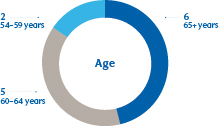
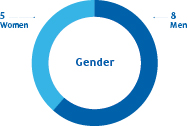
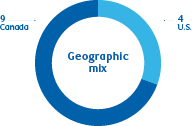
This year, there are 13 nominees standing for election. The following nominee profiles include a summary of each nominee’s career experience, competencies, current board committee memberships and directorships at other public companies over the past five years. All director nominees speak English fluently, four speak French fluently and one speaks one or more other languages. The information about each director nominee in this circular is current as of February 10, 2026, except as otherwise noted. For more information about the nominees, see the Directors and Executive Officers section in our annual information form dated December 2, 2025.
Board composition1
|
|
38% of the director nominees are
| |||
|
|
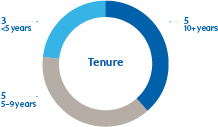
The average tenure of our director nominees is 7.2 years
| |||
Equity ownership
This section also includes each nominee’s equity ownership in RBC as at February 6, 2026, and February 7, 2025, which is comprised of shares and director deferred stock units (DDSUs).
Values of shares and DDSUs are based on $232.72 and $170.44, the closing price of RBC common shares on the Toronto Stock Exchange (TSX) on February 6, 2026, and February 7, 2025, respectively. None of the nominees hold shares of RBC subsidiaries. The total of RBC securities held as a multiple of the equity ownership requirement for non-executive directors3 is calculated as of February 6, 2026, and February 7, 2025, respectively.
Attendance
The attendance figures in each nominee’s profile show the number of board and committee meetings the nominee attended in fiscal 2025 out of the number of meetings that were held while the nominee was a member.
Directors are required to attend a minimum of 75% of board and committee meetings, except where the governance committee determines that factors beyond their control prevented them from achieving this requirement. Overall attendance includes both regularly scheduled and special meetings of the board and its committees. Special meetings and information sessions are scheduled as needed, often on short notice, on matters that arise between regularly scheduled meetings. Meetings of the committees are open to all directors to attend, and directors often attend meetings of the committees of which they are not members.
| 1 | 23% of director nominees are Black, Indigenous or people of colour. |
| 2 | Pursuant to National Instrument 58-101 — Disclosure of Corporate Governance Practices, the bank is required to disclose whether it has adopted a written policy relating to the identification and nomination of women directors, and the annual and cumulative progress in achieving the policy’s objectives. The bank is also required to disclose how the governance committee considers the level of representation of women on the board in identifying and nominating candidates for election or re-election to the board. Finally, the bank is also required to disclose whether it has adopted a target regarding women on its board and in executive officer positions as well as the number and proportion of directors and executive officers who are women. |
| 3 | Effective November 1, 2025, the minimum equity ownership requirement for non-executive directors increased from four to five times the total director retainer within six years of joining the board. See page 23 for more information. |
14
Royal Bank of Canada
The annual meeting
|
|
Mirko Bibic
Toronto, ON, Canada
Age 58 | Director since 2022
Independent 2025 annual meeting Votes in favour: 98.93%
Competencies • Business-to-consumer • Legal/regulatory • Talent management and
executive • Technology/digital
Public board memberships • BCE Inc. (2020–present) |
Mr. Bibic is President and Chief Executive Officer of BCE Inc. and Bell Canada (a communications and media company) since 2020. Since joining BCE Inc. in 2004, he has held a variety of senior leadership positions, including Chief Operating Officer, Executive Vice-President, Corporate Development, and Chief Legal and Regulatory Officer.
Mr. Bibic is a director of Bell Canada.
Mr. Bibic holds a Bachelor of Commerce degree from McGill University and a Law degree from the University of Toronto.
|
| Attendance (100% overall) |
| |||||
|
Board/Committee memberships |
Regular |
Special |
||||
| Board |
8/8 |
– |
| |||
| Governance |
6/6 |
– |
| |||
| Risk |
7/7 |
3/3 |
||||
| RBC Equity Ownership |
||||||||||||
| Date |
Shares |
DDSUs |
Total shares/ |
Total value of |
Total as a multiple of equity |
|||||||
|
as at |
(#) |
(#) |
DDSUs (#) |
shares/DDSUs |
ownership guideline of $2,075,000 |
|||||||
| February 6, 2026 |
3,851 |
8,447 |
12,298 |
$2,862,013 |
1.4 x |
|||||||
| February 7, 2025 |
3,851 |
6,371 |
10,222 |
$1,742,170 |
0.8 x |
|||||||
|
|
Andrew A. Chisholm
Toronto, ON, Canada
Age 66 | Director since 2016
Independent 2025 annual meeting Votes in favour: 98.96%
Competencies • Accounting and finance • Financial services • Legal/regulatory • Risk management
Public board memberships • None |
Mr. Chisholm is a corporate director. He joined Goldman Sachs & Co. (a global investment bank) in 1985, and over the course of his career held a variety of senior leadership positions, including Head of the Global Financial Institutions Group, Senior Strategy Officer and co-chair of the firm-wide commitments committee. Mr. Chisholm is a director of RBC US Group Holdings LLC. Mr. Chisholm is a director of MaRS Discovery District and chair of the board at Evergreen. He is an advisor to Demia, Novisto, riskthinking.AI and Arctern Ventures. Mr. Chisholm is a member of the advisory board and chair of the Centre for Building Sustainable Value of the Richard Ivey School of Business at Western University and the Institute for Sustainable Finance of the Smith School of Business at Queen’s University. He is also a member of the climate strategy advisory board at the Institute of Corporate Directors. Mr. Chisholm holds an MBA from the Richard Ivey School of Business at Western University and a Bachelor of Commerce from Queen’s University. He was awarded an Honorary Doctor of Laws from Western University. |
| Attendance (100% overall) |
| |||||
|
Board/Committee memberships |
Regular |
Special |
||||
| Board |
8/8 |
– |
| |||
| Governance |
6/6 |
– |
| |||
| Risk (chair) |
7/7 |
3/3 |
||||
| RBC Equity Ownership |
||||||||||||
| Date |
Shares |
DDSUs |
Total shares/ |
Total value of |
Total as a multiple of equity |
|||||||
|
as at |
(#) |
(#) |
DDSUs (#) |
shares/DDSUs |
ownership guideline of $2,075,000 |
|||||||
| February 6, 2026 |
4,422 |
33,602 |
38,024 |
$8,848,945 |
4.3 x |
|||||||
| February 7, 2025 |
4,282 |
29,146 |
33,428 |
$5,697,260 |
2.7 x |
|||||||
15
Royal Bank of Canada
The annual meeting
|
|
Jacynthe Côté
Candiac, QC, Canada
Age 67 | Director since 2014
Independent 2025 annual meeting Votes in favour: 98.69%
Competencies • Accounting and finance • Legal/regulatory • Risk management • Talent management and executive
Public board memberships • CGI Inc. (2024–present) • Transcontinental Inc. (2016–present)
Past public board memberships • Finning International Inc. (2014–2024) |
Ms. Côté is chair of the board of directors of Royal Bank of Canada. She served as the chair of the board of directors of Hydro-Québec from 2018 to 2023 and was President and Chief Executive Officer of Rio Tinto Alcan (a mining and metallurgical company) from 2009 to 2014. Previously, Ms. Côté was President and Chief Executive Officer of Rio Tinto Alcan’s Primary Metal business unit, after having held various senior leadership positions during her 26-year career.
Ms. Côté is chair of the board of directors of Alloprof.
Ms. Côté holds a Bachelor of Science in chemistry from Laval University and was awarded honorary doctorates by Université du Québec à Chicoutimi and Université de Montréal. She is a fellow of the Institute of Corporate Directors. |
| Attendance (100% overall) |
| |||||
|
Board/Committee memberships |
Regular |
Special |
||||
| Board (chair) |
8/8 |
– |
||||
| As board chair, Ms. Côté is not a member of any board committee but attends and participates at committee meetings. In fiscal 2025, she attended 100% of all committee meetings. |
| RBC Equity Ownership |
||||||||||||
| Date |
Shares |
DDSUs |
Total shares/ |
Total value of |
Total as a multiple of equity |
|||||||
|
as at |
(#) |
(#) |
DDSUs (#) |
shares/DDSUs |
ownership guideline of $2,075,000 |
|||||||
| February 6, 2026 |
2,000 |
41,683 |
43,683 |
$10,165,873 |
4.9 x |
|||||||
| February 7, 2025 |
2,000 |
37,356 |
39,356 |
$6,707,750 |
3.2 x |
|||||||
|
|
Toos N. Daruvala
New York, NY, U.S.A.
Age 70 | Director since 2015
Independent 2025 annual meeting Votes in favour: 98.73%
Competencies • Accounting and finance • Financial services • Legal/regulatory • Risk management
Public board memberships • OneMain Holdings, Inc. (2022–present) |
Mr. Daruvala is a corporate director. From 2016 to 2021, he was Co-Chief Executive Officer of MIO Partners, Inc. (the in-house asset management arm of McKinsey & Company). In 2016, he served as Senior Advisor and Director Emeritus for McKinsey & Company, concluding a 33-year career at McKinsey during which he advised financial institutions on a broad range of strategic and operational matters and led the risk management and banking and securities practices (both in the Americas). Mr. Daruvala is a director of MIO Partners, Inc., the Indian Institute of Technology Bombay Heritage Foundation, the Zoroastrian Entrepreneurship Development Fund and the New York Philharmonic. He is an Adjunct Professor and Executive-in-Residence at the Columbia Business School. Mr. Daruvala holds an MBA from the University of Michigan and a Bachelor of Technology in Electrical Engineering from the Indian Institute of Technology. |
| Attendance (100% overall) |
| |||||
|
Board/Committee memberships |
Regular |
Special |
||||
| Board |
8/8 |
– |
| |||
| Audit |
7/7 |
– |
| |||
| Human resources |
5/5 |
– |
||||
| RBC Equity Ownership |
||||||||||||
| Date |
Shares |
DDSUs |
Total shares/ |
Total value of |
Total as a multiple of equity |
|||||||
|
as at |
(#) |
(#) |
DDSUs (#) |
shares/DDSUs |
ownership guideline of $2,075,000 |
|||||||
| February 6, 2026 |
12,876 |
22,696 |
35,572 |
$8,278,316 |
4.0 x |
|||||||
| February 7, 2025 |
11,261 |
21,969 |
33,230 |
$5,663,669 |
2.7 x |
|||||||
16
Royal Bank of Canada
The annual meeting
|
|
Cynthia Devine FCPA, FCA
Toronto, ON, Canada
Age 61 | Director since 2020
Independent 2025 annual meeting Votes in favour: 99.14%
Competencies • Accounting and finance • Business-to-consumer • Risk management • Talent management and
Public board memberships • Empire Company
Limited |
Ms. Devine is a corporate director. From 2017 until 2024, she held a variety of senior leadership positions at Maple Leaf Sports & Entertainment (a professional sports and entertainment company) including Chief Executive Officer and Chief Financial Officer. From 2015 to 2017, she was Executive Vice-President, Chief Financial Officer and Corporate Secretary of RioCan Real Estate Investment Trust and from 2003 until 2014, Chief Financial Officer of Tim Hortons Inc.
Ms. Devine is a director of Sobeys Inc. She is a member of the advisory board of the Richard Ivey School of Business at Western University.
Ms. Devine holds an honours Business Administration degree from the Richard Ivey School of Business at Western University. She is a fellow of the Chartered Professional Accountants of Ontario and a fellow Chartered Accountant. |
| Attendance (100% overall) |
| |||||
|
Board/Committee memberships |
Regular |
Special |
||||
| Board |
8/8 |
– |
| |||
| Audit (chair) |
7/7 |
– |
| |||
| Governance |
6/6 |
– |
||||
| RBC Equity Ownership |
||||||||||||
| Date |
Shares |
DDSUs |
Total shares/ |
Total value of |
Total as a multiple of equity |
|||||||
|
as at |
(#) |
(#) |
DDSUs (#) |
shares/DDSUs |
ownership guideline of $2,075,000 |
|||||||
| February 6, 2026 |
13,860 |
14,726 |
28,586 |
$6,652,530 |
3.2 x |
|||||||
| February 7, 2025 |
13,483 |
12,099 |
25,582 |
$4,360,100 |
2.1 x |
|||||||
|
|
Roberta L. Jamieson OC
Ohsweken, ON, Canada
Age 73 | Director since 2021
Independent 2025 annual meeting Votes in favour: 99.07%
Competencies • Accounting and finance • Business-to-consumer • Legal/regulatory • Risk management
Public board memberships • None |
Ms. Jamieson is a corporate director. From 2004 to 2020, she was the President and Chief Executive Officer of Indspire (Canada’s largest Indigenous charity that invests in the education of First Nations, Inuit and Métis peoples). She was elected Chief of the Six Nations of the Grand River Territory from 2001 to 2004. She also served for 10 years as the Ombudsman of Ontario, and for many years as a mediator. Ms. Jamieson is a director of Deloitte Canada LLP and the Mastercard Foundation, as well as a founding visionary of the Prosperity Project. Ms. Jamieson holds a Bachelor of Laws from Western University. She is the first First Nations woman to have earned a law degree in Canada. She has received 32 honourary degrees and numerous awards including induction in the Women’s Executive Network Hall of Fame, appointed as an officer of the Order of Canada and designated Indigenous Peoples’ Counsel by the Indigenous Bar Association. |
| Attendance (100% overall) |
| |||||
|
Board/Committee memberships |
Regular |
Special |
||||
| Board |
8/8 |
– |
| |||
| Governance |
6/6 |
– |
| |||
| Risk |
7/7 |
3/3 |
||||
| RBC Equity Ownership |
||||||||||||
| Date |
Shares |
DDSUs |
Total shares/ |
Total value of |
Total as a multiple of equity |
|||||||
|
as at |
(#) |
(#) |
DDSUs (#) |
shares/DDSUs |
ownership guideline of $2,075,000 |
|||||||
| February 6, 2026 |
10,855 |
– |
10,855 |
$2,526,176 |
1.2 x |
|||||||
| February 7, 2025 |
8,763 |
– |
8,763 |
$1,493,566 |
0.7 x |
|||||||
17
Royal Bank of Canada
The annual meeting
|
|
David McKay O.Ont.
Toronto, ON, Canada
Age 62 | Director since 2014
Not independent (management) 2025 annual meeting Votes in favour: 99.71%
Competencies • Accounting and finance • Business-to-consumer • Financial services • Risk management
Public board memberships • None |
Mr. McKay is President and Chief Executive Officer (CEO) of Royal Bank of Canada. Prior to his appointment in 2014, he was Group Head, Personal and Commercial Banking. Mr. McKay started his career at RBC in 1988 and has held progressively more senior leadership roles since then.
Mr. McKay is a director of the Institute of International Finance, and a member of the Bank Policy Institute, the Business Council of Canada and the Business Council (United States). He is also the chair of the board of the Business + Higher Learning Roundtable.
Mr. McKay holds an MBA from the Richard Ivey School of Business at Western University and a Bachelor of Mathematics from the University of Waterloo. He is a Member of the Order of Ontario. |
| Attendance (100% overall) |
| |||||
|
Board/Committee memberships |
Regular |
Special |
||||
| Board |
8/8 |
– |
||||
| RBC Equity Ownership |
||||||||||||
| Date as at |
Shares (#) |
DSUs (#) |
RSUs1 (#) |
Total shares/ DSUs/RSUs (#)2 |
Total value of shares/DSUs/RSUs |
|||||||
| February 6, 2026 |
53,012 |
221,1183 |
6,1864 |
280,316 |
$65,235,073 |
|||||||
| February 7, 2025 |
50,547 |
241,9365 |
— |
292,483 |
$49,850,788 |
|||||||
| 1 RBC Share Units. |
| 2 Mr. McKay does not receive separate compensation for his services as a director. For the share ownership requirement applicable to Mr. McKay as CEO, along with his total holdings as a multiple of that requirement as of October 31, 2025, refer to page 81. |
| 3 Represents 198,200 performance-deferred share units under the performance-deferred share unit program and 22,918 deferred share units (DSUs) under the deferred share unit program for executives (see the description of these programs on pages 68 and 73, respectively). |
| 4 To meet the RBC variable compensation deferral requirement of 70%, $1,413,000 of Mr. McKay’s 2025 short-term incentive award was awarded as RSUs; the vesting period is 3 years from the grant date. See pages 79 to 81 for more information. 5 Represents 219,752 performance-deferred share units under the performance-deferred share unit program and 22,184 deferred share units under the deferred share unit program for executives. |
|
|
Amanda Norton
Charlotte, NC, U.S.A.
Age 59 | Director since 2024
Independent 2025 annual meeting Votes in favour: 99.00%
Competencies • Accounting and finance • Business-to-consumer • Financial services • Risk management
Public board memberships • None
Past public board memberships • Credit Suisse Group (2022–2023) |
Ms. Norton is a corporate director. She was Chief Risk Officer of Wells Fargo (a U.S.-based financial institution) from 2018 to 2022. From 2011 until 2018, she held a variety of senior leadership positions at JPMorgan Chase, including Chief Risk Officer of Consumer and Community Banking. Ms. Norton was Chief Risk Officer, Mortgage and Head Market Risk at Ally Financial Inc. from 2009 to 2011. She also spent 14 years at Bank of America Corporation in various risk management, treasury and portfolio management roles. Ms. Norton is a director of RBC Europe Limited. Ms. Norton is a director of Generation Investment Management and the University of Bath Foundation, as well as a trustee of the Nature Conservancy, North Carolina Chapter.
Ms. Norton holds a Bachelor of Science in Mathematics and Statistics (First Class) from the University of Bath, U.K. |
| Attendance (100% overall) |
| |||||
|
Board/Committee memberships |
Regular |
Special |
||||
| Board |
8/8 |
– |
| |||
| Human resources |
5/5 |
– |
| |||
| Risk |
7/7 |
3/3 |
||||
| RBC Equity Ownership |
||||||||||||
| Date |
Shares |
DDSUs |
Total shares/ |
Total value of |
Total as a multiple of equity |
|||||||
|
as at |
(#) |
(#) |
DDSUs (#) |
shares/DDSUs |
ownership guideline of $2,075,000 |
|||||||
| February 6, 2026 |
1,737 |
151 |
1,888 |
$439,383 |
0.2 x |
|||||||
| February 7, 2025 |
954 |
– |
954 |
$162,600 |
0.1 x |
|||||||
18
Royal Bank of Canada
The annual meeting
|
|
Barry Perry
St. John’s, NL, Canada
Age 61 | Director since 2023
Independent 2025 annual meeting Votes in favour: 99.07%
Competencies • Accounting and finance • Business-to-consumer • Legal/regulatory • Talent
management and
Public board memberships • Capital Power Corporation
|
Mr. Perry is a corporate director. He was President and Chief Executive Officer of Fortis, Inc. (a utility company) from 2015 to 2020 and Executive Vice-President of Finance and Chief Financial Officer from 2004 to 2014.
Prior to joining Fortis, Mr. Perry was Vice-President of Finance and Chief Financial Officer of Fortis-owned Newfoundland Power and, prior to that, Vice-President and Treasurer of Abitibi-Consolidated.
Mr. Perry is a director of the Canada Pension Plan Investment Board.
Mr. Perry holds a Bachelor of Commerce from Memorial University of Newfoundland and is a Chartered Professional Accountant. |
| Attendance (100% overall) |
| |||||
|
Board/Committee memberships |
Regular |
Special |
||||
| Board |
8/8 |
– |
| |||
| Audit |
7/7 |
– |
| |||
| Human resources |
5/5 |
– |
||||
| RBC Equity Ownership |
||||||||||||
| Date |
Shares |
DDSUs |
Total shares/ |
Total value of |
Total as a multiple of equity |
|||||||
|
as at |
(#) |
(#) |
DDSUs (#) |
shares/DDSUs |
ownership guideline of $2,075,000 |
| ||||||
| February 6, 2026 |
32,456 |
5,640 |
38,096 |
$8,865,724 |
4.3 x |
|||||||
| February 7, 2025 |
32,456 |
3,654 |
36,110 |
$6,154,602 |
3.0 x |
|||||||
|
|
Maryann Turcke
Toronto, ON, Canada
Age 60 | Director since 2020
Independent 2025 annual meeting Votes in favour: 98.41%
Competencies • Accounting and finance • Business-to-consumer • Talent management and • Technology/digital
Public board memberships • Skyworks Solutions (2023–present) • Frontier Communications Parent,
Inc.
Past public board memberships
• Playmaker Capital (2021–2024) |
Ms. Turcke is a corporate director. She was previously Chief Operating Officer of the National Football League (NFL) and President, NFL Networks from 2017 to 2021. Before joining the NFL in 2017, Ms. Turcke was President, Bell Media after having held a variety of senior leadership roles during her 12 years at Bell Canada. Ms. Turcke is chair of the board at The Curling Group and chair of the board of Main Street Sports Group.1 She is on the advisory board of Georgian and is a director of the Hospital for Sick Children Foundation. Ms. Turcke holds an MBA and a Bachelor of Civil Engineering from Queen’s University and a Master of Engineering from the University of Toronto. |
| Attendance (100% overall) |
| |||||
|
Board/Committee memberships |
Regular |
Special |
||||
| Board |
8/8 |
– |
| |||
| Audit |
7/7 |
– |
| |||
| Governance (chair) |
6/6 |
– |
||||
| RBC Equity Ownership |
||||||||||||
| Date |
Shares |
DDSUs |
Total shares/ |
Total value of |
Total as a multiple of equity |
|||||||
|
as at |
(#) |
(#) |
DDSUs (#) |
shares/DDSUs |
ownership guideline of $2,075,000 |
| ||||||
| February 6, 2026 |
1,000 |
17,650 |
18,650 |
$4,340,195 |
2.1 x |
|||||||
| February 7, 2025 |
1,000 |
15,214 |
16,214 |
$2,763,387 |
1.3 x |
|||||||
| 1 Ms. Turcke was a director of Diamond Sports Group, LLC, which filed for Chapter 11 protection in the U.S. Bankruptcy Court for the Southern District of Texas on March 14, 2023. As of January 2, 2025, it completed its financial restructuring and emerged from Chapter 11 as Main Street Sports Group LLC. |
19
Royal Bank of Canada
The annual meeting
|
|
Thierry Vandal
Bedford Corners, NY, U.S.A.
Age 65 | Director since 2015
Independent 2025 annual meeting Votes in favour: 97.21%
Competencies • Accounting and finance • Legal/regulatory • Risk management • Talent management and
Public board memberships • TC Energy Corporation (2017–present) |
Mr. Vandal is President of Axium Infrastructure U.S. Inc. (an investment management firm). From 2005 to 2015, he was President and Chief Executive Officer of Hydro-Québec.
Mr. Vandal is Governor Emeritus of McGill University.
Mr. Vandal holds an MBA in finance from Université de Montréal and an engineering degree from École Polytechnique de Montréal. He is a fellow of the Canadian Academy of Engineering.
|
| Attendance (96% overall) |
| |||||
|
Board/Committee memberships |
Regular |
Special |
||||
| Board |
8/8 |
– |
| |||
| Human resources (chair) |
5/5 |
– |
||||
| Risk |
6/7 |
3/3 |
| |||
| RBC Equity Ownership |
||||||||||||
| Date |
Shares |
DDSUs |
Total shares/ |
Total value of |
Total as a multiple of equity |
|||||||
|
as at |
(#) |
(#) |
DDSUs (#) |
shares/DDSUs |
ownership guideline of $2,075,000 |
| ||||||
| February 6, 2026 |
1,439 |
36,192 |
37,631 |
$8,757,482 |
4.2 x |
|||||||
| February 7, 2025 |
1,397 |
32,907 |
34,304 |
$5,846,660 |
2.8 x |
|||||||
|
|
Frank Vettese FCPA, FCBV
Toronto, ON, Canada
Age 62 | Director since 2019
Independent 2025 annual meeting Votes in favour: 99.02%
Competencies • Accounting and finance • Financial services • Legal/regulatory • Talent management and
Public board memberships • None
|
Mr. Vettese is co-founder of SummitNorth (a capital and advisory company). He was Managing Partner and Chief Executive Officer of Deloitte Canada from 2012, and a member of Deloitte’s Global Executive from 2007 until 2019. Over the course of his career with Deloitte, Mr. Vettese served in a number of senior leadership positions, including Chair of the Americas Executive and Global Managing Partner, Financial Advisory. Mr. Vettese was also a member of the Canadian Executive and Board, and the Global Board at Deloitte. From 2016 to 2019, he also served as Deloitte Canada’s Chief Inclusion Officer. Mr. Vettese is a director of RBC US Group Holdings LLC. Mr. Vettese is a trustee of the Hospital for Sick Children. He is on the advisory boards of SandboxAQ, Delos Living LLC, as well as on the Dean’s Global Council at the Schulich School of Business at York University. Mr. Vettese holds an MBA and a Bachelor of Business Administration from the Schulich School of Business at York University. He was awarded an Honorary Doctor of Laws from York University. Mr. Vettese is a fellow of the Chartered Professional Accountants of Ontario and the Canadian Institute of Chartered Business Valuators.
|
| Attendance (100% overall) |
| |||||
|
Board/Committee memberships |
Regular |
Special |
||||
|
Board |
8/8 |
– |
| |||
| Audit |
7/7 |
– |
||||
| Human resources |
5/5 |
– |
| |||
| RBC Equity Ownership |
||||||||||||
| Date |
Shares |
DDSUs |
Total shares/ |
Total value of |
Total as a multiple of equity |
|||||||
|
as at |
(#) |
(#) |
DDSUs (#) |
shares/DDSUs |
ownership guideline of $2,075,000 |
| ||||||
| February 6, 2026 |
9,570 |
23,153 |
32,723 |
$7,615,297 |
3.7 x |
|||||||
| February 7, 2025 |
9,570 |
19,382 |
28,952 |
$4,934,517 |
2.4 x |
|||||||
20
Royal Bank of Canada
The annual meeting
|
|
Jeffery Yabuki
Fox Point, WI, U.S.A.
Age 65 | Director since 2017
Independent 2025 annual meeting Votes in favour: 98.90%
Competencies • Accounting and finance • Business-to-consumer • Talent management and • Technology/digital
Public board memberships • Nasdaq, Inc. (2023–present) • Sportradar Holding AG (chair)
Past public board memberships • SentinelOne, Inc. (2021–2023) |
Mr. Yabuki has been the Chief Executive Officer and chair of InvestCloud, Inc. (a technology company) since 2024. He was a corporate director from 2020 to 2023. From 2005 to 2020, Mr. Yabuki held a variety of senior leadership roles at Fiserv Inc., including President and Chief Executive Officer, Chairman and Executive Chairman. Prior to joining Fiserv, he was Executive Vice-President and Chief Operating Officer of H&R Block, Inc., and he was also a senior officer at American Express Co. for 12 years. Mr. Yabuki is chairman of Motive Partners GP, LLC. He is past chair of the board of trustees of the Milwaukee Art Museum, a trustee of the Los Angeles County Museum of Art and a trustee of the United States-Japan Foundation. Mr. Yabuki holds a Bachelor of Science in Business Administration and Accounting from California State University and was previously licensed as a certified public accountant.
|
| Attendance (100% overall) |
| |||||
|
Board/Committee memberships |
Regular |
Special |
||||
|
Board |
8/8 |
– |
| |||
| Human resources |
5/5 |
– |
| |||
| Risk |
7/7 |
3/3 |
||||
| RBC Equity Ownership |
||||||||||||
| Date |
Shares |
DDSUs |
Total shares/ |
Total value of |
Total as a multiple of equity |
|||||||
|
as at |
(#) |
(#) |
DDSUs (#) |
shares/DDSUs |
ownership guideline of $2,075,000 |
| ||||||
| February 6, 2026 |
6,900 |
24,079 |
30,979 |
$7,209,455 |
3.5 x |
|||||||
| February 7, 2025 |
6,900 |
21,502 |
28,402 |
$4,840,811 |
2.3 x |
|||||||
21
Royal Bank of Canada
The annual meeting
The board maintains a matrix to help identify the major competencies and experience it regards as key to the current and long-term strategic success of RBC. The matrix assists the governance committee and the board in acquiring the right skills, experience, expertise and competencies against the backdrop of a financial services transformation shaped by an increasingly competitive global marketplace, evolving expectations of regulators and other stakeholders, and by macroeconomic, technological and geopolitical developments.
In 2025, the governance committee retained an independent consultant to review the composition, competencies and experience needed for the board to meet current and future opportunities and challenges. Based on the findings of this independent review, the governance committee determined that the major competencies and experience captured in the matrix continue to support strong and effective oversight of the bank and position the board for the future. The committee approved targeted refinements to the definitions of certain major competencies and experience to align with current governance trends and director recruitment priorities.
All director nominees for 2026 are highly qualified business and community leaders with experience and expertise acquired from senior-level involvement in major organizations. As the matrix illustrates, the director nominees present a diverse range of competencies and experience, which contribute to strong and effective oversight of RBC. The governance committee also reviews board composition in accordance with the Board Diversity Policy (see page 34).
|
|
|
|
|
|
|
|
|
|
|
|
|
|
|
|
|
|
|
|
|
|
|

|

|

|

|

|
|
|
| ||||||||||||||||||||||||||||||||||||||
|
|
Accounting and finance
|
|
✓
|
|
|
✓
|
|
|
✓
|
|
|
✓
|
|
|
✓
|
|
|
✓
|
|
|
✓
|
|
|
✓
|
|
|
✓
|
|
|
✓
|
|
|
✓
|
|
|
✓
|
| ||||||||||||||||||||||||||||||
|
Business-to-consumer
|
|
✓
|
|
|
✓
|
|
|
✓
|
|
|
✓
|
|
|
✓
|
|
|
✓
|
|
|
✓
|
|
|
✓ |
| |||||||||||||||||||||||||||||||||||||||||||
|
Financial services
|
|
✓
|
|
|
✓
|
|
|
✓
|
|
|
✓
|
|
|
✓
|
|
||||||||||||||||||||||||||||||||||||||||||||||||||||
|
Legal/regulatory
|
|
✓
|
|
|
✓
|
|
|
✓
|
|
|
✓
|
|
|
✓
|
|
|
✓
|
|
|
✓
|
|
|
✓ |
|
|||||||||||||||||||||||||||||||||||||||||||
|
Risk management
|
|
✓
|
|
|
✓
|
|
|
✓
|
|
|
✓
|
|
|
✓
|
|
|
✓
|
|
|
✓
|
|
|
✓
|
|
|||||||||||||||||||||||||||||||||||||||||||
|
Talent management and executive compensation
|
|
✓
|
|
|
✓
|
|
|
✓
|
|
|
✓
|
|
|
✓
|
|
|
✓
|
|
|
✓
|
|
|
✓
|
| |||||||||||||||||||||||||||||||||||||||||||
|
Technology/digital
|
|
✓
|
|
|
✓
|
|
|
✓
|
| ||||||||||||||||||||||||||||||||||||||||||||||||||||||||||
|
|
Business transformation
|
|
✓
|
|
|
✓
|
|
|
✓
|
|
|
✓
|
|
|
✓
|
|
|
✓
|
|
|
✓
|
|
|
✓
|
|
|
✓
|
|
|
✓
|
|
|
✓
|
|
|
✓
|
| ||||||||||||||||||||||||||||||
|
Multi-line responsibility
|
|
✓
|
|
|
✓
|
|
|
✓
|
|
|
✓
|
|
|
✓
|
|
|
✓
|
|
|
✓
|
|
|
✓
|
|
|
✓ |
|
|
✓
|
|
|
✓
|
| ||||||||||||||||||||||||||||||||||
|
Public company CEO
|
|
✓
|
|
|
✓
|
|
|
✓
|
|
|
✓
|
| |||||||||||||||||||||||||||||||||||||||||||||||||||||||
|
Environmental, social or governance
|
|
✓
|
|
|
✓
|
|
|
✓
|
|
|
✓
|
|
|
✓
|
|
|
✓
|
|
|
✓
|
|
|
✓
|
|
|
✓
|
|
|
✓
|
|
|
✓
|
|
|
✓
|
|
|
✓
|
| ||||||||||||||||||||||||||||
|
U.S. expertise
|
|
✓
|
|
|
✓
|
|
|
✓
|
|
|
✓
|
|
|
✓
|
|
|
✓
|
|
|
✓
|
|
|
✓
|
|
|
✓
|
|
|
✓
|
| |||||||||||||||||||||||||||||||||||||
| 1 | Directors are asked to identify their top four major competencies in a self-assessment questionnaire, recognizing that they have experience in other major competencies as well. |
22
Royal Bank of Canada
The annual meeting
Approach to compensation
Directors that possess the requisite competencies and experience reflected in the matrix (see page 21) are essential to effective board oversight, and our approach to director compensation reflects the need to attract and retain directors who possess these qualifications. The governance committee is responsible for all aspects of director compensation.
Annually, the governance committee reviews the amount and form of director compensation to assess its design and competitiveness in the context of industry best practices and with reference to a core Canadian comparator group of companies (including financial institutions) of similar size, complexity and geographic scope to RBC. In recognition of the bank’s global footprint and strategic presence outside Canada, the governance committee also considers a broader reference group of U.S. and international financial institutions of similar size, complexity and business mix, scale of operations outside their home country and financial condition. In addition, a select number of other companies are reviewed for contextual purposes to reflect the evolving markets in which RBC competes for director talent. From time to time, the governance committee retains an independent consultant to review and provide advice on the amount and form of director compensation, including design, competitiveness, peer group composition, market positioning and industry best practices.
The governance committee takes the following into account when annually assessing director compensation:
| • | size, complexity and geographic scope of RBC |
| • | responsibilities, time commitment and year-round availability expected of directors |
| • | competencies and experience required, as reflected in the matrix |
| • | need for compensation that is fair and positions RBC to attract highly qualified directors, and |
| • | alignment of interests between directors and shareholders. |
Compensation structure
The board believes in a simple and transparent compensation structure. Each non-executive director is paid a flat annual fee covering all of their responsibilities, meeting attendance and work performed during the year, including membership on two board committees. The board chair and the committee chairs each receive an additional retainer.
Directors are also reimbursed for travel and other expenses incurred to attend board, committee and other meetings at the request of RBC. Directors do not receive any additional travel1 or meeting fees for service on the RBC board and are paid in Canadian dollars, regardless of country of residence.
In fiscal 2025, RBC directors were compensated as follows:
|
Annual retainers
|
($)
|
|||||
|
Director
|
340,000
|
|||||
|
Board chair
|
275,000
|
|||||
|
Committee chair
|
60,000
|
|||||
David McKay, as President and CEO of RBC, does not receive any director compensation. Non-executive directors do not receive stock options and do not participate in RBC pension plans.
Alignment of director and shareholder interests
The board believes the following three measures effectively align the interests of our directors and shareholders.
1. Equity ownership requirement
Non-executive directors are required to own RBC equity with a total aggregate value of at least four times the total director retainer ($1,360,0002 in fiscal 2025) within five years of joining the board. Directors must own at least 1,000 RBC common shares as part of this investment.
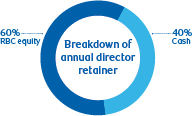
| 2. Investment of director fees
Director investments in RBC equity are facilitated through the director share purchase plan (for common shares) and the director deferred stock unit plan (for DDSUs). DDSUs are notional units that have the same value as RBC common shares. When a DDSU is credited to or redeemed by a director, its value is calculated using the average closing price on the TSX of a common share over the five preceding trading days.
|
|
| 1 | In her capacity as a director of RBC Europe Limited, Ms. Norton receives an annual payment of $20,000 in recognition of the requirement to travel outside of North America crossing at least two or more time zones to attend meetings of the board of directors of RBC Europe Limited. |
| 2 | Effective November 1, 2025, the minimum equity ownership requirement for non-executive directors increased from four to five times the total director retainer within six years of joining the board. See page 23 for more information. |
23
Royal Bank of Canada
The annual meeting
Directors must invest at least 60% ($204,000 in fiscal 2025) of their annual director retainer (the equity portion) in either common shares or DDSUs. Until a director owns at least 1,000 common shares, the equity portion of the director retainer is paid in common shares. Shares are purchased at market price. Directors may invest up to 100% of the cash portion of their annual director retainer in either DDSUs or common shares. Directors cannot sell common shares purchased with the equity portion of their annual director retainer or redeem any DDSUs until they retire from the board.
The board chair must also invest at least 60% ($165,000 in fiscal 2025) of the annual board chair retainer in either RBC common shares or DDSUs. The board chair cannot sell shares purchased with the equity portion of the annual director or board chair retainers or redeem any DDSUs until retirement from the board.
3. Restrictions on trading and hedging RBC securities
Directors cannot:
| • | sell RBC securities directly or indirectly if they do not own or have not fully paid for them (a short sale) |
| • | directly or indirectly buy or sell a call or put on RBC securities, or |
| • | enter into equity monetization transactions that would have an effect equivalent to creating call or put rights in respect of RBC securities or other financial instruments designed to hedge or offset a decrease in the market value of RBC securities. |
Compensation for membership on subsidiary boards
From time to time, independent directors of RBC may be asked to serve as directors of RBC subsidiaries and are paid for their services and reimbursed for travel and other expenses. Both Mr. Chisholm and Mr. Vettese serve on the board of RBC US Group Holdings LLC (RBC US), our U.S. intermediate holding company, and in fiscal 2025 were each paid an annual RBC US non-executive director retainer of US$175,000.1 Ms. Norton was appointed to the board of RBC Europe Limited (RBC EL), our primary UK entity for securities trading, investment and wealth management activities, effective June 2, 2025, and was paid a pro-rated portion of the annual RBC EL non-executive director retainer in the amount of £45,833.35.2
Changes to compensation for fiscal 2026
As part of its annual review of the amount and form of director compensation described on page 22, in 2025 the governance committee retained an independent consultant, Hugessen Consulting (Hugessen), to review and provide advice on RBC’s director compensation, including design, competitiveness, peer group composition, market positioning and industry best practices. Fees in the amount of $65,925 were paid to Hugessen for these services. Hugessen also received fees for services rendered to the boards of directors of RBC EL and RBC US (see page 60 for additional information). The last independent review of RBC’s director compensation was conducted in 2022.
Pursuant to the findings of the independent review, the governance committee assessed director compensation with reference to the core considerations that guide its overall approach. This included the size, complexity and geographic scope of RBC, the responsibilities and time commitment associated with being a director, the competencies and experience required of directors (as reflected in the matrix on page 21), as well as the need for compensation that is fair and positions RBC to attract highly qualified directors. The assessment also took into account the importance of aligning director and shareholder interests, emerging trends in board compensation and director equity ownership guidelines.
Following its assessment, the governance committee determined that the current practice of paying a flat annual fee in Canadian dollars to all directors, regardless of country of residence, should be maintained. The flat annual fee, which covers attendance at regular and special board and committee meetings as well as all other regular director responsibilities, including typically serving on two committees, remains aligned with the board’s simple and transparent compensation structure.
In acknowledgement of the heightened responsibilities of directors, the increased time commitment required, and the need for fair and competitive compensation to attract and retain highly qualified directors, the governance committee recommended that the annual director retainer be increased from $340,000 to $415,000, with the equity portion increasing from $204,000 to $249,000. To further align the interests of directors and shareholders and reinforce the board’s stewardship role to enhance long-term shareholder value, the governance committee also recommended an increase to the minimum equity ownership requirement for directors from four to five times the total director retainer, to be met within six years of joining the board. As a result of these adjustments, the dollar value of the minimum equity ownership threshold will automatically increase to $2,075,000.
In recognition of the greater responsibility, time commitment and complexity of the board and committee chair roles, the governance committee recommended that the committee chair retainer be increased from $60,000 to $75,000 and the board chair retainer be increased from $275,000 to $335,000. Committee chair retainers were last modified in 2023, and the board chair retainer has not increased since 2002.
The foregoing changes, including changes to the equity ownership requirement, were, on the recommendation of the governance committee, approved by the board with effect from November 1, 2025.
| 1 | Effective November 1, 2025, the annual RBC US non-executive director retainer increased from US$175,000 to US$195,000. |
| 2 | The annual RBC EL non-executive director retainer is £110,000. |
24
Royal Bank of Canada
The annual meeting
Director compensation table
The following table sets out the total compensation paid to non-executive directors in fiscal 2025. Directors who served in any capacity for a portion of the fiscal year were compensated on a pro-rated basis.
In fiscal 2025, as a whole, directors received 94.1% of their compensation in equity.
| Directors |
Fees earned ($) |
All other ($) |
Total ($) |
Allocation of RBC fees ($) | ||||||||||||||||
|
Common |
Cash |
|||||||||||||||||||
| M. Bibic |
340,000 | – | 340,000 | 340,000 | – | |||||||||||||||
| A. Chisholm1,2 |
400,000 | 245,175 | 645,175 | 645,175 | – | |||||||||||||||
| J. Côté3 |
615,000 | – | 615,000 | 547,000 | 68,000 | |||||||||||||||
| T. Daruvala |
340,000 | – | 340,000 | 340,000 | – | |||||||||||||||
| C. Devine4 |
390,000 | – | 390,000 | 390,000 | – | |||||||||||||||
| R. Jamieson |
340,000 | – | 340,000 | 340,000 | – | |||||||||||||||
| A. Norton5 |
340,000 | 104,466 | 444,466 | 204,000 | 240,466 | |||||||||||||||
| B. Perry |
340,000 | – | 340,000 | 340,000 | – | |||||||||||||||
| M. Turcke6 |
400,000 | – | 400,000 | 400,000 | – | |||||||||||||||
| T. Vandal7 |
400,000 | – | 400,000 | 400,000 | – | |||||||||||||||
| F. Vettese1,8 |
350,000 | 245,175 | 595,175 | 595,175 | – | |||||||||||||||
| J. Yabuki |
340,000 | – | 340,000 | 340,000 | – | |||||||||||||||
| TOTAL |
4,595,000 | 594,816 | 5,189,816 | 4,881,350 | 308,466 | |||||||||||||||
| 1 | Fees under “All other compensation” reflect the annual board retainer for serving on the board of RBC US. U.S. dollar compensation has been converted to Canadian dollars using the Bank of Canada’s foreign exchange rate of US$1.00 = C$1.4010 on the last trading day of the 2025 fiscal year (October 31, 2025). Effective November 1, 2025, the annual RBC US director retainer increased from US$175,000 to US$195,000. |
| 2 | Fees include the risk committee chair retainer. |
| 3 | Fees include the board chair retainer. |
| 4 | Effective January 1, 2025, Ms. Devine was appointed as chair of the audit committee and received a pro-rated portion of the audit committee chair retainer. |
| 5 | Effective June 2, 2025, Ms. Norton was appointed to the board of RBC EL and received a pro-rated portion of the annual director retainer for serving on the board of RBC EL. Fees under “All other compensation” reflect this pro-rated portion of the annual board retainer. U.K. pound sterling compensation has been converted to Canadian dollars using the Bank of Canada’s foreign exchange rate of £1.00 = C$1.8429 on the last trading day of the 2025 fiscal year (October 31, 2025). Fees under “All other compensation” also reflect an annual payment of $20,000 that Ms. Norton receives in her capacity as a director of RBC EL in recognition of the requirement to travel outside of North America crossing at least two or more time zones to attend meetings of the board of directors of RBC EL. |
| 6 | Fees include the governance committee chair retainer. |
| 7 | Fees include the human resources committee chair retainer. |
| 8 | Effective January 1, 2025, Mr. Vettese retired as chair of the audit committee and received a pro-rated portion of the audit committee chair retainer. |

26
Royal Bank of Canada
Governance
The board is committed to high standards of governance that are consistent with regulatory expectations and evolving best practices that are aligned with the bank’s strategy and risk appetite. The board believes that good governance is more than overseeing RBC and its practices – it requires transparency, accountability and integrity. It means having an independent board that actively engages with stakeholders, understands the business and its risks, constructively challenges management and navigates the complexities of a changing world. It also means upholding robust standards and principles to guide RBC in delivering on its Purpose of helping clients thrive and communities prosper, while enhancing value for its shareholders.
The core principles that drive the board’s approach

|
Culture and conduct By setting the tone from above, the board champions the values of trust, integrity and good governance. | |

|
Stewardship Directors are the stewards of RBC, exercising independent judgment in overseeing management and safeguarding the interests of shareholders and other stakeholders. | |

|
Strategic oversight Directors are key advisors to management, advising on strategic direction, objectives and action plans, taking into account business opportunities and the bank’s risk appetite. | |

|
Risk oversight The board oversees the frameworks, policies and systems to identify and manage risks to the businesses and seeks to embed a strong risk-aware culture throughout RBC. | |

|
Independence
Independence from the bank and management is fundamental to the board’s effective oversight, and mechanisms are in place to ensure its independence. | |

|
Accountability
Transparency is a hallmark of good governance. The board is committed to clear and comprehensive financial reporting and disclosure and to constructive shareholder and stakeholder engagement. | |
|
|
Continuous improvement
The board is committed to continuously improving its corporate governance principles, policies and practices. | |
The board exercises its authority in accordance with the Bank Act (Canada) and other applicable laws and regulations, including those of the Canadian Securities Administrators, the Toronto Stock Exchange, the New York Stock Exchange and the U.S. Securities and Exchange Commission.
27
Royal Bank of Canada
Governance
The bank’s governance structure establishes the fundamental relationships among the board, its committees, management, shareholders and other stakeholders.
The board defines the values that set the tone of the bank’s organizational culture, as well as its strategic and corporate objectives, and the board determines the plans for achieving and monitoring performance through this structure.
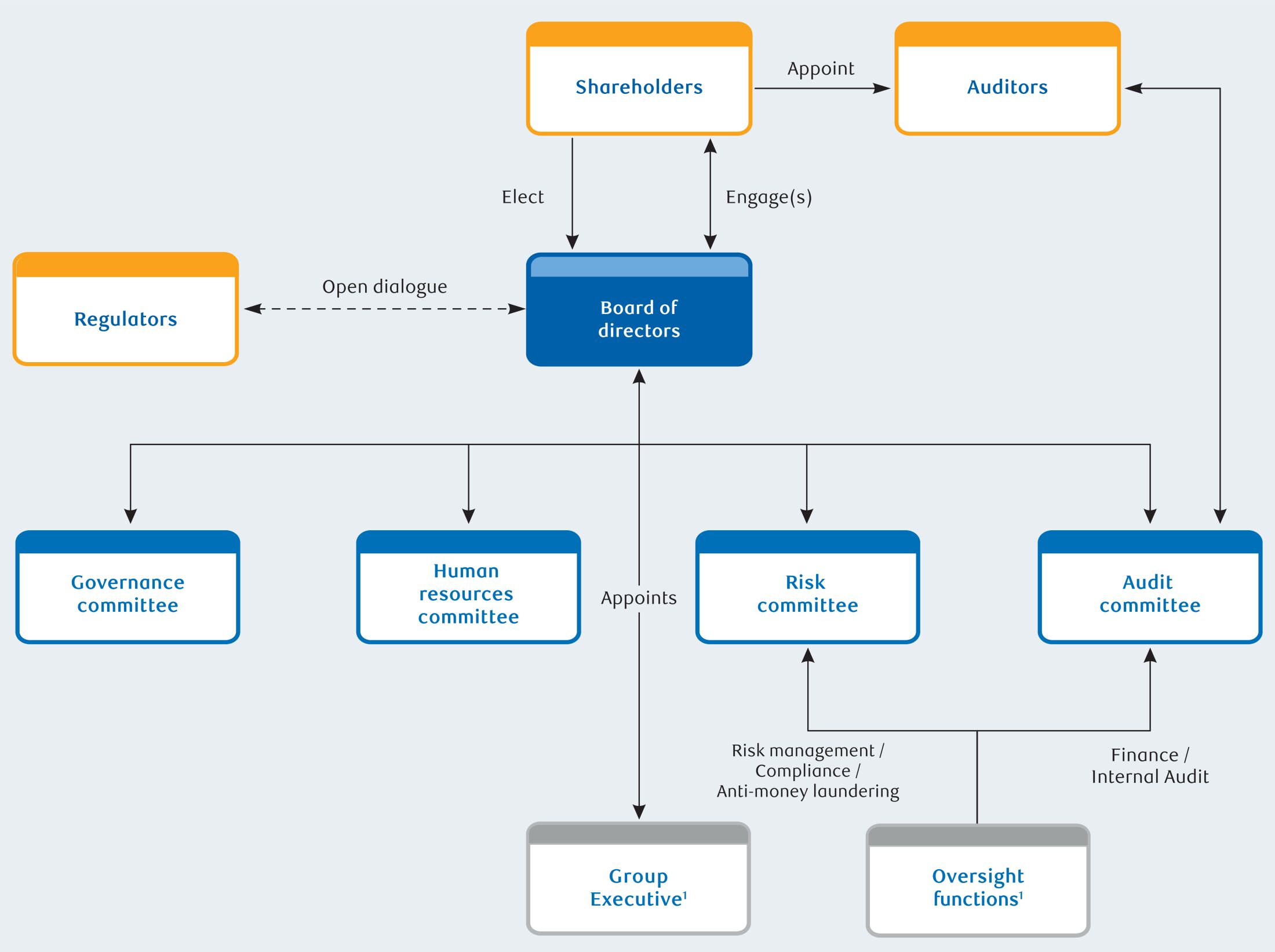
| 1 | The board approves the appointment of the Group Executive as well as the heads of the oversight functions who are not members of the Group Executive. |
Role of the board
|
Directors oversee management and aim to enhance long-term shareholder value.
|
The board makes major policy decisions, participates in strategic, financial and risk planning, oversees major transactions and reviews management’s performance and effectiveness. The Bank Act (Canada) and the Office of the Superintendent of Financial Institutions’ (OSFI) Corporate Governance Guideline specify important matters the board must address, such as the approval of financial statements and declarations of dividends, enterprise strategy and risk appetite. The board reserves the right to make certain decisions and delegates others to management. The board requires that management seek approval for matters that exceed certain dollar thresholds.
28
Royal Bank of Canada
Governance
Role of the governance committee
The governance committee oversees board renewal and nominates directors for election or re-election (see pages 35 to 36 for more information on nominating directors). The governance committee also recommends committee membership and committee chair successors and oversees the process for board chair succession. Directors typically serve on two committees at a time, and many directors serve on every committee during their tenure as director.
The governance committee is responsible for overseeing director independence and compensation, subsidiary governance, and reviewing board, committee and chair mandates to take into account regulatory guidance and industry best practices. Through regular mandate reviews, the governance committee supports the board, its committees and chairs in remaining adaptive and responsive to new legal and regulatory requirements as well as industry best practices while continuing to practice strong oversight.
The governance committee chair, as well as each committee chair, reports to the board following each committee meeting.
Role of the board chair
|
Jacynthe Côté is the bank’s independent board chair.
|
Having an independent board chair strengthens the board’s independent oversight, contributing to more effective accountability of management. The board chair leads board and shareholder meetings and is responsible for the management, development and effective functioning of the board. While the board chair does not serve on any board committee, she attends and participates in committee meetings. The board chair does not have the deciding vote if a board vote results in a tie.
Among other things, the board chair also:
| • | advises the CEO on major issues and liaises between the board and management |
| • | participates in the orientation of new directors and the continuing development of current directors |
| • | with the governance committee, conducts the board’s effectiveness evaluation (see page 40) and plans board succession and recruitment |
| • | interacts with directors and senior executives throughout the year |
| • | meets with regulators, shareholders and stakeholders on behalf of the board, and |
| • | periodically attends subsidiary board and committee meetings and meets with independent directors of certain subsidiaries. |
The board reviews and approves the board chair’s mandate, while the governance committee, under the direction of its chair, annually assesses the effectiveness of the board chair in fulfilling her mandate.
|
You can find the mandates of the board, committees and chairs at rbc.com/governance.
|
29
Royal Bank of Canada
Governance
The following table summarizes the key areas in which the board and its committees exercise independent oversight and hold management accountable in support of the board’s aim to enhance long-term shareholder value and oversee the bank in achieving its Purpose of helping clients thrive and communities prosper.
|
Culture |
• Establish the tone from above and champion RBC values, as set out in the bank’s Code of Conduct
• Set and expect the highest standards of conduct and integrity at RBC to build and maintain the trust of the bank’s clients, shareholders, employees and communities in which it operates
• Promote a respectful environment and encourage employees to help shape the bank’s culture by speaking up and challenging behaviours when they do not align with RBC’s values
| |
|
Strategic planning |
• Oversee the bank’s strategic direction, plans and priorities and ensure they align with its risk appetite
• Discuss and challenge management in setting enterprise strategy and monitor its implementation and effectiveness
• Annually approve the strategic plan, taking into account the opportunities and risks of the bank’s businesses
• Approve the bank’s financial objectives and operating plans, including significant capital allocations, expenditures and transactions that exceed delegated authorities
• Review and approve updates to RBC’s organizational structure
• Review business performance against approved strategic and financial objectives
| |
|
Risk management |
• Oversee and approve the bank’s risk appetite framework
• Oversee strategic risk management by approving risk management frameworks and policies
• Promote a strong risk-aware culture and monitor adherence to the enterprise-wide risk management framework
• Meet with regulators, including to discuss the bank’s risk appetite and control environment
| |
|
Financial
|
• Approve the bank’s quarterly and annual financial reports
• Oversee compliance with applicable audit, accounting, financial reporting, legal and regulatory requirements
• Oversee the qualifications, performance and independence of the external auditors and the performance of the internal audit function
• Monitor the implementation and maintenance of effective internal control systems, including management information systems, and assess their adequacy and effectiveness
| |
|
Talent
|
• Supervise succession planning processes, which include the selection, appointment and development of the CEO, the Group Executive and heads of the oversight functions who are not members of the Group Executive
• Evaluate and approve the compensation of the CEO, the Group Executive and heads of the oversight functions who are not members of the Group Executive in a manner consistent with prudential incentives
• Annually review and approve the CEO’s mandate
• Review key strategies and programs for the assessment and development of talent
| |
|
Sustainability |
• Oversee the bank’s approach to sustainability matters, including community investment, and management of environmental and social (E&S) risks and opportunities
• Oversee the bank’s key enterprise-wide sustainability disclosures, including annual enterprise sustainability reporting, the Human Rights Position Statement and the Statement Regarding Modern Slavery
| |
|
Corporate governance |
• Establish appropriate structures and procedures to allow the board to function effectively and independently
• Develop and implement corporate governance principles and guidelines and monitor best governance practices
• Oversee RBC’s enterprise-wide approach to subsidiary governance
|
30
Royal Bank of Canada
Governance
Approach to subsidiary governance
|
RBC takes an enterprise-wide approach to subsidiary governance.
|
The board and its committees oversee subsidiary governance at an enterprise level and the governance committee coordinates this oversight. Effective oversight by the board is supported by defined mechanisms for escalating subsidiary risk and governance issues, formal and informal touchpoints between the board, senior management and local subsidiaries, attendance by independent directors of certain subsidiaries at board or committee education sessions and regular enterprise-wide subsidiary reporting and approval of key enterprise-wide frameworks. In addition, the board chair and committee chairs periodically attend subsidiary board and committee meetings and meet with independent directors of certain subsidiaries.
The corporate governance of RBC subsidiaries is overseen by the bank’s Corporate Secretary and managed by the Subsidiary Governance Office through a network of global subsidiary offices that act as regional corporate governance hubs. This centralized governance model brings together global oversight and local expertise, driving consistency, transparency and responsiveness to evolving business needs, best practices and regulatory requirements and expectations while maintaining strong oversight and escalation mechanisms.
The bank’s policies on subsidiary board composition and functioning enhance our strong governance. Active and engaged subsidiary boards play a key role in overseeing our legal entities and facilitating information flow and escalation. Many of our subsidiaries have independent directors serving on their boards with specific skills and experience to support the RBC board in advancing the strategic priorities of RBC and its subsidiaries while providing oversight and effective challenge to management. From time to time, independent directors of RBC may be asked to serve as directors of RBC subsidiaries. In fiscal 2025, Mr. Chisholm and Mr. Vettese served on the board of RBC US Group Holdings LLC, and Ms. Norton joined the board of RBC Europe Limited effective June 2, 2025. We continue to focus on building subsidiary boards that reflect our focus on inclusion and leverage the subsidiary board experience to build talent for growth across the enterprise.
Engaging with shareholders and other stakeholders
|
Continuous and open dialogue with shareholders and other stakeholders is a key priority for RBC.
|
RBC engages with our shareholders and other stakeholders year-round on a broad range of topics, including strategic priorities, financial and risk-related matters, and developments in the macro and operating environment. In 2025, this engagement covered topics ranging from corporate governance, executive compensation, sustainability matters, including our approach to inclusion, climate-related risks and opportunities, Indigenous rights and human rights, as well as artificial intelligence.
The board encourages all stakeholders to provide timely and meaningful feedback, facilitates constructive engagement and regularly reviews the bank’s engagement with shareholders and stakeholders for alignment with best practices.
There are many ways people can engage with RBC and access important information:
|
Board of
|
Stakeholders can communicate with the directors or the board chair as described at rbc.com/governance.
| |
|
Management |
The CEO and other members of the Group Executive, senior management, Investor Relations and the Corporate Secretary’s Department meet regularly with financial analysts, investors and other stakeholders. The CEO, Group Executive and senior management also attend industry conferences from time to time.
| |
|
Investor
|
Investor Relations is responsible for communicating with the investing public on behalf of RBC.
| |
|
Live broadcasts |
We broadcast our quarterly earnings calls with analysts live and archive them on our Investor Relations site for a period of three months after each call. Shareholders can also participate in our annual meeting of shareholders via a live webcast.
|
Please refer to the back cover of this circular for the contact details of the board chair, secretary and Investor Relations.
31
Royal Bank of Canada
Governance
The board sets and expects the highest standards of conduct at RBC to build and maintain the trust of our clients, employees and shareholders, as well as the communities in which the bank operates. The board, with management, sets the tone from above and promotes an open and transparent culture at RBC.
To that end, the governance committee oversees the management of culture and conduct and monitors emerging trends through board and committee reporting on culture and conduct risks, such as client outcomes, organizational and employee conduct and risk culture, how RBC acts with integrity in financial markets, and impact on the bank’s reputation.
The governance committee meets with the Chief Human Resources Officer (CHRO), Chief Risk Officer (CRO), Chief Legal and Administrative Officer (CLAO) and Chief Compliance Officer (CCO) to review key matters and programs that strengthen enterprise culture and conduct risks practices.
The RBC Code of Conduct establishes standards of required behaviours that apply to directors of RBC and all its subsidiaries, all employees and contract workers, including the responsibility to be truthful, respect others, comply with laws, regulations and bank policies and engage in sales practices that are fair and not misleading.
The board closely collaborates with management to set the tone from above and promote a strong governance culture that influences RBC and its subsidiaries at every level and across all its global businesses. Consistent with industry standards, the board approves the Code of Conduct every two years or more frequently as appropriate to promote continued alignment with evolving regulatory expectations and industry best practices. The board last approved the Code of Conduct in December 2024.
The Code of Conduct sets out fundamental principles that guide the board in its deliberations. It creates a frame of reference for properly addressing sensitive and complex issues and requires directors, including those on subsidiary boards, senior management, employees and contract workers to report misconduct and outlines accountabilities if standards of conduct are not upheld.
RBC fosters an open and transparent environment where employees can speak up and raise concerns through various channels without any form of retaliation. The RBC global conduct hotline is a confidential channel that is accessible to all employees to raise concerns and report misconduct. A third party, independent of RBC, administers the hotline and employees can use it anonymously.
RBC has an online learning program and annual employee testing and acknowledgement to demonstrate that employees are familiar with and understand the values and principles outlined in our Code of Conduct. RBC directors must acknowledge each year that they have read and understand the Code of Conduct and certify that they are in compliance with it. The bank also has policies and procedures to address more specific aspects of fair business conduct, such as anti-bribery, anti-corruption and insider trading policies.
Waivers of the application of the Code of Conduct are considered only in exceptional circumstances. In the case of executive officers and directors, these waivers must be reported to the governance committee or the board and must be publicly disclosed in accordance with applicable law.
A copy of the Code of Conduct is available at rbc.com/governance and has been filed with Canadian securities regulators at www.sedarplus.com.
|
The board did not grant any waivers of RBC’s Code of Conduct to executive officers or directors in fiscal 2025.
|
Financial reporting hotline (Conduct hotline)
RBC’s stakeholders rely on the accuracy of its financial reporting. Employees and contract workers, senior management, directors of RBC and all its subsidiaries, and third parties are encouraged to report, on a confidential and anonymous basis, any allegations of wrongdoing relating to accounting, auditing or internal accounting controls via the RBC global conduct hotline. Details on the reporting hotline can be found at rbc.com/governance. Issues are investigated internally or by an independent external party, and any significant issues are raised with the audit committee chair.
32
Royal Bank of Canada
Governance
In practice, conflicts of interest can arise as a result of professional and contractual arrangements, directorships and other personal or business interests. As part of its oversight of conduct review, the governance committee establishes and monitors procedures to resolve conflicts of interest. Where the personal or business interests of directors and executive officers may conflict with those of RBC, they must disclose the nature and extent of the conflict of interest as soon as possible in writing or by requesting to have it entered in the minutes of the meeting. In the event of a conflict of interest, the director or executive officer in question will leave the meeting when the issue is discussed and, in the case of a director, will not vote or participate in the decision.
The governance committee is responsible for overseeing transactions with directors and senior officers of the bank who are related parties as defined under the Bank Act (Canada). It periodically approves the procedures governing permitted transactions with related parties and receives regular reports to ensure that transactions with related parties comply with the Bank Act (Canada) and internal procedures.
Trust and security are more important than ever, and RBC is focused on cybersecurity and safeguarding the security of our systems and the confidentiality of our clients’ information. The bank’s security strategy supports our strategic direction and is designed to safeguard data entrusted to us by clients. Globally, the volume and sophistication of cyberattacks continue to increase; the resulting implications could include business interruptions, service disruptions, financial loss, theft of intellectual property and confidential information, litigation, enhanced regulatory attention and penalties and reputational damage.
The board of directors and its risk committee play an active role in overseeing how the bank manages these risks. The board, which includes members with technology and digital experience, oversees the strategic direction, plans and priorities of the bank and ensures they align with the bank’s Enterprise Risk Appetite Framework, which the board approves annually. The board receives an annual cybersecurity update that provides an overview of the cyber threat landscape, evolving regulatory expectations and the bank’s strategic approach to managing cybersecurity. Additionally, the board participates in education sessions focused on cybersecurity and information technology (IT), including sessions focused on key cyber and IT risk concepts and the bank’s strategies for mitigating such risks. Management proactively keeps the board apprised of all significant matters or key updates that arise between regularly scheduled board and committee meetings. This includes key cybersecurity incidents or developments such as those involving critical vendors, third parties or peers.
The risk committee assists the board in overseeing risk management and reviews significant risks, including IT and cyber risks. The CRO regularly updates the risk committee on current notable risk matters, including evolving external risks related to IT and cyber such as third-party outages and software vulnerabilities, as well as current and anticipated trends in cyber events. The risk committee annually reviews the recommended enterprise-wide stress test scenarios and results, which in fiscal 2025 included stress testing exercises addressed at cyber threats, AI-driven fraud and data breaches, among several other top and emerging risks. The risk committee also reviews and approves the Enterprise Risk Management Framework, and supporting risk management frameworks, including the Enterprise Information Technology Risk Management Framework which establishes expectations for pragmatic IT risk management and governance.
Under the board’s oversight, RBC continues to enhance our security capabilities, educate our clients and workforce, and deepen the bank’s relationships with governments, law enforcement and academia to advance cyber defences for thwarting threats targeting the financial sector. RBC achieves this through continued investment in cyber technologies, driving the education and awareness of our clients and workforce, and leveraging emerging technologies.
For more information on how RBC safeguards the security of our systems and the confidentiality of our clients’ information, please visit rbc.com/cybersecurity.
33
Royal Bank of Canada
Governance
Sustainability governance and board oversight
The bank’s sustainability governance model balances the board and its committees’ oversight of the bank’s strategic approach to sustainability-related matters with specific subject-matter expertise rooted within the business segments and functions across the bank.
|
Key responsibilities
|
Spotlight on key 2025 highlights
| |||||||||
|
Board
| ||||||||||
|
• Responsible for the bank’s business
plan, strategy, risk appetite and
• Oversees RBC’s strategic approach to sustainability, which includes how it manages climate-related risks and opportunities (including target setting and monitoring progress towards those targets), community investment, as well as the enterprise approach to social matters |
Received an update on the bank’s sustainability strategy and climate strategy, and approved the RBC Purpose Framework – Ideas for People and Planet ®, the RBC Inclusive Opportunities Blueprint, the RBC Skills Blueprint and the RBC Climate Blueprint
| |||||||||
|
Reviewed and approved the Statement Regarding Modern Slavery 2024 (Canada, U.K. and Australia)
| ||||||||||
|
Reviewed and approved RBC’s inaugural Reconciliation Action Plan
| ||||||||||
|
Reviewed and approved the Enterprise Risk Appetite Framework, which incorporates consideration of E&S-related risks
| ||||||||||
|
Reviewed and approved the 2026 global community investment commitment and RBC Foundation® budget
| ||||||||||
|
Audit committee2 | ||||||||||
|
• Oversees the bank’s financial reporting, and related internal controls and disclosure controls and procedures, including the E&S-related disclosures in the bank’s annual report
• Oversees annual enterprise sustainability reporting |
Reviewed and approved the 2024 Public Accountability Statement (reviewed jointly with the governance committee)
| |||||||||
|
Reviewed and approved the 2024 Sustainability Report (reviewed jointly with the governance committee)
| ||||||||||
|
Received updates on the bank’s sustainability disclosure strategy and control environment, including an overview of regulatory developments and the bank’s readiness plan (jointly with the governance committee)
| ||||||||||
|
Reviewed the results of the annual enterprise-wide stress testing, which included climate-related physical and transition risk events (jointly with the risk committee)
| ||||||||||
|
Received updates on the evolving sustainability disclosure landscape, including regulatory and standard-setting developments and the bank’s readiness plan to comply with future requirements
| ||||||||||
|
Oversaw the bank’s annual financial reporting process and recommended the bank’s annual report, including E&S-related disclosures, for approval by the board
| ||||||||||
|
Governance committee2 | ||||||||||
|
• Advises the board on sustainability matters, including climate-related risks and opportunities, and provides oversight and coordination over sustainability for the board and its committees
• Advises on the status and adequacy of the bank’s efforts to meet high standards of E&S responsibility
• Oversees sustainability-related
disclosures, including supporting the audit committee in overseeing annual enterprise sustainability |
Reviewed and recommended the board approve the Statement Regarding Modern Slavery 2024 (Canada, U.K. and Australia)
| |||||||||
|
Reviewed the 2024 Public Accountability Statement (jointly with the audit committee)
| ||||||||||
|
Received updates on shareholder proposals and stakeholder engagement, including those with a focus on sustainability matters and reviewed and approved the sustainability-related disclosures in the Sustainability matters section in the 2025 management proxy circular
| ||||||||||
|
Reviewed the 2024 Sustainability Report (jointly with the audit committee)
| ||||||||||
|
Received updates on the bank’s sustainability disclosure strategy and control environment, including an overview of regulatory developments and the bank’s readiness plan (jointly with the audit committee)
| ||||||||||
|
Reviewed and recommended the board approve RBC’s inaugural Reconciliation Action Plan
| ||||||||||
|
Received an update of corporate governance trends and developments in Canada, U.S. and Europe, including legal and regulatory developments regarding sustainability-related disclosure requirements
| ||||||||||
|
Reviewed and discussed Sustainability & Impact’s strategy (jointly with the audit committee) and reviewed and recommended the board approve the 2026 global community investment commitment and RBC Foundation budget
| ||||||||||
|
Human resources committee
| ||||||||||
|
• Oversees the bank’s compensation principles, policies and programs
• Recommends for board approval, CEO and Group Executive compensation, including incentives, which consider, among other factors, sustainability and governance practices
• Responsible for talent management and human resources strategies
|
Reviewed and recommended the board approve CEO and Group Executive compensation for fiscal 2025, which considered, among other factors, sustainability and governance practices in the bank’s short-term incentive program and a discretionary climate-based modifier3 related to progress towards the strategic priorities of the RBC Climate Blueprint to the mid- and long-term incentive program, as more fully described on page 70 of this circular
| |||||||||
|
Received updates on executive staffing and progress on talent goals and succession planning at each regular meeting
| ||||||||||
|
Risk committee
| ||||||||||
|
• Oversees significant and emerging risks to the bank, including E&S risks
• Recommends for board approval our Enterprise Risk Appetite Framework, which incorporates consideration of E&S risks for risk management decisions |
Received quarterly updates on the bank’s E&S risk profile and top and emerging risks, including climate-related trends
| |||||||||
|
Received updates on E&S third party risks, including industry trends, regulatory developments and stakeholder perspectives in relation to sustainability matters including climate impact
| ||||||||||
|
Reviewed the results of the annual enterprise-wide stress testing, which included climate-related physical and transition risk events (jointly with the audit committee)
| ||||||||||
|
Reviewed and recommended the board approve the Enterprise Risk Appetite Framework and approved the Enterprise Risk Management Framework, which incorporates consideration of E&S risk
| ||||||||||
| 1 | “Sustainability” in this section of the circular refers to E&S matters. |
| 2 | Beginning January 30, 2025, the audit committee assumed responsibility for approving the bank’s annual enterprise sustainability reporting. Previously, the governance committee was responsible for approving the bank’s annual enterprise sustainability reporting. |
| 3 | Excludes the CEO and Group Head, RBC Capital Markets, who participates in the Capital Markets Compensation Program. Refer to page 72 for our discussion of how sustainability factors are incorporated into the Capital Markets Compensation Program. |
34
Royal Bank of Canada
Governance
Providing inclusive opportunities
Inclusion at board level1
Balanced and inclusive representation is critical to successful board oversight. To help achieve this objective, the board has approved a Board Diversity Policy which states that diversity is a critical lens through which the governance committee assesses each director candidate in seeking representation on the board of the full range of characteristics necessary to meet its goals of excellence, innovation and success. Pursuant to the Board Diversity Policy, various dimensions of diversity are always important factors considered by the governance committee. The Board Diversity Policy also requires that men and women each comprise at least 35% to 45% of directors. In 2025, 5 (38%) directors were women, meeting the requirements of the Board Diversity Policy (such requirements have been met in each year that they have been in effect).
Each year, the governance committee completes a self-assessment that measures, among other things, its effectiveness in guiding the board towards its objective of maintaining balanced and inclusive representation on the board. It also reviews the board’s composition and any anticipated vacancies through the lens of our Board Diversity Policy. The governance committee regularly retains an independent search firm to support the identification of candidates with specific competencies, experiences or attributes it regards as key to the current and long-term strategic success of RBC.
Inclusion at executive level1
As of the date of this circular, 45% (5 out of 11) of the executive officers who make up the Group Executive are women. The bank does not establish specific diversity goals at the Group Executive level as this team is included among broader representation goals2 for the Canadian executive team. As with all leadership roles the bank needs to carefully consider a broad range of criteria – most importantly, the appropriate matching of business needs to enhance long-term value for our shareholders and the proven skills and capabilities of new appointees. All members of the Group Executive speak English fluently, one speaks French fluently and one can speak another language.
|
With the exception of RBC’s CEO, all 2026 director nominees are independent.
|
To be effective, the board must be independent. To this end, the board has adopted a Director Independence Policy that incorporates the “affiliated persons” regulations from the Bank Act (Canada) and the definition of “independence” from the Canadian Securities Administrators guidelines. It also sets additional standards for members of the audit committee and the human resources committee. The Director Independence Policy is filed with Canadian securities regulators at www.sedarplus.com and is available at rbc.com/governance.
Assessing director independence
Directors are independent only if they are unaffiliated with RBC and the board has determined that they have no direct or indirect material relationship with RBC that could interfere with their independent judgment.
To determine whether directors are independent, the board uses information about their personal and business relationships with RBC, including their personal banking and financial services information. The board collects this information from sources such as:
| • | director responses to an annual detailed questionnaire |
| • | director biographical information, and |
| • | internal records and reports on relationships between directors, entities affiliated with directors and RBC. |
The board tests relationships between directors and RBC using materiality thresholds set out in the bank’s Director Independence Policy. The board also considers other facts and circumstances it deems relevant to determine whether any of these relationships could reasonably be expected to interfere with a director’s independent judgment. It considers the nature and extent of these relationships and their importance not only to directors and to RBC, but also to entities with which directors are affiliated.
Under the Bank Act (Canada), the CEO must be a member of the board. He is the only director who is not independent.
| 1 | Pursuant to National Instrument 58-101 — Disclosure of Corporate Governance Practices, the bank is required to disclose whether it has adopted a written policy relating to the identification and nomination of women directors and the annual and cumulative progress in achieving the policy’s objectives. The bank is also required to disclose how the governance committee considers the level of representation of women on the board in identifying and nominating candidates for election or re-election to the board. Finally, the bank is also required to disclose whether it has adopted a target regarding women on its board and in executive officer positions as well as the number and proportion of directors and executive officers who are women. |
| 2 | Our goals are aspirational in support of our efforts to provide fair and inclusive access to hiring and advancement opportunities for all employees. |
35
Royal Bank of Canada
Governance
Guidelines to address other professional activities
Directors must notify the board chair, governance committee chair and secretary before they engage in any new professional activities, including as a director (public, private or not-for-profit), employee, advisor or consultant. The board chair and governance committee chair assess whether the director will have time to devote to RBC responsibilities and evaluate potential circumstances that could impact independent thinking, including conflicts of interest.
|
Board interlock policy |
No more than two RBC board members may serve as director on the same public company board. Currently no RBC director serves on another public company board with another RBC director.
| |
|
Service
on
|
No member of the RBC audit committee may serve on an audit committee of more than two other public companies. Currently, no RBC audit committee member serves on an audit committee of more than two other public companies.
|
|
In fiscal 2025, all board and regularly scheduled committee meetings had an in camera session without management.
|
The board has established other important ways to maintain its independence.
|
Access to management
|
All independent directors have unrestricted access to management and RBC employees.
| |
|
External advisors |
Each board committee and, with the approval of the board chair, individual directors may retain external advisors at the expense of RBC to ensure they have access to independent advice.
| |
|
In
camera |
The board chair and committee chairs lead sessions without management to facilitate open and candid discussion among the directors.
|
Nominating, developing and evaluating board members
Finding the right director candidates
|
The board regularly retains an independent search firm to help identify candidates.
|
The board derives its strength from the collective balance of competencies and experience of its members.
The governance committee oversees board renewal and nominates independent candidates for election to the board. A key focus of the governance committee is to build a board that is composed of directors who collectively possess the competencies and experience to support the current and long-term strategic success of RBC, with strong risk discipline in the context of a financial services transformation shaped by an increasingly competitive global marketplace, evolving expectations of regulators and other stakeholders and by macroeconomic, technological and geopolitical developments. The governance committee reviews board composition and any anticipated board vacancies through the lens of the Board Diversity Policy. RBC shareholders elect the directors at each annual meeting to serve until the next annual meeting.
36
Royal Bank of Canada
Governance
The governance committee and the board chair consider all qualified individuals and maintain an evergreen list of candidates. Every year, the governance committee and the board chair review the credentials of candidates proposed for election or re-election to the board and assess their competencies and experience against those identified in the matrix (see page 21). The governance committee also considers the results of the board and director effectiveness evaluations when determining the candidate profile needed to support the bank’s strategic objectives.

|
Identified by: • search firms • directors • management • shareholders • individuals and |
• consider future strategic objectives and risks • reference matrix • assess qualifications • consider the objectives of maintaining balanced and inclusive representation on the board • review independence • check conflicts • interview process |
• governance committee • board approves • shareholders elect |
4 |
new directors since 2021 |
|
Shareholders
|
Shareholders may submit candidates to the board chair.
| |
|
Under
the
|
In accordance with the Bank Act (Canada), qualifying shareholders may submit a formal proposal to nominate an individual for director.
| |
|
Under the Proxy Access
|
The RBC Proxy Access Policy provides an additional way for shareholders to submit director nominations and can be found at rbc.com/governance.
| |
|
Individuals and other
|
Individuals and other stakeholders may also submit candidates to the board chair.
|
Contact information can be found on the back cover of this circular.
Nominating candidates for the board
The board nominates independent candidates possessing business and professional expertise, including relevant financial services industry and risk management expertise, senior-level involvement in major organizations, international experience and a history of achievement and performance at the highest level. Residency and familiarity with geographic regions relevant to the bank’s strategic objectives are also considered.
To best support the bank in achieving its Purpose of helping clients thrive and communities prosper, all director nominees are required to have experience in environmental, social or governance matters. They must also share a commitment to RBC’s values. In line with the Board Diversity Policy, the governance committee also considers various dimensions of diversity.
37
Royal Bank of Canada
Governance
|
This year, 13 nominees are standing for election as a director.
|
When determining its optimal size, the board balances two competing priorities:
| • | the business need for a broad range of skills, experiences, perspectives and backgrounds that align with the near- and long-term strategic objectives of RBC and reflect its global client and stakeholder base, and |
| • | the need to be small enough to facilitate open and effective dialogue and thorough and responsive decision-making. |
Regulatory requirements and succession planning also play key roles in the board’s determination of its optimal size.
The board’s Majority Voting Policy states that any nominated director in an uncontested board election must immediately tender their resignation if they are not elected by at least a majority (50% plus 1 vote) of the votes cast in their election. The board will determine whether to accept the resignation within 90 days. Absent exceptional circumstances, the board will accept the resignation, making it effective immediately.
A director who tenders a resignation will not participate in any meeting where the board or a committee is considering their resignation. RBC will promptly issue a news release with the board’s decision. If the board determines not to accept the resignation, the news release will fully state the reasons for that decision.
The board has a tenure policy that outlines term limits in order to:
| • | balance the benefits of experience with the need for new perspectives, and |
| • | achieve ongoing board renewal. |
|
Directors
|
A director’s term lasts 15 years or until they reach the age of 70, whichever comes first.
New directors may serve for at least six years, regardless of their age.
| |
|
Board chair |
The board chair’s term is five years.
| |
|
Committee
|
A committee chair’s term is three years, which may be extended for up to two years, if appropriate, considering the expertise required to lead the relevant committee.
|
Term limits do not take precedence over the board’s annual director effectiveness evaluation. Nominations for re-election as director will be based on the needs of the board and RBC given its strategic objectives and will take into consideration the results of the effectiveness evaluation and peer reviews.
The board, upon the recommendation of the governance committee, may waive the term and/or age limits for a director and the term of the board chair or a committee chair. Pursuant to its responsibility for the management of board succession, the board approved a waiver of the age limit of Mr. Daruvala until the 2027 annual meeting of shareholders. The board also waived the term limit and approved an extension of the tenure of the human resources committee chair until the 2026 annual meeting of shareholders and approved the extension of the tenure of the risk committee chair until the 2027 annual meeting of shareholders.
A director is expected to submit their resignation to the board chair if:
| • | their qualifications, independence or other credentials change |
| • | they no longer meet the eligibility rules under the board’s conflict of interest guidelines, or |
| • | they are no longer qualified under the Bank Act (Canada) or other applicable laws. |
The governance committee will make a recommendation to the board on whether it should accept the resignation. A director who tenders a resignation does not participate in the discussion or decision-making process.
38
Royal Bank of Canada
Governance
Helping directors succeed in their roles
The board strives to ensure that new directors receive a thorough introduction to their role and that all directors have access to the resources they need to focus on ongoing development. The governance committee is responsible for making the transition of new directors as seamless as possible and equipping them with the right tools to succeed and make valuable contributions to the board and RBC.
The board’s principles-based approach reflects three key pillars to facilitate an agile and adaptive board.
Principles-based approach to director development
|
|
INTEGRATION
• Mentorship program matching new directors with experienced members
• One-on-one meetings with the board chair and committee chairs to enhance their understanding of the board’s culture and dynamics |
|
||||||||||||||||
|
• Ongoing engagement with members of the Group Executive and senior management to deepen knowledge of the bank’s strategic objectives and foster open dialogue and constructive relationships
|
||||||||||||||||||
| PERSONAL DEVELOPMENT
|
||||||||||||||||||
| • Education sessions and materials may include: |
||||||||||||||||||
| - presentations by senior executives on various topics including specialized and complex aspects of RBC’s businesses and operations |
|
|||||||||||||||||
| - external presentations, where featured speakers provide insights on a variety of topics, including the economic and political landscape as well as emerging industry, regulatory and market trends |
||||||||||||||||||
| ORIENTATION
• In-depth orientation guide covering the board’s governance principles and policies, including the bank’s Code of Conduct and Director Independence Policy |
- areas of shared concern or oversight covered in joint educational sessions across committees
- media updates and investor relations reports on key topics, the bank’s media presence and market trends
- regular updates about educational opportunities outside RBC |
|||||||||||||||||
|
• Strategic and business deep-dives with members of the Group Executive and senior management
• Onboarding sessions with oversight functions, governance and legal executives to advise directors on their obligations and the internal controls and practices in place at RBC
• Attendance at committee meetings even if a director is not a committee member
• Committee chair orientation with executive sponsors and the secretary
|
• Directors have full access to committee education sessions regardless of committee membership. They may also receive educational materials and updates between board meetings on matters relevant to RBC’s businesses. Directors have membership at the Institute of Corporate Directors (Canada) and National Association of Corporate Directors (U.S.).
|
|||||||||||||||||
39
Royal Bank of Canada
Governance
Periodically, the board holds meetings in key jurisdictions to further learn about RBC’s businesses and connect with local senior management, employees and directors of key subsidiaries. In October 2025, the board and its committees held meetings in Los Angeles, California, as described in the table below.
Focus on continuous education
The board and management remain focused on the key issues impacting RBC as well as the bank’s clients, employees, shareholders, communities and other stakeholders. In fiscal 2025, we took a coordinated approach to education with the board and its committees organized around the themes of market, macroeconomic environment, cybersecurity, data management, artificial intelligence, sustainability and governance, regulatory and geopolitical matters. Directors also attended several smaller events with executives and employees, giving directors the opportunity to gain further insights into RBC’s businesses and functions throughout the year.
|
Quarter
|
Education
|
Attended or
| ||||
| Q1 2025 |
Overview of U.S. anti-money laundering regulatory environment and enforcement regime
|
|
Board
| |||
| Review of RBC Insurance® through a risk lens
|
Risk
| |||||
| Update on the evolving cyber threat landscape
|
Board
| |||||
| Review of regulatory expectations on data risk management
|
|
Risk
| ||||
| Q2 2025 |
Overview of the approach to interest rate and asset liability management
|
Audit, Risk
| ||||
| Review of the regulatory environment for effective supervisory controls, including those related to the detection and escalation of any prohibited activity in the first line of defence
|
Audit | |||||
| Review of board composition and benchmarking to support director recruitment and succession planning
|

|
Governance
| ||||
| Review of top and emerging drivers of third-party risk across the financial services industry and evolving regulatory expectations
|
Risk
| |||||
| Overview of sustainability reporting developments, including regulatory changes and shifts in the external reporting landscape
|
Audit, Governance
| |||||
| Review of OSFI’s final guidelines on assurance requirements for capital, leverage and liquidity returns
|
Audit
| |||||
| Review of Canadian and global tax developments
|
Audit
| |||||
| Update on developments in Canada-U.S. trade, including the impact of tariffs
|
Risk
| |||||
| Review of key events, including economic and market updates, impacting risk appetite and risk profiles in the Canadian banking industry
|
Risk
| |||||
| Review of the bank’s fraud risk profile and management practices
|
Risk
| |||||
| Q3 2025 |
Moderated discussion on Canada-U.S. relations with a featured speaker
|
|
Board
| |||
| Overview of the expected credit loss measurement framework in International Financial Reporting Standards (IFRS 9) – Financial Instruments
|
Audit, Risk
| |||||
| Review of industry trends and regulatory views on technology in internal audit, including data disruption and artificial intelligence
|
Audit
| |||||
| Review of drivers, business volumes and regulatory requirements and expectations relating to financial crime
|
Risk | |||||
| Review of results and key highlights from the 2025 proxy season: Canadian and U.S. financial institutions
|
Governance
| |||||
| Update on key Canadian and U.S. regulatory and governmental developments
|
Governance
| |||||
| Review of RBC’s inaugural Reconciliation Action Plan
|
Governance
| |||||
| Q4 2025 |
External insights on payments and transaction banking, including trends and associated strategies
|
|
Board
| |||
| Review of developments in payments and transaction banking, including disruptions driven by technology, the rise of agentic commerce, and related implications
|
Board | |||||
| External feedback on RBC’s 2025 Investor Day and future growth expectations
|
|
Board
| ||||
| Update on RBC’s Leadership Strategy
|
Human Resources
| |||||
| Review of artificial intelligence through a risk lens
|
Risk
| |||||
| Overview of financial instruments and valuation principles, accounting, and governance, including the application and impact of valuations in the current market landscape
|
Audit
| |||||
| Overview of primary and emerging risks in financial crimes
|
Risk
| |||||
| Update of corporate governance trends and developments in Canada, U.S. and Europe
|
|
Governance
| ||||
| Industry review of director compensation trends
|
|
Governance | ||||
| Review of top financial and non-financial risks in the U.S.
|
Risk
| |||||
| Overview of geopolitical, societal, technological, policy and regulatory, environmental and economic trends impacting the risk landscape
|
Risk | |||||
| Los Angeles, California meetings
|
||||||
| Moderated discussion on the entertainment segment with a featured speaker
|
|
Board
| ||||
| Moderated discussion on capital markets with a featured speaker
|
|
Board
| ||||
| Panel discussion on market developments in entertainment and sports banking and commercial banking
|
Board
| |||||
| Moderated discussion on AI innovation with a featured speaker
|
|
Board
| ||||
External presentation
40
Royal Bank of Canada
Governance
Evaluating the board, committees, chairs and directors
The board and its committees annually review their effectiveness as part of their commitment to continuously improve their oversight and constructive challenge of management. The governance committee oversees the assessment process, which includes a board effectiveness survey, evaluations of the board chair and each committee chair, self-assessments and peer reviews of each independent director, and one-on-one interviews with each committee chair. The results highlight strengths, identify opportunities, and inform the board’s priorities, approach to education, and action plans for the following year. The evaluations also inform the governance committee’s assessment of the competencies and experience director nominees need for election or re-election.
Annual evaluations
Annual evaluations of the board and each committee are supplemented with input from members of the Group Executive on areas such as board and committee processes, interaction with management and overall effectiveness.
Updates on priorities and action plans are provided to the board and committees by the board chair and committee chairs throughout the year. This approach creates an effectiveness evaluation that is an ongoing and dynamic part of the functioning of the board and its committees.
|
In 2025, the board retained a new independent consultant to provide fresh perspectives and insights on assessing its effectiveness as a board and as directors.
|

| Feedback is collected through questionnaires and one-on-one interviews with committee chairs administered by an independent consultant. Feedback is also collected through meetings between the board chair and the committee chairs as well as one-on-one meetings between the board chair and each director.
The board is evaluated by all directors and the Group Executive.
The board chair is evaluated by all directors and the Group Executive.
The committees and committee chairs are evaluated by committee members and applicable members of the Group Executive.
Each independent director completes a personal and peer review. |
The independent consultant analyzes the feedback and peer reviews and prepares the reports.
The board and governance committee review the board and board chair reports. The governance committee chair reports to the board on the effectiveness of the board chair.
The governance committee and applicable committees review the committee and committee chair reports. The board chair also reviews the committee chair reports.
The board chair reviews the independent director peer reviews with each independent director. The governance committee chair reviews the board chair’s performance assessment with the board chair. |
Priorities and action plans are developed for the board and committees as well as the board chair.
Development opportunities are identified and discussed with the board chair as required, for each independent director.
Reports and peer reviews are taken into consideration during the re-nomination process. |
41
Royal Bank of Canada
Governance
|
The board is satisfied that its activities over the fiscal year have fulfilled its charter.
|
| Members (fiscal year end)
|
• J. Côté (chair), M. Bibic, A.
Chisholm, T. Daruvala, C. Devine, R. Jamieson, D. McKay (President and CEO), A. Norton, B. Perry, M. Turcke, | |
| Meetings |
• Eight regular meetings were held in fiscal 2025.
• All eight regular meetings included an in camera session without management present.
| |
|
Responsibility
|
2025 Highlights
| |
| Strategic planning |
✓ Approved the bank’s 2026 enterprise strategy, operating plan, capital and funding plan and financial objectives.
✓ At each regularly scheduled meeting, the CEO reported on key strategic topics, such as business dynamics in the regions in which RBC operates, investor engagement, the integration of HSBC Bank Canada potential acquisitions and partnerships, major initiatives, as well as external factors impacting the bank’s strategic priorities, including economic and geopolitical developments.
✓ Held regular strategic sessions with senior management to review performance and progress across business segments and key functions, including an overview of the growth strategy for the retail Canadian personal banking business, Wealth Management Europe’s five-year strategy and long-term growth ambitions, as well as an update on RBC Capital Markets’ strategy with a focus on Global Markets.
✓ Engaged with management on the bank’s U.S. growth strategy, including RBC’s strengths in the U.S. market, efforts to streamline the U.S. operating model, ongoing development of the U.S. cash management business and key pillars underpinning the strategy.
✓ Received an update on the bank’s sustainability strategy and climate strategy and approved the RBC Purpose Framework – Ideas for People and Planet®, the RBC Inclusive Opportunities Blueprint, the RBC Skills Blueprint and the RBC Climate Blueprint.
✓ Participated and engaged with senior management at the annual strategy offsite, contributing to strategic planning and review of challenges and opportunities with a particular focus on the bank’s response to disruptions to the payments model, the bank’s position in global transaction banking, potential transformational growth opportunities, as well as a review and approval of the bank’s five-year financial outlook.
✓ Received updates on RBC’s AI & Digital Transformation program, including objectives to scale AI and digital capabilities across the bank.
✓ Attended panel discussions and interactive sessions on a variety of topics, including Canada-U.S. relations, external perspectives on payments and transaction banking, investor feedback on RBC’s 2025 Investor Day and future growth expectations, the entertainment segment, market developments in entertainment and sports banking, commercial banking and AI innovation.
| |
| Risk management |
✓ Approved the Enterprise Risk Appetite Framework.
✓ Received the annual cybersecurity and information technology risk update, covering the cyber threat landscape, evolving regulatory landscape and RBC’s strategic approach for growth and resilience. | |
42
Royal Bank of Canada
Governance
| Succession planning and evaluation of management performance and compensation |
✓ Approved the appointment of the new Chief Audit Executive (CAE).
✓ Approved succession plans for the CEO, the Group Executive and the heads of the oversight functions who are not members of the Group Executive, including evaluation of candidate readiness, development focus and actions to support leadership growth.
✓ Approved updates to the performance share unit program, including refreshing the performance peer group and confirming the board’s ability to make discretionary adjustments downward at vesting and payout.
✓ Approved and recommended that common shareholders approve, an amendment to the stock option plan to increase the number of common shares available for issuance under the stock option plan and expressly list in the amending provisions of the stock option plan certain amendments that require shareholder approval.
✓ Reviewed the performance assessment of the CEO against 2025 objectives and approved the CEO performance objectives, metrics and mandate for 2026.
✓ Reviewed the performance assessment of members of the Group Executive against 2025 objectives.
✓ Approved the compensation of the CEO for 2025, as well as target compensation for 2026, and approved the compensation of the members of the Group Executive for 2025, as well as target compensation for 2026.
✓ Approved the design and payouts for major compensation programs and 2025 pension plan funding.
| |
| Financial |
✓ Received quarterly and mid-quarter updates from the Chief Financial Officer (CFO) covering performance by business segment, key accounting and reporting developments, strategic progress and internal controls.
✓ Approved the bank’s quarterly and annual financial reports and declaration of the bank’s quarterly dividend.
✓ Recommended to shareholders the appointment of PwC as the shareholders’ auditor. | |
| Governance |
✓ Approved the director nominees for election, assessed expertise and independence of audit committee members and approved the adequacy of the composition of the human resources committee and assessed their independence.
✓ Approved amendments to the mandates of the audit committee, governance committee, risk committee and human resources committee, and waived the term limit of the human resources committee chair and approved an extension of the tenure of the human resources committee chair until the 2026 annual meeting of shareholders and the extension of the tenure of the risk committee chair until the 2027 annual meeting of shareholders.
✓ Approved the appointment of Cynthia Devine as chair of the audit committee.
✓ Received updates on key matters discussed at board and committee meetings of each of RBC US Group Holdings LLC and RBC Europe Limited.
✓ Approved the Statement Regarding Modern Slavery 2024 (Canada, U.K. and Australia).
✓ Approved RBC’s inaugural Reconciliation Action Plan.
✓ Approved an increase in director, board chair and committee chair compensation and an increase to the minimum equity ownership requirement.
✓ Approved the 2026 global community investment commitment and the RBC Foundation budget.
✓ Approved the annual report on the governance committee’s conduct review activities and the annual director’s report to the Financial Consumer Agency of Canada outlining the activities of the governance committee related to oversight of the bank’s compliance with the consumer provisions under the Bank Act (Canada). | |
43
Royal Bank of Canada
Governance
|
The committee is satisfied that its activities over the fiscal year have fulfilled its mandate.
|
| Members
|
• C. Devine (chair), T. Daruvala, B. Perry, M. Turcke, and F. Vettese
| |
| Financial literacy and audit expertise |
• All members of the audit committee are “financially literate” within the meaning of the Canadian Securities Administrators rules and the corporate governance listing standards of the New York Stock Exchange.
• C. Devine, B. Perry and F. Vettese, qualify as “audit committee financial experts”, as defined by the U.S. Securities and Exchange Commission.
| |
|
Meetings |
• Seven regular meetings were held in fiscal 2025 (four meetings also included joint sessions with the risk committee and two meetings also included joint sessions with the governance committee). The external auditor attended each meeting.
• All seven regular meetings included an in camera session without management present.
• The committee also held separate in camera sessions with the external auditor at five of the regularly scheduled meetings and, as required, with each of the CFO, CLAO, Executive Vice-President and CAE, and Vice-President, Client Complaints Appeal Office.
• Two education sessions were held in fiscal 2025 outside the regular meeting cycle, including one joint education session with the risk committee.
| |
|
Responsibility
|
2025 Highlights
| |
| Financial |
✓ Oversaw the bank’s quarterly and annual financial reporting process and recommended quarterly and annual financial reports for approval by the board and reviewed and recommended to the board for approval the declaration of the bank’s quarterly dividend.
✓ Received updates on critical accounting policies and estimates and reviewed significant judgments relating to a number of accounting matters including:
• allowance for credit losses for performing and impaired financial assets and in particular the estimation of the stage 1 and stage 2 allowance for credit losses, including consideration of the implications from trade disruptions such as tariffs;
• significant matters considered by management in determining the allowance;
• tax matters including a review of legislative tax changes and enhanced global tax compliance and reporting requirements; and
• goodwill impairment assessment.
✓ Received an overview of interest rate and asset liability management (jointly with the risk committee).
✓ Received an overview of the expected credit loss measurement framework in International Financial Reporting Standards (IFRS 9) – Financial Instruments (jointly with the risk committee).
✓ Reviewed disclosure controls and procedures and received progress updates on the bank’s internal controls over financial reporting program implemented pursuant to the Sarbanes-Oxley Act of 2002, as well as regular updates on the control environment, including control issues, associated risks and corrective actions.
✓ Reviewed Internal Audit’s assessment of the design and effectiveness of the bank’s risk governance framework (jointly with the risk committee).
✓ Received updates on the bank’s sustainability disclosure strategy and control environment, including an overview of regulatory developments and the bank’s readiness plan (jointly with the governance committee).
✓ Reviewed and approved the 2024 Sustainability Report and Public Accountability Statement (reviewed jointly with the governance committee).
✓ Received an overview of financial instruments and valuation principles, accounting, and governance, including the application and impact of valuations in the current market landscape.
| |
| External |
✓ Discussed with PwC its responsibilities in performing an integrated audit, its determination of areas of significant audit risk and related risk mitigation procedures and reviewed and approved its annual audit plan and associated fees.
✓ Discussed with PwC key accounting risks and significant judgments made by management.
✓ Received written confirmation from PwC of its independence and recommended to the board for recommendation to the shareholders the appointment of PwC as the shareholders’ auditor.
✓ Pre-approved all additional engagements with PwC (including any non-audit services).
✓ Completed an annual assessment of PwC’s performance based on (i) the quality of the team and service; (ii) independence, objectivity and professional skepticism; and (iii) candid and transparent communication. The assessment identified continued areas of focus, including (i) identifying opportunities to drive efficiencies while ensuring the highest level of audit quality; and (ii) opportunities to enhance and increase sharing of relevant global best practices and industry trends.
| |
44
Royal Bank of Canada
Governance
| Legal, capital and liquidity |
✓ Received regular updates on significant legal matters.
✓ Reviewed the 2025 enterprise-wide stress testing results and approved the Internal Capital Adequacy Assessment Process and made recommendations to the board to approve the 2026 capital and funding plan (jointly with the risk committee).
✓ Received an update on elevating RBC’s control environment (jointly with the risk committee).
✓ Received regular updates on the bank’s capital and liquidity position.
✓ Received updates on OSFI’s guideline on assurance requirements for capital, leverage and liquidity returns.
✓ Received updates on the evolving sustainability disclosure landscape, including regulatory and standard-setting developments and the bank’s readiness plan to comply with future requirements.
| |
| Oversight of |
✓ Reviewed and approved the finance function’s organizational structure, budget and resources, as well as the CFO Group’s charter and the CFO’s mandate.
✓ Received an update on the CFO Group’s strategy.
✓ Assessed the effectiveness of the finance function.
✓ Reviewed the performance assessment of the CFO.
| |
| Oversight of |
✓ Reviewed and approved the annual internal audit plan and monitored its execution.
✓ Reviewed and approved the Internal Audit function’s organizational structure, budget and resources and overall risk assessment methodology, as well as the internal audit charter and the CAE’s mandate.
✓ Reviewed quarterly reports of audit activities, findings and recommendations and assessed the effectiveness of the Internal Audit function, including an external quality assessment review of the internal audit function.
✓ Approved and recommended to the board the appointment of the new CAE.
✓ Reviewed the performance assessment of the CAE.
| |
| Subsidiary |
✓ Acted as the audit committee to certain regulated RBC subsidiaries.
✓ Received and reviewed the financial statements, internal control reports and reports from the CFOs of these regulated subsidiaries.
| |
Further information in respect of the audit committee can be found in the Audit Committee section of our 2025 annual information form dated December 2, 2025.
Auditor fees
Following a tender process, PwC was appointed our auditor by the board of directors on January 29, 2016, which was approved by RBC shareholders at the annual and special meeting of common shareholders held on April 6, 2016.
Fees relating to the years ended October 31, 2025 and October 31, 2024 to PwC and its affiliates, including the nature of each category of fees, are detailed below.
| Year ended October 31, 2025 ($ millions)
|
Year ended October 31, 2024 ($ millions)
|
|||||||||||||||||||||||
| Bank and subsidiaries
|
Mutual funds1
|
Total
|
Bank
and
|
Mutual funds1
|
Total
|
|||||||||||||||||||
| Audit fees |
|
55.7 |
|
|
3.1 |
|
|
58.8 |
|
|
50.6 |
|
|
2.8 |
|
|
53.4 |
| ||||||
| Audit-related fees |
|
10.4 |
|
|
– |
|
|
10.4 |
|
|
9.9 |
|
|
– |
|
|
9.9 |
| ||||||
| Tax fees |
|
0.2 |
|
|
0.4 |
|
|
0.6 |
|
|
0.1 |
|
|
0.3 |
|
|
0.4 |
| ||||||
| All other fees |
|
1.0 |
|
|
0.7 |
|
|
1.7 |
|
|
0.9 |
|
|
0.7 |
|
|
1.6 |
| ||||||
| Total fees |
|
67.3 |
|
|
4.2 |
|
|
71.5 |
|
|
61.5 |
|
|
3.8 |
|
|
65.3 |
| ||||||
| 1 | The mutual funds category includes fees paid for professional services provided by PwC for certain mutual funds managed by subsidiaries of the bank. In addition to other administrative costs, the subsidiaries are responsible for the auditor’s fees for professional services rendered in connection with the annual audit, statutory and regulatory filings and other services for the mutual funds in return for a fixed administration fee. |
45
Royal Bank of Canada
Governance
Audit fees
Audit fees were paid for professional services rendered by the bank’s independent auditor for the integrated audit of the 2025 Annual Consolidated Financial Statements of the bank, including its audit of the effectiveness of our internal control over financial reporting and any financial statement audits of our subsidiaries. In addition, audit fees were paid for services that generally only the bank’s independent auditor reasonably can provide, which includes services provided in connection with statutory and regulatory filings, including those related to prospectuses and other offering documents.
Audit-related fees
Audit-related fees were paid for assurance and related services that are rendered by the bank’s independent auditor and are not reported under the audit fees item above. These services consisted of:
| • | employee benefit plan audits; |
| • | due diligence related to mergers and acquisitions; |
| • | reports on control procedures at a service organization; |
| • | consultations and audits in connection with acquisitions, including evaluating the accounting treatment for proposed transactions; |
| • | attest services not required by statute or regulation; |
| • | reporting on the effectiveness of internal controls as required by contract or for business reasons; |
| • | the audits of various trusts and limited partnerships; and |
| • | consultations regarding financial and reporting standards. |
Tax fees
Tax fees were paid for tax compliance services including preparation of tax returns for certain mutual funds managed by subsidiaries of the bank and a subscription for services to provide specific tax data and information to complete routine tax schedules and calculations for clients.
All other fees
These services consist of translation of documents for us and certain of our subsidiaries, regulatory compliance services, as well as accounting and other research software subscriptions and publications.
46
Royal Bank of Canada
Governance
| The committee is satisfied that its activities over the fiscal year have fulfilled its mandate.
|
|
Members (fiscal year end)
|
• M. Turcke (chair), M. Bibic, A. Chisholm, C. Devine and R. Jamieson | |
|
Meetings |
• Six regular meetings were held in fiscal 2025 (two meetings also included joint sessions with the audit committee).
• All six regular meetings included an in camera session without management present.
| |
|
Responsibility
|
2025 Highlights
| |
| Monitor best |
✓ Approved and recommended to the board the Statement of Corporate Governance Practices.
✓ Received updates on key Canadian and U.S. regulatory and governmental developments.
✓ Reviewed updates on investor and proxy advisory firm perspectives and areas of focus on RBC’s governance practices.
✓ Reviewed highlights of the 2025 Canadian and U.S. financial industry annual general meeting season.
✓ Monitored the operations of the board’s committees, including the allocation of responsibilities, and recommended the board approve amendments to the audit committee, governance committee, human resources committee and risk committee mandates.
✓ Received an update of corporate governance trends and developments in Canada, U.S. and Europe.
| |
|
Director |
✓ Retained an independent consultant to review and benchmark board composition, experience and competencies to inform recruitment of new directors and approved updates to the matrix.
✓ Evaluated the composition, skills and tenure of the board and its committees and continued development of a director candidate pipeline with the support of an independent search firm.
✓ Approved and recommended to the board the director nominees for election and assessed directors’ independence.
✓ Assessed and determined the expertise and independence of audit committee members and approved the adequacy of the composition of the human resources committee, including an assessment of their independence.
✓ Approved and recommended to the board the appointment of Cynthia Devine as chair of the audit committee.
✓ Reviewed committee chair succession plans and recommended the board waive the term limit and approve an extension of the tenure of the human resources committee chair until the 2026 annual meeting of shareholders and the extension of the tenure of the risk committee chair until the 2027 annual meeting of shareholders.
| |
|
Director |
✓ Retained an independent consultant to provide an industry review of director compensation trends and provide advice on design, positioning and trends.
✓ Recommended the board approve an increase in director, board chair and committee chair compensation, as well as an increase to the minimum equity ownership requirement.
| |
|
Director, board
and committee |
✓ Oversaw the annual evaluation of the board’s and committees’ effectiveness and the report on their effectiveness, and retained a new independent consultant to manage the evaluation process.
✓ Developed and approved 2025 priorities for the board, board chair and the committee and reviewed mid-year and year-end progress reports against these priorities.
| |
|
Director
|
✓ Coordinated the continuing education and development of directors.
| |
|
Stakeholder
|
✓ Oversaw engagement with shareholders, industry and governance advisors on key and emerging governance topics and trends, including sustainability matters.
✓ Continued to engage with key regulators on supervisory priorities, as well as complaints-handling requirements, subsidiary governance, bank strategy and key risks.
| |
47
Royal Bank of Canada
Governance
|
Sustainability |
✓ Received updates on shareholder proposals and stakeholder engagement, including those with a focus on sustainability matters, and reviewed and approved the Sustainability matters section in the 2025 management proxy circular.
✓ Received updates on the bank’s sustainability disclosure strategy and control environment, including an overview of regulatory developments and the bank’s readiness plan (jointly with the audit committee).
✓ Reviewed the 2024 Sustainability Report and the Public Accountability Statement jointly with the audit committee and recommended that the board approve the Statement Regarding Modern Slavery 2024 (Canada, U.K. and Australia).
✓ Recommended the board approve RBC’s inaugural Reconciliation Action Plan.
✓ Reviewed and discussed Sustainability & Impact’s 2025 strategy (jointly with the audit committee).
✓ Reviewed and recommended the board approve the 2026 global community investment commitment and the RBC Foundation budget.
| |
|
Culture and conduct |
✓ Received reports on enterprise-wide culture and conduct risk matters, including those related to clients, employees, financial markets and reputational risks.
✓ Reviewed and approved the Enterprise Culture and Conduct Risks Framework that reflects best practices in risk management and governance.
✓ Reviewed and approved the RBC Conflicts of Interest Policy that sets requirements for management, governance and oversight of real, potential or perceived conflicts of interest.
✓ Reviewed and recommended the board approve the annual report on the governance committee’s conduct review activities and the annual directors’ report to the Financial Consumer Agency of Canada outlining the activities of the committee related to oversight of the bank’s compliance with the consumer provisions under the Bank Act (Canada).
| |
|
Subsidiary
|
✓ Acted as the conduct review committee for certain of our federally regulated financial institution subsidiaries.
✓ Received an update on strengthening subsidiary governance oversight.
✓ Approved the appointment of Amanda Norton to the board of RBC Europe Limited.
| |
48
Royal Bank of Canada
Governance
Human resources committee report
|
The committee is satisfied
that its activities over the fiscal year have fulfilled its mandate.
|
|
Members (fiscal year end)
|
• T. Vandal (chair), T. Daruvala, A. Norton, B. Perry, F. Vettese and J. Yabuki
| |
|
Meetings |
• Five regular meetings were held in fiscal 2025 (one meeting also included a joint session with the risk committee).
• All five regular meetings included an in camera session without management present.
• In camera sessions were also held with the external independent compensation advisor, Frederic W. Cook & Co., Inc. (FW Cook), at each regular meeting he attended where executive compensation was discussed.
| |
|
Responsibility
|
2025 Highlights
| |
|
Executive compensation |
✓ Reviewed our approach to executive compensation, including design and positioning relative to comparators.
✓ Reviewed and made recommendations to the board to approve updates to the performance share unit program, including refreshing the performance peer group and confirming the board’s ability to make discretionary adjustments downward at vesting and payout.
✓ Reviewed and made recommendations to the board to approve, and recommend that common shareholders approve, an amendment to the stock option plan to increase the number of common shares available for issuance under the stock option plan and expressly list in the amending provisions of the stock option plan certain amendments that require shareholder approval.
✓ Reviewed the CEO’s performance assessment against 2025 objectives and made recommendations to the board for the performance objectives and metrics and mandate for 2026.
✓ Reviewed and made recommendations to the board to approve the CEO’s compensation for 2025, as well as target compensation for 2026.
✓ Reviewed the performance assessment of certain members of the Group Executive against 2025 objectives.1
✓ Reviewed and made recommendations to the board to approve the compensation of members of the Group Executive for 2025, as well as target compensation for 2026.
✓ Reviewed and approved target compensation for 2025 for the new CAE.
✓ Reviewed and approved the compensation for 2025 of the CAE, CCO and Chief Anti-Money Laundering Officer (CAMLO), as well as target compensation for 2026.
| |
|
Compensation oversight
|
✓ Reviewed a pay-for-performance and realizable pay analysis of 2025 CEO pay conducted by FW Cook.
✓ Received the CAE’s report on compensation risk management and governance practices, including compliance with the Financial Stability Board (FSB) Principles and Standards and other applicable compensation regulations.
✓ Reviewed the alignment of variable compensation with potential and realized risks (jointly with the risk committee).
| |
| Oversight of programs, and pensions |
✓ Reviewed and made recommendations to the board to approve design and payouts for major compensation programs.
✓ Reviewed a report of RBC pension plans and plans of certain of its subsidiaries covering governance, oversight, controls, funding, performance and investment strategy and made recommendations to the board to approve 2025 pension plan funding.
✓ Approved the Change in Control Policy.
| |
|
Talent
and
|
✓ Reviewed and discussed the RBC leadership strategy, including its focus on driving strong succession, developing skilled and courageous leaders, and stewarding a winning culture.
✓ Received updates on executive staffing and progress on talent goals and succession planning at each regular meeting.
| |
|
Employee
|
✓ Received an update on the results of the annual employee engagement survey.
✓ Received an update on investments in the employee experience, including enhancements through technology solutions.
| |
| 1 | The performance assessments of the CFO and the CRO are reviewed at the audit committee and risk committee, respectively. |
49
Royal Bank of Canada
Governance
|
The committee is satisfied that its activities over the fiscal year have fulfilled its mandate.
|
|
Members (fiscal year end)
|
• A. Chisholm (chair), M. Bibic, R. Jamieson, A. Norton, T. Vandal and J. Yabuki
| |
|
Meetings |
• Seven regular meetings and three special meetings were held in fiscal 2025 (four meetings also included joint sessions with the audit committee and one meeting also included a joint session with the human resources committee).
• All seven regular meetings included an in-camera session without management present.
• The committee also held separate in-camera sessions at each regular meeting with the CRO and at each quarterly meeting with each of the CCO and CAMLO.
• Two education sessions were held in fiscal 2025 outside the regular meeting cycle, including one joint education session with the audit committee.
| |
|
Responsibility
|
2025 Highlights
| |
|
Risk
|
✓ Received reports on top and emerging risks including, among others, credit risk, including a focus on commercial real estate; operational risks, such as fraud, third-party, insider, model and security risks; regulatory developments; reputation risks; risks stemming from the evolving macroeconomic and geopolitical environment; climate risk and trends, including the impact of the California wildfires; heightened levels of financial crime risk; physical security risks; disaster recovery; and cybersecurity and IT risks, events and trends, including digital currency.
✓ Received regular updates on risk profile as it relates to the bank’s risk appetite.
✓ Discussed emerging risk trends shaping the bank’s risk environment, including industry trends, political and regulatory developments and shifting stakeholder perceptions.
✓ Discussed risks associated with AI, including the risk management levers to support AI and digital transformation.
✓ Discussed the potential impact of the trade uncertainty between Canada and the U.S.
✓ Discussed the approach to data strategy in light of the evolving risk landscape.
✓ Discussed key and emerging risks in the RBC Insurance segment, including alignment of strategy from a risk management perspective.
✓ Received regular updates from the CCO on regulatory compliance, including top compliance risks and regulatory updates.
✓ Received regular updates from the CAMLO on financial crimes reporting, including the regulatory environment.
✓ Received an overview on interest rate risk and asset and liability management (jointly with the audit committee).
✓ Received the annual benchmarking analysis of the bank’s risk performance and profile relative to peers as it relates to risk concentration, stability of earnings, liquidity and funding, capital adequacy and external/market views.
✓ Reviewed and approved the bank’s resolution plan.
✓ Received an update on developments in RBC’s operational resilience program.
✓ Received an overview of the bank’s fraud risk profile.
✓ Received a progress update on City National Bank’s risk maturity journey.
✓ Received internal and external insights into the bank’s financial crimes risk mitigation program and outcomes of a financial crimes program maturity assessment conducted by a third party.
✓ Reviewed the annual enterprise-wide stress testing scenarios and results and approved the Internal Capital Adequacy Assessment Process and made recommendations to the board to approve the 2026 capital and funding plan (jointly with the audit committee).
✓ Reviewed the alignment of variable compensation with potential and realized risks (jointly with the human resources committee).
✓ Received an overview of the expected credit loss measurement framework in IFRS 9 – Financial Instruments (jointly with the audit committee).
| |
50
Royal Bank of Canada
Governance
|
Risk framework and oversight |
✓ Reviewed and approved the Enterprise Risk Management Framework, the bank’s program for identifying, measuring, controlling and reporting on significant risks, as well as supporting risk management frameworks.
✓ Reviewed and made recommendations to the board to approve the Enterprise Risk Appetite Framework, which represents the amount and type of risk that RBC is willing to accept in the pursuit of its business objectives.
✓ Received an update on elevating RBC’s control environment, including the implementation and progress of the Risk & Controls Self-Assessment program (jointly with the audit committee).
✓ Reviewed the bank’s corporate insurance program and approach to mitigating and managing various risk exposures.
| |
|
Oversight of
|
✓ Reviewed and approved Group Risk Management’s organizational structure, budget and resources and the mandate of the CRO and CAMLO.
✓ Reviewed Internal Audit’s assessment of the design and effectiveness of the bank’s risk governance framework (jointly with the audit committee).
✓ Reviewed the performance assessment of the CRO.
| |
|
Oversight of independent control functions |
✓ Reviewed and approved the Compliance function’s organizational structure, budget and resources and the mandate of the CCO.
✓ Reviewed updates on engagement with global regulators and results of regulatory supervisory assessments of RBC.
✓ Reviewed the performance assessments of the CCO and CAMLO.
| |
|
Subsidiary
|
✓ Reviewed and approved the mandate of the U.S. Risk Committee of RBC US Group Holdings LLC.
✓ Reviewed and approved the US Resolution Plan – Delegations of Authority to RBC US Group Holdings LLC.
✓ Monitored actions related to meeting regulatory expectations.
| |

52
Royal Bank of Canada
Executive compensation
Letter from the human resources committee
Dear fellow shareholders,
RBC has been creating long-term value for its clients, shareholders, communities and employees for more than a century and a half. Today, the bank and its clients are navigating a rapidly changing economy and complex operating environment. To achieve its vision of being among the world’s most trusted and successful financial institutions, RBC must continue to stay ahead of its clients’ evolving needs by moving faster and thinking bolder and more globally than ever before.
In 2025, RBC accelerated its ambitions to create even greater value for those it serves. Despite a turbulent economic and market landscape, the bank delivered record performance, reflecting the resilience of its diversified business model, prudent risk management, capital strength, and the unwavering commitment of its employees to leverage their imagination and insights to meet the evolving needs of RBC’s clients.
Achieving RBC’s future growth ambitions requires a more globally connected bank working together as one team focused on tomorrow’s biggest growth opportunities in Canada, while scaling and unlocking new revenue streams in key markets and geographies, including the United States, the United Kingdom and Europe.
Against an increasingly competitive landscape and growing client expectations, RBC is investing in helping our people deliver unique insights and exceptional experiences to more than 19 million clients in Canada, the U.S. and 27 other countries. To attain this, RBC requires highly skilled and adaptable people, effective leaders and a culture that enables strong performance in a rapidly changing environment. This is why the bank is focused on further strengthening its leadership pipeline and equipping its workforce with skills to help enable them to anticipate disruption, adapt at speed and drive growth. RBC is dedicated to creating an environment where employees can grow and reach their career potential. RBC’s artificial intelligence (AI) capabilities are an important part of that commitment, as the technology is opening new opportunities for employees and the value they can create for clients.
With an innovative and talented workforce across 29 countries, RBC continually celebrates its employees for their integrity, accountability, and unwavering commitment to innovation. Dave McKay and his leadership team recognize that it is the daily actions of employees that help sustain RBC’s leadership position and uphold RBC’s Purpose of helping clients thrive and communities prosper. The board commends RBC’s employees for their willingness to make bold, innovative decisions and take on new challenges, which helped drive RBC’s success in 2025 and make the bank future ready.
|
RBC’s Purpose and strategic goals
| ||
|
Guided by our Vision to be among the world’s most trusted and successful financial institutions, and driven by our Purpose of helping clients thrive and communities prosper, RBC aims to be:
• In Canada: the undisputed leader in financial services,
• In the United States: the preferred partner to institutional, corporate, commercial and high-net-worth clients and their businesses, and
• In select global financial centres: a leading financial services partner valued for our expertise.
| ||
RBC performance in 2025
RBC is an all-weather bank, with the financial and strategic strength to support our clients and deliver value to shareholders through all economic cycles. RBC’s financial performance in 2025 demonstrated this by delivering exceptional financial results across its businesses during a year of significant macroeconomic uncertainty and market volatility. The bank’s employees around the world continued to go above and beyond for its clients and that, combined with the strength of RBC’s diversified business model across segments and geographies and strong balance sheet, culminated in earnings of $20.4 billion for fiscal 2025, up $4.1 billion or 25% year-over-year.
The bank achieved strong in-year progress against its medium-term objectives over three-year and five-year horizons. While investments to fund strategic opportunities, such as the acquisition of HSBC Bank Canada and operational improvements, including at City National Bank, impacted the bank’s three-year return on equity (ROE) objective, the bank met its medium-term diluted earnings per share (EPS) growth objective and maintained strong capital positions over both the three-year and five-year horizons. Effective fiscal 2026, the bank revised its ROE1 financial objective from 16%+ to 17%+ to reflect improving revenue productivity and cost efficiencies driven by the execution of its strategic initiatives.
RBC continues to make progress on what it committed to doing at its Investor Day: delivering premium returns and creating more value for clients through insights and trusted advice. The bank delivered exceptional shareholder value in 2025, with RBC’s share price up 22% year-over-year and a return of $11.3 billion to shareholders through common dividends and share buybacks. The bank entered the 2026 fiscal year as the 11th largest bank globally and 6th largest in North America by market capitalization.2
Financial results for
short-term incentive program
Net income (C$ billion)
|
$20.4 (reported)
2025
|
$16.2 (reported)
$16.6 3 (adjusted)
2024
|
Financial results for mid- and
long-term incentive programs
|
Medium-term objectives4 |
|
3-year |
|
|
5-year |
| ||||||||
| Diluted EPS growth of 7%+ |
|
8% |
|
|
13% |
| ||||||||
|
Return on equity of 16%+5 |
|
15.0% |
|
|
16.0% |
| ||||||||
|
Strong capital ratio (CET1)6 |
|
13.8% |
|
|
13.5% |
| ||||||||
|
Total shareholder return7,8 |
|
3-year |
|
|
5-year |
| ||||||||
|
RBC |
|
22% |
|
|
22% |
| ||||||||
|
Global peer average (excl. RBC) |
|
26% |
|
|
25% |
| ||||||||
| 1 Net income available to common shareholders, expressed as a percentage of average common equity. ROE is based on actual balances of average common equity before rounding.
2 As at October 31, 2025. Source: Bloomberg.
3 This is a non-GAAP measure and represents net income – adjusted used for the purposes of determining the 2024 short-term incentive (STI) program awards for CEO and Group Executive and may differ from the 2024 annual report. The net income target excluded HSBC Canada net income, HSBC Canada transaction and integration costs, and the impact of management of closing capital volatility related to the HSBC Canada transaction from the planning process. The overall impact of these adjustments was a higher adjusted net income of $16,640 million for STI purposes. For further details, including a reconciliation, refer to page 98.
4 A medium-term (3–5 year) objective is considered to be achieved when the performance goal is met in either a three- or five-year period. These objectives assume a normal business environment and our ability to achieve them in a period may be adversely affected by the macroeconomic backdrop and the cyclical nature of the credit cycle.
5 For fiscal 2026, we have revised our ROE financial objective to 17%+ to reflect improving revenue productivity and cost efficiencies driven by the execution of our strategic initiatives.
6 A risk-based capital measure calculated as CET1 capital divided by risk-weighted assets. The CET1 ratio is calculated in accordance with Office of the Superintendent of Financial Institutions’ (OSFI) Capital Adequacy Requirements (CAR) guideline.
7 Annualized total shareholder return (TSR) is calculated based on the Toronto Stock Exchange (TSX) common share price appreciation plus reinvested dividend income. Source: Bloomberg, as at October 31, 2025. Please refer to page 26 of our 2025 annual report.
8 Beginning in fiscal 2026, the achievement of top-half TSR will no longer be a medium-term objective. TSR performance relative to peers will continue to be a part of our overall evaluation of shareholder outcomes and in our compensation programs. However, we believe the achievement of our financial performance objectives is a better indication of our execution against strategic priorities. |
53
Royal Bank of Canada
Executive compensation
In 2025, RBC advanced its position as one of the world’s most trusted and successful financial institutions. The following highlights reflect some of RBC’s achievements in 2025:
| ✓ | Personal Banking ranked #1 in market share for all key retail products.1 |
| ✓ | Commercial Banking ranked #1 in market share in commercial lending and deposits.2 |
| ✓ | Capital Markets ranked the #1 Canadian bank-owned capital markets firm by revenue.3 |
| ✓ | RBC Wealth Management® ranked as the largest full-service wealth advisory business in Canada,4 the 6th largest full-service wealth advisory firm in the U.S.5 and the 5th largest wealth manager in the U.K.6 as measured by assets under administration (AUA).7 |
| ✓ | RBC Global Asset Management® ranked as the largest mutual fund company in Canada as measured by assets under management (AUM) (SIMA, as of September 2025). |
| ✓ | RBC Insurance ranked as the largest Canadian bank-owned life insurance company.8 |
| ✓ | Winner of 10 Ipsos 2025 Financial Service Excellence Awards among the Big Five banks, including four solo wins in the categories: Recommend to Friends or Family (Net Promoter Score), Financial Planning & Advice, ATM Banking Excellence and Online Banking Excellence. |
| ✓ | RBC ranked highest in customer satisfaction for the 2nd consecutive year in the J.D. Power 2025 Canada Retail Banking Satisfaction Study. |
| ✓ | Avion Rewards®, named International Loyalty Program of the Year (Americas) for the 3rd consecutive year (2025 International Loyalty Awards), with a long-term strategic loyalty partnership between Avion Rewards and Canadian Tire Corporation’s Triangle Rewards‡. |
| ✓ | Recognized as the Most Valuable Canadian Brand for the 7th consecutive year (Kantar BrandZ, since 2019). |
| ✓ | RBC Insurance was recognized for the Best Digital Insurance Initiative, Best Digital Transformation Program, and Outstanding Customer Relations & Brand Engagement Initiative (The Digital Banker Global Insurance Innovation Awards 2025). |
| ✓ | RBC Dominion Securities® ranked highest among Canadian bank-owned investment brokerage firms for the 19th consecutive year (Investment Executive Brokerage Report Card 2025). |
| ✓ | RBC Global Asset Management was named TopGun Investment Team of the Year for the 10th time (Brendan Wood International, since 2013). |
| ✓ | RBC Capital Markets® was recognized as a Top 10 Investment Bank globally (Euromoney MarketMap 2025), and Best Investment Bank in Canada and Best Research Bank in North America (Euromoney Award for Excellence 2025). |
| ✓ | RBC Clear – the U.S. Transaction Banking platform – was named Best Digital Initiative at the 2025 Banking Tech Awards USA and winner of the 2025 Model Celent Award for Reinventing Cash Management. |
| ✓ | Ranked #1 in Canada and #3 globally out of 50 global financial institutions for AI maturity in the 2025 Evident AI Index for the 4th consecutive year. |
| ✓ | RBC Wealth Management was named Best Private Bank in Canada (The Banker Global Private Banking Awards 2025) and Outstanding Private Bank – North America and Global (Private Banker International Global Wealth Awards 2025). |
| ✓ | RBC was recognized as the best overall bank for cash management in Canada for the 4th consecutive year and the leading trade finance provider in Canada for the 13th consecutive year (Global Finance Magazine, 2025). |
| ✓ | RBC was recognized as one of Canada’s Top 100 Employers and Top Employers for Young People (MediaCorp Canada Inc.). It received the highest ranking among the Big Five banks on Forbes’ Canada Best Employers 2025 list, and was among Canada’s Best Workplaces for Giving Back and Best Workplaces in Financial Services & Insurance (Great Place to Work Institute). |
| ✓ | Supported 190+ community investment partners that are advancing climate mitigation and/or nature-based solutions with $27+ million in community investments through RBC, RBC Foundation and RBC Foundation USA in 2025. This included $10 million towards RBC Tech for Nature®, fulfilling RBC and RBC Foundation’s $100 million commitment made in 2019. |
| ✓ | Through RBC Future Launch®, RBC and RBC Foundation provided $54+ million in 2025, fulfilling the program’s $500-million commitment by 2025. Since its inception in 2017, this initiative has reached 9.2+ million Canadian youth in communities we operate in through 960+ partner programs, helping set them up with the skills needed for a thriving future. |
For more highlights on how RBC created differentiated value for its clients, employees, communities, and shareholders, please refer to the 2025 annual report.
| 1 | Market share is calculated using the most current data available from OSFI (M4), the Securities and Investment Management Association (SIMA) and the Canadian Bankers Association (CBA), and is as at August 2025 and June 2025. This is based on the following key product categories: Personal Lending (including residential mortgages), Personal Core Deposits and Guaranteed Investment Certificates (GICs), Credit Cards and Long-term Mutual Funds. |
| 2 | Market share is calculated based on deposit balances excluding term deposits from OSFI (M4) and lending balances from CBA, and is as at August 2025 and March 2025, respectively. |
| 3 | Based on externally disclosed capital markets revenue for Canadian peers (Bank of Montreal, the Bank of Nova Scotia, Canadian Imperial Bank of Commerce, the Toronto-Dominion Bank and National Bank of Canada) for the last 12 months as of July 31, 2025. |
| 4 | Industry information sourced from Investor Economics, as of June 2025. |
| 5 | Based on publicly available information for full-service wealth advisory firms (excluding independent broker-dealers) in the U.S. as of September 2025. |
| 6 | Based on publicly available information for wealth management firms (excluding platform businesses) in the U.K. as of June 2025. |
| 7 | Refer to the 2025 RBC annual report Glossary for definition on page 133. |
| 8 | Based on the most current total nine-month revenue for life insurance companies, as available from OSFI. |
54
Royal Bank of Canada
Executive compensation
CEO 2025 performance and compensation
Mr. McKay exceeded his objectives in 2025 and, as a result, the board awarded Mr. McKay total direct compensation of $22,090,000, which is 8% higher than 2024, excluding the prior year one-time special performance-based equity award.1 This reflects the bank’s outstanding financial performance, generating earnings of $20.4 billion, a return on equity of 16.3%, and a 22% share price increase year-over-year. Mr. McKay’s strong leadership delivered exceptional financial results across our businesses in the context of major shifts in global trade, geopolitics and technology, and created long-term value for RBC clients, employees, the communities it serves, and shareholders. A detailed description of our performance evaluation for Mr. McKay begins on page 79.
In considering CEO compensation outcomes for the year, we assessed Mr. McKay’s performance against financial, client, risk and strategic objectives that were approved by the board at the beginning of the year, and progress against RBC’s mid- and long-term objectives in 2025. The board approved total direct compensation of $22,090,000, which is 30% above his 2025 target of $17,000,000.
Specifically, Mr. McKay’s total direct compensation included a base salary of $2,000,000, which was unchanged from 2024. He also received a short-term incentive (STI) payout of $7,440,000, which was 86% higher than his STI target of $4,000,000, reflecting 2025 net income of $20.4 billion, which was $1.8 billion or 10% higher than the STI Program 2025 target of $18.6 billion. Net income performance was driven by strong year-over-year growth across all business segments. It also reflects RBC’s significant progress in bringing together its strong U.S. franchises, as well as growth from the integration of HSBC Canada, as the bank exceeded its initial target of $740 million in annualized cost synergies and is well on its way to achieving the $300 million annual revenue synergies target by 2027. Finally, Mr. McKay was awarded mid- and long-term incentives totaling $12,650,000, which were granted in the form of performance-deferred share units (80%) and stock options (20%). These mid- and long-term awards were 15% above target and up 7% from last year, reflecting Mr. McKay’s continued leadership in steering RBC through a turbulent environment while making strategic investments that strengthen the bank’s ability to support its clients and generate revenue for shareholders over the long term.
As part of our review of total compensation decisions, we also recognized Mr. McKay’s commitment to advancing RBC’s inclusive, learning-focused culture and ensuring employees feel supported,
trusted, and enabled. His leadership enables RBC to navigate change and pursue its bold ambitions, building and reinforcing a strong foundation to continue delivering long-term shareholder value.
Having your say
Shareholder input on compensation is a key aspect of our engagement process, and we invite you to have your say on our approach to executive compensation at each annual meeting. While this vote is advisory and non-binding, the board will consider the results in future compensation planning.
We were pleased that, in 2025, 93.8% of shareholder votes were in favour of RBC’s approach to compensation. If you have any comments or questions about our approach to executive compensation, please contact us using the information on the back of this circular.
We look forward to your participation at the upcoming annual meeting of common shareholders.
Sincerely,
|
|
| Thierry Vandal Chair of the Human Resources Committee
|
|
|
| Jacynthe Côté Chair of the Board |
| 1 | In December 2024, Mr. McKay was awarded a special performance-based equity award of $4,000,000 consisting entirely of performance share units linked to established strategic cost and earnings objectives, related to the integration of HSBC Canada, expected to be realized over three years. This special performance-based equity award will cliff vest after three years in December 2027 and is at risk and subject to adjustment considering progress against the aforementioned integration objectives. |
55
Royal Bank of Canada
Executive compensation
Compensation discussion and analysis
This section describes our approach to compensation and the policies, practices, programs and awards for our named executive officers (NEOs).
Our 2025 NEOs are:
| David McKay | President and Chief Executive Officer (CEO) | |
| Katherine Gibson | Chief Financial Officer (CFO) | |
| Derek Neldner | CEO and Group Head, RBC Capital Markets | |
| Maria Douvas | Chief Legal and Administrative Officer (CLAO) | |
| Neil McLaughlin | Group Head, RBC Wealth Management | |
| Douglas Guzman | Former Deputy Chair, Royal Bank of Canada1 | |

|
Compensation aligns with
• Awards vary based on the absolute and relative performance of RBC.
• Mid- and long-term incentives vest and pay out over time, encouraging a longer-term view of increasing shareholder value. | |

|
Compensation aligns with sound risk management principles
• Our risk culture is reflected in our approach to compensation. Our compensation practices appropriately balance risk and reward and align with shareholder interests.
• Performance of individuals, business segments and RBC overall is assessed based on a number of measures, including adherence to risk management policies and guidelines. | |

|
Compensation rewards performance
• Our pay-for-performance approach rewards employees for their contributions to individual, business segment and enterprise results relative to objectives that support our business strategies for sustainable growth over short-, medium- and long-term horizons, which are aligned with our risk appetite. | |

|
Compensation enables us to attract, engage and retain talent
• Talented and engaged employees are essential to creating value for our clients and to building a sustainable future for RBC. We offer compensation that is competitive within the markets where we operate and compete for talent.
• Compensation programs reward employees for high performance and their potential for future contributions. | |

|
Compensation rewards behaviours that align with our values and drive exceptional client experiences
• RBC’s Values, embedded in our Code of Conduct (available at rbc.com/governance), form the foundation of our culture and underpin our ongoing commitment to putting our clients’ needs first and delivering value for all of our stakeholders.
• We assess behaviours and compliance with policies and procedures in determining our performance-based compensation. | |
| 1 | Effective October 3, 2025, Mr. Guzman departed the bank. |
56
Royal Bank of Canada
Executive compensation
Talent management and succession planning
We take an integrated approach to talent management and succession planning using a comprehensive framework aligned to our business strategies and key leadership capabilities, which outlines our expectations of leadership in today’s competitive landscape. We focus on identifying, assessing, and developing executives and high-potential talent to build a strong pipeline of future-ready leaders to drive performance. The CEO and RBC’s Group Executive are stewards of the enterprise talent agenda, with specific performance objectives relating to talent management and succession planning, and are held accountable through their annual assessment.
We believe leaders learn best from meaningful and varied on-the-job experiences, and our talent processes focus on business performance and individual development. We focus on advancing and developing a strong pipeline of leadership talent, differentiating development for high-potential talent to prepare them for broader and more complex roles, and building important leadership capabilities.
Our philosophy on development and promotion from within strengthens our culture, supports talent retention, builds versatility and provides optionality for succession. We complement this practice with external hiring to bring in important skills and capabilities, close succession gaps and foster diverse thinking. In addition, we have formal leadership development programs for high-potential talent.
Enterprise talent strategies are integrated into business and function strategies. The human resources committee plays a key role in supporting the board in its oversight of talent management, leadership development and succession planning. Each year, the human resources committee reviews the annual succession report, which provides an overview and evaluation of talent and succession, including the depth of succession pools for senior leadership roles across RBC. The human resources committee also receives regular updates on executive staffing and progress on talent goals and annually reviews our leadership strategy, which outlines the strategic leadership priorities and progress made over the past year.
Over the course of the year, the board reviews and discusses succession plans for the CEO, Group Executive and heads of independent control functions who are not Group Executive, including specific plans to address any gaps. As part of this process, the CEO discusses with the board key capabilities and experiences for succession candidates, possible succession scenarios over various time horizons and future development plans, and the board also meets with top succession candidates.
57
Royal Bank of Canada
Executive compensation
Key compensation programs and practices
We regularly review our compensation programs to ensure they are consistent with best practices and regulatory guidance.
|
Pay-for-performance
|
Page
| |||||
| Compensation rewards performance |
✓ | We assess the performance of the CEO and Group Executive relative to objectives that support our business strategies for sustainable growth over short-, medium- and long-term horizons, which are aligned with our risk appetite.
|
66 | |||
| Significant portion of pay is at risk and based on performance
|
✓ | For the CEO and Group Executive, 78% to 90% of their target total direct compensation1 is at risk, which creates a strong pay-for-performance relationship. | 67 | |||
| Deferral arrangements |
✓ | A significant portion of variable compensation (at least 70% for the CEO, at least 65% for Group Executive and at least 40% for other material risk takers (MRTs)) is deferred, with a vesting period of at least three or four years, consistent with our compensation principles and relevant regulatory guidelines.
|
63 | |||
| Mid- and |
✓ |
Consistent with best practices, we determine grants of mid- and long-term incentives based on performance relative to our medium-term objectives (diluted earnings per share growth, return on equity (ROE) and capital ratio). These equity grants may be further adjusted based on progress against the strategic priorities of the RBC Climate Blueprint (refer to page 70 for more information).
|
68–69 | |||
| ✓ | Awards granted under the performance deferred share unit (PDSU) Program since December 2025 are subject to a relative total shareholder return (TSR) performance modifier at the end of the three-year performance period, with the possibility of a zero payout at the board’s discretion.2 Please refer to page 68 for additional details related to our mid- and long-term incentive programs.
|
| ||||
| Scenario analysis of compensation programs |
✓ | Every year, we back-test the compensation of the CEO and Group Executive to assess the alignment of pay and performance. When there are changes to compensation programs, including those in which the CEO and Group Executive participate, we also perform scenario analyses to assess how they might pay out under various RBC performance scenarios.
|
67 | |||
| Human resources committee discretion
|
✓ | The human resources committee may exercise informed judgment when recommending final compensation awards to the board to ensure outcomes appropriately reflect risk and any unexpected circumstances that may arise during the year. | 71 | |||
|
Compensation governance and risk management
|
||||||
| Governance oversight
|
✓ | The human resources committee assists the board in carrying out its compensation oversight responsibilities, including the compensation of the CEO and Group Executive. | 59–60 | |||
|
Say-on-pay vote
|
✓ | We offer shareholders a non-binding advisory vote on our approach to executive compensation. In 2025, 93.8% of shareholder votes were in favour of our approach to compensation.
|
7 | |||
| External independent advice |
✓ | The human resources committee engages an independent compensation advisor to provide an external perspective of market best practices related to compensation design and governance trends and objective advice on the compensation for the CEO and Group Executive in the context of RBC’s performance and the market.
|
60 | |||
| Alignment with FSB Principles and Implementation Standards
|
✓ | Our approach to compensation risk management is consistent with the Financial Stability Board’s (FSB) Principles and Implementation Standards. | 63 | |||
| Forfeiture and clawback provisions
|
✓ | Forfeiture and clawback provisions address situations where employees engage in misconduct or conduct business activities inappropriately, or outside the approved risk limits and tolerances, or situations involving a material error or misstatement of financial results. | 62 | |||
| Anti-hedging policy |
✓ | To maintain appropriate alignment between individual employees and shareholder interests, we prohibit employees from hedging the value of their equity-based compensation.
|
62 | |||
| Performance cycles align with risk time horizon
|
✓ | To align executive compensation with the risk time horizon and to motivate executives to create long-term value, executives are required to defer a significant portion of their variable compensation to meet minimum share ownership guidelines. | 63 | |||
| 1 | Target compensation levels are not established for the CEO and Group Head, RBC Capital Markets, as individual incentive awards are discretionary. |
| 2 | For awards granted under the PDSU Program prior to December 2025, a zero payout will result if (i) the three-year TSR is 9th or 10th of the global performance peer group, and (ii) the three-year average ROE is below the performance threshold. |
58
Royal Bank of Canada
Executive compensation
|
Compensation governance and risk management (continued)
|
Page
| |||||
| Post-retirement equity ownership
|
✓ | The CEO and Group Executive must maintain a minimum level of equity ownership that extends into retirement for 24 and 12 months, respectively, ensuring their interests continue to align with shareholders’ interests. | 73 | |||
| Incentive plan caps
|
✓ | The annual variable short-term incentive (STI) Program is capped at 2 times target and the PDSU Program at 1.25 times target. | 68 | |||
| Talent management and succession planning
|
✓ | The human resources committee and the board oversee a comprehensive approach to talent management and succession planning to drive short-, medium-, and long-term performance. | 56 | |||
| Double trigger change of control
|
✓ | Equity awards vest on an accelerated basis only in situations where there is a “double trigger”. | 94 | |||
|
Competitive compensation program
|
||||||
| Peer group |
✓ | We use a core comparator group of Canadian financial institutions to establish competitive target compensation levels. We also use a reference comparator group of financial institutions outside Canada to provide additional context in setting the target pay of the CEO. The bank adjusts payouts of mid-term incentive awards based on our three-year TSR performance relative to our global performance peer group.1
|
65, 69 | |||
| Opportunity to receive annual bonuses in deferred share units
|
✓ | To enhance alignment with shareholder interests, executives may elect to receive all or a portion of their annual STI award in deferred share units, redeemable only upon retirement, resignation or termination of employment. | 73 | |||
| 1 | RBC’s global performance peer group has been updated for 2025, as described on page 69. |
59
Royal Bank of Canada
Executive compensation
Our board is responsible for overseeing RBC’s compensation principles, policies, programs and decisions. The human resources committee, which is comprised of independent directors, supports the board in fulfilling these responsibilities and is advised by an external independent compensation advisor.
The following chart illustrates our compensation governance structure:
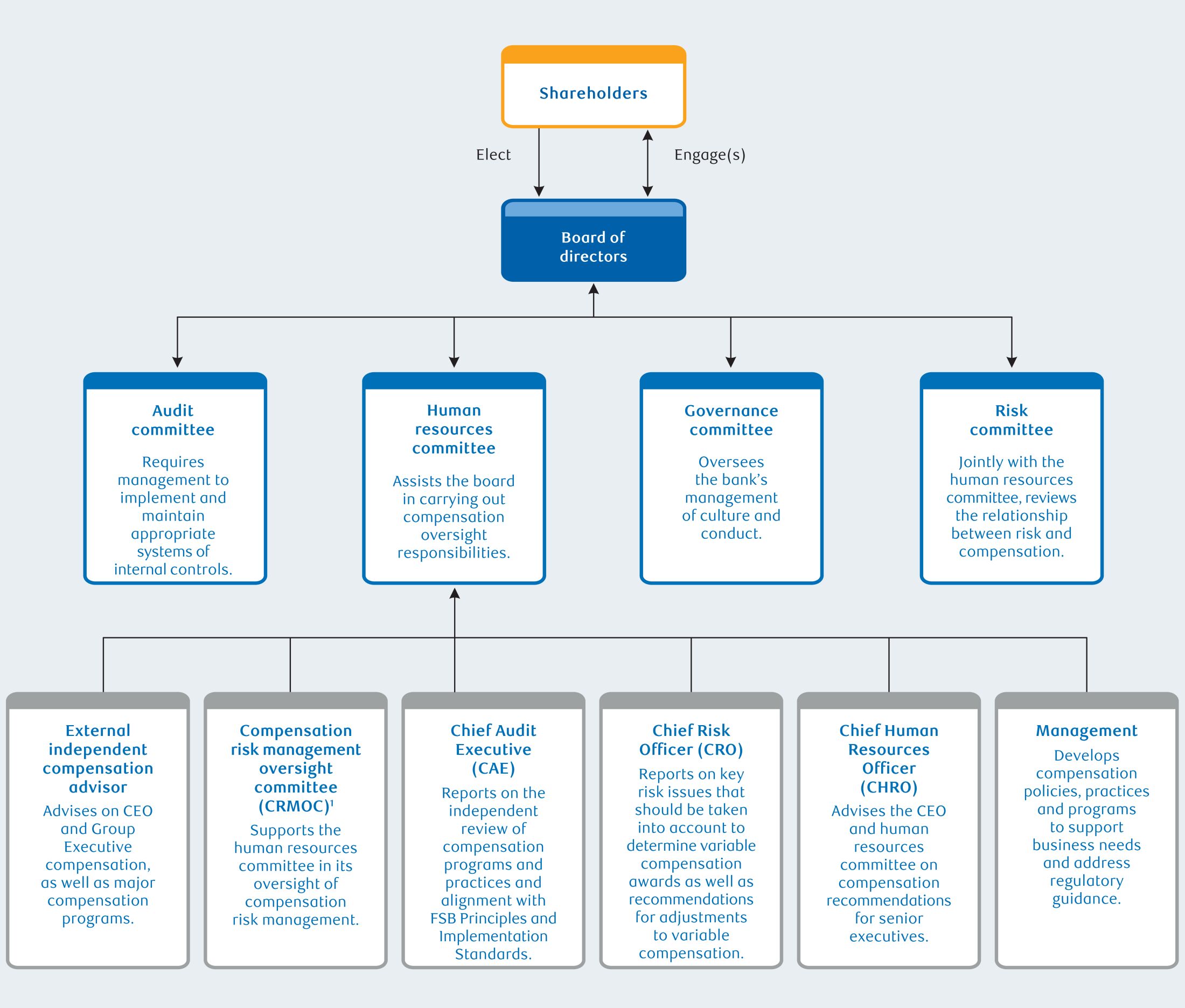
| 1 | The CRMOC is a senior management committee; members include the CHRO, CRO, CFO, and Senior Vice-President, Total Rewards and Employee Relations. |
Human resources committee
The board recognizes the importance of appointing knowledgeable and experienced individuals who have the necessary background in executive compensation, compensation risk management and talent management to fulfil the human resources committee’s obligations to the board and shareholders. All members of the human resources committee have significant experience in these areas through experience as senior management of complex organizations and through their prior and current membership on the human resources or risk committees of the RBC board and compensation and risk committees of the boards of other large and complex organizations. The human resources committee assists the board in carrying out compensation oversight responsibilities by:
| • | reviewing compensation policies and major compensation programs |
| • | engaging with the CRO regarding the major compensation programs, program design and payouts, and alignment with sound risk management principles and practices |
60
Royal Bank of Canada
Executive compensation
| • | overseeing compensation risk management by reviewing and recommending for board approval the compensation of the CEO, Group Executive and other MRTs |
| • | reviewing and recommending for board approval the pension plan funding and design changes for the bank and participating subsidiaries, and |
| • | ensuring compliance with relevant legal and regulatory requirements. |
In addition, the human resources committee oversees key talent management and human resources strategies and practices, including employee engagement, employee inclusion, and health and wellness.
All members of the human resources committee serve on other committees of the board. In fiscal 2025, Mr. Vandal served as chair of the human resources committee and as a member of the risk committee. Mr. Daruvala, Mr. Perry, and Mr. Vettese served on the audit committee, and Ms. Norton and Mr. Yabuki served on the risk committee. This cross-membership of committees supports the effective oversight of compensation and its alignment with sound risk management principles and practices.
In 2025, the human resources committee held a joint meeting with the risk committee to provide oversight of and consider the relationship between risk and compensation as well as alignment of variable compensation with potential and realized risks.
Independent advice
The human resources committee has benefited from the advice of an external independent compensation advisor with deep expertise in the area of executive compensation for many years. The human resources committee has retained Frederic W. Cook & Co., Inc. (FW Cook) for this purpose since 2015. FW Cook has no ties to members of the human resources committee or management that could jeopardize its independence, and it maintains policies and procedures designed to prevent conflicts of interest. The advisor’s role includes:
| • | advising on executive compensation and governance trends in Canada, the U.S. and internationally |
| • | reviewing the design of major compensation programs to ensure they remain market-competitive and aligned with shareholder interests and sound risk management principles |
| • | advising on the appropriate level of target compensation for the CEO and Group Executive |
| • | advising on CEO and Group Executive compensation based on individual, business segment and RBC’s overall performance |
| • | conducting CEO pay-for-performance analyses relative to the core and reference comparator groups, and |
| • | reviewing compensation-related materials prepared by management in advance of the human resources committee meetings and highlighting potential issues to the human resources committee chair. |
The human resources committee chair meets with the advisor before committee meetings, during which compensation is discussed to obtain the advisor’s independent views and advice on management’s recommendations. The human resources committee also meets with the advisor without management present at every committee meeting where compensation is reviewed.
In its assessment of FW Cook’s independence, the human resources committee considered all factors relevant to providing independent advice to the human resources committee, and reviewed other services performed for RBC by FW Cook and the proposed fees for those services. The human resources committee was satisfied that, based on this review and given the nature and value of the other services provided, the provision of other services to RBC by FW Cook did not impact its ability to act as an independent resource for the human resources committee.
The total fees paid by RBC to FW Cook for its services in 2025 represented less than 0.5% of FW Cook’s global revenue.
As described on page 23, during 2025 Hugessen Consulting (Hugessen) was retained by the governance committee to review and provide advice on RBC’s director compensation, including design, competitiveness, peer group composition, market positioning and industry best practices.
The table below shows the fees paid to FW Cook and Hugessen:
|
Year
|
Compensation advisor
|
Executive compensation- related fees
|
All other fees
| |||
| 2025
|
FW Cook |
$238,0471,3
|
$129,3132,3
| |||
| 2025 |
Hugessen |
$65,925
|
$24,8244
| |||
| 2024 |
FW Cook |
$226,2651,3
|
$159,0152,3
|
| 1 | As independent advisor to the human resources committee. |
| 2 | In each of the last two years, the board of directors of City National Bank engaged FW Cook to conduct a compensation risk assessment of City National Bank’s incentive programs. These amounts represent fees paid to FW Cook for this work. |
| 3 | Fees have been converted to Canadian dollars using the average annual foreign exchange rate of US$1.00 = C$1.4045 for fiscal 2025 and US$1.00 = C$1.3587 for fiscal 2024. |
| 4 | In 2025, the board of directors of RBC Europe Limited and RBC Group Holdings LLC engaged Hugessen to conduct an independent review of the competitiveness of compensation paid to non-executive directors serving on the board of directors of RBC Europe Limited and RBC Group Holdings LLC. This amount represents fees paid to Hugessen for this work. |
61
Royal Bank of Canada
Executive compensation
Our compensation risk management policies and practices, as summarized below, are aimed at ensuring compensation aligns with the short-, medium- and long-term interests of our shareholders as well as regulatory guidance.
Adherence to RBC policies and processes, including the Code of Conduct, is taken into account in determining performance-based compensation. The board and management also consider potential risks associated with compensation arrangements, as well as risk accountabilities and ethical behaviour, as part of performance evaluations and compensation decisions.
Together with the CHRO, the CRO and CFO play key roles in managing compensation risk at RBC, including several of the practices described in this section. The CFO provides oversight regarding performance, metrics and target setting, as well as overall financial soundness of compensation program spending, and is a member of the CRMOC described on page 59.
The CRO is also a member of the CRMOC and meets with the human resources committee periodically to report on key risk issues that the human resources committee should consider in determining variable compensation. The CRO’s role in managing compensation risk is further described below. Annually, the human resources and risk committees hold a joint session to provide oversight of and consider the relationship between risk and compensation as well as alignment of variable compensation with potential and realized risks.
As set out in the Code of Conduct and in the Enterprise Culture and Conduct Risks Framework, all employees have an important role in promoting a risk-aware culture built on our values. We have embedded these values across all of our talent practices. The governance committee oversees the bank’s management of culture and conduct, including breaches of the Code of Conduct, and meets with the CHRO, CRO, CLAO and Chief Compliance Officer to review progress on programs that strengthen enterprise culture and conduct practices.
RBC’s compensation policies and practices meet applicable regulatory requirements regionally and globally across our various business segments.
|
Compensation Risk Management Policy
| ||
| Purpose |
• To set out the compensation risk management practices for RBC. This policy is guided by the FSB Principles and Implementation Standards, which have been adopted by our principal regulators, and other applicable regulatory guidance and leading best practices.
| |
| Key features (applies to all employees) |
The policy outlines:
• the proportion of variable compensation that will be paid under deferral arrangements for executives and employees whose professional activities may have a material impact on the risk profile of RBC
• that deferred compensation should be awarded in equity or equity-linked instruments to executives and MRTs, and
• that compensation awarded to employees responsible for financial, compliance and risk control activities will be determined independently from the performance of the businesses they oversee, to ensure their independence.
| |
|
Alignment of compensation with risk and performance outcomes
| ||
| Purpose |
• To enable the board to make adjustments for risk and performance to entire compensation programs, business segments within a compensation program and compensation of groups of, or individual, MRTs.
| |
| Key features (applies to all major compensation programs and MRTs) |
• To assist the human resources committee in determining whether compensation awards require a risk or performance adjustment, the CRMOC reviews the compensation program pool calculations to identify significant items that impact the results for the period. This process includes reviewing key financial measures, including net income and ROE, taking into account the cost and quantity of capital.
• The CRO monitors a number of risk factors to ensure compensation decisions consider risks undertaken. The review considers risk factors that may not have been reflected in current financial performance, but could be sufficiently significant to justify adjustments to variable compensation for groups or individuals. Where warranted, the CRO will recommend adjustments for risk to the CRMOC and the human resources committee. The CRO’s assessment of these risk factors1 includes the risk profile for RBC and the individual business and functional segments compared to their risk appetite, strength of the control environment and proactive identification and management of outstanding issues and promoting a strong risk culture.
• Mid- and long-term incentives granted to MRTs, including the CEO and Group Executive, can be adjusted downward at vesting and payout if (i) there has been a material downturn in financial performance or a material failure in managing risk, or (ii) actual risk and performance outcomes are materially different from the assessments made at the time of grant. Such adjustments for the CEO and Group Executive are at the discretion of the human resources committee and subject to the board’s approval.
| |
| 1 | Refer to the Enterprise risk management section on pages 65 to 69 of the 2025 annual report for a list of the major risk types identified and the structures and processes to manage them. |
62
Royal Bank of Canada
Executive compensation
|
Enhanced compensation risk practices for material risk takers
| ||
| Purpose |
• To identify MRTs and monitor their conduct regarding risk accountabilities and ethical behaviours with possible compensation implications for risk events. This process includes monitoring for breaches of the Code of Conduct, risk and compliance policies.
| |
| Key features |
• Material breaches of the Code of Conduct, and risk and compliance policies are reviewed by a cross-functional committee, and final recommendations on consequences are reviewed by the CHRO and CRO.
• Compensation arrangements for MRTs, including the CEO and Group Executive, are subject to risk reviews and performance reporting that are considered in year-end risk performance assessment and compensation results.
• These practices support risk management accountabilities to be appropriately reflected in compensation awards. They are designed to ensure that variable compensation outcomes properly reflect RBC risk management policies, take into account risk events and conduct, and do not drive risk-taking in excess of the bank’s risk appetite.
| |
|
Forfeiture and Clawback Policy
| ||
| Purpose |
• Addressing situations where employees engage in misconduct or conduct business activities inappropriately or outside the approved risk limits and tolerances, or situations involving a material error or misstatement of financial results.
| |
| Key features (applies to MRTs and other employees who receive share-based compensation)
|
• Enables RBC to recoup incentive awards that have been paid or have vested and to cancel unvested mid- and long-term incentive awards to executives, such as the CEO, Group Executive and other MRTs, for situations involving misconduct, including non-compliance with applicable laws and regulations, accounting fraud or failure to follow internal policies and procedures.
• If RBC terminates an employee for cause, the employee, subject to applicable laws, forfeits all previously awarded unvested mid- and long-term incentive awards.
| |
|
Policy for the Recovery of Erroneously Awarded Incentive-Based Compensation for Executive Officers
| ||
| Purpose |
• To provide for the recovery of excess incentive compensation from the CEO, Group Executive and the Senior Vice-President, Enterprise Controller in the event of a restatement of our financial results.
| |
| Key features (applies to CEO, Group Executive and the Senior Vice-President, Enterprise Controller)
|
• A financial restatement trigger requires RBC to recoup erroneously awarded incentive-based compensation for the CEO, Group Executive and the Senior Vice-President, Enterprise Controller, where that compensation exceeds the amount that would have been received had it been determined based on the restated amounts. This Policy applies to incentive-based compensation received on or after October 2, 2023.
| |
| Restrictions on trading and hedging RBC securities
| ||
| Purpose |
• To maintain the alignment of employee and shareholder interests.
| |
| Key features (applies to all employees) |
RBC employees and contract workers are prohibited from hedging the value of their equity-based compensation by:
• selling RBC securities directly or indirectly if they do not own or have not fully paid for them (a short sale)
• directly or indirectly buying or selling a call or put option on RBC securities, subject to certain limited exceptions for employees of RBC subsidiaries, or
• entering into equity monetization transactions that would have an effect equivalent to creating call or put rights in respect of RBC securities or other financial instruments designed to hedge or offset a decrease in the market value of RBC securities.
| |
63
Royal Bank of Canada
Executive compensation
Alignment with the FSB Principles and Implementation Standards
Our approach to compensation is consistent with the FSB Principles and Implementation Standards, our principal regulators’ expectations and industry best practices for assessing conduct.
|
FSB Principles
|
Compensation practices at RBC
| |||
| The board oversees the compensation system’s design and operation
|
✓ | The board is ultimately responsible for overseeing and making decisions on the compensation principles, policies and programs, including the management of compensation risk. | ||
| The board monitors and reviews the compensation system to ensure it operates as intended
|
✓
✓ |
The board, with the support of the human resources committee, monitors and reviews the bank’s compensation policies and major compensation programs to confirm alignment with RBC risk management principles and practices. This includes reviewing and approving compensation policies and the design of major compensation programs, payouts and adjustments for risk at the program and individual levels.
The human resources committee meets with the CRO bi-annually to review our risk profile relative to our risk appetite to ensure we are appropriately reflecting significant risks in our compensation outcomes. | ||
| Independence of the employees responsible for key financial and risk control activities
|
✓ | Compensation for employees responsible for key financial and risk control activities (risk, audit, compliance and finance) is determined independently from the performance of the business segments they oversee. | ||
| Compensation is adjusted for current and potential risks |
✓
✓ |
The human resources committee considers potential adjustments to compensation payouts, guided by the CRO’s review of a number of risk factors as described on page 61.
At the individual level, performance-based compensation of MRTs may be reduced, if warranted, following a review of their adherence to risk management, compliance policies, including the Code of Conduct, and performance against risk goals and measures.
| ||
| Compensation outcomes are commensurate with risk outcomes |
✓ | Our pay-for-performance principle ensures incentives are in line with performance and risk outcomes.
– Performance-based incentive pools are based on RBC net income after tax (NIAT), business segment NIAT, or a combination of both.
– Final payouts for PDSUs are subject to a performance modifier, which has the potential to increase or decrease awards by up to 25%, with awards granted under the PDSU program since December 2025 subject to the possibility of a zero payout at the board’s discretion.1 For more information, please see page 68.
– Awards may be adjusted downward at vesting and payout if there has been a material downturn in financial performance or a material failure in managing risk, or actual risk and performance outcomes are materially different from the assessments made at the time of the grant.
– The Forfeiture and Clawback Policy as described on page 62 covers the CEO and Group Executive and all other employees who receive equity-based compensation. The Policy for the Recovery of Erroneously Awarded Incentive-Based Compensation for Executive Officers as described on page 62 covers the CEO, Group Executive and the Senior Vice-President, Enterprise Controller.
| ||
| Compensation payout is sensitive to the time horizon of risks |
✓
✓ |
To align compensation with the risk time horizon and motivate executives to create longer-term value, a significant portion of their variable compensation must be deferred (at least 70% for the CEO, at least 65% for Group Executive and at least 40% for MRTs), with a vesting period of at least three or four years.
Executives are required to maintain a minimum level of share ownership. Share ownership requirements extend into retirement for the CEO and Group Executive as described on page 73.
| ||
| The mix of cash, equity and other forms of compensation is consistent with the risk time horizon
|
✓ | The deferral of a significant portion of pay at risk is required to align compensation with the risk time horizon and to motivate executives to create long-term value. The mix of compensation varies by executive level, reflecting the opportunity executives have to influence the performance of RBC. | ||
| 1 | For awards granted under the PDSU Program prior to December 2025, a zero payout will result if (i) the three-year TSR is 9th or 10th of the global performance peer group, and (ii) the three-year average ROE is below the performance threshold. |
64
Royal Bank of Canada
Executive compensation
Compensation framework
RBC’s variable compensation programs, including the design, are regularly reviewed by multiple management committees and overseen by the human resources committee of the board to ensure compensation is consistent with enterprise and business segment strategy, market competitiveness and regulatory environment. The majority of employees at RBC are compensated through a combination of base salary and variable compensation awards, which generally fall into one or more of the following forms: short-term incentives, discretionary, commission and equity. In evaluating appropriateness of incentive plans, RBC may consider several factors including but not limited to objectives related to business performance, risk and culture.
Independent review of compensation programs and practices
RBC Internal Audit annually conducts an independent review of compensation policies, programs and practices for alignment with the FSB Principles and Implementation Standards as well as other relevant regulatory guidance. The opinion of the fiscal 2024 review was presented to the human resources committee in August 2025, which included a satisfactory rating on the design and operating effectiveness of key controls supporting RBC’s compensation risk management processes. City National Bank was excluded from this review.
Compensation decisions are guided by our compensation philosophy and principles, as described on page 55. The following illustration provides an overview of our annual process for determining and back-testing compensation for the CEO and Group Executive:
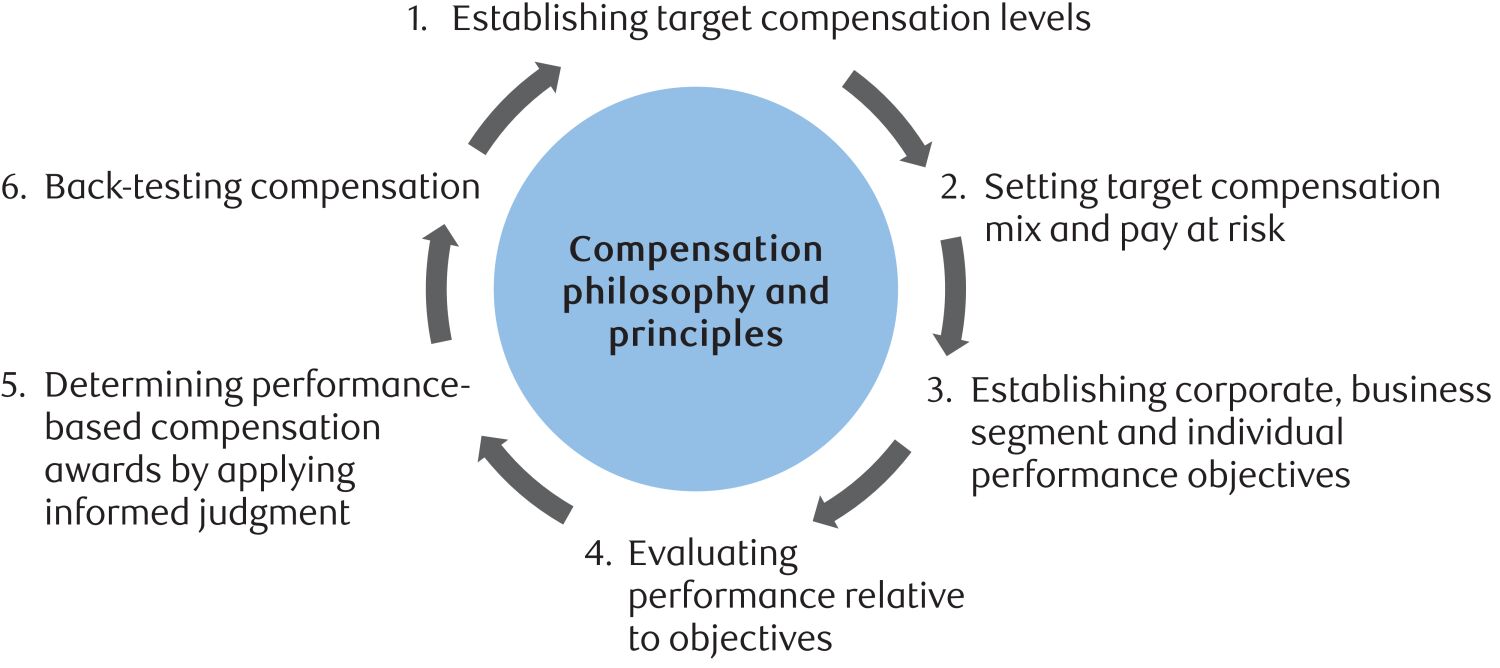
1. Establishing target compensation levels
To ensure our compensation programs remain market-competitive, we annually review the program design and pay levels of other financial institutions that are our primary competitors for talent. The human resources committee’s external independent compensation advisor, FW Cook, analyzes market information and assists the human resources committee in determining the appropriate benchmark compensation comparator groups for the CEO and Group Executive. We also obtain market information from public disclosures and numerous other external consulting firms, including McLagan1 and Willis Towers Watson.
Compensation comparator groups
The human resources committee reviews and approves a core comparator group for compensation comparison purposes as well as a reference comparator group shown on page 65 to provide additional context in establishing the CEO’s target pay. As part of its review of the comparator groups, the human resources committee considers our business profile (size, business mix, and scale of operations outside Canada), our international growth strategy and the associated talent requirements.
| 1 | McLagan is a part of Aon Hewitt, a business unit of Aon plc. |
65
Royal Bank of Canada
Executive compensation
Core comparator group
The board uses a core comparator group of Canadian financial institutions to benchmark target compensation for the CEO and Group Executive. The core comparator group has remained unchanged since fiscal 2012. The following table summarizes the selection criteria for the core comparator group and the resulting list of companies:
|
|
|
Selection criteria
Head office location
• Canada
Line of business
• Diversified banks and other financial institutions
Key company characteristics
• Primary competitors for talent
• Meet criteria for at least one of the following measures (generally half to two times RBC): revenue, assets, net income or market capitalization
|
Core comparator group
Canadian financial institutions
• The Toronto-Dominion Bank
• The Bank of Nova Scotia
• Bank of Montreal
• Canadian Imperial Bank of Commerce
• Manulife Financial Corporation
• Sun Life Financial Inc. | |||
Reference comparator group for CEO pay
The board uses the reference comparator group to provide additional context in setting the target pay of the CEO. The reference comparator group was last updated in fiscal 2020. The following table summarizes the selection criteria for the reference comparator group and the resulting list of companies:
|
|
|
Selection criteria
Head office location
• Outside Canada
Line of business
• Diversified banks and other financial institutions
Key company characteristics
Relevant with respect to:
• Size
• Business mix
• Scale of operations outside home country
• Financial condition
|
Reference comparator group
U.S. banks
• JPMorgan Chase & Co.
• Wells Fargo & Company
• Morgan Stanley
• U.S. Bancorp
• PNC Financial Services Group, Inc.
Others
• Barclays PLC
• Westpac Banking Corporation | |||
The following table summarizes how we rank on size-based selection criteria1 relative to each group:
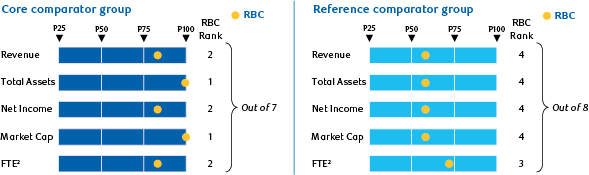
| 1 | Information is from public filings for the most recently reported four quarters, available as of December 31, 2025; market capitalization is as of October 31, 2025. |
| 2 | Employees (full-time equivalent) (FTE). |
66
Royal Bank of Canada
Executive compensation
CEO and Group Executive target setting
Each year, based on an in-depth review of target compensation for the CEO and Group Executive, the human resources committee recommends and the board approves compensation targets for the next fiscal year. The human resources committee considers the scope of respective roles, progress in demonstrating key leadership capabilities, competitiveness of compensation relative to the core comparator group, as well as advice from its external independent compensation advisor, FW Cook.
As we are the largest of the core comparator companies based on market capitalization and total assets, the human resources committee also uses the reference comparator group to provide additional context in establishing the CEO’s target pay.
2. Setting target compensation mix and pay at risk
Total direct compensation is comprised of base salary and performance-based incentive awards. The mix of compensation awards varies by role and executive level, reflecting the opportunity executives have to influence RBC’s performance. In determining the mix, we also consider market practices and our compensation principles, including how the elements of executive compensation align with longer-term shareholder value creation and applicable regulatory requirements. When an executive is new in their role, we generally take a multi-year approach to transitioning target compensation to the appropriate positioning relative to market comparators. A significant portion of the compensation executives receive is at risk, and a substantial percentage of pay at risk is deferred in the form of equity-based incentive awards to align compensation with shareholder interests.
3. Establishing corporate, business segment and individual performance objectives
Early in the fiscal year, the human resources committee recommends, and the board approves, a combination of financial and non-financial performance objectives, as well as specific strategic initiatives. Financial objectives are based on net income after tax relative to targets set for the STI Program using a pre-established payout grid. Non-financial objectives include client, risk and strategic objectives for the CEO, which support the achievement of short-, medium- and long-term performance and reflect the view that a multi-faceted approach to performance is in line with the interests of clients, employees, shareholders and other stakeholders.
The CEO establishes financial and non-financial objectives for each Group Executive, which include client, risk and strategic objectives, and reflect each executive’s role and accountabilities.
4. Evaluating performance relative to objectives
Following the end of the fiscal year, the performance of the CEO and Group Executive is assessed relative to financial and non-financial (client, risk and strategic) objectives. The human resources committee evaluates the performance of the CEO relative to his objectives. The CEO reviews, with the human resources committee,1 the performance evaluations of Group Executive based on their established performance objectives.
When there are changes to compensation plan design, scenario analyses are performed to assess how the CEO and Group Executive compensation programs might pay out under different RBC performance scenarios. These analyses help determine whether these compensation programs will pay out as intended, consistent with our pay-for-performance principle, and do not drive risk-taking in excess of our risk appetite. The human resources committee reviews RBC’s performance scenarios to assess the appropriateness of a range of potential outcomes, which range from poor to exceptional results.
A description of the evaluations for the CEO and other NEOs for 2025 can be found on pages 79 to 85.
5. Determining performance-based compensation awards by applying informed judgment
The human resources committee is responsible for recommending for board approval the short-, mid- and long-term incentive compensation awarded to the CEO and Group Executive. In making these decisions, the human resources committee reviews reports on financial and non-financial performance, risk management and external perspectives, including:
| • | performance evaluations |
| • | contributions to the enhancement of long-term shareholder value |
| • | RBC’s financial performance relative to peers |
| • | market compensation information, including the compensation comparator groups |
| • | the CRO’s report on the alignment of variable compensation pools with potential and realized risks |
| • | the CEO’s recommendations for compensation awards for Group Executive |
| • | progress against RBC’s Climate Blueprint |
| • | the advice of the human resources committee’s external independent compensation advisor, FW Cook, and |
| • | select vertical pay ratios provided for additional context in making recommendations to the board for compensation awards for the CEO, including a comparison of the annual total direct compensation and the median annual total direct compensation of all employees, and changes in this comparison over time. |
| 1 | The performance assessments of the CFO and the CRO are reviewed at the audit committee and risk committee, respectively. |
67
Royal Bank of Canada
Executive compensation
After considering all relevant factors, the human resources committee recommends to the board compensation awards for the CEO and Group Executive.
The board believes the use of informed judgment is important when determining final compensation to ensure awards appropriately reflect risk as well as other unexpected circumstances that may arise during the year and to eliminate the possibility of unintended outcomes determined solely by formulas.
A description of the compensation awarded to the CEO and other NEOs for 2025 is available on pages 79 to 85.
6. Back-testing compensation
CEO compensation is back-tested annually. This involves reviewing the current value of performance-based incentive awards granted over the CEO’s tenure to confirm that award outcomes are consistent with RBC’s performance (refer to page 81 for a review of compensation awarded to the CEO over the past five years). The assessment uses the value of the short- and mid-term incentives at the time of payout, the in-the-money value of the long-term incentives at the time of exercise, and the value of unvested mid- and long-term incentive awards at the date of back-testing. Performance-based incentive awards granted to Group Executive are also back-tested annually to confirm that award outcomes continue to align with RBC performance.
Total direct compensation includes base salary and performance-based incentive awards. The graphs below outline the target compensation mix for the CEO and Group Executive, excluding the CEO and Group Head, RBC Capital Markets (outlined on page 72), and the proportion of pay at risk.
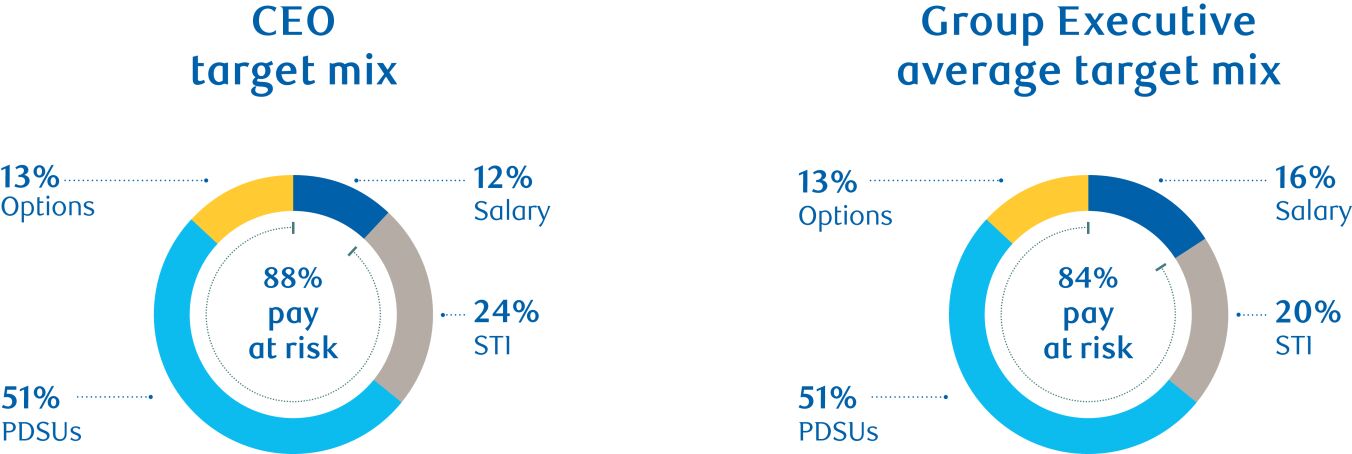
| Fixed pay
|
Performance-based awards (pay at risk)
|
Total direct compensation | ||||||||||||||
|
Base salary
|
+ |
Short-term incentive
|
+ |
Mid-term incentive (PDSUs)
|
+ |
Long-term incentive (Stock options)
|
= | |||||||||
Base salary
Base salary reflects each executive’s level of responsibility, capabilities and experience in the context of their role and the market. We review base salaries annually and generally grant increases when an executive assumes increased responsibilities or significantly deepens their knowledge and expertise. Base salaries may also be adjusted when there is a material change in the compensation levels of comparable roles in the core comparator group.
Performance-based awards
Awards under the short-, mid- and long-term incentive programs are determined based on individual, business segment and RBC’s overall performance. The annual short-term incentive program is cash-based; however, executives have the option to defer all or part of their awards under the deferred share unit (DSU) program (refer to page 73 for more information). The mid- and long-term incentive programs are equity-based.
68
Royal Bank of Canada
Executive compensation
Short-, mid- and long-term incentive programs
The table below summarizes the key design features of the short-, mid- and long-term incentive programs, which are applicable to the CEO and Group Executive, excluding the CEO and Group Head, RBC Capital Markets (outlined on page 72).
| Short-Term Incentive (STI) Program
| ||||
| Overview | Rewards individuals for business segment and RBC’s overall performance, as well as individual contribution. | |||
| Form of award | Annual cash bonus | |||
| Performance period | 12 months | |||
| Grant/award determination |
Total STI award is based on target total compensation levels established as a percentage of base salary, and performance outcomes relative to financial, client, and risk and strategic objectives, which are added together to determine the actual STI award. Payouts can range from zero to a maximum of two times target. | |||
| Performance measures
|
■
■
■
|
Financial (60% weight) • RBC net income after tax, or for business segment Group Heads, a combination of RBC net income after tax and business segment net income after tax, relative to targets.
• Economic and market assumptions used in the planning process are also considered, as well as whether actual conditions differ from those assumptions, to determine whether adjustments are warranted.
Client (10% weight) • Client satisfaction and loyalty results for our retail businesses: Personal Banking, Commercial Banking, Wealth Management and Insurance. Industry rankings and awards across all our businesses, including RBC Capital Markets, are also considered.
• The CEO and Group Executive are evaluated against the same index score across business segments.
Risk and strategic (30% weight) • RBC, business segment and individual goals relating to risk management, business strategy, and sustainability and governance practices.
| ||
| Payout | Paid following the end of the fiscal year. | |||
|
Mid- and Long-Term Incentive (MTI and LTI) Programs | ||||
| Overview |
Rewards executives for their contribution to medium- and long-term performance and their potential for future contributions, as well as to align with long-term shareholder interests. | |||
|
|
MTI |
LTI | ||
| Form of award |
PDSUs (80% of equity incentives granted) |
Stock options (20% of equity incentives granted) | ||
| Performance period |
Three years |
Up to 10 years1 | ||
| Performance grant |
The value of the awards granted may vary from the target based on performance compared to the medium-term financial objectives of diluted EPS growth, ROE, and common equity tier 1 (CET1) ratio and considers, at the discretion of the board, progress made against the strategic priorities in the RBC Climate Blueprint (refer to page 70 for more information).
The value of awards granted may also vary from the target following the CRO’s review of key risk factors to identify significant quantitative and qualitative risks the board should take into account in determining awards.
If required, the CRO will make recommendations to the human resources committee for adjustments (refer to page 61 for more information). | |||
| Performance |
Common share price performance plus relative TSR (change in common share price plus reinvested dividends paid compared to the global performance peer group).
The board may make adjustments to awards at vesting relative to the target based on a schedule that increases or decreases the value of awards to a maximum of 25%. Awards will fluctuate in value due to both the application of the modifier and changes in the common share price.
In addition, the board has discretion to make adjustments downward at vesting and payout if (i) there has been a material downturn in financial performance or a material failure in managing risk, or (ii) actual risk and performance outcomes are materially different from the assessments made at the time of grant.2 |
Common share price performance | ||
| Vesting and payout |
Awards vest and are paid after three years |
50% vests after three years 50% vests after four years | ||
| 1 | The term of options that are scheduled to expire during, or shortly after, an insider trading blackout during which the participant is prohibited from exercising the option is automatically extended 10 business days following the end of the insider trading blackout. |
| 2 | For awards granted prior to December 2025, a zero payout will result if (i) the three-year TSR is 9th or 10th of the global performance peer group, and (ii) the three-year average ROE is below the performance threshold. |
69
Royal Bank of Canada
Executive compensation
| How we use our global performance peer group | ||||||||
| At vesting of PDSU awards, we compare our TSR to that of a global performance peer group approved by the board to determine the performance modifier for payouts under the PDSU Program, as described above. The global performance peer group is comprised of Canadian financial institutions and U.S. and other international banks with a comparable size, market presence and complexity to RBC. | The global performance peer group is reviewed on a regular basis and updated for relevancy to ensure we appropriately incentivize senior leaders to drive growth in TSR against peers that we compete with and that operate in similar markets. Pursuant to this review, Westpac Banking Corporation and Manulife Financial Corporation were removed as their strategies are less aligned with RBC’s current business mix, geographic footprint and financial performance. For grants made in 2025, the peer group has been refreshed to include Bank of America Corporation, Citigroup Inc., Morgan Stanley, The Goldman Sachs Group, Inc., Barclays PLC, and UBS Group AG. This change will result in a more representative peer group for RBC to compare against as it relates to growth in total shareholder return.
| |||||||
| Global performance peer group1
|
||||||||
|
|
Canadian financial institutions • Bank of Montreal • Canadian Imperial Bank of Commerce • National Bank of Canada • The Bank of Nova Scotia • The Toronto-Dominion Bank |
|
U.S. and other international banks • Bank of America Corporation • Citigroup Inc. • JPMorgan Chase & Co. • Morgan Stanley • The Goldman Sachs Group, Inc. • Wells Fargo & Company • Barclays PLC • UBS Group AG
| |||||
| 1 | In 2025, Westpac Banking Corporation and Manulife Financial Corporation were removed from our global performance peer group, and Bank of America Corporation, Citigroup Inc., Morgan Stanley, The Goldman Sachs Group, Inc. Barclays PLC and UBS Group AG were added to the global performance peer group. |
70
Royal Bank of Canada
Executive compensation
Sustainability-related1 factors in executive compensation
As a global bank, we recognize the responsibility to identify, understand and manage the sustainability-related risks and opportunities that matter most to our stakeholders and our business. We aim to align our sustainability strategies to RBC’s strategy and goals. We continue to evolve and refine our strategy to be responsive to the needs of our clients and communities and adapt to a dynamic and rapidly changing environment.
The design of our CEO and Group Executive variable compensation incorporates sustainability practices in the short-, medium- and long-term compensation programs to incentivize our executives in progressing towards our objectives and creating long-term sustainable value for our shareholders.
|
Compensation program
|
Compensation element
|
Description of program component
|
2025 results
| |||
| STI Program | Included in risk and strategic objectives (30% weighting) | Individual performance objectives for the CEO and Group Executive2 in our STI program are tied to RBC’s financial performance, client outcomes and contribution to our risk and strategic objectives, including those relating to business strategy and sustainability. Our STI program, which includes a 30% weighting on risk and strategic objectives, is highlighted on page 68.
|
Objectives and results related to sustainability are discussed on page 77.
In evaluating STI awards for the CEO and Group Executive, the board was provided individual performance assessments, which include contributions to sustainability practices.
| |||
| MTI and LTI programs |
Includes a discretionary climate-based modifier | Since 2023, the CEO and Group Executive2 MTI and LTI programs include medium-term climate-based objectives related to the strategic priorities, actions and metrics related to or as outlined in the RBC Climate Blueprint (further information on our climate strategy is available at rbc.com/climate).
This climate-focused assessment provides additional incentive for the CEO and Group Executive to accelerate RBC’s progress towards these priorities and enables the board to recognize their efforts by applying a modifier to MTI and LTI awards, taking into consideration their actions supporting our climate strategy.
|
The board recognizes that managing climate risks and opportunities is multi-faceted, and that RBC has taken measures to continue momentum on its climate journey.
After reflecting on RBC’s strategic priorities and actions taken to date, the board has assessed RBC’s in-year progress against medium-term climate-based objectives related to the strategic priorities, actions and metrics related to or as outlined in the RBC Climate Blueprint to be on target, and no further modification was applied to the 2025 MTI and LTI awards granted. | |||
Delivering on our sustainability strategy is a priority for RBC’s senior leadership and board. We are proud of the progress we have made, but recognize that progress will not be linear and there are many uncertainties and variables that will have to be navigated. We will continue to be transparent on the actions we are taking and how we are measuring our progress.
| 1 | “Sustainability” refers to environmental and social matters. |
| 2 | Excludes the CEO and Group Head, RBC Capital Markets, who participates in the Capital Markets Compensation Program. Refer to page 72 for our discussion of how sustainability factors are incorporated into the Capital Markets Compensation Program. |
71
Royal Bank of Canada
Executive compensation
| Potential adjustments to CEO and Group Executive incentive awards
| ||
| Risk and performance adjustments |
The human resources committee and the board may adjust incentive awards from target levels based on the CRO’s recommendations relating to significant external and internal risk factors affecting financial results.
In the event of misconduct or a material error or misstatement of RBC financial results, financial reporting or financial statements, cash bonuses and mid- and long-term incentive awards may be subject to forfeiture or clawback, as outlined in the Forfeiture and Clawback Policy, which is summarized on page 62. Additionally, in the event of a restatement of our financial results, excess incentive awards may be subject to recovery, as set forth in the Policy for the Recovery of Erroneously Awarded Incentive-Based Compensation for Executive Officers, as described on page 62.
| |
| Discretionary adjustments |
The board may exercise its discretion to adjust the STI awards to eliminate the impact of items that were not included in the planning process. They may also reduce MTI awards at vesting and payout if there has been a material downturn in financial performance or a material failure in managing risk, or if actual risk and performance outcomes are materially different from the assessments made at the time of grant. The human resources committee recommends any adjustments to the board for approval.
| |
| Why we use these measures of financial performance
| ||
| STI Program |
Net income after tax for RBC and business segments Relevant across business segments and offers a consistent measure and common focus for all program participants to drive in-year and sustainable growth. Net income after tax provides a comprehensive measure of the overall performance of RBC in the fiscal year and on a comparable-year basis.
| |
| MTI and LTI Programs |
At grant: Progress against our medium-term financial performance objectives for diluted EPS growth, ROE, and capital ratio is considered in determining the grant value relative to target.
Diluted EPS growth Diluted EPS reflects our net income available to common shareholders based on the weighted average diluted number of common shares outstanding for the period. EPS growth is a measure of management’s ability to deliver increased profitability to our shareholders.
ROE A measure of return on capital invested in our businesses. ROE is calculated as net income available to common shareholders divided by the total average common equity for the period. This measure gauges how efficiently we earn profits on behalf of our shareholders.
Capital ratio Capital, as measured by our CET1 ratio, is a core measure of our financial strength and is relevant in assessing our performance. A strong capital ratio, along with high returns over the short and longer term, reflects management’s ability to balance risks and returns while providing a prudent cushion to absorb shocks.
At vesting: PDSUs are subject to a relative TSR performance modifier at the end of the three-year performance period.
TSR TSR reflects the performance of RBC common shares over a period of time and incorporates the share price change and reinvested dividends paid to common shareholders. Relative TSR is a measure of our TSR compared to that of our peers over a period of time.
| |
72
Royal Bank of Canada
Executive compensation
Capital Markets Compensation Program
The table below summarizes the key design features of the Capital Markets Compensation Program applicable to Mr. Neldner.
| Capital Markets Compensation Program
| ||
| Performance period
|
12 months | |
|
Bonus pool funding |
• Capital Markets earnings before variable compensation and taxes, which includes cost of funds, provision for credit losses and mark-to-market adjustments and also considers RBC’s overall performance. The resulting compensation ratio is reviewed and may be used to adjust bonus pool funding to reflect market and competitive conditions.
• The CRO reviews the bonus pool to determine whether additional adjustments for risk are appropriate, reviews the assessment with the CRMOC and makes recommendations to the human resources committee. The human resources committee recommends the bonus pool to the board for approval after considering management’s recommendations.
| |
|
Individual performance |
• The performance of the CEO and Group Head, RBC Capital Markets is assessed relative to financial objectives, as well as risk and strategic objectives, including sustainability and governance practices, consistent with other Group Executive. Target compensation levels are not established for the Group Head, as individual incentive awards are discretionary. In establishing compensation levels, the human resources committee also considers the compensation market information for the core comparator group. In addition, given the breadth and global scope of our Capital Markets business, the committee considers performance and compensation information of institutions outside Canada for additional context, and it may make adjustments to ensure risk and performance are appropriately reflected in award amounts.
| |
|
Form of awards (for CEO and Group Head, RBC Capital Markets)
|
• Cash bonus (35% of variable compensation).
• Share-based compensation (65% of variable compensation) comprised of PDSUs and stock options. For more information about these awards, refer to page 68. | |
|
Risk and performance adjustments |
• The board may reduce awards at vesting and payout if there has been a material downturn in financial performance or a material failure in managing risk or if actual risk and performance outcomes are materially different from the assessments made at the time of grant. The human resources committee recommends and the board approves any adjustments.
• In the event of misconduct or a material error or misstatement of RBC financial results, financial reporting or financial statements, cash bonuses and mid- and long-term incentive awards may be subject to forfeiture or clawback, as outlined in the Forfeiture and Clawback Policy, which is summarized on page 62. Additionally, in the event of a restatement of our financial results, excess incentive awards may be subject to recovery, as set forth in the Policy for the Recovery of Erroneously Awarded Incentive-Based Compensation for Executive Officers, as described on page 62.
| |
73
Royal Bank of Canada
Executive compensation
Deferred Share Unit Program – Voluntary deferral of short-term incentive awards
|
Key features
|
DSU Program
| |
| Purpose |
• For all executives, the DSU Program provides the opportunity to receive 100%, or a portion (25%, 50% or 75%) of the short-term incentive award in RBC DSUs rather than cash, redeemable only upon retirement, resignation or termination of employment with RBC.
| |
| Determining the number of units |
• The elected portion of the award is converted to DSUs based on the average closing market price of shares on the TSX for the first five trading days in the open window following the fiscal year-end. DSUs earn dividend equivalents in the form of additional DSUs as set out in the DSU Program.
| |
| Redeeming awards |
• When redeemed, DSUs are valued at the average closing price of shares on the TSX for the five trading days immediately preceding the redemption date.
| |
Share ownership requirements
The CEO and Group Executive and all other executives are required to maintain a minimum level of share ownership, which extends into retirement for a specified period of time. Executives can meet share ownership requirements through personal holdings, shares accumulated under our employee share ownership plans and share units held under our equity incentive programs, other than the RBC Stock Option Plan (Stock Option Plan). Employees promoted to RBC executive roles or managing directors in RBC Capital Markets have three years1 to meet the minimum requirement, while those recruited externally have five years. Share ownership information for all NEOs is shown on pages 79 to 85.
|
RBC
|
Multiple of the last three years’ average base salary
|
Post-retirement
| ||
| CEO |
8 x |
24 months | ||
| Group Executive1 |
6 x |
12 months | ||
| 1 | Refer to the table below for the CEO and Group Head, RBC Capital Markets. |
| Capital Markets
|
Multiple of the
last three years’ average
|
+
|
Multiple of the last three years’ average
|
Post-retirement
| ||||
| CEO and Group Head, RBC Capital Markets |
2 x | + | 2 x | 12 months | ||||
2025 CEO and other named executive officer incentive awards
The human resources committee evaluates performance taking into account financial and non-financial objectives to assess the overall leadership and performance of the CEO and other NEOs in a comprehensive and balanced way.
The human resources committee and the board approved performance objectives for the STI Program at the beginning of the year to support the achievement of the bank’s strategic goals to be:
| • | In Canada: the undisputed leader in financial services |
| • | In the United States: the preferred partner to institutional, corporate, commercial and high-net-worth clients and their businesses, and |
| • | In select global financial centres: a leading financial services partner valued for its expertise. |
When determining final compensation, the board may apply informed judgment to adjust the value of awards to ensure the awards appropriately reflect risk, as well as other unexpected circumstances that arise during the year, and eliminate the possibility of unintended outcomes determined solely by formulas.
| 1 | If an employee was externally hired within two years of the date that the increased share ownership requirements began to apply, then such employee will have five years from their initial date of hire to reach the minimum level of share ownership. |
74
Royal Bank of Canada
Executive compensation
STI Program objectives and results
|
Financial (60% weight)1
|
||
Following are the financial highlights and key measures of company and segment performance achieved in 2025.
| RBC | ||||
|
$20,369 million net income up 25% from |
✓ |
Achieved net income of $20,369 million, up 25% from last year, primarily driven by higher results across all of our business segments. Prior year results also reflect higher HSBC Canada transaction and integration costs and the impact of management of closing capital volatility related to the HSBC Canada transaction, both of which were treated as specified items and reported in Corporate Support. Our earnings also reflect an increase due to the impact of foreign exchange translation.
| ||
| ✓ | For the purposes of determining STI program awards in 2025, no adjustments were made to 2025 net income in calculating awards relating to financial performance.
| |||
| Personal Banking | ||||
|
$7,105 million net income up 20% from
|
✓ |
Achieved net income of $7,105 million, up 20% from last year, primarily driven by higher net interest income reflecting higher spreads and average volume growth of 7% in Personal Banking – Canada. Higher non-interest income also contributed to the increase. These factors were partially offset by higher non-interest expenses. Net income for the current year includes the impact of five additional months of HSBC Canada results. | ||
| Commercial Banking | ||||
|
$3,020 million net income up 7% from
|
✓ |
Achieved net income of $3,020 million, up 7% from last year, as growth in total revenue was partially offset by higher PCL and non-interest expense. Net income for the current year includes the impact of five additional months of HSBC Canada results. | ||
| Wealth Management | ||||
|
$4,289 million net income up 25% from
|
✓ |
Achieved net income of $4,289 million, up 25% from last year, mainly due to higher fee-based client assets reflecting market appreciation and net sales, which also drove higher variable compensation. Higher transactional revenue also contributed to the increase. | ||
| Insurance | ||||
|
$828 million net income up 14% from
|
✓ |
Achieved net income of $828 million, up 14% from last year, primarily due to higher insurance service result driven by improved claims experience in longevity reinsurance and life retrocession products. This was partially offset by the impact of unfavourable annual actuarial assumption updates driven by life retrocession products. Lower taxes reflecting changes in earnings mix also contributed to the increase. | ||
| Capital Markets | ||||
|
$5,393 million net income up 18% from
|
✓ |
Achieved net income of $5,393 million, up 18% from last year, primarily due to higher revenue in Global Markets and Corporate & Investment Banking. The impact of foreign exchange translation also contributed to the increase. These factors were partially offset by higher compensation on increased results and higher taxes reflecting the impact of Pillar Two legislation and changes in earnings mix, net of favourable tax adjustments. | ||
| 1 | Further information on our financial performance is in the 2025 annual report or the consolidated financial statements and management discussion and analysis for the years ended October 31, 2025 and 2024. |
75
Royal Bank of Canada
Executive compensation
|
Client (10% weight)
|
||
In fiscal 2025, employees across our businesses continued to demonstrate their commitment to our Purpose by supporting clients with trusted advice, differentiated insights and real care to every interaction. Our team was more focused than ever on tapping into the full strength of RBC to deepen how we serve clients and deliver exceptional value to them.
Across our business segments, client satisfaction levels remained strong throughout 2025, highlighted by numerous industry awards and rankings, including:
| • | Ranked highest in customer satisfaction for the 2nd consecutive year in the J.D. Power 2025 Canada Retail Banking Satisfaction Study. |
| • | Recognized as the Most Valuable Canadian Brand for the 7th consecutive year (Kantar BrandZ, since 2019). |
| • | Personal Banking ranked #1 in market share for all key retail products1 and Commercial Banking ranked #1 in market share in commercial lending and deposits.2 |
| • | Commercial Banking recognized by Global Finance Magazine as the best overall bank for cash management in Canada for the 4th consecutive year and the leading trade finance provider in Canada for the 13th consecutive year. |
| • | Winner of 10 Ipsos 2025 Financial Service Excellence Awards among the Big Five banks, including four solo wins in the categories: Recommend to Friends or Family (Net Promoter Score), Financial Planning & Advice, ATM Banking Excellence and Online Banking Excellence. |
| • | RBC Wealth Management was Named Best Private Bank in Canada (The Banker Global Private Banking Awards 2025) and Outstanding Private Bank – North America and Global (Private Banker International Global Wealth Awards 2025). |
| • | RBC Capital Markets ranked as the #1 investment bank in Canada based on market share (fiscal 2025, Dealogic). |
| • | Top 10 Investment Bank globally (Euromoney MarketMap 2025), Best Investment Bank in Canada and Best Research Bank in North America (Euromoney Award for Excellence 2025). |
| • | RBC Wealth Management ranked as the largest full-service wealth advisory business in Canada,3 6th largest full-service wealth advisory firm in the U.S.4 and 5th largest wealth manager in the U.K.5 as measured by assets under administration (AUA).6 |
| • | RBC Global Asset Management® was named TopGun Investment Team of the Year for the 10th time (Brendan Wood International, since 2013). |
| • | RBC Insurance was recognized for the Best Digital Insurance Initiative, Best Digital Transformation Program and Outstanding Customer Relations & Brand Engagement Initiative (The Digital Banker Global Insurance Innovation Awards 2025). |
Client satisfaction levels and the efforts of our employees to support clients through an uncertain macroeconomic environment this year resulted in a client satisfaction and loyalty result of 120%.
| 1 | Market share is calculated using the most current data available from OSFI (M4), the Securities and Investment Management Association (SIMA) and the Canadian Bankers Association (CBA), and is as at August 2025 and June 2025. This is based on the following key product categories: Personal Lending (including residential mortgages), Personal Core Deposits and Guaranteed Investment Certificates (GICs), Credit Cards and Long-term Mutual Funds. |
| 2 | Market share is calculated based on deposit balances excluding term deposits from OSFI (M4) and lending balances from CBA, and is as at August 2025 and March 2025, respectively. |
| 3 | Industry information sourced from Investor Economics, as of June 2025. |
| 4 | Based on publicly available information for full-service wealth advisory firms (excluding independent broker-dealers) in the U.S. as of September 2025. |
| 5 | Based on publicly available information for wealth management firms (excluding platform businesses) in the U.K. as of June 2025. |
| 6 | Refer to Glossary in the 2025 annual report for definition on page 133. |
|
Risk and strategic (30% weight)
|
||
Risk objectives
| Risk |
2025 results | |||
| Risk profile within risk |
✓ | Executed our growth strategy within our risk appetite, while actively managing top and emerging risks (e.g., business and economic conditions, Canadian housing and household indebtedness, information technology, cyber and third-party risks, geopolitical uncertainty, etc.). | ||
| ✓ | Maintained strong credit ratings and a risk profile in the top half of our peer group.
| |||
| Strong capital, liquidity and |
✓ | A robust common equity tier 1 (CET1) ratio1 of 13.5%, contributes to giving us the capacity to fund future growth and pursue big opportunities. | ||
| ✓ | Liquidity and funding ratios continue to remain within self-imposed constraints (including adequate buffers) and regulatory requirements.
| |||
| Strong internal controls |
✓ | Achieved predominantly satisfactory regulatory, audit and compliance ratings. | ||
| ✓ | Continued to focus on enhancing our risk management capabilities across the three lines of defence for sustainable, organic growth in the future.
| |||
| 1 | This ratio is calculated by dividing CET1 capital by risk-weighted assets, in accordance with Office of the Superintendent of Financial Institutions’ Basel III Capital Adequacy Requirements guideline. |
76
Royal Bank of Canada
Executive compensation
Strategy execution objectives
| Business |
2025 results | |||
| In Canada: the undisputed leader in financial services |
✓ | Ranked #1 in market share for all key Personal Banking products in Canada1 and Commercial banking ranked #1 in market share for commercial lending and deposits.1 | ||
| ✓ | Recognized with top honours in the 2025 Ipsos Financial Service Excellence Awards among the Big Five banks, including four solo wins in the categories: Recommend to Friends or Family (Net Promoter Score), Financial Planning & Advice, ATM Banking Excellence and Online Banking Excellence. | |||
| ✓ | RBC Capital Markets is the number one Canadian bank-owned Capital Markets firm by revenue2 and the number one investment bank in Canada,3 with a leading market position in Canada across products and services. | |||
| ✓ | RBC Insurance was recognized for the best digital insurance initiative, best digital transformation program, and outstanding customer relations and brand engagement initiative (The Digital Banker Global Insurance Innovation Awards 2025). | |||
| ✓ | RBC Wealth Management ranked as the largest full-service wealth advisory firm in Canada as measured by assets under administration (Investor Economics, as of June 2025). | |||
| ✓ | RBC Dominion Securities ranked highest among Canadian bank-owned investment brokerage firms for the 19th consecutive year (Investment Executive Brokerage Report Card 2025). | |||
| ✓ | RBC Global Asset Management ranked as the largest mutual fund company in Canada as measured by assets under management (AUM) (SIMA, as of September 2025). | |||
| ✓ | RBC Insurance ranked as the largest Canadian bank-owned life insurance company.4
| |||
| In the United States: the preferred partner to institutional, corporate, commercial and high-net-worth clients and their businesses |
✓ | Our full-service Wealth Management business in the U.S. ranked 6th largest by assets under administration5 (fiscal 2025, Dealogic) and increased revenue by US$473 million or 7% from last year. | ||
| ✓ | RBC Capital Markets is the largest Canadian investment bank in the U.S. based on market share (fiscal 2025, Dealogic). | |||
| ✓ | Expanded RBC Capital Markets’ client coverage through its holistic global coverage model. A notable example is the business’s role as exclusive financial advisor to Advent International on the US$6.3 billion take-private of Nuvei and joint lead arranger on a US$3.2 billion related financing. | |||
| ✓ | Successfully scaled RBC Clear — our U.S. Transaction Banking platform — onboarding new clients, growing deposits and earning recognition as the Best Digital Banking Initiative at the 2025 Banking Tech Awards USA, as well as the 2025 Model Celent Award for Reinventing Cash Management. | |||
| ✓ | In U.S. Wealth Management, continued to invest in key areas needed to drive growth in the U.S. market, including expanding our banking and lending solutions with the introduction of RBC Premium Savings, enhancements to the digital platform with AI-powered insights and record-high financial advisor recruitment. | |||
| ✓ | At City National Bank, focused on enhancing our risk management capabilities across the three lines of defence for sustainable, organic growth in the future. City National Bank also continued to refine its business mix, exit non-core segments and deepen client relationships through new product capabilities.
| |||
| In select global financial centres: a leading financial services partner valued for our expertise |
✓ | Continued to leverage RBC Brewin Dolphin to support our position as a top five largest wealth manager in the U.K. | ||
| ✓ | Accelerated growth in Equity Capital Markets capabilities, with a notable client example highlighted through our role as joint lead manager, bookrunner and underwriter on Goodman Group’s AU$4 billion institutional placement. | |||
| ✓ | Achieved growth and continued momentum in Asia through the addition of experienced client-facing advisors and net new assets.
| |||
| Create meaningful value for clients |
✓ | Announced several strategic partnerships and enhancements to expand our loyalty and credit card offerings. These include a linked loyalty partnership with Canadian Tire Corporation, two new co-branded credit cards and a linked loyalty partnership with Pattison Food Group. Launched enhancements that enabled WestJet‡ RBC World Elite Mastercard and WestJet RBC Mastercard‡ cardholders to earn WestJet points faster on everyday purchases. Additionally, we partnered with Visa‡ to offer eligible RBC Visa Cardholders a chance to win access to purchase select tickets for FIFA World Cup 26‡. | ||
| ✓ | Connected 5.1+ million Canadians to a personalized plan through MyAdvisor®, the bank’s digital advice platform (since 2017). | |||
| ✓ | RBC Direct Investing® became the first bank-owned online brokerage in Canada to offer online international trading in multiple foreign currencies, giving clients the flexibility to trade on global exchanges. | |||
| ✓ | Continued to develop NOMI Find & Save®, a tool that uses predictive technology to understand personalized transaction patterns, which has helped RBC clients set aside $9.6+ billion in savings since its 2017 launch. ~1.3 million clients have used NOMI® Forecast to track their future cash flow since its 2021 launch. | |||
| ✓ | Ranked #1 in Canada and #3 globally out of 50 global financial institutions for AI maturity in the 2025 Evident AI Index for the 4th consecutive year. | |||
| ✓ | Partnered with Cohere‡, a leader in security and privacy-focused enterprise AI, to co-develop and securely deploy North‡ for Banking – an enterprise generative AI (GenAI) solution optimized for financial services. | |||
| ✓ | With a market-leading travel value proposition and an extensive roster of retail partners, Avion Rewards was named International Loyalty Program of the Year (Americas)6 for the 3rd consecutive year.
| |||
| 1 | Market share for Personal banking products is calculated using the most current data available from OSFI (M4), SIMA and CBA, and is as at August 2025 and June 2025. This is based on the following key product categories: Personal Lending (including residential mortgages), Personal Core Deposits and GICs, Credit Cards and Long-term Mutual Funds. Market share for Commercial banking is calculated based on deposit balances excluding term deposits from OSFI (M4) and lending balances from CBA, and is as at August 2025 and March 2025, respectively. |
| 2 | Based on externally disclosed capital markets revenue for Canadian peers (Bank of Montreal, The Bank of Nova Scotia, Canadian Imperial Bank of Commerce, The Toronto-Dominion Bank and National Bank of Canada) for the last 12 months as of July 31, 2025. |
| 3 | Based on market share (fiscal 2025), Dealogic. |
| 4 | Based on the most current total nine-month revenue for life insurance companies, as available from OSFI. |
| 5 | Based on publicly available information for full-service wealth advisory firms (excluding independent broker-dealers) in the U.S. as of September 2025. |
| 6 | 2025 International Loyalty Awards. |
77
Royal Bank of Canada
Executive compensation
| Sustainability and governance practices |
2025 results | |||
| Create exceptional and engaging employee experiences |
✓ | RBC employees collectively invested 3.7+ million hours1 in developing their technical and business skills. | ||
| ✓ | Launched RBC Academies, a central resource providing curated learning for foundational skills in areas such as critical thinking, data and AI fluency. | |||
| ✓ | 25,000+ employees have been onboarded to RBC Assist, our in-house developed GenAI tool, to help improve productivity and efficiency. | |||
| ✓ | Deployed GenAI solutions in our Personal Banking Advice Centre to support advisors with a number of tasks, from faster access to knowledge and insights to executing activities on their behalf, saving the advisor time to focus on clients. | |||
| ✓ | RBC employees continued to grow their careers and access opportunities across the bank, with 69% of positions filled by internal candidates in 2025.2 | |||
|
|
✓ | Continued to receive external validation of the actions RBC has taken to create a welcoming place to work through recognition as one of Canada’s Top 100 Employers,3 Canada’s Best Workplaces for Giving Back and Best Workplaces in Financial Services & Insurance,4 among Canada’s Top 25 Companies (LinkedIn), and one of Canada’s Top Employers for Young People,3 in 2025.
| ||
| To be the bank of choice for the transition5 to a low-carbon6 and resilient7 economy |
✓ | Increased lending exposure to pure play renewable energy8 entities and estimated exposure to renewable energy through lending to mixed-energy entities,9 advancing towards our goal of tripling this lending by 2030 across RBC Capital Markets and Commercial Banking, relative to our 2023 baseline. | ||
| ✓ | Committed $80+ million in funds and direct investments, totalling $248+ million since 2022, to support the development and scaling of climate solutions,10 progressing towards our goal of allocating $1 billion by 2030.11 | |||
| ✓ | Created a dedicated Energy Transition Centre of Excellence within Capital Markets to support clients on energy transition with advice and capital. | |||
| ✓ | Enhanced advisor training on climate topics in Commercial Banking through a program developed in collaboration with Green Economy Canada to help advisors support clients on their transition and resilience journeys. | |||
| ✓ | Supported 190+ community investment partners that are advancing climate mitigation and/or nature-based solutions with $27+ million in community investments through RBC, RBC Foundation and RBC Foundation USA in 2025. This included $10 million towards RBC Tech for Nature®, fulfilling RBC and RBC Foundation’s $100 million commitment made in 2019.
| |||
| Enable inclusive economic growth |
✓ | Expanded access to no-cost banking accounts12 for Indigenous Peoples in Canada as well as anyone aged 24 and under, including non-students. | ||
| ✓ | Introduced credit at account opening under the RBC Newcomer Advantage® program. | |||
| ✓ | Launched RBC’s inaugural Reconciliation Action Plan,13 a strategic framework outlining the bank’s measurable, long-term commitment to Indigenous reconciliation in
Canada. | |||
| ✓ | Provided a cumulative $4.5 billion14 towards our $7 billion commitment to support the construction, retrofitting and renovation of affordable and sustainable housing in Canada over five years.
| |||
| Support our communities |
✓ | In 2025, we made progress investing in ideas that support a thriving future and drive various programs and actions, including $209+ million in community investments made by RBC, RBC Foundation and RBC Foundation USA.15 | ||
| ✓ | Through RBC Future Launch, RBC and RBC Foundation provided $54+ million in 2025, fulfilling the program’s $500-million commitment by 2025. Since its inception in 2017, this initiative has reached 9.2+ million Canadian youth in communities we operate in through 960+ partner programs, helping set them up with the skills needed for a thriving future. | |||
| ✓ | In 2025, the RBC Communities Together Fund supported 3,100+ volunteer projects across 10 countries, engaging 7,600+ employees, mobilizing $4.8+ million in grants16 and tracking 45,000+ volunteer hours.17 | |||
| ✓ | In 2025, RBC Race for the KidsTM raised over $13.6 million for local youth charities globally. Since its inception in 2009, the event has engaged 525,000 participants, including employees as racers and volunteers, and raised $118+ million in total.
| |||
| 1 | Learning hours encompass the cumulative time devoted to various learning initiatives during fiscal 2025, including technical, business and compliance related training from our Learning Management System, in addition to other web-based, instructor-led and informal learning hours. Excludes City National Bank as this subsidiary has not been integrated onto our primary HR platform. |
| 2 | Excludes City National Bank as this subsidiary has not been integrated onto our primary HR platform. |
| 3 | MediaCorp Canada Inc. |
| 4 | Great Place to Work Institute. |
| 5 | Refers to the economic, energy, technological and societal transformation that is required to achieve the significant GHG emissions reductions necessary for a low-carbon or net-zero world. This will impact all sectors, and is highly dependent on substantial GHG emissions reductions in high-emitting sectors. |
| 6 | Refers to an economy with minimal output of GHG emissions. |
| 7 | Refers to the capacity to anticipate, cope with, recover from or adapt to shock, disruption, stress or changing factors in the external environment. In the context of climate, this refers to the resilience of the economy to the effects of climate change. In the context of communities, this refers to communities being resilient to a wide range of risks while maintaining an acceptable level of functioning without compromising long-term prospects of sustainability development, peace and security, human rights and wellbeing for all. |
| 8 | Renewable energy is defined as the construction, development, operation, acquisition, maintenance and connection of the following renewable energy generation sources: wind, solar, geothermal with direct emissions of less than 100 g CO2e/kWh, waste biomass and renewable biofuels with life-cycle emissions less than 100 g CO2e/kWh sourced from sustainable agriculture and forestry residues or from non-recyclable municipal solid waste, tidal and hydroelectricity. New hydroelectricity development projects >25 MW must have a power density of over 10 W/m2 or operate with lifecycle emissions below a threshold of 50 g CO2e/kWh (includes refurbishment of existing hydroelectricity facilities, provided the size of the dam or reservoir is not increased). |
| 9 | Mixed-energy entities have both low and high-carbon energy activities (and/or other unrelated activities). Renewable energy exposure is estimated based on the percentage of the RBC sector industrial classification codes (SIC codes) we have assigned to the business operations of the mixed-energy entity that fall into the Renewables category. We assign SIC codes to entities in line with RBC’s enterprise standards for the allocation of industry codes to clients using the following information, as appropriate and available: revenue, power generation by fuel source (i.e., MWh), capacity and/or another available proxy. For example, if the SIC code allocation for a mixed-energy entity is 40% to renewable energy, 40% of the loan is allocated to renewable energy. |
| 10 | Technology, products, services or actions that help mitigate or adapt to the impacts of climate change. Solutions include those that support GHG emissions reductions and/or the low-carbon transition, but also those that support outcomes linked to society’s resilience to the physical impacts of climate change (e.g., adaptation of infrastructure, nature and/or biodiversity gains). |
| 11 | While our approach may evolve over time under this category of investment, we intend to prioritize allocating capital toward fund and direct investments that are intended to lead to GHG emissions reductions in Canada and globally. Our investment commitments eligible to count towards this goal may also include support for climate solutions with anticipated outcomes linked to biodiversity, nature and/or adaptation, among others. We aspire to achieve this goal by 2030; however, market conditions, among other factors – many of which are beyond our control and the effects of which can be difficult to predict – could impact our ability to invest capital in fund and direct investments focused on climate solutions over this timeframe. For purposes of tracking progress towards this goal, our eligible investment commitments made from 2022 onward are included. |
| 12 | This expanded access has in part been made available through RBC’s adherence to recent enhancements to voluntary Commitment on Low-Cost and No-Cost Accounts, which came into effect on December 1, 2025. |
| 13 | A strategic framework outlining the bank’s measurable commitment towards reconciliation in Canada that prioritizes actions and investments across five key pathways – Economy, People, Community, Environment and Leadership – to help drive inclusive economic growth, create positive social change and advance reconciliation. |
| 14 | In connection with the HSBC Canada acquisition, this amount is calculated for the period April 1, 2024 to October 31, 2025 and only includes financing that meets Canadian Housing and Mortgage Corporation’s Mortgage Loan Insurance Select affordability and/or energy efficiency criteria. |
| 15 | Includes donations and community investments made by RBC, RBC Foundation or RBC Foundation USA, employee volunteer grants and gifts in kind, as well as contributions to non-profits and non-registered charities. This amount is part of a commitment of $2 billion in community investments by 2035. |
| 16 | This amount is part of a commitment of $2 billion in community investments by 2035. |
| 17 | Inclusive of grants provided from October 1, 2024 to September 30, 2025. |
78
Royal Bank of Canada
Executive compensation
MTI and LTI Program objectives and results
|
Medium-term financial objective
|
Our 2025 medium-term financial objectives considered in determining mid- and long-term incentives are outlined below.
In 2025, we met our diluted EPS growth objective and maintained strong capital positions, finishing the year with a CET1 ratio of 13.5%. Investments to fund strategic opportunities, such as the acquisition of HSBC Canada, and operational improvements, including at City National Bank, impacted the bank’s ROE. While strong in-year progress against this measure was achieved, and annual results exceeded our expectations, reflecting our continued ability to deliver sustainable earnings growth underpinned by a strong balance sheet, our medium-term (3-year) objective for ROE was not met in 2025.
|
Medium-term objectives
|
3-year1
|
5-year1
| ||
| Diluted EPS growth of 7%+ |
8% |
13% | ||
| ROE of 16%+2 |
15.0% |
16.0% | ||
| Strong capital ratio (CET1) |
13.8% |
13.5% | ||
| 1 | Diluted EPS growth is calculated using a compound annual growth rate. ROE and CET1 are calculated using an average. |
| 2 | For fiscal 2026, we have revised our ROE financial objective to 17%+ to reflect improving revenue productivity and cost efficiencies driven by the execution of our strategic initiatives. |
Maximizing TSR is aligned with our strategic goals discussed on page 73, and we believe it represents the most appropriate measure of shareholder value creation. A medium-term (three- to five-year) objective is considered to be achieved when the performance goal is met in either a three- or five-year period. These objectives assume a normal business environment and our ability to achieve them in a period may be adversely affected by the macroeconomic backdrop and the cyclical nature of the credit cycle. In 2025, we did not achieve top-half performance over our three-year TSR or over our five-year TSR.
|
Annualized TSR vs. peer group
|
3-year TSR1
|
5-year TSR1
| ||
| Royal Bank of Canada |
22% – Bottom half |
22% – Bottom half | ||
| Global peer group2 average (excluding RBC) |
26% |
25% | ||
| 1 | The 3- and 5-year annualized TSR are calculated based on our common share price appreciation as per the TSX closing market price plus reinvested dividends for the periods October 31, 2022 to October 31, 2025 and October 31, 2020 to October 31, 2025, respectively. |
| 2 | RBC’s global performance peer group was updated in 2025, as described on page 69. |
We review and revise these medium-term objectives as economic, market and regulatory environments change. For fiscal 2026, our three-year and five-year medium-term financial performance objectives relating to diluted EPS growth and strong capital ratio (CET1) will remain unchanged. We have revised our ROE financial objective to 17%+ to reflect improving revenue productivity and cost efficiencies driven by the execution of our strategic initiatives.
Also, beginning in fiscal 2026, the achievement of top-half total shareholder returns (TSR) will no longer be a medium-term objective. TSR performance relative to peers will continue to be a part of our overall evaluation of shareholder outcomes and in our compensation programs. However, we believe the achievement of our financial performance objectives is a better indication of our execution against strategic priorities.
|
Medium-term climate objective
|
After reflecting on RBC’s commitments, actions taken to date, and relative performance compared to peers, the board has assessed RBC’s in-year progress against medium-term climate objectives to be on track, and no further modification was applied to the 2025 MTI and LTI awards granted.
79
Royal Bank of Canada
Executive compensation
CEO performance and compensation
David McKay
President and Chief Executive Officer
|
|
Mr. McKay is responsible for the overall leadership and effective management of Royal Bank of Canada and sets the strategic direction to drive leading performance, consistent with the interests of clients, employees, shareholders and other stakeholders. He is accountable to the board for the development and successful execution of RBC’s strategy, while maintaining a strong capital position and prudent management of the bank’s risk profile.
Mr. McKay’s overall stewardship responsibilities include setting the right tone from above through leadership actions that exemplify RBC’s Values, shaping a culture of integrity, developing leadership talent and keeping an ongoing focus on innovation and exceptional client experiences within the RBC diversified business model.
2025 STI Program award The human resources committee considered the results, as summarized on pages 74 to 77, in determining Mr. McKay’s STI award. The committee recommended, and the board approved, a total STI award for Mr. McKay of $7,440,000, which was 86% above target, and up 12% from last year, reflecting 2025 net income of $20.4 billion that came in above the STI Program 2025 target of $18.6 billion, as described below. |
| Financial objectives (60% of STI target)
|
+ | Client objectives (10% of STI target)
|
+ | Risk and strategic objectives (30% of STI target)
|
+ or – |
Risk adjustment/discretion
| ||||||
|
ê |
ê |
ê |
ê | |||||||||
| RBC net income and business segment net income1 |
Client index
|
• Risk management
• Business strategy
• Sustainability and governance practices |
Adjustments for financial and non-financial risk, including
| |||||||||
| 1 The CEO, CFO, and CLAO formula is based on total RBC net income; the Group Heads’ formula is based on the combination of RBC net income and business segment net income. |
| Objectives
|
Commentary
| |
| Financial objectives (60%) |
• The committee recommended, and the board approved, an award of $4,800,000, driven by strong financial performance across all business segments resulting in a higher net income compared to the 2025 net income target for the STI Program. For a summary of the financial results, refer to page 74. • There were no adjustments made to 2025 net income in calculating the award relating to financial performance. | |
| Client objectives (10%) |
• The human resources committee recommended, and the board approved, an award of $480,000 relating to client satisfaction and loyalty results that exceeded overall objectives. For a summary of results, refer to page 75. | |
| Risk and strategic objectives (30%) |
• Overall, the human resources committee and the board determined that RBC achieved or exceeded the risk and strategic objectives, including accomplishments relating to sustainability and governance practices. For a summary of results, refer to the scorecard summary on pages 75 to 77. • The human resources committee recommended, and the board approved, an award of $2,160,000 for Mr. McKay’s achievements relative to these objectives. | |
| Other factors
|
||
| Risk adjustment/ discretion |
• The CRO considered the degree to which risk was fully reflected in the financial results for compensation purposes. On the advice of the human resources committee, the board of directors confirmed that no risk or other discretionary adjustments to the STI award were required. | |
80
Royal Bank of Canada
Executive compensation
MTI and LTI Program awards
In considering the MTI and LTI awards for Mr. McKay, the human resources committee assessed the bank’s 2025 progress relative to our medium-term objectives, which reflect the bank’s resilience and stability in capital and liquidity positions and its commitment to creating long-term value for our shareholders against the backdrop of a complex economic and geopolitical environment.
The human resources committee recommended, and the board approved, MTI and LTI awards totaling $12,650,000, granted in the form of PDSUs (80%) and stock options (20%). These MTI and LTI awards were 15% above target and 7% above last year, reflecting Mr. McKay’s continued leadership in steering RBC through a dynamic global marketplace and making strategic investments that will strengthen the bank’s ability to support its clients and drive sustainable value for shareholders over the long-term. The board also assessed RBC’s in-year progress against medium-term climate objectives to be on track after reflecting on the bank’s strategic priorities, actions taken to date, and relative performance compared to peers, and no further climate-based modification was applied to the 2025 MTI and LTI awards granted. For more information on the medium-term financial and climate objectives and results, refer to page 78. The committee confirmed that no risk adjustments to the MTI and LTI awards were required based on the CRO’s review.
2025 total direct compensation
Mr. McKay’s 2025 total compensation is $22,090,000, which is 30% above target and down 10% from 2024, which included a one-time special performance-based equity award.
| 2025 actual ($)
|
2025 target ($)
|
2024 actual ($)
|
2025 actual pay mix
| |||||||||||
| Base salary |
|
2,000,000 |
|
|
2,000,000 |
|
|
2,000,000 |
|
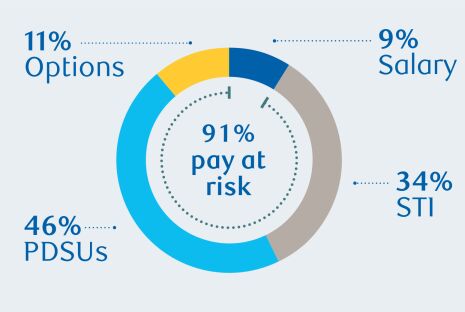
| ||||
| STI award |
||||||||||||||
| STI cash |
6,027,000 | 4,000,000 | 6,668,000 | |||||||||||
| STI deferred1 |
1,413,000 | — | — | |||||||||||
| Total |
7,440,000 | 4,000,000 | 6,668,000 | |||||||||||
| MTI and LTI awards |
||||||||||||||
| PDSUs |
10,120,000 | 8,800,000 | 9,460,000 | |||||||||||
| Stock options |
2,530,000 | 2,200,000 | 2,365,000 | |||||||||||
| Total |
12,650,000 | 11,000,000 | 11,825,000 | |||||||||||
| Total variable compensation |
|
20,090,000 |
2 |
|
15,000,000 |
|
|
18,493,000 |
| |||||
| Special equity award3 |
|
— |
|
|
— |
|
|
4,000,000 |
| |||||
| Total direct compensation |
|
22,090,000 |
|
|
17,000,000 |
|
|
24,493,000 |
| |||||
| 1 | 2025 NIAT payout (60% of STI award) is based on RBC NIAT. To meet the RBC variable compensation deferral requirement of 70%, $1,413,000 of Mr. McKay’s 2025 STI award was awarded as RBC Share Units (RSUs); the vesting period is 3 years from the grant date. |
| 2 | In 2025, 70% of pay at risk was deferred. |
| 3 | In December 2024, Mr. McKay was awarded a special performance-based equity award of $4,000,000 consisting entirely of PSUs linked to established strategic cost and earnings objectives, related to the integration of HSBC Canada, expected to be realized over the next 3 years. This special performance-based equity award will cliff vest after 3 years in December 2027 and is at risk and subject to adjustment considering progress against the aforementioned integration objectives. |
CEO target compensation for 2026
In 2023, the human resources committee conducted a comprehensive review of Mr. McKay’s total direct compensation target. The board approved a 2024 and 2025 target of $17,000,000. Mr. McKay’s 2026 target compensation is unchanged.
81
Royal Bank of Canada
Executive compensation
CEO compensation compared to realized and realizable pay over time
The table below compares the compensation awarded to the CEO over the past five years with the value realized or realizable as of December 31, 2025. We also compare the compensation values to the value received by shareholders, which is indexed at $100 to show a meaningful comparison.
| Year | Total direct compensation awarded1 ($ millions) |
Value as of December 31, 2025 ($ millions) |
Period | Value of $100 | ||||||||||||||||||
|
A Realized pay2 |
B Realizable pay3 |
A+B=C Current value |
To CEO4 ($) |
To shareholders5 | ||||||||||||||||||
| 2021 |
15.5 | 17.8 | 13.9 | 31.7 | 10/30/20 to 12/31/25 | 205 | 303 | |||||||||||||||
| 2022 |
15.3 | 20.3 | 13.6 | 33.9 | 10/29/21 to 12/31/25 | 222 | 211 | |||||||||||||||
| 2023 |
15.2 | 4.2 | 34.5 | 38.7 | 10/31/22 to 12/31/25 | 254 | 208 | |||||||||||||||
| 2024 |
24.5 | 8.7 | 23.2 | 31.9 | 10/31/23 to 12/31/25 | 130 | 209 | |||||||||||||||
| 2025 |
22.1 | 8.0 | 12.1 | 20.1 | 10/31/24 to 12/31/25 | 91 | 144 | |||||||||||||||
| Average | 180 | 215 | ||||||||||||||||||||
| 1 Reflects total direct compensation (salary and variable compensation) awarded at year end in respect of performance during the year. 2 Realized pay is the sum of the salary, cash incentive, payout value of share units granted during the period, dividend equivalents paid and the value of options exercised during the period. 3 Realizable pay is the sum of the current value of unvested units granted during the period and the in-the-money value of options outstanding. 4 Represents the actual value to the CEO for each $100 awarded in total direct compensation for the fiscal year indicated, as of December 31, 2025 for each period. 5 Represents the value of a $100 investment in RBC common shares made on the first day of the period indicated, assuming the dividends are reinvested. |
Share ownership
Values are based on $205.47, the closing price of RBC common shares on the TSX on October 31, 2025, the last trading day of the fiscal year.
|
PDSUs ($) |
RSUs1 ($) |
Personal holdings | Requirement | Total holdings ($) (as a multiple of requirement) | ||||||
| DSUs ($) |
Shares ($) | |||||||||
| 46,304,712 |
– |
4,674,468 | 10,771,846 | 8 x average salary | 61,751,026 (34.2 x average salary) | |||||
| 1 RBC Share Units |
82
Royal Bank of Canada
Executive compensation
Performance and compensation of other named executive officers
A detailed description of the results relative to financial, client and risk and strategic objectives for the NEOs is provided on pages 74 to 77.
Katherine Gibson
Chief Financial Officer
|
|
As Chief Financial Officer, Ms. Gibson is responsible for Finance, Controllership, Corporate Treasury, Taxation, Investor Relations, Performance Management, and Corporate Development. Together with other Group Executive, she is responsible for setting the overall strategic direction of the bank.
2025 performance highlights • Delivered strong capital ratios, driven by timely insightful analytics and a prudent financial risk strategy.
• Led the delivery of the all-bank Investor Day and evolved external disclosures to reinforce key strategies and RBC’s relative performance vs. bold targets and peers.
• Effectively managed expense discipline, contributing to positive operating leverage.
• Delivered new operating models to drive scale and accountability, including establishing a centralized Financial and Product Control team, a new U.S. regional reporting framework and finance operating model.
• Advanced RBC’s sustainability disclosure strategy and delivered the 2024 Sustainability Report and 2024 Public Accountability Statement while continuing to strengthen our internal controls and governance infrastructure.
• Unlocked development opportunities for leadership talent to fuel succession pipelines and refreshed the CFO Operating Committee to drive the next evolution of RBC’s Finance function.
2025 STI, MTI and LTI Program awards The human resources committee recommended, and the board approved, a STI award of $1,401,563, a MTI award of $2,346,000 and a LTI award of $586,500. |
Total direct compensation
| 2025 actual ($) |
2025 target ($) |
2024 actual ($) |
2025 actual pay mix | |||||||||||||||||
| Base salary |
|
650,000 |
|
650,000 |
|
400,000 |
|
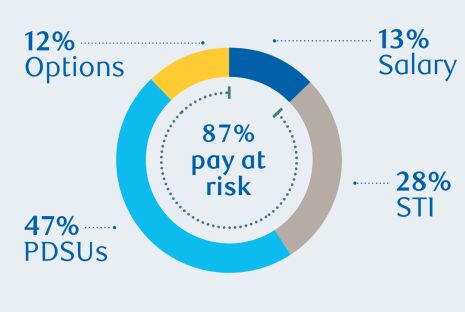
|
| |||||||||||
| STI award1 |
1,401,563 | 812,500 | 840,000 | |||||||||||||||||
| MTI and LTI awards |
||||||||||||||||||||
| PDSUs |
2,346,000 | 2,040,000 | 520,000 | |||||||||||||||||
| Stock options |
586,500 | 510,000 | 130,000 | |||||||||||||||||
| Total |
2,932,500 | 2,550,000 | 650,000 | |||||||||||||||||
|
Total variable compensation |
|
4,334,0632 |
|
3,362,500 |
|
1,490,000 |
||||||||||||||
| Interim CFO compensation |
||||||||||||||||||||
| Cash award |
— | — | 680,000 | |||||||||||||||||
| Equity award |
— | — | 1,250,000 | |||||||||||||||||
| Total Interim CFO compensation3 |
|
— |
|
— |
|
1,930,000 |
||||||||||||||
| Special equity award4 |
|
— |
|
— |
|
500,000 |
||||||||||||||
| Total direct compensation |
|
4,984,063 |
|
|
4,012,500 |
|
|
4,320,000 |
| |||||||||||
|
|
|
|
|
|
|
|
|
|
|
|||||||||||
| 1 2025 NIAT payout (60% of STI award) is based on RBC NIAT; 2024 STI award was modified by separate business and individual performance factors. 2 In 2025, 68% of pay at risk was deferred. 3 In December 2024, Ms. Gibson was awarded a cash award of $680,000 and an equity award of $1,250,000 in recognition of her appointment as Interim CFO. The equity award vests 50% one year after the grant date and 50% three years after the grant date. 4 In December 2024, to recognize the complexity of the HSBC Canada transaction and Ms. Gibson’s contributions to successfully integrating HSBC Canada, she was awarded a special equity award of $500,000 consisting of RBC share units (RSUs); vesting period is one year from grant date. |
Share ownership
Values are based on $205.47, the closing price of RBC common shares on the TSX on October 31, 2025, the last trading day of the fiscal year.
| Personal holdings |
Total holdings ($) (as a multiple of requirement) | |||||||||
| PDSUs
($) |
RSUs
($) |
DSUs
($) |
Shares
($) |
Requirement | ||||||
| 1,976,637 |
1,503,853 |
– | 642,278 | 6 x average salary |
4,122,768 (8.7 x average salary) | |||||
83
Royal Bank of Canada
Executive compensation
Derek Neldner
CEO and Group Head, RBC Capital Markets
|
|
As CEO and Group Head of RBC Capital Markets, Mr. Neldner has global oversight of the Capital Markets business. Together with the Capital Markets Operating Committee, he sets the overall growth strategy for Corporate & Investment Banking and Global Markets business activities worldwide.
2025 performance highlights
• Awarded the Best Investment Bank in Canada and Best Research Bank in North America as part of Euromoney’s Awards of Excellence in 2025, and ranked a Top 10 Investment Bank globally (Euromoney MarketMap).
• Expanded the U.S. Transaction Banking platform, RBC Clear, onboarding new clients and growing deposits. RBC Clear was named Best Digital Banking Initiative at the 2025 Banking Tech Awards USA and winner of the 2025 Model Celent Award for Reinventing Cash Management.
• Expanded capabilities and market presence within Global Markets across equity derivatives, risk solutions, structured products and commodities.
• Created a dedicated Energy Transition Centre of Excellence within Investment Banking to support clients on energy transition with advice and capital.
• Grew structured products solutions targeted to Wealth Management clients and progressed the Enterprise FX program across RBC platforms to coordinate capabilities and grow offerings.
• Scaled Aiden®, RBC Capital Markets’ AI solution, to all RBC Capital Markets’ employees and established an AI and Digital Centre of Excellence.
• Supported the development of talent through targeted employee moves to new and/or expanded roles to develop in-demand skills and build key capabilities for the future.
Performance-based incentive program awards Mr. Neldner participates in the Capital Markets Compensation Program (refer to page 72 for more information on this program). Individual performance is based on financial results as well as risk and strategic objectives, including sustainability. Mr. Neldner’s incentive awards are discretionary.
The human resources committee recommended, and the board approved, incentive compensation of $12,300,000. The incentive compensation is allocated as follows: 35% cash ($4,305,000); 52% performance-deferred share units ($6,396,000); and 13% stock options ($1,599,000). |
Total direct compensation
|
2025 actual ($) |
2024 actual ($) |
2025 actual pay mix | ||||||||
| Base salary |
700,000 | 700,000 |
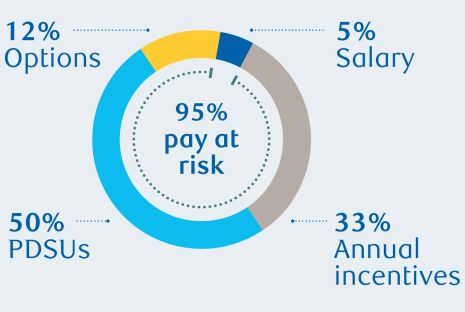
| |||||||
| Performance-based incentive awards |
||||||||||
| Annual incentives |
4,305,000 | 3,850,000 | ||||||||
| PDSUs |
6,396,000 | 5,720,000 | ||||||||
| Stock options |
1,599,000 | 1,430,000 | ||||||||
| Total |
12,300,000 | 1 | 11,000,000 | |||||||
| Total direct compensation |
13,000,000 | 11,700,000 | ||||||||
|
1 In 2025, 65% of pay at risk was deferred.
Share ownership Values are based on $205.47, the closing price of RBC common shares on the TSX on October 31, 2025, the last trading day of the fiscal year. |
| Personal holdings |
Total holdings ($) (as a multiple of requirement) | |||||||||
|
PDSUs ($) |
RSUs ($) |
DSUs ($) |
Shares ($) |
Requirement
| ||||||
| 22,730,299 |
– |
16,340,861 | 3,313,640 | 2 x average salary and cash bonus |
42,384,800 (10.1x average salary and cash bonus) | |||||
84
Royal Bank of Canada
Executive compensation
Maria Douvas
Chief Legal and Administrative Officer
|
|
As Chief Legal and Administrative Officer (CLAO), Ms. Douvas is responsible for the CLAO Group, which encompasses the bank’s global Legal, Regulatory Compliance, Government Affairs, Enterprise Strategy & Transformation, Corporate Development & Corporate Venture Capital teams, as well as the Enterprise Chief Operating Officer Group which includes the Enterprise Chief Control Office, Corporate Real Estate, Chief Data Office, and Global Procurement teams.
2025 performance highlights
• Strengthened the bank’s regulatory compliance management framework and acted as primary advisor to regulatory remediation efforts globally.
• Supported businesses to develop value creation levers (e.g., RBC Assist, RBC Direct Investing commission-free trading for mutual funds and select ETFs, AdvisorX platform) aligned to RBC’s risk appetite, laws, and regulations, prescribed practices and regulatory expectations.
• Established the Enterprise Chief Controls Office, standing up practice management, the process risk Centre of Excellence and strategic execution functions. These new functions have delivered value by driving insight, optimizing efficiencies, and building a centralized controls library that enhances consistency and risk oversight across the enterprise.
• Elevated RBC’s strategic vision on climate, articulating our goal to be the bank of choice for the transition to a low-carbon and resilient economy by actively collaborating with our clients.
• Actively prepared RBC to deliver on strategic opportunities by evaluating merger and acquisition deals and strategic relationship opportunities across multiple lines of business and geographies, including the loyalty partnership with Canadian Tire.
• Strengthened employee engagement driven by deliberate actions taken to establish and communicate a cohesive set of priorities that foster a One RBC® culture across the structurally diverse function.
2025 STI, MTI and LTI Program awards The human resources committee recommended, and the board approved, a STI award of US$1,548,750, a MTI award of US$2,737,000 and a LTI award of US$684,250. |
Total direct compensation
|
2025 actual ($) |
2025 target ($) |
2024 actual1 ($) |
2025 actual pay mix | |||||||||||
| Base salary |
US$ | 700,000 | US$ | 700,000 | US$ | 658,779 |
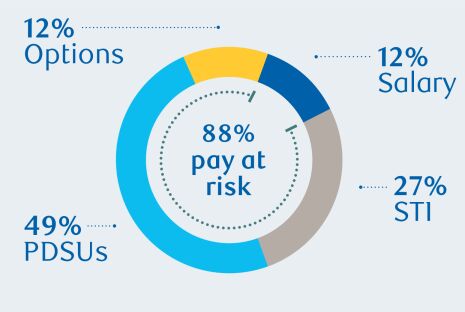
| |||||||
| STI award2 |
US$ | 1,548,750 | US$ | 875,000 | US$ | 1,385,083 | ||||||||
| MTI and LTI awards |
||||||||||||||
| PDSUs |
US$ | 2,737,000 | US$ | 2,380,000 | US$ | 2,558,500 | ||||||||
| Stock options |
US$ | 684,250 | US$ | 595,000 | US$ | 639,625 | ||||||||
| Total |
US$ | 3,421,250 | US$ | 2,975,000 | US$ | 3,198,125 | ||||||||
| Total variable compensation |
US$ | 4,970,000 | 3 | US$ | 3,850,000 | US$ | 4,583,208 | |||||||
| Special cash award4 |
— | — | US$ | 650,000 | ||||||||||
| Total direct compensation |
US$ | 5,670,000 | US$ | 4,550,000 | US$ | 5,891,987 | ||||||||
| 1 In April 2024, Ms. Douvas’s role was expanded from Chief Legal Officer to Chief Legal and Administrative Officer. 2 NIAT payout (60% of STI award) is based on RBC NIAT. 3 In 2025, 69% of pay at risk was deferred. 4 In December 2024, to recognize the complexity of the HSBC Canada transaction and Ms. Douvas’s contributions to successfully integrating HSBC Canada, she was awarded a special equity award of US$650,000 consisting of RSUs; vesting period is one year from grant date. |
| Share ownership Values are based on US$146.50, the closing price of RBC common shares on the New York Stock Exchange (NYSE) on October 31, 2025, the last trading day of the fiscal year. |
| Personal holdings |
Total holdings ($) (as a multiple of requirement) | |||||||||
| PDSUs
($) |
RSUs
($) |
DSUs
($) |
Shares
($) |
Requirement | ||||||
| 9,378,3761 |
1,597,1001 |
– | – | 6 x average salary | 10,975,476 (12.6x average salary)1,2 | |||||
| 1 Ms. Douvas’s compensation was denominated in U.S. dollars. Share-based awards were converted to Canadian dollars using the October month end spot rate for fiscal 2025: US1.00 = C$1.4010. 2 Ms. Douvas’s compensation was denominated in U.S. dollars for 2025, 2024, and 2023. Where applicable, U.S. dollar compensation (excluding share-based and option-based awards) was converted to Canadian dollars using the following average annual foreign exchange rates: US$1.00 = C$1.4045 for fiscal 2025, US$1.00 = C$1.3587 for fiscal 2024 and US$1.00 = C$1.3495 for fiscal 2023.
|
85
Royal Bank of Canada
Executive compensation
Neil McLaughlin
Group Head, RBC Wealth Management
|
|
As Group Head, RBC Wealth Management, Mr. McLaughlin is responsible for strategic leadership of RBC’s wealth management businesses, including wealth advisory businesses in Canada, the United States, Europe and Asia, as well as RBC Global Asset Management, RBC Direct Investing, and RBC Investor Services.
2025 performance highlights
• Further extended the business position as an industry leader through its full-service private wealth business.
• Continued to enhance digital and data capabilities, modernize infrastructure and invest in personalized client experiences to boost client satisfaction and advisor productivity.
• Maintained #1 market share in Canadian mutual fund AUM.
• Introduced commission-free ETF trading in Direct Investing to strengthen our value proposition with early-stage investors, and launched our Royal Distinction program that provides dedicated support and exclusive benefits to our high-net-worth (HNW) clients.
• RBC Direct Investing became the first bank-owned online brokerage in Canada to offer online international trading in multiple foreign currencies, giving clients the flexibility to trade on global exchanges.
• Continued to leverage RBC Brewin Dolphin to support our position as a top five largest wealth manager in the U.K. and achieved growth and continued momentum in Asia through the addition of experienced client-facing advisors and net new assets.
• Launched the Ignite 2027 strategy dedicated to the Canadian Investor Services business with a focus on client and employee experience, and significant investment in technology and people.
• Further strengthened our culture of inclusion and belonging by engaging employee participation in key global enterprise events and Employee Resource Groups.
2025 STI, MTI and LTI Program awards The human resources committee recommended, and the board approved, a STI award of $1,434,375, a MTI award of $3,507,500 and a LTI award of $876,875. |
Total direct compensation
|
2025 actual ($) |
2025 target ($) |
2024 actual ($) |
2025 actual pay mix | |||||||||||
| Base salary |
750,000 | 750,000 | 750,000 |
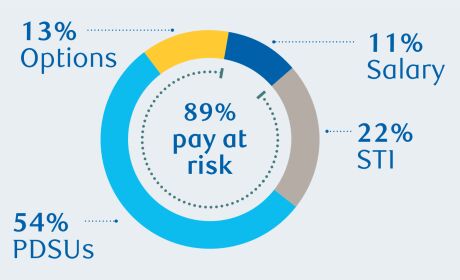
| ||||||||||
| STI award1 |
1,434,375 | 937,500 | 1,440,391 | |||||||||||
| MTI and LTI awards |
||||||||||||||
| PDSUs |
3,507,500 | 3,050,000 | 3,278,750 | |||||||||||
| Stock options |
876,875 | 762,500 | 819,688 | |||||||||||
| Total |
4,384,375 | 3,812,500 | 4,098,438 | |||||||||||
| Total variable compensation |
5,818,750 | 2 | 4,750,000 | 5,538,829 | ||||||||||
| Special awards3,4 |
— | — | 1,750,000 | |||||||||||
| Total direct compensation |
6,568,750 | 5,500,000 | 8,038,829 | |||||||||||
| 1 NIAT payout (60% of STI award) is based on 45% business NIAT and 15% RBC NIAT. 2 In 2025, 75% of pay at risk was deferred. 3 In April 2024, Mr. McLaughlin was awarded a special performance-based equity award of $1,250,000 consisting of RSUs in recognition of the complexity of the acquisition of HSBC Canada by RBC and his contribution to successfully integrating HSBC Canada. The special performance-based equity award vested one year after the grant date, and was subject to adjustment based on progress against performance criteria related to the integration of HSBC Canada. 4 In December 2024, Mr. McLaughlin was awarded a special equity award of $500,000 consisting of PDSUs in recognition of his appointment to Group Head, Wealth Management. The special equity award will vest three years after the grant date. |
Share ownership
Values are based on $205.47, the closing price of RBC common shares on the TSX on October 31, 2025, the last trading day of the fiscal year.
| Personal holdings |
Total holdings ($) (as a multiple of requirement) | |||||||||
| PDSUs
($) |
RSUs
($) |
DSUs
($) |
Shares
($) |
Requirement | ||||||
| 15,768,377 |
– |
– | 2,320,450 | 6 x average salary | 18,088,827 (24.1x average salary) | |||||
86
Royal Bank of Canada
Executive compensation
Executive compensation alignment with shareholder returns
The following chart compares the cumulative TSR of $100 invested in shares (assuming the dividends are reinvested) from October 31, 2020 to October 31, 2025 with the cumulative total return of the S&P/TSX Composite Banks Index and the S&P/TSX Composite Index over the same time period. Total compensation represents the approved aggregate compensation for the NEOs as reported in each year’s management proxy circular. The NEO total compensation is aligned to the multi-year profile of shareholder return and market indices.
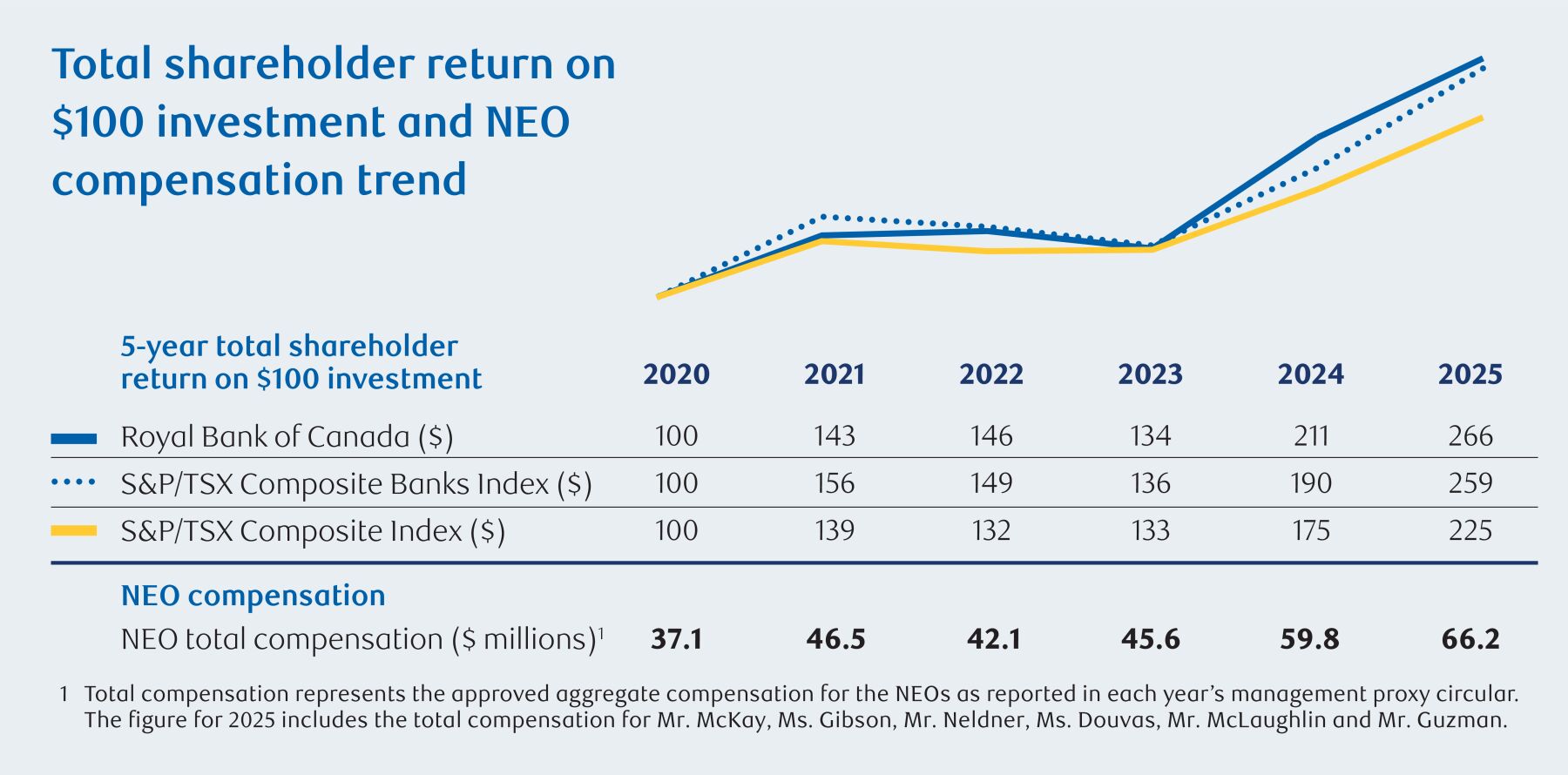
We use cost of management ratios to show how corporate performance compares to compensation awarded to NEOs. The following chart shows the link between RBC performance (as a percentage of RBC net income) and total compensation for the CEO and other NEOs, as reported in the summary compensation table for the five-year period that ended October 31, 2025.
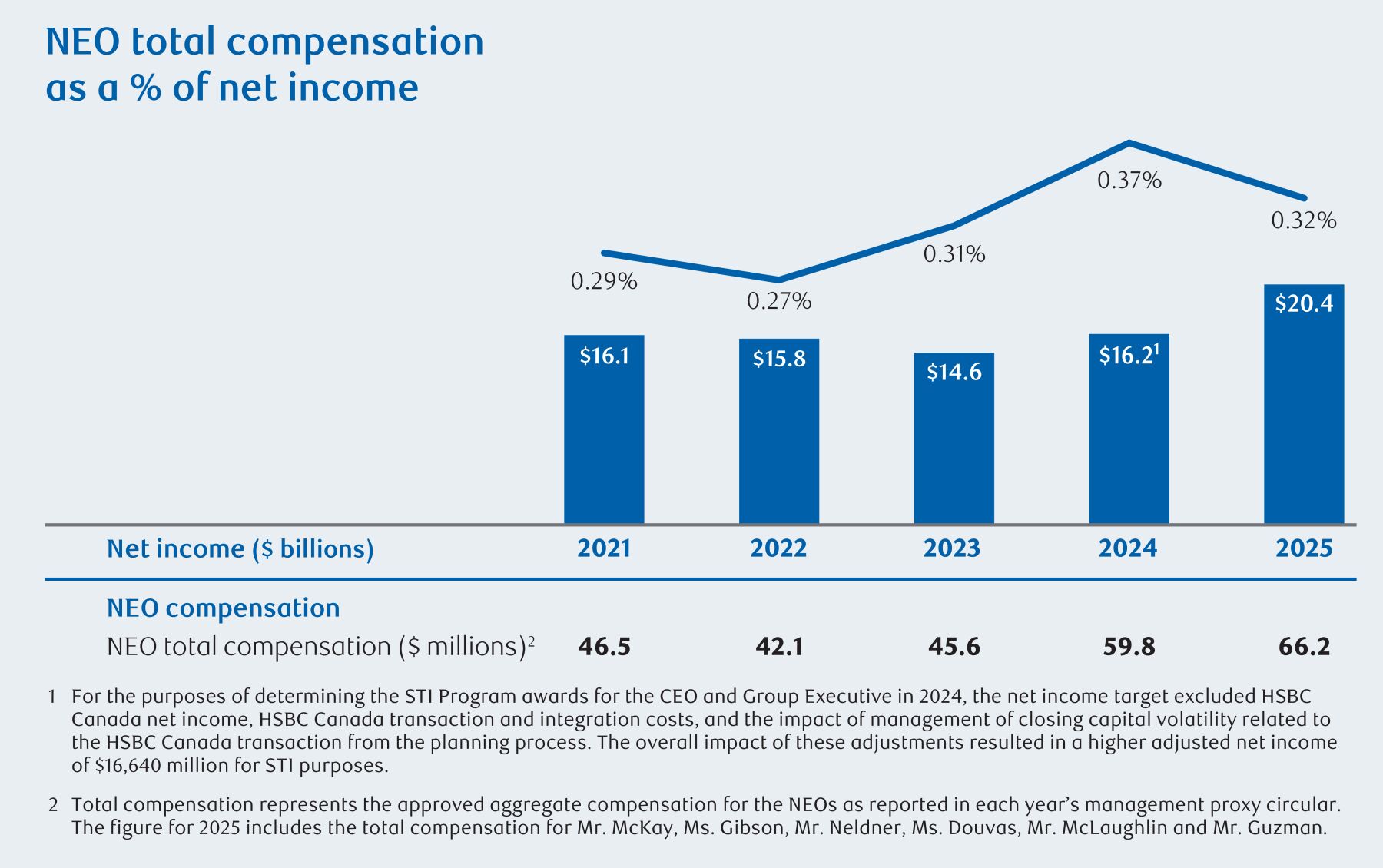
87
Royal Bank of Canada
Executive compensation
Summary compensation table
The salaries shown in the table below may differ from other compensation tables in this proxy circular as the figures below represent salaries earned in the fiscal year and other tables may include the annual base salary for the calendar year. All information in this section is for the fiscal years ended October 31 of 2025, 2024 and 2023, unless otherwise noted, and complies with the requirements of the Canadian Securities Administrators.
| Name and principal position |
Year | Salary ($) |
Share-based awards ($) |
Option-based awards ($) |
Non-equity annual incentive plan compensation ($)
|
Pension value ($) |
All other compensation ($) |
Total compensation ($) |
||||||||||||||||||||||
| D. McKay President and CEO |
2025 |
|
2,000,000 |
|
|
10,120,000 |
|
|
2,530,000 |
|
|
7,440,000 |
1 |
|
1,606,000 |
|
|
59,836 |
|
|
23,755,836 |
| ||||||||
| 2024 |
|
1,916,667 |
|
|
13,460,000 |
2 |
|
2,365,000 |
|
|
6,668,000 |
|
|
1,505,000 |
|
|
56,959 |
|
|
25,971,626 |
| |||||||||
| 2023 |
|
1,500,000 |
|
|
8,815,000 |
|
|
2,203,750 |
|
|
2,702,250 |
|
|
860,000 |
|
|
44,877 |
|
|
16,125,877 |
| |||||||||
| K. Gibson3 |
2025 |
|
650,000 |
|
|
2,346,000 |
|
|
586,500 |
|
|
1,401,563 |
|
|
318,000 |
|
|
18,584 |
|
|
5,320,647 |
| ||||||||
| CFO |
2024 |
|
400,000 |
|
|
2,270,000 |
4,5 |
|
130,000 |
|
|
840,000 |
|
|
35,000 |
|
|
691,794 |
6 |
|
4,366,794 |
| ||||||||
| 2023 |
|
378,548 |
|
|
830,000 |
7 |
|
120,000 |
|
|
416,000 |
|
|
13,000 |
|
|
10,333 |
|
|
1,767,881 |
| |||||||||
| D. Neldner Group Head and CEO, RBC Capital Markets |
2025 |
|
700,000 |
|
|
6,396,000 |
|
|
1,599,000 |
|
|
4,305,000 |
|
|
9,000 |
|
|
4,500 |
|
|
13,013,500 |
| ||||||||
| 2024 |
|
700,000 |
|
|
5,720,000 |
|
|
1,430,000 |
|
|
3,850,000 |
|
|
8,833 |
|
|
4,500 |
|
|
11,713,333 |
| |||||||||
| 2023 |
|
700,000 |
|
|
5,096,000 |
|
|
1,274,000 |
|
|
3,430,000 |
|
|
7,750 |
|
|
4,500 |
|
|
10,512,250 |
| |||||||||
| M. Douvas8,9 CLAO |
2025 |
|
983,150 |
|
|
3,768,302 |
|
|
942,075 |
|
|
2,175,219 |
|
|
168,704 |
|
|
– |
|
|
8,037,450 |
| ||||||||
| 2024 |
|
883,155 |
|
|
4,569,546 |
10 |
|
910,954 |
|
|
1,881,912 |
|
|
163,995 |
|
|
– |
|
|
8,409,562 |
| |||||||||
| 2023 |
|
742,225 |
|
|
2,447,399 |
11 |
|
441,962 |
|
|
1,086,432 |
|
|
159,703 |
|
|
– |
|
|
4,877,721 |
| |||||||||
| N. McLaughlin Group Head, Wealth Management |
2025 |
|
750,000 |
|
|
3,507,500 |
|
|
876,875 |
|
|
1,434,375 |
|
|
361,000 |
|
|
22,438 |
|
|
6,952,188 |
| ||||||||
| 2024 |
|
750,000 |
|
|
5,028,750 |
12,13 |
|
819,688 |
|
|
1,440,391 |
|
|
109,000 |
|
|
22,438 |
|
|
8,170,267 |
| |||||||||
| 2023 |
|
750,000 |
|
|
3,278,750 |
|
|
819,688 |
|
|
999,375 |
|
|
87,000 |
|
|
1,272,438 |
14 |
|
7,207,251 |
| |||||||||
| D. Guzman15 Former Deputy Chair, Royal Bank of Canada |
2025 |
|
700,000 |
|
|
4,991,000 |
|
|
1,247,750 |
|
|
1,417,500 |
|
|
12,528 |
|
|
732,572 |
16 |
|
9,101,350 |
| ||||||||
| 2024 |
|
700,000 |
|
|
4,665,500 |
|
|
1,166,375 |
|
|
1,332,625 |
|
|
12,583 |
|
|
1,354,500 |
17 |
|
9,231,583 |
| |||||||||
| 2023 |
|
700,000 |
|
|
4,665,500 |
|
|
1,166,375 |
|
|
1,016,750 |
|
|
7,750 |
|
|
4,500 |
|
|
7,560,875 |
| |||||||||
| 1 To meet the RBC variable compensation deferral requirement of 70%, $1,413,000 of Mr. McKay’s 2025 STI award was granted under the RBC Share Unit Program. |
| 2 In December 2024, Mr. McKay was awarded a special performance-based equity award of $4,000,000 consisting entirely of PSUs linked to established strategic cost and earnings objectives, related to the integration of HSBC Canada, expected to be realized over the next three years. This special performance-based equity award will cliff vest after three years in December 2027 and is at risk and subject to adjustment considering progress against the aforementioned integration objectives. |
| 3 Ms. Gibson was appointed as Chief Financial Officer effective September 12, 2024. Ms. Gibson was Interim Chief Financial Officer from April 5, 2024 until September 11, 2024. Prior to this, Ms. Gibson was Senior Vice-President, Enterprise Finance and Controller and City National Bank Finance. |
| 4 Ms. Gibson was awarded an equity award of $1,250,000 in recognition of her appointment as Interim CFO with 50% vesting one year after the grant date and 50% vesting three years after the grant date. |
| 5 In December 2024, to recognize the complexity of the HSBC Canada transaction and Ms. Gibson’s contributions to successfully integrating HSBC Canada onto RBC, she was awarded a special equity award of $500,000 consisting of RSUs; vesting period is one year from grant date. |
| 6 Ms. Gibson was awarded a cash award of $680,000 in recognition of her appointment as Interim CFO (2024). |
| 7 In December 2023, Ms. Gibson was awarded two equity awards totaling $350,000 while she was serving as Senior Vice-President, Finance and Controller and City National Bank Finance; both vesting in one year. |
| 8 In April 2024, Ms. Douvas’s role was expanded from Chief Legal Officer to Chief Legal and Administrative Officer. |
| 9 Ms. Douvas’s compensation was denominated in U.S. dollars for 2025, 2024, and 2023. U.S. dollar compensation (excluding share-based and option-based awards) was converted to Canadian dollars using the following average annual foreign exchange rates: US$1.00 = C$1.4045 for fiscal 2025, US$1.00 = C$1.3587 for fiscal 2024 and US$1.00 = C$1.3495 for fiscal 2023. Share-based and option-based awards were converted to Canadian dollars using the Bloomberg closing exchange rate on the trading day immediately preceding the grant date (2025 = 1.3768, 2024 = 1.4242; 2023 = 1.3591). |
| 10 In December 2024, Ms. Douvas was awarded a special equity award of US$650,000 ($925,730) consisting of RSUs in recognition of the complexity of the acquisition of HSBC Canada by RBC and her contribution to successfully integrating HSBC Canada; the vesting period is one year from the grant date. Please refer to footnote 9 of this summary compensation table for information on the conversion rate used. |
| 11 In December 2023, Ms. Douvas was awarded an equity award of US$500,000 ($679,550) while she was serving as Chief Legal Officer; vesting period is one year from grant date. Please refer to footnote 9 of this summary compensation table for information on the conversion rate used. |
| 12. In April 2024, Mr. McLaughlin was awarded a special performance-based equity award of $1,250,000 consisting of RSUs in recognition of the complexity of the acquisition of HSBC Canada by RBC and his contribution to successfully integrating HSBC Canada. The special performance-based equity award vested one year after the grant date and was subject to adjustment based on progress against performance criteria related to the integration of HSBC Canada. |
| 13 In December 2024, Mr. McLaughlin was awarded a special equity award of $500,000 consisting of PDSUs in recognition of his appointment to Group Head, Wealth Management. The special equity award will vest three years after the grant date. |
| 14 In February 2023, Mr. McLaughlin was awarded a special cash award of $1,250,000, payable conditional on the successful closing and conversion of the HSBC Canada transaction. |
| 15 Effective October 3, 2025, Mr. Guzman departed the bank. |
| 16 In October 2025, pursuant to the arrangement put in place in connection with his appointment as Deputy Chair, Royal Bank of Canada, Mr. Guzman received a total departure payment of $728,072, consisting of 50% of his base salary and 2025 STI award prorated for the period from October 31, 2025 to July 9, 2026. For more information on the arrangement put in place in connection with Mr. Guzman’s appointment, please see page 93. |
| 17 In August 2024, Mr. Guzman was awarded a special cash award of $1,350,000 paid in December 2024 in recognition of his role serving ultra-high-net-worth clients and in ensuring a successful transition of the Wealth Management business to new leaders. |
88
Royal Bank of Canada
Executive compensation
Share-based awards
The 2025 amounts for each NEO represent the grant date fair value of PDSUs awarded on December 16, 2025 under the PDSU Program. The grant date fair value of each unit granted to each NEO (excluding Ms. Douvas) was $228.434 based on the average closing price of RBC common shares on the TSX for the five trading days immediately preceding the grant date. The grant date fair value of each unit granted to Ms. Douvas was US$165.662. The 2024 and 2023 amounts for each NEO represent the grant date fair value of PDSUs awarded in those years.
For 2024, Mr. McKay, Ms. Gibson, Ms. Douvas and Mr. McLaughlin were awarded special equity awards. In December 2024, Mr. McKay was awarded a special performance-based equity award of $4,000,000, consisting entirely of PSUs linked to established strategic cost and earnings objectives, related to the integration of HSBC Canada, expected to be realized over the next three years. This special performance-based equity award will cliff vest after three years in December 2027 and is at risk and subject to adjustment considering progress against the aforementioned integration objectives. In 2024, Ms. Gibson was awarded a special equity award of $500,000 in recognition of HSBC Canada contributions with a vesting period of one year from grant date, and an equity award of $1,250,000 in recognition of her appointment as Interim CFO with 50% vesting one year after the grant date and 50% vesting three years after the grant date. In December 2024, Ms. Douvas was awarded a special equity award of US$650,000 (C$925,730)1 in recognition of HSBC Canada contributions. The special equity award will vest one year after the grant date. In April 2024, Mr. McLaughlin was awarded a special performance-based equity award of $1,250,000 in recognition of the complexity of the acquisition of HSBC Canada by RBC and his contribution to successfully integrating HSBC Canada with a vesting period of one year after the grant date, and in December 2024 he was awarded a special equity award of $500,000 in recognition of his appointment as Group Head, Wealth Management vesting with a vesting period of three years after the grant date. In December 2023, Ms. Gibson was awarded two equity awards totaling $350,000 while she was Senior Vice-President, Enterprise Finance and Controller and City National Bank Finance, both with a vesting period of one year after the grant date. In December 2023, Ms. Douvas was awarded an equity award of US$500,000 (C$679,550)1 while she was Chief Legal Officer, with a vesting period of one year after the grant date.
Option-based awards
The amounts for each NEO represent awards made under the Stock Option Plan. RBC uses the Black-Scholes model to value stock option awards for compensation purposes. For 2025, the compensation value was 16.7% of the grant price ($230.000); for 2024, the compensation value was 15.2% of the grant price ($177.965); and for 2023, the compensation value was 11.4% of the grant price ($125.374).
The following assumptions informed the Black-Scholes compensation value of option awards:
| Fiscal year | Term | Risk-free rate | Dividend yield | Volatility | ||||
| 2025 | 10 years | 3.1% | 3.0% | 17.7% | ||||
| 2024 | 10 years | 3.2% | 3.4% | 17.6% | ||||
| 2023 | 10 years | 4.1% | 4.9% | 17.4% | ||||
The Black-Scholes compensation value of stock options differs from the accounting fair value disclosed in our 2025 annual consolidated financial statements. Under International Financial Reporting Standard 2, Share-based Payment (IFRS 2), options must be treated as an expense using the fair value method of accounting. The accounting fair value of each award is determined as of the grant date and is amortized over the relevant vesting period. While the Black-Scholes model is also used to calculate the accounting fair value, the assumptions used in the accounting fair value calculation are based on an expected term of six years, rather than the full option term of ten years. This is consistent with IFRS 2 and reflects forfeitures as well as the historical exercise pattern of RBC executives. The accounting fair value was 12.8% of the grant price for 2025, 11.5% of the grant price for 2024, and 10.6% of the grant price for 2023. As the compensation fair value is greater, we awarded fewer options than if we had used the accounting fair value to determine the option awards.
Non-equity annual incentive plan compensation
The total STI award for each NEO includes cash, STI deferral in RBC share units (RSUs) or deferred share units (DSUs). Executives who voluntarily chose to receive their 2025 annual STI award in DSUs received DSUs based on the 2025 average closing price of RBC common shares on the TSX for the first five trading days in the open trading window in December, which was $228.434.
Pension value
Pension value represents compensatory change. Refer to pages 91 to 93 for more information on pension benefits for the NEOs.
All other compensation
With the exception of the special cash awards awarded to Ms. Gibson,2 Mr. McLaughlin,3 and Mr. Guzman,4 and Mr. Guzman’s departure payment4, these amounts represent the RBC contribution under the Royal Employee Savings and Share Ownership Plan (RESSOP) or RBC Dominion Securities Savings Plan (DSSP). The NEOs participate in the employee share ownership plans on the same basis as other employees. Refer to page 93 for more information about these plans.
| 1 | Ms. Douvas’s compensation was denominated in U.S. dollars for 2024 and 2023. U.S. dollar compensation was converted to Canadian dollars using the Bloomberg closing exchange rate on the trading day immediately preceding the grant date (2024 = 1.4242; 2023 = 1.3591). |
| 2 | Ms. Gibson was awarded a cash award of $680,000 in recognition of her appointment as Interim CFO (2024). |
| 3 | In February 2023, Mr. McLaughlin was awarded a special cash award of $1,250,000, payable conditional on the successful closing and conversion of the HSBC Canada transaction. |
| 4 | In August 2024, Mr. Guzman was awarded a special cash award of $1,350,000 paid in December 2024 in recognition of his role serving ultra-high-net-worth clients and in ensuring a successful transition of the Wealth Management business to new leaders. In October 2025, pursuant to the arrangement put in place in connection with his appointment as Deputy Chair, Royal Bank of Canada, Mr. Guzman received a total departure payment of $728,072, consisting of 50% of his base salary and 2025 STI award prorated for the period from October 31, 2025 to July 9, 2026. |
89
Royal Bank of Canada
Executive compensation
Incentive plan awards
Outstanding option-based and share-based awards
In the following table, option-based awards include all unexercised stock options outstanding as of October 31, 2025. The value of unexercised in-the-money options as of October 31, 2025 is the difference between the exercise price of the options and $205.47, the closing price of RBC common shares on the TSX on October 31, 2025, the last trading day of the fiscal year.
Share-based awards refer to unvested share units previously awarded through the PDSU Program and RSU Program as of October 31, 2025. The value of unvested units awarded under the PDSU Program assumes that there is no performance adjustment for relative TSR performance and that the three-year average ROE is above the applicable performance threshold. For each NEO (excluding Ms. Douvas), the value of unvested units is based on a share price of $205.47, the closing price of RBC common shares on the TSX on October 31, 2025, the last trading day of the fiscal year. For Ms. Douvas, the value of unvested units is based on a share price of US$146.50, the closing price of RBC common shares on the NYSE on October 31, 2025, the last trading day of the fiscal year. See pages 79 to 85 for more information about these awards.
| Option-based awards | Share-based awards | |||||||||||||||||||||||||||||||||||||||
| Name |
Grant date |
Number of securities underlying unexercised options (#) |
Option exercise price ($) |
Option expiration date |
Value of unexercised in-the-money options ($) |
Value of options exercised1 |
Number of shares or units have not vested (#) |
Market or payout value of share-based awards that have not vested2 ($) |
Market or payout value of vested share-based awards not paid out or distributed3 ($) |
|||||||||||||||||||||||||||||||
| D. McKay4 |
14-Dec-2015 | – | – | 14-Dec-2025 | – | 16,104,890 | ||||||||||||||||||||||||||||||||||
| 12-Dec-2016 | 184,714 | 90.230 | 12-Dec-2026 | 21,286,441 | ||||||||||||||||||||||||||||||||||||
| 11-Dec-2017 | 91,288 | 102.333 | 11-Dec-2027 | 9,415,170 | ||||||||||||||||||||||||||||||||||||
| 10-Dec-2018 | 133,130 | 96.548 | 10-Dec-2028 | 14,500,786 | ||||||||||||||||||||||||||||||||||||
| 16-Dec-2019 | 125,168 | 104.701 | 16-Dec-2029 | 12,613,054 | ||||||||||||||||||||||||||||||||||||
| 14-Dec-2020 | 149,464 | 105.995 | 14-Dec-2030 | 14,867,931 | ||||||||||||||||||||||||||||||||||||
| 13-Dec-2021 | 133,502 | 129.985 | 13-Dec-2031 | 10,077,398 | ||||||||||||||||||||||||||||||||||||
| 13-Dec-2022 | 132,616 | 131.640 | 13-Dec-2032 | 9,791,039 | ||||||||||||||||||||||||||||||||||||
| 13-Dec-2023 | 154,596 | 125.374 | 13-Dec-2033 | 12,382,521 | ||||||||||||||||||||||||||||||||||||
| 17-Dec-2024 | 87,200 | 177.965 | 17-Dec-2034 | 2,398,436 | ||||||||||||||||||||||||||||||||||||
| 225,360 | 46,304,712 | 4,674,468 | ||||||||||||||||||||||||||||||||||||||
| Total |
1,191,678 | 107,332,776 | 16,104,890 | 225,360 | 46,304,712 | 4,674,468 | ||||||||||||||||||||||||||||||||||
| K. Gibson |
12-Dec-2016 | 3,696 | 90.230 | 12-Dec-2026 | 425,927 | |||||||||||||||||||||||||||||||||||
| 11-Dec-2017 | 2,842 | 102.333 | 11-Dec-2027 | 293,115 | ||||||||||||||||||||||||||||||||||||
| 10-Dec-2018 | 3,678 | 96.548 | 10-Dec-2028 | 400,615 | ||||||||||||||||||||||||||||||||||||
| 16-Dec-2019 | 3,830 | 104.701 | 16-Dec-2029 | 385,945 | ||||||||||||||||||||||||||||||||||||
| 14-Dec-2020 | 4,508 | 105.995 | 14-Dec-2030 | 448,433 | ||||||||||||||||||||||||||||||||||||
| 13-Dec-2021 | 4,452 | 129.985 | 13-Dec-2031 | 336,059 | ||||||||||||||||||||||||||||||||||||
| 13-Dec-2022 | 4,622 | 131.640 | 13-Dec-2032 | 341,242 | ||||||||||||||||||||||||||||||||||||
| 13-Dec-2023 | 8,420 | 125.374 | 13-Dec-2033 | 674,408 | ||||||||||||||||||||||||||||||||||||
| 17-Dec-2024 | 4,794 | 177.965 | 17-Dec-2034 | 131,859 | ||||||||||||||||||||||||||||||||||||
| 16,939 | 3,480,490 | |||||||||||||||||||||||||||||||||||||||
| Total |
40,842 | 3,437,603 | – | 16,939 | 3,480,490 | – | ||||||||||||||||||||||||||||||||||
| D. Neldner |
14-Dec-2020 | 77,106 | 105.995 | 14-Dec-2030 | 7,670,119 | |||||||||||||||||||||||||||||||||||
| 13-Dec-2021 | 80,642 | 129.985 | 13-Dec-2031 | 6,087,261 | ||||||||||||||||||||||||||||||||||||
| 13-Dec-2022 | 62,474 | 131.640 | 13-Dec-2032 | 4,612,455 | ||||||||||||||||||||||||||||||||||||
| 13-Dec-2023 | 89,372 | 125.374 | 13-Dec-2033 | 7,158,340 | ||||||||||||||||||||||||||||||||||||
| 17-Dec-2024 | 52,726 | 177.965 | 17-Dec-2034 | 1,450,229 | ||||||||||||||||||||||||||||||||||||
| 110,626 | 22,730,299 | 16,340,861 | ||||||||||||||||||||||||||||||||||||||
| Total |
362,320 | 26,978,404 | – | 110,626 | 22,730,299 | 16,340,861 | ||||||||||||||||||||||||||||||||||
| M. Douvas5 |
10-Dec-2018 | 8,482 | 96.548 | 10-Dec-2028 | 923,876 | |||||||||||||||||||||||||||||||||||
| 16-Dec-2019 | 9,066 | 104.701 | 16-Dec-2029 | 913,572 | ||||||||||||||||||||||||||||||||||||
| 14-Dec-2020 | 9,604 | 105.995 | 14-Dec-2030 | 955,358 | ||||||||||||||||||||||||||||||||||||
| 13-Dec-2021 | 12,844 | 129.985 | 13-Dec-2031 | 969,529 | ||||||||||||||||||||||||||||||||||||
| 13-Dec-2022 | 17,638 | 131.640 | 13-Dec-2032 | 1,302,214 | ||||||||||||||||||||||||||||||||||||
| 13-Dec-2023 | 30,992 | 125.374 | 13-Dec-2033 | 2,482,335 | ||||||||||||||||||||||||||||||||||||
| 17-Dec-2024 | 33,480 | 177.965 | 17-Dec-2034 | 920,867 | ||||||||||||||||||||||||||||||||||||
| 53,475 | 10,975,476 | |||||||||||||||||||||||||||||||||||||||
| Total |
122,106 | 8,467,751 | – | 53,475 | 10,975,476 | – | ||||||||||||||||||||||||||||||||||
| N. McLaughlin |
11-Dec-2017 | 15,800 | 102.333 | 11-Dec-2027 | 1,629,565 | |||||||||||||||||||||||||||||||||||
| 10-Dec-2018 | 37,520 | 96.548 | 10-Dec-2028 | 4,086,753 | ||||||||||||||||||||||||||||||||||||
| 16-Dec-2019 | 44,380 | 104.701 | 16-Dec-2029 | 4,472,128 | ||||||||||||||||||||||||||||||||||||
| 14-Dec-2020 | 52,520 | 105.995 | 14-Dec-2030 | 5,224,427 | ||||||||||||||||||||||||||||||||||||
| 13-Dec-2021 | 56,554 | 129.985 | 13-Dec-2031 | 4,268,979 | ||||||||||||||||||||||||||||||||||||
| 13-Dec-2022 | 49,328 | 131.640 | 13-Dec-2032 | 3,641,886 | ||||||||||||||||||||||||||||||||||||
| 13-Dec-2023 | 57,502 | 125.374 | 13-Dec-2033 | 4,605,680 | ||||||||||||||||||||||||||||||||||||
| 17-Dec-2024 | 30,224 | 177.965 | 17-Dec-2034 | 831,311 | ||||||||||||||||||||||||||||||||||||
| 76,743 | 15,768,377 | |||||||||||||||||||||||||||||||||||||||
| Total |
343,828 | 28,760,729 | – | 76,743 | 15,768,377 | – | ||||||||||||||||||||||||||||||||||
| D. Guzman6 |
14-Dec-2020 | – | – | 14-Dec-2030 | – | 1,957,102 | ||||||||||||||||||||||||||||||||||
| 13-Dec-2021 | 49,168 | 129.985 | 13-Dec-2031 | 3,711,446 | 76,933 | |||||||||||||||||||||||||||||||||||
| 13-Dec-2022 | 70,190 | 131.640 | 13-Dec-2032 | 5,182,128 | ||||||||||||||||||||||||||||||||||||
| 13-Dec-2023 | 81,822 | 125.374 | 13-Dec-2033 | 6,553,615 | ||||||||||||||||||||||||||||||||||||
| 17-Dec-2024 | 43,006 | 177.965 | 17-Dec-2034 | 1,182,880 | ||||||||||||||||||||||||||||||||||||
| 105,099 | 21,594,596 | |||||||||||||||||||||||||||||||||||||||
| Total |
244,186 | 16,630,069 | 2,034,036 | 105,099 | 21,594,596 | – | ||||||||||||||||||||||||||||||||||
| 1 The value of options exercised is the benefit from the exercise of options granted in previous years before deductions for taxes and commissions. 2 Number of shares are presented on a rounded basis which results in immaterial differences in the calculation of market or payout value of share-based awards that have not vested. 3 Represents vested DSUs which are redeemable only upon retirement, resignation or termination of employment with RBC. 4 Mr. McKay’s options were exercised as part of the automatic exercise of options program and were due to expire in December 2025. 5 The value for Ms. Douvas’s unvested shared-based awards of US$7,834,030 was converted to Canadian dollars using the October month end spot rate for fiscal 2025: US$1.00 = $1.4010. 6 Effective October 3, 2025, Mr. Guzman departed the bank. |
90
Royal Bank of Canada
Executive compensation
Incentive plan awards – value vested or earned during the year
The table below includes the portion of option-based awards and any share-based awards under the PDSU Program that vested in the fiscal year ended October 31, 2025. It also includes the STI or annual bonus that was awarded for the 2025 fiscal year and paid in December 2025, received by the NEO in cash or deferred share units.
|
Name |
Option-based awards – value vested during the year1 ($) |
Share-based awards – value vested during the year2,3 ($) |
Non-equity incentive plan compensation – value earned during the year ($) | ||||||||||||
| D. McKay |
|
8,495,846 |
|
12,226,096 |
|
7,440,000 |
|||||||||
| K. Gibson |
|
266,334 |
|
1,545,269 |
|
1,401,563 |
|||||||||
| D. Neldner |
|
4,662,034 |
|
7,385,056 |
|
4,305,000 |
|||||||||
| M. Douvas4 |
|
647,082 |
|
2,189,239 |
|
2,175,219 |
|||||||||
| N. McLaughlin |
|
3,214,051 |
|
6,660,821 |
|
1,434,375 |
|||||||||
| D. Guzman5 |
|
3,233,190 |
|
6,193,151 |
|
1,417,500 |
|||||||||
| 1 For the options granted on: • December 14, 2020 at an exercise price of $105.995, 50% of options vested on December 14, 2024 at a fair market value of $177.310, the previous trading day’s closing share price, and • December 13, 2021 at an exercise price of $129.985, 50% of options vested on December 13, 2024 at a fair market value of $177.420, the previous trading day’s closing share price. 2 The amounts reflect values received from awards under the PDSU Program. The awards vested on December 13, 2024 and were paid out in cash based on a share price of $178.272, which represents the average price of RBC common shares on the TSX for the five trading days immediately preceding December 13, 2024. For Ms. Douvas, the awards vested on December 13, 2024 and were paid out in cash based on a share price of US$125.730. At the time of vesting, the performance component of the awards paid out at 100% to reflect the RBC TSR relative to the global performance peer group as described on pages 68 to 69. 3 The amounts for Ms. Gibson, Ms. Douvas, Mr. McLaughlin, and Mr. Guzman also reflect share units received under the RBC Share Unit Program. 4 The value for Ms. Douvas’s vested shared-based awards of US$1,539,550 was converted to Canadian dollars using Bloomberg closing exchange rate on the trading day immediately preceding the vest date of US$1.00 = C$1.4220. Ms. Douvas’s non-equity incentive plan compensation value of US$1,548,750 was converted from U.S. dollars into Canadian dollars using an average exchange rate of US$1.00 = C$1.4045 in 2025. 5 Effective October 3, 2025, Mr. Guzman departed the bank. | ||||||
Securities authorized for issuance under equity compensation plans
The following table shows the equity securities authorized for issuance from treasury under compensation plans as of October 31, 2025, as approved by shareholders. Our equity compensation plans do not permit the issuance of shares that shareholders have not previously approved. The numbers shown in the table relate to the Stock Option Plan.
| Plan category |
Number of securities to be issued upon exercise of outstanding options (a) (#) |
Weighted-average exercise price of outstanding options (b) ($) |
Number of securities remaining available for future issuance under equity compensation plans (excluding securities reflected in column (a)) (c) (#) | ||||||||||||
| Equity compensation plans approved by security holders |
|
7,489,9721 |
|
123.37 |
|
16,380,643 |
|||||||||
|
Equity compensation plans not approved by security holders |
|
– |
|
– |
|
– |
|||||||||
| Total |
|
7,489,972 |
|
|
123.37 |
|
|
16,380,643 |
| ||||||
| 1 Stock options assumed in connection with the acquisition of City National Bank are not included in this table; the number of these outstanding options as of October 31, 2025 is nil. The weighted average exercise price of City National Bank stock options outstanding is $0. Similarly, stock awards assumed in connection with this acquisition are not included in this table; the number of these outstanding awards as of October 31, 2025 is nil. The number of these options and awards is equal to the number of RBC common shares to be issued upon exercise or payment. |
91
Royal Bank of Canada
Executive compensation
Stock Option Plan
The maximum number of shares that may be issued to executives, as designated by the human resources committee under the Stock Option Plan,1 may not exceed 127 million shares (representing 9.07% of issued and outstanding common shares as of October 31, 2025). As described in the table below, as of October 31, 2025, outstanding stock options represented 0.53% of shares outstanding. Shares issuable under options that expire, terminate or are cancelled without having been exercised are available for subsequent grants of options under the plan. The exercise price of options is determined as the higher of the volume-weighted average of the trading price per share of a board lot of RBC common shares traded on the TSX: (i) on the day preceding the date of grant, and (ii) for the five consecutive trading days immediately preceding the date of grant. The maximum number of shares reserved for issuance under options to any one participant cannot exceed 5% of the shares then issued and outstanding. The Stock Option Plan does not limit insider participation. Other than by will or the laws of succession, options are not transferable or assignable.
Option grants may include stock appreciation rights (SARs). The exercise of a SAR entitles the participant to a cash payment equal to the number of shares covered by the SARs, multiplied by the amount by which the closing price on the TSX on the day prior to exercise exceeds the exercise price of the corresponding option. Upon the exercise of an option, the corresponding SAR is cancelled and vice versa. There were no SARs outstanding as of October 31, 2025.
The human resources committee and the board determine the term and vesting conditions of any options or SARs at the time of grant.
Unvested stock options are forfeited if the participant’s employment is terminated, other than for retirement (as outlined on pages 93 to 94), disability or death. In the event of disability, stock options continue to vest and must be exercised within ten years2 from the grant date. Upon death, stock options vest immediately and may be transferred by will or pursuant to laws of succession. The participant’s legal successor must exercise the options within 24 months after the date of death or within ten years from the grant date, whichever is earlier. The term of stock options that are scheduled to expire during, or shortly after, a period in which the option holder is prohibited from exercising the option due to an insider trading blackout is automatically extended so that they expire ten business days following the end of the applicable insider trading blackout.
Refer to pages 93 to 95 for details on when a participant’s options terminate in circumstances other than disability or death.
The Stock Option Plan authorizes the board to make certain plan amendments without shareholder approval, including administrative changes, termination of the Stock Option Plan, changes to vesting provisions and amendments to comply with changes to laws and regulations or accounting requirements. No other amendments to the Stock Option Plan or any outstanding options or SARs may be made without the approval of shareholders.
The table below provides additional information on the Stock Option Plan for the past three years.
|
Number of options as of October 31, 2025 |
Stock options as a % of outstanding common shares for the applicable fiscal year1 | ||||||||||||||||||||||||
|
Target |
2025 |
2024 |
2023 | ||||||||||||||||||||||
| Overhang (options outstanding and available to grant) |
|
23,870,615 |
|
< 10 |
% |
|
1.7 |
% |
|
0.7 |
% |
|
0.8 |
% | |||||||||||
| Dilution (current outstanding options) |
|
7,489,972 |
|
< 5 |
% |
|
0.5 |
% |
|
0.5 |
% |
|
0.5 |
% | |||||||||||
| Burn rate (the number of options issued each year) |
|
910,152 |
|
< 1 |
% |
|
0.06 |
% |
|
0.10 |
% |
|
0.07 |
% | |||||||||||
| 1 Weighted average number of outstanding common shares for the applicable fiscal year is used for the burn rate calculation. |
Pension plan and other benefits
Defined benefit pension plan
Mr. McKay, Ms. Gibson and Mr. McLaughlin participate in the RBC Canadian Defined Benefit (DB) pension plan on the same basis as other employees.
The normal retirement age under the plan is 65, although early retirement benefits are available from age 55. Benefits are reduced for early retirement unless the member retires with 35 years of pensionable service.
Under the RBC Canadian DB pension plan, retirement income is determined using a formula that takes into account pensionable earnings and pensionable service. We define pensionable earnings as base salary and annual incentive awards during the best 60 consecutive months, where the accrual is capped at the Income Tax Act (Canada) defined benefit limit each year.
Supplemental pension benefits
In addition to the RBC Canadian DB pension plan, Mr. McKay, Ms. Gibson and Mr. McLaughlin receive supplemental pension benefits as defined under their individual executive pension arrangements. The supplemental pension benefits are capped for all NEOs. The supplemental pension benefits vest when the executive retires from RBC and payments are subject to non-competition provisions.
The key provisions of the individual executive pension arrangements are as follows.
CEO pension plan arrangement
Mr. McKay’s individual executive pension arrangement provides for an annual pension of $700,000 at age 55, increasing by $110,000 for each additional year of service after age 55 and capped at a maximum annual pension of $1,800,000. Increases to Mr. McKay’s salary do not increase Mr. McKay’s pension benefits.
| 1 | In April 2025, the shareholders approved a resolution to amend the Stock Option Plan such that the number of common shares issuable pursuant to the exercise of options under Stock Option Plan were increased by an additional 15,000,000 common shares, such that the maximum number of common shares that may be issued pursuant to the grant of options under the Stock Option Plan will be 127,000,000. |
| 2 | In 2019, the board amended the provision in the Stock Option Plan relating to expiry following retirement and disability, as permitted by its terms. Options granted after December 2019 expire ten years from the grant date. Options granted prior to December 2019 expire ten years from the grant date or 60 months following the date of retirement or disability, whichever is earlier. |
92
Royal Bank of Canada
Executive compensation
Other named executive officers
The pension arrangements for Ms. Gibson and Mr. McLaughlin provide for an annual pension of $125,000 at age 55, increasing by $30,000 for each additional year of service from age 55 to 60, and by $15,000 for each additional year of service from age 60 to 65, to a maximum annual pension of $350,000 at age 65, inclusive of benefits payable from all RBC pension plans. Increases to Ms. Gibson’s and Mr. McLaughlin’s salaries do not increase their pension benefits.
The table below shows the pension benefits the NEOs are entitled to receive under their individual executive pension arrangements, which include benefits payable from RBC pension plans:
| Name
|
Number of years of credited service (#)
|
Annual pension benefits payable ($) |
Opening present value of benefit obligation ($)
|
Compensatory change2 ($)
|
Non- compensatory change3 ($)
|
Closing present value of benefit obligation ($)
| |||||||||||||||||||||||||||||
| At year end1
|
At age 65
| ||||||||||||||||||||||||||||||||||
| D. McKay |
|
21.9 |
|
1,461,000 |
|
1,800,000 |
|
|
21,229,000 |
|
|
1,606,000 |
|
18,000 |
|
|
22,853,000 |
| |||||||||||||||||
| K. Gibson |
|
1.1 |
|
45,0004 |
|
350,000 |
|
|
359,000 |
|
|
318,000 |
|
57,000 |
|
|
734,000 |
| |||||||||||||||||
| N. McLaughlin |
|
10.8 |
|
158,000 |
|
|
350,000 |
|
|
1,406,000 |
|
|
361,000 |
|
101,000 |
|
|
1,868,000 |
| ||||||||||||||||
| 1 Annual pension benefits payable are benefits that have accrued, but in some cases, may not be fully vested. 2 Compensatory changes are the values of the projected pension earned from November 1, 2024 to October 31, 2025. The amounts shown are consistent with the disclosure in Note 16 of our 2025 annual consolidated financial statements for the year ended October 31, 2025. 3 Non-compensatory changes include interest on obligations at the beginning of the year, gains and losses due to differences in actual experience compared to actuarial assumptions (other than those reflected in compensatory changes), employee contributions, and changes in actuarial assumptions, such as movements in the discount rate. 4 Prorated pension based on $125,000 of annual pension benefit payable at age 55. |
The table below shows the years of credited service under the individual executive pension arrangements and the years of RBC service as of October 31, 2025.
| Name |
Years of credited service (#) |
Years of RBC service (#) | ||||||||
| D. McKay |
|
21.9 |
|
37.6 |
||||||
| K. Gibson |
|
1.1 |
|
23.1 |
||||||
| N. McLaughlin |
|
10.8 |
|
27.5 |
||||||
Defined contribution pension plan and 401(k) plan
Mr. Neldner participates in the RBC Canadian Defined Contribution (DC) pension plan on the same basis as other employees. Participants may choose to contribute from 0% to 9% of their earnings, to an annual maximum ($33,810 less RBC contributions in 2025). RBC provides required and matching contributions to a maximum of $13,500 per year.
Ms. Douvas participates in the RBC U.S.A. Retirement and Savings Plan (401(k) plan) on the same basis as other U.S. employees. Participants may choose to contribute from 0% to 50% of eligible pay up to the Internal Revenue Services (IRS) deferral limit (maximum pre-tax and Roth employee contribution $23,500 in 2025). RBC provides matching contributions to a maximum of 6% of the IRS compensation limit (maximum employer match $21,000 in 2025).
Mr. Guzman departed from RBC effective October 3, 2025, and his participation in the RBC Canadian DC pension plan ceased with no further contributions to the pension plan. There are no supplemental pension benefits payable to Mr. Guzman upon his departure.
Supplemental pension benefits
In addition to the 401(k) plan, Ms. Douvas receives supplemental pension benefits as defined under her individual executive pension arrangement. RBC makes notional contributions on Ms. Douvas’s behalf in the amount of US$100,000 per year that are credited with interest at the same rate as generated by Ms. Douvas’s U.S.A. 401(k) pension plan. The supplemental pension benefits vest when Ms. Douvas retires from RBC and payments are subject to non-competition provisions. The notional account balance will be paid out at retirement in 180 equal monthly installments.
93
Royal Bank of Canada
Executive compensation
The table below shows the account balances for NEOs participating in a DC pension plan and 401(k) plan.
| Name |
Accumulated value at start of year ($) |
Compensatory ($)1 |
Accumulated value as of October 31, 2025 ($) | ||||||||||||
| D. Neldner |
|
980,365 |
|
9,000 |
|
1,281,917 |
|||||||||
| M. Douvas2 |
|
1,116,929 |
|
168,704 |
|
1,550,702 |
|||||||||
| 1 Compensatory change represents the employer contribution to a DC pension plan on behalf of the NEOs. 2 For Ms. Douvas, compensatory change represents the employer contribution to the U.S.A. 401(k) plan and the notional employer contributions under her individual executive pension arrangement. Her pension values were converted to Canadian dollars using the following exchange rates: the accumulated value at start of year was converted using the exchange rate as of October 31, 2024 (US$1.00 = C$1.3934); the compensatory value was converted using the average exchange rate for fiscal 2025 (US$1.00 = C$1.4045); and the accumulated value as of October 31, 2025 was converted using the exchange rate as of October 31, 2025 (US$1.00 = C$1.4010). |
Other benefits
Executives in Canada and the U.S participate in the RBC benefits programs on the same basis as other employees. The benefits programs include healthcare coverage, life and accident insurance and disability coverage. The benefits programs are comparable to the programs provided by companies in our core compensation comparator group.
In Canada, RBC executives can participate in the RESSOP and executives in Capital Markets can participate in the DSSP, on the same basis as other employees in Canada. RBC provides a 50% matching contribution invested in shares up to a maximum of 3% of eligible earnings. RBC caps its matching contribution at $4,500 annually for DSSP members. RBC executives also receive perquisites as part of their executive compensation program. Executive perquisites vary by position and are comparable to those provided by companies in our core compensation comparator group.
Employment contracts, termination and change of control
Employment contracts
RBC does not have employment contracts with any of the NEOs; however, we have standard compensation policies that govern termination or change of control situations.
Effective in September 2024, the board appointed Mr. Guzman to the position of Deputy Chair, Royal Bank of Canada and awarded him a special cash award of $1.35 million, paid in December 2024 to recognize the role he will play in ensuring a successful transition of the Wealth Management business to new leaders, and serving ultra-high-net-worth clients. Pursuant to the arrangement put in place in connection with Mr. Guzman’s appointment, if his employment had been terminated by the bank without cause during the period commencing July 11, 2024 and ending October 31, 2025, he would have received compensation in lieu of notice for the balance of this period at the level of compensation contemplated for this period under his arrangement. If Mr. Guzman had resigned during the period commencing July 11, 2024 and ending October 31, 2025, he would have received his base salary to the effective date of resignation and a prorated STI payment for the portion of the fiscal year in which he was actively employed, with eligibility for an additional payment based on 50% of the base salary and STI that he would have received during the period from October 31, 2025 to July 9, 2026.
In October 2025, it was confirmed that Mr. Guzman would depart the bank and end his employment effective October 3, 2025. Notwithstanding that Mr. Guzman’s departure and the end of his employment occurred prior to October 31, 2025, for purposes of compensation and benefits under the arrangement put in place in connection with his appointment, he was treated as if he had remained employed until October 31, 2025. Mr. Guzman was not eligible for income protection under the arrangement after October 31, 2025 but received a lump sum departure payment in accordance with its terms.
Termination
We design our severance plans and policies to expedite the transition to alternative employment, comply with relevant legal requirements and reflect market practices. As required by Canadian law, we base our severance calculations for our Canadian employees on service, age and position. Bonuses or short-term incentive payments for the severance period are calculated with reference to relevant individual and business performance factors.
If a NEO is terminated for cause, we will not pay severance and, at the discretion of the board, the NEO will forfeit their:
| • | bonus payments under the STI Program |
| • | units previously awarded and unvested under the PDSU Program |
| • | unvested options under the Stock Option Plan, and |
| • | other annual bonus awards. |
We maintain a policy on compensation forfeiture and clawback, which is applicable in the event of fraud, misconduct or financial restatement. Additionally, in the event of a restatement of our financial results, excess incentive awards may be subject to recovery, as set forth in the Policy for the Recovery of Erroneously Awarded Incentive-Based Compensation for Executive Officers. Refer to page 62 for more information.
94
Royal Bank of Canada
Executive compensation
Change of control
We have a Change of Control Policy that covers the NEOs and certain other senior executives. It is designed to ensure that key members of management remain in their role for the benefit of shareholders in the event RBC is involved in a major transaction, including:
| • | an entity or individual becomes the beneficial owner of 20% or more of the voting shares of Royal Bank of Canada |
| • | a change of more than 50% of the members of the bank’s board of directors |
| • | a merger or consolidation with another entity that would result in voting shares of the bank representing less than 60% of the combined voting power following the merger or consolidation, or |
| • | a sale or disposition of 50% or more of the net book value of RBC assets. |
Benefits associated with the equity incentive programs are subject to a “double trigger”, which means the executive can accelerate the vesting period of any outstanding equity incentive awards only if they are terminated without cause within 24 months of the change of control.
Termination and change of control benefits
| Compensation elements |
Retirement | Termination with cause/resignation |
Termination without cause |
Termination without cause following a change of control | ||||
| Base salary |
Ends as of the retirement date |
Ends as of the termination or resignation date |
Paid out over the severance period as salary continuation or as a lump sum payment (up to 24 months’ base salary based on service, age and position) |
Lump sum payment equivalent to up to 24 months’ base salary | ||||
| Annual short-term incentive and annual cash bonus |
Receive pro-rated payment based on the proportion of the fiscal year completed as of the retirement date; paid at the end of the year |
Eligibility ends as of the termination or resignation date and no payment is made |
Paid in a lump sum at the end of each year of the severance period |
Lump sum payment equivalent to up to 24 months’ short-term incentive/annual cash bonus | ||||
| Deferred share units |
Must be redeemed on or before December 15 of the calendar year following the year of retirement |
Must be redeemed within 60 days of the termination or resignation date |
Must be redeemed within 60 days of the end of the severance period |
Must be redeemed within 60 days of the end of the severance period | ||||
| PDSU awards |
Continue to vest, subject to non-competition provisions |
All units are forfeited as of the termination or resignation date |
Unvested units will continue to vest in accordance with the original grant terms |
All unvested awards vest immediately upon termination | ||||
| Stock options |
Continue to vest, subject to non-competition provisions; must be exercised within 10 years from the grant date1 |
Unvested options are forfeited as of the termination or resignation date; vested options must be exercised within 90 days of the termination or resignation date |
Continue to vest to the end of the severance period; all unvested options are forfeited thereafter; vested options must be exercised within 90 days of the end of the severance period2 |
Vest immediately upon termination and must be exercised within 90 days of the termination date | ||||
| Benefits |
Eligible for retiree benefits |
Eligibility ends as of the termination or resignation date |
Pension credits and benefits continue during salary continuance period |
Pension credits and benefits continue during the severance period | ||||
| Perquisites |
End as of the retirement date |
End as of the termination or resignation date |
Continue during the severance period |
Continue during the severance period | ||||
| 1 As described on page 91, options granted prior to December 2019 expire 10 years from the grant date or 60 months following the date of retirement, whichever is earlier. 2 In the event of termination without cause occurring on or after the date the respective executive officer has become eligible for retirement, any stock options will continue to vest, subject to non-competition provisions, in accordance with the retirement provisions of the Stock Option Plan. |
95
Royal Bank of Canada
Executive compensation
Potential payments to named executive officers upon termination or change of control
The table below shows the value of the estimated incremental payments or benefits that would accrue to each NEO on termination of their employment following retirement, termination with cause, resignation, termination without cause or termination without cause following a change of control, assuming their employment was terminated on October 31, 2025.
The value of equity-based compensation consists of awards previously granted and disclosed. For the purpose of valuing equity-based awards for all NEOs (excluding Ms. Douvas), we used a price of $205.47, which is the closing price of RBC common shares on the TSX on October 31, 2025, the last trading day of the fiscal year. For the purpose of valuing equity-based awards for Ms. Douvas, we used a price of US$146.50, the closing price of RBC common shares on the NYSE on October 31, 2025, the last trading day of the fiscal year.
| Event |
D. McKay ($) |
K. Gibson ($) |
D. Neldner ($) |
M.
Douvas1 ($) |
N. McLaughlin ($) |
|||||||||||||||
| Retirement |
|
– |
|
|
– |
|
|
– |
|
|
– |
|
|
– |
| |||||
| Resignation |
|
– |
|
|
– |
|
|
– |
|
|
– |
|
|
– |
| |||||
| Termination with cause2 |
|
– |
|
|
– |
|
|
– |
|
|
– |
|
|
– |
| |||||
| Termination without cause |
||||||||||||||||||||
| Severance |
|
12,241,833 |
|
|
2,331,467 |
|
|
8,073,333 |
|
|
2,649,517 |
|
|
4,045,886 |
| |||||
| Equity-based compensation |
|
– |
|
|
– |
|
|
– |
|
|
– |
|
|
– |
| |||||
| Value of incremental pension benefits3 |
|
3,052,000 |
|
|
1,305,000 |
|
|
27,000 |
|
|
56,180 |
|
|
910,000 |
| |||||
| All other compensation4 |
|
225,284 |
|
|
141,108 |
|
|
107,670 |
|
|
157 |
|
|
143,098 |
| |||||
| Termination without cause following a change of control |
||||||||||||||||||||
| Severance |
|
12,241,833 |
|
|
2,331,467 |
|
|
8,073,333 |
|
|
2,649,517 |
|
|
4,045,886 |
| |||||
| Equity-based compensation |
|
75,915,407 |
|
|
4,796,029 |
|
|
38,994,953 |
|
|
16,165,657 |
|
|
26,981,744 |
| |||||
| Value of incremental pension benefits3 |
|
3,052,000 |
|
|
1,305,000 |
|
|
27,000 |
|
|
56,180 |
|
|
910,000 |
| |||||
| All other compensation4 |
|
225,284 |
|
|
141,108 |
|
|
107,670 |
|
|
157 |
|
|
143,098 |
| |||||
| 1 Ms. Douvas’s compensation was denominated in U.S. dollars. Where applicable, U.S. dollar compensation (excluding share-based and option-based awards) was converted to Canadian dollars using the following average annual foreign exchange rates: US$1.00 = C$1.4045 for fiscal 2025, US$1.00 = C$1.3587 for fiscal 2024, US$1.00 = C$1.3495 for fiscal 2023 and US$1.00 = C$1.292 for fiscal 2022. Share-based awards were converted to Canadian dollars using the October month end spot rate for fiscal 2025: US1.00 = C$1.4010
2 In the event of termination by RBC for reason of misconduct, gross negligence or willful breach of obligations, no benefits shall be payable from the individual executive pension arrangements for Mr. McKay, Ms. Gibson, Ms. Douvas and Mr. McLaughlin.
3 For Mr. McKay, Ms. Gibson and Mr. McLaughlin, the values shown represent the present value as at October 31, 2025 of the incremental pension benefits to which they would have been entitled had their employment terminated for the noted reason. The values shown reflect two years of additional service in the RBC Canadian DB pension plan and their individual executive pension arrangements. The incremental annual pension benefits payable for Mr. McKay, Ms. Gibson and Mr. McLaughlin would be $220,000, $83,000 and $60,000, respectively. The values shown have been determined using the same actuarial assumptions used for determining the October 31, 2025 year-end pension plan liabilities, which are disclosed in RBC financial statements, with the exception that pension benefits are assumed to commence at the end of the salary continuance period, subject to a reduction in pension for early commencement, as applicable. Payment of pension benefits from the individual executive pension arrangements is subject to compliance with non-competition provisions. For Mr. Neldner and Ms. Douvas, the values shown represent the additional RBC contributions to the Canadian DC pension plan and the U.S.A. 401(k) plan, respectively, that would be payable during the salary continuance period. Ms. Douvas would not be eligible to retire at the end of the salary continuance period and therefore the values shown do not include any benefits from her individual executive pension agreement.
4 All other compensation includes the RBC cost of benefits, RBC contributions under RESSOP and DSSP and perquisites that continue during the salary continuance period. |
96
Royal Bank of Canada
Executive compensation
Additional disclosure under FSB and Basel Committee on Banking Supervision requirements
The aggregate quantitative information on compensation disclosed on pages 96 to 97 is in accordance with Implementation Standard 15 of the FSB Principles and Standards and the Basel Committee on Banking Supervision’s Pillar III disclosure requirements for remuneration as adopted by Office of the Superintendent of Financial Institutions. The compensation discussion and analysis also complies with any other compensation disclosure requirements as required by relevant local regulators where RBC operates. Additional disclosures under those requirements will be made separately.
We have established criteria for the identification of MRTs whose roles and activities may have a material impact on the RBC risk profile, as described on pages 61 and 62. For the purpose of the tables below, “senior officers” include the CEO and Group Executive. “Other MRTs” include executive vice-presidents and senior vice-presidents, or equivalent, and senior business leaders in Capital Markets and certain RBC subsidiaries.
In keeping with the FSB Principles and Implementation Standards and our compensation principles, a significant portion of variable compensation for senior officers and other MRTs must be deferred over a number of years (at least 70% for the CEO, at least 65% for Group Executive and at least 40% for other MRTs).
All dollar values in the tables below are in Canadian dollars.
Fixed and variable compensation awarded
| 2025
|
2024
| |||||||||||
| ($ millions) |
Senior officers
|
Other MRTs
|
Senior officers
|
Other MRTs
| ||||||||
| Number of employees |
11
|
263
|
12
|
257
| ||||||||
| Fixed compensation |
||||||||||||
| Cash-based |
9
|
130
|
10
|
130
| ||||||||
| Variable compensation1 |
||||||||||||
| Cash-based (non-deferred)2 |
23 | 273 | 27 | 240 | ||||||||
| Cash-based (deferred) |
– | 03 | – | 6 | ||||||||
| Shares and share-linked instruments (non-deferred) |
– | 2 | – | 9 | ||||||||
| Shares and share-linked instruments (deferred)
|
50
|
297
|
57
|
244
| ||||||||
|
1 2025 and 2024 variable compensation excludes guaranteed awards paid in the fiscal year, noted in the table entitled Other compensation paid. 2 Includes the value of short-term incentives deferred, at the discretion of the employee, in the form of share units under the terms of the DSU Program. 3 Per the reporting currency of the table (expressed in millions), this amount has been rounded to the nearest zero. | ||||||||||||
Other compensation paid
| ($ millions) |
2025
|
2024
| ||||||||||||||||||||
|
Senior officers
|
Other MRTs
|
Senior officers
|
Other MRTs
| |||||||||||||||||||
|
Number of
|
Amount
|
Number of
|
Amount
|
Number of
|
Amount
|
Number of
|
Amount
| |||||||||||||||
| Sign-on awards |
– | – | 2 | $01 | – | – | 2 | $1 | ||||||||||||||
| Guaranteed awards |
– | – | 7 | $23 | – | – | 3 | $4 | ||||||||||||||
| Severances2 |
1 | $1 | 11 | $16 | 1 | $6 | 11 | $14 | ||||||||||||||
|
1 Per the reporting currency of the table (expressed in millions), this amount has been rounded to the nearest zero. 2 The information includes the number of senior officers and MRTs who received severance awards, the aggregate amount of these awards, as well as the highest single severance award. In 2025, the highest single severance award was $3.9 million. | ||||||||||||||||||||||
97
Royal Bank of Canada
Executive compensation
Deferred compensation1
| 20252
|
20243
| |||||||||||
| ($ millions) |
Senior officers | Other MRTs | Senior officers | Other MRTs | ||||||||
| Vested |
||||||||||||
| Cash |
– | 1 | – | 1 | ||||||||
| Share units |
– | 223 | – | 216 | ||||||||
| Stock options |
149 | 89 | 90 | 73 | ||||||||
| Unvested |
||||||||||||
| Cash |
– | 22 | – | 17 | ||||||||
| Share units |
136 | 568 | 124 | 525 | ||||||||
| Stock options |
86 | 118 | 70 | 89 | ||||||||
| Total deferred outstanding |
371 | 1,021 | 284 | 921 | ||||||||
| Paid |
||||||||||||
| Cash |
– | 6 | – | 9 | ||||||||
| Share units |
42 | 246 | 29 | 182 | ||||||||
| Options |
17 | 25 | 26 | 24 | ||||||||
| Total deferred paid out |
59 | 277 | 55 | 215 | ||||||||
|
1 Excludes short-term incentives deferred, at the discretion of the employee, in the form of share units under the terms of the DSU Program. 2 For 2025, the vesting status of awards is as of October 31, 2025. Values for deferred compensation in Canadian dollars are based on $205.47, the closing price of RBC common shares on the TSX on October 31, 2025, the last trading day of the fiscal year. U.S. deferred compensation is based on US$146.50, the closing price of RBC common shares on the NYSE on October 31, 2025. 3 For 2024, the vesting status of awards is as of October 31, 2024. Values for deferred compensation in Canadian dollars are based on $168.39, the closing price of RBC common shares on the TSX on October 31, 2024, the last trading day of the fiscal year. U.S. deferred compensation is based on US$120.89, the closing price of RBC common shares on the NYSE on October 31, 2024. | ||||||||||||
Variable compensation and outstanding deferred compensation are subject to explicit and implicit ex-post adjustments, as noted in the Alignment of compensation with risk and performance outcomes section on page 61. RBC did not make any explicit or implicit ex-post adjustments to reduce previously granted deferred compensation awards that vested and were paid to plan participants during fiscal 2025.
Indebtedness of directors and executive officers
In the course of our business, loans are granted to directors, executive officers and other employees on terms normally accorded to other clients of comparable creditworthiness. The following table shows the aggregate outstanding indebtedness to RBC or its subsidiaries incurred by current and former directors, and executive officers of RBC and its subsidiaries as of January 12, 2026. This amount excludes routine indebtedness as defined below.1
| Purpose |
To RBC ($) |
To another entity ($) | ||
| Share purchases |
– | – | ||
| Other |
8,015,794 | – | ||
The following table shows the indebtedness of each individual who is or was, at any time during fiscal 2025, a director or executive officer, of each director nominee, and of each associate of any such director, executive officer or director nominee. These loans exclude loans repaid in full and routine indebtedness.
| Name and principal position |
Involvement of RBC |
Largest amount ($) |
Amount ($) |
Financially (#) |
Amount ($) | |||||
| Securities purchase programs |
– | – | – | – | – | |||||
| Other programs |
||||||||||
| M. Douvas Chief Legal and Administrative Officer |
Lender | 4,912,4381,2 | 4,750,3651,2 | – | – | |||||
| K. Bradley Chief Human Resources Officer |
Lender | 2,522,0121 | 2,476,3871 | – | – | |||||
| J. Publicover Group Head, RBC Insurance |
Lender | 1,175,0001 | 789,0421 | – | – | |||||
|
1 Residential mortgage loan secured on the borrower’s residence granted at the applicable best customer interest rate in accordance with the RBC residential mortgage lending program. 2 Converted to Canadian dollars using the foreign exchange rate of US$1.00=C$ 1.3875 as of January 12, 2026. | ||||||||||
| 1 | Routine indebtedness includes: |
| a. | loans made on terms no more favourable than loans to employees generally, for which the amount remaining unpaid does not exceed $50,000 at any time during the last completed financial year to any director, executive officer or proposed nominee together with his or her associates |
| b. | loans to full-time employees, fully secured against their residence and not exceeding their annual salary |
| c. | loans, other than to full-time employees, on substantially the same terms (including those as to interest and security rate) available to other clients with comparable credit and involving no more than the usual risk of collectability, and |
| d. | loans for purchases on usual trade terms or for ordinary travel or expense advances, or similar reasons, with repayment arrangements in accordance with usual commercial practice. |
98
Royal Bank of Canada
Executive compensation
Supplemental information: Reconciliation of GAAP and Non-GAAP measures
Net income after tax (NIAT) is relevant across business segments and offers a consistent measure and common focus for all STI program participants to drive in-year and sustainable growth. NIAT provides a comprehensive measure of the overall performance of RBC in the fiscal year and on a comparable-year basis. The bank calculates results, including NIAT, in two ways – “reported” results, which are prepared in accordance with International Financial Reporting Standards (IFRS), the current generally accepted accounting principles (GAAP), and “adjusted” results, which are non-GAAP financial measures that adjust reported results for certain items.
For the purposes of determining the STI Program awards for the CEO and Group Executive in 2024, the board exercised discretion to exclude certain items from net income that were not contemplated in the planning process. The board believes that adjusted results provide a better understanding of underlying performance for compensation purposes and, as a result, the adjusted NIAT results disclosed below are used in the assessment and evaluation of the STI Program award for our NEOs. NIAT targets are set on an adjusted basis to show consistency between targets and actual assessment. Readers are cautioned that adjusted NIAT does not have a standardized meaning prescribed by GAAP, and therefore is unlikely to be comparable to similar measures disclosed by other financial institutions.
Our results for the prior year (2024) were adjusted for the following adjusting items:
| • | HSBC Canada net income |
| • | HSBC Canada transaction and integration costs, and |
| • | Management of closing capital volatility related to the HSBC Canada transaction. |
The following table provides a reconciliation of reported results to our adjusted results for NIAT used to determine STI Program awards and illustrates the calculation of adjusted measures presented. The adjusted results and measures presented below are non-GAAP measures:
Calculation of net income
| (millions of Canadian dollars) | 2025 | 20241 | ||||||
| Net income used to determine STI program | $ | 20,369 | $ | 16,640 | ||||
| Total adjusting items impacting net income | ||||||||
| HSBC Canada net income | – | $ | 453 | |||||
| HSBC Canada transaction and integration costs | – | $ | (759 | ) | ||||
| Management of closing capital volatility related to the HSBC Canada transaction | – | $ | (95 | ) | ||||
| Net income – reported | $ | 20,369 | $ | 16,240 | ||||
| 1 Represents net income – adjusted used for the purposes of determining the 2024 STI Program awards for CEO and Group Executive and may differ from the 2024 annual report. |
99
Royal Bank of Canada
Additional items
Directors’ and officers’ liability insurance
RBC has purchased, at its expense, directors’ and officers’ liability insurance, which provides protection for directors and officers against liability incurred by them in their capacities as directors and officers of RBC and its subsidiaries. For the 12 months ending May 31, 2026, this insurance has a dedicated policy limit of $500 million for each claim and as an aggregate. There is no deductible for this coverage. The insurance applies in circumstances where RBC is unable to indemnify its directors and officers for their acts or omissions. Premiums paid by RBC relating to directors’ and officers’ liability insurance are approximately $2.0 million per annum.
Additional resources
You can receive a printed copy of this circular and our 2025 annual report, containing our consolidated financial statements and management discussion and analysis for the years ended October 31, 2025 and 2024 (MD&A), together with the auditor’s reports on those financial statements, free of charge from the secretary. You can also view them, our interim financial statements and MD&A, and any of the following governance documents online at rbc.com:
| • | RBC’s Code of Conduct |
| • | Mandates of the board, committees, board and committee chairs and CEO |
| • | Director Independence Policy |
| • | Statement of Corporate Governance Practices |
| • | Proxy Access Policy |
| • | Summary of significant differences between our governance practices and the New York Stock Exchange’s listing standards |
Additional information relating to RBC can be found on SEDAR+ at www.sedarplus.com.
Directors’ approval
The board of directors has approved the content and sending of this circular.
February 10, 2026
Jessica Clinton
Senior Vice-President, Deputy General Counsel and Corporate Secretary
100
Royal Bank of Canada
Shareholder proposals
Shareholder proposals
The following 11 shareholder proposals have been submitted for consideration at the annual meeting of common shareholders. These proposals and their supporting statements represent the views of the shareholder submitting them. They are set out below (unedited, in italics) together with the board responses as required by the Bank Act (Canada).
The Mouvement d’éducation et de défense des actionnaires (MÉDAC) of 82 Sherbrooke Street West, Montreal, QC H2X 1X3 has submitted the following 11 proposals for a shareholder vote (translated from French to English).
PROPOSAL NO. 1
Strengthening shareholder participation in Annual General Meetings (AGMs)
It is proposed that the Board of Directors take the following measures to protect the organization and avert risks associated with the disengagement of savers and investors, often individual retail shareholders:
| 1. | Improving the voting experience: |
| • | work with transfer agents to simplify the voting process and make it more accessible, including voting at meetings (virtually or in person) and proxy voting; |
| • | interactive guides and explanatory videos to demystify the issues on the agenda; |
| • | personalized reminders or minor incentives to encourage voting. |
| 2. | Modernizing communications: |
| • | make communications clearer, more appealing and better tailored to individual retail shareholders; |
| • | accelerate the adoption of new technologies (simplified electronic voting); |
| • | optimize online voting platforms to make them more user-friendly for mobile devices; |
| • | improve access to information for shareholders who are less familiar with digital technology (paper newsletters, support hotlines, etc.). |
| 3. | Theme-related and intergenerational mobilization: |
| • | incorporate strategic or social topics that can engage young investors (climate, inclusion, AI, etc.); |
| • | highlight shareholder proposals and corporate governance challenges in a popular format. |
| 4. | Documenting participation: |
| • | disclosure in the circular, in a dedicated section with a summary table, of detailed information on attendance at meetings (in-person and virtual, broken down), from a historical perspective over several years (since before COVID, at least), including and where possible: |
| i. | the absolute number of votes cast (not just the %); |
| ii. | the quorum; |
| iii. | the number of voting shares in circulation (broken down by category, including multiple voting shares); |
| iv. | the number of shareholders present (natural persons or legal entities, objecting and non-objecting beneficial owners (OBOs/NOBOs) present; and |
| v. | the number of proxies (natural persons) representing them. |
101
Royal Bank of Canada
Shareholder proposals
Supporting statement
The gradual decline in shareholder participation, especially among individual retail shareholders, raises a number of questions, in particular regarding the underlying causes. A steady downward trend, which has been observed for several years, is well documented.
Concerning findings: data released by Broadridge ProxyPulse Canada1 show:
Participation by shareholder category
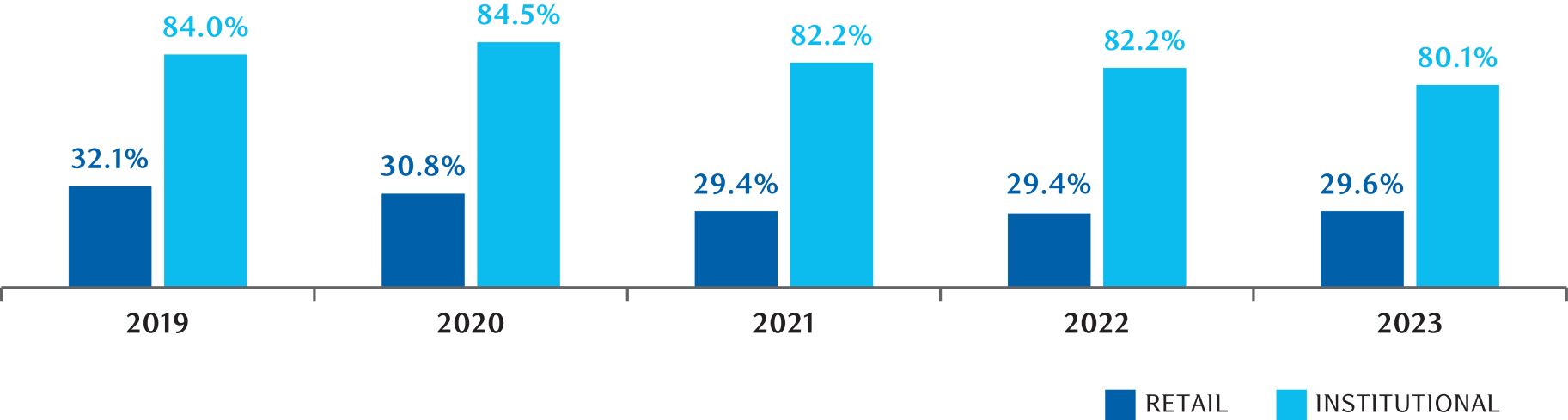
In 2025, Transat A.T. Inc. had to postpone its annual general meeting due to lack of quorum. This incident, which garnered media attention, 2 gave rise to uncertainty on the market and to anxiety among stakeholders. Multiple mining companies on the TSX-V are facing similar situations.
By strengthening the participation of small shareholders, the Bank will consolidate its democratic legitimacy, improve the quality of dialogue with all its security holders, and assert its leadership in modern and inclusive corporate governance.
| 1 | https://www.broadridge.com/_assets/pdf/broadridge-proxypulse-2023-proxy-season-review.pdf |
| 2 | https://ici.radio-canada.ca/nouvelle/2161434/assemblee-transat-interrompue-quorum-insuffisant (in French only) |
BOARD RESPONSE TO PROPOSAL NO. 1:
RBC has a longstanding commitment to active, timely, accessible and transparent engagement with our shareholders at annual meetings and throughout the year. This commitment is reflected in longstanding practices and continuous investments that enable active and meaningful shareholder participation at the annual meeting. Based on the bank’s existing practices, the board believes this proposal is unnecessary and would not meaningfully increase shareholder participation, improve the voting experience or enhance the quality, clarity or accessibility of the information and disclosures provided to shareholders.
The board agrees that shareholder engagement and participation are critical to effective governance and encourages all shareholders to attend, vote and participate at RBC’s annual meeting. RBC has, and continues to, actively invest in the annual meeting experience to support shareholder engagement and participation. Several of the measures included in this proposal, such as those related to enhancing online voting platforms, modernizing communications and using digital tools to support participation, have already been implemented by RBC to optimize the annual meeting format for shareholders who join the meeting virtually. Since being introduced in 2020, RBC’s virtual platform has provided shareholders with an accessible and reliable way to participate in the annual meeting, and in recent years many shareholders have chosen to attend our annual meeting virtually. Additionally, each year RBC works with its transfer agent to maintain a clear, secure and accessible voting process.
The annual meeting of shareholders is held to address the items of business required under the Bank Act (Canada) and applicable law, specifically to receive the annual financial statements, elect directors, appoint the auditor and transact any other business that may properly come before the meeting. The annual meeting is overseen by the board chair, who has broad authority to conduct the meeting in a manner that is transparent, orderly, timely and fair, and participating shareholders have the opportunity to vote, ask questions and comment on the matters of business, as appropriate. The board supports shareholder engagement at the annual meeting through a management proxy circular prepared in accordance with applicable law and industry practice, which clearly and concisely sets out the matters to be voted on and how shareholders may attend, vote and participate.
Participation levels at RBC’s annual meetings have remained relatively stable over the past six years, reflecting consistent and effective engagement with shareholders. Our disclosure practises are aligned with applicable legal requirements and standards and provide shareholders with meaningful transparency on voting results and meeting participation. The additional reporting requested in this proposal would not provide meaningful additional information to shareholders and is not standard among peers, which would limit its comparability and usefulness.
102
Royal Bank of Canada
Shareholder proposals
The board does not believe there is a broader shareholder concern that the bank fails to engage shareholders effectively. Aside from this proposal, the bank has not received feedback suggesting that shareholders feel under-engaged or that current participation opportunities are inadequate. Further, while the annual meeting is an important forum for addressing legally required matters of shareholder business, it is not the sole means by which shareholders may engage with RBC. RBC engages with shareholders throughout the year via various channels to provide information, receive feedback, and support constructive, ongoing dialogue outside the annual meeting cycle. See page 30 for additional information on RBC’s approach to shareholder engagement.
The board recommends you vote AGAINST this proposal.
PROPOSAL NO. 2
Youth inclusion in bodies of the Bank
It is proposed that the Board of Directors of the Bank develop and publish a plan, by the 2026 AGM, to increase the representation of youth (aged 35 and younger) in its bodies.
Supporting statement
This plan will include:
| • | measurable targets for youth representation on the Board and its advisory committees; |
| • | specific mechanisms to identify, recruit and support candidates; |
| • | an annual report on progress made and actions taken. |
In a global environment characterized by rapid change and complex economic, social or environmental challenges, a financial institution’s ability to anticipate and adapt to change requires — now more than ever — diverse and complementary voices in its decision-making processes.
Yet young people are still largely underrepresented in the structures of major corporations in Canada, including in the banking sector. This absence is not only an equity issue but also a strategic weakness.
Thanks to their proximity to the current economic, technological and social realities, young people offer a keen understanding of emerging expectations, particularly with regard to sustainable finance, digital innovation and social transformation. Their participation in corporate governance would serve to sharpen strategic thinking and better anticipate trends in behaviours, markets and risks.
Multiple studies have shown that diversity in an organization’s bodies improves not only its performance and capacity for innovation, but also its resilience in crises and its credibility among stakeholders.
By adopting a structured and transparent plan to promote youth inclusion in corporate governance, the Bank will send a strong signal of its commitment to building an institution that is more representative, more grounded in the realities of this country, and better prepared for the challenges of tomorrow.
BOARD RESPONSE TO PROPOSAL NO. 2:
RBC recognizes that engaging with youth is important to the bank’s long-term success and aligns with its strategic priorities and purpose of helping clients thrive and communities prosper. The board agrees that perspectives from younger generations are valuable; however, the proposal would impose prescriptive requirements, including age-based representation targets and specialized advisory structures, that would constrain the board’s ability to determine the most effective governance model for the bank.
The board believes that effective governance requires flexibility to respond in a rapidly changing and more complex world, while operating within its fiduciary responsibilities and established governance frameworks. A diverse mix of skills, backgrounds, and perspectives, including those of younger generations, is essential to overseeing a complex, highly regulated financial institution. The board’s governance approach already prioritizes diversity of experience and perspectives, which it regularly assesses through its skills and competencies matrix (see page 21) and Board Diversity Policy. Ultimately, the board is responsible for ensuring that each director possess the skills, experience, expertise and competencies required to provide effective oversight, with age considered alongside other relevant attributes.
103
Royal Bank of Canada
Shareholder proposals
RBC recognizes the importance of understanding the perspectives of young people, incorporating their views into the governance process, and supporting the success and development of younger generations. The board believes that employees are one of the bank’s greatest strengths and play an active role in strategic and operational matters at RBC. There are several ways in which employees, including younger and early-career employees, inform, educate and influence decision-making at RBC. Members of management and talent from across the organization regularly engage with the board and its committees. Directors also hear directly from employees through strategic off-site meetings, tours of the bank’s operations and small breakout sessions. In 2024, the bank reported 17% of its workforce was under the age of 30, representing a significant population of early-in-career employees. In 2025, RBC hired 3,000+ students globally through internships, co-ops and work-term placements, including university, college and high school students, and was recognized as one of Canada’s Top Employers for Young People.1
Further, RBC supports broader youth economic inclusion, and in 2025, RBC and RBC Foundation provided $55 million to help empower Canadian youth for the changing world of work.2 This included providing $11+ million in 2025 to post-secondary institutions in Canada for programs that support job readiness and address labour market gaps in sectors facing talent shortages. Since 2017, RBC and RBC Foundation have provided $500 million in Canada to support youth work experience, skill-development, networking solutions, and mental wellbeing supports and services, and reached over 9.2+ million Canadian youth in communities we operate in through 960+ partner programs. In addition, RBC collaborated with the Youth and Innovation Project at the University of Waterloo to launch the RBC Young People and Economic Inclusion Longitudinal Study in 2022, to provide insights into the obstacles facing Canadian youth, with a focus on employment.
Given RBC’s strong track record of employing youth, seeking input from younger generations, and the board’s established governance processes, we believe that this proposal is unnecessary and would constrain the board’s ability to determine the most effective governance model.
The board recommends you vote AGAINST this proposal.
| 1 | MediaCorp Canada Inc. |
| 2 | This amount is part of a commitment of $2 billion in community investments by 2035. |
PROPOSAL NO. 3
A responsible, performance-based compensation policy
It is proposed that the Bank adopt a more responsible compensation policy based on the Bank’s overall performance.
Supporting statement
In a context where wage moderation is expected from all sectors, it is vital that executive compensation reflect not only the actual performance of the company, but also overall economic developments and social climate. To strengthen the legitimacy of compensation decisions and preserve the trust of stakeholders, it is proposed that the Board of Directors adopt a moderation and accountability policy for the compensation of executives by the next annual general meeting.
This policy should include:
| 1. | Alignment with performance and internal equity. |
| 2. | Growth in total executive compensation (fixed salaries, bonuses, long-term incentives) should be based on clear and comparable benchmarks, in particular: |
| • | annual change in adjusted net profit of the Bank; |
| • | median growth in employee pay; |
| • | change in dividends paid out per share; |
| • | this alignment will enable a firm link between executive recognition and actual organization performance as well as overall employee experience. |
| 3. | Temporary pay caps in periods of economic stress: |
| • | during economic periods characterized by high inflation, a housing crisis or income stagnation in the real economy, the Bank should consider introducing a temporary cap on annual executive pay increases (e.g. 3% to 5%, barring clearly justified cases of exception). |
| 4. | Greater transparency in public reports. |
104
Royal Bank of Canada
Shareholder proposals
| 5. | The annual compensation report should give an explicit comparison between: |
| • | changes in executive pay; |
| • | growth in median employee pay; |
| • | financial and extra-financial performance indicators. |
This kind of policy will promote responsible corporate governance, ensure equitable distribution of the value created, and prevent tensions due to excessive pay gaps. It would convey a clear message of rigour, transparency and commitment to sustainable business.
BOARD RESPONSE TO PROPOSAL NO. 3:
RBC is committed to maintaining competitive, transparent and fair compensation practices that align with our strategic objectives. Our approach to executive compensation is designed to align with long-term shareholder interests, reward performance, reflect sound risk management, drive exceptional client experiences and attract and retain talent.
The bank employs and provides competitive compensation, training and career opportunities to more than 100,000 employees in 29 countries. Keeping our employees motivated to deliver exceptional client and shareholder value is paramount to our total rewards philosophy. To serve the interests of shareholders by attracting and retaining skilled and committed employees, the bank must offer competitive compensation at every level of the organization. While compensation is used as one vehicle to motivate, we also make continuous investments to train, develop and support our employees through learning programs, benefits and retirement options to support them even in uncertain times.
We invest in data and research to inform our decisions on competitive salary structures. Every year, the bank participates in over 100 benchmarking surveys to ensure our compensation remains competitive. In addition, we have a pay-for-performance approach to compensation that reinforces the link between an individual’s compensation and their contribution to the bank’s performance measures. Every salaried employee is eligible to participate in a performance-based incentive program, and executives who have more influence over the organization’s results have a greater proportion of their income at risk on the basis of both individual and business performance.
To ensure our compensation programs remain market-competitive, we annually review the program design and pay levels of other financial institutions that are our primary competitors for talent. The human resources committee oversees activities intended to support competitive compensation practices on an ongoing basis. The committee engages an external independent compensation advisor with deep expertise in the area of executive compensation to advise on CEO and Group Executive compensation as well as major compensation programs. The committee reviews pay benchmarking analyses, select vertical pay ratios, and trend information comparing annual total direct compensation of the CEO and the median annual total direct compensation for all employees, including changes to this comparison over time.
While select pay ratios are considered where appropriate, they have inherent limitations with appropriately recognizing the unique circumstances of our talent, including performance, specialized skills, breadth in mandate, risk and market conditions. The board believes that the current disclosures provided in the compensation discussion and analysis (CD&A) section of the annual management proxy circular are more relevant and provide meaningful information to shareholders than a pay ratio and that using a ratio such as this would not effectively address shareholder concerns. Each year we consistently provide detailed information on performance highlights and the composition of executive compensation within our CD&A.
As described on page 57, RBC’s pay-for-performance approach aligns executive compensation to RBC’s financial outcomes, client satisfaction, and individual executives’ progress against their business and strategic objectives. As our compensation programs are responsive to a range of financial and risk outcomes, we believe that the proposal for a temporary pay cap in periods of economic stress is redundant.
We remain committed to engaging with investors and considering their concerns when reviewing our approach to executive compensation. The board continues to monitor developments in executive compensation and its disclosure with a view to maintaining best practices.
The board recommends you vote AGAINST this proposal.
105
Royal Bank of Canada
Shareholder proposals
PROPOSAL NO. 4
Strategic diversification of skills within the Board of Directors
It is proposed that the Board of Directors adopt a new skill diversification policy to meet current and future challenges
Supporting statement
| 1. | This policy will include: |
| • | The review of the Board skills matrix to explicitly include key areas such as: |
| • | climate and sustainability; |
| • | social and racial equity; |
| • | relations with Indigenous peoples; |
| • | AI ethics; |
| • | community impact and responsible investment. |
| 2. | The commitment to actively consider candidates from non-traditional backgrounds, including those from community, university, Indigenous and technology environments, provided they have the relevant strategic and social expertise. |
| 3. | Annual publication in the proxy circular of a transparent report on the diversity of expertise represented on the Board as well as on the progress made in this regard. |
The boards of directors of financial institutions operate in an environment where corporate governance issues are rapidly becoming more complex. Questions around technology, climate risks, social equity, Indigenous rights and business ethics require expertise that is diverse and up-to-date.
However, demographic diversity alone, while essential, is not enough. It is critical to broaden the range of competencies on the Board, to ensure:
| • | higher quality strategic decisions and deliberations; |
| • | more accurate prediction of emerging risks; |
| • | enhanced social legitimacy and credibility for the organization; |
| • | the capacity to meet the growing expectations of investors and society as a whole. |
Actively integrating profiles from non-traditional backgrounds, in particular from community, academic, Indigenous and technology environments, will enhance collective brainstorming and better position the organization to meet current and future challenges.
Finally, publication of transparent information on the diversity of expertise will improve accountability and build stakeholder trust.
BOARD RESPONSE TO PROPOSAL NO. 4:
RBC’s approach to corporate governance is adaptable and flexible, designed to support strong and effective board oversight in a rapidly changing and more complex world. Our approach is grounded in disciplined board renewal practices, supported by a robust, forward-looking continuous director education program. Together, these practices are designed to ensure the board has and maintains the collective balance of competencies and experience needed to oversee current, emerging and complex challenges, opportunities and priorities facing the bank. The board believes the proposed skills diversification policy is unnecessary and redundant given its existing governance practices and would be inconsistent with the adaptability and flexibility required for effective board renewal.
The governance committee oversees board renewal and nominates independent candidates for election or re-election to the board. A key focus of the governance committee is to build a board that is composed of directors who collectively possess the competencies and experience to support the current and long-term strategic success of RBC, informed by the bank’s Purpose, with strong risk discipline in the context of a financial services transformation shaped by an increasingly competitive global marketplace, evolving expectations of regulators and other stakeholders and by macroeconomic, technological and geopolitical developments. The governance committee also retains independent search firms to support the identification of candidates with specific skills, competencies or attributes it regards as key to the current and long-term strategic success of RBC.
The board considers a diverse mix of skills, backgrounds, and perspectives to be essential to effective governance and oversight. The board’s governance approach reflects this view through a structured focus on board renewal, guided by a skills and
106
Royal Bank of Canada
Shareholder proposals
competencies matrix (described on page 21) and the Board Diversity Policy. Maintained by the board and last subject to an independent, third-party review in 2025, the matrix assists the board in acquiring the right skills, experience, expertise and competencies needed for effective oversight. The matrix already includes key areas identified in the proposal, including technology/digital as a major competency, and environmental, social or governance as a major experience. The governance committee and the board chair review the credentials of candidates proposed for election or re-election to the board and assess their competencies and experience against those identified in the matrix. The director nominees for 2026 present a balanced mix of competencies and experience, reflecting the effectiveness of the board’s director renewal practices (see pages 13 to 20 for further information on our 2026 director nominees).
The board recognizes that continuous learning is foundational to strong and effective board oversight and directors must maintain an informed understanding of the current and emerging issues impacting RBC and its clients, employees, shareholders, communities and other stakeholders. The board oversees a forward-looking program of continuous director education that includes presentations from management and external experts. In fiscal 2025, these sessions covered artificial intelligence, sustainability and governance, among other themes (see page 39 for further information on our approach to director education).
RBC annually discloses its approach to director renewal, including the major competencies and experience it regards as key to the bank’s current and long-term strategic success, in the bank’s management proxy circular. The management proxy circular also provides detailed information on the director nomination and selection process, including how shareholders may submit candidates for consideration, and includes a summary of each nominee’s career experience, competencies, current board memberships and directorships at other public companies over the past five years. The additional reporting requested in this proposal would not provide meaningful additional information to shareholders and is not standard among peers, which would limit its comparability and usefulness.
The board recommends you vote AGAINST this proposal.
PROPOSAL NO. 5
Formal recognition of the systemic role of the Board of Directors
It is proposed that the Board of Directors form a standing advisory committee on the systemic impact of the Bank’s decisions.
Supporting statement
This committee’s mandate will include the following:
| 1. | Analysis of the systemic impacts of the Bank’s strategic decisions on: |
| • | economic inequalities; |
| • | home ownership; |
| • | climate and the energy transition; |
| • | social and territorial stability; |
| • | human rights. |
| 2. | Drawing up of recommendations to reduce negative externalities and increase the social benefits associated with financing, investment and risk management activities. |
| 3. | Publish an annual systemic impact report, appended to the ESG report, and presented to the shareholders and the public, including specific and verifiable indicators. |
Financial institutions enjoy significant influence over the economy, society and the environment. Through their financing, investment and risk management decisions, they make a direct contribution to shaping key issues, such as access to housing, inequalities, the climate transition and social stability.
Big banks in particular must live up to their systemic responsibility, in a context of ever-increasing expectations from shareholders, stakeholders and regulators in the area of responsible corporate governance.
Formal recognition of this systemic role means adopting an approach to institutional governance that is modern, proactive and in line with public interests. This will enable the Bank to:
| • | anticipate the reputational and operational risks associated with negative externalities; |
107
Royal Bank of Canada
Shareholder proposals
| • | strengthen its long-term resilience; |
| • | offer a structured response to growing social concerns; |
| • | show credible leadership in responsible finance. |
Forming an advisory committee on the systemic impact of the Bank’s decisions will provide the Board of Directors with a rigorous, independent framework to analyze these issues, make specific recommendations and ensure transparent monitoring. The systemic impact report, included in the ESG report, will improve accountability and provide shareholders with a clear picture of the progress made.
BOARD RESPONSE TO PROPOSAL NO. 5:
RBC is a global financial institution with a purpose-driven, principles-led approach to delivering leading performance. The bank’s Purpose of helping clients thrive and communities prosper guides how RBC creates value and underpins its long-term success. As the bank scales further, the board of directors is focused on supporting responsible growth while maintaining RBC’s accountability to shareholders and other stakeholders.
The board is responsible for establishing RBC’s Purpose, and for exercising independent judgment in overseeing management in accordance with its fiduciary duties and applicable legal and regulatory obligations, including those specified under the Bank Act (Canada) and the OSFI Corporate Governance Guideline. Directors act as stewards of RBC, overseeing the bank’s strategy, priorities, business plan, risk appetite, and culture, with a view to the best interests of the bank, including the best interests of shareholders and other stakeholders. In carrying out this role, the board draws on its mix of competencies and experience and understanding of RBC’s businesses and operating environment, the risks and opportunities it faces, and stakeholder interests, informed by the bank’s Purpose.
The board considers its current approach to oversight and committee structure to be highly effective, enabling the board and its committees to work collectively in making well-informed decisions with a view to the best interests of the bank. The board’s committees have clearly defined mandates (available at rbc.com/governance), and together with the board they provide comprehensive oversight of strategy, risk and responsible business practices. At least annually, the board reviews its committee structure and composition and conducts an annual evaluation of the performance and effectiveness of the board and its committees, aligned to the board’s core principle of continuous improvement.
Several of the topics raised in the proposal involve broad social and public policy matters that extend beyond what would reasonably fall within the bank’s scope or the board’s fiduciary responsibilities. While some of these topics intersect with the bank’s business and risk management practices, others are properly addressed through public policy, regulation and legislation, rather than through the creation of additional board committee structures.
The bank currently provides disclosure on relevant corporate governance, risk management and sustainability-related matters in accordance with applicable law and industry practice, including through its sustainability reporting (available at rbc.com/sustainabilityreporting). The additional reporting requested in this proposal would not provide meaningful additional information to shareholders and is not standard among peers, which would limit its comparability and usefulness.
Given the bank’s existing governance framework and the extensive and statutory oversight already conducted by the board and its committees, the board does not support the creation of a new advisory committee or related reporting obligations.
The board recommends you vote AGAINST this proposal.
PROPOSAL NO. 6
Fighting against forced labour and child labour in loan and investment portfolios
It is proposed that, starting in 2027, the Bank prepare a report for its shareholders and stakeholders on the measures taken during the previous year to prevent and reduce the risk of loans being granted to companies using forced labour and child labour in the production of goods produced, purchased or distributed by its customer base using the Bank’s financing for their operations.
Supporting statement
Note that on May 11, 2023, the Fighting Against Forced Labour and Child Labour in Supply Chains Act came into force. 1 This Act requires certain companies to file reports on their efforts to fight forced labour and child labour, the first of which must be filed by May 31, 2024.
108
Royal Bank of Canada
Shareholder proposals
While this Act aims to protect children from exploitation and human rights abuses in supply chains, we propose that the Bank take a proactive stance on this issue by committing, as a good corporate citizen, to prevent and reduce the risk of its loan and investment portfolio including any form whatsoever of support for companies that use forced labour or child labour in their business operations.
It is important to us that the Bank be more proactive for the following main reasons:
| 1. | Even indirect financing of companies involved in forced child labour is incompatible with the core values of Canadians, the public human rights commitments of banks and stakeholder expectations. Scandals related to forced labour could: |
| • | trigger media and boycott campaigns; |
| • | permanently damage the brand and public trust; |
| • | affect relations with responsible institutional investors. |
| 2. | Major institutional investors, particularly those committed to the Principles for Responsible Investment (PRIs) and other ESG initiatives, demand rigorous management of human rights risks. Banks that fail to act in time expose themselves to protest votes at their AGMs and to divestment. |
| 3. | Quebec and Canada are positioned on the international stage as defenders of the rights of children and of ethical values. As influential economic actors, Canadian banks have a responsibility to live out these principles into their financial practices, thus reinforcing Canada’s credibility and influence. |
A proactive approach to reduce financing associated with forced child labour is not only a moral imperative, but also a strategy to manage risks, protect reputation and meet investor and stakeholder expectations. This will allow Canadian banks to take up their rightful role as responsible leaders in the global economy. This proposal received 25.35% of the votes cast at the last AGM.
| 1 |
https://www.parl.ca/legisinfo/en/bill/44-1/s-211 |
BOARD RESPONSE TO PROPOSAL NO. 6:
RBC is committed to respecting human rights, including those of any clients, employees and third parties we conduct business with or who may be affected by our business activities, either directly or indirectly, and to taking the actions described in our Approach to Human Rights (available at rbc.com), which is informed by the United Nations Guiding Principles on Business and Human Rights (the UN Guiding Principles).
Our Enterprise Policy on Environmental and Social Risk serves as the foundation for our approach to identifying and managing environmental and social (E&S) risks arising from our activities, i.e., the potential for an E&S issue — including human rights — associated with RBC, a client, transaction (such as loans to clients), product, supplier or activity to have a negative impact on the bank. This policy is supported by additional policies and procedures on E&S risk management, including the requirement to conduct an E&S risk assessment for select capital markets and corporate client group transactions. This risk assessment includes specific questions regarding the borrower’s historic human rights record. We undertake additional due diligence based on the findings of this assessment on a case by case basis. Furthermore, we assess the risks associated with the countries where a client operates.
Where the findings from such risk assessments have been subject to additional due diligence or required further client actions, the outcomes of these additional actions may trigger the escalation of transactions to senior management, and with the support of Group Risk Management, to the Reputational Risk Oversight Committee for further review and decisioning. We have an enterprise-wide Financial Crimes program designed to deter, detect and report suspicious activity, including the misuse of our products, services and delivery channels related to financial crimes. RBC’s Financial Crimes’ program helps mitigate risks related to money laundering, terrorist financing, bribery, corruption, economic sanctions and proliferation financing, including risks associated with human rights violations such as modern slavery and human trafficking.
RBC publishes an annual Modern Slavery Act Statement where we disclose in detail our policies and approach to detecting and addressing child labour and child slavery. RBC’s Approach to Human Rights, referenced above, clearly states that we will not knowingly lend to a transaction where we have evidence of human rights abuses, and we are not satisfied that the client has taken or is taking appropriate action. Where evidence of human rights abuses surfaces after a lending transaction has taken place, we act in accordance with our obligations under the UN Guiding Principles, which requires us to work with the entity that has caused human rights abuses towards remediation rather than terminating a relationship. According to the UN Guiding Principles, terminating a relationship can have adverse human rights consequences.
The bank has put in place the global business activities and human rights communication channel for our stakeholders to report concerns related to RBC business activities worldwide that may not align with our Human Rights Position Statement. This channel is secure, available 24/7, facilitated by a third party and allows for reports to be made and tracked anonymously. As reported in
109
Royal Bank of Canada
Shareholder proposals
our most recent Modern Slavery Act Statement, no evidence of modern slavery — including forced labour or child labour — or human trafficking incidents, or loss of income as a result of steps taken to eliminate modern slavery or human trafficking have been identified in the past year.
The board believes that the report mandated by this shareholder proposal is unnecessary given RBC’s commitment to human rights, as well as the policies, procedures and practices in place, including those described above, to support RBC’s commitment.
The board recommends you vote AGAINST this proposal.
PROPOSAL NO. 7
Regulating AI to put humans first
It is proposed that the Bank prepare a report on the use of AI in high-level decision-making as well as in risk assessment and granting loans.
Supporting statement
AI is rapidly transforming the financial sector, particularly in risk analysis, loan automation, fraud detection and product recommendation. This shift brings new risks however, which have been clearly identified in international policies and studies.
In a report published in August of 2023 (Generative AI in Financial Services: Risks and Policy Considerations),1 the International Monetary Fund (IMF) warns against:
“algorithmic biases, privacy violations, threats to financial stability and governance risks due to the unregulated use of AI”.
At the same time, several renowned experts, including Turing Award Laureate Yoshua Bengio, a major figure in AI research, have publicly expressed their growing concern due to the absence of effective safeguards. In an interview with Les Affaires (May 2023), Bengio confirmed:
“The urgency to act is real. Powerful AI systems are already able to manipulate and mislead people”.
These alarm bells have prompted several countries to adopt or study regulatory frameworks. At the federal level, Bill C-272 — the Digital Charter Act —, currently before the Senate, proposes the creation of a special legal framework for high-impact AI systems. This framework will impose new responsibilities on companies that use AI, including banks.
In this shifting regulatory and technological context, it is in the Bank’s interest to:
| • | demonstrate its responsibility and transparency; |
| • | prevent legal, reputational and systemic risks; |
| • | position itself as a prudent and ethical leader in AI adoption. |
Proactive publication of a structured report on the use of AI will enable informed oversight by shareholders and will allow the organization to build a corporate governance that the public and the regulatory authorities can trust.
This report should cover the measures the Bank has taken to:
| • | promote transparency in how, why and when it uses AI; |
| • | evaluate the output of AI systems, in particular generative tools, to minimize biases and inaccuracies, and allow users to distinguish AI output from that generated by humans; |
| • | train employees or contractors who develop or use AI to understand the legal, ethical and operational challenges, in particular protection of privacy, security and biases, so they can adopt AI systems responsibly. |
This proposal received 14.29% of the votes cast at the last AGM.
| 1 |
https://www.imf.org/en/Publications/fintech-notes/Issues/2023/08/18/Generative-Artificial-Intelligence-in-Finance-Risk-Considerations-537570 |
| 2 |
https://www.parl.ca/LegisInfo/en/bill/44-1/c-27 |
110
Royal Bank of Canada
Shareholder proposals
BOARD RESPONSE TO PROPOSAL NO. 7:
RBC recognizes the risks around the use of artificial intelligence (AI). We acknowledge that AI must be incorporated into business operations ethically and responsibly and, as such, we actively support the development by RBC of responsible AI tools, products and platforms.
The bank annually provides meaningful disclosure about its use and governance of AI in its Annual Report, Sustainability Report and on an ongoing basis through disclosures at events such as Investor Day or Strategic Updates on Quarterly Earnings Calls.
RBC recognizes the rapidly evolving nature of AI technology and is mindful of the risks inherent in its expanded use in financial services and has established internal processes for the use of AI, guided by the RBC Responsible AI Principles. These principles are based on our values and the RBC Code of Conduct, and ensure that high standards of privacy and security, accountability, fairness, transparency and responsible disclosure continue to be upheld in all the bank’s AI efforts (as more fully described at rbc.com/artificial-intelligence).
RBC is responsible for upholding fair lending standards and ensuring that the models the bank uses — such as those detecting fraud, analyzing cyber threats or calculating lending risk — perform as expected. RBC is subject to stringent model risk management requirements for model testing, validation and monitoring in compliance with regulatory guidance in numerous jurisdictions as part of a complex global regulatory environment, including from the U.S. Federal Reserve, Office of the Comptroller of the Currency in the U.S., U.K. Prudential Regulation Authority as well as the Office of the Superintendent for Financial Institutions in Canada. As described in our 2025 annual report, applications, including AI and machine learning methods are subject to enhanced model risk governance and validation requirements and are assessed in conjunction with other relevant risk functions. RBC has established risk and governance processes to provide oversight and support in the implementation of AI use cases throughout the organization and we continue to evolve our risk governance to reflect new risk considerations that may emerge from the growing use of AI methods and applications.
The board of directors oversees the bank’s strategic direction, plans and priorities and reviews their alignment with the bank’s risk appetite. As part of this oversight, the board receives regular reports from business segment and function heads, including on initiatives involving the use of AI and participates in discussions with third party experts on AI. The risk committee reviews significant risks as well as top and emerging risks, including those related to the adoption and use of AI. Model risk reports, including AI matters, are reviewed periodically by the risk committee. Throughout 2025, the board and management remained focused on key issues impacting RBC and its clients, employees, shareholders, communities and other stakeholders, which included updates to the board on RBC’s AI & Digital Transformation program as well as participation in several education sessions focused on AI (for more information on the board’s focus on continuous education, see page 39).
AI fluency and learning across RBC is crucial to understanding, working with, and strategically integrating AI responsibly, efficiently, and ethically. To help achieve this, RBC has implemented mandatory enterprise-wide training for employees who are using our internal employee AI tools. This training includes an overview of the fundamentals of AI, the associated risks, and our Responsible AI Principles. Upon completion, employees understand the benefits and how to use AI within the Code of Conduct and the importance of responsible AI. RBC was an early entrant in the AI space and, as part of our commitment to advancing the development of responsible AI and machine learning, our dedicated AI research centre, RBC Borealis, RBC’s data and innovation hub, developed RESPECT AITM in 2020, an online hub that brings open-source research code, tutorials, programs and academic research to the AI community, helping to make ethical AI available to all. Additionally, RBC Borealis conducts research which is subjected to public peer review and publication in scientific venues.
RBC is committed to the responsible use of AI in our operations as we serve our clients and build on the trust they have placed in us for over 155 years. Our focus on responsible AI reflects our unwavering commitment to ethical innovation that benefits both our stakeholders and the broader financial services industry. The board is confident that the governance structure and processes described above already allow for the responsible use and management of AI systems at RBC, including generative AI and that therefore it is unnecessary to agree to the proposal.
The board recommends you vote AGAINST this proposal.
PROPOSAL NO. 8
Public disclosure of non-confidential information, country-by-country reporting, pay ratios and tax havens
It is proposed that the Bank annually disclose to the public the non-confidential information in its country-by-country reporting for the purposes of preparing meaningful and detailed pay ratio calculations, specifically broken down by jurisdictions, and contributing to the fight against tax havens, specifically in terms of transparency.
111
Royal Bank of Canada
Shareholder proposals
Supporting statement
For many years, the Bank has received from MÉDAC — and now from Vancity — several shareholder proposals requesting the calculation and disclosure of pay ratios. Despite the substantial number of votes cast in support of these proposals (XX% in 2023), the Bank still does not disclose its global pay ratio, something that has been mandatory for some time now in the United States and that several companies are already doing here in Canada.
Of course, several arguments have been put forward against the publication of such a ratio. Also, even though pay ratios should be published for all employees pursuant to the Global Reporting Initiative (GRI) standards, (1) the public disclosure of non-confidential information of the “country-by-country reporting”— Action 13 (2) of the OECD/G20’s Inclusive Framework (3) on Base Erosion and Profit Sharing (4) (BEPS), an international initiative to which the government has subscribed — would allow for a meaningful calculation of pay ratios that would help better interpret the global pay ratios by enriching the description of the underlying context.
Furthermore, disclosing such non-confidential data to the public at large — as is incidentally the case in several other countries, including in Europe — would be an exercise in transparency, goodwill and good faith that would directly support the fight against tax avoidance, tax evasion, “tax havens” and other “lenient legislation.”
Yet according to the Edelman Trust Barometer,1 taken in 2024 among the Canadian population, 59% of Canadian respondents believe that business leaders purposely mislead people by saying things they know are false or gross exaggerations. A marked distrust is noted towards traditional leaders and the heads of companies.
For all of these reasons, the Bank must publicly disclose the non-confidential data of its country-by-country report on a yearly basis.
This proposal received 10.31% of the votes cast at the last AGM.
| 1 |
https://www.edelman.ca/sites/g/files/aatuss376/files/2024-03/2024%20Edelman%20Trust%20Barome-ter_Rapport_Canadien_EN_0.pdf |
BOARD RESPONSE TO PROPOSAL NO. 8:
RBC is a global financial institution with a diversified business model, serving clients and communities in jurisdictions around the world and is committed to maintaining the highest standards of business conduct across its operations. As noted in our response to this same proposal in prior years, RBC intends to fully comply with relevant tax laws and regulations in all jurisdictions in which we operate. In this regard, RBC files all required tax disclosures with relevant tax authorities through existing frameworks, including our annual obligation to file a country-by-country report (CbCR) under the rules enacted by Canada in response to Action 13 of the Organization for Economic Co-operation and Development (OECD)’s Base Erosion and Profit Shifting initiative. Furthermore, as countries adopt legislation requiring public disclosure of certain CbCR data (for example, in the European Union and Australia), RBC will comply with such measures.
The data required to be captured in our CbCR was originally intended for use by tax authorities, specifically. Public disclosure of such data could result in it being misinterpreted; this risk would be exacerbated if only portions of the full report were disclosed. Voluntary disclosure of our CbCR data could also result in the sharing of competitively sensitive information about our operations, potentially putting RBC at a disadvantage in an increasingly competitive global marketplace.
Importantly, the data included in our CbCR does not involve any compensation data. Accordingly, contrary to the suggestion in the proposal, public disclosure of our CbCR data could not directly support the preparation of meaningful and detailed pay ratio calculations. As described on pages 64 to 67 of this circular, our compensation decision-making process includes consideration of various financial, non-financial and risk-related metrics, external perspectives as well as select pay ratios, where appropriate. While select pay ratios are considered where appropriate, they have inherent limitations with appropriately recognizing the unique circumstances of our talent, including performance, specialized skills, breadth in mandate, risk and market conditions.
We note that Canada has adopted the OECD’s “Pillar Two” framework — which operates to eliminate tax advantages offered by low-tax jurisdictions — through the enactment of the Global Minimum Tax Act. In general terms, these rules impose a multilaterally agreed minimum effective tax rate of 15% in each jurisdiction in which a large multi-national corporate group operates to effectively address prior concerns regarding tax haven countries. RBC and its subsidiaries became subject to this framework commencing with the 2025 fiscal year. Compliance with this new global minimum corporate tax regime does not require public disclosure of CbCR data.
RBC’s vision it to be among the world’s most trusted and successful financial institutions. As noted in our 2025 annual report, with over 150 years of creating value for our clients, we put trust and relationships at the heart of everything we do. We are proud of the recognition we have received that acknowledges the strength of our brand and the trust placed in us by those we serve. For example, in 2025, RBC was recognized as the most valuable Canadian brand for the 7th consecutive year by Kantar BrandZ and we were the only Canadian company to be included in Kantar’s Most Valuable Global Brands report. Additionally, we ranked highest in customer satisfaction for the 2nd consecutive year in the J.D. Power 2025 Canada Retail Banking Satisfaction Study.
112
Royal Bank of Canada
Shareholder proposals
RBC remains steadfast in its commitment to comply with all regulatory, operating, reporting and legal requirements. The public disclosure requested in this proposal will increase risk for RBC without delivering meaningfully in respect of the stated objectives of the proposal.
The board recommends you vote AGAINST this proposal.
PROPOSAL NO. 9
Advisory vote on environmental policies
It is proposed that the Bank adopt an annual advisory voting policy regarding its environmental and climate change objectives and action plan.
Supporting statement
According to the latest Banking on Climate Chaos1 report, financing provided by the Big Five Canadian banks to the fossil fuel industry reached nearly US$132 billion in 2024. The breakdown is as follows: Royal Bank: US$34.3 billion, Scotia Bank: US$26.2 billion, Toronto Dominion Bank: US$29.0 billion, Bank of Montreal: US$19.9 billion, and CIBC: US$22.3 billion.
The Bank continues to support the development of fossil energy. Shareholders play a key role in constructive dialogue between boards of directors and stakeholders. In this context, the advisory vote on environmental policy does not seek to impose specific targets, nor to compromise the competitiveness of the Canadian banking sector, but rather to:
| • | strengthen corporate governance and transparency by ensuring regular shareholder review of the environmental strategy; |
| • | align the Bank’s practices with the growing expectations of international institutional investors, who consider climate and environmental challenges to be major financial risks; |
| • | reduce reputational risks by showing that the Bank is sensitive to environmental concerns without compromising its contribution to the Canadian economy; |
| • | promote a gradual transition tailored to the North American context, by avoiding radical or contentious approaches. |
It is important to remember that this vote:
| • | is advisory, not binding, to respect the corporate governance of the Board of Directors; |
| • | offers an opportunity to express measured support, without calling into question the Board’s basic strategic decisions or its independence; |
| • | sends a signal of good corporate governance, that shows the Bank’s commitment to listening to its shareholders, without taking on a political or ideological position. |
Support for this proposal has grown in recent years, but remains below the threshold for significant influence. If it reaches a threshold of 30%, or even higher, shareholders will be:
| • | sending a clear but reasonable signal in favour of a stronger environmental governance; |
| • | avoiding the alternative of more intrusive political or regulatory pressure down the road; |
| • | helping to maintain the Bank’s credibility and social acceptability, including on international markets. |
This proposal received 16.48% of the votes cast at the last AGM.
| 1 | https://www.bankingonclimatechaos.org/?bank=JPMorgan%20Chase#fulldata-panel |
BOARD RESPONSE TO PROPOSAL NO. 9:
This is the fifth year in a row MÉDAC is submitting a shareholder proposal requesting an advisory vote on the bank’s approach to the environment and climate change. At the 2025 annual meeting, a significant majority of shareholders again rejected this proposal. Since it was first submitted in 2022, shareholder support for this proposal has remained relatively consistent and well below levels that would indicate broad support.
The board still believes that ongoing engagement with stakeholders, including shareholders, is the most appropriate and effective way to inform and refine RBC’s climate strategy. RBC regularly engages with shareholders and other stakeholders via
113
Royal Bank of Canada
Shareholder proposals
various channels to share information, receive feedback, and support constructive, ongoing dialogue on numerous matters, including climate-related risks, opportunities, strategy and disclosure (see page 30 for more information on our engagements with shareholders and other stakeholders). The board firmly believes that this dialogue is more insightful than an annual advisory vote on the bank’s approach to climate change, particularly given the technical and interconnected nature of climate-related considerations.
The board is responsible for overseeing the bank’s strategy, priorities, business plan, risk appetite and culture. It determines how to allocate current and future resources to achieve business objectives, implement and act on its climate-related strategic priorities as part of the bank’s short-term, medium-term and long-term strategy, and balance the interests of shareholders and other stakeholders. Through its committees, the board oversees risk management, including climate risk, and sustainability reporting. Introducing an advisory vote, even if non-binding in nature, would create a new governance mechanism for assessing a component of the bank’s strategy inconsistent with the board’s responsibility and accountability.
The board recognizes that effective oversight of climate-related risks, opportunities, strategy and disclosure requires directors to keep pace with a rapidly evolving and complex economic and political landscape. The board and its committees balance oversight of the bank’s strategic approach to climate-related matters with specific subject-matter expertise rooted within the business segments and functions across the bank. The board relies on management’s highly technical knowledge of the complexities of the bank’s businesses and day-to-day operations in implementing the bank’s climate strategy. Throughout the year, the board and its committees engage with management on climate-related issues that relate to their respective areas of oversight responsibility (see page 33 for a spotlight on key 2025 highlights of the board and committees’ oversight of the bank’s strategic approach to sustainability-related matters, including climate). This ongoing engagement supports timely and informed assessment by the board and management of the multiple and interrelated components of the bank’s strategy, including its climate strategy.
The board is committed to the continuous improvement of the bank’s governance practices, and to open and responsible communication with all stakeholders, including shareholders. The board believes that its engagement-based approach is the most appropriate and effective way to seek stakeholder input on the bank’s approach to climate, a position that has been consistently supported by a significant majority of shareholders each year this proposal has been submitted to a vote.
The board recommends you vote AGAINST this proposal.
PROPOSAL NO. 10
Circular economy
It is proposed that the Bank produce a report on the loans it granted over the past few years in support of a circular economy and the steps the Bank intends to take to develop the expertise needed to properly enhance the value of these businesses.
Supporting statement
For several years, we have submitted a proposal to encourage the Bank to increase transparency around its initiatives to support a circular economy — a promising sector for innovation and economic opportunities. We firmly believe that this is in the long-term interests of the Bank, its shareholders and its stakeholders.
Why this proposal?
The circular economy would enable better resource management, reduce risks associated with raw materials scarcity, and promote innovative business models.
Our simple and constructive request is that the Bank publish a report on:
| • | the loans and initiatives already approved to support the circular economy; |
| • | the measures planned to develop the internal expertise to effectively support businesses in this growing sector. |
This report is not a constraint, but rather a tool for transparency and good governance, to allow shareholders to assess how the Bank is positioning itself with respect to emerging economic and environmental challenges.
By voting for this proposal, shareholders will encourage the Bank to be proactive and innovative, and to increase its competitiveness in a rapidly changing market.
This proposal received over 10% of the votes cast at the last AGM.
114
Royal Bank of Canada
Shareholder proposals
BOARD RESPONSE TO PROPOSAL NO. 10:
This is the sixth year in a row MÉDAC is submitting a shareholder proposal requesting this disclosure. At the 2025 annual meeting, a significant majority of shareholders again rejected this proposal. Since it was first submitted in 2021, shareholder support for this proposal has remained relatively consistent and well below levels that would indicate broad support.
RBC recognizes a circular economy is an important societal objective that can play a role in reducing environmental impacts. The bank also provides services to various clients that are engaged in activities aligned with circular economy principles and, through its existing processes, tracks financing activity, including lending activity to certain of these clients. More specifically, the bank considers products, technologies and processes aligned with circular economy principles as part of its sustainable finance business.
RBC internally measures the value of the financing it provides to certain of these clients and activities. Through this data, the bank aims to further support clients that are engaged in these activities based on client demand and better understand whether there are challenges in financing them.
The board believes the approach described above best positions the bank to contribute to circular economy objectives and to track how it supports clients that are pursuing these objectives. Beyond financing, RBC and RBC Foundation contribute to circular economy objectives through targeted community investments, supporting projects led by charitable and not-for-profit organizations. RBC remains open to collaboration across industry sectors, with government, other financial institutions and third parties to promote consistency and comparability and to evolve methodologies as needed to reflect the developing marketplace.
The board considers this proposal to be redundant to efforts already being undertaken by the bank. In addition, the board believes that the bank’s current efforts already recognize the circular economy as an important societal objective and already explore opportunities to finance clients that are pursuing circular economy objectives in each case in a manner consistent with the objective pursued by this shareholder proposal.
The board recommends you vote AGAINST this proposal.
PROPOSAL NO. 11
In-person shareholder meetings
It is proposed that the Company’s annual meetings be held in person, and that virtual meetings be in addition to, not instead of, in-person meetings.
Supporting statement
Since 2020, the year in which annual meetings started being held virtually due to public health restrictions related to COVID-19, we have often criticized how these meetings are conducted.1
According to the OECD Principles of Corporate Governance:
“[…] due care is required to ensure that remote meetings do not decrease the possibility for shareholders to engage with and ask questions to boards and management in comparison to physical meetings. Some jurisdictions have issued guidance to facilitate the conduct of remote meetings, including for handling shareholder questions, responses and their disclosure, with the objective of ensuring transparent consideration of questions by boards and management, including how questions are collected, combined, answered and disclosed. Such guidance may also address how to deal with technological disruptions that may impede virtual access to meetings.”2
Virtual meetings have benefits that we readily recognize, but they should not be used to the exclusion of in-person meetings. Like Teachers,’3 we believe that annual shareholder meetings should be held in person, with virtual meetings being in addition to (the hybrid model used by all banks in 2023), not instead of, in-person meetings. It is clear that all shareholders must enjoy the same rights, regardless of whether they participate virtually or in person. This position is supported by a number of other organizations, such as the Canadian Coalition for Good Governance (CCGG)4 and many large institutional investors.
Given that this proposal has received a very high percentage of votes over the years (48.14% last year), we are submitting it again.
| 1 | Assemblées annuelles : dérive virtuelle, le MÉDAC, 2023-05-09 https://medac.qc.ca/2098/ |
| 2 | Recommendation of the Council on Principles of Corporate Governance, OECD Legal Instruments, OECD/LEGAL/0413, adopted on 07/07/2015, amended on 07/06/2023 https://legalinstruments.oecd.org/en/instruments/OECD-LEGAL-0413 |
| 3 | Good Governance is Good Business —2023 Proxy Voting Guidelines, Ontario Teachers’ Pension Plan (Teachers’) https://www.otpp.com/content/dam/otpp/documents/OTPP Proxy Voting Guidelines 2023 EN.pdf |
| 4 | “Virtual-only shareholder meetings are an unsatisfactory substitute for in-person shareholder meetings because they risk undermining the ability of shareholders to hold management accountable.”, Say no to virtual-only shareholder meetings – they let companies duck accountability, Catherine McCall, The Globe and Mail, May 21, 2023 https://www.theglobeandmail.com/business/commentary/article-say-no-to-virtual-only-shareholder-meetings-they-let-companies-duck/ |
115
Royal Bank of Canada
Shareholder proposals
BOARD RESPONSE TO PROPOSAL NO. 11:
This is the third consecutive year MÉDAC is submitting this shareholder proposal. The bank acknowledges that last year a significant percentage of votes were cast in favour of this proposal. However, as noted in our responses to this proposal in 2024 and 2025, the Bank Act (Canada) does not permit financial institutions like RBC to hold virtual-only shareholder meetings. Consistent with applicable law, RBC’s 2026 annual meeting of shareholders will be held in a hybrid format, providing shareholders with the choice to attend either in person or virtually. As a result, the board believes this proposal remains superfluous and unnecessary.
RBC continues to invest in enhancing the virtual experience to provide an engaging and equitable experience for shareholders who join the meeting virtually and is committed to enabling a seamless experience for those attending the meeting. Shareholders attending the annual meeting virtually have the same rights as those attending in person, including the ability to vote and submit questions in real time, and present proposals duly submitted for consideration at the meeting.
As a global organization with shareholders across Canada, the U.S. and around the world, RBC believes that virtual participation is an important way to support broad and inclusive shareholder access to the annual meeting. Providing shareholders with the ability to attend, vote and participate at the meeting virtually allows shareholders who may not typically attend or be able to attend the meeting in person due to travel, cost, scheduling or mobility constraints to vote and participate at the meeting.
While the Bank Act (Canada) does not permit RBC to hold virtual-only shareholder meetings, the board believes it remains important that the bank retain flexibility within the existing legal framework to address extraordinary circumstances, including force majeure events or situations involving physical security or public safety considerations. Prescribing a mandatory meeting format would unduly restrict the bank’s ability to respond appropriately within this framework and would not be in the best interests of shareholders.
The annual meeting is an important forum for addressing legally required matters of shareholder business and participation; however, it is not the sole means by which shareholders may engage with RBC. RBC engages with shareholders throughout the year via various channels to provide information, receive feedback, and support constructive, ongoing dialogue outside the annual meeting cycle. In 2025, this engagement covered a broad range of topics, including the format of the annual meeting (see page 30 for more information on our engagements with shareholders and other stakeholders).
The board recommends you vote AGAINST this proposal.
Important notice regarding this proxy circular
This circular includes information about a number of RBC’s sustainability-related objectives, vision, commitments, goals, metrics and targets.
Certain aspects of RBC’s climate strategy are not inclusive of the investment advisory or broker-dealer activities, or the assets under management or administration, of RBC Global Asset Management (RBC GAM)1 or RBC Wealth Management (RBC WM)2.
RBC’s ambitions, strategies and approaches, described in this circular, including sustainability-related metrics, data and other information relevant to such ambitions, strategies and approaches, are or may be based on assumptions, estimates and judgments. Any commitments, goals and targets discussed in this circular are aspirational. Our sustainability-related commitments, goals, and targets, as well as the disclosures of our progress against such commitments, goals and targets, have been, and in the future may need to be, restated, changed or recalibrated as available data improve and as climate science, transition pathways and market practices regarding standards, methodologies, metrics and measurements evolve, which may result in us withdrawing from or modifying our membership in certain frameworks, principles and initiatives. The achievement of RBC’s commitments discussed in this circular will depend on the collective efforts and actions across a wide range of stakeholders outside of its control, and there can be no assurance that they will be achieved.
Any references to “sustainability”, “renewable energy”, “mixed-energy”, “net-zero” or similar terms in this circular are intended as references to the internally defined criteria of RBC and not to any jurisdiction-specific regulatory definition that may exist. This circular reflects RBC’s sustainability-related strategies, positions, approaches, policies, procedures, criteria, objectives, vision, commitments and goals as of the date of this circular, which are subject to change at any time in RBC’s sole discretion without notice. We have no obligation to update the information or data in this circular.
All references to websites are for your information only. The content of any websites referred to in this circular, including via website link, and any other websites they refer to are not incorporated by reference. This circular is also not intended to make representations as to the sustainability-related initiatives of any third parties, whether named herein or otherwise, which may involve information and events that are beyond our control.
| 1 | RBC GAM operates through indirectly wholly owned subsidiaries of the bank including, but not limited to: RBC Global Asset Management Inc. (including Phillips, Hager & North Investment Management), RBC Global Asset Management (U.S.) Inc., RBC Global Asset Management (UK) Limited, BlueBay Funds Management Company S.A., and RBC Global Asset Management (Asia) Limited, and BlueBay Asset Management International Limited, Japanese Branch. |
| 2 | RBC WM operates through indirectly wholly owned subsidiaries of the bank including, but not limited to: RBC Dominion Securities Inc. (Member-Canadian Investor Protection Fund), RBC Direct Investing Inc., (Member-Canadian Investor Protection Fund), Royal Mutual Funds Inc., (Member-Canadian Investor Protection Fund), RBC InvestEase Inc., RBC Phillips, Hager & North Investment Counsel Inc., RBC Capital Markets, LLC, RBC Private Counsel (USA) Inc., RBC Dominion Securities Global Limited, RBC Wealth Management Financial Services Inc., Royal Trust Corporation of Canada and The Royal Trust Company; City National Bank and its subsidiaries; and RBC Europe Limited. |
| Secretary
Royal Bank of Canada
200 Bay Street, South Tower
Toronto, Ontario M5J 2J5
Canada
corporate.secretary@rbc.com
rbc.com/governance |
Chair of the Board
Royal Bank of Canada
200 Bay Street, South Tower
Toronto, Ontario M5J 2J5
Canada
rbc.com/governance |
For dividend information, change in share registration or address, lost stock certificates, tax forms, estate transfers, dividend reinvestment or other shareholder inquiries, please contact:
Computershare Trust Company of Canada
320 Bay Street, 14th Floor
Toronto, Ontario M5H 4A6
Canada
Tel: 1-866-586-7635 (Canada and the U.S.) or 514-982-7555 (International)
Fax: 1-888-453-0330 (Canada and the U.S.) or 416-263-9394 (International)
RBC@computershare.com
www.investorcentre.com/rbc
For investor inquiries, please contact:
Investor Relations
Royal Bank of Canada
200 Bay Street, South Tower
Toronto, Ontario M5J 2J5
Canada
email: invesrel@rbc.com or visit our website at rbc.com/investorrelations
‡ This product is made of material from well-managed, Forest Stewardship Council® (FSC®) certified forests and other controlled sources.
® / ™ Trademarks of Royal Bank of Canada. ‡ All other trademarks are the property of their respective owner(s).
© Royal Bank of Canada, 2026
2026