UNITED STATES
SECURITIES AND EXCHANGE COMMISSION
Washington, D.C. 20549
Form 6-K
REPORT OF FOREIGN PRIVATE ISSUER PURSUANT TO RULE 13 a-16 OR 15d-16
UNDER THE SECURITIES EXCHANGE ACT OF 1934
For the month of May 2026
Perusahaan Perseroan (Persero)
PT Telekomunikasi Indonesia Tbk
(Exact name of Registrant as specified in its charter)
Telecommunications Indonesia
(A state-owned public limited liability Company)
(Translation of registrant’s name into English)
Jl. Japati No. 1 Bandung 40133, Indonesia
(Address of principal executive office)
Indicate by check mark whether the registrant files or will file annual reports under cover of Form 20-F or Form 40-F:
Form 20-F þ Form 40-F ¨
Indicate by check mark if the registrant is submitting the Form 6-K in paper as permitted by Regulation S-T Rule 101(b)(1):
Yes ¨ No þ
Indicate by check mark if the registrant is submitting the Form 6-K in paper as permitted by Regulation S-T Rule 101(b)(7):
Yes ¨ No þ
i
SIGNATURES
Pursuant to the requirements of the Securities Exchange Act of 1934, the registrant has duly caused this report to be signed on its behalf by the undersigned, thereunto duly authorized.
Date: May 12, 2026 | Perusahaan Perseroan (Persero) PT Telekomunikasi Indonesia Tbk By: /s/ Jati Widagdo ---------------------------------------------------- (Signature) Jati Widagdo SVP Corporate Secretary |
ii
Transforming Business, Driving Sustainable Growth
Business transformation has become the main foundation for Telkom and its Subsidiaries ("TelkomGroup") in driving sustainable growth. Through sharpening business priorities and strengthening core capabilities by 2025, TelkomGroup will not only be able to enhance competitiveness amidst industry dynamics and sustainability challenges but also optimize opportunities from the operational transition to low carbon that aligns with the achievement of the company's strategic objectives. This transformation effort is supported by technological innovation, operational excellence, and reliable services, thereby not only strengthening business performance but also providing added value for all stakeholders. In this way, TelkomGroup further strengthens its role in building Indonesia's digital ecosystem, which serves as a key pillar of national economic growth.
iii
v
vi
About the Sustainability Report
PT Telkom Indonesia (Persero) Tbk (“Telkom”) reaffirms its commitment to sustainability practices through the publication of its annual Sustainability Report, released on May 12, 2026. This report presents information on Telkom’s environmental, social, and governance (ESG) strategies, targets, and performance, covering Telkom and its 13 directly owned subsidiaries, unless otherwise stated. [GRI 2-2, 2-3]
Figure 1. Scope of Sustainability Report Entities of PT Telkom Indonesia (Persero) Tbk
Scope of Reporting Entities | ||
● PT Telkom Indonesia (Persero) Tbk (“Telkom”) ● PT Telekomunikasi Selular (“Telkomsel”) ● PT Dayamitra Telekomunikasi Tbk (”Mitratel”) ● PT Telekomunikasi Indonesia International (“Telin”) | ● PT Telkom Infrastruktur Indonesia (“TIF”) ● PT Telkom Data Ekosistem (“TDE” or “NeutraDC”) ● PT Telkom Satelit Indonesia (”Telkomsat”) ● PT Multimedia Nusantara (“Metra” or “TelkomMetra”) ● PT Graha Sarana Duta (“GSD” or “Telkom Property”) | ● PT Infrastruktur Telekomunikasi Indonesia (“Telkom Infra”) ● PT Metra-Net (”Metra-Net”) ● PT Telkom Akses (“Telkom Akses”) ● PT PINS Indonesia (“PINS”) ● PT Sigma Cipta Caraka (”Sigma”) |
This Sustainability Report summarizes information for the reporting period from 1 January 2025 - 31 December 2025, consistent with TelkomGroup’s consolidated financial reporting period. In addition, it provides historical information covering the past three years (from 1 January 2023 - 31 December 2025) to provide an insights of the development of TelkomGroup’s sustainability performance. [GRI 2-3]
Readers are encouraged to review this report in conjunction with Telkom’s 2025 Annual Report and Telkom’s sustainability webpage to gain a comprehensive understanding of sustainability practices across TelkomGroup.
The preparation of this report refers to the Financial Services Authority Regulation (POJK) No. 51/POJK.03/2017 concerning the Implementation of Sustainable Finance for Financial Service Institutions, Issuers, and Public Companies (POJK 51) and OJK Circular Letter No. 16/SEOJK.04/2021 concerning the Form and Content of Annual Report of Issuers or Public Companies, as well as referring to the Global Reporting Initiative (GRI) 2021 standards, Sustainability Accounting Standards Board (SASB), and the 17 United Nations Sustainable Development Goals (UN SDGs).
The disclosure of information in this report reflects the initial adoption of the Sustainability Disclosure Standard Statements (PSPK) 1 and 2, to the extent relevant, which are prepared in accordance with the International Financial Reporting Standard (IFRS) Sustainability Disclosure Standard S1 and S2. In line with this addoption, in 2025, two categories were added to the SASB standards. have been introduced as an additional reporting reference to reflect TelkomGroup’s core business pillars, including the SASB Industry Standards for Telecommunication Services, IT & Software Services, and Internet Media & Services Sustainability Accounting Standard (2023-12 Version).
1
[GRI 2-4]
Certain information in this report has been restated following internal verification processes. The restated information data on waste, water, emissions and energy, and employee recruitment with the following notes:
Table 1. Restatement of Information Due to Methodology Adjustments and Data Verification
No | Data | Notes |
|---|---|---|
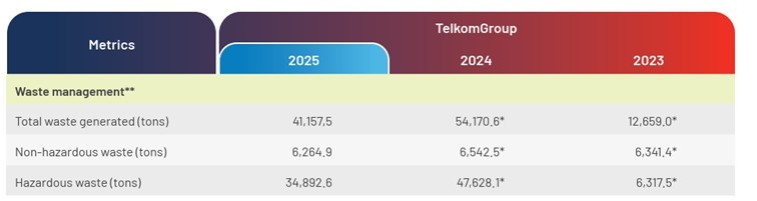
1 | Waste | We adjusted the waste generation data collection methodology, thus restating the 2023 and 2024 data, which previously experienced: • Underreporting for hazardous waste data by 0.3% and > 100%, respectively. • Overreporting for non-hazardous waste data by 98%. |
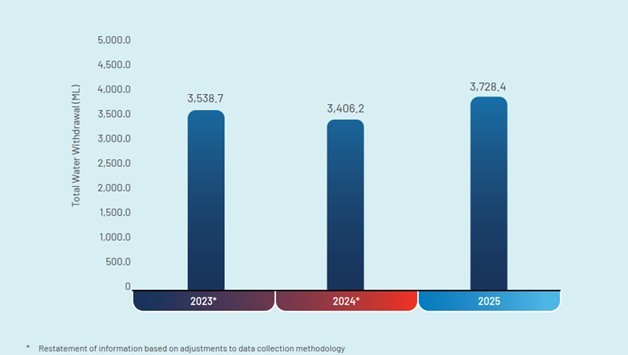
2 | Water | We adjusted the water withdrawal data collection methodology, resulting in restatement of 2023 and 2024 data, which had previously experienced overreporting of 62% and 59%, respectively. |
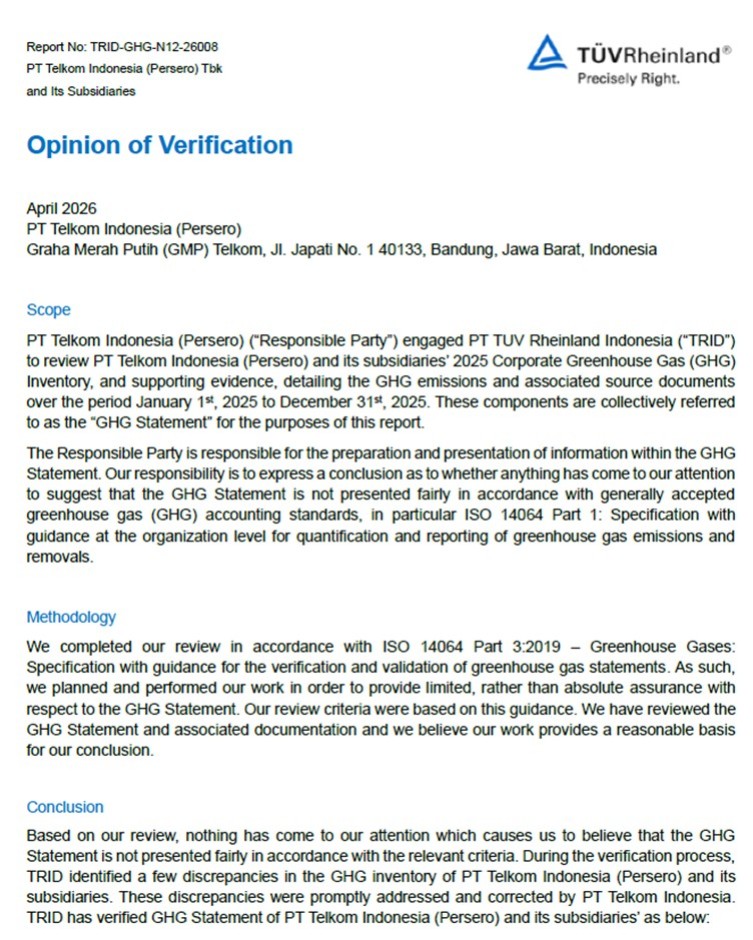
3 | Emissions and energy | Based on the results of external assurance of GHG emission data by an independent external party, we adjusted the electricity data collection methodology, thus restating the Scope 2 emission data and electricity consumption for 2023 and 2024, which were previously underreported by 2.5% and 2.7%, respectively. |
3 | Recruitment | We carried out an internal review and verification process related to employee recruitment data, resulting in the re-presentation of the 2024 data, which had previously experienced overreporting of 25%. |
In line with TelkomGroup's efforts to provide a more comprehensive performance overview, there is a restatement of certain employment information due to the addition of data coverage compared to the previous reporting, with the following notes:
Table 2. Restatement of Information Due to the Expansion of the Reporting Entity's Scope
No | Data | Notes |
|---|---|---|
1 | Employee turnover | We expanded the scope of turnover data in this year's reporting to include all reporting entities, resulting in the restatement of data for 2023 and 2024, which was previously experienced: • Underreporting of 49% for 2023 data • Overreporting of 35% for 2024 data |
2 | Return to work | Return to work data for 2023 and 2024, as reported in the 2024 report, were underreported by 17% and 31%, respectively, compared to the data reported in 2025. This resulted from an expanded reporting scope, including the addition of data from 10 subsidiaries. As a result, adjustments were made to the return-to-work and retention rates. |
3 | OHS training | We expanded the scope of occupational health and safety (OHS) training data to include 8 subsidiaries; therefore, the 2023 and 2024 figures have been restated, as they were previously underreported by >100%, respectively. |
[GRI 2-5]
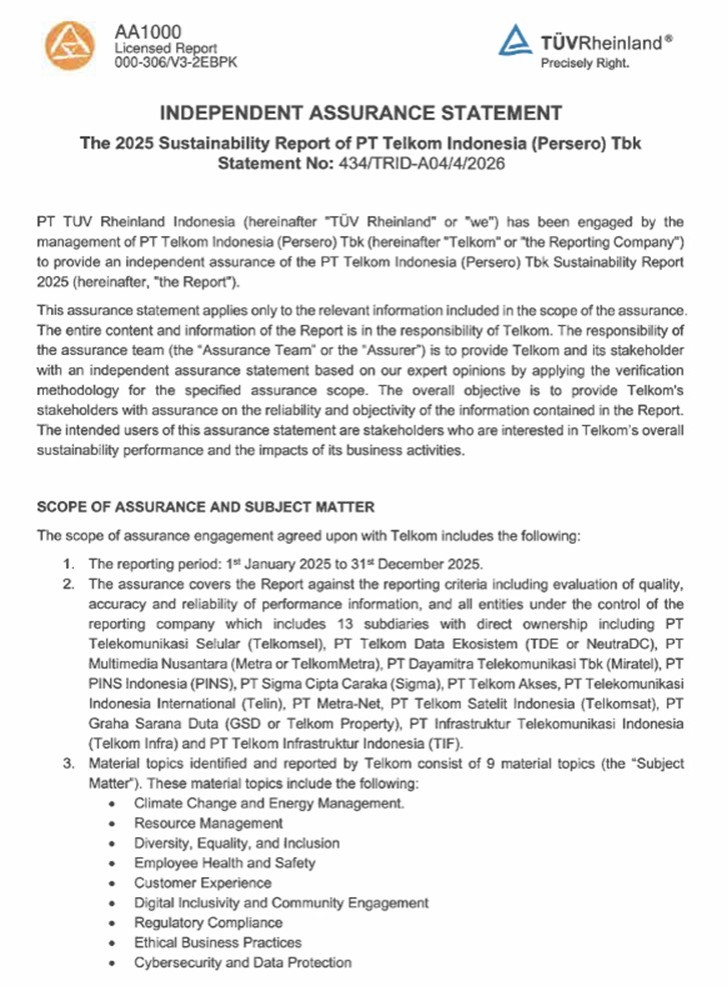
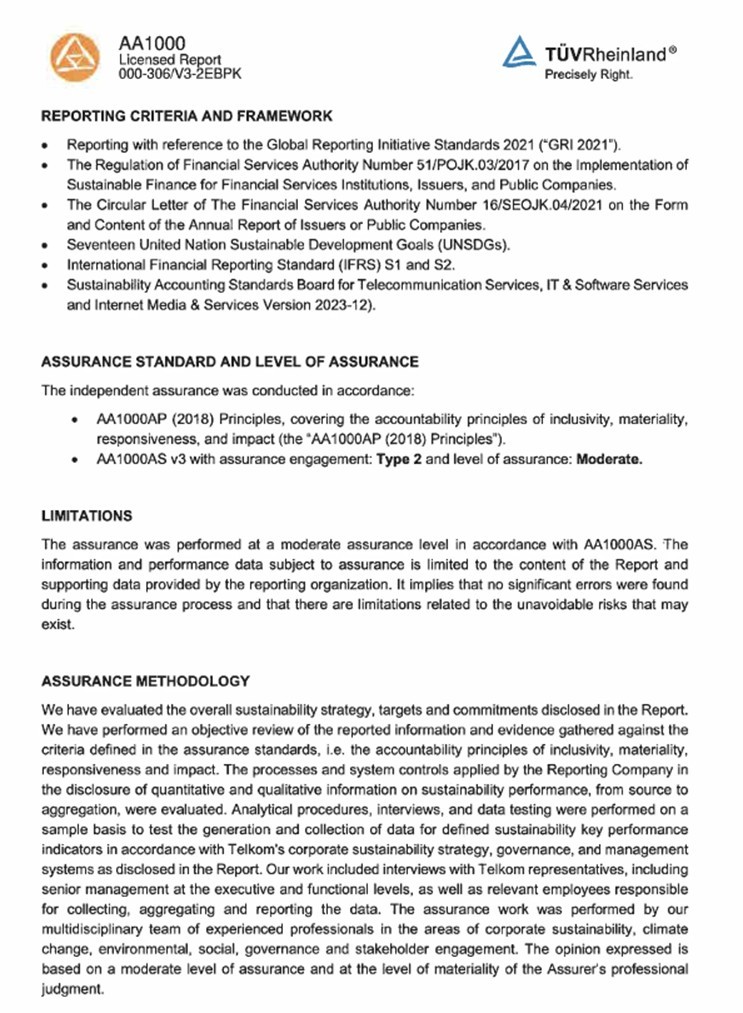
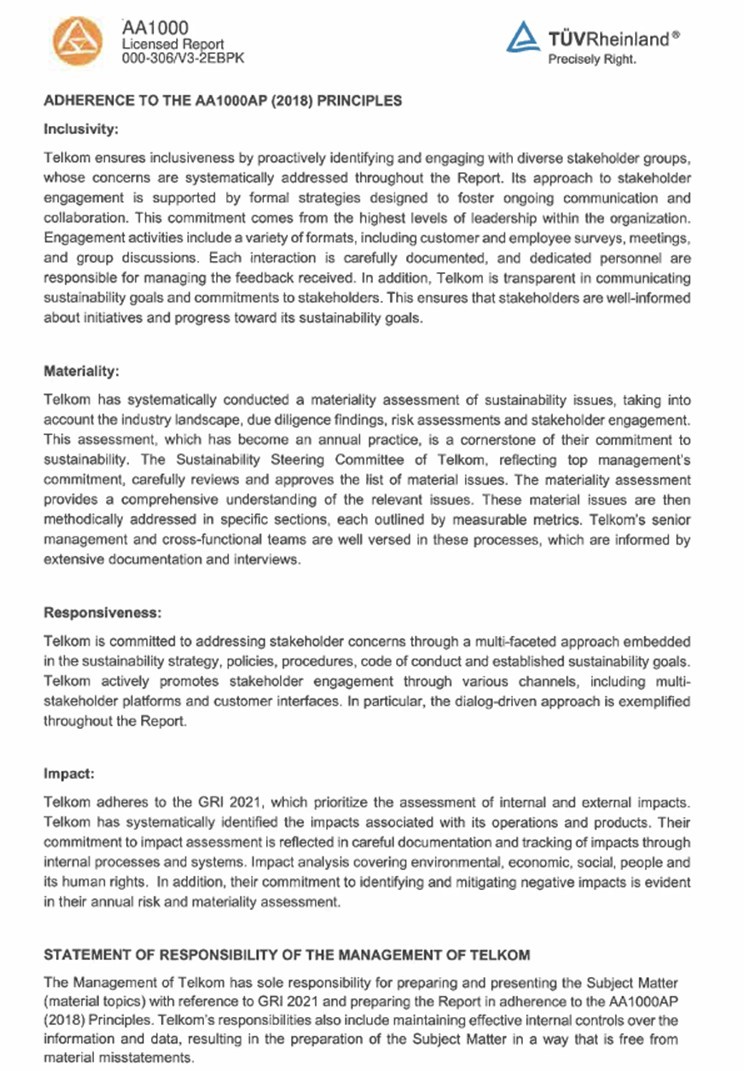
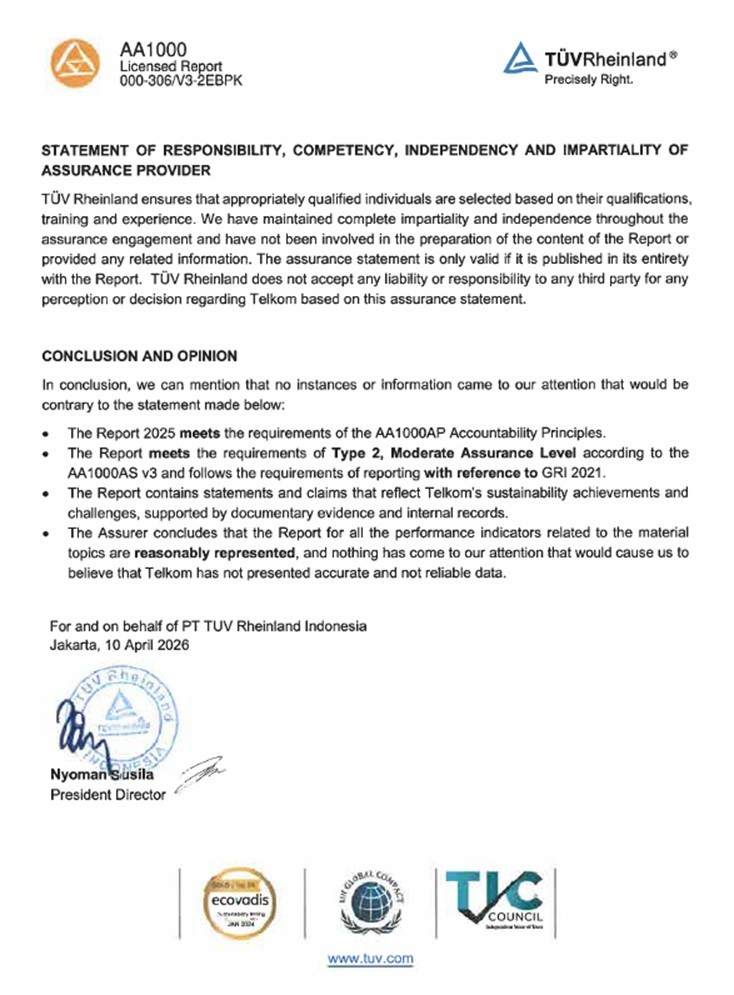
External assurance for the 2025 Sustainability Report is conducted by an independent external party, TÜV Rheinland Indonesia, with a scope covering compliance with the GRI 2021 Standards. The results of the external assurance are presented in Appendix 10 of this report.
The selection of TÜV Rheinland Indonesia as the independent verifier was based on considerations of expertise, reputation, and the absence of any potential conflict of interest or business relationship with Telkom. The delegation of the selection of the independent third-party verifier was assigned by management to the Sustainability Function Unit, in accordance with applicable procurement regulations.
2
This report contains forward-looking statements, including targets, forecasts, estimates, or future projections. The statements are based on assumptions and information available at the time of preparation of reports. Telkom acknowledges that such statements contain risks and uncertainties that may be beyond the company's control; therefore, actual results may differ from those expressed or implied in the forward-looking statements. As such, there is no guarantee that all such statements can be fulfilled in their entirety. Readers are advised to exercise caution in interpreting forward-looking statements contained in this report and bear full responsibility for any decisions made based on the information presented.
All monetary references are presented in Indonesian Rupiah (Rp), unless otherwise stated. The terms "Telkom" and “the Company” in this report refer to the parent entity, while the term "Telkom and its Subsidiaries" or "TelkomGroup" refers collectively to the parent company, its subsidiaries, and affiliated entities. However, the use of the term "Telkom" does not eliminate subsidiaries and affiliates from the scope of the content and discussion of the report.
[GRI 2-3]
We welcome any feedback and suggestions that may contribute to the improvement of our future reports. Please contact:
Sustainability Function Unit
PT Telkom Indonesia (Persero) Tbk
The Telkom Hub, Telkom Landmark Tower, 39th Floor
Jl. Jend Gatot Subroto Kav. 52, Jakarta, Indonesia, 12710
Email: sustainability@telkom.co.id
We express our gratitude for the feedback on the 2024 Sustainability Report from stakeholders. Telkom Management has received feedback regarding opportunities to improve sustainability performance from rating agencies as well as regulators and we have followed this in this Sustainability Report. In the 2025 Sustainability Report, Telkom aims to continue improving the Management of Environmental, Social, and Governance (ESG) aspects and sustainability performance. [OJK G.3]
3
2025 Sustainability Performance Overview
[OJK B.1, B.2, B.3]
Economic Performance
| ● | IDR 146,742 billion operating income |
| ● | IDR 17,814 billion net profit |
| ● | 12.1% Net Income Margin |
| ● | IDR 19.5 trillion spending on local suppliers |
| ● | 56.9% total procurement allocated to local suppliers |
Environmental Performance – Save Our Planet
| ● | 44% reduction in TelkomGroup Scope 1 emissions compared to the 2023 base year |
| ● | Creating a TelkomGroup decarbonization roadmap towards net zero emissions by 2060 |
| ● | 1 GSD building certified Excellence in Design for Greater Efficiencies (EDGE) by the International Finance Corporation (IFC) and Green Building Council Indonesia (GBCI) |
| ● | 177,915 bottles weighing 3.3 tons processed through Reverse Vending Machines within Telkom environments |
| ● | 24% reduction in total waste generation of TelkomGroup |
| ● | 73% of fiber optic cable waste diverted from final disposal |
Social Performance – Empower Our People
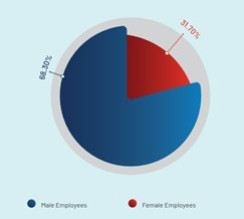
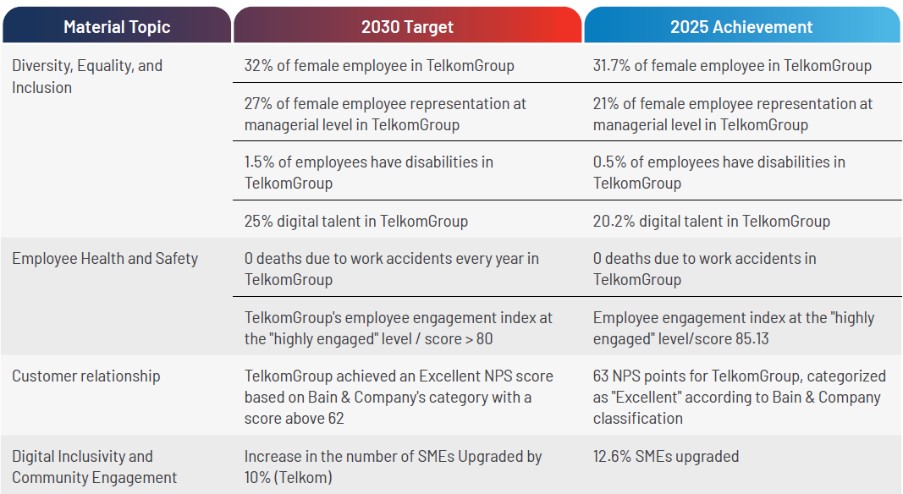
| ● | 31.7% employees in TelkomGroup are female |
| ● | 21% managerial positions in TelkomGroup are held by female |
| ● | 106 or equivalent to 0.5% of employees with disabilities are empowered in the TelkomGroup environment |
| ● | Achieved a Net Promoter Score (NPS) score of 63 (classified as excellent*) for TelkomGroup, an increase of +5 points compared to 2024 |
| ● | IDR 169 billion invested in community empowerment through CSR programs at Telkom |
| ● | Advancing digital inclusivity with network coverage reaching more than 97% of Indonesia’s population |
*Based on Bain & Company category
Governance Performance – Elevate Our Business
| ● | 100% compliance rate with applicable regulations, with no proven major violations |
| ● | Telkom and 12 Subsidiaries with direct ownership have been certified under SNI ISO 37001:2016 Anti-Bribery Management System (SMAP), with one Subsidiary currently in the certification process |
| ● | 0 critical data breach incidents |
| ● | 99.4% of TelkomGroup employees successfully completed cybersecurity training |
| ● | 100% participation of Telkom's Board of Directors and employees in anti-corruption training and awareness programs. |
4
Message from the President Commissioner
"We appreciate TelkomGroup's consistency in implementing its sustainability strategy, as reflected in its performance achievements and external recognition related to environmental, social, and governance aspects."
Esteemed stakeholders,
We begin by expressing gratitude to the Almighty God, as in 2025 PT Telkom Indonesia (Persero) Tbk (“Telkom”) has been able to maintain solid performance while further strengthening the foundation for sustainable business growth. The year 2025 was marked by challenges across various aspects, including macroeconomic conditions, competition, technological developments, and sustainability issues. Amid the increasing sustainability challenges and opportunities faced by the telecommunications industry, Telkom has continued to undertake its best efforts to enhance operational and financial performance, creating positive impacts and delivering sustainable value for all stakeholders.
Throughout 2025, we assess that the Board of Directors has taken concrete steps to strengthen sustainability strategies and initiatives within the TelkomGroup environment, which is reflected in, among other things, the leadership of the Board of Directors supported by all Subsidiaries in strengthening and aligning sustainability strategies and initiatives within the TelkomGroup environment. In 2025, Telkom has established the TelkomGroup 2030 sustainability strategy and targets as a roadmap to refine and orchestrate corporate steps in the environmental, social, and governance fields.
The year 2025 has also represented a significant milestone in reaffirming Telkom's strong commitment to improving the quality and credibility of sustainability performance disclosures presented in this report. Telkom has consistently undertaken external assurances for the TelkomGroup 2025 Sustainability Report, conducted by an independent external party, TÜV Rheinland Indonesia.
We appreciate TelkomGroup’s ongoing improvements in sustainability performance, reflected in the numerous awards and achievements across environmental, social, and governance (ESG) dimensions. These recognitions include being named the winner of the ESG Sustainability Ratings 2025 by CNBC Indonesia; receiving the Distinction Award in ESG Risk Mitigation at the 2025 ESG Awards; earning an appreciation award in the Infrastructure Sector category at the IDX Channel ESG 2025 Awards; being awarded Silver Winner in the Relations to Local Communities category at the Asia ESG Positive Impact Awards 2025 by the Asia ESG Positive Impact Consortium; and receiving the Dream Workplace for Learning 2025 award from the MarkPlus Institute and Marketeers. In 2025, Telkom also succeeded in improving its Sustainalytics ESG Rating from 25.6 to 24.5 (Medium Risk), achieving an ACGS governance score of 101.98 (Leadership in Corporate Governance), and obtaining a B rating from the CDP (Carbon Disclosure Project) which specifically assesses Telkom's readiness regarding climate change. These achievements further reinforce Telkom’s commitment and consistency in advancing sustainability performance. Beyond pursuing higher ratings and awards, Telkom remains focused on strengthening the quality of its corporate governance and management practices, thereby generating meaningful and lasting impacts across all sustainability aspects.
As part of the efforts to enhance the quality of corporate management, we recognize that Telkom must continue to mitigate global risks and challenges that have the potential to disrupt TelkomGroup’s business and service operations. These risks include cybersecurity threats, extreme weather events, and climate change–related disasters, as well as the need to continuously strengthen the quality of human capital in line with the company’s digital transformation. The development of products and the equitable delivery of telecommunication services through technology and innovation must be pursued by prioritizing usefulness, responsibility, and inclusivity, while also considering investment value and affordability. This balanced approach is essential for Telkom to sustain its long-term business resilience and value creation.
5
In addressing these challenges, a strong governance foundation is indispensable. Robust governance ensures that every strategic and operational initiative not only drives business growth but also contributes to long-term sustainable value creation for all TelkomGroup stakeholders. Strengthening governance consequently requires consistent enforcement of discipline, including the application of rewards and sanctions, the reinforcement of integrity and ethical conduct, and the cultivation of a corporate culture that supports sound governance practices.
Finally, on behalf of the Board of Commissioners, I would like to express our sincere appreciation for the support provided in advancing sustainability practices across TelkomGroup. We look forward to strengthening collaboration and synergy with all stakeholders to sustain our partnerships and jointly realize a sustainable future. We would also like to extend our gratitude to the Board of Directors, business partners, and all Telkom stakeholders for their valuable contributions in driving sustainable growth.
Jakarta, May 12, 2026
/s/ Angga Raka Prabowo
Angga Raka Prabowo
President Commissioner
6
Message from the President Director
[OJK D.1]
"2025 represented a new milestone for Telkom in accelerating sustainability transformation through the implementation of various ESG-related actions and the establishment of a Climate Transition Plan."
Esteemed stakeholders,
The telecommunications and digital industry is currently facing increasingly dynamic global development, including the accelerated adoption of digital technologies, increasingly complex governance demands, and the increasingly real impact of climate change. Amid this dynamic, Telkom remains committed to ensuring the sustainability of business growth and the relevance of its business model, as well as sustainable value creation for all stakeholders.
Telkom's commitment is manifested in the strategic steps taken in 2025, where Telkom has managed to achieve various important milestones in the company's sustainability journey. For the first time, Telkom established TelkomGroup's Climate Transition Plan that guides the transition to low-carbon operations. In addition, we also consistently verify the 2025 Sustainability Report, which has been declared compliant with AA1000AP and AA1000ASv3 standards and prepared in accordance with the GRI 2021 reporting requirements.
Our efforts to strengthen sustainability practices aligned with the Sustainable Development Goals agenda have resulted in ESG Ratings from several rating agencies, including an ESG Sustainalytics score of 24.5 (Medium Risk), an ACGS governance score of 101.98 (Leadership in Corporate Governance), and a B predicate from CDP (Carbon Disclosure Project) for the climate category. Furthermore, Telkom's sustainability achievements, supported through the GoZero% strategy and program, are also reflected in three main sustainability pillars.
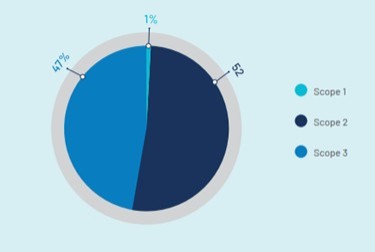
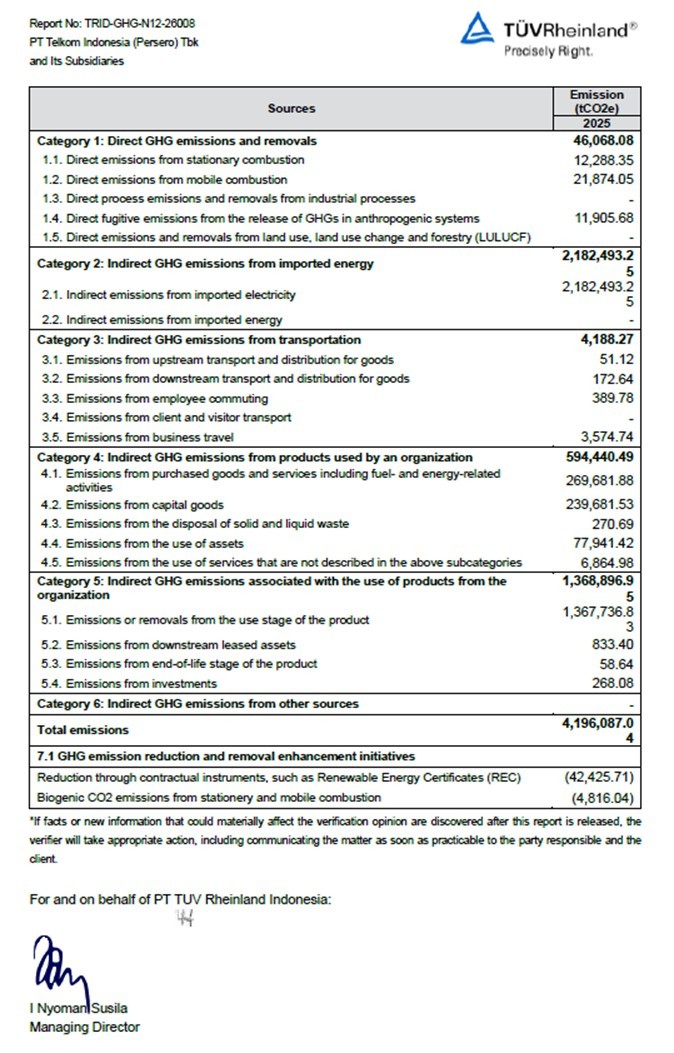
The Save Our Planet pillar reflects Telkom's commitment to reducing the environmental impact of business operations, particularly in areas that have a significant impact, such as emissions and waste. In 2025, TelkomGroup consistently measured Greenhouse Gas (GHG) emissions across scopes 1, 2, and 3, with verification conducted by independent parties. The total GHG emissions of TelkomGroup scopes 1, 2, and 3 are 4,153,661.3 tCO2e, with 52% of emissions coming from scope 2 (indirect) emissions. In addition, TelkomGroup managed to reduce total waste generation by around 24%, and diverted 166.9 tons of fiber optic cable waste, equivalent to 73% of final disposal. TelkomGroup has also undertaken initiatives to conserve biodiversity and increase the carrying capacity of the ecosystem, including through mangrove planting and revegetation, as well as coral reef transplantation.
The Empower Our People pillar underscores TelkomGroup’s dedication to empowering employees, customers, and the wider community through the creation of an inclusive digital ecosystem that serves as a foundation for capability development and sustainable innovation. In 2025, female employees occupied 21% of managerial positions, supported by an inclusive work environment that fosters gender equality. In terms of digital skills development, the Digital Talent program has successfully produced 20.2% of Telkom’s digital talent through various training initiatives. Occupational safety remains a top priority, reflected in the absence of employee fatalities due to work accidents throughout the year. From the customer perspective, TelkomGroup continues to enhance service quality by placing customers at the center, as evidenced by a five-point increase in Net Promoter Score (NPS) to 63, classified as Excellent by Bain & Company. This achievement is driven by improved service quality and more effective promotional strategies. On the social front, Telkom is committed to empowering Micro and Small Enterprises (MSEs) through the Go Modern, Go Digital, Go Online, and Go Global programs, with 12.6% of supported MSEs successfully upgrading—marked by increased turnover, workforce expansion, and asset growth.
The Elevate Our Business pillar reflects Telkom’s commitment to ethical and responsible business practices, particularly in the area of data protection amid increasing cybersecurity threats. In 2025, Telkom established the Legal & Compliance Directorate for the first time and appointed a Director of Legal & Compliance as part of strengthening its governance structure to support the achievement of TelkomGroup’s strategic objectives. In line with the strengthening of the governance structure throughout the year, Telkom maintained compliance with applicable laws and regulations, took firm action against any legal violations within TelkomGroup,
7
cooperated fully with legal processes, and implemented preventive measures aimed at achieving 100% compliance. All complaints received from the whistleblowing system have been duly followed up, reinforcing Telkom’s ethical and respectful work culture. In terms of data security, there have been no critical data leaks, and all forms of data processing have been carried out in accordance with the policy. This achievement affirms Telkom's commitment in terms of governance to continue to build trust, encourage innovation and grow with Indonesia towards a sustainable digital future.
Telkom continues to proactively identify and manage sustainability risks that may impact the company, while also driving innovation to unlock and optimize new strategic sustainability opportunities. The integration of sustainability across all business lines is gradually carried out in line with the strengthening of the company's foundation. This fundamental step is also complemented by the synergy of sustainability initiatives within TelkomGroup to ensure the achievement of TelkomGroup's 2030 sustainability targets and net zero emissions by 2060.
We extend our appreciation to all stakeholders for their support in the implementation of sustainability practices. With this collective commitment, Telkom is confident in its ability to innovate amidst challenges and opportunities in the digital era, enabling the company to grow sustainably and remain the Digital Telco of choice for the public.
Jakarta, May 12, 2026
/s/ Dian Siswarini
Dian Siswarini
President Director
8
STATEMENT OF THE MEMBERS OF THE BOARD OF COMMISSIONERS ON RESPONSIBILITY FOR THE 2025 SUSTAINABILITY REPORT OF PT TELKOM INDONESIA (PERSERO)
We, the undersigned, declare that the Board of Commissioners has examined and approved the Sustainability Report of PT Telkom Indonesia (Persero) Tbk for 2025, and declare that all information in the Sustainability Report has been fully loaded, and we are fully responsible for the correctness of the content of the company's Sustainability Report.
This statement is made in all truthfulness.
Jakarta, May 12, 2026
Board of Commissioners | |||
Angga Raka Prabowo President Commissioner | |||
Deswandhy Agusman Independent Commissioner | Ira Noviarti Independent Commissioner | Rofikoh Rokhim Independent Commissioner | |
Ossy Dermawan Commissioner | Rionald Silaban Commissioner | ||
Silmy Karim Commissioner | Rizal Malarangeng Commissioner | ||
9
STATEMENT OF THE MEMBERS OF THE BOARD OF DIRECTORS ON RESPONSIBILITY FOR THE 2025 SUSTAINABILITY REPORT OF PT TELKOM INDONESIA (PERSERO) TBK
We, the undersigned, declare that the Board of Directors has examined and approved the Sustainability Report of PT Telkom Indonesia (Persero) Tbk for 2025, and declare that all information in the Sustainability Report has been fully loaded, and we are fully responsible for the correctness of the content of the company's Sustainability Report.
This statement is made in all truthfulness.
Jakarta, May 12, 2026
Board of Directors | |||
Dian Siswarini President Director | |||
Arthur Angelo Syailendra Director of Finance & Risk Management | Veranita Yosephine Director of Enterprise & Business Service | Nanang Hendarno Director of Network | |
Seno Soemadji Director of Strategic Business Development & Portfolio | Faizal Rochmad Djoemadi Director of IT Digital | Budi Satria Dharma Purba Director of Wholesale & International Service | |
Willy Saelan Director of Human Capital Management | Andy Kelana Director of Legal & Compliance | ||
10
ESG Awards and Ratings in 2025
January | ● ESG Sustainability Ratings 2025 award by CNBC Indonesia |
February | ● Indonesia Digital Sustainability Awards 2025 by Plus Idea Komunika and JakTV |
April | ● Top LinkedIn Companies 2025 for the fourth year in a row ● Best Corporate Emission Reduction Transparency Awards 2025 by Investortrust |
May | ● The Dream Workplace for Learning 2025 for the Telecommunications category. by MarkPlus Institute and Marketeers |
June | ● The Telecommunication Issuer Award by Bisnis Indonesia Group ● Corporate Governance Award in Data Protection for Telin by Enterprise Asia ● TOP CSR Awards 2025 and TOP Leader on CSR Commitment 2025 for Finnet by Top Business Magazine |
July | ● Indonesia Best Workplace Awards 2025 by Warta Ekonomi Group ● Best Investor Pension Fund by KEHATI ● Anugerah ESG 2025 for the Infrastructure Sector Key Category by IDX Channel ● BUMN Awards 2025 by Investortrust |
August | ● Excellence Performance Award: Excellence in Health Insurance Infrastructure for Admedika by BUMN Track ● Anugerah Ekonomi Hijau for the Renewable Energy-based Telecommunication Infrastructure Innovation category by Detikcom |
September | ● Katadata Green Initiative Awards (KGIA) 2025 in the Future-Ready Green Data Center category for TDE by Katadata ● TOP GRC Awards 2025 #4 Star and The Most Committed GRC Leader 2025 for TelkoMedika were given by Top Business Magazine ● Best State-Owned Enterprises (Big Cap) by the Indonesian Institute for Corporate Directorship (IICD) ● 5-STAR Award for Telkom Access by Top Business Magazine ● CSR Awards 2025-Impact Excellence Award by Investortrust |
October | ● 1st place in the 2025 Lestari Awards for the Relations to Local Communities category was given by KG Media ● Distinction Award in ESG Risk Mitigation by Investortrust ● World's 500 Best Employers 2025 by Forbes ● The Top Corporate Impact Award 2025 in the SME Empowerment category was given by Infobrand.id |
November | ● IDX Channel Indonesia Innovation Award 2025 by IDX Channel ● The ESG Initiative Awards 2025 for the Diamond Predicate (Best Climate Adaptation & Resilience Initiative Category and Best ESG Governance & Risk Management Practice) and the Gold Predicate (Best Community Empowerment Initiative Category) were awarded by Sustain Life. ● The Detikcom Awards 2025 for the Indonesian Digital Connectivity Pillar category were given by Detikcom ● Indonesia Corporate Sustainability Championship (ICCS) 2025 for the Community Involvement Development category in the health sector by the Ministry of SOEs ● The Indonesia Quality. Health and Safety Environment (IQSA) Award was given by Business Asia ● The Silver Winner for the Relations with Local Communities Large Companies award category was given by KG Media |
December | ● Best Company of The Year 2025 for Infomedia given by Frost & Sullivan in the Customer Experience Management (CXM) category ● Best Emission Reduction and Best Innovative Conservation by Investing on Climate ● Sustainable Brand Leader for the Eco Action Campaign category given by Pikiran Rakyat Media Network (PRMN) |
11
● Impact in Good Governance & ESG Practice Appreciation by Kumparan ● Green Leadership & Corporate Governance Transformation Award by CNBC Indonesia ● Excellent Mom in Digital Transformation and Regional Connectivity Leadership by MetroTV ● Best Risk Management Practice for Mitratel was awarded by CNBC Indonesia ● Investing on Climate by Editor's Choice |
Complete information on ESG awards and ratings within TelkomGroup is available on the Telkom Profile page and Performance and Sustainability Rating.
12
Telkom is a State-Owned Enterprise (SOE) engaged in information and communication technology (ICT) services and digital telecommunications in Indonesia. Since its establishment in 1991, Telkom has provided a wide range of digital services for individual and corporate customers.
As the largest telecommunications company in Indonesia, Telkom has 45 Subsidiaries with direct and indirect ownership and ownership percentage of more than 50%, so that its Financial Statements are consolidated with Telkom as a parent. In addition, Telkom has 9 non-consolidated subsidiaries (affiliates). Detailed information on the corporate structure and subsidiary profiles is presented in Telkom’s 2025 Annual Report.
Telkom’s Business Transformation
[OJK C.6]
In 2025, Telkom undertook a landmark initiative by establishing a structural transformation into a strategic holding focused on long-term value creation. This transformation is intended to simplify portfolios, strengthen governance, and reorganize the company to enable faster, more precise, and measurable portfolio execution.
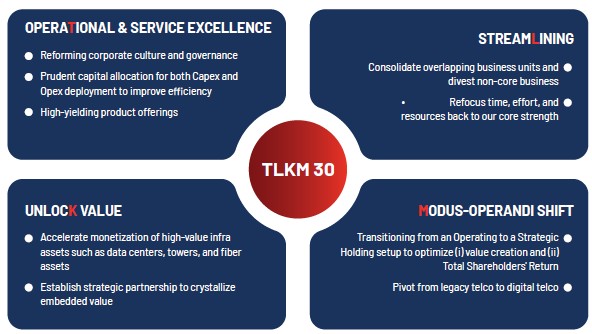
Figure 2. TLKM Transformation Pillars 30

As the basis for transformation, Telkom has set four main pillars within its TLKM agenda. The operaTional and service excellence pillar focuses on corporate culture reform, governance alignment, and improving the effectiveness of capital and operational expenditures. The streamLining pillar is geared towards simplifying the business structure so that resources can be fully allocated to strengthen the company's key competencies. The unlocK value pillar encourages the monetization of high-value infrastructure assets such as data centers, towers, and fiber networks through strategic partnerships that can generate optimal added value. Meanwhile, the Modus-operandi shift pillar emphasizes Telkom's transformation from an operating company to a strategic holding that acts as a strategy director, capital manager, and value creation engine at the group level.
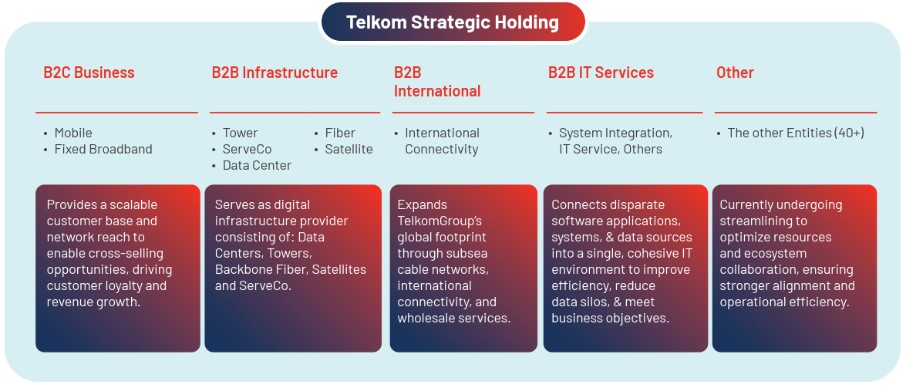
TelkomGorup its business into five main portfolios: B2C Business, B2B Infrastructure, B2B International, B2B IT Services, and other entities for effective services. Through this transformation, Telkom is strategically moving into a new growth phase, positioning itself as a more agile, competitive, and value-driven organization for all stakeholders.
13
Figure 3. TelkomGroup Products and Services [OJK C.4] [GRI 2-6]

[OJK C.3] [GRI 2-1, 2-6]
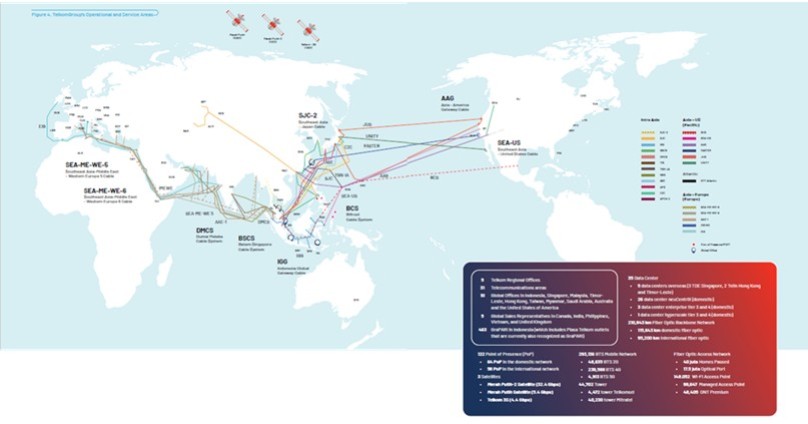
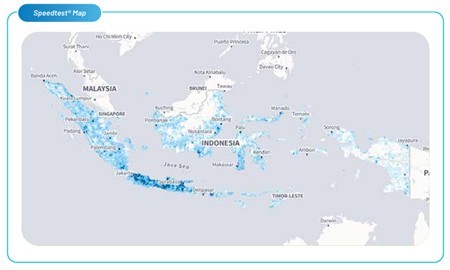
TelkomGroup operates across Indonesia and internationally to strengthen its position as a competitive digital telecommunications service provider. Its international arm, Telin, operates services reaching 35 countries, with operational offices spread across 15 countries in Asia, Australia, Europe, and America. The existence of these offices expands the range of services while strengthening strategic cooperation in the international market. With an extensive operational network across regions and remote areas, we continue to encourage equitable digital access and ensure that global standard services are accessible to people in various regions.

Figure 4. TelkomGroup's Operational and Service Areas

14
[OJK C.2, C-3] [GRI 2-1, 2-6, 2-7]
Name PT Telkom Indonesia (Persero) Tbk | |
Status Public Company (Tbk) | Business Field Information and Communication Technology (ICT) services and telecommunication networks. |
Year of Establishment November 19, 1991 | Head Office Address Jalan Japati No. 1 Bandung |
Stock Code TLKM – Indonesia Stock Exchange (IDX) TLK – New York Stock Exchange (NYSE) | Share Ownership ● Government o PT Danantara Asset Management 52.09% o BUMN Regulatory Agency 0.00% ● Public 47.91% |
Financial Position as of December 31, 2025 (consolidated) : Assets: IDR 287,759 billion Liabilities (Liabilities): IDR 137,222 billion Equity: IDR 150,537 billion | Number of TelkomGroup Employees Total employees 21,151
|
15
Purpose, Vision, Mission, and Corporate Values
[OJK C.1]
Purpose To foster a more prosperous and competitive nation while delivering the best added value to stakeholders. |
Vision To become the digital telco of choice for advancing society. |
Mission 1. To accelerate the development of sustainable, cost-efficient, and accessible digital infrastructure and smart platforms for all communities. 2. To develop leading digital talent that drives national digital capabilities and adoption. 3. To orchestrate a digital ecosystem that delivers the best customer digital experience. |
Value
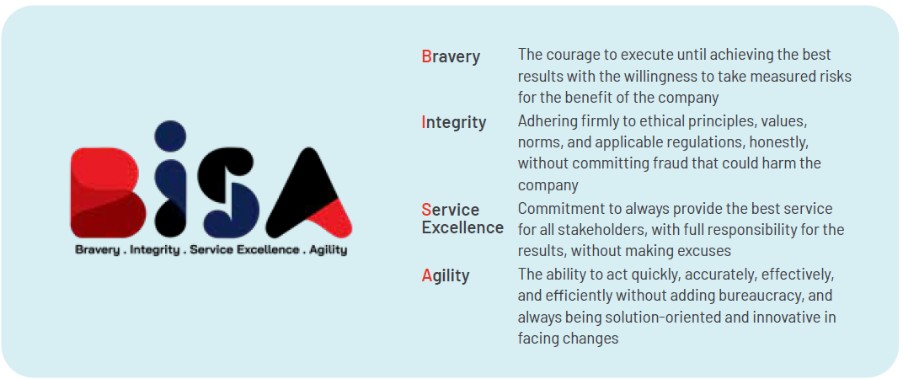
Bravery The courage to carry out execution to achieve the best results with the willingness to take measured risks for the benefit of the company Integrity Hold firmly to ethical principles, values, norms, and applicable regulations, honestly, without committing fraud that could harm the company Service Excellence A commitment to always provide the best service for all stakeholders, with full responsibility for the results without making excuses Agility The ability to act quickly, accurately, effectively, and efficiently without adding bureaucracy, and always being solution-oriented and innovative in facing changes |
16
Figure 5. Telkom Sustainability Milestones
<2021 | 2021-2022 | 2023 | 2024 | 2025 |
Embedding Social and Environmental Responsibility | Building the Sustainability Foundation | Scaling Corporate-Wide Sustainability | Advancing Sustainability Excellence | Setting the Climate Transition Direction |
Social and Environmental Responsibility (CSR) as the main foundation of sustainability practices | Establishment of a foundation for sustainability for compliance with national regulations | Expansion of TelkomGroup's sustainability implementation | Strengthening TelkomGroup's sustainability strategy and targets | Formulation and launch of the climate transition plan as a strategic direction towards TelkomGroup's low-carbon operations |
● Preparation of a Sustainability Report containing the performance of CSR since 2006, with the exception of 2017-2019, as a form of adjustment to national regulations | ● Preparation of Sustainability Reports containing sustainability performance in accordance with national regulations (POJK 51.2017) ● Establishment of a CSR Committee for national regulatory compliance | ● Launch of the EXIST Program (ESG Existence for Sustainability by Telkom Indonesia) which serves as a reference for sustainability practices at Telkom ● Preparation of Climate Risk Report based on the TCFD framework | ● Launch of TelkomGroup's sustainability strategy through GoZero%: Sustainability Action ● Strengthening TelkomGroup's 2030 sustainability target ● Development of governance through the Committee and sustainability policies ● Verification of the 2024 Sustainability Report and GHG emissions by independent agencies | ● Launch of TelkomGroup's Climate Transition Plan ● Strengthening transparency of sustainability practices through the ESG dashboard on Telkom's official website |
2025 marks an important phase in Telkom’s sustainability journey, highlighted by the establishment of TelkomGroup’s climate transition plan. This milestone not only reaffirms the company’s climate commitment but also provides a strategic roadmap toward low-carbon operations and the achievement of net zero emissions by 2060. This strategic step forms part of Telkom’s sustainability journey, which has evolved over nearly two decades in response to changing business and regulatory landscapes.
Telkom’s initial commitment to sustainability was reflected in the publication of its first Sustainability Report in 2006, which focused primarily on the performance of Social and Environmental Responsibility (CSR). Over time, the scope of the report expanded to include broader environmental, social, and governance (ESG) performance in line with national regulations, including POJK No. 51/2017 on Sustainable Finance. In 2023, Telkom introduced the EXIST (ESG Existence for Sustainability by Telkom Indonesia) program, marking the company’s first structured initiative to integrate ESG aspects into its business activities. This program subsequently evolved into GoZero% in 2024, serving as an umbrella framework for sustainability actions aimed at achieving TelkomGroup’s 2030 targets. As sustainability has become increasingly integrated into corporate management, Telkom has further strengthened its sustainability governance by establishing a Sustainability Committee, issuing a Sustainability Policy, and developing a sustainability dashboard as a platform for disclosing TelkomGroup’s sustainability performance to stakeholders.
17
Telkom believes that the consistent application of strong Good Corporate Governance (GCG) principles serves as a main foundation for achieving TelkomGroup’s sustainability objectives. TelkomGroup's governance is regulated in the Decree of the Board of Directors No. PD.602.00/r.00/HK000/COP-D0030000/2011 concerning Guidelines for the management of Good Corporate Governance (GCG).
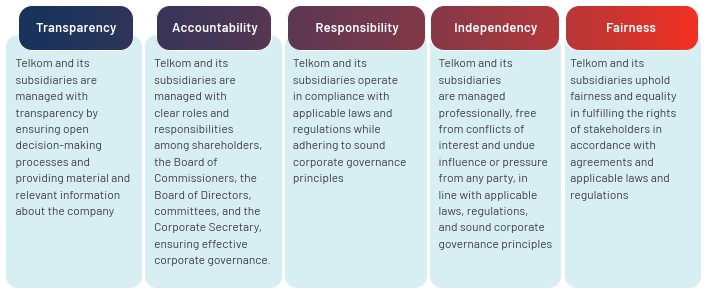
Specifically, TelkomGroup’s governance framework is anchored in five GCG principles, which are guided by applicable laws and regulations and aligned with internationally and nationally recognized standards. These include the Corporate Governance Principles developed by the Organisation for Economic Co-operation and Development (OECD), the Indonesian Corporate Governance General Guidelines issued by the National Committee on Governance Policy (KNKG), and the ASEAN Corporate Governance Scorecard (ACGS). The implementation of TelkomGroup’s governance practices in accordance with ACGS parameters is assessed annually by an independent external assessor.
Figure 6. TelkomGroup's Governance Principles

Telkom implements 8 (eight) principles of corporate governance in accordance with OJK Regulation Number 21/SEOJK.04/2015 regarding the Implementation of Public Company Governance Guidelines and OJK Circular Letter Number 32/SEOJK.04/2015 regarding Public Company Governance Guidelines. As of the end of 2025, evaluation results indicate that Telkom has fulfilled all governance principles stipulated by OJK, as further described in Telkom’s 2025 Annual Report. In addition, the implementation of corporate governance at Telkom also refers to Regulation of the Minister of SOEs Number PER-2/MBU/03/2023 regarding Guidelines for Governance and Significant Corporate Actions of State-Owned Enterprises.
TelkomGroup continuously strengthens a culture of compliance and business ethics across the organization through regular awareness programs, value internalization initiatives, and layered oversight in the implementation of GCG principles. These efforts are supported using digital systems and robust internal control mechanisms to ensure effective risk management, prevent conflicts of interest, and reinforce the principles of transparency and accountability. At TelkomGroup, GCG is not merely viewed as a regulatory requirement but has become a strategic value embedded in the company’s operations to support sustainable business growth and long-term value creation for stakeholders.
TelkomGroup’s commitment to fostering a transparent, accountable, and sustainable governance environment has been recognized through the Best State-Owned Enterprise (Big Cap) award at the 16th IICD Corporate Governance Conference & Award 2025.
18
Corporate Governance Structure
[GRI 2-9, 2-11]
Telkom's governance structure adopts the provisions of Law No. 40 of 2007 concerning Limited Liability Companies, which consists of the main organs, namely the General Meeting of Shareholders (RUPS), the Board of Commissioners, and the Board of Directors.
| 1. | The General Meeting of Shareholders (GMS) is Telkom's highest governance organ, which is a means for Shareholders to make important and strategic decisions. The RUPS has authority that is not given to the Board of Directors or the Board of Commissioners within the limits specified in the Law and/or the Articles of Association. The RUPS is held at least once a year (AGMS) and can be held as needed. |
| 2. | Telkom's Board of Commissioners, which consists of eight Commissioners, performs supervisory functions and advises the Board of Directors in managing the company. The Board of Commissioners is collectively responsible for ensuring that GCG principles are implemented effectively and sustainably in every business practice of the company. In carrying out its functions, the Board of Commissioners is assisted by: |
| a. | Audit Committee |
| b. | Nomination and Remuneration Committee |
| c. | Evaluation and Monitoring Committee |
| d. | Integrated Governance Committee |
| 3. | The Telkom Board of Directors consists of nine members of the Board led by the President Director as Chief Executive Officer (CEO). The Board has full authority and responsibility for managing the company and serves to represent Telkom, both in legal matters inside and outside the court. The Board is assisted by the Corporate Secretary, the Internal Audit Function Unit, and the Executive Committee. The Executive Committee is authorized to decide on or approve policies, company regulations, or certain transactions, consisting of: |
| a. | Investment Committee |
| b. | Subsidiary Management Committee |
| c. | Risk, Compliance, and Revenue Assurance Committee |
| d. | Disclosure Committee |
| e. | Procurement Committee |
| f. | Pricing Committee |
In addition to the executive committee, there are various other committees that supports strategic decision-making, supervision, as well as the coordination of policy and initiative implementation at TelkomGroup, such as the Sustainability Committee, CSR Committee, Cybersecurity Committee, Portfolio Committee, and others. The roles of the Board of Commissioners, the Board of Directors, and supporting organs are comprehensively explained in Telkom's 2025 Annual Report.
Composition of the Board of Commissioners and Board of Directors
[GRI 2-9, 405-1]
The resolution of the Annual General Meeting of Shareholders (AGMS) in May 2025 and the Extraordinary General Meeting of Shareholders (EGMS) in December 2025 have established new leadership over Telkom's Board of Commissioners and Board of Directors. This shows Telkom's commitment to succession planning, board renewal, and independent supervision, in accordance with GCG principles. The following is the composition of Telkom's Board of Commissioners and Board of Directors as of December 31, 2025.
19
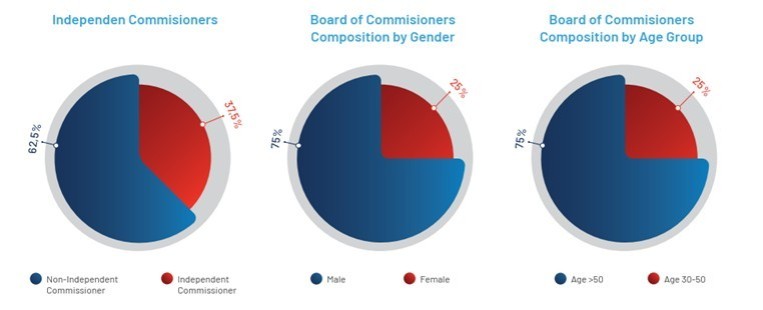
Figure 7. Diversity of Telkom Board of Commissioners

Table 3. Composition of the Telkom Board of Commissioners as of December 31, 2025
Name | Position | Basis of Appointment | Duration of Tenure | Gender | Age | Skill |
|---|---|---|---|---|---|---|
Angga Raka Prabowo | President Commissioner | Telkom Annual General Meeting of Shareholders (AGMS) on May 27, 2025 | 10 months | Male | 36 years old | Communication, International Relations |
Ossy Dermawan | Commissioner | Telkom Annual General Meeting of Shareholders (AGMS) on May 27, 2025 | 10 months | Male | 49 years old | Military, Strategic Relations, Public Policy and National Politics |
Rionald Silaban | Commissioner | Telkom Annual General Meeting of Shareholders (AGMS) on May 27, 2025 | 10 months | Male | 59 years old | Law, Economics and Public Management |
Rizal Mallarangeng | Commissioner | First Period: Telkom Annual General Meeting of Shareholders (AGMS) on May 24, 2019 Second Period: Telkom Annual General Meeting of Shareholders (AGMS) on May 3, 2024 | 5 years 9 months | Male | 61 years old | Public and Political Communication |
Silmy Karim | Commissioner | Telkom Annual General Meeting of Shareholders (AGMS) on May 30, 2023 | 2 years 10 months | Male | 51 years old | Defense Economics and Management |
Deswandhy Agusman | Independent Commissioner | Telkom Annual General Meeting of Shareholders (AGMS) on May 27, 2025 | 10 months | Male | 66 years old | Finance and Public Policy |
20
Name | Position | Basis of Appointment | Duration of Tenure | Gender | Age | Skill |
|---|---|---|---|---|---|---|
Ira Noviarti | Independent Commissioner | Telkom Extraordinary General Meeting of Shareholders (EGMS) on September 16, 2025 | 5 months | Female | 54 years old | Economics, Finance and Leadership |
Rofikoh Rokhim | Independent Commissioner | Telkom Extraordinary General Meeting of Shareholders (EGMS) on December 12, 2025 | 3 Months | Female | 54 years old | Economics, Banking, Finance and Leadership |
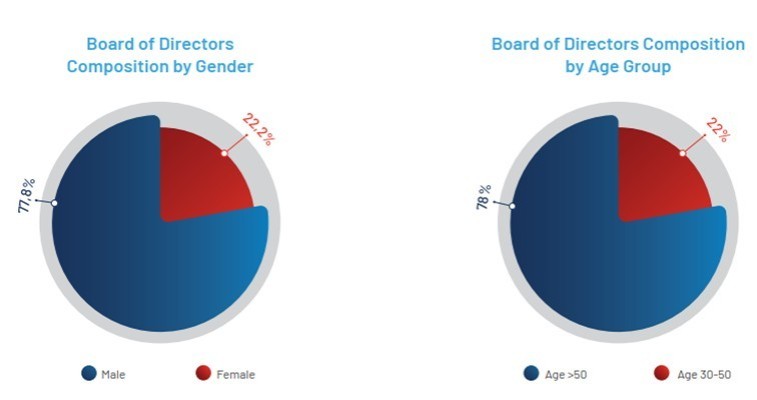
Figure 8. Diversity of Telkom's Board of Directors

Table 4. Composition of Telkom’s Board of Directors as of Desember 31, 2025
Name | Position | Basis of Appointment | Duration of Tenure | Gender | Age | Skill |
|---|---|---|---|---|---|---|
Dian Siswarini | President Director | Telkom AGMS on May 27, 2025 | 10 months | Female | 57 years old | Digital transformation, telecommunication infrastructure development, and ESG implementation at Telkom |
Arthur Angelo Syailendra | Director of Finance & Risk Management | Telkom AGMS on May 27, 2025 | 10 months | Male | 41 years old | Investment, Finance & risk management, Mergers & Acquisition, including aspects of sustainability and corporate governance |
Veranita Yosephine | Director of Enterprise & | Telkom AGMS on May 27, 2025 | 10 months | Female | 47 years | Strengthening the group's enterprise and business |
21
Name | Position | Basis of Appointment | Duration of Tenure | Gender | Age | Skill |
|---|---|---|---|---|---|---|
Business Service | old | services and strategic portfolio through investment, digital transformation and the implementation of global ESG standards | ||||
Nanang Hendarno | Network Director | Telkom AGMS on May 27, 2025 | 10 months | Male | 57 years old | Network Strategy and Architecture, infrastructure efficiency, and Cybersecurity |
Faizal Rochmad Djoemadi | Director of Digital IT | Telkom AGMS on May 27, 2025 | 10 months | Male | 59 years old | Digital business, technological innovation, and ESG integration in digitalization |
Seno Soemadji | Director of Strategic Business Development & Portfolio | Telkom AGMS on May 27, 2025 | 10 months | Male | 56 years old | Strategic portfolio management, sustainable investments, group business development, sustainable growth and ESG initiatives |
Willy Saelan | Director of Human Capital Management | Telkom EGMS on September 16, 2025 | 5 months | Male | 56 years old | Human resource development, organizational design, workforce inclusivity, and sustainability culture. |
Budi Satria Dharma Purba | Director of Wholesale & International Service | Telkom EGMS on December 12, 2025 | 3 Months | Male | 52 years old | Wholesale & international services, global ESG standards in operations |
Andy Kelana | Director of Legal & Compliance | Telkom EGMS on September 16, 2025 | 5 months | Male | 59 years | GCG-based governance and legal compliance, group policy management, and legal risk mitigation, and oversight of corporate sustainability actions in terms of regulatory compliance |
Election and Appointment Process of the Board of Commissioners and Board of Directors
[GRI 2-10]
The appointment process for the Board of Commissioners and Board of Directors at Telkom is based on the principles of respect for human rights (HAM), non-discrimination, and equality. The appointment of members of the Board of Commissioners and Board of Directors at Telkom is carried out based on the provisions of the Articles of Association and considers other provisions, including the Regulation of the Minister of SOEs Number PER-3/MBU/03/2023 regarding Organs and Human Resources of State-Owned Enterprises. In addition, the appointment of members of the Board of Commissioners is carried out by considering integrity, understanding of the company's management issues, being able to provide sufficient time to carry out their duties, and other requirements based on laws and regulations. The election or appointment of Telkom Board of Directors members is carried out through the General Meeting of Shareholders (GMS) by considering the competence and expertise, integrity, and background needed by the company. Selected members are ensured to have met the criteria and conditions that have been determined in the Fit and Propriety Test.
22
Conflict of Interest
[GRI 2-15]
Avoidance of Conflicts of Interest
The Board Manual specifically regulates the commitment of all corporate governance organs to uphold integrity and avoid conflicts of interest in the execution of their duties. As a manifestation of this commitment, each member of the Board of Commissioners signs an integrity pact that affirms their obligation to perform their responsibilities professionally and free from conflicts of interest. Furthermore, in carrying out supervisory and decision-making functions, members with potential conflicts of interest are required to disclose such conditions and recuse themselves from the related decision making process.
During the reporting period, there were no indications of conflicts of interest among Telkom’s Board of Commissioners and Board of Directors related to share ownership in suppliers or transactions, nor any affiliation—financial or familial—with other members or the Controlling Shareholder.
Prevention and Mitigation of Conflicts of Interest
The Audit Committee and the Board of Commissioners play an important role in overseeing and ensuring compliance with applicable laws and regulations, as stipulated in the Telkom Audit Committee Charter and the Telkom Board of Commissioners Decree Number 13/KEP/DK/2024. In addition, the Audit Committee and the Board of Commissioners are responsible for receiving, reviewing, and following up on complaints related to the company and its Subsidiaries.
As of December 31, 2025, Telkom’s Audit Committee consists of five members, including two independent members with expertise in finance. To ensure the independence and objectivity of the Audit Committee, each member is required to sign an Integrity and Independence Pact. Profiles of the Audit Committee members are presented in detail in Telkom’s 2025 Annual Report.
The Culture and Industrial Relations Function Unit is responsible for developing business ethics policies at Telkom, including policies related to conflicts of interest. Together with the Board of Directors, the Human Capital organization developed the Corporate Governance Guidelines based on the principle of independence. These guidelines regulate several provisions, including policies on conflict of interest transactions, the prohibition of political party donations, and restrictions on affiliated relationships. The implementation and monitoring of affiliate transactions within TelkomGroup are governed by the Main Procedure for Affiliate Transactions and Conflicts of Interest Transactions, as stipulated in the President Director’s Official Memorandum Number C.Tel.02/HK 000/TEL-00000000/2021. In addition, the HC Service Operation (HCSO) Function Unit distributes a conflict of interest questionnaire annually to all TelkomGroup employees.
Telkom also discloses information on multiple positions held by members of the Board of Commissioners, Board of Directors, and committees under the Board of Commissioners, as well as details of affiliated transactions, in Telkom’s 2025 Annual Report.
Performance Evaluation of the Board of Commissioners and Board of Directors
[GRI 2-18]
The Board of Commissioners is responsible for overseeing the Company’s Policies and the management carried out by the Board of Directors, as well as providing advice to the Board of Directors. This includes supervising the implementation of the Company’s Long-Term Plan (RJPP), the Annual Work Plan and Budget (RKAP), the Corporate Strategic Scenario (CSS), and compliance with applicable laws and regulations, in line with the company’s purposes and objectives. These responsibilities form the basis for the self-assessment of the collegial key performance indicators (KPIs) of the Board of Commissioners. The KPIs are determined based on the results of the Board of Commissioners’ performance evaluation and are reported to shareholders at the General Meeting of Shareholders (GMS). The performance evaluation of the Board of Commissioners is conducted by the Nomination and Remuneration Committee (KNR).
The performance evaluation of the Board of Directors is conducted through the measurement of KPI achievement, both on a collegial and individual basis. The KPI measurement results are reviewed by the Public Accounting Firm (KAP) that audits the company’s financial statements to ensure the objectivity of the
23
assessment, consistency of the methodology, and the reliability of the evaluation process. Based on the KAP review in 2025, no inconsistencies were identified in the methods or results of the Board of Directors’ performance assessment. The KPI achievement results were reported to the Board of Commissioners and the Series A Dwiwarna Shareholder as part of the company’s governance accountability and transparency.
As part of its commitment to sustainability, Telkom has incorporated ESG aspects into the collegial KPIs of the Board of Directors. These include: (1) ESG risk rating, (2) carbon intensity, and (3) the ratio of female and young top talent. The results of the collegial performance assessment of the Board of Directors are disclosed in Telkom’s 2025 Annual Report.
Remuneration Policy
[GRI 2-19, 2-20]
The provision of remuneration for members of Telkom's Board of Commissioners and Board of Directors is prepared based on the Regulation of the Minister of State-Owned Enterprises Number PER-3/MBU/03/2023 concerning Organs and Human Resources of State-Owned Enterprises and then followed up with the Decree of the Board of Commissioners Number 03/KEP/DK/2024 concerning the Income of Members of the Board of Directors and the Board of Commissioners.
With reference to the above regulations and to Danantara Letter Number S-063/DI-BP/VII/2025 dated 30 July 2025 regarding the Granting of Tantiem, Incentives, and/or Other Forms of Income to the Boards of Directors and Boards of Commissioners of SOEs and their Subsidiaries, the remuneration of the Board of Commissioners comprises the following components:
| 1. | Fees |
| 2. | Benefits, which consist of: |
| a. | Religious holiday allowance; |
| b. | Transportation allowance; and |
| c. | Retirement insurance. |
| 3. | Facilities, which consist of: |
| a. | Health facilities; and |
| b. | Legal aid facilities. |
Components of the remuneration of the Board of Directors:
| 1. | Salary |
| 2. | Benefits, which consist of: |
| a. | Religious holiday allowance; |
| b. | Housing allowance; and |
| c. | Retirement insurance. |
| 3. | Facilities, which consist of: |
| a. | Health facilities; |
| b. | Vehicle facilities; and |
| c. | Legal aid facilities |
| 4. | Tantiem/Performance Incentives/Special Incentives, in accordance to Danantara and/or BP BUMN policy. [GRI 2-19] |
The Minister of State-Owned Enterprises Regulation Number PER-3/MBU/03/2023 also stipulates provisions regarding the deferral of payment of a portion of tantiem and the granting of Long-Term Incentives (LTI) to members of the Board of Directors and the Board of Commissioners. Accordingly, the Board of Directors of PT Telkom Indonesia (Persero) Tbk had not yet received tantiem payments in 2025, as the determination process by the shareholders is still ongoing. This determination falls under the authority of the Ministry of State-Owned Enterprises (SOEs) and/or Danantara, in accordance with applicable regulations. This policy and authority resulted in a decrease in the highest annual total compensation received by members of the Board of Directors by up to approximately 72%. The reduction in the annual compensation of the Board of Commissioners and the Board of Directors is also reflected in the remuneration-to-employee ratio, as presented in Appendix 4: GRI Disclosure Index.
Telkom has integrated the performance of ESG impact management into remuneration, by including collegial and individual KPIs, as one of the consideration components of the incentive.
24
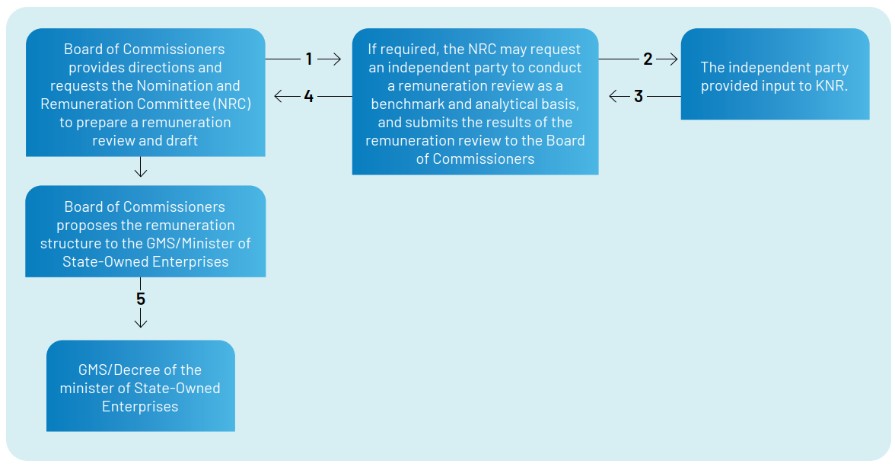
Figure 9. Procedure and Mechanism of Remuneration of the Board of Commissioners and Board of Directors

The procedure for proposing and determining the remuneration of the Board of Commissioners and the Board of Directors of Telkom is as follows:
| 1. | The Board of Commissioners requests the Nomination and Remuneration Committee to draft a remuneration proposal for the Board of Commissioners and the Board of Directors. |
| 2. | If necessary, the Nomination and Remuneration Committee may engage an independent party to develop a remuneration framework for the Board of Commissioners and the Board of Directors. |
| 3. | The Nomination and Remuneration Committee submits the remuneration framework to the Board of Commissioners. |
| 4. | The Board of Commissioners proposes remuneration for members of the Board of Commissioners and the Board of Directors to the GMS. |
| 5. | The GMS may delegate authority and power to the Board of Commissioners, with prior approval from Shareholders of Series A Dwiwarna, to determine the remuneration for the members of the Board of Commissioners and the Board of Directors. [GRI 2-20] |
Telkom also enforces a clawback policy, which mandates the recovery of incentive-based compensation from current and former Board members if the company is required to restate financial statements submitted to the United States Securities and Exchange Commission (SEC) under the Exchange Act. This restatement is necessary to correct material errors in previously issued financial statements or to address errors that could result in material misrepresentation if not rectified in the current reporting period. The Ministry of SOEs has incorporated this policy into the tantiem framework, stipulating a three-year suspension of tantiem payments for the Board of Commissioners and Board of Directors.
Sustainability Governance Framework
[OJK E.1]
Role of the Board and Management
[GRI 2-9, 2-12, 2-13]
The Board of Commissioners has an important role in carrying out the supervisory function. It provides advice to the Board of Directors in managing the company, including in the implementation of sustainability practices. Both also play a role in ensuring effective risk management to support sustainable achievement. Formal meetings between the Board of Commissioners and the Board of Directors are held at least once a month with a focus on consultation and performance reporting, which can include ESG aspects (including climate change).
25
The Board of Directors is responsible for leading the implementation of sustainability, including climate transition. To ensure the effectiveness of its implementation, the performance of ESG impact management is evaluated through a KPI determination and monitoring scheme that is integrated into the company's performance management system. Performance achievements are verified internally before being consolidated and reported to the Board of Directors on a quarterly basis. Based on Company Regulation Number: PD.704.00/r.00/HK290/DSC-M0200000/2025 regarding TelkomGroup’s Sustainability Governance, the Board of Directors delegates the role of ESG impact management to the Telkom Sustainability Committee.
Sustainability Committee
[GRI 2-12, 2-13, 2-16]
The Sustainability Committee is responsible for overseeing the implementation of ESG management and governance within the company. The Committee brings together relevant ESG functions across the organization to facilitate coordination and collaboration in achieving the company’s sustainability objectives. It also plays a key role in addressing emerging sustainability issues, including the identification, monitoring, and management of sustainability-related impacts. In terms of reporting, the Sustainability Committee submits ESG impact management reports to the Board of Directors in stages through Operational Meetings (RAOP) at the Department level or Directorate Meetings (RADIT) at the Directorate level, as well as Board of Directors Meetings (RADIR), which are held every week. To further strengthen ESG disclosure governance, quarterly Disclosure Committee Meetings (DC Meetings) are conducted to ensure the relevance and accuracy of material information prior to public disclosure. One of the ESG reporting outputs regularly disclosed to the public is the Memo Info (per quarter) and Annual Report, Sustainability Report, Form 20-F (per year).
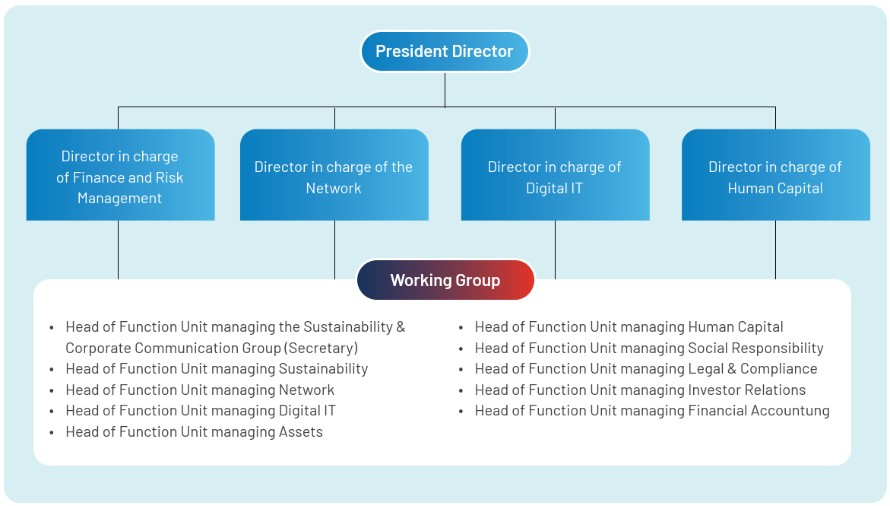
The Sustainability Committee is chaired by the President Director and comprises directors responsible for risk management, network and IT, and human capital. To support the integration of ESG into business processes, the Committee is supported by an ESG Working Group consisting of heads of relevant function unit, including Sustainability, Network & IT, Asset Management, Human Capital, Social Responsibility, Risk Management, Legal & Compliance, Investor Relations, and Financial Accounting.
Figure 10. Composition of Telkom Sustainability Committee Members

26
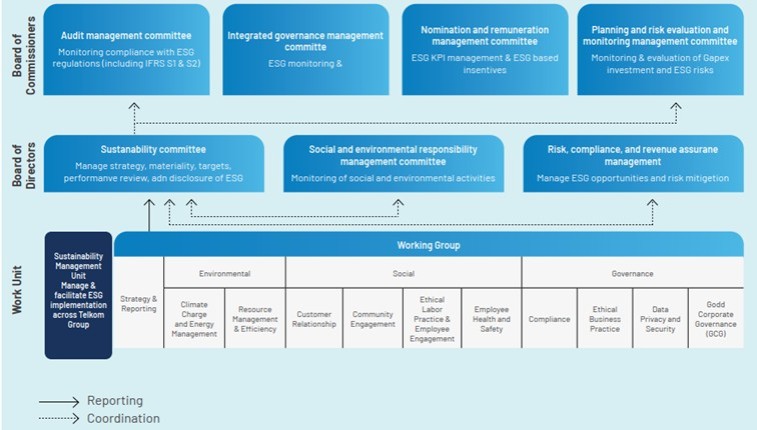
Responsibilities of the Sustainability Committee: 1. To oversee, set, and provide direction on ESG objectives, plans, strategies, roadmaps, policies, initiatives, and performance measures, including Climate Change 2. To ensure that the company has implemented a sustainability program in the ESG sector 3. To monitor the implementation of risk mitigation and opportunities arising from the company's operational activities to ESG 4. To supervise ESG performance achievements, including Climate Change, based on third-party assessments, ESG Rating Agencies, investor expectations, and/or other stakeholders; and 5. To ensure the publication of the Sustainability Report, including climate-related disclosures, in accordance with applicable regulations and aligned with the needs of shareholders and other stakeholders. |
To fulfill its duties, the Sustainability Committee collaborates with other committees under the Board of Commissioners and the Board of Directors, including the Social and Environmental Responsibility Committee (CSR); the Risk, Compliance and Revenue Assurance Committee; the Audit Committee; the Integrated Governance Committee; the Nomination and Remuneration Committee; and the Evaluation, Monitoring, Planning and Risk Committee. The Sustainability Committee regularly receives updates on ESG implementation from the sustainability Function Unit.
Figure 11. Sustainability Governance Structure at Telkom

Group Sustainability & Corporate Communication Function Unit
[GRI 2-13]
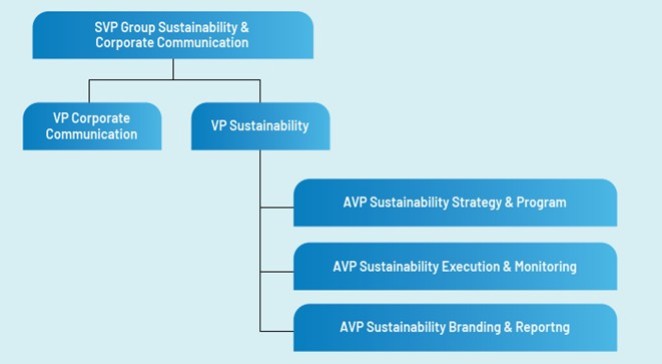
Telkom has its own function unit that is responsible for orchestrating and managing the implementation of ESG strategy and reporting in TelkomGroup, specifically the Sustainability & Corporate Communication Group Function Unit, which is under the CEO Office organization. This Function Unit is led by the SVP Group Sustainability & Corporate Communication, which has a leading role as the orchestrator of sustainability implementation governance that includes ESG and climate aspects, as stipulated in Company Regulation Number: PD.202.75/r.00/HK250/COP-A0200000/2025 regarding the CEO Office organization. To fulfill its duties, SVP Group Sustainability & Corporate Communication reports to the President Director through the Directors' Meeting (Radir) which is attended by all members of the Board of Directors, as well as directly through the CEO Update forum which is carried out as needed.
27
Figure 12. Organizational Structure of Sustainability Function Unit at Telkom

The roles and responsibilities of SVP Group Sustainability & Corporate Communication are outlined in Company Regulation Number: PR.202.72/r. 02/HK.250/COP-A0200000/2024 regarding the Organization of the Sub-Department of Group Sustainability & Corporate Communication. Key responsibilities include:
| ● | Ensuring the availability of policies, governance, and organizational management mechanisms of the Group Sustainability & Corporate Communication Department. |
| ● | Ensuring the availability of long-term and annual work plans, budgeting, and performance evaluations for Group Sustainability & Corporate Communication functions. |
| ● | Ensuring the availability of an appropriate ESG framework. |
| ● | Ensuring the availability of ESG goals, targets, and initiatives. |
| ● | Coordinating the implementation of initiatives and evaluations. |
| ● | Ensuring sustainability reporting and governance through an integrated dashboard within TelkomGroup. |
| ● | Establishing methods, parameters, and evaluative approaches on ESG activities and coordinating with subsidiaries/partners/agencies in the implementation of ESG programs. |
To fulfill its duties, the SVP Group Sustainability & Corporate Communication is assisted by the VP Sustainability, whose duties and responsibilities include:
| ● | Ensuring effective collaboration with relevant function unit to design an integrated dashboard for monitoring ESG initiatives. |
| ● | Ensuring the establishment of an appropriate ESG-related framework, including the joint operating model, with clear accountability assigned to each function unit across TelkomGroup. |
| ● | Ensuring the establishment of ESG objectives, targets, and initiatives across entities, including collaborating with CFU/FU/DFU and Subsidiaries. |
| ● | Ensuring the implementation of ESG program management across CFU/FU/DFU, including Subsidiaries. |
| ● | Ensuring the implementation of the monitoring, evaluation, and reporting process of ESG initiatives of the Board of Directors/Board of Commissioners and other stakeholders. |
| ● | Reporting ESG performance and sustainability reporting to stakeholders in accordance with regulatory requirements, domestic/foreign capital markets, and relevant reporting standards. |
| ● | Ensuring the implementation of the ESG program management and organizational accountability of the Group Sustainability & Corporate Communication Department. |
| ● | Ensuring the management of branding and communication, both internally and externally, for the implementation of ESG programs. |
| ● | Ensuring the availability of policies, governance structures, management mechanisms, and implementation activities to improve communication and corporate branding related to ESG. |
28
Telkom adopts a decentralized approach that enables all Subsidiaries to develop and implement sustainability initiatives independently while maintaining alignment with the strategic direction set by the Sustainability Function Unit TelkomGroup's transformation steps also support efforts to strengthen governance, orchestration, and synergy of sustainability initiatives in TelkomGroup.
ESG Policy
[GRI 2-23, 2-24]
Telkom has established Company Regulation Number PD.704.00/r.00/HK290/DSC-M0200000/2025 regarding TelkomGroup Sustainability Governance, which serves as an ESG umbrella policy covering the company’s material focus areas, including climate change. Subsidiaries may also adopt this policy as a reference in implementing ESG practices within their respective business operations.
The policy is designed to guide the implementation of ESG management frameworks and mechanisms across TelkomGroup and to ensure that ESG practices are carried out adequately and proportionately, in line with TelkomGroup’s development, Good Corporate Governance (GCG), and prudential principles. The policy also supports the achievement of the Sustainable Development Goals (SDGs). The general guidelines outlined in the ESG policy are integrated into the company’s strategies, operational policies, and management procedures across environmental, social, and governance aspects.
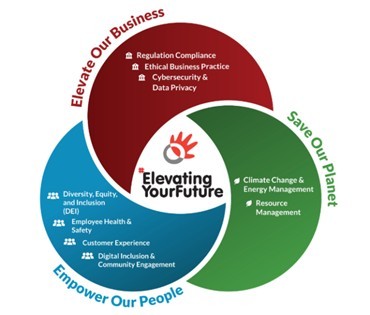
The implementation of TelkomGroup’s three sustainability pillars—Save Our Planet (environment), Empower Our People (social), and Elevate Our Business (governance)—is guided by several key principles, including integrity, outcome orientation, equity, risk and opportunity awareness, evidence-based decision-making, and continuous maturity improvement.
Through the implementation of ESG, Telkom aims to strengthen stakeholder engagement, systematically address stakeholder expectations and aspirations, and support informed decision-making to ensure the company’s long-term sustainability. Telkom’s approach to ESG management consists of the following steps:
| ● | Identification of ESG risks and opportunities |
| ● | Assessment and evaluation of ESG impact |
| ● | Establishment of ESG targets, strategies, and programs |
| ● | ESG reporting, disclosure, and communication |
Other ESG-related policies governing the management of material topics include:
1. Regulations related to the functions of the board of directors and the role of management on ESG and climate aspects 2. Risk Management System Policies and Frameworks 3. Respectful Workplace Policy 4. Disaster Management Policy 5. Corporate Security and Safety Management Regulations 6. Information Security Governance 7. Personal Data Protection Governance 8. Sustainable Procurement Policy |
A summary of Telkom's ESG policy is available on the ESG policy page.
Sustainability Competencies
[OJK E.2] [GRI 2-17]
The successful implementation of ESG strategies and the achievement of ESG targets within TelkomGroup require strong internal ESG capabilities, particularly in response to the increasingly dynamic ESG landscape and the need for cross-functional collaboration. To address this, Telkom continues to strengthen the capacity of the Board of Commissioners, the Board of Directors, and relevant function unit responsible for ESG through various training and capacity-building programs. These programs cover topics such as ESG implementation, sustainability risk management, climate change, and the latest disclosure standards, including IFRS S1 and S2, as well as PSPK 1 and 2.
29
The Telkom Corporate University Center (TCUC) is responsible for identifying competency needs and developing training programs for both management and employees. In 2025, management competency development focused on strengthening risk management capabilities, particularly in addressing emerging risks associated with the development of Artificial Intelligence (AI) and the rapid growth of the digital ecosystem. Throughout 2025, seven members of the Board of Directors obtained the Qualified Risk Governance Professional (QRGP) certification for the Board of Directors, while two members of the Board of Directors participated in training related to cybersecurity and AI. Complete information regarding the training program for the Board of Commissioners can be found in the 2025 Telkom Annual Report.
Telkom encourages employees to develop competencies in the field of sustainability through various training and certifications. In 2025, as many as three Telkom employees obtained the Certified Sustainability Reporting Specialist (CSRS) certification, one employee obtained the Fundamental Sustainability Accounting (FSA) Level 1 certification, two employees obtained the Sustainability Excellence certification, and two employees obtained the Certified Sustainable Development Specialist (CSDS) certification. Meanwhile, the commitment and strategy for employee competency development are further explained in the Empower Our People section.
Figure 13. Sustainability Competency Improvement in 2025
Sustainability Competency Enhancement | |
Decarbonization & Roadmap Training The training was held on February 19-21, 2025, in collaboration with PT ESQ, with the participation of all Telkom employees and Subsidiaries (TelkomGroup). | Sustainability Reporting Standard Training The training was conducted on May 21-22, 2025 in collaboration with the Indonesian Accountants Association, with participants including Sustainability Function Unit. |
Awareness of ISO 14001:2015 (SML) and ISO 45001:2018 (OHS) The training was held on May 23 and 26, 2025, in collaboration with PT British Standard Institution (BSI), with Telkom and TelkomGroup employees. | ISO 14001:2015 (SML) and ISO 45001:2018 (OHS) Internal Auditor Training The training was held on June 2-3, 2025, in collaboration with PT British Standard Institution (BSI), with Telkom and TelkomGroup employees. |
ISO 14001:2015 Awareness Webinar The seminar was held on July 21, 2025, in collaboration with PT Sucofindo Prima Internasional Konsultan as a resource person. Participants include the Sustainability, Corporate Communication, and Risk Function Units at Telkom | Good Corporate Governance Training The training was conducted on 16–17 December 2025 in collaboration with BINUS Center and was attended by the Sustainability Function Unit. |
Culture of Sustainability
[OJK F.1] [GRI 2-24]
TelkomGroup fosters a sustainability-oriented culture through various initiatives, including the dissemination of the GoZero% bulletin, outreach through internal channels (such as the internal portal, diarium, and others) and external channels (including the website and social media), as well as regional roadshows to promote the GoZero% strategy and programs. These efforts aim to enhance employees’ understanding and engagement in consistently applying sustainability principles across operational activities and decision-making processes.
30
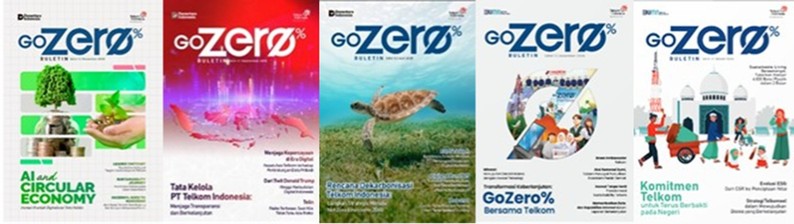
GoZero% Bulletin As part of efforts to cultivate a culture of sustainability and strengthen the spirit of GoZero% among all TelkomGroup employees, the Function Unit related to Sustainability publishes the GoZero% Bulletin on a quarterly basis. The bulletin is published through Telkom’s Sustainability website and is accessible to both internal and external stakeholders. The GoZero% Bulletin communicates the plans and progress of the GoZero% initiative, while also providing updates on ESG initiatives, educational content, and sustainability-related programs implemented by Telkom and its subsidiaries. To date, five editions of the GoZero% Bulletin have been published. The President Director plays an active role in fostering TelkomGroup’s sustainability culture, including overseeing the publication of the GoZero% Bulletin. Figure 14. GoZero% Bulletin Edition Year 2025
|
GoZero% Roadshow Figure 15 GoZero% Roadshow Program Performance
Employee engagement across TelkomGroup is essential to ensuring that sustainability principles become embedded within the company’s culture. Throughout 2025, Telkom conducted GoZero% roadshows across various operational regions. This program is manifested through several substantial events, such as education on ESG pillars at Telkom, waste recycling, clean-up activities, innovation festivals, and tree planting. This activity is also in collaboration with Micro and Small Enterprises (MSEs) and the government around Telkom's operational area. Details of the GoZero% roadshow activities can be found in Telkom's ESG newsletter. |
[OJK E.4] [GRI 2-29]
Telkom stakeholders also shape TelkomGroup's sustainability and business strategy. Telkom continues to build active communication with internal and external stakeholders, fosters mutually beneficial relationships, and considers their perspectives and expectations through various channels.
31
Table 5. Stakeholder Engagement
Stakeholders | Engagement Methods | Key Topics and Concerns |
|---|---|---|
Shareholders and Investors | ● Annual General Meeting of Shareholders (GMS), Extraordinary GMS, and quarterly performance explanation ● Investor conferences and/or Non-Deal Roadshows | ● Achievement of operational and financial KPIs ● Business development ● TelkomGroup's ESG strategy and targets ● Climate change risks and the Climate Transition Plan ● Alignment of risk identification with the CSR strategy ● Impact of the Sumatra flood incident ● Occupational safety and employee well-being ● Strengthening collaboration and employee engagement ● Talent development ● Digital inclusiveness and community development ● Compliance and business ethics |
Employees | ● Regular meetings with management ● Telkom Employees Union (Sekar) ● Training ● Employee complaint center | ● Career path ● Clarity of rights and obligations ● Remuneration and other benefits ● Increased competence |
Customers | ● Customer satisfaction survey ● Customer complaint center | ● Network connection and coverage ● Excellent service ● Ease of complaint resolution ● Data security and confidentiality |
Government | ● Bipartite meetings ● Hearing Meeting with the House of Representatives (DPR) and working visit | ● Legal compliance and reporting ● Business ethics practices ● Cybersecurity |
Partners | ● Meetings during the procurement process, supervision of the implementation of work, supplier forums/gatherings, supplier satisfaction surveys, and SMAP feasibility tests for suppliers | ● Fair and transparent procurement process ● Objective selection and evaluation process ● Implementation of work that meets occupational health and safety standards ● Legal compliance and business ethics |
Society | ● Deliberation in the planning of community empowerment activities, the implementation of activities, and supervision of the realization of the program | ● Harmonious relationship ● Positive contribution to economic and social life ● Participation in other programs, including environmental conservation activities |
Media | ● Press release ● Media gathering ● Press conference, as well as press briefing | ● Accuracy of news objects ● Latest information ● Transparency of operational, financial, and non-financial conditions |
[GRI 2-14, 3-1, 3-2]
In 2025, the Sustainability Function Unit conducted a review of the material topics used in the 2024 reporting period and concluded that these topics remain relevant. The results of the review were conveyed to the Board of Directors through a tiered formal coordination forum mechanism, namely in the Operational Meeting at the Department level or the Directorate Meeting at the Directorate level, and then escalated to the Board of Directors Meeting.
32
Previously, in 2024, the company updated the determination of its material topics in collaboration with independent consultants by referring to the 2021 GRI Standards and applying the principle of double materiality. Through this approach, the company assesses both the actual and potential impacts of its activities on the environment and society, while also evaluating how sustainability-related issues may affect the company’s performance and financial position. In the materiality determination process, the company considers perspectives from internal management as well as input from external stakeholders to ensure that the identified material topics accurately reflect key sustainability priorities and stakeholder expectations.
Table 6. Materiality Assessment Process
Materiality assessment steps according to GRI | Practice at Telkom |
|---|---|
1. Understanding the context of the organization | Conducting a review to gain a comprehensive understanding of the ESG context in TelkomGroup related to the following components: ● The value chain, activities, and business strategies of Telkom and its subsidiaries. ● Relevant sustainability standards, namely disclosure standards (GRI, SASB, UN SDGs, IFRS S1 and S2, and PSPK 1 and 2) and ESG assessment criteria (MSCI, Sustainalytics, S&P, CDP). ● Stakeholders feedback, incorporating ESG assessment results from the Financial and Development Supervisory Agency (BPKP), rating agencies, and input from investors. ● ESG trends and practices in the telecommunications industry. |
2. Impact identification | Mapping ESG issues relevant to TelkomGroup’s operations based on literature review and input from Telkom’s internal divisions, conducted through Focus Group Discussions (FGDs). |
3. Impact significance assessment | Engaging stakeholders to understand TelkomGroup's operational impact and its significance, based on severity and likelihood of occurrence. ● Workshops with a function unit in TelkomGroup that is responsible for management ESG 2025 material topics. This process is facilitated by independent consultants. ● Interviews with external stakeholders, such as regulators, investors, and rating agencies. This process is facilitated by the Investor Relations Function Unit and the Telkom Sustainability Function Unit. |
4. Prioritization of impacts for reporting | Impacts are prioritized using internal criteria based on the results of the organizational context review and stakeholder engagement process, led by Telkom Sustainability. The prioritized findings are subsequently submitted to the President Director/Board of Directors for approval. Priority categories: ● Priority issues are issues with the most significant impact on the company's performance and/or the interests of current and short-term stakeholders, so they require immediate attention and strategic management. ● Ongoing importance is an issue that remains relevant to the company's operations and stakeholders, with a relatively stable impact, and is important to maintain long-term resilience and compliance with applicable regulations, thus requiring continuous management and monitoring. ● Monitor & Manage is an issue with a relatively low impact rate in the short term, but still needs to be monitored and managed to anticipate potential increased impacts in the future. |
33
Figure 16. Materiality Matrix

34
Table 7. List of Material Topics
Pillar | Material Topics | Impact on stakeholders | Impact on Telkom | Relevant GRI standards | Relevant SASB | Alignment with SDGs* |
|---|---|---|---|---|---|---|
Save Our Planet | Climate Change and Energy Management | The company's operational activities, particularly the operation of networks and data centers, require high energy, thus contributing to a carbon footprint that can contribute to climate change. | Exposure to price volatility, tightening climate regulations, and damage to physical assets due to climate change can impact operational resilience. | GRI 102-1 GRI 102-2 GRI 102-3 GRI 102-4 GRI 102-5 GRI 102-6 GRI 102-7 GRI 102-8 GRI 302-1 GRI 302-3 GRI 302-4 GRI 305-1 GRI 305-2 GRI 305-3 GRI 305-4 GRI 305-5 | TC-SI-130a.1 TC-TL-130a.1 TC-IM-130a.1 TC- SI-130a.3 TC-IM-130a.3 | SDG 7.2.1.(a) SDG 7.3.1 SDG 13.2.2.(a) |
Resource Management | Inadequate waste management, including e-waste, can cause environmental pollution and public health risks due to the content of hazardous materials, and therefore requires to be managed responsibly. | Tightening regulations on waste management, including e-waste, has the potential to increase compliance costs. However, the application of the principle of circularity can drive cost efficiency and open opportunities for economic incentives. | GRI 306-3 | TC-TL-440a.1 | SDG 11.6.1.(b) SDG 12.4.2 SDG 12.5.1. (a) | |
Empower Our People | Diversity, Equity, and Inclusion | Diversity of talent increases equal opportunities and strengthens inclusion in the workplace, thereby encouraging broader and equitable economic participation and increasing the representation of minority groups, particularly in the technology sector. | Diverse talent can strengthen a company's capabilities to achieve corporate targets and drive long-term value creation. | GRI 401-1 GRI 401-2 GRI 401-3 GRI 404-1 GRI 404-2 GRI 404-3 GRI 405-1 GRI 405-2 GRI 406-1 | TC-SI-330a.1 TC-SI-330a.3 TC-IM-330a.1 TC-IM-330a.3 | SDG 5.5.2 SDG 16.10.1.(c) |
Employee Health and Safety | A safe and healthy work environment plays an important role in protecting employees’ basic rights, preventing occupational injuries and diseases, and supporting workforce welfare. | A safe and conducive work environment, supported by the effective management of employee health, safety, security, and well-being, is a key factor in supporting productivity and operational continuity. | GRI 403-1 GRI 403-2 GRI 403-3 GRI 403-4 | TC-SI-330a.2 TC-IM-330a.2 | SDG 8.8.1.(a) |
35
Pillar | Material Topics | Impact on stakeholders | Impact on Telkom | Relevant GRI standards | Relevant SASB | Alignment with SDGs* |
|---|---|---|---|---|---|---|
GRI 403-5 GRI 403-6 GRI 403-7 GRI 403-8 GRI 403-9 GRI 403-10 | ||||||
Customer Experience | The provision of products and services that are reliable, relevant, and responsive to customer needs in the digital era contributes to improving customer experience, ease of access to information and services, and community productivity. | The development of customer needs and expectations in the digital era opens opportunities for the development of innovative products and services. | GRI 416-1 GRI 416-2 | TC-SI-550a.1 TC-TL-550a.1 | SDG 17.6.1. (a) SDG 17.8.1 | |
Digital Inclusivity and Community Engagement | Expanding access to affordable and inclusive connectivity, especially for people in remote areas and vulnerable groups, contributes to equitable distribution of economic opportunities, increased digital literacy, and empowerment of communities to actively participate in digital-based economies and social lives. | Inclusive connectivity expansion opens opportunities for market expansion and new customer growth, strengthens the company's competitive position, and supports the fulfillment of regulatory obligations related to equal access. | GRI 413-1 | - | SDG 4.4.1. (a) SDG 8.3.1. (a) SDG 9.c.1 | |
Elevate Our Business | Regulatory Compliance | Regulatory compliance reflects the company's commitment to protecting the public interest, maintaining environmental and social standards, and minimizing negative impacts on society and stakeholders. | Compliance with regulations is important for maintaining business continuity; Non-compliance may result in financial sanctions, restrictions on business activities, and reputational risks, which can adversely affect the company’s performance and value. | GRI 206-1 GRI 417-1 GRI 417-2 GRI 417-3 | TC-SI-520a.1 TC-TL-520a.1 TC-TL-520a.2 TC-IM-520a.1 | SDG 16.5.2 SDG 16.10.2.(b) |
Ethical Business Practices | Unethical business practices, including corruption and bribery, may undermine public trust, distort fair business competition, and result in social and economic impacts that are detrimental to society. | Violations of business ethics can result in legal sanctions, significant fines, and reputational damage that have a direct impact on the company's performance and value. | GRI 205-1 GRI 205-2 GRI 205-3 | - | SDG 16.5.2 SDG 16.10.1.(b) | |
Cybersecurity and Data Protection | Failure to maintain cybersecurity and data protection can result in privacy violations, misuse of personal information, and disruption of communication services that have an impact on individuals, business actors, and social stability. | Cybersecurity and data protection are crucial factors for the sustainability of the telecommunications industry; Cyber incidents can disrupt operations, trigger personal data breaches, cause regulatory sanctions, and lower customer trust, which has a direct impact on | GRI 418-1 | TC-SI-220a.1 TC-SI-220a.2 TC-SI- | SDG 16.10.2.(b) |
36
Pillar | Material Topics | Impact on stakeholders | Impact on Telkom | Relevant GRI standards | Relevant SASB | Alignment with SDGs* |
|---|---|---|---|---|---|---|
the company's revenue and value. | 220a.3 TC-SI-220a.4 TC-SI-230a.1 TC-SI-230a.2 TC-TL-220a.1 TC-TL-220a.2 TC-TL-220a.3 TC-TL-220a.4 TC-TL-230a.1 TC-TL-230a.2 TC-IM-220a.1 TC-IM-220a.2 TC-IM-220a.3 TC-IM-220a.4 TC-IM-220a.6 TC-IM-230a.1 TC-IM-230a.2 |
* The mapping refers to the SDG indicators monitored by the National Development Planning Agency (Bappenas), considering the scope of Telkom’s material topics, sustainability initiatives, and targets.
37
Managing Sustainability Risks and Opportunities
[OJK E.3] [OJK E.5]
Risk management at Telkom refers to ISO 31000:2018 Risk Management - Principles and Guidelines. This framework guides the process of identifying and managing sustainability risks at Telkom, which has been initiated since 2023. In 2025, Telkom conducted a review of sustainability risks and opportunities covering subsidiaries’ business sectors considered strategic. This update is carried out considering the existing risk profile as well as the Sustainability Accounting Standards Board (SASB) standards to identify relevant sustainability risks and opportunities according to the Subsidiary's industry characteristics, as well as aligning with the ISSB concept at the group level.
Figure 17. TelkomGroup's Sustainability Risk and Opportunity Review Process

This review was led by Telkom’s Sustainability Function Unit in coordination with the Risk Function Unit This review generates a list of sustainability-related risks and opportunities with potential financial impacts on TelkomGroup's, along with an estimated impact period. This list of sustainability risks and opportunities will be reviewed periodically to ensure its suitability with TelkomGroup's business development and transformation. To ensure effective risk management, Telkom's Board of Commissioners and Board of Directors conduct periodic management reviews and reviews of the implementation of risk management, including sustainable finance aspects, to support the achievement of the company's goals and sustainability.
The risks and opportunities that have been identified reflect both challenges and prospects for TelkomGroup in carrying out sustainable operations. Accordingly, TelkomGroup has undertaken various steps to manage the risks and opportunities reflected in the programs and initiatives on each Telkom material topic, which are detailed in the relevant section of this report. Furthermore, Telkom has implemented strategic risk mitigation measures as part of its Enterprise Risk Management (ERM) framework, further discussed in Telkom’s 2025 Annual Report. Telkom’s ERM system has been developed and is accessible via ermonline.telkom.co.id.
Table 8. Telkom's Sustainability Risks and Opportunities
Climate Change and Energy Management* | |
[R] Asset damage and service disruption caused by increasing extreme weather, such as heavy rainfall and temperature rise due to climate change | |
Period | Short to long term |
Mitigation/Management actions | Telkom's steps in management risks due to extreme weather—as presented in the Save Our Planet section, especially the Operational Resilience to Climate Change subsection, which includes mapping production equipment and assets in vulnerable areas, relocation to safer areas, development and modernization of disaster-resistant devices, provision of backup networks in at-risk areas, and strengthening protection through asset insurance. |
[R] Increased energy price volatility and climate-related regulatory changes, along with the energy-intensive nature of telecommunications businesses, have the potential to increase operating costs | |
Period | Medium to long term |
Mitigation/Management actions | Telkom's steps to mitigate the risk of increased operational costs due to energy price volatility and changes in climate regulations are presented in the Save Our Planet section, especially the Low Carbon Transition, which includes strengthening energy management practices and preparing a climate transition plan to reduce |
38
TelkomGroup's GHG emissions. | |
[O] The use of renewable energy and energy-saving technologies has the potential to reduce emissions and optimize operational costs | |
Period | Medium to long term |
Mitigation/Management actions | Telkom's steps in optimizing renewable energy opportunities are presented in the Save Our Planet section, especially the Low Carbon Transition sub-section, which details energy-saving initiatives and device modernization. |
Resource Management | |
[R] Increasingly stringent waste management regulations (e.g., e-waste) due to increased stakeholder expectations may have an impact on stricter supervision and sanctions | |
Period | Short to long term |
Mitigation/ Management actions | Telkom's steps in waste management are presented in the Save Our Planet section, especially waste management, which includes the implementation of waste monitoring and auditing. |
![]() [O] Optimizing e-waste management through expanding recovery practices and reusing assets at the end of their useful life has the potential to generate financial incentives and lower operational costs through reduced procurement costs and increased asset residual value | |
Period | Long-term |
Mitigation/ Management actions | Telkom's steps in e-waste management are presented in the Save Our Planet section, especially waste management, which includes the implementation of the 3R program on SIM cards and other e-waste. |
[R] Reliance on water supply for data centers increases the risk of operational disruption and cost volatility, impacting service reliability | |
Period | Long-term |
Mitigation/ Management actions | Telkom's approach to management water supply is presented in the Save Our Planet section, especially in the Climate Change Transition Roadmap subsection. These efforts include the implementation of research, development, and partnerships for green data centers. |
[O] The application of more efficient water technology and management can optimize the use of resources, reduce operational costs, and increase operational resilience | |
Period | Long-term |
Mitigation/ Management actions | Telkom's water management initiatives are presented in the Save Our Planet section, especially the subdivision of the Climate Change Transition Roadmap and Water management, which includes the development of green data centers and green buildings, including the use of Sewage Treatment Plants to support recycling and water use efficiency. |
Diversity, Equity, and Inclusion | |
[R] Failure to meet the needs of talent diversity according to business needs due to a competitive labor market can have an impact on meeting company targets | |
Period | Medium to long term |
Mitigation/ Management actions | Telkom's strategies in management the risk of talent diversity are presented in the Empower Our People section, especially diversity, equity, and inclusion, which includes the recruitment of groups with disabilities and the creation of an inclusive environment to retain female talent. |
[O] Proactively recruiting and developing diverse talent can strengthen Telkom's capabilities and drive long-term value creation | |
Period | Medium to long term |
Mitigation/ Management actions | Telkom's approach to management talent recruitment and development opportunities is presented in the Empower Our People section, especially diversity, equity, and inclusion. |
Employee Health and Safety | |
[R] Inability to ensure the health, safety, security, and well-being of employees | |
Period | Short to long term |
Mitigation/ Management actions | Telkom's approach to managing employee health, safety, and welfare risks is presented in the Empower Our People section, especially employee health and safety, which includes the implementation of the employee occupational safety and health management system (SMK3) and the implementation of various initiatives to support employee welfare in accordance with the Telkom Well-Being Wheel. |
Customer Experience | |
[R] Inability to meet customer needs and expectations related to products and services | |
Period | Medium to long term |
39
Mitigation/ Management actions | Telkom's strategies in managing the risk of meeting customer expectations are presented in the Empower Our People section, especially customer experience, which includes providing various customer complaint channels to inclusive services for people with disabilities. |
[O] Innovative product and service development opportunities as customer needs evolve in the digital era | |
Period | Medium to long term |
Mitigation/ Management actions | Telkom's steps in optimizing product development opportunities are presented in the Empower Our People section, especially customer experience, which includes product development innovations by utilizing AI technology responsibly. |
Digital Inclusivity and Community Engagement | |
[O] Improved brand image and company reputation due to the performance of social responsibility programs | |
Period | Short to long term |
Mitigation/ Management actions | Telkom's steps in optimizing reputation opportunities from the performance of the CSR program are presented in the Empower Our People section, especially community involvement, which includes the provision of a communication network that reaches all of Indonesia, as well as various community engagement programs that utilize Telkom's digital capabilities. |
Regulatory Compliance | |
[R] Changes in regulations and reporting requirements that are increasingly stringent due to increased stakeholder expectations related to sustainability may have an impact on increasing operational costs | |
Period | Short to long term |
Mitigation/ Management actions | Telkom's strategy in managing the risk of regulatory changes is presented in the Elevate Our Business section, especially regulatory compliance, which includes implementing a systematic approach in identifying new regulatory provisions as well as conducting legal reviews on corporate actions and partnerships with third parties. |
[O] Increased credibility and reputation of the company driven by compliance performance | |
Period | Short to long term |
Mitigation actions | Telkom's steps in optimizing reputational opportunities from compliance are presented in the Elevate Our Business section, especially regulatory compliance, which includes increasing the capacity of internal teams to be able to carry out their functions optimally. |
Ethical Business Practices | |
[R] Corruption and conflicts of interest, especially in relation to cooperation with third parties | |
Period | Short to long term |
Mitigation/ Management actions | Telkom's approach in managing corruption risks and conflicts of interest is presented in the Elevate Our Business section, especially ethical business practices, which include the implementation of SNI ISO 37001:2016 Anti-Corruption Management System (SMAP), socialization and routine training as an internalization effort to build an anti-corruption culture. |
Cybersecurity and Data Protection | |
[R] Cyber incidents that may disrupt business operations and/or impact personal data leakage and decreased customer trust [SASB TC-SI-550a.2] | |
Period | Short to long term |
Mitigation/ Management actions | Telkom's strategies in managing cyber incident risk are presented in the Elevate Our Business section, especially cybersecurity and data protection, which includes establishing policies on personal data protection and information governance to increase employee awareness. |
[O] Business opportunities to provide secure digital services amid cybersecurity threats can enhance Telkom's position as the top choice for customers | |
Period | Medium to long term |
Mitigation/ Management actions | Telkom's steps in optimizing business opportunities for secure digital services are presented in the Elevate Our Business section, especially cybersecurity and data protection, which includes investments in information technology (IT) infrastructure that can ensure customer service security. |
* | Climate-related risks and opportunities have been comprehensively identified using the recommendations of the TCFD framework and IFRS S2, and are presented in the Save Our Planet section |
** | [R] risk, [O] opportunity |
*** | Short-term is defined as the next 5 years, medium term = 5 to 15 years, and long term = 15+ years |
| • | New and changing risks or opportunities |
40
[OJK A.1, E-5] [GRI 2-22]
Telkom ensures that the direction of the company's business strategy is in line with the principles of sustainability to support long-term value creation through the provision of innovative solutions and services that have a positive impact on society and the environment. Telkom carries the GoZero% tagline as a representation of the company's commitment to responsible business growth according to ESG principles, with a sustainability target of 2030 to provide a measurable long-term impact for various stakeholders. In line with this commitment, in 2025 we conducted a review and refinement of TelkomGroup's 2030 sustainability targets, resulting in an adjustment of metrics from office waste diversion to total waste reduction. We view this change as a reflection of strengthened, preventive environmental management, aligned with global best practices and growing stakeholder expectations on waste prevention.
Figure 18. TelkomGroup's Sustainability Strategy

GoZero% Sustainability Action by Telkom Indonesia Telkom Indonesia leads innovation to shape a sustainable future. Our solutions and services are designed to create positive social and environmental impacts, while ensuring long-term value creation and strengthening relationships with stakeholders. | ||
TelkomGroup Sustainability Targets 2030 Figure 19. TelkomGroup Sustainability Targets 2030 | ||
Save Our Planet | Empower Our People | Elevate Our Business |
Climate change and energy management: ● 20% reduction in TelkomGroup's GHG emissions in scope 1 and 2 compared to the 2023 base year | Diversity, equity, and inclusion: ● 32% female employees ● 27% female representation at the managerial level ● 1.5% employees with disabilities ● 25% Digital Talent | Regulatory compliance: ● 100% compliance rate with applicable regulations without any major cases proven every year |
Resource management: ● Minimum 70% of fiber optic cable waste is diverted from final disposal ● Minimum 70% total waste generation reduction | Employee health and safety: ● Zero fatalities due to workplace accidents annually ● Employee Engagement Index Score of 80 | Business Ethical practices: ● 100% of employees sign an integrity pact ● 100% of Telkom and 13 directly owned subsidiaries are certified SNI ISO 37001:2016 Anti-Bribery Management System ● 100% of eligible whistleblowing system (WBS) reports are followed up annually ● 100% of reported human rights violations are addressed annually |
| Customer experience: ● Achieve an NPS score in the | Cybersecurity and data protection: ● Zero critical data breach incidents |
41
Excellence category with a score above 62 points | annually ● 100% employee graduation rate in cybersecurity awareness training | |
| Digital inclusivity and community engagement: | |
TelkomGroup's Sustainability Synergy
TelkomGroup’s diverse business portfolio may result in varying impacts and perspectives in determining sustainability priorities and strategies. To address this, TelkomGroup adopts a decentralized approach to sustainability management, where each subsidiary is entrusted with the mandate and accountability to integrate sustainability principles into its respective business and operational strategies, supported by an appropriate governance framework at the entity level. At the same time, Telkom ensures a consistent direction for the Group’s sustainability strategy through the establishment of ESG KPIs that serve as guidance for all entities in formulating and implementing sustainability initiatives that support the GoZero ambition. To ensure consistency in implementation and strengthen collaboration across the Group, TelkomGroup also organizes a sustainability coordination forum held on quarterly basis. This forum facilitates subsidiaries to discuss recent developments, priority alignment, and and sustainability initiatives best practices.
Figure 20. Telkomsel's ESG Framework

42
Figure 21. Telin's ESG Framework

Figure 22. Mitratel ESG Framework

43
Support for the Sustainable Development Goals
[GRI 2-22]
Telkom has identified seven Sustainable Development Goals (SDGs) as top priorities, where TelkomGroup can generate the most significant environmental and social impact. These priority SDGs are in line with our material topics and commitments. These priority SDGs align with Telkom’s material topics and commitments. Telkom actively collaborates with stakeholders to implement sustainability initiatives that contribute to achieving all 17 SDGs. In addition, through its Social and Environmental Responsibility (CSR) program, Telkom consistently expands its contributions toward achieving the SDGs in Indonesia. Detailed information on the implementation of Telkom’s CSR program can be found in the Save Our Planet section for environmental programs, Empower Our People for social initiatives, and Telkom’s 2025 Annual Report.
44
Table 9. TelkomGroup's Support for Priority SDGs
SDG | Description | TelkomGroup's Commitment | Initiative* |
|---|---|---|---|
SDG 4 | Ensure Inclusive and Equitable Equality Education and Promote Lifelong Learning Opportunities for All | TelkomGroup acts as a driver of equity and improvement of the quality of digitalization in the education sector, and actively contributes to developing outstanding digital talent | ● Talent development programs, People Development Plan, and the provision of scholarships to encourage Long-term learning Employees (p.86) ● Improving access and quality of education in an integrated manner through programs to provide access to learning applications, internet, and computers to schools and digital training targeting students, teachers, groups of persons with disabilities, and in the context of women's empowerment (pp. 117-120) |
SDG 5 | Achieve Gender Equality and Empower All Women and Girls | TelkomGroup strives to promote gender equality in the workplace | ● Setting a target percentage of female employee representation at the managerial level in TelkomGroup (p. 84) ● Creating an inclusive work environment (provision of Employee Resource Group (Srikandi Telkom) and implementation of Respectful Workplace) (p. 98) |
SDG 8 | Promote Sustained, Inclusive and Sustainable Economic Growth, Full and Productive Employment and Decent Work for All | TelkomGroup creates an equitable digital ecosystem to support various economic activities in every segment and level of society | ● The MSE Development Program is carried out by providing access to financing and assistance to improve the digital capabilities and capacity of business actors. This initiative includes the Go Modern, Go Digital, Go Online, and Go Global programs to encourage MSEs to become more resilient and independent (pp. 121-123) |
SDG 9 | Build Resilient Infrastructure, Promote Inclusive and Sustainable Industrialization and Foster Innovation | TelkomGroup accelerates the development of reliable and equitable telecommunication infrastructure, as well as providing the best service for customers | ● Accelerating network equity in disadvantaged, remote, and leading (3T) areas (p. 113) ● Collaborating with students from universities in Indonesia to run programs in sociodigipreneurship, which plays a role in facilitating the innovation of technology-based solutions to social and economic challenges that exist in society (p.121) |
SDG 12 | Ensuring Sustainable Production and Consumption Patterns | TelkomGroup continues to innovate to realize sustainable resource and waste management and in line with circular economy principles | ● Set targets to reduce the amount of e-waste disposed of directly into landfill (p. 71) ● Using eco-friendly materials in product packaging development (pp. 72) |
SDG 13 | Take Urgent Action to Combat Climate Change and Its Impacts | TelkomGroup is committed to reducing carbon footprint from business operations and value chain in line with the Indonesian government's net zero emission target | ● Develop a climate transition roadmap as the basis for collective decarbonization plans at the group level (pp. 58-59) ● Implementing IoT and the Energy Efficiency Care Movement (GePEE) program as energy saving and modernization initiatives (pp. 59-61) |
SDG 16 | Promote Peaceful and Inclusive Societies for Sustainable Development, Provide Access to Justice for All and Build Effective, Accountable and Inclusive Institutions at All Levels | TelkomGroup always implements good corporate governance and upholds the principles of transparency and accountability as the foundation of responsible business practices | ● Implementing an anti-corruption management system (SMAP), as well as socialization and training to all Directors and employees (pp. 146-147) ● Provide access and channels for all stakeholders to submit complaints through Telkom Integrity Line (pp. 147-149) |
*This initiative is non-exhaustive and is only intended to provide examples of initiatives carried out by TelkomGroup.
45
TelkomGroup takes an active role in realizing a greener ecosystem through the implementation of sustainable business practices and responsible operational impact management. Focusing on climate, energy, and waste risk management is the cornerstone of maintaining business sustainability during changing environmental dynamics. Other aspects of environmental management, such as water management and biodiversity, are always managed in accordance with applicable regulations and standards.
Figure 23. Telkom Environmetal Aspect Management Framework


Climate Change and Energy Management
The telecommunications industry is facing growing challenges related to climate change. The sector’s reliance on energy-intensive infrastructure—such as network equipment and data centers—combined with increasing regulatory requirements and global standards for reducing GHG emissions, has heightened the urgency to transition toward low-carbon operations. At the same time, climate-related events also affect product resilience and service continuity, as demonstrated by the flooding incident in Sumatra. Therefore, strengthening operational resilience and integrating climate risk considerations into business strategies are essential to ensuring TelkomGroup’s long-term business sustainability.
46
[GRI 3-3]
Climate Governance
Telkom’s climate governance structure is integrated into TelkomGroup’s Sustainability Governance framework, as stipulated in Company Regulation Number PD.704.00/r.00/HK290/DSC-M0200000/2025. The Sustainability Committee is responsible for overseeing and providing directions on climate-related goals, transition and adaptation plans, strategies, initiatives, targets, policies, performance monitoring, and reporting across TelkomGroup. In carrying out its roles and responsibilities, the Sustainability Committee coordinates with other committees under the Board of Commissioners and the Board of Directors, including the Corporate Social and Environmental Responsibility (TJSL) Committee, the Risk, Compliance, and Revenue Assurance Management Committee, the Audit Management Committee, and the Nomination and Remuneration Committee. The Climate Change & Energy Management Working Group supports the Sustainability Committee in implementing climate mitigation and adaptation initiatives across TelkomGroup.
Telkom has a Sustainability Function Unit that is responsible for developing climate management strategies and monitoring the performance of achieving TelkomGroup's climate targets through GHG emission metrics that are monitored periodically in accordance with company policies. To support effective sustainability management, Telkom also makes efforts to recruit and strengthen teams with adequate capabilities in management climate issues, as summarized in the performance table 16.
Climate Change Policy and Energy Management
Climate change and energy management policies are regulated in the sustainability governance policy established through the Board of Directors Regulation. These provisions are incorporated into the Standard Operating Procedures (SOPs), which regulate technical guidelines for the calculation and reporting of GHG emissions in TelkomGroup in accordance with international standards, such as ISO 14064-1 and GHG Protocol Corporate Accounting & Reporting Standard. In 2025, Telkom will evaluate and update the emission calculation POS by expanding the scope of the GHG emission inventory within the TelkomGroup.
Climate Change Management Framework
Climate change management at TelkomGroup is guided by four integrated actions—identify, assess, respond, and monitor—which form the basis for integrating climate considerations into the company’s business strategy.
Figure 24. Telkom Climate Change Management Framework

47
TelkomGroup's GHG Emissions Performance
[GRI 102-4, 102-5, 102-6, 102-7, 305-1, 305-2, 305-3]
The total GHG emissions of TelkomGroup (Market-based) in 2025 are 4,153,661.3 tCO2e, consisting of 1% Scope 1 emissions, 52% Scope 2 emissions, and 47% Scope 3 emissions. There is an increase in emissions compared to the previous reporting year, particularly in Scope 3 emissions, due to the addition of calculation scopes covering categories 4, 7, 9, and 12. This step represents TelkomGroup's continuous improvement effort to strengthen GHG emissions management. The calculation methods, including limitations and assumptions, are presented in Appendix 7. Consistent with 2024, the 2025 GHG emissions are also validated by an independent party with the opinion presented in Appendix 11.
TelkomGroup Emission Profile in 2025* | |
Figure 25. TelkomGroup GHG Emissions Scope 1, 2 (Market-based), and 3
| Figure 26. TelkomGroup GHG emissions disaggregation by category
|
48
Figure 27. Disaggregation of TelkomGroup Scope 3 GHG emissions by category
|
Table 10. Summary of Greenhouse Gas Emissions Performance of TelkomGroup for Reporting Year 2025
Scope | Description | Reporting year 2025 (tonCO2e) | Reporting year 2024 (tonCO2e) | Reason for emission changes since the 2024 reporting year | % Change in emissions since the 2024 reporting year |
|---|---|---|---|---|---|
Scope 1 | Stationary Combustion | 12,288.4 | 27,381.5 | The expansion of the use of B40 Biodiesel as a power generator fuel source compared to the conservative approach (using B0) applied in 2024, along with efforts to reduce generator operational durations within the TelkomGroup environment, including Telkom, Telkomsel, Sigma, Mitratel, Telin, Telkomsat, Telkom Infra, and GSD. | ↓ 55% |
Mobile Combustion | 21,874.1 | 27,182.0 | Improvement of the methodology for collecting vehicle fuel consumption data, which identifies that vehicles within Telkom, Sigma, and Mitratel use Pertamax gasoline, which has a relatively lower emission factor compared to Pertalite. | ↓ 20% | |
Fugitive emission | 11,905.7 | 27,521.9 | Refinement of the methodology for collecting fugitive emission data from wastewater treatment and AC, | ↓ 57% |
49
Scope | Description | Reporting year 2025 (tonCO2e) | Reporting year 2024 (tonCO2e) | Reason for emission changes since the 2024 reporting year | % Change in emissions since the 2024 reporting year |
|---|---|---|---|---|---|
including the identification of septic tanks as an additional wastewater treatment category and the inclusion of end-of-life emissions from dismantled AC units. | |||||
Scope 2 | Location-based Method | 2,182,493.3 | 2,078,121.1* | The increase in electricity consumption emissions compared to 2024 is mainly due to the expansion of TelkomGroup assets (for example, the addition of BTS in 2025 for Telkomsel). | ↑ 5% |
Market-based Method | 2,140,067.5 | 2,078,121.1* | The increase in electricity consumption emissions compared to 2024 was primarily driven by the expansion of TelkomGroup assets (for example, the addition of BTS for Telkomsel in 2025). However, the initiative to purchase a total of 45,407 Renewable Energy Certificates (RECs) by Telkom and TDE in 2025 helped limit the emissions increase for that year to 3%. | ↑ 3% | |
Scope 3 Category 1 | Purchased goods and services | 64,796.5 | 87,218.1 | Refinement of the methodology for grouping goods and services (based on guidelines from GSMA) and adjusted to reflect the categories most relevant to the company's operational activities. | ↓ 26% |
Scope 3 Category 2 | Capital goods | 239,681.5 | 70,677.0 | Refinement of the methodology for grouping goods and services (based on guidelines from GSMA) and adjusted to reflect the categories most relevant to the company's operational activities. | ↑ 239% |
Scope 3 Category 3 | Fuel-and-energy-related activities (not included in scope 1 or scope 2) | 211,750.4 | 0.3 | Improvement of methodology and expansion of emission source coverage in the calculation of this category, where this year Scope 3 Category 3 is calculated for emissions originating from the well-to-tank process of consumed fuel and transmission and distribution loss of the electricity used. | ↑ 65,040,394% |
Scope 3 Category 4 | Upstream transportation & distribution | 51.1 | N/A | The expansion of the calculation scope as it begins to accommodate Category 4, which was previously not included in the calculation. | - |
Scope 3 Category 5 | Waste generated in operations | 270.7 | 0.7 | Expansion of the coverage of TelkomGroup entities that disclose waste data. | ↑ 40,421% |
50
Scope | Description | Reporting year 2025 (tonCO2e) | Reporting year 2024 (tonCO2e) | Reason for emission changes since the 2024 reporting year | % Change in emissions since the 2024 reporting year |
|---|---|---|---|---|---|
Scope 3 Category 6 | Business travel | 3,574.7 | 32,119.5 | The decrease in the number of business trips in 2025. | ↓89% |
Scope 3 Category 7 | Employee commuting | 389.8 | N/A | The expansion of the calculation scope as it begins to accommodate Category 7, which was previously not included in the calculation. | - |
Scope 3 Category 8 | Upstream leased assets | 77,941.4 | 7,985.9 | Increase in the number of TelkomGroup Subsidiaries that record leased assets | ↑ 876% |
Scope 3 Category 9 | Downstream transportation and distribution | 172.6 | N/A | The expansion of the calculation scope as it begins to accommodate Category 9, which was previously not included in the calculation. | - |
Scope 3 Category 10 | Processing of sold products | - | - | Not relevant to the nature of TelkomGroup's business. | - |
Scope 3 Category 11 | Use of sold products | 1,367,736.8 | 99,559.4 | Expansion of the scope of calculation of products sold, for example including Indihome, Indibiz, and ASTINet. | ↑1,274% |
Scope 3 Category 12 | End-of-Life Treatment of Sold Products | 58.6 | N/A | The expansion of the calculation scope as it begins to accommodate Category 12, which was previously not included in the calculation. | - |
Scope 3 Category 13 | Downstream leased assets | 833.4 | 148.1 | Expansion of the scope of calculation of products sold, for example including Indihome, Indibiz, and ASTINet. | ↑463% |
Scope 3 Category 14 | Franchise | - | - | Not relevant to the nature of TelkomGroup's business. | - |
Scope 3 Category 15 | Investments | 268.1 | 9,308.3 | Increase in the number of TelkomGroup Subsidiaries recording leased assets. | ↓ 97% |
Total GHG Emissions (Location-based) | 4,196,087.0 | 2,467,223.7* | | | |
Total GHG Emissions (Market-based) | 4,153,661.3 | 2,467,223.7* | | | |
* Restatement of information based on adjustments to data collection methodology
51
Decarbonization Strategy
[OJK F.7, F.12] [GRI102-1, 102-4]
In 2025, TelkomGroup reached a strategic milestone in its transition toward low-carbon operations with the launch of its Climate Transition Plan. This document not only reaffirms TelkomGroup’s commitment to addressing climate change but also outlines the company’s transition plan toward achieving net zero emissions by 2060, along with the key strategies to support this ambition. Specifically, the Climate Transition Plan sets out TelkomGroup’s pathway toward low-carbon operations, targeting a 20% reduction in Scope 1 and Scope 2 emissions in the short term (2023–2030), 40% in the medium term (2040–2050), and the achievement of net zero emissions by 2060. The methodology, assumptions, and limitations used in setting these targets are presented in Appendix 8.
Figure 28. TelkomGroup's Transition Journey to Net Zero Emission 2060

Note: The strategy to achieve net zero emissions also considers the use of RECs to reduce Scope 2 GHG emissions on a market-based approach
TelkomGroup has also identified six key decarbonization levers summarized in the Climate Transition Plan, including energy efficiency, electrification, renewable energy adoption, and the use of market-based instruments. These initiatives were selected based on TelkomGroup’s emissions profile—dominated by electricity consumption—while also considering the national energy transition agenda and the need to maintain service reliability.
As of 2025, there was an increase in Scope 1 and 2 (Market-based) emissions of 77,002.7 tCO2e, equivalent to 3.7% compared to the 2023 base year. This aligns with the increased operational activities throughout the year and is a condition that had been anticipated, given that the new transition plan was prepared in the second half of 2025, so its implementation had not yet run optimally during this reporting period.
52
Figure 29. TelkomGroup's Key Decarbonization Initiative

Energy Saving and Equipment Modernization
Telkom utilizes Internet of Things (IoT) technology by integrating sensors and actuators into the Integrated Smart Device for Advancing Energy Efficiency (iSave) platform as an energy-saving initiative. This platform allows monitoring and controlling the building's electrical energy consumption in real time, which is supported by the power consumption dashboard, people counting, and operational scheduling features. iSave has been implemented in several Telkom operational locations, including Jakarta Outer (former South Jakarta Region), Tangerang BSD Regional Region, Inner Jakarta (former West Jakarta Regional Police), Kebon Sirih 36 (former Central Jakarta Regional Police Department), Jakarta GMP, and Bandung GMP.
Gerakan Peduli Efisiensi Energi (GePEE)
[GRI 302-4]

Telkom utilizes Internet of Things (IoT) technology by integrating sensors and actuators into the Integrated Smart Device for Advancing Energy Efficiency (iSave) platform as an energy-saving initiative. This platform allows monitoring and controlling the building's electrical energy consumption in real time, which is supported by the power consumption dashboard, people counting, and operational scheduling features. iSave has been implemented in several Telkom operational locations, including Jakarta Outer (former South Jakarta Region), Tangerang BSD Regional Region, Inner Jakarta (former West Jakarta Regional Police), Kebon Sirih 36 (former Central Jakarta Regional Police Department), Jakarta GMP, and Bandung GMP.
The implementation of Telkom's energy efficiency initiatives through the Energy Efficiency Care Movement (GePEE) has been running consistently since 2023. The GePEE program collectively includes nine activities, with the three main activities as follows:

53
Cumulatively, the implementation of the GePEE program at Telkom offices in 2025 has succeeded in reducing national electricity costs by 0.5% or the equivalent of total electricity consumption of 9,480 GJ (2,238 tons of CO2e). This value is produced by converting the total electricity bill in 2025 into an estimated energy consumption (GJ) and calculating the emissions using Indonesia’s grid emission factors.
The investment value of TelkomGroup's energy saving initiatives this year reached IDR 18,346,158,626 (presented in the table Environmental Costs). This cost includes the procurement and refurbishment of environmentally friendly equipment, such as LED lights, refrigerants, batteries, and monitors that are more environmentally friendly. As a follow-up step in the energy efficiency initiative, Telkom plans to implement Autonomous Network (AN) by 2026 to extend energy efficiency to the grid level through data-driven management that is adaptive to traffic needs.
Green Data Center Innovation TDE, which manages the data center, is developing a green data center in Batam with a capacity of more than 60 MW of IT Load. The development of the Hyperscale Data Center (HDC) in Batam is a form of joint venture collaboration with Medco Power in providing solar power plants around the Kabil Integrated Industrial Estate (KIIE) area. This green data center is designed with the goal of energy efficiency using high-density racks, special cooling systems, and optimal data distribution. If the necessary system requirements are met, this step will not only improve energy efficiency but also reduce costs. [SASB TC-SI-130a.3, TC-IM-130a.3] Along with the application of these designs and technologies in the development of new data centers, TDE is gradually trying to improve the operational performance of existing data centers, which can be seen in the Power Usage Effectiveness (PUE) performance in the graph below. [SASB TC-TL-130a.1]
In 2025, TDE also signed a consortium agreement with the Sustainable Tropical Data Centre Testbed (STDCT) 2.0, a five-year program led by the National University of Singapore (NUS) to support the development of sustainable and AI-ready data center designs in tropical regions (Southeast Asia). TDE participates as a member of the steering committee and is involved in testbed activities, power efficiency studies, and cooling systems, as well as energy and water saving technology trials. This collaboration is focused on applying academic research results into solutions that can be replicated by the data center industry. Through this partnership, TDE is expected to play a role as a connector of the digital ecosystem through the development of infrastructure that pays attention to sustainability aspects and is relevant to trends in the use of AI technology in the market. Green Building Management through IBMS As part of efforts to improve energy efficiency and implement green building principles, GSD has deployed an Integrated Building Management System (IBMS) to support integrated building operations, particularly in management energy consumption and optimizing maintenance costs. The system has been implemented in several key buildings, including Telkom Landmark Tower (TLT) Jakarta, TLT Surabaya, and the Multimedia Tower Jakarta. GSD operates a Heating, Ventilation, and Air Conditioning (HVAC) system equipped with sensors to monitor occupant comfort levels, including CO₂ and O₂ concentrations, while optimizing indoor temperature and air circulation. In building construction and revitalization processes, GSD prioritizes the use of environmentally friendly, energy-efficient, and low- |
54
emission building materials. By 2025, the Telkom Landmark Tower (TLT) Jakarta building will have obtained EDGE certification from IFC and GBCI. Liquid Tree As part of sustainability innovation in the TLT Jakarta office environment, liquid tree technology has been introduced as an algae-based transparent bioreactor designed to improve air quality while supporting indoor emission reduction. By 2025, the installed capacity of this technology will have reached 100 liters. Based on a regression modeling study conducted by the UGM Ecoplant Lab in collaboration with Algatech as the technology provider, the device is estimated to have the potential to absorb approximately 0.02 tons of CO₂ and produce around 0.01 tons of O₂ by 2025. The implementation of liquid tree technology represents one of the solutions to help reduce CO₂ concentrations in workspaces, particularly in office areas located in city centers where conventional green space is limited. Diversification of Eco-Friendly Tower Products Mitratel continues to advance the development and deployment of low-carbon towers made of Glass Fiber Reinforced Polymer (GFRP). The GFRP material has been verified to meet technical requirements through testing conducted by three certified laboratories in Indonesia, namely the University of Indonesia Laboratory for material testing (February 2024), Telkom Lab for environmental resilience testing, including temperature and UV accelerated tests (April 2024), and technical verification by ITB Laboratories. Through the implementation of a total of six towers, it is estimated to be able to reduce GHG emissions by ~0.099 tons of CO₂e which comes from the inherent carbon footprint of the GFRP material itself. By 2025, Mitratel has also diversified its sustainability-oriented portfolio through the development of MiQAs (Mitratel Quality Air System), Power as a Service (PaaS), and the Small Cell Solar Panel System (SPS). MiQAs is an Internet of Things (IoT)-based solution for air quality and weather monitoring that generates the Air Pollutant Standard Index (ISPU), covering seven key parameters: PM10, PM2.5, NO₂, SO₂, CO, O₃, and HC, with data updated every 30 minutes. During the reporting year, this solution was piloted on a limited basis in the DKI Jakarta area, specifically in Kebon Kacang and Gunung Sahari (Central Jakarta), as well as in East Kalimantan, particularly in the Nusantara Capital City (IKN). In supporting the energy transition, Mitratel has successfully commercialized 1,617 Power as a Service (PaaS) site, providing integrated power supply management solutions for Mobile Network Operators (MNOs). These services include off-grid, on-grid, and hybrid schemes to support service level agreement (SLA) fulfillment, enhance operational reliability, and maintain service quality. In addition, the Small Cell Solar Panel System (SPS) has been deployed at 650 sites as of 2025. The development and implementation of these environmentally friendly solutions form part of Mitratel’s efforts to support the achievement of its transition targets toward net zero emissions in line with the commitments that have been established. |
Electrification
TelkomGroup has consistently used Electric Vehicles (EVs) for operational vehicles and also participated in encouraging the EV use ecosystem through the installation of EV charging stations within TelkomGroup. By 2025, as many as 17% of total employee vehicles at Telkom will already use EVs. For operational support, Telkom rented 12 units of electric motorcycles and 12 units of EV charging to GSD. The use of EVs has also been implemented at the Subsidiary level, namely GSD, Telkom Infra, and Telkomsat. Cumulatively, the three entities, including EV units used by Telkom through a loan scheme from GSD, operate a total of 423 units of electric motorcycles to support operational activities. Telkomsat and GSD also contribute to the electric vehicle use ecosystem through the installation of EV charging stations at 16 points in their operational areas.
Added Value in SPKLU Expansion Synergy GSD collaborates with V-Green in the development of Public Electric Vehicle Charging Station (SPKLU) infrastructure as part of accelerating SPKLU penetration in Indonesia. This collaboration is focused on the use of various property assets spread across several TelkomGroup regions to support the availability of electric vehicle infrastructure. Until October 2025, there are 6 SPKLU points that have been operational and used as pilot projects in the implementation of Internet of Things (IoT)-based monitoring systems to support energy management and operational performance. In the future, this collaboration is planned to support the phased development of 400 SPKLU. Through the integration and optimization of asset utilization, both companies aim to create added value while supporting the Government’s initiatives to accelerate the transition toward sustainable mobility. |
55
Optimization of Energy Storage through the Use of Lithium Batteries Mitratel continues to increase the use of lithium batteries as an alternative energy storage solution in telecommunication towers to support more efficient and environmentally friendly operations. Through this initiative, Mitratel is gradually replacing conventional Valve Regulated Lead Acid (VRLA) batteries with lithium batteries that offer a longer service life and generate lower waste, thereby helping to reduce the environmental impact of operational activities. In terms of waste management, both VRLA and lithium battery waste are handled through a battery replacement mechanism in collaboration with third-party First Line Maintenance (FLM) partners. Through this approach, the handling and management of VRLA battery waste are carried out in accordance with environmental standards and applicable regulatory requirements. |
Utilization of New and Renewable Energy
In 2025, TelkomGroup continued its transition toward renewable energy by installing solar PV power plants (Pembangkit Listrik Tenaga Surya/PLTS) and micro-hydropower plants (Pembangkit Listrik Tenaga Mikrohidro/PLTMH) at strategic operational assets. In this regard, Telkomsel installed 360 units of PLTS and 1 unit of PLTMH at its base transceiver station (BTS) sites. The total consumption of renewable energy reached 13,926 GJ. Going forward, TelkomGroup will continue to increase the use of new and renewable energy in line with the Climate Transition Plan that has been established.
Solar Power Plants (PLTS) and Microhydro (PLTMH) in BTS Telkomsel continues to expand the use of solar power plants at Base Transceiver Stations (BTS) by adding 86 new solar power plants in 2025. With this addition, Telkomsel has operated 360 BTS units with solar panels and 1 BTS unit that utilizes microhydro energy, with the total energy generated during 2025 reached 13,926 GJ. These BTS are spread not only in big cities, but also in underdeveloped, frontier, and outermost (3T) regions of Indonesia to provide excellent connections. The BTS unit that utilizes microhydro energy is located in Sijunjung Regency, West Sumatra. The BTS units that utilize solar energy are spread across the following areas. Figure 30. Solar PV Power Plants (PLTS) and Microhydro (PLTMH) in BTS
Mitratel, which operates towers for Telkomsel BTS, is gradually electrifying BTS in rural areas through the replacement of fossil fuel generators with solar panel technology. In addition to carrying out its operational activities, Mitratel also strengthened its social contribution through the Social and Environmental Responsibility (CSR) program in July 2025 by collaborating with Telkom to build PLTS in five underdeveloped villages in West Kalimantan and East Nusa Tenggara, each with a capacity of 5 kWp. Solar Public Street Lighting Innovation (PJUTS) As part of the implementation of new and renewable energy, GSD has installed and operates 77 PJUTS lighting units across the Telkom Hub area in DKI Jakarta. The system requires approximately 5–6 hours of charging time and can operate for up to 12 hours per day, with a total energy consumption of 55.44 kWh per day. By utilizing solar energy, the TLT building is projected to reduce electricity consumption by 20,235.6 kWh per year. Clean and Renewable Energy Support Program |
56
Telkom seeks to support the provision and utilization of clean and renewable energy for communities that do not yet have access to electricity from PLN. By 2025, Telkom had distributed Rp1.4 billion in financial assistance to support seven locations across Indonesia through the provision of clean and renewable energy equipment, as well as training on installation, utilization, and sustainable system maintenance. In line with Sustainable Development Goal (SDG) 7, this initiative is expected to positively impact 14,463 beneficiaries by improving the quality of life and strengthening local economies through the use of new and renewable energy. |
Renewable Energy Certificates
Telkom and TDE purchased 45,407 Renewable Energy Certificates (RECs) sourced from hydroelectric power plants (Pembangkit Listrik Tenaga Air/PLTA) by 2025. Through this initiative, the companies support Scope 2 decarbonization efforts with the potential to reduce emissions by 42,425.7 tons of CO₂e per year.
Figure 31. Example of Renewable Energy Certificate

Operational Resilience to Climate Change
[GRI 102-2]
The flash flood event in Sumatra at the end of 2025 is clear evidence of the increasing intensity of climate change, the impact of which is also felt by the telecommunications industry. In this regard, TelkomGroup itself has proactively identified climate-related risks and opportunities as well as analyzed the climate scenario based on the framework of the Task Force on Climate-related Financial Disclosures (TCFD) since 2023. This process will continue in 2025 to look at the financial impact of climate risks to provide insight into the company's resilience. The process, methods, results, limitations, and assumptions of climate risk assessment in full can be found in the 2023 Climate Risk Report.
Climate-related Risks and Opportunities
TelkomGroup has identified climate-related risks and opportunities for two categories, namely physical and transitional, which have the potential to have an impact on the company in the short (next 5 years), medium (5-15 years), and long term (more than 15 years). Information related to the methodology in determining climate-related risks and opportunities identified by TelkomGroup can be accessed in the Telkom Climate Risk Report 2023 and Telkomsel Sustainability Report 2024.
57
Table 11. List of Risks and Opportunities related to TelkomGroup's Climate

To better understand how climate-related risks and opportunities may impact the company, TelkomGroup selects key risks and opportunities for further analysis. This process includes defining relevant time horizons, mapping the exposure of assets to identified risks and opportunities, determining appropriate response strategies, and assessing potential financial impacts. The selection process considers the relevance of policy developments and prevailing conditions that may affect TelkomGroup’s business, as well as the availability and readiness of internal processes.
Table 12. TelkomGroup's Climate-related Risk and Opportunity Analysis
Physical | |
[R] Increased intensity and frequency of extreme rainfall that can cause flooding | |
Period | Short to long term (5 years to more than 15 years in the future) |
Concentration of assets exposed to risk | Land and building assets mainly on the islands of Sumatra, Kalimantan, Java, Sulawesi, and Papua / Base Transceiver Station (BTS) on the islands of Sumatra and Sulawesi |
Strategy | Land and building assets - Asset infrastructure upgrade - Routine flood risk assessments for critical assets - Provision of flood management equipment and facilities - Preparation of flood management guidelines and Business Continuity Management - Formation of Disaster Recovery Plan and Crisis Management Team - Acceptance of ISO 22301:2019 Business Continuity Management System (BCMS) certification - Backing up access networks and networks for vulnerable areas - Insurance of assets prone to disasters BTS - Installation of elevation platforms and waterproof fixtures to protect BTS units in flood-prone areas - Formation of Telkomsel Emergency Response and Recovery (TERRA) team and Crisis Management (CMT) team - Implementation of standalone and hybrid energy solutions at base sites to reduce dependence on grid electricity during extreme weather disruptions - Placement of critical network infrastructure in high-elevation locations to minimize flood risk - Conduct annual emergency exercises and simulations to ensure operational readiness |
58
- Insurance of assets prone to disasters | |
Potential financial impact | o Increased operational costs o Increased cost of capital on investment o Impairment of assets o Expected increase in credit losses |
[R] Rising air temperatures can lead to damage to assets, infrastructure, and decreased productivity of field workers | |
Period | Medium to long term (5-15 years or more than the next 15 years) |
Concentration of assets exposed to risk | Land and building assets mainly in East Java, DKI Jakarta, and West Java Provinces / BTS on the islands of Sumatra and Sulawesi |
Strategy | Land and building assets - Management of equipment and cooling systems through the Finance & Asset Operation unit - Implementation of IoT in towers and buildings for air temperature monitoring BTS - Use of heat-resistant materials and improved ventilation systems in critical equipment rooms - Use of infrastructure materials that are resistant to high temperatures |
Potential financial impact | o Increased operational costs o Increased cost of capital on investment |
Transition | |
[R/O] The increase in carbon prices is driven by increasingly stringent carbon tax regulations to support decarbonization | |
Period | Medium to long term (5-15 years or more than the next 15 years) |
Concentration of assets exposed to risk | All entities in TelkomGroup |
Strategy | - Preparation of a climate transition roadmap - Preparation of a response to the Carbon Disclosure Project (CDP) - Modernizing the system - Improving operational efficiency to reduce emissions |
Potential financial impact | o Increased operational costs ● Reduced operational costs ● Increased revenue |
[O] Use of renewable energy to reduce emissions and optimize operational costs | |
Period | Medium to long term (5-15 years or more than the next 15 years) |
Concentration of assets exposed to risk | Building Assets / BTS |
Strategy | Building assets - The use of new and renewable energy technologies in street lighting, data centers, and offices BTS - Implementation of standalone and hybrid energy solutions at base sites to reduce dependence on grid electricity during extreme weather disruptions |
Potential financial impact | o Increased operational costs ● Reduced operational costs o Increased cost of capital on investment |
[R] Increased energy and electricity costs from rising supply chain energy tariffs | |
Period | Medium to long term (5-15 years or more than the next 15 years) |
Concentration of assets exposed to risk | Building assets/ BTS |
Strategy | Building assets - Initiation of the Energy Efficiency Care Movement (GePEE) - Implementation of IoT and AN systems for energy saving BTS - Adopt energy-saving technology |
Potential financial impact | o Increased operational costs ● Reduced operational costs |
[R/O] Reputational impact arising from the success of, or failure to meet, stakeholder expectations of a company's climate action | |
Period | Medium to long term (5-15 years or more than the next 15 years) |
Concentration of assets exposed to risk | All entities in TelkomGroup |
Strategy | - Collaboration with rating agencies to obtain ESG ratings |
59
- Regular reporting of ESG initiatives and performance to stakeholders | |
Potential financial impact | ● Increased revenue ● Increased access to funding o Decreased access to funding o Increased operational costs ● Reduced operational costs |
Legend:
● Positive financial impact | o Negative financial impact |
Climate Scenario Analysis
TelkomGroup has conducted a climate scenario analysis of two physical risks, namely extreme rain/flood and temperature rise, to determine the potential exposure to land and building assets in 2023, followed by an assessment of TelkomGroup's BTS assets in 2023 with the approach as shown in Figure 32. This analysis uses the Shared Socio-economic Pathways (SSP) – Sustainable Development (SSP1-2.6) and Fossil-fueled Development (SSP5-8.5) scenarios to see the conditions of climate change if the world achieves the Paris Agreement targets or limited climate action in 2030 and 2050. This process is further strengthened with follow-up analysis to map assets that are exposed to both physical climate hazards identified in high-emission scenarios and are in disaster-prone areas based on the multihazard index of the 2023 Indonesian Disaster Risk Index, according to the National Disaster Management Agency.
Figure 32. Climate Scenario Analysis Approach

The results of the climate scenario analysis in Figure 33 show the number and distribution of land and building assets in disaster-prone locations based on BNPB that are exposed to extreme rain/flood in 2030 and 2050. The highest number of exposed assets is consistently represented by assets on the islands of Java and Sumatra, followed by Sulawesi.
60
Figure 33. Percentage of Land and Building Assets (Red) and BTS (Blue) Exposed to Extreme Rain and Temperature Rise in the SSP5-8.5 Scenario in 2030

Telkom also conducts an analysis of climate transition risks and opportunities, which include: 1) increased carbon prices, 2) the use of renewable energy, 3) increased energy and electricity costs, and 4) reputational impacts to meet stakeholder expectations. This analysis uses two reference scenarios, namely the NGFS Net Zero and Current Policy. This process is intended to identify a company's exposure based on the potential imposition of a carbon price on GHG emissions, the cost of solar panel investment, and the energy cost incurred by the company.
Through an analysis of transition risks in 2023, it is noted that Telkom's potential exposure to carbon costs will reach IDR 2.7 trillion by 2050 for the Net Zero NGFS scenario. The results of the analysis also estimate that there is a potential reduction in investment costs for solar panels to around IDR 140 billion in 2050 for the NGFS Net Zero scenario compared to 2030 (IDR 229 billion), due to the increasingly massive global efforts in the transition to a low-carbon economy. Meanwhile, energy costs, including electricity and fuel, are estimated to increase by 4.4 – 4.5% CAGR until 2050 based on the NGFS Net Zero scenario.
The results of this climate scenario analysis serve as the basis for strengthening climate transition and adaptation strategies in order to achieve operational resilience and business sustainability that can adapt to the dynamics and uncertainties caused by climate change, as outlined in Table 12.
Financial Impact Assessment
As part of ongoing efforts to understand climate risks and opportunities and to strengthen management strategies, Telkom conducted a financial impact assessment of climate risks that have a significant impact on the company's operational continuity in 2025, namely major flooding in Sumatra. This event required the company to write off some of the affected fixed assets and to procure new assets to restore services and business operations. In connection with this event, the company also incurred cleaning and recovery costs. Nevertheless, Telkom has comprehensive insurance coverage as part of its climate adaptation strategy, including protection for equipment and building assets against physical risks due to flooding in Sumatra.
61
Recovery and Acceleration of TelkomGroup Operations in Flood-Affected Areas in the Sumatra Region The Sumatra region has been identified as one of the areas vulnerable to extreme rainfall for TelkomGroup. In November-December 2025, extreme rainfall hit various regions of Sumatra and caused flooding disasters that impacted 18 Telkom STO buildings in Aceh, North Sumatra, and West Sumatra provinces. The priority of network restoration in Sumatra is carried out through various technical schemes to gradually restore services. These measures include repairing and strengthening network assets, utilizing alternative infrastructure to maintain connectivity in areas with limited access, and optimizing network design in locations with high exposure to climate risks. By the end of the reporting period, the repair rate of network assets had reached 95% of the total affected assets. In addition to accelerating operational recovery, TelkomGroup is distributing social and humanitarian assistance to support community recovery. TelkomGroup participates in the Danantara Housing (Huntara or Hunian Danantara) program by providing free telecommunication and WiFi access, including the provision of WiFi Access Points in residential areas and public facilities, strengthening the cellular network through BTS and Mobile BTS, and providing satellite network access in collaboration with Telkomsat. As of the end of the reporting period, TelkomGroup's total social and humanitarian assistance distribution reached IDR 122.6 billion. |
In response to the increasing frequency and intensity of extreme weather, Telkom is evaluating the adequacy of coverage and insurance costs for the coming period and strengthening its operational adaptation strategy. The company also maintains flexibility in managing financial and operational resources to ensure service resilience.
Towards Climate-Resilient Telecommunications Services
The integration of climate factors into the company's strategy is a key prerequisite for realizing telecommunications services that are resilient to climate change. Departing from these principles, the company systematically identifies, assesses, and manages climate-related risks and opportunities to ensure service sustainability, protect strategic assets, and maintain operational reliability amid the increasing intensity of extreme climate events.
With the implementation of climate-wise adaptation and operational efficiency strategies supported by a solid financial position and targeted resource allocation planning, the company assesses that the measures that have been and will be implemented are adequate to support the resilience of its business model and service continuity in the face of physical risks related to climate change until the next reporting period.
62
As a telecommunications service provider, TelkomGroup's operations depend on network infrastructure and data centers that involve the use of resources that, in the business process, produce waste. Through measurable resource and waste management, Telkom strives to reduce operational impacts while creating long-term sustainability value for businesses, stakeholders, and the environment.
[GRI 3-3]
Resource Management Policy
Telkom establishes formal policies that guide resource and waste management through the Board of Directors Regulation on Sustainability Governance Practices. The company further operationalizes these policies through technical guidelines set out in the Environmental Management System Planning Procedure.
Telkom manages waste in full compliance with applicable regulations and internationally recognized environmental standards. This commitment is reinforced by the implementation of the ISO 14001:2015 Environmental Management System and the ISO 45001:2018 Occupational Health and Safety Management System, which the company obtained in 2025.
TelkomGroup anchors its core operations in management and sustainability principles. The Group demonstrates its commitment to a circular economy through integrated e-waste management, comprehensive digitalization, and systematic office waste segregation. As presented in Table 13, these initiatives reflect the Group’s ongoing performance. Going forward, Telkom will continue to strengthen its waste management practices in alignment with evolving regulatory requirements and industry benchmarks. [OJK F.14]
TelkomGroup's Waste Management Performance
[OJK F.13] [GRI 306-3]
In its business processes, TelkomGroup generates waste, both hazardous and non-hazardous. The majority of TelkomGroup's hazardous waste comes from electronic waste, while non-hazardous waste refers to office domestic waste. In 2025, the amount of waste generated by TelkomGroup was 41,157.5 tons. The increase in hazardous waste in 2024 was influenced by the start of hazardous waste data collection by TIF. Meanwhile, the decrease in waste production in 2025 was influenced by adjustments to the scope of non-hazardous waste data collection by GSD. In addition, the company carried out a restatement of the 2023 and 2024 data, identified through the process of data review and verification.
Table 13. Waste Management Performance**

* | Restatement of information based on adjustments to data collection methodology |
** | Non-hazardous waste data includes organic and inorganic GSD waste, as well as non-electronic solid waste from Telkomsel, Mitratel, TDE, Telkomsat, and Telkom Akses. Hazardous waste data includes electronic waste data from TDE, Telkomsel, Sigma, Telkom Akses, Telkomsat, GSD, as well as medical waste data from Telkom entities in the health sector, namely TelkoMedika and Yakes (Telkom Health Foundation). These two entities are also included in the calculations because they are considered relevant based on the nature of the business conducted. There are adjustments to the disclosed information based on changes in the availability of reporting data and the results of the verification process. |
63
As an initial step in e-waste management, TelkomGroup segregates electronic waste—primarily generated from obsolete and unused devices—from non-electronic waste streams. In 2025, Mitratel, TDE, and GSD implemented e-waste management programs across 18 operational locations. In addition, several subsidiaries, including TIF, actively promote the reuse of electronic waste. As of 2025, TIF successfully diverted 166.9 tons of fiber optic cable waste from final disposal, equivalent to approximately 73% of the total cable waste managed. This figure is obtained from a comparison between the amount of cable waste that has been and can be reused, and the total cable waste collected by TIF.
PINS and Telkomsel manage the end-of-life of information technology hardware products, such as computers, servers, and routers that are classified as Customer Premises Equipment (CPE). The collected CPE devices will be classified based on the condition and handling needs, including refurbished devices that are ready to be reused, devices that can be used as operational backups, devices that are transferred to third parties, and devices that are no longer suitable for use and will be written off. In addition, Telkomsel has implemented modem waste management. In 2025, a total of 122,193 units of Network Terminal Equipment (NTE)/Customer Premises Equipment (CPE) devices, including Optical Network Terminals (ONT) and Set Top Boxes (STB), were repaired or reused.
Telkom's Electronic Waste Management Action Electronic waste management at Telkom is integrated with the Eduvice program. This program aims to invite Telkom employees to donate electronic devices, such as smartphones, laptops, and Tablets. There are two channels for employees to distribute their donations, namely through donation boxes at Telkom office buildings throughout Indonesia, and through the web Eduvice. The collected electronic devices are sorted and repaired to be distributed as educational support tools. Figure 34. Telkom's Electronic Waste Management Approach
The collected e-waste is then managed with the Reduce, Recycle and Reuse approach. Electronic devices that cannot be reused will be destroyed by involving certified hazardous and electronic waste managers. The e-waste management partner of the Eduvice program is PT Rangga Sakti, a certified institution for environmentally friendly hazardous waste management. Telkom conducts a strict partner selection process to ensure that waste management is conducted in full compliance with applicable regulations and standards. In 2025, a total of 317 devices were successfully collected. Of these, 187 devices were successfully managed through the Eduvice program, and 90 units were distributed to 130 beneficiaries across several educational institutions in Indonesia, including: - SMK 11 Bandung - SMK Nasional - Lembaga Pelatihan Global Teknik - Lembaga Pelatihan Metrix Flasher - SMK 11 Cimahi |
64
Refurbish Workshop TIF encourages sustainability practices through reuse–refurbish–repair initiatives and leverages assets by transforming demolition network materials into reusable assets. Since the collection of demolition assets began in 2019 and the program has been running in full since 2022, TIF has been able to restore the functions of various materials, such as cables, splitters, poles, Optical Distribution Points (ODP), and Optical Distribution Cabinets (ODC). This effort has a measurable financial impact, including cost avoidance from replacing ODP caps, which can now be reproduced through MSME partners at a cost of less than IDR 200,000. which is cheaper than replacing a set of devices worth IDR 1.5 million. In addition to the economic benefits, this approach improves the quality of services, such as ODC disruptions, which previously reached an average of 50 reports per month to zero after the integration of refurbished materials. |
Reducing Paper Use through Digitalization
Telkom implements a policy of utilizing digital technology in the management and distribution of information through various online platforms, including digital service memorandums, virtual meetings, document sharing systems, online-based surveys, and information technology-based human resource services. This implementation is aimed at encouraging the acceleration of digitalization while reducing the use of paper in operational activities. In addition, a paperless system is also applied in the process of delivering bills to customers. Similar practices are also implemented by Telkom's subsidiaries. In 2025, Telkom Infra successfully reduced its corporate paper consumption by 35%.
Use of environmentally friendly materials [OJK F.5] Telkomsel continues to strengthen its commitment to the use of environmentally friendly materials in product manufacturing and packaging. Starting in 2024, Telkomsel began replacing SIM card packaging made from PET (Polyethylene terephthalate) with paper-based alternatives for regular products, including Telkomsel Lite and by. U. The company fully implemented this transformation across all regular products by 2025, avoiding approximately 111.3 tons of PET through the transition of 2.9 million SIM cards to paper-based packaging. As of 2025, Telkomsel has applied environmentally friendly materials to 55.7 million SIM cards, contributing to cost efficiencies of IDR 8.35 billion in the same year. In addition to transforming the packaging aspect, Telkomsel also optimizes the management of SIM card waste through a recycling program. SIM card waste and its shells collected from Telkomsel's partners throughout Indonesia are managed by a third party, PlusTik, which is engaged in waste management. Throughout 2025, approximately 0.3 tons of SIM card waste were converted into 10,000 phone holders, 10,000 starter pack displays, and 10,000 basket organizers. These products will subsequently be redistributed to Telkomsel Smart Offices (TSO) for operational use. From the overall recycling process, approximately 705,282 SIM cards, equivalent to 4.2 tons, remain as residual waste. To overcome this, Telkomsel will continue to evaluate and monitor the waste management process and develop efforts to improve recycling efficiency to reduce the waste produced. Reverse Vending Machine (RVM) Setup Telkom supports an environmentally friendly work culture for all its employees, including fostering waste management habits and awareness. Within the Telkom office, three Reverse Vending Machine (RVM) locations are available for employees to exchange plastic bottles for points, specifically at the side lobby of Telkom Landmark Tower (TLT) Jakarta, the 7th-floor food court of TLT Jakarta, and Menara Multimedia Jakarta. By 2025, Telkom had processed 3.3 tons or the equivalent of 177,915 plastic bottles. The collected plastic bottle waste is recycled into useful recycled products, including bags, tote bags, pouches, laptop bags, and various other recyclable items. For the provision of RVM and the plastic waste recycling process, Telkom collaborates with a third party, namely PlasticPay. |
65
Other Environmental Management
[OJK F.8]
TelkomGroup realizes the importance of water resource management as part of efforts to manage potential water scarcity risks. As an initial identification of these potential risks, Telkom assessed the level of water stress in the STO area using the AQUEDUCT Tool developed by the World Resources Institute (WRI). Based on the results of the assessment, around 12.9% of Telkom's STO areas are in the category of extremely high-water stress, while the other 29.9% are in the category of high-water stress. These findings are the basis for TelkomGroup to conduct further risk analysis on its subsidiaries and water suppliers, as well as the first step in the preparation of more comprehensive water management targets and strategies in the future.
To meet water supply needs, most entities in TelkomGroup supply water from a third party, namely the Perusahaan Daerah Air Minum (PDAM). In 2025, the company’s total water withdrawal amounted to 3,728 ML, calculated based on the conversion of PDAM's water consumption bill. An increase in water consumption compared to 2024 was observed, mainly driven by the expansion of the reporting scope in 2025. This year includes Subsidiary entities that were previously not covered, especially Subsidiaries with their own building assets, such as Telkom Metra, Telin, Telkom Akses, and TIF. In addition, the company restated the data for 2023 and 2024 in line with adjustments to the data collection methodology. [SASB TC-SI-130a.2, TC-IM-130a.2]
Figure 35. TelkomGroup's Water Withdrawal Trend

Wastewater Management
[OJK F.14]
In line with water resource management efforts, GSD, as the building asset management of TelkomGroup's, ensures that all operational buildings are equipped with Sewage Treatment Plant (STP) facilities. The process of managing liquid waste goes through several stages, such as filtration and settling. The use of this technology is aimed at monitoring the quality of liquid waste that is disposed of back into municipal sewers or recycled more safely and does not contain grey water and black water.
The output standard for liquid waste managed by STP TelkomGroup refers to the Ministry of Environment and Forestry No. 68 of 2016. Until 2025, STP facilities had operated in several TelkomGroup buildings, including Graha Merah Putih (GMP) Pekanbaru, Telkomsel Telecommunication Centre (TTC) Pekanbaru II, East North Sumatra Regional Area, Graha Sigma, West Jakarta Regional Area, West Jakarta OPMC and North Jakarta, Graha GSD, Multimedia Tower, Telkom Landmark Tower (TLT) Jakarta, GMP Bubat, TTC Solo Baru, GMP Pahlawan, and TLT Manyar.
66
Water and Sanitation Management Initiatives Within and Beyond TelkomGroup Wastewater Recycling at Telkom Hub Telkom Hub is TelkomGroup's main office complex, consisting of GMP, TLT, and TSO. The water used in the operation of the Telkom Landmark Tower (TLT) and Graha Merah Putih (GMP) Jakarta buildings is mostly used for various operational needs, including cooling towers, toilets, prayer rooms, kitchens, and building cleaning operations. This activity produces wastewater, which is then treated through the STP facility. Based on the flow chart of water use in the STP system at Telkom Hub, 22% of the total water drawn is used in operational processes, while around 78% is generated as effluent. Figure 36. Water usage flow chart at Telkom Hub
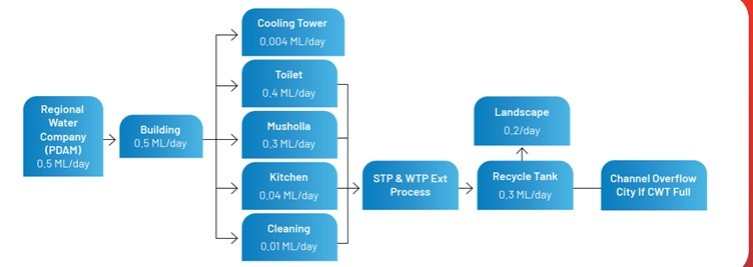
To ensure that the quality of treated wastewater does not pollute urban waterways, GSD, as the building manager, conducts periodic testing of effluents at the local health lab. This test includes several key parameters, such as ex-situ pH, Biochemical Oxygen Demand (BOD), Chemical Oxygen Demand (COD), Total Suspended Solids (TSS), oils and fats, ammonia, and coliform, to ensure that the processing results meet applicable environmental quality standards. In addition, TLT also utilizes some of the water from STP treatment through the implementation of wastewater recycling management. This system utilizes STP-treated water and condensed water from the Air Handling Unit (AHU) to be used as a medium for air conditioning and watering plants. The Shared Service Center Function Unit (TSSC) manages this initiative and gradually develops it to support other operational needs while minimizing water discharge into urban drains. Access to Clean Water and Decent Sanitation for the Community To support the achievement of Sustainable Development Goals (SDGs) Target 6, Telkom contributes to the provision of access to clean water and proper sanitation, especially in areas that still face limited water infrastructure. This contribution is realized through the construction and improvement of clean water facilities, including borewells, water treatment plants, and water distribution systems in various regions. In addition, Telkom also supports the construction of proper bathing, washing, and toilet facilities, accompanied by education and training related to the implementation of a clean and healthy lifestyle for the community. Throughout 2025, the program was implemented across 17 provinces, reaching 99 locations and delivering direct benefits to over 58,501 individuals. Key target areas included Pekuncen Village (Banyumas, Central Java) and Tammero'do Hamlet (Majene, West Sulawesi). The program’s execution relied on robust multi-stakeholder collaboration, involving local governments, community groups, and implementing partners such as the Harapan Dhuafa Foundation in Banten. Supporting Access to Clean Water and Sustainable Sanitation for Indigenous Peoples In 2025, Telkom supported the construction of clean water facilities for the Bonokeling indigenous people in Pekuncen Village, Banyumas Regency, in response to limited water access, especially during the dry season in Pekuncen Village. Telkom sees that water has an important meaning for the Bonokeling community, especially in the sustainability of agricultural traditions and traditional practices, including a series of rituals such as wiwitan before planting, wiwitan pari during harvest, and sedekah bumi as a form of respect for nature. This cooperation in the provision of clean water facilities strengthens the community's ability to maintain these traditions while meeting their daily needs, with water management carried out in harmony with cultural values and local wisdom. |
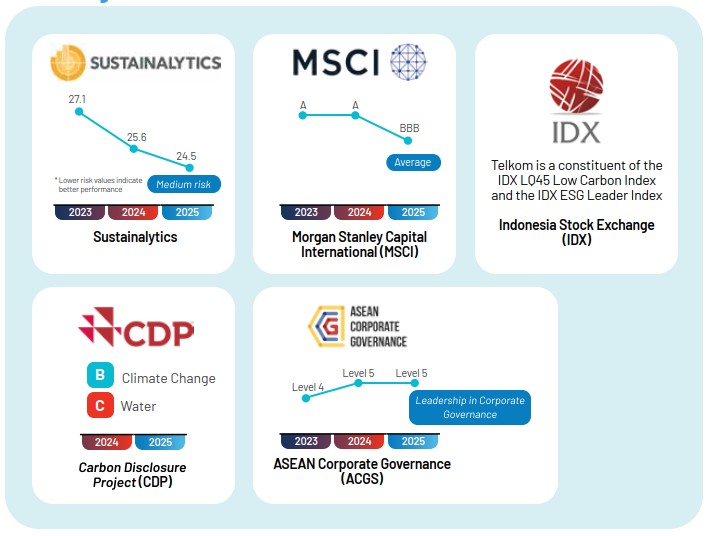
67
[OJK F.9, OJK F.10]
As part of its environmental stewardship, TelkomGroup actively contributes to biodiversity conservation, despite not having operational areas directly in the conservation zones. Our proactive management is further reflected in the absence of public complaints related to environmental issues in 2025. Consequently, there were no environmental grievances requiring mediation or resolution during this period. [OJK F.16]
Through pentahelix collaboration with institutions, communities, subsidiaries, media, and educational institutions, Telkom, through the Social Responsibility Center (SRC) Function Unit, implements a biodiversity conservation program that focuses on sustainable reforestation and greening with environmental education and active community participation. In 2025, Telkom’s environmental programs encompassed both terrestrial and marine ecosystem conservation, including mangrove planting and coral reef rehabilitation, to mobilize local communities to reduce the potential for carbon emissions and build the economy of local communities. This collaborative approach supports carbon sequestration, environmental conservation, and strengthening socio-economic impacts with SROI 1:6.29.
Figure 37. Telkom Reforestation and Conservation Framework

In 2025, a total of 80,800 trees were planted across a cumulative land area of 8.1 hectares, in collaboration with local communities within Telkom's Hutan Binaan Digital owned by villages spread across Bojong and Jayabakti Villages, Garut Regency, Plumbon Village, Karanganyar Regency, Tlogolele Village, Boyolali Regency, Bissoloro Gowa Regency, Panyutran Village, Pangandaran Regency, and Waluran Mandiri Village, Sukabumi Regency.
The trees planted are avocado (Persea americana), palm (Arenga pinnata), durian (Durio zibethinus L.), mahogany (Swietenia mahagoni), petai (Parkia speciosa), guava (Psidium guajava), sonokeling (Dalbergia latifolia), rasamala (Altingia excelsa), pine (Pinus merkusii), and manglid (Maleglietia glauca Bl). Based on the results of monitoring since 2022, the survival rate of plants planted by Telkom is recorded at around 70%. Furthermore, Telkom developed a WebGIS (Web Geographic Information System)-based spatial visualization to monitor the area of conservation areas and the distribution of tree planting locations in an integrated manner. This WebGIS technology can be accessed publicly through the Telkom Green Digital website.
In addition to increasing the carrying capacity of the terrestrial ecosystem, Telkom is also taking a role in similar initiatives for marine ecosystems. In 2025, Telkom and its subsidiaries—including Sigma, Telkomsel, and Telkom
68
Akses—carried out a collective effort to plant 110,042 mangrove trees (Rhizophora mucronata) and seagrass (Thalassia hemprichii). Telkom also continues to transplant 760 substrates of coral reefs (Acropora sp and Porites sp). This initiative is carried out on various coasts of Indonesia, some of which are the Cipatujah and Cikalong Coasts of Tasikmalaya Regency, Tarakan, North Kalimantan, Tanjung Boleng NTT, Glagah Beach of Demak Regency, and Wringinputih Coast of Banyuwangi.
To ensure the program continuity of mangrove ecosystems planting, Telkom actively engages various stakeholders in ongoing maintenance efforts. In North Sumatra, Telkom collaborates with local community groups, including Baitulmaal Muamalat (BMM) and the Tanjung Rejo mangrove Group, to support mangrove monitoring activities. Similarly, for the coral reef transplantation program in Lanjukang, Telkom partners with the Gusung Tallasa Community (Gustalkom) and Hasanuddin University to conduct periodic monitoring.
Furthermore, in collaboration with Telkom University, Telkom conducts carbon stock assessments as part of the Hutan Binaan Digital program and mangrove restoration initiatives. These assessments aim to generate comprehensive estimations of carbon stocks to support the evaluation of environmental impacts. Telkom performs carbon stock calculations in accordance with SNI 7725:2019, covering five carbon pools: aboveground biomass, belowground biomass, necromass, litter, and soil carbon reserves in both mineral and mangrove ecosystems. Going forward, Telkom will continue to expand mangrove planting and reforestation initiatives, while also pursuing verification of carbon offset programs as part of its ongoing commitment to biodiversity conservation.
Table 14. Ecosystem Carbon Stocks of Telkom's Reforestation and Conservation Program

*The year 2023 is a pilot measurement of carbon stocks, and the data only represents the carbon pools at above ground carbon stock.
Collective Action for Environmental Conservation Berbagi Hepi with MyTelkomsel Donation Points In collaboration with the Kitabisa platform, Telkomsel invited customers in December 2025 to participate in environmental conservation actions through planting 3,000 seagrass seedlings and building cultivation houses in various regions of Indonesia, including at Karapyak Beach, Pangandaran Regency. This program encourages direct customer engagement, where they can channel Telkomsel Poin through the MyTelkomsel app to support the restoration of the marine ecosystem. Jaga Bumi by Telkomsel Telkomsel continued the third phase of its Telkomsel Jaga Bumi Carbon Offset initiative during September-November 2025. This initiative was implemented through collaboration with environmental technology startup Jejakin and involved the participation of 47,000 Telkomsel customers and by. U through donations from Telkomsel Poin and uCoin to support efforts to reduce the carbon footprint of daily activities. In the third phase, Telkomsel targeted the planting of 12,731 trees, prioritizing eight conservation areas across Indonesia. The company implemented this phase through two key approaches: coastal ecosystem conservation through mangrove planting and community economic empowerment through Multi-purpose Tree Species (MPTS). The distribution of locations includes: ● Coastal Conservation (mangrove) ● Patra Maleggala, Tangerang (681 trees) |
69
● Romokalisari, Surabaya (1,050 trees) ● Margojoyo, Kendal (2,000 trees) ● Gojoyo, Demak (2,000 trees) ● Langsa, Aceh (2,000 trees) ● Pramuka Island, Thousand Islands (1,000 trees) ● Pakisjaya, Karawang (2,000 trees) ● Economic Empowerment (MPTS Tree) ● Located in Leuwisadeng, Bogor. A total of 2,000 MPTS trees consisting of coffee, durian, petai, and jengkol. Since its inception from 2022 to 2024, the Telkomsel Jaga Bumi Carbon Offset program has planted more than 25,000 trees, with an estimated carbon sequestration of 1,093 tons of CO₂e. Meanwhile, the third phase of the Jaga Bumi Carbon Offset activity is estimated to be able to sequester carbon of around 824.5 tons of CO₂e in its eight-year lifespan. More information about how to contribute as a customer to the Telkomsel Jaga Bumi program is available on the tsel.id/jagabumi page. Mangrove Planting in the Cable Landing Area by Telin Until 2024, Telin, as a Telkom Subsidiary, has planted 15,000 mangroves in the cable landing area and is affected by the abrasion of Tanjung, West Java. This effort continued in 2025 through the planting of 10,180 mangroves in the area. This activity is part of the realization of the Collective Carbon Action BATIC 2025 program and is carried out in collaboration with CarbonEthics. Telin also planted 1,500 mangroves in the Minahasa landing cable area in Poopoh Village, North Sulawesi. Through this program, Telin has succeeded in planting as many as 26,680 mangroves since it was launched in 2022. Furthermore, Telin pays attention to periodic monitoring and evaluation to ensure that the impact produced can be maintained in the long term. The monitoring results from the previous period showed a survival rate of 97% planted mangroves. Real Action with Waste Cleanup Telkom promotes environmental conservation actions through penta-helix collaboration involving local government, media, and academics, as well as mobilizing volunteers and the community in river and coastal cleaning activities in Bandung and Makassar. In commemoration of World Clean Up Day (September 20) and World Rivers Day (September 28), Telkom collaborated with the Pandawara Group – a youth movement from Bandung with a track record of more than 200 clean-up actions across various regions of Indonesia – to carry out a real River Clean Up action at the Cioray River, Bandung, on September 25, 2025. This activity involved around 75 participants, consisting of Telkom management, employees, Telkom University students, and the Pandawara Group, and successfully collected 1.5 tons of waste. Meanwhile, activities in Makassar were carried out at Barombong Beach and Galesong on 18 October 2025. Carrying the theme “Revive the Sea, Renew Our Future,” this Beach Clean-Up initiative involved 200 participants, consisting of TelkomGroup management and employees, SMK Telkom Makassar, village officials, local communities, general volunteers, and Marine Buddies Makassar—a community under WWF Indonesia that supports the management and protection of Indonesia’s marine potential. The activity successfully collected 1.4 tons of waste. In addition, Telkom also distributed 50 household waste bins and constructed two communal waste disposal facilities to support waste management in coastal communities. |
70
[OJK F.4]
Telkom and its subsidiaries continued to consistently allocate resources in 2025 to support environmental programs and initiatives. The costs were directed toward the implementation of environmental-related programs, including energy efficiency efforts and other environmental initiatives. In 2025, the cost of energy efficiency programs decreased in line with operational optimization focused on maintenance and repairs, and expenditure control direction. Meanwhile, the cost of environmental initiatives increased by 48%, driven by the strengthening of the mangrove planting program as part of the company's CSR priorities and targets, as well as the addition of initiatives in the form of the purchase of Renewable Energy Certificates (REC). Details of the environmental costs incurred by TelkomGroup in the last 3 years are presented in Table 15.
Table 15. TelkomGroup Environmental Costs for 2023-2025 (in Rupiah)

* | TelkomGroup's energy efficiency environmental costs are calculated based on the costs incurred for the procurement and upgrade of environmentally friendly equipment, such as LED lights, refrigerants, batteries, and more environmentally friendly monitors. The 2023-2024 figures cover Mitratel, TDE, and Sigma, and the 2025 data has been expanded to include GSD and Telkom Infra. |
** | In 2025, the environmental costs for other environmental initiatives are expanded by adding the REC program costs, in addition to the 2024 fiscal year cost parameters, which include digital forest conservation and revegetation, sanitation and clean water, mangrove planting, coral reef transplantation, and climate action initiatives through the use of IoT. The figures in the table, specifically for 2025, represent Telkom, Telkomsel, Mitratel, TDE, Sigma, and Telkomsat. This is an expanded coverage compared to the 2023-2024 data, which only covered Telkom and Mitratel. |
71
Table 16. Number of Employee Recruitment to Manage Climate Change in TelkomGroup
[GRI 102-3]

* | Recruitment to support the management of climate change mitigation and adaptation programs spans a variety of divisions, including but not limited to the Sustainability and Risk Management Division. The data presented above represent the results of recruitment at Telkom and Sigma. |
72
Table 17. GHG and Energy Emission Performance
[OJK F.6, F.11] [GRI 102-5, 102-6, 102-7, 102-8, 302-1, 302-3, 302-4, 305-1, 305-2, 305-3, 305-4]
Metric | Telkom | Telkomsel | Mitratel | Telin | TDE | Other Subsidiary | TelkomGroup | ||||||||||||||||
2025 | 2024 | 2023 | 2025 | 2024 | 2023 | 2025 | 2024 | 2023 | 2025 | 2024 | 2023 | 2025 | 2024 | 2023 | 2025 | 2024 | 2023 | 2025 | 2024 | 2023 | |||
Emission Management | | | | | | | | | | | | | | | | | | | | | | ||
Total GHG emissions (tCO2e) (Location-based) | 1.142.673,9 | 430,926.9* | 430,750.9* | 2,708,748.7 | 1,696,947.8* | 1,628,935.2* | 37,630.5 | 53,706.3 | 62,742.8 | 12,339.9 | 65,355.8 | 111,116.6 | 130,099.8 | 105,844.3 | 89,397.7 | 170,057.0 | 114,442.6 | 120,165.9 | 4,196,087.0 | 2,467,223.7* | 2,443,109.1* | ||
Total GHG emissions (tCO2e) (Market-based) | 1,112,914.8 | 430,926.9* | 430,750.9* | 2,708,748.7 | 1,696,947.8* | 1,628,935.2* | 37,630.5 | 53,706.3 | 62,742.8 | 12,339.9 | 65,355.8 | 111,116.6 | 117,433.2 | 105,844.3 | 89,397.7 | 170,057.0 | 114,442.6 | 120,165.9 | 4,153,661.3 | 2,467,223.7* | 2,443,109.1* | ||
Scope 1 and 2 (Location-based) | 304,190.7 | 367,945.5* | 372,391.0* | 1,736,327.9 | 1,561,941.6* | 1,486,664.6* | 13,136.7 | 37,896.0 | 38,587.7 | 7,213.2 | 12,119.5 | 60,054.1 | 114,780.0 | 105,232.8 | 76,080.9 | 52,912.9 | 75,071.0 | 75,354.5 | 2,228,561.3 | 2,160,206.4* | 2,109,132.9* | ||
Scope 1 and 2 (Market-based) | 274,431.6 | 367,945.5* | 372,391.0* | 1,736,327.9 | 1,561,941.6* | 1,486,664.6* | 13,136.7 | 37,896.0 | 38,587.7 | 7,213.2 | 12,119.5 | 60,054.1 | 102,113.3 | 105,232.8 | 76,080.9 | 52,912.9 | 75,071.0 | 75,354.5 | 2,186,135.6 | 2,160,206.4* | 2,109,132.9* | ||
Scope 1 | 5,044.4 | 25,087.0 | 25,429.1 | 14,360.2 | 19,337.3 | 19,866.5 | 1,059.4 | 3,445.9 | 3,847.9 | 251.3 | 832.9 | 3,272.9 | 2,475.8 | 3,310.5 | 360.0 | 22,876.9 | 30,071.8 | 30,953.7 | 46,068.1 | 82,085.4 | 83,730.0 | ||
Fuel combustion – stationary | 709.9 | 8,035.4 | 8,509.7 | 6,391.6 | 8,179.1 | 8,240.3 | 725.1 | 1,261.8 | 1,535.3 | 13.8 | 400.5 | 504.0 | 196.1 | 143.2 | 54.1 | 4,251.9 | 9,361.4 | 9,201.2 | 12,288.3 | 27,381.5 | 28,044.6 | ||
Fuel combustion – mobile | 2,011.3 | 4,126.4 | 4,126.4 | 4,369.7 | 4,324.7 | 4,324.7 | 315.6 | 2,134.9 | 2,264.8 | 184.6 | 280.4 | 236.6 | 0.0 | 38.7 | 25.8 | 14,992.9 | 16,276.8 | 17,726.5 | 21,874.0 | 27,182.0 | 28,704.9 | ||
Fugitive emission – refrigerant & fire suppression | 2,323.2 | 12,925.1 | 12,792.8 | 3,596.1 | 6,833.4 | 7,301.4 | 18.8 | 49.1 | 47.7 | 49.2 | 151.9 | 2,532.4 | 2,165.7 | 3,125.5 | 279.4 | 2,249.2 | 4,406.1 | 3,993.7 | 10,402.1 | 27,491.1 | 26,947.5 | ||
Fugitive emission – waste water | 0.0 | 0.1 | 0.1 | 2.9 | 0.03 | 0.03 | 0.0 | N/A | N/A | 3.8 | N/A | N/A | 114.1 | 3.1 | 0.7 | 1,382.9 | 27.5 | 32.3 | 1,503.6 | 30.8 | 33.1 | ||
Scope 2 (location-based) | 299,146.3 | 342,858.4* | 346,961.9* | 1,721,967.7 | 1,542,604.3* | 1,466,798.1* | 12,077.3 | 34,450.2 | 34,739.8 | 6,961.89 | 11,286.6 | 56,781.2 | 112,304.2 | 101,922.2 | 75,721.0 | 30,036.0 | 44,999.3 | 44,400.8 | 2,182,493.3 | 2,078,121.1* | 2,025,402.9* | ||
Scope 2 (Market-based) | 269,387.2 | 342,858.4* | 346,961.9* | 1,721,967.7 | 1,542,604.3* | 1,466,798.1* | 12,077.3 | 34,450.2 | 34,739.8 | 6,961.89 | 11,286.6 | 56,781.2 | 99,637.5 | 101,922.2 | 75,721.0 | 30,036.0 | 44,999.3 | 44,400.8 | 2,140,067.5 | 2,078,121.1* | 2,025,402.9* | ||
Scope 3 | 838,483.2 | 62,981.4 | 58,359.9 | 972,420.8 | 135,006.1 | 142,270.6 | 24,493.8 | 15,810.3 | 24,155.1 | 5,126.6 | 53,236.3 | 51,062.5 | 15,319.8 | 611.6 | 13,316.8 | 117,144.1 | 39,371.6 | 44,811.3 | 1,967,525.7 | 307,017.3 | 333,976.2 | ||
Category 1 | 9,693.6 | 31,982.9 | 5,117.3 | 30,322.9 | 4,176.5 | 10,490.7 | 0.0 | 440.1 | 399.5 | 0.0 | 45,803.8 | 44,454.1 | 0.0 | 0.0 | 0.0 | 24,780.0 | 4,814.8 | 12,265.4 | 64,796.5 | 87,218.1 | 72,727.0 | ||
Category 2 | 75,242.4 | 16,664.7 | 37,982.9 | 132,506.2 | 22,366.2 | 20,623.6 | 22,904.7 | 15,251.5 | 22,784.7 | 4,027.0 | 4,575.9 | 6,109.9 | 448.6 | 183.7 | 13,172.5 | 4,552.6 | 11,635.1 | 1,999.0 | 239,681.5 | 70,677.0 | 102,672.6 | ||
Category 3 | 29,429.6 | 0.0 | 0.0 | 164,001.4 | 0.0 | 0.0 | 1,414.1 | 0.0 | 0.0 | 650.57 | 0.0 | 0.0 | 7,825.0 | 0.0 | 0.0 | 8,429.7 | 0.3 | 0.1 | 211,750.4 | 0.3 | 0.1 | ||
Category 4 | 51.1 | N/A | N/A | 0.0 | N/A | N/A | 0.0 | N/A | N/A | 0.0 | N/A | N/A | 0.0 | N/A | N/A | 0.0 | 0.0 | 0.0 | 51.1 | N/A | N/A | ||
Category 5 | 240.4 | 0.0 | 0.0 | 7.4 | 0.5 | 72.7 | 0.0 | 0.0 | 0.0 | 0.0 | 0.0 | 0.0 | 0.0 | 0.0 | 0.0 | 23.0 | 0.2 | 7.9 | 270.7 | N/A | N/A | ||
Category 6 | 833.7 | 14,232.5 | 15,102.4 | 472.1 | 8,873.2 | 3,927.4 | 160.2 | 106.4 | 963.4 | 440.5 | 2,856.6 | 498.5 | 38.4 | 427.9 | 144.3 | 1,630.0 | 5,622.8 | 9,603.7 | 3,574.7 | N/A | N/A | ||
Category 7 | 99.2 | N/A | N/A | 42.0 | N/A | N/A | 14.8 | N/A | N/A | 8.6 | N/A | N/A | 3.9 | N/A | N/A | 221.2 | N/A | N/A | 389.8 | N/A | N/A | ||
Category 8 | 8.2 | 0.0 | 0.0 | 0.0 | N/A | N/A | 0.0 | 12.2 | 7.5 | 0.0 | 0.0 | 0.0 | 7,004.0 | 0.0 | 0.0 | 70,929.2 | 7,973.7 | 7,742.0 | 77,941.4 | 7,985.9 | 7,749.5 | ||
Category 9 | 0.0 | N/A | N/A | 0.0 | N/A | N/A | 0.0 | N/A | N/A | 0.0 | N/A | N/A | 0.0 | N/A | N/A | 172.6 | N/A | N/A | 172.6 | N/A | N/A | ||
Category 11 | 722,750.7 | 0.0 | 0.0 | 644,986.2 | 99,559.4 | 99,421.1 | 0.0 | 0.0 | 0.0 | 0.0 | 0.0 | 0.0 | 0.0 | 0.0 | 0.0 | 0.0 | 0.0 | 0.0 | 1,367,736.8 | N/A | N/A | ||
Category 12 | 1.9 | N/A | N/A | 56.8 | N/A | N/A | 0.0 | N/A | N/A | 0.0 | N/A | N/A | 0.0 | N/A | N/A | 0.0 | N/A | N/A | 58.6 | N/A | N/A | ||
Category 13 | 0.0 | 0.0 | 0.0 | 0.0 | N/A | N/A | 0.0 | 0.0 | 0.0 | 0.0 | 0.0 | 0.0 | 0.0 | 0.0 | 0.0 | 6,296.1 | 148.0 | 107.3 | 833.4***** | 148.0 | 107.3 | ||
Category 15 | 132.5 | 101.3 | 157.2 | 26.0 | 30.3 | 7,735.0 | 0.0 | 0.0 | 0.0 | 0.0 | 0.0 | 0.0 | 0.0 | 0.0 | 0.0 | 109.7 | 9,176.6 | 13,085.8 | 268.1 | 9,308.3 | 20,978.0 | ||
Biogenic emission from biodiesel user | 244.3 | N/A | N/A | 2,553.0 | N/A | N/A | 241.7 | N/A | N/A | 49.4 | N/A | N/A | 23.2 | N/A | N/A | 1,704.4 | N/A | N/A | 4,816.0 | N/A | N/A | ||
Emission intensity Scope 1 & 2 (tons of CO2/billion Rp) revenue) (Location-based) | 7.1 | 8.0* | 7.3* | 15.9 | 13.8* | 14.5* | 1.4 | 4.1 | 4.5 | 0.6 | 1.0 | 5.3 | 72.0 | 89.5 | 140.3 | 1.0 | 1.4 | 1.5 | 15.2 | 14.4 | 14.1 | ||
Emission intensity Scope 1 & 2 (tons of CO2/billion Rp) revenue) (Market-based) | 6.4 | 8.0* | 7.3* | 15.9 | 13.8* | 14.5* | 1.4 | 4.1 | 4.5 | 0.6 | 1.0 | 5.3 | 64.1 | 89.5 | 140.3 | 1.0 | 1.4 | 1.5 | 14.9 | 14.4* | 14.1* | ||
Energy Management | |||||||||||||||||||||||
Total energy usage (GJ) | 1,223,410.5 | 1,501,475.8* | 1,524,992.2* | 6,984,695.3 | 6,510,919.2* | 6,195,137.4* | 62,393.5 | 175,481.0 | 183,466.5 | 38,788.2 | 85,460.4 | 488,100.1 | 642,432.3 | 546,293.2 | 314,424.8 | 416,149.4 | 541,534.6 | 557,107.1 | 9,367,869.3 | 9,361,163.8* | 9,270,561.5* | ||
Electricity consumption purchased (GJ)*** | 1,182,032.5 | 1,334,295.0* | 1,351,378.3* | 6,787,504.4 | 6,329,140.9* | 6,022,516.8* | 46,434.3 | 128,226.0 | 130,680.1 | 35,409.3 | 76,226.4 | 478,090.5 | 639,460.8 | 543,813.2 | 313,328.2 | 124,092.4 | 185,629.3 | 183,083.7 | 8,814,933.6 | 8,597,330.8* | 8,479,077.5* | ||
Electricity consumption purchased from total energy consumption (%) | 96.6% | 88.9%* | 88.6%* | 97.2% | 97.2%* | 97.2%* | 74.4% | 73.1% | 71.2% | 91.3% | 89.2% | 97.9% | 99.5% | 99.5% | 99.7% | 29.8% | 34.3% | 32.9% | 94.1% | 91.8%* | 91.5%* | ||
Electricity consumption from renewable sources (PLTS and PLTMH) (GJ) | 0.0 | 0.0 | 0.0 | 13,926.0 | 9,995.0 | 7.3 | 0.0 | 0.0 | 0.0 | 0.0 | 0.0 | 0.0 | 0.0 | 0.0 | 0.0 | 0.0 | 0.0 | 0.0 | 13,926.0 | 9,995.0 | 7,341.0 | ||
Electricity consumption from renewable sources compared to total energy consumption (%) | 0.0 | 0.0 | 0.0 | 0.2% | 0.2%* | 0.0 | 0.0 | 0.0 | 0.0 | 0.0 | 0.0 | 0.0 | 0.0 | 0.0 | 0.0 | 0.0 | 0.0 | 0.0 | 0.1% | 0.1%* | 0.1%* | ||
Fuel consumption (GJ) | 41,378.1 | 167,180.8 | 173,613.9 | 183,265.0 | 171,783.3 | 172,613.3 | 15,959.2 | 47,255.0 | 52,786.4 | 3,378.9 | 9,234.0 | 10,009.6 | 2,971.6 | 2,480.0 | 1,096.6 | 292,057.0 | 355,905.2 | 374,023.4 | 539,009.7 | 753,838.0 | 784,143.0 | ||
Non-renewable fuel consumption (GJ) | 37,927.8 | 167,180.8 | 173,613.9 | 147,205.2 | 171,783.3 | 172,613.3 | 12,545.5 | 47,255.0 | 52,786.4 | 2,681.0 | 9,234.0 | 10,009.6 | 2,644.0 | 2,480.0 | 1,096.6 | 268,004.7 | 355,905.2 | 374,023.4 | 471,008.2 | 753,838.0 | 784,143.0 | ||
Renewable fuel consumption (GJ) | 3,450.3 | N/A | N/A | 36,059.7 | N/A | N/A | 3,413.7 | N/A | N/A | 697.9 | N/A | N/A | 327.6 | N/A | N/A | 24,052.3 | N/A | N/A | 68,001.5 | N/A | N/A | ||
Biodiesel fuel consumption -B40 (GJ) | 3,450.3 | N/A | N/A | 36,059.7 | N/A | N/A | 3,413.7 | N/A | N/A | 697.9 | N/A | N/A | 0.0 | N/A | N/A | 24,050.5 | N/A | N/A | 67,672.0 | N/A | N/A | ||
Biodiesel fuel consumption -B30 (GJ) | 0.0 | N/A | N/A | 0.0 | N/A | N/A | 0.0 | N/A | N/A | 0.0 | N/A | N/A | 174.1 | N/A | N/A | 1.4 | N/A | N/A | 175.5 | N/A | N/A | ||
Biodiesel fuel consumption -(B20- Singapore Biodiesel) (GJ) | 0.0 | N/A | N/A | 0.0 | N/A | N/A | 0.0 | N/A | N/A | 0.0 | N/A | N/A | 153.5 | N/A | N/A | 0.0 | N/A | N/A | 153.5 | N/A | N/A | ||
Biodiesel fuel consumption -(B10- Malaysia Biodiesel) (GJ) | 0.0 | N/A | N/A | 0.0 | N/A | N/A | 0.0 | N/A | N/A | 0.0 | N/A | N/A | 0.0 | N/A | N/A | 0.4 | N/A | N/A | 0.4 | N/A | N/A | ||
Consumption of renewable fuels 'purchased from total energy consumption (Share of renewable energy) (%) | 0.3% | N/A | N/A | 0.5% | N/A | N/A | 5.5% | N/A | N/A | 1.8% | N/A | N/A | 0.1% | N/A | N/A | 5.8% | N/A | N/A | 0.7% | N/A | N/A | ||
Reduction in energy usage (GJ) **** | -278,065.3 | -23,516.4* | 90,683.2* | 473,776.1 | 315,781.8* | 313,132.4* | -113,087.5 | -7,985.6 | -20,116.0 | -46,672.2 | -402,639.7 | -22,453.0 | 96,139.1 | 231,868.4 | 220,681.0 | -125,385.2 | -15,572.5 | -297,889.0 | 6,705.5 | 90,602.3* | 291,371.5* | ||
Reduction in energy use (%)**** | -18.5% | -1.5%* | 6.3%* | 7.3% | 5.1%* | 5.3%* | -64.4% | -4.4% | -9.9% | -54.6% | -82.5% | -4.4% | 17.6% | 73.7% | 235.4% | -23.2% | -2.8% | 10.3% | 0.1% | 1.0%* | 3.2%* | ||
Energy intensity (GJ/billion Rp revenue) | 28.4 | 32.6* | 29.7* | 63.9 | 57.4* | 60.5* | 6.5 | 19.0 | 21.3 | 3.2 | 7.1 | 42.8 | 403.1 | 464.5 | 579.6 | 8.2 | 10.4 | 10.8 | 63.8 | 62.4* | 62.1* | ||
Electricity consumption purchased (kWh) | 328,342,348.6 | 370,637,495.6* | 375,382,868.2* | 1,885,417,875.2 | 1,758,094,691.2* | 1,672,921,324.3* | 12,898,426.5 | 35,618,327.0 | 36,300,030.0 | 9,835,920.3 | 21,174,012.0 | 132,802,909.0 | 177,627,989.5 | 151,059,230.0 | 87,035,600.0 | 34,470,108.2 | 51,563,700.0 | 50,856,577.0 | 2,448,592,668.3 | 2,388,147,456.2* | 2,355,299,308.5* | ||
73
*Restatement of information based on adjustments to electricity data collection methodology
**N/A (Not applicable)
***There is a unit conversion from kilowatt-hour (kWh) to Giga Joule (GJ) with a conversion factor of 0.0036
****A minus sign (-) indicates a decrease in energy usage compared to the previous year. [SASB TC-SI-130a.1, TC-TL-130a.1, TC-IM-130a.1]
***** | The consolidated data of TelkomGroup and the data per Subsidiary entity, may show different values. At the consolidation level, leased assets are recorded as a single unit and thus counted once, whereas at the level of each entity, the same asset can be recorded in more than one entity according to each entity's share or involvement, resulting in a higher total. |
Explanation of energy management performance in 2025:
• In general, the decline in fuel use is primarily driven by the transition to biodiesel use, in line with the biodiesel implementation biodiesel mandate in Indonesia, Singapore, and Malaysia.
• Telkom recorded a decrease in energy usage driven by a decline in operational vehicle fuel consumption, which fell from 1,654,870 liters in 2024 to 688,648 liters in 2025.
• Telkomsel recorded an increase in energy use in 2025, influenced by an increase in motor vehicle fuel consumption (RON 90, 92, and 98) from 1,770,828 liters in 2024 to 1,865,891 liters in 2025. Furthermore, electricity consumption also increased with the addition of base transceiver stations (BTS) throughout 2025.
• Mitratel recorded a decrease in energy use in 2025, primarily as a result of the outsourcing of tower operations to third parties. The number of towers managed by Mitratel will decrease from 1,682 units in 2024 to 429 units in 2025.
• Telin recorded a decrease trend in energy use in 2025, influenced by reduced consumption of motor vehicle fuel (RON 90, 92, and 98), as well as decreased electricity use in its operational areas of Singapore, Malaysia, and Hong Kong.
• TDE recorded an increase in energy use in 2025, in line with the expansion of its data center business on Java Island.
74
Table 18. Performance of GHG Emission Reduction in 2025 Compared to the 2023 Base Year*
[GRI 102-4 305-5]
Metrics | Telkom | Telkomsel | Mitratel | Telin | TDE | Other Subsidiaries | TelkomGroup |
Increase or decrease in Scope 1 emissions compared to base year 2023 (tCO2) | -20,384.7 | -5,506.2 | -2,788.5 | -3,021.6 | 2,115.9 | -8,076.8 | -37,661.9 |
Increase or decrease in Scope 1 emissions compared to base year 2023 (%) | -80.2 | -27.7 | -72.5 | -92.3 | 587.8 | -26.1 | -45.0 |
Increase or decrease in Scope 2 emissions compared to base year 2023 (tCO2) (Location-based) | -47,815.7 | 255,169.5 | -22,662.5 | -49,819.3 | 36,583.2 | -14,364.8 | 157,090.4 |
Increase or decrease in Scope 2 emissions compared to base year 2023 (tCO2) (Market-based) | -13.8 | 17.4 | -65.2 | -87.7 | 48.3 | -32.4 | 7.8 |
Increase or decrease in Scope 2 emissions compared to base year 2023 (Location-based) (%) | -77,574.8 | 255,169.5 | -22,662.5 | -49,819.3 | 23,916.6 | -14,364.8 | 114,664.7 |
Increase or decrease in Scope 2 emissions compared to base year 2023 (Market-based) (%) | -22.4 | 17.4 | -65.2 | -87.7 | 31.6 | -32.4 | 5.7 |
Increase or decrease in Scope 3 emissions compared to base year 2023 (tCO2) | 780,123.4 | 830,150.2 | 338.7 | -45,935.9 | 2,003.0 | 66,870.1 | 1,633,549.5 |
Increase or decrease in Scope 3 emissions compared to the base year 2023 (%) | 1,336.7 | 583.5 | 1.4 | -90.0 | 15.0 | 149.2 | 489.1 |
Increase or decrease in Scope 1 & 2 emissions compared to base year 2023 (Location-based) (tCO2) | -68,200.4 | 249,663.3 | -25,451.0 | -52,840.9 | 38,699.1 | -22,441.7 | 119,428.5 |
Increase or decrease in Scope 1 & 2 emissions compared to base year 2023 (Location-based)(%) | -18.3 | 16.8 | -66.0 | -88.0 | 50.9 | -29.8 | 5.7 |
Increase or decrease in Scope 1 & 2 emissions compared to base year 2023 (Market-based) (tCO2) | -97,959.4 | 249,663.3 | -25,451.0 | -52,840.9 | 26,032.4 | -22,441.7 | 77,002.7 |
Increase or decrease in Scope 1 & 2 emissions compared to base year 2023 (Market-based)(%) | -26.3 | 16.8 | -66.0 | -88.0 | 34.2 | -29.8 | 3.7 |
Total emission increase or decrease compared to base year 2023 (Location-based) (tCO2) | 711,923.0 | 1,079,813.5 | -25,112.3 | -98,776.8 | 40,702.1 | 44,428.4 | 1,752,978.0 |
Total increase or decrease in emissions compared to base year 2023 (Location-based) (%) | 165.3 | 66.3 | -40.0 | -88.9 | 45.5 | 37.0 | 71.8 |
Total emission increase or decrease compared to base year 2023 (Market-based) (tCO2) | 682,164.0 | 1,079,813.5 | -25,112.3 | -98,776.8 | 28,035.4 | 44,428.4 | 1,710,552.2 |
Total increase or decrease in emissions compared to base year 2023 (Market-based) (%) | 158.4 | 66.3 | -40.0 | -88.9 | 31.4 | 37.0 | 70.0 |
* | The minus notation (-) indicates that in 2025, there will be a decrease in emissions compared to 2023. An explanation regarding the background of this increase or decrease is elaborated in the Low Carbon Transition section. |
Details of the issuance for each Subsidiary are presented in Appendix 2
75
TelkomGroup regards the development and empowerment of human resources as a key element in supporting the success of digital transformation to maintain the company's competitiveness. Through the establishment of an inclusive, safe, and collaborative work environment, the company cultivates exceptional talent to deliver services that are reliable, valuable, and broadly accessible to the community.
Figure 38. Telkom's Social Aspect Management Framework

76
Diversity, Equality, and Inclusion
The business strategies and policies adopted by Telkom have the potential to mitigate or generate impacts on employees. TelkomGroup’s commitment to diversity, equity, and inclusion is demonstrated through recruitment practices, workforce management, compensation and benefits, and inclusive talent development—implemented without discrimination and upheld with integrity.
[GRI 3-3]
Role of the Board and Management
The HCM Director, as a member of the Board of Executive, is appointed as the Chief Human Capital Officer (CHCO) and acts as a strategic partner to business lines and corporate functions in managing TelkomGroup’s human capital, providing guidance to the HCM functions of subsidiaries, human capital strategy, as well as integrated talent management system policies within TelkomGroup. The HCM Director reports performance periodically through both formal and informal meetings to the Board of Directors.
In this role, the HCM Director leads the integration of diversity, equity, and inclusion aspects across all HCM activities and monitors their effectiveness through the HCM evaluation process conducted annually by the HCM Directorate.
Human Capital Management (HCM) Organization
Human Capital Management (HCM) Directorate is responsible for managing and monitoring the entire HCM cycle, spanning from recruitment through to the retirement of Telkom employees. In its implementation, HCM Directorate continuously coordinates with HCM Directorate in each Subsidiary to ensure the integration of organisational structure and strategies to support adaptive and sustainable organisational transformation. HCM Directorate is supported by function units that specifically manage each HCM process and are responsible for the development, implementation, and monitoring of employee welfare initiatives, as regulated in the Board of Directors Regulation Number: PD.202.44/r.02/HK250/COP-A2000000/2024 about the Organization of the Human Capital Management Directorate.
As part of the commitment to continuous improvement, the HCM Directorate conducts an annual performance evaluation of HCM to identify opportunities for improvement The HCM evaluation results for 2025 produced a number of lessons learned that serve as the basis for strengthening the 2026 program, with a focus on developing a more adaptive and agile organization in responding to business dynamics, accelerating talent development, and reinforcing company culture.
HCM Values
Telkom has developed a series of Employee Value Proposition (EVP) values that serve as a reference for the development of HCM strategies and employment policies. Telkom believes that the values of diversity, equality, and inclusivity are qualities of global leaders, making these values an integral part of the TelkomGroup HCM strategy. EVP values also aim to support the acceleration of talent readiness to back the TelkomGroup business transformation strategy, one of which is translated into Digital Ways of Working: BISA as a reinforcement of employees' digital capabilities.
77
Figure 39. Employee Value Proposition TelkomGroup

Digital Ways of Working: BISA
Telkom launched Digital Ways of Working: BISA (Bravery, Integrity, Service Excellence, and Agility) as a framework for work behaviour that emphasises strengthening the digital mindset to support the acceleration of TelkomGroup's digital transformation in line with the implementation of AKHLAK Core Values. Various efforts for internalisation and actualisation have been carried out through routine socialisation for all levels of employees and senior management, culture programs, and the formalisation of policies related to Digital Ways of Working: BISA.
Figure 40. Digital Ways of Working: BISA

HCM Policy
[GRI 2-30]
The company regulation (Peraturan Perusahaan/PP) on Human Capital Management of TelkomGroup governs the implementation of employment in all HCM activities, both for TelkomGroup employees and non-employee workers, and guides the development of other employment policies at Telkom and its Subsidiaries.
Employment practices at Telkom are comprehensively regulated in the Collective Bargaining Agreement (Perjanjian Kerja Bersama/PKB) 2023–2025, which applies to all Telkom employees, ensuring that 100% of employees are covered by the PKB. PKB regulates the rights and obligations of employees and the company, including provisions on working hours, compensation, benefits, social allowances, and competency development. PKB X for the years 2023–2025 between the Employee Labour Union and Telkom also emphasizes the right to income, rights beyond income, and guarantees a work environment free from discrimination, violence, and harassment.
78
In line with the adjustment of HCM policies, all provisions related to labour unions continue to refer to the PKB for Telkom employees. Meanwhile, for Subsidiaries that do not have labour unions and do not implement the PKB, their labour provisions are regulated through PP or applicable employment policies in each entity. This approach ensures that all workers, both at Telkom and its subsidiaries, receive protection and regulations that align with fair labour principles. The company also guarantees development, coaching, education, legal assistance, and Occupational Health and Safety (OHS) in accordance with regulations, rules, and company policies.
Employee Engagement
Telkom's efforts to build inclusive communication and meaningful work experiences for employees are carried out through various activities, such as annual employee surveys, regular meetings with management, employee complaint centers, town hall activities, etc. [GRI 2-16, 2-29] [SASB TC-SI-330a.2]
TelkomGroup Labour Union
Building Communication with the Labour Union Telkom communicates with the Labour Union through media such as: 1. Bipartite Cooperation Institution (LKS Bipartit) is a forum for communication and consultation regarding matters related to industrial relations at Telkom, consisting of members from Telkom and Sekar. 2. Tripartite Cooperation Institution (LKS Tripartit) is a forum for communication, consultation, and deliberation on labour issues, consisting of members from Telkom, Sekar, the Ministry of Manpower of the Republic of Indonesia, or the local Manpower Office. 3. Communication forum is a platform or means for exchanging information, discussing, and expressing opinions between Telkom and Sekar to achieve mutual understanding or resolve issues, held at least once every quarter or whenever deemed necessary. 4. Management dialogue and Sekar is a platform or means for exchanging information, discussing, and expressing opinions between regional management and regional Sekar to achieve mutual understanding or resolve regional issues, held whenever deemed necessary. |
Telkom supports employees’ rights to freedom of association and organization, as well as guarantees the right to express their opinions. As of the end of 2025, approximately 70% of Telkom’s total employees are registered as members of labor unions. Labor unions are established not only within Telkom, but also across all entities within TelkomGroup. The list of unions in TelkomGroup is as follows [GRI 407-1]:
| a. | Telkom Indonesia Employees Union (SEKAR) |
| b. | Telkomsel Workers Union (SEPAKAT) |
| c. | Infomedia Nusantara Workers Union (SPIN) |
| d. | Metra Digital Media Labor Union (Digital Workers Union or SPMD) |
| e. | Graha sarana Duta Employees Union (Graha Sarana Duta Workers Union or SKATA) |
| f. | PINS Employees Union (SETARA) |
| g. | Administration Medika Workers Union (SP Medika) |
| h. | Telkomsigma Employees Union (SERASI) |
Culture Survey 2025
[OJK E.4] [GRI 2-29]
Culture Survey 2025 is an annual survey program specifically designed to measure the implementation of the company's cultural values, consisting of four main dimensions: Digital Ways of Working: BISA Implementation Index, BISA Culture Journey Index, AKHLAK Culture Journey Index, and Employee Net Promoter Score (e-NPS). This survey aims to map the organization's cultural journey and its impact on the achievement of TelkomGroup's digital transformation.
79
Figure 41. Telkom Culture Survey

80
Based on the survey results, the direction of TelkomGroup’s cultural development in 2026 is to strengthen a performance-based merit culture by positioning culture as an instrument for achieving results. Operational recommendations to realize this vision include the following:
| 1. | Alignment of performance appraisal systems and reward mechanisms based on contributions to results and impact. |
| 2. | Simplification of KPI to focus on outcomes. |
| 3. | Creation of a safe performance space at the operational level. |
| 4. | Strengthening the role of line leaders as the main drivers of converting values into results. |
Culture Survey 2025 Methodology |
The Culture Survey 2025 was conducted in October 2025, involving 8,870 respondents from all levels of TelkomGroup employees, ranging from BP-I to BP-VI. The quantitative survey was administered online and was followed by in-depth discussions through Focus Group Discussions (FGDs). The respondents included all permanent employees of TelkomGroup, regardless of their length of service. The survey consisted of four main dimensions designed to measure the following factors: 1. Digital Ways of Working: BISA: Bravery, Integrity, Service Excellence, and Agility. 2. BISA Journey Index: Readiness to Change score, Symbol and Attribute score, and Employee Acceptance score towards the implementation of Digital Ways of Working. 3. AKHLAK Culture Journey Index: Readiness to Change score, Symbol and Attribute score, and Employee Acceptance score towards the implementation of AKHLAK Core Values, as well as Leadership and System Commitment score towards the company culture. 4. Employee Net Promoter Score (e-NPS): company culture acceptance score. |
People Survey 2025
[OJK E.4] [GRI 2-29]
Telkom conducted the People Survey 2025 to evaluate the effectiveness of the 2024-2025 HCM policies and to understand the conditions and experiences of employees. The survey results serve as input for the preparation of the 2026 HCM policies that are more responsive, relevant, and supportive of the sustainability of the company's transformation.
The total Employee Engagement score reached 85.13, placing it in the “Highly Engaged” category and reflecting employees’ strong willingness to engage and contribute productively to the company. The increase in employee engagement is expected to have a positive impact on employee well-being, performance, talent retention, customer satisfaction, as well as the company’s financial and operational performance.
Figure 42. TelkomGroup Employee Engagement Index Score

81
Table 19. TelkomGroup Employee Engagement Index 2023-2025

Figure 43. Proportion of Respondent Engagement Categories
[SASB TC-SI-330a.2, TC-IM-330a.2]

Table 20. Proportion of Employee Engagement Index by Gender

Based on the analysis of the People Survey 2025 findings, the recommendations are as follows:
| 1. | Strengthening the role of leadership, especially as transformative leaders in driving change and empathetic leaders in managing workload. |
| 2. | Enhancing Employee Engagement and Well-Being through balanced workload management, performance transparency, strengthening financial well-being, work flexibility, and a Respectful Workplace. |
People Survey 2025 Methodology |
People Survey 2025 was conducted in October 2025, involving 5,656 respondents from TelkomGroup, with a response rate of 43%. The respondents included all permanent employees of TelkomGroup, regardless of their length of service. The survey evaluates factors influencing employee engagement both quantitatively and qualitatively, including Employee Engagement, Workplace Well-being, Employee Well-being, Job Burnout, Job Security, and Rewards. The People Survey 2025 methodology has been improved compared to the previous year in terms of the model and questionnaire to better reflect the current conditions of organizational transformation. Therefore, this year’s survey results cannot be directly compared with those of previous periods. Readers are advised to interpret any changes in the survey results with caution. |
82
Handling of Employment Issues and Violations
[GRI 2-29]
The response to violations of labour regulations, human rights, and company policies is outlined in the Employee Discipline Policy (PR.209.05/r.02/HK250/COP-A0900000/2024). In general, the actions taken against violations include supervision by superiors (for minor and moderate violations), HC Management (for severe or massive violations), and escalation to law enforcement if necessary.
Approaches to resolving violations of employment regulations Industrial relations disputes must first undergo bipartite negotiations through deliberation to reach a consensus. The categories of such disputes include: 1. Rights disputes; 2. Interest disputes; 3. Disputes over termination of employment; and 4. Disputes between labour unions within a single company. Bipartite negotiations must be concluded within 30 working days of their commencement. If a party refuses to participate or if no agreement is reached within this period, the negotiations are deemed unsuccessful. |
Table 21. Employee Feedback

Inclusivity in TelkomGroup’s Recruitment Processes
[OJK F.18, F.19]
Recruitment Strategy
TelkomGroup’s recruitment process is governed by the Director of HCM Regulation No. PR.204.06/r.00/HK200/COP-A0300000/2022 regarding Talent Acquisition and PKB. This framework aligns with national labor laws, specifically Job Creation Law No. 6 of 2023 and Law No. 8 of 2016. TelkomGroup upholds a fair recruitment process without discrimination based on ethnicity, religion, race, social status, or gender, and is committed to not employing child labor or engaging in forced labor.
TelkomGroup's Talent Acquisition Strategy is implemented to enhance the diversity and inclusivity of talent through fair opportunities for all candidates who meet the criteria. One of TelkomGroup's strategies to acquire the best talent is by providing job opportunities for people with disabilities since 2019. TelkomGroup believes this strategy can drive innovation in the development of inclusive digital solutions to meet the needs of all segments of society, including people with disabilities.
To meet talent needs, TelkomGroup also involves non-employee workers according to operational requirements, most of whom support network technician functions and sales & marketing staff. Various talent acquisition programs are also implemented to access talent more broadly through the following strategies.
Buy Talent Strategy
| ● | Direct recruitment programs such as the Joint BUMN Recruitment for the Great People Trainee Program (GPTP) recruitment process, regional recruitment, career days, and campus recruitment, student and professional communities. The regional recruitment program supports equal access and opportunities for the local community based on placement locations. |
| ● | The official company career page (careers.telkom.co.id) as well as professional social media platforms such as LinkedIn and Jobstreet. |
| ● | The Talent Mobility Program is one of the talent experience programs to support the career and personal development of employees through diverse work experiences, while also meeting TelkomGroup's needs for specific competencies/skills. |
| ● | The experienced hire program is a scheme for recruiting external professional talents to meet specific |
83
| competency needs. |
Borrow Talent Strategy
| ● | The prohire program is a recruitment scheme for professional talent within Telkom's internal environment, designed to meet strategic competency needs. During the year 2025, approximately 22.0% of vacancies in TelkomGroup and 22.0% in Telkom have been filled by internal candidates (internal hire). |
| ● | Work-based learning programs organised through apprenticeship and internship activities such as the Digistar program, Magenta, Field Work Practice, and Maganghub by Ministry of Manpower (Kemnaker). |
The 2025 recruitment process resulted in an average recruitment cost of Rp 26,300,000 at TelkomGroup, while at Telkom it reached Rp 32,500,000.
Diversity of TelkomGroup Employees
The recruitment strategy carried out without discrimination contributes to the demographic diversity of TelkomGroup employees. This diversity is also influenced by TelkomGroup's varied business models that cater to different industry needs.
Gender
[GRI 405-1]
TelkomGroup supports gender equality as a step towards strengthening the organization and creating an inclusive work culture to attract the best talent. Telkom is committed to increasing the proportion of female employees to 32% and ensuring that 27% of managerial positions are filled by female in 2030. By 2025, female employees represented 31.7% of the total workforce at TelkomGroup and 21% of the total workforce at the managerial level. Detailed breakdown is presented in Table 22.
Table 22. Gender Equality Performance

* | Examples of functions include Enterprise Sales, Marketing, and so on. This data includes Telkom, Tsel, Mitratel, Telin, TDE, Sigma, Telkom Akses, Metra-Net, GSD, Telkom Infra, TIF. |
** | Examples of functions include Data Scientist, Digital Solution Architecture, Technology Enabler, and so on. This data includes Mitratel, GSD, Metra-Net, Sigma, Telkomsat, and Telin. |
Multi-Generational Workforce
The younger generation represents a vital asset for the company’s longevity. By integrating their energy with the mentorship of experienced professionals, TelkomGroup leverages demographic diversity to drive innovation that resonates across all generations. Currently, the workforce is led by the 30-50 age group at 69.9%, while young professionals (under 30) account for 16.19%. Capitalizing on this momentum, TelkomGroup is committed to further diversifying its talent pool by targeting an 18% representation of young professionals.
84
Global and local
In line with its expanding global digital footprint, TelkomGroup’s workforce comprises both local and international talent. This is exemplified by Telin, whose operations span 35 countries. Currently, 31% of Telin’s workforce consists of international employees, representing a rich diversity of 14 different nationalities.
Disability
At present, TelkomGroup employs 106 people with disabilities, representing 0.5% of the total workforce. These employees hold strategic roles across various functions, including Business Strategy and Development, Corporate Communication, Administration, Digital Services, Engineering, Facility and Asset Management, Sales, Finance, Human Capital, Instructor, Multimedia, IT Platform, and Procurement. TelkomGroup is committed to tripling this representation, targeting 1.5% of the total workforce by 2030.
Remuneration
[OJK F.20] [GRI 401-2]
TelkomGroup’s remuneration policy is implemented in accordance with applicable regulations and company policies to retain and motivate talent, in alignment with TelkomGroup’s Employee Value Proposition (EVP). Remuneration is provided transparently and fairly to all employees, regardless of gender. Employee remuneration consists of payment benefits and non-payment benefits. Payment benefits include competitive salaries, holiday allowances, housing allowances, transportation allowances, tax allowances, post-employment benefits, job-related facilities, insurance coverage (including health, life, and employment insurance), healthcare facilities, as well as performance-based incentives and bonuses in accordance with company policies. Meanwhile, non-payment benefits include leave entitlements and employee development opportunities through education scholarships and certification programs aligned with the Company’s needs. All remuneration components are managed on a performance-based approach, where annual salary adjustments are determined based on individual Key Performance Indicators (KPI) achievements, while incentives and bonuses are awarded based on the Company’s performance realization.
The ratio of basic salary and remuneration for female employees compared to male employees does not differ (1:1) for each level of employment at TelkomGroup. [GRI 405-2]
Leave Policy
[GRI 401-3]
TelkomGroup prioritizes employee well-being by respecting their time outside of work and providing comprehensive leave entitlements tailored to their personal needs.
Table 23. Types and Conditions of Employee Leave

85
In 2025, a total of 921 employees utilized maternity leave across TelkomGroup. The company achieved a high return-to-work rate of 96.1%, while the retention rate for these employees remained strong at 95.1%.
Table 24. Return-to-Work Rate and Employee Retention Rate

[OJK F.22] [GRI 404-2]
We believe that through talent development, TelkomGroup will also advance. People Development Plan (PDP) 2025 outlines the plans and strategies for talent development for all TelkomGroup employees.
The Learning & Development Function Unit is responsible for the development, execution, and monitoring of talent development programs at TelkomGroup. The achievements of the PDP are reported periodically to the HCM Director.
People Development Plan 2025
To ensure talent readiness in facing the company's transformation direction, TelkomGroup formulated the PDP integrated into the Learning Blueprint 2025–2027. This roadmap serves as a comprehensive guide for strengthening technical competencies, leadership, and work behaviour across the entire group. This blueprint strategically maps out the learning needs across the three main business pillars of TelkomGroup, namely Digital Infrastructure, Integrated B2C Services, and B2B ICT Services, and outlines mandatory competencies such as digital leadership, customer focus, and strategic orientation. Strengthening the AKHLAK values also serves as the foundation of the learning culture for TelkomGroup employees, ensuring that employee development not only focuses on capability enhancement but also aligns with sustainability principles and good governance.
Improvement of Competence
Every year, the Learning & Development Function Unit conducts a data-based assessment of skill and competency needs, considering the strategic direction of the business, industry trends, employee aspirations, and the results of employee profiling carried out by the Human Capital Intelligence, Analytic, and Performance Function Unit. This process underpins the development of training curricula for both employees and management. The transformation strategy of TelkomGroup, which promotes digitalization and sustainability efforts, creates a need to accelerate digital and ESG capabilities. The focus of the ESG competency enhancement program in 2025 includes ISO 14001 and ISO 45001 training through the HSE forum and the myDigilearn platform to improve employees' abilities in environmental management, as well as diversity training in the context of implementing a Respectful Workplace, along with the socialization of the RWP Playbook and e-learning modules for all TelkomGroup employees.
Telkom runs a regular competency development program, including internal and external training, as well as certifications tailored to the needs of employees and the business (see Table 25).
86
Table 25. Distribution of TelkomGroup Employee Training Participants in 2025

*Other subsidiaries include Telin, TDE, Sigma, Telkom Infra, GSD, Metra-Net
Telkom implements the Learning Impact Measurement process to measure the success of learning programs using the Model of Evaluation, which consists of five impact indicators. The evaluation of these indicators also assesses the contribution of learning to the strategic business achievements of Telkom. During the year 2025, the total training hours at Telkom for the year reached 341,474.2 hours, while for TelkomGroup it reached 718,316.2 hours.
Table 26. Cost of Education and Training for TelkomGroup Employees (Rp)

* | The accumulation of all company expenditures in one reporting year that are directly allocated for employee competency development, such as training, certification, and scholarships. The data includes Telkom, Mitratel, Telkom Infra, Telin, Telkomsat, Metra-Net, and Sigma. |
Acceleration of Digital Talent through the Digital Talent Readiness Program
The development of digital competencies has become a priority to support TelkomGroup's transformation strategy, implemented through the Digital Talent Readiness program. This program includes the development of soft skills, particularly related to Digital Mindset & Behaviour, as well as technical skills through various initiatives such as innovation programs, digital-based projects, and certifications according to digital skill needs. As of the end of 2025, TelkomGroup has 4,279 digital talents, equivalent to 20.2% of the total employees.
myDigiLearn myDigiLearn is an e-learning platform (https://mydigilearn.id/) developed by Telkom and launched in 2021 as a step towards modernizing training. The TelkomGroup training programs are now curated in myDigiLearn, allowing them to be accessed independently at any time and accommodating employees' needs flexibly. Not only does it function as a training platform, but myDigiLearn also serves as a means for knowledge sharing among employees and experts. The myDigiLearn platform is equipped with features such as learning impact, data-based analytics and reporting, as well as enterprise-ready capabilities like Single Sign-On, Open API, data security, and branding flexibility to support continuous learning. Figure 44. E-learning platform: myDigiLearn
|
87
Development of AI-Ready Talent Telkom Akses focuses the company's transformation on the readiness of human resources (HR) to support the utilization of digital technology and artificial intelligence (AI) in operations. Strengthening is carried out starting from the Board of Directors-1 and Board of Directors-2 levels, who receive AI literacy training and the utilisation of AI in HR Management processes, including recruitment, assessment, and performance evaluation. The AI-based organizational restructuring is also continued to the supervisor and technician levels to ensure that each function has cross-role competencies and an understanding of the use of data-based technology and AI in daily work. To accelerate the enhancement of workforce capabilities, Telkom Akses implements the integrated 70:20:10 learning model, which emphasises experiential learning (70%), social learning (20%), and formal learning (10%). The development of technician competencies is carried out through the Fibre Academy, which serves as a training center and digital capability development hub, including the utilisation of AI in network operations. Telkom Akses is also implementing an end-to-end outsourcing work system equipped with performance standards, productivity monitoring, and a customer feedback system based on information technology. In the future, Telkom Akses is developing an AI-based Workforce Management (WFM) system that allows for direct monitoring of technicians' productivity in the field. With this system, management can see the performance and efficiency of technicians in real-time, while also optimizing work processes in various regions. Telkom AI Center of Excellence: Building an Inclusive AI Innovation Ecosystem in Indonesia The Telkom AI Center of Excellence (CoE) is a hub for developing an AI ecosystem, launched in 2025. This initiative stems from the realization that the future of Indonesia's digital industry requires talent who not only understand technological theory but are also able to apply AI ethically and relevantly across various sectors. Through practical training, workshops, and certification, the AI CoE helps digital talent understand how AI technology is applied in real-world situations. Participants not only learn the concepts of machine learning or generative AI, but also use them to solve business and social problems. With this approach, Telkom aims to narrow the gap between industry needs and human resource readiness. The AI CoE focuses not only on technical training but also on building collaborative networks between industry, academia, communities, and startups. Through collaborations with global partners such as Alibaba Cloud and technology communities like HiColleagues, Telkom strives to create a space for learning, experimentation, and innovation that is accessible to students, professionals, and startups in Indonesia. AI CoEs are present in nine cities: Jakarta, Bandung, Yogyakarta, Makassar, Malang, Bali, Aceh, Labuan Bajo, and Papua. Four Main Pillars of the AI CoE |
88
The development of AI talent through the AI Campus pillar has become an important part of Telkom's strategy in developing digital competencies among the younger generation. By December 2025, the AI Connect program had nurtured more than 19 thousand digital talents, with around 15 thousand of them being AI talents. Through various initiatives such as AI Talent Certification, AI Introductory Class, AI Clinic for Business, and AI Innovation Sprint, Telkom opens growth opportunities for AI talents while also encouraging the creation of relevant and impactful solutions. Digital and AI transformation will only be sustainable if supported by adaptive and innovative talents. Through Telkom AI CoE, we not only build technical expertise but also a collaborative mindset so that talents can create solutions that have an impact on business and society. |
Scholarship Program
Telkom has supported the advancement of employee education through the Great People Scholarship Program (GPSP) since 2014. GPSP provides university selection preparation programs, mentoring during the study period, and study financing. This program aims to prepare outstanding future leaders, expand global networks, and support business strategies and Employee Value Proposition (EVP). The realization of the GPSP budget for the year 2025 is around Rp31.4 billion.
Currently, there are 31 employees participating in the GPSP program at the master's level in world-renowned universities such as MIT, University of Oxford, University of Cambridge, Columbia University, Cornell University, etc. As for the doctoral level, it is intended for employees who wish to become independent researchers as an effort to strengthen the company's research aimed at supporting TelkomGroup's business strategy, with studies in the fields of Computer Engineering and Electrical Engineering at Telkom University.
A similar scholarship program is also run at the Subsidiary level, such as Telkomsel, Mitratel, Telin, and TIF, which cumulatively awarded scholarships to 24 employees by 2025.
Figure 45. Scholarship Program at TelkomGroup (top: Young Talent Dreamcatcher, bottom: Star Track) Preparing future leaders of Telin Telin develops talents ready to face the future as part of its sustainability commitment by providing fair and |
89
equal opportunities for employees to continuously build skills and reach their full potential. Through integrated competency development aligned with individual capabilities and the ever-evolving business needs, Telin strengthens organisational resilience and prepares its employees to support long-term and sustainable digital growth. Mentoring for Millennials Young Talent Dreamcatcher This program aims to prepare the millennial generation to become future leaders at Telin by developing their strategic thinking capabilities. Through the Dreamcatcher Program, young employees receive direct mentorship from the Board of Directors and Senior Management to develop independent projects and present their ideas to the Board of Directors and senior leaders. Star Track – Mentoring for Future Leader This program is designed for employees over the age of 30 and aims to prepare the next generation of future leaders at Telin by developing strategic thinking skills. |
Career Development
[GRI 404-3]
Telkom conducts periodic performance evaluations to support the professional growth of employees. Performance evaluations are carried out systematically, considering the achievement of function unit KPIs, individual competencies, and behaviours. Evaluation of individual competencies and behaviours is primarily conducted through the 360o, supervisor assessments, knowledge tests, and other established parameters. The results of this employee performance evaluation will be used as one of the bases for career management, competency development, and reward distribution at Telkom.
Table 27. TelkomGroup employees who receive the Regular Performance and Career Development Review in 2025

* | Other subsidiaries include Telin, TIF, Telkom Infra, GSD, Telkomsat, and Sigma. The percentage is calculated based on the total number of employees who received reviews compared to each gender/employee level category for the covered entities. Overall, this data represents approximately 70.4% of the total employees of TelkomGroup. |
90
Competency and Behaviour Appraisal
As part of Telkom's commitment to building a sustainable and highly competitive organization, Telkom implements the Competencies and Behaviour Appraisal (CBA) policy to ensure talent development occurs in a structured and transparent manner. Through a 360° assessment approach, data analytics, leadership inventory test (Compass), and specially designed technical competency evaluations, Telkom ensures that every employee can understand competency gaps and plan targeted capacity improvements. This policy also emphasizes the strengthening of the core AKHLAK values as work behaviour, while providing detailed assessment reports to enhance accountability and the quality of individual employee development. CBA has become an important foundation in supporting sustainable business growth and the formation of future leaders within the Telkom environment.
Development Talk
Telkom provides a platform for employees to engage in coaching, mentoring, counselling, or consulting with their superiors or subordinates through the Development Talk program. Development Talk is a two-way interaction between employees and line managers related to individual performance management, serving as a reference for performance feedback, learning and development program planning, and employee career and succession management. During the year 2025, 57% of employees, equivalent to 2,723 Telkom employees, have completed the Development Talk.
Transition to Retirement
[GRI 404-2]
TelkomGroup has included all its employees (except for the Board of Directors) in the Defined Benefit Pension Program (PPMP) or the Defined Contribution Pension Program (PPIP) since 2014. In addition, Telkom is also committed to preparing employees for retirement through the Readiness Retirement Program.
Telkom Readiness Retirement Program
The transition to retirement is not easy for everyone. To create a sense of security, comfort, and readiness for retirement, Telkom has developed the Retirement Readiness program for 2025, designed following the Telkom Well-Being Wheel concept to better accommodate employees' retirement preparation needs.
A series of retirement preparation programs is conducted through:
| ● | Hybrid training programs, combining e-learning and offline classes |
| ● | Provision of materials related to psychological, financial, and physical aspects |
| ● | Sharing sessions on activities that build productivity in the post-retirement period. |
During the year 2025, a total of 239 employees participated in the Readiness Retirement Program.
[OJK F.21]
Respectful Workplace
TelkomGroup upholds human rights principles, such as non-discrimination, gender equality, and equal opportunities, in all employment practices, from recruitment, remuneration, promotion, and career development to the termination of employees' employment.
This commitment is outlined in the HCM Director's Regulation on the Respectful Workplace Policy (RWP), which governs the prevention, handling, and reporting mechanisms for incidents of discrimination, violence, and harassment. The RWP applies to all levels of TelkomGroup employees, business partners, and parties who are connected or interact with TelkomGroup. TelkomGroup implements strict non-discrimination policies to protect employees from discriminatory actions based on gender, ethnicity, religion, disability, physical condition, age, political views, and education. The implementation of this commitment is in line with the principles of the ILO Discrimination (Employment and Occupation) Convention, 1958 (No. 111). In the future, Telkom aims to enhance human rights management practices in its operations.
91
Figure 46. Respectful Workplace Framework at TelkomGroup

TelkomGroup's steps to prevent discrimination, violence, and harassment include socialisation activities for employees, management, and business partners, training for employees and line managers, business ethics certification and integrity pacts for all members of the Board of Directors and employees, as well as other activities. The HCM Directorate has developed a playbook to guide the implementation of RWP across the group, complete with training courses in myDigiLearn.
The HCM Director is responsible for the management and monitoring of RWP at TelkomGroup, supported by the Human Capital Intelligence, Analytic, and Performance Function Unit, the Culture and Industrial Relations Function Unit, the Human Capital Operations Function Unit, the Regional Human Capital Function Unit, and other function units. To ensure the effectiveness of RWP implementation, the HCM Director formed a task force involving the responsible units and employee unions. The involvement of employee unions is expected to support the implementation of commitments to gender equality, inclusivity, and non-discrimination in industrial relations. Evaluation of the implementation of the RWP is conducted through periodic surveys of the Board of Directors and Commissioners, TelkomGroup employees and partners, as well as other relevant parties.
Monitoring the implementation of the RWP certainly requires the participation of all parties. All employees, including partner employees and other parties, can report acts of discrimination, violence, or harassment through various channels, such as the Telkom Integrity Line, the RWP management email, and the HCM Directorate. During the year 2025, there was 1 report of discrimination at Telkom that was fully resolved and required no further follow-up. The handling of this report at Telkom went through an internal investigation process and an Employee Disciplinary Commission (KDK) hearing. Based on the results of the hearing, the company imposed disciplinary sanctions in accordance with applicable regulations as part of its commitment to enforcing a zero-tolerance policy. [GRI 406-1]
Telkom also provides various channels for employees to give broader feedback to the Human Capital Function Unit, namely through email, phone, WhatsApp Chat, and Telegram.

92
Gender Equality
Gender equality plays a key role in creating an inclusive culture and strengthening organizations. TelkomGroup is committed to enhancing women's leadership in various positions to encourage a more diverse perspective in the decision-making process.
Srikandi TelkomGroup, one of the employee resource groups, focuses on providing support for female employees through various engagement and competency development activities. Srikandi TelkomGroup has work programs that include women talent readiness, profiling, and follow-up on the respectful well-being of female employees, partnership and community engagement activities, Srikandi social media activation, and amplification or activation of Srikandi programs in subsidiaries.
To support the implementation of the RWP, Srikandi TelkomGroup has also taken the initiative to evaluate, improve the strategies and mechanisms of the RWP, and monitor the execution of the RWP.
Moreover, Telkom ensures that the work facilities support the productivity of female employees, namely through the provision and maintenance of childcare facilities (Telkom Daycare) and lactation rooms to keep them well-maintained.
Advancing the Participation of People with Disabilities in the Workforce
TelkomGroup ensures that employees with disabilities receive facilities and a work environment that are disability friendly. This commitment is realized through mentoring and job training programs, as well as the provision of facilities and a work environment that support accessibility.
Flexible Working Arrangement
TelkomGroup implements Flexible Working Arrangement (FWA) as part of new ways of working that support employee well-being and productivity. The implementation of FWA is adjusted to the needs of work functions and specific conditions, including but not limited to ad hoc directives and environmental situations such as extreme weather. With this approach, employees still gain flexibility without reducing operational effectiveness. The utilization of technology and IT infrastructure ensures that work processes and collaboration continue smoothly and securely.
Protecting employees and ensuring they can work in a safe and comfortable environment is a priority for TelkomGroup. To achieve this, TelkomGroup continues to strive for the management of occupational safety and health and to enhance employee welfare.
[OJK F.21]
Management Approach
[GRI 3-3]
The Role of the Board and Management
The role of leadership is central to enforcing the culture and commitment to Occupational Health and Safety (OHS) within the TelkomGroup environment. The Board of Directors and management play a role in ensuring the achievement of the zero accident and zero fatality commitment, actively building an OHS culture and awareness, and ensuring that OHS implementation complies with regulatory requirements and ISO 45001 in all operational activities of TelkomGroup. Management involvement in OHS supervision is carried out, among other things, through field visits and project walkthroughs.
93
OHS Organization
[GRI 403-4]
The Management of Company Security and Safety is implemented in every function unit with the aim of ensuring the execution of management and risk mitigation in operational activities. The implementation and management of the OHS program at Telkom is the responsibility of the Occupational Safety and Health Committee (P2OHS), which plays the following roles:
| 1. | Providing advice and considerations regarding OHS |
| 2. | Assisting in the formulation of management policies and work guidelines to enhance workplace safety, company hygiene, occupational health, ergonomics, and worker nutrition |
| 3. | Preventing and reducing the occurrence of workplace accidents, fires, explosions, poisoning, occupational diseases, and environmental pollution |
Occupational Health Management System
[GRI 403-1, 403-4, 403-8]
The Company's Health and Safety Management Policy, as outlined in the Board of Directors' Decision No. 37 of 2010, regulates the implementation of OHS at Telkom and applies to all employees, partner/contractor employees, and other parties within the operational area. The policy also serves as a reference for the development and implementation of the Occupational Health and Safety Management System (OHSMS) in Subsidiaries. The policy regulates the process of risk and hazard identification, mitigation steps, monitoring mechanisms, and training for all employees and business partners/vendors/contractors. The process of formulating the OHS policy has involved consulting with employees and union representatives.
Figure 47. Framework for the Implementation of OHSMS

OHSMS Telkom has obtained ISO 45001 certification and is evaluated through regular internal audits to ensure compliance with applicable regulations. The Regional Offices and Telecommunications Regional Offices (Witel) have also been certified with the Golden Flag by the Ministry of Manpower of the Republic of Indonesia. Several Subsidiaries have also obtained ISO 45001 certification for OHSMS, as detailed in Table 28 on page 95.
94
Table 28. Implementation of OHSMS TelkomGroup in 2025

*Notation (-) indicates that the entity has not yet engaged in any activity.
Identification of OHS Hazards and Risks, and Impact Mitigation
[GRI 403-2, 403-7, 403-10]
Potential hazards and work accidents are identified through the Hazard Identification Risk Assessment and Determine Control (HIRADC) process as part of the OHS planning and mitigation steps to realize TelkomGroup's commitment to a safe work environment. This process is carried out annually for office areas as well as project locations.
High-risk work identified in the TelkomGroup environment includes, among others, 1) work performed at heights; 2) work at risk of high voltage exposure; 3) work on ground tanks; 4) work in manholes; and 5) optical splicing work. In addition, the categories of occupational diseases relevant to TelkomGroup's business activities are outlined as follows.
95
Table 29. Hazards and Work-Related Diseases at TelkomGroup

The results of the identification of potential hazards and risks/impacts (including Occupational Diseases) at Telkom, along with their mitigation steps, are presented as follows.
Table 30. Identification of OHS Risks and Work-Related Diseases at Telkom

To ensure comprehensive implementation of OHS (Occupational Health and Safety), Telkom has established safety procedures and guidelines, operational manuals with detailed security protocols specifically at project sites and telecommunication towers, Safe Work Readiness checklists, as well as incident reporting mechanisms, all of which are executed by integrating ESG principles encompassing environmental sustainability, gender equality, respect for human rights, and responsible business governance. Each Subsidiary also develops security procedures, such as the Mitratel Telecommunications Tower Erection SOP, to mitigate risks from working at heights.
Telkom also ensures that our vendors, particularly those involved in high-risk work, have complied with the occupational health and safety regulations as stipulated in the TelkomGroup Procurement Guidelines (No. PR.324.00/r.00/HK240/COP-K0E00000/2025 on Procurement Implementation Guidelines):
| ● | Implementation of certified OHSMS along with supporting procedure |
| ● | Planning of control actions, design, and engineering |
| ● | Emergency response procedures and emergency recovery plans |
96
These provisions initiated Telkom's efforts to further assess the implementation of vendor OHS in the future.
Building the OHS Culture of TelkomGroup
[GRI 403-5]
The OHS culture of TelkomGroup is based on three main objectives, namely Zero Accident & Fatality, Operational Excellence, and GoZero – all of which are detailed in figure 48.
Figure 48. Culture and Objectives of Implementing OHS

To build a culture and competence in OHS, TelkomGroup continuously conducts communication, socialisation, and OHS consultations to raise awareness among employees and business partners/vendors within the TelkomGroup environment. Socialization and awareness-raising activities for TelkomGroup employees are routinely carried out through the National OHS Month commemoration held annually, the TelkomGroup HSE Forum, and OHS campaigns in the workplace and on social media.
Figure 49. Steps to Build a Culture and Competence in Occupational Health and Safety

In 2025, the TelkomGroup HSE (Health, Safety, Environment) Forum was held for the first time as a step to strengthen commitment and synchronize the implementation of OHS across the group. The HSE Forum has been held three times. The HSE Forum serves as a platform for sharing best practices between Telkom and its Subsidiaries to enhance the implementation of OHSMS and communicate the achievements of OHS implementation.
To ensure that OHS procedures are implemented in operational activities, the relevant units conduct socialization at the beginning of work activities, such as Safety Briefing and Safety Talk, as well as monitoring during work activities through Safety Risk Observation Round (SROT) and HSE Patrol. Supervision of the implementation of the work environment is also carried out by management through management walkthrough activities, especially for project construction.
Improving employee competencies and capabilities is one of TelkomGroup's focuses in building an OHS culture, carried out through various OHS training and certification programs. All TelkomGroup employees are required
97
to participate in OHSMS e-learning annually in myDigiLearn. Special training, especially for field and project workers, is developed according to the identified main OHS risks.
TelkomGroup Capacity Development Initiative Training Awareness and Internal Auditor ISO 45001:2018 Telkom is organizing training related to Awareness and Internal Auditor ISO 45001:2018 on Occupational Health and Safety (OHS), respectively on May 23-26 and June 2-3, 2025, in collaboration with PT. British Standard Institution (BSI), with participants from Telkom and TelkomGroup. This training provides an in-depth understanding of the ISO 45001:2018 standard, which is an international standard in the OHS Management system. By understanding and applying this standard, it is expected to contribute to OHS Management performance and build a stronger OHS culture at TelkomGroup. Telkom Akses: Development of OHS Curriculum The operations of Telkom Akses as an infrastructure and technical service provider expose technicians to high-risk work environments, including heights, high voltage, and optical connections. To ensure that technicians receive adequate training, the training curriculum for Maintenance Technicians, Fulfilment & Assurance Technicians includes OHS training developed through a work risk identification process. The training provided includes working at heights, safety riding, working safely near electrical hazards, and working in confined spaces. Telkom Akses also ensures that technicians have expertise certifications, such as the General OHS Expert Certification (AOHS Umum), Electrical OHS Expert Certification (AOHS Listrik), Working at Heights Certification (TKBT-2), and Working on Towers Certification (TKPK-1) issued by the Ministry of Manpower of the Republic of Indonesia (Kemnaker RI). |
Table 31. OHS Training Data for TelkomGroup 2023-2025*

*Data includes Telkom, Mitratel, Telkom Infra, GSD, Telkomsat, Telkom Akses, Sigma, PINS, TDE.
Provision of Access to Healthcare Facilities
[GRI 403-3, 403-6]
Telkom also provides health facilities as a tangible expression of our commitment to employee health, including 1) General and dental polyclinics; 2) Fitness centre; 3) Lactation room; 4) Basic life support simulation area; 5) Maternity examination area.
The operation of clinics within Telkom is under the responsibility of the Health Foundation, which includes planning, controlling, and maintaining the health of employees, retirees, and families, as well as programs for education, physical promotion, and company hygiene. For employees in Subsidiaries, health services are provided and managed by TelkoMedika.
98
OHS performance
[GRI 403-9]
Our efforts to protect workers and create a safe work environment have yielded positive results, where Telkom has consistently maintained zero work-related fatalities. However, unfortunately, our commitment to maintaining a safe workplace still faces several challenges this year. There was a colleague of ours who worked as an outsourced employee for Mitratel, who experienced a fatal incident due to a traffic accident while travelling to the work location in Aceh. At the same time, at the subsidiary level, there was also a high-consequence work accident experienced by field workers at Telkom Akses, because operationally, Telkom Akses has job characteristics with high mobility on the road, thereby increasing exposure to traffic accident risks. As a follow-up, Telkom Akses continues to conduct inspections of Motor Vehicles (KBM), periodically disseminates safe driving practices, updates work procedures, and establishes performance indicators related to the level of participation in socialization and training activities for the implementation of OHSMS in the operational environment.
This incident serves as a reminder of the importance of implementing OHSMS for both TelkomGroup employees and the employees of partner companies/vendors who support TelkomGroup's operations. In detail, the OHS performance of TelkomGroup is presented in Table 48.
Management Approach
[GRI 3-3]
The Role of the Board and Management
The HCM Director, supported by the HCM Directorate, is responsible for developing the Well-Being Framework, managing, and monitoring related strategies and initiatives. The explanation of the roles and responsibilities of the HCM organization is found in the approach to diversity, equity, and inclusion management.
Telkom Well-Being Wheel
Telkom Well-Being Wheel is a framework that governs the development of employee welfare programs at Telkom and also serves as a reference for implementation in Subsidiaries. The framework complements the Respectful Workplace Policy (RWP) and OHSMS to create a safe working environment and support the well-being of TelkomGroup employees and Telkom's business partners.
Figure 50. Telkom Well-Being Wheel

99
Table 32. Initiatives in Supporting Employee Welfare at TelkomGroup

Employee Welfare of TelkomGroup
People Survey has become one of the ways Telkom understands the well-being of its employees, particularly through the employee engagement and employee well-being indices, as well as identifying opportunities for improvement in organizational culture and work environment.
Employee engagement
The 2025 employee engagement results show an improvement for both male and female employees, with scores of 86.71 for men and 82.9 for women. This indicates that TelkomGroup employees generally have a high level of enthusiasm and commitment to contributing more to the organization. The survey findings also identify opportunities to further develop initiatives focused on employee retention.
100
Figure 51. TelkomGroup Employee Engagement Index by Gender

Employee well-being
The employee well-being score for 2025 reached 77.50 (good), indicating that the implementation of the work environment conditions is already good in supporting employee well-being. The lowest scores were in the aspects of financial, intellectual, and mental well-being. This presents an opportunity for improvement in the future for employee engagement and retention programs, as well as competency development that focuses on enhancing financial well-being.
Figure 52. TelkomGroup Employee Well-being Score

101
Amid the competition of the 5G era, TelkomGroup not only focuses on internet speed but also on service coverage, affordable prices, feature innovation, IT system reliability, and customer service quality. TelkomGroup is committed to providing superior and inclusive digital services so that all customers from diverse backgrounds receive an equitable customer experience. Additionally, TelkomGroup continues to drive responsible digital solution innovation.
[GRI 3-3]
Quality and Customer Experience Management
Telkom continues to strive to provide the best experience for customers through preventive measures to reduce disruptions, accelerate services, and ensure similar issues do not recur before customers file complaints.
Figure 53. Customer Service Framework

TelkomGroup strives to improve service quality that exceeds expectations (excellent service) and enhance customer value through:
| ● | Provision of clear and easily understandable information about customer rights and obligations in the subscription contract (KB) before the agreement/contract is signed. |
| ● | Fulfilment of customer rights to services in accordance with the Service Level Guarantee (SLG). |
| ● | Provision and management of customer contact media to facilitate customers in submitting complaints, feedback, and accessing information about products and services. |
Table 33. Customer Service Offerings by TelkomGroup Customer Segment [OJK F.24]

102
Excellent Service for All Customers
[OJK F.17, F.30]
TelkomGroup's achievement in providing quality services is assessed through the Net Promoter Score (NPS). The NPS metric aims to provide an overview of customer satisfaction and experience throughout all stages of the customer journey, which serves as the basis for improving customer experience. Telkom adopts the NPS classification from Bain & Company, which divides the NPS value categories into 4 categories:
| - | Good : score NPS > 0 |
| - | Favorable : score NPS > 20 |
| - | Excellence : score NPS > 50 |
| - | World Class : score NPS > 80 |
Table 34. NPS TelkomGroup 2023-2025

Table 35. NPS Enterprise 2023-2025

Table 36. NPS Wholesale 2023-2025

Table 37. NPS Consumer Fixed Broadband (Telkomsel-Indihome) 2023-2025

Table 38. NPS Consumer Mobile Broadband (Telkomsel-Mobile) 2023-2025

103
Table 39. NPS Digital Business 2023-2025

Inclusive Services TelkomGroup is committed to going beyond the numbers. We believe that all customers have the right to receive a fair experience. For that reason, we remain dedicated to providing inclusive services. Since 2023, Telkomsel has provided services for customers with disabilities in submitting complaints. Telkomsel now provides Teman Tuli at 459 GraPARI points in Indonesia, allowing customers with hearing impairments to communicate with GraPARI staff. |
Responsible Product Innovation
[OJK F.26]
Telkom's commitment to providing products and services focuses on meeting quality standards, data and device security, and considering the impact on users from the planning stage to the launch. Telkom ensures that every product sold has undergone a thorough security testing and evaluation process. This is done to guarantee customer safety and compliance with the applicable standards in Indonesia. Complete information about the products is available in the guides included with each electronic device and service, also be accessed through the official Telkom website. [OJK F.27] [GRI 416-1]
As part of its commitment to quality, Telkom has implemented the Telkom Integrated Quality Assurance (TIQA) program to ensure the quality of products and services for customers. TIQA focuses on post-sales aspects and customer service policies, ensuring the best experience for users. Until now, Telkom has never conducted a product recall for safety reasons. [OJK F.28, F.29] [GRI 416-2]
Utilization of Artificial Intelligence (AI) for Innovative Solutions
Telkom continues to innovate in operational digitalization and smart solutions to enhance customer experience, one of which is through the utilization of artificial intelligence (AI) technology to improve service quality that is more responsive, personal, and relevant to customers.
Telkom has established an AI Task Force that plays a role in formulating the strategic direction for AI development and utilization within the company.
As part of quality assurance, the implementation of AI at Telkom is also within the scope of TIQA, which includes cyber patrol, vulnerability assessment, and rigorous testing to ensure the system meets security standards and protects the privacy of customers and employees. Additionally, to mitigate security risks and data sovereignty at the employee operational level, Telkom is developing an internal Generative AI platform to ensure that company data and documents are securely managed within the company's internal environment.
104
Digital Inclusivity and Community Engagement
TelkomGroup's support in advancing digital inclusion involves a combination of services, innovation, and community empowerment through the Corporate Social and Environmental Responsibility (CSR) program. Our CSR focus is directed towards maximizing the positive impact of our digital-based business model. This approach affirms that our contribution to digital inclusion is a strategy that deliberately expands social value through the integration of business processes and CSR programs.
The TelkomGroup business model contributes to the equitable distribution of digital access in Indonesia. We actively play a role in accelerating infrastructure development and network expansion, especially in underdeveloped, frontier, and outermost regions (3T) as a commitment to digital inclusion and equitable access to telecommunications.
Through the CSR program, Telkom is able to extend our reach to the community beyond our operational scope to realize our Mission, Vision, and Purpose, which is to advance the welfare of society through digital ecosystems and talent. This spirit also supports the pillars of the Digital Economy and Digital Society to realize the Vision of Indonesia Digital 2045.
[GRI 3-3]
Responsibility of Community Engagement
The Director of Human Capital Management (HCM) is responsible for directing, approving, and monitoring the implementation of Telkom's CSR program. The operational management of the CSR program is delegated to the Social Responsibility Center (SRC) Function Unit, which develops strategies and programs, and reports the performance and achievements of the program quarterly to the HCM Director. [GRI 3-3]
[OJK F.23] [GRI 413-1]
As part of our commitment to the Digital Connectivity initiative, Telkomsel continues to promote the equitable distribution of digital inclusion for communities throughout Indonesia. By 2025, Telkomsel, in collaboration with the Ministry of Communication and Digital (Komdigi), has fulfilled its obligation to expand 4G/LTE service coverage to blank spot villages. The development of this network is prioritized at public service centers, such as customer service offices, government institutions, healthcare facilities, and educational centers, successfully reaching 368 blank spot villages. These efforts overall have also contributed to the expansion of service access, reaching 1,857 previously unconnected villages. Nationally, Telkomsel's service coverage has now surpassed 97% of Indonesia's population, supported by the operation of 293,136 BTS by 2025, ensuring the equitable distribution of service quality across all regions of Indonesia.
Satellite for Everyone In 2025, Telkomsat strengthened its role as a provider of satellite-based connectivity solutions through a hybrid multi-orbit strategy that integrates Geostationary (GEO) and Low Earth Orbit (LEO) satellites, supported by the use of Artificial Intelligence (AI). This strategy enables a more equitable expansion of digital access, particularly in the 3T regions. The implementation not only enhances the reliability and flexibility of services but also reinforces Telkomsat's position as a leading partner in digital public services, including USO BTS, SPBE, and smart village development. As part of the downstream utilization of technology, AI Telehealth and PINISI were created to support the health and maritime sectors in areas with limited access to basic 3T services. This initiative enables the improvement of the quality of remote healthcare services, maritime safety, and the productivity of coastal communities through the utilisation of real-time data and analytics. The sustainability of the program is supported by strengthening internal capabilities through the Telkom AI Center of Excellence (CoE) and collaboration with local ISPs and regional governments, allowing an inclusive connectivity ecosystem to grow sustainably. |
105
[OJK F.25] [GRI 413-1]
Telkom's CSR Strategy
The planning framework for Telkom's CSR Program uses the stages of the strategic planning framework concept as outlined in the internal policy related to the Company's Strategic Planning System, incorporating considerations from various stakeholders, CSR performance, and analysis of external and internal issues.
Our Value Creation Model
Telkom, through the Social Responsibility Center (SRC) Function Unit, engages and communicates with the community to understand their needs to develop empowerment programs that are effective and capable of supporting their welfare. Through the pentahelix (collaborative) approach, we involve other parties who share the spirit of community building to identify aspirations, inputs, and collaborate in the development and implementation of the CSR program. Telkom collaborates with various parties, including the government, state-owned enterprises, academics, communities, media, and employees, through the employee volunteering program.
Not just a responsibility, Telkom has developed a CSR Strategy based on the Creating Shared Value (CSV) approach by Porter & Kramer, where the CSR Strategy focuses on maximizing the creation of positive impact. We strengthen our value creation using what we excel at—digital and connectivity—guided by our business strategy and sustainability commitment, GoZero%. Digital inclusion, fulfilment of basic needs (especially access to education and health), and climate resilience are the needs that TelkomGroup aims to address through the CSR 2025 Strategy.
Figure 54. Telkom's CSV Concept

The CSR Telkom strategy is continuously refined each year through periodic evaluation processes, management input, and feedback from our stakeholders. The effectiveness of the CSR program is measured through the level of community participation, project sustainability indicators, and the socio-economic impact generated. A detailed explanation related to Telkom's CSV framework can be found in Telkom's 2025 Annual Report.
SUSTAIN: CSR 2025 Strategy Telkom
The CSR 2025 Strategy is rooted in 3 (three) ESG pillars, which are translated into main programs and other supporting initiatives. These flagship programs, supporting initiatives, and subsidiary programs that synergize with Telkom's CSR 2025 Strategy will be discussed further in the next section and in Telkom's 2025 Annual Report.
106
Table 40. Achievements of Telkom's CSR in 2025


107
Steps in the Transformation of Telkom's CSR
The transformation of TelkomGroup's strategy also drives the transformation of governance, processes, and CSR capabilities as outlined in the CSR 2025 Strategy, which then the strategy serves as an enabler and an improvement to the current governance mechanism.
Figure 55. CSR 2025 Strategy: Legal and Governance Pillars

Telkom conducts socialisation of core values and activation of the company's culture to encourage socially and environmentally responsible behaviour among all members of TelkomGroup. Telkom also involves employees in CSR activities through the employee social project program called Telkom Employee Social Activity (TESA) as a platform for the 1 employee 1 social activity initiative.
Achievements of the Impact-Based CSR Program
Telkom evaluates the impact of the CSR program annually, measured integratively using the Social Return on Investment (SROI) method, CSR (TJSL) Index, Net Promoter Score (NPS), and Community Satisfaction Index (IKM). These methods are used to ensure that the CSR programs implemented provide real added value to the community. These achievements reflect the program's success in creating social, environmental and economic benefits for stakeholders.
Table 41. CSR Index Score, NPS, and IKM Main Program CSR 2025 Telkom

Telkom also successfully recorded a CSR (TJSL) Index score of 87.87 in 2025. This achievement places Telkom's CSR activities in the good or completely high category, indicating a positive impact on the company's image. This improvement is driven by the positive perception of beneficiaries, supported SMEs, and the surrounding community towards Telkom's CSR program.
The success of the CSR program in increasing community engagement is also measured through the Net Promoter Score (NPS). The NPS measurement results in 2025 reached 74.36, reflecting a high level of trust and satisfaction among the community in recommending Telkom's products and services. Thus, the CSR program not only provides social benefits but also supports customer loyalty towards the company's products and services.
108
Telkom also achieved a Community Satisfaction Index (CSI) score of 90.17, reflecting a high level of satisfaction among respondents or beneficiaries of various CSR programs that Telkom has implemented.
Details of the assessment results for the main programs are presented in the table below.
Table 42. Score of the Main CSR Program 2025 Telkom

As of December 31, 2025, Telkom's total investment in the four pillars of CSR reached IDR 169.3 billion, or approximately 99% of the planned allocation of IDR 170 billion, with the following distribution:
Table 43. CSR Program 2025

Enhancing Social Empowerment with Impact
Digital Learning School and Cybersecurity Awareness
Telkom is committed to expanding access to digital learning for schools and students through the provision of learning applications, internet, computer devices, and the enhancement of ICT skills, especially in 3T areas. The Digital Learning School program has been running since 2021, while the Cybersecurity Awareness initiative has been implemented since 2024. In 2025, digital infrastructure support increased to 495 schools, compared to 472 schools in 2024, spread across 27 provinces. This increase had a significant impact, with the number of beneficiaries reaching 35,380 students, up from 30,100 students in 2024.
MitraKidz DigiCamp 2025 In 2025, Mitratel organized MitraKidz DigiCamp 2025, a digital literacy program for Mitratel employees' children aged 7–12, designed to enhance early understanding of technology while instilling positive character and sustainability values. The program, which took place in a hybrid format at the Telkom Landmark Tower, was attended by 40 children and featured basic programming training through Scratch, soft skill development, and inauguration sessions with mentors and inspirational figures from the technology industry. Surveys of parents and participants also showed that the schedule and duration of the activities met their expectations. Through this initiative, Mitratel strengthens the company's social contribution by promoting inclusive access to digital education, building closeness with the surrounding community, and affirming the company's ESG commitment to creating |
109
long-term impact for the digital ecosystem and society. "Through this activity, my child can create their own game according to their interests and talents and can slightly understand the basic procedures in game development through simple programming. Since they had never participated in programming activities or tutoring before, now by attending Digicamp, my child has shown some knowledge about the fun of learning while playing with Digicamp coding." - Sunaryo (parent of a participant) Internet BAIK Internet BAIK is Telkomsel's digital literacy initiative aimed at Indonesian students, especially middle school students, with a focus on developing digital skills, understanding responsible online learning behavior, and safe use of the internet. This program includes inspiring seminars and interactive talk shows, offline and online bootcamps, mentoring sessions, and project exhibitions. In the 9th series with the theme "Ignite Idea, Unleash Creativity", activities were carried out in four cities, namely Bogor, Madiun, Purwokerto and Gresik, and involved 10,185 participants from 26 provinces and 152 schools, consisting of 9,517 students and 668 teachers. In addition, this program presents interactive workshops on the theme of artificial intelligence (AI) and a hybrid bootcamp with three learning paths, namely BizTech, Creativity, and Genius. Through a project-based learning approach and structured mentoring, participants produced 109 AI-based digital works, which include machine learning-based medical diagnostic prototypes, location intelligence-based fisheries mapping, digital tools for handling misinformation, and AI-based educational content. |
DigiUp: Provision of Digital Skills for High School/Vocational School Students
Telkom DigiUp is an initiative for developing digital talent for high school/vocational school students to obtain national certification that meets the needs of the digital industry. This program, which has been running since 2022, is implemented through collaboration with regional education offices, universities, certification bodies, as well as cooperation with the Social Responsibility Center (SRC) Function Unit and the Telkom Education Foundation. In 2025, Telkom is preparing digital talents to be competent in 5 fields, such as junior graphic designer, junior multimedia designer, junior network admin, junior web developer, and junior web programmer. The number of training participants reached 1,598 students, with 92% of them, or 1,471 students, successfully graduating.
Indonesia Digital Learning: Teacher Certification
Since 2014, Telkom has provided training and certification to enhance teachers' competencies through collaboration with regional education offices, PGRI, and universities to support the strengthening of digital-based teaching abilities. In 2025, there were two training scopes for teachers, namely teacher competency enhancement training and teacher education quality improvement using the PIJAR digital application. A total of 1,371 teachers participated in training across 7 locations in the Special Region of Yogyakarta, West Java, Central Java, East Java, and Riau. The program's location coverage increased from only 3 provinces (East Java, Banten, and West Java) in 2024.
i-Chat 2.0: Digital Education Platform for Deaf and Speech Disabilities On June 26, 2025, Telkom launched i-Chat 2.0 (I Can Hear and Talk), a digital platform for learning sign language specifically designed for children with hearing and speech disabilities. This event took place during the Indonesia Digital Learning (IDL) training held in Yogyakarta, attended by more than 100 teachers from various local Special Schools (SLB). The name i-Chat itself is an abbreviation of "I Can Hear and Talk," which reflects the inclusive spirit that every child has the right to access education. I-Chat 2.0 is the result of the development of the first version, which has been disseminated for almost the past 15 years. I-Chat 2.0 is a tangible response to the communication and learning access challenges still faced by students with hearing and speech disabilities. This platform supports special education teachers in accessing and delivering lesson materials with the help of visual aids, sign language videos based on the Indonesian Sign Language System (SIBI), and other learning tools that are friendly to children with hearing impairments. The presence of i-Chat 2.0 is not just about launching the latest features, but a symbol of Telkom's concrete steps in bringing innovations that embrace all children of the nation. |
Inclusive Digital Ecosystem for People with Disabilities
Telkom's commitment to inclusive education is realized through the provision of infrastructure and the enhancement of digital literacy for people with disabilities to expand their access to education, training, and
110
digital certification. This program is implemented in collaboration with the Telkom Education Foundation (YPT). Throughout 2025, as many as 778 persons with disabilities have participated in digital capacity-building training that has been ongoing since 2021. This program reaches participants from 81 disabled communities and various regions of Indonesia, including the Special Region of Yogyakarta, DKI Jakarta, West Java, East Java, and North Kalimantan. This program has an SROI of 1:4.24, measured in 2025.
RiseAble: Advancing Disability MSME to Grow in the Digital Economy Era Amid the rapid growth of the digital economy, access to work for people with disabilities remains a challenge in Indonesia. To address this challenge, Telkom Indonesia has launched RiseAble, an empowerment program designed to strengthen the capacity of disability-inclusive MSME to compete in the digital era. RiseAble was born from the belief that every individual deserves access, space, and support to thrive. |
Bootcamp Digital Empowering for Women
Telkom is committed to supporting women, housewives, and women's communities in entrepreneurship to improve family economies through training and mentoring. In 2025, for the first time, 1,381 people received assistance through various programs, including digital training for live streaming on the TikTok platform, legal and digital literacy programs for victims of domestic violence (DV) in Bandung Regency, and batik writing and stamping training in Central Java. This program helps equip participants with digital skills, ranging from ideation to marketing strategies, so they can become more independent and competitive.
Run to Share Digiland Run 2025 Digiland Run 2025 was successfully organized by Telkom, involving 12,500 runners in the half-marathon, 10K, and 5K categories, which traversed key areas of Jakarta, including Gelora Bung Karno, Jalan Asia Afrika, Gatot Subroto, and Sudirman, and recorded a participation increase of around 25% compared to the previous year. Carrying the theme Elevating Your Future, Digiland 2025 combines sports, entertainment, social donations, and education through a series of integrated activities that also involve MSME and the wider community. GoZero%'s sustainability commitment is also implemented in this event through various initiatives, such as the use of jerseys made from recycled materials, waste management education, and running distance conversion, where every 1 km is converted into a Telkomsel educational data donation package of 1 GB for remote areas of Indonesia. This initiative has a total contribution reaching 111,500 GB. In addition, TelkomGroup also provides support in the form of IndiHome services and computer devices (PC) for schools in the 3T regions. As part of managing environmental impacts, Telkom calculates the emissions generated from the Digiland program by collaborating with Jejakin to measure the carbon footprint. The calculation results show that the total emissions from Digiland Run 2025 reached 144.04 tons of CO₂e. This data then became the basis for preparing Telkom's emission compensation strategy throughout 2025. Based on the estimates, Telkom requires around 15,969 mangrove trees with a carbon absorption period of three years to offset these emissions. The actual mangrove planting in 2025 is presented in the Save Our Planet section. |
111
Figure 56. Distribution Map of Recipients of the Telkomsel Educational Data Quota Assistance Program from the Digiland Run 2025 Program
Mitratel MOVES In 2025, Mitratel launched a donation-based sports movement called Mitratel MOVES with the theme “Bikin Bergerak, Hidup Lebih Berarti”, which was introduced at Gelora Bung Karno, Jakarta. This program encourages employees to be active in sports and make donations. Every step recorded through the MOVES app is converted into a donation of Rp1 to support environmental, educational, and health programs. In addition to improving health and fitness, this initiative also supports carbon emission reduction by encouraging the use of public transportation and walking activities. This activity was participated in by all Mitratel employees (679 people) with a total of steps converted throughout 2025 amounting to Rp 478,350,963, which will be used for the CSR Solar PV Power Plant program in 5 underdeveloped villages in collaboration with Telkom. |
Innovillage: Sociodigipreneurship Incubation Program
The Innovillage program encourages synergy between industry, universities, and students as agents of change to develop digital talent that impacts social improvement for the community, while also producing talent to meet the needs of the digital industry. This program is designed to encourage the emergence of innovative solutions that address societal challenges, particularly in the fields of education, environment, and local economic empowerment. This program is one of the steps in creating shared value through strengthening the local ecosystem (CSV type 3) by integrating social innovation and human resource development.
Through Innovillage, Telkom facilitates the development of ideas, mentoring, and the implementation of digital-based solutions and appropriate technology that are practical and sustainable. The innovations produced do not stop at the conceptual stage but are directly implemented in the community, thereby providing tangible benefits while also enhancing the innovation capacity of the younger generation.
The enthusiasm of the students is reflected in the high number of participants in the 6th series of Innovillage, which reached 4,555 students in 2025. Telkom has provided funding for 195 social innovations and successfully implemented 63 innovations that reached 187 villages. This program benefits 26,397 residents in various provinces and regencies/cities.
Digistar
The Digistar program is a comprehensive initiative aimed at students and fresh graduates, involving collaboration among various parties, including universities, institutions, organizations, edu-tech communities, and global technology companies.
Digistar is designed to develop the potential of young talents in an end-to-end and sustainable manner, guided by the company's EVP "Learn, Grow, Contribute to Indonesia: A Great Place to Elevate Global Leaders." The journey of young talents with Digistar begins with the awareness and identification stage through visits/roadshows conducted by company talents, targeting universities, communities, and diaspora groups.
112
In the next stage, selected talents have the opportunity to develop hard skills and soft skills through mentorship from experts in their fields, gain real work experience through internships, and collaborate with various communities to enhance their skills and connections. As a further step, Digistar alumni can join the Digistar Club, which is an exclusive community that serves as a platform for continuous learning, growth, and contribution in building an excellent digital talent ecosystem.
Here are 6 (six) main sub-programs of Digistar designed to accelerate the development of future talent potential:
| a. | Digistar Story |
A social media–based branding initiative that discusses various topics such as work culture, digital mindset, new ways of working in the digital era, career preparation, diversity, and tips for facing recruitment.
| b. | Digistar Connect |
A series of roadshows and visits, both online and offline, to campuses and communities, including diaspora groups. This activity is conducted in the form of an interactive discussion (talk show) specifically aimed at sharing experiences from Telkom's talents with students regarding the importance of having digital competencies and innovations to support Indonesia's digital transformation.
| c. | Digistar Community |
Collaboration programs with communities engaged in the fields of educational technology (edu-tech), digital skills, and youth, aligned with Telkom's values, to build synergy in accelerating digital transformation.
| d. | Digistar Class |
An intensive mentoring program to develop technical (hard skills) and interpersonal (soft skills) for students and fresh graduates, guided by the best talents at TelkomGroup.
| e. | Digistar Internship |
An internship program that provides hands-on, real work experience for high-potential talents.
| f. | Digistar Club |
An exclusive community designed for alumni of the Digistar program, providing various student clubs according to interests and skills they wish to develop.
Over the past five years, Digistar has engaged more than 95,000 young talents across Indonesia, enhancing their digital competencies to improve competitiveness, expand digitalization opportunities across industries, and strengthen the national digital ecosystem in support of Indonesia’s vision of Indonesia Emas 2045.
Strengthening the Digital Capacity of MSME
Framework Program for SME Development
Telkom understands the needs of Micro and Small Enterprises (SME) for guidance in product development standardization, quality, technology utilization and management, as well as access to broader markets and capital access. To respond to these needs, the SME Development Program is implemented through a 3C approach, namely access to capital, access to competence, and access to commerce, which is translated into the SME Development Program Framework.
113
Figure 57. Framework for SME Development

Improving SME access to financial services (access to capital) is implemented through the SME Funding Program. Through this program, Telkom supports strengthening the capacity of its fostered SME, leading them to become resilient and independent, enabling them to contribute to national economic growth and create added value for the company.
SME competency strengthening (access to competence) is implemented through training and mentoring to support the modernization of their internal business processes. These activities are supported by Telkom's flagship programs, Go Modern and Go Digital, which focus on strengthening business management processes and digitization through the use of digital applications and platforms.
Telkom also supports the acceleration of SME product promotion (access to commerce) through the Go Online and Go Global programs. Through marketplaces and virtual expos, SME can access markets without having to open physical outlets. The program also encourages SME expansion into digital and international markets.
Through the SME Development Program, Telkom aspires to create an impact on the businesses of its fostered SME, which translates into a target of SME s upgrading, which is assessed based on increased turnover, workforce, and asset growth. Telkom targets a 10% annual increase in the number of fostered SME that successfully upgrade. By 2025, Telkom successfully exceeded this target with 12.6% of SME upgrading.
SME Funding Program
The SME Funding Program aims to increase SME income by providing capital loans with relatively low administrative fees. The business sectors of the SME under their guidance cover various sectors, such as trade, livestock, plantations, fisheries, agriculture, services, and others.
Fund distribution is carried out in collaboration with BRI, as stipulated in letter S-721/MBU/11/2022. Telkom focuses on SME collection and mentoring, carried out by its monitoring and collection teams. Outreach activities focus on educating its partners about digital payment mechanisms (such as through virtual accounts). The program's management is also strengthened through digitalization, making it easier for SME to access loan applications, monitor payments, and obtain information on installment history.
Through 2025, Telkom has disbursed IDR 50 billion to 1,140 SME.
Go Modern
This program aims to improve the quality of SME products by providing assistance in registering a Business Identification Number (NIB) through the Online Single Submission (OSS) system. Furthermore, Telkom assists SME in obtaining Home Industry Food Production Certification (SPP-IRT) and Halal Certification, ensuring product quality standards and competitiveness in the market. Based on SROI measurements, this program demonstrates a 1:5.04 ratio.
In addition to certification, Telkom also provides digital marketing training for beginners, SME technical skills development, and the Rumah Kemasan (PackFest) program to help 657 SME enhance product appeal through more professional packaging.
114
Throughout 2025, more SME will receive support for growth through the Go Modern program. Year after year, these efforts have shown tangible results, with 24,646 SME receiving coaching, up from 18,102 SME in 2024.
For Many SME, securing business legality is the first step towards greater growth. This year, 10,257 SMEs successfully obtained NIB certification. Additionally, 2,032 SME received halal certification and SPP-IRT.
Skills improvement is also a key focus. A total of 4,909 SME participated in technical training to improve the quality of their products and services, up from 2,581 SME in 2024. Marketing opportunities also expanded, with 545 SME participating in mini-bazaars and exhibitions, introducing their products to a larger market.
With more SME upgrading, this program continues to pave the way for small businesses to become more independent, competitive, and ready to compete in the digital age. SME will benefit from this program, representing a 44% increase in beneficiaries.
Go Digital
This program focuses on accelerating the digitalization of SME businesses. In 2025, Telkom implemented a series of activities, beginning with an introductory session on the concept of business digitalization and registration for digital products such as sooltanPay and sooltanKasir, which serve as the foundation for SME operational transformation. Furthermore, participants will be introduced to PaDi UMKM, a marketplace registration platform designed to expand market access. Telkom will also provide an understanding of the Pijar Mahir platform as a means of improving digital competency. To strengthen their marketing capabilities, SME will receive intermediate-level digital marketing training, helping them optimize their online promotional strategies.
In 2025, a total of 24,263 SME benefited from this program, representing a 44% increase in beneficiaries compared to 2024. This support will strengthen SME competitiveness in the digital era.
Go Online
This program aims to support the digitalization of MSME to increase online sales. Telkom held a Go Online training roadshow at various Telkom State-Owned Enterprises (BUMN) houses in Indonesia, collaborating with Tokopedia to help MSME utilize marketplace features to increase traffic and sales. Throughout 2025, as many as 14,488 MSME benefited from the Go Online program, a significant increase of 150% from 2024, with a total of 5,216 MSME being beneficiaries. This program helps MSME adapt to the digital ecosystem, expand their market reach, and improve their online competitiveness.
Go Global
In addition to domestic marketing, Telkom supports its fostered SME through the Go Global program. In 2025, a total of 146 SMEs participated in international exhibitions, a significant increase from 96 SMEs in 2024. This initiative enhances export opportunities and global exposure for local businesses.
115
Figure 58. Satu Data SME Platform by Telkom

116
Sustainable Net Zero Initiative Development
Telkom implements environmental conservation programs through digital-managed forest conservation as well as mangrove and coral reef planting. This effort is expected to contribute to the reduction of GHG emissions through the increase of carbon stocks.
Leveraging our digital capabilities, Telkom provides IoT infrastructure assistance to communities engaged in hydroponic farming, bioblocks, and intercropping. This initiative supports TelkomGroup's environmental strategy, which is further discussed in Chapter Save Our Planet, page 46.
Summary of Support and Achievements in Community Engagement in the Social Sector
Table 44. Summary of Support and Achievements in Community Engagement in the Social Sector

117
Table 45. Diversity, Equality, and Inclusion Performance at Telkom
[GRI 2-7, 2-8, 401-1, 401-3, 404-1, 405-1] [SASB TC-SI-330a.3, TC-IM-330a.3]
Metric | Telkom | ||
|---|---|---|---|
2025 | 2024 | 2023 | |
Employees by gender | |||
Male Employees | 2,609 | 2,703 | 4,709 |
Female Employees | 2,173 | 2,227 | 2,760 |
Total employees | 4,782 | 4,930 | 7,469 |
Employees by status and gender | |||
Permanent employee (Male) | 2,496 | 2,571 | 4,535 |
Contract employee (Male) | 113 | 132 | 174 |
Permanent employee (Female) | 2,076 | 2,135 | 2,635 |
Contract employee (Female) | 97 | 92 | 125 |
Non-employee status workers | |||
Interns | 2,639 | 2,265 | 1,475 |
Other non-employee workers | 6,463 | 238 | 273 |
Employees with disabilities based on gender | |||
Male Employees | 17 | 14 | 13 |
Female Employees | 9 | 8 | 6 |
Employees by region3 | |||
Regional I | 249 | 261 | 488 |
Regional II | 384 | 407 | 904 |
Regional III | 477 | 493 | 937 |
Regional IV | 199 | 202 | 362 |
Regional V | 209 | 204 | 361 |
Non-Regional | 3,264 | 3,363 | 4,417 |
Unclassified Region | N/A** | N/A | N/A |
Employees with contract employee status based on region3 | |||
Regional I | 7 | 7 | 12 |
Regional II | 13 | 13 | 16 |
Regional III | 22 | 21 | 22 |
Regional IV | 7 | 4 | 6 |
Regional V | 20 | 9 | 13 |
Non-Regional | 141 | 170 | 230 |
Unclassified Region | N/A | N/A | N/A |
Employees by age | |||
>50 years | 1,083 | 1,028 | 2,300 |
30 – 50 years | 2,652 | 2,470 | 3,044 |
<30 years | 1,047 | 1,432 | 2,125 |
Employees by education level | |||
Pre-Lecture | 154 | 175 | 779 |
Diploma | 112 | 129 | 437 |
Bachelor's Degree | 3.012 | 3.175 | 4.628 |
Postgraduate | 1,504 | 1,451 | 1,625 |
118
Metric | Telkom | ||
|---|---|---|---|
2025 | 2024 | 2023 | |
Age profile by staffing level (Senior Management) | |||
>50 years | 78.2% | 67.3% | 50.0% |
30 – 50 years | 21.8% | 32.7% | 50.0% |
<30 years | - | - | - |
Age profile by staffing level (Middle Management) | |||
>50 years | 44.5% | 39.3% | 35.3% |
30 – 50 years | 55.4% | 60.7% | 64.6% |
<30 years | 0.1% | 0.1% | - |
Age profile by staffing level (Supervisor) | |||
>50 years | 7.0% | 10.4% | 35.6% |
30 – 50 years | 62.6% | 55.2% | 32.2% |
<30 years | 30.4% | 34.4% | 32.2% |
Age profile by employment level (Staff and others) | |||
>50 years | - | - | 0.4% |
30 – 50 years | 28.0% | 16.3% | 9.4% |
<30 years | 72.0% | 83.7% | 90.2% |
Number of female employees by employment status | |||
Senior Management (Female) | 16 | 16 | 18 |
Middle Management (Female) | 679 | 684 | 811 |
Supervisors (Female) | 1,218 | 1,061 | 1,414 |
Staff and others (Female) | 260 | 466 | 517 |
Gender profile by employment level (% Female) | |||
Senior Management | 14.5% | 15.0% | 14.8% |
Middle Management | 36.3% | 36.4% | 30.7% |
Supervisors | 52.2% | 50.7% | 38.7% |
Staff and others | 55.9% | 54.8% | 49.3% |
Employee recruitment | |||
Total recruitment | 48 | 122* | 112 |
Recruitment based on gender | |||
Male Employees | 23 | 59* | 62 |
Female Employees | 25 | 63* | 50 |
Recruitment based on age | |||
>30 years | 21 | 29* | 26 |
26 - 30 years | 17 | 37* | 38 |
18 - 25 years | 10 | 56* | 48 |
Recruitment based on age and gender | |||
Male employees aged 18-25 | 3 | 24 | 19 |
Male employees aged 26-30 | 9 | 10 | 24 |
Male employees aged >30 | 11 | 22 | 19 |
Female employees aged 18-25 | 7 | 37 | 29 |
Female employees aged 26-30 | 8 | 22 | 14 |
Female employees aged >30 | 10 | 7 | 7 |
Placement based recruitment3 | |||
Regional I | - | 2* | 5 |
Regional II | - | 4* | 4 |
Regional III | 1 | 4* | 5* |
Regional IV | 4 | 3* | 2 |
119
Metric | Telkom | ||
|---|---|---|---|
2025 | 2024 | 2023 | |
Regional V | 11 | 4* | 2* |
Non-Regional | 32 | 105* | 94* |
Unclassified Region | N/A | N/A | N/A |
Employee turnover rate | |||
Total turnover rate | 8.4% | 31.9% | 19.7% |
Turnover by gender | |||
Male Employees | 259 | 1,512 | 1,173 |
Female Employees | 151 | 465 | 441 |
Turnover by age | |||
>50 years | 171 | 1,547 | 692 |
30 – 50 years | 175 | 313 | 692 |
<30 years | 64 | 117 | 230 |
Turnover by age and gender | |||
Male employees <30 years old | 27 | 40 | 113 |
Male employees 30-50 years old | 101 | 188 | 446 |
Male employees >50 years old | 131 | 1,284 | 614 |
Female employees <30 years old | 37 | 78 | 117 |
Female employees 30-50 years old | 74 | 130 | 246 |
Female employees >50 years old | 40 | 257 | 78 |
Turnover rate by reason | |||
Voluntary (i.e., by personal request) | 7.8% | 0.9% | 0.1% |
Involuntary (i.e., becoming a director at a BUMN, disciplinary violations, receiving a Letter of Termination of Employment (SK PHK) 2023-2025) | 2.2% | 0.6% | 0.5% |
Other (i.e., retirement, death) | 90.0% | 98.5% | 99.4% |
Becoming a Director of a State-Owned Enterprise or a Government Official | 1 | 1 | - |
Disciplinary Violation | 6 | 6 | - |
Retirement | 27 | 1476 | 484 |
Death | 8 | 13 | 19 |
Personal request | 32 | 18 | 8 |
Turnover by region | |||
Regional I | 6 | 58 | 122 |
Regional II | 34 | 323 | 320 |
Regional III | 29 | 163 | 204 |
Regional IV | 3 | 55 | 51 |
Regional V | 8 | 36 | 101 |
Non-Regional | 330 | 1,342 | 816 |
Unclassified Region | N/A | N/A | N/A |
Employees who have the right to maternity leave | |||
Male Employees | 2,154 | 2,485 | 3,902 |
Female Employees | 1,468 | 2,090 | 1,810 |
Employees who take maternity leave | |||
Male Employees | 121 | 99 | 90 |
Female Employees | 136 | 132 | 174 |
Employees returning to work after maternity leave | |||
Male Employees | 121 | 99 | 90 |
Female Employees | 136 | 130 | 145 |
Employees who are still working after 12 months after returning to work | |||
Total Employees | 257 | 167 | 74 |
120
Metric | Telkom | ||
|---|---|---|---|
2025 | 2024 | 2023 | |
Employee training | |||
Total training hours a year | 341,474.2 | 1,102,504.1 | 1,045,188.2 |
Employees who receive gender-based training | |||
Certification Training (Male) | 415 | 871 | 549 |
Certification Training (Female) | 264 | 572 | 313 |
Leadership Development Program (Male) | 223 | 256 | 140 |
Leadership Development Program (Female) | 122 | 148 | 51 |
Regular Training (Male) | 2,551 | 2,525 | 2,870 |
Regular Training (Female) | 2,144 | 1,735 | 1,657 |
Average training hours per year | |||
Average hours of employee training (Male) | 72,6 | 239,1 | 174 |
Average hours of employee training (Female) | 70.0 | 214.8 | 177,9 |
Average hours of employee training | 71.4 | 266.0 | 65.2 |
Average training hours per year by level | |||
Senior Management | 57.9 | 346.8 | 84.4 |
Middle Management | 73.0 | 253.8 | 138.3 |
Supervisors | 70.4 | 198.6 | 184.2 |
Staff and others | 73.1 | 227.5 | 241.7 |
Table 46. Diversity, Equality, and Inclusion Performance at TelkomGroup
[GRI 2-7, 2-8, 401-1, 401-3, 404-1, 405-1] [SASB TC-SI-330a.3]
Metric | Telkomsel | Mitratel | Other Subsidiaries1 | TelkomGroup2 | |||||||||
|---|---|---|---|---|---|---|---|---|---|---|---|---|---|
2025 | 2024 | 2023 | 2025 | 2024 | 2023 | 2025 | 2024 | 2023 | 2025 | 2024 | 2023 | ||
Employees by gender | |||||||||||||
Male Employees | 4,784 | 4,796 | 4,856 | 465 | 439 | 373 | 6,588 | 6,807 | 6,081 | 14,446 | 14,745 | 16,019 | |
Female Employees | 1,412 | 1,420 | 1,453 | 214 | 218 | 164 | 2,907 | 3,063 | 2,668 | 6,705 | 6,928 | 7,045 | |
Total employees | 6,196 | 6,216 | 6,309 | 679 | 657 | 537 | 9,502 | 9,870 | 8,749 | 21,151 | 21,673 | 23,064 | |
Employees by status and gender | |||||||||||||
Permanent employee (Male) | 4,679 | 4,732 | 4,765 | 417 | 414 | 285 | 5,588 | 5,707 | 4,922 | 13,180 | 13,424 | 14,507 | |
Contract employee (Male) | 112 | 64 | 91 | 48 | 25 | 88 | 1,000 | 1,100 | 1,159 | 1,266 | 1,321 | 1,512 | |
Permanent employee (Female) | 1,278 | 1,313 | 1,301 | 202 | 205 | 128 | 2,346 | 2,344 | 2,034 | 5,902 | 5,997 | 6,098 | |
Contract employee (Female) | 134 | 107 | 152 | 12 | 13 | 36 | 560 | 719 | 634 | 803 | 931 | 947 | |
Non-employee status workers | |||||||||||||
Interns | 1,026 | 527 | 334 | 245 | 142 | 101 | 663 | 222 | 124 | 4.573 | 3,156 | 2,034 | |
Other non-employee workers | 2,348 | 3,078 | 3,158 | 268 | 179 | 240 | 36,995 | 16,151 | 17,543 | 46,074 | 19,646 | 21,214 | |
Employees by region3 | |||||||||||||
Regional I | 687 | 713 | 738 | 66 | 68 | 60 | N/A | N/A | N/A | 1,002 | 1,042 | 1,286 | |
Regional II | 695 | 745 | 779 | 55 | 53 | 47 | N/A | N/A | N/A | 1,134 | 1,205 | 1,730 | |
Regional III | 772 | 789 | 819 | 60 | 70 | 61 | N/A | N/A | N/A | 1,309 | 1,352 | 1,817 | |
Regional IV | 257 | 229 | 245 | 18 | 23 | 20 | N/A | N/A | N/A | 474 | 454 | 627 | |
Regional V | 429 | 456 | 484 | 37 | 39 | 36 | N/A | N/A | N/A | 675 | 699 | 881 | |
Non-Regional | 3,356 | 3,284 | 3,244 | 443 | 404 | 313 | N/A | N/A | N/A | 7,063 | 7,051 | 7,974 | |
Unclassified Region | N/A | N/A | N/A | N/A | N/A | N/A | 9,494 | 9,870 | 8,749 | 9,494 | 9,870 | 8,749 | |
Employees with contract employee status based on region3 | |||||||||||||
121
Metric | Telkomsel | Mitratel | Other Subsidiaries1 | TelkomGroup2 | |||||||||
|---|---|---|---|---|---|---|---|---|---|---|---|---|---|
2025 | 2024 | 2023 | 2025 | 2024 | 2023 | 2025 | 2024 | 2023 | 2025 | 2024 | 2023 | ||
Regional I | 15 | 7 | 20 | - | 1 | 17 | N/A | N/A | N/A | 22 | 15 | 49 | |
Regional II | 20 | 8 | 18 | - | - | 76 | N/A | N/A | N/A | 33 | 21 | 98 | |
Regional III | 14 | 7 | 23 | - | 2 | 16 | N/A | N/A | N/A | 36 | 30 | 51 | |
Regional IV | 26 | 1 | 16 | - | - | 6 | N/A | N/A | N/A | 33 | 5 | 32 | |
Regional V | - | 8 | - | - | 1 | 9 | N/A | N/A | N/A | 20 | 18 | 40 | |
Non-Regional | 164 | 140 | 166 | 60 | 34 | - | N/A | N/A | N/A | 365 | 344 | 380 | |
Unclassified Region | N/A | N/A | N/A | N/A | N/A | N/A | 1,560 | 1,819 | 1,809 | 1,560 | 1,819 | 1,809 | |
Employees by age | |||||||||||||
>50 years | 796 | 729 | 644 | 52 | 41 | 32 | 1.012 | 973 | 617 | 2.943 | 2.771 | 3.593 | |
30 – 50 years | 4,648 | 4,576 | 4,516 | 499 | 503 | 423 | 6,985 | 7,095 | 6,566 | 14,784 | 14,644 | 14,549 | |
<30 years | 752 | 911 | 1,149 | 128 | 113 | 82 | 1,497 | 1,802 | 1,566 | 3,424 | 4,258 | 4,922 | |
Employees by education level | |||||||||||||
Pre-Lecture | 93 | 115 | 123 | 9 | 4 | 6 | 1,077 | 1,476 | 1,155 | 1,333 | 1,770 | 2,063 | |
Diploma | 363 | 399 | 423 | 19 | 24 | 12 | 1,237 | 967 | 1,307 | 1,731 | 1,519 | 2,179 | |
Bachelor's Degree | 4,791 | 4,921 | 4,966 | 574 | 554 | 461 | 6,175 | 5,846 | 5,569 | 14,552 | 14,496 | 15,624 | |
Postgraduate | 949 | 781 | 797 | 77 | 75 | 58 | 1,005 | 1,581 | 718 | 3,535 | 3,888 | 3,198 | |
Age profile by staffing level (Senior Management) | |||||||||||||
>50 years | 48.0% | 44.0% | 40.7% | 50.0% | 50.0% | 50.0% | 28.6% | 91.3% | 61.4% | 57.0% | 63.5% | 49.2% | |
30 – 50 years | 52.0% | 56.0% | 59.3% | 50.0% | 50.0% | 50.0% | 53.2% | 8.7% | 38.6% | 39.4% | 36.5% | 50.8% | |
<30 years | 0.0% | 0.0% | 0.0% | - | - | - | 18.2% | 0.0% | 0.0% | 3.6% | 0.0% | 0.0% | |
Age profile by staffing level (Middle Management) | |||||||||||||
>50 years | 21.0% | 19.7% | 16.8% | 44% | 39% | 21% | 22.6% | 28.3% | 19.8% | 29.1% | 29.2% | 25.6% | |
30 – 50 years | 79.0% | 79.8% | 82.7% | 56% | 61% | 79% | 68.8% | 71.2% | 78.6% | 67.6% | 70.4% | 73.8% | |
<30 years | 0.0% | 0.4% | 0.5% | - | - | - | 8.6% | 0.4% | 1.9% | 3.2% | 0.3% | 0.7% | |
Age profile by staffing level (Supervisor) | |||||||||||||
>50 years | 9.0% | 8.5% | 8.1% | 11% | 10% | 8% | 9.2% | 6.2% | 4.4% | 8.8% | 7.6% | 14.5% | |
30 – 50 years | 85.0% | 84.2% | 82.5% | 89% | 90% | 92% | 74.8% | 74.1% | 73.2% | 75,1% | 73.3% | 63.4% | |
<30 years | 6.0% | 7.3% | 9.4% | - | - | - | 16.1% | 19.7% | 22.3% | 16,1% | 19.1% | 22.1% | |
Age profile by employment level (Staff and others) |
|
| |||||||||||
>50 years | 7.0% | 6.0% | 4.0% | 4% | 3% | 4% | 0.2% | 0.4% | 1.2% | 2.3% | 1.6% | 1.7% | |
30 – 50 years | 52.0% | 48.0% | 39.0% | 72% | 77% | 75% | 76.5% | 65.2% | 76.4% | 60.9% | 51.8% | 47.8% | |
<30 years | 41.0% | 46.0% | 56.0% | 24% | 20% | 21% | 24.2% | 34.5% | 22.4% | 36.8% | 46.6% | 50.5% | |
Number of female employees by employment status | |||||||||||||
Senior Management (Female) | 17 | 18 | 14 | - | - | - | 6 | 2 | 5 | 39 | 36 | 37 | |
Middle Management (Female) | 246 | 238 | 227 | 3 | 2 | 2 | 444 | 390 | 331 | 1,372 | 1,314 | 1,371 | |
Supervisors (Female) | 629 | 622 | 627 | 23 | 22 | 20 | 1,815 | 1,849 | 1,651 | 3,685 | 3,563 | 3,712 | |
Staff and others (Female) | 520 | 542 | 585 | 188 | 193 | 144 | 733 | 903 | 767 | 1,609 | 2,015 | 1,925 | |
Gender profile by employment level (% Female) | |||||||||||||
Senior Management | 15.9% | 16.1% | 12.4% | 0.0% | 0.0% | 0.0% | 10.9% | 4.3% | 7.1% | 14.0% | 13.3% | 12.1% | |
Middle Management | 13.4% | 13.0% | 12.7% | 6.1% | 5.1% | 5.4% | 20.5% | 19.4% | 19.7% | 23.2% | 22.8% | 22.3% | |
Supervisors | 21.3% | 21.7% | 22.0% | 19.7% | 19.5% | 20.4% | 32.2% | 30.8% | 28.8% | 33.4% | 32.1%* | 30.1% | |
Staff and Others | 39.8% | 38.4% | 33.9% | 37.2% | 38.7% | 36.0% | 39.3% | 45.6% | 53.6% | 41.1% | 44.3% | 45.1% | |
Employee recruitment | |||||||||||||
Total recruitment | 167 | 129 | 990 | 32 | 84 | 67 | 310 | 497 | 496 | 557 | 832* | 1,665* | |
Employee turnover rate | |||||||||||||
Total turnover rate | 3% | 3.54% | 4.95% | 5.7% | 21.4%* | 12.5% | 5.3% | 4.7%* | 4.7%* | 5.4% | 12.4%* | 10.4%* | |
Turnover by gender | |||||||||||||
122
Metric | Telkomsel | Mitratel | Other Subsidiaries1 | TelkomGroup2 | |||||||||
|---|---|---|---|---|---|---|---|---|---|---|---|---|---|
2025 | 2024 | 2023 | 2025 | 2024 | 2023 | 2025 | 2024 | 2023 | 2025 | 2024 | 2023 | ||
Male Employees | 114 | 136 | 88 | 33 | 90 | 43 | 376 | 343 | 297 | 782 | 2,081 | 1,601 | |
Female Employees | 81 | 86 | 47 | 5 | 38 | 24 | 138 | 99 | 115 | 375 | 688 | 627 | |
Turnover by age | |||||||||||||
>50 years | 105 | 98 | 54 | 3 | 13 | 12 | 121 | 105 | 95 | 400 | 1,763 | 853 | |
30 – 50 years | 49 | 57 | 38 | 17 | 105 | 52 | 262 | 259 | 256 | 503 | 734 | 1,038 | |
<30 years | 41 | 67 | 43 | 18 | 10 | 3 | 131 | 78 | 61 | 254 | 272 | 337 | |
Turnover by age and gender | |||||||||||||
Male employees <30 years old | 10 | 19 | 21 | 16 | 3 | 1 | 69 | 47 | 27 | 122 | 109 | 162 | |
Male employees 30-50 years old | 27 | 33 | 22 | 14 | 75 | 32 | 193 | 197 | 185 | 335 | 493 | 685 | |
Male employees >50 years old | 77 | 84 | 45 | 3 | 12 | 10 | 114 | 99 | 85 | 325 | 1,479 | 754 | |
Female employees <30 years old | 31 | 48 | 22 | 2 | 7 | 2 | 62 | 31 | 34 | 132 | 164 | 175 | |
Female employees 30-50 years old | 22 | 24 | 16 | 3 | 30 | 20 | 69 | 62 | 71 | 168 | 246 | 353 | |
Female employees >50 years old | 28 | 14 | 9 | - | 1 | 2 | 7 | 6 | 10 | 75 | 278 | 99 | |
Turnover based on reason | |||||||||||||
Voluntary (i.e., by personal request) | 36.9% | 23.9%* | 26.7% | 21.1% | 86.7%* | 85.1% | 54.7% | 49.8%* | 35.9%* | 33.9% | 14.8%* | 11.1%* | |
Involuntary (i.e., becoming a director at a BUMN, disciplinary violations, receiving a Letter of Termination of Employment (SK PHK) 2023-2025) | 4.6% | 2.3%* | 0.7%* | 2.6% | 12.5%* | 7.5%* | 2.5% | 2.9%* | 1.2%* | 2.8% | 1.7%* | 0.9%* | |
Other (i.e., retirement, death) | 58.5% | 73.9%* | 72.6%* | 76.3% | 0.8%* | 7.5%* | 42.8% | 47.3%* | 62.9%* | 63.4% | 83.5%* | 88.0%* | |
Turnover by region | |||||||||||||
Regional I | 9 | 17 | 11 | - | 19 | 11 | N/A | N/A | N/A | 15 | 94 | 144 | |
Regional II | 27 | 24 | 18 | - | 15 | 9 | N/A | N/A | N/A | 61 | 362 | 347 | |
Regional III | 22 | 24 | 12 | - | 16 | 10 | N/A | N/A | N/A | 51 | 203 | 226 | |
Regional IV | 3 | 10 | 6 | - | 6 | 3 | N/A | N/A | N/A | 6 | 71 | 60 | |
Regional V | 9 | 22 | 2 | - | 11 | 5 | N/A | N/A | N/A | 17 | 69 | 108 | |
Non-Regional | 125 | 125 | 86 | 38 | 61 | 29 | N/A | N/A | N/A | 493 | 1,528 | 931 | |
Unclassified Region | N/A | N/A | N/A | N/A | N/A | N/A | 514 | 442 | 412 | 514 | 442 | 412 | |
Employees who have the right to maternity leave | |||||||||||||
Male Employees | 4,197 | 4,199 | 4,095 | 380 | 315 | 262 | 1,564 | 1,032 | 1,140 | 8,295 | 8,031 | 9,399 | |
Female Employees | 1,013 | 1,023 | 975 | 144 | 103 | 75 | 712 | 413 | 373 | 3,337 | 3,629 | 3,233 | |
Employees who take maternity leave | |||||||||||||
Male Employees | 332 | 361* | 405* | 25 | 20* | 18 | 119 | 101* | 89* | 597 | 581* | 602* | |
Female Employees | 106 | 87* | 97* | 9 | 8* | 10 | 73 | 50* | 72* | 324 | 277* | 353* | |
Employee returning to work after maternity leave | |||||||||||||
Male Employees | 326 | 331* | 358* | 25 | 20* | 18 | 119 | 101* | 89* | 591 | 551* | 555* | |
Female Employees | 76 | 101* | 84* | 9 | 8* | 10 | 73 | 50* | 69* | 294 | 289* | 308* | |
Employees who are still working after 12 months after returning to work | |||||||||||||
Total employees | 423 | 430* | 474* | 34 | 26 | 28 | 113 | 114* | 48* | 799 | 737* | 624* | |
Employee training | |||||||||||||
Total training hours a year | 250,539 | 373,082 | 277,596 | 18,241 | 14,774 | 8,899 | 108,062 | 45,817 | 24,902 | 718,316.2 | 1,536,177.2 | 1,356,584.8 | |
Average training hours per year | |||||||||||||
Average hours of employee training (Male) | 577.0 | 69.0 | 47.0 | 28.8 | 16.0 | 12.0 | 23 | 26 | 13 | 90.4 | 53.1 | 34.6 | |
Average hours of employee training (Female) | 171.0 | 27.0 | 33.0 | 23.4 | 8.0 | 5.0 | 17 | 25 | 13 | 41.0 | 44.3 | 32.5 | |
Average hours of employee training | 748.0 | 60.0 | 44.0 | 54.9 | 24.0 | 17.0 | 19 | 27 | 15 | 109.9 | 56.6 | 23.9 | |
Average training hours per year by level | |||||||||||||
Senior Management | 19 | 34 | 43 | 25.0 | - | 4.0 | 13.7 | 14.3 | 10.5 | 20.4 | 51.8 | 21.6 | |
Middle Management | 32 | 52 | 40 | 14.7 | 2.5 | 8.6 | 18.5 | 28.2 | 7.3 | 25.6 | 53.0 | 25.6 | |
Supervisors | 45 | 57 | 46 | 17.0 | 3.4 | 2.2 | 19.1 | 23.3 | 8.9 | 27.4 | 44.3 | 31.7 | |
123
Metric | Telkomsel | Mitratel | Other Subsidiaries1 | TelkomGroup2 | |||||||||
|---|---|---|---|---|---|---|---|---|---|---|---|---|---|
2025 | 2024 | 2023 | 2025 | 2024 | 2023 | 2025 | 2024 | 2023 | 2025 | 2024 | 2023 | ||
Staff and Others | 44 | 75 | 45 | 34.8 | 19.2 | 13.8 | 20.6 | 23.8 | 12.1 | 30.6 | 51.6 | 41.5 | |
* | Re-presentation. |
** | N/A (Not Applicable) |
1 | Other subsidiaries represent all Telkom subsidiaries excluding Telkomsel and Mitratel, subject to data availability. |
2 | The scope of TelkomGroup data includes Telkom and 13 Subsidiaries, based on available data. |
3 | Employee data classification by regional placement follows the classification applied by Telkom and is extended to Telkomsel and Mitratel solely for the purpose of this report’s disclosure. The regional classification is as follows: |
| ● | Regional I: Sumatra |
| ● | Regional II: Jakarta, Banten, West Java |
| ● | Regional III: Central Java, Yogyakarta, East Java, Bali, East Nusa Tenggara, and West Nusa Tenggara |
| ● | Regional IV: Kalimantan |
| ● | Regional V: Sulawesi, Papua, and Maluku |
| ● | Non-Regional: Head Office (covering Jakarta and Bandung) |
124
Social performance explanation for 2025
| - | Recruitment includes both professional hires (prohires) and permanent employees. In 2025, recruitment levels were adjusted in line with a more selective growth policy to support Telkom’s transformation into a strategic holding. |
| - | Turnover includes contract employees (PKWT) who resign from the TelkomGroup and employees in subsidiaries who move entities to become directors at other subsidiaries. Employee turnover does not include employees participating in talent mobility programs. The turnover rate decreased from 2024 to 2025, primarily due to a decrease in the number of early retirement program participants. The number of participants in the early retirement program shows a pattern of alternating increases and decreases every two years. |
| - | The number of non-employee workers increased in 2025, driven by improvements in data collection methodology, which now comprehensively captures all contract workers, including technicians, as well as sales and marketing personnel. |
| - | The implementation of training in 2025 experienced a decline compared to the previous year in line with the shift in the learning approach from the dominance of mandatory e-learning towards the implementation of the 70-20-10 method which emphasizes experiential learning (70%), as well as the prioritization of programs that focus on transformation needs and direct impact on TelkomGroup's business. |
125
Table 47. Performance of Systemic Disruption Risk

* | Wet plant = OSP (Outside Plant) refers to the components or devices in the Submarine Cable Communication System (SKKL) that are located in the waters/ocean, consisting of submarine fiber optic cables, repeaters, equalizers, and branching units. |
** | Dry plant = ISP (In Side Plant) are components or devices in the Submarine Cable Communication System (SKKL) located in the waters/ocean, consisting of optical fiber cables, SLTE, DWDM, PFE, and others. |
*** | Q disturbance represents the number of disturbed customers per 100 customers within a 30-day measurement period. |
[SASB TC-TL-550a.1, TC-SI-550a.1]
Explanation of systemic disruption risk control performance in 2025:
There was an increase in the frequency of disruptions in 2025 due to two disaster events, namely a mass disruption in Papua related to SKKL and a flood disaster in Sumatra that caused damage to several network assets. Corrective action and adaptation plan for the flood incident in Sumatra can be found in the section "Operational Resilience to Climate Change."
126
Table 48. Occupational Health and Safety Performance [GRI 403-9]

* | Note: The work accident rate is calculated per 1,000,000 working hours |
** | Employees in the disclosure of other Subsidiaries refer to Telin, Sigma, Telkom Infra, GSD, Telkom Akses, PINS, and TDE |
*** | Non-employee workers in the disclosure of other Subsidiaries refer to Telkom Akses, Sigma, PINS, TDE, Telin |
127
TelkomGroup strengthens its business foundation with integrity and trust through regulatory compliance and upholding business ethics across all operational activities. Amid the accelerating digitalization, strengthening cybersecurity and data protection is an important part of maintaining customer trust and business continuity. All of these aspects, along with supply chain management, are integrated into the corporate governance framework to ensure alignment with applicable requirements and standards.
Figure 59. Telkom Governance Aspect Management Framework


128
TelkomGroup's commitment to compliance not only focuses on fulfilling regulatory provisions but also on market requirements, customer expectations and also the community. Compliance is at the core of responsible business practices that enable TelkomGroup's operations and partners to have a positive impact on customers, the environment, society, and the market.
[GRI 3-3]
Board and Management Roles
The Board of Commissioners and the Audit Committee play a role in supervising the Company's compliance with the provisions and regulations as written in the Decree of the Board of Directors No. PD.602.00/r.00/HK000/COP-D0030000/2011 concerning the Guidelines for the Management of Good Corporate Governance (GCG) and the Audit Committee Charter.
The Board of Directors ensures that TelkomGroup's business and operational practices comply with applicable regulations, one of which is through the implementation of corporate governance and risk management as stated in the Board Manual and GCG Management Guidelines. Furthermore, as an effort to strengthen the implementation of GCG and support the achievement of TelkomGroup's strategic objectives, in 2025, Telkom inaugurated the Legal & Compliance Directorate and appointed Director of Legal & Compliance, who has a comprehensive role and responsibility in the company's legal, governance, and compliance functions units.
The Organization that Safeguards Compliance
All TelkomGroup employees share responsibility for ensuring compliance with applicable laws and regulations. The following functions oversee the implementation of systems, policies, and processes that drive compliance in every operational activity and partnership within TelkomGroup.
| ● | Legal & Compliance Management Function Unit: is within the Legal & Compliance Directorate, which consists of three functions, namely Corporate Legal, Legal Settlement, and Group Policy which is led by the Vice President (VP). This function unit is responsible for compliance with legislation, including through the activities of providing legal advice, legal opinions, legal reviews and handling litigation. |
| ● | Risk Management Function Unit: located within the Finance and Risk Management Directorate led by the Senior Vice President (SVP). This function unit is responsible for identifying, assessing and evaluating the implementation of risk management which includes legal risks and non-compliance. |
| ● | Internal Audit Management Function Unit: is within the CEO Office Organization led by the Senior Vice President (SVP). This function unit is responsible for checking compliance with regulatory and statutory provisions, as well as reviewing allegations of non-compliance and fraud at TelkomGroup following up on whistleblower reporting. The Internal Audit Function Unit reports to the President Director, Directors, Board of Commissioners and Audit Committee through regular and incidental meetings. |
The System that Protects TelkomGroup’s Compliance
Compliance aspects are managed in an integrated manner in the Internal Control System (SPI) based on the Governance, Risk, and Compliance (GRC) framework and the COSO Internal Control-Integrated Framework 2013. SPI plays a crucial role in ensuring regulatory compliance through implementation across all levels and Telkom business units.
TelkomGroup always reviews any regulatory changes, including reporting requirements, that potentially affect its operations. The compliance evaluation process is conducted through a systematic approach to identify, assess, and manage legal and non-compliance risks. Legal risk mitigation measures are carried out through:
| ● | Conducting legal review on corporate action plans and business contracts. |
| ● | Coordinating and providing legal assistance to all related units regarding the settlement of litigation cases in accordance with internal and external requirements. |
| ● | Conducting a legal review of internal regulations to be issued. |
| ● | Strengthening the competence of handling business disputes, both litigation and non-litigation. |
129
TelkomGroup adopts a zero-tolerance approach to regulatory non-compliance and integrity violations, including environmental impacts and neglect of cybersecurity and personal data protection. Throughout the reporting period, the company recorded no incidents of regulatory non-compliance, demonstrating the effectiveness of compliance policies implementation and the deepening of integrity culture throughout the organization. [GRI 2-27]
Further explanations of Telkom's SPI can be found on Telkom's 2025 Annual Report.
TELIS 2.0: AI-Based Legal Governance Telkom officially launched TELIS 2.0 (Telkom Legal Intelligence System version 2.0) on September 17, 2025, as an update to TELIS 1.0, its regulatory document storage application. Based on Cognitive AI technology, TELIS 2.0 helps TelkomGroup employees efficiently manage, access, and analyze company regulatory documents, allowing them to focus on more strategic and impactful work. TELIS 2.0 has helped the Legal team reduce administrative work time by more than three hours per day, equivalent to 40 minutes per employee. Furthermore, its AI-based document analytics capabilities enable employees to review and compare documents up to 24 times faster than manual processes. Telkom's Director of IT Digital, Faizal Rochmad Djoemadi, stated that TELIS 2.0 is the starting point for AI use cases within the Telkom AI Center of Excellence program. "Choosing the right use case is key to any organization's success in adopting AI. We start with data owners who are ready with data and a strong transformational ambition, with a direct impact on as many employees as possible. By simplifying function units and streamlining employee life, it's easy to justify the need for AI. That's why we're starting with the Legal unit through TELIS 2.0," Faizal explained. Advancing the Digitalization of Legal Compliance Activities, Mitratel Adopts Regulatory Compliance System Mitratel officially adopted the Regulatory Compliance System (RCS) from Hukumonline as part of its commitment to strengthening legal compliance and driving digital transformation in corporate governance. Digitizing legal compliance activities is one of the steps Mitratel has taken to maintain the company's legal compliance, particularly in light of the dynamic legal developments within the telecommunications industry. RCS supports integrated, reliable, and proactive regulatory monitoring to ensure that all operational activities run in accordance with the provisions of the law. |
[GRI 417-1, 417-2, 417-3]
TelkomGroup respects the right of customers to obtain clear information on products and services as well as fair, transparent, and ethical marketing practices. TelkomGroup's commitment to the protection of customer rights is regulated in the Company Regulation No. PD. 201.01/r.00/PS150/COP-B0400000/2014 concerning Business Ethics in TelkomGroup and is implemented in accordance with Law No. 8 of 1999 concerning Consumer Protection, Law No. 11 of 2008, and Law No. 1 of 2024 related to Information and Electronic Transactions.
TelkomGroup strives to provide product and service information in a transparent, clear, and easy-to-understand manner so that customers understand their rights and obligations before entering into a contract/subscription agreement. TelkomGroup equips partners with knowledge related to products and services, service procedures, and service ethics through training to help them execute duties in accordance with TelkomGroup service standards and Code of Ethics. To ensure customer safety, product safety information labeling is included on all electronic devices (such as modems) in accordance with applicable standards and regulations.
During 2025, no incidents of non-compliance have been identified regarding the provision of product and service information, labeling, and marketing communications.
130
[GRI 206-1]
TelkomGroup is strongly committed to conducting business ethically and building a culture of compliance with the principles of fair competition in accordance with Law No. 5 of 1999 concerning the Prohibition of Monopoly Practices and Unfair Business Competition and other applicable regulations.
TelkomGroup ensures the pricing strategy not only meets the pricing provisions of KPPU Regulation No. 4 of 2011, but also is fair and affordable for customers through the Customer Value Model (CVM) approach. Legal review of certain corporate action plans or contracts by the Corporate Legal Function unit serves to mitigate legal risks and non-compliance related to pricing.
During 2025, no non-compliance or alleged violations were identified in Telkom's operations concerning business competition and monopoly regulations, and consequently, no financial losses were incurred. [SASB TC-TL-520a.1, TC-SI-520a.1, TC-IM-520a.1, TC-IM-520a.1]
Every customer has the right to secure, fair, and reliable internet access. TelkomGroup supports the provision of inclusive internet access for all people and across all regions of Indonesia, guided by the principle of open internet (net neutrality). We ensure that the provision of infrastructure, services, and internet access meets the provisions of Permenkominfo No. 5 of 2021, industry standards, and other telecommunication regulations.
The quality of telecommunication services can be measured through network speed and stability, one of which is using a speed score that combines download speed, upload speed, and latency to provide a comprehensive picture of mobile network performance. According to the Ookla report, Telkomsel consistently recorded the highest speed score for two consecutive years. In the third and fourth quarters of 2025, Telkomsel recorded a score of 55.67, an increase of 23% compared to the same period in 2024, which was 42.93. [SASB TC-TL-520a.2]

Figure 60. Speedtest® Map

131
TelkomGroup views sustainability as a strategic response to the expectations of regulators, customers, and the market, besides business growth, as well as the way that growth takes place through strong ethical principles, regulatory compliance, and the protection of consumer rights and privacy in every service offered by Telkom. Telkom consistently embodies the principles of sustainability through a strong ethical commitment and execution with all partners in Telkom business ecosystem.
Figure 61. Telkom's Commitment to Ethical Business Practices

[GRI 3-3]
Role of the Board and Management
The Board of Commissioners, the Board of Directors, and all levels of management act as role models in the implementation of business ethics. Specifically, the followings are the roles of the committee under the Board of Commissioner and Board of Directors in overseeing the implementation of business ethics practices at Telkom:
| ● | Audit Committee: supervise and evaluate complaints received through Telkom’s whistleblowing system, including those related to code of ethics violations |
| ● | Investigation Committee: conduct investigations into complaints received through Telkom's whistleblowing system, including those related to violations of the code of ethics |
Every leader at each level must communicate the Code of Ethics to all employees in their ranks. To support their role, the Human Capital Service Operation Function unit is responsible for monitoring the implementation of the Code of Ethics throughout TelkomGroup.
The evaluation and updating of the Code of Ethics is performed by the Function related to the management of Business Ethics to ensure the implementation of Business Ethics within TelkomGroup adheres to the advancement of external and internal aspects of the company. Monitoring and evaluation results are periodically reported to the Board of Directors.
132
All employees are responsible for monitoring and obliged to report possible fraud, violations of business ethics (including conflicts of interest), and other matters that may undermine business ethics practices. The handling of business ethics complaints follows the whistleblowing reporting procedure, where the handling of ethical issues will be addressed by the Ethics Committee (Employee Disciplinary Committee).
Code of Conduct
[GRI 2-23]
In accordance with the provisions of OJK Circular Letter No.32/SEOJK.04/2015 concerning Guidelines for Public Company Governance and the Sarbanes-Oxley Act ("SOA") 2002 section 406, we have established and implement a code of ethics that applies to all organizational layers. Telkom has a code of ethics governed by several regulations as follows:
| ● | KD.36/HK290/COP-D0053000/2009 regarding the Integrity Pact; |
| ● | PD.201.01/r.00/PS150/COP-B0400000/2014 regarding Business Ethics in TelkomGroup (Business Ethics Policy) |
| ● | PD.602.00/r.00/HK000/COP-D0030000/2011 regarding GCG Management Guidelines. |
| ● | PR.209.10/r.02/HK200/COP-A0700000/2023 regarding Respectful Workplace. |
| ● | PR.209.05/r.02/HK250/COP-A0900000/2024 regarding Employee Discipline. |
| ● | PR.209.03/r.02/HK270/COP-A0900000/2024 regarding the Obligation to Submit State Official Wealth Reports (Laporan Harta Kekayaan Penyelenggara Negara/LHKPN) with TelkomGroup. |
| ● | PR.209.04/r.02/HK270/COP-A0900000/2024 regarding Gratuity Control. |
Business Ethics Policy regulates the key matters regarding the code of ethics, in relation to:
| 1. | Employee work ethics: Contains norms to guide all employees and leaders in their daily work, including establishing the terms for anti-corruption and bribery, as well as the principles of equality and diversity in employment practices. |
| 2. | Business ethics: Contains norms that are upheld by the company as guidelines for the company, management, and employees to interact with the surrounding business environment, including partners/suppliers, such as ethical business competition. |
Telkom management disseminates the code of ethics along with business ethics and governance aspects across TelkomGroup. Each year, all employees sign an Integrity Pact and participate in business ethics socialization through e-learning, workshops, Diarium, and other internal platforms. In 2025, Integrity Reinforcement training was delivered for all Telkom employees covering several aspects, including business ethics, company culture, Respectful Workplace, LHKPN, gratuities, SMAP, and employee discipline.
Monitoring and Evaluation of Business Ethics
Telkom organizes an online business ethics survey program for all employees through the portal/intranet media, ending with a statement of employees’ willingness to adhere to business ethics. The understanding and application of business ethics, along with the related survey results, are consistently reviewed and audited every year through internal and external audit mechanisms. These audits are conducted as part of implementing the control environment in accordance with the COSO internal control framework at the entity-level internal control audit. The implementation and performance evaluation related to the Code of Ethics are further discussed in Telkom's 2025 Annual Report.
Media and Communication Ethics
We live in an era where information is readily available thanks to social media and increasingly reliable telecommunications network access. Information has now become a primary source of public consumption. Without adequate media and information literacy, the public becomes vulnerable to media ethics issues such as misinformation, disinformation, data misuse, and the dissemination of inaccurate content. In line with this commitment, TelkomGroup ensures that all core products and services are implemented in accordance with the applicable media and communications regulatory framework in Indonesia. This includes fulfilling obligations related to monitoring, content filtering, blocking, and other forms of content management. [SASB TC-SI-220a.5, TC-IM-220a.5, TC-IM-220a.6]
133
TelkomGroup is committed to playing an active role in preventing media ethics issues by ensuring that all information disseminated supports the principles of transparency, accuracy, and responsibility, in order to foster a healthy and beneficial communications ecosystem for the public.
Telkom, through its Corporate Communications Function unit, has developed a Corporate Communications Standard Operating Procedure (SOP) to guide the delivery of information to the public and media, investors, customers, regulators, and partners, through press releases, company responses, social media, and other channels. Through these guidelines, Telkom strictly prohibits the delivery of information containing ethnicity, religion, race, intergroup relations (SARA), lies, defamation, elements of violence, or inappropriate content, including content that discredits certain parties or institutions and has the potential to trigger political partisanship.
Furthermore, the Corporate Communications Function unit is responsible for ensuring that all communication activities do not violate media ethics provisions, including the applicable Code of Ethics. Monitoring results are reported periodically to the President Director.
Anti-Bribery Management System (SMAP)
[GRI 205-1]
Telkom has implemented the SNI ISO 37001:2016 Anti-Bribery Management System (SMAP) since 2020, which is overseen by the Board of Commissioners and the Board of Directors that function as the Steering Committee and Top Management alongside the Anti-Bribery Compliance Function Committee (FKAP), which is responsible for the SMAP implementation system in the company.
Figure 62. Telkom FKAP Committee Structure

The implementation of SMAP is integrated into existing policies at Telkom, including procurement, recruitment, and finance policies.
| ● | In the procurement process, to mitigate the risk of corruption and bribery in the supply chain, the procurement process incorporates due diligence and self-assessment of partners to verify ownership, blacklist search, and review the history of corruption cases from internal and external sources. Telkom also conducts a conflict-of-interest check by matching partners' owners and administrator data with employee and family data up to the second degree. |
| ● | In the recruitment process, Telkom ensures the process is clear of conflicts of interest by having examiners sign a Conflict-of-Interest Commitment and ascertains that the mapping of participants has no kinship ties with the examiners. |
134
Regularly, the FKAP Committee evaluates potential risks related to corruption, bribery, and fraud in its operational areas and across several business units. In 2025, Telkom conducted a 100% bribery risk assessment for functions with bribery risk, based on the scope of ISO 37001:2016 SMAP, namely the Recruitment and Procurement Function.
Anti-Corruption and Bribery Policy
TelkomGroup implements a zero-tolerance policy against all forms of corruption, collusion, nepotism, bribery, fraud, and other unethical business practices, as stated in the Code of Ethics. To regulate the implementation of anti-corruption and bribery practices, Telkom has implemented the Corruption Prevention Guidelines (PANCEK) issued by the Corruption Eradication Commission (KPK), whistleblowing mechanisms, and other supporting policies. The implementation of PANCEK reached a verification score of nearly 100% by 2025.
Prevention of Corruption, Bribery, and Fraud
[GRI 205-2]
Strict mitigation measures have been implemented by Telkom and its subsidiaries through key programs such as policy socialization, training, and competency development of personnel and suppliers. Anti‑corruption and anti‑fraud awareness sessions are conducted regularly for all TelkomGroup employees, who are also required to participate in e‑learning programs covering topics such as SMAP and gratuities. In 2025, 100% of Telkom's Board of Directors members and 100% of Telkom employees have received socialization of anti-corruption policies and procedures, as well as participated in anti-corruption training. In the Subsidiaries, 100% of the members of the Board of Directors of TDE, Sigma, Metra-Net, and Telkom Infra have participated in anti-corruption socialization and training.
In addition, all members of the Board of Directors, Commissioners, employees at Band I-II level (especially in Entities Outside TelkomGroup (EDLT) and the head office), as well as Commissioners and Directors of affiliated Subsidiaries are required to report their assets through the Wealth Report of State Administrator (LHKPN).
Table 49. Performance of Anti-Corruption Socialization and Training in TelkomGroup in the 2025 Financial Year*

*Note: the entities covered in the calculation of socialization and training are Telkom, TDE, Mitratel, Sigma, GSD, and Telkom Infra.
TelkomGroup has disseminated its anti-corruption policy to business partners since the beginning of the procurement process through the technical clarification stage. In 2025, Telkom, Mitratel, Telin, and Sigma ensured that 100% of their business partners received this anti-corruption socialization.
Table 50. Performance of Anti-Corruption Socialization of TelkomGroup's Business Partners*

* | Note: The company's coverage in the time series table consists of Telkom, Mitratel, and Telin, while Sigma only contributes to the 2025 reporting period. |
135
Performance and Evaluation
[GRI 205-3]
In 2025, Telkom identified no confirmed cases of corruption, gratuities, bribery, or fraud. We have achieved this thanks to our strong commitment to business ethics and anti-corruption practices.
At the subsidiary level, we recorded two cases of corruption that occurred at Mitratel. In response to the findings, the company immediately ran an internal investigation to ensure an accountable and transparent settlement. The investigation results led to the implementation of corrective measures and the imposition of strict sanctions in the form of employment termination on parties proven to be involved. Any incidents identified through internal control mechanisms are dealt with promptly in accordance with the principle of zero tolerance for integrity violations. TelkomGroup also fully supports the ongoing legal process to ensure law enforcement and strengthen anti-corruption culture in all business entities.
This incident caused a setback in the achievement of the Company's sustainability commitments; nevertheless, it reminds us of the importance of monitoring and enforcing anti-corruption commitments throughout TelkomGroup's environment and employee levels. TelkomGroup strives to strengthen supervisory policies and improve anti-corruption and business ethics training programs for both TelkomGroup's management and employees to prevent similar cases in the future.
Telkom Integrity Line
[OJK F.24] [GRI 2-15, 2-16, 2-25, 2-26]
Telkom Integrity Line is a WBS to accommodate complaints concerning alleged violations occurring within TelkomGroup, both by TelkomGroup employees and affiliated third parties. Issues that can be reported include fraud, corruption, unethical business behavior, harassment, violations of human rights, OHS, and/or employment, as well as other violations. There are 7 (seven) complaint channels that can be accessed by all employees and other stakeholders on the Telkom website in the Telkom Integrity Line menu. Telkom Integrity Line is managed independently by Deloitte. Telkom ensures the confidentiality/anonymity of whistleblower throughout the entire process, while guarantees protection from retaliatory actions.
The Audit Committee is responsible for evaluating and monitoring Telkom's WBS according to the provisions of OJK Regulation No. 55/POJK.04/2015 and Sarbanes-Oxley Act 2002 Section 301. All incoming reports will be reviewed by the Audit Committee to determine follow-up according to the level of escalation. Every report received is processed with great attention, with the principle of presumption of innocence.
Figure 63. Telkom Integrity Line Procedure

136
Table 51. Complaint Data Received by WBS

During 2025, TelkomGroup resolved 52 complaints out of 53 complaints received and are qualified for further action (98% of complaints). Many complaints were submitted through internet website channels (34 reports), WhatsApp (9 reports), email (8 reports), Hot Line (1 report), and SMS (1 report). The majority of the submitted issues were related to violations of internal regulations (28 reports), fraud (14 reports), uncommendable behavior (7 reports), and others (4 reports).
Based on the preliminary investigation results and the investigation results, TelkomGroup seeks to follow up with corrective steps and system improvements to prevent similar violations in the future. Such a report related to whistleblowing is disclosed in the Annual Report and Sustainability Report to demonstrate Telkom’s accountability and transparency to stakeholders.

137
Cybersecurity and data protection are critical aspects that support business continuity, particularly as the rapid growth of digitalization heightens the vulnerability of systems to cybersecurity threats. As a company that serves millions of customers and manages large-scale data, TelkomGroup is committed to enforcing the highest security standards to safeguard the data of customers, partners, and stakeholders, while seizing opportunities for secure and trusted digital services.
[GRI 3-3]
Data Protection Governance
To support the implementation of Telkom's cybersecurity and data protection policies, Telkom's Data Protection Function unit and Data Protection Officer (DPO) are responsible for monitoring privacy compliance, as well as coordinating audits and risk mitigation. The Data Protection Function unit plays a role in overseeing adherence to personal data protection policies, raising awareness throughout the organization, and ensuring all personal data processing is performed in accordance with applicable regulations and standards.
TelkomGroup's Personal Data Protection Governance and Information Security Governance control cybersecurity and data protection practices in TelkomGroup in accordance with regulations, primarily Law No. 27 of 2022 concerning Personal Data Protection (PDP Law) and applicable regulations.
To ensure compliance and effectiveness of data governance, TelkomGroup's Personal Data Protection Supervision Guidelines regulate the audit process conducted by Internal Audit of Telkom and third parties. This audit assesses the compliance and appropriateness of operational business activities implementation with data governance and derivative procedures, the effectiveness of information security controls, the conformity of the implementation of personal data subject rights, and incident handling of personal data protection failures.
Patuh PDP
Patuh PDP is a platform designed to help TelkomGroup entities independently ensure compliance with personal data protection regulations based on the framework designed by the Data Protection Function unit, including adhering to record personal data processing activities (RoPA), personal data protection impact assessments (DPIA, PIA), and so on.
Data Governance Framework
Telkom has a Data Governance Framework that regulates the life cycle of data asset management, starting from planning, use, control, protection, and destruction of data. The framework is designed to support more effective analysis and decision-making. In its implementation, the Director of Network and Director of IT Digital is responsible for the strategic management of this framework and appoints Data Owners who have authority over the utilization of data assets. The Data Owner is responsible for ensuring that data utilization adheres to the established governance principles.
As part of the data protection mechanism, this framework regulates key aspects, namely data owner consent, data architecture, metadata, data control, data quality, encryption (cryptography), access control, and audit trail management. These measures are implemented to ensure the security and integrity of data during storage and utilization.
138
Figure 64. Telkom Data Governance Committee

Data Protection Policy
As part of cybersecurity risk control and data protection for internal and external parties, Telkom has established procedures for documenting and reporting alleged personal data protection incidents, covering initial detection, subsequent identification, and subsequent incident recovery and prevention measures. This policy supports Telkom's compliance with applicable regulations and requirements, including Law No. 27 of 2022 concerning Personal Data Protection, information security standards ISO 27701:2019, ISO 27001:2013, and ISO 27001:2022.
TelkomGroup's Personal Data Protection Guidelines TelkomGroup has developed guidelines and procedures derived from TelkomGroup's Personal Data Protection Governance Policy. The guidelines adopt a framework that integrates the mitigation of administrative sanctions and criminal sanctions from personal data protection regulations in Indonesia and international best practices. [SASB TC-TL-220a.1, TC-SI-220a.1, TC-IM-220a.1] This guidelines covers: 1. Fundamental Guidelines for Personal Data Processing 2. Guidelines for Personal Data Access Control 3. Guidelines for Accuracy, Security, and Confidentiality of Personal Data 4. Guidelines for Personal Data Processing Control 5. Guidelines for Personal Data Protection Oversight |
139
TelkomGroup actively educates employees through socialization, training, and certification programs related to data management, data security, and privacy.
TelkomGroup conducts a Data Governance Maturity Level Assessment to determine data governance development and optimization strategies in the company. The Data Governance Maturity Level Assessment activity is conducted within Patuh PDP.
Throughout 2025, TelkomGroup has also undertaken measures to protect personal data, Including mandatory e-learning sessions for employees in relevant functions. The privacy awareness policy and program are established to uphold robust data governance and security throughout the TelkomGroup ecosystem.
Figure 65. TelkomGroup Personal Data Protection Measures


Throughout 2025, Telkom identified no violations against personal data processing requirements, including critical leaks, theft, or loss of customer data, nor did it incur any sanctions, fines, or legal proceedings related to customer privacy. Telkom and its Subsidiaries commit to protecting personal data through robust security policies and proactive monitoring to maintain the trust of customers and stakeholders. [SASB TC-TL-220a.3, TC-TL-230a.1, TC-SI-220a.3, TC-SI-230a.1, TC-IM-230a.1, TC-IM-220a.3]
140
Telkomsel's Strategic Priorities in Customer Data Privacy and Security At Telkomsel, protecting customer data is not just a responsibility, but a primary commitment. This is reinforced by the establishment of a zero incident target related to customer data privacy since 2024 as part of Telkomsel's 2030 sustainability goals. To achieve this target, Telkomsel focuses its approach on three strategic priorities: Figure 66. Strategic Priority Approach by Telkomsel | ||
Increase Improvements in Cybersecurity measures, Data Governance, and Data Protection | Prevention Prevention through Capacity Building and Security Enhancement | Detection Detection & Monitoring of Potential Threats, as well as Data Protection Measures |
Implementing a Data Governance Framework, audits and maturity reviews, Data Protection Impact Assessment (DPIA), as well as ISO 27001 and 27701 certification. | Organizing internal campaigns and training programs among employees, subsidiaries, and business partners, including mandatory e-learning programs on data privacy and cybersecurity certification for employees. | Protecting the system through layered defenses that combine physical and digital protocols |
Telkomsel's strategies in Data Privacy and Security in more detail can be accessed in the Telkomsel Sustainability Report. | ||
Data Use and Retention Policy to Protect Customer Rights
As a data controller and processor, TelkomGroup strives to ensure all personal data processing is conducted with the principles of transparency, accountability, and compliance with applicable regulations.
In line with the PDP Law, Telkom has a robust processing basis prior to personal data processing, in the form of contracts, valid and explicit consent, and other processing bases. In general, TelkomGroup customers have the right to modify, delete data, and receive notifications of any PDP incidents through communication channels that are easily accessible to them. Other rights of personal data subjects are specific and tailored to the service provided, processing basis, and the context in which the personal data is processed.
Telkom also pays attention to the privacy aspect by design, ensuring every application (Product/Project/Process) developed by TelkomGroup considers data privacy from the initial design phase.
Helping Our Customers to Understand Their Personal Data Rights [OJK F.24] [GRI 2-25, 2-26, 418-1] |
As data owners, customers have full rights over their personal data. To support their understanding of these rights, information about personal data subject rights, privacy terms and conditions can be accessed through the websites of each product within TelkomGroup ecosystem. TelkomGroup also provides a dedicated service center through a hotline service for customers who have complaints or requests related to personal data protection. |
Telkomsel customers can access information related to the privacy policy at https://www.telkomsel.com/privacy-policy or contact via e-mail to cs@telkomsel.co.id and phone number 188. |
Meanwhile, IndiHome customers can find the privacy terms and conditions at https://www.telkomsel.com/indihome/syarat-ketentuan or contact customer service via e-mail customercare@telkom.co.id and phone number 147. |
141
|
Throughout 2025, there were no complaints from external parties regarding alleged violations of customer privacy. |
Telkom is committed to deleting personal data of customers who are no longer subscribing in accordance with the terms, and observes a minimum retention period of 3 months as stipulated by TelkomGroup's Data Operation Management Standards and Government Regulation No. 52 of 2000. All personal data collected by Telkom, whether obtained directly from the personal data subjects or through third parties, is processed in compliance with applicable laws and regulations, while upholding the principles of Personal Data Protection.
Owing to the current data protection mechanism, TelkomGroup ensures that customers' personal data remains protected, used ethically, and in accordance with applicable regulations. Throughout 2025, Telkom has protected 100% of customer data without any critical data leaks. |
Controlled Secondary Data Processing
TelkomGroup strives to process customer personal data responsibly in accordance with the PDP Law. Telkom does not process personal data without a proper processing basis, unless required for service completion, legal compliance, or adherence to applicable regulations.
Figure 67. Data Processing Cycle

All customers' personal data is processed according to the principles of personal data processing, and managed systematically and in accordance with the law to ensure transparency and compliance. To assist in ensuring the completeness, current, and up-to-date personal data compliance accuracy, TelkomGroup implements personal data accuracy compliance guidelines that cover the fulfillment aspects of confidentiality, integrity, availability, verification, update/improvement, Service Level Agreement (SLA), and notifications. These personal data protection compliance guidelines serve as a reference to control the processing of personal data.
One of the fundamental aspects in adhering to the implementation of the Personal Data Protection Principles is to oversee the role of each party within the personal data processing ecosystem. TelkomGroup commits to continuously overseeing external entities that process personal data through assessments before involving data processors, monitoring data processing, and post-monitoring after the completion of personal data processing agreements.
Any request for personal data by external parties has to go through the Data Governance (DG) Council, a hearing process to ensure data processing compliance, from the processing purpose, data transfer methods, to data encryption. This process is carried out as part of Telkom's commitment to uphold transparency, security, and compliance in every customer data management activity.
142
As personal data controller and processor, Telkom also ensures third-party data processing is conducted in accordance with the principles of Personal Data Protection, with responsibilities stipulated in transparent data protection agreements, in order to safeguard customer security and privacy.
In 2025, 100% of data requests from the Government and Law Enforcement Authorities (APH) were fulfilled in accordance with compliance principles, while there were no requests from third parties for monetization or business consulting purposes. In the case of third-party data requests, the entire data disclosure process is conducted with strict protection through a Non-Disclosure Agreement (NDA), which aligns with the Data Governance policy, Data Control Standards, and the PDP Law. [SASB TC-TL-230a.2, TC-TL-220a.4]
In 2025, there were 117 use cases of data transfers that were handled securely, encrypted, and in accordance with TelkomGroup's procedures. |
The escalating cyber threats in the increasingly interconnected digital era have elevated information security to a strategic priority. In light of this, TelkomGroup takes proactive steps in anticipating cyber risks.
Telkom, through the Network Directorate, has the Network Strategy & Architecture Function Unit and the Cybersecurity Function Unit at the BOD-1 level (Vice President level), each of which is responsible for the governance and operation of cybersecurity. The implementation of cybersecurity is guided by Telkom’s cybersecurity policies, which are aligned with the ISO/IEC 27001:2022 standard. [SASB TC-TL-230.a.2, TC-SI-230a.2, TC-IM-230a.2]
Telkom has obtained ISO 27001:2013 certification since 2022, valid until April 11, 2025. As a continuation of the existing certification, on February 13, 2025, Telkom updated its ISO 27001:2022 certification (valid until February 12, 2028) to align the implementation of information security standards with the latest practices.
Preventive strategies are conducted through the identification and mapping of threats, such as a lack of stakeholder awareness, various motives for cyberattacks, and potential vulnerability in the technology supply chain. As a mitigation effort, Telkom improves information security resilience through regular cybersecurity awareness-raising programs for employees, vulnerability evaluations, periodic penetration tests, and daily monitoring of IT infrastructure.
Advancing Cybersecurity Competence
Security awareness programs are held monthly through various media, such as posters, podcasts, and webinars. All TelkomGroup employees are required to take mandatory Cybersecurity Training. In 2025, a total of 4,844 employees participated in the training, of which 4,817 successfully passed, resulting in a graduation rate of 99.4%.
Cyber Incident Handling
The Computer Security Incident Response Team (CSIRT) is responsible for handling and responding to cybersecurity incidents. CSIRT also functions as a reporting escalation channel for employees to report suspected personal data protection incidents. Since 2023, CSIRT has been registered with the State Cyber and Cryptography Agency (BSSN) to strengthen system protection, improve incident response capabilities, and expand collaboration and exchange of cyber threat information.
Cyber Incident Quick Response To enable a rapid response to cyber incidents, the Cybersecurity Operation Center (CSOC) operates 24/7 to proactively detect, monitor, and handle threats. Throughout 2025, although Telkom faced frequent cyber threats, no incidents occurred that disrupted operations. Nevertheless, sustained vigilance and continuous monitoring are maintained to safeguard information security and ensure uninterrupted service for customers. |
143
Table 52. Frequency of Cyberattacks in Telkom

Throughout 2025, 994 Brute Force Attack attempts against network elements were recorded. The longest Distributed Denial of Service (DDoS) attacks occurred in February, November, and December 2025, each lasting 4,320 minutes, while the largest volume of attacks reached 1,160 Gbps in October 2025. The higher frequency of attacks identified in 2025 was primarily due to the deployment of additional sensors that enabled earlier incident detection. Although indicators such as attack frequency and duration increased compared to 2024, the resilience of Telkom's cybersecurity system ensured that the company's operations remained undisrupted.
TelkomGroup remains committed to maintaining vigilance and safeguarding the information system through a strengthened monitoring and prevention strategy. These efforts enable the rapid identification and response to potential server threats, ensuring the integrity and security of the system are well protected.
AI Governance and Security at TelkomGroup
Telkom is committed to adopting and developing artificial intelligence (AI) in a responsible, safe, and customer- and stakeholder-oriented manner. In 2025, Telkom developed personal data protection procedures for AI system implementation by emphasizing the ethical principles of AI use and development within TelkomGroup. Every AI project at Telkom is subjected to impact identification from the initial stage through privacy threshold analysis (PTA) to consistently apply the principle of privacy by design.
Telkom explicitly designates the roles and responsibilities of all key actors in the AI cycle (providers/developers, deployers, and end-users or operators) at each stage of deliverables. Telkom formally documents the mapping of these roles through a cooperation agreement or service level agreement (SLA), which includes indemnity clauses as the basis for liability in the event of potential losses.
Telkom also requires an impact analysis of personal data protection and considers the rights of personal data subjects at all stages of AI development. All of these obligations are consolidated within the AI lifecycle as the foundational framework for personal data protection, with the application tailored to Telkom's role in each AI project.
Figure 68. AI Lifecycle and Personal Data Protection Responsibility

144
TelkomGroup fosters professional relationships with partners grounded on the principles of fairness, transparency, and good governance. As a leader in the national telecommunications industry with an extensive supply chain network, TelkomGroup recognizes the significant and far-reaching impact of the company's activities in collaboration with all its partners. Therefore, TelkomGroup manages the supply chain responsibly by adhering to applicable procurement guidelines, fostering a business ecosystem built on integrity and sustainability. As part of this commitment, each partner is required to sign an Integrity Pact that affirms the prohibition of corrupt practices, price collusion, and conflicts of interest throughout the procurement process. During the reporting period, Telkom engaged with 349 suppliers to maintain seamless operational performance.
Figure 69. TelkomGroup Procurement Process

Telkom conducts a supplier screening by considering the business field or classification, experience, as well as the business scale and authorized capital of the supplier. For new suppliers in certain sectors, such as infrastructure facility services, transportation, access, switching & routing, and IT projects, Telkom requires additional stages through the Digital Connectivity Service (DCS) Function unit before participating in the procurement process within TelkomGroup. Professional consulting service, leases, and General & Administration suppliers can engage directly with related business units in accordance with applicable requirements.
Furthermore, Telkom designates economically significant suppliers or mega vendors based on several criteria, including high-value expenditures with elevated risk (dominant commodities), status as the sole provider of certain products or technologies, extensive network ownership in Telkom as a platform, and their role as potential suppliers for new technologies development or application. Telkom conducts mandatory site visits to verify documentation and assess suppliers' operational capabilities.
For network device procurement, Telkom requires providers to have nationally and/or internationally accredited certifications, such as CIQS 2000 certification for access networks. In addition, the Testing Functional Unit issues quality assurance certificates for devices that will be integrated into Telkom's network. |
145
To encourage a transparent, competitive, and accountable procurement process, TelkomGroup adopts an e-procurement system via the SMILE application. Through this system, supplier selection is conducted systematically, taking into account the aspects of Quality, Cost, Delivery, and Service (QCDS). All procurement mechanisms are operated in accordance with supplier management guidelines applicable in TelkomGroup.
Sustainable Procurement Process
As part of the commitment towards responsible and sustainable business practices, Telkom has begun implementing procurement management for goods and/or services based on ESG principles initiated this year, as stipulated in the Regulation of the Director of Finance and Risk management on Procurement Implementation Guidelines.
The implementation of ESG management in the procurement process is coordinated by the Logistics Functional Unit with support and coordination from the Sustainability Function unit, ensuring ESG aspects are integrated consistently throughout all procurement stages while upholding principles of efficiency, effectiveness, competitiveness, transparency, fairness, openness, and accountability. ESG-related requirements that must be fulfilled by suppliers in procurement documents are aligned with Telkom’s internal policies and can be referred to in ESG Policy | Telkom.
Telkom requires suppliers to sign an integrity pact containing a statement that, throughout the cooperation, suppliers are expected to uphold ESG implementation, including environmental sustainability, gender equality, respect for human rights, OHS implementation, and responsible business governance. Furthermore, Telkom routinely evaluates supplier performance, monitors the implementation of ESG commitments, and conducts socialization and capacity building through the supplier development program. This program includes knowledge-sharing activities, improving supplier project management capabilities, consulting and technical assistance, supplier workshops, periodical meetings, and supplier surveys.
If significant non-compliance with applicable provisions is identified, Telkom reserves the right to take action in accordance with the policy, including cooperation termination and blacklisting the partner. In 2025, Telkom recorded no termination of business relationships with suppliers due to corruption cases and other instances of non-compliance.
The involvement of local suppliers in Telkom's supply chain is expected to grow the local economy. TelkomGroup is committed to prioritizing local suppliers to fulfill the procurement needs of goods and services, as well as utilizing domestically produced components. Telkom's local partners are companies with Indonesian legal entity and have an operational office in Indonesia.
Table 53. Local Parties Involvement Performance

146
Appendix 1. Spotlight on Subsidiaries
| Telkomsel is a reliable 4G/5G mobile telecommunication operator that has been operating since 1995 and has reached around 97% of the national population. Together with 6,196 employees, Telkomsel operates its core business in cellular telecommunication services, mobile network management, and fixed broadband services. |
Sustainability Commitment and 2025 Sustainability Performance
Telkomsel integrates sustainability into its business strategy through community empowerment, the implementation of responsible business practices, and environmental protection and quality improvement to create a long-term impact for Indonesia. Telkomsel orchestrates its sustainability initiatives into three main programs, namely Telkomsel Jaga Cita, Telkomsel Jaga Data, and Telkomsel Jaga Bumi.
|
|
|
Initiative that supports students, educators, and communities in leveraging digital platforms to remove barriers and unlock new opportunities | ISO 27701 integration to improve data protection and privacy | Initiative to recycle SIM cards into reusable products, as well as carbon offset programs |
In 2025, Telkomsel conducted a double materiality assessment and commenced partial compliance with IFRS S1 qualitatively and IFRS S2 quantitatively as a foundation towards full adoption in 2027. This effort contributes to complementing Telkomsel's 2030 sustainability target, which has integrated the achievements of each material topic into business management. To see more about Telkomsel's sustainability strategy and performance, readers are recommended to visit Sustainability | Telkomsel.
147
| Mitratel is a company focusing on the telecommunication tower business and the supporting ecosystem. Together with 679 employees, Mitratel provides digital support services for mobile infrastructure as well as optimizing the use of resources owned by the company. |
Sustainability Commitment and 2025 Sustainability Performance
Mitratel integrates sustainability principles into its business strategy through three main pillars, namely the Right Environment Approach, Right Communication, and Right Governance. Mitratel's sustainability implementation is focused on investment and innovation through green tower initiatives, which include design improvement and use of environmentally friendly materials, renewable energy, energy management, equipment sharing, smart technology and digitalization, and e-waste management. In 2025, Mitratel maintains Sustainalytics' ESG Risk Rating in the low risk category (18.8). In addition, Mitratel is also listed in the SRI-KEHATI stock index, further strengthening its position as a leader in the next generation of telecommunication tower companies. To see more about Mitratel's sustainability strategy and performance, readers are encouraged to visit Sustainability Report – Mitratel.
148
| Telin is a provider of voice services, data, and business solutions that are integrated and customized for various customer segments, ranging from wholesale to retail. Supported by 546 employees from various backgrounds, Telin runs global operations that reach Indonesia, Singapore, Hong Kong, Timor Leste, Australia, Malaysia, Taiwan, the United States, Myanmar, and the United Arab Emirates, and is strengthened by sales representatives in India, the United Kingdom, Canada, the Philippines, and Vietnam. |

Sustainability Commitment and 2025 Sustainability Performance
Telin integrates sustainability principles into its business strategy through "Telin for Tomorrow" commitment, reflecting the company's aspirations through its pillars: Tomorrow's World is Connected, Tomorrow's People are Inpired, Tomorrow's Planet is Protected, and Tomorrow's Communities are Empowered. Telin reinforces the foundation of sustainability with enablers across aspects of Corporate Governance, Risk Management, Business Ethics, and Anti-Corruption as the main pillars of responsible business practices.
As part of this commitment, Telin also conducts a Double Materiality Assessment to identify sustainability priorities that are most relevant to the company and stakeholders. The assessment results provide a foundation for Telin Sustainability Flagship Strategic Initiatives, which directs the company's sustainability transformation in the future. To see more about Telin's sustainability strategy and performance, readers are recommended to visit Telin Sustainability.
Telin Sustainability Flagship Strategic Initiatives | |
Telin’s Sustainable Value Creation | Apply sustainability in daily operations and governance to build a strong, responsible brand Operating Principles: ● Strengthen governance ● Integrate sustainability ● Support growth |
TENZ 2040 — Telin Enhanced Net Zero 2040 | Use decarbonization strategies to reach net zero by 2040 Operating Principles: ● Combat climate change ● Achieve net zero emission ● Protect environment |
Telin PDR — Prevent, Detect, and Respond | Strengthen cybersecurity by detecting and responding to threats Operating Principles: ● Minimize vulnerabilities ● Identify threats early ● Ensure resilient recovery |
T‑SAFE — Telin’s Asset Management, Protection and Resilience | Protect operations with resilient network that can adapt to climate risks Operating Principles: ● Ensure infrastructure reliability ● Protect business continuity ● Optimize asset lifecycle |
Telin for All | Promote an inclusive and diverse workplace culture at Telin Operating Principles: ● Uphold Diversity, Equality, & Inclusion (DEI) ● cultivate culture ● integrate equity |
149
Appendix 2. Greenhouse Gas (GHG)
The consolidated data of TelkomGroup and the data per Subsidiary entity, especially regarding Scope 3 and total GHG emissions, may show different values. At the consolidation level, leased assets are recorded as a single unit and thus counted once, whereas at the level of each entity, the same asset can be recorded in more than one entity according to each entity's share or involvement, resulting in a higher total.
Metric | TelkomGroup | Telkom | Telkomsel | Mitratel | Telin | ||||||||||
|---|---|---|---|---|---|---|---|---|---|---|---|---|---|---|---|
2025 | 2024 | 2023 | 2025 | 2024 | 2023 | 2025 | 2024 | 2023 | 2025 | 2024 | 2023 | 2025 | 2024 | 2023 | |
Total GHG emissions (tCO2))(Location-based) | 4,196,087.0 | 2,467,223.7* | 2,443,109.1* | 1,142,673.9 | 430,926.9* | 430,750.9* | 2,708,748.7 | 1,696,947.8* | 1,628,935.2* | 37,630.5 | 53,706.3 | 62,742.8 | 12,339.9 | 65,355.8 | 111,116.6 |
Total GHG emissions (tCO2))(Market-based) | 4,153,661.3 | 2,467,223.7* | 2,443,109.1* | 1,112,914.8 | 430,926.9* | 430,750.9* | 2,708,748.7 | 1,696,947.8* | 1,628,935.2* | 37,630.5 | 53,706.3 | 62,742.8 | 12,339.9 | 65,355.8 | 111,116.6 |
Scope 1 dan 2 (tCO2) (Location-based) | 2,228,561.3 | 2,160,206.4* | 2,109,132.9* | 304,190.7 | 367,945.5* | 372,391.0* | 1,736,327.9 | 1,561,941.6* | 1,486,664.6* | 13,136.7 | 37,896.0 | 38,587.7 | 7,213.2 | 12,119.5 | 60,054.1 |
Scope 1 dan 2 (tCO2) (Market-based) | 2,186,135.6 | 2,160,206.4* | 2,109,132.9* | 274,431.6 | 367,945.5* | 372,391.0* | 1,736,327.9 | 1,561,941.6* | 1,486,664.6* | 13,136.7 | 37,896.0 | 38,587.7 | 7,213.2 | 12,119.5 | 60,054.1 |
Scope 1 (tCO2) | 46,068.1 | 82,085.4 | 83,730.0 | 5,044.4 | 25,087.0 | 25,429.1 | 14,360.2 | 19,337.3 | 19,866.5 | 1,059.4 | 3,445.9 | 3,847.9 | 251.3 | 832.9 | 3,272.9 |
Fuel combustion – stationary | 12,288.3 | 27,381.5 | 28,044.6 | 709.9 | 8,035.4 | 8,509.7 | 6,391.6 | 8,179.1 | 8,240.3 | 725.1 | 1,261.8 | 1,535.3 | 13.8 | 400.5 | 504.0 |
Fuel combustion – mobile | 21,874.0 | 27,182.0 | 28,704.9 | 2,011.3 | 4,126.4 | 4,126.4 | 4,369.7 | 4,324.7 | 4,324.7 | 315.6 | 2,134.9 | 2,264.8 | 184.6 | 280.4 | 236.6 |
Fugitive emission – refrigerant & fire suppression | 10,402.1 | 27,491.1 | 26,947.5 | 2,323.2 | 12,925.1 | 12,792.8 | 3,596.1 | 6,833.4 | 7,301.4 | 18.8 | 49.1 | 47.7 | 49.2 | 151.9 | 2,532.4 |
Fugitive emission – waste water | 1,503.6 | 30.8 | 33.1 | 0.0 | 0.1 | 0.1 | 2.9 | 0.0 | 0.0 | 0.0 | 0.0 | 0.0 | 3.8 | 0.0 | 0.0 |
Scope 2 (Location-based) | 2,182,493.3 | 2,078,121.1* | 2,025,402.9* | 299,146.3 | 342,858.4* | 346,961.9* | 1,721,967.7 | 1,542,604.3* | 1,466,798.1* | 12,077.3 | 34,450.2 | 34,739.8 | 6,961.9 | 11,286.6 | 56,781.2 |
Scope 2 (Market-based) | 2,140,067.5 | 2,078,121.1* | 2,025,402.9* | 269,387.2 | 342,858.4* | 346,961.9* | 1,721,967.7 | 1,542,604.3* | 1,466,798.1* | 12,077.3 | 34,450.2 | 34,739.8 | 6,961.9 | 11,286.6 | 56,781.2 |
Scope 3 | 1,967,525.7 | 307,017.3 | 333,976.2 | 838,483.2 | 62,981.4 | 58,359.9 | 972,420.8 | 135,006.1 | 142,270.6 | 24,493.8 | 15,810.3 | 24,155.1 | 5,126.6 | 53,236.3 | 51,062.5 |
Category 1 | 64,796.5 | 87,218.1 | 72,727.0 | 9,693.6 | 31,982.9 | 5,117.3 | 30,322.9 | 4,176.5 | 10,490.7 | 0.0 | 440.1 | 399.5 | 0.0 | 45,803.8 | 44,454.1 |
Category 2 | 239,681.5 | 70,677.0 | 102,672.6 | 75,242.4 | 16,664.7 | 37,982.9 | 132,506.2 | 22,366.2 | 20,623.6 | 22,904.7 | 15,251.5 | 22,784.7 | 4,027.0 | 4,575.9 | 6,109.9 |
Category 3 | 211,750.4 | 0.3 | 0.1 | 29,429.6 | 0.0 | 0.0 | 164,001.4 | 0.0 | 0.0 | 1,414.1 | 0.0 | 0.0 | 650.6 | 0.0 | 0.0 |
Category 4 | 51.1 | N/A | N/A | 51.1 | N/A | N/A | 0.0 | N/A | N/A | 0.0 | N/A | N/A | 0.0 | N/A | N/A |
Category 5 | 270.7 | 0.7 | 80.6 | 240.4 | 0.0 | 0.0 | 7.4 | 0.5 | 72.7 | 0.0 | 0.0 | 0.0 | 0.0 | 0.0 | 0.0 |
Category 6 | 3,574.7 | 32,119.5 | 30,239.8 | 833.7 | 14,232.5 | 15,102.4 | 472.1 | 8,873.2 | 3,927.4 | 160.2 | 106.4 | 963.4 | 440.5 | 2,856.6 | 498.5 |
Category 7 | 389.8 | N/A | N/A | 99.2 | N/A | N/A | 42.0 | N/A | N/A | 14.8 | N/A | N/A | 8.6 | N/A | N/A |
Category 8 | 77,941.4 | 7,985.9 | 7,749.5 | 8.2 | 0.0 | 0.0 | 0.0 | 0.0 | 0.0 | 0.0 | 12.2 | 7.5 | 0.0 | 0.0 | 0.0 |
Category 9 | 172.6 | N/A | N/A | 0.0 | N/A | N/A | 0.0 | N/A | N/A | 0.0 | N/A | N/A | 0.0 | N/A | N/A |
Category 11 | 1,367,736.8 | 99,559.4 | 99,421.1 | 722,750.7 | 0.0 | 0.0 | 644,986.2 | 99,559.4 | 99,421.1 | 0.0 | 0.0 | 0.0 | 0.0 | 0.0 | 0.0 |
Category 12 | 58.6 | N/A | N/A | 1.9 | N/A | N/A | 56.8 | N/A | N/A | 0.0 | N/A | N/A | 0.0 | N/A | N/A |
Category 13 | 833.4 | 148.0 | 107.3 | 0.0 | 0.0 | 0.0 | 0.0 | 0.0 | 0.0 | 0.0 | 0.0 | 0.0 | 0.0 | 0.0 | 0.0 |
Category 15 | 268.1 | 9,308.3 | 20,978.0 | 132.5 | 101.3 | 157.2 | 26.0 | 30.3 | 7,735.0 | 0.0 | 0.0 | 0.0 | 0.0 | 0.0 | 0.0 |
Biogenic emissions from the use of biodiesel | 4,816.0 | N/A | N/A | 244.3 | N/A | N/A | 2,553.0 | N/A | N/A | 241.7 | N/A | N/A | 49.4 | N/A | N/A |
Emission intensity scope 1 & 2 (tons of CO2/billion Rp revenue) (Location-based) | 15.2 | 14.4 | 14.1 | 7.1 | 8.0 | 7.3 | 15.9 | 13.8 | 14.5 | 1.4 | 4.1 | 4.5 | 0.6 | 1.0 | 5.3 |
Emission intensity scope 1 & 2 (tons of CO2/billion Rp revenue) (Market-based) | 14.9 | 14.4 | 14.1 | 6.4 | 8.0 | 7.3 | 15.9 | 13.8 | 14.5 | 1.4 | 4.1 | 4.5 | 0.6 | 1.0 | 5.3 |
*Restatement of information
150
Metric | TDE | Metra | PINS | Sigma | Telkom Akses | ||||||||||
|---|---|---|---|---|---|---|---|---|---|---|---|---|---|---|---|
2025 | 2024 | 2023 | 2025 | 2024 | 2023 | 2025 | 2024 | 2023 | 2025 | 2024 | 2023 | 2025 | 2024 | 2023 | |
Total GHG emissions (tCO2))(Location-based) | 130,099.8 | 105,844.3 | 89,397.7 | 25,464.1 | 6,978.6 | 7,111.4 | 1,733.7 | 10,106.0 | 13,464.0 | 2,868.8 | 7,375.8 | 9,994.1 | 67,396.4 | 16,096.6 | 17,719.1 |
Total GHG emissions (tCO2))(Market-based) | 117,433.2 | 105,844.3 | 89,397.7 | 25,464.1 | 6,978.6 | 7,111.4 | 1,733.7 | 10,106.0 | 13,464.0 | 2,868.8 | 7,375.8 | 9,994.1 | 67,396.4 | 16,096.6 | 17,719.1 |
Scope 1 dan 2 (tCO2) (Location-based) | 114,780.0 | 105,232.8 | 76,080.9 | 14,655.8 | 6,965.6 | 7,080.8 | 139.1 | 103.8 | 103.4 | 1,811.3 | 3,111.3 | 1,068.4 | 13,966.4 | 15,368.8 | 16,825.7 |
Scope 1 dan 2 (tCO2) (Market-based) | 102,113.3 | 105,232.8 | 76,080.9 | 14,655.8 | 6,965.6 | 7,080.8 | 139.1 | 103.8 | 103.4 | 1,811.3 | 3,111.3 | 1,068.4 | 13,966.4 | 15,368.8 | 16,825.7 |
Scope 1 (tCO2) | 2,475.8 | 3,310.5 | 360.0 | 1,599.0 | 1,203.4 | 1,274.4 | 22.3 | 0.0 | 0.0 | 171.4 | 115.6 | 65.6 | 13,966.4 | 15,368.8 | 16,825.7 |
Fuel combustion – stationary | 196.1 | 143.2 | 54.1 | 10.9 | 10.0 | 7.9 | 0.0 | 0.0 | 0.0 | 1.0 | 1.7 | 1.7 | 0.0 | 0.0 | 0.0 |
Fuel combustion – mobile | 0.0 | 38.7 | 25.8 | 672.3 | 676.7 | 648.2 | 14.5 | 0.0 | 0.0 | 60.1 | 41.3 | 23.7 | 13,633.3 | 13,604.0 | 15,060.9 |
Fugitive emission – refrigerant & fire suppression | 2,165.7 | 3,125.5 | 279.4 | 377.4 | 516.7 | 618.2 | 7.7 | 0.0 | 0.0 | 102.3 | 71.5 | 38.3 | 333.1 | 1,764.9 | 1,764.9 |
Fugitive emission – waste water | 114.1 | 3.1 | 0.7 | 538.4 | 0.0 | 0.0 | 0.1 | 0.0 | 0.0 | 8.1 | 1.2 | 1.9 | 0.0 | 0.0 | 0.0 |
Scope 2 (Location-based) | 112,304.2 | 101,922.2 | 75,721.0 | 13,056.8 | 5,762.2 | 5,806.3 | 116.8 | 103.8 | 103.4 | 1,639.9 | 2,995.6 | 1,002.8 | 0.0 | 0.0 | 0.0 |
Scope 2 (Market-based) | 99,637.5 | 101,922.2 | 75,721.0 | 13,056.8 | 5,762.2 | 5,806.3 | 116.8 | 103.8 | 103.4 | 1,639.9 | 2,995.6 | 1,002.8 | 0.0 | 0.0 | 0.0 |
Scope 3 | 15,319.8 | 611.6 | 13,316.8 | 10,808.3 | 13.0 | 30.7 | 1,594.6 | 10,002.2 | 13,360.6 | 1,057.5 | 4,264.6 | 8,925.7 | 53,430.0 | 727.7 | 893.4 |
Category 1 | 0.0 | 0.0 | 0.0 | 5,968.9 | 0.0 | 6.2 | 1.9 | 0.5 | 2.8 | 171.0 | 0.0 | 0.0 | 0.0 | 81.6 | 361.6 |
Category 2 | 448.6 | 183.7 | 13,172.5 | 3,209.8 | 12.5 | 20.3 | 0.0 | 471.7 | 9.7 | 522.8 | 0.0 | 479.9 | 193.0 | 131.0 | 265.0 |
Category 3 | 7,825.0 | 0.0 | 0.0 | 1,492.0 | 0.0 | 0.0 | 15.9 | 0.0 | 0.0 | 186.4 | 0.0 | 0.0 | 3,519.7 | 0.0 | 0.0 |
Category 4 | 0.0 | N/A | N/A | 0.0 | N/A | N/A | 0.0 | N/A | N/A | 0.0 | N/A | N/A | 0.0 | N/A | N/A |
Category 5 | 0.0 | 0.0 | 0.0 | 0.0 | 0.0 | 0.0 | 0.0 | 0.0 | 0.0 | 0.0 | 0.0 | 0.0 | 0.3 | 0.0 | 7.9 |
Category 6 | 38.4 | 427.9 | 144.3 | 44.7 | 0.0 | 3.1 | 24.5 | 64.6 | 22.5 | 126.2 | 4,264.6 | 8,445.8 | 1,137.1 | 515.2 | 258.8 |
Category 7 | 3.9 | N/A | N/A | 56.6 | N/A | N/A | 8.1 | N/A | N/A | 48.5 | N/A | N/A | 31.4 | N/A | N/A |
Category 8 | 7,004.0 | 0.0 | 0.0 | 0.0 | 0.0 | 0.0 | 48.7 | 141.2 | 133.6 | 0.0 | 0.0 | 0.0 | 48,548.6 | 0.0 | 0.0 |
Category 9 | 0.0 | N/A | N/A | 36.5 | N/A | N/A | 136.2 | N/A | N/A | 0.0 | N/A | N/A | 0.0 | N/A | N/A |
Category 11 | 0.0 | 0.0 | 0.0 | 0.0 | 0.0 | 0.0 | 0.0 | 0.0 | 0.0 | 0.0 | 0.0 | 0.0 | 0.0 | 0.0 | 0.0 |
Category 12 | 0.0 | N/A | N/A | 0.0 | N/A | N/A | 0.0 | N/A | N/A | 0.0 | N/A | N/A | 0.0 | N/A | N/A |
Category 13 | 0.0 | 0.0 | 0.0 | 0.0 | 0.0 | 0.0 | 1,253.8 | 148.0 | 107.3 | 0.0 | 0.0 | 0.0 | 0.0 | 0.0 | 0.0 |
Category 15 | 0.0 | 0.0 | 0.0 | 0.0 | 0.5 | 1.1 | 105.6 | 9,176.2 | 13,084.8 | 2.5 | 0.0 | 0.0 | 0.0 | 0.0 | 0.0 |
Biogenic emissions from the use of biodiesel | 23.2 | N/A | N/A | 9.2 | N/A | N/A | 0.0 | N/A | N/A | 1.6 | N/A | N/A | 0.0 | N/A | N/A |
Emission intensity scope 1 & 2 (tons of CO2/billion Rp revenue) (Location-based) | 72.0 | 89.5 | 140.3 | 0.5 | 0.2 | 0.2 | 0.3 | 0.1 | 0.1 | 0.7 | 0.9 | 0.3 | 2.3 | 2.5 | 2.3 |
Emission intensity scope 1 &2 (tons of CO2/billion Rp revenue) (Market-based) | 64.1 | 89.5 | 140.3 | 0.5 | 0.2 | 0.2 | 0.3 | 0.1 | 0.1 | 0.7 | 0.9 | 0.3 | 2.3 | 2.5 | 2.3 |
151
Metric | Metra-Net | Telkomsat | GSD | Telkom Infra | TIF | ||||||||||
|---|---|---|---|---|---|---|---|---|---|---|---|---|---|---|---|
2025 | 2024 | 2023 | 2025 | 2024 | 2023 | 2025 | 2024 | 2023 | 2025 | 2024 | 2023 | 2025 | 2024 | 2023 | |
Total GHG Emissions (tCO2))(Location-based) | 283.5 | 279.5 | 307.1 | 18,666.0 | 18,890.9 | 18,511.1 | 16,406.5 | 32,355.3 | 31,458.2 | 20,091.6 | 22,345.5 | 21,600.9 | 17,146.3 | 14.4 | 0.0 |
Total GHG Emissions (tCO2))(Market-based) | 283.5 | 279.5 | 307.1 | 18,666.0 | 18,890.9 | 18,511.1 | 16,406.5 | 32,355.3 | 31,458.2 | 20,091.6 | 22,345.5 | 21,600.9 | 17,146.3 | 14.4 | 0.0 |
Scope 1 dan 2 (tCO2) (Location-based) | 225.3 | 265.6 | 287.0 | 8,349.4 | 5,819.8 | 8,137.4 | 9,060.1 | 31,702.0 | 31,109.0 | 4,446.3 | 11,734.1 | 10,742.9 | 259.1 | 0.0 | 0.0 |
Scope 1 dan 2 (tCO2) (Market-based) | 225.3 | 265.6 | 287.0 | 8,349.4 | 5,819.8 | 8,137.4 | 9,060.1 | 31,702.0 | 31,109.0 | 4,446.3 | 11,734.1 | 10,742.9 | 259.1 | 0.0 | 0.0 |
Scope 1 (tCO2) | 44.8 | 73.3 | 82.0 | 570.8 | 397.5 | 433.2 | 2,002.0 | 3,528.7 | 3,057.8 | 4,272.6 | 9,384.4 | 9,215.0 | 227.5 | 0.0 | 0.0 |
Fuel combustion – stationary | 1.2 | 0.0 | 0.0 | 9.4 | 5.1 | 5.5 | 41.7 | 65.9 | 62.6 | 4,187.7 | 9,278.7 | 9,123.5 | 0.0 | 0.0 | 0.0 |
Fuel combustion – mobile | 30.5 | 26.0 | 36.6 | 190.1 | 228.9 | 264.2 | 131.2 | 1,598.5 | 1,605.6 | 77.0 | 101.5 | 87.4 | 183.9 | 0.0 | 0.0 |
Fugitive emission – refrigerant & fire suppression | 11.2 | 47.3 | 45.4 | 364.3 | 163.5 | 163.5 | 1,001.6 | 1,838.1 | 1,359.3 | 7.9 | 4.1 | 4.1 | 43.6 | 0.0 | 0.0 |
Fugitive emission – waste water | 1.9 | 0.0 | 0.0 | 7.0 | 0.1 | 0.1 | 827.4 | 26.2 | 30.3 | 0.0 | 0.0 | 0.0 | 0.0 | 0.0 | 0.0 |
Scope 2 (Location-based) | 180.5 | 192.3 | 205.0 | 7,778.6 | 5,422.3 | 7,704.2 | 7,058.1 | 28,173.3 | 28,051.2 | 173.7 | 2,349.7 | 1,527.9 | 31.6 | 0.0 | 0.0 |
Scope 2 (Market-based) | 180.5 | 192.3 | 205.0 | 7,778.6 | 5,422.3 | 7,704.2 | 7,058.1 | 28,173.3 | 28,051.2 | 173.7 | 2,349.7 | 1,527.9 | 31.6 | 0.0 | 0.0 |
Scope 3 | 58.3 | 13.9 | 20.1 | 10,316.6 | 13,071.1 | 10,373.7 | 7,346.4 | 653.3 | 349.2 | 15,645.2 | 10,611.4 | 10,858.1 | 16,887.2 | 14.4 | 0.0 |
Category 1 | 5.3 | 0.0 | 0.0 | 0.0 | 2,036.5 | 9,198.7 | 1,524.8 | 0.0 | 0.0 | 455.9 | 2,696.1 | 2,696.1 | 16,652.1 | 0.0 | 0.0 |
Category 2 | 0.0 | 0.0 | 0.0 | 0.0 | 11,004.8 | 1,139.8 | 0.0 | 0.2 | 1.1 | 627.0 | 14.9 | 83.3 | 0.0 | 0.0 | 0.0 |
Category 3 | 27.0 | 0.0 | 0.0 | 797.3 | 0.0 | 0.0 | 726.7 | 0.3 | 0.1 | 1,614.0 | 0.0 | 0.0 | 50.8 | 0.0 | 0.0 |
Category 4 | 0.0 | N/A | N/A | 0.0 | N/A | N/A | 0.0 | N/A | N/A | 0.0 | N/A | N/A | 0.0 | N/A | N/A |
Category 5 | 0.0 | 0.0 | 0.0 | 10.1 | 0.0 | 0.0 | 12.5 | 0.0 | 0.0 | 0.0 | 0.0 | 0.0 | 0.0 | 0.2 | 0.0 |
Category 6 | 9.5 | 0.5 | 4.1 | 53.4 | 19.0 | 22.9 | 12.3 | 652.7 | 348.0 | 63.8 | 92.1 | 498.5 | 158.6 | 14.2 | 0.0 |
Category 7 | 14.9 | N/A | N/A | 3.4 | N/A | N/A | 27.7 | N/A | N/A | 5.1 | N/A | N/A | 25.7 | N/A | N/A |
Category 8 | 0.0 | 13.5 | 16.0 | 9,452.5 | 10.7 | 12.3 | 0.0 | 0.0 | 0.0 | 12,879.4 | 7,808.3 | 7,580.2 | 0.0 | 0.0 | 0.0 |
Category 9 | 0.0 | N/A | N/A | 0.0 | N/A | N/A | 0.0 | N/A | N/A | 0.0 | N/A | N/A | 0.0 | N/A | N/A |
Category 11 | 0.0 | 0.0 | 0.0 | 0.0 | 0.0 | 0.0 | 0.0 | 0.0 | 0.0 | 0.0 | 0.0 | 0.0 | 0.0 | 0.0 | 0.0 |
Category 12 | 0.0 | N/A | N/A | 0.0 | N/A | N/A | 0.0 | N/A | N/A | 0.0 | N/A | N/A | 0.0 | N/A | N/A |
Category 13 | 0.0 | 0.0 | 0.0 | 0.0 | 0.0 | 0.0 | 5,042.3 | 0.0 | 0.0 | 0.0 | 0.0 | 0.0 | 0.0 | 0.0 | 0.0 |
Category 15 | 1.5 | 0.0 | 0.0 | 0.0 | 0.0 | 0.0 | 0.0 | 0.0 | 0.0 | 0.0 | 0.0 | 0.0 | 0.0 | 0.0 | 0.0 |
Biogenic emissions from the use of biodiesel | 0.5 | N/A | N/A | 3.8 | N/A | N/A | 16.7 | N/A | N/A | 1,672.7 | N/A | N/A | 0.0 | N/A | N/A |
Emission intensity scope 1 & 2 (tons of CO2/billion Rp revenue) (Location-based) | 0.1 | 0.1 | 0.1 | 4.5 | 2.5 | 3.7 | 3.0 | 9.4 | 8.8 | 1.8 | 3.9 | 3.8 | 0.1 | 0.0 | 0.0 |
Emission intensity scop 1 & 2 (tons of CO2/billion Rp revenue) (Market-based) | 0.1 | 0.1 | 0.1 | 4.5 | 2.5 | 3.7 | 3.0 | 9.4 | 8.8 | 1.8 | 3.9 | 3.8 | 0.1 | 0.0 | 0.0 |
152
Appendix 3. POJK 51/2017 and SEOJK 16/2021 Disclosure Index
No Index | Index Name | Page |
|---|---|---|
Sustainability Strategy | ||
A.1 | Explanation of sustainability strategy | pp. 41-43 |
Overview of Sustainability Performance | | |
B.1 | Economic aspect | p. 4 |
B.2 | Environmental aspect | p. 4 |
B.3 | Social aspect | p. 4 |
Company Profile | | |
C.1 | Vision, mission, and sustainability values | p. 16 |
C.2 | Company address | p. 15 |
C.3 | Scale of business | p. 14 |
C.4 | Products, services, and business activities conducted | p. 14 |
C.5 | Association memberships | pp. 167-169 |
C.6 | Significant changes in issuers and public companies | p. 13 |
Statement of the Board of Director | | |
D.1 | Statement of the Board of Director | p. 7-8 |
Sustainability Governance | | |
E.1 | Person in charge of sustainable finance implementation | pp. 25-29 |
E.2 | Competency development related to sustainable finance | pp. 29-30 |
E.3 | Risk assessment of sustainable finance implementation | pp. 38-40 |
E.4 | Relationship with stakeholders | pp. 31, 79-82 |
E.5 | Issues on the implementation of sustainable finance | pp. 38-40 |
Sustainability Performance | | |
F.1 | Activities to build a culture of sustainability | pp. 30-31 |
Economic Performance | | |
F.2 | Comparison of production targets and performance, portfolio, Financing targets, or investments, income, and profit/loss | Annual Report |
F.3 | Comparison of portfolio targets and performance, financing targets or investment in financial instruments or projects that align with sustainable finance | Annual Report |
Environmental Performance | | |
General Aspect | | |
F.4 | Environmental cost | p. 71 |
Material Aspect | | |
F.5 | Use of environmentally friendly materials | p. 65 |
Energy Aspect | | |
F.6 | Amount and intensity of energy usage | pp. 73-74 |
F.7 | Efforts and achievements of energy efficiency and renewable energy usage | pp. 52-57 |
Water Aspect | | |
F.8 | Water usage | p. 66 |
Biodiversity Aspect | | |
F.9 | Impacts of operations near or within conservation area or area with biodiversity | pp. 68-70 |
F.10 | Biodiversity conservation efforts | pp. 68-70 |
Emission Aspect | | |
F.11 | Amount and intensity of emissions produced by type | pp. 73-74 |
F.12 | Initiatives and achievements for emission reduction | pp. 52-57 |
Aspects of Waste and Effluent | | |
F.13 | Amount of waste and effluent generated by type | p. 63 |
F.14 | Waste and effluent management mechanism | pp. 63, 66-67 |
F.15 | Spills that occurred (if any) | Irrelevant |
Aspects of Complaints Related to the Environment | | |
F.16 | Number and materials of environmental complaints received and resolved | p. 68 |
Social Performance | | |
153
No Index | Index Name | Page |
|---|---|---|
F.17 | Commitment to provide equal services for products and/or services to consumers | pp. 103-104 |
Employment Aspect | | |
F.18 | Equal employment opportunity | pp. 83-84 |
F.19 | Child labor and forced labor | pp. 83-84 |
F.20 | Regional Minimum Wage | p. 85 |
F.21 | Decent and safe working environment | pp. 91-101 |
F.22 | Employee training and capability development | pp. 86-91 |
Community Aspect | | |
F.23 | Impact of the operation on the surrounding community | p. 105 |
F.24 | Community complaints | pp. 102, 136-137, 141 |
F.25 | Environmental Social Responsibility Activities (CSR) | pp. 106-113 |
Responsibility for Sustainable Product/Service Development | | |
F.26 | Innovation and development of sustainable financial products/services | p. 104 |
F.27 | Products/services that have been evaluated for customer safety | p. 104 |
F.28 | Products/service impact | p. 104 |
F.29 | Number of products recalled | p. 104 |
F.30 | Customer satisfaction survey for sustainable financial products and/or services | pp. 103-104 |
Miscellaneous | | |
G.1 | Written verification from an independent party | p. 170 |
G.2 | Feedback form | p. 172 |
G.3 | Responses to previous year's sustainability report feedback | p. 3 |
G.4 | List of Disclosures in accordance with Financial Services Authority Regulation Number 51/POJK.03/2017 concerning the Implementation of Sustainable Finance for Financial Services Institutions, Issuers, and Public Companies | pp. 153-154 |
154
Appendix 4. GRI Disclosure Index
Usage Statement | PT Telkom Indonesia (Persero) Tbk has reported the information cited in the GRI content index for the period January 1 to December 31, 2025 with reference to the GRI 2021 |
GRI Used | GRI 2021 |
GRI Standards | Indicators | Disclosure | Page |
|---|---|---|---|
GRI 2: General Disclosures 2021 | 2-1 | Organizational details | pp. 14-15 |
2-2 | Entities included in the organization’s sustainability reporting | p. 1 | |
2-3 | Reporting period, frequency and contact point | pp. 1, 3 | |
2-4 | Restatements of information | p. 2 | |
2-5 | External assurance | pp. 2-3 | |
2-6 | Activities, value chain and other business relationships | pp. 14-15 | |
2-7 | Employees | pp. 15, 118-124 | |
2-8 | Workers who are not employees | pp. 121-124 | |
2-9 | Governance structure and composition | pp. 19-22, 25 | |
2-10 | Nomination and selection of the highest governance body | p. 22 | |
2-11 | Chair of the highest governance body | p. 19 | |
2-12 | Role of the highest governance body in overseeing the management of impacts | pp. 25-27 | |
2-13 | Delegation of responsibility for managing impacts | pp. 25-28 | |
2-14 | Role of the highest governance body in sustainability reporting | pp. 32-33 | |
2-15 | Conflicts of interest | pp. 23, 136-137 | |
2-16 | Communication of critical concerns | pp. 26, 79, 136-137 | |
2-17 | Collective knowledge of the highest governance body | p. 29-30 | |
2-18 | Evaluation of the performance of the highest governance body | p. 23 | |
2-19 | Remuneration policies | pp. 24-25 | |
2-20 | Process to determine remuneration | pp. 24-25 | |
2-21 | Annual total compensation ratio | • Annual total compensation ratio: 19.7:1 • Change in annual total compensation ratio: -1.9:1 | |
2-22 | Statement on sustainable development strategy | pp. 41-45 | |
2-23 | Policy commitments | pp. 29, 133 | |
2-24 | Embedding policy commitments | pp. 29, 30-31 | |
2-25 | Processes to remediate negative impacts | pp. 136-137, 141-142 | |
2-26 | Mechanisms for seeking advice and raising concerns | pp. 136-137, 141-142 | |
2-27 | Compliance with laws and regulations | p. 130 | |
2-28 | Membership associations | pp. 167-169 | |
2-29 | Approach to stakeholder engagement | pp. 31-32, 79-83 | |
2-30 | Collective bargaining agreements | pp. 78-79 | |
GRI 3: Material Topics 2021 | 3-1 | Process to determine material topics | pp. 32-37 |
3-2 | List of material topics | pp. 32-37 |
Material Topics | |||
|---|---|---|---|
GRI Standards | Indicators | Disclosure | Page |
Climate Change and Energy Management | |||
GRI 3: Material Topics 2021 | 3-3 | Management of material topics | pp. 47, 63, 77 |
GRI 102: Climate Change 2025 | 102-1 | Transition plan for climate change mitigation | pp. 52, 166 |
102-2 | Climate change adaptation plan | p.57 | |
155
Material Topics | |||
|---|---|---|---|
GRI Standards | Indicators | Disclosure | Page |
| 102-3 | Just transition | p.72 |
102-4 | GHG emissions reduction targets and progress | pp. 48-51, 73-75, 166 | |
102-5 | Scope 1 GHG emissions | pp. 48-49, 73-75, 164 | |
102-6 | Scope 2 GHG emissions | pp. 48-50, 73-75, 164 | |
102-7 | Scope 3 GHG emissions | pp. 48-51, 73-75, 164 | |
102-8 | GHG emissions intensity | pp. 73-75 | |
GRI 302: Energy 2016 | 302-1 | Energy consumption within the organization | pp. 73-75 |
302-3 | Energy intensity | pp. 73-75 | |
302-4 | Reduction of energy consumption | pp. 53, 73-75 | |
GRI 305: Emissions 2016 | 305-1 | Direct (Scope 1) GHG emissions | pp. 48-51, 73-75, 164 |
305-2 | Energy indirect (Scope 2) GHG emissions | pp. 48-51, 73-75, 164 | |
305-3 | Other indirect (Scope 3) GHG emissions | pp. 48-51, 73-75, 164 | |
305-4 | GHG emissions intensity | pp. 73-75 | |
305-5 | Reduction of GHG emissions | pp. 75, 164 | |
Resource Management | |||
GRI 3: Material Topics 2021 | 3-3 | Management of material topics | p. 63 |
GRI 306: Waste 2020 | 306-3 | Waste generated | pp. 63-65 |
Diversity, Equality, and Inclusion | |||
GRI 3: Material Topics 2021 | 3-3 | Management of material topics | pp. 77-78 |
GRI 401: Employment 2016 | 401-1 | New employee hires and employee turnover | pp. 118-124 |
401-2 | Benefits provided to full-time employees that are not provided to temporary or part-time employees | p. 85 | |
401-3 | Parental leave | pp. 85-86, 118-124 | |
GRI 404: Training and Education 2016 | 404-1 | Average hours of training per year per employee | pp. 118-124 |
404-2 | Programs for upgrading employee skills and transition assistance programs | pp. 86-91 | |
404-3 | Percentage of employees receiving regular performance and career development reviews | p. 91 | |
GRI 405: Diversity and Equal Opportunity 2016 | 405-1 | Diversity of governance bodies and employees | pp. 19-22, 84-84, 118-124 |
405-2 | Ratio of basic salary and remuneration of women to men | p. 85 | |
GRI 406: Non-discrimination | 406-1 | Incidents of discrimination and corrective actions taken | p. 92 |
Employee Health and Safety | |||
GRI 3: Material Topics 2021 | 3-3 | Management of material topics | pp. 93 |
GRI 403: Occupational Health and Safety 2018 | 403-1 | Occupational health and safety management system | pp. 94-95 |
403-2 | Hazard identification, risk assessment, and incident investigation | pp. 95-96 | |
403-3 | Occupational health services | p. 98 | |
403-4 | Worker participation, consultation, and communication on occupational health and safety | p. 94 | |
403-5 | Worker training on occupational health and safety | pp. 97-98 | |
403-6 | Promotion of worker health | p. 98 | |
403-7 | Prevention and mitigation of occupational health and safety impacts directly linked by business relationships | pp. 95-96 | |
403-8 | Workers covered by an occupational health and safety management system | pp. 94-95 | |
403-9 | Work-related injuries | pp. 99,127 | |
403-10 | Work-related ill health | pp. 95-96 | |
156
Material Topics | |||
|---|---|---|---|
GRI Standards | Indicators | Disclosure | Page |
Customer Experience | |||
GRI 3: Material Topics 2021 | 3-3 | Management of material topics | pp. 102 |
GRI 416: Customer Health and Safety 2016 | 416-1 | Assessment of the health and safety impacts of product and service categories | p. 104 |
416-2 | Incidents of non-compliance concerning the health and safety impacts of products and services | p. 104 | |
Digital Inclusivity and Community Engagement | |||
GRI 3: Material Topics 2021 | 3-3 | Management of material topics | p. 105 |
GRI 413 : Local Communities 2016 | 413-1 | Operations with local community engagement, impact assessments, and development programs | pp. 105-113 |
Regulatory Compliance | |||
GRI 3: Material Topics 2021 | 3-3 | Management of material topics | pp. 129-130 |
GRI 206: Anti-competitive Behavior 2016 | 206-1 | Legal actions for anti-competitive behavior, anti-trust, and monopoly practices | p. 131 |
GRI 417: Marketing and Labeling 2016 | 417-1 | Requirements for product and service information and labeling | p. 130 |
417-2 | Incidents of non-compliance concerning product and service information and labeling | p. 130 | |
417-3 | Incidents of non-compliance concerning marketing communications | p. 130 | |
Ethical Business Practices | |||
GRI 3: Material Topics 2021 | 3-3 | Management of material topics | p. 132 |
GRI 205: Anti-corruption 2016 | 205-1 | Operations assessed for risks related to corruption | p. 134 |
205-2 | Communication and training about anti-corruption policies and procedures | p. 135 | |
205-3 | Confirmed incidents of corruption and actions taken | p. 136 | |
Cybersecurity and Data Privacy | |||
GRI 3: Material Topics 2021 | 3-3 | Management of material topics | p. 138 |
GRI 418: Customer Privacy 2016 | 418-1 | Substantiated complaints concerning breaches of customer privacy and losses of customer data | p. 141 |
157
Appendix 5. SASB Disclosure Index
Software & IT Services Industry
Topic | Standard | Information disclosed | Page/Notes |
|---|---|---|---|
Environmental Footprint of Hardware Infrastructure | TC-SI-130a.1 | 1. Total energy consumed 2. Percentage grid electricity 3. Percentage renewable | pp. 73-74 |
TC- SI-130a.2 | 1. Total water withdrawn 2. Total water consumed *Percentage of each in regions with High or Extremely High Baseline Water Stress | 1. p. 66 2. Monitoring has not been conducted Telkom disclosed the percentage of assets exposed to High and Extremely High Baseline Water Stress on p. 66 | |
TC- SI-130a.3 | Discussion of the integration of environmental considerations into strategic planning for data centre needs | p. 54 | |
Data Privacy & Freedom of Expression | TC-SI-220a.1 | Description of policies and practices relating to targeted advertising and user privacy | Personal Data Protection Guidelines p. 139 |
TC-SI-220a.2 | Number of users whose information is used for secondary purposes | No calculation has been done for this metric, but how the data is processed and managed is described on p. 142 | |
TC-SI-220a.3 | Total amount of monetary losses as a result of legal proceedings associated with user privacy | p. 140 | |
TC-SI-220a.4 | 1. Number of law enforcement requests for user information 2. Number of users whose information was requested 3. Percentage resulting in disclosure | TelkomGroup does not make disclosures unless required for law enforcement purposes | |
TC-SI-220a.5 | List of countries where core products or services are subject to government required monitoring, blocking, content filtering, or censoring | p. 133 | |
Data Security | TC-SI-230a.1 | 1. Number of data breaches 2. Percentage that are personal data breaches 3. Number of users affected | p. 140 |
TC-SI- | Description of approach to | p. 143 |
158
Topic | Standard | Information disclosed | Page/Notes |
|---|---|---|---|
230a.2 | identifying and addressing data security risks, including use of third-party cybersecurity standards | ||
Recruiting & Managing a Global, Diverse & Skilled Workforce | TC-SI-330a.1 | Percentage of employees that require a work visa | 14% of Telin’s employees require a work visa |
TC-SI-330a.2 | Employee engagement as a percentage | p. 82 | |
TC-SI-330a.3 | Percentage of (1) gender and (2) diversity group representation for (a) executive management, (b) non-executive management, (c) technical employees, and (d) all other employees | pp. 118-124 | |
Intellectual Property Protection & Competitive Behaviour | TC-SI-520a.1 | Total amount of monetary losses as a result of legal proceedings associated with anti-competitive behaviour regulations | p. 131 |
Managing Systemic Risks from Technology Disruptions | TC-SI-550a.1 | 1. Number of performance issues 2. Number of service disruptions 3. Total customer downtime | p. 126 |
TC-SI-550a.2 | Description of business continuity risks related to disruptions of operations | p. 40 |
Telecommunication Services Industry
Topic | Standard | Information disclosed | Page/Notes |
|---|---|---|---|
Environmental Footprint of Operations | TC-TL-130a.1 | 1. Total energy consumed 2. Percentage grid electricity 3. Percentage renewable | pp. 54, 73-74 |
Product End-of-Life Management | TC-TL-440a.1 | 1. Total weight of materials recovered through take-back programmes and recycling services 2. Percentage of recovered materials, by weight, that were reused 3. Percentage of recovered materials, by weight, that were recycled 4. Percentage of recovered materials, by weight, that were landfilled | 1. 402.7 tons 2. 83.5 tons (21%) 3. 0 tons (0%) 4. 0 tons (0%) * Telkomsel carries out a take-back program for modem products through GraPARI. The remaining 319.2 tons (79%) of modems recovered through the take-back program are recorded as unused inventory. |
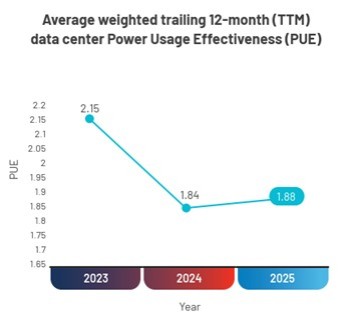
159
Topic | Standard | Information disclosed | Page/Notes |
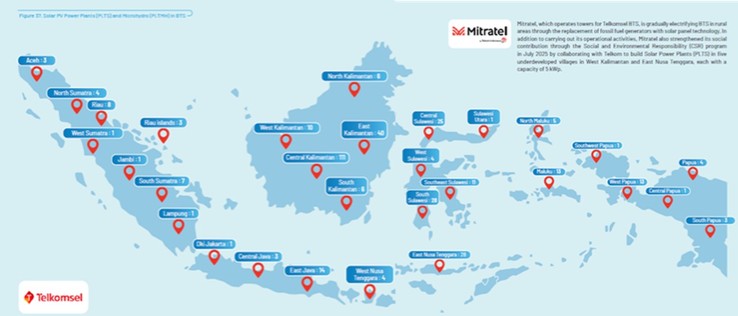
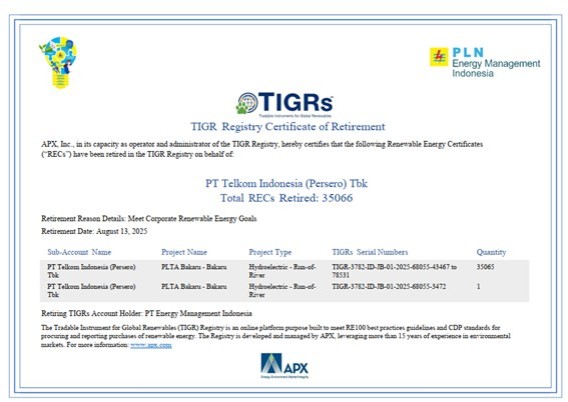
|---|---|---|---|
Managing Systemic Risks from Technology Disruptions | TC-TL-550a.1 | 1. System average interruption duration 2. System average interruption frequency 3. Customer average interruption duration | 1. No measurement was taken 2. p. 126 3. p. 126 |
Competitive behaviour and open internet | TC-TL-520a.1 | Total amount of monetary losses as a result of legal proceedings associated with anti-competitive behaviour regulations | p. 131 |
TC-TL-520a.2 | Average actual sustained download speed of (1) owned and commercially-associated content and (2) non-associated content | Telkom does not make disclosures based on those metrics but only makes disclosures regarding the speed score p. 131 | |
TC-TL-520a.3 | Description of risks and opportunities associated with net neutrality, paid peering, zero-rating, and related practices | Not yet disclosed | |
Data Privacy | TC-TL-220a.1 | Description of policies and practices relating to targeted advertising and customer privacy | Personal Data Protection Guidelines p. 139 |
TC-TL-220a.2 | Number of customers whose information is used for secondary purposes | No calculation has been done for this metric, but how the data is processed and managed is described on p. 142 | |
TC-TL-220a.3 | Total amount of monetary losses as a result of legal proceedings associated with customer privacy | p. 140 | |
TC-TL-220a.4 | 1. Number of law enforcement requests for customer information 2. Number of customers whose information was requested 3. Percentage resulting in disclosure | TelkomGroup does not make disclosures unless required for law enforcement purposes | |
Data Security | TC-TL-230a.1 | 1. Number of data breaches 2. Percentage that are personal data breaches 3. Number of customers affected | p. 140 |
TC-TL-230a.2 | Description of approach to identifying and addressing data security risks, including use of third-party cybersecurity standards | p. 143 |
Internet Media & Services Industry
Topic | Standard | Information disclosed | Page/Notes |
|---|---|---|---|
Environmental Footprint of Hardware Infrastructure | TC-IM-130a.1 | 1. Total energy consumed 2. Percentage of electricity network purchased 3. Percentage renewable | pp. 73-74 |
TC-IM- | 1. Total water withdrawn 2. Total water consumed *Percentage of each in regions with High or Extremely High Baseline Water Stress | 1. p. 66 2. Monitoring has not been conducted Telkom disclosed the percentage of assets exposed to High and Extremely High Baseline Water Stress on p. 66 |
160
Topic | Standard | Information disclosed | Page/Notes |
|---|---|---|---|
130a.2 | |||
TC-IM-130a.3 | Discussion of the integration of environmental considerations into strategic planning for data center needs | p. 54 | |
Data Privacy & Freedom of Expression | TC-IM-220a.1 | Description of policies and practices relating to targeted advertising and user privacy | Personal Data Protection Guidelines p. 139 |
TC-IM-220a.2 | Number of users whose information is used for secondary purposes | No calculation has been done for this metric, but how the data is processed and managed is described on p. 142 | |
TC-IM-220a.3 | Total amount of monetary losses as a result of legal proceedings associated with user privacy | p. 142 | |
TC-IM-220a.4 | 1. Number of law enforcement requests for user information 2. Number of users whose information was requested 3. Percentage resulting in disclosure | TelkomGroup does not make disclosures unless required for law enforcement purposes | |
TC-IM-220a.5 | List of countries where core products or services are subject to government required monitoring, blocking, content filtering, or censoring | p. 140 | |
TC-IM-220a.6 | Number of government requests to remove content, percentage compliance with requests | TelkomGroup does not remove content unless required for law enforcement purposes. TelkomGroup’s media and communication ethics are described on p. 133 | |
Data Security | TC-IM-230a.1 | 1. Number of data breaches 2. Percentage that are personal data breaches 3. Number of users affected | p. 140 |
TC-IM-230a.2 | Description of approach to identifying and addressing data security risks, including use of third-party cybersecurity standards | p. 143 | |
Employee Recruitment, Inclusion & Performance | TC-IM-330a.1 | Percentage of employees that require a work visa | 14% of Telin’s employees require a work visa |
TC-IM-330a.2 | Employee engagement as a percentage | p. 82 | |
TC-IM-330a.3 | Percentage of (1) gender and (2) diversity group representation for (a) executive management, (b) non-executive management, (c) technical employees, and (d) all other employees | pp. 118-124 | |
Intellectual Property Protection & Competitive Behaviour | TC-IM-520a.1 | Total amount of monetary losses as a result of legal proceedings associated with anti-competitive behaviour | p. 131 |
161
Topic | Standard | Information disclosed | Page/Notes |
|---|---|---|---|
regulations |
162
Appendix 6. Disclosure Index Based on IFRS S1 and S2/PSPK 1 and 2
The following indices focus on disclosures related to climate risks and opportunities guided by IFRS S1 and S2/PSPK 1 and 2, unless otherwise stated. The page presented refers to the Telkom Sustainability Report 2025.
Disclosure Requirements | Page/Notes |
Governance | Sustainability Governance Framework (pp. 25-31) – covering climate and beyond climate Climate governance (p. 47) |
Strategy | |
Risks and opportunities | Managing Sustainability Risks and Opportunities (pp. 38-40) Climate-related Risks and Opportunities (pp. 57-60) |
Business model and value chains | Climate-related Risks and Opportunities (pp. 57-60) |
Strategy and decision-making | Climate-related Risks and Opportunities (pp. 57-60) Decarbonization Strategy (pp. 52-57) |
Financial position, financial performance and cash flow | Financial Impact Assessment (pp. 61-62) Environmental Costs (p. 71) |
Resilience | Climate Scenario Analysis (pp. 57-60) Towards Climate-Resilient Telecommunications Services (p. 62) |
Risk Management | Managing Sustainability Risks and Opportunities (pp. 38-40) – covering climate and beyond climate |
Metrics and targets | |
Metrics | TelkomGroup’s GHG Emission Performance (pp. 73-75) Environmental Performance (pp. 72-75) Appendix 7. GHG Emission Calculation Method (pp. 164-165) |
Targets | TelkomGroup Sustainability Targets 2030 (p. 41) Decarbonization Strategy (pp. 52-57) |
Target-setting approach and assumptions | Appendix 8. GHG Emission Reduction Target-Setting Methodology (p.166) |
163
Appendix 7. GHG Emission Calculation Method
[GRI 102-5,102-6,102-7, 305-1, 305-2, 305-3]
The calculation of GHG emissions Scope 1,2, and 3 follows the GHG Protocol Corporate Accounting & Reporting Standard. The consolidation process is based on an operational control approach.
GHG emissions | Method | Exception |
|---|---|---|
Scope 1 | Emissions include: a. Fuel for the genset b. Fuel for the company's operational vehicles c. Sewage Treatment Plant d. Refrigerants used in air conditioning systems in office buildings, facilities, and motor vehicles e. CO2 fire extinguisher | - |
Scope 2 | Indirect emissions from electricity purchased from the State Electricity Company (PLN) are calculated using the location-based method. | - |
Scope 3 | ||
Categories 1 and 2 | Emissions related to purchased products and services are calculated using the following methods: a. Average-based method b. Spend-based method | |
Category 3 | Emissions from other fuel purchases are recorded in the internal business management system | |
Categories 4 and 9 | Emissions generated from transportation and distribution in upstream and downstream processes by third parties | |
Category 5 | Emissions from waste generated by the company's operational activities are calculated using the waste-type specific method | |
Category 6 | Emissions from business travel are calculated using the distance-based method | |
Category 7 | Emissions from employee commuting between homes and worksites | |
Categories 8 and 13 | Emissions from asset leasing (upstream and downstream) are calculated using the average-data method | |
Category 11 | Emissions from total electricity consumption from the use of the product produced | |
Category 12 | Emissions from waste disposal and the treatment of sold products | |
Category 15 | Emissions from investments, calculated based on investment emissions data or emissions based on economic activity | |
164
References: | |
Source of emission factors: | ● IPCC Guidelines for National Greenhouse Gas Inventories (2006) (Intergovernmental Panel on Climate Change) ● IPCC Sixth Assessment Report (AR6) (Intergovernmental Panel on Climate Change) ● DEFRA (2023) (UK Department for Environment, Food & Rural Affairs) ● Annex 4 Guidelines for Calculating and Reporting Greenhouse Gas Inventories of the Directorate General of Electricity in the Energy Sector - Sub-Sector of Electricity (2018) (Ministry of Energy and Mineral Resources) ● Inventory of GHG Emissions in the Energy Sector (2020) (Ministry of Energy and Mineral Resources) ● Electricity Emission Factors of the Ministry of Energy and Mineral Resources (2019) (Ministry of Energy and Mineral Resources) ● Fuel Oil and Coal Emission Factors of the Ministry of Energy and Mineral Resources (2023) (Ministry of Energy and Mineral Resources) ● Exiobase and Climatiq (Consortium proxies and Artificial Intelligence-driven data providers) |
Source of Global Warming Potential (GWP): | ● IPCC Sixth Assessment Report (AR6) (Intergovernmental Panel on Climate Change) |
Source of Net Calorific Value (NCV): | ● Annex 4 Guidelines for Calculating and Reporting Greenhouse Gas Inventories of the Directorate General of Electricity in the Energy Sector - Sub-Sector of Electricity (2018) (Ministry of Energy and Mineral Resources) ● Electricity Emission Factors of the Ministry of Energy and Mineral Resources (2019) (Ministry of Energy and Mineral Resources) ● Fuel Oil and Coal Emission Factors of the Ministry of Energy and Mineral Resources (2023) (Ministry of Energy and Mineral Resources) ● IPCC Guidelines for National Greenhouse Gas Inventories (2006) (Intergovernmental Panel on Climate Change) |
Sources of Methane Producing Capacity and Methane Correction Factor (MCF): | ● 2019 Refinement to the 2006 IPCC Guidelines for National Greenhouse Gas Inventories (2019) (Intergovernmental Panel on Climate Change) ● Methodology for Calculating GHG Emissions in the Waste Treatment Sector of the Ministry of Environment and Forestry (2012) (Ministry of Environment and Forestry) |
165
Appendix 8. GHG Emission Reduction Target-Setting Methodology
[GRI 102-1, 102-4, 305-5]
In line with Indonesia's commitment to reduce GHG emissions through the Nationally Determined Contribution (NDC), TelkomGroup sets targets and commitments to manage GHG emissions from the company's operational activities in a gradual and measurable manner, as follows:
| - | Achieving a 20% reduction in TelkomGroup's Scope 1 and 2 GHG emissions by 2030 compared to the base year 2023, which is determined based on TelkomGroup's internal capabilities and growing good practices in the telecommunications industry. |
| - | Achieving net zero emissions by 2060 or sooner, in line with the Government of Indonesia's commitment. |
GHG emission reduction targets are established using an operational performance-based approach combined with benchmarking of industry practices, taking into account the company's operational readiness, the current state and availability of technologies, telecommunications industry best practices, and alignment with national policy direction aimed at achieving NZE 2060.
TelkomGroup has developed a Scope 1 (excluding biogenic emissions) and Scope 2 (market-based) decarbonization pathway by identifying key decarbonization initiatives tailored to subsidiaries' business models, and building upon estimated potential emission reduction from both completed and planned action plans. The emission reduction trajectory is projected using reasonable operational assumptions, such as an average electricity consumption intensity of 7.5 MWh per worker per year for office buildings, based on the Energy Intensity Assessment (EIA) benchmark, and an emission factor of 0.87 tCO₂e/MWh for the Java grid. Furthermore, these assumptions and key initiatives are aligned with the evolving technological advancements, energy market trends, and national policies to ensure the transition pathway remains relevant and feasible.
This Climate Transition Plan will be continuously refined based on the insights from its implementation. Additionally, significant changes in business activities, including but not limited to mergers, acquisitions, or divestments, may impact TelkomGroup's progress toward achieving its climate targets. In such cases, TelkomGroup will update the GHG inventory in accordance with GHG Protocol reporting standards and adjust the pathways and targets to reflect the new circumstances.
166
Appendix 9. Association Memberships
[OJK C.5] [GRI 2-28]
No. | National | Participants |
|---|---|---|
1. | Indonesian Telematics Society (MASTEL) | Telkom, Telkomsat, Metra, Infomedia, AdMedika, Mitratel, Telkomsel, Telin |
2. | Telecommunication Traffic Clearing Association (ASKITEL) | Telkom, Telkomsel |
3. | Indonesian Internet Network Operators Association (APJII) | Telkom, Telkomsat, Metra, Telkomsel |
4. | Indonesian Telecommunication Association (ATSI) | Telkom, Telkomsel |
5. | Indonesia Telecommunication Users Group (IDTUG) | Telkom |
6. | Indonesian Money Transfer Operators Association (APPUI) | Telkom, Finnet, Telkomsel |
7. | Indonesian Payment System Association (ASPI) | Telkom, Finnet, Telkomsel |
8. | Association of SKKL Organizers of All Indonesia (ASKALSI) | Telkom, Telin |
9. | Indonesia Mobile Content Association (IMOCA) | Telkom |
10. | Indonesian Private Television Association (ATVSI) | Telkom |
11. | Indonesian Satellite Association (ASSI) | Telkom, Telkomsat |
12. | Internal Supervisory Unit Communication Forum (FKSPI) | Telkom |
13. | Association of Indonesian National Construction Implementers Association (GAPENSI) | Graha Sarana Duta, Telkomsat, Mitratel |
14. | Membership of Green Building Council Indonesia (GBCI) | Graha Sarana Duta |
15. | Membership of the Association of Indonesian Real Estate Companies (REI) | Graha Sarana Duta |
16. | Association of Indonesian Construction Partners Association (GARANSI) | Graha Sarana Duta |
17 | Association of Indonesian Security Services Business Entities (ABUJAPI) | Graha Sarana Duta |
18. | Indonesian Association of Cleaning Service Companies (APKLINDO) | Graha Sarana Duta |
19. | Chamber of Commerce and Industry (KADIN) | Telkom, Graha Sarana Duta, Telkomsat, Infomedia, Nutech, AdMedika, Bosnet, Swadharma Sarana Informatika (SSI), Telkomsel |
20. | Indonesian Building Maintenance Association (APBI) | Graha Sarana Duta |
21. | Indonesian Electricity Contractors Association (AKLINDO) | Graha Sarana Duta |
22. | Association of Building Management of State-Owned Enterprises (APG BUMN) | Graha Sarana Duta |
23. | Indonesia Cyber Security Forum (ICSF) | Telkom |
24. | Indonesian Business Incubator Association (AIBI) | Indigo Creative Nation |
25. | National Association of Telecommunications Companies (APNATEL) | Telkom, Telkom Akses |
26. | Association of Electrical Mechanical Engineering Companies (APTEK) | Nutech, Swadharma Sarana Informatika (SSI) |
27. | Association of Indonesian Computer and Telematics Procurement Companies | Nutech, Infomedia, Swadharma Sarana Informatika (SSI), Telkomsat |
167
No. | National | Participants |
|---|---|---|
(ASPEKMI) | ||
28. | Indonesian Employers Association (APINDO) | Infomedia |
29. | Indonesian Outsourcing Business Association (ABADI) | Infomedia |
30. | Indonesia Contact Center Association (ICCA) | Infomedia |
31. | Indonesian Cloud Computing Association | Sigma |
32. | Indonesian Data Center Association (IDPRO) | Sigma |
33. | Association of PMOI (Project Management Office Professional Indonesia) | Sigma |
34. | Association of Indonesian Security Services Business Entities (ABUJAPI) | Swadharma Sarana Informatika (SSI) |
35. | Association of Indonesian Cash Processing Services Companies (APJATIN) | Swadharma Sarana Informatika (SSI) |
36. | Association of Indonesian Telematics Companies and Consultants (ASPEKTI) | Swadharma Sarana Informatika (SSI) |
37. | Association of Distributors, Agencies and Industry Trading Companies (ARDIN) | Swadharma Sarana Informatika (SSI), Telkomsat |
38. | Fintech Association (AFTECH) | Finnet, Telkomsel |
39. | Indonesian E-Commerce Association (idEA) | Finnet |
40. | Association of Indonesian Islamic Economists (IAEI) | Telkom |
41. | Sharia Economic Community (MES) | Telkom |
42. | Young SOEs | Telkom |
43. | SOE Digital Forum (FORDIGI) | Telkom |
44. | Indonesian Collaborative Research and Industrial Innovation in AI (KORIKA) | Telkom |
45. | Indonesian Human Capital Forum (FHCI) | Telkom |
46. | Telecommunication Tower Developers Association (ASPIMTEL) | Mitratel |
47. | Association of Telecommunication Network Operators (APJATEL) | Mitratel (2024) |
48. | Indonesian IoT Association (ASIOTI) | Telkomsel |
49. | Indonesian Issuers Association (AEI) | Telkom, Mitratel |
50. | Indonesian Construction Services Association (HJKI) | Telkom Akses |
51. | Indonesian Institute of Accountants (IAI) | Telkom |
52. | Indonesia Corporate Secretary Association (ICSA) | Mitratel |
53. | Cyber Defense Indonesia (CDEF ID) | Telkom, Telkomsel |
54. | Association of National Construction Contractors (ASPEKNAS) | Graha Sarana Duta |
55. | Association of Electrical Mechanical Engineering Companies (APTEK) | Graha Sarana Duta |
56. | Indonesia Business Council for Sustainable Development (IBCSD) | Telkom |
57. | BUMN Enterprises Social & Environmental Responsibility Forum (CSR) | Telkom |
168
| International | Participants |
1. | International Telecommunication Union (ITU) | Telkom |
2. | International Telecommunications Satellite Organization (ITSO) | Telkom |
3. | International Telecommunications Satellite (INTELSAT) | Telkom |
4. | International Marine / Maritime Satellite (INMARSAT) | Telkom |
5. | Asia Pacific Telecommunication (APT) | Telkom, Telkomsel |
6. | Asia Pacific Economic Cooperation (APECTEL) | Telkom |
7. | TM Forum | Telkom, Telkomsel |
8. | ASEAN CIO Association (ACIOA) | Telkom |
9. | Wireless Broadband Alliance (WBA) | Telkom |
10. | The Institute of Certified Management Accountants | Telkom |
11. | Asia-Pacific Satellite Communications Council (APSCC) | Telkomsat |
12. | Asia Pacific Network Information Centre (APNIC) | Telkomsel |
13. | Bridge Alliance | Telkomsel |
14. | Global System for Mobile Communications Association (GSMA) | Telkomsel |
15. | PMO Global Alliance (PMOGA) | Sigma |
16. | Pacific Telecommunications Council (PTC) | Telin |
17. | Mobile Ecosystem Forum (MEF) | Telin |
18. | International Cable Protection Committee (ICPC) | Telin |
19. | The ITW Global Leader's Forum (GLF) | Telin |
20. | Executive Global Network (EGN) | Telin |
21. | Information Systems Audit and Control Association (ISACA) Chapter Indonesia | Telkom |
22. | Global Information Assurance Certification (GIAC) Advisory Board | Telkom |
23. | International Information System Security Certification Consortium (ISC2) | Telkom |
24. | International Association of Privacy Professionals (IAPP) | Telkom |
169

171

172

173

175
[OJK G.2]
FEEDBACK ON PT TELKOM INDONESIA (PERSERO) TBK'S 2025 SUSTAINABILITY REPORT
Thank you for taking the time to read this Sustainability Report. As part of our efforts to improve the content of next year's reporting, we kindly invite you to provide feedback by answering a few questions below.
Questions
| 1. | In your opinion, this Sustainability Report provided useful information about the various activities carried out by PT Telkom Indonesia (Persero) Tbk. |
SS | S | RR | TS | STS |
| 2. | In your opinion, the material in this Sustainability Report, including the data and information presented, is easy to understand and comprehend. |
SS | S | RR | TS | STS |
| 3. | In your opinion, the material in this Sustainability Report, including the data and information presented, is comprehensive enough, covering all sustainability issues. |
SS | S | RR | TS | STS |
| 4. | In your opinion, the material in this Sustainability Report, including the data and information presented, is reliable for decision-making. |
SS | S | RR | TS | STS |
Information:
Notes:
SS: Strongly Agree S: Agree RR: Average TS: Disagree STS: Strongly Disagree
| 5. | In your opinion, what information presented in this Sustainability Report do you find useful? |
a. …………………………………………………………………………………………………………………...........……
b. …………………………………………………………………………………………………………………………………
c. ………………………………………………………………………………………………………………………………….
| 6. | In your opinion, what information presented in this Sustainability Report do you find less useful? |
a. ………………………………………………………………………………………………...........………………………
b. …………………………………………………………………………………………………………………………………
c.………………………………………………………………………………………………………………………………….
| 7. | In your opinion, how do you find the appearance of this Sustainability Report in terms of content, design, layout, and the included photographs? |
a. ………………………………………………………………………………………………...........………………………
b. …………………………………………………………………………………………………………………………………
c. ………………………………………………………………………………………………………………………………….
| 8. | In your opinion, what information do you feel is lacking and should be included in future Sustainability Reports? |
a. ………………………………………………………………………………………………...........………………………
b. .………………………………………………………………………………………………………………………………
c. ………………………………………………………………………………………………………………………………….
Your Profile
Full Name: ………………………………………………………………………
Age and Gender: ............ Yr M / F (cross out the irrelevant)
Institution/Company: ………………………………………………………………………………
Type of Institution/Company: GovernmentIndustry Media
LSMCommunityOther
For returning the form and other matters related to the Sustainability Report, please submit them to:
Sustainability Function Unit
PT Telkom Indonesia (Persero) Tbk
The Telkom Hub, Telkom Landmark Tower II, Floor 39
Jl. Jend Gatot Subroto Kav. 52, Jakarta, Indonesia, 12710
Tel: (62-21) 521 5109
Fax: (62-21) 522 0500
email: sustainability@telkom.co.id
website: www.telkom.co.id
176
Glossary | Description |
|---|---|
4G/LTE | Fourth-generation internet network technology based on the Internet Protocol (IP) for fast and stable data transfer. |
5G | The fifth generation of mobile communication with high speed, low latency, and massive device connectivity. |
AI (Artificial Intelligence) | Artificial intelligence; a computer program designed to think and complete tasks by recognizing data patterns. |
B2B | Business-to-Business is a model of selling products or services between companies/businesses. |
B2C | Business-to-Customer is a model of service or selling goods/services directly to individual consumers. |
Big Data | A collection of data in very large and complex amounts that is generated very quickly. |
BUMN | BUMN is a company that is owned or established by the Government for commercial activities. |
CAGR | Compound Annual Growth Rate is the average annual growth rate on an investment over a certain period. |
Cyber Security | Efforts to protect information and systems from digital attacks that disrupt the confidentiality and integrity of data. |
Data Center | Computing infrastructure facilities for collecting, processing, storing, and distributing large-scale data. |
Digital Ways of Working BISA (Bravery, Integrity, Service Excellence, dan Agility ) | A digital work behavior framework that supports the acceleration of TelkomGroup's digital transformation. |
ERM | Enterprise Risk Management is a systematic approach to managing risk at all levels of the company. |
ESG | Environmental, Social, and Governance are criteria for environment, social, and governance in measuring a company's sustainability. |
Fiber Optic | Optical fiber cable that uses laser technology to transmit data through thin glass filaments. |
GHG / GRK | Greenhouse Gas or Gas Rumah Kaca is a gas in the atmosphere (such as CO2, methane) that traps heat and causes global warming. |
GraPARI | Physical customer service center for Telkomsel network users. |
GRI | The Global Reporting Initiative is a sustainability reporting standard that focuses on the economic, environmental, and social impacts of an organization on its stakeholders, using an impact-based approach. |
IFRS S1 | International Financial Reporting Standards General Requirements for Disclosure of Sustainability-related Financial Information (IFRS S1) is a sustainability disclosure standard that sets out general requirements for disclosing information related to financially material sustainability risks and opportunities, covering aspects of governance, strategy, risk management, as well as metrics and targets. |
IFRS S2 | International Financial Reporting Standards Climate-related Disclosures (IFRS S2) is a disclosure standard that specifically regulates information related to climate change risks and opportunities, including their impact on strategy, business models, financial performance, as well as climate-related metrics and targets. |
IoT | The Internet of Things is a concept of physical objects that are connected to the internet and are able to exchange data with each other. |
IPCC | The Intergovernmental Panel on Climate Change is an institution that provides regular scientific assessments to policymakers regarding the impacts, risks, and mitigation options of climate change to provide information for international climate negotiations. |
ISSB | The International Sustainability Standards Board is a body under the auspices of the IFRS in creating and developing financial reporting standards related to sustainability to meet investors' needs for sustainability reporting. |
OHS | Occupational Safety and Health is a protection system to prevent accidents and |
177
Glossary | Description |
|---|---|
diseases in the workplace. | |
Mbps | Megabit per second is a unit of measurement for the speed of digital data transmission per second. |
NDC | Nationally Determined Contributions are a country's commitment to reducing greenhouse gas emissions nationally. |
NGFS | The Network for Greening the Financial System is a global central bank network to accelerate environmentally friendly finance (green finance). |
NZE | Net Zero Emission is a balanced condition between the emissions produced and the emissions absorbed back from the atmosphere. |
OJK | The Financial Services Authority is an independent institution that oversees all financial services activities in Indonesia. |
PSPK 1 | Pedoman Standar Pelaporan Keberlanjutan 1 which regulates the general principles for the preparation and presentation of sustainability information, including governance aspects, strategy, risk management, and financially relevant performance. |
PSPK 2 | Pedoman Standar Pelaporan Keberlanjutan 2, which specifically regulates disclosures related to climate change, includes climate risks and opportunities, transition strategies, as well as related metrics and targets. |
SASB | The Sustainability Accounting Standards Board is a sustainability reporting standard that guides companies to disclose financially material ESG risks and opportunities to investors in 77 industries. |
Scope 1, 2, 3 | GHG emissions categorization; Scope 1 (direct), Scope 2 (purchased energy), and Scope 3 (supply/value chain) |
SDGs | The Sustainable Development Goals are 17 global UN goals for sustainable development until the year 2030. |
SSP | Shared Socio-economic Pathways are scenarios for projecting global socio-economic changes related to climate impacts. |
TCFD | The Task Force on Climate-related Financial Disclosures is a task force that provides a framework for disclosing financial risks due to climate change. |
CSR | Social and Environmental Responsibility is the ethical commitment of companies/SOEs to economic and social development. |
TLT | Telkom Landmark Tower is the operational headquarters office building of Telkom Indonesia in Jakarta. |
WBS | The Whistleblowing System is a confidential complaint system regarding alleged ethical violations or fraud. |
Witel | Telecommunication Area is a unit for geographic operational division within Telkom. |
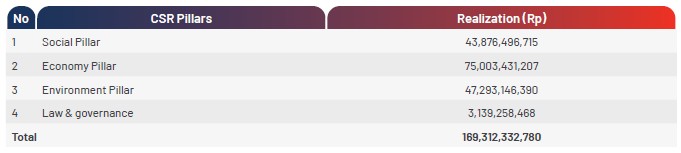
178