

NiCE 2026 Proxy Statement Opening
NiCE is a global enterprise software leader, delivering mission-critical AI-powered cloud platforms that serve two main markets: Customer Engagement and Financial Crime and Compliance. Our platforms are designed to
automate complex, high-volume, and highly regulated workflows where reliability, security, and measurable outcomes are essential.
Our passion is to create a NiCE world where experiences feel seamless, intelligent, and personal — where businesses do more than react. They anticipate, assist, and elevate every moment. Trusted by more than 25,000
organizations in over 150 countries, including 85 of the Fortune 100, NiCE's platforms connect people, systems, and workflows to work smarter at scale.
In the Customer Engagement market, our CXone platform enables enterprises to automate customer service at scale — orchestrating workflows, AI, and human agents within a single, unified platform. Purpose-built AI
ensures every interaction is intelligently orchestrated across all customer touchpoints, seamlessly blending autonomous agentic AI and human-assisted interactions to deliver service that is proactive, knowledge-based, resolution-oriented, and
efficient. A pivotal milestone in 2025 was the acquisition of Cognigy, the global leader in conversational and agentic AI, which combines advanced conversational AI capabilities with CXone — unifying human-assisted engagement, autonomous
self-service, and agentic orchestration on a single data foundation. NiCE also transforms the criminal justice system through its Public Safety and Justice business, using AI to uncover the truth in digital evidence and helping police, prosecutors,
courts, and correctional institutions manage evidence more efficiently.
In the Financial Crime and Compliance market, we protect financial services organizations with embedded AI solutions that identify risks to help prevent money laundering and fraud, and ensure real-time regulatory
compliance. Through machine learning, behavioral analytics, generative AI, and agentic AI, we help institutions detect suspicious activity, automate routine tasks, and proactively adapt to an evolving threat landscape.
Our competitive strength rests on deep domain expertise, purpose-built AI platforms, a broad partner ecosystem and a disciplined financial foundation. In 2025, NiCE delivered $2.9 billion in total revenue, with cloud
revenue growing 13% year over year, AI and self-service ARR reaching $328 million — up 66% — and free cash flow of $623 million. We also accelerated our buyback program and repurchased $489 million of shares. NiCE is uniquely positioned — with the
platform, the data, the domain expertise, and the financial foundation — to define the next era of AI-driven customer experience and capitalize on the significant opportunity ahead in 2026 and beyond.

NICE LTD.
______________________________________________________
NOTICE OF 2026 SPECIAL GENERAL MEETING OF SHAREHOLDERS
______________________________________________________
______________________________________________________
TO BE HELD ON MAY 28, 2026
Notice is hereby given that the 2026 Special General Meeting of Shareholders (the “Special General Meeting” or the “Meeting”) of NICE Ltd. (the “Company” or “NiCE”) will be held on Thursday, May
28, 2026, at 15:00, at the offices of the Company, 13 Zarchin Street, Ra’annana, Israel. The following items will be voted upon at the Meeting:
| 1. |
To approve the Company's Compensation Policy for executive officers and directors;
|
| 2. |
To approve the CEO Compensation Terms.
|
Approval of matters 1 and 2 will require the affirmative vote of a majority of the shares present, in person, by proxy or by electronic voting, and voting on the matter; provided that either the shares voted in favor, excluding abstentions, of such resolutions include a majority of the shares voted by shareholders who are
not “controlling shareholders” and do not have a "personal interest" in such matter pursuant to the requirements and as defined under the Israeli Companies Law, 5759-1999, as amended, and the regulations
promulgated thereunder (the “Israeli Law” or “Companies Law”) or that the total number of shares voted by shareholders who are not “controlling shareholders” and do not
have a "personal interest" in such matter, that were cast against such resolutions, do not exceed two percent of the aggregate voting rights in the Company. Please see the description under each of Items
1 and 2, on Page No. 5 and Page No. 23, respectively, for an explanation as to who may be considered a controlling shareholder or may have a personal interest in the vote under each such resolution in accordance with the Companies Law.
Shareholders of record at the close of business on April 30, 2026, are entitled to notice of and to vote at the Meeting. All such shareholders are cordially invited to attend the Meeting in
person.
Whether or not you plan to attend the Meeting, you are urged to promptly complete, date and sign the enclosed proxy and to mail it in the enclosed envelope, which requires no postage if mailed in
the United States.
If your shares are held via the Company’s Israeli registrar for trading on the Tel Aviv Stock Exchange Ltd. (“TASE”), you should deliver or mail (via registered mail) your completed proxy to the
offices of the Company at 13 Zarchin Street, Ra’annana, Israel, Attention: Alon Levy, Vice President, General Counsel and Corporate Secretary, together with a proof of ownership (ishur baalut), as of the
record date issued by your broker or TASE member who holds the shares on your behalf. You may receive the proof of ownership certificate in the branch of the broker or TASE member or by mail to your address (in consideration of mailing fees
only), if you so request. Such a request will be made in advance for a particular securities account. Alternatively, you may vote ordinary shares of the Company electronically via MAGNA, the electronic voting system of the Israel Securities
Authority (the “ISA”), up to 48 hours before the time fixed for the Meeting. You should receive instructions about electronic voting from your broker or TASE member.
i
Return of your proxy does not deprive you of your right to attend the Meeting, to revoke the proxy or to vote your shares in person.
Joint holders of shares should take note that all notices to be given to the shareholders shall, with respect to any share to which persons are jointly entitled, be given to whichever of such
persons is named first in the Register of Shareholders of the Company, and any notice so given shall be sufficient notice to the holders of such share, and furthermore, pursuant to Article 26(d) of the Articles of Association of the Company (the
"Articles"), the vote of the senior holder of the joint shares who tenders a vote, in person or by proxy, will be accepted to the exclusion of the vote(s) of the other joint holder(s). For this purpose, seniority will be determined by the order
in which the names stand in the Register of Shareholders of the Company.
The above proposals are described more fully in the enclosed Proxy Statement, which we urge you to read in its entirety. Eligible shareholders may present proper proposals for inclusion in the
Meeting by submitting their proposals to the Company within 7 days of this Notice. For more information about shareholder proposals, please see Article 18 of the Articles. Should changes be made to any proposal after the mailing of this Proxy
Statement, we will communicate the changes to our shareholders through the publication of a press release, a copy of which will be filed with the U.S. Securities and Exchange Commission (the "SEC") on a Report of Foreign Private Issuer on Form
6-K and with the ISA.
Pursuant to the Articles, a proxy will be effective only if it is received by the Company at least 48 hours prior to the time of the Meeting, or such shorter period as
may be determined by the Board of Directors of the Company (the “Board”) or pursuant to the authorization of the Board, or in the case of shareholders voting ordinary shares of the Company electronically via MAGNA (as described above) at least 48
hours before the Meeting.
|
|
By Order of the Board,
Alon Levy
Vice President, General Counsel and Corporate Secretary
Date: April 23, 2026
|
ii
|
2026 SPECIAL GENERAL MEETING
OF SHAREHOLDERS
Table of Contents
|
| 1 |
|
| 3 |
|
| 4 |
|
| 5 |
|
| 23 |
NICE LTD.
13 Zarchin Street, Ra’annana, Israel
________________________
PROXY STATEMENT
________________________
________________________
2026 SPECIAL GENERAL MEETING OF SHAREHOLDERS
This Proxy Statement is furnished to the holders of record of ordinary shares or American Depositary Shares (or “ADSs”) (collectively, the “Shares”) of NICE Ltd. (“NiCE” or the “Company”) at the
close of business on April 30, 2026, in connection with the solicitation by the Board of Directors of the Company (the “Board”) of proxies for use at the 2026 Special General Meeting of the Shareholders (the “Special General Meeting” or the
“Meeting”), or at any adjournment thereof, pursuant to the accompanying Notice of Special General Meeting of Shareholders. The Meeting will be held on Thursday, May 28, 2026, at 15:00, at the offices of the Company, 13 Zarchin Street, Ra’annana,
Israel.
A form of proxy for use at the Meeting and a return envelope for the proxy are enclosed. If your shares are held via the Company’s Israeli registrar for trading on the Tel Aviv Stock Exchange Ltd. (“TASE ”), you
should deliver or mail (via registered mail) your completed proxy card to the offices of the Company at 13 Zarchin Street, Ra’annana, Israel, Attention: Alon Levy, Vice President, General Counsel and Corporate Secretary, together with a proof
of ownership (ishur baalut), as of the record date issued by your broker or TASE member. You may receive the proof of ownership certificate in the branch of your broker or the TASE member or by mail to
your address (in consideration of mailing fees only), if you so request. Such a request will be made in advance for a particular securities account. Alternatively, you may vote ordinary shares of the Company electronically via MAGNA, the
electronic voting system of the Israel Securities Authority (the “ISA”), up to 48 hours before the time fixed for the Meeting. You should receive instructions about electronic voting from your broker or TASE member.
Shareholders may revoke the authority granted by their execution of proxies before the effective exercise thereof by filing with the Company a written notice of revocation or duly executed proxy
bearing a later date, or by voting in person at the Meeting. However, if a shareholder attends the Meeting and does not elect to vote in person, his or her proxy will not be revoked. Unless otherwise indicated on the form of proxy, if a proxy is
properly executed and received by the Company prior to the Meeting, Shares represented by the proxy will be voted in favor of all the matters to be presented at the Meeting, as described above. If a shareholder on the form of proxy makes a
specification, the Shares represented thereby will be voted in accordance with such specification. On all matters considered at the Meeting, abstentions of a holder of Shares will be treated as neither a vote “for” nor “against” the matter,
although they will be counted in determining if a quorum is present.
1
Under the terms of the Deposit Agreement among the Company and JP Morgan Chase Bank, N.A., as Depositary (the “Depositary”), and the holders of the Company’s ADSs, the Depositary shall endeavor
(insofar as is practicable and in accordance with the applicable law and the Company’s Amended and Restated Articles of Association (the “Articles”)) to vote or cause to be voted the number of Shares represented by ADSs in accordance with the
instructions provided by the holders of ADSs to the Depositary. If no instructions are received by the Depositary from any holder of ADSs with respect to any of the Shares represented by the ADSs evidenced by such holder’s receipts on or before
the date established by the Depositary for such purpose, the Depositary will not exercise any discretion in voting the Shares represented by ADSs.
Pursuant to the Articles, a proxy will be effective only if the Company receives it at least 48 hours prior to the time of the Meeting, or such shorter period as may be determined by the Board or
pursuant to the authorization of the Board, or in the case of shareholders voting electronically via MAGNA (as described above) at least 48 hours before the Meeting.
For information relating to the compensation of our five most highly compensated office holders with respect to the year ended December 31, 2025, please see "Item 6. Directors, Senior Management
and Employees – B. Compensation – Individual Compensation of Covered Executives" in our Annual Report for the year ended December 31, 2025 on Form 20-F, which was filed with the U.S. Securities and Exchange Commission (the “SEC”) on February 26,
2026 (the "Annual Report").
2
RECORD DATE; OUTSTANDING VOTING SECURITIES; VOTING RIGHTS;
QUORUM; SHAREHOLDER PROPOSALS, BOARD AUTHORITY
QUORUM; SHAREHOLDER PROPOSALS, BOARD AUTHORITY
Only shareholders of record at the close of business on April 30, 2026, will be entitled to notice of and to vote at the Meeting and any adjournments or postponements thereof. On April 19, 2026,
the Company had 74,774,827 issued Shares, out of which 58,442,987 are outstanding and 16,331,840 are treasury shares held by the Company. Discussion at the Meeting will be commenced if a quorum is present.
Two or more persons, each being a shareholder, a proxy for a shareholder or a representative of a corporation, holding together Shares conferring in the aggregate at least 25% of the voting power of the Company, present in person or by proxy and
entitled to vote, will constitute a quorum at the Meeting. For this purpose, abstaining shareholders shall be deemed present at the Meeting. If a quorum is not present within half an hour of the time designated for the Meeting, the Meeting will
be adjourned to June 4, 2026, at the same time and place. At the adjourned Meeting, any two shareholders who are present in person or by proxy, or who have delivered a proxy card, will constitute a quorum.
In accordance with the Israeli Companies Law, 5759-1999, as amended, and the regulations promulgated thereunder (the “Israeli Law” or “Companies Law”) and the Articles, any shareholder of the Company holding at
least one percent of the outstanding voting rights of the Company for the Meeting may submit to the Company a proposed additional agenda item for the Meeting, provided that it is appropriate to discuss such item at the Meeting. Notwithstanding
the foregoing, as a company listed on an exchange outside of Israel and pursuant to the Articles and applicable law, a matter relating to the appointment or removal of a director may only be added, following the request of one or more
shareholders holding at least 5% of the outstanding voting rights of the Company, to the agenda of an annual general meeting of our shareholders. Therefore, such a matter may not be added to the agenda of this Meeting. Any eligible shareholder
may submit a proposed additional agenda item (other than an agenda item relating to the appointment or removal of a director) to the Company’s offices at 13 Zarchin Street, Ra’annana, Israel, Attention: Alon Levy, Vice President, General
Counsel and Corporate Secretary, no later than April 30, 2026. To the extent that there are any additional agenda items that the Board determines to add as a result of any such submission, the Company will publish an updated agenda and proxy
card with respect to the Meeting, no later than 7 days after the last date to propose an item, May 7, 2026, which will be furnished to the SEC on a Report of Foreign Private Issuer on Form 6-K, and will be made available to the public on the
SEC’s website at http://www.sec.gov and in addition at http://www.magna.isa.gov.il or http://maya.tase.co.il.
In special circumstances prescribed by the Companies Law, and subject to certain conditions, the Board may approve certain proposals related to compensation or the compensation policy, even if
the general meeting of shareholders has voted against the approval of such resolutions, provided that the Company’s compensation committee, and thereafter the Board, each determines, based on detailed arguments and after having reconsidered the
matter, that approving such proposals is in the best interest of the Company.
3
The following table sets forth, as of the dates specified below, the number of Shares owned beneficially by all persons known to us to beneficially own more than 5% of the Company’s outstanding
Shares.
|
Name
|
Number of Shares
|
Percent of Shares
Beneficially Owned (1)
|
|
Harel Insurance Investments & Financial Services Ltd.
|
3,160,790 (2)
|
5.4%
|
|
Principal Global Investors, LLC (“PGI” doing business as Principal Asset
Management)
|
4,695,504 (3)
|
8.0%
|
__________________________________________________________________________
| (1) |
Based upon 58,442,987 ordinary shares issued and outstanding as of April 19, 2026.
|
| (2) |
The information is based upon Schedule 13G filed with the SEC by Harel Insurance Investments & Financial Services Ltd. ("Harel Insurance") on February 4, 2026. The address of Harel Insurance is 3 Aba Hillel Street, Ramat Gan 52118,
Israel. Pursuant to the Schedule 13G, Harel Insurance has shared voting power over 3,095,994 ordinary shares and shared dispositive power over 3,160,790 ordinary shares. Of the 3,160,790 ordinary shares beneficially owned by Harel
Insurance, (i) 3,095,994 ordinary shares are held for members of the public through, among others, provident funds and/or mutual funds and/or pension funds and/or insurance policies and/or exchange traded funds, which are managed by
subsidiaries of Harel Insurance, each of which subsidiaries operates under independent management and makes independent voting and investment decisions, and (ii) 64,796 ordinary shares are held by third-party client accounts managed by a
subsidiary of Harel Insurance as portfolio managers, which subsidiary operates under independent management and makes independent investment decisions and has no voting power in the securities held in such client accounts.
|
| (3) |
The information is based upon a letter provided by PGI to the Company, dated March 18, 2026. According to the letter, the shares reported are owned by accounts under the investment management of PGI, which is acting on behalf of
various clients. Some of these clients, pursuant to advisory contracts, provide the power to PGI to vote their shares at its own discretion (i.e. without specific written instructions).
|
4
COMPENSATION DISCUSSION AND APPROVAL OF COMPENSATION POLICY
Background
Pursuant to the Israeli Companies Law, 5759-1999, as amended (the "Israeli Companies Law"), we are required to adopt a policy governing the compensation
of the Company's executive officers and directors (each, an "Office Holder") (the "Compensation Policy"). In general, the Compensation Policy approval process required under the Israeli Companies Law, is a recommendation for approval by the Compensation Committee, and an approval by our Board of Directors and then by our
shareholders by a special majority of shareholders (as described below).
The Compensation Policy shall be reviewed periodically by the Compensation Committee and the Board to assess its continued adequacy and shall be resubmitted for approval and reapproved in
accordance with the above-mentioned approval process at least once every three years. Our current Compensation Policy was approved by our shareholders at our 2023 annual general meeting. Additionally, at our 2024 annual general meeting, our
shareholders approved updates to our current Compensation Policy with respect to executive equity award caps and performance mix.
Pursuant to the Israeli Companies Law, the Company's Compensation Policy serves as the framework for decisions concerning the terms of employment or engagement of executives and directors, and is
based upon certain principles, namely advancement of the Company’s objectives, business plan and long-term strategy, and the creation of appropriate incentives for our Office Holders. The Compensation Policy defines the principles, guidelines,
and rules that reflect the Company’s compensation philosophy for its Officer Holders and sets limits for executive compensation, including certain caps on the maximum value of compensation.
As a leading global provider of purpose-built AI-powered platforms, with an extensive worldwide presence and many of its executives (including the Chief Executive Officer or "CEO") residing in
the US, the Company must maintain compensation frameworks and practices that are competitive with the compensation practices of its global peers.
The Company’s current Compensation Policy is set to expire on July 17, 2026. Prior to its renewal, the Compensation Committee and Board of Directors engaged Frederic W. Cook & Co. (“FW
Cook”) to conduct a comprehensive executive compensation analysis, to provide for a competitive compensation framework. This allowed our Compensation Committee and Board to evaluate the executive compensation practices of our relevant peers in
order to determine the appropriate authority required for our Compensation Committee and Board under the Compensation Policy.
Compensation Discussion and Analysis
This compensation discussion and analysis describes our executive compensation practices. For information relating to each of our directors and executive officers and their
background, see our Annual Report.
2025 Business Highlights
Major Acquisition - In September 2025, NiCE completed its approximately $1 billion acquisition of Cognigy, demonstrating NiCE’s commitment to its transformation to an AI-focused company. Cognigy received the sole Customers’
Choice in Gartner’s 2025 Peer Insights Voice of the Customer for Enterprise Conversational AI Platforms.
5
AI Adoption – AI was included in 100% of our new seven-figure CXone deals in 2025.
2025 Financial Highlights
We achieved the following key financial results in 2025, demonstrating durable growth with expanding profitability:
|
Metric
|
FY 2025 Results GAAP(1)
|
Year-over-Year Change GAAP
|
FY 2025 Results Non-GAAP(1)
|
Year-over-Year Change Non-GAAP
|
|
Total Revenue
|
$2,945M
|
+8%
|
$2,945M
|
+8%
|
|
Cloud Revenue
|
$2,238M
|
+13%
|
$2,238M
|
+13%
|
|
Operating Income
|
$646M
|
+18%
|
$908M
|
+7%
|
|
Operating Margin
|
21.9%
|
190 bps
|
30.8%
|
(20 bps)
|
|
EPS
|
$9.67
|
+43%
|
$12.30
|
+11%
|
|
Recurring Revenue
|
$2,644M
|
9%
|
$2,644M
|
9%
|
(1) See Exhibit A for a reconciliation of each non-GAAP measure to the most directly comparable GAAP measure.
Company Overview and Recent Performance
NiCE is a global leader in purpose-built AI-powered cloud platform, serving over 25,000 customers in more than 150 countries, including over 85% of the Fortune 100. The Company has approximately 10,000 employees
worldwide and over 3,500 R&D professionals. NiCE was named Gartner’s Leader in the Magic Quadrant for Contact Center as a Service (CCaaS) for the 11th consecutive year.
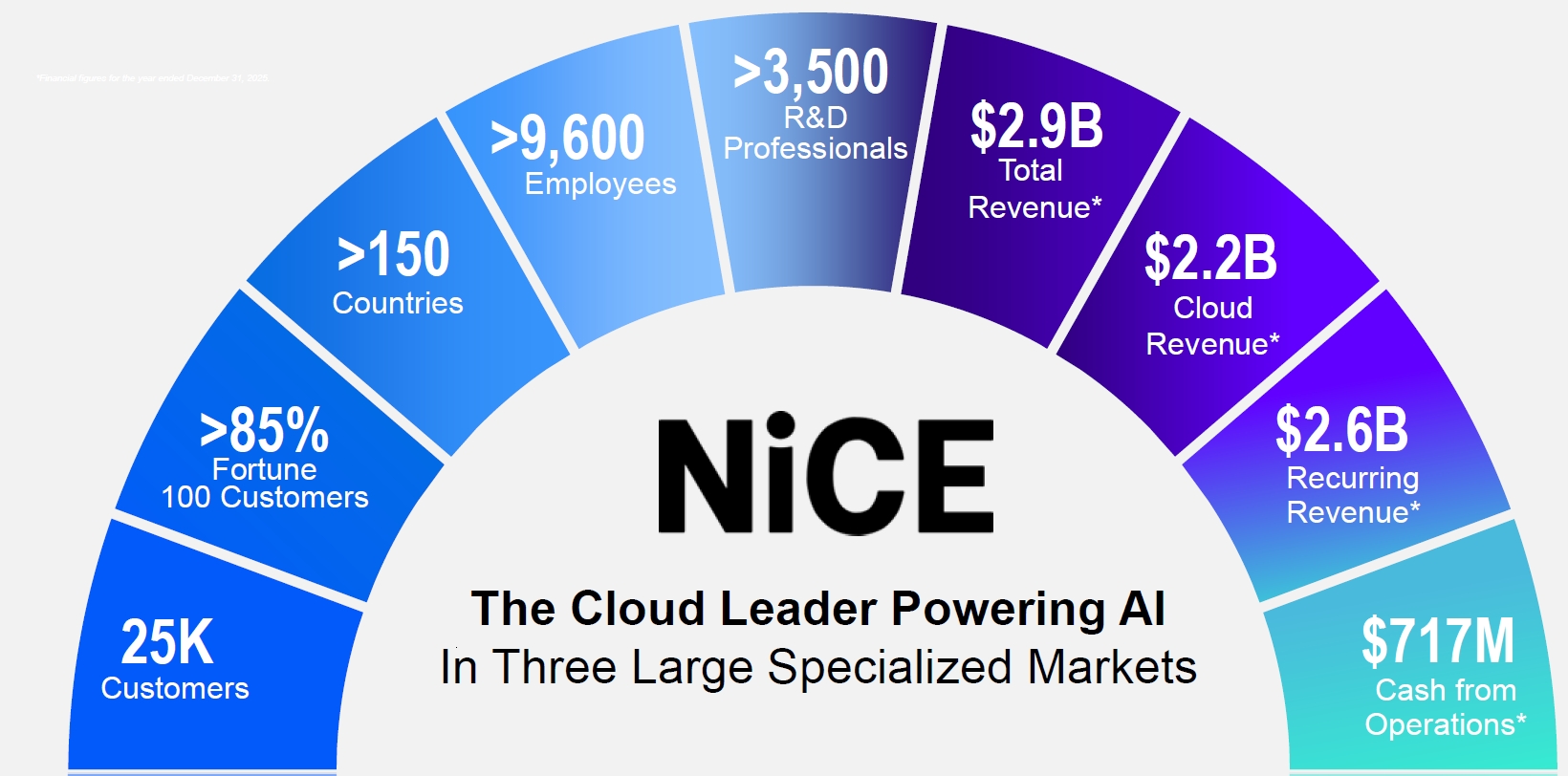
* Financial figures for the year ended December 31, 2025.
6
Company’s Continued Growth during Last Five Years
Over the period from 2021 to 2025, the Company achieved significant multi-year growth across all key financial metrics:
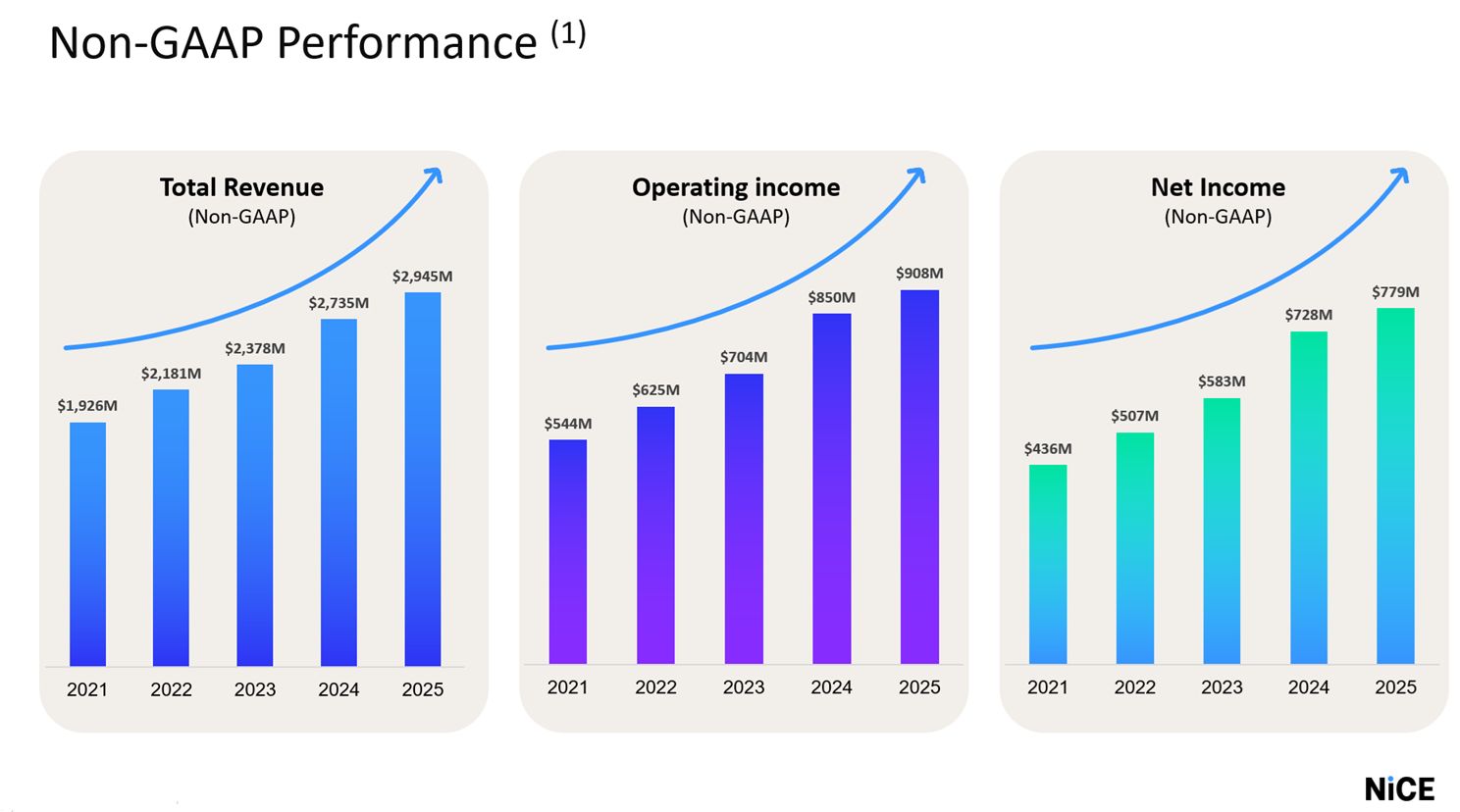
(1) See Exhibit A for a reconciliation of each non-GAAP measure to the most directly comparable GAAP measure.
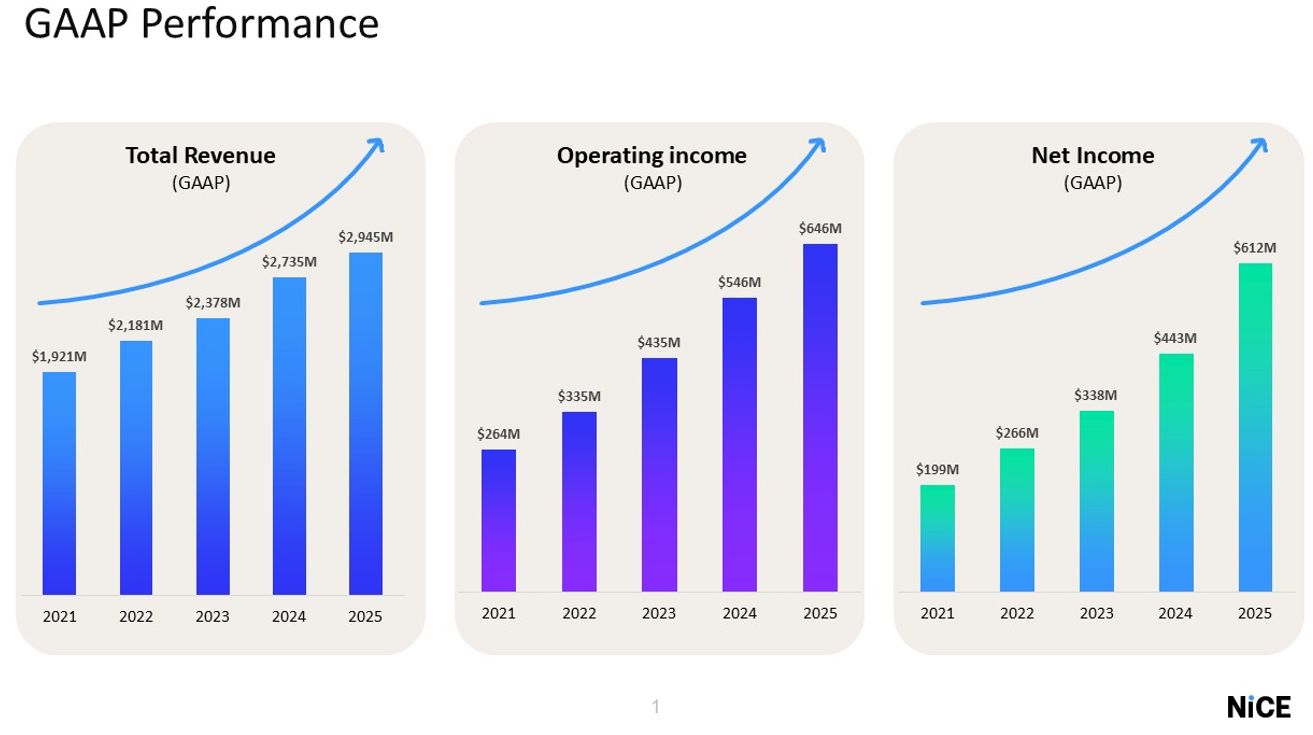
7
Look back to last renewal of Compensation Policy
|
Non-GAAP 2025 v 2022
|
GAAP 2025 v 2022
|
|
|
Total Revenue
|
35% |
35%
|
|
Operating Income
|
45%
|
93%
|
|
Net Income
|
54%
|
230%
|
Corporate Governance
We devote considerable time and resources to ensure (i) we have an effective corporate governance structure; (ii) we operate in a way that is honest, ethical and transparent; and (iii) our
corporate and compensation policies reflect our values and business goals and are aligned with the benefit of the company and the interests of our shareholders.
Corporate Governance Practices and Compensation
We maintain a high level of corporate governance practices. In relation to executives’ and directors’ compensation, we maintain governance practices and policies that our Board believes help
advance our goals and protect the interests of our shareholders. Accordingly, our Compensation Committee is comprised solely of independent directors, includes at least three members of our Board, and, per Israeli law requirements, includes all
the statutory external directors and excludes the chairman of the Board. All our Board members are non-executive directors determined to be "independent" pursuant to both Nasdaq listing rules and the Israeli Companies Law.
We adopted a Compensation Policy that sets the framework and requirements relating to Office Holders’ compensation, and we review this policy at least once every three years, including a review
of peer group comparable data. We believe that the practices we adopted reflect best practices in relation to executive compensation, stressing long-term incentives and pay for performance, and maintaining very reasonable compensation levels in
alignment with shareholders’ interests.
8
|
Key Compensation Principles
|
|
✔ Review of the Compensation Policy at
least annually to ensure its compliance with applicable laws and regulations, market practices, and its conformity with the Company’s targets and strategy.
|
|
✔ Completely independent Compensation
Committee comprising of at least three members.
|
|
✔ Executive compensation that balances
performance targets and time horizons through rewarding business results, long-term performance and strategic decisions.
|
|
✔ Regular review of executive
compensation and peer data.
|
|
✔ Significant objective performance-based
variable compensation of executives.
|
|
✔ Vast majority of CEO compensation is
performance based, with annual and long-term incentive targets based on objective performance measures.
|
|
✔ Cap on annual equity-based compensation
for both our Board members and executives.
|
|
✔ Cap on annual cash bonus payments for
our executives.
|
|
✔ Executive annual equity grant must
comprise of at least 50% performance-based criteria.
|
|
✔ Double-trigger requirement for
acceleration of executive equity awards upon change of control or corporate transaction.
|
|
✔ Commitment to maintaining dilution
levels below 10% threshold.
|
|
✔ Prohibition on short sales by executive
officers and members of the Board.
|
|
✔ Forfeiture and claw-back policy.
|
|
✔ At least 20% of executive equity awards
tied to relative Total Shareholder Return (rTSR) performance metrics.
|
Compensation Philosophy and Objectives
We believe that the quality, skills, experience and dedication of our executives are critical factors affecting our performance and the creation of shareholder value. Accordingly, the key
objectives of our executive compensation program are to attract, retain and motivate superior executive talent in a competitive global talent market, while maintaining a disciplined cost structure.
In addition, we seek to implement a “pay-for-performance” philosophy by designing our executive compensation program to link a substantial portion of our executives’ target total direct
compensation to the achievement of financial and strategic performance objectives that directly correlate to key Company objectives and the long-term enhancement of shareholder value. The Compensation Committee and the Board believe that the
compensation paid to our executives should be closely aligned with our corporate performance on both a short-term and long-term basis, linked to specific, measurable results, and that such compensation should assist us in motivating and retaining
the key executive officers critical to our long-term success while ensuring an appropriate focus on both operational objectives and the creation of long-term shareholder value.
9
Given the size and complexity of our business, measured by both revenue and headcount, each member of the Executive Leadership Team (“ELT”) carries significant responsibilities. Decisions and
performance at this level have a significant direct impact on (i) significant revenue streams, cost structures, and (ii) a large population of employees whose day-to-day work, engagement, and retention are shaped by leadership priorities and
resource allocation. Because ELT roles set objectives, approve budgets, and establish execution plans that cascade through the organization, even incremental differences in ELT effectiveness can affect business outcomes, including growth,
profitability, compliance posture, and the company's ability to attract and retain talent. For these reasons, we aim to hire ELTs with leadership skills and experience commensurate with the scale of the responsibilities and the magnitude of the
potential organizational and financial consequences.
Each year, at the beginning of the year and following the Company's definition of its business plans for the year, the Compensation Committee and the Board conduct a merit review for our ELTs and
determine the annual equity awards to be granted to each ELT, as well as the performance metrics for performance-based equity awards, and review whether any cash merit increase is appropriate. In addition, the Compensation Committee and the Board
define the objectives for the MBO plan for such year and review and approve the results of the prior year's MBO.
Maintaining Conservative Dilution Levels
Limiting the dilution from share-based compensation is a key consideration for our board. We believe that the Company has been very conservative and cautious with respect to maintaining low
levels of dilution in relation to its share-based compensation plans, also maintaining a net burn rate and total cost of equity that are significantly below median levels, all as further detailed below.
Compensation Recovery ("Clawback") Policy
Effective October 2, 2023, we adopted a policy requiring recoupment of any excess cash or equity-based incentive compensation paid to our current and former directors and officers where the
payments were predicated upon the achievement of financial results that were subsequently restated. This clawback policy is intended to comply with the Nasdaq listing standards as required under the final rules adopted by the SEC implementing
Section 10D of the Exchange Act and insures accountability of our directors and executives for any such financial restatement.
Role of Independent Compensation Consultant and Peer Group Update
The Compensation Committee has the authority to retain the services of external advisors, including compensation consultants. As part of the Compensation Committee’s ongoing review of the
Company’s compensation framework, and in support of 2026 pay decisions and disclosure, the Compensation Committee engaged FW Cook to conduct an independent comprehensive review of the Company’s executive compensation program, including a review
of the peer group used for compensation benchmarking. FW Cook provides advice to the Compensation Committee regarding market practices and trends, pay levels, and program design, including the structure and competitiveness of base salary, annual
incentive opportunities, long-term incentive design and mix, equity grant practices and levels, share usage and related governance considerations, as well as other matters as requested by the Compensation Committee. The Compensation Committee and
the Board retain full discretion and responsibility for executive compensation decisions.
10
More specifically, the review included:
| • |
Recommended updates to the Company’s compensation peer group.
|
| • |
A competitive market analysis of executive officer cash and equity compensation.
|
| • |
A comprehensive benchmark analysis of the Company’s compensation levels and compensation practices relative to the updated peer group.
|
| • |
Recommendations on our equity strategy, including an assessment of the Company’s dilution levels and equity burn rate relative to peers.
|
Competitive Positioning – 2026 Peer Group
In setting and reviewing the compensation of our executive officers, our Compensation Committee considers, among other things, the compensation practices and pay levels of similarly situated
executives at companies in our peer group, informed by a review of publicly available proxy statements, annual reports and other market data regarding comparable executive officer positions. In doing so, the Compensation Committee uses
benchmarking as one input to provide market context, to inform pay positioning and to support internal and external pay competitiveness, but benchmarking does not, by itself, determine compensation outcomes. The Compensation Committee also
considers other relevant factors, such as:
|
-
|
market trends in executive compensation and incentive design;
|
|
-
|
the mix and weighing of compensation elements (including the balance of fixed and variable pay and cash and equity incentives);
|
|
-
|
individual and Company performance;
|
|
-
|
pay-for-performance alignment;
|
|
-
|
internal pay equity and organizational considerations, scope of role and responsibilities;
|
|
-
|
leadership capabilities and experience, and other qualitative and quantitative factors it deems relevant;
|
|
-
|
executive tenure and succession considerations; and
|
|
-
|
attraction related considerations when attracting executives and retention risk for existing executives.
|
The peer group study (the “Peer Group Study”) is comprised of global, publicly traded software technology companies which the Compensation Committee believes are generally
comparable to the Company in terms of industry, business profile, revenues, operating income, number of employees and market capitalization. In selecting and periodically evaluating the peer group, the Compensation Committee also considers
additional factors designed to enhance comparability and the usefulness of the peer group as a market reference point, which may include industry sector and competitive landscape, growth profile, customer base and end markets, number of
employees and operational complexity, geographic footprint, business model and revenue mix (including the degree of recurring revenue), profitability, product and service offerings, and the executive talent markets in which the Company
competes.
11
In February 2026, the Compensation Committee reviewed and updated our compensation peer group to better reflect NiCE's current size and positioning and the executive talent market in which it
competes, to recognize our evolving business focus, and to account for acquisitions of former peer companies. The companies in this updated peer group were selected on the basis of their similarity to us, based on the following criteria:
|
-
|
similar revenue size - ~0.4x to ~1.6x our last four quarters' revenue of approximately $2.9 billion (approximately $1.1 billion to approximately $4.8 billion);
|
|
-
|
similar market capitalization - ~0.2x to ~5x our market capitalization of approximately $6.916 billion as of December 31, 2025 (approximately $1.6 billion to approximately $34.2
billion);
|
|
-
|
Industry - enterprise SaaS companies, mostly in the cloud industry;
|
|
-
|
Number of employees - ~0.2x to ~1x our employees’ quantity of approximately 8,726 (as of the last annual report (2,051 employees to 8,726 employees);
|
|
-
|
competitors for executive talent.
|
2026 Peer Group
The peer group the Compensation Committee considered for 2026 compensation is set forth below (the “2026 Peer Group”):
|
Zoom Video Communications, Inc.
|
Pegasystems, Inc.
|
|
Paylocity Holding Corporation
|
PTC, Inc.
|
|
Five9, Inc.
|
RingCentral, Inc.
|
|
Guidewire Software, Inc.
|
MongoDB, Inc.
|
|
Hubspot, Inc.
|
Check Point Software Technologies Ltd.
|
|
Okta, Inc.
|
Paycom Software, Inc.
|
|
Dolby Laboratories, Inc.
|
DocuSign, Inc.
|
|
Dropbox, Inc.
|
Klaviyo, Inc.
|
The Compensation Committee reviews the peer group periodically and makes adjustments as necessary. Specifically, for fiscal 2026, we made the following changes to our peer group: three companies
were removed from our peer group: Fair Isaac Corporation, Fiserv, Inc., and Snowflake Inc. These companies were removed due to outlier market capitalization and/or revenue levels.
Five companies were added: DocuSign Inc., Dropbox Inc., Klaviyo Inc., Paylocity, and Dolby Laboratories Corporation - because they meet our selection criteria and represent competitors for
talent. All new peer companies have market capitalization and revenue levels comparable to NiCE’s, and the updated peer group brings NiCE closer to the median of the peer group for both key size measures, as compared to the prior peer group. The
Compensation Committee expects to continue to review the peer group periodically to help ensure that it remains an appropriate reference point as the Company's business and the market environment evolve.
Below is a summary table of NiCE’s position relative to peer group companies looking at a number of metrics:
12
|
Percentile
|
Revenue ($M)
|
Operating Income ($M)
|
Market Cap - 12-Mo. Avg. 12/31/25
|
Market Cap - On 12/31/25
|
Employees (as disclosed in last Annual Report or proxy statement)
|
|
75th Percentile
|
2,794
|
$498
|
$21,259
|
20,120
|
6,955
|
|
Median
|
2,401
|
$276
|
$13,868
|
11,917
|
5,736
|
|
25th Percentile
|
1,568
|
$59
|
$8,550
|
8,018
|
3,597
|
|
NiCE
|
84P
|
79P
|
33P
|
18P
|
100P
|
In addition to peer company proxy data, FW Cook supplemented the Peer Group Study with third-party executive compensation survey data for certain executive roles that are not consistently
disclosed on a comparable basis across peer proxies, and to provide additional context regarding pay levels, pay mix and prevalent program design practices. The Compensation Committee may consider such supplemental data, along with peer proxy
data, to help evaluate market competitiveness and to inform decisions for specific roles, including where an executive's duties, scope or geographic footprint may not be fully reflected in publicly disclosed peer proxy positions.
Competition for Talent
The Company competes with a peer set of predominantly U.S.-listed enterprise software companies in a fast-paced market environment characterized by aggressive competition over executive talent.
This competition can be particularly pronounced for executives with specialized expertise in enterprise software, cloud and AI-driven solutions, cybersecurity and compliance, global go-to-market leadership, product innovation and platform
strategy, and managing teams across multiple geographies. The Compensation Committee believes that maintaining a peer group that reflects the Company's competitive landscape, together with the use of supplemental survey data where appropriate,
supports the Company's Compensation Policy which would facilitate Company’s ability to attract, motivate and retain highly qualified leaders who can execute the Company's strategy and deliver long-term shareholder value.
As can be seen from our most recent executive hires (as described below), we also compete directly for executive talent with the largest enterprise software companies and need to take into
consideration the compensation practices of such companies for executive talent at the relevant levels, both in terms of cash compensation and equity awards practices.
|
Executive
|
Role
|
Previous Employer
|
|
Scott Russell
|
CEO
|
SAP
|
|
Jeff Comstock
|
President Product and Technology
|
Microsoft
|
|
Arun Chandra
|
COO
|
Disney (previously with Meta)
|
|
Dan Belanger
|
President, NiCE Americas
|
AWS
|
13
Benchmark Analysis
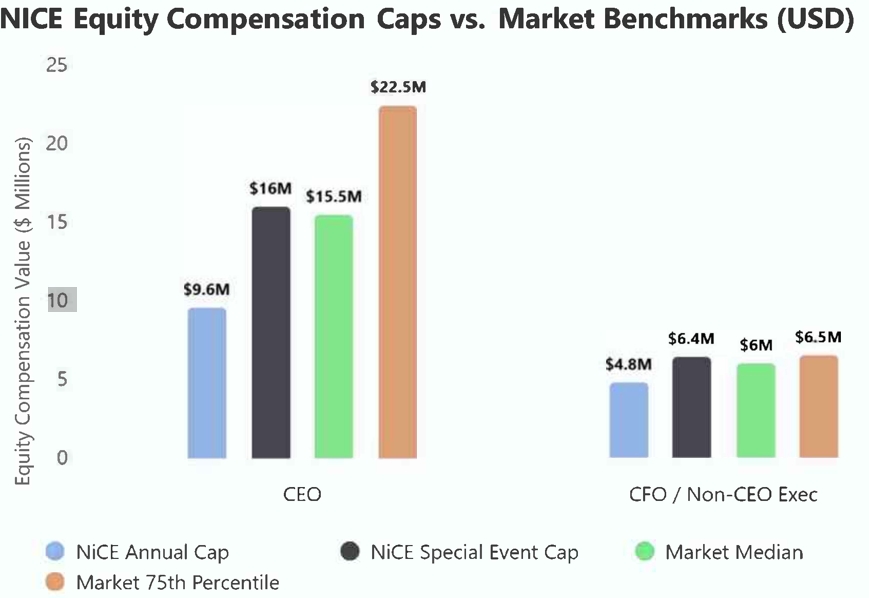
The market analysis and Peer Group Study was used as a reference point for the Compensation Committee and Board to assess the Company’s current compensation levels in the course of its
deliberations on the proposed amendments. The analysis indicates the following positioning of the Company’s current equity caps relative to peer group actual equity award median and 75th percentile levels:
Aligning Policy to Peer Executive Talent Market
As the above data demonstrates, the Company’s current maximum equity caps (based on Company’s current market capitalization) for annual awards is well below the median level of compensation for
CEO’s within our Peer Group as well as for the next highest paid other executive – which means that the Company does not have the authority under the compensation Policy to award regular annual awards within the median range of our Peer Group to
its CEO and to certain executives of the Company.
The equity caps for special events are only slightly higher than the median levels of peer group compensation and do not provide enough authority for further discretion of the Compensation
Committee and the Board or for special events such as hiring or retention awards.
14
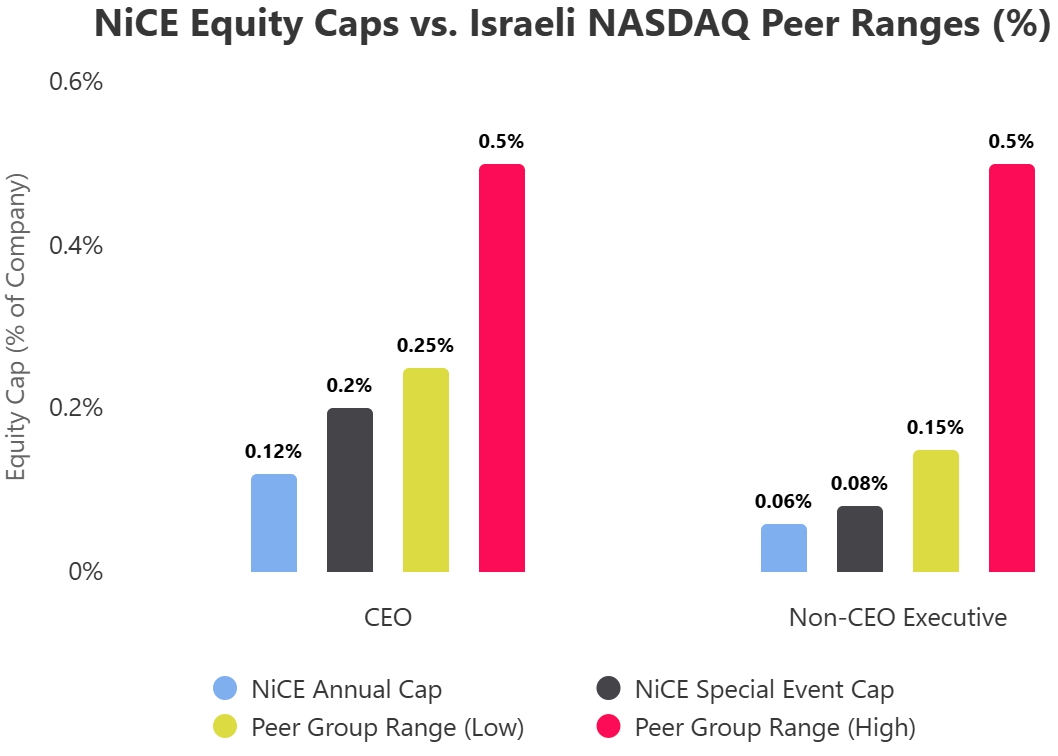
Comparison to Large Global SaaS Israeli Nasdaq Listed Companies
NiCE’s current equity caps are also low relative to comparable Israeli technology companies listed on Nasdaq (under their applicable Compensation Policies), as summarized below 1:
|
Company
|
CEO Dilution
|
ELTs Dilution Cap
|
|
Checkpoint
|
0.30%
|
0.15%
|
|
CyberArk2
|
0.50%
|
0.50%
|
|
Jfrog
|
0.50%
|
0.35%
|
|
Monday
|
0.25%
|
0.187%
|
|
Wix
|
0.40%
|
0.40%
|
|
NiCE – Annual Cap
|
0.12%
|
0.06%
|
|
Cap in Special Circumstances
|
0.2%
|
0.08%
|
|
Proposed New Annual Cap
|
0.25%
|
0.125%
|
|
Proposed New Special Cap
|
0.35%
|
0.175%
|
Compensation Policy under Israeli Companies Law – Imposes Forward Looking Limitations
Unlike most of our Peer Group companies, which are U.S. issuers subject to the “Say on Pay” model, the Company is subject to a more stringent process governed by the Israeli Companies Law, which
requires adoption of a compensation policy that must be approved by Company shareholders at least once every three years. The “Say on Pay” model requires shareholder non-binding advisory vote on compensation practices in retrospect, which is a
tool for shareholders to express their position with respect to compensation, for companies’ consideration. In contrast, the Israeli Companies Law imposes forward-looking binding limitations on the Board’s authority to approve executive
compensation by setting maximum caps for each compensation component. If the Board wishes to approve executive compensation that exceeds a cap under the Compensation Policy, it cannot do so without first obtaining specific shareholder approval,
which is impractical especially when hiring new talent or in the context of mergers and acquisitions. Our competitors are not limited in this manner and may approve executive compensation as their Boards deem to be in the best interests of their
companies. In practice, a majority of the Company’s peers have, on certain special occasions, awarded executives equity-based awards that substantially exceed the median level for equity-based compensation reflected in the Peer Group study.
1 Equity cap levels in the table relate to full value award such as RSUs, where some of the company’s allow a higher level of dilution for options with an
exercise price equal to the market price at time of award.
2 Company acquired in 2026. Data relates to most recent Compensation Policy prior to acquisition.
15
The Compensation Policy sets the framework and limits for executive compensation (rather than actual individual entitlement to compensation) and sets the range of authority the Compensation
Committee and Board have to determine appropriate levels of compensation for each of the Company’s executives within those boundaries. The Compensation Policy caps should provide adequate authority to the Board for granting compensation to even
the most valuable executives including in extra ordinary circumstances, but the actual compensation of each executive and the terms and conditions of his or her employment are governed by such executive’s employment agreement with the Company,
and are determined based on applicable benchmarks.
The Company does not regularly aim for equity awards that are above median levels and review of the Equity award costs indicated in our annual report on Form 20-F show the Company is generally
below median levels. Nevertheless, we believe that our Compensation Policy should allow our Compensation Committee and Board the authority to approve equity awards that are above the median level where they believe it is required and in the best
interest of the Company. Additionally, based on FW Cook’s analysis, hiring awards usually range between 100%-200% of the annual level of equity awards – and the Company should be able to offer or match such level of awards when required.
Company Maintains Conservative Equity Budget
Our Compensation Committee and Board of Directors believe that we maintain reasonable compensation levels in alignment with shareholders’ interests, below the median levels of the peer group
benchmark, and in some respects very low relative to peers.
In addition to reviewing peer compensation levels, the Compensation Committee and Board also review the Company’s equity usage levels relative to the peer group, in terms of share burn rate,
dilution and cost of equity, as each of these measures reflect the extent to which equity compensation is being used, related trends over time and the impact on shareholders. In evaluating equity usage, the Compensation Committee considers both
internal and external context, which may include the Company's overall compensation philosophy and intended mix of pay, the role of equity in attracting and retaining employees, the Company's hiring and retention needs, changes in headcount,
share price volatility and the resulting impact on the number of shares required to deliver targeted grant values, as well as broader equity market practices among peers.
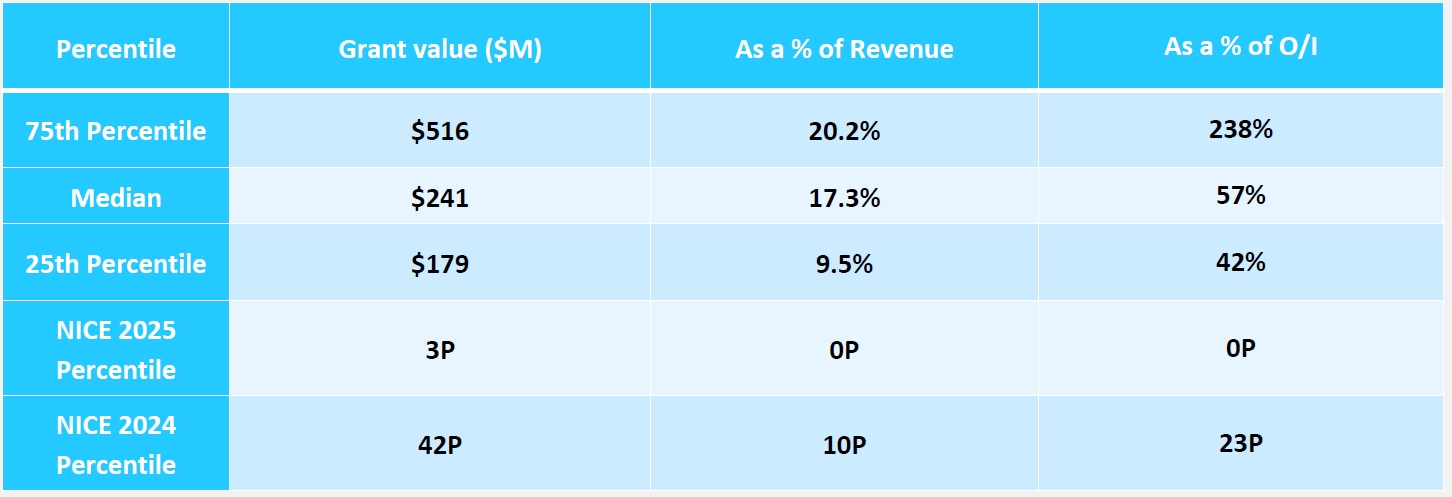
Based on analysis presented to the Compensation Committee, the Company’s equity usage has been very conservative relative to peers. In particular, NiCE awarded approximately $212 million in
company-wide equity grant value in 2024 and is estimated to have granted approximately $118 million in 2025. The analysis indicated that 2024 grant value was approximately at the peer median, while 2025 grant value was among the lowest in the
peer group.
16
The following table summarizes the Company’s equity grant value positioning relative to its peer group:
Share Burn-rate
The Compensation Committee also reviewed share burn rate, which reflects annual equity issuance relative to shares outstanding and provides an important perspective on dilution, equity usage and
the pace of equity issuance over time. The Compensation Committee considers burn rate in conjunction with other equity usage measures and the Company's compensation objectives.
Similarly, the Company’s net share burn rate is well below Peer Group median:
|
75th Percentile
|
3.22%
|
|
Median
|
1.89%
|
|
25th Percentile
|
1.27%
|
|
NiCE – 2024 Percentile
|
1.69%
|
|
NiCE – 2025 Percentile
|
0.9%
|
|
NiCE – 3-year net burn rate
|
1.36%
|
17
Total Dilution Levels
NiCE’s Shares Outstanding dilution remains low. Total dilution for 2026, even assuming 100% share pool utilization, will be approximately 6.68% which is below the
peer group median and even with the new ESPP pool, the dilution level will be 8.15%(1).
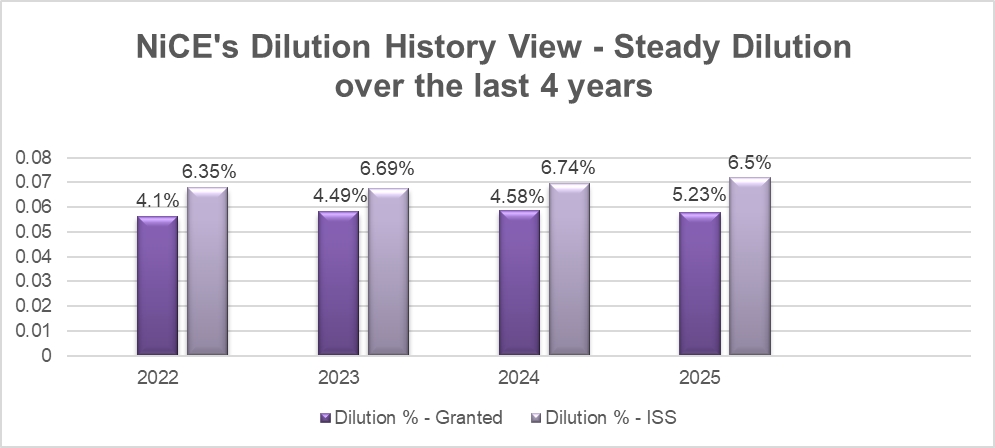
(1) The numbers are based on outstanding shares and equity awards as of April 19, 2026.
Share Repurchase Activity and Net Impact on Share Count
As part of our commitment to managing dilution responsibly, between 2022 and 2025, the Company effected share repurchase programs whereby it has repurchased $145 million in 2022, $288 million in
2023, $369 million in 2024, and $489 million in 2025 of its shares. These repurchases drove a 5.0% reduction in diluted shares outstanding from 2022 to 2025. It is noted that the Company's share repurchase programs have more than offset dilution
from equity issuance.
Introducing Enhanced Pay for Performance-Based Equity Strategy
Move to 50% Performance for Equity Awards
At our 2024 AGM, we amended our Compensation Policy to require that equity awards to our ELTs include a minimum of 50% tied to performance criteria, and we have effectively begun implementing
this enhanced performance requirement in all equity awards to our ELTs in 2025.
Introducing rTSR Performance
Further enhancing our pay-for-performance focus, the updated equity strategy for executives will, as of 2026 (and for our CEO, already implemented in his 2025 equity award), incorporate vesting
criteria that include both Relative Total Shareholder Return (rTSR) and operational performance metrics (PSUs), in line with U.S. market best practices.
|
Component
|
Allocation
|
Vesting
|
Performance Criteria
|
|
|
Time-Based RSUs
|
50%
|
4 years
|
Annual vesting
|
Continued service
|
|
Performance RSUs (PSUs)
|
30 %
|
3 years
|
Annual vesting
|
Year-over-year financial growth objectives
|
|
rTSR Units
|
20%
|
3 years
|
Single cliff after 3 years
|
Relative TSR vs. Software and Services Index
|
18
We believe that this structure holds the Company’s top leaders accountable for NiCE’s operational targets while also closely linking their compensation to long-term shareholder value creation.
The use of rTSR performance criteria enhances transparency and shareholder value alignment by linking a portion of executive payouts to an objective, market-based performance measure that
investors can readily monitor and benchmark, thereby strengthening the connection between realized compensation and relative shareholder value.
Required adjustments to the Current Policy
Executive Equity Award Practices
The vast majority (over 85% in 2025) of the total compensation package provided to the Company’s executives comprises of variable compensation, and particularly equity-based compensation, that is
not guaranteed, and is directly linked to the growth and success of the Company.
Pursuant to the Compensation Policy, equity awards to executive officers are granted subject to the terms of the Company’s equity plan and vest gradually in instalments (usually on an annual
basis) over a period of at least three years (the Company’s practice is to grant equity with four year vesting), with at least a one year cliff, provided that at least 50% of the equity awards granted are subject to performance criteria.
Under our current Compensation Policy, the maximum limits for executive equity awards are set as a dilution threshold at the time of grant, intended to align the maximum value limits of the
awards with the Company's market capitalization, whether adjusting upward or downward. In addition, these dilution caps are subject to an upper and lower absolute value limitation.
Given the Company’s growth over the last five years, its transformation into an AI-focused enterprise, and the increasingly competitive market for executive talent, the Compensation Policy’s
current limitations no longer provide sufficient flexibility to grant appropriately sized, market-level equity awards. The current annual equity caps for the CEO and other executives are below the median benchmark and provide only limited
flexibility above the median, even in special circumstances. This limitation significantly impairs the Compensation Committee’s and the Board’s ability to recruit and retain key executives with relevant industry experience and expertise. In
recent years, the Company has encountered significant challenges in granting equity awards to current and prospective executives due to these limitations, including:
The AI and cloud enterprise software markets are very aggressively competing over key executive talent. Executive hires are highly competitive, with NiCE’s recent executive team members coming
from leading U.S. companies such as SAP, Microsoft, AWS and Disney.
The challenge has intensified over the past two years, as while maintaining strong performance, NiCE’s share price has depreciated, with further recent exacerbation due to fluctuation across the
SaaS enterprise software industry. The reduced share price directly affects the value of the permissible equity caps set in our Compensation Policy.
The Compensation Policy may limit the competitiveness of attraction awards for executive new hires, which typically require significant initial equity incentives, to establish an appropriate equity stake.
Therefore, NiCE is exposed to the risk of losing highly qualified candidates solely because competitors have the flexibility to offer more competitive initial compensation packages within the applicable benchmark range.
19
The introduction by NiCE of performance awards with an earn-out level of units that can range from 0-200% (100% being the target), further reduces the target size of equity awards, given that the
Compensation Policy relates to maximum amounts and requires us to take into account maximum payout, while the probable outcome is target level payout. Accordingly, this further constrains the permissible size of the target level awards.
Proposed Amendments to the Compensation Policy
Based on the above rationales and the Company’s conservative management of its equity budget, the Company proposes to extend the term of its Compensation Policy for a period of three years, with
adjustments to its dilution percentage equity caps to align with peer group compensation practices.
This will allow attracting and retaining top executive talent to drive shareholder value, which the current policy caps no longer effectively afford.
Additionally, in order to limit maximum scenarios given the proposed higher dilution caps, the Company proposes to reduce the absolute maximum value caps for the dilution-based equity caps. The
current absolute value caps set under the Compensation Policy are a maximum market cap of $18 billion and a minimum not to fall below a market cap of $8 billion (the “Value Caps”).
Specific Proposed Changes to Equity Caps
To give effect to the proposed amendments above, the Compensation Committee and the Board have resolved, and the shareholders are being asked at the Meeting to approve, the following amendments
to the Compensation Policy:
(1) CEO Equity Caps:
|
Cap Type
|
Current Cap
|
Proposed at Target Cap
|
Change
|
|
Annual awards
|
0.12% of issued and outstanding share capital
|
0.25% of issued and outstanding share capital
|
+0.13%
|
|
Special circumstances awards
|
0.20% of issued and outstanding share capital
|
0.35% of issued and outstanding share capital
|
+0.15%
|
(2) Other Executive Leadership Team (ELT) Members Equity Caps:
|
Cap Type
|
Current Cap
|
Proposed at Target Cap
|
Change
|
|
Annual awards
|
0.06% of issued and outstanding share capital
|
0.125% of issued and outstanding share capital
|
+0.065%
|
|
Special circumstances awards
|
0.08% of issued and outstanding share capital
|
0.175% of issued and outstanding share capital
|
+0.095%
|
These proposed adjusted caps remain below or comparable to equity caps of comparable Israeli technology companies, as detailed in the Israeli companies listed on Nasdaq comparison table above.
20
(3) Reduce the maximum Value Cap from a market cap of $18 billion to $14 billion.
The Company believes these changes, together with the recent move to a performance-based equity requirement of at least 50%, the introduction of rTSR performance for the executive team and the
enhanced level of disclosure provided in this Proxy Statement with respect to our Compensation practices and our CEO compensation, are appropriate and in the best interest of the Company’s shareholders.
To the extent that the Compensation Policy is approved, the Board has committed, as part of the overall compensation strategy of the Company, to continue to maintain the total dilution resulting
from equity awards under 10% of the Company’s issued and outstanding share capital.
It is proposed that at the Meeting the following resolution be adopted:
“RESOLVED, that the Company’s Compensation Policy described in item 1 of this Proxy Statement and
attached to this Proxy Statement as Exhibit B, be, and is hereby, approved.”
Required Vote
Under the Israeli Law, and subject to limited exceptions prescribed thereby, the approval of the Company’s Compensation Policy requires the affirmative vote of a majority of the shares present,
in person or by proxy or by electronic voting, and voting on the matter; provided that the shares voted in favor of the election include at least a majority of the shares voted by shareholders who are not “controlling shareholders” and do not
have a "personal interest" in such matter, or that the total number of shares voted by shareholders who are not “controlling shareholders” and do not have such a "personal interest" in such matter, that were
cast against such resolutions, do not exceed two percent of the aggregate voting rights in the Company.
For this purpose, a “controlling shareholder” is any shareholder that has the ability to direct the Company’s activities (other than by means of being a director or office holder of the
Company). A person is presumed to be a controlling shareholder if it holds or controls, by himself or together with others, one half or more of any one of the “means of control” of a company. “Means of control” is defined as any one of the
following: (i) the right to vote at a general meeting of a company, or (ii) the right to appoint directors of a company or its chief executive officer.
Under the Israeli Law, a "personal interest" of a shareholder includes a personal interest of any members of the shareholder’s relatives (i.e. spouse, brother or sister, parent,
grandparent, child as well as child, brother, sister or parent of such shareholder’s spouse or the spouse of any of the foregoing) or a personal interest of an entity with respect to which the shareholder (or such relatives) serves as a director
or chief executive officer, owns at least 5% of its outstanding share capital or voting power or has the right to appoint a director or chief executive officer, including the personal interest of a person voting pursuant to a proxy which the
proxy grantor has a personal interest, whether or not the person voting pursuant to such proxy has discretion with regards to the vote. An interest arising solely from the ownership of our Shares is not
considered a "personal interest".
21
We consider it highly unlikely that any of our shareholders is a controlling shareholder or has a relevant personal interest in this Proposal 1. Under the
Israeli Law, every shareholder voting on the proposed resolution is required to notify the Company whether such shareholder is a controlling shareholder or has a personal interest in the proposed resolution. To avoid confusion, as a company whose
securities are listed on an exchange outside Israel, each holder of Shares voting by means of the enclosed proxy card or a voting instruction form, will be deemed to confirm that such shareholder is NOT a controlling shareholder and does NOT have
a relevant personal interest in this Proposal 1. If you are a controlling shareholder or have a relevant personal interest in this proposal (in which case your vote will only count for or against the ordinary majority, and not for or against the
special tally), please notify the Company's Corporate Secretary and General Counsel, at +972-9-775-3777 or Alon.Levy@nice.com or, if you hold your ADSs in "street name," you may contact the representative managing your account, who would then
notify us on your behalf.
The Board recommends a vote FOR the approval of the proposed resolution.
22
APPROVAL OF CEO COMPENSATION TERMS
Executive Summary
Pursuant to the Israeli Companies Law, the compensation terms of our CEO are generally required to be approved by the Compensation Committee, the Board, and the shareholders of the Company. We
are seeking shareholder approval for (i) a three-year framework under which our Compensation Committee and Board may approve variable compensation for our CEO (the "Award Framework"), and (ii) the 2026
annual equity award for Mr. Scott Russell. The proposed CEO compensation terms as described in this Item 2 are in line with the Compensation Policy proposed under Item 1 above. We believe these proposals reflect our commitment to a
performance-driven compensation structure that aligns executive pay with company performance and shareholder value creation, while ensuring competitive compensation levels necessary to attract and retain world-class executive talent in our
industry.
Current CEO – Mr. Scott Russell
Mr. Scott Russell commenced his tenure as Chief Executive Officer of the Company in January 2025.
Mr. Russell brings extensive executive leadership experience from leading Global technology companies, including SAP, where he last served as the Chief Revenue Officer and as a member of the
Executive Board. Mr. Russell's appointment brought deep enterprise software and cloud experience to accelerate our AI-first platform and reflects the Company's strategy of attracting top-tier executive talent
from major global technology companies and its commitment to positioning NiCE as a leader in the AI-powered enterprise platforms market.
On August 15, 2024, we entered into an offer letter with Mr. Scott Russell. Mr. Russell's initial compensation package was established following a thorough benchmarking analysis conducted with the assistance of FW
Cook and reflects the competitive requirements of recruiting a senior executive from a major global technology company. The offer letter also included the amounts and terms of Mr. Russell’s initial equity award.
Key Elements of 2025 CEO Compensation Program
Base Salary
We pay a base salary to our CEO to provide a fixed level of compensation for his services. The Compensation Committee and Board of Directors established base salary for our CEO at
levels that are competitive with those received by individuals in similar positions, based on relevant benchmark information and also, upon hiring, taking into account his previous level of cash compensation.
The annual base salary of our CEO for 2025 was as follows:
|
CEO
|
2025 Base Salary
|
|
Scott Russell
|
$900,000
|
Short-Term Cash Incentive Compensation
We use performance-based cash incentives to motivate our executive officers, including our CEO, to focus on achieving the Company’s financial objectives and other objectives set
by our Board in our annual operating plan. Our Compensation Committee and the Board of Directors believe that our MBO structure is consistent with competitive market practices and is intended to incentivize and reward achievement at or above our
pre-established levels of performance. For our CEO, the MBO is based on at least 80% Company financial objectives, and 20% is tied to specific objectives that may be financial or strategic, which the Compensation Committee and the Board believe
should receive special attention during the applicable financial year.
23
2025 Bonus Program: Target Annual Cash Bonus Opportunities
Per the terms negotiated with our CEO under his employment agreement, the target annual cash bonus opportunities of our CEO will be 120% of our CEO base salary, i.e.
US$1,080,000. The target bonus was set by our Compensation Committee and Board based on pay practices within our then relevant peer group, a review of competitive market practices, and taking into account also our CEO’s target cash levels at
his previous employer, as well as internal pay equity with our other executive officers, all in consultation also with FW Cook.
The following tables show CEO’s target and maximum annual cash bonus opportunity (expressed as a percentage of base salary and as a dollar amount) and the performance target
structure for 2025, and will also apply with no changes for 2026:
|
Annual Target Bonus for 2025
|
Maximum Bonus for 2025
|
|||
|
CEO
|
% of Base Salary
|
Dollar Amount
|
% of Base Salary
|
Dollar Amount
|
|
Scott Russell
|
120
|
1,080,000
|
200%
|
1,800,000
|
|
Name
|
Company Financial Targets Component
Weighting (%)
|
Other Performance Component
Weighting (%)
|
|
Scott Russell
|
80%
|
20%
|
Equity Awards
We provide equity compensation opportunities to our executive officers, including our CEO, to (i) create meaningful long-term incentives that encourage sustained value creation
rather than short-term decision-making, (ii) promote retention by increasing the value of continued service over time through vesting and performance-based realization, and (iii) align executives' financial interests with those of our
shareholders by tying a significant portion of total compensation to share price performance and, with respect to the performance based equity, the achievement of pre-established performance objectives. In addition, we design our equity
compensation program to be competitive with the practices of our compensation peer group and broader market norms, which supports our ability to attract and retain highly qualified leadership in a competitive talent environment. We believe this
approach appropriately balances pay and performance by linking a substantial component of executive compensation to long-term shareholder outcomes, while also providing a compensation structure that is consistent with market practice and
responsive to the strategic and operational demands of our business.
The Compensation Committee and Board of Directors believe that our long-term business objectives are best served by a balanced mix of time-based restricted share units ("RSUs") and performance-based restricted share units. RSUs promote retention and continuity of leadership by requiring continued service over a multi-year period, while also encouraging a long-term orientation
by tying a meaningful portion of compensation to the Company’s stock price over time thereby aligning with our shareholders’ interest. In addition, Performance-based restricted share units, are intended to strengthen pay-for-performance alignment
by conditioning vesting on the achievement of pre-established performance goals that are directly linked to shareholder outcomes.
24
Our RSU awards generally vest over four-year schedules, subject to the recipient’s continued service through each vesting date. This extended vesting horizon is intended to
support leadership stability and to encourage decision-making that prioritizes durable, long-term growth rather than short-term results, because a substantial portion of the award remains unvested for several years. This feature helps ensure that
the CEO remains meaningfully accountable to the long-term consequences of strategic and capital allocation decisions, including investments in innovation, talent, and operational capabilities that may require time to translate into financial
results.
Performance Equity Awards
As of 2025, to strengthen the performance component of our equity awards, we have increased the performance portion of the equity mix to 50% so that the equity-mix for our ELTs,
including our CEO, is 50% time-based RSU awards and 50% performance-based restricted share units. This has grown from a previous mix of 60% time-based and 40% performance-based. This commitment to an increased performance-based equity mix is also
incorporated into our Compensation Policy.
Our CEO’s equity awards that have vesting conditioned upon performance criteria include two types of units, units tied to Company’s relative total shareholder return relative to
the applicable index – (“rTSR Units”), and units subject to Company’s financial performance (“PSUs”). For 2025, 25% of our
CEO’s total equity Awards are PSUs and 25% are rTSR Units. The PSUs vest over 4 years, with a one-year cliff, and the rTSR Units vest after 3 years in a single trigger.
As part of the program introduced for our new CEO, we implemented a new performance plan for 25% of his equity awards that is based on relative total stockholder return ("rTSR")
and features a single vesting cliff after three years. The Compensation Committee and Board selected rTSR because it is a direct measure of stockholder value creation and, importantly, evaluates performance against an external benchmark,
thereby helping to distinguish Company-specific value creation from broader market or sector movements. The three-year cliff vesting feature is intended to reinforce a long-term focus by making the full payout dependent on performance and
continued service over the entire measurement period. This new design strengthens alignment with shareholders’ value by linking a meaningful portion of equity value to the Company’s share performance and also increases transparency for
shareholders, allowing them to evaluate the alignment of the award with the Company’s performance.
2025 Equity Awards
Consistent with NiCE's pay-for-performance philosophy, the 2025 award was structured to provide meaningful at-risk compensation that creates a strong equity stake for Mr. Russell
and to align his interests with shareholder value creation through multi-year vesting tied to sustained strategy execution, performance improvement, and value creation. In evaluating the award, the Board considered the scope of the leadership
transition, the competitive market for chief executive talent, and external compensation practices.
The following table shows the structure of the equity award:
|
Award Type
|
Allocation
|
Vesting Schedule
|
Performance Criteria
|
|
Time-Based RSUs
|
50%
(55,000 Units)
|
4 years
|
Continued service
|
|
PSUs
|
25%
(27,500 Units)
|
4 years
|
Year-over-year financial growth objectives
|
|
rTSR Units
|
25%
(27,500 Units)
|
3-year – single cliff
|
Relative total shareholder return vs. Software and Services Index
|
25
The initial grant of time-based RSUs will vest over a four-year period, with 40% vesting one year after his start date and the remaining 60% vesting in 12 equal quarterly
instalments thereafter; PSUs are tied to the Company’s financial performance objectives for 2025 and also include a four-year time-based vesting schedule identical to the time-based RSUs; and rTSR Units will vest in a single cliff three years
after the grant date, with the number of shares to be earned based on the Company’s relative Total Shareholder Return performance and capped at 150% of the target number of the rTSR Units.
The rTSR Units under the initial equity award are subject to the following performance/payout scale in line with peer group and market practices:
|
Performance Level
|
RTSR Ranking*
|
Percentage of Units Earned (%)
|
|
Below Threshold
|
Below 25th Percentile
|
0%
|
|
Threshold
|
25th Percentile
|
50%
|
|
Target
|
50th Percentile
|
100%
|
|
Maximum
|
75th Percentile
|
150%
|
*Linear interpolation applies between performance levels
Competitive positioning of Initial Equity Award
The FW Cook benchmark analysis (as detailed in Item 1 above) demonstrated that the median CEO equity compensation among the Company's Peer Group was $15.5 million, with the 75th percentile at $22.5 million. The
2025 equity award was valued, when approved, at approximately $17.8 million, which was about 115% of the Peer Group median and about 21% below the 75th percentile. It is noted that initial equity awards intended to build strong
equity stakes for a CEO are usually in a range of 150% to 200% of the annual compensation level, giving a strong indication as to the reasonableness of the size of the initial equity award to our CEO.
Potential Payments upon Termination
Either the Company or the CEO may terminate the CEO’s employment upon six (6) months' prior written notice (the “Notice Period”).
During the Notice Period, the CEO will generally continue to perform services unless the Company directs otherwise. In all cases during the Notice Period, the CEO will remain
entitled to continued Base Salary, equity vesting and benefits and will remain eligible for the MBO bonus for the Notice Period. The Company may elect to end the CEO's active service before the end of the Notice Period; however, unless the CEO is
terminated for Cause, the Company must continue to pay Base Salary and provide benefits and the MBO bonus through the end of the Notice Period. If the CEO is terminated for Cause, the Company may terminate employment immediately, with no Notice
Period or pay in lieu of notice. Following the end of the Notice Period, and only if the CEO executes and does not revoke a mutual separation and release agreement in favor of the Company, the CEO will be entitled to an additional six (6) month
adjustment period (the "Adjustment Period") during which the CEO will (i) not be required to perform services, (ii) have no access to Company premises or systems, and (iii) receive continued Base Salary, vesting and benefits through normal
payroll. The CEO will not accrue vacation and will not be eligible for any MBO bonus during the Adjustment Period.
26
Additionally, under the CEO's employment offer letter, unless the CEO's employment is terminated for Cause, the CEO is entitled, following the end of his employment, to
Company-paid COBRA health insurance coverage for a period of twelve (12) months for himself, his spouse, and eligible dependents (the "COBRA Insurance"). The Company's obligation to pay for the COBRA Insurance will cease if, during such period,
the CEO either (i) ceases to reside in the United States, or (ii) becomes employed and his new employer provides health care coverage to the CEO and his covered family members that is equal to or superior to the COBRA Insurance.
The Equity awards are subject to a double trigger mechanism as set forth in Section 7.4 of the Company’s Share Incentive 2016 Plan.
With respect to rTSR Units, upon an applicable change in control event, rTSR Units are converted into time-vested RSUs where (i) if the change in control occurs during the first
year of the performance period, conversion occurs at the target number of units; and (ii) if the change in control occurs after the first performance year, conversion occurs based on actual rTSR performance through the closing date of the change
in control. The resulting time-vested RSUs (converted from rTSR Units) will continue to vest on their original, pre-scheduled vesting dates and are then subject to accelerated vesting in accordance with the double-trigger mechanism.
Perquisites, Health, Welfare and Other Personal Benefits
The CEO will be eligible for the entire range of benefits available through the Company’s Employee Benefits program subject to amendment from time to time. The health, vision and
dental plans only are available for the CEO and his family as of start date. Other benefits will be subject to plan participation eligibility terms and dates. The Company retains the right to change, add or cease any particular benefit. The CEO
will receive twenty (20) days annual vacation per calendar year. Except to the extent prohibited by applicable state law, any accrued vacation days that remain unused as of: (a) the end of the calendar year shall be forfeited; and (b) the last
day of employment will be forfeited.
Proposed Three-Year CEO Compensation Framework
In line with our prior practice the Company proposes to approve a three-year framework for our Compensation Committee and Board to approve variable compensation for our CEO. Under the proposed framework, our
Compensation Committee and Board may approve annual variable compensation for Mr. Russell during the term of the Award Framework without the need for further approval by the Company's shareholders, provided such compensation is consistent with
the terms of such framework (the “Compensation Framework”). Any compensation approved by our Compensation Committee and Board under the Compensation Framework should also be consistent with the terms of
the Compensation Policy, which sets a maximum cap for cash bonuses and for equity awards to the CEO, as well as defining certain rules that apply to such awards (e.g. minimum 3-year vesting period for equity awards, minimum of 80% financial
performance for MBO).
27
In addition, the Compensation Framework shall be subject to the Company remaining below the 10% dilution threshold.
Annual MBO Framework
The objectives for our CEO's MBO for each year will be set within the requirements and limits of our Compensation Policy, and within the additional following parameters:
|
Parameter
|
Terms
|
|
Target Bonus
|
120% of CEO's annual base salary
|
|
Maximum Payout Upon Overachievement
|
200% of CEO's annual base salary at 110% performance score
|
|
Company Financial Objectives
|
At least 80% of total MBO weighting
|
|
Threshold for Payment
|
A performance score of at least 85%
|
No changes are proposed to Mr. Russell's base salary or MBO target as part of this proposal.
The financial objectives will be limited to the following objectives, where the Company may choose one or more of the below listed objectives for each year, giving each such
objective a certain weight out of the financial objectives:
|
Company's Revenues
|
Company's Operating Income
|
|
Net income
|
Adjusted EBITDA
|
|
Pre-tax profits above previous fiscal year
|
Company's Bookings
|
|
Annual Recurring Revenue (ARR) growth
|
Net Revenue Retention (NRR)
|
|
Non-GAAP Gross Margin
|
Non-GAAP Operating Margin
|
|
Cloud booking or revenues
|
AI booking or revenues
|
For our CEO’s MBO plan in 2026, the Compensation Committee and the Board approved in their February meetings, subject to shareholders approval, that the MBO will be
structured so that 80% will be based on financial company objectives and 20% will be based on personal KPIs. The Company financial objectives are based on the weighted average score of a defined year over year growth rate of the Company’s
revenues (which will constitute 56.25% of the financial objectives) and of defined non-GAAP operating income objectives (which will constitute 43.75% of the financial objectives); provided that the revenue objective will have a minimum
performance threshold of 90%, under which no payment will be made for such component, and the operating income objective will have a minimum performance threshold of 85%, under which no payment will be made for such component. The personal KPIs
of our CEO are focused on Cloud and AI achievements.
28
As part of the Compensation Framework, in order to allow our shareholder to better evaluate the rigor of our MBO objectives and their correlation to the Company’s financial
performance, the Company will, during the term of the said Compensation Framework, add a disclosure in its annual meetings’ proxy statements, of the CEO’s objective structure (in a similar manner as disclosed above for the 2026 MBO objectives)
and the score result for each previous year’s MBO (e.g. we will disclose the CEO’s MBO score for 2026 at the 2027 Annual General Meeting proxy statement).
Pursuant to our Compensation Policy, the correlation between the Company’s measurable financial objectives and MBO targets also applies to our ELT members. For example, our CFO’s
MBO plan in 2026 will be structured so that 75% of it will be based on financial company objectives and 25% will be based on personal KPIs. With respect to the Company’s financial objectives, the targets are the same as those of the CEO, while
the internal break-up provides slightly more emphasis on operating income relative to the CEO, with 53.33% based on the weighted average score of a defined year over year growth rate of the Company’s revenues, and 46.67% based on the weighted
average score of defined non-GAAP operating income objectives.
Annual Equity Award Framework
Annual equity awards will be set within the requirements and limits of our Compensation Policy, and in addition will meet the following additional conditions:
|
Parameter
|
Requirement
|
|
Minimum Performance-Based Allocation
|
At least 50%
|
|
Time-Based RSU Minimum Vesting Period
|
At least 4 years
|
|
Performance-Based Award Minimum Vesting Period
|
At least 3 years
|
|
Minimum rTSR Allocation
|
At least 20% of total awards
|
Performance Based Equity Awards
The following table summarizes the enhanced equity award structure under the proposed Compensation Framework, which increases the performance-based component and introduces rTSR as a fixed
feature of our CEO’s compensation:
|
Component
|
Allocation
|
Vesting
|
Performance Criteria
|
|
Time-Based RSUs
|
50% of total award
|
4 years, annual vesting
|
Continued service
|
|
PSUs
|
30% of total award
|
3 years, annual vesting
|
Year-over-year financial growth objectives
|
|
rTSR Units
|
20% of total award
|
3-year cliff vesting
|
rTSR vs. Software and Services Index
|
29
Performance-based equity awards (PSUs and rTSR Units) will have the following vesting parameters, setting a threshold performance level under which no Awards shall qualify for vesting, a target
level of performance where 100% of the units shall qualify for vesting and a performance level that reflects an overachievement of the target performance and allows an increased amount of units to be qualified for vesting, as set forth below:
|
Performance Level
|
% of Target Award Units Earned
|
rTSR Units
|
PSUs
|
|
Below Threshold
|
0%
|
Below 25th percentile
|
Below 80% achievement
|
|
Threshold
|
50%
|
At least 25th percentile
|
At least 80% achievement
|
|
Target
|
100%
|
Median
|
100%
|
|
Over-Achievement (Maximum)
|
200%
|
At least 75th percentile
|
At least 110% achievement
|
Under the Compensation Framework, the Compensation Committee and Board may determine a higher level of performance for the threshold but may not set a lower level of performance level to serve as
the threshold. Similarly, the Compensation Committee and Board may determine a higher level of performance in order to entitle the CEO to the maximum level of awards available for earning, but may not reduce the required level of performance.
The year-over-year financial growth objectives of the PSUs will include both revenue objectives and objectives relating to profitability to assure that Company is focused on continued growth but
is also accountable for Company’s profitability.
2026 Annual Equity Award
For 2026, the Compensation Committee and Board have approved, subject to shareholder approval of the CEO compensation framework, the following equity award for Mr. Russell:
|
Element
|
Details
|
|
Total Target Units
|
140,000
|
|
Award Value (based on 90-day average share price prior to Board)
|
$15.4M (just under median level of peer group)
|
|
Award Value (based on share price on Board Date)
|
$13.3M
|
No changes in the CEO Base Salary or MBO Target are proposed. The award value (assuming achievement at target level and based on the 90 day average Company share price prior to the date of the Board) is slightly below the median level of the peer group benchmark. The specific allocation and terms of each component are set forth below:
| (1) |
Time-Based RSUs (50% — 70,000 Units)
|
|
Element
|
Details
|
|
Allocation
|
50% of total award
|
|
Vesting
|
Annually over 4 years
|
|
Vesting Condition
|
Continued service through each vesting date
|
| (2) |
Performance based RSUs — PSUs (30% — 42,000 Units)
|
The PSUs are subject to meeting year-over-year financial growth objectives for 2026, vesting annually over 3 years.
30
The following table summarizes the performance/payout scale:
|
Performance Level
|
Performance Achievement
|
Percentage of PSUs Earned (%)
|
|
Below Threshold
|
Below 80%
|
0%
|
|
Threshold
|
80%
|
50%
|
|
Target
|
100%
|
100%
|
|
Maximum
|
110%
|
200%
|
For performance between threshold and target level, the number of PSUs earned is calculated on a linear basis with 1% increase of performance achievement granting 2.5% increase in the percentage
of PSUs earned, and a separate linear rate shall apply between target level and maximum level with 1% increase of performance achievement granting 10% increase in the percentage of PSUs earned.
The performance criteria and targets are based on the Company's annual financial plan, as approved by the Board. Performance will be measured based on a weighted average of 60% attributed to
revenue objectives and 40% attributed to operating income objectives, compared to 2025 results.
Specific performance targets are commercially sensitive, and the Company believes that their disclosure would be detrimental to the interests of the Company and its shareholders alike. The actual
performance will be evaluated following the announcement of the Company's financial results for the applicable year. Upon achievement of the performance criteria, the PSUs shall become qualified for vesting subject to the time-based vesting
element.
| (3) |
rTSR Units (20% — 28,000 Units)
|
The rTSR Units are tied to achievement of relative total shareholder return against the Software and Services Index, vesting in one single cliff after 3 years.
The following table summarizes the performance/payout scale:
|
Performance Level
|
RTSR Ranking (Percentile)
|
Percentage of Target Units Earned (%)
|
|
Below Threshold
|
Below 25th Percentile
|
0%
|
|
Threshold
|
25th Percentile
|
50%
|
|
Target
|
50th Percentile
|
100%
|
|
Maximum
|
75th Percentile
|
200%
|
For RTSR ranking between threshold and maximum, the number of units earned is calculated on a linear basis, applied separately for performance achievement between Threshold and Target and between
Target and Maximum. Each earned unit will be settled through the issuance of one ordinary share of the Company.
Additional Policies and Considerations
Terms of Equity Awards
The terms of the equity awards granted under the Award Framework which are not specifically set forth herein shall be in accordance with the Company's 2016 Share Incentive Plan, or any new share
incentive plan to be duly adopted by the Company. The value of each annual grant shall not exceed the caps set in our Compensation Policy for equity awards to our CEO.
31
"Double-Trigger" Change in Control Arrangements
All annual equity awards granted to our CEO are subject to double-trigger acceleration under the terms previously approved for our CEO and with respect to PSUs, if a change of control occurs
before the date on which the performance metric is evaluated, then the target number of PSUs will qualify for vesting and if such event occurs after the evaluation date, all qualified units outstanding shall be subject to acceleration, as may be
applicable.
Compensation Recovery ("Clawback") Policy
Our CEO is subject, like all of our directors and ELTs to recoupment, to the NICE Ltd. Policy for Recovery of Erroneously Awarded Compensation, adopted by the Company in 2023.
It is proposed that at the Meeting the following resolution be adopted:
“RESOLVED, that the CEO Compensation including the Compensation Framework described in Item 2 of this
Proxy Statement, be, and is hereby, approved.”
Required Vote
Under the Israeli Law, and subject to limited exceptions prescribed thereby, the approval of the Company’s CEO Compensation requires the affirmative vote of a majority of the shares present, in
person or by proxy or by electronic voting, and voting on the matter; provided that the shares voted in favor of the election include at least a majority of the shares voted by shareholders who are not “controlling shareholders” and do not have a
"personal interest" in such matter or that the total number of shares voted by shareholders who are not “controlling shareholders” and do not have such a "personal interest" in such matter, that were cast
against such resolutions, do not exceed two percent of the aggregate voting rights in the Company. The Israeli Law requires that each shareholder voting on the proposed resolution indicate whether such shareholder is a controlling shareholder or
has such a personal interest in the proposed resolution.
For this purpose, a “controlling shareholder” is any shareholder that has the ability to direct the Company’s activities (other than by means of being a director or office holder of the
Company). A person is presumed to be a controlling shareholder if it holds or controls, by himself or together with others, one half or more of any one of the “means of control” of a company. “Means of control” is defined as any one of the
following: (i) the right to vote at a general meeting of a company, or (ii) the right to appoint directors of a company or its chief executive officer. For the purpose of this Proposal 2, the term “controlling shareholder” shall also include a
person who holds 25% or more of the voting rights in the general meeting of the company if there is no other person who holds more than 50% of the voting rights in the company; for the purpose of a holding, two or more persons holding voting
rights in the company each of which has a personal interest in the approval of the transaction being brought for approval of the company will be considered to be joint holders.
Under the Israeli Law, a "personal interest" of a shareholder includes a personal interest of any members of the shareholder’s relatives (i.e. spouse, brother or sister, parent, grandparent,
child as well as child, brother, sister or parent of such shareholder’s spouse or the spouse of any of the foregoing) or a personal interest of an entity with respect to which the shareholder (or such relative) serves as a director or chief
executive officer, owns at least 5% of its outstanding share capital or voting power or has the right to appoint a director or chief executive officer, including the personal interest of a person voting pursuant to a proxy which the proxy grantor
has a personal interest, whether or not the person voting pursuant to such proxy has discretion with regards to the vote. An interest arising solely from the ownership of our Shares is not considered a "personal
interest".
32
We consider it highly unlikely that any of our shareholders is a controlling shareholder or has a relevant personal interest in this Proposal 2. Under the
Israeli Law, every shareholder voting on the proposed resolution is required to notify the Company whether such shareholder is a controlling shareholder or has a personal interest in the proposed resolution. To avoid confusion, as a company whose
securities are listed on an exchange outside Israel, each holder of Shares voting by means of the enclosed proxy card or a voting instruction form, will be deemed to confirm that such shareholder is NOT a controlling shareholder and does NOT have
a relevant personal interest in this Proposal 2. If you are a controlling shareholder or have a relevant personal interest in this proposal (in which case your vote will only count for or against the ordinary majority, and not for or against the
special tally), please notify the Company's Corporate Secretary and General Counsel, at +972-9-775-3777 or Alon.Levy@nice.com or, if you hold your ADSs in "street name," you may contact the representative managing your account, who would then
notify us on your behalf.
The Board recommends a vote FOR approval of the proposed resolution.
By Order of the Board of Directors,
Alon Levy
Vice President, General Counsel and Corporate Secretary
Vice President, General Counsel and Corporate Secretary
Date: April 23, 2026
33
Exhibit A
Reconciliations of Non-GAAP Measures
Reconciliation of GAAP Operating Income to Non-GAAP Operating Income
|
Operating Income reconciliation
|
|||||
|
|
2021
|
2022
|
2023
|
2024
|
2025
|
|
GAAP operating income
|
263,907
|
335,173
|
435,227
|
545,954
|
645,758
|
|
Valuation adjustment on acquired deferred revenue
|
4,547
|
-
|
-
|
-
|
-
|
|
Valuation adjustment on acquired deferred cost of cloud revenue
|
(97)
|
(54)
|
-
|
-
|
-
|
|
Amortization of acquired intangible assets
|
118,681
|
105,086
|
92,445
|
115,867
|
100,734
|
|
Valuation adjustment on acquired deferred commission
|
(215)
|
(196)
|
(128)
|
(24)
|
-
|
|
Share-based compensation (1)
|
154,213
|
185,052
|
180,504
|
187,717
|
152,358
|
|
Acquisition related expenses (2)
|
2,862
|
48
|
13,987
|
3,167
|
9,066
|
|
Change in fair value of contingent consideration
|
-
|
-
|
(18,258)
|
(3,054)
|
-
|
|
Non-GAAP operating income
|
543,899
|
625,109
|
703,777
|
849,627
|
907,916
|
Reconciliation of GAAP Net Income and Diluted Earnings per Share to Non-GAAP Net Income and Non-GAAP Diluted Earnings per Share
|
Net Income reconciliation
|
||||||||||
|
|
2021
|
2022
|
2023
|
2024
|
2025
|
|||||
|
GAAP net income
|
199,222
|
265,945
|
338,301
|
442,588
|
612,101
|
|||||
|
Valuation adjustment on acquired deferred revenue
|
4,547
|
-
|
-
|
-
|
-
|
|||||
|
Valuation adjustment on acquired deferred cost of cloud revenue
|
(97)
|
(54)
|
-
|
-
|
-
|
|||||
|
Amortization of acquired intangible assets
|
118,681
|
105,086
|
92,445
|
115,867
|
100,734
|
|||||
|
Valuation adjustment on acquired deferred commission
|
(215)
|
(196)
|
(128)
|
(24)
|
-
|
|||||
|
Share-based compensation (1)
|
154,213
|
185,052
|
180,504
|
187,717
|
152,358
|
|||||
|
Acquisition related expenses (2)
|
2,862
|
48
|
13,987
|
3,167
|
9,066
|
|||||
|
Amortization of discount on debt
|
28,279
|
5,788
|
4,668
|
1,834
|
1,210
|
|||||
|
Realized gain on marketable securities, net
|
-
|
-
|
12,271
|
-
|
(4,463)
|
|||||
|
Change in fair value of contingent consideration
|
-
|
-
|
(17,441)
|
(2,939)
|
-
|
|||||
|
Tax adjustments re non-GAAP adjustments
|
(71,157)
|
(54,897)
|
(41,937)
|
(19,787)
|
(92,192)
|
|||||
|
Non-GAAP net income
|
436,334
|
506,772
|
582,670
|
728,423
|
778,814
|
|||||
|
|
-
|
-
|
-
|
-
|
-
|
|||||
|
|
|
|||||||||
|
GAAP diluted earnings per share
|
$
|
2.98 |
$
|
4.00 | $ |
5.11 |
$
|
6.76 |
$
|
9.67 |
|
|
|
|||||||||
|
Non-GAAP diluted earnings per share
|
$
|
6.52 |
$
|
7.62 |
$
|
8.79 |
$
|
11.12 |
$
|
12.30 |
|
|
|
|||||||||
|
Shares used in computing GAAP diluted earnings per share
|
66,895
|
66,465
|
66,265
|
65,506
|
63,323
|
|||||
|
|
|
|||||||||
|
Shares used in computing non-GAAP diluted earnings per share
|
66,895
|
66,465
|
66,265
|
65,506
|
63,323
|
|||||
A - 1
Exhibit B
Executives & Directors Compensation Policy
| I. |
Overview
|
| 1. |
Definitions
|
|
Company
|
NICE Ltd.
|
|
Law
|
The Israeli Companies Law 5759-1999 and any regulations promulgated under it, as amended from time to time.
|
|
Compensation Committee
|
A compensation committee satisfying the requirements of the Law.
|
|
Office Holder
|
Director, CEO, and any senior executive directly subordinate to the CEO all as defined in section 1 of the Law.
|
|
Executive
|
Office Holder, excluding a director.
|
|
Terms of Office and Employment
|
Terms of office or employment of an Executive or a Director, including the grant of an exemption, an undertaking to indemnify, indemnification or insurance, Separation Package, and any
other benefit, payment or undertaking to provide such payment, granted in light of such office or employment, all as defined in the Law.
|
|
Total Cash Compensation
|
The total annual cash compensation of an Executive, which shall include the total amount of: (i) the annual base salary; and the annual cash target incentive (Target MBO as defined in
section 9 below).
|
|
Equity Value
|
The value of the total annual Equity Based Components, valued using the same methodology utilized in the Company's financial statements and based on the average price of the Company’s
shares during the 90 days immediately preceding the day of the Board resolution approving such award.
|
| 2. |
Global Strategy Guidelines
|
| 2.1. |
Our Company is a global software company, operating in a competitive global market, with offices and employees globally spread.
|
| 2.2. |
Our vision and business strategy is directed towards growth, profitability, innovation, and customer focus, all with a long term perspective.
|
| 2.3. |
We strongly believe that our business success is much reliant on the excellence of our human resources through all levels. In particular we believe that the company’s ability to achieve its goals require us to recruit motivate and
retain high quality and experienced leadership team and directors.
|
B - 1
| 2.4. |
Therefore, we believe in creating a comprehensive, customized compensation policy for our Office Holders (the "Policy"), which shall enable us to attract and retain highly qualified senior
leaders. Moreover, the Policy shall motivate our senior leaders to perform to the full extent of their abilities and to achieve ongoing targeted results in addition to a high level business performance in the long term, aligned with our
business strategy.
|
| 2.5. |
The Policy sets forth our philosophy regarding the Terms of Office and Employment of our Office Holders and is designed to allow us to be responsive to marketplace changes with respect to compensation levels and pay practices.
|
| 2.6. |
The Policy is tailored to ensure a compensation which balances performance targets and time horizons through rewarding business results, long-term performance and strategic decisions.
|
| 2.7. |
The policy provides our Compensation Committee and our Board of Directors with adequate measures and flexibility, to tailor each of our Executive's compensation package, based among others on geography, business tasks, role,
seniority, and skills.
|
| 2.8. |
The Policy shall provide the Board of Directors with guidelines as to exercising its discretion under the Company’s equity plans.
|
| 2.9. |
The Policy is guided by the applicable principles set forth in the Law.
|
| 3. |
Principles of the Policy
|
| 3.1. |
The Policy shall guide the Company’s management, Compensation Committee and Board of Directors with regard to the Office Holders' compensation.
|
| 3.2. |
The Policy shall be reviewed at least annually by the Compensation Committee and the Board of Directors, to ensure its compliance with applicable laws and regulations as well as market practices, and its conformity with the Company’s
targets and strategy. As part of this review, the Board of Directors will analyze the appropriateness of the Policy in advancing achievement of its goals, considering the implementation of the Policy by the Company during previous
years.
|
| 3.3. |
Any proposed amendment to the Policy shall be brought up to the approval of the Shareholders of the Company and the Policy as a whole shall be re-approved by the Shareholders of the Company at least every three years, or as otherwise
required by Law.
|
| 3.4. |
Our Policy shall be global, but its implementation shall be aligned with local practices and legal requirements and with our intention to treat our Executives fairly and consistently on a global basis.
|
| 3.5. |
The approval procedures of Terms of Office and Employment as well as back-up data shall be documented in detail and such documentation shall be kept in the Company’s offices for at least seven years following approval.
|
| 3.6. |
The compensation of each Office Holder shall be taxed and subject to mandatory or customary deductions and withholdings, in accordance with the applicable local laws.
|
| 3.7. |
Our CEO shall be entitled to determine that non-material changes (i.e. not exceeding an amount equal to two monthly base salaries for such calendar year) will be made to the benefit
terms (i.e., not to the base salary or variable components) of such Executives subordinate to our CEO, without seeking the approval of the Compensation Committee.
|
B - 2
| 4. |
Compensation Committee Independence
|
| 4.1. |
Our Compensation Committee will be comprised of at least three members of our Board of Directors. Each member of our Compensation Committee must meet the independence requirements established under applicable law and/or the
applicable rules of any market on which the shares of the Company are traded.
|
| II. |
Executive Compensation
|
| 1. |
When examining and approving Terms of Office and Employment, the Compensation Committee and Board members shall review the following factors and shall include them in their considerations and reasoning:
|
| 1.1. |
Executive’s education, skills, expertise, professional experience and specific achievements.
|
| 1.2. |
Executive’s role, scope of responsibilities and location.
|
| 1.3. |
Executive’s previous compensation.
|
| 1.4. |
The Company’s performance and general market conditions.
|
| 1.5. |
The ratio between the cost of an Executive’s compensation, including all components of the Executive’s Terms of Office and Employment, and the cost of salary of the Company’s employees in particular with regard to the average and
median ratios, and the effect of such ratio on work relations inside the Company as defined by the Law.
|
| 1.6. |
Comparative information, as applicable, as to former Executives in the same position or similar positions, as to other positions with similar scopes of responsibilities inside the Company, and as to Executives in peer companies
globally spread. The peer group shall include not less than 10 global companies similar in parameters such as total revenues, market cap, industry and number of employees. The comparative information, as applicable, shall address the
base salary, target cash incentives and equity and will rely, as much as possible, on reputable industry surveys, taking into consideration for each Executive, among other parameters, the compensation levels and practices applicable to
such Executives location.
|
| 2. |
The compensation of each Executive shall be composed of, some or all, of the following components:
|
| i. |
Fixed components, which shall include, among others: base salary and benefits;
|
| ii. |
Variable components, which may include: cash incentives and equity based compensation.
|
| iii. |
Separation Package;
|
| iv. |
Directors & Officers (D&O) Insurance, indemnification; and
|
| v. |
Other components, which may include: change in control payment, Sign-on bonus, relocation benefits, studies opportunities and Leave of Absence, etc.
|
B - 3
| 3. |
The plan for Executives compensation mix shall comprise of, some or all, of the following components:
|
|
Compensation Component
|
|
Purpose
|
|
Compensation Objective Achieved
|
|
|
Annual base salary
|
|
Provide annual cash income based on the level of responsibility, individual qualities, past performance inside the Company, and past experience inside and outside the Company.
|
|
• Individual role, scope and capability based compensation.
• Market competitiveness.
|
|
|
Performance-based cash
incentive compensation
|
|
Motivate and incentivize individual towards reaching Company, unit and individual's periodical and long-term goals and targets.
|
|
• Reward periodical accomplishments.
• Align Executive’
objectives with Company, unit and individual's objectives.
• Market competitiveness.
|
|
|
Long-term equity-based
Compensation
|
|
Align the interests of the individual with the Shareholders of the Company, by creating a correlation between the Company’s success and the value of the individual holdings.
|
|
• Company performance based compensation.
• Reward long-term objectives.
• Align individual's objectives with shareholders’ objectives.
• Market Competitiveness.
|
|
| 4. |
The compensation package shall be reviewed with each Executive once a year, or as may be required from time to time.
|
Fixed Compensation
| 5. |
Base Salary:
|
| 5.1. |
Our Compensation Committee and Board of Directors shall determine, from time to time, the target percentile, and/or range of percentiles, that our Executives' base salary shall meet,
with respect to the peer group companies as aforesaid.
|
| 5.2. |
The base salary is intended to provide annual cash income based on the level of responsibility, individual qualities, past performance inside the Company, and past experience inside and outside the Company.
|
| 6. |
Benefits
|
| 6.1. |
Benefits granted to Executives shall include any mandatory benefit under applicable law, as well as:
|
| 6.1.1. |
Pension plan/ Executive insurance as customary in each territory.
|
| 6.1.2. |
Additional benefits may be offered as part of the general employee benefits package (Private medical insurance disability and life insurance, transportation (including Company car), communication & media, Israeli education
fund, etc.), participation in ESPP – in accordance with the local policy of the Company.
|
| 6.2. |
An Executive will be entitled to sick days and other special vacation days (such as recreation days), as required under local standards and practices.
|
| 6.3. |
An Executive will be entitled to vacation days (or redemption thereof), in correlation with the Executive’s seniority and position in the Company (generally up to 28 days annually), subject to the
minimum vacation days requirements per country of employments well as the local national holidays.
|
B - 4
| 7. |
Variable Components
|
| 7.1. |
When determining the variable components as part of an Executive's compensation package, the contribution of the Executive to the achievement of the Company's goals, revenues, profitability and other key performance indicators ("KPI") shall be considered, taking into account, among others, the Company’s long term perspective and the Executive’s position.
|
| 7.2. |
Variable compensation components shall be comprised of cash components which shall be mostly based on measurable criteria and on equity components, all taking into consideration a long term perspective.
|
| 7.3. |
Our Board of Directors shall be authorized to reduce or cancel any cash incentive under circumstances which the Board of Directors deems, at its absolute
discretion, to be exceptional.
|
| 8. |
Cash Incentives
|
| 8.1. |
Management by Objectives ("MBO") Plan
|
| 8.1.1. |
MBOs are incentive cash payments to the Executives that vary based on the Company and unit’s performance and on their individual performance and contribution of the Executive to the Company.
|
| 8.1.2. |
For each calendar year, our Compensation Committee and Board of Directors shall adopt an MBO plan, which will set forth, for each Executive, targets , a corresponding target MBO payment (which shall be referred to as the “Target MBO”), and the rules or formula for calculation of the MBO payment once actual achievements are known.
|
| 8.1.3. |
The Compensation committee and Board of Directors may include in the MBO plan predetermined thresholds, caps, multipliers, accelerators and decelerators to
corelate an Executive’s MBO payments with actual achievements.
|
| 8.1.4. |
The Target MBO of each Executive shall be calculated as a percentage of such Executive’s annual base salary, which shall not exceed 150% for each Executive.
|
| 8.1.5. |
The annual MBO payment for each Executive in a given year shall be capped as determined by our Board of Directors, but in no event shall exceed 200% of such Executive's Target MBO.
|
| 8.1.6. |
At least 80% of the targets shall be measurable. Such objective targets may include, among others, one or more of the following, with respect to the Executive:
|
• Company's / Unit's Revenues
• Company's / Unit's Operating Income
• Pre-tax profits above previous fiscal year
• Company's/ Unit's Bookings
B - 5
• Collection
• Customer satisfaction ("CSAT")
• KPIs
• EPS
• The achievement of predefined targets
A non-substantial portion of up to 20% of the targets may be based on non-measurable criteria. If and to the extent permissible pursuant to the Law, with respect to all Executives except
our CEO, our Compensation Committee and our Board of Directors may increase the portion of targets that are based on non-measurable criteria above the rate of 20%, up to the maximum portion permissible pursuant to the Law, but not to more than
50%. Such non-measurable criteria may be determined by our CEO with the approval of our Compensation Committee and our Board of Directors.
| 8.1.7. |
The objective targets, as well as their weight, shall be determined in accordance with the Executive’s position, the Executive’s individual roles, and the Company and Unit’s long term and short term targets. The measurable objective
targets shall include one or more financial target, weighing at least 50% of the Target MBO.
|
| 8.1.8. |
In the event that the Company's targets are amended by the Board of Directors during a particular year, the Board of Directors shall have the authorization to determine whether, and in which manner, such amendment shall apply to the
MBO plan.
|
| 8.1.9. |
The Board of Directors shall annually determine a threshold with respect to the Company’s objective targets under which no MBO payments shall be distributed.
|
| 8.1.10. |
Adjustment to the Company and/or Unit objective targets may be made, when applicable, following major acquisitions, divesture, organizational changes or material change in the business environment.
|
| 8.1.11. |
The value of the aggregate MBO payments for all Executives in a calendar year shall not exceed 10% of the Company’s non-GAAP net operating income.
|
| 8.2. |
Special Payments upon M&A
|
| 8.2.1. |
Our Compensation Committee and Board of Directors shall be authorized to grant an Executive, in connection with an event of a Change in Control or the applicable events of Corporate Transaction (as such terms are defined in the
Company's most recent equity plan, currently the 2016 plan), with payment in cash, in equity, or by a combination thereof, equal to up to 200% of such Executive's annual Total Cash Compensation.
|
| 8.2.2. |
Our Compensation Committee and Board of Directors shall be authorized, in the event they deem it is required or instrumental in the context of effecting an acquisition (or a merger where the Company is the surviving entity) by the
Company, to grant an executive of the target company who will become an Executives following the acquisition, a one-time equity grant equal to up to two times the maximum Equity Value permitted for our Executives under this Policy.
|
B - 6
| 9. |
Equity Based Compensation
|
| 9.1. |
The Company shall grant its Executives, from time to time, equity based compensation, which may include any type of equity, including without limitation, any type of shares, options, restricted share units and restricted shares
(restricted share units and restricted shares shall each be referred to herein as "RSUs"), which may be subject to either time-based vesting only ("TRSUs")
or subject to vesting based on both time and performance criteria ("PRSUs"), share appreciation rights or other shares based awards (“Equity Based Components”),
under any existing or future equity plan (as may be adopted by the Company), and subject to any applicable law. Equity Based Components may include any equity in a subsidiary of the Company, which Equity Value shall be determined by an
independent appraisal and approved by the Board of directors.
|
| 9.2. |
The Company believes that it is not in its best interest to limit the exercise value of Equity Based Components.
|
| 9.3. |
Equity Based Components provide incentives in a long term perspective and shall be granted under the most recent equity plan of the company that defines the terms of these grants to all Company’s employees. Our Equity Based
Components (including PRSU's) shall be in accordance with and subject to the terms of our existing or future equity plan and shall vest gradually in installments, throughout a period which shall not be shorter than 3 years with at least
a 1-year cliff.
|
| 9.4. |
Equity Based Components may consist of a combination of any type of equity provided that no less than 40% of the units and or shares, as applicable, under any
grant of RSUs or options exercisable for the par value of the ordinary shares shall be PRSUs or options as aforementioned with vesting terms based on both time and performance criteria, as applicable (together, “Performance Based Equity”). Equity Based Components granted as of January 1, 2025, shall include at least 50% Performance Based Equity).
|
| 9.4.1. |
With respect to the PRSUs, our Compensation Committee and Board of Directors shall determine for each Executive, measurable performance criteria, a corresponding performance
payment and the rules or formula for calculation of the payment once actual achievements are known.
|
| 9.4.2. |
In the event that the Company's targets are amended by the Board of Directors during a particular year, the Board of Directors shall have the authorization to
determine whether, and in which manner, such amendment shall apply to the measurable performance criteria of the PRSUs.
|
| 9.4.3. |
Adjustment to the Company's measurable performance criteria may be made, when applicable, following major acquisitions, divesture, organizational changes or material change in the business environment.
|
B - 7
| 9.5. |
In determining the Equity Based Components granted to each Executive, our Compensation Committee and our Board shall consider the factors specified in section II(1) hereinabove,
and in any event its target level Equity Based Components granted to an Executive in a single calendar year shall not exceed: (i) with respect to the CEO - 0.
|
The applicable dilution caps for target level Equity Based Components under this Section 9.5, shall be further subject to an upper and lower absolute value
limitation – the absolute maximum not to exceed a market cap of $18 14 billion and the minimum not fall below a market cap of $8 billion.
The foregoing in this Section 9 shall constitute the cap under the Policy for all equity awards to the Company’s Executives.
| 9.6. |
In the event of a Corporate Transaction or a Change in Control event (as such terms are defined in the Company's most recent equity plan, currently the 2016 plan), unvested equity based compensation may be accelerated as determined
by the Board of Directors.
|
| 10. |
Separation Package
|
| 10.1. |
The following criteria shall be taken into consideration when determining Separation Package: the duration of employment of the Executive, the terms of employment, the Company’s performance during such term, the Executive’s
contribution to achieving the Company’s goals and revenues and the retirement’s circumstances.
|
| 10.2. |
Other than payments required under any applicable law, local practices, vesting of outstanding options, transfer or release of pension funds, manager's insurance policies etc. - the maximum Separation Package of each Executive shall
not exceed the value of a one-time Total Cash Compensation of such Executive's. Separation Package shall include any payment and/or benefit paid to an Executive in connection with such Executive's separation, all as defined in section 1
of the Law.
|
B - 8
| 11. |
Others
|
| 11.1. |
Relocation – additional compensation per local practices and law may be granted to an Executive under relocation circumstances. Such benefits shall include reimbursement for out of pocket one
time payments and other ongoing expenses, such as housing allowance home leave visit, etc., in accordance with the Company's relocation practices, or otherwise approved as relocation expenses by the Compensation Committee and Board of
Directors. The Compensation Committee and Board of Directors may, if they deem it is appropriate under the circumstances, provide compensation for additional general relocation expenses, in an amount that does not exceed 15% of the
annual base salary.
|
| 11.2. |
Leave of absence – an Executive shall be treated in accordance with pay practices in the relevant country, which may also have an effect on base salary and MBO payments, and vesting of equity
in accordance with the Company’s Equity plans.
|
| 11.3. |
Our Compensation Committee and our Board of Directors may approve, from time to time, with respect to any Executive, if they deem to be required under special circumstances or in case of an exceptional contribution to the Company,
including in cases of retention or attraction of an Executive, the grant of a onetime incentive in cash, in equity, or by a combination thereof, of up to 100% the Executive's annual base salary.
|
| 12. |
Clawback Policy
|
| 12.1. |
In the event of a restatement of the Company’s financial results, we shall seek from our Office Holders reimbursement of any payment made due to erroneous restated data, with regards to each Office Holder’s Terms of Office and
Employment that would not otherwise have been paid. The reimbursement shall be limited to such payments made during the 3-year period preceding the date of restatement. The above shall not apply in case of restatements that reflect the
adoption of new accounting standards, transactions that require retroactive restatement (e.g., discontinued operations), reclassifications of prior year financial information to conform with the current year presentation, or
discretionary accounting changes. The above shall not derogate from any mandatory claw-back requirements pursuant to any applicable law, rule and regulations.
|
| 12.2. |
To the extent permitted pursuant to any applicable law, rule or regulation, our Compensation Committee and Board of Directors shall be authorized subject to any applicable law and
regulations, not to seek recovery to the extent that (i) to do so would be unreasonable or impracticable or; (ii) there is low likelihood of success under governing law versus the cost and effort involved.
|
| 12.3. |
Our Compensation Committee and Board
|
B - 9
| III. |
Director Remuneration:
|
Our non-executive Directors shall be entitled to remuneration composed of cash compensation which includes annual fee and meeting participation fee, as well as equity based compensation, as an incentive for their
contribution and efforts as directors of the Company.
In setting the compensation of our non-executive Directors, the Compensation Committee shall consider, among others, parameters it deems necessary in order to attract and
retain highly skilled and experienced Directors.
| 1. |
Cash Compensation:
|
| 1.1. |
The Company’s non-executive directors may be entitled to receive an equal cash fee per year and per meeting in the amount equal to up to 2 times the fixed amount1 under the Law.
|
| 1.2. |
The Vice Chairman of the Board of Directors and/or the Chairman of any Committee of the Board of Directors may be entitled to receive a cash fee per year and per meeting of up to 3 times the fixed amount under the Law.
|
| 1.3. |
The Chairman of the Board of Directors shall be entitled to receive a cash fee per year and per meeting of to up to 6 times the fixed amount under the Law.
|
| 1.4. |
The Company’s non-executive directors shall be reimbursed for their reasonable expenses incurred in connection with attending meetings of the Board of Directors and of any Committees of the Board of Directors.
|
| 2. |
Equity Based Compensation:
|
| 2.1. |
Each of the Company’s non-executive directors shall be entitled to receive equal equity based compensation per year, which value shall not exceed USD 250,000.
|
| 2.2. |
The Vice Chairman of the Board of Directors and/or the Chairman of any Committee of the Board of Directors shall be entitled to receive equity based compensation per year of to up to twice the equity based compensation per year of
the other non-executive directors.
|
| 2.3. |
The Chairman of the Board of Directors may be entitled to receive equity based compensation per year of up to three times the equity based compensation per year of the other non-executive directors.
|
| 2.4. |
The aggregate annual equity based compensation granted to all the non-executive directors shall not exceed the Equity Value of number of securities granted under our relevant equity plan, convertible into 0.3% of the Company’s
outstanding share capital at the time of grant.
|
| 2.5. |
The equity based compensation of each of the Company’s non-executive directors shall vest in 4 quarterly installments.
|
| 2.6. |
Equity based compensation granted to our non-executive directors shall be granted under the existing or future equity plan of the Company.
|
1 As of February August 20125 - NIS 89,920103,115 per year and NIS 3,350 840 per
meeting.
B - 10
| 3. |
Outside Directors Compensation:
|
| 3.1. |
The compensation of our outside directors, if any, shall be determined and capped in accordance with the applicable laws and regulations (currently the comparative compensation mechanism specified in section 8a-8b of the Companies
Regulations (Rules regarding Compensation and Expense Reimbursement of Outside Directors) -2000).
|
| IV. |
Indemnification and Insurance
|
The Office Holders shall be entitled to the same directors and officer’s indemnification of up to the maximum amount permitted by law, directors and officers liability insurance as shall be approved by the
Compensation Committee, Board of Directors and our shareholders, all in accordance with any applicable law and the Company’s articles of association.
We shall be authorized to provide our directors and officers with a liability insurance policy providing a liability coverage of up to USD 125,000,000 (including Side A
Difference in Conditions). The premium levels per annum shall be derived from the coverage limitations under this Compensation Policy and be determined by our Compensation Committee in accordance with market conditions at the time the liability
insurance is purchased, and provided they shall have no material impact on the profitability, property or financial obligations of the Company.
Our Compensation Committee shall be authorized, with respect to a specific material transaction or a series of related transactions, constituting together a material
transaction - to the extent such insurance coverage is required in the opinion of our Compensation Committee, in order to provide adequate coverage for our directors and officers with respect to such a transaction – to purchase coverage in
amounts of up to 3 times the then existing limit of coverage, with costs of up to 3 times the then existing limit of premium amounts; in both (i) and (ii) - without an additional shareholders' approval, if and to the extent permitted under the
Law.
General
| 1.1. |
The Compensation Committee and our Board of Directors shall be authorized to approve a deviation of up to 15% from any limits, caps or standards detailed in this Policy, and such deviation shall be deemed to be in alignment with this
policy
|
| 1.2. |
This Policy is set as guidance for the Company's relevant organs, with respect to matters involving the compensation of its Office Holders, and is not intended to, and shall not, confer upon any of the Office Holders, any rights with
respect to the Company.
|