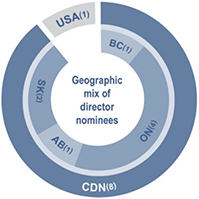
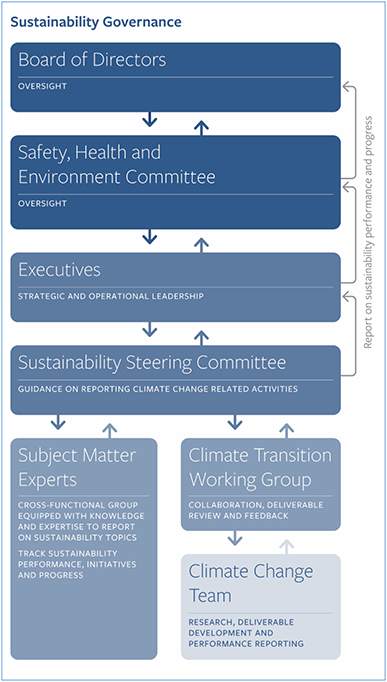
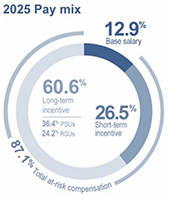
.3

Powering a secure energy future 2026 Management Proxy Circular Notice of Annual Meeting of Shareholders May 7, 2026
.3
Powering a secure energy future 2026 Management Proxy Circular Notice of Annual Meeting of Shareholders May 7, 2026
About Cameco
Cameco is one of the largest global providers of the uranium fuel needed to power a secure energy future. Our competitive position is based on our controlling ownership of the world’s largest high-grade uranium reserves and low-cost operations, as well as significant investments across the nuclear fuel cycle, including ownership interests in Westinghouse Electric Company and Global Laser Enrichment. Utilities around the world rely on Cameco to provide global nuclear fuel solutions for the generation of safe, reliable, carbon-free nuclear power.
At Cameco, we are guided by four key values that are at the core of everything we do:
|
|
Safety and Environment | |
|
|
People | |
|
|
Integrity | |
|
|
Excellence | |
As the foundation of our culture, these values, and their aligning value statements, define who we are as a company and provide a framework for how we behave as we work to achieve our purpose. We strive to create an environment at Cameco where our employees live our values every day.
We are proud to be one of Canada’s largest employers of Indigenous people and our land holdings, including exploration, span about 1.9 million acres, the majority near our existing operations in northern Saskatchewan.
Our head office is in Saskatoon, Saskatchewan, Canada and our common shares trade on the Toronto Stock Exchange (TSX) under the symbol CCO and the New York Stock Exchange (NYSE) under the symbol CCJ.
Learn more about Cameco in this management proxy circular, our most recent annual report, annual information form, and our sustainability report. These documents are available on our website (cameco.com).
| WHAT’S INSIDE | ||
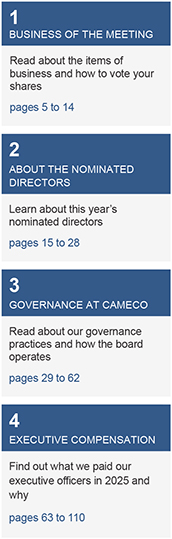
| Message from the Chair of the Board and the CEO | 1 | |
| Notice of our 2026 annual meeting of shareholders | 3 | |
| Management proxy circular | 4 | |
| Business of the meeting | 5 | |
| Delivery of meeting materials |
8 | |
| Voting |
9 | |
| About the nominated directors | 15 | |
| Director profiles |
15 | |
| 2025 Meeting attendance |
25 | |
| Director compensation and share ownership |
25 | |
| Governance at Cameco | 29 | |
| About the board |
30 | |
| Our corporate governance |
46 | |
| Key governance policies and practices |
46 | |
| How the board operates |
46 | |
| Our expectations of directors |
55 | |
| Stakeholder engagement |
59 | |
| Other information |
61 | |
| Executive compensation | 63 | |
| Message from the Chair of the Human Resources and Compensation Committee | 64 | |
| Compensation discussion and analysis | 67 | |
| Our 2025 named executive officers |
68 | |
| Compensation governance |
69 | |
| Compensation decision-making process |
72 | |
| Our approach to executive compensation |
73 | |
| Compensation components |
78 | |
| 2025 Performance and compensation decisions |
85 | |
| CEO compensation summary |
94 | |
| 2026 Compensation decisions |
98 | |
| 2025 Compensation details | 100 | |
| Summary compensation table |
100 | |
| Incentive plan awards |
102 | |
| Equity compensation plan information |
103 | |
| Pension benefits |
105 | |
| Loans to executives |
106 | |
| Termination and change of control |
107 | |
| Additional information (including about non-IFRS measures and forward-looking information) | 111 | |
| Appendices | 116 | |
Message from the Chair of the Board and the CEO1
On behalf of the board of directors and management, we are pleased to invite you to Cameco’s annual meeting of shareholders on Thursday, May 7, 2026, beginning at 10:00 a.m. CST. The meeting will be held virtually via live webcast from Saskatoon, Saskatchewan to provide all shareholders with equal opportunity to participate in the meeting.
The accompanying management proxy circular provides important information about the business of the meeting, the voting process, this year’s nominated directors, our corporate governance practices, our approach to executive compensation and our 2025 compensation decisions. Please take some time to read through the circular before you vote your shares.
2025 was another exciting year as we continued to see positive momentum for Cameco as a global nuclear fuel and energy company. Cameco delivered strong performance across all segments in an industry where we continue to see significant support for nuclear energy from government, industry and the public.
Focused on strategy
Cameco’s performance is shaped by our vison of powering a secure energy future and our strategic plan that is set within the context of what we believe is a transitioning market environment. Increasing populations, a growing focus on electrification and decarbonization, and concerns about energy security and affordability are driving a global focus on tripling nuclear power capacity by 2050, which is expected to durably strengthen the long-term fundamentals for our industry. Nuclear energy must be a central part of the solution to the world’s shift to a low-carbon, secure energy economy. It is an option that can provide the power needed, not only reliably, but also safely and affordably, and in a way that will help achieve climate, energy and national security objectives.
Our strategy is to capture full-cycle value by remaining disciplined and building a balanced portfolio in accordance with our contracting framework; profitably producing from our tier-one assets and aligning our production decisions in all segments of the fuel cycle with our delivery commitments and customer needs; being financially disciplined; and exploring other emerging opportunities within the nuclear power value chain, all of which align with our commitment to manage our business responsibly and sustainably, contribute to decarbonization and help to provide secure and affordable energy.
Thanks to our disciplined strategy, Cameco’s balance sheet is strong and we expect it will enable us to continue executing our strategy while self-managing risk, including risks related to global macro-economic uncertainty, volatility and shifting trade policy decisions.
Following the joint acquisition of Westinghouse Electric Company (Westinghouse) with Brookfield in late 2023, Cameco expanded its participation in the nuclear fuel and reactor value chains to include fuel fabrication, maintenance, design and engineering for light water reactors. In addition, a strategic partnership between Cameco, Brookfield, Westinghouse and the U.S. government was announced in October 2025 to accelerate the global deployment of Westinghouse’s reactor technology, which marks a major milestone for the nuclear industry.
Cameco’s board is engaged and works closely with management. We believe that regular focused discussions on strategy and its execution help ensure alignment with our objective of delivering long-term value to Cameco’s shareholders and other stakeholders.
Sound governance
The board regularly reviews Cameco’s governance practices, and the board assessment process provides insight into how we can continually enhance governance at Cameco. The expertise, skills and experience of our board bring tremendous value to our strategic direction, oversight of management and our affairs, and governance at Cameco generally.
This year shareholders will be asked to elect nine directors to the board to serve for a term of one year. Daniel Camus, a Cameco director since 2011, is not standing for re-election having reached our director term limit of 15 years. We thank him for his strong contributions, particularly in his role as chair of the Audit and Finance Committee, and wish him well in retirement.
| 1 | This section contains forward-looking information. For additional information about forward-looking information, please see page 113. |
| MESSAGE TO SHAREHOLDERS | 1 |
Investing in community
We believe that strong relationships with our communities are critical to Cameco’s sustainability and long-term success. Cameco leads and participates in funding support, community initiatives and volunteering to give back and make a difference across Saskatchewan and in our Ontario communities. In 2025, Cameco made a transformational $10-million donation to the University of Saskatchewan, which will, among other things, support a new undergraduate Nuclear Fuel Cycle program, fund opportunities for northern and Indigenous communities through initiatives like the Cameco STEM Pathways Initiative at the USask Prince Albert Campus, and support research and innovation projects specific to the energy and mining sector through the nuclear energy technology accelerator.
Looking ahead
Cameco has been invested across the nuclear fuel cycle since its inception in 1988. We have built a strong foundation in Canada alongside our government stakeholders and have grown into a leader in the nuclear industry. Cameco is recognized as a global company, making a difference on a global scale and helping to provide something the world needs: carbon-free, safe, reliable and secure baseload electricity. We believe the fundamentals for nuclear power and nuclear fuel are more favourable than ever, and we are optimistic about Cameco’s role in helping meet the world’s growing demand for electricity.
Cameco’s senior leadership team has a wealth of experience and industry knowledge gained through long careers in the nuclear energy industry. We have confidence in their ability, and the team of next generation leaders they have built, to continue to execute on the company’s strategy and achieve our vision. The team is widely respected, conducts itself with integrity, and leads with a demonstrated commitment to safety, people and the environment. Details about recent leadership transitions can be found in the Message from the Chair of the Human Resources and Compensation Committee.
Thank you for your continued confidence in Cameco and please remember to vote your shares. We look forward to welcoming you to our annual meeting on May 7, 2026.
Sincerely,

|

| |
| Catherine Gignac | Tim Gitzel | |
| Chair of the Board | Chief Executive Officer | |
| 2 | CAMECO CORPORATION |

Notice of our 2026 annual meeting
of shareholders
When
Thursday, May 7, 2026
10:00 a.m. CST
Via live webcast from Saskatoon, SK
https://meetings.lumiconnect.com/400-707-444-004
password: cameco2026 (case sensitive)
Your vote is important
If you held Cameco common shares on March 9, 2026 (the record date), you are entitled to receive notice of and to vote at this meeting.
You can vote in advance or in real time at the meeting. We encourage shareholders to vote by proxy in advance of the meeting because it’s the easiest way to vote your shares.
See pages 9 through 14 of the attached management proxy circular for information about how to vote. To be valid, Computershare Investor Services Inc., our transfer agent, must receive your voting instructions before 10:00 a.m. CST on Tuesday, May 5, 2026 (the proxy deadline).
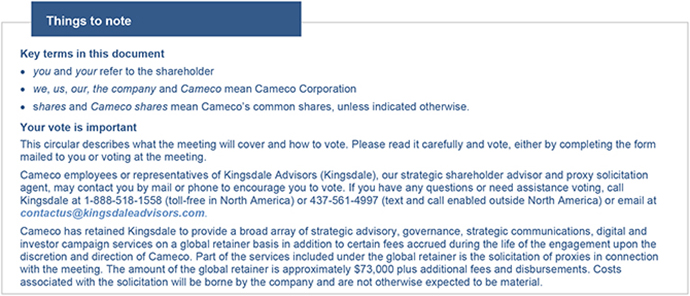
If you have any questions or need assistance voting, please contact Kingsdale Advisors at 1-888-518-1558 (toll-free in North America) or 437-561-4997 (text and call enabled outside North America) or by email at contactus@kingsdaleadvisors.com.
By order of the Board of Directors,
Jenny Hoffman
Corporate Secretary
Saskatoon, Saskatchewan
April 2, 2026
| NOTICE OF 2026 ANNUAL MEETING | 3 |
Management proxy circular
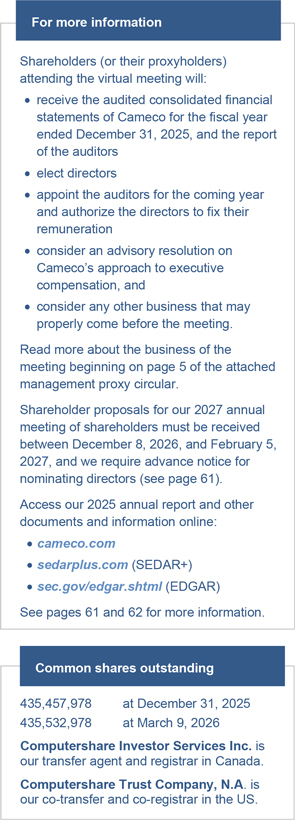
You have received this circular because you owned Cameco common shares on March 9, 2026 (the record date). Management is soliciting your proxy for the 2026 annual meeting of shareholders, and we pay all proxy solicitation costs.
As a shareholder of record, you have the right to attend the annual meeting of shareholders on May 7, 2026, and to vote your shares. The meeting will be held virtually via live webcast at https://meetings.lumiconnect.com/400-707-444-004 (password: cameco2026). You can vote your shares in advance by proxy (see the voting instructions starting on page 10) or online during the live webcast. If you are unable to participate in the live webcast, you can also listen to the webcast on our website (cameco.com) following the meeting.
The Board of Directors approved the content of this circular on March 17, 2026, and has authorized us to distribute it to you. We have also sent a copy to each of our directors and to our auditors. We are using notice and access to deliver the meeting materials to shareholders. Shareholders who have elected to receive the meeting materials electronically will receive them by email according to their instructions.
The information in this circular is as of March 9, 2026, except where otherwise noted. All dollar amounts are in Canadian dollars, unless indicated otherwise.
Documents and websites referenced herein are not incorporated by reference into this circular unless the incorporation by reference is explicit. References to our website address in this circular are intended to be for convenience only.
| 4 | CAMECO CORPORATION |
Business of the meeting
A quorum is required to hold the meeting and transact business. A quorum is met when at least two people attending the meeting hold, or represent by proxy, at least 25% of Cameco’s total issued and outstanding common shares.
|
Virtual meeting format We believe that conducting the meeting in a virtual format makes the meeting more accessible and maximizes shareholder attendance by providing each shareholder, regardless of location, with the opportunity to participate in the meeting, at no additional cost.
|
| Receive the financial statements |
Our consolidated financial statements for the year ended December 31, 2025, and the auditor’s report will be received at the meeting.
You can download a copy of our 2025 annual report (which includes our consolidated financial statements for the year ended December 31, 2025, and management’s discussion and analysis (MD&A) and the auditor’s report) on our website (cameco.com/invest/financial-information). You will receive a paper copy of the annual report only if you request one.
| Elect the directors |
The board recommends you vote for each nominated director. Under the Canada Business Corporations Act (CBCA) requirements for uncontested director elections, you can vote for or against each nominated director (see page 15). Directors must receive a majority of the votes cast in favour of their election for their election to be valid.
This year nine director nominees, all qualified to serve on Cameco’s board, are standing for election to the board to serve for a term of one year. Each elected director will hold office until the next annual meeting of shareholders or until a successor is elected or appointed.
| Catherine Gignac Tammy Cook-Searson Tim Gitzel |
Marie Inkster Kathryn (Kate) Jackson Don Kayne |
Peter Kukielski Dominique Minière Leontine van Leeuwen-Atkins |
You can read about each of the nominees in the director profiles starting on page 16, including their 2025 voting results. The voting results reflect the number of votes after the reduction of the non-resident vote according to Cameco’s voting restrictions.
| Reappoint the auditors |
The board, on the recommendation of the Audit and Finance Committee, proposes that KPMG LLP (KPMG) be reappointed as our auditor until the end of our next annual meeting. You can vote for reappointing KPMG and authorizing the directors to fix their remuneration, or you can withhold your vote. The board has invited a representative of KPMG to attend the annual meeting.
The auditor reinforces the importance of a diligent and transparent financial reporting process and strengthens investor confidence in our financial reporting. KPMG provides Cameco with three types of services:
| • | audit services generally relate to the audit and review of annual financial statements and notes, review of interim financial statements and notes, conducting the annual audits of affiliates, auditing our internal controls over financial reporting and providing other services that may be required by regulators. These may include services for registration statements, prospectuses, reports and other documents that are filed with securities regulators, or other documents issued for securities offerings; |
| • | audit-related services include advising on accounting matters, attest services not directly linked to the financial statements that are required by regulators and conducting audits of employee benefit plans; and |
| • | tax services relate to tax compliance and tax advice that are beyond the scope of the annual audit. These include reviewing transfer-pricing documentation and correspondence with tax authorities, preparing corporate tax returns, and advice on international tax matters, tax implications of capital market transactions and capital tax. |
| 2026 MANAGEMENT PROXY CIRCULAR | 5 |
Reasons for reappointing KPMG as auditor
KPMG, or its predecessor firms, have been our auditor since Cameco was incorporated in 1988. Based on KPMG’s performance and consideration of other relevant factors noted below, the Audit and Finance Committee believes that retaining KPMG for the fiscal year ending December 31, 2026, is in the best interest of Cameco and its shareholders.
The process that the Audit and Finance Committee follows to recommend the appointment of our auditor reflects recommendations of the Canadian Public Accountability Board, Canada’s independent, public company audit regulator charged with overseeing audits performed by Canadian public accounting firms, as well as the Chartered Professional Accountants of Canada, Canada’s national accounting organization.
The committee considers the following factors among other things:
Industry experience
Because Cameco operates in the nuclear fuel business, which is complex and unlike other commodities or fuel products, we place a high degree of importance on the relevant industry experience and geographical reach that the external auditor can provide through their audit team and related specialists. Uranium and fuel services are not traded in meaningful quantities on a commodity exchange; the majority of uranium and fuel services are bought under long-term contracts that are bilaterally negotiated between the end user and the supplier and each contract is unique. The industry is dominated by state-owned entities and therefore tends to be opaque, with very little disclosure about the industry and how it operates. There are no other publicly traded companies whose operations span the scope of the nuclear fuel cycle that Cameco’s operations do. We believe that changing audit firms with the sole purpose being to reduce auditor tenure could have a negative impact on our audit arising from a lack of continuity in understanding the complexities of the nuclear fuel business and a more cumbersome audit process.
Auditor independence
KPMG appoints both a lead and local engagement partner for Cameco’s audit and rotates its partners approximately every five years to mitigate institutional familiarity. It also staggers the rotation of the partners involved in the audit to provide the continuity necessary to audit a complex business while helping ensure continued independence.
The International Federation of Accountants has reported that studies on audit firm rotation do not clearly support the notion that mandatory audit firm rotation will enhance audit quality. Some studies have found that while the cumulative number of audit partner rotations is associated with higher audit quality, the cumulative number of audit firm rotations is associated with lower audit quality.
To help ensure KPMG’s independence, we also have a policy governing the hiring of current and former partners, principals, shareholders and professional employees of our auditor. The policy requires a Cameco department that wishes to hire such person to inform the chief financial officer (CFO) and chief legal officer of the proposed hiring, who will consider whether the hiring may compromise the independence of the auditor or any member of the audit engagement team. Prior to extending an offer of employment, Cameco consults with the lead engagement partner to confirm the conclusion that such employment will not impact the auditor’s independence. The policy also requires a cooling off period before members of the audit engagement team may be hired for any financial reporting oversight roles.
Overall audit quality and appropriateness of fees
The Audit and Finance Committee conducts an annual assessment of KPMG every year to help ensure effective and quality auditor service. This includes assessing the senior audit engagement team, reviewing the evaluation of the auditor’s activities completed by management and the committee members, and reviewing the auditor’s audit quality indicators. The committee reviews the auditor’s independence annually.
The committee considered several factors as part of its assessment, including the following:
| • | an annual report from KPMG describing its internal quality control procedures and any material issues raised through internal and external reviews; |
| • | the quality of communication with the Audit and Finance Committee; |
| • | the audit hours and appropriateness of fees; |
| • | the quality and efficiency of the services provided, including external data on quality and performance; |
| • | the performance, experience and ongoing development of the audit team, including time spent on key risk areas by senior personnel; and |
| • | relevant industry expertise and geographical reach. |
| 6 | CAMECO CORPORATION |
The table below shows the fees paid to KPMG and its affiliates for services in 2024 and 2025.
| 2025 | % of total fees |
2024 | % of total fees |
|||||||||||
| Audit fees Cameco1,8 Other statutory2,8 Securities engagement3 Total audit fees |
|
$ 3,005,100 $ 461,500 $ 97,000 $ 3,563,600 |
|
79.1 12.2 2.6 93.8 |
|
$ 3,268,600 $ 467,700 $ 217,900 $ 3,954,200 |
|
76.0 10.9 5.1 92.0 |
1. Amounts billed for the audit of Cameco’s annual consolidated financial statements and the review of interim financial statements.
2. Amounts billed for the audit of Cameco’s subsidiary and joint venture financial statements.
3. Amounts billed for auditor involvement with consents, comfort letters and due diligence in connection with the annual registration statement and base shelf prospectus.
4. Translation services for 2024 relate to the French translation of the 2023 annual financial statements and MD&A. No invoices were issued in 2025 for translation services.
5. Amounts billed for the audit of Cameco’s pension plan financial statements and other audit-related services.
6. Amounts billed for tax compliance and tax advisory services.
7. Other non-audit fees for 2024 include amounts billed for Cameco’s I-4 membership. No invoices were issued in 2025.
8. Comparative figures were reclassified to be consistent with the presentation of 2025 fees.
| |||||
| Audit-related fees Translation services4 Pensions and other audit-related services5 Total audit-related fees |
|
$0 $ 77,400 $ 77,400 |
|
0.0 2.1 2.1 |
|
$ 82,500 $ 85,500 $ 168,000 |
|
1.9 2.0 3.9 | ||||||
| Tax fees Compliance Planning and advice6 Total tax fees |
|
$ 6,300 $ 150,600 $ 156,900 |
|
0.1 4.0 4.1 |
|
$ 0 $ 80,200 $ 80,200 |
|
0.0 1.9 1.9 | ||||||
| All other fees Other non-audit fees7 |
$ 0 | 0.0 | $ 95,600 | 2.2 | ||||||||||
| Total fees |
$ 3,797,900 | 100% | $ 4,298,000 | 100% | ||||||||||
The Audit and Finance Committee pre-approves both audit and non-audit services performed by KPMG, and the committee pre-approved these services in 2025 and 2024.
At our 2025 annual meeting, 65,435,404 votes (90.05%) were for the appointment of KPMG LLP as our auditors and 7,232,783 votes (9.95%) were withheld.
| Advisory vote on executive compensation (“say on pay”) |
The board is recommending that you vote for our approach to executive compensation. Please take some time to read about our compensation strategy, our compensation program, how we assess performance and how the board makes compensation-related decisions. You can find a full discussion about executive compensation at Cameco starting on page 67.
The board believes this non-binding advisory vote gives shareholders a timely and effective way to give input to the board and the Human Resources and Compensation Committee on this important matter.
You can vote for or against our approach to executive compensation by voting on the following resolution:
Be it resolved that, on an advisory basis and not to diminish the role and responsibilities of the Board of Directors for executive compensation, the shareholders accept the approach to executive compensation disclosed in Cameco’s management proxy circular delivered in advance of the 2026 annual meeting of shareholders.
Last year 70,623,480 of the votes (97.19%) were for our approach to executive compensation and 2,043,606 of the votes (2.81%) were against.
| Other business |
We did not receive any shareholder proposals for this meeting and are not aware of any other items of business to be considered at the meeting. If other items of business are properly brought before the meeting, you (or your proxyholder) can vote as you deem appropriate.
| 2026 MANAGEMENT PROXY CIRCULAR | 7 |
Delivery of meeting materials
We are using notice and access to deliver the meeting materials to shareholders. This means that Cameco will post the meeting materials online for shareholders to access electronically. You will receive a package in the mail with a notice explaining how to access the meeting materials electronically and how to request a paper copy at no charge. Your package will include a proxy form or a voting instruction form so you can vote your shares. Shareholders who have previously elected to receive the meeting materials electronically will receive them by email according to their instructions.
Notice and access and electronic delivery are efficient, environmentally friendly and cost-effective ways to distribute our meeting materials because they reduce printing, paper and postage costs.
You can access the meeting materials on our website at cameco.com/invest/2026-annual-meeting and on SEDAR+ (sedarplus.com). Shareholders are encouraged to read the meeting materials in their entirety before voting.
How to obtain a paper copy of the meeting materials
| Before the meeting | ||
| You can request a free paper copy of the meeting materials starting on April 2, 2026. Make your request right away or at least before 4 p.m. (Saskatoon time) on April 21, 2026, to receive the paper copy by mail in advance of the proxy voting deadline and the meeting date. | ||
| Registered shareholders
Contact Computershare, our transfer agent, by phone at 1-866-962-0498 (toll-free within Canada and the US) or 514-982-8716 (outside Canada and the US) and enter your 15-digit control number as indicated on your proxy form.
You can also contact Computershare at 1-866-964-0492 (toll-free) if you have questions about notice-and-access. |
Non-registered shareholders
Contact Broadridge by going to proxyvote.com or by phone at 1-877-907-7643 (toll-free within Canada and the US) or 303-562-9305 (English) or 303-562-9306 (French) (outside Canada and the US) and enter your 16-digit control number as indicated on your voting instruction form.
You can also contact Broadridge this way if you have questions about notice-and-access. | |
Please retain your proxy form or voting instruction form. Another copy will not be sent if you request a paper copy of the meeting materials.
| After the meeting | ||
You can request a paper copy of the meeting materials up to one year from the date the meeting materials are filed on SEDAR+ (sedarplus.com).
| 8 | CAMECO CORPORATION |
Voting
Who can vote
Cameco has common shares and one Class B share (see below for further details about the Class B share). Only holders of our common shares have full voting rights. If you held common shares at the close of business on March 9, 2026, you or the person you appoint as your proxyholder can attend the virtual annual meeting and vote your shares.
Each Cameco common share you own is entitled to one vote, except where ownership and voting restrictions apply. As of March 9, 2026, we had 435,532,978 common shares issued and outstanding.
Principal holders of common shares
Management, to the best of its knowledge, is not aware of any shareholder holding 5% or more of our common shares as of March 9, 2026.
Our Class B share
The Province of Saskatchewan holds our one Class B share (100% of our Class B shares). This entitles the province to receive notices of and attend all meetings of shareholders, for any class or series of shares. The Class B shareholder can only vote at a meeting of Class B shareholders, and votes as a separate class if there is a proposal to:
| (a) | amend Part 1 of Schedule B of the articles, which states that: Cameco’s registered office and head office operations must be in Saskatchewan, the executive officers and generally all of the senior officers (vice-presidents and above) must live in Saskatchewan, and all annual meetings of shareholders must be held in Saskatchewan; |
| (b) | amend the articles in a way that would change the rights of Class B shareholders; or |
| (c) | amalgamate, if the amalgamation would require an amendment to Part 1 of Schedule B of the articles. |
Ownership and voting restrictions
Restrictions on owning, controlling and voting Cameco common shares are set out in the Eldorado Nuclear Limited Reorganization and Divestiture Act (Canada) (ENL Reorganization Act) and our company articles. See Appendix A on page 116 for the definitions in the ENL Reorganization Act, including definitions of resident and non-resident. Ownership restrictions for non-residents were put in place so that Cameco would remain Canadian controlled.
The following is a summary of the limitations listed in our company articles:
Residents – A Canadian resident, either individually or together with associates, cannot hold, beneficially own or control shares or other Cameco securities, directly or indirectly, representing more than 25% of the total votes that can be cast to elect directors.
Non-residents – A non-resident of Canada, either individually or together with associates, cannot hold, beneficially own or control shares or other Cameco securities, directly or indirectly, representing more than 15% of the total votes that can be cast to elect directors.
Voting restrictions – All votes cast at the meeting by non-residents, either beneficially or controlled directly or indirectly, will be counted and pro-rated collectively to limit the proportion of votes cast by non-residents to no more than 25% of the total shareholder votes cast at the meeting.
Residency declarations
Shareholders are required to declare their residency, ownership of Cameco shares and other factors relating to the restrictions, so we can verify compliance with the ownership of, and voting restrictions on, our shares. Nominees, brokers and other intermediaries such as banks, trust companies, securities brokers or other financial institutions who hold the shares on behalf of non-registered shareholders need to make the declaration on their behalf.
If you plan to vote online during the meeting, you will need to complete the residency declaration online during the live webcast.
If we do not receive your residency declaration, we may consider you to be a non-resident of Canada. The chair of the meeting may ask shareholders and their proxyholders for additional information to verify compliance with our ownership and voting restrictions. The chair of the meeting will use the declarations and other information to determine compliance with our ownership restrictions.
| 2026 MANAGEMENT PROXY CIRCULAR | 9 |
Enforcement of ownership and voting restrictions
The company’s articles allow us to enforce the ownership and voting restrictions by suspending voting rights, forfeiting dividends, prohibiting the issue and transfer of Cameco shares, requiring the sale or disposition of Cameco shares, and suspending all other shareholder rights.
How to vote
You can vote your shares in advance or vote in real time online at the virtual meeting.
Voting by proxy
Voting by proxy is the easiest way to vote. This means you appoint another person (called a proxyholder) to attend the meeting and vote on your behalf.
Tim Gitzel, chief executive officer (CEO) of Cameco, or in his absence Jenny Hoffman, corporate secretary of Cameco, each with full power of substitution (the Cameco proxyholders), have agreed to act as proxyholder to vote your shares for you at the meeting according to your instructions, and they are the proxyholders named in your proxy form or voting instruction form. You have the right to appoint someone other than the Cameco proxyholders to represent you at the meeting (the person you appoint does not need to be a Cameco shareholder). If you wish to appoint another person as your proxyholder, carefully follow the instructions set out on the following pages.
If you vote in advance and do not appoint another person as your proxyholder, one of the Cameco proxyholders will be your proxyholder.
If you appoint the Cameco proxyholders but do not tell them how you want to vote your shares, your shares will be voted:
| • | for electing each nominated director listed in this management proxy circular; |
| • | for reappointing KPMG LLP as auditor and authorize the directors to fix their remuneration; and |
| • | for the advisory vote on our approach to executive compensation. |
All properly executed written proxies and properly completed proxies submitted by telephone or internet, delivered in accordance with this solicitation, are required to be voted at the meeting consistent with the directions provided in the proxy, unless the proxy is revoked as set out on page 12.
If you are a registered shareholder, we mail the notification directly to you and your package includes a proxy form. We distribute the notification to intermediaries to forward to our non-registered shareholders. For most non-registered shareholders, your package is sent by Broadridge and includes a voting instruction form. We pay the cost of proxy solicitation for all registered and non-registered shareholders (including objecting and non-objecting non-registered shareholders).
Make sure you allow enough time for your instructions to reach our transfer agent if you are sending your completed proxy form or voting instruction form by mail. To be valid, Computershare Investor Services Inc. (Computershare), our transfer agent, must receive your voting instructions before 10:00 a.m. CST on Tuesday, May 5, 2026 (the proxy deadline).
If you are a non-registered (beneficial) shareholder, submit your voting instructions right away to allow enough time for your intermediary to receive the information and act on your instructions before the deadline specified in your voting instruction form. If you wish to attend the virtual meeting and vote and ask questions at the meeting, you must appoint yourself as proxyholder.
| 10 | CAMECO CORPORATION |
| NON-REGISTERED (BENEFICIAL) SHAREHOLDERS | REGISTERED SHAREHOLDERS | |||
| The voting process is different depending on whether you are a registered or non-registered shareholder, and whether you vote in advance or online during the meeting. |
You are a non-registered (beneficial) shareholder if your bank, trust company, securities broker, trustee or other financial institution holds your shares (your nominee). This means the shares are registered in your nominee’s name, and you are the beneficial shareholder. Many of our shareholders are non-registered shareholders. | You are a registered shareholder if your name appears on your share certificate. | ||
| Vote your shares in advance
Make sure your voting instruction form or proxy form is duly completed, signed and dated. |
Follow the instructions on your voting instruction form and then submit your voting instructions using one of the following methods:
• Online: Go to www.proxyvote.com and vote using the unique 16-digit control number located on your voting instruction form.
• Phone: Call 1-800-474-7493 (English) or 1-800-474-7501 (French).
• Mail: Mail your completed voting instruction form using the envelope provided.
Submit your voting instructions before the time specified on your voting instruction form. Be sure to allow enough time for your voting instructions to be received by your intermediary (which will be at least 24 hours prior to the proxy deadline). |
Follow the instructions on your proxy form and send your voting instructions using one of the following methods:
• Online: Go to http://www.investorvote.com/ and vote using the control number located on your proxy form.
• Telephone: 1-866-732-VOTE (8683) (in Canada and the US) from a touch-tone phone and follow the voice instructions. If you vote by telephone, you cannot appoint anyone other than the Cameco proxyholders as your proxyholder.
• Mail: Mail your completed proxy form using the envelope provided.
To be valid, your proxy form must be received by our transfer agent before the proxy deadline. | ||
| Vote online during the meeting |
If you wish to attend the meeting and vote your shares in real time through the webcast, you will need to appoint yourself as proxyholder and register with our transfer agent. Carefully follow the instructions below. You must complete each of the steps below to attend the meeting and vote your shares in real time at the meeting online.
• Step 1: To appoint yourself as your proxyholder you may either:
¡ Go to www.proxyvote.com and enter the control number listed on your voting instruction form. Go to the voting site and insert your name in the “Change Appointee” section. Follow all other instructions provided by your nominee.
¡ Insert your name as proxy holder in the space provided on your voting instruction form and sign, date the form and mail it in the envelope provided or as otherwise instructed by your intermediary. Do not complete the voting instructions as you will vote in real time at the meeting.
You must provide your instructions before the time specified on your voting instruction form, which will be at least 24 hours prior to the proxy deadline.
• Step 2: Then register yourself with our transfer agent to receive your Invite Code. You will need the Invite Code to access and vote at the meeting.
¡ To register a proxyholder, shareholders MUST visit https://www.computershare.com/Cameco by Tuesday, May 5, 2026, 10:00 a.m. CST, and provide Computershare with their proxyholder’s contact information, so that Computershare may provide the proxyholder with an Invite Code via email.
Your registration must be complete before the proxy deadline.
• Step 3: Once you have appointed yourself as proxyholder and received an Invite Code, follow these instructions on the day of the meeting to access and vote at the meeting online:
¡ Log in to the meeting at
¡ Click “I have a control number” and enter the Invite Code you received from our transfer agent.
¡ Enter the password cameco2026 (case sensitive). |
If you wish to attend and vote at the meeting online, you must follow these instructions on the day of the meeting:
• Log in to the meeting
at
• Click “I have a control number” and enter the 15-digit control number from your proxy form.
• Enter the password cameco2026 (case sensitive).
• Follow the instructions to vote your shares when prompted.
Log in at least 15 minutes prior to the start of the meeting. Be sure to stay connected for the duration of the meeting.
If you want to appoint someone else to vote your shares for you
If you want to appoint someone else (other than the Cameco proxyholders) to be your proxyholder, to attend the meeting and vote your shares according to your instructions, follow the three steps below.
• Step 1: Enter the name of the person you are appointing in the space provided on your proxy form and submit your form using one of the methods indicated above.
This step must be completed by at least 24 hours prior to the proxy deadline.
• Step 2: Then register the name of the person you are appointing with our transfer agent using one of the following methods to receive their Invite Code. Your proxyholder will need the Invite Code to access and vote at the meeting.
¡ To register a proxyholder, shareholders MUST visit https://www.computershare.com/Cameco by Tuesday, May 5, 2026, 10:00 a.m. CST, and provide Computershare with their proxyholder’s contact information, so that Computershare may provide the proxyholder with an Invite Code via email. | ||
| 2026 MANAGEMENT PROXY CIRCULAR | 11 |
| NON-REGISTERED (BENEFICIAL) SHAREHOLDERS | REGISTERED SHAREHOLDERS | |||
| Continued ...
|
¡ Follow the instructions to vote your shares when prompted.
Log in at least 15 minutes prior to the start of the meeting. Be sure to stay connected for the duration of the meeting.
If you hold shares in more than one account, be sure to appoint yourself as proxyholder for all accounts at the same time so that you will only require one Invite Code.
If you do not appoint yourself as your proxyholder, you may still attend the meeting online, but only as a guest. Guests cannot vote or ask questions.
If you want to appoint someone else to vote your shares for you
If you want to appoint someone else to be your proxyholder, to attend the meeting and vote your shares according to your instructions, follow the three steps above and enter that person’s name as your proxyholder in Step 1. In Step 2, be sure to register them in order to receive the Invite Code to access the meeting. Then they can follow the details in Step 3 to log in to the meeting online and vote your shares for you.
Your intermediary must receive your instructions by the time specified on your voting instruction form, which will be at least 24 hours prior to the proxy deadline. You will also need to complete your proxyholder’s registration before the proxy deadline.
If you appoint someone else as your proxyholder, you may still attend the meeting but only as a guest. |
Your proxyholder’s registration must be completed prior to the proxy deadline.
• Step 3: Once you have appointed your proxyholder and they have received an Invite Code from our transfer agent, your proxyholder must follow these instructions on the day of the meeting to access and vote at the meeting:
¡ Log in to the meeting at https://meetings.lumiconnect.com/400-707-444-004
¡ Click “I have a control number” and enter the Invite Code they received from our transfer agent.
¡ Enter the password cameco2026 (case sensitive).
¡ Follow the instructions to vote when prompted.
Your proxyholder should log in at least 15 minutes prior to the start of the meeting. Be sure to remind them to stay connected for the duration of the meeting.
If you appoint someone else as your proxyholder, you may still attend the meeting online, but only as a guest. | ||
| You can revoke your proxy or voting instructions if you change your mind
Any new instructions will only take effect if they are received by Computershare before 10:00 a.m. CST on Tuesday, May 5, 2026, or 48 hours, excluding weekends and statutory holidays, before the meeting is reconvened if the meeting is postponed or adjourned. |
Contact your nominee if you need help providing new voting instructions, if you want to revoke your voting instructions (without giving new instructions) or if you want to vote at the meeting instead. | If you voted in advance online and wish to change your voting instructions, you can re-enter your vote using the control number on your proxy form. Follow the instructions on your proxy form and use any of the methods listed above.
You can also revoke your proxy without providing new voting instructions by:
• sending a notice in writing to the corporate secretary at Cameco, at 2121 11th Street West, Saskatoon, Saskatchewan S7M 1J3, so it is received by 5:00 p.m. CST on Wednesday, May 6, 2026, the last business day before the meeting;
• giving a notice in writing to the chair of the meeting before the start of the meeting; or
• giving notice in any other manner permitted by law.
The notice can be from you, or your attorney if they have your written authorization. If your shares are owned by a corporation, the written notice must be from its authorized officer or attorney.
Note that if you attend the meeting online and vote your shares on any matter you will be deemed to have revoked any prior proxy or voting instruction for all matters. | ||
| Attending the live webcast of the meeting as a guest |
Guests can log in to attend the meeting, but they will not be able vote or ask questions. Guests can log in at least 15 minutes prior to the start of the meeting:
• Log in at https://meetings.lumiconnect.com/400-707-444-004.
• Click “Guest” and complete the requested information. Then wait to be redirected to the meeting. | |||
Cameco and Kingsdale may use the Broadridge QuickVote™ service to assist non-registered shareholders with voting their shares directly over the telephone. The QuickVote™ system is intended to assist shareholders in placing their votes, however, there is no obligation for any shareholders to vote using the QuickVote™ system, and shareholders may vote (or change or revoke their votes) at any other time and in any other applicable manner described in this circular. Any voting instructions provided by a shareholder will be recorded and such shareholder will receive a letter from Broadridge (on behalf of the shareholder’s intermediary) as confirmation that their voting instructions have been accepted.
| 12 | CAMECO CORPORATION |
How to join the meeting
As our head office is in Saskatoon, Saskatchewan, we are holding our meeting virtually to facilitate broad shareholder participation. If you are a registered shareholder or a duly appointed proxyholder (including non-registered shareholders who have duly appointed themselves as proxyholder), you will be able to attend the meeting online, vote your shares and submit questions prior to the start of the meeting or during the meeting.
If you are a non-registered shareholder and do not appoint yourself as proxyholder, you may attend the meeting online as a guest, but you will not be able to vote or ask questions.
Things to note
| • | Your computer, tablet or mobile phone must be able to connect to the internet. |
| • | You will need the latest version of Chrome, Safari, Edge or Firefox with the most up-to-date software plugins. |
| • | Internal network security protocols including firewalls and VPN connections may block access to the Lumi platform for your meeting. If you are experiencing any difficulty connecting or watching the meeting, ensure your VPN setting is disabled or use a computer on a network not restricted to security settings of your organization. |
| • | Have your 15-digit control number or Invite Code (as applicable) ready. |
| • | The meeting password is cameco2026 (case sensitive). |
Log in at least 15 minutes prior to the start of the meeting. Be sure to stay connected to the internet to vote when the balloting begins. It is your responsibility to make sure you stay connected to the internet for the duration of the meeting.
If you lose connectivity once the meeting has started, there may not be sufficient time to resolve your issue before the balloting begins. Even if you plan to attend the meeting, you should consider voting your shares in advance so that your vote will be counted in case you decide later not to attend the meeting or if you experience technical difficulties and are unable to vote in real time.
Voting at the meeting can only be done by accessing the live webcast through the meeting portal. The virtual platform is fully supported across internet browsers and devices (desktops, laptops, tablets and smartphones) running the most up-to-date version of applicable software and plugins. You (or your proxyholder) should ensure that you have a strong internet connection if you plan to attend and/or participate in the meeting. Meeting participants should allow plenty of time to log in and ensure that they can hear streaming audio prior to the start of the meeting. If you (or your proxyholder) encounter any difficulties accessing the meeting during the log-in process, you can attend the meeting by clicking “Guest” and completing the online form. You can access technical support at support-ca@lumiglobal.com.
Asking questions
We are committed to shareholder engagement and believe that the virtual meeting format helps facilitate broader shareholder participation than an in-person meeting because our head office is in Saskatoon, Saskatchewan. It is anticipated that registered shareholders and duly appointed proxyholders (including non-registered shareholders who have properly appointed themselves as proxyholder) will be afforded substantially the same rights and opportunities to participate in the meeting as they would at an in-person or hybrid meeting.
Registered shareholders and duly appointed proxyholders (including non-registered shareholders who have appointed themselves as proxyholders) can ask questions related to the business of the meeting via the online meeting platform. Any questions received from shareholders or proxyholders will be read aloud by the chair of the meeting or a Cameco representative. A Cameco representative will respond to questions at an appropriate point in the meeting or during the question-and-answer session. Questions directly related to a particular motion will be addressed after that motion has been introduced.
Once the formal business of the meeting has concluded, registered shareholders and duly appointed proxyholders (including non-registered shareholders who have appointed themselves as proxyholders) will have the opportunity to ask questions unrelated to the formal business of the meeting. We will only answer questions of interest to all shareholders during the meeting. Questions that are (a) irrelevant to the business and affairs of Cameco or the business of the meeting, (b) related to material non-public information of Cameco, (c) related to personal grievances or to further personal interests, (d) derogatory or otherwise in bad taste, (e) repetitive of those made by another shareholder or duly appointed proxyholder or (f) out of order or otherwise not appropriate, will not be accepted, as determined by the chair of the meeting. It is possible that we may not be able to respond to all questions due to time
| 2026 MANAGEMENT PROXY CIRCULAR | 13 |
constraints. To ensure fairness for all attendees, the chair of the meeting will determine the amount of time allocated to each question and will have the right to limit or consolidate questions. We will post the question(s) and Cameco’s answer(s) to all appropriate questions received during the meeting on the investor page of our website as soon as is practical after the meeting.
Other important things to know
If for any reason a nominated director is unable to serve, your proxyholder has the right to vote for another nominated director at their discretion.
If there are amendments or other items of business that properly come before the meeting, your proxyholder can vote on each matter as your proxyholder sees fit, as permitted by law, whether or not it is a routine matter, an amendment or contested item of business.
The chair of the meeting has the discretion to accept or reject any late proxies and can waive or extend the deadline for receiving proxy voting instructions without notice but is under no obligation to do so.
If the meeting is postponed or adjourned, the deadline for Computershare to receive your voting instructions will be extended to 48 hours (excluding Saturdays, Sundays and statutory holidays in Saskatchewan) before the meeting is reconvened for your new voting instructions to be valid. If you are a registered shareholder and wish to revoke your proxy without giving new voting instructions, the corporate secretary must receive the notice by 5:00 p.m. CST on the day before the meeting is reconvened or you must give notice to the chair of the meeting before the start of the reconvened meeting.
Beneficial shareholders can sign up for electronic delivery (e-delivery) of the meeting materials as a convenient and efficient way to access the materials. E-delivery is also an environmentally responsible method because it eliminates the use of printed paper and the carbon footprint associated with the mail delivery process. Signing up is quick and easy. Go to www.proxyvote.com and sign in with your control number. Vote for the meeting resolutions and following your vote confirmation, you will be able to select the box for electronic delivery and provide your email address. Once you register for e-delivery, going forward you will receive your meeting materials by email and will be able to vote on your device by simply following a link in the email sent by your financial intermediary, provided your intermediary supports this service.
If you have any questions or need assistance voting, please contact Kingsdale Advisors at 1-888-518-1558 (toll-free within North America) or 437-561-4997 (text and call enabled outside North America) or by email at contactus@kingsdaleadvisors.com.
| 14 | CAMECO CORPORATION |
About the nominated directors
Our Board of Directors is responsible for overseeing the management of our business and affairs. This year the board has nominated nine individuals, each of whom is qualified to serve on our board. All of the nominated directors have agreed to stand for election and serve for a term of one year. See Nomination process on page 32 for more information.
Board composition
This year’s nominated directors have been selected based on several factors, including competencies and qualifications, experience, knowledge and other core attributes we require of directors. When assessing board composition, the Nominating, Corporate Governance and Risk Committee considers tenure, diversity, independence and the collective expertise of the directors on a broad range of issues the board faces when overseeing our business and affairs.
Daniel Camus is retiring from the board at the end of our 2026 annual meeting as he has reached our term limit of 15 years for directors.
Independence
Seven of our nine nominated directors (78%) are independent. Two directors are considered not independent: Tim Gitzel, CEO of Cameco and Tammy Cook-Searson, Chief of the Lac La Ronge Indian Band and President of Kitsaki Management Limited Partnership, the entity that manages the band’s economic development activities including businesses that receive payments from Cameco.
Majority voting
The election of directors is governed by the majority voting requirements under the CBCA. The statutory voting requirement for uncontested director elections requires shareholders to vote for or against a director nominee. A nominee must receive a majority of for votes to be elected to the board. A nominated director who does not receive a majority of votes cast in favour of their election will not be elected. The seat will remain open, or if the nominee is an incumbent, they may continue in office for 90 days following the vote in certain circumstances or until a successor is appointed or elected, whichever is earlier.
Director profiles
A profile of each nominated director follows with their background, key skills and experience, other public company directorships, as well as details about their 2025 meeting attendance, share ownership and voting results at our 2025 annual meeting of shareholders, as applicable.
We report each director’s shareholdings and their total value, including the Cameco shares they own or exercise control or direction over. Value is based on the year-end closing price of Cameco shares on the Toronto Stock Exchange (TSX) ($125.68 for 2025 and $73.91 for 2024).
See our competency matrix on page 34 for a summary of the skills and experience of each nominee.
| 2026 MANAGEMENT PROXY CIRCULAR | 15 |
| Catherine Gignac Chair of the Board | ||
Age: 64
Mississauga, ON
Canadian
Director since 2014
Independent
Key skills and experience
| • | Governance |
| • | Executive leadership and strategy |
| • | Risk governance |
| • | Financial leadership, accounting and audit |
| • | Investor relations |
| • | Mining operations and exploration |
Catherine’s extensive career as a mining equity research analyst and geologist, and experience in project value analysis and mergers and acquisitions, contribute to the skills of Cameco’s board. She serves as chair of Cameco’s board and is a member of each board committee.
Catherine Gignac is a corporate director. She has more than 30 years of experience in capital markets and the mining industry and has held senior positions as a mining equity research analyst with leading global brokerage firms and independent boutiques. She has extensive experience in project value and investment analysis and spent her early working years as a geologist.
Catherine received a bachelor of science degree in geology (honours) from McMaster University. She is a member of the Institute of Corporate Directors, the Canadian Institute of Mining, Metallurgy and Petroleum (CIM), and the Prospectors and Developers Association of Canada (PDAC). She is a past chair of the board of Women in Mining Canada where she served from 2018 to 2022 and served as a member of the Canadian Securities Administrators’ mining technical advisory and monitoring committee (CSA MTAMC) until October 2020. She holds the ICD.D designation from the Institute of Corporate Directors.
Catherine has served on the Audit and Finance Committee and the Technical Committee (formerly Reserves Oversight) for her entire tenure. She has served as a member of the Nominating, Corporate Governance and Risk Committee since 2019 and as chair from 2021 to 2024, and as chair of the Technical Committee from 2015 to 2022. She has served on the audit, compensation, nominating and sustainability committees of other public company boards, and served as chair of the board of Corvus Gold Inc. for five years.
| 2025 Attendance | ||||||||||
| Board and committee membership | Regular | Special | Overall | |||||||
|
Board of Directors* (chair) |
8 of 8 | 3 of 3 | 100% | |||||||
|
* Catherine is a member of all committees, and she attended all committee meetings in 2025. | ||||||||||
| Other public company boards in past five years |
||
|
OceanaGold Corporation (TSX) |
2019 to June 2024 | |
|
Securities held |
|
|||||||||||||||||||||
| Year | Cameco shares |
DSUs | Total shares and DSUs |
Market value of shares and DSUs1 |
Multiple of 2025 annual retainer (at market value) |
Compliance with share ownership guideline2 | ||||||||||||||||
|
2025 |
24,500 | 40,802 | 65,302 | $ 8,207,139 | 15.5x | ✓ Yes | ||||||||||||||||
| 2024 |
25,500 | 37,118 | 62,618 | $ 4,628,067 | ||||||||||||||||||
|
Change |
(1,000 | ) | 3,684 | 2,684 | $ 3,579,072 | |||||||||||||||||
| 1 | Based on total holdings calculated using $125.68 for 2025 and $73.91 for 2024, the closing prices of Cameco shares on the last trading day of the year on the TSX. |
| 2 | For evaluating compliance with Cameco’s share ownership guidelines, Catherine’s shares and DSUs held on December 31, 2025, are valued at $8,207,139 and represent 15.5x the board chair retainer of $530,000. |
| 2025 Voting results |
| 70,619,061 votes (97.18%) for | 2,049,126 votes (2.82%) against
|
| 16 | CAMECO CORPORATION |
| Tammy Cook-Searson | ||
Age: 54
Lac La Ronge, SK
Canadian
Director since 2023
Not independent
Key skills and experience
| • | Stakeholder and rights holder relations |
| • | Executive leadership and strategy |
| • | Governance |
| • | People, compensation, talent and culture |
| • | Business growth and transformation |
Tammy’s leadership experience serving her local Indigenous community in northern Saskatchewan and as president of the entity that manages her band’s economic and development activities provides a rich, valuable and unique perspective to Cameco’s board and as a member of the Safety, Health and Environment Committee and the Technical Committee.
Tammy Cook-Searson is Chief of the Lac La Ronge Indian Band and the president of Kitsaki Management Limited Partnership, the entity that manages the band’s economic development activities. Tammy was the band’s first woman chief when she was elected in 2005 and, prior to being elected chief, she served on the band’s council. She has more than 25 years of leadership, business development and management experience in northern Saskatchewan where some of Cameco’s key assets are located.
Tammy holds a master of business administration degree and a graduate diploma in management from Athabasca University. She also holds honorary degrees from the University of Regina, the Saskatchewan Indian Institute of Technologies and Saskatchewan Polytechnic. Tammy brings extensive leadership, community relations and development experience to the board, which includes finding solutions for social challenges and advocating for Indigenous issues. Her efforts have been recognized with many awards and medals, including the Indigenous Women in Leadership Award from Canadian Council of Aboriginal Business in 2021, the Canadian Armed Forces Special Services Medal in 2020 and the Queen Elizabeth II Diamond Jubilee Medal in 2012.
Tammy is board chair of Saskatchewan Indian Gaming Authority (SIGA) since 2025 and serves the Saskatchewan Indigenous community in many capacities. She is a member of the boards and commissions of Prince Albert Grand Council, Federation of Sovereign Indigenous Nations, Assembly of First Nations and the Virtual Health Hub of Saskatchewan. She serves on the board of the Saskatoon Airport Authority.
| 2025 Attendance | ||||||||||
| Board and committee membership | Regular | Special | Overall | |||||||
|
Board of Directors |
8 of 8 | 3 of 3 | 100% | |||||||
| Safety, Health and Environment |
3 of 3 | 100% | ||||||||
| Technical |
3 of 3 | 100% | ||||||||
| Other public company boards in past five years |
|
None |
|
Securities held |
|
|||||||||||||||||||||
| Year | Cameco shares |
DSUs | Total shares and DSUs |
Market value
of shares and DSUs1 |
Multiple of 2025 annual retainer (at market value) |
Compliance with share ownership guideline2 | ||||||||||||||||
|
2025 |
– | 7,496 | 7,496 | $ 942,075 | 3.2x | ✓ Yes | ||||||||||||||||
| 2024 |
– | 4,014 | 4,014 | $ 296,664 | ||||||||||||||||||
|
Change |
– | 3,482 | 3,482 | $ 645,411 | ||||||||||||||||||
| 1 | Based on total holdings calculated using $125.68 for 2025 and $73.91 for 2024, the closing prices of Cameco shares on the last trading day of the year on the TSX. |
| 2 | For evaluating compliance with Cameco’s share ownership guidelines, Tammy’s DSUs held on December 31, 2025, are valued at $942,075 and represent 3.2x the board member retainer of $290,000. |
| 2025 Voting results |
| 72,363,467 votes (99.58%) for | 304,720 votes (0.42%) against |
| 2026 MANAGEMENT PROXY CIRCULAR | 17 |
| Tim Gitzel | ||||
Age: 63
Saskatoon, SK
Canadian
Director since 2011
CEO
Not independent
Key skills and experience
| • | Executive leadership and strategy |
| • | Governance |
| • | Geopolitical, government, regulatory |
| • | Nuclear industry |
| • | International business and cultural perspectives |
As Cameco’s CEO, Tim brings the day-to-day business and operations perspective to the board and is responsible for executing Cameco’s strategy. Tim has more than three decades of industry experience and brings added perspective as a member of the board of the World Nuclear Association and the Nuclear Energy Institute.
Tim Gitzel is CEO of Cameco. He served as president and CEO from July 2011 to August 2025, president from 2010 to 2011, and as senior vice-president and chief operating officer prior to that. Tim has over 30 years of senior management experience in the Canadian and international nuclear energy sector. Prior to joining Cameco, he was executive vice-president, mining business unit for Orano in Paris, France, where he was responsible for global uranium, gold, exploration and decommissioning operations in 11 countries.
Tim received his bachelor of arts and law degrees from the University of Saskatchewan. He also holds an honorary degree from Saskatchewan Polytechnic. He participated in an executive education programme facilitated by INSEAD in France. Tim serves the nuclear industry in many capacities, including the present leadership positions as a board member of the World Nuclear Association and the Nuclear Energy Institute and, since 2023, as a member of the International Atomic Energy Agency (IAEA) Standing Advisory Group on Nuclear Energy. He has served as chair of The Mosaic Company’s compensation and human resources committee for six years and is a member of its corporate governance and nominating committee. He is also a member of the Business Council of Canada and member of the CEO advisory council of the Canada-India Business Council, as well as a co-chair of the Kazakhstan-Canada Business Council.
Tim is past president of the Saskatchewan Mining Association, and has served on the boards of SaskEnergy Corporation, the Saskatchewan Chamber of Commerce and Junior Achievement of Saskatchewan. He serves our community in numerous capacities, including several current and past leadership positions with charitable and non-profit organizations.
| 2025 Attendance | ||||||||||
| Board and committee membership | Regular | Special | Overall | |||||||
|
Board of Directors |
8 of 8 | 3 of 3 | 100% | |||||||
| Other public company boards in past five years |
||
|
The Mosaic Company (NYSE) |
2013 to present | |
|
Securities held |
|
|||||||||||||||||||||
| Year | Cameco shares |
PSUs* | RSUs | Total shares, PSUs and RSUs |
Market value of shares, PSUs and RSUs** |
Compliance with executive share ownership guideline | ||||||||||||||||
|
2025 |
532,211 | 103,946 | 115,971 | 752,128 | $ 94,527,447 | ✓ Yes | ||||||||||||||||
| 2024 |
532,211 | 117,170 | 129,704 | 779,085 | $ 57,582,173 | |||||||||||||||||
|
Change |
– | (13,224 | ) | (13,733 | ) | (26,957 | ) | $ 36,945,274 | (see page 76) | |||||||||||||
| * | Excludes performance share units (PSUs) that vested on December 31, 2025. |
| ** | Value of shares ($66,888,278), PSUs ($13,063,933) and restricted share units (RSUs) ($14,575,235) for 2025 are calculated using $125.68 for 2025 and $73.91 for 2024, the closing prices of Cameco shares on the last trading day of the year on the TSX. This is the total value of Tim’s accumulated shares and other equity-based holdings. |
See Incentive plan awards on page 102 for details about his stock options.
| 2025 Voting results |
| 72,167,157 votes (99.31%) for | 501,030 votes (0.69%) against |
| 18 | CAMECO CORPORATION |
| Marie Inkster | ||
Age: 54
Toronto, ON
Canadian
Director since 2025
Independent
Key skills and experience
| • | Executive leadership and strategy |
| • | Financial leadership, accounting and audit |
| • | Risk governance |
| • | Business growth and transformation |
| • | Mining operations and exploration |
Marie brings CFO, strategy insight and leadership and financial experience to Cameco’s board and our audit committee, having served in senior roles and on audit committees, including her role as an audit committee chair, in mining companies with operations internationally. She serves on two of our committees.
Marie is one of the Audit and Finance Committee’s audit financial experts.
Marie Inkster is a corporate director. From 2018 to 2021, she served as the president and CEO and a director of Lundin Mining Corporation, a diversified Canadian base metals mining company, and prior to that she served as senior vice president and chief financial officer from 2009 to 2018. She has more than 20 years of experience in public company management, corporate transactions, public and private debt and equity fundraising, and reporting and disclosure in the Canadian and international mining industry.
Marie is a member of the Chartered Professional Accountants of Ontario. She received a bachelor of business administration degree from St. Francis Xavier University. She has held senior leadership and senior finance roles with mining companies with base metals mining operations in countries such as Australia, Botswana, Canada, the US, Portugal, Sweden, South Africa and countries across South America.
Marie has served as a director and board chair of AbraSilver Resource Corp. since September 2025. She is the special committee chair for Foran Mining Corporation’s independent directors, overseeing the company’s potential sale. She also serves on the audit and risk, nominating, governance, and compensation committees, and brings expertise in finance, accounting, audit, human resources, and executive compensation from her senior roles in the mining industry. She has served on the audit and risk, governance, capital allocation and projects, and compensation committees of other public company boards and she was the audit committee chair at Lucara Diamond Corp. for her entire tenure on its board. She served on the board of the International Zinc Association for four years, including as board chair from November 2020 to January 2022.
| 2025 Attendance | ||||||||||
| Board and committee membership | Regular | Special | Overall | |||||||
|
Board of Directors |
4 of 4 | 3 of 3 | 100% | |||||||
| Audit and Finance* |
2 of 2 | 100% | ||||||||
| Nominating, Corporate Governance and Risk* |
2 of 2 | 100% | ||||||||
| * | Marie joined two committees when she was elected to the board on May 9, 2025. |
| Other public company boards in past five years |
||
|
AbraSilver Resource Corp. (chair) (TSX and OTCMKTS) |
September 2025 to present | |
| Foran Mining Corporation (TSX) |
May 2024 to present | |
| Vale S.A. (NYSE, B3 and Euronext) |
April 2023 to July 2024 | |
| Lucara Diamond Corp (TSX) |
2014 to 2024 | |
| Lundin Mining Corporation (TSX) |
2018 to 2021 | |
|
Securities held |
|
|||||||||||||||||||||
| Year | Cameco shares |
DSUs | Total shares and DSUs |
Market value of shares and DSUs1 |
Multiple of 2025 annual retainer (at market value) |
Deadline to meet share ownership guideline2 | ||||||||||||||||
|
2025 |
1,500 | 1,104 | 2,604 | $ 327,267 | 1.1x | May 9, 2030 | ||||||||||||||||
|
20243 |
1,500 | – | 1,500 | $ 110,865 | ||||||||||||||||||
|
Change |
– | 1,104 | 1,104 | $ 216,402 | ||||||||||||||||||
| 1 | Based on total holdings calculated using $125.68 for 2025 and $73.91 for 2024, the closing prices of Cameco shares on the last trading day of the year on the TSX. |
| 2 | For evaluating compliance with Cameco’s share ownership guidelines, Marie’s shares held on December 31, 2025, are valued at $327,267 and represent 1.1x the board member retainer of $290,000. |
| 3 | Marie owned the Cameco shares prior to joining the board. |
| 2025 Voting results |
| 72,503,876 votes (99.77%) for | 164,311 votes (0.23%) against |
| 2026 MANAGEMENT PROXY CIRCULAR | 19 |
| Kathryn (Kate) Jackson | ||
Age: 68
Indialantic, FL USA
American
Director since 2017
Independent
Key skills and experience
| • | Operational excellence and safety |
| • | Business growth and transformation |
| • | Nuclear industry |
| • | Capital projects |
| • | Climate |
| • | Sustainability |
Kate brings extensive senior management and board experience in highly technical industries, including nuclear power generation, to Cameco’s board and the three committees she sits on, including her role as chair of the Nominating, Corporate Governance and Risk Committee. She has worked on both the utility and supplier side of the industry.
Kate Jackson is a corporate director. She is the former senior vice-president and chief technology officer of RTI International Metals Inc. and previously served as senior vice-president and chief technology officer for Westinghouse Electric Company, which included responsibility for sustainability and environment, health and safety. She has held various senior positions at the Tennessee Valley Authority and Alcoa Corporation.
Kate received a doctorate and a master’s degree in engineering and public policy from Carnegie Mellon University. She also holds a master’s degree in industrial engineering management from the University of Pittsburgh and a bachelor’s degree in physics from Grove City College. She is an elected member of the National Academy of Engineering recognizing her contributions to management of large-scale power system technology, and harmonization of engineering solutions with public policy.
Kate is a member of the Carnegie Mellon University School of Engineering Dean’s Advisory Council, the advisory board of the Carnegie Mellon Electricity Industry Center. From 2008 to 2014, she was the board chair of ISO New England Inc. – an independent, non-profit regional transmission organization serving several eastern US states. She serves on or has served on the audit, compensation, finance, nominating, technical and sustainability committees and has filled committee chair roles of other public company boards.
| 2025 Attendance | ||||||||||
| Board and committee membership | Regular | Special | Overall | |||||||
|
Board of Directors |
8 of 8 | 3 of 3 | 100% | |||||||
| Human Resources and Compensation |
5 of 5 | 1 of 1 | 100% | |||||||
| Nominating, Corporate Governance and Risk (chair) |
4 of 4 | 100% | ||||||||
| Technical |
3 of 3 | 100% | ||||||||
| Other public company boards in past five years |
||
|
Rice Acquisition Corporation 3 (NYSE) |
September 2025 to present | |
| EQT Corporation (NYSE) |
2019 to present | |
| Portland General Electric Company* (NYSE) |
2014 to present | |
| Archaea Energy Inc.** (NYSE) |
2021 to 2022 | |
| Rice Acquisition Corporation (NYSE) |
2020 to 2021 | |
| * | Kate will be leaving the Portland General Electric Company board as of April 2026. |
| ** | Kate was a director of Rice Acquisition Corporation during 2020 and 2021 and served until 2022 as a director of the newly-formed company following a business combination with Archaea Energy LLC and Aria Energy LLC in 2021. |
|
Securities held |
|
|||||||||||||||||||||
| Year | Cameco shares |
DSUs | Total shares and DSUs |
Market value of shares and DSUs1 |
Multiple of 2025 annual retainer (at market value) |
Compliance with share ownership guideline2 | ||||||||||||||||
|
2025 |
– | 45,419 | 45,419 | $ 5,708,240 | 19.7x | ✓ Yes | ||||||||||||||||
| 2024 |
– | 42,410 | 42,410 | $ 3,134,551 | ||||||||||||||||||
|
Change |
– | 3,009 | 3,009 | $ 2,573,689 | ||||||||||||||||||
| 1 | Based on total holdings calculated using $125.68 for 2025 and $73.91 for 2024, the closing prices of Cameco shares on the last trading day of the year on the TSX. |
| 2 | For evaluating compliance with Cameco’s share ownership guidelines, Kate’s DSUs held on December 31, 2025, are valued at $5,708,240 and represent 19.7x the board member retainer of $290,000. |
| 2025 Voting results |
| 71,236,979 votes (98.03%) for | 1,431,208 votes (1.97%) against |
| 20 | CAMECO CORPORATION |
| Don Kayne | ||
Age: 68
Delta, BC
Canadian
Director since 2016
Independent
Key skills and experience
| • | Executive leadership and strategy |
| • | Operational excellence and safety |
| • | People, compensation, talent and culture |
| • | Business growth and transformation |
| • | International business and cultural perspectives |
Don brings many years of experience as a business executive in Canada’s resource industry to Cameco’s board as well as valuable insights into emerging Asian markets where Cameco does business. He serves on three of our committees, including as chair of the Human Resources and Compensation Committee.
Don Kayne is a corporate director. He was special advisor to the CEO of Canfor Corporation, an integrated forest products company, throughout 2025. He served as president and CEO of Canfor Corporation from 2011 to 2024 and is the former CEO of Canfor Pulp Products Incorporated (2012 to 2022).
Don has extensive experience in international marketing. He spent his entire career at Canfor, starting out as a regional sales representative in 1979. Prior to his appointment as CEO, Don spent 10 years as Canfor’s vice-president of sales and marketing and is one of the lead architects of the market for British Columbia lumber in China. Don’s work in growing markets for Canfor products around the world has provided him with deep connections to markets and customers in every region Canfor serves.
Don serves on the boards of private companies BC Hydro, a Canadian electric utility operating in British Columbia, Powerex Corp., an electricity marketing company, and as executive chair at Vitalus Nutrition Inc., and is a former director of VIDA Corporation, a Swedish wood products company which is owned 77% by Canfor. He has served the forestry industry in many capacities, including current and past leadership positions with provincial, national and international forestry-related associations and organizations. He is an International Fellow of the Royal Swedish Academy of Engineering Sciences. He serves as co-chair and director of the charitable organization Ching Tien Foundation for Women, which works to empower young women from Asia to become changemakers building on the work of its legacy organization, Educating Girls of Rural China Foundation. Don brings experience in human resources and executive compensation through his executive roles at Canfor.
| 2025 Attendance | ||||||||||
| Board and committee membership | Regular | Special | Overall | |||||||
|
Board of Directors |
8 of 8 | 3 of 3 | 100% | |||||||
| Human Resources and Compensation (chair) |
5 of 5 | 1 of 1 | 100% | |||||||
| Nominating, Corporate Governance and Risk |
4 of 4 | 100% | ||||||||
| Safety, Health and Environment |
2 of 3 | 67% | ||||||||
| Other public company boards in past five years |
||
|
Canfor Corporation (TSX) and Canfor Pulp Products Incorporated (TSX) |
2017 to 2024 | |
|
Securities held |
|
|||||||||||||||||||||
| Year | Cameco shares |
DSUs | Total shares and DSUs |
Market value of shares and DSUs1 |
Multiple of 2025 annual retainer (at market value) |
Compliance with share ownership guideline2 | ||||||||||||||||
|
2025 |
– | 116,552 | 116,552 | $ 14,648,249 | 50.5x | ✓ Yes | ||||||||||||||||
| 2024 |
– | 112,539 | 112,539 | $ 8,317,757 | ||||||||||||||||||
|
Change |
– | 4,013 | 4,013 | $ 6,330,492 | ||||||||||||||||||
| 1 | Based on total holdings calculated using $125.68 for 2025 and $73.91 for 2024, the closing prices of Cameco shares on the last trading day of the year on the TSX. |
| 2 | For evaluating compliance with Cameco’s share ownership guidelines, Don’s DSUs held on December 31, 2025, are valued at $14,648,249 and represent 50.5x the board member retainer of $290,000. |
| 2025 Voting results |
| 71,827,240 votes (98.84%) for | 840,947 votes (1.16%) against |
2026 MANAGEMENT PROXY CIRCULAR 21
| Peter Kukielski | ||
Age: 69
Toronto, ON
Canadian and British
Director since 2025
Independent
Key skills and experience
| • | Executive leadership and strategy |
| • | Operational excellence and safety |
| • | Business growth and transformation |
| • | Investor relations |
| • | Capital projects |
| • | Mining operations and exploration |
Peter brings operational excellence, stakeholder relations, safety and leadership experience to Cameco’s board, having served as CEO at mining companies with operations internationally. He serves on two of our committees.
Peter Kukielski is the president and CEO of Hudbay Minerals Inc., a diversified Canadian mining company, and has served in that position since 2020, after having served as interim CEO since 2019. He has over 30 years of senior management experience in international mining activities. Peter has held president and CEO roles at Canadian and UK mining companies over the past 15 years and prior to that he served in other senior executive roles in the mining and metals sector.
Peter received a bachelor of civil engineering degree from the University of Rhode Island and a master of civil engineering degree from Stanford University. His mining industry experience includes development of major projects, supported by large workforces, in the mining and metals sector across North America, South America, the UK and parts of Asia.
Peter served on the board of Norsk Hydro from 2019 to 2025 and has served on the compensation, sustainability and nominations and governance committees of another public company board. He brings experience in risk management, mergers and acquisitions, strategy, climate change and workers’ and human rights.
| 2025 Attendance | ||||||||||
| Board and committee membership | Regular | Special | Overall | |||||||
|
Board of Directors |
4 of 4 | 2 of 3 | 86% | |||||||
| Safety, Health and Environment* |
2 of 2 | 100% | ||||||||
| Technical* |
2 of 2 | 100% | ||||||||
| * | Peter joined two committees when he was elected to the board on May 9, 2025. |
| Other public company boards in past five years |
||
|
Hudbay Minerals Inc. (TSX and NYSE) |
2019 to present | |
| Norsk Hydro ASA (Oslo Stock Exchange) |
2019 to 2025 | |
|
Securities held |
|
|||||||||||||||||||||
| Year | Cameco shares |
DSUs | Total shares and DSUs |
Market value of shares and DSUs1 |
Multiple of 2025 annual retainer (at market value) |
Compliance with share ownership guideline2 | ||||||||||||||||
|
2025 |
7,665 | 1,810 | 9,475 | $ 1,190,841 | 4.1x | ✓ Yes | ||||||||||||||||
|
20243 |
7,665 | – | 7,665 | $ 566,520 | ||||||||||||||||||
|
Change |
– | 1,810 | 1,810 | $ 624,321 | ||||||||||||||||||
| 1 | Based on total holdings calculated using $125.68 for 2025 and $73.91 for 2024, the closing prices of Cameco shares on the last trading day of the year on the TSX. |
| 2 | For evaluating compliance with Cameco’s share ownership guidelines, Peter’s shares held on December 31, 2025, are valued at $1,190,841 and represent 4.1x the board member retainer of $290,000. |
| 3 | Peter owned the Cameco shares prior to joining the board. |
| 2025 Voting results |
| 72,192,226 votes (99.35%) for | 475,960 votes (0.65%) against |
| 22 | CAMECO CORPORATION |
| Dominique Minière | ||
Age: 67
Toronto, ON
Canadian and French
Director since 2023
Independent
Key skills and experience
| • | Executive leadership and strategy |
| • | Operational excellence and safety |
| • | Geopolitical, government, regulatory |
| • | Nuclear industry |
| • | International business and cultural perspectives |
Dominique has four decades of nuclear energy experience and brings to Cameco’s board a strong technical and nuclear specialist background as well as experience in nuclear fleet refurbishment, small modular reactor development and climate change strategy. He serves on three of our committees, including as chair of the Safety, Health and Environment Committee.
Dominique Minière is a corporate director. He has more than 40 years of technical and senior management experience in the nuclear industry. Dominique served as the executive vice president of Ontario Power Generation (OPG), an electricity generator, in charge of new nuclear and international development from 2021 to 2022. Prior to that role, he served as OPG’s executive vice president and chief strategy officer from 2020 to 2021 and as OPG’s nuclear president from 2019 to 2020. He served as chief operating officer of Electricité de France, an electric utility company in charge of the nuclear and thermal fleet prior to his time at OPG.
Dominique received a civil engineering degree from the Ècole des Mines de Paris. He has extensive nuclear energy experience in France, Europe and Canada, including new nuclear, fuel conversion and enrichment. His industry leadership roles include having served as chair of GIFEN, the nuclear industry association in France, as president of the French Nuclear Society and as a board member of the World Association of Nuclear Operators. He has been awarded the “Chevelier de la Légion d’Honneur (Knight of the French Legion of Honour).
Dominique serves on the boards of private companies ORTEC Group, a French services company involved in services and engineering, and Engineering Planning and Management, Inc. (EPM), a US engineering company. He serves as a member of the Boralex Inc. board and on its human resources and investment and risk committees. Dominique is a member of Holtec International Inc.’s advisory board, a position he will leave in May 2026.
| 2025 Attendance | ||||||||||
| Board and committee membership | Regular | Special | Overall | |||||||
|
Board of Directors |
8 of 8 | 3 of 3 | 100% | |||||||
| Human Resources and Compensation |
5 of 5 | 1 of 1 | 100% | |||||||
| Safety, Health and Environment (chair) |
3 of 3 | 100% | ||||||||
| Technical |
3 of 3 | 100% | ||||||||
| Other public company boards in past five years |
||
|
Boralex Inc. (TSX) |
January 2024 to present | |
|
Securities held |
|
|||||||||||||||||||||
| Year | Cameco shares |
DSUs | Total shares and DSUs |
Market value of shares and DSUs |
Multiple of 2025 annual retainer (at market value) 1 |
Deadline to meet share ownership guideline2 | ||||||||||||||||
|
2025 |
– | 6,647 | 6,647 | $ 835,348 | 2.9x | Sept 1, 2028 | ||||||||||||||||
| 2024 |
– | 3,664 | 3,664 | $ 270,773 | ||||||||||||||||||
|
Change |
– | 2,983 | 2,983 | $ 564,575 | ||||||||||||||||||
| 1 | Based on total holdings calculated using $125.68 for 2025 and $73.91 for 2024, the closing prices of Cameco shares on the last trading day of the year on the TSX. |
| 2 | For evaluating compliance with Cameco’s share ownership guidelines, Dominique’s DSUs held on December 31, 2025, are valued at $835,348 and represent 2.9x the board member retainer of $290,000. |
| 2025 Voting results |
| 72,102,629 votes (99.22%) for | 565,558 votes (0.78%) against |
| 2026 MANAGEMENT PROXY CIRCULAR | 23 |
| Leontine van Leeuwen-Atkins | ||
Age: 61
Calgary, AB
Canadian and Dutch
Director since 2020
Independent
Key skills and experience
| • | Risk governance |
| • | Sustainability |
| • | Business growth and transformation |
| • | Financial leadership, accounting and audit |
| • | Digital, technology and cyber security |
Leontine brings to Cameco’s board a strong audit and finance background in the mining and energy sectors as well as governance and merger and acquisition advisory experience. She serves on three of our committees, including as chair of the Technical Committee.
Leontine is one of the Audit and Finance Committee’s audit financial experts.
Leontine van Leeuwen-Atkins is a corporate director. She has over 30 years of experience in the global mining, power, utility and oil and gas industries, with a focus on corporate strategy. Leontine was a board member of KPMG Canada’s national board until early 2019, serving on the National Acquisitions and Admissions and Succession committees. She was previously a partner with KPMG Canada and prior to that she was a partner at KPMG Netherlands.
Leontine is a fellow of the Chartered Professional Accountants of Alberta and holds the ICD.D designation from the Institute of Corporate Directors. She received a bachelor of business administration degree in finance from Acadia University and a master of business administration degree from Dalhousie University. In 2024, she achieved a certificate in cybersecurity oversight from Carnegie Mellon University.
Leontine serves as a director and audit committee chair of ARC Resources Ltd. and EPCOR Utilities Inc., a municipal utility. She was formerly audit committee chair at Points International Ltd. and Seven Generations Energy Ltd. She previously served on the Calgary executive advisory council of the Institute of Corporate Directors and from 2014 to 2020 served on the board and as audit committee chair of Calgary Economic Development.
| 2025 Attendance | ||||||||||
| Board and committee membership | Regular | Overall | ||||||||
|
Board of Directors |
8 of 8 | 3 of 3 | 100% | |||||||
| Audit and Finance |
5 of 5 | 100% | ||||||||
| Nominating, Corporate Governance and Risk |
4 of 4 | 100% | ||||||||
| Technical (chair) |
3 of 3 | 100% | ||||||||
| Other public company boards in past five years |
||
|
ARC Resources Ltd.* (TSX) |
2019 to present | |
| Points International Ltd. (TSX and NASDAQ) |
2019 to 2022 | |
|
* Merged with Seven Generations Energy Ltd. in 2021 and Leontine continued to serve on the board after the merger. | ||
|
Securities held |
|
|||||||||||||||||||||
| Year | Cameco shares |
DSUs | Total shares and DSUs |
Market value of shares and DSUs1 |
Multiple of 2025 annual retainer (at market value) |
Compliance with share ownership guideline2 | ||||||||||||||||
|
2025 |
– | 18,734 | 18,734 | $ 2,354,550 | 8.1x | ✓ Yes | ||||||||||||||||
| 2024 |
3,252 | 16,450 | 19,702 | $ 1,456,156 | ||||||||||||||||||
|
Change |
(3,252 | ) | 2,284 | (968 | ) | $ 898,394 | ||||||||||||||||
| 1 | Based on total holdings calculated using $125.68 for 2025 and $73.91 for 2024, the closing prices of Cameco shares on the last trading day of the year on the TSX. |
| 2 | For evaluating compliance with Cameco’s share ownership guidelines, Leontine’s shares and DSUs held on December 31, 2025, are valued at $2,354,550 and represent 8.1x the board member retainer of $290,000. |
| 2025 Voting results |
| 71,895,262 votes (98.94%) for | 772,925 votes (1.06%) against |
24 CAMECO CORPORATION
2025 Meeting attendance
Directors are expected to attend all board and committee meetings. We recognize that directors may receive short notice for special meetings, and we expect them to make their best effort to attend them. We must have a majority of directors in attendance to hold a meeting and transact business. A total of four special meetings were held by the board and board committees in 2025.
The board and committees meet in camera without management present at each meeting, and the independent directors meet in camera at least once a year in accordance with our governance guidelines. The chair or the committee chair, as the case may be, presides over the in camera sessions.
The table below is a summary of the meetings held in 2025 and the overall attendance record. Meeting attendance for each director is provided in the director profiles beginning on page 16.
| Number of meetings |
Overall meeting attendance |
|||||||||||
| Regular | Special | |||||||||||
| Board |
8 | 3 | 99% | |||||||||
| Audit and Finance |
5 | 100% | ||||||||||
| Human Resources and Compensation |
5 | 1 | 100% | |||||||||
| Nominating, Corporate Governance and Risk |
4 | 100% | ||||||||||
| Safety, Health and Environment |
3 | 93% | ||||||||||
|
Technical |
3 | 100% | ||||||||||
|
Total |
28 | 4 | 99% | |||||||||
The board chair is a member of each board committee and Catherine Gignac attended all committee meetings in 2025.
Board committees function independently of management. Tim Gitzel, our CEO, is therefore not a member of any board committee but is invited to attend all committee meetings, and he attended all committee meetings in 2025.
Director compensation and share ownership
Our director compensation program is intended to align with market practice and recognize the time commitment, responsibility and attention directors devote to board and committee responsibilities throughout the year.
Approach
Our director compensation program has three main objectives:
| • | recruit and retain qualified individuals to serve as members of our board and contribute to our overall success; |
| • | align the interests of our board and shareholders by requiring directors to own Cameco shares or share equivalents and to meet our share ownership guidelines within five years of joining the board; and |
| • | pay competitively by positioning compensation at the median of director compensation paid by companies that are comparable in size and similar to Cameco in the nature and scope of operations. We use the same comparator group to benchmark executive and director compensation (see page 73). |
The Human Resources and Compensation Committee assists the board in overseeing the director compensation policies and program. You can read about compensation governance starting on page 69.
| 2026 MANAGEMENT PROXY CIRCULAR | 25 |
Director fees
The Human Resources and Compensation Committee’s independent compensation consultant conducted a comprehensive review of the director compensation program and, upon the recommendation of the consultant and the committee, the board approved increases in director compensation for 2025 to align director fees at the median of the 2025 compensation comparator group (see page 73). Changes included an increase in the annual retainer (from $375,000 to $530,000 for the board chair and from $200,000 to $290,000 for the other directors) as well as an increase of $5,000 for the committee chair retainers. Travel fees were updated and are based on travel time rather than distance to recognize that various modes of transportation are used and a distance-based fee may not adequately compensate directors for their time. An adjustment was also implemented for directors who are non-residents of Canada to reflect the additional demands associated with board service as a non-resident.
The table below shows the 2025 director fee schedule. Previous increases in director compensation were in 2022 as disclosed in our prior circulars.
Tim Gitzel is compensated in his role as CEO and does not receive any director compensation.
Director fee schedule1
| ANNUAL RETAINER | ||||
| Chair of the board |
$ 530,000 | |||
| Other directors |
$ 290,000 | |||
| COMMITTEE CHAIR RETAINERS | ||||
| Audit and Finance Committee |
$ 30,000 | |||
| Human Resources and Compensation Committee |
$ 30,000 | |||
| Other committees (Nominating, Corporate Governance and Risk Committee, Safety, Health and Environment |
$ 20,000 | |||
| Committee and Technical Committee) |
||||
| COMMITTEE MEMBER RETAINERS (not including committee chairs) | ||||
| Audit and Finance Committee |
$ 10,000 | |||
| Human Resources and Compensation Committee |
$ 10,000 | |||
| Other three committees (per committee) |
$ 5,000 | |||
| TRAVEL FEES (PER ROUND TRIP) | ||||
| Based on travel time (from place of residence at time of meeting to place of residence following meeting): |
||||
| Between three and six hours |
$ 2,000 | |||
| More than six hours |
$ 3,000 | |||
| 1. | Directors who are non-residents of Canada receive an adjustment of 1.3x their total director fees, including all retainer and travel fees. |
Non-executive directors do not participate in Cameco’s incentive compensation plans or pension plans.
Share ownership requirements
As share ownership is an important part of compensation governance, we require each director to own Cameco shares or deferred share units (DSUs) to align the interests of our directors and shareholders. Directors must hold at least three times their annual retainer in Cameco equity within five years of joining the board. The board chair has a higher ownership requirement because of the higher retainer, and a director who assumes the chair position has an additional three years to meet the increased level. Catherine Gignac meets the board chair ownership guidelines. As CEO, Tim Gitzel is required to meet our executive share ownership guidelines (see page 76).
Directors can count Cameco shares and DSUs to meet the ownership guidelines. A DSU is a notional share that has the same value as one Cameco common share. DSUs earn additional units as dividend equivalents at the same rate as dividends paid on our common shares. DSUs can only be redeemed by directors after they retire from the board.
Directors must receive at least 60% of their director fees in DSUs. Directors can elect to receive the remaining director fees in cash or a portion in cash and the balance in DSUs in increments of 25% but must decide on the allocation before the beginning of each fiscal year. The Human Resources and Compensation Committee regularly reviews our share ownership guidelines to make sure they continue to align with market practice.
| 26 | CAMECO CORPORATION |
To assess compliance, we use our year-end closing share price on the TSX or the price the shares or units were acquired at, whichever is higher. As of December 31, 2025, directors held DSUs worth a total of $42,157,580 (representing approximately 335,436 common shares) based on the year-end closing price of Cameco shares on the TSX ($125.68). Tim Gitzel meets his executive share ownership guidelines (see page 76).
| Name | Annual retainer |
Cameco shares |
DSUs | Value
of holdings2 |
Multiple achieved |
Meets 2025 guideline or deadline to meet the guideline |
||||||||||||||||||||||||||||||||||
| Catherine Gignac |
$ 530,000 | 24,500 | 40,802 | $ 8,207,155 | 15.5x | Yes | ||||||||||||||||||||||||||||||||||
| Tammy Cook-Searson |
$ 290,000 | – | 7,496 | $ 942,097 | 3.2x | Yes | ||||||||||||||||||||||||||||||||||
| Marie Inkster |
$ 290,000 | 1,500 | 1,104 | $ 327,271 | 1.1x | May 9, 2030 | ||||||||||||||||||||||||||||||||||
| Kate Jackson |
$ 290,000 | – | 45,419 | $ 5,708,260 | 19.7x | Yes | ||||||||||||||||||||||||||||||||||
| Don Kayne |
$ 290,000 | – | 116,552 | $ 14,648,255 | 50.5x | Yes | ||||||||||||||||||||||||||||||||||
| Peter Kukielski |
$ 290,000 | 7,665 | 1,810 | $ 1,190,818 | 4.1x | Yes | ||||||||||||||||||||||||||||||||||
| Dominique Minière |
$ 290,000 | – | 6,647 | $ 835,395 | 2.9x | September 1, 2028 | ||||||||||||||||||||||||||||||||||
| Leontine van Leeuwen-Atkins |
$ 290,000 | – | 18,734 | $ 2,354,489 | 8.1x | Yes | ||||||||||||||||||||||||||||||||||
| Daniel Camus |
$ 290,000 | – | 96,872 | $ 12,174,873 | 42.0x | Yes | ||||||||||||||||||||||||||||||||||
| 1. | The required value is $1,590,000 for the chair and $870,000 for the other directors. |
| 2. | Based on total holdings multiplied by the 2025 year-end closing share price of $125.68 on the TSX. |
2025 Director compensation details
The next table shows the fees earned by each non-executive director in 2025 and the percentage of the annual retainer paid in DSUs.
| Annual retainer | Committee retainers | Travel fees | Total paid | % of director fees paid in DSUs |
||||||||||||||||||||||
| Name |
Board | Member | Committee chair | |||||||||||||||||||||||
| Catherine Gignac |
$ 530,000 | – | – | $ 6,000 | $ 536,000 | 60% | ||||||||||||||||||||
| Tammy Cook-Searson |
$ 290,000 | $ 10,000 | – | $ 9,000 | $ 309,000 | 100% | ||||||||||||||||||||
| Marie Inkster1 |
$ 187,225 | $ 9,684 | – | $ 3,000 | $ 199,909 | 60% | ||||||||||||||||||||
| Kate Jackson2 |
$ 377,000 | $ 19,500 | $ 26,000 | $ 11,700 | $ 434,200 | 60% | ||||||||||||||||||||
| Don Kayne |
$ 290,000 | $ 10,000 | $ 30,000 | $ 8,000 | $ 338,000 | 100% | ||||||||||||||||||||
| Peter Kukielski1 |
$ 187,225 | $ 6,456 | – | $ 3,000 | $ 196,681 | 100% | ||||||||||||||||||||
| Dominique Minière |
$ 290,000 | $ 15,000 | $ 20,000 | $ 6,000 | $ 331,000 | 80% | ||||||||||||||||||||
| Leontine van Leeuwen-Atkins |
$ 290,000 | $ 15,000 | $ 20,000 | $ 9,000 | $ 334,000 | 60% | ||||||||||||||||||||
| Daniel Camus |
$ 290,000 | $ 10,000 | $ 30,000 | $ 8,000 | $ 338,000 | 60% | ||||||||||||||||||||
|
Total |
$ 2,731,450 | $ 95,640 | $ 126,000 | $ 63,700 | $ 3,016,790 | – | ||||||||||||||||||||
| 1. | Marie Inkster and Peter Kukielski joined the board on May 9, 2025, and their retainers have been prorated to reflect the time served on the board in 2025. |
| 2. | Kate Jackson is a non-resident of Canada and receives an adjustment of 1.3x her total director fees, including all retainers and travel fees. |
| 2026 MANAGEMENT PROXY CIRCULAR | 27 |
Incentive plan awards – DSUs
The next table shows what each non-executive director earned in DSUs in 2025. We have combined information from two mandatory tables: Incentive plan awards – Value vested or earned during the year and Outstanding share-based and option-based awards into the table below:
| • | Share-based awards – Value vested during the year is the value of DSUs that the directors received in 2025, valued as of the grant dates. It includes all the DSUs that vested as of the grant date and DSUs granted as dividend equivalents in 2025. |
| • | Share-based awards – Market or payout value of vested share-based awards not paid out or distributed is the value of DSUs that have vested. The DSUs were valued at the year-end closing price of Cameco shares on the TSX of $125.68. DSUs are paid out after a director retires from the board. |
| Share-based awards | ||||||
| Name |
Value vested during the year | Market or payout value of vested share-based awards not paid out or distributed |
||||
| Catherine Gignac |
$331,216 | $5,127,979 | ||||
| Tammy Cook-Searson |
$310,645 | $942,075 | ||||
| Marie Inkster |
$120,118 | $138,747 | ||||
| Kate Jackson |
$271,272 | $5,708,240 | ||||
| Don Kayne |
$365,753 | $14,648,249 | ||||
| Peter Kukielski |
$196,964 | $227,504 | ||||
| Dominique Minière |
$266,262 | $835,348 | ||||
| Leontine van Leeuwen-Atkins |
$204,790 | $2,354,550 | ||||
| Daniel Camus |
$225,905 | $12,174,889 | ||||
|
Total |
$2,292,925 | $42,157,581 | ||||
See the director profiles beginning on page 16 and the share ownership table on page 27 for the number of Cameco shares and DSUs held by each director.
Loans to directors
As of March 9, 2026, Cameco and its subsidiaries had no loans outstanding to any current or former directors, except routine indebtedness as defined under Canadian securities laws.
| 28 | CAMECO CORPORATION |
| Governance at Cameco
Cameco recognizes the importance of sound governance, and we firmly believe it is the foundation for strong corporate performance.
This section tells you about our board and how it operates, our expectations of directors, key governance policies and practices, and stakeholder engagement, among other things. |
| About the board |
30 | |||||
| Key governance policies and practices |
46 | |||||
| How the board operates |
46 | |||||
| Our expectations of directors |
55 | |||||
| Stakeholder engagement |
59 | |||||
| Other information |
61 | |||||
| 2026 MANAGEMENT PROXY CIRCULAR | 29 |
About the board
Board structure, composition and succession
The board recognizes the need to balance skills, experience and other attributes on the board. As such, the Nominating, Corporate Governance and Risk Committee regularly reviews the composition of the board to make sure we have an appropriate combination of skills, experience, tenure and perspectives. The committee is responsible for ensuring that the board’s succession planning process and policy on tenure and retirement provide for board refreshment that meets our ongoing needs. The committee is also responsible for the annual review of board composition and the nomination process.
Board independence
We believe that a substantial majority of our directors must be independent for the board to be effective and that the Audit and Finance Committee, Human Resources and Compensation Committee and Nominating, Corporate Governance and Risk Committee must be 100% independent.
The majority of directors are unrelated to Cameco. A director is independent if they are not a member of management and do not have a direct or indirect material relationship with Cameco. A relationship is material if it could reasonably interfere with a director’s ability to make independent decisions regardless of any other association they may have.
We follow a multi-step process annually to assess independence:
| • | Directors complete a detailed questionnaire. |
| • | The board reviews directors against our independence criteria, considering all relevant facts and circumstances, including the relationship the director may have with Cameco – and any relationship that their spouse, children, principal business affiliations and any other relevant individuals have with the company. |
| • | Directors declare any material interest in matters that may come before the board. |
The Nominating, Corporate Governance and Risk Committee assists the board in its independence assessment for board membership purposes and for service on the Audit and Finance Committee and the Human Resources and Compensation Committee.
Our independence criteria meet the standards of the Canadian Securities Administrators as set out in National Instrument 52-110 – Audit Committees, National Policy 58-201 – Corporate Governance Guidelines and the NYSE corporate governance standards, including the more stringent independence tests set out under the applicable Canadian and US and NYSE governance rules for the independence of audit committee and human resources committee members. We review the criteria and director independence status every year, and you can find our complete definition of independence on our website (cameco.com/about/governance).
Leadership and independence assessment
We have maintained separate chair and CEO roles since 2003. The chair of the board is an independent director who serves a five-year term and is appointed by the board. The chair facilitates the board’s independent oversight of management, promotes communication between management and the board, and leads the board’s discussion of key governance matters. Our CEO has primary responsibility for the operational leadership and strategic direction of Cameco.
The board believes this leadership structure is appropriate because it effectively allocates authority, responsibility and oversight between management and the board. The chair and CEO positions each have a formal position description that describes the terms and responsibilities of the role, and these documents are available on our website (cameco.com/about/governance).
| 30 | CAMECO CORPORATION |
| INDEPENDENT CHAIR | INDEPENDENT BOARD | |||||||
| Catherine Gignac currently serves as independent chair of the board.
Key responsibilities include:
• leading, managing and organizing the board consistent with our approach to governance;
• encouraging high performance and commitment of all directors;
• overseeing the board’s strategic focus to ensure that it represents Cameco’s best interests;
• helping to set the tone and culture of Cameco;
• overseeing the board’s procedures so it can carry out its work effectively, efficiently and independently of management;
• overseeing all board matters so they are properly addressed and brought to resolution as required;
• requiring any matters delegated to the board committees to be properly carried out;
• acting as the liaison between the board and the CEO and providing advice, counsel and mentorship to the CEO;
• meeting with shareholders and other stakeholders in consultation with management;
• participating in the recruitment and orientation of new directors; and
• ensuring that Cameco provides timely and relevant information and access to other resources to support the board’s work. |
A majority of our board must be independent, and our governance practices support board effectiveness:
• Seven of our nine director nominees are independent – Tim Gitzel is not independent because he is CEO of Cameco and Tammy Cook-Searson is Chief of the Lac La Ronge Indian Band and President of Kitsaki Management Limited Partnership, the entity that manages the band’s economic development activities, including businesses that receive payments from Cameco as part of our Indigenous/local procurement strategy.
• Board tenure limits – We are committed to board refreshment. To strike a balance between retaining directors with deep knowledge of the company, the industry and the key risks and opportunities facing Cameco, the board has set term limits and a retirement age. Average tenure is 5.6 years for the non-executive director nominees and 6.7 years for all directors.
• In camera sessions – The non-executive directors meet without management present at each board and committee meeting, and the independent directors meet without management present once a year in accordance with our governance guidelines.
• Independent compensation consultant – The Human Resources and Compensation Committee retains an external compensation consultant that is independent of Cameco and management as required by independence standards set for compensation consultants.
• Independent review of board assessments – An independent third party conducts a board effectiveness assessment every five years. This review is in addition to annual board, committee and director assessments.
• External advisors – Each board committee has access to independent advice and may engage external advisors at Cameco’s expense and without the approval of the board or management.
|
|||||||
Term limits and retirement
Under Cameco’s governance guidelines, once a director turns 75 or has served more than 15 years on the board, whichever is earlier, they will not stand for re-election at the next annual meeting. In exceptional circumstances, the board has the discretion to recommend a director for re-election for an additional one-year term outside the terms of our retirement age or term limit if it is in the best interests of the company. The CEO typically resigns from the board when they cease serving as CEO of Cameco.
| 2026 MANAGEMENT PROXY CIRCULAR | 31 |
Board chair succession
Cameco’s process for selecting the chair of the board is based on an assessment of specific competencies and principles such as fairness and transparency, consensus building, free and unfettered discussion, confidentiality and the importance of the chair/CEO relationship. The term for serving as board chair is five years and may be extended at the discretion of the board.
The Nominating, Corporate Governance and Risk Committee regularly discusses board succession and board chair succession as part of its responsibilities.
Director succession and recruitment
The Nominating, Corporate Governance and Risk Committee is responsible for the director recruitment process and overseeing board succession. It reviews the director core attributes and competency matrix annually to help ensure that the board has an appropriate mix of diversity, skills and experience. It also monitors upcoming director retirements to identify specific skills that may be desirable in new candidates.
To reach its recruitment goals, the board relies on the tools and processes implemented by the Nominating, Corporate Governance and Risk Committee as part of the director succession process. The committee:
| • | maintains an evergreen list of suitable candidates based on their skills, experience, character, integrity, judgment, record of achievement, diversity and other qualities or qualifications that would enhance overall composition and oversight capabilities of the board, and considers any recommendations made by shareholders; |
| • | follows established guidelines and procedures for recruiting and selecting the best candidates; |
| • | may use the services of an external search firm to cast a wide net to bring forward the best candidates; and |
| • | encourages directors to provide feedback on the composition of the board, as part of the annual self-assessment of directors, chairs, and the board and its committees. |
The committee generally follows a tiered interview process to determine the most suitable candidates. A selection committee (consisting of the chair of the board, chair of the Nominating, Corporate Governance and Risk Committee and the CEO) interviews the candidates and additional interviews are conducted as necessary.
Nomination process
The Nominating, Corporate Governance and Risk Committee assesses the diversity, skills and experience of the board and is responsible for recommending director candidates for nomination on an annual basis. In assessing potential candidates, the committee reviews the list of potential conflict situations, as well as a report on actual and potential conflicts of interest, among other things, before recommending the nominees for appointment or election to the board.
Shareholders may at any time submit names of individuals for consideration as director nominees. The committee will consider submissions when assessing board composition and the skills, experience and other characteristics required to enhance the composition of the board and its oversight capabilities. See page 61 for more information about nominating individuals.
| 32 | CAMECO CORPORATION |
Skills, attributes and experience
We believe that a board that has certain core attributes and a broad mix of skills and experience is best equipped to oversee our affairs and strategic direction and priorities, understand issues that can arise with a company of our size and complexity, and make informed decisions to support our business and aspirations. The board uses a core attributes and competency matrix to assist in defining the optimal characteristics of the board.
The Nominating, Corporate Governance and Risk Committee reviews the matrix annually to help ensure that the skills and range of experience reflect the strategic direction of the company. They also use the matrix to assess the skills, experience and attributes of continuing directors and to identify any gaps that would otherwise strengthen the board going forward, and to inform the director succession process.
Core attributes
We expect all our directors to possess the following 10 core attributes:
|
ü |
Business judgment Track record of leveraging experience and wisdom in making sound strategic and operational business decisions. Demonstrates business acumen and a mindset for risk oversight. | |
|
ü |
Integrity and accountability Demonstrates good character and insists on high ethical standards, recognizes and avoids potential and actual conflicts of interest, maintains strict confidentiality, is accountable for board decisions, acts in Cameco’s best interests and maintains public confidence and goodwill of Cameco’s shareholders and other stakeholders. | |
|
ü |
Engagement Actively participates in meetings and develops a strong understanding of Cameco’s business. Demonstrates an information-seeking orientation and knowledge of current issues and trends affecting public companies. Exhibits familiarity with international, national and local affairs. | |
|
ü |
Commitment Has the time and energy required to travel, attend and contribute to board and committee functions and take leadership roles as required. | |
|
ü |
Teamwork Demonstrates perception, acuity, tact and rapport to build constructive working relationships and dynamics that engender mutual trust, respect and contribution. Demonstrates an orientation toward resolving differences of opinion, forging consensus, reaching solutions and maintains resiliency and composure under difficult circumstances. | |
|
ü |
Communication Ability to listen carefully, raise questions constructively, and encourage and build upon open discussion of key issues. | |
|
ü |
Independent mindedness Willingness to formulate or maintain one’s own views and to challenge the prevailing opinion. | |
|
ü |
Financial literacy Ability to read and understand a set of financial statements that present a breadth and level of complexity of accounting issues that are generally comparable to the breadth and complexity of issues that can reasonably be expected to be raised by Cameco’s financial statements. Knowledge of IFRS and an understanding of internal controls and procedures for financial reporting. | |
|
ü |
Record of achievement History and reputation of achievement that demonstrates the ability to perform at the highest level and that reflects high standards for oneself and for others. | |
|
ü |
Innovation Ability to consider matters through an innovative lens, with vision, curiosity, creativity and an entrepreneurial mindset. | |
Skills and experience
Every year, each director completes a self-assessment of their competencies to identify areas where they have significant or demonstrable experience. Each director also identifies their key skills and experience as part of this assessment, and these are set out in the director profiles beginning on page 16.
The chair of the Nominating, Corporate Governance and Risk Committee or the board chair meets with each director to review their self-assessment. The committee reviews the results for consistency and to be satisfied that the directors possess the requisite skills.
| 2026 MANAGEMENT PROXY CIRCULAR | 33 |
The table below shows the skills and experience of this year’s nominated directors.

|

|

|

|

|

|

|

|

| ||||||||||
| Executive leadership and strategy Experience as a CEO or senior executive officer of a publicly traded company or major international organization with significant experience developing strategy and driving strategic direction, and leading and managing growth. |
● | ● | ● | ● | ● | ● | ● | ● | ● | |||||||||
|
Governance Experience with mature and evolving governance practices and structures in a company similar in scope and scale to Cameco that support the creation of a competent and diverse board, a strong corporate policy framework, effective decision-making, reliable information, compliance and disclosure. |
● | ● | ● | ● | ● | ● | ● | ● | ● | |||||||||
| Risk governance Experience with respect to enterprise risk management systems, including the oversight of risk tolerance, modern risk management processes, the relationship between risk and strategy and the specifics of risk management. |
● | ● | ● | ● | ● | ● | ● | ● | ● | |||||||||
|
Sustainability Experience assessing challenges and opportunities facing business brought about by sustainability issues, creating or overseeing strategic initiatives related to sustainability, creating policies, plans and targets, metrics and measurement, and reporting related to sustainability. |
● | ● | ● | ● | ● | ● | ● | ● | ● | |||||||||
|
Operational excellence and safety Experience as a senior executive in a complex operating environment, creating and maintaining a culture focused on safety, the environment and operational excellence. |
● | ● | ● | ● | ● | ● | ● | |||||||||||
| People, compensation, talent and culture Experience leading and overseeing human resources, organizational culture, talent management (including attraction, development, retention, succession planning and diversity and inclusion), pensions and compensation of a publicly traded organization similar in scope and scale to Cameco. |
● | ● | ● | ● | ● | ● | ● | ● | ● | |||||||||
| Business growth and transformation Experience as a senior executive with demonstrated success and significant experience in an evolving industry, including experience in capital allocation, mergers and acquisitions (including integration), capital markets, leading growth and change, vertical integration, using technology to advance business objectives, and international expansion. |
● | ● | ● | ● | ● | ● | ● | ● | ● | |||||||||
| Financial leadership, accounting and audit Financial experience as a CPA, current or former chief financial officer, or senior financial consultant who has strong financial and accounting experience advising with respect to, or managing, the financial activities of a publicly traded company similar in breadth and complexity to Cameco including financial reporting, financial planning, forecasting, financial risk management, sustainability, audit and internal controls. |
● | ● | ● | ● | ||||||||||||||
| Digital, technology and cyber security Experience overseeing complex technological systems (particularly as they relate to mining operations, manufacturing, vertical integration), emerging technologies and/or cyber security functions. |
● | ● | ● | ● | ● | ● | ||||||||||||
|
Stakeholder and rights holder relations Experience with stakeholder engagement, including communications with stakeholders (e.g. customers, communities, employees, government, media) and rights holders, including Indigenous communities. |
● | ● | ● | ● | ● | ● | ● | ● | ||||||||||
| Investor relations Experience in capital markets, including communications and engagement with shareholders, understanding the perspectives of major, long-term and other investors, and experience with the domestic and international business community. |
● | ● | ● | ● | ● | ● | ● | |||||||||||
|
Geopolitical, government, regulatory Experience working with government and regulators at a senior level and a strong understanding of the workings of government, regulation and public policy, including regulatory experience in the US, Canada and/or Europe and a deep understanding of the regulatory landscape and the impact of regulation on Cameco’s business. |
● | ● | ● | ● | ● | |||||||||||||
| Nuclear industry Experience as a senior executive in the nuclear industry in areas relevant to Cameco’s opportunities and risks (e.g. industry business issues, emerging technologies and products, vertical business integration, customers, competitors, design and innovation, domestic and international regulatory environment). |
● | ● | ● | |||||||||||||||
|
International business and cultural perspectives Experience working with companies that operate in the same international jurisdictions as Cameco operations (current or developing) or Cameco customers, with a thorough understanding of the business, economic, commodity-trading, cultural, regulatory and geo-political environment. Relevant jurisdictions include the US, Europe, India and China. |
● | ● | ● | ● | ● | ● | ● | |||||||||||
| Capital projects Experience overseeing and evaluating large capital projects and project management. |
● | ● | ● | ● | ● | ● | ● | ● | ||||||||||
| Mining operations and exploration Experience leading a mining company with reserves, technology, exploration and operations expertise. |
● | ● | ● | ● | ||||||||||||||
|
Climate Experience assessing challenges and opportunities facing the business brought about by climate change. |
● | ● | ● | ● | ● | ● | ● | ● | ● | |||||||||
| 34 | CAMECO CORPORATION |
Board diversity
The board has a mix of diverse skills, backgrounds, experience, gender and age that reflects our needs and the evolving demographics and geographic areas where we carry out business. It believes that having a diverse board is important for effective decision-making and good governance.
The board adopted a formal written diversity policy in 2014 (available on our website at cameco.com/about/governance), which includes a set of measurable targets to assist Cameco in achieving a diverse board. Among the four designated groups prescribed by the CBCA, our priority to date for board diversity has been to establish and achieve measurable targets for the representation of women and individuals with Indigenous heritage rather than members of a visible minority or persons with a disability, to reflect the diversity of the communities where we operate, size of the board and unique expertise required for board service. None of the director nominees has self-identified as a member of a visible minority or a person with a disability.
The Nominating, Corporate Governance and Risk Committee reviews board diversity every year, including the board diversity policy and appropriate diversity targets for Cameco.
| Geographic representation
Our diversity policy requires the board to have directors with extensive experience in jurisdictions or geographic areas where Cameco has or anticipates having significant business interests.
The image to the right shows the geographic mix of our directors by residency. One nominee is a US citizen and resident, and three nominees have dual citizenship – one with Canadian and French citizenship, one with Canadian and British citizenship, and one with Canadian and Dutch citizenship.
Our board is subject to, and complies with, the terms of the Investment Canada Act and the Uranium Non-Resident Ownership Policy, which require at least two-thirds of our directors to be Canadian citizens, and the CBCA, which requires at least half of our directors to be Canadian residents. |
|
|
Indigenous perspective
The board is committed to building long-lasting and trusting relationships with communities where we operate, and a significant portion of Cameco’s operations are in northern Saskatchewan. Our diversity policy requires at least one director to have Indigenous heritage and be from Saskatchewan to bring to the board an understanding of the culture, heritage, values, beliefs and rights of the local Indigenous Peoples. One director nominee (11%) is Indigenous and the representation of directors with Indigenous heritage is considered when identifying and nominating candidates for appointment or election to the board.
Gender
Cameco values gender diversity and acknowledges, supports and respects all genders, gender identities, gender modalities and gender expressions. Our board diversity policy requires at least 30% of directors to be women. Women represent five (56%) of this year’s nominees. While gender diversity is taken into consideration when nominating candidates for appointment or election to the board, all director candidates are identified based on skills and qualifications. The board and two of the board’s five standing committees are chaired by women.
| Age
While the board recognizes the correlation between age and experience, it believes that directors of varying ages bring a wider range of viewpoints. Our diversity policy requires the board to represent a range of ages. |
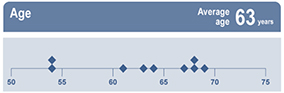
|
| 2026 MANAGEMENT PROXY CIRCULAR | 35 |
Board, committee and director assessments
The Nominating, Corporate Governance and Risk Committee oversees the annual performance and effectiveness assessment of the board, committees, the CEO and individual directors. We use questionnaires for the annual process and an independent third party to assess the board, committees and directors every five years.
Questions are formulated to solicit open and meaningful feedback on the board’s effectiveness and its proficiency in providing oversight and guidance on Cameco’s affairs. Assessments are administered confidentially and typically cover the operation of the board, the adequacy of board materials provided, meeting structure, agenda planning, the strategic direction and process, and the board’s oversight of the company’s affairs.
The results are used to assess the board, the CEO, the composition of the committees, meeting effectiveness and the assessment framework to help ensure that the board is making the best use of each director’s expertise and other attributes to enhance board performance. Any gaps in skills and experience are also identified as part of the process. Board assessment results are shared with all directors and committee assessment results are shared with their respective committee members.
Directors complete a self-assessment of their skills, performance and relevant experience. One-on-one discussions are held with the chair of the Nominating, Corporate Governance and Risk Committee to discuss the topics noted above, capacity, commitment and education opportunities. Directors also have an opportunity to give candid feedback on any issues or concerns relating to their performance, the performance of their peers or the functioning of the board.
| FEEDBACK | > | ANALYSIS | > | OUTCOMES | ||||
| Feedback is collected through questionnaires and through one-on-one meetings between the chair of the Nominating, Corporate Governance and Risk Committee and the directors.
The board is evaluated by all directors.
The board chair is evaluated by all directors, including the CEO.
The committees and committee chairs are evaluated by committee members.
Each non-executive director completes a self-assessment and has opportunity to provide feedback on fellow directors.
The CEO is evaluated by all non-executive directors. |
The board and the Nominating, Corporate Governance and Risk Committee review the board assessment results.
The Nominating, Corporate Governance and Risk Committee reviews the board chair assessment results.
Each committee reviews their assessment results.
The board chair and the chair of the Nominating, Corporate Governance and Risk Committee review the committee chair assessment results and the director assessments.
The board chair and the chair of the Human Resources and Compensation Committee review the CEO assessment results and meet with the CEO to discuss. The board and the Human Resources and Compensation Committee discuss the CEO assessment results. |
Priorities and action plans are developed for the board, the board chair, the committees and the committee chairs, as required.
Development opportunities are identified, as required, for each director. | ||||||
Updates on priorities, action plans and improvement opportunities are identified and discussed at the board and committee levels, and action plans are developed as required. We view the board assessment process as ongoing and dynamic to help ensure proper and effective functioning of the board and its committees.
Independent board assessment
A board effectiveness assessment was conducted by an independent governance advisory firm in 2022, and it included interviews with all directors and executive officers and an assessment of our board composition, succession planning and board renewal process. Results were presented to the board, and an action plan was developed following the board’s review of the report. Progress on the action plan was monitored by the Nominating, Corporate Governance and Risk Committee and the next third-party board assessment is scheduled for 2027.
| 36 | CAMECO CORPORATION |
Director development
Our directors are knowledgeable about our business and the issues affecting it, the nuclear industry, governance, compensation and related matters. Our director education program expands their knowledge base and enhances their ability to effectively oversee our business and affairs, carry out their duties and keep abreast of important developments and issues relevant to Cameco.
Orientation
Our onboarding and orientation program familiarizes new directors with Cameco, issues facing the company, our strategy, culture and values, and what we expect of individual directors, the board and committees. All new directors receive orientation so they can be ready and fully engaged and contribute to the board and committees in meaningful ways.
New directors receive mentorship from a longer serving director and orientation that includes:
| • | a company and board orientation session on the organization, including Cameco’s history, culture and values, strategy and business, director expectations and corporate governance practices; |
| • | information about Cameco and the uranium and nuclear industries, including copies of our recent regulatory filings, financial statements, governance documents and key policies; |
| • | presentations from management on the nuclear industry; and |
| • | opportunities for discussions with the committee chairs and appropriate management representatives for committees they are joining. |
In 2025, two directors joined the board and underwent a comprehensive orientation process. Management evaluated the existing orientation sessions and made enhancements to support the onboarding of the new members. Sessions were held almost monthly and many of the sessions were also attended by other board members, fostering a collaborative environment and helping ensure consistency in information sharing.
Management’s presentations covered key topics relevant to Cameco’s operations and strategic direction, including the company’s overall strategy, nuclear fuel market dynamics and exploration programs, as well as risk management, conflicts of interest and human resources matters. The approach helped ensure new directors were well equipped to understand the complexities of the business and prepare them to contribute meaningfully to board discussions and the decision-making process.
Continuing education
The board recognizes the importance of continuing education for directors. Directors enhance their understanding of our business through:
| • | presentations by management on issues relating to key business decisions, strategic planning and enterprise risks; |
| • | presentations on topics requested by directors; |
| • | tours of Cameco-operated facilities or other nuclear facilities; |
| • | conferences, webinars and seminars; and |
| • | informal social gatherings with management. |
The Nominating, Corporate Governance and Risk Committee is responsible for the board education program, which includes a budget and approval process. Educational needs are identified through the director self-assessment questionnaire, in individual meetings with the chair of the board or chair of the Nominating, Corporate Governance and Risk Committee, and in board and committee meetings. The corporate secretary’s office regularly communicates with board members about educational opportunities, including relevant conferences, webinars and other events.
Management makes presentations to the board and committees throughout the year to expand the board’s knowledge of the business, the industry and the key risks and opportunities facing Cameco. Topical information is sent to directors or included in meeting materials as supplemental reading. Directors enhance their practical knowledge of Cameco’s operations and the nuclear industry through visits to Cameco-operated facilities or other nuclear facilities. In 2025, the board members had a site tour of our fuel services operations located in Port Hope and Cobourg, Ontario and received a presentation on safety and operational matters from management. They also had a site tour of the Vogtle Electric Generating Plant, the largest nuclear power plant in the United States as of 2025.
| 2026 MANAGEMENT PROXY CIRCULAR | 37 |
We pay the cost for directors to attend conferences or seminars that the board deems appropriate for keeping abreast of developments in the uranium and nuclear industries, corporate governance and best practices relevant to their roles as Cameco directors and responsibilities on specific committees. Our board membership with the Institute of Corporate Directors (ICD) gives directors access to its director development and educational opportunities and governance resources. Directors attend sessions offered by the ICD, the National Association of Corporate Directors (NACD) and other education providers to stay current on developments in governance and areas relating to their committee responsibilities.
Our directors attended conferences, webinars and e-forums in 2025 as summarized in the table below.
| 2025 Director development highlights | ||||
| Nuclear industry, the uranium market and energy | ||||
| World Nuclear Association Symposium 2025 – World Nuclear Association (WNA) |
Catherine Gignac Tim Gitzel | |||
| World Nuclear Fuel Cycle Annual Conference - WNA and Nuclear Energy Institute |
Catherine Gignac | |||
| Nuclear Energy: What does industry growth mean for Canada? – The Globe and Mail |
Catherine Gignac | |||
| Commentary on the Future of Mining – delivered by Hatch |
All board members | |||
| Commentary on the Future of Nuclear – delivered by Bruce Power’s CEO |
All board members | |||
| Global SMR (small modular reactor) Developments – Cameco management |
Technical Committee members | |||
| 27th Annual Scotiabank Mining Conference |
Marie Inkster | |||
| Pennsylvania Energy and Innovation Summit – Senator McCormick and Carnegie Mellon University |
Kate Jackson | |||
| Power Energy Systems seminar series – National Academy of Engineering |
Kate Jackson | |||
| Canada’s 20th Anniversary Mining Showcase – KPMG |
Leontine van Leeuwen-Atkins | |||
| Governance and compensation | ||||
| Oversight or Overreach? CEO Influence on Board Composition – Directors & Boards |
Catherine Gignac | |||
| Indigenous Awareness – MiHR |
Catherine Gignac | |||
| Mining Industry Compensation and Benefits Trends – Global Governance Advisors and Odgers |
Marie Inkster | |||
| Canadian Board Retreat – McKinsey & Company and Egon Zehnder |
Marie Inkster | |||
| Digital Transformation from the Boardroom – ICD |
Leontine van Leeuwen-Atkins | |||
| Navigating D&O Insurance: The Questions Every Director Should Ask – ICD |
Leontine van Leeuwen-Atkins | |||
| Effective Year End Performance Evaluation and Compensation Decision Process – Hugessen |
Leontine van Leeuwen-Atkins | |||
| Risk, sustainability and cyber security | ||||
| The Tariff Impact: Navigating Trade Disruption as a Canadian Business – KPMG |
Daniel Camus Leontine van Leeuwen-Atkins | |||
| Board Oversight of Artificial Intelligence (AI) – ICD |
Daniel Camus Leontine van Leeuwen-Atkins | |||
| AI in the Boardroom – Directors & Boards |
Catherine Gignac | |||
| Policy for AI – Meta |
Kate Jackson | |||
| On the 2025 Board Agenda – KPMG |
Leontine van Leeuwen-Atkins | |||
| Navigating the Future – AI Transformation and its Impact on Board Governance – ICD |
Leontine van Leeuwen-Atkins | |||
| Tailings Management1 – Cameco management |
Tammy Cook-Searson Catherine Gignac Marie Inkster |
Don Kayne Peter Kukielski Dominique Minière | ||
| 38 | CAMECO CORPORATION |
| 2025 Director development highlights | ||||
| Audit and finance | ||||
| Audit Committee Forum – Canadian Public Accountability Board (CPAB) |
Daniel Camus | |||
| Mining Audit Committee Roundtable – KPMG |
Catherine Gignac Leontine van Leeuwen-Atkins | |||
| Navigating IFRS 18: Overcoming Implementation Challenges – KPMG |
Marie Inkster Leontine van Leeuwen-Atkins | |||
| Quarterly Accounting and Tax Updates – KPMG |
Leontine van Leeuwen-Atkins | |||
| How Audit Committees and the CFOs are Navigating Current Environment – CPAB |
Leontine van Leeuwen-Atkins | |||
| Climate | ||||
| Climate Change Risk1 – Cameco management |
Tammy Cook-Searson Catherine Gignac Marie Inkster |
Don Kayne Peter Kukielski Dominique Minière | ||
| Scope 3 Emissions in the Mining Sector – CIM |
Catherine Gignac | |||
| Mining the future: Attracting, retaining and engaging top talent in Canada – CIM |
Catherine Gignac | |||
| 1. | All members of the Safety, Health and Environment Committee attended these sessions, and all board members were invited to attend. |
| 2026 MANAGEMENT PROXY CIRCULAR | 39 |
Board committees
The board carries out its responsibilities directly and through its five standing committees. Committee work fulfills a specific governance role and supports our four measures of success – outstanding financial performance, a safe, healthy and rewarding workplace, a clean environment and supportive communities. The committee structure helps ensure directors can devote the requisite skills, time and attention to specific matters and supports the board in effectively overseeing our business and affairs and providing sound governance. Each committee sets aside time at each meeting to meet in camera and reports the business of its meetings to the board in a timely manner.
Committee responsibilities
Each standing committee assists the board in providing detailed oversight in key areas and has a mandate that sets out the duties and responsibilities of the committee and its chair. Each committee reviews its mandate annually and its performance against the committee mandate. Specific matters that each committee oversees are addressed in the annual work plan, which drives the committee’s priorities and activities for the year.
Each committee chair is responsible for determining the meeting agenda, how often the committee will meet, the conduct of each meeting and chairing the committee meetings, as set out in each committee mandate.
Committee membership
Committee membership is reviewed annually. We strive for periodic rotation of committee members but do not mandate it so we can benefit from the continuity and experience of committee members as appropriate. We also strive for periodic rotation of the committee chairs, and each chair position is reviewed annually. Changes are based on the recommendations of the board chair and the chair of the Nominating, Corporate Governance and Risk Committee and seek to balance continuity and the need for fresh perspectives while recognizing each director’s particular areas of expertise.
Cross-committee attendance
Directors can attend any board committee meeting. The chair of the Safety, Health and Environment Committee attends the portion of the Human Resources and Compensation Committee meeting when it reviews corporate performance for safety, environment and supportive communities and sets targets for the following year. The chair of the Audit and Finance Committee attends the portion of the Human Resources and Compensation Committee meeting when it reviews the corporate financial performance and sets targets for the following year. The chair of the Technical Committee reports annually to the Audit and Finance Committee on Cameco’s reserves and resources.
Access to management and outside advisors
The board and committees can invite any member of management, outside advisor or other person to attend their meetings.
Committees can engage outside advisors to assist in carrying out their duties, as authorized by their mandates. Individual directors can also engage outside advisors if they receive prior approval from the Nominating, Corporate Governance and Risk Committee. The Human Resources and Compensation Committee engaged an independent compensation consultant in 2025.
Committee reports
The committee reports on the following pages set out each committee’s key responsibilities and highlights for 2025.
| 40 | CAMECO CORPORATION |
| Audit and Finance Committee | ||||
|
Daniel Camus (chair since May 2019)
Catherine Gignac Marie Inkster (joined in May 2025) Leontine van Leeuwen-Atkins
2025 2025 Meetings Attendance
5 100%
The committee met separately with the chief financial officer, internal auditor and external auditor at every quarterly meeting.
100% Independent and financially literate
Daniel Camus, Marie Inkster and Leontine van Leeuwen-Atkins are the Audit and Finance Committee’s audit financial experts as designated by the board because of their financial expertise and they meet the necessary requirements under US securities laws.
None of the committee’s members serve on the audit committee of more than two other public companies.
The committee reviewed its mandate and is satisfied that it carried out its duties and responsibilities. |
Key responsibilities
The Audit and Finance Committee supports the board in fulfilling its oversight responsibilities regarding the integrity of our accounting and financial reporting, the adequacy and effectiveness of our internal controls and disclosure controls, legal, regulatory (excluding safety, health and the environment) and ethical compliance, the independence and performance of our external and internal auditors, oversight of specific risks, prevention and detection of fraudulent activities and financial oversight.
2025 Committee highlights
Financial reporting
• Oversaw the quality and integrity of our accounting and financial reporting processes.
• Reviewed and recommended the annual and quarterly financial statements and MD&A and quarterly press releases to the board for approval.
• Reviewed and recommended the external auditors’ fees to the board for approval.
• Approved the annual audit plan, including pre-approval of all services to be provided (see pages 6 and 7 for details about the external auditor and the fees paid to them in 2025).
• Received regular reports from the external auditors on the audit of our financial statements and the results of their reviews of the unaudited quarterly financial statements.
• Assessed the performance of the external auditors, including the regular review of audit quality indicators, and reviewed the annual meeting voting results of the appointment of the auditor.
• Reviewed the auditor’s qualifications, independence and depth of business and industry knowledge, tenure and audit partner rotation and recommended the appointment of our external auditor for the coming year to the board.
• Regularly met with the external auditor without management present.
Risk oversight and compliance
• Reviewed the effectiveness and integrity of our internal control systems and disclosure controls.
• Assessed the internal auditor, reviewed and approved changes to the internal audit mandate, and approved the internal audit plan for the year.
• Received regular reports from the internal auditor on the fulfillment of its plan and its recommendations to management.
• Regularly met with the internal auditor without management present.
• Reviewed reports about our compliance programs, including the code of conduct and ethics and our global anti-corruption program.
• Reviewed, and recommended to the board for approval, the ethics committee mandate and amendments to the code of conduct and ethics.
• Reviewed related party transactions.
• Reviewed policies and programs to monitor compliance with legal and regulatory requirements and received briefings on significant litigation matters.
• Received briefings and reports on compliance with Cameco’s investment and hedging program and approved changes to the investment and hedging program.
• Received reports on enterprise risks that the committee oversees.
• Received a report on annual reserves from the Technical Committee.
• Received quarterly updates on the status of mitigation plans for risks that the committee oversees (including financial, fraud and other risks within the committee’s mandate).
• Monitored Cameco and controlled subsidiary consulting mandates.
• Reviewed and recommended amendments to its mandate to the Nominating, Corporate Governance and Risk Committee for approval.
Financial oversight
• Received and reviewed financial reports and forecasts (including consideration of Cameco’s outlook, finance and cash flow planning, and consideration of dividend, capital return and hedging strategies).
• Received and reviewed reports on our insurance program and directors’ and officers’ liability insurance.
• Received and reviewed the annual supply chain management report.
• Reviewed 2025 financial performance and evaluated the 2026 financial measures for executive compensation, and recommended to the Human Resources and Compensation Committee. | |||
| 2026 MANAGEMENT PROXY CIRCULAR | 41 |
| Human Resources and Compensation Committee | ||||
|
Don Kayne (chair since May 2018)
Daniel Camus Catherine Gignac Kate Jackson Dominique Minière
2025 2025 Meetings Attendance
6 100%
100%
Independent
The committee has an external consultant who provides independent advice on executive compensation matters. Meridian Compensation Partners (Meridian) has been the committee’s consultant since December 2011, and it has not provided any services to management.
The committee reviewed its mandate and is satisfied that it carried out its duties and responsibilities. |
Key responsibilities
The Human Resources and Compensation Committee supports the board in fulfilling its oversight responsibilities regarding human resource policies, executive compensation, executive succession and development, pension plan governance and oversight of material risks assigned to the committee.
2025 Committee highlights
A message from the chair of the Human Resources and Compensation Committee begins on page 64.
Compensation governance
• Monitored compensation trends and emerging issues.
• Received and reviewed the annual compensation-related risk report.
• Reviewed the “say on pay” voting results.
• Selected and managed the committee’s independent compensation consultant, approved its work plan, qualifications and fees, and considered its independence.
• Reviewed the compensation disclosure in this circular.
Executive and director compensation
• Reviewed, and recommended to the board for approval, changes to the selection criteria of the compensation comparator group and a new compensation comparator group for adoption.
• Reviewed, and recommended to the board for approval, amendments to incentive plans for executives and employees.
• Reviewed 2026 executive compensation and incentive plan measures and recommended them to the board for approval.
• Assessed 2025 performance against plan measures and targets.
• Reviewed an analysis on CEO realized pay and performance.
• Received executive compensation benchmarking.
• Reviewed, and recommended to the board for approval, updates to director compensation and the director’s deferred share unit plan.
Succession planning
• Reviewed succession planning with management and oversaw the succession planning process, including the appointment of a new president, chief financial officer, chief legal officer and chief marketing officer.
Risk oversight
• Received reports on enterprise risks that the committee oversees.
• Received quarterly status updates on the mitigation plans for risks that the committee oversees (including compensation risk, talent management risk, succession risk and other risks within the committee’s mandate).
• Received and reviewed the annual compliance report on labour-related legislation and regulations.
• Considered the risks associated with its compensation programs and concluded that they are not likely to have a material adverse impact on Cameco or its business.
• Reviewed and recommended amendments to its mandate to the Nominating, Corporate Governance and Risk Committee for approval.
Pension plan governance
• Oversaw pension plan governance and management’s supervision of our pension plan.
• Reviewed, and recommended to the board for approval, pension governance and funding standards.
• Received a report on the retirement investment standard that management oversees.
• Reviewed and approved an additional suite of supporting pension-related standards. | |||
| 42 | CAMECO CORPORATION |
| Nominating, Corporate Governance and Risk Committee | ||||
|
Kate Jackson (chair since May 2024)
Catherine Gignac Marie Inkster (joined in May 2025) Don Kayne Leontine van Leeuwen-Atkins
2025 2025 Meetings Attendance
4 100%
100%
Independent
The committee reviewed its mandate and is satisfied that it carried out its duties and responsibilities. |
Key responsibilities
The Nominating, Corporate Governance and Risk Committee supports the board in fulfilling its oversight responsibilities by developing and recommending a set of corporate governance principles, identifying and recommending qualified individuals as members of the board and its committees, assessing the effectiveness of the board and committees, and overseeing the risk program.
2025 Committee highlights
Corporate governance
• Oversaw the board’s succession planning process.
• Monitored governance trends and emerging issues.
• Reviewed, and recommended to the board for approval, amendments to our governance guidelines.
• Reviewed director independence and conflicts of interest.
• Assessed the size, composition and mandates of the board and board committees.
• Reviewed, and recommended to the board for approval, amendments to committee mandates.
• Reviewed, and recommended to the board for approval, updates to the board committee composition including the appointment of new board members to committees.
• Reviewed, and recommended to the board for approval, amendments to our risk policy.
• Reviewed, and recommended to the board for approval, updates to the director core attributes and competency matrix.
• Reviewed the board’s diversity policy.
• Oversaw our director education program.
• Reviewed, and recommended to the board for approval, amendments to the director education program.
• Oversaw the orientation for new directors.
• Received an update on management’s stakeholder engagement activities related to governance matters.
• Reviewed the board’s budget and recommended it to the board for approval.
Risk oversight
• Oversaw our risk program.
• Monitored governance-related risks and opportunities.
• Received and reviewed an annual report on security of the board portal.
• Oversaw Cameco’s political donations program.
Board and committee assessments
• Oversaw the annual performance and effectiveness assessment and monitored associated action item progress.
Governance disclosure
• Reviewed governance disclosure in this circular. | |||
| 2026 MANAGEMENT PROXY CIRCULAR | 43 |
| Safety, Health and Environment Committee | ||||
|
Dominique Minière (chair since May 2024)
Tammy Cook-Searson Catherine Gignac Don Kayne Peter Kukielski (joined in May 2025)
2025 2025 Meetings Attendance
3 93%
80%
Independent
The committee reviewed its mandate and is satisfied that it carried out its duties and responsibilities. |
Key responsibilities
The Safety, Health and Environment Committee supports the board in fulfilling its oversight responsibilities for matters relating to safety, health, environmental and supportive communities, and sustainability governance, reporting and disclosure.
2025 Committee highlights
Overseeing and assessing policies and management systems
• Oversaw our compliance with all relevant safety, health, environment and quality (SHEQ) legislation and our SHEQ policy and programs.
• Received reporting on the annual review of Cameco’s management system measures in accordance with the Cameco management system.
• Received reports on management’s benchmarking of our policies, systems and processes and monitored them against industry best practice.
Monitoring and assessing performance
• Received regular reporting on safety, radiation, environmental and quality performance.
• Monitored initiatives to drive continued improvements to our safety performance.
• Monitored SHEQ audits and status of corrective actions.
• Reviewed the annual SHEQ budget to ensure sufficient funding for compliance.
• Reviewed the 2025 performance for environment, safety and supportive communities for executive compensation and recommended to the Human Resources and Compensation Committee.
• Determined the 2026 performance measures for environment, safety and supportive communities for executive compensation and recommended them to the Human Resources and Compensation Committee.
• Monitored trends, significant events and emerging issues through reports from management.
Risk oversight and sustainability
• Received reports on the mitigation plans for enterprise risks that the committee oversees (including safety, health and environment risks and other risks within the committee’s mandate, including climate change risk and process safety management).
• Received presentations on safety and operations from the general managers of Key Lake and Cameco Fuel Manufacturing.
• Received a presentation from management on the company’s safety improvement plan.
• Reviewed, and recommended to the board for approval, the 2024 sustainability report.
• Received regular reporting on sustainability initiatives, licensing matters, legislative changes and developments in regulatory frameworks.
• Received regular reporting on the company’s sustainability disclosure and reporting.
• Reviewed and recommended amendments to its mandate to the Nominating, Corporate Governance and Risk Committee and board for approval. | |||
| 44 | CAMECO CORPORATION |
| Technical Committee | ||||
|
Leontine van Leeuwen-Atkins (chair since May 2024)
Tammy Cook-Searson Catherine Gignac Kate Jackson Peter Kukielski (joined in May 2025) Dominique Minière
2025 2025 Meetings Attendance
3 100%
The committee met separately with the leading qualified person at every meeting.
83%
Independent
The committee reviewed its mandate and is satisfied that it carried out its duties and responsibilities. |
Key responsibilities
The Technical Committee supports the board in fulfilling its oversight responsibilities for estimating and disclosing mineral reserves and resources, and major technological and technical matters.
2025 Committee highlights
Cyber security, digitalization and AI oversight
• Received regular reports on cyber security matters.
• Received reporting on corporate network and external network penetration testing.
• Received reports and updates on digitalization, innovation and technology projects, trends and risks, including those related to AI.
• Received presentations on the evolution of AI governance.
Technical oversight
• Received a technical update presentation on Cameco’s Global Laser Enrichment (GLE) asset.
• Received a report on global small modular reactor (SMR) developments.
• Received a presentation on Cameco’s exploration program.
Estimating mineral reserves and resources
• Confirmed our qualified persons for estimating our mineral reserves and resources.
• Performed the due diligence process for the year-end reserves and resources reporting.
• Reviewed management’s annual reserves and resources report and annual reconciliation of reserves to mine production and recommended them to the board for approval.
• Received management reports on internal controls and procedures regarding mineral reserves and resources reporting.
Disclosing mineral reserves and resources
• Monitored industry standards and regulations on estimating and publishing mineral reserves and resources information, and related issues and developments through reports from management.
• Received reports from the leading qualified person on the mineral reserves and resources estimates and confirmed that the information has not been restricted or unduly influenced.
• Received confirmation from the leading qualified person and chief operating officer that the information is reliable and that we will publish mineral reserves and resources estimates according to securities laws and regulations that apply to us.
• Received confirmation from the leading qualified person that our disclosure controls for disclosing mineral reserves and resources estimates comply with industry standards.
• Received a report on an internal audit security assessment and 2026 plan for cyber security matters.
• Received updates from management on committee oversight matters, including the impairment reporting prepared for the Audit and Finance Committee.
• Reviewed, and recommended to the board for approval, amendments to our mineral reserve and resource policy.
Risk oversight
• Received reports on enterprise risks that the committee oversees.
• Received reporting on Cameco’s exploration program.
• Received status updates on the mitigation plans for risks that the committee oversees (including Cigar Lake extension risks, mineral reserves and resources risks, cyber security risks and other risks within the committee’s mandate).
• Reviewed and recommended amendments to its mandate to the Nominating, Corporate Governance and Risk Committee for approval. | |||
| 2026 MANAGEMENT PROXY CIRCULAR | 45 |
Our corporate governance
Key governance policies and practices
| ü |
Independent board. Seven of our nine nominated directors (78%) are independent. | |
| ü |
Non-executive chair leads the board. We maintain separate chair and CEO positions and have had a non-executive, independent chair of the board since 2003. | |
| ü |
Share ownership. We require our directors and executives to have an equity interest in Cameco to align their interests with those of our shareholders and share ownership is disclosed. Equity interest includes Cameco common shares, DSUs, RSUs and PSUs. | |
| ü |
In camera meetings. At every board and committee meeting, directors meet without management present. | |
| ü |
Formal board education program. We continue to enhance the ongoing education of our directors. The Nominating, Corporate Governance and Risk Committee is responsible for our board education program. The program includes external sessions, management presentations and site visits. Directors are also encouraged to attend relevant conferences and seminars. | |
| ü |
Risk oversight. The board and committees oversee our risk management program and strategic, financial, operational, cybersecurity and sustainability, including climate change-related, risks. | |
| ü |
Formal assessment process. The directors assess the board, committees and individual director performance annually. | |
| ü |
Independent third-party review. The board assessment process includes an independent third-party effectiveness assessment every five years. | |
| ü |
Serving on other boards. We limit the number of other public company boards our directors can serve on and serve on together. | |
| ü |
Board refreshment, director recruitment and board succession. We have term limits and a retirement age policy for directors. | |
| ü |
Diverse board. Our board has a diverse mix of skills, background and experience. | |
| ü |
Independent advice. Board committees have full authority to retain independent advisors to help them carry out their duties and responsibilities. | |
| ü |
Code of conduct and ethics. Directors, officers and employees must comply with our code of conduct. | |
| ü |
Long-standing stakeholder engagement. We communicate openly with shareholders and other stakeholders. | |
| ü |
Say on pay. We have held an advisory vote on our approach to executive compensation every year since 2010. | |
| ü |
Advance notice by-law. We provide the opportunity for a shareholder to submit a director nomination and have them included in the management proxy circular for the annual meeting. | |
|
x |
No overboarding of directors. No directors sit on more than three other public company boards. | |
|
x |
No stock option awards for directors. | |
How the board operates
| The board is responsible for supervising the management of our business and affairs, which includes overseeing management and our strategy.
The board encourages open dialogue and works within a climate of respect, trust and candor. The board fulfills its mandate by:
• maintaining a governance framework that establishes broad areas of responsibility and has appropriate checks and balances for effective decision-making and approvals;
• making decisions that set the tone, character and strategic direction for Cameco; |
Governance guidelines
The board has formal governance guidelines that set out our approach to governance and the board’s governance role and practices. The guidelines help ensure we comply with the legal requirements and standards listed above and conduct ourselves in the best interests of Cameco. The guidelines are reviewed annually.
| |
• approving the vision and value statements and enterprise-level policies developed by management; and | ||
|
• regularly monitoring management, including its leadership, recommendations, decisions and execution of strategies to ensure that they carry out their responsibilities and deliver value. | ||
| 46 | CAMECO CORPORATION |
The board carries out its responsibilities directly and through its five standing committees, providing proper oversight and accountability for specific aspects of governance, risk and Cameco’s business activities and affairs, and freeing up the board to focus more on our strategic priorities, broader oversight of enterprise and sustainability-related risks and other matters (see Role of the board below and Board committees starting on page 40).
Role of the board
The company’s articles require our board to have between three and 15 directors. The board has decided that nine directors are to be elected at this year’s annual meeting.
Mandate
The board has a formal mandate (see Appendix B) that lists its specific duties and responsibilities including the following:
| • | selecting, evaluating and, if necessary, terminating the CEO; |
| • | assessing the integrity of the executives and helping ensure there is a culture of integrity throughout Cameco; |
| • | strategic planning and monitoring our performance against the plan; |
| • | succession planning and monitoring management’s performance and compensation; and |
| • | approving policies and procedures to manage our risks and overseeing management’s efforts to mitigate the corporation’s materials risks. |
The board reviews its mandate annually. Each board committee has a mandate that lists the responsibilities and duties of the committee and chair (effectively setting out the committee chairs’ position descriptions) (see Board committees beginning on page 40). Each board committee’s mandate is also reviewed annually.
Overseeing the CEO
The CEO is appointed by the board and is responsible for managing Cameco’s affairs. This includes articulating our vision, focusing on creating value and developing and implementing a strategic plan that will help Cameco achieve its corporate vision.
Our annual objectives become the CEO’s mandate for the year and they include specific, quantifiable goals. The CEO’s objectives are reviewed by the Human Resources and Compensation Committee and approved by the board. CEO performance is assessed every year and includes assessment and feedback from all directors.
The CEO is directly accountable to the board and reports to the board and committees. The board has established clear limits of authority for the CEO, and these are described in our delegation of financial authority policy. The board must approve several kinds of decisions, including:
| • | operating expenditures that exceed the total operating budget by more than 10%; |
| • | unbudgeted project expenditures over $10 million per transaction, or over $50 million in total per year; |
| • | cost overruns on budgeted project expenditures that are more than $15 million per transaction, or over $50 million in total per year; and |
| • | any acquisition or disposition of assets over $10 million per transaction, or over $50 million in total per year. |
The CEO position description is available on our website (cameco.com/about/governance/ceos-role).
Board oversight responsibilities
A significant portion of the board’s oversight responsibilities are focused on strategy, sustainability and risk management as described below.
Strategy oversight
Guiding and overseeing Cameco’s strategy is one of the principal roles of the board. Cameco’s board collaborates with management to plan and execute our strategic goals and is actively involved in the development, review and update of the strategic plan. Board committees are involved in the strategic planning process and provide oversight and accountability for specific priorities.
The board is also focused on ensuring our strategic priorities align with our vision and continue to demonstrate a commitment to our core values: safety and environment, people, integrity and excellence. The board devotes time at each regularly scheduled quarterly meeting to review our strategic plan and assess performance against our annual
| 2026 MANAGEMENT PROXY CIRCULAR | 47 |
corporate objectives. The board discusses potential adjustments to the strategic plan to reflect our business and operating environment.
In 2025, the board focused on Cameco’s priorities and opportunities in light of the growing demand for clean, reliable and secure energy. In particular, the board focused on risks related to the evolving global geopolitical landscape, progress on our safety initiatives, production at our mining and fuel services operations, sustainability projects, Global Laser Enrichment’s progress on technology readiness and our investment in Westinghouse Electric Company (Westinghouse) and its strategic partnership transaction with the US government to accelerate the construction of new reactors in the US.
Our strategy is to capture full-cycle value by:
| • | maintaining a disciplined approach to our contracting activity that optimizes the value of our productive assets, based on our view that prevailing industry expectations likely overestimate future supply and underestimate future demand; |
| • | optimizing realized price by balancing exposure to future market prices while providing some certainty for our future earnings and cash flow; |
| • | remaining disciplined in our contracting activity, building a balanced portfolio in accordance with our contracting framework; |
| • | profitably producing from our tier-one assets and aligning our production decisions in all segments of our business with our contract portfolio and customer needs; |
| • | being financially disciplined to allow us to execute on our strategy, invest in new opportunities that are expected to add long-term value, and self-manage risk; and |
| • | exploring other emerging opportunities within the nuclear power value chain that align with our commitment to manage our business responsibly and sustainably, contribute to decarbonization, and help to provide secure and affordable energy. |
You can read more about Cameco’s strategic priorities under Our strategy in our most recent MD&A. A discussion of the company’s strategy is also provided in our 2025 annual information form (AIF) and 2025 annual report, both of which are available on our website (cameco.com) and on SEDAR+ (sedarplus.com).
Risk oversight
The Nominating, Corporate Governance and Risk Committee assists the board in overseeing risk and management’s implementation of appropriate risk management processes and controls. Time is dedicated to risk identification, management and reporting at board and committee meetings. The board agenda includes a strategy session at every regular meeting to review strategic risks, which include risks to the key assumptions in our strategy. In 2025, the board spent time discussing risks relating to the evolving global geopolitical landscape, the uranium market and the market outlook, risks related to investments across the fuel cycle and operational risks at our mining and fuel services operations.
Management consults with the board on ways it is enhancing Cameco’s enterprise risk oversight practices, processes and controls. Key performance indicators are tracked to monitor progress against the program objectives and monitor the effectiveness of our risk program. In 2025, the risk management group continued to focus on consistency and integration and alignment of our program with business processes throughout the organization as continuous improvement remains a key component of the risk management program. Management’s risk working group met regularly throughout the year supporting the cross-functional sharing of risk identification and mitigation strategies across the company.
Risks identified throughout the organization are assessed and categorized as functional, tactical or strategic risks:
| • | Functional risks are generally preventable business and operational risks with little to no direct strategic impact or affect. These risks often arise in daily operation. The potential outcomes of functional risks are identifiable, certainty can be assessed, and they are generally quantifiable. Cameco manages functional risks on a day-to-day basis. Board committees are assigned oversight of these risks and receive updates on the effectiveness of the controls aimed at mitigating those risks. |
| • | Tactical risks may be influenced by forces external to the organization. The potential outcomes of these risks are identifiable, but some level of uncertainty can make them difficult to assess. Tactical risks primarily impact Cameco’s corporate objectives and strategy in the medium term generally within a time horizon of one to three |
| 48 | CAMECO CORPORATION |
| years, aligning with Cameco’s budget and business plan. These risks are also assigned to the board committees and regular updates are provided, particularly if risks change or emerging issues arise. |
| • | Strategic risks, like tactical risks, can be influenced by forces outside the organization. Potential outcomes of these risks can vary significantly, with considerable uncertainty making strategic risks difficult to quantify. These risks could challenge the key assumptions within our strategic plan and life of asset plans and are longer-term in nature, generally falling within a time horizon of three to 10 years. Board oversight and reporting is required for these strategic risks. Examples include risks related to global geopolitical uncertainty, operational and economic risks including risks related to the labour market and supply chains, risks related to nuclear supply and demand and reputational risks including loss of stakeholder support for our operations. |
The table below shows the allocation of tactical and functional risks among the five board committees. Risks related to our investment in Westinghouse have been allocated to the board for oversight. You can read about the board committees beginning on page 40 and compensation risk management on page 70.
| Committee risk oversight responsibilities | ||||||||
| Audit and Finance | Human Resources and Compensation |
Nominating, Corporate Governance and Risk |
Safety, Health and Environment |
Technical | ||||
| Oversees financial and legal risks, risks related to achieving economic value from our assets and risks related to supply chain disruptions. | Oversees compensation, talent management and succession risks. | Oversees the risk program and governance risks. | Oversees safety, health, environmental and supportive community risks related to our operations, including risks related to our tailings facilities and climate-related risks. | Oversees risks related to technological and technical matters including cyber security and AI risks, the estimating of our mineral reserves and risks related to our mine plans. | ||||
Our AIF and annual report include more information about the risks relating to Cameco and both documents are available on our website (cameco.com) and on SEDAR+ (sedarplus.com).
Risk management
Our risk policy is supported by a formal risk management program which sets out a broad, systematic approach to identifying, assessing, monitoring, reporting and managing the significant risks we face in our business and operations, including consideration of sustainability and climate-related risks that could impact our four measures of success (outstanding financial performance, safe, healthy and rewarding workplace, clean environment and supportive communities). Our risk management program follows the framework of ISO 31000: Risk Management – Guidelines and applies to all risks facing the company. The program is reviewed annually to help ensure that it continues to meet our needs. We use a common risk matrix throughout the company to assess and evaluate risks. Any risk that has the potential to significantly affect our ability to achieve our corporate objectives or strategic plan is considered an enterprise risk. These risks are validated by senior management and are monitored regularly for effective oversight and regular updates are provided to the board and committees during the year.
Management makes decisions to accept, mitigate or transfer identified risks as part of the annual strategic planning and budgeting process. Employees throughout the company are accountable for the risks specific to their area and are responsible for developing and implementing the controls to help manage and mitigate risk. Our risk management program captures emerging and evolving risk factors in these areas. You can read more about risk management in our MD&A and AIF, both of which are available on our website.
Information technology and cyber security
We protect our systems, information and physical assets through a cyber security program that aligns with the National Institute of Standards and Technology Cybersecurity Framework, and we implement applicable security controls and benchmarks from the Center for Internet Security. We also work regularly with government organizations such as the Canadian Centre for Cyber Security, which provides regular updates on emerging issues. Our incident response process is well defined and includes keeping external security specialist firms on retainer and maintaining an interface between our security incident response and our corporate crisis management plans, which enables rapid response and the activation of subject matter experts. Cameco does not have dedicated cyber insurance coverage.
| 2026 MANAGEMENT PROXY CIRCULAR | 49 |
Our internal audit team develops a risk-based internal audit plan annually that covers one or more cyber security related subjects. As part of our integrated audit, we engage external auditors to complete reviews every year to examine our security controls and information technology internal controls. We also commission third-party cyber security experts to complete external multi-stage penetration tests and use their findings to further enhance our security processes and controls. The results of the audits and penetration tests are reported to, and monitored by, the Audit and Finance Committee, the Technical Committee and the board, as applicable. To date, Cameco has not experienced any significant data breaches or any significant financial losses relating to cyberattacks, technology failure or security breaches.
Every employee plays a role in protecting Cameco from cyber security threats. We work to educate and inform our workforce to recognize potential threats and help prevent cyber-related incidents. When an employee joins the company, we provide cyber security awareness training and require completion of an annual mandatory e-learning module and acknowledgement that they will abide by Cameco’s policies and best practices for cyber security compliance. We also run a contractor module and a special module for employees who use our industrial control systems. We supplement this training with awareness campaigns, emails on the topic, and articles in Cameco’s weekly email news bulletin and on our intranet.
The Technical Committee is responsible for overseeing our cyber security risk and receives regular status reports that include updates on audits, mitigation plans, risk tracking as well as a quarterly briefing by the vice-president, business technology systems, that includes a cyber-security report which provides insight into external cyber risks faced by Cameco, trending on those risks, the potential impact of the threats to our cyber security and benchmarking information. The quarterly cyber-security report includes information about the current state of key security related controls, progress of current security initiatives, and updates on Cameco’s security program and playbook. It highlights changes to our cyber security risk profile, provides a self-rating and describes how we are responding to the external environment. The Technical Committee chair updates the board on cyber security oversight.
The Technical Committee is also responsible for overseeing our technical and technological projects’ opportunities and risks, including AI. In 2025, it received updates and presentations from management on how Cameco is deploying AI, including governance considerations (such as policies, guidelines and security authorizations, data management and cost monitoring), areas where AI is being utilized or piloted, and opportunities being explored. The Technical Committee chair updates the board on technical oversight which includes AI.
| 50 | CAMECO CORPORATION |
| Sustainability oversight1
|
||
| The board is responsible for overseeing the integration of sustainability principles throughout the company – this includes climate-related targets and monitoring progress against these targets. The board’s goal is to help ensure we operate as a sustainable business, optimizing financial returns while effectively managing risk. Oversight of sustainability reporting and disclosure, including climate-related reporting and disclosure, has been delegated by the board to the Safety, Health and Environment Committee for review and to make recommendations to the board. The committee considers sustainability risk management at each of its regularly scheduled meetings and considers climate-related performance at least annually during its review of Cameco’s sustainability reporting, and reports to the board. As an example, climate change scenarios are reported on regularly in accordance with our risk management program.
Sustainability is integrated in our strategic direction and our business planning processes and reporting. Chaired by the senior vice-president and chief corporate officer, our multi-disciplinary sustainability steering committee reviews our approach to sustainability, governance and reporting, and evolving trends. Key outcomes have been our annual sustainability reports, which generally align with Sustainability Accounting Standards Board (SASB) and Task Force on Climate-Related Financial Disclosures (TCFD) principles.
We also integrate sustainability-related objectives into our annual short-term incentive plan. These objectives reflect our commitment to operating responsibly and advancing our sustainability priorities across the organization and compensable targets are established each year to support progress in key areas that align with our broader sustainability framework.
|
| |
| These sustainability-related targets include initiatives that reinforce our focus on maintaining a safe, healthy and rewarding workplace, protecting a clean environment and supporting the well-being of the communities where we operate. Embedding these measures within our compensation program helps ensure that accountability for sustainability performance is shared across the company and remains central to the way we plan and execute our business.
See our most recent sustainability report on our website for information about our long-term net-zero ambition and target to achieve a 30% absolute reduction in Cameco’s combined Scope 1 and 2 GHG emissions by 2030 (from 2015 levels). | ||
| 1 | This section contains forward-looking information. For additional information about forward-looking information, please see page 113. |
| 2026 MANAGEMENT PROXY CIRCULAR | 51 |
Sustainability risks and opportunities are reviewed annually by the sustainability steering committee, executive team and the board. The chart below sets out the current allocation of sustainability topics among the board and committees.
|
BOARD / BOARD COMMITTEES
|
SUSTAINABILITY TOPICS
| |||
| Board of Directors |
Business strategy
Opportunity and impact of energy transition on business strategy | |||
| Nominating, Corporate Governance and Risk |
Oversight of the risk management program
Board diversity
Political donations | |||
| Safety, Health and Environment |
Regulatory compliance
Occupational health and safety
Radiation protection
Public safety
Water
Tailings and mine waste
Non-mineral waste
Indigenous relationships
Changing climate conditions |
Operational and value chain energy and greenhouse gas (GHG) emissions management
Air quality
Climate change-related policy and regulation (for example, GHG emission pricing)
Biodiversity and land
Product safety
Transportation safety
Nuclear safeguards | ||
| Human Resources and Compensation |
Inclusion and diversity, including our Indigenous workforce
Pay equity
Employee development |
Unions (labour relations)
Employee engagement and corporate culture | ||
| Audit and Finance |
Tax transparency
Anti-competition
Responsible supply chain |
Anti-corruption
Business ethics and integrity | ||
|
Technical |
Cyber security | Exploration | ||
The board also oversees the integration of certain sustainability factors (safety performance, a clean environment and supportive communities) into our executive compensation strategy as success in these areas is critical to Cameco’s ability to achieve long-term success.
You can find more information about our sustainability performance in our annual sustainability report which is available on our website (cameco.com).
Succession planning and leadership development
The board oversees succession planning to make sure we have a pool of qualified, diverse candidates for senior management positions and to help ensure that we nurture talent and attract and retain key people for our long-term success. The Human Resources and Compensation Committee is responsible for helping ensure that there is an orderly succession plan for the position of CEO and other members of senior management, including in the event of an unforeseen emergency affecting the availability of any of these individuals.
Our leadership development focuses on building advanced competencies throughout the organization, identifying high-potential employees and preparing them to take on more senior responsibilities and executive roles in the future. The composition of our senior management team is a direct result of this approach.
Consistent with prudent succession planning, we announced changes to the executive team effective September 1, 2025:
| • | Grant Isaac was appointed president and chief operating officer. |
| • | Heidi Shockey was appointed senior vice-president and chief financial officer. |
| • | Liam Mooney was appointed senior vice-president and chief legal officer. |
| 52 | CAMECO CORPORATION |
| • | Sean Quinn assumed the role of senior advisor, special projects, and Brian Reilly assumed the role of senior advisor, operations, until their retirement on March 31, 2026. |
Lisa Aitken was appointed senior vice-president and chief marketing officer effective January 1, 2026, and David Doerksen assumed the role of senior advisor, marketing, until his retirement on March 31, 2026.
The Human Resources and Compensation Committee reviews the operational and leadership competencies and other characteristics it believes are required to effectively manage our business and implement the strategic plan as approved by the board. The assessment also covers the development of these competencies and characteristics among current candidates for the CEO role and other executive roles in the organization. The Human Resources and Compensation Committee reviews succession planning for other senior management positions annually and involves the Audit and Finance Committee when reviewing the succession plan for the CFO, controller, treasurer and other senior finance roles. The board regularly discusses succession planning with the CEO and has opportunities to meet high-potential employees through board presentations and informal social gatherings such as board events/dinners and site visits.
The strategic value of an inclusive workforce
We believe that a broad range of perspectives are an asset to our ability to continue to innovate, manage change and grow as a respected industry leader and employer of choice. A workforce that brings new ideas, perspectives, experiences and expertise to the company is an important driver of value creation. Our vision is to create a work environment where inclusion is the goal, and a workforce that is representative of the communities where we operate is a measure of success. We want a culture where each worker feels welcome, valued and an integral part of the team, and we must engage members of the workforce to progress toward achieving this culture.
Our ongoing efforts help ensure the inclusion, attraction, retention and development of all employees.
Our formal commitment to an inclusive workforce is communicated company-wide through our value statements. Our people policy sets out our commitment to developing and supporting a flexible, skilled, stable and representative workforce, and acting to eliminate racism wherever it exists. The policy is supported by multiple corporate human resource programs, standards and practices, including giving preference to Residents of Saskatchewan’s North (RSNs) for employment opportunities in our northern Saskatchewan operations. The policy is available on our website at cameco.com/about/governance/policies-programs.
Northern Saskatchewan workforce
| Cameco is a large employer of First Nations and Métis Peoples and our Indigenous employees make up 49% of the workforce at our northern Saskatchewan operations.
We are focused on generating interest in a career in mining among northern residents as we work to help meet the world’s growing demand for nuclear fuel. We recognize there are workforce challenges as the demand for labour in Saskatchewan’s mining sector is projected to grow by 35% by 2034, according to the Saskatchewan Mining Association. |
|
Linking our supportive community objectives to compensation
We have compensable objectives in our short-term incentive plan relating to strengthening relationships and further supporting workforce and business development in northern Saskatchewan. See our 2025 STI scorecard on page 89 for details.
|
We offer strong support and development opportunities for our RSN employees, the majority of whom are Indigenous, to continue to build and sustain our northern workforce. This includes our talent acquisition and development practices and our collaboration and participation agreements with northern communities. We also have a dedicated team of employees in our corporate and community relations department at our head office in Saskatoon, with a presence in northern Saskatchewan, and human resources representatives at our four northern Saskatchewan operations and corporate office who focus on supporting our RSN employees.
In 2025, Cameco continued to focus on skill enhancement and training in northern Saskatchewan by advancing our commitment to northern workforce development through the Northern Indigenous Trades Training Program in partnership with the Saskatchewan Indian Institute of Technologies (SIIT). The six-month pre-trades pilot that started in 2024 was completed at our Rabbit Lake operation in June 2025 and was designed to build practical skills at an actual mine site, provide hands-on mentorship and support participants in developing long-term careers in the trades. The curriculum covered industrial mechanics, heavy duty mechanics, electrical, plumbing, welding and carpentry.
| 2026 MANAGEMENT PROXY CIRCULAR | 53 |
In 2025, Cameco also advanced its strategy for baseload construction contracts with complex services, creating stronger development and training opportunities for RSN development and training through collaboration agreements and phased work assignments with preferred northern contractors (PNCs). One way that we progressed this strategy was through a $10-million donation to the University of Saskatchewan, which will, among other things, fund opportunities for northern and Indigenous communities through initiatives like the Cameco STEM Pathways Initiative at the USask Prince Albert Campus.
Women in leadership
Cameco views the strong representation of women in leadership as a strategic advantage that strengthens decision-making and contributes to long-term organizational performance. In 2025, we continued to build on previous initiatives to:
| • | help ensure women are not disadvantaged for any recruitment opportunities, especially for roles traditionally held by men; |
| • | help ensure members of underrepresented groups, particularly women, are identified for developmental, promotion and progression opportunities; and |
| • | review pay and job promotion/progression processes to help ensure they are free of gender bias. |
Most executive appointments are internal candidates, developed and promoted through our leadership development and succession planning process. We strive for a complement of executives who are women and that at a minimum reflects the proportion of women in our workforce. We expect that our long-term planning will result in more women being identified and prepared for senior level positions at Cameco. In 2025, a woman was appointed as our chief financial officer, and, in early 2026, a woman was appointed senior vice-president and chief marketing officer.
Of our total Canadian workforce of 2,992, at December 31, 2025, 735 employees (25%) identify as women and women represent 41% of our senior management team (up from 35% three years ago).
Our succession planning framework is designed to build advanced competencies throughout the organization and to identify high-potential employees, including women, and prepare them to take on executive roles in the future.
Senior management
Our efforts to date have focused on diversifying our talent pipeline, rather than setting specific targets for the representation of women, individuals with Indigenous heritage, persons with disabilities or members of visible minorities among our executive officers. By focusing on diversifying our talent pipeline, we are increasing inclusion throughout the company. Although we have not set targets at the executive officer level, as of the beginning of 2026, 50% of our executive officers are women. None of our executive officers has self-identified as a member of a visible minority, Indigenous or a person with a disability.
An experienced senior management team that brings diverse perspectives is our goal and is considered in our succession planning. We consider the representation of women, members of visible minorities, individuals with Indigenous heritage and persons with disabilities in our succession planning, including the appointments of executives. Our current processes are helping us evaluate how to remove barriers and ultimately increase representation of these four groups. We expect this work will lead to qualitative and quantitative measures to assess the effectiveness of our actions.
The table below shows the representation of women at different levels over the last three years and the evolution of gender inclusion at Cameco, particularly in leadership positions.
| (at December 31) | Women | |||||||||||
| 2025 | 2024 | 2023 | ||||||||||
| All employees |
25% | 25% | 25% | |||||||||
| Directors and above |
28% | 27% | 25% | |||||||||
| Vice presidents and above |
41% | 40% | 35% | |||||||||
| Executive officers |
33% | 29% | 33% | |||||||||
As of the date of this circular, we have three executive officers who are women (representing 50% of executive officers), and seven vice-presidents who are women.
| 54 | CAMECO CORPORATION |
Internal controls
The board and committees are responsible for monitoring the integrity of our internal controls and management information systems.
The Audit and Finance Committee oversees the internal controls, including controls over accounting and financial reporting systems, and receives regular reports on internal controls from management. This oversight provides reasonable assurance of the reliability of our financial information and the safeguarding of assets.
The internal auditor reports directly to the Audit and Finance Committee chair and updates the committee quarterly, while the CFO reports quarterly on our financial results and forecasts to the Audit and Finance Committee and the board.
Management is responsible for establishing and maintaining an adequate system of internal controls over financial reporting to provide reasonable assurance that public reporting of our financial information is reliable and accurate, that our transactions are appropriately accounted for and that our assets are adequately safeguarded. Management evaluates the effectiveness of our system of internal control over financial reporting.
Our expectations of directors
We expect each member of the board to act honestly and in good faith and to exercise business judgment that is in Cameco’s best interest. We expect directors to bring their skills, experience and functional expertise to the board and to draw on a variety of resources to support their decision-making, including materials prepared by management, their own research and business experience, independent media reports on Cameco and the industry, and knowledge gained from serving on other boards.
We also expect each director to:
| • | comply with our code of conduct and ethics and governance guidelines; |
| • | promptly report any perceived, potential or actual conflict of interest; |
| • | develop an understanding of our strategy, business environment, operations, performance, financial position and the markets we operate in; |
| • | diligently prepare for each board and committee meeting; |
| • | attend all board meetings and their committee meetings; |
| • | actively participate in each meeting, and seek clarification from management and outside advisors to fully understand the issues; |
| • | participate in our board education program; and |
| • | participate in the board, committee and director assessment process. |
Code of conduct and ethics
Our code of conduct and ethics sets out how we uphold our integrity and describes our principles and guidelines for ethical behaviour at Cameco and with our shareholders, our communities and all our stakeholder groups. It encourages respect for privacy and confidential information and fosters open and honest communication and disclosure. The code applies to all employees, officers and members of Cameco’s board and subsidiary boards.
We strive to create an environment where our employees live our values every day. Our code promotes the highest levels of personal conduct and ethical standards in compliance with applicable law, while promoting a spirit of fairness and honesty.
Our values define our culture and provide a framework for who we are, how we behave as we strive to achieve our purpose, and how we maintain an excellent reputation. The values and commitments we live by each day are organized by four core themes.
| 2026 MANAGEMENT PROXY CIRCULAR | 55 |
| SAFETY AND ENVIRONMENT | INTEGRITY | |||
• The safety of people and protection of the environment are the foundations of our work. We all share in the responsibility of continually improving the safety of our workplace and the quality of our environment.
• We are committed to keeping people safe and conducting our business with respect and care for both the local and global environment. |
|
• Through personal and professional integrity, we lead by example, earn trust, honour our commitments and conduct our business ethically.
• We are committed to acting with integrity in every area of our business, wherever we operate. | ||
| PEOPLE | EXCELLENCE | |||
• We value the contribution of every employee, and we treat people fairly by demonstrating our respect for individual dignity, creativity and cultural diversity. By being open and honest, we achieve the strong relationships we seek.
• We are committed to developing and supporting a flexible, skilled, stable and diverse workforce, in an environment that:
• attracts and retains talented people and inspires them to be fully productive and engaged; and
• encourages relationships that build the trust, credibility and support we need to grow our business. |
• We pursue excellence in all that we do. Through leadership, collaboration and innovation, we strive to achieve our full potential and inspire others to reach theirs.
• We are committed to achieving excellence in all aspects of our business. | |||
The code provides guidance on relevant issues related to business ethics, such as anti-bribery and corruption, competition law and antitrust violations, human rights and conflicts of interest, and is supported by our global anti-corruption, competition law, disclosure and respectful workplace programs. Through our code and these programs, we have implemented several compliance measures, such as compliance training, confidential reporting channels and business ethics awareness.
Our governance and compliance structures and processes include the following:
| • | Our code details our high ethical standards, which are embedded in our internal training programs. |
| • | Compliance professionals throughout the organization follow legislative, governance, regulatory and compliance rules, trends and best practices, and strive to maintain a high level of good governance and a compliance mindset across Cameco. |
| • | Policies and reporting mechanisms include an ethics (whistleblower) hotline and incident reporting procedures that seek to protect anonymity and confidentiality. |
| • | Our privacy officer provides guidance to the company on privacy matters. |
| • | Strict policies on conflicts of interest, disclosure of material information and insider trading. |
We review the code every year and promptly communicate any changes.
Training
New employees and board members receive training on the code and must certify when they join the company or the board that they will comply with the code. The training includes key topics such as fraud prevention, privacy matters, acceptable gifts and invitations from vendors, anti-corruption compliance and respectful workplace. Directors and employees declare any actual, potential or perceived conflict of interest and plans are put in place to mitigate any potential conflicts.
| 56 | CAMECO CORPORATION |
Senior executives and employees who have senior management responsibilities or work in supply chain management, internal audit, investor relations, corporate strategy, finance/treasury/tax, business technology services, marketing, corporate development, governance, legal and human resources are required to complete training on the code (which includes signing a declaration form) every year as set out in the code. Employees in these groups completed the online training and declaration form in 2025.
Raising concerns
Employees are encouraged to discuss any concerns or potential violations of the code with their supervisor, manager or human resources representative, or notify the legal or internal audit departments or any member of the executive team. If they are uncomfortable doing so, or if they are not satisfied with the action taken to address their concerns, anyone, at any time, can report a concern or violation of the code confidentially and anonymously online, by phone or by mail through our ethics (whistleblower) hotline.
Our conduct and ethics committee reviews concerns and investigates ethics-related matters under the direction of the Audit and Finance Committee. The Audit and Finance Committee reviews concerns relating to senior management and directors and reports to the board on Cameco’s compliance with the code.
We are committed to respecting human rights and treating all employees fairly, including providing a harassment-free work environment. We have employee training and protocols for preventing, reporting and addressing harassment and prohibit retaliation against employees who raise concerns or complaints in good faith. Employees also receive training on a respectful workplace and unconscious bias.
Avoiding conflicts of interest
Directors do their best to avoid situations where their interests might conflict with their duty to act in Cameco’s best interest. Each director must promptly report a potential, perceived or actual conflict of interest to the corporate secretary and not participate in any discussions or decisions about the matter.
The corporate secretary maintains a list of issues and potential conflict situations and monitors them on an ongoing basis. The corporate secretary helps identify when actions may be desirable and consults with legal counsel as necessary to determine whether a director has a conflict.
Related party transactions
The code requires directors, officers and employees to report any related party transactions. Matters are reviewed by the Audit and Finance Committee, and the board reviews all related party transactions as described below. In 2025, there were no material conflicts of interest or related party transactions reported by the board, any of the board committees, the CEO or other senior executives.
Our governance guidelines require a director to promptly inform the corporate secretary if an actual, potential or perceived conflict of interest arises. The corporate secretary will bring the matter to the attention of the Nominating, Corporate Governance and Risk Committee right away for review and recommendation to the board.
If a director has an actual, potential or perceived material interest in a transaction or agreement involving Cameco, they do not participate in any committee or board discussions or decisions related to the possible conflict. Any transactions between Cameco and its officers or directors, other than routine transactions and situations arising in the ordinary course of business consistent with past practice, are reviewed by the Audit and Finance Committee. A conflict of interest and mitigating plans must be approved by the board upon the recommendation of Audit and Finance Committee. If a situation arises between scheduled committee meetings, the chair of the committee has the authority to review the transaction or situation and report the results to the committee at its next meeting.
The board reviews related party transactions when it conducts its annual review of director independence. The Nominating, Corporate Governance and Risk Committee reviews the definition of independent director and related definitions to assist in determining director independence. The committee also reviews any potential conflicts of interest when determining independence and assesses whether a potential conflict limits or impairs the role of the director before nominating the individual for election to the board.
Our internal audit, accounting, human resources and governance departments review any declared conflicts of interest or related party transactions reported by officers and employees, as applicable.
| 2026 MANAGEMENT PROXY CIRCULAR | 57 |
Serving on other boards
We believe that directors must be able to commit the necessary time to effectively serve on our board. This means our directors must devote sufficient time to properly prepare for and attend board and committee meetings, understand the issues and participate in each meeting. Our directors do not serve on the boards of competitors and cannot join organizations or groups that may have adverse interests unless they have the board’s permission. Our governance guidelines state that a Cameco director who is an active CEO can serve on a maximum of two public company boards, including their own board and Cameco’s board. Our CEO can serve on one other board with the consent of Cameco’s board. Other directors can serve on a maximum of four public company boards, including Cameco’s board. Members of our Audit and Finance Committee cannot serve on the audit committees of more than two additional public companies without the board’s approval.
The chair of the board or the Nominating, Corporate Governance and Risk Committee discusses board memberships with each director during their annual interview, including their commitment to the Cameco board and capacity to handle the board and committee workload.
Our governance guidelines state that directors must advise the chair of the board, the chair of the Nominating, Corporate Governance and Risk Committee, the CEO and the corporate secretary if they are considering a directorship with another public company and they will not confirm their agreement to stand for election or be appointed to such other public company or other significant board until the board chair has confirmed the board’s consent to the proposed appointment in writing. This provides an opportunity for a wider discussion to verify that the director continues to have the time and commitment to fulfill their obligations to our board and to satisfy themselves that no real or apparent conflict of interest would result from the appointment. A director can temporarily exceed the limit by one directorship if they declare an intention to resign from, or not stand for re-election to, at least one other board as of that company’s next annual meeting.
Board interlocks
A board interlock occurs when directors serve together on another board. We do not allow more than two directors to serve together on another public company board, and we do not allow directors to serve together on more than two other public company boards.
We do not currently have any board interlocks.
Change in principal occupation
Directors must notify the board chair, the chair of the Nominating, Corporate Governance and Risk Committee and the corporate secretary if and when there is a change in their principal occupation and, for example, they accept a new position such as employment with another organization. The director must promptly offer their resignation, and the board will decide whether to accept the resignation, taking into consideration whether a real or apparent conflict of interest would result and whether the change impacts the director’s business associations, qualifications, independence or other credentials.
| 58 | CAMECO CORPORATION |
Stakeholder engagement
We recognize the importance of strong and consistent engagement with stakeholders. The long-term sustainability of our business is dependent in part on our ability to effectively build relationships with our stakeholders and work constructively with them for our mutual benefit.
Our approach to engagement is informed by best practices and involves setting standards for ways to meaningfully engage with stakeholders. We are committed to having constructive and open dialogue with stakeholders throughout the year on a variety of issues, including our financial performance and business strategy, our policies on corporate governance, our executive compensation program and practices and our approach to sustainability-related matters.
Through regular, ongoing engagement, stakeholders can increase their knowledge about Cameco, and we can receive their views on our practices, strategy and disclosure and answer questions so there is a shared understanding about how Cameco plans to create long-term, sustainable value. We consider all feedback and have enhanced our practices and disclosure over the years as a result.
Disclosure
We seek to provide timely, open, complete, accurate and balanced information in our disclosure documents.
The table below sets out the disclosure responsibilities of management, the board and board committees. The Audit and Finance Committee is responsible for overseeing the review of our disclosure controls and procedures once a year and recommending any significant changes to the board for approval.
| Disclosure responsibilities
| ||
| Disclosure committee | The disclosure committee includes members of senior management and is responsible for: • reviewing all news releases and public filings containing material information prior to their release; • evaluating the design and effectiveness of our disclosure controls and procedures to make sure they continue to provide reasonable assurance that information is gathered promptly and accurately, so we can develop appropriate public disclosure that complies with legal requirements; and • providing regular updates on our public disclosure to the Audit and Finance Committee. | |
| Board committees | Each board committee reviews the significant public disclosure relevant to its mandate: • The Audit and Finance Committee reviews the annual and interim financial statements, MD&A and related news releases. • The Technical Committee reviews the reserve and resource estimates and receives reporting on technical reports. • The Human Resources and Compensation Committee and the Nominating, Corporate Governance and Risk Committee review this management proxy circular. • The Safety, Health and Environment Committee reviews the sustainability report. | |
| Board | The board also reviews and approves the following publicly filed documents: • prospectuses; • annual information forms; • US Form 40-F filings; • reporting in compliance with the Fighting Against Forced Labour and Child Labour in Supply Chains Act; and • other disclosure documents that must be approved by the directors according to securities laws, securities regulations, stock exchange rules or other legislation applicable to Cameco. | |
Members of senior management meet regularly with investment analysts and institutional investors. Our website (cameco.com) has information for shareholders, investment analysts, media and the public. Our Investor Relations department also provides information to shareholders and responds to general questions or concerns.
You can contact our Investor Relations department by:
Phone: 306.716.6782
Email: go to the Contact section of our website and complete the email form.
| 2026 MANAGEMENT PROXY CIRCULAR | 59 |
Engagement with the investment community
Our investor relations objective is to provide clear, consistent, accurate and transparent communications to the investment community to facilitate informed investment decisions. We communicate regularly in various ways, and the following is a summary of our engagement activities with the investment community:
|
Type of engagement |
Frequency | Who engages | Who we engage with | |||
| Conference calls |
Quarterly | Senior management | The investment community to discuss our progress on our strategy and the trends we are seeing in the market | |||
| Conference calls |
Ad hoc | Senior management | Investors and the investment community generally as required to address other publicly disclosed material company matters | |||
| Annual meeting of shareholders |
Annually | Board of Directors and senior management | Holders of Cameco common shares are invited to attend the annual meeting of shareholders to vote their shares and participate in the items of business | |||
| News releases |
As required | Senior management | Disclose material and other information in news releases to the media and the investment community throughout the year | |||
| Non-deal investor road shows |
Continuous | Senior management | Individual meetings with security holders to discuss publicly disclosed information about our industry, business and operations, answer questions and obtain feedback | |||
| Conferences |
Continuous | Senior management | Investment community to discuss our business and operations and key industry topics | |||
| Meetings, calls and discussions |
As required | Investor relations | Investment advisors and institutional and non-institutional shareholders to address any shareholder-related concerns and point them to publicly available information | |||
| Direct board and shareholder engagement |
As requested | Chair of the board (and other directors as may be identified by the chair) | Significant shareholders to address specific topics and related issues | |||
| Regular meetings |
Annually | Senior management | Proxy advisory firms like to discuss any issues or concerns or to receive feedback on a particular matter | |||
| Ad hoc meetings as requested |
As requested | Chair of the board, chair of identified committees Senior management |
Shareholder advocacy groups to discuss any issues or concerns or to obtain feedback on a particular subject matter | |||
Say on pay
We have held a “say on pay” advisory vote every year since we introduced it in 2010 and have consistently received strong support from shareholders. We monitor developments in executive compensation and evolving best practices to make sure our policies, programs and decisions are appropriate.
We do a risk assessment of our executive compensation program every year and review our compensation programs and governance practices to support any changes to our business strategy and facilitate alignment with the market and best practices. In 2025, 97.19% of the votes were for our approach to executive compensation. You can write to the board or Human Resources and Compensation Committee chair about your views on executive compensation.
| 60 | CAMECO CORPORATION |
How to engage with the board
You can engage with members of the board by contacting the corporate secretary at corporate_secretary@cameco.com, or by writing to us at our head office address below. You can write in confidence to the chair of the board, the committee chairs or the independent directors as a group. Send your sealed envelope to our corporate office:
| Cameco Corporation 2121 11th Street West Saskatoon SK S7M 1J3
Private and strictly confidential Attention – Chair of the Board of Directors |
You can also use this address to write to the chair of the Audit and Finance Committee or the Human Resources and Compensation Committee. Make sure you indicate on the envelope who your letter is addressed to. Envelopes will be delivered unopened to the appropriate party. |
Other information
Voting results
We promptly disclose the voting results of our shareholder meetings. We will disclose the voting results on the items of business voted on at this year’s meeting in our report on the 2026 annual meeting, which will be released shortly after the meeting. Go to our website (cameco.com/invest/2026-annual-meeting) or SEDAR+ (sedarplus.com) following the meeting to see the voting results.
Shareholder proposals
Shareholders who meet eligibility requirements under the CBCA can submit a shareholder proposal as an item of business for our annual shareholder meeting in 2027. Proposals must be submitted to our corporate secretary between December 8, 2026, and February 5, 2027, for next year’s annual meeting. We did not receive any shareholder proposals for this year’s meeting.
Shareholders who collectively own more than 5% of Cameco’s outstanding shares may nominate individuals to serve as directors and have their nominations for election included in our management proxy circular for the annual meeting by submitting a shareholder proposal in compliance with the provisions of the CBCA.
Advance notice by-law
In addition to allowing shareholders to nominate directors by shareholder proposal (as discussed above), our by-laws also include an advance notice requirement for nomination of directors by shareholders in certain circumstances. These requirements are intended to provide a structured, transparent and fair process with a view to providing shareholders an opportunity to submit their proxy voting instructions on an informed basis. In accordance with the by-laws, written notice of nominations must be provided to our corporate secretary no later than 30 days and no more than 65 days prior to the date of the annual meeting and must include the information prescribed in the by-laws. Our by-laws are available on our website (cameco.com/about/governance) and are filed on SEDAR+ (sedarplus.com).
Accessing our governance and other regulatory disclosure
Our key governance documents are available on our website (cameco.com/about/governance):
| • articles and bylaws;
• our governance framework;
• our governance guidelines;
• our code of conduct and ethics;
• the mandates of the board and its committees;
• definition of independent director and related definitions; |
• board diversity policy;
• board education program;
• position descriptions for the board chair and the CEO;
• director and executive share ownership guidelines; and
• executive incentive compensation recoupment policies.
|
| 2026 MANAGEMENT PROXY CIRCULAR | 61 |
Our disclosure documents are available on our website (cameco.com), and filed publicly on SEDAR+ (sedarplus.com) and EDGAR (sec.gov/edgar.shtml), including:
| • | 2025 annual report, which includes Cameco’s financial information, as provided in the audited financial statements and MD&A for our most recently completed financial year; |
| • | subsequent quarterly reports; |
| • | our most recent AIF, particularly the Governance – About the Audit and Finance Committee section which has additional information about our Audit and Finance Committee, the Audit and Finance Committee mandate (in Appendix A of that document) and other information required by Canadian securities regulators; |
| • | our code of conduct and ethics, articles of incorporation and bylaws, and the board committee mandates; and |
| • | our voting results following the annual meeting of shareholders. |
Filings with the SEC are available under company filings on its website (sec.gov). You can request free printed copies of these documents by writing to the corporate secretary at corporate_secretary@cameco.com, or at Cameco Corporation, 2121 11th Street West, Saskatoon SK S7M 1J3.
Compliance
Cameco is a public company and our shares trade on the TSX and the NYSE. We comply with applicable corporate governance guidelines and requirements in Canada and the United States, including:
| • | the corporate governance standards that apply to Canadian companies listed on the TSX; |
| • | the requirements of the Sarbanes-Oxley Act of 2002; and |
| • | the NYSE corporate governance standards that apply to foreign private issuers registered with the SEC in the US. |
We also voluntarily comply with most of the NYSE corporate governance standards that apply to US issuers, with the following exceptions:
| • | Shareholder approval of equity compensation plans – We comply with the TSX rules, which require shareholders to approve equity compensation plans only if they involve newly issued securities. The NYSE standards require shareholders to approve the plans and any material revisions, whether or not the securities issued under the plans are newly issued or purchased on the open market, subject to a few limited exceptions. |
| • | Appointment of auditors – We comply with the CBCA, which requires that the auditors be appointed by the shareholders at the company’s annual meeting. The NYSE standards require the audit committee be directly responsible for the appointment of any registered accounting firm engaged for the purpose of preparing or issuing an audit report or performing other audit, review or attest services. However, there is an exception for foreign private issuers that are required under a home country law to have auditors selected according to home country standards. Our Audit and Finance Committee is responsible for evaluating the auditors and recommending the appointment of the auditors to the board, who recommends the appointment to shareholders. |
This circular contains statements and information about our expectations for the future. See page 113 to read about forward-looking information.
| 62 | CAMECO CORPORATION |
| Executive compensation
Cameco’s executive compensation program is designed to be competitive, is based on sound decision-making, pays for performance, motivates and attracts talent, and focuses on creating long-term value.
This section discusses compensation governance, our approach to compensation, program components, and the board’s decisions about 2025 executive pay, including the market context and how pay outcomes align with our performance. |
| Message from the Chair of the Human Resources and Compensation Committee | 64 | |||||
| Compensation discussion and analysis | 67 | |||||
• Compensation governance |
69 | |||||
• Compensation decision-making process |
72 | |||||
• Our approach to executive compensation |
73 | |||||
• Compensation components |
78 | |||||
• 2025 Performance and compensation decisions |
85 | |||||
• CEO compensation summary |
94 | |||||
• Share performance and executive compensation |
97 | |||||
• 2026 Compensation decisions |
98 | |||||
| 2025 Compensation details
|
100 | |||||
| 2026 MANAGEMENT PROXY CIRCULAR | 63 |
Message from the Chair of the Human Resources and Compensation Committee1
Dear shareholder,
The Human Resources and Compensation Committee oversees all aspects of executive compensation, succession planning and leadership development at Cameco. As committee chair, I am pleased to discuss our approach to executive compensation, provide insights to our executive compensation decisions and give an update on changes for 2026.
Approach to compensation
Cameco’s compensation program supports the company’s vision of powering a secure energy future. The program is designed to link compensation to strategy and performance and to align the interests of executives and shareholders. A significant portion of executive pay is equity based and tied to the achievement of objectives that focus the executive team on Cameco’s long-term success and sustainability.
The ability to attract and retain top talent is important for all companies; however, it is critical for Cameco due to the scarcity of specialized leadership skills and expertise required to capitalize on the global nuclear power growth opportunities. Cameco is in a unique position to drive and benefit from growth in the nuclear industry as we are a global leader in the provision of nuclear fuel supplies, services and technologies with executive leadership that is internationally recognized and highly sought after by companies and governments.
In 2025, the committee, in close consultation with our independent compensation consultant, benchmarked Cameco’s compensation program against comparator companies that are similar to Cameco in market capitalization, industry, geographic reach, and scope and complexity of operations. The 2025 compensation comparator group was developed to reflect the substantial changes in Cameco’s economic profile with the turn-around in the nuclear fuel industry and following the acquisition of Westinghouse, over which Cameco has operational oversight. After acquiring a 49% interest in Westinghouse in partnership with Brookfield in November 2023, Cameco’s adjusted EBITDA2 more than doubled, increasing from $884 million in 2023 to $1.5 billion in 2024 and $1.9 billion in 2025. Over the same period, Cameco’s market cap expanded by more than 120% increasing the value of the company by more than $30 billion for the benefit of our shareholders.
2025 Performance and compensation
Cameco’s short-term incentive (STI) plan focuses on the achievement of specific annual objectives tied to Cameco’s corporate strategy. Performance measures and targets are grouped into our four measures of success, reflecting a holistic approach to driving strong financial and operational performance and long-term sustainability. We believe that each of Cameco’s four measures of success – outstanding financial performance, a safe, healthy and rewarding workplace, a clean environment and supportive communities – is integral to its overall long-term success.
The committee reviews Cameco’s strategy and business plan and, upon receiving recommendations from the Safety, Health and Environment and Audit and Finance Committees, recommends performance measures and targets to the board that reflect Cameco’s strategic priorities and four measures of success. The committee assesses corporate and executive performance against these measures to make its compensation decisions and recommendations to the board, including the payouts of incentive awards.
2025 corporate performance was very strong across all our key metrics and resulted in an STI corporate performance multiplier of 160%, which reflects STI results that ranged from near target to maximum performance:
| • | Financial performance at maximum for adjusted net earnings and near maximum for funds from operations; |
| • | Safety performance at target for our lagging indicator (total recordable incident rate (TRIR)) and slightly below the target for our leading indicators; |
| • | Environmental performance at maximum for the development of site-specific adaptation plans to address potentially significant physical climate risks at our majority owned and operationally controlled sites and at target for performance on corporate, site-specific environmental measures; and |
| 1 | This section contains forward-looking information. For additional information about forward-looking information, please see page 113. |
| 2 | This is a non-IFRS financial measure (see page 111 for an overview of the adjustment). |
| 64 | CAMECO CORPORATION |
| • | Supportive communities performance exceeding target on the initiatives for strengthening relationships and providing further support for development of northern Saskatchewan business capacity. |
Detailed results are set out in the 2025 STI scorecard starting on page 89.
Performance share units (PSUs) reward strong absolute and relative performance over a three-year period and the payout value is tied directly to Cameco’s share price. The PSU measures align incentive compensation with management’s ability to improve corporate performance over a three-year period while maintaining a balanced, longer-term focus on delivering value.
The 2023 PSU awards had two equally weighted performance measures and vested on December 31, 2025, with a performance factor of 95%. This reflects performance above target for Cameco’s three-year relative realized uranium price compared to two industry benchmarks and approved at threshold for all-in sustaining cash costs from Saskatchewan tier-one mining operations (after adjusting for the cost impact of strategic decisions made during the performance period) (see pages 91 and 92 for details).
CEO compensation
The Human Resources and Compensation Committee discusses the CEO’s performance and considers feedback from all directors as part of its assessment process before making its compensation recommendations to the board.
A significant component of CEO compensation is at risk and contingent on performance. Tim Gitzel’s 2025 total direct compensation was $9,888,170 and includes:
| • | a base salary of $1,275,000, reflecting an increase of 9% (and benchmarked against the 2025 compensation comparator group median); |
| • | an STI award of $2,619,000, reflecting strong corporate performance and exceptional individual performance and leadership; and |
| • | a long-term incentive (LTI) award of $5,994,170 allocated 60% to PSUs and 40% to restricted share units (RSUs). The CEO’s target LTI award was increased from 370% to 470% of base salary in 2025 to better align with the 2025 compensation comparator group. |
Tim’s compensation reflects his exceptional performance during his long CEO tenure, his unique nuclear expertise which is recognized worldwide and acknowledges his work in transforming Cameco through strategic decisions, partnerships and advocacy, and positioning the company for significant growth. Tim is a seasoned senior executive with deep industry experience and an exemplary leader who retains trust, respect and credibility with Cameco’s investors, employees and other key stakeholders. You can read more about Tim’s 2025 performance and pay in the CEO compensation summary starting on page 94.
Leadership succession
The committee oversees succession planning to ensure effective development of leadership talent and an orderly transition to senior executive roles as required. Consistent with prudent succession planning, Cameco announced the following changes to the executive team effective September 1, 2025:
| • | Grant Isaac was appointed president and chief operating officer (previously executive vice-president and chief financial officer). |
| • | Heidi Shockey was appointed senior vice-president and chief financial officer (previously senior vice-president and deputy chief financial officer). |
| • | Liam Mooney was appointed senior vice-president and chief legal officer (previously vice-president, safety, health, environment, quality and regulatory relations). |
| • | Brian Reilly and Sean Quinn assumed senior advisor roles, supporting the business and effective succession, until their retirement on March 31, 2026. |
Effective January 1, 2026, Lisa Aitken became senior vice-president and chief marketing officer (previously vice-president, marketing), and David Doerksen assumed a senior advisor role until his retirement on March 31, 2026.
| 2026 MANAGEMENT PROXY CIRCULAR | 65 |
Looking ahead to 2026
The committee regularly reviews Cameco’s compensation program and practices and makes adjustments from time to time to support Cameco’s business strategy and align with market trends and best practices. Performance measures for the STI and LTI plans are linked to Cameco’s strategic plan and reward annual and long-term success. We scrutinize and test Cameco’s measures annually to ensure there is stretch within the incentive program, including a careful examination of threshold, target and maximum levels for all measures. For 2026, the STI and LTI plans continue to focus on Cameco’s strategic priorities and four measures of success.
Recognizing Tim’s tenure and the significant value he brings to Cameco as CEO, we are aligning Tim’s target direct compensation for 2026 within a competitive range above the median of the compensation comparator group. This realignment required a 14% increase in base salary, an increase in his target STI award to 140% (from 130%) of base salary, and an increase in his target LTI award to 600% (from 470%) of base salary.
We also approved salary adjustments for the current named executives as part of our 2026 annual salary review with the goal of positioning them in a competitive range that recognizes the sustained high performance and experience of the team and to promote attraction and retention of the scarce specialized leadership skills and expertise required to capitalize on the global growth of nuclear power.
Thank you for your support
The compensation discussion and analysis (CD&A) beginning on the next page provides detailed information about Cameco’s compensation philosophy, compensation governance, pay-for-performance program and 2025 results and pay decisions.
We are holding our annual “say on pay” advisory vote at our 2026 annual meeting in keeping with our ongoing commitment to good governance and regular shareholder engagement. Last year Cameco’s shareholders voted 97.19% in favour of our approach to executive compensation. We are encouraged by the consistently strong support we have received from shareholders and value all feedback on executive compensation and other governance matters.
The committee remains confident in Cameco’s prospects, and we look forward to our continued work on human resources and compensation matters that are such an important aspect of Cameco’s success.
Sincerely,
Don Kayne
Chair, Human Resources and Compensation Committee
| 66 | CAMECO CORPORATION |
Compensation discussion and analysis
The Human Resources and Compensation Committee ensures our executive compensation program is competitive, based on sound decision-making, pays for performance, motivates and attracts talent, and focuses on creating long-term value.
WHAT WE DO
| ✓ | Pay for performance. A majority of the CEO’s compensation is at-risk pay – it is variable, contingent on performance and not guaranteed. | |
| ✓ | Share ownership. We require our executives to own equity in Cameco, and to acquire additional shares using the proceeds from redeeming or exercising vested equity awards until they have met the share ownership guidelines. | |
| ✓ | Performance based vesting. 60% of the LTI vests at the end of three years based on our absolute and relative performance measures. | |
| ✓ | Benchmarking. We benchmark executive compensation against a comparator group and target compensation competitively with market to promote attraction and retention of the scarce specialized leadership skills and expertise required to capitalize on the global nuclear power growth opportunities. | |
| ✓ | Caps on incentive payouts. Payouts are capped under our STI and PSU plans. The human resources and compensation committee and the board cannot use its discretion to exceed the caps. | |
| ✓ | Stress testing and back testing. We stress test different scenarios to assess appropriateness of pay and avoid excess risk-taking, and the committee considers previous LTI awards when granting new awards. | |
| ✓ | Clawbacks. Our clawback policies apply to all named executives and all incentive compensation awarded. | |
| ✓ | Independent advice. The committee receives compensation advice from an independent advisor. | |
| ✓ | Disclosed realized and realizable pay. The value ultimately realized from an LTI award can be significantly different from the grant value. We disclose both so shareholders have a full picture of how our incentive plans work. | |
| ✓ | Modest benefits and perquisites. These are market competitive and represent a small part of total executive compensation. | |
| ✓ | Employment agreements. Employment agreements with the named executives protect specialized knowledge, contacts and connections obtained while at Cameco. | |
| ✓ | Double trigger. The severance provisions in our executive employment agreements and our LTI plans have double triggers in the event of a change of control. | |
| WHAT WE DON’T DO | ||
| x |
No repricing of stock options. | |
| x |
No tax gross-ups. | |
| x |
No excessive severance obligations. | |
| x |
No bonus amounts or value of equity awards included in pension calculations. | |
| x |
No hedging of shares or equity awards. | |
| 2026 MANAGEMENT PROXY CIRCULAR | 67 |
2025 Named executive officers
We have seven named executive officers (named executives) in 2025: the chief executive officer, chief financial officer and the next three most highly compensated officers at December 31, 2025, as listed below, and two former officers who would have otherwise qualified as one of the next three most highly compensated officers if they held their previous roles at December 31, 2025.
| Name and title |
Background and experience | |
| Tim Gitzel Chief Executive Officer |
Tim Gitzel was appointed president and chief executive officer on July 1, 2011, and has served as CEO since September 1, 2025. Tim has extensive senior management experience in the Canadian and international nuclear sector over more than 30 years. Prior to his appointment in 2011, he served as senior vice-president and chief operating officer at Cameco.
Tim was executive vice-president, mining business unit for Orano (formerly AREVA) in Paris, France, where he was responsible for global uranium, gold, exploration and decommissioning operations in 11 countries prior to joining Cameco. See the director profile on page 18 for his complete biography. | |
| Grant Isaac President and Chief Operating Officer |
Grant Isaac was appointed president and chief operating officer on September 1, 2025. He provides executive oversight for operations, exploration, corporate development, government relations, global marketing, and corporate strategy and effectiveness. He joined the Cameco executive team in 2009 and most recently served in the role of executive vice-president and chief financial officer. Grant serves as a board member for Westinghouse on behalf of Cameco.
Prior to joining Cameco, Grant was a professor at the Edwards School of Business, University of Saskatchewan, beginning in 2000 and was appointed the Dean of the Edwards School of Business in 2006. Grant earned a bachelor of arts degree in economics and a master of arts degree in economics from the University of Saskatchewan and a PhD from the London School of Economics. | |
| Heidi Shockey Senior Vice-President and Chief Financial Officer |
Heidi Shockey was appointed senior vice-president and chief financial officer on September 1, 2025. She provides executive oversight for finance, tax, treasury, risk and business technology services. Heidi previously served as senior vice-president and deputy chief financial officer from February 2023 to August 2025 and vice-president, controller for 10 years prior to that. She joined Cameco in 2005 and has held increasingly senior leadership roles including treasurer and manager, operations accounting for Cameco’s mining division and operations controller. Heidi chairs the audit committee for Westinghouse. | |
| Rachelle Girard Senior Vice-President and Chief Corporate Officer |
Rachelle Girard was appointed senior vice-president and chief corporate officer on July 1, 2024. She provides executive oversight for human resources, investor relations and communications, supply chain management, corporate and community relations, and internal audit and corporate ethics. Rachelle previously served as vice-president, investor relations from 2018 to 2024. Her portfolio also included oversight of tax and treasury from 2020 to 2023. She joined Cameco in 2006 and has held increasingly senior leadership roles in investor relations during those years. | |
| David Doerksen Senior Vice-President and Chief Marketing Officer |
David Doerksen was appointed senior vice-president and chief marketing officer on October 7, 2024 and held the role until December 31, 2025. He provided executive oversight for Cameco’s marketing strategy. David previously served as vice-president, marketing from 2017 to 2024 and vice-president, tax, treasury and corporate strategy prior to that. He joined Cameco in 1998 and held increasingly senior leadership roles in various departments over those years. David was appointed senior advisor, marketing on January 1, 2026, and will retire from Cameco on March 31, 2026. | |
| Brian Reilly former Senior Vice-President and Chief Operating Officer |
Brian Reilly served as senior vice-president and chief operating officer from July 1, 2017 to August 31, 2025. He was appointed senior advisor, operations on September 1, 2025, and will retire from Cameco on March 31, 2026. | |
| Sean Quinn former Senior Vice-President, Chief Legal Officer and Corporate Secretary |
Sean Quinn served as senior vice-president, chief legal officer and corporate secretary from April 1, 2014 to August 31, 2025. He was appointed senior advisor, special projects on September 1, 2025, and will retire from Cameco on March 31, 2026. | |
| 68 | CAMECO CORPORATION |
Compensation governance
The board has ultimate responsibility for compensation at Cameco. It oversees our compensation policies and practices and assesses compensation based on balanced short- and long-term performance, relative to pre-determined measures for financial, operational excellence and sustainability performance. The board can use its discretion to reduce compensation or, in limited circumstances, adjust compensation upward (as long as it does not exceed any caps).
The Human Resources and Compensation Committee assists the board in overseeing our human resources policies and programs, executive compensation, succession planning, pension plans and director compensation. The committee reviews all policies and programs relating to executive compensation, which involves:
| 1. | establishing the objectives to assess performance; |
| 2. | determining the base salaries, short-term incentive awards and long-term incentive awards; |
| 3. | evaluating performance; and |
| 4. | reviewing and recommending executive compensation to the board for review and approval. |
The committee is qualified, experienced and 100% independent and currently has five members of varying tenure. Don Kayne serves as committee chair and brings strong executive compensation, risk management, governance and CEO experience to the role. Other members have strong backgrounds in finance, risk oversight, governance and executive compensation.
|
| ||||||||||
| Years on committee
|
3
|
9
|
14
|
8
|
3
| |||||
| Expertise of committee members
|
||||||||||
| Business and industry experience |
• | • | • | • | • | |||||
| Executive compensation experience (as a senior executive, managing partner or member of the compensation committee of other public companies) |
• | • | • | • | • | |||||
| Governance background |
• | • | • | • | • | |||||
| Risk oversight experience |
• | • | • | • | • | |||||
| Executive leadership |
• | • | • | • | • | |||||
| 1. | Member of the Audit and Finance Committee. |
| 2. | Member of the Nominating, Corporate Governance and Risk Committee. |
| 3. | Member of the Safety, Health and Environment Committee. |
| 4. | Member of the Technical Committee. |
You can read more about the committee members in their director profiles starting on page 16.
Independent advice
Meridian Compensation Partners (Meridian) serves as independent consultant to the Human Resources and Compensation Committee, a role it has fulfilled since December 2011. Management retains its own consultant, Mercer, as a general resource on human resources and other matters.
The committee annually considers the independence of its compensation consultant and reviews all fees and terms of consulting services to be provided by the independent consultant. The committee reviewed Meridian’s 2025 written confirmation that it meets the standards for independence as contemplated by the NYSE rules and confirmed Meridian’s independence.
| 2026 MANAGEMENT PROXY CIRCULAR | 69 |
While the committee considers recommendations provided by its compensation consultant and management in addition to other information, it is ultimately responsible for its own decisions.
Meridian assists the committee in its annual review of Cameco’s compensation program, and regularly reviews 10 aspects of our executive compensation program:
• compensation principles;
• comparator group;
• target compensation of the CEO and the senior executive team;
• pay mix;
• incentive plan design; |
• performance measures and assessment of performance;
• share ownership;
• plan governance and risk mitigation;
• supplemental executive pension program; and
• disclosure of executive compensation. |
Meridian provided a broad range of services in 2025, including:
• a review of the comparator group;
• a compensation risk review;
• education sessions on compensation and governance trends;
• a review of our executive compensation program and STI and PSU plan objectives and performance measures;
• benchmarking of the director compensation program; |
• a review of the 2025 incentive plan targets and performance against targets;
• a pay-for-performance assessment of CEO realizable pay;
• a review of the CD&A; and
• consulting on numerous compensation governance matters, including clawbacks, proxy advisor policies, realized and realizable pay disclosure and ISS pay-for-performance modeling. |
The table below shows the fees paid to Meridian in 2024 and 2025 for services related to executive compensation. Meridian did not provide any other services to the committee or to management in either year.
| 2025 | 2024 | |||||||
| Executive compensation-related fees |
$ | 182,770 | $ | 103,772 | ||||
| All other fees |
– | – | ||||||
Compensation risk management
Our compensation program is designed to encourage the right management behaviours. The program uses a company-wide balanced scorecard approach to assess performance, motivate appropriate risk-taking and avoid excessive payouts to executives and employees.
We mitigate executive compensation risk through appropriate oversight and compensation plan design. The Human Resources and Compensation Committee oversees compensation risk (see page 42), and Meridian conducts a compensation risk review annually for the committee. Specific corporate governance policies related to compensation program risk management include our clawback policy, share ownership requirements and anti-hedging policy.
Meridian’s 2025 assessment concluded that Cameco’s compensation program and policies drive a balanced approach to short- and long-term risk and are not likely to have a material adverse effect on Cameco, its business or its value.
Clawback policy
All named executives are subject to a clawback policy that applies to all incentive compensation, including any annual bonus, PSUs, RSUs and stock options granted or received. It allows the board and the Human Resources and Compensation Committee to decide how to apply the policy and recoup the incentive compensation from the executive at fault if there is an accounting restatement due to material non-compliance with financial reporting requirements under securities laws, and the executive engaged in gross negligence, intentional misconduct or fraud which caused or significantly contributed to the restatement and was overcompensated as a result of the restatement.
| 70 | CAMECO CORPORATION |
In 2023, we adopted an executive incentive compensation recoupment policy to meet the requirements of the SEC and the NYSE (the SEC Clawback Policy), enhancing our compensation governance and our efforts to manage compensation-related risk. The SEC Clawback Policy requires the clawback of certain incentive-based compensation paid to current and former executive officers if Cameco is required to prepare an accounting restatement due to material non-compliance with financial reporting requirements under securities laws and such executives would have received less incentive-based compensation under the restated numbers than they actually received. The SEC Clawback Policy applies a no-fault standard and does not require misconduct on the part of the recipient. Incentive-based compensation includes any compensation that is granted, earned or vested based wholly or in part on the attainment of a financial reporting measure.
The SEC Clawback Policy is in addition to Cameco’s original clawback policy and in addition to any other action or remedy available to Cameco against the executive under applicable rules, including termination of employment for cause. Copies of both policies are available on our website.
Share ownership requirements
Our share ownership guidelines require executives to meet the required levels of ownership within five years of their appointment. We expect executives to hold the shares they currently own and to purchase additional shares with the after-tax proceeds from redeeming or exercising equity awards until they have met their ownership requirements (see page 76).
Anti-hedging policy
We prohibit directors, officers and employees from using hedging strategies to offset a decrease in market value of our shares or the market value of equity awards granted as compensation.
Our securities trading guidelines prohibit:
| • | trading while in possession of confidential material information; |
| • | tipping of confidential information to anyone; |
| • | speculative trading in or hedging of Cameco securities or related financial instruments; |
| • | holding Cameco securities in margin accounts; and |
| • | fraudulent trading or market manipulation of Cameco securities. |
| 2026 MANAGEMENT PROXY CIRCULAR | 71 |
Compensation decision-making process
The board, the Human Resources and Compensation Committee and management are involved in compensation decision-making. The committee is responsible for making compensation recommendations to the board for its approval.
The chart below shows our process, the different inputs we use to determine compensation, and the flow of information, recommendations and approval by our board.
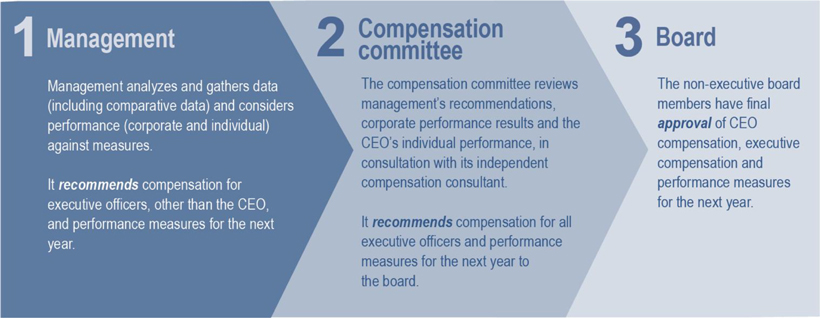
Our culture encourages management to be objective in assessing its own performance and making recommendations to the board to adjust compensation as appropriate. The compensation principles set out below were adopted by the board and guide all executive compensation decisions at Cameco.
| Six compensation principles
| ||||
|
Team
|
Performance
|
Retention
| ||
| Promote executive teamwork by using incentive-based compensation that emphasizes corporate over individual performance |
Base compensation decisions on corporate and individual performance, using a combination of financial, non-financial, internal and external measures, and absolute and relative performance, depending on short-term and long-term performance | Focus part of the LTI (PSUs) on absolute and controllable performance measures and provide a portion of the LTI in RSUs to retain skilled executives | ||
|
Shareholder alignment
|
Benchmarking
|
Market competitiveness
| ||
| Use share ownership requirements and equity-based compensation to align executives with long-term interests of shareholders |
Benchmark shareholder experience and compensation program against a comparable group of companies | Target executive compensation competitively with market, reflecting scope of role, experience and performance, and the scarcity of executives with nuclear experience, to ensure we can attract and retain our executive talent | ||
| 72 | CAMECO CORPORATION |
Our approach to executive compensation
Our executive compensation program is based on strong principles, a disciplined process and thorough research and analysis. It has four goals:
| 1. | Attract, retain and motivate executives, who are operating in a highly demanding, complex and competitive global business environment and where there is a scarcity of executives with nuclear experience and expertise. |
| 2. | Establish a clear link between corporate performance and executive pay. |
| 3. | Motivate executives to create value by rewarding them for successfully achieving corporate and individual performance objectives over the short and long term. |
| 4. | Ensure a significant portion of total compensation is at risk, focused on business outcomes and financial and sustainability performance, and is tied to share value to align the interests of executives and shareholders. |
We benchmark compensation to make sure our program is appropriate and stays competitive with the market. Performance, scope of the role, experience and internal equity are also considered by the Human Resources and Compensation Committee when making compensation decisions.
Benchmarking
We use a compensation comparator group to assess compensation and set Cameco’s executive and director compensation competitively with market.
Our objective is to have a robust comparator group of companies that operate in highly regulated and integrated industries; have a global customer base; and operate critical infrastructure for energy, national and climate security. The depth and breadth of the business activities of the comparator companies should reflect the complexity and scope of operational, geopolitical, regulatory, industrial and market factors that Cameco manages operating across the nuclear fuel and reactor cycles in a sector that is changing rapidly.
2025 compensation comparator group
As disclosed in our 2025 proxy circular, the Human Resources and Compensation Committee updated the compensation comparator group to reflect Cameco’s unique position as a global leader in the provision of nuclear fuel supplies, services and technologies. The 2025 compensation comparator group reflects:
| • | the complexity of Cameco’s business which includes overseeing multifaceted assets like Westinghouse responsible for delivering critical energy infrastructure; |
| • | the breadth of Cameco’s participation in the nuclear fuel and reactor cycles and involvement in international business, diplomatic activities and government negotiations; |
| • | that there are no other publicly traded companies with similar operations across the whole nuclear fuel and reactor cycle; and |
| • | the significant changes in Cameco’s business due to the growing geopolitical importance of nuclear power for energy, climate and national security. |
The table below shows the composition of our compensation comparator group.
| 2025 Compensation comparator group
|
||||||
| Diversified metals and mining |
Oil, gas and chemicals | Utilities, energy infrastructure and other power producers |
Other highly regulated industries | |||
| Agnico-Eagle Mines Ltd. Kinross Gold Corporation Nutrien Ltd. Teck Resources Limited |
* Albemarle Corporation ARC Resources Ltd. Methanex Corporation Ovintiv Inc. * TC Energy Corporation2 * The Mosaic Company |
* Constellation Energy Corp2 * Pinnacle West Capital Corp2 * TXNM Energy, Inc. 2 * Vistra Corp2 |
* AtkinsRéalis Group2 * BWX Technologies, Inc.1, 2 * Curtiss-Wright Corporation1, 2 * Dover Corporation1, 2 * Fluor Corporation2 * Hexcel Corporation1, 2 | |||
* New addition for 2025
| 1. | Westinghouse peer. |
| 2. | Operations include nuclear power generation. |
| 2026 MANAGEMENT PROXY CIRCULAR | 73 |
The acquisition and resulting operational oversight of Westinghouse substantively changed Cameco’s economic profile. After acquiring Westinghouse in November 2023, Cameco’s adjusted EBITDA1 increased from $884 million in 2023 to $1.5 billion in 2024 and $1.9 billion in 2025 and market cap increased to $54.7 billion in 2025 – about a $30 billion increase over the two-year period.
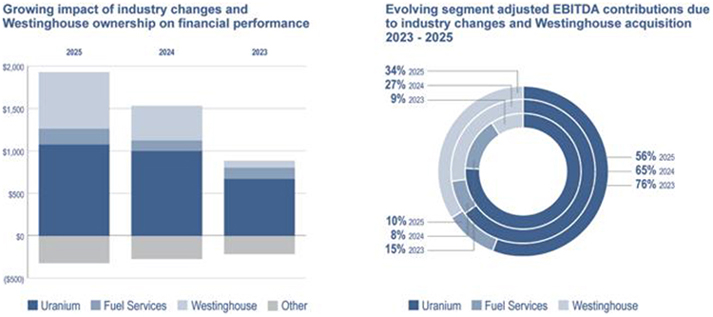
Cameco remains in a unique situation as we are a publicly traded, global nuclear energy company based in Canada with no publicly traded peers in the world that are directly comparable to us.
The comparator group is designed to maintain our ability to attract and retain top talent and includes publicly traded companies in Canada and the US that have business operations with some similarity to Cameco. The group includes a cross-section of companies in the mining, energy, infrastructure, and highly regulated and precision engineering and manufacturing industries. This reflects the industrial integration, the scope and degree of complexity of our business and the increased international focus of Cameco’s business activities following the Westinghouse acquisition.
Additions include Westinghouse peers in highly regulated industries (offering products and solutions in nuclear power, energy, aerospace and defence), electric utilities (including current customers of both Cameco and Westinghouse), other energy companies and chemical, construction and engineering companies. We continue to include select minerals and mining and energy organizations that are similar to Cameco in size and view Cameco as a peer for talent despite the difference in industry. Smaller and less complex companies were removed from the group.
The Human Resources and Compensation Committee evaluated companies that are similarly positioned as leaders in their industry and nuclear companies headquartered in North America using four parameters:
| Market capitalization/Size |
|
Relevant and regulated industries | ||
| Given the unique position of Cameco in the nuclear space, market capitalization is the best indicator of complexity and scope and more effectively reflects the value and complexity of Cameco’s oversight of Westinghouse than revenue. We use total assets and enterprise value as supplemental considerations. Market cap of all peers at December 31, 2025 is within 0.15x to 2.76x of Cameco’s market cap.
|
Comparators are drawn from a cross-section of companies in the nuclear power and adjacent space in comparable and related industries (for example, uranium mining, fuel services, utilities which supply some nuclear power and companies servicing the nuclear sector), as well as diversified metals, mining and energy companies. | |||
| 1 | This is a non-IFRS financial measure (see page 111 for an overview of the adjustments). |
| 74 | CAMECO CORPORATION |
| Geographic scope |
|
Complexity of operations | ||
| Comparators are Canadian and US companies with global operations. | Comparators reflect Cameco’s complex business model and structure of operations and primarily include companies with a fully integrated product cycle or multiple subsidiaries with a breadth of value chain steps in their operations (for example, research and development, sales and engineering). | |||

|
Complexity of operations was assessed from four perspectives:
• Industrial – The nuclear power industry is a highly sophisticated, regulated and technological industry. Globally, there are no other publicly traded uranium companies whose operations span the scope of the nuclear fuel and reactor cycles that Cameco’s or Westinghouse’s operations cover—which includes exploration, mining and milling, refining, conversion, heavy-water fuel fabrication, enrichment (in development), all phases of the operating plant lifecycle for the global light-water reactor fleet and the development and deployment of reactor technologies.
• Geopolitical – The vast majority of transactions in the nuclear power industry require government-to-government interaction that catapults nuclear fuel into broader policy interactions and deliberations. With growing recognition of the critical role that nuclear power is expected to have in the achievement of energy, national and climate security objectives, Cameco often occupies a central role in national and international policy systems, given its deep understanding of the nuclear fuel and reactor cycles and its position as one of the leading global providers of nuclear power products, services and technologies across the fuel and reactor cycles.
• Regulatory – Unlike other mining companies, our mines and fuel services operations are regulated under standards set for nuclear reactor operators where exacting regulatory and technical standards, precision and safety are paramount to the business. Comparatively, the nuclear industry (fuel and reactor cycle) experiences the most breadth (measured by number of regulators) and depth (measured by number of evaluative criteria) of regulatory oversight of any commercial industry reflected in complicated licensing and permitting processes that are both time and resource intensive.
• Marketing – Uranium cannot be thought of as a mining commodity (such as precious or base metals). It is not traded in meaningful quantities on a commodity exchange. Utilities have historically bought the majority of their uranium under long-term contracts that are bilaterally negotiated with suppliers. Uranium is sold under long-term contracts that require a sophisticated and integrated global marketing platform working directly with our customers on sales, transportation, logistics and regulatory market access strategies which is not comparable to base metal or precious metal mining companies. In addition, demand for uranium (the product) cannot be separated from the demand for the services required to create a bespoke fuel assembly (conversion, enrichment and fabrication). Further, many of our customers are governments or state-owned entities, which adds complexity and risk, including protection of intellectual property rights and the transfer of controlled nuclear technologies.
|
Target compensation
We position base salaries and target total compensation competitively with market. The graphs below show the 2025 target pay mix for total direct compensation for our named executives and the proportion that is at risk.
We use financial, operational and sustainability measures to assess performance for the short- and long-term incentive awards.
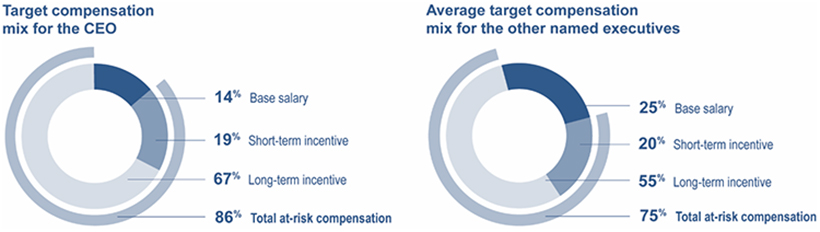
| 2026 MANAGEMENT PROXY CIRCULAR | 75 |
Share ownership requirements
We require share ownership to align the interests of our executives and shareholders. Ownership includes Cameco shares held directly or indirectly and share equivalents such as PSUs and RSUs.
| Ownership guidelines by position |
Equity used to meet share ownership guidelines | |
| CEO – 5x base salary
President and executive vice-presidents – 4x base salary
Senior vice-presidents – 3x base salary
|
✓ Cameco shares owned beneficially, directly or indirectly ✓ Value of unvested RSUs ✓ Value of 50% of unvested PSUs (at target) | |
The Human Resources and Compensation Committee regularly reviews our share ownership guidelines to make sure they continue to align with market practice. The guidelines were last revised in 2022.
We believe it is reasonable to count unvested PSUs when determining share ownership because they are equity-based awards and constitute the majority (60%) of our LTI awards to executives. As described below, executives are expected to use the after-tax proceeds from the payout of their PSUs to maintain compliance with the share ownership guidelines. To account for the variable nature of PSUs, we only count 50% of the award when determining compliance with the share ownership guidelines and PSUs are valued at target. Vested and unvested options are not counted toward meeting the share ownership guidelines.
All named executives are expected to achieve the required levels of ownership within five years of their appointment. If they assume a new position with a higher ownership level, they have an additional three years to meet the increased requirement. If a named executive has not satisfied the ownership guideline within those first five years, or if ownership falls below that level after that time period, they must use the after-tax proceeds from the payout of their PSU and RSU awards and the exercise of stock options to purchase additional shares until the guideline is met.
Currently, all named executives hold significantly more than required and all but one meet the requirement based only on their ownership of Cameco shares, demonstrating that our share ownership guidelines meet their objective of aligning executive and shareholder interests.
Assessing compliance
We assess share ownership levels annually for compliance purposes, using the year-end closing price of Cameco common shares on the TSX or the price at the time of purchase (or grant of share units, qualified as mentioned above), whichever is higher.
The CEO exceeds his share ownership guideline of $6,375,000 and each of the other named executives exceeded their requirement at the end of 2025 as shown in the table below. The CEO directly owns Cameco shares equal in value to almost 7x his total direct compensation for 2025 (comprised of all elements from the summary compensation table except for pension value and all other compensation) of $9,888,170.
| Total holdings | ||||||||||||||||||||||||||||
| Name |
2025 base salary1 |
Cameco shares |
PSUs2 | RSUs3 | Value of holdings4 |
Multiple achieved |
Compliance with share ownership guideline |
|||||||||||||||||||||
| Tim Gitzel5 |
$ 1,275,000 | 532,211 | 51,973 | 115,971 | $ 87,995,480 | 69.0x | Yes | |||||||||||||||||||||
| Grant Isaac |
$ 1,000,000 | 87,185 | 22,594 | 50,914 | $ 20,195,896 | 20.2x | Yes | |||||||||||||||||||||
| Heidi Shockey |
$ 500,000 | 19,999 | 8,801 | 20,335 | $ 6,175,287 | 12.4x | Yes | |||||||||||||||||||||
| Rachelle Girard |
$ 436,000 | 7,278 | 5,594 | 10,858 | $ 2,982,386 | 6.8x | Yes | |||||||||||||||||||||
| David Doerksen |
$ 420,000 | 151 | 5,649 | 11,331 | $ 2,153,024 | 5.1x | Yes | |||||||||||||||||||||
| Brian Reilly |
$ 602,000 | 27,962 | 13,440 | 31,382 | $ 9,147,493 | 15.2x | Yes | |||||||||||||||||||||
| Sean Quinn |
$ 549,000 | 77,706 | 12,564 | 27,666 | $ 14,822,196 | 27.0x | Yes | |||||||||||||||||||||
1. Reflects their base salary at year end.
2. 50% of the unvested PSUs valued at target.
3. Number of unvested RSUs.
4. Based on total holdings multiplied by the 2025 year-end closing share price of $125.68 on the TSX.
5. See Tim Gitzel’s profile on page 18 for the total number and full value of the CEO’s shares, PSUs and RSUs.
| 76 | CAMECO CORPORATION |
Alignment with our strategy
Our executive compensation program is directly aligned with the strategic plan. Measures based on our corporate objectives form the basis of the compensable targets under the short-term incentive plan. PSU awards are measured against absolute and relative performance over a three-year period with the actual payout determined by outcomes against targets based on our long-term strategic goals.
We establish corporate objectives to achieve our strategic plan, and measures, targets and weightings for our incentive plans are approved by the board every year (see our most recent MD&A, particularly the Our values and strategy section for more information about our strategy).
We group our corporate objectives into our four measures of success:
| • | outstanding financial performance; |
| • | safe, healthy and rewarding workplace; |
| • | clean environment; and |
| • | supportive communities. |
Our four measures of success provide leading indicators that inform how we identify and address risks and opportunities that could impact our business and the execution of our strategy. We believe that each is integral to our overall success and that together they will help ensure our long-term sustainability.
| 2026 MANAGEMENT PROXY CIRCULAR | 77 |
Compensation components
The chart below shows the current multi-year, strategic balance of components that make up total direct compensation for the named executives.
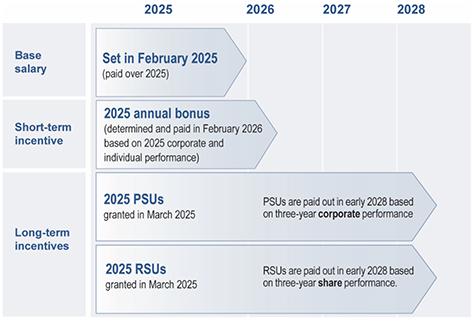
Stock options are no longer part of our long-term incentive mix (the last stock option awards were granted in 2019). Previously granted stock option awards were based on market competitiveness of the LTI package and other factors (you can find details about the stock option plan in Appendix C on page 119).
The table below is a summary of the components that make up total compensation at Cameco.
| Form
|
Performance period
|
How it is determined
|
Risk management features
| |||
| Base salary
|
Fixed compensation that is competitive with the market.
| |||||
| Cash |
One year | Based on current business challenges, experience, scope of the role, market competitiveness, individual performance and internal equity. | Paid throughout the year and provides a base level certainty for fulfilling their responsibilities. Fixed pay represents 14% to 25% of total target direct compensation for the named executives. | |||
| Short-term
|
Variable, at-risk compensation that encourages achievement of pre-established corporate and individual performance objectives. Payout is subject to a clawback policy.
| |||||
| Cash |
One year | Focuses on specific annual objectives.
Target payout based on market competitiveness and other factors.
Actual payout based on corporate and individual performance. |
Provides a balanced focus on short-term performance based on a pre-determined set of performance measures weighted and scored in our scorecard. Actual payout on all measures ranges from 0-200%. Targets and results are approved by the board. Targets are tested to determine the level of stretch.
Using a balanced scorecard of different performance measures reduces the risk associated with emphasizing a single (or limited) performance measure. | |||
| 78 | CAMECO CORPORATION |
| Long-term
|
Variable, at-risk compensation that encourages achievement of longer-term performance and an opportunity to receive equity-based compensation aligned with shareholder interests. Payout is tied to Cameco share performance and is subject to a clawback policy.
| |||||
| Performance share units (PSUs) |
Three-year performance period with vesting at the end of that period | Focuses on longer-term objectives.
The number of PSUs granted is based on market competitiveness of the LTI package and other factors.
Payout is based on our overall absolute and relative performance when the units vest. Payment is made in Cameco shares purchased on the open market or in cash. |
Provides a focus on long-term performance based on established targets for absolute and relative measures. A three-year performance period supports long-term decision-making and management of the business. The performance payout factor is capped to moderate incentives to take risks.
Stretch targets are based on challenging goals. | |||
| Restricted share units (RSUs) |
Three-year term, with vesting at the end of three years | The number of RSUs granted is based on market competitiveness of the LTI package and other factors.
The realized value is based on Cameco’s share price when the units vest.
Payment is made in Cameco shares purchased on the open market or in cash. |
Provides a balanced incentive to take appropriate risks. Three-year vesting period supports retention and maintains longer-term focus for decision-making and management of the business. | |||
| Pension
|
||||||
| Defined contribution registered pension plan and defined benefit supplemental executive pension program |
Ongoing | Based on market competitiveness and legislative requirements. | Tax-efficient way to provide employment benefits.
Provides security for employees and their families. | |||
| Group benefits
|
||||||
| Group insurance, health and dental coverage and income protection |
Ongoing | Based on market competitiveness. | Provides comprehensive insurance and benefits to employees and their families. | |||
Base salary
We generally target base salaries competitively with market. We review base salaries every year and compare them to similar positions in the compensation comparator group. Then we review our corporate performance, the individual’s performance, experience and scope of the role as well as internal equity to make sure any increases are fair and balanced, while also promoting retention of a strong leadership team to execute and capitalize on the global nuclear power growth opportunities.
Salary adjustments, if any, for our named executives normally go into effect on January 1.
Short-term incentive (STI) plan
The STI plan gives executives the opportunity to earn a cash bonus based on their success in achieving pre-established corporate and individual performance targets for the year. The STI award is based on the executive’s target award as a percentage of their base salary and actual corporate and individual performance.
Individual executive targets are set around the median of those of our compensation comparator group. The Human Resources and Compensation Committee sets the target STI for each executive based on position, market competitiveness and internal equity. The weighting of corporate and individual performance is the same for all executives, which promotes executive teamwork and closely aligns the interests of executives and shareholders. The annual cash bonus is based on performance for the year and paid in the following year after the release of our year-end results.
The table below shows the target award levels and performance weightings set at the beginning of 2025 to establish the 2025 STI awards for the named executives.
| Position | Target 2025 STI award (% of base salary) |
Corporate
performance weighting |
Individual
performance weighting |
|||||||||
| CEO |
130% | 80% | 20% | |||||||||
| Other named executives |
65-115% | 80% | 20% | |||||||||
| 2026 MANAGEMENT PROXY CIRCULAR | 79 |
In connection with their promotions on September 1, 2025, the president and chief operating officer’s and senior vice- president and chief financial officer’s STI target increased from 100% and 75% to 115% and 80%, respectively. The STI payout for 2025 was based on their position and STI target at the end of the year.
| Setting STI performance measures
The board uses an additive balanced scorecard approach, establishing measures and weightings for STI performance each year based on the committee’s recommendations. STI performance measures are selected for their alignment with, and in support of, the successful achievement of our strategic plan. |
Driving strong annual corporate performance
Our STI plan focuses on Cameco’s four measures of success, driving strong financial, operational and sustainability performance directly aligned with our strategic plan.
|
STI performance measures undergo a rigorous review process – management brings them forward to the Audit and Finance Committee and the Safety, Health and Environment Committee, and then to the Human Resources and Compensation Committee, where they are reviewed to ensure they appropriately support our strategic plan and are achievable with significant effort. Stress testing is done on different performance scenarios and back testing is carried out on previous performance and compensation decisions to make sure decisions and outcomes are appropriate. The Human Resources and Compensation Committee then recommends the corporate objectives to the board for approval.
Financial and sustainability objectives are each weighted 50% and emphasize our balanced scorecard approach and our commitment to integrating the four measures of success into our executive compensation. In addition, the CEO and other named executives have specific objectives as part of their individual performance measures under the STI plan. The sustainability objectives relate to safety, clean environment and the company’s role in supporting communities where we operate.
Measuring corporate performance and determining the corporate performance multiplier
We assess corporate performance by how well we achieve the STI performance measures, which reflect our four measures of success. Cameco must meet a minimum level of performance (threshold) on each measure for a payout of 50%, otherwise the payout for that measure is 0%. Achieving target performance produces a 100% payout on a measure. The maximum payout on any STI measure is 200%.
As part of the process in determining the corporate performance multiplier, the Human Resources and Compensation Committee consults with the Safety, Health and Environment Committee on our performance related to safety, environment, supportive communities and related corporate results and with the Audit and Finance Committee on our financial performance. The Human Resources and Compensation Committee then brings forward a recommendation to the board.
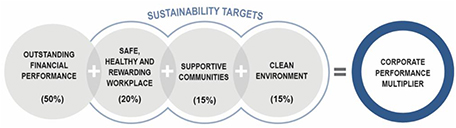
The board can use discretion to make adjustments so that the corporate performance multiplier appropriately reflects performance and discourages excessive risk-taking when there are significant external headwinds and tailwinds that were not contemplated or reasonably expected when the objectives were set under the plan. We disclose any use of discretion together with the rationale and the specific circumstances.
The STI plan pays out at a maximum of 200% of target if performance on every measure is exceptional. The board cannot use its discretion to exceed this cap.
| 80 | CAMECO CORPORATION |
Measuring individual performance
| The board assesses the CEO’s individual performance. It determines individual performance measures and weightings using the annual corporate objectives and recommendations by the Human Resources and Compensation Committee, which are based on:
• overall corporate performance;
• implementation of the CEO’s strategies to increase long-term value; and
• achievement of the CEO’s individual performance objectives.
The Human Resources and Compensation Committee reviews feedback from all directors, reports from management and the CEO’s self-assessment, and consults with its compensation consultant before making its recommendation to the board. |
Driving strong individual performance Our STI plan integrates the individual performance of our named executives, focusing on strong leadership effectiveness, as a member of the executive team, their individual areas of responsibility and human capital management, including inclusion and employee safety, health and wellbeing and development.
|
The CEO assesses the individual performance of each executive team member and recommends to the committee the individual performance measures and weightings using the annual corporate objectives, with consideration given to the executive’s influence over each area. The CEO compares actual performance to the objectives and evaluates the leadership effectiveness of the executive. The CEO discusses the performance of the executives with the committee and its compensation consultant. The committee then makes its recommendations to the board. The board approves all decisions on executive compensation.
Individual performance has a maximum payout factor of 150%.
Determining the payout
The corporate performance multiplier and individual performance multiplier are used to calculate the annual STI bonus based on the formula below.

Long-term incentive (LTI) plan1
| Our LTI plan provides executives and management employees the opportunity to receive equity-based compensation to drive longer-term performance. Both the committee and the board believe equity-based compensation is important for motivating employees to deliver strong longer-term performance, aligning their interests with those of our shareholders and providing pay that is competitive with the market. |
Generating shareholder value Our LTI plan is designed to create value and align shareholder interests with our PSU awards driving strong absolute and relative performance, and our RSU awards focusing on strong share performance. |
The LTI plan includes PSUs and RSUs, a mix that has been in place since 2020 and allows us to use different criteria for at-risk compensation. PSUs and RSUs both have a three-year term. The ultimate value of PSUs is based on absolute and relative performance and our share performance, while the ultimate value of RSUs is based on our share performance. Both PSUs and RSUs focus management on the importance of future value and drive corporate performance over the longer term, underscoring the link between pay and performance.
1 To simplify administration, Cameco combined its Performance Share Unit (PSU) plan and Restricted Share Unit (RSU) plan into an Executive Long-Term Incentive plan (LTI plan) in 2025. In this circular, for 2025 and earlier, references to the LTI plan include both the PSU plan and RSU plan.
| 2026 MANAGEMENT PROXY CIRCULAR | 81 |
The committee evaluates the LTI mix every year and considers market trends, the level of the position, internal equity and overall market competitiveness. The committee set the 2025 LTI target mix at 60% PSUs and 40% RSUs for all named executives.
| Position | LTI award1 (% of base salary) |
Actual % of PSUs and RSUs granted in 2025 (PSUs/RSUs) |
||||||
| Chief Executive Officer |
470% | 60/40 | ||||||
| Executive Vice-President and Chief Financial Officer |
275% | 60/40 | ||||||
| Senior Vice-President and Deputy Chief Financial Officer |
200% | 60/40 | ||||||
| Senior Vice-President and Chief Corporate Officer |
200% | 60/40 | ||||||
| Senior Vice-President and Chief Marketing Officer |
200% | 60/40 | ||||||
| former Senior Vice-President and Chief Operating Officer |
225% | 60/40 | ||||||
| former Senior Vice-President, Chief Legal Officer and Corporate Secretary |
200% | 60/40 | ||||||
| 1. | Reflects the details for each named executive and their position on March 3, 2025, the date the 2025 LTI awards were granted. |
LTI components
| Award
|
How it is used
|
Business
|
Who participates
|
Vesting
|
How it is settled
|
Alignment with
| ||||||
| PSUs
(page 83) |
60% of target LTI award |
Performance criteria
Directly linked to long-term, absolute and relative performance |
Vice-presidents and above |
Units vest at the end of a three-year performance period | Cameco shares purchased on the market or in cash | Motivates executives to create shareholder value that can be sustained over a longer period and to outperform on both an absolute and relative basis
Non-dilutive | ||||||
| RSUs
(page 84) |
40% of target LTI award |
Ties a portion of future compensation to the longer-term performance of our shares | Vice-presidents and above |
Units vest at the end of three years | Cameco shares purchased on the open market or in cash | Motivates executives to create shareholder value that can be sustained over a longer period
Non-dilutive | ||||||
LTI awards are granted annually on the first business day in March after we publicly disclose our results for the previous fiscal year. If we impose a trading blackout period that includes the first business day in March, awards will be granted on the next trading day after the blackout period has ended. The board can grant special LTI awards at other times during the year for promotions, new hires or to address specific business issues.
PSUs and RSUs earn dividend equivalents in the form of additional units. Dividend equivalents vest at the same time as, and in proportion to, the underlying share unit and are paid out when the award is settled.
| 82 | CAMECO CORPORATION |
PSUs
| Each PSU granted under the LTI plan represents an opportunity for an executive to receive a Cameco common share purchased on the open market at the end of the three-year performance period (or the cash equivalent of those common shares, if elected by the named executive once share ownership requirements have been met).
Setting PSU performance measures
PSUs are based on absolute and relative performance, so management maintains a balanced, longer-term focus on delivering value. The Human Resources and Compensation Committee reviews the PSU performance measures and multipliers every year and recommends them to the board for approval. The performance measures and multipliers are challenging and determined at the time of grant. |
Updated for 2025
As disclosed in our 2025 proxy circular, three absolute and relative measures are being used to assess the 2025 PSU awards’ three-year performance.
The measures that support Cameco’s strategy are key to building long-term value for the company and center on three strategic principles as follows:
● Strategically aligned contracting discipline (35%) (relative measure) – Average realized uranium price relative to industry benchmarks motivates us to remain disciplined in our contracting activity and build a balanced portfolio that provides exposure to improving market conditions and downside protection.
● Operationally flexible supply discipline (35%) (absolute measure) – Three-year cumulative actual production compared to cumulative budgeted production for the same period motivates us to profitably produce from our tier-one assets and align production decisions in all segments of the business with sales commitments under our long-term contract portfolio and avoid being exposed to low quality spot demand or building excess inventory.
● Risk adjusted financial discipline (30%) (absolute measure) – Adjusted EBITDA compound annual growth rate (CAGR) over the three years compared to budgeted adjusted EBITDA CAGR over the same period motivates us to execute on our strategy, invest in new opportunities that are expected to add long-term value, and self-manage risk.
Payouts on each PSU measure continue to range from 0 to 200%, consistent with market practice. Details about vesting and payout will be provided in our 2028 management proxy circular.
|
| 2025 PSU award measures | Weighting | Description | What it measures | |||
| Average relative realized uranium price
0 to 200% |
35% | Achieve an average realized price for uranium sales for a three-year period that exceeds the weighted average price for sales in two independent industry benchmarks for the same period:
● EIA (US energy information administration) price for sales in the US; and
● ESA (Euratom supply agency) price for sales in Europe.
The payout at the end of the three-year period is based on 2024, 2025 and 2026 sales due to timing of when pricing information is available. |
Measures performance relative to our competitors.
Consistently achieving higher prices than our competitors is a stretch target because uranium is a fungible product, and we need to distinguish our uranium from our competitors to achieve a premium price.
We use these pricing indicators because they are publicly available and set by independent third parties. | |||
| Operations measure
0 to 200%
Cumulative actual production compared to cumulative budgeted production for the same period |
35% | Achieve three-year cumulative production compared to cumulative budgeted production over the same period at our Canadian operations. | Measures absolute performance and ties directly to our strategic plan.
Consistently achieving profitable production from our tier-one assets aligns production decisions in all segments of the business with sales commitments under our long-term contract portfolio.
We use this measure to avoid being exposed to low quality spot demand or building excess inventory. | |||
| Risk-adjusted financial measure
0 to 200%
Adjusted EBITDA CAGR compared to budgeted adjusted EBITDA CAGR over the same period |
30% | Achieve three-year adjusted EBITDA compound annual growth rate (CAGR) compared to budgeted adjusted EBITDA CAGR over the same period. | Measures absolute performance that ties directly to our strategic plan.
We use this measure to motivate us to invest in new opportunities that are expected to add long-term value and self-manage risk. | |||
| 2026 MANAGEMENT PROXY CIRCULAR | 83 |
Measuring performance and determining the performance multiplier for our 2025 PSU award
The formula below shows how the final number of PSUs are calculated when the units vest to arrive at a payout. Performance is assessed against each measure, and the overall PSU performance multiplier reflects absolute and relative performance and is the sum of the three weighted measures.
We must achieve threshold performance on a measure to achieve the minimum performance multiplier of 50%. For performance between threshold and maximum, the performance multiplier for that measure is based on a straight-line interpolation. Performance is capped at 200% for maximum performance.
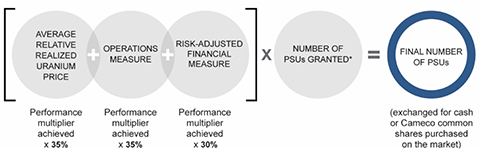
* Represents the number of PSUs granted plus the dividend equivalents earned during the performance period.
RSUs
RSUs provide retention value as each RSU represents one notional common share and the opportunity to receive a Cameco common share purchased on the open market at the end of the three-year vesting period based on our share price or the cash equivalent of those common shares. RSUs are a common form of LTI in our compensation comparator group.
Pension
Pensions are an integral part of total compensation and a cost-effective and important benefit for attracting and retaining executives and other employees. Executives participate in a registered base plan and a supplemental program.
Registered base plan – We have a registered defined contribution plan for eligible employees. All the named executives participate in the defined contribution plan. We contribute 13% of the named executive’s pensionable earnings to the defined contribution plan every two weeks up to the annual maximum allowed by the Canada Revenue Agency, which was $33,810 in 2025.
Supplemental program – This non-contributory supplemental defined benefit executive pension program is designed to attract and retain talented executives over the longer term. It provides a retirement income that is commensurate with the executive’s salary and offsets the registered pension plan limits under the Income Tax Act (Canada).
All of our Canadian-based management at the vice-president level and above participate in the supplemental retirement plan (see Pension benefits on page 105 for more information).
Benefits
Group benefits – We provide group benefits to all our employees. The named executives participate in an enhanced program and receive coverage similar to that offered by companies in our compensation comparator group. These benefits include life insurance, long-term disability insurance, salary protection in the event of short-term disability, extended health care, dental care and emergency medical coverage.
Perquisites – Our named executives also receive additional benefits as part of their total compensation, similar to those offered by companies in our compensation comparator group. These include a financial and tax planning allowance, a vehicle allowance, an executive medical plan, additional life insurance and commission payments on the purchase of shares on LTI payouts, as applicable.
| 84 | CAMECO CORPORATION |
2025 Performance and compensation decisions
Our financial performance in 2025 benefitted from higher sales volumes and an improvement in average realized prices in our uranium segment based on the continued execution of our strategy, which is centered on contracting, supply and risk-managed financial discipline, along with the benefits from our investment in Westinghouse. Net earnings, adjusted net earnings and adjusted EBITDA were higher in 2025 than in 2024 primarily due to the contributions in the uranium segment reflecting an improving price environment, and the increase in our share of Westinghouse’s annual revenue tied to the Dukovany construction project in the Czech Republic.
Cameco has more than 35 years of experience across the fuel cycle, and we have designed our strategy of full-cycle value capture to be resilient. As we execute on that strategy, we will continue to focus on protecting the health and safety of our employees, delivering our products safely and responsibly, and addressing the risks and opportunities that we believe will build long-term value and make our business sustainable.
Market context1
Like other commodities, demand for uranium is cyclical. However, unlike other commodities, uranium is not traded in meaningful quantities on a commodity exchange. Before becoming part of a nuclear fuel bundle that is used to generate carbon-free electricity in a nuclear reactor, mined uranium must first undergo several processing steps, which take place over the course of several years, in different facilities around the world. End-user utilities therefore purchase the majority of their uranium and fuel services products under long-term contracts that are bilaterally negotiated with suppliers and signed at least two years before the fuel is required. The spot market, where material is purchased and delivered within 12 months, cannot satisfy the annual run-rate requirements of the global reactor fleet. Utilities may make small, discretionary purchases in the spot market, typically as one-time volumes for inventory management, but more than 80% of spot market transactions are between intermediaries, trading the same material multiple times. As a result, volatility in the spot market tends to be driven by changes in the availability of uncontracted, near-term supply, rather than by fundamental demand.
Although contracting activity was significantly impacted by uncertainty throughout 2025, history has demonstrated that in general, when prices are rising and high, uranium is perceived as scarce, and utility customers engage in more contracting activity with proven and reliable suppliers. The higher demand discovered during this phase of a contracting cycle drives investment in higher-cost sources of production, which due to lengthy development timelines, tend to miss the contracting cycle and ramp up after demand has already been captured by proven producers. Conversely, when prices are declining and low, there is generally no perceived urgency among customers to enter into meaningful long-term contracts, and both contracting activity and investments in exploration and new supply decrease dramatically. Following years of low prices and a lack of investment in supply, and as the uncommitted material available in the spot market thins, concerns about security-of-supply tend to overtake the focus on price. Utilities typically re-enter the long-term contracting market to ensure they have a reliable future supply of fuel for their reactors, and the cycle reverts.
There have been four significant events that impacted sentiment and uranium prices, prompting inflections in the uranium commodity cycle over the past 20 years:
| 1. | In 2006, Cameco’s Cigar Lake mine flooded during construction, putting at risk 18 million pounds of future annual supply. As a result of the supply concerns, prices moved higher and then fell back as utilities secured their forward requirements. |
| 2. | In 2010, Chinese utilities drove a demand shock when they entered the market and signed several large, long-term uranium contracts to underpin the construction of their growing nuclear fleet. Market prices rapidly improved as multiple utilities entered the market simultaneously to secure long-term supply. |
| 3. | In March 2011, the events at the Fukushima nuclear power plants forced Japan to take its entire reactor fleet offline. Japan, along with several other countries, had to gradually begin rebuilding public trust and acceptance of nuclear energy, and the uranium market entered a protracted period of fundamental over-supply and declining prices primarily due to the continued supply of uncommitted material into the near-term market where there was little demand. |
| 4. | In 2022, Russia invaded Ukraine and set in motion what Cameco believes to be a geopolitical realignment in energy markets. The realignment highlighted concerns about energy security and national security, resulting in a |
1 This section contains forward-looking information. For additional information about forward-looking information, please see page 113.
| 2026 MANAGEMENT PROXY CIRCULAR | 85 |
| focus on origin and security of supplies, driving up prices across the fuel cycle (uranium, conversion, enrichment, and fabrication services). |
In 2025, the geopolitical uncertainty and heightened concerns about energy security, national security and climate security continued to influence contracting activity, positively impacting long-term pricing for uranium and fuel cycle services. However, the volume of forward contracting for uranium this past year remained well below annual consumption, and the level of uncovered future requirements continued to grow. As a result, despite the continued positive momentum driving interest in nuclear energy and a long-term uranium price that continued to increase, we believe that the market has not yet seen its next inflection point, and that it continues to be in the early stages of a contracting cycle.
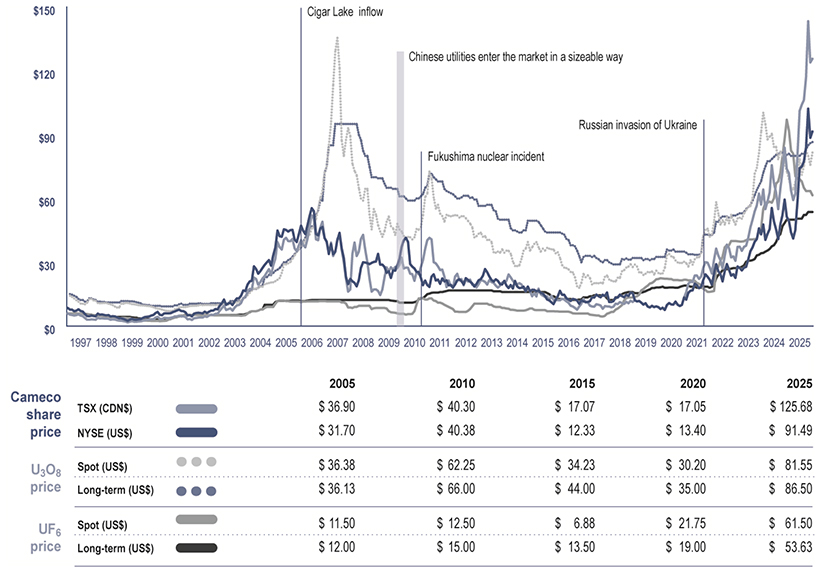
Nuclear market context
According to the IAEA, globally there are currently 436 operable reactors and 66 reactors under construction. The growing recognition of the role nuclear must play in providing secure, safe, affordable, carbon-free baseload electricity has led to a rise in demand. Closed reactors are returning to service, reactors are being saved from retirement, life extensions are being sought and approved for existing reactor fleets, and numerous commitments and plans are advancing for the construction of new nuclear generating capacity. This includes several non-nuclear countries that have emerged as candidates for new nuclear capacity using western reactor designs.
There is also increasing interest in small modular reactors (SMR), including smaller versions of existing technology and advanced technology designs, with companies in energy intensive sectors looking to nuclear to help meet growing energy needs while achieving their decarbonization plans. The potential expansion of the markets and use cases for nuclear energy could add significant demand for uranium fuel in the decades to come, with a growing number of agreements being signed and several projects already underway.
| 86 | CAMECO CORPORATION |
Fuel cycle demand
In this environment, demand and supply fundamentals continued to improve. In addition to ongoing long-term contracting in jurisdictions that have historically relied on western-sourced supplies and services, geopolitical uncertainty is causing some central and eastern European utilities to move away from Russian fuel supply for their Russian-designed reactors. Instead, they are seeking nuclear fuel suppliers whose values are better aligned with their own, and/or whose origin of supply better protects them from potential interruptions. We expect there will be continued competition to secure uranium, conversion services and enrichment services under long-term contracts with proven producers and suppliers who have a diversified portfolio of assets in geopolitically attractive jurisdictions, with strong sustainability performance, and on terms that help ensure a reliable supply is available to satisfy demand.
Uranium prices and fuel cycle supply
Geopolitical uncertainty, energy security and national security remained the most notable factors impacting security of supply. Several idled uranium mines restarted in 2025 in support of increased demand and falling secondary supplies, though supply chain and labour-related delays, with higher-than-expected production costs, were a common theme that negatively impacted productivity. Despite the positive long-term price trend in 2025, the deepening geopolitical uncertainty, sanctions and trade policy restrictions, and years of underinvestment in new uranium and fuel cycle service capacities, have shifted risk from producers to utilities. Driven by the Russian invasion of Ukraine, the suspension of mining in Niger, and supply chain challenges, many governments and utilities are re-examining procurement strategies that rely on nuclear fuel supplies from these jurisdictions resulting in more competition for western supply. In addition, sanctions on Russia and import/export restrictions have added to the delivery risks for nuclear fuel supplies coming out of Central Asia.
At the end of 2025, the average reported spot price was $81.55 (US) per pound, up $8.92 (US) per pound from the end of 2024. During the year, the uranium spot price ranged from a month-end low of $64.23 (US) in March per pound to a month-end high of $82.63 (US) per pound in September, averaging $73.54 (US) for the year.
The volume of long-term contracting reported by UxC for 2025 was about 116 million pounds U3O8 equivalent, down from about 119 million pounds U3O8 equivalent in 2024. The average reported long-term price at the end of the year was $86.50 (US) per pound, up $6.00 (US) from the end of 2024. During the year, the uranium long-term price steadily increased from a month-end low of $80.00 (US) per pound in February 2025 to a high of $86.50 (US) per pound in December 2025, averaging $81.96 (US) per pound for the year.
With increased demand for western conversion services, pricing in both North America and Europe remained strong. At the end of 2025, the average reported spot price for North American delivery was $61.50 (US) per kilogram uranium as UF6 (US/kgU as UF6), down $35.50 (US) from the end of 2024. Long-term UF6 conversion prices for North American delivery also reached a record high and finished 2025 at $53.60 US/kgU as UF6, up $3.63 (US) from the end of 2024.
Cameco’s growth profile
Cameco continues to believe the risk to nuclear fuel supplies is greater than the risk to nuclear fuel demand, and we expect that dynamic to create a renewed focus on ensuring availability of long-term supply to fuel nuclear reactors. As the market continues to transition, we expect to continue to selectively place our uranium and fuel services capacities under long-term contracts to meet rising demand with production from our best margin operations.
With the improvements in the market, the new long-term contracts we have put in place, and a pipeline of contracting discussions, in our uranium segment we plan to produce 14 million to 16.5 million pounds (100% basis) at McArthur River/Key Lake and 17.5 million to 18 million pounds (100% basis) at Cigar Lake in 2026. In our fuel services segment, we plan to produce between 13 million and 14 million kgU in 2026, which includes the UF6, UO2, UO3 and fuel fabrication required to meet our commitments. Our production decisions will continue to be aligned with market opportunities and our ability to secure the appropriate long-term contract homes for our unencumbered, in-ground uranium inventory and for our fuel services capacity, demonstrating that we continue to responsibly manage our assets in accordance with our customers’ needs.
The positive market conditions that we expect to benefit our core uranium and fuel services businesses are also presenting significant future growth opportunities for Westinghouse, which we own with our partner Brookfield. Westinghouse operates across multiple facets of the nuclear fuel and reactor life cycles, captured in two primary categories: the core business and new builds. The core business supports all aspects of the long-term reactor operation, maintenance and fuel supply for the global installed base, including outage and maintenance services, engineering services, instrumentation and controls, parts and nuclear fuel. The new build business includes the
| 2026 MANAGEMENT PROXY CIRCULAR | 87 |
designs, development, engineering and procurement of equipment for new AP1000 and AP300 nuclear reactors, with licensing agreements that allow Westinghouse to benefit from the construction of other reactor designs that incorporate Westinghouse reactor technology. Once a new reactor begins commercial operation, further opportunities are added for both Westinghouse and Cameco through future reactor services and fuel supply contracts.
In the first quarter of 2025, we received a distribution of US$49 million from Westinghouse, representing our 49% ownership share and the first distribution since the acquisition closed. Additionally, in October 2025 we received a distribution of US$171.5 million from Westinghouse. The additional distribution represents our share of the US$350 million Westinghouse received as an up-front payment with respect to KHNP’s construction project for two nuclear reactors at the Dukovany power plant in the Czech Republic. In early 2026, we received a distribution of US$49 million from Westinghouse.
2025 Compensation decisions
Base salary
After careful consideration of external market projections and pressures and a comparison of Cameco’s base salaries to those of the compensation comparator group, each current named executive received a base salary increase between 5% and 9% for 2025 to maintain salary levels targeted competitively with market. Grant Isaac and Heidi Shockey also received a salary adjustment of 29% and 11% respectively as of September 1, 2025, to recognize the increased scope of responsibilities with their appointments to president and chief operating officer and senior vice-president and chief financial officer, respectively (see note 1 to the summary compensation table on page 100).
| 2025 STI bonus
Corporate performance was assessed at 160% for 2025. Detailed results are reported in our 2025 STI scorecard below.
For each measure, we must achieve threshold performance to receive a 50% payout on that measure, while performance at target produces a 100% payout and maximum performance provides a 200% payout. There is no payout if performance is below threshold. Payouts for maximum performance are capped at 200% to mitigate excessive risk-taking. |
Changes to 2025 STI Measures
To keep our STI measures focused on our strategic objectives and four measures of success, as disclosed in our 2025 proxy circular, there were slight changes to the following STI measures for 2025:
• Safe, healthy and rewarding workplace – With the goal of improving the safety trend and to highlight the focus on safety improvement planning, the safety leading and lagging (TRIR) indicators are each weighted 10%, compared to 15% leading and 5% lagging indicators in 2024.
• Clean environment – Our climate measure focuses on the development of site-specific physical environmental risk assessment adaption plans, replacing the 2024 Scope 3 emissions target, which was achieved in 2024.
• Supportive communities – The measure shifted from a focus on training and development of employees in northern Saskatchewan, which was achieved in 2024, to strengthening relations and supporting the development of northern Saskatchewan-owned business capacity, with a particular focus on preferred northern contractors.
|
| 88 | CAMECO CORPORATION |
|
2025 STI scorecard
|
||||||||||||||||||||||||||||
|
Measure
|
Threshold
|
Target
|
Maximum
|
Actual performance | Performance | Weighting |
Multiplier | |||||||||||||||||||||
|
OUTSTANDING FINANCIAL PERFORMANCE (50% weighting)
Adjusted net earnings exceeded the maximum, and funds from operations achieved near maximum performance.
| ||||||||||||||||||||||||||||
|
Achieve targeted adjusted net earnings. ($ millions) |
|
$370 |
|
|
$463 |
|
|
$555 |
|
Adjusted net earnings were $627 million1, which was above maximum performance, resulting in a payout of 200%. |
|
200.0% |
|
|
x |
|
|
25% = |
|
| ||||||||
|
Achieve targeted funds from operations. ($ millions) |
|
$810 |
|
|
$1,012 |
|
|
$1,215 |
|
Funds from operations was $1,200 million1, which was slightly below maximum performance, resulting in a payout of 192.6%. |
|
192.6% |
|
|
x |
|
|
25% = |
|
| ||||||||
|
SAFE, HEALTHY AND REWARDING WORKPLACE (20% weighting)
Performance was close to target on our leading indicator measures and in the target range on TRIR, our lagging indicator measure.
| ||||||||||||||||||||||||||||
|
If a fatality or permanent disability were to occur, the entire safety performance would default to 0%.
| ||||||||||||||||||||||||||||
|
Leading indicators – achieve targeted leading indicators (completion of safety critical training, job task observations and effectiveness review of ergonomic assessments). |
|
80.0% |
|
|
95% to 105% |
|
|
120.0% |
|
The combined completion rate of safety critical training, job task observations and effectiveness review of ergonomic assessments was 93.7%, which was slightly below target performance, resulting in a payout of 95.7%. |
|
95.7% |
|
|
x |
|
|
10% = |
|
| ||||||||
|
Lagging indicator – strive to achieve no injuries at any Cameco-operated sites and maintain a long-term downward trend in combined employee and contractor injury frequency and severity, and radiation doses (measured by TRIR2). |
|
2.30 |
|
|
1.80
(target range |
|
|
1.10 |
|
We achieved TRIR2 of 1.78, which was in the target range. There were no significant safety incidents in 2025. |
|
100.0% |
|
|
x |
|
|
10% = |
|
| ||||||||
|
SUPPORTIVE COMMUNITIES (15% weighting)
Performance was strong on our supportive communities target that focused on strengthening relationships with, and implementing business development strategies for, preferred northern contractors (PNCs) who are important stakeholders in the northern communities where we operate.
| ||||||||||||||||||||||||||||
|
Strengthen relationships and further support development of northern Saskatchewan owned businesses. |
|
Implement a |
|
|
Develop and |
|
|
Award and |
|
All requirements for threshold and maximum performance were met. Apart from a contract that was identified, but not executed in 2025, all target objectives were met or exceeded. |
|
150.0% |
|
|
x |
|
|
15% = |
|
| ||||||||
| 2026 MANAGEMENT PROXY CIRCULAR | 89 |
|
2025 STI scorecard
|
||||||||||||||||||||||||||
|
Measure
|
Threshold
|
Target
|
Maximum
|
Actual performance | Performance | Weighting |
Multiplier | |||||||||||||||||||
|
CLEAN ENVIRONMENT (15% weighting)
Cameco’s 2025 environmental performance targets were focused primarily on mitigating specific risks in each area of our operations. They focused on (i) divisional environmental targets and (ii) publishing adaptation plans. Performance on the environmental divisional targets was at target and adaptation plans were published for all the sites, which resulted in maximum performance.
| ||||||||||||||||||||||||||
|
If an incident occurs that results in, or has reasonable potential to result in, a significant environmental impact (impairment of ecosystem function), or current and future remediation costs exceeding $10 million, or a significant environmental fine or has a reasonable potential to result in a significant negative impact on the company’s reputation, the payout will be 0%.
| ||||||||||||||||||||||||||
|
Improve environmental performance in significant environmental aspects by achieving divisional targets. |
|
80% |
|
|
95% to 105% |
|
|
110% |
|
Environmental performance was within the target performance range. There were no significant environmental incidents in 2025. |
|
100.0% |
|
x |
|
10% = |
|
| ||||||||
|
Develop site specific adaptation plans to address potentially significant physical climate risks. |
|
Developing |
|
|
In addition to |
|
|
In addition to |
|
Developed and published adaptation plans for all the operationally controlled sites. |
|
200.0% |
|
x |
|
5% = |
|
| ||||||||
| 2025 CORPORATE PERFORMANCE MULTIPLIER |
|
|
|
|||||||||||||||||||||||
| 1. | These are non-IFRS financial measures. We use adjusted net earnings and funds from operations as a more meaningful way to compare our financial performance from period to period. These measures do not have a standardized meaning or a consistent basis of calculation under IFRS, and they should not be considered in isolation or as a substitute for financial information prepared in accordance with IFRS. Other companies may calculate these measures differently. See About non-IFRS measures on page 111 for more information. |
| 2. | The total recordable incident rate (TRIR) is an Occupational Safety and Health Administration (OSHA) safety metric that was adopted by the company to continue to drive improvements in safety performance. TRIR is a measure of the rate of “recordable” workplace injuries. Examples of “recordable injuries” are a medical treatment (other than first aid), restricted work, lost-time and other specific injuries such as 10 decibel hearing loss, loss of consciousness and broken bone. |
Individual performance results
CEO individual performance was assessed against the following core measures set for 2025, similar to those set in previous years:
|
Key operating results
Strategic change initiatives
Leadership effectiveness
|

|
The committee can also add any other performance measures it deems appropriate |
In developing its recommendation for the board, the committee assessed overall CEO performance using these measures as well as corporate performance, implementation of our strategy to create long-term sustainable value, recommendations from the independent compensation consultant, feedback from board members and the CEO’s own self-assessment.
The board discussed the results of the CEO’s assessment and considered the committee’s recommendation during an in camera session without management present before approving the CEO’s 2025 STI award. The board’s
| 90 | CAMECO CORPORATION |
decision to approve a payout to the CEO on individual performance that was above target was based on the CEO’s exceptional leadership, strategic initiatives and significant performance results achieved in 2025 (see page 94).
For each of the other executive team members, the CEO provided a detailed assessment of their performance, particular achievements and leadership. The committee considered these assessments in light of the key operating results for 2025 and approved the CEO’s recommended performance assessments for each of the other executive team members, including the named executives.
Individual performance assessments acknowledge the strong leadership of the executive team during a very demanding and complex year, and a year with material strategic and financial achievements.
2025 LTI awards
The 2025 LTI awards were granted to the named executives as set out in the table below.
| PSUs (60%) | RSUs (40%) | |||||||||||||||||||||||||||
| Name |
Number |
Grant value2 |
Performance period end date |
Number granted |
Grant value2 |
Vesting date | ||||||||||||||||||||||
|
Tim Gitzel |
|
56,450 |
|
|
$3,595,865 |
|
|
12/31/2027 |
|
|
37,650 |
|
|
$2,398,305 |
|
|
03/03/2028 |
| ||||||||||
| Grant Isaac |
20,050 | $1,277,185 | 12/31/2027 | 13,400 | $853,580 | 03/03/2028 | ||||||||||||||||||||||
| Heidi Shockey |
8,500 | $541,450 | 12/31/2027 | 5,650 | $359,905 | 03/03/2028 | ||||||||||||||||||||||
| Rachelle Girard |
8,200 | $522,340 | 12/31/2027 | 5,500 | $350,350 | 03/03/2028 | ||||||||||||||||||||||
| David Doerksen |
7,900 | $503,230 | 12/31/2027 | 5,250 | $334,425 | 03/03/2028 | ||||||||||||||||||||||
| Brian Reilly |
12,750 | $812,175 | 12/31/2027 | 8,500 | $541,450 | 03/03/2028 | ||||||||||||||||||||||
| Sean Quinn |
10,350 | $659,295 | 12/31/2027 | 6,900 | $439,530 | 03/03/2028 | ||||||||||||||||||||||
| 1. | PSUs granted |
The number of PSUs reflects 100% of the original number of PSUs granted and has not been adjusted to reflect performance. The actual number of PSUs earned can vary from 0 to 200% of the original number granted based on corporate performance.
| 2. | Value of PSUs and RSUs granted |
The values represent the number of PSUs and RSUs granted to each named executive, multiplied by $63.70, the closing price of Cameco shares on the TSX on the trading day immediately before the award.
2023 PSU payouts
The 2023 PSU awards vested on December 31, 2025, with corporate performance for the 2023 to 2025 performance period assessed at 95.0%. There were two equally weighted measures for 2023 PSU performance. Performance was above target for Cameco’s three-year relative realized uranium price and was assessed at threshold for the operations measure, which included all-in sustaining cash costs.
In determining the all-in sustaining cash cost result, the Human Resources and Compensation Committee, recognized that strategic changes implemented by Cameco after the grant of the PSUs – to accelerate future growth and enhance reliability of operations – materially benefited the business, but resulted in Cameco incurring unbudgeted costs to help ensure the availability of the workforce, equipment and supplies necessary to execute the changes. The committee adjusted the result for all-in sustaining cash costs for the cost impact of the strategic decisions made during the performance period, resulting in an approved payout at threshold.
| 2026 MANAGEMENT PROXY CIRCULAR | 91 |
The table below shows the calculation of the payout, which includes the initial number of PSUs granted in 2023, plus the dividend equivalents earned on those units over the three-year performance period, multiplied by the PSU performance multiplier. Payouts were made to each named executive on March 2, 2026 based on $170.0813, the actual average purchase price of our common shares purchased on the TSX on that date on behalf of the named executives.
| Name | 2023 PSU award plus dividend equivalents (# of units1) |
(Multiplier x Weighting) |
Total value of 2023 PSU payout |
|||||||||||||||||||||||||
|
Average realized uranium price |
Operations measure | |||||||||||||||||||||||||||
|
Tim Gitzel |
|
70,010 |
|
|
$ 11,312,352 |
| ||||||||||||||||||||||
| Grant Isaac |
31,133 | $ 5,030,412 | ||||||||||||||||||||||||||
| Heidi Shockey |
12,926 | $ 2,088,428 | ||||||||||||||||||||||||||
| Rachelle Girard |
4,205 | x | (140% x 50% | + | 50% x 50%) | = | $ 679,585 | |||||||||||||||||||||
| David Doerksen |
4,778 | $ 772,171 | ||||||||||||||||||||||||||
| Brian Reilly |
20,168 | $ 3,258,968 | ||||||||||||||||||||||||||
| Sean Quinn |
16,345 | $ 2,641,192 | ||||||||||||||||||||||||||
| 1. | The number of units rounded down to the lower whole number. Actual payouts are calculated using the precise fractional number. |
The 2023 PSU scorecard below shows the PSU performance multipliers as well as the threshold, target and maximum for each objective and our results against both performance measures under the plan at the end of the performance period.
|
2023 PSU scorecard |
||||||||||||||||||||||||||
| Measure |
Threshold | Target | Maximum | Actual performance |
Performance multiplier |
|
Weighting |
| ||||||||||||||||||
|
Average realized uranium price
Achieve an average realized price in US dollars for uranium sales for a three-year period that exceeds the weighted average price for sales in two industry benchmarks for the same period – the EIA price for sales in the US and the ESA price for sales in Europe.
The 2023 grant is based on 2022, 2023 and 2024 sales due to timing of when pricing information is available.
|
|
$38.10 |
|
|
47.63 |
|
|
$57.16 |
|
Achieved an average realized price for uranium sales of US$51.51, which is higher than the target of the weighted average price for sales in two industry benchmarks for the same period. |
|
140.0% |
|
|
x |
|
50% = |
| ||||||||
|
Operations measure
Achieve all-in sustaining cash cost of $1,191.7 million from our three Saskatchewan tier-one mining operations for 2023 through 2025.
($ millions)
|
|
$1,310.8 |
|
|
$1,191.7 |
|
|
$1,072.5 |
|
All-in sustaining cash cost from the identified operations for the three-year period 2023 through 2025 was assessed at threshold1. |
|
50.0% |
|
|
x |
|
50% = |
| ||||||||
|
PSU PERFORMANCE MULTIPLIER
|
|

| ||||||||||||||||||||||||
| 1. | The performance metrics for this target were established based on the 2023 budget and plan. During the performance period, management made strategic decisions to support long-term value creation, including extending the mine life of Cigar Lake and advancing capital projects to enhance the reliability and sustainability of existing operations and support future production flexibility. These actions were not contemplated in the 2023 budget and plan. As a result, we incurred incremental 2025 operating costs of up to $65 million related to effective project execution and the retention of specialized personnel and critical mining and maintenance resources in a constrained supply chain environment. While these decisions were considered appropriate in light of our long-term strategy, they adversely affected performance relative to the original budget and plan over the three-year performance period. Accordingly, and in addition to the adjustment to all-in sustaining cash costs in 2024, an adjustment to reflect performance at the threshold level was approved. |
| 92 | CAMECO CORPORATION |
The next table provides additional details for calculating the performance multipliers for the 2023 PSU awards.
| Performance measures (and weighting) |
Threshold performance |
If we achieve: | Then the performance multiplier is: | |||
|
Average realized uranium price (50%) |
80% of our target of 100% |
Less than 80% of the corresponding |
0% | |||
|
80 to 120% of the corresponding target price |
50 to 200% (in a straight-line interpolation) | |||||
|
More than 120% of the corresponding |
200% | |||||
|
Operations measure (50%) |
$1,310.8 million over a three-year period (target is $1,191.7 million) |
More than $1,310.8 million |
0% | |||
|
$1,072.5 million to $1,310.8 million |
50 to 200% (in a straight-line interpolation) | |||||
|
Less than $1,072.5 million |
200% |
The 2021, 2022 and 2023 PSU awards vested below target, highlighting the strong link between pay and performance and the at-risk nature of the LTI award. The table below shows the PSU payout levels for the last three years.
| PSU awards |
Vested as a % of target | Paid out (in shares or
cash) after deducting withholding taxes | ||||
| 2023 |
95.0% | March 2026 | ||||
| 2022 |
81.7% | March 2025 | ||||
| 2021 |
80.8% | March 2024 | ||||
2022 RSU payouts
The 2022 RSU awards vested on March 1, 2025, based on our share price at the time of vesting.
The table below shows the calculation of the payout, which includes the initial number of RSUs granted in 2022 plus the dividend equivalents earned on those units over the three-year period. Payouts were made to each named executive on March 1, 2025, based on $61.1398, the actual average purchase price of our common shares purchased on the TSX on that date on behalf of the named executives.
| Name | 2022 RSU award plus dividend equivalents (# of units1) |
Actual average purchase price | Total value of 2022 RSU payout |
|||||||||||||
| Tim Gitzel |
51,607 | $ 3,155,287 | ||||||||||||||
| Grant Isaac |
19,554 | $ 1,195,558 | ||||||||||||||
| Heidi Shockey |
3,648 | $ 223,038 | ||||||||||||||
| Rachelle Girard |
3,205 | x |
$ 61.1398 | $ 195,973 | ||||||||||||
| David Doerksen |
3,638 | $ 222,472 | ||||||||||||||
| Brian Reilly |
15,069 | $ 921,319 | ||||||||||||||
| Sean Quinn |
12,196 | $ 745,683 | ||||||||||||||
| 1. | The number of units rounded down to the lower whole number. Actual payouts are calculated using the precise fractional number. |
| 2026 MANAGEMENT PROXY CIRCULAR | 93 |
|
CEO compensation summary
| ||
| Tim Gitzel, CEO (since June 2011)
|
Tim Gitzel is responsible for Cameco’s overall leadership, vision and strategic direction and has overall responsibility for operating our business while managing risk to create long-term sustainable value. He served as president and CEO from June 2011 to August 2025.
The CEO’s leadership has been exemplary, leading the company through significant growth during a time of continued extraordinary volatility and complexity in our industry, while retaining the trust and credibility of our employees, investors and key stakeholders. Tim has spearheaded Cameco’s transformation through strategic decisions, mergers and acquisitions, partnerships and advocacy, strongly positioning the company for the growth now being realized.
With more than 30 years tenure in the nuclear industry, Tim is recognized and sought by global policy makers, governments and industry associations for his business leadership and expertise in the nuclear fuel cycle and nuclear power industry.
2025 Key results
• Maintained a strong balance sheet – generated $1,405 million in cash from operations compared to $905 million in 2024 and repaid the remaining US$200 million term loan obligations used to finance the acquisition of Westinghouse, extinguishing the term loan and reducing total debt to $1.0 billion. Achieved a credit rating upgrade from S&P Global Ratings and accelerated the increase of the annual dividend to $0.24 per share (previously planned for 2026).
• Increased adjusted EBITDA by 26% as a result of strong performance across all segments of our business.
• Established with Brookfield a strategic partnership with the US government to accelerate deployment of Westinghouse nuclear reactor technologies with an aggregate investment value of at least US$80 billion.
• Benefited from a cash distribution from Westinghouse of US$350 million, with US$171.5 million representing Cameco’s share, tied to its participation in the Dukovany nuclear project.
• Produced 21 million pounds of uranium (our share), exceeding our revised consolidated annual production of up to 20 million pounds announced in August 2025.
• Led the ongoing disciplined approach to Cameco’s long-term contracting activity: the portfolio now includes about 230 million pounds of U308 in our uranium segment and about 83 million kgU as UF6 in our fuel services segment.
• Demonstrated exceptional leadership and a strong succession plan in a year where three executives announced their retirement, one new officer joined the executive team, and executive portfolios were re-balanced.
• Cameco was named to the TSX30 for the second year in a row, ranked number 23 in the annual ranking of the top performing stocks by the TSX, with a three-year share price appreciation of 277% (June 2025).
• Cameco’s market cap is up more than 310% over the last three years, reaching almost $55 billion at the end of 2025.
• Leads the company in a manner that retains trust and credibility with our investors, employees and key stakeholders – Tim is increasingly called upon by governments, industry and business to share his nuclear expertise and has been at the table as geopolitical events continued to unfold in 2025 to influence decisions and build and maintain relationships that affect Cameco and the industry.
• Awards and recognition: American Nuclear Society Presidential Citation award for advocacy in the global nuclear sector; HILL Award – Honouring Integrity, Legacy | |
| 94 | CAMECO CORPORATION |
| and Leadership; Order of Dostyk (Friendship) given by the President and Government of Kazakhstan.
CEO compensation
• Tim’s target STI award for 2025 was 130% of his base salary and based 80% on corporate performance and 20% on individual performance. The corporate performance score of 160%, combined with Tim’s strong individual performance, resulted in an annual cash bonus that amounted to 158% of target.
• Tim received an LTI award valued at 470% of his 2025 base salary. As disclosed in our 2025 management proxy circular, the board increased the target LTI award for the CEO from 370% to 470% of base salary to recognize Tim’s strong performance during his long CEO tenure and the material increase in the scope of responsibilities following the acquisition of Westinghouse.
• Both incentive awards are at-risk compensation – the ultimate value of the long-term incentive award is based on performance and share price when the units vest at the end of three years. |
| Compensation (as at December 31) |
Three-year average |
2025 | 2024 | 2023 | ||||||||||||||||||
| Fixed | ||||||||||||||||||||||
| Base salary | $ | 1,204,467 | $ | 1,275,000 | $ | 1,169,200 | $ | 1,169,200 | ||||||||||||||
| At-risk compensation | ||||||||||||||||||||||
| Short-term incentive | $ | 2,167,667 | $ | 2,619,000 | $ | 2,146,000 | $ | 1,738,000 | ||||||||||||||
| Long-term incentive | ||||||||||||||||||||||
| PSUs |
$ | 2,929,315 | $ | 3,595,865 | $ | 2,596,000 | $ | 2,596,080 | ||||||||||||||
| RSUs |
$ | 1,952,925 | $ | 2,398,305 | $ | 1,729,750 | $ | 1,730,720 | ||||||||||||||
| Total direct compensation | $ | 8,254,374 | $ | 9,888,170 | $ | 7,640,950 | $ | 7,234,000 | ||||||||||||||
CEO realized and realizable pay
A significant portion of CEO compensation consists of long-term incentive awards, which are designed to focus the CEO on Cameco’s long-term success. These awards are directly affected by the performance of Cameco shares, among other things. As CEO, nearly 67% of Tim’s 2025 target compensation is in the form of equity-based long-term incentive awards, which are at-risk on a deferred basis.
The table below provides a five-year lookback at the CEO’s total direct compensation. It shows the impact of the at-risk portion of the CEO’s compensation in terms of realized and realizable pay at December 31, 2025, compared to the return a shareholder would receive over the same period as shown in the table. The analysis compares the performance of $100 of CEO compensation over the specified period to the return of $100 invested in Cameco common shares at the start of the specified period, including reinvestment of dividends. The table illustrates the impact of a pay mix that includes fixed and variable pay and cash and equity-based components, and our strong track record of aligning CEO pay to Cameco’s performance.
| 2026 MANAGEMENT PROXY CIRCULAR | 95 |
| Total direct compensation |
Realized pay1 |
Realizable pay2 |
Current value (realized pay + |
Performance period | Value of $100 | |||||||||||||||||||||
| CEO |
Shareholder |
|||||||||||||||||||||||||
| 2021 |
$ 6,347,083 | $ 12,396,157 | $ 0 | $ 12,396,157 | Jan 1, 2021 to Dec 31, 2025 | $ 195 | $ 747 | |||||||||||||||||||
| 2022 |
$ 6,800,902 | $ 9,832,279 | $ 0 | $ 9,832,279 | Jan 1, 2022 to Dec 31, 2025 | $ 145 | $ 460 | |||||||||||||||||||
| 2023 |
$ 7,234,000 | $ 14,219,552 | $ 5,865,988 | $ 20,085,540 | Jan 1, 2023 to Dec 31, 2025 | $ 278 | $ 412 | |||||||||||||||||||
| 2024 |
$ 7,640,950 | $ 3,315,200 | $ 9,923,818 | $ 13,239,018 | Jan 1, 2024 to Dec 31, 2025 | $ 173 | $ 221 | |||||||||||||||||||
| 2025 |
$ 9,888,170 | $ 3,894,000 | $ 11,849,487 | $ 15,743,487 | Jan 1, 2025 to Dec 31, 2025 | $ 159 | $ 170 | |||||||||||||||||||
|
Average |
$ 7,582,221 | $ 8,731,438 | $ 5,527,859 | $ 14,259,296 | $ 190 | $ 402 | ||||||||||||||||||||
| 1. | Includes salary, short-term incentive payout and PSU and RSU payouts. |
| 2. | Includes the market value at year end of unvested PSUs (assuming PSUs vest at target) and unvested RSUs, including earned dividend equivalents. |
Share ownership
Tim exceeds his share ownership requirement. As CEO, he is required to own 5x his base salary in Cameco shares to align with shareholder interests.
The table below shows Tim’s share ownership as of December 31, 2025 – the market value is more than 69x his base salary. Tim directly owns Cameco shares equal in value to almost 7x his total direct compensation for 2025 of $9,888,170 (comprised of all elements from the summary compensation table except the pension value and all other compensation). As well, the value of Tim’s Cameco shares is more than 52x his base salary.
| Base salary |
Multiple |
Target value |
Cameco shares |
PSUs and RSUs |
Market value of share ownership (shares, RSUs and PSUs) | |||||||||
| Number held | Value | Number held | Value | |||||||||||
|
$ 1,275,000 |
5x | $ 6,375,000 | 532,211 | $ 66,888,278 | 167,944 | $ 21,107,202 | $ 87,995,480 | |||||||
See Share ownership requirements on page 76 for more information about share ownership.
| 96 | CAMECO CORPORATION |
Share performance and executive compensation
At the end of 2025, Cameco’s share price had increased by 70% compared to the end of 2024.
The graph below compares Cameco’s TSR to the return of the S&P/TSX Composite Total Return Index over the past five years assuming an initial $100 investment at the end of 2020 and reinvestment of dividends over the period. The graph also compares our TSR to the total compensation awarded to our named executives over the same period. The reported compensation reflects the compensation reported for the named executives in the summary compensation table in our management proxy circulars for the relevant fiscal year.
Cameco shares have outperformed the TSX Composite Total Return over the five-year period while named executive compensation has increased moderately. The higher compensation amount for 2025 is due largely to our reporting of seven named executives for the year instead of the required five (see note 3 to the cost of management table below).
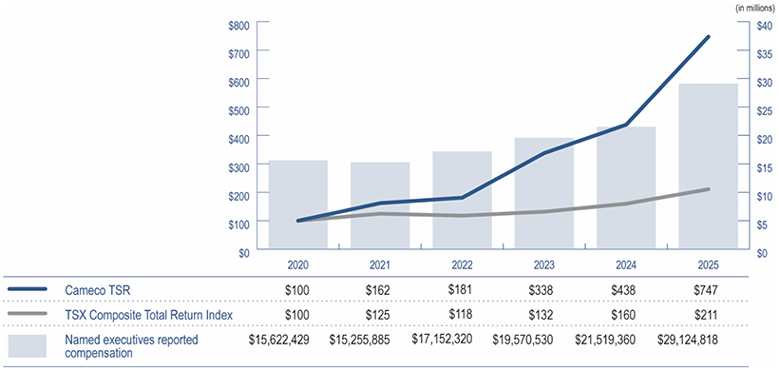
Cost of management
Total compensation for the named executives in 2025 was 1.51% of adjusted EBITDA as shown in the table below.
The table shows Cameco’s adjusted EBITDA for each of the past five years compared to total compensation awarded to the CEO and the average compensation awarded to the other named executives to illustrate a cost of management and the link between pay and performance. Cameco’s one-year TSR is also shown for each of the last five years as a measure of shareholder value.
| 2021 | 2022 | 2023 | 2024 | 2025 | ||||||||||||||||
| Adjusted EBITDA1 ($ thousands) |
$ 194,423 | $ 431,382 | $ 883,847 | $ 1,530,853 | $ 1,928,577 | |||||||||||||||
| Total compensation awarded to the CEO |
$ 6,678,084 | $ 7,390,802 | $ 7,974,000 | $ 7,925,250 | $ 10,955,770 | |||||||||||||||
| Total compensation awarded to the other named executives2 |
$ 8,577,801 | $ 9,761,518 | $ 11,596,530 | $ 13,594,110 | $ 18,169,048 | |||||||||||||||
| Total compensation awarded to the named executives2 |
$ 15,255,885 | $ 17,152,320 | $ 19,570,530 | $ 21,519,360 | $ 29,124,818 | |||||||||||||||
| As a % of adjusted EBITDA |
7.85% | 3.98% | 2.21% | 1.41% | 1.51% | |||||||||||||||
| Cameco one-year TSR (TSX: CCO) |
62.2% | 11.7% | 86.5% | 29.6% | 72.4% | |||||||||||||||
| 1. | This is a non-IFRS financial measure (see page 111). |
| 2. | Amounts for total compensation awarded to the named executive officers from 2021 to 2024 are as disclosed in our prior management proxy circulars. |
| Named executives officers: |
| 2025: Tim Gitzel, Grant Isaac, Heidi Shockey, Rachelle Girard, David Doerksen (retired), Brian Reilly (retired), Sean Quinn (retired) |
| 2024: Tim Gitzel, Grant Isaac, Brian Reilly, Sean Quinn, Heidi Shockey, Alice Wong (retired) |
| 2023: Tim Gitzel, Grant Isaac, Brian Reilly, Alice Wong, Sean Quinn |
| 2022: Tim Gitzel, Grant Isaac, Brian Reilly, Alice Wong, Sean Quinn |
| 2021: Tim Gitzel, Grant Isaac, Brian Reilly, Alice Wong, Sean Quinn |
See the lookback table in CEO compensation summary on page 96 for information about how the CEO’s realized and realizable compensation relates to shareholder return.
| 2026 MANAGEMENT PROXY CIRCULAR | 97 |
2026 Compensation decisions
Base salary
After careful consideration of external market projections and pressures and a comparison of Cameco’s base salaries to those of our compensation comparator group, the board approved base salary increases in 2026 ranging from 6.25 to 30% for the executives to support attraction and retention of the scarce specialized leadership skills and expertise required to capitalize on the global nuclear power growth opportunities.
Short-term incentive (STI)
The STI plan will continue to use a balanced scorecard approach that supports Cameco’s four measures of success:
| • | Outstanding financial performance – 50% of STI will continue to be based on financial results: achieving targeted adjusted net earnings and targeted funds from operations. |
| • | A Safe, healthy and rewarding workplace – Safety remains a core value and the achievement of leading indicator targets will be weighted 12% to focus on continued improvement while the lagging (TRIR) indicator target will be weighted 8%, compared to weightings of 10% each in 2025. |
| • | A Clean environment – Measures will continue to focus on improving environmental performance across the three divisions (10%), and on updating our low carbon transition plan and completing climate action activities planned for 2026 (5%). |
| • | Supportive communities – Measures will focus on collaborative relationships with our northern Saskatchewan communities and PNCs through workforce development and business development targets. |
For 2026, the board increased the STI target for the CEO to 140% (from 130% of base salary), and to 130% (from 115% of base salary) for the president and chief operating officer.
Long-term incentive (LTI)
LTI awards granted to executives in early 2026 were set within a competitive range of the compensation comparator group and calculated as a percentage of base salary. 2026 LTI awards consisted of 60% PSUs and 40% RSUs and were granted to the named executives on March 2, 2026.
Performance measures for the 2026 PSU awards reflect principles that support our strategy and are key to building long-term value:
| • | Strategically aligned contracting discipline (50%) (relative measure) – Average realized uranium price relative to industry benchmarks motivates us to remain disciplined in our contracting activity and build a balanced portfolio that provides exposure to improving market conditions and downside protection. |
| • | Risk adjusted financial discipline (50%) (absolute measure) – Adjusted EBITDA compound annual growth rate (CAGR) over the three years compared to budgeted adjusted EBITDA CAGR over the same period (40%) and milestones to execute on Westinghouse growth beyond its core business (10%) motivate us to execute on our strategy, invest in new opportunities that are expected to add long-term value, and self-manage risk. |
The operations measure (related to production) that was part of the 2025 PSU awards was removed because production impacts the risk adjusted financial discipline measure. Also, due to the importance of Westinghouse oversight to our strategy, we have included Westinghouse milestones to the risk adjusted financial discipline measure.
The board approved the 2026 LTI targets as a percentage of base salary for the named executives, other than those who have announced an intention to retire in 2026: 600% for the CEO, 500% for the president and chief operating officer, 310% for the senior vice-president and chief financial officer and 215% for the senior vice-president and chief corporate officer.
| 98 | CAMECO CORPORATION |
The board approved the following 2026 LTI awards. The 2026 PSU awards will vest at the end of a three-year performance period ending December 31, 2028. The 2026 RSU awards will also vest on December 31, 2028.
| PSUs (60%) |
RSUs (40%) |
|||||||||||||||||||||||||||
| Name | Number of
units granted1 |
Grant value2 |
Performance period end date |
Number of units granted |
Grant value2 |
Vesting date | ||||||||||||||||||||||
| Tim Gitzel |
32,350 | $ | 5,220,643 | 12/31/2028 | 21,560 | $ | 3,479,353 | 12/31/2028 | ||||||||||||||||||||
| Grant Isaac |
24,170 | $ | 3,900,555 | 12/31/2028 | 16,110 | $ | 2,599,832 | 12/31/2028 | ||||||||||||||||||||
| Heidi Shockey |
6,920 | $ | 1,116,750 | 12/31/2028 | 4,610 | $ | 743,962 | 12/31/2028 | ||||||||||||||||||||
| Rachelle Girard |
4,400 | $ | 710,072 | 12/31/2028 | 2,930 | $ | 472,843 | 12/31/2028 | ||||||||||||||||||||
| David Doerksen |
3,120 | $ | 503,506 | 12/31/2028 | 2,080 | $ | 335,670 | 12/31/2028 | ||||||||||||||||||||
| Brian Reilly |
5,040 | $ | 813,355 | 12/31/2028 | 3,360 | $ | 542,237 | 12/31/2028 | ||||||||||||||||||||
| Sean Quinn |
4,080 | $ | 658,430 | 12/31/2028 | 2,720 | $ | 438,954 | 12/31/2028 | ||||||||||||||||||||
| 1. | PSUs granted |
| The number of PSUs reflects 100% of the original number of PSUs granted and has not been adjusted to reflect performance. The actual number of PSUs earned can vary from 0 to 200% of the original number granted based on corporate performance. |
| 2. | Value of PSUs and RSUs granted |
| The values represent the number of PSUs and RSUs granted to each named executive, multiplied by $161.38, the closing price of Cameco shares on the TSX on the trading day immediately before the award. |
Details will be provided in our 2027 management proxy circular.
| 2026 MANAGEMENT PROXY CIRCULAR | 99 |
2025 Compensation details
Summary compensation table
The table below shows the compensation awarded to the named executives for the 2025, 2024 and 2023 fiscal years ending December 31.
| Name and principal position |
Year | Salary1 | Share-based awards2 |
Annual incentive plans3 |
Pension Value4 |
All
other compensation5 |
Total compensation |
|||||||||||||||||||||
|
Tim Gitzel |
|
2025
2024
2023 |
|
|
$1,275,000
$1,169,200
$1,169,200 |
|
|
$5,994,170
$4,325,750
$4,326,800 |
|
|
$2,619,000
$2,146,000
$1,738,000 |
|
|
$1,067,600
$284,300
$740,000 |
|
|
–
–
– |
|
|
$10,955,770
$7,925,250
$7,974,000 |
| |||||||
| Chief Executive Officer (as of September 1, 2025) | ||||||||||||||||||||||||||||
|
President and Chief Executive Officer | ||||||||||||||||||||||||||||
| (until August 31, 2025)
|
||||||||||||||||||||||||||||
|
Grant Isaac |
|
2025
2024
2023 |
|
|
$850,000
$724,500
$700,000 |
|
|
$2,130,765
$2,290,750
$1,924,680 |
|
|
$1,817,000
$1,023,000
$832,000 |
|
|
$1,059,900
$323,800
$670,800 |
|
|
–
–
– |
|
|
$5,857,665
$4,362,050
$4,127,480 |
| |||||||
| President and Chief Operating Officer (as of September 1, 2025) | ||||||||||||||||||||||||||||
|
Executive Vice-President and Chief Financial Officer (February 1, 2023 to August 31, 2025) | ||||||||||||||||||||||||||||
|
Senior Vice-President and Chief Financial Officer (until January 31, 2023)
|
||||||||||||||||||||||||||||
| Heidi Shockey |
|
2025
2024
2023 |
|
|
$467,333
$414,000
$400,000
|
|
|
$901,355
$827,750
$800,085
|
|
|
$629,000
$377,000
$306,000
|
|
|
$550,400
$187,200
$1,595,900
|
|
|
–
–
–
|
|
|
$2,548,088
$1,805,950
$3,101,985
|
| |||||||
| Senior Vice-President and Chief Financial Officer (as of September 1, 2025) | ||||||||||||||||||||||||||||
|
Senior Vice-President and Deputy Chief Financial Officer (February 1, 2023 to August 31, 2025) | ||||||||||||||||||||||||||||
|
Vice-President, Controller (until January 31, 2023) |
||||||||||||||||||||||||||||
| Rachelle Girard |
|
2025
2024
2023 |
|
|
$436,000 $339,888
$270,363
|
|
|
$872,690 $271,700
$280,496
|
|
|
$515,000 $273,000
$156,000
|
|
|
$391,100 $2,026,200
$73,300
|
|
|
– –
–
|
|
|
$2,214,790 $2,910,788
$780,159 |
| |||||||
| Senior Vice-President and Chief Corporate Officer (as of July 1, 2024) | ||||||||||||||||||||||||||||
|
Vice-President, Investor Relations (until June 30, 2024) | ||||||||||||||||||||||||||||
| David Doerksen |
|
2025
2024
2023 |
|
|
$420,000
$336,773
$307,328 |
|
|
$837,655
$309,100
$318,542 |
|
|
$431,000
$246,000
$171,700 |
|
|
$254,000
$2,306,700
$89,300 |
|
|
–
–
– |
|
|
$1,942,655
$3,198,573
$886,870 |
| |||||||
| Senior Vice-President and Chief Marketing Officer (as of October 7, 2024) | ||||||||||||||||||||||||||||
|
Vice-President, Marketing (until October 6, 2024) | ||||||||||||||||||||||||||||
| Brian Reilly |
|
2025
2024
2023 |
|
|
$602,000
$573,100
$553,700 |
|
|
$1,353,625
$1,289,750
$1,245,820 |
|
|
$713,000
$602,000
$489,000 |
|
|
$358,000
$296,800
$349,100 |
|
|
–
–
– |
|
|
$3,026,625
$2,761,650
$2,637,620 |
| |||||||
| Senior Advisor, Operations (as of September 1, 2025) | ||||||||||||||||||||||||||||
|
Senior Vice-President and Chief Operating Officer (until August 31, 2025) | ||||||||||||||||||||||||||||
| Sean Quinn |
|
2025
2024
2023 |
|
|
$549,000
$523,100
$505,400 |
|
|
$1,098,825
$1,347,500
$1,010,830 |
|
|
$651,000
$550,000
$449,000 |
|
|
$280,400
$240,900
$397,400 |
|
|
–
–
– |
|
|
$2,579,225
$2,661,500
$2,362,630 |
| |||||||
| Senior Advisor, Special Projects (as of September 1, 2025) | ||||||||||||||||||||||||||||
|
Senior Vice-President, Chief Legal Officer and Corporate Secretary (until August 31, 2025) | ||||||||||||||||||||||||||||
| 1. | Base salary |
Each amount reflects actual pay for the year. The 2025 salaries for Grant Isaac and Heidi Shockey include adjustments of 29% and 11% respectively as of September 1, 2025, to recognize the increased scope of responsibilities with their recent appointments.
| 2. | Share-based awards |
The amounts reflect the grant date value of both the number of PSUs and RSUs awarded with 60% allocated to PSUs and 40% allocated to RSUs. The number of PSUs that the named executives will actually earn can vary from 0 to 200% of the PSUs granted (plus dividend equivalents earned), depending on performance.
| 100 | CAMECO CORPORATION |
| Grant Isaac and Sean Quinn each received additional 2024 PSUs with a grant value of $300,000 to recognize their significant leadership role in Cameco’s acquisition of the 49% interest in Westinghouse. |
| PSUs | March 3, 2025 | March 1, 2024 | March 1, 2023 | |||||||||||||
| Tim Gitzel |
56,450 | 47,200 | 69,600 | |||||||||||||
| Grant Isaac |
20,050 | 25,000 | 30,950 | |||||||||||||
| Heidi Shockey |
8,500 | 9,050 | 12,850 | |||||||||||||
| Rachelle Girard |
8,200 | 2,960 | 4,180 | |||||||||||||
| David Doerksen |
7,900 | 3,370 | 4,750 | |||||||||||||
| Brian Reilly |
12,750 | 14,050 | 20,050 | |||||||||||||
| Sean Quinn |
10,350 | 14,700 | 16,250 | |||||||||||||
| Grant value |
$ 63.70 | $ 55.00 | $ 37.30 | |||||||||||||
| For purposes of financial statement disclosure, the grant date value and the fair value of the 2025 PSUs awards are aligned at $63.70 per unit. The fair value of 2024 and 2023 PSUs was $55.00 and $37.30 per unit, respectively. The number of PSUs expected to vest for performance has been incorporated in the financial statement fair value by reviewing prior history and corporate budgets. The valuation included an estimate of forfeitures of 9% for 2025, 2024 and 2023. The total fair value of the PSUs is amortized into income over their three-year vesting period. |
| We have awarded the following RSUs to the named executives. |
| RSUs | March 3, 2025 | March 1, 2024 | March 1, 2023 | |||||||||||||
| Tim Gitzel |
37,650 | 31,450 | 46,400 | |||||||||||||
| Grant Isaac |
13,400 | 16,650 | 20,650 | |||||||||||||
| Heidi Shockey |
5,650 | 6,000 | 8,600 | |||||||||||||
| Rachelle Girard |
5,500 | 1,980 | 3,340 | |||||||||||||
| David Doerksen |
5,250 | 2,250 | 3,790 | |||||||||||||
| Brian Reilly |
8,500 | 9,400 | 13,350 | |||||||||||||
| Sean Quinn |
6,900 | 9,800 | 10,850 | |||||||||||||
| Grant date value (per unit) |
$ 63.70 | $ 55.00 | $ 37.30 | |||||||||||||
| For purposes of financial statement disclosure, the grant date value and the fair value of the 2025 RSU awards are aligned at $63.70 per unit. The fair value of the 2024 and 2023 RSUs are $55.00 and $37.30 per unit, respectively. |
| 3. | Annual incentive plans |
| These amounts were earned in the fiscal year shown. |
| 4. | Pension value |
| Amounts for the named executives include company contributions under the registered defined contribution pension plan as applicable, plus the present value of the projected pension earned in each year for service credited under the supplemental executive pension program. The amount for each named executive is the Compensatory change reported in the table for Executive pension value disclosure on page 106. |
| 5. | All other compensation |
| Each named executive is entitled to benefits and perquisites which are valued at the cost to Cameco and include commissions on the purchase of shares applicable to payouts in shares under the LTI program, premiums on incremental life insurance and long-term disability, a financial and tax planning allowance, an executive medical plan, and a vehicle allowance. For each named executive, these perquisites are small benefits that totaled less than $50,000 and less than 10% of their annual salary. Therefore, no amount is reflected under All other compensation. |
We have not granted option awards in the last six years.
| 2026 MANAGEMENT PROXY CIRCULAR | 101 |
Incentive plan awards
The table below shows the total unexercised option and share awards granted to the named executives as of December 31, 2025.
| Option-based awards | Share-based awards | |||||||||||||||||||||||||||||||
| Name | Grant date | Number of securities underlying unexercised options |
Option exercise price |
Option expiry date |
Value of the-money |
Number of shares or units of shares that have not vested1 |
Market or payout value of share-based awards that have not vested2 |
Market
or payout value of vested share-based awards not paid out or distributed |
||||||||||||||||||||||||
| Tim Gitzel |
03/01/2019 | 100,000 | $ | 15.27 | 02/28/2027 | $ 11,041,000 | ||||||||||||||||||||||||||
| 03/01/2023 | – | – | – | 46,674 | 5,865,988 | $ 11,312,352 | ||||||||||||||||||||||||||
| 03/01/2024 | – | – | – | 78,961 | 3,968,220 | |||||||||||||||||||||||||||
| 03/01/2025 | – | – | – | 94,283 | 4,741,027 | |||||||||||||||||||||||||||
| Total |
100,000 | $ 11,041,000 | 219,918 | $ 14,575,235 | $ 11,312,352 | |||||||||||||||||||||||||||
| Grant Isaac |
03/01/2023 | – | – | – | 20,772 | 2,610,625 | $ 5,030,412 | |||||||||||||||||||||||||
| 03/01/2024 | – | – | – | 41,815 | 2,100,867 | |||||||||||||||||||||||||||
| 03/01/2025 | – | – | – | 33,515 | 1,687,380 | |||||||||||||||||||||||||||
| Total |
0 | $ 0 | 96,102 | $ 6,398,872 | $ 5,030,412 | |||||||||||||||||||||||||||
| Heidi Shockey |
03/01/2023 | – | – | – | 8,651 | 1,087,258 | $ 2,088,428 | |||||||||||||||||||||||||
| 03/01/2024 | – | – | 15,110 | 757,096 | ||||||||||||||||||||||||||||
| 03/01/2025 | – | – | 14,178 | 711,474 | ||||||||||||||||||||||||||||
| Total |
0 | – | $ 0 | 37,939 | $ 2,555,828 | $ 2,088,428 | ||||||||||||||||||||||||||
| Rachelle Girard |
03/01/2023 | – | – | – | 3,360 | 422,285 | $ 679,585 | |||||||||||||||||||||||||
| 03/01/2024 | – | – | – | 4,960 | 249,852 | |||||||||||||||||||||||||||
| 03/01/2025 | – | – | – | 13,727 | 692,622 | |||||||||||||||||||||||||||
| Total |
0 | $ 0 | 22,047 | $ 1,364,759 | $ 679,585 | |||||||||||||||||||||||||||
| David Doerksen |
03/01/2023 | – | – | – | 3,812 | 479,092 | $ 772,171 | |||||||||||||||||||||||||
| 03/01/2024 | – | – | – | 5,642 | 283,911 | |||||||||||||||||||||||||||
| 03/01/2025 | – | – | – | 13,175 | 661,077 | |||||||||||||||||||||||||||
| Total |
0 | $ 0 | 22,629 | $ 1,424,080 | $ 772,171 | |||||||||||||||||||||||||||
| Brian Reilly |
03/01/2019 | 14,063 | $ | 15.27 | 02/28/2027 | $ 1,552,696 | ||||||||||||||||||||||||||
| 03/01/2023 | – | – | – | 13,429 | 1,687,757 | $ 3,258,968 | ||||||||||||||||||||||||||
| 03/01/2024 | – | – | – | 23,543 | 1,186,042 | |||||||||||||||||||||||||||
| 03/01/2025 | – | – | – | 21,292 | 1,070,417 | |||||||||||||||||||||||||||
| Total |
14,063 | $ 1,552,696 | 58,264 | $ 3,944,215 | $ 3,258,968 | |||||||||||||||||||||||||||
| Sean Quinn |
03/01/2023 | – | – | – | 10,914 | 1,371,672 | $ 2,641,192 | |||||||||||||||||||||||||
| 03/01/2024 | – | – | – | 24,597 | 1,236,566 | |||||||||||||||||||||||||||
| 03/01/2025 | – | – | – | 17,283 | 868,826 | |||||||||||||||||||||||||||
|
Total |
0 | $ 0 | 52,794 | $ 3,477,063 | $ 2,641,192 | |||||||||||||||||||||||||||
| 1. | Units are rounded down to the lower whole number. Market values in the adjacent column are calculated using the precise fractional number. |
| 2. | The PSU awards are subject to performance conditions and are valued at the minimum possible payout of zero. The RSU awards are not subject to performance conditions, so they are valued at $125.68, the 2025 year-end closing price of Cameco shares on the TSX. |
| 102 | CAMECO CORPORATION |
The next table shows:
| • | Share-based awards – Value vested during the year are the RSUs that vested and were paid out in 2025 and the PSUs that vested in 2025 and were paid out in 2026 |
| • | Non-equity incentive plan compensation – Value earned during the year is the STI award earned in 2025. |
| Name | Share-based awards – Value vested during the year1 |
Non-equity incentive plan compensation – Value earned during the year2 |
||||||
| Tim Gitzel |
$ 14,467,639 | $ 2,619,000 | ||||||
| Grant Isaac |
$ 6,225,970 | $ 1,817,000 | ||||||
| Heidi Shockey |
$ 2,311,466 | $ 629,000 | ||||||
| Rachelle Girard |
$ 875,558 | $ 515,000 | ||||||
| David Doerksen |
$ 994,643 | $ 431,000 | ||||||
| Brian Reilly |
$ 4,180,287 | $ 713,000 | ||||||
| Sean Quinn |
$ 3,386,875 | $ 651,000 | ||||||
| 1. | Share-based awards |
| The amounts include the 2023 PSU payout and the 2022 RSU payout both of which vested in 2025. The PSUs that were granted in 2023, vested on December 31, 2025, and paid out to the named executives on March 2, 2026, at $170.0813 (the actual average purchase price of our common shares purchased on the TSX on behalf of the named executives on that date). The RSUs that were granted in 2022 vested on March 1, 2025, and paid out to the named executives on March 2, 2025, based on $61.1398 (the actual average purchase price of our shares purchased on the TSX on behalf of the named executives on that date). |
| The compensation value we previously disclosed for these LTI awards was based on the target number of PSUs and RSUs multiplied by the share value on the grant date. The named executives realized 433% of the grant date value of the PSUs granted as part of their total compensation for 2023 and 196% of the grant date value of the RSUs granted as part of their total compensation for 2022. |
| 2. | Non-equity incentive plan compensation |
| Represents the STI bonuses for 2025. |
Options exercised and value realized during the year (supplemental information)
The table below shows the number of stock options exercised in 2025 by each named executive and the total value realized when the options were exercised.
| Name | Total stock options exercised | Total value realized | ||||
| Tim Gitzel |
100,000 | $ 9,520,873 | ||||
| Grant Isaac |
– | – | ||||
| Heidi Shockey |
29,490 | $ 2,702,807 | ||||
| Rachelle Girard |
– | – | ||||
| David Doerksen |
– | – | ||||
| Brian Reilly |
– | – | ||||
| Sean Quinn |
– | – | ||||
Equity compensation plan information
Securities authorized for issue under equity compensation plans
(authorized for issue from treasury under our compensation plans at the end of 2025)
| Plan category |
Number of securities to be issued upon exercise of outstanding options, warrants and rights (a) |
Weighted average exercise price of outstanding options, warrants and rights (b) |
Number of securities remaining available for future issue under equity compensation plans (excluding securities reflected in column a) (c) | |||||||
| Equity compensation plans approved by security holders |
114,063 | $ 15.27 | 9,424,850 | |||||||
| Equity compensation plans not approved by security holders |
– | – | – | |||||||
|
Total |
114,063 | $ 15.27 | 9,424,850 | |||||||
Of the 114,063 options outstanding at December 31, 2025, all were exercisable. The total number of Cameco shares that can be issued under the option plan and other compensation arrangements must be less than 43,017,198 (9.9% of our total issued and outstanding common shares as of March 9, 2026). We stopped granting stock option awards in 2020 (see Appendix C).
| 2026 MANAGEMENT PROXY CIRCULAR | 103 |
Burn rate
The table below shows our burn rate of 0% for each of the last three years calculated in accordance with TSX listing rules based on the weighted average number of shares outstanding in each year.
| As of December 31 |
2025 | 2024 | 2023 | |||||||||
| Number of options issued |
– | – | – | |||||||||
| Weighted average number of shares outstanding |
435,361,956 | 434,870,473 | 433,382,879 | |||||||||
| Burn rate |
0.00% | 0.00% | 0.00% | |||||||||
Additional plan details
At the time of any stock option grants, the exercise price of an option is fixed as the TSX closing price of Cameco common shares on the trading day immediately before the date of the grant.
If an option holder leaves the company, vested options can be exercised during a specific period of time depending on the reason for leaving. No stock option awards have been granted since 2019 and therefore there are no unvested options. See Termination and change of control starting on page 107 for details.
No more than 10% of our total issued and outstanding shares can be issued to insiders in a year under the stock option plan and any other security-based compensation arrangement. No more than 5% of our total issued and outstanding shares can be issued to any one person. Options cannot be transferred to another person (other than by will or intestate succession).
Neither the board, the Human Resources and Compensation Committee nor shareholders can alter or affect the rights of an option holder in a negative way without their consent, except as described in the plan. No changes were made to the stock option plan in 2025. Information about changes to the stock option plan that must be approved by shareholders are set out in Appendix C.
The board can change, suspend or terminate the stock option plan, subject to the laws that apply, including but not limited to the rules, regulations and policies of any stock exchange where our shares are listed. Some changes may require approval from shareholders or a governmental or regulatory body.
The next two tables provide additional details about the stock option plan at the end of 2025 and as of March 9, 2026.
| As of December 31, 2025 | ||||
| Number of options outstanding for issue under the option plan and other compensation arrangements |
114,063 | |||
| Number of options issued in 2025 under the option plan and other compensation arrangements |
– | |||
| As of December 31, 2025 | As of March 9, 2026 | |||||||
| Number (%) of our shares issued and outstanding to be issued when outstanding options under the option plan are exercised | 114,063 (0.03%) | 39,063 (0.01%) | ||||||
| Number (%) of our issued and outstanding shares still available for issue under the option plan | 9,424,850 (2.16%) | 9,424,850 (2.16%) | ||||||
| Total dilution rate | 2.19% | 2.17% | ||||||
| The table below shows other activity in the option plan since it was introduced in 1992: |
| |||||||
| Maximum initial share reserve (August 15, 1995) | 31,460,418 | |||||||
| Increase in the reserve (June 12, 2006) | 11,556,780 | |||||||
| Total shares issued under the plan (as at business open on March 9, 2026) | 33,553,285 | |||||||
| Total shares issued under the plan / total shares issued and outstanding
(as at business open on March 9, 2026) |
7.70% | |||||||
| Total shares issued and outstanding (as at the opening of business on March 9, 2026) | 435,532,978 | |||||||
| 104 | CAMECO CORPORATION |
Pension benefits
Defined contribution plan
All regular, full-time and part-time employees (including the named executives) participate in our registered defined contribution plan as of December 31, 2025.
Under the Income Tax Act (Canada), the plan had a contribution limit of $33,810 in 2025. This works out to a threshold salary of approximately $260,077, based on the contribution rate of 13%, which has been the rate since April 1, 2019.
Supplemental executive pension program
The supplemental executive pension program is aimed at attracting and retaining talented executives. It provides a lump sum retirement benefit that is consistent with the executive’s salary and offsets the limits of registered pension plans under the Income Tax Act (Canada).
All Canadian-based management at the vice-president level and above participate in the program. It had 25 active members as of December 31, 2025, and 17 retirees and spouses of deceased retirees who were receiving a pension. This includes certain officers of wholly owned subsidiaries who were previously eligible to participate in the program.
The supplemental benefit is calculated as follows:
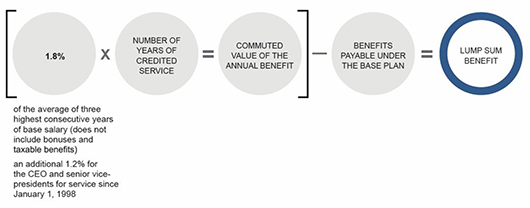
The supplemental benefit is based on actual years of service from the participant’s date of hire up to the date of termination, or until the end of the notice period for termination without cause. It is calculated on base salary and, unlike other companies, does not include bonuses as part of the pensionable earnings. The supplemental program does not allow past service credits or any kind of accelerated service. Full benefits are paid at the normal retirement age of 65 but are also payable starting at 60 years of age if the person has 20 years of service.
Except for benefits for participants who are US taxpayers, the program is funded in part by trust assets and the remainder by a letter of credit held by the program’s trustees. The liability is approximately $49,100,000 ($34,900,000 for the named executives) as of December 31, 2025. The face amount of the letter of credit will be determined each year based on the wind-up liabilities of the supplemental program (excluding benefits for US taxpayers), less any trust assets. The face amount of the letter of credit for 2025 was $47,500,000. The trustee would be able to draw on the letter of credit to pay benefits to members following specified trigger events. Benefits will continue to be paid from the trust assets until the fund is exhausted, at which time Cameco will begin paying benefits from corporate assets.
Early retirement
Under our registered defined contribution plan, members can transfer their account balance or begin receiving a benefit any time after termination of employment, so early retirement does not apply. All named executives are members of this plan.
Under our supplemental program, the named executives can take early retirement starting at age 55, but the benefit formula will be reduced by 0.25% for each month before the earliest unreduced retirement age (age 60 with at least 20 years of continuous employment or age 65, whichever is earlier).
| 2026 MANAGEMENT PROXY CIRCULAR | 105 |
Executive pension value disclosure
The table below shows the estimated pension service costs for the supplemental program and Cameco’s contribution to the defined contribution plan as the compensatory change. It also shows the accrued pension obligations payable under our pension plans for each named executive.
| Name |
Number of years of credited service |
Annual benefits payable1 |
Pension obligation at start of year2,3 |
Compensatory change3 |
Non-compensatory change4 |
Pension obligation at year end5 | ||||||||||||||||||||||
| At year end |
At age 65 |
|||||||||||||||||||||||||||
| Tim Gitzel |
18.98 | $ 685,800 | $ 732,800 | $ 9,962,900 | $ 1,067,600 | $ 106,900 | $ 11,137,500 | |||||||||||||||||||||
| Grant Isaac |
16.47 | $ 374,600 | $ 624,800 | $ 4,919,400 | $ 1,059,900 | $ 31,100 | $ 6,010,400 | |||||||||||||||||||||
| Heidi Shockey |
20.29 | $ 258,300 | $ 372,800 | $ 3,530,100 | $ 550,400 | $ 47,500 | $ 4,128,000 | |||||||||||||||||||||
|
Rachelle Girard |
19.63 | $ 205,400 | $ 270,300 | $ 3,304,500 | $ 391,100 | $ 64,700 | $ 3,760,300 | |||||||||||||||||||||
|
David Doerksen |
27.22 | $ 289,600 | $ 310,900 | $ 4,603,700 | $ 254,000 | $ 244,100 | $ 5,101,800 | |||||||||||||||||||||
| Brian Reilly |
15.00 | $ 259,300 | $ 274,800 | $ 3,801,200 | $ 358,000 | $ (70,500) | $ 4,088,700 | |||||||||||||||||||||
| Sean Quinn |
32.25 | $ 481,900 | $ 481,900 | $ 7,202,500 | $ 280,400 | $ 193,800 | $ 7,676,700 | |||||||||||||||||||||
| 1. | Annual benefits payable |
| The value of the annual benefits accrued for all named executives reflects benefits under the supplemental executive pension program and do not take into account any early retirement reductions or vesting requirements. |
| The amounts under At age 65 are based on current compensation levels and assume accrued years of service to age 65 for each of the named executives. Under our supplemental executive pension program, the named executives are eligible to retire at age 55, which would reduce the pension benefits they are entitled to receive. |
| Annual benefits payable at year end and At age 65 are based on final average earnings as at December 31, 2025. As Brian Reilly is retiring effective March 31, 2026, prior to age 65, the pension value at age 65 is not applicable. |
| 2. | Pension obligation at start of year is based on December 31, 2024, accounting assumptions. |
| 3. | Pension obligation at start of year and the Compensatory change are estimated totals that include our registered defined contribution pension plan and supplemental executive pension program. They are based on assumptions representing entitlements in employment agreements that may change over time. The methods we used to determine these estimates may not be exactly the same as methods other companies use, so the figures may not be directly comparable. |
| We used the following key assumptions to estimate these benefit obligations: |
| ● | 100% vesting; |
| ● | a retirement age of 63, or one year later if 63 years of age or older - the assumed retirement age of 63 is management’s best estimate for determining the accrued benefit obligation as of December 31, 2024, as reported in our financial statements; |
| ● | salary increases of 3.0% each year; |
| ● | a discount rate of 4.7% and a lump sum conversion rate of 3.95% each year to determine the benefit obligation; |
| ● | a long-term rate of return on defined contribution plan assets of 6.0%; and |
| ● | benefits are pre-tax. |
| See note 24 to our audited 2025 financial statements (in our 2025 annual report, and also on our website) for more information about our pension plans. |
| Compensatory change is the value of the projected pension earned from January 1, 2025, to December 31, 2025, for our registered defined contribution pension plan and supplemental executive pension program. |
| 4. | Non-compensatory change includes changes such as changes in assumptions (other than those used to estimate the compensatory change), employee contributions and interest on the accrued obligation at the start of the year. |
| 5. | Pension obligation at year end is the value of the named executive’s projected pension earned for service up to December 31, 2025, under our registered defined contribution pension plan and supplemental executive pension program. It is based on December 31, 2025, accounting assumptions and includes RRSP balances included in the base plan, if any. |
| We used the following key assumptions to estimate these benefit obligations: |
| ● | 100% vesting; |
| ● | a retirement age of 63, or one year later if 63 years of age or older - the assumed retirement age of 63 is management’s best estimate for determining the accrued benefit obligation as of December 31, 2025, as reported in our financial statements; |
| ● | salary increases of 3.0% each year; |
| ● | a discount rate of 4.9% and a lump sum conversion rate of 4.15% each year to determine the benefit obligation; |
| ● | a long-term rate of return on defined contribution plan assets of 6.0%; and |
| ● | benefits are pre-tax. |
| The pension amounts for all the named executives equal the value of their accumulated contributions under the registered defined contribution pension plan, supplemented by amounts based on final average earnings and service under the supplemental executive pension program (a defined benefit plan). |
Loans to executives
As of March 9, 2026, we and our subsidiaries had no loans outstanding to our current or former named executives, except routine indebtedness as defined under Canadian securities laws.
| 106 | CAMECO CORPORATION |
Termination and change of control
We have employment agreements with the named executives. They are for an indefinite period and provide for:
| • | a base salary; |
| • | participation in the short-term incentive plan; |
| • | participation in the long-term incentive plans; and |
| • | participation in the employee defined contribution pension plan and the supplemental executive pension program. |
The agreements also include post-termination obligations requiring that the named executives do not:
| • | use or disclose specialized knowledge, contracts and connections obtained while at Cameco; |
| • | compete against us in any way for 12 months after leaving the organization; and |
| • | solicit any of our customers, suppliers or employees or harm our relationships with any of them for 12 months (18 months for the CEO) after leaving the organization. |
The summary on page 109 shows the incremental compensation that would be paid to the named executives if their employment had been terminated without cause on December 31, 2025, including following a change of control. If Tim Gitzel, Heidi Shockey, Rachelle Girard, David Doerksen, Brian Reilly or Sean Quinn had resigned, it would have been treated as retirement because they are eligible to retire. None of the named executives are entitled to any single trigger change of control benefits.
CEO
Tim Gitzel’s employment agreement provides for:
| • | a requirement to hold Cameco shares, RSUs and PSUs in accordance with Cameco’s share ownership guidelines; |
| • | a notice period for the lesser of two years or until the age of 65, if he is terminated without cause; |
| • | a $7,000 annual allowance for tax advice ($14,000 in his retirement year); |
| • | a requirement to give a minimum notice of six months for resignation or retirement; and |
| • | accelerated vesting of certain equity awards if the CEO’s employment is terminated within 24 months following a change of control (see the summary below for details on compensation upon termination). |
Other named executives
The employment agreements for the other named executives provide for:
| • | a requirement to hold Cameco shares, RSUs and PSUs by December 31 of the fifth year in their current positions, in accordance with Cameco’s share ownership guidelines; |
| • | a notice period for the lesser of 18 months or until the age of 65, if they are terminated without cause; |
| • | a $5,000 annual allowance for tax advice ($10,000 in their retirement year); |
| • | a requirement to give a minimum notice of three months for resignation or retirement; and |
| • | accelerated vesting of certain equity awards if employment is terminated within 24 months following a change of control (see the summary below for details on compensation upon termination). |
| 2026 MANAGEMENT PROXY CIRCULAR | 107 |
The table below is a summary of the compensation that would be paid to the named executives if their employment is terminated. We believe the following terms are fair, competitive with the market and based on industry practice.
| Type of termination |
Severance | STI bonus | Options | PSUs | RSUs | Benefits | Pension | |||||||
| Retirement1 | • none |
• target bonus for current year is pro-rated to date of retirement |
• must be exercised within three years or the original term, whichever is earlier |
• performance is measured to the end of each performance year
• PSUs will continue to vest post-retirement |
• RSUs will continue to vest post-retirement |
• reduced health and dental benefits are provided until death |
• credited service | |||||||
| Resignation2 | • executive must give three months’ notice, except for CEO who must give six months’ notice
• if we waive the notice, we must pay their base salary for the three- or six-month notice period |
• none |
• must be exercised within 90 days or the original term, whichever is earlier |
• all outstanding PSUs are cancelled |
• all outstanding RSUs are cancelled |
• none |
• credited service | |||||||
| Termination without cause3 | • lump sum equal to base salary and target bonus for the notice period |
• none, unless committee exercises discretion |
• must be exercised within the notice period or by the original expiry date, whichever is earlier |
• performance is measured to the end of the year of termination
• awards are prorated to completed months of service |
• awards are prorated to completed months of service |
• employer contributions for health, dental and life insurance benefits continue for the notice period or until executive obtains other employment, whichever is earlier |
• coverage continues and credited service continues to be earned for the notice period | |||||||
| Termination without cause or for good reason within 24 months of a change of control4 | • same as for termination |
• same as for termination without cause |
• same as for termination without cause |
• PSUs vest immediately and are paid at target within 30 days |
• RSUs vest immediately and are payable in cash within 30 days |
• same as for termination without cause |
• same as for termination without cause | |||||||
| Termination with cause | • none |
• all entitlement to the bonus is lost |
• must be exercised within 30 days |
• all outstanding PSUs are cancelled |
• all outstanding RSUs are cancelled |
• none |
• credited service | |||||||
| Death5 | • none |
• target bonus prorated to date of death |
• must be exercised within three years or original term, whichever is earlier |
• unvested awards will vest following date of death and be paid out at target |
• unvested awards will vest following date of death and be paid out at target |
• life insurance is paid on death |
• credited service
• value of vested pension benefit is paid to the beneficiary | |||||||
| Disability6 | • none |
• bonus for current year prorated based on active service |
• must be exercised within three years or the original term, whichever is earlier |
• performance is measured to the end of each performance year
• PSUs will continue to vest post-disability and be paid out based on actual performance |
• RSUs will continue to vest post-disability |
• health and dental benefits continue for duration of disability claim |
• credited service | |||||||
| 1. | Retirement |
| If the executive is at least age 55 with five years of service and has provided six months’ written notice of retirement, the executive would be eligible for continued vesting of PSUs and RSUs and a pro-rated target bonus. PSUs and RSUs will be paid in cash upon vesting, and the PSU payout will be based on the actual performance for each award. |
| Additionally, if the executive had at least 15 years of service, the executive would be eligible for combined health and dental coverage up to $4,000 per year, plus a lump sum payment at date of retirement of $20,000 in lieu of life insurance. Alternatively, the executive could elect to take a total lump sum payment of $95,000 for the purchase of an individual plan. |
| 2. | Resignation |
| Tim Gitzel, Heidi Shockey, Rachelle Girard, David Doerksen, Brian Reilly and Sean Quinn are eligible for retirement and therefore the compensation that is paid if a senior executive resigns does not apply. Retirement provisions will continue to apply, as set out in note 1. |
| 108 | CAMECO CORPORATION |
| 3. | Termination without cause |
| The notice period for Tim Gitzel is two years or the period remaining until age 65, whichever is earlier. The notice period for the other named executives is 18 months or the period remaining until age 65, whichever is earlier. |
| 4. | Termination without cause or good reason within 24 months of a change of control |
| According to the ENL Reorganization Act, no person, alone or together with associates may hold, beneficially own or control, directly or indirectly, more than 25% of Cameco’s voting shares that can be cast to elect the directors. Because of the legislated restrictions on share ownership, there would have to be an act of federal parliament for anyone to hold more than 25% of our voting shares. For Tim Gitzel, change of control is defined as a transaction resulting in any person, corporation or entity holding 35% or more of our voting shares, transfer or lease of substantially all the company’s assets, dissolution or liquidation of the company, or the board deciding that a change of control has occurred. For the other named executives, change of control is the same except that an entity must hold 50% or more of our voting shares. |
| 5. | Death |
| In the event of the executive’s death, all benefits cease; each program indicates benefits payable upon death, if any. |
| 6. | Disability |
| In the event of the executive’s absence from work due to disability, the executive would be eligible for specified program benefits based on having an approved disability claim. |
The next table shows the incremental values that would be paid to the named executives if any of them had been terminated without cause on December 31, 2025, including following a change of control. No incremental amounts are payable if a named executive retires, resigns, dies, becomes disabled, or is terminated with cause.
Cameco has legislated ownership restrictions under the ENL Reorganization Act. While a change of control is possible, it would require an act of parliament or one of the activities discussed in note 4 above.
| Estimated incremental payment at December 31, 20251 | ||||||||
| Name | Compensation element |
Termination |
Termination without cause |
|||||
| Tim Gitzel |
Cash |
$ 5,865,000 | $ 5,865,000 | |||||
| Deferred compensation vesting |
– | $ 27,639,169 | ||||||
| Benefits |
$ 23,900 | $ 23,900 | ||||||
| Total incremental amount |
$ 5,888,900 | $ 33,528,069 | ||||||
| Annual pension increment |
$ 730,900 | $ 730,900 | ||||||
| Grant Isaac |
Cash |
$ 3,225,000 | $ 3,225,000 | |||||
| Deferred compensation vesting |
– | $ 12,078,099 | ||||||
| Benefits |
$ 26,900 | $ 26,900 | ||||||
| Total incremental amount |
$ 3,251,900 | $ 15,329,999 | ||||||
| Annual pension increment |
$ 521,800 | $ 521,800 | ||||||
| Heidi Shockey |
Cash |
$ 1,350,000 | $ 1,350,000 | |||||
| Deferred compensation vesting |
– | $ 4,767,922 | ||||||
| Benefits |
$ 25,200 | $25,200 | ||||||
| Total incremental amount |
$ 1,375,200 | $ 6,143,122 | ||||||
| Annual pension increment |
$ 291,600 | $ 291,600 | ||||||
| Rachelle Girard |
Cash |
$ 1,144,500 | $1,144,500 | |||||
| Deferred compensation vesting |
– | $ 2,770,741 | ||||||
| Benefits |
$ 24,600 | $ 24,600 | ||||||
| Total incremental amount |
$ 1,169,100 | $ 3,939,841 | ||||||
| Annual pension increment |
$ 280,400 | $ 280,400 | ||||||
| David Doerksen |
Cash |
$ 1,039,500 | $ 1,039,500 | |||||
| Deferred compensation vesting |
– | $ 2,844,138 | ||||||
| Benefits |
$ 24,400 | $ 24,400 | ||||||
| Total incremental amount |
$ 1,063,900 | $ 3,908,038 | ||||||
| Annual pension increment |
$ 266,200 | $ 266,200 | ||||||
| Brian Reilly |
Cash |
$ 1,580,250 | $ 1,580,250 | |||||
| Deferred compensation vesting |
– | $ 7,322,368 | ||||||
| Benefits |
$ 15,000 | $ 15,000 | ||||||
| Total incremental amount |
$ 1,595,250 | $ 8,917,618 | ||||||
| Annual pension increment |
$ 259,100 | $ 259,100 | ||||||
| Sean Quinn |
Cash |
$ 1,441,125 | $ 1,441,125 | |||||
| Deferred compensation vesting |
– | $ 6,635,150 | ||||||
| Benefits |
$ 0 | $ 0 | ||||||
| Total incremental amount |
$ 1,441,125 | $ 8,076,275 | ||||||
| Annual pension increment |
$ 0 | $ 0 | ||||||
| 2026 MANAGEMENT PROXY CIRCULAR | 109 |
| 1. | The table below shows the commuted values for resignation (retirement in the case of Tim Gitzel, Heidi Shockey, Rachelle Girard, David Doerksen, Brian Reilly and Sean Quinn). We estimated these values using the Canadian Institute of Actuaries’ Standard Practice for Determining Pension Commuted Values, effective April 2009, and assumed: |
| • | 100% vesting; |
| • | pension begins at the executive’s age or age 55, whichever is later; |
| • | no salary increase after December 31, 2025; |
| • | a discount rate of 3.8% each of the next 10 years and 4.49% each year thereafter for Canadian and US liabilities; and |
| • | benefits are pre-tax. |
| Commuted value |
For retirement | On December 31, 2025 | ||||||
| The commuted values are based on assumptions representing entitlements in the employment agreements, and these may change over time. These commuted values may be higher or lower than the present value of the benefit obligation and include entitlements from the defined contribution retirement program and the supplemental executive pension program. The methods we use may not be exactly the same as those used by other companies, so our figures may not be directly comparable with those of other companies. |
|
Tim Gitzel Heidi Shockey Rachelle Girard David Doerksen Brian Reilly Sean Quinn |
|
|
$ 10,839,700 $ 4,115,700 $ 2,969,000 $ 4,709,900 $ 4,067,700 $ 7,648,900 |
| ||
|
|
For resignation |
|
||||||
| Grant Isaac | $ 4,857,900 | |||||||
| 2. | Termination without cause |
| Amounts shown as Cash represent entitlements to cash payments in lieu of notice. The cash payment for the CEO (Tim Gitzel) is equal to two times the sum of his annual salary and target annual cash bonus. The cash payment for the other named executives is equal to one and one-half times the sum of their annual salary and target annual cash bonus. |
| There is no Deferred compensation vesting. For all named executives, unvested PSU and RSU awards are pro-rated to completed months of service in the performance period and pay out within 90 days so there is no incremental benefit. Options expire at the end of the severance period. |
| Amounts shown as Benefits are the present value of the continuing benefits for the notice period, based on historical costs and trends and calculated using a discount rate of 4.8% at December 31, 2025. |
| Amounts shown as Annual pension increment are equal to the value of benefits to be credited according to the notice period for each named executive and calculated using the December 31, 2025 accounting assumptions (same as the key assumptions set out in note 3 on page 106). |
| 3. | Termination without cause with a change of control |
| Amounts shown as Cash represent entitlement to cash payments in lieu of notice as indicated in note 2 above. |
| Amounts shown as Deferred compensation vesting include an amount for unvested PSUs and RSUs. The incremental benefit for PSUs and RSUs represents all outstanding PSUs and RSUs that would vest immediately at target and be paid out in the first quarter of 2026. The calculation of the PSUs and RSUs in this situation is based on a share price of $125.68, the year-end closing price of a Cameco common share on the TSX. |
| Amounts shown as Benefits are the present value of the continuing benefits for the notice period as indicated in note 2 above. |
| Amounts shown as Annual pension increment is equal to the value of benefits to be credited according to the notice period as indicated in note 2 above. |
| 110 | CAMECO CORPORATION |
Additional information
About non-IFRS measures
We use non-IFRS measures as supplemental indicators of our financial performance. These measures do not have a standardized meaning or a consistent basis of calculation under IFRS and should not be considered in isolation or as a substitute for financial information prepared in accordance with IFRS, and they may not be comparable to similarly titled measures presented by other companies.
This circular includes non-IFRS measures as described in the table below.
| Non-IFRS measures used in this circular |
Most directly comparable IFRS measure |
How we calculate the measure | How the measure is used | |||
| Adjusted net earnings |
Net earnings attributable to equity holders | Net earnings attributable to equity holders, adjusted for non-operating or non-cash items such as gains and losses on derivatives, unrealized foreign exchange gains and losses, share-based compensation, adjustments to reclamation provisions flowing through other operating expenses, and bargain purchase gains, that we believe do not reflect the underlying financial performance for the reporting period. | Used in assessing our financial performance for STI purposes, in relation to targets approved by the board (see page 89). | |||
|
Funds from operations |
Net cash provided by operations |
Net cash provided by operations before other operating items.
| ||||
| EBITDA |
Net earnings attributable to equity holders | Net earnings attributable to equity holders, adjusted for the costs related to the impact of the company’s capital and tax structure, including depreciation and amortization, finance income, finance costs (including accretion) and income taxes.
|
Used as a measure in our cost of management ratio to assess executive compensation costs (see page 89). | |||
|
Adjusted EBITDA |
Net earnings attributable to equity holders |
EBITDA, adjusted for the impact of certain costs or benefits incurred in the period which are either not indicative of the underlying business performance or that impact the ability to assess the operating performance of the business. | ||||
The table below reconciles net earnings attributable to equity holders as reported in our 2025 financial statements to adjusted net earnings:
| December 31 (millions) | ||||
| Net earnings attributable to equity holders from page 120 of our 2025 financial statements |
$590 | |||
| Adjustments for: |
||||
| Adjustments on derivatives |
(144) | |||
| Unrealized foreign exchange losses |
54 | |||
| Share-based compensation |
79 | |||
| Adjustments on other operating expense (income) |
(22) | |||
| Income taxes on adjustments |
22 | |||
| Adjustments on equity-investees (net of tax) |
||||
| Inventory purchase accounting |
8 | |||
| Unrealized foreign exchange losses |
18 | |||
| Long-term incentive plan |
22 | |||
| Adjusted net earnings for compensation purposes |
$627 | |||
| 2026 MANAGEMENT PROXY CIRCULAR | 111 |
The following table reconciles net cash provided by operations as reported in our 2025 financial statements to funds from operations used for compensation purposes:
| December 31 (millions) | ||||
| Net cash provided by operations from page 124 of our 2025 financial statements |
$1,408 | |||
| Adjustment for: |
||||
| Other operating items |
(208) | |||
| Funds from operations for compensation purposes |
$1,200 | |||
The next table provides a reconciliation of adjusted EBITDA as reported in our 2025 financial statements and set out in the cost of management ratio on page 97.
| December 31 (millions) | ||||
| Net earnings attributable to equity holders from page 120 of our 2025 financial statements |
$590 | |||
| Adjustments for:1 |
||||
| Depreciation and amortization |
699 | |||
| Finance income |
(28) | |||
| Finance costs |
328 | |||
| Income taxes |
231 | |||
|
EBITDA |
$1,820 | |||
| Adjustments (pre-tax) for: |
||||
| Adjustments on derivatives |
(144) | |||
| Other operating income |
(22) | |||
| Share-based compensation |
79 | |||
| Unrealized foreign exchange losses2 |
72 | |||
| Inventory purchase accounting |
11 | |||
| Restructuring costs |
60 | |||
| Other expenses |
53 | |||
| Adjusted EBITDA |
$1,929 | |||
| 1. | Adjustments include Cameco’s amounts from page 7 of our 2025 financial statements as well as our share of our equity investee amounts from note 11 of our 2025 financial statements (pages 33 and 35). |
| 2. | Includes adjustments for both Cameco and its equity investees. |
For more information, see non-IFRS measures on page 66 of our 2025 MD&A, which is incorporated by reference herein and filed on our website (cameco.com) and on SEDAR+ (sedarplus.com).
| 112 | CAMECO CORPORATION |
Caution about forward-looking information
This circular contains statements and information about our expectations for the future. When we discuss our strategy, plans and future financial and operating performance, or other things that have not yet taken place, we are making statements considered to be forward-looking information or forward-looking statements under Canadian and US securities laws. We refer to them in this circular as forward-looking information. In particular, the Message from the Chair of the Board and the CEO, the Sustainability oversight section, the Message from the Chair of the Human Resources and Compensation Committee and the Market context section in this circular contain forward-looking information.
Key things to understand about the forward-looking information in this circular:
| • | it typically includes words and phrases about the future, such as anticipate, believe, estimate, expect, plan, will, intend, goal, target, forecast, project, strategy and outlook |
| • | it represents our current views and can change significantly |
| • | it is based on a number of material assumptions, including those we have listed below, which may prove to be incorrect |
| • | actual results and events may be significantly different from what we currently expect, due to the risks associated with our business. We list a number of these material risks below. We recommend you also review our 2025 MD&A and AIF, which include discussions of other material risks that could cause actual results to differ significantly from our current expectations. |
Forward-looking information is designed to help you understand our views of Cameco’s near- and longer-term prospects, and it may not be appropriate for other purposes. We will not necessarily update this information unless we are required to by Canadian or US securities laws.
Forward-looking statements may include, without limitation, statements regarding operations, business, performance, prospects, ongoing objectives, strategies and outlook for Cameco, including statements regarding: Cameco’s vision of powering a secure energy future and strategic plan, and the context thereof and benefits therefrom; drivers of and beliefs regarding industry fundamentals; the expected benefits of Cameco’s balance sheet strength; details of the strategic partnership between Cameco, Brookfield, Westinghouse and the US Government; Cameco’s role in meeting electricity demand; Cameco’s sustainability targets, including its target of a 30% absolute reduction in its total Scope 1 and 2 GHG emissions level by 2030 from a 2015 baseline, and sustainability related plans, risks and opportunities; Cameco’s growth profile and related expectations and beliefs; opportunities for growth and the drivers thereof; support for nuclear energy; outlook for nuclear power and electricity demand; the belief of the role of nuclear in providing secure, safe, affordable, carbon-free baseload electricity and the results of such belief; interest in SMR; the potential expansion of the markets and use cases for nuclear energy and expected benefits therefrom; contracting discussion and planned production; growth opportunities regarding Westinghouse; changes in compensation; and, statements regarding industry competition, the demand for and supply of uranium and conversion and enrichment services, related risks, and drivers of such demand and supply.
In addition to events beyond Cameco’s control, there are factors which could cause actual or future results, performance or achievements to differ materially from those expressed or inferred herein including, but not limited to: actual sales volumes or market prices for any of our products or services are lower than we expect, or cost of sales is higher than we expect, for any reason, including changes in market prices, loss of market share to a competitor, trade restrictions or geopolitical issues; we are adversely affected by changes in currency exchange rates, interest rates, royalty rates, tax rates, tariffs or inflation; our production costs are higher than planned, or affected by unexpected factors, or necessary supplies are not available, or not available on commercially reasonable terms; our strategies may change, be unsuccessful or have unanticipated consequences, or we may not be able to achieve anticipated operational flexibility and efficiency; changing views of governments regarding the pursuit of carbon reduction strategies or that our view may prove to be inaccurate on the role of nuclear power in pursuit of those strategies; that we may not realize the expected benefits from our investment in Westinghouse or any of our other joint venture investments; we are affected by environmental factors (such as climate change), safety and regulatory risks, including workforce health and safety or increased regulatory burdens or delays resulting from a pandemic or other causes; necessary permits or approvals from government authorities cannot be obtained or maintained; we are affected by political risks, including developments in US foreign policy, global conflicts, sanctions or any potential future unrest in Kazakhstan; we are affected by terrorism, sabotage, blockades, civil unrest, social or political activism, war, outbreak of illness (such as a pandemic), accident or a deterioration in political support for, or demand for, nuclear energy; a major accident at a nuclear power plant; we are impacted by changes in the regulation or public perception of the
| 2026 MANAGEMENT PROXY CIRCULAR | 113 |
safety of nuclear power plants, which adversely affect the construction of new plants, the relicensing of existing plants and the demand for uranium; government laws, regulations, policies or decisions that adversely affect us, including tax and trade laws, tariffs and sanctions, including changes in mining laws or regulations; our uranium suppliers or purchasers fail to fulfil their commitments; we may be unsuccessful in pursuing innovation or implementing advanced technologies, including the risk that the commercialization and deployment of new enrichment technology or any opportunities we explore to contribute to decarbonization may incur unanticipated delays or expenses, or ultimately prove to be unsuccessful; the risk that Westinghouse’s strategies may change, be unsuccessful, or have unanticipated consequences; the risk that Westinghouse may be unsuccessful in respect of its new business initiatives, including its participation in the construction of two nuclear reactors at the Dukovany power plant in the Czech Republic, and the realization of the expected benefits of the strategic partnership with the US Government intended to accelerate the deployment of Westinghouse nuclear reactors in the US and globally; the inability of Westinghouse and the US Government to enter into definitive agreements relating to the strategic partnership between Cameco, Brookfield and the US Government or to effect their future obligations related to the transactions contemplated by the strategic partnership; the unavailability of US Government funding and support for the transactions contemplated by the strategic partnership, including the ability of the executive branch of the US Government to obtain funding and support via the appropriations process or from other sources; following the execution of definitive transaction documents by Westinghouse and the US Government, the determination by the legislative, judicial or executive branches of the US federal or any US state government that any future funding commitments or other aspect of the transactions contemplated by the strategic partnership was or is not in compliance with law; the risk that Westinghouse may lose protections against liability for nuclear damage, including discontinuation of global nuclear liability regimes and indemnities; the risk that increased trade barriers may adversely impact our business, or the business of any of the joint ventures in which we have invested; the risk that Westinghouse may default under its credit facilities, impacting adversely Westinghouse’s ability to fund its ongoing operations and to make distributions; the risk that liabilities at Westinghouse may exceed our estimates and the discovery of unknown or undisclosed liabilities; the risk that there may be disputes between us and Brookfield regarding our strategic partnership, or disputes between us and any of our other joint venture partners; the risk that we may default under the governance agreement with Brookfield, including us losing some or all of our interest in Westinghouse; litigation, Congressional investigations, or investigations by other US or non-US authorities, related to the strategic transaction or otherwise; and various other risk factors described in our fiscal 2025 Management’s Discussion and Analysis and Annual Information Form for the year ended December 31, 2025 filed on SEDAR+ (www.sedarplus.com) under the heading “Material risks” and “Risks that can affect our business” in our Annual Information Form for the year ended December 31, 2025 which are incorporated by reference.
These forward-looking statements are based on a variety of factors and assumptions including, but not limited to: our expectations regarding sales and purchase volumes and prices for uranium and fuel services, cost of sales, trade restrictions, inflation and that counterparties to our sales and purchase agreements will honour their commitments; our expectations for the nuclear industry, including its growth profile, market conditions, geopolitical issues and the demand for and supply of uranium; the continuing pursuit of carbon reduction strategies by governments and the role of nuclear in the pursuit of those strategies; our expectations regarding spot prices and realized prices for uranium; market conditions and other factors upon which we based our investment in Westinghouse and our related forecasts will be as expected; that the construction of new nuclear power plants and the relicensing of existing nuclear power plants will not be adversely affected by changes in regulation or in the public perception of the safety of nuclear power plants; our ability to continue to supply our products and services in the expected quantities and at the expected times; our cost expectations, including production costs and other factors affecting them, operating costs, and capital costs; our expectations regarding tax payments, tax rates, tariffs, royalty rates, currency exchange rates and interest rates; our decommissioning and reclamation estimates, including the assumptions upon which they are based, are reliable; our mineral reserve and resource estimates, and the assumptions upon which they are based, are reliable; our understanding of the geological, hydrological and other conditions at our uranium properties; our and our contractors’ ability to comply with current and future environmental, safety and other regulatory requirements, and to obtain and maintain required regulatory approvals; the market conditions and other factors upon which we have based Westinghouse’s future plans and forecasts; Westinghouse’s ability to mitigate adverse consequences of delays in production and construction; the success of our plans and strategies relating to our business, including our investment in Westinghouse and our other joint venture investments; the success of Westinghouse’s plans and strategies including its participation in the construction of two nuclear reactors at the Dukovany power plant in the Czech Republic, and the strategic partnership with the US Government intended to accelerate the deployment of Westinghouse nuclear reactors in the US and globally; the ability of Westinghouse and the US Government to enter
| 114 | CAMECO CORPORATION |
into definitive agreements relating to the strategic partnership between Cameco, Brookfield and the US Government and their ability to meet their obligations under them; the availability of US Government funding and support for the transactions contemplated by the strategic partnership, including the ability of the executive branch of the US Government to obtain funding and support via the appropriations process or from other sources; the assumption that following the execution of definitive transaction documents by Westinghouse and the US Government, none of the legislative, judicial or executive branches of the US federal or any US state government will determine that any future funding commitments or other aspect of the transactions contemplated by the strategic partnership was or is not in compliance with law; the absence of new and adverse laws, government regulations, policies or decisions in any country where such developments would affect us, including with respect to changes in mining laws or regulations; that our operations and those of our joint venture investments are not significantly disrupted as a result of political instability, sanctions, nationalization, developments in US foreign policy, terrorism, sabotage, blockades, civil unrest, breakdown, natural disasters, environmental factors (including climate change), outbreak of illness (such as a pandemic), governmental or political actions, litigation or arbitration proceedings, the unavailability of reagents, equipment, operating parts and supplies critical to production, labour shortages, labour relations issues, strikes or lockouts, underground floods, cave-ins, ground movements, tailings dam failure, lack of tailings capacity, transportation disruptions or accidents, aging infrastructure or other development or operating risks; that there will not be any significant adverse consequences to Westinghouse’s business resulting from business disruptions, including those relating to supply disruptions, economic or political uncertainty and volatility, labour relation issues, and operating risks; Westinghouse’s ability to announce future financial results when expected; Westinghouse will comply with the covenants in its credit agreements; Westinghouse will comply with nuclear licence and quality assurance requirements at its facilities; Westinghouse maintaining protections against liability for nuclear damage, including continuation of global nuclear liability regimes and indemnities; that known and unknown liabilities at Westinghouse will not materially exceed our estimates; the absence of disputes between us and Brookfield or any of our other joint venture partners regarding our strategic partnership or joint venture arrangements, and that we do not default under the governance agreement with Brookfield or any other joint venture agreement to which we are a party; in addition to the assumptions listed in our fiscal 2025 Management’s Discussion and Analysis and our Annual Information Form for the year ended December 31, 2025 under the heading “Material assumptions”, which are incorporated by reference. These assumptions are based on information currently available to Cameco, including information obtained from third-party sources. While Cameco believes that such third-party sources are reliable sources of information, Cameco has not independently verified the information or underlying assumptions.
Cameco hereby disclaims any responsibility or liability whatsoever in respect of any information obtained from third-party sources.
| 2026 MANAGEMENT PROXY CIRCULAR | 115 |
Appendix A
Interpretation
The following definitions are summaries only and are defined in their entirety in the Eldorado Nuclear Limited Reorganization and Divestiture Act (Canada) and Cameco’s articles.
For the purposes of this circular:
a person is an “associate” of another person if:
| i. | one is a corporation of which the other is an officer or director; |
| ii. | one is a corporation that is controlled by the other or by a group of persons of which the other is a member; |
| iii. | one is a partnership of which the other is a partner; |
| iv. | one is a trust of which the other is a trustee; |
| v. | both are corporations controlled by the same person; |
| vi. | both are members of a voting trust or parties to an arrangement that relates to voting securities of the Corporation; or |
| vii. | both are at the same time associates, within the meaning of any of (i) to (vi) above, of the same person; |
provided that:
| viii. | if a resident associated with a non-resident submits to the board of directors of the corporation a statutory declaration stating that no voting shares of the corporation are held, directly or indirectly, for a non-resident, that resident and non-resident are not associates of each other, provided the statutory declaration is not false; |
| ix. | two corporations are not associates pursuant to (vii) above by reason only that each is an associate of the same person pursuant to (i) above; |
| x. | if any person appears to the board to hold voting shares to which are attached not more than the lesser of four one-hundredths of 1% of the votes that may be cast to elect directors of the corporation and 10,000 such votes, that person is not an associate of any other person and no other person is an associate of that person in relation to those voting shares. |
“beneficial ownership” includes ownership through a trustee, legal representative, agent or other intermediary.
“control” means control in any manner that results in control in fact, whether directly through ownership of securities or indirectly through a trust, an agreement, the ownership of any body corporate or otherwise.
“non-resident” means:
| i. | an individual, other than a Canadian citizen, who is not ordinarily resident in Canada; |
| ii. | a corporation incorporated, formed or otherwise organized outside Canada; |
| iii. | a foreign government or agency thereof; |
| iv. | a corporation that is controlled by non-residents, directly or indirectly, as defined in any of (i) to (iii) above; |
| v. | a trust: |
| a. | established by a non-resident as defined in any of (ii) to (iv) above, other than a trust for the administration of a pension fund for the benefit of individuals, a majority of whom are residents; or |
| b. | in which non-residents as defined in any of (i) to (iv) above have more than 50% of the beneficial interest; or |
| vi. | a corporation that is controlled by a trust described in (v) above. |
“person” includes an individual, corporation, government or agency thereof, trustee, executor, administrator, or other legal representative.
“resident” means an individual, corporation, government or agency thereof or trust that is not a non-resident.
| 116 | CAMECO CORPORATION |
Appendix B
Board mandate
PURPOSE
The purpose of the board of directors (board) is to supervise the management of the business and affairs of the corporation. The board will discharge this responsibility by developing and determining policy by which the business and affairs of the corporation are to be managed and by overseeing the management of the corporation.
COMPOSITION
The board is elected by the shareholders at the annual meeting of the shareholders of the corporation. The board shall appoint the chair annually from among its non-executive independent members. As fixed by the articles of the corporation, the board shall consist of at least three and not more than fifteen members. A majority of the directors shall be resident Canadians.
A majority of the directors shall be independent pursuant to standards for independence adopted by the board. The standards for independence are available on our website.
MEETINGS
The board will schedule as many meetings as necessary to carry out its duties effectively. A two year rolling schedule of regular board and committee meetings will be provided to directors. Confirmation of the date, time and place of regular meetings will be sent to directors approximately three weeks in advance of regularly scheduled meetings.
A meeting of the board may be called by the chair, the chief executive officer or any two directors. The corporate secretary shall, upon the direction of any of the foregoing, arrange a meeting of the board. Special meetings may be called by providing 48 hours notice. Board meetings may be held at any time without notice if all of the directors have waived or are deemed to have waived notice of the meeting.
A majority of the members of the board shall constitute a quorum. No business may be transacted by the board except at a meeting of its members at which a quorum of the board is present. Each director is expected to attend all meetings of the board. A director who is unable to attend a board meeting in person may participate by telephone or teleconference.
At board meetings, each director is entitled to one vote and questions are decided by a majority of votes of the directors present. In case of an equality of votes, the chair of the meeting does not have a second or casting vote.
The corporate secretary acts as secretary to the board. In the absence of the corporate secretary, the board may appoint any other person to act as secretary.
The board may invite such officers and employees of the corporation as it may see fit from time to time to attend at meetings of the board and assist thereat in the discussion and consideration of any matter.
DUTIES AND RESPONSIBILITIES
| 1. | The board has specific responsibilities for the following, which do not, in any way, limit or comprehensively define its overall responsibility for the stewardship of the corporation: |
| a. | corporate governance including the relationship of the board to management and stakeholders, oversight of the corporate governance principles applicable to the corporation, and taking reasonable steps to ensure the corporation has appropriate structures and procedures in place to permit the board to effectively discharge its duties and responsibilities; |
| b. | selection, appointment, evaluation and if necessary the termination of the chief executive officer; |
| c. | strategic planning, approval of business plans, and monitoring corporate performance against those plans; |
| d. | oversight of management’s mitigation of the corporation’s material risks and oversight of the policies and processes to manage risks of the corporation; |
| e. | oversight of the corporation’s governance of sustainability matters and, while taking into account the views and recommendations of the applicable committees, approval of sustainability target setting and disclosure; |
| 2026 MANAGEMENT PROXY CIRCULAR | 117 |
| f. | satisfying itself as to the integrity of the senior executives of the corporation and as to the culture of integrity throughout the corporation; |
| g. | succession planning, including appointing, counselling and monitoring the performance of executive officers; |
| h. | oversight of the human resources policies of the corporation and while taking into account the views and recommendations of the human resources and compensation committee, approval of the compensation of the chief executive officer and the other executive officers; |
| i. | approval of periodic capital and operating plans and monitoring corporate performance against those plans; |
| j. | policies to require ethical behaviour of the corporation and its directors and employees, and compliance with laws and regulations; |
| k. | oversight of the policies and processes for the implementation and integrity of the corporation’s internal control and management information systems and its financial reporting; |
| l. | approval of directors for appointment, nomination and election (as applicable), oversight of any potential conflicts of interest, and director independence determination; |
| m. | assessment of the effectiveness of the board and its committees; |
| n. | oversight of the program for orientation, mentorship and education of new directors and ongoing education for all directors; |
| o. | definition of the duties and the limits of authority of senior management, including approving a position statement for the chief executive officer; |
| p. | policies for disclosure of corporate information to facilitate effective communications with shareholders, other stakeholders and the public; |
| q. | health, safety and environmental policies and oversight of systems to enable compliance with these policies and all relevant laws and regulations; |
| r. | oversight of the policies and processes for estimating and disclosing the corporation’s mineral reserves; |
| s. | calling meetings of shareholders and submission to the shareholders of any question or matter requiring approval of the shareholders; |
| t. | recommendation of the auditors to be appointed at shareholders’ meetings, and filling a vacancy in the office of the auditor; |
| u. | issuance of securities of the corporation; |
| v. | declaration of dividends and establishment of the dividend policy for the corporation; |
| w. | approval of the annual audited financial statements and related management discussion and analysis, and the interim unaudited financial statements and related interim management discussion and analysis, management proxy circulars, takeover bid circulars, directors’ circulars, prospectuses, annual information forms and other disclosure documents required to be approved by the directors of a corporation under securities laws, regulations or rules of any applicable stock exchange; |
| x. | adoption, amendment or repeal of bylaws of the corporation; |
| y. | review and approval of material transactions not in the ordinary course of business; and |
| z. | other corporate decisions required to be made by the board, or as may be reserved by the board, to be made by itself, from time to time and not otherwise delegated to a committee of the board or to the management of the corporation. |
| 2. | Subject to the provisions of applicable law and the bylaws of the corporation, the responsibilities of the board may be delegated, from time to time, to committees of the board on such terms as the board may consider appropriate. |
ORGANIZATIONAL MATTERS
| 3. | The procedures governing the board shall be those in Parts 6 and 7 of the General Bylaws of the corporation. |
| 4. | The board shall annually review and assess the adequacy of its mandate. |
| 5. | The board shall participate in an annual performance evaluation. |
| 6. | The board shall perform any other activities consistent with this mandate, the corporation’s governing laws, and regulations of stock exchanges, as the board deems necessary or appropriate. |
| 118 | CAMECO CORPORATION |
Appendix C
Stock option plan
We stopped granting stock options as part of executive compensation starting in 2020. Stock options were previously granted to vice-presidents and above to tie a portion of future compensation to the long-term performance of Cameco shares.
Outstanding stock options have an eight-year term, with one-third vesting each year starting on the first anniversary of the grant and give the holder the option to buy Cameco shares issued from treasury at the exercise price. The last tranche of outstanding stock option awards expires in 2027 (see page 102).
The stock option plan has a number of restrictions and the following kinds of changes must be approved by shareholders according to the terms of our stock option plan:
General
| • | any change to the number of common shares that can be issued under the plan, including increasing the fixed maximum number of common shares, or changing from a fixed maximum number to a fixed maximum percentage of common shares |
| • | any change to extend the period after a trading blackout when options can be exercised |
| • | any change to extend the expiry date of an option unless it would otherwise expire during a trading blackout period |
| • | any change that requires shareholder approval under applicable law such as those described in the rules, regulations and policies of any stock exchange that we are listed on. |
Exercise price
| • | any change that would cause the exercise price of an option to be lower than the fair market value of the common shares at the time the option is granted. This does not include standard adjustment provisions relating to dividends or stock splits, recapitalizations, consolidations or other fundamental corporate changes, or provisions for the treatment of options if there is a change of control or other similar transaction that affects the powers of the board to make certain changes to the stock option plan |
| • | any other change that would cause the exercise or purchase price of an option to be lower (other than the standard adjustment provisions or if there is a change of control or other similar transaction as described in the item above). Cancelling an option and reissuing it at a lower price is considered a reduction in the exercise price. |
Eligibility
| • | any change that increases the number of categories of people who are eligible to receive options, if it could increase the participation of insiders |
| • | any change allowing options to be transferred other than by will or intestate succession. |
Securities
| • | adding deferred or restricted share units or other share awards that would not involve an actual cash payment |
| • | any change that allows adding a cashless exercise feature, unless it reduces the number of underlying shares in the stock option plan reserve. |
| 2026 MANAGEMENT PROXY CIRCULAR | 119 |
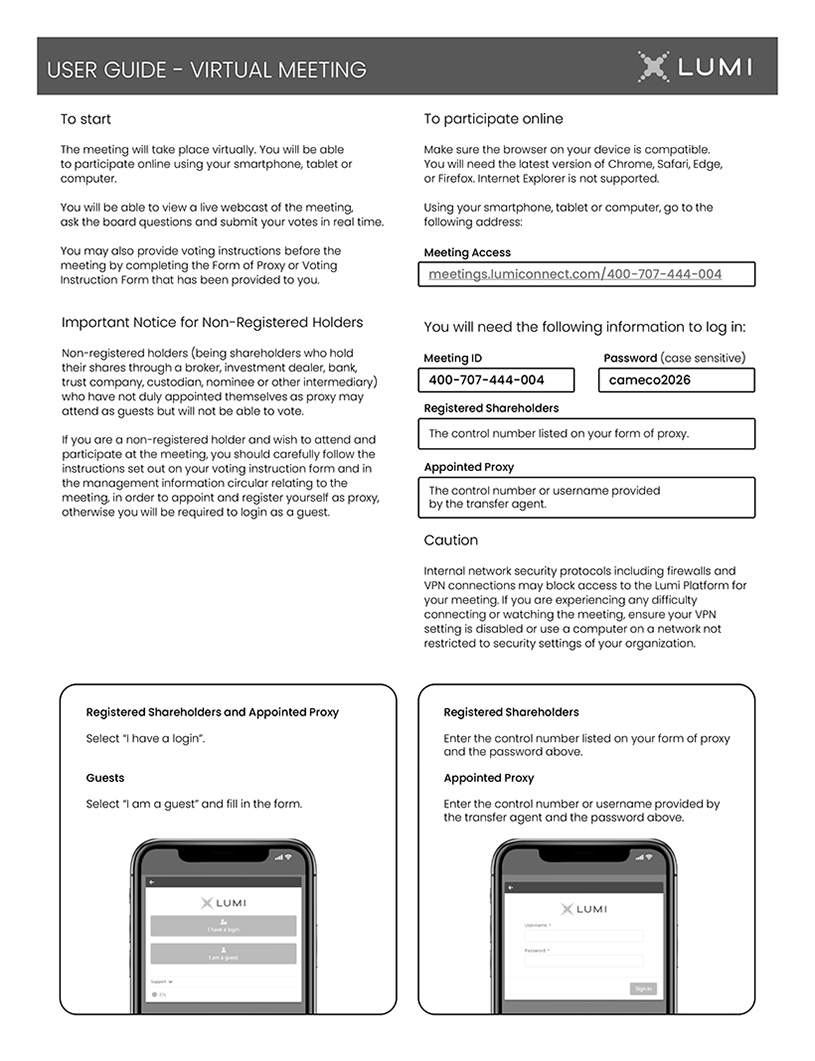
USER GUIDE - VIRTUAL MEETING To start To participate online The meeting will take place virtually. You will be able Make sure the browser on your device is compatible. to participate online using your smartphone, tablet or You will need the latest version of Chrome, Safari, Edge, computer. or Firefox. Internet Explorer is not supported. You will be able to view a live webcast of the meeting, Using your smartphone, tablet or computer, go to the ask the board questions and submit your votes in real time. following address: You may also provide voting instructions before the Meeting Access meeting by completing the Form of Proxy or Voting Instruction Form that has been provided to you. meetings.lumiconnect.com/400-707-444-004 Important Notice for Non-Registered Holders You will need the following information to log in: Non-registered holders (being shareholders who hold Meeting ID Password (case sensitive) their shares through a broker, investment dealer, bank, 400-707-444-004 cameco2026 trust company, custodian, nominee or other intermediary) who have not duly appointed themselves as proxy may Registered Shareholders attend as guests but will not be able to vote. The control number listed on your form of proxy. If you are a non-registered holder and wish to attend and participate at the meeting, you should carefully follow the instructions set out on your voting instruction form and in Appointed Proxy the management information circular relating to the The control number or username provided meeting, in order to appoint and register yourself as proxy, by the transfer agent. otherwise you will be required to login as a guest. Caution Internal network security protocols including firewalls and VPN connections may block access to the Lumi Platform for your meeting. If you are experiencing any difficulty connecting or watching the meeting, ensure your VPN setting is disabled or use a computer on a network not restricted to security settings of your organization. Registered Shareholders and Appointed Proxy Registered Shareholders Select “I have a login”. Enter the control number listed on your form of proxy and the password above. Guests Appointed Proxy Select “I am a guest” and fill in the form. Enter the control number or username provided by the transfer agent and the password above.
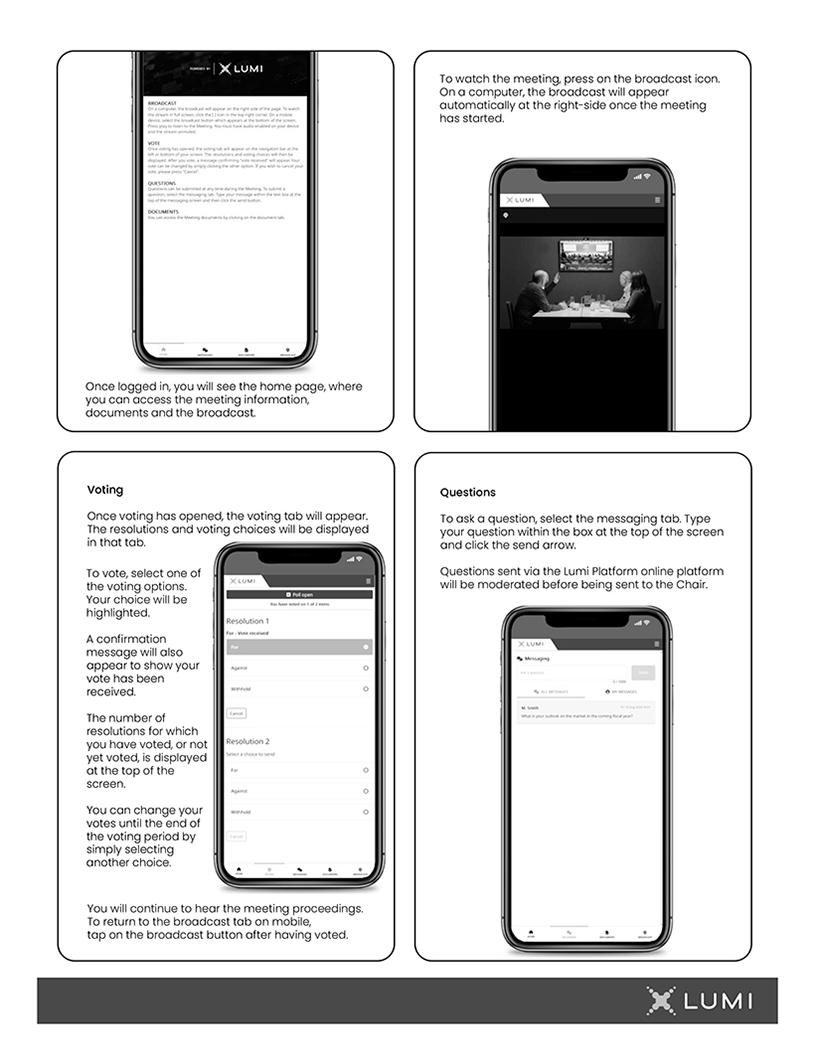
To watch the meeting, press on the broadcast icon. On a computer, the broadcast will appear automatically at the right-side once the meeting has started. Once logged in, you will see the home page, where you can access the meeting information, documents and the broadcast. Voting Questions Once voting has opened, the voting tab will appear. To ask a question, select the messaging tab. Type The resolutions and voting choices will be displayed your question within the box at the top of the screen in that tab. and click the send arrow. To vote, select one of Questions sent via the Lumi Platform online platform the voting options. will be moderated before being sent to the Chair. Your choice will be highlighted. A confirmation message will also appear to show your vote has been received. The number of resolutions for which you have voted, or not yet voted, is displayed at the top of the screen. You can change your votes until the end of the voting period by simply selecting another choice. You will continue to hear the meeting proceedings. To return to the broadcast tab on mobile, tap on the broadcast button after having voted.

Cameco save time and forests enroll for e-delivery when voting your shares online, sign up to receive cameco investor information digitally. Cameco corporation 2121 11th street west saskatoon, sk s7m1j3 cameco.com