
As filed with the Securities and Exchange Commission on March , 2005
UNITED STATES
SECURITIES AND EXCHANGE COMMISSION
Washington, D.C. 20549
SCHEDULE 14A
Proxy
Statement Pursuant to Section 14(a) of
the Securities Exchange Act of 1934 (Amendment No. )
| Filed by the Registrant ý | ||
Filed by a Party other than the Registrant o |
||
Check the appropriate box: |
||
o |
Preliminary Proxy Statement |
|
o |
Confidential, for Use of the Commission Only (as permitted by Rule 14a-6(e)(2)) |
|
ý |
Definitive Proxy Statement |
|
o |
Definitive Additional Materials |
|
o |
Soliciting Material Pursuant to §240.14a-12 |
|
UnionBanCal Corporation |
||||
(Name of Registrant as Specified In Its Charter) |
||||
(Name of Person(s) Filing Proxy Statement, if other than the Registrant) |
||||
| Payment of Filing Fee (Check the appropriate box): | ||||
ý |
No fee required. |
|||
o |
Fee computed on table below per Exchange Act Rules 14a-6(i)(1) and 0-11. |
|||
| (1) | Title of each class of securities to which transaction applies: |
|||
| (2) | Aggregate number of securities to which transaction applies: |
|||
| (3) | Per unit price or other underlying value of transaction computed pursuant to Exchange Act Rule 0-11 (set forth the amount on which the filing fee is calculated and state how it was determined): |
|||
| (4) | Proposed maximum aggregate value of transaction: |
|||
| (5) | Total fee paid: |
|||
o |
Fee paid previously with preliminary materials. |
|||
o |
Check box if any part of the fee is offset as provided by Exchange Act Rule 0-11(a)(2) and identify the filing for which the offsetting fee was paid previously. Identify the previous filing by registration statement number, or the Form or Schedule and the date of its filing. |
|||
(1) |
Amount Previously Paid: |
|||
| (2) | Form, Schedule or Registration Statement No.: |
|||
| (3) | Filing Party: |
|||
| (4) | Date Filed: |
|||
Persons who are to respond to the collection of information contained in this form are not required to respond unless the form displays a currently valid OMB control number. |
||||
NOTICE OF ANNUAL MEETING OF STOCKHOLDERS
April 27, 2005
To the Stockholders of UnionBanCal Corporation:
The annual meeting of the stockholders of UnionBanCal will be held on Wednesday, April 27, 2005 at 9:30 a.m. (local time) at the Mandarin Oriental Hotel, Embassy Room, 222 Sansome Street, San Francisco, California, to vote on the following matters:
The close of business on March 4, 2005 is the record date for determining stockholders entitled to vote at the annual meeting. In accordance with Delaware law, for 10 days prior to the Annual Meeting, a list of those stockholders will be available for inspection during normal business hours in the office of the Corporate Secretary of UnionBanCal Corporation, 400 California Street, San Francisco, CA 94104-1302. This list also will be available at the Annual Meeting.
You may vote through the Internet as well as by telephone or mail. Instructions regarding Internet and telephone voting are on the proxy card. If you elect to vote by mail, please complete, sign, date and return the proxy card in the accompanying postage-paid envelope. The proxy statement explains more about voting, including that your vote is confidential. We look forward to your participation.
| By order of the Board of Directors, | ||||
John H. McGuckin, Jr. Executive Vice President, General Counsel and Secretary |
||||
March 28, 2005
You may view UnionBanCal's Proxy Statement and Annual Report to Stockholders on the Internet at www.uboc.com.
UnionBanCal Corporation
400 California Street
San Francisco, California 94104-1302
(415) 765-2969
The Board of Directors of UnionBanCal is soliciting proxies from its stockholders to be used at the annual meeting of stockholders on April 27, 2005. This proxy statement contains information related to the annual meeting.
You do not need to attend the annual meeting to vote your shares. Instead, you may vote your shares by telephone or through the Internet or complete, sign, date and return the enclosed proxy card in the postage-paid envelope provided. Instructions for voting by telephone or through the Internet can be found on the proxy card.
On March 28, 2005, we began mailing this proxy statement and the accompanying proxy card to stockholders.
Principal Stockholders
On March 4, 2005, 145,005,635 shares of UnionBanCal common stock were outstanding. To our knowledge, the only stockholders owning more than 5 percent of UnionBanCal's outstanding common stock on that date are shown in the following table:
| Name and Address of Beneficial Owner |
Amount and Nature of Beneficial Ownership |
Percent of Class |
|||
|---|---|---|---|---|---|
| The Bank of Tokyo-Mitsubishi, Ltd. 7-1, Marunouchi 2-chome, Chiyoda-ku, Tokyo 100-8388, Japan |
88,256,374 | (1) | 60.9 | % | |
| Wellington Management Company, LLP 75 State Street, Boston, MA 02109 |
11,440,532 | (2) | 7.9 | % |
1
THE BANK OF TOKYO-MITSUBISHI, LTD., INTENDS TO VOTE ITS STOCK FOR THE ELECTION OF THE NOMINEES FOR DIRECTOR, FOR THE INCREASE IN THE NUMBER OF SHARES OF COMMON STOCK WHICH MAY BE AWARDED UNDER THE YEAR 2000 UNIONBANCAL CORPORATION MANAGEMENT STOCK PLAN, FOR THE RATIFICATION OF THE INDEPENDENT REGISTERED PUBLIC ACCOUNTING FIRM AND FOR THE STOCKHOLDER PROPOSAL REGARDING CONFIDENTIAL VOTING. THEREFORE, STOCKHOLDER APPROVAL OF THESE PROPOSALS IS ASSURED.
Who May Vote
Only record holders of UnionBanCal common stock at the close of business on March 4, 2005 may vote at the annual meeting.
You are entitled to one vote for each share of UnionBanCal common stock that you owned of record at the close of business on March 4, 2005. The accompanying proxy card indicates the number of shares you are entitled to vote at the annual meeting.
Voting Your Proxy
Whether or not you plan to attend the annual meeting, we urge you to vote your proxy promptly.
If you are a stockholder of record (that is, if you hold shares of UnionBanCal common stock in your own name), you may vote your shares by proxy using any of the following methods:
Delaware law permits stockholders to vote their shares by proxy through an electronic transmission authorized by the stockholder. The telephone and Internet voting procedures set forth on the proxy card allow us to authenticate stockholders' identities and permit stockholders to provide their voting instructions and confirm their instructions have been properly recorded. If you vote by telephone or through the Internet, you do not need to return your proxy card. The deadline to vote through the telephone and Internet is 1:00 a.m. (PDT) on Monday, April 25, 2005.
If your shares of UnionBanCal common stock are held by a broker, bank or other nominee in "street name," you will receive voting instructions (including instructions, if any, on how to vote by telephone or through the Internet) from the record holder that you must follow in order to have your shares voted at the annual meeting.
Whether you send your voting instructions by mail, telephone or Internet, your UnionBanCal common stock will be voted in accordance with those instructions. If you sign, date and return your proxy card without indicating how you want to vote your shares, the proxy holders will vote your shares as recommended by the Board of Directors FOR the election of all 15 nominees for Director, FOR the increase in the number of shares of common stock which may be awarded under the Year 2000 UnionBanCal Corporation Management Stock Plan, FOR ratification of the selection of the independent registered public accounting firm for 2005 and FOR the stockholder proposal regarding confidential voting. If any other business is properly presented at the annual meeting, the proxy holders will have discretionary authority to vote in accordance with their judgment on those matters.
Revoking Your Proxy
You may revoke your proxy at any time before it is voted at the annual meeting. To revoke your proxy, you may send a written notice of revocation to UnionBanCal Corporation, Office of the
2
Corporate Secretary, 400 California Street, San Francisco, California 94104-1302. You may also revoke your proxy by submitting another signed proxy with a later date, voting by telephone or through the Internet at a later date, or voting in person at the annual meeting.
Voting in Person
You may come to the annual meeting and vote your shares in person by obtaining and submitting a ballot that will be provided at the meeting. However, if your shares are held by a broker, bank or other nominee in street name, to be able to vote at the meeting you must obtain a proxy, executed in your favor, from the institution that holds your shares, indicating that you were the beneficial owner of the shares at the close of business on March 4, 2005, the record date for voting.
Your Vote is Confidential
In December 2004, the Board of Directors of UnionBanCal adopted a policy that all stockholder meeting proxies, ballots, and voting records that identify the vote of a particular stockholder shall be confidential and will be tabulated and certified by an independent tabulator, inspector of election or other independent parties. The vote of any stockholder will not be disclosed to any officer, Director or employee of UnionBanCal, except (a) as necessary to meet legal requirements or to assist in the pursuit or defense of legal action; (b) if UnionBanCal concludes that a dispute exists as to the authenticity of one or more proxies, ballots or votes, or as to the accuracy of any tabulation of such proxies, ballots or votes; (c) in the event of a proxy, consent or other solicitation in opposition to the voting recommendation of the Board of Directors (other than stockholder proposals included in UnionBanCal's proxy statement); or (d) if the stockholder requests, or consents to disclosure of the stockholder's vote or writes comments on the stockholder's proxy card or ballot in such a way that the stockholder's identity cannot be concealed.
Quorum and Broker Non-Votes
A quorum of stockholders is necessary to hold a valid meeting. A quorum will exist if a majority of the outstanding shares of UnionBanCal common stock is present in person or by proxy at the annual meeting. Shares present in person at the meeting which are not voted for a Director nominee or shares present by proxy where the stockholder has withheld authority to vote for a nominee will be counted in determining whether a quorum is present, but will not count toward the election of a nominee. Therefore, checking the box on the proxy card that withholds authority to vote for a nominee is the equivalent of abstaining. Abstentions are not counted for the purpose of electing Directors. Shares properly voted as "ABSTAIN" on a particular matter are considered as shares present at the meeting for quorum purposes but will not be treated as having voted on the matter and therefore will have no effect on the result of the vote.
If you hold your UnionBanCal common stock through a nominee, generally the nominee may vote the UnionBanCal common stock that it holds for you only in accordance with your instructions. Brokers who are members of the National Association of Securities Dealers, Inc., may not vote shares held by them in nominee name unless they are permitted to do so under the rules of any national securities exchange to which they belong. Under New York Stock Exchange rules, a member broker that has sent proxy soliciting materials to a beneficial owner may vote on matters that the exchange has determined to be routine if the beneficial owner has not provided the broker with voting instructions within 10 days of the meeting. If a broker cannot vote on a particular matter because it is not routine, or it involves a stock option or other equity compensation plan and no instruction has been given by the beneficial owner to the broker, then there is a "broker non-vote" on that matter. Broker non-votes count for quorum purposes, but are not counted as votes for or against any proposal. Since the proposal to increase the number of shares available under the Year 2000 UnionBanCal Corporation Management Stock Plan involves an equity compensation plan, brokers may not vote on this proposal
3
without voting instructions from the beneficial owner. Therefore, broker non-votes on this proposal will count for quorum purposes, but will not be counted as a vote for or against this proposal. As the stockholder proposal regarding confidential voting is not a routine matter, broker non-votes will also be counted for quorum purposes but will not be counted as a vote for or against this proposal.
Vote Required for Approval of Proposals
Under Delaware law, Directors are elected by a plurality of all the votes cast, so the 15 nominees for Director receiving the greatest number of votes will be elected. The affirmative vote of a majority of the shares represented and voting on the matter at the meeting is required to increase the number of shares of common stock which may be awarded under the Year 2000 UnionBanCal Corporation Management Stock Plan. The affirmative vote of a majority of the shares represented and entitled to vote at the meeting is required to ratify the selection of independent registered public accounting firm. The affirmative vote of a majority of the shares represented and entitled to vote at the meeting is required to approve the stockholder proposal regarding confidential voting.
The Inspector of Election appointed for the annual meeting will tabulate all votes cast in person or by proxy at the meeting.
Solicitation of Proxies
UnionBanCal will pay all costs of soliciting proxies. Our officers and employees may also solicit proxies either personally or by telephone, letter, or other form of communication.
THE BOARD OF DIRECTORS AND COMMITTEES
Corporate Governance
Our Board of Directors shares with our management a commitment to good corporate governance. The Board has developed a set of corporate governance guidelines to promote the effective functioning of Board activities and to promote a common set of expectations as to how the Board, its Committees, individual Directors and management should perform their functions. These guidelines are designed with our current business operations, ownership, capital structure and economic conditions in mind and will continue to evolve with changing circumstances. The Corporate Governance Guidelines are posted on UnionBanCal's website, www.uboc.com.
UnionBanCal has adopted a code of ethics and conduct, entitled the Business Standards of Conduct, which is applicable to all officers and employees. UnionBanCal has also adopted a code of ethics for senior financial officers and a code of ethics applicable to its Directors. These codes are posted on UnionBanCal's website, www.uboc.com.
Communicating with the Board of Directors
The Board of Directors encourages interested parties to make their concerns known to the independent Directors. The Board has designated Richard D. Farman, the Presiding Director, to receive communications from interested parties, including employees, stockholders and investors, addressed to him and to the independent Directors as a group. Such communications should be in writing in care of the Office of the Corporate Secretary, 400 California Street, 16th Floor, San Francisco, California 94104-1302. All such written communications must contain the name and address of the interested party and indicate if the writer is a stockholder of UnionBanCal. All such communications will be delivered directly to the Presiding Director, who will determine what action is appropriate. The procedures relating to communications with the Presiding Director or the independent Directors, as a group, are posted on UnionBanCal's website, www.uboc.com.
4
Meetings of the Board
Our Board of Directors has designated Mr. Farman as the Presiding Director to preside over executive sessions of the non-management Directors. If Mr. Farman is absent, the non-management Directors designate one of the non-management Directors present to preside at the executive session.
The Board of Directors has determined that a majority of the Board nominees to be elected are independent under the rules of the New York Stock Exchange. The Board of Directors met 9 times in 2004. The non-management Directors held 8 executive sessions at which the Presiding Director, Mr. Farman, presided, in 2004. In 3 cases, the non-management Directors met without management; 1 of these executive sessions included only the independent Directors. During 2004, all incumbent Directors attended at least 75% of the aggregate number of board meetings and meetings of committees of which they were members, except Messrs. Miki and Moriguchi.
UnionBanCal has a policy to strongly encourage Board members to attend Annual Meetings of the Stockholders. Thirteen out of fifteen Directors attended the 2004 Annual Meeting of Stockholders.
Committees of the Board
The Board has established committees, including committees with audit, compensation and corporate governance responsibilities, that also met in 2004. Each committee acts under a written charter and reports regularly to the Board of Directors.
Audit Committee
The Audit Committee oversees relevant accounting, risk assessment, risk management and regulatory matters. The Committee's Charter is posted on UnionBanCal's website, www.uboc.com. The Committee meets with UnionBanCal's general auditor and its independent registered public accounting firm to review the scope of their work as well as to review quarterly and annual financial statements and regulatory and public disclosures with the officers in charge of financial reporting, legal, control and disclosure functions. After reviewing the independent auditor's qualifications, partner rotation and independence, the Audit Committee also makes an annual selection of an independent registered public accounting firm subject to ratification by the stockholders. In addition, the Audit Committee reviews reports of examination conducted by regulatory agencies and follows up with appropriate management so that recommendations and corrective action may be implemented.
The Audit Committee has the authority to select, retain, terminate and approve the fees and other retention terms of special counsel or other experts or consultants as it deems appropriate and necessary to perform its duties. The Audit Committee's Report is set forth below in this proxy statement. At December 31, 2004, Directors serving on the Audit Committee, all of whom were independent, were: L. Dale Crandall (Chair), Michael J. Gillfillan, Mary S. Metz and J. Fernando Niebla. Mr. Crandall has been designated the "audit committee financial expert."
Under the Audit Committee Charter, no member of the Audit Committee may serve on the audit committees of more than three public companies without prior approval by the Board. Mr. Crandall serves on the audit committees of more than three public companies. The Board has determined that such simultaneous service does not impair Mr. Crandall's ability to serve effectively on our Audit Committee.
The Audit Committee met 15 times in 2004. In addition to 7 regularly scheduled meetings, the Committee held 4 meetings with management, the general auditor, outside legal counsel and the independent registered public accounting firm to discuss UnionBanCal's quarterly and year end financial results prior to release of earnings, 3 meetings to review with management UnionBanCal's quarterly filings with the Securities and Exchange Commission and 1 meeting to discuss 10-K reporting processes with management.
5
The Audit Committee held regular discussions with management and the independent registered public accounting firm on significant issues regarding accounting principles, practices, judgments and any significant changes to UnionBanCal's accounting principles, as well as any items required to be communicated by the independent registered public accounting firm in accordance with SAS 61. The Audit Committee regularly met, separately, in executive session with management, the internal auditors, the independent registered public accounting firm, the chief compliance officer and the general counsel.
In connection with the Audit Committee's approval of the retention of Deloitte & Touche LLP, as UnionBanCal's independent registered public accounting firm for 2005, subject to ratification by the stockholders, the Audit Committee discussed with the independent registered public accounting firm any relationships or services which may impact Deloitte & Touche LLP's objectivity and independence and the plan for partner rotation. The Audit Committee also reviews, at least annually, reports from the independent registered public accounting firm regarding their internal control procedures. The Audit Committee has adopted a policy by which it must pre-approve all audit and non-audit services provided by Deloitte & Touche LLP, to UnionBanCal or its subsidiaries and did so in 2004.
The Audit Committee oversees UnionBanCal's compliance with state and federal laws and regulations, including the Sarbanes-Oxley Act, the rules and regulations of the Securities and Exchange Commission, the Federal Reserve Board and the Office of the Comptroller of the Currency as they apply to UnionBanCal, Union Bank of California, N.A., and their subsidiaries. The Committee receives regular reports from the chief compliance officer on the state of compliance, including compliance with the Bank Secrecy Act and anti-money laundering statutes. The Committee also reviews with management on a regular basis the internal processes used to prepare the Chief Executive Officer and Chief Financial Officer certifications of UnionBanCal's reports to the Securities and Exchange Commission pursuant to the Sarbanes-Oxley Act.
The Committee has established procedures for: (1) receipt, retention and treatment of complaints received by UnionBanCal regarding accounting, internal accounting controls or auditing matters; and (2) confidential, anonymous submissions by employees of concerns regarding questionable accounting or auditing matters. The Committee's procedures in this regard are posted on UnionBanCal's website, www.uboc.com.
Corporate Governance Committee
The Corporate Governance Committee is the standing nominating committee responsible for identifying qualified candidates to serve on the Board of UnionBanCal and recommending Director nominees to be submitted to the stockholders for election at the annual meeting. The Committee also oversees the annual evaluation of the Board of Directors and its Committees and the annual review of UnionBanCal's corporate governance guidelines. The Committee's Charter is posted on UnionBanCal's website, www.uboc.com. The Committee has the authority to select, retain, terminate and approve the fees and other retention terms of special counsel or other experts or consultants as it deems appropriate and necessary to perform its duties. At December 31, 2004, Directors serving on the Corporate Governance Committee, all of whom were independent, were: Richard D. Farman (Chair), David R. Andrews, Stanley F. Farrar, and J. Fernando Niebla. The Corporate Governance Committee met 5 times in 2004.
As part of its nominating responsibilities, the Corporate Governance Committee will consider candidates nominated by stockholders for next year's meeting if the nomination is made in writing no later than November 28, 2005. Stockholder nominations must be made in accordance with Section 2.1 of UnionBanCal's Bylaws and must be addressed to UnionBanCal Corporation, Office of the Corporate Secretary, 400 California Street, San Francisco, California 94104-1302. The Bylaws of UnionBanCal are posted on UnionBanCal's website, www.uboc.com.
6
The Committee believes that the following specific, minimum qualifications must be met by a nominee for the position of Director:
The Committee also considers the following qualities and skills when making their determination whether a nominee is qualified for the position of Director:
In identifying and evaluating nominees for Director, including nominees recommended by stockholders, the Committee reviews annually the appropriate skills and characteristics required of Board members in the context of the current composition of the Board. Nominees for Director are evaluated by the Committee, in consultation with the Chief Executive Officer. The Committee has used a third-party search firm for the purpose of identifying and evaluating Director nominees and may use such a firm in the future. The function of this search firm is to assist the Committee in the identification, evaluation and communication with potential nominees.
The nominees presented for election in this proxy statement have been reviewed by the Committee to determine that they meet the qualifications described above. The Committee believes that the nominees are highly qualified.
Executive Compensation & Benefits Committee
The Executive Compensation & Benefits Committee reviews and approves executive officer compensation programs and award levels and oversees Union Bank of California, N.A.'s employee benefit plans. The Executive Compensation & Benefits Committee approves the compensation of the Chief Executive Officer and other policy-making executive officers of UnionBanCal. In addition, it approves stock awards, stock option and restricted stock grants under the Year 2000 UnionBanCal Corporation Management Stock Plan, and awards under the 1997 UnionBanCal Corporation Performance Share Plan and Senior Management Bonus Plan. The Committee also reviews and recommends Directors' compensation to the full Board of Directors. The Committee has the authority to select, retain, terminate and approve the fees and other retention terms of special counsel or other experts or consultants as it deems appropriate and necessary to perform its duties. The Executive Compensation & Benefits Committee Report on Executive Compensation is set forth below in this proxy statement. At December 31, 2004, Directors serving on the Executive Compensation & Benefits Committee, all of whom were independent, were: Richard D. Farman (Chair), L. Dale Crandall, Michael J. Gillfillan and Ronald L. Havner, Jr. The Executive Compensation & Benefits Committee met 8 times in 2004. The Committee's Charter is posted on UnionBanCal's website, www.uboc.com.
Finance & Capital Committee
The Finance & Capital Committee is responsible for reviewing UnionBanCal's financial planning and performance, tax and capital management, dividend, investment and investor relations policies, mergers and acquisitions activity, management of net interest margin and asset and liability
7
management. Directors serving on the Finance & Capital Committee at December 31, 2004 were: Stanley F. Farrar (Chair), David R. Andrews, L. Dale Crandall, Richard D. Farman, Michael J. Gillfillan, Ronald L. Havner, Jr., Norimichi Kanari and Takashi Morimura. The Finance & Capital Committee met 8 times in 2004. The Committee's Charter is posted on UnionBanCal's website, www.uboc.com.
Public Policy Committee
The Public Policy Committee is responsible for identifying relevant political, social and environmental trends relating to UnionBanCal's business. The Public Policy Committee monitors Union Bank of California, N.A.'s programs which carry out the purposes of the Community Reinvestment Act, equal employment opportunity laws and other related federal, state and local programs. The Public Policy Committee also reviews compliance with Union Bank of California, N.A.'s Business Standards of Conduct, a code of ethics applicable to all officers and employees. Directors serving on the Public Policy Committee at December 31, 2004 were: J. Fernando Niebla (Chair), Aida M. Alvarez, Richard C. Hartnack, Mary S. Metz and Carl W. Robertson. The Public Policy Committee met 5 times in 2004. The Committee's Charter is posted on UnionBanCal's website, www.uboc.com.
Trust Committee
Since July 1, 2004, the Trust Committee has been a committee of Union Bank of California, N.A., only. The Trust Committee supervises the administration of the fiduciary powers of Union Bank of California, N.A., and the mutual fund and insurance activities of the Bank's subsidiaries. In addition, the Trust Committee reviews reports of examination conducted by banking regulatory agencies, Union Bank of California, N.A.'s general auditor and its independent registered public accounting firm, and reviews with appropriate management whether recommendations and corrective actions have been implemented. Directors serving on the Trust Committee at December 31, 2004 were: Carl W. Robertson (Chair), Aida M. Alvarez, David R. Andrews, Stanley F. Farrar and Richard C. Hartnack. The Trust Committee met 5 times in 2004. The Committee's Charter is posted on UnionBanCal's website, www.uboc.com.
Director Compensation
Directors who are not full-time officers of UnionBanCal or The Bank of Tokyo-Mitsubishi, Ltd. or its affiliates received an annual combined retainer for service on our Board of Directors or the Board of Directors of Union Bank of California, N.A., and meeting fees for attendance at board and committee meetings. The annual combined retainer for service on the Boards of UnionBanCal and Union Bank of California, N.A., is $30,000, pro-rated and payable quarterly in advance. In addition, the annual combined retainer for service on the Boards of UnionBanCal and Union Bank of California, N.A., for each non-officer committee chair is $5,000, pro-rated and payable quarterly in advance, except for the Audit Committee Chair, who receives an annual combined retainer of $10,000, pro-rated and payable quarterly in advance. The Presiding Director receives an additional annual retainer of $5,000, pro-rated and payable quarterly in advance. Directors who are not full-time officers of UnionBanCal or The Bank of Tokyo-Mitsubishi, Ltd., or its affiliates were also paid the following:
8
In the past three years, each non-employee and non-expatriate Director has received the following non-qualified stock option awards:
| Grant Date |
Shares |
Exercise Price |
Exercisable |
Expiration |
|||||
|---|---|---|---|---|---|---|---|---|---|
| May 1, 2004 | 3,000 | $ | 53.43 | 100% vested and immediately exercisable on the Grant Date | Ten years from the Grant Date or three years after retirement. | ||||
| May 1, 2003 | 3,000 | $ | 40.50 | 100% vested and immediately exercisable on the Grant Date | Ten years from the Grant Date or three years after retirement. | ||||
| May 1, 2002 | 3,000 | $ | 48.51 | 100% vested and immediately exercisable on the Grant Date | Ten years from the Grant Date or three years after retirement. | ||||
Non-employee and non-expatriate Directors may defer all or any portion of their annual retainers or meeting fees either to stock units or into an interest bearing account. In 2003, the Compensation Committee adopted a program under the Year 2000 UnionBanCal Corporation Management Stock Plan pursuant to which non-employee Directors may irrevocably elect to defer all or a portion of the cash retainer and/or fees payable to them for services on the Board and its committees in the form of stock units.
Stock units are a form of deferred compensation payable in shares of common stock of UnionBanCal. At the time of deferral, a bookkeeping account is established on behalf of the Director and credited with a number of fully vested stock units. The number of stock units equals the amount of the retainer or fees deferred divided by the fair market value of a share of common stock. The Director will receive a number of shares of common stock equal to the number of stock units when the deferred compensation is payable. Dividend equivalents are credited to the stock unit accounts. Stock units have no voting rights.
The above-described compensation constitutes the only compensation non-employee and non-expatriate Directors receive from UnionBanCal. It is subject to periodic review and adjustment by the Board of Directors. Members of the Audit Committee may not receive, directly or indirectly, any consulting, advisory or other compensatory fee from UnionBanCal or any of its subsidiaries, other than (1) Directors' fees (which may be received in cash, stock options or other in-kind consideration ordinarily available to Directors); (2) a pension or other deferred compensation for prior service that is not contingent on future service; or (3) any other regular benefits that other Directors receive.
Audit Committee Report
The Audit Committee is composed of 4 Directors and operates under a written charter adopted by the Board of Directors. Each Committee member is independent.
Management is responsible for UnionBanCal's internal controls and financial reporting process. The independent registered public accounting firm is responsible for performing an independent audit of UnionBanCal's consolidated financial statements in accordance with standards of the Public Company Accounting Oversight Board (United States) and to issue a report on these financial statements. The Audit Committee's responsibility is to oversee these activities.
In this context, the Audit Committee has met and held discussions with management and the independent registered public accounting firm. Management represented to the Audit Committee that UnionBanCal's consolidated financial statements were prepared in accordance with accounting principles generally accepted in the United States, and the Audit Committee has reviewed and discussed the consolidated financial statements with management and the independent registered public accounting firm. The Audit Committee discussed with the independent registered public accounting firm matters required to be discussed by Statement on Auditing Standards No. 61 "Communication with Audit Committees" as modified or supplemented, including the auditor's judgments about the quality, as well as the acceptability, of UnionBanCal's accounting principles as applied in the financial reporting.
9
UnionBanCal's independent registered public accounting firm also provided to the Audit Committee the written disclosures required by the Independence Standards Board Standard No. 1 (Independence Discussions with Audit Committees), and the Audit Committee discussed with the independent registered public accounting firm that firm's independence as well as its internal quality-control procedures.
Based on the Audit Committee's discussions with management and the independent registered public accounting firm and the Audit Committee's review of the representations of management and the report of the independent registered public accounting firm to the Audit Committee, the Audit Committee recommended to the Board of Directors, and the Board has approved, that the audited consolidated financial statements be included in UnionBanCal's Annual Report on Form 10-K for the year ended December 31, 2004, for filing with the SEC. The Audit Committee has also approved, subject to stockholder ratification, the selection of UnionBanCal's independent registered public accounting firm for 2005.
AUDIT COMMITTEE
L.
Dale Crandall, Chair
Michael J. Gillfillan
Mary S. Metz
J. Fernando Niebla
10
Security Ownership by Management
The following table indicates the beneficial ownership of UnionBanCal and Mitsubishi Tokyo Financial Group, Inc., common stock, as of March 4, 2005 by (1) all persons who are either Directors (including all nominees) or executive officers named in the Summary Compensation Table; and (2) all Directors and executive officers of UnionBanCal as a group, based upon information supplied by each of the Directors and executive officers. Each of the Directors and executive officers named below and all Directors and executive officers of UnionBanCal as a group beneficially own less than 1% of either UnionBanCal's or Mitsubishi Tokyo Financial Group, Inc.'s outstanding shares of common stock.
| Name of Beneficial Owner(1) |
Number of UnionBanCal Corporation's Shares Beneficially Owned |
UnionBanCal Corporation Shares that may be Acquired within 60 Days of March 4, 2005 by Exercise of Options or Conversion of Stock Units |
Total |
Number of Mitsubishi Tokyo Financial Group, Inc. Shares Beneficially Owned(2) |
||||
|---|---|---|---|---|---|---|---|---|
| Aida M. Alvarez | 35 | -0- | 35 | -0- | ||||
| David R. Andrews | 360 | 15,000 | 15,360 | -0- | ||||
| Linda F. Betzer(3) | 9,499 | 57,499 | 66,998 | -0- | ||||
| L. Dale Crandall(4) | 500 | 12,505 | 13,005 | -0- | ||||
| Richard D. Farman | 1,500 | 18,000 | 19,500 | -0- | ||||
| Stanley F. Farrar(5) | 1,000 | 18,000 | 19,000 | -0- | ||||
| Philip B. Flynn(6) | 36,593 | 127,500 | 164,093 | -0- | ||||
| Michael J. Gillfillan(7) | 500 | 6,000 | 6,500 | -0- | ||||
| Richard C. Hartnack(8) | 62,783 | 147,666 | 210,449 | -0- | ||||
| Ronald L. Havner, Jr. | -0- | -0- | -0- | 2 | ||||
| Norimichi Kanari(9) | 1,000 | -0- | 1,000 | 34 | ||||
| David I. Matson(10) | 26,065 | 46,332 | 72,397 | -0- | ||||
| Mary S. Metz(11) | 2,300 | 18,246 | 20,546 | -0- | ||||
| Shigemitsu Miki | -0- | -0- | -0- | 52 | ||||
| Takahiro Moriguchi | -0- | -0- | -0- | 16 | ||||
| Takashi Morimura | -0- | -0- | -0- | 6 | ||||
| J. Fernando Niebla | 150 | 18,000 | 18,150 | -0- | ||||
| Tetsuo Shimura(9) | 2,500 | -0- | 2,500 | -0- | ||||
| All Directors and executive officers as a group (25 persons, including those named above) | 172,909 | 839,700 | 1,012,609 | 113 |
11
Fifteen Directors of UnionBanCal are to be elected at the annual meeting to serve for the coming year and until their successors are elected and qualified. All are Directors standing for re-election with the exception of Ms. Alvarez and Messrs. Havner, Miki and Morimura. Mr. Hartnack will retire on April 4, 2005 and will not stand for re-election. The Board of Directors has nominated the persons listed below for election as Directors and recommends that stockholders vote FOR such nominees. Ms. Alvarez and Mr. Havner were recommended by a third-party search firm retained to assist the Corporate Governance Committee to identify, evaluate and communicate with potential nominees. Messrs. Miki and Morimura were recommended by The Bank of Tokyo Mitsubishi, Ltd., UnionBanCal's controlling stockholder. A resolution of the Board currently sets the exact number of Directors at fifteen. All nominees, except for Messrs. Miki and Moriguchi, are also Directors of Union Bank of California, N.A. If elected as Directors of UnionBanCal, all nominees, except for Messrs. Miki and Moriguchi, are expected to be re-elected as Directors of Union Bank of California, N.A.
The Board of Directors has adopted a policy which provides that any Director who is employed full-time by UnionBanCal or Union Bank of California, N.A., shall retire from the Board at age 65 and any Director who is not employed full-time by UnionBanCal or Union Bank of California, N.A., elected for the first time before 1996, in general, shall not stand for re-election at the annual meeting of stockholders following the Director's 70th birthday. The Board has provided an exception to this policy for Tetsuo Shimura, who is 66, and Shigemitsu Miki, who is 70. Outside Directors elected for the first time after 1996 may not stand for re-election after the earlier of reaching age 70 or completing 10 years of service.
If one or more nominee becomes unable or unwilling to accept nomination or election, the proxy holders intend to vote for the election of such other person(s), if any, as the Board of Directors may recommend. The Board of Directors has no reason to believe that any of the nominees will be unable or unwilling to serve.
12
Director Independence
Categorical Standards of Independence
In addition to reviewing each Director's compliance with the specific independence tests set forth in the New York Stock Exchange rules, the Board has established categorical standards to assist it in making independence determinations. UnionBanCal's categorical standards for Director independence are set forth below. For purposes of these standards, the "Company" includes UnionBanCal, its parent and its direct and indirect consolidated subsidiaries. "Immediate family member" has the meaning set forth in the New York Stock Exchange's independence rules, as may be amended from time to time.
Banking Relationships. A Director will not fail to be independent from management solely as a result of lending relationships, deposit relationships or other banking relationships (including, without limitation, trust department, investment and insurance relationships) between the Company, on the one hand, and the Director (or an immediate family member) or an entity with which the Director (or an immediate family member) is affiliated, on the other hand, provided that (a) such relationships are in the ordinary course of business of the Company and are on substantially the same terms as those prevailing at the time for comparable transactions with non-affiliated parties, and (b) with respect to extensions of credit by the Company to the Director, his or her immediate family member or such entity, (i) such extensions of credit are made in compliance with applicable laws and regulations, including Regulation O of the Board of Governors of the Federal Reserve System and Section 13(k) of the Securities Exchange Act of 1934, (ii) no event of default has occurred with respect to any of such extensions of credit, (iii) none of such extensions of credit is categorized as "classified" by the Company or any regulatory authority that supervises the Company and (iv) if any of such extensions of credit was terminated in the Company's ordinary course of business, that action would not reasonably be expected to have a material adverse effect on the Director, his or her immediate family member or the affiliated entity, as applicable.
Business Relationships. All payments by the Company to an entity with which a Director (or an immediate family member) is affiliated for goods or services, or other contractual arrangements, must be made in the ordinary course of business and on substantially the same terms as those prevailing at the time for comparable transactions with non-affiliated persons. The following relationships are not considered material relationships that would impair a Director's independence: (a) if a Director (or an immediate family member) is affiliated with an entity that does business with the Company and the annual sales to, or purchases from, the Company during each of such entity's three preceding fiscal years are less than the greater of $200,000 or two percent of such entity's gross annual revenues, (b) if a Director is a partner of or of counsel to a law firm, the Director (or an immediate family member) does not personally perform any legal services for the Company, and the fees paid to the firm by the Company during each of such firm's three preceding fiscal years do not exceed the greater of $200,000 or two percent of such firm's gross annual revenues, (c) if a Director is a partner, officer or employee of an investment bank or consulting firm, the Director (or an immediate family member) does not personally perform any investment banking or consulting services for the Company, and the fees paid to the firm by the Company during each of such firm's three preceding fiscal years do not exceed the greater of $200,000 or two percent of such firm's gross annual revenues, and (d) if a Director (or an immediate family member) is affiliated with an entity that has a lending relationship, deposit relationship or other banking relationship with the Company and such entity's payment of interest and loan fees to, or its receipt of interest and loan fees from, the Company during each of such entity's three preceding fiscal years are less than the greater of $1 million or two percent of such entity's gross annual revenues.
Relationships with Not-for-Profit Entities. A Director's independence will not be considered impaired solely for the reason that the Director or an immediate family member is (a) an executive officer of a foundation, university or other not-for-profit organization that receives from the Company
13
during any of the organization's prior three fiscal years, contributions in an amount not exceeding the greater of $100,000 or two percent of the not-for-profit organization's aggregate annual charitable receipts during the organization's fiscal year or (b) a director or trustee of a not-for-profit organization that receives from the Company during any of the organization's prior three fiscal years, contributions in an amount not exceeding the greater of $250,000 or two percent of the not-for-profit organization's aggregate annual charitable receipts during the organization's fiscal year. All contributions in excess of $50,000 shall be reported to the Board and may be considered in making independence determinations.
Directors and Nominees
The Board of Directors has affirmatively determined that each of the following Directors are independent Directors: Aida M. Alvarez, David R. Andrews, L. Dale Crandall, Richard D. Farman, Stanley F. Farrar, Michael J. Gillfillan, Ronald L. Havner, Jr., Mary S. Metz, and J. Fernando Niebla. If elected, a majority of the Board of Directors will be independent Directors. Richard C. Hartnack currently serves as a Director but will not stand for re-election at the 2005 Annual Meeting.
Aida M. Alvarez
Ms. Alvarez, 55, was elected a Director of UnionBanCal and Union Bank of California, N.A., at the October 27, 2004 Board of Directors meeting. From February 1997 to January 2001, Ms. Alvarez served as Administrator of the U.S. Small Business Administration. Ms. Alvarez has served as a director of PacifiCare Health Systems since October 2003.
David R. Andrews
Mr. Andrews, 63, recently retired from PepsiCo, Inc., where he served as Senior Vice President, Governmental Affairs, General Counsel and Secretary since February 2002. Mr. Andrews was a partner at the law firm of McCutchen, Doyle, Brown & Enersen from April 2000 until February 2002. He served as legal adviser to the U.S. Department of State from August 1997 to April 2000. Mr. Andrews has served as a director of Pacific Gas & Electric Co. since August 2000. Mr. Andrews has been a Director of UnionBanCal since April 2000.
L. Dale Crandall
Mr. Crandall, 63, is retired from Kaiser Foundation Health Plan, Inc., and Kaiser Foundation Hospitals, where he served as President and Chief Operating Officer from March 2000 to June 2002, and as Senior Vice President and Chief Financial Officer from June 1998 to March 2000. From March 1995 to June 1998, he served as Executive Vice President, Chief Financial Officer and Treasurer of APL Limited. Prior to APL, Mr. Crandall was an audit partner at PricewaterhouseCoopers LLP. Mr. Crandall has served as a director of Coventry Health Care since January 2004, BEA Systems since March 2003, Ansell Ltd., since November 2002 and Covad Communications Group, Inc., since June 2002 and has served as trustee for four funds in the Dodge & Cox Funds family of mutual funds since October 1999. Mr. Crandall has been a Director of UnionBanCal since February 2001.
Richard D. Farman
Mr. Farman, 69, has been Chairman Emeritus of Sempra Energy since September 2000. Mr. Farman served as Chairman and Chief Executive Officer of Sempra Energy from July 1998 to June 2000. He
14
has served as a director of Catellus Development Corporation since May 1997. Mr. Farman has been a Director of UnionBanCal since November 1988.
Stanley F. Farrar
Mr. Farrar, 62, has been of counsel to the law firm of Sullivan & Cromwell LLP, since January 2005. Prior to that he was a partner of that Firm since October 1984. Mr. Farrar has been a Director of UnionBanCal since April 1996.
In making its independence determination with respect to Mr. Farrar, the Board of Directors took into consideration that Mr. Farrar is a former partner of, and currently of counsel to, the law firm of Sullivan & Cromwell LLP, which has provided, and continues to provide, legal services to UnionBanCal and its direct and indirect majority stockholders. Because Mr. Farrar personally performed some of the work performed for UnionBanCal's indirect majority stockholder, Mr. Farrar does not meet UnionBanCal's "Business Relationships" categorical standard for independence. After careful consideration, the Board of Directors determined, however, that Mr. Farrar is independent.
Philip B. Flynn
Mr. Flynn, 47, was appointed Chief Operating Officer of UnionBanCal and Union Bank of California, N.A., on March 15, 2005. He has served as Vice Chairman and head of the Commercial Financial Services Group of UnionBanCal and Union Bank of California, N.A., since April 1, 2004. He served as Executive Vice President and Chief Credit Officer of UnionBanCal and Union Bank of California, N.A., from September 2000 to April 2004, as Executive Vice President and head of Specialized Lending from May 2000 to September 2000 and as Executive Vice President and head of the Commercial Banking Group from June 1998 to May 2000. Mr. Flynn has been a Director of UnionBanCal since April 2004.
Michael J. Gillfillan
Mr. Gillfillan, 57, has been a partner of Meriturn Partners, LLC, since December 2002. He served as a Partner of Neveric, LLC, from March 2000 to January 2002 and as a Partner of Gavilan Partners, LP, from January 1999 to December 1999. Mr. Gillfillan has been a Director of UnionBanCal since January 2003.
Ronald L. Havner, Jr.
Mr. Havner, 46, was elected a Director of UnionBanCal and Union Bank of California, N.A., at the October 27, 2004 Board of Directors meeting. Mr. Havner has been the Vice-Chairman, Chief Executive Officer and a director of Public Storage, Inc., since November 2002. Mr. Havner has been Chairman of PS Business Parks, Inc. (PSB) since March 1998, Chief Executive Officer of PSB from March 1998 until August 2003 and President of PSB from March 1998 to September 2002. He is a member of the Board of Governors of the National Association of Real Estate Investment Trusts, Inc. (NAREIT).
Norimichi Kanari
Mr. Kanari, 58, has served as President and Chief Executive Officer of UnionBanCal and Union Bank of California, N.A., since July 2001. He served as Vice Chairman of UnionBanCal and Union Bank of California, N.A., from July 2000 to July 2001. From May 1999 to July 2000, he served as General Manager of the Corporate Banking Division in the Osaka Branch of The Bank of Tokyo-Mitsubishi, Ltd. He has served as a director of The Bank of Tokyo-Mitsubishi, Ltd., since June 1997 and was elected a Senior Managing Director of The Bank of Tokyo-Mitsubishi, Ltd. as of January 1, 2005. Mr. Kanari has been a Director of UnionBanCal since July 2000.
Mary S. Metz
Dr. Metz, 67, recently retired as President of S. H. Cowell Foundation where she served since January 1999. Dr. Metz has served as a director of SBC Communications, Inc., and its predecessors
15
since July 1986, Pacific Gas & Electric Co. since March 1986 and Longs Drug Stores since February 1991. Dr. Metz has been a Director of UnionBanCal since November 1988.
Shigemitsu Miki
Mr. Miki, 70, was elected a Director of UnionBanCal at the October 27, 2004 Board of Directors meeting. Mr. Miki was elected Chairman of the Board of The Bank of Tokyo-Mitsubishi, Ltd. in June 2004. From June 2000 to June 2004, he was President of The Bank of Tokyo-Mitsubishi, Ltd. and from May 1997 to June 2000, he was Deputy President of The Bank of Tokyo-Mitsubishi, Ltd.
Takahiro Moriguchi
Mr. Moriguchi, 60, has served as Deputy President of The Bank of Tokyo-Mitsubishi, Ltd., since June 2003 and Managing Director, and Chief Executive, Global Corporate Banking Business Unit, of The Bank of Tokyo-Mitsubishi, Ltd., since May 2002. From July 2001 to May 2002, Mr. Moriguchi served as Managing Director, and Chief Executive, Treasury Unit, and Chief Executive, eBusiness & IT Initiative Unit, of The Bank of Tokyo-Mitsubishi, Ltd. Mr. Moriguchi served as President and Chief Executive Officer and Director of UnionBanCal and Union Bank of California, N.A., from May 1997 until July 2001. Mr. Moriguchi has been a Director of UnionBanCal since April 2003.
Takashi Morimura
Mr. Morimura, 52, was elected Vice Chairman and Director of UnionBanCal and Union Bank of California, N.A., in July 2004. Mr. Morimura served as General Manager, Global Corporate Banking IT Planning Office of The Bank of Tokyo-Mitsubishi, Ltd. from July 2000 to June 2004, and as Deputy General Manager, Overseas Planning Division of The Bank of Tokyo-Mitsubishi, Ltd. from September 1999 to June 2000. Mr. Morimura was elected a Director of The Bank of Tokyo-Mitsubishi, Ltd. in June 2002.
J. Fernando Niebla
Mr. Niebla, 65, has served as President of International Technology Partners, LLC, since December 1998. From December 1995 through June 1998, he was Chairman and Chief Executive Officer of Infotec Commercial Systems. He has served on the Board of Granite Construction Incorporated since August 1999. Mr. Niebla has been a Director of UnionBanCal since April 1996.
Tetsuo Shimura
Tetsuo Shimura, 66, has served as Chairman of UnionBanCal and Union Bank of California, N.A., since October 2003. He previously served on the Boards of Directors of UnionBanCal and Union Bank of California, N.A., from June 1997 to July 1998. Mr. Shimura has served in the following positions at The Bank of Tokyo-Mitsubishi, Ltd.: Deputy President from July 2001 to June 2003, Chief Executive, Global Corporate Banking Business Unit from July 2000 to July 2001, and Senior Managing Director from June 1998 to July 2001. Mr. Shimura has been a Director of UnionBanCal since October 2003.
16
Summary Compensation Table
The following table sets forth the compensation for the last three fiscal years of the President and Chief Executive Officer, the four next most highly compensated executive officers (other than the President and Chief Executive Officer), as well as the Chairman of the Board and an expatriate Vice Chairman of the Board, who served as executive officers on December 31, 2004 ("named executive officers").
| |
|
|
|
|
Long-Term Compensation |
|
|||||||||||
|---|---|---|---|---|---|---|---|---|---|---|---|---|---|---|---|---|---|
| |
|
Annual Compensation |
Awards |
Payouts |
|
||||||||||||
| Name & Principal Position(1) |
Year |
Salary |
Bonus |
Other Annual Compensation(2) |
Restricted Stock Awards(3) |
Securities Underlying Options |
Long-Term Incentive Payouts |
All Other Compensation(4) |
|||||||||
| Norimichi Kanari President and Chief Executive Officer |
2004 2003 2002 |
$ $ $ |
634,223 522,142 515,703 |
$0 $0 $0 |
$8,305 $22,285 $39,616 |
$0 $0 $0 |
-0- - -0- - -0- |
$0 $0 $0 |
$0 $0 $0 |
||||||||
Tetsuo Shimura Chairman of the Board |
2004 2003 |
$ $ |
532,840 105,343 |
$0 $0 |
$13,348 $2,125 |
$0 $0 |
- -0- - -0- |
$0 $0 |
$0 $0 |
||||||||
Takashi Morimura Vice Chairman of the Board (5) |
2004 |
$ |
236,423 |
$0 |
$4,708 |
$0 |
- -0- |
$0 |
$0 |
||||||||
Richard C. Hartnack Vice Chairman of the Board(6) |
2004 2003 2002 |
$ $ $ |
530,596 505,961 490,962 |
$475,000 $400,000 $500,000 |
$37,436 $36,464 $42,071 |
$0 $0 $0 |
36,000 40,000 55,000 |
$1,264,836 $1,180,099 $387,296 |
$8,150 $8,500 $6,850 |
||||||||
Philip B. Flynn Vice Chairman of the Board and Chief Operating Officer(7) |
2004 2003 2002 |
$ $ $ |
473,077 389,231 347,885 |
$450,000 $290,000 $310,000 |
$52,258 $48,976 $52,137 |
$0 $281,700 $270,000 |
36,000 30,000 35,000 |
$354,154 $337,171 $138,320 |
$8,150 $8,500 $6,350 |
||||||||
David I. Matson Vice Chairman and Chief Financial Officer(7) |
2004 2003 2002 |
$ $ $ |
399,615 364,615 336,538 |
$280,000 $250,000 $270,000 |
$43,577 $50,824 $58,588 |
$0 $0 $0 |
20,000 22,000 25,000 |
$505,935 $337,171 $138,320 |
$9,358 $9,625 $7,792 |
||||||||
Linda F. Betzer Executive Vice President |
2004 2003 2002 |
$ $ $ |
333,462 302,858 279,615 |
$230,000 $180,000 $210,000 |
$31,486 $30,853 $30,558 |
$0 $0 $0 |
17,000 17,000 18,000 |
$354,154 $337,171 $138,320 |
$6,800 $6,700 $4,665 |
||||||||
17
Stock Options
The following two tables summarize grants and exercises of options to purchase UnionBanCal common stock during 2004 to or by the named executive officers, and with respect to option grants, the per-share exercise price, the expiration date of the options, and the grant date present value of options held by such persons at December 31, 2004. The second table also provides information concerning the total number of securities underlying unexercised options and the aggregate dollar value of in-the-money, unexercised options. UnionBanCal did not reprice any options during 2004 or any prior year. In 2004, expatriate officers, including Mr. Shimura, Chairman of the Board, Mr. Kanari, President and Chief Executive Officer, and Mr. Morimura, Vice Chairman of the Board, were not eligible to receive stock options. Please refer to the Executive Compensation & Benefits Committee Report on Executive Compensation for additional information.
Option Grants in Last Fiscal Year (2004)(1)
| Name |
Number of Securities Underlying Options Granted |
Percent of Total Options Granted to Employees in Fiscal Year |
Exercise Price |
Expiration Date |
Grant Date Present Value(2) |
|||||||
|---|---|---|---|---|---|---|---|---|---|---|---|---|
| Richard C. Hartnack | 36,000 | 1.45 | % | $ | 52.66 | 4/1/14 | $ | 595,800 | ||||
| Philip B. Flynn | 36,000 | 1.45 | % | $ | 52.66 | 4/1/14 | $ | 595,800 | ||||
| David I. Matson | 20,000 | 0.81 | % | $ | 52.66 | 4/1/14 | $ | 331,000 | ||||
| Linda F. Betzer | 17,000 | 0.69 | % | $ | 52.66 | 4/1/14 | $ | 281,350 | ||||
18
Aggregated Option Exercises in the Last Fiscal Year (2004)
and Fiscal Year-End Option Values
| |
|
|
Number of Securities Underlying Unexercised Options at Fiscal Year-End |
Value of Unexercised In-the-Money Options at Fiscal Year-End(1) |
|||||||||||
|---|---|---|---|---|---|---|---|---|---|---|---|---|---|---|---|
| Name |
Shares Acquired on Exercise |
Value Realized |
|||||||||||||
| Exercisable |
Unexercisable |
Exercisable |
Unexercisable |
||||||||||||
| Richard C. Hartnack | 86,000 | $ | 2,176,530 | 119,999 | 81,001 | $ | 3,508,474 | $ | 1,470,326 | ||||||
| Philip B. Flynn | 0 | $ | 0 | 93,833 | 67,667 | $ | 2,795,377 | $ | 1,165,177 | ||||||
| David I. Matson | 51,400 | $ | 1,298,332 | 23,999 | 43,001 | $ | 532,464 | $ | 774,146 | ||||||
| Linda F. Betzer | 8,667 | $ | 242,503 | 40,166 | 34,334 | $ | 1,068,717 | $ | 607,203 | ||||||
Long-Term Incentive Plan
The following table provides information regarding awards made during 2004 under the 1997 UnionBanCal Corporation Performance Share Plan to the named executive officers, with the number of shares awarded under the Plan, the applicable performance period, and the number of shares under the award (target and maximum amount). In 2004, officers who are expatriates, including Messrs. Kanari, Shimura and Morimura, were not eligible to receive UnionBanCal Performance Share Plan awards. Please refer to the Executive Compensation & Benefits Committee Report on Executive Compensation for additional information.
Long-Term Incentive Plans—Awards in Last Fiscal Year (2004)(1)
| |
|
|
Estimated Future Payouts Under Non-Stock Price-Based Plans |
|||||||
|---|---|---|---|---|---|---|---|---|---|---|
| Name |
Number of Shares, Units or Other Rights |
Performance or Other Period Until Maturation or Payout |
Threshold (#) |
Target (#) |
Maximum (#) |
|||||
| Richard C. Hartnack | 9,000 | 3 years | -0- | 9,000 | 18,000 | |||||
| Philip B. Flynn | 9,000 | 3 years | -0- | 9,000 | 18,000 | |||||
| David I. Matson | 5,000 | 3 years | -0- | 5,000 | 10,000 | |||||
| Linda F. Betzer | 3,400 | 3 years | -0- | 3,400 | 6,800 | |||||
Pension Plans
The following table indicates the estimated annual benefit payable to a covered participant in the Union Bank of California Retirement Plan ("Retirement Plan"), retiring at age 65, based on compensation and years of service to UnionBanCal, its participating subsidiaries and certain affiliates.
19
Employees covered by the retirement plans of The Bank of Tokyo-Mitsubishi, Ltd., including Messrs. Kanari, Shimura and Morimura, are excluded from participation. The amounts shown in the table reflect straight life annuity amounts and do not reflect any deduction for Social Security and other offset amounts and have been calculated without reference to the maximum limitations imposed by the Internal Revenue Code.
| |
Annual Benefit-Years of Service(2) |
||||||||||||||
|---|---|---|---|---|---|---|---|---|---|---|---|---|---|---|---|
| Compensation(1) |
|||||||||||||||
| 10 |
15 |
20 |
25 |
30 |
|||||||||||
| $500,000 | $ | 100,000 | $ | 150,000 | $ | 200,000 | $ | 250,000 | $ | 300,000 | |||||
| $600,000 | $ | 120,000 | $ | 180,000 | $ | 240,000 | $ | 300,000 | $ | 360,000 | |||||
| $700,000 | $ | 140,000 | $ | 210,000 | $ | 280,000 | $ | 350,000 | $ | 420,000 | |||||
| $800,000 | $ | 160,000 | $ | 240,000 | $ | 320,000 | $ | 400,000 | $ | 480,000 | |||||
| $900,000 | $ | 180,000 | $ | 270,000 | $ | 360,000 | $ | 450,000 | $ | 540,000 | |||||
| $1,000,000 | $ | 200,000 | $ | 300,000 | $ | 400,000 | $ | 500,000 | $ | 600,000 | |||||
Benefits in excess of limitations imposed by the Internal Revenue Code may be paid by UnionBanCal through individual supplemental retirement contracts, to certain officers of UnionBanCal through supplemental benefits within the qualified plan, or to certain officers of UnionBanCal pursuant to its Supplemental Executive Retirement Plan. The Union Bank of California Supplemental Executive Retirement Plan benefits are extended to senior vice presidents and other senior executives of UnionBanCal, including executive officers of UnionBanCal named above in the Summary Compensation Table, except expatriate executive officers. An enhanced Supplemental Executive Retirement Plan was extended to policy-making officers on November 17, 1999. Certain officers of the pre-1988 Union Bank are participants in the Executive Supplemental Benefit Plan which provides a benefit equal to 20% or 30% of the officer's compensation, payable for ten years. These officers' compensation for purposes of calculating the benefit is fixed at their 1990 levels.
Senior Management Bonus Plan
The Senior Management Bonus Plan provides the means whereby certain senior management employees of UnionBanCal and Union Bank of California, N.A., may be given an opportunity to earn performance-based cash annual incentives. Awards under the Senior Management Bonus Plan are earned based on performance against measures established at the beginning of each year. Payments of individual awards under the Senior Management Bonus Plan are intended to be performance-based compensation for purposes of Section 162(m) of the Internal Revenue Code (the "Code").
Employment Agreements
Effective January 1, 1998, Union Bank of California, N.A., entered into an employment agreement with Mr. Hartnack. This employment agreement provided for an initial annual base salary of $415,000, subject to review and possible increases as determined by the Executive Compensation & Benefits Committee of the Board of Directors, and eligibility for Mr. Hartnack to participate in Union Bank of
20
California, N.A.'s Senior Management Bonus Plan and other long-term incentive plans. The employment agreement entitled Mr. Hartnack to severance benefits under specified circumstances including termination by Union Bank of California, N.A., without cause. These severance benefits include the following:
In addition, Mr. Hartnack will receive a pension supplement which consists of the actuarial equivalent of the extra amount he would receive under the Union Bank of California Retirement Plan if the applicable limitations on benefits set forth in the Internal Revenue Code did not apply, less amounts payable from Union Bank of California's Retirement Plan and Supplemental Executive Retirement Plan and the actuarial equivalent of the lump sum distributions he received from the qualified and non-qualified plans of the former First National Bank of Chicago. The pension supplement will also provide Mr. Hartnack the actuarial equivalent of the extra amount he would receive if the Retirement Plan had taken into account his nine years of service with First National Bank of Chicago.
Union Bank of California, N.A., entered into an employment agreement with Mr. Matson, effective as of January 1, 1998, in connection with his employment as Executive Vice President and Chief Financial Officer. This employment agreement provided for an initial annual base salary of $225,000 and entitled Mr. Matson to participate in Union Bank of California's Senior Management Bonus Plan with a target bonus of 35% of base salary. In addition, this employment agreement made Mr. Matson eligible for long-term incentive awards available to policy making officers, including grants of stock options and restricted stock and the award of performance shares, with a target long-term incentive award of 50% of annual salary. Mr. Matson's compensation is subject to annual review and increases as determined by the Executive Compensation & Benefits Committee of the Board of Directors. This employment agreement also provided for eligibility of Mr. Matson to participate in the Union Bank of California Supplemental Executive Retirement Plan and the Executive Supplemental Benefit Plan of a predecessor institution and provided for relocation expenses commencing upon Mr. Matson's relocation to the San Francisco area.
Mr. Matson is entitled to severance benefits under specified circumstances, including termination by Union Bank of California, N.A., without cause. These severance benefits include the following:
21
In February 2004, Union Bank of California, N.A., entered into an employment agreement with Mr. Flynn, effective as of April 1, 2004, in connection with his appointment (effective April 1, 2004) as Vice-Chairman and head of Commercial Financial Services Group of Union Bank of California, N.A., and UnionBanCal. The agreement is for an initial three-year period, and is extended automatically at the end of each year for an additional one year unless UnionBanCal delivers written notice to Mr. Flynn, at least sixty days prior to the anniversary of the effective date of the agreement, that the agreement will not be extended. This employment agreement provided for an initial annual base salary of $475,000 and entitled Mr. Flynn to continue to participate in Union Bank of California's Senior Management Bonus Plan and provided Mr. Flynn continued eligibility for long-term incentive awards, including grants of stock options under the Year 2000 UnionBanCal Corporation Management Stock Plan and performance shares under the 1997 UnionBanCal Corporation Performance Share Plan. Mr. Flynn is also entitled to continue to participate in the Union Bank of California Supplemental Executive Retirement Plan. Mr. Flynn's compensation is subject to annual review and adjustment, based on (1) competitive market analysis, (2) the recommendation of the Chief Executive Officer, and (3) approval by the Executive Compensation & Benefits Committee.
Mr. Flynn is entitled to severance benefits under specified circumstances, including termination without cause. These severance benefits include the following:
Change of Control Agreements
In May 2003, UnionBanCal entered into Change of Control Agreements with its policy-making officers, including Messrs. Hartnack, Matson, Flynn and Ms. Betzer. These agreements become effective only in the event of a change of control as defined in the agreement. The agreement is for an initial thirty-month period, commencing on May 1, 2003, and is extended automatically at the end of each year for an additional one year unless UnionBanCal delivers written notice to the executive, at least sixty days prior to the annual renewal date, that the agreement will not be extended.
A "change of control" is generally defined as the consummation of a reorganization, merger or consolidation or sale or other disposition of all or substantially all of the assets or stock of UnionBanCal, or the acquisition by UnionBanCal of the assets or stock of another entity, except where, in either case, at least 30% of the common stock and voting power of the resulting entity is owned by The Bank of Tokyo-Mitsubishi, Ltd. (or certain affiliates thereof), and no individual, entity or group owns a larger percentage of common stock than The Bank of Tokyo-Mitsubishi, Ltd. (or those affiliates).
If a change of control of UnionBanCal occurs, UnionBanCal will continue the executive's employment for a period of thirty months from the date of the change of control. During this period:
22
If the executive dies or becomes disabled during the employment period, the executive or his beneficiary will receive accrued obligations, including salary, pro rata bonus, deferred compensation and vacation pay, and death or disability benefits.
The agreement also provides severance benefits to the executive if UnionBanCal terminates his employment for a reason other than cause or disability or if he resigns for good reason during the employment period. An executive may generally resign for good reason if the terms of his employment during the employment period differ from the terms set forth above. If the executive becomes entitled to receive severance benefits under his agreement, he will receive in addition to other benefits:
If the Internal Revenue Service subjects any payment to the executive under this agreement to an excise tax under Section 4999 of the Internal Revenue Code, the executive will receive an additional payment so that the amount he receives equals the amount he would receive under the agreement if an excise tax was not imposed. However, this additional payment will not be made to the executive unless the payment exceeds 110% of the payments that could have been made to him or her without the imposition of an excise tax.
Transactions with Management and Others
UnionBanCal and Union Bank of California, N.A., have had, and expect to have in the future, banking and other transactions in the ordinary course of business with The Bank of Tokyo-Mitsubishi, Ltd. and with its affiliates. During 2004, these transactions included, but were not limited to, origination, participation, servicing and remarketing of loans and leases, purchase and sale of acceptances and interest rate derivatives, foreign exchange transactions, funds transfers, custodianships, electronic data processing, investment advice and management, deposits and trust services. In the
23
opinion of management, these transactions were made at prevailing rates, terms and conditions and did not involve more than the normal risk of collectibility or present other unfavorable features for UnionBanCal or Union Bank of California, N.A. In 2004, pursuant to a service agreement, Union Bank of California, N.A., reimbursed The Bank of Tokyo-Mitsubishi, Ltd. for compensation and other benefits totaling approximately $1.75 million provided under The Bank of Tokyo-Mitsubishi, Ltd. Expatriate Pay Program to all expatriate officers for services rendered to UnionBanCal and Union Bank of California, N.A. The amount reimbursed was in addition to compensation and benefits paid to these expatriate officers by Union Bank of California, N.A., for services rendered by them to Union Bank of California, N.A.
Certain Directors and executive officers and corporations and other organizations associated with them and members of their immediate families were customers of and had banking transactions, including loans, with Union Bank of California, N.A., in the ordinary course of business in 2004. These loans are exempt from the loan prohibitions of the Sarbanes-Oxley Act and were made on substantially the same terms, including interest rates and collateral, as those available at the time for similar transactions with other persons. These loans did not involve more than the normal risk of collectability or have other unfavorable features.
Compensation Committee Interlocks and Insider Participation
As of March 4, 2005, UnionBanCal does not have any compensation committee interlocks or transactions to report under this section.
Section 16(a) Beneficial Ownership Reporting Compliance
Section 16(a) of the Securities Exchange Act of 1934 requires UnionBanCal's directors, executive officers and holders of more than 10% of a registered class of UnionBanCal's equity securities to file with the SEC reports of ownership and changes in ownership of any equity securities of UnionBanCal. Officers, directors and greater than 10% stockholders are required by SEC regulations to furnish UnionBanCal with copies of all Section 16(a) forms they file. Based solely on its review of the copies of such forms received by it, or written representations from certain reporting persons that all required forms were filed, UnionBanCal believes that all Section 16 filing requirements applicable to its officers, directors and greater than 10% stockholders were complied with.
Executive Compensation & Benefits Committee Report on Executive Compensation
Overview
The UnionBanCal Corporation Executive Compensation & Benefits Committee (the "Compensation Committee") reviews and approves executive officer compensation programs and award levels, and oversees UnionBanCal's employee benefit plans.
For compensation purposes, UnionBanCal's executive officers are divided into four groups: (1) the named executive officers of UnionBanCal in the Summary Compensation Table; (2) other policy making officers, who are the eight Executive Vice Presidents who serve on the Bank's Executive Management Committee, plus the manager of UnionBanCal's Independent Risk Monitoring Group; (3) other Executive Vice Presidents and certain Senior Vice Presidents with responsibility for matters that impact the overall performance of UnionBanCal; and (4) expatriate policy making officers serving on rotational assignments from The Bank of Tokyo-Mitsubishi, Ltd.
The Compensation Committee approves all key elements of UnionBanCal's executive compensation and benefit programs for the named executive officers and the other policy making officers, and oversees the design and implementation of all executive officer incentive plans, subject to stockholder approval where required or appropriate. The Compensation Committee also reviews
24
reports from UnionBanCal's management on the compensation and benefit programs for officers below the policy making level. In addition, the Compensation Committee approves performance targets for UnionBanCal's executive officer incentive plans and assesses UnionBanCal's performance results in determining awards under the plans, compared to both internal goals and peer bank performance. In developing and monitoring these programs, the Compensation Committee employs the services of an internationally known executive compensation consulting firm.
What Is Our Philosophy on Executive Compensation?
It is our philosophy to compensate executive officers in a manner that promotes the recruitment, motivation and retention of exceptional employees who will help UnionBanCal achieve its strategic business objectives and build superior stockholder value. UnionBanCal's executive compensation philosophy is implemented through compensation programs based upon the following principles:
What Is Our Peer Group?
UnionBanCal uses a group of peer banks to compare all of the primary elements of the executive officer compensation and benefit programs. UnionBanCal's current peer group includes 18 banks, many of which are drawn from the KBW Bank Index, published by Keefe, Bruyette & Woods, Inc. These peer banks are used for comparison of UnionBanCal's financial performance, compensation levels, program design, and program cost. We continue to review the applicability of this peer group in light of continued consolidation and acquisition in the industry.
How Do We Determine Base Salaries?
In general, UnionBanCal targets base salaries at the median competitive levels relative to comparable positions in our peer group, taking into account the comparative responsibilities of the executive officers involved. Where the responsibilities of executive positions at UnionBanCal exceed those typically found among other banks or where an executive plays a particularly critical role at UnionBanCal, base salaries may be targeted above median competitive levels. In determining salaries, the Compensation Committee also takes into account individual leadership and vision, experience and performance, as well as internal equity relative to other positions within UnionBanCal, and specific issues particular to UnionBanCal and the position involved.
How Do We Award Annual Bonuses?
During 2004, participants under the Senior Management Bonus Plan include all Senior Vice Presidents and above with responsibility for matters that impact overall company performance (including the non-expatriate named executive officers).
25
Participants are assigned target bonuses ranging from 25% to 90% of base salary, which is comparable to median competitive levels within our peer group. The size of the bonus fund is based on UnionBanCal's performance on two measures, both relative to UnionBanCal's 2004 financial plan: (1) return on average common equity; and (2) net income. In addition, for the executives below the policy making officers, the bonus fund will also be based on business unit performance for some participants. The bonus fund size for all participants may vary up to two times aggregate target bonuses based on UnionBanCal's performance on these two measures. With respect to non-expatriate named executive officers, bonus amounts are determined based on the two corporate measures described above. These bonus amounts may be decreased, but not increased, from the formula amount due to strategic factors, and, therefore, are deductible by UnionBanCal as performance-based compensation under Code Section 162(m). Any bonus amounts paid to non-expatriate named executive officers that are above the formula amount are based upon consideration of strategic factors by the Compensation Committee, and are not paid within the provisions of the Senior Management Bonus Plan.
For all participants in the Senior Management Bonus Plan who are not named executive officers, bonus amounts are determined based on a combination of the overall bonus fund size, corporate and/or business unit performance, and individual performance and contributions. For these participants, the overall bonus fund may be adjusted upward or downward beyond the formula amount based upon a subjective assessment of corporate and/or business unit performance against pre-established criteria considered by the Compensation Committee.
How Is Our Compensation Strategy Evolving?
As part of its ongoing management process, the Compensation Committee continues to evaluate the role and use of equity and other long-term incentive vehicles in UnionBanCal's long-term incentive program. As an outcome of this evaluation, in 2005 we have decreased the overall number of eligible participants in our equity programs. Policy making officers and Executive Vice Presidents will continue to receive performance shares and options. Select Senior Vice Presidents will receive options and restricted stock. Other Senior Vice Presidents and select Vice Presidents will receive restricted stock.
What Is Our Long-Term Incentive Program?
UnionBanCal provides long-term incentive awards to individuals who can impact UnionBanCal's long-term performance and value. Target awards, ranging from 65% to 175% of base salary for senior management, are based on median competitive levels. During 2004, participants received Long-Term Incentive Program grants consisting of stock options and, in the case of policy making officers and Executive Vice Presidents, performance share awards.
Stock Options
UnionBanCal currently grants stock options to executive officers, non-employee Directors and those employees who make an exceptional contribution to the results of UnionBanCal throughout the year. UnionBanCal believes these awards are in the best interests of its stockholders and that they are highly motivational and further align high-performing employees with stockholder interests. However, expatriate officers are not eligible to participate in the Year 2000 UnionBanCal Corporation Management Stock Plan.
The Compensation Committee determines the term of each stock option grant to executive officers, up to a maximum of ten years from the date of grant. The exercise price may not be less than the fair market value on the grant date. In general, options vest or become exercisable over three years, provided that the employee has completed the specified continuous service requirement, or earlier if the employee dies or is permanently and totally disabled or retires or has their employment terminated
26
under certain conditions. For 2005, we have decreased the term of each stock option grant from ten to seven years from the date of grant.
Performance Shares
The Performance Share Plan provides long-term incentive compensation in the form of performance shares that appreciate in value based on two factors: (1) the market price of UnionBanCal's common stock; and (2) performance as measured by return on average common equity (a performance measure the Compensation Committee believes is closely linked to shareholder value creation) relative to our peer group.
For 2004, non-expatriate policy making officers and Executive Vice Presidents received grants of performance shares which will be redeemed in cash three years after the date of grant. The value of a performance share is equal to the market price of UnionBanCal's common stock. The 1997 UnionBanCal Corporation Performance Share Plan also permits the Compensation Committee, in its discretion, to provide for the payment of earned awards in cash and/or shares of UnionBanCal common stock issued under the Year 2000 UnionBanCal Corporation Management Stock Plan. Pursuant to the Performance Share Plan, the Compensation Committee sets performance goals and participants will only earn and be paid for performance shares upon the attainment of such performance goals.
The Compensation Committee retains the discretion to decrease, but not to increase, the number of performance shares actually earned by the named executive officers pursuant to the plan's formula based on subjective factors. Therefore, the performance shares are deductible by UnionBanCal as performance-based compensation under Code Section 162(m). Any amounts paid to a named executive officer that are above the formula amount are based upon consideration of subjective factors by the Compensation Committee, and are not paid within the provisions of the Performance Share Plan. For participants who are not named executive officers, the number of performance shares earned may be adjusted upward or downward based upon a subjective assessment of performance or other factors considered by the Compensation Committee. The number of performance shares actually earned at the end of the performance period will be based on UnionBanCal's percentile ranking among its peer group in return on average common equity. A participant must be an employee in good standing throughout the three-year performance period, except in the case of death, permanent disability, or retirement, in order to be eligible for an award. In 2004, policy making expatriate officers did not participate in this Plan.
Restricted Stock
Prior to 2005, UnionBanCal relied almost exclusively on stock options and performance shares and only selectively granted restricted stock. In general, awards of restricted stock vest in equal annual installments over four years from the grant date, provided that the employee has completed the specified continuous service requirement, or earlier if the employee dies or is permanently and totally disabled or retires under certain grant, age and service conditions. Throughout the vesting, holders of restricted stock have the right to vote their restricted shares and to receive dividends. For 2005, Senior Vice Presidents and select Vice Presidents are eligible to receive restricted stock awards.
Proposed Equity Authorization
The Year 2000 UnionBanCal Corporation Management Stock Plan, which became effective on January 1, 2000, authorized the issuance of up to 16,000,000 shares of UnionBanCal's common stock to certain employees, among others, of UnionBanCal and its subsidiaries for grants of stock options and awards of restricted stock and performance shares. The proposal in this year's proxy statement to increase by 4,000,000 the number of shares of common stock which may be awarded under the Year
27
2000 UnionBanCal Corporation Management Stock Plan (Appendix A) is believed by the Compensation Committee to be necessary to provide for future grants and awards under the Year 2000 UnionBanCal Corporation Management Stock Plan. This increase in authorization is consistent with the Compensation Committee's strategy of periodically reviewing the adequacy of the existing share authorization and seeking stockholder approval of needed increases every 3 to 4 years. The increased aggregate number of shares (20,000,000) available for grants and awards would represent approximately 13.48% of UnionBanCal's outstanding shares of common stock as of December 31, 2004. Canceled or forfeited options, restricted stock and other equity awards become available for future grants.
What Other Benefits Do Executive Officers Receive?
Senior Vice Presidents and above are eligible to defer base salary and incentives and outside Directors are eligible to defer Directors' fees and retainers for payment at a future date designated by the executive officers or outside Directors under the Union Bank of California Deferred Compensation Plan. Funds deferred under this Plan accrue interest based on the average Treasury Constant Maturities Rate, calculated quarterly based on a rolling average for the previous 12 months.
Selected executive officers, excluding policy making expatriate officers, are also eligible for retirement benefits under supplemental plans designed to continue coverage amounts otherwise limited under the qualified plan. Executive officers may also be eligible for other benefits and perquisites, such as financial planning assistance, country club membership, and luncheon clubs. These other benefits and perquisites do not extend into retirement, except financial counseling which continues for a limited period.
What Is Our Policy on Ownership and Holding of Shares?
On November 17, 1999, UnionBanCal instituted stock ownership guidelines for its policy making officers and Board of Directors. Within the five-year compliance period, each non-employee, non-expatriate Director is expected to own shares of UnionBanCal's common stock with a market value of five times the Director's annual retainer which was $150,000 as of December 31, 2004. Each non-expatriate policy making officer is expected to own common stock with a market value of two times the officer's annual salary. Each non-expatriate Vice Chairman is expected to own common stock with a market value of four times annual salary. Stock ownership under these guidelines includes (a) common stock owned personally or in trust for the benefit of these Directors and policy making officers; (b) vested shares held in any benefit plan, including any IRA; and (c) 50% of the embedded value of vested "in the money" stock options. Directors and policy making officers were expected to comply with these ownership guidelines by November 17, 2004 or, in case of new Directors or policy making officers, within five years of the date of election or appointment. Each of the Director nominees has met, or is on track to meet, the ownership guidelines. Each of the non-expatriate named executive officers has met the ownership guidelines as of November 17, 2004.
How Do We Determine Expatriate Officer Compensation?
In 2004, three of our named executive officers, Messrs. Kanari, Shimura, and Morimura (who was appointed in July 2004), plus two additional policy making officers, served as executive officers of UnionBanCal on rotational assignments from The Bank of Tokyo-Mitsubishi, Ltd. The Bank of Tokyo-Mitsubishi, Ltd. Expatriate Pay Program incorporates a number of different elements, including overseas base salary, certain allowances, and tax gross up payments. The Compensation Committee takes the compensation policies of The Bank of Tokyo-Mitsubishi, Ltd. into account when determining the compensation of these expatriate officers. As a result, none of the expatriate officers were eligible to receive annual bonuses, restricted stock awards, stock option grants, or performance share awards. Some compensation for services rendered to UnionBanCal is paid to the expatriate officers from The Bank of Tokyo-Mitsubishi, Ltd. and reimbursed by UnionBanCal to The Bank of Tokyo-Mitsubishi, Ltd.
28
under a service agreement. This reimbursed compensation received by our named executive officers is included in the Summary Compensation Table above. The Bank of Tokyo-Mitsubishi, Ltd. Expatriate Pay Program is partly a Japanese Yen based system and, as a result, exchange rate fluctuations may yield differing dollar denominated compensation levels from year to year.
How Do We Determine Chief Executive Officer Compensation?
Mr. Kanari's base salary is determined and approved by the Compensation Committee, taking into account The Bank of Tokyo-Mitsubishi, Ltd. Expatriate Pay Program, which the Compensation Committee reviews in comparison with peer bank chief executive officer compensation. Mr. Kanari's compensation is therefore indirectly related to the performance of UnionBanCal from year to year. In 2004, Mr. Kanari was also ineligible for annual bonuses, restricted stock awards, stock option grants, or performance share awards generally available to peer bank chief executive officers and to non-expatriate officers. However, the Compensation Committee believes that Mr. Kanari's past performance and his long-term relationship with The Bank of Tokyo-Mitsubishi, Ltd. demonstrate ample motivation, notwithstanding his ineligibility for these compensation programs.
Is Our Compensation Deductible?
Section 162(m) of the Code limits the tax deductibility by UnionBanCal of certain compensation in excess of $1 million paid to the chief executive officer of UnionBanCal or the other four most highly compensated officers. However, performance-based compensation that satisfies the requirements of Section 162(m) is deductible.
Stock options granted under the Year 2000 UnionBanCal Corporation Management Stock Plan are performance-based and deductible by UnionBanCal under Code Section 162(m). Awards under the 1997 UnionBanCal Corporation Performance Share Plan and under UnionBanCal's Senior Management Bonus Plan also qualify as performance-based compensation and are deductible. To qualify as performance-based, both the 1997 UnionBanCal Corporation Performance Share Plan and the Senior Management Bonus Plan must be approved by stockholders periodically. They were last approved on April 25, 2001. Grants of restricted stock under the Year 2000 UnionBanCal Corporation Management Stock Plan are not considered performance-based and are therefore not deductible if the $1 million annual limit is exceeded.
The Compensation Committee intends to establish and administer executive officer compensation programs that are deductible to UnionBanCal. However, the Compensation Committee may award compensation from time to time that is not fully tax deductible if the Compensation Committee determines that such award is consistent with its philosophy and in the best interests of UnionBanCal and its stockholders.
EXECUTIVE
COMPENSATION &
BENEFITS COMMITTEE
Richard
D. Farman, Chairman
L. Dale Crandall
Michael J. Gillfillan
Ronald L. Havner. Jr.
29
COMMON STOCK PERFORMANCE GRAPH
The following Common Stock Performance Graph compares the yearly percentage change, on a dividend reinvested basis, in the cumulative total stockholder return on UnionBanCal common stock with the cumulative total return of the Standard & Poor's 500 Stock Index and the KBW Banks Index, published by Keefe, Bruyette & Woods, Inc., for the five-year period commencing December 31, 1999. The stock price performance depicted in the Performance Graph is not necessarily indicative of future price performance.
UnionBanCal Corporation—Comparison of Five Year Cumulative Total Return(1)
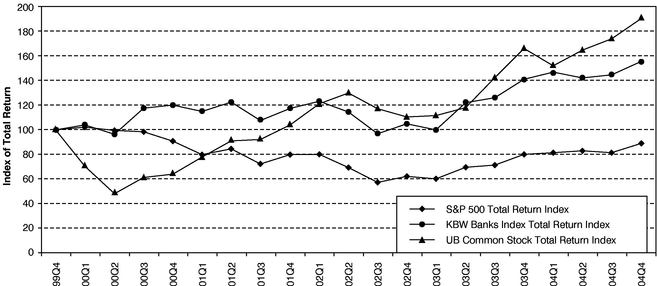
30
II. PROPOSAL TO INCREASE THE NUMBER OF SHARES OF COMMON STOCK
WHICH MAY BE AWARDED UNDER THE YEAR 2000 UNIONBANCAL CORPORATION
MANAGEMENT STOCK PLAN
Subject to stockholder approval, the Board of Directors has amended the Year 2000 UnionBanCal Corporation Management Stock Plan to increase the aggregate number of shares of our common stock which may be issued under the Plan from 16,000,000 to 20,000,000. A copy of the Year 2000 UnionBanCal Corporation Management Stock Plan is attached as Appendix A.
The Board of Directors believes the approval of this amendment to the Plan is in the best interests of UnionBanCal and its stockholders, as the availability of an adequate number of shares reserved for issuance under the Plan and the ability to grant awards under the Plan is an important factor in attracting, motivating and retaining qualified personnel essential to our success. As of March 4, 2005, 2,945,680 shares of common stock remained available for awards under the Plan and awards with respect to 13,054,320 shares of common stock had been granted and were outstanding, as well as 751 shares of common stock reserved for issuance upon conversion of Director stock units.
Description of the Plan
The Plan currently authorizes awards of up to 16,000,000 shares of our common stock by means of stock grants and sales, restricted stock grants and sales, stock units, incentive stock options, nonqualified stock options and stock appreciation rights. The purposes of the Plan are to provide competitive long-term compensation that will attract and retain key employees, non-employee Directors and/or consultants who contribute to the financial success of UnionBanCal and further align stockholder and management interests through increased employee stock ownership. The Plan is administered by the Executive Compensation & Benefits Committee of the Board of Directors.
Employees, non-employee Directors and/or consultants of UnionBanCal and its subsidiaries are eligible for awards of stock options, stock grants/sales, restricted stock grants/sales, stock units or stock appreciation rights under the Plan. The approximate number of eligible persons currently in each category are as follows: Employees (737) and Non-Employee Directors (10). We do not currently intend to grant awards to consultants. The Executive Compensation Committee determines which employees, non-employee Directors or consultants will be granted awards, the timing of awards, the terms and the number of shares to be subject to each award. The Executive Compensation & Benefits Committee is authorized to make all determinations necessary or advisable to administer the Plan.
Stock options are granted at an exercise price of no less than the fair market value of our common stock on the date of grant. As of March 4, 2005, the market value of our common stock was $62.89 per share. Options granted under the Plan may have a term of no more than ten years and will vest either immediately upon grant or over time. Other conditions or provisions (not inconsistent with the Plan) may also be imposed. If any option is intended to qualify as an incentive stock option under the Internal Revenue Code, the option will also contain the provisions required under the Code. Common stock may also be issued under the Plan to eligible persons as compensation for services rendered to UnionBanCal or its subsidiaries, subject to provisions determined by the Executive Compensation & Benefits Committee. The consideration to be received by UnionBanCal for the exercise of stock options or purchase of stock is generally cash, although the Committee may permit payment of the option exercise price or stock purchase price, in whole or in part, by delivery of previously owned UnionBanCal common stock.
The affirmative vote of a majority of the shares represented and voting on the matter at the meeting is required for any amendment to the Plan which increases the number of shares for which options or stock grants/sales may be awarded or changes the standards of eligibility under the Plan. In other cases, the Board of Directors may amend or terminate the Plan without stockholder approval. However, neither the Board of Directors nor the stockholders may alter or impair a recipient's rights
31
under any option or stock grant/sale previously awarded under the Plan without the recipient's consent. The Plan provides that it will terminate on January 1, 2010.
The following table provides information relating to our equity compensation plans as of December 31, 2004:
| |
Number of securities to be issued upon exercise of outstanding options, warrants, and rights (a) |
Weighted-average exercise price of outstanding options, warrants, and rights (b) |
Number of securities remaining available for future issuance under equity compensation plans (excluding securities reflected in column a) (c) |
|||||
|---|---|---|---|---|---|---|---|---|
| Equity compensation approved by stockholders | 9,482,336 | $ | 41.87 | 2,937,629 | ||||
| Equity compensation not approved by stockholders | — | — | — | |||||
| Total | 9,482,336 | $ | 41.87 | 2,937,629 | ||||
All equity compensation plans have been approved by the stockholders. At December 31, 2004, there were 2,937,629 shares of common stock available for future issuance under the stock plan.
The following is only a summary of the federal income tax rules governing stock options and stock awards under the Plan. The rules on this area are complex and subject to frequent change.
Options granted under the Plan may either be "incentive stock options" as defined under Section 422 of the Internal Revenue Code or "non-qualified stock options". If an incentive stock option is granted, the optionee will recognize no income upon grant of the incentive stock option and incur no tax liability upon the exercise, unless the optionee is subject to alternative minimum tax. UnionBanCal will not be allowed a deduction for federal income tax purposes upon the exercise of an incentive stock option regardless of the applicability of the alternative minimum tax. Gains from a sale or exchange of the shares more than two years after the grant of the option and one year after the receipt of the shares by the optionee (due to the exercise of the option), will be treated as long-term capital gain. If these holding periods are not satisfied, the optionee will recognize ordinary income equal to the difference between the exercise price and the lower of the fair market value of the stock at the date of the option exercise or the sale price of the stock. UnionBanCal will generally be entitled to an income tax deduction in the same amount as the ordinary income recognized by the optionee. Any gain recognized on such premature disposition of the shares in excess of the amount treated as ordinary income will be characterized as long-term or short-term capital gain depending on how long the optionee held the stock.
All options that do not qualify as incentive stock options are referred to as "non-qualified" options. An optionee will not recognize any taxable income at the time he/she is granted a non-qualified option. Upon exercising a non-qualified option, an optionee will recognize ordinary income for tax purposes measured by the excess of the then fair market value of the shares over the option price. Upon resale of such shares by the optionee, any difference between the sales price and the fair market value of the shares at the date of exercise, will be treated as capital gain or loss, and will qualify for long term capital gain or loss treatment if the shares have been held for the requisite holding period. For non-qualified stock options, UnionBanCal will generally receive an income tax deduction for the amount of ordinary income recognized by the optionee.
Restricted stock awards are generally subject to ordinary income tax at the time the restrictions lapse, unless the recipient elects to accelerate recognition as of the date of the grant. Stock unit awards are generally subject to ordinary income tax at the time of payment. In each case, UnionBanCal will
32
generally be entitled to a corresponding income tax deduction at the same time the participant recognizes ordinary income.
The Board of Directors recommends that stockholders vote FOR the proposal to increase the number of shares of common stock which may be awarded under the Year 2000 UnionBanCal Corporation Management Stock Plan.
III. RATIFICATION OF SELECTION OF INDEPENDENT REGISTERED
PUBLIC ACCOUNTING FIRM
Stockholders will also vote at the annual meeting to ratify the selection by the Audit Committee of Deloitte & Touche LLP, certified public accountants, as the independent registered public accounting firm of UnionBanCal for 2005. Deloitte & Touche LLP, or its predecessors have examined the financial statements of UnionBanCal each year since 1996. Arrangements have been made for a representative of Deloitte & Touche LLP, to attend the annual meeting. The representative will be available to answer appropriate questions and to make a statement if he or she wishes.
Audit Fees
The following is a description of the fees billed to UnionBanCal by Deloitte & Touche LLP, for each of the last two fiscal years. All fees for 2003 and 2004 were approved by the Audit Committee.
| |
2004 |
2003 |
|||||
|---|---|---|---|---|---|---|---|
| Audit Fees(1) | $ | 2,877,448 | $ | 2,291,726 | |||
| Audit-Related Fees(2) | 319,700 | 322,106 | |||||
| Tax Fees(3) | 72,478 | 222,919 | |||||
| All Other Fees(4) | 2,390 | 48,015 | |||||
| Total | $ | 3,272,016 | $ | 2,884,766 | |||
The Audit Committee also considered whether the provision of the services other than the audit services is compatible with maintaining Deloitte & Touche LLP's independence. All of the services described above were approved by the Audit Committee.
33
Pre-approval of Services by Deloitte & Touche LLP
The Audit Committee has adopted a policy for pre-approval of audit and permitted non-audit services by Deloitte & Touche LLP. The Audit Committee will consider annually and, if appropriate, approve the provision of audit services by its independent auditor and consider and, if appropriate, pre-approve the provision of certain defined audit and non-audit services; provided, however, that:
The Audit Committee will also consider on a case-by-case basis and, if appropriate, approve, specific engagements that are not otherwise pre-approved.
Any proposed engagement that does not fit within the definition of a pre-approved service may be presented to the Audit Committee for consideration at its next regular meeting or, if earlier consideration is required, to the Audit Committee Chair. The Chair reports any specific approval of services at the Audit Committee's next regular meeting. The Audit Committee will regularly review summary reports detailing all services being provided by its external auditor.
Vote Required
The affirmative vote of a majority of the shares represented and voting on the matter at the meeting is required to ratify the selection of the independent registered public accounting firm. The Board of Directors recommends that stockholders vote FOR the proposal to ratify the selection of the independent registered public accounting firm.
IV. STOCKHOLDER PROPOSAL REGARDING CONFIDENTIAL VOTING
Mr. Gerald R. Armstrong, 820 Sixteenth Street, No. 705, Denver, Colorado 80202-3227, (303) 355-1199, who held 603 registered shares of common stock on November 30, 2004, intends to submit a resolution to the stockholders of UnionBanCal for consideration at the 2005 Annual Meeting. Mr. Armstrong's resolution and supporting statement are printed below. UnionBanCal is not responsible for the contents of Mr. Armstrong's proposal or supporting statement.
Stockholder Proposal and Supporting Statement
That the shareholders of UnionBanCal, assembled in person and by proxy in an annual meeting, request its Board of Directors to take those actions necessary to grant CONFIDENTIAL VOTING, to the extent permitted by law, and appropriate and conspicuous disclosure of this right, for all shareholders in matters to be voted upon in their future meetings of UnionBanCal.
The proponent of this proposal was the sponsor of a shareholder proposal in last year's annual meeting requesting the Board of Directors to grant cumulative voting for Directors in future annual meetings.
That proposal was opposed by management and the Board of Directors.
Several shareholders contacted the proponent and expressed an interest in supporting the proposal but were reluctant to do so as they were employees, customers, service providers, and contractors for
34
UnionBanCal, or its subsidiaries, who felt they could not vote FOR the proposal without jeopardizing the future employments or transactions with UnionBanCal.
In order for the proponent to vote in favor of his proposal and upon the other matters before the meeting, he had to do so by speaking his votes from the floor of the meeting.
I believe this was an attempt of intimidation and THIS IS NOT DEMOCRACY!
Legal references define "ballot" as a "secret device offering a choice."
As shareholders, we have paid premium prices for our shares with voting rights and the exercise of the voting rights should not be diminished.
Many major financial institutions including Bank of America Corporation, Wells Fargo & Company, and U.S. Bancorp grant their shareholders confidential voting and UnionBanCal should be no exception.
If you agree, please vote FOR this proposal. If your proxy is unmarked, your shares could be voted against it by the designated proxies.
Management Response
The Board of Directors recommends a vote FOR this proposal. If you sign, date and return your proxy card without indicating how you want to vote your shares on this proposal, the proxy holders will vote your shares FOR this proposal.
In October, 2004, before receipt of Mr. Armstrong's proposal, the Corporate Governance Committee of the Board of Directors of UnionBanCal determined that it would recommend a confidential voting policy to the Board of Directors. In early December 2004, the Board of Directors approved a confidential voting policy for UnionBanCal. The policy is summarized under the caption "Your Vote is Confidential" in this proxy statement and embodies our past practice to keep stockholder votes confidential from management and the Board of Directors.
We wrote Mr. Armstrong in December 2004 and February 2005 to inform him of the new confidential voting policy and to inquire if he would like to withdraw his proposal. Mr. Armstrong did not respond.
Although we believe that there was a basis to exclude Mr. Armstrong's proposal as "substantially implemented" under the rules of the Securities and Exchange Commission, the Corporate Governance Committee, which consists entirely of independent Directors, nonetheless advised the Board of Directors to recommend that stockholders vote FOR this proposal. The Board of Directors recommended that stockholders vote in favor of this proposal.
After an investigation, UnionBanCal has found no merit to Mr. Armstrong's allegations of stockholder intimidation. Any stockholder who believes that he or she has been the victim of intimidation or attempted intimidation is encouraged to contact the independent Directors of UnionBanCal as described in this proxy statement under the caption "Communicating with the Board of Directors."
STOCKHOLDER PROPOSALS FOR 2006 PROXY STATEMENT
UnionBanCal's Bylaws govern the submission of nominations for Director or other business proposals that a stockholder wishes to have considered at a meeting of stockholders, but which are not included in UnionBanCal's proxy statement for that meeting. Under the Bylaws, nominations for Director or other business proposals to be addressed at UnionBanCal's next annual meeting may be made by a stockholder entitled to vote who has delivered a notice to the Secretary of UnionBanCal Corporation, 400 California Street, San Francisco, CA 94104-1302, no later than November 28, 2005.
35
However, if the date of the 2006 annual meeting is set more than 30 days from the date of this year's meeting, the notice must be received by the Secretary of the Corporation not later than the close of business on the later of (1) 120 days prior to such annual meeting; or (2) 7 days after the day on which public announcement of the date of such meeting is first made. The notice must contain the information required by the Bylaws.
In addition to these advance notice requirements, there are other requirements that a stockholder must meet in order to have a proposal included in the proxy statement under the rules of the Securities and Exchange Commission.
The Board of Directors does not know of any business to be presented for action at the annual meeting other than that set forth in the Notice of Annual Meeting of Stockholders. However, if other business properly comes before the meeting, the persons named in the accompanying form of proxy intend to vote on such matters in accordance with their judgment.
By
order of the Board of Directors,
John
H. McGuckin, Jr.
Executive Vice President, General Counsel and Secretary
Dated March 28, 2005
36
YEAR 2000 UNIONBANCAL CORPORATION MANAGEMENT STOCK PLAN
1. Establishment, Purpose and Definitions.
A-1
or its Subsidiaries and any other person or organization, other than the Bank of Tokyo-Mitsubishi.
2. Administration of the Plan.
A-2
3. Stock Subject to the Plan.
4. Eligibility. Persons who shall be eligible to have Awards granted to them shall be such Employees, Non-Employee Directors, and Consultants as the Committee, in its discretion, shall designate from time to time. Only Employees shall be eligible to receive incentive stock options.
5. Option Exercise Price. The exercise price of the Common Stock covered by each Option shall not be less than the Fair Market Value of such Common Stock on the date the Option is granted. Notwithstanding the foregoing, in the case of an incentive stock option granted to a person possessing more than 10% of the combined voting power of UNBC or its Subsidiaries, the exercise price shall not be less than 110% of the Fair Market Value of the Common Stock on the date the Option is granted. The exercise price of an Option shall be subject to adjustment to the extent provided in Section 3(b), above.
6. Terms and Conditions of Options.
A-3
7. Stock Appreciation Rights. The Committee may, under such terms and conditions as it deems appropriate, authorize the surrender by an Optionee of all or part of an unexercised Option and authorize a payment in consideration therefor in an amount equal to the difference obtained by subtracting the Option exercise price of the shares then subject to exercise under such Option from the Fair Market Value of the Common Stock represented by such shares on the date of surrender, provided that the Committee determines that such settlement is consistent with the purpose of the Plan. Such payment may be made in shares of Common Stock valued at their Fair Market Value on the date of surrender of such Option or in cash, or partly in shares and partly in cash. Acceptance of surrender and the manner of payment shall be in the discretion of the Committee. Any payments of cash under this Section shall be from the general assets of UNBC. Notwithstanding anything to the contrary herein, the maximum number of shares of Common Stock with respect to which the Committee may award stock appreciation rights during any calendar year to any Employee, any Non-Employee Director, or any Consultant shall not exceed 300,000.
8. Common Stock Grants and Common Stock Sales. The Committee may, in its discretion, issue Common Stock, with or without consideration, to eligible persons as compensation for services rendered to UNBC or its Subsidiaries, on whatever basis and subject to such terms and conditions as the Committee determines. The terms and conditions of such an Award shall be evidenced by a written agreement executed by UNBC and the Participant.
9. Restrictions on Transfer of Common Stock. Common Stock acquired under the Plan shall be subject to such restrictions and agreements regarding vesting, sale, assignment, encumbrance or other transfer as the Committee deems appropriate at the time of making an Award; subject, however, to compliance with applicable state and federal laws.
10. Use of Proceeds. Any cash proceeds realized from the sale of Common Stock pursuant to the Plan or from the exercise of Options granted under the Plan shall constitute general funds of UNBC.
A-4
11. Amendment, Suspension or Termination of the Plan.
12. Consideration. Payment of the exercise price of an Option or payment of any consideration required for an Award granted under the Plan shall be made in cash; provided, however, that the Committee, in its sole discretion, may permit a Participant to pay the exercise or purchase price in whole or in part by (a) delivery (on a form prescribed by the Committee) of an irrevocable direction to a securities broker or brokers approved by the UBOC Director of Human Resources or his or her designee to sell shares and deliver all or a portion of the proceeds to UNBC in payment for the Common Stock, or (b) Common Stock. For purposes of determining the amount of exercise price or purchase price satisfied by payment of Common Stock, such Common Stock shall be valued at its Fair Market Value as of the date of exercise of Option or purchase of Award, whichever is applicable.
13. Performance Based Compensation. The Plan shall be interpreted to be in compliance with requirements under Section 162(m) of the Code and all applicable Treasury Regulations promulgated thereunder so that grants of Options or Stock Appreciation Rights under the Plan will be treated as "Performance Based Compensation" as such term is used in Section 162(m)(4)(C) of the Code. To the extent that any provision in the Plan would cause the Options or Stock Appreciation Rights not to be treated as "Performance Based Compensation" under Section 162(m)(4)(C) of the Code, such provision will be stricken from the Plan, and the remaining provisions shall nevertheless continue in full force and effect without being impaired or invalidated.
14. Governing Law. The Plan will be administered in accordance with the laws of the State of California and all applicable federal law.
A-5
IN WITNESS WHEREOF, the undersigned have executed this Year 2000 UnionBanCal Corporation Management Stock Plan, at San Francisco, California, on this 23rd day of February, 2005.
UNIONBANCAL CORPORATION |
|||
By: |
/s/ NORIMICHI KANARI Norimichi Kanari President and Chief Executive Officer |
||
By: |
/s/ PAUL E. FEARER Paul E. Fearer Director of Human Resources |
||
A-6
| UnionBanCal Corporation [Letterhead] |
000000 0000000000 0 0000 000000000.000 ext 000000000.000 ext |
||
MR A SAMPLE DESIGNATION (IF ANY) ADD 1 ADD 2 ADD 3 ADD 4 ADD 5 ADD 6 |
000000000.000 ext 000000000.000 ext 000000000.000 ext 000000000.000 ext 000000000.000 ext C 1234567890 J N T |
||
o |
Mark this box with an X if you have made changes to your name or address details above. |
Annual Meeting Proxy Card
PLEASE REFER TO THE REVERSE SIDE FOR INTERNET AND TELEPHONE VOTING INSTRUCTIONS.
A Election of Directors
1. The Board of Directors
recommends a vote FOR the listed nominees.
| |
For |
Withhold |
|
For |
Withhold |
|
For |
Withhold |
||||||||
|---|---|---|---|---|---|---|---|---|---|---|---|---|---|---|---|---|
| 01-Aida M. Alvarez | o | o | 06-Philip B. Flynn | o | o | 11-Shigemitsu Miki | o | o | ||||||||
| 02-David R. Andrews | o | o | 07-Michael J. Gillfillan | o | o | 12-Takahiro Moriguchi | o | o | ||||||||
| 03-L. Dale Crandall | o | o | 08-Ronald L. Havner, Jr. | o | o | 13-Takashi Morimura | o | o | ||||||||
| 04-Richard D. Farman | o | o | 09-Norimichi Kanari | o | o | 14-J. Fernando Niebla | o | o | ||||||||
| 05-Stanley F. Farrar | o | o | 10-Mary S. Metz | o | o | 15-Tetsuo Shimura | o | o |
| |
|
|
|---|---|---|
| B Other Matters The Board of Directors recommends a vote FOR Proposals 2, 3 and 4. |
C Non Proposal |
| |
For |
Against |
Abstain |
|
|
|
||||||
|---|---|---|---|---|---|---|---|---|---|---|---|---|
| Proposal 2. To increase the number of shares of common stock which may be awarded under the Year 2000 UnionBanCal Corporation Management Stock Plan. | o | o | o | 1. | Consent to Electronic Delivery: By marking the box, I consent to access future Annual Reports and Proxy Statements of UnionBanCal Corporation electronically | o | ||||||
| over the Internet. I understand that unless I request | ||||||||||||
| Proposal 3. To ratify the selection of UnionBanCal Corporation's independent registered public accounting firm, Deloitte & Touche LLP, for 2005. | o | o | o | otherwise or revoke my consent, UnionBanCal Corporation will notify me when any such communications are available and how to access |
||||||||
| them. I understand that costs associated with the use of | ||||||||||||
| Proposal 4. To approve a stockholder proposal regarding confidential voting. | o | o | o | the Internet will be my responsibility. To revoke my consent, I can contact UnionBanCal Corporation's transfer agent, Computershare Investor Services, at 1-877-588-4179. Please mark this box if you plan on attending the Annual Meeting. |
o |
D Authorized Signatures—Sign Here—This section must be completed for your instructions to be executed.
Please sign EXACTLY as your name appears on your stock certificate and this
proxy. Executors, administrators, trustees, guardians,
attorneys, etc., should give their full title. If signer is a corporation, please give full corporate name and sign by a duly authorized officer, stating the officer's title. If a partnership, please
sign in partnership name by duly authorized person.
Signature 1—Please keep signature within the box |
Signature 2—Please keep signature within the box |
Date (mm/dd/yyyy) |
||
| / / | ||||
1 U P X H H H P P P P 0050541 |
||||
Proxy—UnionBanCal Corporation
Proxy Solicited by the Board of Directors
Annual Meeting of Stockholders
April 27, 2005
John Rice or Michelle Crandall, or either of them, each with the power of substitution, is hereby authorized to represent and to vote the Common Stock of the undersigned at the Annual Meeting of Stockholders of UnionBanCal Corporation, to be held at 9:30 a.m. (local time) on Wednesday, April 27, 2005, at the Mandarin Oriental Hotel, Embassy Room, 222 Sansome Street, San Francisco, California, or any adjournment as follows:
THIS PROXY WILL BE VOTED IN ACCORDANCE WITH THE INSTRUCTIONS INDICATED ON THE REVERSE SIDE, BUT IF NO CHOICES ARE INDICATED, THIS PROXY WILL BE VOTED FOR ALL NOMINEES LISTED ON THE REVERSE SIDE, FOR PROPOSALS 2, 3 AND 4 AND WITH RESPECT TO ANY OTHER BUSINESS PROPERLY BROUGHT BEFORE THE MEETING OR ANY ADJOURNMENT, IN ACCORDANCE WITH THE DISCRETION OF THE PROXIES.
Internet and Telephone Voting Instructions
You can vote by telephone or Internet! Available 24 Hours a day 7 days a week!
Instead of mailing your proxy, you may
choose one of the two voting methods outlined below to vote your proxy. Delaware
law permits stockholders to vote their shares by proxy through an electronic transmission authorized by the stockholder.
To vote using the Telephone (within U.S. and Canada) |
To vote using the Internet |
To vote by Mail |
||||||||||
• |
Call toll free 1-866-463-1152 in the United States or Canada any time on a touch tone telephone. There is NO CHARGE to you for the call. |
• |
Go to the following web site: WWW.COMPUTERSHARE.COM/US/PROXY |
• |
Mark, sign and date the proxy card. |
|||||||
• |
Follow the simple instructions provided by the recorded message. |
• |
Enter the information requested on your computer screen and follow the simple instructions. |
• |
Return the proxy card in the postage-paid envelope provided. |
|||||||
| C0123456789 | 12345 | |
If you vote by telephone or the Internet, you DO NOT have to mail back this proxy card. |
||
Proxies submitted by telephone or the Internet must be received by 1:00 a.m. (Pacific Time) on Monday, April 25, 2005. |
||
THANK YOU FOR VOTING |
||