Prepared for: Compañía de Minas Buenaventura S.A.A.
Prepared by: Ausenco Perú S.A.C. Av. Javier Prado Este 444, Piso 8, San Isidro, Lima; Lima
Report current as at: 31 December 2021
List of Qualified Person Firms: Ausenco Perú S.A.C.; SRK Consulting (Peru) S.A; and Agnitia Consulting SAC
Table of Contents
1
Executive Summary
1-1
1.1
Introduction
1-1
1.2
Terms of Reference
1-1
1.3
Property Setting
1-1
1.4
Mineral Tenure, Surface Rights, Water Rights, Royalties and Agreements
1-2
1.5
Geology and Mineralization
1-2
1.6
History and Exploration
1-3
1.7
Drilling and Sampling
1-3
1.7.1
Drilling
1-3
1.7.2
Hydrology and Hydrogeology
1-3
1.7.3
Geotechnical
1-4
1.7.4
Sampling
1-4
1.8
Data Verification
1-5
1.9
Metallurgical Testwork
1-5
1.10
Mineral Resource Estimation
1-6
1.10.1
Estimation Methodology
1-6
1.10.2
Mineral Resource Statement
1-7
1.11
Mineral Reserve Estimation
1-8
1.11.1
Estimation Methodology
1-8
1.11.2
Mineral Reserve Statement
1-9
1.12
Mining Methods
1-9
1.13
Recovery Methods
1-11
1.14
Project Infrastructure
1-12
1.15
Markets and Contracts
1-13
1.16
Environmental, Permitting and Social Considerations
1-14
1.16.1
Environmental Studies and Monitoring
1-14
1.16.2
Closure and Reclamation Considerations
1-14
1.16.3
Permitting
1-15
1.16.4
Social Considerations, Plans, Negotiations and Agreements
1-15
1.17
Capital Cost Estimates
1-15
1.18
Operating Cost Estimates
1-16
1.19
Economic Analysis
1-18
1.19.1
Forward-Looking Information Caution
1-18
1.19.2
Methodology and Assumptions
1-18
1.19.3
Economic Analysis
1-20
1.19.4
Sensitivity Analysis
1-20
1.20
Risks and Opportunities
1-20
Project Name: Technical Report Summary, San Gabriel Project, Peru
Report current as at: December 31, 2021
Page i
1.21
Conclusions
1-21
1.22
Recommendations
1-21
1.22.1
Geomechanical
1-21
1.22.2
Environmental
1-21
1.22.3
Tailings
1-21
1.22.4
Water Discharge Licence
1-21
2
Introduction
2-1
2.1
Registrant
2-1
2.2
Terms of Reference
2-1
2.2.1
Report Purpose
2-1
2.2.2
Terms of Reference
2-1
2.3
Qualified Persons
2-1
2.4
Site Visits and Scope of Personal Inspection
2-1
2.5
Report Date
2-2
2.6
Information Sources and References
2-2
2.7
Previous Technical Report Summaries
2-3
3
Property description and location
3-1
3.1
Introduction
3-1
3.2
Property and Title in Peru
3-1
3.2.1
Overview
3-1
3.2.2
Mineral Tenure
3-1
3.2.3
Surface Rights
3-2
3.2.4
Water Rights
3-2
3.2.5
Environmental Considerations
3-3
3.2.6
Permits
3-3
3.2.7
Other Considerations
3-4
3.3
Project Ownership
3-4
3.3.1
Ownership History
3-4
3.3.2
Current Ownership
3-4
3.4
Mineral Title
3-4
3.5
Surface Rights
3-4
3.6
Water Rights
3-8
3.7
Royalties
3-8
3.8
Encumbrances
3-8
3.8.1
Permitting Requirements
3-8
3.8.2
Violations and Fines
3-8
3.9
Significant Factors and Risks That May Affect Access, Title or Work Programs
3-9
4
Accessibility, climate, local resources, infrastructure and physiography
4-1
4.1
Physiography
4-1
Project Name: Technical Report Summary, San Gabriel Project, Peru
Report current as at: December 31, 2021
Page ii
4.1.1
Elevation
4-1
4.1.2
Topography
4-1
4.1.3
Vegetation
4-1
4.2
Accessibility
4-1
4.3
Climate
4-3
4.3.1
Climate
4-3
4.3.2
Length of Operating Season
4-4
4.4
Infrastructure
4-4
4.4.1
Water
4-4
4.4.2
Electricity
4-4
4.4.3
Personnel
4-4
4.4.4
Supplies
4-4
5
History
5-1
5.1
Exploration History
5-1
6
Geological setting, mineralization, and deposit
6-1
6.1
Deposit Type
6-1
6.2
Regional Geology
6-1
6.3
Local Geology
6-1
6.3.1
Lithologies
6-1
6.3.2
Structure
6-1
6.4
Property Geology
6-1
6.4.1.1
Deposit Dimensions
6-5
6.4.1.2
Lithologies
6-5
6.4.1.3
Structure
6-5
6.4.1.4
Alteration
6-5
6.4.1.5
Mineralization
6-5
7
Exploration
7-1
7.1
Exploration
7-1
7.1.1
Grids and Surveys
7-1
7.1.2
Geological Mapping
7-1
7.1.3
Geochemistry
7-1
7.1.4
Geophysics
7-1
7.1.5
Petrology, Mineralogy, and Research Studies
7-1
7.1.6
Qualified Person’s Interpretation of the Exploration Information
7-4
7.1.7
Exploration Potential
7-4
7.2
Drilling
7-5
7.2.1
Overview
7-5
7.2.1.1
Drilling on Property
7-5
7.2.1.2
Drilling Supporting Mineral Resource Estimates
7-6
Project Name: Technical Report Summary, San Gabriel Project, Peru
Report current as at: December 31, 2021
Page iii
7.2.1.3
Drilling Excluded for Estimation Purposes
7-6
7.2.2
Drill Methods
7-6
7.2.3
Logging
7-6
7.2.4
Recovery
7-6
7.2.5
Collar Surveys
7-6
7.2.6
Down Hole Surveys
7-10
7.2.7
Comment on Material Results and Interpretation
7-11
7.3
Hydrogeology
7-11
7.3.1
Sampling Methods and Laboratory Determinations
7-11
7.3.2
Comment on Results
7-11
7.3.3
Groundwater Models
7-11
7.4
Geotechnical
7-12
7.4.1
Sampling Methods and Laboratory Determinations
7-12
7.4.2
Comment on Results
7-14
8
Sample preparation, analyses, and security
8-1
8.1
Sampling Methods
8-1
8.2
Sample Security Methods
8-1
8.3
Density Determinations
8-1
8.4
Analytical and Test Laboratories
8-1
8.5
Sample Preparation
8-2
8.6
Analysis
8-2
8.7
Quality Assurance and Quality Control
8-2
8.8
Database
8-4
8.9
Qualified Person’s Opinion on Sample Preparation, Security, and Analytical Procedures
8-4
9
Data verification
9-1
9.1
Internal Data Verification
9-1
9.2
External Data Verification
9-1
9.3
Data Verification by Qualified Person
9-1
9.4
Qualified Person’s Opinion on Data Adequacy
9-1
10
Mineral processing and metallurgical testing
10-1
10.1
Introduction
10-1
10.2
Test Laboratories
10-1
10.3
Metallurgical Testwork
10-1
10.3.1
Historical Test Programs
10-1
10.3.2
2021 Study Test Programs (2019–2020)
10-1
10.3.3
Studies and Testwork During 2021.
10-2
10.3.3.1
First Stage—Tailings Characterization
10-2
10.3.3.2
Second Stage—Process Validation and Variability Program
10-2
10.3.3.3
Sample Representativity
10-2
Project Name: Technical Report Summary, San Gabriel Project, Peru
Report current as at: December 31, 2021
Page iv
10.3.3.4
Gold Geometallurgical Model
10-3
10.3.3.5
Silver Geometallurgical Model:
10-3
10.3.3.6
BWi Geometallurgical Model:
10-3
10.4
Metallurgical Results as Basis for the 2021 Study Design
10-3
10.4.1
Ore Characteristics
10-3
10.4.2
Comminution
10-3
10.4.3
Gravity Concentration
10-7
10.4.4
Carbon-in-Leach
10-7
10.4.5
Cyanide Destruction
10-8
10.4.6
De-watering Tests
10-8
10.5
Metallurgical Design Basis
10-8
10.6
Deleterious Elements
10-8
10.7
Qualified Person’s Opinion on Data Adequacy
10-9
11
Mineral resource estimates
11-1
11.1
Introduction
11-1
11.2
Exploratory Data Analysis
11-1
11.3
Geological Models
11-1
11.4
Density Assignment
11-1
11.5
Grade Capping/Outlier Restrictions
11-2
11.6
Composites
11-2
11.7
Variography
11-2
11.8
Estimation/interpolation Methods
11-2
11.9
Validation
11-2
11.10
Confidence Classification of Mineral Resource Estimate
11-3
11.11
Reasonable Prospects of Economic Extraction
11-3
11.11.1
Input Assumptions
11-3
11.11.2
Commodity Prices
11-4
11.11.3
Cut-off
11-4
11.12
Mineral Resource Statement
11-4
11.13
Uncertainties (Factors) That May Affect the Mineral Resource Estimate
11-5
12
Mineral reserve estimates
12-1
12.1
Introduction
12-1
12.2
Development of Mining Case
12-1
12.3
Dilution and Mine Recovery
12-2
12.4
Cut-Off Grades
12-2
12.5
Mineral Reserve Statement
12-2
12.6
Uncertainties (Factors) That May Affect the Mineral Reserve Estimate
12-2
13
Mining methods
13-1
13.1
Geotechnical Considerations
13-1
Project Name: Technical Report Summary, San Gabriel Project, Peru
Report current as at: December 31, 2021
Page v
13.2
Hydrogeological Considerations
13-1
13.3
Operations
13-1
13.3.1
Mining Method Selection
13-1
13.3.2
Design Assumptions and Design Criteria
13-1
13.4
Ventilation
13-2
13.5
Blasting and Explosives
13-2
13.6
Underground Sampling and Production Monitoring
13-2
13.7
Production Schedule
13-2
13.7.1
Production Schedule
13-2
13.7.2
Mining Sequence
13-2
13.8
Backfill
13-3
13.9
Equipment
13-7
13.10
Personnel
13-7
14
Recovery methods
14-1
14.1
Process Method Selection
14-1
14.2
Process Plant
14-1
14.2.1
Flowsheet
14-1
14.2.2
Plant Design
14-1
14.2.3
Equipment Sizing
14-3
14.2.4
Power and Consumables
14-3
14.2.5
Personnel
14-4
15
Infrastructure
15-1
15.1
Introduction
15-1
15.2
Roads and Logistics
15-1
15.3
Seismicity Assessment
15-1
15.4
Stockpiles and Waste Rock Storage Facilities
15-1
15.5
Filtered Tailings Storage Facilities
15-1
15.6
Water Management
15-5
15.7
Built Infrastructure
15-5
15.8
Camps and Accommodation
15-5
15.9
Power and Electrical
15-5
15.10
Water Supply
15-6
16
Market studies and contracts
16-1
16.1
Markets
16-1
16.1.1
Gold Market Overview
16-1
16.1.2
Gold Supply and Demand
16-1
16.1.3
Silver Supply and Demand
16-1
16.1.4
Doré Marketability
16-3
16.1.5
San Gabriel Marketability Considerations.
16-3
Project Name: Technical Report Summary, San Gabriel Project, Peru
Report current as at: December 31, 2021
Page vi
16.2
Commodity Price Forecasts
16-3
16.3
Contracts
16-3
17
Environmental studies, permitting, and plans, negotiations, or agreements with local individuals or groups
17-1
17.1
Introduction
17-1
17.2
Baseline and Supporting Studies
17-1
17.3
Environmental Considerations/Monitoring Programs
17-1
17.4
Water Management
17-2
17.5
Closure and Reclamation Considerations
17-2
17.6
Permitting
17-2
17.7
Social Considerations, Plans, Negotiations and Agreements
17-3
17.8
Qualified Person’s Opinion on Adequacy of Current Plans to Address Issues
17-8
18
Capital and operating costs
18-1
18.1
Introduction
18-1
18.2
Capital Cost Estimates
18-1
18.2.1
Basis of Estimate
18-1
18.2.2
Material Costs
18-2
18.2.3
Contingency
18-2
18.2.4
Mine Capital Costs
18-2
18.2.5
Process Capital Costs
18-3
18.2.6
Owner (Corporate) Capital Costs
18-4
18.2.7
Closure Costs
18-4
18.2.8
Capital Cost Summary
18-4
18.3
Operating Cost Estimates
18-6
18.3.1
Basis of Estimate
18-6
18.3.2
Mine Operating Costs
18-6
18.3.3
Process Operating Costs
18-7
18.3.4
Infrastructure Operating Costs
18-7
18.3.5
General and Administrative Operating Costs
18-7
18.3.6
Operating Cost Summary
18-7
19
Economic analysis
19-1
19.1
Forward-looking Information Caution
19-1
19.2
Methodology Used
19-1
19.3
Financial Model Parameters
19-1
19.3.1
Mineral Resource, Mineral Reserve, and Mine Life
19-1
19.3.2
Metallurgical Recoveries
19-1
19.3.3
Smelting and Refining Terms
19-1
19.3.4
Metal Prices
19-2
19.3.5
Capital Costs
19-2
Project Name: Technical Report Summary, San Gabriel Project, Peru
Report current as at: December 31, 2021
Page vii
19.3.6
Operating Costs
19-2
19.3.7
Royalties
19-2
19.3.8
Depreciation
19-2
19.3.9
Taxes
19-2
19.3.9.1
Income tax
19-3
19.3.9.2
Depreciation and Amortization
19-3
19.3.9.3
Value Added Tax
19-3
19.3.9.4
Special Mining Tax
19-3
19.3.9.5
Worker’s Profit Sharing
19-3
19.3.10
Closure Costs and Salvage Value
19-3
19.3.11
Working Capital
19-3
19.3.12
Closure and Reclamation
19-3
19.3.13
Financing
19-3
19.3.14
Inflation
19-3
19.4
Economic Analysis
19-4
19.5
Sensitivity Analysis
19-4
20
Adjacent properties
20-1
21
Other relevant data and information
21-1
22
Interpretation and conclusions
22-1
22.1
Introduction
22-1
22.2
Mineral Tenure, Surface Rights, Water Rights, Royalties and Agreements
22-1
22.3
Geology and Mineralization
22-1
22.4
Exploration, Drilling and Analytical Data Collection in Support of Mineral Resource Estimation
22-2
22.5
Metallurgical Testwork
22-2
22.6
Mineral Resource Estimates
22-3
22.7
Mineral Reserve Estimates
22-3
22.8
Mining Methods
22-4
22.9
Recovery Methods
22-4
22.10
Infrastructure
22-5
22.11
Market Studies
22-5
22.12
Environmental, Permitting and Social Considerations
22-5
22.13
Capital Cost Estimates
22-6
22.14
Operating Cost Estimates
22-7
22.15
Economic Analysis
22-7
22.16
Risks and Opportunities
22-7
22.17
Conclusions
22-8
23
Recommendations
23-1
23.1
Introduction
23-1
23.1.1
Geomechanical
23-1
Project Name: Technical Report Summary, San Gabriel Project, Peru
Report current as at: December 31, 2021
Page viii
23.1.2
Environmental
23-1
23.1.3
Tailings
23-1
23.1.4
Water Discharge Licence
23-1
24
References
24-1
25
Reliance on the registrant
25-1
25.1
Introduction
25-1
25.2
Macroeconomic Trends
25-1
25.3
Markets
25-1
25.4
Legal Matters
25-1
25.5
Environmental Matters
25-1
25.6
Stakeholder Accommodations
25-2
25.7
Governmental Factors
25-2
List of Tables
Table 1-1:
Measured and Indicated Mineral Resource Statement
1-8
Table 1-2:
Inferred Mineral Resource Statement
1-8
Table 1-3:
Proven and Probable Mineral Reserve Statement
1-10
Table 1-4:
Capital Cost Estimate Summary
1-17
Table 1-5:
Operating Cost Estimate Summary
1-19
Table 1-6:
Cashflow Summary Table
1-21
Table 2-1:
Ausenco Site Visits
2-3
Table 3-1:
Mineral Tenure Table
3-5
Table 3-2:
Water Rights
3-9
Table 5-1:
Exploration and Development History Summary Table
5-2
Table 7-1:
Geophysical Surveys
7-3
Table 7-2:
Property Drill Summary Table
7-7
Table 7-3:
Rock Mass Rating
7-15
Table 8-1:
Analytical Methods, ALS Lima
8-3
Table 8-2:
QA/QC Insertion Rates
8-3
Table 8-3:
QA/QC Results
8-4
Table 10-1:
2021 Testwork and Studies Reports
10-3
Table 10-2:
Predicted Gold Recoveries by Geometallurgical Domain
10-4
Table 10-3:
Predicted Silver Recoveries by Geometallurgical Domain
10-5
Project Name: Technical Report Summary, San Gabriel Project, Peru
Report current as at: December 31, 2021
Page ix
Table 10-4:
BWI Metallurgical Model
10-5
Table 10-5:
Ore Characteristics
10-7
Table 10-6:
Ore Comminution Parameters
10-7
Table 10-7:
Reagent Consumptions – Cyanide Destruction
10-9
Table 11-1:
Measured and Indicated Mineral Resource Statement
11-5
Table 11-2:
Inferred Mineral Resource Statement
11-5
Table 12-1:
NSR Input Parameters
12-3
Table 12-2:
Proven and Probable Mineral Reserve Statement
12-4
Table 13-1:
Ventilation Requirements by Stage
13-4
Table 13-2:
Drilling and Blasting Proposed General Configuration
13-6
Table 13-3:
Equipment Fleet Requirements
13-8
Table 15-1:
Infrastructure Requirements
15-2
Table 15-2:
Stockpile and Waste Rock Storage Facilities
15-4
Table 15-3:
Built Infrastructure
15-6
Table 16-1:
Gold Price Forecast
16-4
Table 16-2:
Silver Price Forecast
16-4
Table 17-1:
Permits Required for Construction
17-4
Table 17-2:
Permits Required for Operation
17-5
Table 17-3:
Critical Path Permits
17-6
Table 18-1:
Initial Capital Cost
18-3
Table 18-2:
Capital Cost Summary
18-5
Table 18-3:
Operating Cost Estimate by Cost Center (Year 1 to Year 7)
18-8
Table 18-4:
Operating Cost Estimate by Cost Center (Year 8 to Year 14 and LOM)
18-9
Table 19-1:
Cashflow Summary Table
19-5
Table 19-2:
Cashflow Analysis on an Annualized Basis (Year -3 to Year 6)
19-6
Table 19-3:
Cashflow Analysis on an Annualized Basis (Year 7 to Year 14)
19-7
Table 19-4:
NPV Sensitivity
19-8
Table 19-5:
IRR Sensitivity
19-8
List of Figures
Figure 1-1:
Proposed Production Plan
1-11
Figure 2-1:
Project Location Plan
2-2
Project Name: Technical Report Summary, San Gabriel Project, Peru
Report current as at: December 31, 2021
Page x
Figure 3-1:
Mineral Tenure Plan
3-6
Figure 3-2:
Surface Rights Plan
3-7
Figure 4-1:
Personnel Transport Route Alternatives
4-2
Figure 4-2:
Freight Transport Route Alternatives
4-3
Figure 6-1:
Regional Geology Plan
6-2
Figure 6-2:
Stratigraphic Column
6-3
Figure 6-3:
Schematic Cross-Section Through the San Gabriel Deposit and Ichuña Basement High
6-4
Figure 6-4:
Deposit Stratigraphy
6-6
Figure 6-5:
Geology Plan
6-7
Figure 6-6:
Geological Cross-Section, SGB-41
6-8
Figure 7-1:
Geochemical Sample Location Plan, Canahuire Area
7-2
Figure 7-2:
Geophysical Survey Location Plan
7-4
Figure 7-3:
Prospects Location Map
7-5
Figure 7-4:
Property Drill Collar Location Plan
7-9
Figure 7-5:
Drill Collar Location Plan for Drilling Supporting Mineral Resource Estimates
7-10
Figure 7-6:
Predicted Mine Water Inflows
7-12
Figure 7-7:
Drill Hole Location Plan, Geotechnical Drilling Program
7-13
Figure 7-8:
RMR Block Model, Isometric View
7-13
Figure 7-9:
Insitu Stress Model and Measurements
7-14
Figure 10-1:
Gold Forecast Recovery Map
10-4
Figure 10-2:
Silver Forecast Recovery Map
10-5
Figure 10-3:
BWI Forecast Recovery Map, Elevation view
10-6
Figure 13-1:
Schematic, Ramps and Main Access Levels
13-4
Figure 13-2:
Ventilation Schematic, South Zone
13-5
Figure 13-3:
Ventilation Schematic, North Zone
13-5
Figure 13-4:
Forecast Production Schedule
13-6
Figure 13-5:
LOM Mining Sequence
13-7
Figure 14-1:
Process Flowsheet
14-2
Figure 15-1:
Infrastructure Layout Plan
15-3
Figure 16-1:
Gold Value Chain
16-2
Figure 16-2:
CRU Gold Price Chart and Forecast
16-2
Figure 16-3:
CRU Silver Price Chart and Forecast
16-2
\{ind 36\}
Project Name: Technical Report Summary, San Gabriel Project, Peru
Report current as at: December 31, 2021
Page xi
The following Qualified Person Firms and Qualified Persons prepared this technical report summary, entitled “San Gabriel Project, Southern Peru, Technical Report Summary“ and confirm that the information in the technical report summary is current as at December 31, 2021.
Responsible for Chapters: 1.15; 16; 19.3.3; 19.3.4; 22.11.
Project Name: Technical Report Summary, San Gabriel Project, Peru
Report current as at: December 31, 2021
Page xii
Agnitia Consultores S.A.C.
Av. Alameda del Corregidor 705
Urb. La Molina Vieja, Lima 15024
CONSENT OF THIRD-PARTY FIRM
We, Agnitia Consultores S.A.C (“AGNITIA”), a “qualified person” for purposes of Subpart 1300 of Regulation S-K as promulged by the U.S. Securities and Exchange Commission (“S-K 1300”). In connection with the filing of Compañía de Minas Buenaventura S.A.A.’s (the “Company”) Annual Report on Form 20-F for the year ended December 31, 2021 (the “Annual Report”), consent to:
●
the public filing and use of the technical report summary titled “San Gabriel Project (Southern Peru) Technical Report Summary” with an effective date of 31 December 2021 (the “Technical Report Summary”), as an exhibit to and referenced in the Annual Report;
●
the use of and reference to our name, including our status as an expert or “qualified person” (as defined in S-K 1300), in connection with the Annual Report and the Technical Report Summary; and
●
the information derived, summarized, quoted or referenced from those sections of the Technical Report Summary, or portions thereof, for which AGNITIA is responsible that is included or incorporated by reference in the Annual Report.
This consent pertains to the following sections of the Technical Report Summary:
Project Name: Technical Report Summary, San Gabriel Project, Peru
Report current as at: December 31, 2021
Page xiii
Ausenco Perú S.A.C.
Av. Javier Prado Este 444, Urb. Jardin
Piso 8, San Isidro, Lima 27
CONSENT OF AUSENCO PERÚ S.A.C.
We, Ausenco Perú S.A.C. (“Ausenco”), in connection with the filing of Compañía de Minas Buenaventura S.A.A.’s (the “Company”) Annual Report on Form 20-F for the year ended December 31, 2021 (the “Annual Report”), consent to:
●
the filing of the technical report summary titled “San Gabriel Project (Southern Peru) Technical Report Summary” with an effective date of 31 December 2021 (the “Technical Report Summary”), as an exhibit to and referenced in the Annual Report;
●
the use of and reference to our name, in connection with the Annual Report and the Technical Report Summary; and
●
the information derived, summarized, quoted or referenced from those sections of the Technical Report Summary, or portions thereof, for which Ausenco is responsible that is included or incorporated by reference in the Annual Report.
This consent pertains to the following sections of the Technical Report Summary:
Project Name: Technical Report Summary, San Gabriel Project, Peru
Report current as at: December 31, 2021
Page xiv
CONSENT
I, Manuel A. Hernández, a “qualified person” for purposes of Subpart 1300 of Regulation S-K as promulgated by the U.S. Securities and Exchange Commission (“S-K 1300”). In connection with Compañía de Minas Buenaventura S.A.A.’s (the “Company”) Annual Report on Form 20-F for the year ended December 31, 2021, and any amendments or supplements and/or exhibits thereto (collectively, the “Form 20-F”), consent to:
●
the public filing and use of the technical report summary titled “San Gabriel Project (Southern Peru) Technical Report Summary” (the “Technical Report Summary”), with an effective date of December 31, 2021, as an exhibit to and referenced in the Company’s Form 20-F;
●
the use of and references to my name, including my status as an expert or “qualified person” (as defined in S-K 1300), in connection with the Form 20-F and any such Technical Report Summary; and
●
the use of information derived, summarized, quoted or referenced from the Technical Report Summary, or portions thereof, that was prepared by me, that I supervised the preparation of and/or that was reviewed and approved by me, that is included or incorporated by reference in the Form 20-F.
I am a qualified person responsible for authoring, and this consent pertains to, the following sections of the Technical Report Summary:
●
Section 1.15, 16, 19.3.3, 19.3.4 and 22.11.
Signature of Authorized Person
Name: Manuel A. Hernández Fellow AusIMM - Member 306576
Title: Civil Mining Engineer
Project Name: Technical Report Summary, San Gabriel Project, Peru
Report current as at: December 31, 2021
Page xv
INSIDEO S.A.C.
Avenida Primavera 643, Oficina SS 103
San Borja, Lima 41
CONSENT OF INSIDEO S.A.C.
We, INSIDEO S.A.C. (“INSIDEO”), in connection with the filing of Compañía de Minas Buenaventura S.A.A.’s (the “Company”) Annual Report on Form 20-F for the year ended December 31, 2021 (the “Annual Report”), consent to:
●
the public filing and use of the technical report summary titled “San Gabriel Project (Southern Peru) Technical Report Summary” with an effective date of 31 December 2021 (the “Technical Report Summary”), as an exhibit to and referenced in the Annual Report;
●
the use of and reference to our name, including our status as an expert, in connection with the Annual Report and the Technical Report Summary; and
●
the information derived, summarized, quoted or referenced from those sections of the Technical Report Summary, or portions thereof, for which INSIDEO is responsible that is included or incorporated by reference in the Annual Report.
This consent pertains to the following sections of the Technical Report Summary:
●
1.16, 4, 17 and 22.12.
April 14th, 2022
LORENA VIALE MONGRUT INGENIERA AMBIENTAL Reg. CIP N 92716
Signature of Authorized Person for
INSIDEO S.A.C.
Lorena Viale Mongrut
Print name of Authorized Person for
INSIDEO Perú S.A.C.
Project Name: Technical Report Summary, San Gabriel Project, Peru
Report current as at: December 31, 2021
Page xvi
SRK Consulting (Peru) S.A.
Av. La Paz 1227
Miraflores, Lima 15074, Perú
T: +511 2065900
E: srk@srk.com.pe
https://www.srk.com
CONSENT OF SRK CONSULTING (PERU) S.A.
SRK Consulting (Peru) S.A. (“SRK”), a “qualified person” for purposes of Subpart 1300 of Regulation S-K as promulgated by the U.S. Securities and Exchange Commission (“S-K 1300”), in connection with Compañía de Minas Buenaventura S.A.A.’s (the “Company”) Annual Report on Form 20-F for the year ended December 31st, 2021 and any amendments or supplements and/or exhibits thereto (collectively, the “Form 20-F”), consent to:
●
the public filing by the Company and use of the technical report titled “San Gabriel Project, S-K 1300 Technical Report Summary, Preliminary Feasibility Study” (the “Technical Report Summary”), with an effective date of December 31st, 2021, which was prepared in accordance with S-K 1300, as an exhibit to and referenced in the Annual Report:
●
the use of and references to SRK, including the status as an expert “qualified person” (as defined in Sub-Part S-K 1300), in connection with the Form 20-F and any such Technical Report Summary; and
●
the use of information derived, summarized, quoted or referenced from those sections of Technical Report Summary, or portions thereof, for which SRK is responsible and which is included or incorporated by reference in the Annual Report.
SRK is responsible for authoring, and this consent pertains to, the following sections of the Technical Report Summary:
●
1.4, 1.5, 1.6, 1.7, 1.8, 1.10, 1.21, 1.22, 2.4, 6, 7, 8, 9, 11, 22.3, 22.4, 22.6 and corresponding sub-sections of References (Section 24) and Reliance on Information Supplied by Registrant (Section 25)
Dated this April 15th, 2022
Angel Mondragon
SRK Consulting (Peru) S.A. - Director
Antonio Samaniego
SRK Consulting (Peru) S.A. - Director
Oficinas del Grupo: Africa, Asia, Australia, Europa, Norteamérica y Sudamérica
Project Name: Technical Report Summary, San Gabriel Project, Peru
Report current as at: December 31, 2021
Page xvii
1
Executive Summary
1.1
Introduction
This technical report summary (the Report) was prepared for Compañía de Minas Buenaventura S.A.A. (Buenaventura) on the San Gabriel Project (the Project) in southern Peru.
1.2
Terms of Reference
The Report was prepared to support mineral resource and mineral reserve estimates for the San Gabriel Project and provide the results of a mining study completed in December 2021 (the 2021 Study).
Unless otherwise indicated, all financial values are reported in US currency, while the metric system has been used for units of measure.
Mineral resources and mineral reserves are reported using the definitions in Subpart 229.1300 – Disclosure by Registrants Engaged in Mining Operations in Regulation S–K 1300 (SK1300).
The Report uses Canadian English.
1.3
Property Setting
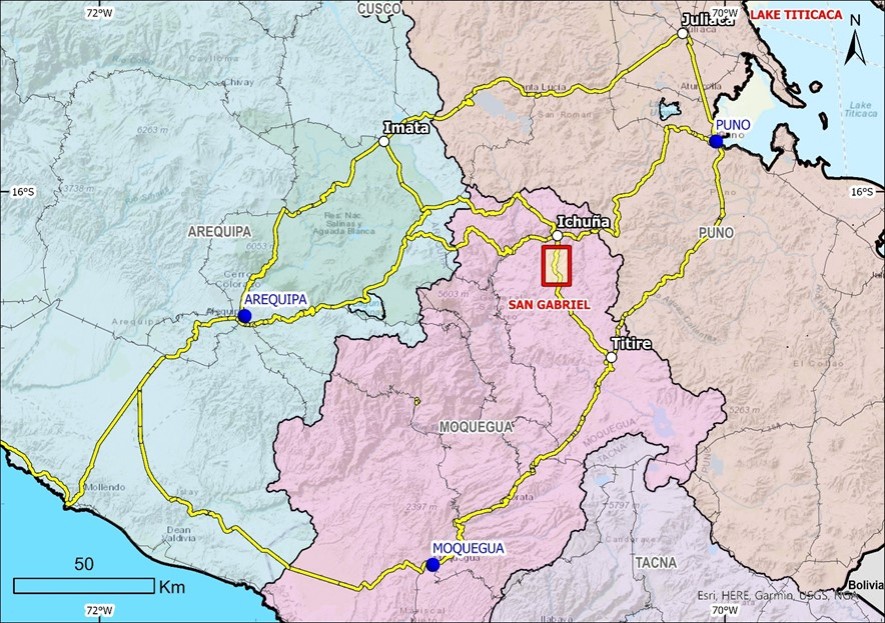
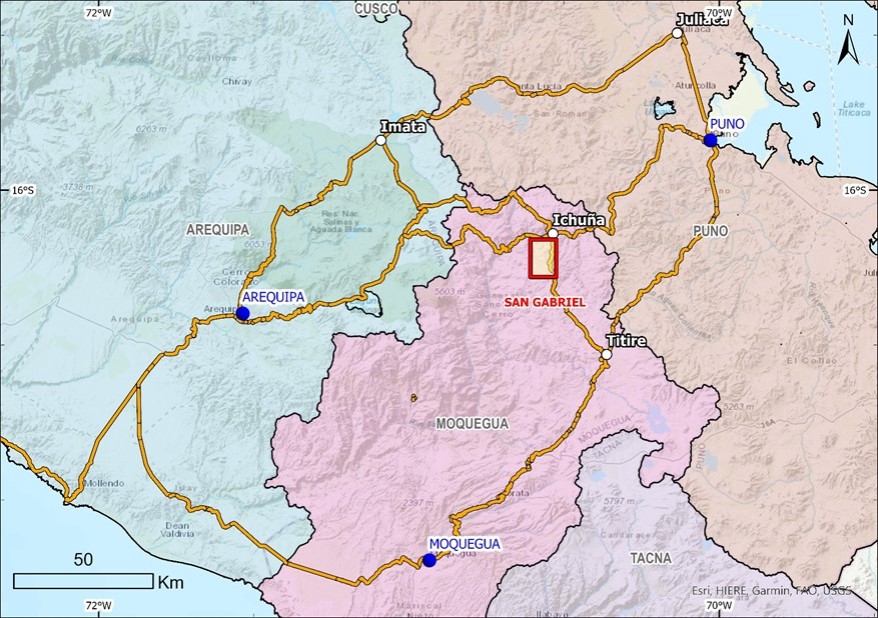
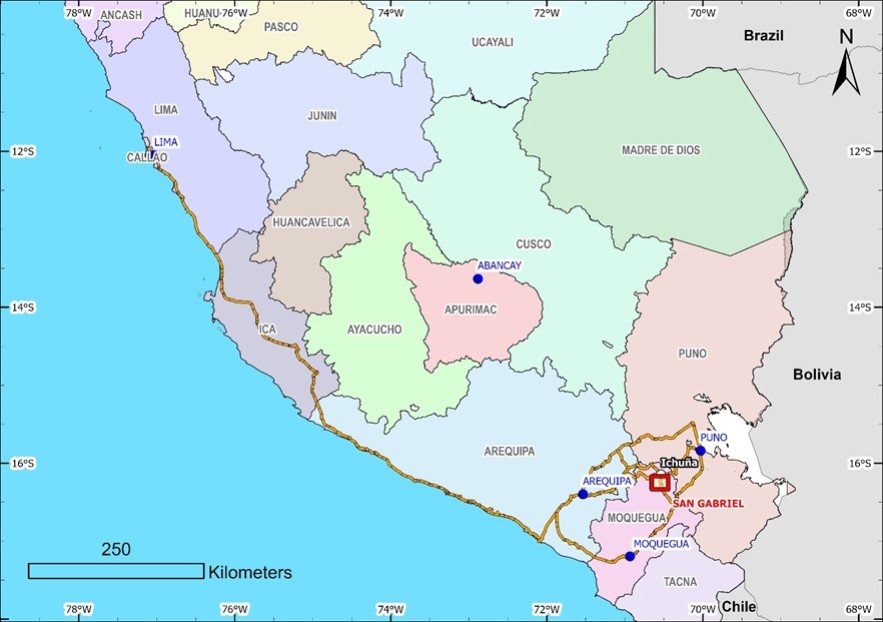
The San Gabriel Project is located in the Ichuña district, in the General Sánchez Cerro Province of the and Moquegua Region ion southern Peru, around 837 km directly southeast of Lima and 116 km directly northeast of Moquegua.
The Project can be accessed from the cities of Arequipa, Moquegua and Juliaca via a mixture of paved and unpaved roads:
The climate in the Project area is Andean tundra type, with the average annual temperature about 7ºC, and average annual rainfall of approximately 595 mm, split between a dry and a rainy season. Underground mining and processing operations will be conducted all year-round.
The Project covers elevations ranging from 4,450 masl to 5,000 masl. The deposit is at an elevation of about 4,780 masl. The topography is rugged, consisting of fluvial and glacial valleys and steep mountain slopes. Vegetation types range from grasslands to wet puna (bofedales). The natural vegetation has been severely affected by livestock grazing, burning, firewood collection and clearance for cultivation.
The closest town to the Project is Ichuña. The main economic activities include agriculture, livestock, services and related jobs. The Project is currently serviced by an operational 22.9 kV transmission line that was installed from the public electricity grid, servicing the mine services (1 MVA) and the Agani advance camp (650 kVA). The transmission line will continue to be used during the Project construction phase. Exploration activities preferentially hire labour from the local communities. During construction and mine operations, Buenaventura plans to preferentially hire qualified or unskilled personnel from the populations within the Project area of influence, including C.C. Santa Cruz de Oyo Oyo, Maycunaca and Antajahua, and C.C. Corire and the Ichuña District. Where labour is unavailable locally, hiring will be firstly from the region, and only then from beyond the region.
Project Name: Technical Report Summary, San Gabriel Project, Peru
Report current as at: December 31, 2021
Page 1-1
1.4
Mineral Tenure, Surface Rights, Water Rights, Royalties and Agreements
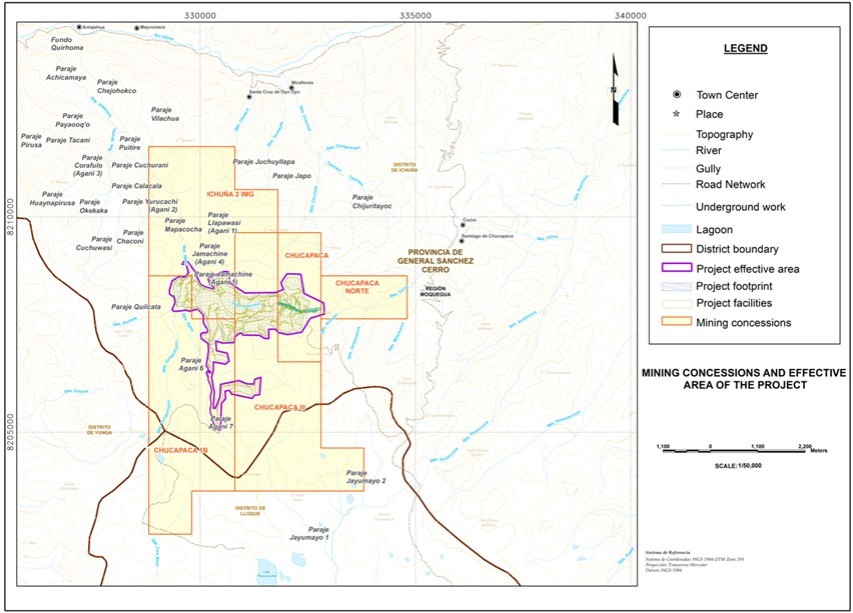
The Project is wholly owned by Compañía de Minas Buenaventura S.A.A. The Project consists of five mining concessions, covering an area of 3,467.3 ha. Buenaventura complies with the annual payment of the obligations given by the state for the maintenance of the mining property, the license fees and, if applicable, payment of any penalties incurred. Three royalties are payable on the Ichuña 2 IMG concession.
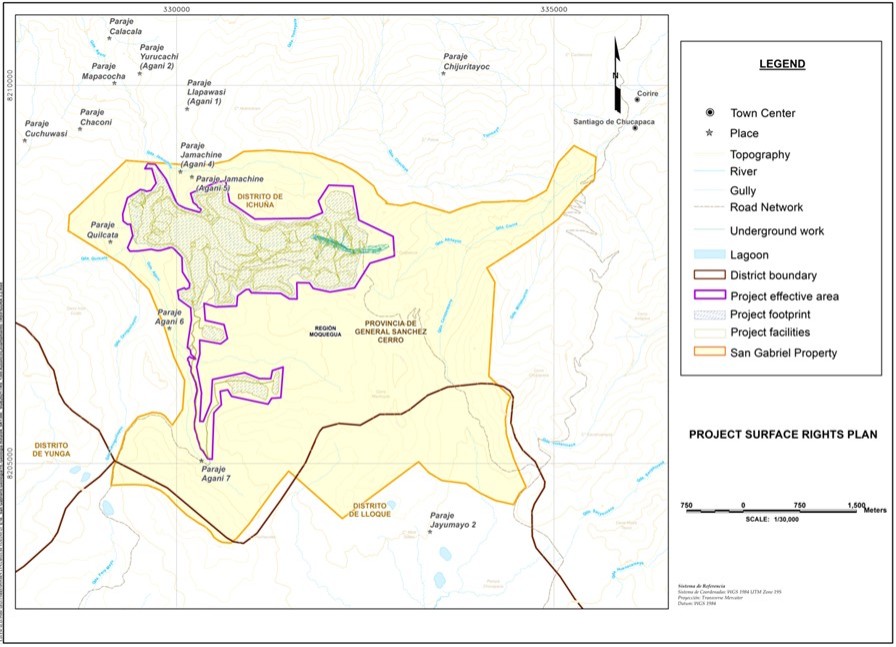
Buenaventura purchased 1,380.15 ha, termed Parcela A, from the Santa Cruz de Oyo Oyo, Maycunaca and Antajahua Peasant Community (Oyo Oyo community) in 2014 and 778 ha, referred to as Lot C, from the Corire community in 2016, such that Buenaventura currently has a total of 2,158 ha where it controls the surface rights. This surface ownership area is sufficient to allow construction of the required facilities to support the life-of-mine (LOM) plan. Buenaventura is in land purchase discussions with about six landowners for purchase of additional surface rights.
Buenaventura has granted water rights, under Directorial Resolution No. 719-2020-ANA-AAA.CO, to acquire water from two streams for fresh and mining purposes. The Agani dam has been permitted for construction, which will allow for extraction of 8.94 L/sec for mining purposes.
A semi-detailed environmental impact study (EIA-sd) was completed in 2009. This was modified in 2010 (first modification of the EIA-sd), in 2013 (second modification of the EIA-sd), and again in 2015 (third modification of the EIA-sd). The applicable reports supporting the EIA-sds were filed as required. These permits support exploration activities. The Project EIA was approved via a detailed EIA (EIAd) in March 2017, which is valid for five years. No modification to this EIAd is envisaged prior to Project execution. It is important that Project construction works start before March 2022 to stay within the validity period of the approved EIAd. A modification to the EIAd will be required for some of the facilities planned for later in the LOM, such as the second FTSF.
1.5
Geology and Mineralization
The San Gabriel deposit shows many of the characteristics of an intermediate sulfidation epithermal deposit.
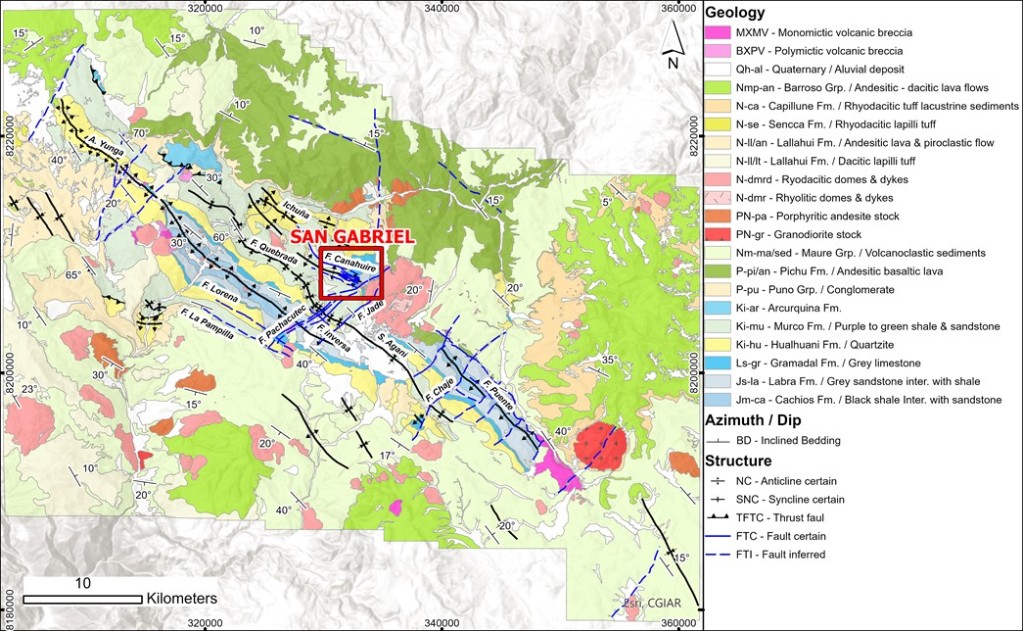
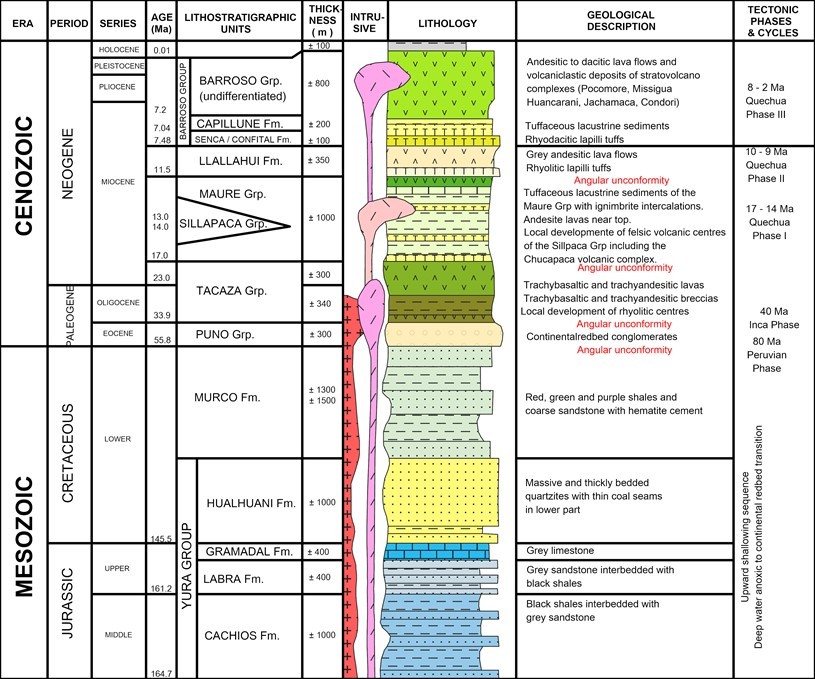
An inlier of folded and faulted basement Jurassic-Cretaceous siliciclastic and carbonate sedimentary rocks of the Yura Group forms a basement high in the Ichuña District. It is overlain by a cover sequence of Cenozoic (Paleogene, Neogene, and Quaternary) volcaniclastic sediments and lavas.
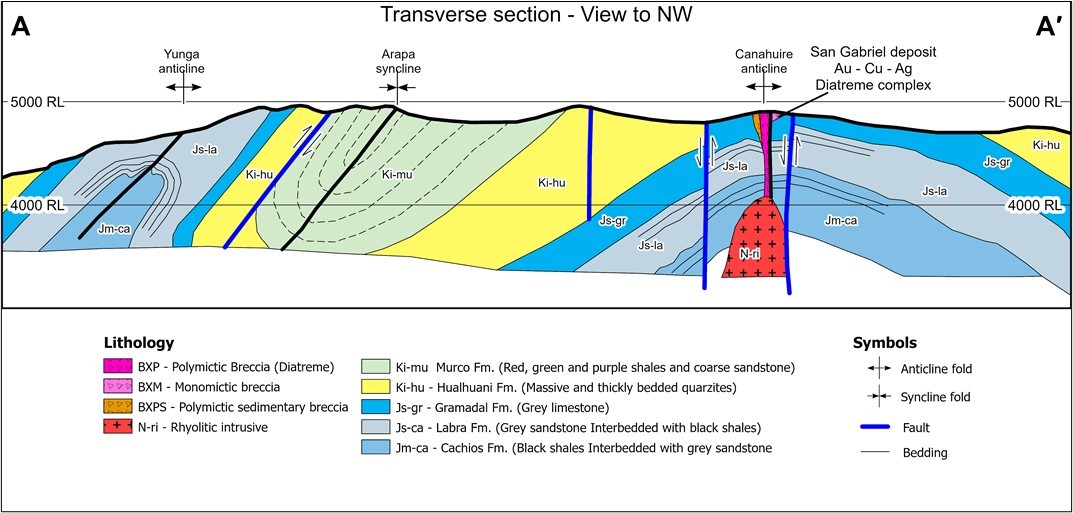
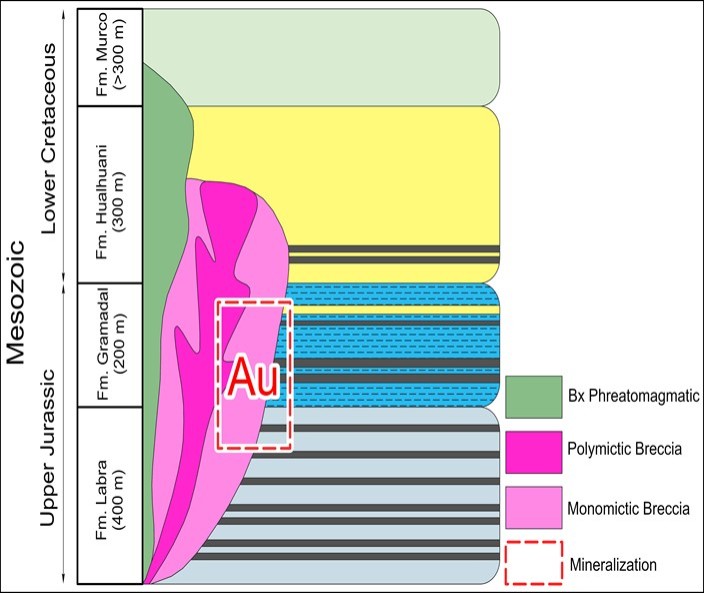
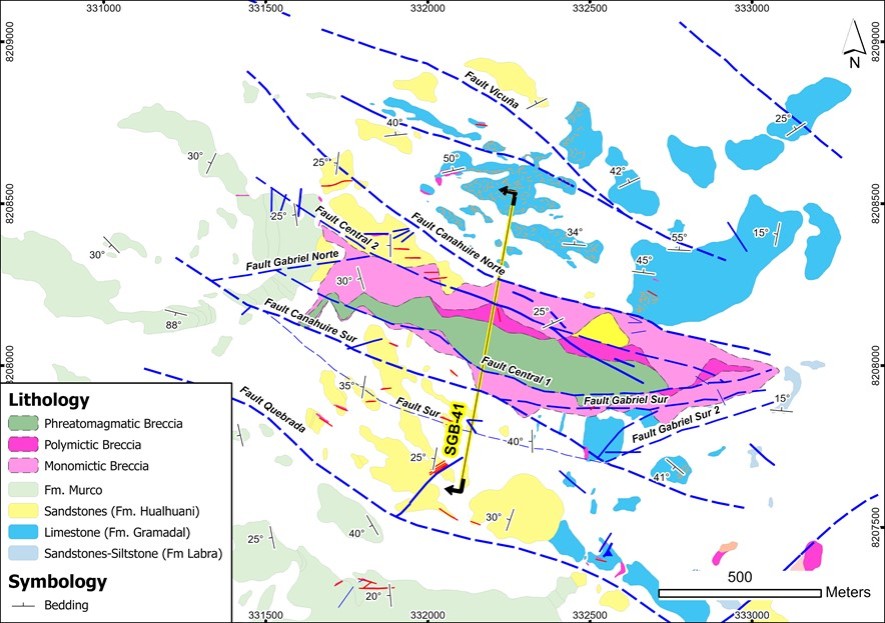
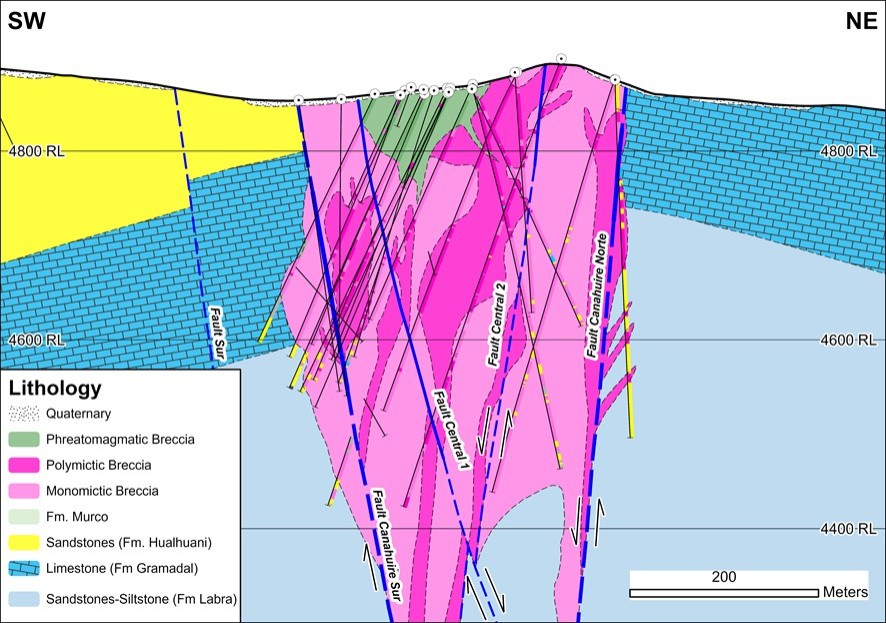
Mineralization is hosted in Jurassic–Cretaceous Yura Group sediments, with dark grey limestones and interbedded clastic rocks of the Gramadal Formation hosting the most continuous replacement-style alteration and mineralization. The San Gabriel deposit is approximately 3,000 m long, 250 m wide, and averages 170 m in thickness. It has been drill tested to a depth of 700 m.
The deposit lies in an open anticlinal hinge zone located on the normal limb of a north to north–northeast verging overturned anticline. A network of steep faults at San Gabriel creates a sinistral–normal dilational jog. Within this jog are a series of secondary structures that are associated with the gold–silver mineralization. Elevated gold grades are associated with northwest- and east–west-trending faults, whereas higher silver grades appear to be associated with conjugate west–northwest extensional fault systems.
An early copper–silver mineralization stage is characterized by pyrrhotite, pyrite, chalcopyrite, arsenopyrite, and sphalerite. It occurs as cement filling open spaces in breccias, as replacement in limestones of the Gramadal Formation, and as veins and veinlets in clastic units within the Gramadal Formation, and sedimentary rocks of the Labra Formation. The principal gold–copper–silver mineralization stage partially replaces the early copper–silver mineralization stage. The gold mineralization is largely hosted in brecciated limestones of the Gramadal Formation, being hosted in polymictic and monomictic breccias.
Project Name: Technical Report Summary, San Gabriel Project, Peru
Report current as at: December 31, 2021
Page 1-2
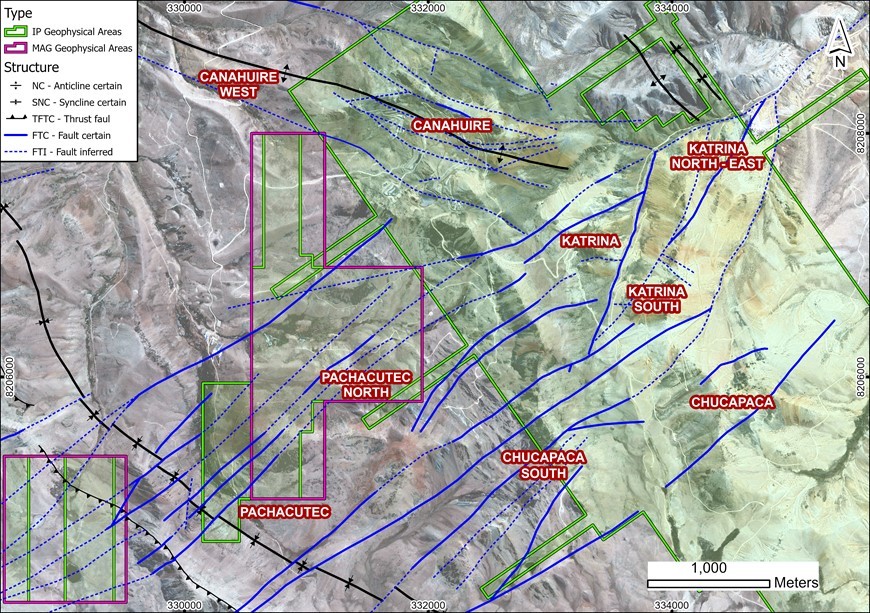
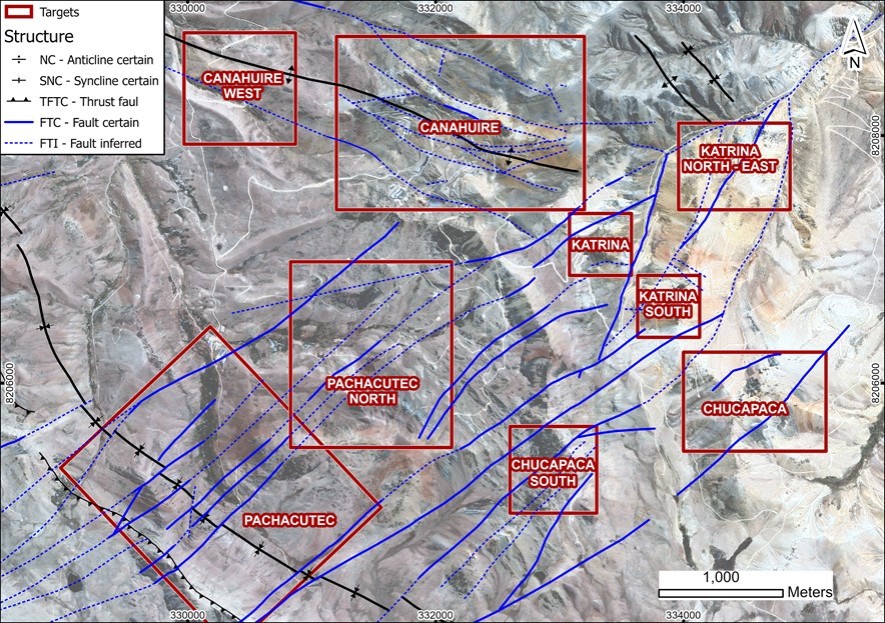
A number of prospects are considered to retain exploration potential.
1.6
History and Exploration
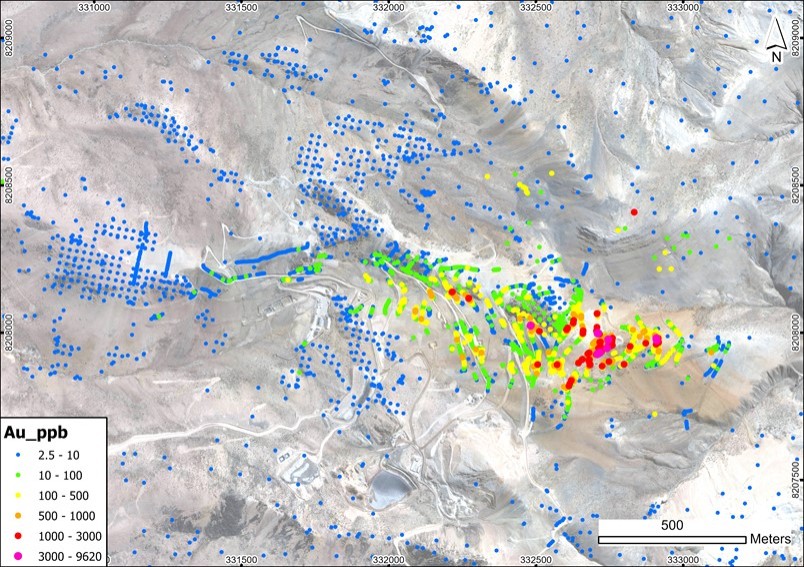
Exploration activities were conducted by Compañía de Minas del Perú, Goldfields Peru, Canteras del Hallazgo (a joint venture between Gold Fields Peru and Buenaventura), and Buenaventura. Work conducted included regional reconnaissance, rock chip, soil and trench sampling, topographic surveys, geological mapping, ground moving loop and fixed loop time-domain electromagnetic, gravity, magnetic, gradient induced polarization (IP), pole–dipole and dipole–dipole IP geophysical surveys, airborne (helicopter) magnetic and radiometric geophysical surveys, reverse circulation (RC) and core drilling, mineral resource and mineral reserve estimates, mining studies, and baseline studies in support of environmental and permitting activities.
1.7
Drilling and Sampling
1.7.1
Drilling
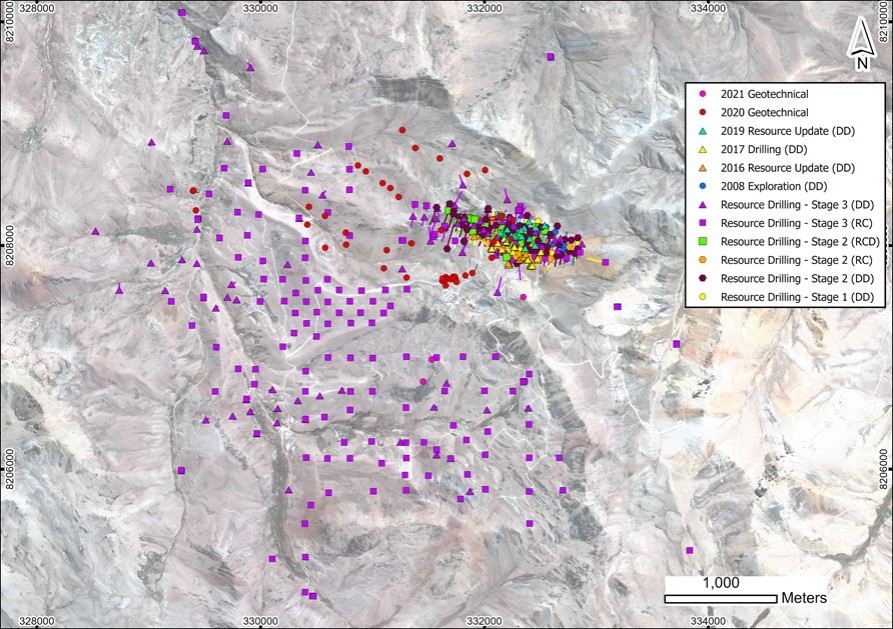
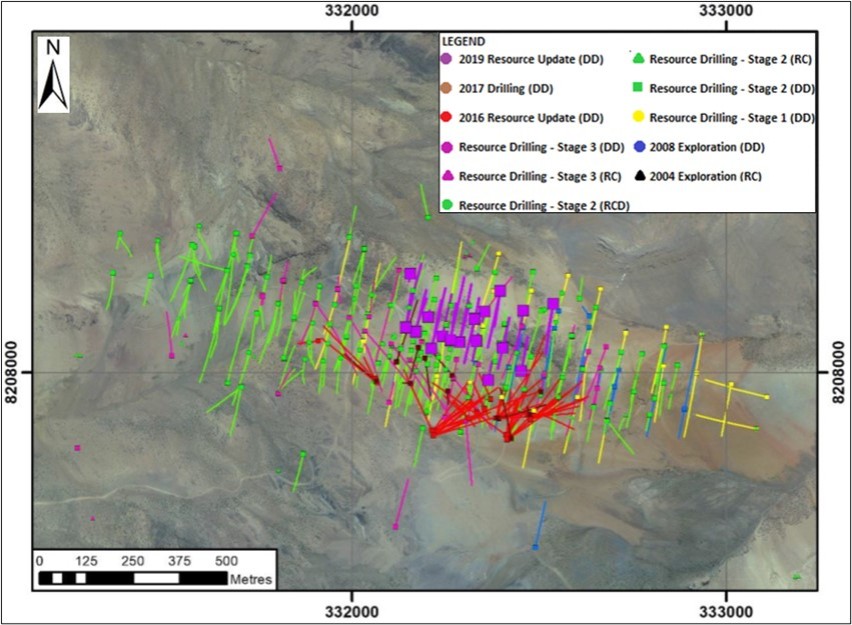
In total, 137,107 m from 524 holes were drilled at the San Gabriel Project, of which 125,188 m (476 holes) focused on the Canahuire deposit (including Canahuire West and drilling to support technical studies). A total of 491 core holes (134,543 m) supports mineral resource estimation. Drilling excluded for estimation purposes includes drilling in prospect areas away from the Canahuire deposit, and drill holes that were abandoned.
Core was primarily used to produce more representative samples as RC drilling often encountered difficulties at depths below the water table. Core diameters included HQ size (63.5 mm core diameter), NQ (47.6 mm), BQ (36.4 mm). RC hole diameters included 4.375’’, 5–5.5”, and 7.25’’, although hole diameters were not consistently recorded.
Average recovery above a 1 g/t Au cut-off is 98.9%. Recoveries were often higher in mineralised zones, where sulphides and siderite alteration cemented core. The lowest recoveries are from the polymictic breccias.
Detailed geological logging was routinely completed on all drill core and RC drilling chips, with regular relogging campaigns undertaken as understanding of the deposit improved. Current logging records information such as weathering, stratigraphy, lithology, alteration, mineralogy, mineralisation, and structure.
Drill collars were picked up by surveyors using total station instruments. Instrumentation used for downhole surveying included Flexit HTMS multi-shot, Reflex Easy Shot, Reflex EZ Trac, and gyroscopic instruments. Downhole surveys were typically taken at 50 m intervals down hole.
1.7.2
Hydrology and Hydrogeology
The general hydrological characterization methodology included complete in-situ hydrological mapping, hydrological characterization of the rock mass, and conceptual hydrodynamic modelling. Hydrological testwork included installation of piezometers in selected boreholes and measurements of the underground water level, water chemical quality, the direction of the water flow, and lithology mapping. Infiltration, pumping, and recovery tests were performed to obtain the hydraulic properties of each rock type in those boreholes.
Laboratories used included ALS-Corplab in Arequipa and JRamon Corp in Lima. All laboratories are independent of Buenaventura (or Goldfields). ALS-Corplab and JRamon are accredited with the National Quality Institute (INACAL) as laboratory numbers LE-029 and LE-028, respectively. Testwork included chemical and physical characteristics, lugeon, slug, pump, development, and recovery tests.
Project Name: Technical Report Summary, San Gabriel Project, Peru
Report current as at: December 31, 2021
Page 1-3
1.7.3
Geotechnical
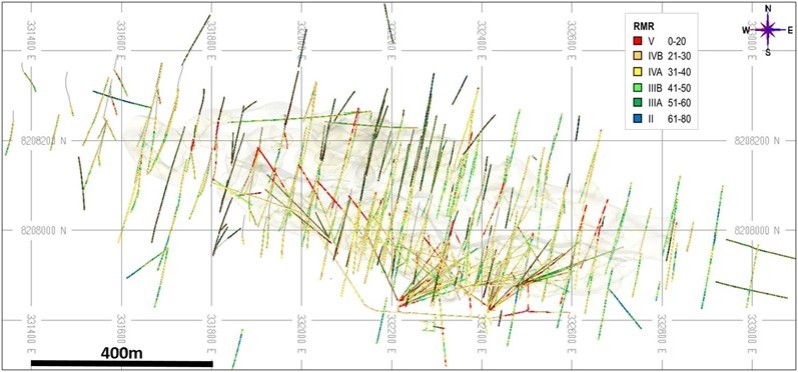
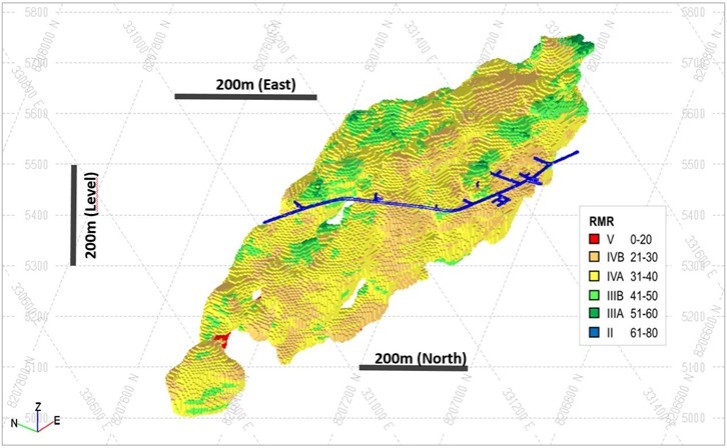
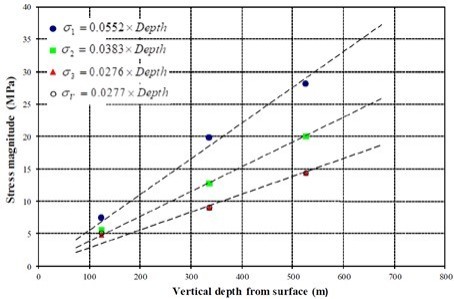
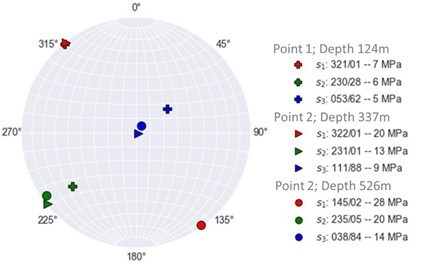
Geotechnical data collection included rock mass rating (RMR), rock quality designation (RQD), core logging of selected drill holes for geotechnical features, photo re-logging of selected drill core, and geo-location of significant faults and fractures. Testwork included physical properties, point load, elastic constant, indirect tensile, direct cutting, uniaxial, biaxial and triaxial tests and slake durability.
Testwork was performed by a number of independent consultants and institutions, including Pontificia Universidad Católica, Ausenco Vector and Universidad Nacional de Ingenieria. There is no accreditation authority for geotechnical tests.
1.7.4
Sampling
Core sampling intervals varied by drill campaign and operator, ranging from 50 cm to 2 m. RC samples were collected on 1 m intervals. Sample security during the Gold Fields Peru and Buenaventura drill campaigns consisted of geological supervision of the sampling process, recording of samples on a laboratory despatch form, and signed receipt of bagged samples at the laboratory.
Density determinations were completed using the wax-coated water immersion method. Density measurements were primarily performed by the SGS Juliaca laboratory (SGS Juliaca), consisting of 5,246 sample determinations. Golder Associates performed measurements on 192 samples. There is no international accreditation for density determinations. Both SGS Juliaca and Golder Associates are and were independent of Buenaventura.
Laboratories used for sample preparation included the SGS laboratories in Puno (SGS Juliaca, used from 2008–2013), and Arequipa (SGS Arequipa; 2016–2017) and the ALS laboratory in Arequipa (ALS Arequipa, 2019 to date). In 2018 there was no drilling program according to information provided by Buenaventura. Laboratories used for analysis included the SGS laboratory in Lima (SGS Lima; primary laboratory from 2008–2017) and the ALS laboratory in Lima (ALS Lima; primary laboratory for eight drill holes in 2009–2010, and primary laboratory from 2019 to date). All laboratories were and are independent of Gold Fields Peru and Buenaventura. SGS (Peru) holds ISO 9001, ISO 14001, OHSAS 18001, NTP-ISO 17020, NTP-ISO 17025 and NTP-ISO 17065 accreditations for selected analytical techniques, and ALS Lima holds ISO 9001 and NTP-ISO 17025 accreditations for selected analytical techniques.
Sample preparation at SGS Puno (Juliaca) consisted of drying the sample (70ºC), crushing to +70% passing -10 mesh (2009–2010), crushing to 80% -10 mesh (2010–2017), and pulverizing to 95% passing 140 µm. Sample preparation at ALS Arequipa (2019 to date) consisted of drying the sample (120ºC), crushing to 90% passing -10 mesh, and pulverizing to 85% passing 75 µm.
The SGS Lima analytical procedure for gold was by fire assay (FA) using an atomic absorption (AA) finish. If the results exceeded 5 ppm, SGS Lima finished with an additional gravimetric analysis. SGS Lima also analysed for a 52-element package using an aqua regia digestion with an inductively coupled plasma (ICP) mass spectrometry (MS) finish. If the results exceeded 100 ppm Ag or 1,000 ppm for arsenic, lead, zinc, or manganese, SGS Lima re-analyzed with an aqua regia digestion and AA finish. ALS Lima used FA/AAS methods for gold, with overlimits reassayed using FA with a gravimetric finish. A multi-element suite was completed using ICP atomic emission spectroscopy (AES) or ICP-MS. Carbon was analysed for using an induction furnace method with infrared spectroscopy. Sulphur analyses were completed using oxidation, induction furnace and infrared spectroscopy and a sulphur analyzer.
Quality assurance and quality control (QA/QC) procedures included insertion of blank and duplicate samples (2004–2009) and insertion of certified reference materials (CRMs), blanks, and duplicates (2010–2019) to monitor the sampling, sample preparation, and analytical processes. A data review by SRK Consulting (Peru) S.A (SRK) indicated no material issues with the QA/QC results.
Project Name: Technical Report Summary, San Gabriel Project, Peru
Report current as at: December 31, 2021
Page 1-4
Data are currently stored in an acQuire database.
1.8
Data Verification
Buenaventura uses a systematic database formatted program (acQuire) that ensures the integrity of the data, and reduces error in the data entry with requirements and procedures for record data by SIGEO (inhouse software) and GVMapper. Buenaventura´s geologists use a visual validation step prior to data entry. Buenaventura does not have an internal database verification procedure.
External data verification was performed by SRK in 2020, and consisted of checks on selected drill collar locations, down hole surveys, comparison of database assay data entries to laboratory assay certificates. SRK used software data checking routines to check for issues such as overlapping sample intervals, negative or zero intervals, inconsistent collar location data, inconsistent or missing downhole survey data, and intervals of missing intervals of RQD information, overlapping RQD intervals, and intervals with RQD information greater or less than the drill hole length. No significant inconsistencies were found in the database. A cross-validation with the laboratory reports (database vs assay certificates) reached a 98.8% acceptance rate. The inconsistencies were related to rounding, as well as to differences between laboratories as to the detection limit values for analytical techniques.
1.9
Metallurgical Testwork
Metallurgical testwork completed in support of the 2021 Study included gold deportment, variability, grinding and comminution, gravity concentration, intensive leaching, pre-aeration, carbon-in-leach (CIL), flotation, concentrate characterization, cyanidation, cyanide destruction, filtration, and de-watering testwork. Tests were performed on samples considered to be representative of the deposit geometallurgy and mineralogy. Testwork was conducted at SGS Lakefield in Canada (SGS Lakefield), Plenge Laboratories in Lima (Plenge), Pocock Industrial (Pocock), Agnitia, Bureau Veritas, Certimin, Gekko, and Metso Outotec. There is no international standard of accreditation provided for metallurgical testing laboratories or metallurgical testing techniques. The test facilities are independent of Buenaventura.
Gold was found to occur as native gold and electrum, although in some minor semi-refractory ore there are significant amounts of maldonite (Au2Bi). Gold is generally finely encapsulated and sub-microscopic gold is of the order of 10%, indicating a recovery cap of 90% at best. The average sulphur content is 12%, mainly as iron sulphides with only minor cyanide soluble copper minerals. There is evidence of organic carbon with potential to cause preg-robbing issues.
The mineralization is of low competency for semi-autogenous grind (SAG) milling but in the hard range for ball milling. This indicated that a SAG/ball mill (SAB) circuit could be used, with no requirement for pebble crushing. Gravity recoverable gold (GRG) tests indicated 14% gold recovery with centrifugal concentrators. CIL leaching tests on gravity tails achieved recoveries ranging from 75–85%. Testing showed that the ‘INCO’ system, using sodium metabisulphite, oxygen (instead of air) and copper sulphate achieved acceptable weakly acid dissociable cyanide levels. Filtration tests indicated a specific filtration rate of 0.44 m2/(t/hr) producing a filter cake of 20% moisture. This moisture is higher than the current target geotechnical requirement of 14% moisture for final disposal in the filtered, dry-stack tailings storage facility (FTSF). The 2021 Study has included drying areas to condition the filtered tailings to the level required by geotechnical studies.
The metallurgical testwork results support the process route selection of a SAB milling circuit followed by a gravity–CIL gold recovery circuit with cyanide destruction and pressure filtration of the tails. The design basis for overall gold recovery is 85.4% and the silver recovery is 44.6%. Both these recovery values have been confirmed through the 2021 geometallurgical modelling.
Deleterious elements include swelling clays content, preg-robbing organic material and Hg; appropriate measures have been incorporated in the design to handle these., The swelling clays content requires a neutral milling process isolated from
Project Name: Technical Report Summary, San Gabriel Project, Peru
Report current as at: December 31, 2021
Page 1-5
CIL with a pre-leach thickener. The normal CIL configuration has been modified to include additional fresh carbon upfront to combat preg-robbing, and inclusion of an industry-standard retort furnace deals with the Hg .
1.10
Mineral Resource Estimation
1.10.1
Estimation Methodology
The mineral resource estimate is supported by core drilling. Modelling uses a block model block size of 5 x 5 x 5 m and a subblock size of 1 x 1 x 1 m. Initial data analysis of gold, silver, copper, lead, zinc, antimony and sulphur were performed by domain. This indicated that grade caps would be required for some elements and domains.
Geological models were based on, in order:
●
Structural geology, primarily the breccia;
●
A 1 g/t Au grade envelope;
●
Sub-domains using 2 g/t Au cut-offs
The deposit was divided into two areas, north and south. Envelopes were constructed for each area using a semi-manual envelope method. For silver, domains were constructed using a cut-off of 30 g/t Ag and divided into two subdomains (high-grade and low-grade) using the same methods as employed for gold. A single domain, based on the breccia, was used for copper, lead, zinc, antimony and sulphur. No subdomains were defined for these elements.
Mean bulk density values to were assigned by lithology domain and grade envelope. Bulk density assignments ranged from 2.43–2.85. Grade capping was assessed by element, with caps applied after evaluation of initial statistics, probability plots and co-efficient of variation versus mean plots. Assay data were composited to 2.5 m length samples. Variograms and quantitative kriging neighborhood analysis (QKNA) were produced for each domain and element.
Grade interpolation was performed using inverse distance weighting to the second power (IDW) in two passes for gold; and ordinary kriging (OK) in one pass for silver, lead, sulphur and copper. A single pass and an IDW estimate were used for zinc and antimony. Minimum and maximum numbers of samples used to inform the estimate varied by element.
Models were validated using:
●
Visual inspection of grades with comparison between blocks and composites;
●
Global statistical comparison of the OK model with a nearest-neighbour (NN) model;
●
Swath plots.
No material biases were noted from the reviews.
Mineral resources were classified using the following criteria:
●
Measured mineral resource: maximum distance of the three drill holes closest to the block is equal to 15 m. Minimum number of drill holes considered within the estimate is three;
●
Indicated mineral resource: maximum distance of the three closest drill holes to the block is equal to 36 m. Minimum number of drill holes considered within the estimate is two;
●
Inferred mineral resource: maximum distance of the three closest drill holes to the block is equal to 60 m. Minimum number of drill holes considered within the estimate is one.
Project Name: Technical Report Summary, San Gabriel Project, Peru
Report current as at: December 31, 2021
Page 1-6
Blocks were run through mineable shape optimizer software that included considerations of marginal cut-off grades, stope dimensions, mineralization orientation, definitions of mineralized zones, and net smelter return (NSR) calculations. Conceptual stope designs were evaluated to discard stopes that were isolated, remote from potential infrastructure, or, when dilution was included, fell below an NSR of US$60.00/t. Finally, the blocks were checked to see if they were included in the mineral reserve estimate. If they were not, they were classified as mineral resources, and were reported exclusive of those blocks that were converted to mineral reserves. Commodity prices used to calculate the NSR value for the consideration of reasonable prospects for economic extraction are the same as those used for mineral reserves estimation:
●
Gold price: US$1,600/Oz;
●
Silver price: US$25.00/Oz.
1.10.2
Mineral Resource Statement
Mineral resources are reported using the mineral resource definitions set out in SK1300, and are reported exclusive of those mineral resources converted to mineral reserves. The reference point for the estimate is in situ. The Qualified Person Firm responsible for the estimate is SRK Consulting (Peru) S.A.
The measured and indicated mineral resource estimates are provided in Table 11. The mineral resource estimate is current as at December 31, 2021.
Areas of uncertainty that may materially impact the mineral resource estimates include: changes to long-term metal price and exchange rate assumptions; changes in local interpretations of mineralisation geometry, presence of unrecognized mineralization off-shoots; faults, dykes and other structures; and continuity of mineralised zones; changes to geological and grade shape, and geological and grade continuity assumptions; low performance of QA/QC in some areas of the Project, insufficient density data, changes to variographical interpretations and search ellipse ranges that were interpreted based on limited drill data, when closer-spaced drilling becomes available; changes to metallurgical recovery assumptions; changes to the input assumptions used to derive the potentially-mineable shapes applicable to the assumed underground mining method used to constrain the estimates; changes to the forecast dilution and assumptions; changes to the net smelter return cut-off values applied to the estimates; variations in geotechnical (including seismicity), hydrogeological and mining method assumptions; and changes to environmental, permitting and social license assumptions.
Project Name: Technical Report Summary, San Gabriel Project, Peru
Report current as at: December 31, 2021
Page 1-7
Table 1-1:Measured and Indicated Mineral Resource Statement
Confidence Category
Tonnage (Mt)
Gold Grade (g/t Au)
Silver Grade (g/t Ag)
Measured
0.38
1.65
2.78
Indicated
10.51
1.61
7.24
Total Measured and Indicated
10.89
1.61
7.08
Table 1-2:Inferred Mineral Resource Statement
Confidence Category
Tonnage (Mt)
Gold Grade (g/t Au)
Silver Grade (g/t Ag)
Inferred
13.97
2.49
9.53
Total Inferred
13.97
2.49
9.53
Notes to accompany mineral resource tables:
1.
The reference point for the mineral resource estimate is in situ, and the estimate does not incorporate dilution. Mineral resources are current as at December 31, 2021, and are reported using the mineral resource definitions in SK1300. The Qualified Person Firm responsible for the resource estimate is SRK Consulting (Peru) S.A
2.
Mineral resources are reported exclusive of those mineral resources converted to mineral reserves. Mineral resources that are not mineral reserves do not have demonstrated economic viability.
3.
The estimate uses the following key input parameters: commodity prices of US$1,600/oz Au, US$25.00/oz Ag; variable metallurgical recoveries that were assigned by Buenaventura into the block model resulting in estimated average metallurgical recoveries of 85%; assumption of cut-and-fill mining method; primary and secondary stope sizes of 4 x 4 x 12 m; inclusion of internal and external dilution; mining costs of US$34.78/t mined; processing costs of US$17.87/t processed; no allocation for general and administrative costs; and an allocation of US$7.51/t for sustaining capital cost.
4.
Mineral resources are reported inside MSO stopes designed above a net smelter return cut-off of US$60.00/t. The NSR equations are NSRGold = ((1600-7.38)*gold grade * gold metallurgical recovery) * 0.999/31.1035; NSRSilver =( (25*silver metallurgical recovery)* silver grade _ppm)*0.999/31.1035; and NSRTotal = NSRGold + NSRSilver. NSR formulas were defined and calculated in the block model by Buenaventura.
5.
Numbers have been rounded.
1.11
Mineral Reserve Estimation
1.11.1
Estimation Methodology
Measured and indicated mineral resources were converted to proven and probable mineral reserves assuming a combination of overhand drift-and-fill, underhand drift-and-fill and overhand sub-level retreat mining methods to meet a 3,000 t/d production rate.
The assumed mining recovery was 98% for overhand drift-and-fill and underhand drift-and-fill stopes, and 100% for overhand sub-level retreat stopes. Dilution is assumed to be from non- or low-grade material entering the stope during mining, backfilling material and shotcrete. Mining dilution is estimated at 13.7% in overhand drift-and-fill stopes, 15.7% in underhand drift-and-fill stopes and 24.1% in overhand sub-level retreat stopes.
An NSR cut-off was used in preference to a grade cut-off, since both gold and silver are contributors to the Project economics. The NSR cut-offs selected were US$88/t for overhand drift-and-fill, US$90/t for underhand drift-and-fill, and US$85/t for overhand sub-level retreat.
Project Name: Technical Report Summary, San Gabriel Project, Peru
Report current as at: December 31, 2021
Page 1-8
1.11.2
Mineral Reserve Statement
Mineral reserves were classified using the mineral reserve definitions set out in SK1300. The reference point for the mineral reserve estimate is the point of delivery to the process plant. The mineral reserves are current as at 31 December, 2021. The Qualified Person Firm responsible for the estimate is Agnitia Consulting SAC.
Mineral reserves are reported in Table 13.
During mineral reserve estimation, each modifying factor applied has its own risk that could affect the mineral reserve estimates. Such risks commonly include: long-term commodity price assumptions; long-term consumables price assumptions; changes to mineral resources input parameters; changes to constraining stope designs; changes to cut-off assumptions; changes to geotechnical and hydrogeological factors; changes to metallurgical and mining recovery assumptions; the ability to control unplanned dilution; and assumptions as to the continued ability to access the site, retain mineral and surface rights titles, maintain environment and other regulatory permits, and obtain and maintain the social license to operate.
In the case of this Project, economic factors such as the long-term commodity price, consumable price assumptions and exchange rates, mining factors about geotechnical, hydrogeology and mine design, and metallurgical recovery are controlled by different studies, quotations, drilling, and laboratory and pilot plant tests, so it is the opinion of the Qualified Person Firm that they incorporate sufficient risk assessment to support mineral reserve reporting.
Political and environmental challenges that could affect the mineral reserves as follows:
●
Retain mineral and surface rights titles, maintain environment and other regulatory permits, and maintain the social license to operate. The Qualified Person Firm is of the opinion that country political risk has not been studied in detail according 2021 presidential election results and unexpected delays could occur in the public consultation stage for environmental permits.
1.12
Mining Methods
Most of the rock types are classified as “Fair”, “Poor” or “Very Poor”, using the 1989 Bieniawski rock mass rating criteria. Geotechnical support requirements were analysed using a combination of the Matthews stability graph and numerical models in the commercially-available software packages Phase2D, FLAC3D, RocSupport and Unwedge. Stope sizing and the backfill sequence were also computer-analyzed. Recommendations were developed for opening sizes and ground support requirements.
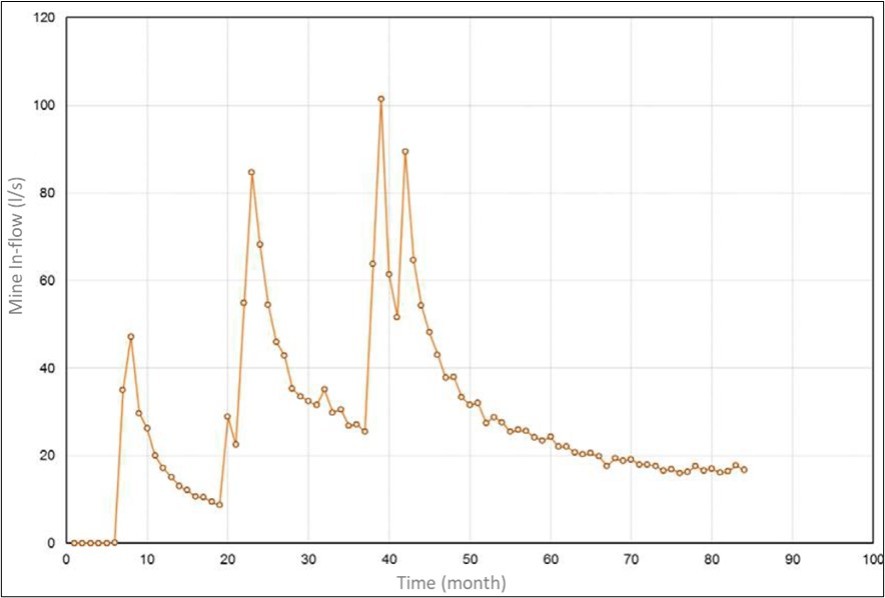
The water inflow expected over the LOM is an average 20 L/sec. The dewatering pumping system design capacity for the LOM is 88 L/sec. Short-term peak inflows are projected early in the mine life, which are associated with fault zones and may reach as much as 100 L/sec. Auxiliary pumping will be required during those periods.
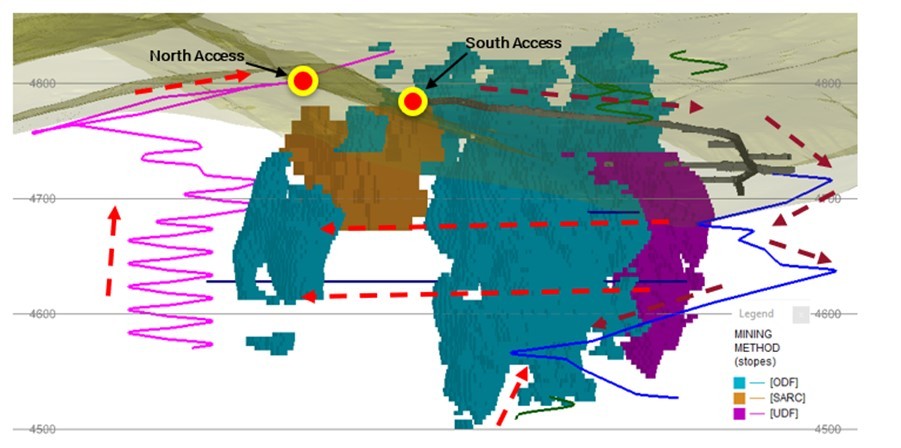
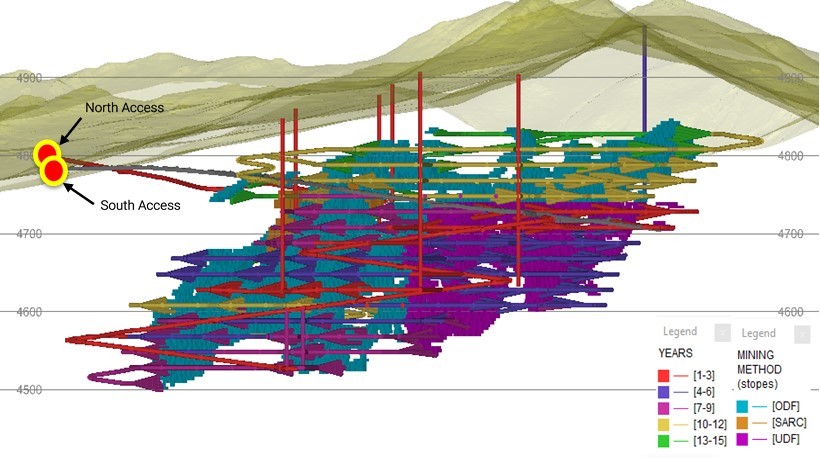
Overhand drift-and-fill and overhand sub-level retreat methods will be used where the rock mass rating was “Fair” or “Poor”, and underhand drift-and-fill methods where the rock mass rating was “Very Poor”. Mining development will start in year 1 of production and will include all required excavations to ensure production continuity below the 4,600 m Level. The mining sequence will commence with the highest gold grades between the 4,620 m and 4,720 m Levels. The mine plan, based on the mineral reserve estimates, is for a 14-year period.
Project Name: Technical Report Summary, San Gabriel Project, Peru
Report current as at: December 31, 2021
Page 1-9
Table 1-3:Proven and Probable Mineral Reserve Statement
Area
Confidence Category
Tonnage (kt)
Gold Grade (g/t Au)
Silver Grade (g/t Ag)
UDF
Proven
564
5.24
1.66
Probable
2,652
4.24
3.84
Sub-total proven and probable
3,216
4.88
3.45
SARC
Proven
0
0.00
0.00
Probable
1,619
3.09
8.20
Sub-total proven and probable
1,619
3.09
8.20
ODF
Proven
418
4.89
3.08
Probable
9,681
3.89
7.26
Sub-total proven and probable
10,099
3.93
7.09
Total
Proven
983
5.09
2.26
Probable
13,952
3.97
6.72
Proven and Probable
14,934
4.04
6.43
Notes to accompany mineral reserve tables:
1.
The reference point for the mineral reserve estimate is the point of delivery to the process plant. Mineral reserves are current as at 31 December 2021 and are reported using the mineral reserve definitions in SK1300. The Qualified Person Firm responsible for the estimate is Agnitia Consulting SAC.
2.
Key parameters used in the estimate include gold price of US$1,600/oz, silver price of US$25/oz; variable metallurgical recoveries that average 85% for gold and 45% for silver; mining cost of US$37.87/t mined, process cost of US$23.62/t processed, general and administrative cost of US$18.73/t processed, sustaining cost of US$7.51/t processed; assumption of payable percentages of 99.90% for gold and 99.9% for silver; doré sales costs of US$7.38/oz Au.
3.
Mineral reserves are reported above a net smelter return cut-off of $US$88/t for overhand drift-and-fill, $US$90/t for underhand drift-and-fill and $US$85/t for overhand sub-level retreat mining methods.
4.
Numbers in the table have been rounded.
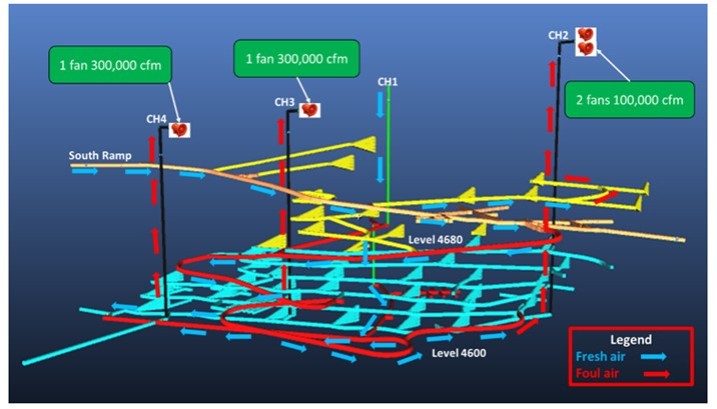
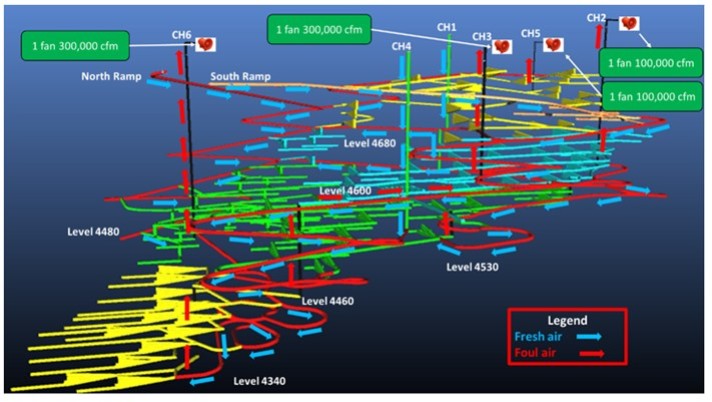
Ventilation requirements were divided into four stages, to reflect the elevations at which mining activities will be undertaken at various times during operations. The auxiliary ventilation system at each mining front will deliver fresh air using two 35,000 cfm auxiliary fans, at the rate of 27.4 m/min of air. The fresh air for underground mine development will be delivered by four 75,000 cfm auxiliary fans that will be located in the southern and northern ramp accesses, which are planned to deliver 64,000 cfm of fresh air.
Blasting will be performed by a contractor, with different blast requirements and loading factors for the different mining methods. Cemented aggregate fill will be used to backfill the stopes. A conventional underground equipment fleet will be used to support the LOM plan. Primary equipment will include jumbos, scoop trams, scalers, roboshots, mixers and dump trucks. Auxiliary equipment will include bobcats, motor graders, front-end loaders, scissor lifts, fuel and water trucks, explosives delivery truck, utility and pickup vehicles, personal delivery trucks, and minibuses. Backfill equipment required will include scooptrams and trucks.
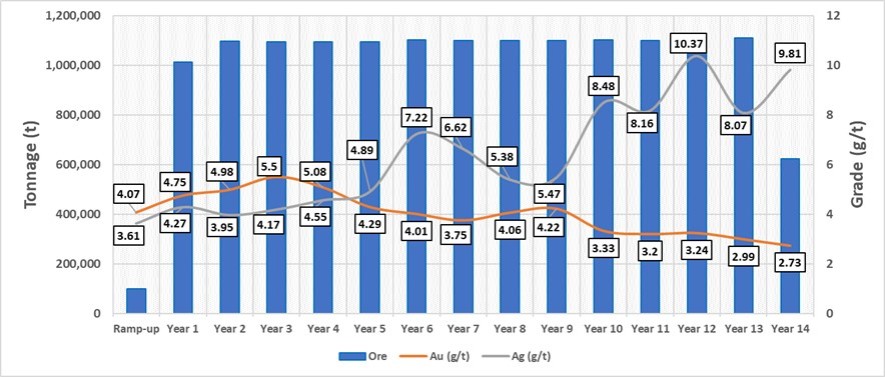
The production plan is shown in Figure 11.
Project Name: Technical Report Summary, San Gabriel Project, Peru
Report current as at: December 31, 2021
Page 1-10
Figure 1-1:Proposed Production Plan
Note: Figure prepared by Agnitia, 2021.
A total of 205 direct and 422 contract personnel are envisaged in the LOM plan.
1.13
Recovery Methods
The proposed recovery method is based on the metallurgical testwork completed and will use conventional equipment and process methods. The general design basis is:
●
Average of 3,000 t/d and 365 d/a;
●
An overall availability of 92%, yielding an annual throughput of 1.095 Mt/a;
●
Average head grade of 4.25 g/t Au but for design purposes the 80th percentile value of 4.9 g/t Au was used to ensure some margin for grade fluctuations;
●
Average gold recovery of 85.4%. This accords well with mineralogical expectations but individual recoveries by section and ore-type were included in the mine/mill production schedule.
The key features of the process plant design are:
●
The run-of-mine (ROM) pad, grizzly and truck dump bin will discharge to a primary jaw crusher that will be located close to the mine portal, and will discharge to the coarse ore bin from which ore will be reclaimed via an apron feeder to feed the grinding circuit;
Project Name: Technical Report Summary, San Gabriel Project, Peru
Report current as at: December 31, 2021
Page 1-11
●
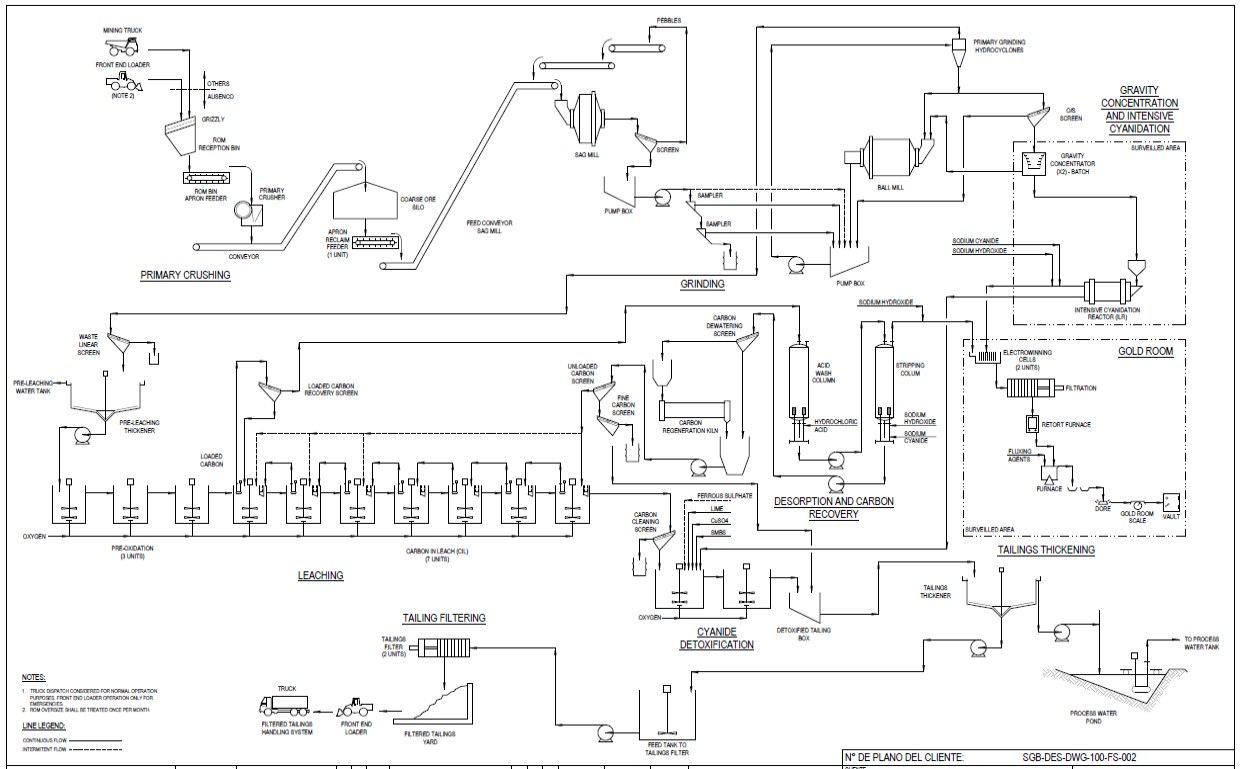
A grinding circuit consisting of a SAG mill and ball mill. Pebbles screened from the SAG mill discharge will be recirculated back to the SAG mill feed conveyor while the screen undersize will be pumped to a hydrocyclone classification circuit. The cyclone overflow will feed forward to the leaching circuit while the underflow will be split between the gravity circuit (see below) and the ball mill feed box. Ball mill discharge will combine with SAG screen underflow to complete the closed circuit;
●
A gravity circuit consisting of two centrifugal concentrators from which the concentrate will pass to an intensive leach reactor (ILR) and the tails will re-join the circulating load to the ball mill feed;
●
A carbon-in-leach (CIL) cyanide leaching circuit consisting of a pre-leach thickener, three pre-oxidation tanks to passivate cyanide-consuming sulphides and seven agitated CIL tanks in series to which regenerated carbon will be added to the last tank and moved counter-current to the slurry from tank to tank by carbon transfer pumps;
●
An adsorption desorption recovery (ADR) circuit in which the loaded carbon from CIL will be acid-washed with hydrochloric acid and then stripped of its precious metal content with a hot solution of caustic soda and cyanide in a Zadra desorption column. Barren carbon will be regenerated in an electric kiln and return to the CIL circuit via a carbon fines screen. The pregnant liquor solution (PLS) from desorption will pass to electrowinning cells (along with PLS from the ILR circuit) to deposit the precious metals as an electrolyte cake. The cake will be subject to mercury removal and capture in a retort furnace followed by smelting in an induction furnace to produce gold doré bars. Barren solution from electrowinning will return via a heat exchanger and electric heater to desorption, completing a closed circuit;
●
CIL tailings will be subject to cyanide detoxification with air/SO2 and lime in two agitated tanks in series to reduce weak acid dissociable cyanide to <10 ppm in accord with Peruvian regulations;
●
A tailings thickening and filtration circuit in which the CIL tailings will be sent to a high density thickener (HDT) to recover process water and prepare a high density slurry for filtration in plate and frame pressure filters. This will produce a tailings filter cake of 18–20% moisture content for transport by truck and deposition in a filtered tailings storage facility (FTSF);
●
A portion of the process water will be treated, if necessary, for thiocyanate removal by ferrous sulphate in agitated tanks and then followed by clarification and an ultrafiltration/nanofiltration plant prior to discharge.
Consumables will include quicklime, sodium cyanide, sodium hydroxide, hydrochloric acid, copper sulphate, sodium metabisulfite, litharge, borax, sodium nitrate, silica, sodium carbonate, activated carbon, flocculant, SAG ball media, ball mill media, and air.
A total of 90 direct and 30 contract personnel are envisaged in the process plant.
1.14
Project Infrastructure
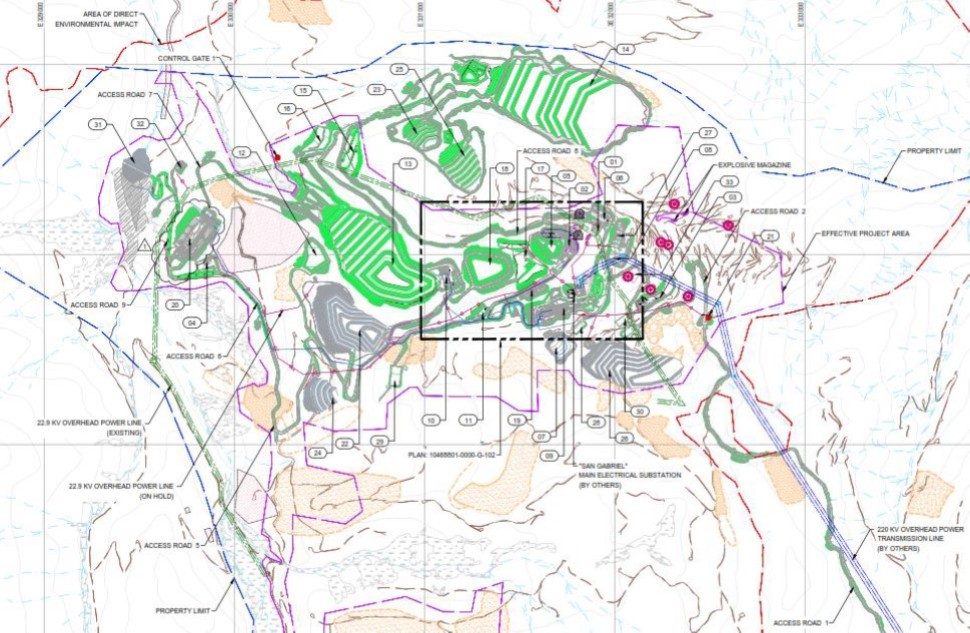
The required infrastructure to support the LOM plan will include the underground mine, backfill and concrete batch plants, waste rock storage facilities, topsoil stockpile, process plant, run-of-mine (ROM) stockpile, process water ponds, mine water pond, freshwater dam, filtered TSFs (FTSF), tailings thickening and filtering platform, tailings drying platforms, temporary tailings storage area, mine operations and warehouse area, administration offices, truck, maintenance and work shops, fuel station, core shed, gatehouse, accommodation camp, sewage treatment plant, temporary waste storage area, and electrical substation. The camp capacity is based on an estimate of construction personnel and operations personnel. In operation, the camp will have a capacity of 816 people. However, during construction the capacity of some modules will be increased to support a total camp capacity of 1,440 persons.
Project Name: Technical Report Summary, San Gabriel Project, Peru
Report current as at: December 31, 2021
Page 1-12
Access roads outside the effective Project area that will be on public lands will be funded and built by Buenaventura. The company will coordinate with the Ministry of Transportation and Communications to transfer or confirm ownership of public roads. The main access road will run from the National Road MO-106 at the 48 km point (detour to San Gabriel Project) to the mine main gate house. Access roads inside the effective area of the Project will be built and owned by Buenaventura. Roads will connect the mine and process plant with infrastructure such as the water pond, FTSF, stockpiles, and gatehouse.
Two filtered TSFs are envisaged. The first FTSF will contain the initial dry stack tailings from the process plant, will be operational for six years and four months until its maximum capacity of 4.27 Mm3 is stacked, and will have an area of about 22 ha. The second FTSF will be used for the remainder of the LOM plan. It will be operational for about eight years until its maximum capacity of 4.90 Mm3 is stacked. The facility will cover approximately 32 ha. Tailings from the process plant will be sent by gravity pipeline to a thickener at the tailings filter plant. Tailings will be thickened before being filtered in a set of vertical plate filters, removing moisture and producing a filter cake with moisture content of about 18–20% w/w. The filter cake produced will be collected and stacked in a storage facility before being transported by truck to the FTSF. There will be four tailings drying platforms. A temporary tailings storage area will be used for a four-month period in the wet season, and will be able to store about 191,000 m3 of filtered tailings.
Non-contact water from rain runoff will be diverted around the Project installations with the use of hydraulic structures and canals placed at strategic locations. Non-contact water will be sent to various stormwater ponds and settling ponds located around the Project area before being discharged to the environment. Contact water will be captured in sedimentation ponds during construction and operation. Acid contact water will be diverted to a mine water pond, where it will either be reused in the process plant, or sent to a water treatment plant for treatment prior to discharge to the environment.
The incoming power supply to the San Gabriel substation will be via a 220 kV overhead transmission line from the Chilota substation. The estimated maximum demand for the Project is 18.4 MVA of which process plant and other surface loads: are 14.3 MVA and underground mining 4.1 MVA.
Freshwater for the Project will be supplied from a freshwater dam that will be constructed in the catchment area of Quebrada Agani, just west of the Project’s main San Gabriel camp. The dam will also be a water supply source for local communities. The mine will require dewatering to enable safe underground mine operations. Mine water will initially be sent to a holding pond before treatment. The holding pond will act as buffer providing surge capacity (50,300 m3) between mine dewatering operations (which may fluctuate) and the water treatment plant which will have a constant steady flow. The main process water sources will be the tailings thickening and filtering recovery water system and the FTSF drainage system.
1.15
Markets and Contracts
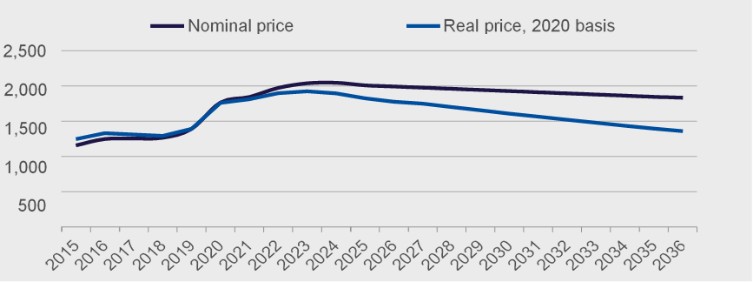
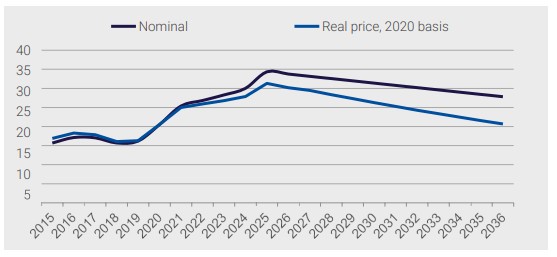
The gold and silver market assessments were based on information provided by the CRU International Ltd (CRU) during 2021. CRU expects that, in the long term, the gold price will return to mid-2010s level, between approximately US$1,300–1,400/oz in real terms by the mid-2030s. Silver prices are likely to move in a similar way as gold prices. The gold/silver ratio in the long term is expected to stand at 66, which translates to a silver price of US$21/oz in real 2020 terms by 2036.
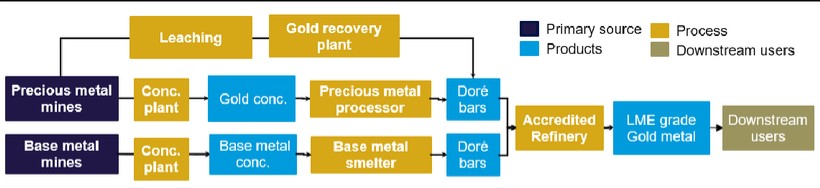
The doré grades forecast to be produced from San Gabriel will be high in both gold and silver. CRU identified 42 companies that are in the LBMA’s silver and gold refineries lists. After excluding refineries in China, the list contains 29 refineries that can refine both silver and gold. Given the quality of production expected to come from San Gabriel, its doré production should be acceptable in all of the custom markets.
San Gabriel is expected to produce precious metal doré product with an average 62% Au content (potentially ranging from 30–70% Au) and 35% Ag content (potentially ranging from 20–60% Ag), with as much as 3% content of copper and other elements. Gold and silver doré is readily marketable, and Buenaventura has experience in marketing such products, with
Project Name: Technical Report Summary, San Gabriel Project, Peru
Report current as at: December 31, 2021
Page 1-13
refining contracts in place for other operations. Together with public documents and analyst forecasts, these data support that there is a reasonable basis to assume that for the LOM plan, that the key products will be saleable at the assumed commodity pricing.
LOM average commodity prices were assumed at US$1,600/oz Au and US$25/oz Ag, based on the commodity price forecasts from CRU.
No contracts are currently in place for doré sales from the San Gabriel Project. The terms contained within any future sales contracts would be typical and consistent with standard industry practice and be similar to contracts for the supply of doré that Buenaventura has already entered into. No other contracts have been entered into.
1.16
Environmental, Permitting and Social Considerations
1.16.1
Environmental Studies and Monitoring
Baseline studies were carried out in the Project area, or over portions of the Project area, from early 2008 onward:
●
Description of the physical environment, including climate and weather, geology, geochemistry, physiography and geomorphology, hydrography, hydrology, hydrogeology, soils, environmental liabilities, air quality, noise, electromagnetics, surface water quality, spring water quality, sediment quality and underground water quality;
●
Description of the biological environment, including biological diversity, characterization of flora and fauna, fragile ecosystems, landscape, ecosystem and endangered species conservation status;
●
Description of social, economic, cultural and anthropogenic environments of the population, including inventory, evaluation and social and economic aspects;
●
Checks for the presence of archaeological, historical or cultural remains in the Project’s area of influence;
●
Assessment of geohazards such as seismicity, volcanology, erosion, landslides, avalanches, fluvial erosion, hydromorphic zones, and soil creep
The archaeological survey identified a total of 14 archaeological sites within the greater Project area, of which four are within the Project effective area. Prior to commencement of construction activities, archaeological remains will be removed in accordance with the approved Archaeological Monitoring Plan.
The Project currently has a Detailed Environmental Impact Study (EIA-d) for the San Gabriel Project. An Environmental Management Strategy (EMS) was developed based on the EIA-d. The EMS included a number of plans that cover the prevention, control, mitigation, rehabilitation, and compensation measures that Buenaventura will implement during operations and closure. Buenaventura has also committed to preservation of wetland areas (bofedales). The company will also construct a reservoir to discharge water into the Agani stream, upstream from its confluence with the Jamochini stream, to compensate for the reduction in flow due to the alteration of the wetlands. The reservoir will discharge 10 L/sec, and provide more flow than is currently the case in the dry season.
The mineralization is classified as PAG, as is a portion of the waste rock. The waste material will be stored in a waste rock storage facility (DMI).
1.16.2
Closure and Reclamation Considerations
A Conceptual Closure Plan was developed in accordance with the applicable national regulations. The estimated closure cost is US$59 M.
Project Name: Technical Report Summary, San Gabriel Project, Peru
Report current as at: December 31, 2021
Page 1-14
1.16.3
Permitting
A beneficiation concession application was presented to the authorities in June 2020 and is presently in the process of prior consultation (consulta previa). The prior consultation process covers both the mine and the process plant.
Three certifications of the “Non-existence of Archaeological Remains” were granted for the mine area and a portion of the access road. There is also an approved Archaeological Monitoring Plan.
Buenaventura established a list of the permits required for construction and operations, and identified the permits that are on the critical path. Key permits include the authorization to start exploitation; the beneficiation concession: discharge water license and a variety of permits associated with the storage and use of explosives.
1.16.4
Social Considerations, Plans, Negotiations and Agreements
Buenaventura has several agreements in place with the local communities, including C.C. Santa Cruz de Oyo Oyo, Maycunaca and Antajahua and C.C. Corire. Social agreements were concluded during the SIA-d, which included C.C. San Juan de Miraflores and, on occasions, the district of Ichuña.
The consulta previa process is almost complete, being in stage six of a seven-step process, and is pending a final decision from MINEM.
Buenaventura entered into a series of community agreements, covered by public deeds, that include monetary payments, trusts, training, hiring labor and goods, among others. The principal communities included in this program are C.C. Santa Cruz de Oyo Oyo, Maycunaca and Antajahua and C.C. Corire. An initial ordinary meeting is planned in relation to the consulta previa process with the Oyo Oyo community Board of Directors in Q4, 2021. The meeting is expected to cover issues of concern to the community such as the status of the consulta previa process, communal land ownership and registration of new community members, registration of the board of directors in the public registers. The community has already indicated to Buenaventura that they would like a bonus upon the final approval of the consulta previa. The CC Corire community and Buenaventura are still in the consultation process. The community has decided that any consulta previa approval would depend on the outcomes of the discussions with Buenaventura.
1.17
Capital Cost Estimates
Capital cost estimates were reported in Q3 2021 US$. The capital costs are at a minimum at a pre-feasibility level of confidence (±25%) as that is defined in SK1300.
Cost estimates were based on the following: scopes of work; design criteria; plot plans; process flow diagrams; general arrangement drawings; structural models; drawings and sketches; geotechnical investigations; preliminary project execution plans; equipment lists; material take-offs; equipment pricing (budget quotes); engineering, procurement and construction contract tender pricing; generic contract terms and conditions; study schedule; data from other Projects currently being executed by Ausenco; Ausenco historical project data; and third-party estimates. Direct costs were generally quantity-based and included items such as: direct labor costs; freight and transport; permanent equipment; bulk materials; construction equipment; contractor costs; contractor temporary construction facilities, services and utilities; and construction facilities removal and rehabilitation.
The current Project planning and execution strategy assumes that the Project was approved in February 2021, with the initial capital investment planned from 2021 to 2024 and sustaining investment starting thereafter.
Capital cost estimates were as follows:
Project Name: Technical Report Summary, San Gabriel Project, Peru
Report current as at: December 31, 2021
Page 1-15
●Mine: The initial direct capital cost was US$36.8 M; including US$26.9 M in pre-production operating costs for 26 months; and US$9.9 M in mine equipment and fleet. The initial indirect capital cost of the mine was estimated at US$5.6 M. The sustaining capital cost excluding growth was US$72.7 M, and including growth was US$75.9 M;
●Process: The total estimated initial direct cost was US$203.2 M. The total estimated initial cost was US$31.9 M. Indirect costs for the initial capital were estimated as US$100.1 M. The total sustaining capital cost of the process area was estimated at US$28.5 M;
●Owners’: Estimated at US$43.1 M.
●Closure: estimated at US$59 M.
The overall total capital cost estimate is presented in Table 14, and totals US$578.6 M, of which the initial capital cost estimate for the Project amounts to US$467.7 M, and the sustaining capital cost estimate was US$111 M.
1.18
Operating Cost Estimates
Operating cost estimates are reported in Q4 2021 US$. The operating costs are at a minimum at a pre-feasibility level of confidence (±25%) as that is defined in SK1300.
The source data used in the estimate included: the mine plan through life of mine; material takeoffs; unit pricing from Buenaventura; workforce estimation; consumable requirements and costs; equipment quotations; process flowsheets; electrical load list; mechanical equipment list; reagents and consumables requirements and costs; maintenance costs; and fuel consumption.
Operating cost estimates were as follows:
●
Mine: The average mine operating cost is estimated at US$32.11/t including mining costs (US$22.84/t); services costs (US$3.80/t); development costs (US$4.27/t) and energy costs (US$1.21/t);
●
Process: The average process operating cost is estimated to be US$27.38$/t;
●
Infrastructure: Infrastructure operating costs were generally included within the process plant or mining operating costs;
●
General and administrative:
oOperations: includes Insurance, personal protective equipment, mobile equipment rental and associated labor. Estimated at US$4.2 M over LOM; Technical services: includes mine third party studies, concessions, laboratory and maintenance, as well as associated labor. Estimated at US$9.0 M over LOM;
Project Name: Technical Report Summary, San Gabriel Project, Peru
Report current as at: December 31, 2021
Page 1-16
Table 1-4:Capital Cost Estimate Summary
WBS
WBS Level 1 Description
Total (US$M)
Initial
467.7
Direct
265.3
1000
Mine
56.3
2000
Process plant
114.7
3000
FTSF
20.5
4000
On-site infrastructure, utilities and surface facilities
56.6
5000
Off-site infrastructure, utilities and facilities
17.2
Indirect
202.4
1000
Mine
5.4
2000
Process plant
0
4000
On-site infrastructure, utilities and surface facilities
22.3
5000
Off-site infrastructure, utilities and facilities
6.7
6000
EPCM and other third party costs
60.7
7000
Indirect costs
15.2
8000
Owner's cost
38.5
9000
Provisions
53.7
Sustaining
110.9
Direct
104.4
1000
Mine
75.9
2000
Process plant
3.3
3000
FTSF
19.4
4000
On-site infrastructure, utilities and surface facilities
5.8
Indirect
6.5
1000
Mine
6.2
6000
EPCM
0.2
8000
Owner's cost
0.1
Grand Total
578.6
Note: numbers have been rounded. Totals may not sum due to rounding
Project Name: Technical Report Summary, San Gabriel Project, Peru
Report current as at: December 31, 2021
Page 1-17
oSustainability: includes permits and environmental; social and patrimonial security contract as well as associated labor and human resources. Estimated at US$3 M over LOM;
oFinance and administration: includes operation catering, IT and office support, camp operations, and external and internal transportation. Estimated at US$4.2 M over LOM;
oMining G&A: includes mine operational staff and maintenance and supervision. Estimated at US$5.1 M over LOM.
The LOM operating cost estimate summary is presented in Table 15.
1.19
Economic Analysis
1.19.1
Forward-Looking Information Caution
This Report may contain forward-looking information (as defined in the U.S. Private Securities Litigation Reform Act of 1995). These involve risks and uncertainties, including those concerning costs and expenses, results of exploration, the continued improving efficiency of operations, prevailing market prices of gold and silver, estimates of future exploration, development and production, plans for capital expenditures, estimates of reserves and Peruvian political, economic, social and legal developments. These forward-looking statements reflect Buenaventura’s view with respect to Buenaventura’s future financial performance. Actual results could differ materially from those projected in the forward-looking statements as result of a variety of factors.
1.19.2
Methodology and Assumptions
All inputs to the economic analysis are at a minimum of a pre-feasibility level of confidence, having an accuracy level of ±25% and a contingency range not exceeding 15%.
The financial model that supports the mineral reserve declaration is a standalone model that calculates annual cash flows based on scheduled ore production, assumed processing recoveries, metal sale prices and /US$exchange rates, projected operating and capital costs and estimated taxes.
The financial analysis is based on an after-tax discount rate of 7%. All costs and prices are in unescalated “real” dollars. The currency used to document the cash flow is US$. The cashflow is reported in Q4 2021 US$. Inflation has not been considered in the economic analysis.
Based on the mineral reserve estimates provided in Table 13, the mine will have a 14-year mine life.
Average gold recovery of 85.4% and silver recovery is 44.6%. This accords well with mineralogical expectations but individual recoveries by section and ore-type were included in the mine/mill production schedule. Smelting and refining costs are included in the plant operational costs as external costs.
Project Name: Technical Report Summary, San Gabriel Project, Peru
Report current as at: December 31, 2021
Page 1-18
Table 1-5:Operating Cost Estimate Summary
Description
Units
LOM
Tonnage
kt
14,934
Head grade
g/t Au
4.04
Head grade
g/t Ag
6.44
Recovered Au
kOz
1,657
Recovered Ag
kOz
1,376
Process plant
US$M
327
Infrastructure
US$M
81
Mine operation
US$M
476
General and administrative cost
US$M
321
Total operating cost
US$M
1,206
Total process plant
US$/t
27.4
Mine operation
US$/t
32.1
General and administrative cost
US$/t
21.7
Operating unit cost
US$/t
81.2
Operating unit cost
U$/oz Au
727.82
Note: numbers have been rounded. Totals may not sum due to rounding
The assumed terms were:
●
Treatment charge (TC): US$0.35/oz doré;
●
Gold refining charges: US$0.60/oz Au;
●
Silver refining charge: US$0.60/oz Ag.
Revenue was calculated from the recoverable metal and the long-term forecast of metal prices and exchange rates.
The commodity prices used in the economic analysis are based on LOM forecast average prices of US$1,600/oz Au and US$25/oz Ag.
Total initial capital was estimated at US$467.7 M, divided in direct costs (US$265 M) and indirect costs (US$105.6 M). The Owner’s costs were estimated by Buenaventura at US$43.1 M. The Project contingency was anticipated at US$53.7 M. Initial capital expenditure was allocated from Year -3 to Year -1 of operation. Sustaining capital was allocated from Year 1 onwards and was estimated at US$111 M. The sustaining capital estimate does not include closure costs.
Total operating costs were estimated as US$1,206 M (US$80.76/t milled) through the LOM. Operating costs were divided into three categories:
●
Mine operating costs: US$32.1/t milled;
●
Process plant operating costs: US$27.4/t milled;
Project Name: Technical Report Summary, San Gabriel Project, Peru
Report current as at: December 31, 2021
Page 1-19
●
General and administrative costs: US$21.7/t milled.
A net smelter royalty (NSR) of 1.5% of all minerals extracted and commercialized in the concession will be paid to Goldfields as part of the agreement between Buenaventura and Goldfields during the mining assets transfer. This payment will start once the commercial production is reached.
Two types of depreciation were incorporated in the financial model, financial and tax depreciation as per Buenaventura’s financial statements. The types of expenditure were provided by Buenaventura’s financial experts. The taxation assumptions used in the economic model were developed by Buenaventura. Tax allocations included provision for income tax, depreciation and amortization, value-added tax, special mining tax, and a worker’s profit-sharing scheme.
Closure costs of US$59 M were spread evenly across the last two years of operation for the purposes of the economic analysis. No salvage value is included in the analysis.
Working capital allowance assumes inventories at 30 days, receivables at 30 days, and payables at 45 days.
The economic analysis is based on 100% equity financing and is reported on a 100% project ownership basis. The base case economic analysis assumes constant prices with no inflationary adjustments.
1.19.3
Economic Analysis
The economic analysis resulted in a net present value at a 7% discount rate of US$107.6 M, an internal rate of return of 11.1%, and an estimated payback period of 5 years. The cashflow results are provided in Table 16.
1.19.4
Sensitivity Analysis
A sensitivity analysis was performed to metal price, grade, capital costs and operating costs. The Project is most sensitive to changes in metal pricing and grade, less sensitive to operating cost changes, and least sensitive to capital cost changes
1.20
Risks and Opportunities
Key Project risks include:
●
Failure to gain permitting approvals on time including expiration of the approved EIA-d
●
Community expectations regarding the Project and failure to conclude the Consulta Previa process as planned
●
Failure to complete HT power supply contracts on time including approval of the associated EIA-d
●
Transportation of personnel on the Project
●
Failure to achieve planned mining rates due to ground conditions or other factors
Key Project opportunities include:
●
Improve the Project financials by reducing the high G&A costs
●
Optimize mine backfill strength requirements
●
Optimize the site materials management including bulk earthworks, quarries and waste
●
Purchase of aggregates from the local community
Project Name: Technical Report Summary, San Gabriel Project, Peru
Report current as at: December 31, 2021
Page 1-20
Table 1-6:Cashflow Summary Table
Item
Units
Value
Total undiscounted revenues
US$M real
2,678
Total undiscounted free cash flow
US$M real
432
Initial capital cost estimate with contingency
US$M real
467.7
Average annual EBITDA, LOM
US$M
99
Average total operation costs, LOM
US$/t milled
81.2
NPV @ 7% (*)
US$M
107.6
IRR (*)
%
11.1
Payback period – start of mill operations
years
5
Mine operation cost, LOM
US$/t
32.1
Plant operation cost, LOM
US$/t
27.4
G&A operation cost, LOM
US$/t
21.7
Valuation date
Q4, 2021
Note: EBITDA = earnings before interest, taxes, depreciation and amortization. NPV = net present value. IRR = internal rate of return. (*) = Numbers have been rounded. Totals may not sum due to rounding.
1.21
Conclusions
Under the assumptions in this Report, the Project evaluated shows a positive cash flow over the life-of-mine. The 2021 Study mine plan is achievable under the set of assumptions and parameters used.
1.22
Recommendations
Recommendations centre on the geomechanics, environmental and tailings areas for the purposes of developing an underground mining operation. The total program costs are estimated at US$3.75 M.
1.22.1
Geomechanical
Geotechnical recommendations relate to the proposed underground mine. It is recommended that the geomechanical model in the south zone where the production will be based during the first six years is further refined. This is estimated to cost about US$2 M.
1.22.2
Environmental
The environmental permits should be updated to support extension of the mine plan from year 6 onwards. This requires an estimated budget of US$1 M.
1.22.3
Tailings
The geotechnical testing program for the DRF2 should be undertaken to validate the selected location, such that the location can be included in the mEIA. This requires an estimated budget of US$0.5 M.
1.22.4
Water Discharge Licence
The water discharge flowrates should be updated in the mEIA. Increased water flow rates would simplify the site water management. This requires an estimated budget of US$250,000.
Project Name: Technical Report Summary, San Gabriel Project, Peru
Report current as at: December 31, 2021
Page 1-21
2
Introduction
2.1
Registrant
This technical report summary (the Report) was prepared for Compañía de Minas Buenaventura S.A.A. (Buenaventura) on the San Gabriel Project (the Project) in southern Peru. Figure 21 is a location plan for the Project.
2.2
Terms of Reference
2.2.1
Report Purpose
The Report was prepared to support mineral resource and mineral reserve estimates for the San Gabriel Project and provide the results of a mining study completed in December 2021 (the 2021 Study).
Buenaventura to identify what registration statement this document will be filed as an exhibit with.
2.2.2
Terms of Reference
Unless otherwise indicated, all financial values are reported in US currency while the metric system has been used for units of measure.
Mineral resources and mineral reserves are reported using the definitions in Subpart 229.1300 – Disclosure by Registrants Engaged in Mining Operations in Regulation S–K 1300 (SK1300).
Buenaventura to identify what registration statement this document will be filed as an exhibit with.
The Report uses Canadian English.
2.3
Qualified Persons
The following Qualified Person Firms serve as Qualified Persons (QPs) for the Report:
●
Ausenco;
●
SRK Consulting (Peru) S.A (SRK);
●
Agnitia Consulting SAC (Agnitia);
2.4
Site Visits and Scope of Personal Inspection
Currently, there are no operating facilities to visit at the San Gabriel Project site. Drill core is stored in a third-party owned and monitored core sampling and storage facility in Arequipa city. This facility has 24-hour security.
SRK representatives who are Qualified Persons visited the Project site and the Arequipa core facilities on two separate occasions. During the first site visit (May 2017), field inspection the drill collar locations were field verified. Reviews of geology, mineralization and field site inspections were also completed.
Project Name: Technical Report Summary, San Gabriel Project, Peru
Report current as at: December 31, 2021
Page 2-1
Figure 2-1:Project Location Plan
Note: Figure prepared by Buenaventura, 2021.
The visit to the core storage facility in Arequipa was undertaken from 6 to 8 August 2020. During these visits the data collection, core logging, sampling procedures and the core storage facility were reviewed. There were also reviews of geology, mineralization, and structural geology with the Buenaventura geology staff.
Ausenco personnel visits to the San Gabriel Project site are summarized in Table 21.
2.5
Report Date
Information in the Report is current as at December 31, 2021.
2.6
Information Sources and References
The reports, documents and information sources listed in Chapter 24 and Chapter 25 of this Report were used to support the preparation of the Report.
Project Name: Technical Report Summary, San Gabriel Project, Peru
Report current as at: December 31, 2021
Page 2-2
Table 2-1:Ausenco Site Visits
Discipline Area
Site Visit Date
Scope of Personal Inspection
Geotechnical
13 to 16 September, 2020
Geotechnical investigation and work plan
Infrastructure
03 to 06 September, 2019
General site visit including quarries identification
Infrastructure
19 March, 2019
General site visit
Study management
19 March, 2019
General site visit
Process
19 March, 2019
General site visit
2.7
Previous Technical Report Summaries
Buenaventura has not previously filed a technical report summary on the San Gabriel Project.
Project Name: Technical Report Summary, San Gabriel Project, Peru
Report current as at: December 31, 2021
Page 2-3
3
Property description and location
3.1
Introduction
The San Gabriel Project is located in the Ichuña district, in the General Sánchez Cerro Province of the and Moquegua Region ion southern Peru, around 837 km directly southeast of Lima and 116 km directly northeast of Moquegua.
The Project centroids are 330,889.36 east and 8,207,473.91 north in universal trans-mercator (UTM) coordinates, datum WGS84.
The San Gabriel deposit is situated at approximately 332,279.823 East and 8,208,033.568 north in UTM coordinates, datum WGS84 and is at an elevation of approximately 4,780 meters above sea level (masl).
3.2
Property and Title in Peru
3.2.1
Overview
The right to explore, extract, process and/or produce minerals in Peru is primarily regulated by mining laws and regulations enacted by Peruvian Congress and the executive branch of government, under the 1992 Mining Law. The law regulates nine different mining activities: reconnaissance; prospecting; exploration; exploitation (mining); general labor; beneficiation; commercialization; mineral transport; and mineral storage outside a mining facility.
The Ministry of Energy and Mines (MINEM) is the authority that regulates mining activities. MINEM also grants mining concessions to local or foreign individuals or legal entities, through a specialized body called The Institute of Geology, Mining and Metallurgy (Ingemmet).
Other relevant regulatory authorities include the Ministry of Environment (MINAM), the National Environmental Certification Authority (SENACE), and the Supervisory Agency for Investment in Energy and Mining (Osinergmin). The Environmental Evaluation and Oversight Agency (OEFA) monitors environmental compliance.
3.2.2
Mineral Tenure
Mining concessions can be granted separately for metallic and non-metallic minerals. Concessions can range in size from a minimum of 100 ha to a maximum of 1,000 ha.
●
A granted mining concession will remain valid providing the concession owner:
●
Pays annual concession taxes or validity fees (derecho de vigencia), currently US$3/ha, are paid. Failure to pay the applicable license fees for two consecutive years will result in the cancellation of the mining concession;
●
Meets minimum expenditure commitments or production levels. The minima are divided into two classes:
o
Achieve “Minimum Annual Production” by the first semester of Year 11 counted from the year after the concession was granted, or pay a penalty for non-production on a sliding scale, as defined by Legislative Decree N° 1320 which became effective on 1 January, 2019. “Minimum Annual Production” is defined as one tax unit (UIT) per hectare per year, which is S/4,400 in 2021 (about US$1,100);
Project Name: Technical Report Summary, San Gabriel Project, Peru
Report current as at: December 31, 2021
Page 3-1
oAlternatively, no penalty is payable if a “Minimum Annual Investment” is made of at least 10 times the amount of the penalty.
The penalty structure sets out that if a concession holder cannot reach the minimum annual production on the first semester of the 11th year from the year in which the concessions were granted, the concession holder will be required to pay a penalty equivalent to 2% of the applicable minimum production per year per hectare until the 15th year. If the concession holder cannot reach the minimum annual production on the first semester of the 16th year from the year in which the concessions were granted, the concession holder will be required to pay a penalty equivalent to 5% of the applicable minimum production per year per hectare until the 20th year. If the holder cannot reach the minimum annual production on the first semester of the 20th year from the year in which the concessions were granted, the holder will be required to pay a penalty equivalent to 10% of the applicable minimum production per year per hectare until the 30th year. Finally, if the holder cannot reach the minimum annual production during this period, the mining concessions will automatically expire.
The new legislation means that title-holders of mining concessions which were granted before December 2008 will be obligated to pay the penalty from 2019 if the title-holder did reach either the Minimum Annual Production or make the Minimum Annual Investment in 2018.
Mining concessions will lapse automatically if any of the following events take place:
●
The annual fee is not paid for two consecutive years.
●
The applicable penalty is not paid for two consecutive years.
●
The Minimum Annual Production Target is not met within 30 years following the year after the concession was granted.
Beneficiation concessions follow the same rules as for mining concessions. A fee must be paid that reflects the nominal capacity of the processing plant or level of production. Failure to pay such processing fees or fines for two years would result in the loss of the beneficiation concession.
3.2.3
Surface Rights
Mining companies must negotiate agreements with surface landholders or establish easements. Where surface rights are held by communities, such easements must be approved by a qualified majority of at least two thirds of registered community members. In the case of surface lands owned by communities included in the indigenous community database maintained by the Ministry of Culture, it is necessary to go through a prior consultation process (consulta previa under the Consulta Previa Law) before administrative acts, such as the granting of environmental permits, are finalized. For the purchase of surface lands owned by the government, an acquisition process with the Peruvian state must be followed through the Superintendence of National Properties.
Expropriation procedures have been considered for cases in which landowners are reluctant to allow mining companies to have access to a mineral deposit. Once a decision has been made by the Government, the administrative decision can only be judicially appealed by the original landowner as to the amount of compensation to be paid.
3.2.4
Water Rights
Water rights are governed by Law 29338, the Law on Water Resources, and are administered by the National Water Authority (ANA) which is part of the Ministry of Agriculture. There are three types of water rights:
●
License: this right is granted to use water for a specific purpose in a specific place. The license is valid until the activity for which it was granted terminates, for example, a beneficiary concession;
Project Name: Technical Report Summary, San Gabriel Project, Peru
Report current as at: December 31, 2021
Page 3-2
●
Permission: this temporary right is granted during periods of surplus water availability;
●
Authorization: this right is granted for a specified quantity of water and for a specific purpose. The grant period is two years, which may be extended for an additional year, for example for drilling.
In order to maintain valid water rights, the grantee must:
●
Make all required payments including water tariffs;
●
Abide by the conditions of the water right in that water is only used for the purpose granted.
Water rights cannot be transferred or mortgaged. However, in the case of the change of the title holder of a mining concession or the owner of the surface land who is also the beneficiary of a water right, the new title holder or owner can obtain the corresponding water right.
3.2.5
Environmental Considerations
MINAM is the environmental authority, although the administrative authority is the Directorate of Environmental Affairs (DGAAM) of MINEM. The environmental regulations for mineral exploration activities were defined by Supreme Decree No. 020-2008-EM of 2008. New regulations for exploration were defined in 2017 by Supreme Decree No. 042-2017-EM.
An Environmental Technical Report (Ficha Técnica Ambiental or FTA) is a study prepared for approval of exploration activities with non-significative environmental impacts and less than 20 drilling platforms. The environmental authority has 10 working days to make observations.
An Environmental Impact Declaration (Declaracion de Impacto Ambiental or DIA) has to be presented for Category I exploration activities which have a maximum of 40 drilling platforms or disturbance of surface areas of up to 10 ha. The environmental authority has 45 working days to make observations.
A semi-detailed Environmental Impact Study (Estudio de Impacto Ambiental Semi-Detallado or EIAsd) is required for Category II exploration programs which have between 40–700 drilling platforms or a surface disturbance of more than 10 ha. The environmental authority has 96 working days to make observations. The total process including preparation of the study by a registered environmental consulting company can take 6–8 months.
A full detailed Environmental Impact Study (Estudio de Impacto Ambiental Detallado or EIAd) must be presented for mine construction. The preparation and authorization of such a study can take as long as two years.
3.2.6
Permits
In order to start mineral exploration activities, a company is required to comply with the following requirements and obtain a resolution of approval from MINEM, as defined by Supreme Decree No. 020-2012-EM of 6 June 2012:
●
Resolution of approval of the Environmental Impact Declaration
●
Work program
●
A statement from the concession holder indicating that it is owner of the surface land, or if not, that it has authorization from the owners of the surface land to perform exploration activities
●
Water License, Permission or Authorization to use water
●
Mining concession titles
Project Name: Technical Report Summary, San Gabriel Project, Peru
Report current as at: December 31, 2021
Page 3-3
●
A certificate of non-existence of archeological remains (CIRA) whereby the Ministry of Culture certifies that there are no monuments or remains within a project area. However, even with a CIRA, exploration companies can only undertake earth movement under the direct supervision of an onsite archeologist.
3.2.7
Other Considerations
Producing mining companies must submit, and receive approval for, an environmental impact study that includes a social relations plan, certification that there are no archaeological remains in the area, and a draft mine closure plan. Closure plans must be accompanied by payment of a monetary guarantee.
In April 2012, Peru’s Government approved the Consulta Previa Law (prior consultation) and its regulations approved by Supreme Decree Nº 001-2012-MC. This requires prior consultation with any indigenous communities as determined by the Ministry of Culture, before any infrastructure or projects, in particular mining and energy projects, are developed in their areas.
Mining companies must also separately obtain water rights from the National Water Authority and surface lands rights from individual landowners.
3.3
Project Ownership
3.3.1
Ownership History
In 2003, Minera Gold Fields Peru S.A. (Gold Fields Peru) obtained the Chucapaca, Chucapaca Norte, Orcori, Yaretapampa and Yaretapampa Sur mining concessions. In February 2007, Gold Fields Peru joint ventured the Project with Buenaventura. In 2009, Buenaventura and Gold Fields Peru formed the Canteras del Hallazgo S.A.C. (Canteras del Hallazgo) as the operating entity. In 2014, Buenaventura acquired a 51% interest in Gold Fields Peru and a 100% interest in Canteras del Hallazgo, giving Buenaventura a 100% interest in the Project.
3.3.2
Current Ownership
The Project is wholly owned by Compañía de Minas Buenaventura S.A.A.
3.4
Mineral Title
The Project consists of five mining concessions, covering an area of 3,467.3 ha. The concessions are summarized in Table 31 and the locations shown in Figure 31.
Buenaventura complies with the annual payment of the obligations given by the state for the maintenance of the mining property, the license fees and, if applicable, payment of any penalties incurred.
3.5
Surface Rights
Buenaventura purchased 1,380.15 ha, termed Parcela A, from the Santa Cruz de Oyo Oyo, Maycunaca and Antajahua Peasant Community (Oyo Oyo community) in 2014 and 778 ha, referred to as Lot C, from the Corire community in 2016, such that Buenaventura currently has a total of 2,158 ha where it controls the surface rights. This surface ownership area is sufficient to allow construction of the required facilities to support the life-of-mine (LOM) plan.
Buenaventura is in land purchase discussions with about six landowners for purchase of additional surface rights. Acquisition of such surface rights is likely to require compensation payment to the landowners for livestock or affected outbuildings and cabins.
Project Name: Technical Report Summary, San Gabriel Project, Peru
Report current as at: December 31, 2021
Page 3-4
Table 3-1:Mineral Tenure Table
Concession Name
Holder Name
Area (ha)
Date Granted
Expiry Date
Ichuña 2 IMG
Compañía de Minas Buenaventura S.A.A.
850
06/03/2009
Does not expire as long as statutory duties are paid
Chucapaca 1B
Compañía de Minas Buenaventura S.A.A.
1,039.3
31/03/2009
Chucapaca III
Compañía de Minas Buenaventura S.A.A.
1,032.2
28/01/2009
Chucapaca
Compañía de Minas Buenaventura S.A.A.
321.4
20/10/2004
Chucapaca Norte
Compañía de Minas Buenaventura S.A.A.
217.4
10/09/2007
3,460.3
Project Name: Technical Report Summary, San Gabriel Project, Peru
Report current as at: December 31, 2021
Page 3-5
Figure 3-1:Mineral Tenure Plan
Note: Figure prepared by Buenaventura, 2021.
Project Name: Technical Report Summary, San Gabriel Project, Peru
Report current as at: December 31, 2021
Page 3-6
Figure 3-2:Surface Rights Plan
Note: Figure prepared by Buenaventura, 2021.
Project Name: Technical Report Summary, San Gabriel Project, Peru
Report current as at: December 31, 2021
Page 3-7
3.6
Water Rights
Buenaventura has granted water rights, under Directorial Resolution No. 719-2020-ANA-AAA.CO, to acquire water from two streams (Table 32) for fresh and mining purposes.
The Agani dam has been permitted for construction, which will allow for extraction of 8.94 L/sec for mining purposes.
3.7
Royalties
Three royalties are payable on the Ichuña 2 IMG concession:
●
1% NSR in favor of IAMGOLD PERU S.A, by virtue of a transfer contract entered into between IAMGOLD PERU S.A and Minera Goldfields Perú S.A on June 24, 2011;
●
2% NSR in favor of Minera Goldfields Perú S.A., by virtue of contracts executed between Minera Goldfields Perú S.A. and Canteras del Hallazgo S.A.C., dated November 28, 2013, July 24, 2014 and October 29, 2014;
●
1.5% NSR in favor of Minera Goldfields Perú S.A., by virtue of a Guarantee Constitution Agreement dated August 18, 2014, entered into between Minera Goldfields Perú S.A. and Compañía de Minas Buenaventura S.A.A.
3.8
Encumbrances
There are no known encumbrances on the Project.
3.8.1
Permitting Requirements
A semi-detailed environmental impact study (EIA-sd) was completed in 2009. This was modified in 2010 (first modification of the EIA-sd), in 2013 (second modification of the EIA-sd), and again in 2015 (third modification of the EIA-sd). The applicable reports supporting the EIA-sds were filed as required. These permits support exploration activities.
The Project EIA was approved via a detailed EIA in March 2017, and has a five-year validity period. No modification to this EIA is envisaged prior to Project execution. Project construction works must start before March 2022 to stay within the validity period of the approved EIA.
Permitting and the expected permit timelines required for Project development are discussed in Chapter 17.9. Typically permits are granted with conditions; what conditions will be imposed will only be known with the permit grant. It is likely that at a minimum, the production rate and water consumption will be stipulated.
3.8.2
Violations and Fines
There are no major current violations or fines as levied in the United States mining regulatory context that apply to the Project.
Project Name: Technical Report Summary, San Gabriel Project, Peru
Report current as at: December 31, 2021
Page 3-8
Table 3-2:Water Rights
Point of Capture
UTM Co-ordinates, Datum WGS 84, Zone 19S
Use
Extraction Limit (L/sec)
Easting
Northing
Quebrada Agani 01
330 276,90
8 206 361,91
Fresh water
0.17
Agani 02
330 059,00
8 206 530,00
Mining
1.8
Quebrada Quilcata
329 456,91
8 208 359,88
Mining
1.8
3.9
Significant Factors and Risks That May Affect Access, Title or Work Programs
Two land payments were made to acquire Parcela A, one to the Oyo Oyo community, the second to each of the individual landowners within Parcela A. Since the 2014 payment, however, some of the former landowners have returned to their former land holdings and do not wish to leave. To resolve the issue, Buenaventura has prepared a "Land Release Plan". This plan will see claimants grouped by claim type and required legal action to be taken. The plan envisages that the San Gabriel Project will be fenced off, and where practicable, landowners may maintain a connection within the area such as Buenaventura allowing camelid breeding in the Project vicinity.
To the extent known to the QP, there are no other significant factors and risks that may affect access, title, or the right or ability to perform work on the San Gabriel Project that are not discussed in this Report.
Project Name: Technical Report Summary, San Gabriel Project, Peru
Report current as at: December 31, 2021
Page 3-9
4
Accessibility, climate, local resources, infrastructure and physiography
4.1
Physiography
4.1.1
Elevation
The Project is at elevations ranging from 4,450 masl to 5,000 masl. The deposit is at an elevation of about 4,780 masl.
4.1.2
Topography
The Project is located amongst high Andean summits of the western Andes ranges, in the Altiplano region. The topography is rugged, consisting of fluvial and glacial valleys and steep mountain slopes.
The area is primarily part of the Agani Ansamani sub-basin of the larger Tambo River basin that drains to the Pacific Ocean. A portion of the underground workings will be in the Itapallone sub-basin of the Tambo River basin.
4.1.3
Vegetation
Vegetation in the Altiplano varies by elevation and is above the treeline. The high Andean puna lies between 4,200 to 5,000 m in elevation. Typical vegetation consists of grasses. The wet puna is located at elevations ranging from 3,700–4,200 masl. The wet puna is covered by grasses and shrubs. Sedges and rushes dominate areas with poor drainage. Above 4,000 masl, the vegetation in wet areas, or bofedales, includes floating submerged cushion plants. Wet montane grassland is found at 3,800 to 4,200 masl, and consists of bunchgrass communities, wetlands, small shrubs and trees, and herbaceous plants. The treeline is not encountered until about 3,500 masl.
The natural vegetation has been severely affected by livestock grazing, burning, firewood collection and clearance for cultivation.
4.2
Accessibility
The Project can be accessed from the cities of Arequipa, Moquegua and Juliaca:
●
Arequipa: 118 km of paved road to the town of Imata, and a further 138 km of dirt road from Imata to the Project;
●
Moquegua: 149 km of paved road to the town of Titire and a further 58 km of dirt road from Titire to the Project;
●
Juliaca: 41 km of paved road to the town of Puno, 102 km of paved road from Puno to Ichuña, and a further 27 km of dirt road from Ichuña, via the Corire community, to the Project;
●
Juliaca: 41 km of paved road to the town of Puno, 102 km of paved road from Puno to Ichuña, and a further 17 km of dirt road from Ichuña, via the Oyo Oyo community, to the Project;
●
Juliaca: 41 km of paved road to the town of Puno, 109 km of paved road to Titire, and a further 58 km of dirt road from Titire to the Project.
Two personnel transport routes from Juliaca were evaluated as part of the 2021 Study, as shown in Figure 41.
Project Name: Technical Report Summary, San Gabriel Project, Peru
Report current as at: December 31, 2021
Page 4-1
Figure 4-1:Personnel Transport Route Alternatives
Note: Figure prepared by Buenaventura, 2021.
Freight access is assumed to be from Lima, through the Panamericana Sur Road (1S) to the city of Nazca, and thence by one of two routes (Figure 42):
●
Highway 34 A, which runs through the eastern Arequipa region to the Project. This route duration is approximately 23 hours from Lima;
●
Take the Panamericana Sur (1S) to Arequipa, and then to the Project. The route duration is approximately 20 hours from Lima.
The second option was the base case assumption for the 2021 Study.
The Rodríguez Ballon International Airport at Arequipa has regular daily flights from Lima, with a flying time of about 1½ hours. The Manco Cápac International Airport in Juliaca is about 1½ hours flying time from Lima, and also has daily flights.
Project Name: Technical Report Summary, San Gabriel Project, Peru
Report current as at: December 31, 2021
Page 4-2
Figure 4-2:Freight Transport Route Alternatives
Note: Figure prepared by Buenaventura, 2021.
4.3
Climate
4.3.1
Climate
The climate in the Project area is an Andean tundra type.
Based on rainfall data from the Ichuña weather station, the Project is likely to have about 595 mm of rainfall annually, split between a rainy season and a dry season. The wet season is between November and March with the months of October and April being transitional. A maximum monthly average precipitation of 154 mm falls in January. The dry season is between June and August, and the minimum monthly precipitation is about 3 mm in June and July. The high mountains have a permanent snowcap.
The average minimum temperatures are below 0ºC between May and September and can reach as low as -3ºC in July. Maximum temperatures range from 18–23ºC. The average annual temperature is about 7ºC.
Project Name: Technical Report Summary, San Gabriel Project, Peru
Report current as at: December 31, 2021
Page 4-3
The predominant wind direction is from the east. The yearly average wind speed is 1.6 m/sec, with a maximum monthly average of 2.0 m/sec in August, and a minimum monthly average of 0.8 m/sec in January.
4.3.2
Length of Operating Season
It is expected that underground mining and processing operations will be conducted year-round.
4.4
Infrastructure
The closest town to the Project is Ichuña. The main economic activities include agriculture, livestock, services and related jobs. Agriculture includes onion, root plants (olluco), quinoa, potatoes, oca, garlic and others. Fishing activities are also performed (trout).
Additional information on infrastructure requirements is included in Chapter 15.
4.4.1
Water
Buenaventura has been granted water authorizations, see Chapter 3.6.
4.4.2
Electricity
The Project is currently serviced by an operational 22.9 kV transmission line that was installed from the public electricity grid, servicing the mine services (1 MVA) and the Agani advance camp (650 kVA). The transmission line will be used during the Project construction phase. The power supply for operations is discussed in Chapter 15.9.
4.4.3
Personnel
Exploration activities preferentially hire labour from the local communities. During construction and mine operations, Buenaventura plans to preferentially hire qualified or unskilled personnel from the populations within the Project area of influence, including C.C. Santa Cruz de Oyo Oyo, Maycunaca and Antajahua, and C.C. Corire and the Ichuña District. Where labour is unavailable locally, hiring will be firstly from the region, and only then from beyond the region.
4.4.4
Supplies
Supplies are sourced from Lima and Arequipa and to a lesser extent from suppliers in Moquegua, Puno and Ichuña. Supplies to support construction and operations will need to be sourced from a mix of national and international suppliers.
The Project development plan has provision to increase the participation of Oyo Oyo and Corire and other communities in the area of direct and indirect Project influence.
Buenaventura plans to implement a business training program for local suppliers, to ensure that such suppliers can benefit from the mine construction and operations stages.
Project Name: Technical Report Summary, San Gabriel Project, Peru
Report current as at: December 31, 2021
Page 4-4
5
History
5.1
Exploration History
The exploration history is summarized in Table 51.
Project Name: Technical Report Summary, San Gabriel Project, Peru
Report current as at: December 31, 2021
Page 5-1
Table 5-1:Exploration and Development History Summary Table
Year
Operator/Company
Work Conducted
18th century
Several small-scale Ag (Cu–Zn–Pb) mines.
1952
Compañía de Minas del Perú
Identified a zone of gossans, old workings and old smelting sites about 18 x 15 km in area near the Ichuña village, noting that Chucapaca was a significant area of old workings.
2002
Gold Fields Peru
District-scale evaluation program, identifies Chucapaca area as high-priority target.
2002–2003
Buenaventura
Reconnaissance exploration. Recognized potential for epithermal mineralization but did not pursue further work.
2003–2006
Gold Fields Peru
Acquired concessions in the Chucapaca area, completed reconnaissance exploration on the Chucapaca volcanic dome for epithermal mineralization. Identified Potosi prospect, but assumed mineralizing system was base-metal dominant. Completed 10 reverse circulation (RC) drill holes for 2,511 m.
2007–2008
Buenaventura
Conducted joint venture with Gold Fields Peru; Buenaventura was operator. Identified anomalous copper–gold mineralization at the Potosi prospect, subsequently renamed to Canahuire. Ground magnetic and dipole–dipole induced polarization (IP) geophysical surveys; 28 core holes (7,056 m).
2009–2010
Canteras del Hallazgo
Gold Fields Peru exercised back-in option. Gold Fields Peru and Buenaventura formed joint venture company Canteras del Hallazgo. Gold Fields Peru was operator.
Completed ground moving loop and fixed loop time-domain electromagnetic, gravity, magnetic, gradient IP, pole–dipole IP, geophysical surveys, airborne (helicopter) magnetic and radiometric geophysical survey, 39 core holes completed May 2009–Jan 2010 (15,234 m); 213 core and RC holes completed June 2010–May 2011 (70,815 m); initial mineral resource estimate, and scoping study.
2011
Canteras del Hallazgo; Gold Fields Peru as operator
Feasibility study, assuming open pit mining methods. Open pit found to be sub-economic; alternatives including combined open pit and underground or underground alone recommended to be evaluated.
2011–2013
Canteras del Hallazgo; Gold Fields Peru as operator
Rock chip and soil sampling, 204 core and RC holes completed from June 2011–Sept 2012 (33,127 m); mining and geotechnical studies.
2014
Buenaventura
Acquired a 51% interest in Gold Fields Peru and a 100% interest in Canteras del Hallazgo, giving Buenaventura a 100% interest in the Project. Renamed Project to San Gabriel.
2015–2017
Buenaventura
Internal feasibility study assuming underground mining methods; 66 core holes (11,764 m) for resource delineation purposes in 2016; 17 core holes (2,995 m) for metallurgical and geotechnical purposes in 2017.
2018
Buenaventura
Scoping study assuming underground mining methods.
2019
Buenaventura
Internal pre-feasibility study assuming underground mining methods; 20 core holes (5,650 m) for resource delineation purposes.
2020
Buenaventura
Internal feasibility study assuming underground mining methods.
2021
Buenaventura
Updated internal feasibility study assuming underground mining methods.
Project Name: Technical Report Summary, San Gabriel Project, Peru
Report current as at: December 31, 2021
Page 5-2
6
Geological setting, mineralization, and deposit
6.1
Deposit Type
The San Gabriel deposit shows many of the characteristics of an intermediate sulfidation epithermal deposit as defined in Hedenquist et al., (2000). Intermediate-style epithermal systems are typically hosted in arc-related andesitic and dacitic rocks. Mineralization is silver and base metal-rich, and associated with manganese-carbonates and barite. Sulphide assemblages in intermediate-style epithermal systems typically comprise tennantite, tetrahedrite, hematite–pyrite–magnetite, pyrite, chalcopyrite, and iron-poor sphalerite. Quartz can be massive or display comb textures. Sericite is common as an alteration mineral, but the adularia, more typical of low sulphidation systems, is rare to absent.
6.2
Regional Geology
An inlier of folded and faulted basement Jurassic-Cretaceous siliciclastic and carbonate sedimentary rocks of the Yura Group forms a basement high in the Ichuña District (Figure 61). It is overlain by a cover sequence of Cenozoic (Paleogene, Neogene, and Quaternary) volcaniclastic sediments and lavas (Figure 62).
6.3
Local Geology
6.3.1
Lithologies
The Yura Group consists of four conformable formations. The Cachios Formation consists of black carbonaceous and pyritic mudstones; the Labra Formation comprises dark grey sandstones with black carbonaceous mudstones; dark grey limestones and interbedded clastic rocks are characteristic of the Gramadal Formation; and the Hualhuani Formation consists of thickly-bedded quartzitic sandstones.
An intrusive volcanic diatreme complex cross-cuts the Yura Group sediments. The diatreme complex is related to the Chucapaca rhyolitic dome complex and associated dikes and includes several breccias with distinct facies characteristics.
The diatreme complex occurs as an elongated body, deepening to the west, approximately 1.5 km long by 300 m wide. The root of the diatreme remains open at depth (Figure 63).
6.3.2
Structure
The Mesozoic basement was affected by northwest-trending structures and folds that developed during the Peruvian and Incaic deformation events. The northwest-trending faults are the primary control on the rhyolitic complexes in the region. The intersection of north–northeast- and northeast-trending cross-faults with the northwest-trending folds is interpreted to be a secondary control on emplacement of volcanic complexes.
6.4
Property Geology
The host rocks and structures are the main controls on geometry, grade and style of mineralization at San Gabriel. Vertical zonation in the mineralized zones is primarily controlled by lithology, while lateral boundaries are defined by faults and brecciation related to oblique extension. Zones of higher grade that are dominated by hydrothermal replacement occur at the intersections of faults and fossiliferous, coarser-grained limestone horizons.
Project Name: Technical Report Summary, San Gabriel Project, Peru
Report current as at: December 31, 2021
Page 6-1
Figure 6-1:Regional Geology Plan
Note: Figure prepared by Buenaventura, 2021, modified after Morche and Santos, 2009
Project Name: Technical Report Summary, San Gabriel Project, Peru
Report current as at: December 31, 2021
Page 6-2
Figure 6-2:Stratigraphic Column
Note: Figure prepared by Gold Fields Peru, 2011
Project Name: Technical Report Summary, San Gabriel Project, Peru
Report current as at: December 31, 2021
Page 6-3
Figure 6-3:Schematic Cross-Section Through the San Gabriel Deposit and Ichuña Basement High
Note: Figure prepared by Gold Fields Peru, 2011
Project Name: Technical Report Summary, San Gabriel Project, Peru
Report current as at: December 31, 2021
Page 6-4
6.4.1.1
Deposit Dimensions
The San Gabriel deposit is approximately 1,300 m long, 250 m wide, and averages 170 m in thickness. It has been drill tested to 700 m.
6.4.1.2
Lithologies
The Labra, Gramadal and Hualhuani Formations are the sedimentary units of the Yura Group found in the San Gabriel deposit area. The Gramadal Formation hosts the most continuous replacement-style alteration and mineralization.
The diatreme breccia includes phreatomagmatic and phreatic breccias. Breccias show a wide range in composition and size of the clasts, matrix, and cement, as well as in the internal breccia organization.
Late-stage tuffisite dykes intrude all lithologies at San Gabriel, and are either parallel to or cross-cut bedding.
A stratigraphic column for the deposit area is included as Figure 64. A geology plan for the deposit is provided in Figure 65. Figure 66 is a cross-section through the deposit.
6.4.1.3
Structure
The San Gabriel deposit lies in an open anticlinal hinge zone located on the normal limb of a north to north–northeast verging overturned anticline. This open anticlinal hinge zone contains two smaller individual anticlines and an intervening syncline. Bedding in the deposit area dips shallowly to the southwest, west, or northwest.
A network of steep faults at San Gabriel creates a sinistral–normal dilational jog. Within this jog are a series of secondary structures that are associated with the gold–silver mineralization. Elevated gold grades are associated with northwest- and east–west-trending faults, whereas higher silver grades appear to be associated with conjugate west–northwest extensional fault systems.
6.4.1.4
Alteration
Siderite alteration occurs as an extensive replacement in limestones and the calcareous matrix of diatreme breccias. Argillic alteration dominates in phreatomagmatic breccias. Silicification is largely restricted to brecciated and fractured Hualhuani Formation quartz-rich sandstones.
6.4.1.5
Mineralization
An early copper–silver mineralization stage is characterized by pyrrhotite, pyrite, chalcopyrite, arsenopyrite, and sphalerite. It occurs as cement filling open spaces in breccias, as replacement in limestones of the Gramadal Formation, and as veins and veinlets in clastic units within the Gramadal Formation, and sedimentary rocks of the Labra Formation.
The principal gold–copper–silver mineralization stage partially replaces the early copper–silver mineralization stage. The gold mineralization is largely hosted in brecciated limestones of the Gramadal Formation, forming replacement bodies and to a lesser extent being hosted in phreatomagmatic and phreatic breccias.
The mineralogy consists of gold, electrum, maldonite (Au2Bi), pyrite, arsenopyrite, marcasite, chalcopyrite, tetrahedrite, tetradymite (Bi2Te2S), bismuth–antimony- and silver-sulphosalts, sphalerite and galena. The gangue minerals include carbonates (siderite, ankerite, and mixed carbonates, including impure rhodochrosite), quartz, chalcedony, opal, clays, and adularia.
Project Name: Technical Report Summary, San Gabriel Project, Peru
Report current as at: December 31, 2021
Page 6-5
Figure 6-4:Deposit Stratigraphy
Note: Figure prepared by Buenaventura, 2021.
Project Name: Technical Report Summary, San Gabriel Project, Peru
Report current as at: December 31, 2021
Page 6-6
Figure 6-5:Geology Plan
Note: Figure prepared by Buenaventura, 2021. Section line on figure is location of Figure 66.
Project Name: Technical Report Summary, San Gabriel Project, Peru
Report current as at: December 31, 2021
Page 6-7
Figure 6-6:Geological Cross-Section, SGB-41
Note: Figure prepared by Buenaventura, 2021. Solid blue and dashed lines are faults. Fm = formation.
Project Name: Technical Report Summary, San Gabriel Project, Peru
Report current as at: December 31, 2021
Page 6-8
7
Exploration
7.1
Exploration
7.1.1
Grids and Surveys
A topographic survey using light imaging and detection (LiDAR) methods was completed in 2009 over approximately 8,000 ha, providing a 2 m horizontal accuracy. The survey was completed using a differential GPS and Leica Total Station with 1201 measurements for elevation correction. The base control point for this survey is in the village of Ichuña, which is linked to a permanent geodesic station located in the “Observatorio Astronomico” de la NASA in Characato, Arequipa.
7.1.2
Geological Mapping
Geological mapping at 1:5,000 scale was completed in 2017 over 13 exploration areas, totalling 14,680 ha. More detailed mapping at 1:2,000 scale was completed around the “Canahurie gap”. In 2018, geological mapping at 1:5,000 scale was completed over an area of 8,500 ha.
7.1.3
Geochemistry
Geochemical sampling included rock chip, soil and trench methods. About 9,125 rock chip samples were collected from outcrop, road cuttings and trenches to 2011. From 2016–2018, 1,943 rock chip, 408 stream sediment, and 2,287 samples for spectral analysis were collected.
Most of the sampling focused on the Canahuire area and resulted in multi-element geochemical anomalies being delineated. Elevated arsenic, antimony, mercury and zinc grades were interpreted to be associated with an epithermal signature, whereas bismuth and tungsten anomalism was considered to be an indicator that magmatic fluids were involved in the mineralizing events. An example of the gold grades in geochemical samples is provided in Figure 71.
The Katarina, Katrina South, Katrina North-East and Chucapaca areas were noted to have elevated gold values, although not of the same tenor as seen at Canahuire. At Chucapaca, higher-grade samples are associated with narrow structures cutting the dome, and in the Katrinas’ area are associated with limestone replacement. Gold has a good correlation with selenium and to a lesser extent mercury.
7.1.4
Geophysics
Geophysical surveys included magnetic, electromagnetic, induced polarization (IP), gravity and radiometric surveys. Many of these were trial surveys to determine if the mineralization had useable geophysical signatures. Survey types are summarized in Table 71 and survey locations shown in Figure 72.
7.1.5
Petrology, Mineralogy, and Research Studies
Mineralogical analysis reports on core samples were completed by De Haller Services in 2009 and 2010, and by ALS in 2011. X-ray mineralogical analysis were conducted by BISA and SGS in 2009. Waste rock mineralogy studies were performed by De Haller Services in 2009. Two metallurgical studies were completed in 2012, one on the gold content in mill feed and leached tails by Ammtel Ltd. Services and one on gold concentrations in head, concentrate and tail samples was performed by Zhou Mineralogy Ltd. Services. Spectral studies were completed by Australian Geological & Remote Sensing Services in 2010 and by Spectral International in 2011.
Project Name: Technical Report Summary, San Gabriel Project, Peru
Report current as at: December 31, 2021
Page 7-1
Figure 7-1:Geochemical Sample Location Plan, Canahuire Area
Figure prepared by Gold Fields Peru, 2011.
Project Name: Technical Report Summary, San Gabriel Project, Peru
Report current as at: December 31, 2021
Page 7-2
Table 7-1:Geophysical Surveys
Survey No.
Date
Survey Type
Comment
2008_1
04/2008
Ground magnetics
Initial Buenaventura survey
2008_2
04/2008
Pole–dipole IP
Initial Buenaventura survey designed to map sulphides
2008_3
11/2008
Ground magnetics
Extension of initial Buenaventura survey
2008_4
11/2008
Pole–dipole IP
Extension of initial Buenaventura survey
2009_1
08/2009
Moving loop time domain electromagnetics (TDEM)
Orientation survey across Canahuire discovery
2009_2
08/2009
Fixed loop TDEM
Orientation survey across Canahuire discovery
2009_3
08/2009
Airborne (helicopter) magnetic and radiometric
Exploration survey, detailed survey over AOI. Abandoned due to concerns from local communities.
2009_4
05/2009
Gravity
Nominal 250m centre programme over AOI and regional roads and tracks
2009_5
09/2009
Moving loop TDEM (MLEM)
Exploration survey over Katrinas’ area
2010_1
04/2010
Gradient IP
Detailed survey at Canahuire designed to map cross cutting structures
2010_2
04/2010
Gravity
Detailed orientation survey over Canahuire
2010_3
06/2010
Downhole TDEM (DHEM)
Katrina area. Many holes blocked due to obstruction and/or ice.
2010_4
07/2010
Pole–dipole IP
Western Canahuire – survey designed to map western extension to Canahuire breccia pipe model.
2010_5
08/2010
Pole–dipole IP
Exploration survey, Pampa program
NA
2018
Ground magnetic and pole–dipole IP
Geophysics (magnetic and induced polarization) at the Pachacutec and Pachacutec Norte prospects. Limited data available.
Project Name: Technical Report Summary, San Gabriel Project, Peru
Report current as at: December 31, 2021
Page 7-3
Figure 7-2:Geophysical Survey Location Plan
Figure prepared by Buenaventura, 2021.
7.1.6
Qualified Person’s Interpretation of the Exploration Information
SRK notes: the exploration conducted by Gold Fields Peru provided vectors to geochemical surface anomalies that were drill tested. This work identified the San Gabriel deposit and a number of prospects.
7.1.7
Exploration Potential
A number of prospects are considered to retain exploration potential, and are shown on Figure 73. They include Canahuire Western Extension, Canahuire West (Ichuña Concession), Katrina, Katrina South, Katrina North-East, Cerro Chucapaca, Chucapaca South, and Pachacutec/Pachacutec Norte. The Canahuire Western Extension and Canahuire West prospects are interpreted as extensions to the Canahuire deposit. The Katrinas and Chucapaca South prospect are interpreted as related to the interaction of the intrusion and favorable stratigraphy. The Chucapaca prospect is interpreted to be related to the rhyolite dome complex and shows variable degrees of hydrothermal alteration.
Project Name: Technical Report Summary, San Gabriel Project, Peru
Report current as at: December 31, 2021
Page 7-4
Figure 7-3:Prospects Location Map
Note: Figure prepared by Buenaventura, 2021.
The Pachacutec/Pachacutec Norte prospects have geological characteristics similar to those of the San Gabriel deposit, such as breccia systems, geophysical anomalies and structural control of mineralization. They are interpreted to be part of a gold–copper epithermal system, related to breccia bodies, hosted in Cretaceous sedimentary rocks.
7.2
Drilling
7.2.1
Overview
7.2.1.1
Drilling on Property
In total, 137,107 m from 524 holes were drilled at the San Gabriel Project, of which 125,188 m (476 holes) focused on the Canahuire deposit (including Canahuire West and drilling to support technical studies). This includes seven drill holes (2,210 m) from 2011 marked as “planned”, and three drill holes (190 m), that were marked as abandoned and subsequently re-drilled. In 2020 and 2021, geotechnical and hydrogeological drilling was conducted. A total of 3,035 m (42 holes) were
Project Name: Technical Report Summary, San Gabriel Project, Peru
Report current as at: December 31, 2021
Page 7-5
drilled in 2020 and 148 m (three drill holes) in 2021. Drilling is summarized in Table 72 and hole collars are shown in Figure 74.
7.2.1.2
Drilling Supporting Mineral Resource Estimates
A total of 491 core holes (134,543 m) supports mineral resource estimation. A drill collar location plan is provided in Figure 75.
7.2.1.3
Drilling Excluded for Estimation Purposes
Drilling excluded for estimation purposes includes drilling in prospect areas away from the Canahuire deposit, and drill holes that were abandoned.
7.2.2
Drill Methods
Drill methods included core and RC. Core was primarily used to produce more representative samples as RC drilling often encountered difficulties at depths below the water table. An RC pre-collaring program was trialled on 49 holes; however, the poor ground conditions meant that drilling was often slower and costs were higher than core-only holes. The increased deviation of RC drilling resulted in a decrease in the overall drilling accuracy.
Core diameters included HQ size (63.5 mm core diameter), NQ (47.6 mm), BQ (36.4 mm). RC hole diameters included 4.375’’, 5–5.5”, and 7.25’’, although hole diameters were not consistently recorded.
7.2.3
Logging
Detailed geological logging was routinely completed on all drill core and RC drilling chips, with regular relogging campaigns undertaken as understanding of the deposit improved.
Geological logging protocols were introduced by Gold Fields Peru in 2009–2010. That standard geological legend was subsequently to capture the complexity of the breccia facies in the Canahuire deposit. Current logging records information such as weathering, stratigraphy, lithology, alteration, mineralogy, mineralisation, and structure. A geological reference atlas was developed for the Project to aid with consistency of geological logging.
Televiewer measurements were collected from 38 drill holes, all of which were drilled for geotechnical purposes. A total of 8,560 hand-held TerraSpec spectrometer measurements were taken from 257 holes to support alteration logging.
7.2.4
Recovery
Average recovery above a 1 g/t Au cut-off is 98.9%. Recoveries were often higher in mineralised zones, where sulphides and siderite alteration cemented core. The lowest recoveries are from the polymictic breccias.
7.2.5
Collar Surveys
Prior to drilling, planned collars were marked out by surveyors by total station (Trimble Laser Total Station 5500) from three geodesic points, each of which were surveyed using differential GPS with a base station in Arequipa. After drilling, collars were picked up by surveyors using total station instruments (Total Station 5500, Trimble M3, 2 second angular precision).
Project Name: Technical Report Summary, San Gabriel Project, Peru
Report current as at: December 31, 2021
Page 7-6
Table 7-2:Property Drill Summary Table
Year/Period
Operator
Purpose
Number of Drill Holes
Metres Drilled (m)
Drill Contractor
Drill Type
July 2008 to February 2009
Buenaventura
Exploration
28
7,056.2
Internal
Skid-mounted Boart Long-year 1000
July 2009 to February 2010
Gold Fields Peru
Resource delineation phase/stage 1
39
15,234.3
AK Drilling International S.A.
Sandvik track-mounted DE-710 rigs
July 2010 to May 2011
Gold Fields Peru
Resource delineation phase/stage 2 and step-out holes
Project Name: Technical Report Summary, San Gabriel Project, Peru
Report current as at: December 31, 2021
Page 7-9
Figure 7-5:Drill Collar Location Plan for Drilling Supporting Mineral Resource Estimates
Note: Figure prepared by Buenaventura, 2021.
7.2.6
Down Hole Surveys
Instrumentation used for downhole surveying included Flexit HTMS multi-shot, Reflex Easy Shot, Reflex EZ Trac, and gyroscopic instruments. Downhole surveys were typically taken at 50 m intervals down hole.
The most significant hole deviations were noted in the holes drilled with RC collars and core tails, with azimuth deviations of up to 60 m from target. Core holes had an accuracy of 25 m to target, even in holes that were longer than 600 m.
Project Name: Technical Report Summary, San Gabriel Project, Peru
Report current as at: December 31, 2021
Page 7-10
7.2.7
Comment on Material Results and Interpretation
SRK notes:
●
Drilling and surveying were conducted in accordance with industry-standard practices at the time the drilling as performed and provide suitable coverage of the zones of gold–copper–silver mineralization. Collar and down hole survey methods used generally provide reliable sample locations. Drilling methods provide good core recovery. Logging procedures provide consistency in descriptions;
●
These data are considered to be suitable for mineral resource and mineral reserve estimation. There are no drilling or core recovery factors in the drilling that supports the estimates that are known to the QP that could materially impact the accuracy and reliability of the results.
7.3
Hydrogeology
The general hydrological characterization methodology included complete in-situ hydrological mapping, hydrological characterization of the rock mass, and conceptual hydrodynamic modelling. Hydrological characterization was based on an updated model performed in 2019.
7.3.1
Sampling Methods and Laboratory Determinations
Hydrological testwork included installation of piezometers in selected boreholes and measurements of the underground water level, water chemical quality, the direction of the water flow, and lithology mapping. Infiltration, pumping, and recovery tests were performed to obtain the hydraulic properties of each rock type in those boreholes.
Laboratories used included ALS-Corplab in Arequipa and JRamon Corp in Lima. All laboratories are independent of Buenaventura (or Goldfields). ALS-Corplab and JRamon are accredited with the National Quality Institute (INACAL) as laboratory numbers LE-029 and LE-028, respectively. Testwork included chemical and physical characteristics, lugeon, slug, pump, development, and recovery tests.
7.3.2
Comment on Results
SRK notes:
●
Rock permeability is relatively low. The main water conduits are faults and fractures in the rock mass, and consideration of the locations of these was incorporated in mine and infrastructure design;
●
Water recharge occurs in the upper part of the deposit. Thereafter, the water crosses an unsaturated zone and becomes part of the underground flow in a saturated zone, flowing to springs, rivers, and micro-basins.
7.3.3
Groundwater Models
A hydrological numerical model was constructed using FEFLOW, a well-known commercial software based on the finite element method. There is projected to be almost no water flow during the main ramp construction in the initial months, until about month 6 (Figure 76). Later, in month 8, a water flow of about 40 L/sec is predicted, due to the intersection of the ramp with faulted zones. The water flow will decrease to about 10 L/sec when the mine is developed beyond these unfavorable zones. The water flow as predicted in peaks in months 23, 39, and 42, reaching inflows of 80, 100, and 90 L/sec, respectively. The water flow then decreases to about 20 L/sec for the remainder of the life-of-mine (LOM).
Project Name: Technical Report Summary, San Gabriel Project, Peru
Report current as at: December 31, 2021
Page 7-11
Figure 7-6:Predicted Mine Water Inflows
Note: Figure prepared by Agnitia, 2021.
7.4
Geotechnical
7.4.1
Sampling Methods and Laboratory Determinations
Geotechnical data collection included rock mass rating (RMR), rock quality designation, core logging of selected drill holes for geotechnical features, photo re-logging of selected drill core, and geo-location of significant faults and fractures. Rock mass characterization was supported by access ramp mapping and a geotechnical drilling campaign of 382 core holes (112,687 m), of which 371 were drilled from surface and 15 from the access ramp.
The drill locations are provided in Figure 77. A three-dimensional (3D) model was prepared that assigned a RMR to each block in the model (Figure 78). The in-situ stresses were modelled by the relationship 0.0552 x depth (MPa) and 0.0276 x depth (MPa) for the major and minor principal stresses, respectively (Figure 79). Recommended support requirements for openings are discussed in Chapter 13.1.
Testwork included physical properties, point load, elastic constant, indirect tensile, direct cutting, uniaxial, biaxial and triaxial tests and slake durability.
Project Name: Technical Report Summary, San Gabriel Project, Peru
Report current as at: December 31, 2021
Page 7-12
Figure 7-7:Drill Hole Location Plan, Geotechnical Drilling Program
Note: Figure prepared by Agnitia, 2021. The majority of the rock types are classified as either “Fair” (IIIIB), “Poor” (IVA) and “Very Poor”.
Figure 7-8:RMR Block Model, Isometric View
Note: Figure prepared by Agnitia, 2021.
Project Name: Technical Report Summary, San Gabriel Project, Peru
Report current as at: December 31, 2021
Page 7-13
Figure 7-9:Insitu Stress Model and Measurements
Note: Figure prepared by Agnitia, 2021.
Testwork was performed by a number of independent consultants and institutions, including Pontificia Universidad Católica, Ausenco Vector and Universidad Nacional de Ingenieria, There is no accreditation authority for geotechnical tests.
7.4.2
Comment on Results
SRK notes:
●
Most of the rock in the mine plan was classified with a RMR designation of “Poor” or “Very Poor” (Table 73).
Project Name: Technical Report Summary, San Gabriel Project, Peru
Report current as at: December 31, 2021
Page 7-14
Table 7-3:Rock Mass Rating
RMR Class
RMR Range
RMR Classification
Percentage of Mine Plan in RMR Classification (%)
II
80–61
Very Good
4
IIIA
60–51
Good
6
IIIB
50–41
Fair
15
IVA
40–31
Poor
46
IVB
30–21
Very Poor
25
V
20–0
Exc. Poor
5
Note: percentages have been rounded and may not sum to 100% due to rounding
Project Name: Technical Report Summary, San Gabriel Project, Peru
Report current as at: December 31, 2021
Page 7-15
8
Sample preparation, analyses, and security
8.1
Sampling Methods
Core was removed from core barrels at the rig and placed into plastic core boxes and transported to the logging facility at the end of each drilling shift. Core sampling intervals varied by drill campaign and operator, ranging from 50 cm to 2 m. Samples that were <50 cm in length are related to targeted sampling of mineralisation or alteration. Samples that were > 2 m in length typically reflect zones of poor drilling recovery. Core samples were marked up by geologists, including a cut line equally separating the two halves of the core. Where core could not be cut due to the competency of the core, samples were collected with a spatula.
RC samples were collected on 1 m intervals. RC samples were collected using a triple-tiered riffle splitter. Chip trays were used to collect a sample for geological logging. The sampling method, recovery estimation and sample condition (e.g., wet, dry, damp.) were recorded as well as the sampling interval.
8.2
Sample Security Methods
Sample security during the Gold Fields Peru and Buenaventura drill campaigns consisted of geological supervision of the sampling process, recording of samples on a laboratory despatch form, and signed receipt of bagged samples at the laboratory.
Drill core is stored in a third-party owned and monitored core sampling and storage facility in Arequipa that has a 24-hour security guard.
8.3
Density Determinations
Density determinations were completed using the wax-coated water immersion method and calculated using the formula:
Where W1 = dry sample weight; W2 = wax-coated sample weight; V1 = volume of water displaced; DP = the paraffin wax density (0.8 g/cm3).
Density measurements were primarily performed by the SGS Juliaca laboratory (SGS Juliaca), consisting of 5,246 sample determinations. Golder Associates performed measurements on 192 samples. There is no international accreditation for density determinations. Both SGS Juliaca and Golder Associates are and were independent of Buenaventura.
8.4
Analytical and Test Laboratories
Laboratories used for sample preparation included the SGS laboratories in Puno (SGS Juliaca, used from 2008–2013), and Arequipa (SGS Arequipa; 2016–2017) and the ALS laboratory in Arequipa (ALS Arequipa, 2019 to date). In 2018 there was no drilling program according to information provided by Buenaventura.
Laboratories used for analysis included the SGS laboratory in Lima (SGS Lima; primary laboratory from 2008–2017) and the ALS laboratory in Lima (ALS Lima; primary laboratory for eight drill holes in 2009–2010, and primary laboratory from 2019 to date).
Project Name: Technical Report Summary, San Gabriel Project, Peru
Report current as at: December 31, 2021
Page 8-1
All laboratories were and are independent of Gold Fields Peru and Buenaventura. SGS (Peru) holds ISO 9001, ISO 14001, OHSAS 18001, NTP-ISO 17020, NTP-ISO 17025 and NTP-ISO 17065 accreditations for selected analytical techniques, and ALS Lima holds ISO 9001 and NTP-ISO 17025 accreditations for selected analytical techniques.
8.5
Sample Preparation
Sample preparation at SGS Puno (Juliaca) consisted of drying the sample (70ºC), crushing to +70% passing -10 mesh (2009–2010), crushing to 80% -10 mesh (2010–2017), and pulverizing to 95% passing 140 µm.
Sample preparation at ALS Arequipa (2019 to date) consisted of drying the sample (120ºC), crushing to 90% passing -10 mesh, and pulverizing to 85% passing 75 µm.
8.6
Analysis
The SGS Lima analytical procedure for gold was by fire assay using an atomic absorption (AA) finish (method FAA515/FAG 505). If the results exceeded 5 ppm, SGS Lima finished with an additional gravimetric analysis. SGS Lima also analysed for a 52-element package using an aqua regia digestion with an inductively coupled plasma (ICP) mass spectrometry (MS) finish (method ICP12B/AA11B). If the results exceeded 100 ppm Ag or 1,000 ppm for arsenic, lead, zinc, or manganese, SGS Lima re-analyzed with an aqua regia digestion and AA finish.
ALS Lima used the analytical methods summarized in Table 81.
8.7
Quality Assurance and Quality Control
Quality assurance and quality control (QA/QC) procedures included insertion of blank and duplicate samples (2004–2009) and insertion of certified reference materials (CRMs), blanks, and duplicates (2010–2019) to monitor the sampling, sample preparation, and analytical processes. Insertion rates are summarized in Table 82.
A QA/QC review was performed by SRK in 2020. SRK considers there to be cross-contamination and mislabelling issues when the value for a blank sample is above 10 times detection limit per element. The acceptance limit is when 90% of samples are below 10 times detection limit.
Duplicate samples were assessed using a ranked half absolute relative difference (HARD) method. SRK’s HARD tolerances are <15% for field duplicates, <10% for coarse duplicates and <5% for fine duplicates.
Nineteen CRMs were used over the Project history, sourced from CDN Resource Laboratories Ltd (CDN), Geostats Pty Ltd., and Target Rocks. SRK uses a metric that the laboratory performance is acceptable when 90% samples fall within a range of +3 times the standard deviation + best value and - 3 times the deviation standard + best value.
QA/QC results are summarized in Table 83. On reviewing the results SRK recommended that:
●
Blanks: a blank with lower copper and lead values be used in future drill campaigns;
●
Duplicates: additional supervision of core sampling to ensure protocols are being followed; conduct a heterogeneity study;
●
CRMs: select a CRM that is more representative of the copper and silver values in the deposit; select a CRM that is more representative of the medium- and low-grade gold values in the deposit.
Project Name: Technical Report Summary, San Gabriel Project, Peru
Report current as at: December 31, 2021
Page 8-2
Table 8-1:Analytical Methods, ALS Lima
Element
Method
Lower Limit
Upper Limit
Default Over-Limit Method
Method Description
Au
Au-AA24
0.005 ppm
10 ppm
Au-GRA21
Fire assay fusion + atomic absorption spectroscopy
Au
Au-GRA21
0.05 ppm
1,000 ppm
Fire assay fusion + gravimetric
Ag
ME-OG46
1 ppm
1500 ppm
HNO3 - HCl digestion + ICP-AES
Cu
0.00%
50%
Pb
0.00%
20%
Ag
ME-MS41
0.01 ppm
100 ppm
Aqua regia digestion + ICP-AES/ICP-MS
Cu
0.2 ppm
10,000 ppm
Pb
0.2 ppm
10,000 ppm
Zn
2 ppm
10,000 ppm
C
C-IR07t
0.01%
100%
Induction furnace + infrared spectroscopy
S
S-IR08
0.01%
50%
Oxidation, induction furnace and infrared spectroscopy + sulphur analyzer
Note: ICP = inductively coupled plasma; AES = atomic emission spectroscopy; MS = mass spectrometry.
Table 8-2:QA/QC Insertion Rates
2004–2012
2016–2017
2019 to Date
Total
% Insertion
Total
% Insertion
Total
% Insertion
Primary samples analyzed
93,234
8,071
6,829
Blanks
Coarse blank
3,459
3.7
331
4.1
180
2.6
Pulp blank
66
0.1
51
0.6
195
2.9
Total
3,525
3.8
382
4.7
375
5.5
Duplicate
Field duplicate
3,283
3.5
0
0.0
118
1.7
Coarse duplicate
3,799
4.1
414
5.1
136
2.0
Pulp duplicate
3,489
3.7
0
0.0
144
2.1
Total
10,571
11.3
414
5.1
398
5.8
CRMs
Standard
3,192
3.4
386
4.8
374
5.5
Total
3,192
3.4
386
4.8
374
5.5
Total Inserted QC samples
17,288
18.5
1,182
14.6
1,147
16.8
Project Name: Technical Report Summary, San Gabriel Project, Peru
Report current as at: December 31, 2021
Page 8-3
Table 8-3:QA/QC Results
Year
Laboratory
QA/QC Type
Comment
2008
ALS Lima
Coarse blank
Cross-contamination and mislabelling were not material issues; however, ALS Lima used for only eight drill holes.
2008
ALS Lima
Field duplicate
All duplicates were above the accepted limit
2008–2012
SGS Lima
Fine and coarse blank
Cross-contamination and mislabelling issues for Cu and Pb
2008–2012
SGS Lima
Fine, coarse, and field duplicate
Fine duplicates above the accepted limit for Au, Ag, Zn and Cu and Pb close to limit; coarse duplicates within the accepted limit for all elements; field duplicates above the accepted limit for all elements.
2008–2012
CRM
All CRMs within accepted range; however, high-grade and medium-grade CRM results are close to the failure limits.
2016–2017
SGS Lima
CRM
One CRM for copper, sourced from CDN, failed.
2016–2017
Fine and coarse blank
Cross-contamination and mislabelling issues for Cu and Pb
2016–2017
Coarse duplicate
Coarse duplicates outside the accepted limit for all elements
2019
ALS Lima
Coarse and pulp blank
Cross-contamination and mislabelling issues for Cu and Pb
2019
Fine, coarse, field duplicate
Fine duplicates above the accepted limit for Au; coarse duplicates within the accepted limit for all elements; field duplicates above the accepted limit for all elements.
2019
CRM
All CRMs within accepted range
8.8
Database
In 2009, Gold Fields Peru implemented a data management system in which the geological data was stored in SQL Server Database and logging data was stored in GV_Mapper program. Both datatypes were uploaded from Excel spreadsheets to datasheet, and data validation was controlled by procedures, library tables and queries (check overlapping, incorrect collar location, etc.) that were run by the geologist responsible. There is no information available as to database backup procedures.
Buenaventura stored geological and logging data in the acQuire database system. Data was uploaded manually (sample registration), from Excel spreadsheets or directly in the case of assay data. There was no validation data procedure specified; however, the responsible geologist visually validated the data inputs.
8.9
Qualified Person’s Opinion on Sample Preparation, Security, and Analytical Procedures
The sample preparation, analysis, quality control, and security procedures used by Gold Fields Peru and Buenaventura changed over time. The QP considers that the QA/QC protocols are consistent with accepted industry best practices at the time the analyses were performed.
The QP is of the opinion that the sample preparation, analysis, quality control, and security procedures are sufficient to provide reliable data to support estimation of mineral resources and mineral reserves.
Project Name: Technical Report Summary, San Gabriel Project, Peru
Report current as at: December 31, 2021
Page 8-4
As part of the review of the sample preparation analysis and security, SRK have undertaken a full review of the available QA/QC data available. In the SRK’s opinion, the procedures adopted led to a reliable database and SRK is confident that the quality of the data is sufficient for use in a mineral resource estimate, which has been estimated in conformity with the generally accepted 2019 CIM “Estimation of Mineral Resource and Mineral Reserves Best Practices” guidelines.
The sample preparation, analysis, quality control, and security procedures used by Gold Fields Peru and Buenaventura changed over time. SRK considers that the QA/QC protocols are consistent with accepted industry best practices.
SRK is of the opinion that the sample preparation, analysis, quality control, and security procedures are sufficient to provide reliable data to support estimation of mineral resources and mineral reserves.
Buenaventura targeted a 5% insertion rate of the QA/QC samples for blanks (combined fine and coarse), field, preparation and laboratory duplicates and certified reference materials. It is noted that the field and pulp duplicates, and pulp blanks were underrepresented. Specifically for the 2016-2017 drilling program, this resulted in very small and statistically unrepresentative sample populations, which would need to be increased in future work programs to ensure all expected grade ranges are covered.
According to the QA/QC data provided, SRK considers that no sample contamination occurred during the drill core sample preparation and analysis procedure for gold, silver and zinc. However, cross-contamination and mislabelling issues for copper and lead can be observed in all drilling programs. These elements should be monitored carefully where grades are considered to be marginal. Where copper and lead are considered to have a material impact within the Project, additional duplicates or use of a different blank should be considered to ensure robust confidence in key grades.
Based on SRK’s criteria for precision analysis, all samples received a fail in all elements for field duplicates. Each sample medium improves in repeatability based on the fineness of material observed. This may relate to the process undertaken or the liberation of mineralogy and as such required additional studies in future QA/QC programs.
The accuracy of the copper analyzed at SGS for the standard CDN-CGS-20 and CDN-CM-1 are outside of the acceptable levels, but do not represent a material issue. SRK recommends submitting more standard reference materials for copper, silver, and medium- and low-grade gold, for results that will be more representative of the deposit.
SRK considered all the duplicate information available in the database. The values of field duplicates vary, and therefore the assay results are considered to be of low to intermediate precision. SRK considers that the results from the 2019 demonstrate better precision; however, SRK believes that the duplicate sampling method can be improved
SRK suggests that, in future drilling programs, there is an increase in the number of field duplicates collected, to 5% of the insertions, to ensure the full grade range is represented and a statistically viable sample population is available for review. Buenaventura should ensure that all pulp and coarse duplicate analysis of reject material is sourced from known grade material retrospective of the preliminary sampling program. This will ensure full representativity of the material and avoid low-grade material being repeated unnecessarily. Continual monitoring of the copper and lead grades within blanks material is required. Buenaventura should also obtain a new source of blank material that does not contain copper and lead for use in future sampling.
SRK believes that the data do not significantly impact the mineral resource confidence classifications; however, Buenaventura should locate the field duplicates in the 3D model with the aim of identifying the more problematic zones that have low precision or accuracies from the QA/QC data so as to monitor and control those zones.
SRK recommends validating the protocols used for collecting and preparing drill hole samples with a heterogeneity study, focusing on the geological domains that will be the most important during production, ideally within the first or second year of production. Currently, there is no heterogeneity study that supports the sample mass, particle size, mineral, and grade
Project Name: Technical Report Summary, San Gabriel Project, Peru
Report current as at: December 31, 2021
Page 8-5
and there is insufficient information available to calculate the fundamental sampling error. In the opinion of SRK, even if the statistical results are acceptable, without a heterogeneity test, there is no way to know if it could be improved.
Project Name: Technical Report Summary, San Gabriel Project, Peru
Report current as at: December 31, 2021
Page 8-6
9
Data verification
9.1
Internal Data Verification
Buenaventura uses a systematic database formatted program (acQuire) that ensures the integrity of the data, and reduces error in the data entry with requirements and procedures for record data using the inhouse software system SIGEO and GVMapper. Buenaventura´s geologists use a visual validation step prior to data entry. Buenaventura does not have an internal database verification procedure. SRK suggests developing a procedure that contains the rules of how to enter data and the procedures required when inconsistencies or errors are found.
9.2
External Data Verification
External data verification was performed by SRK in 2020, and consisted of checks on selected drill collar locations, down hole surveys, comparison of database assay data entries to laboratory assay certificates. SRK used software data checking routines to check for issues such as overlapping sample intervals, negative or zero intervals, inconsistent collar location data, inconsistent or missing downhole survey data, and intervals of missing intervals of rock quality designation (RQD) information, overlapping RQD intervals, and intervals with RQD information greater or less than the drill hole length.
9.3
Data Verification by Qualified Person
SRK noted the following:
●
No significant inconsistencies were found in the database;
●
A cross-validation with the laboratory reports (database vs assay certificates) reached a 98.8% acceptance rate;
●
The inconsistencies were related to rounding, as well as to differences between laboratories as to the detection limit values for analytical techniques.
The drill hole database was reviewed to support the estimation of mineral resources, and no significant inconsistencies were found. The assay cross-validation (BNV assay database vs assay laboratory certificates) had a 98.8% acceptance rate. The inconsistencies found were minimal and are related to decimal rounding and different methods used to transform the lower laboratory detection limits into the database.
Recovery and RQD geomechanical data were reviewed and no inconsistencies were found.
The density data were reviewed, and no significant inconsistencies were found.
Geometallurgical and hydrogeological data were not reviewed because Buenaventura did not provide related information.
9.4
Qualified Person’s Opinion on Data Adequacy
In the opinion of SRK, the database is consistent and acceptable for resource estimation.
Project Name: Technical Report Summary, San Gabriel Project, Peru
Report current as at: December 31, 2021
Page 9-1
10
Mineral processing and metallurgical testing
10.1
Introduction
The San Gabriel orebody has a long history of metallurgical testwork, dating back to 2011.
There has also been an evolution of the geological and mineralization style model from what was a predominantly replacement style ore with minor stockwork and breccia components to the latest geological model of monomictic and polymictic breccias resulting in a new geometallurgical model.
10.2
Test Laboratories
Testwork was conducted at SGS Lakefield in Canada (SGS Lakefield), Plenge Laboratories in Lima (Plenge), Pocock Industrial (Pocock), Agnitia, Bureau Veritas, Certimin, Gekko, and Metso Outotec. There is no international standard of accreditation provided for metallurgical testing laboratories or metallurgical testing techniques. The test facilities are independent of Buenaventura.
10.3
Metallurgical Testwork
The metallurgical testwork program was carried out in a number of phases.
10.3.1
Historical Test Programs
During the Chucapaca phase in 2011–2012, an extensive testwork program was carried out into gravity concentration, intensive leaching, comminution, carbon-in-leach (CIL), flotation and concentrate characterization. This program determined the optimum grind size to be 45 µm. The impact on filtering and cake disposal was not considered at that time.
A mineralogical characterization program was carried out in 2017 by SGS Lakefield that provided the foundation for the subsequent metallurgical performance predictions.
Gold was found to occur as native gold and electrum, although in some minor semi-refractory ore there are significant amounts of maldonite (Au2Bi). Free gold in the range 20–30% was found, indicating the potential for gravity recovery of gold. Gold is generally finely encapsulated and sub-microscopic gold is of the order of 10%, indicating a recovery cap of 90% at best. The average sulphur content is 12%, mainly as iron sulphides, with only minor cyanide-soluble copper minerals. There is evidence of organic carbon with potential to cause preg-robbing issues.
Further testwork focussed on initial variability testing of gravity flotation and CIL components of the flowsheet, followed by process optimization tests including pre-aeration to passive cyanide-consuming sulphides.
This testwork was mainly carried out at Plenge.
10.3.2
2021 Study Test Programs (2019–2020)
The 2019–2020 testwork was performed by Plenge to confirm historical data and certain assumptions from the previous study phases particularly related to pulp rheology and dewatering characteristics, as the basis of the study design.
Gold recovery of 85.4% was achieved.
Project Name: Technical Report Summary, San Gabriel Project, Peru
Report current as at: December 31, 2021
Page 10-1
10.3.3
Studies and Testwork During 2021.
Further confirmatory studies and laboratory testwork were performed during 2021
Metallurgical samples from a resampling campaign were tested in the Plenge Laboratories with two key objectives:
●
First stage: generation of tailings samples for geotechnical, geomechanical and geochemical tests;
●
Second stage: Confirmation of the process flow diagram and a variability program for gold and silver recoveries, taking into account the revised geological model.
The key reports are listed in Table 101.
10.3.3.1
First Stage—Tailings Characterization
Laboratory testwork was undertaken at Plenge. The tailings generated were then used for geotechnical, geomechanical and geochemical testing by Golder and the results documented in a final report in October 2021. The report included sedimentation and filtration results which are being used for the definition of the pre-leach and tailings thickeners and pressure filter design, and supplementing previous testwork performed by Plenge and Pocock.
10.3.3.2
Second Stage—Process Validation and Variability Program
The second stage of the testwork aimed to validate the process flow diagram and the gold and silver recoveries. These results were used to develop the Project’s geometallurgical model. These findings are summarized in TRANSMIN reports: “SGAB Au recovery 2021-08-03” and “SGAB Au Ag recovery models 2021-08-11”.
10.3.3.3
Sample Representativity
Samples from 2017 to 2021 were used for the modelling as follows:
●
162 samples for recoveries:
o27 from 2017 tests;
o135 from 2021 tests;
●
109 samples for Bond ball mill work index (BWi):
o86 from 2011–2017 tests;
o23 from 2021 tests.
The samples were analyzed to assess their representativeness, considering main features:
●
Au, Ag, Fe, Cu, S, As;
●
Lithology;
●
Alteration type and intensity;
●
Mineral composition;
●
Structure style and type.
About 85% of the samples were derived from measured and indicated mineral resources. The process flowsheet considered was gravity-CIL.
Project Name: Technical Report Summary, San Gabriel Project, Peru
Report current as at: December 31, 2021
Page 10-2
Table 10-1:2021 Testwork and Studies Reports
Description
Plenge 18599 CMBSAA San Gabriel Final.pdf – Variabilidad Cianuración – Destrucción de Cianuro – Sedimentación - October 2021
Golder 21-10-21_20350664_Reporte_RevB.pdf - Informe Caracterización Geotécnica Del Relave De La Planta San Gabriel – October 2021
Transmin SGAB Au recovery 2021-08-03 Rev A 2021-08-05.pdf
Transmin SGAB Au Ag recovery models 2021-08-11.pdf
Agnitia Prog Prod SG 2021NV4620-Final-V2.xlsx – September 2021
10.3.3.4
Gold Geometallurgical Model
It was found through correlations that the silver grade, above or below 7 g/t Ag, could be used to define three geometallurgical domains (UGMs) as summarized in Table 102, with weighted recoveries. Figure 101 is a map showing the distribution of the gold recoveries. The higher silver grades are interpreted to represent high-sulphidation sulphosalt mineralization that has an increased tendency for the gold associations to be more complex and less amenable to leaching.
10.3.3.5
Silver Geometallurgical Model:
As per the gold correlation, the geometallurgical silver domains can be represented by silver grades above and below 7 g/t. This is summarized in Table 103, with weighted recoveries.
Figure 102 is a map showing the distribution of the recoveries. The predicted recovery from the latest geometallurgical model confirms the value used in process design of 85.4%.
10.3.3.6
BWi Geometallurgical Model:
The BWi appears well correlated to the iron content in the ore. It is recommended that the iron assays be populated into the block model as an ore hardness predictor. The geometallurgical model for the BWi is presented in Table 104. Figure 103 is a map showing the distribution of the BWis.
10.4
Metallurgical Results as Basis for the 2021 Study Design
10.4.1
Ore Characteristics
The values used for design are shown in Table 105. These correspond to the 75th percentile (Pct75) of the experimental values or the arithmetic average of samples when the Pct75 is not applicable.
10.4.2
Comminution
Pct75 data from 70 samples for all three ore types are centred very closely around the values summarized in Table 106. In summary the San Gabriel mineralization is of low competency for semi-autogenous grind (SAG) milling but in the hard range for ball milling. A SAG/ball (SAB) circuit is indicated, with no requirement for pebble crushing.
Project Name: Technical Report Summary, San Gabriel Project, Peru
Report current as at: December 31, 2021
Page 10-3
Table 10-2:Predicted Gold Recoveries by Geometallurgical Domain
Geometallurgical Domain
Mass
% Rec. Au
Mt
%
UGMH
11.86
49.2
88
UGMM
11.68
48.4
83
UGML
0.58
2.4
70
Total
24.12
100
Average 85.6
Figure 10-1:Gold Forecast Recovery Map
Note: Figure prepared by Transmin, 2021. Model recoveries in legend key shown as percentages.
Project Name: Technical Report Summary, San Gabriel Project, Peru
Report current as at: December 31, 2021
Page 10-4
Project Name: Technical Report Summary, San Gabriel Project, Peru
Report current as at: December 31, 2021
Page 10-5
Table 10-3:Predicted Silver Recoveries by Geometallurgical Domain
Geometallurgical Domain
Mass
% Rec. Ag
Mt
%
Lo_Ag
14.46
60
50
Hi_Ag
9.66
40
37
Total
24.12
100
44.8
Figure 10-2:Silver Forecast Recovery Map
Note: Figure prepared by Transmin, 2021. Model recoveries in legend key shown as percentages.
Table 10-4:BWI Metallurgical Model
Fe Domain
Algorithm
BWi
Lo
Fe < 12%t
17
Hi
Remainder
14
Project Name: Technical Report Summary, San Gabriel Project, Peru
Note: Figure prepared by Transmin, 2021. Figure looks north.
Project Name: Technical Report Summary, San Gabriel Project, Peru
Report current as at: December 31, 2021
Page 10-7
Table 10-5:Ore Characteristics
Description
Value
Specific gravity (design) SG
3.00
Bulk density (design; g/cm3)
Range 1.70–1.90, nominal 1.80
Ore moisture ROM
2% to 5%, 5% is used for ROM ore
Au grade g/t (LOM)
4.04 (mine plan 2021)
Ag grade g/t (LOM)
6.43 (mine plan 2021)
Cu% (LOM) (%)
0.07
S% (LOM Zona Sur)
11.9
As ppm (LOM Zona Sur)
691
Table 10-6:Ore Comminution Parameters
Description
Unit
Value
CWi (Design, Pct75)
kW.h/t
16.2
SPI (Design Pct75)
Minutes
37.6
JK Axb
75
BWi (Design Pct75)
kW.h/t
16.3
Notes” CWi = crushing work index, SPI = SAG power index; JK Axb = breakage parameters.
10.4.3
Gravity Concentration
The latest results from Plenge using the granulometric sizes expected from the hydrocyclone underflow (296 µm) delivers a global gravity recovery of 13.7% for gold and 1.7% for silver. In all cases the mass recovery was 0.5%.
Intensive cyanide leach tests on gravity concentrates achieved 97% recovery in 12 hours leaching time, increasing only very slightly if the leaching time was extended to 24 hrs.
10.4.4
Carbon-in-Leach
CIL tests on gravity tails achieved recoveries ranging from 75–85%. There was little gain in cyanide addition beyond 1.5 kg/t; however, pre-aeration for 8 hrs did result in an additional 2% recovery.
Test results relating to the effect of the pH on the slurry rheology, has resulted in a lowering of the leaching pH to 10.5 and increasing the cyanide addition to 1.7 kg/t.
Design recovery for the gravity-CIL circuit is 86.48%, which is in accordance with mineralogical expectations i.e. 95% practical recovery of the ´recoverable’ gold (excluding sub-microscopic material) which would yield 86%.
Project Name: Technical Report Summary, San Gabriel Project, Peru
Report current as at: December 31, 2021
Page 10-8
10.4.5
Cyanide Destruction
Cyanide destruction tests using the ‘INCO’ system using sodium metabisulphite, ferrous sulphate, oxygen and copper sulphate achieved low levels of both weakly acid dissociable cyanide (CNWAD) and total cyanide with addition of reagents (Table 107).
All detoxing laboratory testwork (Plenge) indicated a more effective detoxification by the use of oxygen.
10.4.6
De-watering Tests
Pre-leach thickener sedimentation tests for the pre-leach thickener is as per the 2021 Study design for a 45% solids underflow with a thickener sizing parameter of 0.144 m2/(t/d), equivalent to a 24 m diameter thickener.
Final tailings thickener sedimentation tests resulted in the thickener underflow averaging 55% solids and indicated a thickener sizing parameter of 0.22 m2/(t/d), equivalent to a 30 m diameter thickener. Further developments indicate the use of a lower percentage of solids in the thickener underflow from 55 to a nominal value of 47% (range 45% to 50%) due to viscosity issues detected during the variability study (Plenge).
Filtration tests have indicated a specific filtration rate of 0.44 m2/(t/h) producing a filter cake of 20% moisture (2021 Study design). This moisture is higher than the current geotechnical requirement of 14% moisture for final disposal in the FTSF.
This mismatch of moistures between filter delivery and geotechnical requirements required the inclusion of drying areas to condition the filtered tailings.
10.5
Metallurgical Design Basis
The metallurgical testwork results support the process route selection of a SAB milling circuit followed by a gravity-CIL gold recovery circuit with cyanide destruction and pressure filtration of the tails, as further detailed in Chapter 14. The design basis for overall gold recovery is 85.4% and the silver recovery is 44.6%. Both these recovery values have been confirmed through the 2021 geometallurgical modelling.
10.6
Deleterious Elements
Preg-robbing organic materials are present in the ore. This has been addressed by including a supplementary addition of active carbon to the front of the CIL circuit to compete against the preg-robbing organics.
As is common in Au epithermal deposits there is Hg present which is captured in a retort furnace
The ore has a significant swelling clays content and therefore rheology issues under alkaline pH conditions and where there are high solids percentages present. The design recommendations include a neutral milling process isolating the milling and CIL circuit by means of a pre-leaching thickener step.
The 2021 Study included provision for a future solution detoxification plant if the recycling of thiocyanates presented operational problems. However, current testwork suggests the thiocyanate recycling can be achieved without that plant.
Project Name: Technical Report Summary, San Gabriel Project, Peru
Based on the testwork summarized in the 2021 Study, and predictions made from that testwork in terms of mineralogy, plant design considerations, recovery forecasts and presence of deleterious elements, the predictions of proposed throughput and metallurgical performance are acceptable.
Project Name: Technical Report Summary, San Gabriel Project, Peru
The block model block size of 5 x 5 x 5 m and subblock size of 1 x 1 x 1 m is considered acceptable given the average deposit thickness of 170 m, and assumptions of underground cut-and-fill mining methods.
11.2
Exploratory Data Analysis
Initial data analysis of gold, silver, copper, lead, zinc, antimony and sulphur were performed by domain. This indicated that grade caps would be required for some elements and domains.
Box plots were prepared for composites grades to establish suitable estimation domains for element gold, silver, copper, lead, zinc, antimony and sulphur.
11.3
Geological Models
Geological models were based on, in order:
●
Structural geology, primarily the breccia;
●
A 1 g/t Au grade envelope;
●
Sub-domains using 2 g/t Au cut-offs
Different cut-off grades were used to determine the envelope limits for the gold and silver estimates; this reflected the differences in the grade continuity between mineralized zones.
The deposit was divided into two areas, north and south. Envelopes were constructed for each area using a semi-manual envelope method. The mineralized intervals were manually selected, the envelopes were automatically generated using the Leapfrog software extrusion tool, and some manual edits were applied.
For silver, domains were constructed using a cut-off of 30 g/t Ag and divided into two subdomains (high-grade and low-grade) using the same methods as employed for gold.
A single domain, based on the breccia, was used for copper, lead, zinc, antimony and sulphur. No subdomains were defined for these elements.
11.4
Density Assignment
Mean bulk density values to were assigned by lithology domain and grade envelope. Bulk density assignments ranged from 2.43–2.85 t/m3.
Project Name: Technical Report Summary, San Gabriel Project, Peru
Report current as at: December 31, 2021
Page 11-1
11.5
Grade Capping/Outlier Restrictions
The need for, and selection of, grade caps was evaluated using initial statistics, probability plots and co-efficient of variation versus mean plots. Capping ranges included:
●
Gold: domain no cap applied to 50 g/t Au;
●
Silver: no cap applied to 100 g/t Ag;
●
Copper: no cap applied to 0.7% Cu;
●
Zinc: no cap applied to 0.9% Zn;
●
Lead: no cap applied to 0.5% Pb;
●
Antimony: no cap applied to 0.1% Sb
●
Sulphur: no cap applied to 20% S.
11.6
Composites
Assay data were composited to 2.5 m length samples. However, a tolerance of 50% was allowed, such that for every interval sampled with a length ≤0.5 m that had a geological code equal to the preceding section, that interval was added to the previous composite.
11.7
Variography
Variograms and QKNA were produced for each domain and element.
11.8
Estimation/interpolation Methods
Grade interpolation was performed using inverse distance weighting to the second power (IDW) in two passes for gold; and ordinary kriging (OK) in one pass for silver, lead, sulphur and copper. A single pass and an IDW estimate were used for zinc and antimony.
The following numbers of samples were used:
●
Gold: a minimum of two, and maximum of 20 composites;
●
Silver: a minimum of two and maximum of 12 composites;
●
Copper and sulphur: a minimum of two and maximum of 16 composites;
●
Zinc: a minimum of two and maximum of 26 composites;
●
Lead: a minimum of two and maximum of 14 composites;
●
Antimony: a minimum of two and maximum of 22 composites.
11.9
Validation
Models were validated using:
●
Visual inspection of grades with comparison between blocks and composites;
●
Global statistical comparison of the OK model with a nearest-neighbour (NN) model;
●
Swath plots.
Project Name: Technical Report Summary, San Gabriel Project, Peru
Report current as at: December 31, 2021
Page 11-2
No material biases were noted from the reviews.
11.10
Confidence Classification of Mineral Resource Estimate
Mineral resources were classified using the following criteria:
●
Measured mineral resource: Maximum distance of the 3 holes closest to the block is equal to 15 meters. Minimum number of drill holes considered within the estimate equal to 3.
●
Indicated mineral resource: Maximum distance of the 3 closest holes to the block is equal to 36 meters. Minimum number of drill holes considered within the estimate equal to 2.
●
Inferred mineral resource: Maximum distance of the 3 closest holes to the block is equal to 60 meters. Minimum number of drill holes considered within the estimate equal to 1.
Classifications were reviewed to remove outlier blocks of one confidence classification where surrounding blocks had been assigned a different classification.
Manual contouring was undertaken as the final step, whereby classifications were smoothed to provide a geologically sensible classification, and check that all outlier blocks of one confidence classification where surrounding blocks had been assigned a different classification had been correctly re-assigned.
11.11
Reasonable Prospects of Economic Extraction
11.11.1
Input Assumptions
The assumed mining method is overhand drift-and-fill, a variant of cut-and-fill mining (refer to Chapter 13 for details).
Blocks were run through mineable shape optimizer software that included considerations of marginal cut-off grades, stope dimensions, mineralization orientation, definitions of mineralized zones, and net smelter return (NSR) calculations. Conceptual stope designs were evaluated to discard stopes that were isolated, remote from potential infrastructure, or, when dilution was included, fell below an NSR of US$60.00/t. Finally, the blocks were checked to see if they were included in the mineral reserve estimate. If they were not, they were classified as mineral resources, and were reported exclusive of those blocks that were converted to mineral reserves.
Input parameters to the stope designs were based on an overhand drift-and-fill mining method, and included the following:
●
Commodity prices: US$1,600/oz Au, US$25/oz Ag;
●
Metallurgical recoveries: metallurgical recovery is expressed as “R_AU_T” and “R_AG_T” attributes in the block model, representing the total recovery of each element;
●
NSR equations, estimated into the block model by Buenaventura:
Stope sizes: primary and secondary = 4 x 4 x 12 m.
Internal and external dilution considerations included the following criteria:
●
Internal dilution corresponded to waste material within the stope designs;
Project Name: Technical Report Summary, San Gabriel Project, Peru
Report current as at: December 31, 2021
Page 11-3
●
External dilution corresponded to waste material that would be contributed by operational activities. This resulted in an equivalent linear overbreak sloughage (ELOS) of 0.15 m being assigned to the hanging wall and 0.15 m assigned to the footwall.
11.11.2
Commodity Prices
Commodity prices used to calculate the NSR value for the consideration of reasonable prospects for economic extraction are the same as those used for mineral reserves estimation.
Gold and silver were considered as payable elements, using following prices:
●
Gold price: US$1,600/oz;
●
Silver price: US$25.00/oz.
The justification for the selection of the projected metal prices is included in Chapter 16.
11.11.3
Cut-off
Marginal cut-off was defined assuming the overhand drift-and-fill mining method and the following cost inputs:
●
Marginal cut-off:
oMining: US$34.78/t;
oProcessing: US$17.87/t;
oGeneral and administrative: no allocation; costs are assumed to be fixed;
oSustaining capital cost estimate: US$7.51/t;
oTotal: US$60.00/t.
Mineral resources are reported using the marginal cut-off of US$60.00/t.
11.12
Mineral Resource Statement
Mineral resources are reported using the mineral resource definitions set out in SK1300, and are reported exclusive of those mineral resources converted to mineral reserves. The reference point for the estimate is in situ. The measured and indicated mineral resource estimates are provided in Table 111. The inferred mineral resource estimates are included in Table 112.
The Qualified Person Firm responsible for the estimate is SRK Consulting (Peru) S.A. The estimates are current as at 31 December, 2021.
Project Name: Technical Report Summary, San Gabriel Project, Peru
Report current as at: December 31, 2021
Page 11-4
Table 11-1:Measured and Indicated Mineral Resource Statement
Confidence Category
Tonnage (Mt)
Gold Grade (g/t Au)
Silver Grade (g/t Ag)
Measured
0.38
1.65
2.78
Indicated
10.51
1.61
7.24
Total Measured and Indicated
10.89
1.61
7.08
Table 11-2:Inferred Mineral Resource Statement
Confidence Category
Tonnage (Mt)
Gold Grade (g/t Au)
Silver Grade (g/t Ag)
Inferred
13.97
2.49
9.53
Total Inferred
13.97
2.49
9.53
Notes to accompany mineral resource tables:
1.
The reference point for the mineral resource estimate is in situ, and the estimate does not incorporate dilution. Mineral resources are current as at December 31, 2021, and are reported using the mineral resource definitions in SK1300. The Qualified Person Firm responsible for the resource estimate is SRK Consulting (Peru) S.A
2.
Mineral resources are reported exclusive of those mineral resources converted to mineral reserves. Mineral resources that are not mineral reserves do not have demonstrated economic viability.
3.
The estimate uses the following key input parameters: commodity prices of US$1,600/oz Au, US$25.00/oz Ag; variable metallurgical recoveries that were assigned by Buenaventura into the block model resulting in estimated average metallurgical recoveries of 85%; assumption of cut-and-fill mining method; primary and secondary stope sizes of 4 x 4 x 12 m; inclusion of internal and external dilution; mining costs of US$34.78/t mined; processing costs of US$17.87/t processed; no allocation for general and administrative costs; and an allocation of US$7.51/t for sustaining capital cost.
4.
Mineral resources are reported inside MSO stopes designed above a net smelter return cut-off of US$60.00/t The NSR equations are NSRGold = ((1600-7.38)*gold grade * gold metallurgical recovery) * 0.999/31.1035; NSRSilver =( (25*silver metallurgical recovery)* silver grade _ppm)*0.999/31.1035; and NSRTotal = NSRGold + NSRSilver. NSR formulas were defined and calculated in the block model by Buenaventura.
5.
Numbers have been rounded.
11.13
Uncertainties (Factors) That May Affect the Mineral Resource Estimate
Areas of uncertainty that may materially impact the mineral resource estimates include: changes to long-term metal price and exchange rate assumptions; changes in local interpretations of mineralisation geometry, presence of unrecognized mineralization off-shoots; faults, dykes and other structures; and continuity of mineralised zones; changes to geological and grade shape, and geological and grade continuity assumptions; low performance of QA/QC in some areas of the Project, insufficient density data, changes to variographical interpretations and search ellipse ranges that were interpreted based on limited drill data, when closer-spaced drilling becomes available; changes to metallurgical recovery assumptions; changes to the input assumptions used to derive the potentially-mineable shapes applicable to the assumed underground mining method used to constrain the estimates; changes to the forecast dilution and assumptions; changes to the net smelter return cut-off values applied to the estimates; variations in geotechnical (including seismicity), hydrogeological and mining method assumptions; and changes to environmental, permitting and social license assumptions.
Project Name: Technical Report Summary, San Gabriel Project, Peru
Report current as at: December 31, 2021
Page 11-5
12
Mineral reserve estimates
12.1
Introduction
Measured and indicated mineral resources were converted to proven and probable mineral reserves assuming a combination of overhand drift-and-fill, underhand drift-and-fill and overhand sub-level retreat mining methods to meet a 3,000 t/d production rate.
12.2
Development of Mining Case
Mining plans and engineering studies were completed, and were at a minimum pre-feasibility-level studies.
Based on the selected mining methods, and using the resource block model, a mine design was prepared for each individual stope. Only measured and indicated mineral resources were converted in the stope design to estimate proven and probable mineral reserves.
The steps used in conversion included:
●
Compute NSR cut-off;
●
Compute economic income per block of the resource model;
●
Identify and analyze the economic envelope (income ≥ NSR cut-off);
●
Set up Datamine- mine stope optimiser (MSO) module with mining unit dimension, mining dilution and NSR cut-off;
●
Run Datamine-MSO module in the economic envelope. Review and adjust inputs as necessary, rerun Datamine-MSO module in the economic envelope as needed;
●
Mine design;
●
Review mining sequence in terms of the stope potential economic value (based on diluted grades) and mineral resource categories;
●
Equipment selection based on a 3,000 t/d maximum production capacity (based on an approved environmental impact study and past studies);
●
Production scheduling based on mine preparation, mine development, mine production and cemented aggregate fill (CAF) backfilling productivities;
●
Preliminary reserve confidence categories whereby measured and indicated mineral resource portions of stopes were modified to proven and probable mineral reserves respectively;
●
Final operational and economic stope review (only stopes that have mineral reserves classified) to eliminate those stopes that do not comply with the pre-set operational and economic criteria;
●
Prepare a production schedule;
●
Tabulate mineral reserves.
Project Name: Technical Report Summary, San Gabriel Project, Peru
Report current as at: December 31, 2021
Page 12-1
12.3
Dilution and Mine Recovery
Dilution and mining recovery for each stope were estimated after consideration of the planned mining method and stope design, and were applied as a modifying factor in the form of a percentage allowance of the in-situ estimated tonnage of the stope.
The assumed mining recovery was 98% for overhand drift-and-fill and underhand drift-and-fill stopes, and 100% for overhand sub-level retreat stopes. Dilution is assumed to be from non- or low-grade material entering the stope during mining, backfilling material and shotcrete. Mining dilution is estimated at 13.7% in overhand drift-and-fill stopes, 15.7% in underhand drift-and-fill stopes and 24.1% in overhand sub-level retreat stopes.
12.4
Cut-Off Grades
An NSR cut-off was used in preference to a grade cut-off, since both gold and silver are contributors to the Project economics. Inputs to the NSR cut-off are provided in Table 121. The NSR cut-offs selected were US$88/t for overhand drift-and-fill, US$90/t for underhand drift-and-fill, and US$85/t for overhand sub-level retreat.
12.5
Mineral Reserve Statement
Mineral reserves were classified using the mineral reserve definitions set out in SK1300. The reference point for the mineral reserve estimate is the point of delivery to the process plant. The mineral reserves are current as at 31 December, 2021. The Qualified Person Firm responsible for the estimate is Agnitia Consulting SAC.
Mineral reserves are reported in Table 122.
12.6
Uncertainties (Factors) That May Affect the Mineral Reserve Estimate
During mineral reserve estimation, each modifying factor applied has its own risk that could affect the mineral reserve estimates. Such risks commonly include: long-term commodity price assumptions; long-term consumables price assumptions; changes to mineral resources input parameters; changes to constraining stope designs; changes to cut-off assumptions; changes to geotechnical and hydrogeological factors; changes to metallurgical and mining recovery assumptions; the ability to control unplanned dilution; and assumptions as to the continued ability to access the site, retain mineral and surface rights titles, maintain environment and other regulatory permits, and obtain and maintain the social license to operate.
In the case of this Project, economic factors such as the long-term commodity price, consumable price assumptions and exchange rates, mining factors about geotechnical, hydrogeology and mine design, and metallurgical recovery are controlled by different studies, quotations, drilling, and laboratory and pilot plant tests, so it is the opinion of the Qualified Person Firm that they incorporate sufficient risk assessment to support mineral reserve reporting.
Political and environmental challenges that could affect the mineral reserves as follows:
●
Retain mineral and surface rights titles, maintain environment and other regulatory permits, and maintain the social license to operate. The Qualified Person Firm is of the opinion that country political risk has not been studied in detail according 2021 presidential election results and unexpected delays could occur in the public consultation stage for environmental permits.
Project Name: Technical Report Summary, San Gabriel Project, Peru
Report current as at: December 31, 2021
Page 12-2
Table 12-1:NSR Input Parameters
Item
Unit
Overhand Drift-and-Fill
Underhand Drift-and-Fill
Overhand Sub-Level Retreat
Mining cost
US$/t mined
37.75
39.67
35.06
Process cost
US$/t processed
23.62
23.62
23.62
General and administrative costs
US$/t processed
18.73
18.73
18.73
Sustaining capital cost
US$/t processed
7.51
7.99
7.99
Total
US$/t processed
88
90
85
Project Name: Technical Report Summary, San Gabriel Project, Peru
Report current as at: December 31, 2021
Page 12-3
Table 12-2:Proven and Probable Mineral Reserve Statement
Area
Confidence Category
Tonnage (kt)
Gold Grade (g/t Au)
Silver Grade (g/t Ag)
UDF
Proven
564
5.24
1.66
Probable
2,652
4.24
3.84
Sub-total proven and probable
3,216
4.88
3.45
SARC
Proven
0
0.00
0.00
Probable
1,619
3.09
8.20
Sub-total proven and probable
1,619
3.09
8.20
ODF
Proven
418
4.89
3.08
Probable
9,681
3.89
7.26
Sub-total proven and probable
10,099
3.93
7.09
Total
Proven
983
5.09
2.26
Probable
13,952
3.97
6.72
Proven and Probable
14,934
4.04
6.43
Notes to accompany mineral reserve tables:
1.
The reference point for the mineral reserve estimate is the point of delivery to the process plant. Mineral reserves are current as at 31 December 2021 and are reported using the mineral reserve definitions in SK1300. The Qualified Person Firm responsible for the estimate is Agnitia Consulting SAC.
2.
Key parameters used in the estimate include gold price of US$1,600/oz, silver price of US$25/oz; variable metallurgical recoveries that average 85% for gold and 45% for silver; mining cost of US$37.87/t mined, process cost of US$23.62/t processed, general and administrative cost of US$18.73/t processed, sustaining cost of US$7.51/t processed; assumption of payable percentages of 99.90% for gold and 99.9% for silver; doré sales costs of US$7.38/oz Au.
3.
Mineral reserves are reported above a net smelter return cut-off of $US$88/t for overhand drift-and-fill, $US$90/t for underhand drift-and-fill and $US$85/t for overhand sub-level retreat mining methods.
4.
Numbers in the table have been rounded.
Project Name: Technical Report Summary, San Gabriel Project, Peru
Report current as at: December 31, 2021
Page 12-4
13
Mining methods
13.1
Geotechnical Considerations
Geotechnical data collection is described in Chapter 7.4. The majority of the rock types are classified as “Fair”, “Poor” or “Very Poor”, using the 1989 Bieniawski rock mass rating criteria.
Geotechnical support requirements were analysed using a combination of the Matthews stability graph and numerical models in the commercially-available software packages Phase2D, FLAC3D, RocSupport and Unwedge. Stope sizing and the backfill sequence were also computer-analyzed.
The recommended stope sizes were 72 m wide x 20 m high x 52 m long in overhand drift-and-fill stopes, 72 m wide x 20 m high x 55 m long in underhand drift-and-fill stopes, and 82 m wide x 52 m high x 40 m long in overhand sub-level retreat stopes. Support types recommended included helicoidal bolts, fibre reinforcement and mesh.
13.2
Hydrogeological Considerations
Hydrological data collection is described in Chapter 7.3. The water inflow expected over the LOM is an average 20 L/sec. The dewatering pumping system design capacity for the LOM is 88 L/sec. Short-term peak inflows are projected early in the mine life, which are associated with fault zones and may reach as much as 100 L/sec. Auxiliary pumping will be required during those periods.
13.3
Operations
13.3.1
Mining Method Selection
Nine mining methods were evaluated, including open pit, block caving, sub-level stoping, sub-level caving, longwall mining, room-and-pillar, shrinkage stoping, overhand drift-and-fill, underhand drift-and-fill, and overhand sub-level retreat. Overhand drift-and-fill and overhand sub-level retreat methods will be used where the rock mass rating was “Fair” or “Poor”, and underhand drift-and-fill methods where the rock mass rating was “Very Poor”.
13.3.2
Design Assumptions and Design Criteria
During the pre-production period, the following excavations will be conducted:
●
Two 4.5 x 4.5 m access ramps that will have a 12% gradient, and will be located to the north and south of the orebody;
●
Three 4.5 x 4.5m main crosscuts at the 4,620 m and 4,700 m Levels that will have a 1% incline will be excavated the purposes of the main truck haulage, ventilation circuits, closure between ramps and personnel/auxiliary equipment transportation;
●
Four ventilation shafts of 3.4 m diameter; one 2.1 m shaft will be used for piping, and one 2 m shaft will be used for piping;
●
A number of 4.5 x 4.5 m bypasses to access the ore zones from the main crosscuts;
●
Minor temporary excavations such as pumping stations and shelters.
Mining development will start in year 1 of production and will include all required excavations to ensure production continuity below the 4,600 m Level. The mine plan, based on the mineral reserve estimates, is for a 14-year period.
Project Name: Technical Report Summary, San Gabriel Project, Peru
Report current as at: December 31, 2021
Page 13-1
A schematic showing the ramps and main access levels is included as Figure 131.
13.4
Ventilation
The commercial mine ventilation software Ventsim was used to estimate ventilation requirements. Ventilation requirements were divided into four stages, to reflect the elevations at which mining activities will be undertaken at various times during operations (Table 131). A ventilation schematic is provided in Figure 132 (south zone) and Figure 133 (north zone).
The auxiliary ventilation system at each mining front will deliver fresh air using two 35,000 cfm auxiliary fans, at the rate of 27.4 m/min of air. The fresh air for underground mine development will be delivered by four 75,000 cfm auxiliary fans that will be located in the southern and northern ramp accesses, which are planned to deliver 64,000 cfm of fresh air.
13.5
Blasting and Explosives
Blasting will be performed by a contractor, with different blast requirements and loading factors for the different mining methods (Table 132).
13.6
Underground Sampling and Production Monitoring
The sampling method that will be applied to San Gabriel will be channel sampling, as is currently undertaken at the other Buenaventura production units.
Channel sampling involves cutting a channel across the rock face. Depending on the mineralization, the channel can be cut horizontally or vertically to the dip of the ore body. The channel is kept at a uniform width and depth to ensure low delimitation and extraction errors. Channels are generally about 10 cm wide; 2.5 cm deep and with a length of 30 to 100 cm- These dimensions yield a sample of about 4.5 –6 kg/m.
In shaft or ramps that cut tabular structures or elongated mineralized bodies, sampling is extended to also include horizontal channels on both sides of the cut.
Production monitoring will be used to monitor the on-going sampling and assaying QA/QC program. This will include monthly and yearly reconciliations; and annual internal and/or external peer review of systems.
13.7
Production Schedule
13.7.1
Production Schedule
The planned production schedule was based on a 3,000 t/d production rate (Figure 13 4).
13.7.2
Mining Sequence
The mining sequence will commence with the highest gold grades; these are located between the 4,620 m and 4,720 m Levels.
Figure 135 shows the LOM stope sequencing plan.
Project Name: Technical Report Summary, San Gabriel Project, Peru
Report current as at: December 31, 2021
Page 13-2
13.8
Backfill
CAF will be used to backfill the stopes. This will be produced using aggregates extracted from a nearby quarry and cement from a surface cement plant. CAF will be transported by truck to underground bypass chambers that will be located on the 4,720 and 4,620 Levels, from where a scoop will transport the CAF to the correct stope.
Total CAF requirements to achieve 3,000 t/d of production are 356 m3/d for the overhand drift-and-fill stopes, 537 m3/d for the underhand drift-and-fill stopes and 594 m3/d for the overhand sub-level retreat stopes.
Project Name: Technical Report Summary, San Gabriel Project, Peru
Report current as at: December 31, 2021
Page 13-3
Figure 13-1:Schematic, Ramps and Main Access Levels
Note: Figure prepared by Buenaventura, 2021.
Table 13-1:Ventilation Requirements by Stage
Stage
South Zone
North Zone
Ventilation Requirement (cfm)
1
4,600–4,800 m Level
806,068
2
4,480–4,800 m Levels
4,340–4,600 m Level
806,068
Project Name: Technical Report Summary, San Gabriel Project, Peru
Report current as at: December 31, 2021
Page 13-4
Figure 13-2:Ventilation Schematic, South Zone
Note: Figure prepared by Agnitia, 2021.
Figure 13-3:Ventilation Schematic, North Zone
Note: Figure prepared by Agnitia, 2021.
Project Name: Technical Report Summary, San Gabriel Project, Peru
Report current as at: December 31, 2021
Page 13-5
Table 13-2:Drilling and Blasting Proposed General Configuration
Item/Method/Stage
ODF, UDF-Sill Pillar & SARC
UDF-Cut
SARC-Slot
SARC-2 operating benches
Area (m2)
15.69
19.69
8
32
Drills (#)
36
45
17
24
Explosives (kg)
80.71
101.55
105.32
146.81
Effective Advance (m/blast)
3.3
3.46
8
8
Loading factor (kg/t)
0.55
0.53
0.58
0.2
Figure 13-4:Forecast Production Schedule
Note: Figure prepared by Agnitia, 2021.
Project Name: Technical Report Summary, San Gabriel Project, Peru
The equipment fleet required to support the LOM plan is summarized in Table 133.
13.10
Personnel
A total of 205 direct and 422 contract personnel are envisaged in the LOM plan.
Project Name: Technical Report Summary, San Gabriel Project, Peru
Report current as at: December 31, 2021
Page 13-7
Table 13-3:Equipment Fleet Requirements
Area
Equipment
LOM Peak
Mining
Drilling jumbo, one arm
5
Scooptram 7.3 yd3 capacity
6
Bolting jumbo
5
Scaler
6
Simba M4C
2
Roboshot 20 m3/h
5
Mixer 4 m3 capacity
7
Dump trucks, 20 m3 capacity
10
Auxiliar
Bobcat 975 kg
1
Motor grader underground
1
Fuel truck BD5 (combustible)
1
Water truck 5,000 L
1
Explosives delivery truck
1
Utility vehicles 5 t
1
Pickup vehicles 4 x 4
6
Minibus
4
Personal delivery truck
2
Front-end loader 3.4 m3 capacity
2
Scissor lift
5
Backfill
Scooptram 7.3 yd3 capacity
7
Trucks, 20 m3 capacity
10
Project Name: Technical Report Summary, San Gabriel Project, Peru
Report current as at: December 31, 2021
Page 13-8
14
Recovery methods
14.1
Process Method Selection
Plant design is based on the testwork discussed in Chapter 10, and consists of the following:
●
Primary jaw crusher;
●
SAB circuit to a grind size P80 of 45 µm;
●
Gravity concentration with intensive leach reactor (ILR);
●
Cyanide leaching in CIL configuration (considering organic carbon and tendency for preg-robbing) with a pre-oxidation stage;
●
Cyanide destruction with the air/SO2 ‘INCO’ system;
●
Tailings filtration and dry stacking using trucks for transport.
The general design basis is:
●
Average of 3,000 t/d and 365 d/a;
●
An overall availability of 92%, yielding an annual throughput of 1.095 Mt/a;
●
Average head grade of 4.25 g/t Au, but for design purposes the 80th percentile value of 4.9 g/t Au was used to ensure some margin for grade fluctuations;
●
Average gold recovery of 85.4%. This accords well with mineralogical expectations but individual recoveries by section and ore-type were included in the mine/mill production schedule.
14.2
Process Plant
14.2.1
Flowsheet
The selected process flowsheet is provided as Figure 141.
14.2.2
Plant Design
The key features of the process plant design are:
●
The run-of-mine (ROM) pad, grizzly and truck dump bin will discharge to a primary jaw crusher that will be located close to the mine portal, and will discharge to the coarse ore bin from which ore will be reclaimed via an apron feeder to feed the grinding circuit;
●
A grinding circuit consisting of a SAG mill and ball mill. Pebbles screened from the SAG mill discharge will be recirculated back to the SAG mill feed conveyor while the screen undersize will be pumped to a hydrocyclone classification circuit. The cyclone overflow will feed forward to the leaching circuit while the underflow will be split between the gravity circuit (see below) and the ball mill feed box. Ball mill discharge will combine with SAG screen underflow to complete the closed circuit;
Project Name: Technical Report Summary, San Gabriel Project, Peru
Report current as at: December 31, 2021
Page 14-1
Figure 14-1:Process Flowsheet
Note: Figure prepared by Ausenco, 2021.
Project Name: Technical Report Summary, San Gabriel Project, Peru
Report current as at: December 31, 2021
Page 14-2
●
A gravity circuit consisting of two centrifugal concentrators from which the concentrate will pass to an intensive leach reactor (ILR) and the tails will re-join the circulating load to the ball mill feed;
●
A carbon-in-leach (CIL) cyanide leaching circuit consisting of a pre-leach thickener, three pre-oxidation tanks to passivate cyanide-consuming sulphides and seven agitated CIL tanks in series to which regenerated carbon will be added to the last tank and moved counter-current to the slurry from tank to tank by carbon transfer pumps;
●
An adsorption desorption recovery (ADR) circuit in which the loaded carbon from CIL will be acid-washed with hydrochloric acid and then stripped of its precious metal content with a hot solution of caustic soda and cyanide in a Zadra desorption column. Barren carbon will be regenerated in an electric kiln and return to the CIL circuit via a carbon fines screen. The pregnant liquor solution (PLS) from desorption will pass to electrowinning cells (along with PLS from the ILR circuit) to deposit the precious metals as an electrolyte cake. The cake will be subject to mercury removal and capture in a retort furnace followed by smelting in an induction furnace to produce gold doré bars. Barren solution from electrowinning will return via a heat exchanger and electric heater to desorption, completing a closed circuit;
●
CIL tailings will be subject to cyanide detoxification with air/SO2 and lime in two agitated tanks in series to reduce weak acid dissociable cyanide to <10 ppm in accord with Peruvian regulations;
●
A tailings thickening and filtration circuit in which the CIL tailings will be sent to a high density thickener (HDT) to recover process water and prepare a high density slurry for filtration in plate and frame pressure filters. This will produce a tailings filter cake of 18–20% moisture content suitable for transport by truck and deposition in a filtered tailings storage facility (FTSF);
●
A portion of the process water will be treated, if necessary, for thiocyanate removal by ferrous sulphate in agitated tanks and then followed by clarifying and an ultrafiltration/nanofiltration plant prior to discharge.
14.2.3
Equipment Sizing
Plant Area
Equipment
Description
Crushing
Primary Crusher
Single Toggle Jaw Crusher (C106): 179 t/h nominal
Grinding
SAG Mill
5.5m diameter; 4m long; single pinion drive WRIM / LRS + SER
Grinding
Ball Mill
5m diameter; 7.3m long; single pinion drive WRIM / LRS
Gravity Separation
Gravity Concentrator
Knelson / Falcon type G-Force Range: 50 to 100 g, Bowl Size: 1.3m, Throughput: 135.9 t/h
Flotation
Pre-Leach Thickener
High Rate, Diameter 24m, Electrohydraulic drive. Elevated steel tank
Flotation
Pre-Oxidation Tanks
3 off: Diameter 9.25 m x 11.5 m
Flotation
CIL Tanks
7 off: Diameter 9.25 m x 11.5 m
Electrowinning
Electrowinning Cell
33 cathodes and 36 anodes. 304 SS body
Tailings Filtration
Tailings Thickener
High Rate, Diameter 36 m, Electrohydraulic drive. Elevated steel tank
Tailings Filtration
Press Filter
3 off: Vertical Plate Filters; 101 Plates,
14.2.4
Power and Consumables
The process plant and other surface load requirements are estimated at 14.3 MVA (see also discussion in Chapter 15.9).
Project Name: Technical Report Summary, San Gabriel Project, Peru
Report current as at: December 31, 2021
Page 14-3
Consumables will include quicklime, sodium cyanide, sodium hydroxide, hydrochloric acid, copper sulphate, sodium metabisulfite, litharge, borax, sodium nitrate, silica, sodium carbonate, activated carbon, flocculant, SAG ball media, ball mill media, and air.
Water supply assumptions for the plant are discussed in Chapter 15.6 and Chapter 15.10.
14.2.5
Personnel
A total of 90 direct and 30 contract personnel are envisaged in the process plant.
Project Name: Technical Report Summary, San Gabriel Project, Peru
Report current as at: December 31, 2021
Page 14-4
15
Infrastructure
15.1
Introduction
The required infrastructure to support the LOM plan is summarized in Table 151 and the location of the infrastructure numbers cited in Table 151 is shown in Figure 151.
15.2
Roads and Logistics
Access roads outside the effective Project area that will be on public lands will be funded and built by Buenaventura. The company will coordinate with the Ministry of Transportation and Communications (MTC) to transfer or confirm ownership of public roads. The main access road will run from the National Road MO-106 at the 48 km point (detour to San Gabriel Project) to the mine main gate house.
Access roads inside the effective area of the Project will be built and owned by Buenaventura. Roads will connect the mine and process plant with infrastructure such as the water pond, FTSF, stockpiles, and gatehouse.
All roads will have appropriate drainage systems to meet Peruvian standards.
15.3
Seismicity Assessment
A seismic hazards study was completed in 2020. Two soil types predominate on site:
●
Soil type B: 760<shear wave velocity<1,500; rock;
●
Soil type C: 360<shear wave velocity<760; very dense soil or rippable rock.
The peak ground acceleration values for these soil types were reviewed and estimated for a seismic scenario represented for a return period of 475 years, and following the 84th percentile criteria, in agreement with international design codes (ICOLD, 2010). The peak ground acceleration value for soil type B is 0.27g, and for soil type C is 0.37g.
A seismic coefficient value between ⅓ and ½ of the peak ground acceleration is recommended for use for slope stability in pseudo-static conditions. The geotechnical assessment of facilities was based on a horizontal seismic coefficient (kh) equal to 0.5 x the peak ground acceleration. Based on this criterion, a kh value of 0.185 (0.5 x 0.37g) was estimated for soil type C for a return period of 475 years.
15.4
Stockpiles and Waste Rock Storage Facilities
Facility design considerations are summarized in Table 152.
15.5
Filtered Tailings Storage Facilities
The first FTSF will contain the initial dry stack tailings from the process plant, will be operational for six years and four months until its maximum capacity of 4.27 Mm3 is stacked, and will have an area of about 22 ha. The second FTSF will be used for the remainder of the LOM plan. It will be operational for eight years until its maximum capacity of 4.90 Mm3 is stacked. The facility will cover approximately 32 ha.
Project Name: Technical Report Summary, San Gabriel Project, Peru
Report current as at: December 31, 2021
Page 15-1
Table 15-1:Infrastructure Requirements
Number
Item
01
Electrical substation (mine)
02
Mine operations area
03
General warehouse
04
Core shed
05
Mine water pond
06
Truck shop
07
ROM stockpile area
08
Mine backfill plant
09
Process plant
10
Tailings thickening and filtering platform
11
Process water pond 1
12
Process water pond 2
13
Filtered tailings storage deposit 1 (DRF1)
14
Filtered tailings storage deposit 2 (DRF2)
15
Tailings drying platform 1
16
Tailings drying platform 2
17
Tailings drying platform 3
18
Tailings temporary storage area
19
Fuel station
20
San Gabriel accommodations camp
21
Main gatehouse
22
Waste rock storage facility 1 (DMI1)
23
Waste rock storage facility 2 (DMI2)
24
Topsoil storage facility 1 (DMO1)
25
Topsoil storage facility 2 (DMO2)
26
Mine waste storage facility (PAG)
27
Concrete batch plant
28
Construction administrative offices
29
Construction workshops
30
Maintenance shop for heavy construction equipment
31
Fresh water dam
32
Sewage water treatment (camp)
33
Temporary storage area for camp and plant non-hazardous solid waste
Project Name: Technical Report Summary, San Gabriel Project, Peru
Report current as at: December 31, 2021
Page 15-2
Figure 15-1:Infrastructure Layout Plan
Note: Figure prepared by Ausenco, 2021.
Project Name: Technical Report Summary, San Gabriel Project, Peru
Report current as at: December 31, 2021
Page 15-3
Table 15-2:Stockpile and Waste Rock Storage Facilities
Facility
Required For
Design
Water Management
Approximate Area/Capacity
Topsoil Storage Facility 1
Storage of organic material from excavations during project construction
Built in two stages. Upstream slope of 1.5H:1V. Downstream slope of 2.0H:1V. 5 m high intermediate banks.
Underflow from the deposit will be managed with a drainage underflow system. Surface water will be diverted using channels.
108,000 m3
Topsoil Storage Facility 2
Storage of organic material from excavations during construction of second FTSF
Built from Year 4 and will enter into operation from Year 6.
Global slope of 6H:1V. 5 m high banks.
Underflow from the deposit will be managed with a drainage underflow system. Surface water will be diverted using channels.
148,000 m3
Waste Rock Storage Facility 1
Storage of waste material from excavations during project construction
Built in two stages. Upstream/downstream slope of 2H:1V. 5 m high intermediate banks
Underflow from the deposit will be managed with a drainage underflow system. Surface water will be diverted using channels.
833,000 m3
Waste Rock Storage Facility 2
Storage of waste material from excavations during construction of second FTSF
Global slope of 4.5H:1V. 5 m high banks.
Underflow from the deposit will be managed with a drainage underflow system. Surface water will be diverted using channels.
141,000 m3
Mine Waste Storage Facility
Storage of sterile material from underground material. Material classified as potentially-acid generating.
Global slope of 2.5H:1V. 10 m high benches
Underdrain system, waterproofing system, collection system, underdrain and collection ponds, and crowning diversion channels
4.4 Mt total, constructed in three phases, 0.6 Mt, 1.1 Mt and 2.8 Mt.
FTSF design considerations included:
●
Dry tailings production of 3 000 t/d with a water content of 20% w/w;
●
Optimum moisture content of the tailings to be placed and compacted in the first FTSF is 14% w/w
●
During the dry season (April–November) the tailings will be dried for about 15 days until reaching the optimum moisture content;
●
During the wet season (December–March), tailings will be temporarily stored until the rains finish and the material can be sent to the tailings drying platforms;
The first FTSF will be located just downstream of and below the tailings filter plant. The facility will include an underdrain, seepage collection, raincoat, and major events ponds. Deposition of the filtered tailings will start at the base of the deposit and grow vertically and outwards over time. A stability analysis for the deposit was conducted for the current design. A new stability analysis is recommended to confirm the design using the planned particle size distribution and filtered tailings properties obtained from laboratory testing.
There will be four tailings drying platforms. Water from the platforms will be collected in a contact water pond.
Project Name: Technical Report Summary, San Gabriel Project, Peru
Report current as at: December 31, 2021
Page 15-4
A temporary tailings storage area will be used for a four-month period in the wet season, and will be able to store about 191,000 m3 of filtered tailings. Water will be collected using an underdrain system. Non-contact water will be diverted using channels.
For Year 7 and onwards a second similar FTSF location was identified north of the first facility. Additional geotechnical analysis is being completed to confirm the site selection. Trucks are expected to be used for tailings transportation to this location from the same tailings filtering plant.
15.6
Water Management
Non-contact water from rain runoff will be diverted around the Project installations with the use of hydraulic structures and canals placed at strategic locations. Non-contact water will be sent to various stormwater ponds and settling ponds located around the Project area before being discharged to the environment.
Contact water will be captured in sedimentation ponds during construction and operation.
15.7
Built Infrastructure
Table 153 summarizes the built infrastructure requirements.
15.8
Camps and Accommodation
The camp capacity is based on an estimate of construction personnel and operations personnel. In operation, the camp will have a capacity of 816 people. However, during construction the capacity of some modules will be increased to support a total camp capacity of 1,440 people. In addition to accommodations, the camp area will have an administrative building, training room, recreation room, dining room and kitchen, laundry, warehouse, and medical services centre.
15.9
Power and Electrical
The incoming power supply to the “San Gabriel” substation will be via a 220 kV overhead transmission line from the Chilota substation.
The estimated maximum demand for the Project is 18.4 MVA of which process plant and other surface loads are 14.3 MVA and underground mining 4.1 MVA. Surface power will be distributed via 22.9 kV pole-mounted supply.
Project Name: Technical Report Summary, San Gabriel Project, Peru
Report current as at: December 31, 2021
Page 15-5
Table 15-3:Built Infrastructure
Item
Note
Mine administrative building
Two-story building with an occupancy capacity of 59. Each floor will have an area of about 370 m2.
Locker room
One-story building with an area of 256 m2. Will include locker space, bathroom facilities, and a boiler room
Lamp room
One-story building with an area of 35 m2. Stores the miner’s lamps.
Main warehouse
One-story building with an area of 1,424 m2
Auxiliary warehouses
Area of 470 m2. Used to store flammable liquid, chemical compounds, lubricants, Chemicals and auditable goods and oxygen.
Maintenance platform
Includes a mechanical workshop (truckshop), electrical workshop and maintenance offices. The total platform area is 4,890 m2 approximately. The truckshop will have four bays for heavy vehicles with an overhead crane for operation and maintenance. Adjacent to this building will be a compressor room and tire shop. The electrical maintenance workshop will have an open area for electrical maintenance, areas for welding, a machining shop, an overhead crane and six rooms for electrical storage.
Core shack
One-story building with an area of 906 m2.
Backfill plant
Approximate 4,960 m2 area. Will include a concrete batch plant.
Process administrative building
Two-story building with an occupancy capacity of 28. Each floor will have an area of 198 m2.
Chemical and metallurgical laboratory
One-story building with an area of 297 m2. Will have auxiliary storage for sample warehousing, solid and liquid waste storage, acid gas neutralization, gas collection, and dust collection.
Changerooms and bathroom facilities
One-story building with an area of 63 m2.
Main gatehouse
Total platform area of about 3,270 m2. Gatehouse will be a one-story building with an area of 130 m2.
Construction workshops
Total platform area of about 5,000 m2. Will include construction offices, warehouse, laydown facilities
15.10
Water Supply
Freshwater for the Project will be supplied from a freshwater dam that will be constructed in the catchment area of Quebrada Agani, just west of the Project’s main San Gabriel camp. The dam will be supplied by, and contain, only rainwater. The dam was sized not only for operational requirements but also to provide an additional water supply source for local communities. The dam will have a valve box and a flow meter to measure the water discharge, and ensure a minimum permanent flow of 10 L/sec as ecological flow.
The total storage volume of the dam will be about 700,000 m3. Contact water from plant or mine operations will be diverted away from the catchment area, the dam and downstream flow. The design flowrate for the plant raw water supply is 11.4 L/sec to meet the maximum expected process and potable water requirements. This flowrate will be intermittent and subject to variation as the main plant water supply will be via the recycled water system.
Water from mine de-watering will be sent to a holding pond and used for mine and process plant applications. The holding pond will provide surge capacity (50,300 m3) between fluctuating mine dewatering operations and the water treatment plant. The treatment plant will include a milk of lime dosing system, a flocculant plant and a clarifier to neutralize the mine water and remove solid impurities. Solid impurities will be thickened and concentrated in the clarifier then transported to
Project Name: Technical Report Summary, San Gabriel Project, Peru
Report current as at: December 31, 2021
Page 15-6
the tailings temporary storage area by truck for drying before being disposed of in the FTSF. Treated water from the clarifier will be sent to a treated water tank that will have a 400 m3 storage capacity, for distribution back to the process plant.
The main process water sources will be the tailings thickening and filtering recovery water system supplemented by the FTSF drainage system. The tailings thickening and filtering process water will be recovered and pumped to the process water pond 1 (2,000 m3 capacity) and filtration water reclaimed from the FTSF will be sent to process water pond 2 (30,000 m3 capacity). Process water for plant use will be drawn from the process water tank. This tank will receive water from the process water recovery pond, make up water from the mine treated water tank and raw water transfer tank.
Wastewater from the campsite sewage system (includes laundry, kitchen, dining room, medic post, rooms and sports field) will be piped to the treatment plant platform to the east of the camp. It will be held in a holding pond before being treated in the campsite sewage treatment plant.
Project Name: Technical Report Summary, San Gabriel Project, Peru
Report current as at: December 31, 2021
Page 15-7
16
Market studies and contracts
16.1
Markets
16.1.1
Gold Market Overview
Gold is extensively used in investment portfolios to protect purchasing power, reduce volatility and minimise losses during periods of market shock. Jewellery is the most common end use, accounting for about 77% of global consumption. Electronics and coins together account for approximately 21% of global gold demand.
Gold sources include primary mine production in the form of gold-bearing concentrates and doré (Figure 161), and recycling. The share of traded gold concentrates is around 70% of the primary supply of gold, the remainder is supplied as a by-product.
16.1.2
Gold Supply and Demand
For 2019, the gold market had an estimated surplus of about 1,000 t. As demand for fabrication purposes declined drastically compared to supply in 2020, that surplus increased to almost 2,000 t, and is expected to decrease going forward as demand for fabrication purposes continues to increase in environment of relatively stable supply.
CRU International Ltd (CRU) in their June 2021 market forecast expects the global economy to recover in 2021 from the current global economic shutdown. In this environment, the gold market is likely to become an investment and inflation hedge instrument as the central banks of major economies will try to re-start economy through loosening monetary policies and quantitative easing. These measures are likely to prompt an increase in precious metals prices in the medium-term. However, as economies recover and policymakers return to normal economic policymaking in the long term, the gold price is expected to return to mid-2010s level, between approximately US$1,300–US$1,400/oz in real terms by mid-2030s (Figure 162).
16.1.3
Silver Supply and Demand
The silver market is currently going through a phase of rapid market rebalancing as it shifts from a period of deficit from 2016 to 2019, to a surplus in 2020 and forward. Demand is expected to peak in 2024 as increases in the jewellery sector, which is the main end use for silver, are insufficient to offset dwindling demand from other end uses, and the market is expected to see an increasing surplus into the long term.
On the price side, and similarly to gold, silver prices do not tend toward equilibrium like other commodities. Instead, price is often linked to sentiment rather than fundamental market forces. Since 2015, prices have been relatively stable, ranging between US$16–US$17/oz between 2015 and 2019. The uncertainly brought by Covid-19 pushed prices up to US$20/oz in 2020. This tendency is expected to continue out to 2025, when prices are expected to peak at US$34/oz (Figure 163).
CRU’s view is that, in the long term, silver prices are likely to move in a similar way as gold prices. The gold/silver ratio in the long term is expected to stand at 66, which translates into a silver price of US$21/oz in real 2020 terms by 2036.
Project Name: Technical Report Summary, San Gabriel Project, Peru
Report current as at: December 31, 2021
Page 16-1
Figure 16-1:Gold Value Chain
Note: Graphic prepared by CRU, 2021.
Figure 16-2:CRU Gold Price Chart and Forecast
Note: Graphic prepared by CRU, 2021.
Figure 16-3:CRU Silver Price Chart and Forecast
Note: Graphic prepared by CRU, 2021.
Project Name: Technical Report Summary, San Gabriel Project, Peru
Report current as at: December 31, 2021
Page 16-2
16.1.4
Doré Marketability
The doré grades forecast to be produced from San Gabriel will be high in both gold and silver. CRU identified 42 companies that are in the LBMA’s silver and gold refineries lists. After excluding refineries in China, the list contains 29 refineries that can refine both silver and gold. Given the quality of production expected to come from San Gabriel, its doré production should be acceptable in all of the custom markets.
16.1.5
San Gabriel Marketability Considerations.
San Gabriel is expected to produce precious metal doré product with an average 62% Au content (potentially ranging from 30–70% Au) and 35% Ag content (potentially ranging from 20–60% Ag), with as much as 3% content of copper and other elements.
Gold and silver doré is readily marketable, and Buenaventura has experience in marketing such products, with refining contracts in place for other operations. Together with public documents and analyst forecasts, these data support that there is a reasonable basis to assume that for the LOM plan, that the key products will be saleable at the assumed commodity pricing.
There are no agency relationships relevant to the marketing strategies used.
Product valuation is included in the economic analysis in Chapter 19, and is based on a combination of the metallurgical recovery, commodity pricing, and consideration of processing charges.
The doré is not subject to product specification requirements.
16.2
Commodity Price Forecasts
LOM average commodity prices were assumed at US$1,600/oz Au and US$25/oz Ag, based on the commodity price forecasts from CRU provided in Table 161 and Table 162.
16.3
Contracts
No contracts are currently in place for doré sales from the San Gabriel Project. The terms contained within any future sales contracts would be typical and consistent with standard industry practice and be similar to contracts for the supply of doré that Buenaventura has already entered into.
No other contracts have been entered into.
Project Name: Technical Report Summary, San Gabriel Project, Peru
Report current as at: December 31, 2021
Page 16-3
Table 16-1:Gold Price Forecast
Year
2021
2022
2023
2024
2025
2026
2027
2028
2029
2030
2031
2032
2033
2034
2035
2036
Nominal
1,845
1,973
2,039
2,047
2,010
1,994
1,978
1,961
1,945
1,929
1,913
1,896
1,880
1,864
1,848
1,835
Real 2020
1,817
1,904
1,930
1,901
1,831
1,782
1,756
1,707
1,660
1,614
1,569
1,525
1,482
1,441
1,400
1,363
Table 16-2:Silver Price Forecast
Year
2021
2022
2023
2024
2025
2026
2027
2028
2029
2030
2031
2032
2033
2034
2035
2036
Nominal
25
27
28
30
34
34
33
33
32
31
31
30
30
29
28
28
Real 2020
25
26
27
28
31
30
29
28
27
26
25
24
23
22
22
21
Project Name: Technical Report Summary, San Gabriel Project, Peru
Report current as at: December 31, 2021
Page 16-4
17
Environmental studies, permitting, and plans, negotiations, or agreements with local individuals or groups
17.1
Introduction
The Project currently has a Detailed Environmental Impact Study for the San Gabriel Project (EIA-d), which was approved through Director Resolution (RD) No. 099-2017-MEM/DGAAM in 2017, in Supporting Technical Report N°1 (ITS N°1) approved through RD No. 0009-2018-SENACE-PE/DEAR in 2018 and in Supporting Technical Report N°2 (ITS N°2) approved through RD No. 0129-2020-SENACE-PE/DEAR in 2020.
17.2
Baseline and Supporting Studies
Baseline studies were carried out in the Project area, or over portions of the Project area, from early 2008 onward. These included:
●
Description of the physical environment, including climate and weather, geology, geochemistry, physiography and geomorphology, hydrography, hydrology, hydrogeology, soils, environmental liabilities, air quality, noise, electromagnetics, surface water quality, spring water quality, sediment quality and underground water quality;
●
Description of the biological environment, including biological diversity, characterization of flora and fauna, fragile ecosystems, landscape, ecosystem and endangered species conservation status;
●
Description of social, economic, cultural and anthropogenic environments of the population, including inventory, evaluation and social and economic aspects;
●
Checks for the presence of archaeological, historical or cultural remains in the Project’s area of influence;
●
Assessment of geohazards such as seismicity, volcanology, erosion, landslides, avalanches, fluvial erosion, hydromorphic zones, and soil creep
17.3
Environmental Considerations/Monitoring Programs
An Environmental Management Strategy (EMS) was developed based on the EIA-d. The EMS included a number of plans that cover the prevention, control, mitigation, rehabilitation, and compensation measures that Buenaventura will implement during operations and closure, including:
●
Environmental Management Plan and Environmental Compensation Plan;
●
Social Management Plan;
●
Environmental Surveillance Plan;
●
Solid Waste Management Plan;
●
Contingency Plan;
●
Conceptual Closure Plan.
Buenaventura committed to preservation of wetland areas (bofedales). Key commitments included:
●
Gradual removal of livestock from the Agani 1 and Agani 2 wetlands during the mine construction period;
Project Name: Technical Report Summary, San Gabriel Project, Peru
Report current as at: December 31, 2021
Page 17-1
●
Excluding human activities other than environmental monitoring and management in the Agani 1 and Agani 2 wetlands during the lifetime of the Project and into closure and post-closure;
●
Permanent surveillance of the Agani 1 and Agani 2 wetlands in order to prevent poaching, peat extraction and any disturbance of the habitat by third parties;
●
Prohibition of entry of vehicles of any type to the wetlands.
The company will also construct a reservoir to discharge water into the Agani stream, upstream from its confluence with the Jamochini stream, to compensate for the reduction in flow due to the alteration of the wetlands. The reservoir will discharge 10 L/sec, and provide more flow than is currently the case in the dry season.
The mineralization is classified as PAG, as is a portion of the waste rock. This waste material will be stored in a waste rock storage facility (DMI in the Spanish acronym).
The archaeological survey identified a total of 14 archaeological sites within the greater Project area, of which four are within the Project effective area. Prior to commencement of construction activities, archaeological remains will be removed in accordance with the approved Archaeological Monitoring Plan.
17.4
Water Management
Contact water will be captured and sent to sediment ponds for settling. Acid contact water will be diverted to a mine water pond, where it will either be reused in the process plant, or sent to a water treatment plant for treatment prior to discharge to the environment.
Water used in the accommodation camp will be captured and used for irrigation, or sent to a water treatment plant for treatment prior to discharge to the environment.
Non-contact water will be diverted around the operations via diversion channels, and will rejoin the Jamochini stream downstream of the operations.
17.5
Closure and Reclamation Considerations
There will be different closure scenarios based on the commitments and type of facility:
●
Temporary closure;
●
Progressive closure will include dismantling, land restoration and/or revegetation. These measures will be applied to quarries, temporary accesses, temporary sedimentation ponds and temporary storage of construction materials;
●
Final closure is aimed at maintaining the physical, geochemical and hydrological stability of the area affected by operations, and is envisaged as taking 24 months to complete;
●
Post-closure, which will consist of maintenance and monitoring activities.
A Conceptual Closure Plan was developed in accordance with the applicable national regulations. The estimated closure cost is US$59 M.
17.6
Permitting
A beneficiation concession application was presented to the authorities in June 2020 and is presently in the process of prior consultation (consulta previa). The prior consultation process covers both the mine and the process plant.
Project Name: Technical Report Summary, San Gabriel Project, Peru
Report current as at: December 31, 2021
Page 17-2
Three certifications of the “Non-existence of Archaeological Remains” were granted for the mine area and a portion of the access road. There is also an approved Archaeological Monitoring Plan.
Permits required for construction are summarized in Table 171, and for operations in Table 172. There is some overlap between the two tables where the same permit is needed for both phases. Permits that are considered to be on the critical path are summarized in Table 173. Key permits include the authorization to start exploitation; the beneficiation concession: discharge water license and a variety of permits associated with the storage and use of explosives.
17.7
Social Considerations, Plans, Negotiations and Agreements
Buenaventura has a number of agreements in place with the local communities, including C.C. Santa Cruz de Oyo Oyo, Maycunaca and Antajahua and C.C. Corire. Social agreements were concluded during the SIA-d, which included C.C. San Juan de Miraflores and, on occasions, the district of Ichuña.
Buenaventura completed the “public audience” phase in 2016, which is the social consultation process that sets out the Project’s SIA-d to the communities. The communities of C.C. Santa Cruz de Oyo Oyo, Maycunaca and Antajahua were involved in this phase. The study was also presented to different government representatives, local authorities and citizens from Ichuña and other districts who attended the public audiences.
The consulta previa process is almost complete, being in stage six of a seven-step process, and is pending a final decision from MINEM.
Buenaventura has entered into community agreements, covered by public deeds, including monetary payments, trusts, training, hiring labor and goods, among others. The principal communities included in this program are C.C. Santa Cruz de Oyo Oyo, Maycunaca and Antajahua and C.C. Corire.
The community commitments are detailed in the following public deeds
●
6820 BVN - Oyo Oyo Framework Agreement (19 Oct 2018);
●
471 BVN Social Agreement - Corire (26 Oct 2016).
Annualised community commitments made by Buenaventura are, by work phase, approximately:
●
Exploration Phase: PEN500,000–1,500,000;
●
Construction Phase: PEN5,000,000;
●
Operation Phase: PEN3,500,000.
These payments are included in the Project financial evaluation in Chapter 19.
An initial ordinary meeting is planned in relation to the consulta previa process with the Oyo Oyo community Board of Directors in Q4, 2021. The meeting is expected to cover issues of concern to the community such as the status of the consulta previa process, communal land ownership and registration of new community members, registration of the board of directors in the public registers. The community has already indicated to Buenaventura that they would like a bonus upon the final approval of the consulta previa.
Project Name: Technical Report Summary, San Gabriel Project, Peru
Report current as at: December 31, 2021
Page 17-3
Table 17-1:Permits Required for Construction
Permit Type
Authority
Duration (Days)
Required For
Status
Granting of beneficiation concession
MEM–DGM
77
Construction and operation
Beneficiation concession. Stage A evaluation of the request and publication of notices
MEM–DGM
120
Start of construction
In process, requires completion of consulta previa process before concession can be awarded
Beneficiation concession Stage B construction authorization Requires prior consultation
MEM–DGM
(90) Part of the 120
Start of construction (Stage A)
In process, requires completion of consulta previa process before concession can be awarded
Beneficiation concession. Stage C monitoring inspection, granting of title and operations authorization
MEM–DGM
15
Start of operations
To be submitted
Authorization for the start activities related to preparation, development, exploitation (which includes mine plan and WRSFs). Requires prior consultation.
MEM–DGM
15
Start of construction
In evaluation
Authorization for the execution of water use studies
AAA–ANA
15
Accreditation of water availability
AAA–ANA
30
Construction and operation
Approved
Authorization for the execution of water use works to obtain the License
AAA–ANA
30
Construction and operations
Approved
Surface water license
AAA–ANA
20
Construction and operations
To be submitted
Authorization for the reuse of treated industrial, municipal, and domestic wastewater
ALA
30
Construction and operations
To be submitted
Authorization for the execution of works in natural sources
ALA
30
Construction
Approved
Operation Permit for transportation of road workers
DGTT–MTC
15
Construction
To be submitted
Authorization for extraction of materials for construction (quarries)
AAA–ANA
30
To be submitted
Note: MEM: Ministry of Energy and Mines; DGM: General Directorate of Mining; ANA: National Water Authority; AAA: Water Administrative Authority; ALA: Local Water Authority; DGTT: General Directorate of Land Transport; MTC: Ministry of Transport and Communications
Project Name: Technical Report Summary, San Gabriel Project, Peru
Report current as at: December 31, 2021
Page 17-4
Table 17-2:Permits Required for Operation
Permit Type
Authority
Duration (Days)
Required For
Authorization to start exploitation (Includes: Mining Plan and Deposits for waste disposal or inappropriate material, quarries)
MEM–DGM
30
Implementation and start of operations
Beneficiation Concession Stage C Verification and Title Inspection
MEM–DGM
30
Start of operations
Authorizations for the discharge of treated wastewater
ANA–AAA–ALA
30
Operation
Sanitary Authorization of Drinking Water Treatment Plant Systems
DIGESA
30 business days
Operation
Categorization to Recategorization of Health Establishments Without Internment (Health Clinics, Health Centers, Medical Centers, Polyclinics)
Ministerio de Salud (Inicio de Tramite en DIRIS)
15 days
Operation
Registry of Start of Activities of Health Establishments
DIRIS
Registry of Start of Activities of Health Establishments
Operation
Operating License - X-ray medical diagnostic facilities
IPEN
7
Operation
Favorable Technical Report for the Installation or Modification of a Direct Consumer of Liquid Fuels and/or other Products Derived from Hydrocarbons
OSINERGMIN – Oficina Regional
30
Operation
Direct Fuel Consumer Registry
OSINERGMIN
Automatic
Operation
Authorization for the reuse of Treated Industrial, Municipal and Domestic Wastewater
ALA
30
Construction - Operation
Authorization for the acquisition and use of explosives and related materials
SUCAMEC
7 (Lima) 9 (Regions)
Implementation and Operation Start
Storage authorization for explosives and related materials
SUCAMEC
16 (Lima) 22 (Regions)
Implementation and Operation Start
Authorization for the transfer of explosives and related materials - Transit Guide related to the Authorization of Acquisition and Use of Explosives
SUCAMEC
2
Implementation and Operation Start
Authorization for the handling of explosives and related materials
SUCAMEC
12
Implementation and Operation Start
Registration in the User Registry of Component Elements of Ammonium Nitrate
VUCE/PRODUCE
No deadline
Implementation and Operation Start
Authorization for the importation of the constituent elements of ammonium nitrate
VUCE/PRODUCE
5
Implementation and Operation Start
Certification for the import of inputs, intermediate and final products of explosives and related for civil use and for export
VUCE/PRODUCE
No deadline
Implementation and Operation Start
Project Name: Technical Report Summary, San Gabriel Project, Peru
Report current as at: December 31, 2021
Page 17-5
Permit Type
Authority
Duration (Days)
Required For
Certificate of Mining Operation
MEM–DGM
15
Implementation and Operation Start
Registration of the registry for the control of audited assets
SUNAT
30
Implementation and Operation Start
Registration of vehicles for the transport of audited goods
SUNAT
30
Implementation and Operation Start
Sanitary Authorization of Establishments for Manufacturing, Storage, Fractionation of Food and Beverages for Human Consumption
DIRESA
Operation
Note: MEM: Ministry of Energy and Mines; DGM: General Directorate of Mining; ANA: National Water Authority; AAA: Water Administrative Authority; ALA: Local Water Authority; DIGESA: General Directorate of Environmental Health; SUCAMEC: National Superintendency of Control of Security Services, Arms, Ammunition and Explosives for Civil Use; SUNAT: National Superintendency of Customs and Tax Administration; VUCE: Single Window for Foreign Trade; DGTT: General Directorate of Land Transport; MTC: Ministry of Transport and Communication; IPEN: Peruvian Institute of Nuclear Energy; OSINERGMIN: Supervisory body for investment in energy and mining.
Table 17-3:Critical Path Permits
Permit Area
Permit Type
Status
Environmental study
ITS3 preparation and submission
Submission in process
ITS3 approval
Pending
Water permits
Water dam construction authorization (preparation and submission)
Approved
Water permits - use of water for construction
Approved
Water dam construction authorization (approval)
Approved
Water permits - use of water (after dam construction)
To be processed
Explosives permits
Authorization for explosive storage relocation
Pending submission
Authorization for explosive acquisition
Pending submission
Authorization for explosive storage construction
Pending submission
Power permits
Electrical permits easement
In process
Electrical permits - EIA (preparation and submission)
Mine development permit preparation and submission
In evaluation
Mine development permit - approval
In evaluation
Project Name: Technical Report Summary, San Gabriel Project, Peru
Report current as at: December 31, 2021
Page 17-6
Permit Area
Permit Type
Status
Archaeological permit
Archaeological monitoring plan
Pending submission
Beneficiation Concession
Beneficiation concession approval Stage A
In evaluation
ITM preparation and submission
In process
Operations permit
Beneficiation Concession "C" (for operation)
Overall Mechanical Completion is required (Including As-Builts Drawings and QA/QC Dossiers)
Notes: ITS3 = Supporting Technical Report (ITS in Spanish acronym) ; ITM = Technical Mining Report (ITM in Spanish acronym.
The CC Corire community and Buenaventura are still in the consultation process. The community has decided that any consulta previa approval would depend on the outcomes of the discussions with Buenaventura.
Surrounding communities such as Miraflores, and Crucero, consider themselves as being within the area of direct Project environmental impact. At a regional level, opponents to mining activities have been organizing meetings seeking to involve more communities against the Project. There is community concern at degradation of some riverine areas, particularly around Moquegua, due to third-party mining activities, and these concerns are a focus of attention by both the regional and provincial authorities.
At a district level, the current mayor of Ichuña had made several public declarations in favor of the Project as being in the best interests of the municipality. Regional and municipal elections will be held in October 2022 and new authorities will take office in January 2023.
Elements of Buenaventura’s social consultation program are planned to include:
●
A technical assistance program for farmers;
●
Technical assistance program for alpaca farmers;
●
A project profile study for natural pasture management;
●
Studies on water infrastructure and improvements to irrigation systems.
A job training program will be implemented for young people from ADSI and the Ichuña district to provide mining-related workforce skills. Technical training will be conducted annually during construction, and vocational courses aimed at strengthening local economic activities will be held annually during the operation stage.
The Project's local labor hiring policy will be disseminated to the population in the area of direct and indirect influence prior to construction and will continue to be disseminated on an as-needs basis, typically annually, as job vacancies occur. Hiring priority will be given to the population of the area of direct influence where those potential employees meet the job skill requirements.
Buenaventura’s research and social consultation programs indicate that the key community issues regarding the Project are:
●
Use of local firms and suppliers to provide goods and services to the operations
●
Use of local personnel as mine workers
●
Improving of human development indices within the Ichuña district and local communities
Project Name: Technical Report Summary, San Gabriel Project, Peru
Report current as at: December 31, 2021
Page 17-7
●
Ensuring no negative environmental impacts from mine development, operation, and closure.
Buenaventura has made commitments to local communities to preferentially use local contractors.
17.8
Qualified Person’s Opinion on Adequacy of Current Plans to Address Issues
The QP concluded that social issues remain a Project risk and that the current plans to address the issues related to human social groups within the scope of the San Gabriel Project do not fully mitigate the risk to the Project schedule.
Project Name: Technical Report Summary, San Gabriel Project, Peru
Report current as at: December 31, 2021
Page 17-8
18
Capital and operating costs
18.1
Introduction
The capital and operating costs are at a minimum at a pre-feasibility level of confidence (±25%) as that is defined in SK1300.
18.2
Capital Cost Estimates
Capital cost estimates are reported in Q3 2021 US$.
18.2.1
Basis of Estimate
The current Project planning and execution strategy assumed that the Project has been approved in February 2021, with the initial capital investment planned from 2021 to 2024 and sustaining investment starting thereafter.
Source data used in the estimate included:
●
Scopes of work;
●
Design criteria;
●
Plot plans;
●
Process flow diagrams;
●
General arrangement drawings;
●
Structural models;
●
Drawings and sketches;
●
Geotechnical investigations;
●
Preliminary project execution plans;
●
Equipment lists;
●
Material take-offs;
●
Equipment pricing (budget quotes);
●
Engineering, procurement and construction contract tender pricing;
●
Generic contract terms and conditions;
●
2021 Study schedule;
●
Data from other Projects currently being executed by Ausenco;
●
Ausenco historical project data;
●
Third-party estimates.
Direct costs were generally quantity-based and included items such as:
Project Name: Technical Report Summary, San Gabriel Project, Peru
Report current as at: December 31, 2021
Page 18-1
●
Direct labor costs;
●
Freight and transport;
●
Permanent equipment;
●
Bulk materials;
●
Construction equipment;
●
Contractor costs;
●
Contractor temporary construction facilities, services and utilities;
●
Construction facilities removal and rehabilitation.
18.2.2
Material Costs
The initial capital cost estimate for the Project was US$467.7 M (Table 181).
The sustaining capital cost estimate was US$111 M.
18.2.3
Contingency
Total Project contingency was estimated at US$53.7 M, based on a three-point analysis (best case, worst case and most likely case) and assessed in a contingency workshop.
18.2.4
Mine Capital Costs
Mine capital cost estimates included:
●
Mining costs for all the mine works during the pre-production period before start-up of the process plant;
●
Contractor mining equipment costs, including the equipment required for the initial operational production activities;
●
Contractor mining labour costs corresponding to the cost of operators and administrative personnel during the pre-production period;
●
Explosives facility haul road and access roads required within the mining area;
●
Mining fleet acquisition.
The initial direct capital cost was US$36.8 M; including US$26.9 M in pre-production operating costs for 26 months; and US$9.9 M in mine equipment and fleet. The initial indirect capital cost of the mine was estimated at US$5.6 M.
Project Name: Technical Report Summary, San Gabriel Project, Peru
Report current as at: December 31, 2021
Page 18-2
Table 18-1:Initial Capital Cost
Description
Initial Capital Cost (US$M)
Direct cost
265.3
Indirect cost
105.6
Owner’s cost
43.1
Contingency
53.7
Total Initial Cost
467.7
The Owner was assumed to take control of the mining operations from Year 1. From that point, a conventional Owner-operated mine fleet was planned. Mining sustaining capital costs included:
●
Purchase of additional mining fleet;
●
Mining fleet operational spares;
●
Tools for the mining truckshop;
●
Expansion of the mine water management network;
●
Associated underground infrastructure.
Mine equipment acquisition was the largest portion of the sustaining capital estimate.
The sustaining capital cost excluding growth was US$72.7 M, and including growth was US$75.9 M.
18.2.5
Process Capital Costs
Initial process capital consisted of direct and indirect cost estimates.
Direct costs included provision for quantities, installation/construction hours, unit labor rates and contractor distributable costs, bulk material and equipment costs, sub-contractor costs, freight and growth. Direct costs covered:
●
Mine support facilities and utilities;
●
Backfill plant;
●
Ore crushing and handling;
●
Process plant;
●
FTSF;
●
Internal access roads;
●
Site support facilities and utilities;
●
Site power distribution;
●
Water dam;
●
Raw water supply from Agani water dam;
Project Name: Technical Report Summary, San Gabriel Project, Peru
Report current as at: December 31, 2021
Page 18-3
●
Material deposits;
●
Camps.
The total estimated initial direct cost was US$203.2 M.
The high voltage power supply capital cost included the following main components:
●
Expanding the 500/220 kV substation at Chilota;
●
Overhead 220 kV transmission line;
●
220/23 kV substation at San Gabriel.
The total estimated initial cost was US$31.9 M.
Indirect costs were related to engineering, procurement and construction management (EPCM), temporary facilities needed for the construction phase, support by third-parties to the EPCM contractor, camp construction and services, construction services, vendor representatives’ costs, spare parts, first fills, operations manuals, pre-commissioning services, and commissioning assistance.
Indirect costs for the initial capital were estimated as US$100.1 M.
Sustaining capital in the process area included allocations for a second FTSF, additional topsoil and unsuitable material stockpiles, an expansion to the waste rock storage facility, and associated access roads.
The total sustaining capital cost of the process area was estimated as US$28.5 M.
18.2.6
Owner (Corporate) Capital Costs
The Owner’s cost was estimated by Buenaventura for the period starting from the Project approval date up to handover. The Owner’s cost was estimated as US$43.1 M.
18.2.7
Closure Costs
Closure costs were estimated at US$59 M.
The closure costs were not scheduled in depth and were allocated to the year following the final year of mine life. Some closure activities may be able to be brought forward to occur progressively in the final years of the mine life.
18.2.8
Capital Cost Summary
The overall total capital cost estimate is presented in Table 182.
Project Name: Technical Report Summary, San Gabriel Project, Peru
Report current as at: December 31, 2021
Page 18-4
Table 18-2:Capital Cost Summary
WBS
WBS Level 1 Description
Total (US$M)
Initial
467.7
Direct
265.3
1000
Mine
56.3
2000
Process plant
114.7
3000
FTSF
20.5
4000
On-site infrastructure, utilities and surface facilities
56.6
5000
Off-site infrastructure, utilities and facilities
17.2
Indirect
202.4
1000
Mine
5.4
2000
Process plant
0
4000
On-site infrastructure, utilities and surface facilities
22.3
5000
Off-site infrastructure, utilities and facilities
6.7
6000
EPCM and other third party costs
60.7
7000
Indirect costs
15.2
8000
Owner's cost
38.5
9000
Provisions
53.7
Sustaining
110.9
Direct
104.4
1000
Mine
75.9
2000
Process plant
3.3
3000
FTSF
19.4
4000
On-site infrastructure, utilities and surface facilities
5.8
Indirect
6.5
1000
Mine
6.2
6000
EPCM
0.2
8000
Owner's cost
0.1
Grand Total
578.6
Project Name: Technical Report Summary, San Gabriel Project, Peru
Report current as at: December 31, 2021
Page 18-5
18.3
Operating Cost Estimates
Operating cost estimates are reported in Q4 2021 US$.
18.3.1
Basis of Estimate
The source data used in the estimate included:
●
Mine plan through life of mine;
●
Material takeoffs;
●
Unit pricing from Buenaventura;
●
Workforce estimation;
●
Consumable requirements and costs;
●
Equipment quotations;
●
Process flowsheets;
●
Electrical load list;
●
Mechanical equipment list;
●
Reagents and consumables requirements and costs;
●
Maintenance costs;
●
Fuel consumption.
18.3.2
Mine Operating Costs
The mine operational phase will begin in 2025 (Year 1) and from that date onwards mining costs are considered to be operating costs.
Direct operating costs were estimated from material takeoffs and unit pricing. These included drilling, blasting, rock removal, hauling, sustaining, ventilation and backfill.
Indirect operating costs were factored from the direct costs, 10% for utilities such as electrical power and 30% for general expenses.
The average mine operating cost is estimated at US$32.11/t including mining costs (US$22.84/t); services costs (US$3.80/t); development costs (US$4.27/t) and energy costs (US$1.21/t), based on the following:
●
The mine operational costs are calculated based on the ODF mining method;
●
The mine services cost includes backfill production and placement cost, transportation cost, ancillary services, ventilation and road maintenance cost;
●
Development cost includes infrastructure activities for development and access, chambers and bypasses;
●
Energy costs include power supply to all underground mine equipment.
Project Name: Technical Report Summary, San Gabriel Project, Peru
Report current as at: December 31, 2021
Page 18-6
18.3.3
Process Operating Costs
Operating cost estimates were prepared for the processing area and associated infrastructure and included power, reagents, consumables, maintenance, labour, tailings transportation and deposition, and external and miscellaneous costs.
The average process operating cost is estimated to be US$27.38$/t, based on the following assumptions:
●
Power costs were estimated using the power rate of US$0.065 kWh supplied by Buenaventura. Power consumption was based on the grinding power consumption and average power demand for the rest of the process areas;
●
Reagents and consumables costs were calculated based on the process requirements and unit costs were supplied by vendors to Buenaventura;
●
Labor costs were based on an estimated workforce and annual average salaries provided by Buenaventura;
●
Plant maintenance costs were estimated at 2.5% of the installed mechanical equipment and platework direct cost. Additionally, a maintenance contractor cost was included;
●
Transportation costs for tailings were benchmarked from a similar Buenaventura operation;
●
External costs include the activities related to the product sale.
18.3.4
Infrastructure Operating Costs
Infrastructure operating costs were generally included within the process plant or mining operating costs.
18.3.5
General and Administrative Operating Costs
Five main cost centres were identified:
●
Operations: includes Insurance, personal protective equipment, mobile equipment rental and associated labor. Estimated at US$4.2 M/a;
●
Technical services: includes mine third party studies, concessions, laboratory and maintenance, as well as associated labor. Estimated at US$7.02 M/a;
●
Sustainability: includes permits and environmental; social and patrimonial security contract as well as associated labor and human resources. Estimated at US$2.9 M/a;
●
Finance and administration: includes operation catering, IT and office support, camp operations, and external and internal transportation. Estimated at US$4.7 M/a;
●
Mining G&A: includes mine operational staff and maintenance and supervision. Estimated at US$4.4 M/a.
18.3.6
Operating Cost Summary
The operating cost summary is presented in Table 183 and Table 184.
Project Name: Technical Report Summary, San Gabriel Project, Peru
Report current as at: December 31, 2021
Page 18-7
Table 18-3:Operating Cost Estimate by Cost Center (Year 1 to Year 7)
Description
Units
Year 1
Year 2
Year 3
Year 4
Year 5
Year 6
Year 7
Tonnage
kt
1,012
1,096
1,093
1,093
1,095
1,102
1,099
Head grade
g/t Au
4.75
4.98
5.50
5.08
4.29
4.01
3.75
Head grade
g/t Ag
4.27
3.95
4.17
4.55
4.89
7.22
6.62
Recovered Au
koz
134
151
164
150
128
122
112
Recovered Ag
koz
67
67
70
75
81
116
105
Main process plant
kUS$
22,867
23,989
23,949
23,948
23,970
24,069
24,027
Infrastructure
kUS$
5,247
5,482
5,606
5,509
5,356
5,491
5,353
Total process plant
kUS$
28,114
29,471
29,555
29,457
29,326
29,559
29,380
Mine operation
kUS$
39,433
38,018
37,615
38,175
38,885
34,578
33,765
General and administrative cost
kUS$
23,171
23,211
23,236
23,009
23,040
23,102
23,056
Total operating cost
kUS$
90,717
90,700
90,405
90,642
91,251
87,240
86,201
Total process plant
US$/t
27.78
26.88
27.03
26.94
26.78
26.82
26.73
Mine operation
US$/t
38.97
34.68
34.41
34.92
35.51
31.37
30.72
General and administrative cost
US$/t
22.90
21.17
21.25
21.05
21.04
20.96
20.98
Operating unit cost
US$/t
89.64
82.74
82.69
82.91
83.34
79.14
78.43
Operating unit cost
U$/oz Au
676.74
598.98
549.72
604.91
715.09
717.74
767.63
Note: numbers have been rounded. Totals may not sum due to rounding.
Project Name: Technical Report Summary, San Gabriel Project, Peru
Report current as at: December 31, 2021
Page 18-8
Table 18-4: Operating Cost Estimate by Cost Center (Year 8 to Year 14 and LOM)
Description
Units
Year 8
Year 9
Year 10
Year 11
Year 12
Year 13
Year 14
LOM
Tonnage
kt
1,099
1,099
1,102
1,099
1,108
1,111
724
14,934
Head grade
g/t Au
4.06
4.22
3.33
3.20
3.24
2.99
2.92
4.04
Head grade
g/t Ag
5.38
5.47
8.48
8.16
10.37
8.07
8.95
6.43
Recovered Au
koz
124
129
100
97
98
91
57
1,657
Recovered Ag
koz
89
90
126
125
157
121
87
1,377
Main process plant
kUS$
24,026
24,026
24,067
24,028
24,150
24,184
19,417
327,319
Infrastructure
kUS$
5,368
5,417
5,967
5,922
6,114
5,873
5,058
81,162
Total process plant
kUS$
29,393
29,444
30,034
29,949
30,264
30,057
24,475
408,482
Mine operation
kUS$
33,868
33,715
35,739
33,736
31,962
30,433
16,453
476,376
General and administrative cost
kUS$
23,040
23,040
23,040
23,025
22,994
22,932
21,347
321,244
Total operating cost
kUS$
86,302
86,198
88,813
86,711
85,220
83,422
62,275
1,206,101
Total process plant
US$/t
26.74
26.79
27.25
27.25
27.30
27.05
33.79
27.38
Mine operation
US$/t
30.82
30.67
32.43
30.69
28.84
27.39
22.71
32.11
General and administrative cost
US$/t
20.96
20.96
20.91
20.95
20.74
20.64
29.47
21.66
Operating unit cost
US$/t
78.52
78.43
80.58
78.88
76.88
75.09
85.97
81.15
Operating unit cost
U$/oz Au
696.66
668.02
887.80
898.03
867.61
919.92
1,297.73
727.82
Note: numbers have been rounded. Totals may not sum due to rounding.
Project Name: Technical Report Summary, San Gabriel Project, Peru
Report current as at: December 31, 2021
Page 18-9
19
Economic analysis
19.1
Forward-looking Information Caution
This Report may contain forward-looking information (as defined in the U.S. Private Securities Litigation Reform Act of 1995). These involve risks and uncertainties, including those concerning costs and expenses, results of exploration, the continued improving efficiency of operations, prevailing market prices of gold and silver, estimates of future exploration, development and production, plans for capital expenditures, estimates of reserves and Peruvian political, economic, social and legal developments. These forward-looking statements reflect Buenaventura’s view with respect to Buenaventura’s future financial performance. Actual results could differ materially from those projected in the forward-looking statements as result of a variety of factors.
19.2
Methodology Used
All inputs to the economic analysis are at a minimum of a pre-feasibility level of confidence, having an accuracy level of ±25% and a contingency range not exceeding 15%.
The financial model that supports the mineral reserve declaration is a standalone model that calculates annual cash flows based on scheduled ore production, assumed processing recoveries, metal sale prices and Chilean$/US$exchange rate, projected operating and capital costs and estimated taxes.
The financial analysis is based on an after-tax discount rate of 7%. All costs and prices are in unescalated “real” dollars. The currency used to document the cash flow is US$. The cashflow is reported in Q4 2021 US$.
19.3
Financial Model Parameters
19.3.1
Mineral Resource, Mineral Reserve, and Mine Life
The mineral reserves estimate was summarized in Chapter 12.5. The projected mine life was provided in Chapter 13.7.
19.3.2
Metallurgical Recoveries
The metallurgical recovery forecast was provided in Chapter 10.5. Average gold recovery of 85.4% and silver recovery is 44.6%. This accords well with mineralogical expectations but individual recoveries by section and ore-type were included in the mine/mill production schedule.
19.3.3
Smelting and Refining Terms
Smelting and refining costs are included in the plant operational costs as external costs. The assumed terms were:
●
Treatment charge (TC): US$0.35/oz doré;
●
Gold refining charges: US$0.60/oz Au;
●
Silver refining charge: US$0.60/oz Ag.
Revenue was calculated from the recoverable metal and the long-term forecast of metal prices and exchange rates.
Project Name: Technical Report Summary, San Gabriel Project, Peru
Report current as at: December 31, 2021
Page 19-1
19.3.4
Metal Prices
The commodity prices used in the economic analysis are based on LOM forecast average prices of US$1,600/oz Au and US$25/oz Ag (see discussion in Chapter 16.2).
19.3.5
Capital Costs
Capital costs were summarized in Chapter 18.2, and reported in Q3 2021 US$.
Total initial capital was estimated at US$467.7 M, divided in direct costs (US$265 M) and indirect costs (US$105.6 M). The Owner’s costs were estimated by Buenaventura at US$43.1 M. The Project contingency was anticipated at US$53.7 M. Initial capital expenditure was allocated from Year -3 to Year -1 of operation.
Sustaining capital was allocated from Year 1 onwards and was estimated at US$111 M. The sustaining capital estimate does not include closure costs.
19.3.6
Operating Costs
Operating costs were summarized in Chapter 18.3, and reported using Q4 2021 US$.
Total operating costs were estimated as US$1,206 M (US$81.2/t milled) through the LOM. Operating costs were divided into three categories:
●
Mine operating costs: US$32.1/t milled;
●
Process plant operating costs: US$27.4/t milled;
●
General and administrative costs: US$21.7/t milled.
19.3.7
Royalties
Royalties were summarized in Chapter 3.7.
A net smelter royalty (NSR) of 1.5% of all minerals extracted and commercialized in the concession will be paid to Goldfields as part of the agreement between Buenaventura and Goldfields during the mining assets transfer. This payment will start once the commercial production is reached.
19.3.8
Depreciation
Two types of depreciation were incorporated in the financial model, financial and tax depreciation as per Buenaventura’s financial statements. The types of expenditure were provided by Buenaventura’s financial experts.
Financial depreciation is based on a linear depreciation per type of investment, from five years to the end of the LOM and is used for the free cash flow estimation.
Tax depreciation is based on the type of investment on an annual basis to a percentage basis, and is used for estimation of the income tax payable.
19.3.9
Taxes
The taxation assumptions used in the economic model were developed by Buenaventura.
Project Name: Technical Report Summary, San Gabriel Project, Peru
Report current as at: December 31, 2021
Page 19-2
19.3.9.1
Income tax
In Peru, the current income tax rate is 29.5%.
19.3.9.2
Depreciation and Amortization
The economic valuation incorporates calculations to determine the various taxes and other levies. Depreciation and amortization are assumed to start at the commencement of operations and metal production.
Items were identified per type and a flat line depreciation was considered with a corresponding period depending on the type of expenditure.
19.3.9.3
Value Added Tax
Buenaventura is subject to an 18% value added tax (IGV), against the value of goods and services purchased and then balanced against the value of goods sold. However, the IGV is expected to be recovered in both construction and operations after a 90-day period following payment.
19.3.9.4
Special Mining Tax
Mining concessions holders are obliged to pay a Special Mining Tax (IEM) to be able to carry out activities of exploitation of metallic mineral resources. For income tax purposes, the IEM is considered and expense in the same year it is paid. The IEM is determined quarterly and applied to the percentage of the quarterly operating profit.
19.3.9.5
Worker’s Profit Sharing
The participation of workers in a profit-sharing scheme is a labor benefit that aims to encourage the productivity of workers. This charge is calculated based on 8% of the operation’s profit before taxes.
19.3.10
Closure Costs and Salvage Value
Closure and reclamation costs were discussed in Chapter 17.5. Closure costs have been spread evenly across the last two years of operation for the purposes of the economic analysis.
No salvage value is included in the analysis.
19.3.11
Working Capital
Working capital allowance assumes inventories at 30 days, receivables at 30 days, and payables at 45 days.
19.3.12
Closure and Reclamation
19.3.13
Financing
The economic analysis is based on 100% equity financing and is reported on a 100% project ownership basis. The base case economic analysis assumes constant prices with no inflationary adjustments.
19.3.14
Inflation
Inflation has not been considered in the economic analysis.
Project Name: Technical Report Summary, San Gabriel Project, Peru
Report current as at: December 31, 2021
Page 19-3
19.4
Economic Analysis
The economic analysis resulted in a net present value at a 7% discount rate of US$107.6 M, an internal rate of return of 11.1%, and an estimated payback period of 5 years.
The cashflow results are provided in Table 191. The economic analysis for the 14-year mine life is summarized on an annualized basis in Table 192 and Table 193.
19.5
Sensitivity Analysis
A sensitivity analysis was performed to metal price, grade, capital costs and operating costs.
Table 194 shows NPV sensitivities on undiscounted cash flows, after tax net present values and internal rate of return. Table 195 summarizes the IRR sensitivity to changes to the base case values for same variables. Grade is not shown as grade sensitivity mirrors the metal price sensitivity.
The Project is most sensitive to changes in metal pricing and grade, less sensitive to operating cost changes, and least sensitive to capital cost changes.
Project Name: Technical Report Summary, San Gabriel Project, Peru
Report current as at: December 31, 2021
Page 19-4
Table 19-1:Cashflow Summary Table
Item
Units
Value
Total undiscounted revenues
US$M real
2,678
Total undiscounted free cash flow
US$M real
432
Initial capital cost estimate with contingency
US$M real
467.7
Average annual EBITDA, LOM
US$M
99
Average total operation costs, LOM
US$/t milled
81.2
NPV @ 7% (*)
US$M
107.6
IRR (*)
%
11.1
Payback period – start of mill operations
years
5
Mine operation cost, LOM
US$/t
32.1
Plant operation cost, LOM
US$/t
27.4
G&A operation cost, LOM
US$/t
21.7
Valuation date
Q4, 2021
Note: EBITDA = earnings before interest, taxes, depreciation and amortization. NPV = net present value. IRR = internal rate of return. (*) = . Numbers have been rounded. Totals may not sum due to rounding
Project Name: Technical Report Summary, San Gabriel Project, Peru
Report current as at: December 31, 2021
Page 19-5
Table 19-2:Cashflow Analysis on an Annualized Basis (Year -3 to Year 6)
Units
Y -3
Y -2
Y -1
Y 1
Y 2
Y 3
Y 4
Y 5
Y 6
Ore treated
kt
1,012
1,096
1,093
1,093
1,095
1,102
Ounces gold produced
koz
134
151
164
149
127
121
Ounces silver produced
koz
67
67
70
75
81
116
Net sales
US$M
214.4
242.0
262.7
239.7
204.5
195.8
Operating cost
US$M
90.7
90.7
90.4
90.6
91.3
87.2
Depreciation and amortization
US$M
44.3
44.3
44.3
44.3
44.3
29.5
Gross profit
US$M
79.4
106.9
128.0
104.7
68.9
79.1
Selling expenses
US$M
0.6
0.7
0.8
0.7
0.6
0.6
Administrative expense
US$M
0.0
0.0
0.0
0.0
0.0
0.0
Royalties to Goldfield (1.5%)
US$M
3.2
3.6
3.9
3.6
3.1
2.9
Operating profit
US$M
75.5
102.6
123.3
100.4
65.3
75.6
Special mining tax (IEM)
US$M
4.3
6.5
8.4
6.3
3.8
4.4
Worker´s profit sharing (8%)
US$M
3.7
7.7
9.3
7.6
4.9
5.6
Income tax (29.5%)
US$M
12.6
26.0
31.6
25.6
16.7
19.0
Net profit
US$M
54.9
62.4
74.0
61.0
39.8
46.5
Projected cash flow (after-tax)
Net profit
US$M
55
62
74
61
40
47
Depreciation and amortization
US$M
44
44
44
44
44
29
Capital cost estimate
US$M
-94
-234
-140
-15
-5
-7
-28
-7
-10
Free cashflow
US$M
-94
-234
-140
84
102
111
77
77
66
Earnings before interest, taxes, depreciation and amortization
US$M
120
147
168
145
110
105
Note: numbers have been rounded. Totals may not sum due to rounding
Project Name: Technical Report Summary, San Gabriel Project, Peru
Report current as at: December 31, 2021
Page 19-6
Table 19-3:Cashflow Analysis on an Annualized Basis (Year 7 to Year 14)
Units
Y 7
Y 8
Y 9
Y 10
Y 11
Y 12
Y 13
Y 14
Ore treated
kt
1,099
1,099
1,099
1,102
1,099
1,108
1,111
724
Ounces gold produced
koz
112
123
129
100
96
98
90
58
Ounces silver produced
koz
105
89
90
126
125
156
121
87
Net sales
US$M
180.8
198.8
207.0
161.9
156.3
159.8
146.9
93.7
Operating cost
US$M
86.2
86.3
86.2
88.8
86.7
85.2
83.4
62.3
Depreciation and amortization
US$M
38.2
38.5
38.8
38.4
33.2
35.3
34.5
38.0
Gross profit
US$M
56.4
74.0
82.1
34.7
36.5
39.2
-0.5
-6.6
Selling expenses
US$M
0.5
0.6
0.6
0.5
0.5
0.5
0.4
0.3
Administrative expense
US$M
0.0
0.0
0.0
0.0
0.0
0.0
0.0
0.0
Royalties to Goldfield (1.5%)
US$M
2.7
3.0
3.1
2.4
2.3
2.4
2.2
1.4
Operating profit
US$M
53.2
70.4
78.4
31.8
33.7
36.4
-3.1
-8.3
Special mining tax (IEM)
US$M
3.2
4.0
4.5
2.3
2.4
2.5
1.5
0.9
Worker´s profit sharing (8%)
US$M
4.6
5.9
6.5
2.9
3.3
3.6
0.5
Income tax (29.5%)
US$M
15.5
20.0
22.1
10.0
11.2
12.1
1.8
Net profit
US$M
29.9
40.5
45.2
16.5
16.8
18.3
-6.9
-9.2
Projected cash flow (after-tax)
Net profit
US$M
30
41
45
17
17
18
-7
-9
Depreciation and amortization
US$M
38
39
39
38
33
35
35
38
Capital cost estimate
US$M
-3
-7
-10
-4
-2
-12
-2
-30
Free cashflow
US$M
65
72
74
51
48
42
26
-1
Earnings before interest, taxes, depreciation and amortization
US$M
91
109
117
70
67
72
31
30
Note: numbers have been rounded. Totals may not sum due to rounding
Project Name: Technical Report Summary, San Gabriel Project, Peru
Report current as at: December 31, 2021
Page 19-7
Table 19-4:NPV Sensitivity
Sensitivity
NPV (in US$M)
Variable
-20%
-10%
Base
+10%
+20%
Gold price
-128.9
14.4
107.6
198.2
287.7
Initial capital cost estimate
194.5
151.0
64.1
20.6
Operating cost mine
140.3
124.1
91.0
74.3
Operating cost plant
135.2
121.5
93.6
79.6
Operating cost G&A
129.5
118.5
96.6
85.5
Table 19-5:IRR Sensitivity
Sensitivity
IRR (in %)
Variable
-20%
-10%
Base
+10%
+20%
Gold price
0.8
7.6
11.1
14.1
16.9
Initial capital cost estimate
15.7
13.2
9.3
7.7
Operating cost mine
12.2
11.7
10.5
9.9
Operating cost plant
12.1
11.6
10.6
10.1
Operating cost G&A
11.9
11.5
10.7
10.4
Project Name: Technical Report Summary, San Gabriel Project, Peru
Report current as at: December 31, 2021
Page 19-8
20
Adjacent properties
This Chapter is not relevant to this Report.
Project Name: Technical Report Summary, San Gabriel Project, Peru
Report current as at: December 31, 2021
Page 21-1
21
Other relevant data and information
This Chapter is not relevant to this Report.
Project Name: Technical Report Summary, San Gabriel Project, Peru
Report current as at: December 31, 2021
Page 21-1
22
Interpretation and conclusions
22.1
Introduction
The QPs note the following interpretations and conclusions within their areas of expertise, based on the review of data available for this Report.
22.2
Mineral Tenure, Surface Rights, Water Rights, Royalties and Agreements
The Project is wholly owned by Compañía de Minas Buenaventura S.A.A.
The Project consists of five mining concessions, covering an area of 3,467.3 ha. Three royalties are payable on the Ichuña 2 IMG concession. It is expected that any future mining and processing operations will be conducted year-round.
Buenaventura currently has a total of 2,158 ha where it controls the surface rights. This surface ownership area is sufficient to allow construction of the required facilities to support the LOM plan. Buenaventura is in land purchase discussions with about six landowners for purchase of additional surface rights.
Buenaventura has granted water rights to acquire water from two streams for fresh and mining purposes.
There are no major current violations or fines as understood in the United States mining regulatory context that apply to the Project.
An EIA-sd was completed in 2009. This was modified in 2010 (first modification of the EIA-sd), in 2013 (second modification of the EIA-sd), and again in 2015 (third modification of the EIA-sd). The applicable reports supporting the EIA-sds were filed as required. These permits support exploration activities.
The Project EIA was approved via an EIAd in March 2017, and has a five-year validity period. No modification to this EIA is envisaged prior to Project execution. It is important that Project construction works start before March 2022 to stay within the validity period of the approved EIAd. A modification to the EIAd will be required for some of the facilities planned for later in the LOM, such as the second planned FTSF.
Two land payments were made to acquire Parcela A, one to the Oyo Oyo community, the second to each of the individual landowners within Parcela A. Since the 2014 payment, however, some of the former landowners have returned to their former land holdings and do not wish to leave. To resolve the issue, Buenaventura has prepared a "Land Release Plan".
22.3
Geology and Mineralization
The San Gabriel deposit shows many of the characteristics of an intermediate sulfidation epithermal deposit.
The geological understanding of the settings, lithologies, and structural and alteration controls on mineralization is sufficient to support estimation of mineral resources.
A number of prospects are considered to retain exploration potential, and form potential extensions to the Canahuire deposit or have geological characteristics similar to the San Gabriel deposit, such as breccia systems, geophysical anomalies and structural control of mineralization.
Project Name: Technical Report Summary, San Gabriel Project, Peru
Report current as at: December 31, 2021
Page 22-1
22.4
Exploration, Drilling and Analytical Data Collection in Support of Mineral Resource Estimation
The exploration programs completed by Buenaventura to date and predecessor companies are appropriate for the mineralization styles.
The quantity and quality of the lithological, collar and down-hole survey data collected in the exploration program completed are sufficient to support mineral resource estimation. No drilling, sampling, or core recovery issues that could materially affect the accuracy or reliability of the core samples have been identified.
The collected sample data adequately reflect deposit dimensions, true widths of mineralization, and the deposit style.
Sampling is representative of the gold and silver values, reflecting areas of higher and lower grades.
The independent analytical laboratories used by Buenaventura and predecessor companies, where known, are accredited for selected analytical techniques.
Sample preparation has used procedures and protocols that are/were standard in the industry and has been adequate throughout the history of the Project. Sample analysis uses procedures that are standard in the industry.
The QA/QC programs adequately address issues of precision, accuracy and contamination, and indicate that the analytical results are adequately accurate, precise, and contamination free to support mineral resource estimation.
The sample preparation, analysis, and security procedures are adequate for use in the estimation of mineral resources.
The data verification programs concluded that the data collected from the Project adequately support the geological interpretations and constitute a database of sufficient quality to support the use of the data in mineral resource estimation.
22.5
Metallurgical Testwork
Metallurgical testwork conducted was sufficient to support process designs and was conventional for intermediate epithermal-style gold–silver mineralization. Testwork was performed at independent, recognized metallurgical facilities.
Preg-robbing organic materials are present in the ore. This has been addressed by including addition of active carbon to the CIL circuit to compete against the preg-robbing organics.
The ore has rheology issues under alkaline pH conditions and where there are high solids percentages present. The design recommendations include a neutral milling process isolating the milling and CIL circuit by means of a pre-leaching thickener step.
The metallurgical testwork results support the process route selection of a SAB milling circuit followed by a gravity-CIL gold recovery circuit with cyanide destruction and pressure filtration of the tails. The design basis for overall gold recovery is 85.4% and the silver recovery is 44.6%. Both these recovery values have been confirmed through the 2021 geometallurgical modelling.
Based on the testwork summarized in the 2021 Study, and predictions made from that testwork in terms of mineralogy, plant design considerations, recovery forecasts and presence of deleterious elements, the predictions in terms of proposed throughput and metallurgical performance are acceptable.
Project Name: Technical Report Summary, San Gabriel Project, Peru
Report current as at: December 31, 2021
Page 22-2
22.6
Mineral Resource Estimates
The mineral resource estimate conforms to industry best practices and is reported using the definitions set out in SK-1300, and are reported exclusive of those mineral resources converted to mineral reserves. The reference point for the estimate is insitu. The estimate is supported by core drilling. The estimate was constrained using reasonable prospects of economic extraction that assumed underground mining methods.
Areas of uncertainty that may materially impact the mineral resource estimates include: changes to long-term metal price and exchange rate assumptions; changes in local interpretations of mineralisation geometry, presence of unrecognized mineralization off-shoots; faults, dykes and other structures; and continuity of mineralised zones; changes to geological and grade shape, and geological and grade continuity assumptions; low performance of QA/QC in some areas of the Project, insufficient density data, changes to variographical interpretations and search ellipse ranges that were interpreted based on limited drill data, when closer-spaced drilling becomes available; changes to metallurgical recovery assumptions; changes to the input assumptions used to derive the potentially-mineable shapes applicable to the assumed underground mining method used to constrain the estimates; changes to the forecast dilution and assumptions; changes to the net smelter return cut-off values applied to the estimates; variations in geotechnical (including seismicity), hydrogeological and mining method assumptions; and changes to environmental, permitting and social license assumptions.
22.7
Mineral Reserve Estimates
The mineral reserve estimate conforms to industry best practices and is reported using the mineral reserve definitions set out in SK-1300. The reference point for the estimate is the point of delivery to the process plant.
Mineral reserves, as are estimated by SRK, are:
●
Proven: 0.98 Mt grading 5.09 g/t Au and 2.26 g/t Ag;
●
Probable: 13.95 Mt grading 3.97 g/t Au and 6.72 g/t Ag;
●
Total proven and probable: 14.93 Mt grading 4.04 g/t Au and 6.43 g/t Ag.
Mine plans and engineering studies were completed, and were at a minimum pre-feasibility-level studies.
Based on the selected mining methods, and using the resource block model, a mine design was prepared for each individual stope. Only measured and indicated mineral resources were converted in the stope design to estimate proven and probable mineral reserves.
Mineral Reserves for the San Gabriel gold deposit incorporate appropriate mining dilution and mining recovery estimates for the selected overhand drift and fill underground mining method.
An NSR cut-off was used in preference to a grade cut-off, since both gold and silver are contributors to the Project economics.
During mineral reserve estimation, each modifying factor applied has its own risk that could affect the mineral reserve estimates. Such risks commonly include: long-term commodity price assumptions; long-term consumables price assumptions; changes to mineral resources input parameters; changes to constraining stope designs; changes to cut-off assumptions; changes to geotechnical and hydrogeological factors; changes to metallurgical and mining recovery assumptions; the ability to control unplanned dilution; and assumptions as to the continued ability to access the site, retain mineral and surface rights titles, maintain environment and other regulatory permits, and obtain and maintain the social license to operate.
Project Name: Technical Report Summary, San Gabriel Project, Peru
Report current as at: December 31, 2021
Page 22-3
In the case of this Project, economic factors such as the long-term commodity price, consumable price assumptions and exchange rates, mining factors about geotechnical, hydrogeology and mine design, and metallurgical recovery are controlled by different studies, quotations, drilling, and laboratory and pilot plant tests, so it is the opinion of the Qualified Person Firm that they incorporate sufficient risk assessment to support mineral reserve reporting.
Political and environmental challenges that could affect the mineral reserves as follows:
●
Retain mineral and surface rights titles, maintain environment and other regulatory permits, and maintain the social license to operate. The Qualified Person Firm is of the opinion that country political risk has not been studied in detail according 2021 presidential election results and unexpected delays could occur in the public consultation stage for environmental permits.
22.8
Mining Methods
The selection of the mining method and mine design have been primarily based on the geomechanics characteristics. Mine design assumed that three different mining methods would be used:
Overhand drift-and-fill and overhand sub-level retreat methods will be used where the rock mass rating was “Fair” or “Poor”, and underhand drift-and-fill methods where the rock mass rating was “Very Poor”.
The mining sequence will commence with the highest gold grades, which are located between the 4,620 m and 4,720 m Levels. Mining development will start in year 1 of production and will include all required excavations to ensure production continuity below the 4,600 m Level. The mine plan, based on the mineral reserve estimates, is for a 15-year period. The planned production schedule was based on a 3,000 t/d production rate.
CAF will be used to backfill the stopes.
Ventilation requirements were divided into four stages, to reflect the elevations at which mining activities will be undertaken at various times during operations.
Blasting will be performed by a contractor, with different blast requirements and loading factors for the different mining methods.
The equipment fleet required to support the LOM plan is conventional to underground mining operations.
Underground mining personnel numbers are commensurate with similar projects in Peru.
22.9
Recovery Methods
The proposed recovery method is based on the metallurgical testwork completed and will use conventional equipment and process methods. The proposed flowsheet will consist of jaw crushing followed by SAG-ball milling and a CIL circuit that will include a pre-oxidation step. Desorption will be by Zadra technology and the INCO air/SO2 process was selected for cyanide destruction to ensure environmental compliance. The tailings will be thickened and filtered prior to transportation by trucks from the filtration area to the FTSF.
The 2021 Study included provision for a future solution detoxification plant if the recycling of thiocyanates presented operational problems. However, current testwork suggests the thiocyanate recycling can be achieved without that plant.
Process area personnel numbers are commensurate with similar projects in Peru.
Project Name: Technical Report Summary, San Gabriel Project, Peru
Report current as at: December 31, 2021
Page 22-4
22.10
Infrastructure
Infrastructure requirements will include mine and process plant supporting infrastructure, site accommodation facilities, FTSFs, site and internal access roads, power supply and distribution, fresh and process water supply and distribution, and water treatment plant. The accommodation camp capacity is based on an estimate of construction personnel and operations personnel.
Two FTSFs will be required for the LOM plan. There will be four tailings drying platforms. A temporary tailings storage area will be used for a four-month period in the wet season.
Non-contact water from rain runoff will be diverted around the Project installations with the use of hydraulic structures and canals placed at strategic locations. Non-contact water will be sent to various stormwater ponds and settling ponds located around the Project area before being discharged to the environment.
Freshwater for the Project will be supplied from a freshwater dam, which will be supplied by, and contain, only rainwater. The dam will also be a water supply source for local communities.
Power will be sourced from the Chilota sub station via a 220 kV power line.
22.11
Market Studies
Payable elements will be gold and silver contained in doré. Given the quality of production expected to come from San Gabriel, its doré production should be acceptable in all of the custom markets. Gold and silver doré is readily marketable, and Buenaventura has experience in marketing such products, with refining contracts in place for other operations. Together with public documents and analyst forecasts, these data support that there is a reasonable basis to assume that for the LOM plan, that the key products will be saleable at the assumed commodity pricing. There are no agency relationships relevant to the marketing strategies used. The doré is not subject to product specification requirements.
LOM average commodity prices were assumed at US$1,600/oz Au and US$25/oz Ag, based on the commodity price forecasts from the CRU Group.
No contracts are currently in place for doré sales from the San Gabriel Project. The terms contained within any future sales contracts would be typical and consistent with standard industry practice and be similar to contracts for the supply of doré that Buenaventura has already entered into. No other contracts have been entered into.
22.12
Environmental, Permitting and Social Considerations
Baseline studies were carried out in the Project area, or over portions of the Project area, from early 2008 onward.
Prior to commencement of construction activities, archaeological remains will be removed in accordance with the approved Archaeological Monitoring Plan.
An Environmental Management Strategy (EMS) was developed based on the EIA-d. The EMS included a number of plans that cover the prevention, control, mitigation, rehabilitation, and compensation measures that Buenaventura will implement during operations and closure. Buenaventura committed to preservation of wetland areas (bofedales). The company will also construct a reservoir to discharge water into the Agani stream, upstream from its confluence with the Jamochini stream, to compensate for the reduction in flow due to the alteration of the wetlands.
A Conceptual Closure Plan was developed in accordance with the applicable national regulations. The estimated closure cost is US$59 M.
Project Name: Technical Report Summary, San Gabriel Project, Peru
Report current as at: December 31, 2021
Page 22-5
A beneficiation concession application was presented to the authorities in June 2020 and is presently in the process of prior consultation (consulta previa). The prior consultation process covers both the mine and the process plant. A list of permits required for construction and operations was prepared. Key permits include the authorization to start exploitation; the beneficiation concession: discharge water license and a variety of permits associated with the storage and use of explosives.
Buenaventura has a number of agreements in place with the local communities, including C.C. Santa Cruz de Oyo Oyo, Maycunaca and Antajahua and C.C. Corire. Social agreements were concluded during the SIA-d, which included C.C. San Juan de Miraflores and, on occasions, the district of Ichuña.
Buenaventura entered into a series of community agreements, covered by public deeds, that include monetary payments, trusts, training, hiring labor and goods, among others. The principal communities included in this program are C.C. Santa Cruz de Oyo Oyo, Maycunaca and Antajahua and C.C. Corire. Annualised community expenditure commitments were made by Buenaventura for each of the exploration, construction and operations phases.
Planned community meetings with the C.C. Santa Cruz de Oyo Oyo community are expected to cover issues of concern to the community such as the status of the consulta previa process, communal land ownership and registration of new community members, registration of the board of directors in the public registers. The community has already indicated to Buenaventura that they would like a bonus upon the final approval of the consulta previa. The CC Corire community and Buenaventura are still in the consultation process. The community has decided that any consulta previa approval would depend on the outcomes of the discussions with Buenaventura.
Surrounding communities such as Miraflores, and Crucero, consider themselves as being within the area of direct Project environmental impact. At a regional level, opponents to mining activities have been organizing meetings seeking to involve more communities against the Project. There is community concern at degradation of some riverine areas, particularly around Moquegua, due to third-party mining activities, and these concerns are a focus of attention by both the regional and provincial authorities.
22.13
Capital Cost Estimates
Capital cost estimates are reported in Q3 2021 US$. The capital costs are at a minimum at a pre-feasibility level of confidence (±25%) as that is defined in SK1300.
Capital cost estimates were as follows:
●
Mine: The initial direct capital cost was US$36.8 M; including US$26.9 M in pre-production operating costs for 26 months; and US$9.9 M in mine equipment and fleet. The initial indirect capital cost of the mine was estimated at US$5.6 M. The sustaining capital cost excluding growth was US$72.7 M, and including growth was US$75.9 M;
●
Process: The total estimated initial direct cost was US$203.2 M. The total estimated initial cost was US$31.9 M. Indirect costs for the initial capital were estimated as US$100.1 M. The total sustaining capital cost of the process area was estimated at US$28.5 M;
●
Owners’: Estimated at US$43.1 M.
●
Closure: estimated at US$59 M.
The overall total capital cost estimate totals US$578.6 M, of which the initial capital cost estimate for the Project amounts to US$467.7 M, and the sustaining capital cost estimate was US$111 M.
Project Name: Technical Report Summary, San Gabriel Project, Peru
Report current as at: December 31, 2021
Page 22-6
22.14
Operating Cost Estimates
Operating cost estimates are reported in Q4 2021 US$. The operating costs are at a minimum at a pre-feasibility level of confidence (±25%) as that is defined in SK1300.
Operating cost estimates were as follows:
●
Mine: The average mine operating cost is estimated at US$32.11/t including mining costs (US$22.84/t); services costs (US$3.80/t); development costs (US$4.27/t) and energy costs (US$1.21/t);
●
Process: The average process operating cost is estimated to be US$27.38$/t;
●
Infrastructure: Infrastructure operating costs were generally included within the process plant or mining operating costs;
●
General and administrative:
oOperations: includes Insurance, personal protective equipment, mobile equipment rental and associated labor. Estimated at US$4.2 M over LOM; Technical services: includes mine third party studies, concessions, laboratory and maintenance, as well as associated labor. Estimated at US$9.0 M over LOM;
oSustainability: includes permits and environmental; social and patrimonial security contract as well as associated labor and human resources. Estimated at US$3 M over LOM;
oFinance and administration: includes operation catering, IT and office support, camp operations, and external and internal transportation. Estimated at US$4.2 M over LOM;
oMining G&A: includes mine operational staff and maintenance and supervision. Estimated at US$5.1 M over LOM.
The LOM total operating cost estimate is US$1,206 M or US$81.15/t milled.
22.15
Economic Analysis
The economic analysis resulted in a net present value at a 7% discount rate of US$107.6 M, an internal rate of return of 11.1%, and an estimated payback period of 5 years.
The Project is most sensitive to metal pricing and recovery less sensitive to operating costs and least sensitive to capex costs.
22.16
Risks and Opportunities
Key Project risks include:
●
Failure to gain permitting approvals on time including expiration of the approved EIA-d
●
Community expectations regarding the Project and failure to conclude the Consulta Previa process as planned
●
Failure to complete HT power supply contracts on time including approval of the associated EIA-d
●
Transportation of personnel on the Project
●
Failure to achieve planned mining rates due to ground conditions or other factors
Project Name: Technical Report Summary, San Gabriel Project, Peru
Report current as at: December 31, 2021
Page 22-7
Key Project opportunities include:
●
Improve the Project financials by reducing the high G&A costs
●
Optimize mine backfill strength requirements
●
Optimize the site materials management including bulk earthworks, quarries and waste
●
Purchase of aggregates for mine fill from the local community
22.17
Conclusions
Under the assumptions in this Report, the Project evaluated shows a positive cash flow over the life-of-mine. The 2021 Study mine plan is achievable under the set of assumptions and parameters used.
Project Name: Technical Report Summary, San Gabriel Project, Peru
Report current as at: December 31, 2021
Page 22-8
23
Recommendations
23.1
Introduction
Recommendations centre on the geomechanics, environmental and tailings areas for the purposes of developing an underground mining operation. The total program costs are estimated at US$3.75 M.
23.1.1
Geomechanical
Geotechnical recommendations relate to the proposed underground mine. It is recommended that the geomechanical model in the south zone where the production will be based during the first six years is further refined. This is estimated to cost about US$2 M.
23.1.2
Environmental
The environmental permits should be updated so as to support extension of the mine plan from year 6 onwards. This requires an estimated budget of US$1 M.
23.1.3
Tailings
The geotechnical testing program for the DRF2 should be undertaken to validate the selected location, such that the location can be included in the mEIA. This requires an estimated budget of US$0.5 M.
23.1.4
Water Discharge Licence
The water discharge flowrates should be updated in the mEIA. Increased water flow rates would simplify the site water management. This requires an estimated budget of US$250,000.
Project Name: Technical Report Summary, San Gabriel Project, Peru
Report current as at: December 31, 2021
Page 23-1
24
References
Agnitia Consultores S.A.C. “Estrategia De Minado De la Mina Subterránea San Gabriel Caso Base - Informe Final”. AG-BNV-01 SAN GABRIEL. (2018).
Amphos 21. “Actualización de Estudios Hidrogeológicos”. 259_15. Rev. 1 (2016).
Amphos 21. “Actualización del Modelo Hidrogeologico de Soporte a la Ingeniería de Factibilidad – UM San Gabriel”. Rev. 0. (2020)
ANA. 2010. Criterios de Diseño de Obras Hidráulicas para la Formulación de Proyectos Hidráulicos Multisectoriales y de Afianzamiento Hídrico. Autoridad Nacional del Agua, Lima;
Anddes. “Estudio de Ingeniería de Detalle DME1, Stockpile y Plataforma de Servicios - Informe Geotécnico”. 178539-1000-DT00-RPT-1001. Rev. 0. (2015).
Anddes. “Estudio de Factibilidad Depósito de Relaves Filtrados Fase 1 - Informe Geotécnico”. 178539-4000-DT00-RPT-1001. Rev. 0, (2015).
Anddes. “Estudio de Factibilidad Depósito de Relaves Filtrados Fase 2 - Informe Geotécnico”. 178539-4000-DT00-RPT-3001. Rev. 0. (2015).
Anddes. “Estudio de Factibilidad Fase 1 DME1, DME2, DMI, DMO – Informe Geotécnico”. 178539-7100-DT00-RPT-3001. Rev.0. (2015).
Anddes. “Estudio de Factibilidad Depósito de Material Estéril - Informe Geotécnico de Plataforma de Servicios y DMEs”. 178539-7100-DT00-RPT-0001. Rev. 0. (2015).
Anddes. “Estudio Geotécnico de la Plataforma de Procesos – Informe Geotécnico”. 178539-2000-DT00-RPT-0001. Rev. 0. (2015).
Anddes. “Actualización del Estudio de Peligro Sísmico – Informe Técnico”. 178539-0000-DT00-RPT-0001. Rev. 0 (2016).
Anddes. “Ingeniería de Detalle y CQA de DME1 Fase 0 – Proyecto San Gabriel”. 1416.10.31-5-100-00-MTE-001. (2016).
Anddes. “Ingeniería de Detalle de la Presa de Agua y Sistema de Impulsión – Informe Geotécnico”. 1416.10.32-5-200-21-ITE-001. Rev. B. (2017).
Anddes. “Actualización de Estudio de Canteras – Informe Geotécnico”. 178539-1000-DT00-RPT-2001. Rev. 1. (2017).
Ausenco. San Gabriel Feasibility Study Rev 1 . (2021).
Project Name: Technical Report Summary, San Gabriel Project, Peru
Report current as at: December 31, 2021
Page 25-1
Buenaventura. Segunda Modificación del EIA-sd del Proyecto de Explotación Chucapaca, elaborado por Knight Piésold. Lima. (2013).
Buenaventura. Tercera Modificación del EIA-sd del Proyecto de Exploración Chucapaca, elaborado por INSIDEO. Lima. (2015).
Buenaventura. Estudio de Impacto Ambiental detallado (EIA-d) del Proyecto de explotación San Gabriel aprobado por R.D. N° 099-2017-MEM/DGAAM, elaborado por INSIDEO. Lima. (2016).
Buenaventura. Informe Técnico Sustentatorio de cambios en instalaciones auxiliares del Proyecto San Gabriel apobado por R.D. N° 009-2018-SENACE-JEF/DEAR, elaborado por INSIDEO. Lima. (2017).
Buenaventura. Plan de Cierre de Minas del Proyecto San Gabriel, elaborado por INSIDEO. Lima.(2018).
CRU International Ltd. Market input for S-K 1300: San Gabriel (June 2021)
Geo Consultora “Formulación del Modelo Geomecánico del Proyecto Aurífero San Gabriel”. GC05-001-BvN-INF-0001_0 01oct18. (2018).
Geo Consultora “Formulación del Modelo Geomecánico del Proyecto Aurífero San Gabriel”. GC-BVN-SNG-PRES-002-0 16oct18. (2018).
HRA Ingenieros Asociados. “Actualización Hidrológica del Proyecto San Gabriel”. 1501_HID_MBV_Inf.Hidrológico_Rev.0_v2. (2015).
JMF Ingeniería y construcción " Identificación Conceptual De Canteras - U.M. San Gabriel - Informe Final Rev. 0”. 300-022-18-10-IF_0. (2018).
Laboratorio Plenge “Investigación Metalúrgica del Proyecto San Gabriel-Gravimetría-Flotación-Cianuración”. No.17865-71. (2016).
Laboratorio Plenge “Investigación Metalúrgica del Proyecto San Gabriel-Gravimetría-Flotación-Cianuración”. No.18057-58. (2016).
Laboratorio Plenge “Investigación Metalúrgica del Proyecto San Gabriel-Gravimetría-Flotación-Cianuración”. No.18269-70. (2017).
Laboratorio Plenge “Investigación Metalúrgica del Proyecto San Gabriel-Gravimetría-Flotación-Cianuración”. No. 18313 – 18362 (2017).
Laboratorio Plenge “Investigación Metalúrgica del Proyecto San Gabriel-Gravimetría-Flotación-Cianuración”. No. 18599 . (2021). Phase 2 Metallurgical Testwork
MINEM. Guía Ambiental de Manejo de Agua en Operaciones Minero-Metalúrgicas, Ministerio de Energía y Minas, Lima.
TRANSMIN. San Gabriel Gold Recovery Model Memo (August 2021)
Project Name: Technical Report Summary, San Gabriel Project, Peru
Report current as at: December 31, 2021
Page 25-2
25
Reliance on the registrant
25.1
Introduction
The QPs fully relied on the registrant for the guidance in the areas noted in the following sub-sections. Buenaventura has active mining operations in Peru, and has considerable experience in developing mining operations in the jurisdiction.
The QPs undertook checks that the information provided by the registrant was suitable to be used in the Report.
25.2
Macroeconomic Trends
Information relating to inflation, interest rates, discount rates, foreign exchange rates and taxes.
This information is used in the economic analysis in Chapter 19. It supports the mineral resource estimate in Chapter 11, and the mineral reserve estimate in Chapter 12.
25.3
Markets
Information relating to market studies/markets for product, market entry strategies, marketing and sales contracts, product valuation, product specifications, refining and treatment charges, transportation costs, agency relationships, material contracts (e.g. mining, concentrating, smelting, refining, transportation, handling, hedging arrangements, and forward sales contracts), and contract status (in place, renewals).
This information is used when discussing the market, commodity price and contract information in Chapter 16, and in the economic analysis in Chapter 19. It supports the mineral resource estimate in Chapter 11, and the mineral reserve estimate in Chapter 12.
25.4
Legal Matters
Information relating to the corporate ownership interest, the mineral tenure (concessions, payments to retain, obligation to meet expenditure/reporting of work conducted), surface rights, water rights (water take allowances), royalties, encumbrances, easements and rights-of-way, violations and fines, permitting requirements, ability to maintain and renew permits
This information is used in support of the property ownership information in Chapter 3, the permitting and closure discussions in Chapter 17, and the economic analysis in Chapter 19. It supports the mineral resource estimate in Chapter 11, and the mineral reserve estimate in Chapter 12.
25.5
Environmental Matters
Information relating to baseline and supporting studies for environmental permitting, environmental permitting and monitoring requirements, ability to maintain and renew permits, emissions controls, closure planning, closure and reclamation bonding and bonding requirements, sustainability accommodations, and monitoring for and compliance with requirements relating to protected areas and protected species.
This information is used when discussing property ownership information in Chapter 3, the permitting and closure discussions in Chapter 17, and the economic analysis in Chapter 19. It supports the mineral resource estimate in Chapter 11, and the mineral reserve estimate in Chapter 12.
Project Name: Technical Report Summary, San Gabriel Project, Peru
Report current as at: December 31, 2021
Page 25-1
25.6
Stakeholder Accommodations
Information relating to social and stakeholder baseline and supporting studies, hiring and training policies for workforce from local communities, partnerships with stakeholders (including national, regional, and state mining associations; trade organizations; fishing organizations; state and local chambers of commerce; economic development organizations; non-government organizations; and, regional and national governments), and the community relations plan.
This information is used in the social and community discussions in Chapter 17, and the economic analysis in Chapter 19. It supports the mineral resource estimate in Chapter 11, and the mineral reserve estimate in Chapter 12.
25.7
Governmental Factors
Information relating to taxation and royalty considerations at the Project level, monitoring requirements and monitoring frequency, bonding requirements.
This information is used in the economic analysis in Chapter 19. It supports the mineral resource estimate in Chapter 11, and the mineral reserve estimate in Chapter 12.
Project Name: Technical Report Summary, San Gabriel Project, Peru