Please wait
false0001021635DEF 14A0001021635ecd:NonPeoNeoMemberecd:ChngInFrValOfOutsdngAndUnvstdEqtyAwrdsGrntdInPrrYrsMember2025-01-012025-12-310001021635ecd:YrEndFrValOfEqtyAwrdsGrntdInCvrdYrOutsdngAndUnvstdMemberecd:PeoMember2025-01-012025-12-310001021635ecd:NonPeoNeoMember2025-01-012025-12-3100010216352025-01-012025-12-3100010216352022-01-012022-12-310001021635ecd:NonPeoNeoMemberecd:YrEndFrValOfEqtyAwrdsGrntdInCvrdYrOutsdngAndUnvstdMember2025-01-012025-12-310001021635ecd:NonPeoNeoMemberecd:EqtyAwrdsInSummryCompstnTblForAplblYrMember2025-01-012025-12-310001021635ecd:DvddsOrOthrErngsPdOnEqtyAwrdsNtOthrwsRflctdInTtlCompForCvrdYrMemberecd:PeoMember2025-01-012025-12-310001021635ecd:ChngInFrValAsOfVstngDtOfPrrYrEqtyAwrdsVstdInCvrdYrMemberecd:PeoMember2025-01-012025-12-310001021635ecd:NonPeoNeoMemberecd:PnsnAdjsSvcCstMember2025-01-012025-12-310001021635ecd:EqtyAwrdsInSummryCompstnTblForAplblYrMemberecd:PeoMember2025-01-012025-12-310001021635ecd:AggtChngPnsnValInSummryCompstnTblForAplblYrMemberecd:PeoMember2025-01-012025-12-3100010216352021-01-012021-12-3100010216352024-01-012024-12-31000102163512025-01-012025-12-310001021635ecd:PeoMember2025-01-012025-12-3100010216352023-01-012023-12-31000102163532025-01-012025-12-310001021635ecd:NonPeoNeoMemberecd:DvddsOrOthrErngsPdOnEqtyAwrdsNtOthrwsRflctdInTtlCompForCvrdYrMember2025-01-012025-12-31000102163522025-01-012025-12-310001021635ecd:AggtChngPnsnValInSummryCompstnTblForAplblYrMemberecd:NonPeoNeoMember2025-01-012025-12-310001021635ecd:PnsnAdjsSvcCstMemberecd:PeoMember2025-01-012025-12-310001021635ecd:NonPeoNeoMemberecd:ChngInFrValAsOfVstngDtOfPrrYrEqtyAwrdsVstdInCvrdYrMember2025-01-012025-12-310001021635ecd:ChngInFrValOfOutsdngAndUnvstdEqtyAwrdsGrntdInPrrYrsMemberecd:PeoMember2025-01-012025-12-31iso4217:USDxbrli:sharesiso4217:USD
SCHEDULE 14A
SCHEDULE 14A INFORMATION
PROXY STATEMENT PURSUANT TO SECTION 14(A) OF THE SECURITIES
EXCHANGE ACT OF 1934 (AMENDMENT NO.)
Filed by the Registrant [X]
Filed by a Party other than the Registrant [ ]
Check the appropriate box:
[ ] Preliminary Proxy Statement
[ ] Confidential, for Use of the Commission Only (as permitted by Rule 14a-6(e)(2))
[X] Definitive Proxy Statement
[ ] Definitive Additional Materials
[ ] Soliciting Material under Rule 14a-12
|
|
OGE ENERGY CORP. |
(Name of Registrant as Specified In Its Charter) |
(Name of Person(s) Filing Proxy Statement if other than the Registrant) |
Payment of Filing Fee (Check all boxes that apply):
[X] No fee required
[ ] Fee paid previously with preliminary materials
[ ] Fee computed on table in exhibit required by Item 25(b) per Exchange Act Rules 14a-6(i)(1) and 0-11

Letter to Shareholders
|
|
|
|
Dear Fellow Shareholders, As we reflect on 2025, I am both proud and grateful to share with you the remarkable progress OGE Energy Corp. has made during the past year. Our commitment to delivering safe, reliable, and affordable energy while investing in the future of our communities has never been stronger. The successes we achieved in 2025 have positioned us for continued growth and innovation as we move forward together. In 2025, we delivered on plan and met our commitments, and then some: •Delivered earnings at the top half of guidance; •Filed for recovery of power generation needs to meet continued growing demand; •Secured financing for long-term growth; •Leveraged strong local economies to drive job growth and investment in Oklahoma and western Arkansas; •Named an Oklahoma Top Workplace, a reflection of the employee experience and culture of success we foster; •Recognized by the Southeast Electric Exchange for having the best safety performance in the region; and •Continued our 80-year track record of uninterrupted dividend payments. These results aren’t accidental, they are the outcome of a committed and disciplined team of people dedicated to our customers, communities, shareholders, and each other. Strong execution & commitment to affordability: We welcomed thousands of new residential, commercial, and industrial customers across Oklahoma and western Arkansas, underscoring the trust our communities place in us. This growth is a testament to strong local |
|

|
economies and the ability to leverage our low rates to drive increased external investment as we provide tailored solutions that meet the evolving needs of those we serve.
2025 once again brought exceptional demand growth, with overall demand for electricity growing 25% over the last five years. We expect continued solid growth for the foreseeable future and are building the system to continue delivering the reliable and affordable energy our customers expect from us. Our relentless commitment to affordability led to non-fuel rates increasing at half the rate of inflation, even as we achieved a 6% earnings per share compound annual growth rate.
Our grid strengthening investments are paying off in improved reliability for customers with 99.96% system uptime. Our team responded to multiple severe weather events in our service area with agility and resilience, minimizing disruptions and restoring service swiftly. Our performance improves even as we set the bar higher, building on prior success. These achievements demonstrate our unwavering focus on operational excellence and our promise to keep the lights on for our customers, no matter the challenge.
Strategic equity issuance: In November 2025, the Company successfully completed a strategic equity issuance, strengthening our balance sheet and providing the capital needed to fund critical infrastructure projects and new generation investments. The strong response from both existing and new shareholders is a vote of confidence in our vision and execution. This infusion of capital has enabled us to accelerate our plans to meet growing demand with new generation assets, enhance our transmission network, and pursue innovative technologies. We are grateful for your trust and support, and we remain committed to delivering attractive long-term returns.
Compelling growth opportunities: Looking ahead, we are excited to report substantial progress on our new power generation projects and transmission system growth. Over the last 10 years, we’ve built and put approximately 1,000 megawatts of generation into service. In 2026, we will begin putting into service another 1,300 megawatts of generation before 2030. Our team delivers projects on time and under budget, driving costs down for customers as we harness growth opportunities for our states and communities. Transmission opportunities from the Southwest Power Pool will increase capacity and improve reliability for our customers. The growth we experience is the direct result of our low rates, which today are the lowest in the states in which we operate, and well below the regional and national average.
Our commitment to you: Our role extends beyond providing energy—we are a trusted partner in the communities we serve. We are proud to be a force for good, building stronger communities alongside our customers and partners.
As we close the books on 2025, I want to thank you, our shareholders, for your continued confidence and support. The investment case for OGE Energy is strong and we hope you will attend our virtual Annual Meeting. Your vote is important, so please cast it promptly, even if you plan to participate in the Annual Meeting.
|
|
|
|
|
|
Sean Trauschke |
Chairman, President and CEO |
April 1, 2026 |
|
|
|
Notice |

|
2026 Annual Meeting of Shareholders |
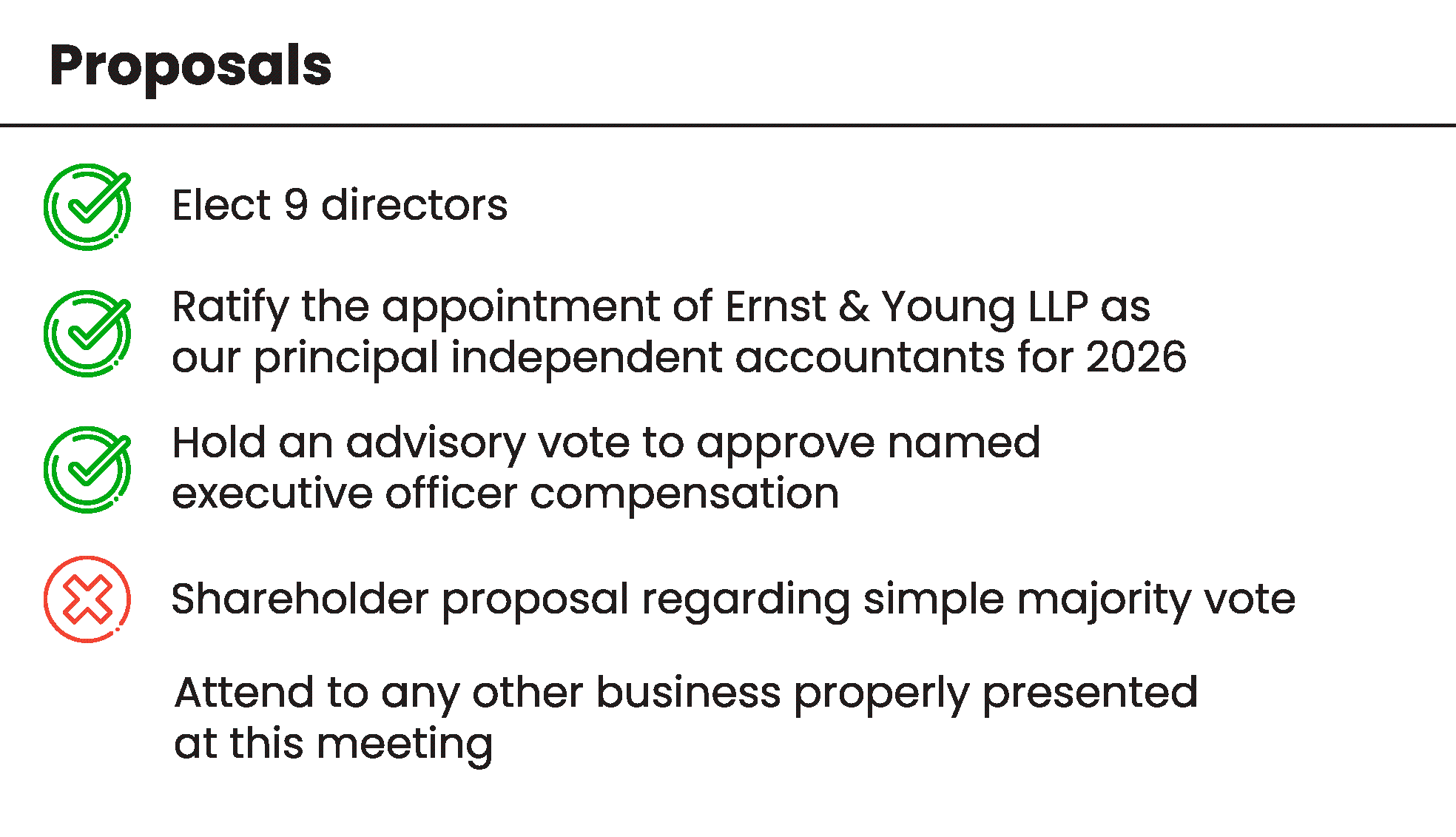
You are cordially invited to attend the Annual Meeting of Shareholders of OGE Energy Corp. to be held virtually via the Internet. Shareholders owning OGE Energy Corp. common stock at the close of business on the Record Date, or their legal proxy holder, are entitled to vote at the Annual Meeting. The items for this year’s annual meeting include:
On or about April 1, 2026, we mailed to our shareholders either (1) a Notice of Internet Availability of Proxy Materials or (2) a copy of our proxy statement, a proxy card and our 2025 annual report.
Shareholder List. During the meeting, the list of shareholders entitled to vote at the meeting will be available by visiting www.virtualshareholdermeeting.com/OGE2026 and entering your 16-digit control number and clicking on "Registered Shareholder List." For ten days prior to the meeting, a list of shareholders entitled to vote at the meeting will be available at our offices at 321 North Harvey, Oklahoma City, Oklahoma 73102. Please contact the undersigned, as Corporate Secretary, at (405) 553-3183, if you wish to inspect the list of shareholders prior to the Annual Meeting of Shareholders.
Proxy Voting. Your vote is important. Whether or not you plan to attend the virtual annual meeting online, please vote promptly. You may vote your shares in advance of the meeting via the Internet, by telephone or by mail, or by attending and voting online at the 2026 Annual Shareholders Meeting. Please refer to the section "General Information about the Annual Meeting and the Proxy Materials," of the proxy statement for detailed voting instructions.
|
|
|
By Order of the Board of Directors, |

|
|
William H. Sultemeier |
General Counsel, Corporate Secretary and Chief Compliance Officer |
April 1, 2026 |
IMPORTANT NOTICE REGARDING THE AVAILABILITY OF PROXY MATERIALS FOR THE SHAREHOLDER MEETING TO BE HELD ON MAY 14, 2026. The Company's notice of annual meeting of shareholders and proxy statement and 2025 annual report to shareholders are available on the Internet at www.proxyvote.com. |
|
|
|
Proxy Statement |
April 1, 2026 |
GENERAL INFORMATION ABOUT THE ANNUAL MEETING AND THE PROXY MATERIALS
Introduction
The Annual Meeting of Shareholders of OGE Energy Corp. (the "Company") will be held on May 14, 2026, at 10:00 a.m. CDT. The meeting will be a virtual meeting conducted exclusively via live webcast at www.virtualshareholdermeeting.com/OGE2026. At the meeting, we intend to present the first four items in the accompanying notice of annual meeting for action by the owners of the Company's common stock, par value $0.01 per share ("Common Stock"). The Board of Directors does not now know of any other matters to be presented at the meeting, but, if any other matters are properly presented to the meeting for action, the persons named in the accompanying proxy will vote upon them in accordance with their best judgment.
Your Board of Directors is providing you these proxy materials in connection with the solicitation of your proxy for use at the Annual Meeting of Shareholders. When you vote by Internet, telephone or mail (all as more particularly described below), you appoint Sean Trauschke and David L. Hauser as your representatives at the Annual Meeting of Shareholders. Mr. Trauschke and Mr. Hauser will vote your shares, as you have instructed them, at the Annual Meeting of Shareholders. This way, your shares will be voted whether or not you attend and participate in the virtual Annual Meeting of Shareholders online. Even if you plan to attend and participate in the virtual Annual Meeting of Shareholders online, it is a good idea to vote your shares in advance of the meeting, just in case your plans change. If an issue comes up for vote at the meeting that is not on the proxy card, Mr. Trauschke and Mr. Hauser will vote your shares, under your proxy, in accordance with their best judgment.
Internet Availability of Proxy Materials
On or about April 1, 2026, we will begin mailing to our shareholders of record a Notice of Internet Availability of Proxy Materials instead of a paper copy of the 2026 proxy statement and our 2025 annual report. The Notice of Internet Availability of Proxy Materials will include instructions on accessing and reviewing our proxy materials and our 2025 annual report to shareholders on the Internet and will provide instructions on submitting a proxy on the Internet.
At the time we begin mailing our Notice of Internet Availability of Proxy Materials, we will also first make available on the Internet at www.proxyvote.com our notice of annual meeting, our proxy statement and our 2025 annual report to shareholders. Any shareholder may also request a printed copy of these materials by any of the following methods:
|
|
|
|
|
• |
Internet at www.proxyvote.com; |
|
• |
e-mail at sendmaterial@proxyvote.com; or |
|
• |
telephone at 1-800-579-1639. |
Pursuant to the Securities and Exchange Commission (“SEC”) rules, our 2025 annual report to shareholders, which includes our audited consolidated financial statements, is not considered a part of, and is not incorporated by reference in, our proxy solicitation materials.
Voting Procedures
You may vote by mail, by telephone, by Internet, or online during the meeting. Please refer to the summary instructions below and those included on your Notice of Internet Availability of Proxy Materials or your proxy card or, for shares held in street name, the voting instruction card you received from your broker or nominee. To vote by mail, simply complete and sign the proxy card and mail it in the prepaid and pre-addressed envelope. If you received a Notice of Internet Availability of Proxy Materials, you may request a proxy card by following the instructions in your Notice. If you mark your voting instructions on the proxy card, your shares will be voted as you instruct. If you return a signed card but do not provide voting instructions, your shares will be voted for each proposal in accordance with the recommendations of the Board for such proposals.
1 OGE Energy Corp. 2026 Proxy Statement
|
|
|
|
|
Type of Shares Voted |
Final Date to Internet/Telephone Vote |
To Vote Your Shares |
If No Vote is Received |
Record Shareholder |
May 13, 2026 |
Follow Proxy Card Instructions |
If signed card received, but no voting instructions indicated, voted along Board recommendations |
DRIP/DSPP |
May 11, 2026 |
Follow Proxy Card Instructions |
Not Voted |
401(k) |
May 11, 2026 |
Give Trustee Voting Directive |
Trustee will vote for you in the same proportion that all plan shares are voted |
Stock Brokerage Account |
May 13, 2026 |
Let Brokerage Firm know how to Vote Shares |
Brokerage Firm will Vote on Routine Matters |
Shareholders of record also may vote by the Internet or by using the toll-free number listed on your Notice of Internet Availability of Proxy Materials or the proxy card. The telephone voting and Internet voting procedures are designed to verify shareholders through use of an identification number that will be provided to you. During the meeting, you may vote online by following the instructions at www.virtualshareholdermeeting.com/OGE2026. Have your Notice, proxy card or voting instruction form available when you access the virtual meeting web page.
Only shareholders of record or their legal proxy holders as of the record date may attend the annual meeting. To attend and participate in the virtual meeting, you will need the 16-digit control number included on your Notice, proxy card or voting instruction form. No recording of the annual meeting will be permitted.
If your shares are held in a stock brokerage account or by a bank or other nominee, you are considered the beneficial owner of shares held in street name and your broker or nominee is considered, with respect to those shares, the shareholder of record.
Brokerage firms have authority under New York Stock Exchange ("NYSE") rules to vote customers' shares for which they have not received voting instructions on certain "routine" matters, but may not vote for non-routine matters unless they have received voting instruction. The only "routine" matter at this year's annual meeting is the ratification of the Company's principal independent accountants. Brokers will not be able to vote their customers' shares for the election of directors, for the advisory vote on executive compensation or for the shareholder proposal unless their customers return voting instructions. Therefore, if your shares are held in street name by your bank or broker, it is important for you to return your voting instructions in order that your shares are voted for these matters.
Revocation of Proxy
If you change your mind after voting your proxy, you can revoke your proxy and change your vote at any time before the polls close at the meeting. You can revoke your proxy by either signing and sending another proxy with a later date, by voting via Internet, by telephone or by voting online during the meeting. Alternatively, you may provide a written statement to the Company (attention William H. Sultemeier, General Counsel, Corporate Secretary and Chief Compliance Officer) revoking your proxy.
Participation in the Virtual Annual Meeting
As indicated above, the Board of Directors determined to hold a virtual annual meeting this year. We believe this will facilitate shareholder attendance and participation by enabling shareholders to participate from any location and at no cost. We believe it will enable engagement with our shareholders.
You will be able to attend the meeting online, vote your shares electronically and submit questions during the meeting by visiting www.virtualshareholdermeeting.com/OGE2026.
To participate in the virtual meeting, you will need the 16-digit control number included on your Notice, proxy card or voting instruction form. The meeting webcast will begin promptly at 10:00 a.m., CDT. We encourage you to access the meeting prior to the start time. Online check-in will begin at 9:45 a.m., CDT, and you should allow ample time for the check-in
2 OGE Energy Corp. 2026 Proxy Statement
procedures. If you encounter any difficulties accessing the virtual meeting during the check-in or meeting time, please contact the technical support resource that is included on the Virtual Shareholders Meeting log-in page.
We want to provide our shareholders with the same rights and opportunities to participate as they would at an in-person annual meeting. The Shareholders will be able to attend the meeting online, vote their shares electronically and may submit questions during the meeting by visiting www.virtualshareholdermeeting.com/OGE2026. We will try to answer, as time permits, as many shareholder-submitted questions that comply with the meeting rules of conduct. However, we reserve the right to edit inappropriate language or to exclude questions that are not pertinent to meeting matters, are otherwise inappropriate or fail to comply with the meeting rules of conduct. If we receive substantially similar questions, we will group such questions together and provide a single response to avoid repetition.
Record Date; Number of Votes
If you owned shares of the Company's Common Stock at the close of business on March 16, 2026, you are entitled to one vote per share upon each matter presented at the meeting.
As of March 16, 2026, there were 206,373,409 shares of the Company's Common Stock outstanding. The Company does not have any other outstanding class of voting stock. Other than as described below under the heading "Security Ownership," no person holds of record or, to our knowledge, beneficially owns more than five percent of the Company's Common Stock.
Expenses of Proxy Solicitation
We will pay all costs associated with preparing, assembling, mailing and distributing the proxy cards and proxy statements except that certain expenses for Internet access may be incurred by you if you choose to access the proxy materials and/or vote via the Internet. We also will reimburse brokers, nominees, fiduciaries and other custodians for their expenses in forwarding proxy materials to shareholders. Officers and other employees of the Company may solicit proxies by mail, personal interview, telephone and/or Internet. In addition, we have retained D.F. King & Co., Inc. to assist in the solicitation of proxies, at a fee of $12,500 plus associated costs and expenses. Our employees will not receive any additional compensation for soliciting proxies.
CORPORATE GOVERNANCE
Corporate Governance Guidelines. The Board of Directors of the Company operates pursuant to a set of written Corporate Governance Guidelines ("Guidelines") that set forth the Company's corporate governance philosophy and the governance policies and practices that the Company has established to assist in governing the Company and its affiliates. The Guidelines are detailed on our company website at www.oge.com, under the stewardship tab. Among the topics covered by our Corporate Governance Guidelines are our Board member selection requirements.
|
|
|
Board Member Selection Requirements |
•Only executive officer on the Board is the CEO |
•Director will not be nominated if he or she would be 75 years of age or over at the time of election |
|
•Director may not serve on more than three other boards of publicly held companies |
|
•If a Director changes employment, they may be required to submit a letter of resignation for the Board's consideration |
Director Qualifications and Nomination Process. It is expected that the Nominating, Corporate Governance and Stewardship Committee will consider nominees recommended by shareholders in accordance with our bylaws. Our bylaws provide that, if you intend to nominate director candidates for election at an Annual Meeting of Shareholders, you must deliver written notice to the Corporate Secretary no later than 90 days in advance of the meeting. The notice must set forth the information concerning you and the nominee(s) that is required in our bylaws.
Our bylaws permit a shareholder (or group of up to 20 shareholders) owning three percent or more of the Company's Common Stock continuously for at least three years to nominate, and include in the Company's proxy materials for an Annual Meeting of Shareholders, director candidates up to an aggregate limit of the greater of (i) 20 percent (or if such amount is not a whole number, the closest whole number below 20 percent) of the Company's Board of Directors or (ii) two, provided that
3 OGE Energy Corp. 2026 Proxy Statement
the shareholder (or group) and each nominee satisfy the requirements specified in the bylaws. In order to utilize these so called "proxy access" provisions, the shareholder must provide notice of such nominations to the Corporate Secretary no earlier than 150 calendar days and no later than 120 calendar days before the anniversary of the date that the Company mailed or released to its shareholders its proxy statement for the prior year's Annual Meeting of Shareholders. For the 2027 annual meeting, this means that the notice must be provided no earlier than November 2, 2026 and no later than December 2, 2026. The requirements relating to nominating shareholders, the nominees and the information to be included in the notice are set forth in our bylaws.
The Nominating, Corporate Governance and Stewardship Committee has not established specific minimum qualities for director nominees or set forth specific qualities or skills that the Nominating, Corporate Governance and Stewardship Committee believes are necessary for one or more directors to possess. Instead, in evaluating potential candidates and incumbent directors for reelection, the Nominating, Corporate Governance and Stewardship Committee considers numerous factors, including judgment, skill, independence, integrity, experience with businesses and other organizations of comparable size, the interplay of the candidate's experience with the experience of other Board members, experience as an officer or director of another publicly-held corporation, understanding of management trends in general or in industries relevant to the Company, expertise in financial accounting and corporate finance, ability to bring diversity to the group, community or civic service, appropriateness of having a member of management, in addition to the CEO, on the Board as part of the succession planning process, knowledge or expertise not currently on the Board, shareholder perception, the extent to which the candidate would be a desirable addition to the Board and any committees of the Board, and, in the case of an incumbent director, the individual's level of performance as a director of the Company. No particular weight is given to one factor over another on a general basis, but rather the factors are weighted in relationship to the perceived needs of the Board at the time of selecting nominees. The Nominating, Corporate Governance and Stewardship Committee will evaluate candidates recommended by shareholders on the same basis as they evaluate other candidates.
The Nominating, Corporate Governance and Stewardship Committee values diversity of its members and, as indicated above, includes diversity among other factors the committee considers when evaluating potential board candidates and incumbent directors for reelection. For purposes of diversity considerations, the Nominating, Corporate Governance and Stewardship Committee includes differences of viewpoint, professional experience, education and other individual qualities as well as race and gender. Female representation among the nominees for election at this year’s annual meeting is 22 percent. Racial diversity among the nominees for election is 11 percent of the nominees. The needs of the Board and the factors that the Nominating, Corporate Governance and Stewardship Committee considers in evaluating candidates are reassessed on an annual basis, when the committee's charter is reviewed.
In considering individuals for nomination as directors, the Nominating, Corporate Governance and Stewardship Committee typically solicits recommendations from its current directors and is authorized to engage third party advisors, including search firms, to assist in the identification and evaluation of candidates. Mr. Ganske, who was elected to the Board effective August 1, 2025, was identified as a potential candidate by members of the Board and Mr. Trauschke. Following an evaluation of Mr. Ganske’s qualifications and interviews of Mr. Ganske by Mr. Trauschke and members of the Nominating, Corporate Governance and Stewardship Committee, Mr. Ganske was recommended by the Nominating, Corporate Governance and Stewardship Committee for election to the Board effective August 1, 2025.
Ethics and Independence Guidelines. Selected ethics and independence guidelines are set forth below.
|
|
|
Ethics |
•Our Code of Ethics applies to the directors, officers and employees. |
|
•CEO, senior financial officers and other applicable officers adhere to an additional code of ethics that complies with the requirements from the Sarbanes-Oxley Act of 2002. |
|
•Our Code of Ethics and the additional code of ethics applicable to our senior financial officers are available on our website at www.oge.com. We will disclose any waivers to our Code of Ethics that apply to our officers and directors on our website. |
Independence |
•Currently 9 of the 10 directors are classified as independent, with Mr. Trauschke, the CEO, being the only director not independent. |
|
•All members of the Audit, Compensation and Nominating, Corporate Governance and Stewardship Committees are independent. |
4 OGE Energy Corp. 2026 Proxy Statement
For these purposes, the Company bases its independence determination on (i) the listing standards of the NYSE and applicable rules and regulations of the SEC and (ii) no direct or indirect material relationship with the Company. The independence standards and additional considerations relating to material relationships with the Company are set forth on the Company's website under the stewardship tab.
Standing Committees. All members of the Audit Committee, the Compensation Committee and the Nominating, Corporate Governance and Stewardship Committee are independent directors who are nominated and approved by the Board. The roles and responsibilities of these committees are defined in the committee charters adopted by the Board and provide for oversight of, among other things, executive management. Each of these committee charters is available on our website at www.oge.com. The Board of Directors also has established a standing Executive Committee, whose members are all independent. The duties and responsibilities of these Board committees are reviewed regularly and are outlined below.
Leadership Structure. The Company's Corporate Governance Guidelines discussed above state that the Board has no policy with respect to the separation of the offices of Chairman of the Board and CEO. The Board believes that this issue is part of the succession planning process and that it is in the best interests of the Company for the Board, with the assistance of the Nominating, Corporate Governance and Stewardship Committee, to make a determination whenever it elects a new CEO.
Sean Trauschke currently serves as Chairman, President and CEO. At the time of his election as Chairman, the Board believed that it was in the best interest of the Company to have a single person serve as Chairman and CEO to provide unified leadership and direction. The Board still believes this is in the Company's best interest; however, the Board may separate these positions in the future should circumstances change.
In an effort to strengthen independent oversight of management and to provide for more open communication, the independent members of the Board elect a Lead Director on an annual basis for a one-year term. Mr. Hauser currently serves as the Lead Director and has been a Director since 2015. The responsibilities of our Lead Director are set out in our Guidelines and include:
•providing leadership to the Board if circumstances arise in which the role of the Chairman and CEO may be, or may be perceived by the Lead Director or independent directors to be, in conflict;
•presiding at all meetings of the Board at which the Chairman is not available;
•organizing, convening and presiding over executive sessions or meetings of the non-management and/or independent directors and promptly communicating the messages and directives approved by such directors at each such session or meeting to the Chairman and CEO;
•acting as the principal liaison between the independent directors and the Chairman and CEO;
•reviewing and approving all Board and committee agendas, approving information sent to the Board and providing input to management of the scope and quality of such information and on the Board's information needs;
•having authority to call a special meeting of the Board or the independent directors at any time, at any place, and for any purpose;
•being available for consultation and direct communication with our major shareholders;
•acting as a sounding board and advisor to the Chairman and CEO, including providing guidance to the Chairman and CEO on executing the long-term strategy;
•setting the agenda for any meeting of independent directors with inputs from other directors;
•contributing to annual performance review of the Chairman and CEO, and collecting and communicating to the Chairman and CEO the views and recommendations of the independent directors relating to his or her performance other than in connection with the annual performance review;
5 OGE Energy Corp. 2026 Proxy Statement
•participating in succession planning for the Chairman and CEO and talent retention/development of senior executives;
•encouraging director participation by fostering environment of open dialogue and constructive feedback among independent directors;
•helping ensure efficient and effective Board performance and functioning and conducting discussion of annual evaluation of Board performance;
•ensuring that the Board oversees and periodically reviews the Company's long-term strategy and management's execution of the long-term strategy;
•overseeing effective functioning of Board committees and providing inputs on functioning of the committee when needed; and
•leading or participating in ad-hoc committees established to deal with extraordinary matters such as investigations, mergers and acquisitions.
Audit Committee Financial Expert. The Board has determined that Ms. Cathy R. Gates and Mr. David E. Rainbolt meet the SEC definition of audit committee financial expert. The Board also has determined that each of Mr. Peter D. Clarke, Mr. Lyle G. Ganske, Ms. Gates and Mr. Rainbolt is independent and is "financially literate" within the meaning of the NYSE listing standards.
Process Related to Executive Officer and Director Compensation. Under the terms of its charter, the Compensation Committee has broad authority to develop and implement the Company's compensation policies and programs for executive officers and Board members. In particular the Compensation Committee is to:
•review and approve corporate goals and objectives relevant to the compensation of the CEO and other executive officers;
•evaluate the performance of the CEO and the other executive officers in light of the corporate goals and objectives and set compensation levels for the executive officers;
•recommend to the Board the approval, adoption and amendment of all incentive compensation plans in which any executive officer participates and all other equity-based plans;
•administer the equity-based incentive compensation plans and any other plans adopted by the Board that contemplate administration by the Compensation Committee;
•approve all grants of stock options and other equity-based awards;
•review and approve employment, severance or termination arrangements for any executive officers;
•review and evaluate the impact of the Company's compensation policies and practices on the Company's risk profile and risk management;
•review and approve all services, including the fees for such services, to be provided to the Compensation Committee or the Company by a compensation consultant and its affiliates; and
•review Board compensation.
The Compensation Committee may, in its discretion, delegate all or a portion of its duties and responsibilities to a subcommittee or, to the extent permitted by applicable law, to any other body or individual. In particular, the Compensation Committee may delegate the approval of certain transactions to a subcommittee consisting solely of members of the Compensation Committee who are "non-employee directors" within the meaning of Rule 16b-3 of the Securities Exchange Act of 1934.
6 OGE Energy Corp. 2026 Proxy Statement
The process for setting director and executive compensation in 2025 involved numerous steps. The Compensation Committee, with the assistance of Mercer (U.S.) Inc. ("Mercer"), approved a peer group of companies for purposes of targeting executive compensation as discussed in the Compensation Discussion and Analysis beginning on page 29. The next step in the process was an annual performance evaluation of each member of the management team. This process entailed for each member of the management team (other than the CEO) a scoring by such individual's supervisor of various competencies, including the individual's management skills, business knowledge and achievement of various performance and development objectives set at the beginning of the year. These reviews were used by the CEO in making compensation recommendations to the Compensation Committee.
The balance of the process for setting director and executive compensation for 2025 involved actions taken by the Compensation Committee. The Compensation Committee met in December 2024 and February 2025 to address 2025 compensation. At the December 2024 meeting, the Compensation Committee reviewed with the CEO the performance evaluations of each officer (other than the CEO). The Compensation Committee at its December 2024 meeting also reviewed and discussed with the CEO his recommendations for each member of management (other than the CEO) of 2025 salaries, target annual incentive awards (expressed as a percentage of salary) and target long-term incentive awards (also expressed as a percentage of salary). In addition, the Compensation Committee evaluated the CEO's performance at its December 2024 meeting and discussed his potential salary, target annual incentive award and target long-term compensation for 2025. Following these discussions, the Compensation Committee set 2025 salaries and, subject to potential adjustment at its meetings in February 2025, target annual incentive awards and target long-term compensation awards for each officer. The target annual incentive awards and target long-term compensation awards were expressed as percentages of salary. The Company performance goals that needed to be achieved for any payouts of such incentive awards were not set at the December 2024 meeting but, instead, were left for consideration at the scheduled meeting in February 2025. Senior management in making compensation recommendations for an executive in 2025, and the Compensation Committee in deciding the executive's compensation, used as a primary guideline the median market pay data provided by Mercer for an executive with similar responsibilities in the Company peer group. At its meeting in December 2024, the Compensation Committee also reviewed and set compensation for the directors, which is described below under "Director Compensation."
Prior to the Compensation Committee's meeting in February 2025, the Company's senior management developed recommendations for the Company performance goals that needed to be met in order for any payouts of 2025 annual incentive awards or 2025 long-term performance-based compensation awards to occur. The recommended performance goals for the annual incentive awards for the executive officers were the same as for all of the other full-time company employees.
At the Compensation Committee's meeting in February 2025, the Compensation Committee reviewed with senior management its recommendations and basis for Company performance goals for the annual and long-term incentive awards. Following this discussion, the Compensation Committee set the 2025 Company performance goals that had to be achieved in order for payouts of such awards to occur. The Compensation Committee also approved the form and amount of the long-term compensation awards, which consisted for officers of performance units and time-based restricted stock units. Consistent with the recommendations of senior management, those performance goals were the same for the executive officers as for all the other recipients of the performance units.
In 2024, the Compensation Committee engaged Mercer as its executive compensation consultant for 2025. As part of this engagement, Mercer reviewed the Company's current director and executive officer compensation, confirmed the peer group to be used for assessment of director and executive officer compensation and assessed the competitiveness of the Company's director and executive officer compensation. Mercer also provided perspectives on market trends. During 2025, Mercer received $303,180 in fees for director and executive officer compensation advisory services to the Compensation Committee. Separately, Mercer and its affiliates received $20,157 in fees for other services, which related to routine miscellaneous services including annual compensation surveys. The decision to engage Mercer and its affiliates for these other services was reviewed and approved by the Compensation Committee. For the reasons described below, the Compensation Committee does not believe that the provision of these services affected the objectiveness of the executive compensation advice it receives from Mercer. Since the latter half of 2015, the Company has not used Mercer for any services other than the services described above.
Although the Company retains Mercer and its affiliates for other services as described above, the Compensation Committee is confident that the advice it receives from Mercer is objective and not influenced by Mercer's or its affiliates' relationships
7 OGE Energy Corp. 2026 Proxy Statement
with the Company because of the procedures Mercer and the Compensation Committee have in place. In particular, we have been informed by Mercer that:
•the executive compensation consultant receives no incentive or other compensation based on the fees charged to the Company for other services provided by Mercer or any of its affiliates;
•the executive compensation consultant is not responsible for selling other Mercer or affiliate services to the Company; and
•Mercer's professional standards prohibit the individual executive compensation consultant from considering any other relationships Mercer or any of its affiliates may have with the Company in rendering his or her advice and recommendations.
In addition:
•the Compensation Committee has the sole authority to retain and terminate the executive compensation consultant;
•the Compensation Committee reviewed and approved all services, including the fees for such services to be provided to the Compensation Committee or the Company by the executive compensation consultant and its affiliates;
•the executive compensation consultant has direct access to the Compensation Committee without management intervention;
•the Compensation Committee evaluates the quality and objectivity of the services provided by the executive compensation consultant each year and determines whether to continue to retain the consultant; and
•the protocols for the engagement (described below) limit how the executive compensation consultant may interact with management.
While it is necessary for the executive compensation consultant to interact with management to gather information, the Compensation Committee has procedures governing if and when such consultant's advice and recommendations can be shared with management. This approach is intended to protect the Compensation Committee's ability to receive objective advice from the executive compensation consultant so that the Compensation Committee may make independent decisions about executive pay at the Company.
For the reasons discussed above, and after considering certain independence-related factors, including:
•whether Mercer provides other services to the Company;
•fees received by Mercer from the Company;
•conflict of interest policies of Mercer;
•any business or personal relationships between the individual executive compensation consultant and members of the Company's Compensation Committee;
•any ownership of the Company's Common Stock by the individual executive compensation consultant; and
•any business or personal relationships between the individual executive compensation consultant or Mercer and an executive officer of the Company,
the Compensation Committee determined that there are no conflicts of interest with respect to the consulting services provided by Mercer.
8 OGE Energy Corp. 2026 Proxy Statement
Risk Oversight. The Board of Directors is responsible for reviewing and overseeing the long-term strategic plans and principal issues facing the Company and includes the oversight of the major risk exposures and the risk management activities of the Company. As part of its risk oversight role, the Board delegates specific roles to its committees to help ensure risks, mitigations and opportunities are appropriately monitored and managed.
|
|
|
Board Oversight |
•The Board is supported in risk oversight responsibilities by various committees of the Board and management. |
|
•These committees and other members of management provide regular reports to the Board on the risks and opportunities facing the Company, including matters related to climate, regulatory risk/recoverability, disruptions to fuel supply and the electric grid, operations outages and accidents, catastrophic weather events, increased costs, industry technology, legislative and regulatory policy, economic conditions, cybersecurity, terrorism, health epidemics, human capital management and artificial intelligence. |
|
•The Board and committees receive reports and updates related to risks and opportunities facing the Company from internal expertise or outside experts. |
|
•The Audit Committee is responsible for overall risk management and financial risk exposure. |
|
•The Compensation Committee is responsible for review and evaluation of the impact of compensation policies and practices on the Company's risk profile and risk management. |
|
•The Nominating, Corporate Governance and Stewardship Committee is responsible for: |
|
◦Environmental, Social and Governance ("ESG") initiatives and strategies including environmental compliance |
|
◦Contingent weather or global events that could affect the Company |
|
|
|
◦Sustainability, diversity, climate and corporate stewardship policies and initiatives |
|
|
From a management perspective, risk is overseen by the Company's Risk Oversight Committee, which consists of the Chief Financial Officer, other corporate officers and members of management. This risk committee is responsible for the overall development, implementation and enforcement of strategies and policies for all significant risk management activities of the Company. In 2025, this Committee and management applied a holistic perspective of risk assessment and application of its strategies and policies to manage the Company's overall financial performance. The Chief Financial Officer, acting in his role as the principal financial officer and as a member of the Risk Oversight Committee, reported periodically during 2025 to the Audit Committee on the Company's risk profile affecting anticipated financial results, including any significant risk issues.
As a vital infrastructure utility service, risk management and oversight are critical to our business. Our Enterprise Risk Management (“ERM”) process, which engages internal stakeholders, helps identify key internal and external business risks — those that pose potential material financial and operational risk to the Company — then supports evaluations of those risks, providing consistent assessment.
Key risks are then assessed using a methodology that includes a quantification of potential financial and operational impacts. Priority risks are assigned to internal risk owners, who are responsible for developing and updating risk management plans, which are also coordinated with our Internal Audit group for alignment with the Company's annual audit plan.
Risk identification, assessment and management planning are reviewed with senior leadership, the Risk Oversight Committee and the Board.
Board Attendance at Annual Meeting of Shareholders. The Company encourages each of its Board members to attend the Annual Meeting of Shareholders, and the directors are expected to attend whenever reasonably possible. All ten of the directors who were nominated for election in 2025 attended online the virtual Annual Meeting of Shareholders in 2025.
9 OGE Energy Corp. 2026 Proxy Statement
Related Party Transaction Policy and Related Party Transactions; Prohibition on Loans. The Company's Code of Ethics provides that all employees, including executive officers, have a duty to avoid financial, business or other relationships that might cause a conflict of interest with the performance of their duties and that employees should conduct themselves in a manner that avoids even the appearance of conflict between personal interests and those of the Company. The Company's Code of Ethics provides, among other things, that (i) conflicts of interest may arise when an individual or someone in his or her immediate family receives improper personal benefits as a result of the employee's position, (ii) employees should not authorize business with any firm in which they, or a member of their immediate family, have a direct or indirect interest and (iii) employees should, as a general rule, avoid accepting a gift or invitation of such value (generally in excess of $100) that acceptance could create, or appear to create, an obligation to a person or company with whom the Company does business. The charter of the Nominating, Corporate Governance and Stewardship Committee provides that the Nominating, Corporate Governance and Stewardship Committee is to consider possible conflicts of interest of directors and management and make recommendations to prevent, minimize or eliminate such conflicts of interest. Similarly, the charter of the Audit Committee provides that the Audit Committee is to periodically obtain reports regarding compliance with the Company's Code of Ethics. If a conflict is found to exist, the matter will be discussed with the employee and the following options will be considered: (i) the employee will be asked to end the activity that caused the conflict; (ii) realignment of job responsibilities or assignment or (iii) if (i) and (ii) are not possible, employment will be terminated. Only the Board or a committee of the Board can waive this provision for executive officers, and any waiver will be promptly disclosed to the public. The Company's Corporate Governance Guidelines provide that, except for employment arrangements with the CEO, the Company will not engage in transactions with directors or their affiliates if a transaction would cast into doubt the independence of a director, present a conflict of interest or is otherwise prohibited by law, rule or regulation and includes (i) directly or indirectly, any extension, maintenance or renewal of an extension of credit to any director or member of management of the Company and (ii) significant business dealings with directors or their affiliates, substantial charitable contributions to organizations in which a director is affiliated, and consulting contracts with, or other indirect forms of compensation to, a director. Any waiver of this policy may be made only by the Board or a Board committee and must be promptly disclosed to the Company's shareholders. The Company does not have a related party transaction policy for persons other than employees and directors and their affiliates. Except as discussed above, the Company has not prescribed any specific standards to be applied when determining whether a conflict exists or whether a waiver of any such conflict should be made. In addition, the Company's Stock Incentive Plan prohibits all loans to executive officers.
Prohibition on Hedging. Our insider trading policy prohibits our directors, executive officers and other designated persons from engaging in hedging or monetization transactions with respect to the Company's securities, such as prepaid variable forward contracts, equity swaps, collars and exchange funds. Our Board reviews our insider trading policy annually.
Stock Ownership Guidelines. In an effort to further align management's interests with those of the shareholders, the Compensation Committee recommended, and the Board of Directors has adopted, stock ownership guidelines for the officers of the Company and the Company's Board of Directors. The Compensation Committee reviews the stock ownership guidelines each year, and has, from time to time, revised such guidelines. The terms of these guidelines are explained on page 40 in the Compensation Discussion and Analysis.
Communications with the Board of Directors. Shareholders and other interested parties who wish to communicate with members of the Board, including the Lead Director or the non-management directors individually or as a group, may send correspondence to them in care of the Corporate Secretary at the Company's principal offices, 321 North Harvey, P.O. Box 321, Oklahoma City, Oklahoma 73101-0321. We currently do not intend to have the Corporate Secretary screen this correspondence to the extent it pertains to business matters and are not solicitations, but we may change this policy if directed by the Board due to the nature and volume of the correspondence.
Auditors; Audit Partner Rotation. As described on page 21, the Company is requesting that the shareholders ratify the selection of Ernst & Young LLP as the Company's principal independent accountants for 2026. The Audit Committee charter provides that the audit partners will be rotated as required by the Sarbanes-Oxley Act of 2002.
Environmental, Social and Governance. Our wholly-owned electric company, Oklahoma Gas and Electric Company ("OG&E"), serves approximately 913,000 customers in a service territory spanning 30,000 square miles in Oklahoma and western Arkansas. OG&E's commitment is to provide energy-related services in a balanced and environmentally responsible manner which includes providing safe, reliable and reasonably priced power while protecting the environment. We provide detailed information regarding our sustainability initiatives in multiple venues including our Corporate Stewardship Report on
10 OGE Energy Corp. 2026 Proxy Statement
our company website and our filings with the SEC. In addition, we were among the initial steering committee members of, and annually update and publish on our website an ESG disclosure report in accordance with, the Edison Electric Institute's ("EEI") ESG and sustainability-related reporting. The EEI has developed a reporting framework to enable utility companies to provide current or interested investors and other stakeholders with key ESG and sustainability information on a comparable basis. The EEI reporting framework includes a quantitative section with data on recent greenhouse gas emissions, as well as a 2005 baseline for comparison. Additional information about our ESG performance can be found on our website at www.oge.com under "Stewardship Center." Information on our website, including the reports and documents mentioned in this paragraph, is not incorporated by reference into this proxy statement.
Since 1902, we have been deeply engaged in the communities we serve, supporting the growth and well-being of our economies, customers, and our employees. As one of the largest employers in our service territory, we are committed to attracting, retaining and developing a high quality workforce and providing a safe, inclusive and productive work environment. We have a broad pipeline of candidates for our workforce prepared to serve our communities due to, among other things, our partnerships with universities and technical colleges as well as U.S. military recruiters. We directly contribute to our communities in a number of ways, including providing grants through the OGE Energy Corp. Foundation, Company and employee contributions to United Way and various other partnerships and sponsorships. Another way that the Company assists in our communities is by the volunteer hours donated by our employees, as they are offered 16 hours of paid volunteer leave every year. We have employees whose full-time responsibility is to engage in the community and listen and work directly with governments, chambers of commerce, businesses, nonprofit organizations, and schools to support growth and enact meaningful change.
At the Company, safety is more than a priority; it is a value and is paramount in the work we perform. Our safety principles are core to who we are and what we do. These principles are communicated, demonstrated and embraced at all levels of the company and supported by our core belief to "Live Safely." Since the inception of our safety principles and embracing our incident and injury free vision, we have seen a sustained decline in our injury rate. We have reduced our five-year averages for OSHA recordable injuries by 66 percent and our Days Away, Restricted, Transfer Rate by 77 percent since our 2011 baseline. We continue to analyze trends and engage in discussions with our employees, creating a dialogue to enhance safety performance and work toward our incident and injury-free workplace. Our focus on safety has contributed to the last ten years being the safest in our history.
11 OGE Energy Corp. 2026 Proxy Statement
|
|
INFORMATION CONCERNING THE BOARD OF DIRECTORS |
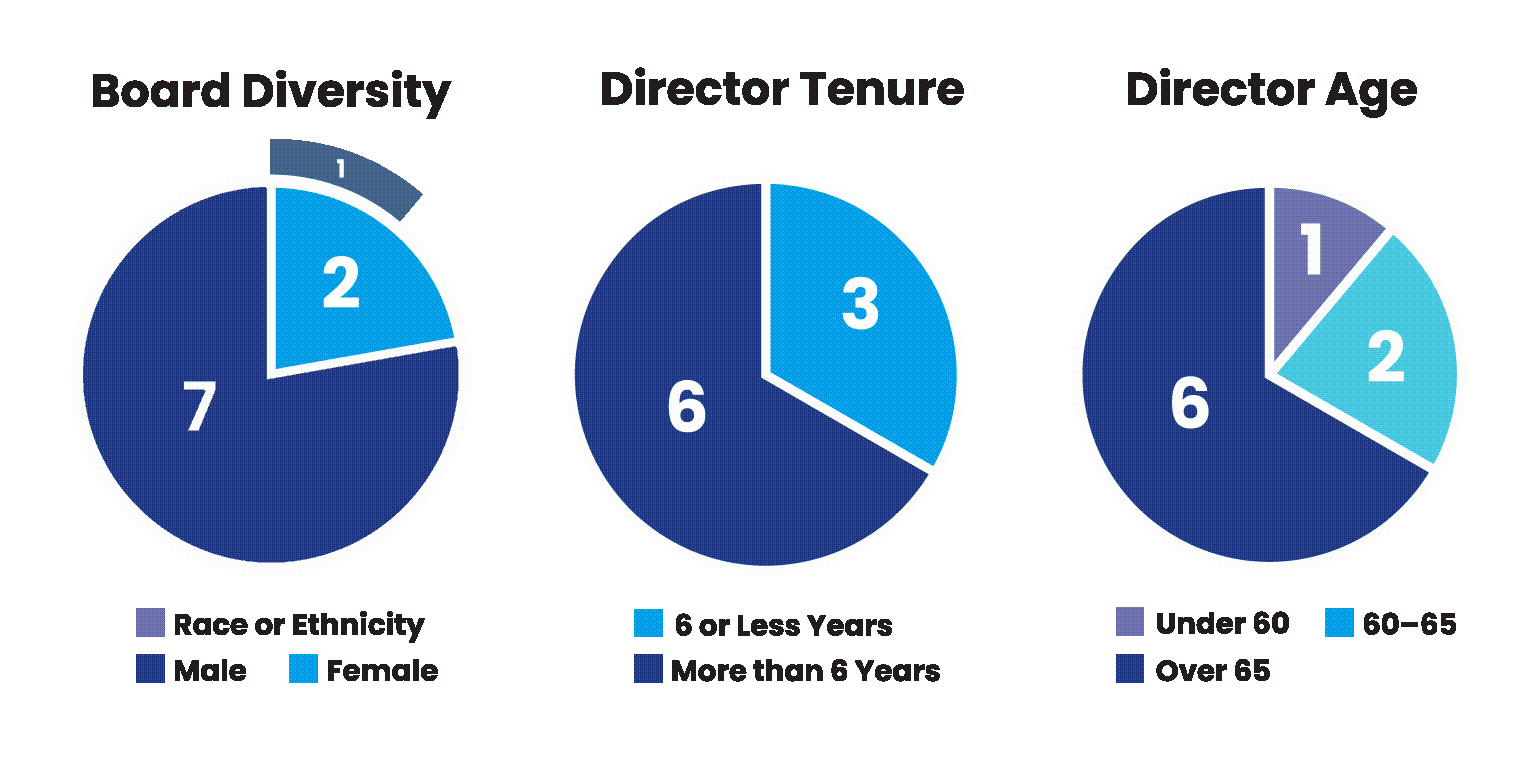
General. Each member of our Board of Directors serving in 2025 was also a director of OG&E during 2025. The Board of Directors of the Company met on seven occasions during 2025. Each current director of the Company attended at least 75 percent of the total number of meetings of the Company's Board of Directors and the committees of the Board on which he or she served during 2025, in each case during the period in which he or she served. Below are certain demographic statistics for the nine directors who are being nominated for election at this year’s Annual Meeting.
12 OGE Energy Corp. 2026 Proxy Statement
Committees. The standing committees of the Company's Board of Directors include a Compensation Committee, an Audit Committee, a Nominating, Corporate Governance and Stewardship Committee and an Executive Committee. The members of these committees, the general functions of the committees and number of committee meetings in 2025, are set forth below.
|
|
|
|
Name of Committee and Members |
General Functions of the Committee |
Number of Meetings in 2025 |
Compensation Committee: |
Oversees |
6 |
Frank A. Bozich |
• compensation of directors and principal officers |
|
Cathy R. Gates |
• executive compensation |
|
David L. Hauser* |
• benefit programs |
|
Luther C. Kissam, IV |
• incentive compensation clawback policy |
|
Judy R. McReynolds |
|
|
Sheila G. Talton |
|
|
|
|
|
Audit Committee: |
Oversees financial reporting process |
4 |
Peter D. Clarke |
• evaluate performance of independent auditors |
|
Lyle G. Ganske** |
• select independent auditors |
|
Cathy R. Gates* |
• discuss with internal and independent auditors scope and plans for audits, adequacy and effectiveness of internal controls for financial reporting purposes, and results of their examination |
|
David E. Rainbolt |
• review interim financial statements and annual financial statements to be included in Form 10-K and Form 10-Q |
|
|
• oversees risk assessment and risk policies |
|
|
|
|
Nominating, Corporate Governance and Stewardship Committee: |
Reviews and recommends to the Board |
6 |
Frank A. Bozich |
• nominees for election as directors |
|
Peter D. Clarke* |
• membership of director committees |
|
Lyle G. Ganske** |
• succession plans |
|
David L. Hauser |
• various corporate governance issues |
|
Luther C. Kissam, IV |
• plans to address contingent events that could significantly affect the Company, including extreme weather events, natural disasters, cybersecurity events and acts of terrorism |
|
David E. Rainbolt |
Reviews and reports to the Board on |
|
Sheila G. Talton |
• environmental initiatives and compliance strategies |
|
|
• the Company's corporate stewardship and corporate responsibility programs, including sustainability, diversity, climate and other ESG matters |
|
|
• cybersecurity, information technology and technology matters |
|
|
|
|
Executive Committee: |
Performs duties of the Board during intervals between Board meetings |
— |
Peter D. Clarke |
|
|
Cathy R. Gates |
|
|
David L. Hauser*** |
|
|
Judy R. McReynolds*** |
|
|
* Chair |
|
** Mr. Ganske joined the Board effective August 1, 2025 and joined the Audit Committee effective February 13, 2026. |
*** Ms. McReynolds served as Lead Director through March 2, 2026, and Mr. Hauser became Lead Director effective March 3, 2026. |
13 OGE Energy Corp. 2026 Proxy Statement
Director Compensation. Compensation of non-management directors of the Company in 2025 included an annual retainer fee as listed below. The annual equity retainer was deposited in the director's account under the Company's deferred Compensation Plan and converted to 3,889.0 common stock units based on the closing price of the Company's Common Stock on December 9, 2025. In 2025, the independent directors did not receive additional compensation for attending Board or committee meetings but were instead paid a quarterly cash retainer.
|
|
|
|
Position Held |
|
Compensation |
Board of Director |
|
$ 282,500 |
Quarterly Cash Installments |
$ 115,000 |
|
Deferred Compensation Plan |
$ 167,500 |
|
Lead Director |
|
$ 30,000 |
Chair of a Committee |
|
$ 20,000 |
Serve on Audit Committee |
|
$ 5,000 |
Under the Company's Deferred Compensation Plan, non-management directors may defer payment of all or part of their quarterly and annual cash retainer fees, which deferred amounts in 2025 were credited to their accounts as of the scheduled payment date. Amounts credited to the accounts are assumed to be invested in one or more of the investment options permitted under the Company's Deferred Compensation Plan. In 2025, those investment options included a Company Common Stock fund, whose value was determined based on the stock price of the Company's Common Stock. When an individual ceases to be a director of the Company, all amounts credited under the Company's Deferred Compensation Plan are paid in cash in a lump sum or installments. In certain circumstances, participants may also be entitled to in-service withdrawals from the Company's Deferred Compensation Plan.
On December 3, 2025, the Compensation Committee met to consider director compensation. At that meeting, the Compensation Committee recommended, and the Board subsequently approved, an increase in the annual equity retainer from $160,000 to $167,500. That amount was credited on December 9, 2025. There were no changes in the annual cash retainer for 2026.
|
|
|
|
|
|
|
|
|
|
|
|
|
|
|
|
|
|
|
|
|
|
|
Name |
Fees
Earned or
Paid in
Cash
($) |
|
Stock
Awards
($)(1) |
|
Option
Awards
($) |
|
Non-Equity
Incentive Plan
Compensation
($) |
|
Change in
Pension
Value and
Nonqualified
Deferred
Compensation
Earnings
($) |
|
All Other Compensation
($) |
|
Total
($) |
|
(a) |
(b) |
|
(c) |
|
(d) |
|
(e) |
|
(f) |
|
(g) |
|
(h) |
|
Frank A. Bozich |
$ |
115,000 |
|
$ |
167,500 |
|
|
— |
|
|
— |
|
|
— |
|
|
— |
|
$ |
282,500 |
|
Peter D. Clarke |
$ |
140,000 |
|
$ |
167,500 |
|
|
— |
|
|
— |
|
|
— |
|
|
— |
|
$ |
307,500 |
|
Lyle G. Ganske |
$ |
47,917 |
|
$ |
69,792 |
|
|
— |
|
|
— |
|
|
— |
|
|
— |
|
$ |
117,709 |
|
Cathy R. Gates |
$ |
126,667 |
|
$ |
167,500 |
|
|
— |
|
|
— |
|
|
— |
|
|
— |
|
$ |
294,167 |
|
David L. Hauser |
$ |
135,000 |
|
$ |
167,500 |
|
|
— |
|
|
— |
|
|
— |
|
|
— |
|
$ |
302,500 |
|
Luther C. Kissam, IV |
$ |
115,000 |
|
$ |
167,500 |
|
|
— |
|
|
— |
|
|
— |
|
|
— |
|
$ |
282,500 |
|
Judy R. McReynolds |
$ |
145,000 |
|
$ |
167,500 |
|
|
— |
|
|
— |
|
|
— |
|
|
— |
|
$ |
312,500 |
|
David E. Rainbolt |
$ |
120,000 |
|
$ |
167,500 |
|
|
— |
|
|
— |
|
|
— |
|
|
— |
|
$ |
287,500 |
|
J. Michael Sanner (2) |
$ |
102,916 |
|
$ |
111,667 |
|
|
— |
|
|
— |
|
|
— |
|
$ |
1,788,166 |
|
$ |
2,002,749 |
|
Sheila G. Talton |
$ |
115,000 |
|
$ |
167,500 |
|
|
— |
|
|
— |
|
|
— |
|
|
— |
|
$ |
282,500 |
|
(1)Amounts in this column represent the dollar value of the annual retainer that was deposited in the director's account under the Company's Deferred Compensation Plan in December 2025. At December 31, 2025, the number of common stock units in the Company Common Stock Fund for each of the directors was as follows: Mr. Bozich, 23,372 common stock units; Mr. Clarke, 33,651 common stock units; Mr. Ganske, 1,620 common stock units; Ms. Gates, 12,528 common stock units; Mr. Hauser, 52,302 common stock units; Mr. Kissam, 22,608 common stock units; Ms. McReynolds, 63,707 common stock units; Mr. Rainbolt, 42,541 common stock units; Mr. Sanner, 0 common stock units; and Ms. Talton, 48,869 common stock units.
(2)Mr. Sanner passed away in September 2025. The compensation listed in column (g) represents Mr. Sanner’s life insurance death benefit.
14 OGE Energy Corp. 2026 Proxy Statement
|
|
PROPOSAL NO. 1 - |
ELECTION OF DIRECTORS |
The Board of Directors of the Company currently consists of 10 members. The term of each director will expire at this year's Annual Meeting of Shareholders, and Ms. Judy R. McReynolds will retire from the Board effective at the Annual Meeting of Shareholders. The following persons are the nominees of the Board to be elected for a one-year term at the Annual Meeting of Shareholders to be held on May 14, 2026: Mr. Frank A. Bozich, Mr. Peter D. Clarke, Mr. Lyle G. Ganske, Ms. Cathy R. Gates, Mr. David L. Hauser, Mr. Luther C. Kissam, Mr. David E. Rainbolt, Ms. Sheila G. Talton and Mr. Sean Trauschke. The term of each nominee will continue until their successors are elected and qualified. Each of these nominees is currently a director of the Company and OG&E.
The Board would like to recognize Ms. Judy R. McReynolds and Mr. J. Michael Sanner for their years of dedicated service on the Board. As discussed above, Ms. McReynolds will retire from the Board effective at the Annual Meeting of Shareholders. Mr. Sanner passed away in September 2025.
Consistent with the retirement policy set forth in the Company's Corporate Governance Guidelines, the Nominating, Corporate Governance and Stewardship Committee approved Mr. Clarke’s nomination for re-election to the Board at the 2026 Annual Meeting and recommended that the Board of Directors nominate Mr. Clarke even though Mr. Clarke will be 75 at the time of election. Specifically, the Nominating, Corporate Governance and Stewardship Committee considered a number of factors in making this decision, including, among others:
•his experience in serving as Chair of the Nominating, Corporate Governance and Stewardship Committee and as a member of the Audit Committee and the desire to have him assist in the transition of the leadership positions on those committees, particularly in light of the untimely passing of Mr. Sanner and the upcoming retirement of Ms. McReynolds; and
•his continuation on the Board will not materially affect the average tenure of our independent Board members, which is approximately seven years as a result of the refreshment of the members of the Board over the last six years.
In light of the Nominating, Corporate Governance and Stewardship Committee's approval and recommendation, as well as Mr. Clarke’s leadership, experience, skill set and active engagement, the Board of Directors on March 3, 2026 nominated Mr. Clarke for re-election at the 2026 Annual Meeting.
Proxies solicited by the Board of Directors will be voted "FOR" the election of each of the 9 nominees as director, unless a different vote is specified. The Board of Directors does not know of any nominee who will be unable to serve, but if any of them should be unable to serve, the proxy holder may vote for a substitute nominee. All nominees own less than 0.3 percent of any class of voting securities of the Company.
The following contains certain information concerning the nominees for director.
15 OGE Energy Corp. 2026 Proxy Statement
|
|
|

Frank A. Bozich President and CEO, Trinseo PLC Age: 65 Director Since: 2016 Committees: Compensation Nominating, Corporate Governance and Stewardship |
Professional Experience: Mr. Bozich is President and CEO at Trinseo PLC, a global materials company and manufacturer of plastic resins and latex binders. He has served as President and CEO of Trinseo since March 2019. Mr. Bozich has been a member of Trinseo's board of directors since June 2019. Prior to joining Trinseo, from 2013 to 2019, Mr. Bozich was the Chief Executive Officer of the SI Group, Inc., a global developer and manufacturer of phenolic resins and chemicals. Mr. Bozich also previously held several executive management positions at BASF Corporation, a multi-national chemicals and manufacturing corporation, including President of BASF's Catalysts Division from 2010 to 2013, Group Vice President of Precious and Base Metal Service and Group Vice President of the Integration Management Office. Mr. Bozich previously served as a director of SI Group, Inc. and other private or non-profit organizations. |
Qualifications: The Board concluded that Mr. Bozich should continue serving as a director of the Company based on his experience as the chief executive officer of a publicly-traded company, his customer perspective in leading and developing manufacturing businesses that rely heavily on energy services and products such as those delivered by the Company, his ESG experience in leading companies subject to extensive environmental regulations, and his risk oversight experience developed over many years of leadership at publicly-traded and large private companies. |
|
|
|

Peter D. Clarke Retired Partner, Jones Day Age: 75 Director Since: 2018 Committees: Audit Nominating, Corporate Governance and Stewardship, Chair Executive |
Professional Experience: Mr. Clarke is a retired energy lawyer with the Jones Day law firm. Mr. Clarke served as a partner of Jones Day from 2001 through 2016 and served as Co-Chair of the energy practice at Jones Day. Prior to his retirement from the firm at the end of 2017, he was employed by Jones Day as Of-Counsel for the period of January 1, 2017 through December 31, 2017. Mr. Clarke worked as legal counsel representing the public utility and energy industries for more than 40 years. His energy practice focused on corporate finance, disclosure obligations under the federal securities laws, corporate governance and mergers and acquisitions. Mr. Clarke has also participated in a variety of community, charitable and professional organizations.
|
Qualifications: The Board concluded that Mr. Clarke should continue serving as a director of the Company based on his utility/regulatory knowledge of the utility industry generally and of the Company specifically, his corporate governance/legal experience relating to the energy and public utility industries, and his financial acumen/literacy related to corporate finance. |
16 OGE Energy Corp. 2026 Proxy Statement
|
|
|

Lyle G. Ganske Retired Partner, Jones Day Age: 67 Director Since: 2025 Committees: Audit Nominating, Corporate Governance and Stewardship |
Professional Experience: Mr. Ganske has more than 40 years' experience in advising boards of directors on fiduciary duty-related matters, corporate governance, and corporate transactions. Mr. Ganske is a retired partner with the Jones Day law firm. Mr. Ganske served as a partner of Jones Day for more than 30 years through 2024 and served in multiple leadership roles including head of the firm’s Global M&A Practice. Prior to his retirement from the firm at the end of 2025, he was employed by Jones Day as Of Counsel for the period of January 1, 2025 through December 31, 2025. His expertise includes M&A, corporate governance, executive compensation, and general corporate counseling, covering various industries such as energy, manufacturing, retailing, telecom, utilities, and process industries. Mr. Ganske previously served on the board of directors of Altra Industrial Motion from 2007 to 2023.
|
Qualifications: The Board concluded that Mr. Ganske should continue serving as a director of the Company based on his corporate governance and fiduciary duty legal experience and his financial acumen/literacy related to corporate transactions. |
|
|
|

Cathy R. Gates Retired Partner, Ernst & Young LLP Age: 67 Director Since: 2023 Committees: Compensation Audit, Chair Executive |
Professional Experience: Ms. Gates was an assurance partner for Ernst & Young LLP, based in their Tulsa office, through her retirement in 2017. She served as a managing partner for eight years with oversight responsibility for more than 100 professionals, working with public and privately-held clients throughout the Southwest region in retail/consumer products, transportation, manufacturing and contract drilling industries. In addition to her professional career, Ms. Gates is active with several nonprofit organizations including the Tulsa Area United Way and University of Arkansas Walton College of Business. She also serves on the board of directors of Somnigroup International Inc. (formerly Tempur Sealy International, Inc.). |
Qualifications: The Board concluded that Ms. Gates should continue serving as a director of the Company based on her extensive knowledge across a number of industries developed during her tenure providing assurance services to public and private companies, her financial acumen/expertise gained in public accounting and from serving on an audit committee of another public company, her knowledge of the service territory served by the Company, and her risk oversight experience gained in public accounting. |
17 OGE Energy Corp. 2026 Proxy Statement
|
|
|

David L. Hauser Former Chairman and CEO, FairPoint Communications, Inc. Age: 74 Director Since: 2015 Lead Director Committees: Compensation, Chair Nominating, Corporate Governance and Stewardship Executive |
Professional Experience: Mr. Hauser is the former Chairman and Chief Executive Officer of FairPoint Communications, Inc., a provider of communication services located in Charlotte, N.C. He served in the role from July 2009 to August 2010 and thereafter served as a consultant until March 2011. From 1998-2009, Mr. Hauser held leadership positions with Duke Energy Corporation, including group executive and chief financial officer and vice president and treasurer. Mr. Hauser also currently serves as chairman of the board of EnPro Inc. He is a former member of the board of trustees of the University of North Carolina at Charlotte and of Furman University and a retired member of the North Carolina Association of Certified Public Accountants. |
Qualifications: The Board concluded that Mr. Hauser should continue serving as a director of the Company based on his extensive utility/regulatory experience and due to his executive leadership experience in serving as the chief executive officer of a publicly-traded company, his financial leadership in utility and regulated businesses, his financial acumen/expertise resulting from his prior performance as chair of the audit committee of another public company, and his risk oversight experience developed over many years of leadership positions with publicly-traded companies. |
|
|
|

Luther (Luke) C. Kissam, IV Former Chairman, President and CEO, Albemarle Corporation Age: 61 Director Since: 2020 Committees: Compensation Nominating, Corporate Governance and Stewardship |
Professional Experience: Mr. Kissam is the former Chairman, President and Chief Executive Officer of Albemarle Corporation, a global specialty chemicals company with leading positions in lithium, bromine and refining catalysts. He served as Chief Executive Officer from 2011 to 2020 and held various leadership positions at Albemarle beginning in 2003, including President and Executive Vice President of Manufacturing, Law and HS&E. Prior to joining Albemarle, Mr. Kissam served as Vice President, General Counsel and Secretary of Merisant Company, having previously served as Associate General Counsel of Monsanto Company. Mr. Kissam currently serves on the board of directors of Advanced Drainage Systems, Inc. and DuPont de Nemours, Inc. and previously served on the board of directors of Albemarle Corporation from 2015 until May 2021. Mr. Kissam served as a Senior Advisor with Bernhard Capital Partners, a service and infrastructure focused private equity management firm, from January 2021 to July 2025. |
Qualifications: The Board concluded that Mr. Kissam should continue serving as a director of the Company based on his executive leadership experience from previously serving as chairman and chief executive officer of a large, multi-national, publicly-held company, his customer perspective in leading businesses that rely heavily on energy services and products such as those delivered by the Company, his expertise relating to new technologies applicable to utilities, his corporate governance/legal experience at publicly-traded companies, and his risk oversight experience developed in his leadership positions with publicly-traded companies. |
18 OGE Energy Corp. 2026 Proxy Statement
|
|
|

David E. Rainbolt Chairman, BancFirst Corporation Age: 70 Director Since: 2019 Committees: Audit Nominating, Corporate Governance and Stewardship |
Professional Experience: Mr. Rainbolt is Chairman of BancFirst Corporation, a financial holding company which provides retail and commercial banking services through its principal wholly-owned subsidiary banks, BancFirst headquartered in Oklahoma City, Pegasus Bank in Dallas, Texas and Worthington Bank in Fort Worth, Texas. He previously served as the Executive Chairman of BancFirst Corporation from May 2017 to January 2025 and as President and Chief Executive Officer from January 1992 to May 2017. In addition to serving as a director of BancFirst Corporation, Mr. Rainbolt currently serves as a director of a number of community, charitable, professional and governmental boards, including Dean A. McGee Eye Institute (Chair), Trustee of the Presbyterian Health Foundation and Oklahoma Medical Research Foundation. |
Qualifications: The Board concluded that Mr. Rainbolt should continue serving as a director of the Company based on his executive leadership experience in previously serving as president and chief executive officer of a bank, his extensive knowledge of the communities in the service territory due to his involvement and active service in numerous civic and charitable matters affecting many of the communities served by the Company, his financial acumen/literacy from his experience in the banking industry, and his risk oversight experience developed over many years of leadership positions in the regulated banking industry. |
|
|
|

Sheila G. Talton President and CEO, Gray Matter Analytics Age: 73 Director Since: 2013 Committees: Compensation Nominating, Corporate Governance and Stewardship |
Professional Experience: Ms. Talton currently serves as President and CEO of Gray Matter Analytics, a healthcare analytics solutions company that works with payors and providers. Prior to founding Gray Matter Analytics in 2013, she served as President and Chief Executive Officer of SGT Ltd., a strategy and technology consulting business, from 2011 to 2013 and as Vice President of Cisco Systems, Inc., from 2008 to 2011. Ms. Talton currently serves on the boards of Deere & Company and Sysco Corporation. From 2012 until 2019, Ms. Talton served on the board of Wintrust Financial Corporation. She has been a Congressional appointee on the U.S. White House Women's Business Council. She also has been recognized as one of the "Top 10 Women in Technology" by Enterprising Women, as "Entrepreneur of the Year" by the National Federation of Black Women Business Owners and as a 2021 Notable Black Leader & Executive by Crain's Chicago Business. She serves on the boards of several nonprofit organizations including Chicago's Northwestern Memorial Foundation, the Chicago Shakespeare Theater and the Chicago Urban League. |
Qualifications: The Board concluded that Ms. Talton should continue to serve as a director of the Company based on her executive leadership experience and her subject matter expertise in information technology and data analytics gained while leading Gray Matter Analytics and in executive positions held in global technology companies and consulting firms. Ms. Talton also brings knowledge and perspectives on cybersecurity and oversight of corporate stewardship, including social and human capital management implications and opportunities. |
19 OGE Energy Corp. 2026 Proxy Statement
|
|
|

Sean Trauschke Chairman, President and CEO, OGE Energy Corp. Age: 59 Director Since: 2015 |
Professional Experience: Mr. Trauschke currently serves as Chairman, President and Chief Executive Officer of the Company and OG&E. Mr. Trauschke has been Chief Executive Officer of the Company since June 2015. He has been President of OG&E since July 2013 and President of OGE Energy since August 2014 and was named as Chairman of the Board in December 2015. From 2009 until 2013, he held the position of Vice President and Chief Financial Officer of the Company and OG&E. Mr. Trauschke also serves on the boards of the Greater Oklahoma City Chamber, United Way of Central Oklahoma and other local community organizations. |
Qualifications: The Board concluded that Mr. Trauschke should continue serving on the Board based on his executive leadership experience, his utility/regulatory experience, his extensive knowledge of the Company’s business and service territory, his financial acumen/literacy, his risk oversight experience and his ESG experience, all due in large part to his leadership roles at the Company, including having served as Chairman, President and CEO and formerly serving as Chief Financial Officer. |
The affirmative vote of the holders of a majority of the shares of the Company's Common Stock present online at the virtual meeting or represented by proxy and entitled to vote on the election of directors at the Annual Meeting of Shareholders will be required for the election of each of the 9 nominees as director. Broker non-votes will be treated as shares not entitled to be voted and will have no effect on the outcome of the proposal. Any incumbent director who is not reelected in an election in which majority voting applies is required to tender his or her resignation promptly to the Board. The Nominating, Corporate Governance and Stewardship Committee will then consider the tendered resignation and recommend to the Board whether to accept or reject the resignation offer, or whether other action should be taken. The Board will act on the recommendation within 100 days following certification of the shareholders' vote and will promptly disclose its decision regarding whether to accept the director's resignation offer. The director who tenders his or her resignation will not participate in the recommendation of the Nominating, Corporate Governance and Stewardship Committee or the decision of the Board with respect to his or her resignation. If a director's resignation is not accepted by the Board, the director will continue to serve until the next annual meeting and until his or her successor is duly elected. If a director's resignation is accepted by the Board, or if a nominee for director is not elected and the nominee is not an incumbent director, then the Board of Directors, in its sole discretion, may fill any resulting vacancy pursuant to the provisions of the bylaws.
The Board of Directors recommends a vote "FOR" the election of each of the 9 nominees as director. Proxies solicited by the Board of Directors will be voted "FOR" the election of each of the 9 nominees as director, unless a different vote is specified.
20 OGE Energy Corp. 2026 Proxy Statement
|
|
PROPOSAL NO. 2 - |
RATIFICATION OF THE APPOINTMENT OF ERNST & YOUNG LLP AS THE COMPANY'S PRINCIPAL INDEPENDENT ACCOUNTANTS FOR 2026 |
The Audit Committee has selected Ernst & Young LLP as principal independent accountants to audit the accounts of the Company for the fiscal year ending December 31, 2026. Ernst & Young LLP was originally selected by the Board, upon the recommendation of the Audit Committee, as principal independent accountants for the Company effective May 16, 2002.
While the Audit Committee is responsible for the appointment, retention, termination and oversight of the Company's principal independent accountants, the Audit Committee and the Board are requesting, as a matter of policy, that shareholders ratify the appointment of Ernst & Young LLP as the Company's principal independent accountants. The Audit Committee is not required to take any action as a result of the outcome of the vote on this proposal. However, if the shareholders do not ratify this appointment, the Audit Committee may investigate the reasons for the shareholders' rejection and may consider whether to retain Ernst & Young LLP or to appoint another principal independent accountant. Furthermore, even if the appointment is ratified, the Audit Committee in its discretion may direct the appointment of different principal independent accountants at any time during the year if it determines that such a change would be in the best interests of the Company and its shareholders.
Representatives of Ernst & Young LLP will be present at the Annual Meeting of Shareholders and will have an opportunity to make a statement if they so desire. Such representatives will be available to respond to appropriate questions from the shareholders at the Annual Meeting of Shareholders.
The affirmative vote of the holders of a majority of the shares of the Company's Common Stock present online at the virtual meeting or represented by proxy and entitled to vote at the Annual Meeting of Shareholders will be required for the ratification of the appointment of Ernst & Young LLP as the Company's principal independent accountants for 2026. Abstentions from voting in this matter are treated as votes against.
The Board of Directors recommends a vote "FOR" the ratification of the appointment of the Company's principal independent accountants. Proxies solicited by the Board of Directors will be voted "FOR" the ratification of the appointment of the Company's principal independent accountants, unless a different vote is specified.
21 OGE Energy Corp. 2026 Proxy Statement
|
|
PROPOSAL NO. 3 - |
ADVISORY VOTE TO APPROVE NAMED EXECUTIVE OFFICER COMPENSATION |
In accordance with Section 14A of the Securities Exchange Act of 1934, the Company is providing shareholders with an advisory (non-binding) vote on compensation programs, that is sometimes referred to as "say on pay," for our CEO and the other four officers named in the Summary Compensation Table on page 43 (who we refer to as "Named Executive Officers"). Accordingly, you may vote on the following resolution at the 2026 Annual Meeting of Shareholders:
"RESOLVED, that the compensation paid to the Company's Named Executive Officers, as disclosed pursuant to Item 402 of Regulation S-K, including the Compensation Discussion and Analysis, compensation tables, and narrative discussion is hereby APPROVED."
This vote is non-binding. The Board and the Compensation Committee, which is comprised of independent directors, intend to consider the outcome of the vote when making future executive compensation decisions and, in particular, to consider any significant negative voting results to the extent they can determine the cause or causes for such votes. The Board has determined that, consistent with its recommendation for an advisory vote on the frequency of the shareholder votes on executive compensation at this year’s Annual Meeting of Shareholders, OGE Energy will hold future advisory votes on executive compensation every year.
As discussed in the Compensation Discussion and Analysis, our 2025 executive compensation program is premised on providing competitive and responsible levels of compensation that has a significant component that is performance-based so as to align the interests of our executive officers with those of our shareholders. Payouts of annual incentive awards and a significant portion of the long-term incentive awards require the achievement of specific goals established by the Compensation Committee that are designed to benefit our shareholders and the Company, both in the long and short term.
Specifically, awards under the Annual Incentive Plan provide officers an opportunity to earn an annual cash incentive, with the amount of the incentive payout being dependent on the level of achievement of specified Company performance-based goals established for the year. These Company performance goals typically are tied to earnings and measures of operating performance. The annual incentive performance goals for the executive officers were the same as for all the other full-time employees. For 2025, the long-term awards under the Stock Incentive Plan consist of two components. One component, accounting for 35 percent of the long-term incentive award, consists of restricted stock units that will vest on December 31, 2027, assuming continued employment through that date. The other component, consisting of performance units, accounts for the remaining 65 percent of the awards. The performance units are equity-based, with the amount ultimately paid to an officer being dependent on the level of achievement, usually over a three-year period, of specific Company performance goals that in 2025 were tied directly to total shareholder return compared to a broad utility peer group. The terms of this equity-based award have not permitted any adjustments to calculating total shareholder return for unusual one-time events. By having a significant portion of our executives' compensation dependent on the level of achievement of various performance goals, our 2025 executive compensation program is designed to reward executives with a highly-competitive level of compensation during years of excellent Company performance and, conversely, in years of below average performance, for their compensation to be below competitive levels. The Company believes that it sets challenging performance targets as illustrated by the incentive compensation actually paid to our Named Executive Officers. Over the last five years, Named Executive Officers have averaged an Annual Incentive Plan payout of approximately 115 percent of their target awards and a payout of long-term incentive awards of approximately 94 percent.
We believe the Company's executive compensation program strikes the appropriate balance between utilizing responsible pay practices and effectively incentivizing our executives to create value for our shareholders. This balance is evidenced by the following:
•Our executive compensation was approved by more than 90 percent of our shareholders who voted at last year's Annual Meeting of Shareholders.
22 OGE Energy Corp. 2026 Proxy Statement
•For 2025, consistent with prior years, total direct compensation (i.e., salary plus targeted annual incentive compensation and targeted long-term incentive compensation) for our Named Executive Officers was targeted at the median amount for a comparable group of executives in the Company Peer Group (which peer group is listed on page 31). To reinforce our pay-for-performance culture, targets for individual Named Executive Officers may also reflect the individual’s performance in prior years and experience in the position. The Committee believes this approach, combined with the opportunity to earn above-target incentive compensation if they deliver above-target performance are consistent with the objectives of our compensation policies. The Committee believes that this approach enables us to attract and retain skilled and talented executives to guide and lead our business.
•A significant part of executive compensation is considered at risk. For 2025, a Named Executive Officer's base salary comprised 16 percent to 38 percent of their targeted total direct compensation. For 2025, an officer's at-risk compensation included the ability to earn from 0 percent to 200 percent of an award under the Annual Incentive Plan and the Stock Incentive Plan, based on the level of achievement of the applicable performance goals set by the Compensation Committee. The at-risk awards under the Stock Incentive Plan also included grants of time-based restricted stock units that will vest after a three-year period, assuming continued employment with the Company. The mix of performance-based and time-based long-term incentive awards is similar to most companies in the Company Peer Group. The performance-based target awards under the Annual Incentive Plan and under the Stock Incentive Plan represented approximately 48 percent to 61 percent of a Named Executive Officer's targeted total direct compensation in 2025.
Shareholders are encouraged to read the Compensation Discussion and Analysis, the accompanying compensation tables and the related narrative disclosure for more information about the Company's executive compensation program.
The affirmative vote of the holders of a majority of the shares of the Company's Common Stock present online at the virtual meeting or represented by proxy and entitled to vote on the matter at the Annual Meeting of Shareholders will be required for the approval, on an advisory basis, of the Named Executive Officer compensation. Abstentions from voting in this matter are treated as votes against. Broker non-votes will be treated as shares not entitled to be voted and will have no effect on the outcome of the proposal.
The Board of Directors recommends a vote "FOR" the approval of the Named Executive Officer compensation as disclosed in the Compensation Discussion and Analysis, the accompanying compensation tables and the related narrative disclosure. Proxies solicited by the Board of Directors will be voted "FOR" the approval of the Named Executive Officer compensation, unless a different vote is specified.
23 OGE Energy Corp. 2026 Proxy Statement
|
|
PROPOSAL NO. 4 - |
SHAREHOLDER PROPOSAL REGARDING SIMPLE MAJORITY VOTE |
John Chevedden, 2215 Nelson Avenue, No. 205, Redondo Beach, CA 90278, beneficial owner of no fewer than 140 shares of OGE Energy Corp. since at least November 1, 2022, has given notice that he intends to present a proposal for action at the Annual Meeting.
In accordance with the Federal proxy regulations, the following is the complete text of the proposal exactly as submitted. The Company accepts no responsibility for the proposal or for the accuracy of any statements included in the proposal. Our Board recommends a vote against the proposal for the reasons set forth following the proposal.
Shareholder Proposal:
Proposal 4 - Govern by Majority Vote

Shareholders request that the Board of Directors take each step necessary so that each voting requirement in our charter and bylaws (that is explicit or implicit due to default to state law) that calls for a greater than simple majority vote be replaced by a requirement for a majority of the votes cast for and against applicable proposals, or a simple majority in compliance with applicable laws.
This means the closest standard to a majority of the votes cast for and against such proposals consistent with applicable laws. This proposal includes that OGE Energy shall state in its governing documents that it shall not have any super-majority voting standards, which includes default super-majority voting standards, upon adoption of this proposal.
This unified and comprehensive proposal includes adjourning the OGE annual meeting, if OGE fails to obtain the required 80% vote on the day of the annual meeting, for up to 2-weeks to seek more votes with the objective of reaching the 80% shareholder approval requirement from all shares outstanding for this proposal topic. In 2025 OGE demonstrated that without adjourning the OGE annual meeting OGE is unable to obtain the 80% approval vote from all shares outstanding that is required.
This proposal does not preclude OGE from using other methods to increase shareholder voting until the 80% shareholder approval is obtained.
This unified and comprehensive proposal is similar to a unified and comprehensive proposal that was submitted to Netflix and received 83% shareholder support.
If OGE had followed this proposal at its 2025 annual meeting OGE would at least be closer to be governed by a majority vote standard. OGE failed to disclose in the 2025 proxy any extra effort that OGE made to obtain the votes needed.
OGE does not reject shareholder votes approving OGE executive pay so why does OGE in effect reject shareholder votes for this proposal topic with its lockstep efforts year after year that fails to obtain the necessary approval vote.
OGE deserves to be condemned for not putting forth an extra effort to obtain the needed 80% approval from all shares outstanding in 2025. In a whole year OGE typically only puts forth 3 items for shareholder vote. Thus when shareholders give overwhelming approval for just one other item in a year OGE should take this shareholder approval vote seriously and make an extra effort to turn shareholder proposal approval votes into proposal adoption.
Please vote yes:
Govern by Majority Vote - Proposal 4
24 OGE Energy Corp. 2026 Proxy Statement
BOARD OF DIRECTORS' RESPONSE
THE BOARD OF DIRECTORS OPPOSES THE PROPOSED RESOLUTION AND UNANIMOUSLY RECOMMENDS A VOTE AGAINST PROPOSAL 4 FOR THE FOLLOWING REASONS:
Our Board has carefully considered this proposal and, for the reasons set forth below, does not believe that it is in the best interests of the Company and our shareholders.
The proponent has five times before submitted shareholder proposals that are similar to the shareholder proposal submitted for this meeting. In 2012, 2015, 2019, 2021 and 2024, non-binding shareholder proposals to eliminate the supermajority voting provisions and adopt simple majority voting provisions were included in the Company's proxy statements. Those shareholder proposals received majority support of the shareholders voting at the meeting. In light of those votes, in 2013, 2016, 2020, 2022 and 2025 (the years following the 2012, 2015, 2019, 2021 and 2024 shareholder proposals), the Board adopted resolutions approving, and recommended that the shareholders vote for, amendments to the Company's certificate of incorporation (the "Certificate of Incorporation") to eliminate the 80 percent supermajority voting standard (the "Supermajority Voting Standard") applicable to a few categories of matters, as noted below. Approval of these amendments to the Certificate of Incorporation (the “Certificate Amendments”) required approval of at least 80 percent of the Company's outstanding Common Stock. Despite the Board's support, in each of 2013, 2016, 2020, 2022 and 2025 the Certificate Amendments failed to pass, receiving less than the required 80 percent of the shareholders of record voting in favor. Despite having the shareholders fail to approve the requested Certificate Amendments to implement the prior shareholder proposals, the shareholder proponent submitted a similar proposal for the 2022 Annual Meeting requesting that the 80 percent supermajority voting provisions be modified to 67 percent supermajority voting provisions. In light of the vote on that shareholder proposal at the 2022 meeting, in 2023, the Board adopted resolutions approving, and recommended that the shareholders vote for, amendments to the Company’s Certificate of Incorporation to modify the 80 percent supermajority voting standard to 67 percent. That amendment to modify the supermajority voting requirements did not receive the required 80 percent of the shareholders of record voting in favor either. Despite these repeated failures to have the shareholders approve the requested Certificate Amendments to implement his prior shareholder proposals, the proponent has submitted essentially the same proposal he submitted in 2012, 2015, 2019, 2021 and 2024 again.
As the Company has indicated previously, the Company's supermajority voting standards relate to fundamental elements of our corporate governance. They have been included in our charter for many years and are commonly included in the corporate charters and bylaws of many publicly-traded companies. In general, these provisions are designed to provide minority shareholders with a measure of protection against changes in corporate governance and other self- interested actions by one or more large shareholders. The supermajority voting provisions protect OGE Energy shareholders against the actions of short-term investors such as hedge funds or corporate raiders. The Board's position regarding the proponent's proposal is that the amendments to implement the shareholder proposal are unlikely to receive the requisite 80 percent approval and the Company's existing Supermajority Voting Standard for certain extraordinary matters provides shareholders with very meaningful protections against actions that may not be in their best interests. The Board and management believe the shareholder proposal would eliminate meaningful protections against actions that may not be in the best interests of our shareholders or the Company and take away Company time and resources from matters that are in the best interests of our shareholders and the Company.
Under the Company's governing documents and Oklahoma law, nearly all matters submitted to our shareholders for approval require the approval of a majority of the votes present in person or by proxy and entitled to vote at the annual meeting. As permitted by Oklahoma law, the Company's shareholder-approved Certificate of Incorporation does, however, provide that if certain actions are to be taken by shareholders, those actions will require more than a majority vote, including: (i) certain business combination transactions with an "interested shareholder" (subject to certain exceptions, including an exception for transactions approved by the Board), (ii) amendment of the bylaw provisions relating to shareholder annual and special meetings, board structure, board vacancies, director elections and director removal, and (iii) amendment of certain provisions of the Certificate of Incorporation.
While some corporations have eliminated supermajority provisions, we do not believe that a formulaic, one-size-fits-all approach, as suggested by the proponent, is appropriate. The Board believes that more meaningful voting requirements are appropriate for issues that have a long-lasting effect on the Company. For example, the provisions relating to business combinations are intended to provide minority shareholders with a measure of protection against business combination and
25 OGE Energy Corp. 2026 Proxy Statement
other transactions that may be inadequately priced, unfair, coercive or otherwise not in their best interests. These provisions are not intended to, and do not, preclude unsolicited, non-abusive offers to acquire the Company at a fair price. They are designed, instead, to encourage any potential acquirer to negotiate directly with the Board, which the Board believes is in the best position to evaluate the adequacy and fairness of proposed offers, to negotiate on behalf of all shareholders, and to protect shareholders against abusive takeover tactics.
The Board also believes that there are important reasons for requiring a broad consensus of the shareholders to amend certain fundamental governance provisions in the Company's bylaws and Certificate of Incorporation, and that requiring a supermajority vote for such amendments protects shareholders against the self-interested actions of a few large investors. For example, if the proposal submitted by the proponent were implemented, it could become possible for a small number of very large shareholders, whose interests may diverge from those of our other shareholders, to approve an amendment to the Company's bylaws and change the size or composition of the current Board. Importantly, the Supermajority Voting Standard does not preclude changes to the Company's governing documents. Rather, they help to ensure that certain fundamental changes to the governing documents are made only with a broad consensus of shareholders, rather than by a "simple majority" of shareholders voting (which may, in practice, be the holders of a minority of shares outstanding).
The Company asserts that its corporate governance practices are sound and that the Company and the Board are committed to good corporate governance, accountability to shareholders and shareholder engagement. The Company has taken significant steps to implement strong governance principles and to promote accountability, including:
•Eliminating the classified Board of Directors and providing for the annual election of all directors;
•Requiring majority voting for the election of directors; and
The Board will continue to consider whether changes to the Certificate of Incorporation and Company bylaws are appropriate and in the best interests of the shareholders and the Company in the future.
As mentioned above, despite introducing virtually the same proposal numerous previously, and having the shareholders fail to approve the requested Certificate Amendments to implement those shareholder proposals, the proponent has submitted essentially the same proposal.
In summary, in reaction to previous shareholder proposals, the Board on six occasions previously approved, and recommended that shareholders approve, Certificate Amendments to eliminate or modify the Supermajority Voting Standard. However, in all cases the Certificate Amendments failed to receive the required shareholder support. In light of the failure of the Certificate Amendments to receive the required vote and the Board's continued belief that the Company's existing Supermajority Voting Standard for certain extraordinary matters provides shareholders with very meaningful protections against actions that may not be in their best interests, the Board believes at this time that the shareholder proposal would not serve the best interests of our shareholders or the Company. The Board and management believe such action is not warranted and that the Company's time and resources could be better spent on other matters rather than on this shareholder proposal and pursuing adjournments at annual meetings.
The affirmative vote of the holders of a majority of the shares of Common Stock present in person or by proxy and entitled to vote at the Annual Meeting will be required for the approval of this shareholder proposal. Abstentions from voting in this matter are treated as votes "against." Broker non-votes will be treated as shares not entitled to be voted.
The Company's shareholders should be aware that this shareholder proposal is a request that the Board take the actions stated in the proposal. Approval of this proposal does not eliminate the Supermajority Voting Standard. As noted above, to change the Supermajority Voting Standard, holders of at least 80 percent of the Company's outstanding Common Stock must approve an actual amendment to the Certificate of Incorporation.
The Board of Directors recommends a vote "AGAINST" Proposal No. 4. Proxies solicited by the Board of Directors will be voted "AGAINST" Proposal No. 4, unless a different vote is specified.
26 OGE Energy Corp. 2026 Proxy Statement
|
|
REPORT OF AUDIT COMMITTEE |
The Audit Committee oversees the Company's financial reporting process on behalf of the Board of Directors. Management, however, has the primary responsibility for the financial statements and the reporting process including the systems of internal controls.
The Audit Committee currently has four members, none of whom has any relationship to the Company that interferes with the exercise of his or her independence from management and the Company, and each of whom qualifies as independent under the standards used by the NYSE, where the Company's shares are listed. The Audit Committee operates under a written charter that has been approved by the Board of Directors. The Audit Committee annually reviews and reassesses the adequacy of its charter. Among other things, the charter specifies the policies for selecting the auditors (including rotation for the audit partner) and the scope of the Audit Committee's responsibilities and how it carries out those responsibilities, including structure, processes and membership requirements.
In fulfilling its oversight responsibilities regarding the 2025 financial statements, the Audit Committee reviewed with Company management the audited financial statements contained in our Annual Report to Shareholders. The Audit Committee's review included a discussion of the quality, not just the acceptability, of the accounting principles, the reasonableness of significant judgments and the clarity of disclosures in the financial statements.
The Audit Committee also reviewed with the Company's principal independent accountants the Company's 2025 financial statements and management's assessment of the Company's internal control over financial reporting. The Company's principal independent accountants are responsible for expressing an opinion on the conformity of our audited financial statements with accounting principles generally accepted in the United States and on the Company's internal control over financial reporting. Our review with the principal independent accountants included a discussion of the principal independent accountants' judgments as to the quality, not just the acceptability, of the Company's accounting principles and such other matters as are required to be discussed with the Audit Committee by the applicable requirements of the Public Company Accounting Oversight Board and the SEC. In addition, the Audit Committee has received the written disclosures and the letter from the principal independent accountants required by applicable requirements of the Public Company Accounting Oversight Board regarding the principal independent accountant's communications with the Audit Committee concerning independence, and discussed with the principal independent accountants the principal independent accountants' independence from management and the Company.
The Audit Committee also discussed with the Company's internal auditors and principal independent accountants the overall scope and plans for their respective audits for 2025. The Audit Committee meets with the internal auditors and principal independent accountants, with and without management present, to discuss the results of their examinations, their evaluations of the Company's internal controls, and the overall quality of the Company's financial reporting. The Audit Committee held four meetings during 2025.
Fees for Principal Independent Accountants
|
|
|
|
|
|
|
|
Year ended December 31 |
2025 |
|
2024 |
|
Integrated audit of OGE Energy and its subsidiaries financial statements and internal control over financial reporting |
$ |
2,107,512 |
|
$ |
1,718,060 |
|
Services in support of debt and stock offerings |
|
178,350 |
|
|
198,600 |
|
Other (A) |
|
315,018 |
|
|
337,720 |
|
Total audit fees (B) |
|
2,600,880 |
|
|
2,254,380 |
|
Employee benefit plan audits |
|
173,430 |
|
|
169,200 |
|
Other compliance services |
|
21,320 |
|
|
40,370 |
|
Total audit-related fees |
|
194,750 |
|
|
209,570 |
|
Assistance with examinations and other return issues |
|
204,200 |
|
|
205,823 |
|
Review of Federal and state tax returns |
|
31,693 |
|
|
36,366 |
|
Total tax preparation and compliance fees |
|
235,893 |
|
|
242,189 |
|
Total tax fees |
|
235,893 |
|
|
242,189 |
|
Total fees |
$ |
3,031,523 |
|
$ |
2,706,139 |
|
27 OGE Energy Corp. 2026 Proxy Statement
(A)Includes reviews of the financial statements included in OGE Energy's and OG&E's Quarterly Reports on Form 10-Q, audits of OGE Energy's subsidiaries, agreed-upon procedures and fees for consulting with OGE Energy's and OG&E's executives regarding accounting issues.
(B)The aggregate audit fees include fees billed for the audit of OGE Energy's and OG&E's annual financial statements and for the reviews of the financial statements included in OGE Energy's and OG&E's Quarterly Reports on Form 10-Q. For 2025, this amount includes estimated billings for the completion of the 2025 audit, which services were rendered after year-end.
There were no other fees billed by the principal independent accountants to OGE Energy in 2025 and 2024 for other services.
The Audit Committee has considered whether the provision of non-audit services by the Company's principal independent accountants is compatible with maintaining auditor independence.
In reliance on the review and discussions referred to above, the Audit Committee recommended to the Board of Directors, and the Board has approved, that the Company's audited financial statements be included in the Annual Report on Form 10-K for the fiscal year ended December 31, 2025, for filing with the SEC. The Audit Committee selected Ernst & Young LLP as the Company's principal independent accountants for 2026.
Audit Committee Pre-Approval Procedures
Rules adopted by the SEC in order to implement requirements of the Sarbanes-Oxley Act of 2002 require public company audit committees to pre-approve audit and non-audit services. OGE Energy's Audit Committee follows procedures pursuant to which audit, audit-related and tax services, and all permissible non-audit services are pre-approved by category of service. The fees are budgeted, and actual fees versus the budget are monitored throughout the year. During the year, circumstances may arise when it may become necessary to engage the principal independent accountants for additional services not contemplated in the original pre-approval. In those instances, OGE Energy will obtain the specific pre-approval of the Audit Committee before engaging the principal independent accountants. The procedures require the Audit Committee to be informed of each service, and the procedures do not include any delegation of the Audit Committee's responsibilities to management. The Audit Committee may delegate pre-approval authority to one or more of its members. The member to whom such authority is delegated will report any pre-approval decisions to the Audit Committee at its next scheduled meeting.
For 2025, 100 percent of the audit fees, audit-related fees and tax fees were pre-approved by the Audit Committee or the Chairman of the Audit Committee pursuant to delegated authority.
Audit Committee
Cathy R. Gates, Chair *
Peter D. Clarke, Member
Lyle G. Ganske, Member **
David E. Rainbolt, Member
* Ms. Gates succeeded Mr. Sanner as chair following Mr. Sanner’s death in September 2025.
** Mr. Ganske joined the Audit Committee effective February 13, 2026.
28 OGE Energy Corp. 2026 Proxy Statement
|
|
EXECUTIVE OFFICERS' COMPENSATION |
The following discussion and analysis is intended to present the material principles underlying our executive compensation policies and decisions and the key factors relevant to an analysis of those policies and decisions.
|
|
COMPENSATION DISCUSSION AND ANALYSIS |
The five Named Executive Officers in the Summary Compensation Table on page 43 are as follows:
|
|
Sean Trauschke, Chairman of the Board, President and Chief Executive Officer of the Company and of OG&E |
Charles B. Walworth, Chief Financial Officer of the Company and of OG&E |
William H. Sultemeier, General Counsel, Corporate Secretary and Chief Compliance Officer of the Company and of OG&E |
Donnie O. Jones, Senior Vice President, Utility Operations of OG&E |
David A. Parker, Chief Information Officer of OG&E |
Executive Summary. Three key components of compensation for our executive officers are salary, annual incentive awards under our Annual Incentive Plan, and long-term awards under our Stock Incentive Plan. The Company’s compensation principles are premised on providing competitive and, at the same time, reasonable levels of compensation. The Compensation Committee sets target total direct compensation (i.e., salary plus targeted annual incentive compensation and targeted long-term incentive compensation) levels for our Named Executive Officers based on a review of the market median compensation for a comparable group of executives in the Company Peer Group, which is described below, as well as each individual’s possession of a unique skill or knowledge set, proven leadership capabilities, or experience. Based on such factors, the Compensation Committee may determine with respect to one or more individuals that it is appropriate for compensation to meet, exceed, or fall below the median of the market data for a particular compensation element or target total direct compensation. At last year’s Annual Meeting of Shareholders, the compensation of our Named Executive Officers was approved by more than 90 percent of our shareholders who voted. Although the results of this vote occurred after the Compensation Committee took action to set 2025 compensation, the results of the vote at last year’s Annual Meeting of Shareholders were reviewed by the Compensation Committee and, in light of the more than 90 percent approval, the Compensation Committee determined that no significant changes to its executive compensation practices for 2025 were warranted other than those implemented in February 2025 and described below. In December 2025, Mr. Jones was named Senior Vice President, Utility Operations and Mr. Parker was named Chief Information Officer. At the time the Compensation Committee set 2025 target compensation, in December 2024, Mr. Jones’ and Mr. Parker’s target compensation represented their previous positions as Vice President, Utility Operations and Vice President, Technology, Data and Security, respectively, and their target compensation was not adjusted due to these title changes.
Our executive compensation program recognizes that our senior executives are in a position to directly influence the Company’s achievement of targeted results and strategic initiatives. For this reason, as an individual’s position and responsibilities increase, a greater portion of the officer’s compensation is at risk and consists of performance-based compensation whose payout is dependent on the achievement of performance objectives. This is shown by the level of 2025 salaries, annual incentive awards, and long-term incentive awards set for the Named Executive Officers. For 2025, a Named Executive Officer’s base salary comprised 16 percent to 38 percent of their targeted total direct compensation. Assuming achievement of a target level of performance for each Named Executive Officer’s performance-based compensation, approximately 48 percent to 61 percent of total direct compensation represented performance-based compensation.
Our executive compensation program is designed to reward executives with a highly competitive level of compensation during years of excellent Company performance and, conversely, in years of below-average performance, for their compensation to be below competitive levels. Based on 2025 performance, each Named Executive Officer received a payout of approximately 118 percent of their targeted annual incentive awards. Based on performance over the three-year performance period ended December 31, 2025, each Named Executive Officer received a payout of approximately 100 percent of their targeted performance-based long-term incentive awards and 100 percent of their time-based incentive awards. Over the last five years, Named Executive Officers have averaged an Annual Incentive Plan payout of approximately 115 percent of their target awards and a payout of long-term incentive awards of approximately 94 percent. Further information about the performance goals and actual results compared to the targets is provided below.
29 OGE Energy Corp. 2026 Proxy Statement
The Named Executive Officers also received long-term awards under the Stock Incentive Plan in February 2025 with payouts, if any, to occur in 2028 after the end of the three-year period ending on December 31, 2027. For 2025 awards, payouts of 65 percent of these awards are performance-based and will be tied to the Company’s relative total shareholder return (“TSR”) during the three-year performance period compared to the TSR during the same period of the approximately 40 companies in the EEI Index. Payout of the remaining 35 percent of these long-term awards is time-based and consists of restricted stock units that will vest on December 31, 2027, assuming continued employment through the period. These awards are described in more detail below under “Long-Term Incentive Compensation” on page 36.
As explained below, the Named Executive Officers also participate in various retirement, health plans, and programs that are generally available to all full-time employees of the Company and receive limited perquisites. The foregoing Executive Summary is subject to the following detailed explanation of the Company’s executive compensation practices and policies.
General. The Compensation Committee administers our executive compensation program premised on the following principles. The same compensation principles and policies in setting the compensation of the CEO are utilized for the other executive officers.
•The overall compensation levels must be sufficiently competitive to attract and retain talented leaders.
•Compensation should be set at reasonable and responsible levels to continue our focus on controlling costs.
•The executive compensation plan should include a significant performance-based portion, aligning the interests of the executives with those of shareholders and customers.
•The executive compensation plan should include a portion comprised of time-based awards that provide incentives for continuity within the company, aiming to retain talent and experience.
The three key components of our executive compensation program for 2025 are as follows:
•Base salary to pay competitive rates based on an individual’s responsibilities, experience, and level of performance;
•Annual incentive awards under our Annual Incentive Plan directly linked to performance measures, providing an opportunity for the officer to earn an annual cash incentive for achieving company performance-based goals; and
•Long-term incentive awards under our Stock Incentive Plan. The Stock Incentive Plan was approved by our shareholders, with the most recent approval occurring at the Annual Meeting of Shareholders in 2022. Payouts of the long-term incentive portions of an executive’s compensation are placed at risk, are directly linked to performance or retention, and require the accomplishment of specific results that are designed to benefit our shareholders and the Company, both in the long and short term. The long-term awards under the Stock Incentive Plan consist of two components. One component, consisting of performance units, accounts for 65 percent of the awards. The performance units are equity-based, and payout is dependent upon the relative performance of the Company’s TSR as compared to companies in the EEI Index. The other component, accounting for the remaining 35 percent of the long-term incentive award, consists of restricted stock units that will vest on December 31, 2027, assuming continued employment through that date.
An important part of the Compensation Committee’s process in setting executive compensation pay levels is a market analysis of executive pay levels. The Compensation Committee utilizes Mercer, a nationally recognized compensation consulting firm, to assist it in performing the market analysis. The Compensation Committee works with Mercer to select recommended peer groups to be used by the Compensation Committee as part of the market analysis in setting executive compensation.
The following peer group (the "Company Peer Group") was used by the Compensation Committee for purposes of 2025 compensation for all executive officers of the Company:
|
|
|
ALLETE, Inc. |
IDACORP, Inc. |
Alliant Energy Corp. |
NiSource Inc. |
Ameren Corp. |
ONE Gas Inc. |
Black Hills Corp. |
Pinnacle West Capital Corporation |
CenterPoint Energy, Inc. |
Portland General Electric Company |
CMS Energy Corp. |
PPL Corporation |
Entergy |
TXNM Energy, Inc. |
30 OGE Energy Corp. 2026 Proxy Statement
The criteria considered in selecting the companies comprising the Company Peer Group included:
•market value (0.5 times to 2 times relative to the Company);
•revenue (0.4 times to 3 times relative to the Company); and
•assets (0.5 times to 2 times relative to the Company);
•Business mix of reportable business segments for utility;
•Geographic location and markets served; and
•The peer groups utilized by the proxy advisory firms to analyze the Company’s compensation and the peer groups used by each of the Company’s compensation peers.
The Compensation Committee annually reviews with Mercer and the Company’s management the Company Peer Group and, since 2008, has made relatively few changes year-over-year to the peer group except as a result of changes resulting from merger and acquisition activities or other significant corporate changes. As explained above, the criteria for selecting peer companies are focused on size (market value, revenues, and assets), business mix and geographic location.
As noted above, the Compensation Committee retained Mercer in 2024 as its compensation consultant for 2025. For 2025, senior management, in making recommendations on compensation, and the Compensation Committee, in making decisions on compensation, used as a primary guideline the median market pay data provided by Mercer of the Company Peer Group for all officers of the Company and OG&E. This market pay data for an executive is intended to represent what would be paid to a hypothetical, seasoned performer in a job having similar responsibilities and scope to the executive in question. However, actual compensation recommendations by senior management and decisions on compensation by the Compensation Committee can vary from this market data for numerous reasons, including an individual’s performance, experience level, and internal equity.
The Compensation Committee met in December 2024 and set each executive officer’s 2025 salary and target annual incentive award, and, subject to potential adjustment at its meeting in February 2025, each executive officer’s target long-term incentive awards for 2025. These amounts set by the Compensation Committee were based primarily on the individual’s annual performance evaluation and on the comparable amounts shown at the median for an executive officer with similar duties in the Company Peer Group. The target annual and long-term incentive awards for each officer were expressed as percentages of salary.
While setting the target annual incentive and long-term incentive awards is an important part of the executive compensation process, critical attention is also given to setting the relevant Company performance goals for such awards. This critical part of the annual incentive process sets the level of achievement of the Company performance goals that ultimately will determine the amount, if any, of the possible payouts of the target annual incentive awards and target performance units.
Following a discussion of the recommendations by the Company’s CEO, the Compensation Committee at its February 2025 meeting set the target levels of performance of the 2025 performance goals at or above the target levels for 2024. These Company performance goals for executive officers are described in detail below and were intended to align the executive’s interests with our customers and shareholders by having achievement of Company performance goals be directly tied to measures that result in improvements in our operations and shareholder value. At its February 2025 meeting, the Compensation Committee also approved the form of the long-term compensation awards for the executive officers, which consisted of performance units based on TSR during the three-year period ending December 31, 2027 and restricted stock units whose payout was dependent upon continued employment through December 31, 2027.
In setting the executive compensation for any given year, the Compensation Committee historically (including 2025) has not looked to compensation earned by executives in prior years, including amounts realized from grants in prior years of annual incentive awards or long-term incentive awards. The primary reasons are that our executive compensation program seeks to have all components of executive compensation be competitive, and the portions of an executive’s compensation that could vary materially from year to year are primarily performance-based. As a result, high levels of executive compensation in a
31 OGE Energy Corp. 2026 Proxy Statement
particular year historically have resulted from excellent Company performance, which the Compensation Committee believed did not warrant a reduction in future compensation levels or in our compensation principles. There also is no established policy or target for the allocation between either cash and non-cash or annual and long-term compensation. Rather, the Compensation Committee reviews market pay information from Mercer in determining the appropriate level and mix of incentive compensation.
Our senior management and, in particular, our CEO, played an important part in establishing the 2025 executive compensation. Besides developing recommendations for the Company performance goals that needed to be met for payouts of 2025 annual incentive awards and long-term incentive awards, he conducted performance evaluations of each officer (other than himself). The annual performance evaluation involves an assessment of such individual’s various competencies, including the individual’s management skills, business knowledge and achievement of various performance objectives set at the beginning of the year. The annual performance evaluations are used by the CEO in making compensation recommendations to the Compensation Committee. The CEO discussed with the Compensation Committee at its December 2024 meeting his recommendations for each officer of 2025 salaries, target annual incentive awards and target long-term incentive awards. The CEO’s performance evaluation and the setting of his potential salary, target annual incentive award and target long-term incentive award were conducted by the Compensation Committee without any members of management present. The Compensation Committee’s performance evaluation of the CEO, along with his 2025 salary, target annual incentive award and target long-term incentive award, were reviewed by the Compensation Committee with all independent members of the Board.
The following three sections illustrate the application of our executive compensation principles and discuss in detail the salaries, annual incentives and long-term compensation of the Named Executive Officers that were approved by the Compensation Committee and were paid in connection with 2025 compensation.
Base Salary. The base salaries for our executive officers in 2025 were designed with the following principles in mind:
•Provision of base compensation that is intended to be competitive with the Company Peer Group;
•Evaluation of individual annual performance;
•Use of median salaries of the range for executives with similar duties in the Company Peer Group as a guideline; and
•Recognition of the existing business environment.
After considering all factors for these recommendations, the salaries of executive officers for 2025 were approved by the Compensation Committee in December 2024. The 2025 base salary amounts, and percentage increase approved by the Compensation Committee in December 2024, for the Named Executive Officers are presented in the following table.
|
|
|
|
|
|
2025 Base Salary |
2024 Base Salary |
Percentage Increase |
Sean Trauschke |
$1,240,762 |
$1,204,622 |
3.0% |
Charles B. Walworth |
$560,019 |
$348,686 |
60.6% |
William H. Sultemeier |
$532,917 |
$517,394 |
3.0% |
Donnie O. Jones |
$468,187 |
$454,553 |
3.0% |
David A. Parker |
$378,602 |
$367,567 |
3.0% |
The 2025 base salary for our combined group of Named Executive Officers was set at the median amount for a comparable group of executives in the Company Peer Group. Mr. Walworth’s base salary increase is primarily due to his increased responsibilities as a result of being named the Chief Financial Officer in December 2024 after having previously served as Treasurer.
Annual Incentive Compensation. Annual incentive awards with respect to 2025 performance were made under the Annual Incentive Plan to executive officers and director-level employees. The plan provides participants with annual incentive awards, the payment of which is dependent entirely on the achievement of the Company performance goals that, for 2025, were established by the Compensation Committee in February 2025. Those goals were:
•OG&E Earnings Target - based on the earnings of OG&E;
32 OGE Energy Corp. 2026 Proxy Statement
•O&M Target - an operations and maintenance expense target for various business units of the Company and OG&E;
•Customer/Operations Target - several customer-related and operational goals;
•Safety Target - a safety target of the Company and OG&E; and
•Environmental Target - an environmental operations target.
The Company also has a similar plan, the Short-Term Incentive Plan, that provides similar opportunities to all full-time employees who do not participate in the Annual Incentive Plan. The performance goals established by the Compensation Committee for the executive officers under the Annual Incentive Plan were the same as those established for all the other full-time employees under the Short-Term Incentive Plan to provide consistent incentivization for all employees to promote Company success. The performance goals and weighting for 2025 were similar to 2024.
The amount of the award for each executive officer was expressed as a percentage of salary paid during 2025 (the “targeted amount”), with the officer having the ability, depending upon achievement of the Company performance goals, to receive from 0 percent to 200 percent of such targeted amount. For the Named Executive Officers, the targeted amounts (and the change from 2024) were as follows: Mr. Trauschke, 120 percent of his 2025 salary (increased from 110 percent); Mr. Walworth, 70 percent of his 2025 salary (increased from 45 percent); Mr. Sultemeier, 70 percent of his 2025 salary (increased from 65 percent); Mr. Jones, 70 percent of his 2025 salary (unchanged) and Mr. Parker, 60 percent of his 2025 salary (increased from 45 percent). Also, as noted above, potential payouts of targeted amounts are dependent entirely on achievement of Company performance goals set by the Compensation Committee.

The Company’s performance goals reflect our aim to deliver safe, reliable, resilient, and affordable energy to our customers. These goals also promote our sustainable business model by focusing on workforce development and improving our community through providing reliable and affordable energy. Examples of how key performance measures for the annual incentive compensation align include:
•OG&E Earnings Target - Aligns pay outcomes with shareholder value;
•O&M Target - Supports delivery of affordable, reliable, and resilient energy for customers and contributes to the Company’s sound financial policies;
•Customer/Operations Target - SAIDI (an industry-wide metric for outages and grid reliability), Equivalent Forced Outage Rate (generation uptime to ensure that our plants do not experience unplanned outages) and Escalent surveys (ranking goals for the residential/business customer satisfaction perception) are metrics designed to promote and recognize the importance and value of delivering reliable and affordable energy while developing our economy, improving the communities we serve and empowering the lives of our customers;
•Safety Target - Promotes providing energy in a safe environment while reducing serious injuries and engaging employees to continually improve their work environment; and
•Environmental Target - Cultivates a workplace culture focused on environmental compliance.
For each Company performance goal, the Compensation Committee established a minimum level of performance (below which no payout would be made), a target level of performance (at which a 100 percent payout would be made) and a maximum level of performance (at or above which a 200 percent payout would be made). The following table shows the minimum, target and maximum levels, as well as the actual results for the Company performance goals set for the Named Executive Officers in 2025, and the percentage payout of the targeted amount based on the performance (as calculated pursuant to the terms of the awards) and as authorized by the Compensation Committee:
33 OGE Energy Corp. 2026 Proxy Statement
|
|
|
|
|
|
|
|
Minimum |
Target |
Maximum |
Actual Performance |
% Payout |
OG&E Earnings Target |
$2.34/share |
$2.43/share |
$2.52/share |
$2.47 |
144% |
O&M Target |
$442 million |
$426 million |
$413 million |
$430.5 million |
86% |
Safety Target (Recordable Incident Rate) |
(A) |
(A) |
(A) |
(A) |
134% |
Customer/Operations Target (B) |
|
|
|
|
|
SAIDI (33%) |
130 minutes |
112 minutes |
98 minutes |
(C) |
25% |
Escalent Surveys |
|
|
|
|
|
Cogent Syndicated Residential Score (17%) |
50th percentile |
66.67th percentile |
100th percentile |
Did not meet |
0% |
Cogent Syndicated Business Score (17%) |
50th percentile |
66.67th percentile |
100th percentile |
(D) |
29% |
Equivalent Forced Outage Rate (33%) |
(E) |
(E) |
(E) |
(E) |
140% |
Environmental Target |
(F) |
(F) |
(F) |
(F) |
200% |
(A)The Safety Target was based on the average of the quarterly results of the two target methodologies: (i) Serious Injury or Fatality (“SIF”); and (ii) Days Away, Restricted, or Transferred (“DART”) injury and illness rate. For the SIF goal, the performance is measured as pass/fail for each quarter with payouts equal to 200 percent or 0 percent. For the DART goal, minimum performance would be 0.32, target performance would be 0.23, and maximum performance would be 0. Results were calculated based on a quarterly rate with SIF results of zero for the first, second, third and fourth quarter of 2025, and DART results of 0.18, 0.17, 0.55, and zero for the first, second, third and fourth quarter of 2025, respectively. As a result, the first, second, third and fourth quarters resulted in a 35 percent, 36 percent, 13 percent, and 50 percent payout, respectively, for a total payout of 134 percent.
(B)The weightings for Customer/Operations Target are System Average Interruption Duration Index (“SAIDI”) – 33.0 percent, Escalent - 34.0 percent (split evenly between Business and Residential score), and Equivalent Forced Outage Rate - 33.0 percent. After applying these weightings, the overall Customer/Operations Target payout was 59 percent.
(C)Results were calculated based on a quarterly recordable average interruption duration rate with minimum performance levels of 22 minutes for the first quarter, 43 minutes for the second quarter, 43 minutes for the third quarter, and 22 minutes for the fourth quarter; target performance levels of 19 minutes for the first quarter, 37 minutes for the second quarter, 37 minutes for the third quarter and 19 minutes for the fourth quarter; and maximum performance levels of 17 minutes for the first quarter, 32 minutes for the second quarter, 32 minutes for the third quarter, and 17 minutes for the fourth quarter. Actual results were 27 minutes, 59 minutes, 37 minutes, and 23 minutes for the first, second, third and fourth quarters, respectively. As a result, the first, second, third and fourth quarters resulted in a zero percent, zero percent, 99 percent, and zero percent payout, respectively, for a payout of 25 percent. After applying the 33 percent weighting, the total SAIDI payout was eight percent.
(D)The Escalent Business score is measured on first- and second-half year results, with each weighted at 8.5 percent for a combined 17 percent contribution to the total payout. Actual performance for the first half was at the 52.6th percentile, resulting in a 58 percent payout, while second-half performance resulted in a zero percent payout. The average payout was 29 percent, and after applying the 17 percent weighting, the total Escalent Business score payout was approximately five percent.
(E)Performance is measured at the generation unit level. For the coal units, the minimum, target, and maximum performance levels were 9.7 percent, 5.4 percent, and 3.1 percent, with actual performance exceeding the target level of performance. For the gas combined cycle units, the minimum, target, and maximum performance levels were 2.9 percent, 1.8 percent, and 0.7 percent, with actual performance exceeding the target level of performance. For the older gas units, the minimum, target, and maximum performance levels were 11.7 percent, 4.1 percent, and 2.0 percent with respect to the Seminole Units and Muskogee 4 and 5, and were 23.0 percent, 11.7 percent, and 3.3 percent with respect to Horseshoe Lake Unit 8, with actual performance exceeding the minimum level of performance. For the simple cycle units, the minimum, target, and maximum performance levels were 12.6 percent, 6.4 percent, and 2.7 percent, with actual performance exceeding the target level of performance. For wind renewables, the minimum, target, and maximum performance levels were 3.7 percent, 1.9 percent, and 0.9 percent, with actual performance exceeding the target level of performance. Based on the
34 OGE Energy Corp. 2026 Proxy Statement
weightings for generation type as discussed below, the payout for Equivalent Forced Outage Rate was 140 percent. After applying the 33 percent weighting, the total Equivalent Forced Outage Rate payout was 46 percent.
(F)The Environmental Target was calculated based on environmental compliance penalties paid (50 percent) and written enforcement actions issued by a regulatory agency for findings that result in an actual or potential environmental impact (50 percent). For environmental compliance penalties paid, minimum performance would be no external audits, external inspection reports, consent orders, or alternate enforcement letters that result in a penalty greater than $100,000; target performance would be no external audits, external inspection reports, consent orders, or alternate enforcement letters that result in a penalty greater than $75,000; and maximum performance would be no external audits, external inspection reports, consent orders, or alternate enforcement letters that result in a penalty greater than $25,000. For enforcement action findings that result in an actual or potential environmental impact, a minimum performance would be three enforcement actions, target performance would be two enforcement actions, and maximum performance no enforcement actions. Results were calculated based on environmental compliance results of no penalties paid and no enforcement actions, resulting in a 200 percent payout.
The target levels of performance of the above 2025 Company performance goals were set at or above the target levels for 2024, subject to the calculation changes discussed below that are consistent with the terms of the awards at the time the targets were established by the Compensation Committee.
•Calculations of the OG&E Earnings Target and the O&M Target were derived from the amounts reported in the Company’s 2025 financial statements, with the OG&E Earnings Target being the reported net income of OG&E for the year ended December 31, 2025, divided by the diluted average common shares outstanding for 2025 of the Company (excluding new shares from the Company’s November 2025 public offering) and with the O&M Target being specific O&M expenses for various business units of the Company and OG&E other than designated operating, maintenance and other expenses that were approved by the Oklahoma Corporation Commission or Arkansas Public Service Commission for recovery through a rider or similar mechanism.
•The Customer/Operations Target consists of the following three goals: (i) SAIDI, which is used by many electric utilities as an indicator of reliability and which measures the average duration of specified electric outages per customer served, and is calculated on a quarterly basis, (ii) Escalent surveys, which are the results of the surveys conducted by Escalent that are intended to measure the level of customer satisfaction primarily by the customers of larger electric utilities, including OG&E, serving the Southern Region of the United States, and (iii) Equivalent Forced Outage Rate, which generally measures the occurrence of unscheduled outages of OG&E’s electric generating units that result in the unit having to shut down or to operate at a lower capacity. Each unit’s final payout will be weighted based upon the unit capacity and fuel type weighting at 32.5 percent for coal, 37.5 percent for combined cycle, 15 percent for gas legacy, 10 percent for simple cycle, and 5 percent for wind renewable.
At the time of setting the OG&E Earnings Target and the O&M Target, the Compensation Committee specifically authorized limited exceptions to be used in calculating the achievement of these performance goals, such as the following:
•the exclusion of any increases or decreases in revenues or expenses in excess of $5 million from the enactment in 2025 of any new federal or state law;
•the exclusion of any increases or decreases in revenues or expenses from any change in accounting principles occurring after 2024;
•the exclusion of certain net gains or losses in 2025 from the sale, other disposition or impairment of any business or asset;
•the exclusion of O&M and other expenses aggregating in excess of $250,000 in 2025 incurred in connection with a transaction involving a sale or purchase price in excess of $10 million or a net book value in excess of $10 million; and
•an adjustment to remove the impact of a new share issuance during 2025, other than the pre-existing Dividend Reinvestment Plan, for purposes of calculating the earnings per share for the OG&E Earnings Target.
Although weather can create significant variability in both short-term and long-term incentive performance goals, the Compensation Committee does not normalize the actual results for weather. For 2025, the O&M Target also specifically provided that any payouts of short-term incentive compensation above or below 100 percent of target would not be included as operating expenses for purposes of calculating performance of the O&M Target.
35 OGE Energy Corp. 2026 Proxy Statement
The Company believes that those exceptions, which were set by the Compensation Committee at the same time the 2025 Company performance goals were set in February 2025, were appropriate as they represented items that were outside the Company’s control, that were one-time events or that are not indicative of the Company’s operating performance. The percentage of the targeted amount that an executive officer ultimately received based on 2025 performance was subject to being decreased, but not increased, at the discretion of the Compensation Committee.
Payouts under the Annual Incentive Plan are in cash, and the amounts paid to the Company’s Named Executive Officers are reflected in the Non-Equity Incentive Plan Compensation column of the Summary Compensation Table on page 43.
Long-Term Incentive Compensation. Long-term incentive awards also were made in 2025 under our Stock Incentive Plan. The Plan provides for the grant of any or all of the following types of awards: stock options, SARs, restricted stock, restricted stock units and performance units; however, the Compensation Committee has not granted stock options or SARs since 2004 and has no intention to issue stock options or SARs in the foreseeable future. For 2025, the Compensation Committee set a targeted amount of long-term incentive compensation to be awarded each executive officer, which amount was expressed as a percentage of the individual’s 2025 salary. For 2025, the targeted amount ranged from 100 percent to 400 percent of the 2025 salaries for executive officers. For the Named Executive Officers, the 2025 targeted amounts of long-term incentive compensation and the changes from 2024 were as follows: Mr. Trauschke, 400 percent of his 2025 salary (unchanged); Mr. Walworth, 150 percent of his 2025 salary (an increase from 90 percent); Mr. Sultemeier, 140 percent of his 2025 salary (unchanged); Mr. Jones, 150 percent of his 2025 salary (unchanged) and Mr. Parker, 100 percent of his 2025 salary (unchanged). The targeted amount expressed as a percentage of salary for our combined group of Named Executive Officers was set at the median of the level of such award granted to a comparable group of executives in the Company Peer Group.
The 2025 awards were granted to executive officers on February 18, 2025, following the Compensation Committee’s meeting. The total number of long-term incentive units granted was determined by taking the targeted amount of the executive’s long-term compensation (expressed as a percentage of the executive’s approved 2025 base salary, and as determined above) and dividing that amount by $43.82, which was the average of the high and low price of a share of the Company’s Common Stock on the business day prior to Compensation Committee approval. The total number of long-term incentive units granted to each executive was then multiplied by (i) 65 percent to provide the number of performance units to be granted and (ii) 35 percent to provide the number of restricted stock units to be granted. Using this valuation method, the Named Executive Officers received a number of performance units and restricted stock units with an aggregate value at the date of grant from 100 percent to 400 percent of their approved 2025 base salaries. At the end of the performance period on December 31, 2027, the Compensation Committee will determine the number of 2025 performance units, if any, that have been earned (“Earned Performance Units”) based on the level of achievement of the TSR Performance Goal. Payouts of the Earned Performance Units will be in shares of the Company’s Common Stock equal in number to the Earned Performance Units, plus a cash payment equal to the amount of dividends that would have been paid during the performance period on such number of shares of the Company’s Common Stock. This payment of dividend equivalents will be made only with respect to Earned Performance Units, and dividend equivalents will not be paid on any unearned performance units. Following the end of the period, payouts of the restricted stock units that have vested will be made be in shares of the Company’s Common Stock equal in number to the vested restricted stock units, plus a cash payment equal to the amount of dividends that would have been paid during the period on such number of shares of the Company’s Common Stock.
Terms of 2025 Performance Units Based on TSR Performance Goal. The terms of the performance units granted to each executive officer in 2025 entitle the officer to receive from 0 percent to 200 percent of the performance units granted depending upon the Company’s TSR over the three-year period ending December 31, 2027 (defined as share price increase (decrease) since December 31, 2024, plus dividends paid during the three-year period, divided by share price at December 31, 2024) measured against the TSR for such period of a peer group selected by the Compensation Committee. The peer group for measuring the Company’s TSR performance consists of approximately 40 electric utility holding companies and electric utilities in the EEI Index. At the end of the performance period on December 31, 2027, the terms of these performance units provide for payout of 100 percent of the performance units initially granted if the Company’s TSR is at the 50th percentile of the peer group, with higher payouts for performance above the 50th percentile up to 200 percent of the performance units granted if the Company’s TSR is at or above the 90th percentile of the peer group. The terms of these performance units provide for payouts of less than 100 percent of the performance units granted if the Company’s TSR is below the 50th percentile of the peer group, with a 50 percent payout for performance at the 25th percentile and no payout for performance below the 25th percentile.
36 OGE Energy Corp. 2026 Proxy Statement
Terms of 2025 Restricted Stock Units. The restricted stock units have a vesting or restricted period that ends December 31, 2027. The restricted stock units will be forfeited if the participant terminates employment with the Company prior to the end of such restricted period, other than due to a change of control, or, solely at the discretion of the Compensation Committee, upon death, disability, retirement, or involuntary termination. As soon as practicable following December 31, 2027 (and in any event no later than March 15, 2028), restricted stock units that have vested will be paid out in shares of the Company’s Common Stock equal in number to the vested restricted stock units plus a cash payment equal to the amount of dividends that would have been paid during the period on such number of shares of the Company’s Common Stock.
Payout of 2023 Performance Units. At the Compensation Committee’s meeting in February 2026, the Committee determined payouts to executive officers of the 2023 performance units awarded to them in February 2023 as part of their long-term compensation for 2023. Payout of 65 percent of the long-term incentives awarded in 2023 was dependent on the achievement of a Company performance goal based on the Company’s relative TSR for the three-year period ended December 31, 2025, as compared to the TSR for the same period of each of the utility holding companies and gas and electric utilities in the EEI Index. For each of the 2023 performance units, the Compensation Committee established a minimum level of performance (below which no payout would be made), a target level of performance (at which a 100 percent payout would be made) and a maximum level of performance (at or above which a 200 percent payout would be made).
The following table shows the minimum, target, and maximum levels of performance set by the Compensation Committee in February 2023 for the 2023 performance units based on TSR and the percentage payout based on the actual level of performance:
|
|
|
|
|
|
|
|
Minimum |
Target |
Maximum |
Actual Performance |
% Payout |
Total Shareholder Return |
25th percentile of peer group |
50th percentile of peer group |
90th percentile of peer group |
At 50th percentile of peer group |
100% |
The Company’s TSR for the three-year period ending December 31, 2025, was at the 50th percentile of the peer group. This level of performance resulted in an approximately 100 percent payout of the 2023 performance units, which is reflected in the Stock Awards - Value Realized on Vesting column of the 2025 Option Exercises and Stock Vested Table on page 46.
Payout of 2023 Restricted Stock Units. The 2023 restricted stock units vesting or restricted period ended December 31, 2025. As long as a participant’s employment with the Company was not terminated prior to the end of such restricted period, that participant’s restricted stock units vested and were paid out on January 2, 2026, in shares of the Company’s Common Stock equal in number to the vested restricted stock units. The payouts of the 2023 restricted stock units are reflected in the Stock Awards - Value Realized on Vesting column of the 2025 Option Exercises and Stock Vested Table on page 46.
CEO Compensation. The 2025 compensation for Mr. Trauschke consisted generally of the same components as the compensation for other executive officers and was based on the same compensation principles and policies that were used in setting compensation for other executive officers, including an evaluation of Mr. Trauschke’s performance. After considering all factors and recommendations in setting Mr. Trauschke’s 2025 compensation in December 2024, the Compensation Committee set Mr. Trauschke’s salary for 2025 at $1,240,762, which represented a three percent increase from 2024, increased his targeted award under the Annual Incentive Plan from 110 percent to 120 percent of his 2025 salary and kept his targeted amount of long-term compensation at 400 percent of his 2025 salary. Like other Named Executive Officers, Mr. Trauschke’s targeted amount of long-term compensation was awarded in performance units and restricted stock units based on the closing price of the Company’s Common Stock on February 18, 2025, and resulted in the grant of 73,619 performance units and 39,641 restricted stock units to Mr. Trauschke. The terms of these performance units and restricted stock units are identical to those awarded other executives of the Company and are described above.
As a result of 2025 performance of the corporate goals described above, Mr. Trauschke was entitled to a payout of $1,753,487 under the Annual Incentive Plan, representing approximately 118 percent of his targeted award and 141 percent of his salary paid in 2025. Like other executive officers, Mr. Trauschke received in February 2026 a payout of approximately 100 percent of performance units previously granted to Mr. Trauschke in February 2023 based on the Company’s TSR for the three years ended December 31, 2025. All 38,175 of the restricted stock units granted to Mr. Trauschke in 2023 vested at December
37 OGE Energy Corp. 2026 Proxy Statement
31, 2025 and were paid out on January 2, 2026 in shares of the Company’s Common Stock equal in number to the vested restricted stock units. These payouts are reflected in the Stock Awards - Value Realized on Vesting column of the 2025 Option Exercises and Stock Vested Table on page 46.
CEO Pay Ratio. As required by the rules of the SEC, we are providing the following information about the relationship of the annual total compensation of our employees and the annual total compensation of Mr. Trauschke, our Chairman, President and CEO.
To identify the “median employee” from our employee population, we compared the amount of gross earnings as of December 31, 2025, as reflected in our payroll records, which includes all salary, wages and short and long-term incentive payments received during 2025. We included all employees, whether employed on a full-time or part-time basis, with the exclusion of interns. We did not make any assumptions, adjustments, or estimates with respect to such compensation, and we did not annualize the compensation for any full-time employees that were not employed by us for all of 2025. As permitted by the rules of the SEC, we may identify our median employee for purposes of providing pay ratio disclosure once every three years and calculate and disclose total compensation for that employee each year, provided that, during the last completed fiscal year, there has been no change in the employee population or employee compensation arrangements that the Company reasonably believes would result in a significant change to the pay ratio disclosure. We have selected a new "median employee" for purposes of calculating the CEO pay ratio for 2025, as the previous calculation was completed three years ago.
For our median employee, we combined all of the elements of such employee’s compensation for 2025 in accordance with the requirements of Item 402(c)(2)(x) of Regulation S-K, resulting in annual total compensation of $144,916. With respect to the annual total compensation of our CEO, we used the amount reported in the “Total” column (column (j)) of our 2025 Summary Compensation Table included in this Proxy Statement on page 43. The annual total compensation of our CEO, as reported in the Summary Compensation Table included below, was $12,032,007. Based on this information, for 2025, the ratio of the annual total compensation of Mr. Trauschke, our CEO, to the median of the annual total compensation of all employees was 83 to 1.
We believe that the pay ratio described above is a reasonable estimate calculated in a manner consistent with Item 402(u) of Regulation S-K. The pay ratio may vary over time as officer compensation is more variable and includes more “at risk” components of compensation than that of our median employee, due to the compensation of our officers depending more heavily on the actual performance of the Company. Further, in years when a new median employee is selected, the ratio may vary if the previously selected median employee had promoted within the organization after initial selection.
Because the SEC rules for identifying the median employee allow companies to adopt a variety of methodologies, to apply certain exclusions, and to make reasonable estimates and assumptions that reflect their employee populations and compensation practices, the pay ratio reported by other companies may not be comparable to the pay ratio reported for our company.
Other Benefits. As noted above, the key components of our executive compensation program are salary, annual incentive awards and long-term incentive awards. A significant amount of our employees, including executive officers, are eligible to participate in our qualified defined benefit retirement plan (“Pension Plan”) and certain employees are eligible to participate in the Company’s supplemental retirement plan to the Pension Plan (“Restoration of Retirement Income Plan”) that enables participants, including executive officers, to receive the same benefits that they would have received under the Company’s Pension Plan in the absence of limitations imposed by the federal tax laws. In addition, the supplemental executive retirement plan (“SERP”), which originally was adopted in 1993 and most recently amended in 2021, provides a supplemental executive retirement plan in order to attract and retain lateral hires or other executives designated by the Compensation Committee who may not otherwise qualify for a sufficient level of benefits under the Company’s Pension Plan and Restoration of Retirement Income Plan. The SERP is an unfunded plan that is not subject to the benefit limits imposed by the Internal Revenue Code of 1986 (the “Code”). Mr. Trauschke was designated as a participant in the SERP in 2019 and currently is the only employee of the Company that participates in the SERP. For additional information on the Pension Plan, Restoration of Retirement Income Plan and the SERP (including the 2021 amendment to the SERP), see the 2025 Pension Benefits Table on page 46.
Almost all employees of the Company, including executive officers, also are eligible to participate in our 401(k) Plan. Participants may contribute each pay period any whole percentage between two percent and 75 percent of their compensation, as defined in the 401(k) Plan, for that pay period. Participants who have attained age 50 before the close of a year are allowed
38 OGE Energy Corp. 2026 Proxy Statement
to make additional contributions referred to as “Catch-Up Contributions,” subject to certain limitations of the Code. Participants may designate, at their discretion, all or any portion of their contributions as: (i) a before-tax contribution under Section 401(k) of the Code subject to the limitations thereof; (ii) an after-tax Roth contribution; or (iii) a contribution made on a non-Roth after-tax basis. The 401(k) Plan also includes an eligible automatic contribution arrangement and provides for a qualified default investment alternative consistent with the U.S. Department of Labor regulations. Participants may elect, in accordance with the 401(k) Plan procedures, to have their future salary deferral rate to be automatically increased annually on a date and in an amount as specified by the participant in such election. For employees hired or rehired on or after December 1, 2009, the Company contributes to the 401(k) Plan, on behalf of each participant, 200 percent of the participant’s contributions up to five percent of compensation. The Company contribution for employees hired or rehired before December 1, 2009, varies depending on the participant’s hire date, election with respect to participation in the Pension Plan and, in some cases, years of service.
No Company contributions are made with respect to a participant’s rollover contributions or with respect to a participant’s contributions based on overtime payments, pay-in-lieu of overtime for exempt personnel, special lump-sum recognition awards and lump-sum merit awards included in compensation for determining the amount of participant contributions. Once made, the Company’s contribution may be directed to any available investment option in the 401(k) Plan. The Company match contributions vest over a three-year period. After two years of service, participants become 20 percent vested in their Company contribution account and become fully vested on completing three years of service. In addition, participants fully vest when they are eligible for normal or early retirement under the Pension Plan, in the event of their termination due to death or permanent disability or upon attainment of age 65 while employed by the Company or its affiliates. The Company also maintains a nonqualified Deferred Compensation Plan that is described below under “2025 Nonqualified Deferred Compensation Table.”
The Company also offers executive officers a limited number of perquisites. These include payment of social membership dues at dining and country clubs for certain executive officers, an annual physical exam for all executive officers, a relocation program and, in the case of Mr. Trauschke, use of a Company car. The relocation program is offered through a third-party relocation company for employees who relocate at the Company’s request and, in appropriate circumstances, to new employees who relocated in connection with their employment by the Company. The relocation program provides for various levels of benefits. For full-time employees above a certain pay level (i.e., a salary at or above approximately $60,000 per year), the program covers the cost of most of the reasonable expenses associated with relocation, including, but not limited to, costs of selling a current residence, home finding, temporary living and transportation and storage of household goods. The value of the perquisites received by each executive officer was less than $13,000 in 2025. The Compensation Committee reviews annually the perquisites provided to officers and believes that the perquisites provided to officers in 2025 were reasonable.
Change-of-Control Agreements and other Arrangements. None of the Company’s executive officers has an employment agreement with the Company. Each of the executive officers has a change of control agreement that becomes effective upon a change of control. As explained in detail below under the heading “Potential Payments upon Termination or Change of Control,” if an executive officer’s employment is terminated by the Company “without cause” following a change of control, the executive officer is entitled to the following payments: (i) all accrued and unpaid compensation and a prorated annual incentive payout and (ii) a severance payment equal to 2.99 times the sum of such officer’s (a) annual base salary and (b) highest recent annual incentive payout. The change of control agreements are considered to be double trigger agreements because payment will only be made following a change of control and termination of employment. The 2.99 times multiple for change-of-control payments was selected because at the time it was considered standard. Although many companies also include provisions for tax gross-up payments to cover any excise taxes on excess parachute payments, the Company’s Board of Directors decided not to include this additional benefit in the Company’s agreements. Instead, as explained on page 54, under the Company’s agreements if the excise tax would be imposed, the change-of-control payments will be reduced to a point where no excise tax would be payable, if such reduction would result in a greater after-tax payment. Previously, the Company had change of control agreements in place that contained the ability for the executive to terminate voluntarily for any reason during the 30-day period immediately following the one-year anniversary of the change of control. This type of provision, sometimes referred to as a modified double-trigger, was eliminated for executives hired after January 1, 2009, and, with the consent of the affected executives, was eliminated in February 2012 for executive officers hired prior to January 1, 2009.
For more information regarding the change of control agreements, please see “Potential Payments upon Termination or Change of Control” below.
39 OGE Energy Corp. 2026 Proxy Statement
In addition, pursuant to the terms of the Company’s incentive compensation plans, upon a change of control, all performance units will vest and be paid out immediately in cash as if the applicable performance goals had been satisfied at target levels; all restricted stock units will vest and be paid out immediately in cash; and any annual incentive award outstanding for the year in which the participant’s termination occurs for any reason, other than cause, within 24 months after the change of control will be paid in cash at target level on a prorated basis.
Stock Ownership Guidelines. In an effort to further align management’s interests with those of the shareholders, the Compensation Committee recommended, and the Board of Directors has adopted, stock ownership guidelines for the officers of the Company and the Company’s Board of Directors. The Compensation Committee reviews the stock ownership guidelines each year, and has, from time to time, revised such guidelines. The Compensation Committee believes that linking a significant portion of an officer’s current and potential future net worth to the Company’s success, as reflected in the ownership of the Company’s Common Stock and the price of the Company’s Common Stock, helps to ensure that officers have a stake similar to that of the Company’s shareholders. The share ownership guideline for each executive is based on the executive’s position. For 2025, the guideline for Chairman and CEO was 6.0 times base salary, and the guidelines for other Company officers (including the other Named Executive Officers) ranged from 2.0 to 3.0 times their base salaries. Each executive is expected to achieve the applicable ownership guideline within 5 years of his or her most recent promotion. Similar guidelines are in place for members of the Board of Directors at a level equal to the aggregate of their 5 most recent annual equity retainer grants.
Financial Restatement and Clawback Policy. The Company has adopted an Incentive Compensation Clawback Policy that is intended to satisfy the requirements of Section 303A.14 of the Listed Company Manual of the NYSE that was adopted to implement Rule 10D-1 under the Securities Exchange Act of 1934. The Policy provides that the Company shall recover from each executive officer, reasonably promptly following an accounting restatement, the amount of Incentive-based Compensation (as defined in the Policy) that exceeds the amount of Incentive-based Compensation that otherwise would have been received had it been determined based on the restated amounts, computed without regard to any taxes paid.
Insider Trading Policy and No Hedging. We maintain insider trading policies and procedures governing the purchase, sale, and/or other dispositions of our securities by directors, officers and employees that are reasonably designed to promote compliance with insider trading laws, rules and regulations, and any listing standards applicable to the Company. It is also the policy of the Company that it will not engage in transactions in our securities while in possession of material non-public information relating to the Company or its securities. Our insider trading policy prohibits our directors, executive officers, and other designated persons from engaging in hedging or monetization transactions with respect of the Company’s securities, such as prepaid variable forward contracts, equity swaps, collars, and exchange funds.
No Share Recycling Under Stock Incentive Plan. The Company may not reissue any shares under the Plan that the Company retains as payment of the exercise price of stock options or SARs or to satisfy the withholding or employment taxes due upon the grant, exercise, vesting or distribution of stock options or SARs. The Company has never issued SARs under its existing or any prior Stock Incentive Plan and has not issued any stock options since 2004. The Compensation Committee has no intention of authorizing the issuance of stock options or SARs in the foreseeable future.
Timing of Stock Options and SARs. As disclosed above, we do not grant stock options and SARs; therefore, we do not have a formal policy regarding the timing of such awards granted to our NEOs in anticipation of the release of material, non-public information.
Risk Assessment. The profile of our compensation programs is designed to motivate performance while not promoting behaviors that create undue risk. Specifically, the Compensation Committee reviews, with the assistance of Mercer, its compensation consultant, various factors that balance performance and risk in establishing executive compensation programs, setting compensation levels, and selecting performance goals for payouts of annual awards under the Company’s Annual Incentive Plan and long-term goals under the Company’s Stock Incentive Plan. Specifically, awards under the Annual Incentive Plan provide officers an opportunity to earn an annual cash incentive payout for achieving specified Company performance-based goals established for the year. These Company performance goals typically are tied to earnings and measures of operating performance. Awards under the Stock Incentive Plan are equity-based and, for the performance-based components, require the achievement, typically over a three-year period, of specific Company performance goals that are tied directly to the performance of the Company’s Common Stock or to factors that affect the performance of the Company’s Common Stock. The Compensation Committee believes that the following features of our policies and practices serve to mitigate material risks arising from our compensation policies and practices:
40 OGE Energy Corp. 2026 Proxy Statement
•Performance goals are clear, easily identifiable and are based on measures that are generally accepted in the industry, such as earnings, operating and maintenance expenses and TSR.
•Long-term incentives have three-year vesting periods to encourage long-term decision making and value creation.
•The Company’s annual and long-term plans were approved by shareholders.
•The plans have limits on maximum payouts.
•The calculations of the level of performance for determining amount of payouts are checked and confirmed by Internal Audit.
•The Compensation Committee must approve the payouts and can reduce the payouts.
•Our stock ownership guidelines are designed to promote executive officers having a substantial stake in the Company so that executives’ interests are long-term in nature and therefore aligned with shareholders.
•Clawback policies are in place, giving us the right to pursue and recoup incentive awards that were earned based on certain financial results that were subsequently the subject of certain restatements.
Tax and Accounting Issues.
Deductibility of Executive Compensation. A federal tax law (Section 162(m) of the Code) currently limits our ability to deduct certain executives’ compensation in excess of $1,000,000. The 2017 Tax Cuts and Jobs Act eliminated an exception to this deduction limitation for “performance-based compensation” generally, and we do not expect to have further compensation arrangements that will be able to qualify for certain grandfather provisions regarding the deductibility of “performance-based compensation” under this exception. The Compensation Committee reserves the right to pay compensation that exceeds Section 162(m)’s deductibility limit.
Nonqualified Deferred Compensation. The Company’s various employee plans comply with the tax rules applicable to nonqualified deferred compensation arrangements. A more detailed discussion of the Company’s nonqualified deferred compensation arrangements is provided below under the heading “2025 Nonqualified Deferred Compensation Table.”
41 OGE Energy Corp. 2026 Proxy Statement
|
|
SUMMARY COMPENSATION TABLE |
The following table provides information regarding compensation paid or to be paid by us or any of our subsidiaries to the president and CEO, the chief financial officer and the three other most highly compensated executive officers at December 31, 2025.
|
|
|
|
|
|
|
|
|
|
|
|
|
|
|
|
|
|
|
|
|
|
|
|
|
|
|
|
|
Name and
Principal Position |
Year |
|
Salary
($) |
|
Bonus
($) |
|
Stock
Awards
($)(1) |
|
Option
Awards
($) |
|
Non-Equity
Incentive Plan
Compensation
($)(2) |
|
Change in
Pension Value
and
Nonqualified
Deferred
Compensation
Earnings
($)(3) |
|
All Other
Compensation
($)(4) |
|
Total
($) |
|
(a) |
(b) |
|
(c) |
|
(d) |
|
(e) |
|
(f) |
|
(g) |
|
(h) |
|
(i) |
|
(j) |
|
S. Trauschke |
|
2025 |
|
$ |
1,239,372 |
|
$ |
— |
|
$ |
5,811,824 |
|
$ |
— |
|
$ |
1,753,487 |
|
$ |
3,035,984 |
|
$ |
191,340 |
|
$ |
12,032,007 |
|
Chairman, President and Chief |
|
2024 |
|
$ |
1,204,632 |
|
$ |
— |
|
$ |
5,099,875 |
|
$ |
— |
|
$ |
1,715,866 |
|
$ |
1,935,557 |
|
$ |
173,019 |
|
$ |
10,128,949 |
|
Executive Officer of |
|
2023 |
|
$ |
1,158,290 |
|
$ |
— |
|
$ |
4,533,361 |
|
$ |
— |
|
$ |
1,485,597 |
|
$ |
1,103,668 |
|
$ |
154,250 |
|
$ |
8,435,166 |
|
the Company |
|
|
|
|
|
|
|
|
|
|
|
|
|
|
|
|
|
|
C. Walworth |
|
2025 |
|
$ |
551,891 |
|
$ |
— |
|
$ |
983,640 |
|
$ |
— |
|
$ |
452,940 |
|
$ |
59,535 |
|
$ |
47,628 |
|
$ |
2,095,634 |
|
Chief Financial Officer |
|
2024 |
|
$ |
348,691 |
|
$ |
— |
|
$ |
332,173 |
|
$ |
— |
|
$ |
203,184 |
|
$ |
52,218 |
|
$ |
31,057 |
|
$ |
967,323 |
|
of the Company |
|
|
|
|
|
|
|
|
|
|
|
|
|
|
|
|
|
|
W. Sultemeier |
|
2025 |
|
$ |
532,320 |
|
$ |
— |
|
$ |
873,673 |
|
$ |
— |
|
$ |
439,526 |
|
$ |
— |
|
$ |
99,089 |
|
$ |
1,944,608 |
|
General Counsel, Corporate |
|
2024 |
|
$ |
517,400 |
|
$ |
— |
|
$ |
766,669 |
|
$ |
— |
|
$ |
435,488 |
|
$ |
— |
|
$ |
90,579 |
|
$ |
1,810,136 |
|
Secretary and Chief Compliance |
|
2023 |
|
$ |
497,494 |
|
$ |
— |
|
$ |
703,121 |
|
$ |
— |
|
$ |
377,045 |
|
$ |
— |
|
$ |
82,603 |
|
$ |
1,660,263 |
|
Officer of the Company |
|
|
|
|
|
|
|
|
|
|
|
|
|
|
|
|
|
|
D. Jones |
|
2025 |
|
$ |
467,663 |
|
$ |
— |
|
$ |
822,359 |
|
$ |
— |
|
$ |
387,174 |
|
$ |
1,413 |
|
$ |
36,439 |
|
$ |
1,715,048 |
|
Senior Vice President, Utility |
|
2024 |
|
$ |
454,563 |
|
$ |
— |
|
$ |
721,679 |
|
$ |
— |
|
$ |
412,030 |
|
$ |
1,512 |
|
$ |
35,635 |
|
$ |
1,625,419 |
|
Operations of OG&E |
|
2023 |
|
$ |
437,070 |
|
$ |
— |
|
$ |
665,258 |
|
$ |
— |
|
$ |
356,731 |
|
$ |
1,122 |
|
$ |
34,909 |
|
$ |
1,495,090 |
|
D. Parker |
|
2025 |
|
$ |
378,177 |
|
$ |
— |
|
$ |
443,353 |
|
$ |
— |
|
$ |
265,854 |
|
$ |
47,036 |
|
$ |
37,527 |
|
$ |
1,171,947 |
|
Chief Information Officer |
|
2024 |
|
$ |
367,557 |
|
$ |
— |
|
$ |
389,020 |
|
$ |
— |
|
$ |
214,177 |
|
$ |
46,703 |
|
$ |
33,708 |
|
$ |
1,051,165 |
|
of OG&E |
|
|
|
|
|
|
|
|
|
|
|
|
|
|
|
|
|
|
(1)For 2025, amounts in this column reflect the grant date fair value amount of equity-based performance units and restricted stock units granted. The grant date fair value amount of the performance units is based on a probable value of these awards, or target value, of 100 percent payout. The grant date fair value of the restricted stock units is based on 100 percent payout at vesting. The grants of long-term incentives consisted of (i) 65 percent in the form of performance units, the payout of which is dependent upon the Company's TSR over a three-year period measured against the TSR for such period by a peer group selected by the Compensation Committee and (ii) 35 percent in the form of restricted stock units that vest, assuming continued employment through the three-year vesting period. In the case of TSR, the performance units will pay out from 0 to 200 percent of the target amount, depending upon performance of the applicable performance goal. The assumptions used in the valuation are discussed in Note 6 to our Consolidated Financial Statements included in our Form 10-K for the year ended December 31, 2025. Assuming achievement of the performance goals at the maximum level of 200 percent for performance units based on TSR and 100 percent for restricted stock units, the grant date fair value of the units granted in 2025 and included in this column would be: Mr. Trauschke, $9,892,525; Mr. Walworth, $1,674,298; Mr. Sultemeier, $1,487,117; Mr. Jones, $1,399,774 and Mr. Parker, $754,648.
(2)Amounts in this column reflect payments under our Annual Incentive Plan for achievement of 2025 performance goals.
(3)Amounts in this column reflect the actuarial increase in the present value of the Named Executive Officers benefits under all pension plans established by the Company determined using interest rate and mortality rate assumptions consistent with those used in Note 11 to our Consolidated Financial Statements included in our Form 10-K for the year ended December 31, 2025 and includes amounts which the Named Executive Officer may not currently be entitled to receive because such amounts are not vested. Mr. Sultemeier is not eligible to participate in the Pension Plan.
(4)Amounts in this column for 2025 reflect: (i) for Mr. Trauschke, $177,314 (401(k) Plan and Deferred Compensation Plan), $1,659 (insurance premiums) and $12,367 (payment for annual physical exam, use of a company car, payment of social membership dining and country club dues); (ii) for Mr. Walworth, $45,304 (401(k) Plan and Deferred Compensation Plan) and $1,511 (insurance premiums) and $813 (payment for an annual physical exam); (iii) for Mr. Sultemeier, $96,781 (401(k) Plan and Deferred Compensation Plan), $1,560 (insurance premiums) and $748 (payment for an annual physical exam); (iv) Mr. Jones, $35,000 (401(k) Plan) and $1,439 (insurance premiums); and (v) Mr. Parker, $35,541 (401(k) Plan and Deferred
42 OGE Energy Corp. 2026 Proxy Statement
Compensation Plan), $1,238 (insurance premiums) and $748 (payment for an annual physical exam). A significant portion of the insurance premiums reported for each of these individuals is for life insurance policies and such premiums are recovered by the Company from the proceeds of the policies. Amounts shown as 401(k) Plan and Deferred Compensation Plan represent Company contributions for the individual under those plans. Amounts in the column include the value of the perquisites for the Named Executive Officers, but, in each instance the amount was less than $13,000 in 2025.
|
|
Grants of Plan-Based Awards Table for 2025 |
|
|
|
|
|
|
|
|
|
|
|
|
|
|
|
|
|
|
|
|
|
|
|
|
|
|
|
|
|
Name |
Grant
Date |
Estimated Future Payouts Under
Non-Equity Incentive Plan
Awards (1) |
|
Estimated Future Payouts
Under Equity Incentive Plan
Awards (2) |
|
All
Other
Stock
Awards:
Number
of
Shares
of Stock
or Units
(#)(3) |
|
All Other
Option
Awards:
Number of
Securities
Underlying
Options
(#) |
Exercise
or Base
Price of
Option
Awards
($/Sh) |
Grant Date
Fair Value
of Stock
and Option
Awards
($)(4) |
|
|
|
Threshold
($) |
|
Target
($) |
|
Maximum
($) |
|
Threshold
(#) |
|
Target
(#) |
|
Maximum
(#) |
|
|
|
|
|
|
|
(a) |
(b) |
(c) |
|
(d) |
|
(e) |
|
(f) |
|
(g) |
|
(h) |
|
(i) |
|
(j) |
(k) |
(l) |
|
S. Trauschke |
|
$ |
— |
|
$ |
1,487,246 |
|
$ |
2,974,493 |
|
|
|
|
|
|
|
|
|
N/A |
N/A |
|
|
|
2/18/25 |
|
|
|
|
|
|
|
— |
|
|
73,619 |
|
|
147,238 |
|
|
39,641 |
|
|
|
$ |
5,811,824 |
|
C. Walworth |
|
$ |
— |
|
$ |
386,324 |
|
$ |
772,648 |
|
|
|
|
|
|
|
|
|
N/A |
N/A |
|
|
|
2/18/25 |
|
|
|
|
|
|
|
— |
|
|
12,460 |
|
|
24,920 |
|
|
6,709 |
|
|
|
$ |
983,640 |
|
W. Sultemeier |
|
$ |
— |
|
$ |
372,624 |
|
$ |
745,248 |
|
|
|
|
|
|
|
|
|
N/A |
N/A |
|
|
|
2/18/25 |
|
|
|
|
|
|
|
— |
|
|
11,067 |
|
|
22,134 |
|
|
5,959 |
|
|
|
$ |
873,673 |
|
D. Jones |
|
$ |
— |
|
$ |
327,364 |
|
$ |
654,729 |
|
|
|
|
|
|
|
|
|
N/A |
N/A |
|
|
|
2/18/25 |
|
|
|
|
|
|
|
— |
|
|
10,417 |
|
|
20,834 |
|
|
5,609 |
|
|
|
$ |
822,359 |
|
D. Parker |
|
$ |
— |
|
$ |
226,906 |
|
$ |
453,812 |
|
|
|
|
|
|
|
|
|
N/A |
N/A |
|
|
|
2/18/25 |
|
|
|
|
|
|
|
— |
|
|
5,616 |
|
|
11,232 |
|
|
3,024 |
|
|
|
$ |
443,353 |
|
(1)Amounts in columns (c), (d) and (e) represent the minimum, target and maximum amounts that would be payable pursuant to the 2025 annual incentive awards made under the Annual Incentive Plan. The terms of such awards, including the performance measures and targets, are discussed in the Compensation Discussion and Analysis above. For 2025, payouts of these annual incentive awards were made in cash and are reflected in the Non-Equity Incentive Plan Compensation column of the Summary Compensation Table.
(2)Amounts in columns (f), (g) and (h) represent awards of performance units under the Company's Stock Incentive Plan. As discussed in the Compensation Discussion and Analysis above, the terms of the performance units entitle the officer to receive from 0 percent to 200 percent of the performance units granted depending upon the Company's TSR over the three-year period ending December 31, 2027 measured against the TSR for such period of a peer group selected by the Compensation Committee. All payouts of such performance units will be made in shares of the Company's Common Stock. For additional information regarding the terms of such performance units, including the payout targets and the composition of the peer group, see the Compensation Discussion and Analysis above.
(3)Amounts in column (i) represent restricted stock units that have a vesting or restricted period that ends December 31, 2027. Restricted stock units that have vested will be paid out in shares of the Company's Common Stock equal in number to the vested restricted stock units plus a cash payment equal to the amount of dividends that would have been paid during the period on such number of shares of the Company's Common Stock. For additional information regarding the terms of such restricted stock units, see the Compensation Discussion and Analysis above.
(4)Amounts reflect the grant date fair value based on a probable value of the performance unit awards, or target value, of 100 percent payout, and based on 100 percent payout at vesting for the restricted stock awards.
For 2025, "Salary" for the Named Executive Officers accounted for approximately 16 percent to 38 percent of total direct compensation (i.e., salary plus targeted annual and long-term incentive compensation), while at risk compensation accounted for approximately 62 percent to 84 percent of total direct compensation, assuming achievement of a target level of performance for each Named Executive Officer's performance-based compensation and assuming 100 percent payout at vesting for restricted stock units.
|
|
Outstanding Equity Awards at 2025 Fiscal Year-End Table |
43 OGE Energy Corp. 2026 Proxy Statement
|
|
|
|
|
|
|
|
|
|
|
|
|
|
|
|
|
|
|
|
|
|
|
|
|
|
|
|
|
|
|
|
Option Awards (1) |
Stock Awards |
|
Name |
Number of
Securities
Underlying
Unexercised
Options
(#)
Exercisable |
|
Number of
Securities
Underlying
Unexercised
Options
(#)
Unexercisable |
|
Equity
Incentive
Plan
Awards:
Number of
Securities
Underlying
Unexercised
Unearned
Options
(#) |
|
Option
Exercise
Price
($) |
Option
Expiration
Date |
Number
of
Shares
or Units
of Stock That Have
Not Vested
(#) |
|
Market
Value of
Shares
or Units
of Stock
That Have
Not Vested
($)(3) |
|
Equity
Incentive
Plan
Awards:
Number of
Unearned
Shares,
Units
or Other
Rights That
Have Not
Vested
(#)(2) |
|
Equity
Incentive
Plan
Awards:
Market or
Payout
Value of
Unearned
Shares,
Units or
Other
Rights
That Have
Not Vested
($)(3) |
|
(a) |
(b) |
|
(c) |
|
(d) |
|
(e) |
(f) |
(g) |
|
(h) |
|
(i) |
|
(j) |
|
S. Trauschke |
|
— |
|
|
— |
|
|
— |
|
N/A |
N/A |
|
39,641 |
|
|
(4 |
) |
$ |
1,692,671 |
|
|
73,619 |
|
|
(6 |
) |
$ |
3,143,531 |
|
|
|
|
|
|
|
|
|
|
|
51,339 |
|
|
(5 |
) |
$ |
2,192,175 |
|
|
95,344 |
|
|
(7 |
) |
$ |
4,071,189 |
|
C. Walworth |
|
— |
|
|
— |
|
|
— |
|
N/A |
N/A |
|
6,709 |
|
|
(4 |
) |
$ |
286,474 |
|
|
12,460 |
|
|
(6 |
) |
$ |
532,042 |
|
|
|
|
|
|
|
|
|
|
|
3,344 |
|
|
(5 |
) |
$ |
142,789 |
|
|
6,210 |
|
|
(7 |
) |
$ |
265,167 |
|
W. Sultemeier |
|
— |
|
|
— |
|
|
— |
|
N/A |
N/A |
|
5,959 |
|
|
(4 |
) |
$ |
254,449 |
|
|
11,067 |
|
|
(6 |
) |
$ |
472,561 |
|
|
|
|
|
|
|
|
|
|
|
7,718 |
|
|
(5 |
) |
$ |
329,559 |
|
|
14,333 |
|
|
(7 |
) |
$ |
612,019 |
|
D. Jones |
|
— |
|
|
— |
|
|
— |
|
N/A |
N/A |
|
5,609 |
|
|
(4 |
) |
$ |
239,504 |
|
|
10,417 |
|
|
(6 |
) |
$ |
444,806 |
|
|
|
|
|
|
|
|
|
|
|
7,265 |
|
|
(5 |
) |
$ |
310,216 |
|
|
13,492 |
|
|
(7 |
) |
$ |
576,108 |
|
D. Parker |
|
— |
|
|
— |
|
|
— |
|
N/A |
N/A |
|
3,024 |
|
|
(4 |
) |
$ |
129,125 |
|
|
5,616 |
|
|
(6 |
) |
$ |
239,803 |
|
|
|
|
|
|
|
|
|
|
|
3,916 |
|
|
(5 |
) |
$ |
167,213 |
|
|
7,273 |
|
|
(7 |
) |
$ |
310,557 |
|
(1)There are no stock options outstanding.
(2)The number of units is based on achieving target performance resulting in payout of 100 percent of target.
(3)Values were calculated based on a $42.70 closing price of the Company's Common Stock, as reported on the NYSE at December 31, 2025.
(4)These amounts represent restricted stock units for the vesting period January 1, 2025 through December 31, 2027.
(5)These amounts represent restricted stock units for the vesting period January 1, 2024 through December 31, 2026.
(6)These amounts represent performance units for the performance period January 1, 2025 through December 31, 2027.
(7)These amounts represent performance units for the performance period January 1, 2024 through December 31, 2026.
44 OGE Energy Corp. 2026 Proxy Statement
|
|
2025 Option Exercises and Stock Vested Table |
|
|
|
|
|
|
|
|
|
|
|
|
|
|
|
|
|
|
|
|
|
Option Awards (1) |
|
Stock Awards |
|
Name |
Number of
Shares
Acquired
on Exercise
(#) |
|
Value Realized
on Exercise
($) |
|
Number of
Shares
Acquired
on Vesting
(#)(2) |
|
Share Value Realized
on Vesting
($)(3) |
|
Dividend Equivalents on Share Value Realized
($) |
|
Value Realized on Vesting
($) |
|
(a) |
(b) |
|
(c) |
|
(d) |
|
(e) |
|
(f) |
|
(g) |
|
S. Trauschke |
|
— |
|
$ |
— |
|
|
109,072 |
|
$ |
4,657,383 |
|
$ |
533,063 |
|
$ |
5,190,446 |
|
C. Walworth |
|
— |
|
$ |
— |
|
|
7,016 |
|
$ |
299,566 |
|
$ |
34,287 |
|
$ |
333,853 |
|
W. Sultemeier |
|
— |
|
$ |
— |
|
|
16,917 |
|
$ |
722,354 |
|
$ |
82,677 |
|
$ |
805,031 |
|
D. Jones |
|
— |
|
$ |
— |
|
|
16,006 |
|
$ |
683,460 |
|
$ |
78,226 |
|
$ |
761,686 |
|
D. Parker |
|
— |
|
$ |
— |
|
|
6,992 |
|
$ |
298,567 |
|
$ |
34,173 |
|
$ |
332,740 |
|
(1)There are no stock options outstanding.
(2)Amounts represent payouts of the 2023 performance units based on TSR and 2023 time-based restricted stock units. As explained above, the Company's performance for the three-year performance period ended December 31, 2025 was at the target level of performance for the TSR, resulting in a payout of 100 percent of the 2023 performance units. Number of shares acquired on vesting indicates gross shares and does not contemplate shares withheld for the payment of income taxes.
(3)Values were calculated based on a $42.70 closing price of the Company's Common Stock, as reported on the NYSE at December 31, 2025.
|
|
2025 Pension Benefits Table |
|
|
|
|
|
|
|
|
|
|
|
|
Name |
Plan Name |
Number of Years
Credited Service
(#)(1) |
|
Present
Value of
Accumulated
Benefit
($)(2) |
|
Payments
During Last
Fiscal Year
($) |
|
(a) |
(b) |
(c) |
|
(d) |
|
(e) |
|
S. Trauschke |
Qualified Plan |
|
16.67 |
|
$ |
285,214 |
|
$ |
— |
|
|
Restoration Plan |
|
16.67 |
|
$ |
1,202,363 |
|
$ |
— |
|
|
SERP |
|
7.00 |
|
$ |
8,224,587 |
|
$ |
— |
|
C. Walworth |
Qualified Plan |
|
25.08 |
|
$ |
271,883 |
|
$ |
— |
|
|
Restoration Plan |
|
25.08 |
|
$ |
68,010 |
|
$ |
— |
|
W. Sultemeier |
Qualified Plan |
|
— |
|
$ |
— |
|
$ |
— |
|
|
Restoration Plan |
|
— |
|
$ |
— |
|
$ |
— |
|
D. Jones |
Qualified Plan |
|
17.50 |
|
$ |
20,032 |
|
$ |
— |
|
|
Restoration Plan |
|
— |
|
$ |
— |
|
$ |
— |
|
D. Parker |
Qualified Plan |
|
23.00 |
|
$ |
231,410 |
|
$ |
— |
|
|
Restoration Plan |
|
23.00 |
|
$ |
33,219 |
|
$ |
— |
|
(1)Generally, a participant's years of credited service are based on his or her years of employment with the Company. However, under the SERP, years of service will commence no earlier than January 1, 2019.
(2)Amounts in this column reflect the present value of the Named Executive Officers benefits under all pension plans established by the Company determined using interest rate and mortality rate assumptions consistent with those used in Note 11 to our Consolidated Financial Statements included in our Form 10-K for the year ended December 31, 2025, and includes amounts which the Named Executive Officer may not currently be entitled to receive because such amounts are not vested.
Employees hired or rehired on or after December 1, 2009 do not participate in the Pension Plan but are eligible to participate in the 401(k) Plan where, for each pay period, the Company contributes to the 401(k) Plan, on behalf of each participant, 200 percent of the participant's contributions up to five percent of compensation. As discussed above, employees hired or rehired before December 1, 2009 are also eligible to participate in the 401(k) Plan, and the Company contribution for each such participant varies depending on the participant's hire date, election with respect to participation in the Pension Plan and, in some cases, years of service.
45 OGE Energy Corp. 2026 Proxy Statement
Retirement benefits under the Pension Plan are payable to participants upon normal retirement (at or after age 65) or early retirement (at or after attaining age 55 and completing five or more years of service), to former employees after reaching retirement age (or, if elected, following termination) who have completed three or more years of service before terminating their employment and to participants after reaching retirement age (or, if elected, following termination) upon total and permanent disability. The benefits payable under the Pension Plan are subject to maximum limitations under the Code. Should benefits for a participant exceed the permissible limits of the Code or should the participant defer compensation to the Company's nonqualified Deferred Compensation Plan discussed below, the Restoration of Retirement Income Plan will provide benefits through a lump-sum distribution following retirement as provided in the Restoration of Retirement Income Plan, which benefits shall be actuarially equivalent to the amounts that would have been, but cannot be, payable to such participant annually under the Pension Plan because of the Code limits or deferrals to the nonqualified Deferred Compensation Plan. The Company and its subsidiaries fund the estimated benefits payable under the Restoration of Retirement Income Plan through contributions to a grantor trust for the benefit of those employees who will be entitled to receive payments under the Restoration of Retirement Income Plan.
In 2019, the Board of Directors amended and restated the SERP, to, among other things, change the benefit formula under the SERP and designated Sean Trauschke, Chairman, President and Chief Executive Officer of OGE Energy as a participant in the SERP. Mr. Trauschke is currently the only participant in the SERP. The SERP was further amended in 2021 to increase the benefit amount payable under the SERP, as discussed below.
The SERP, which was originally adopted in 1993, is an unfunded supplemental executive retirement plan that is not subject to the benefit limits imposed by the Code. The SERP, as amended in 2021, will provide to designated participants a retirement benefit at or after age 60 equal to the actuarial equivalent of 2.90 percent (increased from the previous actuarial equivalent of 1.32 percent) of the participant's average compensation (equal to base salary, plus target amount of annual incentive award in effect) during his or her final 36 months of employment, multiplied by his or her years of service (or portions thereof). For this purpose, years of service commence upon the later to occur of the participant's commencement of employment with the Company or January 1, 2019. SERP payments will be made in a lump sum after becoming eligible for benefits and following termination, as provided in the SERP, in an amount equal to the actuarial equivalent of the monthly annuity.
|
|
2025 Nonqualified Deferred Compensation Table |
|
|
|
|
|
|
|
|
|
|
|
|
|
|
|
|
|
Name |
Executive
Contributions
in Last FY
($)(1) |
|
Registrant
Contributions
in Last FY
($)(1) |
|
Aggregate Earnings (Loss)
in Last FY
($) |
|
Aggregate
Withdrawals/
Distributions
($) |
|
Aggregate
Balance
at Last FYE
($)(2) |
|
(a) |
(b) |
|
(c) |
|
(d) |
|
(e) |
|
(f) |
|
S. Trauschke |
$ |
560,048 |
|
$ |
166,359 |
|
$ |
1,237,487 |
|
$ |
283,255 |
|
$ |
9,401,662 |
|
C. Walworth |
$ |
82,261 |
|
$ |
29,103 |
|
$ |
55,268 |
|
$ |
— |
|
$ |
513,740 |
|
W. Sultemeier |
$ |
17,390 |
|
$ |
61,781 |
|
$ |
62,848 |
|
$ |
— |
|
$ |
687,621 |
|
D. Jones |
$ |
— |
|
$ |
— |
|
$ |
151,414 |
|
$ |
— |
|
$ |
907,594 |
|
D. Parker |
$ |
33,400 |
|
$ |
14,323 |
|
$ |
18,869 |
|
$ |
— |
|
$ |
250,300 |
|
(1)All executive and registrant contributions in the last fiscal year are reported as compensation to such executive officer in the Summary Compensation Table on page 43. The specific aggregate amounts reported for each of such officers is: S. Trauschke, $726,406; C. Walworth, $111,364; W. Sultemeier, $79,171; D. Jones, $0 and D. Parker, $47,723.
(2)Reflects the following amounts for each of the following executive officers that were reported as compensation to such executive officer in prior Summary Compensation Tables: S. Trauschke, $7,721,024; C. Walworth, $347,108; W. Sultemeier, $545,602; D. Jones, $756,180 and D. Parker, $183,708.
The Company provides a nonqualified deferred compensation plan which is intended to be an unfunded plan. The plan's primary purpose is to provide a tax-deferred capital accumulation vehicle for a select group of management, highly compensated employees and non-employee members of the Board of Directors of the Company and to supplement such employees' 401(k) Plan contributions as well as offering this plan to be competitive in the marketplace. Eligible employees who enroll in the plan have the following deferral options: (i) eligible employees may elect to defer up to a maximum of 70 percent of base salary and 100 percent of annual incentive awards; or (ii) eligible employees may elect a deferral percentage of base salary and annual incentive awards based on the deferral percentage elected for a year under the 401(k) Plan with such deferrals to start when maximum deferrals to the qualified 401(k) Plan have been made because of limitations in that plan. Eligible directors may also elect to defer up to a maximum of 100 percent of directors' annual cash retainer.
46 OGE Energy Corp. 2026 Proxy Statement
The Company matches employee (but not non-employee director) deferrals to make up for any match lost in the 401(k) Plan because of deferrals to the deferred compensation plan and to allow for a match that would have been made under the 401(k) Plan on that portion of either the first six percent of total compensation or the first five percent of total compensation, as applicable, depending on prior participant elections, deferred that exceeds the limits allowed in the 401(k) Plan. Matching credits vest based on years of service, with full vesting after three years or, if earlier, on retirement, disability, death, a change in control of the Company or termination of the plan.
Deferrals, plus any Company match, are credited to a recordkeeping account in the participant's name. Earnings on the deferrals are indexed to the assumed investment funds selected by the participant. In 2025, those investment options (and investment returns) included:
|
|
|
|
|
Investment Fund Option |
Investment Return |
|
Company Common Stock Fund |
|
7.64 |
% |
VIF Money Market (Goldman Sachs) |
|
4.21 |
% |
VIT Total Return Admin (PIMCO) |
|
8.89 |
% |
American Century VP |
|
6.33 |
% |
VIT Value Svc (MFS) |
|
12.77 |
% |
Stock Index Initial (BNY Mellon) |
|
17.53 |
% |
IS Growth 2 (American Funds) |
|
20.23 |
% |
Mid Cap Value Portfolio (American Century) |
|
8.99 |
% |
Janus Henderson VIT |
|
7.41 |
% |
Small Cap (Dimensional Fund Advisors) |
|
8.95 |
% |
VIF Small Company Growth (Vanguard) |
|
6.11 |
% |
VIT II International Value Svc (MFS) |
|
32.96 |
% |
IS International 2 (American Funds) |
|
26.76 |
% |
Model Portfolio – Conservative (The Newport Group) |
|
9.89 |
% |
Model Portfolio – Moderate/Conservative (The Newport Group) |
|
13.20 |
% |
Model Portfolio – Moderate (The Newport Group) |
|
15.86 |
% |
Model Portfolio – Moderate/Aggressive (The Newport Group) |
|
18.06 |
% |
Model Portfolio – Aggressive (The Newport Group) |
|
20.10 |
% |
As noted in the table above, The Newport Group, the administrator of the plan during 2025, provided five model portfolios using the investment options in the Company's Deferred Compensation Plan to span the risk profile from conservative to aggressive. The conservative portfolio is constructed to provide higher expected returns than a money market fund while only taking 10 percent to 30 percent of the risks associated with the stock market. The moderate/conservative portfolio is designed to provide modest expected portfolio growth while taking only 30 percent to 50 percent of the short-term risk associated with the stock market. The moderate portfolio is managed to provide expected capital appreciation over a market cycle. This portfolio will experience 50 percent to 70 percent of the risks associated with the stock market. The moderate/aggressive portfolio is managed to be a diversified stock portfolio that includes a fixed income component to reduce volatility. The portfolio will experience 70 percent to 90 percent of the risks associated with the stock market. Over the long term, the aggressive portfolio is intended to provide for the maximum expected long-term growth of capital. This portfolio will take 100 percent of the risks associated with the stock market.
Normally, payments under the deferred compensation plan begin within one year after retirement. For these purposes, normal retirement age is 65, and the minimum age to qualify for early retirement is age 55 with at least five years of service. Benefits will be paid, at the election of the participant, either in a lump sum or a stream of annual payments for up to 15 years, or a combination thereof. Participants whose employment terminates before they qualify for retirement will receive their vested account balance in one lump sum following termination as provided in the plan. Participants also will be entitled to pre- and post-retirement survivor benefits. If the participant dies while in employment before retirement, his or her beneficiary will receive a payment of the account balance plus a supplemental survivor benefit equal to two times the total amount of base salary and annual incentive payments deferred under the plan. If the participant dies following retirement, his or her beneficiary will continue to receive the remaining vested account balance. Additionally, eligible surviving spouses will be entitled to a lifetime survivor annuity payable annually. The amount of the annuity is based on 50 percent of the participant's account
47 OGE Energy Corp. 2026 Proxy Statement
balance at retirement, the spouse's age and actuarial assumptions established by the Company's Plan Administration Committee.
At any time prior to retirement, a participant may withdraw all or part of amounts attributable to his or her vested account balance under the deferred compensation plan at December 31, 2004, subject to a penalty of 10 percent of the amount withdrawn. In addition, at the time of the initial deferral election, a participant may elect to receive one or more in-service distributions on specified dates without penalty. Hardship withdrawals, without penalty, may also be permitted at the discretion of the Company's Plan Administration Committee.
As required by SEC rules, we are providing the following information about the relationship between executive compensation and certain measures of financial performance of our Company. SEC rules prescribe the disclosure included in this section, and the information does not necessarily align with how the Company or the Compensation Committee view the link between the Company's performance and its NEOs' pay. The Compensation Discussion and Analysis provides additional information about our pay-for-performance philosophy and how we align executive compensation with our performance. As described in more detail in our Compensation Discussion and Analysis, the Company's annual incentive awards and a large portion of the long-term incentive awards that comprise a significant portion of an executive's compensation are directly linked to performance. Payouts of these portions of an executive's compensation are placed at risk and require the accomplishment of specific results that are designed to benefit our shareholders and the Company, both in the long and short term. While the Company utilizes several performance measures to align executive compensation with Company performance, all of those Company measures are not presented in the Pay Versus Performance table below. Moreover, the Company generally seeks to incentivize long-term performance and therefore does not specifically align the Company's performance measures with compensation that is actually paid (as computed in accordance with SEC rules) for a particular year.
|
|
|
|
|
|
|
|
|
|
|
|
|
|
|
|
|
|
|
|
|
|
|
|
|
|
|
|
|
|
|
|
|
|
|
Value of Initial Fixed $100 Investment Based On: |
|
|
|
|
|
Year |
Summary Compensation Table Total for PEO ($)(1) |
|
Compensation Actually Paid to PEO ($) |
|
Average Summary Compensation Table Total for Non-PEO Named Executive Officers ($)(1) |
|
Average Compensation Actually Paid to Non-PEO Named Executive Officers ($) |
|
Company Total Shareholder Return ($)(2) |
|
Peer Group Total Shareholder Return ($)(2)(3) |
|
Net Income ($) |
|
CSM: OG&E Earnings Per Share (4) |
|
(a) |
(b) |
|
(c) |
|
(d) |
|
(e) |
|
(f) |
|
(g) |
|
(h) |
|
(i) |
|
2025 |
$ |
12,032,007 |
|
$ |
8,070,026 |
|
$ |
1,731,809 |
|
$ |
1,467,998 |
|
$ |
167.57 |
|
$ |
158.71 |
|
$ |
470,700,000 |
|
$ |
2.47 |
|
2024 |
$ |
10,128,949 |
|
$ |
15,331,356 |
|
$ |
1,344,617 |
|
$ |
1,374,642 |
|
$ |
155.68 |
|
$ |
136.71 |
|
$ |
441,500,000 |
|
$ |
2.33 |
|
2023 |
$ |
8,435,166 |
|
$ |
6,782,034 |
|
$ |
1,480,334 |
|
$ |
1,279,552 |
|
$ |
125.85 |
|
$ |
110.58 |
|
$ |
416,800,000 |
|
$ |
2.12 |
|
2022 |
$ |
7,303,589 |
|
$ |
10,942,870 |
|
$ |
1,326,642 |
|
$ |
1,706,080 |
|
$ |
136.16 |
|
$ |
119.56 |
|
$ |
665,700,000 |
|
$ |
2.19 |
|
2021 |
$ |
8,031,634 |
|
$ |
9,075,580 |
|
$ |
1,312,638 |
|
$ |
1,430,758 |
|
$ |
126.52 |
|
$ |
117.95 |
|
$ |
737,300,000 |
|
$ |
1.80 |
|
(1)During 2021 through 2025, Sean Trauschke was our Chief Executive Officer. During 2025, our remaining Named Executive Officers (“NEOs”) consisted of Charles B. Walworth, William H. Sultemeier, Donnie O. Jones and David A. Parker. During 2024, our remaining NEOs consisted of Charles B. Walworth, W. Bryan Buckler, William H. Sultemeier, Donnie O. Jones and David A. Parker. During 2023, 2022 and 2021, our remaining NEOs consisted of W. Bryan Buckler, William H. Sultemeier, Donnie O. Jones and Cristina F. McQuistion.
(2)Both Company Total Shareholder Return and Peer Group Total Shareholder Return assume $100 invested at December 31, 2020.
(3)As permitted by the SEC, the Company's peer group selected for this pay versus performance disclosure is the S&P Composite Utilities 1500 Index, which is the same peer group as presented in the Company's 2025 Form 10-K for purposes of Item 201(e) of Regulation S-K.
(4)"OG&E Earnings Per Share" represents the Company's annual incentive compensation plan's "OG&E Earnings Target," which is the reported net income of OG&E for the year ended December 31, 2025, divided by the diluted average common shares outstanding for 2025 of the Company (excluding new shares from the Company’s November 2025 public offering). See the Compensation Discussion and Analysis above for further discussion.
The amounts shown for compensation actually paid ("CAP") have been calculated in accordance with SEC rules and do not reflect compensation actually earned, realized or received by the Company's NEOs. These amounts reflect the Summary
48 OGE Energy Corp. 2026 Proxy Statement
Compensation Table total with certain adjustments as described in the table below. The following table sets forth the adjustments made during 2025, related to the table above, to arrive at CAP to our principal executive officer ("PEO") and non-PEO NEOs during 2025.
|
|
|
|
|
|
|
|
|
|
PEO |
|
|
Non-PEO NEOs |
|
Summary Compensation Table (SCT) Total |
$ |
12,032,007 |
|
|
$ |
1,731,809 |
|
|
|
|
|
|
|
Adjustments to arrive at CAP: |
|
|
|
|
|
Deduction for change in the actuarial present values reported under column (h) of the SCT |
|
(3,035,984 |
) |
|
|
(26,996 |
) |
Increase for "Service Cost" for Pension Plans |
|
1,049,381 |
|
|
|
8,835 |
|
Deduction for amounts reported under column (e) in the SCT |
|
(5,811,824 |
) |
|
|
(780,756 |
) |
Fair value of current year equity awards at year-end |
|
4,587,370 |
|
|
|
616,263 |
|
Change in value of prior years' awards unvested at year-end |
|
(517,645 |
) |
|
|
(56,068 |
) |
Change in value of prior years' awards that vested during current year |
|
(766,342 |
) |
|
|
(82,430 |
) |
Dividends |
|
533,063 |
|
|
|
57,341 |
|
Total adjustments |
|
(3,961,981 |
) |
|
|
(263,811 |
) |
|
|
|
|
|
|
CAP Total |
$ |
8,070,026 |
|
|
$ |
1,467,998 |
|
The three items listed below represent the most important financial metrics the Company used to determine CAP for 2025, as further described in our Compensation Discussion and Analysis above:
•Relative TSR Performance Goal (performance units component of long-term incentive);
•OG&E Earnings Target (earnings per share component of annual incentive); and
•O&M Target (operation and maintenance expense component of annual incentive).
Other key metrics included as components of the NEOs' annual incentive compensation and considered by the Compensation Committee when determining the appropriate compensation for NEOs are the Safety Target, the Customer/Operations Target and the Environmental Target, as further described within the Compensation Discussion and Analysis above.
49 OGE Energy Corp. 2026 Proxy Statement
In accordance with SEC rules, the Company is providing the following graphics of the relationships between information presented in the Pay Versus Performance table above. The following graphics show the correlation between (i) the Company's TSR and the S&P Composite Utilities 1500 Index TSR ("Peer Group TSR") and PEO and other NEOs' CAP, (ii) PEO and other NEOs' CAP and Net Income and (iii) PEO and other NEOs' CAP and the company-selected metric of OG&E Earnings Target.
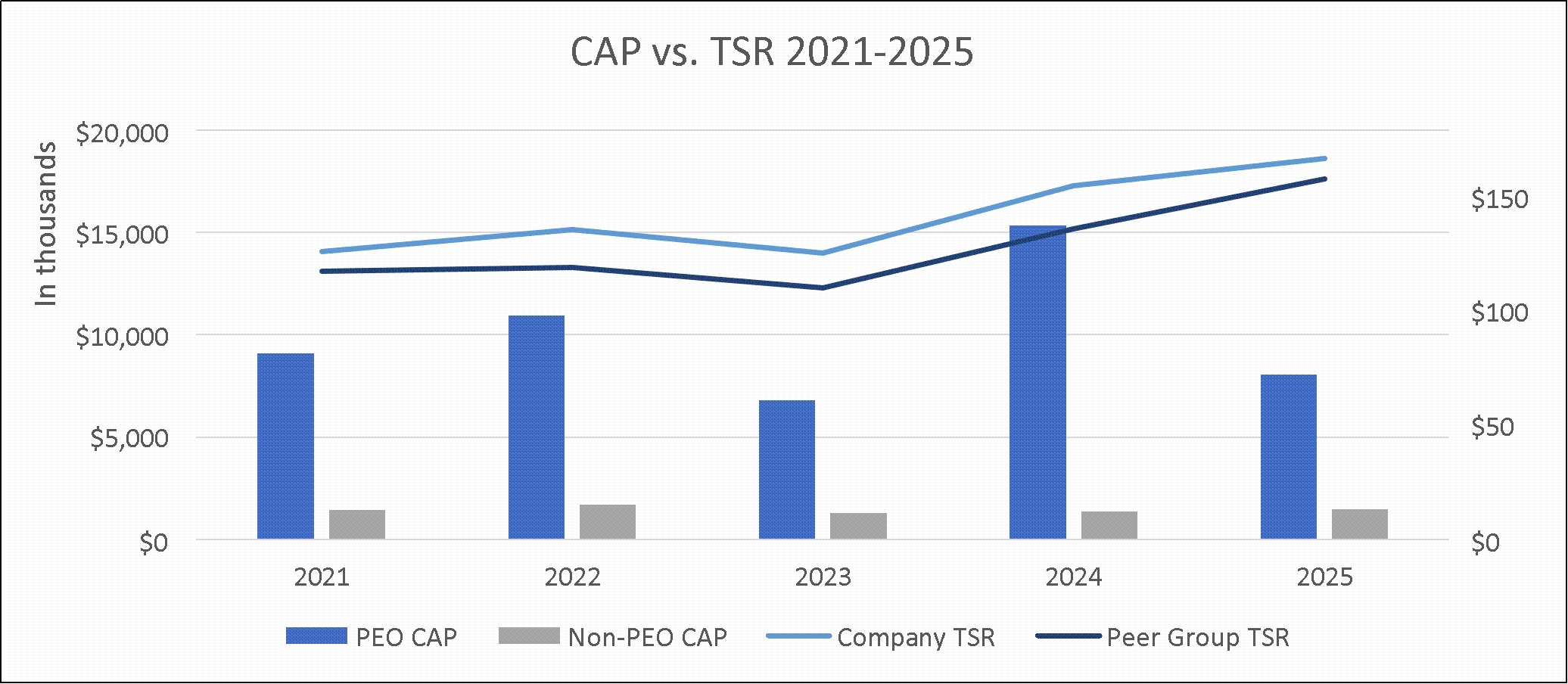
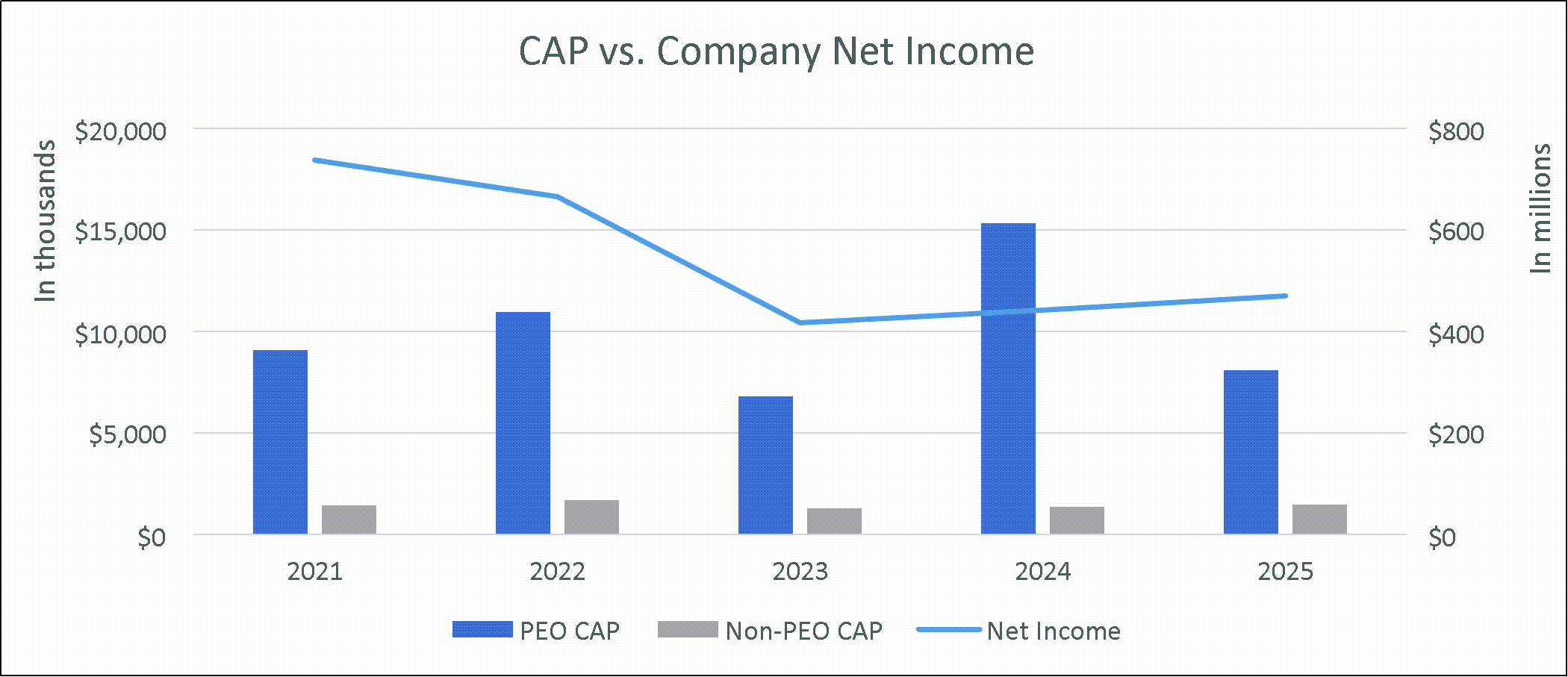
In 2021, the Company's net income includes the pre-tax impact of approximately $506 million related to a gain on transaction as a result of the Enable Midstream Partners, LP (“Enable”) and Energy Transfer, LP ("Energy Transfer") merger and associated Enable earnings recognized prior to the transaction. In 2022, the Company's net income includes the pre-tax impact of approximately $282 million related to the sale of Energy Transfer equity securities received by the Company as a result of the Enable/Energy transfer merger. After exiting its midstream segment in 2022, the Company’s net income in 2023, 2024 and 2025 reflects its operations primarily as an electric company.
50 OGE Energy Corp. 2026 Proxy Statement
51 OGE Energy Corp. 2026 Proxy Statement
|
|
COMPENSATION COMMITTEE REPORT |
The Compensation Committee oversees (i) the compensation of the Company's directors and principal officers, (ii) the Company's executive compensation policy and (iii) the Company's benefit programs.
The Compensation Committee has six members, none of whom has any relationship to the Company that interferes with the exercise of his or her independence from management and the Company, and each of whom qualifies as independent under the standards used by the NYSE, where the Company's shares are listed.
The Compensation Committee has reviewed and discussed with management the Compensation Discussion and Analysis appearing elsewhere in this proxy statement. Based on the review and discussions referred to above, the Compensation Committee recommended to the Company's Board of Directors that the Compensation Discussion and Analysis be included in the Company's proxy statement on Schedule 14A.
Compensation Committee
David L. Hauser, Chair
Frank A. Bozich, Member
Cathy R. Gates, Member
Luther C. Kissam, IV, Member
Judy R. McReynolds, Member
Sheila G. Talton, Member
52 OGE Energy Corp. 2026 Proxy Statement
|
|
POTENTIAL PAYMENTS UPON TERMINATION OR CHANGE OF CONTROL |
The Company has entered into change of control agreements with each officer of the Company, including each of the Named Executive Officers, that will become effective only upon a change of control of the Company. The change of control agreements are considered to be double trigger agreements because payment will only be made following a change of control and termination of employment. Under the agreements, a change of control generally means (i) any acquisition of 20 percent or more of the Company's Common Stock (subject to limited exceptions for acquisitions directly from the Company, acquisitions by the Company or one of the Company's employee benefit plans, or acquisitions pursuant to specified business combinations approved by a majority of the incumbent directors), (ii) directors of the Company as of the date of the agreements and those directors who have been elected subsequently and whose nomination was approved by such directors fail to constitute a majority of the Board, (iii) a merger, share exchange or sale of all or substantially all of the assets of the Company (each, a "business combination") (except specified business combinations approved by a majority of the incumbent directors), or (iv) shareholder approval of a complete liquidation or dissolution of the Company.
Under the agreements, the officer is to remain an employee for a three-year period following a change of control of the Company. During this three-year period following a change of control of the Company, the officer is entitled to (i) an annual base salary in an amount at least equal to his or her base salary prior to the change of control, (ii) an annual incentive payout in an amount at least equal to his or her highest incentive payout in the three years prior to the change of control and (iii) continued participation in the incentive, savings, retirement and welfare benefit plans. The officer also is entitled to payment of expenses and provision of fringe benefits to the extent paid or provided to (i) such officer prior to the change of control or (ii) if more favorable, other peer executives of the Company.
If an executive officer's employment is terminated by the Company "without cause" following a change of control, the executive officer is entitled to the following payments: (i) all accrued and unpaid compensation and a prorated annual incentive payout and (ii) a severance payment equal to 2.99 times the sum of such officer's (a) annual base salary and (b) highest recent annual incentive payout. The officer is entitled to receive such amounts in a lump-sum payment within 30 days of termination, although if the officer is a "specified employee" (within the meaning of Section 409A of the Code), payment of the prorated incentive payout and severance payment will be delayed until the first day of the seventh month following the officer's termination (or earlier death). The officer also is entitled to continued welfare benefits for three years and outplacement services. If these payments and benefits, when taken together with any other payments to the officer, would result in the imposition of the excise tax on excess parachute payments under Section 4999 of the Code, then the severance benefits will be reduced to the extent where no excise tax would be payable if such reduction results in a greater after-tax payment to the officer.
Assuming that a change of control had occurred and the Named Executive Officers were terminated on December 31, 2025, then they would have been entitled to the following lump sum severance payments under their change of control agreements: S. Trauschke, $8,952,803, C. Walworth, $3,028,747, W. Sultemeier, $2,907,603, D. Jones, $2,631,849 and D. Parker, $1,926,923. For these purposes, it is assumed that the payments would not result in the imposition of the excise tax on excess parachute payments, which if triggered, could result in a reduction of the foregoing amounts. They would also be entitled to outplacement services, valued at $50,000 each, and continued welfare benefits for three years at a value of $35,280 each. For these purposes we have assumed that health care costs will remain constant. These officers also would be entitled to the retirement benefits they would otherwise be entitled to receive as set forth in the 2025 Pension Benefits Table on page 46. Finally, matching credits under the nonqualified Deferred Compensation Plan would vest and the officers would be entitled to the benefits set forth in the 2025 Nonqualified Deferred Compensation Table on page 47.
In addition, pursuant to the terms of the Company's incentive compensation plans, upon a change of control, all performance units will vest and be paid out immediately in cash as if the applicable performance goals had been satisfied at target levels; all restricted stock units will vest and be paid out immediately in cash; and any annual incentive award outstanding for the year in which the participant's termination occurs for any reason, other than cause, within 24 months after the change of control will be paid in cash at target level on a prorated basis. Assuming that a change of control occurred on December 31, 2025 and that the price of the Company's Common Stock (and the change of control price) was $42.70 (the closing price on December 31, 2025), then the Named Executive Officers would have been entitled to the following lump sum payments for performance unit awards and restricted stock unit awards: S. Trauschke, $11,099,566, C. Walworth, $1,226,472, W. Sultemeier,
53 OGE Energy Corp. 2026 Proxy Statement
$1,668,588, D. Jones, $1,570,634 and D. Parker, $846,698. In addition, they would have received the same payout of the earned annual incentive compensation for 2025 that is set forth in the Non-Equity Incentive Plan Compensation column of the Summary Compensation Table on page 43 and the same payout of long-term compensation for the performance units whose three-year performance period ended December 31, 2025 as reflected in the Stock Awards - Value Realized on Vesting column in the 2025 Option Exercises and Stock Vested Table on page 46. The reason for the same payouts is that the individual would have been employed throughout the entire performance period for the awards. There were no stock options outstanding as of December 31, 2025.
If a Named Executive Officer terminates employment other than following a change of control as described above, such officer will be entitled to receive amounts earned during the course of his or her employment, including accrued salary and unpaid salary and unused vacation pay. If the termination was a result of death, disability or retirement, the executive officer or his or her representative would be entitled to a regular payout of any earned annual and long-term awards whose performance periods had ended prior to the individual's termination, and to a prorated payout (based on the individual's number of full months of employment during the applicable performance period) for other outstanding annual incentive awards and performance units when and if payouts of such awards are subsequently earned and are made to participants who did not terminate their employment; provided that with respect to the performance units, in the event of a termination of employment due to death or disability, the Compensation Committee may elect a payout equal to the target amount of the award payable within 60 days following such death or disability so long as such payment would comply with Section 409A of the Code. Assuming that the Named Executive Officers terminated their employment as a result of death, disability or retirement on December 31, 2025, each executive officer would have received the same payout of the earned annual incentive compensation for 2025 that is set forth in the Non-Equity Incentive Plan Compensation column of the Summary Compensation Table on page 43 and the same payout of long-term compensation for the performance units whose three-year performance period ended December 31, 2025 as reflected in the Stock Awards - Value Realized on Vesting column in the 2025 Option Exercises and Stock Vested Table on page 46. The reason for the same payouts is that the individual would have been employed throughout the entire performance period for the awards. For the outstanding grants of performance units whose performance periods ends on December 31, 2026 and December 31, 2027, and assuming that the Named Executive Officers terminated their employment as a result of death, disability or retirement on December 31, 2025, that the applicable goals for such performance units were subsequently satisfied at target levels and that the price of the Company's Common Stock was $42.70 (the closing price on December 31, 2025) at the time payouts of such performance units occurred, they would be entitled to receive the Company's Common Stock having the following values at the time payout of such performance units occurred: S. Trauschke, $2,714,126 for the performance units whose performance period ends December 31, 2026 and $1,047,844 for the performance units whose performance period ends December 31, 2027; C. Walworth, $176,778 for the performance units whose performance period ends December 31, 2026 and $177,347 for the performance units whose performance period ends December 31, 2027; W. Sultemeier, $408,013 for the performance units whose performance period ends December 31, 2026 and $157,520 for the performance units whose performance period ends December 31, 2027; D. Jones, $384,072 for the performance units whose performance period ends December 31, 2026 and $148,269 for the performance units whose performance period ends December 31, 2027; and D. Parker, $207,038 for the performance units whose performance period ends December 31, 2026 and $79,934 for the performance units whose performance period ends December 31, 2027. Alternatively, if the Compensation Committee elects to pay out the performance units for the performance periods ending December 31, 2026 and December 31, 2027 at target within 60 days of death or disability, and assuming that such death or disability occurred on December 31, 2025 and that the price of the Company's Common Stock was $42.70 (the closing price on December 31, 2025), they would be entitled to receive the Company's Common Stock having the following values: S. Trauschke, $7,214,720, C. Walworth, $797,209, W. Sultemeier, $1,084,580, D. Jones, $1,020,914, and D. Parker, $550,360.
All restricted stock units that have not vested will be forfeited upon a termination of employment; provided that in the event of a termination of employment due to death, disability, retirement or involuntary termination, the Compensation Committee may provide that all or a portion of the unvested units shall become vested. For the outstanding grants of restricted stock units whose restricted period ends on December 31, 2026 and December 31, 2027, and assuming that the Named Executive Officers terminated their employment as a result of death, disability, retirement or involuntary termination on December 31, 2025, that the Compensation Committee approved the pro rata vesting of all such restricted stock units, and that the price of the Company's Common Stock was $42.70 (the closing price on December 31, 2025), they would be entitled to receive the Company's Common Stock having the following values: S. Trauschke, $1,461,450 for the restricted stock units whose vesting period ends December 31, 2026 and $564,224 for the restricted stock units whose vesting period ends December 31, 2027; C. Walworth, $95,193 for the restricted stock units whose vesting period ends December 31, 2026 and $95,491 for the restricted stock units whose vesting period ends December 31, 2027; W. Sultemeier, $219,706 for the restricted stock units
54 OGE Energy Corp. 2026 Proxy Statement
whose vesting period ends December 31, 2026 and $84,816 for the restricted stock units whose vesting period ends December 31, 2027; D. Jones, $206,810 for the restricted stock units whose vesting period ends December 31, 2026 and $79,835 for the restricted stock units whose vesting period ends December 31, 2027; and D. Parker, $111,475 for the restricted stock units whose vesting period ends December 31, 2026 and $43,042 for the restricted stock units whose vesting period ends December 31, 2027.
In addition to the benefits described above, upon retirement, the Named Executive Officers will be entitled to receive the retirement benefits described in the 2025 Pension Benefits Table on page 46 and the nonqualified deferred compensation benefits set forth in the 2025 Nonqualified Deferred Compensation Table on page 47 as well as contributory lifetime retiree medical benefits if they were hired prior to February 1, 2000.
|
|
INFORMATION ABOUT SHAREHOLDINGS AND RELATED MATTERS |
Security Ownership. The following table shows the number of shares of the Company's Common Stock beneficially owned on March 16, 2026, by each Director, by each of the Named Executive Officers, by all Executive Officers and Directors as a group and by each shareholder owning five percent or more of the Company's Common Stock:
|
|
|
|
|
|
|
|
|
|
Number of Common |
|
|
Number of Common |
|
|
Shares (1) (2) |
|
|
Shares (1) (2) |
|
Frank A. Bozich |
|
39,786 |
|
S. Trauschke |
|
597,067 |
|
Peter D. Clarke |
|
35,828 |
|
C. Walworth |
|
41,210 |
|
Lyle G. Ganske |
|
12,056 |
|
W. Sultemeier |
|
71,143 |
|
Cathy R. Gates |
|
12,749 |
|
D. Jones |
|
50,668 |
|
David L. Hauser |
|
55,811 |
|
D. Parker |
|
34,486 |
|
Luther C. Kissam, IV |
|
30,328 |
|
|
|
|
Judy R. McReynolds |
|
65,327 |
|
|
|
|
David E. Rainbolt |
|
58,314 |
|
|
|
|
Sheila G. Talton |
|
49,345 |
|
All Executive Officers and Directors |
|
1,184,143 |
|
|
|
|
(as a group of 15 persons) |
|
|
BlackRock, Inc. (3) |
|
24,893,403 |
|
The Vanguard Group (4) |
|
21,173,212 |
|
55 East 52nd Street |
|
|
100 Vanguard Blvd. |
|
|
New York, NY 10055 |
|
|
Malvern, PA 19355 |
|
|
(1)Ownership by each executive officer is less than 0.3 percent of the class, by each director other than Mr. Trauschke is less than 0.1 percent of the class and, for all executive officers and directors as a group, is less than 1.0 percent of the class. Amounts shown include shares for which, in certain instances, an individual has disclaimed beneficial interest. Amounts shown for executive officers include 74,239 shares of the Company's Common Stock representing their interest in shares held under the Company's 401(k) Plan and Deferred Compensation Plan for which in certain instances they have voting power but not investment power.
(2)Amounts shown for Messrs. Bozich, Clarke, Ganske, Hauser, Kissam and Rainbolt and Mses. Gates, McReynolds and Talton include, 23,600; 33,978; 1,636; 52,811; 22,828; 43,314; 12,649; 64,327; and 49,345 common stock units, respectively, under the Company's Deferred Compensation Plan.
(3)Based on a Schedule 13G filed on January 23, 2024, BlackRock, Inc. along with certain other affiliates, is deemed to beneficially own these shares. These shares represented 12.1 percent of the Company's outstanding Common Stock on March 16, 2026.
(4)Based on a Schedule 13G filed on February 13, 2024, The Vanguard Group along with certain other affiliates, is deemed to beneficially own these shares. These shares represented 10.3 percent of the Company's outstanding Common Stock on March 16, 2026.
The information on share ownership is based on information furnished to us by the individuals listed above and all shares listed are beneficially owned by the individuals or by members of their immediate family unless otherwise indicated.
55 OGE Energy Corp. 2026 Proxy Statement
Equity Compensation Plan Information. The following table provides certain information as of December 31, 2025 with respect to the shares of the Company's Common Stock that may be issued under the existing equity compensation plan:
|
|
|
|
|
|
|
|
|
|
|
|
|
|
|
|
A |
|
|
|
B |
C |
|
|
|
Plan Category |
Number of
Securities
to be Issued
upon
Exercise of
Outstanding
Options |
|
|
|
Weighted
Average
Price of
Outstanding
Options |
Number of Securities
Remaining Available
for future issuances
under equity
compensation plans
(excluding securities
reflected in Column A) |
|
|
|
Equity Compensation Plans Approved by Shareholders |
|
912,197 |
|
|
(1 |
) |
N/A |
|
6,872,746 |
|
|
(2 |
) |
Equity Compensation Plans Not Approved by Shareholders |
|
— |
|
|
|
N/A |
N/A |
|
|
|
(1)Comprised of performance units and restricted stock units which have been granted under the OGE Energy Corp. 2022 Stock Incentive Plan. For performance units, this represents the target number of performance units granted. Actual number of performance units earned, if any, is dependent upon performance and may range from 0 percent to 200 percent of the target. There were no outstanding stock options as of December 31, 2025.
(2)Under the 2022 Stock Incentive Plan, restricted stock, restricted stock units, stock options, SARs and performance units may be granted to officers, directors and other key employees. Amount represents the maximum shares available for future issuances under OGE Energy Corp.'s equity compensation plan assuming settlement of the performance units at target.
Delinquent Section 16(a) Reports. Under federal securities laws, our directors and executive officers are required to report, within specified dates, their initial ownership in the Company's Common Stock and subsequent acquisitions, dispositions or other transfers of interest in such securities. We are required to disclose whether we have knowledge that any person required to file such a report may have failed to do so in a timely manner. To our knowledge, all of our officers and directors subject to such reporting obligations satisfied their reporting obligations in full in 2025.
Shareholder Proposals/Nomination of Directors. Any shareholder proposal intended to be included in the proxy statement for the Annual Meeting of Shareholders in 2027 must be received by the Company by December 2, 2026. Proposals received by that date, deemed to be proper for consideration at the Annual Meeting of Shareholders and otherwise conforming to the rules of the SEC, will be included in the 2027 proxy statement.
If you intend to submit a shareholder proposal for consideration at the Annual Meeting of Shareholders, but do not want it included in the proxy statement, you must follow the procedures established by our bylaws. These procedures require that you notify us in writing of your proposal. Your notice must be received by the Corporate Secretary at least 90 days prior to the meeting and must contain the following information:
•a brief description of the business you desire to bring before the Annual Meeting of Shareholders and your reasons for conducting such business at the Annual Meeting of Shareholders;
•the number of shares of the Company's Common Stock which you beneficially own; and
•any material interest you may have in the business being proposed.
Shareholders wishing to nominate a director candidate and have that candidate appear in the Company's proxy statement, should follow the procedures in the Company's bylaws and outlined on page 3 under "Corporate Governance - Director Qualifications and Nomination Process."
To comply with the universal proxy rules, stockholders who intend to solicit proxies in support of director nominees other than the company's nominees must provide notice that sets forth the information required by the Company’s bylaws and Rule 14a-19 under the Securities Exchange Act of 1934 no later than 90 days before the annual meeting.
Householding Information. We have adopted a procedure approved by the SEC called "householding." Under this procedure, certain shareholders of record who have the same address and last name and do not participate in electronic
56 OGE Energy Corp. 2026 Proxy Statement
delivery of proxy materials will receive only a single copy of our Notice of Internet Availability of Proxy Materials or, as applicable, our Annual Report to Shareholders or proxy statement, unless one or more of these shareholders notifies us that they would like to continue to receive individual copies. This will reduce our printing costs and postage fees. Shareholders who participate in householding will continue to receive separate proxy cards. Also, householding will not in any way affect dividend check or dividend reinvestment statement mailings.
If you and other shareholders of record with whom you share an address currently receive multiple copies of our Notice of Internet Availability of Proxy Materials or, as applicable, our Annual Report to Shareholders or proxy statement, or if you hold stock in more than one account, and in either case, you would like to receive only a single copy of the Notice of Internet Availability of Proxy Materials or, as applicable, our Annual Report to Shareholders or proxy statement for your household, please contact Computershare; P.O. Box 43006, Providence, RI 02940-3006 or phone toll free 1-888-216-8114.
If you participate in householding and would like to receive a separate copy of our Notice of Internet Availability of Proxy Materials or, as applicable, our Annual Report to Shareholders or proxy statement, please call us at 405-553-3406, email us at stock@oge.com or write us at: OGE Energy Corp. Shareholder Relations, 321 North Harvey, P.O. Box 321, Oklahoma City, Oklahoma 73101-0321. We will deliver the requested documents to you promptly upon receipt of your request.
Some banks, brokers and other nominee record holders may be participating in the practice of "householding" proxy statements and annual reports. This means that only a single copy of our Notice of Internet Availability of Proxy Materials, or our Annual Report to Shareholders or proxy statement may have been sent to multiple shareholders in your household. We will promptly deliver a separate copy of either document to you if you call us at 405-553-3406, email us at stock@oge.com or write us at: OGE Energy Corp. Shareholder Relations, 321 North Harvey, P.O. Box 321, Oklahoma City, Oklahoma 73101-0321. If you want to receive separate copies of our Annual Report to Shareholders and proxy statement in the future, or if you are receiving multiple copies and would like to receive only a single copy for your household, you should contact your bank, broker, or other nominee record holder.
57 OGE Energy Corp. 2026 Proxy Statement
|
|
|
|
|
|

|
 |
|
|
OGE ENERGY CORP. P.O. BOX 321 OKLAHOMA CITY, OK 73101-0321 ATTN: Casey Strange |
VOTE BY INTERNET - www.proxyvote.com or scan the QR Barcode above Use the Internet to transmit your voting instructions and for electronic delivery of information. Vote by 11:59 P.M. ET on 05/13/2026 for shares held directly and by 11:59 P.M. ET on 05/11/2026 for shares held in a Plan. Have your proxy card in hand when you access the web site and follow the instructions to obtain your records and to create an electronic voting instruction form. |
|
|
During the Meeting - Go to www.virtualshareholdermeeting.com/OGE2026 You may attend the meeting via the Internet and vote during the meeting. Have the information that is printed in the box marked by the arrow available and follow the instructions. |
|
[Shareholder Address] |
VOTE BY PHONE - 1-800-690-6903 Use any touch-tone telephone to transmit your voting instructions. Vote by 11:59 P.M. ET on 05/13/2026 for shares held directly and by 11:59 P.M. ET on 05/11/2026 for shares held in a Plan. Have your proxy card in hand when you call and then follow the instructions. |
|
VOTE BY MAIL Mark, sign and date your proxy card and return it in the postage-paid envelope we have provided or return it to Vote Processing, c/o Broadridge, 51 Mercedes Way, Edgewood, NY 11717. |
|
|
|
|
|
|
|
|
NAME OGE Energy Corp. Common Stock |
CONTROL # »»» SHARES PAGE 1 of 2 |

|
|
|
|
|
TO VOTE, MARK BLOCKS BELOW IN BLUE OR BLACK INK AS FOLLOWS: ☒ |
KEEP THIS PORTION FOR YOUR RECORDS |
|
DETACH AND RETURN THIS PORTION ONLY |
THIS PROXY CARD IS VALID ONLY WHEN SIGNED AND DATED. |
|
|
|
|
|
|
|
|
|
|
|
|
|
|
|
|
|
|
The Board of Directors recommends you vote FOR the following: |
|
|
|
|
|
|
1. Election of Directors |
Nominees |
For |
Against |
Abstain |
The Board of Directors recommends you vote FOR proposals 2 and 3. |
For |
Against |
Abstain |
|
1a. Frank A. Bozich
1b. Peter D. Clarke
1c. Lyle G. Ganske |
o
o
o |
o
o
o |
o
o
o |
2. Ratification of the appointment of Ernst & Young LLP as the Company's principal independent accountants for 2026. |
o |
o |
o |
|
1d. Cathy R. Gates |
o |
o |
o |
|
|
|
|
|
|
|
|
|
|
1e. David L. Hauser
1f. Luther C. Kissam, IV |
o
o |
o
o |
o
o |
3. Advisory Vote to Approve Named Executive Officer Compensation. |
o |
o |
o |
|
1g. David E. Rainbolt |
o |
o |
o |
|
|
|
|
|
|
|
|
|
|
1h. Sheila G. Talton
1i. Sean Trauschke |
o
o |
o
o |
o
o |
The Board of Directors recommends you vote AGAINST the following proposal: |
|
|
|
|
|
|
|
|
|
|
|
4. Shareholder Proposal Regarding Simple Majority Vote. |
o |
o |
o |
|
|
|
|
|
|
|
|
|
|
|
|
|
|
|
|
|
|
|
|
|
|
|
|
|
NOTE: In their discretion, the proxies are authorized to vote upon such other business as may properly come before the meeting. |
|
|
|
|
|
|
|
|
|
|
|
|
|
|
|
|
|
|
|
|
|
|
|
|
|
|
Please sign as name appears hereon. Joint owners should each sign. When signing as an attorney, executor, administrator, trustee or guardian, please give full title as such. |
|
|
|
|
|
|
|
|
|
|
|
|
|
|
|
|
|
|
|
|
|
|
|
|
|
|
|
|
|
|
|
|
|
|
|
SHARES |
|
|
|
|
|
|
|
CUSIP # |
Signature [PLEASE SIGN WITHIN BOX] |
Date |
JOB# |
Signature (Joint Owners) |
Date |
SEQUENCE # |
|
|
It is important that your shares are represented at this meeting, whether or not you attend the meeting online. To make sure your shares are represented, we urge you to vote by Internet, telephone, or complete and mail the proxy card above. |
|
Important Notice Regarding the Availability of Proxy Materials for the Annual Meeting: The Notice & Proxy Statement, Annual Report is/are available at www.proxyvote.com. |
|
|
|
|
Annual Meeting of OGE Energy Corp. Shareholders Thursday, May 14, 2026 10:00 a.m. CDT The undersigned hereby appoints David L. Hauser and Sean Trauschke, and each of them severally, with full power of substitution and with full power to act with or without the other, as the proxies of the undersigned to represent and to vote all shares of stock of OGE Energy Corp. held of record by the undersigned on March 16, 2026, at the Company's Annual Meeting of Shareholders to be held on May 14, 2026, and at all adjournments thereof, on all matters coming before said meeting. THIS PROXY, WHICH IS SOLICITED BY THE BOARD OF DIRECTORS, WILL BE VOTED AS DIRECTED. IF NO DIRECTION IS MADE, THIS PROXY WILL BE VOTED FOR THE ELECTION AS DIRECTORS OF THE NOMINEES NAMED ON THE REVERSE SIDE OF THIS PROXY CARD, FOR THE RATIFICATION OF THE APPOINTMENT OF ERNST & YOUNG LLP AS THE COMPANY'S PRINCIPAL INDEPENDENT ACCOUNTANTS FOR 2026, FOR THE APPROVAL OF OUR NAMED EXECUTIVE OFFICER COMPENSATION, AND AGAINST THE SHAREHOLDER PROPOSAL REGARDING SIMPLE MAJORITY VOTE. PLEASE VOTE BY INTERNET, TELEPHONE, OR MARK, DATE, SIGN AND RETURN THIS PROXY CARD PROMPTLY USING THE ENCLOSED ENVELOPE. Unless you attend and vote online during the meeting, you MUST vote by Internet, telephone, or sign and return your proxy in order to have your shares voted at the meeting. |
|
|
|
Continued and to be marked, dated and signed on the other side |
|