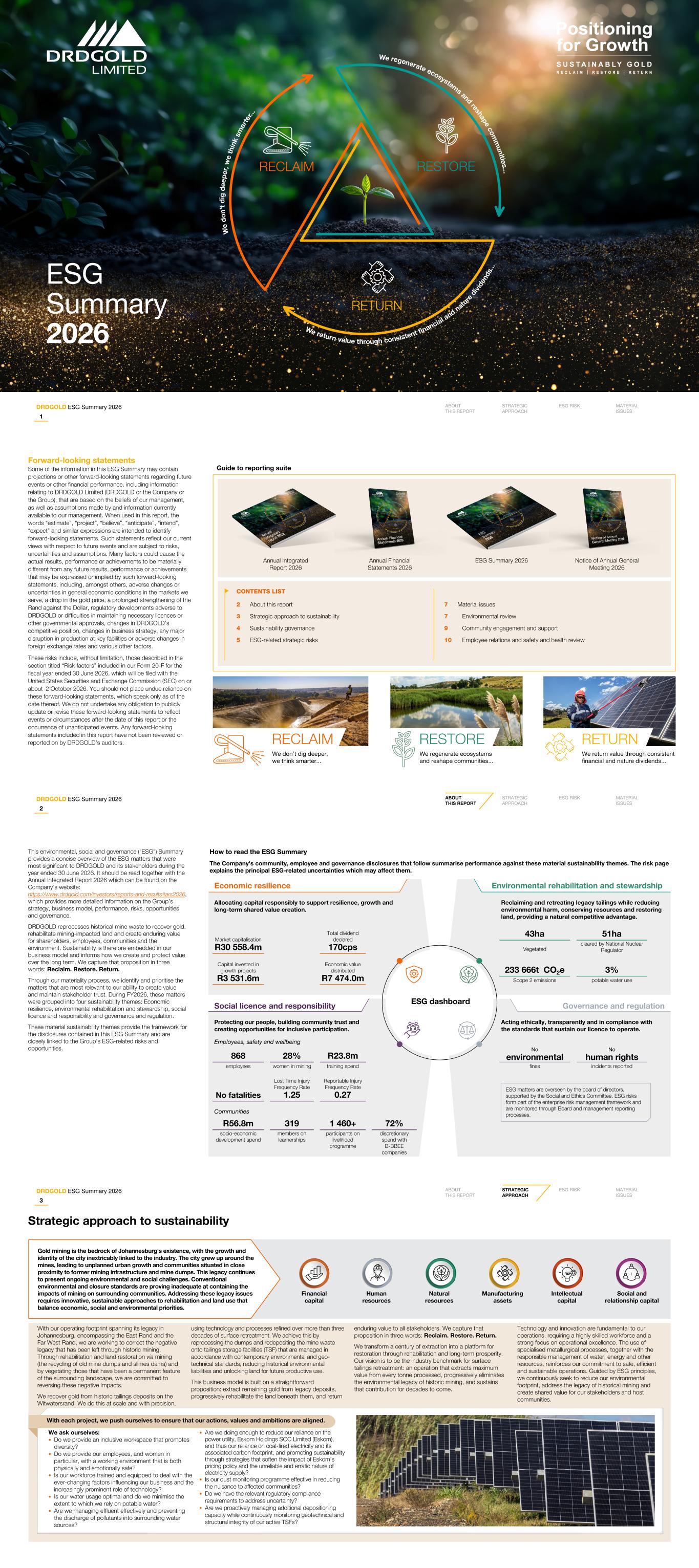
ESG Summary 2026 Forward-looking statements Some of the information in this ESG Summary may contain projections or other forward-looking statements regarding future events or other financial performance, including information relating to DRDGOLD Limited (DRDGOLD or the Company or the Group), that are based on the beliefs of our management, as well as assumptions made by and information currently available to our management. When used in this report, the words “estimate”, “project”, “believe”, “anticipate”, “intend”, “expect” and similar expressions are intended to identify forward-looking statements. Such statements reflect our current views with respect to future events and are subject to risks, uncertainties and assumptions. Many factors could cause the actual results, performance or achievements to be materially different from any future results, performance or achievements that may be expressed or implied by such forward-looking statements, including, amongst others, adverse changes or uncertainties in general economic conditions in the markets we serve, a drop in the gold price, a prolonged strengthening of the Rand against the Dollar, regulatory developments adverse to DRDGOLD or difficulties in maintaining necessary licences or other governmental approvals, changes in DRDGOLD’s competitive position, changes in business strategy, any major disruption in production at key facilities or adverse changes in foreign exchange rates and various other factors. These risks include, without limitation, those described in the section titled “Risk factors” included in our Form 20-F for the fiscal year ended 30 June 2026, which will be filed with the United States Securities and Exchange Commission (SEC) on or about 2 October 2026. You should not place undue reliance on these forward-looking statements, which speak only as of the date thereof. We do not undertake any obligation to publicly update or revise these forward-looking statements to reflect events or circumstances after the date of this report or the occurrence of unanticipated events. Any forward-looking statements included in this report have not been reviewed or reported on by DRDGOLD’s auditors. Guide to reporting suite Annual Integrated Report 2026 Annual Financial Statements 2026 ESG Summary 2026 Notice of Annual General Meeting 2026 CONTENTS LIST 2 About this report 7 Material issues 3 Strategic approach to sustainability 7 Environmental review 4 Sustainability governance 9 Community engagement and support 5 ESG-related strategic risks 10 Employee relations and safety and health review DRDGOLD ESG Summary 2026 ABOUT THIS REPORT STRATEGIC APPROACH ESG RISK MATERIAL ISSUES 1 We don’t dig deeper, we think smarter... We regenerate ecosystems and reshape communities... We return value through consistent financial and nature dividends... This environmental, social and governance ("ESG") Summary provides a concise overview of the ESG matters that were most significant to DRDGOLD and its stakeholders during the year ended 30 June 2026. It should be read together with the Annual Integrated Report 2026 which can be found on the Company’s website: https://www.drdgold.com/investors/reports-and-results#ars2026, which provides more detailed information on the Group’s strategy, business model, performance, risks, opportunities and governance. DRDGOLD reprocesses historical mine waste to recover gold, rehabilitate mining-impacted land and create enduring value for shareholders, employees, communities and the environment. Sustainability is therefore embedded in our business model and informs how we create and protect value over the long term. We capture that proposition in three words: Reclaim. Restore. Return. Through our materiality process, we identify and prioritise the matters that are most relevant to our ability to create value and maintain stakeholder trust. During FY2026, these matters were grouped into four sustainability themes: Economic resilience, environmental rehabilitation and stewardship, social licence and responsibility and governance and regulation. These material sustainability themes provide the framework for the disclosures contained in this ESG Summary and are closely linked to the Group's ESG-related risks and opportunities. How to read the ESG Summary The Company's community, employee and governance disclosures that follow summarise performance against these material sustainability themes. The risk page explains the principal ESG-related uncertainties which may affect them. DRDGOLD ESG Summary 2026 ABOUT THIS REPORT STRATEGIC APPROACH ESG RISK MATERIAL ISSUES 2 Economic resilience Environmental rehabilitation and stewardship Allocating capital responsibly to support resilience, growth and long-term shared value creation. Reclaiming and retreating legacy tailings while reducing environmental harm, conserving resources and restoring land, providing a natural competitive advantage. Market capitalisation R30 558.4m Total dividend declared 170cps 43ha 51ha Vegetated cleared by National Nuclear Regulator Capital invested in growth projects R3 531.6m Economic value distributed R7 474.0m 233 666t CO2e 3% Scope 2 emissions potable water use Social licence and responsibility Governance and regulation Protecting our people, building community trust and creating opportunities for inclusive participation. Acting ethically, transparently and in compliance with the standards that sustain our licence to operate. Employees, safety and wellbeing 868 28% R23.8m No environmental No human rights employees women in mining training spend fines incidents reported No fatalities Lost Time Injury Frequency Rate 1.25 Reportable Injury Frequency Rate 0.27 ESG matters are overseen by the board of directors, supported by the Social and Ethics Committee. ESG risks form part of the enterprise risk management framework and are monitored through Board and management reporting processes. Communities R56.8m 319 1 460+ 72% socio-economic development spend members on learnerships participants on livelihood programme discretionary spend with B-BBEE companies ESG dashboard Gold mining is the bedrock of Johannesburg's existence, with the growth and identity of the city inextricably linked to the industry. The city grew up around the mines, leading to unplanned urban growth and communities situated in close proximity to former mining infrastructure and mine dumps. This legacy continues to present ongoing environmental and social challenges. Conventional environmental and closure standards are proving inadequate at containing the impacts of mining on surrounding communities. Addressing these legacy issues requires innovative, sustainable approaches to rehabilitation and land use that balance economic, social and environmental priorities. Financial capital Human resources Natural resources Manufacturing assets Intellectual capital Social and relationship capital With our operating footprint spanning its legacy in Johannesburg, encompassing the East Rand and the Far West Rand, we are working to correct the negative legacy that has been left through historic mining. Through rehabilitation and land restoration via mining (the recycling of old mine dumps and slimes dams) and by vegetating those that have been a permanent feature of the surrounding landscape, we are committed to reversing these negative impacts. We recover gold from historic tailings deposits on the Witwatersrand. We do this at scale and with precision, using technology and processes refined over more than three decades of surface retreatment. We achieve this by reprocessing the dumps and redepositing the mine waste onto tailings storage facilities (TSF) that are managed in accordance with contemporary environmental and geo- technical standards, reducing historical environmental liabilities and unlocking land for future productive use. This business model is built on a straightforward proposition: extract remaining gold from legacy deposits, progressively rehabilitate the land beneath them, and return enduring value to all stakeholders. We capture that proposition in three words: Reclaim. Restore. Return. We transform a century of extraction into a platform for restoration through rehabilitation and long-term prosperity. Our vision is to be the industry benchmark for surface tailings retreatment: an operation that extracts maximum value from every tonne processed, progressively eliminates the environmental legacy of historic mining, and sustains that contribution for decades to come. Technology and innovation are fundamental to our operations, requiring a highly skilled workforce and a strong focus on operational excellence. The use of specialised metallurgical processes, together with the responsible management of water, energy and other resources, reinforces our commitment to safe, efficient and sustainable operations. Guided by ESG principles, we continuously seek to reduce our environmental footprint, address the legacy of historical mining and create shared value for our stakeholders and host communities. With each project, we push ourselves to ensure that our actions, values and ambitions are aligned. We ask ourselves: • Do we provide an inclusive workspace that promotes diversity? • Do we provide our employees, and women in particular, with a working environment that is both physically and emotionally safe? • Is our workforce trained and equipped to deal with the ever-changing factors influencing our business and the increasingly prominent role of technology? • Is our water usage optimal and do we minimise the extent to which we rely on potable water? • Are we managing effluent effectively and preventing the discharge of pollutants into surrounding water sources? • Are we doing enough to reduce our reliance on the power utility, Eskom Holdings SOC Limited (Eskom), and thus our reliance on coal-fired electricity and its associated carbon footprint, and promoting sustainability through strategies that soften the impact of Eskom’s pricing policy and the unreliable and erratic nature of electricity supply? • Is our dust monitoring programme effective in reducing the nuisance to affected communities? • Do we have the relevant regulatory compliance requirements to address uncertainty? • Are we proactively managing additional depositioning capacity while continuously monitoring geotechnical and structural integrity of our active TSFs? DRDGOLD ESG Summary 2026 ABOUT THIS REPORT STRATEGIC APPROACH ESG RISK MATERIAL ISSUES 3 Strategic approach to sustainability
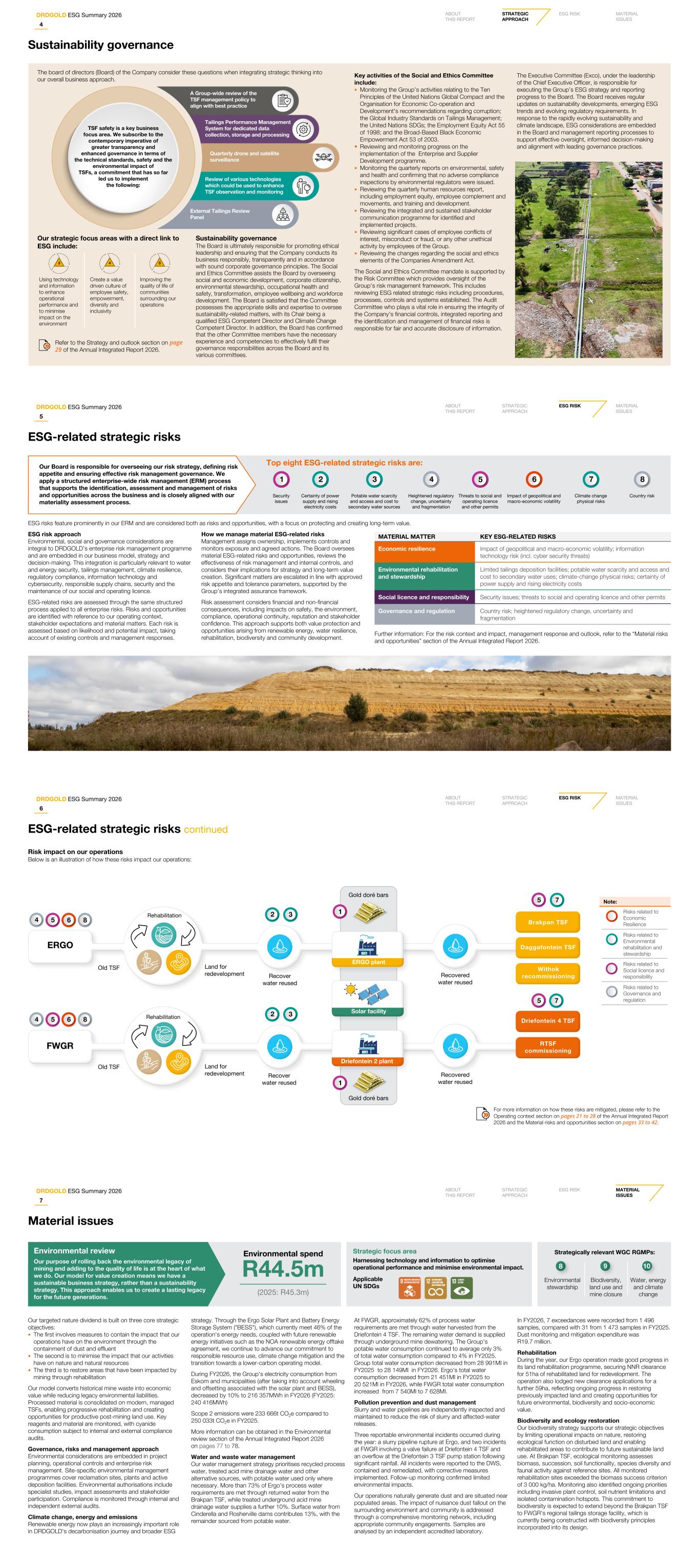
The board of directors (Board) of the Company consider these questions when integrating strategic thinking into our overall business approach. Our strategic focus areas with a direct link to ESG include: Using technology and information to enhance operational performance and to minimise impact on the environment Create a value driven culture of employee safety, empowerment, diversity and inclusivity Improving the quality of life of communities surrounding our operations Sustainability governance The Board is ultimately responsible for promoting ethical leadership and ensuring that the Company conducts its business responsibly, transparently and in accordance with sound corporate governance principles. The Social and Ethics Committee assists the Board by overseeing social and economic development, corporate citizenship, environmental stewardship, occupational health and safety, transformation, employee wellbeing and workforce development. The Board is satisfied that the Committee possesses the appropriate skills and expertise to oversee sustainability-related matters, with its Chair being a qualified ESG Competent Director and Climate Change Competent Director. In addition, the Board has confirmed that the other Committee members have the necessary experience and competencies to effectively fulfil their governance responsibilities across the Board and its various committees. DRDGOLD ESG Summary 2026 ABOUT THIS REPORT STRATEGIC APPROACH ESG RISK MATERIAL ISSUES 4 Sustainability governance TSF safety is a key business focus area. We subscribe to the contemporary imperative of greater transparency and enhanced governance in terms of the technical standards, safety and the environmental impact of TSFs, a commitment that has so far led us to implement the following: A Group-wide review of the TSF management policy to align with best practice Tailings Performance Management System for dedicated data collection, storage and processing Quarterly drone and satellite surveillance Review of various technologies which could be used to enhance TSF observation and monitoring External Tailings Review Panel Key activities of the Social and Ethics Committee include: • Monitoring the Group’s activities relating to the Ten Principles of the United Nations Global Compact and the Organisation for Economic Co-operation and Development's recommendations regarding corruption; the Global Industry Standards on Tailings Management; the United Nations SDGs; the Employment Equity Act 55 of 1998; and the Broad-Based Black Economic Empowerment Act 53 of 2003. • Reviewing and monitoring progress on the implementation of the Enterprise and Supplier Development programme. • Monitoring the quarterly reports on environmental, safety and health and confirming that no adverse compliance inspections by environmental regulators were issued. • Reviewing the quarterly human resources report, including employment equity, employee complement and movements, and training and development. • Reviewing the integrated and sustained stakeholder communication programme for identified and implemented projects. • Reviewing significant cases of employee conflicts of interest, misconduct or fraud, or any other unethical activity by employees of the Group. • Reviewing the changes regarding the social and ethics elements of the Companies Amendment Act. The Social and Ethics Committee mandate is supported by the Risk Committee which provides oversight of the Group's risk management framework. This includes reviewing ESG related strategic risks including procedures, processes, controls and systems established. The Audit Committee who plays a vital role in ensuring the integrity of the Company's financial controls, integrated reporting and the identification and management of financial risks is responsible for fair and accurate disclosure of information. Refer to the Strategy and outlook section on page 29 of the Annual Integrated Report 2026. The Executive Committee (Exco), under the leadership of the Chief Executive Officer, is responsible for executing the Group’s ESG strategy and reporting progress to the Board. The Board receives regular updates on sustainability developments, emerging ESG trends and evolving regulatory requirements. In response to the rapidly evolving sustainability and climate landscape, ESG considerations are embedded in the Board and management reporting processes to support effective oversight, informed decision-making and alignment with leading governance practices. Our Board is responsible for overseeing our risk strategy, defining risk appetite and ensuring effective risk management governance. We apply a structured enterprise-wide risk management (ERM) process that supports the identification, assessment and management of risks and opportunities across the business and is closely aligned with our materiality assessment process. ESG risks feature prominently in our ERM and are considered both as risks and opportunities, with a focus on protecting and creating long-term value. ESG risk approach Environmental, social and governance considerations are integral to DRDGOLD’s enterprise risk management programme and are embedded in our business model, strategy and decision-making. This integration is particularly relevant to water and energy security, tailings management, climate resilience, regulatory compliance, information technology and cybersecurity, responsible supply chains, security and the maintenance of our social and operating licence. ESG-related risks are assessed through the same structured process applied to all enterprise risks. Risks and opportunities are identified with reference to our operating context, stakeholder expectations and material matters. Each risk is assessed based on likelihood and potential impact, taking account of existing controls and management responses. How we manage material ESG-related risks Management assigns ownership, implements controls and monitors exposure and agreed actions. The Board oversees material ESG-related risks and opportunities, reviews the effectiveness of risk management and internal controls, and considers their implications for strategy and long-term value creation. Significant matters are escalated in line with approved risk appetite and tolerance parameters, supported by the Group’s integrated assurance framework. Risk assessment considers financial and non-financial consequences, including impacts on safety, the environment, compliance, operational continuity, reputation and stakeholder confidence. This approach supports both value protection and opportunities arising from renewable energy, water resilience, rehabilitation, biodiversity and community development. MATERIAL MATTER KEY ESG-RELATED RISKS Economic resilience Impact of geopolitical and macro-economic volatility; information technology risk (incl. cyber security threats) Environmental rehabilitation and stewardship Limited tailings deposition facilities; potable water scarcity and access and cost to secondary water uses; climate-change physical risks; certainty of power supply and rising electricity costs Social licence and responsibility Security issues; threats to social and operating licence and other permits Governance and regulation Country risk; heightened regulatory change, uncertainty and fragmentation Further information: For the risk context and impact, management response and outlook, refer to the “Material risks and opportunities” section of the Annual Integrated Report 2026. DRDGOLD ESG Summary 2026 ABOUT THIS REPORT STRATEGIC APPROACH ESG RISK MATERIAL ISSUES 5 ESG-related strategic risks Top eight ESG-related strategic risks are: Security issues Certainty of power supply and rising electricity costs Potable water scarcity and access and cost to secondary water sources Heightened regulatory change, uncertainty and fragmentation Threats to social and operating licence and other permits Impact of geopolitical and macro-economic volatility Climate change physical risks Country risk Risk impact on our operations Below is an illustration of how these risks impact our operations: DRDGOLD ESG Summary 2026 ABOUT THIS REPORT STRATEGIC APPROACH ESG RISK MATERIAL ISSUES 6 ESG-related strategic risks continued Note: Risks related to Economic Resilience Risks related to Environmental rehabilitation and stewardship Risks related to Social licence and responsibility Risks related to Governance and regulation For more information on how these risks are mitigated, please refer to the Operating context section on pages 21 to 28 of the Annual Integrated Report 2026 and the Material risks and opportunities section on pages 33 to 42. ERGO FWGR Rehabilitation Rehabilitation Old TSF Old TSF Land for redevelopment Land for redevelopment Recover water reused Recover water reused Gold doré bars ERGO plant Gold doré bars Recovered water reused Recovered water reused Brakpan TSF Solar facility Driefontein 2 plant Daggafontein TSF Withok recommissioning Driefontein 4 TSF RTSF commissioning Our targeted nature dividend is built on three core strategic objectives: • The first involves measures to contain the impact that our operations have on the environment through the containment of dust and effluent • The second is to minimise the impact that our activities have on nature and natural resources • The third is to restore areas that have been impacted by mining through rehabilitation Our model converts historical mine waste into economic value while reducing legacy environmental liabilities. Processed material is consolidated on modern, managed TSFs, enabling progressive rehabilitation and creating opportunities for productive post-mining land use. Key reagents and material are monitored, with cyanide consumption subject to internal and external compliance audits. Governance, risks and management approach Environmental considerations are embedded in project planning, operational controls and enterprise risk management. Site-specific environmental management programmes cover reclamation sites, plants and active deposition facilities. Environmental authorisations include specialist studies, impact assessments and stakeholder participation. Compliance is monitored through internal and independent external audits. Climate change, energy and emissions Renewable energy now plays an increasingly important role in DRDGOLD's decarbonisation journey and broader ESG strategy. Through the Ergo Solar Plant and Battery Energy Storage System ("BESS"), which currently meet 46% of the operation's energy needs, coupled with future renewable energy initiatives such as the NOA renewable energy offtake agreement, we continue to advance our commitment to responsible resource use, climate change mitigation and the transition towards a lower-carbon operating model. During FY2026, the Group's electricity consumption from Eskom and municipalities (after taking into account wheeling and offsetting associated with the solar plant and BESS), decreased by 10% to 216 357MWh in FY2026 (FY2025: 240 416MWh) Scope 2 emissions were 233 666t CO2e compared to 250 033t CO2e in FY2025. More information can be obtained in the Environmental review section of the Annual Integrated Report 2026 on pages 77 to 78. Water and waste water management Our water management strategy prioritises recycled process water, treated acid mine drainage water and other alternative sources, with potable water used only where necessary. More than 73% of Ergo's process water requirements are met through returned water from the Brakpan TSF, while treated underground acid mine drainage water supplies a further 10%. Surface water from Cinderella and Rosherville dams contributes 13%, with the remainder sourced from potable water. At FWGR, approximately 62% of process water requirements are met through water harvested from the Driefontein 4 TSF. The remaining water demand is supplied through underground mine dewatering. The Group's potable water consumption continued to average only 3% of total water consumption compared to 4% in FY2025. Group total water consumption decreased from 28 991MI in FY2025 to 28 149Ml in FY2026. Ergo's total water consumption decreased from 21 451MI in FY2025 to 20 521Ml in FY2026, while FWGR total water consumption increased from 7 540Ml to 7 628MI. Pollution prevention and dust management Slurry and water pipelines are independently inspected and maintained to reduce the risk of slurry and affected-water releases. Three reportable environmental incidents occurred during the year: a slurry pipeline rupture at Ergo, and two incidents at FWGR involving a valve failure at Driefontein 4 TSF and an overflow at the Driefontein 3 TSF pump station following significant rainfall. All incidents were reported to the DWS, contained and remediated, with corrective measures implemented. Follow-up monitoring confirmed limited environmental impacts. Our operations naturally generate dust and are situated near populated areas. The impact of nuisance dust fallout on the surrounding environment and community is addressed through a comprehensive monitoring network, including appropriate community engagements. Samples are analysed by an independent accredited laboratory. In FY2026, 7 exceedances were recorded from 1 496 samples, compared with 31 from 1 473 samples in FY2025. Dust monitoring and mitigation expenditure was R19.7 million. Rehabilitation During the year, our Ergo operation made good progress in its land rehabilitation programme, securing NNR clearance for 51ha of rehabilitated land for redevelopment. The operation also lodged new clearance applications for a further 59ha, reflecting ongoing progress in restoring previously impacted land and creating opportunities for future environmental, biodiversity and socio-economic value. Biodiversity and ecology restoration Our biodiversity strategy supports our strategic objectives by limiting operational impacts on nature, restoring ecological function on disturbed land and enabling rehabilitated areas to contribute to future sustainable land use. At Brakpan TSF, ecological monitoring assesses biomass, succession, soil functionality, species diversity and faunal activity against reference sites. All monitored rehabilitation sites exceeded the biomass success criterion of 3 000 kg/ha. Monitoring also identified ongoing priorities including invasive plant control, soil nutrient limitations and isolated contamination hotspots. This commitment to biodiversity is expected to extend beyond the Brakpan TSF to FWGR's regional tailings storage facility, which is currently being constructed with biodiversity principles incorporated into its design. DRDGOLD ESG Summary 2026 ABOUT THIS REPORT STRATEGIC APPROACH ESG RISK MATERIAL ISSUES 7 Material issues Environmental spend R44.5m (2025: R45.3m) Strategic focus area Harnessing technology and information to optimise operational performance and minimise environmental impact. Applicable UN SDGs Environmental review Our purpose of rolling back the environmental legacy of mining and adding to the quality of life is at the heart of what we do. Our model for value creation means we have a sustainable business strategy, rather than a sustainability strategy. This approach enables us to create a lasting legacy for the future generations. Strategically relevant WGC RGMPs: Environmental stewardship Biodiversity, land use and mine closure Water, energy and climate change
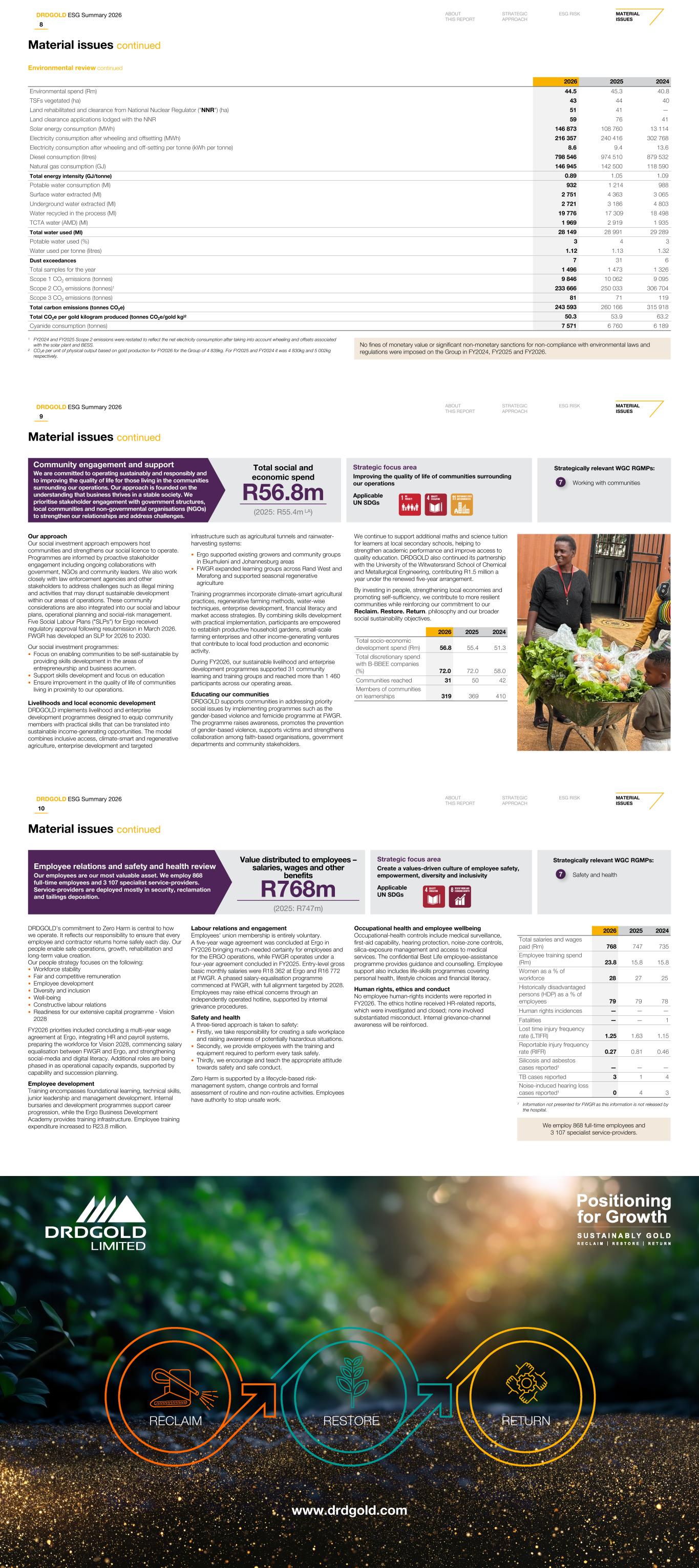
Environmental review continued 2026 2025 2024 Environmental spend (Rm) 44.5 45.3 40.8 TSFs vegetated (ha) 43 44 40 Land rehabilitated and clearance from National Nuclear Regulator ("NNR") (ha) 51 41 — Land clearance applications lodged with the NNR 59 76 41 Solar energy consumption (MWh) 146 873 108 760 13 114 Electricity consumption after wheeling and offsetting (MWh) 216 357 240 416 302 768 Electricity consumption after wheeling and off-setting per tonne (kWh per tonne) 8.6 9.4 13.6 Diesel consumption (litres) 798 546 974 510 879 532 Natural gas consumption (GJ) 146 945 142 500 118 590 Total energy intensity (GJ/tonne) 0.89 1.05 1.09 Potable water consumption (Ml) 932 1 214 988 Surface water extracted (Ml) 2 751 4 363 3 065 Underground water extracted (Ml) 2 721 3 186 4 803 Water recycled in the process (Ml) 19 776 17 309 18 498 TCTA water (AMD) (Ml) 1 969 2 919 1 935 Total water used (Ml) 28 149 28 991 29 289 Potable water used (%) 3 4 3 Water used per tonne (litres) 1.12 1.13 1.32 Dust exceedances 7 31 6 Total samples for the year 1 496 1 473 1 326 Scope 1 CO2 emissions (tonnes) 9 846 10 062 9 095 Scope 2 CO2 emissions (tonnes)1 233 666 250 033 306 704 Scope 3 CO2 emissions (tonnes) 81 71 119 Total carbon emissions (tonnes CO2e) 243 593 260 166 315 918 Total CO2e per gold kilogram produced (tonnes CO2e/gold kg)2 50.3 53.9 63.2 Cyanide consumption (tonnes) 7 571 6 760 6 189 1 FY2024 and FY2025 Scope 2 emissions were restated to reflect the net electricity consumption after taking into account wheeling and offsets associated with the solar plant and BESS. 2 CO2e per unit of physical output based on gold production for FY2026 for the Group of 4 839kg. For FY2025 and FY2024 it was 4 830kg and 5 002kg respectively. No fines of monetary value or significant non-monetary sanctions for non-compliance with environmental laws and regulations were imposed on the Group in FY2024, FY2025 and FY2026. DRDGOLD ESG Summary 2026 ABOUT THIS REPORT STRATEGIC APPROACH ESG RISK MATERIAL ISSUES 8 Material issues continued Our approach Our social investment approach empowers host communities and strengthens our social licence to operate. Programmes are informed by proactive stakeholder engagement including ongoing collaborations with government, NGOs and community leaders. We also work closely with law enforcement agencies and other stakeholders to address challenges such as illegal mining and activities that may disrupt sustainable development within our areas of operations. These community considerations are also integrated into our social and labour plans, operational planning and social-risk management. Five Social Labour Plans ("SLPs") for Ergo received regulatory approval following resubmission in March 2026. FWGR has developed an SLP for 2026 to 2030. Our social investment programmes: • Focus on enabling communities to be self-sustainable by providing skills development in the areas of entrepreneurship and business acumen. • Support skills development and focus on education • Ensure improvement in the quality of life of communities living in proximity to our operations. Livelihoods and local economic development DRDGOLD implements livelihood and enterprise development programmes designed to equip community members with practical skills that can be translated into sustainable income-generating opportunities. The model combines inclusive access, climate-smart and regenerative agriculture, enterprise development and targeted infrastructure such as agricultural tunnels and rainwater- harvesting systems: • Ergo supported existing growers and community groups in Ekurhuleni and Johannesburg areas • FWGR expanded learning groups across Rand West and Merafong and supported seasonal regenerative agriculture Training programmes incorporate climate-smart agricultural practices, regenerative farming methods, water-wise techniques, enterprise development, financial literacy and market access strategies. By combining skills development with practical implementation, participants are empowered to establish productive household gardens, small-scale farming enterprises and other income-generating ventures that contribute to local food production and economic activity. During FY2026, our sustainable livelihood and enterprise development programmes supported 31 community learning and training groups and reached more than 1 460 participants across our operating areas. Educating our communities DRDGOLD supports communities in addressing priority social issues by implementing programmes such as the gender-based violence and femicide programme at FWGR. The programme raises awareness, promotes the prevention of gender-based violence, supports victims and strengthens collaboration among faith-based organisations, government departments and community stakeholders. We continue to support additional maths and science tuition for learners at local secondary schools, helping to strengthen academic performance and improve access to quality education. DRDGOLD also continued its partnership with the University of the Witwatersrand School of Chemical and Metallurgical Engineering, contributing R1.5 million a year under the renewed five-year arrangement. By investing in people, strengthening local economies and promoting self-sufficiency, we contribute to more resilient communities while reinforcing our commitment to our Reclaim. Restore. Return. philosophy and our broader social sustainability objectives. 2026 2025 2024 Total socio-economic development spend (Rm) 56.8 55.4 51.3 Total discretionary spend with B-BBEE companies (%) 72.0 72.0 58.0 Communities reached 31 50 42 Members of communities on learnerships 319 369 410 DRDGOLD ESG Summary 2026 ABOUT THIS REPORT STRATEGIC APPROACH ESG RISK MATERIAL ISSUES 9 Material issues continued Total social and economic spend R56.8m (2025: R55.4m LA) Strategic focus area Improving the quality of life of communities surrounding our operations Applicable UN SDGs Community engagement and support We are committed to operating sustainably and responsibly and to improving the quality of life for those living in the communities surrounding our operations. Our approach is founded on the understanding that business thrives in a stable society. We prioritise stakeholder engagement with government structures, local communities and non-governmental organisations (NGOs) to strengthen our relationships and address challenges. Strategically relevant WGC RGMPs: Working with communities DRDGOLD’s commitment to Zero Harm is central to how we operate. It reflects our responsibility to ensure that every employee and contractor returns home safely each day. Our people enable safe operations, growth, rehabilitation and long-term value creation. Our people strategy focuses on the following: • Workforce stability • Fair and competitive remuneration • Employee development • Diversity and inclusion • Well-being • Constructive labour relations • Readiness for our extensive capital programme - Vision 2028 FY2026 priorities included concluding a multi-year wage agreement at Ergo, integrating HR and payroll systems, preparing the workforce for Vision 2028, commencing salary equalisation between FWGR and Ergo, and strengthening social-media and digital literacy. Additional roles are being phased in as operational capacity expands, supported by capability and succession planning. Employee development Training encompasses foundational learning, technical skills, junior leadership and management development. Internal bursaries and development programmes support career progression, while the Ergo Business Development Academy provides training infrastructure. Employee training expenditure increased to R23.8 million. Labour relations and engagement Employees' union membership is entirely voluntary. A five-year wage agreement was concluded at Ergo in FY2026 bringing much-needed certainty for employees and for the ERGO operations, while FWGR operates under a four-year agreement concluded in FY2025. Entry-level gross basic monthly salaries were R18 362 at Ergo and R16 772 at FWGR. A phased salary-equalisation programme commenced at FWGR, with full alignment targeted by 2028. Employees may raise ethical concerns through an independently operated hotline, supported by internal grievance procedures. Safety and health A three-tiered approach is taken to safety: • Firstly, we take responsibility for creating a safe workplace and raising awareness of potentially hazardous situations. • Secondly, we provide employees with the training and equipment required to perform every task safely. • Thirdly, we encourage and teach the appropriate attitude towards safety and safe conduct. Zero Harm is supported by a lifecycle-based risk- management system, change controls and formal assessment of routine and non-routine activities. Employees have authority to stop unsafe work. Occupational health and employee wellbeing Occupational-health controls include medical surveillance, first-aid capability, hearing protection, noise-zone controls, silica-exposure management and access to medical services. The confidential Best Life employee-assistance programme provides guidance and counselling. Employee support also includes life-skills programmes covering personal health, lifestyle choices and financial literacy. Human rights, ethics and conduct No employee human-rights incidents were reported in FY2026. The ethics hotline received HR-related reports, which were investigated and closed; none involved substantiated misconduct. Internal grievance-channel awareness will be reinforced. 2026 2025 2024 Total salaries and wages paid (Rm) 768 747 735 Employee training spend (Rm) 23.8 15.8 15.8 Women as a % of workforce 28 27 25 Historically disadvantaged persons (HDP) as a % of employees 79 79 78 Human rights incidences — — — Fatalities — — 1 Lost time injury frequency rate (LTIFR) 1.25 1.63 1.15 Reportable injury frequency rate (RIFR) 0.27 0.81 0.46 Silicosis and asbestos cases reported1 — — — TB cases reported 3 1 4 Noise-induced hearing loss cases reported1 0 4 3 1 Information not presented for FWGR as this information is not released by the hospital. We employ 868 full-time employees and 3 107 specialist service-providers. DRDGOLD ESG Summary 2026 ABOUT THIS REPORT STRATEGIC APPROACH ESG RISK MATERIAL ISSUES 10 Material issues continued Value distributed to employees – salaries, wages and other benefits R768m (2025: R747m) Strategic focus area Create a values-driven culture of employee safety, empowerment, diversity and inclusivity Applicable UN SDGs Employee relations and safety and health review Our employees are our most valuable asset. We employ 868 full-time employees and 3 107 specialist service-providers. Service-providers are deployed mostly in security, reclamation and tailings deposition. Strategically relevant WGC RGMPs: Safety and health www.drdgold.com