
Q4 2026 CEO Letter & Financial Highlights .2
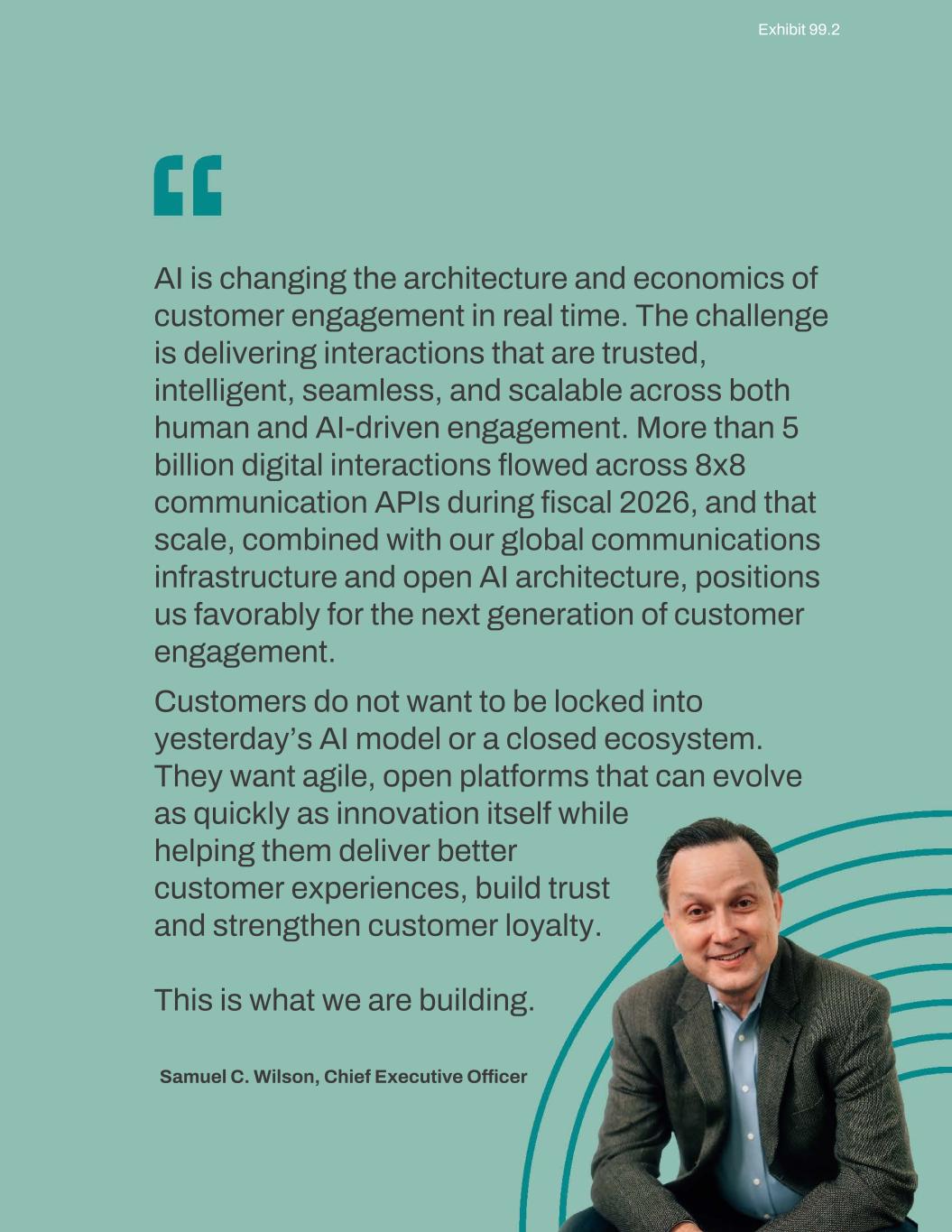
AI is changing the architecture and economics of customer engagement in real time. The challenge is delivering interactions that are trusted, intelligent, seamless, and scalable across both human and AI-driven engagement. More than 5 billion digital interactions flowed across 8x8 communication APIs during fiscal 2026, and that scale, combined with our global communications infrastructure and open AI architecture, positions us favorably for the next generation of customer engagement. Customers do not want to be locked into yesterday’s AI model or a closed ecosystem. They want agile, open platforms that can evolve as quickly as innovation itself while helping them deliver better customer experiences, build trust and strengthen customer loyalty. This is what we are building. Samuel C. Wilson, Chief Executive Officer .2
Fourth Quarter Fiscal 2026 Dear Stockholders, Customers, Partners and Employees, Fiscal 2026 marked a turning point for 8x8. Our Q4 results demonstrated improving execution, operating discipline, and growing momentum across the business. We delivered four consecutive quarters of year-over-year revenue growth, generated our first GAAP-profitable full fiscal year since 2015, increased net income and earnings per share, and strengthened our balance sheet, all while continuing to reposition the company around the long-term transformation underway in enterprise communications and customer experience. Q4 2026 Letter to Stockholders .2 3
Building for the Next Phase of Enterprise Communications More importantly, we believe fiscal 2026 validated the strategy we have been building toward for several years. The communications market is undergoing a structural transition. Enterprises are moving away from disconnected point solutions and toward integrated platforms that combine communications, customer engagement, APIs, AI, and workflow automation. At the same time, the industry is shifting from traditional seat-based economics toward usage-based engagement models tied directly to customer interactions and business outcomes. We built 8x8 for this transition. Today, our platform combines carrier-grade global voice infrastructure, programmable communication APIs, UCaaS, CCaaS, digital engagement, authentication capabilities, workflow orchestration, and embedded AI into a single architecture designed to support both human and AI-driven interactions at enterprise scale. Why Communications Infrastructure Matters in the AI Era We believe this matters more than ever in the AI era. Voice is not a legacy channel in an AI-driven world. It is the bridge between automated execution and human judgment. As enterprises move from human-to-human communications toward human-to-agent and agent-to-agent interactions, communications infrastructure increasingly becomes a strategic control layer. Reliability, security, trust, and orchestration are foundational requirements for every interaction. The challenge is no longer using AI to generate responses or drive engagement. We are already seeing both generative and agentic AI drive a surge in the use of communication APIs across voice, messaging, and digital channels for both inbound and outbound customer engagement. More than 5 billion interactions were enabled through our communication APIs in fiscal 2026, resulting in record usage-based revenue. Usage based revenue, which includes communication APIs, AI solutions, digital channels, and usage-based telecom services, grew more than 70% year-over-year in the fourth quarter and represented approximately 23% of service revenue, up from approximately 14% in the fourth quarter of fiscal 2025. We believe this reflects a broader industry shift. Customers increasingly want platforms capable of orchestrating trusted, AI-enabled customer interactions across voice, messaging, APIs, workflows, and human escalation paths at global scale. The real challenge is not generating interactions. Delivering interactions that feel seamless, secure, intelligent, and trustworthy is much harder. AI agents must be able to hear clearly, understand intent accurately, authenticate securely, and know exactly when to hand Q4 2026 Letter to Stockholders .2 4
interactions to a human employee. That requires more than another AI model. It requires highly reliable communications infrastructure and a platform capable of orchestrating interactions seamlessly across both human and agentic layers. The Shift Toward Open and Adaptable AI Platforms This shift is redefining where value accrues in enterprise communications. We believe the winners in this next phase of the market will not simply be companies with AI models, but companies that can combine carrier-grade infrastructure with orchestration across communications, workflows, APIs, analytics, and customer engagement. One of the defining characteristics of the current AI cycle is how quickly the technology is evolving. Models that were state-of-the-art a year ago, or even six months ago, are rapidly being replaced by systems that are faster, more capable, and significantly lower cost. In that kind of environment, customers do not want to be locked into a single model, vendor, or AI architecture. They want platforms that can evolve alongside the market. Our approach has been different from many of our peers. Instead of building around a single AI model or closed ecosystem, we have focused on building an open integration and orchestration layer directly into the platform itself. This allows customers to adopt new AI capabilities quickly, integrate emerging models as the landscape evolves, and deploy AI across voice, messaging, and customer engagement workflows without rebuilding infrastructure. It also gives customers flexibility in how they scale adoption. Organizations can start with embedded capabilities such as conversational AI, analytics, workforce engagement management, or communications APIs directly within the platform, while preserving the ability to integrate more advanced or specialized solutions over time. More importantly, this approach helps customers simplify increasingly complex technology environments. Instead of stitching together disconnected communications, AI, analytics, and workflow tools, organizations are increasingly looking for platforms that reduce operational friction, accelerate deployment, improve security and governance, and allow them to adopt new innovation without constantly rebuilding infrastructure. Accelerating Innovation Across the Platform That strategy drove significant innovation across the platform during fiscal 2026. In March 2026, we announced general availability of 8x8 Engage, extending customer engagement beyond the traditional contact center into frontline, sales, and operational teams. Customer adoption has been strong, with customers increasing more than 300% year-over- year. We believe this momentum reflects another important market shift. Customer engagement is no longer confined to the formal contact center. Organizations increasingly need every customer- facing employee, from sales and service teams to field and frontline operations, connected through a common engagement and data platform. Q4 2026 Letter to Stockholders .2 5
In mid-April 2026, we introduced native agentic AI capabilities through AI Studio, enabling customers to build and deploy AI-powered voice and digital agents directly on the 8x8 Platform for CX using natural language prompts. During the fourth quarter, we also expanded platform capabilities across analytics, authentication, CRM integrations, and orchestration workflows designed to simplify deployment and improve how AI-powered interactions move across human and digital engagement channels. This same integration-first platform strategy allows us to rapidly integrate new technologies as the AI landscape evolves. In May 2026 we moved quickly to support OpenAI’s latest real-time voice capabilities, reinforcing our broader strategy of building an open and adaptable AI integration layer rather than depending on a single model provider or proprietary ecosystem. The same philosophy also shapes how we approach technology partnerships and tuck-in acquisitions. Our partnership with Synthflow AI expands the capabilities of AI Studio and strengthens our position in agentic AI-powered engagement. Our acquisition of Maven Labs expanded our messaging, automation, and digital customer engagement capabilities, while our acquisition of CallRoute strengthened our Microsoft Teams integration strategy and will simplify platform-to- platform migrations. Customer Wins Reinforce Strategic Direction Most importantly, we believe our customer wins continue to validate this strategy. During the quarter, we won several highly competitive opportunities where customers selected 8x8 to consolidate fragmented communications and customer engagement environments onto a single integrated platform. In the U.S., an insurance company replaced two competitors with a full 8x8 UCaaS and CCaaS deployment after evaluating six competing vendors. A healthcare organization operating more than 100 locations implemented an 8x8 omnichannel engagement solution integrating voice, SMS, web chat, and Salesforce to modernize patient communications. Internationally, a UK automotive retailer selected 8x8 to replace a legacy on-premise environment with a combined UC and contact center deployment through one of our channel partners, and a bank in the Philippines selected 8x8 to strengthen authentication and fraud prevention capabilities ahead of new anti-fraud compliance requirements. Across these wins, customers consistently prioritized integrated workflows, trusted infrastructure, AI-ready engagement capabilities, flexible deployment models, analytics, and security over disconnected point solutions. Expanding Distribution and Simplifying Adoption We are also evolving our go-to-market strategy alongside the platform itself. Q4 2026 Letter to Stockholders .2 6
Partners have always played a critical role in the communications and customer experience markets because they maintain trusted customer relationships and expand geographic and commercial reach. We believe 8x8 remains significantly under-distributed relative to the size of the opportunity. As a result, we are increasing our investment in partner recruitment, enablement, onboarding, automation, and deployment tools that make it easier to do business with 8x8 and easier for partners to deliver solutions to their customers. While we are still in the early phases of our partner-focused initiative, we are seeing encouraging results and enter fiscal 2027 with more partner momentum than we have seen in several years. At the same time, we are exploring new pricing and deployment models that reduce the decision risk traditionally associated with enterprise software purchases and simplify trial, activation, and adoption. Our AI and communications API offerings are already sold on a consumption basis, and we believe usage-based engagement models will continue becoming increasingly important across the market over time. We also introduced our first product-led growth initiative during the quarter for our workforce engagement management offering. The solution is embedded directly into the platform, visible from the supervisor workspace, and can be activated and deployed in minutes. These approaches reduce barriers to adoption, accelerate time-to-value, and better align our go-to-market motions with the increasingly rapid pace of product innovation. Operational Discipline and Financial Progress Fiscal 2026 was also a year of operational discipline and foundational progress across the business. We completed the Fuze customer migration process, continued integrating strategic acquisitions, reduced debt meaningfully, improved cash generation, and maintained disciplined operating expense management while continuing to invest in innovation, infrastructure, and AI capabilities. At the same time, we increasingly embraced AI internally to improve operational efficiency, accelerate product development, enhance customer interactions, and simplify workflows across the organization. We believe AI will reshape not only customer engagement, but also how enterprise software companies operate, innovate, and scale. The market is evolving quickly. AI is accelerating product cycles, changing customer buying behavior, compressing deployment timelines, and shifting software economics toward more flexible consumption and engagement models. We believe the companies best positioned to succeed in this environment will be those that can combine trusted infrastructure, rapid innovation, operational agility, and disciplined execution at scale. We believe 8x8 is increasingly positioned to compete effectively on that basis. Q4 2026 Letter to Stockholders .2 7
Looking Ahead As we enter fiscal 2027, our overarching objective remains straightforward: drive sustainable growth, profitability, and cash flow. We are on a multi-year journey as we build a diversified, durable business. Our priorities remain clear: • Expand our global communications infrastructure for AI-driven customer engagement. • Deliver innovation that enables seamless human-to-human, human-to-agent, and agent-to- agent interactions that build trust at every stage of the customer journey. • Scale our partner and distribution ecosystem globally. • Continue driving operational discipline and efficiency. The past several years required discipline, focus, and transformation. As we enter fiscal 2027, we believe 8x8 is operating from a position of greater strength, with a clearer strategy, stronger platform, and growing confidence in our ability to compete aggressively in a rapidly evolving market. On behalf of the leadership team, thank you to our customers, partners, employees, and shareholders for your continued trust and support. Samuel Wilson Chief Executive Officer Q4 2026 Letter to Stockholders .2 8
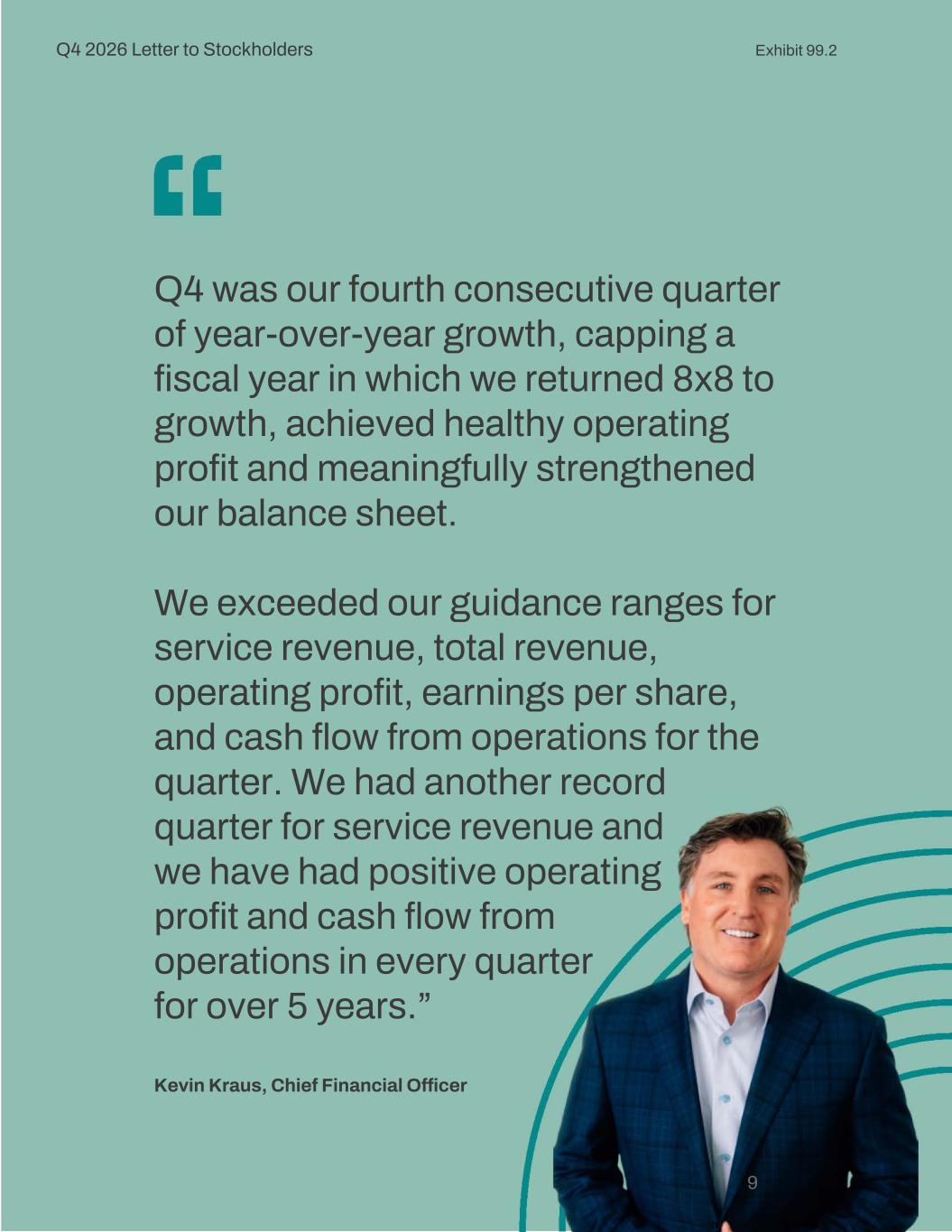
Q4 was our fourth consecutive quarter of year-over-year growth, capping a fiscal year in which we returned 8x8 to growth, achieved healthy operating profit and meaningfully strengthened our balance sheet. We exceeded our guidance ranges for service revenue, total revenue, operating profit, earnings per share, and cash flow from operations for the quarter. We had another record quarter for service revenue and we have had positive operating profit and cash flow from operations in every quarter for over 5 years.” Kevin Kraus, Chief Financial Officer Q4 2026 Letter to Stockholders .2 9
Financial Highlights Looking back, fiscal 2026 was a year of meaningful progress on the financial fundamentals of the business. We returned 8x8 to year-over-year revenue growth, expanded our usage- based offerings, and delivered positive operating margins in every quarter, meeting or exceeding our guidance each time. We also significantly reduced our debt and cash interest costs, driving net income growth over 19% for the year. The discipline we applied to managing the business gave us the flexibility to invest where the business needed it most while still expanding profitability. Our forward planning reflects continued focus on these same priorities. We remain focused on driving growth, profitability, and cash flow while continuing to improve the efficiency, agility, and scalability of the business. We view the work ahead as a multi-year journey, and we believe the foundation we built in fiscal 2026 positions us well for what comes next. Q4 2026 Letter to Stockholders .2 10
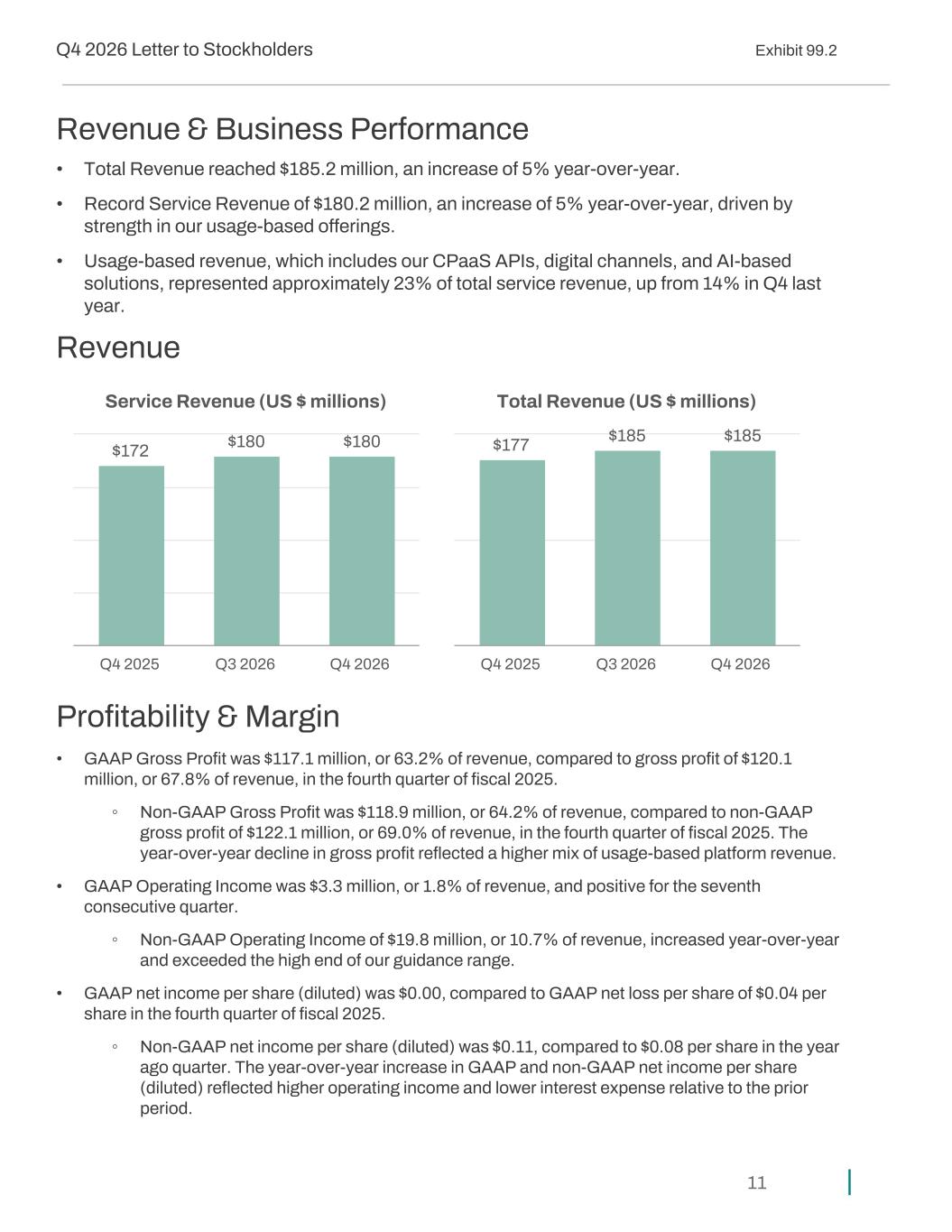
Revenue & Business Performance • Total Revenue reached $185.2 million, an increase of 5% year-over-year. • Record Service Revenue of $180.2 million, an increase of 5% year-over-year, driven by strength in our usage-based offerings. • Usage-based revenue, which includes our CPaaS APIs, digital channels, and AI-based solutions, represented approximately 23% of total service revenue, up from 14% in Q4 last year. Revenue Service Revenue (US $ millions) $172 $180 $180 Q4 2025 Q3 2026 Q4 2026 Total Revenue (US $ millions) $177 $185 $185 Q4 2025 Q3 2026 Q4 2026 Profitability & Margin • GAAP Gross Profit was $117.1 million, or 63.2% of revenue, compared to gross profit of $120.1 million, or 67.8% of revenue, in the fourth quarter of fiscal 2025. ◦ Non-GAAP Gross Profit was $118.9 million, or 64.2% of revenue, compared to non-GAAP gross profit of $122.1 million, or 69.0% of revenue, in the fourth quarter of fiscal 2025. The year-over-year decline in gross profit reflected a higher mix of usage-based platform revenue. • GAAP Operating Income was $3.3 million, or 1.8% of revenue, and positive for the seventh consecutive quarter. ◦ Non-GAAP Operating Income of $19.8 million, or 10.7% of revenue, increased year-over-year and exceeded the high end of our guidance range. • GAAP net income per share (diluted) was $0.00, compared to GAAP net loss per share of $0.04 per share in the fourth quarter of fiscal 2025. ◦ Non-GAAP net income per share (diluted) was $0.11, compared to $0.08 per share in the year ago quarter. The year-over-year increase in GAAP and non-GAAP net income per share (diluted) reflected higher operating income and lower interest expense relative to the prior period. Q4 2026 Letter to Stockholders .2 11
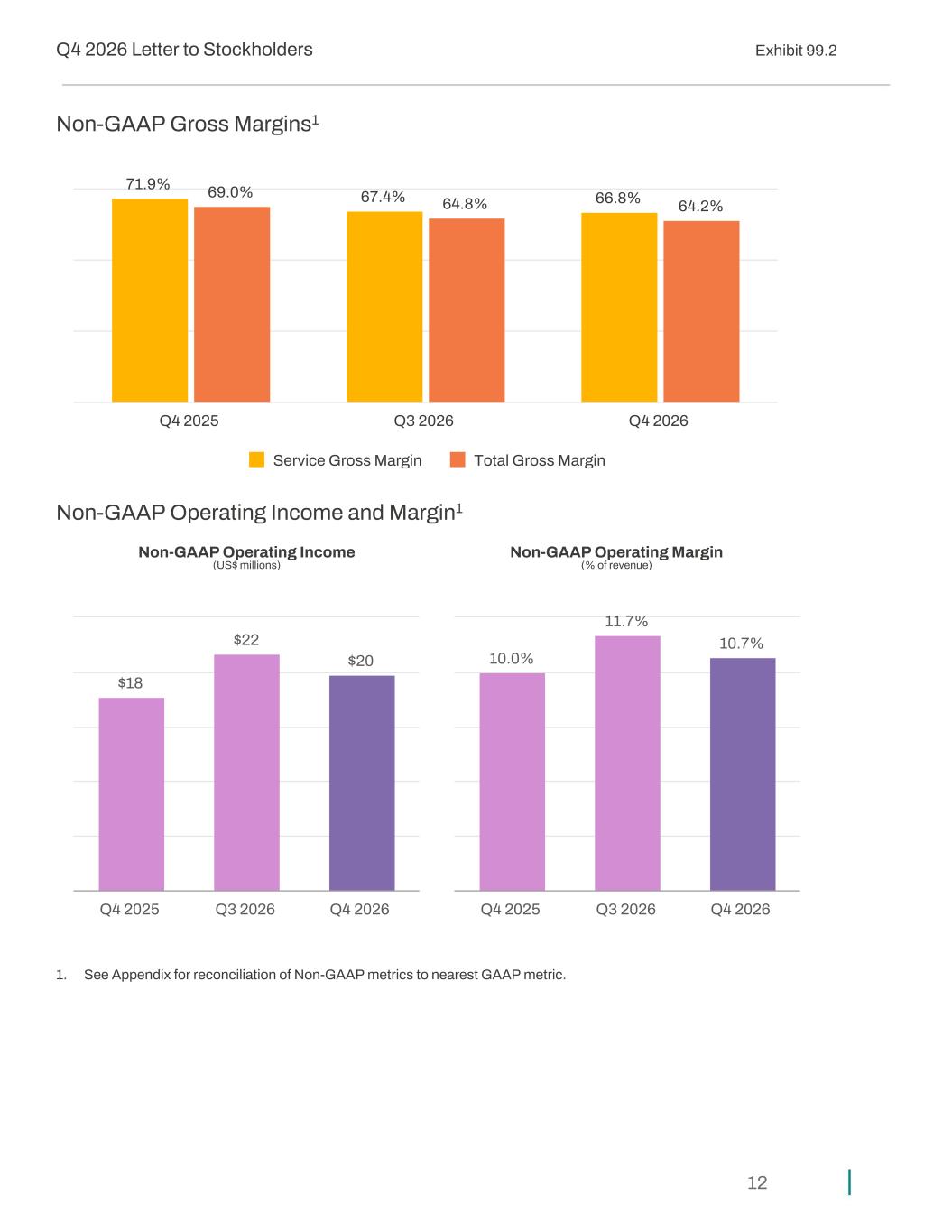
Non-GAAP Gross Margins1 71.9% 67.4% 66.8%69.0% 64.8% 64.2% Service Gross Margin Total Gross Margin Q4 2025 Q3 2026 Q4 2026 Non-GAAP Operating Income and Margin1 Non-GAAP Operating Income (US$ millions) Non-GAAP Operating Margin (% of revenue) $18 $22 $20 Q4 2025 Q3 2026 Q4 2026 10.0% 11.7% 10.7% Q4 2025 Q3 2026 Q4 2026 1. See Appendix for reconciliation of Non-GAAP metrics to nearest GAAP metric. Q4 2026 Letter to Stockholders .2 12
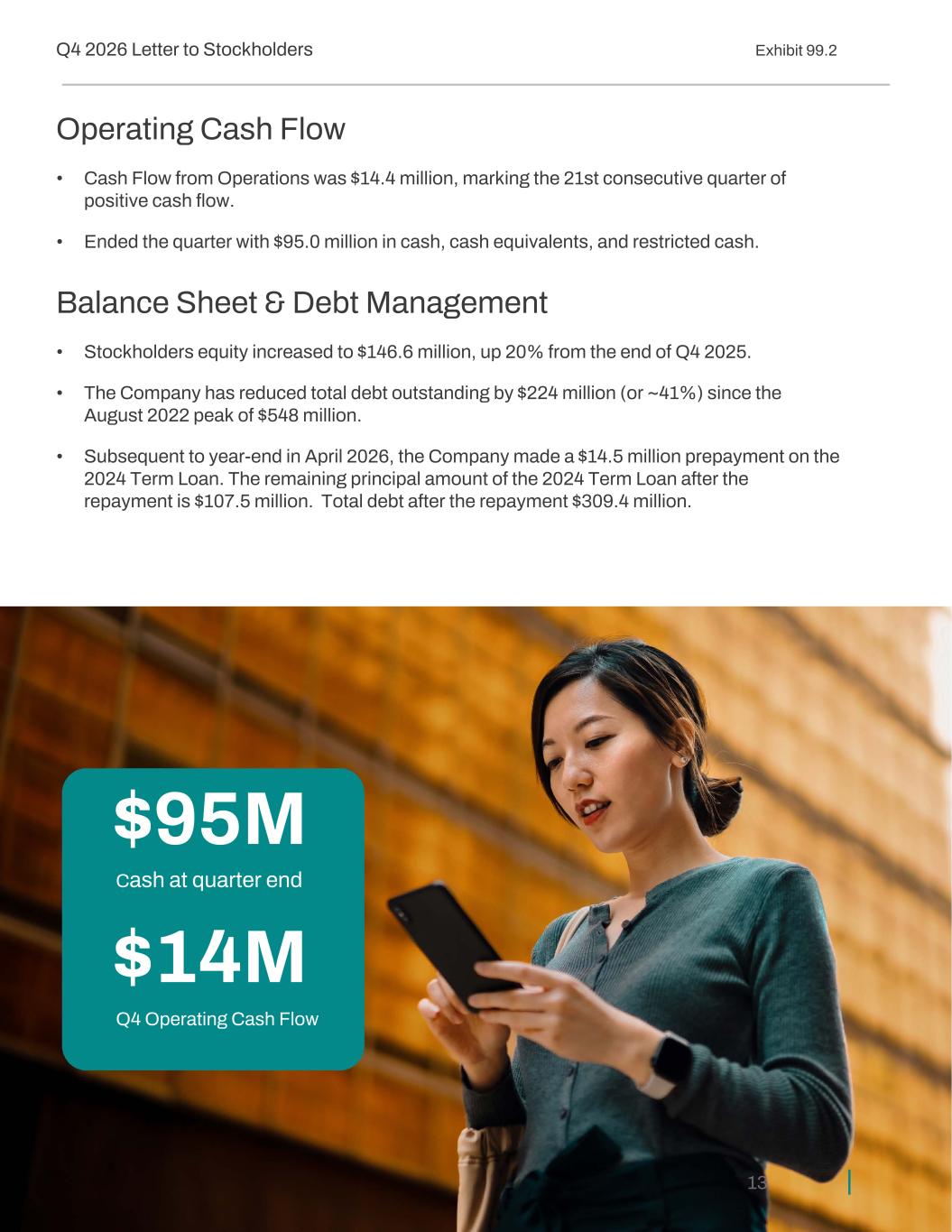
Operating Cash Flow • Cash Flow from Operations was $14.4 million, marking the 21st consecutive quarter of positive cash flow. • Ended the quarter with $95.0 million in cash, cash equivalents, and restricted cash. Balance Sheet & Debt Management • Stockholders equity increased to $146.6 million, up 20% from the end of Q4 2025. • The Company has reduced total debt outstanding by $224 million (or ~41%) since the August 2022 peak of $548 million. • Subsequent to year-end in April 2026, the Company made a $14.5 million prepayment on the 2024 Term Loan. The remaining principal amount of the 2024 Term Loan after the repayment is $107.5 million. Total debt after the repayment $309.4 million. $95M Cash at quarter end $14M Q4 Operating Cash Flow Q4 2026 Letter to Stockholders .2 13
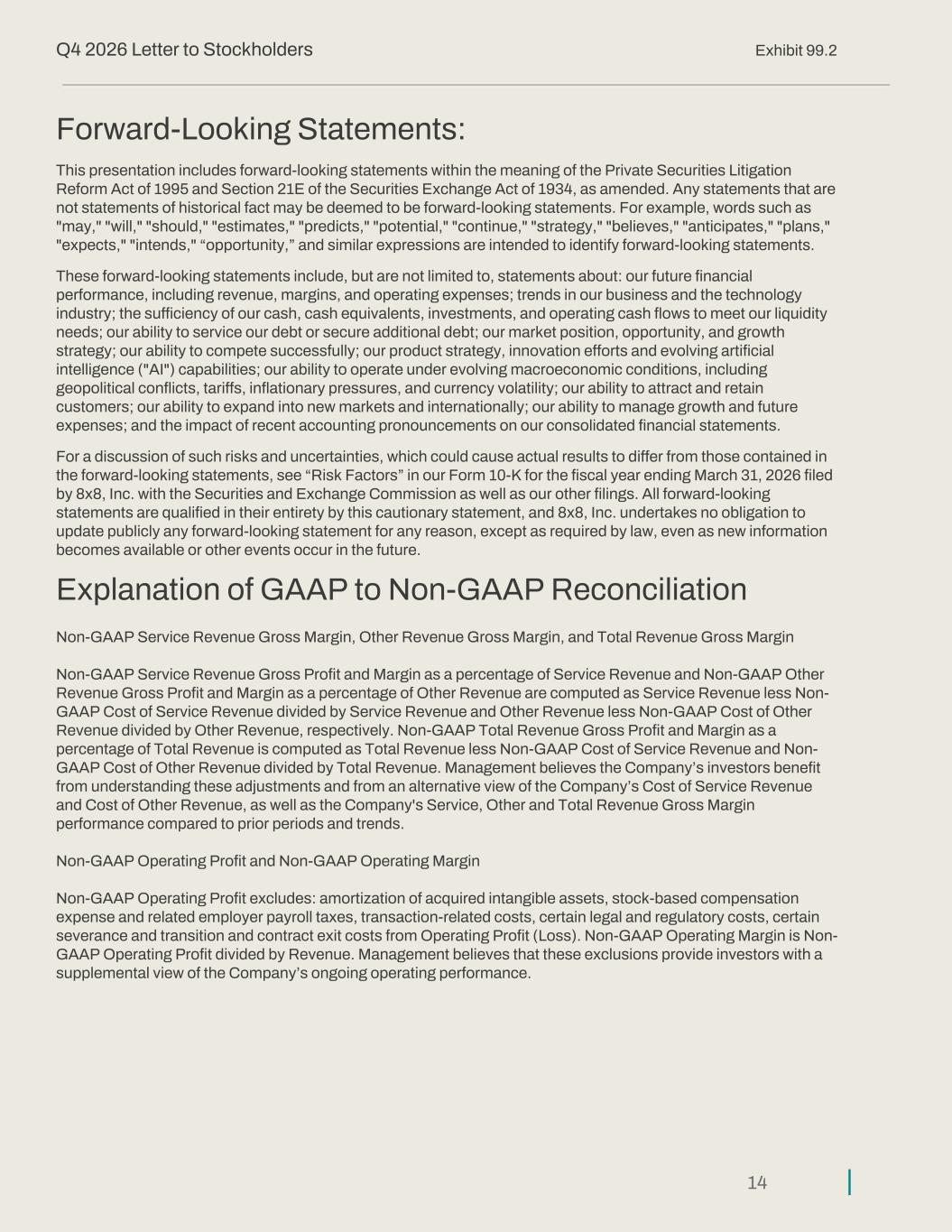
Forward-Looking Statements: This presentation includes forward-looking statements within the meaning of the Private Securities Litigation Reform Act of 1995 and Section 21E of the Securities Exchange Act of 1934, as amended. Any statements that are not statements of historical fact may be deemed to be forward-looking statements. For example, words such as "may," "will," "should," "estimates," "predicts," "potential," "continue," "strategy," "believes," "anticipates," "plans," "expects," "intends," “opportunity,” and similar expressions are intended to identify forward-looking statements. These forward-looking statements include, but are not limited to, statements about: our future financial performance, including revenue, margins, and operating expenses; trends in our business and the technology industry; the sufficiency of our cash, cash equivalents, investments, and operating cash flows to meet our liquidity needs; our ability to service our debt or secure additional debt; our market position, opportunity, and growth strategy; our ability to compete successfully; our product strategy, innovation efforts and evolving artificial intelligence ("AI") capabilities; our ability to operate under evolving macroeconomic conditions, including geopolitical conflicts, tariffs, inflationary pressures, and currency volatility; our ability to attract and retain customers; our ability to expand into new markets and internationally; our ability to manage growth and future expenses; and the impact of recent accounting pronouncements on our consolidated financial statements. For a discussion of such risks and uncertainties, which could cause actual results to differ from those contained in the forward-looking statements, see “Risk Factors” in our Form 10-K for the fiscal year ending March 31, 2026 filed by 8x8, Inc. with the Securities and Exchange Commission as well as our other filings. All forward-looking statements are qualified in their entirety by this cautionary statement, and 8x8, Inc. undertakes no obligation to update publicly any forward-looking statement for any reason, except as required by law, even as new information becomes available or other events occur in the future. Explanation of GAAP to Non-GAAP Reconciliation Non-GAAP Service Revenue Gross Margin, Other Revenue Gross Margin, and Total Revenue Gross Margin Non-GAAP Service Revenue Gross Profit and Margin as a percentage of Service Revenue and Non-GAAP Other Revenue Gross Profit and Margin as a percentage of Other Revenue are computed as Service Revenue less Non- GAAP Cost of Service Revenue divided by Service Revenue and Other Revenue less Non-GAAP Cost of Other Revenue divided by Other Revenue, respectively. Non-GAAP Total Revenue Gross Profit and Margin as a percentage of Total Revenue is computed as Total Revenue less Non-GAAP Cost of Service Revenue and Non- GAAP Cost of Other Revenue divided by Total Revenue. Management believes the Company’s investors benefit from understanding these adjustments and from an alternative view of the Company’s Cost of Service Revenue and Cost of Other Revenue, as well as the Company's Service, Other and Total Revenue Gross Margin performance compared to prior periods and trends. Non-GAAP Operating Profit and Non-GAAP Operating Margin Non-GAAP Operating Profit excludes: amortization of acquired intangible assets, stock-based compensation expense and related employer payroll taxes, transaction-related costs, certain legal and regulatory costs, certain severance and transition and contract exit costs from Operating Profit (Loss). Non-GAAP Operating Margin is Non- GAAP Operating Profit divided by Revenue. Management believes that these exclusions provide investors with a supplemental view of the Company’s ongoing operating performance. Q4 2026 Letter to Stockholders .2 14
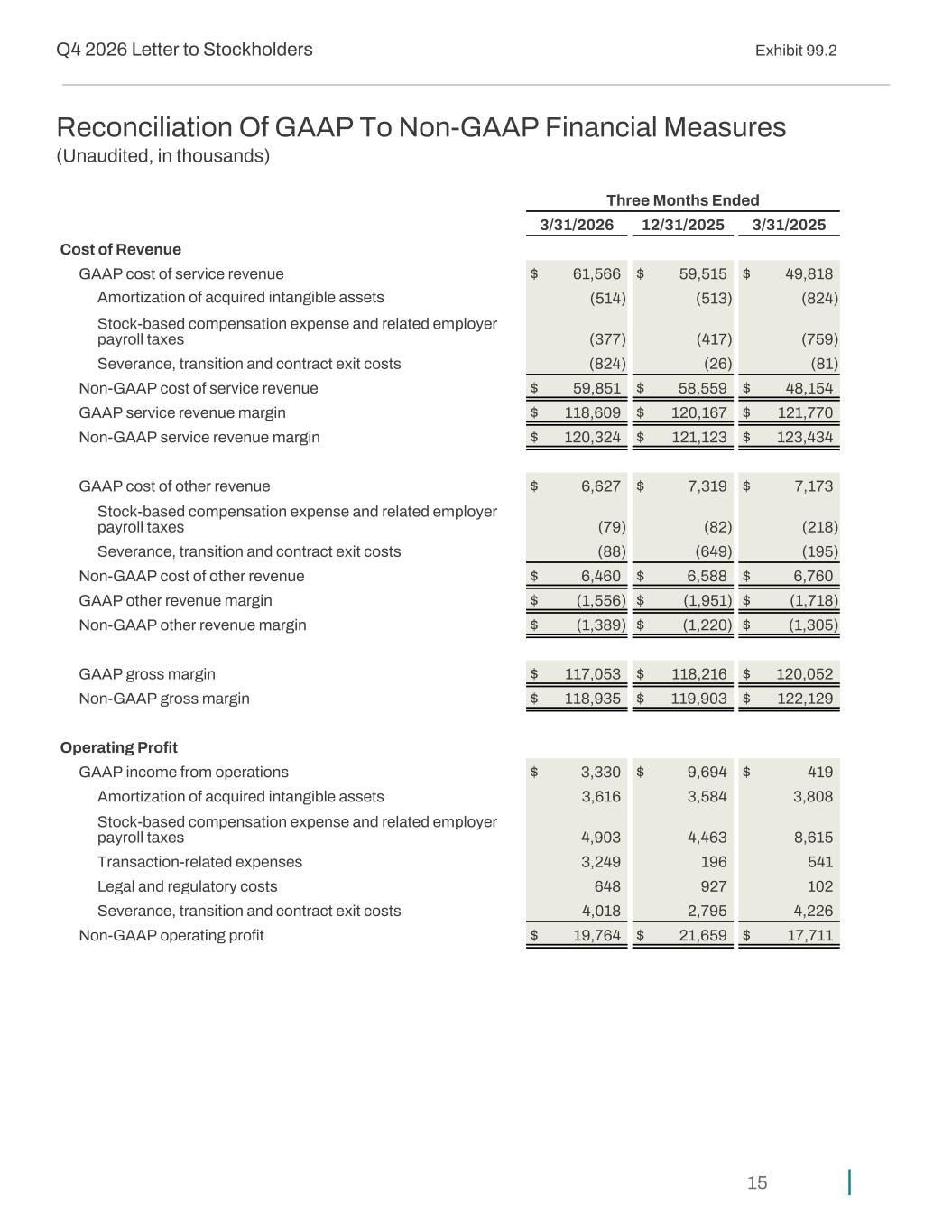
Reconciliation Of GAAP To Non-GAAP Financial Measures (Unaudited, in thousands) Three Months Ended 3/31/2026 12/31/2025 3/31/2025 Cost of Revenue GAAP cost of service revenue $ 61,566 $ 59,515 $ 49,818 Amortization of acquired intangible assets (514) (513) (824) Stock-based compensation expense and related employer payroll taxes (377) (417) (759) Severance, transition and contract exit costs (824) (26) (81) Non-GAAP cost of service revenue $ 59,851 $ 58,559 $ 48,154 GAAP service revenue margin $ 118,609 $ 120,167 $ 121,770 Non-GAAP service revenue margin $ 120,324 $ 121,123 $ 123,434 GAAP cost of other revenue $ 6,627 $ 7,319 $ 7,173 Stock-based compensation expense and related employer payroll taxes (79) (82) (218) Severance, transition and contract exit costs (88) (649) (195) Non-GAAP cost of other revenue $ 6,460 $ 6,588 $ 6,760 GAAP other revenue margin $ (1,556) $ (1,951) $ (1,718) Non-GAAP other revenue margin $ (1,389) $ (1,220) $ (1,305) GAAP gross margin $ 117,053 $ 118,216 $ 120,052 Non-GAAP gross margin $ 118,935 $ 119,903 $ 122,129 Operating Profit GAAP income from operations $ 3,330 $ 9,694 $ 419 Amortization of acquired intangible assets 3,616 3,584 3,808 Stock-based compensation expense and related employer payroll taxes 4,903 4,463 8,615 Transaction-related expenses 3,249 196 541 Legal and regulatory costs 648 927 102 Severance, transition and contract exit costs 4,018 2,795 4,226 Non-GAAP operating profit $ 19,764 $ 21,659 $ 17,711 Q4 2026 Letter to Stockholders .2 15

Q4 2026 Letter to Stockholders .2 16